Nelson was now in chief command of
the Mediterranean squadron. Great
Britain was once more waging war single-handed
against the French Empire. The rest
of Europe was crushed: everywhere on land
the French were victors, and resistance was
for the time being at an end.
Spain was a mere vassal of France; she
did not indeed at this period supply her fleet,
but gave to Napoleon a money tribute
instead. Portugal, the ancient friend of Britain,
had at the bidding of the tyrant been forced
to close her ports to Nelson's ships.
Never before had Nelson been so impatient
to get at the foe.
"If the Devil stands at the door," he said,
"we shall sail to-morrow forenoon."
So eager was he to reach the Mediterranean
that having been ordered to keep the
Victory waiting to join Admiral Cornwallis oft
Brest, he left the ship, and with his suite got
into a frigate, in which he pressed on to join
the fleet, "going out in all the discomfort of
a convict," as St. Vincent said, and sleeping
seven or eight in a cabin, from his own
account.
The French fleet were in Toulon, and off
this port Nelson set himself to wait the
coming out of the enemy.
On his arrival he early found an opportunity
of showing his zeal and love for the
honour and interests of his own service.
There were at that time several artillerymen
serving on board the bomb-vessels.
Some of the young officers did not like their
men being made to perform other duties than
those of soldiers, and were very angry at
having to take their orders from naval
officers. There thus arose some ill-feeling
between the navy and army.
"With all content and smiles around me,"
Nelson wrote to Lord St. Vincent, "up start
these artillery boys and set us at defiance."
"You and I are on the eve of quitting
the theatre of our exploits," he adds, with
a feeling that his end was near, "but we
hold it due to our successors never, whilst
we have a tongue to speak or hand to write,
to allow the navy to be in the smallest degree
injured in its discipline by our conduct."
Nelson felt that a soldier, no matter how
high his rank, must, when on board ship,
take his orders from a sailor. He was
backed up in this by an Act of Parliament.
"It is the old history," he said, "trying to
do away the Act of Parliament: but I trust
they will never succeed; for when they do,
farewell to our naval superiority. We should
be prettily commanded." "Although my
career is nearly run, yet it would embitter my
future days and expiring moments to hear of
our navy sacrificed to our army."
As a means to put an end to all dispute,
he suggested that the navy should have a
separate corps of artillery attached to them,
and it is to this that we owe that splendid
body of men, the Royal Marine Artillery, or
"Blue Marines," as they are called in the navy.
The watch off Toulon was a long and weary one.
"I have made up my mind never to go
into port till after the battle, if they make
me wait a year," Nelson had said, and for
almost two years did our fleet remain ready
for action; nor during that time did it ever
go into harbour. When, after the long
months of waiting, it was called upon to
pursue the enemy for four thousand miles, it
was found, to quote Nelson's words, "in a
perfect state of readiness to act."
This management of the fleet was really as
great a triumph in many ways as his most
brilliant victories had been.
The people at nearly every port were in
dread of the French, and it was very difficult
to get supplies, so great was their fear of
rousing Napoleon's anger.
No British ships were allowed to enter
Spanish ports, though from these very ports
the French privateers sailed out and attacked
our merchantmen.
Nelson pitied the once proud mistress of
the world, who was now too weak to resist,
and had no choice left but to obey the
all-conquering French. "We ought," he said,
"by mutual consent to be the very best
friends, and both to be ever hostile to
France."
At the same time, though willing to make
every allowance for the miserable situation
in which Spain had placed herself, he plainly
let the Spaniards feel that he must be
treated with respect. He had strictly
observed Spain's neutrality by giving up French
vessels taken within gunshot of the Spanish
shore, yet from the coasts of Spain these
same French vessels sailed out and attacked
our ships.
Nelson said this must stop. "In whatever
place the Spaniards allow the French to
attack us," he told the British ambassador
at Madrid, "assure them that I shall order
the French to be attacked."
Meanwhile, the station off Toulon Nelson
called his home. His ships, thanks to his
great care, were in fairly good repair; his
men were in the right fighting trim. "Let
them come as soon as they please," he wrote,
"I never saw a fleet together so well officered
and manned."
La Touche Tréville, who had commanded
at Boulogne when Nelson's attack of boats
had been beaten back, was now the admiral
of the French fleet.
One day, while the main body of the
British fleet was out of sight, Rear-Admiral
Campbell, with only three ships, appeared in
the offing. Seeing this, La Touche, with every
sail set, left port and bore down on the three
vessels, on which, as was natural, the little
squadron retired.
The new experience of pursuing, instead of
being pursued, so delighted the Frenchman
that he published a most boastful and quite
untrue account of how he had chased Nelson
and the whole British fleet.
This idle brag stung Nelson to the quick,
and he promptly sent home a copy of the
Victory's log on the day in question to show
what the real facts were.
"As for myself," he said, "if my character
was not established by that time for not being
apt to run away, it would not be worth my
while to put the world right."
At the time, he wrote, "Monsieur La
Touche came out with eight sail of the line
and six frigates, cut a caper off Sepet, and
went in again."
Two months later, when a copy of the
French admiral's letter reached him, he broke
out in wrath.
"You will have seen Monsieur La Touche's
letter of how he chased me, and how I ran.
He is a poltroon, liar, and a miscreant. I
keep his letter, and, by Gad! if I take him,
he shall eat it."
In vain did Nelson try to draw his enemy
out to fight by every means he could think
of. The Frenchman would not walk into the
trap, nor be tempted into giving battle until
the appointed time came.
The dread of missing the enemy in a fog
was one of Nelson's chief anxieties, and he
kept thinking of his long chase of Admiral
Brueys before the battle of the Nile.
"If I should miss these fellows my heart
will break," he kept repeating.
"If that admiral were to cheat me out of
my hopes of meeting him," he added, "it
would kill me much easier than one of his balls."
The life on board ship was meanwhile a
dull one; daily they cruised about, one
day passing very much like another. The
weather in these parts is stormy; even during
the summer there was a gale almost every
week, followed by two days' heavy swell.
The health of the crews was, considering the
life they were leading, wonderfully good, and
for this they had to thank Nelson. The
admiral took every care for the comfort of his
men, and did his very best to secure lemons,
onions, and other fresh food, without which
disease must have broken out.
The patience with which our fleet bore
the long watch off Toulon is, in Nelson's
own words, a "record of perseverance at
sea which had never been surpassed." From
May 1803 to August 1805 the admiral himself
was only out of his ship three times; on each
of these occasions he was absent less than an
hour, and was "upon the king's service," as
the saying went.
The whole fleet bore the long wait patiently;
the men behaved well, and all earned Nelson's
thanks. The officers were not behind the men
in doing their duty either. "Such a gallant
set of fellows! Such a band of brothers! My
heart swells at the thought of them," wrote
Nelson.
In October the patience of Great Britain
was tired out, and war was declared against
Spain. About three months after, while the
British fleet was at anchor off the coast of
Sardinia, the Toulon fleet at last put to sea
and joined the Spaniards. On getting this
news the British fleet weighed and put to
sea, while next morning the signal was
made to prepare for battle.
A chase somewhat like the former pursuit
of Brueys now began, stormy weather keeping
pursuers and pursued apart.
After seeing that Sardinia, Naples, and
Sicily were safe, as before Nelson made for
Egypt. Not finding the enemy there this
time, he doubled back for Malta, where news
reached him that they had dispersed in a
gale and put back to Toulon.
"These gentlemen are not accustomed to
a Gulf of Lions gale; we have buffeted them
for one and twenty months and not carried
away a spar," Nelson declared with pride.
From the 21st of January till he anchored
in Cagliari Bay on the 27th of February,
the ships had been cleared for action, without
a bulkhead up, night or day.
During this chase of the enemy and weary
buffeting against foul winds, a despatch-vessel
had been wrecked, a convoy had been waylaid,
and the two small ships protecting it
taken.
To add to these small losses, another
despatch-vessel had gone ashore off Cadiz
and fallen into the hands of the enemy.
The captain of the latter, Captain Layman,
had earned Nelson's praise and esteem by
his smartness and bravery at Copenhagen,
and Nelson could not bear that a brave man
should be blamed.
The admiral never turned his back upon
a friend, more especially did he stick by a
friend in misfortune.
"Dear Parker is my child, for I found
him in distress," he had written of a captain
wounded in the attack of boats at Boulogne.
To this other captain in distress, the great
seaman's tender heart went out, and he wrote
to the Admiralty on his behalf.
"My dear Lord," he began, "give me
leave to recommend Captain Layman to
your kind protection; for notwithstanding
the court-martial has thought him worthy
of censure for his running in with the land,
yet, my Lord, allow me to say that Captain
Layman's misfortune was, perhaps, conceiving
other people's abilities were equal to his
own, which indeed very few people's are.
"Captain Layman has served with me in
three ships, and I am well acquainted with
his bravery, zeal, judgment, and activity;
nor do I regret the loss of the Raven
compared to the value of Captain Layman's
services, which are a national loss.
"You must, my dear Lord, forgive the
warmth which I express for Captain Layman;
but he is in adversity, and therefore has
the more claim to my attention and regard.
"If I had been censured every time I have
run my ship, or fleets under my command,
into great danger, I should long ago have
been out of the service, and never in the
House of Peers.
"I am, my dear Lord, most faithfully,
"Your obedient servant,
"NELSON AND BRONTE."
Small wonder the whole fleet adored "Our
Nel," as they called him, and who, they said,
was "as brave as a lion but as gentle as a
lamb."
On the 4th of April, while bearing up for
his old station, Toulon, he learnt that
Villeneuve had five days previously put to
sea, with eleven ships of the line, seven
frigates, and two brigs.
At first he searched for them down the
Mediterranean, still thinking that Egypt
must be their object. At length he heard
that the enemy had passed the Straits of
Gibraltar, and might be half-way to Ireland
or Jamaica, an attack on both of which
places had been thought likely.
Beating up against adverse winds, Nelson,
who said that his "good fortune had flown
away," could only pass the narrow straits on
the 5th of May, when a favouring wind at
last sprung up.
Just before this, a Scotsman, Donald
Campbell, who was at that time an admiral
in the Portuguese service, came on board
the Victory with the news that the combined
fleets were on their way to the West Indies.
Though the enemy were in far greater
numbers than the British, the admiral started
off in hot pursuit with only ten sail of the
line and three frigates.
"Take you a Frenchman apiece," he told
his captains, "and leave me his Spaniards"
(there were six Spanish battleships). "When
I haul down my colours, I expect you to do
the same, and not till then."
Meanwhile Nelson was suffering the same
torture of mind and spirit as when once
before the enemy escaped him before the
battle of the Nile.
"Oh, French fleet! French fleet!" he wrote,
"if I can but once get up with you, I'll
make you pay dearly for all that you have
made me suffer."
By June 4 the British were at Barbadoes,
where, misled by reports, they expected to
find the enemy. They entered the Gulf of
Paria with their ships cleared for action, only
to find the enemy gone.
Coming to the rapid but, as it happened,
correct decision that the enemy had returned
to Europe, Nelson lost no time in sailing
after them.
As going out he had been able to gain
ten days on them, and they had only five
days' start of him on the return to Europe,
Nelson thought he would be able to come
up with Villeneuve before the latter had
done much harm.
For three weeks the combined fleet had
the West Indies at their mercy, and as they
had not attacked the islands, Nelson felt no
great alarm as to what they would do in
Europe.
On the 19th of June he was back again at
Gibraltar, and the next day he went on shore
for the first time since June 18, 1803.
Thus for two years he had not had his foot
on dry land.
Though he had not found the enemy, he
had at least chased them out of the West
Indies, which were then among Britain's most
wealthy and important colonies.
Had the enemy been met, though they were
in far greater numbers, Nelson had
determined to attack them, come what might to
his own squadron.
"Though we are but eleven to eighteen
or twenty, we won't part without a battle,"
he kept repeating.
That this fight he had in his mind never
took place was due to no fault of Nelson's.
A few days later, however, Admiral Calder
with fifteen ships met twenty of the enemy,
and a drawn battle took place. The British
admiral, though he had the best of the fight,
thought it more prudent to draw off and let
the enemy escape, after they had been roughly
handled.
This made the people in England very
angry, for the country could not but feel how
different the result would have been if their
beloved admiral had been in Calder's place.
Nelson, they knew, would never have left the
enemy, even though half his own ships had
been destroyed.
Nelson's truly great spirit could not bear
that his unfortunate brother admiral should
be blamed.
"It most sincerely grieves me," he wrote,
"that in any of the papers it should be
insinuated that Lord Nelson could have
done better. Who can say what will be the
event of a battle? I could have fought the
enemy, so did my friend Calder; but who
can say that he will be more successful
than another?"
On August 18 the Victory anchored at
Portsmouth and the long chase was at an end.
Nelson no sooner landed than he posted
up to London, where he had much to talk
about, not only with the Admiralty but with
the Secretary for War.
On this visit to London the famous
meeting between Nelson, "the greatest sailor
since our world began," and the Duke of
Wellington, the conqueror of Napoleon, "the
great world's victor's victor," took place.
Neither knew who the other was. They
were both waiting in the anteroom of the
Secretary of State. At first "the Iron Duke"
found Nelson's talk trifling and silly. But
when the war and the state of Europe were
touched upon, then in an instant the somewhat
boastful trifler vanished, and Nelson, the
statesman, sailor, and saviour of his country
appeared in his true colours.
On the 2nd of September Captain Blackwood
called at Merton at five in the morning.
Nelson, who was already up and dressed,
eagerly greeted him with the words, "I am
sure you bring me news of the French and
Spanish fleets, and I think I shall yet have
to beat them."
On Blackwood telling him that the French
squadron had arrived off Cadiz, he could
scarcely conceal his joy. "Depend upon it,
Blackwood," he exclaimed, "I shall yet give
Mr. Villeneuve a drubbing."
All haste was made to get ready the fleet
Nelson had chosen. He stuck to the Victory
as his flagship. Already a feeling of his
coming death was upon him: he knew
"they meant to make a dead set at the
Victory," he told his brother.
In his private journal are found these
words:—
"Friday night (Sept. 13), at half-past ten, I
drove from dear, dear Merton to go to serve
my king and country. May the great God,
whom I adore, enable me to fulfil the
expectations of my country.
"And, if it is His good pleasure that I
should return, my thanks will never cease
being offered up to the throne of His mercy.
"If it is His good providence to cut short
my days upon earth, I bow with the greatest
submission, relying that He will protect those
so dear to me, whom I may leave behind!
His will be done. Amen! Amen! Amen!"
Nelson had felt his reception at Court after
his return from Copenhagen to be a cold one.
Now, his leave-taking must have assured
him of the love and admiration of a whole
nation.
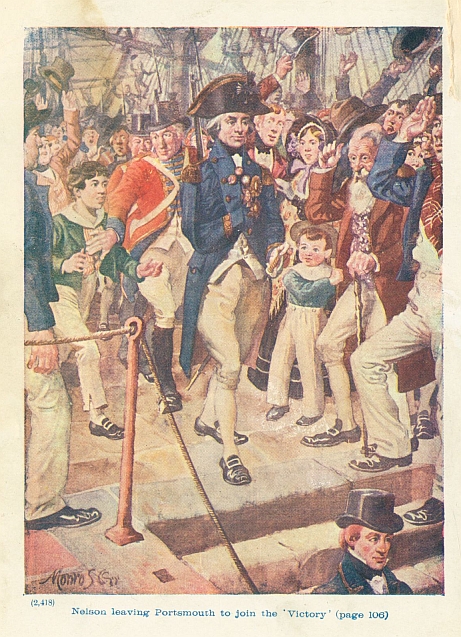
Nelson leaving Portsmouth to join the 'Victory'
Vast crowds had gathered at Portsmouth
to catch a glimpse of, and to bid God-speed
to, the national hero.
To quote Southey: "They pressed forward
to obtain sight of his face. Many were in
tears, and many knelt down before him and
blessed him as he passed.
"England has had many heroes, but never
one who so entirely possessed the love of
his fellow-countrymen as Nelson."
On the 25th the Victory was off Lisbon,
and letters were sent on shore begging that
the fleet's arrival might be kept secret.
At all costs Villeneuve was to be tempted
to put to sea and give battle.
"Day by day," wrote Nelson, "I am expecting
the allied fleet to put to sea—every
day, hour, and moment. I am convinced that
you estimate, as I do, the importance of not
letting those rogues escape us without a fair
fight, which I pant for by day and dream of
by night."
On September 28 the Victory reached the
fleet; the day after was Nelson's birthday.
The reception he met with, he declared,
"caused the sweetest sensation of his life."
The officers who came on board to welcome
his return—"the band of brothers," as he
called them—forgot his rank as commander-in-chief,
in the joy with which they greeted him.
"When I came to explain to them the
'Nelson touch,'" the admiral writes to Lady
Hamilton, "it was like an electric shock.
Some shed tears; all approved."
The "Nelson touch," which has passed into
a saying common in the navy to this day, was
the great admiral's plan of attack or conduct
of war.
"The business of an English commander-in-chief"—so
ran Nelson's famous order—"is
first to bring an enemy's fleet to battle, on
the most advantageous terms to himself (I
mean that of laying his ships close on
board the enemy as quickly as possible);
and, secondly, to continue them there without
separating until their business is decided."
"First, to lay his ships close on board
the enemy; and, secondly, to continue them
there." Surely this, in a few simple words, is
the secret of England's naval greatness, and
Nelson's own fame.
On the 10th of October Nelson was to have
his longed-for wish granted.
The day previous he had noted in his
diary—
"Fine weather; wind easterly: the
combined fleets cannot have finer weather to
put to sea."
Next morning the signal was flashed
throughout the British fleet, with what
feelings of joy we can well imagine—
"THE ENEMY ARE COMING OUT
OF PORT."