“Thank God, I have done my duty.”
Nelson.
The 21st October 1805 is a red-letter day
in the history of England. Dawn had scarcely
succeeded night ere Nelson was up and
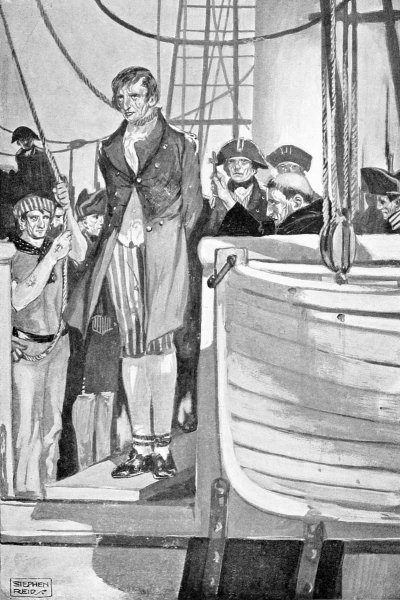
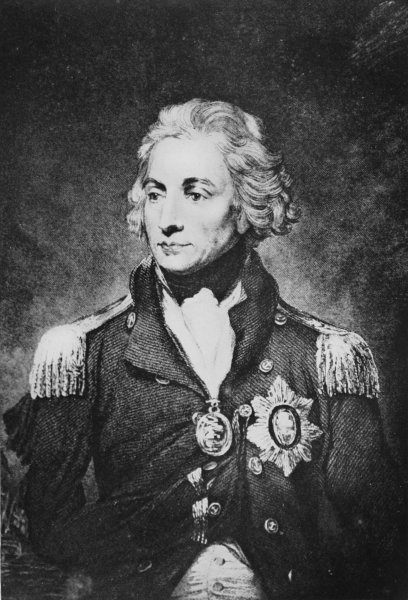
doing. He wore his Admiral’s frock-coat, the only
decoration being four stars of different Orders which
were pinned on his left breast. “In honour I gained
them,” he said, “and in honour I will die with them.”
He had not buckled on his sword, and this is the only
action he fought without it.
The previous night Villeneuve had signalled for the
columns of his fighting squadron to form in close line of
battle without regard to priority of place, his former
intention having been to give the three-deckers the
more important positions. Captain Lucas of the
Redoutable states that the ships “were all widely
scattered” in consequence of this order. “The ships
of the battle squadron and those of the squadron of
observation were all mixed up,” although the commanders
of the latter did their best to get into something
approaching order.
Early the following morning—the glorious 21st—the
French Admiral signalled to “clear for action!”
and in response to the Hermione’s message, “The enemy
number twenty-seven sail-of-the-line,” he ordered each
ship to leave but one cable’s length between its immediate
neighbour. They were now on the starboard
tack. Almost before these instructions had been
completely carried out Villeneuve decided to alter
their position, signalling them to form in line of battle
on the port tack. The manœuvre was not easily
effected. The wind was light, with a heavy swell,
many ships missed their station, and there were several
gaps and groups of ships along the line instead of
vessels at regular intervals. The newly-formed line
was consequently very irregular and almost crescent-shaped.
Villeneuve, prudent to a fault, wished to
have Cadiz harbour under his lee; he was apparently
already lending his mind to thoughts of disaster.
Gravina, with the twelve reserve ships, seems to have
pursued his own tactics. Instead of keeping to windward
of the line, so that he might bring succour to
Villeneuve if need should arise, the Vice-Admiral
“moved to the rear to prolong the line”—now extending
some five miles—“without having been signalled
to do so.” Whether Villeneuve took particular notice
of this false move at the time is uncertain, but later,
on his attempt to get his colleague to take up the
position previously arranged for him and which would
have enabled Gravina “to reinforce the centre of the
line against the attack of the enemy,” no attention was
paid to the command. Never was there a more fatal
error of policy. Had the Spanish Admiral been able
to bring twelve ships to bear upon the battle when it
was at its height he might have rendered valuable
assistance.
Scarcely less reprehensible was the behaviour of
Rear-Admiral Dumanoir Le Pelley, who with ten ships fell
to leeward and formed a rear squadron.70 Not until it was
too late did he attempt to take any part in the battle.
The British fleet was formed into two columns,
eleven ships following the Victory (100), and fourteen
in the rear of the Royal Sovereign (100), under Collingwood.
Nelson’s idea was to bear down upon the enemy
with these two divisions and break the centre of the
combined fleet in two places at once, Nelson leading
the weather line, and Collingwood the lee. While
Villeneuve was issuing his last order before the struggle,
“Every ship which is not in action is not at its post,”
the British Commander-in-chief was committing to paper
the following prayer:
“May the great God whom I worship grant to my
country and for the benefit of Europe in general a
great and glorious victory, and may no misconduct
in anyone tarnish it; and may humanity after victory
be the predominant feature in the British fleet! For
myself individually, I commit my life to Him that
made me, and may His blessing alight on my endeavours
for serving my country faithfully. To Him I resign
myself and the just cause which is entrusted me to
defend.”
Nelson also made his will, heading it, “October
21st 1805, then in sight of the Combined Fleets of
France and Spain, distant about ten miles.” Blackwood
and Hardy attached their signatures as witnesses.
He left Emma, Lady Hamilton, “a legacy to my King
and country, that they will give her an ample provision
to maintain her rank in life. I also leave to the beneficence
of my country my adopted daughter, Horatia
Nelson Thompson; and I desire she will use in future
the name of Nelson only.”
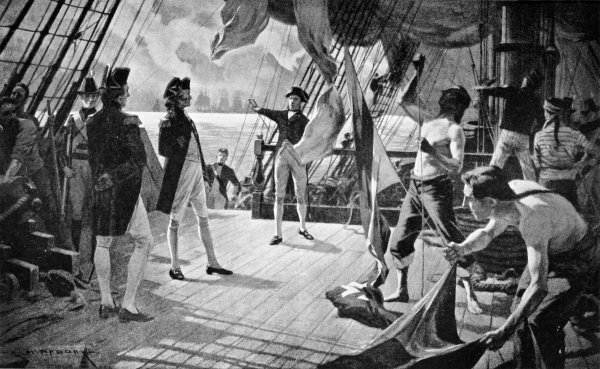
Hoisting the Famous Signal
C. M. Padday
Blackwood had gone on board the flag-ship at six
o’clock in the morning, and found the admiral “in
good, but very calm spirits.” He tells us in his
“Memoirs” that “during the five hours and a half
that I remained on board the Victory, in which I was
not ten minutes from his side, he frequently asked
me, ‘What I should consider a victory?’ the certainty
of which he never for an instant seemed to doubt,
although, from the situation of the land, he questioned
the possibility of the subsequent preservation of the
prizes. My answer was, that considering the handsome
way in which battle was offered by the enemy, their
apparent determination for a fair trial of strength,
and the proximity of the land, I thought if fourteen
ships were captured, it would be a glorious result;
to which he always replied, ‘I shall not, Blackwood,
be satisfied with anything short of twenty.’ A telegraphic
signal had been made by him to denote, ‘that
he intended to break through the rear of the enemy’s
line, to prevent them getting into Cadiz.’ I was
walking with him on the poop, when he said, ‘I’ll
now amuse the fleet with a signal;’ and he asked me
‘if I did not think there was one yet wanting?’ I
answered, that I thought the whole of the fleet seemed
very clearly to understand what they were about,
and to vie with each other who should first get nearest
to the Victory or Royal Sovereign. These words were
scarcely uttered, when his last well-known signal was
made, ‘England expects every man will do his
duty.’ The shout with which it was received throughout
the fleet was truly sublime. ‘Now,’ said Lord
Nelson, ‘I can do no more. We must trust to the
Great Disposer of all events, and justice of our cause.
I thank God for this great opportunity of doing my
duty.’”
It has been pointed out that Blackwood is wrong
in the matter of the cheer “throughout the fleet,” for
several of the crews were not informed as to the purport
of the signal. The Admiral’s first idea was to flag
“Nelson confides that every man will do his duty.”
Captain Blackwood suggested “England” in place of
“Nelson,” which the Admiral told Pasco, the signal officer,
to hoist, adding that he “must be quick” as he had
“one more signal to make, which is for close action.”
“Then, your Lordship,” ventured Pasco, “if you
will permit me to substitute ‘expects’ for ‘confides’
the signal can be more quickly completed, because
we have ‘expects’ in the vocabulary, while ‘confides’
must be spelled.” The code-book therefore won the
day, and a message which has inspired the Navy for
over a century was soon floating on the breeze.
In this connection there is a tradition that a Scottish
sailor complained to a fellow-countryman: “Not a
word o’ puir auld Scotland.” “Hoots, Sandy,” answered
his comrade, “the Admiral kens that every Scotsman
will do his duty. He’s just giving the Englishers
a hint.”
To continue Blackwood’s narrative: “The wind
was light from the S.W., and a long swell was setting
into the Bay of Cadiz, so that our ships, like sovereigns
of the ocean, moved majestically before it; every one
crowding all the sail that was possible, and falling into
her station according to her rate of going. The enemy
wore at about seven o’clock, and then stood in a close
line on the larboard tack towards Cadiz. At that
time the sun shone bright on their sails; and from the
number of three-deckers amongst them, they made
a most formidable appearance; but this, so far from
appalling our brave countrymen, induced them to
observe to each other, ‘what a fine sight those ships
would make at Spithead.’71 About ten o’clock, Lord
Nelson’s anxiety to close with the enemy became very
apparent. He frequently remarked to me, that they
put a good face upon it; but always quickly added,
‘I’ll give them such a dressing as they never had before,’
regretting at the same time the vicinity of the land.
At that critical moment I ventured to represent to
his lordship the value of such a life as his, and particularly
in the present battle; and I proposed hoisting
his flag in the Euryalus, whence he could better see
what was going on, as well as what to order in case of
necessity. But he would not hear of it, and gave as
his reason the force of example; and probably he was
right.”
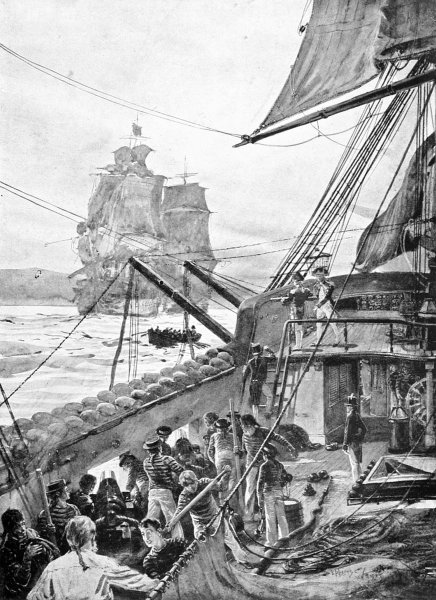
A sailor who rejoiced in the nickname of Jack Nasty-Face
gives us an excellent view of the proceedings as
the sail-of-the-line were got ready for action: “During
this time each ship was making the usual preparations,
such as breaking away the captain and officers’ cabins,
and sending the lumber below—the doctors, parson,
purser, and loblolly men were also busy, getting the
medicine chests and bandages and sails prepared for
the wounded to be placed on, that they might be
dressed in rotation as they were taken down to the
after-cockpit. In such bustling, and, it may be said,
trying as well as serious time, it is curious to notice
the different dispositions of the British sailor. Some
would be offering a guinea for a glass of grog, while
others were making a sort of mutual verbal will—such
as, if one of Johnny Crapeau’s shots (a term given to
the French) knocks my head off, you will take all my
effects; and if you are killed, and I am not, why, I
will have yours; and this is generally agreed to....”
Another intimate word-picture of what happened
just before the contest of giants began is furnished by
General Sir S. B. Ellis, K.C.B., who was a second
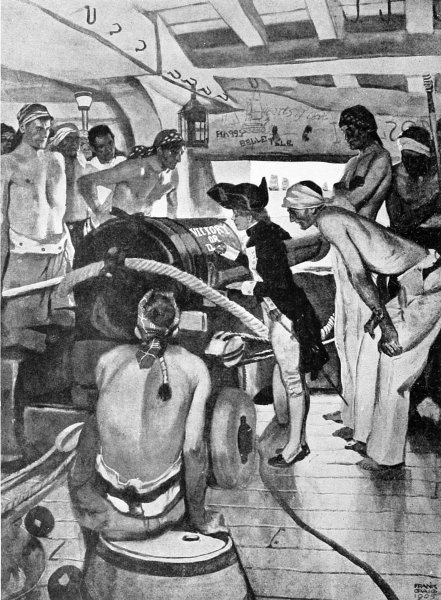
lieutenant of Marines in the Ajax. “I was sent below
with orders,” he writes, “and was much struck with
the preparations made by the bluejackets, the majority
of whom were stripped to the waist; a handkerchief
was tightly bound round their heads and over the
eyes, to deaden the noise of the cannon, many men
being deaf for days after an action. The men were
variously occupied; some were sharpening their
cutlasses, others polishing the guns, as though an
inspection were about to take place instead of a mortal
combat, whilst three or four, as if in mere bravado,
were dancing a hornpipe; but all seemed deeply anxious
to come to close quarters with the enemy. Occasionally
they would look out of the ports, and speculate as to
the various ships of the enemy, many of which had
been on former occasions engaged by our vessels.”
At about noon the first shot was fired. It came
from the Fougueux, a French ship of 74 guns, under
the command of Captain Louis Baudoin.
The Royal Sovereign, with the Belleisle (74), Mars
(74), and Tonnant (80) just behind her, forged ahead.
Nelson had signalled Collingwood to break the enemy’s
line at the twelfth ship from the rear, but on seeing
that she was only a two-decker Collingwood changed
his course and steered straight for the Santa Ana,
a huge Spanish ship of 112 guns, commanded by Vice-Admiral
Alava. The Fougueux (74) then came up and
endeavoured to prevent Collingwood from getting
through the line. This caused the English Admiral
to order his captain to make a target of the bowsprit
of the Frenchman and steer straight for it. Fortunately
for the enemy she altered her course, but although
she saved herself she did not prevent the Royal Sovereign
from breaking the line.
Collingwood was in his element; his usual silent
ways gave place to enthusiasm. “What would Nelson
give to be here!” he observed, the while his double-shotted
guns were hurling death into the hold of his
adversary and raking her fore and aft. A broadside
and a half tore down the huge stern gallery of the Santa
Ana (112), and killed and wounded a number of her
crew, all of whom showed by deed and daring that
they were worthy of their famous ancestors.
Both ships were soon in a pitiable condition, but
they hugged each other in a last desperate struggle.
A terrific cannonade ensued, the Fougueux and the
San Leandro (64) raking the Royal Sovereign, and the
San Justo (74) and Indomptable (80) lending their
assistance some distance away, although it was difficult
for them to distinguish between the two chief contestants,
so dense was the smoke from the guns. Some
fifteen or twenty minutes after Collingwood had maintained
the unequal contest alone, several British ships
came up and paid attention to those of the enemy
which had gone to Alava’s assistance. At about a
quarter past two the mammoth Santa Ana struck
her flag. On the captain delivering up his sword as
deputy for the Vice-Admiral, who lay dreadfully
wounded, he remarked that he thought the conquering
vessel should be called the Royal Devil!
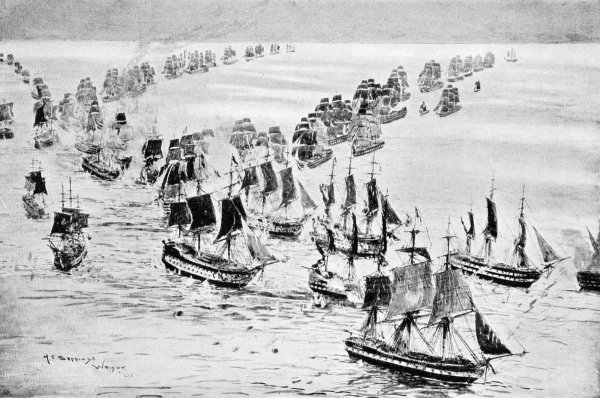
Nelson and Collingwood cutting the Enemy’s Lines at Trafalgar
H. C. Seppings Wright
Nelson, steering two points more to the north than
Collingwood, so as to cut off the enemy’s way of retreat
to Cadiz, came up about half an hour after the latter
had begun his engagement. As the stately flagship
entered the zone of fire a number of Villeneuve’s vessels
poured a perfect avalanche of shot upon her decks.
Down went a score or more of brave fellows, the wheel
was smashed, necessitating the ship being steered in the
gun-room, and a topmast dropped on the deck from
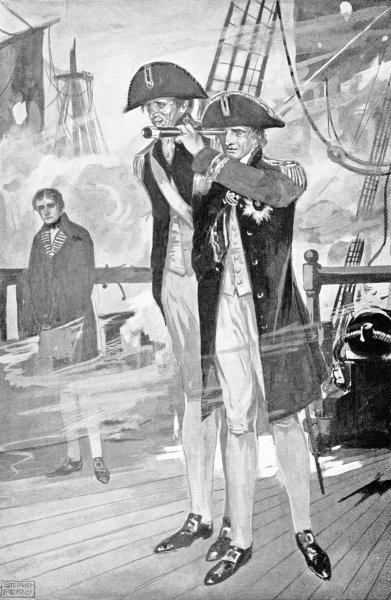
aloft. A shot struck one of the launches, a splinter
tearing a buckle from one of the shoes of either Nelson
or Hardy, which is not quite clear. “They both,”
writes Doctor Beatty, in his “Narrative,” “instantly
stopped, and were observed by the officers on deck to
survey each other with inquiring looks, each supposing
the other to be wounded. His Lordship then
smiled and said, ‘This is too warm work, Hardy, to
last long’; and declared that, through all the battles
he had been in, he had never witnessed more cool
courage than was displayed by the Victory’s crew on
this occasion.”
Steering for the Santissima Trinidad (130), at that
time the biggest floating arsenal ever built in Europe,
Nelson sought to engage her, but an alteration in
position precluded this, and he tackled the Bucentaure
(80), Villeneuve’s flagship. The French Admiral was
at last face to face with the man whose spirit had haunted
him since he assumed command.
Crash went the 68-pounder carronade into the
80-gun Frenchman, and down came the greater
part of the Bucentaure’s stern. The Victory then
grappled with the Redoutable, at the same time
receiving a hurricane of fire from the French Neptuno
(80).
Up in the fighting-tops of the Redoutable (74) were
riflemen trying to pick off the officers of the Victory.
One marksman, a little keener sighted or more fortunately
placed than the others, saw Nelson walking up
and down with Hardy. There was a flash of fire,
a sharp crack as the bullet sped through the air, and
the master mariner of England, of the world, of all
time, fell in a heap upon the deck.
The fatal ball entered his left shoulder by the edge
of the epaulet, cut through the spine, and finally buried
itself in the muscles of the back.
Three fellows rushed forward to his assistance.
“They have done for me at last, Hardy,” he murmured,
as they carried him below.
“I hope not,” was the Captain’s reply, not knowing
the extent of Nelson’s injuries, and probably thinking
that it might be possible to remove the missile.
“Yes, my backbone is shot through,” and then
Nelson placed a handkerchief over his face that the
crew might not know who formed the central figure of
the solemn little procession. Some sailors on the
Santissima Trinidad, however, could see from the
stars on his coat that an important officer had fallen,
and cheered.
They laid him in a midshipman’s berth in the dimly-lit
cockpit. He looked into the face of Death as he
had looked into the face of the enemy, without flinching
but not without hope. Sometimes a sentence would
escape his lips. “Ah, Mr Beatty,” he said to the
surgeon, “you can do nothing for me; my back is
shot through,” and to Dr Scott, the chaplain, “Doctor,
I am gone: I have to leave Lady Hamilton and my
daughter Horatia as a legacy to my country.”
Very little relief could be afforded him. He sipped
lemonade frequently, his breast was rubbed, and constant
fanning helped to soothe his agonies a little.
Nelson sent for Hardy, whom he valued as an able
officer and friend, but as the Captain could not leave
his post at once the dying man feared for his safety.
“Will no one bring Hardy to me? He must be
killed! He is surely dead!”
The cheers of the British tars were borne down
to the cockpit as often as an enemy’s ship struck
her flag, and a smile played over the pallid
features. At last Hardy appeared and took his
chief’s hand. “How goes the day with us?” was the
eager question.
“Very well, my Lord. We have taken twelve or
fourteen ships; but five of their van have tacked and
mean to bear down on us; but I have called two or
three of our fresh ships round, and have no doubt of
giving them a drubbing.”
“I hope none of our ships have struck?” Nelson
hastened to ask, seeing that Hardy was anxious to
return to his post.
“There is no fear of that,” was the reassuring answer.
Hardy, unable to restrain his tears, ascended the
companion ladder. As the guns were fired into the
passing squadron of Rear-Admiral Dumanoir, the ship
shook violently, thereby causing the dying man intense
agony. “Oh, Victory, Victory,” he cried, “how you
distract my poor brain,” followed by “how dear is
life to all men.” Then his wandering thoughts turned
homeward, and the memory of happy hours at Merton
made him add, “Yet one would like to live a little
longer, too.” Hardy again entered the cockpit with
the good news that fourteen or fifteen ships had struck.
“That is well,” Nelson breathed, “but I bargained
for twenty. Anchor, Hardy, anchor.” The Captain
then asked whether Collingwood should not take the
post of Commander-in-chief. The Admiral answered
with all the force he could muster, “Not whilst I live,
Hardy—no other man shall command whilst I live.
Anchor, Hardy, anchor; if I live I’ll anchor.”
Nelson was sinking: the moment for taking his
long farewell of his Captain had come. “Don’t throw
me overboard, Hardy. Take care of my dear Lady
Hamilton; take care of poor Lady Hamilton. Kiss
me, Hardy.” As the sorrowful officer bent over him
consciousness began to fade. “Who is that?” he
asked. On being told that it was Hardy, he whispered,
“God bless you, Hardy.”
His life flickered like the candle fixed on the beam
above, and then slowly went out. He murmured
that he wished he had not left the deck, that he had
not been a great sinner, and said with deliberation,
“Thank God, I have done my duty.” “God and my
country” were the last words heard by the sorrowful
little group gathered round their beloved master. In
the arms of Mr Walter Burke, the purser of the ship,
Nelson lay dead.
And above, the heavy guns thundered a funeral
dirge.
As we have already seen, the Victory was engaged
in a duel with the Redoutable when Nelson received
his death wound. For a short period the Frenchman
did not return the fire, and thinking that Captain
Lucas was about to surrender, the Victory’s guns also
kept silence. But the interval had been used for
another purpose. The French crew were swarming
over the bulwarks of the British flagship, climbing
chains, and even clambering over the anchor in their
attempt to get on board. A desperate resistance was
offered, Captain Adair was killed by a musket ball, as
well as eighteen marines and twenty seamen.
Help came from a sister ship. The Téméraire (98)—the
fighting Téméraire of Turner’s glorious picture—was
now astern of the Redoutable. Had she possessed
the machine guns of to-day she could hardly have
swept the decks of the enemy with more deadly effect.
The men who were attempting to board went down
like ninepins. The carnage was awful; the sight
sickening. When the smoke cleared, little heaps of
corpses were seen piled up on the decks, while the
bodies of other poor fellows floated on the sea, now
tinged with the blood of victor and vanquished. Five
hundred and twenty-two of the Redoutable’s crew fell
that day before she struck her colours.
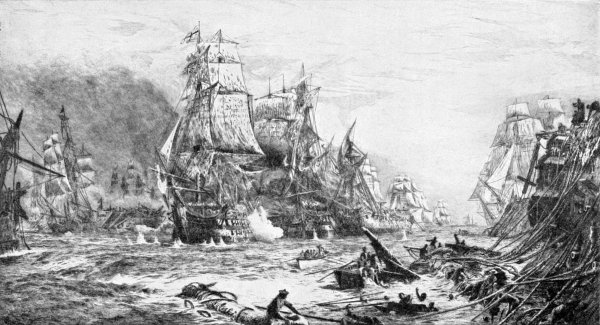
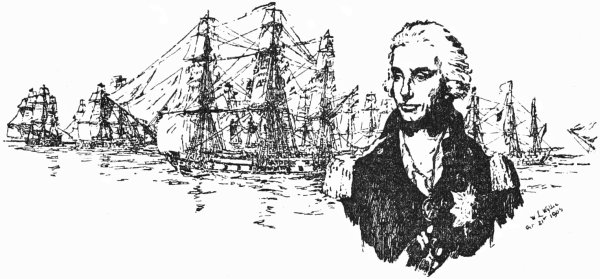
The Battle of Trafalgar (the “Victory” in centre of foreground)
W. L. Wyllie, A.R.A.
By permission of the Art Union of London, 112 Strand, Publishers of the Etching
The Bucentaure and the Santissima Trinidad were
together throughout the battle and received a succession
of attacks from various ships until they surrendered.
Both of them were then little more than dismasted
hulks. Villeneuve fought with the strength of despair,
but the case was hopeless, and resistance only prolonged
the agony. No assistance came to him despite his
frantic efforts to attract attention. “My part in the
Bucentaure is finished!” he cried at last, and so the
gallant but weak-willed officer was taken.
In appearance Villeneuve was “a tallish, thin man,
a very tranquil, placid, English-looking Frenchman;
he wore a long-tailed uniform coat, high and flat collar,
corduroy pantaloons of a greenish colour, with stripes
two inches wide, half-boots with sharp toes, and a
watch-chain with long gold links.”72
Other ships surrendered as the day wore on, the
Algéçiras (74) to the Tonnant (80), the Swiftsure (74)
and the Bahama (74) to the Colossus (74), the San Juan
Nepomuceno (74) to the Dreadnought (98). Eighteen
ships of the Allied Fleet were captured; one, the
Achille (74), blew up with a terrific explosion.
The Victory had been roughly handled by her
adversaries. In Hardy’s report of the 5th December
1805, he says:
“The hull is much damaged by shot in a number of
different places, particularly in the wales, strings, and
spurketing, and some between wind and water. Several
beams, knees, and riders, shot through and broke;
the starboard cathead shot away; the rails and timbers
of the head and stem cut by shot, and the falling of
the mizen-mast; the principal part of the bulkheads,
halfports, and portsashes thrown overboard in clearing
ship for action.
“The mizen-mast shot away about 9 feet above the
deck; the main-mast shot through and sprung; the
main-yard gone; the main-topmast and cap shot in
different places and reefed; the main-topsail yard shot
away; the foremast shot through in a number of
different places, and is at present supported by a topmast,
and a part of the topsail and crossjack yards;
the fore-yard shot away; the bowsprit jibboom and
cap shot, and the spritsail and spritsail topsail yards,
and flying jibboom gone; the fore and main-tops
damaged; the whole of the spare topmast yards,
handmast, and fishes in different places, and converted
into jury geer.
“The ship makes in bad weather 12 inches water
an hour.”73
At five o’clock Gravina made the signal for retreat.
What a sorry lot they were, those eleven ships—six
Spanish and five French—which with their consorts
had attempted to dethrone the Mistress of the Seas.
Another four under the command of Dumanoir had
also made good their escape, but only to be captured
off Cape Ortegal on November 4th, by Sir Richard
Strachan.
An eye-witness on board the Belleisle graphically
describes the scene after the last shot had been fired:
“The view of the fleet at this period was highly interesting,
and would have formed a beautiful subject for
a painter. Just under the setting rays were five or six
dismantled prizes; on one hand lay the Victory with
part of our fleet and prizes, and on the left hand the
Royal Sovereign and a similar cluster of ships. To the
northward, the remnant of the combined fleets was
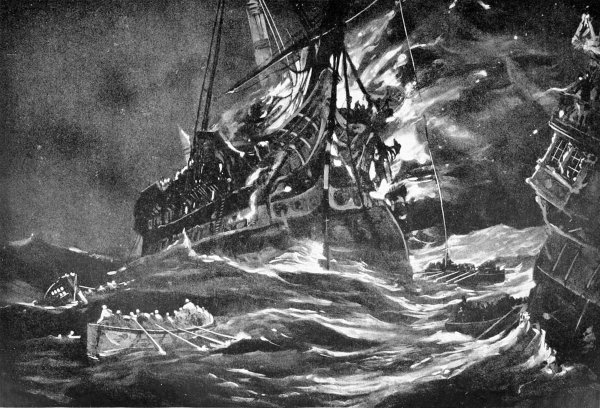
making for Cadiz. The Achille, with the tricoloured
ensign still displayed, had burnt to the water’s edge
about a mile from us, and our tenders and boats were
using every effort to save the brave fellows who had so
gloriously defended her; but only two hundred and
fifty were rescued, and she blew up with a tremendous
explosion.”
The battle was over, but much yet remained to be
done. Eighteen sail-of-the-line of the Allied Fleet
had struck their flag, and it was Collingwood’s difficult
task to secure the prizes. “A continued series of misfortunes,”
to use the Admiral’s own words, “... of
a kind that human prudence could not possibly
provide against, or my skill prevent,” alone precluded
him from keeping more than four trophies of
Trafalgar.
“On the 22nd, in the morning,” he states in a despatch
to the Admiralty, “a strong southerly wind
blew, with squally weather, which, however, did not
prevent the activity of the officers and seamen of such
ships as were manageable from getting hold of many of
the prizes (thirteen or fourteen), and towing them off
to the westward, where I ordered them to rendezvous
round the Royal Sovereign, in tow by the Neptune. But
on the 23rd the gale increased, and the sea ran so high
that many of them broke the tow-rope, and drifted
far to leeward before they were got hold of again;
and some of them, taking advantage of the dark and
boisterous night, got before the wind, and have perhaps
drifted upon the shore and sunk. On the afternoon
of that day, the remnant of the combined fleet, ten
sail of ships,74 which had not been much engaged, stood
up to leeward of my shattered and straggling charge,
as if meaning to attack them, which obliged me to
collect a force out of the least injured ships, and form
to leeward for their defence. All this retarded the
progress of the hulks; and the bad weather continuing,
determined me to destroy all the leewardmost that
could be cleared of the men, considering that keeping
possession of the ships was a matter of little consequence,
compared with the chance of their falling again into
the hands of the enemy; but even this was an arduous
task in the high sea which was running. I hope, however,
it has been accomplished to a considerable extent.
I intrusted it to skilful officers, who would spare no
pains to execute what was possible. The Captains of
the Prince and Neptune cleared the Trinidad, and sunk
her. Captains Hope, Bayntun, and Malcolm, who
joined the fleet this morning, from Gibraltar, had the
charge of destroying four others. The Redoutable
sunk astern of the Swiftsure, while in tow. The Santa
Ana I have no doubt is sunk, as her side is almost
entirely beat in; and such is the shattered condition
of the whole of them, that, unless the weather moderates,
I doubt whether I shall be able to carry a ship of them
into port....”
In a later letter Collingwood says, “There never was
such a combat since England had a fleet.” Three of
the prizes, the Santa Ana, the Neptuno, and the Algéçiras
escaped in the gale and entered Cadiz harbour, the
former two having been retaken by Cosmao Kerjulien,
who lost three ships over the transaction. The Swiftsure
(French), the San Ildefonso, the San Juan Nepomuceno,
and the Bahama were the only Trafalgar prizes
saved; these were taken to Gibraltar.
Villeneuve was sent to England and afterwards
exchanged, Alava was fortunate enough to reach Cadiz
on board the shattered Santa Ana. Although severely
wounded, he recovered and lived for many years.
Cisneros, after a gallant resistance, also escaped, and
was promoted Vice-Admiral in return for his distinguished
services, later taking up the important positions
of Captain-General and Minister of Marine. Magon,
who fought his flagship the Algéçiras until he was
struck dead after receiving several wounds, is one of
the most glorious names in the naval annals of France.
Three officers in turn were dangerously wounded before
the tattered flag of the battered hulk was finally lowered.
Of the other admirals, Cosmao retook the Santa Ana
and the Neptuno, already noted, Dumanoir was court-martialed,
and Gravina succumbed to his wounds as
these words formed themselves on his almost nerveless
lips: “I am a dying man, but I die happy; I am
going, I hope and trust, to join Nelson, the greatest
hero that the world perhaps has produced.”75 Escano
was injured in the leg, but reached Spain safely.
Napoleon’s officers paid dearly for the fight in Trafalgar
Bay, but Villeneuve was the scapegoat of Napoleon’s
ambition. On his return to France he took his own
life.
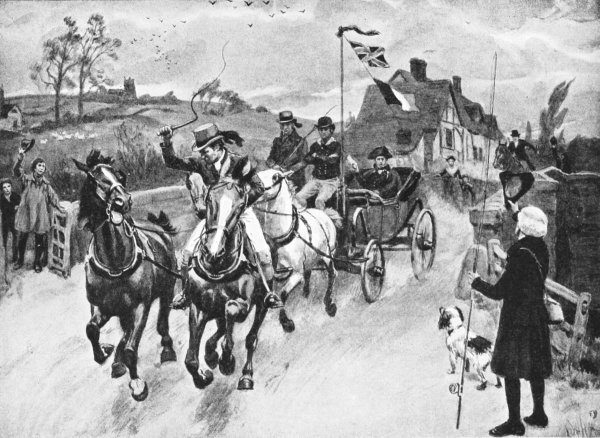
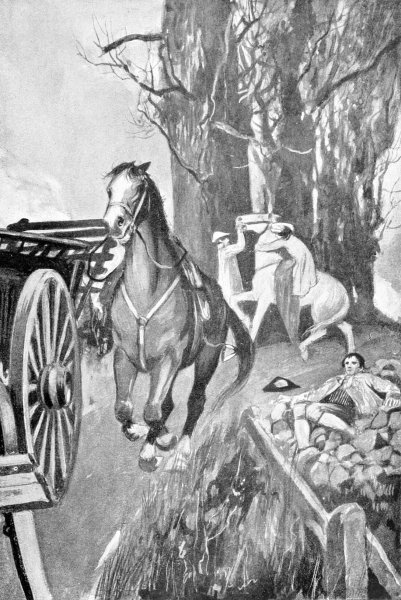
How the news of Trafalgar was carried to London
Frank Dadd, R.I., from a sketch by C. W. Cole
Collingwood gave the number of prisoners as 20,000,
and the monetary loss of the enemy nearly £4,000,000,
“most of it gone to the bottom.” The British loss
was 1690 killed and wounded; that of the allies 5860,
although no exact figures are obtainable. The captives
were taken to England, and the officers allowed on
parole, but the seamen and soldiers of the extinguished
Allied Fleet were sent to the prisons of Porchester,
Forton, Weedon, Norman Cross, Mill Bay, and Stapleton,
locked up in local gaols, or interned in hulks. By a
cruel fate the Bahama and the Swiftsure were added to
the number of the latter. Few exchanges were made,
and so the poor fellows either died in exile or remained
until the downfall of Napoleon secured them liberty.
Thus ended the battle of Trafalgar—Napoleon’s
maritime Waterloo. The idea of a great military
commander conducting operations at sea was proved to
be impracticable, while the superior qualities of British
seamanship were once more evident. The method of
warfare practised by the combined fleet, that of aiming
at the rigging and picking off combatants by sharp-shooting,
was less successful than our own principle
of aiming at the vital parts of the hull. Whereas the
British succeeded in firing a gun nearly once a minute,
it took three minutes for the Allied Fleet to do so. The
total armament on the English vessels numbered 2148
guns, while the French had 1356, and the Spanish
1270, bringing the combined force to 2626.
Great Britain gained enormously in prestige as a
result of Nelson’s overwhelming victory. Amongst
other important consequences Trafalgar led Napoleon
to enforce his disastrous Continental System, by means
of which he hoped to exclude from the Continent the
goods of his persistent enemy. This, in its turn, brought
on the war with Russia, a big step towards the final
catastrophe of Waterloo.
More than two weeks passed before the people of
England received certain intelligence of the great rout
of the enemy in Trafalgar Bay. On the 6th November
1805, guns at the Tower and elsewhere announced the
victory, and the glad tidings flashed through the length
and breadth of the land—
The heart of England throbbed from sea to sea.
But, alas! the idol of the nation lay dead in the
keeping of his comrades and sorrowing England could
never again greet in life the son who had loved her
so well.
Nelson had touched the imagination of high and low,
and only the sad circumstance of an early death in
the moment of glorious victory was wanted to ensure
him the proudest place in all the long annals of British
naval history.
Mr William Canton has written an exquisite poem76
which well expresses the mingled feelings of elation and
grief with which the nation received the great news.
He imagines a “glittering autumn morning” in Chester,
the Cathedral bells clashing a jubilant peal for the
victory. But while yet the air is filled with the glad
tongues of the joy-bells—
Hark, in pauses of the revel—sole and slow—
Old St Werburgh swung a heavy note of woe!
Hark, between the jocund peals a single toll,
Stern and muffled, marked the passing of a soul!
English hearts were sad that day as sad could be;
English eyes so filled with tears they scarce could see;
And all the joy was dashed with grief in ancient Chester on the Dee!
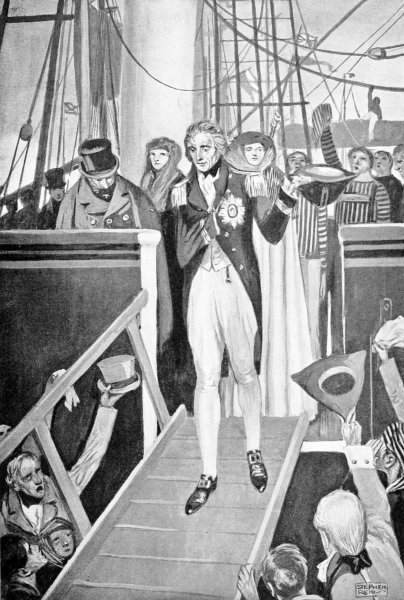
After Nelson’s remains had been embalmed at Gibraltar
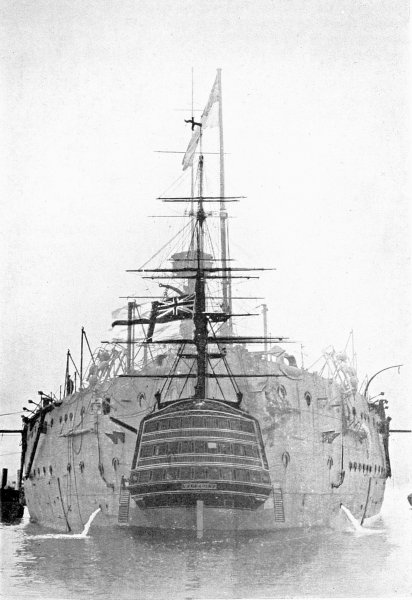
they were conveyed in the Victory to Portsmouth,
which was reached on the 2nd December 1805.
In the early days of the New Year there was a lying-in-state
in the beautiful Painted Hall of Greenwich
Hospital, but comparatively few of the many thousands
of people who wished to pay a last tribute of respect
to the Admiral’s memory were able to do so. The
coffin, made out of the mainmast of the famous l’Orient
which blew up at the Nile, enclosed in an outer case,
was then removed to the Admiralty, where it remained
until the 9th January 1806, the day of the public
funeral. The Prince of Wales, Dukes of the realm,
prelates, statesmen, admirals, aristocrats and plebeians
crowded into St Paul’s Cathedral, a fitting shrine for
the dust of the greatest sailor of the country—
Whose flag has braved a thousand years
The battle and the breeze.
An Earldom was conferred upon the Rev. William
Nelson, a large sum of money was voted by Parliament
for the purchase of an estate to be named after Trafalgar,
and certain monies were given to the dead Admiral’s
two sisters. By such means the country sought to
discharge its heavy debt to the glorious memory of
Nelson. Nothing was done for Lady Hamilton, and
although, at the time of Nelson’s death, her income
amounted to about £2000 a year she died in very reduced
circumstances at Calais in the year of Waterloo. Her
daughter, and in all probability Nelson’s, was married
on the 24th February 1822 at Burnham, Norfolk, to
the Rev. Phillip Ward, M.A. She is described as both
witty and fascinating, and her portrait by Sir William
Charles Ross makes one believe that she was so.
More than a century has passed since the great
battle was fought “in Trafalgar’s Bay,” but the memory
of the little, one-eyed, one-armed man is still treasured
by those who believe, as he believed, that the strength
of Great Britain rests upon her command of the sea.
For he is England’s admiral,
Till setting of her sun.