“A right Scythian, full of readie wisdom, cruell, bloudye,
mercilesse.”—Horsey.
MOST conspicuous of all the monuments of the past Moscow contains, is
the great weird building familiarly known as the church of Vasili
Blajenni; as monstrous and impressive is the era that produced it. The
half century during which Ivan the Terrible reigned over Muscovy is a
unique period in the history of Russia. And not that of Russia only, for
in no country at any time have so many and diverse outrages been
perpetrated at one man’s command. Disasters resulting from human
ambition and folly sully the history of every land, but all histories
are spotless in comparison with that of Moscow under its first Tsar—a
creature of unparalleled ferocity and inconceivable wickedness.
Ivan was the son of the crafty Vasili Ivanovich in his dotage; of Helena
Glinski, a fiery-natured Lithuanian woman, passionate as a Spaniard,
reckless as a Tartar. But if his parentage was unpromising his
upbringing was worse. He and his mother had many enemies, the members of
princely houses in vassalage in Moscow but with aspirations to the
throne. These men, mostly relations of the Tsar, were insistent upon the
rules of precedence, both for the gratification of their own vanity, and
as of possible importance in the event of a Tsar dying without direct
heir. For this reason all the Tsars were merciless towards their
relatives on their father’s side, and looked for help from the relations
of their mother and wife, who had most to gain from the succession being
maintained in a direct line.
Helena, as regent, appears to have governed well. She did not marry
again, thus the rights of Ivan and his brother Yuri were not endangered
by her. Her lover, Kniaz Telepniev, for a time kept at bay the rival
factions of the more powerful nobles, and possibly was instrumental in
thwarting the plots of the Glinski. At Helena’s command two of her
relatives were executed for conspiring against the infant Tsar. She
enclosed the Kitai Gorod with a wall of stone; improved the defences of
Moscow in other ways, gave the people a new coinage, founded
monasteries, built churches, and continued the policy of the rulers of
Moscow. Five years after her husband’s death she died suddenly, of
poison it is said, and the rumour may be credited.
In 1538, Ivan, then in his eighth year, and his brother Yuri, his junior
by eighteen months, were left to the mercies of the most powerful
factions about the court. They were neglected; Ivan himself said of this
period, “we two were treated as strangers: even as the children of
beggars are served. We were ill clothed, cold, and often went hungry.”
Jealous of each other the courtiers would not allow the princes to
attach themselves to anyone. If Ivan felt drawn to anyone, or any person
took notice of him, all the others combined to separate the two.
The Shooiskis were then the most powerful family, and Shooiski treated
Ivan with scant consideration. His tutors encouraged him to ride at full
speed through the streets and try to knock down the old and feeble;
they allowed him to have animals tortured for his diversion, and laughed
with him at their plight when flung from the roof of the palace. Ivan
learned to read, and spelled through all the books he could obtain. From
these old chronicles,—from those of the Kings of Israel, to the doings
of his own ancestors—he seems to have obtained the idea of the powers
of sovereignty. A close observer he noticed that although ordinarily he
was treated as of little account, when any act of state had to be done
he was always summoned to give the command. Young as he was, Ivan knew
his importance. One day, when he was thirteen years old, he went out
sporting with Gluiski, and Gluiski incited him to repress the arrogance
of Shooiski. Ivan did it by having Shooiski pulled out into the street
and worried to death there and then by Gluiski’s hounds.
From that time Ivan treated all with cruelty. In his eighteenth year he
arrogated to himself the title of Tsar—the name by which all great
rulers were designated in the old Slavonic books he had read. In the
same year, 1547, he married Anastasia Romanof, and in that year the
inhabitants of Moscow, tired of his cruelties, repeatedly fired the
town. In April the merchants’ stores were fired, probably by robbers
intent upon gain; the fire spread, destroying the stores of the Tsar,
the monastery of the Epiphany, and most of the houses in the Kitai
Gorod. On the 20th of the same month the streets of the artisans along
the Yauza suffered, and on the 21st June, during a high wind, a fire
started on the far side of the Neglinnaia, in the Arbat, and this spread
to the Kremlin and destroyed there the whole of the wooden buildings.
The inhabitants could save nothing, and the night was made more hideous
by frequent explosions as the fire reached one powder magazine and
another. The palaces, the tribunals, the treasuries, armouries,
warehouses, all were destroyed. All books, deeds, pictures and ikons
were lost, with few exceptions. The metropolitan, the aged Macarius, was
praying in the cathedral and refused to leave; he was forcibly removed,
placed in a basket and lowered from the Kremlin wall near the Tainitski
gate; the rope broke, he fell to the ground, and was taken more dead
than alive to the Novo Spasski Monastery. There was not time to remove
the Holy ikons. The fire after destroying the roof of the cathedral
burnt out, and the celebrated ikon of the Virgin of Vladimir was saved.
The ruins smouldered for a week. Seventeen hundred perished in the
flames. The Tsar withdrew to the Sparrow Hills so as not to see the
distress of the people. The survivors, their beards burnt, their faces
blackened, fought among the embers for the vestiges of what had been
theirs. Church and court alike forsook the spot.
An earnest priest, Sylvester, forced himself upon the terrified Tsar,
upbraided him for his excesses, and exhorted him to lead a better life.
Ivan, always an arrant coward, now completely unnerved, at once came
under the influence of the priest. He took as his counsellor one
Adashef, a man of good repute and some wisdom. For thirteen years he and
Sylvester administered the law and dictated the policy of the country.
In Anastasia they had an able assistant and firm friend. Their first act
was directed towards limiting the power of the Tsar; at their behest he
called together an assembly of the people to advise him. They compiled a
code of laws, the Sudebnik, and the Stoglaf, this last the decrees of
the council (Zemstvo) held at Moscow in 1551 and shortly afterwards
Sylvester issued his “Domostroi”—household law, teaching how to live as
Godfearing men and prove good husbandmen. The Tsar, earnest in his new
rôle, paid great attention to his spiritual advisers. When twenty-one he
exhorted them to “Thunder in mine ears the voice of God that my soul may
live.”
In 1552 he was persuaded to lead an expedition against the Tartars of
Kazan. The army was strong and well equipped. With wonderful foresight,
a neighbouring town had been well stocked with provisions and was used
as a base for the besiegers. After a stubborn resistance Ivan’s army of
150,000 took the town, and slaughtered the defenders. On this occasion
Ivan is said to have displayed considerable courage, and when he saw the
bodies of the slain Tartars, to have regretted their death, saying, “for
though of another faith they are human beings even as ourselves.”
Too soon he returned to Moscow, and the newly-conquered province
rebelled. Ivan then was very ill, “a fever so great all thought him at
the point of death.” Ivan thought his last hour was at hand and summoned
the nobles to take the oath of fealty to his son Dmitri, whom he
nominated his successor. Some refused, others hesitated: Zakharin-Yurief
alone, was earnest and ready in his allegiance. He was a near kinsman of
the Tsarina and so, more than any, was interested in the welfare of
Dmitri. Others intrigued for the succession. The Tsar lying helpless on
his couch heard the boyards and counsellors discussing their plans in
the adjoining apartment. Even Sylvester and his trusted counsellor
Alexis Adashef, favoured the succession of Vladimir, Ivan’s cousin.
Ivan recovered, but for a time he acted as though he had forgotten what
he overheard on his sick bed. He never forgave. His wife, Anastasia,
also withdrew her friendship from those who had opposed her son’s
succession.
Then Ivan made a visit to the monastery at Bielo Ozersk—the White
Lake—and there he saw the aged Vassian, the old counsellor of his
father, who gave him advice contrary to that so earnestly and frequently
dinned into his ears by Sylvester and Adashef. “If you wish to become
absolute monarch,” said Vassian, “seek no counsellor wiser than
yourself. Never take advice from any: instead, give it. Command, never
obey. Then will you become a sovereign in all truth.”
This advice pleased Ivan. “My father himself,” he answered, “could not
have given wiser counsel.”
Ivan could wait for his triumph over his associates. He went now to the
Volga again, completed the conquest of Kazan, and his troops pressed on
as far as Astrakhan, which they took after slight resistance.
In Moscow Ivan kept the grand-dukes, princes, and boyards his nearest
relatives; his voievodes, or military leaders, were men of good birth,
but with no claim on the succession. Under the administration of
Adashef, the outlying parts of the Tsar’s dominions were so effectually
governed that when the English ships first appeared on the White Sea,
Chancellor was not allowed to trade, or penetrate into the interior of
the country, until the permission of the Tsar had been received from
Moscow.
In 1560 Anastasia died, and Ivan fretted under the constant surveillance
of Sylvester. He was always at hand, entreating the Tsar to shew mercy,
and to live straightly. Both Sylvester and Adashef retired within a
short time of Anastasia’s death. For bad generalship in Lithuania,
Adashef was imprisoned in the fortress of Dorpat, where he died shortly
afterwards. Sylvester was ready enough to send the Tsar and his Russian
armies to war against the Tartars and infidels; he opposed wars with
Livonia, Lithuania and Poland, where Ivan was particularly desirous of
extending his dominion.
On the withdrawal of these counsellors again commenced the murders and
massacres in which Ivan delighted. Historians divide these into seven
cycles; it is a purely arbitrary division—with the exception of the
thirteen years 1547-1560, during which he was wedded to Anastasia and
engaged in foreign wars, the whole of his long reign was given to
terrorising his subjects.
Obolenski was the first noble killed by Ivan himself; Repnin was
murdered whilst at his devotions in church; another was slain simply
because he remonstrated with the Tsar for such a display of cruelty.
Ivan always used the hour of victory to exterminate foes, and he now
relentlessly hunted down all his past advisers and their friends.
He was determined on absolute supremacy.
“To shew his soveraintie over the lives of his subjects, Ivan in
his walks, if he disliked the face or person of any man he met by
the way, or that looked at him, would command his head to be struck
off. There and then the thing was done, and the head cast before
him.”
Dismayed, some of his nobles fled to the west; among them was Kniaz
Kourbski, who, not content simply to take service under Sigismund,
acquainted the Tsar by letter with the fact. Kniaz Vasili Chibanov was
the bearer. Ivan received him on the Krasnœ Kriltso, and there, with
his sharp staff, pinned to the floor the foot of Chibanov, who never
stirred a muscle during the whole time the long letter was read aloud.
Then Chibanov was put to the torture, to obtain particulars of the
flight of Kourbski, and the names of his partisans in Moscow; but
Chibanov confessed not a word, and in the midst of the most horrible
torment praised his master, and counted it a joy to suffer thus for him.
Generally Ivan studied to keep on good terms with the common
people—whom he feared; by them he was worshipped. Macarius, the
metropolitan, complained that “He who blasphemes his maker, meets with
forgiveness amongst men, he who reviles the Tsar is sure to lose his
head.” Ivan chose as his companions the worst people whom he could find.
At one time he withdrew from Moscow, taking umbrage at the prelates,
still too powerful to be touched. The people clamoured for his return.
“The Tsar has forsaken us: we are lost, who will now defend us
against the enemy? What are sheep without the shepherd? Let him
punish all who deserve it: has he not the power over life and
death? The state cannot endure without its head, and we will not
acknowledge any other than he whom God has given us.”
This was gratifying to Ivan. He consented to govern again if the Church
would not exercise its prerogative of mercy, and would leave him to do
his will. His return was followed by murders and outrages worse than
before. Randolph, who in 1568, was in Muscovy on an embassy from
England, with which country Ivan wished to be on the best of terms, was
not allowed to enter Moscow, because, Count Yuri Tolstoi thinks, Ivan
wished to keep from him the knowledge of these massacres. Randolph wrote
to Cecil:—
“Of the Tsar’s condition I have learned that of late he hath
beheaded no small number of his nobility, causing their heads to be
laid on the streets, to see who durst behold them or lament their
deaths. The Chancellor he caused to be executed openly, leaving
neither wife, children, nor brother alive. Divers others have been
cut to pieces by his command.”
During the third cycle of Ivan’s outrages, Philip, the metropolitan, in
1568, dared to upbraid the Tsar. Ivan with a crowd of his irreligious
followers, disguised in the cloaks they wore when sallying forth to
rapine and outrage, repaired to the Uspenski Sobor for a blessing before
starting on their fearful work. The metropolitan refused to recognise
Ivan so clad when called upon for his benediction.
“What is the thing thou hast done then, O Tsar, that thou shouldst
put off from thee the form of thine honour? Fear the judgment of
God, to whom we are here making a pure sacrifice. Behind the altar
the innocent blood of Christian men is made to flow by thee! Among
pagans, in the country of the infidel, are laws, and justice, and
compassion shown to men, but in Russia now is nothing of this kind.
The lives and goods of citizens are without defence. Everywhere
pillage, on all sides murder, and each and all these crimes are
committed in the name of the Tsar. There is a judge on high—how
shall you present yourself before that Tribunal? Dare you appear
there covered with the blood of innocents, deaf to their cries of
pain? Even the very stones beneath your feet cry aloud to heaven
for vengeance on such black deeds as are done here. O Prince, I
speak to thee as the shepherd, fearing none but the Lord our God.”
Ivan enraged, stuck his staff into the ground, and swore to be as bad as
Philip described him. Vasili Pronski was the first to suffer in the
murders that followed closely upon this scene, but Ivan did not forget
Philip. One of the soldiers was ordered to present himself before the
metropolitan and wear the Tartar skull cap; the metropolitan noticed
this irreverence, and turned to the leader for a command that the man
should uncover. In the meantime the man did so, and Philip was accused
of lying. The boyard, Alexis Basmanov, with a troop of armed men and
having the Tsar’s fiat in his hand, arrested Philip whilst officiating
at High Mass in the Uspenski Sobor, and read out that by the decree of
the clergy, Philip was deposed from his high office. The people were
surprised and stupefied. The soldiers seized Philip, tore his vestments
from him, and chased him from the church with besoms. He was first taken
to the monastery of the Epiphany, next to an obscure prison where he was
loaded with irons. Whilst there, the head of his well-beloved nephew,
Ivan Borisovich, was thrown to him. A crowd gathered near the prisoner’s
cell, and the people spake with each other of his goodness. It
frightened Ivan, and he had Philip removed to the monastery at Tver,
where he was subsequently strangled by Skutarov on the Tsar’s journey
through the town on the way to Novgorod.
As a condition for his consent to reside in Moscow, Ivan stipulated for
a bodyguard of his own choosing. These men, the öpritchniki, that is,
“picked” fellows, became the terror of Moscow. Selected for their
readiness to obey, their bodily strength and lack of morals, they
recognised no master but Ivan, and by him were privileged to rob and
slay the people as they wished, providing they were at hand to kill
anyone in particular whom he might want out of the way. They carried
bludgeons with heads carved to represent those of dogs, at the saddle
bow, and a small besom at the other end, the “speaking symbols” of their
intention to hunt down rebels and sweep Russia clean.
By their callousness and brutality they, on many occasions,
distinguished themselves in a manner that gladdened Ivan, but at no time
did their excesses excel their performance on the march to Novgorod.
Ivan, very suspicious of treason, doubted the fidelity of Novgorod, a
town with known predilections for freedom, and inclined to favour the
more enlightened rule of the western kings than the Russian autocrat. A
hired traitor placed a forged letter behind an image in Novgorod Church,
and disclosed the plot to Ivan, whose agents found the compromising
letter, which contained overtures to the Lithuanians; Ivan started to
subdue the town. The öpritchniks preceded him. Klin, a thriving town
near Moscow, was sacked; the inhabitants of Tver were spoiled, and many
murdered. On their way the advance guard killed all whom they met, lest
any should know where the Tsar was. Villages and towns were annihilated.
Monks had to find twenty roubles each as ransom; those who could not
were thrashed from morning until night, then, when Ivan arrived on the
scene, were flogged to death.
On his arrival at Novgorod he was entertained by the people; during the
banquet served to him and his followers he gave a loud cry—the signal
for his fellows to begin the slaughter. The Tsar and his son went to an
enclosure specially reserved for the torture of their victims, and with
their lances prodded those who were not quickly enough dragged to the
place of torment. Chroniclers say that from 500 to 1000 were slain in
cold blood before him each day of his stay. Some were burned, some
racked to death, others drowned in the Volkhof, run in on sledges or
thrown in from the bridge—soldiers in boats spearing those who swam.
Infants were empaled before the eyes of their mothers, husbands
butchered along with their wives. Novgorod, at that time larger and of
greater commercial importance than Moscow, was so injured that she has
never since acquired the rank of even a third-rate town. On leaving it,
Ivan called together a few starving survivors, and commanded them to
obey the laws and fear him. He went on to Pskov, where the town was
saved by the boldness of a half-witted hermit, who offered Ivan raw meat
on a fast-day, and threatened him that he would be struck by lightning
if any citizen of Pskov was injured whilst Ivan remained in the town. An
accident to his horse seemed to Ivan an earnest of the “Holy-man’s”
power, and he left the town precipitately.
According to Horsey, Ivan at this time had a Tartar army with him, and
tried to reduce other towns in Livonia. At Reval, men and women carried
water by night to repair the breaches in the walls made by his cannon
during the day, and Ivan, losing six thousand men, in the end had to
retreat in shame. Losing more men before Narva, he put in execution
there “the most bloody and cruellest massacre that ever was heard of in
any age,” giving the spoil of the town to his Tartars. Following the
custom of his country, the prisoners of war were all brought as slaves
to Moscow, many dying on the way, some, including Scotch and English
soldiers of fortune in the pay of the Swedes, thrown into prison in
Moscow and there subsequently tortured and executed.

 ALARM TOWER
These excursions of Ivan and his men into distant parts of his dominions
afforded the Muscovites some respite from his attentions. The English
then there were much impressed by the cruelties of Ivan, though
themselves escaping. Jerom Horsey thus describes Ivan’s invasion of
Novgorod:—
“O the lamentable outcries and cruel slaughters! The drownings and
burnings, the ravishing of women and maids, stripping them naked
without mercy or regard of the frozen weather, tying and binding
them by three and four together at their horses’ tails: dragging
them, some alive, some dead, all bloodying the ways and streets,
lying full of carcases of the aged men, women and infants! Thus
were infinite numbers of the fairest people in the world dragged
into Muscovy.”
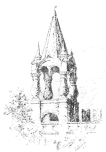
With the spoil brought from Novgorod was the “Great Bell of Novgorod”
which had so often called its burghers to assemble for the defence of
the town. Ivan was determined that the tocsin should never again be
heard over the fallen city. The bell he caused to be hanged in the
turret on the Kremlin wall near the Spasski Gate, where for long it was
used as the alarm bell of Moscow, but subsequently served as metal when
the great bell in Ivan Veliki was recast.
Shortly after his return from Novgorod he entered upon his fourth cycle
of massacres. The prisoners were executed in batches before the Spasski
Gate. Horsey was instrumental in getting the lives of many spared, and
they were settled in a suburb of Moscow where they lived at peace with
the citizens but were still subject to attacks from the öpritchniks.
Ivan found other traitors among the boyards and princes, for his
favourites of to-day were the victims of the morrow.
“On July 25, in the middle of the market-place, eighteen scaffolds
were erected, a number of instruments of torture were fixed in
position, a large stack of wood was lighted, and over it an
enormous cauldron of water was placed. Seeing these terrible
preparations, the people hurried away and hid themselves wherever
they could, abandoning their opened shops, their goods and their
money. Soon the place was void but for the band of öpritchniks
gathered round the gibbets, and the blazing fire. Then was heard
the sound of drums: the Tsar appeared on horseback, accompanied by
his dutiful son, the boyards, some princes, and quite a legion of
hangmen. Behind these came some hundreds of the condemned, many
like spectres; others torn, bleeding, and so feeble they scarce
could walk. Ivan halted near the scaffolds and looked around, then
at once commanded the öpritchniks to find where the people were and
drag them into the light of day. In his impatience he even himself
ran about here and there, calling the Muscovites to come forward
and see the spectacle he had prepared for them, promising all who
came safety and pardon. The inhabitants, fearing to disobey, crept
out of their hiding-places, and, trembling with fright, stood
round the scaffold. Some having climbed on to the walls, and even
showing themselves on the roofs, Ivan shouted: ‘People, ye are
about to witness executions and a massacre, but these are traitors
whom I thus punish. Answer me: Is this just?’ And on all sides the
people shouted approval. ‘Long live our glorious King! Down with
traitors! Goiesi, Goida!’
“Ivan separated 180 of the prisoners from the crowd and pardoned
them. Then the first Clerk of the Council unrolled a scroll and
called upon the condemned to answer. The first to be brought before
him was Viskovati, and to him he read out: ‘Ivan Mikhailovich,
formerly a Counsellor of State, thou hast been found faithless to
his Imperial Highness. Thou hast written to the King Sigismund
offering him Novgorod: there thy first crime!’ He paused to strike
Viskovati on the head, then continued reading: ‘And this thy second
crime, not less heinous than thy first, O ungrateful and perfidious
one! Thou hast written to the Sultan of Turkey, that he may take
Astrakhan and Kazan,’ whereupon he struck the condemned wretch
twice, and continued: ‘Also thou hast called upon the Khan of the
Krim Tartars to enter and devastate Russia: this thy third crime.’
Viskovati called God to witness that he was innocent, that he had
always served faithfully his Tsar and his country: ‘My earthly
judges will not recognise the truth; but the Heavenly Judge knows
my innocence! Thou also, O Prince, thou wilt recognise it before
that tribunal on high!’ Here the executioners interrupted, gagging
him. He was then suspended, head downwards, his clothes torn off”,
and, Maluta Skutarov, the first to dismount from his horse and lead
the attack, cut off an ear, then, little by little, his body was
hacked to pieces.
“The next victim was the treasurer, Funikov-Kartsef, a friend of
Viskovati, accused with him of the same treason, and as unjustly.
He in his turn said to Ivan, ‘I pray God will give thee in eternity
a fitting reward for thy actions here!’ He was drenched with
boiling and cold water alternately, until he expired after enduring
the most horrible torments. Then others were hanged, strangled,
tortured, cut to pieces, killed slowly, quickly, by whatever means
fancy suggested. Ivan himself took a part, stabbing and slaying
without dismounting from his horse. In four hours two hundred had
been put to death, and then, the carnage over, the hangmen, their
clothes covered with blood, and their gory, steaming knives in
their hands, surrounded the Tsar and shouted huzzah. ‘Goida!
Goida! Long live the Tsar! Ivan for ever! Goida! Goida!’ And so
shouting they went round the market-place that Ivan might examine
the mutilated remains, the piled-up corpses, the actual evidences
of the slaughter. Enough of bloodshed for the one day? Not a bit of
it. Ivan, satiated for the moment with the slaughter, would gloat
over the grief of the survivors. Wishing to see the unhappy wives
of Funikov-Kartsef and of Viskovati, he forced a way into their
apartments and made merry over their grief! The wife of
Funikov-Kartsef he put to the torture, that he might have from her
whatever treasures she possessed. Equally he wished to torture her
fifteen-year-old daughter, who was groaning and lamenting at their
ill fortune, but contented himself with handing her over to the by
no means tender mercies of the Tsarevich Ivan. Taken afterwards to
a convent, these unhappy beings shortly died of grief—it is
said.”—Karamzin.
Sometimes Ivan’s vagaries were less gruesome, possessing even a comic
aspect:—
One day he requisitioned of his secretary 200,000 men at arms by
such a day and signed the order “Johnny of Moscow.” He carried a
staff with a very sharp spike in the end, which, in discourse he
would strike through his boyard’s feet, and if they could bear it
without flinching, he would favour them. He once sent to Vologda
for a pot of fleas and because the town could not send the measure
full, he fined the inhabitants 7000 roubles.
“He once went in disguise into a village and sought shelter. The only
man who would offer it was the one worst off, and at the time sore
beset. Ivan promised to return, and did so with a great company and many
presents, acting also as godson to the man’s child, whose birth he had
witnessed. Then his followers burned all the other dwellings in the
village to teach the owners charity and try how good it was to lie out
of doors in winter.”
“When Ivan went on his tours he was met by the householders and
presented with the best they had. A poor shoemaker knowing not what to
give, except a pair of sandals, was reminded that a large turnip in his
garden was a rarity, and so presented that to Ivan, who took the present
so kindly that he commanded a hundred of his followers to buy sandals of
the man at a crown a pair. A boyard seeing him so well paid, made
account by the rule of proportion to get a much greater reward by
presenting Ivan with a fine horse, but Ivan, suspecting his intention,
rewarded him with the turnip the bootmaker had given.”
On a certain festival he played mad pranks, which caused some Dutch
and English women to laugh, and he, noticing this, sent all to the
palace, where he had them stripped stark naked before him in a
great room and then he commanded four or five bushels of pease to
be thrown on the floor and made them pick all up one by one, and,
when they had done, gave them wine and bade them heed how they
laughed before an emperor again. He sent for a nobleman of Kasan,
who was called Plesheare, which is “Bald,” and the Vayvod
mistaking the word, thought he sent for a hundred bald pates and
therefore got together as many as he could, about eighty or ninety,
and sent them up speedily with an excuse that he could find no more
in his province and asking pardon. The emperor seeing so many,
crossed himself, and finding out how the mistake occurred, made the
baldpates drunk for three days then sent them home
again.—Collins.
“He it was who nailed a French ambassador’s hat to his head. Sir Jeremy
Bowes, the English ambassador, soon after came before Ivan, put on his
hat, and cocked it before him, at which Ivan sternly demanded how he
durst do so, having heard how he chastised the French ambassador. Sir
Jeremy answered, ‘I am the ambassador of the invincible Queen of
England, who does not veil her bonnet, nor bare her head to any prince
living. If any of her ministers shall receive any affront abroad, she is
able to avenge her own quarrel.’
“ ‘Look you at that!’ cried Ivan to his boyards, ‘Which of you would do
so much for me, your master?’ ”
He was probably not acting nor scoffing when he acted the part of
abbot, and made his companions friars of the house at Alexandrovski—to
which he retreated for upwards of a year at a time when he mistrusted
the people of Moscow and feared for his life and his throne. Ivan
regularly summoned to mass this strange company, all clad like brothers
of a monastery, and himself officiated. His prostrations were no sham,
for his forehead bore the marks of its severe knockings on the floor,
but in the middle of a mass he would pause to give some order for the
murder of his victims, or the pillage of the rich. The mornings were
spent in religious exercise—the rest of the day and much of the night
in the foulest orgies and the perpetration of fearful outrages in the
dungeons and torture chambers of his residence.
At all times the boyards durst do nothing without him, and waited upon
him duteously wherever he might go. His voievodes kept the
newly-conquered provinces in subjection; others carried the war into the
country of his enemies and brought fresh lands under his dominion.
Yermak, an outlaw, conquered Siberia and made of it a gift to the Tsar.
Anthony Jenkinson, on behalf of the English Russia Company, conveyed
their goods from Archangel to Astrakhan; there fitted out a fleet for
trading on the shores of the Caspian, and made a successful war on the
Shah of Persia.
In 1571 Ivan’s voievodes failed him. They were unable, or unwilling, to
oppose the Tartar horde and it reached Moscow. There the enemy pillaged
and burnt the town, destroying the stores, houses and buildings outside
the Kremlin. The town suffered worse than in the great conflagrations of
1547, but the Tartars, satisfied with the spoil, withdrew. They
subsequently sent envoys to Ivan and these were at once imprisoned. Kept
in dark rooms, ill-treated, almost starved,—they endured; made light of
the hardships; scorned their guardians. At last an audience was granted
them.
“The Ambassador enters Ivan’s presence; his followers kept back in
a space with grates of iron between the Emperor and them; at which
the ambassador chafes with a hellish, hollow voice, looking fierce
and grimly. Four captains of the guard bring him near the Emperor’s
seat. Himself, a most ugly creature, without reverence, thunders
out, says,—His master and lord, Devlet Geray, great Emperor of all
the Kingdoms and Kams the sun did spread his beams over, sent to
him Ivan Vasilievich, his vassal, and Grand Duke over Russia by his
permission, to know how he did like the scourge of his displeasure
by sword, fire and famine? Had sent him for remedy (pulling out a
foul, rusty knife) to cut his throat withal.” They hasted him forth
from the room, and would have taken off his gown and cap, but he
and his company strove with them so stoutly. The Emperor fell into
such an agony; sent for his ghostly father; tore his own hair and
beard for madness! Then sent away the ambassador with this message,
“Tell the miscreant and unbeliever, thy master, it is not he, it is
for my sins, and the sins of my people against my God and Christ.
He it is that hath given him, a limb of Satan, the power and
opportunity to be the instrument of my rebuke, by whose pleasure
and grace I doubt not of revenge, and to make him my vassal ere
long be.” The Tartar answered, “He would not do him so much service
as to do any such message for him.”—Horsey.
Ivan had to send his own emissaries to the Tartars and the Khan kept
them imprisoned seven years, and in other ways showed his contempt for
the ruler of Moscow. But for Ivan’s newly-found friends the English, his
enemies in east and west would have conquered him. The English, much to
the disgust of Swedes and Poles, supplied Ivan with artillery and small
arms; improved engines of war, much gunpowder, and showed his men how to
use them—Russians are not slow to learn.
In 1548 Ivan sent John Schlitte to Germany to enlist foreign artisans
for his service. Attracted by the high remuneration offered, a hundred
were willing to accompany Schlitte back to Moscow, but the Governments,
anticipating danger to their territory if the Russ became enlightened,
refused permission. Only a few determined stragglers reached Russian
territory. The first printers in Russia were encouraged for a time,
then, for their own safety, had hurriedly to seek exile.
For Moscow Ivan did little: twice during his reign the town was
destroyed by fire. After the first he built himself a new palace of wood
within the Kremlin; later he had another constructed outside, between
the Nikitskaia and the Arbat. For a long time he lived in neither,
preferring a wretched dwelling in a far off village, whence he believed
he could, at need, escape unobserved to England if any of his subjects
took up arms against him.
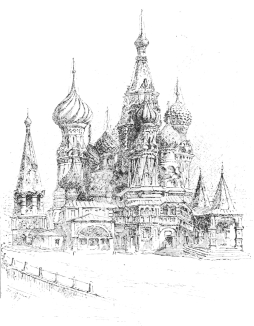
The monument of his reign is the church in the Grand Place. Dedicated to
the “Intercession of the Holy Virgin,” it was built at Ivan’s command,
and at the expense of Kazan, to commemorate the conquest of that town,
which fell on the first of October 1552. Commenced in 1553, it was
completed six years later and consecrated by the Metropolitan Macarius
on the day of its patron saint.
The name of its architect is unknown. Tradition asserts that Ivan, to
make sure that this church should be “the crowning effort of his
wonderful genius,” put out his eyes. There is no evidence in support of
this story, and it is unlikely that Ivan would have done a thing so
usual.
Many writers have asserted that this fantastic edifice is a mixture of
the Gothic, Moorish, Indian, Byzantine and other styles of architecture.
As a matter of fact it is but an exaggeration of the Russian style, an
agglomeration of domes, towers and spires, one or other of which may be
found on many buildings in “wooden Russia.” In the chapter on
“Ecclesiastical Moscow” the reader will find further information on
this point. It appears to embody the salient features of many styles,
eastern and western, and the whole, if neither beautiful nor magnificent
is strikingly imposing and original. Unlike other Russian churches the
belfry instead of being at the west end, is at the east. Nine of its
chapels are each surmounted by a lofty roof differing from the others.
The central one, that dedicated to the Virgin, has a high tower and
wonderful spire, the paintings on its internal converging sides adding
to its extravagant proportions. The other eight chapels on this floor
surround the spire and are covered with the usual arched vault
supporting longer or shorter cylindrical towers, surmounted with cupolas
of different forms and sizes. One, has apparently large facets; another
bristles like the back of a hedgehog; a third bears closest resemblance
to a pine-apple, a fourth to a melon; a fifth is in folds, another has
spiral gonflements—none are plain. A covered gallery extends from
north to south, with roofed and spired stairways leading up to the
church level, and a narrow passage and outside wall enclose the
remaining chapels. The quaint belfry with its Russo-Gothic spire and
bright roofing, being unlike aught else, is in keeping with the general
design. Outside, the central dome is brightly gilt, the others are
painted in gaudy colours, and the whole of the exterior is decorated
with crude patterns in strong contrast. Its design is bizarre; its
colour is motley; the two both harmonise and contrast—the whole
fascinates. It is at once both a nightmare and a revelation. Like an
impressionist’s picture it rivets attention by apparent strength and
seeming originality. It cannot be forgotten, yet it repels by its
egregious fatuity. It is the over-inflated frog at the instant of
explosion. It is not even known by its correct name: covering the
remains of a
VASILI BLAJENNI
mendicant monk “idiotic for Christ’s sake,” its familiar appellation,
“Blessed Willie,” is derived from him. He it was who so often interposed
his person between the Tsar and the objects of his wrath. He upbraided
Ivan; threatened him with all manner of disasters, but neither Ivan nor
his opritchniks ever hurt the naked body of the old beggar. He used to
address the Tsar familiarly, “Ivashka” (Bad Jacky); when the Tsar
offered him money he let it fall to the floor, blew on his fingers, said
the coins burned, and asked Ivan why he had his gold from hell. Then he
would tell Ivan that on his forehead were already growing the horns of a
goat—that he was becoming a devil really—then hold him up to the
ridicule of the court and the people—and Ivan, enraged, dared not
strike him down himself or order anyone to do so. Now, the wonderful
monument of Ivan’s time is called by the name of the man he feared; it
is he the orthodox remember; it is his church; they honour and revere
him. Later another popular prophet, “Ivan the Idiot” was buried there by
order of the Tsar Theodore: his chapel adjoins that of “Blessed Willie,”
below the level of the church itself at the east end.
The church has not much history; the Poles plundered it, Napoleon
ordered his generals to “Destroy that Mosque”—instead they quartered
themselves there. It has been many times repaired; was reconsecrated in
1812 and remains, what it is, a striking memorial of a fearful era.
As a place of worship it is now but little used. Its architecture is not
of the kind to inspire lofty thoughts, or draw any nearer to God. Its
associations are all unpleasant, reminiscent of the excesses of Ivan,
the weaknesses of his immediate successors. Worse, it lacks sincerity:
intuitively one knows that such a building cannot shelter truth or
engender hope. To uncover at its portal seems a mockery; to connect it
with aught that is pure and Holy, a rank blasphemy.
Glittering in bright sunlight, gay with colour, resplendent with
reflections from a glorious sky, it seems only like a kaleidoscopic
flash on a variegated canvas. To know Vasili Blajenni, the visitor
should walk round it in the dusk of the evening, in the gloom of a
winter’s day, or, in summer, in that half-light of midnight that there
does duty for darkness. Standing in the shadow of the Kremlin wall, on
soil saturated fathoms deep with the blood of innocent martyrs, examine
the building closely and call to memory the people by whom and for whom
it was produced. Then and then only may the conception of this
fungus-like excrescence seem possible, and Vasili Blajenni stand
revealed as an expression of inordinate vanity, uncontrolled passion,
insatiate lust. Like attributes without a soul—weird, monstrous,
horrible. No fitting memorial of any man, yet not out of character with
what is known of him they called Ivan the Terrible.
The clergy alone possessed any power besides the Tsar; but the Church
was unable to coerce him or to save the people. Obedience to those in
power it had inculcated so long and thoroughly that the Russians never
attempted reprisals or lifted a hand against the Tsar. Even a voievod,
speaking to Ivan, had his ears sliced off there and then by the Tsar
himself, and he not only bore it patiently, but thanked the Tsar for his
attention. The people, debased, servile, frightened, could not help the
Church—and soon the clergy could not help themselves. Ivan, who was
fond of the semblance of justice, after his expedition north appointed a
baptized Tartar, one Simeon Bekbulatov, to be Tsar in his place, then
himself abdicated. But he took care to make Simeon do as he wished, and
he kept the power. The people obeyed Simeon, to a certain extent, but
the Tsar’s chief object in this was to legalise his seizure of
ecclesiastical revenues. Simeon made certain agreements, but not having
made those in force, which had been recognised by Ivan, he abrogated
them. Then Ivan dismissed Simeon amidst the thanksgiving and rejoicing
of his people, and with tears in his own eyes, the arch-hypocrite again
took his seat on the throne. But the old agreements were no longer in
force; then Ivan declared null and void certain acts of Simeon, and so
between the two, secured all the Church properties he wanted, and
deprived the clergy of many privileges. Ivan was a great chess-player;
his strategy as Tsar shows how his knowledge of the game benefited him.
Ivan put to death his cousin Vladimir for no crime; his mother
Euphrosyne, when living in seclusion in a convent, he dragged forth and
drowned in the Cheksna. His own sister-in-law, the widow of his early
playmate Yuri, was also killed for no other reason than in the seclusion
of the convent she had shed tears over the victims of the despot’s fury.
The boyard Rostevski, after imprisonment, was marched naked in very cold
weather until the Volga was reached. His guards said that there they
must water their horses. “Ah,” said Rostevski, “full well I know I have
to drink of that water too,” and straightway he went to his death.
Seerkon had no other crime than that he was rich. A rope was placed
round his waist and he was hauled from one side of a river to the other
and back again until half-drowned, then placed in a bath of hot oil and
torn to pieces.
Ivan kept many bears, and delighted to turn them out when savage amongst
helpless people. Another diversion was to clothe men in bear skins, then
set trained dogs to tear them to pieces. He poured spirits over the
heads of delegates, then set their beards on fire. On one occasion his
men brought a lot of women of Moscow, and stripping all naked presented
them to Ivan—he took a few and gave the remainder to the perpetrators
of this outrage. Prince Chernialef he had grilled in an enormous
frying-pan; hundreds died on the rack.
“Kniaz Ivan Kuraken, being found drunk, as was pretended, in Wenden
when besieged, being voievod thereof, was stripped naked, laid on a
cart, whipped through the market with six whips of wire, which cut
his back, belly and bowels to death. Another, as I remember, Ivan
Obrossimov, was hanged naked on a gibbet by the hair of his head;
the skin and flesh of his body from top to toe cut off and minced
with knives into small gobbets, by four palatsniks
(chamberlains). The one, wearied with his long carving, thrust his
knife in somewhat far the sooner to dispatch him, and was presently
had to another place of execution and that hand cut off; which, not
being well seared, he died the next day.
“That was the valley compared to Gehenna or Tophet, where the
faithless Egyptians did sacrifice their children to the hideous
devils.
“Kniaz Boris Telupa was drawn upon a sharp stake, soaped to enter
his body and out at his neck, upon which he languished in horrible
pain for fifteen hours and spake unto his mother, the duchess,
brought to behold that woeful sight. And she, a good matronly
woman, given to one hundred gunners who did her to death. Her body
lying naked in the Place, Ivan commanded his huntsman to bring
their hungry hounds and devour her flesh, and dragged her bones
everywhere. The Tsar saying: ‘Such as I favour I have honoured, and
such as be treytors will I have thus done unto.’ ”—Horsey.
Another boyard impaled, during the long hours he remained conscious,
never ceased calling upon God to forgive the Tsar. On one occasion,
during a time of great scarcity, Ivan caused it to be made known that at
a certain hour alms would be distributed at his palace. A great crowd of
needy people assembled, and seven hundred were promptly knocked on the
head by the opritchniks and their bodies thrown into the lake; a death
so merciful, Horsey terms it “a deed of charity.”
Ivan forced father to kill son, and son father. His two once favourites,
the Gluiskis, also suffered; the son being beheaded as he reverently
raised the head just struck from his father’s body. On that same day
another prince was impaled and four others beheaded. Many were hung up
by the feet, hacked with knives, and whilst still living, plunged into a
cauldron of scalding water. On one occasion, eight hundred women were
drowned together. The opritchniks, of whom at one time Ivan had seven
hundred, killed scores of people daily.
He himself plotted against the life of his own son and gave “Maliuta”
(Skutarov) orders to kill him. Kniaz Serebrenni saved him. This is the
subject of Count A. Tolstoi’s best known novel and of an old ballad
which recounts how the Tsar got all the boyards together to say a mass
for the dead Tsarevich and in mourning, “or all I will boil in a
cauldron.” Nikita Serebrenni, hiding the Tsarevich behind the door,
enters in ordinary raiment and is questioned by the Tsar, who when he
knows that the Tsarevich is safe, rejoices greatly and offers Serebrenni
half the kingdom as a reward. Serebrenni answers:—
“Ah! woe Tsar Ivan Vasilievich!
I wish neither for the half of thy kingdom,
Nor the gold of thy coffers.
Give me only that wicked Skutarov,
I will guide him to the noisome marsh
That men call most cursed spot.”
With the aid of his foreign physician, Bomel, Ivan substituted poison
for the knife. At his table the craven boyards would gather trembling;
take from him and drain the cup they knew to be poisoned. No wonder
Horsey called them “a base and servile people, without courage.” In his
turn “Elizius Bomelius” suffered a cruel death. When Theodorof was
accused of aspiring to the crown, Ivan dressed him in the royal
insignia, seated him on the throne and did him mock homage; then struck
him dead, saying that it was he who exalted the humble and put down the
mighty from their seats.
His people all shrank from him: the merchants hid their goods if he, or
any of his spies, were in their neighbourhood; none dared be counted
rich. He robbed any and all. Even the English merchants, whose good
esteem he prized, were forced to furnish him with what he wished, on
credit, and were never paid. They dared not offer their wares to any,
unless he had first been afforded an opportunity to purchase—at his own
price.
His palace at Alexandrovski was a wondrous building; all spires, domes,
quaint gables, and corridors—as unlike all other palaces as Vasili
Blajenni is unlike other churches. Of his enormities there, none may
write. After his death, it was struck by lightning and burned to the
ground.
He was rough, uncouth, unfeeling. He emptied scalding soup over one of
his favourites and laughed at the sufferer’s contortions. Taking offence
at a remark of one of his jesters, he ran his knife into the little
fellow’s chest; then called a doctor, telling him he had used his fool
roughly. The doctor told him the man was dead. Ivan, remarking that he
was a poor jester after all, went away to his revels.
A straightforward old boyard, Morozof, a hard fighter and an upholder of
the rights of his order, for disputing with the favoured Boris Godunov
about precedence, was exiled. After some years he was again summoned to
court, and Ivan made of him a buffoon. Count Alexis Tolstoi uses the
story in his romance “Prince Serebrenni.”
“ ‘Yes, the Boyard is old in years but young in spirit. He loves a
joke—so do I in the hours not devoted to prayers or my affairs of
state. But since I killed that foolish jester, no one knows how to
amuse me. I see that the Boyard Morozof wants the post. I have
promised to show him a favour—I name him my chief jester! Bring
the cap and bells! Put them on the Boyard.’ The muscles of the
Tsar’s face worked sharply, his voice was unchanged.
“Morozof was thunder-struck: he could not believe his ears. He
looked more terrible even than the Tsar. When Gresnoi brought the
cloak, with its tinkling bells, Morozof pushed him aside. ‘Stand
back! Do not dare, outcast, to touch Boyard Morozof! Your fathers
cleaned out my ancestor’s kennels. You leave me alone! Tsar,
withdraw your order. Let me be put to death. With my head you can
do as you will. You may not touch my honour!’
“Ivan looked round at the opritchniks. ‘You see I am right in
saying that the Boyard will have his joke. I have no right to
promote him to the office of jester, eh?’
“ ‘Tsar, I implore you to withdraw your words. Before you were born
I fought for your father with Simski against the Cheremiss; with
Odoevski and Mstislavski drove back the Krim-Tartars, and chased
the Tartars away from Moscow. I defended you when a child; fought
for your rights and the rights of your mother. I prized only mine
honour; that has always remained unstained. Will you mock the
grey hairs of a faithful servant? Behead me rather—if you will.’
“ ‘Your foolish words show that you are well fitted for a jester.
Put on the cloak! And you fellows, help him. He is used to be
waited upon.’
“The opritchniks put on the fool’s cloak, the parti-coloured cap,
and retreating, bowed low before him. ‘Now amuse us as did the late
jester!’ said their leader.
“Morozof was resolute. ‘I accept the new post, to which the Tsar
has appointed me. It was not fit for Boyard Morozof to sit at table
with a Godunov—but the court fool may keep company even with such
as the Basmanovs. Make way for the new jester, and listen, all of
you, how he will amuse Ivan Vasilievich!’ He made a gesture of
command: the opritchniks stood aside, and with his bells tinkling,
the fine old man marched up the room and seated himself on the
stool before the Tsar, but with such dignity that he seemed to be
wearing the royal purple instead of the motley of the court fool.
“ ‘How shall I amuse you, Tsar?’ and putting his elbows on the
table, he leant forward and looked directly into the eyes of his
sovereign. ‘It is not easy to find a fresh diversion for you; there
have been so many jests in Russia since you began to reign. You
rode your horse over the helpless in the streets once-upon-a-time;
you have thrown your companions to dogs, you poured burning pitch
over the heads of those who humbly petitioned you! But those were
childish freaks. You soon tired of such simple cruelties. You began
to imprison your nobles, in order to fill your rooms with their
wives and daughters, but of this also you have tired. You next
chose your most faithful servants for the torture; then you found
it wearied you to mock the people and the nobles, so you began to
scoff at the Church of God. You picked out the lowest rabble,
decked them out as monks, and yourself became the abbot! In
daylight you commit murders; at night sing psalms! Your favourite
amusement, this! None had thought of it before. You are covered
with blood, yet you chant and ring the holy bells and would like to
perform the mass. What else shall I say to amuse you, Tsar? This:
whilst you are masquerading thus with your opritchniks, wallowing
in blood, Sigismund with his Poles will fall on you in the west,
and from the east will come the Khan, and you will have left none
alive to defend Moscow. The holy churches of God will be entered
and burned by the infidel, all the holy relics will be taken:
you,—you—the Tsar of all the Russias, will have to kneel at the
feet of the Khan, and ask leave to kiss his stirrup!’ Morozof
ceased. None dared interrupt; all held their breath in agonising
suspense. Ivan, pale, with flashing eyes, and foaming with rage,
listened to all attentively, bent forward, as though fearing to
lose a single word. Morozof gazed proudly around him. ‘Do you want
me to divert you further, Tsar? I will. One faithful subject, of
high birth, still remained to you. You had not yet thought of
killing him, because—perhaps—perhaps you feared the anger of God;
and perhaps only because you could think of no torture or infamous
death worthy of him. He lived in disgrace far from you; you exiled
him; you might have forgotten him—but you never forget, do you,
Tsar? You sent your cursed favourite, Viasemski, to burn his house
and carry off his wife. When he came to you for redress for these
wrongs, you sent him to combat for the right, in the hope that your
young courtier would kill the old boyard. God did not allow you
that joy, Tsar. He gave the other the victory. What did you do
then, Tsar?’ the bells on the cap tinkled as the old man’s head
shook with his emotion. ‘Why, then you dishonoured him by an
unheard-of outrage. Then, Tsar,’ he pushed back the table in his
indignation, and sprang to his feet—‘then you ordered the boyard,
Morozof, to wear the fool’s cap! You forced the man, who had saved
Tula and Moscow, to play the fool to amuse you and your idle
courtiers!’
“The look of the old warrior was fierce; the absurdity of his dress
disappeared. His eyes flashed fire, his white beard fell on a chest
scarred with many wounds now hidden beneath a jester’s cloak. So
much dignity was there in him that by his side the Tsar looked
mean.
“Tsar, your new fool stands before you. Listen to his last jest.
While you live the people dare not speak, but when your hateful
reign is over your name will be cursed from generation to
generation, until, on the day of judgment, the hundreds and
thousands you have murdered—men, women and little children, all of
whom you have tortured and killed, all will stand before God
appealing against you, their murderer. On that dreadful day I, too,
shall appear in this same dress before the Great Judge, and will
ask for that honour you took from me on earth. You will have no
body-guard then to defend you; the Judge will hear us, and you will
go into that everlasting fire prepared for the devil and his
angels.’
“Casting a disdainful look upon the courtiers, Morozof turned round
and slowly withdrew. None dared to stop him. He passed through the
hall with great dignity, and not until the jingle of his bells
ceased did any speak.”—Alexis Tolstoi.
His son, the Tsarevich Ivan, wished to lead an army against his father’s
enemies in Lithuania. In this offer the jealous Tsar saw an attempt to
gain popularity. He turned on Ivan savagely and struck him repeatedly
with the iron-shod “sceptre” he always carried; the last blow knocked
the young man senseless. He fell to the ground, and the Tsar, now
frightened, did his utmost to save him, but he was injured too severely
and died four days later.
There still exists in the monastery of St Cyril, Moscow, a synodal
letter, in which are specified a number of victims for whom Ivan
solicited the prayers of the Church. The souls of 3,470 in all are to be
prayed for; 986 of these are mentioned by name, the others are cited
as—“with his wife,” “with sons,” “with wife and children,” “Kazarim
Dubrovski and his two sons and the ten men who came to their defence,”
“twenty men of the village of Kolomensko,” “eighty of Matveche,”
“Remember, Lord, the souls of thy servants to the number of 1,505
Novgorodians.”
In the number of wives recognised by the Church as more or less
legitimately joined with him he beat Henry VIII. by only one, but in the
number of mistresses he can be compared with Solomon alone. Anastasia
Romanof died in 1560; in the same year he married Mary Tangrak, either a
Cheremiss or Tartar. His next wife was chosen out of all the most
eligible maids in Russia. Her name was Marfa Sabakina of Novgorod. The
marriage took place on October 28, 1571, and on November 13 of the same
year she died. Her brother, Michael, the Tsar impaled shortly
afterwards. Ivan’s marriage with Natalia Bulkatov was not recognised by
the Church. Anna Koltoski he took next, but he forced her into a nunnery
later, where she lived until 1626. Anna Vasilichekov and one Mstislavski
succeeded, but only one was recognised,—which one is disputed.
Vassilissa Melentief, a great beauty, was his next choice, but the
Church recognised only Maria Nagoi, the mother of the murdered Dmitri,
whom he married in 1580. When but a few months wed, he informed Queen
Elizabeth that he would put aside his wife, who was shortly to become a
mother, if he could find a suitable partner for himself in England. Poor
Lady Mary Hastings, learning something of his character, begged her
sovereign not to mate her with such a barbarian. His harem was that of a
Turk.
He was prematurely worn out with his excesses. He could obtain little
peace. Superstitious, he sent for wizards and prognosticators; Finns who
certainly foretold the day, if not the hour, of his death. The
appearance of a comet greatly terrified him—the once mighty Tsar lost
his strength. Like Herod of old he died a fearful death, and he left
his country in a worse plight than he found it.
He was received into the Church before his demise, but he is officially
known as Yoanna and familiarly as “Groznoi” (the Terrible). His evil
deeds are forgotten by the people, whilst the enrichment of his country
by others of his day is counted to his credit. He was the first “Tsar”
of Russia, and not in name only; he was its first ruler to become an
absolute autocrat.
It is a fashion of this humanitarian age to make allowances for the
harsh deeds of those who lived in ruder times, and in this nineteenth
century even Ivan the Terrible has found apologists. His atrocities, his
joy in the perpetration of the cruellest tortures on the innocent, all
his wickednesses are admitted; but they call his lust by a Greek name
and say he is to be pitied rather than condemned. Yet some there must be
even now, who, when they read that Ivan always went to the torture rooms
with joy and came away from its fiendish practices invigorated,
refreshed and gay, will rightly regard him with loathing and horror. Not
only is his character without a redeeming trait, but his nature is so
fiendish and foul that the student may read long and investigate very
closely before making sure that Ivan was human. His lusts had not the
saving grace of humour; his fear even was sulphurous. Neither
circumstances nor events either mitigate or condone his cruelties.
Throughout his life he was actuated by one impulse only, to gratify and
preserve himself. Those who believe that the occasion makes the man must
feel that the fifty-years rule of this despot upsets that theory. Never
was there such need for a Cromwell—the country could not produce a man,
much less a liberator. Doubtless the action of previous rulers, the
centuries of thraldom to Tartars, the thorough teaching of the
Christian doctrine of obedience to rulers, contributed to the servility
of the people. One of his tortured victims, it is true, did try to
assault him, but the wretch was at once killed by the watchful
Tsarevich, and in future Ivan ran no such risks. Prelates rebuked him
and suffered; his victims suffered and forgave him—none tried to free
themselves or help others. In all this dreary time only one man appears
to have acted worthily. The Englishman, Jerom Horsey, exerted all the
influence he possessed on behalf of Ivan’s prisoners. The services he
rendered deserve a memorial; instead he received the condemnation of the
Russia Company, in whose employ he was, and the encomiums and admiration
of the Tsar whom he loathed and despised.
The magnitude and multitude of his crimes place Ivan far beyond other
tyrants of his class. It is reassuring to know that in no other country
and at no other time would his rule be permitted. The mere possibility
of a recurrence of such a time of terror would determine every thinking
being to die childless. The spirit of freedom renders the ascendency or
continuance of his like impossible—but in mediæval Moscow the spirit of
freedom had no place.