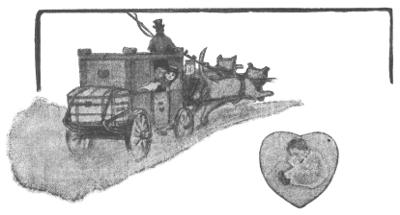
“Look, what’s coming!” and with
a shout of delight the children of Cloverdale
village left their play and
rushed into the street.
What do you think they saw?
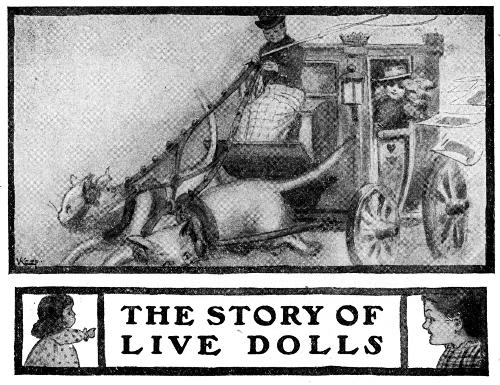
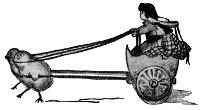
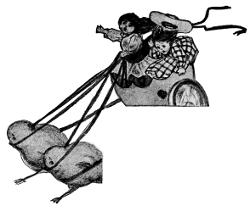
A tiny gilded coach drawn by two
beautiful white kittens, with reins of
blue ribbons covered with silver bells,
and through the coach window the
face of a wonderful doll. On her
head was a jaunty sailor hat, from
under which yellow curls danced in
the wind as she nodded and smiled
at the children on either side.
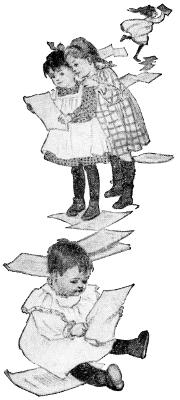
From time to time she tossed out
a handful of bills, which flew about
like little white birds and then fluttered
to the ground, where they were
eagerly caught up by the fast gathering
crowd of children, filled with wonder
at the amazing sight. They made a
brave effort to keep up with the coach;
but the driver cracked his whip, the
kittens started at a mad pace down
the hill, and with one
last nod and smile from
the doll in the window,
the coach disappeared
in a cloud of dust. The
children watched it out
of sight, then turned to
go back.
But what were
these bills which,
in the excitement,
they had forgotten
and were still
clutching in their hot and dirty hands?
Again and again they read these startling
words, which stared them in the
face:
NOTICE!
ON THE MORNING OF
JUNE THE FOURTH ALL
THE DOLLS IN THE VILLAGE
OF CLOVERDALE
WILL BE ALIVE!
That was all; and it was to happen
to-morrow, for this was the third day.
They looked at one another with
eyes growing larger and rounder, and
cheeks growing redder than the roses
blossoming in the gardens. Then such
a chatter began that even the birds had
to stop singing to listen.
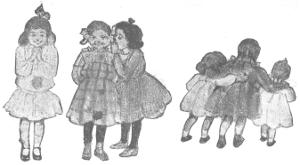
“I never heard of such a thing!”
“How could they?” “Wouldn’t it be
perfectly lovely?” And suddenly realizing
what a blissful thing was in store
for them, if it were really true, the
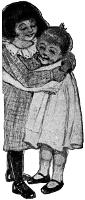
children began to hug each other and
dance about and squeal with joy, until
their various mothers came to the windows
to learn the cause of the commotion.
When the little ones caught
sight of them, remembering that they
had not heard the wonderful news,
they shouted:
“Let’s tell our mammas!” and
quickly disappeared.
Janie Bell’s home was the nearest.
She fairly flew up the steps and tumbled
into the door as she said:
“O mamma, it’s going to begin to-morrow!
Won’t it be lovely! A doll
came in a gold carriage and she threw
this bill, and a boy doll drove the white
kittens all covered with ribbons and
bells, and it was too pretty.…
Do you think my dolls could come
alive?”
Mamma wiped the little hot face
and read the bill.
“It does seem strange, but I don’t
know of a lovelier thing that could
happen to a little girl than to have her
doll come to life. What a fine time
there would be in the doll house!”
she said, glancing out of the window
at a beautiful little house under the
trees. It was just like a real house,
with a porch across the front, a real
door bell, tiny shades and Swiss curtains
at the windows, and a little brick
chimney upon the roof.
Janie clapped her hands.
“O mamma, won’t it be fine? I can
hardly wait.” She flew out of the door
and into the doll house.
Each room was in good order, for
Janie was a fine housekeeper. Papa
had given the dolls’ home to her,
thinking that if the little girl learned
to keep this one in order she would
some day be able to take care of a
larger one.
She looked at the parlor with its
mimic furniture, a sofa, chairs, piano,
and a grate where she could build a
fire if mamma were watching. Then
she went into the dining-room, where
the table was set all ready for dinner.
How lovely it would be to see
the dolls sitting there and actually
eating!
In the kitchen was a little range
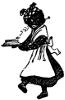
with an oven, and there Dinah, the
black cook, was propped against the
wall, looking as if she were only waiting
for the magic word to set her
marching off getting dinner. Her wig
would probably fall off, as it was loose,
and her leg was broken. Janie resolved
to mend her at once, as it
would not do to have her come alive
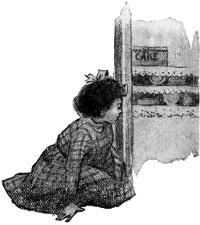
in that condition. She peeped into
the dear little pantry at the kettles,
skillets and shining pans on the shelves,
and at the tiny box marked “Cake.”
In one corner was an ice box, in another
a flour barrel.
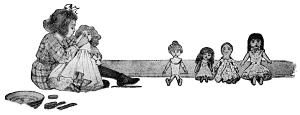
Upstairs there were dolls of all ages
and sizes; papa, mamma and children.
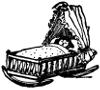
A little baby in long dresses lay in a
cradle, and other dolls were sitting and
standing about, some dressed and some,
I am sorry to say, stark naked. Janie
dressed and arranged them all in various
attitudes; then, seized with a sudden
inspiration, she exclaimed:
“Well, if it is true, we’ll have the
best time in this little house we ever
had, and I’m going to get ready for it.”
So she swept it from top to bottom,
washed the little windows, tied back
the pretty curtains with fresh ribbons,
dusted the furniture, made the beds,
washed the dolls’ faces, mended Dinah’s
leg and fastened her wig, flitted about
from room to room, giving each one a
last fond look, and then she locked
the front door and hung the key on
the branch of a tree, where it was
safely hidden by the leaves.
The sun was setting and papas were
coming home to their suppers. All
seemed as usual, but it was a new and
very exciting world to this little mother,
for the morning was to bring strange
doings. Janie hurried in to eat her
supper and to get to bed early.
“It seems almost like Christmas,
mamma; I can hardly wait for to-morrow,”
she said as she kissed her mother
good-night. Mamma laughed merrily.
“Well, close your bright eyes, and
the birdies will be singing their morning
song before you know it,” she said.
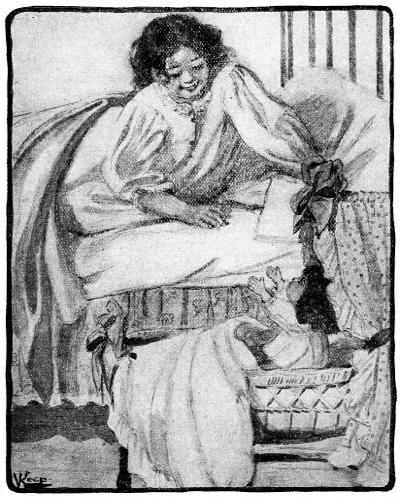
Janie leaned out of bed to kiss her big
dollie, who was sleeping peacefully in
a cradle by her side.
No dollie ever had better care, for
Janie was a kind little mother. She
took her to the table for each meal,
gave her a lovely ride every day, and
at night carefully undressed her and
tucked her into bed.
“Won’t it be beautiful?” Janie
whispered, as she gave the cradle a little
jog. But Dollie slept on, quite unconscious
of the fact that in the morning
she was to be as full of life and
dancing gaiety as Janie herself. As for
Janie, she hardly dared think about it;
for if she once began to imagine what
bliss was in store for her, she would
never get to sleep.
During the night she dreamed all
sorts of things. Toward morning it
seemed that she and Dollie were riding
in an egg-shell coach, drawn by two
downy, yellow chickens; Dollie suddenly
stood up and began to sing,
frightening the chickens, so that they
ran away and tipped over the carriage.
Of course, at this catastrophe, Janie
wakened; but her dream seemed to go
on, and she still heard a voice singing.
Could it be her doll?
She hardly dared move, as she remembered
what was to happen to-day.
She listened a moment and then peeped
out. At sight of her, Dollie held up
both arms and said—yes, actually said:
“O you dear little mamma, I am so
glad you are awake. I want to come
into your bed,” and up she popped
and climbed in under the covers, and
snuggled up exactly as Janie often
snuggled up to her mamma. Janie
hugged her, but for a moment was too
frightened and astonished to speak.
Miss Dollie began to laugh and giggle
so loud that papa and mamma
came running in.
“It’s true, mamma, it’s true! Look
at her!”
“Of course it’s true,” said Dollie;
“didn’t the Queen of the Dolls decide
that it should be? It had to be true
when she said it. But let’s get up and
dress; you’ll be s’prised to see what’s
happening in the doll house.”
Janie gave a little scream of delight,
hopped out of bed and scrambled into
her clothes. Dollie was quicker than
she, and was soon dressed and standing
on a chair by the side of the bed; for
Janie had to watch and laugh over the
funny spectacle of Dollie dressing
herself.
“Now brush my hair, please,” pealed
out Miss Dollie as Janie finished.
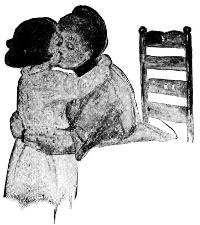
Janie gave her another hug, as she
brushed the brown curls around her
finger; then they ran pell-mell down
the stairway and raced out of the
house.
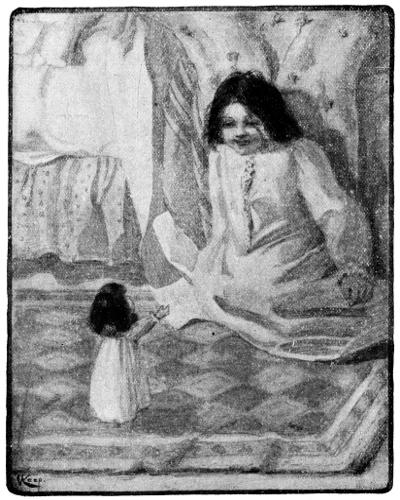
Janie gave a little scream of delight
The family all laughed heartily, for
it was a funny sight to see a doll run.
They could hardly believe their eyes,
and hurried into their
clothes; for they too were
eager to see these wonderful
doings in the doll house.
As Janie ran across the lawn, she noticed
smoke coming from the chimney.
She flew up the steps, unlocked the
front door and, as she stepped into the
hall, beheld the astonishing sight of
black Dinah at the toy telephone. She
was just saying, “One steak, please,”
and then she called up the grocery
store and ordered a bill of goods that
would empty almost any housekeeper’s
pocket-book.
Dinah paid no attention to the visitors,
but swept the front steps, glanced
into the dining-room to see if all was
ready for breakfast, and then went into
the kitchen.
The fire was crackling in the range,
and while Dinah waited for the groceries
Janie ran upstairs. The dolls were
dressing in the different rooms, and
mamma doll was trying to make the
baby comfortable. Its cries soon
brought Dinah up with a cunning milk
bottle, all filled; baby took it and
nestled down into her pillow with it,
just as any baby would who had to be
fed in that horrid way. Janie longed
to pick her up, but as she wished very
much to see Dinah get breakfast, she
thought she would wait until another
time.
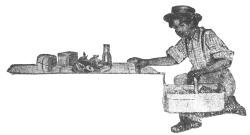
A knock downstairs announced the
grocery boy, and Janie went down to
find the table covered with little packages
containing flour, sugar, coffee,
eggs, and everything needed in a real
kitchen. She longed to help put the
articles in place, but Dinah looked
queer and cross, so she didn’t dare
touch anything. It was no wonder
Dinah was cross, for what do you think
Janie had done in her haste the day
before? She had put the poor thing’s
leg on backward, and had pasted her
wig on crooked, way down over one
ear. So, of course, she wasn’t very
comfortable.
After putting everything away, Dinah
got a dish, broke an egg into it
(such a tiny egg, about as large as a
bird’s), and with a dear little egg-beater
whisked it as light as a feather. Then
she poured in some milk and added
flour, with a little salt and baking-powder.
Janie wondered what she
was going to make and glanced at the
range. “O joy! pancakes!” she cried,
as she spied the smoking hot griddle,
the size of a small saucer.
Dinah put on the broiler and laid
the steak carefully on it, cut a potato
into dice and put it into a pan with a
little cream; then, with a dash of salt
and pepper on the steak (which was
soon done to a turn), she placed it on
a platter and generously buttered it.
When all was ready she rang a toy
bell, and the family of dolls filed down
into the dining-room.
They seated themselves, and papa
served the food. When he carved the
steak the knife bent double, for it was
really never meant for use.
“Why, I must go and buy another.
I didn’t know it was so poor,” said
mamma doll, as she poured the coffee
into the tiny cups and added cream
and sugar.
How funny they all looked, sitting
there and really eating! Janie tried to
smother a hysterical laugh, and made
such a queer sound that they all looked
up. She felt almost disgraced when
her big doll, who had followed her
about, whispered:
“Come away, or you’ll hurt their
feelings.”
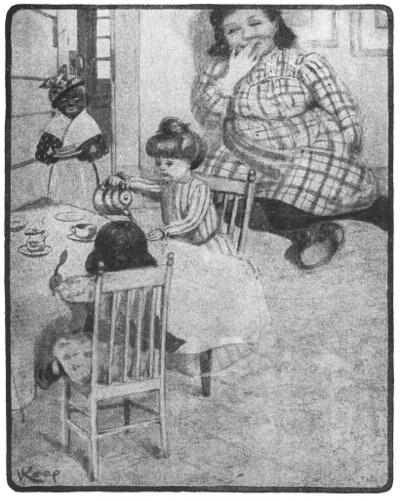
She poured the coffee into the tiny cups
And now came Dinah with a plate
of cakes about the size of a penny.
Each doll clamored for one. How
good they looked! Janie ran to the
kitchen; she must bake those cakes.
“O Dinah, please let me. I will be
very careful.”
“Well, Miss Janie, you may; but I
am cross to-day. My hair is so crooked,
and look at my leg! How could you
put it on backwards? I have so much
work to do, and it is so hard to walk.”
“Why, Dinah, you poor thing, did
I do that? I will take it right off and
turn it around. It won’t take me
more than a minute, and it will soon
dry.”
Dinah screamed.
“What! Don’t you think I have
any feelings? How would you like to
have your papa break your leg and
turn it round, and you sit waiting for
the glue to dry?” and with a scornful
sniff she hobbled in with another plate
of cakes.
When the family had finally finished
eating, there was still considerable batter
left; Janie begged for some cakes
for herself. Dinah consented, and so
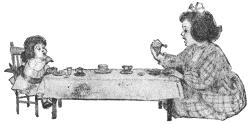
Janie and Miss Dollie sat down to eat,
taking care to save some cakes for
Dinah.
It certainly was bliss to watch the
butter melt on those beautiful brown
cakes, and to pour the golden syrup
from the syrup cup, which had come
all the way from Boston only last
Christmas.
“Aren’t they delicious?” said a
piping voice.
Janie jumped up and almost dropped
the syrup cup. She had been so busy
over those darling cakes, that she had
almost forgotten about her doll sitting
opposite her at table.
“O you precious thing! I never can
get used to hearing you talk. How
many times I have played tea-party
here with you, and had to do all the
talking myself!” and she ran round
and gave her another hug. “Let’s go
and tell papa and mamma about the
breakfast,” she added; but as they
stepped outside they found the family
peeping in at the window.
“Isn’t it fun, mamma? And did
you see the cunning pancakes? The
mamma doll is actually going shopping
because my knives won’t cut meat.
The baby was really crying, and I must
go up and see her,” she rattled on,
without giving them time to reply, and
then ran up the stairway with the big
doll tripping after her.
Stopping at the door of the bed-room,
she clasped her hands in rapture,
for mamma doll was giving baby a
bath. It was kicking up its weenty
heels, and gurgling and cooing just
like a real baby. While mamma was
scrubbing, suddenly baby grabbed the
end of the wash-cloth. Of course, it
cried when she took it away, and then
it stopped to listen, for mamma had
wound up the little music box.
So the bath went on till baby was
all clean down to its little toes, which
mamma kissed and folded tenderly in
the blanket. Then she dressed it and
laid it in its cradle.
Janie made a motion to take it, but
mamma shook her head, and whispering
that it was asleep, she quietly put
the room in order and drew down the
shades. The doll children were making
a great racket, and mamma called
to them to run out and play, so baby
could sleep. Janie and Miss Dollie
followed.
As they passed through the kitchen,
Dinah was just finishing a marvelous
pie, as large as a silver dollar, and singing
“Der’s a good time comin’ by and
by.” As she opened the oven door
Janie caught a glimpse of a dear little
bird roasting, and oh! how good it
smelled! A dish of cranberries was
cooling in the window, and as Dinah
left the room for a moment, Janie
couldn’t resist peeping into the ice
box. There was a block of real ice,
and a pan of milk with cream on the
top of it. How she longed to skim it
with the little skimmer!
Then she espied a dish of something
that looked like custard, which she was
about to taste when Dinah’s voice
startled her.
“What you a-doin’ in my ice box?”
“I only wanted to know what that
was,” said Janie respectfully, for she
was a little afraid of Dinah since the
leg affair.
“It’s for ice cream, an’ I’se a notion
ter let you freeze it. I’se got a heap
of work dis mornin’.”
“O Dinah, may I?” and Janie
danced a hornpipe then and there and
threw her arms around Dinah’s neck.
“You are a dear, and I am sorry I
put your leg on wrong. I do wish I
could fix it.”
“Nebber mind, honey; I couldn’t
go through wid dat operation nohow,”
said Dinah, as she got the freezer and
chopped the ice into bits, then poured
in the custard and left it for Janie to
finish.
With her dear companion by her
side she worked until the handle began
to turn hard, when she knew it
was frozen.
“Dinah, can’t we lick the ladder?
Mamma always lets me.”
Dinah said she might, and she dutifully
gave Dollie half. She was sorely
tempted to get a spoon and taste that
in the freezer, as Dinah had left the
room, but she knew that would not be
honest, so she covered it up and ran
into the yard to see the doll children
at play.
She was just in time to see, coming
slowly down the street, a white, covered
wagon, marked in red letters,
“Dolls’ Ambulance.” It was drawn
by six white kittens, who moved along
so carefully that Janie decided they
must have some very sick patients
aboard. It halted in front of the doll
house, and the little Queen dismounted,
saying she was going to telephone.
Meantime Janie, curious to
see what was within, walked around to
the back and peeped in at the little
open door.
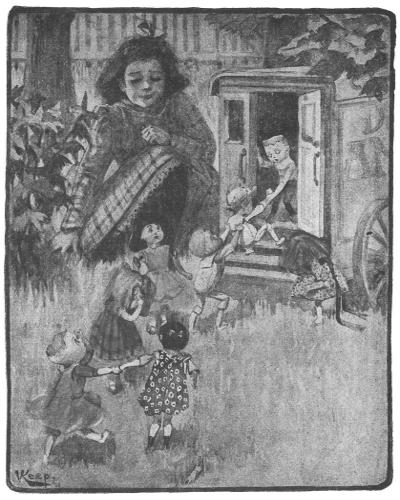
Janie saw a most piteous sight
There she saw a most piteous sight.
It was filled with dolls of all sizes, and
in such a condition! Arms and legs
were off, wigs were missing, and some
dolls lay with their poor sightless eyes
staring up at her, in such a pathetic
manner, that Janie could hardly keep
back the tears. One poor little thing
lay apart from the others and was dripping
wet. Her companions sobbed
aloud as they told in low tones of how
she was fished out of a water barrel,
stone dead. Not even the Queen
could bring her to life.
Each had some trouble. Some told
of how their mammas had lost their
arms and legs, and how their wigs had
been off for weeks. Some were sadly
neglected, many being wrapped in small
bed-quilts and soiled blankets, as they
hadn’t a stitch to put on. They told
Janie that the Queen had appeared
that morning, had gathered them up
from their different homes, and was
going to take them to a dolls’ hospital.
She was telephoning now to make
preparations for their arrival.
The Queen soon appeared, and their
piteous wailing ceased as she hovered
over them, soothing this one and that,
placing some in more comfortable positions,
wiping away tears which were
rolling down the cheeks of little handless
dolls, and telling them all to cheer
up, that they would soon be made as
good as new, except the poor dead
one, which they would lay away tenderly
in some quiet spot and cover
with pretty flowers. The Queen invited
Janie’s doll to go with them, and
as they slowly departed, Janie looked
so wistfully after them that she called
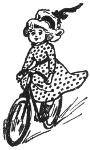
to her to jump onto her wheel and follow.
Janie ran in to ask mamma,
and was soon spinning along after
them.
By and by they turned into a country
road and down a long lane, at the
end of which she saw a high wall. The
Queen told them that it enclosed a
number of acres of land, and that the
place was called the “Doll Farm.”
They all alighted before a great gate
and the Queen blew a wee silver bugle
that hung by a silver chain from her
belt. The gate swung open, and when
they had all entered it closed
immediately after them. The
Queen led them up a
path towards a
building bearing the
sign “The Dolls’
Hospital.”
Janie was too
much astonished
at the sight that
met her eyes to follow.
All she could see was an orchard
of low trees, whose branches hung full
of doll clothes, swaying in the cool
morning air. There were tiny under-garments,
and dresses of all colors.
She reached out to examine a particularly
pretty one, and to see just how it
was made, when a voice startled her.
“Don’t touch that. It isn’t ripe
yet.”
“Ripe!” said Janie. “Is it growing?”
“Why, of course. Now see. The
button holes aren’t begun yet, and the
buttons aren’t near tight enough. It
will be about two weeks before that
frock can be picked. Now here is one
I can pick to-morrow,” and he explained
to Janie just how he could
tell when it was ready to be removed
from the tree.
Then the gardener, for it was he,
showed her the trees full of under-garments
and dear little petticoats, the
bushes of different colored stockings,
with shoes and slippers to match, and
last of all, a tree of hats. They were
the sweetest things, of many different
shapes, and from the end of each
branch hung bright ribbons of all colors.
Near by grew all sorts of flowers.
The gardener told Janie she might
trim a few of the hats, if she cared to,
as they were all ready to pick. Now,
if there was one thing Janie liked
more than another, it was to trim hats.
So the gardener picked a number and
allowed her to choose the ribbons and
flowers.
She chose red, blue, pink and white
ribbons, and roses, forget-me-nots,
pansies and morning-glories. You
must remember these were all dwarf
flowers, much smaller than ours, and
the gardener told her they were everlasting,
and so would not wither.
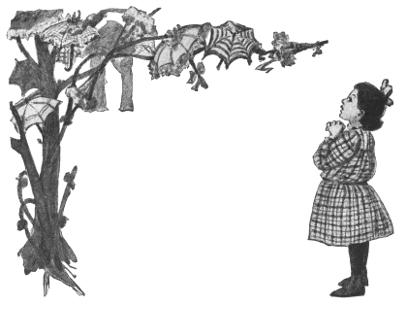
Janie seated herself under a tree,
from whose branches dainty parasols of
all colors were dancing and nodding
in the breeze. She would have been
eager to pick them at any other time,
but now with her lap full of such visions
of beauty, she was blind to everything
else about her. She arranged the
bows and flowers, and soon had this lot
of hats trimmed, and begged for more.
Finishing a number she placed them
in long rows on the shelves built for
that purpose.
She then threw herself on the
ground to rest, and, glancing up, saw
the parasols.
She clapped her hands and bounded
to her feet.
“O Mr. Gardener, can’t I have one?”
He said she might, and asked her
which one she wanted.
“That beautiful
blue one. No, the pink
one. O no, wait a moment,
that white one, I
think. O, Mr. Gardener,
please let me
look a moment. They
are all so sweet!” She finally decided
on the blue—a beauty with lace and
forget-me-nots around the top.
The pink one had a wreath of wild
roses, and it was hard to give that up;
but the blue matched her doll’s new
dress, and so that decided it. Then the
gardener told her that after awhile she
could help him pick the various garments
for the army of dolls that had
just arrived, but that now she’d better
go into the hospital and see what they
were doing there. And so he led her
into the house.
Here Janie found the poor crippled
dolls being put in fine shape by little
doll nurses, wearing soft gray dresses
with white aprons and caps. Legs and
arms were being replaced; the blind
were made to see with blue eyes and
brown; bald heads were covered, and
such a wealth of hair did those dolls
have—some curly, some braided and
tied with a ribbon, and some
hanging straight, for the dolls’ mammas
to braid or curl, as they chose. When
their bodies had finally reached perfection,
they went into a bath-room
for a sorely-needed bath, and Janie
went to help the gardener.
Together they wandered about,
plucking an outfit for each doll. It
was great fun to match the dresses in
slippers and stockings, and then to
complete the costumes with the proper
hats. When they carried the frocks in,
what a hubbub arose! Each doll
wanted every dress.
The little Queen quieted them and
gave a suit to each one, which they
soon put on, and they looked so sweet,
clean and pretty that their own mammas
would hardly know them. The
Queen called for the bill, paid it, and
departed with her family, looking like
the “Old Woman Who Lived in a
Shoe.”
They made a very pretty picture as
they walked out, appearing like a lot
of gorgeous butterflies. As before, the
gate swung open at a peal from the
silver bugle; all climbed into the ambulance
once more, and away they
went with Janie following.
When they reached home they
found the yard full of little girls weeping
for their lost dolls. But as each
dollie jumped down and ran to its own
mamma, what a chattering and babbling
filled the air!
“Who mended you?” “What lovely
hair!” “Where did you get those
clothes?” cried the little girls.
The strange tale which Janie told
them of all she had seen, and especially
of the clothes growing on trees, seemed
too wonderful to be believed, and they
envied her such delightful experiences.
The little Queen then mounted the
steps and gave them a short lecture.
She told them how kind they ought
always to be to their dolls—just as
kind as they wished their mammas to
be to them.
She said that when she went from
house to house gathering up all the old
dollies to have them made like new,
she was shocked to see the condition
of some of them. One had a hopeless
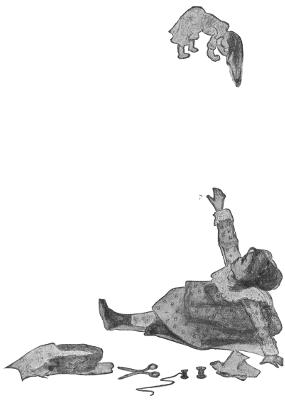
crack in its head, because its mamma
got cross and threw it up to the ceiling.
Some of them were naked, and
most of them were very dirty. Her
eyes filled with tears as she spoke of
the poor little dead one; and she said
she could always tell what kind of
heart a little girl had by the way she
treated her doll. Those who made the
sweetest and tenderest mammas were
those who had taken the most loving
care of their dollies when they were
little girls. She wanted them to begin
over, and see who could be the best
mother during the few weeks that followed.
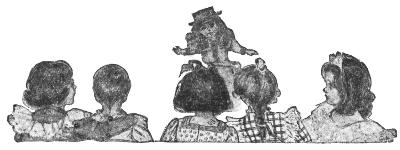
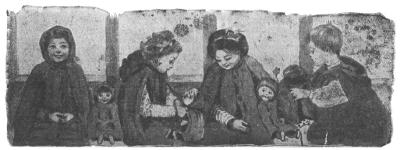
Then they all sat on the grass,
and Dinah appeared with cunning
glasses of lemonade and tiny sandwiches,
and they enjoyed this almost
more than the lecture. When they
had finished the Queen said good-by,
telling them to enjoy each other while
they could, as this bliss was to last but
a month.
Only little girls with live dolls can
know of the happiness that followed.
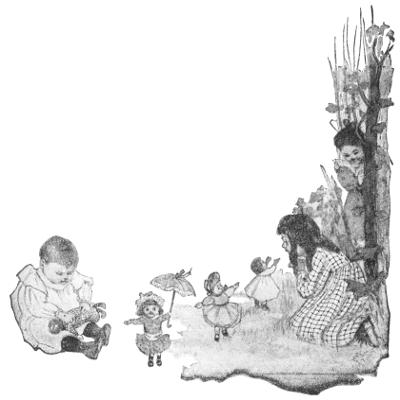
It was no uncommon thing to see dolls
playing “ring-around-a-rosy” and
“hide-and-seek,” or jumping ropes and
rolling hoops. Janie never tired of
watching them, and she and her precious
doll had many romps.
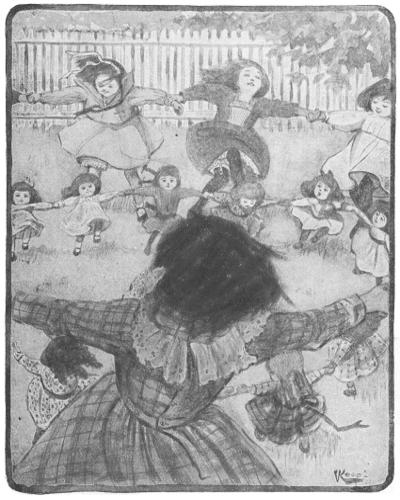
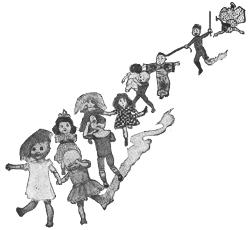
The dolls playing “ring-around-a-rosy”
Early one morning there was left at
the door a miniature invitation, which
announced that a picnic was to be held
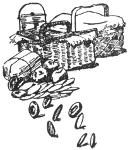
at the Doll Farm the next day. Janie
ran into the doll house to ask if they
would go, and found Dinah busy cooking
for it. She had just finished the
layer cakes, which had been baked in
the lids of baking-powder cans. They
were all iced, some with chocolate,
others with plain white. A number of
tiny square loaves of angel food and
sponge cake looked so good that Janie
longed to pocket one.
Dinah allowed her to cut out the
fried cakes with a thimble, and when
they were a golden brown, she rolled
them in pulverized sugar until they
looked like a heap of white marbles.
Dinah then made a batch of cookies,
which Janie cut also. Next came a
lot of jelly tarts and apple turn-overs,
so crisp they would undoubtedly melt
in your mouth.
Last, but not least, she made dozens
of the dearest little baking-powder biscuits,
and when they were baked Janie
opened and buttered them and put in
pieces of dried beef, shaved very thin.
They were delicious. Janie received
one from Dinah, and longed to swallow
a dozen.
Then Dinah boiled a number of
eggs, for which Janie tied up packages
of salt and pepper, as these are necessary
for every picnic. She then helped
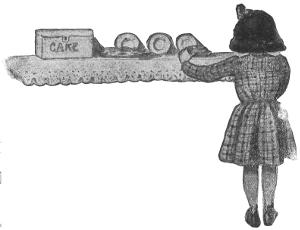
to place the food on the pantry shelf,
ready to pack in a hamper the next
morning.
How tempting it looked! When
they had squeezed lemons for lemonade
and frozen the ice cream, they sat
down to rest.
Dinah said it was to be a delightful
picnic, given by the Queen to all the
dolls and their mammas. Every little
girl in the village was invited, and she
did hope she had enough to eat!
Janie ran home to tell mamma
about it, and to ask if she couldn’t
make something for the lunch. Mamma
thought for a moment.
“I know the very thing,” she said.
“Jump onto your wheel and go to
each little girl’s house, and tell her to
be here at three this afternoon, and to
be sure to wear an old dress.”
“You are the darlingest mamma!”
Janie cried, as she hugged her and ran
away with a delightful feeling of mystery.
“It must be lovely if mamma
planned it, but what can it be?”
Promptly at three all were on hand.
Mamma took them to the kitchen.
“We will make some doll candy,
and I will show you how,” she said.
They had to relieve their excited
feelings by dancing a jig at this delightful
news, and then they settled
down to work. They first made some
chocolate drops, the weentiest little
things you ever saw; then some marshmallows,
which were about the size of
parchesi dice.
Next they made maple-creams and
dear old-fashioned molasses candy,
which the children were allowed to
pull, and the one who succeeded in
getting her piece the whitest was to
have a dainty little box of the mixed
candies.
It was great fun! When it was finished
it looked so good that mamma
had to divide a box among them. Then
she brought out the popper, and the
children went gaily about shelling the
corn. This is always a delight to pop,
and when they had a heaping dish of
it, they made it into popcorn balls
about the size of marbles.
While they waited for the candy
to harden they ran into the garden
to play and to talk over these strange
happenings.
“O children, what lovely times we
are having!” said Janie. “I wish they
could last always.” And each one
piped in:
“Yes, but they can’t, and we must
enjoy them while they do last.”
“I know one thing, I do take better
care of my doll now. I never used
to keep her face clean, and she was
nearly always naked.”
“It was mine that was ruined from
my throwing her up to the wall. I
was so mad at her that day, just because
I couldn’t make her dress fit. I
have a new one now, and I am very
careful of her.”
“And mine was drowned, but I really
was sorry after I did it. She
wouldn’t stand up, and I grew cross
and threw her into the water; but, of
course, I never knew she had any feelings.
There goes my new one now,
riding the wheel which papa had made
for her.”
The girls clapped their hands with
delight at the unusual spectacle. To
think of a doll on a wheel! What
would happen next?
Just then mamma’s voice summoned
them to the kitchen, where they found
a great basket of little candy boxes in
the forms of hearts, diamonds, half-moons,
drums and cunning barrels.
They packed the candy neatly and tied
each box with a pretty ribbon.
Then the boxes were placed in the
basket, ready for the morrow, and the
little girls departed for their homes.
The next day proved to be fine, and
soon after breakfast
the children
and their dolls
were assembled
in Janie’s yard.
They were clad in pretty dresses, and
looked as sweet and fresh as a lot of
daisies.
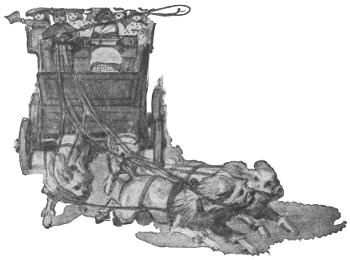
Then appeared two tallyhos, the
one for the dolls being drawn by four
curly white dogs. The Queen’s own
boy-doll driver snapped the whip, and
the air was at once filled with the noise
of the barking of the dogs and the
music of the bells on the harness of
the restless steeds.
The tallyho for the children was
much larger, and was drawn by four
cream-white ponies.
They were all packed in like sardines
in a box, the little Queen sitting
in the midst of the dolls. The silver
bugle was blown, the chains and bells
jangled, and away they flew.
They were barely started when they
heard Dinah calling. She was frantically
waving a red bandanna kerchief
and beckoning them to come back.
So back they went.
“You done forgot me,” she shouted.
“You! Why, Dinah, are you going?”
asked Janie.
“Co’se I is, and I don’t like to take
no liberties nor nothin’, but I feel like
I must tell you dat you done forgot
anodder t’ing dat I consider mighty
impo’tant to ebery picnic, and dat is
de lunch what I’se been workin’ at
dis long time.”
This speech caused a hearty shout
of laughter. Mamma came to help
put in the hamper and baskets, and
Dinah sat in state by the driver. With
her red kerchief on her head and her
yellow dress, she looked like a great
bumble-bee hovering over the dainty
doll flowers.
As they rode away, mamma heard
her singing her favorite song, “Der’s a
good time comin’ by and by.” Perhaps
she was thinking of the time when
her leg would be turned around, or,
perhaps, of how much they would enjoy
the toothsome luncheon she had
prepared. They had a fine ride, as it
was a beautiful day, and they were all
so perfectly happy.
They sang and shouted, and were
envied by all the boys in the village,
who were deprived of these pleasures
because boys are so dreadful in their
treatment of dolls.
All too soon was the ride at an end.
The girls were eager to see the trees
where the dolls’ clothes grew, and
when they were actually inside of those
wonderful grounds, they ran here and
there like ants. The Queen first
led them around to her own home,
which Janie had not seen when she
was there before. It was the dearest
little place, with climbing rose vines
twined about the doors and windows,
and was beautifully furnished with
everything one could wish for.
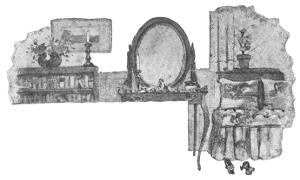
The Queen’s own bed-room was
like fairy land. The bed had Swiss
curtains draped about it, tied back
with blue ribbons. There was a lovely
desk filled with tiny doll-paper and
envelopes, and a little gold pen and a
cut-glass inkstand. Here she had written
those gracious invitations.
The closet was filled with beautiful
little dresses. A shoe box held various
colored shoes and slippers, also bed
slippers and a dear little pair of rubbers.
On the dresser was everything
any young lady could desire. It was
charmingly arranged with a lace cover
over blue, and a dainty pin cushion,
silver comb, brush and manicure set.
In one corner stood a book case,
filled with books of the tiniest sort. A
long window led out into a balcony;
here was stretched a doll’s hammock,
where one could swing and pick
flowers without moving, for the roses
twined in and out.
After this they went to see the hospital,
and then to have some games
with the dolls. They examined the
trees carefully and found them most
mysterious. Lunch was called before
they dreamed it could be time, and, as
that is always the best part of a picnic,
and as little girls are always hungry,
they hurried to the spot where Dinah
was serving.
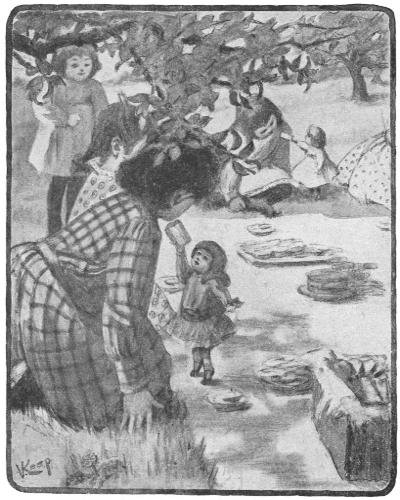
Have you ever had a dolls’ tea-party?
Every mamma sat by her own doll,
and as the food was passed each doll
helped herself, but the poor mammas
were like the little pig that had none,
as they were not allowed to take a
morsel; and to make it worse, what
do you think those saucy dollies did?
Have you ever had a dolls’ tea party?
Then you remember how you held the
food to your doll’s mouth, pretended
to let her have some, and then gobbled
it up yourself.
Well, that is just what happened
here. Each doll held it to her mamma’s
mouth, and, as she tried to take it,
it vanished in the doll’s mouth in the
most irritating manner. Every time
Dinah passed the same performance followed,
and how the dolls laughed!
The children grew hungrier every
moment when they found those tempting
viands were not for them. The
ice cream looked so delicious! It was
strawberry, and served in small salt-cellars;
and then came that lovely
angel food and jelly tarts. They
coaxed and pleaded, but the dolls
only said:
“That’s the way you treat us at
your parties.”
Finally, when they were on the
verge of tears, the dolls relented and
Dinah brought in a fresh supply, which
vanished very quickly, as everything
was unusually good and the children
were nearly starved.
When they had finished, they presented
the dolls with the boxes of
candy, and wound up with a merry
game of hide-and-seek.
The old gardener called them and
said that each little girl was to be allowed
to choose one entire suit for her
doll. What a scramble they made
for the various trees, though it
was very hard to decide, for everything
was so pretty.
Janie looked a long time before
she could quite make up her
mind, but finally chose a
pink dress with pink stockings
and slippers, and a hat with elegant
pink plumes waving upon it; a
fan and chatelaine completed this costume.
She chose also the dear pink
parasol she had so much wanted before.
There were also stunning coats
and opera capes with swan’s-down
trimming, and one tree full of dear
little muffs.
The handkerchief tree looked too
funny, with the tiny white things fluttering
about like a flock of birds with
wings spread ready to fly.
It was a hard matter to leave this
enchanting place, but as the sun was
getting low they gathered up their baskets,
presented the gardener with some
of their candy, and with many thanks
and good-bys departed.
When they reached home they told
the Queen they never in all their lives
had had such a beautiful time, and,
thanking her very heartily for giving
them so much pleasure, they went to
their homes “to tell mamma all
about it.”
The days flew merrily by, and before
they realized it the month was
almost gone. When Janie stopped to
think of those happy times being no
more, she was ready to cry her eyes
out, but she put away the thought,
determined to enjoy them while they
lasted. One morning at breakfast
papa said:
“Mamma, I think we must wind up
these remarkable doings with something
pretty fine. How would it do
to hire several carriages and take the
whole caboodle of these chicks, with
their wound-up dolls, for a lovely day
at the seashore? The various mothers,
or rather grandmothers, of the dolls
can go to see that they don’t get
drowned. It is only a drive of ten or
twelve miles to the beach. You can
get dinner at the hotel. I will telegraph
and have that arranged for. You
can all have a plunge in the surf, and
the babes can dig in the sand and paddle
about, and have no end of a good
time. How does that strike you,
Janie?”
Janie replied by springing into his
lap and giving him a hug that almost
choked him.
“Oh, that will be lovely,” she cried,
“and I will write the invitations.”
They decided to have it the very
last day of this eventful month. Janie
wrote the notes which were to make
so many hearts happy, and papa went
to make the necessary arrangements.
The day came, and Janie sprang out
of bed to raise the shade. Instead of
seeing the sun streaming in, as she
hoped, she found the rain was pouring
down in sheets. She made a brave
effort to keep back the tears, as she
heard her dollie singing the well-known
song, “Can’t we Make Sunshine
in the House when there is None
Without?”
“But, Dollie, we can’t go,” sobbed
Janie.
“Why not?” came from mamma’s
room.
“Because it’s raining, mamma,” and
then the tears began to fall in earnest.
“Rain before seven, clear before
eleven,” sang papa. “Don’t borrow
trouble, Polly love, but get dressed
and see what will happen.”
Janie dried her eyes and obeyed,
very much surprised, for she was seldom
allowed to go anywhere in a rain
like that.
After breakfast mamma got out
waterproof and rubbers, which Janie
put on, and then waited patiently for
what would follow.
The door-bell rang and a package
was left for Janie’s doll. On opening
it she found another tiny package
marked on the outside, “Not to be
opened until you reach the beach.”
There was also a little gossamer and a
pair of rubbers, which fitted Miss Dollie
to perfection. How charming she
looked!
Janie hopped about like a young
robin, as she heard the delightful
blast from the trumpet, which was
always associated with their good
times. She rushed to the window and
saw, drawing up in front, two omnibuses,
one filled with the various mothers,
the other with the little girls and
their dollies. But what was this procession
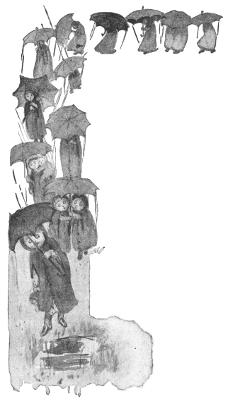
which followed?
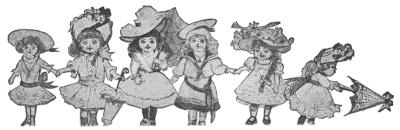
“Oh, mamma! it’s all the dolls from
the doll-house, and each has on a tiny
gossamer. How funny they
look!” And so they did,
each carrying an umbrella
and paddling through the
water. Mamma, Janie and
Dollie followed them, and
all jumped in the omnibuses,
closed the doors with
a bang, and away they went.
It was snug and cozy
inside. The rain pattered
on the roof and
played a steady accompaniment
to
the chatter of this jolly little crowd,
which looked so odd, hooded and
cloaked in black, like so many nuns.
The little mammas cast many admiring
glances at their dolls, for they had
always longed for them to have these
wee rainy-day garments.
“Isn’t it the greatest fun?” they
cried. “I’m so glad it rained; it’s
much nicer to be shut in here and
listen to it,” and they hugged one another
in their delight.
They had a merry ride. The Queen
told some delightful stories, which
were so interesting that when the sun
broke through the clouds they never
noticed it; till, the last story being finished,
they all shouted in one breath:
“Look at the sun!”
And now they found they were nearing
the beach. They could hear the
ocean roaring, and could see the waves
creeping up and rolling over with that
great swish, which once heard is never
forgotten, and is sweetest music to
lovers of the sea.
The ’buses stopped, then all tumbled
out and made a mad rush for the
water. Oh, the beauty of it all! How
sweet the air was! Who can breathe
that delightful, salty odor and not love
it? They played in the sand and
gathered shells until eleven o’clock,
when the air was warmer, and mamma
said they might put on their bathing
suits.
“But what will the dollies do?”
Janie’s doll waved her mysterious
package, and every other doll waved
one also, crying:
“Wait and you will see.”
Then all disappeared in the bath-houses;
the girls hurried into their suits
and awaited the dollies’ reappearance
with the greatest impatience. When
they finally came they pranced around
them and cried, “Oh, you darlings,
where did you get them?” And no
wonder, for they were clad in the gayest
little bathing suits you ever saw,
with all the colors of the rainbow.
How pretty they looked skipping
about! They had a merry game of
tag, while waiting for the dolls’ grandmammas
to disrobe, and made a beautiful
picture, dotting the sand with
dainty bits of bright color. At last
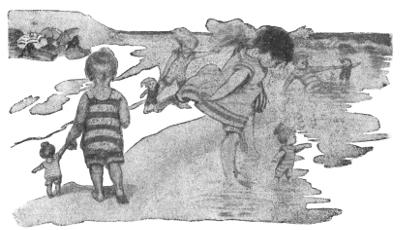
all were ready, and they plunged into
the surf. Such fun as they had!
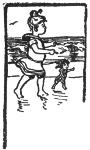
The storm had made frothy, snowy
waves, which came in faster and faster,
tumbling over each other, as if to see
which would reach the shore first. The
children and dolls took hold of hands
and rushed in among them, only to be
hurled back in one confused mass of
legs, arms and heads. For a moment
it would have been hard for an onlooker
to tell just what it was, but
the tangle soon unraveled, and the
performance was repeated with an accompaniment
of wild shrieks of laughter,
as the waves rushed over the heads
of dollies, children and mammas. The
mammas were soon tired out and sat
on the beach to rest and watch this
performance on nature’s stage, and, as
the waves tossed the children and dolls
out on the sand, they laughed till the
tears ran down their cheeks.
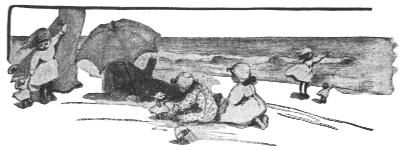
Some of the dolls were left standing
on their heads, others walking about
on their hands, and one poor little doll
was stuck in the sand, with one leg and
an arm sticking up in the air. They
helped her out and she ran into the
water again, undaunted at such a slight
mishap. At last they came out breathless
and lay down on the sand to rest
before dressing.
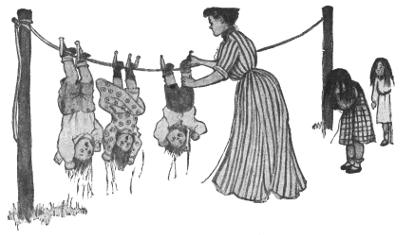
They looked so funny, that mamma
told them she ought to do with them
as did an old lady that she once heard
of, who allowed her children to play
near a little stream which ran by their
home. When they fell in she hung
them on a line and fastened them with
clothes-pins, stuck through their toes.
It was so odd to see them hanging in
a row—ten of them! When they were
dry she took them in, sprinkled and
ironed them, and let them loose again.
They were hung so low it really didn’t
hurt them, and they thought it great
fun. One day she left them hanging
while she went to the store, and a
thunder shower came up. She rushed
home in a panic and, of course, found
them dripping. She took out the
clothes-pins, shooed them into the
house like a brood of chickens, gave
them each some ginger tea and hustled
them into bed, piling blankets upon
them till they were nearly smothered.
They recovered, of course.
“And now,” said mamma, “we must
get dressed and go to dinner.”
They all had a hearty laugh over
this remarkable tale, and thought
mamma would have to have a great
many clothes-pins and a very long line
upon which to hang them.
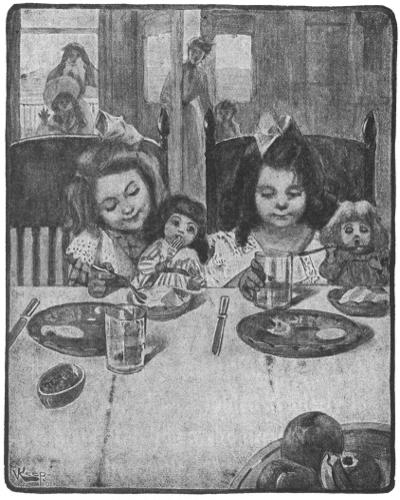
The dolls ate a hearty dinner
When all were ready they walked
up to the hotel, where the guests were
eagerly waiting for them. They had
seen the telegram which ordered dinner
to be prepared for thirty mothers,
thirty children and thirty live dolls,
and they watched with the greatest interest
the little girls, each with a doll
by her side, march into the dining-room.
How astonished they were
when they saw the dolls eat—actually
put food into their mouths and swallow
it. That was the strangest thing!
The dolls weren’t a bit embarrassed,
however, and ate a hearty dinner and
enjoyed it, too, for the long ride and
the bathing had given them fine appetites.
After it was over they filed out, and
the guests after them. The grown
people begged the mothers to tell them
what it all meant, and their children
surrounded the little girls and their
dolls. Of course, the story that they
heard was very strange and hard to believe,
but they could see this part of it
with their own eyes, and so could not
but believe the rest.
All too soon came the omnibuses to
carry them home. They were to have
a pleasant open-air ride this time, as
the roofs had mysteriously disappeared.
With many good-bys they departed,
leaving the guests with much to talk
about. This had been another beautiful
time, and it seemed a fitting end to
the month’s jubilee; but Janie couldn’t
be quite happy, when she remembered
it was the final act in this strange play.
“Dear little Queen,” she pleaded,
“couldn’t you let it last just a little
longer? We can’t bear to give up
these good times so soon.”
“My precious child, this must be
the end for the present—I always keep
my word, and the month will be up in
the morning; but,” she added, as the
tears sprang to all of those bright eyes,
“if you take good care of your dolls
and try to be helpful to your mammas,
I will let it happen again some day,
and you may then have even a better
time; so do not grieve. Remember,
dear little ones, I love you with all my
heart, and will plan something even
more beautiful than this has been.”
And now she bade the driver stop
at the Doll Farm, where was waiting
the same wee coach which had so
startled them at the beginning of this
remarkable month. A little trunk
strapped on the back said plainer than
words that these times were truly at
an end. Giving each a loving good-by
kiss, and begging them not to be unhappy,
the Queen jumped into the gay
little coach and was whirled away.
The children were driven to their
separate homes, each hugging her doll
and loath to give it up to its former
existence. Janie tried to brighten up,
as she bade them all good-by, and said:
“It will happen again. The Queen
said it would, and it will; so we ought
to be extra good. We have had a delightful
time and must be thankful for
it, and just think what we have to look
forward to!”
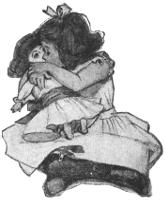
That night she tucked in her dollie
as usual, and, after one last fond kiss
and a few extra caresses, was soon in
the beautiful land of dreams, where we
will leave her till the “next time,”
which, as the Queen always tells the
truth, must surely come some day.
Perhaps it will be in the winter, when
they can have merry sleigh rides and
snow-ball battles. And perhaps, as we
listen to the chimes of the Christmas
bells, if we peep through a window
of the doll house, we shall see a
tiny Christmas tree and “stockings
hung by the chimney with care,” and
even hear dear old Santa Claus’ sleigh-bells,
the reindeer pawing on the
snowy roof, and his great voice crying,
“Merry Christmas to all, and to all a
good night!”
That would indeed be a perfect
time, so we will not be sad at bidding
the dolls good-by, but, as the curtain
falls on this act, sing with dear old
Dinah, “Der’s a good time comin’ by
and by.”