1. Certain typographic errors & hyphenation inconsistencies
were silently corrected.
2. Illustration captions have been standardised.
3. Table of Contents extended by adding references
to the LIST OF ILLUSTRATIONS, INDEX, and ADVERTISEMENTS.
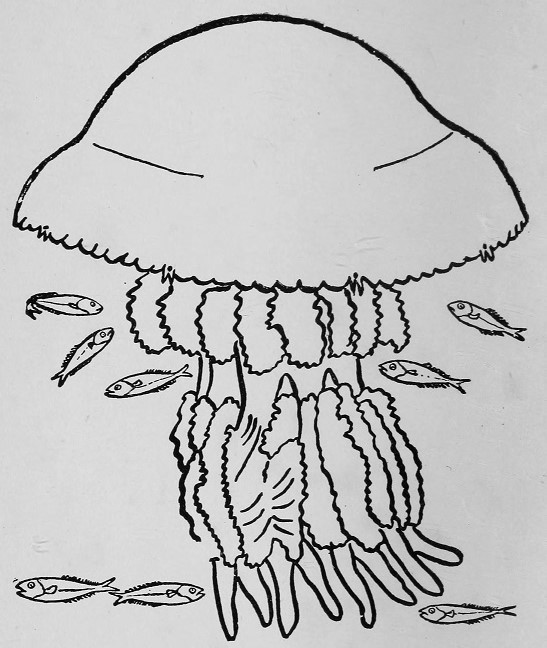
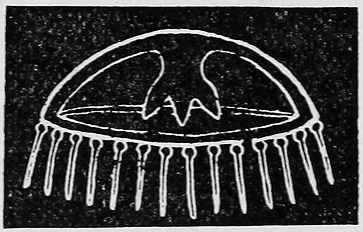
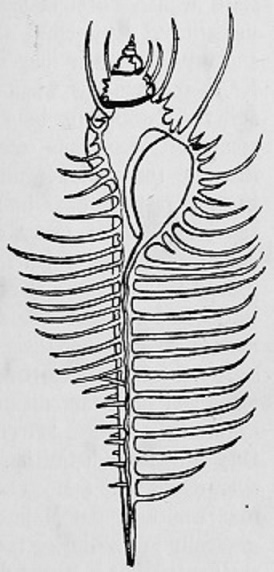
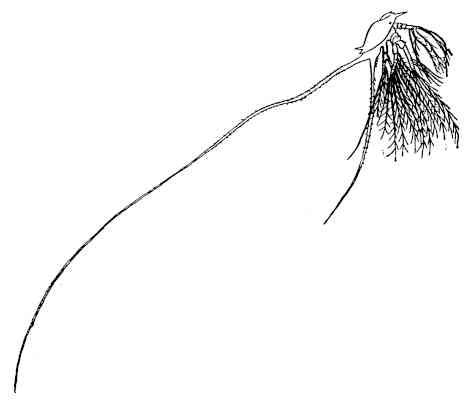
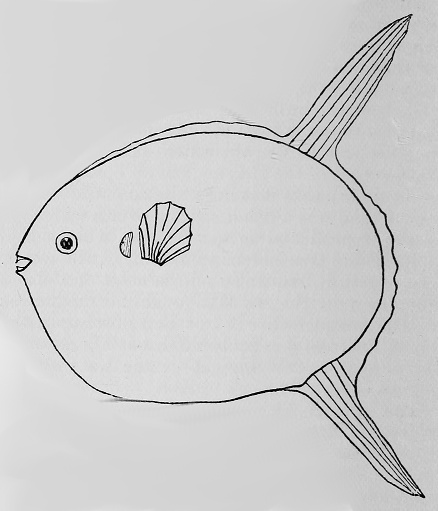
Frontispiece. A Jelly-fish with the fry of the Horse-mackerel
(The fish have been relatively very much enlarged.)
THE STORY OF LIFE IN THE SEAS
BY
SYDNEY J. HICKSON, D.Sc., F.R.S. Professor of Zoology in the Owens College, Manchester
WITH FORTY-TWO ILLUSTRATIONS
LONDON GEORGE NEWNES, LIMITED SOUTHAMPTON STREET, STRAND 1898
OUTLINE CLASSIFICATION OF
ANIMALS MENTIONED IN THIS BOOK.
PROTOZOA
⎧ ⎨ ⎩
Foraminifers.
Radiolarians.
PORIFERA
Sponges.
CŒLENTERATA
⎧ ⎪ ⎨ ⎪ ⎩
Sea-anemones.
Corals.
Jelly-fish.
Many of the Zoophytes.
ECHINODERMA
⎧ ⎪ ⎨ ⎪ ⎩
Asteroidea
Star-fishes.
Echinoidea
Sea-urchins.
Crinoidea
Sea-lilies.
Holothuroidea
Trepangs.
PLATYELMIA
Flukes, Tape-worms, Planarians.
CHÆTOPODA
Segmented Worms and Gephyreans.
ARTHROPODA
⎧ ⎪ ⎪ ⎨ ⎪ ⎪ ⎩
Crustacea
⎧ ⎪ ⎨ ⎪ ⎩
Copepods.
Barnacles.
Shrimps.
Crabs.
Insecta
Halobates, &c.
MOLLUSCA
⎧ ⎪ ⎪ ⎨ ⎪ ⎪ ⎩
Lamelli branchiata
Bivalves.
Gastropoda
Whelks, &c., and Pteropods.
Cephalopoda
Octopuses, Cuttlefishes, &c.
TUNICATA
Sea-squirts, Salps, Pyrosoma.
VERTEBRATA
⎧ ⎪ ⎪ ⎪ ⎨ ⎪ ⎪ ⎪ ⎩
Pisces
Fish.
Amphibia
Frogs.
Reptilia
Turtles, Crocodiles, Snakes.
Aves
Birds.
Mammalia
⎧ ⎪ ⎨ ⎪ ⎩
Whales, Porpoises.
Seals,
and the terrestrial Mammals.
PREFACE.
The story of the life of animals and plants in
the sea is one with so many aspects, that it is
difficult to choose the points that may be included,
and those that may be omitted from a book intended
for the general reader. To some the
story of the food Fishes and the Whales is of
the greatest interest; to others the beautiful
shapes and colours of shells have a predominating
fascination; and to those who have devoted
themselves to geological study, the history of
the animals that contribute to the formation of
the reefs and the ocean-bed present features of
special attraction. To many, then, the perusal
of my book must lead to disappointment as no
one of these aspects has been treated adequately;
but if some new interest is awakened, some new
train of thought quickened into life, one of the
objects I had in view will have been gained.
The book is only intended to be a sketch of
some of the most important lines of scientific
researches which are now being pursued by
zoologists in many parts of the world. Discoveries,
which are of the deepest interest to
all intelligent minds, are in many cases described
in books and periodicals that do not come within
the reach of the general public. I have tried,
therefore, to collect some of them into a small
compass and describe them in language which
I trust will be intelligible to those who have
not been trained in the alphabet of zoological
technicalities. The use of some long words was
unavoidable, but I have endeavoured to explain
them adequately either in the text or in the
index.
Some of the illustrations have been copied
from the works of other Naturalists, and the
sources from which they came are acknowledged
in the list of illustrations; but the majority of
them have been drawn, specially for this work,
from specimens from the Manchester Museum
or my own collections.
One of the most important facts that has been
established by modern investigations of the Sea
is that there is no region in its vast extent that
is entirely devoid of animal life. The surface
waters in the Equatorial calms and the ice-cold
waters between the ice-bergs of the Arctic
regions are densely populated by animals, large
and small; the heavy and heated waters of the
Mediterranean and Red Seas, and the cold and
comparatively fresh waters of the Norwegian
fjords, the shallow waters of the coasts and the
greatest depths of the ocean-beds all present us
with their characteristic forms of living creatures.
There is no Azoic region known to us. Wherever
we use the trawl or dredge we may expect to
find some representatives of the various classes
of marine animals. But the seas exhibit so many
varying conditions that, as we might have expected,
the animals that characterise one region
are absent from another; and while, in some
places animal life is abundant, in others it is
very scarce; just as on land we find the grass-lands
and forests teeming with life, and the
great deserts and mountain tops inhabited only
by a few solitary Lizards, Birds or Insects.
In order that we may fully understand, then,
the nature of the problems concerning the distribution
of animals through the seas, it is of
importance to consider first the conditions under
which they must live in the different parts of
the ocean. A knowledge of geography is clearly
necessary for those who study the distribution of
terrestrial and aërial animals, and equally necessary
is it for those who wish to learn something
about the distribution of the aquatic animals, to
consider first of all the rudimentary principles of
hydrography. The principal Sea areas of our
globe may be roughly divided into two groups:
namely, the great oceans—the Atlantic, Pacific
and Indian Oceans—and the Inland seas, which
are partly enclosed by land, such as the German
Ocean, the Mediterranean Sea, and the Red Sea.
Taking the areas of the great oceans and the seas
together, we find that no less than 141 millions
of square miles, or nearly three-quarters of the
surface of the globe, are covered with water.
Moreover, these great areas are continuous, so
that it would be possible for an animal, other
conditions being favourable, to pass from any
one sea, such as the Black Sea, to any other,
such as the Hudson’s Bay, without leaving the
water,—an important fact in the consideration of
the distribution of marine forms of life.
The depth of the sea varies very considerably
in the different parts of the world. In the inland
seas the water is comparatively shallow, but in
the great oceans it is very deep. In the middle
of the North Sea, for example, we should not
expect to find a depth much exceeding 250
fathoms, but in the Atlantic or Pacific Oceans
we have to pay out more than 2000 fathoms of
the sounding-line before the bottom is reached.
In some parts of the ocean-basins a few very
deep holes or furrows may be found in which
the depth exceeds 4000 fathoms, or 24,000 feet.
One of these deep holes occurs in the Atlantic
Ocean, a little to the North of the Virgin Islands
in the West Indies, and there is another in the
Pacific Ocean close to the coast of Japan; but
the greatest depth that has yet been found is
one recently discovered by H.M.S. “Penguin” off
the coast of New Zealand of over 5000 fathoms.
Apart, however, from the fact that these very
great depths are only of local occurrence, the
areas of deep water—that is, of more than 2000
fathoms—are so much greater than the areas of
shallow water, that when we make a calculation
of the average depth of the sea we find it is no
less than 2100 fathoms, or 12,600 feet.
The temperature of the sea is another feature
which undoubtedly influences very greatly the
character of its Fauna. The main source of the
heat of the sea is the sun—for the heat derived
from submarine volcanoes must be comparatively
so small that we may omit it from consideration.
Consequently we find that in the Equatorial
regions the surface waters of the ocean are
warmer than they are in the Temperate regions.
These, again, are warmer than in the Arctic
circles. But water is well-known to be a bad
conductor of heat, and therefore the direct influence
of the sun affects only the most superficial
layers. In the Equatorial region of the Pacific
Ocean, for example, the surface temperature is
sometimes as high as 80° Fahr., at 100 fathoms
from the surface it is only 60°, at 400 fathoms
only 45°, and at 1000 fathoms only a few degrees
above freezing point. On the land the temperature
falls as we pass from the coast to the
high plateaux and mountains, and we find snow-capped
mountains in Central Africa just as in
Switzerland or Norway. In the sea the temperature
falls as the thermometer is sent deeper
from the surface. Just as on the land the snow
line of the mountains is reached at high altitudes
in the Tropics, at lower altitudes in the Temperate
regions, and in the Arctic circle at the
level of the sea, so in the sea the cold water that
is found 500 fathoms below the surface in the
Tropics, reaches a higher level in the Temperate
regions, and is at the surface in the Arctic
circle.
There is however one important point of difference
between the distribution of these low
temperatures on the land and in the oceans, in
that they are broken in the former, and continuous
in the latter. If we were to imagine an aquatic
animal that could only live in temperatures
below 35° Fahr., it would be able to travel
below the surface from one pole to the other, or
from one ocean to another; but it would be
impossible for a terrestrial animal, exhibiting
the same peculiarity, to leave the Arctic circle
or the Alpine region without traversing lands
where the temperature is higher than that which
is necessary for its existence. It might be supposed
from what has just been said that the
temperature of the water at the bottom is constant
for the same number of fathoms of depth.
This is not, however, the case. The temperature
of the sea-bottom of the great ocean-beds is
approximately the same, varying from 28° F.
in the Atlantic to 35° F. in the Pacific; but in
places where main basins occur, surrounded on
all sides by shallower ridges, the temperature
of the bottom of the basin is the same as that of
the lowest ridge. For instance, the temperature
of the bottom of the Sulu Sea, lying between
Borneo and the Philippines, is 40° F. at a depth
of over 2000 fathoms. Again, the temperature
of the Red Sea is as high as 70° F., although
depths of 1200 fathoms occur in its central
portions; and this is the same as the temperature
at the Straits of Babel Mandeb, which are
200 fathoms deep, and form the only outlet to
the open ocean. These facts probably cause
considerable modification in the character of the
animals inhabiting such enclosed basins, but
further investigations are needed before we can
arrive at any very definite conclusions in the
matter.
Another important element that must be taken
into consideration in studying the environment
of marine animals, is the quantity and character
of the salts held in solution by the sea-water. In
the first place we must remember that the sea-water
normally contains a far greater percentage
of salts in solution than the water of rivers and
lakes, and this causes it to be very much heavier.
If a tumbler be half filled with sea-water, upon
which some fresh water is slowly and carefully
poured, there will be for some time very
little mixture of the two fluids, the heavier
sea-water remaining at the bottom, and the
lighter fresh water at the surface. Now the
density of the sea-water, or in other words the
amount of salts in solution, is not the same over
the whole world, and the differences that may
be observed in this respect are due, in most
cases, to the simple physical principle just
enunciated. If we could imagine a river pouring
its waters into a perfectly calm, tideless sea, we
should be able to trace the fresh river water far
away from the coast, for it would simply float on
the heavier sea-water without mixing with it to
any appreciable extent. In most cases, however,
the tidal-waves, rushing up and down the river
estuaries, stir up the fresh and salt water together,
and cause a very considerable mixture,
so that the water becomes either distinctly salt
or brackish. Where very large quantities of
fresh water are poured into the ocean, as, for
example, at the mouth of the Amazon or the
Mississippi, the surface water remains so fresh
that the salt taste can hardly be appreciated at
a distance of some miles from the coast. This
fact sufficiently indicates the influence of great
rivers upon the density or saltness of the sea-water
in their neighbourhood, and the reader
will be prepared for the statement that many
inland seas, such as the Black Sea, are appreciably
less salt than the great oceans.
Again, the ocean water itself is not of the same
density in all latitudes. In regions where there
is a copious rainfall and the sea is not frequently
disturbed by severe storms, the rain takes some
time to mix with the heavier salt water on which
it falls, and consequently there may always be
discovered in these localities a thin stratum of
comparatively fresh water on the surface of the
ocean. In some inland seas where there is considerable
evaporation and a slight rainfall, as for
example, the Red Sea and the Mediterranean, the
sea-water reaches an even higher degree of concentration
than it does in the open ocean. The
following table will serve to illustrate these
facts:—
Density of rain-water, 1·00.
Density of the Black Sea surface, below 1·025.
Density of the Atlantic Ocean surface (west of the Canaries), 1·0275.
Density of the Mediterranean Sea, over 1·028.
Density of the Red Sea, 1·030.
Density of the bottom water of the Atlantic, 1·029 (west of the Canaries).
That the rate of movement of the water influences
very largely the character of the animals
that live in it, is a fact that it is not necessary to
discuss fully in this place; but as it is undoubtedly
one of the factors which must be taken into consideration
in discussing the character and possible
origin of the Fauna of any particular region,
a brief survey must be given of some of the
principal causes of the movements of the water
and the characters of the tides and currents which
are manifest in the sea. Twice every twenty-four
hours the water of the sea rises and falls.
This movement is due to the attracting influences
of the sun and moon, and is, as is well-known,
greater when the moon is full and when it is new
than at the intermediate times. If the distribution
of land and water on the surface of our globe
were different, and a free waterway occurred
round the world, right in the Equatorial band we
should probably find a double tidal-wave rushing
round the earth every twenty-four hours.
As it is, however, the great tidal-wave is checked
by the continents, and as it approaches the coasts
is retarded and diminished in force. In Archipelagoes
and along broken coast lines the tidal-waves
produce true surface currents, which frequently
run with great rapidity and exert considerable
corroding action upon the rocks. In
many estuaries and bays the tide rushes in with
such force that the water is heaped up to a great
height against the land. At the entrance to the
Bay of Fundy, for example, the rise at spring-tides
is no less than 70 feet, and at the Cardiff
docks the difference of level between high and
low spring-tides is 42 feet. The tumultuous ebb
and flow of such masses of water along the coast
is fatal to some forms of animal life and favourable
to others, and so to some extent it modifies
the character of the Fauna.
In addition to the surface currents of the
coast, produced by the tidal-waves, there are
also the true ocean-currents, which must be
briefly considered. They are caused by the
winds which blow constantly in a definite direction
across the oceans. The prevailing winds
not only raise the sea into waves, but drive the
superficial layers of the water over the subjacent
layers in one direction. In studying a map of
the great ocean-currents, we notice a well-marked
one lying to the North of the Equator in both
the Atlantic and Pacific. This flows from East
to West and follows very closely the lines of the
prevailing winds in that region. Similarly in
the temperate regions of the Southern Hemisphere
there is an ocean-current, flowing however
in this case in the opposite direction—from West
to East—and so corresponding with the trade-winds
of that part of the world. The well-known
Gulf-stream of the North Atlantic, although
modified in some respects by other more complicated
causes, also follows for part of its course
the general direction of the prevailing winds.
The currents just described are surface currents
only, and do not affect to any great extent the
mass of the subjacent waters in the ocean-basins.
It is difficult to estimate the depth to which their
influence reaches, but it is not probable that it
extends more than 200 fathoms below the surface.
In addition to these, there is also a series of slow
currents in the deep waters flowing in definite
directions. In the Tropical regions the waters
are constantly being heated by the sun, and
passed away by the trade-winds to the North
and South and ultimately towards the poles.
In their long and complicated journey they are
gradually cooled down until, in the regions of
the ice-bergs, they reach a temperature just
above the freezing point of sea-water. Here the
water, being colder and therefore heavier than
that of the other regions of the world, sinks to
the bottom, and gradually returns in a deep-seated
mass towards the Equator, where, welling
up from the bottom, it replaces the heated layers
of the surface. It is almost impossible to determine
with accuracy the rapidity and exact
direction of these deep-sea-currents. It is extremely
probable that they are immensely
modified by the irregularities of the bottom and
the outline of the coast banks, but their exact
topography must remain for the present one of
the secrets of the abyss that are not revealed to
us. All that can be said is, that the warm
surface water which passes from the Tropics
towards the North and South is replaced by
deep-seated Polar currents, which account for
the extremely cold water that is found at great
depths in the ocean-basins, and also for some of
the peculiarities of the marine Fauna, which will
be referred to later on.
The character of the sea-bottom in various
parts of the world must be referred to before
passing on, for there can be little doubt of the
important effect it has upon the Fauna. In the
neighbourhood of continents the bottom of the
sea varies very considerably. The great rivers
bring with them in suspension the products of
the wear and tear of mountains and valleys; the
coast line, washed by the continuous ebb and flow
of the tides, contributes some of its substance to
the formation of the sea-bottom; and the countless
millions of animals and plants of the shallow
waters leave their skeletons and shells as they
die to form an integral part of the floor of the
ocean.
Thus the sea-bottom in the neighbourhood
of the land is formed partly by terrigenous
deposits, varying of course in character with the
geological nature of the land itself, and partly
by the animal and vegetable deposits of the
coast. In some cases the deposits brought by
the rivers can be traced in the sea-bottom for
a very great distance from the coast. The
characteristic mud of the Congo river can be
traced 600 miles from its mouth, and it is said
that the Arabian Sea and the Bay of Bengal are
carpeted for 1000 miles by the mud brought
down by the Ganges and the Indus. Leaving
out of consideration, however, for the moment
the exceptional cases of such large rivers as these,
we may say that the influence of the land
deposits upon the character of the sea-bottom
extends to a distance seawards of about 250
miles. If we had a complete and careful survey
of all the coast lines, it would be possible for
us to draw a line round the great continents
marking the limit of the deposits of river and
coast mud. This line has been called the mud-line
by Mr John Murray, and, as he has clearly
pointed out, it is characterised by an abundant
and extremely interesting Fauna.
The sea-bottom, then, within the limits of the
mud-line, is very largely composed of deposits
from the land brought down by the rivers. In
some volcanic regions of the world this is, to a
great extent, augmented by lava and water-logged
pumice, and in other districts by the mud and
stones dropped by the melting ice-bergs. The
influence of animals and plants upon the formation
of the sea-bottom is often very great indeed
in shallow water, though it varies considerably
in different parts of the world. In the neighbourhood
of the British coast, for example, the sea-bottom
is, in many places, carpeted with the
calcareous Sea-weed, Lithothamnion,—in other
places the dredge will come up crammed full of
bivalve shells. But such instances as these in
which the floor of the sea is covered with animal
or vegetable shells, are comparatively rare and of
small extent in the neighbourhood of land in the
Temperate regions, and in nearly all localities the
true terrigenous deposits can be readily obtained
by the use of a small meshed dredge. In the
warmer regions of the world, however, the sea-bottom
in the shallow water is over great areas
completely covered by animal and vegetable
products. In the West Indies, and in some
parts of the Eastern coasts of Tropical America,
in the Eastern Archipelago and the coast of
East Africa and its islands, Coral-reefs are found.
These are entirely built up of the skeletons and
shells of animals, and a few Coralline Algæ. In
the vicinity of these reefs the floor of the sea
is for miles carpeted with the broken-down
skeletons of these animals, sometimes in the
form of a fine coralline sand, sometimes of large
lumps studded with knolls of living Corals,
Molluscs, Sea-urchins, and other creatures. We
find, therefore, in the warmer regions of the
world immense areas of shallow water in which
the terrigenous deposits take but a very small
part in the formation of the sea-bottom, animal
and vegetable life being so vigorous and active
as to be able to form enough shells and skeletons
to cover every available part of its surface.
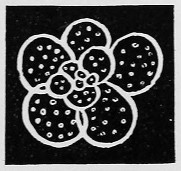
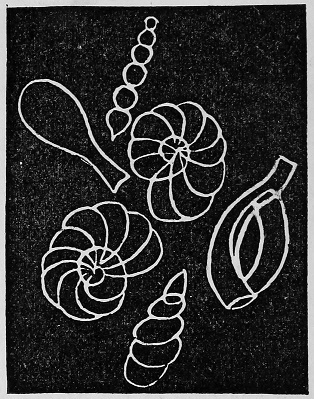
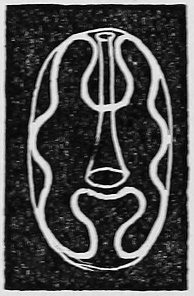
Fig. 1 Globigerina Shell from a deep-sea ooze.
Far away from continental lands, and at great
depths, the character of the sea-bottom completely
changes. At a distance of 100 miles
from the coasts of America or Europe, for example,
the land deposits have already found
their resting-place, and the animal life in the
depths of the Atlantic is poor in skeleton-forming
genera. However, the surface waters
of the ocean teem with creatures of all sorts
which, as they die, drop down
their skeletons and shells in a
gentle shower to form a fine deposit on the bottom.
When we get beyond the mud-line,
then, and use the dredging or
sounding apparatus in depths
of 1500 to 2500 fathoms, we
find that the bottom is largely
composed of the shells of such
surface animals as the Pteropods
and Globigerinas, and according to the
relative abundance of these forms it is called
Pteropod Ooze or Globigerina Ooze. In still
greater depths than these the character of the
bottom again changes, and we find a deposit
which is commonly known as the Red clay. The
explanation of this change of character depends
upon the fact that sea-water exercises a slightly
solvent action upon carbonate of lime, and the
shells of the Globigerinas and other forms are, in
seas of a depth of over 2500 fathoms, dissolved
before they can reach the bottom. The only
shells that can survive this long journey are the
siliceous shells of the Diatoms and Radiolarians,
and in those parts of the ocean where these
organisms live in abundance their empty shells
form an important percentage of the composition
of the Red clay. Over a very considerable area
of the Pacific Ocean, however, the Red clay contains
only a minute proportion of these shells,
and its composition has given rise to a good deal
of discussion among the authorities. It may be
considered to be a conglomerate of the horny
fragments of dead surface-living animals, of
volcanic and meteoric dust, and of small pieces
of water-logged pumice-stone.
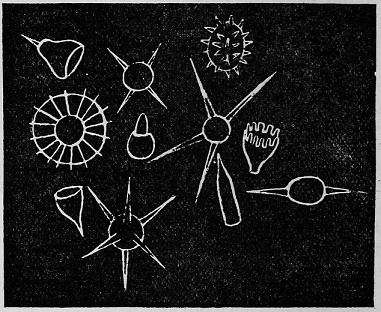
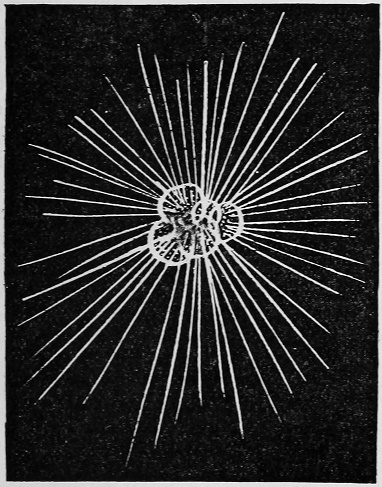
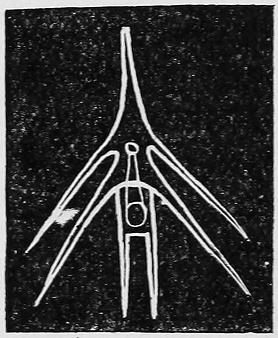
Fig. 2 Radiolarian Shells from a deep-sea deposit.
In some of the very deep holes of the Pacific
Ocean the mud is almost entirely composed of
Radiolarian shells, and is then called “Radiolarian
ooze”: and in the Southern Sea a mud
called Diatom ooze has been found, which consists
principally of the siliceous shells of these
minute algæ. Notwithstanding these varieties
of the mud, and others that space does not allow
me to refer to at length, we may suppose that
if the floor of any one of the great oceans were
exposed it would have the appearance to a
traveller of a vast desert-like expanse, without
a stone, a rock, or a cliff to vary the monotony
of the scene. At one time it was supposed to
be an absolute plain, without any important
change of level from the mud-line of one continental
coast to the other; but the result of
modern submarine explorations has been to prove
that in all the great ocean-basins, hills and ridges,
as well as troughs and deep holes occur, which
break the monotony of the generally smooth and
level character of the bottom.
CHAPTER II. SHALLOW WATER FAUNA.
Having considered thus briefly the general conditions
under which the animals of the sea must
live, we may now consider more in detail the
special conditions of shallow water life.
In water of only a few fathoms in depth, the
direct light of the sun is capable of reaching and
influencing all living things that occur, either at
the bottom, at the surface, or in the intermediate
waters. Great as the influence of direct sunlight
must be upon animals, it is even greater upon
plants. Nearly all the Sea-weeds are, like the
plants of the dry land, dependent upon carbonic
acid gas dissolved in the water for one of the
most important constituents of their food, but it
can only be absorbed by the plant in the presence
of sunlight. It is possible, therefore, for Sea-weeds
to flourish in the shallow waters of the sea,
while they are necessarily absent from the deeper
and darker regions to which the rays of the
sun cannot penetrate. Everyone knows that in
the shallow waters of our own coast there is in
many places a dense tangle of Wracks and long,
flat ribbon-like Sea-weeds growing on the bottom,
and that on and amongst these weeds a rich
harvest of animals awaits the eager shore collector.
It is true that there are vast fields of
sand on which the Sea-weeds are few and far
between, but we may say that wherever they
can obtain a secure foothold in the shallow waters
of the British coast there they will grow and
multiply in great profusion. We must not, however,
jump too hastily to the conclusion that the
same is true for all parts of the world. The
British coasts are particularly rich in Sea-weeds,
in fact a distinguished botanist once said that
they probably present us with the greatest
number of genera and species of any coast line
of the same extent in the world. In the Temperate
regions of both the Southern and Northern
Hemispheres there is generally a rich Sea-weed
flora, but in the warmer regions it is less luxuriant,
and on the Coral-reefs of the Tropical
seas it is remarkably poor.
Turning our attention for the present to the
Temperate regions, let us consider the influence
that the Sea-weeds have upon the animals of the
shallow waters. In the first place we find that
they afford shelter and
support for a large number
of animals which could
hardly live without them. In
the roots of the weeds may be
found little Crabs and Molluscs,
which occur nowhere else; and
clinging to the long waving
branches are many forms of Sea-anemones,
Zoophytes, flattened
limpet-like Molluscs, Ascidians,
and other forms of animal
life. The great forests of
weeds are also the haunts
of many queer Fish,
Prawns, Crabs, and Sea-slugs,
which hunt their prey or
hide from their enemies amidst
the shelter of the stems and
branches.
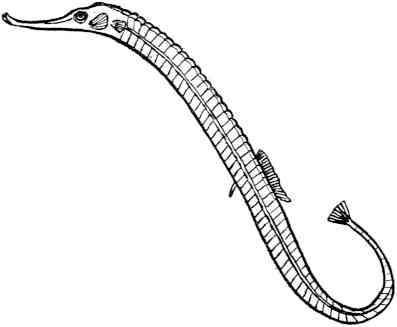
Fig. 3 The common Pipe-fish.
Now many of these animals,
which together make up the
Fauna of the Sea-weed region, have assumed,
in the course of the ages of evolution, not
only the colours of the Algæ on which they
live, but in some cases even forms which render
them at first sight more like plants than animals.
The slender Pipe-fish, for example, which is not
uncommonly found amongst the bright green
Sea-weeds of our coast, is wonderfully similar,
both in form and colour, to the weeds on which
it lives. The Sea-horses, which have such a
curious form out of the water, in their natural
surrounding resemble the weeds so closely that
they may be easily overlooked. A still more
remarkable example is to be found in the
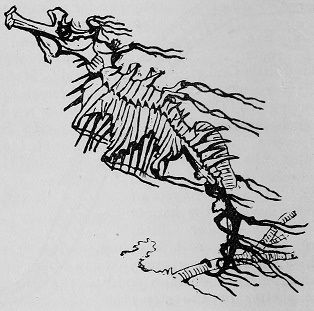
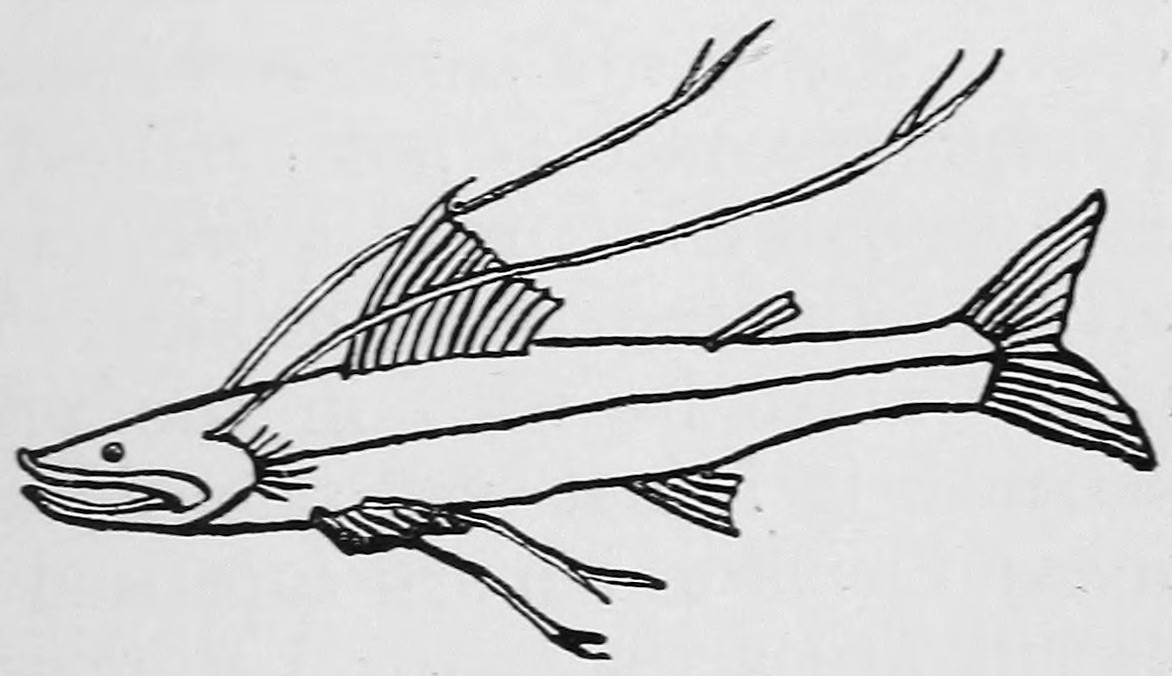
curious fish Phyllopteryx, in which the body
is provided with long branched processes, making
it we may suppose much more difficult
to distinguish in its natural haunts than even
the Pipe-fish or Sea-horse.
Fig. 4 Phyllopteryx.
Many other examples to illustrate this feature
of the Sea-weed Fauna could be quoted, but
sufficient has been said at present if we have
indicated to the reader the manner in which, by
the indirect influence of light, the form and
colour of animals may be modified for their life
among the marine plants. The presence of light,
however, modifies directly the character of the
animals themselves in many respects.
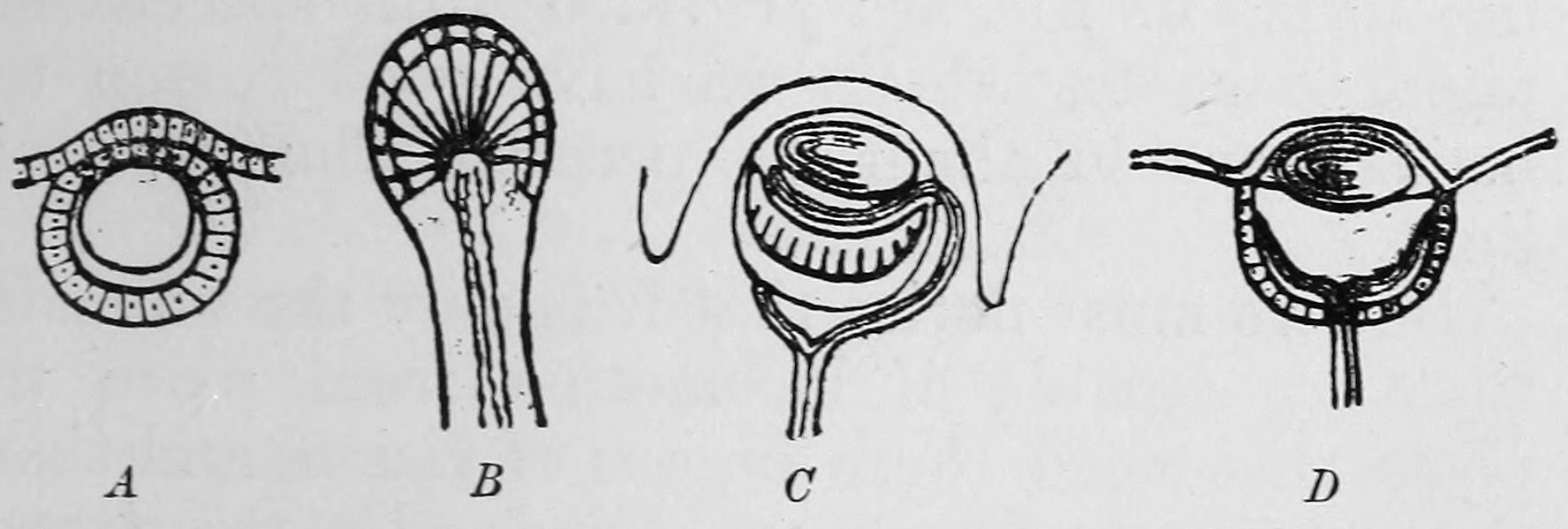
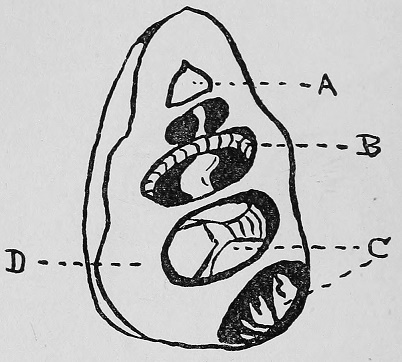
Fig. 5 Diagrams of Eyes of A Whelk, B Lobster,
C Scallop, D Fish.
The statement that many of the animals of
the shallow water are provided with eyes because
there is light is, when carefully examined, found
to be strictly true, however anomalous it may
seem to be. There must have been light in the
shallow waters of the sea when the first primordial
forms of life made their appearance, and
it was this light which, step by step, led to the
evolution of the most complicated and perfect
forms of eye from the simplest pigment spot of
the Protozoan to the eye of the Lobster and the
Fish. We may say that all animals that freely
swim in the shallow waters or that crawl and
creep on the rocks and sands at the bottom are
provided with eyes. The Fish are provided with
a pair of eyes which present us with the same
general features that we find in the other Vertebrates.
Lobsters, Crabs and Prawns have each
a pair of stalked eyes, which are probably as
perfect in their functions as the Vertebrate
eye, although built up on an entirely different
model. Whelks, Winkles, and other Gastropods,
although so slow in their movements, have each,
upon or close to their tentacles, a pair of minute
eyes, which are much simpler and probably far
less perfect in form than the eyes of their more
highly organised neighbours. Even the little
Jelly-fish, Star-fish, Sea-urchins, and other creeping
forms of life, are provided with specialised
pigment spots, which we have good reason to
believe enable them to perceive the rays of
light.
But we must notice that it is only the animals
that are capable of locomotion from place to
place that need these organs of vision, and that
the stationary forms are blind. In the large
class of the Lamellibranchs, for example, to which
the Oyster and the Mussel belong, we find that
with a few exceptions there are no eyes. These
animals, after the first few stages of their life
are past, settle down into the sand, or fasten on
to a rock and remain there until their life is
done. Their food, consisting of the minutest
specks of animal and vegetable life, is brought
to them by the sea-currents; they do not need
nor desire to seek the society of their relations,
and when their enemies approach they resign
themselves almost without an effort to the inevitable.
To such animals eyes would be useless,
and so nature has withheld them.
There are, however, a few Lamellibranchs
that possess good eyes, eyes that are almost
as complicated in their structure as the Vertebrate
eye; and not a single pair only, but sixty,
eighty, a hundred, or even more, may be found
on a single individual. Such a Lamellibranch is
the common Scallop which may be seen in many
of our fishmongers’ shops. Unlike most of the
group, this animal is able to make long flights
through the water by the flapping together of its
shells, and there can be no doubt that on the
approach of danger it uses this method of locomotion
for escape. One of its most deadly
enemies is the Star-fish, which forces the shells
apart and sucks out the flesh by means of its
protrusible stomach. When a Star-fish is placed
in an aquarium in which there are some Scallops,
lying, as they do, on their sides, with the valves
slightly open, showing the double row of gleaming
metallic eyes on the margin of the mantle,
the Star-fish immediately moves, with what in
such an animal may be considered extraordinary
rapidity, straight in the direction of the Scallop.
Before, however, it reaches its prey, the coveted
victim gives four or five vigorous flaps of its
shells and swims away to another part of the
tank. This suggests that the eyes of the Scallop
are used in the light as a means of giving warning
of the approach of an enemy, and they are
found in the Scallops only, among common
British bivalves, because they alone possess
this power of swimming away. Of course if
there were no light in the water the eyes would
be useless, and it is an interesting fact that the
Scallops which live in the darkness of the great
depths of the ocean are quite blind.
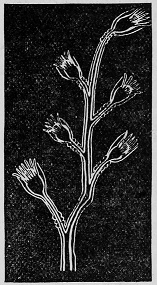
Fig. 6 A branch of the Zoophyte Obelia.
Very interesting examples of the connection
between the presence of eyes and the power of
locomotion are found among the sedentary or
fixed forms of life. The great class of Sea-squirts
or Tunicates includes a number of genera, most
of which are, in the adult
condition, immoveably
fixed to the bottom, and
in that stage have no
eyes; but the eggs which
they produce give rise to
little creatures, like tad-poles
in form, which swim
about freely in the water.
Each of these tad-poles
has a large eye in its
brain, which remains so
long as the animal leads
a free life. As soon, however,
as it settles down
upon the rock which is
to become its permanent
resting-place through life,
the eye and the organ of
locomotion, the tail, both
degenerate and ultimately disappear. Again,
we often find upon rocks, Sea-weed, old shells,
and the like, some curious delicate branching
organisms called Zoophytes. Notwithstanding
their general resemblance in form to Sea-weeds,
these Zoophytes are known to be animals.
Each tuft or branch is formed by a number of
delicate little Polyps, each with a crown of
tentacles round a terminal mouth. The Polyp
cannot move away from the branch it grows
upon, nor the branch from the stem, nor the
stem from the rock on which it rests, and none
of these minute creatures are provided with
eyes. There are, however, a few Zoophytes that
give rise to buds, which grow into the form of
minute Jelly-fish (or Medusæ, as they are called);
and these, becoming detached from the parents,
swim away and lead an independent existence.
These Medusæ are in many cases provided with
simple little eyes. During
their short life they are
drifted away by the sea-currents
to some distance
from their parents, and produce
a number of eggs which
are capable of developing
into a new fixed colony of
Polyps.
Fig. 7 Medusa produced by Obelia.
We may consider it one of the maxims of
Science that in a population of animals which
possess eyes, colour as well as form is of extreme
importance. As well as the alteration in form
that takes place in the animals living among
Sea-weeds, we find a modification in colour in the
creatures dwelling among rocks or on the sand,
so that they may resemble the ground on which
they live. No more striking example of this
could be found than in the common Shrimps of
our coasts. Anyone who has watched them in
the sea-pools must have been struck with their
close resemblance to the sand. In fact it is only
by close observation that they can be distinguished
from it. In an aquarium, too, it may
be observed how very much the upper sides of
Soles, Flounders, Turbots and other flat fishes
are like the sand in colour, while the under sides
are almost invariably pure white. The black
colour of the Lobsters, speckled and striped with
blue, has a close resemblance to the holes and
crannies of the rocks among which they live.
The bright transparent green Prawns are almost
invisible as they move about among the Sea-weeds,
and Sea-slugs assume all manner of beautiful
colours according to the ground on which they
feed.
On the Coral-reefs of the warmer regions of
the world the pools that are left when the tide
goes down are characterised by their brilliancy
of colour. The bright purple, green, and yellow
tips of the Coral branches, the red and bright
green Sponges, and the white pieces of dead and
broken Corals make up a scene of beauty which
can only be compared with a bed of variegated
flowers. Here the Fish, Prawns, and other moving
animals have assumed the most gorgeous colours
in patterns of spots and stripes which verily
astonish the naturalist when he sees them for
the first time. The great Sea-perches, with their
sides covered with bright red or brown blotches,
the curious Trigger-fish, with bright red, blue, or
yellow bands crossing their bodies, the banded
Lobsters, and the spotted Cuttlefishes, strange
and conspicuous as they may seem when they
are taken out of the water, are in life but in
harmony with their surroundings, and, in reality,
less conspicuous than they would be if less
brilliantly arrayed.
I remember on one occasion as I was watching
some expanded Polyps in a little shore pool in
the Tropics, I noticed something suddenly move
close to the coral block on which I was standing.
As there was no escape from the little pool, nor
any holes in which the creature could hide
itself from my observation, I searched with
diligence to find it again, but for a long time
without avail. Suddenly it moved again, and
then I saw, resting on the brilliantly coloured
corals, a remarkable little Shrimp called by
zoologists Stenopus. Its body, which was almost
transparent, was marked by a number of
bands of a bright red colour, it had enormously
long antennæ similarly banded, and its legs and
body were covered with short red-tipped spines.
When I succeeded in safely landing it in my
collecting bottle I felt perfectly astonished that I
had been so baffled by such a lovely little jewel,
so bright, so strange, and so generally conspicuous
did it then seem to be.
The colours of the animals I have referred to
hitherto may be accounted for by their need to
escape the attention of their enemies, or to avoid
detection in the pursuit of their prey; but the
animal colour problem is not yet exhausted.
The beautiful colours of the Anemones, Corals,
Sponges and many other sedentary forms of
animal life, and the marvellous patterns on the
shells of Molluscs cannot be due to these causes.
Many ingenious theories have been brought forward
to explain away the difficulty, but none of
them seem to be perfectly satisfactory, and consequently
it is unnecessary to enunciate them in
detail in this small book.
The character of the bottom of shallow water,
especially in the neighbourhood of the coasts,
presents us with so many variations that it would
be a long task to consider in detail all the different
adaptations that the animals exhibit. The
Fauna of the sand, shingle, and mud at the
mouths of rivers, of the rocks of iron-bound
coasts, and of the coral-reefs, each present us with
many curious kinds of modification of form and
structure. A brief reference to one or two
characteristic regions must be made before passing
on.
The sandy bottoms which are so prevalent,
not only upon our coasts, but in nearly all
parts of the world, invariably support a Fauna
with many curiously altered forms. In walking
across the sands at low water we may have often
noticed many worm-like and twisted columns of
sand; these are the casts of the common Lug-worm,
which is a favourite bait for many kinds
of Fish. The Lug-worm lives in a U-shaped
tube, which it forms from a slimy secretion of the
body; it feeds by swallowing the sand in which
it burrows, extracting from it as it passes through
the intestine whatever animal or vegetable food it
may contain. There can be little doubt that the
sand is a very poor form of diet, and that an
immense quantity must pass through the body
of the animal compared with its weight in order
to afford sufficient nourishment. It has been
reckoned that as many as 82,433 casts may be
found on an acre of sand where conditions are
favourable for these Worms, and that they would
weigh together nearly 2000 tons. This would
mean that the whole mass of the sand would
pass through the bodies of Lug-worms on an
average of once in every twenty-two months.
But the Lug-worm is only one of
the many forms of life that burrow
in the sand. A very large number
of bivalve Molluscs live with the
greater part of their bodies perpetually
buried. Their organisation
is such that their food and the water
that is used for respiration can be
brought to them by a tubular prolongation
of the body called the
siphon. Some of these animals live
much deeper down than others, and
while some have but feeble powers
of moving either up or down in their
burrows, others can penetrate to
great depths with extraordinary
rapidity.
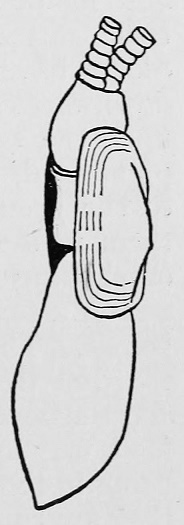
Fig. 8 A Bivalve Mollusc, showing below the
foot with which it burrows into the sand, and above the
siphons.
The shell of a Lamellibranch,
called the Razor-shell (Solen), is not
an uncommon object of the sea-shore
where stretches of sand occur. When
the animal is alive it has the power of
burrowing down so quickly that it is practically
impossible for one man to capture a specimen by
digging, when it is thoroughly alarmed. Occasionally,
however, the sea itself, when lashed into fury
by a storm, is a better digger than the Solen is a
burrower; and after a heavy storm in the Isle
of Man I have seen the shore littered with Solens
scooped out of the sand by the force of the
waves and cast up with lacerated shells to fall
an easy prey to the Seagulls.
The sandy bottoms in shallow waters are also
the haunts of many kinds of Fish that are specially
modified in form and colour to resemble
their surroundings. The large family of the
Skates have their bodies compressed from above
downwards so that they can lie perfectly flat
upon the sand. Their upper surface is deeply
pigmented, giving them a general resemblance
to the ground on which they lie; but to assist
them in escaping observation they have a habit
of shaking their fins in such a manner as to
scatter a considerable quantity of sand over their
bodies. Thus it can well be understood that in
the dim light of the sea-bottom the little Fish
and Shrimps, which form a large portion of their
food, may approach quite close to them without
being in the least aware of the danger into which
they are running. The upper side of the Skate
is also armed with a number of sharp and hard
spines, and in some forms—called the Sting-rays—one
of these, situated at the base of the tail,
is much larger than the others, and provided
with muscles so that it can be suddenly erected.
In connection with this spine there is a poison-gland
and duct. The wound that is inflicted
upon the arms or feet of the fishermen by this
formidable weapon of offence is said to be of a
very serious nature.
Some of the Skates, too, show another very
interesting modification of structure, which, however,
is not directly associated with their mode
of life, but may be briefly referred to here
whilst dealing with the family. This is the
electric organ. In the younger stages of the
common English Skate a small region of the
muscular system on each side of the base of the
tail becomes changed into an electric organ, but
the discharges which it is able to give are so
feeble that they can only be appreciated by a
galvanometer. In the Torpedo, however, the
electric organs are very large indeed, and situated
one on each side of the head. They can give a
shock which is powerful enough to kill small
animals and to stun larger ones. With such a
formidable weapon of offence and defence, it is
clear that the need for active movements is
considerably diminished, and the Torpedoes are
described as being exceedingly slow in progression
and incapable of the violent movements
of other Skates.
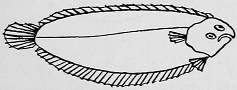
Fig. 9 The Common Sole, showing both eyes
on one side of the head.
The other Flat Fishes found on sandy bottoms
belong to a different group altogether, and are
characterised by their bony skeletons and other
features. The
Soles and their
allies do not,
like the Skates,
lie flat upon
their bellies,
but are laterally
compressed
and lie upon one side. The side which is
habitually uppermost is of the colour of the
sand, and the other almost invariably pure white.
In the course of their development the Soles
undergo very extraordinary changes in form to
reach the perfectly flattened condition of the
adult stage. These changes affect many of the
organs of the body, but perhaps the most interesting
of all is the history of the eyes. In
the young Soles, which swim almost vertically,
like the majority of fishes, there is one eye o
each side of the head, but as they grow older
and gradually take to the habit of swimming on
one side, the eye of that side sinks down into
the head, and rotating as it goes passes through
to the other side. This process naturally leads
to a considerable distortion of the skull, so that
the bones of the adult Sole show as complete a
want of symmetry as can be found in any Vertebrate.
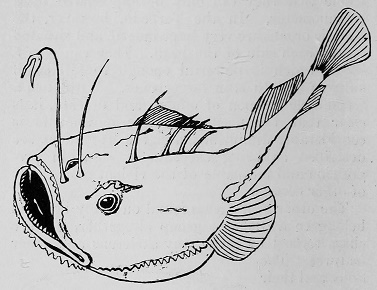
Fig. 10 The Angler.
Some of the Bony Fish, however, that live on
the sand are flattened dorso-ventrally like the
Skates. The Angler or Fishing-frog, for example,
is a Flat Fish, which is perfectly symmetrical. Like
the other Flat Fish its upper surface is coloured
in such a manner as to resemble the ground on
which it lives. Its great mouth, armed with
formidable rows of sharp-pointed teeth, is directed
upwards, and it receives its name from a curious
tentacle terminating in a brightly-coloured knob
which dangles over its mouth.
The brightly-coloured knob looks no doubt a tempting morsel
to the little Fish upon which the Angler preys,
but the greed or curiosity, whichever it may be,
that induces them to inspect the bait leads them
to the fate which follows one snap of the great
tooth-armed jaws.
The Fauna of the shallow waters where rocks
abound also possesses many peculiarities. In the
first place we must remember that the rocks,
being firm and hard, present a basis upon which
many of the sedentary forms of life that would
be swept away or smothered if they attempted
to live on the ever-shifting sands, can fix themselves.
Consequently the rocky bottom is characterised
by a rich Fauna of those groups of
animals, which, in the adult condition, are immoveably
fixed. If a large stone or a water-logged
piece of timber that has been at a depth
of a few fathoms for some months or years be
captured in the dredge and brought on board
for examination, it is sure to present the observer
with a multitude of firmly-fixed creatures.
Among them there is almost certain to be found
a number of small conical shells, made up of a
series of triangular plates, fixed to the rock by
their bases. These are commonly spoken of as
Barnacles (Balanus), and they pass through an
interesting history. For many years they were
considered, from the character of their shells,
to be allied to the Molluscs, but an examination
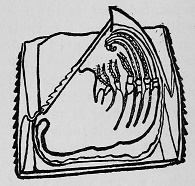
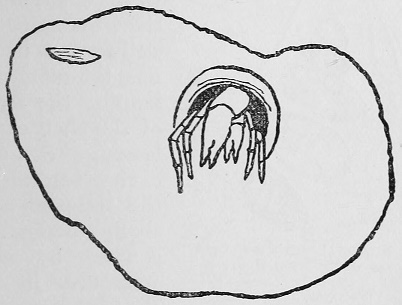
of the soft parts of the
animal shows that,
unlike any Molluscs,
they are provided with
six pairs of jointed
legs; and a still further
study of their anatomy
proves beyond a doubt
that they can no longer
be classified, with any
pretence of scientific
accuracy, with that
group.
Fig. 11 Vertical section of a Balanus, showing animal in situ in its shell.
The secret of their
true relationship was not discovered until the
story of the development was worked out, when
it was found that the eggs they discharged each
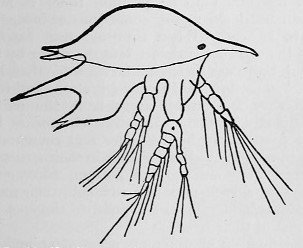
gave rise to a little larva called Nauplius, which is
provided with three pairs of legs like the larvæ of
some of the Prawns and their allies. The result
of these observations then was to prove that the
Barnacles are really Crustaceans, notwithstanding
the fact that, unlike most of that group, they
are, in the adult stage, permanently fixed to the
rocks.
On the same piece of stone there will most
probably be found several twisted or coiled tubes
of lime, formed by a little Sea-worm called
Serpula. When living in the water the head of
this worm projects from its shell and expands
a circlet of delicate tentacles, by means of which
the food is brought to the mouth. One of these
tentacles is specially modified and enlarged at
the extremity to form a conical knob, which,
when the animal is retracted into the shell, closes
the aperture like a stopper.
Fig. 12 Nauplius larva of a Balanus, enormously magnified.
Then there may be found some spherical or
lobate masses of a fleshy consistency, white, pale
pink or yellow in colour, and studded with
numerous star-shaped apertures. When these
are allowed to remain in a basin of fresh sea-water
for some time, each one of the star-like
apertures opens, and a beautiful transparent little
Polyp with eight-feathered tentacles gradually
unfolds itself, only to be slowly withdrawn into
the mass when the vessel is shaken or otherwise
disturbed. These Polyps form colonies, known
as Alcyonium digitatum.
Now it is to be noticed that none of these
three examples of the sedentary Fauna can move
in the least degree from the rock or shell to
which they are fixed. When once the young
larva has taken up its position there it must
remain until old age or some disaster brings its
life to an end. When they are first hatched
from the egg that is thrust into the water by the
parent, they pass through a larval stage that, like
the Nauplius of the Barnacle, is active and free.
Then they are carried away from the parent
stock partly by their own active movements, but
more particularly by the tides and currents of
the sea-water. At last a change in their structure
occurs. They sink to the bottom, become attached
to a rock or stone, complete their metamorphosis,
and remain anchored to the spot for
the rest of their lives.
The number of different forms of animal life
which constitutes this sedentary Fauna of rocky
coasts is very great indeed. In addition to the
Barnacles, Worms and Alcyoniums, there are
numerous species of Sea-anemones, Sponges,
Corals, Zoophytes, Sea-squirts, and other forms,
and in all these cases the eggs give rise to
free-swimming larvæ, by which the distribution of the
species is effected.
Another group of animals, which forms an
important feature of some rocky coasts, are the
Boring-molluscs. The Rock-borers belong to
many different species. Some of them, such as
the Pholases, make long cylindrical holes in
chalk, and even in harder rocks. The Teredo
is the borer, commonly known as the Ship-worm,
on account of its powers of penetrating
into timber. The long calcareous tube which
it forms as it works its way into the wood,
gives it a superficial resemblance to a large
sedentary worm, but it is in reality a bivalve
Mollusc, specially modified in structure for its
peculiar habits.
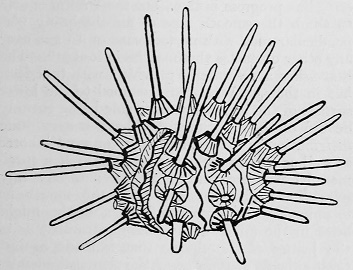
Fig. 13 Sea-urchin with large thick spines.
The next group of animals we have to consider
in the Fauna of the rocks includes all those that
slowly creep or crawl, without possessing any
powers of rapid locomotion. Amongst these
may be mentioned the Sea-urchins and Star-fishes.
The former possess spherical or heart-shaped
bodies covered with a formidable array of
spines, among which there protrude several rows
of soft transparent tubes terminating in little
cup-like discs. Some of these tubes—or tube-feet
as they are called—are fixed to a rock, and
the heavy body is slowly dragged after them;
another set is then attached, whilst the former
is released to obtain another hold a little further
on. The progress is slow, but the Urchin is able
to climb the smooth face of an absolutely perpendicular
rock with perfect ease or to get over
any other obstacles that may be in its path. The
Star-fishes are similarly provided with tube-feet,
but in their case these are confined to the lower
surface of the body, the upper side being entirely
devoid of them. Star-fishes have a very wide
distribution in the sea, and occur on sandy shores
as well as among rocks and shingles. If a specimen
be watched gliding slowly and smoothly
over the sea-bottom and then the mouth be
examined with a pocket lens, a doubt might
arise in the mind of the young naturalist as to
the justice of the charge that is made against
these animals of their being the principal enemies
of the hard-shelled Oysters. But the charge is
well founded, for if a Star-fish be placed in an
aquarium with an Oyster or a Cockle, or, in fact,
almost any bivalve Mollusc, it may be seen to
clasp its prey in its arms and slowly but firmly
and surely force open the shells, and then protrude
on to the soft parts a long tubular stomach
which gradually digests and absorbs them. The
Star-fishes, then, are undoubtedly to be reckoned
among the most voracious and destructive inhabitants
of the shallow waters, and it is probable
that the covering of spines which we find so
commonly among shallow water animals is an
adaptation to prevent or render difficult the
operations of these creatures.
The Gastropod Molluscs form another large and
important group of creeping animals of rocky
coasts. On nearly all our own coasts numerous
Periwinkles may be seen clinging to the rocks at
low tides, and if a search be made in the deeper
pools and on the rocks nearest to the low-water
marks many other species will be found of animals
with spirally-coiled shells which are included
in this group of Gastropods. The Periwinkles
on the rocks might at first sight be thought to
belong to the sedentary group of animals, but
when the water covers them again, or when they
are put into an aquarium, they may be seen to
protrude a head and an elongated slimy foot,
which, gliding over the surface of the rock, drags
the great shell and its contents with it. On the
approach of danger the foot and head are withdrawn
into the shell, and the animal rests secure
from many enemies that might otherwise have
found it a dainty morsel. Some of the Gastropods
are purely vegetable-feeders, but most of
those living in shallow sea-water feed upon
Molluscs and other animals. It might well be
a matter for wonderment when the soft head and
little mouth of a Gastropod, such as a Whelk,
are examined, that it is carnivorous and attacks
and devours animals as large as itself. But the
anatomist shows us that hidden in the recesses
of that mouth there is a ribbon beset with
numerous sharp little teeth, which by a complicated
mechanism can be worked backwards and
forwards in such a manner that it can bore a hole
through very thick and dense shells; and, the soft
parts being reached, a tube is protruded which
dissolves and sucks them up into the animal’s
stomach.
Many people must have noticed that numbers
of the bivalve shells that are cast up on the sand
at low tide are perforated close to the hinge by a
neat little round hole. This is the hole made by
some predaceous Gastropod which, having killed
its prey and devoured all that is digestible of it,
leaves its empty shells at the mercy of the waves.
Amongst the rocks numerous species of Gastropods
are found, some undoubtedly carnivorous,
others herbivorous. The many beautiful forms
and colours that their shells assume may be seen
in any good museum or conchological cabinet.
Some of them are very minute, others are provided
with a shell more than a foot in length;
some are marked with numerous coloured spots,
others with bands or lines; some have perfectly
smooth shells, others are ribbed or spiny. It
is extremely difficult to account for all these
modifications, partly because it is impossible to
study the animals alive in their natural habitats
a few fathoms below the surface of the sea, and
partly because life in the shallow waters must be
so complicated that we are at a loss to understand
the value to a species of slight modifications in
structure such as these. The difficulty that has
been found in explaining these various forms and
colours has led some naturalists to the belief that
they are of no importance to the species in the
struggle for existence, that they are, as it were,
the accidental result of some process of excretion,
and not the outcome of a long series of slight
changes, bringing about at length an adaptation
of form most suitable to the habits of the animal.
Such views are, however, to be accepted with
great caution, and most zoologists will be contented
to wait until our knowledge is much
greater than it is at present, before wholly agreeing
with them.
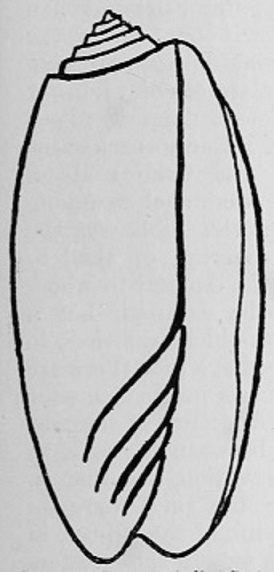
Fig. 14 Smooth-shelled Gastropod.
Fig. 15 Spiny Gastropod.
Another great class of animals which has many
representative forms among the rocks is the group
of Crustaceans. The Lobster, the Prawn and the
Crab are all familiar examples of this class.
They may be found by searching rock pools at
low-water, or can be captured in basket-work
traps in places beyond low-water mark. When
undisturbed they crawl slowly over the rocks
and weeds by their long jointed legs, searching
for their prey, but when alarmed the Lobster
and the Prawn can, by violent flapping movements
of their tails, dart rapidly backwards
through the water, while the Crab beats a
hasty retreat sideways into some shelter among
the rocks. Like many of the Molluscs, the
Crustaceans have a hard covering or shell to
protect them from many of the dangers to which
soft-bodied animals would be exposed, but a
momentary glance at them would be sufficient to
satisfy the most inexperienced eye that there are
many and important differences in the character
of the shells of these two great groups of animals.
One important distinction between them, however,
might well escape observation, and that is,
that whilst in the Mollusc the shell increases
gradually in size during the life of the animal, in
the Crustaceans it cannot do so. In the Lobsters
and Crabs the shell is periodically cast off entirely,
and for a day or two at each period the skin of
the animal is quite unprotected. A new shell is
gradually formed, and this is hardened and thickened
until it assumes a form similar to that of
the one that has been lost, but larger. During
the moult the Crustacean usually hides itself in
a hole in the rocks and waits patiently until the
new shell has grown.
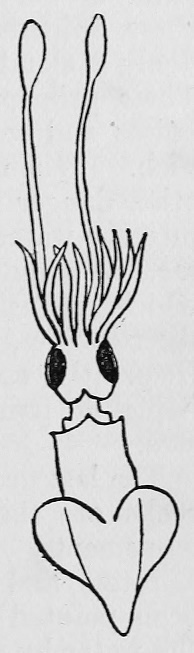
Fig. 16 A Cuttle-fish.
The animals included under the popular names
of Cuttlefishes, Squids and Octopuses are also
capable of crawling about among the rocks by
their long feeler-like arms; but they are in the
habit, as well, of making prolonged
journeys through the water, by
pumping the sea-water through a
tubular siphon situated on the
under side of their bodies. These
animals possess in such a remarkable
degree the power of changing
colour that they might be called
the Chamæleons of the sea. As
they pass slowly through the water
from one part of the coast to another
the colour of the skin changes so as
to resemble the colour of the rocks
or weeds which are below them.
These changes are brought about
by numerous little bladders in the
skin which are filled with different
coloured fluids, and are worked by
a complicated system of muscles
under the control of special nerves
from the brain. When the colour
blue is predominant, it is found that all the
bladders containing blue fluids are dilated, the
others being constricted; when the colour is red
the red bladders only are dilated, and so on;
and as the nervous response to the colour of the
rocks perceived by the eye is practically instantaneous,
the change in the general colour of
the body brought about by the dilatations of these
vesicles is extremely rapid. Many other animals
have the power of changing colour, but in no
group is the alteration more rapid and remarkable
than in this order of Cuttlefishes and Squids.
Another very interesting feature presented by
these animals is their ability to discharge suddenly
a cloud of inky substance into the water.
Their principal enemies are the Whales, Porpoises
and some of the larger Sharks and other
Fish. When these animals approach, or any
other danger is feared, the Cuttlefishes discharge
into the water from a special bag, called the ink-sac,
a quantity of black or brown pigment
which, diffusing rapidly, forms a cloud round
their bodies, in the obscurity of which they
frequently escape pursuit. The well-known
Sepia of painters is obtained from these ink-sacs.
The last group of animals occurring among the
rocks are those capable of vigorous swimming
movements. Many Crustaceans, such as the
Lobsters and Prawns, are capable, as has just
been pointed out, of swimming rapidly through
the water by means of their powerful tails. But
this swimming power is only accessory to that of
crawling or creeping, and is used merely when
the animals are disturbed. Cuttlefishes and their
allies seem to spend a considerable portion of
their time in floating or swimming in the water,
but still they do crawl about among the rocks,
and very probably attack and feed upon their
prey entirely upon the sea-bottom.
The members of the Rock-fauna which belong
to the class of Fishes very rarely rest upon the
sea-bottom at all. They are not, as a rule, provided
with limbs which are capable of crawling
or creeping; and their mouths are adapted for
catching food that is swimming, or of browsing
upon or nibbling at fixed forms of life while their
bodies are still floating in the water. Nearly all
the animals living among the rocks that we have
hitherto spoken of, have some organs or some
specialised portion of the body-wall for resting
upon or for attaching themselves to the bottom.
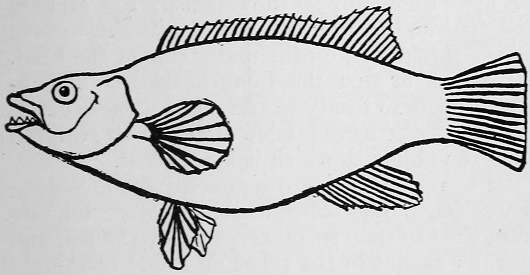
Fig. 17 The Wrasse.
The Anemones are attached by their bases; the
Sea-urchins and Star-fishes crawl by means of
their tube-feet; the Gastropod creeps over the
rocks by its broad flat foot, and the Octopus
stretches out its muscular arms and drags its
body along by the numerous suckers they bear.
In the Flat Fishes of the sandy and gravelly shores
we usually find a white under surface on which
they rest when waiting for their prey. Among
the Fish which frequent the rocks, however,
such as the Cods, the Whitings, and the Wrasse,
there are no such surfaces. The body of the
Fish is usually more rounded in form, and no
well-marked limit can be assigned to the coloured
upper surface and the pale silvery under side.
These Fish are in nearly all cases rapid and
powerful swimmers, rushing through the water
after their prey, or away from their enemies, by
vigorous lateral movements of their tails.
A curious exception to this general rule among
the Fish occurs in the family of the Lump-suckers.
These Fish are found on the English,
but more commonly on the Scottish coast, and are
distinguished by the presence of a sucker, formed
by the throat fins, on the under side of the head.
By means of this the Lump-sucker is able to
attach itself so firmly to rocks and stones that it
can only with considerable difficulty be removed
from the object to which it is attached.
Of the Fish that are commonly found among
the rocks, a very considerable number migrate
from time to time to other parts of the sea, and
may be caught in the trawl on sandy or shingly
bottom, or even in the drift nets at the surface of
the sea. A large number of Fish belonging to the
family of the Codfishes frequent the rocks during
a part of their lives. The Pollack is distinguished
from most of the others by the absence of a barbel
on the lower jaw, and is one of the persistent rock
frequenters. In the adult condition it feeds almost
entirely upon other Fish, although in the younger
stages of its life Crustaceans, Worms, and other
Invertebrates seem to form the bulk of its food.
The true Cod and the Haddock seem to have a
much wider range, occurring on shingly bottoms,
where they are frequently caught in the fishermen’s
trawls, as well as in the neighbourhood of
rocks. The Hake feeds principally upon Pilchard,
Herrings and Sprats near the surface of
the sea.
It is an interesting fact that the Fish belonging
to this one family have very different methods of
feeding. The Cod and the Pollack both hunt
their prey principally by day-light. The Pollack
is guided by its sight alone, the Cod-fish is assisted
by its barbel, which acts as a delicate feeler or
organ of touch. The Hake, on the other hand, retires
into deep water during the day-time, and only
comes to the surface at night to feed. Similarly
the Rockling hides away in holes or under stones
during the day-time, and only comes out to hunt
for the Crustaceans and little Fish upon which it
feeds at night.
The development of these Fish presents some
features of interest, as showing us the changes
which occur in habit during their life-history.
The eggs of the Cod are buoyant, rising to the
surface of the sea as soon as they are spawned.
In twelve or fourteen days, according to the
temperature of the water, the larvæ are hatched
and swim about in large numbers just below the
surface, feeding upon minute Crustaceans and
other animals. A little later the young Cod
frequently shelter themselves under large Jelly-fishes,
feeding upon the numerous parasites
which infest those creatures. When they are
about a year old they are found feeding among
the sea-weeds on rocky coasts, and they migrate
into deeper water when they reach their full size.
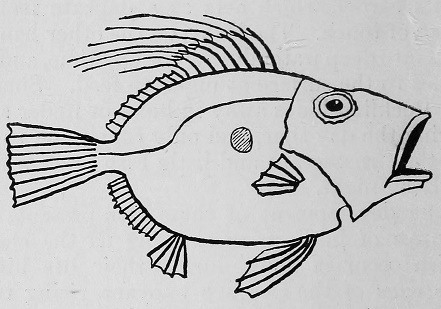
Fig. 18 The John Dory.
The John Dory is a remarkable Fish, by no
means confined to the rocks, as its food often
consists largely of Pilchards and Herrings. It
differs from most of the Fish of similar habits in
being remarkably flattened from side to side.
This feature seems to be of service to it in the
peculiar manner it has of securing its prey. Mr
Cunningham, to whom we are indebted for this
interesting observation, says:—“It does not
overtake (its prey) by superior speed like the
mackerel, nor lie in wait for it like the angler,
but stalks it and approaches it by stealth. It is
able to do this in consequence of the extreme
thinness of its body, and the peculiar movement
of its hinder dorsal and ventral fins. The dory
places itself end on towards the fish it desires to
devour, and in this position it is evident that it
excites no alarm on the part of its prey. The
appearance of the dory seen in this way is a
mere line in the water, to which no particular significance
can be attached. I have not particularly
noticed the effect of the ribbons of membrane,
which project from the dorsal fin. But I have
observed that the movements of the dory are very
gradual except in turning; it alters the position
of its body by a turn of the tail or side fins, and
then slowly swims forward by vibrating the
second dorsal and ventral, a movement which
causes very slight disturbance of the water. The
whole appearance of the dory in these actions is
suggestive of suppressed excitement, his eyes
being fixed on his prey.”
We have now considered some of the chief
features of animal life in the shallow seas, the
illustrations being taken principally from the
regions of our home shores. The shallow
waters of the tropics present us with so many
phenomena of striking interest and importance,
that the subject would be most incompletely
treated if they were left out of consideration
altogether, and, therefore, our next chapter will
be devoted to them.
CHAPTER III. SHALLOW WATER FAUNA OF THE TROPICS.
The shallow waters of the Tropical seas present
us with so many different conditions of tides, of
coast lines, of temperature, of liability to storms,
and of other natural phenomena, that we find an
infinite variety in the general character of their
Fauna. Just as on land, we find in one part of
the Tropics a dense forest, and in another a dry
desert, so in the Tropical seas we find on one
coast a crowded population of animals and plants,
and on another a sandy bottom, which is, comparatively
speaking, lifeless. In order to bring
before the reader some of the principal characters
of animal life in the shallow waters of the Tropics
it will be well to confine his attention to one
part of the world which is fairly well-known—namely,
the Malay Archipelago—and refer only
in passing to other localities. The most characteristic
feature of Tropical coasts is the Coral-reef,
and nowhere in the world may it be seen in more
exquisite variety than in the archipelagoes of the
East. Although, however, these vast structures
are so abundant on some coasts, others seem
to be entirely without them. They are not
found at all on the Western coasts of America or
of Africa, and even in some regions of the larger
islands in the Pacific and the Indian Oceans,
many miles of coast line may be devoid of them.
These curious and interesting variations in the
distribution of the reefs can be explained, but
the explanation will be more easily understood
when their general features have been described.
It is a well-known fact that the great masses
of limestone which compose the reefs are formed
by the activity of countless thousands of minute
animals, but the popular idea of the general
form of these animals has been very much misled
by the unfortunate term “Coral insect,” which
has crept into many books of travel, and the
leading articles in the newspapers. The word
“insect” is used by zoologists as a general term
for certain air-breathing animals that are widely
distributed over the surface of the earth. Many
of them are extremely tiny, and hence the
natural mistake has arisen in the untrained
mind that all minute animals are insects. It
might clear the ground a little if the reader
would note at once that “insects” are very
rarely indeed marine in habit. If there is a
need for a popular word for the animals that
form coral, it should be Coral “polyps” or Coral
“anemones.” The word “coral” has, from the
zoologist’s point of view, a very indefinite meaning,
for it is applied to the hard skeleton of
carbonate of lime formed by certain Sea-weeds,
Sponges, and Worms, as well as to that of
Coral-anemones and other Polyps. In many
places on the British coasts the sea-bottom is
very largely composed of a branching Coral
formed by a true Sea-weed called Lithothamnion,
and in other places very large lumps of rock are
made by a Worm named Filograna. In the
Tropical regions, too, the well-known Nullipores,
which in many places play an important part in
the formation of Coral-reefs, are of vegetable,
and not animal origin.
However, the greatest part of the Coral-reef
is made by animals closely related to the Sea-anemones,
living together in colonies; and of all
the different kinds of Coral-polyps, by far the
most prolific as a reef-builder is one which will
be referred to in these pages as the Madrepore.
Fig. 19 Polyp of a Madrepore Coral, showing the canals by
which it is connected with its fellows.
Let us consider now the manner in which the
Polyps form the Coral. In a very old work on
the natural history of Corals a statement is made
to the effect, that the Polyps construct the Coral
in much the same way as Bees build their hive,
or a Bird its nest. This very erroneous view
coincides closely with ideas which might easily
be gained by a casual observation of corals in a
museum. The lime is not, however, collected as
such from the sea by the Coral-polyps and
plastered round their bodies to form a house
or shelter, but it
is formed as a
secretion by the
activity of certain
organs of the
animal’s body, and
is consequently a
true shell or skeleton.
In a Coral,
which is formed
by a colony of
numerous Polyps,
the shell secreted
by each individual
fuses on to those
formed by its
neighbours, and
thus a communal shell is formed which may
assume a most complicated branching, bushy
form, according to the species of the Coral and
the conditions that are favourable or unfavourable
to the nourishment and growth of the
different parts of the colony. In such a Coral as
the Madrepore every individual Polyp is connected
with its neighbours by a system of
branching canals; and as spaces are left for
these when the shell is formed, the dried Coral
is perforated by numerous tubular pores, and has
a soft, spongy texture which can be easily
crushed into a powder if trodden upon.
In other Corals the canals of communication
between the Polyps are entirely at the surface,
and the shell that is formed is much harder and
imperforate. In others again colonies are not
formed, but each individual grows to a considerable
size and remains independent of its fellows
all its life.
These, then, are three of the more important
varieties of Corals found on the reef, the Perforate,
the Imperforate, and the Solitary Corals;
but it must be remembered that all the Corals
of the reef cannot be included in these three
groups. The varieties are much more numerous
and in many cases much more complicated and
difficult to understand.
Although the Coral-reefs of the Tropical world
have a general resemblance to one another, the
differences in detail are so great that it is impossible
to describe any one as typical. In sailing
over the edge of a reef near the coast on a calm
day, when the water is so clear that the bottom
can be seen at a depth of 8 or 9 feet, the reef
may, in some regions, be observed to change in
character every few minutes. In one spot there
may be clumps of living Corals surrounded by
beds of fine white sand; in another there will
be great stretches of branching Madrepores; in
another Madrepores, Mushroom-corals, the Imperforate
Brain-corals, Sponges, and many other
forms of life will be clustered together; while
further on the predominant features will be the
soft and slimy Sarcophytums, looking like large
green toad-stools, some lumps of Organ-pipe
Corals and a few colonies of the Blue-coral.
On other coasts I have wandered for miles along
a reef mainly composed of endless tangles of Madrepores,
with very little variation indeed in the
general form of the Corals, in the character of
the Sponges and Sea-weeds that grow with them,
in their colour or in any other detail. Anyone
reading the many accounts of Coral-reefs that
have been written by travellers, must be struck
with their inconsistency as regards many particulars;
and in no one point are they more inconsistent
than in the description of the colours—some
writing in glowing terms of the beauties of the
sea-gardens, and others complaining that their
charms have been grossly exaggerated. As a
matter of fact some reefs have a prevailing dull
green or brown tone, while others exhibit all the
colours of the rainbow in their more brilliant
shades and tints. Another cause of the discrepancy
is that some reefs can only rarely be approached
in a small boat owing to the breakers
that dash over them; whilst in the Tropical calms
a tiny canoe can with perfect safety be manœuvred
over the reefs during nine months of the year.
From my own experience I can assert that it
would be difficult indeed to exaggerate the glorious
beauty of some of the reefs in the Malay
Archipelago, more particularly of those where
many different kinds of Corals may be seen in
close proximity to one another. On such a reef,
for example, there may be seen Madrepores with
bright violet growing-points to their branches,
orange or red Fan-corals, bright brick-red Sponges,
yellow Sarcophytums, emerald green Organ-pipe
Corals and dozens of other forms of animal life
in every imaginable colour. When seen from a
boat through two or three feet of water, these
portions of the reef look more like a beautifully
planted flower-bed than a mass of animals; but
the simile is not a complete one, for the branches
of the Madrepores, the great knobs and lumps of
the Brain and Organ-pipe corals, the fronds of
the Gorgonias and other forms make a wild mass
of organisms resembling a tangled thicket or a
miniature forest. At low-water of spring-tides
the living reef is partly left exposed, and then
the scene changes, for the Polyps retract their
tentacles after the manner of the Sea-anemones
and retreat as far as possible into the shelter
afforded by their shells.
Fig. 20 Chætodon.
The interest of the living reefs is, however, by
no means confined to such organisms as the Corals
and Sponges, which are immoveably fixed to the
bottom; for numerous brightly-coloured Star-fishes,
Sea-urchins, Brittle-stars, Sea-slugs, and
their allies crawl about among the branches and
the débris of the dead Corals; while Crabs, Lobsters
and Shrimps of many kinds may be seen
swimming or crawling in search of their prey,
and the marvellously striped and spotted Coral
fishes dart hither and thither in the thicket, or
remain hovering in the water among the Corals.
The whole scene is most fascinating. As the boat
slowly drifts along, new and strange creatures are
constantly coming into sight and disappearing
again. Here the writhing arms of a bright blue
Brittle-star may be seen embracing the stem of a
Coral-branch; there a curiously flattened Chætodon,
with its body marked by great diagonal
yellow bands, is nibbling at the young, tender
branchlets; in another place four or five Sea-urchins
with very long and slender spines are
lying apparently motionless on the bottom; while
a little further on a long black Slug-like creature,
the famous “Trepang” of commerce, is slowly
wending its way across the reef. Now and again
a large shoal of little Fish or a small party of
Cuttlefishes may be seen, and these may rapidly
be dispersed in all directions by the sudden dash
of a Sea-perch or a small Shark. The interest is
so varied, so many-sided, in these scenes of
animal life that the attention of the naturalist
is with difficulty kept to any particular point.
The feature which is perhaps the most striking
is, however, the wonderful variety in the
colours of the animals and of the character
of their markings.
If we consider the Fishes alone, we find
some of them have broad yellow bands running
diagonally across their bodies, others have thin
longitudinal stripes of blue and yellow, some
have a uniform bright red colour, and others
again have their red skins speckled with blue
spots. It would take more than a whole chapter
of this book to describe even the principal varieties
of pattern found on one such Coral-reef, but
the main fact that has to be related is that where
the reefs are built by brightly-coloured Polyps,
there we find these curiously marked Fishes.
There can be little doubt that the marking and
colouring does give a certain amount of protection
to them. Numerous individual cases have
been mentioned of Fishes which resemble some
particular Sea-weed or Coral; but this general
statement is the important one, that on a parti-coloured
background the striped and speckled
Fish are less conspicuous than those that are
modestly attired.
The Fishes of the reefs, however, have other
means of protection than that afforded by their
colours. The Trigger-fish and Coffer-fish, for
instance, have a body encased in closely fitting
hard, thick scales, so that they might almost be
called “armour-plated fish”; and the Globe-fish
bristle all over with long and extremely sharp
spines. In the Trigger-fish there is a curious
modification of the three front spines on the
back, to which their name is due. It is not
known precisely how they act, but they probably
form an effective weapon of defence. In the
same family of Fish we frequently find on each
side of the tail two or three rows of sharp spines,
which may also be regarded as defensive. In
the family of the Surgeons there is only one of
these spines on each side of the tail, and it is
much larger than any of those in the Trigger-fish,
and capable of being folded down into a
case in the skin like a clasp-knife. It is said
that these spines are connected with a poison-gland,
and can give very severe and painful
wounds, like the poison spines of our European
Sting-rays and Weavers.
Fig. 21 Globe-fish.
A few days’ hunting on a Coral-reef will reveal
the fact that it supports a very considerable
population of Crustaceans. They are not at all
obvious at first to one who has had no previous
experience of reef-work, partly because they resemble
the general appearance of their surroundings
very closely, and partly because of their
habit of remaining perfectly motionless when
first alarmed. In form, many of them are, like
the Lobsters, Crabs and Prawns of our own
coasts, but their colours and markings are, like
those of the reef-fishes, characterised by their
brilliancy and their arrangement in bands and
stripes. The smaller ones can be caught after
a little practice with a simple hand-net, but the
larger ones are more easily captured by a rattan
noose in the pools, after the blocks of Coral are
loosened by a pick-axe and slowly turned over.
The Coral-reef is a favourite hunting-ground
for the conchologist, some of the largest and
most beautiful shells in the world being found
amongst the Corals. In Celebes, the giant bivalves,
the huge Tridacnas, which are sometimes
two feet across, and whose shells have been
known to weigh as much as 500 lbs., may be
seen wedged in among the Corals. The mantle
of the living animal presents to the observer a
wonderful display of colour as it lies in the
shallow water with its shells open. The animal
is eaten by the Malays, who roast it on a tripod
spit over a fire, and cut it into steaks. A fair-sized
Tridacna will afford a good meal for four
or five men. The great Cowries, Helmet-shells,
and many other species may be found in hunting
over the reefs, but their beauties are frequently
hidden, when alive, by the coal-black mantle
which folds back over the shell as they crawl
along. It must not be supposed, however, that
all the shells of the reefs reach to such enormous
size as those we have hitherto mentioned, for a
rich harvest of species awaits the eager conchologist
who hunts for the smallest shells he can find
in the pools. Within the last few years a large
number of new species of small Molluscs have
been described from the coral seas, many of which
do not attain to a total length of more than ⅛
of an inch when perfectly adult, so that the
range in size of this class of animals is very great
indeed.
So much has been said about the Madrepores,
the Imperforate Corals and the solitary Corals
of the reef, that the impression might be left that
all the Polyps of the Tropics differ from those of
the Temperate regions in the fact that they form
shells or skeletal structures. This is by no means
the case, for there are many species of true Sea-anemones
and other Polyps to be found on Coral-reefs
which make no shell at all, and others in
which the body-wall is strengthened by numerous,
but very minute spicules or grains of lime which,
on the decomposition of the animal’s body, fall
down into a shapeless powder or sand.
True Sea-anemones are not very abundant on the
reefs of North Celebes, but many species have
been found on the Barrier-reef of the Australian
coast, and among them specimens reaching the
gigantic size of two feet in diameter—the largest
size attained by single individuals of the class of
animals to which the Anemones belong. Another
family of Polyps called the Clavulariidæ belonging
to the Alcyonarians has some species which
make no skeleton of calcium carbonate. An illustration
of one of these is given below (Fig. 22).
Another species, called Clavularia viridis, which
forms a few spicules in its body-wall, has a very
wide distribution in the East Indies. In some
places patches of it may be seen several square
yards in extent, and the crowds of little Polyp
heads with their eight-feathered tentacles waving
to and fro with the pulsations of the tide, is a
sight that excites immense interest and admiration
in the mind of the observer.
Fig. 22 Stereosoma, one of the Clavulariidæ.
One word more about the Corals. Where they
are so abundant in number and species, where
rocks hundreds of miles in extent are mainly
composed of their shells and skeletons, it might
be thought that a rich profit could be gained by
collecting ship-loads of the Coral that is used for
making beads and brooches by our jewellers.
Any expedition, however, fitted out for this purpose
would end in disastrous failure, for the
Precious-coral is not known to occur anywhere
in the neighbourhood of Coral-reefs, but the
fishery is confined to certain parts of the Mediterranean
Sea. Species closely allied to the
Precious-coral, but of an inferior colour, have
been found in the Japanese waters. None of
the Coral structures found on the reefs have the
same delicate salmon-pink colour and probably
none of them are hard enough to take a good
polish.
The Coral-reefs which occur in different parts
of the Tropical world were considered by Darwin
under three heads,—Barrier-reefs, Atolls, and
Fringing-reefs. The distinction between these
three kinds of reef is not one that can be insisted
upon scientifically, but the arrangement is convenient
for purposes of description.
The Barrier-reefs (Fig. 23, B) are situated at a
distance of one to eight miles from the coast, and
are separated from it by a lagoon of moderately
deep water. The Barrier-reef of New Caledonia
is said to be 400 miles in length and it follows
the general contour of the coast line.
The Atolls (Fig. 23, C) are ring-shaped islands
composed of coral limestone with a lagoon of salt
water within them, situated in the sea without
any definite relation to other existing land.
The Fringing or shore-reefs (Fig. 23, A) are
situated at a distance of 100 yards or less from
the beach and separated from it by a shallow
lagoon which is frequently left as a dry sand-bank
at low tides.
Fig. 23 A, Fringing-reef; B, Barrier-reef; C, Atoll.
a, sea; b, reef; c, rocks of the coast.
Many forms of reefs are found in different parts
of the world, but they may all be looked upon
as special modifications of one of these three
groups. The facts which Darwin collected about
Coral-reefs in his memorable voyage round the
world in the Beagle, suggested to this great
observer that all the different forms of reef
must be related to one another, and he formulated
an ingenious theory to show how, by the
gradual sinking of the crust of the earth,
Fringing-reefs may have become, in the course
of a long period of time, either Atolls or Barrier-reefs.
Some doubts have recently been expressed
as to the truth of Darwin’s famous
“subsidence theory.” But, whether it is true
or not, to Darwin is due the credit of bringing
home forcibly to our minds the fact that Coral-reefs
are slowly undergoing changes of growth
and of destruction, which must lead to most
important and far-reaching alteration in the
character of the Tropical seas. It is not intended
in this work to enter into a discussion
of the various alternative theories of Coral-reef
formation, but a few words may be added
on the method of formation of Coral limestone.
In studying any one particular form of reef-building
Coral we can find a long series
of specimens from one inch in length up
to a certain maximum, which varies with the
species and the reef, but may reach over five
feet in diameter as can be seen in the specimens
now in the British Museum at South Kensington.
Beyond this maximum size—let us say four feet
in diameter—the Coral rarely grows, because at
a certain age, probably when the vitality of the
Coral is on the wane, the stalk of attachment
becomes so bored with parasitic Sponges, Worms,
Fungi and other organisms, that it is thoroughly
rotten. If a large block be picked up from the
reef, and with the help of two or three strong
natives carried ashore and broken up with a
hammer, a most interesting migration of Crabs,
Worms and other creatures occurs, and the
collecting bottles may be filled with a rich
variety of animals parasitic on the Coral. Now
the time comes when the stalk becomes so brittle
that a heavy wave breaks it in two, and the
Coral topples over and dies. If it falls into the
sand, either on the inside or the outside of the
reef and becomes buried, it may be preserved
fairly complete, but if it lodges between other
Corals the waves and the parasites between them
dissolve it and break it up into thousands of
pieces. This constant disintegration leads to
the formation of great quantities of coralline
sand which fills up the interstices between the
living Corals, or gets washed over into the
lagoon, or falls as a talus over the seaward slope
of the reefs. In the latter case lumps of Coral
torn off from the reef become embedded in it and
form with it a bank which gives support to more
living Polyps on the seaward slope. Consequently,
in the course of many years, a reef
which was at one time only fifty yards from the
beach may have extended to a distance of a
hundred yards or more, growing, as it were, on
the skeletons or shells of the Corals that have
died. There can be little doubt that Coral-reefs
do grow seawards in this manner in some places,
but they may also be either beaten back or kept
for a long time perfectly stationary if the tides
are too strong or too slack.
What the precise conditions are which favour
the growth seawards of Coral-reefs has not yet
been systematically investigated; but we may
suppose that if the tides are too strong the
sand has no opportunity of settling between the
Coral blocks and forming a solid limestone rock,
and if they are too slow the Coral-polyps do
not get sufficient nourishment to allow them
to build fast enough to counteract the solvent
action of the water.
An interesting point connected with the Coral-reefs
is the manner in which they are formed at
first. A volcanic upheaval gives rise to a new
island which, in the course of time, is surrounded
by a Fringing-reef. How does this reef begin?
The answer to this question has been recently
given by the observation of the formation of new
Corals on the shores of the island of Krakatoa
which is situated in the Sunda straits, and was
the seat in 1884 of one of the most violent
volcanic eruptions of historical times. After the
eruption the sea-bottom round the island was
found to consist of a fine volcanic mud, in which
it may be believed no Coral embryos could find a
secure foothold. Now it is known that living
Corals give rise to a number of very minute
larvæ which for a period of time swim freely in
the water, eventually settling down on some solid
stone or shell to give rise by growth and budding
to the Coral blocks. These larvæ frequently
settle down on a piece of floating pumice-stone
and after a time grow to such a size that they
sink it. If, in sinking, they fall upon the bottom
in shallow water they form together a substratum
on which other larvæ can settle and
flourish. This is apparently the manner in
which Coral clumps are beginning on the slopes
of Krakatoa and these will undoubtedly give
rise in time to a more or less complete Fringing-reef.
Any further discussion on this point would
lead us into subjects beyond the scope of this
book, but enough has been said to indicate to
the reader the manner in which the countless
Coral-polyps may, in the course of time, change
the position of the reefs on Coral shores, thereby
altering the set of the tides there, changing the
position of the sand-banks, affecting the rate of
erosion of the cliffs, and in other ways causing
important modifications of the coast line.
I have mentioned that the ground on the
growing edge of the Coral-reef is carpeted with
Corals, Sponges and many other forms of animal
life; in the water swim countless Fish, and the
branches of the Corals yield to the naturalist
innumerable forms of creeping and crawling
creatures. The shallow waters of the Tropics,
as a whole, however, do not possess a particularly
rich Fauna,—in fact, the distinguished
Dr Kükenthal, who has had great experience of
marine work, says that, in his opinion, the
Tropical seas are not richer in littoral animals
than the Arctic seas. Between the reef and the
sea-beach there is a lagoon, of varying breadth,
with a sandy bottom, which is almost as barren
of animal life as a desert. A few Worms and
Crabs, here and there a Star-fish and some shells
of Foraminifers, are all the spoils which fall to the
bag of the naturalist after many hours’ wading
on this unprofitable ground. The reason for this
is, perhaps, not far to seek. When the tide goes
down many stretches of sand are left dry, and
others retain only a few inches of water. The
exposure to the heat of a Tropical sun soon kills
and dries up any living animal that is unable to
burrow deeply in the sand, and the water in the
shallow pools rises in temperature to a degree
that the human hand or foot can only just bear,
so that the little Fish that escape into them run
the risk of being slowly cooked alive.
On the inside of the lagoon there is, in many
places, a broad belt of Mangrove trees, forming
the “Mangrove-swamp,” which contains some interesting
and important animals. These trees
have a peculiar spreading and branching system
of roots which are left exposed when the tide
goes down, and form with one another a kind of
network or web a foot or more above the ground,
upon which it is possible, with care, to walk
from place to place, at low tide. Between the
roots there is a slimy black sand or ooze, sometimes
hard enough to walk upon, but more
commonly soft and treacherous. At high tide
the water rises to a height of two or three
feet, completely covering the roots and giving
the swamp the appearance of a forest growing
in the sea. Of the animals, aërial and terrestrial,
that haunt the swamps it is not necessary
to say more than a few words, although they
too form a study of great interest to the enthusiastic
naturalist. But the marine zoologist
who visits the swamps cannot fail to take note of
the millions of Ants, Flies and Mosquitoes which
torment him at every step, and make a prolonged
stay an impossibility.
Fig. 24 Periophthalmus.
One of the first creatures to be seen on entering
a Mangrove-swamp at low tide is a curious
little Fish called Periophthalmus. In some places
hundreds may be seen at one time resting on the
roots of the Mangroves, or skipping over the
pools of water from one root to another. There
are many varieties of Periophthalmus in different
parts of the world, and their habits are not
exactly the same, so, to give an accurate description,
our attention will be confined to the form
occurring in N. Celebes. This little Fish is
about three inches in length and remarkable for
its very peculiar eyes, which are of a bright
yellow colour, situated quite close together on
the top of the head, and projecting so much from
their sockets that the outline of more than two-thirds
of the eye-ball can be seen. These eyes
are extraordinarily moveable, and frequently revolve
quite independently of one another, like
the eyes of a Chamæleon, giving the animal a
most grotesque and even ludicrous expression.
These Fish seem to swim in the water very
seldom; when undisturbed they may be seen
clinging to rocks or trees by their fore-fins with
their tails only in the water, but from time to
time they spring into the air to catch a Fly on
the wing, or a small Crab which has come unwarily
within their range. Their fore-fins are
peculiarly adapted to their habits, in that they
have a very muscular base and a distinct elbow
joint.
These creatures are not easy to capture, as the
ground on which they live is not adapted for rapid
pursuit, and it is impossible to get close enough
to them to catch them in a hand-net with a long
handle. When kept in an aquarium it is seen
that although they are rapid swimmers when
they do go below the surface, they seem to prefer
to live with their head and shoulders out of the
water; and when chased in their natural haunts
they very rarely, if ever, seek to escape by
plunging into the water, but they execute a
series of rapid jumps with extraordinary rapidity
from root to root or rock to rock, and so
avoid their pursuers. Their existence is really
an amphibious one, and their food consists partly
of Insects on the wing. Their gills are very
much reduced in size, and it seems probable,
from observations that have been recently made,
that their respiration is partly carried on by the
thin skin between the rays of the tail-fin.
Another animal extremely abundant in the
Mangrove-swamps of Celebes, and, like Periophthalmus,
having a very wide distribution in
similar places in other tropical countries, is the
“Caller-crab” Gelasimus. These Crabs are about
an inch in breadth across the back, and are remarkable
for possessing one very much enlarged
and brightly-coloured claw, the others being
normal in size and dull in colour like the rest of
the body. On first entering the swamp at low
tide there may be seen on the mud between
the roots of the trees a number of bright yellow,
blue or green objects, which, as the traveller
approaches, disappear one by one into holes in
the ground. When the eyes are accustomed to
the gloom of the swamp these bright objects are
seen to be the great claws of the “Caller-crabs,”
the rest of the body being inconspicuous owing
to its close resemblance in colour to the slimy
ground.
These are the principal and most abundant
marine inhabitants of the swamps, and as has
been pointed out, all of them are more or less
amphibious in habit. More locally distributed,
Oysters and other bivalves may be found attached
to the roots of the trees. Several species of
marsh Gastropods occur, some of them in great
abundance in a few localities. Occasionally a
Sea-anemone, with remarkable powers of burrowing
rapidly in the sand when disturbed, may be
found, and to the microscopist a harvest of
Foraminifers and other minute forms of life
awaits investigation and description in the Mangrove-swamp.
Whenever the tide is high a considerable
number of Fish-fry, Jelly-fish, and other forms
of floating and swimming life characteristic of
these waters, drift into the swamps; and some
being caught by the tangle of roots are left
behind, either in the pools, or high and moderately
dry upon the sand when the tide ebbs.
Upon these victims of the retreating tide swarms
of Ants and Flies descend from the trees, Crabs
from the shore and from their holes in the sand
are on the watch for them, Kingfishers and
Sandpipers are ready to pounce upon those which
are most to their taste, so that before the friendly
waters of the ocean return to the swamp, scarcely
one of them is left.
These constitute what may be called in the
swamp the extraneous Fauna, which if it is not
truly indigenous is nevertheless necessary for the
continued existence and well-being of the true
inhabitants.
The character of the sea-bottom on the outer
side of the living Coral-reefs varies so much in
different parts of the world that an adequate
treatment of the Fauna in that region would
have to be one of greater length than is possible
in this book.
The living edge of the Coral-reef is in some
cases situated on the top of a submarine precipice
of very considerable height, and in many
places the sounding-line goes down to a depth of
five or six hundred feet a few yards beyond the
limits of the reef. The practical difficulties in the
way of determining the character of the Fauna
of any sea-bottom that shelves in this manner
are very great, but where it is partly composed
of massive lumps of solid Coral they are at
present insurmountable. Every time the dredge
or trawl reaches the bottom it becomes entangled
in the Coral branches, and is liable to be seriously
torn, or even lost. Swabs and iron hooks and
fish traps may yield some scraps of information,
but speaking generally, the Fauna of these steep
slopes is scarcely known at all.
The most important question, from the geological
point of view, that has to be determined is
the depth of water in which reef-building Corals
can live and thrive. This is still a matter of uncertainty
owing to the practical difficulties met with
in the attempts to investigate it. Darwin estimated
that the limit of vigorous coral growth
was between 20 and 30 fathoms, but in recent
years, owing to the discovery of luxurious Coral
patches in 44 fathoms on the Tizard and Macclesfield
banks, there is a pretty general opinion that
his estimate is too low.
Whatever the exact limit may be, it is quite
clear that in many parts of the world the sea-bottom
quite close to the outer edge of the reef
cannot support a vigorous Coral fauna. Here
and there patches of peculiar deep-sea species of
Corals occur, but they do not form in such depths
anything of the nature of a reef. They are
usually isolated specimens, similar to those that are
found in deep water on the Norwegian coast and
other parts of the world outside the limits of the
Tropics; but these specimens really belong to the
deep-sea Fauna, of which we shall learn more in
another chapter.
In many places, however, the water at the
base of the outer edge of the reef is not very
deep, and may slope away gradually towards
the bed of the ocean. The Fauna of such slopes
in the Tropics is not characteristically rich, as
my own experiences of dredging in such waters
have proved. Time after time the dredge that
was used in 15 to 20 fathoms off the coast of
Talisse, came up with nothing but sand or
gravel. Occasionally a Brittle-star or a branch
of dead Coral, with a few Zoophytes growing
on it, came up; and in some places a few
beautiful Lily-stars or Crinoids relieved the
monotony of the investigation. But, on the
whole, the animals found in this region were
not numerous, nor of a character to excite any
particular interest.
Before bringing this chapter to a close, a brief
reference must be made to one of the most remarkable
phenomena in the animal kingdom,—this
is the history of the Palolo worm. On certain
parts of the coast of the Samoan islands the
Palolo worm appears in great abundance in the
early morning hours of one or two days at the
beginning of the third quarter of the moon in
the months of October and November. As the
worm is regarded as a very great delicacy by the
natives, the day of its appearance is looked upon
as one of the most important red-letter days of
the year. Weeks before the worms are expected
the advent of the Palolo is discussed, stories
are told of the fisheries of bye-gone years, anecdotes
of the last year are remembered and rehearsed,
and the whole population is prepared
for the great event as for a feast.
When the grand day arrives the boats are
decorated, the girls put on all their finery, and
everyone who can find a seat in a boat goes off
to the fishery amid a merry chorus of song and
laughter. It must, indeed, be a strange sight to
see the flotilla of canoes with their eagerly expectant
and gaily-bedecked crews, waiting in the
dim light of the half moon for the day to break
and the exciting fishery to begin. As soon as it
is light enough to see into the water, a few
writhing Worms may be distinguished at the
surface, which increase in number with such extraordinary
rapidity, that in a little while it is
impossible to see anything below three or four
inches owing to the multitude of Palolos. As
quickly as possible the fishery proceeds, every
man, woman, and child gathering the harvest of
Worms during the precious moments of the sunrise.
When at last the sun rises well above the
horizon the Worm disappears again, and the
boats hasten to the shores with their booty.
This remarkable swarming process of the
Palolo, occurring as it does, only once or twice
a year, in constant relation with a particular
phase of the moon, and lasting on each occasion
only a few minutes in time, is not the only noteworthy
feature of the animal.
The Palolo worm, as it is caught, varies in
length from an inch to a foot or more, and is
about a quarter of an inch in breadth, but it readily
breaks up into pieces when handled. It is composed
of numerous rings or segments, each provided
with a pair of processes bearing bristles,
but there is no head. Astonishing as it may
seem to those unacquainted with the natural
history of Worms, it is nevertheless a fact that
when the Palolo swarms it leaves its head behind
among the Corals, where, in all probability, it
regenerates a new body. This accounts for the
fact that while the body of the Palolo is frequently
brought home to our Museums in England,
its head is a rarity. The colour of the
Worm varies very considerably. The pieces
bearing eggs are usually of some shade of green,
hence the specific name Palolo viridis that is given
to it by scientists, but the males are usually
white. In connection with the appearance of the
Worm there is a curious statement that once in
every four years it is exactly one lunar month
late, so that the time of year of its occurrence is
constant. The natives are also forewarned of the
advent of the Palolo worm by the movements of
the land Crabs, which, it is reported, come down
from the fields and forest a few days before the
Palolo feast and plunge into the sea.
The precise habitat of the Worm when it is
not swarming is still a matter of some doubt.
A few rare specimens have been found in the
Coral blocks in shallow water, but it is generally
supposed that the majority of them live in deep
water on the outer side of the reefs. It is not
confined by any means to Samoa. It occurs also
in Fiji, Tonga and other Pacific islands. A
Worm similar to the Palolo in habits was described
years ago by Rumphius in the Malay
Archipelago, and Saville Kent mentions a little
Nereid worm with similar spawning habits on
the great Barrier-reef of Queensland.
CHAPTER IV. SURFACE-SWIMMING FAUNA (INVERTEBRATES).
Everyone of an observant turn of mind must
have noticed that in the wake of a boat that is
passing through the water on a calm summer’s
night, sparks of bright phosphorescent light may
be seen to appear, to remain for a few seconds,
and then become extinguished again. Sometimes
the breaking of the ripples on the surface of
the water seems to be sufficient to cause these
sparks to appear, but occasionally streaks and
flashes of pale blue light arise and disappear
without apparently any such mechanical disturbance.
The phosphorescence of the sea, as this phenomenon
is called, is common enough on our coasts,
but it never reaches the degree of brilliancy and
beauty which is so remarkable in the open Atlantic
Ocean, the South Seas, and some other parts
of the world. In the Atlantic Ocean the phosphorescence
is sometimes so bright that it is
possible to read a book on deck by its light
alone; and on a dark night in the Banda seas
the water is often like a huge expanse of pale
blue smoke studded with diamonds and other
lustrous gems.
These lights are mainly produced by animals
which float and drift about on the surface of the
water. It is not, as is very commonly supposed,
only one or two different kinds of animals that
are phosphorescent, but a vast number belonging
to many widely different families and of a great
variety of form and structure. When the day
breaks many of these animals sink down a few
fathoms into the darker and cooler strata of
water, but a considerable number remain so close
to the surface that they can be easily caught in a
muslin net dragged after a boat.
Some of these animals, such as the Jelly-fish,
can, during the day, be observed clearly enough
from the boat, others can only be seen when the
contents of the net are emptied into a glass bottle,
and others again are so minute that it requires a
strong magnifying glass to detect them at all. Such
animals that float or drift in the water without
powers of swimming vigorously in one direction
or the other, are collectively called the Plankton.
In every sea, from the Arctic regions to the
Equator, a Plankton will be found. Sometimes
it is mainly composed of one species, in other
cases it consists of many different species living
together. Under certain conditions the water
is simply crowded with these organisms, and in
different circumstances the Plankton is represented
by only a few individuals.
The variations of the Plankton in different
parts of the world have, of recent years, been
subjected to many searching investigations, but
although many important facts have been recorded,
the explanation of the principal phenomena
remains a mystery.
One of the most interesting facts, perhaps, is
the extraordinary local variations to be observed.
To give a single example as an illustration of this
point the case of the common white Jelly-fish
may be mentioned. On occasions the surface of
the water in our bays and estuaries contains so
many of these animals, that the sea appears to be
little more than a mass of jelly. In other seasons
not more than a few isolated individuals will be
seen all through the summer months.
With all the resources of modern scientific
investigation no adequate explanation has been
given to account for this fact. It may be that
the variation is due to the prevailing winds or
tides, to the temperature of the water, to the
roughness or smoothness of the sea, to disturbance
of the ground where the eggs have settled,
or to some other hitherto unforeseen conditions.
Not only seasonal, however, but even diurnal
variations occur, of a most remarkable and inexplicable
character.
On one occasion for example I was collecting
a number of Jelly-fish in Southampton Water,
and for nearly two hours specimens were obtained
as fast as they could be hauled into the
boat. Suddenly a change came, and in a few
moments the water that had been alive with
these animals seemed to contain not one. Another
time, after dredging nearly all the afternoon
at Lulworth for Hormiphora, with the very
poor success of a half dozen specimens, the net
came up simply choked full of these little round
jelly-like Ctenophores, and for the remaining
hours of day-light there appeared to be an
abundance of them all along the coast. One
morning in the Tropics, at about an hour after
sunrise, I was looking over the side of a steam-boat,
and saw that the surface waters were
full of beautiful and rare species of floating
animals. In less than half an hour afterwards,
when a boat was put off, scarcely one of them
could be found. Anybody who is accustomed
to working with a tow-net can give similar
experiences.
In each of these cases a simple explanation
might be suggested. In the first case it might
have been the change in the tide which effected
the disappearance of the Jelly-fish; in the second
it might have been the approach of nightfall
that caused the Hormiphoras to rise; and in
the last case it might have been the approach of
the heat of day; but when carefully considered
such explanations are not sufficient, in that they
do not account for the suddenness of the change.
The fact is that the conditions of life in the
surface waters are so complicated that it is extremely
difficult for us to accurately estimate
the balance of the forces which act upon these
organisms. The direct heat of the sun, the light
of both the sun and the moon, the tranquillity
or roughness of the sea, the conditions of the
tides and winds which cause changes in the
surface temperature of the water, independently
of the direct heat of the sun, all influence the
delicate tissues of which these animals’ bodies
are composed, and cause them to change their
position.
The animals which compose the surface Plankton
may be considered under two heads—those
that are adult, and those that are the larvæ of
sessile and crawling forms of life which in the
adult stage live at the bottom.
Those belonging to the former group frequently
occur far out in the open ocean as well as in the
neighbourhood of the land, and have as a rule a
wide geographical distribution. Those belonging
to the latter group are more usually found within
a few miles of the coast line, although winds and
tides may occasionally drift them far out into the
sea, where their larval existence is prolonged for
an abnormally long time. Leaving out of consideration
for the moment the many interesting
exceptions, we may say that the Plankton of the
open oceans differs from that of the neighbourhood
of the coasts, by the larger proportion of
adult forms that it bears.
A great variety of animals pass the whole of
their lives in the surface waters of the sea, but the
commonest and most widely distributed of all
probably are the Copepods belonging to the class
Crustacea.
The Copepods are minute creatures, rarely
exceeding a quarter of an inch in length, which
row themselves through the water by a pair of
long antennæ, projecting from the head end of
the body. They occur in fresh water as well as in
the sea, and so abundant are they that if a glass
tumbler be filled with the water from a pond, a
lake, or the sea, and examined with a magnifying
glass, a number of specimens are almost sure
to be seen. They occur in abundance at the
surface of the sea in nearly all climes, and very
often are the sole representatives of the Plankton
that are found in the hauls of the tow-net.
Attention has already been called above to
the fact that in the Tropics the surface-floating
animals gradually sink down into the depths
as the heat of the day approaches, but even on
fine calm days a few Copepods will be found at
the surface. Although they sometimes occur in
Temperate seas in such vast numbers that the
water is quite discoloured with them, more
variety of form, or, in other words, more distinct
genera and species are found in the warm and
Tropical parts of the world.
The study of this group reveals to the microscopist
some of the most marvellously beautiful
displays of colour and form that can be found in
the animal kingdom. Sometimes the body and
legs are beset with an immense number of
extremely fine and delicate spines, which are
in some cases provided with rows of still
finer spinelets, giving them the appearance of
a most minute feather. Sometimes the body
contains large granules of a bright red colour,
and at others smaller granules of a bright
blue are seen scattered among the organs. The
female Copepods usually carry, securely fastened
to their tails, two little pear-shaped sacks of
eggs, which are sometimes bright green, blue
or red.
Fig. 25 A free-swimming Copepod.
Endless are the varieties of form and colour
presented by these little creatures, and endless
are the beauties which the study of their structure
reveals; but as we have mentioned them
first as inhabitants of the surface waters of the
seas, we must pause to consider here how these
organisms, which excite so much wonder and admiration,
are adapted or fitted for their peculiar
mode of life. But it must be remarked that
these statements apply only to the free-swimming
Copepods, for many animals classed in this group
by zoologists are parasites, and as such are so profoundly
changed that they might at first sight
be relegated to another class of organisms altogether.
Now we must remember that animals that live
in the surface waters must be prepared to keep
afloat for the whole period of their lives—from
the time they are hatched until they fall a prey
to some voracious enemy. Under ordinary circumstances,
they never find an opportunity of
resting, either on the sea-bottom or on any floating
substance.
If a Copepod is watched in a tumbler of water
it will be seen to give a number of strokes with
its long antennæ and then to rest suspended for
a few seconds; a few more strokes follow and
then another pause, and so on. During the
period of rest the body sinks slowly, sometimes
almost imperceptibly, but never so much that it
cannot recover its position in the water after the
first few strokes.
It must be clear to the reader that the less
it sinks during the pause the less will be the
muscular activity required to regain its position,
and that, consequently, every mechanical contrivance
that its body possesses to diminish its
tendency to sink will be a saving of muscular
and nervous energy.
A very simple experiment will demonstrate
that a body which presents a considerable surface
to the water, sinks more slowly than one
of the same weight that is round and compact.
If we take two equal pieces of silver paper and
roll one of them into a tight little ball, leaving
the other as a flat sheet, and then let them sink
together in a tall jar of water, the former will
reach the bottom long before the latter. Similarly
the body of an animal which possesses a
dense armature of spines, as it presents more
surface to the water, sinks much more slowly
than the body of an animal of the same weight
that is smooth and compact.
The spininess or hairiness of the Copepod body,
then, may be regarded as one of its adaptations
to the environment in which it lives. But of
course this character is not by any means confined
to the Copepods. Very many of the surface-swimming
Crustaceans, and more particularly
their larvæ, have remarkably spiny bodies, and
among many of the Foraminifers, Radiolarians,
Worms, Molluscs and even Fish we find some
similar extension of the surface of the body
which lowers the sinking rate. Another means
by which the bodies of many of the animals composing
the Plankton are buoyed up, is the secretion
into a special chamber or reservoir of some
gas or oil of a lesser weight than the sea-water.
This is what may be called the balloon principle.
In such animals we may regard the heavy
muscles, skeleton, skin and viscera as the car
and the freight of the balloon, while the gas
reservoir corresponds to the whole silk case containing
the coal-gas.
Such an animal might also be compared to a
man in the sea clinging to an india-rubber life-belt.
The body of the man by itself is heavier
than the water, and in the absence of the muscular
exercise of swimming sinks rapidly to the bottom;
but the body of the man and the life-belt taken
together are lighter than water and float continuously
without any action of the muscles.
If the life-belt were considerably smaller than
usual the man and belt would sink, but much
less rapidly than the man alone; and the muscular
energy required to keep himself afloat would
be far less with the belt than without it, consequently
he would be able to keep afloat much
longer with the same expenditure of muscular
energy. The bodies of many of these surface-swimming
animals may then be best compared
with a man assisted by a small life-belt. When
dead or still they slowly sink, but a slight
amount of muscular energy expended in swimming
is sufficient to keep them afloat. In what has
been said above about the body of the Copepod,
reference has been made to certain bright red
granules. These are in all probability little
globules of some oily or fatty substance lighter
in weight than the sea-water, which serve to
buoy up the body of the little creature. It is
difficult to say why they should have such bright
colours. We have no record of observations
that show that the colours can be of any use
to them as a protection from their enemies,
nor is there any physical explanation of the
colours of these granules any more than of the
blood, the bile and other products of animal
and vegetable vital processes. The eggs contained
in the egg-sacks of the Copepods also
bear a certain amount of oily substance very
frequently different in colour from that of the
other parts of the body, and this probably
acts in the same manner upon the body of the
parent or on that of the little larvæ when they
are first hatched.
Thus we find in the body of the Copepods at
least two important modifications of structure,
which render them fit or suitable for their life-long
swim in the surface waters of the sea.
Let us now consider another important group
that has the same habit but differs from the
Copepods in size and form, namely, the Jelly-fish.
The Jelly-fish, or Medusæ, as they are usually
called by zoologists, are disc or bell-shaped animals
of a very soft gelatinous texture. From the
centre of the disc or bell there hangs down a tube
of varying length bearing the mouth, and the
margin is often provided with a row of thin
delicate tentacles like a fringe. (See Fig. 7).
When watched on a calm summer’s evening they
may be seen to slowly sink a few inches or more
from the surface, and then with a series of convulsive
contractions of the bell to rise to the
surface again. Sometimes these contractions
may be observed to continue perfectly rhythmically
for a long time.
In one of the commonest of the English
Medusæ four rings of a bright pink or orange
colour may be observed in the disc. These are
eggs and male spawn, and when shed they give
rise to multitudes of tiny little larvæ which sink
to the bottom and become fixed to some rock or sea-weed.
After the larva has securely fixed itself
it becomes changed into a little Polyp which
gives rise, in the course of time, to a number of
small discs, arranged one above another like a
pile of saucers. These discs break away from the
base and from the parent stock to grow into the
form and size of the adult Jelly-fish.
We have here an example in the life-history
of the common Jelly-fish, of what is known as
“alternation of generations.” The eggs give
rise to sessile Polyps, and these produce a
number of buds which, when fully grown, give
rise in their turn to the eggs; or, in other
words, the egg-producing generation of large
surface-swimming Jelly-fish regularly alternates
with the small sedentary bud-producing generation.
Now as the bud-producing or Polyp
generation of the common Jelly-fish referred to
is fixed to the bottom, the proximity to a coast,
or at any rate to a shallow water area, is a
necessity for the continuation of the species.
Many of the Jelly-fish are undoubtedly drifted
out into the open ocean by the tides, but the
larvæ they produce, after swimming about in
search of something solid to which they can
attach themselves, must at last perish. It is
only those larvæ which are hatched near enough
to the shore to be able to reach the bottom
during the tenure of their lives, that can continue
the generation of these Jelly-fishes.
But even in the open ocean far away from
shallow water or a coast line, Jelly-fish, belonging
of course to different species from those of the
coasts, are found. What is their natural history?
How is their life different from that of the
Jelly-fish of the shore? Some of them produce
larvæ very similar to those described above but
they seek, instead of the rocks or sea-weed, other
Jelly-fish and attach themselves to them as
parasites.
In other species, however, the “alternation of
generations” is entirely lost, and the egg gives
rise directly to a free-swimming little Jelly-fish
which in time grows to be like its parent in
size and shape. In this case the fixed or sessile
form in the life-history is, as it were, omitted in
order that the animal may lead a life independent
of the coast and sea-bottom.
The Jelly-fish, then, present us with an interesting
example of a manner in which the life-history
of an animal may be modified for or
adapted to this surface-swimming habit.
There is also another point of interest
about these creatures in this connection. In
writing about the Copepods I pointed out the
mechanical contrivances they exhibit for keeping
themselves afloat, namely, the spines, hairs and
oil globules. Jelly-fish have neither spines nor
oil globules of the same nature, but still their
bodies are very light in the water and in the
absence of muscular movements sink but slowly
to the bottom. This lightness is due to the fact
that all the tissues and organs of which it is
composed are very largely distended with water.
When the body of a Jelly-fish is analysed it is
found that over 95 per cent. of it consists of
water. This power of absorbing large quantities
of fluid into the tissues, while it increases the size
of the body, proportionately diminishes its weight
in water.
It has also another effect. It makes the
tissues of the body much more transparent and
gives them that soft jelly-like consistency which
is so characteristic of the surface-swimming
forms.
The popular term 'Jelly-fish’ is one that is
frequently applied to many forms of surface-swimming
animals that are really very different
in structure and general composition from the
true Medusæ. The Salps, for example, to which
reference will be made presently, although soft
and transparent in texture like the Medusæ,
belong to a very widely separated group of
animals, and to the anatomist it would be as
absurd to classify them together, as to put the
Butterflies and the Fish in the same group.
These remarks are necessary because in the
treatment adopted in this little book the animals
that live together are considered in the same
chapter, and it is important that the reader
should bear in mind that they are not as a
consequence anatomically related to one another.
It is indeed remarkable that animals which
are so different from one another, in their
anatomy, development and life-history, as, for
example, the Salps and the Medusæ, and which
have had such a widely different ancestry,
should, as a matter of fact, resemble one
another so closely in form and texture as to be
given collectively the same name by the unscientific
observer.
Among the heterogeneous crowd of animals
that are popularly called Jelly-fish there is one
particular group which presents us with some
very interesting members. These are the
Siphonophores. In many parts of the temperate
and warmer seas of the world the surface may
be covered with thousands of little creatures
which, when brought upon the deck, seem to be
little else than coloured bladders of air. The
scientific name of these animals is Physalia.
When placed in a glass of water, however, it
will be seen that, from the under side of the
bladder which floats freely on the water,
numerous delicate tentacles and Polyps hang
down. These creatures are kept at the surface
by an air-bladder float and no muscular energy
is required to sustain them in that position.
Fig. 26 The swim-bladder of Velella.
Another Siphonophore called Velella has a
bladder of a more complicated character in the
shape of a disc
with a semi-circular
or
triangular sail
on its upper
side. There
can be no
doubt of the
advantage of
this float to the species. It not only enables
them to keep afloat without the expenditure
of muscular energy, but as the wind catches the
sail they are drifted along over great areas of
the ocean and thus distributed far and wide from
the spot on which they were hatched. Still
the float has undoubtedly its disadvantages, for
it exposes them to the danger of being blown
ashore by a steady wind and so perishing in
thousands. Agassiz says that on the coast of
Florida the beach is sometimes marked with
lines of Velellas that have been stranded in this
manner, and I have seen in Celebes four or five
rows of bright blue Physalias stretching for miles
along the shore.
In the Mediterranean and Eastern Atlantic
Ocean a very large Physalia occurs which has
received the popular name of the “Portuguese
man-of-war,” and is famous for its stinging
powers. The stinging is produced by a number
of very minute sacs, which shoot out, when they
are touched, a long pointed thread that penetrates
the skin and conveys an irritant poison. These
are called the thread-cells, and the “Portuguese
man-of-war” is not by any means peculiar in possessing
them. All the Medusæ and Siphonophores,
all the true Corals and Sea-anemones have
them—in fact, all those creatures which are classified
together by the zoologist as Cœlenterata may
be said to be stinging animals. The thread-cells,
however, vary very much in size in this group,
and in the great majority of cases the thread is
too feeble to perforate the skin of the human
hand, and consequently their owners have not
acquired a bad reputation.
People do not warn their children not to touch
the Sea-anemones on the rocks or the Jelly-fish
stranded on the beach, and yet they are both
dependent for their food upon their stinging
powers; and indeed many of the British Medusæ
which may be handled with impunity, are capable
of stinging quite severely the more delicate skin of
the back and arms of unwary bathers.
Besides the two forms of Siphonophores which
have been described, there are many others to be
found at or near the surface of the seas
of all climes. Some of them possess great
floats like Physalia and Velella, but the majority
of them have either no floats at all or such as are
too small to do more than assist in keeping the
animal near the surface. All of these Siphonophores
are provided with little bells, which, contracting
rhythmically like a Jelly-fish, drag the
animal along, sometimes to the surface, sometimes
a few fathoms below it. Some of these forms are
extremely graceful, being like long strings of
jelly, with numerous clusters of Polyps and long
feathery tentacles, towed through the water by
one or two exquisitely delicate little bells situated
at the leading end of the string.
A few words must now be said about the Salps,
because in some seas the water is on occasions so
full of them that they seem to be packed together
ready for preserving. The simplest form of Salp
is like a small sac or barrel of transparent gelatinous
substance open at both ends. Running
round the barrel are five or seven bands of a less
transparent nature, appearing to the unaided
vision like milky white streaks. These streaks
are bands of muscles by which the movement of
the body through the water is assisted. Sometimes
they are seen swimming about independently
of one another, sometimes Salps very similar
to them in general appearance are seen to be
attached to one another in long chains. At first
it was supposed by naturalists that the former or
Solitary Salps were of a different species to the
latter, or Chain-salps as they are called; but it
has been discovered that these two forms are but
stages in the life-history of one species. When
the anatomy of a Chain-salp is minutely examined
it is found to contain a single egg, which gives rise
to a young Salp similar in nearly all details to the
solitary one. This escapes from its parent’s body
when it is old enough to take care of itself, and
leads an independent existence. After it has
grown to its full size it gives rise to a stalk
which divides up into a number of young Salps,
attached to one another in a
very characteristic manner.
Fig. 27 Solitary form of Salp, bearing a young stalk of Chain-salps.
Here, then, we have another
instance of alternation of
generations similar in this
respect to the example previously
quoted among the
Jelly-fish, in that the one
generation produces an egg,
and the other numerous buds;
but differing from it in the fact
that in the case of the Salps
both generations are adapted
for freely swimming at the
surface of the sea.
Space does not allow us to say more in detail
about the other animals of the Plankton that
belong to the same group as the Salps; of the
wonderfully interesting life-history of Doliolum;
of the extraordinary bright light emitted by
Pyrosoma, or of the remarkable little Fritillaria,
shaped like a tad-pole, living in its house of jelly.
The story of each of these might take a whole
chapter to itself and still be only partly told.
Anyone who is acquainted with the general
appearance of the Whelks and Periwinkles, and
other Gastropods of our shores might be well
astonished when he saw, for the first time, many
of the Gastropods of the high seas. The shell is
either absent altogether or consists of a thin
little papery cap far too small to afford protection
to the body. The head and foot, and, indeed,
the greater part of the body, are transparent,
soft and gelatinous like a Jelly-fish, in fact the
whole appearance is so different that it is not until
the internal anatomy is carefully studied that
their true position in the animal kingdom can be
assigned to them.
Here, then, we find another instance of a profound
modification of structure associated with
the surface-swimming habit; the modification
being due very largely to the absorption of considerable
quantities of water into the tissues of
the body, which has the effect of rendering them
transparent, and, at the same time, of reducing
their weight in the water.
The transparency of the body of so many of
the animals of the Plankton has suggested the
theory that by rendering them less conspicuous
to their enemies it is of the nature of a protection
to them. We ought to hesitate before accepting
this theory until we know more accurately what
are the enemies that they endeavour to protect
themselves against. It is very probable that
none of the Fish will feed upon any of the transparent
Jelly-fish, neither is there any evidence
that the Salps and the pelagic Gastropods form
a favourite food for them. There is no good
reason for supposing that the Sea-birds would, if
they could see them better, prey upon them, so
long as there are Fish in the sea to provide a
more substantial and satisfactory meal. The
Whales, as they dash through the water with
their huge mouths wide open, undoubtedly
swallow them in thousands, but it can not be
reasonably supposed that the Whale can be
guided by sight in the selection of its food.
We ought not, perhaps, to go so far as to
say that it is no protection to them, for Prof.
Moseley states that the Turtle sometimes feeds
upon the Velellas, but at the same time we may
consider that the transparency is an effect produced
by the large amount of water in their
tissues, which is there for the purpose of reducing
their specific
gravity and assisting
in that manner in their
floatation.
Fig. 28 Pteropod, showing the so-called wings.
The only Gastropod
found in the open seas
which retains in its
characteristic form the
large coiled shell, is
the beautiful blue
Janthina, famous for
its habit of constructing
a little raft which
floats on the surface
of the sea. To the
underside of this it attaches its eggs and spends
its life in pushing or dragging the raft about.
No account of the Molluscs of the Plankton
would be complete without some reference to
the Pteropods. These creatures are provided
with a pair of muscular lobes of the body, which
have been compared to wings. By means of
these they are able to swim through the water.
Some of them are provided with delicate little
glassy shells, but in others the body is quite
naked. We may regard the Pteropods as
the most highly modified forms of Gastropods
adapted for a pelagic life.
In both the Arctic and Antarctic seas this
group occurs in immense numbers, and it is
supposed to form not an inconsiderable proportion
of the food of the gigantic Right-whales.
They also occur in the Temperate and
Tropical zones, and indeed there are actually
more genera and species there than in the colder
regions to the North and South.
The Insect world is represented at the surface
of the ocean by a curious little Bug called Halobates.
It is not uncommonly found in tropical
or subtropical seas feeding upon dead Salps or
Jelly-fish, and when disturbed scuds over the
surface after the manner of many of the Insects
living on our inland ponds and lakes. It has
been described as an “ivory-legged fellow,
covered with a bluish-white down.” As it is
essentially an air-breather like all adult insects,
its usual habitat is 'on’ the sea and not in it, so
that strictly speaking it is not a member of the
Plankton. There is no doubt that under certain
circumstances it can and does dive into the
water, and on these occasions it carries with it
for respiratory purposes a layer of air attached
to the 'bluish-white down’ covering the body.
There are no traces of wings on its thorax,
and it is therefore incapable of flight. Very
little is known at present of its development, and
practically nothing of its internal anatomy, so
that its proper position in the order of the Bugs
or Hemiptera is a matter of conjecture, but it is
an interesting little creature, in the fact that it is
the only member of its class that has a purely
pelagic life-history.
Among the microscopic forms of life found in
the Plankton of the sea, the Radiolarians and
Foraminifers are perhaps the most important.
The Radiolarians are very minute specks of protoplasm,
usually protected or supported by an
elaborate skeleton of a substance closely allied to
flint. The form of this skeleton varies so much
in the numerous species that have been described,
that it is quite impossible in a few words to give
an adequate idea of the principal types. (See
Fig. 2). We may say, however, that in a considerable
number of them the skeleton has the
form of a hollow sphere, perforated by numerous
round holes and supporting outside a number of
long thin needles. The anatomy of the Radiolarians
is extremely simple. Their bodies are built
entirely of protoplasm which performs all the vital
functions. There is no definite head, mouth,
brain, nor muscular organ. This being the case,
the question arises, How do these animals provided
with a skeleton of such a heavy substance
as flint manage to support themselves in the water
without muscular appendages? The answer to this
question is two-fold—In the first place, the elaborate
form of the skeleton presents an enormous
surface to the water in proportion to its weight,
and consequently sinks slowly; and secondly,
the protoplasm is provided with numerous
vacuoles containing a watery fluid, and in many
cases at least one larger vacuole containing oil.
If the liquids in these vacuoles are lighter than
sea-water, and there is good reason to suppose
that some at least
of them are, then
they are of the same
nature as the oil
chambers of the
Copepods, and are
hydrostatic in function.
Fig. 29 Shells of Foraminifers living at the bottom of the sea.
Among the Foraminifers
very few
genera strictly belong
to the surface
Fauna. Most of
them have heavy,
compact shells of
carbonate of lime,
and they live among
the sand or the rocks
at the bottom of the
sea. The best known
of the surface-dwelling forms is Globigerina, and
this, in accordance with its habits, possesses a
shell which, like that of the Radiolarians, is very
light, perforated by numerous large holes and
provided with long delicate spines. The shell
of Globigerina might well be mistaken for that
of a Radiolarian were it not for the fact that
it is composed of carbonate of lime instead of
flint.
The Radiolarians in some waters, and the
Globigerinidæ in others, are present in enormous
numbers, and as they die their shells fall in a
gentle rain from the surface towards the sea-bottom,
where they frequently, form a very large
part of the abysmal mud.
In speaking of the organisms of the surface of
the sea no mention has yet been made of the
plant world. Of the large conspicuous Sea-weeds
that are often found far out in the open ocean
the best known is the Sargasso or Gulf-weed of
the Atlantic. It forms in some cases great
floating patches, of very considerable area, and
is, when alive, of a bright yellow colour. The
Sargasso patches are, however, of great interest
to the zoologist, because they support a considerable
population of animals specially adapted by
their form and colour to live among the Sea-weeds.
They present us, in fact, with a peculiar
Fauna, containing representatives of all the most
important groups of marine animals.
Besides the large conspicuous weeds like the
Sargasso, the surface of the sea supports a large
Flora of minute plants of very lowly organisation,
and it is not at all uncommon for them to be
present in such numbers as to cause a distinct
discolouration of the water.
Fig. 30 Globigerina living at the surface of the sea.
The banks that they form on the coast of
Brazil and elsewhere were called “Sea-sawdust”
by Sir Joseph Banks. Moseley says that “when
tracts of the sea are passed through, which are
full of this Trichodesmium, the water lighted up
by sunlight, when looked down into, appears
as if full of small particles of mica or some such
substance, so strongly is the light reflected from
the minute bundles of the Algæ”; and again, he
says, “so abundant is Trichodesmium in some seas
that one of the explanations of the name of the
Red Sea is that the term was derived from the
discolouration of the water by vast quantities of
Trichodesmium erythræum.”
In addition to this “Sea-sawdust,” Diatoms,
the still more minute organisms, the Bacteria,
and the debateable particles called Coccospheres
and Rhabdospheres, add to the number of the
floating Flora of the seas.
The importance of these organisms to the
zoologist is that they must ultimately form the
food supply of the animals of the Plankton.
Some of the larger animals may feed upon the
smaller ones, and the smaller ones may, in their
turn, feed upon still smaller ones, but we must
come eventually, in descending the scale, to the
animals that are vegetable-feeders and prey upon
the minute plants that have just been mentioned.
Now that we have considered very briefly
some of the principal forms of life that compose
the floating and drifting population of the surface,
we may return to the subject with which
the chapter opened, namely, the phosphorescence
of the sea.
It need hardly be mentioned that it is a subject
which is beset by innumerable difficulties.
Even when the sea is extremely phosphorescent,
and the observer is provided with an excellent
microscope and all the necessary scientific appliances,
he finds it difficult to answer the question—“What
is the cause of the phosphorescence tonight?”
The sample of water he takes may
reveal to him a multitude of different organisms,
many of which are so small that they can only
be seen with a strong artificial light, and then it
is impossible to say which are and which are not
phosphorescent.
Some of the Copepods are known to possess
an organ emitting a blight blue star-like light
which shines for a time and is then suddenly extinguished.
In the Malay Archipelago several
of these bright lights may be seen near the surface
of the water on calm mornings just before
sunrise, and it is extremely interesting to watch
them gradually sinking down into deeper water
as the day dawns, and then suddenly going out
one after the other.
Some of the large Jelly-fishes, such as Pelagia
noctiluca, glow with a soft blue light. The curious
pelagic Tunicate colony Pyrosoma receives its
name from the fact that it emits a bright light.
A giant Pyrosoma was caught by the Challenger
in the deep-sea trawl, and, to quote the words of
Professor Moseley once more, “It was like a
great sac, with walls of jelly about an inch in thickness.
It was four feet in length and ten inches
in diameter. When a Pyrosoma is stimulated by
having its surface touched, the phosphorescent
light breaks out at first at the spot stimulated,
and then spreads over the surface of the colony
as the stimulus is transmitted to the surrounding
animals. I wrote my name with my finger on
the surface of the giant Pyrosoma as it lay in a
tub at night, and the name came out in a few
seconds in letters of fire.”
All of these animals are sufficiently large to be
easily seen by the naked eye, and the phenomena
of their phosphorescence can be carefully observed.
But many of the more minute forms of
life also exhibit this peculiarity, and contribute
in no small degree to the bright light of the sea.
For instance, when the sea on our coasts
shows a dull blue light, flashing into greater intensity
where the ripples break, it will be found
to contain immense numbers of very minute
creatures called Noctiluca. Each of these has a
gelatinous consistency, and is the shape of a
microscopic cherry, bearing a short whip-like
process, called the flagellum, which propels the
organism slowly through the water. There
seems to be no doubt that, on these occasions,
the light is caused by these Noctilucas, but there
are many other minute forms which abound on
the surface and give off a pale phosphorescent
light at night.
We do not know for certain what may be the
use of the phosphorescent light to the organisms
that possess the power of emitting it. If we
assume that the transparency of the bodies of
the pelagic animals has a protective value in
the day-light, it is difficult to understand why
many of them should become so attractive,
as the phosphorescent light makes them, at
night. It is probable that the star-like lights
of many of the Copepods may serve to attract
to one another the two sexes, as it does with
the Glow-worms and Fire-flies, but such an explanation
as this cannot well be accepted in the
case of Pyrosoma, which is hermaphrodite, or the
Noctilucas, which live together in immense numbers.
There can be little doubt, however, that
there is some good reason for it, as it occurs in
so many different animals belonging to widely
separated families.
In the neighbourhood of coasts or in shallow
water, the surface of the sea usually supports
a very large number of animals in a larval
or immature state. These creatures live only
a portion of their lives in a free-swimming
condition, and then a change occurs during
which they sink to the bottom and gradually
assume the adult characters.
Nearly everybody is acquainted with the
general appearance of the Crab and Star-fish,
but few would guess that the young stages of
these animals are to be found among the minute
transparent floating Fauna of the surface waters
of the sea.
The habits of the young and of the old, of
these animals are widely different; the former
must constantly support themselves in the
water, they must feed upon and have means
for catching and devouring minute floating
organisms and must in other ways be adapted
for life with the Plankton; the latter being
unable to swim are capital crawlers and walkers
over the rocks and sand of the bottom, have
heavy bodies which sink rapidly in the water
and, in other ways, are adapted for life with
the shallow water Benthos.
The conditions of life at the surface and at
the bottom being, as I have previously pointed
out, so different and the adaptations of structure to
suit each set of conditions so great, we have, as
a result, a long series of animals in which the
young larval stages of life are absolutely
unlike the adult and mature stages.
No better examples to illustrate these changes
could be given than those chosen from the group
of the Echinoderms. Take, for instance, the
common Star-fish with its thick heavy skin
studded with plates of carbonate of lime, and
its dense opaque body drawn out into five
finger-like processes. These features of the
animal indicate at once that its life is spent
crawling on the sand or rocks at the bottom of
the sea. If a Star-fish that has been caught in
a lobster pot or brought to the surface attached
to the bait on a fishing line, is cast into the sea
it sinks to the bottom at once without any
apparent effort to swim, to keep afloat, or to
arrest its rapid descent. It is therefore clearly
unfitted for a surface-swimming existence, but
its eggs give rise to larvæ which are admirably
adapted to it, and can indeed only
exist at or near the surface of the
sea. These larvæ are, as a rule,
when first hatched, covered with a
number of very minute vibratile
cilia, by means of which they swim
with considerable rapidity through
the water. After a time a number
of bands appear, which are covered
by specially long cilia and then the
smaller cilia on the intervals between
the bands disappear.
Fig. 31 Young larva of a star-fish before the Brachiolaria stage is reached.
The precise arrangement of the bands differs
in the different species, but from being at first
perfectly circular in contour they become more
and more curved and twisted, sometimes fusing
with one another and in parts degenerating,
until, at last, when the larval stage reaches its
full development, the bands have assumed an
elaborate and somewhat fantastic pattern.
The body of the larva is, like that of so many
surface-swimming creatures, extremely transparent.
The uniform oval shape which it has
when first hatched becomes changed as it
develops by the formation of a certain number
of short blunt processes or arms, and it was
the presence of these which caused the older
naturalists to call this larva the Brachiolaria.
If one of these minute Brachiolaria larvæ
be caught and examined with a microscope it
is not difficult to see that it has a little round
mouth leading into a short digestive canal
which opens to the exterior by a vent. It is
therefore clearly capable of feeding itself and
leading a perfectly independent existence. In
the older larvæ there will be noticed an appearance
which has, under a low magnifying power,
the form of an incomplete and rather opaque
ring round the stomach. This opaque ring
becomes larger and larger, it exhibits five projections
radiating from its centre, and at last gives
rise to all the organs of the fully formed Star-fish.
As the ring develops the larva sinks from the
surface and loses the power of independent
feeding, and then, when all is ready, the skin is
cast off and a small but perfectly formed
Star-fish emerges.
The Trepangs, the Brittle-stars, the Sea-urchins
and other Echinoderms have, as a general rule,
life-histories similar to that of the Star-fish, but
there is one point of difference in detail which
is of sufficient interest to be mentioned before
passing on. The larva of the Brittle-stars and of
some of the Sea-urchins has a number of arms
which are much longer, in proportion to the
whole size of the larva, than they are in the
Brachiolaria, and on account of the manner in
which these arms are inclined towards the apex,
the larva has a rough resemblance to the form
of a painter’s easel. This type of larva is called
the Pluteus. The main point of interest about
the Pluteus, however, is that the arms are supported
by delicate bars of carbonate of lime which
are connected together at the apex and form a
very definite larval skeleton.
Fig. 32 Pluteus larva.
This larval skeleton is cast off with the skin
when the metamorphosis takes place, and it is
consequently of great interest to scientists in the
fact that it is one of those structures which are
formed to meet the exigencies
of larval life only, and is perfectly
useless for the adult. In
considering the manifold questions
which arise in the study
of the relation of animals to
their surroundings we are often
inclined to fix our attention too
exclusively upon the adaptations
that are manifested in
the adult form. In the case
of some classes in which the immature stages of
life are passed through very rapidly and under
the protection of the parents, this is not to be
deprecated; but in most cases it is important to
remember that in the struggle for existence there
is such danger of extermination that each stage
of life may have acquired special characters for
adaptation to its particular mode of existence.
The peculiar markings and colours of the Caterpillars
is a familiar example of the special
characters of larval forms among terrestrial and
air-breathing animals, but in none of these do we
find so great a specialisation in larval characters
as in some of the marine forms of life.
It is said above that the Echinoderms as a
general rule have free-swimming larvæ, but there
are exceptional cases which have an interest for us
quite as great as that of the ordinary life-history.
Many Echinoderms are found living in very
great depths of the ocean and it is difficult for
us to believe that any of these can have pelagic
larvæ similar to those of their shallow water
relatives. The difference in pressure between
that of the bottom of the deep-sea and of the surface
is, by itself, sufficient to convince us that a
delicate organism like a Brachiolaria or Pluteus
could not make the upward journey unharmed;
but when we add to that the great distance of
two or even three miles in a direct line, the difference
in temperature and in light, we must
realise that the ordinary transformations of the
shallow water Echinoderms is an impossibility
for the deep-sea varieties.
As a matter of fact we know very little about
the life-history of deep-sea Echinoderms, and this
is not a matter for wonder when the reader reflects
upon the great difficulties that have to
be overcome in obtaining a few specimens of the
adult forms; but at least one of the Star-fish of
the Abyss has been found to bear little pouches
or pits in which the young are fostered until
they are ready to lead an independent life in the
form of the parents.
It has also been shown that in some of the
Arctic Star-fishes the larval life is in a similar
manner abbreviated and protected, and it seems
probable that this may be accounted for by the
fact that the surface waters, where the larval
forms would live if they were liberated, are for
very long periods covered with ice.
The great group of the Crustaceans also presents
us with many interesting larval forms specially
adapted to surface life. In a previous chapter
I have pointed out that the Barnacles of our
coast give birth to curious little free-swimming,
six-legged larvæ called Nauplii, which after having
undergone two or three further changes,
settle down on a rock and assume the adult
features (see Fig. 12).
It is not known how long these changes take
in the ordinary course of nature, but it is quite
probable that the larval life is a comparatively
short one.
Some Barnacles, however, live far out at sea
on drifting wood or parasitic on the skin of
Whales, and it is reasonable to suppose that
when their larvæ are hatched a very considerable
time may elapse before they find a suitable
resting-place to complete their metamorphosis.
The life-histories of these species are not at
present accurately known, but a few remarkable
Nauplii have been found which, there is reason
to believe, are really the Nauplii of some kind
of Barnacle and are specially adapted to a long
life at the surface by the enormous length of
their spines.
In the specimen discovered by Chun in the
Canary Islands, of which a figure is given here,
the spines were seven or eight times the length
of the body, the eye was remarkably small, and
the muscles were feebly developed. It may be
that this is the larva of some species of Barnacle,
which, from the character of the host or home
where it lives when adult, must be prepared to
wait a long time in its larval
habitat before the chance
comes for it to find a suitable
resting-place.
Fig. 33 Long-spined Barnacle-nauplius.
Many of the
Crabs and Prawns
have remarkable
larvæ, characterised either by two or
three extremely long spines or in some
cases by a festoon of shorter and many
branched spinous processes spreading out
from their carapace, tail and limbs.
These spines may be regarded partly as
a device for assisting in the floatation of the
body, and partly, perhaps, as a protection
against some of the creatures that feed upon
them; but in both respects they are special
larval adaptations to the pelagic life. It is
extremely interesting to find that in this class
of animals the same characters are not constant
in the larvæ. A Prawn called Palinurus has a
larva the body of which becomes extremely expanded
and flattened, so as to resemble a very
thin sheet of glass, the eyes and the limbs at the
same time undergoing remarkable modifications.
Another larva becomes extraordinarily distended
by the absorption of water into its tissues so as
to resemble in texture a small Jelly-fish.
A great deal more might be said about the
story of Crustacean larvæ, as it is one which
is full of interest and wonder, but throughout
the whole of it we see, wherever there is a
larval history at all, that some one or more of
those characteristic features have been evolved,
which were previously noted in adult animals as
an adaptation to their free-swimming pelagic life.
In many other groups of marine animals we
find the same alternation of a transparent larval
life at the surface and an opaque adult life at the
bottom.
The Oysters, Clams and Mussels, the Winkles
and other Gastropods, the Worms, the Sponges
and many other forms of life that creep among
the Sea-weeds and are fixed upon the rocks or
burrow in the sand, produce exquisite and delicate
transparent little larvæ which for a certain length
of time at least float and drift about in the light
of the sunshine in the surface water. They have,
of course, many varieties of form and many peculiar
organs for locomotion and floatation, so that
it is possible for a competent zoologist to tell
without much difficulty the group of animals, if
not the actual genus and species, to which any
particular larva belongs.
It might be thought that, as so many of the
animals living near the coast line in shallow
water have pelagic larvæ, the Plankton of the
neighbourhood of the coasts would differ from
that of the open oceans in the fact that a considerable
proportion of it consists of these larval
forms. But many of the larvæ seem to be able to
live a long time without further change than an
increase in size, and being drifted out to sea by
the winds and tides are often found in the open
ocean at very great distances from any coast line.
It would be interesting to know more of these
larvæ which go thus astray. How long can they
go on waiting for the opportunity to cast off their
childish clothes and assume the garments of the
adult? Do they in time undergo changes which
bring about a kind of childish old age, or do they
suddenly perish with all the characters of youth
upon them?
These and many other questions connected
with this most fascinating chapter in the story of
the sea have still to be answered by the investigations
of scientific men in the future.
CHAPTER V. SURFACE-SWIMMING FAUNA (VERTEBRATES).
In the preceding chapter we have considered
only those animals of the surface of the sea,
which, owing either to their small size or the
transparency of their bodies, are not as a rule
conspicuous to a passenger on board a mail-steamer.
Such a passenger might cross the
ocean many times without realising in the least
the wealth of animal life that there is in every
wave that breaks upon the ship, and yet be impressed
with what he has seen of the Whales
and Porpoises, the Sharks, Bonitos and Flying-fish.
It is to these groups of animals that a few
lines must be devoted before closing our story
of the surface-swimming Fauna. If the young
and immature stages be for the moment left out
of consideration, it may be said that nearly all
the Fish and all the Whales and Porpoises are
large, opaque in appearance, and perfectly conspicuous.
Moreover, they are all strong and
rapid swimmers, capable of roaming over wide
areas of the sea in search of prey, and independent
of, except in so far as their prey are influenced
by, the currents and winds. It is clear
that they cannot be said to 'float’ and 'drift’
about in the ocean, and consequently they do
not strictly belong to the Plankton. The term
used in speaking of them collectively is the
Nekton, which means the swimming population.
The greatest number of the Fish of the sea
are shore Fish; that is to say, they habitually
feed at, or close to, the bottom of the shallow
waters near the coasts or sunken banks.
But there is a very considerable number that
are strictly pelagic, living and feeding far away
from the shores, bringing forth their young alive,
or shedding floating eggs, and in every way independent
of the shore and of the bottom.
It is difficult to give any general features by
which they are characterised, as so much variety
may be observed among them; but as a general
rule they are elongated in form, round or oval
in section, in colour green or gray above, with
silvery white bellies. Some of these, such as
the Flying-fish and the Flying-gurnard, are
capable of making very considerable flights in
the air, their pectoral fins being enormously
elongated, and when fully expanded somewhat
similar to the wing of an Insect.
The Flying-fish occur in shoals in nearly
all tropical and subtropical seas. When disturbed
by a ship on a calm day it is said that
they spring out of the sea, expand their fins,
describe a regular parabolic curve in the air, and
then fall with a splash into the water. There is
a considerable controversy raging on the question
of the use of their fins in this flight through the
air, some observers believing that the fins are
used only as a kind of parachute, and others that
they are used like wings for raising the body
above the water. It is very difficult to decide
which view is correct.
In the Indian Ocean I watched the Flying-fish
for several days during rather rough weather,
and my impression was most distinctly that in
the middle of the flight the fins are vigorously
flapped four or five times, the flapping being
followed by a decided rise in the air. On the
other hand, it may be that this flapping appearance
is caused by the wind catching the
wings in a certain position, and not by the
muscles of the fish. Whether the flying is
actually assisted by the flapping of the wings
or not, it is certain that the Fish do rise in
gusty weather to a very considerable height,
frequently falling on to the decks of steamers
twenty feet above the water line.
At night, these Fish fly at the ships and not
away from them, as they do in the day-time, and
the natives in some parts of the Malay Archipelago
catch them in large numbers by holding
up a torch by the side of a large sheet, when the
Fish flying at the bright light and striking against
it, fall into the bottom of the canoe. Flying-fish
are excellent to eat, their flesh being similar in
taste to that of the Herring, but an epicure would
probably say that it is not quite so good.
The Bonito is a fish occurring over a wide area
of the tropical and temperate seas, which sometimes
makes tremendous jumps out of the water.
I have seen it frequently on the coast of Celebes
jump to a height which I roughly estimated as
at least fifteen feet. It is said to feed upon the
Flying-fish, and it is probable that it has acquired
the power of springing out of the water in the
pursuit of its prey.
The pelagic Fish, which has acquired the
widest reputation, and that an evil one, is the
“blue-Shark.” This occurs in the tropical and
occasionally in temperate seas. Its usual size is
from twelve to fifteen feet, but, according to Dr
Günther, individuals of twenty-five and more feet
are occasionally captured. It is extremely voracious,
attacking anything of a fleshy nature that
it observes in the water.
One of the most remarkable animals of the
open ocean is the Sun-fish. It has a very wide
distribution in the tropical and temperate regions.
In the adult condition it is almost circular in
outline and considerably flattened from side to
side like a John Dory. It sometimes reaches a
size of eight feet in diameter and
a very great weight. From the
little that is known of its development
it apparently undergoes
some extraordinary changes
in shape before it reaches the
adult form.
Fig. 34 The Sun-fish.
In addition to these and
several other Fish of a large size which may be
found at the surface of the open ocean, there are
several species known to science which never
grow to a length of more than a few inches.
Many of these are characterised by remarkably
long fin rays, by their large eyes, or by other
features which may be regarded as special modifications
for their peculiar habits.
A very interesting genus is Scopelus, which is
found very widely distributed in tropical and
other seas. Some of the species live in very deep
water, and are purely abysmal in habit, but most
of them rise to the surface at night, when they
may be caught in immense numbers. In form
they are not unlike a small Sprat, but they
exhibit on each side of the body a series of
minute eye-like organs, which emit a phosphorescent
light.
In addition to these Fish which are found far
out in the open ocean, there are several genera,
which form an important feature of the surface
waters in the neighbourhood of the coasts.
Among them we find such valuable food-fish as
the Herrings, Sprats, Mackerels, and Pilchards.
The complete history of the Herring has yet
to be written, for, notwithstanding the laborious
investigations of several naturalists, working
independently, or as officers of the Marine
Biological Association and similar Institutions,
there are some facts and stages which have, up
to the present time, escaped observation.
The Herring species is divided into a number
of races, which, differing from one another only
slightly in anatomical characters, have different
seasons for depositing their eggs. This fact
has only recently been thoroughly established;
and while it assists us greatly in the task of
completing the history of the Fish, it definitely
destroys the validity of many theories which
were prevalent among fishermen and others before
the days of the more exact scientific treatment
of fishery questions.
It is well-known that from the end of the
month of June to December immense shoals of
Herrings are found in the North Sea. It is quite
impossible to estimate the numbers of Fish in
these shoals, but they are so great that if they
could be counted it would probably be found
that the Fish that are annually caught by all the
fishing boats, form but an insignificant fraction
of the whole. All of these Fish are in such a
condition that it is evident their spawning time
is close at hand. When they are ready they
approach the coasts, the exact time varying
according to the race of Herrings, and the spawn
is deposited on or close to the ground, the eggs
becoming attached to stones and other objects on
the bottom. After the Herrings have spawned,
they seem to disperse, or, at any rate, to disappear
from the surface waters of the North Sea.
What actually becomes of these shoals of spent
Herrings is not known, but it is a fact that in
the spring there are so few Herrings to be found
in the narrower part of the North Sea that it
does not pay the fishing boats to go after them.
It is possible, however, that, after the spawning
process, the Herrings migrate to the deeper
water of the Norwegian coasts, in order to feed
on the Crustaceans and other forms of life that
are to be found there in abundance.
The Mackerel do not apparently make such
extensive migrations as the Herrings. They
spawn in the open sea, five or ten miles from the
coast, during the spring time. The egg of the
Mackerel, unlike that of the Herring, does not
sink to the bottom when it is spawned, but, being
provided with a large oil globule, it is light
enough to remain on the surface until the young
larva is hatched. After the spawning has taken
place the Mackerel approach the coast, and will
even enter bays and narrow inlets on the shores
in pursuit of the young Sprats and other small
Fish upon which they prey.
A great deal could be written on the history
of the Pilchards, the Anchovies, the Sprats, and
other Fish which frequent the surface waters of
the sea in the neighbourhood of the European
coasts. No two species seem to have precisely
the same habits, and what is known
about them presents us with many curious
and remarkably interesting facts. For further
details, however, I must refer the reader
to the larger and more comprehensive books
dealing specially with the subject, for space
must still be found for a few words on another
group of animals which play a conspicuous part
in the story of life in the seas.
The animals composing the class of Mammals
are distinguished from other Vertebrates by the
fact that the females are capable of providing
milk for their young ones after birth. Most of the
Mammals are strictly terrestrial, but three orders,
namely, the Cetacea, the Sirenia, and the Carnivora
contribute to the surface-swimming population of
the sea.
The Cetacea are all aquatic. The order includes
the many genera of Whales, Porpoises
and Dolphins.
The Right-whales are distinguished by the
enormous size of the mouth and the absence of
the little triangular fin in the middle of the back
which is found in the other Whales.
These animals have no teeth in the adult
condition, but are provided with a series of
plates situated at the sides of the mouth which
are used as strainers to catch the small Pteropods
and other animals living in the water which
pass through the great gape. The plates are
composed of a substance called “Baleen,”—the
well-known whale-bone of commerce,—they are
triangular in shape, and frayed out into a
brush-like edge on the side that faces the cavity
of the mouth. The Greenland Right-whale attains
to a size of fifty feet in length when fully
grown, and it is usually found in shoals among
the ice floes of the far north.
In former times many Right-whales belonging
to species allied to the Arctic form occurred in
the temperate regions of the Atlantic and Pacific
Oceans, but in consequence of the valuable
fishery they afforded they are now becoming
very scarce.
The largest of all the Whales—in fact, the
largest existing animal—is the Blue-whale, which
attains to the enormous length of 86 feet. It
spends the winter in the open seas, and approaches
the coast of Norway in the spring.
The Whales, like all the animals of the Class
to which they belong, are air-breathers. They
are able, however, to hold their breath for a
considerable time under water. When they
come to the surface to renew the air-supply in
their lungs, they first make a violent expiratory
effort from the nostril, and drive a column of
spray many feet into the air above them. This
phenomenon is called by the whale fishers
“spouting,” and it was erroneously supposed
by them to be a column of water forced from the
mouth into the nostril, and then expelled at the
surface.
The Dolphins and the Porpoises are distinguished
from the true Whales by the fact that
they are provided with teeth, on one or both of
their jaws, and there is no “whale-bone.”
The Sperm-whale has probably been called a
“Whale” from its enormous size, but it is
anatomically very widely separated from the true
whales and more closely allied to the Dolphins.
It has no “whale-bone,” and the lower jaw is
provided with a row of sharp-pointed teeth set
in a groove in the bone. Its great value is due
to the fact that there is a large cavity situated
above the skull, containing an oily substance from
which “Spermaceti” is made.
The principal food of these large “Toothed-whales”
seems to be Cuttlefishes, and the examination
of the contents of their stomachs,
which has been carried out on board the Prince
of Monaco’s private steam-ship when engaged on
a scientific cruise, has yielded some new forms of
these giant Molluscs. The Sperm-whales, however,
do not disdain a Fish diet as well.
The Porpoises are found on our own coasts.
They may often be seen following the “schools”
of Whales as they approach the coast in the
summer months, and they occasionally chase
their prey some distance up the estuaries of the
English rivers. The habit that Porpoises have
of accompanying ships for long distances affords
us many opportunities of watching their graceful
movements, and of estimating the very great
speed with which they can swim through the
water for hours at a stretch. It is difficult to
understand the meaning of this habit of following
ships. It has been suggested that the Porpoises
mistake the ship for a huge Sperm-whale,
and hope to benefit by stray morsels of large fish
that fall from its jaws. But this theory does not
account for the fact that the Porpoises so often
go in front of the ship. The following extract
from Darwin’s “Voyage of the Beagle” gives, in
a few words, a vivid picture of Porpoise life:—
“In our passage to the Plata, we saw nothing
in particular, excepting on one day a great shoal
of Porpoises, many hundreds in number. The
whole sea was in places furrowed by them; and
a most extraordinary spectacle was presented, as
hundreds, proceeding together by jumps, in which
their whole bodies were exposed, thus cut the
water. When the ship was running nine knots
an hour, these animals could cross and recross the
bows with the greatest ease, and then dash away
right ahead.” This description reminds me very
forcibly of a sight I once saw in the Talaut
Islands, south of the Philippines. In passing
between two of the islands the strait seemed to
be alive with Porpoises tearing through the water
at a terrific pace. They accompanied the steamer
for about six hours and then suddenly disappeared.
My impression was that they were attracted to
the ship not from a desire for more food, for
there was an abundance of Herrings in the straits
at the time, but from sheer curiosity. I think
the feeling of curiosity, that is to say, the desire
to go and look at something strange or unusual,
is much more prevalent among animals than we
generally suspect.
Fig. 35 The common Porpoise.
It is an interesting fact about the Porpoise
that, although it is so fish-like in shape, it should
present some features which remind us of the
Pig. The English word is probably derived from
the two French words porc and poisson, and
therefore means “Pig-fish.” The Germans call
it Meeresschwein, meaning “Sea-pig,” and the
Malay word for it is “Babi-laut,” which also
means “Sea-pig.” But if we make some allowance
for those who call these Cetaceans “Pigs,”
we must make none for those who call them
“Fish.”
Like all the other members of their order the
Porpoises have a fish-like tail, but the flaps are
placed horizontally and not vertically as they are
in Fish. The skin is quite naked, having no
scales of any kind, and there are no gills or gill-openings.
Like all other Mammals the Cetaceans
bring forth their young alive, suckle them, and
breathe air by means of lungs. But there can be
no doubt that they are extremely modified for
their aquatic life. The characteristic covering of
Mammals—the hairs—is, in the adult condition
of the Whales, entirely wanting, and is represented
in other members of the Class by only
a few bristles on the snout. The heat of the
body is maintained by a thick coat of fat, called
the blubber, lying immediately beneath the skin,
and this yields, on boiling, a valuable oil, which
helps to support the whale-fishermen. One of
the most striking modifications, however, is the
loss of the hind limbs. It is only in some species
that even rudiments of these have been found.
All of these facts indicate that the Cetaceans
must have taken to a mode of life in the water a
very long time ago, and the study of the rocks
proves the existence of Whales as far back as
Eocene times, but it is of interest to note that,
in some respects, the oldest fossil Cetaceans are
less specialised than those that are now living.
The class of Mammals called the Carnivora
includes the Cats, Dogs, Ferrets and many other
animals which are purely terrestrial, but one of
its divisions is entirely composed of those well-known
aquatic animals the Seals and the Walrus.
If we take the common Seal as an example of
this group, and compare it with the Porpoise, as
a representative of the Cetaceans, we find that in
habits as well as in anatomy the former is less
completely changed than the latter. The Seal
frequently comes to land to bask in the sun, or
to produce and care for its young, and it is
capable of making some progress over the rocks
by the help of its flipper-like fore-limbs; the
Porpoise, on the other hand, never leaves the
water of its own free will. Unlike the Porpoise
the body of the Seal is covered with a thick coat
of hairs, and the hind limbs are retained. Although
there is a general resemblance in the
form of the body between these two animals—this
form being, in all probability, mechanically
the best for rapid progress through the water—a
glance at their skeletons shows great and important
differences, which the merest tyro in
anatomy could point out. In expression, too,
there is a marked difference, for while the Porpoise
has a certain cast of countenance which,
when seen at a distance, deserves the epithet
“pig-faced,” the face of the Seal, with its large
round eyes, its small nose and high intelligent
brow, is almost human in expression.
The Seal has a habit of raising its head above
the water and staring at an approaching boat,
and when doing this it may readily be mistaken
at first sight for a man overboard, but no one
could ever mistake a Porpoise for a human
being.
The common Seal has a very wide range
occurring near the coast of both the Atlantic
and Pacific Oceans. It is found on some of the
more sequestered parts of the British shores,
but not in large numbers, for the common Seal,
unlike many of its allies, does not appear to
congregate in large shoals at any time of the
year. They are described as being timid, inoffensive
creatures, easily tamed, passionately
fond of their children and taking an intelligent
interest in music.
There are several animals closely related to
the Seal, occurring in different parts of the
world; and a few words may be said about the
remarkable animal called the “Sea-elephant,”
which is found on Kerguelen island in the
Antarctic Ocean. The popular name was
given to the animal in consequence of the
fleshy protuberant nose which has been compared
with the trunk of an Elephant and is
possessed only by the male. The late Professor
Moseley, who came across a small herd of them
when the Challenger was at Kerguelen, says:
“The trunk is produced by an inflation of a
loose tubular sac of skin placed above the
nostrils, just as is the 'Cap’ in the northern
Bladder-nose Seal. The trunk is evidently, as
appears from both the drawings, sacculated, and
hence irregular in form when inflated.”
The Sea-lions and Sea-bears or the Eared
Seals, as they are sometimes called, form a very
distinct family. The one that is best known to
the general public is the Californian Sea-lion, as
it often lives in captivity in the European
menageries for many years and attracts the
attention of the visitors by the tricks which it
is taught to perform.
In the spring months of the year these
creatures may be seen in great numbers on the
rocky islands off the coast of California, where
they come to breed.
The most important of them all, from a
commercial point of view, is the Fur-seal from
the Northern Pacific. In the month of May
these animals approach the Prybilov islands in
the East, or the Commander islands in the
West of the Behring Sea. The first to arrive on
the land are the old males. These choose for
themselves certain areas or 'homes’ on the
shore and fight desperately for their possession
with all who dare to come within their reach.
When matters are at length somewhat settled
the time arrives for the females to approach the
shore. The fighting then begins again with
renewed vigour, and desperate encounters take
place for the possession of a goodly stock of
wives for the season.
There seems to be little in the way of courtship
in the domestic economy of the Fur-seals, the
wives being simply “captured” by the scruff of
their necks when they come within reach of a
would be husband, and retained in his harem
just so long as he can prevent any one of his
neighbours from stealing her. The Fur-seal,
like all his relations, is polygamous, but the
number of wives that each male appropriates to
himself seems to vary very considerably. Mr
Elliott mentions a case in which there were as
many as forty-five females in one home, but, as
a general rule, the number is much less. As
there is only one male to every twelve or
thirteen females, there are numerous males
over, which cannot found a home for themselves.
These bachelors, together with a number of the
young females, resort to a separate piece of
ground, where they spend their time in playing
games. The play-grounds are however the scene
of the tragedies of Seal life, for they are resorted
to by the hunters, who slaughter immense
numbers of the larger males for the sake of
their valuable skins. As the skins of the old
male Seals are not of very much value and as it
is important, for the perpetuation of the race, to
preserve the females from injury, the breeding
grounds are usually not molested. It is therefore
the bachelor seal of from two to five or six
years of age that has to supply the market.
Those naturalists who have visited the Seal
rookeries on these islands say that the numbers
of these animals that can be seen at one time
is almost incredible. We can form some estimate
of them when we learn that over a hundred
thousand skins are exported from the Prybilov
islands alone every year.
The Seals leave the rookeries in the month of
August, and after swimming about for some time
in the neighbourhood of the islands, eventually
depart into the open ocean in search of the food
their famished bodies need so much after the
fasting and fighting of the breeding months.
The largest of all these aquatic Carnivores is
the Walrus, which lives within a short distance
of the shores of the lands in the Arctic regions.
It is easily distinguished from the Seals by
its great size, the males reaching a length of
10 or 12 feet, and by the enormous canine
teeth in the upper jaws, which project downwards
from the cover of the lips in the form of
two large pointed tusks. These tusks are used
for hoisting the bodies of the animals on to the
ice, for digging in the sand in search of the
Mussels upon which they feed, and for general
fighting purposes.
It is said that in former times the Walruses
lived in immense herds in regions much further
south than they do now; but the ravages of the
hunter, who chased them for their ivory tusks
and their oil, have driven them into regions
where they are rarely visited by anyone but the
Arctic explorer; and to those of my readers who
wish to learn more of their habits, I can but say
that in the pages of Dr Nansen’s book, “Farthest
North,” he will find the story of the Walrus
written in a manner which no man living could
have done more vividly and brilliantly than the
great Norwegian zoologist and explorer.
CHAPTER VI. DEEP-SEA FAUNA.
Some of the most important conditions under
which life at the bottom of the deep-sea occurs
have been mentioned in the first chapter. We
have pointed out that the pressure is enormous,
that the temperature is only a few degrees above
the freezing point, and that, except in those places
where phosphorescent animals emit a faint light,
it is absolutely dark, no rays of direct sunlight
being able to penetrate such a mass of water as
lies between the bottom of the ocean and its
surface.
With such conditions to contend with it is not
surprising that the naturalists at the beginning
of the century believed that no animals could
possibly live on the floor of the great oceans.
Their beliefs, however, merely afford us an
example of the danger of prophesying without
knowing, for the great expeditions which have
investigated the ocean-bed during the last thirty
years have proved the existence of a rich and
peculiar Fauna in all the great depths that have
been dredged. The general results of these investigations
have been recently summed up by
Dr John Murray in the last volume of the Challenger
Reports. He points out the extraordinary
variety of life in the deep sea as shown by the
contents of the dredge. “At Station 146 in the
Southern Ocean, at a depth of 1375 fathoms, the
200 specimens captured belonged to 59 genera
and 78 species.” He can find no record of
species equal to this in depths of under 50
fathoms, and concludes that the evidence at
present before us is sufficient to warrant the
belief that the great depths of the ocean are as
a general rule extremely rich in species.
From what has been already said, it may be
gathered that nearly all the most important
groups of marine animals have representatives
in the deep-sea. There are Fish, Tunicates,
Crustaceans, Molluscs, Echinoderms, Worms,
Cœlenterates and Protozoa. Nearly all of these
are so modified, either in form or colour, or the
structure of their organs of sense, or in other
particulars, that they could be recognised at once
in a collection as deep-sea animals; but there is
a small minority which seem to have undergone
but little change in adapting themselves to their
strange environment.
We may commence our study of this remarkable
Fauna by a few remarks on their colour.
The first and most striking feature is that the
animals are almost invariably uniform in colour.
If they are dark-brown they are dark-brown all
over, if they are red they rarely exhibit bands of
white or spots of blue. Moreover, they are
not always in harmony with the colour of their
surroundings.
In the shallow waters the animals that live
among the green Sea-weeds are green, those that
live on the sand are coloured like the sand, and
many of those that live among the rocks are
darkly pigmented with black and blue. In
the abyss of the ocean, where there is any light
at all, the colour is, in all probability, fairly uniform
over wide tracts, and yet we may find in one
haul of the dredge, black Fish, red Crustaceans,
and purple Trepangs.
There seems to be no particularly predominant
colour among the deep-sea animals. Most of
the Fish are black or dark-brown, but many
are light violet, some are pale rose and
others bright red. Among the Crustaceans
bright red seems to be the prevailing shade,
just as the darker tints of black and brown are
among the Fish.
Among the Echinoderms we find white, purple,
yellow, red, and pink forms, and among the Jelly-fish
and Corals, red, violet, and green. In fact
it would be necessary to describe every class of
animals in turn, and then almost every genus in
each class, to give an adequate idea of the
variety of colour met with in the Fauna of the
deep-sea.
It is inconceivable that each of these animals
can live amid surroundings of a colour similar to
its own, and therefore we may without much
hesitation believe, that the colour of deep-sea
animals is not, as a general rule, of use as a
protection.
Next to the peculiarities of colour, the most
striking features of the more highly organised
inhabitants of the bottom of the sea are the
modifications of the organs of special sense.
The Fish, the Crustaceans and the Molluscs
almost invariably exhibit some remarkable
modifications of the eyes. In their natural
haunts there must be either absolute darkness,
or the faint and usually intermittent light
emitted by phosphorescent animals. How intense
this light may be it is impossible to judge.
The light that is emitted by animals on the deck
of a ship can afford no criterion of the light they
emit under a pressure of two tons to the square
inch. However, the fact that the deep-sea
animals have either very large eyes or no eyes
at all, suggests forcibly that this light is not
sufficient to cause a general illumination.
Some of the Fish are quite blind, and although
most of these have a very small and rudimentary
eye, in at least one Fish, Ipnops, which is
peculiar to deep water, no trace of an eye is
to be found.
In some genera with a very wide distribution,
a very interesting series of stages may be
found, indicating the changes that may have
taken place in the history of the blind Fish of
the abyss. In the genus of deep-sea Cods
(Macrurus) for example, those species which live
in water of less than a thousand fathoms depth
have very large eyes, and those that are found
in greater depths have much smaller ones.
The same in general is true of the Crustaceans.
The deep-sea Cray-fish have lost not only their
eyes, but also the stalks which supported them.
In Bathynomus (a Crustacean belonging to the
group Isopoda), however, there is a pair of
enormous eyes.
But as a rule
the eyes of
Crustaceans degenerate
and
disappear in
shallower water
than the eyes
of Fishes. At
depths of 500
fathoms or
greater, the eyes of the Crustaceans usually show
signs of reduction in size or other retrogressive
changes, and in the greatest depths they are
nearly always wanting altogether.
Fig. 36 A deep-sea Fish showing very elongated fins.
Accompanying the loss of eyesight in deep-sea
animals we often find a very remarkable development
of organs, which may be regarded as
especially tactile in function.
Many of the deep-sea Fish, for example, with
rudimentary eyes possess long barbels, and in
some cases the paired fins are enormously
elongated to form delicate pointed organs like
the tentacles of a Polyp. Among the blind
Crustaceans, too, we often find enormously long
antennæ, and even the claws and legs are so
long and delicate that they bring to mind the
appendages of a Daddy-long-legs or a Harvest
spider.
Just as a blind man acquires a remarkably
acute sense of touch, so, it seems, in the course
of generations, these blind animals of the abyss
have acquired extremely delicate tactile organs.
The deep-sea Fauna is also remarkable for the
great number of animals which are phosphorescent.
As in the surface-swimming creatures the
phosphorescence is not confined to a few classes,
but probably occurs to a greater or less extent in
all the more important groups. The word “probably”
must be used in the previous sentence,
because it is not yet scientifically proved that
many forms which are supposed to be phosphorescent
are actually so; but the evidence is conclusive
that phosphorescence is a common and
widespread character of most of the deep-sea
Fauna.
The Fish exhibit, perhaps more than any other
group, peculiar organs which are supposed, and
in many cases proved to be, used for the purpose
of generating light. In the Stomiatidæ, a
family of Fish related to the Salmons, there are
often numerous little organs, like minute bull’s-eye
lanterns, arranged in rows on the sides of the
body from the head to the tail, and in addition
to these in some species one or more pairs of
larger organs are seen on the upper lip just in
front of or below the large eyes. It is not
certain what the colour of the light is that is
emitted by these organs, but it is very probable
that if the Fish could be seen in their natural
haunts they would have an extremely beautiful
effect.
In describing the general characters of the
shallow water Fauna in Chapter II. reference
has been made to the remarkable lure at the end
of the tentacle of the Angler-fish. In the Angler
of the great depths this is also found, but in the
obscurity of their surroundings a lure, such as
that of the shore species, would be useless, and
it is actually replaced by an organ which is supposed
to be phosphorescent. The mouth is enormous
and armed with ferocious-looking teeth, the
body is rounded and adapted for burrowing in
the ooze, and we can well frame in our minds a
picture of the little Fishes and other creatures
attracted by the “will-o’-the-wisp” light, meeting
with a sudden death in the cavernous jaws of this
voracious deep-sea Fish.
It is possible that in addition to the light given
off by definite organs, the slime secreted by the
skin either over the whole surface or certain circumscribed
regions, may be phosphorescent, but
how far this may serve as a means of illumination
must remain a matter of conjecture. The Crustaceans
are in some cases known to emit a phosphorescent
fluid. The naturalists of H.M.S. Investigator
found a brilliantly phosphorescent
liquid in the glands at the base of the antennæ
and elsewhere in certain deep-sea Shrimps, and
one of the Cray-fish from great depths is said
to have two definite spots on the body that emit
a phosphorescent light.
Several of the Star-fish and Brittle-stars from
the abyss are known to be brilliantly phosphorescent,
and there are some vivid accounts of the
light given off by Worms and various kinds of
deep-sea Polyps found in the dredge.
It is possible that some of the more minute
forms of life that occur on the mud at the bottom
may also be phosphorescent. The Phæodaria, a
family of Radiolarians peculiar to deep water,
provided with thick heavy shells, have a curious
organ in their bodies which may be capable of
emitting light. If this is the case, it is not
unreasonable to suppose that the vast tracts on
the bed of the ocean may be faintly luminous
like the surface of the sea on a calm night.
Among the other characters must be mentioned
a very prevalent deficiency in the salts
contained in the skeletons of these animals.
The skin of the Fish is usually soft and velvety
to the touch, the scales being either very thin and
few in number or altogether missing; the bones
are described as being so soft that it is easy to
pass a needle through them. The shells of the
Crustaceans, although frequently drawn out into
numerous long and pointed spines, are usually
deficient in carbonate of lime. The shells of
the Molluscs are, when compared with those that
live in shallower water, thin and brittle. The
Corals do not seem in this respect to show
much variation from their shallow water relations.
Some of the solitary forms seem to have
rather thinner shells, but the colonial genera
have, as a rule, as good a support of carbonate
of lime in the abyss as elsewhere.
Before proceeding to the next character, it is
necessary to digress a little to consider the food
of the animals in the abyss. In the absence of
any direct sunlight there can be no vegetable
growth, all of the animals must therefore be
carnivorous. The food must be either the living
bodies of the truly abysmal animals, or the
dead bodies of those that fall from the surface
waters.
It is probable that the bodies of Fish and the
larger Invertebrates only rarely reach the bottom,
as they have to run the gauntlet of many different
forms of life living within 100 fathoms of
the surface. When, therefore, such a prize does
fall to the luck of a deep-sea Fish, it is important
that it should have accommodation for it before
the neighbours come to share the meal. This
may be the cause of the fact that deep-sea Fish
have, as a general rule, jaws and stomach that
are extravagantly large, even for a carnivorous
creature. The width of the gape and the extensibility
of the stomach reach their highest
grade in some of the deep-sea Eels, which have
been found containing Fish actually larger than
themselves. In these cases the stomach and
the body wall hang down from the under side
of the Eel’s body in the form of an enormous
membranous sac containing the prey.
We have now considered very briefly some of
the principal modifications of structure exhibited
by the animals of the deep-sea, but before leaving
the subject altogether it is necessary to refer to
a few of the more characteristic and remarkable
forms.
Although it may be considered to be one of
the greatest scientific triumphs of the century to
have discovered the existence of animal life in a
region, which nearly all the distinguished men of
science of the last generation believed to be as
lifeless as the moon, the revelations of the dredge
brought with them a certain amount of disappointment.
The study of the crust of the earth has revealed
to us the fact that in times long since gone
by, there existed not only the hairy Mammoths,
the Iguanodons, and many other terrestrial
monsters; but that the sea was peopled with
certain Reptiles, Fish, Molluscs, Echinoderms
and Crustaceans, which are now believed to be
extinct.
When it was first discovered that some forms
of animal life had attached themselves to a telegraph
cable lying in 1200 fathoms, and that it
was therefore a fact that life existed in very
deep water, a successful application was made
by scientific men to the British Government to
assist them in a thorough survey of this hitherto
unknown field of investigation.
The result of the voyages of H.M.S. Lightning
and H.M.S. Porcupine was to prove the
existence in water of 1000 fathoms in depth of a
rich Fauna of rare and very remarkable animals.
Among them were several new genera of Sea-lilies
and a very curious Heart-urchin. The Sea-lilies
that were then known to live in shallow
water were very few in number, and nearly all of
them were free and unattached. Now, in past
times in the history of the earth different genera
and species of stalked Crinoids or Sea-lilies were
very plentiful, and from their abundance in
certain geological deposits, it is believed that
they lived in enormous numbers. The discovery
of the new genera of stalked Crinoids
in the abyss suggested that possibly there
might be found several other families of extinct
animals still surviving in the deep sea.
This view was supported by the Heart-urchin,
whose shell showed some striking peculiarities
that were only known in fossil genera.
But the hopes that were felt, even if they were
not always expressed, were doomed to disappointment.
No living Ichthyosauruses or Plesiosauruses,
none of the remarkable Ganoid fish of
Devonian times, no Trilobites, no Cystoids nor
Blastoids,—in fact none of the most interesting of
the fossil types rewarded the investigators of the
Challenger and subsequent expeditions.
It is perfectly clear to us now that, taken as a
whole, the deep-sea Fauna is not more ancient in
character than any other Fauna. It is true that
a few genera, such as those just referred to, have
survived, probably from very ancient times, without
much modification; but the vast majority of
forms are simply shallow water animals, which
have been profoundly modified in structure, and
adapted to the peculiar conditions of existence in
the great depths of the ocean.
CHAPTER VII. COMMENSALISM AND PARASITISM.
The term Symbiosis has been applied by naturalists
to the phenomenon of the living together
for mutual help or protection of different species
of animals or plants. It is a well-known fact,
to all those who have taken an interest in any
large group of animals, that some species are
nearly always associated with other species, belonging
perhaps to a different class altogether,
and very frequently mimicking them in form or
colour. At first it might be thought that most
of these cases could be dismissed as cases of parasitism;
but when the careful observer notices that
neither of the species is injured by the association,
the conditions of the partnership are evidently
very different to those of a blood-sucking
parasite and its ungracious host.
Besides the words Symbiosis and Parasitism,
the terms Commensalism and Mutualism have
been applied to various cases of association of
different species of animals; but with the increase
of our knowledge of the habits of animals, it is
becoming more and more difficult to classify
all known cases under these four heads, and the
words are consequently often used with widely
different meanings.
It will be perhaps the best plan to adopt in
this book, to avoid any attempt to give definitions
of these terms until a few cases illustrative
of each have been described.
One of the commonest objects of the sea-shore
is the Hermit-crab. From the open mouth of
what is apparently an empty shell a bundle of
claws and legs may be seen to protrude; turn
the shell over and it will scamper away into the
deeper parts of a rock pool. This is an association
of a living Crab with the shell of an animal that is
dead; but if the Hermit-crab be extracted it will
be seen that it has a soft and twisted tail, quite
unlike that of the shore Crabs, and that it could
not possibly live for any length of time without
the shelter and protection afforded by the
shell that it has appropriated to itself. The
Hermit-crab in the course of its life increases in
size, and when it gets too big for the shell it is
living in, it goes in search of another a little bit
larger and changes, until at last it attains to the
size and dignity that requires a full-grown Whelk
shell.
In the waters of our coast just beyond the low
tide mark we often find that the shell containing
a Hermit-crab bears a Sea-anemone which belongs
to a species rarely found anywhere excepting
in association with a Hermit-crab. Moreover,
the Anemone is always seated in a definite
position on the shell, so that its mouth is turned
towards the jaws of the Hermit-crab when it is
extended, enabling it to catch any morsels of
food that escape the mouth of its comrade.
When the Hermit-crab has grown too large for
its shell, and moves into a new one, the Anemone
moves too, and takes up the same position on the
new shell that it occupied on the old one, and
the companionship is continued in this manner
throughout life.
The advantage of this arrangement to the
Anemone is obvious, for it can not only obtain
its food after the manner of the other Anemones,
but it also gains a share of the food of the Hermit-crab.
The advantage to the Crab is not so apparent,
but it is probable that the Anemone,
being very distasteful to many Fish and other
animals, acts as a protector to it. The facts
that Hermit-crabs are extremely shy, darting
back into their shells when there is the
slightest sign of danger, and that they are extremely
good bait for many kinds of Fish,
suggest very forcibly that they have many
enemies among the inhabitants of the deep.
Any such covering as that afforded by the Anemone,
which hides to a great extent the character
of the shell, would be of protective value, but
when to that is added the fact that the Anemone,
which affords this covering, is avoided as uneatable
and distasteful by carnivorous Fish, there
can be no doubt whatever of the assistance that
it renders to the Crab in return for its board.
If any of my readers are sceptical about the
distastefulness of Sea-anemones I would ask
them to think of any instance in which Sea-anemones
are used for bait, and then to try the
experiment of offering pieces of them to the Fish
in an aquarium.
An observation by Prof. Möbius in the Indian
Ocean affords another example of the use of Sea-anemones
in this respect. He discovered a little
Crab called Melia tesselata which carried about in
each of its claws a Sea-anemone. When the
Crab was alarmed it held them up in much the
same way that a man holds a torch, as if it
would call attention to the fact that it had these
terrible weapons at hand. When the Anemones
were removed it carefully searched for them,
and held them up again when found, and even
when the Anemone was cut into pieces the Crab
diligently collected them, arranged them as far
as possible in their proper places, and held them
up together.
Fig. 37 Hermit-crab protruding from its hole in the sponge.
But Sea-anemones are not the only animals
that seem to be generally distasteful to Fish.
Many of the Sponges are free from attack, and
could serve as a protection to the Hermit-crabs.
On our own coast a small brown Sponge
is not infrequently brought up in the dredge
surrounding and protecting a Hermit-crab; and
hidden somewhere in the substance of the sponge,
there may always be found a small shell which
lies at the end of the hole in which the Crab
lives.
This association is, from the Crab’s point of
view, a more advantageous one than that with
the Sea-anemone, for it does away with the
necessity of any changes of shell, the Crab
and the Sponge growing up together. The
history of the companionship is probably as
follows:—A small Hermit-crab takes for its
shelter a small Gastropod shell, and upon this
shell a Sponge larva settles, grows and spreads,
until it surrounds the whole of it except the
hole from which the
Crab emerges. As
the Sponge grows
still further in thickness
the margin over-lapping
the aperture
of the shell expands,
leaving a conical
cavity leading from
the exterior to the
shell, surrounded, of
course, by Sponge
structure, in which
the Crab lives.
Thus as the Hermit-crab increases in size it is ever provided
with a wider hole to accommodate its body
by the growth of the Sponge, and the little shell
wholly deserted remains as a token of the past
history of the pair. But in the later stages of
growth a third creature is taken into the partnership,
in the person of a small segmented Worm
which lives in the hole with the Hermit-Crab.
The need for this third person seems to be one
of a sanitary character. The cleanliness of the
Hermit-crab, which has no sponge to protect it,
is provided for by the simple expedient of frequent
changes into a new home. In this case it
is arranged for by taking into the home, on what
we may call board wages, an efficient scavenger.
Fig. 38 Section through a sponge (D)
showing A, the little shell; B, the worm;
C, the Hermit-crabs in their natural positions.
In this remarkable association, then, no less
than four species belonging to four different
groups of animals are concerned. First of all
there is the Gastropod Mollusc, which forms a
shell for the Crustacean Hermit-crab to commence
life in, then there is the Sponge which protects,
and afterwards forms a shelter and home for the
Hermit-crab, and lastly, there is the Annelid
worm, which helps in its way to keep the house
clean in return for the scraps of food that fall
from the head partner’s table.
A very similar association has recently been
described by Bouvier from the Gulf of Aden and
Red Sea waters. A number of simple solitary
Corals were thrown into an aquarium by a French
naturalist, some falling on their sides and some
on their crowns, but he noticed that, after the
lapse of some time, they were all in the erect
position again with their crowns of tentacles
expanded in the water. On carefully watching
them he observed that at the base of each Coral
there was a little hole from which emerged a
small unsegmented Worm, belonging to a family
that usually exhibits sand-burrowing propensities.
These Worms were found to be the agents which
restored the Corals to their erect positions. The
advantage of this arrangement to the Worm was
two-fold: it brought it into direct contact with
the sand in which it searches for its food, and,
at the same time, it brought the Coral into such
a position as to hide and protect it from its
enemies above in a most effectual manner. To
the Coral it was obviously an advantage, in that
it placed it in a position to expand its tentacles
in search of the food it seeks in the water and
prevented a death from suffocation. A more
minute investigation of the Coral, however,
revealed the facts that hidden in its substance
there was a small Gastropod shell on which we
may suppose both the Coral larva and the Worm
settled when the partnership began, and that in
association with the Worm there was a small
bivalve Mollusc which probably acts as a
scavenger in the manner of the Worm in
the last mentioned case. Here again, then,
there are three different species living together
to their mutual advantage and commencing
their association on the shell of a fourth
species belonging to a different class of animals.
What words can we apply to these associations?
The Hermit-crab and the Anemone feed at “the
same table” and therefore they afford a case of
“Commensalism”; the Coral and the Worm are
of advantage to one another, the former in
shielding and protecting the latter and the latter
in keeping the former in an upright position, but
as they do not feed “at the same table” it is
not a case of “Commensalism” but rather one
of “Mutualism.”
There are many cases, however, of the association
of animals in which, although the advantage
to one of the partners is clear, it is extremely difficult
to say what benefit is derived by the other.
Living in a tube on our coasts is a very
common Worm called Sabella, and at the mouth
of the tube a little Polyp may frequently be
found which has received the fanciful name of
the “Household god of the Sabellids” (Lar
Sabellarum). The Polyp undoubtedly benefits
by the currents of water which the Worm sets
up when feeding, but it is difficult to see what
advantage, if any, the worm
gains from the presence of the
Polyp.
Again, some of the Trepangs
are frequently inhabited by a
little Fish called Fierasfer, which
comes out from time to time to
feed and “take the air,” but
rapidly retreats into the body
of the Trepang on the slightest
alarm.
Fig. 39 A Trepang, or sea-cucumber.
The large stinging Sea-anemones
of the Coral often afford
protection of a similar kind to
a little Fish. Saville Kent gives
a beautiful picture of a little
bright red Fish swimming about
on the disc of a large purple Sea-anemone,
and he says that it darts into the mouth when
alarmed. On our own coasts we may often
observe a number of little Fish generally belonging
to the Cod-family swimming round the disc
and tentacles of the large Jelly-fishes, and these,
when frightened, swim vigorously toward the
under surface of the umbrella and seek security
there. Sometimes as many as a hundred or
more of them may be seen hovering round one
large Jelly-fish, and we can hardly estimate how
valuable to our sea fisheries is the protection
afforded by these great Medusæ to the young
Fish-fry. (See Frontispiece.)
It was not my purpose in writing this book to
point out the practical value of scientific investigation,
but this history of the Jelly-fish and
Codling cannot be passed without comment. The
Jelly-fish might readily be regarded by the
ignorant not only as useless to man, but, in so
far as they sometimes choke his fishing nets and
sting his hands and arms, a positive nuisance to
him. Scientific investigation when pursued by
properly qualified persons for its own sake, and
not for any definite commercial results that may
possibly come out of it, frequently reveals facts
of the utmost importance, such as the one that
has just been mentioned.
There are some other cases of association
which would on first consideration be called
undoubtedly cases of parasitism, but as this
term has been used somewhat vaguely in popular
English, it would be well, before proceeding
further, to place before the reader a definite
statement of the sense in which the word is
used in this book.
In many of the cases that we have mentioned
hitherto of animals living together, no apparent
injury is inflicted upon either of the associates,
but a very definite and decided advantage
accrues to each of them, by the association.
In other cases, however, whilst no apparent
injury is inflicted on either, the advantage
of the partnership falls entirely to one of
them.
In a third set of cases one of the associates
feeds upon the blood or tissues of the other
without rendering it any service in return, and
consequently inflicts either temporary or permanent
injury. These are cases of parasitism.
In such an association the animal that inflicts
the injury is called the “parasite,” and the one
that receives it, the “host.”
One difficulty the naturalist has to contend
with in trying to use these terms correctly is
that of finding out whether in any particular case
an injury is inflicted or not; another is that of
determining whether those animals should be
called parasites which injure, alter, or destroy
the tissues of their hosts without feeding upon
them.
A few cases will throw more light upon the
subject than any further discussion of the difficulties
surrounding the application of these
terms.
One of the commonest Corals to be found
upon the coral-reefs of both the Old and New
world is one called Millepora. In the Millepores
of the Pacific region we very frequently
find a number of Barnacles (called Pyrgoma
milleporæ) so deeply buried in the substance of
the Coral that their presence is indicated only by a
small oval hole on the surface. There can be little
doubt that in the course of the growth of these
Barnacles they distort, if they do not actually
destroy, some of the connecting canals of the
Coral in their immediate neighbourhood, but
their food is derived entirely from the water
that surrounds the Coral and not any portion
of it from the cells or tissues of the Coral-polyps
themselves.
There is a great deal of difference in the
Millepores from one and the same coral-reef,
in the extent to which the Barnacles have
attacked them. In some specimens large areas
of the Coral are beset with the little holes, in
others only one or two may be found on the
whole colony, whilst others again are quite free
from them. Now when we compare carefully
the anatomy of those Millepores with the
Barnacles and those without them, no single
sign or symptom can be found that the vigour
or strength of the former is in any way impaired.
If then there is no evidence that the
Barnacles are parasitic, in the sense that they
are injurious to the Millepores, we must next
inquire whether they could possibly be of any
service to them.
The polyps of the Millepores feed after the
manner of the polyps of other Corals, upon
minute organisms floating in the sea; these they
paralyse and capture by means of tentacles bearing
stinging cells. The food is in the ordinary
course brought within reach of the tentacles
by the tides that sweep over the reefs. The
Barnacles also feed upon minute organisms of
the same kind, but they are provided with six
pairs of long feathery legs which by a curious
vibratory movement create currents in the water.
When there are many Barnacles in close proximity
to one another it is quite probable that the
water is considerably disturbed by these currents,
and the constant and rapid flow of fresh water
bearing food-organisms benefits, not only the
Barnacles, but also the Millepore polyps in their
neighbourhood.
Thus the Barnacles may be a benefit to the
Millepores in which they live. It cannot be
asserted, however, that this probability is a
proved fact. A great deal more knowledge
about the rate of growth of the Corals which
are and are not affected, must be acquired
before such an assertion could be made: but the
probability that the Barnacles may be of service is
sufficient to cause us to hesitate before branding
them with the epithet of “parasites.”
This particular case, which has been given
above in some detail, may be regarded, in a
sense, as a test case, because other animals
besides the Barnacles, which gain their food by
producing currents, are found in Corals. Such
are the tubicolous Worms, bivalve Molluscs, and
certain Sponges. So plentiful are these on the
older branches of some Corals, that quite a rich
Fauna belonging to several groups of animals
may be found by carefully studying them.
These might all be dismissed as parasites by
the non-inquisitive mind, but many of them, at
any rate, may be regarded by the more cautious
naturalist as not injurious, and others perhaps as
positively beneficial to the Coral on which they
live. There is a very curious case of symbiosis
mentioned by Semper, which may be related
here as similar in some respects to those above
quoted.
Fig. 40 A Crab-gall on a branch of a Seriatopora.
On the shores of the Philippine Islands and
in other parts of the Pacific Ocean there is a very
common coral named Seriatopora. It is composed
of numerous delicate branches, terminating
in fine pointed extremities, forming hemispherical
shrub-like masses, six or eight inches
in diameter. Semper noticed that on some of
the branches of these Corals there were little
heart-shaped swellings,
which had the appearance
of malformations or
structures corresponding
to the galls on the leaves
and branches of trees.
Each of these swellings
contained a cavity, communicating
with the exterior
by two minute
holes, in which there
was imprisoned a small
Crab.
By the examination
of a large number of
specimens, Semper came
to the conclusion that
the history of these structures was somewhat as
follows. The young Crab, when it settled down
on the branch, produced an irritation which in
some way caused a gall-like growth of the tissues of
the Coral. This growth continued until it formed
at first a case or sheath for the protection of the
Crab, and eventually, as the Crab increased in size,
a cage from which it could not do more than
protrude its tentacles and claws when feeding.
It seems very improbable that these cage-like
swellings upon the branch can be of any great
disadvantage to the Coral. It is true that they
destroy the beautiful symmetry of the branch,
and give it a distorted and diseased appearance;
but this is only an æsthetic disadvantage, which
does not probably count for much in the struggle
for existence on the Coral-reef. To the Crab the
arrangement is undoubtedly an advantage, as it
gives it a secure position, free from the attack of
its ordinary foes, where food is probably abundant
and easily obtained.
The skin of Whales is often beset with Barnacles;
in fact some species of them are found
nowhere else but on these Mammals. They are
usually deeply embedded in the skin, only a
small round hole through which the legs can
be protruded, communicating with the exterior.
These Barnacles do not feed upon the tissues and
juices of the Whale, but, in the usual manner of
the non-parasitic Barnacles, upon organisms that
swim freely in the water. The advantage to the
Barnacles is obvious, as the movements of the
Whale through the water must bring them in
reach of constant fresh supplies of food, but the
benefit to the Whale is not so clear. It cannot
be supposed for a moment that the Barnacles
assist the Whales in their search for food, nor can
they be regarded, when present in great numbers,
as a protection to the skin by the strength
afforded by their thick calcareous shells; at the
same time there is no reason to suppose that
their presence is an inconvenience or in any way
harmful to the Whales.
These cases of animals bearing on their bodies
other creatures which are not in the strictest
sense of the word parasites, are but instances of
a phenomenon that is very widely spread among
marine organisms. There are many cases, however,
in which plants and inorganic foreign bodies
play a very important part in the economy of
animals.
In our chapter on the free-swimming organisms
of the ocean, mention has been made of the delicate
and beautiful creatures called Radiolarians.
Many years ago it was discovered that each of
these animals bears in its protoplasm a number
of little cells, which from their colour received
the name of “the yellow cells.” It was clear
from observation and experiment that they were
neither organs nor products of the Radiolarian,
but independent organisms belonging to the
Vegetable Kingdom.
More recently cells similar to these have been
found in many of the Corals, in Worms, and
other animals, and there can be no doubt now
that when present they perform very important
physiological functions which materially assist
their host in its growth and development.
So numerous are these “yellow cells” in some
Polyps and so important must be their influence
on their vital processes, that it may be confidently
asserted that the Polyps could not continue to
exist for long without them. In the genus Millepora,
for example, no single specimen and no single
fragment of a specimen that I have examined
was devoid of them; and although the numbers
vary considerably the most superficial canals
of this Coral may in all cases be described as
crowded with “yellow cells.” But as the
“yellow cells” are certainly of great physiological
importance to the Millepore, it is equally
certain that the secretions and the protection
afforded by the Millepore are of extreme importance
to the “yellow cells.” In fact it is not
going too far to say that the Millepore and its
“yellow cells” are dependent upon one another
for their existence, and the naturalist might say
with a great deal of truth that this particular
Coral is not, strictly speaking, animal in nature,
but rather an animal and vegetable combination.
Many years ago there was a bitter controversy
among learned men on the question of the animal
or vegetable nature of Corals. The great naturalist
Linnæus, who was appealed to for his support
by both parties to the controversy, took up
a middle position, asserting that they were partly
of the nature of animals and partly of the nature
of plants, and hence the term “zoophytes,” i.e.
animal-plants, came to be applied to them. There
can be no doubt that in the end the position in
the controversy, assumed by Linnæus, became
untenable, and the supporters of the animal view
of zoophytes won all along the line. It is curious,
therefore, that we are now in a position, not to
support the view of Linnæus, but to assert that
some Corals are essentially a combination of animals
and plants.
Plants are of use to marine animals, however,
in another manner. Mention has already been
made of the way in which many animals resembling
in colour, and even in form, certain kinds of
sea-weeds, escape the attention of their enemies
and hide for safety among the plants they simulate.
Sometimes, however, the weeds will grow
upon the shells of the animals, and thus hide
them even more effectually. One of the most
remarkable instances occurs in a Spider-crab that
is common upon our own coasts. The Inachus, as
it is called, is usually covered with a little forest
of algæ, which do not grow there naturally, but
are actually placed on the carapace by the Crab
itself. If the plants be scraped off artificially the
Crab will go in search of fresh ones, carefully
chew the bases until they are soft, and then
deliberately decorate the carapace with them as
before.
There are some Molluscs that artificially decorate
themselves with little shells and other objects
in such a manner as to completely hide their
general form. One of the most remarkable
instances of this occurs in the Gastropod Xenophora,
which covers its own shell with numbers
of others belonging to a smaller species, so that
in the natural state it has the appearance of a
conglomerate of shells. The manner in which the
smaller shells are fixed has not yet been described,
but from the orderly arrangement which they
exhibit in some cases there can be little doubt
that they are deliberately placed in position by
the Gastropod itself and not attached by accidental
contact.
In both these cases it is clear that the reason
for the phenomena described is that of affording
a covering or mantle, which hides or obscures the
real form and character of the living animals.
Many of the Worms use little bits of shell and
grains of sand to build up a tube for the protection
of their bodies. One of these—the Terebella—is
very common on our shores, the sandy
tubes ending in a tuft of fine filaments, and
decorated all over with tiny little stones or
shells, projecting an inch or two from the surface
of the sand. In some localities these tubes
may be found in thousands when the tide is
low.
Another form—Pectinaria—constructs much
firmer tubes, which retain their cylindrical shape
after the death of the animal. In the process of
construction this Worm must carefully select the
grains of sand, for when the tube is examined
with a magnifying glass the particles will be
seen to be of almost exactly the same size, and
arranged in their places with a mathematical
precision.
But Worms are not by any means the only
animals that use the sand in this manner for the
protection of their bodies. There are some
kinds of Polyps, belonging to the family Zonathidæ,
a peculiar group of Sea-anemones, in
which the body-wall is considerably strengthened
by foreign bodies of various kinds. The Zoanthus
does not, like the Terebella-worm, form a
tube or case in which the body can freely move
up or down, but sticks the grains of sand into
its skin, so that they become in the older forms
deeply buried in the tissues and give a considerable
support to the body-wall.
The Cerianthus—another Sea-anemone—forms
a tube which is partly composed of a matted
network of stinging threads, and partly of the
mud in which the animal lives.
The use of foreign inorganic substances for the
protection or concealment of animals is not,
strictly speaking, however, a part of the subject-matter
of this chapter, which was intended for the
consideration of the associations of two different
kinds of living organisms.
The subject of Parasitism must now be considered,
a subject which presents so many
features of interest that it is possible here only
to touch on a few points of general importance.
It is a well-known truism to say that Parasitism,
whether in human society or in animal life, leads
to degeneration; but there are degrees of parasitism
among animals, and consequently degrees
of degeneration exhibited by animal parasites.
We may roughly divide them into two classes,
the outside or skin parasites and the internal
parasites, the latter being invariably far more
modified in structure and in development than
the former.
Among the terrestrial animals we find a great
number of external parasites, such as the Fleas
and the Bugs, which are only slightly modified,
as in the loss of their wings, owing to their
habits, and can live an active, if not a very
prosperous, life for some length of time apart
from the society of their hosts. There are
others, such as the Mosquitoes, Ticks, and
Leeches, which are only occasional parasites;
that is to say, they will suck the blood of
another animal when the opportunity is presented,
but failing that, are able to continue
their life and their race independently. It is
not surprising, however, that the terrestrial
Vertebrates should be thus subjected to the
attacks of these parasites, as their feathery or
hairy skin affords a shelter and a foothold, from
which the efforts of their hosts to dislodge them
are exercised in vain.
The skin of Fish, although covered with over-lapping
scales, is smooth and slippery, and with
the rapid movement through the water many of
the forms of parasites of the types we meet on
land would, if they existed in the sea at all,
find a difficulty in securing an attachment. It
is, however, provided with another means of
defence against skin parasites, in the possession
of numerous mucous glands which keep the body
bathed with a slimy fluid.
Everyone must have noticed the slime that
exudes from freshly killed Fish, and if the finger
be pressed along the skin it is possible to see the
openings of the glands as the slime is squeezed
out. In the majority of Fish the openings of
the glands are most easily seen on the jaws and
the flap of the gill cover.
We must remember that the sea is in most
places teeming with the larvæ of Worms, Barnacles
and Zoophytes, and the spores of Algæ and
Fungi of various kinds. Logs of wood, the iron
supports of piers, and the bottoms of ships become
covered with various fixed forms of animal and
vegetable life when submerged in the sea-water
for even a few weeks. How is it, then, that the
bodies of the Fish are usually so clean and wholesome?
The answer to this question is probably
to be found in the slime which, passing continuously
over the skin, removes the larvæ and the
spores before they can secure a firm attachment.
The Crabs, Lobsters and other Crustaceans
free themselves from their skin parasites at every
moult, but in some of the large, old Lobsters and
Crabs that are caught a considerable number of
Worms, Barnacles and weeds are frequently found
firmly-fixed to the carapace and claws. The
Limpets and Winkles of our rock pools are often
covered with a little forest of Algæ.
The shells of other Molluscs are, however, kept
remarkably clean, and the method by which they
destroy the spores, etc. that settle upon them is
not yet fully understood.
One of the most serious of the external parasites
is the Hag-fish. This remarkable animal is
eel-like in shape, although very different indeed,
anatomically, from all the true Fishes, and buries
its head in the skin of the Cod and other Fishes
as it feeds upon their flesh. In some cases the
whole body of the Hag gets inside the host, and
it thus becomes an internal parasite. It causes
an immense destruction of valuable food fish in
some districts.
Closely related to the Hag is the marine
Lamprey, which fastens itself to Salmon by its
suctorial mouth, causing considerable wounds.
This parasite sometimes reaches to a length of
two feet, and is often carried many miles up
the river by the host to which it is attached.
Most of the Leeches occur either in fresh water
or in damp forests and marshy places. There is
one, however, named Pontobdella, which is found
only in sea-water. It is difficult to give an exact
statement as to its size, because, like all its relations,
it is capable of very extensive movements
of expansion and contraction, but the Pontobdella
is large for a Leech, and when moderately contracted
it may be two or three inches in length.
The body of this Leech is covered with small
tubercles, and it has a large round sucker at
each end. Its favourite hosts are the Sharks
and Rays, but as it usually drops back into the
water when these Fish are hoisted on to the deck
it is not very commonly seen in the fishermen’s
boats.
The most common external parasites of Fish
are the Fish-lice. Most of these are little Crustaceans,
belonging to a group which includes the
Wood-louse. They have curiously flattened
bodies, provided with short, bent legs, terminating
in sharp hooks, by which they adhere to
the body of the Fish and crawl about over the
skin. Some of these parasites seem to prefer the
tongue as a resting-place, the genus Glossobius,
for example, being found in this position on the
Flying-fish of both the Pacific and Atlantic Oceans.
In Glossobius we find a very remarkable difference
in size and form between the males and females,
a condition of affairs which is of very common
occurrence among the parasitic Crustaceans. The
male in this particular case is so small that it is
entirely concealed beneath the tail of the female.
In another genus a still more interesting condition
has been observed, the small young forms
which are males growing up, and changing in
later life into females.
There is a remarkable parasite called Sacculina
which may sometimes be found on the under side
of the tail in Crabs. In shape it is like a small
pea or bean, and is attached to its host by a
number of root-like processes, which penetrate
through the skin and burrow deeply into the
subjacent tissues. It would be quite impossible
to tell to what group of animals this parasite
belongs by the study of the adult form alone.
It is, in fact, little more than a skin full of eggs.
When the development of the eggs is watched,
however, it is observed that the young Sacculina
as it is hatched is very much like the Nauplius
larva of a Barnacle. The later stages of the
development prove that whatever may happen
to the adult the Sacculina must be related to the
group of the Cirripedia. Later on it is found
that the females settle down on a Crab, lose all
their limbs and other Cirripedian characters, and
finally degenerate into a mere palpitating sac of
eggs.
The males never pass beyond the second stage
of development known as the Cypris stage.
Several of them may usually be found attached
to the female, and although they always remain
extremely minute they do not lose entirely their
Crustacean features.
For those who are in search of parasites, however,
there is no more fruitful ground than the
gills. That these organs should be a good place
for attack is not surprising, when we consider
that to maintain the respiration of the animal a
constant flow of sea-water over them must be
kept up, and this must bring with it many larval
forms which may take the opportunity to attach
themselves as they pass through the meshes of
the gill filaments. Moreover, it is in the gills
particularly that the blood current comes into
closest contact with the water, and it requires
but a little puncture on the part of the young
parasite to reach a constant supply of this nourishing
fluid.
It is in the gill-chambers that we find most
frequently representatives of that interesting
group of animals, the parasitic Copepods.
Fig. 41 A parasitic Copepod.
It would be difficult to recognise
them as Copepods if we were to
judge by their adult characters alone.
Unlike the brisk, brightly-coloured
creatures with long rowing antennæ
that we have described above as
living a free life in the surface waters
of the ocean, these parasites have a
white sac-like body, with short blunt
processes representing the legs, no
eye, and generally two long thread-like
bags of eggs attached to the sides
of the rudimentary tail. As we found in the
case of the Sacculina, the true zoological position
of these parasites can only be determined by
reference to their developmental history.
In the gill-chamber of the Prawns we find a
very much modified parasite, which is closely
allied to those skin parasites of Fishes mentioned
above. Many of my readers may have noticed
that in some Prawns there is a wart-like swelling
on one side of the neck. If the skin be removed
it will be observed that this is in reality a cup-shaped
protrusion on the wall of the gill-chamber
covering a little, flat, soft animal. In past times it
was thought that this was a young flat fish, and
a wonderful story of its development was fabricated
on the strength of this error. It is now
known to be one of these extremely degenerate
Isopod parasites called Bopyrus.
It is a curious fact that there is very rarely
indeed more than one of these parasites on a
single Prawn. If there is one in the right gill-chamber
there are none in the left, and vice versâ.
It is difficult to find a satisfactory explanation
for this, for it is not at all probable that, during
the lives of the many hundreds of Prawns that
have been examined, only one larva has passed
through the gill-chamber of each individual. The
explanation must be looked for in some hitherto
unknown influence which the parasite has upon
the constitution of the host, rendering it unsuitable
for the attachment of another Bopyrus of the
same habits. The case is by no means unique.
There are several instances of Fish and other
animals that bear one, and never more than one,
parasite of a particular species.
A few words must now be added about the
internal parasites of marine animals. The subject
is really an immensely wide one; for the
intestines, body cavities, and even blood-vessels
of Fish are liable to the attacks of many different
forms of Flukes, Tape-worms, and other kinds of
parasites which are not even known by name,
perhaps fortunately, to the general public.
The life-history of some Flukes that occur in
terrestrial animals has been satisfactorily worked
out, and we know that, in most cases, they must
infest two different hosts before they can reach
maturity. The first of these hosts is usually an
Invertebrate, and the second a Vertebrate animal.
Moreover, it is known that the larvæ are
extremely particular in their choice of the first
host, attacking one species, and one species only,
of Snail or Slug, or whatever Invertebrate its
first host may be. If the first host dies a natural
death or is swallowed by any other animal than
the parasite’s proper second host, it—that is to
say, the parasite—dies. It seems probable that
the Flukes that infest the intestines of marine
animals pass through some similar life-history,
but owing to the great difficulties that confront
the observer their development has not yet been
thoroughly investigated. Similarly the life-histories
of the Tape-worms, with which a very
large number of marine animals are infested,
are not yet known to us. It is comforting to
know, after looking through the volumes of
papers on these internal parasites of marine
animals, that none of them have been shown to
be, even occasionally, parasitic upon man, and
we can continue our Fish diet without any misgivings
on that score. An exception must, however,
be made to this statement for the semi-marine
Salmon and Sturgeon, which are suspected
of being the first hosts of a human Tape-worm.
It is perhaps unsatisfactory to dismiss the
internal parasites of marine animals with so
few words, but I feel compelled to do so, not
only because I have nearly outrun the limits
of space, but because we possess so little positive
information on the subject, which is of
greatest interest to us here, of their developmental
history. Lists of species infesting different
Fish and Whales could be published, a statement
of the points of anatomical importance
which distinguish the families could be written,
but they would present few features of interest
to the general reader.
It may be well to point out before the chapter
is closed, however, that there is probably no
branch of our subject that is so little known
and presents such a wide and important field for
future investigation as the life-histories of these
marine parasites.
CHAPTER VIII. THE ORIGIN OF THE MARINE FAUNA.
When we survey the distribution of living
organisms over the surface of the globe, we
cannot fail to be impressed with the enormous
range in the characters of the physical conditions
which are capable of supporting animal and
vegetable life. Thus we find Birds flying in the
sunlight of the cold and very light atmosphere of
the mountain tops, and Fishes swimming in the
chill darkness of the depths of the ocean, supporting
a pressure of two tons to every square
inch of their bodies. We find Algæ, which give
the snow sometimes the name of “Red snow,”
flourishing at temperatures below the freezing
point of water, and we meet with Insect larvæ
swimming freely in the water of the hot springs.
Some sea-water animals can only be induced to
live in the aquarium when the water is kept as
pure as it is in the open sea, and languish and
die as soon as any impurity occurs; on the other
hand, several of the Crustaceans seem to flourish
best in stinking and putrescent pools. The
desert, the forest, the swamp, the lake, the
river, as well as the surface and the bottom
of the sea have each their characteristic set of
animals and plants modified in structure and
form to support life in their natural habitats.
There can be no doubt that at the time when
animals and plants first made their appearance
upon the earth, their distribution was far more
limited than it is now, and that all the adaptations
to life in special and extraordinary conditions
have been acquired in the course of
evolution by organisms which originally existed
in one particular zone of the earth.
The reasons which have led scientific men to
this opinion are manifold, but not the least important
of them are those based upon the presence
of organs or rudiments of organs of animals
of the present time, which could only have been
called into existence at a period when their
ancestors had an altogether different habit of
life.
For example, in the Birds and Reptiles, as
well as in the Mammals, the presence of openings
in the throat during the early stages of development,
similar in their position, in their blood-vessels
and in other respects to the openings of
the gills in Fishes, indicates that their ancestors
in remote periods lived in water and not on dry
land.
Again the presence of rudimentary eyes in the
Mole and other subterranean animals indicates
that at one time its ancestors must have lived in
the light of the day. The characters of the
embryos of some of the land and fresh water
Snails proves that they are derived from ancestors
that lived in the sea.
When we collect together all the evidence of
this kind and place it side by side with the facts
revealed to us by Geology, the irresistible conclusion
is arrived at that all animals are originally
derived from ancestors that lived in the sea.
And when we consult the botanists and find
that they are agreed that all plants must have
had a marine origin also, the case for the sea
being the original home of living organisms may
be said to be completed.
It is difficult to picture to ourselves the condition
of the earth in those very distant times,
when the dry land bore no forests nor grass, the
air supported no Birds nor Butterflies, and in the
rivers and lakes swam no Fish nor Frogs. It
must have been “dry” land indeed, when there
were no trees to attract the rain clouds and no
herbs or mosses to retain the moisture on the
ground. The rivers must have risen and fallen
with great rapidity as they carried away the
rain that fell in cloud-bursts on the mountain
tops.
But speculation on the character of the land in
those times is not within the scope of this work,
and we must turn again to the sea to inquire
where the primordial animals and plants lived in
the days of a lifeless land.
We have seen that in the sea there are three
possible habitats for animals and two for plants.
The surface waters of the great oceans bear a
characteristic population of animals and plants,
the bottom of the sea supports a considerable
number of animals but no plants, and lastly
the shallow waters exhibit an immense variety
of Sea-weeds, Fish, Worms, and other creatures.
Which of these three was the original cradle of
the great classes of animals and plants?
The early discovery of certain animals in very
deep water which are closely allied to, if not
identical with, some fossils of early geological
strata, suggested the idea that a very primordial
set of creatures might be found at the bottom of
the sea when it was more thoroughly investigated;
but as I have pointed out in a previous
chapter the hopes of those who anticipated the
discovery of a rich Fauna of “living fossils” were
doomed to disappointment.
It is not probable, however, that the abyss of
the oceans could have been the cradle of life,
even if it had shown a more ancient Fauna than
it actually does.
We cannot tell in what form life first appeared
upon the earth. Whether the unstable living
substance called Protoplasm was in the earliest
conditions of the globe formed spontaneously
by the chance combination of its elements, or
whether some germ or other made a hazardous
journey through space from another planet enwrapped
in the casing of a meteorite, are
questions upon which no light has yet been
thrown by scientific observation or speculation;
but this can be said, that at a very early period in
the history of life upon the earth the simple
green plants must have played an important
part. It is on the substances that are formed
by the activity of this green coloured substance
that all plants and animals are directly or indirectly
dependent for their food in the present-day
economy of Nature, and we are forced to
believe that, whatever may have been the form
of the earliest living things, Chlorophyll—the
green coloured substance of plants—must have
had an extremely ancient origin.
Now, in the darkness of the ocean depths
Chlorophyll does not and cannot exist; for it
is one of its characteristic features that it is
active only in the rays of direct sunlight; and,
therefore, it is extremely improbable that the
cradle of the marine Fauna could have been
there. We are then left with two alternatives.
It must have been either at the bottom of the
shallow waters or on the surface of the seas.
Both of these sites have had their advocates,
but the balance of opinion has now turned
decidedly in favour of the first of them—the
shallow waters. It is not easy to explain the
reasons for this view without assuming a fairly
complete knowledge on the part of the reader of
the various forms of life that are found in the
sea, but still a few words of explanation may be
written to indicate that the view is a reasonable
one.
In the first place we find, when we take
a general survey of the animals that live in the
surface water, that they are all specially modified
in some way or another in structure or development
in adaptation to the peculiar conditions of
their life. The long spines of the Foraminifers
and the Crustacean larvæ, the air-bladders of
the Portuguese men-of-war, the oil drops of
the Copepods, the raft of the Mollusc Janthina
are, as we have seen, among the characters which
distinguish this peculiar Fauna. Now, when we
compare these surface-dwelling forms with their
nearest relations in the shallow waters, the conclusion
we come to is that these features have
been acquired by the ancestors of the former,
which may have been similar in some respects to
those now living in shallow water.
Some of the Gastropods of the shore-waters
have a simple cup-shaped shell like that of the
common Limpet, but the great majority of them
have a shell that is twisted up into a spiral
form. This twisting of the shell is, of course,
due to the twisting of the mantle or fold of skin
which secretes the calcium carbonate of which
the shell is mainly composed; and, when we
study the internal anatomy of the animal we
find that the shape of the mantle is associated
with a loss of the organs of one side of the body.
To put a long story into a few words, we may
say that the Gastropods with twisted shells are
lop-sided. Now when we examine the shells of
the Gastropods that live in the surface waters of
the ocean we notice that their shells are (with
a few exceptions such as Janthina) perfectly
symmetrical, and we might jump to the conclusion
that this was due to a corresponding
symmetry of the internal organs.
Such a conclusion would, however, be an
erroneous one, for the results of the careful
anatomical study of these Molluscs proves most
definitely, that although a false symmetry of the
organs is often shown, there is a general suppression
of the organs of one side of the body.
A study of the development of these animals
also shows, that in the early stages of their life,
the shell is not symmetrical like that of the
adult, but twisted into a spiral like that of a
Whelk or a Periwinkle. These facts indicate
that the surface-swimming Molluscs have passed
through a stage in their evolution when their
bodies were twisted up into a spiral shell, and
that the false symmetry, which they exhibit
in the adult condition, is an adaptation to their
peculiar habits of life. The study of the group
of Gastropods alone then does not give us any
evidence in favour of the view that the surface-swimming
Fauna is primitive; in fact, it proves
almost conclusively that its share in the Fauna
has been contributed from the shallow water
districts.
The group of the Tunicates affords similar
evidence. There is no good reason for believing
that the Salps and Pyrosoma which drift about
in the surface waters are more primitive than
the fixed Sea-squirts of the rocks and Sea-weeds,
in fact, the view is gaining ground, as our
knowledge increases, that all the free Tunicates
must have passed through a sessile ancestry.
The evidence afforded by the Cœlenterates is
not so potent. Several naturalists believe that
some free-swimming form of Jelly-fish was the
ancestor, and that the fixed Zoophyte was a
stage introduced into the life-history at a later
period in the evolution of the group. Others
believe that the Zoophyte-stage came first and
that the Jelly-fish was introduced, for the
purpose of distributing, over a wide area, the
eggs of the species. My own researches lead
me to incline towards the latter view, but I feel
that it is still far from being proved.
A great deal more could be written upon this
fascinating speculation about the origin of Life
in the Sea. But it is still a speculation, and
all that can be done at present is to weigh the
evidence carefully and see in which way the
scale seems to point. If I have succeeded in
making clear to the general reader the nature
of the evidence we can use in judging this
question, and have indicated to him the direction
in which it seems to me to point, my task has
been accomplished.
“A very useful series of small manuals on subjects of
common interest.”—Spectator.
THE
Library of Useful Stories.
Small 8vo, cloth, price 1s. each Volume,
post free 1s. 2d.
“The more Science advances, the more it becomes
concentrated in little books.”—Leibnitz.
I.
THE STORY OF THE STARS.
By G. F. Chambers, F.R.A.S., Author of “Handbook
of Descriptive and Practical Astronomy,” &c.
With 24 Illustrations.
“Mr Chambers writes in a vigorous and attractive style,
and shows himself able to combine to an uncommon degree
scientific accuracy of statement with a clear and attractive
exposition. Beginners in astronomy who wish to acquaint
themselves merely with the outlines of a noble science will
find this volume of real service.”—Speaker.
“Told in a pleasing and attractive manner.”—Athenæum.
II.
THE STORY OF PRIMITIVE MAN.
By Edward Clodd, Author of “The Story of Creation,”
&c. With 88 Illustrations.
“It possesses the chief qualities that go to make a good
book for the average man.”—Nature.
“Well printed, well bound, profusely illustrated, and in
every respect capital material, on one of the most progressive
of sciences.”—Daily Chronicle.
III.
THE STORY OF THE PLANTS.
By Grant Allen. With 49 Illustrations.
“A brightly written, clear and accurate summary of the
functions and habits of plants.”—Daily Chronicle.
“The whole book is excellent, but special praise is due to
his exposition of the relations existing between plants and
insects. Many chapters of the story he tells must prove to the
uninitiated as exciting as a romance.”—Aberdeen Free Press.
IV.
THE STORY OF THE EARTH IN PAST
AGES.
By H. G. Seeley, F.R.S., Professor of Geology,
Geography, and Mineralogy in King’s College,
London. With 40 Illustrations.
“A simple and popular summing up of the results that have
been reached by geological science.”—Scotsman.
“Told plainly and pleasantly for a popular audience.”—Bookman.
V.
THE STORY OF THE SOLAR SYSTEM.
By G. F. Chambers, F.R.A.S. With 28 Illustrations.
“His descriptions possess the double quality of simplicity
and attractiveness.”—Nature.
“He repudiates the idea that unless a man can command a
big telescope he is not in a position to do useful work in
astronomy.... The little volume is an admirable example of
science made easy without the sacrifice of strict accuracy of
statement.”—Speaker.
VI.
THE STORY OF A PIECE OF COAL.
By E. A. Martin. With 38 Illustrations.
“Treated with wonderful skill, simplicity, and thoroughness.”—Bookseller.
“Explains in simple and delightful fashion what coal is,
whence it comes, and whither it goes, and in the concluding
chapters shows how intimately it is connected with the interests
of the botanist, the geologist, the physicist, the
chemist, and the merchant.”—Bradford Observer.
VII.
THE STORY OF ELECTRICITY.
By J. Munro, Joint Author of “The Pocket-book
of Electrical Rules and Tables.” With 100 Illustrations.
“Just the kind of book to give the general reader more
correct views of the subject than many a pretentious tome.”—The
Electrical Engineer.
“For general interest we must pronounce the little book
without a peer, style and matter being alike excellent.”—Glasgow
Daily Mail.
“A handy little book which has certainly the great merit
of being up to date. We anticipate a large demand for the
book.”—Electricity.
VIII.
THE STORY OF EXTINCT CIVILIZATIONS
OF THE EAST.
By R. E. Anderson, M.A., contributor to Chambers’s
Encyclopædia, Encyclopædia Britannica, and
Dictionary of National Biography, &c. With Maps.
“The author has performed a much needed service in a
masterly manner.... We have nothing but praise for the
work.”—Literary World.
“An admirable compendium of a department of knowledge
which has been greatly advanced by the research of recent
years.”—Aberdeen Free Press.
IX.
THE STORY OF THE CHEMICAL ELEMENTS.
By M. M. Pattison Muir, M. A., Fellow and
Prælector in Chemistry of Gonville and Caius
College, Cambridge.
“One of the most perfect popular introductions to science
extant.”—British Medical Journal.
“Prof. Muir tells an enthralling story of the wonderful
transformations of matter under the chemist’s magic wand.
Ignoring formulæ he appeals in homely phrase to the imagination
of the reader.”—Knowledge.
X.
THE STORY OF FOREST AND STREAM.
By James Rodway, F.L.S., Author of “In the
Guiana Forest,” &c. With about 27 Illustrations.
“Contains a short description of a tropical forest, together
with some elementary lessons which can be learned by studying
the incessant struggle for existence of its varied flora.”—Academy.
“A noteworthy addition to the series in which it appears.”—Scotsman.
XI.
THE STORY OF THE WEATHER.
By G. F. Chambers, F.R.A.S., of the Inner Temple,
Author of “Story of the Stars,” &c. With 50
Illustrations.
“An interesting volume about weather, and especially
English weather, and presents facts, ideas, and suggestions
which ordinary people will be glad to know.”—St James’s
Budget.
“Shows how the weather forecasts are drawn up at the
Meteorological Office, explains the construction and use of the
various meteorological instruments, describes the nature and
causes of such phenomena as the aurora borealis, and gives a
collection of weather facts and signs.”—Literary World.
XII.
THE STORY OF THE EARTH’S ATMOSPHERE.
By Douglas Archibald, M.A., Fellow and sometime
Vice-President of the Royal Meteorological
Society, London. With 44 Illustrations.
“One of the best of the Story series that we have read ...
the author is frequently able from his wide travels to illustrate
his remarks from his own personal experience in climates
where meteorological manifestations can be witnessed on a
grander scale than in our own country.”—Nature.
XIII.
THE STORY OF GERM LIFE: Bacteria.
By H. W. Conn. With 34 Illustrations.
NEW VOLUMES IN PREPARATION.
THE STORY OF THE POTTER.
By C. F. Binns, late of Worcester Royal Porcelain
Works.
THE STORY OF BRITISH COINAGE.
By G. B. Rawlings. With Illustrations from Coins
in the British Museum.
THE STORY OF PHOTOGRAPHY.
By A. T. Story. With Illustrations.
THE STORY OF RELIGIONS.
By E. D. Price, F.G.S. With Map, &c.
THE STORY OF THE EARTH’S SURFACE.
By H. G. Seeley, F.R.S., Professor of Geology,
Geography, and Mineralogy in King’s College,
London, Author of “The Story of the Earth,” &c.
With Illustrations.
THE STORY OF ARCHITECTURE.
By P. L. Waterhouse, M.A., Associate of the
Royal Institute of British Architects. With Illustrations.
THE STORY OF PAINTING.
By A. G. Temple, F.S.A. With Illustrations.
To be followed by other Volumes, of which due notice
will be given.