That winter of 1776 was a cold one. Snow had lain heavy in the streets
of Philadelphia since frigid blasts had brought the first downfall in
December. In January, the Delaware River, like every other stream in the
country, was locked in the grip of ice, ice a foot or more in thickness.
It was only by the constant plying up and down stream of a couple of
sturdy whaling-ships, equipped with steel-jacketed bows, that an open
channel could be maintained in the Delaware for the passage of ordinary
wooden-hulled craft.
Along the waterfront of the city innumerable masts and spars made a
somber network against the dull blue of the winter sky. On board some of
the larger of the vessels, despite the cold, men were at work repairing
and overhauling. Well down the glittering sea of ice a group of five
ships swung at anchor in the channel. Their decks, too, were a scene of
action.
All of this was taken in with a few swift glances by a quick-stepping,
stalwart young man who came down to the wharf and paused to look about
him. He was a comely-looking fellow, with broad shoulders, and a face as
bronzed as a South Sea Islander's.
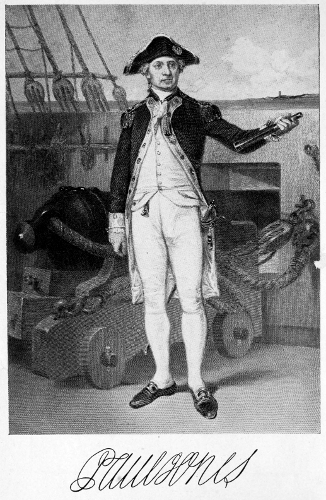
It was the young Scotchman and planter, Paul Jones. But his immaculate
linen had been discarded. In its place he appeared in the trim uniform
of a Continental marine lieutenant—blue coat with red-bound
button-holes, round-cuffed blue breeches, and black gaiters.
As he looked about for a boat to take him out to the five ships riding
at anchor, Paul Jones's eye fell on a tall, lithe young man who was just
in the act of tying the painter of a whaler's yawl to one of the wharf
timbers.
Paul Jones stepped briskly up to him. "Pardon me, my fine fellow," he
said, "but a guinea is yours if you will row me out to the larger of yon
vessels, the Alfred, where I am in urgent service."
The young man wheeled around, displaying features unmistakably those of
an Indian, but of an unusually intelligent composition. His coal-black
eyes swept over his questioner. "I, Wannashego, will take the white
sea-soldier," he replied in excellent English.
Without further ado, Paul Jones sprang nimbly down into the boat. Its
owner cast loose and followed.
As his companion pulled lustily away in the direction of the American
ships, Paul Jones sat studying the rower. When and where had this
redskin of the American forest picked up such splendid address? What
marvelous trick of fate had possessed him of such skill with the white
man's oars?
"You are an Indian, are you not?" inquired the lieutenant presently.
"An Indian of Narragansett tribe," was the proud reply.
"Where did you learn to handle a boat in this manner?"
"On whaling cruises, sir."
"You belong to one of these whaling-ships at the wharves, then?"
"Yes, sir; to Walrus. She lies upstream a bit, sir. Three years I have
been with her."
"How is it you came to leave your people, Wannashego?" asked Paul Jones
curiously.
"My father, Tassa-menna-tayka, a chief who loves the white people, he
sent me from near Martha's Vineyard to learn your ways and be like you,"
declared the young Indian. There was a short pause; he turned his head
for a moment to take his bearings, and then continued: "Sir, I ask if
yonder ships are to fight the great country across the sea?"
"They are, Wannashego."
"You goin' to fight on 'em?"
"I expect to."
"I like to fight on 'em, too," was the sententious rejoinder of the
young redskin.
"Do you mean that?" asked Paul Jones sharply. "If you do, Wannashego, I
think I can get Captain Saltonstall, of my ship, the Alfred, to ship
you, as we are short-handed."
"Mean it a heap," said the Indian. "I shoot good. Make two bangs—get
two Red-coats."
Paul Jones laughed. "I hope so. Well, Wannashego, I'll see what I can do
for you."
Shortly the boat's nose touched the accommodation-ladder over the
Alfred's side. The young lieutenant held out the promised guinea to
Wannashego, but the Indian straightened up proudly. "I don't want
money," said he. "I like America country heap much. You fight for him,
so I help you beat our enemies, the Red-coats."
It was a crude expression of sentiment, but Paul Jones interpreted it
correctly, and was deeply affected by it. "Wannashego," he cried,
"return to your captain. If he will release you, and you still want to
fight the Red-coat soldiers of the sea, come to me on this ship
to-morrow and I will stir heaven and earth to make you a member of our
crew."
Captain Saltonstall was to command the ship, but he had not yet arrived.
So, for the present at least, upon Paul Jones rested the duty of
preparing her for sea. Under his leadership, arrangements went on
speedily and smoothly. The Alfred bid fair to be in readiness before
some of her sister ships, it seemed.
Next morning, before the sun was an hour high, a yawl containing two men
was seen approaching. At first the lieutenant thought it might be
Captain Saltonstall himself, but his glass soon showed him his mistake.
It was the young Narragansett Indian, Wannashego, who evidently had
secured one of the sailors of his old ship to row him out to the
Alfred.
Paul Jones made him welcome, telling him that he was quite sure the
captain would make no objection when he should appear. Thus Wannashego,
the first and one of the very few full-blooded Indians to fight in the
first navy of this country, became a tentative member of the Alfred's
crew. He took hold of his duties happily and energetically, outdoing
many of his white companions.
As for the temporary commander, from the time the foot of Paul Jones
touched the deck of the vessel his active spirit pervaded everything,
and the officers under him, as well as the men, felt the force of his
executive power. Besides working all day, he and the other officers
stood watch and watch on deck throughout the wintry nights, to prevent
desertions; and although every other vessel in the squadron lost men in
this manner, not a single deserter got away from the Alfred.
"An' I'll bet a herrin' ag'in a p'tater, mates," remarked Bill Putters,
quartermaster, in the confidence of the forecastle, "that this Leftenant
Jones is a real seaman wot could handle this yere ol' gal better'n
Cap'n Saltonstall. I kin tell it by the cut o' his jib, the way he
squares away to tackle any job he undertakes."
"Bet so, too, Bill," supported the bos'n, Tom Wilkerson; "an' I'll go
you a cooky he's a fighter. He speaks to most of us so soft you might
think his voice was a tune from a fiddle; but, by Johnny! when Pete
Walker didn't do what he told him to, yes'dy, he thundered at him in a
way that made poor Pete's head rattle with the jar, an' Pete perty nigh
dislocated his spinal collum jumpin' to do what he wanted him to. I'd
like to see the leftenant in full charge. If we ever met up with any o'
them pets of the king you bet there would be some fur flyin'—an' it
wouldn't be ours as much as theirs, neether!"
One day, in the midst of the bustle of fitting out the ship, Commodore
Hopkins, who was to command the little squadron, came on board the
Alfred. He was formally received at the gangway by Paul Jones and
shown over the ship by him.
The commodore was a big, heavy-set man who had spent the best part of
his life at sea. He examined the vessel carefully, but made no
favorable comments, and the young lieutenant began to fear his work had
displeased the senior officer.
But it turned out otherwise. A little later, standing on the
quarter-deck, surrounded by the officers, Commodore Hopkins turned to
Paul Jones and said:
"Your work pleases me extremely, and my confidence in you, sir, is such
that if Captain Saltonstall should not appear by the time these ships
are due to sail, I shall hoist my flag on this ship and give you command
of her."
A flush of gratification arose in Paul Jones's dark face. He bowed with
the graceful courtesy that always distinguished him. "Thank you,
commodore," said he, "and may I be pardoned for expressing the hope that
Captain Saltonstall may not arrive in time! And when your flag is
hoisted on the Alfred, I trust there will be ready a flag of the
United Colonies to fly at the peak-halyards. I aspire to be the first
man to raise that flag upon the ocean!"
Commodore Hopkins smiled. "If the Congress is as slow as I expect it
will be, some time will elapse before it will have adopted a flag; and
there will not be time to have one made, much less, before we sail."
In this he was mistaken. The Congress had practically decided upon the
flag, and quite certain of its selection, Paul Jones from his own pocket
had already purchased the materials to make it. Bill Putters was an old
sail-maker, therefore handy with a needle, which it was his boast he
"could steer like a reg'lar tailor-man." To him the young lieutenant
entrusted the making of the first official flag of America they had
seen—a task which swelled old Bill up with a wonderful pride, as well
it might.
One stormy February day, when the channel had been freed from ice enough
for the little squadron to get out, the Alfred was ready to lend her
spotless decks to the formality of the flag-raising. Captain Saltonstall
had arrived some days before. This disappointed Paul Jones. But he was
as ready to do his duty as first-lieutenant, as in the hoped-for higher
office.
The commodore's boat was seen approaching on the chill waters of the
river. The horizon was overcast. Dun clouds, driven by a strong wind,
scurried across the troubled sky. The boatswain's call, "All hands to
muster!" sounded through the ship. In a wonderfully short time, owing to
the careful drilling of Paul Jones, the three hundred sailors and one
hundred marines were drawn up on deck. The sailors, a fine-looking body
of American seamen, were formed in ranks on the port side of the
quarter-deck, while abaft of them stood the marine guard under arms. On
the starboard side were the petty officers, and on the quarter-deck
proper were the commissioned officers in full uniform, swords at their
sides. Paul Jones headed this line.
When it was reported, "All hands up and aft!" Captain Saltonstall
emerged out of the cabin. At this Paul Jones, having previously arranged
it, called out, "Quartermaster!" and Bill Putters, perfectly groomed,
stepped from the ranks of the petty officers and saluted.
In his hand, carefully rolled up, Bill carried a small bundle. Unrolling
this he followed Paul Jones briskly aft to the flagstaff. He affixed the
flag to the halyards, along with the broad pennant of a commodore just
below, saw that the lines were free, and then stood at attention.
Meantime the commodore's boat had reached the ladder, and he came over
the side. Just as his foot touched the quarter-deck the flag with the
pennant, under Paul Jones's energetic hands, was hauled swiftly upward.
At the top the breeze caught it in all its fullness, flung it free to
the air, and the sun at that moment burst through the clouds which had
enveloped it, and bathed the emblem in all its fresh glory.
Every officer from the commodore down instantly removed his cap in
patriotic reverence. The drummer boys beat a double-ruffle. A tremendous
cheer burst from the sailors and marines.
This was not the present well-known Stars-and-Stripes, which was evolved
later, but the Pine-tree and Rattlesnake Flag with the motto, "Don't
Tread On Me!" As an emblem it was not at all artistic; but the men who
now saw it flung to the breeze for the first time thought only of the
sentiment it expressed, a sentiment still paramount in the heart of
every true-blooded American. And among those who so loudly cheered it
no man was more enthusiastic than the young Narragansett Indian,
Wannashego.
Commodore Hopkins advanced toward Lieutenant Paul Jones and said: "I
congratulate you, sir, upon your enterprise. This flag was only adopted
in Congress yesterday. You are the very first to fly it."
Within an hour the Columbus, the Andrew Doria, the Cabot, and the
Providence, led by the Alfred, were making out toward the open sea
under full spread of canvas, ready to meet whatsoever of the mighty foe
that might appear.