Prompted by a boundless thirst for knowledge and an insatiable desire
to see new places and new things, Madame Pfeiffer left Vienna on the
1st of May 1846, and proceeded to Hamburg, where she embarked on board
a Danish brig, the Caroline, for Rio Janeiro. As the voyage
was divested of romantic incidents, we shall land the reader without
delay at the great sea-port of the Brazilian empire.
The traveller’s description of it is not very favourably coloured.
The streets are dirty, and the houses, even the public buildings, insignificant.
The Imperial Palace has not the slightest architectural pretensions.
The finest square is the Largo do Roico, but this would not be admitted
into Belgravia. It is impossible to speak in high terms even
of the churches, the interior of which is not less disappointing than
their exterior. And as is the town, so are the inhabitants.
Negroes and mulattoes do not make up attractive pictures. Some
of the Brazilian and Portuguese women, however, have handsome and expressive
countenances.
Most writers indulge in glowing descriptions of the scenery and climate
of the Brazils; of the cloudless, radiant sky, and the magic of the
never-ending spring. Madame Ida Pfeiffer admits that the vegetation
is richer, and the soil more fruitful, and nature more exuberantly active
than in any other part of the world; but still, she says, it must not
be thought that all is good and beautiful, and that there is nothing
to weaken the powerful effect of the first impression. The constant
blaze of colour after a while begins to weary; the eye wants rest; the
monotony of the verdure oppresses; and we begin to understand that the
true loveliness of spring is only rightly appreciated when it succeeds
the harsher aspects of winter.
Europeans suffer much from the climate. The moisture is very
considerable, and renders the heat, which in the hot months rises to
99° in the shade, and 122° in the sun, more difficult to bear.
Fogs and
mists are disagreeably common; and whole tracts of country are often
veiled by an impenetrable mist.
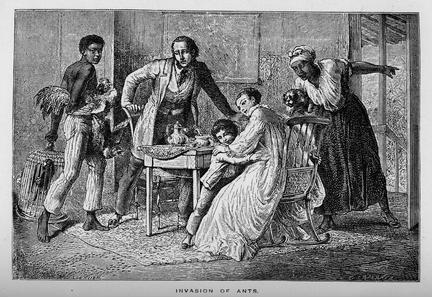
The Brazils suffer, too, from a plague of insects,—from mosquitoes,
ants, baraten, and sand-fleas; against the attacks of which the traveller
finds it difficult to defend himself. The ants often appear in
trains of immeasurable length, and pursue their march over every obstacle
that stands in the way. Madame Pfeiffer, during her residence
at a friend’s house, beheld the advance of a swarm of this description.
It was really interesting to see what a regular line they formed; nothing
could make them deviate from the direction on which they had first determined.
Madame Geiger, her friend, told her she was awakened one night by a
terrible itching: she sprang out of bed immediately, and lo, a swarm
of ants were passing over it! There is no remedy for the infliction,
except to wait, with as much patience as one can muster, for the end
of the procession, which frequently lasts four to six hours. It
is possible, to some extent, to protect provisions against their attacks,
by placing the legs of the tables in basins filled with water.
Clothes and linen are enclosed in tightly-fitting tin canisters.
The
worst plague of all, however, are the sand-fleas, which attach themselves
to one’s toes, underneath the nail, or sometimes to the soles
of the feet. When a person feels an irritation in these parts,
he must immediately look at the place; and if he discern a tiny black
point, surrounded by a small white ring, the former is the chigoe,
or sand-flea, and the latter the eggs which it has deposited in the
flesh. The first thing to be done is to loosen the skin all round
as far as the white skin is visible; the whole deposit is then extracted,
and a little snuff strewn in the empty space. The blacks perform
this operation with considerable skill.
Rich as the Brazils are in natural productions, they are wanting
in many articles which Europeans regard as of the first importance.
There are sugar and coffee, it is true; but no corn, no potatoes, and
none of our delightful varieties of fruit. The flour of manioc,
obtained from the cassava plant, which forms a staple portion of almost
every dish, supplies the place of bread, but is far from being so nutritious
and strengthening; while the different kinds of sweet-tasting roots
are far inferior in value to our potato. The only fruit which
Madame Pfeiffer thought really excellent, were the oranges, bananas,
and
mangoes. The pine-apples are neither very sweet nor very fragrant.
And with regard to two most important articles of consumption, the milk
is very watery, and the meat very dry.
* * * * *
Our traveller, during her sojourn at Rio Janeiro, made many interesting
excursions in the neighbourhood. One was directed to Petropolis,
a colony founded by Germans in the heart of scenery of the most exquisite
character. Accompanied by Count Berchthold, she sailed for Porto
d’Estrella in one of the regular coasting barks. Their course
carried them across a bay remarkable for its picturesque views.
It lies calmly in the embrace of richly-wooded hills, and is studded
with islands, like a silver shield with emerald bosses. Some of
these islands are completely overgrown with palms, while others are
masses of huge rock, with a carpet of green turf.
Their bark was manned by four negroes and a white skipper.
At first they ran merrily before a favourable wind, but in two hours
the crew were compelled to take to the oars, the method of using which
was exceedingly fatiguing. At each dip of the oar, the rower mounts
upon a bench in front of him,
and then, during the stroke, throws himself off again, with his full
force. In two hours more they passed into the river Geromerino,
and made their way through a world of beautiful aquatic plants which
covered the tranquil waters in every direction. The river banks
are flat, and fringed with underwood and young trees; the background
is formed by ranges of low green hills.
At Porto d’Estrella, Madame Pfeiffer and her companion landed,
and proceeded on foot towards Petropolis. The first eight miles
lay through a broad valley, clothed with dense brambles and young trees,
and shadowed by lofty mountains. The wild pine-apples by the roadside
were very fair to see; they were not quite ripe, but tinted of the most
delicate red. Beautiful humming-birds flashed through the air
like “winged jewels,” and studded the dense foliage with
points of many-coloured light.
After passing through the valley, they reached the Sierra, as the
Brazilians term the practicable mountain-summits. It was three
thousand feet in height, and was ascended by a broad paved road, striking
through the depths of virgin forests.
Madame Pfeiffer had always imagined that the trees in virgin forests
had very thick and lofty trunks;
but such was not the case here; probably because the vegetation was
too luxuriant, and the larger trunks have the life crushed out of them
by masses of smaller trees, bushes, creepers, and parasites.
Frequent truppas, or teams of ten mules driven by a negro, as well
as numerous pedestrians, enlivened the path, and prevented our travellers
from observing that their steps were persistently followed up by a negro.
When, however, they arrived at a somewhat lonely spot, this negro suddenly
sprang forward, holding a lasso in one hand and a long knife in the
other, and with threatening gestures gave them to understand that he
intended to murder them, and then drag their dead bodies into the forest!
The travellers were without arms, having been told the road was perfectly
safe; their only weapons were their umbrellas, with the exception of
a clasp-knife. This the brave woman drew from her pocket and opened,
in the calm resolution to sell her life as dearly as possible.
With their umbrellas they parried their adversary’s blows as long
as they could; but he caught hold of Madame Ida’s, which snapped
off, leaving only a piece of the handle in her hand.
In the struggle, however, he dropped his knife, which rolled a few steps
away from him. Madame Ida immediately made a dash at it, and thought
she had secured it; but, quicker in his movements than she was, he thrust
her away with his hands and feet, and once more obtained possession
of it. Waving it furiously over his head, he slashed her twice
in the upper part of the left arm. All seemed lost; but in her
extreme peril the brave lady bethought her of her own knife, and struck
at her adversary, wounding him in the hand. At the same moment
Count Berchthold sprang forward, and while he seized the villain with
both arms, Madame Ida Pfeiffer recovered her feet. All this took
place in less than a minute. The negro was now roused into a condition
of maniacal fury; he gnashed his teeth like a wild beast, and brandished
his knife, while uttering fearful threats. The issue of the contest
would probably have been disastrous, but for the opportune arrival of
assistance. Hearing the tramp of horses’ hoofs upon the
road, the negro desisted from his attack, and sprang into the forest.
A couple of horsemen turning the corner of the road, our travellers
hurried to meet them; and having told their tale, which, indeed, their
wounds told eloquently
enough, they leaped from their horses, and entered the wood in pursuit.
A couple of negroes soon afterwards coming up, the villain was captured,
securely pinioned, and, as he would not walk, severely beaten, until,
as most of the blows fell upon his head, Madame Ida Pfeiffer feared
that the wretch’s skull would be broken. Nothing, however,
would induce him to walk, and the negroes were compelled to carry him
bodily, to the nearest house.
The colony of Petropolis proved to be situated in the depth of a
virgin forest, at an elevation of 2500 feet above the sea-level.
At the time of Madame Pfeiffer’s visit it was about fourteen months
old, having been founded for the special purpose of providing the capital
with fruits and vegetables which, in tropical climates, will thrive
only in very elevated situations. It was, of course, in a very
rudimentary condition, the mere embryo of a town; but the country around
it was very picturesque.
* * * * *
Madame Pfeiffer’s second excursion was into the interior; and
it opened up to her a variety of interesting scenes,—as, for instance,
a manioc-fazenda, or plantation. The manioc plant, it appears,
throws
off stalks from four to six feet in height, with a number of large leaves
at their upper extremities. The valuable portion of the plant
is its bulbous root, which frequently weighs two or three pounds, and
supplies the place of corn throughout the Brazils. It is washed,
peeled, and held against the rough edge of a mill-stone, until it is
completely ground into flour. This flour is collected in a basket,
steeped thoroughly in water, and afterwards pressed quite dry by means
of a press. Lastly, it is scattered upon large iron plates, and
slowly dried over a gentle fire. At this stage it resembles a
very coarse kind of flour, and is eaten in two ways;—either mixed
with hot water, until it forms a kind of porridge; or baked in the form
of coarse flour, which is handed round at table in little baskets.
She also saw a coffee plantation. The coffee-trees stand in
rows upon tolerably steep hillocks. Their height ranges from six
feet to twelve; and they begin to bear sometimes as early as the second,
but in no case later than the third year. They are productive
for at least ten years. The leaf is long and slightly serrated,
and the flower white; while the fruit hangs down like a cluster of grapes,
and resembles a large cherry, which varies from green to red,
then to brown, and almost black. While red, the outer shell is
soft; but eventually it becomes perfectly hard, until it may be compared
to a wooden capsule. Blossoms and ripe fruit are found on the
same tree at the same time; so that a crop may be gathered at almost
any season of the year. After the berries are plucked, they are
spread out in spacious areas enclosed by a wall about twelve feet high,
with small drains to carry off the rain-water. Here the coffee
is allowed to dry in the heat of the sun, and it is then shaken into
large stone mortars, where it is lightly pounded with wooden hammers,
set in motion by water power. The whole mass falls into wooden
boxes attached to a long table, at which sit the negro workers, who
separate the coffee from the husk, and put it into flat copper pans.
In these it is carefully and skilfully turned about over a slow fire,
until desiccation is complete. On the whole, says Madame Ida Pfeiffer,
the preparation of the coffee is not laborious, and the harvest much
more easily gathered than one of corn. The negro, while plucking
the coffee, stands erect, and the tree protects him from the heat of
the sun. His only danger is from poisonous snakes, and a sting
from one of these is a very rare occurrence.
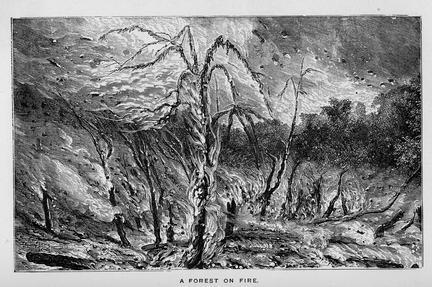
Another
novelty which much impressed our traveller was the sight of the frequent
burning forests. These are set on fire in order to clear the ground
for cultivation. In most cases she viewed the tremendous spectacle
from a distance; but one day she realized it in all its details, as
her road lay between a wood in flames on the one hand, and the brushwood,
crackling and seething, on the other. The space between the double
rows of fire did not exceed fifty paces in breadth, and was completely
buried in smoke. The spluttering and hissing of the fire was distinctly
audible, and through the dense mass of vapour shot upward thick shafts
and tongues of flame, while now and then the large trees crashed to
the ground, with loud reports, like those of artillery.
“On seeing my guide enter this fiery gulf,” says our
traveller, “I was, I must confess, rather frightened;” and
her dread was surely very excusable. She plucked up courage, however,
when she saw that her guide pushed forward. On the threshold,
so to speak, sat two negroes, to indicate the safe, and, in truth, the
only path. The guide, in obedience to their warning, spurred on
his mule, and, followed by Madame Pfeiffer, galloped at full speed across
the desert of fire. Flames to the right of them, flames to the
left of them, onward they dashed, and happily effected the passage in
safety.
* * * * *
Madame
Pfeiffer gives a bright description of the beauties of the road as she
pushed further into the interior. Crossing a small waterfall,
she struck right into the depths of the virgin forest, pursuing a narrow
path which ran along the bank of a little stream. Palms, with
their lordly crests, soared high above the other trees, which, intertwined
by inextricable boughs, formed the loveliest fairy-bowers imaginable;
every stem, every branch was luxuriously festooned with fantastic orchids;
while creepers and ferns glided up the tall, smooth trunks, mingling
with the boughs, and hanging in every direction waving curtains of flowers,
of the sweetest odours and the most vivid colours. With shrill
twittering cry and rapid wings flashed the humming-bird from bough to
bough; the pepper-pecker, with glowing plumage, soared timorously upwards;
while parrots and paroquets, and innumerable birds of beautiful appearance,
added, by their cries and motions, to the liveliness of the scene.
Madame Pfeiffer visited an Indian village. It lay deep
in the forest recesses, and consisted of five huts, or rather sheds,
formed of leaves, and measuring eighteen feet by twelve feet, erected
under lofty trees. The frames were formed of four poles stuck
in the ground, with another reaching across; and the roof was wrought
of palm-leaves, by no means impervious to the rain. The sides
were open. In the interior hung a hammock or two; and on the earth
a few roots, Indian corn, and bananas were roasting under a heap of
ashes. In one corner, under the roof, a small supply of provisions
was hoarded up, and round about were scattered a few gourds; these are
used by the Puris as substitutes for “crockery.” Their
weapons, the long bows and arrows, leaned against the wall.
Madame Pfeiffer describes the Puri Indians as even uglier than the
negroes. Their complexion is a light bronze; they are stunted
in stature, well-knit, and about the middle size. Their features
are broad and somewhat compressed; their hair is thick, long, and of
a coal-black colour. The men wear it hanging straight down; the
women, in plaits fastened to the back of the head, and sometimes falling
loosely down about their persons. Their forehead is broad and
low, and the nose somewhat flattened; the eyes are long
and narrow, almost like those of the Chinese; and the mouth is large,
with rather thick lips. To enhance the effect of these various
charms, the countenance bears a peculiar look of stupidity, which may
be attributed perhaps to the way in which the mouth is kept always open.
Women, as well as males, are generally tattooed of a reddish or blue
colour, round the mouth, moustachio-wise. Both sexes are addicted
to smoking, and look upon brandy as the summum bonum of human
life.
The Indians, ugly as they were, gave Madame Pfeiffer a hospitable
welcome. After an evening meal, in which roasted monkey and parrot
were the chief dishes, they performed one of their characteristic dances.
A quantity of wood was heaped up into a funeral pile, and set on fire;
the men then danced around it in a ring. They threw their bodies
from side to side with much awkwardness, but always moving the head
forward in a straight line. The women then joined in, forming
at a short distance behind the men, and imitating all their movements.
A horrible noise arose; this was intended for a song, the singers at
the same time distorting their features frightfully. One of them
performed on a kind of stringed instrument, made out of the stem of
a cabbage-palm,
and about two feet, or two feet and a half, in length. A hole
was cut in it slantwise, and six fibres of the stem were kept up in
an elevated position at each end, by means of a small bridge.
The fingers played upon these as upon a guitar, drawing forth a very
low, harsh, and disagreeable tone. The dance, thus pleasingly
accompanied, was called the Dance of Peace and Joy.
A wilder measure was next undertaken by the men alone. They
first equipped themselves with bows, arrows, and stout clubs; then they
formed a circle, indulged in the most rapid and fantastic movements,
and brandished their clubs as if dealing death to a hundred foes.
Suddenly they broke their ranks, strung their bows, placed their arrows
ready, and represented all the evolutions of shooting after a flying
foe, giving utterance to the most piercing cries, which resounded through
the forest-glades. Madame Pfeiffer, believing that she was really
surrounded by enemies, started up in terror, and was heartily glad when
the dance ended.
From Rio Janeiro Madame Pfeiffer sailed in an English ship, the John
Renwick, on the 9th of December, bound for Valparaiso in Chili.
She kept to the south, touching at Santos, where the voyagers celebrated
New-Year’s Day, and reaching the mouth of the Rio Plata on the
11th of January. In these latitudes the Southern Cross is the
most conspicuous object in the heavens. It consists of four stars
of much brilliancy, arranged in two diagonal rows. Late in the
month the voyagers sighted the sterile shores and barren mountains of
Patagonia, and next the volcanic rocks, wave-worn and wind-worn, of
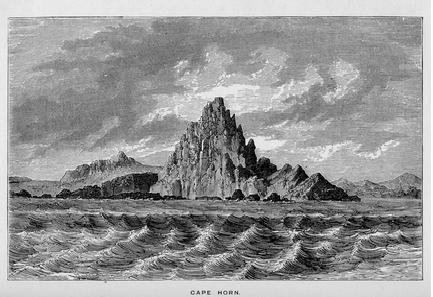
Tierra del Fuego. Through the Strait of Le Maire, which separates
the latter from Staten Island, they sailed onward to the extreme southern
point of the American continent, the famous promontory of Cape Horn.
It is the termination of the mighty mountain-chain of the Andes, and
is formed of a mass of colossal basaltic rocks, thrown together in wild
disorder, as by a Titan’s hand.
Rounding Cape Horn they encountered a violent gale, which lasted
for several days; and soon discovered, like other voyagers, how little
the great southern ocean deserves its name of the Pacific. But
they reached Valparaiso in safety. Its appearance, however, did
not very favourably impress Madame Ida Pfeiffer. It is laid out
in two long streets at the foot of dreary hills, these hills consisting
of a pile of rocks covered with thin strata of earth and sand.
Some of them are covered with houses; on one of them is the churchyard;
the others are bare and solitary. The two chief streets are broad,
and much frequented, especially by horsemen; for every Chilian is born
a horseman, and is usually mounted on a steed worthy of a good rider.
Valparaiso houses are European in style, with flat Italian roofs.
Broad steps lead up into a lofty entrance-hall on the first floor, from
which, through large glass doors, the visitor passes into the drawing-room
and other apartments. The drawing-room is the pride not only of
every European settler, but of every native Chilian. The foot
sinks into heavy and costly carpets; the walls are emblazoned with rich
tapestry; the furniture and mirrors are of European make, and sumptuous
in the extreme; and every table presents the evidence of refined taste
in gorgeous albums, adorned with the choicest engravings.
As to the lower classes of the population, if we would obtain an
idea of their manners and customs, we must stroll on a fête-day
into one of their eating-houses.
In one corner, on the ground, crackles a tremendous fire, surrounded
by innumerable pots and pans, between
which are wooden spits with beef and pork, simmering and roasting with
appetizing savour. A rude wooden frame-work, with a long broad
plank on it, occupies the middle of the room, and is covered with a
cloth, the original colour of which it is impossible to determine.
This is the guest-table. The dinner is served up in the most primitive
fashion imaginable, all the viands being heaped up in one dish; beans
and rice, potatoes and roast beef, onions and paradise apples, forming
a curious medley. The appetites of the guests are keen, and no
time is wasted in talking. At the end of the repast, a goblet
of wine or water passes from hand to hand; after which every tongue
is loosened. In the evening a guitar strikes up, and dancing becomes
general.
A singular custom prevails among the Chilians on the death of a little
child. This incident, in most European families, is attended by
much sorrow: the Chilian parents make it the occasion of a great festival.
The deceased angelito, or little angel, is adorned in various
ways. Its eyes, instead of being closed, are opened as wide as
possible; its cheeks are painted red; then the cold rigid corpse is
dressed in the finest clothes, crowned with flowers, and set up in a
little chair in a flower-garlanded niche. The
relatives and neighbours flock in, to wish the parents joy on the possession
of such an angel; and, during the first night, they all indulge in the
most extravagant dances, and feast with sounds of wildest merriment
before the angelito.
Madame Pfeiffer heard from a merchant the following story:—A
grave-digger, on his way to the churchyard with one of these deceased
angelitos, tarried at a tavern to refresh himself with a cup of wine.
The landlord inquired what he was carrying under his cloak, and on learning
that it was an angelito, offered him a shilling for it. A bargain
was soon struck; the landlord quickly fitted up a flowery niche in the
drinking-saloon, and then took care that his neighbours should know
what a treasure he had acquired. They came; they admired the angelito;
they drank copiously in its honour. But the parents hearing of
the affair, interfered, carried away their dead child, and summoned
the landlord before the magistrate. The latter gravely heard the
pleadings on both sides, and as no such case was mentioned in the statute-book,
arranged it amicably, to the satisfaction of both parties.
* * * * *
Wearying of Valparaiso, our restless and adventurous traveller,
who was bent upon accomplishing a voyage round the world, took her passage
for China in the Dutch barque Lootpurt, Captain Van Wyk Jurianse.
They sailed from Valparaiso on the 18th of March, and on the 26th
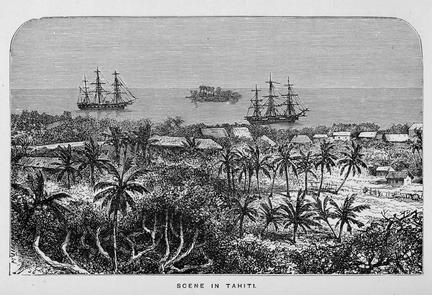
of April came in sight of that gem of the South Seas, Tahiti, the Otaheite
of Captain Cook, and the largest and most beautiful of the Society group.
From the days of Bougainville, its discoverer, down to those of “the
Earl and the Doctor,” who recently published a narrative of their
visit, it has been the theme of admiration for the charms of its scenery.
It lifts its lofty summit out of a wealth of luxuriant vegetation, which
descends to the very margin of a sea as blue as the sky above it.
Cool green valleys penetrate into its mountain-recesses, and their slopes
are loaded with groves of bread-fruit and cocoa-nut trees. The
inhabitants, physically speaking, are not unworthy of their island-Eden;
they are a tall, robust, and well-knit race, and would be comely but
for their custom of flattening the nose as soon as the child is born.
They have fine dark eyes, and thick jet-black hair. The colour
of their skin is a copper-brown. Both sexes are tattooed, generally
from the hips half down the legs,
and frequently over the hands, feet, and other parts of the body; the
devices being often very fanciful in design, and always artistically
executed.
The women of Tahiti have always been notorious for their immodesty,
and the island, notwithstanding the labours of zealous missionaries,
continues to be the Polynesian Paphos. The French protectorate
from which it suffers has not raised the moral standard of the population.
Madame Pfeiffer undertook an excursion to the Lake Vaihiria, assuming
for the nonce a semi-masculine attire, which any less strong-minded
and adventurous woman would probably have refused. She wore, she
tells us, strong men’s shoes, trousers, and a blouse, which was
fastened high up about the hips. Thus equipped, she started off
with her guide, crossing about two-and-thirty brooks before they entered
the ravines leading into the interior of the island.
She noticed that as they advanced the fruit-trees disappeared, and
instead, the slopes were covered with plantains, taros, and marantas;
the last attaining a height of twelve feet, and growing so luxuriantly
that it is with some difficulty the traveller makes his way through
the tangle. The taro, which is
carefully cultivated, averages two or three feet high, and has fine
large leaves and tubers like those of the potato, but not so good when
roasted. There is much gracefulness in the appearance of the plantain,
or banana, which varies from twelve to fifteen feet in height, and has
leaves like those of the palm, but a brittle reed-like stem, about eight
inches in diameter. It attains its full growth in the first year,
bears fruit in the second, and then dies. Thus its life is as
brief as it is useful.
Through one bright mountain-stream, which swept along the ravine
over a stony bed, breaking up into eddies and tiny whirlpools, and in
some places attaining a depth of three feet, Madame Pfeiffer and her
guide waded or half-swam two-and-sixty times. The resolute spirit
of the woman, however, never failed her; and though the path at every
step became more difficult and dangerous, she persisted in pressing
forward. She clambered over rocks and stones; she forced her way
through inter-tangled bushes; and though severely wounded in her hands
and feet, never hesitated for a moment. In two places the ravine
narrowed so considerably that the entire space was filled by the brawling
torrent. It was here that the islanders, during their
struggle against French occupation, threw up stone walls five feet in
height, as a barrier against the enemy.
In eight hours the bold traveller and her guide had walked, waded,
and clambered fully eighteen miles, and had attained an elevation of
eighteen hundred feet. The lake itself was not visible until they
stood upon its shores, as it lies bosomed in a deep hollow, among lofty
and precipitous mountains which descend with startling abruptness to
the very brink of its dark, deep waters. To cross the lake it
is necessary to put one’s trust in one’s swimming powers,
or in a curiously frail kind of boat, which the natives prepare with
equal rapidity and skill. Madame Pfeiffer, however, was nothing
if not adventurous. Whatever there was to be dared, she immediately
dared. At her request, the guide made the usual essay at boat-building.
He tore off some plantain branches, bound them together with long tough
grass, laid a few leaves upon them, launched them in the water, and
requested Madame Pfeiffer to embark. She confesses to having felt
a little hesitation, but without saying a word, she stepped on board.
Then her guide took to the water like a duck, and pushed her forward.
The passage across
the lake, and back again, was in this way accomplished without any accident.
Having satiated herself with admiring the lake and its surrounding
scenery, she retired to a little nook roofed over with leaves, where
her guide quickly kindled a good fire in the usual Indian fashion.
He cut a small piece of wood to a fine point, and then selecting a second
piece, grooved it with a narrow and not very deep furrow. In this
he rubbed the pointed stick until the fragments detached during the
process began to smoke. These he flung into a heap of dry leaves
and grass previously collected, and swung the whole several times round
in the air, until it broke out into flames. The entire process
did not occupy above two minutes. Gathering a few plantains, these
were roasted for supper; after which Madame Pfeiffer withdrew to her
solitary couch of dry leaves, to sleep as best she might. It is
impossible not to wonder at the marvellous physical capability of this
adventurous woman, no less than at her courage, her resolution, and
her perseverance. How many of her sex could bear for a week the
fatigue and exposure to which she subjected herself year after year?
The
next morning she accomplished the return journey in safety.
* * * * *
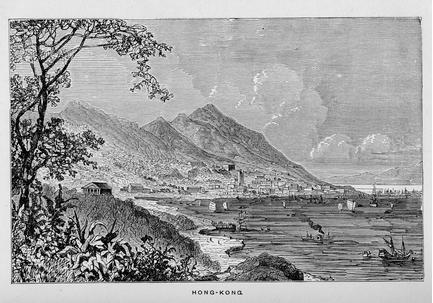
On the 17th of May she left Tahiti, the Dutch vessel in which she
had embarked being bound via the Philippines. They passed this
rich and radiant group of islands on the 1st of July, and the next day
entered the dangerous China Sea. A few days afterwards they reached
Hong-Kong, which has been an English settlement since 1842. Here
Madame Pfeiffer made no long stay, for she desired to see China and
the Chinese with as little intermixture of the European element as possible.
So she ascended the Pearl river, the banks of which are covered with
immense plantations of rice, and studded with quaint little country-houses,
of the genuine Chinese pattern, with sloping, pointed roofs, and mosaics
of variously coloured tiles, to Canton, one of the great commercial
centres of the Flowery Land. As she approached she surveyed with
wonder the animated scene before her. The river was crowded with
ships and inhabited boats. Junks there were, almost as large as
the old Spanish galleons, with poops impending far over the water, and
covered in with a roof, like a house. Men-of-war there
were, flat, broad, and long, mounted with twenty or thirty guns, and
adorned in the usual Chinese fashion, with two large painted eyes at
the prow, that they may be the better able to find their way.
Mandarins’ boats she saw, with doors, and sides, and windows gaily
painted, with carved galleries, and tiny silken flags fluttering from
every point. And flower-boats she also saw; their upper galleries
decked with flowers, garlands, and arabesques, as if these were barks
fitted out for the service of Titania and her fairy company. The
interior is divided into one large apartment and a few cabinets, which
are lighted by windows of fantastic design. Mirrors and silk hangings
embellish the walls, while the enchanting scene is completed with an
ample garniture of glass chandeliers and coloured paper lanterns, interspersed
with lovely little baskets of fresh flowers.
It is not necessary to attempt a description of Canton, with its
pagodas, houses, shops, and European factories. Let us direct
our attention to the manners, customs, and peculiarities of its inhabitants.
As to dress and appearance, the costume of both sexes, among the lower
orders, consists of full trousers and long upper garments, and is chiefly
remarkable for its “excessive filth.” Baths and ablutions
have no charm for the Chinaman; he scorns to wear a shirt, and he holds
by his trousers until they drop from his body. The men’s
upper garments reach a little below the knee, the women’s about
half way down the calf. They are made of nankeen, or dark blue,
brown, or black silk. During the cold season both men and women
wear one summer garment over the other, keeping the whole together with
a girdle; in the extreme heat, however, they suffer them to float as
free as “Nora Creina’s robes” in Moore’s pretty
ballad.
The men keep their heads shaved, with the exception of a small patch
at the back, where the hair is carefully cultivated and plaited into
a cue. The thicker and longer this cue is, the prouder is its
owner; false hair and black ribbon, therefore, are all deftly worked
into it, with the result of forming an appendage which often reaches
down to the ankles! While at work the owner twists it round his
neck, but on entering a room he lets it down again, as it would be contrary
to all the laws of etiquette and courtesy for a person to make his appearance
with his cue twisted up. The women comb their hair entirely back
from their forehead, and
fasten it to the head in the most artistic plaits. The process
occupies a considerable time, but when the hair is once dressed it is
not retouched for a whole week. Both men and women frequently
go about with heads uncovered; but sometimes they wear hats of thin
bamboo, three feet in diameter. These are not only an adequate
protection against sun and rain, but are exceedingly durable.
Large numbers of Chinese live a kind of aquatic life, and make their
home on board a river-boat. The husband goes on shore to his work,
and his wife meantime adds to the income of the family by ferrying persons
from bank to bank, or letting out the boat to pleasure parties—always
reserving one half of its accommodation for herself and household.
Room is not very abundant, as the whole boat does not exceed twenty-five
feet in length; but everywhere the greatest order and cleanliness are
apparent, each separate plank being enthusiastically scrubbed and washed
every morning. It is worth notice how each inch of space is turned
to the best advantage, room being made even for the lares and
penates. All the washing and cooking are done during the
day; yet the pleasure party is never in the least degree inconvenienced.
Of
course our traveller was attracted by the diminutiveness of the feet
of the Chinese women, and she had an opportunity of examining one of
these tiny monstrosities in naturâ. Four of the toes
were bent under the sole of the foot, to which they were firmly pressed,
and simultaneously with which they appeared to have grown, if growth
it can be called; the great toe alone remained in its natural state.
The fore part of the foot had been so swathed and compressed by tight
bandages, that, instead of expanding in length and breadth, it had shot
upwards, so as to form a large lump at the instep, where it became,
so to speak, a portion of the leg; the lower part of the foot was scarcely
five inches long, and an inch and a half broad. The feet are always
encased in white linen or silk, with silk bandages over all, and are
then stuffed into pretty little shoes with very high heels. “To
my astonishment,” says Madame Pfeiffer, “these deformed
beings tripped about, as if in defiance of us broad-footed creatures,
with tolerable ease, the only difference in their gait being that they
waddled like geese; they even ran up and down stairs without a stick.”
She adds, that the value of a bride is reckoned by the smallness of
her feet.
It
was characteristic of Madame Pfeiffer that she found means to see much
which no European woman had ever seen before. She obtained access
even to a Buddhist temple,—that of Houan, reputed to be one of
the finest in China. The sacred enclosure is surrounded by a high
wall. The visitor enters first a large outer court, at the extremity
of which a huge gateway opens upon an inner court. Beneath the
arch stand two statues of war-gods, each eighteen feet high, with terribly
distorted faces and the most menacing attitudes; these are supposed
to prevent the approach of evil genii. A second portal, of similar
construction, under which are placed the “four heavenly kings,”
leads to a third court, surrounding the principal temple, a structure
one hundred feet in length, and of equal breadth. On rows of wooden
pillars is supported a flat roof, from which glass lamps, lustres, artificial
flowers, and brightly-coloured ribbons hang suspended. All about
the area are scattered statues, altars, vases of flowers, censers, candelabra,
and other accessories.
But the eye is chiefly attracted by the three altars in the foreground,
with the three coloured statues behind them, of Buddha, seated, as emblematic
of Past, Present, and Future. On the occasion of
Madame Pfeiffer’s visit a service was being performed,—a
funeral ceremony in honour of a mandarin’s deceased wife, and
at his expense. Before the altars on the right and left stood
several priests, in garments strangely resembling, as did the ceremonial
observances, those of the Roman Church. The mandarin himself,
attended by two servants armed with large fans, prayed before the central
altar. He kissed the ground repeatedly, and each time he did so
three sweet-scented wax-tapers were put into his hand. After raising
them in the air, he handed them to the priests, who then stationed them,
unlighted, before the Buddha images. Meantime, the temple resounded
with the blended strains of three musicians, one of whom struck a metal
ball, the other scraped a stringed instrument, and the third educed
shrill notes from a kind of flute.
This principal temple is surrounded by numerous smaller sanctuaries,
each decorated with images of deities, rudely wrought, but glowing with
gilt and vivid colours. Special reverence seems to be accorded
to Kwanfootse, a demigod of War, and the four-and-twenty gods of Mercy.
These latter have four, six, and even eight arms. In the Temple
of Mercy Madame Pfeiffer met with an unpleasant adventure.
A Bonze had offered her and her companions a couple of wax tapers to
light in honour of the god. They were on the point of complying,
as a matter of civility, when an American missionary, who made one of
the party, snatched them roughly from their hands, and gave them back
to the priests, protesting that such compliance was idolatrous.
The Bonze, in high indignation, closed the door, and summoned his brethren,
who hurried in from all sides, and jostled and pushed and pressed, while
using the most violent language. It was not without difficulty
they forced their way through the crowd, and escaped from the temple.
The guide next led the curiosity-hunters to the so-called House of
the Sacred Swine. The greatest attention is paid to these porcine
treasures, and they reside in a spacious stone hall; but not the less
is the atmosphere heavy with odours that are not exactly those of Araby
the Blest. Throughout their sluggish existence the swine are carefully
fed and cherished, and no cruel knife cuts short the thread of their
destiny. At the time of Madame Pfeiffer’s visit only one
pair were enjoying their otium cum dignitate, and the number
rarely exceeds three pairs.
Peeping
into the interior of a Bonze’s house, the company came upon an
opium-smoker. He lay stretched upon a mat, with small tea-cups
beside him, some fruit, a tiny lamp, and several miniature-headed pipes,
from one of which he was inhaling the intoxicating smoke. It is
said that some of the Chinese opium-smokers consume as much as twenty
or thirty grains daily. This poor wretch was not wholly unconscious
of the presence of visitors; and, laying by his pipe, he raised himself
from the ground, and dragged his body to a chair. With deadly
pale face and fixed, staring eyes, he presented a miserable appearance.
* * * * *
Our traveller also visited a pagoda,—the Half-Way Pagoda; so
called by the English because it is situated half-way between Canton
and Whampoa. On a small hillock, in the midst of vast tracts of
rice, it raises its nine stories to a height of one hundred and seventy
feet. Though formerly of great repute, it is now deserted.
The interior has been stripped of statues and ornaments, and the floors
having been removed, the visitor sees to the very summit. Externally,
each stage is indicated by a small balcony without railing, access being
obtained
by steep and narrow flights of stairs. A picturesque effect is
produced by these projections, as everybody knows who has examined a
“willow-pattern” plate. They are built of coloured
bricks, which are laid in rows, with their points jutting obliquely
outwards, and faced with variegated tiles.
Even more interesting was Madame Pfeiffer’s peep into the “domestic
interior” of Mandarin Howqua.
The house was of large size, but only one story high, with wide and
splendid terraces. The windows looked into the inner courts.
At the entrance were two painted images of gods to ward off evil spirits,
like the horse-shoe formerly suspended to the cottages and barns of
our English peasants.
The front part was divided into several reception rooms, without
front walls; and adjoining these, bloomed bright and gaily-ordered parterres
of flowers and shrubs. The magnificent terraces above also bloomed
with blossom, and commanded a lively view of the crowded river, and
of the fine scenery that spreads around Canton. Elegant little
cabinets surrounded these rooms, being separated by thin partitions,
through which the eye could easily penetrate,
and frequently embellished with gay and skilfully-executed paintings.
The material used was chiefly bamboo, which was as delicate as gauze,
and copiously decorated with painted flowers or beautifully-written
proverbs.
The chairs and sofas were numerous, and of really artistic workmanship.
Some of the arm-chairs were cunningly wrought out of a single piece
of wood. The seats of others were beautiful marble slabs; of others,
again, fine coloured tiles or porcelain. Articles of European
manufacture, such as handsome mirrors, clocks, vases, and tables of
Florentine mosaic or variegated marble, were plentiful. There
was also a remarkable collection of lamps and lanterns pendent from
the ceilings, consisting—these lamps and lanterns—of glass,
transparent horn, and coloured gauze or paper, ornamented with glass
beads, fringe, and tassels. And as the walls were also largely
supplied with lamps, the apartments, when lighted up, assumed a truly
fairy-like character.
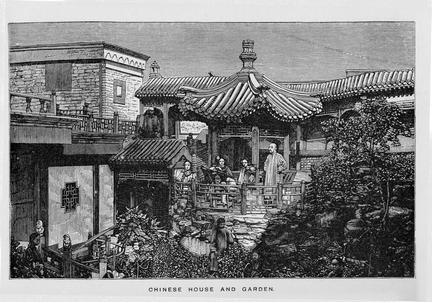
The mandarin’s pleasure-garden stretched along the river-side.
Its cultivation was perfect, but no taste was shown in its arrangement.
Wherever the visitor turned, kiosks, summer-houses, and bridges
confronted her. Every path and open spot were lined with large
and small flower-pots, in which grew flowers and liliputian fruit-trees
of all kinds. In the art of dwarfing trees, if such distortion
and crippling of Nature deserves to be called an art, the Chinese are
certainly most accomplished experts; but what can we think of the taste,
or want of taste, which prefers pigmies three feet high to the lofty
and far-shadowing trees which embellish our English parks and gardens?
Why should a civilized people put Nature in fetters, and delight in
checking her growth, in limiting her spontaneous energies?
Here are some particulars about the tea-plant:—In the plantations
around Canton, it is not allowed to grow higher than six feet, and is
consequently cut at intervals. Its leaves are considered good
from the third to the eighth year; and the plant is then cut down, in
order that it may throw off new shoots, or else it is rooted out.
Three gatherings take place in the year; the first in March, the second
in April, and the third, which lasts for three months, in May.
So fine and delicate are the leaves of the first gathering, that they
might easily be mistaken for the blossom; which undoubtedly has originated
the error that the so-called “bloom or imperial tea” consists
of the flowers and not of the leaves of the plant.
When gathered, the leaves are thrown for a few seconds into boiling
water, and then placed on flat iron plates, inserted slantwise in stone-work.
While roasting over a gentle fire, they are continually stirred.
As soon as they begin to curl a little, they are scattered over large
planks, and each single leaf is rolled together; a process so rapidly
accomplished that it requires a person’s sole attention to detect
that only one leaf is rolled up at a time. This completed, all
the leaves are again placed in the pans. Black tea takes some
time to roast; and the green is frequently coloured with Prussian blue,
an exceedingly small quantity of which is added during the second roasting.
Last of all, the tea is once more shaken out upon the boards, and submitted
to a careful inspection, the leaves that are not entirely closed being
rolled over again.
Madame Pfeiffer had an opportunity of tasting a cup of tea made after
the most approved Chinese fashion. A small quantity was dropped
into a delicate porcelain cup, boiling water was poured upon it, and
a tightly-fitting cover then adjusted to the
cup. After a few seconds, the infusion was ready for drinking—neither
milk, cream, nor sugar being added.
* * * * *
But we must tarry no longer within the borders of the Celestial Empire.
We have to follow Madame Pfeiffer in her wanderings over many seas and
through many countries,—for in the course of her adventurous career
she saw more of “men and cities” than even the much-travelling
Ulysses,—and our limits confine us to brief notices of the most
remarkable places she visited.
From China she sailed for the East Indies.
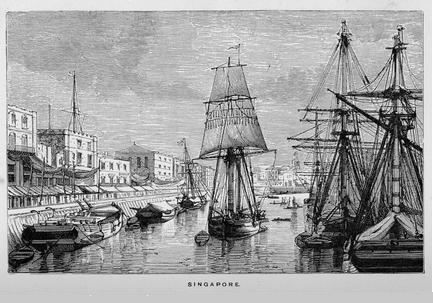
On her way she “looked in” at Singapore, a British settlement,
where gather the traders of many Asiatic nations. The scenery
which stretches around it is of a rich and agreeable character, and
the island on which it is situated excels in fertility of vegetation.
A saunter among the plantations of cloves and nutmegs is very pleasant,
the air breathing a peculiar balsamic fragrance. The nutmeg-tree
is about the size of a good apricot-bush, and from top to bottom is
a mass of foliage; the branches grow very low down the stem, and the
leaves glitter as if they were varnished. The fruit closely resembles
an apricot, covered with spots of yellowish-brown. It bursts on
attaining maturity, and then reveals a round kernel, of the size of
a nut, embedded in a network, sold as mace, of a beautiful red colour.
This network of fibrous material is carefully separated from the nutmeg,
and dried in the shade,—being frequently sprinkled with sea-water,
to prevent the colour deepening into black, instead of changing into
yellow. The nutmeg is likewise dried, exposed a while to the action
of smoke, and dipped several times into sea-water containing a weak
solution of lime, to prevent it from turning mouldy.
The clove-tree is smaller, and less copiously provided with foliage,
than the nutmeg-tree. The buds form what are known to us as cloves;
and, of course, are gathered before they have had time to blossom.
The areca-nut palm is also plentiful in Singapore. It grows in
clusters of from ten to twenty nuts; is somewhat larger than a nutmeg,
and of a bright colour, almost resembling gilt.
The Chinese and the natives of the Eastern Islands chew it with betel-leaf
and calcined mussel-shells. With a small quantity of the latter
they strew the leaf; a very small piece of the nut is added,
and the whole is made into a little packet, which they put into their
mouth.
Madame Pfeiffer also inspected a sago manufactory. The unprepared
farina, which is the pith of the sago palm, is imported from a neighbouring
island. The tree is cut down when it is seven years old, split
from top to bottom, and the pith extracted from it. Then it is
freed from the fibres, pressed in large frames, and dried at the fire
or in the sun. At Singapore this pith or meal, which is of a yellowish
tint, is steeped in water for several days until completely blanched;
it is then once more dried by the fire or in the sun, passed under a
large wooden roller, and through a hair sieve. When it has become
white and fine, it is placed in a kind of linen winnowing-fan, which
is kept damp in a peculiar manner. The workman takes a mouthful
of water, and “spirts it out like fine rain over the fan;”
the meal being alternately shaken and moistened until it assumes the
character of small globules. These are stirred round in large
flat pans, until they are dried. Then they are passed through
a second sieve, not quite so fine as the first, and the larger globules
are separated from the rest.
Pepper
and gambir plantations are also among the “sights” of Singapore.
The pepper-tree is a small bush-like plant, which, when carefully trained,
springs to a height of eighteen feet. The pepper-pods grow in
small clusters, and change from red to green, and then to black.
White pepper is nothing more than the black pepper blanched by frequent
steeping in sea-water. The gambir does not grow taller than eight
feet. The leaves, which are used in dyeing, are first stripped
from the stalk, and then boiled down in large coppers. The thick
juice is placed in white wooden vessels, and dried in the sun; then
it is divided into slips about three inches long, and packed up.
Singapore is an island of fruits. It boasts of the delicious
mangosteen, which almost melts in the mouth, and delights the palate
with its exquisite flavour. It boasts, too, of splendid pine-apples,
frequently weighing as much as four pounds. Also of sauersop,
as big as the biggest pine-apples, green outside, and white or pale
yellow inside, with a taste and fragrance like that of strawberries.
Nor must the gumaloh be forgotten: it is divided, like the orange, into
sections, but is five times as large, and not quite so sweet.
Finally, we must refer to the custard-apple,
which is very white (though full of black pips), very soft, and very
enticing in flavour.
* * * * *
From Singapore we follow Madame Pfeiffer to Point de Galle, in Ceylon.
The appearance of this fair and fertile island from the sea is the theme
of every traveller’s praise. “It was one of the most
magnificent sights I ever beheld,” says Madame Pfeiffer, “to
see the island soaring gradually from the sea, with its mountain-ranges
growing more and more distinctly defined, their summits lighted by the
sun, while the dense cocoa-groves, and hills and plains, lay shrouded
in shadow.” Above the whole towers the purple mass of Adam’s
Peak; and the eye rests in every direction on the most luxuriant foliage,
with verdurous glades, and slopes carpeted with flowers.
Point de Galle presents a curious mixture of races. Cingalese,
Kanditons, Tamils from South India, and Moormen, with crimson caftans
and shaven crowns, form the bulk of the crowds that throng its streets;
but, besides these, there are Portuguese, Chinese, Jews, Arabs, Parsees,
Englishmen, Malays, Dutchmen, and half-caste burghers, and now and then
a veiled Arabian woman, or a Veddah, one of the aboriginal
inhabitants of the island. Sir Charles Dilke speaks of “silent
crowds of tall and graceful girls, wearing, as we at first supposed,
white petticoats and bodices; their hair carried off the face with a
decorated hoop, and caught at the back by a high tortoise-shell comb.
As they drew near, moustaches began to show, and I saw that they were
men; whilst walking with them were women naked to the waist, combless,
and far more rough and ‘manly’ than their husbands.
Petticoat and chignon are male institutions in Ceylon.”
* * * * *
Madame Pfeiffer, with unresting energy, visited Colombo and Kandy,
the chief towns of the island. At the latter she obtained admission
to the Temple of Dagoba, which contains a precious relic of the god
Buddha—namely, one of his teeth. The sanctuary containing
this sacred treasure is a small chamber or cell, less than twenty feet
in breadth. It is enveloped in darkness, as there are no windows;
and the door is curtained inside, for the more effectual exclusion of
the light. Rich tapestry covers the walls and ceiling. But
the chief object is the altar, which glitters with plates of silver,
and is incrusted about the edges with precious stones. Upon it
stands
a bell-shaped case about three feet in height, and three feet in diameter
at the base. It is made of silver, elaborately gilt, and decorated
with a number of costly jewels. A peacock in the middle blazes
with jewels. Six smaller cases, reputed to be of gold, are enclosed
within the large one, and under the last is the tooth of Buddha.
As it is as large as that of a great bull, one trembles to think how
monstrous must have been the jaw of the Indian creed-founder!
* * * * *
Madame Ida Pfeiffer arrived at Madras on the 30th of October.
She describes the process of disembarkation; but as her details are
few, and refer to a comparatively distant date, we propose to rely on
the narrative of a recent traveller.
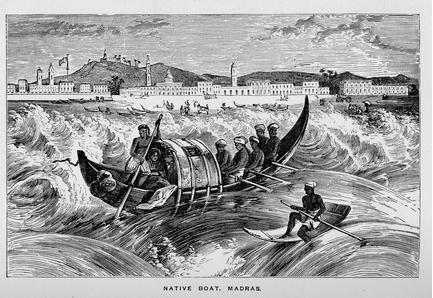
From time immemorial, he says, the system of landing and embarking
passengers and cargo has been by means of native Massulah boats, constructed
of mango wood, calked with straw, and sewn together with cocoa-nut fibre.
The ships drop their anchors in the roads half a mile from the shore;
the Massulah boat pulls off alongside, receives its cargo at the gangway,
and is then beached through the surf. It is no uncommon circumstance
for the boat alongside,
assisted by the rolling of the ship, to rise and fall twenty-five feet
relatively to the height of the ship’s deck at each undulation.
Ladies are lashed into chairs, and from the ship’s yard-arm lowered
into the boat. In 1860 some improvement was effected by the construction
of an iron pier, about nine hundred feet in length, and twenty feet
in height. But a spacious and sheltered harbour is now being provided,
by means of piers running out from the shore five hundred yards north
and south respectively of the screw pile pier now existing, so as to
enclose a rectangular area of one thousand yards in length by eight
hundred and thirty yards in width, or one hundred and seventy acres.
The foundation-stone was laid by the Prince of Wales in the course of
his Indian progress in 1876.
Madame Pfeiffer stayed but a few hours at Madras, and her notes respecting
it are of no value. We will proceed at once to Calcutta, the “City
of Palaces,” as it has been called, and the capital of our Indian
Empire.
She speaks of the Viceroy’s Palace as a magnificent building,
and one that would ornament any city in the world. Other noticeable
edifices are the Town Hall, the Hospital, the Museum, Ochterlony’s
Monument,
the Mint, and the Cathedral. Ochterlony’s Monument is a
plain stone column, one hundred and sixty-five feet high, erected in
commemoration of a sagacious statesman and an able soldier. From
its summit, to which access is obtained by two hundred and twenty-two
steps, may be obtained a noble view of the city, the broad reaches of
the Ganges, and the fertile plains of Bengal.
The Cathedral is an imposing pile. Its architecture is Gothic,
and the interior produces a very fine effect by the harmony of its proportions
and the richness of its details. The ill-famed “Black Hole,”
in which the Rajah Surajah Dowlah confined one hundred and fifty English
men and women, when he obtained possession of Calcutta in 1756—confining
them in a narrow and noisome cell, which poisoned them with its malarious
atmosphere, so that by morning only a few remained alive—is now
part of a warehouse. But an obelisk stands at the entrance, inscribed
with the names of the victims.
The fashionable promenade at Calcutta is the Maidan. It runs
along the bank of the Hooghly, and is bounded on the other side by rows
of palatial mansions. It commands a good view of the Viceroy’s
Palace,
the Cathedral, the Ochterlony Column, the strong defensive works of
Fort William; and is altogether a very interesting and attractive spot.
Every evening, before sunset, thither wends the fashionable world
of Calcutta. The impassive European, with all the proud consciousness
of a conquering race; the half-Europeanized baboo; the deposed rajah,—all
may be seen driving to and fro in splendid equipages, drawn by handsome
steeds, and followed by servants in gay Oriental attire. The rajahs
and “nabobs” are usually dressed in gold-embroidered robes
of silk, over which are thrown the costliest Indian shawls. Ladies
and gentlemen, on English horses of the best blood, canter along the
road, or its turfen borders; while crowds of dusky natives gather in
all directions, or leisurely move homewards after their day’s
work. A bright feature of the scene is the animated appearance
of the Hooghly: first-class East Indiamen are lying at anchor, ships
are arriving or preparing for departure, the native craft incessantly
ply to and fro, and a Babel of voices of different nationalities rises
on the air.
Here is a picture of the Maidan, drawn by another lady-traveller,
Mrs. Murray Mitchell:—
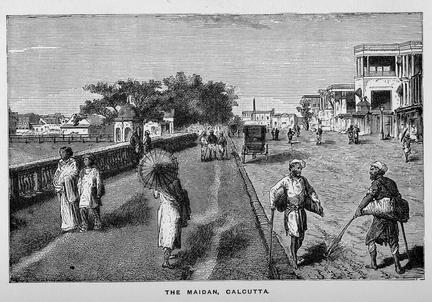
It
is, she says, a noble expanse, which, about a hundred years ago, was
a wild swampy jungle, famous only for snipe-shooting. Strange
to say, it is not, like most Indian plains, burned up and brown, but,
from its vicinity to the river, and the frequent showers that visit
it, as fresh and green as an English park. It has a few fine tanks,
and is sprinkled with some leafy trees; these, however, not so numerous
as they were before the cyclones of 1864 and 1867, which swept away
its chief natural beauties. Several broad well-kept drives intersect
it, and it is ornamented by some graceful gardens and a few handsome
columns and statues. Indeed, the Maidan is the centre of all that
is grand and imposing; the shabby and the unsightly is kept behind,
out of view. Facing it, along its eastern marge, stand the noble
pillared palaces of Chowringhee. At one end stands the handsome
new Court House; also the Town Hall, and other buildings of less pretence;
and, further on, the noble pile of Government House, with four handsome
entrance gates, and surrounded by shrubberies and gardens. In
front spread the Eden Gardens, a delightful addition to the beauties
both of Government House and the Esplanade. From this point the
business part of Calcutta extends in a northerly direction, including
Dalhousie Square, with its many buildings, among which conspicuous stands
the domed Post Office—the vista closing gracefully with the shapely
spire of St. Andrew’s Church. At the further extremity,
nearly two miles across the verdant expanse, are seen the Cathedral,
with its noble spire, the General Hospital, and the Jail; and still
further, the richly-wooded suburbs of Kidderpore and Alipore.
Fort William fronts toward the river, and with its ramparts and buildings
forms a striking object; while the whole is bordered and “beautified”
by the broad river, with its crowd of masts and flags, its almost innumerable
boats, its landing-ghats, and all its life and motion.
* * * * *
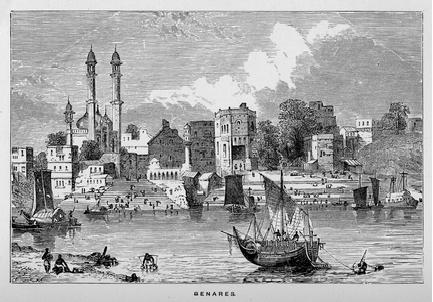
From Calcutta, Madame Pfeiffer proceeded to the city of temples,
the sacred city of Hinduism—Benares. She visited several
temples, but found them all agreeing in their leading details.
That of Vishnu has two towers connected by colonnades, the summits of
which are covered with gold plates. Inside are several images
of Vishnu and Siva, wreathed with flowers, and strewn over with grains
of rice and wheat. Images in metal or stone of the sacred bull
are plentiful everywhere; and living bulls wander about freely, the
object of special care and adoration. They are free to stray where
they will, not in the temple precincts only, but also in the streets.
Among the other buildings, the one most worthy of notice is the Mosque
of Aurengzebe, famous on account of its two minarets, which are 150
feet in height, and reported to be the slenderest in the world.
They resemble a couple of needles, and certainly better deserve the
name than that of Cleopatra at Alexandria. Narrow winding staircases
in the interior lead to the summit, on which a small platform, with
a balustrade about a foot high, is erected. From this vantage-point
a noble view of the city, it is said, may be obtained; but few persons,
we should think, have heads cool enough to enjoy it. With all
Madame Pfeiffer’s adventurousness, she did not essay this perilous
experiment.
The Observatory, constructed for the great Mohammedan emperor Akbar,
is also an object of interest. It is not furnished, like a European
observatory, with the usual astronomical instruments, telescopes, rain-gauges,
anemometers, and the like, the handiwork
of cunning artificers in glass and metal; but everything is of stone—solid,
durable stone. On a raised terrace stand circular tables, semicircular
and quadratic curves, all of stone, and all inscribed with mystic signs
and characters.
Benares is celebrated for its bazaars, in which are exhibited some
of the rarest productions of the East; but its principal attraction
is its sanctity, and crowds of pilgrims resort to its temples, and cleanse
themselves of their sins by bathing in the fast-flowing Ganges.
To die at Benares is regarded as a passport to heaven; and one of the
most frequent sights is the burning of a corpse on the river-bank, with
ceremonies proportioned to the rank and wealth of the deceased—the
ashes being afterwards committed to the holy waters. Benares is
also famous for its palaces. Of these the most splendid is that
which the rajah inhabits. It was visited by Madame Pfeiffer, who
appears to have gone everywhere and seen everybody at her own sweet
will and pleasure, and she was even admitted to the rajah’s presence.
A handsomely-decorated boat, she says, awaited her and her fellow-traveller
at the bank of the river. They crossed; a palanquin was ready
to receive
them. Soon they arrived at the stately gateway which forms the
entrance to the palace. The interior proved to be a labyrinth
of irregular courts and small unsymmetrical chambers. In one of
the courts a hall, surrounded by plain columns, served as a reception-room.
This was cumbrously loaded with lamps, glass lustres, and European furniture;
on the walls hung some wretched pictures, framed and glazed. Presently
the rajah made his appearance, accompanied by his brother, and attended
by a long train of courtiers. The two princes were gorgeously
attired; they wore wide trousers, long under and short over garments,
all of satin, covered with gold embroidery. The rajah himself,
aged thirty-five, wore short silken cuffs, glowing with gold, and trimmed
with diamonds; several large brilliants shone on his fingers, and rich
gold embroidery was woven about his shoes. His brother, a youth
of nineteen, wore a white turban, with a costly clasp of diamonds and
pearls. Large pearls hung from his ears; rich massive bracelets
clasped his wrists.
The guests having taken their seats, a large silver basin was brought
in, with elaborately-wrought narghillies, and they were invited to smoke.
This honour
they declined. The rajah then smoked in solitary dignity—his
pipe being changed as soon as he had taken a few whiffs.
A nautchni, or dance by nautches, was next provided for the visitors’
entertainment. There were three musicians and two dancers.
The latter were dressed in gay gold-woven muslin robes, with wide silk
gold-broidered trousers, reaching to the ground, and quite covering
their bare feet. One of the musicians beat a couple of small drums;
the others played on four-stringed instruments not unlike a violin.
They stood close behind the dancers, and their music was wholly innocent
of melody or harmony; but to the rhythm, which was strongly accentuated,
the dancers moved their arms, hands, and fingers in a very animated
manner, and at intervals their feet, so as to ring the numerous tiny
bells that cover them. Their attitudes were not ungraceful.
The performance lasted a quarter of an hour, after which they accompanied
the dance with what was intended for singing, but sounded like shrieking.
Meantime, sweetmeats, fruits, and sherbet were handed round.
As a contrast to this gay scene, Madame Pfeiffer describes the performance
of the wretched fanatics called
fakeers. These men inflict upon themselves the most extraordinary
tortures. Thus: they stick an iron hook through their flesh, and
allow themselves to be suspended by it at a height of twenty or five-and-twenty
feet. {105}
Or for long hours they stand upon one foot in the burning sunshine,
with their arms rigidly extended in the air. Or they hold heavy
weights in various positions, swing round and round for hours together,
and tear the flesh from their bodies with red-hot pincers. Madame
Pfeiffer saw two of these unfortunate victims of a diseased imagination.
One held a heavy axe over his head, in the attitude of a workman bent
on felling a tree; in this position he stood, rigid as a statue.
The other held the point of his toe to his nose.
* * * * *
In her tour through India our traveller passed through Allahabad,
situated at the junction of the Jumna and the Ganges, and the resort
of many pilgrims; Agra, where she admired, as so many travellers have
admired, the lovely Taj-Mahal, erected by the Sultan Jehan in memory
of his favourite wife,—and
the Pearl Mosque, with its exquisitely delicate carving; Delhi, the
ancient capital of the Moguls, which figured so conspicuously in the
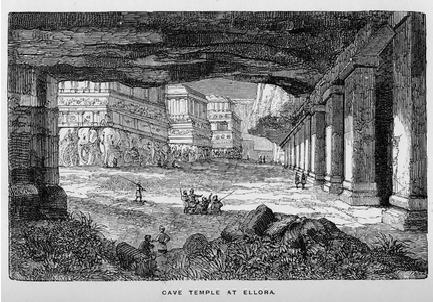
history of the Sepoy rebellion; the cave-temples of Ajunta and Ellora;
and the great commercial emporium of Bombay.
Quitting the confines of British India, Madame Pfeiffer, ever in
quest of the new and strange, sailed to Bassora, and ascended the historic
Tigris, so named from the swiftness of its course, to Bagdad, that quaint,
remote Oriental city, which is associated with so many wonderful legends
and not less wonderful “travellers’ tales.”
This was of old the residence of the great caliph, Haroun-al-Raschid,
a ruler of no ordinary sagacity, and the hero of many a tradition, whom
“The Thousand and One Nights” have made familiar to every
English boy. It is still a populous and wealthy city; many of
its houses are surrounded by blooming gardens; its shops are gay with
the products of the Eastern loom; and it descends in terraces to the
bank of the river, which flows in the shade of orchards and groves of
palm. Over all extends the arch of a glowing sky.
From Bagdad an excursion to the ruins of Babylon is natural enough.
They consist of massive fragments
of walls and columns, strewn on either side of the Euphrates.
On the 17th of June our heroic traveller joined a caravan which was
bound for Mosul, a distance of three hundred miles, occupying from twelve
to fourteen days. The journey is one of much difficulty and no
little danger, across a desert country of the most lifeless character.
We shall relate a few of Madame Pfeiffer’s experiences.
One day she repaired to a small village in search of food.
After wandering from hut to hut, she obtained a small quantity of milk
and three eggs. She laid the eggs in hot ashes, and covered them
over; filled her leathern flask from the Tigris; and, thus loaded, returned
to the encampment formed by the caravan. She ate her eggs and
drank her milk with an appetite for which an epicure would be thankful.
The mode of making butter in vogue at this village was very peculiar.
The cream was put into a leathern bottle, and shaken about on the ground
until the butter consolidated. It was then put into another bottle
filled with water, and finally turned out as white as snow.
Next day, when they rested during the heat, the guide
of the caravan endeavoured to procure her a little shelter from the
glare of the pitiless sun by laying a small cover over a couple of poles
stuck into the ground. But the place shaded was so small, and
the tent so frail, that she was compelled to sit quietly in one position,
as the slightest movement would have involved it in ruin. Shortly
afterwards, when she wished for some refreshment, nothing could be procured
but lukewarm water, bread so hard that it could not be eaten until thoroughly
soaked, and a cucumber without salt or vinegar.
At a village near Kerka the caravan tarried for two days. On
the first day Madame Pfeiffer’s patience was sorely tried.
All the women of the place flocked to examine the stranger. First
they inspected her clothes, then wanted to take the turban off her head;
and, in fact, proved themselves most troublesome intruders. At
last Madame Pfeiffer seized one of them by the arm, and turned her out
of her tent so quickly that she had no time to think of resistance.
By the eloquence of gesture our traveller made the others understand
that, unless they withdrew at once, a similarly abrupt dismissal awaited
them. She then drew a circle round her tent,
and forbade them to cross it; an injunction which was strictly respected.
She had now only to settle with the wife of her guide, who had besieged
her the whole day, pressing as near as possible, and petitioning for
some of her “things.” Fortunately her husband came
on the scene, and to him Madame Pfeiffer preferred her complaint, threatening
to leave his house and seek shelter elsewhere,—well knowing that
the Arabs consider this a great disgrace. He immediately ordered
his wife to desist, and the traveller was at peace. “I always
succeeded,” says Madame Pfeiffer, “in obtaining my own will.
I found that energy and boldness influence all people, whether Arabs,
Persians, Bedaween, or others.” But for this strong will,
this indomitable resolution, Madame Pfeiffer assuredly could not have
succeeded in the enterprises she so daringly undertook. Even for
a man to have accomplished them would have earned our praise; what shall
we not say when they were conceived and carried out by a woman?
Towards evening, she says, to her great delight a caldron of mutton
was set on the fire. For eight days she had eaten nothing but
bread, cucumbers, and some dates; and therefore had a great desire
for a hot and more nutritious meal. But her appetite was greatly
diminished when she saw their style of cookery. The old woman
(her guide’s mother) threw several handfuls of small grain, and
a large quantity of onions, into a panful of water to soften.
In about half an hour she thrust her dirty hands into the water, and
mixed the whole together, now and then taking a mouthful, and after
chewing it, spitting it back again into the pan. Then she took
a dirty rag, strained through it the delicate mixture, and poured it
over the meat in the larger vessel. Madame Pfeiffer had firmly
resolved not to touch the dish, but when it was ready her longing for
food was so great, and so savoury was the smell, that she reflected
that what she had already eaten was probably not a whit cleaner; in
short, for once she proved false to her resolution. Eating, she
was filled; and the viands gave her increased strength.
* * * * *
On the 28th of June the caravan reached Erbil, the ancient Arbela,
where Alexander the Great defeated Darius and his Persian host.
Next day they crossed a broad river, on rafts of inflated skins, fastened
together with poles, and covered with reeds, canes, and plank.
Rapidly traversing the shrubless, herbless
plains of Mesopotamia, they reached at length the town of Mosul, the
point from which travellers proceed to visit the ruins of Nineveh.
These have been so carefully explored and ably described by Layard
and the late George Smith, that it is needless to quote Madame Ida Pfeiffer’s
superficial observations at any length. According to Strabo, Nineveh
was the greatest city in the Old World—larger even than Babylon;
the circumference of its walls was a three days’ journey, and
those walls were defended by fifteen hundred towers. Now all is
covered with earth, and the ranges of hills and mounds that stretch
across the wide gray plain on the bank of the Tigris do but cover the
ruins of the vast Assyrian capital. Mr. Layard began his excavations
in 1846, and his labourers, digging deep into the hills, soon opened
up spacious and stately apartments, the marble walls of which were embellished
from top to bottom with sculptures, revealing a complete panorama of
Assyrian life! Kings with their crowns and sceptres, gods swooping
on broad pinions, warriors equipped with their arms and shields, were
there; also stirring representations of battles and hunting expeditions,
of the storming of fortresses, of triumphal processions; though, unfortunately
for artistic effect, neither proportion, perspective, nor correct drawing
had been observed. The hills are scarcely three times higher than
the men; the fields reach to the clouds; the trees are no taller than
the lotus-flowers; and the heads of men and animals are all alike, and
all in profile. Intermingled with these scenes of ancient civilization
are inscriptions of great interest, in the cuneiform or wedge-shaped
character.
* * * * *
A caravan starting from Mosul for Tabreez, Madame Ida Pfeiffer determined
on joining it, though warned that it would traverse a country containing
not a single European. But, as we have already had abundant evidence,
Madame Pfeiffer knew not what fear was. Nothing could daunt her
fixed purpose. She had made up her mind to go to Persia; and to
Persia she would go. She started with the caravan on the 8th of
July, and next day crossed the hills that intervene between Mesopotamia
and Kurdistan. The latter country has never enjoyed a good reputation
among travellers; and Madame Pfeiffer’s experience was not calculated
to retrieve its character. The caravan was crossing a corn-field
which had been recently reaped, when half-a-dozen stalwart Kurds,
armed with stout cudgels, sprang out from their hiding-place among the
sheaves, and seizing the travellers’ bridles, poured out upon
them what was unmistakably a volley of oaths and threats. One
of the travellers leaped from his steed, seized his assailant by the
throat, and holding a loaded pistol to his head, indicated his determination
of blowing out his brains. The effect of this resolute conduct
was immediate; the robbers desisted from their attack, and were soon
engaged in quite an amicable conversation with those they had intended
to plunder. At last they pointed out a good place for an encampment,
receiving in return a trifling backshish, collected from the
whole caravan.
A few days later, the travellers, having started at two in the morning,
entered a magnificent mountain-valley, which had been cloven through
the solid rock by the waters of a copious stream. A narrow stony
path followed the course of the stream upward. The moon shone
in unclouded light; or it would have been difficult even for the well-trained
horses of the caravan to have kept their footing along the dangerous
way, encumbered as it was with fallen masses of rock.
Like chamois, however, they scrambled up the steep
mountain-side, and safely carried their riders round frightful projections
and past dangerous, dizzy precipices. So wild, so romantic was
the scene, with its shifting lights and shadows, its sudden bursts of
silvery lustre where the valley lay open to the moon, and its depths
of darkness in many a winding recess, that even Madame Pfeiffer’s
uncultured companions were irresistibly moved by its influence; and
as they rode along not a sound was heard but the clatter of the horses’
hoofs, and the fall of rolling stones into the chasm below. But
all at once thick clouds gathered over the moon, and the gloom became
so intense that the travellers could scarcely discern each one his fellow.
The leader continually struck fire with a flint, that the sparks might
afford some slight indication of the proper course. But this was
not enough; and as the horses began to miss their footing, the only
hope of safety consisted in remaining immovable. With the break
of day, however, a gray light spread over the scene, and the travellers
found themselves surrounded by a circle of lofty mountains, rising one
above the other in magnificent gradation, and superbly dominated by
one mighty snow-crowned mass.
The journey was resumed. Soon the travellers became
aware of the fact that the path was sprinkled with spots of blood.
At last they came to a place which was crimsoned by a complete pool;
and looking down into the ravine, they could see two human bodies, one
lying scarcely a hundred feet below them, the other, which had rolled
further, half hidden by a projecting crag. From this scene of
murder they gladly hastened.
* * * * *
At a town called Ravandus Madame Pfeiffer rested for some days, making
observations on the manners and customs of the Kurds. She was
not prepossessed in their favour by what she saw: the women are idle,
ignorant, and squalid; the men work as little and rob as much as they
can. Polygamy is practised; and religion is reduced to the performance
of a few formalities. The costume of the wealthier Kurds is purely
Oriental, that of the common people varies from it a little. The
men wear wide linen trousers, and over them a shirt confined by a girdle,
with a sleeveless woollen jacket, made of stuff of only a hand’s-breadth
wide, and sewed together. Instead of white trousers, some wear
brown, which are anything but picturesque, and look like sacks with
two holes for the insertion of
the feet,—the said feet being encased in boots of red or yellow
leather, with large iron heels; or in shoes of coarse white wool, adorned
with three tassels. The turban is the universal head-covering.
The women don loose trousers, and red or yellow boots, with iron
heels, like the men; but over all they wear a long blue garment which,
if not tucked up under the girdle, would depend some inches below the
ankles. A large blue shawl descends below the knee. Round
their heads they twist black shawls, turban-wise; or they wear the red
fez, with a silk handkerchief wound about it; and on the top of this,
a kind of wreath made of short black fringe, worn like a diadem, but
leaving the forehead free. The hair falls in narrow braids over
the shoulders, and from the turban droops a heavy silver chain.
As a head-dress it is remarkably attractive; and it is but just to say
that it often sets off really handsome faces, with fine features, and
glowing eyes.
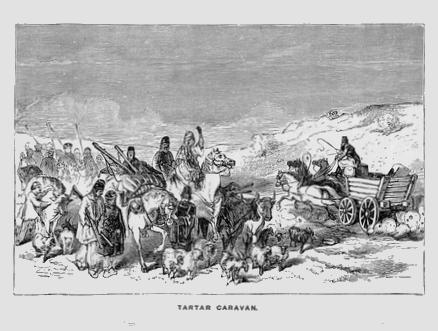
* * * * *
In her further wanderings through the wild lands of Persia, our traveller
came to Urumiyeh, on the borders of the salt lake of that name, which
in several physical features closely resembles the Dead Sea. Urumiyeh
is a place of some celebrity, for it gave
birth to Zoroaster, the preacher of a creed of considerable moral purity,
which has spread over a great part of Asia. Entering a more fertile
country, she reached Tabreez in safety, and was once more within the
influence of law and order. Tabreez, the residence of the viceroy,
is a handsomely-built town, with numerous silk and leather manufactories,
and is reputed to be one of the chief seats of Asiatic commerce.
Its streets are clean and tolerably broad; in each a little rivulet
is carried underground, with openings at regular intervals for the purpose
of dipping out water. Of the houses the passer-by sees no more
than is seen in any other Oriental town: lofty walls, windowless, with
low entrances; and the fronts always looking in upon the open courtyards,
which bloom with trees and flowers, and usually adjoin a pleasant garden.
Inside, the chambers are usually lofty and spacious, with rows of windows
which seem to form complete walls of glass. Buildings of public
importance there are none; excepting the bazaar, which covers a considerable
area, and is laid out with lofty, broad, and covered thoroughfares.
The traveller turned her back upon Tabreez on the 11th of August,
and in a carriage drawn by post-horses,
and attended by a single servant, set out for Natschivan. At Arax
she crossed the frontier of Asiatic Russia, the dominions of the “White
Tsar,” who, in Asia as in Europe, is ever pressing more and more
closely on the “unspeakable Turk.” At Natschivan she
joined a caravan which was bound for Tiflis, and the drivers of which
were Tartars. She says of the latter, that they do not live so
frugally as the Arabs. Every evening a savoury pillau was made
with good-tasting fat, frequently with dried grapes or plums.
They also partook largely of fruits.
The caravan wound through the fair and fertile valleys which lie
at the base of Ararat. Of that famous and majestic mountain, which
lifts its white glittering crest of snow some sixteen thousand feet
above the sea-level, our traveller obtained a fine view. Its summit
is cloven into two peaks, and in the space between an old tradition
affirms that Noah’s ark landed at the subsidence of the Great
Flood.
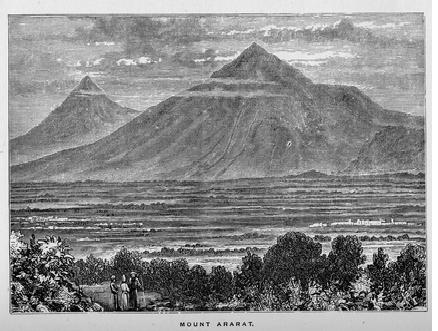
In the neighbourhood of a town called Sidin, Madame Pfeiffer met
with a singular adventure. She was returning from a short walk,
when, hearing the sound of approaching post-horses, she paused for a
minute to see the travellers, and noticed a Russian,
seated in an open car, with a Cossack holding a musket by his side.
As soon as the vehicle had passed, she resumed her course; when, to
her astonishment, it suddenly stopped, and almost at the same moment
she felt a fierce grasp on her arms. It was the Cossack, who endeavoured
to drag her to the car. She struggled with him, and pointing to
the caravan, said she belonged to it; but the fellow put his hand on
her mouth, and flung her into the car, where she was firmly seized by
the Russian. Then the Cossack sprang to his seat, and away they
went at a smart gallop. The whole affair was the work of a few
seconds, so that Madame Pfeiffer could scarcely recognize what had happened.
As the man still held her tightly, and kept her mouth covered up, she
was unable to give an alarm. The brave woman, however, retained
her composure, and speedily arrived at the conclusion that her “heroic”
captors had mistaken her for some dangerous spy. Uncovering her
mouth, they began to question her closely; and Madame Pfeiffer understood
enough Russian to tell them her name, native country, and object in
travelling. This did not satisfy them, and they asked for her
passport,—which, however, she could not show them, as it was in
her portmanteau.
At
length they reached the post-house. Madame Pfeiffer was shown
into a room, at the door of which the Cossack stationed himself with
his musket. She was detained all night; but the next morning,
having fetched her portmanteau, they examined her passport, and were
then pleased to dismiss her—without, however, offering any apology
for their shameful treatment of her. Such are the incivilities
to which travellers in the Russian dominions are too constantly exposed.
It is surprising that a powerful government should condescend to so
much petty fear and mean suspicion.
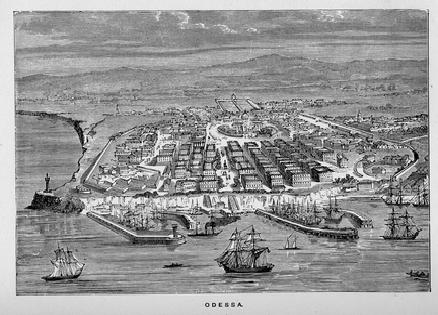
From Tiflis our traveller proceeded across Georgia to Redutkali;
whence she made her way to Kertsch, on the shore of the Sea of Azov;
and thence to Sebastopol, destined a few years later to become the scene
of an historic struggle. She afterwards reached Odessa, one of
the great granaries of Europe, situated at the mouth of the Dniester
and the Dnieper. From Odessa to Constantinople the distance by
sea is four hundred and twenty miles. She made but a short stay
in the Turkish capital; and then proceeded by steamer to Smyrna, passing
through the maze of the beautiful isles of Greece; and from Smyrna to
Athens. Here she trod on hallowed ground.
Every temple, every ruin, recalled to her some brave deed of old, or
some illustrious name of philosopher, warrior, statesman, poet, that
the world will not willingly let die. A rush of stirring glorious
memories swept over her mind as she gazed on the lofty summit of the
Acropolis, covered with memorials of the ancient art, and associated
with the great events of Athenian history. The Parthenon, or Temple
of Pallas; the Temple of Theseus; that of Olympian Jove; the Tower of
the Winds, or so-called Lantern of Demosthenes; and the Choragic Monument
of Lysicrates,—all these she saw, and wondered at. But they
have been so frequently described, that we may pass them here with this
slight reference.
From Corinth our traveller crossed to Corfu, and from Corfu ascended
the Adriatic to Trieste. A day or two afterwards she was received
by her friends at Vienna,—having accomplished the most extraordinary
journey ever undertaken by a woman, and made the complete circuit of
the world. In the most remarkable scenes, and in the most critical
positions, she had preserved a composure, a calmness of courage, and
a simplicity of conduct, that must always command our admiration.


