Larger versions of most illustrations may be seen by right-clicking them
and selecting an option to view them separately, or by double-tapping and/or
stretching them.
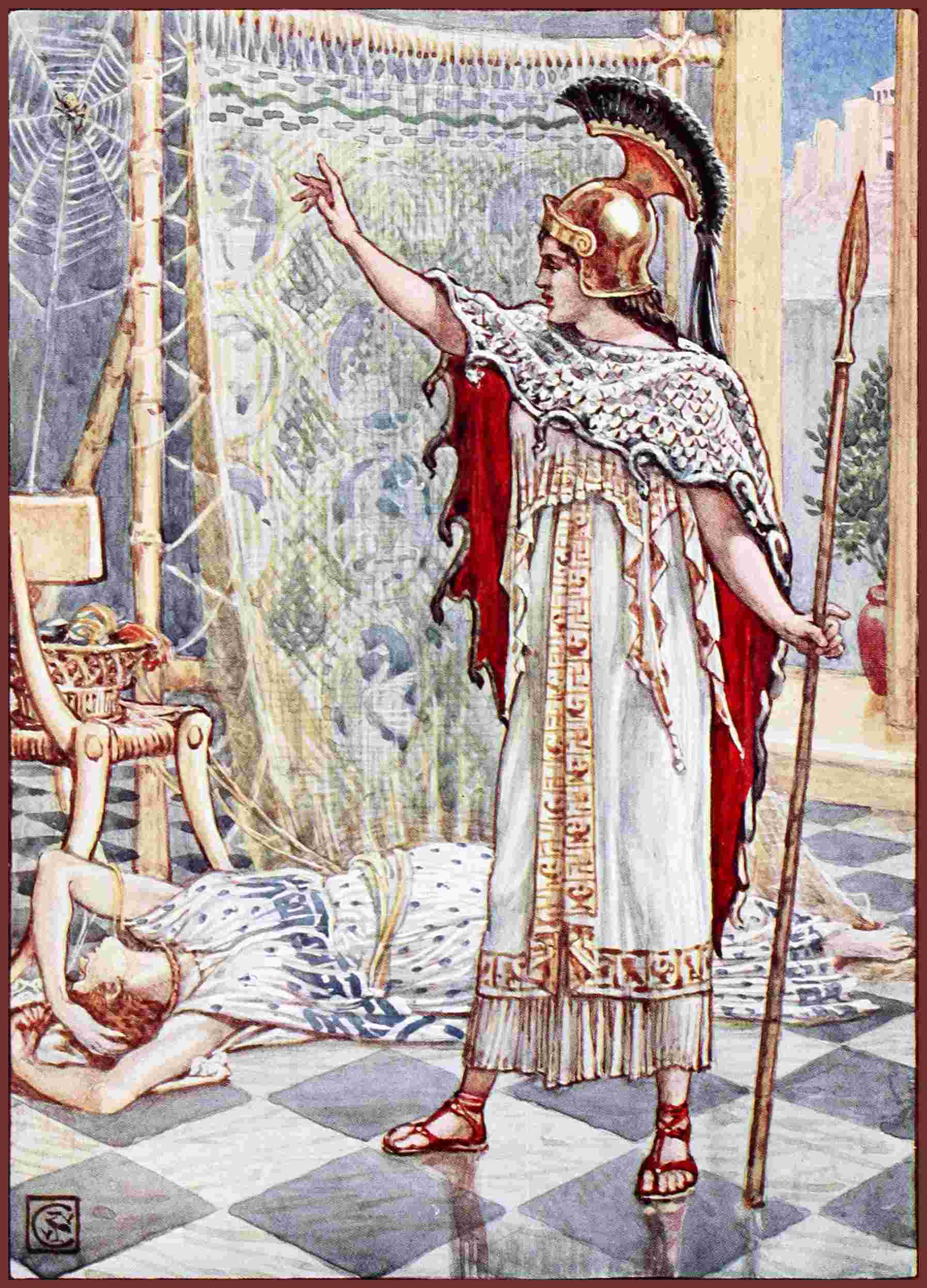
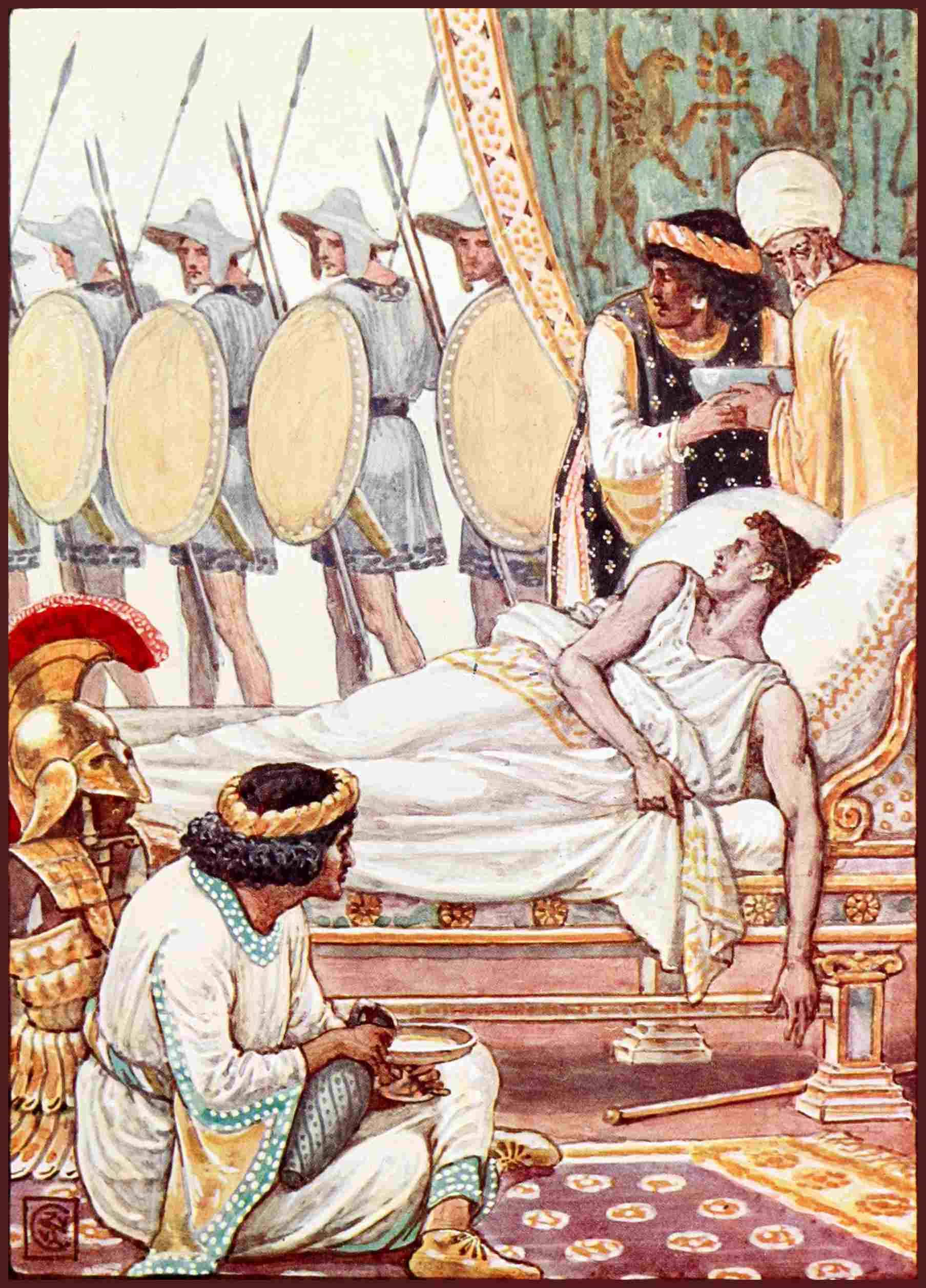
She changed her into a spider.
THE STORY OF GREECE
TOLD TO BOYS AND GIRLS BY
MARY MACGREGOR
AUTHOR OF ‘THE STORY OF ROME’
‘THE STORY OF FRANCE,’ ETC.
WITH NINETEEN PLATES IN COLOUR
BY WALTER CRANE
LONDON: T. C. & E. C. JACK, Ltd. 35 PATERNOSTER ROW, E.C., & EDINBURGH
TO JOYCE MOFFAT SCOTT
Dear little Joyce,—One of the reasons why this book
is to be your very own is that the story it tells begins in
Wonderland, and that is a land in which you and all other
little people wander at will.
Grown up children, men and women as we call them,
do not know the secrets of this strange land, yet there are
a few who can always find their way across its border, as
they used to do when they were small like you. Some few
others there are who remember its secrets well.
Shall I tell you some of the things you hear and see and
do in Wonderland?
Why, when the wind blows soft, faint whispers reach
your ear, but you alone know what the whispers tell. When
the brooks gurgle you hear joyous laughter, and in the
springs of water you see the sparkle of elfin eyes.
As the bluebells shake in the breeze, your tiny feet march
to the music of fairy bands, as the raindrops fall you gather
pearls with your little hands.
The secrets of this strange Wonderland make you so
glad that you laugh and dance and sing.
‘Great, wide, beautiful, wonderful world,
With the wonderful water round you curled,
And the wonderful grass upon your breast,
World you are wonderfully drest.’
The ancient Wonderland of Hellas, of which this story
tells, was unlike your Wonderland in this, that men and
women dwelt in it as well as boys and girls, and they, too,
saw and heard its secrets. And this was because, in a way
not known to-day, each had kept the heart of a little child.
So it was that these men and women heard voices in the
wind and laughter in the streams, so it was that they saw
eyes in water springs and pearls in raindrops.
More even than these things the Hellenes saw. For
across lone hillsides, through busy fields, in sacred groves
and flower-sweet meadows, radiant figures sped. And the
simple folk catching glimpses of these flitting forms said
one to the other, ‘The gods have come to live among us.
Their presence it is that makes the earth so fair, so wonderful.’
As the years passed and the Hellenes grew older, sterner
times came. Cities sprang up on hillsides and by river-banks,
and the gods were seldom seen. Men went to war,
battles were lost and won.
But never, in victory or in defeat, did the people lose
their early love of beauty, or that strange, dreamy sense of
wonder, which from the beginning was ever plucking at
their hearts.
They longed to fulfil their dreams of beauty, they wished
to re-shape the world.
But, because the world was so great, so wide, they began
with one of their cities, the one of which a poet sang,
‘O rich and renowned and with violets crowned,
O Athens the envied of nations.’
Here they built temples which became the wonder of
the world, and in them they placed statues of the old gods
of Hellas, beautiful statues wrought by master hands out
of ivory and gold.
Poets and philosophers lived in Athens, too, and so
literature and art spread the glory of Greece far and wide,
moulding the thoughts and quickening the deeds of many
peoples.
Before the glory of Greece faded, Europe had learned
from her to follow truth, to love beauty.
This story tells but a small part of the wonder of this
land, yet I hope that it will make you love her and wish to
learn more about her.—Your friend,
The story of Greece began long, long ago in a strange
wonderland of beauty. Woods and winds, fields and rivers,
each had a pathway which led upward and onward into the
beautiful land. Sometimes indeed no path was needed, for
the rivers, woods, and lone hill-sides were themselves the
wonderland of which I am going to tell.
In the woods and winds, in the trees and rivers, dwelt
the gods and goddesses whom the people of long ago worshipped.
It was their presence in the world that made it
so great, so wide, so wonderful.
To the Hellenes, for that is the name by which the Greeks
called themselves, there were eyes, living eyes in flowers,
trees, and water. ‘So crowded full is the air with them,’
wrote one poet who lived in the far-off days, ‘that there is
no room to put in the spike of an ear of corn without touching
one.’
When the wind blew soft, the Hellenes listened to the
whispering of a voice. When it blew rough, and snatched
one of the children from their midst, they did not greatly
grieve. The child had but gone to be the playmate of the
gods.
The springs sparkled clear, for in them dwelt the Naiads
or freshwater nymphs, with gifts as great as the river gods,
who were ofttimes seen and heard amid the churning,
tossing waters.
In the trees dwelt the Dryads, nymphs these of the forest,
whom the Hellenes saw but seldom. Shy nymphs were the
Dryads, born each one at the birth of a tree, in which she
dwelt, fading away when the tree was felled, or when it
withered and died.
Their revels were held in some wooded mountain, far
from the haunts of men. Were a human footfall heard, the
frolics ceased on the instant, while each Dryad sped swift
for shelter to the tree of her birth.
So the gods wandered through the land, filling the earth
with their presence. Yet there was one lofty mountain in
central Greece, named Mount Olympus, which the Hellenes
believed was the peculiar home of the gods. It was to this
great mount that the actual roads on which the Hellenes
walked each day seemed ever to lead.
On the sides of the mountain, green trees and dark pines
clustered close. The summit reached high up, beyond the
clouds, so used the ancient people to tell. Here, where no
human foot had ever climbed, up beyond the twinkling
stars, was the abode of the gods.
What the Hellenes never saw with their eyes, they saw
quite clear with their imagination. Within the clouds,
where the gods dwelt, they gazed in this strange way, upon
marble halls, glistening with gold and silver, upon thrones
too, great white thrones, finer far than those on which an
earthly king might sit. The walls gleamed with rainbow
tints, and beauty as of dawns and sunsets was painted over
the vast arches of Olympus.
CHAPTER II THE GREAT GOD PAN
The supreme god of the Hellenes was Zeus. He dwelt in
the sky, yet on earth, too, he had a sanctuary amid the oak-woods
of Dodona.
When the oak-leaves stirred, his voice was heard, mysterious
as the voice of the mightiest of all the gods.
In days long after these, Phidias, a great Greek sculptor,
made an image of Zeus. The form and the face of the
god he moulded into wondrous beauty, so that men gazing
saw sunshine on the brow, and in the eyes gladness and
warmth as of summer skies.
Even so, if you watch, you may catch on the faces of
those whose home is on the hill-side, or by the sea, a glimpse
of the beauty and the wonder amid which they dwell.
It was only in very early times that the chief sanctuary of
Zeus was at Dodona. Before they had dwelt long in Hellas,
the Hellenes built a great temple in the plain of Olympia
to their supreme god and named it the Olympian temple.
Here a gold and ivory statue of the god was placed, and
to the quiet courts of the temple came the people, singing
hymns and marching in joyous procession.
Zeus had stolen his great power from his father Kronus,
with the help of his brothers and sisters. To reward them
for their aid the god gave to them provinces over which they
ruled in his name. Hera, Zeus chose as queen to reign
with him. To Poseidon was given the sea, and a palace
beneath the waves of the ocean, adorned with seaweed and
with shells.
Pluto was made the guardian of Hades, that dark and
gloomy kingdom of the dead, beneath the earth, while
Demeter was goddess of the earth, and her gifts were flowers,
fruits, and bounteous harvests.
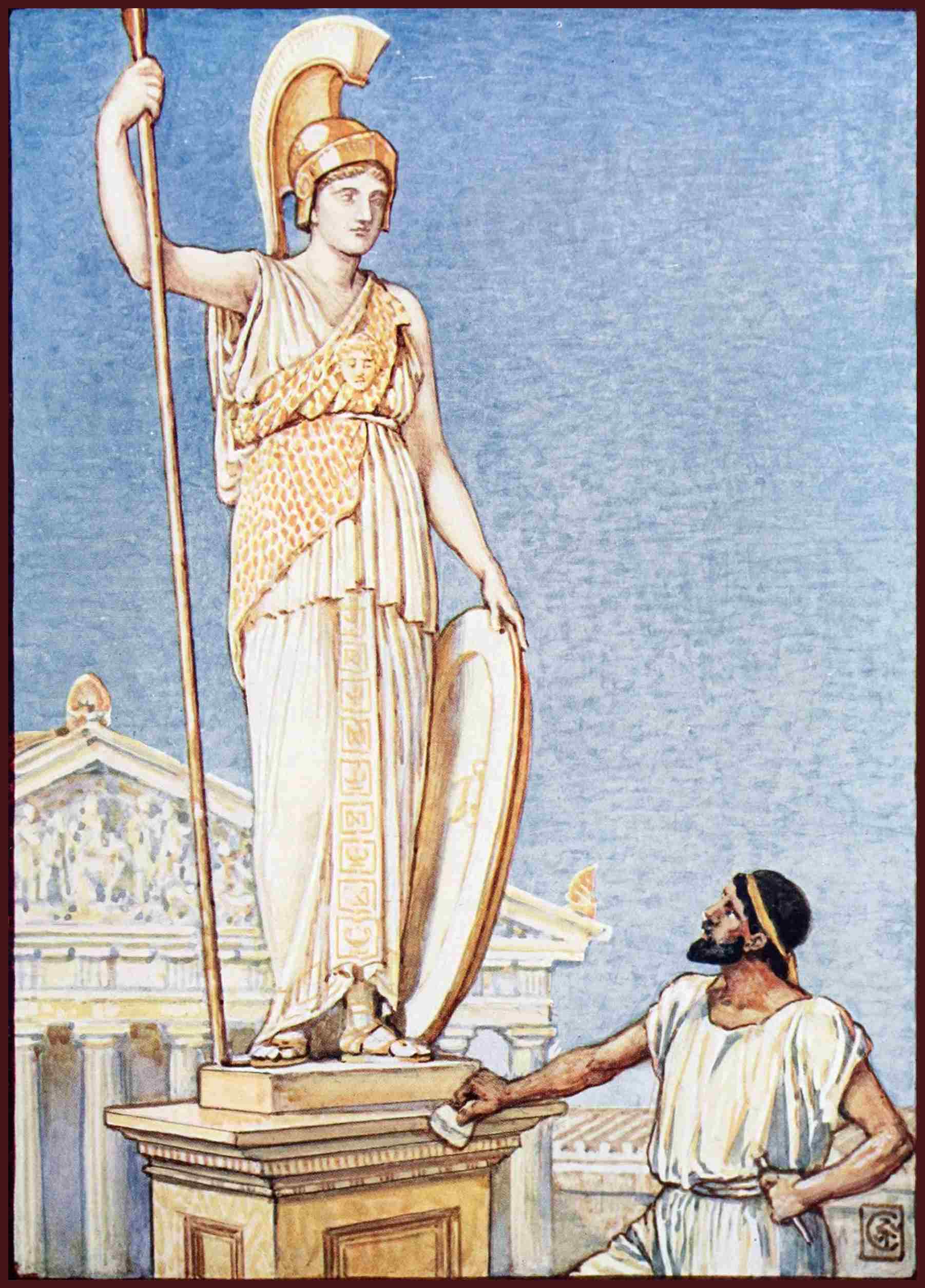
Athene was the goddess of war and wisdom, yet often
she was to be seen weaving or embroidering, while by her
table sat her favourite bird, an owl.
Hermes was known as the fleet-footed, for on his feet he
wore winged sandals to speed him swift on the errands of
the gods.
Apollo, the Sun-god, was the youngest of all the Olympian
deities. He dwelt at Parnassus on the eastern coast of
Greece, and his sanctuary was at Delphi.
The fairest of the goddesses was Aphrodite, Queen of
Love. Her little son was named Eros, and he never grew
up. Always he was a little rosy, dimpled child, carrying in
his hands a bow and arrows.
Many more gods and goddesses were there in the wonder
days of long ago, but of only one more may I stay to tell
you now.
The great god Pan, protector of the shepherds and their
flocks, was half man, half goat. Every one loved this strange
god, who yet ofttimes startled mortals by his wild and wilful
ways. When to-day a sudden, needless fear overtakes a
crowd, and we say a panic has fallen upon it, we are using
a word which we learned from the name of this old pagan
god.
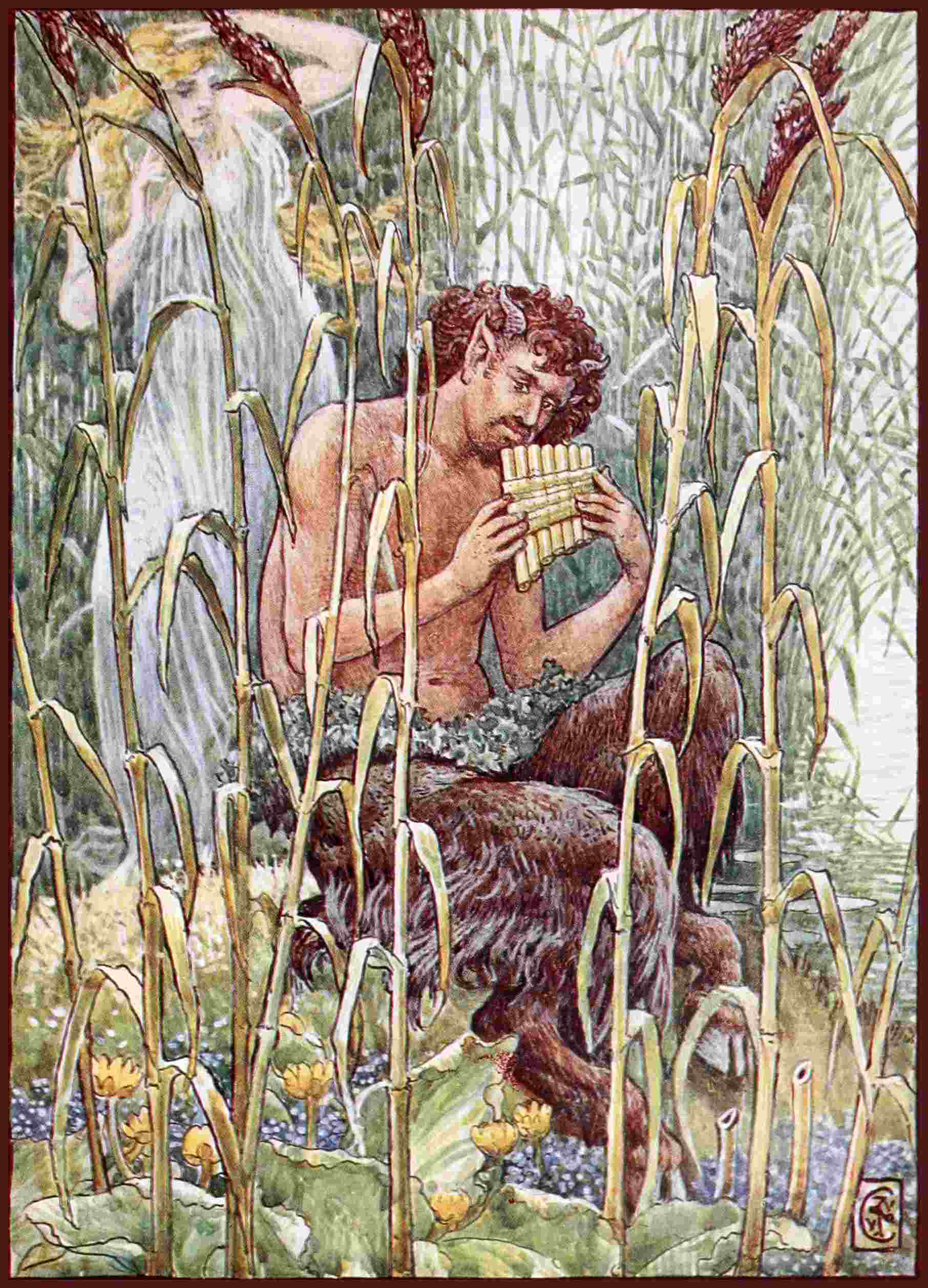
Down by the streams the great god Pan was sometimes
seen to wander—
‘What was he doing, the great god Pan,
Down in the reeds by the river?
Spreading ruin and scattering ban,
Splashing and paddling with hoofs of a goat,
And breaking the golden lilies afloat,
With the dragon-fly on the river.
‘He tore out a reed, the great god Pan,
From the deep cool bank of the river,’
and then sitting down he ‘hacked and hewed, as a great
god can,’ at the slender reed. He made it hollow, and
notched out holes, and lo! there was a flute ready for his
use.
Sweet, piercing sweet was the music of Pan’s pipe as the
god placed his mouth upon the holes.
‘Blinding sweet, O great god Pan!
The sun on the hill forgot to die,
And the lilies revived, and the dragon-fly
Came back to dream on the river.’
On the hill-sides and in the fields of Hellas, the shepherds
heard the music of their god and were merry, knowing that
he was on his way to frolic and to dance among them.
Pan lived for many, many a long year; but there is a
story which tells how on the first glad Christmas eve, when
Jesus was born in Bethlehem, a traveller, as he passed
Tarentum, the chief Greek city in Italy, heard a voice crying,
‘The great god Pan is dead.’
And when this same Jesus had grown to be a Man, and
‘hung for love’s sake on a Cross,’ one of our own women
poets sings that all the old gods of Greece
‘fell down moaning,
Each from off his golden seat;
All the false gods with a cry,
Rendered up their deity,
Pan, Pan was dead.’
And the reason that the old gods fell was that the strange
Man upon the Cross was mightier than they. But in the days
of ancient Greece the gods were alive and strong; of that
the Hellenes were very sure.
CHAPTER III THE SIX POMEGRANATE SEEDS
Demeter, the goddess of the earth, was often to be seen in
the fields in springtime. As the Greek peasants sowed their
seed they caught glimpses of her long yellow hair while she
moved now here, now there, among them. It almost
seemed to these simple folk as though already the bare fields
were golden with the glory of harvest, so bright shone the
yellow hair of the goddess. Then they smiled hopefully
one to the other, knowing well that Demeter would give
them a bounteous reaping-time.
In the autumn she was in the fields again, the peasants
even dreamed that they saw her stoop to bind the
sheaves. Certainly she had been known to visit their barns
when the harvest was safely garnered. And stranger
still, it was whispered among the womenfolk that the
great Earth-Mother had entered their homes, had stood
close beside them as they baked bread to feed their hungry
households.
It was in the beautiful island of Sicily, which lies in the
Mediterranean Sea, that the goddess had her home. Here
she dwelt with her daughter Persephone, whom she loved
more dearly than words can tell.
Persephone was young and fair, so fair that she seemed
as one of the spring flowers that leaped into life when her
mother touched the earth with her gracious hands.
Sweet, piercing sweet was the music of Pan’s pipe
Early as the dawn the maiden was in the fields with
Demeter, to gather violets while the dew still lay upon them,
to dance and sing with her playmates. At other times she
would move gravely by the side of her mother to help her in
her quiet labours.
All this time, Pluto, King of Hades, was living in his
gloomy kingdom underground, longing for some fair maiden
to share his throne. But there was not one who was willing
to leave the glad light of the sun, no, not though Pluto
offered her the most brilliant gems in his kingdom.
One day the dark king came up out of the shadows, riding
in his chariot of gold, drawn by immortal horses. Swifter
was their pace than that of any mortal steeds.
Persephone was in a meadow with her playfellows when
the king drew near. The maiden stood knee-deep amid
the meadow-grass, and, stooping, plucked the fragrant sweet
flowers all around her—hyacinth, lilies, roses, and pale
violets.
Pluto saw the group of happy maidens, beautiful each
one as a day in spring, but it was Persephone who charmed
him more than any other.
‘She shall be my queen and share my throne,’ muttered
the gloomy king to himself. Then, for he knew that to woo
the maiden would be vain, Pluto seized Persephone in his
arms, and bore her weeping to his chariot.
Swift as an arrow the immortal steeds sped from the
meadow, where Persephone’s playmates were left terror-stricken
and dismayed.
On and on flew the chariot. Pluto was in haste to reach
Hades ere Demeter should miss her daughter.
A river lay across his path, but of this the king recked
naught, for his steeds would bear him across without so
much as lessening their speed.
But as the chariot drew near, the waters began to rise
as though driven by a tempest. Soon they were lashed to
such fury that Pluto saw that it was vain to hope to cross
to the other side. So he seized his sceptre, and in a passion
he struck three times upon the ground. At once a great
chasm opened in the earth, and down into the darkness
plunged the horses. A moment more and Pluto was in his
own kingdom, Persephone by his side.
When the king seized the maiden in the meadow, and
bore her to his chariot, she had cried aloud to Zeus, her father,
to save her. But Zeus had made no sign, nor had any
heard save Hecate, a mysterious goddess, whose face was
half hidden by a veil.
None other heard, yet her piteous cry echoed through
the hills and woods, until at length the faint echo reached
the ear of Demeter.
A great pain plucked at the heart of the mother as she
heard, and throwing the blue hood from off her shoulders,
and loosening her long yellow hair, Demeter set forth, swift
as a bird, to seek for Persephone until she found her.
To her own home first she hastened, for there, she thought,
she might find some trace of the child she loved so well.
But the rooms were desolate as ‘an empty bird’s nest or an
empty fold.’
The mother’s eyes searched eagerly in every corner, but
nothing met her gaze save the embroidery Persephone had
been working, ‘a gift against the return of her mother,
with labour all to be in vain.’ It lay as she had flung it
down in careless mood, and over it crept a spider, spinning
his delicate web across the maiden’s unfinished work.
For nine days Demeter wandered up and down the earth,
carrying blazing torches in her hands. Her sorrow was so
great that she would neither eat nor drink, no, not even ambrosia,
or a cup of sweet nectar, which are the meat and drink
of the gods. Nor would she wash her face. On the tenth
day Hecate came towards her, but she had only heard the
voice of the maiden, and could not tell Demeter who had
carried her away.
Onward sped the unhappy mother, sick at heart for hope
unfulfilled, onward until she reached the sun. Here she
learned that it was Pluto who had stolen her daughter, and
carried her away to his gloomy kingdom.
Then in her despair Demeter left all her duties undone,
and a terrible famine came upon the earth. ‘The dry seed
remained hidden in the soil; in vain the oxen drew the
ploughshare through the furrows.’
As the days passed the misery of the people grew greater
and greater, until faint and starving they came to Demeter,
and besought her once again to bless the earth.
But sorrow had made the heart of the goddess hard, and
she listened unmoved to the entreaties of the hungry folk,
saying only that until her daughter was found she could
not care for their griefs.
Long, weary days Demeter journeyed over land and sea
to seek for Persephone, but at length she came back to
Sicily.
One day as she walked along the bank of a river, the
water gurgled gladly, and a little wave carried a girdle
almost to her feet.
Demeter stooped to pick it up, and lo! it was the girdle
that Persephone had worn on the day that she had been
carried away. The maiden had flung it into the river as
the chariot had plunged into the abyss, hoping that it might
reach her mother. The girdle could not help Demeter to
recover her daughter, yet how glad she was to have it, how
safe she treasured it!
At length, broken-hearted indeed, Demeter went to Zeus
to beg him to give her back her daughter. ‘If she returns
the people shall again have food and plenteous harvests,’
she cried. And the god, touched with the grief of the mother
and the sore distress of the people, promised that Persephone
should come back to earth, if she had eaten no food while
she had lived in the gloomy kingdom of Hades.
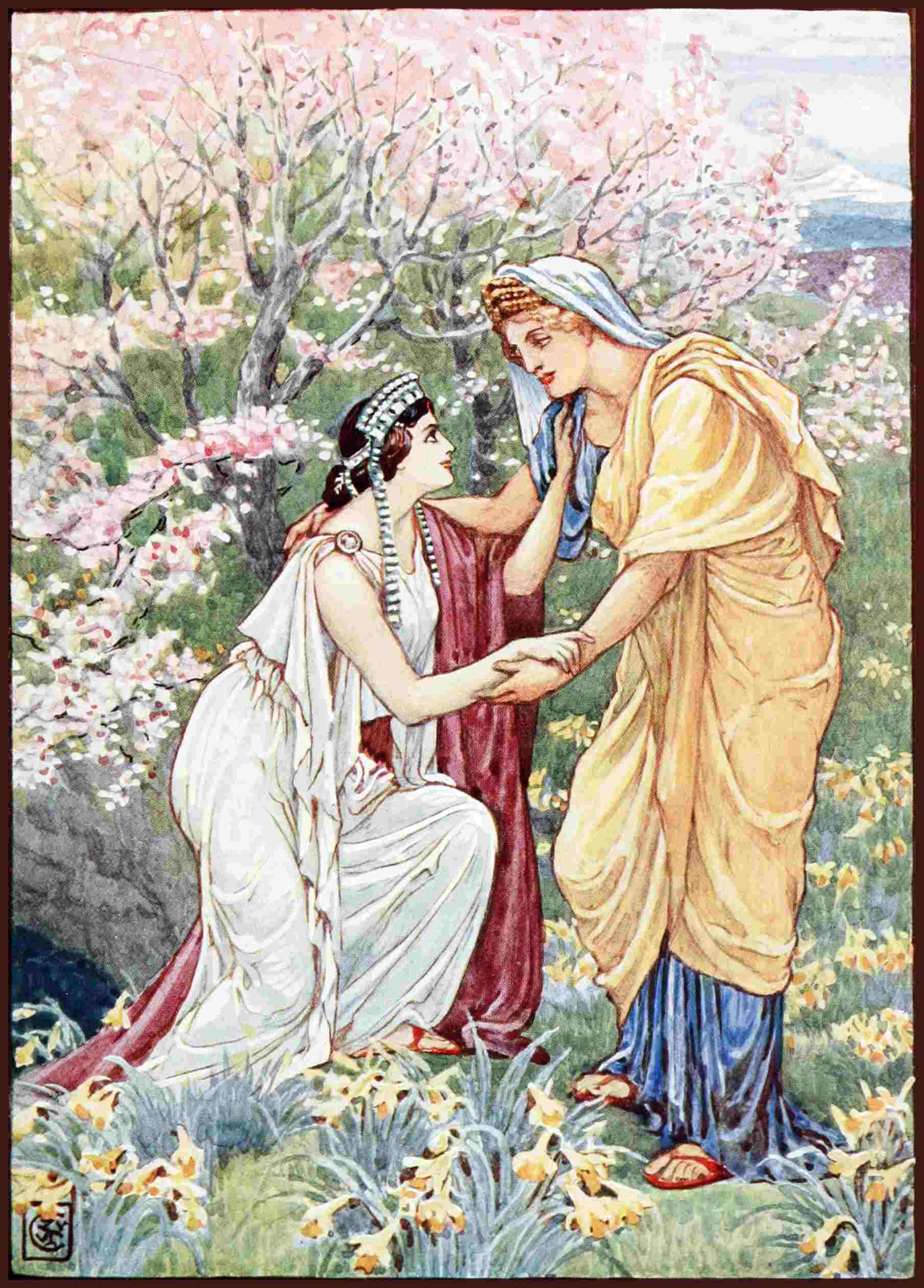
No words can tell the joy with which Demeter hastened
to Hades. Here she found her daughter with no smile
upon her sweet face, but only tears of desire for her mother
and the dear light of the sun. But alas! that very day
Persephone had eaten six pomegranate seeds. For every
seed that she had eaten she was doomed to spend a month
each year with Pluto. But for the other six months, year
after year, mother and daughter would dwell together, and
as they clung to one another they were joyous and content.
So for six glad months each year Demeter rejoiced, for
her daughter was by her side, and ever it was spring and
summer while Persephone dwelt on earth. But when the
time came for her to return to Hades, Demeter grew ever
cold and sad, and the earth too became weary and grey.
It was autumn and winter in the world until Persephone
returned once more.
Demeter rejoiced, for her daughter was by her side
CHAPTER IV THE BIRTH OF ATHENE
One day Zeus was ill. To us it is strange to think of the
gods as suffering the same pains as mortals suffer, but to the
Hellenes it seemed quite natural.
Zeus was ill. His head ached so severely that he bade
all the gods assemble in Olympus to find a cure for his pain.
But not one of them, not even Apollo, who was god of
medicine as well as Sun-god, could ease the suffering deity.
After a time Zeus grew impatient with the cruel pain, and
resolved at all costs to end it. So he sent for his strong son
Hephaestus, and bade him take an axe and cleave open his
head.
Hephaestus did not hesitate to obey, and no sooner had
the blow descended than from his father’s head sprang forth
Athene, the goddess of war and wisdom. She was clad
in armour of pure gold, and held in her hand a spear, poised
as though for battle. From her lips rang a triumphant
war-song.
The assembled gods gazed in wonder, not unmixed with
fear at the warrior goddess, who had so suddenly appeared
in their midst. But she herself stood unmoved before them,
while a great earthquake shook the land and proclaimed to
the dwellers in Hellas the birth of a new god.
Athene was a womanly goddess as well as a warlike one.
She presided over all kinds of needlework, and herself loved
to weave beautiful tapestries.
Soon after the birth of the goddess a man named Cecrops
came to a province in Greece, which was afterwards known
as Attica. Here he began to build a city, which grew so
beautiful beneath his hands that the gods in Olympus
marvelled. When it was finished, each of the gods wished
to choose a name for the city Cecrops had built.
As only one name could be used, the gods met in a great
council to determine what was to be done. Soon, one by
one, each gave up his wish to name the city, save only
Athene and Poseidon.
Then Zeus decreed that Athene and Poseidon should
create an object which would be of use to mortals. To
name the city and to care for it should be the prize of the
one who produced the more useful gift.
Poseidon at once seized his three-pronged fork or trident,
which was the sign that he was ruler of the sea. As he
struck the ground with it lo! a noble horse sprang forth,
the first horse that the gods had seen.
As Poseidon told the gods in how many ways the beautiful
animal could be of use to mortals, they thought that Athene
would not be able to produce anything that could help men
more.
When she quietly bade the council to look at an olive-tree,
the gods laughed her to scorn. But they soon ceased
to laugh. For Athene told them how the wood, the fruit,
the leaves, all were of use, and not only so, but that the
olive-tree was the symbol of peace, while the horse was the
symbol of war. And war did ever more harm than good to
mortals.
So the gods decided that it was Athene who had won
the right to name the city, and she gave to it her own name
of Athene, and the citizens ever after worshipped her as
their own peculiar goddess.
Of this city, which we know as Athens, you will hear
much in this story.
CHAPTER V THE TWO WEAVERS
Athene could not only wield the sword, she could also ply
the needle.
In these olden days there lived in Greece a Lydian maid
who could weave with wondrous skill. So beautiful were
the tapestries she wrought that her fame spread far and wide.
Lords and ladies both came from distant towns to see the
maiden’s skilful hands at work.
Arachne, for that was the maiden’s name, lived in a
cottage with her parents. They were poor folk, and had
often found it hard to earn their daily bread. But now that
their daughter was famous for her embroidery their troubles
were at an end. For not only lords and ladies, but merchants,
too, were glad to pay well to secure the young maid’s
exquisite designs.
And so all would have been well with Arachne and her
parents had not the foolish girl become vain of her work.
Soon her companions began to weary of her, for of nothing
could she talk save of her own deft fingers, of her own
beautiful embroideries.
Those who loved Arachne grew sad as they listened to
her proud words, and warned her that ‘pride ever goes
before a fall.’
But Arachne only tossed her pretty head as she listened
to the wisdom of older folk. Nor did she cease to boast,
even saying that she could do more wonderful work than
the goddess Athene.
Not once, but many times did Arachne say that she
wished she might test her skill against that of the goddess.
And should a prize be offered, proudly she declared that it
was she who would win it.
From Olympus Athene heard the vain words of the
maid. So displeased was she with her boldness that she
determined to go to see Arachne, and if she did not repent
to punish her.
She changed herself into an old white-haired dame, and
came to earth. Leaning upon a staff she knocked at the
door of the cottage where Arachne lived, and was bidden
to enter.
Arachne was sitting in the midst of those who had come
to see and to praise her work. Soon she began to talk, as
she was quick to do, of her skill, and of how she believed
that her work surpassed in beauty any that Athene could
produce.
The old woman pushed her way through the group that
surrounded the maid, and laying her hand upon the shoulder
of Arachne she spoke kindly to her.
‘Be more modest, my child,’ she said, ‘lest the anger
of the gods descend upon you, lest Athene take you at your
word, and bid you to the contest you desire.’
Impatiently Arachne shook off the stranger’s hand, and
answered, ‘Who are you who dare speak to me? I would
Athene might hear my words now, and come to test her skill
against mine. She would soon see that she had a rival in
Arachne.’
Athene frowned at the insolence of the maiden. Then
the little company were startled to see the old woman
suddenly change into the glorious form of the goddess
Athene. As they gazed they were afraid and fell at her
feet.
But Arachne did not worship the goddess. Foolish
Arachne looked boldly in her face, and asked if she had
come to accept her challenge.
Athene’s only answer was to sit down before an empty
loom. Soon each, in silence, had begun to weave a wondrous
tapestry.
Swift and more swift moved the fingers of the weavers,
while the group of strangers, gathered now near to the door,
watched the webs as they grew and grew apace.
Into her tapestry Athene was weaving the story of her
contest with Poseidon for the city of Cecrops. The olive-tree,
the horse, the gods in the council, all seemed to live as
they appeared on the web of the goddess.
The tapestry woven by Arachne was also beauteous as her
work was wont to be. In it you saw the sea, with waves
breaking over a great bull, to whose horns clung a girl
named Europa. And Europa’s curls blew free in the wind.
At length Athene rose from the loom, her work complete.
Arachne, too, laid down her spindle, and as she turned to
look upon the tapestry of the goddess her courage suddenly
failed.
A glance had been enough to show her that her skill was
as nothing before the wonder and the beauty of Athene’s
work.
Too late the maiden repented that she had defied the
goddess. In her despair she seized a rope and tied it round
her neck to hang herself.
But the goddess saw what Arachne meant to do, and at
once she changed her into a spider, bidding her from henceforth
never cease to spin.
And so when you see a spider weaving its beautiful embroidery
on a dewy morning in the garden, or when you
find a delicate web in your lumber-room, you will remember
how Athene punished poor foolish Arachne in the days of
old.
CHAPTER VI THE PURPLE FLOWERS
Apollo, the youngest and most beautiful of all the gods,
dearly loved a lad named Hyacinthus.
Ofttimes he would leave the other gods sipping nectar
in Mount Olympus, ofttimes he would forsake the many
beautiful temples in which he was worshipped on earth,
that he might be free to wander through the woods with his
little friend.
For Hyacinthus was only a merry little lad, who loved
to roam over hill and dale, and when the fancy seized him
to hunt in the woods.
Apollo was never happier than when he was with the
boy. Sometimes he would go hunting with him, and then
Hyacinthus was merrier than ever, for the world seemed
more full of brightness when the Sun-god was by his side.
Sometimes the friends would walk together over hill and
dale, followed by the dogs Hyacinthus loved so well.
One day they had wandered far, and the little lad was
tired, so he flung himself down in a grassy meadow to rest,
Apollo by his side. But the Sun-god was soon eager for a
game. He sprang to his feet, crying, ‘Hyacinthus, let us
play at quoits before the shadows fall.’
Quoits were flat, heavy discs, and the game was won by the
player who could fling the quoits the farthest through the air.
Hyacinthus was ever willing to do as Apollo wished,
and the game was soon begun. After a throw of more than
usual skill and strength the friends laughed gleefully.
O but it was good to be alive in such a happy world,
thought Hyacinthus. And Apollo, as he looked at the
merry face of the little lad, rejoiced that he was not sitting
in the cold marble halls of Olympus, but was here on the
glad green earth.
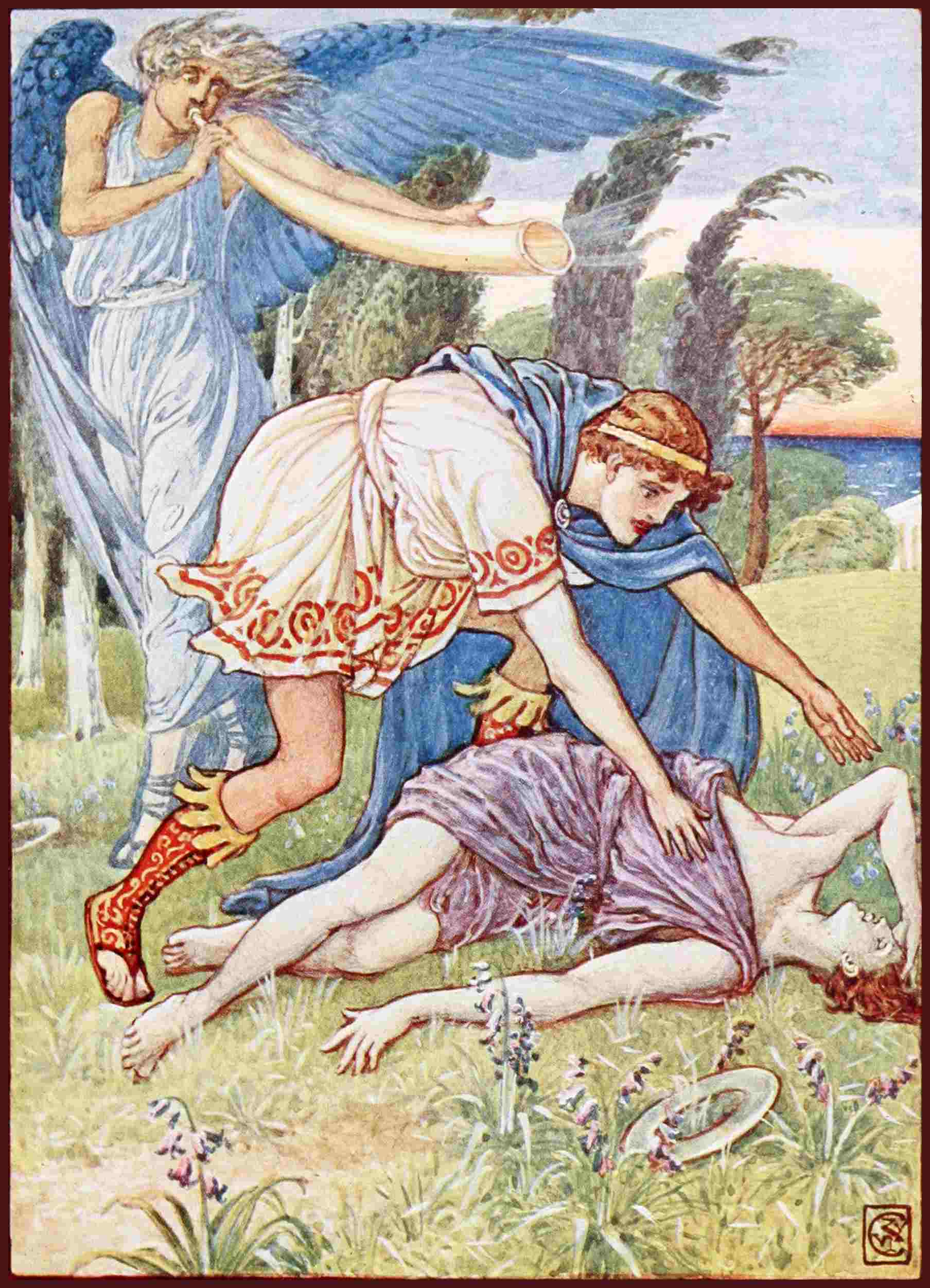
By and by while they still played, Zephyrus, the god of
the south wind, came fleeting by. He saw the Sun-god and
his little playmate full of laughter and of joy.
Then an ugly passion, named jealousy, awoke in the
heart of the god, for he too loved the little hunter Hyacinthus,
and would fain have been in Apollo’s place.
Zephyrus tarried a while to watch the friends. Once as
Apollo flung his disc high into the air, the Wind-god sent a
gust from the south which blew the quoit aside. He meant
only to annoy Apollo, but Hyacinthus was standing by, so
that the quoit struck him violently on the forehead.
The lad fell to the ground, and soon he was faint from
loss of blood.
In vain Apollo tried to staunch the wound; nothing he
could do was of any use. Little by little the boy’s strength
ebbed away, and the Sun-god knew that the lad would never
hunt or play again on earth. Hyacinthus was dead.
The grief of the god was terrible. His tears fell fast as he
mourned for the playmate he had loved so well.
At length he dried his tears and took his lyre, and as he
played he sang a last song to his friend. And all the woodland
creatures were silent that they might listen to the love-song
of the god.
When the song was ended, Apollo laid aside his lyre,
and, stooping, touched with his hand the blood-drops of the
lad. And lo! they were changed into a cluster of beautiful
purple flowers, which have ever since been named hyacinths,
after the little lad Hyacinthus.
Year by year as the spring sun shines, the wonderful
purple of the hyacinth is seen. Then you, who know the
story, think of the days of long ago, when the Sun-god lost
his little friend and a cluster of purple flowers bloomed
upon the spot where he lay.
CHAPTER VII DANAE AND HER LITTLE SON
The stories I have told you are about the gods of ancient
Greece; the story I am going to tell you now is about a
Greek hero.
When you think of a hero, you think of a man who does
brave, unselfish deeds. But to the Hellenes or Greeks a
hero was one who was half god, half man—whose one parent
was a god while the other was a mortal. So the god Zeus
was the father of Perseus, the hero of whom I am going
to tell, while his mother was a beautiful princess named
Danae.
From morning to night, from night till morning, Acrisius,
the father of Danae, was never happy. Yet he was a
king.
A king and unhappy? Yes, this king was unhappy
because he was afraid that some day, as an oracle had foretold,
he would be slain by his grandson.
The ancient Greeks often sent to sacred groves or temples
to ask their gods about the future, and the answer, which
was given by a priestess, was called an oracle.
Now Acrisius, King of Argos, had no grandson, so it was
strange that the oracle should make him afraid. He hoped
that he never would have a grandson.
His one child, beautiful, gentle Danae he had loved well
until he had heard the oracle. Now he determined to send
her away from the palace, to hide her, where no prince
would ever find her and try to win her for his bride.
The Wind-god sent a gust from the south
So the king shut the princess into a tower, which was
encased in brass and surrounded it with guards, so that no
one, and least of all a prince, could by any chance catch
a glimpse of his beautiful daughter.
Very sad was Danae, very lonely, too, when she was left
in the brazen tower, and Zeus looking down from Olympus
pitied her, and before long sent a little son to cheer her
loneliness.
One day the guards saw the babe on his mother’s knee.
Here was the grandson about whom the king had hoped
that he would never be born.
In great alarm they hastened to the palace to tell the
king the strange tidings. Acrisius was so frightened when
he heard their story that he flew into a passion, and vowed
that both Danae and Perseus, as her little son was named,
should perish. So he ordered the guards to carry the
mother and her babe to the seashore, and to send them
adrift on the waters in an empty boat.
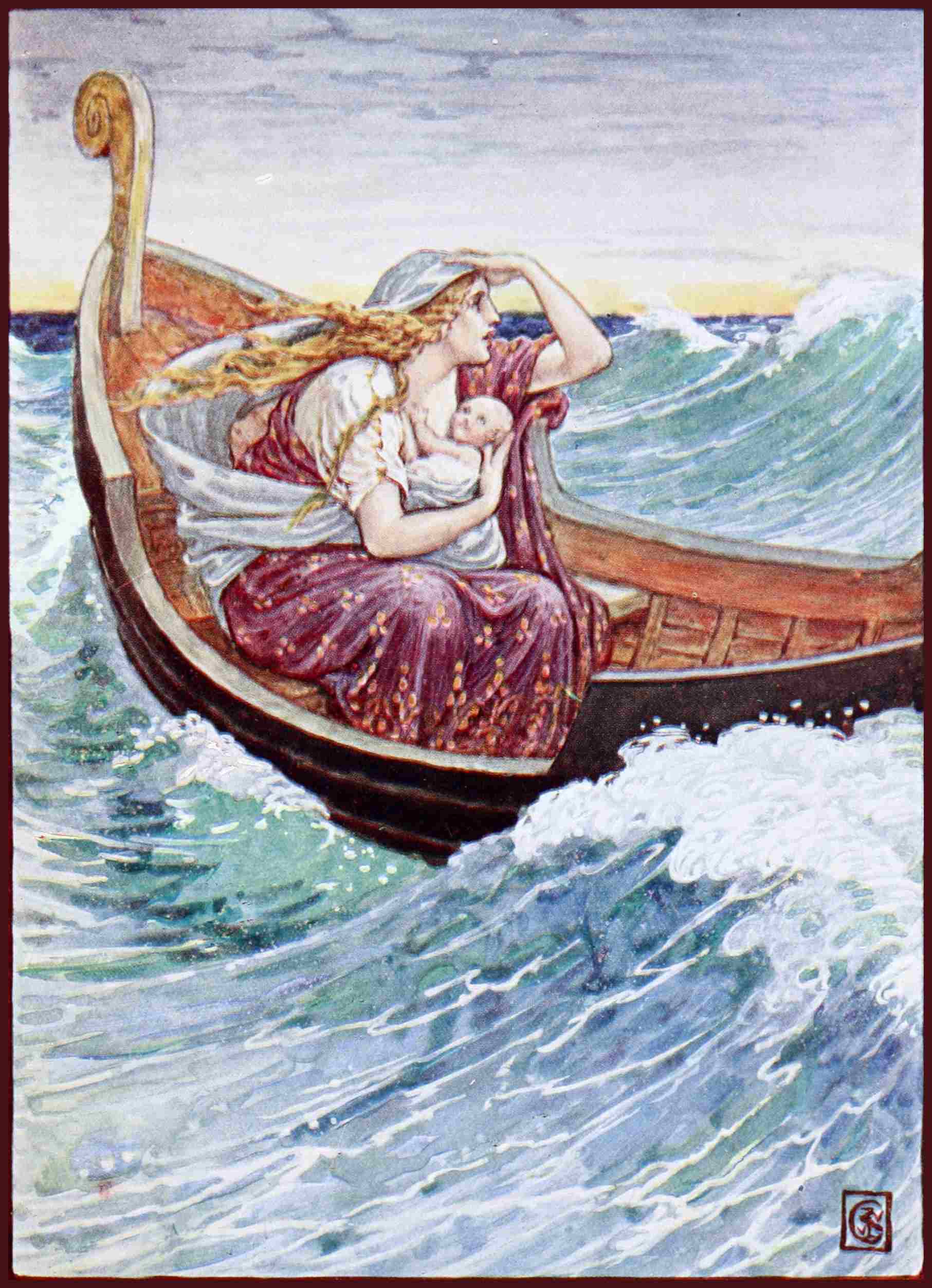
For two days and two nights the boat was tossed hither
and thither by the winds and the waves, while Danae, in
sore dismay but with a brave heart, clasped her golden-haired
boy tight in her arms.
The child slept sound in the frail bark, while his mother
cried to the gods to bring her and her treasure into a safe
haven.
On the third day the answer to her prayers came, for
before her Danae saw an island with a shore of yellow
sand. And on the shore stood a fisherman with his net,
looking out to sea. He soon caught sight of the boat, and
as it drew near he cast his net over it, and gently pulled
it to the shore.
It seemed to Danae almost too good to be true, to stand
once again on dry land. She thought it was but a dream,
from which she would awake to find herself once more
tossing on the great wide sea.
But there stood Dictys, the fisherman, looking at her in
wonder. Then Danae knew that she was indeed awake.
She hastened to thank him for his help, and to ask him where
she could find shelter for herself and her child.
Then the fisherman, who was the brother of Polydectes,
king of the island on which Danae had landed, said that if
she would go with him to his home he would treat her as a
daughter. And Danae went gladly to live with Dictys.
So Perseus grew up in the island of Seriphus, playing on
the sands when he was small, and when he had grown tall
and strong going voyages to other islands with Dictys, or
fishing with him nearer home. Zeus loved the lad and
watched over him.
Fifteen years passed, and then the wife of Polydectes
died, and the king wished to marry Danae, for he loved her
and knew that she was a princess.
But Danae did not wish to wed Polydectes, and she refused
to become his queen, for indeed she loved no one save
her son Perseus.
Then the king was angry, and vowed that if Danae
would not come to the palace as his queen, he would compel
her to come as his slave.
And it was even so, as a slave, that Perseus found her,
when he returned from a voyage with Dictys.
The anger of the lad was fierce. How dare any one
treat his beautiful mother so cruelly! He would have slain
the king had not Dictys restrained him.
Subduing his anger as well as he could, Perseus went
boldly to the palace, and taking no heed of Polydectes, he
brought his mother away and left her in the temple of Athene.
There she would be safe, for no one, not even the king,
would enter the sanctuary of the goddess.
‘Perseus must leave the island,’ said Polydectes when
he was told of the lad’s bold deed. He thought that if her
son were banished Danae would perchance be willing to
become his queen.
For two days and two nights the boat was tossed hither
and thither
But Polydectes was too crafty to issue a royal command
bidding Perseus leave Seriphus. That, he knew, would
make Danae hate him more than ever, so he thought of a
better way to get rid of the lad. He arranged to give a great
feast in the palace, and proclaimed that each guest should
bring a gift to present to the king.
Among other youths, Perseus, too, was invited, but he
was poor and had no gift to bring. And this was what the
unkind king wished.
So when Perseus entered the palace empty-handed,
Polydectes was quick to draw attention to the lad, laughing
at him and taunting him that he had not done as the other
guests and brought with him a gift. The courtiers followed
the example of their king, and Perseus found himself attacked
on every side.
The lad soon lost his temper, and looking with defiance at
Polydectes, he cried, ‘I will bring you the head of Medusa
as a gift, O King, when next I enter the palace!’
‘Brave words are these, Perseus,’ answered the king.
‘See that you turn them into deeds, or we shall think you
but boast as does a coward.’
Then as Perseus turned and left the banqueting-hall
the king laughed well pleased, for he had goaded the lad
until he had fallen into the trap prepared for him. If
Perseus went in search of the head of Medusa, he was not
likely to be seen again in Seriphus, thought the king.
And Perseus, as he walked away toward the sea, was
saying to himself, ‘Yes, I shall go in search of Medusa, nor
shall I return unless I bring her head with me, a gift for the
king.’
CHAPTER VIII THE QUEST OF PERSEUS
Medusa and her two sisters were named the Gorgons. The
sisters had always been plain and even terrible to see, but
Medusa had once been fair to look upon.
When she was young and beautiful her home was in a
northern land where the sun never shone, so she begged
Athene to send her to the south where sunshine made the
long days glad. But the goddess refused her request.
In her anger Medusa cried, ‘It is because I am so
beautiful that you will not let me go. For if Medusa
were to be seen who then would wish to look at
Athene.’
Such proud and foolish words might not be suffered by
the gods, and the maiden was sharply punished for her
rash speech. Her beautiful curly hair was changed into
serpents, living serpents that hissed and coiled around her
head. Nor was this all, but whoever so much as glanced at
her face was at once turned into stone.
Terrible indeed was Medusa, the Gorgon, whose head
Perseus had vowed to bring as a gift to Polydectes. She
had great wings like eagles and sharp claws instead of
hands.
Now as Perseus wandered down to the shore after he
had defied the king, his heart began to sink. How was he
even to begin his task? He did not know where Medusa
lived, nor did any one on the island.
In his perplexity he did as his mother had taught him
to do; he prayed to Athene, and lo! even as he prayed the
goddess was there by his side. With her was Hermes, the
fleet-footed, wearing his winged sandals.
‘The gods will aid you, Perseus,’ said Athene, ‘if you
will do as they bid you. But think not to find their service
easy. For they who serve the gods must endure hardship,
and live laborious lives. Will this content you?’
Perseus had no fears now that he knew the gods would
help him, and with a brave and steadfast heart he answered,
‘I am content.’
Then Pluto sent to the lad his magic helmet, which made
whoever wore it invisible. Hermes gave to him the winged
sandals he wore, so that he might be able to fly over land
and sea, while Athene entrusted to him her shield, the dread
Ægis, burnished bright as the sun. The shield was made
from the hide of a goat, but the Hellenes thought of it as
the great storm-cloud in which Zeus hid himself when he
was angry. For it was the shield of her father Zeus that
Athene used.
Upon Medusa herself Perseus would not be able to cast
a glance lest he be turned to stone, but looking at the shield
he would see her image as in a mirror.
The lad was now armed for his quest, but not yet did
he know whither it would lead.
But Athene could direct him. She said that the abode
of the Gorgons was known to none save three sisters called
the Grææ. These sisters had been born with grey hair,
and had only one eye and one tooth between them, which
they used in turn. Their home was in the north, in a land
of perpetual darkness, and it was there that Perseus must
go to learn the dwelling-place of the Gorgons. So at length
the lad was ready to set out on his great adventure.
On and on, sped by his winged sandals he flew, past
many a fair town, until he left Greece far behind. On and
on until he reached the dark and dreary land where the
Grææ dwelt. He could see them now, the three grey
sisters, as they sat in the gloom just outside their cave.
As Perseus drew near, unseen by them, because of his
magic helmet, the sisters were passing their one eye from
hand to hand, so that at that moment all three were blind.
Perseus saw his chance, and stretching out his hand
seized the eye. They, each thinking the other had it,
began to quarrel. But Perseus cried, ‘I hold the eye in
my hand. Tell me where I may find Medusa and you shall
have it back.’
The sisters were startled by a voice when they had
neither seen nor heard any one approach; they were more
startled by what the voice said.
Very unwilling were they to tell their secret, yet what
could they do if the stranger refused to give back their one
eye? Already he was growing impatient, and threatening to
throw it into the sea. So lest he should really fling it away
they were forced to tell him where he would find the Gorgon.
Then Perseus, placing the eye in one of the eager, outstretched
hands, sped swiftly on his journey.
As he reached the land of which the Grææ had told him,
he heard the restless beating of the Gorgon’s wings, and he
knew that his quest was well-nigh over.
Onward still he flew, and then raising his burnished
shield he looked into it, and lo! he saw the images of the
Gorgons. They lay, all three, fast asleep on the shore.
Unsheathing his sword, Perseus held it high, and then,
keeping his gaze fixed upon the shield, he flew down and
swiftly cut off Medusa’s head and thrust it into a magic
bag which he carried slung over his shoulder.
Now as Perseus seized the terrible head, the serpents
coiled around the Gorgon’s brow roused themselves, and
began to hiss so fiercely that the two sisters awoke and knew
that evil had befallen Medusa.
They could not see Perseus, for he wore his magic helmet,
but they heard him, and in an instant they were following
fast, eager to avenge the death of their sister.
For a moment the brave heart of the hero failed.
Was he doomed to perish now that his task was
accomplished?
He cried aloud to Athene, for he heard the Gorgons
following ever closer on his path. Then more swiftly sped
the winged sandals, and soon Perseus breathed freely once
again, for he had left the dread sisters far behind.
CHAPTER IX ANDROMEDA AND THE SEA-MONSTER
As Perseus journeyed over land and sea on his great
quest, he often thought of the dear mother he had left in
Seriphus. Now that his task was done he longed to fly
over the blue waters of the Mediterranean to see her, to
know that she was safe from the cruel King Polydectes.
But the gods had work for Perseus to do before he might
return to his island home.
Again and again the lad struggled against wind and rain,
trying ever to fly in the direction of Seriphus, but again and
again he was beaten back.
Faint and weary he grew, tired too of striving, so that he
thought he would die in the desert through which he was
passing.
Then all at once it flashed across his mind that Hermes
had told him that as long as he wore the winged sandals he
could not lose his way. New courage stole into his heart as
he remembered the words of the god, and soon he found
that he was being carried with the wind toward some high
mountains. Among them he caught sight of a Titan or
giant named Atlas, who had once tried to dethrone Zeus,
and who for his daring had been doomed to stand,
‘Supporting on his shoulders the vast pillar
Of Heaven and Earth, a weight of cumbrous grasp.’
The face of Atlas was pale with the mighty burden he
bore, and which he longed to lay down. As he caught sight
of Perseus he thought that perhaps the stranger would be able
to help him, for he knew what Perseus carried in his magic
bag. So as he drew near Atlas cried to him, ‘Hasten,
Perseus, and let me look upon the Gorgon’s face, that I may
no longer feel this great weight upon my shoulders.’
Then in pity Perseus drew from the magic bag the head
of Medusa, and held it up before the eyes of Atlas. In a
moment the giant was changed into stone, or rather into a
great rugged mountain, which ever since that day has been
known as the Atlas Mountain.
The winged sandals then bore Perseus on until he reached
a dark and desolate land. So desolate it was that it seemed
to him that the gods had forsaken it, or that it had been
blighted by the sins of mortals. In this island lived Queen
Cassiopeia with her daughter Andromeda.
Cassiopeia was beautiful, but instead of thanking the
gods for their gift of beauty, she used to boast of it, saying
that she was fairer than the nymphs of the sea.
So angry were the nymphs when they heard this, that
they sent a terrible monster to the island, which laid it
waste, and made it dark and desolate as Perseus had seen.
The island folk sent to one of their temples to ask what
they could do to free their island from the presence of the
sea-serpent.
‘This monster has been sent to punish Cassiopeia for her
vain boast,’ was the answer. ‘Bid her sacrifice her daughter
Andromeda to the sea-serpent, then will the nymphs remove
the curse from your homes.’
Andromeda was fair and good, and the people loved her
well, so that they were greatly grieved at the oracle. Yet
if they did not give up their princess their homes would be
ruined, their children would perish before their eyes.
So while the queen shut herself up in her palace to weep,
the people took the beautiful maiden down to the shore
and chained her fast to a great rock. Then slowly, sorrowfully,
they went away, leaving her a prey to the terrible
monster.
As Perseus drew nearer to the sea he saw the maiden.
The next moment he was gazing in horror at the sea-serpent,
as with open, hungry jaws it approached its victim.
Quick as lightning Perseus drew his sword and swooped
down toward the monster, at the same moment holding
before him the head of Medusa.
As the eyes of the serpent fell upon that awful sight, it
slipped backward, and before Perseus could use his sword,
it was changed into a rock, a great black rock. And if you
go to the shore of the Levant you may see it still, surrounded
by the blue waters of the Mediterranean.
CHAPTER X ACRISIUS IS KILLED BY PERSEUS
As soon as Perseus saw that the monster was harmless, he
took off his magic helmet, and hastening to Andromeda he
broke the chain that held her to the rock. Then bidding her
fear no more he led her back to the palace, where the queen
sat weeping for her lost daughter.
When the door of her room was opened Cassiopeia never
stirred. Andromeda’s arms were around her, Andromeda’s
kisses were on her cheek before she could believe that her
daughter was in very truth alive. Then, indeed, the
mother’s joy was boundless.
So fair, so good was the maiden that Perseus loved her,
and thanked the gods who had led him to that desolate
land. Before many weeks had passed the princess was
wedded to the stranger who had saved her from the terrible
sea-monster.
Twelve months later they left Cassiopeia, and sailed
away to Seriphus, for Perseus longed to see his mother, and
to bring to her his beautiful bride.
Seven long years had passed since Perseus set out on
his quest, and Danae’s heart was glad when she saw her son
once more.
As soon as their greetings were over, Perseus left Andromeda
with his mother, and went to the palace, carrying with
him the head of Medusa in the magic bag.
The king was feasting with his nobles when Perseus
entered the banqueting-hall. Long, long ago he had ceased
to think of Perseus, for he believed that he had perished on
his wild adventure. Now he saw him, grown to be a man,
entering the hall, and he grew pale with sudden fear.
Paying no heed to any, Perseus strode through the
throng of merry courtiers until he stood before the throne
on which sat Polydectes.
‘Behold the gift I promised you seven years ago, O
King!’ cried Perseus, and as he spoke he drew forth the
head of Medusa and held it up for the king to see.
Polydectes and his startled nobles stared in horror
at the awful face of the Gorgon, and as they gazed the
king and all his followers were changed into figures of
stone.
Then Perseus turned and left the palace, and telling the
island folk that Polydectes was dead, he bade them now
place Dictys, the fisherman, upon the throne.
He then hastened to the temple of Athene, and with a
glad heart gave back to the goddess the gifts which had
served him so well—the helmet, the sandals, the shield.
As his own offering to Athene he gave the head of the
Gorgon. She, well pleased, accepted it, and had it placed
in the centre of her shield, so from that day the Ægis became
more terrible than before, for the Gorgon’s head still turned
to stone whoever looked upon it.
Danae had often talked to Perseus when he was a boy
of Acrisius, her father, and of Argos, the city from which he
had been banished when he was a babe. Perseus now
resolved to sail to Argos with Danae and Andromeda.
During these years Acrisius had been driven from his throne
by an ambitious prince. He was in a miserable dungeon,
thinking, it may be, of his unkindness to his daughter Danae,
when she once again reached Argos.
Perseus soon drove away the usurper, and for his mother’s
dear sake he took Acrisius out of his dungeon and gave him
back his kingdom. For Danae had wept and begged
Perseus to rescue his grandfather from prison.
It seemed as though the oracle that long ago had made
Acrisius act so cruelly would now never be fulfilled. But
sooner or later the words of the gods come true.
One day Perseus was present at the games that were
held each year at Argos. As he flung a quoit into the air
a sudden gust of wind hurled it aside, so that it fell upon
the foot of Acrisius, who was sitting near.
The king was an old man now, and the blow was more
than he could bear. Before long he died from the wound,
and thus the oracle of the gods was fulfilled.
Perseus was kind as he was brave, and it grieved him
that he had caused the death of his grandfather, although
it had been by no fault of his own.
Argos no longer seemed a happy place to the young king,
so he left it, and going to a city called Mycenæ, he made it
his capital. Here, after a long and prosperous reign, Perseus
died. The gods whom he had served loyally, placed him
in the skies, among the stars. And there he still shines,
together with Andromeda and Cassiopeia.
CHAPTER XI ACHILLES AND BRISEIS THE FAIRCHEEKED
The story of Perseus belongs to the Heroic Age of Greek
history, to the time when heroes were half mortal, half
divine. Many other wonderful tales belong to the Heroic
Age, but among them all none are so famous as those that
are told in the Iliad and the Odyssey. The Iliad tells of
the war that raged around the walls of the city of Troy; the
Odyssey of the adventures of the goodly Odysseus.
In the north-west corner of Asia, looking toward Greece,
the ruins of an ancient city have been discovered. It was
on this spot that Troy or Ilium was believed to have stood.
Strange legends gathered round the warriors of the
Trojan War, so strange that some people say that there
never were such heroes as those of whom the Iliad tells.
However that may be, we know that in long after years,
when the Greeks fought with the people of Asia, they remembered
these old stories, and believed that they were
carrying on the wars which their fathers had begun.
The Iliad and the Odyssey were written by a poet named
Homer, so many wise folk tell. While others, it may be
just as wise, say that these poems were not written by one
man, but were gathered from the legends of the people, now
by one poet, now by another, until they grew into the collection
of stories which we know as the Iliad and the Odyssey.
At first these old stories were not written in a book; they
were sung or told in verse by the poets to the people of
Hellas. And because what is ‘simple and serious lives
longer than what is merely clever,’ these grave old stories of
two thousand years ago are still alive, and people are still
eager to read them.
Some day you will read the Iliad and the Odyssey. In this
story I can only tell you about a few of the mighty warriors
who fought at Troy, about a few of their strange adventures.
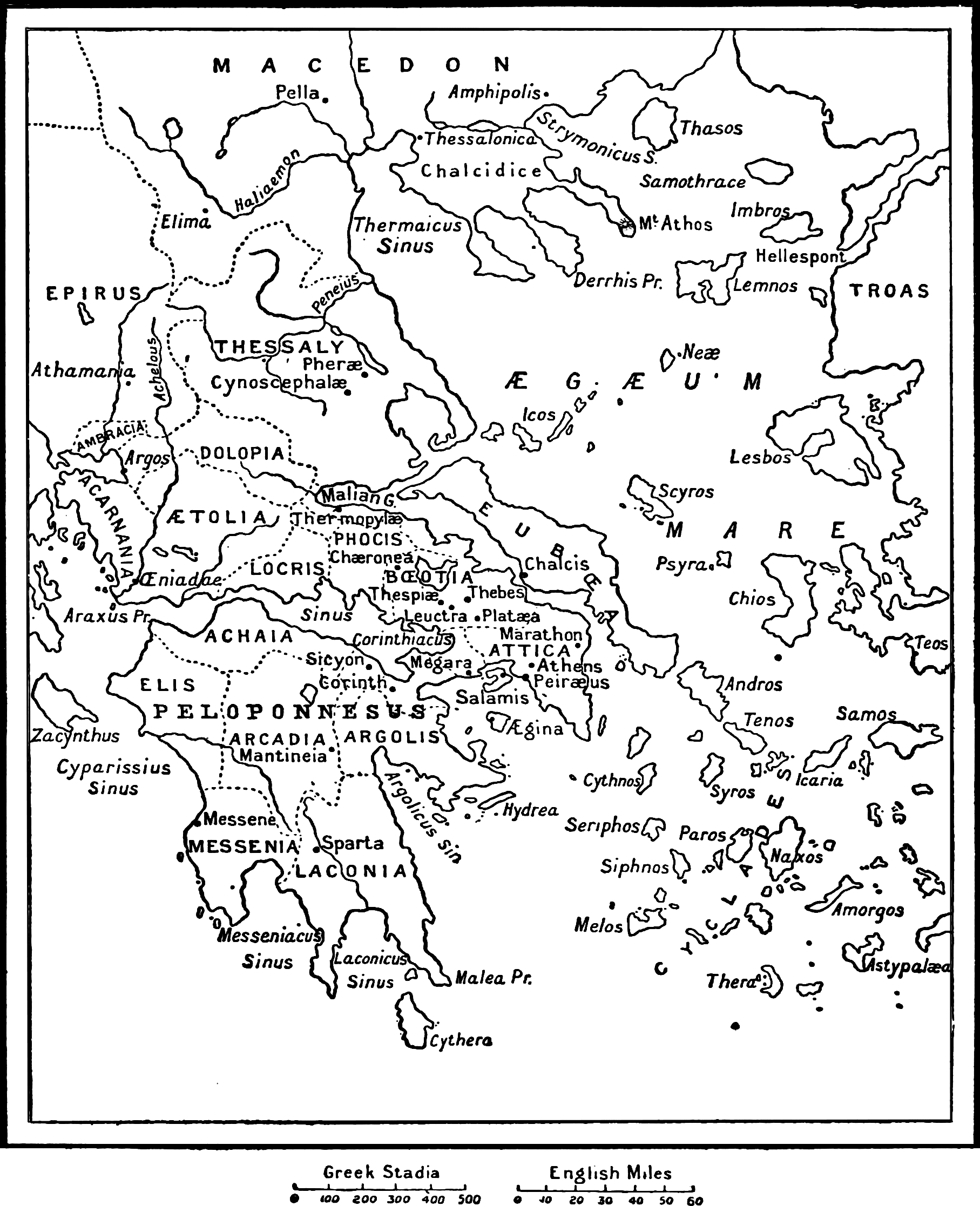
If you look at a map of Greece you will easily find, in the
south, the country called Peloponnesus. In Peloponnesus
you will see Sparta, the capital city, over which Menelaus
was king, when the story of the Iliad begins.
Menelaus was married to a beautiful queen named Helen.
She was the fairest woman in the wide world.
One day there came to the court of the king a prince
named Paris. He was the second son of Priam, King of Troy.
Menelaus welcomed his royal guest and treated him with
kindness, but Paris repaid the hospitality of the king most
cruelly. For when affairs of State called Menelaus away
from Sparta for a short time, Paris did not wait until he
returned. He hastened back to Troy, taking with him the
beautiful Queen of Sparta, who was ever after known as
Helen of Troy.
When Menelaus came home to find that Helen had
gone away to Troy, he swore a great oath that he would
besiege the city, punish Paris, and bring back his beautiful
queen to Sparta; and this was the beginning of the Trojan
War.
Menelaus had not a large enough army to go alone against
his enemy. So he sent to his brother Agamemnon, who
was the chief of all the mighty warriors of Hellas, and to
many other lords, to beg them to help him to besiege Troy,
and, if it might be, to slay Paris.
The chiefs were eager to help Menelaus to avenge his
wrongs, and soon a great army was ready to sail across the
Hellespont to Asia, to march on Troy.
But before the army embarked, the warriors sent, as
was their custom, to an oracle, to ask if their expedition
would be successful.
‘Without the help of goodly Achilles, Troy will never be
taken,’ was the answer.
Achilles was the son of Thetis, the silver-footed goddess,
whose home was in the depths of the sea. Well did she love
her strong son Achilles. When he was a babe she wished to
guard him from the dangers that would surely threaten him
when he grew to be a man, so she took him in her arms and
carried him to the banks of the river Styx. Whoever
bathed in these magic waters became invulnerable, that is, he
became proof against every weapon. Silver-footed Thetis,
holding her precious babe firmly by one heel, plunged him
into the tide, so that his little body became at once invulnerable,
save only the heel by which his mother grasped him.
It was untouched by the magic water.
Achilles set sail with the other chiefs for Troy, so it
seemed as though the city would be taken by his help, as
the oracle foretold. With him Achilles took his well-loved
friend Patroclus.
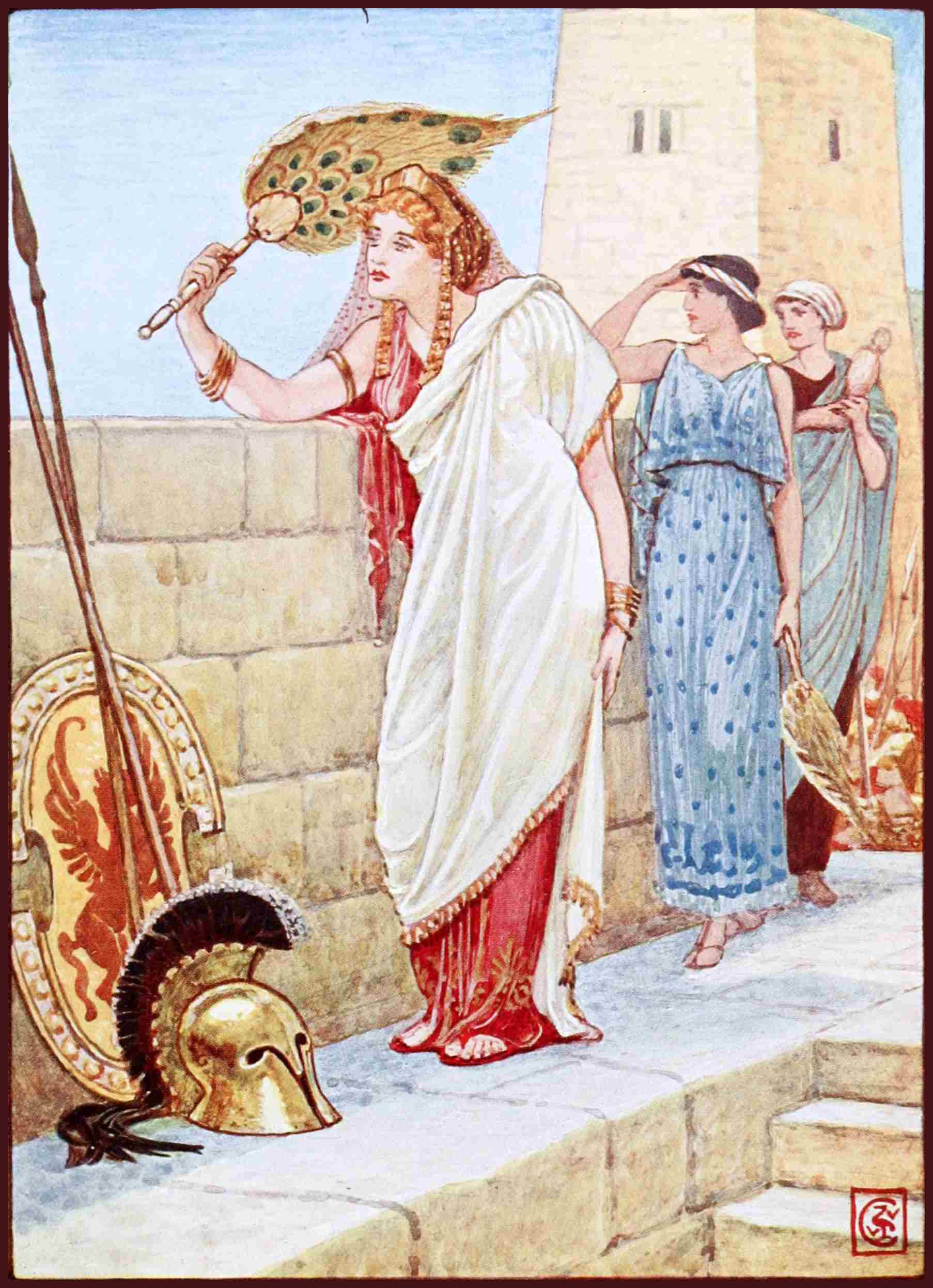
For nine long years was the city of Troy besieged, and all
for the sake of Helen the beautiful Queen of Sparta. Often
as the years passed, she would stand upon the walls of Troy
to look at the brave warriors of Hellas, to wonder when they
would take the city. But when nine years had passed, no
breach had yet been made in the walls.
When the Hellenes needed food or clothing, they attacked
and plundered the neighbouring cities, which were not
so well defended as Troy.
The plunder of one of these cities, named Chryse, was the
cause of the fatal quarrel between Agamemnon and Achilles.
In Chryse there was a temple sacred to Apollo, guarded
by a priest named Chryses. His daughter Chryseis, and
another beautiful maiden named Briseis the Faircheeked,
were taken prisoners when the town was sacked by the
Hellenes. Agamemnon claimed the daughter of the priest
as his share of the spoil, while Briseis he awarded to Achilles.
Often she would stand upon the walls of Troy
When Chryses the priest found that his daughter had
been carried away by the Greeks, he hastened to the tent of
Agamemnon, taking with him a ransom great ‘beyond
telling.’ In his hands he bore a golden staff on which he
had placed the holy garland, that the Greeks, seeing it, might
treat him with reverence.
‘Now may the gods that dwell in the mansions of
Olympus grant you to lay waste the city of Priam and to fare
happily homeward,’ said the priest to the assembled chiefs,
‘only set ye my dear child free and accept the ransom in
reverence to Apollo.’
All save Agamemnon wished to accept the ransom and
set Chryseis free, but he was wroth with the priest and
roughly bade him begone.
‘Let me not find thee, old man,’ he cried, ‘amid the ships,
whether tarrying now or returning again hereafter, lest the
sacred staff of the god avail thee naught. And thy daughter
will I not set free. But depart, provoke me not, that thou
mayest the rather go in peace.’
Then Chryseis was angry with Agamemnon, while for
his daughter’s sake he wept.
Down by the ‘shore of the loud-sounding sea’ he walked,
praying to Apollo, ‘Hear me, god of the silver bow. If ever
I built a temple gracious in thine eyes, or if ever I burnt to
thee fat flesh ... of bulls or goats, fulfil thou this my
desire; let the Greeks pay by thine arrows for my tears.’
Apollo heard the cry of the priest, and swift was his
answer. For he hastened to the tents of the Greeks, bearing
upon his shoulders his silver bow, and he sped arrows of
death into the camp.
Dogs, mules, men, all fell before the arrows of the angry
god. The bodies of the dead were burned on great piles of
wood, and the smoke rose black toward the sky.
For nine days the clanging of the silver bow was heard.
Then Achilles called the hosts of the Greeks together, and
before them all he spoke thus to Agamemnon: ‘Let us go
home, Son of Atreus,’ he said, ‘rather than perish, as we surely
shall do if we remain here. Else let us ask a priest why
Apollo treats us thus harshly.’
But it was easy to tell why Apollo was angry, and
Calchas, a seer, answered Achilles in plain-spoken words.
‘The wrath of the god is upon us,’ he said, ‘for the sake of
the priest whom Agamemnon spurned, refusing to accept
the ransom of his daughter. Let Chryseis be sent back to
her father, and for sacrifice also a hundred beasts, that the
anger of the god may be pacified.’
Deep was the wrath of Agamemnon as he listened to the
words of Calchas.
‘Thou seer of evil,’ he cried, his eyes aflame with anger,
‘never yet hast thou told me the thing that is pleasant.
Yet that the hosts of our army perish not, I will send the
maiden back. But in her place will I take Briseis the Fair-cheeked,
whom Achilles has in his tent.’
When Achilles heard these words he drew his sword to
slay Agamemnon. But before he could strike a blow he
felt the locks of his golden hair caught in a strong grasp, and
in a moment his rage was checked, for he knew the touch was
that of the goddess Athene. None saw her save Achilles,
none heard as she said to him, ‘I came from heaven to stay
thine anger.... Go to now, cease from strife, and let not
thine hand draw the sword.’
Then Achilles sheathed his sword, saying, ‘Goddess,
needs must a man observe thy saying even though he be
very wroth at heart, for so is the better way.’
Yet although Achilles struck no blow, bitter were the
words he spoke to the king, for a coward did he deem him
and full of greed. ‘If thou takest from me Briseis,’ he cried,
‘verily, by my staff, that shall not blossom again seeing it
has been cleft from a tree, never will I again draw sword for
thee. Surely I and my warriors will go home, for no quarrel
have we with the Trojans. And when Hector slaughters
thy hosts, in vain shalt thou call for Achilles.’
Well did Agamemnon know that he ought to soothe the
anger of Achilles and prevail on him to stay, for his presence
alone could make the Trojans fear. Yet in his pride the king
answered, ‘Thou mayest go and thy warriors with thee.
Chieftains have I who will serve me as well as thou, and who
will pay me more respect than ever thou hast done. As for
the maiden Briseis, her I will have, that the Greeks may know
that I am indeed the true sovereign of this host.’
The Assembly then broke up, and Chryseis was sent home
under the charge of Odysseus, one of the bravest of the
Greek warriors.
When the priest received his daughter again, he at once
entreated Apollo to stay his fatal darts, that the Greeks
might no longer perish in their camp. And Apollo heard
and laid aside his silver bow and his arrows of death.
Then Agamemnon called heralds, and bade them go to
the tent of Achilles and bring to him Briseis of the fair
cheeks. ‘Should Achilles refuse to give her up,’ said the
angry king, ‘let him know that I myself will come to fetch
the maiden.’
But when the heralds told Achilles the words of the king,
he bade Patroclus bring the damsel from her tent and give
her to the messengers of Agamemnon. And the maiden,
who would fain have stayed with Achilles, was taken to the
king.
CHAPTER XII MENELAUS AND PARIS DO BATTLE
When the heralds of Agamemnon had led Briseis away,
Achilles stripped off his armour, for not again would he fight
in the Trojan War. Down to the seashore he went alone
to weep for the loss of Briseis the Faircheeked.
As he wept he called aloud to his mother Thetis. From
the depths of the sea she heard his cry, and swift on a wave
she reached the shore. Soon she was by the side of her son,
and taking his hand, as when he was a boy, she asked, ‘My
child, why weepest thou?’
Then Achilles told how Agamemnon had taken from him
Briseis, whom he loved.
‘Go to the palace of Zeus,’ he entreated her, ‘and
beseech Zeus to give me honour before the hosts of the
Greeks. Let him grant victory to the Trojans until the king
sends to Achilles to beg for his help in the battle.’
So Thetis, for the sake of her dear son, hastened to
Olympus, and bending at the knee of Zeus she besought the
god to avenge the wrong done to Achilles.
At first Zeus, the Cloud-gatherer, was silent, as though he
heard her not. ‘Give me now thy promise,’ urged Thetis,
‘and confirm it with a nod or else deny me.’
Then the god nodded, and thereat Olympus shook to its
foundations. So Thetis knew that she had found favour in
the eyes of Zeus, and leaving the palace of the gods she
plunged deep into the sea.
Zeus hastened to fulfil his promise, and sent to
Agamemnon a ‘baneful dream.’
As the king dreamed, he thought he heard Zeus bid him
go forth to battle against the Trojans, for he would surely
take the city. But in this Zeus deceived the king.
When Agamemnon awoke in the morning he was glad,
for now he hoped to win great honour among his warriors.
Quickly he armed himself for battle, throwing a great cloak
over his tunic, and slinging his sword, studded with silver,
over his shoulder. In his right hand he bore the sceptre of
his sires, the sign of his lordship over all the great hosts of
Hellas.
Then when he was armed, the king assembled his great
army, and after telling his dream, he bade it march in silence
toward the city.
But when the Trojans saw the Hellenes drawing near,
they came out to meet them ‘with clamour and with shouting
like unto birds, even as when there goeth up before
heaven a clamour of cranes which flee from the coming of
winter and sudden rain.’
As the Trojans approached, Menelaus saw Paris who
had stolen his fair wife, and he leaped from his chariot that
he might slay the prince. But Paris, when he saw the wrath
of Menelaus, was afraid and hid himself among his comrades.
Then Hector, his brother, who was the leader of the
Trojans, mocked at him for his cowardice, until Paris grew
ashamed.
‘Now will I challenge Menelaus to single combat,’ he
cried. And Hector rejoiced at his words and bade the
warriors stay their arrows.
‘Hearken, ye Trojans and ye Greeks,’ he cried, ‘Paris
bids you lay down your arms while he and his enemy
Menelaus alone do battle for Helen and for her wealth.
And he who shall be victor shall keep the woman and her
treasures, while we will make with one another oaths of
friendship and of peace.’ So there, without the walls of the
city, oaths were taken both by the Greeks and the Trojans.
But the heart of Priam, King of Troy, was heavy lest harm
should befall Paris, and he hastened within the gates of the
city that he might not watch the combat. ‘I can in no wise
bear to behold with mine eyes my dear son fighting with
Menelaus,’ he said. ‘But Zeus knoweth, and all the
immortal gods, for whether of the twain the doom of death
is appointed.’
Then Menelaus and Paris drew their swords, and Menelaus
cried to Zeus to grant him his aid, so that hereafter men
‘may shudder to wrong his host that hath shown him
kindness.’
But it seemed that Zeus heard not, for when Menelaus
flung his ponderous spear, although it passed close to Paris,
rending his tunic, yet did it not wound him, and when he
dealt a mighty blow with his sword upon the helmet of his
enemy, lo, his sword broke into pieces in his hand.
Then in his wrath, Menelaus reproached the god: ‘Father
Zeus,’ he cried, ‘surely none of the gods is crueller than thou.
My sword breaketh in my hand, and my spear sped from my
grasp in vain, and I have not smitten my enemy.’
Yet even if Zeus denied his help, Menelaus determined
to slay his foe. So he sprang forward and seized Paris by
the strap of his helmet. But the goddess Aphrodite flew to
the aid of the prince, and the strap broke in the hand of
Menelaus. Before the king could again reach his enemy, a
mist sent by the goddess concealed the combatants one from
the other. Then, unseen by all, Aphrodite caught up Paris,
‘very easily as a goddess may,’ and hid him in the city
within his own house.
In vain did Menelaus search for his foe, yet well did he
know that no Trojan had given him shelter. For Paris was
‘hated of all even as black death,’ because it was through his
base deed that Troy had been besieged for nine long years.
CHAPTER XIII HECTOR AND ANDROMACHE
The gods were angry with Aphrodite because she had hidden
Paris from the king, and they determined that, in spite of
their oath, the two armies should again begin to fight.
So Athene was sent to the Trojan hosts, disguised as one
of themselves. In and out among the soldiers she paced,
until at length she spoke to one of them, bidding him draw
his bow and wound Menelaus.
The soldier obeyed, and the arrow, guided by Athene,
reached the king, yet was the wound but slight.
When the Greeks saw that the Trojans had disregarded
their oath, they were full of wrath, and seizing their arms
they followed their chiefs to battle. ‘You had thought them
dumb, so silent were they,’ as they followed. But as the
Trojans looked upon the enemy there arose among them a
confused murmur as when ‘sheep bleat without ceasing to
hear their lambs cry.’
Fierce and yet more fierce raged the battle. Valiant
deeds were done on both sides, but when Hector saw that
the Greeks were being helped by the gods, he left the battlefield
and hastened to the city.
At the gates, wives and mothers pressed around him,
eager to hear what had befallen their husbands, their sons.
But Hector tarried only to bid them go pray to the gods.
On to the palace he hastened to find Hecuba, his mother.
She, seeing him come, ran to greet him and to beg of him to
wait until she brought honey-sweet wine, that he might pour
out an offering to Zeus, and himself drink and be refreshed.
But Hector said, ‘Bring me no honey-sweet wine, my
lady-mother, lest thou cripple me of my courage and I be
forgetful of my might. But go thou to the temple with all
thy women, to offer gifts to Athene and to beseech her aid.’
Then leaving his mother, Hector went to the house of
Paris, and bitterly did he rebuke him, because he was not in
the forefront of the battle.
‘Stay but till I arm and I will go with thee,’ answered
Paris. But Hector heeded him not, for he was in haste to
find his dear wife Andromache and their beautiful boy,
Skamandriss. By the people the child was called Astyanax,
the City King, for it was his father who guarded Troy.
Andromache was not in their house, but on the wall of
the city, watching the battle, fearing lest harm should befall
her lord. With her was her little son, in the arms of his
nurse.
Hector dared not linger to search for his wife, but as he
hastened back to the gates she saw him and ran to bid him
farewell ere he returned to battle.
Close to his side she pressed, and her tears fell as she
cried:
‘Too brave! thy valour yet will cause thy death.
Thou hast no pity on thy tender child,
Nor me, unhappy one, who soon must be
Thy widow. All the Greeks will rush on thee
To take thy life. A happier lot were mine
If I must lose thee to go down to earth,
For I shall have no hope when thou art gone—
Nothing but sorrow. Father have I none,
And no dear mother....
Hector, thou
Art father and dear mother now to me,
And brother and my youthful spouse besides,
In pity keep within the fortress here,
Nor make thy child an orphan nor thy wife
A widow.’
But Hector, though he dearly loved his wife, could not
shrink from the battle. As Andromache ceased to plead
with him, he held out his arms to his little son, but the child
drew back in fear of the great plumes that waved on his
father’s shining helmet.
Then Hector took off his helmet and laid it on the ground,
while he caught his child in his arms and kissed him, praying
Zeus and all the gods to defend him.
Andromache gazed pitifully at her husband as, at length,
he gave the child to its nurse, and he seeing her great grief,
took her hand and said:
‘Sorrow not thus, beloved one, for me.
No living man can send me to the shades
Before my time; no man of woman born,
Coward or brave, can shun his destiny.
But go thou home and tend thy labours there,
The web, the distaff, and command thy maids
To speed the work. The cares of war pertain
To all men born in Troy, and most to me.’
Then springing into his chariot, Hector drove swiftly
back to the field of battle.
CHAPTER XIV THE HORSES OF ACHILLES
Hector and Paris reached the battlefield at the same
moment. The Trojans were encouraged to fight yet more
fiercely when they saw the two princes, and soon so many of
the Greeks were slain that Agamemnon grew afraid.
‘Zeus hath sent me a deceiving dream,’ he said to his
counsellors. ‘If the gods send not their help we must perish,
unless indeed Achilles will forget his anger and come to our
aid. Verily, Zeus loveth Achilles, seeing that he putteth the
Greeks to flight that he may do him honour. But even as I
wronged him in my folly, so will I make amends and give
recompence beyond all telling.’
Then, casting aside his pride, the king sent messengers
to the tent of Achilles, to say that he would send back
Briseis and give to him splendid gifts if he would but come
to the help of the Greeks, for they were flying before the
enemy.
But the heart of Achilles was too bitter to be touched by
the fair promises of the king, for had he not taken from him
Briseis, the lady of his love? So he bade the messengers
go back to Agamemnon and say that he would not fight, but
he would launch his ships on the morrow and sail away to
his own land.
When the king heard that Achilles spurned his gifts, and
refused to come to his aid, he was afraid. But his counsellors
said, ‘Let us not heed Achilles, whether he sail or whether
he linger by the loud-sounding sea. When the gods call to
him, or when his own heart bids, he will fight. Let us go
once more against the Trojans, and do thou show thyself, O
king, in the forefront of the battle.’
Then Agamemnon rallied his men and led them against
the foe, yet again he was driven back. Chief after chief
was wounded, and at length the Hellenes fled to their ships to
defend them from the Trojans. But Patroclus determined
to plead with Achilles to save his countrymen from defeat.
When he entered the tent of his friend he was weeping
for pity of the dead and wounded.
‘Wherefore weepest thou, Patroclus, like a fond little
maid that runs by her mother’s side?’ asked Achilles as he
looked up at the entrance of his friend and saw his tears.
‘Never may such wrath take hold of me as that thou
nursest, thrice brave, to the hurting of others,’ answered his
comrade. ‘The Greeks are lying wounded and dead. If
thou wilt not come to their help, let me lead thy men so that
the enemy may be beaten back....’
‘And give
The armour from thy shoulders. I will wear
Thy mail, and then the Trojans, at the sight,
May think I am Achilles, and may pause
From fighting.’
Even as Patroclus pleaded with his friend, a great light
flared up against the sky. The Trojans had set fire to the
Greek ships.
Then, at length, Achilles was roused. He would not go
himself to the help of Agamemnon, but he bade Patroclus
put on his armour, while he called together his brave warriors
and commanded them to follow his friend to battle.
Quickly Patroclus donned the well-known armour of
Achilles, then calling to Automedon, the chariot driver, he
bade him harness Xanthus and Balius, the immortal horses
of his friend, for their speed was swift as the wind.
As Patroclus vanished from sight in the chariot drawn
by Xanthus and Balius, Achilles prayed to Zeus. ‘O Zeus,’
he cried, ‘I send my comrade to this battle. Strengthen his
heart within him, and when he has driven from the ships the
war and din of battle, scathless then let him return to me and
my people with him.’
Down upon the Trojans swept the warriors led by
Patroclus. They, seeing the armour of Achilles were afraid,
and fled from the ships. But ere long they discovered that
it was not Achilles but Patroclus who wore the well-known
armour, and they returned to fight with new courage. And
ever, where the battle raged most fiercely, did Patroclus
bid Automedon drive his chariot.
Then the gods bade Hector find Patroclus and slay him.
Little trouble had the prince in finding the warrior who
wore the armour of Achilles. Bravely the two heroes fought,
but Patroclus was not able to stand against the great strength
of Hector. Moreover, the gods betrayed him, striking him
from behind on the head and shoulders, so that the helmet
of Achilles fell in the dust. Apollo also snatched his shield
from his arm and broke his spear in two.
When Hector saw that his enemy was disarmed, he took
his spear and struck him so fiercely that Patroclus fell
‘With clashing mail, and all the Greeks beheld
His fall with grief.’
The friend of Achilles was wounded to death.
In his triumph Hector was merciless. He mocked at his
fallen foe, saying, ‘Patroclus, surely thou saidst that thou
wouldst sack my town, and from Trojan women take away the
day of freedom, and bring them in ships to thine own dear
country. Fool, ... I ward from them the day of destiny,
but thee shall vultures here destroy.’
Faint though he was, Patroclus answered, ‘It was not
thou, Hector, who didst slay me, but Apollo, who snatched
from me my shield and brake my sword in twain.’ Then
his strength failed and he breathed his last.
No pity yet showed Hector, for he stripped off the armour
of Achilles from the body of Patroclus that he might wear it
himself. But Zeus, as he looked upon the haughty victor,
was displeased.
‘Ah, hapless man,’ said the god to himself, ‘no thought
is in thy heart of death that yet draweth nigh unto thee;
thou doest on thee the divine armour of a peerless man before
whom the rest have terror. His comrade, gentle and brave,
thou hast slain, and unmeetly hast stripped the armour
from his head and shoulders.’
The immortal horses of Achilles wept when they knew
that Patroclus was slain. Automedon lashed them, he spoke
kindly to them, yet would they not move. As a pillar on
a tomb, so they stood yoked to the chariot. From their
eyes big teardrops fell, their beautiful heads hung down
with grief so that their long manes were trailed in the dust.
Thus sorely did the immortal steeds grieve for the death of
Patroclus.
CHAPTER XV THE DEATH OF HECTOR
Fierce and long raged the battle around the body
of Patroclus. And while the armies fought, a messenger
hastened to the tent of Achilles to tell him that his comrade
was slain and that the Trojans fought for his body as it lay
naked on the ground, stripped of its armour. ‘Thy armour,’
said the messenger, ‘Hector has taken for himself.’
When Achilles heard the bitter tidings he took dust and
poured it with both hands upon his head. ‘As he thought
thereon, he shed big tears, now lying on his side, now on his
back, now on his face, and then anon he would rise upon his
feet, and roam wildly beside the beach of the salt sea.’
As he cried aloud in his grief his mother, Thetis, heard in her
home beneath the sea. Swiftly she sped to her son that she
might learn why he wept.
Achilles told her all that had befallen Patroclus, and how
he himself cared no longer to live, save only that he might slay
Hector who had killed his friend.
Thetis bade her son wait but till the morrow before he
went to battle, and she would bring him armour made by
the great Fire-god.
Then she left him and prayed the god Hephaestus,
keeper of the forge, to give her armour for her dear son.
Hephaestus was pleased to work for so goodly a warrior
as Achilles. Quickly he set his twenty bellows to work, and
when the fire blazed in the forge, he threw into it bronze and
silver and gold. Then taking a great hammer in his hand he
fashioned a marvellous shield, more marvellous than words
can tell. Before morning a complete suit of armour was
ready for Achilles.
Meanwhile Hector had all but captured the body of
Patroclus. But the gods spoke to Achilles, bidding him
now succour the body of his friend. Without armour
Achilles could not enter the fray, yet he hastened to the
trenches that the Trojans might see him.
Around his head gleamed a golden light, placed there by
Athene. When the Trojans saw the flame and heard the
mighty cry of Achilles, they drew back afraid.
Three times the warrior shouted, and three times the
Trojans drew back in fear. While they hesitated the Greeks
rushed forward and carried away the body of Patroclus,
nor did they lay it down until they laid it in the tent of
Achilles.
On the morrow Thetis came back to her son, bringing
with her the armour made by Hephaestus. She found him
weeping over the body of his friend.
‘My child,’ she said, ‘him who lieth here we must let
be, for all our pain. Arm thyself now and go thy way into
the fray.’
Then Achilles put on the armour of the god in haste, for
he feared lest another than he should slay Hector.
With Achilles once again at their head, the Greek warriors
attacked the Trojans with redoubled fury. But it was
Hector alone whom Achilles longed to meet, and soon he
saw his enemy near one of the gates of Troy. Now he
would avenge the death of Patroclus. But when Hector
saw the great hate in the eyes of his enemy, lo, he turned
and fled.
‘As a hawk, fastest of all the birds of air, pursues a dove
upon the mountains,’ so did Achilles pursue the prince
until he was forced to stand to take breath. Then Hector,
encouraged by the gods, drew near to him and spoke, ‘Thrice,
great Achilles, hast thou pursued me round the walls of Troy,
and I dared not stand up against thee; but now I fear thee
no more. Only do thou promise, if Zeus give thee the victory,
to do no dishonour to my body, as I also will promise to do
none to thine should I slay thee.’
But Achilles, remembering Patroclus, cried out in anger
that never would he make a covenant with him who had
slain his friend.
Then with fierce blows each fell upon the other, until at
length Achilles drove his spear through the armour that
Hector wore, and the Trojan prince fell, stricken to the
ground.
Achilles, his anger still burning fiercely, stripped the
dead man of his armour, while many Greek warriors standing
near thrust at him with their spears, saying to one
another, ‘Go to, for easier to handle is Hector now, than
when he burnt the ships with blazing fire.’
Then Achilles tied the dead man to his chariot with
thongs of ox-hide and drove nine times round the city walls,
dragging the fair head of Hector in the dust.
From the tower Priam and Hecuba saw the body
of their son dragged in the dust, and bitter was their
pain.
But Andromache knew not yet what had befallen her
lord, for she sat in an inner chamber wearing a purple cloth.
Soon she bade her maids prepare a bath for Hector, for she
thought that he would return ere long from the battle.
She knew not yet that Hector would never return, but as
the noise of the wailing of the people reached the room in
which she sat, her heart misgave her. In haste she ran to
the wall of the city, only to see the chariot of Achilles as it
dragged Hector down to the loud-sounding sea.
Then fainting with grief, Andromache fell to the ground,
and the diadem which Aphrodite had given to her on her
wedding morn dropped from her head, to be worn by her
no more.
Down by the seashore Achilles burned the body of
Patroclus with great honour, and when the funeral rites were
ended, he dragged the dead body of Hector round the tomb,
weeping for the loss of his dear comrade.
But Zeus was angry with Achilles for treating the Trojan
prince so cruelly, and he sent Thetis to bid her son give back
Hector’s body to Priam, who would come to offer for it a
ransom. ‘If Zeus decrees it, whoever brings a ransom shall
return with the dead,’ answered Achilles.
Then Zeus sent a messenger to the house of Priam, where
the mother and the wife of Hector wept, saying, ‘Be of good
cheer in thy heart, O Priam.... I am the messenger of
Zeus to thee, who though he be afar off, hath great care and
pity for thee. The Olympian biddeth thee ransom noble
Hector’s body, and carry gifts to Achilles that may gladden
his heart.’
So Priam set out alone, save for the driver of the wagon
which was to bring Hector again to Troy, for so had the
messenger commanded. But Hecuba feared to let the old
man go alone to the tent of the enemy. When he reached
the camp of the Greeks, Priam hastened to the tent of
Achilles, and entering it before his enemy was aware, the
old king fell at the feet of his enemy and begged for the
body of his dear son.
Achilles could not look upon the grief of the old man
unmoved, but when Priam offered him gifts he frowned and
haughtily he answered, ‘Of myself am I minded to give
Hector back to thee, for so has Zeus commanded.’
Then a truce for nine days was made between the Greeks
and the Trojans, so that King Priam and his people might
mourn for Hector and bury him undisturbed by fear of the
enemy.
Priam tarried with Achilles until night fell. Then while
he and his warriors slept, the king arose and bade the driver
yoke the horses and mules. When this was done they laid
the body of Hector upon the wagon, and in the silence of the
night set out on their homeward journey.
At the gates of Troy stood Andromache and Hecuba
watching until Priam returned. And when the wagon
reached the city the Trojans carried Hector into his own
house. Then Andromache took the head of her dear
husband in her arms and said, ‘Husband, thou art gone
young from life and leavest me a widow in thy halls. And
the child is yet but a little one ... nor methinks shall he
grow up to manhood, for ere then shall this city be utterly
destroyed. For thou art verily perished who didst watch
over it and guard it, and keptest safe its noble wives and
infant little ones.’
The following morning Priam bade his people go gather
wood for the burial, and after nine days the body of Hector
was laid on the pile and burned. Then his white bones,
wrapped in purple cloth, were placed in a golden chest.
Above the chest a great mound was raised, and thus Hector,
the brave prince of Troy, was buried.
Soon after the burial of Hector Achilles was killed by a
poisoned arrow which Paris aimed at his heel, the one spot
of his body that Thetis had failed to bathe in the magic
waters of the river Styx. Paris himself perished soon after
the death of Achilles.
Troy still remained untaken. Then goodly Odysseus
told the Greeks that although they could not take the city
by storm, they might take her by a stratagem or trick.
So the Greeks, as he bade them, built a huge wooden
horse, which was hollow within. Here they hid a number
of their bravest warriors, and then the main body of the army
marched away, as though they were tired of trying to take
the city. The wooden horse they left as an offering to
Poseidon. Only a slave named Sinon was left behind to
persuade the Trojans to drag the horse into the city. But
the Trojans needed little persuasion. They came out of
the city, gazed at the strange horse, half feared a trick, and
then, like children amused with a new toy, they pulled it
within the walls of Troy.
So glad were the Trojans that the enemy had gone away,
that they made a great feast. While they ate and drank,
careless of danger, Sinon helped the Greek warriors out
of the hollow wooden horse. They waited until it was
late and all was quiet, then they slipped down to the
gates and flung them open, while their comrades, who
had not marched far away, rushed in to plunder and burn
the city. Thus after many long years Troy was taken by
the counsel of Odysseus.
One of the first to sail away from the city was Menelaus,
with his beautiful queen safe at his side. After many
adventures he reached Sparta and lived with Helen ‘in
peace, comfort, and wealth, and his palace shone in its
splendour like the sun or the moon.’
CHAPTER XVI POLYPHEMUS THE GIANT
The Greek warriors burned and sacked the city of Troy, and
then they set sail for the sunny isles of Greece. But storms
overtook some, the gods sent misfortune to others, so that
but few reached their own land in safety.
Odysseus, King of Ithaca, an island on the western coast
of Greece, suffered greater hardships than any other. For
ten years he was either tossed by the gods on stormy seas,
or kept a captive in strange countries. Of some of his
adventures I shall tell you now.
When Odysseus and his comrades sailed away from
Troy, they were driven by a fair wind to the shore of
Ismarus. Here dwelt a rich and prosperous people called
the Cicones.
The Greeks wished to take much spoil back with them to
their homes, so they resolved to slay the Cicones and plunder
their city.
Some of the citizens escaped the sword of the adventurers
and hastened to their kinsmen who dwelt farther from the
shore. When they had told their terrible tidings, their
comrades armed themselves and sped to the shore to punish
the strangers.
Odysseus had tried in vain to make his followers go back
to their ships. They had refused to be hurried, and were
now sitting on the seashore eating and drinking, heedless
of danger.
Before they were aware the kinsmen of the Cicones had
fallen upon them, and when the sun went down they had
slain six men out of each of the strangers’ ships. The rest
barely escaped with their lives.
Scarcely had the Greeks reached their vessels and sailed
away from Ismarus, when Zeus sent a north wind against
them. For nine days their ships were driven hither and
thither. Their sails were torn to shreds, when on the tenth
day the sailors caught sight of land. It was the land of the
lotus-eaters, where the people fed only on the fruit of the
lotus, a fruit that brought sleep and forgetfulness to the
eater.
Odysseus sent three sailors on shore to find out what
manner of people the lotus-eaters were. No sooner had they
landed than the inhabitants brought them fruit, which
they ate with delight. But the honey-sweet flowers made
them forget Odysseus, their comrades, and their ships. They
had no wish save to stay for ever with the lotus-eaters to
share their magic food.
At length, Odysseus grew tired of waiting for the three
sailors to return, and he himself with a few armed men went
on shore to look for them. He thought that perhaps they
had been taken prisoners and had been bound with chains,
but he found them lying on the yellow sand, dreamy and
content.
‘And sweet it was to dream of Fatherland,
Of child, and wife, and slave; but evermore
Most weary seem’d the sea, weary the oar,
Weary the wandering fields of barren foam.’
When the three sailors saw Odysseus they cried:
‘“We will return no more”
And all at once they sang, “Our island home
Is far beyond the wave; we will no longer roam.”’
Odysseus and his comrades were offered fruit by the
kindly lotus-eaters, but Odysseus waved it aside and bade
his men drag away the three sailors who had already eaten.
The sailors wept sore, for fain would they have dwelt for ever
in the land of dreams. But when they were once more on
their vessels and had put out to sea, the breezes brought
back health to their bodies, vigour to their minds. Soon
they were able to rejoice that they had left the enchanted
lotus-land far behind.
Westward sailed the fleet of Odysseus, until it reached
the island of Sicily, where the Cyclopes dwelt. The Cyclopes
were giants who had each but one eye, fixed in the middle of
his brow.
Odysseus, taking with him only his own crew, landed on
the island, for he wished to see the Cyclopes. He had
walked but a little way when he came to a great cave, in
which stood baskets filled with cheeses and milkpans filled
with milk. In this cave dwelt Polyphemus, one of the sons
of Poseidon, and the fiercest of all the fierce Cyclopes.
Into this cave went Odysseus and his comrades.
Polyphemus was not within; he was out on the hills with his
flocks.
‘Let us take the cheeses and drive away the lambs and
the kids that are here, before the giant returns,’ said the
sailors. But Odysseus would not do as they wished, for, said
he, ‘I greatly wish to see the giant shepherd who dwells in
the cave.’
‘Verily,’ said Odysseus, as he told the tale in after days,
‘verily, his coming was not to be a joy to my company.’
Evening drew on apace, and Polyphemus, driving his
flocks before him, reached the cave. When he had driven
his flocks in before him, the giant took a huge rock and placed
it in the doorway.
Odysseus and his comrades had hidden themselves in the
dimmest corners of the cave when Polyphemus entered.
The giant lighted a great fire of pine wood and began to milk
the ewes. Soon the flames lighted up every corner of the
cave, and Polyphemus saw his unexpected guests.
In a voice that struck terror even into the brave hearts
of the Greeks, so gruff, so loud it was, the giant demanded,
‘Strangers, who are ye? Whence sail ye over the watery
ways? On some trading enterprise or at adventure do ye
rove, even as sea-robbers over the brine?’
Boldly then answered Odysseus, ‘“No Man” is my
name. My ship, Poseidon, the shaker of the earth, broke
it to pieces, for he cast it upon the rocks at the border of
your country, and brought it nigh the headland, and a wind
bore it thither from the sea. But I, with these my men,
escaped from utter doom. Give us, we beseech thee, food
and shelter.’
As you know, Odysseus had not been shipwrecked, his
vessel, safely anchored, awaited his return, nor was his true
name No Man. He dared not tell the giant the truth, lest
he should go in search of his ship and take it for firewood,
while he and his companions were kept prisoners in the cave.
The giant said not a word when Odysseus ended his tale,
but he stretched out his great hand, seized two of the
strangers, and devoured them before the eyes of their
horrified companions. Then, well satisfied with his meal, he
fell fast asleep.
In the morning the giant finished his breakfast by eating
two more of his guests, then, moving away the stone at the
entrance of the cave as easily as if it had been a feather, he
drove his flocks to pasture. He did not forget to replace the
stone in the doorway before he turned away.
CHAPTER XVII ODYSSEUS ESCAPES FROM THE CAVE
Odysseus was determined that he and his comrades should
escape from the cave of the dread Cyclops. Hour after hour
he pondered how he might persuade the giant to let them go,
but at length he thought, ‘I will not persuade him, I will force
him to let us go.’
At that moment, his eye fell upon a great staff or club in
a corner of the cave. He bade his companions make a sharp
point to it. When this was done he hardened it in the fire
and then hid it from sight.
The day passed slowly, but at length evening came and
Polyphemus returned to the cave. His guests shrank into
the farthest corner as the giant began his supper, but ere he
finished, he again stretched out his hand, seized two of his
prisoners, and devoured them. Then Odysseus offered him
a draught of wine which he had brought with him from
Ismarus.
Deep drank the giant, and ere he fell into a sound sleep he
turned to Odysseus saying, ‘No Man, thee will I eat last in
return for thy gift of wine.’
Odysseus waited until he saw that Polyphemus was fast
asleep, then he bade his comrades put the point of the great
staff in the fire. When it was red hot he told them to
thrust it deep into the eye of the giant. So great was the
pain that the Cyclops leaped up from his sleep and hurled
away the staff, uttering loud cries of agony.
The giants who dwelt on the mountains round about
heard the voice of Polyphemus, and together they hastened
to the doorway of the cave.
‘What hath so distressed thee, Polyphemus,’ they cried,
‘that thou criest thus aloud through the immortal night and
makest us sleepless? Surely no mortal driveth off thy flocks
against thy will; surely none slayeth thyself by force or
craft?’
‘No Man is slaying me by guile, nor at all by force,’
answered Polyphemus, proud even in his pain.
‘If no man is harming thee, it may be that Zeus has sent
sickness upon thee,’ answered the giants. ‘Pray thou then
to thy father Poseidon for aid. As for us, we will go back to
our slumbers.’
Odysseus laughed to himself as he heard their retreating
feet, for now he was sure that he would be able to save
himself and his comrades.
When morning dawned, Polyphemus, still groaning with
pain, groped his way to the door. Having found it he pushed
the stone a little way to the side to allow his flocks to pass out
of the cave. To make sure that his prisoners did not escape
with the animals, he sat down by the entrance and touched
the back of each ram as it passed. But Odysseus had tied
his followers with osier twigs beneath the rams, and so, in
spite of the care of the giant, all his prisoners escaped.
Odysseus himself was the last to leave the cave, holding fast
to the fleece of the largest ram.
No sooner had Odysseus rejoined his companions than
he loosened the twigs with which he had bound them. Then
together they ran to the shore, driving before them many of
the giant’s best sheep. These they took on board their
ship, and then rowed out some way from land.
Polyphemus soon found that he had been outwitted, and
he began to stumble down toward the sea.
When Odysseus saw him, he bade his men rest on their
oars, while he spoke to the giant in a loud voice.
‘Cyclops,’ he cried, ‘so thou wert not to eat the company
of a weakling by main might in thy hollow cave. Thine
evil deeds were very sure to find thee out, thou cruel man,
who hadst no shame to eat thy guests within thy gates,
wherefore Zeus hath requited thee and the other gods.’
In his rage Polyphemus took a great rock off the top of a
mountain and hurled it in the direction from which the voice
came. The rock fell near to the bow of the ship, so that the
waters rose and pushed the vessel toward the shore.
But Odysseus seized a pole and swiftly thrust the ship
back from the land. Then he bade the sailors pull for the
open sea with might and main.
When the ship was once more some distance from the
shore, Odysseus taunted the giant yet again with his evil
deeds.
‘Cyclops,’ he cried, ‘if any one of mortal men shall ask
thee of the unsightly blinding of thine eye, say that it was
Odysseus who blinded it, the Waster of Cities, son of Laertes,
whose dwelling is in Ithaca.’
Then the giant, in impotent anger, stretched out his
hands to the heavens and cried, ‘Hear me, Poseidon, girdler
of the earth, god of the dark hair, if indeed I be thy son....
Grant that he may never come to his home, even Odysseus,
waster of cities, son of Laertes, whose dwelling is in Ithaca;
yet if he is ordained to see his friends and come into his well-builded
house and his own country, late may he come, and
in evil case, with the loss of all his company, in the ship of
strangers, and find sorrows in his house.’
And so it came to pass, even as the Cyclops prayed, for
only after many wanderings did Odysseus reach his home,
to find it in the hands of those who prayed that the king
might never return to Ithaca.
CHAPTER XVIII ODYSSEUS RETURNS TO ITHACA
The small island of Ithaca, of which Odysseus was king, lay
on the western shore of Greece. His subjects deemed that
their king was dead, for ten years had passed since Troy had
been destroyed, and yet he had not come home.
But Penelope, the wife of Odysseus, would not believe
that her lord was dead; she clung to the hope that he would
yet return. Princes came to the palace to beg the queen to
wed, but in vain did each one urge his suit, for hope
whispered in the heart of Penelope, ‘My lord is still alive.’
Laertes, the father of Odysseus, was too old, her little son
Telemachus was too young, to help the queen, when the
princes rudely insisted on living in the palace and in wasting
the goods of Odysseus. Again and again they entreated her
to wed one among them. But the queen grew angry and
rebuked them for their insolence in living in the palace.
From day to day, from week to week, from month to month,
even from year to year, Penelope mocked at the impatience
of her suitors.
For she set up in the hall of the palace a large loom and
began to weave a beautiful robe. ‘Ye princely youths, my
wooers,’ she said, ‘now that Odysseus is dead, as ye declare,
do ye abide patiently, how eager soever on this marriage of
mine, till I finish the robe.’
The princes agreed to wait until the robe was finished,
but little did they dream how long the queen would take
to her task.
Day after day, day after day, they watched as Penelope
sat at her web weaving, ever weaving. But night after night,
night after night, when the insolent princes had gone to bed,
the queen carefully unravelled the work they had seen her do
by day.
For three long years did Penelope mock her suitors in this
way, but when the fourth year came, and the robe was still
incomplete, one of the queen’s serving-maids betrayed her
secret to the princes.
Then the queen could no longer refuse to wed, yet still
she tried to put off the day as long as might be. So she
promised to marry him who could most easily bend the great
bow of Odysseus, and hit the mark on which she should
decide. There was now but a little while until the day
would dawn on which the trial of strength and skill was to
take place.
Telemachus meanwhile had grown into a tall lad, and,
guided by Athene, he left the palace where the princes
wasted his wealth to go in search of his father. It might be
that Odysseus was a captive in some distant land.
But Odysseus was on his way to Ithaca, sailing in the
ship of a king who had befriended him.
As the vessel glided into the harbour of the little island,
Odysseus lay asleep on the deck. So the sailors lifted him
in a rug on which he lay and put him down in his own
kingdom by the side of the road.
When he awoke Odysseus did not at first know where he
was, for Athene had covered the land with a thick mist.
‘O woe is me now, unto what mortals’ land am I now
come?’ cried the king, well-nigh in tears with desire for his
own country.
Even as he spoke, Athene stood by his side disguised as a
young man.
‘What land is this?’ asked Odysseus, not yet knowing
that it was the goddess to whom he spoke, but thinking that
it was one of the country folk.
‘Thou art witless, stranger, or thou art come from afar,
if indeed thou askest of this land,’ said Athene. ‘Verily
it is rough and not fit for the driving of horses, yet is it not a
very sorry isle, though narrow withal. For herein is corn
past telling, and herein, too, wine is found, and the rain is on
it evermore and the fresh dew. And it is good for feeding
goats and feeding kine; all manner of wood is here, and
watering-places unfailing are herein. Wherefore, stranger,
the name of Ithaca hath reached even unto Troyland.’
Then Odysseus knew that it was the grey-eyed goddess
Athene who spoke to him, and he answered, ‘Methinks that
thou speakest thus to mock me and beguile my mind. Tell
me whether, in very deed, I am come to mine own dear
country?’
The goddess did not answer, but silently she scattered the
mist that the king might see that he was indeed in his own
kingdom.
Then Odysseus was glad and stooped to kiss the earth,
knowing that at last his weary wanderings were at an end.
CHAPTER XIX ARGUS THE HOUND DIES
Athene knew that if Odysseus went to the palace, the princes
would pretend that he was not the king, and would perhaps
even slay him. So she bade him go, not to the palace, but
to the hut of his swineherd Eumaeus, who had remained
loyal to him and to his house.
That no one, not even the swineherd, might recognise
the king, Athene changed him into an old beggar man, with
dirty, tattered garments.
In this miserable guise Odysseus reached the hut of
Eumaeus. Now Eumaeus believed that strangers were sent
by Zeus, so he welcomed the beggar and gave him food.
As he ate, the swineherd sat beside him, bewailing the
absence of his king, who had never returned from the Trojan
War.
‘His name,’ said Eumaeus, ‘even though he is not here,
it shameth me to speak, for he loved me exceedingly, and
cared for me at heart; nay, I call him “worshipful,” albeit
he is far from hence.’
Much, too, did the swineherd tell of Penelope, of
Telemachus, and of how the insolent suitors lived at the
palace and wasted the king’s goods. As Odysseus listened,
he longed to go at once to the palace to avenge his wrongs.
That night the king spent in the hut of his swineherd,
lying before the fire, while over him the swineherd flung a
covering of goatskins. But Eumaeus did not sleep. He
cast over his shoulders a rough mantle, and taking with him
a sharp sword he went out to guard his herd of swine. And
the king was glad when he saw how well the swineherd cared
for the flocks of his absent lord.
In the morning, as Eumaeus kindled a fire and prepared
breakfast for the stranger, footsteps were heard without.
Telemachus had returned to Ithaca, having sought for his
father in vain.
Eumaeus hastened to welcome his master’s son and
‘kissed him all over as one escaped from death.’ Then he
set before the prince the best that his hut could provide.
When Telemachus had eaten and had drunk sweet wine
out of a wooden goblet, he bade Eumaeus hasten to the palace
to tell his mother that he had come safely home. So the
swineherd took his sandals, bound them on his feet and set
out for the city. Odysseus and Telemachus were left alone.
Then Athene came to the hut unseen, and changed
Odysseus into his own goodly form, bidding him tell
Telemachus who he was.
At first the prince could not believe that this stranger,
so strong, so fair, was Odysseus. But when at length he
knew that it was indeed his father he embraced him, while
tears of joy fell down his cheeks.
Then Athene bade them determine how the king should
make himself known to Penelope, and how the greedy and
insolent suitors should be punished.
The father and son talked long together and they agreed
that on the morrow Telemachus should go to the palace,
but to none, no, not even to Penelope, was he to tell that
Odysseus had returned.
The arms that hung in the hall of the palace the prince
was to hide in his own room, so that when the time for the
king’s revenge should come the suitors might find neither
sword nor shield with which to defend themselves. Odysseus
was to follow his son to the palace when a few hours had
passed, disguised once more as a beggar.
So, on the morrow, Telemachus set out for the palace.
As he entered the hall the first to see him was his father’s
old nurse Eurycleia. She was busy spreading the skins
upon the oaken chairs, but she left her work and ran to
greet the prince, ‘kissing him lovingly on the head and
shoulders.’
Penelope, too, coming from her chamber, saw him, and
cast her arms about her dear son and fell a-weeping, and
kissed his face and both his beautiful eyes. ‘Thou art come,
Telemachus,’ she said, ‘a sweet light in the dark. Methought
I should never see thee again.’
While Telemachus was still telling his lady-mother all
that had befallen him in his search for his father, the beggar,
with Eumaeus by his side, entered the court of the palace.
In the court lay Argus, the great hound that Odysseus
himself had trained ere he went to Troy. Old was he now
and despised, for no longer could he run in the hunt, swift as
the wind. The princes had banished him from the hall,
while by the servants he was spurned.
As the beggar drew near, Argus raised his head, looked at
the stranger, and began to wag his tail to show his joy. For
rags could not hide his master from the faithful hound.
Odysseus turned his head away, that Eumaeus might not
see his tears.
‘Surely a hound so noble as this should not lie thus
neglected in the yard,’ he said to the swineherd.
‘In very truth,’ answered Eumaeus, ‘this is the dog of a
man that has died in a far land. If he were what once he was
in limb and in the feats of the chase, when Odysseus left him
to go to Troy, soon wouldst thou marvel at the sight of his
swiftness and his strength. There was no beast that could
flee from him in the deep places of the wood when he was in
pursuit of prey.’
As the king and the swineherd passed on into the palace,
Argus fell back content to die, for after watching and waiting
for twenty years he had seen his master once again.
CHAPTER XX THE BOW OF ODYSSEUS
In the hall of the palace the suitors sat feasting, as was their
custom. When Eumaeus entered, followed by the beggar,
they no sooner caught sight of him than they began to mock
at his rags. But Telemachus took a loaf and gave it to the
stranger, bidding him go to each prince and beg for himself,
for said he, ‘Shame is an ill mate of a needy man.’
One haughty suitor, named Antinous, rebuked Eumaeus
for bringing a beggar to the palace. ‘Have we not here
vagrants enough,’ he said in angry tones, ‘killjoys of the
feast?’ And he seized a footstool and struck Odysseus on the
shoulder.
Penelope heard how Antinous had treated the stranger
in her halls and she was angry. Turning to her old nurse
Eurycleia she said, ‘Nurse, they are all enemies, for they all
devise evil continually, but of them all Antinous is the most
like to black fate. Some hapless stranger is roaming about
the house, begging alms of the men as his needs bid him; all
the others filled his wallet and gave him somewhat, but
Antinous smote him at the base of the right shoulder with a
stool.’
Then she summoned Eumaeus and bade him send the
stranger to her, for she wished to know if he had heard
aught of Odysseus as he wandered from place to place.
So when evening came the old nurse brought a settle,
spread over it a fleece, and placed it near to Penelope. Then
the beggar was brought to the queen’s room, and, sitting on
the settle, he told to her many a tale, and some were true and
some were false, for he would not yet have her know that he
himself was her lord Odysseus.
Penelope wept as she listened to the stories the stranger
told. For he had seen Odysseus, and she thought that her
husband might yet return in time to save her from the
suitors whom she despised.
But at length the queen dried her tears and called to
Eurycleia to come wash the feet of the stranger, who was of
the same age as her master.
The old woman answered, ‘Gladly will I wash his feet,
for many strangers travel-worn have ere now come hither, but
I say that I have never seen any so like another as this
stranger is like Odysseus, in fashion, in voice, and in feet.’
Then the king feared lest his old nurse should know him,
and he turned his face from the hearth. But she, as she
tended him, saw a scar on the spot where a boar had wounded
him long years before, and she knew her master had come
home.
Tears well-nigh choked her, yet she touched his chin
lightly and said, ‘Yea, verily, thou art Odysseus, my dear
child.’
But when she would have told the queen, Odysseus bade
her be silent, until he had taken revenge on the princes who
were feasting in his palace.
As she dismissed the stranger, Penelope told him that on
the morrow the suitors held a feast, when they were to contend
for her hand. ‘Him who shall most easily bend the bow
of Odysseus I have promised to wed,’ she said. ‘Then will
I go and forsake this house, this house of my wedlock, so fair
and filled with all livelihood, which methinks I shall yet
remember, aye, in a dream.’
Then Odysseus answered, ‘Wife revered of Odysseus,
no longer delay this contest in thy halls; for lo, Odysseus
will be here before these men, for all their handling of this
polished bow, shall have strung it and shot the arrow to the
mark.’
‘Yea, verily thou art Odysseus’
Penelope scarce heard the stranger’s words, so troubled
were her thoughts. She bade him farewell, then went to
her room to weep for her absent lord until ‘grey-eyed Athene
cast sweet sleep upon her eyelids.’
On the morrow Odysseus awoke early, and as he thought
of all that he hoped to do that day, he lifted up his hands
to Zeus.
‘O Father Zeus,’ he cried, ‘if thou hast led me to mine
own country of good will, then give me a sign.’ And in
answer the god thundered from Olympus, and Odysseus
knew the voice of the god and was glad.
Penelope too arose early on this fateful day, and when
she had put on her royal robes she came down the wide staircase
from her chamber, carrying in her hand the strong key
of her lord’s treasure-chest.
She unlocked the chest, and taking from it the great bow
in its case she laid it upon her knees and wept over it. Then,
drawing the bow from its case, she carried it into the hall
where the suitors were feasting.
‘Ye suitors,’ she said, as she laid down before them the
bow and the quiver of arrows, ‘Ye suitors, who devour this
house, making pretence that ye wish to wed me, lo! here is a
proof of your skill. Here is the bow of the great Odysseus.
Whoso shall bend it easiest in his hands and shoot an arrow
nearest to the mark I set, him will I follow, leaving this house
of my wedlock, so fair which methinks I shall yet remember,
aye, in a dream.’
Then each suitor in turn tried to bend the mighty bow,
but each tried in vain.
‘Give the bow to me,’ cried the beggar, as he saw that the
suitors had failed to bend the mighty bow, ‘give it to me that
I may prove that my hands are strong.’
The princes laughed at the words of the stranger. How
should the old man bend the bow which they in their youthful
strength were unable to move?
But Telemachus gave the bow into the stranger’s hands,
for, said he, ‘I would fain see if the wanderer can bend the
bow of Odysseus.’ Then turning to his mother, the prince
besought her to go to her daily tasks until the contest was
over, for not for her eyes was the dread revenge of Odysseus.
So Penelope with her maidens went to her room, and as she
spun she mourned for her absent lord.
In the hall Odysseus stood with his beloved bow in his
hand. Carefully he tested it lest harm had befallen it in his
absence. Then taking an arrow from the quiver he placed
it on the bow and drew the string, and lo! it sped to its
mark and reached the wall beyond.
At once Telemachus, his sharp sword in his hand, sprang
to his father’s side, while Eumaeus, to whom the beggar’s
secret had been told, followed him fast.
The suitors leaped to their feet in dismay as the arrows
of Odysseus fell swiftly among them. Then they turned to
the walls to seek the arms which usually hung there, but
Telemachus had carried them away.
Not until the proud suitors were slain did Odysseus
cease to bend his mighty bow. But at length all was over
and none were left to mock at the stranger.
Then Odysseus bade Eurycleia go tell Penelope that her
lord had returned and awaited her in the hall.
The queen lay on her bed fast asleep when the old nurse
broke into her room, and, all tremulous with joy, told her that
Odysseus had come and slain the suitors. Too good were the
tidings for Penelope to believe.
‘Dear nurse,’ she cried, ‘be not so foolish. Why dost
thou mock my sorrow? It may be that one of the gods hath
slain the suitors, but Odysseus himself hath perished in a
strange land.’
‘Nay, I mock thee not, dear child,’ answered Eurycleia.
‘The stranger with whom thou didst talk yesterday is
Odysseus.’
Yet Penelope could not believe that her lord had returned.
She spoke sadly to the old nurse, telling her that
she was deceived and did not understand the ways of the
gods. ‘None the less,’ she added, ‘let us go to my child,
that I may see the suitors dead, and him that slew them.’
Down in the hall Odysseus, clothed no longer in rags,
but in bright apparel, awaited his wife.
Then Penelope as she gazed upon him knew that it was
indeed Odysseus, and she threw her arms around him and
kissed him, saying, ‘Be not angry with me, Odysseus, that I
did not know thee when I first saw thee. For ever I feared
lest another than thou should deceive me, saying he was my
husband, but now I know that thou art indeed he.’ So
welcome to her was the sight of her lord, that ‘her white arm
she would never quite let go from his neck.’
Thus after twenty years did Odysseus come back to
Ithaca.
CHAPTER XXI THE LAND OF HELLAS
The stories of gods and heroes are not pure history. They
are myths or legends which have grown with the ages, until
sometimes they are told as though they were true.
Although the tales I have been telling you of the early
days of Greece are myths, yet the Greeks who lived in later
times would often speak of them as though they had actually
happened.
I am going to tell you now, not of gods or heroes, but
of the true deeds of mortal men. And first of all you will
wish to hear a little about the land in which the ancient
Greeks lived.
It was named, as you already know, Hellas, while the
inhabitants were called Hellenes.
But Hellas and her people had another name given to
them by the Romans, who called Hellas Graecia, and the
Hellenes Graeci, from a tribe that dwelt in a part of the
country known as Epirus. Epirus was not a very important
region, but it was well known to the Romans who dwelt in
the south of Italy. We have altered these Roman names a
little and call Hellas Greece, the Hellenes Greeks.
If you open your atlas at the map of Europe, you will
find in the south the little country of Greece, which although
it is so small has yet flung its influence over all the wide
world.
On three sides Greece is bounded by the Mediterranean
Sea, and the country is now usually known as the Balkan
Peninsula.
Greece is a land of great mountains. Of its loftiest
summit; Olympus, which in ancient days was the abode of
the gods, you have already read.
The coast-line is broken up much as is the coast of
Scotland, by arms of the sea which run far inland, so far
inland that it is easy to reach the water from any part of the
country.
Close to the shores of Greece lie the islands of the Ægean
Sea. In these islands many Greeks settled, so that they
became an important part of Greece. The Ægean Sea we
now call the Archipelago.
In the time of Homer all Greeks were called Achaeans.
But in later days, only those Greeks were called Achaeans who
lived in the narrow strip of land in northern Peloponnesus
called Achaea.
The ancient Achaeans dwelt in the valleys, which were
cut off from one another by great spurs of mountains. They
were united by an ancient league, and quarrelled less with one
another than did the other peoples of Greece.
Besides the Achaeans there were three other great races
in Greece.
The Dorians came from a little country called Doris, near
the famous Pass of Thermopylae, of which you have still
to hear. The Ionians dwelt on the east side of the Ægean
Sea, that is, they lived on the coast of Asia, while the Æolians
were scattered here and there throughout Greece.
All these different tribes were Greeks, and they were
proud of their name, counting all other peoples barbarians,
and despising them because they were not Greeks. Many of
them were traders or adventurers from Asia, and they entered
the new country from the north-east, through Thessaly, and
that was not a difficult journey.
Others crossed over from Asia by sea to search for a new
home. But their galleys were rough, uncomfortable vessels,
in which there was little room for the many who embarked.
When storms arose they suffered great misery, huddled
closely together on their small and unseaworthy boats.
Fear, too, took hold of them and the horror of death.
So the wanderers were glad when they saw the many
little islands that were studded here and there over the
Ægean Sea. Some of these islands, it is true, were mere
rocks, desolate and without water. But there were others
where people had already settled and made a home. On these
the strangers landed to fight with the inhabitants, until, by
the help of the gods, they had conquered and taken possession
of them. Here they feasted, glad of heart that the perils of
the sea were now at an end.
In the Heroic Age the kings of the different tribes were
believed to have descended from the gods, and each country
or state had its own king. And so it was when the Heroic
Age had passed away. Each tribe or little nation, living in
its own valley or plain, still had its own separate sovereign,
and each soon built for itself a city. The city might be
small, but it was always surrounded by a wall, which was
built for defence. If there was no wall it was not a city but
a village, however large it might be.
In those days kings were not ashamed to work. They
were often to be seen in the fields at harvest time, not looking
idly on, but toiling side by side with their people.
Odysseus, King of Ithaca, is said to have built his own
bedroom as well as his own boats. He claimed too to be a
skilful ploughman and reaper. And still, for many years
after the age of Odysseus, kings worked as hard as he had
done.
The queens and princesses were as diligent as the kings.
Often they were to be found, like Penelope, sitting at a loom
weaving or working beautiful embroideries. They even went
to the well themselves to fetch water, and were sometimes
to be seen by the riverside, where they helped to wash the
linen of the household.
In battle the king was always on the field, riding before
his army in a war chariot.
When peace reigned he often sat in the market-place to
judge his people. Each suppliant told his own tale and
brought his own witnesses. The elders of the city then gave
their judgment of the case, after which the king, taking his
sceptre in his hand, stood up to pronounce sentence.
But above all else the king was the chief priest of his
people, offering sacrifices for them, while they, with due
reverence, looked upon him as a god.
CHAPTER XXII LYCURGUS AND HIS LITTLE NEPHEW
The Dorians were a brave and sturdy race, braver, perhaps,
than any other of the Greek tribes. Apollo, the Sun-God, one
of the noblest of the Olympians, was the god they held in
greatest reverence.
A band of these Dorians came from the north and settled
in the valley of Laconia, through which flows the river
Eurotas. Here they built villages and called themselves
Lacedaemonians.
Before long five of these villages joined together to form a
city, which was named Sparta. Sparta became the capital
or chief city in Laconia.
At first the new city was weak, scarcely able to hold her
own against the neighbouring tribes, and much less able to
add to her dominion. She was indeed hardly able to keep
order within her own borders.
Sparta was ruled not by one king but by two, and so you
might perhaps think that she would be governed better than
any other city or state, but this was not so.
The first kings were twin brothers, for an oracle had
bidden the Spartans ‘to take both as kings, but to give
greater honour to the elder.’
Instead of helping each other to improve their country,
the two kings often disagreed, and then spent their days in
quarrelling. The people were content that they should do
so, for while the kings quarrelled they had no time to frame
stricter laws or to punish those who disturbed the peace of
the city.
It soon became clear that if Sparta was to grow great
and prosperous a strong man must be found to guide the
kings as well as the people. This strong man was found
in Lycurgus the famous lawgiver.
History tells little about the life of the lawgiver, but
many legends cluster around his name. It is told that
Lycurgus belonged to one of the royal houses, and that when
his elder brother died he became for a short time one of the
kings of Sparta.
The queen-mother was an ambitious woman, and she
wished still to sit on the throne as she had done while her
husband was alive. So she said to Lycurgus that she would
kill her tiny baby boy who would one day be king, if he
would marry her. But the lawgiver was angry, and rebuked
the queen-mother for wishing to do such a wicked deed.
One night as he sat at supper with the chief men of Sparta,
Lycurgus ordered his little nephew to be brought to him.
When the child was carried into the room he took him in
his arms and holding him up for all to see, he cried, ‘Men of
Sparta, here is a king born unto us.’ Before them all he
placed the babe on the throne, and as the child had not yet
been named, he called him Charilaus, the joy of the people.
From that time Lycurgus became the guardian of his
little nephew and the regent of the kingdom. So upright
were his ways, so honest his words, that he was reverenced
by the people as greatly as when he was king.
Meanwhile the queen-mother had not forgiven Lycurgus
for thwarting her ambition, and she determined to punish
him. So she spread a report among the people that Lycurgus
meant to put his nephew to death that he might again
become king.
Before long the rumour spread by the queen-mother
reached the ears of Lycurgus, and he at once made up his
mind to leave Sparta until Charilaus was old enough to
reign. As he journeyed from place to place Lycurgus
studied the laws and manners of the different countries, so
that when he returned to Sparta he might be able to improve
the laws of his own land.
At Ionia he is said not only to have read the works of
Homer, but to have met the poet himself. So wise were
many of the customs described in the poet’s books that he
set to work to reframe those that he thought would be of
most use in his own country.
Some stories tell that Lycurgus made a copy of part of the
poet’s works, for it is thought that the Greeks at this time
(about 800 or 900 B.C.) already knew how to write. It was
thus Lycurgus who made the works of Homer well known to
his countrymen.
But in all his travels what interested Lycurgus most was
the way the soldiers were trained in Egypt. In other
countries he had seen men who ploughed their fields or plied
their trade, leave their work to fight when war broke out, but
the Egyptian soldiers were soldiers and nothing else all the
year round.
Lycurgus determined that he would train the youths
of Sparta as strictly as the soldiers in Egypt were trained.
They should be neither ploughmen nor merchants, but the
best soldiers the world had ever seen.
CHAPTER XXIII LYCURGUS RETURNS TO SPARTA
While Lycurgus was journeying from country to country,
Sparta was ruled more badly than before. The laws were
not obeyed, and no one punished those who disobeyed
them.
The citizens who cared for the welfare of the State longed
for the return of Lycurgus and even sent messengers to bid
him come home.
‘Kings, indeed, we have,’ they said, ‘who wear the marks
and assume the titles of royalty, but as for the qualities of
their minds they have nothing by which they are to be
distinguished from their subjects. You alone have a nature
made to rule and a genius to gain obedience.’
Lycurgus was at length persuaded to return to Sparta,
but before he would attempt to reform the laws of his
country he went to Delphi to ask the help and advice of
Apollo.
The oracle encouraged the future lawgiver, for it told
him that he was the beloved of the gods, who heard his
prayers, and that his laws would make Sparta the most
famous kingdom in the world.
Then Lycurgus hesitated no more. He went back to
Sparta determined to spend his life for the good of his
country.
His first act was to call together thirty of the chief men
of Sparta and tell them his plans. When they had promised
to support him he bade them assemble armed, at the market-place
at break of day, for he wished to strike terror into
the hearts of those who were ready to resist any change in
the laws of the land.
On the day appointed, the market-place was crowded
with the followers of Lycurgus and the mob who had come to
see what was going to be done.
King Charilaus hearing the tramp of armed men was so
frightened that he fled to the temple of Athene for sanctuary,
or, as we should say, for safety. He believed that a plot had
been formed against him and that his life was in danger.
But Lycurgus soon allayed the king’s fears, sending a
messenger to tell him that all he wished to do was to give
better laws to the State, so that it might grow strong and
prosperous.
King Charilaus was a kind and gentle prince. His
brother-king, who knew him well, said, ‘Who can say he is
anything but good. He is so even to the bad.’
When he had been reassured by his uncle, Charilaus left
the temple of Athene, and going to the market-place he joined
Lycurgus and his thirty followers.
Lycurgus began his reforms by limiting the power of the
kings, for he decreed that on all important matters of State
they should consult the Senate or Council of Elders.
The plans of the Senate were laid before the assembly of
the people, the members saying ‘Yes’ if they agreed to them,
‘No’ if they disagreed. Nor were they allowed to talk together
over the matter before they gave their answer.
Long after the death of the lawgiver, five new rulers,
called ephors or overseers, were chosen from the people.
At first the ephors shared their power with the kings, but
little by little they succeeded in getting more power into their
own hands. They began their duties with this strange order
to the people, ‘Shave your upper lip and obey the laws.’
Although the kings lost some of their power through the
laws that were made by Lycurgus, yet they kept their right
as priests to offer each month solemn sacrifices to Apollo
for the safety of the city. Before the army marched to battle
it was usual, too, for the kings to pray to the gods to give
them victory. But there were other priests in Sparta as
well as those who belonged to the royal houses.
The supreme command of the army belonged to the kings,
who might go to war with any country as they pleased. If
a noble or one of the people tried to interfere with their
decision, he was punished. A bodyguard of a hundred
always attended the royal commanders.
But as the years passed, a new law was made declaring
that only one of the kings should go to battle at the head of
the army, and that one was forced to account to the people
for the way in which he carried on the war.
In still later times the power of the king on the battlefield
was checked by the presence of two ephors. Sometimes a
king was glad of their presence, and would even appeal to
them to make the soldiers obey the royal commands.
When a king died, no public work was done until ten
days after the funeral. Herodotus, a great Greek historian,
tells us how the news of the royal death was made known.
‘Horsemen carry round the tidings of the event throughout
Laconia, and in the city women go about beating a caldron.
And at this sign, two free persons of each house, a man and
a woman, must put on mourning garb (that is sackcloth
and ashes), and if any fail to do this great pains are imposed.’
Lycurgus not only made laws to lessen the power of the
kings. He tried also to alter the extravagant customs of the
people. Gold and silver money was banished from the
country, and large bars of iron were used in its place. These
bars were so heavy, and took up so much room, that it was
impossible to hoard them.
CHAPTER XXIV THE TRAINING OF THE SPARTANS
Lycurgus had seen the severe discipline which soldiers in
Egypt were forced to undergo. He had made up his mind
that his own countrymen should be trained as thoroughly.
The Spartans at this time were poor and their numbers
were small, perhaps about ten thousand were fit to bear
arms. They were surrounded by enemies whose attacks
they found hard to repulse.
But Lycurgus thought that if each citizen became a soldier,
and that if each soldier was trained from his childhood to
fight and to endure hardship, Sparta would soon have an
army that no other power could conquer.
So as soon as a baby boy was born in Sparta he was taken
to the Council of Elders that they might decide if he should
live or die. If the child was strong and healthy he was
given back to his parents, if he was weak and ailing he was
left alone on a hillside to die from cold and hunger.
When he was seven years old, the Spartan boy was taken
from his home to a public training-house. Here the strict
discipline commanded by Lycurgus was begun.
Shoes and stockings were never worn by the little lads of
Sparta, although the hills and countryside were rough for
unshod feet. In winter they were clad in one garment, just
as in summer.
Their beds were made of rushes, which they had themselves
gathered from the banks of the river Eurotas. This
was a hard task, for they were not allowed to cut them with
a knife, but must break them with their hands. In winter
the boys used to scatter thistle-down on the rushes to give a
little warmth to their hard couch.
Each child, from the age of seven, cooked his own food,
which was scanty and plain. If after their meals the boys
were still hungry, so much the better, said Lycurgus. It
would teach them to hunt the more keenly, that they might
add to their daily portion of food. It would teach them to
steal from the neighbouring farm-yards or gardens without
being found out.
So a hungry Spartan boy would often climb into a garden
undiscovered, or even slip into a stranger’s larder in search of
fruit and food.
If the lads were caught, they were punished, not, I am
sorry to tell you, for stealing, but for being so clumsy as
to be found out.
Once a Spartan boy stole a young fox and hid it under his
coat. It soon began to scratch with its claws, to bite with
its teeth, until the lad was in terrible pain, yet he would have
died rather than tell what he was suffering. Such was the
endurance taught to the lads of Sparta.
If a boy shirked any hardship or flagged at his gymnastic
exercises he was flogged, perhaps even tortured. One test of
his endurance was a terrible scourging, under which he would
die rather than utter a cry of pain.
In public the boys were trained to be silent, or if they were
spoken to, to answer as shortly as possible. Their short,
abrupt way of talking was called laconic, because the name
of their country was Laconia. We still use the word laconic
when we hear any one speak in as brief a way as possible.
Hard as the Spartan training was, cruel as it sometimes
became, it yet made boys into strong and hardy soldiers.
Girls, too, were trained, although not so severely as boys.
They ran, they wrestled, they boxed with one another, while
boys and girls marched together in religious processions and
danced on the solemn feast days.
When they were twenty years of age, the girls usually
married. They had been taught, as had the boys, that they
belonged to the State, and that they must love their country
and serve her with all their strength. So when Spartan
mothers sent their sons forth to war, they handed them their
shields saying, ‘Return either with your shield or upon it,’
for they feared death less than disgrace or defeat.
The children were taught to sing in chorus as part of their
drill. At some of the festivals three choirs took part, one of
old men, one of young men, and one of boys.
When the old men sang a song beginning, ‘We once were
young and brave and strong,’ the young men answered,
‘And we’re so now, come on and try,’ while the boys’ voices
rang out bravely when their turn came, ‘But we’ll be strongest
by-and-by.’
The Spartan lads were twenty years old before they left
the training-house to which they had been sent when they
were seven. They were then fully-trained soldiers and left
the training-house for the barracks.
After they married, the men still had to take their meals
in the barracks with their fellow-soldiers. Not until they
were sixty years of age were the Spartans allowed to live
and take their meals in their own house. In this way almost
the whole of a Spartan’s life was given to the State.
When war actually came and the Spartans were on the
field, they were treated with more kindness than in time of
peace. Their food was more plentiful and pleasant, their
discipline less strict. This was done to make the soldiers
look forward to war, and to desire it rather than peace.
The younger soldiers, too, were allowed to curl their hair
before the battle began, to wear gayer clothes, and to carry
more costly arms. It is said that Lycurgus thought that
‘a large head of hair added beauty to a good face and terror
to an ugly one.’
So famous became the bravery and the endurance of the
Spartans, that even now we call one who suffers hardships
without complaint ‘a Spartan.’
CHAPTER XXV THE HELOTS
When Lycurgus made a law compelling soldiers to eat their
meals in the barracks, some of the wealthier citizens were
indignant.
They did not wish to sit at table with their fellow-soldiers
in batches of fifteen; they would rather have gone to their
homes and taken their meals with their families.
Nor did they enjoy the plain fare on which Lycurgus
insisted, a share of which each citizen was forced to send to
the mess table month by month.
The most usual food in Laconia was black broth, which
was not a palatable soup. When some one ventured to
grumble at the broth, the cook answered, ‘It is nothing
without the seasoning of fatigue and hunger.’ This black
broth, with barley meal, cheese, and figs, was the Spartan’s
daily fare. Meat was a luxury which they enjoyed only on
special occasions.
So great was the indignation against Lycurgus that a
crowd assembled in the market-place to complain of his laws,
and to speak harshly of his conduct.
When they saw the great lawgiver coming toward the
market-place they were so angry that they picked up stones
to throw at him, and he was forced to fly for his life.
His enemies followed him, but he outstripped them all
save one, named Alexander. As he turned to see who
pursued him so closely, Alexander struck his face with a stick
and put out one of his eyes.
As the others hastened up, Lycurgus showed them what
Alexander had done, and they, ashamed of his violence, told
the lawgiver to take the rash youth and punish him as he
would. They then went with him to his house, to show that
they were sorry for what had happened.
When they reached the door Lycurgus sent them all
away save his prisoner. Then going into his dining-room, he
dismissed his attendants and bade Alexander wait upon him.
During the meal he uttered no word of reproach, although the
lad had done him so great an injury.
Alexander lived with Lycurgus until he learned not only
to admire but to imitate the industry and the gentleness of
his host. And so Lycurgus had the pleasure of seeing a rash
and wilful lad become a grave and sensible citizen.
Each Spartan had a portion or ‘lot’ of land given to him,
on the produce of which he and his family had to live. But
citizen soldiers had no time to dig the ground, to sow, to reap,
for all their days were spent in drill and military exercises.
So their land was cultivated for them by the Helots, who had
owned Laconia before the Spartans conquered them and took
possession of their land.
The Helots were treated very much as slaves, although
they had no taskmasters to drive them to their work. They
were even allowed to own property. But they had many
hardships to endure, and were always ready to rebel against
their masters.
One of their greatest hardships was that their lives were
never safe. For while the Spartans were being trained, they
were often sent into the country with orders to kill any
Helot who was suspected of wishing to rebel.
In time of war the Helots fought as light-armed troops.
If they showed themselves brave and loyal in the service of
the State, they were sometimes rewarded by being made free.
Once during the great Peloponnesian War between Sparta
and Athens, of which you will read in this story, the Spartans
believed that the Helots had plotted to rise against them.
They determined that the rising should never take place,
and to prevent it they did a cruel deed. For they chose
two thousand of the bravest Helots, set them free, and gave
them a great feast to celebrate the event. Then when the
feast was over and the Helots had gone away to their homes,
suspecting nothing, the Spartans ordered each of the two
thousand freed men to be put to death. When the bravest
were killed, the others were not likely to rebel.
The Spartan army became strong as Lycurgus had foreseen
it would, if it were trained according to his strict
methods. It conquered Peloponnesus, and for a time Sparta
was the chief city in that land.
But there was one strange thing about these soldiers.
Well as they had been trained, they could never learn how to
attack or to take a town that was fortified. ‘Wall-fighting,’
as the Greeks called it, was beyond their power. Even an
ordinary wall or fence would stop them in their victorious
course. At sea too they were not nearly so successful as
on land.
Sparta itself was not, like other Greek cities, surrounded
by a wall. For when the citizens once sent to ask Lycurgus
if it were necessary to enclose their city with a wall, his
answer was, ‘The city is well fortified which hath a wall of
men instead of brick.’
When, after many years, Lycurgus had finished his code
of laws, he called the people together and told them that he
was going to Delphi to consult the oracle on an important
matter which concerned the State.
Before he set out he begged them, and also the two kings
and the Senate, to take an oath to keep his laws unaltered
until his return. This they gladly promised to do.
Then Lycurgus journeyed to Delphi, and after offering
sacrifices to Apollo, he asked the god if the laws he had
made for his country were good laws.
The oracle answered that the laws were good, and that as
long as the people kept them their fame would endure.
Lycurgus sent this answer in writing to Sparta. Then,
that the Spartans might not be set free from their oath he determined
never to go back to the city. Yet it seemed that he
could not live away from her, and so, for the welfare of the
State, as he believed, the lawgiver starved himself to death.
The Spartans kept the oath that they had taken, and
when they died their sons and their sons’ sons observed it.
For five hundred years, during the reigns of fourteen kings,
the laws of Lycurgus were unaltered and strictly followed.
After his death Lycurgus was worshipped as a god, and a
temple was built for him in Sparta, where sacrifices were
offered to him every year.
CHAPTER XXVI ARISTOMENES AND THE FOX
The Spartans were eager to fight and to add to their
dominions. So they determined to attack the Messenians,
whose country lay west of Laconia, close to their own
borders.
One day, while the Messenians were feasting and offering
sacrifices to their gods, the Spartans sent three youths disguised
as maidens across the borderland. Beneath their
robes the young soldiers carried arms. They stole quietly
in among the Messenians and attacked them in the midst of
their feast.
But although the Messenians were unarmed they soon
captured the three Spartan lads. They then advanced
against the Spartans, and in the tumult that followed,
one of the kings of Sparta was slain.
The war, which was thus begun in 743 B.C., lasted for
many years, and was known as the First Messenian War.
No great battle was fought until four years had passed.
Even then neither side could claim a victory, but so many
Messenians had fallen that Aristodemus, their chief, withdrew,
with those of his followers who were left, to a mountain
fortress called Ithomé.
Then, as was their custom, when it was difficult to know
what to do next, the Messenians sent to consult the oracle.
The answer filled them with dismay, for the oracle declared
that not until a maiden belonging to one of their ancient
houses was sacrificed to the gods need they hope to conquer
the Spartans. But Aristodemus loved his country so dearly
that he did not hesitate to sacrifice his own daughter to the
gods.
When the Spartans heard what the brave chief had done,
they hastened to make peace with the Messenians. They
could not hope to conquer those for whom the gods would
now fight.
A few years passed, and then the Spartans determined to
attack the Messenians once again, and to drive them from
Ithomé their mountain fortress.
Again a great battle was fought, and again neither side
could claim the victory. But the king of the Messenians was
killed, and Aristodemus was chosen to rule in his place.
In the fifth year of his reign he defeated the Spartans and
drove them from his dominions.
The victory brought no happiness to the king, for omens
of evil seemed to pursue him.
In the temple a brazen shield fell from the hand of the
statue of Artemis the goddess. The daughter of Aristodemus
appeared to her father and bade him lay aside his armour.
He obeyed, and she then placed on his head a crown of gold
and clad him in a white robe. These things meant that the
death of the king was near.
Aristodemus believed that not only he but his country
was doomed, and deeming that he had sacrificed his daughter
in vain, he slew himself in his despair on her tomb.
For twenty years the war still dragged on, and only then
were the Spartans able to drive the Messenians from Ithomé
and raze the fortress to the ground.
Many of the conquered people fled, while those who
remained were treated more harshly than were the Helots.
For they were compelled to pay as tribute to the Spartans
half the produce of their lands. This was the end of the First
Messenian War.
For almost thirty years the conquered people bore their
cruel lot, then in 685 B.C. they rebelled, and the Second
Messenian War was begun.
Aristomenes, the leader of the rebels, was a bold and daring
foe. To show how little he feared the Spartans, he secretly
crossed the borderland into the enemy’s country, and one
night he succeeded in entering the city of Sparta itself. He
made his way to the temple of Athene, and walking in boldly
he hung up his shield beside the statue of the goddess, with
these words tied to it: ‘Dedicated by Aristomenes to the
goddess from the Spartan spoils.’
With a band of his bravest followers, the chief made
more than one successful raid into the heart of the enemy’s
country, and plundered two of their cities.
As in the first war, so in this second war, no decisive
victory was gained at first by either side. But legend tells
that Aristomenes did many valiant deeds.
Three times he offered a strange sacrifice to the king of the
gods, which one who had slain in battle a hundred of the
foe was alone permitted to do. The sacrifice was named the
Hekatomphonia.
The Spartans, alarmed at the daring of Aristomenes, sent
to consult the oracle at Delphi. They were told to send to the
famous city of Athens for a leader. Now the Spartans did
not wish to do this, for they were not on good terms with the
Athenians. Still, as they dared not disregard the oracle,
they did as they were bid.
The Athenians did not wish to help the Spartans any
more than they wished to ask for help, yet they too knew
they could not ignore the oracle. So they got out of the
difficulty, as they thought, by sending a lame schoolmaster,
named Tyrtaeus. He would not be likely to lead an army
far.
But although Tyrtaeus was a lame man, he was also a
poet. His war-songs roused the Spartans, and inspired them
to fight more bravely than ever. When they marched again
to battle they were singing the songs of Tyrtaeus and marching
to victory. Aristomenes was forced to retreat to the
mountains to a fortress called Ira.
For eleven years the war lingered on. The Spartans
often encamped at the foot of Ira to keep the enemy
in check. But again and again Aristomenes broke out
of the fortress, and with a band of followers crossed the
border and laid waste Laconia. Twice he was taken prisoner
and twice he escaped, but the third time he was captured
he was carried in triumph to the city of Sparta. With fifty
of his countrymen he was flung from Mount Taygetus into a
great chasm in the rock below.
The fifty followers of Aristomenes were killed by the fall,
but Aristomenes was saved by the gods. For, so the legend
tells, an eagle with wings outspread carried him unhurt to
the bottom of the pit.
For three days Aristomenes lay in the cavern surrounded
by the dead bodies of his comrades. To escape seemed
impossible. But when no hope was left in the heart of the
brave man, he noticed something move at the foot of the
cave. At once he roused himself to look more closely at the
moving object; it was a fox, prowling about in search of
food.
In an instant hope was alive in the heart of Aristomenes.
If an animal had got into the cave, it was possible for him to
get out of it.
Weak though he was for want of food, Aristomenes
managed to seize the tail of the fox, and to hold it fast when
the animal tried to escape.
Onward the fox struggled, until it reached a narrow hole
in the rock. Then Aristomenes let his deliverer go, while he
began at once to enlarge the hole.
The next day, to the joy of his countrymen and to the
alarm of his enemies, Aristomenes was again in the Messenian
fortress.
But there was a traitor in the camp of the Messenians, and
one night, soon after the return of their leader, the mountain
fortress at Ira was betrayed into the hands of the Spartans.
In the battle that followed, Aristomenes was wounded,
but gathering together the bravest of his followers, he made
a desperate charge through the lines of the enemy and
escaped. Some time after he died in Rome, but it is told
that two hundred and fifty years later, he was seen on a
battlefield fighting against the Spartans.
The Second Messenian War ended, as had the first, in the
triumph of the Spartans, who again treated their prisoners
as slaves. In 464 B.C. war again broke out between the
Messenians and Sparta. The Spartans were victorious, and
the conquered people were driven from Peloponnesus. But
in 369 B.C. a great Theban leader called Epaminondas restored
freedom to the Messenians, and brought them back again to
their own country.
The history of the Messenian War was written by the poet
Tyrtaeus, whose songs were sung for many years by the
Spartans as they marched to battle.
Some of these songs we can still read for ourselves.
CHAPTER XXVII THE OLYMPIAN GAMES
Greece was made up of many separate States, each independent
of the other. But there were several bonds which
united the States. They spoke the same language, they
worshipped the same gods, they kept the same great
festivals.
The festivals, held by a council called the Amphictyonic
Council, were honoured by all the States. The council was
made up of men chosen from twelve of the most ancient
Greek tribes, and met twice each year.
The temple of Apollo at Delphi was under the care of the
Amphictyonic Council, and it was at Delphi that the spring-tide
festival was held. Another great festival of the
Amphictyonic Council was celebrated in the temple dedicated
to Demeter at Thermopylae.
The Amphictyons, as the members of the council were
called, did not govern Greece as a parliament governs a
country. But they often talked of what could be done for
the good of the States, and of how their interests could be
united more closely.
Of more power to weld the States together than the
council, were the national games, where members of all the
different countries of Greece met together.
The chief of these games was the Olympian Games,
which were believed to have begun far back in the shadowy
past, and to have been revived by Lycurgus the lawgiver in
776 B.C.
Olympia, where the games were held, was in the country
of Elis in Peloponnesus. The King of Elis helped Lycurgus
to renew the interest of the Greeks in the ancient games.
It is said that when Apollo first saw the beautiful valley
of Olympia he exclaimed, ‘Here will I make me a fair temple
to be an oracle for men.’
The ancient Stadium, or race-course, was erected in the
valley, as well as a temple to Zeus, in which the victors of
the games were given wreaths of wild olive. These wreaths
were valued more than any other prize or distinction in
Greece. Indeed at Olympia no other reward was given save
the simple, wild olive branches, which were plucked from the
sacred grove in the Olympian plain, and twined into a
wreath.
But when the victor returned to his own country, he was
loaded with gifts and honours, for he had gained for his
State and for his relations a glory which all longed to
possess.
In the Olympian temple, in later days, there was a
marvellous statue of Zeus in gold and ivory, wrought by the
genius of Pheidias, the greatest sculptor of Greece.
The games were open to all, and spectators as well as
competitors flocked to Olympia from every state in Greece.
To the Greeks these games were part of their religion; they
were rites pleasing, so they believed, to the gods.
Should there be war between any of the Greek States at
the time of the games, all hostile acts were forbidden in
Olympia. Until the festival was over, those who had been
in arms, one against another, might meet in safety and in
peace. Twice or thrice an armed force made its way into
the sacred territory of Elis to interfere with the games.
This to the Greeks was sacrilege.
In the earliest times the games lasted only for one day,
and a simple foot-race was the only event. But soon the
festival came to last for five days, for there were now, not
only foot-races, but wrestling, boxing, racing in armour, and
above all else chariot races. In these races it was not the
driver who, if successful, won the wreath of olive, but the
owner of the chariot.
On the first day of the games, sacrifices were offered to
the gods, on the following three days the races were held,
while on the last day the people marched in procession to the
temple and again offered sacrifices and feasted.
At the end of every four years the games were celebrated;
the time between the games being called an Olympiad. The
year 776 B.C. was counted as the first Olympiad, the second
began in 772 B.C. In ancient times the Greeks reckoned
their dates by the Olympiads, thus an event was said to
take place in a certain year of a certain Olympiad.
Games were held at many other places as well as at
Olympia, but the three most important celebrations, after
the Olympian, were the Isthmian, the Pythian and the
Nemean.
To these festivals came the poets of Greece, prepared to
celebrate in song the skill of the victors. During the
intervals between the games, great numbers of the people
assembled in a hall to listen to the poets while they recited
their poems.
As the years passed the great Greek dramas or plays
came to be acted also at these festivals. At first the stage
was a simple wooden platform in the open air, but soon
wooden buildings were erected. Plays were performed at
Athens in a splendid theatre which was hewn out of the
solid rock of the Acropolis or citadel of the city. Tier after
tier was cut, until the theatre could hold thirty thousand
spectators.
In the earliest times a simple foot-race was the only event
CHAPTER XXVIII THE LAST KING OF ATHENS
You remember how Cecrops came to Attica and built a city
so beautiful that the gods marvelled, and how Athene made
the first olive-tree and was therefore awarded the honour of
naming the city and becoming its patron. The olive-tree
was now said to grow on a rock in the stronghold or Acropolis
of the city.
In ancient days Sparta was a more important city than
the beautiful one built by Cecrops, but little by little, as the
years passed, Athens became supreme in Greece and the most
glorious city of the world.
At first Athens, like Sparta and the other States, was
governed by kings. But while Sparta continued to be a
monarchy, Athens became an oligarchy—that is, she was
governed by a few, and these few were nobles.
When Codrus, the last king of Athens, was on the throne,
the State was invaded by the Dorians. An oracle had
declared that unless the Athenian king was slain in the camp
of the enemy, Athens would be taken.
Codrus loved his city and determined to save it from the
enemy. So he disguised himself as a peasant and went to
the camp of the Dorians, where he killed the first soldier he
met. The comrades of the dead man at once fell upon Codrus
and, as he had hoped, he was speedily slain. Then as the
oracle had foretold Athens was saved from the enemy.
The Athenians resolved that they would no longer
have kings to rule over them, because they were sure that
they could never find any worthy to follow Codrus who had
died for the sake of his country. This seems a strange reason
for which to overturn the monarchy. In most countries
it is the bad conduct of their kings which makes the people
wish to get rid of them.
As Athens would not have another king, the son of
Codrus was given neither the power nor the title of royalty.
He was named merely archon, or ruler. An archon ruled
only for ten years.
Soon the Athenians determined to choose nine archons
each year, for they thought it would be well to divide the
power among these men rather than entrust it to one ruler.
The archons were obliged to consult a council of nobles
before they made a new law, while the council had to lay
their plans before the assembly of the people.
In this way Athens became before long an oligarchy
governed by a few nobles. The nobles often proved harsh
rulers, taking from the people the rights that had been theirs
when Athens was a monarchy.
At length the people grew so angry that they determined
to destroy the nobles who treated them so cruelly. But as
they were helpless without a leader, they were glad to follow
any ambitious noble who would place himself at their head
and lead them to fight against their oppressors. Too
often the deliverer seized the supreme power himself and
oppressed the people more than had the oligarch.
The usurper was called by the Greeks a tyrant. But
the word tyrant did not mean to them, as it means to us, a
cruel man. It meant simply one who had seized a power to
which he had no real right.
Some of the tyrants were cruel, but others used the power
which they had seized for the good of the State.
The years 700 B.C. to 500 B.C. are known as the Age of the
Tyrants, because there were few States, save Sparta, which
did not fall under the power of a tyrant during those years.
Often the people learned to hate a tyrant as greatly as
they had hated the nobles under whose harsh treatment
they had groaned. But it was not easy to get rid of him,
for he usually had hired soldiers to help him to keep the
citizens from rebelling. One of the wisest and best of the
tyrants was named Pisistratus, and he was a cousin of Solon,
the great lawgiver of Athens.
Solon was not a tyrant, although had he wished he might
have become one.
CHAPTER XXIX CYLON FAILS TO MAKE HIMSELF TYRANT
The people of Attica were divided into three classes. There
were the men of the Plain, who owned land and were wealthy;
the men of the Shore, who were fisher-folk and traders; the men
of the Hill or Uplanders, who were shepherds and herdsmen.
These three parties, the Plain, the Shore, the Hill, as
they were often called, were dissatisfied with the way in
which they were treated by the nobles. For, little by little,
they were taking possession of the land and making free men
slaves.
When the harvest failed, or when trade was bad, the poor
were forced to borrow from the rich. And if a poor man
could not pay his debt when it became due, his land and his
goods were seized by the rich man. Nor was that the worst,
for if the land and the goods were not enough to cover the
debt, then the poor man himself was taken to be used or sold
as a slave.
So great was the discontent of the people, that in 632 B.C.
a noble named Cylon determined to put himself at their
head, overthrow those who were in power, and make himself
tyrant. But Cylon did not trouble to gain the goodwill of
the people. He succeeded in seizing the Acropolis, but it
was by the aid of soldiers whom he had hired from the
neighbouring city of Megara, not by the help of the people
of Athens. The Athenians were indignant when they saw
Megarian soldiers in their capital, and they looked on coldly
and struck no blow for Cylon when the archons besieged the
rebel noble in the citadel.
Cylon did not stay to see his plans destroyed; he escaped
from the city by night, but his followers held the Acropolis
until famine stared them in the face. Then they gathered
for sanctuary around the altar of Athene and threw open
the gates of the citadel.
Megacles, the chief archon, promised that the lives of the
defenders should be spared, but no sooner had they left the
altar than he ordered that they should be put to death.
The Athenians punished Megacles for this treacherous
deed, for he and the family to which he belonged were
banished from Athens, while their property was seized by the
State. It is told that the city lay under a curse after the
treacherous deed of Megacles, nor was she freed from it until
a priest purified her with solemn religious rites.
Cylon had neither gained his own ends nor had he helped
the people by his rebellion.
Poverty and debt were hard to bear, yet these the citizens
might now have suffered in silence, but injustice drove them
to demand that the laws should be reformed. For the
archons punished as they pleased those who disobeyed the
law, and at the courts, sentence was often passed in favour of
those who had bribed or befriended the judge.
When the people rose in 621 B.C. demanding that justice
should be done in the land, the task of reforming the laws
was entrusted to one of the archons named Draco.
Until now the laws had not been written, and so many of
them were unknown to the people. Draco ordered that the
laws should be inscribed on tablets that they might be read
by the people. Sometimes he was blamed for the severity of
these laws, although all he had done was to make them known.
But the code of laws which Draco drew up was so severe
that in later days, as the Athenians read them, they exclaimed
in horror, ‘The laws of Draco seem to have been written in
blood rather than with ink.’ And indeed there was cause for
dismay when the theft of a cabbage was punished with death.
Draco was thus of little real help to the poor people of Athens.
CHAPTER XXX SOLON FREES THE SLAVES
Solon, the wise lawgiver of Athens, was a descendant of
King Codrus. His father had given away most of his wealth
to help his city or his countrymen, so Solon became a
merchant, as the sons of noblemen often did in these days of
long ago. To increase his business, Solon journeyed through
many of the states of Greece as well as to Asia. Wherever
he went he studied the laws and manners of the people, just
as Lycurgus the lawgiver of Sparta had done.
Solon was not only a merchant, he was also a poet, and
because he was both wise and learned he was counted one of
the seven sages of Greece.
When Solon returned from one of his journeys about
593 B.C., he was made an archon and asked to reform the
laws.
His first act was a great and unexpected one, for he proclaimed
that henceforth no one might be made a slave because
he was unable to pay his debts. And more than that, he
said that those who were already slaves were at once to be
set free.
Hundreds of men were thus delivered from slavery, many
hundreds more were freed from the fear of becoming slaves.
As these men ploughed their own lands and reaped their own
harvests they were full of gratitude to Solon. For this law
alone the name of Solon might well be held in reverence.
Solon, the wise lawgiver of Athens
So great was the joy of the people that the day the law
was passed was kept each year as a festival. But the rich
nobles were not pleased with Solon’s act, for they lost many
of their slaves and found it less easy to add to their
wealth.
The lawgiver also declared that if there was war or strife
in the State, each citizen must take one side or the other. No
one was to be allowed to look on idly, or side now with one
party, now with another.
Solon restored to the assembly of the people the rights
that had been wrested from it, and he did all he could to add
to its powers.
In these ways Solon made Greece less and less of an
Oligarchy and more and more of a Democracy. That is to
say, Greece began to be governed by the many rather than
by the few.
The laws made by Solon, and there were many of which I
have not told, were written on tables of wood and placed in
frames that revolved. These frames were called axones
and were numbered.
When the laws had been written on the tables of wood
they were placed in the public hall that they might be read
by all. Other copies were made on stone pillars and kept in
the portico of the king. Each citizen took an oath that he
would keep these laws, which were to remain unaltered for a
hundred years.
Solon had enemies, as reformers in all ages have had.
Some people complained because his laws were not bold
enough, others because they were too bold.
Once when he was asked if he believed that he had given
to the Athenians the best possible laws, he answered, ‘The
best they could receive.’
The complaints of his enemies did not greatly disturb
him. He declared that neither friend nor foe influenced him
as he worked. ‘I threw my stout shield over both parties,’
he said, and steadfastly refused to alter his code.
When he ceased to be archon he left Athens and spent
ten years seeing many strange people and many new places.
It is said that during his absence he met Croesus, King of
Lydia, the richest man in the world. As Solon and Croesus
did not live at the same time, it is not possible that the wise
lawgiver and the rich king could have met, but this is the
story that is told.
When Solon reached Lydia, he went to the court of
Croesus. The nobles were clad in such rich garments and
were attended by so many guards and pages that the
Athenian thought that one of them must be the king himself.
But when he actually stood in the presence of the
monarch he must have smiled at his mistake, so gorgeously
was the king arrayed in gold and purple, so plentifully was he
bedecked with sparkling jewels.
Croesus thought that Solon would be filled with awe at
the sight of his grandeur, but he soon found that purple
cloth and rare stones had no great interest for the Athenian.
There were still his treasure-houses! These could not
fail to impress the stranger. So the king led Solon through
gallery after gallery that he might see his pictures, his statues,
and all the wonderful things that his wealth had brought
to him. Then in a glow of pride he turned to his guest,
asking if he did not think that Croesus was the happiest man
in the world.
‘Nay, O king,’ answered Solon, ‘Tellus, one of my own
countrymen, was happier than thou, for he died bravely on
the battlefield in defence of his country.’
Croesus thought Solon was foolish not to count that man
happiest who owned the most gold. But he only said, ‘After
Tellus, dost thou count me the happiest man in the world?’
‘Nay,’ again answered the wise man, ‘but two sons who
loved their mother well, and served her with their strength.’
Then the king was angry and he said, ‘Dost thou not
count me a happy man?’
‘Call no man happy until he dies,’ replied the wise man,
‘for who knows what pains the gods may yet have in store
for him while he lives.’
Croesus was yet to learn the truth of what Solon said.
For in days to come Cyrus, King of Persia, seized his city,
took him prisoner, and condemned him to be burned to death.
As he was being bound to the pyre, Croesus remembered
the words of the Athenian, and he cried aloud three times, ‘O
Solon, Solon, Solon.’
The King of Persia had never heard of Solon, and he asked
on what strange god his prisoner was calling.
‘On no god,’ answered the miserable man, ‘but on one
whom I would that all tyrants might meet and converse
with.’ He then told Cyrus how Solon had said no one need
count himself happy while he lived, as he could not know
what misfortunes the gods had yet in store for him.
Already the pyre had been set alight, but Cyrus, struck
by the words he had heard and thinking that he did not
know what fate might yet befall himself, ordered Croesus
to be set free.
But the flames had blazed up fiercely, and no one could
quench the fire. Then Croesus besought Apollo to help him,
and lo! the sky which had been clear grew dark, and a heavy
downfall of rain soon extinguished the flames.
‘Thus,’ says Plutarch, who tells this story, ‘Solon had
the glory by the same saying to save one king and instruct
another.’
CHAPTER XXXI THE ATHENIANS TAKE SALAMIS
Salamis, an island lying about a mile from both Athens and
Megara, was in the hands of the Megarians. Its position
between the two States made it an important one. So the
Athenians determined to proclaim war against the Megarians
and try to win Salamis for themselves.
But the war dragged on so long that the Athenians grew
weary, and although the Megarians still held the island they
longed for the war to end. The poor soldiers wished to
go home to plough their fields, the rich wished to escape
from the hardships of the camp to their own comfortable
homes.
So at length peace was made, and a law was passed by the
Athenians forbidding any one either to say or to write, upon
pain of death, that Athens ought still to try to win Salamis.
There were many citizens both indignant and ashamed
that such a law had been passed, yet lest they should be put
to death they did not dare to say what they thought.
Solon was away from Athens when this law was passed,
and when he came back from his journey and found that
peace had been made while Salamis was still in the hands of
the Megarians, he was much displeased.
Some time had passed since peace had been made, and
Solon knew that the Megarians were not now as strong as
they had been when the Athenians gave up fighting. So
he determined that he would rouse his countrymen to try
again to capture the island. Yet what could he do? He
would be put to death if he defied the law, which said that
no one must say or write that Athens ought still to try to
win Salamis.
At length he hit on a strange plan. He pretended that
he was mad, and persuaded his own family to spread the
report that this terrible fate had befallen him. He then
wrote some verses, learned them by heart, and ran toward
the market-place, a cap upon his head. In those days a cap
was worn by a man only if he were ill.
Solon soon attracted as much attention as he had hoped
to do by his strange gestures and by the words he shouted.
As the people crowded round him he jumped on to the
platform from which heralds were used to announce important
tidings, and began to recite the verses he had written.
‘I came myself as a herald from lovely Salamis, but with
song on my lips instead of common speech,’ so began the
poem. It then went on to blame those who wished no longer
to fight, and bade them ‘Arise and come to Salamis to win
that fair island and undo our shame.’
As the people listened they forgot that they had believed
Solon was mad, and their hearts were stirred by his words.
From that day so strong became the desire of the people
to blot out their disgrace and win Salamis, that the law which
had so displeased Solon was repealed. No one had thought
of punishing the man who had broken it.
The Athenian forces were again mustered; Solon himself
being made commander of the troops. His cousin Pisistratus
went with him to battle, and it was he who succeeded in taking
the port of Salamis.
In those days Athens had no fleet. Solon sailed toward
Salamis in a ship, but his army followed him in a number of
fishing-boats.
When the Megarians caught sight of the Athenian ship,
they sent one of their own vessels to find out the strength
of the enemy’s fleet.
Solon managed to capture this ship, and all on board
were taken prisoners. The captured vessel was then manned
with Athenians, and the men were ordered to sail slowly
and quietly to the island.
Solon meanwhile reached the shore and, landing with his
army, at once attacked the Megarians. While the fight still
raged, the ship manned by Athenians sailed unnoticed to
the port. The soldiers leaped to the ground, sped swiftly
to the city, and took it almost before the citizens were aware
of the presence of the enemy.
The island was soon in the hands of the triumphant
Athenians, by whom it was held for many long years, until
indeed Philip of Macedon conquered Greece.
To celebrate the victory in after years, an Athenian ship
used to sail to the island just as the victorious one had done
on the actual battle day. When it reached the shore, a
soldier, armed as though for battle, jumped to the ground,
and with a loud shout ran toward the city, where he was met
and welcomed by his countrymen.
Close to the spot where Solon won this victory a temple
was built and dedicated to the god of battle.
CHAPTER XXXII PISISTRATUS BECOMES TYRANT
Solon did not expect the laws he made to please each of the
three parties in Attica. So he was not greatly surprised that
while the Plain and the Coast were more or less content, the
Hill was dissatisfied and even rebellious.
Pisistratus wished to help the Hill folk, who were
shepherds and herdsmen, and he hoped at the same time to
fulfil his own ambition, which was to become tyrant of
Athens.
Solon did not think that it was good for the State to have
a tyrant at its head. He warned the people again and again
that Pisistratus would take away their freedom. But it was
in vain that he spoke, no one would listen to him.
One day as Pisistratus drove in a chariot to the market-place,
the citizens saw to their horror that he had been
wounded. They crowded round his chariot begging to be
told what had happened. This was what Pisistratus wished.
He pointed to his wounds, telling them that the men of the
Plain had attacked him, because he was defending the rights
of the poor Hill folk. But Pisistratus was deceiving the
people, for he had given himself these wounds that he
might gain the sympathy of the people and be voted a
bodyguard.
Lest he should be killed outright by his enemies, the
citizens agreed that he should have a guard of fifty clubsmen.
At first Pisistratus seemed content with his guard, but
after a time he began to add to its number now one, then
another, until he knew that he was strong enough to defy his
enemies. He then seized the Acropolis and soon made himself
master of the State.
The leaders of the Plain and the Shore were forced to
flee, and the people, in spite of the warnings of Solon, were
amazed at the cunning and the boldness Pisistratus had
shown.
Solon himself felt that all he had done for the State was
undone when a tyrant ruled at Athens.
Old as he now was, he was brave enough to go to the
market-place to upbraid the citizens for their folly in having
allowed Pisistratus to deceive them, and to beg them not to
lose their freedom without a struggle. ‘You might with
ease,’ he said, ‘have crushed the tyrant in the bud; but
nothing now remains but to pluck him up by the roots.’
It is said that he even begged the people to take up arms
against Pisistratus, but they were not bold enough to defy
the tyrant.
So Solon went home sadly, gathered together his arms and
laid them on the threshold of his house, saying, ‘I have done
my part to maintain my country and my laws, and I appeal
to others to do likewise.’
Here is a verse from one of the poems which he wrote at
this time—
‘If now you suffer do not blame the Powers,
For they are good and all the fault is ours.
All the strongholds you put into his hands,
And now his slaves must do what he commands.’
His friends feared that Pisistratus would punish Solon
for his bold words and actions, perhaps even take his life,
so they begged him to leave the country, but he refused to go.
When they asked him why he was not afraid, and to what
he trusted to save him from the anger of the tyrant, he
answered simply, ‘To my old age.’
And his trust was well founded, for Pisistratus treated
Solon with kindness and with respect. He even asked his
advice in matters of State.
But the overthrow of his reforms was more than the old
lawgiver could bear, and two years later, when he was
eighty years of age, he died. It is said that by his own
wish his ashes were scattered on Salamis, the island which
he had won for Athens.
Pisistratus was a good tyrant. For five years he ruled,
doing all that he could for the welfare of the State. But his
enemies, although they saw that Athens grew more prosperous
under his control, were ever plotting to get rid of him. At
the end of five years the Plain and the Coast joined together
and succeeded in driving Pisistratus from the city.
But Megacles, the leader of the Coast, quarrelled with the
Plain, and he then offered to help Pisistratus to return to
Athens.
It was by a strange trick that the Athenians were persuaded
once more to allow the tyrant to rule.
In one of the villages of Attica, Megacles knew of a woman
named Phya, who was taller and more stately than most
Greek women. He ordered Phya to be clad in armour, such
as was worn by the goddess Athene, and then seating her in
his chariot he drove to Athens. Before the chariot went a
herald to proclaim that the goddess Athene was herself
coming to bid them open their gates to Pisistratus and to
restore him to power.
The story tells that the Athenians believed that Phya
was indeed the goddess, and they hastened to obey her
behests. Pisistratus was allowed to enter the city and rule
it as before.
For six years all went well, then the tyrant quarrelled
with Megacles, who again joined the Plain, and Pisistratus
was expelled for the second time.
But the tyrant was a patient and a persistent man. For
ten years he lived in a province called Thrace, keeping in
touch all the time with the Hill. In 535 B.C. he was back
again in Attica, with no goddess to help him, but with a
band of hired soldiers to strengthen his party.
The Athenian army was sent against the invaders, but
Pisistratus pretended that he did not mean to fight. So the
Athenians, thinking themselves safe, sat down to their
midday meal. Then, while they were eating and drinking,
the tyrant fell upon them, scattering them with but little
loss on either side. As the Athenians fled, the sons of
Pisistratus, Hippias and Hipparchus, rode after them, crying
aloud that all who went quietly home would be pardoned.
The citizens saw that it was useless to resist, so Pisistratus
entered Athens as tyrant for the third time.
During the next eight years Pisistratus devoted himself
to making Athens the most beautiful city of the world. He
ordered that a new feast should be held in honour of the gods,
and he began to build a magnificent temple to Zeus, which
he did not live to finish. Many learned men were invited to
Athens, and poets and historians were encouraged to write
and to read their works to the people. It is even said that
Pisistratus collected a library, which he urged the citizens to
use, but of this we cannot be sure.
Then, thinking perhaps that Athens was strong enough
to defy her enemies, the tyrant ordered the walls of the city
to be pulled down. So that for half a century Athens, like
Sparta, was an unwalled town.
In many of the States where tyrants ruled, Pisistratus
had formed allies, and he even offered his friendship to Sparta,
the State that despised tyrants and would not allow them to
rule in Peloponnesus.
Pisistratus died in 527 B.C., and was succeeded by his two
sons, Hippias and Hipparchus.
CHAPTER XXXIII HARMODIUS AND ARISTOGITON
Hippias and Hipparchus were as eager as their father
Pisistratus had been to govern Athens well. Nor did they
quarrel as to the way in which they could best do this, as
brother-tyrants might have done.
But one day Hipparchus quarrelled with a citizen named
Harmodius, and to quarrel with Harmodius meant to make
an enemy of his great friend Aristogiton.
Harmodius showed that he was angry with Hipparchus,
who then used his power as tyrant to punish the citizen.
This was unfair, as the quarrel was a private one.
The tyrant even refused to allow the sister of Harmodius
to carry a basket in the procession of the gods, an insult
which the citizen could ill brook. He therefore resolved to
revenge himself, and together with Aristogiton he made a
plot to slay not only Hipparchus but his brother Hippias as
well. Only a few friends were told of the plot, which they
hoped to carry out on the day of the procession. As it
was usual to carry arms at the festival, it would arouse no
suspicion if the friends were seen to carry theirs.
When the day arrived, Harmodius and Aristogiton
appeared at the festival bearing lances, as did the other
citizens. But to be the more certain of carrying out their
plan, they also carried daggers concealed beneath their
cloaks.
The conspirators wished to kill Hippias outside the city
gates, while he was arranging the order of the procession.
But when they approached the tyrant he chanced to be
talking to one of those who knew of the plot, and the conspirators
fled, thinking that Hippias had learned their secret.
Hippias was saved, but rushing to the market-place
the two friends fell upon Hipparchus and killed him.
The conspirators expected the citizens to rally round
them, but they stood aloof, while Harmodius was seized by
the guards and put to death. Aristogiton was tortured to
make him betray the names of those who knew of the plot,
but he too died, steadfastly refusing to speak.
Although at first the Athenians paid little attention to
what Harmodius and Aristogiton had done and had suffered,
they began ere long to think of them as heroes who had freed
Athens from the rule of one of the tyrants. Perhaps this
was because Hippias, frightened by his brother’s death,
brought hired soldiers into the city, raised the taxes that he
might have money with which to pay his mercenaries, and
began to oppress the citizens in many other ways.
The discontent of the people encouraged Cleisthenes, the
son of Megacles, to put himself at their head and lead them
against Hippias, but they were soon crushed by the hired
soldiers of the tyrant.
Cleisthenes then tried to do by a trick what he had been
unable to do by force. He knew that he was liked by the
priests at Delphi, for he had given munificent gifts to the
temple. So he begged them if a Spartan came to consult
the oracle, no matter about what, to answer always, ‘Athens
must be set free.’ This the priests promised should be done.
The Spartans had been friendly with Pisistratus, and they
did not wish to harm his son. But when the oracle’s one
answer to all their requests was ‘Athens must be set free,’
they knew that they must march against the tyrant if they
wished their own affairs to prosper. At first they were
defeated by the mercenaries of Hippias, but one of their
kings then took command of the army and defeated the
tyrant, who took refuge in the Acropolis.
The citadel would stand a long siege, as Hippias was
well aware. But he was soon forced to surrender, for his
children whom he was sending secretly out of the country
were captured by the Spartans. On condition that their
lives should be spared, Hippias promised to leave the state
within five days.
So the children were released and sailed with Hippias,
under a safe conduct, to Asia, where they lived in a small
town which had belonged to Pisistratus.
CHAPTER XXXIV THE LAW OF OSTRACISM
After Cleisthenes had set Athens free from the rule of
Hippias, he began to reform the laws and to make Athens a
more democratic State than she had yet been.
Until now the Athenians had been divided into four
tribes; Cleisthenes split up the four tribes into ten. Each of
the ten tribes he then arranged in ten parishes or ‘demes.’
In each tribe there were demes made up of the Plain, the
Shore, and the Hill. As these demes had to fight together
in time of war, the three different parties grew to be friends
instead of enemies. And that was why Cleisthenes had
arranged the tribes in this way, instead of making one tribe
consist of ten demes of Hill men and another of ten demes
of Plain or Coast men.
Members from the new tribes were sent to the assembly
of the people, and to the assembly Cleisthenes gave new
powers. It could choose its own rulers, and punish those
who ruled unjustly. It could impose taxes, make war, and
settle terms of peace.
But of all the laws which Cleisthenes made, the one which
will interest you most is the one that was called the law of
Ostracism. The word ostracism comes from the Greek
ostrakon, a shell.
In Athens there were often two leaders opposed to one
another, but each as powerful as the other.
Cleisthenes thought that it would be a good plan to be
able to get rid of one of these leaders for a time and so save
the city from civil war, which often threatened to overtake
it. So he said that when it was necessary to banish one of
these leaders, the citizens should meet together, each being
given an oyster-shell on which to write the name of the man
of whom he disapproved.
If six thousand votes were given against one leader he
was said to be ostracised, and was compelled to leave the
city within ten days for five or perhaps even for ten years.
His exile was not a disgrace, it was enforced only for the good
of the State. When the five or ten years had passed, the
leader returned to Athens to hold as high a position as he had
held before and to take possession of his property.
The reforms of Cleisthenes displeased the nobles who
wished Athens to be an oligarchy, and they were angry that
so much power had been given to the assembly of the people.
They said the city would soon be ruined, for how could the
people who were unaccustomed to so much power use it
well and wisely. But the fears of the nobles were groundless,
for from this time Athens grew more prosperous as well as
more powerful. She soon had a stronger army, a better
fleet, and, as you shall hear, was victorious over her enemies
both by land and by sea.
Great writers and sculptors too added to the glory of
Athens and made her the most famous city of Greece.
CHAPTER XXXV THE BRIDGE OF BOATS
Along the western shore of Asia Minor there were many
Greek colonies. One of these was called Ionia, and the chief
city of the Ionian state was Miletus.
The Greeks who lived in these colonies owned, often
against their will, the King of Persia as their overlord. In
time of war they were forced to fight for him.
In 521 B.C. a great monarch, named Darius, became King
of Persia. He added many kingdoms to his dominions during
the first nine years of his reign. In 512 B.C. he determined
to conquer Greece and add it also to his possessions.
So he assembled a great army and crossed the Bosphorus,
but instead of going west to Thessaly which lies in the north-east
of Greece, Darius turned first toward the north, and
crossing the Balkans, he reached the river Danube. Beyond
the river lay a wild and desolate country, the home of the
Scythians, who wandered up and down the land, settling
now here, now there, as their fancy pleased.
The ‘great king,’ as the Persian monarchs were often called,
bade the Ionian Greeks, who formed part of his army, throw
a bridge of boats across the river. When this was done he
bade them stay to guard the bridge, while he marched with
the main body of his men into the wild Scythian country.
Should he not return in sixty days, Darius told the Ionians
that they might break up the bridge and go back to their
homes.
No sooner had the great king crossed the bridge and
marched into Scythia, than his difficulties began.
The foe he had come to seek was not to be found. Knowing
that they were not strong enough to face Darius in battle,
the Scythians had driven their herds far into the desert,
while they themselves, like shadows, dogged the steps of
the Persian army.
Two months passed, and still the king had not been able
to make the enemy fight. Their shadowy forms were sometimes
seen, but they were never near enough to be attacked.
Darius was unwilling to own that his expedition had been
useless. Yet his men were sick from cold, and their provisions
were nearly at an end, so he had almost made up his
mind to order the retreat. But while he still hesitated, the
story tells that the Scythians sent one of their number to
the great king, carrying with him as gifts a bird, a mouse, a
frog, and five arrows.
The Persians demanded the meaning of these strange
gifts, but the messenger had no answer to give. He had
been but bidden to give them to the great king and return to
his people.
Then Darius called together his council to consider what
the offering might betoken.
The king himself thought that the presents were to show
that the Scythians were ready to surrender their land, for
on it the mouse found its home; their water, for in it dwelt
the frog. The bird was a symbol of their war-steeds, and with
the arrows showed that they were willing to lay down their
arms. Darius was satisfied with his own explanation, but
one of his councillors thought that the gifts had quite a
different meaning.
‘O Persians,’ he cried, ‘listen to my words and be wise.
For unless ye become as birds and fly up into heaven, or go
down like mice beneath the earth, or, becoming frogs, leap
into the lake, ye will not escape being shot by these arrows.’
As he listened to these alarming words, the king thought
that after all perhaps this was the true meaning of the gifts,
so he determined to return to the Danube. But the sick
men and the beasts of burden were left behind when the army
set out, for they could not march as quickly as Darius
wished. The groanings of these miserable men and the cries
of the animals were heard by the Scythians, who soon discovered
what had happened and set out in pursuit of Darius
and his army.
Now the Ionians in charge of the bridge had long been
tired of waiting for the return of the great king. He had
perished, they said one to the other, and it would be well for
them to break up the bridge and return to their homes.
Those who longed most to throw off their allegiance to
the Persians muttered that even if the king had not already
perished, he would soon do so, if he reached the Danube
without provisions, to find the bridge was no longer there.
Miltiades, an Athenian, was strongly in favour of withdrawing,
but Histiaeus, tyrant of Miletus, begged the Ionians
to remain, for Darius would come back, of that he felt certain.
Then turning to the other tyrants, he cried, ‘O ye tyrants,
be sure of this, that if we leave the Persians to perish, the
men of our cities will rise up against us, because it is the king
who strengthens us in our power; and if he die, neither shall
I be able to rule in Miletus, nor you in those cities of which
ye are tyrants.’ Then the other tyrants agreed with
Histiaeus that it would be for their own good to wait for the
king.
CHAPTER XXXVI DARIUS REWARDS HISTIAEUS
Meanwhile a band of Scythians had reached the banks of
the Danube. The Ionians had already loosed some of the
boats on the farther side, that the enemy might think that
the bridge was useless. And they, seeing this, and thinking
that it would be impossible for Darius to cross the river,
turned back to meet him.
But that same night, after a terrible march, the great
king reached the river unnoticed by the Scythians. He saw
at once that there were no boats on his side of the river.
Had the Ionians gone home and left him to fall into the hands
of his enemy?
Then he bade one of his men who was noted for the
strength of his voice to call aloud for Histiaeus of Miletus.
No sooner was this done than an answering shout was heard,
and Histiaeus sent in haste to restore the bridge of boats.
When the boats were secure, Darius with his weary army
crossed to the other side, and was greeted with every token
of loyalty by the Greeks.
The king was grateful to Histiaeus when he heard that
it was he who had persuaded the other tyrants to await his
return, after the sixty days had passed, and he bade him
ask for whatever he wished.
Now the tyrant longed to build a strong city far from the
control of the Persian power. So he asked for land in the
country called Thrace, which stretches north of Macedon to
the river Danube, and Darius granted his request.
But Megabazus, the general of the great king, did not
trust Histiaeus, and when he came to Sardis, where the king’s
court was, he said to Darius, ‘O king, what hast thou done?
Thou hast given to a Greek who is wise and crafty a city in
Thrace, where there is much timber for building ships and
blades for oars, and mines of silver, and round it there are
many people, both Greek and barbarian, who will take him
for a chief and do his will by night and by day. See then
that he make not war against thee in time to come.’
Darius feared lest Megabazus was right, and he determined
to send for Histiaeus and keep him at his own court. Yet
as Megabazus might have made a mistake, the message the
king sent to the Greek was a kind one.
‘O Histiaeus,’ said the king, ‘I have pondered it well, and
I find none who is better minded to me and to my kingdom
than thou art. This I know, for I have learnt it, not by
words but in deed. And now I purpose to do great things.
Come therefore to me in any wise, that I may entrust them
to thee.’
These words pleased Histiaeus. It seemed to him that
the great king was treating him even as one of his counsellors.
But when he reached the king’s court and was told what the
commands of Darius were, he was not so well content.
‘O Histiaeus,’ said the king, ‘there is nothing more
precious than a wise and kind friend, and I knew that this
thou art to me. So now thou must leave Miletus and the
new city which thou hast built, and come with me to my court
at Susa.’
The Greek found it hard to hide his anger and disappointment.
Rather would he be tyrant at Miletus, or ruler in
his new city, than a favoured courtier at Susa.
Aristagoras, the brother-in-law of Histiaeus, was now made
tyrant of Miletus, while Darius appointed his own brother
Artaphernes to be ruler of Sardis.
CHAPTER XXXVII HISTIAEUS SHAVES THE HEAD OF HIS SLAVE
For a few years after Histiaeus was summoned to Susa, the
Greek cities in Asia showed no disloyalty.
But about 500 B.C. the people of Naxos, an island in the
Ægean Sea, rose and expelled the nobles from their city.
This was the beginning of a war between Greece and Asia,
known as the Ionian revolt.
The nobles, when they were turned out of Naxos, went to
Aristagoras, tyrant of Miletus, to beg him to help them to
punish the rebels and to gain possession of the island.
Aristagoras knew that alone he was not strong enough
to regain Naxos for the nobles, but he said that he would ask
Artaphernes, the Persian ruler in Sardis, to help him.
So Aristagoras went to Sardis and begged Artaphernes to
give him a hundred ships to sail against Naxos, promising if
he would do so to reward him with money and with gifts.
Artaphernes offered, if Darius would consent, to give not
only a hundred, but two hundred ships. The great king
bade his brother do as he thought well, so two hundred ships,
under the command of Megabates, were sent from Sardis to
join Aristagoras in his expedition against Naxos.
The two leaders, Aristagoras and Megabates, had not
sailed far together when they quarrelled, and it was because
of this quarrel that the plans of Aristagoras went awry.
One night Megabates found that no watch had been set
on one of the ships belonging to Aristagoras. He was so
angry with the captain for being careless that he ordered
his head to be placed in one of the oarholes in the side of the
vessel. When this was done the unhappy man could do
nothing to set himself free, but with hanging head he was
forced to gaze into the water.
When Aristagoras found what Megabates had done he
went at once to ask him to set the culprit free. This
Megabates refused to do, and the tyrant himself released the
captain.
To have his authority flouted in this way made Megabates
angry, but when he would have spoken, Aristagoras proudly
bade him be silent, saying, ‘Did not Artaphernes send you to
serve under me?’
Perhaps it would have been wiser to allow the Persian
to speak, for now his anger smouldered in his heart, and
he resolved to be revenged on Aristagoras. So he sent a
messenger to Naxos to warn the citizens that an enemy was
at hand.
The Naxians at once strengthened their walls and brought
provisions into their city, so that when Aristagoras arrived,
he found to his astonishment that the citizens had been
warned and were ready to resist an attack.
For four months the Greeks and Persians besieged Naxos,
but all their efforts to take the city were vain. Then, their
money and their provisions having come to an end, Aristagoras
was forced to order the fleets to withdraw.
The tyrant was now in great trouble. He had neither
gold nor gifts to give to Artaphernes as he had promised.
He had wasted Persian money on a useless expedition, and he
had made Megabates his enemy. What would Darius say
when he heard these things? Aristagoras was afraid that
the king would no longer allow him to be tyrant of Miletus.
It seemed to Aristagoras that the only way to save himself
from disgrace was to persuade the Greeks in Asia Minor
to revolt against Darius and himself to become their leader.
Now just at this time Histiaeus was more than ever
determined to escape from the court of Susa. He thought
if Aristagoras would but incite the Greeks to rebel, Darius
would send him back to Miletus to restore order to the
city.
So while Aristagoras was still hesitating about rousing the
citizens, a slave was shown into his presence. He came from
Histiaeus, and said that his master had bidden him tell
Aristagoras to shave off his hair and look at the message
that was branded on his head.
This was a strange way to send a message! But Histiaeus
had been unable to think of any other way to tell Aristagoras
what he wished him to do. So he had himself first shaved
the head of his slave, and branded on it certain signs which
meant that the tyrant was to revolt against the Persians.
He had waited only until the slave’s hair had grown again,
when he had at once sent him to Miletus.
When Aristagoras looked at the slave’s head and learned
that Histiaeus encouraged him to revolt, he hesitated no
longer. He determined to rouse the Ionian Greeks, and he
began with his own city Miletus. When he had assembled
the citizens he told them that the time had come to throw off
the Persian yoke. He then gave up his position as tyrant
that Miletus might be made into a democracy. The example
of Miletus was quickly followed by many other cities, and the
Greeks were soon in open rebellion against Darius.
CHAPTER XXXVIII SARDIS IS DESTROYED
The Ionians knew that they would not be able to throw off
the Persian yoke without help from their kinsfolk in Greece.
So Aristagoras was appointed to go to Sparta to beg king
Cleomenes to help the Ionians, who were of the same race
as were he and his people.
When Aristagoras reached Sparta he tried to tempt the
king to help the Ionians by telling him of the wealth he might
gain for himself. After Artaphernes was conquered at Sardis
it would, he said, be an easy matter to go to Susa and seize
the treasures of the great king. He then showed Cleomenes
a thing he had never seen before—a map engraved in
bronze. Aristagoras pointed out to him all the countries
he might make his own if he would aid the Ionians in their
revolt.
The king listened and looked, then he dismissed the Greek,
promising to think over the matter. In three days he sent
for Aristagoras and asked him how long it took to journey
from Ionia to Susa.
‘Three months,’ answered the messenger.
‘O stranger,’ then said Cleomenes, ‘depart from Sparta
before the sun goes down; thou art no friend to the Lacedaemonians
when thou seekest to lead them three months’
journey from the sea.’
In spite of the king’s command, Aristagoras still tarried
in Sparta. He had made up his mind that he would see
Cleomenes once again ere he left the country.
So one day, taking an olive branch in his hand as a sign
of peace, he went to the king’s house. He found Cleomenes
alone with his little daughter Gorgo, a child about eight
years old.
Aristagoras begged the king to send his daughter away,
but Cleomenes said, ‘Pay no heed to the child.’
Then the Greek tried to bribe the king to send help to
Ionia. Ten talents he offered, twenty, thirty, but in vain.
Forty, fifty! Surely, thought Aristagoras, the king would
be won by fifty talents.
But at that moment little Gorgo interfered. ‘Father,’
she cried, ‘the stranger will corrupt you unless you rise up
and go.’
Cleomenes listened to the child’s words and knew that
they were wise. He rose and left the room, and Aristagoras
knew that he had been beaten by the little princess.
But although Sparta would not help, Athens might. So
Aristagoras went to the beautiful city and found that the
Athenians were willing to send twenty ships to the aid of
the Ionians. ‘These ships,’ said Herodotus, ‘were the beginnings
of evil both to the Greeks and to the barbarians.’
In 498 B.C. the Athenian fleet was ready. It sailed across
the Ægean and the troops landed at Ephesus, where they
were joined by the Ionians. Together they marched upon
Sardis.
Artaphernes saw that he could not hope to hold the town
against the force that was approaching. So he left the city
to be plundered, while he with a small band of soldiers took
refuge in the Acropolis.
As they met with little resistance, the Athenians at once
began to pillage the town. One of the soldiers set fire to a
house, and as many of them were made of wickerwork, while
all the roofs were thatched, the flames spread quickly
through the city until Sardis was destroyed. Then the
Greeks, loaded with plunder, began to march back to
Ephesus, but on the way they were met by a troop of
Persians and defeated. The Athenians now determined to
go home. Aristagoras begged them to stay, but they paid
no heed to his request, and hastening to the shore they
embarked and set sail for Athens. Nor did the Athenians
take any further share in the Ionic revolt.
But they had already done enough to rouse the anger of
Darius. The great king knew that it would be easy to punish
Aristagoras and the Ionians. As for the strangers who had
burned Sardis, one of his capital towns, they, whoever they
were, should suffer most heavily. He was told that the
strangers were the Athenians.
‘The Athenians—who are they?’ he demanded
haughtily. And when he had been told he sent for a bow
and shot an arrow high into the air, saying as he did so,
‘O Zeus, suffer me to avenge myself on the Athenians.’
He then bade one of his slaves say to him three times each
day as he sat at dinner, ‘O king, remember the Athenians.’
Meanwhile Aristagoras saw that there was little chance
of the revolt being successful against the forces of Darius.
So, like a coward rather than like a brave leader, he deserted
those whom he had encouraged to rebel and fled to Thrace.
Here, while besieging a town, he was slain.
CHAPTER XXXIX THE SANDAL SEWN BY HISTIAEUS
Now when Darius heard that Sardis had been destroyed, he
sent for Histiaeus and said to him, ‘O Histiaeus, I hear that
the man to whom thou hast given thy city has been doing
strange things. He has brought over men from Europe to
help the Ionians whom I shall punish.... How can all this
seem good to thee? And without thy counsels how could
such a thing be done? See that thou bring not thyself into
blame afresh.’
Histiaeus tried not to think of the slave whose head he
had shaved and whom he had sent to Aristagoras, as he
told the king that he had had nothing to do with the revolt
in Ionia. He begged to be allowed to go to help Artaphernes
to put down the rebellion. He would do even more
to show his loyalty; he would seize the rich island of Sardinia
to add to the possessions of the great king.
‘Yea, I swear by the gods whom the king worshippeth,’
he cried, ‘that I will not put off the tunic in which I shall go
down to Ionia, before I bring under thy power the mighty
island of Sardinia.’
It was not difficult to persuade Darius that Histiaeus was
innocent, for since the Greek had tarried for him at the bridge
of boats the king was ever ready to believe in his loyalty.
So to his great delight, Histiaeus was bidden to go to Sardis
and help Artaphernes to put down the revolt.
But Artaphernes was less easily deceived than the great
king. No sooner had Histiaeus arrived at Sardis than the
Persian accused him of treachery.
‘Why did the Ionians rebel against the king?’ he asked
the Greek in a stern voice.
‘I cannot tell,’ answered Histiaeus. ‘I have marvelled
at all the things which have happened.’
‘O Histiaeus,’ said Artaphernes, ‘thou hast thus much
to do with these matters. Thou didst sew this sandal and
Aristagoras hath put it on.’
Then at length Histiaeus was afraid lest his deceit had been
discovered, and lest he should be punished. So when night
came he stole out of the city and went as speedily as might be
to the sea. From that time he became a sea-robber or pirate,
seizing any vessel from which he could hope to get booty,
whether it belonged to Greek or to barbarian.
After a long time he was taken prisoner by the Persians.
Artaphernes ordered that he should be crucified and that his
head should be sent to Darius.
But the great king was displeased that his general had
not sent the Greek to him alive.
‘If Histiaeus had been sent away alive to King Darius,’
says Herodotus, ‘he would not, I think, have suffered any
harm, but his trespass would have been forgiven him.’
Even as it was, Darius was determined to show what
honour was yet possible to his faithless servant. For he
ordered his slaves to ‘wash the head and adorn it well, and
to bury it as the head of one who had done much good to
himself and to the Persians.’
In 494 B.C., four years after the Athenians had sailed to
the help of the Ionians, the revolt was crushed. Miletus,
where the rebellion had begun, was punished more severely
than the other rebellious cities.
CHAPTER XL DARIUS DEMANDS EARTH AND WATER
The Ionic revolt was ended, but Darius had yet to punish
the Athenians for burning the city of Sardis. Eight years
had now passed since she had been destroyed, yet his anger
against the Greeks was as fierce as ever.
Daily during all these years a slave had said to him as he
sat at dinner, ‘Sire, remember the Athenians,’ and now, at
length, his vengeance was at hand.
Mardonius, one of the king’s generals, was ordered to
invade Greece and to bring back with him to Susa the
Athenians who had dared to destroy Sardis.
So Mardonius crossed the Hellespont, and began to march
through Thrace and Macedonia. His fleet, with part of his
army, was to meet him later, beyond the perilous promontory
of Mount Athos.
The country through which Mardonius marched was wild,
and inhabited by rough and savage tribes. These tribes
attacked the Persian troops so fiercely that more than half
of them were slain. Meanwhile the fleet had encountered
a terrible storm, and three hundred ships were dashed to
pieces upon the rocks near Mount Athos, while twenty
thousand men were drowned.
When Mardonius heard of this terrible disaster he knew
that his troops would not now be strong enough to invade
Greece. So he went back to Persia.
But Darius was as determined as ever to punish the
Athenians. He spent two years in preparations, and then,
before he set out for Greece, he sent heralds to the different
states, demanding from each earth and water. To give
earth to the great king was to acknowledge him as ruler of
their land, to give water was to own that he was monarch
of the sea.
Many of the states were afraid to refuse, and sent the earth
and water which Darius demanded, but among these was
neither Athens nor Sparta.
So indignant were these two cities that a barbarian, as
they called Darius, should send such a demand to the free
States of Greece, that they treated his heralds with scant
courtesy. The Athenians flung the messenger who came to
their city into a deep pit, while he who went to Sparta was
tossed into a well and told that there he would find the earth
and water that his king desired.
In the spring of 490 B.C. Darius sent the army and fleet
that he had assembled, across the Ægean Sea to the island of
Euboea. Here there was a city named Eretria, whose inhabitants
had shared in the destruction of Sardis. The
Persians plundered the city and took its chief citizens
prisoners, loading them with chains.
Flushed with victory, the army then crossed over to
Attica and landed near the plain of Marathon. There where
The mountains look on Marathon,
And Marathon looks on the sea,’
a great battle was fought between the Greeks and the
Persians.
Hippias, the tyrant who had fled from Athens many years
before, had been living under the protection of Darius and
was now with the Persian army. It is said that it was he
who had advised the enemy to land at Marathon.
The army of Darius was much larger than that of the
Athenians, for it was one hundred thousand strong, while
the Greeks numbered only about ten thousand trained
soldiers.
The Greeks were commanded by ten generals. If they
did not agree how to attack the enemy or how to defend
themselves, they consulted one of the archons called the
polemarch, or commander-in-chief. The polemarch at this
time was Callimachus. But the glory of the victory of
Marathon belongs not to Callimachus but to the general
Miltiades.
It was Miltiades who had urged the Greeks to break up the
bridge of boats at the Danube and to leave Darius to his fate,
and he had ever rebelled against the lordship of the Persian
king. He had done all he could to encourage the Ionian
revolt, and when it was crushed he fled to Athens, to which
city he belonged.
When the Persians landed at Marathon the ten Greek
generals met together to decide how best they might defend
their country. Five of them, among whom Miltiades was
the most urgent, wished to march at once to Marathon
to attack the enemy. But the other five were more timid,
and said that it would be better to wait until they were
joined by the other Greek States before they risked a battle.
Then Miltiades rose in the council of war to beg
Callimachus to give his vote for war without delay. So
sure was he of success that his eagerness decided the polemarch
to give his vote as Miltiades wished. Thus it was
settled that the army should march to Marathon without
delay.
At this time an army was usually drawn up for battle in
three divisions—the right wing, the left wing, and the centre.
On the field of Marathon, Miltiades made his wings as deep
as possible, but as his army was small, this left his centre
less strong than that of the enemy.
CHAPTER XLI THE BATTLE OF MARATHON
While the council of war was being held, a youth named
Philippides was on his way to Sparta to beg the citizens to
hasten to the help of their country. Philippides was sometimes
called by his friends Pheidippides.
As Philippides sped on his errand a strange adventure
befell him, for it is told that he met the great god Pan:
‘There, in the cool of a cleft, sat he—majestical Pan.
Ivy drooped wanton, kissed his head, moss cushioned his hoof,
All the great God was good in the eyes grave-kindly—the curl
Carved on the bearded cheek, amused at a mortal’s awe,
As under the human trunk, the goat thighs grand I saw.
“Halt, Pheidippides!” halt I did, my brain in a whirl;
“Hither to me; why pale in my presence?” he gracious began.’
The young Athenian was too amazed to answer, he but
gazed at the god in silence. Then Pan asked why he was no
longer worshipped in Athens, and promised that he would
fight among the ranks of the Athenians against Persia, so
that henceforth they would worship him in gratitude for
his help.
‘Test Pan, trust me!
Go bid Athens take heart, laugh Persia to scorn; have faith
In the temples and tombs. Go say to Athens, “The Goat-God saith;
When Persia—so much as strews not the soil—is flung under the sea,
Then praise Pan who fought in the ranks with your most and least,
Goat-thigh to greaved-thigh, made one cause with the free and the bold.”’
As a pledge the god then gave to Philippides a handful of
a herb called fennel.
The youth then sped on as before until he reached
Sparta. But although the Spartans said they were willing
to fight, they could not march until the moon was full, for
their religious rites forbade that they should.
So Philippides, having done his errand, hastened back to
Athens and told the citizens all that had befallen him.
Glad that the god had promised his aid the Athenians at
once set out on their march to Marathon. Here they were
joined by a force of one thousand men from the little town
of Plataea. They came to show their gratitude to the
Athenians who had sent help to them when they were
attacked by their enemies.
From their camp on a hill above the plain of Marathon,
the Greeks looked down upon the vast army of the Persians.
For several days no battle was fought, the Persians being
unable to attack the Athenians without danger as they were
on the hill.
At length Miltiades, whom the other nine generals were
willing to follow, resolved to wait no longer. He ordered
his men to advance at a sharp run down the hill and to charge
the enemy.
When they had started, the soldiers could not stop themselves.
Quicker and quicker they ran, until, when they
reached the plain, they crashed into the Persian army with
tremendous force.
The shock was so great that the enemy gave way before
it and was driven by the Athenians toward the sea or
toward a small marsh that lay at one end of the plain.
But while both wings of the Greek army were victorious,
the centre, which was weak, would have been beaten, had
not Miltiades seen the danger and called back those who were
pursuing the scattered Persian wings. Only after a fierce
struggle was the centre of the Persian army also driven to
the shore in utter confusion.
Those who escaped the sword of the Athenians tried to
reach their ships, but seven of the vessels had been seized by
the victors. In the struggle on the shore, Callimachus the
polemarch was slain.
The battle of Marathon was won, and the glory of the
victory was due to the prowess and skill of Miltiades.
No sooner was the victory certain, than the whole army
cried that Philippides should race once again, but this time
to the Acropolis, to tell Athens that by the help of Pan she
was indeed saved.
‘So Pheidippides flung down his shield,
Ran like fire once more; and the space ’twixt the Fennel-field
And Athens was stubble again, a field which a fire runs through,
Till in he broke; “Rejoice, we conquer.” Like wine through clay
Joy in his blood bursting his heart, he died—the bliss!...
So is Pheidippides happy for ever, the noble, strong man
Who could race like a god, bear the face of a god, whom a god loved so well.
He saw the land saved he had helped to save and was suffered to tell
Such tidings, yet never decline, but gloriously as he began
So to end gloriously—once to shout, thereafter be mute:
“Athens is saved!” Pheidippides dies in the shout for his meed.’
They crashed into the Persian army with tremendous force
CHAPTER XLII MILTIADES SAILS TO THE ISLAND OF PAROS
Until the Greeks won their great victory at Marathon, in
490 B.C., they had always feared the Persians. Now their
fear was forgotten. They had still a long struggle before the
Persians were banished from their land, but, inspired by
the memory of Marathon, the Greeks fought bravely and
were sure always that they would be the victors. ‘It was
as though on the day of Marathon the gods had said to the
Athenians, “Go on and prosper.”’
Among those who fought on this famous field was
Themistocles. He was young then and fought in the ranks,
but he was yet to become one of the greatest men that
Athens ever knew. Aristides too was there, of whom as of
Themistocles there are many things to tell; Æschylus, the
great tragic poet, also bore arms at Marathon.
When the battle was over, it was found that the Athenians
had lost only one hundred and ninety-two men, while of the
Persians six thousand four hundred lay dead upon the field.
In spite of this the army of the Persians was still large enough
to attack the unwalled city of Athens.
Soon after the battle a bright shield was hung on one of
the heights of the city, and it was said that a traitor had
signalled to the enemy that now was the time to attack her.
But Miltiades saw the light as well as the Persians, and
guessing what it meant, he took his army back to Athens by
a forced march. He arrived in time to see the fleet of the
enemy as it approached the harbour.
But when the Persian general saw that he need not hope
to take the city unawares, he did not venture to risk another
battle. An army already flushed with victory would soon
scatter his dejected troops. So he ordered the fleet to sail
for Asia.
While Miltiades was making a forced march back to
Athens, Aristides was left at Marathon with a band of
soldiers to guard the prisoners and the plunder, for his
honesty was already well known.
Neither he himself touched any of the treasures of the
Persian camp, nor did he allow his followers to plunder.
Callias, the torchbearer, ‘most cruel and impious of men,’
did, it is true, seize a treasure, but he did so unknown to
Aristides. For one of the Persians, thinking Callias was of
noble rank and hoping to win his favour, fell at his feet,
and then, rising, took his hand and led him to a ditch in
which a large quantity of gold had been hidden.
Callias seized the treasure, then lest the Persian should
tell what had happened, he slew him.
The Spartans who had promised to help to fight against
their country’s foe did not forget to march to Marathon when
the moon was full. They even marched one hundred and
fifty miles in three days, but in spite of this they reached the
battlefield too late to share in the victory.
A mound was raised over the Athenians who had perished,
about half a mile from the sea. If you go to where
‘The mountains look on Marathon,
And Marathon looks on the sea,’
you may see it still.
After the victory, Miltiades was the hero of Athens.
He knew that the citizens would grant what he chose to
ask, so he begged for a fleet of seventy ships. He knew of a
land where gold and treasures were to be had in abundance.
Thither would he sail and return to enrich the city.
The fleet was entrusted to him, but Miltiades did not sail
to the wonderful land of which he had told, but, so it is said,
to the island of Paros. Here in the capital city, which was
also called Paros, dwelt a citizen with whom the Athenian
had a quarrel. To punish him, Miltiades laid siege to the
town, but again and again his attacks were repulsed. Then
one day as he was on his way to the temple of Demeter,
Miltiades was seized with sudden panic. In his haste to
leave the sacred grove he leaped over a fence, and in doing
so he hurt his thigh.
When he returned to Athens he was no longer in favour
with the people whom he had deceived. Wounded as he
was, he was carried into court on a couch and was condemned
to pay a heavy fine. But he died before he had
collected the money.
Meanwhile Darius heard how his army had been defeated
at Marathon. In his wrath he vowed that he would never
rest until he had conquered Greece.
Three years he spent, preparing once again to invade
Europe. His heralds were sent all over his wide dominions
to gather together a great army. Horses and corn too the
king demanded should be sent ‘much more than before.’
But the great king never carried out his plan of again
attacking Greece, for he died in 485 B.C., after having
reigned for thirty-six years. His son Xerxes succeeded to
the throne of Persia.
CHAPTER XLIII ARISTIDES IS OSTRACISED
Four years after the battle of Marathon, Themistocles and
Aristides were the two chief citizens in Athens.
Themistocles wished to make Athens a great sea-power,
for he was sure that some day the Persians would return.
He believed that if the Athenians were able to destroy the
Persian fleet, all would be well. The land forces of the
enemy would be powerless to conquer Greece.
But if Athens was to have a better fleet, Themistocles
knew that she must first have a better harbour. The one
that the Athenians used was at Phalerum, where the sea
almost reached the city. It was only an open roadstead,
a place where ships might ride at anchor, which would be of
little use to protect vessels from an enemy.
Themistocles knew a better site than Phalerum, where a
strong harbour might be built. This was the rocky peninsula
of Piraeus, which was about four miles from Athens.
By his advice three harbours were made here, into
which the largest vessels could enter. Yet the opening to
all three was such that it could be closed easily with chains
and logs, so as to prevent the entrance of an enemy. The
Piraeus soon grew into a large town, for those who did not
own land flocked to the port in the hope of finding work.
Not only did Themistocles persuade the Athenians to
fortify the Piraeus, but he also made Athens a great sea-power.
At this time there was money to spare in the public
treasury, for a rich bed of silver had been discovered in an
old mine. This money was to be divided among the
Athenians. Themistocles was brave enough to risk the anger
of the people by proposing that it should not be given to
them, but should be used to build ships.
The Athenians were eager to conquer the people of
Ægina who for years had harried their coasts, and they
agreed to his proposal more readily than Themistocles had
dared to hope. With the money the State built two hundred
ships, so the people were able to conquer their enemy and
were well content. But it was Themistocles alone who
wished to prepare Greece for a great Persian invasion. Of
this the Athenians had no fear.
When the ships were ready, Themistocles saw that the
soldiers must be trained to manage the vessels, to become
indeed good sailors.
A wise Greek named Plato tells us that Themistocles
‘from steady soldiers turned the Greeks into mariners and
seamen, tossed about the sea, and gave occasion for the
reproach against him, that he took away from the Athenians
the spear and the shield, and bound them to the bench and
the oar.’
Aristides and Themistocles were rivals. They were
brought up together, and when they were boys they usually
took different sides, just as they continued to do when they
were men.
If you could have watched the boys in school or in the
playground you would have seen at once how different they
were. Themistocles was impetuous and bold, artful too, if
by being so he could gain his own ends. Aristides was gentle
and retiring, honest as the day, in work as in play.
Themistocles was not fond of lessons nor yet of games.
But he knew a great deal even as a boy of what was going
on in the city and in the State, and he was eager to
know more.
While Aristides and his comrades were laughing and
shouting over their game of quoits, Themistocles was walking
up and down alone in a quiet corner of the playground. He
was rehearsing a speech, which he would soon begin to recite
aloud.
Sometimes, in more friendly mood, he called his playfellows
together and delivered his speech to the crowd of
little critics. It was usually about the affairs of State—about
politics, as we would say.
His schoolmaster saw that although the lad did not love
lessons, he could be an earnest student if he were interested
in a subject. One day he said to him, ‘You, my boy, will
be nothing small, but great, one way or other, for good or
else for bad.’
From his boyhood Themistocles was ambitious, and when
he grew up he accepted bribes, if by doing so he thought he
could reach a higher position in the State.
When he became a judge he showed favour to his friends,
even though to do so was unjust. One of them once said
to him that he would be a good judge, if he would give
sentence ‘without respect of persons.’ But in no way
abashed, Themistocles answered, ‘May I never sit upon the
seat of judgment where my friends shall not receive more
favour from me than strangers.’
Aristides was in this, as in other things, the opposite of
his rival, for he was an honourable and upright judge. He
was ever ready to please or to help a friend, but to do so he
would stoop to no act of injustice. Once he accused one of
his enemies of a crime, and the people, with whom Aristides
was at that time a favourite, wished to condemn the man
without listening to his defence. But this Aristides would
not allow.
When he himself was judge, two people came before him,
one of whom was an enemy of his own. The other, knowing
this, felt sure that he would win his suit, and instead of telling
of what he accused the man, he began to remind Aristides
that it was an enemy of his own who stood before him. But
Aristides bade him be silent. ‘Tell me not,’ he said, ‘what
injury he has done to me, but what harm you have suffered
from him, for I am trying your cause and not my own.’
Themistocles not only took bribes, but he often tried to
make others accept them. Many of the Greeks did so, for
they could not easily resist gold, but Aristides was never one
of those who took money from Themistocles, or indeed from
any one.
When Themistocles urged the Athenians to increase their
fleet, Aristides opposed him with all his strength. And he
did this, not because he disliked his rival, but because he
believed that it would be better for the State to increase her
army rather than to have a powerful navy.
About this, as about other important affairs, the two great
men disagreed so often and so long, that the people thought
the city would be governed better if one of the leaders was
ostracised.
So they assembled in the market-place, where each was
given an oyster-shell on which to write the name of the man
he wished to be banished from Athens.
As the citizens were busy writing on their shells, a rough
country fellow who could not write came up to Aristides
and, handing him his shell, asked him to put down the name
of Aristides. The countryman did not know that he was
speaking to Aristides himself.
‘Has Aristides done you an injury?’ asked the Athenian,
as he took the shell.
‘None at all,’ answered the fellow, ‘neither know I the
man, but I am tired of everywhere hearing him called the
Just.’ Aristides did not answer the ignorant countryman,
but he quietly wrote his own name upon the shell and handed
it back to its owner.
The necessary number of votes being recorded against
him he was ostracised. As he left the city he lifted up his
hands to heaven and prayed that the Athenians ‘might
never have any occasion which should constrain them to
remember Aristides.’ And this he did although it was a
bitter thing to him to leave the city that he loved so well.
In his absence he knew that Themistocles would be able to
carry out his plans unopposed, and this added to his pain.
But Themistocles was wiser than Aristides when he urged
the Athenians to increase their fleet. For although the great
king Darius was dead, Xerxes his son was preparing to
invade Greece as his father had hoped to do. And without
a large and well-equipped fleet, the Athenians would have
been unable to meet the Persians at sea.
CHAPTER XLIV THE DREAM OF XERXES
Xerxes, the new ruler of Persia, looked every inch a king.
He was tall and handsome, standing head and shoulders
above the great warriors he led to battle. But although he
looked a king among men, in character he was most unkingly,
for he was both weak and foolish. It is true that he was
sometimes good-natured, but it was not wise for his people
to trust his temper, for he was often seized by sudden fits
of rage, when he would do deeds of terrible cruelty.
In 483 B.C. Xerxes put down a revolt in Egypt. Then
his captain and kinsman, Mardonius, begged the king to go
to Greece to avenge the Persian defeat at Marathon.
‘O king,’ said Mardonius, ‘it is not seemly that the
Athenians, who have done much wrong to the Persians,
should not suffer for their doings.... And now, will any
one dare to face thee, O king, with thy great army from Asia
and all thy ships? Sure I am that the Greeks are not so
desperate. But if I am wrong and in their rash folly they
come out to battle, they will find that of all men we are the
bravest.’
To tempt Xerxes yet farther to do as he wished,
Mardonius told him how fair a country Europe was, how
rich in fruit and trees. ‘Such a country,’ said the subtle
flatterer, ‘should belong to none save to thee, O king.’
Mardonius hoped that if Greece was made a province of
Persia, he himself would become her ruler.
But while Mardonius urged one thing, Artabanus the
king’s uncle urged another.
‘Thou, O king,’ said Artabanus, ‘art going against men ... who
are said to be most brave and strong both by sea
and land. And it is right I should say why we ought to fear
them. Thou sayest that thou wilt make a bridge over the
Hellespont and carry thine army through Europe against
Hellas: and so we may be beaten either by land or by sea
or by both; for the men are said to be strong, and it would
seem that they are, if by themselves alone the Athenians
destroyed the great host that landed at Marathon.’
Now Xerxes was, as I told you, a timid king. So as he
listened now to one, now to another of his counsellors, he did
not know what to do. First he thought that he would go
to Greece, then he thought that he would not go. One night,
while he still hesitated, the king had a strange dream. In
his dream a man fair and tall stood over him, who said,
‘Dost thou repent, O Persian, from leading an army against
Hellas, when thou hast charged thy people to gather their
hosts together? Thou doest not well in thy change of
counsel, neither is there any one who will forgive thee. Go
thou on the road in which thou didst purpose to walk on the
day that is past.’
When Xerxes awoke he tried to thrust away the memory
of his dream, for he now wished to follow the advice of
Artabanus and stay at home.
But the next night, as he slept, he saw the same fair, tall
man, who chided him for putting aside his words ‘as though
they had never been spoken.’ ‘But be thou sure,’ he said,
‘that if thou set not out forthwith, as thou hast become great
and mighty in a little while, so in a little while shalt thou be
made low.’
The king awoke from this second dream in sudden fear,
and springing from his bed, he bade his servants bring
Artabanus to him without delay.
When his uncle stood before him, Xerxes told his vision
in feverish haste.
‘Now if it be a god who sends it,’ said the king, ‘and if it
must be that an army go against Hellas, then the same vision
will come to thee.’
The foolish king then begged Artabanus to put on his
clothes, to sit upon his throne, and afterwards to lie down
upon his bed.
At first Artabanus refused to do as the king wished. For
he said, ‘If the vision must come, it ought to come to me no
more if I put on thy dress than if I wear my own, and if I
rest on thy couch than if I sleep on my own. For that which
comes to thee in thy sleep, whatever it be, is surely not so
silly as to think on seeing me that it looks upon thee, judging
by thy vesture.’
But at length Artabanus was persuaded to do as the king
wished, and lo! when he had lain down on the royal couch,
‘the dream of Xerxes came and stood over him, saying,
“Neither now nor hereafter shalt thou go unscathed, if
thou seekest to turn aside that which must be.”’ Then the
dream appeared as though it were about to sear out his eyes
with hot irons.
Artabanus awoke in great fear, and leaping from the couch
he told Xerxes what he had seen and heard. From that
night Artabanus was as ready as Mardonius to urge the king
to invade Greece.
CHAPTER XLV XERXES ORDERS THE HELLESPONT TO BE SCOURGED
In the autumn of 481 B.C. Xerxes led his vast hosts to Sardis.
His warriors were of many different races, and each was clad
in the dress of the country from which he came. Each,
too, was armed with his own weapon, and each talked his
own language. So you can picture to yourself with what a
strange army Xerxes set out to conquer Greece.
From Sardis he sent heralds, with an interpreter, into
Greece, to demand from the people earth and water, the signs
of their subjection to the great king of Persia.
Themistocles was so angry with the interpreter, who was
a barbarian, for daring to utter the demands of Xerxes in the
Greek language, that he ordered him to be put to death.
Another messenger was then sent by Xerxes, and he
brought with him gold to bribe the Athenians to join the
Persians. Him also Themistocles punished.
Now that danger was near, the Athenians recalled
Aristides from exile. They were afraid lest he should join
the Persians, for they knew that if he did so, many of his
friends would go over to the enemy with him. But it was a
needless fear, and the citizens might well have trusted the
exile not to betray his country. Even before he knew that
his banishment was over, Aristides had begun to stir up the
Greeks that were with him to fight against the Persians.
Themistocles, too, was using all his influence to persuade
the different States to lay aside the quarrels they had with
one another and to fight together against the force that was
coming to invade their land.
Meanwhile Xerxes, to avoid sailing across the Hellespont
with his vast army, ordered a bridge to be built across it.
But soon after the bridge was finished, a violent storm
dashed it into fragments.
When Xerxes heard of the disaster, his cruel and childish
temper was roused. He ordered the engineers who had
planned the bridge to be beheaded, and that was a cruel act.
He also commanded that the Hellespont should be scourged
with three hundred stripes and that a pair of fetters should
be cast into the sea, and these were foolish acts. ‘He sent
branders, too, as some say, to brand the Hellespont; and he
charged them to rebuke the water and cry unto it, “O bitter
water, thus doth the king punish thee, because without wrong
from him thou hast done him harm.”’
Before long a new bridge was built, with hedges planted
on either side, so that the horses as they passed across might
not be frightened by seeing the water.
First of the great host came a thousand gallant Persian
troops, followed by a thousand spearmen. The points of
their lances were turned downward; on the handles, which
were held aloft, shone golden pomegranates.
Ten sacred horses, with splendid trappings, stepped
behind the spearmen, while after the horses came a chariot,
dedicated to Zeus, and drawn by eight white horses. No
driver was allowed to mount the sacred chariot, he might
only walk behind, holding the reins in his hands.
Xerxes himself was in another chariot, surrounded by a
thousand guards, bearing spears, upon which glistened
apples of gold. Ten thousand of the king’s own bodyguard
were named the Immortals, for, if one of their number was
slain or if one died, his place was at once filled, so that
the number of the Immortals might never become less.
As I told you, the Persian army was made up of many
different tribes.
‘Æthiopians from beyond Egypt were there, clad in
leopard skins, and carrying bows made of the central rib of
the palm leaf, while their arrows were reeds tipped with
sharp fragments of stone. They carried as well spears,
pointed with gazelles’ horns or knotted clubs. Half their
body they painted white and half red before going into
battle.’ Some had no arms but only a lasso and a long
knife; others bore staves that had had their points hardened
in the fire.
From Caucasus came wild tribes that had no armour to
protect their bodies, and only wooden hats to guard their
heads.
Xerxes’s army was indeed vast, but with so many half-clad
and but poorly armed barbarians in his ranks, he
would, had he been wise, have feared to face the small but
well-armed and well-trained forces of the Greeks.
On the shore of the Hellespont a throne of white stone
or marble was placed, and here Xerxes took his seat to
watch his army cross the bridge which led from Asia into
Europe.
But before the vast host began to move ‘Xerxes poured
wine from a golden cup into the sea and prayed to the Sun
that no harm might happen to him, which might prevent
him from conquering all Europe. Then he threw the cup
into the Hellespont with a golden goblet and a Persian
dagger.’
It is said that the king called himself a happy man as he
watched the countless numbers of his troops crossing the
bridge. But soon after Artabanus was amazed to see him
burst into tears.
‘O king,’ he said, ‘thou doest strange things; even now
thou didst call thyself happy and yet thou weepest.’
‘Thought came upon me and sorrow for the shortness of
the life of man,’ answered Xerxes, ‘because after a hundred
years, of all this great host not one shall remain alive.’
When the army had crossed the bridge, it marched on
toward the plain of Thessaly, while the fleet, sailing round the
south-east point of the same country, anchored near the
promontory of Magnesia. Here it was as near to the army
as it was possible for it to be. Not long after the fleet had
anchored, a sudden storm arose, and for three days did much
damage to the ships.
The Greeks meanwhile had been preparing to fight the
invaders. They had sent spies to Sardis to find out, not
only the numbers of the Persian host, but its mettle.
As it chanced, the spies were captured and were on the
point of being put to death, when Xerxes ordered them to be
brought before him.
When they stood in his presence, he demanded why they
had ventured into the camp of the enemy. On hearing the
reason he bade an officer show them the strength of his army
and then send them back unharmed to their own country,
‘For,’ said the king, ‘if the spies had been killed, the Greeks
could not have heard beforehand of all my great might, yet it
would do them but little hurt to slay three men. But now
will I have no trouble by marching against them, when the
spies have already told of my mighty army.’
So confident was the king that he would conquer the
enemy without difficulty, that when vessels filled with corn
sailed past his fleet on the way to Athens, he would not allow
any of his ships to pursue them.
‘Whither are they sailing?’ asked Xerxes when the corn
ships were pointed out to him.
‘To thy enemies, O king, laden with corn,’ answered his
anxious councillors.
‘Why, we are going thither also,’ said the king. ‘What
harm do they do by taking corn for me?’
Now that the Persians were actually at hand the Spartans
and Athenians summoned the Greek states to a council of
war to be held at the Isthmus of Corinth. But some of the
states were afraid, and instead of attending the council they
sent earth and water to Xerxes.
Thessaly, in the north, would be the first to suffer from
the invading army. So a Greek force was sent to the Pass
of Tempe, between Mount Olympus and Mount Ossa, to try
to stop the advance of the Persians.
But there were other ways by which the enemy could
slip past the Greeks, so after a time they determined to withdraw
from Thessaly. The northern people, being thus left
defenceless, hastened to submit to Xerxes while there was
still time.
CHAPTER XLVI ‘THE BRAVEST MEN OF ALL HELLAS’
Through the Pass of Thermopylae lay the entrance from the
north to the south of Greece. It was this pass that the
Greeks determined to hold against the Persians when they
withdrew from the Pass of Tempe.
The Pass of Thermopylae was about a mile long and the
narrow road ran between the mountains and the sea. At each
end of the pass the mountains were sheer cliffs, descending
so close to the sea that the only pathway was a mere strip
of sand.
To enter the pass, at either end, it was necessary to go
through a narrow entrance called Pylae or the Gates. In the
road between the Pylae or Gates there were hot springs.
The Greek word for hot is thermos, and that is how the
pass came to be named Thermopylae or Hot-Gates.
At the narrowest part of the pass stood an old broken-down
wall, and this wall was repaired by the order of
Leonidas, King of Sparta, that it might form a defence
against the enemy.
A short distance from the mainland lay the island of
Euboea, the strait between being at one place only two and
a half miles in breadth. Here the Greek fleet took up its
position under the command of the Spartan Eurybiades,
Themistocles being second in command. Themistocles
would have held the chief command had not some of the
States refused to serve under an Athenian admiral.
The land army was led by Leonidas, one of the kings of
Sparta. But because this was now the month of June
480 B.C., the time when the Olympic games were held, many
of the Spartans did not march with Leonidas to Thermopylae.
For although the country was in danger, the games, being
also religious rites, must be held as usual, and numbers of
brave soldiers stayed at home to take part in the festival.
When Leonidas set out on his march to defend the
entrance to the south of Greece, he had with him only three
hundred Spartans. On the way to Thermopylae he was
joined by troops from other States, so that when he reached
the pass he was at the head of seven thousand men.
Now there was only one narrow hill track by which the
enemy could reach the rear of the Spartans, and strangers to
the country were little likely to find it. Yet Leonidas bade
the Phocians, who lived in the district, guard well this narrow
footpath. He would leave nothing to chance.
When Xerxes with his great army reached Thermopylae,
he was told that it was in the hands of a small band of
Spartans, under king Leonidas. The tidings did not disturb
the Persian monarch, he was sure that the Spartans
would soon leave their post, when they saw his great army.
But the Spartans did not retreat, although they could
see plainly the vast hordes that had come against them.
By and by Xerxes grew impatient and sent a horseman to
reconnoitre. The horseman could not see the Spartan camp,
for it was hidden by the old wall that had been repaired, but
he could see the men themselves without the wall. Their arms
were piled up against it in stacks, as though no enemy was
near. Some of the soldiers were wrestling with each other,
others were combing their hair, as if they were getting ready
for a festival rather than for a battle.
The Persian was astonished at what he saw. As the
Spartans took no notice of him, he stayed to count their
number, and then rode quietly back to tell Xerxes all that
he had seen.
Xerxes, too, was amazed. Why should soldiers trouble
to comb their hair before fighting? Why should they
wrestle with one another as though no danger lay before
them? He thought that they were doing ‘childish and silly
things,’ for he did not understand that this was the Spartans’
way of getting ready either to die or to slay their enemies.
In the Persian camp was an exiled King of Sparta, named
Demaratus. Xerxes sent for him to ask why his countrymen
wasted their time, wrestling and combing their long curls.
‘These men,’ answered Demaratus, ‘are here to fight for
the pass; and when they have to face a mortal danger, their
custom is to comb and deck out their hair. Be sure then,
that if thou canst conquer these and all the rest who remain
behind in Sparta, there is no other nation which shall dare
to raise a hand against thee, for now art thou face to face with
the bravest men of all Hellas.’
But Xerxes laughed at the thought of a small band of
men like the Spartans daring to fight against his great army.
He dismissed Demaratus and sent to demand that the Spartans
should give up their arms. But the only answer that
Leonidas sent back was to bid the king ‘to come and take
them.’ It was plain that the Spartans did not fear the
enemy. When one of them was told that the Persian host
was so numerous that ‘the flight of their arrows would
darken the light of the sun,’ he answered carelessly, ‘So
much the better, we shall fight in the shade.’
For four days Xerxes waited, expecting the Spartans to
flee, but on the fifth day they were still there, wrestling and
combing their hair as before.
Then the king sent a band of soldiers to the enemy’s
camp, bidding it take these bold Spartans alive and bring
them bound into his presence.
But the Persians could not push their way through the
narrow gates which were guarded by the enemy. They were
not only kept at bay, they were thrust back again and again,
and many of their number were slain by the long spears of
the Spartans.
CHAPTER XLVII THE BATTLE OF THERMOPYLAE
Xerxes looked on while his soldiers fought at the entrance
to the pass. And they did their best, for they were unwilling
that their king should see them beaten back by men
who had spent their days in games or in bedecking their hair.
But they could not stand against the fierce attacks of the
Spartans, and at length, when many of their number had been
slain, they withdrew.
The king then ordered his own chosen bodyguard, the
ten thousand famous Immortals, to advance against the
gallant defenders of the pass.
Even at the approach of these renowned warriors, the
Spartans did not waver. They pretended to flee, only to
turn and slay the barbarians who had followed them into
the pass. At length after a furious conflict, the Immortals
were forced to give way and return to their camp.
Three times as he watched his Immortals, Xerxes sprang
from his throne, thinking that all was lost. But the next
day he sent them against the foe once more, for now he
believed that the Spartans would be too weary to fight.
But Leonidas was careful of the little band he commanded.
It was easy to hold the pass with only a small
number of men. As each company grew tired, the king
ordered it to withdraw and sent a fresh one to take its place.
Soon the entrance to the pass was choked with the dead
bodies of the barbarians.
Some of the most valiant of Xerxes’ warriors were next
sent against the enemy. But they were cowed by the
bravery of the Spartans, and as they saw their comrades
falling around them, they turned to flee. Then their officers
drove them back with lashes.
For two days, the terrible slaughter never ceased, and
Xerxes was almost ready to leave the pass to its brave
defenders, so hopeless seemed the task of taking it.
But that night, a Greek named Ephialtes came to the
great king, and for a large sum of money, he offered to show
the Persians a path which led over the hill down to the pass
of Thermopylae. The path was the tiny track that was
guarded by the Phocians.
The offer of the traitor was at once accepted, and at midnight
Xerxes sent his officer Hydarmes, at the head of his
Immortals, to follow Ephialtes.
‘All night long they followed the path with the mountains
on the right and on the left. The day was dawning when
they reached the peak of the mountain, and there the
thousand Phocians were keeping watch and guarding the
pathway. While the Persians were climbing the hill, the
Phocians knew not of their coming, for the whole hill was
covered with oak trees, but they knew what had happened
when the Persians reached the summit. Not a breath of
wind was stirring, and they heard the trampling of their
feet as they trod on the fallen oak leaves.’
No sooner had they heard than the arrows of the
Immortals were pouring in upon them. They fell back,
leaving the pathway free, while they hastily put on their
armour and prepared to fight to the death. They did not
dream that the Immortals had no wish to fight with them.
But so it was, for the Persians took no more notice of them,
but finding the hill path free, they sped downward to the pass
to take the Spartans in the rear. The Phocians were left
alone on the heights almost before they were aware.
Leonidas had heard of the treachery of Ephialtes soon
after the traitor left the Persian king. He knew that to try
to hold the pass now that he would be attacked in the rear
was certain death. Yet the brave king did not hesitate, for
his orders had been to hold the pass at all costs.
Nor did he waver as he remembered the ominous words
of the oracle, ‘Sparta must be overthrown or one of her
kings must perish.’ It seemed that he was the king who was
doomed to die, but what of that if his country was saved?
He resolved that to Sparta alone should belong the glory
of the defence of Thermopylae. So while there was still
time, he sent away all his allies, keeping with him only his
three hundred Spartans, seven hundred Thespians who
refused to leave him, and four hundred Boeotians, lest they
should join the enemy.
Then ‘when the sun arose, Xerxes poured out wine to
the gods and the barbarians arose for the onset, and the
men of Leonidas knew now that they must die.’ But they
would die fighting, and before they were attacked in the rear
they would do great deeds.
Fierce and desperate was their defence, and before the
fury of their blows the barbarians fell in heaps. Once again,
the Persian officers, armed with whips, had to drive their
men forward to face the small but undaunted band.
In the confusion many of the great host of Xerxes were
pushed into the sea, while many more were trampled to
death by their comrades.
So furious was the struggle, that at length the spears of
the Spartans were broken in their hands. In a moment,
they had seized their swords and hundreds of the Persians
fell before their terrible thrusts.
But now the worst that could befall the Spartans
happened. Leonidas, their brave king Leonidas, was slain
where he fought in the forefront of the battle. A terrible
struggle at once began for the body of the king.
Four times the Spartans drove back the Persians, and
then with one tremendous effort they carried away the
body of their king.
It was at this moment that the Immortals, led by the
traitor, Ephialtes, reached the pass. The Spartans hastily
withdrew behind the wall, which had been repaired by the
order of their king. Here, on a hillock, ‘they defended themselves
to the last, such as had swords using them, and the
others resisting with their hands and teeth; till the barbarians,
who had in part pulled down the wall and attacked
them in front, in part had gone round and now encircled them
upon every side, overwhelmed and buried the remnant which
was left, beneath showers of missile weapons.’
As you read the story of the brave defence of Thermopylae,
you do not wonder that Leonidas and his three hundred
Spartans have won for themselves immortal fame.
On the hillock where the little band took their last stand,
a stone lion was placed in honour of king Leonidas, while in
the pass itself a pillar was erected on which were written these
words:—
‘Go, tell the Spartans, thou that passest by,
That here obedient to their laws we lie.’
When the battle was over, Xerxes ordered his men to
search for the body of Leonidas. When it was found he
ordered the head to be cut off and the body to be hung upon
a cross.
It was the custom of the Persians to honour the bodies of
those who had fallen fighting bravely against them. This
unusual and cruel treatment was but a proof of the fear the
brave Spartan had inspired in the heart of Xerxes. Nor
could the king forget that he had been on the point of leaving
the pass in the hands of its brave defenders.
Demaratus could not look at the slaughter of his countrymen
unmoved. He had seemed to be a friend of the great
king, yet now he longed to warn the Spartans who had
stayed at home that the Persians were ready to march
against them.
But how could he send a message unknown to the
Persians. He soon thought of a strange and less cruel way
than had Histiaeus, who, you remember, branded his secret
on the head of his slave.
The exiled king took a writing tablet and scraped away
the wax on which letters were usually engraved. On the
wood beneath he scratched the message he wished to send.
He then poured melted wax on the top of what he had
written, and the tablet looked as any other tablet looked.
When it reached Sparta, the peopled studied it with
amazement. There was a tablet, but where was the
message? They turned it this way and that, they peered
at it now on one side, now on another—nothing was to
be seen.
Then Gorgo, whom you heard of last as a little maiden
of eight years old, gave the people advice as wise as she had
given to her royal father long before. She was grown up
since those days and had been married to brave king
Leonidas.
‘Scrape off the wax,’ she said to the people, ‘and see if
the message lies on the wood beneath.’
And when this was done, there stood the warning words
of Demaratus, so that all might read.
CHAPTER XLVIII THE BATTLE OF ARTEMISIUM
While Leonidas was fighting so bravely on land,
Themistocles was with the fleet at Artemisium. If the
Persians passed this point and entered the Malian Gulf, they
would be able to land troops behind Leonidas and secure the
pass of Thermopylae without difficulty.
But before the Persian fleet reached Artemisium, a
sudden storm arose and dashed some of the ships upon the
rocks, some against each other. For three days the tempest
raged, and when at length the sea grew calm, four hundred
ships had been destroyed.
In spite of this disaster, the Persian fleet was still large
enough to alarm the Greeks. When they saw it sailing off
the north of the island of Euboea, Eurybiades, the Greek
admiral, wished to sail away.
But the inhabitants of the island went to Themistocles
to beg him not to let the fleet desert them. So fearful were
they, that they offered him thirty talents (about £5800) if
he would use his influence to persuade the other admirals
to stay and protect their island.
Themistocles readily took the money, and sent eight
talents (about £1552) to Eurybiades and his colleagues to
bribe them to remain at Euboea.
The next night another storm arose, and again many of
the Persian ships were scattered or dashed to pieces on the
rocks. But when the wind fell the ships were repaired and
the two fleets met in battle.
The struggle was fierce and long, but though the
Persians lost a greater number of ships than did the
Greeks, yet the fleet under Eurybiades was so heavily
damaged that even Themistocles saw that safety lay in
retreat. At the same time tidings reached him of the
defeat of Thermopylae, and he knew that Xerxes would soon
be marching to the south. The fleet must hasten home to
protect her own coasts.
So the Greek fleet set sail down the long Euboean strait
and did not stop until it reached the island of Salamis.
But as they sailed, Themistocles bade the captains of the
Athenian fleets send some of their ships to the rocks where
the Persians would search for water.
On these rocks Themistocles ordered to be cut in large
letters these words, ‘Ye do wrong, O Ionians, by going against
your fathers and bringing Hellas into slavery. If ye can,
take our side; if ye cannot, then fight for neither. But
if this also is impossible, at least in the battle be slack and
lazy, remembering that ye are sprung from us and that we
are fighting in a quarrel which ye began.’
By these words Themistocles hoped to win the Ionians
to his side; or, if that might not be, he hoped at least to make
Xerxes so suspicious of them that he would be afraid to let
them take part in the battles which had yet to be fought.
CHAPTER XLIX THEMISTOCLES URGES EURYBIADES TO STAY AT SALAMIS
After Xerxes had secured the pass of Thermopylae, a march
of six days would bring him to Athens. There was no army
in his way, for the Spartans and other tribes in Peloponnesus
were now fortifying the Isthmus of Corinth, so as to protect
their cities from the foe.
If the Athenians wished to save themselves they would
have to desert their city and seek refuge elsewhere, for
it was impossible to hold Athens against the great army that
was marching towards her. Yet even to save their lives how
hard it was to leave their homes, their temples, their gods!
The oracle at Delphi was consulted, and told them that
‘when all was lost a wooden wall should still shelter the
Athenians.’ Some there were who believed that the oracle
meant that if the Acropolis were fortified with timber it
would not be taken by the Persians, and these shut themselves
up in the citadel and refused to leave the city.
But Themistocles knew that the only way to save the
people was to get them away from Athens, and he used all his
eloquence to make them willing to go. When it seemed that
he had failed, he tried another way—he began to work upon
their superstitious fears. He told them that Athene, their
own goddess, had already deserted the city, and taking with
her her pet snake had gone to the sea. He assured them
that the ‘walls of wood,’ of which the oracle had spoken,
were the good ships that were at Salamis, waiting to
defeat the Persians and put their fleet to flight.
At length his words prevailed, and the old men, women,
and children were sent to the island of Salamis, while the
fighting men joined the fleet.
In the confusion, many faithful animals were forgotten.
These ran along the shore, while the ships carrying the
fugitives sailed away. One faithful dog leaped into the water
and followed his master’s ship until it reached Salamis. But
when he had dragged himself out of the water the poor creature
was so exhausted that he lay down on the shore and died.
Meanwhile Xerxes was marching toward Athens. On
the way he ordered a large company to break off to the west
to seize Delphi and the sanctuary of the oracle, in which, as
the king knew, vast treasures were kept. No Greek would
have dared to rob the sacred temple.
When the Delphians heard that the Persians were
approaching, they fled to Parnassus, leaving only sixty men
and the priest to defend the sanctuary. They did not think
that the treasures would be stolen, for the gods would
protect their own.
And as soon as the barbarians were close to the city,
strange things are said to have taken place. The sacred
arms, which none might touch, were mysteriously carried out
and placed in front of the temple. The sky was ablaze with
brilliant flashes of lightning, while two great crags were
wrenched from the heights of Mount Parnassus and fell with
a loud crash upon the enemy. At the same time, from the
temple of Athene a shout as of a mighty warrior was heard.
The barbarians were stricken with terror at these strange
sights and sounds, and they fled, pursued, so they declared,
by two Greeks, each taller and more fearful than any mortal
they had ever seen.
Xerxes had now reached Athens, to find the city deserted,
save for the few who had taken refuge in the citadel. These
defended themselves bravely, and as it was difficult to scale
the height on which the Acropolis stood, they were able for
a time to keep the enemy at bay.
But at length the wooden defences, in which the people
had put their trust, were set on fire by the burning brands of
the enemy. At the same time a band of Persian soldiers
discovered a secret path on the north side of the citadel.
Although it was steep, they at once began to climb, and
before long they reached the summit and entered the citadel.
The defenders were slain; the temples were plundered and
burned.
As the Greek fleet lay in the narrow strait between
Salamis and the Attic coast, the Athenians saw smoke
and flames rising from the burning city. They were filled
with grief as they gazed upon the destruction of their homes
and their temples, while their wrath burned hot against the
destroyers.
Themistocles and the Athenians wished to stay where
they were to await the enemy. But the other admirals
were anxious to sail to the Isthmus of Corinth, where they
would be within reach of the Peloponnesian army.
A council of war was called, at which Themistocles urged
that they should stay where they were to fight and to conquer
the Persian fleet. He reminded the other admirals that in
the narrow strait of Salamis the big and heavy ships of the
Persians would have no room to move and would be captured
without great difficulty. But no one agreed with the
Athenian general, and the council broke up, after having
agreed that the fleet should sail to the Isthmus of Corinth on
the following day.
Themistocles was so sure that it was a mistake to move,
that he went alone to Eurybiades and earnestly begged him
not to withdraw. His gravity impressed the commander,
and he promised to recall the council to discuss the matter
once more.
No sooner had the admirals again assembled than
Themistocles rose, without waiting until the council was
opened in the usual way, and again explained the urgent
reasons why the fleet should stay to fight at Salamis.
The Corinthian admiral was angry already because the
council had been reopened; he was angrier still as he listened
to the words of Themistocles.
At length he could keep silent no longer, and he interrupted
the orator, saying in a harsh voice, ‘Themistocles,
at the games they who start too soon are scourged.’
‘True,’ answered the Athenian, ‘but they who loiter are
not crowned.’
Even Eurybiades lost his temper as Themistocles urged
his wish more and more vehemently, and at length he raised
his staff as though he would strike the persistent orator.
Themistocles looked calmly at the admiral and said
‘Strike if you will, but at least hear me.’ His self-control
pleased the Spartan commander. He let his arms drop
to his side and listened until Themistocles had ended his
speech.
But although Eurybiades said nothing, an officer began to
taunt Themistocles, saying that he was the last man who
should urge them to stay at Salamis, for he had now no city
to defend, as Athens was in the hands of the barbarians.
‘A base fellow art thou to use such a taunt,’ answered
Themistocles. ‘True it is that we have left our houses and our
walls, for we will not endure to be made slaves for such things.
But in these two hundred ships here ready to defend you all,
we still possess the fairest city in Greece.’
Then turning to Eurybiades he said, ‘By remaining here,
thou wilt show thyself a brave man. By going away, thou
wilt destroy all Hellas, for with the war on land the Athenians
have nothing more to do. If thou wilt not stay, we will sail
away with our two hundred ships and build a city in the west,
where the Persians will not trouble us.’
Then Eurybiades grew afraid, for he knew that without
the help of the Athenians the Greeks need not hope to
conquer the enemy, so he agreed to stay to fight at Salamis.
CHAPTER L THEMISTOCLES TRICKS THE ADMIRALS
Eurybiades had determined that the fleet should stay at
Salamis. But the other admirals were dissatisfied. When
great numbers of the Persian ships were sighted, and when at
the same times Xerxes was seen marching with his vast land
forces toward the shore, they were more than dissatisfied,
they were afraid.
So they called a secret council at which they resolved to
retreat to Corinth, as they had wished to do from the first.
To settle the matter they bade the pilots get ready to sail.
Themistocles soon heard what had been done, but he was
determined to thwart the plans of his adversaries. He
would force them to fight in the narrow strait of Salamis.
So he sent a message to the King of Persia, and pretending
to be his friend, he warned him that the Greek fleet had
determined to escape. ‘If you wish to win a great victory,
O king,’ ran the message, ‘seize each end of the strait before
the Greek fleet sails away.’
Xerxes was overjoyed when he heard that the Greeks
wished to escape, for it seemed to him that they must be
cowards whom it would be easy to beat.
So while Themistocles called together a last council of
war and did all that he could to delay the fleet, Xerxes was
busy securing the strait as Themistocles had bidden him do.
The pilots were on board the Greek ships, impatient to
sail, the admirals were listening to Themistocles with but
scant courtesy, when the messenger the Athenian was so
anxiously awaiting arrived.
Themistocles hastened from the council to find that it
was Aristides, his old rival, who had brought the tidings, that
the Greek fleet was shut in by the Persian ships. Flight was
no longer possible.
Then Themistocles told Aristides the trick he had played
on the Persian king, and how he had at the same time duped
the other admirals.
Whether Aristides approved or disapproved of what his
old rival had done, he believed that it was well that the battle
should be fought in the straits, and he determined to support
Themistocles. He himself hastened to the council, to tell
the admirals that they were surrounded by the enemy.
At first the admirals refused to believe such evil news.
They did not guess the truth, but they came so near to it that
they said Themistocles had probably started the rumour, so
as to delay their flight.
While they still talked, some sailors who had deserted
from the Persians brought the same tale. The Greek
admirals were at last convinced that a battle was inevitable.
CHAPTER LI THE BATTLE OF SALAMIS
On the morning of the battle, Xerxes ascended a golden
throne which had been placed for him upon a rock that overlooked
the sea. Around him sat scribes ready to record the
events of the battle. That they would all be to the honour
of his fleet Xerxes never doubted.
Themistocles saw with pleasure that the wind was rising,
making it difficult for the Persians to manage their unwieldy
vessels. As he watched their efforts he urged the Greeks to
attack them at once.
The narrowness of the strait, as well as the force of the
wind, added to the confusion of the enemy and made the
number of its ships of little use. Yet the Persians fought
bravely, remembering that the eyes of the great king were
upon them.
One of the ships was commanded by a queen named
Artemisia. She was fighting fiercely when her ship was
attacked by an Athenian vessel at close quarters.
Artemisia tried to escape, but as her ship sailed away it
was followed by the enemy. Straight in her path lay one of
Xerxes’ vessels. The queen did not try to avoid it, but
pursuing her course struck the ship, so that her own countrymen
who were on board were sent to the bottom.
When the Athenian captain saw what the queen had
done, he thought, as perhaps she meant him to do, that
she had deserted her own side and was now fighting for the
Greeks, so he turned back and followed her no more.
From his golden throne, Xerxes too saw what Artemisia
had done, and he supposed it was a Greek vessel that she
had run down. In his delight he exclaimed, ‘My men are
become women, my women men.’ This was a hard thing to
say of his soldiers who were fighting gallantly for their king.
Meantime the Persian ships were driven into the narrow
strait. Ship dashed against ship till the Persian dead
strewed the deep ‘like flowers.’ When evening fell, two
hundred Persian ships had been destroyed and the Greeks
had won the great sea-battle of Salamis. The glory of the
victory was due to Themistocles. There might indeed
have been no battle at Salamis had he not tricked both the
Persian king and the Greek admirals.
The Athenian was proud of his success, and he now
determined by another crafty message to Xerxes to drive
him out of Greece.
But first he sent for Aristides, and to test his wisdom he
told him that he thought they should sail to the Hellespont
to destroy the bridge by which Xerxes had crossed into
Europe and by which he could return to Asia.
‘Rather than break down the bridge,’ answered Aristides,
‘we should build another, if by so doing we may hasten his
departure.’
Now this was what Themistocles himself really wished—to
hasten the king’s retreat. So although he did not mean
to destroy the bridge, he sent once again to Xerxes, and this
is what he said: ‘O king, the Greeks are hastening to the
Hellespont to destroy the bridge by which alone thou canst
return to Asia. Hasten then to reach the bridge, while I
delay the Greek fleet, lest evil overtake thee.’
Once more the king fell into the trap Themistocles had
prepared for him. For he set out in haste with the main
body of his army for the Hellespont, leaving Mardonius with
a large force to carry on the war as well as he could.
Ship dashed against ship, till the Persian dead strewed the deep
‘like flowers’
The march to the Hellespont was a terrible one, for Xerxes
had himself laid waste the land when he advanced upon
Athens, and now there was neither food nor shelter for his
army. The soldiers who were starving ate plants, grass, the
bark of trees—anything to satisfy their hunger.
In their weakness they were attacked by plague, and
hundreds perished long before the Hellespont was in sight.
Even when at length the gleam of water gladdened the
hearts of the soldiers, they were soon stricken again with
fear, for where was the bridge?
The Greeks had not outstripped them, so this was not
their doing. A storm had destroyed the bridge. Weak
and hungry as they were, the soldiers had to rebuild it
before they could cross over to Asia, where food and shelter
awaited them.
When the Greeks saw that the Persians were marching
to the Hellespont, they were eager to follow them. But
Themistocles persuaded them to go back to Athens to rebuild
the city.
Then he sent yet another message to Xerxes, saying,
‘Themistocles, the leader of the Athenians and the best and
wisest of the Greeks, has out of goodwill to thee held back
the allies from chasing thy ships and breaking up the bridge
at the Hellespont. So go thy way in peace.’
Although Themistocles sent these proud words to the
great king, he really believed it was wiser for the Greeks not
to pursue the retreating army. But he also wished to make
Xerxes his friend, so that if at any time he was ostracised by
the Athenians, he would find a welcome at the Persian court.
Greece was full of rejoicing when she heard of the
victory of Salamis. The generals of the different states met
at Corinth to propose a reward for the bravest and wisest
among themselves.
Each general wrote on a tablet the names of two whom
he believed to be worthy of a prize. They were not very
modest, these brave soldiers of Greece, for each general wrote
his own name first, though nearly all added beneath, the name
of Themistocles.
The Spartans gave their meed of honour to the great
Athenian, for a crown of olive was placed upon his head and
he was presented with the most magnificent chariot that
Sparta had ever produced.
Æschylus, one of the great Greek poets, wrote a tragedy
on the fall of Xerxes, called The Persians, which was acted
in 472 B.C., eight years after the battle of Salamis. Sculptors
too wrought statues to commemorate the war, which were
placed in the temple of Athene.
CHAPTER LII THE BATTLE OF PLATAEA
Mardonius stayed with his troops in Thessaly during the
winter months. But in the spring of 479 B.C. he determined
to win Athens from the league which she had formed with
the other Greek states, or if he failed to do this, to drive the
citizens once again away from their city and occupy it
himself.
So he sent an ambassador to the Athenians to offer, in the
name of Xerxes, not only to repair all the harm that the
Persians had done to Athens and to the country round about
the city, but to give them new lands and to treat them as
independent allies, if they would make a treaty with the
great king.
The Spartans were afraid that the Athenians would
accept so generous an offer, and they knew that alone they
could not hope to conquer the large Persian army which
Mardonius commanded. So they sent to the Athenians to
beg them to be true to the league, promising that if they were
so, Spartan soldiers would be sent to help them against the
attacks of the enemy.
But the Athenians did not need to be entreated to refuse
the offer of the great king, for they loved their city and their
liberty.
‘Tell Mardonius,’ they said to the ambassador whom
the Persian general had sent, ‘so long as the sun moves in
his present course we will never come to terms with Xerxes.’
After receiving this defiant message, Mardonius marched
with his army against Athens. The Spartans, in spite of
their promises, sent no troops to defend the city, and
the Athenians were forced once again to take refuge at
Salamis.
Then they reproached the Spartans, and in bitter anger
they declared that if an army was not sent at once to Attica
to attack Mardonius, they would be forced to make an
alliance with the enemy.
Again the Spartans grew alarmed for their own safety.
Without further delay they sent a force of five thousand
citizens, each attended by seven helots. Other troops soon
followed, and all were under the command of Pausanias,
who was a relation of Leonidas, the hero of Thermopylae.
The Persians had reached the province of Boeotia and
were encamped on the plain of Plataea, while the Athenians
and the Spartans set up their camp on a hill above the
enemy.
Masistius, the favourite and most famous officer of the
Persians, led his cavalry against the cavalry of the enemy and
soon a fierce conflict was raging. Only after their leader fell
wounded from his horse and was slain, were the Persians
repulsed. The armour of Masistius could not be pierced
by any weapon, but a spear which was thrust into his eye
caused his death. In vain the soldiers tried to recover the
body of their general, again and again they were driven
back.
‘Then there was a great mourning throughout the army
of the Persians, for all lamented for Masistius, shaving
themselves and their horses, and their beasts of burden.
And there was a great cry through all the host, and the
sound of it went through all Boeotia, as for the death of one
who next to Mardonius was of most note among the Persians
and with the king.’
As for the Greeks, after having driven the Persian
cavalry from the field, they ‘became much more bold and
cheerful, and putting the dead body of Masistius on a car,
they drew it along their ranks; and so wonderful was it for
its stature and its beauty, that the men left their places and
came forward to look upon Masistius.’
Pausanias now determined to lead his troops down to the
plain. Here he encamped, opposite the Persians, with only
the little river Asopus between the two armies.
The oracles had foretold that the side which began the
attack would be conquered; so day after day passed, neither
army daring to move.
But although the Persians dared not attack the Greeks,
they did them all the harm that they could, for they filled
up the springs to which the enemy went for water, and cut
off several convoys with provisions.
Pausanias was in despair when the water supply was
stopped, and he determined to withdraw and take up a
position nearer to Plataea, where both food and water would
be secure.
Discipline had grown slack in the Greek camp, and the
retreat, which began at night, was carried out in a disorderly
manner.
One company set off in haste, but did not halt where
Pausanias had arranged that it should. The Spartans
refused to move at all. One of their captains, ‘lifting a
piece of rock with both hands and flinging it at the feet of
Pausanias, cried, “Thus do I cast my vote against the counsel
of flying from the strangers.”’ Only when the retreat was
nearly ended did the Spartans tardily obey the order to
withdraw. This was how it happened that, when morning
dawned, the Persians found that the enemy had disappeared,
all but the Spartans, whose captain had delayed to follow
the orders of Pausanias.
When Mardonius caught sight of the loiterers he ordered
his men to set out in pursuit of them, and before the Spartans
could get into position the Persians were upon them. But
Pausanias soon learned what was taking place in his rear,
and he hastened back with the troops that were with him
to aid the disobedient Spartans.
The Persians had thrust their shields into the ground to
form a rough barrier between them and the Spartans, while
they sent shower after shower of arrows upon the loiterers.
The Spartans soon tore down the breastwork of shields,
and with their swords in their hands advanced upon the
enemy.
Mardonius did all he could to encourage his men, but
they had no armour to protect them from the blows of the
Spartans, and they were forced back toward the river,
throwing into confusion those of their own army who were
still advancing.
In the thick of the battle Mardonius rode on a white
horse, surrounded by ten thousand chosen Persians. He
was easily known by his white charger, and many were the
spears that were aimed at him by the angry Spartans. At
length one smote him so that he fell dead to the ground.
‘Thus,’ says Herodotus, ‘Mardonius paid the recompence
for the murder of Leonidas.’
No sooner was their leader slain than the Persians fled
in utter confusion, all but forty thousand who were led off
the field by one of the generals, and these marching north
reached the Hellespont and crossed over to Asia in safety.
Those who fled from the field took refuge in their camp,
where the Spartans attacked them. But the barricades were
strong, and the camp was not taken until the Athenians had
returned and joined in the assault.
As the Greeks swarmed into the camp they slaughtered
the enemy without mercy. So severe was the defeat of
Plataea that the Persians were utterly crushed.
The spoil in the camp was enormous. Gold and silver
dishes were there in abundance, rich carpets too, and weapons
inlaid with precious stones. Horses, camels, mules were
captured in great numbers.
It is told that the great king had left his own magnificent
war camp for Mardonius to use.
When Pausanias saw it ‘all blazing with gold and silver
and embroidered hangings, he commanded the cooks and
bakers to make ready for him a banquet, as they had been
used to do for Mardonius.
When all was ready, he saw couches and tables of gold
and silver, all fairly spread and a banquet splendidly set
forth; and then, marvelling at this magnificence and glory,
he charged his own servants, by way of mockery, to prepare
a Spartan feast.
So the meal was made ready, but it looked not much like
the other, and Pausanias laughed, and sending for the generals
of the Greeks, pointed to the two banquets, saying, ‘Men of
Hellas, I have brought you together that ye may see the
madness of the Medes, who faring thus sumptuously came to
rob us of our sorry food.’
While the battle of Plataea was being fought, the Greek
fleet was lying at Delos, an island in the Ægean Sea. The
Persian fleet was near Samos, which is not far from the coast
of Africa, while close at hand, at Cape Mycale, the Persian
land forces were encamped.
The Samians were afraid when they saw the Persian
army, and begged the Greeks to come to their aid. This
they readily agreed to do, and sailing to Cape Mycale
they landed and attacked and burned the Persian camp.
The victory would have been harder to win had not the
Ionian Greeks who were with the Persians deserted and
fought with those of their own race.
Both the victory of Plataea and that of Mycale were said
to have been gained on the same day in August 479 B.C.
Bands of Persians had still to be driven from some of
the islands of the Ægean and from some of the Greek cities
in Asia. But the victory of Mycale freed the Ionians from
the rule of the great king, ended the Persian war, and laid the
foundations of the Athenian Empire.
CHAPTER LIII THE DELIAN LEAGUE
For at least forty years Sparta was the chief city in Greece,
and she was the head of the league which bound the cities
of Peloponnesus together. It was her brave king Leonidas
who had fallen gloriously at Thermopylae, it was her admirals
who had been the chief commanders at Salamis and at
Mycale. The decisive victory of Plataea had been won by
the Spartan Pausanias.
But after the Persian war was ended, the power of Sparta
grew less and less, while that of Athens increased by leaps
and bounds, until it was she who held the first place among
all the cities of Greece.
One reason for this was that Athens, owing to the foresight
of Themistocles, owned a well-equipped navy and
could therefore rule the islands of the Ægean which had
been wrested from the Persians.
Sparta had no navy, nor had she any great statesman to
tell her that she must become a great sea-power if she
wished still to hold the chief place among the cities of Greece.
Sparta was content to drill her soldiers as she had been
taught to do by Lycurgus, and she looked with contempt
or with suspicion on what was new or unusual. It was only
after Athens had far surpassed her in glory and in empire
that her ambition was at length aroused, and she determined
to win fame for herself by destroying her rival. Of Sparta’s
efforts to conquer Greece you will read when I tell you about
the Peloponnesian wars.
After the battle of Plataea, Sparta soon lost the command
of the allied fleet, through the folly and treachery of
Pausanias.
The admiral was sent to drive the Persians from some of
the Greek cities in the east. His success at Plataea had
made him haughty and proud, and he treated his officers
with contempt. He flogged his men for small offences or
made them stand with an anchor on their shoulders. If
food or water were scarce, he forbade them to help themselves
until his own Spartan troops had been fed.
Aristides and another admiral named Cimon, who treated
their officers with courtesy and their men with kindness,
went to Pausanias to beg him to behave more justly. But
the Spartan would not listen to the remonstrances of the
Athenians. ‘I have no time to hear complaints,’ was his
sorry excuse.
When Pausanias succeeded in taking Byzantium, which
we now know as Constantinople, his pride and ambition
increased, and he determined to play into the hands of the
Persian king.
So he sent for some of the prisoners, and, setting them free,
he bade them carry letters to Xerxes their king. In these
letters he offered, as only a traitor could do, to subdue
Sparta and the other states of Greece, and to hold them
for the Persian monarch. He asked Xerxes to grant
him money to carry on the war, and as a reward for his
services he requested the hand of his daughter. Pausanias
hoped in this way to gain his great ambition and become
tyrant of all Greece.
Xerxes was pleased with the Spartan’s letter, nor did he
stay to wonder if so disloyal a citizen would be a faithful
ally. He sent a letter to bid the traitor ‘work on night and
day to accomplish his purpose, without letting himself be
held back by lack of gold or silver, or want of troops, for all
should be at his command.’
When Pausanias held the king’s letter in his hand, and
saw the king’s money at his disposal, he began to behave as
though he was already the son-in-law of the great king. He
clad himself as a Persian prince, he journeyed from place to
place in royal state, attended by Persian guards. The
Spartan simplicity in which he had been trained was forgotten,
and he lived in as great luxury as did his new friends.
Rumours of the strange way in which Pausanias was
behaving soon reached Sparta. When it was found that the
rumours were true, Pausanias was ordered to come home, and
another commander, named Dorcis, was sent to take his place.
But before Dorcis reached Byzantium, the fleet had refused
to obey Pausanias and had placed itself under Aristides,
the admiral of the Athenian ships.
A league, called the Delian League, was then formed, to
enable Greece to carry on the war against Persia. It was
named the Delian League because its treasures were kept in
the temple of Apollo, on the sacred island of Delos.
Athens became the head of the league, Aristides its
leader, and so greatly was he trusted that he was asked to
arrange the sum of money or the number of ships which each
city belonging to the league should provide.
Most of the Greek cities in the Ægean islands joined the
Delian League, as well as those on the north and east coasts of
the Ægean Sea. Those who joined took solemn oaths to
be true to the demands of the league, and their oaths were
ratified by sinking masses of iron in the sea. Not until
these reappeared might the people be set free from the vows
which they had taken.
Pausanias had now returned to Sparta, where he was
thrown into prison. But though there was abundant proof
of his foolish conduct there was none of his treachery, and he
was soon set free.
The traitor continued to send letters to Xerxes by his
slaves, and those who carried them never returned, for
Pausanias feared lest they should betray him.
One of his slaves noticed that those who carried letters
to the great king never came back. He made up his mind
that when his turn came to go to Xerxes, he would find out
what was in the letter he carried before he delivered it.
So when one day he was bidden to hasten with a letter
to the Persian king, he no sooner left the presence of his
master than he broke the seal, opened the letter, and found
among other things an order for his death. This was what
he expected, and he at once carried the letter to the ephors.
It contained proof of the traitor’s guilt.
But, so it is told, the ephors wished to hear that Pausanias
was guilty from his own lips, so they laid a trap for him.
The slave was sent to take refuge in a hut that stood
in a sacred grove. Pausanias soon heard of the strange
conduct of his slave, and, as the ephors had foreseen, he at
once hastened to the hut to demand why his servant had
not sped on his master’s errand.
Two of the ephors were hidden behind the hut and could
hear all that Pausanias said to his slave.
In his anger the admiral forgot to be prudent, and
exclaimed that he meant to subdue Greece and deliver
her into the hands of Xerxes. The ephors had heard what
they wished. They hastened home and at once ordered that
the traitor should be seized.
But either Pausanias was warned or he was filled with
sudden foreboding, for he fled to the temple of Athene for
sanctuary. It was forbidden to drag a fugitive out the
temple, so the ephors ordered that the door should be built
up, that he might starve to death.
His mother, in bitter anger because her son had wished
to betray his country, herself placed the first stone at the
door of the temple.
When hunger had all but done its work, Pausanias was
carried out of the sacred place to breathe his last, lest the
temple should be polluted by the death of a traitor.
CHAPTER LIV THEMISTOCLES DECEIVES THE SPARTANS
After the battle of Plataea, the Athenians brought their
wives and children back to the city, which the Persians had
again left in ruins. Not only were the temples and the
houses burned, but of the city wall scarce a trace was to be
found.
Themistocles encouraged the citizens to rebuild the city,
and this they did with good will. More beautiful temples,
better houses, soon sprang up under the eager hands of the
citizens.
The wall they determined to make so strong and so high
that they would be able to defend their city against any
attack rather than be compelled again to forsake her.
But Sparta was alarmed at her neighbour’s industry;
she was more than alarmed, she was suspicious and angry.
Athens was making herself too strong, the Spartans
murmured in ungenerous mood.
The wall had risen but a little way from the ground
when the Spartans sent to ask the Athenians not to go on
with their work. The reason they gave was a selfish one, for
they said, ‘If the Persians return and take a strongly walled
town so near to Peloponnesus, our cities will not be safe.’
They then promised to offer shelter to the Athenians, should
they again be forced to leave their city, but only on condition
that they would stop building a wall round Athens.
They even asked the Athenians to help them to destroy the
walls that already surrounded the other cities of Greece.
The Athenians were in a dilemma. They were determined
to finish the wall, yet they dared not anger the
Spartans, lest they attacked their city while the wall was still
unfinished.
In their perplexity they turned to Themistocles, who had
before now saved them by craft when open defiance threatened
to ruin them.
Themistocles was not long in solving the difficulty. He
said that he would go as an ambassador to Sparta to talk
over the matter. Other ambassadors were to follow him
only when the walls were nearly complete, and meanwhile
men, women and children, all must work day and night, so
that the wall might grow apace.
When Themistocles reached Sparta, he at once said to
the council that he could do nothing until his fellow
ambassadors arrived, and he pretended that he expected
them every day.
He refused to attend the council alone, and when the
Spartans grumbled, he assured them that the Athenians were
not going on with the wall. When they grew impatient he
amused them so well by his clever speeches that they forgot
for a little while to be angry with him.
But when day after day passed and still the other
ambassadors did not come, the Spartans did not hide their
suspicion that they were being deceived. When a rumour
reached them that the Athenians had never ceased to build
the wall, which was now nearly complete, they were angry
indeed, and going to Themistocles they demanded that he
should tell them the truth.
He still denied that the citizens had been building the
wall in his absence, but if they doubted his word, he bade
them send ambassadors to Athens, that they might see for
themselves whether he was deceiving them or not.
So the Spartans sent ambassadors to Athens, and then
Themistocles bade his colleagues join him, for he knew
that now both he and they would be safe. The Spartan
ambassadors would be hostages for their lives.
The first thing the Spartans saw as they approached
Athens was a high, strong wall. Then they knew that they
had been deceived, and they sent a messenger to tell their
countrymen that Themistocles had played them false.
Themistocles was no coward. He went into the council
and boldly told the Spartans that it was true he had
deceived them, so that the walls of Athens might be built
before they could interfere.
Indignant as the Spartans were and ashamed of their
own folly in being deceived by the crafty Athenian, they
dared not harm the ambassadors lest their own messengers
should not return in safety.
So they sent them away, and Themistocles and his fellows
returned in triumph to Athens.
Soon after this the city wall was finished, and
Themistocles then urged the people to build another great
wall round the Piraeus. When this was done, Athens had
the largest and safest harbour in Greece.
The other states now appointed her to be the head of the
allied fleet, and no one was more proud of this than
Themistocles. For it was he who had first persuaded the
Athenians to make themselves into a great sea-power.
CHAPTER LV THEMISTOCLES IS OSTRACISED
For many years Themistocles had been a favourite with the
Athenians. But soon after the walls of the city were complete
he began to grow less popular.
Perhaps this was his own fault, for he tired the people by
boasting continually of the good he had done to the city.
It was known too that he did not hesitate to take bribes, and
the citizens were indignant that he should have grown rich
in this dishonourable way.
One day, as he was talking in public with Aristides, he
said, ‘The chief excellence of a statesman is to be able
to prove and frustrate the designs of public enemies.’
Aristides answered, ‘Another very excellent and necessary
quality in a statesman is to have clean hands.’ And those
who listened applauded Aristides the Just, for they knew
well that he had never soiled his hands with the gold of his
country’s foes.
In 471 B.C., the people determined to ostracise
Themistocles, so weary had they grown of the claims he
made upon their gratitude. At the time of Pausanias’
death he was living at Argos, which city lies south of Corinth.
When the papers of the traitor were read it was found that
Themistocles had written to him. There was nothing in
his letters to show that he had meant to help Pausanias to
betray his country, yet he was accused of treason.
When he heard of the charge that was brought against
him, he wrote to the council at Athens, ‘I, Themistocles,
who was born to command and not to serve others, could
not sell myself, and Greece with me, into servitude to the
enemy.’
These proud words only angered the Athenians the more,
and the council sent men to arrest him. But Themistocles
did not wait to be captured. He fled from Greece to Epirus,
where he hoped that King Admetus, whom he had once
befriended, would shelter him from his foes.
Admetus was not at home when the exile reached the
palace, so he threw himself upon the mercy of the queen.
She bade him take her little son in his arms and go sit
by the hearth until her lord returned.
Then, when the king arrived, Themistocles arose, and
begged Admetus to protect him, while the little prince
stretched out suppliant arms to his royal father.
This was the most sacred way to proffer a request, and
according to the custom of his country the king was pleased
to do as Themistocles asked. He refused to give him up
to the Athenians, and sent him in safety to the Persian court,
where Artaxerxes now reigned.
Themistocles begged one of the officers to take him to
Artaxerxes, saying that he was a Greek who had come to
see the king on important matters.
‘If you will promise to prostrate yourself before the
monarch, as is the custom in my country, I will do as you
wish,’ answered the Persian.
Some Greeks would have refused to prostrate themselves
before any king, but it was easy for Themistocles to conform
to the customs of the country in which he found himself.
‘I that come hither,’ he said, ‘to increase the power and
glory of the king, will not only submit myself to his laws,
but will also cause many more to be worshippers and adorers
of the king.’
‘Who shall we tell him you are?’ asked the officer, ‘for
your words signify you to be no ordinary person.’
‘No man,’ replied Themistocles, ‘must be informed of
this before the king himself.’
So at length the Athenian was brought into the presence
of Artaxerxes, and after having prostrated himself he stood
silent before the king.
‘Who art thou?’ asked Artaxerxes.
‘O king,’ answered the exile, ‘I am Themistocles the
Athenian, driven into banishment by the Greeks. I come
with a mind suited to my present calamities; prepared alike
for favours and for anger. If you save me you will save
your suppliant; if otherwise, you will destroy an enemy of
the Greeks.’
Artaxerxes liked the courage the exile showed, but he
gave him no answer that day. At night, in his sleep, he was
heard to cry aloud for joy three times, ‘I have Themistocles
the Athenian.’
In the morning he commanded his courtiers and captains
to assemble in the hall, while the stranger was brought before
him.
As the Athenian passed close to the captains, one of them
whispered to him, ‘You subtle Greek serpent, the king’s
good genius hath brought thee hither.’
Themistocles thought these were ominous words, but to
his surprise the king greeted him kindly.
A reward had been offered to whoever should bring the
famous Athenian to the court of the great king. This reward
Artaxerxes now declared should be given to Themistocles
himself.
The Greek besought the king to grant him a year in which
to learn the Persian language. He promised that when he
could speak without an interpreter he would tell Artaxerxes
the best way to subdue Greece.
Artaxerxes not only granted his request, but showed
him great kindness. For he gave to him three cities, and
ordered the inhabitants to supply him with bread, meat, wine
and whatever else he might need for himself and his family.
In Magnesia, one of these cities, the Athenian lived content
for many years. But at length Artaxerxes assembled
an army to invade Greece, and he sent for the Greek to come
to lead it into his own country.
But whatever promises he had made to ensure his own
safety, Themistocles had never really meant to harm the
land he loved so well.
So when the message of Artaxerxes reached him, the
Athenian invited his friends to a feast, and after bidding
them farewell he offered sacrifices to the gods. He then
took poison and soon after died.
Artaxerxes respected the Athenian, because he had died
rather than betray his country, and he ordered his family to
be treated with kindness.
Themistocles was buried without the walls of Magnesia,
and the Magnesians erected a statue to him in their market
place, because he had been the ‘Saviour of Greece.’
In 464 B.C., three years after the death of Themistocles,
Aristides died. The Athenians, both rich and poor, mourned
for his loss, because his rare justice, his true patriotism, had
made him to be loved and honoured by all who knew him.
He stood silent before the king
CHAPTER LVI THE ELOQUENCE OF PERICLES
After the death of Aristides, Cimon became commander-in-chief
of the allied fleet.
Cimon was beloved by the Athenians, for he showed them
great kindness. Every day he invited some of the poorer
citizens to supper. When he walked through the city he
ordered several well-dressed slaves to follow him. Then, if
he met a citizen clad in shabby or threadbare garments, he
would order one of his slaves to exchange clothes with him.
The allied fleet gained many victories while Cimon was
at its head.
In 470 B.C., he sailed to an island named Scyrus, in which
dwelt a race of pirates, who had for many years fallen upon
and captured the merchant vessels of Greece. The island of
Scyrus lay between Athens and Thrace.
The Greek traders were pleased when Cimon banished the
pirates, as he was soon able to do. A number of Athenians
were sent to settle in Scyrus, which from that time belonged
to Attica.
Now there was a legend which said that in this island
there was a grave where lay the bones of Theseus, one of the
old heroes of Hellas.
It may be that Cimon ordered his men to search for the
spot where the hero was said to be buried; in any case a
grave was found in which lay the body of a giant warrior.
No one doubted that this was the body of Theseus, and, as
the oracle had commanded, the bones were brought to
Athens and placed in a temple which was henceforth called
Theseum. The Athenians were loud in the praise of Cimon
because he had obeyed the commands of the oracle, and had
brought the bones of the hero to Attica.
Four years later Cimon gained two great victories over
the Persians, by which those Greek cities which had been
left under the yoke of the great king were set free. They
then hastened to join the Delian League.
Cimon was now at the height of his power, but his friendship
with Sparta, on which the Athenians had always looked
with dislike, soon led to his downfall.
In 464 B.C. there was an earthquake in Peloponnesus.
Chasms yawned in the valleys, landslips changed the face of
the mountains. The loss of life in Sparta itself was terrible,
while both houses and temples were destroyed. The Helots,
who were always ready to revolt, did so now that their
masters were overwhelmed by this great calamity.
Cimon begged the Athenians to forget their old grudge
against the Spartans and to send to her help, remembering
only how they had shared in the glory of the Persian war.
‘Do not let Greece be lamed of one foot,’ he urged,
‘and Athens herself be left to draw without her yoke-fellow.’
An Athenian, named Pericles, who was now one of the
chief citizens, did all he could to make the people refuse to
send help to Sparta, but Cimon’s entreaties were successful.
He was himself sent at the head of the Athenian troops to
help the Spartans to subdue the Helots.
The rebels had taken refuge in a fortress, and Cimon tried
in vain to expel them from their stronghold.
Always ready to suspect an Athenian, the Spartans
began to think that Cimon did not really wish to dislodge the
Helots. They accused him of treachery, and roughly bade
him return with his troops to Athens, as they no longer
wished for his help.
During Cimon’s absence, Pericles and a statesman named
Ephialtes had made several changes in the ancient courts of
Athens. These changes did not meet with the approval of
Cimon, and he tried to restore the old customs.
The citizens soon grew angry with the two leaders because
each tried to govern Athens in a different way, and, instead
of peace, discord ruled in the city. They determined that
one of them should be ostracised.
In 461 B.C. it was resolved to put the matter to the vote.
The citizens assembled in the market place, and shells were
given to them on which to write the name of the leader they
wished to be banished. When the names were counted it was
found that Cimon was ostracised.
Soon after Cimon left Athens, Ephialtes was slain in his
own house, and it was believed that this cruel deed had
been done by the order of some of Cimon’s friends, in revenge
for the ostracism of their chief.
Pericles was now left alone to govern Athens.
He was not rich, so he could not himself do all that Cimon
had done for the people, but he used the public money for
the good of the citizens. And he pleased them by taking
from the court of the Areopagus most of its ancient power,
and giving it to the popular assembly.
Tickets, too, were given by his orders to the poorer folk
in Athens, so that they might be able to go to the theatres
and other places of public amusement. By these and other
acts, Pericles soon won the goodwill of the people.
When he was a boy Pericles had been trained by a
philosopher named Anaxagoras, who had taught him much
wisdom. When storms arose they seemed unable to disturb
the calm of the philosopher’s pupil.
One day, as he was busy in the market place with affairs
of State, a rude fellow never ceased to mock and to speak ill
of him.
Pericles heard all that the man said, but he took no
notice, and when he had finished his task he set out for home.
The rough fellow followed, throwing at him, not stones, but
cruel, wicked words.
It was dark when Pericles reached his house. Turning
to one of his servants he bade him take a light and see that
the man reached home in safety. And this he did although
he had been treated so badly.
Because he was a great orator, Pericles was named the
Olympian, but by some it was said that he was so called
because of the beautiful buildings with which he adorned
Athens.
At this time comedies were acted on the stage, and in
these comedies great statesmen were often ridiculed; that
is, fun was made both of themselves and of their actions.
Those who wrote these plays were allowed to use their wit
on any one or anything that they chose. It was soon seen
that the Athenians could laugh heartily at themselves, and
that is a good thing that some people can never learn to do.
Pericles was too well known to be left alone by the
writers of comedy. Sometimes hard words were spoken of
him, as when a writer said that he had a ‘dreadful thunderbolt
in his tongue.’ But he who said this knew that the
eloquence of Pericles was a great power, and that the orator
could make people believe almost anything that he wished
them to believe.
It is said that one of the kings of Sparta once asked a
noble citizen, named Thucydides, if he or Pericles were the
stronger wrestler.
‘When I,’ answered Thucydides, ‘have thrown him and
given him a fair fall, by persisting that he had no fall he gets
the better of me, and makes the bystanders, in spite of their
own eyes, believe him.’ Thucydides said this in jest, to
show what wonders Pericles could work by his eloquence.
But although others might make fun of Pericles’ great
gift of speech, he himself thought of it with reverence. ‘He
was very careful what and how he was to speak, insomuch
that, whenever he went up to the hustings, he prayed the
gods that no one word might unawares slip from him,
unsuitable to the matter and the occasion.’
Pericles encouraged the Athenians to war against many
of the Greek States, and when they had subdued them, he
bade these States pay tribute to Athens. Year by year,
under his guidance, the city grew more powerful.
In 449 B.C., Cimon, who had been recalled from exile,
sailed with a fleet of two hundred ships to Cyprus, where
several cities still owned Artaxerxes, the Persian king, as
their master. He laid siege to the town of Citium, but before
it was taken he fell ill. Although he was forced to stay in
bed, he still sent orders to his men, which helped them to
gain two brilliant victories.
Cimon did not recover from his illness, and after the death
of its commander the fleet returned to Athens.
CHAPTER LVII PERICLES AND ELPINICE
Athens was at first the leader of the Delian League; she soon
became its ruler.
Many of the allied cities offered to send, as their contribution
to the league, money instead of ships. To this Athens
agreed gladly, and with the money she added ship after ship
to her own fleet. So the navy of Athens continued to grow
while that of the other states dwindled until they possessed
only a few vessels.
The treasury of the league, which had been kept in the
small but sacred island of Delos, was moved to Athens with
the consent of the allies.
But after a time the other cities grew discontented. They
complained that the money they sent to the league was not
spent on ships alone. Some of it, at least, was used to build
beautiful temples for the city of Athens.
So dissatisfied were they that they declared that they
would leave the league. But they soon found that it would
be difficult to carry out their threat, for Athens was too
anxious to receive their contributions of money to let
them go.
When the people who lived on the island of Samos revolted,
Pericles went with an army to besiege their capital
town, and after nine months the Samians were forced to
surrender. The walls of the city were pulled down, the ships
belonging to the island were seized, and the inhabitants were
forced to pay a heavy fine.
On his return to Athens, Pericles was welcomed by his
own party, but Elpinice, the sister of Cimon, was indignant
that the citizens should rejoice at a victory gained over their
own countrymen.
One day, soon after his triumphant return, Elpinice waylaid
Pericles as he was walking along the streets, and said
to him, ‘These are brave deeds, Pericles, that you have done,
and such as deserve our chaplets, who have lost us many a
worthy citizen, not in a war with Phoenicians or Medes, like
my brother Cimon, but for the overthrow of an allied and
kindred city.’
Elpinice hoped to make Pericles ashamed that he had
fought with people of his own race.
And now for two years, from 447 B.C. to 445 B.C., loss after
loss befell Athens. While she was struggling with her
other enemies, the king of Sparta marched into Attica with
an army. Athens herself was in danger.
But before the army reached the city, it was ordered
to halt, and soon after it withdrew from Attica.
No one knew what had made the Spartans spare Athens,
but it was said that Pericles had paid their king a large sum
of money on condition that he took his army back to his
own country.
In 445 B.C. Athens signed a Thirty Years’ Truce with
Sparta, and at the same time peace was made with Persia.
Pericles was now able to devote himself to the work
which was his greatest pleasure. He spent fourteen years
in making Athens so beautiful that it became the wonder
city of the world.
CHAPTER LVIII THE CITY OF ATHENS
When the Persians entered Athens they destroyed her
temples. Some of these temples had been hastily repaired,
others had been hastily built, when the Athenians returned
to their own city.
But now that peace had been made with the Persians,
Athens determined to show her gratitude to the gods by
building in the city, temples, ‘exceeding magnifical,’ more
beautiful indeed than any that had yet been built.
The most famous of these temples was the Parthenon or
Temple of the Virgin, built on the Acropolis, and sacred to
the virgin goddess Athene.
This marvellous temple was planned by a great architect
named Ictinus, and adorned by a yet greater sculptor called
Pheidias.
The architecture of the Parthenon was Doric, which was
the oldest, the strongest as well as the most simple, of the
four kinds of Grecian buildings. There were two rooms
in the Parthenon with no entrance from one to the other.
The figure of the goddess, fashioned by the magic hands
of the sculptor Pheidias, was a colossal one. Calm, majestic,
with a smile upon her face, she stood in her wondrous temple,
clad in a robe of gold.
On her head she wore a helmet, in her right hand she held
fast a little golden figure of the goddess of victory, while
her left lay upon her shield. At her feet a snake lay
coiled.
The figure of the goddess was a colossal one
Neither of marble nor of bronze was the statue, but of
ivory and pure gold, ivory being used for the flesh, gold for
the robe and armour, which was studded with precious
stones.
Nowhere was there so marvellous a statue as this of the
goddess Athene wrought by Pheidias, save perchance the Zeus
at Olympia, which was also moulded by the famous sculptor.
The statue of Zeus had a strange power over those who
gazed upon it.
‘Let a man sick and weary in his soul, who has passed
through many distresses and sorrows, whose pillow is unvisited
by kindly sleep, stand in front of this image; he will,
I deem, forget all the terrors and troubles of human life.’
Close to the Parthenon was an older temple, built not in
the Doric but in the Ionic style of architecture. It, too,
was sacred to Athene and also to Poseidon.
This temple, which was called the Erechtheum, was held
in awe and reverence by the Athenians, for in it was kept an
ancient wooden image of the goddess. So ancient was this
‘most holy idol’ of the people that it looked more like a
rough block of wood than a carved figure. The holy olive
tree, too, was there, which the Persians had cut down, but
which they had been unable to kill, as well as the living
snake, the symbol of the presence of the goddess.
The Erechtheum was to the Athenians a shrine, in
which lay hidden the story of their past, the Parthenon was
to them a sign of the power and the splendour of the age
of Pericles.
On the western side of the Acropolis rose a magnificent
marble wall called the Propylaea. The marble had been
pierced at intervals to make five great gateways, the centre
one being for chariots, those on either side leading by steps
to the Parthenon. Through these gateways the Athenians
marched in solemn procession on their feast days.
A great theatre, sacred to the god Dionysus, was finished
in the age of Pericles, and an Odeon or great hall of music
was added to it, where contests of song and music were held.
The roof of the Odeon was pointed like a tent, and was made
of the masts of ships that had been captured from the
Persians.
This pointed roof was said by the wits of Athens to be
like the helmet of Pericles, whose head was curiously formed,
and who often wore a helmet to conceal its strange shape.
‘Here comes Pericles,’ says a comic poet of those days,
‘with the Odeon set on his crown.’
Another great statue of Athene, called Athene Promachos,
or Athena Foremost in Battle, stood just within the
Propylaea. It was wrought in bronze and showed Athene
in armour, holding shield and spear outstretched. This
statue, also by Pheidias, was fifty feet high and stood on a
pedestal that raised it twenty feet higher, so that it towered
above the roofs of the temples. The golden plume on the
helmet of the goddess was seen by sailors far out at sea.
With these and many other great works of art, Pericles
adorned the city of his love. The Acropolis he said should
be no longer a fortress, but a sanctuary.
Some of the Athenians, among them Thucydides,
grumbled because Pericles spent the public money on these
beautiful buildings.
Pericles heard that the citizens were discontented, and
in the open assembly he rose and bade them tell him if they
thought he used more money than he ought, to adorn the
city.
‘Too much a great deal,’ was the speedy retort.
‘Then,’ said Pericles, ‘since it is so, let the cost not go to
your account but to mine, and let the inscriptions upon the
buildings stand in my name.’
But the people, surprised at his generosity, and perhaps
wishing to share in the glory of his work, were ashamed that
they had complained. They bade him spend as much of the
public money as he deemed right and ‘spare no cost until all
was finished.’
In 479 B.C. the Persians had reduced Athens to ruins.
Fifty years later she had been built anew and adorned with
temples and statues that made her the wonder of the world.
Marble was found in Attica, gold and ivory were bought
with money out of the treasury, but without the magic hand
of Pheidias, marble, gold, and ivory had been bought in vain.
CHAPTER LIX GREAT MEN OF ATHENS
Athens, in the age of Pericles, was the home of literary men
as well as of sculptors and architects.
Æschylus, one of the greatest men of the age, was a diligent
writer of tragedies or serious plays. You will think that he
was diligent indeed, when I tell you that he wrote ninety
plays, although only seven are known to us now. His
tragedies were acted in the great theatre of Dionysus. The
Persae, his first play, was written eight years after the great
sea-fight at Salamis, to tell of the victory the Athenians had
won over the Persians.
Just as races were run, and music was written by competitors
to win renown and gain prizes at the festival of
Dionysus, so plays were written and prizes were awarded to
the successful author at this great feast. These plays might
be about the things that were taking place in Greece at that
very time, or the plot might be taken from the old-world
stories of Troy. Proud and dauntless were the men and
women whom Æschylus made to live upon the stage of
Athens. Of many of these you will some day read yourself.
Sophocles and Euripides also wrote tragedies, and
Euripides is known, too, for the beauty of his songs. He was
a magician who made all that he touched radiant with
beauty. Many people loved Euripides because of the
wonderful songs and plays which he wrote, but some hated
him.
Aristophanes, the writer of comedies or amusing plays
that made the Athenians laugh with uncontrollable glee,
was one of those who disliked Euripides and held up some
of his works to scorn. But Socrates, a greater man than
he, loved Euripides and called him his favourite poet.
Herodotus was the first great Greek historian. He was
not born in Attica, but he lived some years in Athens. He
wrote the story of the Persian wars, while Thucydides wrote
that of the Peloponnesian war.
Some of the greatest teachers in Greece at this time were
called Sophists. A Sophist meant, at first, one who was
clever in any special art. It did not matter what the art
was; it might be cooking, gardening, teaching.
Protagoras was one of the most famous Sophists, but the
Athenians did not treat him well. For he wrote a book
which displeased them, so that they condemned it and
accused him of writing against the gods of Greece. So angry
were his enemies that Protagoras knew that he could no
longer live safely in Athens. He fled from the city and set
sail for Sicily, but he was drowned before he reached the
island.
It was of his dead friend Protagoras that Euripides was
thinking when he wrote in one of his plays, ‘Ye have slain,
O Greeks, ye have slain the nightingale of the muses, the
wizard bird that did no wrong.’
These are a few of the great men who, with Ictinus,
Pheidias, and many another of whom I have not told, made
the glory of Greece known throughout the wide world.
CHAPTER LX THE THEBANS ATTACK THE PLATAEANS
The cause of the Peloponnesian War was jealousy—jealousy
between Athens and Sparta. Each wished to be the chief
State in Greece, and the only way to settle the dispute in
those days was by an appeal to arms.
Athens had a great navy and much wealth. She was at
the head of an empire, but the States which she had subdued,
and which she had forced to pay tribute, were discontented
and unlikely to prove useful allies.
Sparta was the head of the Peloponnesian States. She
had a strong army, but she had not money with which to
carry on war, nor had she, or any of her allies save Corinth,
a fleet that would be of any use against the large, well-equipped
fleet of Athens.
As long as Athens could keep the mastery of the sea, she
would be able to defy the enemy. Famine would soon
subdue her if she lost this mastery, for much of her corn
supply came from abroad, and if the corn ships did not reach
the Piraeus with their precious freight, the people would
starve.
On land Athens could not hope to hold her own against
Sparta. Pericles knew this well, and so he urged the
Athenians to place their trust in their ships.
‘Let us give up lands and houses,’ he said, ‘but keep a
watch over the city and the sea. We should not, under any
irritation at the loss of our property, give battle to the
Peloponnesians, who far outnumber us. Mourn not for
houses or lands, but for men; men may give these, but these
will not give men. If I thought that you would listen to me,
I would say to you, “Go yourselves and destroy them, and
thereby prove to the Peloponnesians that none of these
things move you.” Such is the power which the empire of
the sea gives.’
The Peloponnesian War began in the early spring of
431 B.C. when the citizens of the little town of Thebes made a
treacherous attack upon the town of Plataea.
Thebes belonged to the Boeotian League, which was on
good terms with Sparta, upon bad terms with Athens.
Plataea was in alliance with Athens, but there were
traitors among the citizens, and these determined to betray
their city into the hands of the Thebans.
One dark, stormy night the gates of the city were opened
to admit a band of three hundred Thebans. The main body
of the Theban force was still some distance off. At midnight
the citizens of Plataea were awakened by the sound of
trumpets. They dressed in haste, and then rushing to the
market place found it in the hands of the Thebans, who were
calling upon the citizens to forsake Athens and to join the
Boeotian League.
At first the Plataeans thought it would be useless to
resist the enemy, but before long they found that there was
only a small band of Thebans in the market place. Heavy
rains had made the river Asopus rise, and the main body of
the enemy was still on the farther side of the river, looking
in vain for a ford.
So the Plataeans shut their gates, barricaded their streets
with wagons, and then boldly attacked the enemy.
The Thebans were soon separated from one another and
lost their way in the unknown and dusky streets. To add
to their confusion, from windows and roofs, heavy missiles
were hurled down upon them by the angry Plataean women.
A few scaled the city wall and escaped, but the greater
number, rushing through a large door which they mistook
for one of the city gates, found themselves in a granary from
which there was no escape save by the door through which
they had entered. It was already held by the Plataeans,
and the Thebans were taken prisoners and commanded to
lay down their arms.
Meanwhile the main body of the Thebans had reached
the city gates to find them guarded by the inhabitants. A
herald was sent to bid them withdraw, after releasing the
prisoners whom they had taken on their march to the city.
Unless this was done without delay, the Plataeans threatened
to put to death the Thebans whom they had captured.
It was plain that their plot had failed; so, to save their
comrades, as they believed, the Thebans released their
prisoners, recrossed the Asopus, and went back to their own
city. Then the Plataeans did a cruel and treacherous deed,
for they slew two hundred of their Theban prisoners.
The Plataeans sent to Athens to ask for help when the
Theban army appeared without their walls, but the danger
was over before help could reach them.
Yet, lest the Thebans should return, the women and
children were taken to Athens for safety, while eighty
Athenians were sent to garrison the walls of Plataea.
CHAPTER LXI ATTICA IS INVADED BY THE SPARTANS
In the month of May 431 B.C. Attica itself was invaded by a
large Spartan army, under king Archidamus.
Before he crossed the border into Attica the king bade
his army halt, while he sent an ambassador named Melesippus
to the Athenians, to offer them terms if they would submit
to him. But Pericles persuaded the council to refuse even
to listen to Melesippus, who had been told to return to his
own army before the setting of the sun. As he turned away
from the council, Melesippus said to the Athenians, ‘This day
will be the beginning of many woes to the Greeks.’
Pericles knew that the Spartans would march into Attica,
as soon as their ambassador had returned, so he ordered the
country folk to hasten within the strong walls of Athens for
safety. Their cattle he bade them send to the island of
Euboea.
The Spartans found the Attic farms deserted, but they
destroyed and burned them, while they trampled down the
cornfields and spoiled the olive groves and orchards.
As the invading army drew nearer to Athens, the people
within the city walls could mark its progress by the smoke
that rose from burning farms and villas. The men rushed
to the gates, eager to go to attack the enemy, and it was all
but beyond the power of Pericles to restrain them.
As winter drew near, Archidamus was forced to retreat,
for he had neither money nor food to keep his troops longer
in the country of the enemy.
Then Pericles, knowing that the way was clear, sailed
from Athens with thirteen thousand men, and surprised
many villages on the Peloponnesian coast. He also burned
the farms and houses in the district of Megara.
When Pericles returned from Megara, a public burial was
given, as was the custom, to those who had been slain in battle.
A cedar box, in which were placed the bones of the fallen,
was carried without the walls of the city and buried. For
those whose bodies had not been recovered, there was an
empty bed covered with a pall. The funeral oration, or
Panegyric as it was named, was spoken by Pericles.
Here are a few of the sentences which Thucydides, the
historian, heard, as he stood among the people and listened
to the Panegyric.
‘Our city is equally admirable in peace and in war. For
we are lovers of the beautiful, yet simple in our tastes, and
we cultivate the mind without loss of manliness. Wealth
we employ, not for talk and ostentation, but when there is
real use for it. To avow poverty is with us no disgrace; the
true disgrace is in doing nothing to avoid it.
‘An Athenian citizen does not neglect the State because
he takes care of his own household; and even those of us
who are engaged in business have a very fair idea of politics.
We alone regard a man who takes no interest in public
affairs, not as harmless, but as a useless character....
‘I would have you day by day fix your eyes upon the
greatness of Athens until you become filled with the love of
her; and when you are impressed with the spectacle of her
glory, reflect that this empire has been acquired by men who
knew their duty and had the courage to do it ... they
freely gave their lives to her as the fairest offering which
they could present at her feast. The whole earth is the
sepulchre of famous men; not only are they commemorated
by columns and inscriptions in their own country, but in
foreign lands there dwells also an unwritten memorial of them,
graven, not on stone, but in the hearts of men. Make them
your example.’
CHAPTER LXII THE LAST WORDS OF PERICLES
When the Spartans marched out of Attica, the country folk
left the sheltering walls of Athens to go back to their fields,
to dig, to plough, to sow.
They hoped in due time to reap a plenteous harvest, for
their last year’s crops had been destroyed by the enemy.
But before the corn was ripe they knew their hopes were
vain. The Spartans had come back, and once again the
people were forced to leave their fields and take refuge within
the walls of the capital.
But in the city itself an enemy appeared, an enemy that
worked more dreadful havoc than even the Spartan army.
The plague had come to Athens. It spread rapidly, for the
people were crowded together, some in sheds, some in tents,
and these rough shelters were not kept clean. Squalor and
lack of room added to the misery of the sick folk.
Thousands of those who had fled for safety to the city
were stricken by the plague, and at first few recovered. For
fear seized upon those whom the plague spared and they left
the sick untended, to die, tortured by thirst, and alone.
At length even the Spartans grew afraid, lest upon them
too the plague should fall, and they again withdrew from
Attica.
Then Pericles sailed to Peloponnesus and attacked the
enemy in its own country, but with little or no success.
But in Thrace, the town of Potidaea, which had been besieged
by the Athenians for a year, was forced to surrender.
No breach had been made in the walls, but the famine-stricken
people could no longer bear the pangs of hunger,
nor had they strength left to defend their city.
The Athenians allowed the miserable inhabitants to leave
Potidaea, but the men were forbidden to take anything with
them save one garment, while the women were permitted to
take two. Before long Athenian families were sent to settle
in Potidaea, which then became a colony belonging to Athens.
During the war the popularity of Pericles began to wane.
It was he who had advised the Athenians to carry on war
with the Spartans, and they now accused him of causing all
the misery which they had to endure.
While he was absent with the fleet in 430 B.C., Cleon, the
head of those who were opposed to Pericles, tried to make
peace with the enemy, but his efforts were in vain.
Cleon was determined, if it were possible, to cause the
downfall of Pericles. So when he returned to Athens, he
accused him of using public money for his own ends.
When the public accounts were examined a small sum
was missing and Pericles was fined by the law courts, but no
stain was left on his character.
The Athenians were a fickle people, and before long they
forgot their anger and Pericles found himself as popular
as ever. They were even eager to carry on the war with
Sparta.
Once before Pericles had been attacked by his enemies.
He was accused, along with Pheidias the sculptor, of having
kept some of the gold which was intended to adorn the
statue of Athene in the Parthenon. But it was easy to
prove that the charge was false, for the gold had been fixed
to the statue in such a way that it could be easily detached.
Pericles demanded that this should be done, so that the
gold might be weighed. His enemies could not refuse the
test. So the gold was taken off the statue, weighed, and
found to be correct.
Against Pheidias there were other charges, one being that
in the frieze of the Parthenon there were sculptured portraits
of himself and Pericles. In 432 B.C. the great sculptor was
thrown into prison, where he died before the day fixed for
his trial.
The plague, which had disappeared for a year, broke out
again in 429 B.C. with new violence.
Pericles had already lost two sons through the terrible
scourge. When Paralus, his favourite child, died, he placed
a garland upon his body, and shut himself in his house to
mourn. Nor could he be persuaded afterward to take much
interest in the affairs of the State.
A year later, he was himself stricken by the plague. He
recovered, but was soon after attacked by fever which he
was too weak to resist.
As he lay dying, his friends gathered around his bed.
Thinking that he did not hear what they said, they began to
speak to one another of the great things he had done during
his life.
But Pericles heard, and interrupting them said, ‘What
you praise in me is partly the result of good fortune, and, at all
events, common to me with many other commanders. What
I am most proud of, you have not noticed. No Athenian
ever put on mourning for an act of mine!’ These were his
last words.
Plutarch tells us that ‘Pericles was indeed a character
deserving our high admiration, not only for his equitable
and mild temper, but also for the high spirit and feeling
which made him regard it the noblest of all his honours, that,
in the exercise of such immense power, he never had treated
any enemy as irreconcilably opposed to him. And it
appears to me,’ says Plutarch, ‘that this one thing gives that
otherwise childish and arrogant title a fitting and becoming
significance; so dispassionate a temper, a life so pure and
unblemished, might well be called Olympian, in accordance
with our conceptions of the divine beings to whom, as
the natural authors of all good and of nothing evil, we ascribe
the rule and government of the world.’
CHAPTER LXIII THE SIEGE OF PLATAEA
The Peloponnesian War began with an attack upon the
little town of Plataea. Two years later, in the early summer
of 429 B.C., Plataea was again attacked, this time by the
Spartans, who were led by their king Archidamus. The
town, small though it was, was an Athenian fortress, so the
Spartans were eager to raze it to the ground.
But Plataea stood on sacred territory; for Pausanias,
after his great victory over the Persians, had declared that
in time of war it should ever be left undisturbed.
The Plataeans reminded the king of the promise of the
Spartan general, and begged him to withdraw his troops.
Archidamus would not lead his army away, but he
promised to do the Plataeans no harm if they would become
allies of Sparta, or if they would give up their alliance with
Athens and fight on neither side. But the Plataeans would
not agree to either of these plans.
Then the king offered to let them leave the town. He
promised that their homes, their orchards, their fields would
be kept in good order as long as the war lasted, and that they
would be given back to them when peace was made.
It was a generous offer, and the Plataeans begged to be
allowed to send to Athens to ask her advice. Her answer
speedily settled the matter.
‘Athens,’ so ran the message, ‘never deserted her allies,
and would not now neglect the Plataeans, but succour them
with all her might. Wherefore the alliance must stand and
the attack of the Spartans be withstood.’
When Archidamus heard what Athens had said to the
Plataeans, he determined to besiege the town. The Thebans
who were with the Spartan army rejoiced that war was to
begin, for they were ever bitter enemies of the Plataeans.
The little town prepared to defend herself against the
enemy, sending away the women and children to a place of
safety. A hundred women slaves only were kept to cook and
wash for the garrison, which was small. Yet few in number
as they were, the doughty citizens withstood the attacks of
the Spartans for two years.
When Archidamus ordered his men to raise a mound as
high as the wall around the town, the Plataeans at once
added to the height of their defences. They also dug
beneath the mound of the enemy, and so undermined it
that it was continually sliding down.
Then lest the walls should at length be scaled by the
enemy, the citizens built an inner wall to protect the city yet
more strongly.
Often the little garrison looked wistfully for the help that
Athens had assured them would be sent, but month after
month passed and no help came from the plague-stricken
city. Yet the Plataeans did not dream of surrender.
Archidamus was in despair, for he knew that his soldiers
were seldom able to take a walled town. His pride was hurt
at the thought of being beaten by a mere handful of men.
He had with him the whole Peloponnesian army, yet a
garrison of five hundred had been able to defy all his efforts
to capture the city.
The king determined, since he could not take the town
by assault, to starve it into submission. So he now ordered
two great walls to be built round the city, placing on them
here and there towers or battlements. The walls were a
certain space apart, and this space was covered over, so that
the soldiers could live in it as in a camp, while armed sentinels
paced up and down on the roof.
When the second year of the siege began, food grew
scarce in Plataea. Either the little garrison must force its
way out or die of hunger. To escape, the soldiers would
have to scale the wall, without attracting the attention of
the sentinels, and reach the ground on the other side.
More than half the garrison resolved to stay where it was,
but about two hundred determined to make the perilous
attempt.
So one cold, dark night in the month of December, when
the sentinels had retreated into the towers for shelter, the
brave two hundred stole out of the town, carrying ladders on
their backs. They wore little clothing, that they might
climb and run the easier. That they might step the more
quietly their right feet were bare, while on the left each
wore a shoe to keep him from slipping in the mud.
Stealthily they made their way across a ditch and reached
the wall unseen, unheard. Twelve of the bravest scaled the
wall and killed the sleepy sentinels, who had sought shelter in
the towers from a storm of wind and rain.
The others then mounted the wall, fixed their ladders on
the farther side and reached the ground in safety, while the
twelve, who had waited to the last, began to descend.
All would have been well, had not one man slipped and
knocked a tile off the top of the wall. It rattled and fell
to the ground with a noise that roused the Spartans, who
scrambled up the wall in great haste. But the darkness was
so dense that they could see nothing.
Those of the garrison who had stayed in the city did all
that they could to perplex the enemy, by making a sally
on the side of the town farthest from that by which their
friends had fled. And when the Spartans lit torches and
flashed danger signals to the Thebans whose city was not
far off, the Plataeans lit beacons, so that the signals were
confused.
Meanwhile the fugitives, having reached the ground in
safety, were met by a band of three hundred Spartans.
These were carrying lights, so the Plataeans were able to
send a shower of arrows among them with sure and deadly
aim. In the confusion that followed, all save one archer
succeeded in crossing a ditch, covered with ice, but too thin
to bear the weight of the fugitives. They struggled through
the icy water, and after many narrow escapes two hundred
and twelve weary men reached Athens in safety.
Plataea held out gallantly until the summer of 427 B.C.,
when famine at length forced her to surrender.
Five judges were sent from Sparta to decide the fate of
the prisoners. But the trial was a mere form, for the
Thebans had already persuaded the Spartans how to treat
the unfortunate men.
Each prisoner as he was brought before the judges was
asked if he had helped the Spartans in their war against
Athens. As each one answered ‘No,’ he was led out and
put to death. In this way two hundred Plataeans and
twenty-five Athenians lost their lives, while the city they
had so bravely defended was razed to the ground.
CHAPTER LXIV THE SENTENCE OF DEATH
In the fourth year of the Peloponnesian War the city of
Mytilene threw off the yoke of Athens. Mytilene was the
capital of Lesbos, an island near the coast of Asia. The city
had belonged to the Delian league, and when the league
became the empire of Athens, the city remained faithful
to the empire. But as time passed the Mytileneans
became afraid lest Athens should treat them as she had
treated the Samians, and should make them subjects
instead of allies.
While Athens was at war with Sparta she would have
little time, thought the Mytileneans, to trouble about their
small island, so they revolted and asked the Spartans to
support them, if that should be necessary. The Spartans
promised to help the Mytileneans if the Athenians should
punish their disloyalty, but, as so often happened, they
did not attempt to keep their promise until it was too
late.
Athens was angry when she heard of the revolt at
Mytilene. Although she could ill spare the men, she sent an
army under a general named Paches to blockade the town
by sea and by land and so to starve her into submission. At
all costs Mytilene must not fall into the hands of Sparta.
Before long, so strict was the blockade, food began to
run short in the hapless island, and the Spartans failed to
send the help they had promised.
But when the citizens were desperate with hunger, a
messenger from Sparta reached the town. He had passed
the Athenian army unnoticed and had entered Mytilene, to
the delight of the starving people. When he assured them
that ships laden with corn were on the way and would reach
them soon, their joy was unbounded.
Day after day, week after week passed, but the Spartan
ships did not come, and hope began to die out of the hearts
of the Mytileneans. It was plain that they must either
surrender or starve to death; so they determined to
surrender.
They sent for Paches, and agreed to give up the city, and
to leave their fate to be decided by the Athenian assembly.
In the meantime about one thousand of the inhabitants were
sent as prisoners to Athens.
The Athenians had been bitterly angry with the
Mytileneans for revolting when their hands were already
full with war at home and with the misery caused by the
plague. They were in no mood now to deal mercifully
with them.
Cleon, a leather-merchant, who by his own efforts had
risen to a high position in the State, roused the temper of the
people by his rough and noisy eloquence, and Pericles was
no longer alive to restrain it, as he had so often done, by
his wiser, calmer speech.
When the assembly met, it was Cleon who proposed that
all those able to bear arms should be put to death, and that
the women and children should be sold as slaves. In its
angry mood the assembly voted as Cleon wished.
No sooner was the sentence of death passed, than a ship
was despatched to the island to bid Paches, the Athenian
general, carry out the terrible decision of the assembly.
But a little later, when the assembly broke up and
escaped from the influence of Cleon’s eloquence, the members
began to be ashamed of their cold-blooded sentence.
Ambassadors from Mytilene had come to Athens to plead
the cause of their people. When they saw that the Athenians
were uneasy, they persuaded them to call another meeting of
the assembly the following morning, to reconsider the sentence
that they had passed.
Cleon had felt no regret at the fate of the rebels, and he
was indignant that the assembly should dream of revoking
its decree. When it met on the following day he spoke even
more vehemently than before, urging the members to see
that the sentence was carried out.
But Diodotus, a noble Athenian, whose name has never
been forgotten, spoke as well as Cleon. So wise were his
words that those who had already wished to alter the sentence
for pity’s sake, were now sure that wisdom also demanded
that the Mytileneans should be spared. Diodotus won the
day, for Cleon was defeated by a small majority.
No sooner was the sentence revoked than in hot haste a
ship was manned, and the crew was bidden to do its utmost
to overtake the vessel which was carrying the sentence of
doom to Mytilene. Already it was twenty-four hours since
the ship had left Athens. Was it possible to carry the good
news in time?
The ambassadors promised large rewards to the oarsmen
if they reached the city before the terrible sentence had been
carried out. In their anxiety they provided barley, wine,
oil for the crew.
There was no lack of zeal on the part of the sailors. They
rowed with all their strength, taking but scant rest, and
eating the barley, which had been soaked in wine and oil
and made into cakes, as they sat at their oars. They
knew that on their speed depended the life or death of
thousands.
Swifter and swifter flashed the oars of the second ship.
In the first vessel the sailors pulled slowly, for they were in
no haste to deliver the dread tidings which they carried.
And it was well that they had no heart for their task, for
with every muscle strained to the utmost the crew of the
second boat reached Mytilene only just in time.
The death sentence had already reached Paches, and he
was preparing to carry it out, when with a glad, triumphant
shout the second boat swung into the harbour, and the
Mytileneans were saved.
But even so they paid heavily for their rebellion, for
about thirty of their leading citizens were executed, their
fleet was taken by the Athenians, and the walls of their city
were destroyed.
CHAPTER LXV BRASIDAS LOSES HIS SHIELD
In 425 B.C., the seventh year of the war, an Athenian fleet of
about forty ships, under an admiral named Eurymedon, was
forced by stormy weather to seek shelter on the promontory
of Pylos in Messenia. Pylos stood on the Bay of Pylos, which
you now know as the Bay of Navarino.
To give the men something to do until the storm allowed
them to sail, Demosthenes, an officer on board one of the
ships, bade them begin to build a fort. But it was not only
to employ the men that he did this, but because he believed
that Pylos would make a good fortress from which to attack
the western shore of Peloponnesus.
At first the men took little interest in the work, for they
expected each day to leave Pylos. But as the storm continued,
they began to work with a will, and soon a fortress
that looked fit to defy an enemy was finished.
It had not been easy work, for the men had no iron tools.
They could not cut stones, but were forced to pick out those
that fitted into each other.
When mortar was needed they had to carry it on their
backs, bending forward that it might not fall, and clasping
their hands behind to help to keep it in place.
At length the storm was over and the fleet sailed away,
leaving Demosthenes with five ships to hold the new fortress.
Now the entrance to the Bay of Pylos was almost blocked by
a narrow, thickly wooded island called Sphacteria.
The Spartans soon heard that the Athenians had taken
possession of Pylos, which was on their territory. They
determined to expel them, and an army under Epitadas
was at once sent out and took possession of the wooded island
of Sphacteria, while a Spartan fleet sailed into the Bay of
Pylos. On board one of the ships was a famous Spartan
named Brasidas.
Demosthenes had just time to send to Eurymedon to beg
him to return with his forty ships, when the Spartans sailed
up to the promontory, meaning to attack and capture
the fort.
But it proved impossible to land. Again and again the
Spartan admiral made the attempt, but each time he was
forced to withdraw, lest his ships should be dashed upon the
rocks.
Brasidas refused to give in, and he bade his men wreck
their vessels rather than be beaten back. ‘Be not sparing
of timber,’ he cried, ‘for the enemy has built a fortress in
your country. Perish the ships and force a landing.’
Spurred on by his words, the men drove their ship
upon the beach, while Brasidas stood fearlessly on the
gangway ready to leap upon the shore. But the Athenians
saw the bold figure too well, and he became a target for
every arrow.
As he fell back wounded, his left arm hung helpless over
the side of the vessel and his shield slipped off and fell into
the water. The waves washed it toward the shore, whereupon
the enemy dashed down to the edge of the water and
drew it in triumph up to the beach.
After a desperate struggle the Spartans were forced to
withdraw, and the Athenians celebrated their victory by
erecting a trophy of their spoils, placing, where every eye
could see it, the shield of Brasidas.
For two days the Spartans still fought to gain the fortress,
but in vain. On the third day, Eurymedon returned with
the Athenian fleet, and as the Spartan ships did not come
to meet him he sailed in at the two entrances to the bay of
Pylos: for the openings had not been secured by the enemy.
A desperate battle took place. Many of the Spartan
ships were empty, as their crews were on shore. The
Athenians tried to drag away these empty vessels, so that
the enemy would have no way of escaping from Sphacteria.
But the Spartans knew that they must save their vessels
at all costs, so they fought with redoubled fury and succeeded
in rescuing most of the deserted ships. Yet their
efforts proved of little use in the end, for though only five
ships were captured, the rest of the fleet was so damaged
that the Athenians were left in possession of the bay. They
at once began to blockade Epitadas and his army in
Sphacteria.
He became a target for every arrow
CHAPTER LXVI THE SPARTANS SURRENDER
When Epitadas found that he was shut up on the island of
Sphacteria, he sent a messenger to Sparta to tell what had
befallen him. The ephors were so disturbed by his tidings
that they at once sent some of their number to the Bay of
Pylos to see what could be done to set free Epitadas and
his men.
They soon saw that it would be too difficult a task to
relieve the island, so they begged Eurymedon to grant a
truce until they sent ambassadors to Athens to sue for peace.
Their request was granted, and the Spartan ambassadors
at once set sail for Athens.
When they entered the assembly, Athens, had she but
known it, might have ended the war with honour. But
Pericles was no longer there to tell her that to do so would
be well. Cleon still ruled the assembly with his rough
eloquence. Nicias, the leader of those who desired peace,
although he bitterly disliked Cleon, was not strong enough
to overthrow him.
The assembly, urged by its leader, offered the Spartan
ambassadors terms which it knew they would not accept.
After rejecting them, as the Athenians expected, the ambassadors
returned indignant to Pylos, and the truce was at an
end. But Sphacteria was not taken so easily as the Athenians
had dreamed. In spite of the strict blockade, food was
taken to the island, so that the Spartans were in no danger
of starving.
Sometimes swimmers carrying with them linseed, poppy
seeds and honey, reached the island. Sometimes Helots,
tempted by promise of freedom, would manage, when the
sky was dark and the sea stormy, to sail past the enemy’s
ships, taking cheese, meal and even wine to the Spartans.
In Athens, the people were growing impatient of the
long blockade. When Demosthenes sent messengers to the
city to ask for reinforcements, they began to be sorry that
they had not offered more reasonable terms to the ambassadors.
They looked darkly at Cleon, and began to whisper
that but for his counsel peace would certainly have been made.
A meeting of the assembly was called, and Cleon, losing
his temper when Nicias urged that peace should be arranged
without delay, said, ‘It would be easy enough to take
Sphacteria if our generals were men. If I were general I
would do it at once.’
Nicias was a quiet man, but these scornful words roused
him to anger, and he retorted that if Cleon thought he was
able to take the island it would be well that he should go
and do so. He was himself a general, while Cleon was only
a leather-merchant, but he was willing to resign in his favour.
At first Cleon thought that Nicias was but jesting, and
he pretended that he really wished to go to the help of
Demosthenes. But when he found that his opponent was
in earnest, he declined the honour, saying that while Nicias
was a general, he himself had no training in military affairs.
But the people were not willing to let the leather-merchant
escape the consequences of his rash words. They shouted
that he must go and prove that he could do as he had said.
When Cleon saw that there was no escape he grew reckless,
and boasted that he would not only go to Sphacteria,
but that he would take the island within twenty days, and
either kill all the Spartans on it or bring them prisoners to
Athens.
Some there were who mocked at his words, others
laughed. But all were glad that the merchant should go,
for they were tired of his rough ways and rougher speech.
If he went he might return with his promise unfulfilled and
his power with the people would then be lost. If he came
back in triumph, the Spartans would have been defeated.
Before long, Cleon set out at the head of an army for
Pylos. When he arrived he found Demosthenes already
prepared to attack the island.
A large part of the forest on Sphacteria had just been
burned down by some Athenian soldiers. They had been
sent to the island to reconnoitre, and while making a fire
to cook their dinner the trees were accidentally set alight.
The wood had sheltered the Spartans from the enemy,
and the fire spoiled their chief defence, so that they were
the less prepared to face the army of nearly fourteen thousand
Athenians, which, led by Cleon and Demosthenes, now
landed on the island.
Outnumbered as the Spartans were, for their army consisted
of only about four hundred and twenty soldiers and
the same number of Helots, they fought bravely as was
their custom.
But the arrows of the Athenians soon greatly reduced
their number, while to add to the distress of the wounded,
as well as of those who had escaped, the ground over which
they marched was hot with still smouldering ashes of burnt
wood.
At length Epitadas, the Spartan general, was slain, and
the few soldiers who were still able to fight retreated to a
hill on which was an old ruined fort. Here they took their
stand, determined to keep the enemy at bay. And they
did so until the Athenians found a path up a steep crag,
from the top of which they could command the Spartan fort.
Unseen by the brave defenders, the enemy scaled the
almost precipitous path, and when they reached the top
they at once began to shoot arrows down upon the startled
soldiers.
But soon Cleon bade them stay their arrows while he
sent a herald to the Spartans to bid them surrender.
Spartan troops had never yet yielded to a foe. Ever
they had conquered or fought to the death. Cleon believed
that now, as their brave fellows at Thermopylae had done,
they would rather die than yield.
But the Spartans dropped their shields and waved their
hands above their heads to show that they would cease to
fight. They begged to be allowed to ask the advice of their
friends on the mainland. Their request was granted, and
their friends bade them ‘to take counsel for themselves,
but to do nothing disgraceful.’
Two hundred and ninety-two Spartans, who were all
that were still alive on Sphacteria, then surrendered, one
hundred and twenty of these belonging to the noblest
families in Sparta. Never after this surrender were the
Spartans considered invincible.
Cleon was now able to return to Athens, which he reached
within twenty days from the time he left the city, bringing
with him, as he had boasted that he would do, his Spartan
prisoners.
The Athenians rejoiced at the success of their army,
but they laughed as they thought of the strange general
who had led it to victory.
As for the prisoners, they were glad to hold them as
hostages. The Spartans would be less likely to invade
Attica while their comrades were in Athens.
CHAPTER LXVII BRASIDAS THE SPARTAN
The Athenians were encouraged by the victory they had
gained at Sphacteria to hope for still greater success to
their arms, and in 424 B.C. they marched boldly into the
country of Boeotia. At Delium they seized and fortified
a temple, sacred to Apollo.
Now the Boeotians were indignant with the Athenians
for invading their land, but they were still more angry that
they had dared to enter their temple. They at once marched
against the enemy and defeated them with great loss, but
the temple was still left in the hands of the Athenians.
As was the custom in those days, the defeated generals
asked the victors to allow them to bury their comrades who
had fallen on the battlefield. But the Boeotians answered
‘When you give us back our temple you shall bury your
dead.’
The Athenians refused to do this, saying that Delium,
the site on which the temple stood, belonged to Attica, and
they had a right to stay in their own land.
‘If you are in your own land,’ retorted the Boeotians,
‘do as you wish without asking our consent.’ It was easy
to say this, for they knew that the defeated army was not
strong enough to defy them.
When the invaders still refused to leave the temple, the
Boeotians determined to drive them away by setting fire
to the wooden barricades with which the Athenians had
fortified the temple.
So they took a large beam of wood, and scooping out the
centre made it into a hollow tube. To one end they fastened,
by an iron chain, a huge caldron. In the caldron they
placed charcoal and sulphur, while to the other end of the
tube they tied bellows, by which a strong current of air
could be blown through to the other end. When this was
done the charcoal and the sulphur in the caldron were
fanned into a great blaze, and the fortifications of the temple
were soon on fire.
The Athenians tried to quench the flames in vain, and
at length they were forced to flee, leaving the temple to the
triumphant Boeotians, who no longer refused to let them
bury their comrades.
The defeat of Delium was followed by many other
disasters, and was the beginning of the downfall of the
empire of Athens.
Meanwhile Brasidas had recovered from the wound that
he had received at Pylos.
Never had there been so strange a Spartan as Brasidas.
His countrymen spoke as little as possible, and what they
did say they said in a brief, concise manner. In later days
such short, pithy speech was termed laconic. This name
was used because Sparta was also called Laconia. But
Brasidas was not laconic, he spoke quickly and with ease,
and while his comrades liked to do things in the way their
fathers had done, Brasidas loved new ways and bold
adventures.
Spartans were seldom liked by strangers, for they were
rough, often even discourteous in their manner; but Brasidas
had winning ways, and wherever he went he made friends.
He was not only pleasant, he was also just, and strangers
soon learned that his word could be trusted.
This was the man who was now sent with an army through
Thessaly. The country was for the most part loyal to
Athens, yet the Spartans reached Macedon unhindered.
Brasidas had been told that the city of Acanthus was
ready to fling open her gates to him, but he found them
guarded. He asked to be allowed to enter that he might
tell the people why he had come to their city, and they,
won by his kind and simple manner, admitted him.
His first words pleased them, for he told them that he
knew how powerful they were, and that if they refused to
throw off their allegiance to Athens many other cities
would be encouraged by their example.
If they would trust themselves to Sparta, he promised
that their city should be free. ‘But should you refuse,’
and his voice grew stern, ‘and say that I have no right to
force an alliance on a people against its will, I will ravage
your land, and force you to consent. And for two reasons
will I do this. The tribute you pay to Athens injures Sparta
by making her foe stronger, and your example will make
other cities resist the claims of Sparta.’
The Acanthians were afraid that Brasidas would fulfil
his threat and destroy their fields, and trample on their
grapes which were now ripe and ready to pluck, so they
determined to trust Sparta and throw off their allegiance to
Athens.
Brasidas was pleased, for, as he had foreseen, other cities
quickly followed the example of Acanthus.
Encouraged by his success the Spartan general now
determined to attack Amphipolis, an important town in
Thrace, standing on the bank of the river Strymon.
CHAPTER LXVIII AMPHIPOLIS SURRENDERS TO BRASIDAS
Amphipolis belonged to the Athenians, who had sent Thucydides
and Eucles to guard the city lest it should be attacked
by the Spartans. Thucydides had not only the city but a
large district also to protect, and he was at this time stationed
with his troops at some distance from Amphipolis, while
Eucles was in the city itself.
The bridge over the Strymon, which led to the city, was
carelessly guarded. So when, on a cold and wintry day,
Brasidas reached the river, he took the bridge without
difficulty, making prisoners the few soldiers who held it.
Messengers were at once sent to Thucydides to tell him
that the Spartans had seized the bridge, and to beg him to
come as quickly as possible to protect the city. Before the
day was over, Thucydides had reached Eion, at the mouth
of the Strymon. But his speed was of no avail, for Amphipolis
had already surrendered, tempted by the easy terms
that Brasidas had offered.
When the Athenians heard that the city was lost, they
were indignant with Thucydides, and chiefly through the
influence of Cleon, who disliked him, he was sent into
exile.
The punishment was severe, but Thucydides was not
idle during his banishment. He travelled from place to
place, and everywhere he went he paid great attention to
the ways of the people and to the manner in which their
cities were governed. He himself wrote, ‘Associating with
both sides, with the Peloponnesians quite as much as with
the Athenians, because of my exile, I was thus enabled to
watch quietly the course of events.’
After having studied the ‘course of events,’ Thucydides
began to write about the Peloponnesian war, and he became
the greatest of all the historians of Greece.
After the surrender of Amphipolis in 424 B.C., city after
city forsook its allegiance to Athens. Scione did not even
wait for the Spartans to demand admission, they opened
their gates and begged Brasidas to enter. His presence
pleased the people well, and when he had spoken to them
their enthusiasm knew no bounds. They sent for a crown
of gold and placed it on his head, calling him the ‘liberator
of Hellas.’ Many of the people, too, cast garlands over him
as they were used to do to victors at a race.
Until now Brasidas had fought loyally for the sake of
his country, but after the crown of gold had rested on his
head he grew more ambitious to win fame for himself than
glory for his country. It was his ambition that made him
now do all that he could to keep Sparta from making peace
with Athens, as she wished to do.
Cleon, too, was eager that the war should continue, not
in order to win renown for himself, but rather that Athens
might regain the empire that Brasidas was snatching from
her grasp.
Two years after the surrender of Amphipolis, Cleon
urged the Athenians to make an effort to retake the city.
His rough eloquence persuaded them to undertake the
task. He was himself appointed general, and was sent to
Thrace at the head of a large army.
As he marched through the country he took several
towns before he reached Eion, at the mouth of the river
Strymon.
Here he halted, meaning to wait for reinforcements.
But his soldiers had little respect for their general. Was
he not after all only a leather-merchant? What could he
know about war? And they clamoured to be led at once
against the enemy. Cleon did not dare to refuse to do as
his army wished, and he ordered his whole force to march
toward Amphipolis to find out the strength of the enemy.
Brasidas was encamped with his army on the top of a
hill, near to the city, from which he could watch every movement
of the enemy.
When he saw the Athenians approaching, he ordered
his men to march into the town where the Spartan Clearidas
was now governor.
Cleon at once supposed that Brasidas had taken shelter
within the walls of Amphipolis so as to avoid a battle.
Feeling no longer anxious, he left his army near the city, but
not drawn up ready for battle, and himself rode carelessly
forward to look at the surrounding country.
Meanwhile some Athenian soldiers heard the restless
movement of men and horses within the walls, others looking
under the gates saw many feet gathering together. It was
clear that preparations were being made by the Spartans
to sally out and attack them.
A messenger was sent in haste to find Cleon. The
general no sooner heard the report than he hurried back to
his army, and commanded it at once to retreat toward Eion.
To do this the Athenians had to march past Amphipolis
with their right sides unprotected, for their shields were
carried always on their left arm, which was now the farthest
from the walls of the city.
The men had no confidence in their general, and they
began to retreat in disorder. From within the city, Brasidas
was watching with keen eyes the movements of the enemy.
Suddenly he cried, ‘These men will never withstand our
onset. Look at their quivering spears and nodding heads.
Men who are going to fight never march in such a fashion
as this. Open the gates at once that I may rush on them
forthwith.’
So the gates of the city were flung open and out dashed
Brasidas followed by his men, as he charged right into the
centre of the Athenian army. The left wing, seized with
panic, fled. Clearidas meanwhile led a body of men against
the right wing, and a fierce struggle followed.
Cleon, less at home on a battlefield than in the assembly
at Athens, grew frightened at the unusual sights and sounds,
and fled, leaving his army without a leader. As he fled an
arrow pierced him and he fell to the ground, wounded to
death.
Brasidas also, as he turned to go to the help of Clearidas,
was wounded. His followers carried him within the walls of
the city. He lived long enough to know that the Athenians
were utterly defeated.
The people of Amphipolis had learned to love Brasidas,
and he was buried with great splendour in the market-place.
A temple was built to his honour, and every year sacrifices
were offered and games were held in memory of the brave
soldier.
So deep was the affection of the people that they determined
to forget that their city had been founded by an
Athenian, and henceforth to count Brasidas the Spartan the
true founder of Amphipolis.
As Cleon and Brasidas were both dead, the peace party,
with Nicias at its head, was able to arrange terms with the
king of Sparta, and in spring, 421 B.C., the Peace of Nicias
was signed. The first part of the Peloponnesian War, which
had begun ten years before, was ended.
CHAPTER LXIX ALCIBIADES THE FAVOURITE OF ATHENS
The Peace of Nicias, which was made for fifty years, did not
last more than six. Thucydides tells us that it did not really
last even so long. For although for six years neither Spartans
nor Athenians invaded each other’s land, yet they did as
much harm as they could to one another.
‘So that,’ says the wise historian, ‘if any one objects to
consider it a time of war, he will not be estimating it rightly.’
Almost as soon as peace was signed, Sparta and the State
of Argos quarrelled. Each wished to get help from Athens,
so each sent ambassadors to her. The Argives boldly begged
Athens to join them against Sparta; the Spartans were
content to remind her that she had signed the Peace of
Nicias.
In Athens at this time there was a rich young noble named
Alcibiades, who wished the Athenians to make an alliance
with the Argives.
But the Spartan ambassadors had already been welcomed
by the Athenians, because they had come with full power
to arrange fair terms. Alcibiades was as determined as he
was angry. To gain what he wished he resolved to play a
trick on the Spartan ambassadors. So he went to them in
secret, and told them how foolish they had been to tell the
Athenians what great powers they had, for the assembly would
certainly wrest from them more than they wished to give.
‘When the assembly meets, tell the people,’ said Alcibiades,
‘that you have no power, but that you will send
their demands to the Spartan council. I will support you
and all will be well, for you will have time to think over their
wishes.’
The ambassadors thought that the young noble knew
better than they how his countrymen should be treated, and
they promised to follow his advice.
So when the assembly met the next day, the Spartans
declared that they had come only to report what the Athenians
should say, that they had no power to arrange terms until
they had heard from their own council.
No sooner had they spoken than Alcibiades jumped to
his feet, and to the dismay of the ambassadors he pointed
to them with scorn, saying, ‘These men say one thing one
day, and another thing the next day; they are not to be
trusted. Let us refuse to have anything more to do with
them.’
The Athenians at once agreed with Alcibiades that it
was useless to treat with such unreliable ambassadors, and
they then made an alliance with the Argives.
When the Spartans reached their own country they told
how they had been deceived by Alcibiades, and how rudely
they had been treated by the assembly. And this, as well
as the alliance which the Athenians had made with the
Argives, was the cause of the second part of the Peloponnesian
War.
The Spartans were thirsting to avenge the battle of
Sphacteria, and to wipe out the memory of their surrender.
When they met the Athenians in 418 B.C. at Mantinea they
fought with the courage and the fierceness that had made
them invincible until the fatal day of Sphacteria.
Alcibiades, whose trick had been the cause of so much
mischief, was the son of an Athenian, named Clinias.
While Alcibiades was still young his father died, and
Pericles became one of his guardians. He was a beautiful
baby, a handsome boy, and when he grew to be a man he
was so brave and so winning in his ways that he made friends
very easily.
But he made enemies as well as friends, for he was wild
and wayward, while his pride often made him behave with
scant courtesy even to those whom he should have treated
with reverence and respect.
Staid, sensible folk were shocked at his careless, extravagant
ways. Nicias distrusted him. But the citizens
loved him and forgave him much, for he spent his wealth
freely among them, and often entertained them with public
shows.
‘They love and hate and cannot do without him,’ wrote
Aristophanes, as he watched the Athenians now cherishing,
now chiding, their favourite.
One day, he was a mere lad at the time, he was wrestling
with a playmate, when, thinking he was going to be thrown,
he suddenly bit his companion’s hand with all his strength.
His friend quickly let go his hold, crying, ‘You bite, Alcibiades,
like a woman.’
‘No,’ answered the boy, ‘like a lion.’
Another day he was throwing dice in the street with
his playmates, when a wagon pulled by two horses
approached. It was the turn of Alcibiades to throw, and
he shouted to the driver to stop, but the man paid no heed
to the boy and drove on. The other children scampered
out of the way, but the wilful little noble flung himself down
in front of the horses and cried to the driver to go on now
if he pleased.
Afraid lest he should hurt the boy the man at once pulled
up his horses, while those who had been looking on in terror
rushed forward and dragged the foolish little fellow out of
danger. But Alcibiades had made the driver pull up and
he was content.
His want of self-control became greater as he grew older.
When he was at a grammar school he one day asked the
schoolmaster to lend him one of Homer’s books. The master
said that he did not possess it, whereupon the rude boy
struck him and then turned and walked away. Some years
later he struck a citizen whose talent in the theatre had outshone
his own.
When he was a young man he walked into the assembly
with a pet quail hidden under his cloak. This would have
raised a storm of indignation had it been done by anyone
else.
In the law court one of Alcibiades’ friends was accused,
when the favourite at once seized the writ and tore it in
pieces before the face of the judge.
The young nobleman was rich, and much of his wealth
he spent on horses. He sent seven chariots to the Olympic
games, and once, to the great delight of the Athenians, their
favourite won the first, second, and third prizes.
Euripides, the poet, sang of the triumph of Alcibiades
in these lines:
‘But my song to you,
Son of Clinias, is due.
Victory is noble; how much more
To do as never Greek before;
To obtain in the great chariot race
The first, the second, and third place;
With easy step advanced to fame,
To bid the herald three times claim
The olive for one victor’s name.’
At one time Alcibiades owned a very large, handsome
dog, for which he had paid an enormous price. He ordered
his tail, which Plutarch tells us was ‘his principal ornament,’
to be cut off.
His friends said that it was a stupid deed, and told him
that every one in Athens was angry that he had spoiled the
noble appearance of his dog. But Alcibiades only laughed,
saying, ‘Just what I wanted has happened then. I wished
the Athenians to talk about this, that they might not say
something worse of me.’
It was natural that so reckless and generous a youth
should be surrounded by a crowd of flatterers, ready to
applaud his foolish and sometimes insolent acts.
But Alcibiades had no love for these careless admirers,
although he would spend hours with them at feasts and
revels. His affection he gave to one whom you would
scarcely have expected the gay young nobleman to notice—to
Socrates, the great philosopher and teacher of Athens.
CHAPTER LXX SOCRATES THE PHILOSOPHER
Socrates was born in 469 B.C. He was not a noble like
Alcibiades, but a man of humble birth. Nor was he handsome
as was his disciple, but plain, even ugly, the people
said. He was small, too, and dressed with little care.
If anyone wished to find the philosopher, he knew that
he had only to go to the market-place or into the streets.
Here, from early morning until late at night, Socrates was
to be seen, and always he was talking, talking to all who
were willing to listen. And there were ever many who
were not only willing but eager to hear what the teacher
had to say, for his words were so wise, his conversations so
strange.
Socrates believed that the gods had sent him to teach
the Athenians. From his boyhood he had heard a voice
within him, bidding him to do this, not to do that. He
often spoke of this voice to those who became his disciples.
It became known as the dæmon of Socrates.
The philosopher was a soldier as well as a teacher, and
his philosophy taught him how to endure hardship as well
as or even better than could the ordinary Athenian.
In heat or in cold he wore the same clothing, and in all
weathers he walked with bare feet. He ate little and drank
less whether he was in the camp or in the city.
Xanthippe, the wife of Socrates, had not a good temper,
and she would often scold the philosopher. That may have
been because while he was teaching wisdom in the market-place,
Xanthippe was at home wondering how to provide
food for her husband and their children with the few coins
she possessed. Socrates was never paid by his disciples,
and so it often happened that Xanthippe found it difficult
to get food and clothing for her household.
The philosopher taught for many years, but at length, in
399 B.C., his enemies accused him of speaking against the
gods of Athens. He had even dared, so they said, to speak
of new gods whom the people should worship, and that was
a crime worthy of death.
Socrates took little trouble to defend himself against the
accusations of his enemies. His dæmon, he said, would not
allow him to plead for his life. So he was condemned to
death, but only by a majority of five or six votes out of
six hundred.
For thirty days Socrates was in prison, and he spent the
time in talking to his friends just as he had been used to do
in the market-place.
One of his disciples, named Crito, bribed the jailer to
allow his prisoner to escape, but Socrates refused to flee.
He did not fear death, but faced it calmly as he had faced
life.
On the day before the sentence was carried out, he
talked quietly to his disciples of the life to which he was
going, for he believed that his soul, which was his real self,
would live after he had laid aside his body as a garment.
When the cup of hemlock, a poisoned draught, was
brought to him, his friends wept, but he took the cup in his
hand, and drank the contents as though it were a draught
of wine.
His last words to Crito were to remind him to pay a debt.
‘Crito, we owe a cock to Asclepius,’ he said. ‘Discharge the
debt and by no means omit it.’ Asclepius was the god of
medicine, and in this way Socrates showed his reverence
for the religious customs of his country.
He drank the contents as though it were a draught of wine
This was the man who found in Alcibiades, despite his
wild ways, a noble mind and a kind heart. These he determined
to educate. And his pupil was quick to see that
Socrates spoke truth to him. He soon learned to appreciate
his kindness and to stand in awe of his virtue. Sometimes,
indeed, the words of his master ‘overcame him so
much as to draw tears from his eyes, and to disturb his very
soul.’
So dear did the philosopher become to Alcibiades that
he often lived in the same tent with him and shared his
simple meals. Yet sometimes he was tempted by his
flatterers when they begged him to come to spend the days
in pleasure and the nights in feasting. Then he would
yield to their entreaties and for a while desert and even
avoid his master.
But the philosopher did not leave his pupil unchecked
to do as he wished. He ‘would pursue him as if he had
been a fugitive slave.... He reduced and corrected him
by his addresses, and made him humble and modest, by
showing him in how many things he was deficient, and how
very far from perfection in virtue.’
CHAPTER LXXI ALCIBIADES PRAISES SOCRATES
One of the most famous disciples of Socrates was Plato.
He loved his master well, and wrote down many of his conversations,
so that his words may still be read.
In a book, named the Symposium, Plato tells us that
Socrates and his friends met at a banquet one day and spoke
to each other in praise of love.
When it came to Alcibiades’ turn to speak, he was eager
to tell of the love he had for Socrates. He began by begging
the others not to laugh if he said first of all that Socrates
was like the images of the god Silenus, which they had often
seen in the shops of Athens.
Now Silenus was a satyr, a strange figure that was half
man, half goat. In his mouth were pipes and flutes upon
which he played, while his images were made to open, and
within each might be seen the figure of a god.
As the gay company thought of the uncouth figure of
the satyr, at which they had often stared in shop windows,
they could not but laugh at Alcibiades for comparing his
master to such an image.
But when the young nobleman went on to speak of the
god that was hidden in Socrates, just as the image of one
was concealed in the body of the satyr, it may be that the
laughter of the gay company was hushed. For in truth the
disciple could say no greater thing about the master he
loved than this, that within him he bore the likeness of a god.
But Silenus was not the only satyr that reminded
Alcibiades of his master. Marsyas, a wonderful flute-player
also made him think of Socrates. For, said Alcibiades,
‘Are you not a flute-player, Socrates? That you
are, and a far more wonderful performer than Marsyas. He
indeed with instruments used to charm the souls of men by
the power of his breath. But you produce the same effect
with your voice only, and do not require the flute; that is
the difference between you and him.’
Pericles, and other great Athenian orators, Alcibiades had
heard, he said, unmoved, while Socrates’ words, ‘even at
second hand and however imperfectly repeated, amaze and
possess the souls of every man, woman and child who comes
within hearing of them.’
Alcibiades then told his astonished listeners how his
master’s eloquence held him as with chains of gold.
‘This Marsyas,’ he says, ‘has often brought me to such
a pass that I have felt as if I could hardly endure the life
which I am leading ... and I am conscious that if I did
not shut my ears against him, and fly from the voice of the
siren, he would detain me until I grew old, sitting at his feet.
For he makes me confess that I ought not to live as I do,
neglecting the wants of my own soul, and busying myself
with the concerns of the Athenians; therefore I hold my
ears and tear myself away from him.’
So greatly did the words of Socrates disturb Alcibiades
that sometimes he even wished that his master were dead
and could trouble him no more, and ‘yet I know,’ he adds
quickly, ‘that I should be much more sorry than glad if he
were to die; so that I am at my wit’s end.’
But it was not only his master’s eloquence that Alcibiades
praised before the gay company of revellers, it was
his deeds as well.
During the Peloponnesian War both Socrates and Alcibiades
were present at the siege of Potidæa.
‘There we messed together,’ said Alcibiades, ‘and I had
the opportunity of observing his extraordinary power of
sustaining fatigue and going without food. In the faculty
of endurance he was superior not only to me, but to everybody;
there was no one to be compared to him, yet at a
festival he was the only person who had any real power
of enjoyment.’
‘Cold, too,’ Alcibiades said, ‘Socrates could bear without
flinching. The winter at Potidæa was severe, the frost
intense. The Athenian soldiers stayed indoors when they
could; when they were forced to be out they put on as many
extra clothes as they could find, their feet they swathed in
felt and fleeces.’
But Socrates, ‘with his bare feet on the ice and in his
ordinary dress, marched better than the other soldiers who
had shoes, and they looked daggers at him, because he
seemed to despise them.’
Yet another tale of his endurance Alcibiades told to the
listening company.
‘One morning,’ he said, ‘Socrates was thinking about
something which he could not resolve; he would not give
it up, but continued thinking from early dawn until noon—there
he stood, fixed in thought; and at noon attention was
drawn to him, and the rumour ran through the wondering
crowd that Socrates had been standing and thinking about
something ever since the break of day. At last, in the evening,
after supper, some Ionians out of curiosity (it was now
summer) brought out their mats and slept in the open air
that they might watch him, and see whether he would stand
all night. There he stood all night until the following
morning, and with the return of light he offered up a prayer
to the sun and went his way.’
Not even yet had Alcibiades exhausted the praises of
his master, and the gay company listened spell-bound and
bewildered to the young noble. They had not guessed how
well he loved, how gravely he had studied the words and
ways of Socrates. Now it was of the courage of his master
that he wished to tell, for Socrates had saved his life in
battle.
‘This was,’ said Alcibiades, ‘the engagement in which I
received the prize of valour; for I was wounded and he
would not leave me, but he rescued me and my arms; and
he ought to have received the prize of valour which the
generals wanted to confer on me, partly on account of my
rank, and I told them so (this Socrates will not impeach or
deny), but he was more eager than the general that I and
not he should have the prize.’
When the Athenians fled after the defeat of Delium,
the young nobleman was on horseback, and being himself
safe, he watched Socrates, who was among the foot-soldiers.
‘There you might see him,’ said Alcibiades, ‘just as he
is in the streets of Athens, stalking like a pelican, and rolling
his eyes, calmly contemplating enemies as well as friends,
and making very intelligible to anybody even from a distance
that whoever attacked him would be likely to meet
with a stout resistance; and in this way he and his companions
escaped.’
With one more tribute to his master, Alcibiades ended
his discourse on love:
‘His absolute unlikeness to any human being that is or
ever has been is perfectly astonishing. His are the only
words which have a meaning in them, and also the most
divine, ... extending to the whole duty of a good and
honourable man. This, friends, is my praise of Socrates.’
You will be glad to know that Socrates valued the love
of his disciple and returned it.
‘I only love you,’ said the philosopher, ‘whereas other
men love what belongs to you; and your beauty, which is
not you, is fading away, just as your true self is beginning
to bloom. And I will never desert you, if you are not
spoiled and deformed by the Athenian people: for the
danger which I most fear is that you will become a lover of
the people, and will be spoiled by them. Many a noble
Athenian has been ruined in this way.’
CHAPTER LXXII THE IMAGES OF HERMES ARE DESTROYED
In the island of Sicily there were many different states. In
some of these dwelt Greeks who owned Corinth as their
mother-city. Trade between Sicily and Corinth was good,
and because of this Corinth was growing more powerful
than Athens liked.
War broke out in 416 B.C. between Segesta and Selinus,
two cities in the west of Sicily. When Selinus was joined
by another town named Syracuse, the Segestans in dismay
sent to the Athenians to ask for their help.
It had long been the ambition of Alcibiades to conquer
Sicily. He believed, too, that it would add to the glory of
Athens if the island became part of the Athenian empire.
So he now urged the assembly to send a fleet to Sicily,
reminding them that if it could conquer Syracuse, it would
then be in its power to ruin the trade of Corinth with Sicily.
He did not tell the Athenians how great his ambitions
were, but he told them enough to make them wish to help
the Segestans, that they might in this way gain new
territory for Athens.
The assembly made up its mind to send ambassadors to
Segesta, to find out if the town was able, as she said she was,
to provide money to carry on the war, if the Athenians provided
soldiers.
When the ambassadors returned in the spring of 415 B.C.
they brought back with them a sum of money from the
grateful Segestans. They reported, too, that the wealth of
the city was far greater than they had dreamed. But
although the ambassadors did not know until too late, they
had been deceived by the townsfolk.
For the rich plate and splendid ornaments with which
the Segestans had adorned each feast to which the ambassadors
had been invited, were taken secretly from house
to house. So that the gold and silver dishes that dazzled
the eyes of the Athenians were always the same, although
they believed that each of their hosts owned the splendid
dishes with which his table was laden.
The sacred treasures of their temples, too, the Segestans
pretended were of gold, while in reality they were of silver.
But the ambassadors were convinced that the people
they had visited were rich, and their report made the
Athenians ready to do as Alcibiades and his party wished.
So it was agreed that sixty vessels should be sent to the
help of Segesta.
Nicias, bent as ever on peace, did all he could to hinder
the expedition. But when, in spite of all he could say, the
assembly still determined to send a fleet to Sicily, he persuaded
it at least to increase the number of ships from sixty
to a hundred. Nicias himself, along with Lamachus and
Alcibiades, was appointed commander of the expedition.
But the night before the fleet was to sail a strange event
took place.
All over the city, at the corner of streets, in some niche
of a public building, in front of the houses of the citizens,
stood statues or busts of the god Hermes, on short pedestals
or pillars.
These figures were reverenced by the Athenians, just as
the image of the Madonna by the roadside or in villages and
towns abroad is worshipped by Roman Catholics.
On the night before the expedition the statues of Hermes
were chipped and broken, so that the god could no longer
be recognised.
In the morning as the Athenians went along the streets
of the city, bent on their usual business, these poor defaced
images stared them in the face. Little groups gathered
at street corners, before public buildings, wherever they
had been used to see the statues of Hermes. At first they
gazed at their mutilated god in fear, but fear soon changed
to anger.
Who had dared to do this impious thing, they asked one
another. It would surely bring down the wrath of the gods
on the Sicilian expedition.
It was perhaps natural that the people should suspect
their favourite Alcibiades. Was he not often reckless and
ever a mischief maker? They were too excited to remember
that he was not likely to do anything to delay the expedition
on which his heart was set.
When he heard that the people thought that he had
defaced the images, Alcibiades demanded to be brought to
trial. But no proof had yet been found of his guilt, and it
was decided that the fleet should sail, and that Alcibiades
should go with it.
CHAPTER LXXIII ALCIBIADES ESCAPES TO SPARTA
A great crowd gathered at the Piræeus to see the fleet set
sail for Sicily. Groups clustered together, talking eagerly
of the new empire that was to be won in the West, and the
glory that Athens would gain from her conquests. It was
a noisy, happy crowd.
Suddenly the heralds called for silence, and a hush fell
upon the light-hearted folk as the priests prayed to the
gods for the success of the expedition. Sacrifices, too, were
offered by officers and sailors alike. Then to the strain of
a hymn, in which the crowd of onlookers joined, the anchors
were raised and the fleet sailed slowly away.
When the ships reached Sicily each commander had a
different plan to propose.
Nicias, having learned how the ambassadors had been
deceived, wished to sail homewards, without helping the
Segestans. Lamachus, a brave, blunt soldier, wished to sail
at once to Syracuse, and take the city by a sudden attack.
Alcibiades proposed that they should do nothing until they
had made allies of those cities that were not friendly to
Syracuse, and to this plan the other commanders at length
agreed.
Meanwhile two ships from Athens had followed Alcibiades
to Sicily, for the assembly had determined to arrest
him, and bring him home to be tried for the destruction of
the images of Hermes.
Alcibiades went quietly on board one of the ships, but
he knew that if he went back to Athens he would be condemned
to death. So daring a deed as the spoiling of their
god was more than the Athenians could forgive even to their
favourite. And there were many who believed he was guilty.
So when the ship reached a seaport town in Italy, Alcibiades
slipped on shore and escaped from his enemies. In
his absence the Athenians condemned him to death and
confiscated his property, while the curses of the gods were
called down upon his head.
Alcibiades was very angry when he heard what his
countrymen had done, and in his wrath he cried, ‘I will
make them feel that I am alive.’ And he fulfilled his threat.
For he went at once to the Spartans, the enemies of his own
country, and told them the plans of the Athenian generals.
He bade them send a clever general, named Gylippus,
with an army to Syracuse, to help the city to withstand
the attacks of the Athenians. He also advised them to
build a fort at Decelea, a town in Attica, and to send troops
there to harass the Athenians as much as possible.
To betray his country in this way would have been an
unworthy deed for any Athenian; it was the more unworthy
in Alcibiades, because he had learned from Socrates the true
meaning of honour and righteousness.
The Spartans were eager to profit by the advice of the
traitor, and they saw for themselves the wisdom of his
words. But in their hearts they did not trust the man who
had betrayed his country.
Alcibiades stayed in Sparta for some time, and while he
was there he tried to win the confidence of the people by
doing as they did.
‘People who saw him wearing his hair cut close, bathing
in cold water, eating coarse meal and dining on black broth,
doubted or rather could not believe that he had ever had
a cook in his house, or had even seen a perfumer or had worn
a mantle of purple.’
It was said that Alcibiades was like a chameleon; because
just as it can change its colour as it chooses, so could the
Athenian change his dress and his customs as he willed.
CHAPTER LXXIV THE SIEGE OF SYRACUSE
Nicias and Lamachus now determined to attack Syracuse
without delay.
They succeeded in seizing the high ground which joined
the town to the mainland of Sicily. Across this ground
they began to build a wall, meaning to cut the Syracusans
off from help by land. The Athenian fleet then sailed into
the harbour of Syracuse, that so no help might reach the
city by sea.
But before the wall was finished, two things had happened
to frustrate the plans of the Athenians.
The Syracusans did not mean to let the enemy finish the
wall if they could prevent it, so they sailed out of the city to
drive them away. In the struggle which followed Lamachus
was killed, and Nicias was left alone to carry on the siege.
But what was perhaps even worse for the Athenians
than the death of their general, was the arrival of Gylippus
the Spartan commander.
Almost before the Athenians were aware, Gylippus, at
the head of his troops, marched into Syracuse. Nor did
he rest until he had driven them from the hill on which they
were encamped, and forced them to take up their position
close to the harbour.
Nicias was ill, and his illness made him more hopeless
than perhaps he would otherwise have been. He wrote to
the assembly to tell it that the Spartans had wrested from
the Athenians all that they had gained, and that they were
now themselves in danger of being besieged.
The fleet, he said, had been drawn up on the beach for
months, and would have to be repaired before it was seaworthy.
Even then it would be difficult to man the vessels,
for many of the crew had died and many more were out of
practice.
So faint of heart was the Athenian general that, at the
end of his gloomy report, he urged that the whole enterprise
should be given up, or if not, that at least a new fleet might
be sent out without loss of time. For himself he begged
that he might be recalled, as he was ill and unfit for his duties.
The assembly refused this last request, but it sent a new
fleet to his help, commanded by Eurymedon and Demosthenes.
Meanwhile Gylippus was not idle. He attacked the
Athenians both by land and sea. By land he was victorious,
but at sea he was defeated.
Undaunted, he at once ordered that the bows of the
Spartan vessels should be made heavier and shorter. When
this had been done he again attacked the enemy’s fleet, and
when the battle ended Gylippus held the entrance to the
harbour.
The Athenians were now in great peril, for they were
besieged both by land and sea. They could not leave the
harbour unless they cut their way through the fleet of the
victorious Syracusans, and this they had no courage to
attempt.
But on the day after the battle which had seemed to seal
their fate, hope awoke once more in the Athenian ranks, for
the new fleet, under Eurymedon and Demosthenes, came in
sight.
The new commanders at once determined that the hill
above Syracuse must be retaken. So on a moonlight night
the attempt was made. But although a band of Athenians
gained the hill, took a fort and repulsed six hundred of the
enemy, they were soon afterwards put to flight. Many
of the soldiers flung away their shields, as they were driven
down the hill, and fell over the cliffs. Others were pushed
back upon their comrades who were still climbing upwards,
so that soon the whole army was in confusion.
This disaster crushed the spirit of the Athenians. Many
of the soldiers, too, had fever caused by the marshy ground
on which their camp was pitched. Many more were ill or
wounded.
Eurymedon and Demosthenes advised Nicias to order
the whole army to sail away before the entrance to the Great
Harbour was entirely blockaded, but to this he would not
consent. It seemed that he was afraid to return to Athens
to tell that the expedition had failed.
Demosthenes then urged Nicias at least to leave the
harbour and sail to a point where their supplies could not
be stopped by the enemy. This too, Nicias refused to do.
But soon after his refusal, large reinforcements reached
the Spartans, and the general’s obstinacy gave way. He
ordered the fleet to prepare to leave the harbour.
The men were glad to desert their unhealthy quarters and
got ready in haste, but secretly, that the Syracusans might
not suspect their plans.
All was ready, when, on 27th August 413 B.C., the night
before the fleet was to sail, an eclipse of the moon took place.
Nicias was filled with superstitious fears. What might
the eclipse not portend? He sent to the soothsayers, who
said that the fleet must on no account leave the harbour for
twenty-seven days. To disobey the oracle would be fatal,
so Nicias believed, and he at once forbade the fleet to
sail until the twenty-seven days had passed.
CHAPTER LXXV THE ATHENIAN ARMY IS DESTROYED
The Athenians made their preparations to retreat as
secretly as possible, but the Syracusans soon discovered their
plans. When they heard that their departure was delayed for
twenty-seven days, they determined to attack the Athenian
fleet once more, and again they were successful.
On land the Athenians repulsed Gylippus, but they
gained little by this success, for the Syracusans had made
up their mind that the whole Athenian army should be
destroyed.
So, as Demosthenes had foreseen, they barricaded the
entrance to the Great Harbour, drawing their ships across
it and lashing them together with chains.
Nicias saw that a battle must be fought, and he ordered
a great number of the land troops to go on board the fleet.
At all costs he must strengthen his navy.
The first thing the Athenians had to do was to break
through the ships that were lashed together at the mouth
of the harbour. But before the chains could be broken the
enemy was upon them, surrounding them on every side.
Despair gave the Athenians courage, and so desperately
did they fight that for a time it seemed that they might yet
escape.
Above the crash of vessels rose the cheers or groans of
those who watched the battle from the shore.
Thucydides gives us a picture of the hopes and fears, the
triumph and despair of those who fought as of those who
watched. He says:
‘The fortune of the battle varied, and it was not possible
that the spectators on the shore should all receive the same
impression of it. Being quite close and having different
points of view, they would some of them see their own ships
victorious; their courage would then revive, and they would
earnestly call upon the gods not to take from them their
hope of deliverance. But others, who saw their ships
worsted, cried and shrieked aloud, and were by the sight
alone more utterly unnerved than the defeated combatants
themselves.
‘Others again who had fixed their gaze on some part of
the struggle which was undecided were in a state of excitement
still more terrible; they kept swaying their bodies
to and fro in an agony of hope and fear, as the stubborn
conflict went on and on; for at every instant they were all
but saved or all but lost. And while the strife hung in the
balance, you might hear in the Athenian army at once
lamentation, shouting, cries of victory or defeat, and all
the various sounds which are wrung from a great host in
extremity of danger.’
At length the Athenians were pushed back and yet
further back, until the fleet was stranded on the shore.
The soldiers who had been left on land now rushed forward
and succeeded in saving sixty of their ships from the enemy.
Demosthenes urged the men to embark and try once
again to cut their way out of the harbour, but they refused,
so crushed were they by their defeat. To retreat by land
was all that the Athenians could now try to do, yet in their
hearts they knew that the retreat must end in slavery or
in death.
The sick and the wounded were left behind. But those
who were stricken with fever, caused by the marsh land on
which they had been encamped, clung to their comrades,
and scarce knowing what they did, begged that they might
not be left behind. But their strength soon failed, and
they sank down by the wayside to die.
Nicias, ill as he was, did all in his power to encourage and
cheer his men. He himself led the van, Demosthenes brought
up the rear.
After marching for several days, the Athenians were
parched with thirst. When at length they reached a stream,
it was to find the enemy awaiting them on the farther bank.
But their thirst was intolerable, and paying no heed to
the foe, the soldiers rushed to the water. As they stooped
to drink, the Syracusans fell upon them and put them to
death.
Demosthenes and his men had fallen behind the rest of
the army, and had already been forced to surrender. Nicias
now saw that he, too, must submit to Gylippus.
Seven thousand prisoners were sent by the Spartans to
work in stone quarries. These quarries were like dungeons,
but they were open to the sky, and during the day the
scorching sun beat down piteously on the miserable prisoners,
while at night the cold was so intense that sleep was
impossible.
Here they were kept for seventy days, with only enough
food to keep them alive, and with scarcely any water to
drink. Many of the men died, those who survived were
sold as slaves.
Nicias and Demosthenes were both put to death. It is
said that they were tortured, although Gylippus did all
he could to save them from the angry Syracusans. Thus
in disaster and defeat ended the expedition that sailed forth
so bravely from Athens two years before.
Thucydides says that this expedition was ‘the greatest
adventure that the Greeks entered into during this war,
and, in my opinion,’ he adds, ‘the greatest in which the
Greeks were ever concerned; the one most splendid for the
conquerors and most disastrous for the conquered, for
they suffered no common defeat, but were absolutely
annihilated—land-army, fleet and all—and of many thousands
only a handful ever returned home.’
CHAPTER LXXVI ALCIBIADES RETURNS TO ATHENS
Alcibiades fled from the Athenians to Sparta, but he did
not stay there long, for he soon grew tired of living as simply
and frugally as the people of that country. He had, too,
made an enemy of one of the kings of Sparta, so in the
autumn of 412 B.C. he fled to Miletus in Asia Minor, where
Tissaphernes, the Persian governor, ruled for the great king.
Tissaphernes was a cruel man, but he was easily pleased
by flattery. Alcibiades soon discovered the governor’s
weakness, and he determined to win his favour by his agreeable
speeches. He succeeded so well that the Persian
named some of his parks and pavilions Alcibiades, in honour
of the eloquent Athenian.
The luxury and ease with which the Persians were surrounded
pleased Alcibiades after his course of Spartan fare
and discipline, and he indulged for a time in even greater
magnificence than did Tissaphernes. His anger against the
Athenians had gradually grown less vehement, and he now
began to wish that they would forget their hatred of him
and recall him from exile.
But they had little thought to spare for the traitor, for
troubles were pouring in upon them on every side. They
had but lately heard of the complete overthrow of their
fleet and army in Sicily, and they were now building a new
fleet with money which Pericles had put aside long before,
lest at any time Attica should be invaded by sea.
The Spartans, too, were still at Decelea, where they had
built a fort, not fourteen miles from the city. Town after
town that had been allied with Athens in the time of her
prosperity now became her enemy.
In their despair the Athenians had taken a desperate step—they
had asked their old enemies the Persians to come to
their aid.
It was then that Alcibiades saw an opportunity, as he
thought, to help the people whom he had so cruelly betrayed,
and at the same time to please the Persians.
So he sent a message to the Athenians to say that if they
would place the government of Athens in the hands of a
party named ‘The Four Hundred,’ he would be able to
persuade Tissaphernes to make an alliance with them. For
his master, the great king, would make no terms with
Athens as long as she was a democracy.
The Athenians followed Alcibiades’ advice, and the
government of the city was entrusted to The Four Hundred
for a short time. But Alcibiades had not so much influence
as he had believed, and the Persian government still
refused to help the Athenians.
Partly perhaps in anger with Tissaphernes, partly because
the Athenians were not satisfied with the rule of The Four
Hundred, Alcibiades helped to overthrow them and to
make Athens once again a democracy.
So grateful were the people for his help, that they declared
his exile was at an end, and bade him return to Athens.
But although Alcibiades longed to go back to Athens,
he was content to wait until he could return covered with
glory. By his own request he was given the command of a
few ships, and with these he set sail for the Hellespont.
Mindarus, the Spartan admiral, with a large army was there,
hoping to stop the corn supply of Athens on its way to the
city from the Black Sea. If the corn supply was stopped,
Athens would starve, and Mindarus knew that the city
would then soon be in the hands of the Spartans.
The Athenian fleet was in three divisions, and the one
commanded by Alcibiades passed the Hellespont unseen by
the enemy and took Mindarus by surprise.
By land and sea desperate battles were fought, and in
both the Athenians were victorious. Mindarus was slain,
and the Spartan fleet was destroyed. The Hellespont was
not blocked, and Athens was no longer in danger of starving.
The Spartans in their own laconic way sent a brief
message to Sparta to tell of their defeat. The despatch
was seized by the Athenians before it reached its destination.
This is what the victorious people read: ‘The ships
are gone; Mindarus is slain; the men are starving; we
know not what to do.’
For two years, from 409 B.C. to 407 B.C., Alcibiades
stayed at the Hellespont retaking cities which had thrown
off their allegiance to Athens and joined Sparta. Then
feeling that now he might return with glory, he set sail for
Athens.
Plutarch tells us that as Alcibiades drew near to the
Piræus he was afraid to venture on shore, until he saw
friends waiting to welcome him:
‘As soon as he was landed the multitude who came out
to meet him scarcely seemed so much as to see any of the
other captains, but came in throngs about Alcibiades and
saluted him with loud acclamations, and still followed him;
those who could press near him crowned him with garlands,
and they who could not come up so close, yet stayed to
behold him afar off, and the old men pointed him out and
showed him to the young ones.’
In the assembly, crowns of gold were placed on his head,
and he was created general, with absolute power, over both
the land and the sea forces.
His estates were given back to him, and a ‘holy herald’
was bidden to absolve him from the curses which had been
pronounced against him.
The high priest alone refused to obey, for he said, ‘If he
is innocent, I never cursed him.’
CHAPTER LXXVII ANTIOCHUS DISOBEYS ALCIBIADES
The king of Persia was not pleased with his governor
Tissaphernes, because he had made an alliance with neither
the Athenians nor the Spartans. So he now sent his younger
son Cyrus to take the place of Tissaphernes, bidding him
make terms with the Spartans.
Lysander was now in command of the Spartan fleet.
He was as brave and as skilful an admiral as Brasidas had
been, although he could not win the trust of strangers as
his famous countryman had done. But he gained the affection
of his men and cared for their welfare.
Cyrus invited Lysander to a feast and tried to bribe
him to join the Persians, but in vain.
The Persian prince then offered to give him whatever
he chose to ask. Lysander wished nothing for himself, but,
to the surprise of all who were present, he begged that the
daily wage of his sailors might be increased.
In September 407 B.C., the Spartan sailed with his fleet
close to the harbour of Ephesus. About the same time,
Alcibiades, with the Athenian fleet, arrived at Notium,
from which port he could watch the movements of the
enemy.
As he had little money with which to pay his men, he
determined to leave the fleet in charge of his pilot, Antiochus,
while he, taking with him a few ships, sailed away to plunder
a neighbouring city. In this way he hoped to find the
money that he needed. Alcibiades strictly forbade Antiochus
to risk a battle.
The multitude saluted him with loud acclamations
No sooner, however, had the admiral gone than the
pilot disobeyed his orders, and with a number of ships
he sailed past the Spartan fleet, challenging Lysander to
fight.
The Spartan in reply merely sent a few vessels to drive
away the reckless pilot, but the ships that had been left at
Notium soon noticed that Antiochus was being chased, and
they at once hastened to join him.
In a short time the two fleets were engaged in battle.
Antiochus was slain, and fifteen of the Athenian ships were
taken or sunk. Those that escaped sailed to Samos, where
Alcibiades soon joined them. He determined, if it were
possible, to avenge the punishment the Spartans had inflicted
on the Athenian vessels, so he sailed to Ephesus and
offered battle to Lysander. But the Spartan had won a
great victory and he did not mean to risk a defeat. He
refused to fight again.
Alcibiades still had enemies in Athens, and they were
so angry with him for having left the charge of the fleet to
Antiochus that they clamoured for his command to be
taken from him. The assembly was forced to yield to them,
and Alcibiades was deposed, while the command was given
to an Athenian named Conon.
The admiral then fled to a city on the Hellespont, where
he had long ago bought a castle, lest at any time he should
need a place of refuge from his enemies.
Conon, the new commander, gained a great victory, at
the island of Arginusæ, on the coast of Asia. After the
victory a storm arose, and a dozen Athenian vessels which
had been disabled in the battle went down with all their
crews on board.
No attempt was made to rescue the unfortunate sailors,
and eight Athenian generals were ordered to come home to
be tried for neglect of duty. Six only obeyed.
The assembly met and condemned the generals, but
their sentence was left undetermined. On the day after the
trial a festival was held in the city, at which solemn family
gatherings took place.
When the relations of those who had perished at Arginusæ
appeared, clad in black, their number roused the people to
fresh fury against the condemned generals.
The assembly met shortly afterwards, and one of the
members demanded that the people should vote without
delay, and if the generals were found guilty that they should
be put to death.
Now the generals had not yet finished their defence;
moreover, there was a law in Athens that prisoners should
be judged and sentenced one at a time.
At first the assembly wished to obey this law, but the
mob was so fierce that it yielded, and pronounced sentence
of death on all the generals at once. To each was brought
a cup of hemlock.
Socrates was present in the assembly, and he was not
afraid to denounce the sentence as unlawful. Nor would he
withdraw his protest in face of the angry crowd. This was
a brave deed, such as you would expect from the great
philosopher.
CHAPTER LXXVIII THE WALLS OF ATHENS ARE DESTROYED
The last battle of the Peloponnesian War was fought in the
Hellespont in 405 B.C. The Athenians had drawn up their
ships near a desolate spot named Ægospotami, and they
soon found that it was an awkward place from which to get
provisions for the army. There were no houses near, from
which they could demand help, so the sailors were forced
to leave their ships and scour the country round about for
food. So dreary was the spot that the Athenians longed to
fight at once.
But Lysander was in a strong position on the other side
of the strait; he had, too, a plentiful supply of food, so that he
did not mean to let himself be forced into a battle.
Again and again the Athenians sailed across the strait,
hoping to tempt the Spartans to fight, but Lysander refused
to move.
As the weeks passed, the Athenians grew careless of an
enemy that seemed too lazy or too cowardly to fight. They
left their ships well-nigh unguarded, and wandered over the
country in large numbers in search of food.
Alcibiades, from his castle not far off, saw that the
Athenians were in a dangerous position, and that they were
leaving their ships unprotected. He rode over to Ægospotami
to warn the generals to seek a safer position. At
Sestos, a town but two miles off, they would be better able
to defend themselves from the Spartans, should they be
attacked. They would also be able to command provisions.
But the generals did not wish to listen to Alcibiades, and
their pride forbade them to follow his advice. They spoke
rudely to him, telling him to be gone, that now not he but
others had the command of the forces.
The very day after Alcibiades had warned them, the
Athenians, leaving their ships for the most part unmanned,
set out to search the countryside for food.
Lysander knew how the enemy usually spent the afternoons.
Now that they had grown heedless of danger he
determined to attack the forsaken ships without further
delay.
So he ordered his vessels to row quickly across the strait
and he found, as he expected, the Athenian fleet utterly
unprepared for battle.
There was indeed no battle fought, for the Spartans
easily captured one hundred and seventy ships, and took
more than four thousand prisoners, among whom were three
or four admirals.
Conon alone, with eight ships, succeeded in escaping.
But he dared not return to Athens with tidings of the disaster,
for he knew that if he did so he would be condemned to
death. So he sent a ship to carry the terrible news to the
city.
It was evening when the vessel reached Piræus.
‘The noise of wailing spread all up the Long Walls into
the city, as one passed the tidings on to another; that night
no one slept.’ For now there was no fleet to hinder the
Spartans from stopping the supply of corn, and the Athenians
knew that they must starve or surrender.
For a little while the city refused to yield. But she had
no allies, no ships, no money, and no corn could enter the
town. The wretched people were dying of hunger before
Athens surrendered to the Spartans in March 404 B.C.
She expected no mercy from her conqueror. Even as
she had destroyed many a Spartan town, so she thought
that now she herself would be utterly ruined.
But Sparta proved less harsh than Athens had deemed
was possible. The city was indeed to be ‘rendered harmless
for ever, but not destroyed.’
All that was left of her fleet was taken away, and the
walls of Piræus and the walls leading to Athens were pulled
down.
Lysander stood near, looking on, as the Athenians and
the Spartans together began to break down the walls.
It was not so gloomy a scene as you might have expected.
Perhaps the Athenians were glad that at length the long and
desperate struggle had come to an end. Flute players and
dancers were present, and added a strange touch of gaiety
to the crowd.
Soon after the surrender of Athens, Lysander was ordered
to put Alcibiades to death, lest he should encourage the
Athenians at any time to throw off their allegiance to Sparta.
Plutarch tells us that ‘those who were sent to assassinate
him had not courage enough to enter the house, but surrounded
it first and set it on fire.
‘Alcibiades, as soon as he perceived it, getting together
great quantities of clothes and furniture, threw them upon
the fire to choke it, and having wrapped his cloak about his
left arm, and holding his naked sword in his right, he cast
himself into the middle of the fire, and escaped securely
through it, before his clothes were burnt.
‘The barbarians, as soon as they saw him, retreated, and
none of them durst stay to wait for him, or to engage with
him, but, standing at a distance, they slew him with darts
and arrows.’
CHAPTER LXXIX THE MARCH OF THE TEN THOUSAND
In 404 B.C., soon after the disaster of Ægospotami, Darius,
king of Persia, died. His eldest son Artaxerxes succeeded
to his father’s throne.
Cyrus, the younger son, who was present at his father’s
death, was accused by Tissaphernes of trying to secure the
throne for himself.
Artaxerxes believed Tissaphernes, and Cyrus was arrested,
and would have been put to death had not his mother
pleaded that his life might be spared.
The king listened to his mother’s request and set his
brother free. He even allowed him to govern the provinces
that had been his in his father’s lifetime.
But Cyrus felt no gratitude to his brother, he hated him,
and was determined if it were possible to seize his throne.
So he hired a large number of Greek soldiers, for now
that there was peace between Athens and Sparta, many of
them were idle and glad to take service under Cyrus.
The prince pretended that he was going to fight against
Tissaphernes, and no one save himself and the Spartan,
Clearchus, who was the leader of the Greeks, knew that the
army was going to Babylon to fight against Artaxerxes, king
of Persia.
Among the Greek soldiers was Xenophon, a scholar and
a pupil of Socrates, who wrote the story of this expedition.
Early in 401 B.C., Cyrus assembled his troops at Sardis.
When they arrived at Tarsus, a city on the coast of Cilicia,
the soldiers began to suspect that Cyrus was going to lead
them against Artaxerxes. They were not afraid of the
great king, but they were afraid to leave the sea behind
them, for that was ever a terrible thing to the Greeks. So
they refused to march farther.
Clearchus, who was a stern commander and no favourite
with his men, tried in vain to quell their rebellion, but all
his efforts were vain. Not a step forward would they march.
He had used his authority and failed, now he resolved
not to command but to persuade. So he called his men
together again, and as he looked at them he wept.
Their grim, stern commander shedding tears! The
soldiers stared at him in open-eyed wonder.
Then Clearchus bade them see in how difficult a position
they had placed him, for he must either fail Cyrus or
forsake them. Forsake them he could not, so he declared,
for were they not ‘his country, his friends, and his allies’?
These words pleased the soldiers well, but what pleased
them even more was that when Cyrus sent to ask their
commander to go to his tent, he refused to go.
But they were less content when Clearchus reminded
them that as they refused to follow Cyrus, they could no
longer expect him to give them food or wages. What, he
asked them, did they mean to do?
All that they could do was to send a few of their number
to the prince to ask him where he intended to lead them.
Cyrus answered that he was taking them to the river
Euphrates, to fight against a Persian rebel, and at the same
time he offered to increase their wages if they would obey
Clearchus.
The Greeks were far from home, and not knowing what
else to do, they agreed to follow their commander. But they
did not trust Cyrus, and they still suspected that he wished
to march beyond the river Euphrates. And when they
reached the river their suspicions proved true, for Cyrus
told them plainly that he was going to Babylon to dethrone
his brother Artaxerxes.
As the Euphrates was unusually shallow, the army was
able to cross over on foot, and soon afterwards it was in the
desert of Arabia.
Xenophon tells us that the desert was ‘smooth as a sea.’
There were no large trees in all the great expanse, but there
were many shrubs that had a pleasant scent.
The soldiers did not find the march across the desert
dull, for they saw many strange beasts, unlike any they had
ever seen—wild asses, ostriches, antelopes,—and these they
hunted with zest.
When the desert lay behind them they found themselves
in a land where fields had been dug and gardens tended.
Here, too, a little before them, was Artaxerxes, with a great
army, ready to fight to the death for his crown.
The king was encamped at a place called Cunascæ, where
in the summer of 401 B.C. a battle was fought. Strange
as it may seem, before a blow was struck, the Persians were
seized with panic and turned to flee. Only Tissaphernes at
the head of the cavalry stood firm.
Cyrus with a small body of men, about six hundred in
number, dashed upon the centre of the army, for there, surrounded
by six thousand horsemen, was Artaxerxes. The
guards scattered before his fierce attack, and the king
turned to fly with them.
Then Cyrus, careless of aught save his desire to slay his
brother, and gain his crown, galloped after him, attended
by only a few of his own bodyguard.
As he drew near to the king, he hurled a javelin at him
and wounded him slightly. Almost at the same moment
Cyrus himself was wounded in the eye, and shortly after he
fell from his horse and was slain.
Cyrus was dead, and ten thousand Greek soldiers were
left alone with their generals in a strange land, surrounded
by enemies. Tissaphernes pretended to be a friend to the
Greeks, and offered to guide them safely home. So the two
armies set out together, but before long the Greek soldiers
grew suspicious of the Persians. To reassure the men,
Tissaphernes invited Clearchus and his captains to his tent.
The Greek general accepted the invitation, and, never
dreaming of treachery, he went to the Persian’s tent with
four other generals, twenty captains and a few soldiers.
No sooner had they entered than the captains and soldiers
were seized and put to death by the order of Tissaphernes.
Clearchus and the other generals were loaded with chains
and sent to the king. Artaxerxes commanded that they,
too, should be put to death.
The Persians believed that the Greek army would now
be forced to surrender. For, alone in an unknown land,
without a leader, how could they hope to reach their own
country?
But the greatness of their danger roused the courage of
the Greeks. Xenophon, who was at the time only a young
man, made an eloquent speech to the army, bidding them
choose new generals and obey them, for in this way only
could they hope to escape from their enemies.
The men did as he advised, choosing Xenophon himself
as one of the new generals.
And now began the retreat of the ten thousand through
untold difficulties. To go back the same way as they had
come was impossible, for the roads would be guarded by
the Persians. So they turned to the north and marched
through a wild and barren country, where fierce hillmen
held the narrow passes through which they must pass.
Sometimes the savage tribes hurled down upon them
from the heights great pieces of rock, and the soldiers lived
in dread of being crushed to death by their unseen foes.
When they reached Armenia it was December and
bitterly cold. They were overtaken by a snowstorm so
severe that many of the men lost their way. In vain they
tried to rejoin their comrades, and at length, utterly worn
out, they stumbled into great snowdrifts or lay down on the
road to die.
Still the army struggled bravely on, in the face of the
biting north wind, until at length it reached a tributary of
the river Euphrates. This they crossed in safety, to find
that most of their difficulties were over, for soon after they
reached a city called Gymnias.
Gymnias was a prosperous mining town, and the inhabitants
welcomed the ten thousand gladly and gave them
food and shelter, after they had heard of the terrible difficulties
through which the men had come.
But the soldiers did not linger long at Gymnias. They
were eager to set out again, for a guide promised that in five
days he would bring them to the sea.
‘On the fifth day the Greeks came to a hill, and when the
van reached the summit a great cry arose. When Xenophon
and those at the rear heard it they thought that an enemy
was attacking in front; but when the cry increased as fresh
men continually came up to the summit, Xenophon thought
it must be something more serious, and galloped forward to
the front with his cavalry.
‘As he drew near he heard what the cry was—“The Sea,
the Sea.”’
A few days more and the ten thousand were on Greek
soil. Here they rested for a month, offering glad sacrifices
of thanksgiving to Zeus, who had brought them back
in safety to their own land.
CHAPTER LXXX PELOPIDAS AND EPAMINONDAS
When Sparta heard that Artaxerxes had been able neither
to force the ten thousand to surrender nor to slay them, she
thought that his army could not be very powerful. So,
confident in her own strength she went to war against the
great king, dreaming that she would conquer Persia and add
it to her dominions.
But instead of conquering the country, the Spartans
were so often defeated that, in 387 B.C., they were willing
to make peace on any terms which Artaxerxes chose to
make.
And the king saw to it that the terms were severe, for
he demanded that the Greek cities in Asia, which had now
been free for ninety years, should once again acknowledge
him as their lord.
To those Greeks who loved their country truly, it seemed
better to fight to death than to accept such terms. Nor
will you wonder at this as you read the proud words in
which the king couched his demands.
‘King Artaxerxes thinks it just,’ he wrote, ‘that the
Greek cities in Asia should belong to him. He also thinks
it just to leave all the other Grecian cities both small
and great independent, except three cities which are to
belong to Athens as of old. Should any parties refuse to
accept this peace I will make war upon them, along with
those who are of the same mind, both by land and sea, with
ships and with money.’
The states of Greece accepted these terms, which were
carved on stones and placed in their temples, so that it
could be seen by all that Greece was no longer free.
Although Sparta had been defeated by the Persians, she
was the most powerful state in Greece. Wishing to add to
her possessions, she determined to seize the little town of
Thebes, which at this time was friendly with Athens.
The two governors of Thebes, Leontiades and Ismenias,
did not get on well together. Leontiades disliked his colleague
so bitterly that he was ready even to betray his
city, if by doing so he could injure Ismenias.
In September 382 B.C. a Spartan army, led by a general
named Phœbidas, chanced to be marching through Bœotia.
Not far from the walls of Thebes the soldiers halted to rest.
Leontiades thought this was the opportunity for which he
had been waiting. He would be able to get rid of Ismenias
with the help of the Spartans. They had already determined
to seize the town, but this the traitor did not know.
He went secretly to the camp, asked for Phœbidas, and
was admitted to the general’s tent. He at once offered to
open the gates of Thebes to the Spartans on the following
day.
It would be an easy matter to seize the citadel if the
gates were opened, for on the morrow a festival kept by
women alone was to be held there, while at noon the men
would be in their houses dozing during the hottest part of
the day.
The Spartan general was as eager to take the city as
Leontiades could desire, and the traitor slipped back to
the city thinking of nothing save that Ismenias would soon
be out of his way.
At noon on the following day, the Spartans marched to
the gates of Thebes, and there, according to his compact,
was Leontiades waiting to admit them. Silently he drew
the keys from under his cloak, unlocked the gates, and
Phœbidas at the head of two thousand men entered the
city. They made their way at once to the citadel, took
possession of it, and made the women, who were keeping
the festival, prisoners.
Before long the men of Thebes roused themselves from
their noontide nap, to find, to their dismay, that their wives
and daughters were in the hands of the Spartans.
Leontiades ordered his rival Ismenias to be arrested, and
soon after the miserable governor was sent to Sparta and
cruelly put to death.
Three hundred Thebans, who were determined not to
submit to Sparta, succeeded in escaping from the city and
reaching Athens. Many who wished to flee did not dare to
do so, lest in their absence harm should befall their wives
and daughters.
Leontiades was rewarded for his treachery by being
still allowed to rule in Thebes, along with a Spartan general.
So harshly did Leontiades use his power that the people
hated him, but years passed before the tyrant’s power was
wrested from him.
During these years those who had fled to Athens often
heard from the miserable Thebans of the hardships they
suffered under the stern rule of Leontiades.
Among the exiles was a young nobleman named Pelopidas.
Often he would tell his fellow exiles that it was dishonourable
to dwell in comfort in Athens while their city
was not free, and he would urge them to march against the
Spartans, and banish them from Thebes.
Pelopidas had a great friend in Thebes named Epaminondas.
And although the two friends did brave deeds not
only for their city, but for Greece, they are remembered
most of all for the great love they bore each to the other.
Both were of noble birth, but Pelopidas was rich, while
Epaminondas was poor. Pelopidas had a generous nature,
and used his money to help those who were not so well off
as he was. Even among his friends many were quick to
accept his kindnesses, but Epaminondas would never take
from him either gold or gifts.
Pelopidas resolved that if Epaminondas would not share
his wealth, he would share his friend’s poverty. So he bade
his slaves lay aside his soft, silk robes, that he might clad
himself in garments as simple as those of Epaminondas.
He would allow no rich dishes to be set before him at table,
but he ordered that his food should be both plain and
scanty. In the camp he endured hardships as a common
soldier, in war he showed himself bold as a lion.
The friends were clever and well-trained, both in mind
and body, but Pelopidas was often to be found in the fields,
while Epaminondas was listening to lectures.
Each longed to serve his country well, but no touch of
jealousy disturbed the beauty of their friendship. It was
founded deep on reverence and love.
Some years before the treachery of Leontiades, when
the Spartans were at war with Athens, the Thebans had sent
a troop of soldiers to the aid of Sparta. Among the soldiers
were the two friends Pelopidas and Epaminondas.
The company with which the Theban soldiers fought was
beaten, and many fled from the field. But Pelopidas and
Epaminondas joined their shields together and fought on
bravely. Pelopidas was wounded seven times, and at length,
faint with the loss of blood, he fell to the ground.
Epaminondas thought that his comrade was dead, but
he resolved that the enemy should have neither the arms nor
the body of his friend. So he stood over him with his shield,
willing rather ‘to die than forsake his helpless Pelopidas.’
Soon Epaminondas himself was so severely wounded
that he was no longer able to defend the body of his friend.
Had not the king of Sparta chanced to see his danger, and
with a few followers dashed to his rescue, he would have been
slain by the foe. But the king carried off both Epaminondas
and Pelopidas, who was then found to be still alive.
Pelopidas recovered, although his wounds had been
severe, and never did he forget that it was his friend who
had saved his life.
CHAPTER LXXXI THE SEVEN CONSPIRATORS
Three years passed before the Theban exiles, encouraged by
Pelopidas, formed a plot to deliver their city from the
Spartans.
They were helped in their plans by Phyllidas, a Theban
who had stayed in the city and become secretary to the
Spartan governors Archias and Philippus. He had taken
this position under the enemy that he might be able the
better to help his own countrymen. He agreed with Pelopidas
that the time to act had now come.
Epaminondas was also in Thebes, but he would have
nothing to do with the plot. He would fight when the time
for fighting came, but to slay even tyrants unawares was
not to his liking.
Pelopidas and six other exiles did not share the scruples
of Epaminondas. They disguised themselves as farmers or
country folk, and one evening reaching Thebes as it began
to grow dark, they slipped one by one at different times into
the city. They then found their way to the house of a citizen
named Charon, who had promised to shelter them.
Snow was falling and the streets were nearly deserted,
so that the return of the exiles was unnoticed.
On the following day, Archias and Philippus were to be
present at a great banquet. Phyllidas, the secretary, had
promised to bring to the feast seven beautiful Theban
women. He told no one that the promised guests were the
seven exiles, who had resolved to don a second disguise to
enable them to be present at the banquet.
The day of the feast passed slowly for the conspirators,
but at length evening came, and the exiles were putting on
the garments that were to make them appear like beautiful
women, when a loud knock came to the door.
Already the long day had tried them sorely, and the
knock filled them with foreboding.
When the door was opened their hearts beat quicker,
for there stood a soldier who bade Charon come to the banqueting
hall without delay.
Had Charon betrayed them? The exiles looked uncertainly
one at the other. Then they grew ashamed of
their distrust and bade their host hasten to Archias to
allay his suspicions, if indeed they had been aroused.
Charon was brave and true and he knew that the lives
of the seven men were in his hand. He hoped that they
trusted him, yet he wished to dispel any doubt that they
might have. So he hastened to the nursery of his little son,
and carrying the child to Pelopidas, he placed him in his
arms, saying, ‘If you find me a traitor, treat the boy as an
enemy without any mercy.’
But the exiles protested, and truly, that they trusted
him well and needed no such hostage, while Pelopidas bade
him take the child back to his nurse.
Then Charon, staying only to ask the help of the gods,
hastened to the banqueting hall.
Archias and his secretary were awaiting him, and Archias
said, ‘I have heard, Charon, that there are some men just
come lurking into the town. We fear lest they have come
to stir up the citizens.’
‘Who are they? Where are they hidden?’ asked
Charon. For he wished to find out how much Archias
knew.
But Archias knew nothing. It was but a rumour that
had reached him.
‘Do not disturb yourself because of a rumour,’ said
Charon, who had now no fear of discovery. ‘There are many
tales told in the market-place. But I will find out if there
is truth in what you have heard.’
Archias was glad to leave the matter to Charon, for he
was impatient to go back to the feast. So Charon hastened
back to his house to tell Pelopidas and his comrades that
their fears were needless, for Archias suspected nothing.
But although Charon did not know it, a letter was at
that moment being placed in the hands of Archias that
might easily have ruined both him and the conspirators.
For it told Archias the whole plot, as well as the names of
those who were to take part in it.
The letter had been sent from Athens, and as the messenger
handed it to the Spartan governor, he said, ‘The writer of
this desired that it might be read at once; it is on urgent
business.’
But Archias could think of nothing that night save the
banquet and the beautiful Theban women, who should now
soon arrive.
Thrusting the letter unopened under the cushion on
which his head rested, Archias cried, a smile upon his face,
‘Urgent business to-morrow.’ And these words were ever
after used as a proverb by the Greeks.
The conspirators had now reached the hall. Their
beautiful dresses were wide and loose, for beneath their
splendour they wore armour. On their heads were garlands
of pine and fir, so that their faces might not be seen.
Archias and his guests clapped their hands gleefully.
Here at last were the beautiful Theban women whose presence
Phyllidas had promised should grace the banquet.
But in a moment the conspirators had torn off their
disguise. Archias and Philippus were slain almost before
they had time to realise their danger, while the guests who
had rushed to their aid were also put to death.
Pelopidas and his comrades then hastened to the house
of Leontiades. But he heard them knocking at the door,
and when they rushed into his room a few seconds later,
he met them with his sword drawn, and slew the first man
who entered.
A terrible struggle then took place between Leontiades
and Pelopidas, but at length the traitor was wounded to
death.
The conspirators then ran to the prison, ordered the
gates to be opened, and the prisoners to be set free and
armed, for their only crime had been loyalty to their city.
As day began to dawn, troops from Athens poured into
the city to help the Thebans. The Spartans fought fiercely,
but after a few days the garrison was forced to surrender,
and once again Thebes was free.
The grateful citizens then assembled in the market-place,
where the priests crowned Pelopidas and Charon, while the
people appointed them governors of the city.
CHAPTER LXXXII THE BATTLE OF LEUCTRA
Thebes had always been a dull, unambitious, little town,
but now her ambition awoke. She was not content only
to be free, she wished to become the most important town
in Bœotia.
And there was one of her citizens who was so great a
soldier and so wise a statesman, that he was able to do for
Thebes more than she dreamed. Epaminondas not only
made Thebes the chief city in Bœotia, but several years
later, he conquered the Spartans, and so made her the most
important town in Greece.
Pelopidas, too, fought for the glory of his country. He
became the captain of a band of three hundred young
Thebans, who had sworn to defend their city with their lives.
These three hundred soldiers, more strictly trained than
other youths, were named the Sacred Band, because each
member was a friend to the other. As they had sworn to
defend their city so they had promised to stand by one
another unto death.
After many victories, of which you will read, the Sacred
Band fell on the battlefield. Even their conqueror, as he
looked upon them shed tears, saying, ‘Perish any man who
suspects that these men either did or suffered anything that
was base!’
For two years after Thebes won back her freedom, Sparta
never ceased to try to wrench it from her. But at the end
of two years she was forced to leave the Thebans alone, for
all her soldiers were needed to fight against the Athenians,
who had once more declared war against their ancient foe.
While the Spartans and the Athenians waged war one
against the other Epaminondas was not idle, for he subdued
the Bœotian cities which had dared to help Sparta while
Thebes was in her power.
Pelopidas, too, won a great victory in 375 B.C. against
the Spartans at Orchomenus. He had with him only the
Sacred Band and a small company of cavalry when he
found himself unawares facing a large Spartan army.
‘We are fallen into the midst of the enemy,’ cried one of
the Band. ‘Why so, more than they into the midst of us?’
said Pelopidas.
The rare confidence of their captain inspired the Band to
fight even more valiantly than usual, and to win a great
victory over the large army of the Spartans.
This victory encouraged the Thebans so much that in
the following year they succeeded in banishing the Spartans
from Bœotia.
Thebes was now at the head of the Bœotian Confederacy,
just as Sparta was ruler of the Laconian Confederacy.
Four years later, in 371 B.C., the Greek States met to arrange
terms of peace among themselves.
It was agreed that each city should be treated as independent.
But when Agesilaus, king of Sparta, rose to take
the oath, he took it not alone for his own city, but for
the cities that belonged to her allies as well.
Epaminondas sprang to his feet to remonstrate, saying
that if Agesilaus was allowed to take the oath for the allied
cities, he too must be permitted to take it for all the cities
of Bœotia.
The Spartan king, angry with the bold demand of the
Theban, taunted him with taking away the liberty of the
Bœotian cities.
‘And what do you do with the liberty of the cities of
Laconia?’ retorted Epaminondas.
Agesilaus was astonished at what he considered the
insolence of the Theban. In a rage he snatched up the
treaty of peace, struck out the name of Thebes, crying that
if the Thebans wished war they should have it. The other
cities signed the treaty, so Sparta and Thebes were left to
settle their quarrel alone.
Epaminondas hastened back to Thebes, where he was
at once chosen general of the Theban army.
Without delay he set out to secure a pass by which he
thought the Spartans would attempt to enter Bœotia.
But the Spartans, led by Cleombrotus, one of their kings,
did not try to enter by the pass. Finding a narrow mountain
track, they succeeded in eluding Epaminondas, and marching
within eight miles of Thebes.
Here, on the plain of Leuctra, the Spartans encamped
in 371 B.C.
Near to Leuctra were the tombs of two Bœotian maidens.
Many years ago they had slain themselves, because of the
cruelty with which the Spartans had treated them.
An old prophecy said that some day the Spartans would
be defeated at the tombs of the maidens. Epaminondas,
although he did not greatly believe in soothsayers, encouraged
his captains to fight by reminding them of this old saying.
Before the battle Pelopidas had a strange dream. In
his dream he saw the two maidens of Leuctra alive and
wandering about the plain. Their father, too, was there,
and Pelopidas heard him say that if the Thebans wished
for victory, they must sacrifice to the gods a maiden with
chestnut hair.
When he awoke, Pelopidas told his dream to the other
captains, and as they were wondering what to do, a colt of
a bright chestnut colour ran through the camp.
‘So,’ cried a soothsayer, ‘the sacrifice is come. Expect
no other, but use that which the gods have sent.’
Then the colt was solemnly offered in sacrifice at the
tombs of the maidens. And the army was content, for the
gods, they were sure, would give them the victory.
Until now a Greek army had always been drawn out in a
long, narrow line. But Epaminondas arranged his men in
a new way. His left wing was only a few men wide, but it
was fifty men deep, which made it unusually strong.
Pelopidas with his Sacred Band was placed in front of
the heavy left wing, while the rest of the army was arranged
as usual.
The Spartan cavalry attacked the Theban horse, but
it was soon driven from the field. Cleombrotus was with
his right wing and he now led it against the strong left wing
of the enemy.
Bravely as the Spartans fought, they could not withstand
the onslaught of the left wing, led by the Sacred Band.
Cleombrotus fell and was carried from the field, wounded
to death. The Spartans still struggled bravely, although
their king was slain. But when Epaminondas called to his
men, ‘Give me a step more and the day is ours,’ the Thebans
spurred on to one more effort, broke the Spartan line and
put it to flight. The Thebans had won the day, with but
little loss of life, while four hundred Spartans had been slain.
Cleombrotus was the first Spartan king who had fallen
on a battlefield since the fatal day of Thermopylae.
The terrible news of the defeat of Leuctra was sent to
Sparta, but the citizens were too well disciplined to show
the dismay which they must have felt.
They had been beaten by the inhabitants of the dull
little town of Thebes, yet no sound of grief was heard in
their streets, nor was any sign of mourning to be seen.
It was on a festive day that the fateful tidings reached
the city, and sacrifices were offered and games held as though
nothing had happened to interrupt the usual rites.
Those whose friends had fled looked sullen and ashamed,
for it was counted a disgrace to leave a lost battlefield alive.
Those whose friends had fought to the death were to be
seen in the streets the following day, with faces that were
calm and content. Of such stern stuff were the Spartans
made.
CHAPTER LXXXIII THE DEATH OF EPAMINONDAS
Thebes was now the most powerful city in Greece. But
Epaminondas was not yet content. He wished to invade
Sparta.
In November 370 B.C. he marched with his army into
Arcadia, which lay to the north of Laconia. Here he was
joined by all those who wished to throw off the Spartan
yoke. His army soon numbered forty thousand, some
even say it was seventy thousand strong.
Sparta could hardly believe that any one had dared to
invade her territory. She was used to fighting in other
states of Greece or in other countries, but it would be a
new experience if she was forced to fight for her own homes.
Yet there was Epaminondas and his army encamped within
sight of the city.
The Spartan women had never before seen the smoke
of an enemy’s fire camp, and they gave way to despair, in
spite of their stern training in self-control.
But the Theban general was too wise to attack the city.
He knew that the Spartans had gathered together a large
army, and that they would fight to the death for their homes.
So, satisfied that he had encamped in sight of Sparta, he
turned away, destroying the land through which he passed.
The Spartans were eager to follow and fight with the enemy
who had defied them, but their king refused to lead them
to battle.
Epaminondas was not yet ready to leave Spartan territory.
He led his army to the country of Messenia, which the
Spartans had conquered many centuries before, banishing
or making slaves of the people.
The Theban general roused the descendants of these
slaves, and encouraged them to build a new city on Mount
Ithomé, where Aristomenes had made his gallant stand
against the Spartans.
While the first stones of the new city were being laid, the
sound of flutes was heard. When it was finished it was
named Messenia. A large piece of ground which belonged to
Sparta was given by Epaminondas to the citizens of the
new town. Those who had been slaves or Helots were now
free men.
The army then marched back to Thebes, which it reached
four months after the time for which Epaminondas had been
appointed commander.
In spite of all he had done for his country, his enemies
wished him to be punished, because he had not laid down
his command on the proper day. But he appealed to the
people, and they gladly made him, along with Pelopidas,
general for another year.
When the year had passed, Epaminondas was treated
coldly, not only by his enemies but by the people also,
because he had failed to surprise and take the city of
Corinth.
In Thessaly at this time there was a cruel king named
Alexander. So badly did he treat his subjects, that they
begged the Thebans to come to their help.
Pelopidas was sent to Thessaly to punish Alexander,
unless he promised to treat his people less harshly. The
king was forced to listen to the Theban general, but he was
angry because Pelopidas had dared to interfere with him
and he resolved to punish him.
For some time the king found no opportunity to reach
his enemy, but at length Pelopidas was foolish enough to
go through Thessaly with only a few followers.
Alexander was overjoyed to have the general in his
power, and he at once sent a band of men to capture him
and throw him into prison.
But the Thebans were very angry when they heard that
their favourite general was a prisoner, and they determined
to set him free. So they sent a large army into Thessaly
to rescue Pelopidas.
Epaminondas went with the army as an ordinary soldier,
and you can imagine how he must have longed to be at its
head, so that he might himself deliver his friend.
The Theban generals were not clever, and though they
did all they could to conquer the army that Alexander sent
against them, they soon saw that the battle was going
against them.
Then they showed that if they were not clever they were
wise, for they went to Epaminondas, and begged him to
take command of the army.
But it was too late for even a clever general to rescue
Pelopidas, and all Epaminondas could do was to save the
Theban army from being destroyed.
The Thebans were so grateful to Epaminondas for his
help that they made him general once more, and sent him
back to Thessaly with a larger army that he might save
his friend.
Alexander knew that he need not hope to conquer the
great Theban general, and a few days after Epaminondas
entered Thessaly, the king set Pelopidas free. He then
asked the Thebans to make peace with him.
Three years later, in 364 B.C., Pelopidas was ordered to
go at the head of an army against his old enemy.
As he was ready to leave Thebes, the sun was eclipsed
and the soothsayers did not hesitate to say that this was a
bad omen. Many of the soldiers were afraid to march,
and Pelopidas was too angry to wait to force them to go
with him, so he set out with only a few men. When he
reached Thessaly he bade all those who hated the tyrant to
join him.
Thousands who had groaned under the cruelty of the
king flocked to his side, but even then the army of Alexander
was twice as large as his.
The two forces met at a place called Cynoscephalæ, where
a great battle was fought.
Pelopidas led his men well, and himself fought so bravely
that the battle was all but won in spite of the greater
strength of the enemy. Suddenly Pelopidas caught sight
of Alexander, and forgetting everything save his desire to
avenge his imprisonment, he sprang forward to slay the
tyrant. Ere his followers could reach him, he himself was
struck down and killed.
Alexander was defeated and his kingdom was taken from
him. But the Thessalians could not rejoice, because Pelopidas,
to whom they owed their deliverance, had been slain.
They buried him with great pomp on the field where he had
fallen.
Epaminondas was filled with grief at the loss of his dear
friend. He tried to forget his sorrow in serving his country.
In 362 B.C. he fought at Mantinea against the Spartans,
on the field where long before he had saved the life of Pelopidas.
Never had Epaminondas fought more bravely than on
this day, leading the Bœotians against the foe ‘as a war-galley
ploughs through the waves with its beak.’
The victory was well-nigh gained, when a Spartan thrust
his pike through the breast of Epaminondas. He fell, and
his men carried him off the field to a little hill, from which
the battle could be seen.
For a short time the great general lay unconscious, but
at length he opened his eyes and asked if his shield was
safe. He was told that it was safe and that the battle
was won.
Then he begged to see his two chief officers. They
had fallen on the field, and when the news was broken to
him, the dying man said,
‘Then you had better make peace.’
The head of the spear that had struck the general was
still in the wound. As it was withdrawn he breathed
his last.
It was Epaminondas who had made Thebes great. After
his death she slowly slipped back into her old insignificant
position.
CHAPTER LXXXIV THE TWO BROTHERS
The city of Corinth stood upon the narrow isthmus that
joined the mainland of Greece to the Peloponnesian peninsula.
She had two harbours, a large fleet, and she carried
on a prosperous trade with other countries.
As the city grew strong and populous, she began to plant
colonies in other lands. One of the wealthiest of these
colonies was the town of Syracuse in Sicily.
In 346 B.C. Syracuse was in the power of a tyrant named
Dionysius. The other cities in Sicily would have been in
the same plight had their inhabitants not fled to a neighbouring
town, and sought the aid of a powerful prince named
Icetes. Icetes had a large army, and with its help they
hoped to be able to overthrow Dionysius.
But trouble after trouble overtook the people, for the
Carthaginians had sailed from Africa and had reached their
shores. Sicily was in despair lest they should conquer the
island and make it their own.
In their distress, the Sicilians sent messengers to Corinth,
their mother-city, to beg her to help them to get rid of both
the Carthaginians and Dionysius.
Icetes pretended to approve of this, but no sooner had
the ambassadors set out for Corinth than he made friends
with the Carthaginians. He hoped that if they drove
Dionysius away, he himself would become tyrant of Sicily.
In Corinth, about twenty years earlier, there dwelt two
brothers of noble birth—one was named Timophanes, the
other Timoleon. Never were two brothers more unlike
save that both were brave. Timophanes was cruel and
ambitious, while Timoleon was gentle and content. Yet
under his quiet ways Timoleon had one strong passion and
that was the love he bore his country.
Timophanes was a captain in the Corinthian army; his
brother served in the ranks.
Once when the captain was sent against a neighbouring
state, he was thrown from his horse, which had been wounded.
He fell close to the enemy and his men fled, leaving him in
danger of being taken prisoner.
Timoleon saw what had happened, and rushing from the
ranks, he stood over Timophanes with his shield, and defended
him from the spears which were being hurled at him by the
enemy. Although he himself was sorely wounded, he never
flinched. But at length his comrades rushed to his aid and
drove off the foe. Timoleon had saved his brother’s life.
Not long after this, Timophanes was given the command
of four hundred foreign soldiers. This pleased the captain,
but to the dismay of the citizens he used the troops to make
himself tyrant of the city.
All who dared to oppose him he put to death, while he
ruled so harshly that he was hated and feared by everyone.
Timoleon was ashamed of his brother’s behaviour. He
begged him to treat the people more kindly, and if he must
rule at least to rule with justice. But Timophanes first
mocked at his brother’s words, and then he grew angry and
refused to listen to them.
Gentle as Timoleon was, he could be strong when there
was need to be so. In a short time he went again to his
brother, taking with him two friends who used to admire
Timophanes.
Together the three men besought the tyrant to give up
the power he had so wrongfully seized, and to serve his
country in an upright way.
Again Timophanes laughed at his friends, but when they
persisted in their entreaties he grew angry, and rudely bade
them begone. Then Timoleon hid his face in his cloak and
wept, while the others put his brother to death.
The Corinthians, for the most part, praised Timoleon
because he loved his country so well that he sacrificed his
brother for her sake. But there were some citizens who
blamed Timoleon for allowing his brother to be put to death
before his eyes. His mother refused to see him and called
down upon him the curses of the gods. This pained Timoleon
more than anything else, and he begged her to see him, if it
were but once. But she would not allow him to enter her house.
Timoleon loved his mother, and her treatment made him so
sad that he refused either to eat or to drink. He resolved to
starve himself to death rather than endure his mother’s
reproaches.
His friends did all they could to comfort him, and at
length they succeeded in persuading him to eat. But his
sorrow was too great to let him stay in Corinth, so he left
the city, and for several years he lived by himself. Even
when he returned to Corinth, he still refused to take part in
any public business.
Timoleon was fifty years old when in 346 B.C. the Syracusans
sent to the Corinthians to beg for help against the
Carthaginians.
The Corinthians determined to send an army to Sicily
to help their fellow-countrymen, but they could find no one
willing to go at its head.
Some one proposed that Timoleon should be made commander
of the force that had been raised, and he was at once
appointed.
Perhaps Timoleon thought that it was now time that he
should do something for his country; in any case he undertook
the task that was given him with goodwill.
One worthy citizen bade Timoleon act ‘like a man of
worth and gallantry. For,’ said he, ‘if you do bravely in
this service we shall believe that you delivered us from a
tyrant; but if otherwise, that you killed your brother.’
CHAPTER LXXXV TIMOLEON SENDS DIONYSIUS TO CORINTH
Timoleon was ready to sail to Sicily with a fleet of seven
vessels and a force of about one thousand men, when a
message from Icetes reached the Corinthians.
The traitor told them it was useless to try to help the
people of Sicily, for he had joined the Carthaginians, and
their combined army would easily crush any force that was
sent against them.
This made the Corinthians so angry that they at once
added two hundred soldiers to Timoleon’s small army, as
well as three vessels to his fleet.
Even so, Timoleon’s task seemed hopeless. Athens, with
hundreds of ships and with tens of thousands of men, had
failed to take Syracuse. How then could the Corinthian
hope to do so with his handful of men and his small fleet?
Before he sailed, Timoleon journeyed to Delphi to offer
sacrifices to Apollo. As he prayed in the temple, a wreath
slipped from its place and fell upon his head. It seemed
to Timoleon that Apollo was already crowning him with
victory.
At length all was ready, and the army embarked and
set sail with a favourable wind. Suddenly a bright flame
leaped out from the sky and hovered over the ship in which
Timoleon sailed. The flame soon changed into a torch
which guided the ships until they reached Rhegium, a town
in Sicily.
Here Timoleon learned that Icetes had already defeated
Dionysius, who was now shut up in the citadel of Syracuse,
and that he had sent the Carthaginians with twenty warships
to Rhegium to keep the Corinthians from reaching Sicily.
Timoleon had only ten vessels, and he knew it would be
impossible to leave Rhegium unless he could in some way
cheat the enemy.
So he pretended to agree to Icetes’ demands, and then
begged the Carthaginian generals to go with him to the
assembly to tell the people what they had agreed. Meanwhile
he had given orders to his fleet to be ready to sail
the moment he returned.
In the assembly the generals and the people of Rhegium
began to talk, and they grew so interested in what they were
saying that they paid very little attention to Timoleon. The
generals indeed forgot all about him, which was just what
the Corinthians had hoped would happen.
By and by when the conversation seemed most engrossing,
Timoleon slipped quietly out of the hall and hastened
to the harbour. The moment he was on board his ship,
the fleet set sail and before long reached Sicily in safety.
Without their generals, the Carthaginians had not known
what to do, and while they had hesitated Timoleon had
escaped. But when the Carthaginian generals found out
how they had been tricked, their indignation knew no bounds.
Not far from the small town at which the Corinthians
landed was a city named Adranum, where there was a
temple consecrated to the god Adranus. This deity was
reverenced throughout the whole island.
The city was divided into two parties, one of which sent
for Icetes, the other for Timoleon, to help them each against
the other.
Both generals at once set out for Adranum, Icetes with
five thousand, Timoleon with only twelve hundred men.
On the second day the Corinthians found that in spite of
all their haste they had been outstripped by the army of
Icetes. It was already encamped close to the city.
The Corinthian officers begged Timoleon to order a halt,
as there seemed no need for further haste, and their men
needed food and rest after their hurried march.
But Timoleon wished to take the enemy by surprise.
He thought that if they did not delay they would reach
Icetes and his men while they were putting up their tents
and preparing supper. So instead of listening to his officers,
he seized his shield, and going to the head of his army he bade
them follow him and he would lead them to victory. The
enemy’s camp was still three and a half miles away, but the
Corinthians marched on bravely.
As Timoleon had hoped, he reached the camp of the
enemy while the men were getting ready a meal and were
unprepared to fight.
Before they were aware of his approach, Timoleon had
fallen upon them and put them to flight, taking the camp
as well as many prisoners.
The people of Adranum at once opened their gates to
the victorious general, and told him that when the battle
began, the doors of their temple suddenly opened of their
own accord. On the threshold stood their god, holding his
javelin in his hand. It was trembling as though the god
was weary with its weight.
Other cities, when they heard of the victory of the
Corinthians, gladly entered into alliance with them.
Meanwhile Dionysius, shut up in Syracuse by Icetes, was
growing tired of his position, and food was becoming scarce
in the citadel. He, too, thought it would be well to make
terms with Timoleon.
So he sent to the Corinthian general to offer to surrender
the citadel if he would promise to send him in safety to
Corinth.
When Timoleon heard this he felt more than ever sure
that the gods were on his side. He gladly accepted the
tyrant’s offer, and at once sent two of his officers and a
company of men to receive the keys of the citadel.
Dionysius treated the Corinthians well, leaving to them
a number of horses, a store of weapons and two thousand
soldiers. He himself escaped from the city and fled to the
camp of Timoleon. Soon afterwards he set sail for Corinth.
Tidings of his arrival was sent before him, and as the
ship drew near to the harbour, the people gathered there in
excited groups. They had often shuddered at the tale of
the cruel deeds of the man who was now coming to their
city, shorn of his power. They were eager to see him.
A few weeks later they wondered if this man had really
been as cruel as they had been told. They saw him contentedly
loitering in the market-place or spending long hours
in the shops of the perfumers, and it seemed to them as
though he must always have been as harmless as he was
now. In later years the tyrant is said to have taught the
boys and girls of Corinth to read, and he also trained
those who wished to sing in public.
Timoleon had not been fifty days in Sicily before Dionysius
was on his way to Corinth. The Corinthians were so pleased
with their general that they determined to send him reinforcements,
both of cavalry and infantry. But it was some
time before the fresh troops reached Timoleon, for the
Carthaginian fleet was waiting near the coast of Italy to
bar the way.
CHAPTER LXXXVI ICETES TRIES TO SLAY TIMOLEON
The small band of Corinthians who now held the citadel of
Syracuse was closely besieged by Icetes. But soon he grew
tired of waiting for it to surrender and hit, as he thought, on
a quicker way of driving the enemy out of the island.
Without Timoleon he would not fear the Corinthians, so
he resolved to get rid of him without delay. He hired two
foreign soldiers and sent them to Adranum with orders to
kill the general.
Timoleon went about without a bodyguard, as Icetes
knew. When the assassins reached the city, he was in
the temple, sacrificing to the gods, for it was a festival.
With their daggers hidden beneath their cloaks, the
men slipped in among the crowd of worshippers and were
soon standing together, close to the altar.
As they hesitated to strike the fatal blow, a sword
flashed out behind, and one of them fell slain to the ground.
His companion, in his terror, forgot to kill Timoleon,
and laid hold of the altar lest he too should be slain by an
unseen foe.
When his terror grew a little less he did not try to obey
Icetes’ orders, but begged Timoleon to spare his life and he
would tell him everything.
Timoleon promised that his life should be safe, and then
the miserable man confessed that he and his friend had been
hired by Icetes to kill the Corinthian general.
Meanwhile the stranger who had killed one of the
assassins had fled to the top of a great precipice that overlooked
the city. Here he was captured, and as he was
hurried before Timoleon he told the guards that the man
he had slain was one who years before had killed his father.
He pleaded that he had done right to punish the evil-doer.
It may be that the Corinthians and the citizens of
Adranum agreed with their prisoner; in any case they were
so grateful that he had saved the life of Timoleon that they
gave him a gift of money and set him free.
As the attack on Timoleon had failed, the Carthaginians
thought they would try to frighten the citadel of Syracuse
into surrendering. So they decked the masts of their ships
with wreaths, and hung Grecian shields over the sides of
their vessels. Then with shouts of victory they sailed
toward the harbour.
From the citadel, the garrison saw the ships and heard
the shouts, but it was not so easily deceived as Mago, the
general of the Carthaginians, had expected. The Corinthians
were sure that Timoleon would have managed to let
them know had he been defeated, so they laughed at the
enemy’s trick and stayed safe within their walls.
Soon after this the reinforcements sent from Corinth
joined Timoleon, and he then marched to Syracuse.
Mago had already begun to doubt the loyalty of Icetes.
He feared that he was trying to make terms with Timoleon.
When, a little later, he saw the soldiers of both generals
talking together in a friendly way as they fished for eels in
the marshes near to the city, he grew more suspicious.
Day by day his fears grew, until at length in a panic, he
ordered his troops to embark and set sail for Africa.
The very day after Mago had deserted his post, Timoleon
himself reached Syracuse. He looked at the empty harbour.
Where was the enemy? Not a single Carthaginian vessel
was to be seen.
When Timoleon learned how Mago had fled, he laughed at
his cowardice, and still laughing he offered a reward to anyone
who would tell him where the Carthaginians had hidden.
But although Mago had fled, Icetes and his men still
held the city. But the wisdom of Timoleon and the valour
of his troops soon put them to flight, and without the loss
of one Corinthian soldier the city was taken.
This wonderful success was said by everyone to be due to
the good fortune that followed all that Timoleon undertook.
The citizens of Syracuse thought that Timoleon would
now make himself tyrant. To their surprise as well as to
their joy, he proclaimed that they themselves were to
govern the city. He ordered the public crier to go through
the streets, bidding all those who were willing, to come
with pickaxe and hammer to pull down the citadel which
Dionysius had built.
The people did not need to be asked twice. With right
goodwill they destroyed not only the citadel, but the palaces
in which the tyrants of Syracuse had dwelt. And while
they pulled down the walls, flutes sounded and women
danced and sang. On the places where the palaces had
stood, Timoleon ordered courts of justice to be built.
So neglected and forsaken had the city been during the
rule of the tyrants, as well as during the siege, that grass
was growing in the market-place, grass enough to feed the
soldiers’ horses.
All over Sicily, cities had been deserted, and in some
of them deer and wild boars wandered up and down the streets.
Timoleon saw that if the island was to grow prosperous
again, those who had fled must be brought back, and new
citizens must come and settle in the different cities.
So he sent to Corinth to ask her to send out colonists
to the island. This she did, and she also sent vessels to Asia
to bring back to their island home those who had taken
refuge there. Soon sixty thousand citizens were added to
the inhabitants of Sicily.
CHAPTER LXXXVII THE BATTLE OF CRIMISUS
The exiles who had returned to Sicily, and the colonists who
had come to settle there, were needed, not only to till the
ground but to defend the island. For the Carthaginians,
angry with Mago’s failure, now sent to Sicily an enormous
army, seventy thousand strong.
The Syracusans were frightened to see so large a force,
and not more than three thousand men were willing to go
with Timoleon against the enemy. He hired four thousand
soldiers, but of these one thousand deserted before a battle
was fought.
Near the river Crimisus the Carthaginians encamped,
and thither Timoleon hastened with his faint-hearted army.
On their way they met a number of mules laden with
baskets of parsley. Now the Sicilians were used to place
wreaths of parsley upon the tombs of their dead, so they
were sure that it was a bad omen to meet the mules, and
they grew still more uneasy.
But Timoleon laughed at their fears, telling them that
in Corinth the victors at the games were crowned with
chaplets of parsley. He then lifted some from the baskets,
and twisting it into a wreath he placed it on his head, his
officers first and then the soldiers following his example.
At that moment two eagles flew toward the army. One
carried in its talons a snake, which it had killed, the other
uttered loud cries as of victory. Here was a good omen!
It was ever a sign of success to see an eagle, and the soldiers
thanked the gods and plucked up courage.
Before long Timoleon led his men to the top of a hill that
looked down on the river Crimisus. But at first he could
see nothing, for a thick mist veiled the river.
The hill was still hidden from sight when the mist lifted
from the river, and Timoleon saw that the Carthaginians
had begun to cross to the other side, but they had no idea
that the enemy was near.
Now was the time, thought Timoleon, to charge the
enemy, while it was crossing the river. So bidding the
trumpets sound, he seized his shield and ordered his troops
to advance.
The courage of the men had returned, and with cheers
they rushed down the hill and charged the Carthaginians,
who, taken by surprise, yet fought bravely. They wore
heavy armour and their breastplates were able to resist the
thrust of the Corinthian spears. Soon the men were at close
quarters with swords drawn, and a terrible struggle began.
It seemed that now one side, now the other would conquer.
While the victory still hung in the balance, a violent storm
broke over the battlefield.
The thunder crashed so that the orders of the officers
could no longer be heard. Lightning flashed in the eyes
of the startled horses and blinded them, while torrents of
rain and hail dashed in the faces of the Carthaginians.
As the ground grew muddy, the soldiers slipped and
fell to the ground. The Sicilians, who wore light armour,
easily struggled to their feet, but their foes found it almost
impossible to rise.
Soon the river overflowed its banks and swept across
the battlefield. This was more than the Carthaginians
could bear, and they turned and fled, but many were overtaken
by the swift-footed Sicilians and slain.
The victorious army found more spoil than they had
thought possible—a thousand breastplates and ten thousand
shields of marvellous workmanship, as well as ornaments of
gold and silver were taken.
When tidings were sent to Corinth of the great victory
of Crimisus, the richest of the spoil was also sent to the
city.
On the booty were written these words, ‘The people of
Corinth and Timoleon, their general, having redeemed the
Greeks of Sicily from Carthaginian bondage, make oblation
of these to the gods, in grateful acknowledgement of their
favour.’
Sicily was now free, and the people in their gratitude
begged Timoleon to become their king. But this he would not
do, nor would he even keep the command of the army. His
wife and children whom he had left in Corinth joined him,
and for a time he lived with them in Syracuse as quietly
as any other citizen. When he left the city it was to live
in a beautiful country house which was given to him by the
grateful people of Syracuse.
As he grew older, Timoleon’s eyesight failed, and at length
he became quite blind. But old and blind as he was the
people did not forget all that he had done for them, and they
loved and trusted him as in happier days.
If trouble arose in the assembly, they would beg him to
come to give them his advice. And the old man would
order his car, which was drawn by mules, and be driven to
the hall. Here he would sit and listen to the troubles of
the people, and when he spoke it was seldom that his words
were not obeyed.
Three or four years after the battle of Crimisus, Timoleon
died. The grief of the Syracusans was deep, for they had
loved their deliverer well.
Thousands of men and women, clad in white and crowned
with garlands, followed his body as it was carried slowly
through the city, past the places where once the palaces
of the tyrants had stood.
As the bier was laid on the funeral pile, a herald cried
aloud, ‘The people of Syracuse inter Timoleon the Corinthian
at the public expense and decree that his memory be
honoured for ever, by games held each year, the prizes to
be competed for in music, in horse-races and all sorts of
bodily exercises, and this because he suppressed tyrants,
overthrew the barbarian, replenished the principalities that
were desolate with new inhabitants, and then restored the
Sicilian Greeks to the privilege of living by their own laws.’
CHAPTER LXXXVIII DEMOSTHENES WISHES TO BECOME AN ORATOR
Demosthenes, the great Athenian orator, was born in 384 B.C.
He was a shy and delicate boy, and often stammered when
he spoke. Some of his companions were cruel enough to
laugh at him and even to imitate his stammer. So he would
often slip away from his playmates, but when they saw that
he did not join in their games, they but laughed at him the
more.
The father of Demosthenes was a rich man, He died
when his little son was seven years old, leaving his fortune
to his child. But the guardians who took charge of
Demosthenes and his wealth were careless and dishonest
men. Some of the boy’s money they lost, some they spent
on themselves.
As the child grew older, his guardians found that there
was little money left to use for his education. They could
not afford to get the best teachers, nor did they pay well
those whom they employed. So that Demosthenes was
often taught carelessly or not at all.
Of the boy’s mother we are told little, save that she was
kind to her delicate little son and tended him with care.
But she, too, died while he was still young.
Demosthenes did not learn his lessons well or quickly,
but he was interested in all that went on around him, and
he soon began to distrust his guardians. Long before he
was sixteen years old, he knew that they had lost his money,
and even then he hoped that some day he would be able to
punish them.
The boy loved the beautiful city of Athens in which he
grew up. Never did he tire of gazing at the wonderful
temples, the noble statues which made her renowned
throughout Greece.
There were in these as in other days famous orators in
Athens, to whom the citizens were ever eager to listen. For
they were well pleased to be reminded of the glorious days
of Thermopylae, and of Marathon, though now they were
not anxious to win glory on the battlefield. They had
grown rich and indolent, and were content to stay at home,
content to go to games and to theatres.
Demosthenes often heard his teachers talk of the great
orators of Athens, and he wished that he might listen to
their eloquent speeches.
One day Callistratus, a famous orator, was to speak at
a great trial that was taking place in the city.
The boy begged to be allowed to go, and his tutor at
length agreed to find a corner in the hall where the boy
might sit to see and to hear all that went on.
Demosthenes could imagine no greater treat than to be
there, hidden away in the midst of the crowd, to listen to
Callistratus.
The speech was a great one, and when it was over the
Athenians crowded round the orator, eager to applaud, while
many followed him to his home. Demosthenes came away
with his ambition roused. He said to himself, ‘I too will
be an orator and make the people do as I wish. They shall
applaud me, even as they have applauded Callistratus
to-day.’
But another reason that made him wish to speak in
public was that he might expose the dishonesty of his
guardians in the law courts. For he could not be content
until they were punished.
When the boy had made up his mind to be an orator
he lost no time in beginning to study. He knew that he
must work hard if he would succeed.
For two years he read history, wrote speeches, and when
it was possible, went to hear famous orators. When he was
eighteen he thought that he was ready to speak in public.
So he went to the law courts and accused his guardians of
theft.
At first little notice was taken of what the lad said, but
he pleaded his cause again and again, until at length he
won his suit, and his guardians were punished. But it was
too late to recover the money, which was now nearly all
lost.
CHAPTER LXXXIX DEMOSTHENES THE GREATEST ORATOR OF ATHENS
Demosthenes had spoken in the law courts, but he was not
content. His great ambition now was to speak in the
assembly of Athens. He wished to remind the Athenians
of their glorious past, he wished to encourage them to fight
against the enemies of their country.
His first attempt was a failure. His voice was weak,
his sentences long, and before he had finished what he wished
to say, the people were laughing and jeering, so that he was
forced to sit down.
As he left the assembly he was so unhappy that he
thought he would never speak to the people again. He
walked along the streets, scarcely knowing, in his distress,
where he went.
Suddenly he felt some one touch his arm, and looking
up he saw a very old man who had been in the assembly,
and had heard him speak. He had seen how disappointed
Demosthenes was as he left the hall, and he had determined
to encourage him. So first he praised the crestfallen
orator, saying that his speech had reminded him of the great
orator Pericles, and then he upbraided the young man for
being so easily discouraged by the laughter of the people.
Demosthenes allowed himself to be comforted and made
up his mind to try again, thinking that perhaps after all
he would be able to make the people listen to him. But in
spite of all his efforts he could not hold their attention, and
he left the assembly, hiding his face in his cloak that none
might see his sorrow.
An actor, named Satyrus, who knew him well, followed
him home, for he guessed that Demosthenes would be in
despair. The orator did not hide his trouble from his
friend. ‘The citizens will listen to any one, even to those
who have not studied, rather than to me,’ he said in bitter
anger. ‘A sailor with a foolish story will make them applaud,
while if I tell them tales of the glorious deeds of their own
countrymen they pay no heed.’
‘You say true, Demosthenes,’ answered Satyrus, ‘but
I will soon tell you how this is if you will recite to me some
lines from one of our great poets.’
Demosthenes did as his friend asked. But although he
said the words correctly, his voice was dull and his attitude
was stiff and awkward.
Satyrus said nothing when his friend ended, but himself
began to repeat the same lines. Yet you would scarcely
have known that they were the same, for the eyes of the actor
flashed, his voice rang clear, then sank to a whisper, his
body swayed now this way, now that, as he sought to make
the meaning of the poem plain.
Then Demosthenes understood as he had never done
before how it was that his carefully studied speeches did
not interest the Athenians. He must not only read or recite
them, he must act them, so that the things of which he spoke
might become real to those who listened.
From that day Demosthenes began to work in a different
way. He made one of the cellars of his house into a study,
that there, undisturbed, he might practise his voice and
gestures. He stayed in this strange study for two or three
months at a time, and lest he should be tempted to go to
theatres or games, he shaved one side of his head, ‘that
so for shame he might not go abroad, though he desired it
ever so much.’
He left the assembly, hiding his face in his cloak
At other times to strengthen his voice he would go to
the seashore while a storm was raging, and putting pebbles
in his mouth he would try to make his words heard above
the roar of the waves. He also recited speeches while he
was out of breath from running up some steep hill, and at
home he would stand before a large mirror to watch his
gestures and the expression of his face.
And his hard work and perseverance were rewarded,
for Demosthenes became what he most desired to be, the
greatest orator of Athens. His enemies learned to fear his
speeches, his friends to count upon them to aid their cause.
Demosthenes was thirty-three years of age when he made
his first speech against Philip of Macedon, who now, in
356 B.C., invaded Greece.
The king would gladly have made an alliance with the
Athenians and gained their goodwill. But they, wishing to
recover Amphipolis, which he had taken from them, refused
to make peace.
Demosthenes lost no opportunity to speak against Philip.
He reminded his countrymen that the king was ‘not the
man to rest’ content with that he has subdued, but is
always adding to his conquests, and casts his snare around
us while we sit at home postponing.’ In another speech
he told the Athenians that they chose their captains, ‘not
to fight, but to be displayed like dolls in the market-place.’
These and other speeches against the king of Macedon
were called ‘The Philippics’ of Demosthenes, and still to-day,
if some one makes a speech against a special person,
although his name is not Philip, we call the speech a
‘Philippic.’
CHAPTER XC THE SACRED WAR
Philip of Macedon began to reign in 359 B.C. When he
was sixteen years of age he was taken by Pelopidas as a
hostage to Thebes. Here he stayed for three years, reading
Greek literature and learning to love it, studying Greek art
and learning to admire it. The craft of war he gained from
the great Theban general Epaminondas.
When Philip went back to Macedon as king, he trained
his army in the movements he had first seen used by the
Theban troops under their famous general.
At this time a war called the Sacred War was going on
in Greece.
Delphi, where the temple of Apollo stood, had been
seized by the Phocians, who were led by a bold commander
named Philomelus. The home of the Phocians was near
Mount Parnassus.
In the temple vast treasures had been stored; these, said
Philomelus, should be safe as of old. But when he fortified
the city and brought a large army of soldiers to guard it,
the other Greek states said it was time to interfere—that
Delphi must be taken from the Phocians.
Philomelus at once resolved to increase his army, but he
had no money to pay more soldiers. The Phocians had
already spent all that they possessed on the war, and the
citizens of Delphi had been so heavily taxed that they
could give no more.
Money Philomelus must have! So he began to borrow
from the treasures of the temple, which he had promised
should be untouched. As the war went on he took more
gold, more of the sacred treasures, none of which he was able
to replace.
When the Thebans and their allies met Philomelus, he
and his hired troops were soon put to flight. Philomelus
fled alone to the top of a precipice, pursued by the enemy.
He must either leap into the awful abyss or be captured by
the angry soldiers. In a moment he had made his choice,
and when the Thebans reached the spot where he had been
seen but a second before, he was no longer there.
But other leaders replaced Philomelus, and they too
rifled the temple of Apollo.
At length the Phocians grew so bold that they determined
to attack Philip of Macedon who had invaded
Thessaly, and drive him from Greek territory. They forced
the king to return to Macedon, but he soon came back with
a large army and the Phocians retreated to the famous
pass of Thermopylae. They hoped that Athens would help
them to hold the pass against Philip, but in spite of the
Philippics of Demosthenes, she did nothing.
Alone, the Phocians were not strong enough to resist
Philip’s attack, and they were forced to surrender. The
pass, which the king had long resolved to gain, was in his
hand.
When the Athenians heard of the disaster they were
dismayed, and when Demosthenes again urged them to
take up arms against the invaders, his appeal was not made
in vain.
In August 338 B.C. the united army of Athenians and
Thebans marched against the Macedonians, and met them
in the plain of Chæronea, where a great battle was fought.
Philip’s famous son Alexander, who was then only
eighteen years old, was in command of one of the wings
of the Macedonian army. Young as he was, it was his
attack upon the Sacred Band of Thebans that determined
the battle.
The Sacred Band fought to the last, and was cut down
where it stood. Soon the rest of the Greek army fled from
the fatal field, Demosthenes, who was among the foot
soldiers, taking flight with his comrades.
On the roadside, not far from the town of Chæronea and
near to Thebes, is a tomb, where the fallen heroes of the
Sacred Band were laid.
Standing over the tomb is the statue of a lion, now partly
in ruins, which was placed there as though to protect the
bodies of the slain.
The victory of Philip at Chæronea left Athens, and indeed
all Greece, at the mercy of the king, and he treated her well.
His chief ambition was to conquer the kingdom of Persia,
and the army he meant to lead against the great king was
to be made up of Greeks as well as of Macedonians.
But in 336 B.C., before his plans could be carried out,
Philip was murdered.
When Greece heard the tidings she rejoiced, for now
again she hoped to be free. None was more glad than
Demosthenes, for he, as you know, had always been a bitter
enemy of the king.
The orator was wearing black clothes at the time, because
he had but lately lost his daughter. When he heard that
Philip had been murdered, he put them away and clad himself
in gay garments, while he placed a wreath upon his head.
Only one Athenian was found to reprove the Athenians
for their hasty and foolish joy.
Phocion, who was both a general and an orator, said
gravely, ‘Nothing shows greater meanness of spirit than
expressions of joy at the death of an enemy. Remember
that the army you fought at Chæronea is lessened by only
one man.’
CHAPTER XCI ALEXANDER AND BUCEPHALUS
Alexander, the son of Philip of Macedon, became king in
336 B.C. The queen-mother adored her brave son and
dreamed of the great things he would do when he became a
man. She did all she could to awake his ambition, telling
him that he was descended from Achilles, the hero of Troy,
and bidding him, when he was older, strive to do nobler
deeds than his great ancestor had done. One of his tutors
called the young prince Achilles, while he named himself
Phœnix, after the tutor of the old Greek hero.
The Iliad of Homer, which tells of the deeds of Achilles,
Alexander knew by heart. When he was a man he always
carried a copy with him on his campaigns. It is said that
he slept with it as well as his sword beneath his pillow.
Alexander might almost have been a Spartan boy, so
simple was his training. He learned to ride, to race, to
swim, but he never cared to wrestle as did most lads of his
time. Nor would he offer prizes for such contests at the
games which were held each year.
When the prince was asked if he would run in the
Olympic games, for he was fleet of foot, he answered, ‘Yes,
if I could have kings to race with me.’
Even as a lad he was eager to win glory, and when he
heard of a great victory gained by his royal father, or of a
town that had been subdued by him, he was more sorry
than glad, and said to his companions, ‘My father will
make so many conquests that there will be nothing left for
me to win.’
One day, while Alexander was still a boy, a Greek from
Thessaly arrived at the court of Macedon, bringing with
him a noble horse, named Bucephalus, which he offered to
sell for £2600.
Philip went with his son and his courtiers to look at the
horse and to test its powers. But when any one approached
or tried to mount, Bucephalus reared and kicked, and became
so unmanageable that the king, growing angry, bade the
Thessalian take the animal away.
The prince had been watching the horse keenly, and as
he was being led away, the lad exclaimed, ‘What an
excellent horse do they lose for want of skill and courage
to manage him!’
Philip heard what his son said, but at first he took no
notice of his words. But when the prince said the same
thing again and again, he looked at Alexander, and saw
that he was really sorry that the horse was being sent away.
Then, half mocking, the king said, ‘Do you reproach
those who are older than yourself, as if you knew more and
were better able to manage him than they?’
‘I could manage the horse better than others have done,’
answered the prince.
‘And if you fail what will you forfeit?’ asked the king.
‘I will pay the whole price of the horse,’ said Alexander
quickly.
The courtiers laughed at the confidence of the prince,
but paying no attention to them, he ran toward the horse
and seizing the bridle turned Bucephalus, so that he faced
the sun. For the prince had noticed that the steed was
afraid of his own shadow as it flitted backward and forward
with his every movement.
After speaking quietly to the horse and patting him, the
prince flung aside the mantle he was wearing, and nimbly
mounted on his back. Using neither whip nor spur, he let
the animal choose his own pace. And Bucephalus was
content to go at a quiet trot.
He ran toward the horse and seized the bridle
Gradually Alexander urged him on to a gallop, with
voice and spur. As the pace grew quicker and quicker, the
king looked on in fear lest the lad should be thrown. But
when he saw that the horse was well under control, and
that Alexander had turned and was coming back, he burst
into tears of joy, while the courtiers loudly applauded the
prince.
As he leaped from the horse, Philip kissed him and said,
‘O my son, look thee out a kingdom equal to and worthy
of thyself, for Macedon is too little for thee.’
Soon after this the king sent for a famous philosopher,
named Aristotle, to teach his son.
Alexander was quick to learn, and his eager interest in
his studies pleased Aristotle. In after days, when the
prince had become a king and was adding kingdom after
kingdom to his possessions, he wrote to his old tutor, ‘I
assure you I had rather excel others in the knowledge of
what is excellent than in the extent of my power and
dominions.’
When Philip was murdered, Alexander was twenty
years of age, ‘a stripling,’ Demosthenes said, making light
of his youth. But had Demosthenes known the character
of the prince, he would not have spoken thus slightingly
of his years.
The orator not only rejoiced when Philip was murdered,
but he urged the people to rouse themselves and throw off
the yoke of Macedon. The old days when the Athenians
would not listen to Demosthenes were long past. Now
his matchless eloquence could hold them spellbound, even
when they refused to be guided by his advice. But in
Athens, as in many other cities, discontent had long been
smouldering, and fanned by his words it broke out into
a blaze.
The young king found that he must put down rebellion
in Greece before he set out, as he wished to do, to conquer
Persia.
CHAPTER XCII ALEXANDER AND DIOGENES
When Alexander marched at the head of his army into
Thessaly, not a blow was struck. His presence seemed
enough to gain the allegiance of the Thessalians.
The king then went to Corinth, where ambassadors from
many of the Greek states met him. Young as he was, they
chose Alexander to be general over the Greek troops which
were to go with the Macedonians to invade Asia.
Every one in Corinth was eager to see the king. From
the surrounding towns, too, the people crowded into the
city, that they might look at the young monarch who was
going to lead their soldiers on so great an expedition.
They did not dream of all that he would do, how he
would spread their customs, their language, their culture
over Asia first, and then over all the world. But looking
at him they knew that he would be a conqueror.
Among those who wished to see Alexander were many
philosophers and great men. But one strange philosopher,
called Diogenes, showed no interest in the king.
Alexander heard of this man, who was said to sit all
day in a tub or barrel. As Diogenes did not come to see
him, he resolved to go to see Diogenes. He found the
philosopher outside the gates of Corinth, sitting in a tub
which was placed so that the rays of the sun fell upon
him.
When the philosopher saw the king and the courtiers
who accompanied him, he roused himself from his meditations
and looked at the young sovereign.
Alexander spoke kindly to him, and asked if there was
anything he wished.
‘Yes,’ answered Diogenes, ‘I would have you not stand
between me and the sun.’
The courtiers were indignant at such an answer, but
Alexander laughed, and being pleased with the philosopher’s
indifference to his rank, he said to them, ‘If I were not
Alexander, I should like to be Diogenes.’
Soon after this the king, believing that he had secured
the fealty of Greece, went back to Macedon. In the spring
of 335 B.C. he hoped to set out to invade Asia.
But the wild tribes on the borders of Macedon began to
be restless, and the king was forced to subdue these foes
nearer home before he went to Asia. While he was driving
them beyond his borders, a rumour that he was dead reached
Greece.
If Alexander was dead it was a good chance, thought
the Thebans, to drive the Macedonians from their citadel, and
without waiting to find out if the rumour was true they
revolted. Demosthenes tried to persuade the Athenians to
go to the help of the Thebans, but although his eloquence
moved them it had not power to make them act.
The Thebans soon found to their cost that Alexander
was not dead. He was, indeed, on his way to Greece to
punish them for revolting.
Outside the walls of their city he halted, so that the
citizens might submit, if so they willed. But they, still
dreaming of liberty, refused to surrender.
Then Alexander attacked the city and captured it with
little difficulty. He determined to give the other cities
in Greece a lesson by punishing the rebels severely. So
he pulled down their houses and utterly destroyed their
town, leaving untouched only the temples, and a house in
which a great poet named Pindar had dwelt.
Demosthenes was bitterly disappointed that the Athenians
had not sent to help the Thebans. He feared, too, that
Alexander would now march against Athens, and destroy
her as he had destroyed Thebes. But the king only sent
to demand that eight of the orators who had done their best
to incite the people to rebel against him, should be sent to
him as hostages.
Demosthenes would have been among the eight, and he
urged the Athenians not to ‘hand over their sheep-dogs to
the wolf.’ But Phocion said that it would be wise to do
as Alexander asked.
At length the assembly sent Damocles to the king to
plead the cause of his comrades, for he was, after Demosthenes,
the greatest orator in Athens.
Alexander listened to Damocles and was persuaded to
leave the orators in their own city, for he believed that the
fate of Thebes would make Athens afraid to rebel.
Of the loyalty of the Greek troops the king was sure,
for were they not going to avenge the invasion of Greece by
Xerxes?
The king did not mean to return to Macedon to reign,
rather did he dream of a throne in one of the great cities
which he was going to conquer. So before he marched
away, he divided his royal domain and his wealth among
his friends.
Perdiccas, one of his friends, was dismayed at the
generosity of the king, and asked him what he was keeping
for himself.
‘Hope,’ answered Alexander. Then Perdiccas refused
to accept his share of the king’s gifts, saying, ‘We who go
forth to fight with you need share only in your hope.’
Antipater, one of his father’s generals, Alexander left
in Macedon to look after his kingdom.
At length in the spring of 334 B.C., after saying good-bye
to his mother, whom he dearly loved, the king marched with
an enormous force to the Hellespont and crossed it. The
great expedition had really begun.
CHAPTER XCIII THE BATTLE OF GRANICUS
Before Alexander crossed the Hellespont he had seen that
the opposite shore was held by his Macedonians. While the
army landed he himself sailed to the ‘Harbour of the
Achæans.’ Midway in the strait he took a golden dish in
his hand, and flung from it an offering to Poseidon and to
the Nereids. It is said that the king himself steered the
ship in which he sailed to the Mysian shore.
Crossing the plain of Troy, the king climbed the hill of
Ilion, and here in a forsaken little town he found a temple
to Athene, to whom he offered sacrifice. He left his own
armour in the temple, taking in its place an ancient suit
that had once been hung upon the walls, a trophy of war.
On the tomb of his ancestor, Achilles, he laid a garland,
while Hephæstion, his beloved friend, placed one on the grave
of Patroclus. The old Greek stories had entered into the
very fibre of the young king, and in this way he did honour,
as he deemed, to his glorious ancestor. He felt ready now
to do deeds as great as his hero had done.
When Alexander rejoined his army, it had advanced
to the river Granicus, and there, on the opposite bank, was
a great force under Darius, king of Persia. Alexander
would have to conquer this great host before he could
advance into Asia.
One of his officers, named Parmenio, begged the king to
wait to cross the river until early the next morning, when
the enemy would not be drawn up in battle array.
‘I should be ashamed,’ answered the king, ‘having
crossed the Hellespont to be detained by a miserable stream
like the Granicus.’ He then ordered the army to advance,
and himself dashed into the river, followed by his horse-guards.
The Granicus was not a river to be despised, for the
current was strong, and the horses kept their feet with
difficulty.
A storm of arrows was poured upon the struggling horses
and their riders, and it seemed as though the attempt to
cross in the face of the foe would be useless. But the king
refused to be daunted, and the soldiers followed their intrepid
leader, until at length they reached the opposite bank.
But to clamber up the bank was no easy matter. The
sides of the river were slippery, and the horses having no
firm foothold, stumbled and fell. Only after great and
repeated efforts did Alexander and those who followed him
reach the top of the bank. Wet and exhausted, they had
no time to form their ranks before the Persians dashed upon
them. A desperate hand-to-hand fight was at once begun.
The enemy was quick to notice Alexander, for he wore
a large plume of white feathers in his helmet, while his
buckler was more splendid than that of any of his soldiers.
Two Persian officers, wishing to win the glory of having
killed the king, attacked him together. One of them, riding
close to Alexander, rose in his stirrups, and brought his
battle-axe down with all his strength upon the helmet of
the king. So fierce was the blow that the crest was torn
away along with one of the plumes, while the axe cut its
way through the helmet, until the edge touched Alexander’s
hair.
Again the officer raised his axe, but ere he could strike,
Clitus, the foster-brother of Alexander, slew the officer with
his sword and the king was saved.
The famous phalanx of the Macedonians now threw itself
upon the enemy, and the Persians tried in vain to repel the
fierceness of the attack. Soon the whole army was put to
flight, all save a band of Greek soldiers who were fighting
for Darius.
These withdrew to a height above the battlefield, and
sent to Alexander to ask for quarter. But the king refused
their request, and ordered his men to attack the little
company.
The Greeks fought desperately, and Alexander lost more
men in this struggle than he had lost in all the rest of the
battle. His horse, which was not the famous Bucephalus,
was killed on the field.
While in this great battle, fought in 334 B.C. on the banks
of the Granicus, the Persians lost a great number of men,
only thirty-four Macedonians, it is said, were slain.
The spoil was enormous, and Alexander determined that
the Greeks should have a generous share. To Athens he
sent three hundred Persian bucklers to be offered to Athene,
with these words inscribed, ‘Alexander, son of Philip, and
the Grecians, except the Lacedæmonians, won these from
the barbarians who inhabit Asia.’
Athens accepted the king’s offering to their goddess, but
they churlishly refused to send ships to help him to conquer
the coast towns which he must now attack.
While dividing the spoil of the Granicus, Alexander did
not forget his mother. To her he sent all the plate he had
taken, as well as beautiful cloth of wonderful purple dye.
For himself he kept but little.
CHAPTER XCIV THE GORDIAN KNOT
After the battle of Granicus, many Persian towns submitted
to the conqueror. Those along the coast of Asia
Minor that refused to open their gates, the king quickly
subdued.
During the winter he reached a city called Gordion,
about which a strange story is told.
In the citadel of Gordion was an old, roughly built wagon,
which had once belonged to a peasant named Gordius.
Long, long ago Gordius had ridden into the town in his
wagon, and the oracle had declared that this peasant had
been chosen by the gods to be king of Phrygia, in which
country Gordion stood.
When Gordius was made king, almost the first thing he
did was to dedicate his wagon to the gods, tying the yoke
to the pole with fibre taken from the bark of a tree. The
Gordion knot, as it was named, was twisted and tangled in
a bewildering way, and looked as though it would defy the
most skilful fingers to untie. Yet an oracle had said that
whoever should succeed in undoing this wonderful knot
would become king over all Asia.
Many men who wished to wear a crown came to Gordion
to try to undo the knot, but not one of them had been able
to unravel the twisted fibre.
When Alexander, with his victorious army, rode into
Gordion, every one wondered if the king would be able
to untie the famous knot.
Alexander was not long in going to see the ancient wagon.
He looked at the puzzling knot and soon saw that he would
not be able to untie it.
But he did not mean to be beaten. He would solve the
problem in his own way. So taking his sword in his impatient
hands, with one swift stroke he cut the formidable
knot in two.
The onlookers, both Phrygians and Macedonians, shouted
with delight, for lo! the oracle was fulfilled, and Alexander
would become monarch of Asia.
As the knot was cut in twain, a great thunderstorm raged
over the town, and the people said, ‘It is Zeus who sends
the storm to show that he is pleased that the prophecy is
fulfilled.’
While Alexander had been conquering the towns along
the coast of Asia, Darius had been gathering together another
great army, which numbered, so it was said, six hundred
thousand men. The king himself commanded the vast
army, and in the spring of 333 B.C. he set out to find
Alexander.
Darius was not a skilful general, nor was he a brave king,
but he had no doubt that he would conquer Alexander.
When Alexander still lingered in one of the coast towns,
Darius deemed that it was cowardice that kept him there,
so little did he know of the character of his foe. It was illness
alone that kept Alexander from advancing against the
great king.
Some said that it was the hardships of the battlefield
that had made the king ill, others that while he was still
heated after a long march he had bathed in a river, the waters
of which were very cold.
To the dismay of his soldiers, who adored their brave
leader, the king grew worse and worse. He was so ill that
it seemed that he must die.
His physicians were afraid to give the king medicine, for
should he die they would be accused of giving him poison.
At length one of the physicians, named Philip, to whom
Alexander had shown great kindness, determined that whatever
happened to him, he would do his utmost to save the
king’s life.
Alexander himself was content to take what Philip
ordered, so impatient was he to be well and at the head of
his army once again.
So Philip left the king for a few moments to prepare
the medicine that he believed would cure him.
While he was absent, a letter was brought to Alexander
from his officer Parmenio. It besought the king not to trust
Philip, as he had been bribed by Darius to poison him. Vast
sums of money and the hand of the great king’s daughter,
said Parmenio, were to be the reward of the physician.
When Alexander had read the letter, he put it under his
pillow, showing it to no one, not even to his beloved friend
Hephæstion. He had no sooner done so than Philip returned
with the medicine. The king took it without hesitation.
Then, drawing the letter from beneath his pillow, he bade
his physician read it.
Philip was horrified as he read the false accusation, and
flinging himself down by the bed, he entreated the king to
trust him and to fear nothing.
The drug was a powerful one, and after taking it the
king was unconscious for hours. His nurses whispered to
one another that he was dead.
But after a time he opened his eyes, weak indeed, but
no longer in danger. Philip tended him until his strength
returned, and he was at length able to go out to show himself
to his Macedonians. For they had been in constant fear
lest aught should befall their king, and nothing would satisfy
them until they had seen his face.
CHAPTER XCV DARIUS GALLOPS FROM THE BATTLEFIELD
As soon as he had recovered from his illness, Alexander
led his army to meet Darius. He found the great king
in the pass of Issus, in October 333 B.C.
Darius had first encamped on the plain of Issus, in a
strong position, where his vast army would have had room
to fight.
But he dreamed that Alexander would try to escape him,
so he ordered his men to march through the narrow mountain
passes to meet the enemy.
A Macedonian, who had deserted, begged Darius not
to leave the plain. ‘But,’ said the king, ‘if I stay here,
Alexander will escape me.’
‘That fear is needless,’ answered the Macedonian, ‘for
assure yourself that far from avoiding you, he will make all
speed to meet you, and is now most likely on his march
toward you.’
When Alexander knew that Darius had left the plain for
the pass of Issus, he was pleased, for he knew that the enemy
would now be hemmed in between the mountains and the
sea.
Before long the two armies were close together. Alexander
led his right wing against the left wing of the Persians. Here
he was soon victorious, and free to attack the centre of the
enemy, where Darius sat in his chariot, surrounded by a band
of Persian nobles.
As the great king saw Alexander and his followers drawing
nearer and nearer, he began to grow afraid. Soon he
could bear his fears no longer, and leaping from his chariot,
he mounted a horse and fled from the field.
When the Persians saw that their king had fled, they
stayed to fight no longer. Even the cavalry, which had
withstood every attack, now wavered, then broke and fled
with the rest.
The great hosts sought to hide themselves from their
pursuers among the mountain passes, but thousands were
captured and slain.
Darius in his haste had left his shield and his royal cloak
behind, but he would not stay to recover them. On and
on he fled until he reached a town on the river Euphrates.
Alexander was well pleased with his great victory,
but he would fain have captured the Persian king. To a
wound in his thigh he paid little attention, nor did it prove
dangerous. But it made it impossible for him to overtake
Darius.
When the king returned from the pursuit of his enemy,
he found his men pillaging the Persian camp. The tent of
Darius, which was beautifully furnished, and which also had
a great store of gold and silver, was set apart for Alexander
himself.
‘Let us now cleanse ourselves from the toils of war in
the baths of Darius,’ said the king as he entered the tent of
the defeated monarch.
‘Not so,’ answered one of his followers, ‘but in Alexander’s
rather; for the property of the conquered is and should be
called the conqueror’s.’
Alexander’s early training had been simple as that of a
Spartan, and the luxury of the great king’s tents amazed
him.
In one there were numerous baths and many boxes
of ointment, in another a table was spread for a magnificent
feast. As Alexander looked at it all, he turned to
his followers and said, ‘This, it seems, is royalty.’
But his early training still influenced him, and he kept
his simple tastes and cared little for dainty fare or other
luxuries.
Once a queen to whom Alexander had been kind sent
to his tent, day by day, some of the dishes which had been
prepared for her own table. And at length, that he might
always fare well, she sent cooks and bakers.
But the king would not accept them, for he said that his
old tutor had given him the best possible cooks. They were,
‘a night march to prepare for breakfast, and a moderate
breakfast to create an appetite for supper.’
He told the queen, too, how when he was a boy his tutor
Leonidas used to look often in his wardrobe, lest his clothes
were too fine, and in his room, to see that his mother had not
given him cushions for his couch or soft pillows for his bed.
As Alexander sat down to supper on the evening of the
victory of Issus, the sound of wailing and weeping fell upon
his ear. It seemed to him as the weeping of women, and
he demanded to be told at once who was in trouble.
His officers said that it was the mother, and wife and
children of Darius who were weeping. For they had heard
that Alexander had returned with their lord’s shield and
cloak, and they thought that he must have been slain.
Then the king bade one of his followers go tell the royal
mourners that Darius lived, and that they need fear no
harm from Alexander. For he made war upon Darius not
because he bore him ill will, but because he wished to gain
his dominions. He promised that he would provide them
with all the comforts which they had been used to receive
from the great king.
When Darius was safe beyond the Euphrates, he remembered
that his wife and mother had been left to the mercy
of his conqueror. So he wrote to Alexander, begging that
they might be sent to him and offering to make a treaty
with the king.
Here is part of the proud answer that Alexander sent to
Darius.
‘I am lord of all, Darius,’ he wrote, ‘and therefore do
thou come to me with thy requests. Thou hast only to
come to me to ask and receive thy mother and wife and
children, and whatever else thou mayest desire. And for
the future, whenever thou sendest, send to me as to the
great king of Asia, and do not write as to an equal, but tell
me whatever thy need be, as to one who is lord of all that
is thine. Otherwise I will deal with thee as with an offender.
But if thou disputest the kingdom, then wait and fight for
it again, and do not flee; for I will march against thee,
wheresoever thou mayest be.’
CHAPTER XCVI TYRE IS STORMED BY ALEXANDER
Alexander did not cross the Euphrates in search of
Darius. He knew that the great king could do him no
harm, even should he again assemble a large army. So for
a time he left Darius to do as he pleased, while he himself
went on with his own plan.
Nearly all the towns in Syracuse were ready to open
their gates to Alexander. Some that had found Darius a
hard master, hailed him as a deliverer.
Tyre alone, while saying that she was ready to do as
the king willed, refused to receive either a Persian or a
Macedonian into the city.
Alexander wished to offer sacrifice to the deity of Tyre,
whose temple was within the city, and when the people refused
to open their gates, he was so angry that he at once
laid siege to the town.
Tyre stood on an island, about half a mile from the mainland.
Near the coast the water was shallow, while close to
the walls of the city it was deep.
The Tyrians believed that they could hold their city
against Alexander, for the walls were built high, on the top
of a steep and dangerous cliff.
As the king had no fleet, he could not attack the city
until he had built a causeway from the mainland to the
island, so he ordered his men to begin the work without
delay.
But when the causeway stretched almost to the island,
the Tyrians did all that they could to hinder the workmen.
They sent among them showers of arrows, and hurled down
upon them great pieces of rock, so that they found it impossible
to complete the causeway.
But the king was not easily beaten. He ordered the
men to build towers along the causeway, and to tie leather
screens from one tower to another, so that they might be
protected from the arrows and missiles of the enemy.
Then the Tyrians dragged a ship, loaded with dry wood,
as near to the causeway as they dared to venture, and set
it on fire. The towers were soon in flames, and while the
Macedonians tried in vain to extinguish them, the enemy
never ceased to send showers of arrows among the unfortunate
men, so that many of them lost their lives.
Although the Tyrians had destroyed the work of months,
Alexander still refused to give in. He now sent to the cities
round about, and bade them send ships to guard his soldiers
until the causeway was finished. In seven months from
the time it was begun, the causeway reached to the foot of
the rock on which the city stood.
In July 332 B.C. a breach was made in the wall, and,
led by Alexander himself, the Macedonians rushed in triumph
into the city that had so long defied them.
The Tyrians fought fiercely, for they knew they need not
look for mercy if the city was taken. But they were soon
overpowered, and the town was given up to plunder. The
soldiers were eager for spoil, but spoil alone could not satisfy
them. As they thought of the weary months which they
had spent in trying to reach the island, they wreaked their
rage on the miserable citizens, massacring all on whom they
could lay their hands.
After Tyre had fallen, Alexander was master of Syria,
and could control the eastern Mediterranean.
From Tyre, the king marched southward until he reached
Egypt. Here, after making himself lord of the country, he
founded the city which is still called after him, Alexandria.
During the siege of Tyre, Darius had again sent to
Alexander, offering to him a large ransom for his family,
as well as the hand of his daughter and all the provinces
west of Euphrates.
While Alexander and his generals were talking over the
offer of Darius, Parmenio exclaimed, ‘If I were you I should
accept these terms.’
‘And I,’ answered the king, ‘would accept them if I
were Parmenio.’
To Darius, Alexander’s reply was haughtier than ever.
‘If thou comest,’ so ran his words, ‘and yield thyself up
into my power, I will treat thee with all possible kindness;
if not, I will come myself to seek thee.’
Soon after this the wife of Darius died. Alexander had
always treated her well, and now he buried her with great
honour.
One of her servants fled to Darius to tell him the sad
tidings. He told him, too, of the kindness Alexander had
ever shown to his royal captive.
‘O king,’ said the servant, ‘neither your queen when
alive, nor your mother, nor children wanted anything of
their former happy condition, unless it were the light of
your countenance. And after her decease, Statira, the
queen, had not only all due funeral ornaments, but was
honoured also with the tears of your very enemies; for
Alexander is as gentle after victory as he is terrible in the
field.’
CHAPTER XCVII THE BATTLE OF GAUGAMELA
It was now almost two years since the battle of Issus, and
Alexander determined once more to meet Darius, who had
again assembled a large army.
In the spring of 331 B.C. the king went back to Tyre,
and by August he had reached Thapsacus, a town on the
banks of the river Euphrates. He wished to go on to
Babylon, the capital of the Persian empire, but the direct
way to the city, which was down the Euphrates, was guarded
by Cyrus with a large army. So Alexander struck off across
the north of Mesopotamia, and reaching the Tigris marched
along the river on the eastern side. Above Nineveh he
crossed to the other bank, and after marching southward
for several days, he heard that Darius was encamped on a
plain near Gaugamela, on the river Bumōdus.
Even to the brave Macedonian generals, the vast hosts
of the Persians looked formidable.
Parmenio looking at them begged the king to surprise the
enemy by a night attack rather than risk a battle in daylight.
‘I will not steal a victory,’ answered Alexander.
The night before the battle the king slept soundly, as
though nothing preyed upon his mind. In the morning
his generals found him still fast asleep, so without disturbing
him they themselves bade the soldiers have breakfast.
At length Parmenio went to wake the king, and having
with difficulty roused him, he asked how it was possible he
could sleep so soundly when the most important battle of
his life had to be fought that day.
‘You slept, sire, as though you were already victorious,’
said the anxious general.
‘Are we not so indeed,’ answered the king, ‘since we
are at last relieved from the trouble of wandering in pursuit
of Darius, through a wide and wasted country, hoping in
vain that he would fight us?’
Alexander, who was already dressed, now put on his
helmet, which was of iron, yet so polished was it that it
shone as silver. Great skill had been lavished on the decoration
of his belt, which was indeed the most splendid part of
his dress. He then ordered his army to be drawn up in
battle array, while he mounted Bucephalus, who was old
now, yet eager for battle.
Before the king gave the signal to attack, he stretched
out his right hand to heaven, and called upon the gods to
defend and strengthen the Greeks, if he indeed were the
son of Zeus.
By the side of Alexander rode a soothsayer, clad in a
white robe and wearing on his head a crown of gold. He
pointed to the sky, and the soldiers looking up saw an eagle
flying over the king’s head and on toward the Persian army.
‘It is a good omen,’ they cried, and shouted to be led at
once against the foe.
A moment later the order was given, and the Macedonians
rushed upon the great hosts of the enemy.
Darius thought that his war-chariots would cause deadly
havoc among his enemies, for scythes were fastened to the
wheels to mow down all who came within reach.
But the Macedonian archers drew their bows and sped
their arrows among the charioteers, while the strongest
seized the reins of the horses, and pulled the drivers from
their seats. Then the soldiers opened wide their ranks
so that those chariots that still had drivers rattled harmlessly
past them.
Alexander was already attacking the centre of the
Persian army, where, as at the battle of Issus, Darius sat
in his chariot, looking on at the struggle.
All at once he saw Alexander with his chosen companions
drawing nearer and nearer, and once again his courage failed.
Fiercer and fiercer raged the battle, closer and closer drew
Alexander to the Persian king.
The horsemen grouped in front of Darius were driven
backward and fled, all save the bravest who never flinched,
but fell in a supreme effort to keep the enemy from approaching
any nearer to the king’s chariot.
Even as they fell they still tried to keep back the foe,
clinging desperately to the legs of the horses as they galloped
over their wounded bodies.
Darius was in immediate danger of being captured. In
vain the driver tried to turn the royal chariot, the bodies of
the fallen soldiers would not allow the wheels to move.
The horses plunged and kicked in an agony of fear, and the
charioteer was helpless.
Then, as the king had done on the field of Issus, he
did now. He leaped from the chariot, mounted a horse and
fled from the battlefield.
Alexander followed the king in swift pursuit; it seemed
impossible that he could escape. But Parmenio, who was
commanding the left wing, was almost overpowered by the
enemy. He sent a messenger to overtake Alexander, and
beg him for help.
The king reluctantly gave up his pursuit of Darius, and
rode back with his companions to give his general the help
he had entreated. But by the time he reached the left wing
his aid was no longer needed. Parmenio had wrested victory
from the foe.
So the king again set out in pursuit of Darius, but all
that he captured was the chariot, the shield and the bow of
the coward king.
CHAPTER XCVIII ALEXANDER BURNS PERSEPOLIS
The battle of Gaugamela in 331 B.C. decided the fate of
the Persian empire. Darius was no longer the great king,
for Alexander took the title as well as the dominions of
his foe.
At Babylon, to which city Alexander now marched, the
gates were thrown open to welcome him, the people coming
out to meet the conqueror, led by their priests.
Alexander received them kindly, and bade the Babylonians
not be afraid still to worship their own national god.
Here, in this great city, the king dreamed that he would
set up his throne. Babylon should be the capital of his new
empire.
Not far from Babylon was the city of Susa, where the
Persian kings usually spent the winter months. Susa also
surrendered to the great king without a blow being struck.
There were many treasures and much gold in both
Babylon and Susa; perhaps the most wonderful treasure
was a piece of purple cloth, which was worth an enormous
sum of money. Although it had been laid aside for one
hundred and ninety years, yet its marvellous colour was as
perfect as it had ever been.
The spoils for which the Greeks cared most were some
that had been carried away by Xerxes. Among those that
they found at Susa were statues of Harmodius and Aristogeiton.
By the order of Alexander, they were now sent
back to Athens.
But even greater treasures than any the king had yet
found were stored in palaces hidden among the highlands of
Persia. To these palaces Alexander resolved to march,
although the way led through narrow mountain passes which
were guarded by a Persian army.
By attacking the enemy both in the front and in the
rear, Alexander caught the Persians in a trap. They were
speedily cut to pieces or fell down the dangerous mountain
tracks in a vain effort to escape.
Then unhindered by any foe, the king marched on to
one of the great cities of the Persian kings, which the Greeks
called Persepolis, or ‘the richest of all the cities under the sun.’
So great were the treasures stored in the palace of Persepolis,
that ten thousand pairs of mules and five thousand
camels were needed to carry them away.
For four months Alexander lingered in the city. His
soldiers were proud indeed of their king when for the first
time they saw him sitting under a canopy of gold on the
throne of the Persian monarchs.
A Corinthian, who was a great friend of Alexander’s,
exclaimed at the sight, ‘How unfortunate are those Greeks
who have died without beholding Alexander seated on the
throne of Darius!’
Before he left Persepolis to go in search of Darius,
Alexander gave a great feast.
It was then that the king, urged by the excited revellers,
allowed the palace to be burned.
With a wreath of flowers on his head and a lighted torch
in his hand, the king, followed by his guests, surrounded
the palace, and set light to it. The soldiers also seized torches
and amid shouts and merriment they, too, helped to destroy
the palace of the Persian kings.
The Macedonians thought that the burning of the palace
was a sign that Alexander did not mean to dwell among the
barbarians, and they rejoiced. For they were growing
weary of marching into unknown countries, and they were
beginning to think wistfully of their homeland.
Alexander was soon sorry for the wild impulse which had
seized him, and he gave orders to put out the fire as speedily
as might be.
The officers in Alexander’s army had become rich with
the spoils of conquered cities, and the king found that they
were growing as fond of ease and luxury as the Persians.
Their tables were loaded with delicacies, servants attended
to their slightest wish. One officer even had his shoes made
with silver nails.
Such indulgence annoyed the king and he reproved his
officers, telling them that toil was more honourable than
pleasure.
‘How is it possible,’ he said, ‘if you cannot attend to
your own body, that you look well after your horse, or keep
your armour bright and in good order? You should surely
avoid the weaknesses of those you have conquered.’
To set his army an example, the king now began to
hunt more than was his custom and with less care for his
own safety. When the soldiers were sent against an enemy,
Alexander himself went with them, and endured the same
hardships and dangers as his men.
CHAPTER XCIX ALEXANDER SLAYS HIS FOSTER-BROTHER
Early in 330 B.C. Alexander left Persepolis to go in search
of Darius.
After a long and difficult march of three hundred miles,
to which his soldiers took only eleven days, the king heard
that Darius had passed the defile called the ‘Caspian Gates.’
For five days he allowed his men, who were utterly exhausted,
to rest, before he again started in pursuit of the fugitive.
After passing through the Caspian Gates, Alexander
heard that Bessus, a kinsman of Darius, who was also his
officer or satrap, had made him a prisoner. Loaded with
chains, Darius was being carried away to the district over
which Bessus ruled.
This made the king the more determined to reach the
unfortunate captive. For four days he hurried on until
at length he reached a village where Bessus and his men
had stayed the evening before. He was told that the satrap
was going to make a forced march that night.
The king learned of a shorter road, by which he might
overtake the fugitives, but there was no water to be found
on the way. Alexander did not hesitate. With only a
small company he set out the same evening, and when
morning dawned he had ridden forty-five miles. The
fugitives were now within sight.
When the barbarians who were with Bessus saw the king
in the distance they fled. The satrap quickly took the
chains off his captive, bidding him mount a horse and
follow them. When Darius refused he stabbed him and
rode away, leaving the wretched king to die or to fall into
the hands of his enemy.
A few Macedonians who were riding in front of the king
reached the wounded man first, and gave him water, for
which he begged. Darius then lay back and before Alexander
arrived, he had breathed his last.
The king looked at his fallen foe with pity, and then
flung over him his own cloak. His body he sent to the
queen-mother, that it might be buried beside the other
Persian kings at Persepolis.
Bessus was betrayed into the hands of Alexander not
long afterwards. Naked and chained he was placed on
the road by which Alexander’s army must pass.
The king stopped when he reached the satrap, and asked
him why he had murdered Darius, who had always treated
him well.
Bessus answered that he did it to win Alexander’s favour.
His reply won no pity from the king, who ordered him
to be scourged and sent to prison. Some time after he was
brought to trial and sentenced to a cruel death.
Until now Alexander had lived almost as simply as when
he was a lad, and but lately he had reproved his officers for
their indolent and luxurious habits. Now he gradually
began to adopt the customs of the East. He dressed in
purple and surrounded himself with Persian courtiers, and
acted as though he was indeed a descendant of the gods.
The Macedonians were quick to take offence at the favour
their king showed to the Persians.
Philotas, a son of Parmenio, resented the king’s deeds,
more perhaps than any other of his generals. He was
proud and his haughty ways had made his men dislike him.
Parmenio would sometimes say to him, ‘My son, to be
not quite so great would be better.’ But Philotas would
take no notice of the rebuke.
One day he declared that but for him and his father, the
king would never have conquered Asia. ‘Yet it is he, the
boy Alexander who enjoys the glory of the victories and the
title of king,’ said the foolish officer.
Alexander was told of the boastful way in which Philotas
had spoken, but he neither reproved nor punished him.
A little later a plot was made against his life, and Philotas
would not allow those who wished to warn the king to enter
his presence. Then Alexander, who knew of this also, ordered
Philotas to be seized and imprisoned.
He was tried before an assembly of Macedonians and
confessed that he had known of the plot to kill the king, and
yet had neither warned him nor allowed others to do so.
The Macedonians condemned him to death, and themselves
carried out the sentence, throwing at him their
javelins.
Alexander had been patient with Philotas and his
punishment was just, but now the king did a cruel deed.
For thinking that his old and faithful general Parmenio
might have shared in the treachery of his son, he sent a
messenger to slay him.
The king’s despatch was taken to Parmenio and put into
his hand. As he began to read it he was stabbed in the
back.
From this time the king’s temper grew less and less controlled.
At one of the royal feasts he lost it altogether. A
guest sang a song which made a jest of some Macedonians
who had been beaten by the Persians. The old soldiers were
indignant, the more so that Alexander paid no heed to their
anger and bade the singer sing on.
Clitus, the king’s foster-brother, had a quick temper,
and he cried out, ‘It is not well done to expose the Macedonians
before their enemies; since though it was their
unhappiness to be overcome, yet are they much better
men than those who laugh at them.’
‘Clitus pleads his own cause,’ said the king, ‘when he
names cowardice misfortune.’
The king spoke half in jest, half in anger, for he knew
well that Clitus and all his Macedonians were brave men
and no cowards.
But Clitus sprang to his feet at Alexander’s words and
cried, ‘Yet, O king, it was my cowardice that once saved
your life from the Persians, and it is by the wounds of
Macedonians that you are now the great king.’
‘Speak not so boldly,’ answered the king, and in his
voice there was a threat, ‘or think not you will long enjoy
the power to do so.’
Clitus was now too angry to care what he said, and he
spoke to the king yet more bitterly, until Alexander could
brook no more. He took an apple from the table before
him, and flinging it at his foster-brother, felt for his sword.
But one of his guards, foreseeing what might happen, had
removed it. His guests now gathered around the king,
trying to soothe his anger. Alexander pushed them aside,
and ordered one of his guard to sound the alarm. This
would have assembled the whole army and the man hesitated,
whereupon Alexander struck him on the face.
Meanwhile a friend had hurried Clitus out of the room,
but he slipped back again by another door, and boldly
taunted the king with the way in which he treated his old
soldiers.
Then in a passion Alexander snatched a spear from one
of his guards, rushed upon Clitus and stabbed him to death.
A moment later the king’s anger faded away, and he
looked in horror upon the dead body of his foster-brother.
He seized the spear again and tried to kill himself, but his
guards wrenched it away, and led him to his own room.
There he lay all through the long night and all through the
following day, weeping for his foster-brother whom he had
slain.
CHAPTER C PORUS AND HIS ELEPHANT
The Macedonians had now for some time been longing to
march homeward rather than into new and unknown lands.
But Alexander’s ambition was not yet satisfied, and in
327 B.C. he determined to march into India, to add that land
also to his conquests.
The army was laden with booty, and the king saw that
unless it were left behind the men would not be able to
march. It would be no easy matter to make the soldiers
give up their plunder, but Alexander knew well how to
manage men.
He ordered all his own share of plunder, all his unnecessary
clothing, almost all his ornaments, to be burned. His
courtiers did as they saw their king do, and when the soldiers
were ordered to follow Alexander’s example, they did so
without a murmur, while some even cheered.
Without the plunder the soldiers marched easily, and
soon reached the Punjab, where the king of the district
brought to Alexander’s aid five thousand men.
The army marched on unopposed, until it came to the
river Hydaspes, or as we call it now the Jhelum. Here it
was forced to halt, for on the opposite bank was a powerful
Indian king, named Porus, and a large army.
Porus had with him a number of elephants, and when
they trumpeted, the horses of the Macedonians took flight.
The banks of the river were slippery, and the enemy was
ready with arrows, should the king order his army to cross
the river.
Alexander had made up his mind to cross the Hydaspes,
but first he wished to put Porus off his guard.
So night after night, by the king’s orders, a trumpet
called the cavalry to march. It advanced always to the
edge of the river, while Porus, thinking the whole army was
going to cross, commanded his elephants to be moved to
the bank, and his great hosts to be drawn up ready for battle.
Hour after hour the Indians waited, but the Macedonians
never attempted to cross, and so they grew listless and each
night less vigilant. Even Porus began to think the Macedonians
must be cowards, and he paid less and less attention
to their movements. This was what Alexander had expected
would happen.
But one stormy night, when the Indians were off their
guard, the king with part of his army crossed to a wooded
island that lay in the middle of the river. It was a terrible
night. Lightning flashed, thunder crashed, and several of
Alexander’s men were killed as they struggled breast high in
the water. With great difficulty the others reached the farther
side, to find that Porus had realised his danger. A thousand
horsemen and sixty armed chariots awaited the daring king.
But Alexander captured the chariots and slew four hundred
of the cavalry.
The whole Macedonian army had now joined the king,
and a desperate battle was fought. Hour after hour the
conflict raged, neither side gaining the victory.
At length, when the elephants were dead or their riders
slain, when the Indians were flying in every direction, Porus
knew that the day was lost.
Yet he disdained to flee and fought on, seated upon an
elephant of enormous size, for he himself was more than six
feet in height. Only when he was wounded in his shoulder,
did he turn to ride away from the field.
It is told that while the battle was raging the elephant
took the greatest care of his master. And when the animal
saw that the king was faint from his wounds, he knelt down
carefully that Porus might not fall. Then with his trunk
he drew out the darts that were left in the body of the king.
Alexander had seen how bravely his enemy had fought,
As he watched him riding from the field, he thought he would
like to speak with so great a warrior, and he sent to ask him
to return. He himself went out to meet the king, and was
amazed at his great height and at his beauty.
When Alexander asked Porus how he wished to be
treated, he answered, ‘As a king.’
‘For my own sake I will do that,’ replied the great king;
‘ask a boon for thy sake.’
‘That,’ said Porus, ‘containeth all.’
As was his way, Alexander treated the fallen king right
royally, giving back to him his kingdom and adding to it
new territories.
Two cities were built close to the battlefield. One was
named Bucephala, after Alexander’s famous horse which,
some say, was wounded and died after the battle. But
others tell that Bucephalus had died shortly before the battle
of old age, for he had lived for thirty years. The king
grieved for the loss of his noble steed as for the loss of a
friend.
This terrible battle made the Macedonians still more
unwilling to advance farther into India.
Before them lay a desert which would take eleven days
to cross. The soldiers could not face a long march in a
strange land, without water and without guides.
When Alexander ordered the army to advance, the
Macedonians who had followed him loyally through every
difficulty, refused to obey.
Nothing he could say would make them advance a step
farther.
‘There they stood, looking hard at the ground with tears
trickling down their cheeks, yet resolute still not to go
forward.’
Then Alexander dismissed them in anger. But the next
day he sent for them again and told them that he was going
to advance. They, if they chose to forsake him in a hostile
land, could go back to Macedon.
Still in anger the king left them and went to his tent, and
shut himself up for two days, refusing to see any of his
companions.
Perhaps he thought his obstinate Macedonians would
yield. But although it grieved them to thwart their king,
the soldiers remained firm.
On the third day Alexander left his tent and offered
sacrifices to the gods, as he always did before beginning a
new adventure. But the signs were unfavourable, and
against this the king was not proof. So he sent to tell the
army that he had determined to lead them in the direction
of home.
In a transport of joy the faithful Macedonians hastened
to the king’s tent. Some of them wept as they thanked
‘the unconquered king that he had permitted himself to be
conquered for once by his Macedons.’
CHAPTER CI ALEXANDER IS WOUNDED
Alexander determined to begin the homeward journey by
sailing down the Hydaspes to the Indus in order to reach
the ocean.
The king himself with part of the army embarked in the
ships which awaited them on the Hydaspes. The rest of
the army was divided into two companies, and marched on
either bank of the river, one being under Hephæstion, the
king’s friend.
On the way the fleet and the army joined their forces
in order to subdue some of the warlike tribes that refused to
submit to them.
One of these tribes, the Malli, Alexander pursued to their
chief city, which stood where the town of Multan has since
been built.
The city was easily taken, but not so the citadel in which
the Malli had taken refuge.
Before the walls surrounding it could be scaled, ladders
were needed, and two were hurriedly brought to the spot.
But it was difficult to place them in position, for the Malli
hurled upon the soldiers every missile on which they could
lay their hands.
Alexander growing impatient, seized one of the ladders,
and covering himself with his shield he placed it in position
and began to mount.
Peucestas, carrying the sacred shield of Troy, and
Leonnatus, two of the companions, followed closely after
their king, while Abreas began to climb the second ladder
which was now also ready for use.
The king was soon standing alone on the top of the wall,
having flung down those of the Malli who were keeping guard
at that point.
In despair the Macedonians saw the danger to which their
king had exposed himself. He was a mark for every weapon
hurled from the citadel.
They rushed in a body to the ladders, and began to
mount in such numbers that the ladders both gave way,
Peucestas, Leonnatus and Abreas alone having first reached
the top of the wall.
His friends called aloud to Alexander, entreating him to
come back. But he leaped down on the other side among
his foes. Fortunately he landed on his feet, and at once
placing his back against the wall, he strove to keep back
the enemy as they rushed upon him.
The foremost fell before the swift stroke of the king’s
sword, as did also those who followed him. At two more
the king hurled stones which felled them to the ground.
After that the Malli were afraid to approach close to the
great king, but they began to throw at him stones and great
pieces of rock.
A moment later his three companions had leaped down
and were by the side of their king, ready to defend him with
their lives.
Abreas fell at his feet almost at once, pierced by a dart.
Alexander himself was wounded, but fought on until at
length, faint through loss of blood, he fell fainting on his
shield.
Peucestas covered him with the sacred shield, while
Leonnatus fought on desperately until help came.
A few of the Macedonians, maddened by the thought of
their king’s danger, scrambled up on each other’s shoulders,
and leaped down on the other side to rescue him and his
three companions if they still lived.
Some ran to the gates, and opened them, and the
anxious soldiers poured in and took the citadel. They
believed that their king was dead, and they wreaked their
fury on the miserable inhabitants, leaving neither men,
women nor children alive.
Alexander was not dead, and although his wound was
severe, he recovered. But the rumour of his death had
reached the camp near the river where the main body of
the army had been left. No letters, no messages could
make the grief-stricken soldiers believe that their king still
lived.
Alexander was brought down the river in a ship. He
was lying on a couch in the stern of the vessel as he drew
near to the camp, and he ordered the canopy which screened
him to be raised that his soldiers might see him.
At first they thought it was but his lifeless body which
they beheld, but as he drew nearer still, the king waved his
hand. Then a great shout of joy rent the air.
CHAPTER CII THE DEATH OF ALEXANDER
In the autumn of 325 B.C. Alexander began to march through
the desert of Gedrosia on his way to Babylon.
The heat was terrible, and the soldiers were soon parched
with thirst, while sinking sand added to the hardship of
the march.
Alexander tramped by the side of his men across the
dreary waste, sharing all their privations and cheering them
by his presence. But before he left the desert of Gedrosia,
the king had lost more than a fourth part of the army that
had set out with him from India two short months before.
At length the exhausted soldiers reached Susa, and here
the king allowed them to rest. He himself found much to
do, for many of the satraps whom he had left in charge of
different provinces had betrayed their trust. They had
treated cruelly those who were in their power, and had
formed plots to make themselves kings over their own provinces.
It may be that they thought Alexander would
never come back from his perilous journey in the East.
When he had punished those who had proved faithless,
were they Macedonians or Persians, he turned to a matter
on which his heart was set—the union of the peoples of the
East and the West.
The king tried to accomplish this in different ways. He
had already built cities in the East, and left in them Greeks
and Macedonians along with the native Asiatics.
Now he himself wedded Statira, the daughter of Darius,
Hephæstion married her sister, while several Macedonian
generals, following the example of the king, took the daughters
of Persian nobles to be their wives. Many of the soldiers,
too, married women of the East.
Alexander hoped that little by little the two races
would learn to know each other better and to have the
same interests.
In the spring of 324 B.C. Alexander went to Ecbatana,
where the Persian kings had been used to spend the summer
months. Shortly afterwards he met his whole army at
Opis, not far from Babylon, and discharged many of the
Macedonian veterans who were no longer fit to fight because
of old age or because of the wounds from which they had
suffered. The king promised to provide for these old warriors
for the rest of their lives. He expected them to welcome
their dismissal and their reward.
But the Macedonians had been growing more and more
jealous of the favours Alexander had been showing to the
Persians, and now the feelings that they had been forced
to hide found words.
They bade the king discharge not only the veterans
but his loyal Macedonians. Some even dared to shout, ‘Go
and conquer with Zeus, your father.’
The king, in sudden anger, sprang from his seat, down
among the angry throng, and ordered thirteen of the ring-leaders
to be put to death. He then bade the others go
away if they wished. They had been only poor shepherds
on the hills of Macedon, he reminded them, until his father
Philip had made them rulers of Greece. He had shared
with them the wealth of the East, and had kept nothing for
himself, save his purple robe and his royal diadem.
Alexander then went to his palace, and in three days
he sent for the Persian nobles, to whom he gave the
posts of honour which until now had been held by the
Macedonians.
Plutarch tells us that when the Macedonians, who had
stayed in their quarters in spite of their dismissal, heard what
Alexander had done, ‘they went without their arms, with
only their undergarments on, crying and weeping, to offer
themselves at his tent, and desired him to deal with them
as their baseness and ingratitude deserved ... yet he
would not admit them to his presence, nor would they stir
from thence, but continued two days and nights before his
tent, bewailing themselves, and imploring him as their lord
to have compassion on them. But on the third day he came
out to them, and seeing them very humble and penitent,
he wept himself a great while, after a gentle reproof spoke
kindly to them and dismissed those who were too old for
service with magnificent rewards, and with recommendation
to Antipater that when they came home, at all public
shows and in the theatres, they should sit in the best and
foremost seats, crowned with chaplets of flowers.’
During the summer which he spent at Ecbatana, a great
sorrow befell the king. Hephæstion, his dearest friend, took
ill, and in seven days he was dead. For three days the king
would touch no food. No one could comfort him, for well
the king knew that no one would ever fill the place that
Hephæstion had held in his heart. The body of his friend
the king ordered to be taken to Babylon, where it was burnt
on a pyre adorned with great magnificence. Chapels were
built in his honour in Alexandria and other cities.
In June 323 B.C., a month after the funeral rites, Alexander,
who was preparing for a great expedition by sea,
went to the river Euphrates to inspect some new harbours
which he had ordered to be built.
The place was unhealthy, because of the many marshes
that lay round about the river, and the king was attacked
by fever. He refused to take any care and daily he grew
worse, until at length he was forced by weakness to stay in
bed.
A rumour that he was dead reached the Macedonians, and
they hastened to the palace, begging to be allowed to see
their king once more.
Alexander was not dead, but he was too weak to speak,
as one by one the soldiers were permitted to walk quietly
past his bed. With an effort he looked at them as they
passed, and feebly raised his hand in farewell.
‘After I am gone will you ever find a king worthy of
such heroes as these?’ he murmured as they slowly filed out
of the room.
Then he drew his signet ring from his finger and gave it
to an officer, saying that he left his kingdom ‘to the best
man.’ So the great king passed away at the age of thirty-three.
With an effort he looked at them as they passed
CHAPTER CIII DEMOSTHENES IN THE TEMPLE OF POSEIDON
When Alexander set out on his great expedition to Asia,
Demosthenes was living in Athens, and for five years nothing
happened to disturb the quiet habits of his life.
He loved his city well, and with his own money he had
rebuilt the walls of Athens. Many other services he had
done for his countrymen, and because of these, one of the
Athenians proposed to the people that a hero’s crown of gold
should be bestowed upon Demosthenes.
This they were very willing to do. So at one of the great
Athenian festivals, when the people were assembled in the
theatre, a herald proclaimed that a golden crown had been
awarded to the orator because of all that he had done for
his city.
But Æschines, another great orator, was angry that this
honour should have been given to Demosthenes, whom he
happened to dislike. So he brought a lawsuit against him,
and attacked his enemy in a speech that became famous.
But Demosthenes defended himself in a still more brilliant
speech, and won his case, which so annoyed Æschines that
he left Athens and never again returned to the city.
Six years later, Demosthenes was accused of having
taken bribes. It was not proved that he had done so,
yet he was found guilty and sentenced to pay a heavy
fine.
As he had not money enough to pay the fine, he was
thrown into prison. Before long he escaped and fled to the
sea-coast town of Ægina, not far from Athens. Often he
would sit on the shore or pace up and down the sands, looking
wistfully toward the city he loved.
When tidings of the death of Alexander reached Athens,
the Greeks resolved once more to try to fling off the yoke
of Macedon. Demosthenes was recalled to the city, and his
voice encouraged the Athenians in their determination to
fight for liberty.
But Antipater hastened to Attica with an army, and
soon put down the revolt of the Athenians. He then condemned
Demosthenes to death, for it was well-known that
his Philippics had often roused the Athenians to show their
hatred of Philip, and he had, too, continually spoken against
his son Alexander.
When Demosthenes heard that he had been condemned,
he fled to the temple of Poseidon, in the island of Calauria.
Antipater at once sent soldiers, led by a man named Archias,
to capture the fugitive. Archias had once been an actor,
and was well known to Demosthenes.
Archias reached Calauria, and going to the temple he
begged Demosthenes to come out of the sanctuary, saying
that if he did so he would be pardoned.
But Demosthenes knew that this was a false promise
and he said, ‘O Archias, I am as little affected by your promises
now as I used formerly to be by your acting.’
Now Archias had been proud of his acting, so this made
him very angry with Demosthenes, and he began to threaten
him with all kinds of evil.
‘Now,’ said the orator, ‘you speak like an oracle of
Macedon; before, you were acting a part. Therefore wait
only a little, while I write a word or two to my family.’
Then he rose and went into the inner temple, and taking
a tablet and his own pen in his hand, he sat down as though
to write. He had a habit of putting his pen into his mouth
and biting it, and he did so now. It seemed as though he
was thinking what he would write. But all the while he
was sucking poison which he had concealed in his pen.
Then, knowing that the poison would soon do its work,
Demosthenes leaned on the altar, his face hidden in his
cloak.
Archias had now grown tired of waiting, and he went
into the temple again and bade Demosthenes come, without
more delay.
The orator rose, uncovering his head, and looking at
Archias, he said, ‘I will depart while I am alive out of this
sacred place.’ But as he tried to walk toward the door he
staggered and fell by the altar. The poison had done its
work.
Antipater had no interest in the art or in the culture of
Greece, and her glory soon faded under his rule. Athens,
Sparta, Corinth, as well as the smaller states, all ceased
to be independent.
As the power of Greece grew less, that of Rome was
growing greater and greater. In 196 B.C. she conquered
Macedon and restored to Greece her liberty.
Fifty years later, Corinth defied the Roman power, and
treated her ambassadors with insult. The Roman consuls
then sent an army into Greece to conquer the country, and
add it to their great dominions.
But although the Romans conquered Greece, and so
made her subject to them, they could not escape her influence.
The Greek language was spoken by every educated
Roman, Greek plays were acted at Rome, Greek literature
was read and studied.
Wherever the Romans went they carried with them the
habits and the culture of the people whom they had conquered.
And the greatest and most precious thing the
Greeks had to teach the world was, ‘the just consideration
of the truth of things everywhere.’
PRINTED IN GREAT BRITAIN BY
THOMAS NELSON AND SONS, LTD.
Transcriber’s Notes
Punctuation, hyphenation, and spelling, including
ligatures, were made
consistent when a predominant preference was found
in the original book; otherwise they were not changed.
Simple typographical errors were corrected; unbalanced
quotation marks were remedied when the change was
obvious, and otherwise left unbalanced.
Illustrations in this eBook have been positioned
between paragraphs and outside quotations. In versions
of this eBook that support hyperlinks, the page
references in the List of Illustrations lead to the
corresponding illustrations.
The index was not checked for proper alphabetization
or correct page references.
“Potidæa” and “Potidaea” occur with equal frequency
in the text; both spellings have been retained.