"Tiranno è nome di uomo di mala vita, e pessimo fra
tutti gli altri uomini, che per forza sopra tutti vuol regnare,
massime quello che di cittadino è fatto tiranno."–Savonarola.
"The Renaissance of the fifteenth century was in many
things great, rather by what it designed or aspired to do,
than by what it actually achieved."–Walter Pater.
NON già Salvestro ma Salvator mundi, "thou that
with noble wisdom hast saved thy country."
Thus in a sonnet does Franco Sacchetti hail Salvestro
dei Medici, the originator of the greatness of his house.
In 1378, while the hatred between the Parte Guelfa
and the adherents of the Otto della Guerra–the rivalry
between the Palace of the Party and the Palace of the
Signory–was at its height, the Captains of the Party
conspired to seize upon the Palace of the Priors and
take possession of the State. Their plans were frustrated
by Salvestro dei Medici, a rich merchant and
head of his ambitious and rising family, who was then
Gonfaloniere of Justice. He proposed to restore the
Ordinances against the magnates, and, when this petition
was rejected by the Signoria and the Colleges,[16] he
appealed to the Council of the People. The result was
a riot, followed by a long series of tumults throughout
the city; the Arti Minori came to the front in arms;
and, finally, the bloody revolution known as the Tumult
of the Ciompi burst over Florence. These Ciompi,
the lowest class of artizans and all those who were not
represented in the Arts, headed by those who were
subject to the great Arte della Lana, had been much
favoured by the Duke of Athens, and had been given
consuls and a standard with an angel painted upon it.
On the fall of the Duke, these Ciompi, or popolo
minuto, had lost these privileges, and were probably
much oppressed by the consuls of the Arte della Lana.
Secretly instigated by Salvestro–who thus initiated
the Medicean policy of undermining the Republic by
means of the populace–they rose en masse on July
20th, captured the Palace of the Podestà, burnt the
houses of their enemies and the Bottega of the Arte
della Lana, seized the standard of the people, and,
with it and the banners of the Guilds displayed, came
into the Piazza to demand a share in the government.
On July 22nd they burst into the Palace of the Priors,
headed by a wool-comber, Michele di Lando, carrying
in his hands the great Gonfalon; him they acclaimed
Gonfaloniere and lord of the city.
This rough and half-naked wool-comber, whose
mother made pots and pans and whose wife sold
greens, is one of the heroes of Florentine history; and
his noble simplicity throughout the whole affair is in
striking contrast with the self-seeking and intrigues
of the rich aristocratic merchants whose tool, to some
extent, he appears to have been. The pious historian,
Jacopo Nardi, likens him to the heroes of ancient
Rome, Curius and Fabricius, and ranks him as a
patriot and deliverer of the city, far above even
Farinata degli Uberti. The next day the Parliament
was duly summoned in the Piazza, Michele confirmed
in his office, and a Balìa (or commission) given to him,
together with the Eight and the Syndics of the Arts,
to reform the State and elect the new Signoria–in
which the newly constituted Guilds of the populace
were to have a third with those of the greater and
minor Arts. But, before Michele's term of office
was over, the Ciompi were in arms again, fiercer than
ever and with more outrageous demands, following the
standards of the Angel and some of the minor Arts (who
appear to have in part joined them). From Santa
Maria Novella, their chosen head-quarters, on the last
day of August they sent two representatives to overawe
the Signoria. But Michele di Lando, answering their
insolence with violence, rode through the city with the
standard of Justice floating before him, while the great
bell of the Priors' tower called the Guilds to arms; and
by evening the populace had melted away, and the
government of the people was re-established. The new
Signoria was greeted in a canzone by Sacchetti, in which
he declares that Prudence, Justice, Fortitude, and Temperance
are once more reinstated in the city.
For the next few years the Minor Arts predominated
in the government. Salvestro dei Medici
kept in the background, but was presently banished.
Michele di Lando seemed contented to have saved the
State, and took little further share in the politics of
the city. He appears later on to have been put under
bounds at Chioggia; but to have returned to Florence
before his death in 1401, when he was buried in Santa
Croce. There were still tumults and conspiracies,
resulting in frequent executions and banishments; while,
without, inglorious wars were carried on by the companies
of mercenary soldiers. This is the epoch in
which the great English captain, Hawkwood, entered
the service of the Florentine State. In 1382, after
the execution of Giorgio Scali and the banishment of
Tommaso Strozzi (noble burghers who headed the
populace), the newly constituted Guilds were abolished,
and the government returned to the greater Arts, who
now held two-thirds of the offices–a proportion which
was later increased to three-quarters.
The period which follows, from 1382 to 1434,
sees the close of the democratic government of
Florence. The Republic, nominally still ruled by
the greater Guilds, is in reality sustained and swayed
by the nobili popolani or Ottimati, members of wealthy
families risen by riches or talent out of these greater
Guilds into a new kind of burgher aristocracy. The
struggle is now no longer between the Palace of the
Signory and the Palace of the Party–for the days of
the power of the Parte Guelfa are at an end–but
between the Palace and the Piazza. The party of
the Minor Arts and the Populace is repressed and
ground down with war taxes; but behind them the
Medici lurk and wait–first Vieri, then Giovanni di
Averardo, then Cosimo di Giovanni–ever on the
watch to put themselves at their head, and through
them overturn the State. The party of the Ottimati
is first led by Maso degli Albizzi, then by Niccolò
da Uzzano, and lastly by Rinaldo degli Albizzi and
his adherents–illustrious citizens not altogether unworthy
of the great Republic that they swayed–the
sort of dignified civic patricians whose figures, a little
later, were to throng the frescoes of Masaccio and
Ghirlandaio. But they were divided among themselves,
persecuted their adversaries with proscription
and banishment, thus making the exiles a perpetual
source of danger to the State, and they were hated by
the populace because of the war taxes. These wars
were mainly carried on by mercenaries–who were
now more usually Italians than foreigners–and, in
spite of frequent defeats, generally ended well for
Florence. Arezzo was purchased in 1384. A fierce
struggle was carried on a few years later (1390-1402)
with the "great serpent," Giovanni Galeazzo Visconti,
who hoped to make himself King of Italy by violence as
he had made himself Duke of Milan by treachery, and
intended to be crowned in Florence. Pisa was finally
and cruelly conquered in 1406; Cortona was obtained
as the result of a prolonged war with King Ladislaus
of Naples in 1414, in which the Republic had seemed
once more in danger of falling into the hands of a
foreign tyrant; and in 1421 Leghorn was sold to
the Florentines by the Genoese, thus opening the sea
to their merchandise.
The deaths of Giovanni Galeazzo and Ladislaus
freed the city from her most formidable external foes;
and for a while she became the seat of the Papacy, the
centre of Christendom. In 1419, after the schism,
Pope Martin V. took up his abode in Florence; the
great condottiere, Braccio, came with his victorious
troops to do him honour; and the deposed John
XXIII. humbled himself before the new Pontiff, and
was at last laid to rest among the shadows of the
Baptistery. In his Storia Florentina Guicciardini declares
that the government at this epoch was the
wisest, the most glorious and the happiest that the
city had ever had. It was the dawn of the Renaissance,
and Florence was already full of artists and
scholars, to whom these nobili popolani were as generous
and as enlightened patrons as their successors, the
Medici, were to be. Even Cosimo's fervent admirer,
the librarian Vespasiano Bisticci, endorses Guicciardini's
verdict: "In that time," he says, "from 1422
to 1433, the city of Florence was in a most blissful
state, abounding with excellent men in every faculty,
and it was full of admirable citizens."
Maso degli Albizzi died in 1417; and his successors
in the oligarchy–the aged Niccolò da Uzzano,
who stood throughout for moderation, and the fiery
but less competent Rinaldo degli Albizzi–were no
match for the rising and unscrupulous Medici. With
the Albizzi was associated the noblest and most
generous Florentine of the century, Palla Strozzi.
The war with Filippo Visconti, resulting in the disastrous
rout of Zagonara, and an unjust campaign
against Lucca, in which horrible atrocities were committed
by the Florentine commissioner, Astorre Gianni,
shook their government. Giovanni dei Medici, the
richest banker in Italy, was now the acknowledged
head of the opposition; he had been Gonfaloniere in
1421, but would not put himself actively forward,
although urged on by his sons, Cosimo and Lorenzo.
He died in 1429; Niccolò da Uzzano followed him
to the grave in 1432; and the final struggle between
the fiercer spirits, Rinaldo and Cosimo, was at hand.
"All these citizens," said Niccolò, shortly before his
death, "some through ignorance, some through malice,
are ready to sell this republic; and, thanks to their
good fortune, they have found the purchaser."
Shortly before this date, Masaccio painted all the
leading spirits of the time in a fresco in the cloisters of
the Carmine. This has been destroyed, but you may
see a fine contemporary portrait of Giovanni in the
Uffizi. The much admired and famous coloured bust
in the Bargello, called the portrait of Niccolò da
Uzzano by Donatello, has probably nothing to do
either with Niccolò or with Donatello. Giovanni has
the air of a prosperous and unpretending Florentine
tradesman, but with a certain obvious parade of his
lack of pushfulness.
In 1433 the storm broke. A Signory hostile to
Cosimo being elected, he was summoned to the Palace
and imprisoned in an apartment high up in the Tower,
a place known as the Alberghettino. Rinaldo degli
Albizzi held the Piazza with his soldiery, and Cosimo
heard the great bell ringing to call the people to
Parliament, to grant a Balìa to reform the government
and decide upon his fate. But he was too powerful at
home and abroad; his popularity with those whom he had
raised from low estate, and those whom he had relieved
by his wealth, his influence with the foreign powers, such
as Venice and Ferrara, were so great that his foes dared
not take his life; and, indeed, they were hardly the
men to have attempted such a crime. Banished to
Padua (his brother Lorenzo and other members of his
family being put under bounds at different cities), he
was received everywhere, not as a fugitive, but as a
prince; and the library of the Benedictines, built by
Michelozzo at his expense, once bore witness to his
stay in Venice. Hardly a year had passed when a
new Signory was chosen, favourable to the Medici;
Rinaldo degli Albizzi, after a vain show of resistance,
laid down his arms on the intervention of Pope Eugenius,
who was then at Santa Maria Novella, and was banished
for ever from the city with his principal adherents.
And finally, in a triumphant progress from Venice,
"carried back to his country upon the shoulders of
all Italy," as he said, Cosimo and his brother Lorenzo
entered Florence on October 6th, 1434, rode past the
deserted palaces of the Albizzi to the Palace of the
Priors, and next day returned in triumph to their own
house in the Via Larga.
The Republic had practically fallen; the head of
the Medici was virtually prince of the city and of her
fair dominion. But Florence was not Milan or Naples,
and Cosimo's part as tyrant was a peculiar one. The
forms of the government were, with modifications,
preserved; but by means of a Balìa empowered to
elect the chief magistrates for a period of five years,
and then renewed every five years, he secured that the
Signoria should always be in his hands, or in those of
his adherents. The grand Palace of the Priors was
still ostensibly the seat of government; but, in reality,
the State was in the firm grasp of the thin, dark-faced
merchant in the Palace in the Via Larga, which we
now know as the Palazzo Riccardi. Although in the
earlier part of his reign he was occasionally elected
Gonfaloniere, he otherwise held no office ostensibly,
and affected the republican manner of a mere wealthy
citizen. His personality, combined with the widely
ramifying banking relations of the Medici, gave him an
almost European influence. His popularity among the
mountaineers and in the country districts, from which
armed soldiery were ever ready to pour down into the
city in his defence, made him the fitting man for the
ever increasing external sway of Florence. The forms
of the Republic were preserved, but he consolidated his
power by a general levelling and disintegration, by
severing the nerves of the State and breaking the power
of the Guilds. He had certain hard and cynical
maxims for guidance: "Better a city ruined than a
city lost," "States are not ruled by Pater-Nosters,"
"New and worthy citizens can be made by a few ells
of crimson cloth." So he elevated to wealth and power
men of low kind, devoted to and dependent on himself;
crushed the families opposed to him, or citizens who
seemed too powerful, by wholesale banishments, or by
ruining them with fines and taxation, although there was
comparatively little blood shed. He was utterly ruthless
in all this, and many of the noblest Florentine
citizens fell victims. One murder must be laid to his
charge, and it is one of peculiar, for him, unusual atrocity.
Baldaccio d'Anghiari, a young captain of infantry, who
promised fair to take a high place among the condottieri
of the day, was treacherously invited to speak with the
Gonfaloniere in the Palace of the Priors, and there
stabbed to death by hireling assassins from the hills,
and his body flung ignominiously into the Piazza.
Cosimo's motive is said to have been partly jealousy
of a possible rival, Neri Capponi, who had won popularity
by his conquest of the Casentino for Florence in
1440, and who was intimate with Baldaccio; and
partly desire to gratify Francesco Sforza, whose
treacherous designs upon Milan he was furthering by
the gold wrung from his over-taxed Florentines, and
to whose plans Baldaccio was prepared to offer an
obstacle.
Florence was still for a time the seat of the Papacy.
In January 1439, the Patriarch Joseph of Constantinople,
and the Emperor of the East, John Paleologus,
came to meet Pope Eugenius for the Council of
Florence, which was intended to unite the Churches
of Christendom. The Patriarch died here, and is
buried in Santa Maria Novella. In the Riccardi
Palace you may see him and the Emperor, forced,
as it were, to take part in the triumph of the Medici
in Benozzo Gozzoli's fresco–riding with them in the
gorgeous train, that sets out ostensibly to seek the Babe
of Bethlehem, and evidently has no intention of finding
Him. Pope Eugenius returned to Rome in 1444;
and in 1453 Mahomet II. stormed Constantinople, and
Greek exiles thronged to Rome and Florence. In
1459, marvellous pageants greeted Pius II. in the
city, on his way to stir up the Crusade that never
went.
In his foreign policy Cosimo inaugurated a totally
new departure for Florence; he commenced a line of
action which was of the utmost importance in Italian
politics, and which his son and grandson carried still
further. The long wars with which the last of the
Visconti, Filippo Maria, harassed Italy and pressed
Florence hard (in the last of these Rinaldo degli
Albizzi and the exiles approached near enough to
catch a distant glimpse of the city from which they
were relentlessly shut out), ended with his death in
1447. Cosimo dei Medici now allied himself with
the great condottiere, Francesco Sforza, and aided him
with money to make good his claims upon the Duchy
of Milan. Henceforth this new alliance between
Florence and Milan, between the Medici and the
Sforza, although most odious in the eyes of the
Florentine people, became one of the chief factors
in the balance of power in Italy. Soon afterwards
Alfonso, the Aragonese ruler of Naples, entered into
this triple alliance; Venice and Rome to some extent
being regarded as a double alliance to counterbalance
this. To these foreign princes Cosimo was almost as
much prince of Florence as they of their dominions;
and by what was practically a coup d'état in 1459,
Cosimo and his son Piero forcibly overthrew the last
attempt of their opponents to get the Signoria out of
their hands, and, by means of the creation of a new
and permanent Council of a hundred of their chief
adherents, more firmly than ever secured their hold
upon the State.
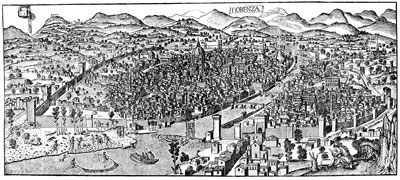
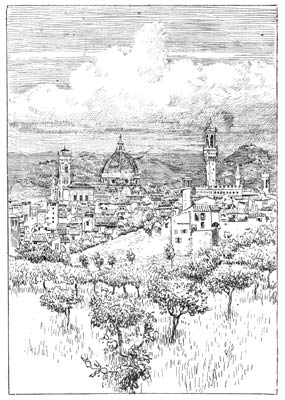
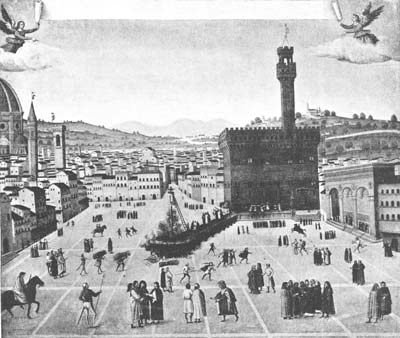
FLORENCE IN THE DAYS OF LORENZO THE MAGNIFICENT
From an engraving, of about 1490, in the Berlin Museum
View larger image
In his private life Cosimo was the simplest and most
unpretentious of tyrants, and lived the life of a wealthy
merchant-burgher of the day in its nobler aspects. He
was an ideal father, a perfect man of business, an
apparently kindly fellow-citizen to all. Above all
things he loved the society of artists and men of
letters; Brunelleschi and Michelozzo, Donatello and
Fra Lippo Lippi–to name only a few more intimately
connected with him–found in him the most generous
and discerning of patrons; many of the noblest Early
Renaissance churches and convents in Florence and its
neighbourhood are due to his munificence–San Lorenzo
and San Marco and the Badia of Fiesole are the most
typical–and he even founded a hospital in Jerusalem.
To a certain extent this was what we should now call
"conscience money." His friend and biographer,
Vespasiano Bisticci, writes: "He did these things
because it appeared to him that he held money, not
over well acquired; and he was wont to say that to
God he had never given so much as to find Him on
his books a debtor. And likewise he said: I know
the humours of this city; fifty years will not pass before
we are driven out; but the buildings will remain."
The Greeks, who came to the Council of Florence or
fled from the in-coming Turk, stimulated the study of
their language and philosophy–though this had really
commenced in the days of the Republic, before the
deaths of Petrarch and Boccaccio–and found in Cosimo
an ardent supporter. He founded great libraries in San
Marco and in the Badia of Fiesole, the former with
part of the codices collected by the scholar Niccolò
Niccoli; although he had banished the old Palla Strozzi,
the true renovator of the Florentine University, into
hopeless exile. Into the Neo-Platonism of the Renaissance
Cosimo threw himself heart and soul. "To
Cosimo," writes Burckhardt, "belongs the special
glory of recognising in the Platonic philosophy the
fairest flower of the ancient world of thought, of inspiring
his friends with the same belief, and thus of
fostering within humanistic circles themselves another
and a higher resuscitation of antiquity." In a youth of
Figline, Marsilio Ficino, the son of a doctor, Cosimo
found a future high priest of this new religion of love
and beauty; and bidding him minister to the minds of
men rather than to their bodies, brought him into his
palace, and gave him a house in the city and a beautiful
farm near Careggi. Thus was founded the famous
Platonic Academy, the centre of the richest Italian
thought of the century. As his end drew near, Cosimo
turned to the consolations of religion, and would pass
long hours in his chosen cell in San Marco, communing
with the Dominican Archbishop, Antonino, and Fra
Angelico, the painter of mediæval Paradise. And with
these thoughts, mingled with the readings of Marsilio's
growing translation of Plato, he passed away at his villa
at Careggi in 1464, on the first of August. Shortly
before his death he had lost his favourite son, Giovanni;
and had been carried through his palace, in the Via
Larga, sighing that it was now too large a house for
so small a family. Entitled by public decree Pater
Patriae, he was buried at his own request without any
pompous funeral, beneath a simple marble in front of
the high altar of San Lorenzo.
Cosimo was succeeded, not without some opposition
from rivals to the Medici within their own party, by
his son Piero. Piero's health was in a shattered condition–il
Gottoso, he was called–and for the most
part he lived in retirement at Careggi, occasionally
carried into Florence in his litter, leaving his brilliant
young son Lorenzo to act as a more ornamental figure-head
for the State. The personal appearance of Piero
is very different to that of his father or son; in his
portrait bust by Mino da Fiesole in the Bargello, and
in the picture by Bronzino in the National Gallery,
there is less craft and a certain air of frank and manly
resolution. In his daring move in support of Galeazzo
Maria Sforza, when, on the death of Francesco, it
seemed for a moment that the Milanese dynasty was
tottering, and his promptness in crushing the formidable
conspiracy of the "mountain" against himself, Piero
showed that sickness had not destroyed his faculty of
energetic action at the critical moment. He completely
followed out his father's policy, drawing still
tighter the bonds which united Florence with Milan
and Naples, lavishing money on the decoration of the
city and the corruption of the people. The opposition
was headed by Luca Pitti, Agnolo Acciaiuoli, Dietisalvi
Neroni and others, who had been reckoned as
Cosimo's friends, but who were now intriguing with
Venice and Ferrara to overthrow his son. Hoping to
eclipse the Medici in their own special field of artistic
display and wholesale corruption, Luca Pitti commenced
that enormous palace which still bears the
name of his family, filled it with bravos and refugees,
resorted to all means fair or foul to get money to build
and corrupt. It seemed for a moment that the adherents
of the Mountain (as the opponents of the Medici
were called, from this highly situated Pitti Palace)
and the adherents of the Plain (where the comparatively
modest Medicean palace–now the Palazzo
Riccardi–stood in the Via Larga) might renew
the old factions of Blacks and Whites. But in the
late summer of 1466 the party of the Mountain was
finally crushed; they were punished with more mercy
than the Medici generally showed, and Luca Pitti was
practically pardoned and left to a dishonourable old age
in the unfinished palace, which was in after years to
become the residence of the successors of his foes.
About the same time Filippo Strozzi and other exiles
were allowed to return, and another great palace began
to rear its walls in the Via Tornabuoni, in after years
to be a centre of anti-Medicean intrigue.
The brilliancy and splendour of Lorenzo's youth–he
who was hereafter to be known in history as the
Magnificent–sheds a rich glow of colour round the
closing months of Piero's pain-haunted life. Piero himself
had been content with a Florentine wife, Lucrezia
dei Tornabuoni, and he had married his daughters
to Florentine citizens, Guglielmo Pazzi and Bernardo
Rucellai; but Lorenzo must make a great foreign
match, and was therefore given Clarice Orsini, the
daughter of a great Roman noble. The splendid
pageant in the Piazza Santa Croce, and the even more
gorgeous marriage festivities in the palace in the Via
Larga, were followed by a triumphal progress of the
young bridegroom through Tuscany and the Riviera to
Milan, to the court of that faithful ally of his house,
but most abominable monster, Giovanni Maria Sforza.
Piero died on December 3rd, 1469, and, like Cosimo,
desired the simple burial which his sons piously gave
him. His plain but beautiful monument designed by
Verrocchio is in the older sacristy of San Lorenzo,
where he lies with his brother Giovanni.
"The second day after his death," writes Lorenzo
in his diary, "although I, Lorenzo, was very young,
in fact only in my twenty-first year, the leading men of
the city and of the ruling party came to our house to
express their sorrow for our misfortune, and to persuade
me to take upon myself the charge of the government
of the city, as my grandfather and father had
already done. This proposal being contrary to the
instincts of my age, and entailing great labour and
danger, I accepted against my will, and only for the
sake of protecting my friends, and our own fortunes,
for in Florence one can ill live in the possession of
wealth without control of the government."[17]
These two youths, Lorenzo and Giuliano, were now,
to all intents and purposes, lords and masters of Florence.
Lorenzo was the ruling spirit; outwardly, in
spite of his singularly harsh and unprepossessing appearance,
devoted to the cult of love and beauty, delighting
in sport and every kind of luxury, he was inwardly as
hard and cruel as tempered steel, and firmly fixed from
the outset upon developing the hardly defined prepotency
of his house into a complete personal despotism.
You may see him as a gallant boy in Benozzo Gozzoli's
fresco in the palace of his father and grandfather,
riding under a bay tree, and crowned with roses; and
then, in early manhood, in Botticelli's famous Adoration
of the Magi; and lastly, as a fully developed,
omniscient and all-embracing tyrant, in that truly terrible
picture by Vasari in the Uffizi, constructed out of
contemporary materials–surely as eloquent a sermon
against the iniquity of tyranny as the pages of Savonarola's
Reggimento di Firenze. Giuliano was a kindlier
and gentler soul, completely given up to pleasure and
athletics; he lives for us still in many a picture from
the hand of Sandro Botticelli, sometimes directly portrayed,
as in the painting which Morelli bequeathed to
Bergamo, more often idealised as Mars or as Hermes;
his love for the fair Simonetta inspired Botticellian
allegories and the most finished and courtly stanzas of
Poliziano. The sons of both these brothers were
destined to sit upon the throne of the Fisherman.
A long step in despotism was gained in 1488, when
the two great Councils of the People and the Commune
were deprived of all their functions, which were now
invested in the thoroughly Medicean Council of the
Hundred. The next year Lorenzo's friend and ally,
Galeazzo Maria Sforza, with his Duchess and courtiers,
came to Florence. They were sumptuously received in
the Medicean palace. The licence and wantonness of
these Milanese scandalised even the lax Florentines,
and largely added to the growing corruption of the
city. The accidental burning of Santo Spirito during
the performance of a miracle play was regarded as a
certain sign of divine wrath. During his stay in
Florence the Duke, in contrast with whom the worst
of the Medici seems almost a saint, sat to one of the
Pollaiuoli for the portrait still seen in the Uffizi; by
comparison with him even Lorenzo looks charming;
at the back of the picture there is a figure of Charity–but
the Duke has very appropriately driven it to the
wall. Unpopular though this Medicean-Sforza alliance
was in Florence, it was undoubtedly one of the safe-guards
of the harmony which, superficially, still existed
between the five great powers of Italy. When Galeazzo
Maria met the fate he so richly deserved, and was
stabbed to death in the Church of San Stefano at
Milan on December 20th, 1476, Pope Sixtus gave
solemn utterance to the general dismay: Oggi è morta
la pace d'Italia.
But Sixtus and his nephews did not in their hearts
desire peace in Italy, and were plotting against Lorenzo
with the Pazzi, who, although united to the Medici by
marriage, had secret and growing grievances against
them. On the morning of Sunday April 26th, 1478,
the conspirators set upon the two brothers at Mass
in the Duomo; Giuliano perished beneath nineteen
dagger-stabs; Lorenzo escaped with a slight wound
in the neck. The Archbishop Salviati of Pisa in the
meantime attempted to seize the Palace of the Priors,
but was arrested by the Gonfaloniere, and promptly
hung out of the window for his trouble. Jacopo
Pazzi rode madly through the streets with an armed
force, calling the people to arms, with the old shout of
Popolo e Libertà, but was only answered by the ringing
cries of Palle, Palle.[18] The vengeance taken by the
people upon the conspirators was so prompt and terrible
that Lorenzo had little left him to do (though that
little he did to excess, punishing the innocent with the
guilty); and the result of the plot simply was to leave
him alone in the government, securely enthroned above
the splash of blood. The Pope appears not to have
been actually privy to the murder, but he promptly took
up the cause of the murderers. It was followed by a
general break-up of the Italian peace and a disastrous
war, carried on mainly by mercenary soldiers, in which
all the powers of Italy were more or less engaged; and
Florence was terribly hard pressed by the allied forces
of Naples and Rome. The plague broke out in the
city; Lorenzo was practically deserted by his allies,
and on the brink of financial ruin. Then was it that
he did one of the most noteworthy, perhaps the noblest,
of the actions of his life, and saved himself and the
State by voluntarily going to Naples and putting himself
in the power of King Ferrante, an infamous tyrant,
who would readily have murdered his guest, if it had
seemed to his advantage to do so. But, like all the
Italians of the Renaissance, Ferrante was open to reason,
and the eloquence of the Magnifico won him over to
grant an honourable peace, with which Lorenzo returned
to Florence in March 1480. "If Lorenzo was great
when he left Florence," writes Machiavelli, "he returned
much greater than ever; and he was received
with such joy by the city as his great qualities and his
fresh merits deserved, seeing that he had exposed his
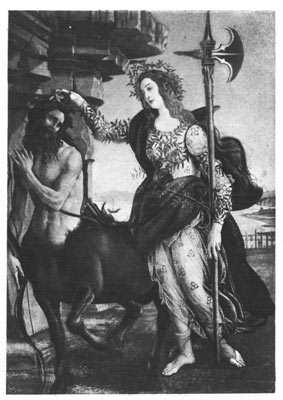
own life to restore peace to his country." Botticelli's
noble allegory of the olive-decked Medicean Pallas,
taming the Centaur of war and disorder, appears to have
been painted in commemoration of this event. In the
following August the Turks landed in Italy and stormed
Otranto, and the need of union, in the face of "the
common enemy Ottoman," reconciled the Pope to
Florence, and secured for the time an uneasy peace
among the powers of Italy.
Lorenzo's power in Florence and influence throughout
Italy was now secure. By the institution in 1480
of a Council of Seventy, a permanent council to manage
and control the election of the Signoria (with two
special committees drawn from the Seventy every six
months, the Otto di pratica for foreign affairs and
the Dodici Procuratori for internal), the State was
firmly established in his hands–the older councils
still remaining, as was usual in every Florentine reformation
of government. Ten years later, in 1490, this
council showed signs of independence; and Lorenzo
therefore reduced the authority of electing the Signoria
to a small committee with a reforming Balìa of seventeen,
of which he was one. Had he lived longer, he
would undoubtedly have crowned his policy either by
being made Gonfaloniere for life, or by obtaining some
similar constitutional confirmation of his position as
head of the State. Externally his influence was
thrown into the scale for peace, and, on the death
of Sixtus IV. in 1484, he established friendly relations
and a family alliance with the new Pontiff,
Innocent VIII. Sarzana with Pietrasanta were won
back for Florence, and portions of the Sienese territory
which had been lost during the war with Naples and
the Church; a virtual protectorate was established
over portions of Umbria and Romagna, where the
daggers of assassins daily emptied the thrones of
minor tyrants. Two attempts on his life failed. In
the last years of his foreign policy and diplomacy he
showed himself truly the magnificent. East and West
united to do him honour; the Sultan of the Turks and
the Soldan of Egypt sent ambassadors and presents;
the rulers of France and Germany treated him as an
equal. Soon the torrent of foreign invasion was to
sweep over the Alps and inundate all the "Ausonian"
land; Milan and Naples were ready to rend each
other; Ludovico Sforza was plotting his own rise
upon the ruin of Italy, and already intriguing with
France; but, for the present, Lorenzo succeeded in
maintaining the balance of power between the five
great Italian states, which seemed as though they might
present a united front for mutual defence against the
coming of the barbarians.
Sarebbe impossibile avesse avuto un tiranno migliore e
più piacevole, writes Guicciardini: "Florence could not
have had a better or more delightful tyrant." The
externals of life were splendid and gorgeous indeed in
the city where Lorenzo ruled, but everything was in his
hands and had virtually to proceed from him. His
spies were everywhere; marriages might only be
arranged and celebrated according to his good pleasure;
the least sign of independence was promptly
and severely repressed. By perpetual festivities and
splendid shows, he strove to keep the minds of the
citizens contented and occupied; tournaments, pageants,
masques and triumphs filled the streets; and
the strains of licentious songs, of which many were
Lorenzo's own composition, helped to sap the morality
of that people which Dante had once dreamed of as
sobria e pudica. But around the Magnifico were
grouped the greatest artists and scholars of the age,
who found in him an enlightened Maecenas and most
charming companion. Amava maravigliosamente qualunque
era in una arte eccellente, writes Machiavelli of
him; and that word–maravigliosamente–so entirely
characteristic of Lorenzo and his ways, occurs again
and again, repeated with studied persistence, in the
chapter which closes Machiavelli's History. He was
said to have sounded the depths of Platonic philosophy;
he was a true poet, within certain limitations;
few men have been more keenly alive to beauty in all
its manifestations, physical and spiritual alike. Though
profoundly immoral, nelle cose veneree maravigliosamente
involto, he was a tolerable husband, and the fondest of
fathers with his children, whom he adored. The
delight of his closing days was the elevation of his
favourite son, Giovanni, to the Cardinalate at the age
of fourteen; it gave the Medici a voice in the Curia
like the other princes of Europe, and pleased all
Florence; but more than half Lorenzo's joy proceeded
from paternal pride and love, and the letter of
advice which he wrote for his son on the occasion
shows both father and boy in a very amiable, even
edifying light. And yet this same man had ruined
the happiness of countless homes, and had even seized
upon the doweries of Florentine maidens to fill his own
coffers and pay his mercenaries.
But the bel viver italiano of the Quattrocento, with
all its loveliness and all its immorality–more lovely
and far less immoral in Florence than anywhere else–was
drawing to an end. A new prophet had arisen,
and, from the pulpits of San Marco and Santa Maria
del Fiore, the stern Dominican, Fra Girolamo
Savonarola, denounced the corruption of the day and
announced that speedy judgment was at hand; the
Church should be chastised, and that speedily, and
renovation should follow. Prodigies were seen. The
lions tore and rent each other in their cages; lightning
struck the cupola of the Duomo on the side towards
the Medicean palace; while in his villa at Careggi the
Magnifico lay dying, watched over by his sister Bianca
and the poet Poliziano. A visit from the young Pico
della Mirandola cheered his last hours. He received
the Last Sacraments, with every sign of contrition and
humility. Then Savonarola came to his bedside.
There are two accounts of what happened between
these two terrible men, the corruptor of Florence and
the prophet of renovation, and they are altogether
inconsistent. The ultimate source of the one is apparently
Savonarola's fellow-martyr, Fra Silvestro,
an utterly untrustworthy witness; that of the
other, Lorenzo's intimate, Poliziano. According to
Savonarola's biographers and adherents, Lorenzo,
overwhelmed with remorse and terror, had sent for
the Frate to give him the absolution which his courtly
confessor dared not refuse (io non ho mai trovato
uno che sia vero frate, se non lui); and when the
Dominican, seeming to soar above his natural height,
bade him restore liberty to Florence, the Magnifico
sullenly turned his back upon him and shortly afterwards
died in despair.[19] According to Poliziano, an
eyewitness and an absolutely whole-hearted adherent
of the Medici, Fra Girolamo simply spoke a few
words of priestly exhortation to the dying man; then,
as he turned away, Lorenzo cried, "Your blessing,
father, before you depart" (Heus, benedictionem, Pater,
priusquam a nobis proficisceris) and the two together
repeated word for word the Church's prayers for the
departing; then Savonarola returned to his convent,
and Lorenzo passed away in peace and consolation.
Reverently and solemnly the body was brought from
Careggi to Florence, rested for a while in San Marco,
and was then buried, with all external simplicity, with
his murdered brother in San Lorenzo. It was the
beginning of April 1492, and the Magnifico was only
in his forty-fourth year. The words of old Sixtus
must have risen to the lips of many: Oggi è morta la
pace d'Italia. "This man," said Ferrante of Naples,
"lived long enough to make good his own title to
immortality, but not long enough for Italy."
Lorenzo left three sons–Piero, who virtually succeeded
him in the same rather undefined princedom;
the young Cardinal Giovanni; and Giuliano. Their
father was wont to call Piero the "mad," Giovanni
the "wise," Giuliano the "good"; and to a certain
extent their after-lives corresponded with his characterisation.
There was also a boy Giulio, Lorenzo's
nephew, an illegitimate child of Giuliano the elder by
a girl of the lower class; him Lorenzo left to the
charge of Cardinal Giovanni–the future Pope Clement
to the future Pope Leo. Piero had none of his father's
abilities, and was not the man to guide the ship of
State through the storm that was rising; he was a wild
licentious young fellow, devoted to sport and athletics,
with a great shock of dark hair; he was practically
the only handsome member of his family, as you may
see in a peculiarly fascinating Botticellian portrait in
the Uffizi, where he is holding a medallion of his great
grandfather Cosimo, and gazing out of the picture with
a rather pathetic expression, as if the Florentines who
set a price upon his head had misunderstood him.
Piero's folly at once began to undo his father's
work. A part of Lorenzo's policy had been to keep
his family united, including those not belonging to the
reigning branch. There were two young Medici then
in the city, about Piero's own age; Lorenzo and
Giovanni di Pier Francesco, the grandsons of Cosimo's
brother Lorenzo (you may see Giovanni with his
father in a picture by Filippino Lippi in the Uffizi).
Lorenzo the Magnificent had made a point of keeping
on good terms with them, for they were beloved of the
people. Giovanni was destined, in a way, to play the
part of Banquo to the Magnificent's Macbeth, had there
been a Florentine prophet to tell him, "Thou shalt get
kings though thou be none." But Piero disliked the
two; at a dance he struck Giovanni, and then, when the
brothers showed resentment, he arrested both and, not
daring to take their lives, confined them to their villas.
And these were times when a stronger head than
Piero's might well have reeled. Italy's day had
ended, and she was now to be the battle-ground for
the gigantic forces of the monarchies of Europe. That
same year in which Lorenzo died, Alexander VI.
was elected to the Papacy he had so shamelessly
bought. A mysterious terror fell upon the people; an
agony of apprehension consumed their rulers throughout
the length and breadth of the land. In 1494 the
crash came. The old King Ferrante of Naples died,
and his successor Alfonso prepared to meet the torrent
of French arms which Ludovico Sforza, the usurping
Duke of Milan, had invited into Italy.
In art and in letters, as well as in life and general
conduct, this epoch of the Quattrocento is one of the
most marvellous chapters in the history of human
thought; the Renaissance as a wave broke over Italy,
and from Italy surged on to the bounds of Europe.
And of this "discovery by man of himself and of the
world," Florence was the centre; in its hothouse of
learning and culture the rarest personalities flourished,
and its strangest and most brilliant flower, in whose
hard brilliancy a suggestion of poison lurked, was
Lorenzo the Magnificent himself.
In both art and letters, the Renaissance had fully
commenced before the accession of the Medici to
power. Ghiberti's first bronze gates of the Baptistery
and Masaccio's frescoes in the Carmine were executed
under the regime of the nobili popolani, the Albizzi and
their allies. Many of the men whom the Medici
swept relentlessly from their path were in the fore-front
of the movement, such as the noble and generous
Palla Strozzi, one of the reformers of the Florentine
Studio, who brought the Greek, Emanuel Chrysolaras,
at the close of the fourteenth century, to make Florence
the centre of Italian Hellenism. Palla lavished his
wealth in the hunting of codices, and at last, when
banished on Cosimo's return, died in harness at Padua
at the venerable age of ninety-two. His house had
always been full of learned men, and his reform of
the university had brought throngs of students to
Florence. Put under bounds for ten years at Padua,
he lived the life of an ancient philosopher and of
exemplary Christian virtue. Persecuted at the end
of every ten years with a new sentence, the last–of
ten more years–when he was eighty-two; robbed
by death of his wife and sons; he bore all with the
utmost patience and fortitude, until, in Vespasiano's
words, "arrived at the age of ninety-two years, in
perfect health of body and of mind, he gave up his
soul to his Redeemer like a most faithful and good
Christian."
In 1401, the first year of the fifteenth century, the
competition was announced for the second gates of the
Baptistery, which marks the beginning of Renaissance
sculpture; and the same year witnessed the birth of
Masaccio, who, in the words of Leonardo da Vinci,
"showed with his perfect work how those painters
who follow aught but Nature, the mistress of the
masters, laboured in vain," Morelli calls this Quattrocento
the epoch of "character"; "that is, the period
when it was the principal aim of art to seize and
represent the outward appearances of persons and
things, determined by inward and moral conditions."
The intimate connection of arts and crafts is characteristic
of the Quattrocento, as also the mutual
interaction of art with art. Sculpture was in advance
of painting in the opening stage of the century, and,
indeed, influenced it profoundly throughout; about the
middle of the century they met, and ran henceforth
hand in hand. Many of the painters and sculptors, as,
notably, Ghiberti and Botticelli, had been apprentices
in the workshops of the goldsmiths; nor would the
greatest painters disdain to undertake the adornment of
a cassone, or chest for wedding presents, nor the most
illustrious sculptor decline a commission for the button
of a prelate's cope or some mere trifle of household
furniture. The medals in the National Museum and
the metal work on the exterior of the Strozzi Palace
are as typical of the art of Renaissance Florence as the
grandest statues and most elaborate altar-pieces.
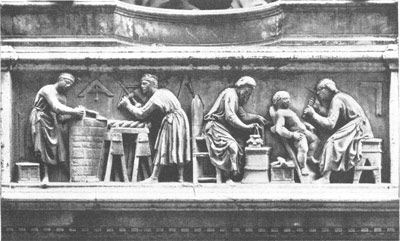
"IN THE SCULPTOR'S WORKSHOP"
By Nanni di Banco
(For the Guild of Masters in Stone and Timber)
View larger image
With the work of the individual artists we shall
become better acquainted in subsequent chapters.
Here we can merely name their leaders. In architecture
and sculpture respectively, Filippo Brunelleschi
(1377-1446) and Donatello (1386-1466) are the
ruling spirits of the age. Their mutual friendship and
brotherly rivalry almost recall the loves of Dante and
Cavalcanti in an earlier day. Although Lorenzo
Ghiberti (1378-1455) justly won the competition for
the second gates of the Baptistery, it is now thought
that Filippo ran his successful rival much more closely
than the critics of an earlier day supposed. Mr
Perkins remarks that "indirectly Brunelleschi was
the master of all the great painters and sculptors of
his time, for he taught them how to apply science
to art, and so far both Ghiberti and Donatello were
his pupils, but the last was almost literally so, since
the great architect was not only his friend, but also his
counsellor and guide." Contemporaneous with these
three spiriti magni in their earlier works, and even
to some extent anticipating them, is Nanni di Banco
(died in 1421), a most excellent master, both in large
monumental statues and in bas-reliefs, whose works
are to be seen and loved outside and inside the Duomo,
and in the niches round San Michele in Orto. A
pleasant friendship united him with Donatello, although
to regard him as that supreme master's pupil and
follower, as Vasari does, is an anachronism. To this
same earlier portion of the Quattrocento belong Leo
Battista Alberti (1405-1472), a rare genius, but a
wandering stone who, as an architect, accomplished
comparatively little; Michelozzo Michelozzi (1396-1472),
who worked as a sculptor with Ghiberti and
Donatello, but is best known as the favoured architect
of the Medici, for whom he built the palace so often
mentioned in these pages, and now known as the
Palazzo Riccardi, and the convent of San Marco;
and Luca della Robbia (1399-1482), that beloved
master of marble music, whose enamelled terra-cotta
Madonnas are a perpetual fund of the purest delight.
To Michelozzo and Luca in collaboration we owe the
bronze gates of the Duomo sacristy, a work only
inferior to Ghiberti's "Gates of Paradise."
Slightly later come Donatello's great pupils, Desiderio
da Settignano (1428-1464), Andrea Verrocchio
(1435-1488), and Antonio Pollaiuolo (1429-1498).
The two latter are almost equally famous as
painters. Contemporaneous with them are Mino da
Fiesole, Bernardo and Antonio Rossellino, Giuliano
da San Gallo, Giuliano and Benedetto da Maiano, of
whom the last-named was the first architect of the Strozzi
Palace. The last great architect of the Quattrocento
is Simone del Pollaiuolo, known as Cronaca (1457-1508);
and its last great sculptor is Andrea della
Robbia, Luca's nephew, who was born in 1435, and
lived on until 1525. Andrea's best works–and they
are very numerous indeed, in the same enamelled terra-cotta–hardly
yield in charm and fascination to those
of Luca himself; in some of them, devotional art seems
to reach its last perfection in sculpture. Giovanni,
Andrea's son, and others of the family carried on the
tradition–with cruder colours and less delicate feeling.
Masaccio (1401-1428), one of "the inheritors of
unfulfilled renown," is the first great painter of the
Renaissance, and bears much the same relation to the
fifteenth as Giotto to the fourteenth century. Vasari's
statement that Masaccio's master, Masolino, was
Ghiberti's assistant appears to be incorrect; but it
illustrates the dependence of the painting of this epoch
upon sculpture. Masaccio's frescoes in the Carmine,
which became the school of all Italian painting, were
entirely executed before the Medicean regime. The
Dominican, Fra Angelico da Fiesole (1387-1455),
seems in his San Marco frescoes to bring the denizens
of the Empyrean, of which the mediæval mystics
dreamed, down to earth to dwell among the black
and white robed children of St Dominic. The Carmelite,
Fra Lippo Lippi (1406-1469), the favourite
of Cosimo, inferior to the angelical painter in spiritual
insight, had a keener eye for the beauty of the external
world and a surer touch upon reality. His buoyant
humour and excellent colouring make "the glad
monk's gift" one of the most acceptable that the
Quattrocento has to offer us. Andrea del Castagno
(died in 1457) and Domenico Veneziano (died in
1461), together with Paolo Uccello (died in 1475),
were all absorbed in scientific researches with an eye
to the extension of the resources of their art; but the
two former found time to paint a few masterpieces
in their kind–especially a Cenacolo by Andrea in
Santa Appollonia, which is the grandest representation
of its sublime theme, until the time that Leonardo da
Vinci painted on the walls of the Dominican convent
at Milan. Problems of the anatomical construction
of the human frame and the rendering of movement
occupied Antonio Pollaiuolo (1429-1498) and
Andrea Verrocchio (1435-1488); their work was
taken up and completed a little later by two greater
men, Luca Signorelli of Cortona and Leonardo da
Vinci.
The Florentine painting of this epoch culminates in
the work of two men–Sandro di Mariano Filipepi,
better known as Sandro Botticelli (1447-1510), and
Domenico Ghirlandaio (1449-1494). If the greatest
pictures were painted poems, as some have held, then
Sandro Botticelli's masterpieces would be among the
greatest of all time. In his rendering of religious
themes, in his intensely poetic and strangely wistful
attitude towards the fair myths of antiquity, and in his
Neo-Platonic mingling of the two, he is the most complete
and typical exponent of the finest spirit of the
Quattrocento, to which, in spite of the date of his death,
his art entirely belongs. Domenico's function, on the
other hand, is to translate the external pomp and
circumstance of his times into the most uninspired of
painted prose, but with enormous technical skill and
with considerable power of portraiture; this he effected
above all in his ostensibly religious frescoes in Santa
Maria Novella and Santa Trinità. Elsewhere he
shows a certain pathetic sympathy with humbler life,
as in his Santa Fina frescoes at San Gemignano, and
in the admirable Adoration of the Shepherds in the
Accademia; but this is a less characteristic vein. Filippino
Lippi (1457-1504), the son of the Carmelite and
the pupil of Botticelli, has a certain wayward charm,
especially in his earlier works, but as a rule falls much
below his master. He may be regarded as the last
direct inheritor of the traditions of Masaccio. Associated
with these are two lesser men, who lived considerably
beyond the limits of the fifteenth century, but
whose artistic methods never went past it; Piero di
Cosimo (1462-1521) and Lorenzo di Credi (1459-1537).
The former (called after Cosimo Rosselli,
his master) was one of the most piquant personalities in
the art world of Florence, as all readers of Romola
know. As a painter, he has been very much overestimated;
at his best, he is a sort of Botticelli, with
the Botticellian grace and the Botticellian poetry almost
all left out. He was magnificent at designing pageants;
and of one of his exploits in this kind, we shall hear
more presently. Lorenzo di Credi, Verrocchio's favourite
pupil, was later, like Botticelli and others, to fall
under the spell of Fra Girolamo; his pictures breathe
a true religious sentiment and are very carefully finished;
but for the most part, though there are exceptions, they
lack virility.
Before this epoch closed, the two greatest heroes of
Florentine art had appeared upon the scenes, but their
great work lay still in the future. Leonardo da Vinci
(born in 1452) had learned to paint in the school of
Verrocchio; but painting was to occupy but a small
portion of his time and labour. His mind roamed
freely over every field of human activity, and plunged
deeply into every sphere of human thought; nor is he
adequately represented even by the greatest of the
pictures that he has left. There is nothing of him
now in Florence, save a few drawings in the Uffizi
and an unfinished picture of the Epiphany. Leonardo
finished little, and, with that little, time and man have
dealt hardly. Michelangelo Buonarroti was born in
the Casentino in 1475, and nurtured among the stone
quarries of Settignano. At the age of thirteen, his
father apprenticed him to the Ghirlandaii, Domenico
and his brother David; and, with his friend and fellow-student,
Francesco Granacci, the boy began to frequent
the gardens of the Medici, near San Marco, where in
the midst of a rich collection of antiquities Donatello's
pupil and successor, Bertoldo, directed a kind of Academy.
Here Michelangelo attracted the attention of
Lorenzo himself, by the head of an old satyr which he
had hammered out of a piece of marble that fell to his
hand; and the Magnifico took him into his household.
This youthful period in the great master's career was
occupied in drinking in culture from the Medicean circle,
in studying the antique and, of the moderns, especially
the works of Donatello and Masaccio. But, with the
exception of a few early fragments from his hand,
Michelangelo's work commenced with his first visit
to Rome, in 1496, and belongs to the following
epoch.
Turning from art to letters, the Quattrocento is
an intermediate period between the mainly Tuscan
literary movement of the fourteenth century and the
general Italian literature of the sixteenth. The first
part of this century is the time of the discovery of the
old authors, of the copying of manuscripts (printing
was not introduced into Florence until 1471), of the
eager search for classical relics and antiquities, the
comparative neglect of Italian when Latinity became
the test of all. Florence was the centre of the
Humanism of the Renaissance, the revival of Grecian
culture, the blending of Christianity and Paganism, the
aping of antiquity in theory and in practice. In the
pages of Vespasiano we are given a series of lifelike
portraits of the scholars of this epoch, who thronged to
Florence, served the State as Secretary of the Republic
or occupied chairs in her newly reorganised university,
or basked in the sun of Strozzian or Medicean patronage.
Niccolò Niccoli, who died in 1437, is one of
the most typical of these scholars; an ardent collector
of ancient manuscripts, his library, purchased after his
death by Cosimo dei Medici, forms the nucleus of
the Biblioteca Laurenziana. His house was adorned
with all that was held most choice and precious; he
always wore long sweeping red robes, and had his table
covered with ancient vases and precious Greek cups
and the like. In fact he played the ancient sage to
such perfection that simply to watch him eat his dinner
was a liberal education in itself! A vederlo in tavola,
così antico come era, era una gentilezza.
Vespasiano tells a delightful yarn of how one fine
day this Niccolò Niccoli, "who was another Socrates
or another Cato for continence and virtue," was taking
a constitutional round the Palazzo del Podestà, when
he chanced to espy a youth of most comely aspect,
one who was entirely devoted to worldly pleasures and
delights, young Piero Pazzi. Calling him and learning
his name, Niccolò proceeded to question him as to
his profession. "Having a high old time," answered
the ingenuous youth: attendo a darmi buon tempo.
"Being thy father's son and so handsome," said the
Sage severely, "it is a shame that thou dost not set
thyself to learn the Latin language, which would be a
great ornament to thee; and if thou dost not learn
it, thou wilt be esteemed of no account; yea, when
the flower of thy youth is past, thou shalt find thyself
without any virtù." Messer Piero was converted on
the spot; Niccolò straightway found him a master and
provided him with books; and the pleasure-loving
youth became a scholar and a patron of scholars.
Vespasiano assures us that, if he had lived, lo inconveniente
che seguitò–so he euphoniously terms the
Pazzi conspiracy–would never have happened.
Leonardo Bruni is the nearest approach to a really
great figure in the Florentine literary world of the
first half of the century. His translations of Plato
and Aristotle, especially the former, mark an epoch.
His Latin history of Florence shows genuine critical
insight; but he is, perhaps, best known at the present
day by his little Life of Dante in Italian, a charming
and valuable sketch, which has preserved for us some
fragments of Dantesque letters and several bits of
really precious information about the divine poet,
which seem to be authentic and which we do not find
elsewhere. Leonardo appears to have undertaken it
as a kind of holiday task, for recreation after the work
of composing his more ponderous history. As Secretary
of the Republic he exercised considerable political
influence; his fame was so great that people came to
Florence only to look at him; on his death in 1444,
he was solemnly crowned on the bier as poet laureate,
and buried in Santa Croce with stately pomp and
applauded funeral orations. Leonardo's successors,
Carlo Marsuppini (like him, an Aretine by birth) and
Poggio Bracciolini–the one noted for his frank
paganism, the other for the foulness of his literary
invective–are less attractive figures; though the latter
was no less famous and influential in his day. Giannozzo
Manetti, who pronounced Bruni's funeral oration, was noted for
his eloquence and incorruptibility,
and stands out prominently amidst the scholars
and humanists by virtue of his nobleness of character;
like that other hero of the new learning, Palla Strozzi,
he was driven into exile and persecuted by the
Mediceans.
Far more interesting are the men of light and
learning who gathered round Lorenzo dei Medici
in the latter half of the century. This is the epoch of
the Platonic Academy, which Marsilio Ficino had
founded under the auspices of Cosimo. The discussions
held in the convent retreat among the forests
of Camaldoli, the meetings in the Badia at the foot of
Fiesole, the mystical banquets celebrated in Lorenzo's
villa at Careggi in honour of the anniversary of Plato's
birth and death, may have added little to the sum of
man's philosophic thought; but the Neo-Platonic religion
of love and beauty, which was there proclaimed
to the modern world, has left eternal traces in the
poetic literature both of Italy and of England.
Spenser and Shelley might have sat with the nine
guests, whose number honoured the nine Muses, at the
famous Platonic banquet at Careggi, of which Marsilio
Ficino himself has left us an account in his commentary
on the Symposium. You may read a later
Italian echo of it, when Marsilio Ficino had passed
away and his academy was a thing of the past, in the
impassioned and rapturous discourse on love and beauty
poured forth by Pietro Bembo, at that wonderful daybreak
which ends the discussions of Urbino's courtiers
in Castiglione's treatise. In a creed that could find
one formula to cover both the reception of the Stigmata
by St Francis and the mystical flights of the Platonic
Socrates and Plotinus; that could unite the Sibyls and
Diotima with the Magdalene and the Virgin Martyrs;
many a perplexed Italian of that epoch might find
more than temporary rest for his soul.
Simultaneously with this new Platonic movement
there came a great revival of Italian literature, alike
in poetry and in prose; what Carducci calls il rinascimento
della vita italiana nella forma classica. The
earlier humanists had scorned, or at least neglected
the language of Dante; and the circle that surrounded
Lorenzo was undoubtedly instrumental in this Italian
reaction. Cristoforo Landini, one of the principal
members of the Platonic Academy, now wrote the
first Renaissance commentary upon the Divina Commedia;
Leo Battista Alberti, also a leader in these
Platonic disputations, defended the dignity of the
Italian language, as Dante himself had done in an
earlier day. Lorenzo himself compiled the so-called
Raccolta Aragonese of early Italian lyrics, and sent
them to Frederick of Aragon, together with a letter
full of enthusiasm for the Tuscan tongue, and with
critical remarks on the individual poets of the thirteenth
and fourteenth centuries. Upon the popular poetry of
Tuscany Lorenzo himself, and his favourite Angelo
Ambrogini of Montepulciano, better known as Poliziano,
founded a new school of Italian song. Luigi Pulci,
the gay scoffer and cynical sceptic, entertained the
festive gatherings in the Medicean palace with his wild
tales, and, in his Morgante Maggiore, was practically
the first to work up the popular legends of Orlando
and the Paladins into a noteworthy poem–a poem of
which Savonarola and his followers were afterwards to
burn every copy that fell into their hands.
Poliziano is at once the truest classical scholar, and,
with the possible exception of Boiardo (who belongs
to Ferrara, and does not come within the scope of
the present volume), the greatest Italian poet of the
fifteenth century. He is, indeed, the last and most
perfect fruit of Florentine Humanism. His father,
Benedetto Ambrogini, had been murdered in Montepulciano
by the faction hostile to the Medici; and the
boy Angelo, coming to Florence, and studying under
Ficino and his colleagues, was received into Lorenzo's
household as tutor to the younger Piero. His lectures
at the Studio attracted students from all Europe, and
his labours in the field of textual criticism won a fame
that has lasted to the present day. In Italian he
wrote the Orfeo in two days for performance at Mantua,
when he was eighteen, a lyrical tragedy which stamps
him as the father of Italian dramatic opera; the scene
of the descent of Orpheus into Hades contains lyrical
passages of great melodiousness. Shortly before the
Pazzi conspiracy, he composed his famous Stanze in
celebration of a tournament given by Giuliano dei
Medici, and in honour of the bella Simonetta. There
is absolutely no "fundamental brain work" about these
exquisitely finished stanzas; but they are full of dainty
mythological pictures quite in the Botticellian style,
overladen, perhaps, with adulation of the reigning
house and its ben nato Lauro. In his lyrics he gave
artistic form to the rispetti and strambotti of the people,
and wrote exceedingly musical ballate, or canzoni a
ballo, which are the best of their kind in the whole
range of Italian poetry. There is, however, little
genuine passion in his love poems for his lady, Madonna
Ippolita Leoncina of Prato; though in all that he
wrote there is, as Villari puts it, "a fineness of taste
that was almost Greek."
Lorenzo dei Medici stands second to his friend as a
poet; but he is a good second. His early affection
for the fair Lucrezia Donati, with its inevitable
sonnets and a commentary somewhat in the manner
of Dante's Vita Nuova, is more fanciful than earnest,
although Poliziano assures us of
"La lunga fedeltà del franco Lauro."
But Lorenzo's intense love of external nature, his
power of close observation and graphic description, are
more clearly shown in such poems as the Caccia col
Falcone and the Ambra, written among the woods and
hills in the country round his new villa of Poggio
a Caiano. Elsewhere he gives free scope to the
animal side of his sensual nature, and in his famous
Canti carnascialeschi, songs to be sung at carnival and
in masquerades, he at times revelled in pruriency, less
for its own sake than for the deliberate corruption
of the Florentines. And, for a time, their music
drowned the impassioned voice of Savonarola, whose
stern cry of warning and exhortation to repentance had
for the nonce passed unheeded.
There is extant a miracle play from Lorenzo's hand,
the acts of the martyrs Giovanni and Paolo, who
suffered in the days of the emperor Julian. Two sides
of Lorenzo's nature are ever in conflict–the Lorenzo
of the ballate and the carnival songs–the Lorenzo of
the laude and spiritual poems, many of which have the
unmistakable ring of sincerity. And, in the story of
his last days and the summoning of Savonarola to his
bed-side, the triumph of the man's spiritual side is seen
at the end; he is, indeed, in the position of the dying
Julian of his own play:–
"Fallace vita! O nostra vana cura!
Lo spirto è già fuor del mio petto spinto:
O Cristo Galileo, tu hai vinto."
Such was likewise the attitude of several members of
the Medicean circle, when the crash came. Poliziano
followed his friend and patron to the grave, in September
1494; his last hours received the consolations of
religion from Savonarola's most devoted follower, Fra
Domenico da Pescia (of whom more anon); after
death, he was robed in the habit of St Dominic and
buried in San Marco. Pico della Mirandola, too, had
been present at the Magnifico's death-bed, though not
there when the end actually came; he too, in 1494,
received the Dominican habit in death, and was buried
by Savonarola's friars in San Marco. Marsilio Ficino
outlived his friends and denied Fra Girolamo; he died
in 1499, and lies at rest in the Duomo.
Of all these Medicean Platonists, Pico della Mirandola
is the most fascinating. A young Lombard noble
of almost feminine beauty, full of the pride of having
mastered all the knowledge of his day, he first came to
Florence in 1480 or 1482, almost at the very moment
in which Marsilio Ficino finished his translation of
Plato. He became at once the chosen friend of all
the choicest spirits of Lorenzo's circle. Not only
classical learning, but the mysterious East and the
sacred lore of the Jews had rendered up their treasures
for his intellectual feast; his mysticism shot far beyond
even Ficino; all knowledge and all religions were to
him a revelation of the Deity. Not only to Lorenzo
and his associates did young Pico seem a phœnix of
earthly and celestial wisdom, uomo quasi divino as
Machiavelli puts it; but even Savonarola in his
Triumphus Crucis, written after Pico's death, declares
that, by reason of his loftiness of intellect and the sublimity
of his doctrine, he should be numbered amongst
the miracles of God and Nature. Pico had been
much beloved of many women, and not always a
Platonic lover, but, towards the close of his short
flower-like life, he burnt "fyve bokes that in his
youthe of wanton versis of love with other lyke
fantasies he had made," and all else seemed absorbed
in the vision of love Divine. "The substance that I
have left," he told his nephew, "I intend to give out
to poor people, and, fencing myself with the crucifix,
barefoot walking about the world, in every town and
castle I purpose to preach of Christ." Savonarola, to
whom he had confided all the secrets of his heart, was
not the only martyr who revered the memory of the
man whom Lorenzo the Magnificent had loved.
Thomas More translated his life and letters, and
reckoned him a saint. He would die at the time of
the lilies, so a lady had told Pico; and he died indeed
on the very day that the golden lilies on the royal
standard of France were borne into Florence through
the Porta San Frediano–consoled with wondrous
visions of the Queen of Heaven, and speaking as though
he beheld the heavens opened.
A month or two earlier, the pen had dropped from
the hand of Matteo Maria Boiardo, as he watched the
French army descending the Alps; and he brought his
unfinished Orlando Innamorato to an abrupt close, too
sick at heart to sing of the vain love of Fiordespina
for Brandiamante:–
"Mentre che io canto, o Dio Redentore,
Vedo l'Italia tutta a fiamma e foco,
Per questi Galli, che con gran valore
Vengon, per disertar non so che loco."
"Whilst I sing, Oh my God, I see all Italy in flame
and fire, through these Gauls, who with great valour
come, to lay waste I know not what place." On this
note of vague terror, in the onrush of the barbarian
hosts, the Quattrocento closes.
[111]