In one of the addresses delivered at the time of
Padre Coloma's admission to the Real Academia
Española there is a reference to Jeromín, as this
Story of Don John of Austria is called in Spanish,
which says that it awakes great interest in the reader by
inaugurating a new type of book, half novel and half
history. This seems too true a description of it not to be
quoted here.
In his preface the author states that he does not propose
to delve into any deep problems, or to put forward
unknown facts about personages already judged at the bar
of history. All the same, I think that much in this book
will be fresh to English readers, notably, perhaps, the fact
that an "auto da fe" consisted in hearing the sentences
pronounced on the prisoners of the Inquisition, not in
witnessing their execution, and that in most cases the
condemned were garrotted before being burnt.
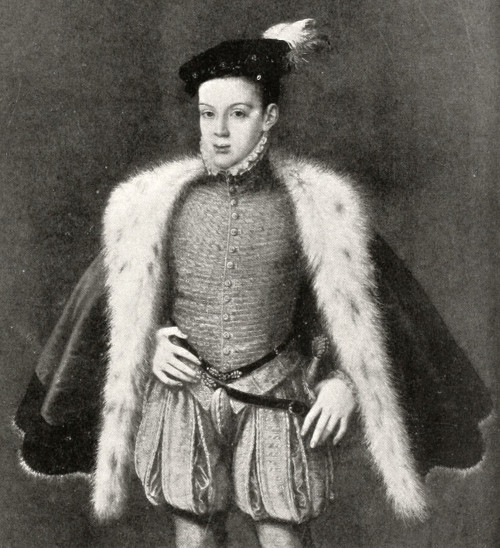
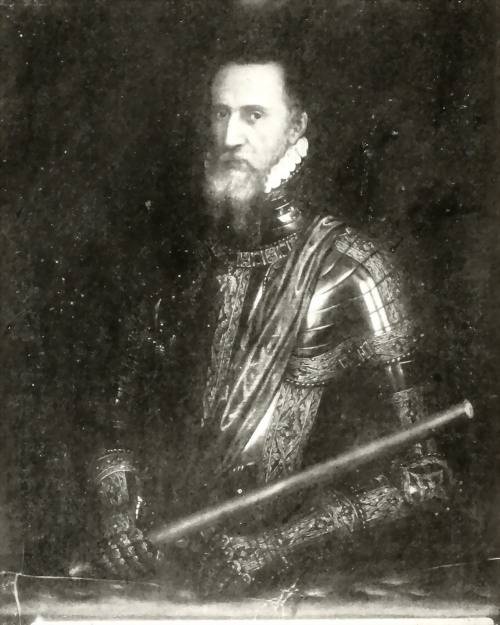
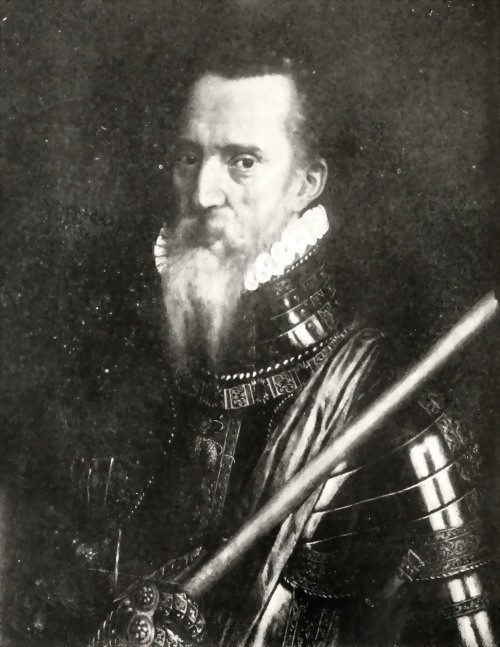
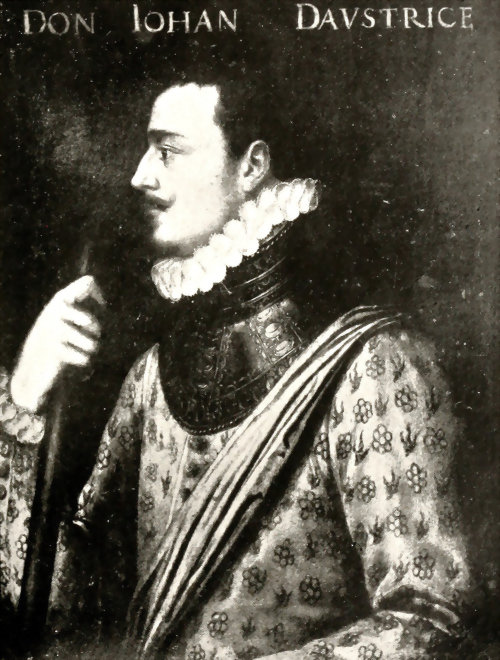
Many of the illustrations will also be new to most
people. Through the kindness of the Duke of Berwick
and Alba the two pictures of the "Gran Duque" in his
palace at Madrid are reproduced with their history. I am
indebted to Colonel Coloma for the picture of Antonio
Pérez and the one of Luis Quijada, photographed specially
for this book. Señor de Osma was good enough to
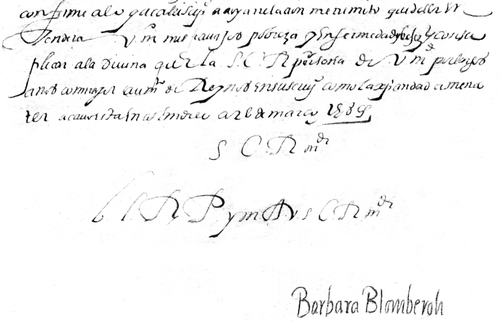
send me the autograph of Don John's mother, which
proves her to have been a woman of at least some education.
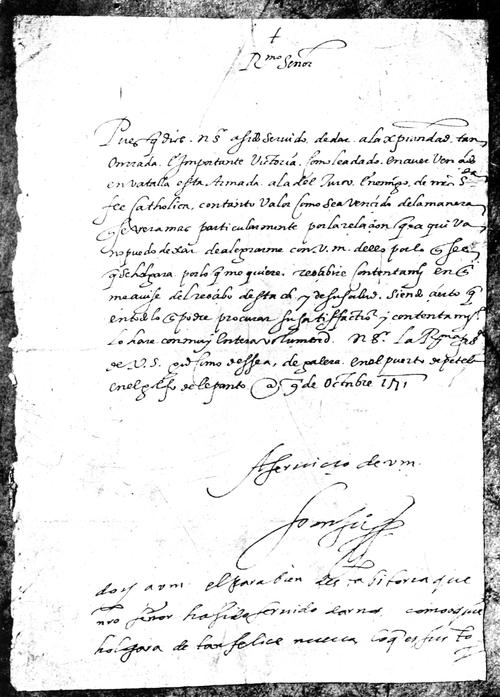
From him, too, comes a most interesting specimen
of Don John's writing—the postscript to the dispatch
announcing the battle of Lepanto.
Of the more familiar illustrations it can surely weary no
one to be reminded of how Jeromín pictured his father to
himself, or how Philip II, "Reyna Ysovel," Prince Carlos,
and others appeared to the blue eyes of the hero of
Lepanto.
I disclaim all responsibility for the views, historical
or otherwise, expressed in this book, but if I have failed
to reproduce a vivid picture of life in old Spain, it is solely
the fault of my prentice hand.
As on the walls of some tapestried chamber the author
displays the Story of Don John of Austria from his
engaging childhood to his saintly death. The light as it
shines on this Prince Charming, also falls on those great
ones of his time who were his friends or foes, and on the
multitude of their servants and followers, lingering most
lovingly on beautiful Doña Magdalena de Ulloa, as it
glints on the golden texture of her unselfish life. In the
woof of the background the author has woven many
homely touches, which seem to make the figures live
again, and, shaking off the dust of more than three
centuries, to leave the arras as in some Pavillon d'Armide.
Has the turning of the hangings broken the spell?
As I cannot but remember that Cervantes, shrewdest of
observers, has said that translating from one language to
another is "like one looking on the wrong side of Flemish
tapestry; although the figures are seen they are full of
threads which blur them, and the smoothness and bloom
of the surface are not seen; not for this" he, however,
adds encouragingly, "do I wish to say that this exercise
of translating is not praiseworthy, because a man may
spend his time in other and worse ways." Ojalá! that
any possible reader of this book may not have cause to
doubt the truth of this last axiom.
My best thanks are due to Padre Coloma for his
courtesy in allowing me to translate this work, to Colonel
Coloma for the trouble he has taken for its welfare, to
Señor de Osma for all his kindness, to Doctor de Alcázar
y Polanco and Mr. Medd, and last, but not least, to my
husband for all his help.
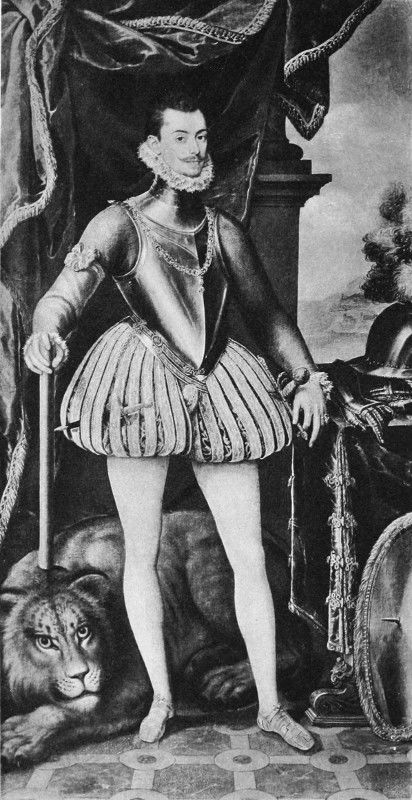
Sir William Stirling Maxwell describes this picture as "perhaps
the most satisfactory existing portrait on canvas as he appeared in
his prime. It is not impossible that it may be the work of
Stradamus." "He wears a small rapier, the Order of the Fleece and
a steel cuirass, slightly enriched with gold, with sleeves of chain
armour, a band of red velvet being on the right arm and a pair of
trunk breeches of some dark parti-coloured stuff, over which is a
casing of crimson perpendicular bars (resembling velvet). That this
outer covering or cage is detached from the lining is made evident by
his dagger hanging between the lining and the cage. His hose and
shoes are of light crimson, approaching to pink ... a helmet with
a blue plume."
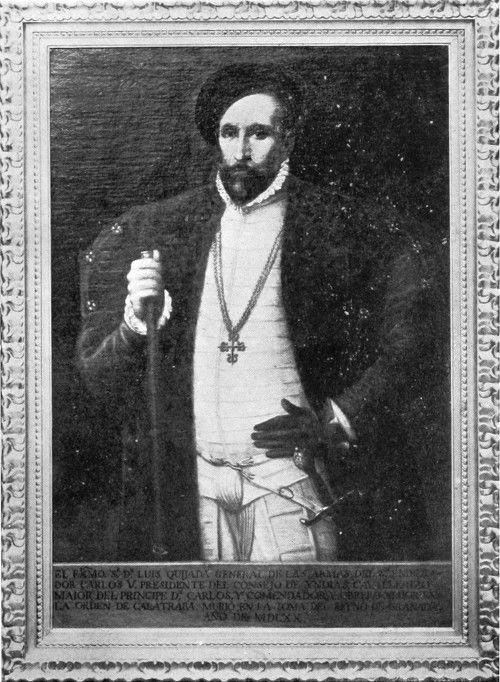
Specially photographed for this book from a picture in the
possession of the Conde de Santa Coloma.
A replica of this picture exists in Seville in the Palace of the
Marqués de la Motilla, of which Don Emilio M. de Torres y
Gonzalez-Arnao kindly sent a specially taken photograph.
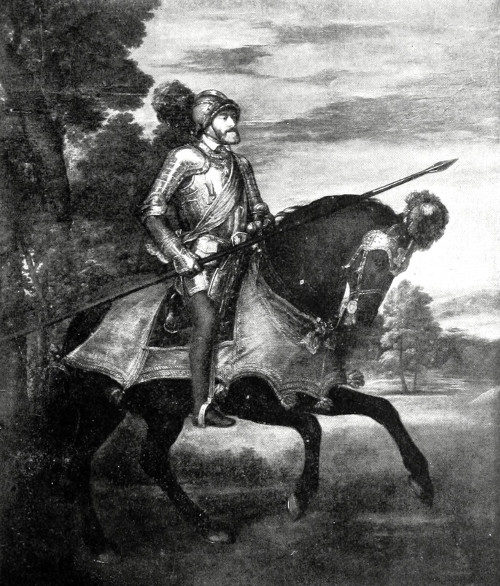
Son of Philip the Handsome, of Burgundy, and Joan the Mad.
Began to reign 1516. Elected Holy Roman Emperor 1519.
Abdicated 1555. Married Isabel of Portugal.
This portrait by Titian represents the Emperor at the battle of
Muhlberg (1546), where, an historian says, "he looked a warrior;
he rode an Andalusian horse covered with a crimson silk cloth with
a gold fringe. His armour was brilliant, the helmet and cuirass
garnished with gold. He wore the red sash with golden stripes of
the general of the house of Burgundy."
This armour still exists in the Royal Armoury at Madrid, and
has been reconstructed according to the portrait with the most life-like
results. The picture itself is in the Prado.
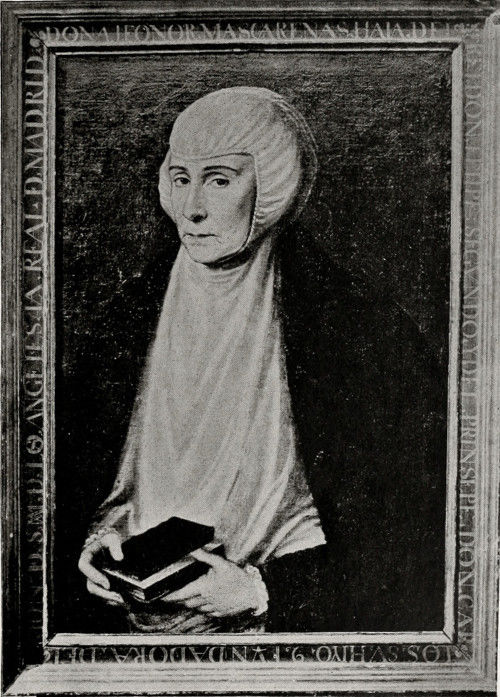
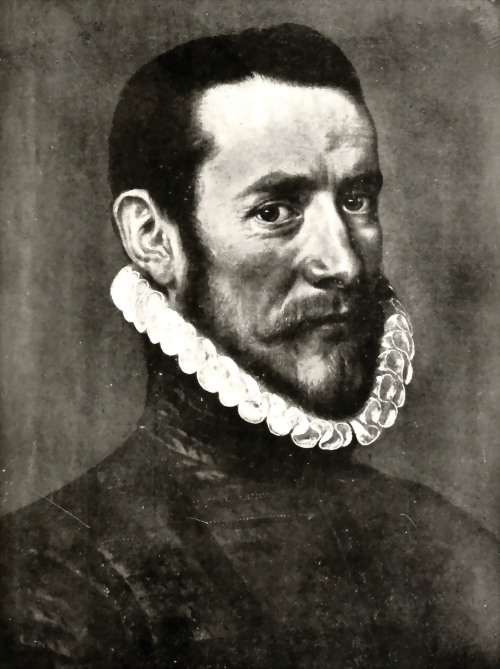
As governess to Philip II and his son, D. Carlos, she exercised,
by reason of her virtues and great discretion, much influence at the
Court of the Emperor Charles V, who held her in great esteem.
She was also the friend of St. Theresa, and founded the Convent of
Our Lady of the Angels in Madrid, to which she retired.
This photograph is from the portrait by Sir Antonio More,
belonging to the Marqués de la Vega-Inclán, which until recently
remained in the Convent she had founded. The photograph is the
first ever taken of the picture, and was kindly sent by Don Emilio
M. de Torres y Gonzalez-Arnao.
Daughter of the Emperor Charles V and Isabel of Portugal.
Married D. Juan, Prince of Portugal, and was mother of the luck-less
King Sebastian. As a widow she returned to rule Spain during
the years that Philip spent in England as husband of Queen Mary
Tudor.
Don Juan Valera says, "Beautiful and passionate as we cannot
doubt her to have been, since she inspired so ardent a devotion in the
Prince her husband that he preferred to die rather than leave her
... yet she was so austere and shy that she never consented to
show her face," and was heavily veiled when she gave audiences.
If any doubted whether they were really addressing her, she would
lift her covering, and directly her visitor was satisfied, drop it again.
Señor Valera quotes this as a proof that none of the descendants of
Joan the Mad were entirely free from the taint of insanity.
Portrait by Sir Antonio More (1512-82) is in the Prado
Gallery, Madrid.
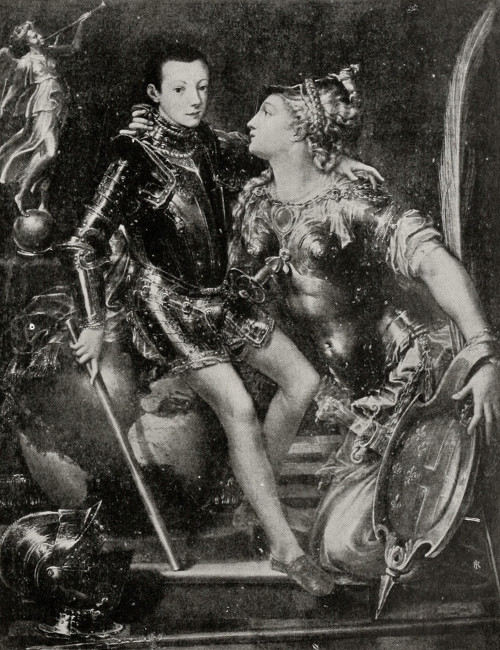
Son of Margaret, Duchess of Parma, half-sister to Don John,
after whose death Alexander Farnese took command of the troops in
Flanders. Married the Princess Maria of Portugal.
The portrait in the Museo Nazionale, Naples, is ascribed to
F. M. Mazzola (called Parmigiano) (1503-40), but dates would
seem to make this impossible.
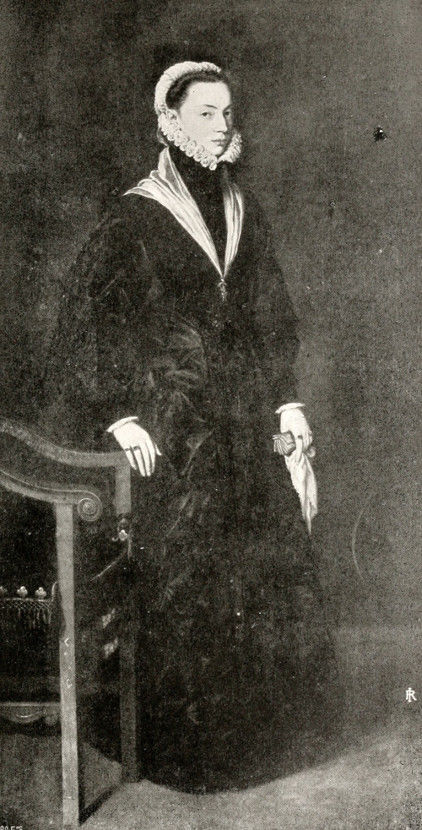
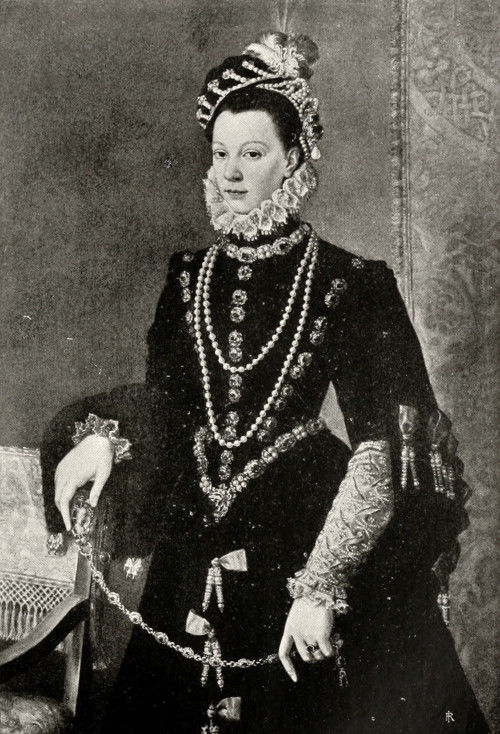
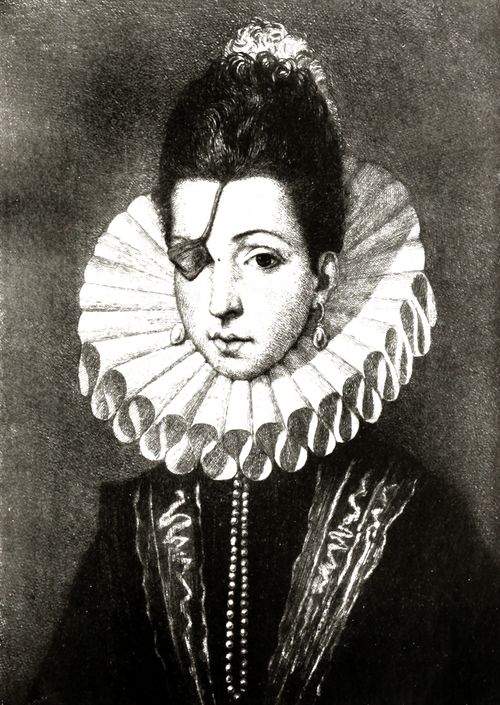
Daughter of Henry II of France and Catherine de Medici.
Third wife of Philip II of Spain.
Brantôme writes of her: "Those who saw her thus in a
painted portrait admired her, and I will leave you to guess the
delight it was to see her face to face with her sweetness and grace."
This picture is alluded to by Sir William Stirling Maxwell in his
"Annals of the Artists of Spain"; he says that her eyes and hair
are dark and her complexion brilliant, "The head is full of beauty
and life; the dress of black velvet, though closed at the throat, is
becoming ... a small ruff encircles the neck, and the robe is
garnished with a profusion of gold chains and jewellery, all admirably
designed and painted. Unless there be some mistake in the date of
the painter's birth, this portrait was probably copied from one by his
master (Sanchez Coello), as Queen Isabella died in 1568, when
Pantoja was only seventeen years of age."
This portrait is by Juan Pantoja de la Cruz (1551 circa 1609),
and is in the Prado Gallery, Madrid.
Don Fernando Alvarez de Toledo. 3rd Duque de Alba,
called the "Gran Duque," 1507-82
Married Maria Enriquez, daughter of the Conde de Alba de
Lesten. Captain-General of the Kingdoms of Castille and Aragon,
of the Spanish troops in Italy, and of the army in Portugal.
Governor of Milan and Viceroy of Naples. Governor of Flanders.
Councillor of State and War to Charles V and Philip II, whose
tutor he was. He acted as Proxy for the King at Philip II's third
and fourth marriages. Recalled from Flanders in 1573, he fell into
disgrace with Philip II, and was imprisoned in the Castle of Uceda.He was liberated in order that he might pacify the Portuguese
rebellion. In 1580 he won the battles which gained this Kingdom
for Spain. He died at Lisbon.
This portrait by Titian represents the Duke at about the age of
forty. He wears black armour wrought with gold and a red sash, and
the balustrade on which he leans is cushioned with red velvet. It
may very possibly have belonged to the Duke himself; it certainly
was in the possession of the celebrated Conde Duque de Olivares, as
it was amongst those entailed by him with the Carpio estate. With
this property it passed to the Alba family, and from thence was
brought to its present place in the Palacio de Liria in Madrid.
There is an improbable legend about this picture that it cost the
artist his life, from the shock of hearing the Duke let drop in Spanish
that the two Counts, Horn and Egmont, were sentenced to death.
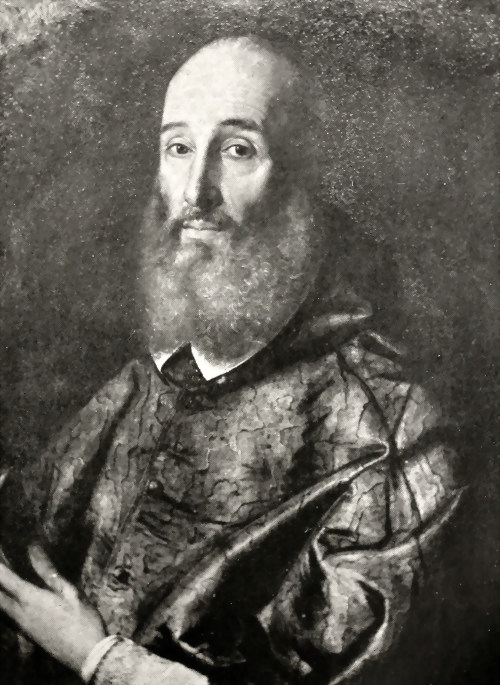
Antoine Perrenot. Bishop of Arras. Primate of the Netherlands.
A well-known statesman during the reigns of Charles V and
Philip II. Chief Councillor to the Duchess of Parma when
Governess of the Netherlands. He became so unpopular that in
1564 Philip II was compelled to advise him to retire to his estates
in Burgundy. The Cardinal left vowing that he would not cut his
beard until he returned to Brussels. Three years later he went to
Rome, where he assisted in the negotiations of the Holy League.
He subsequently became Viceroy of Naples.
From his picture by Scipione Pulzone called Gaetano in Municipal
Museum, Besançon.
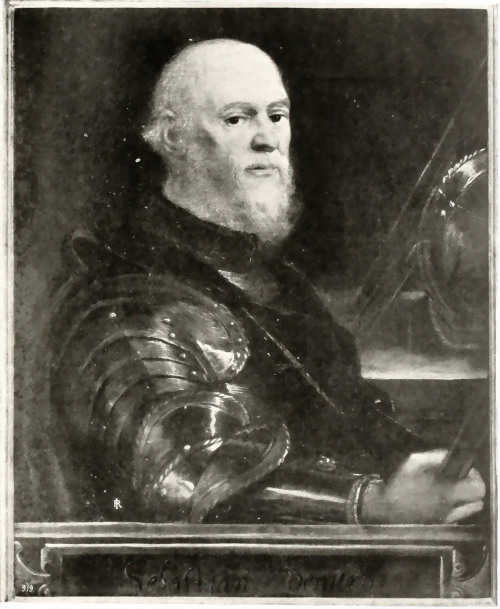
After being constantly employed in many important posts at home
and abroad, including that of Procuratore di San Marco, he became
General del Mar, and commanded the left wing at the battle of
Lepanto, where he was wounded in the knee by an arrow. Padre
Coloma says that he was seventy at this time, which would place his
birth in 1501. He was elected Doge June 11, 1577, and died eight
months later.
Portrait by Titian in the Prado Gallery, Madrid.
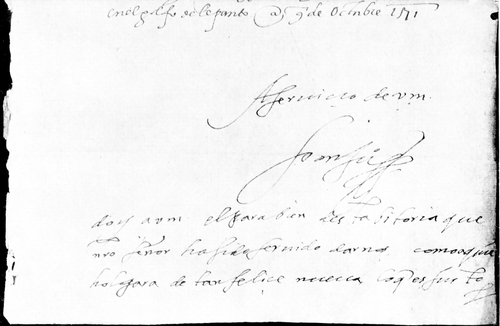
Dispatch announcing the Victory of Lepanto, dated
Petala, October 9, 1571. Postscript in Don John's
Writing
There are several known copies of the dispatch, the postscripts
varying from one to two lines, according to the importance of the
person addressed. This one was almost certainly sent to the President
of the Council of Castille, Cardinal Espinosa, though, from the
outer sheet being torn, the address is wanting.
It is in three lines:
"Doy a V.M. el parabien desta vitoria que Nrõ Señor ha sido
servido darnos, como a quien holgara de tan felice nueva lo es justo."
"I congratulate Your Grace on the victory that Our Lord has been
pleased to give us, as is due to one who will rejoice over such happy
news."
From the collection of the Conde de Valencia de D. Juan. Photographed
specially for this book.
Postscript in D. John of Austria's writing from the collection of
the Conde de Valencia de D. Juan.
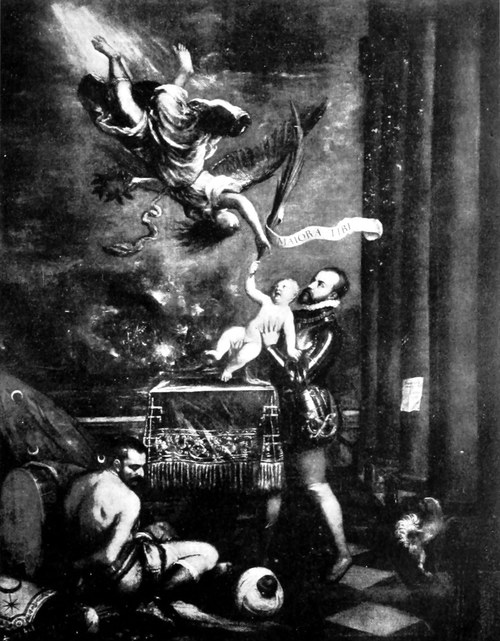
Sir William Stirling Maxwell says that tradition has connected
this picture with Lepanto. Philip II is represented holding up to
Heaven his short-lived son, by Anne of Austria, Don Fernando,
who was born December 4, 1571, shortly after the news of the
victory reached Spain. It is stated that the picture was painted by
Titian (1477-1576) "at the age of ninety-four at least."
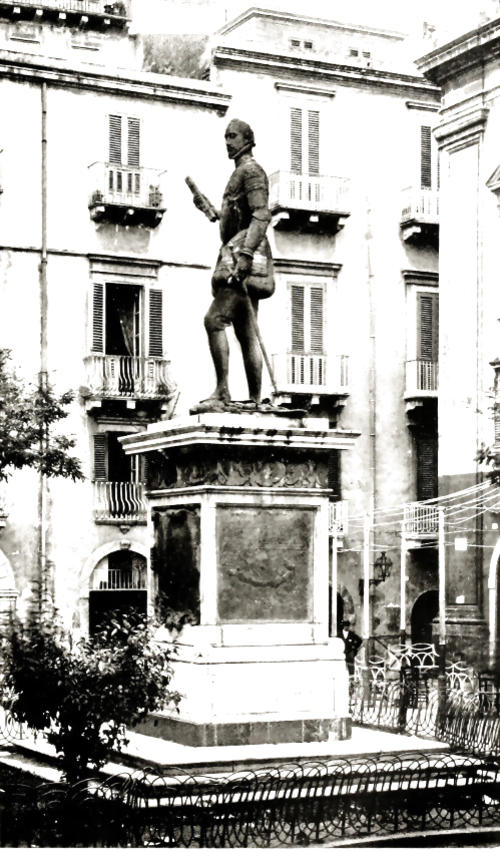
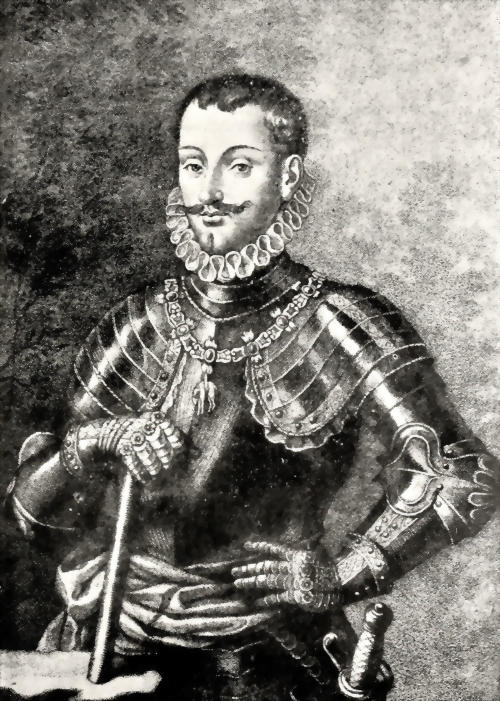
This statue by Andrea Calamech is still in existence (June, 1912).
Sir William Stirling Maxwell is "disposed to consider it the most
interesting and important" portrait which has come down to us.
He says, "The head, which was considered an excellent likeness, is
very noble and graceful." "Although the gilding with which it
once shone resplendent has disappeared it is still one of the most
effective monuments of sixteenth-century art."
"The statue stood in the small Piazza between the Palace and
the Church of Our Lady of the Pillar until 1853 when it was
removed to the Piazza of the Annunziata."
Married Doña Juana de Coello Bozmediano. Secretary and
favourite of Philip II. Fell into disgrace and was tried andtortured in 1582. Contrived to escape, first to Aragon, afterwards
to France and England, but was sent back to Portugal and died in
Paris.
In his exile he wrote his "Memorial" to prove his own innocence
and his master's guilt. Major Martin Hume thinks that "the
moral portrait of the King (Philip II), still current in foreign
countries, owes much to the literary talent with which Antonio
Pérez presented his subtle sophistries."
Daughter of the Count de Melito. Married in 1553 Ruy Gomez
de Silva, afterwards Prince of Évoli, who died 1573.
She was a great heiress, and her family accused Antonio Pérez of
squandering her fortune. There now seems little doubt that anger
at the discovery of her intrigue with him was the chief reason of the
assassination of the Secretary Escovedo.
Philip II caused her to be arrested suddenly in 1579, and imprisoned
first in the tower of Pinto, and then exiled to her own house
at Pastrana for the rest of her life.
The picture from which the print used is taken is by Sanchez
Coello, in the possession of her descendant, the Duque de Pastrana.
"This picture is well worthy of note, as it shows how the
crowned monk of the Escorial looked when on the brink of the
grave. In Pantoja's worn, sickly, sour old man, with lack-lustre,
restless eyes, protruding under-lip and
'pallid cheeks and ashy hue
in which sad death his portraiture hath writ',
(Spenser)
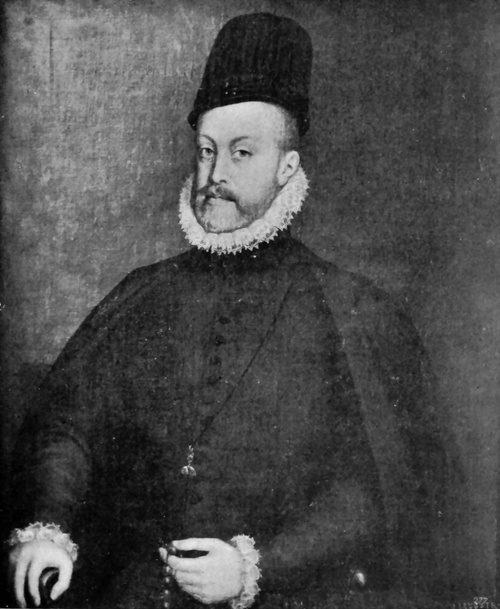
wearing a rusty sugar-loaf hat and holding in his hand a common
brown rosary, we see the last stage of the sumptuous Prince whose
youthful bearing has been made immortal by the pencil of Titian."
(Sir William Stirling Maxwell.)
By Juan Pantoja de la Cruz in the Prado Gallery, Madrid.
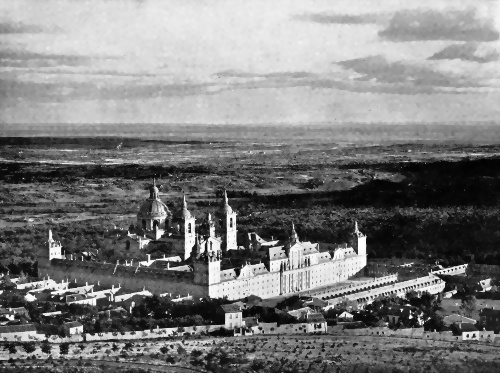
View of the Escorial and surrounding country. Present day.
To quote Señor Baros, "The victory of St. Quentin was gained on
the Feast of St. Laurence and Don Philip wished to raise an edifice
in honour of the saint which should be a convent, a royal mausoleum
and a palace. When the Emperor took leave of his son he had
charged him to erect a worthy sepulchre for his own remains and
those of the Empress. The King caused the Spanish architect Juan
Bautista de Toledo to come from Naples, who designed the Escorial
in the shape of a gridiron. The first stone was laid in 1563.
This superb monument was finished by Juan de Herrera, 1584."
These short notes are mostly culled from the works of Sir William
Stirling Maxwell, Major Martin Hume and Señor Baros. Those
on the Duque de Alba are taken from the catalogue made for the
present Duke by Don Angel de Barcia, of which a portion was
specially reprinted for this book.
BOOK I — DON JOHN OF AUSTRIA — CHAPTER I — CHAPTER II — CHAPTER III — CHAPTER IV — CHAPTER V — CHAPTER VI — CHAPTER VII — CHAPTER VIII — CHAPTER IX — CHAPTER X — CHAPTER XI — CHAPTER XII — CHAPTER XIII — CHAPTER XIV — CHAPTER XV — CHAPTER XVI
Like a flock of frightened sparrows the children
of Leganés arrived that afternoon at Ana de
Medina's door, just as the bells were ringing for
vespers. Ana's son Jeromín was the first to get
there, with his big blue eyes staring and his beautiful
golden hair thrown back. But there was good cause for
all this, and twenty shrill voices hastened to explain it to
Ana, who, startled, came to the door distaff in hand, and a
scolding on her lips.
There was no school in Getafe that afternoon; the sun
had stricken down Sancha Apelza, the master's wife, while
working on the farm of the Comunero, and she was to
receive the last sacraments that night. The children from
Leganés were coming back to the village, playing as usual
by the way at Moors and Christians. Jeromín always
insisted on this, and never would play at Comuneros, or at
being Padilla, Adelentado or Bishop Acuña, all recent and
popular heroes. He said it was enough for him to be
Jeromín and to pretend to cut off the heads of Moors. He
entrenched himself in the Canon's well as if it were a castle
on a rock, and Pedro Verde defended the orchard of Maricuernos
opposite, declaring it to be the Vega of Granada.
Jeromín gave the word "Santiago," and from both sides,
like bullets from an arquebus, came lumps of soft earth.
At this inopportune moment, while the battle was raging
along the road from Madrid bordering the orchard of
Maricuernos, four mules appeared, harnessed in pairs with
long traces to what seemed to be a little wooden house, with
two tiny windows and four big wheels. A man was riding
the foremost mule on the off side, and another was seated
on the roof of the house, guiding the mules with a long
stick. Through one of the windows a very fat man
with grey moustaches and a pointed beard, could be seen,
sitting inside. Four well-armed horsemen and two baggage-mules
escorted the unwieldy vehicle. The children were
frightened at the sight of this extraordinary machine, such
as they had never seen before, but curiosity overcame
their fear and they all grouped themselves, very silent, in
the orchard of Maricuernos to see it pass closer. The boys'
terror increased when they realised that the heavy machine
was halting in front of them, and the fat gentleman, putting
his head out of window, was asking them very politely
whether the Emperor's former guitar-player, Francis Massy,
who had married Ana de Medina, a native of the village,
still lived there.
The boys began to giggle and look at each other, not
daring to answer, stir or even take off their caps as a mark
of respect. The fat man repeated the question two or
three times very politely and kindly, till at last Pedro
Verde, who was eleven years old, and had been twice to
Pinto, and had seen the cavalcade of Ruy Gómez de Silva
from afar, made up his mind to answer, his mouth dry
with fear and keeping his cap on, that the musician
Francisquin, as they called him, had died some years
previously, but that his widow Ana de Medina still lived
there and that her son Jeromín, was one of those present.
This Pedro demonstrated by seizing Jeromín by the neck
of his doublet and pulling him forward. For the fat man
to hear this, look at Jeromín and stretch his arms out of
the window as if to seize him and drag him into the coach
was only the work of a second. But it took the children,
terrified at the old man's behaviour, even less time to
scamper up the hill towards the village as if they had
legions of devils at their heels. The gentleman called to
them to stop. The escort also called out. But the children,
spurred on by fright, ran harder and harder up the hill
like hunted hares, until they stopped at the threshold of
Ana de Medina where we met them.
The widow's face fell when she heard all this, and she
drew Jeromín towards her as if she wished to hide him in
her woollen skirt. She asked the boys several questions,
but they all answered together, and all she could make out
was that a fat gentleman had wished to carry off Jeromín
in a little house on wheels.
Ana, worried, went back into her house and sent a message
by Pedro Verde to ask the priest to come and see her, the
cleric Bautista Vela, who served the parish for D. Alonso de
Rojas, chaplain to His Majesty in the Royal Chapel at
Granada at that time. Bautista Vela tarried too long; by
the time he arrived at Ana's house he could no longer be
there alone. Round the corner of the street came the whole
population of the village, surrounding with wonder the
vehicle in which the fat man came. He sat smiling,
greeting some and of others asking the way to Ana's house,
which a hundred hands pointed out to him, while he continued
to look out of the window as if this house was the
goal of his journey.
The hubbub made Ana come to her door, with Jeromín
clinging to her skirts. The coach, the like of which was
never seen before, stopped in front of her; the gentleman
greeted her politely, and the widow could not therefore do
otherwise than offer him hospitality in a peasant's homely
way.
The gentleman then got out, and Ana conducted him to
her parlour, which was also her kitchen, clean certainly
and with room for twenty people in the chimney corner
on the rough stone seats placed on either side.
Invited by the widow, who seemed to be afraid to be
alone with the stranger, Bautista Vela entered also, followed
by Jeromín, recovered from his fear, but still full of wonder
and looking the visitor up and down as if he were the bearer
of good or evil fortune. The fat man was about sixty, but
his extraordinary corpulency neither destroyed the activity
of his limbs nor the charm of his manners. He spoke with
a soft, low, kindly voice with a marked Flemish accent, and
not like the haughty man of war so common at that time.
Everything in him betokened the obsequious courtier,
accustomed to the yoke of powerful masters. Very courteously
he told the widow who he was, the object of his
visit, and what he hoped and wished from her. His name
was Charles Prevost, a servant of the Emperor, who had
come to Castille on his own business, but had also brought
a special and secret message for her from Adrian du Bois,
valet to the Emperor, and therefore his fellow-servant.
Here the courteous Fleming made a pause and, slightly
raising his voice and accentuating his words, added that
this business had been urgently recommended to him by
the very high and mighty gentleman Luis Méndez Quijada,
Steward to the invincible Cæsar Charles V.
Hearing the name of Cæsar all bowed their heads in
token of respect, and on hearing that of Quijada the cleric
and the widow exchanged a rapid glance of fear and suspicion.
Jeromín, calmer than the rest, sat on a high stool,
swinging his legs and never taking his eyes off the stranger,
as if he were trying to decipher in that round red face
some problem which he was turning over and over in his
baby mind.
Charles Prevost pointed to the child as if its presence
were an obstacle, so the widow took Jeromín by the arm
and shut him up in a room, telling him to wait there. Meanwhile
Prevost had produced a paper carefully wrapped up
in two covers of linen, which he held out to the widow
folded in four. As she could not read, shrugging her
shoulders she passed it in her turn to Bautista Vela, who,
very much astonished, unfolded the letter and slowly and
solemnly read as follows:
"I, Francis Massy, musician to His Majesty, and Ana de
Medina, my wife, know and confess that we have taken and
received a son of Señor Adrian de Bois, valet to His Majesty,
which we did by his wish, and he prayed us to take and bring
him up like our own son, and not to tell anyone whose son
he was, as Señor Adrian did not wish that by this means his
wife or anyone else should know or hear of him. For this
reason I, Francis Massy, and Ana de Medina, my wife, and
our son Diego de Medina, swear and promise to the said
Señor Adrian not to tell or declare to any living person
whose this child is, but to say that it is mine, until Señor
Adrian sends someone with this letter or the said Señor
Adrian comes in person.
"And because Señor Adrian wishes to keep the matter
secret, he has begged me to do him the favour of taking
charge of this child, which my wife and I willingly do and
acknowledge to have received from the said Señor Adrian
100 crowns which he gave me for the journey, for taking the
child, for a horse and clothes, and keep for one year that
is to say that the year is counted from the 1st day of August
of this present year 1550. For which I hold myself content
and paid for this year, as it is the truth. I sign my name
to it, I and my wife, but as she cannot write I begged
Oger Bodarce to sign her name for her. And the said Señor
Adrian shall give me 50 ducats each year for the keep of
the child. Dated, Brussels, 13th of June, 1550."
A long silence followed the reading of this letter; and
when Ana de Medina understood that the hour had arrived
for giving up the child she had looked upon as her son, she
burst into tears and between her sobs said that she perfectly
recognised this document to be genuine from end to end.
She had done as she had sworn, and would act in the same
way in the future, and give up the child to whoever was
sent to fetch him; but for God's sake and Our Lady's and
a multitude of saints, let him stay until seed-time, so that
there should be time to make him some new clothes and
render him more presentable. Bautista Vela seemed also
touched, and timidly added his entreaties to those of the
widow.
But the Fleming, with roundabout reasonings and kindly,
comforting words, showed all the same his absolute determination
to leave the next day at daybreak, taking
Jeromín with him. Then, in a long talk and by clever
questions, he let the widow and the priest know how very
displeased the powerful Luis Quijada would be when he
found the state of absolute mental neglect in which the boy
had lived all these years, as he was healthy in body and
appeared to be so also in mind; but it was clear that he
knew nothing except how to run about the country shooting
at birds with his crossbow and arrows, nor had he had other
lessons than those of the sacristan Francis Fernandez, and
those just lately in the school in Getafe. The blame for
this fell on Bautista Vela, because he had written from time
to time to Luis Quijada that he was seeing that the boy's
education was cared for and that it was not that of a little
peasant.
At this the priest and the widow were silent, knowing
they were in the wrong, the more so as more than once
the idea had occurred to them that Jeromín was not the
son of Adrian de Bois, from whose hands they had received
the child, but of Luis Quijada, Steward to Cæsar and one of
his greatest lords. And their idea, which no doubt Prevost
also shared, was confirmed when the supper-hour arrived
and he ordered that the table should be set with the silver
and service he had brought in his baggage, and, seating
Jeromín in the place of honour, himself served the meal and
waited.
Jeromín let himself be waited on without showing any
diffidence or surprise, as if all his life he had been used to
such attentions. But when he saw Ana de Medina remaining
by the fire and helping to pass the plates, without daring
to come to the table, he said, without looking at anyone,
in a tone which might be a question, or a request or an
order, "Isn't she going to have any supper?" This made
the widow burst again into sobs and lamentations, and the
boy bit his lips to restrain the tears which filled his eyes.
We cannot be certain whether Jeromín slept that night or
not, but it is certain that no one had to rouse him the next
morning, and the first light of dawn found him already
awake, dressed in his best clothes, with his fair hair covered
by the picturesque "monterilla." He twice kissed Ana de
Medina at the door, and then turned back and kissed her
a third and fourth time. But he did not shed a tear or say a
word, nor did his face change, though it was paler than usual.
The whole village was at the door, the children in the
front row, Christians and Moors all mixed up, filled with
awe and envy at seeing him in the seat of honour in the
little house on wheels which had frightened them so much
the day before.
Then Jeromín asked the widow for his crossbow, so
she brought the roughly made plaything with which he had
acquired such wonderful dexterity, and he gave it to his
enemy of the battles, Pedro Verde, saying shortly, "Keep
it."
All the neighbours accompanied the coach to the outskirts
of the village, and the children much farther, also
Ana de Medina, crying out and begging that they would
not take away her Jeromín, but would give her back her
son.
He did not stir inside the coach, or put out his head,
but remained so quiet with his eyes shut that the Fleming
began to think he was asleep. But at the last turn, passing
the orchard of Maricuernos, at the place where the Hermitage
de los Angeles was afterwards erected, Jeromín's little
hand could be seen out of the window, making last signs
to his playfellows and to the humble woman who had
brought him up.
Jeromín went from one surprise to another, seeing
pass, for the first time before his eyes, lands and
mountains, villages, castles, and people who were not
like those of Leganés or anything he had imagined.
Charles Prevost answered his doubts and questions with
real and kindly anxiety to enlighten him, now explaining
curious things, now making instructive remarks which
opened new and wide horizons before the boy's virgin
mind. But in spite of the Fleming's kindness, which sometimes
seemed natural and at other times only courtly
manners which had become a second nature, the child's
innate sharpness showed him that Prevost always hid him
from the gaze of the people; that he never explained in
inns and on the road who the boy was, or where he was
taking him, which Jeromín himself did not in the least
know either. This restrained the natural open character
of the boy and armed him with a certain reserve, which
without being sulky was a want of confidence, the offspring,
no doubt, of offended dignity.
They arrived at Valladolid one May morning, between
the 12th and 14th, at midday. Not to attract attention
to his conveyance, Charles Prevost got out and entered
by the small gate of Balboa and went on foot holding
Jeromín by the hand.
Great animation and movement reigned in the streets,
because at the moment the big suites of Grandees, gentlemen,
servants and armed men who were to accompany
the Prince of the Asturias, D. Philip, on his famous
expedition to England were in Valladolid, and no doubt
for this reason Charles Prevost chose back streets by which
to reach a convent of barefooted friars. They evidently
expected him here, for without more words than politeness
demanded the Fleming handed the boy over to the Prior,
a venerable old man, and left without saying anything
further, promising Jeromín to fetch him in a few days.
The little boy was frightened at finding himself alone
among these austere figures, whom he saw for the first
time, and who seemed, therefore, strange and terrifying.
With precocious self-command, however, he disguised
his feelings, and the brothers were so kind to him that
after the first day he got used to them and wandered about
the cloisters and the orchard as he might have done at
Leganés. The Prior told off a young, cheerful brother to
keep him company and wait on him, and gave him a little
crossbow that he might gratify his love of shooting at little
birds in the orchard. In a few days they brought him much
fine white linen and three suits, made like a peasant's but
of fine cloth and beautifully trimmed, from Charles Prevost.
Jeromín wanted to try them on at once, as he was nice
about his dress and rather vain, for which there was excuse.
He was strong, well made and extremely agile; his skin
was white, although burnt by the sun of Leganés; he had
big, clear blue eyes, soft fair hair, and his whole person
was so graceful, high and noble, that seeing him in his
ordinary clothes he looked like a little prince dressed up as
a peasant.
He arrayed himself in his new clothes at once, and that
same afternoon an adventure befell him in the orchard
which made a deep impression on his childish imagination.
The orchard was very large and extremely shady, and
crossed in all directions by rows of trees.
Tired with running about, Jeromín threw himself at
the foot of a pear tree, with his crossbow by his side; in
front of him stretched a line of the same trees, from one
side of the low cloister to the big stew-pond where the trout
were kept.
Very soon Jeromín saw two very important personages
who were conversing amiably, leaving the cloisters and
coming towards him. One was the Prior of the convent,
a bent old man, who leant on his wooden crutch at each
step. The other was a great gentleman of not more than
forty, spare, with a bright complexion, a hooked nose,
piercing eyes, and a long, carefully tended beard which fell
on his chest. He wore a doublet of black velvet, slashed
with satin, an old-fashioned cap of the same with a black
feather, and fine buckskin gloves which he carried loose in
one hand. He had the Prior on his right hand, and was
listening to him with great respect, bowing his proud head
towards him, at other times answering him vehemently,
hitting one hand with the gloves that he carried in the
other.
Jeromín, frightened, wanted to hide, but it was too late,
and he had to remain crouching under his pear tree hoping
not to be seen. However, the Prior espied him from afar,
and at once began a strange manœuvre, which made the
boy wonder; continuing to talk he moved forward little
by little so as to put himself between Jeromín and the
gentleman, who passed by without noticing the presence
of the little boy. He then saw that when the Prior arrived
at the stew-pond he secretly gave an order to a lay brother,
and soon after the young brother came and took him out
of the orchard by back paths, and shut him up in his cell
without saying anything or giving any reasons.
Jeromín understood that they did not wish him to meet
the great personage, and this fixed the hooked nose and
long beard so firmly in his memory that, having seen them
for only a brief instant, he was able to recognise him years
afterwards at a supreme moment.
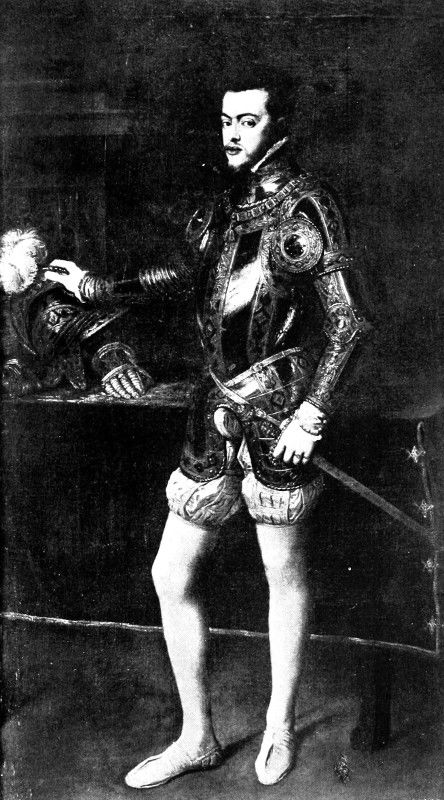
Photo Lacoste
PHILIP II AS A YOUNG MAN
Titian. Prado Gallery, Madrid
The next day the young brother came into Jeromín's
cell looking very pleased, and, as if to make up for the
night before, told him that he was going to show him the
greatest and bravest soldiers who ever drew sword. With
much mystery he took the boy to the sacristy under the
church, and showed him a small rose window, which opened
half-way up the wall to let in air and sunshine. He made
him mount a ladder, and through this sort of peep-hole
Jeromín could see one of the narrow, irregular squares
which are still so common in Valladolid. The whole square
was crowded; not only the windows and balconies, but even
the roofs were overflowing with men, women and children,
all merry and looking as if they waited for something.
And such was the case. Prince Philip was marching to
the frontier to receive his widowed sister, the Infanta
Juana of Portugal, and from there was going to Corunna to
sail for England, and that day, his last in Valladolid, the
Prince, with all his suite, was going to attend a service at
St. Mary's, and then parade through the streets to take
leave of his father's faithful lieges. Jeromín, ignorant of
all this, sought in vain the promised soldiers among the
crowd. But he had not long to wait. Very soon the silver
trumpets of the Archers of the Guard began to be heard.
Jeromín gave a jump as if he had received an electric shock,
and proudly raised his handsome little face, almost fiercely,
like a charger who hears for the first time the martial note
of a trumpet. With eyes wide open with wonder and admiration
he seemed glued to his window. The brother had
mounted too, and was looking at what was happening in
the square. Slowly, heavily, like walking towers on their
great horses, the hundred Archers of the Guard began to
pass six deep, wearing their cloaks of yellow velvet, with
stripes of three colours, red, white and yellow, which was
the device of the Prince. The trumpets duly gave out
slowly their melodious notes. Then followed another
hundred of halberdiers of the German Guard wearing the
same colours and devices, and then another hundred of the
Spanish Guard with their captain the Conde de Feria at
their head.
The square burst into joyful cries. The brother got
down quickly and wished the boy to do so too; between
curiosity to see and fear of falling he clung anxiously to
the ladder, but he still had time to look at a handsome,
fair young man of twenty-six with his beard cut into a
point, who came slowly by himself into the square, and
from the back of a beautiful horse, caparisoned with velvet
and gold, smiled and bowed to the crowd. On his right,
at a respectful distance, Jeromín also saw the gentleman
with the hooked nose and long beard who had been the
cause of his imprisonment the night before, wearing brilliant
orders on his embroidered dark grey doublet and riding a
horse with green velvet trappings and a cloth embroidered
in silver.
Jeromín could see no more, the brother made him come
down. Once on the ground the boy walked up and down
the sacristy in a rage, with his little fists clenched, like a
lion cub from whom has been taken some dainty morsel.
Through the open window he could hear the measured
tread of the horses, and the cries of the people greeting
the brilliant suite which closed the triumphal march.
He looked at the brother and thought him hideous;
he went to the cloister and thought it a horrible place;
he thought of the older man with the long beard and of the
young one with the short beard, to try and find some defect
in them, but could not. What business had these people to
prevent him looking at the soldiers?
The Infanta Doña Juana arrived in Valladolid
as Governess of the Kingdom very soon after
D. Philip left, and four days later Charles
Prevost came unexpectedly to the convent to
fetch Jeromín to continue his journey.
They arrived at Medina de Rioseco in two stages, and
slept that night at an inn in the outskirts. The next day,
late in the morning, they set out by the main road to Toro,
and after half an hour's journey they could descry standing
against the horizon of vast plains a great castle, flanked by
four towers, a large village, and two churches lying at its
feet.
Charles Prevost called the child's attention to it, and
pointing to the place said, "That is Villagarcia. You
will stay there, but I must go on much farther." Drawing
the child towards him, and seating him on his knee, he told
him very kindly that he had come to the end of his journey;
and that in that castle he would find a great lady who
was very good, and who would be a mother to him, and,
as such, he was to obey, love and respect her, and profit
by the lessons that would be given him, and give a good
account of himself in the service of God and the study of
letters and arms, and not leave the castle without becoming
a learned cleric, a great preaching friar, or a brave
soldier, according to the vocation God would give him and
the advice of his benefactors.
Jeromín listened to him with astonishment, never taking
his beautiful eyes off him. Charles Prevost, who noticed
that, as they got nearer to the castle, the child grew more
and more uncomfortable and shy, took him again on his
knees and told him not to be frightened when he saw the
lady, but to greet her with the respect and reverence due to
her rank.
They had already reached the castle, which was at the
entrance of the village on the Rioseco side. To distract
the attention of the child Prevost made him notice the
massive towers, the strong turreted walls with loopholes
for artillery, and the flag which waved from the tower
of homage, announcing to travellers, according to ancient
and lordly custom, the presence in the castle of the masters,
and the offer of free and safe hospitality to all those who
asked for it.
The castle had a fortified gateway which still stands,
with a drawbridge over the moat, and another of a later
date towards the village with a gentle slope up to it which
served as an entrance. Prevost's little Flemish cart went
in by this way and entered into a big square courtyard,
a real parade ground, which was formed by the two northern
towers and the two walls on the east and west, the first
precinct of the fortress.
Several grooms came out to receive him, and a grave,
bearded squire with his doublet emblazoned with arms and
a big sword of the time of the Comunidades. He made
Jeromín and the Fleming enter into the second courtyard
through heavy iron gates; then they found themselves
in another court of elegant proportions, really that of the
house. It was formed by two ornamental cloisters, an
upper and a lower one, with slender columns, the top one
shut in by a balustrade of stone. There was a big well
in the middle of the court, with a great chain and two
copper buckets, and the rest of the space was covered
with little paths and box bushes, except at the foot of the
cloisters, where it was paved. From this lower cloister there
was a wide staircase of white stone which Jeromín mounted
trembling, not realising what was the matter with him.
At the first landing he became dazed. A group of people
hurried down and became confused before the dazzled eyes
of the child, as if they flickered like the rays of the sun
which was shining on them—a majestic figure dressed in
velvet with things that sparkled—a tall Dominican friar—two
duennas with white caps and black shawls—some women—several
men.
Jeromín became giddy and everything swam before his
eyes, he only saw that two hands of alabaster were stretched
out towards him. The boy, hardly knowing what he was
doing, only remembering that Prevost had told him to
greet the lady with great respect, fell on his knees, joining
his little hands as Ana de Medina had taught him to do
before the altar of Our Lady of the Angels.
Then he felt that the velvet arms were embracing him
and lifting him up; that a beautiful face was against his,
covering it with tears, and that a choked voice said to the
friar these historical words: "God be with me and help
me, my lord brother! It is a pity that I am not the mother
of this angel."
Doña Magdalena de Ulloa, Toledo, Osorio and
Quiñones was one of the greatest ladies of the
Spanish nobility of the sixteenth century.
She was the sister of D. Rodrigo de Ulloa,
first Marqués de la Mota, San Cebrián, and the Vega del
Condado, and of Doña Maria de Toledo, of the ancient and
noble house of the Condes de Luna.
When she was very young God took from her, first
her mother, and then her father, and she remained an
orphan under the charge of her grandmother, the Condesa
de Luna, and after her death under that of her brother,
who fulfilled his duties well and sought a wealthy marriage
for her by arrangement, after the custom of the time, between
the two families. The bridegroom chosen was Luis Méndez
Quijada, Manuel de Figueredo and Mendoza, Colonel of
the Spanish infantry, Steward to the Emperor Charles V,
and Lord of Villagarcia, Villanueva de los Caballeros, and
Santofimia, and also of Villamayor in the region of Campos,
in right of his mother. The pair did not know each other;
Doña Magdalena lived in Toro with her brother, and Luis
Quijada followed the Emperor in his wars and journeys,
having been his favourite for twenty years. The marriage
articles were arranged in Valladolid on the 29th of February,
1549. D. Diego Tabera, Councillor to H.M. and the Inquisition,
represented the bride, and the bridegroom was
represented by his uncle, the Archbishop of Santiago,
D. Pedro Manuel, and by the illustrious gentleman D.
Gómez Manrique and D. Pedro Laso de Castilla, Steward
to Prince Maximilian, Archduke of Austria.
By these articles the Marqués de la Mota promised
to give his sister a fortune of ten million maravedises,
paid by 5000 ducats in money, 2000 in jewels, and the
rest by an annuity, adding this clause: "Besides the ten
'cuentos' she is to have clothes and apparel and furniture
and ornaments for the house, which she has or will have
up to the day of the wedding, estimated by two persons
on oath." The bridegroom promised for his part tapestry
worth 4000 ducats and to endow her with the towns of
Villanueva de los Caballeros and Santafimia, which for
this purpose he pledged. The marriage was authorised
by the Emperor. Luis Quijada sent from Brussels, where
he was then living, full powers to his brother Álvaro de
Mendoza to marry Doña Magdalena in his name, and
this he did in Valladolid on the 27th of November, 1549,
adding this clause to the document in his own hand: "And
in the name of the said D. Luis Quijada, my brother, for
him and as if he himself were present and as a gentleman
of noble birth, I do homage once, twice, three times in
the presence and under the authority of D. Bernardo de
Acuña, Commander of the Order of Santiago, gentleman
of noble birth, who through me, and in the said name
received him, taking my hand in his according to the law
of Spain, that the said Lord Luis Quijada, my brother,
shall have and keep and fulfil and pay all that is said and
is contained in this writing in good faith, and without
deception and without adding or taking away under the
penalties which befall and are incurred by gentlemen of
noble birth who do not keep their word, faith and homage."
In this strange way marriages were then made, and
still more extraordinary is it that they usually turned
out as happily as did this one. For when, soon afterwards,
Luis Quijada arrived in Valladolid, where his wife went
to meet him, they were so attracted to each other, he by
her beauty and womanly discretion, she by his generosity
and noble bearing, that the Christian love and absolute
confidence they then plighted to each other lasted unto
death.
Notwithstanding that, there came a time when a severe
test was put to this mutual confidence. At the end of
1553 or the beginning of 1554 the posts from Flanders
began to come more frequently than ever to Villagarcia.
Luis Quijada was following Charles V in his last campaign
against the French, and the husband never lost an opportunity
of letting his wife have news of the dangers he ran
or the triumphs he gained. She was the first person in
Spain to know of the taking of Terouanne and the tower
of Hesdin, where Luis Quijada so much distinguished
himself, and to her came the first rumours of the return
of the Emperor and his projected retirement to a convent.
But among all this news which pleased her as a wife,
and added to the lustre of her house, one day there came
unexpectedly a letter which plunged her in perplexity.
It was the letter which Luis Quijada had written
from Brussels, probably in February, 1554, although
the date is unknown. Quijada announced to his wife
that before long, but after she had heard again, a man
who had his entire confidence would present himself at
Villagarcia, and that this man would make over to her a
child of seven or nine years old, called Jeromín, and he
begged her by the love she bore and which she had always
shown him to accept the boy as a mother would, and as
such to protect and educate him. He also said that the
boy was the son of a great friend, whose name he could not
reveal, but whose position and prestige he guaranteed.
And he added that though the education of Jeromín was to
be that of a gentleman, his father did not wish him to
dress as such, but to wear the garb of a peasant, in which
he would present himself. It was the desire of the father,
moreover, that with all gentleness and discretion the child
Jeromín should be urged to enter the Church, but not if
it were not his vocation or the Divine wish. The reading
of this letter produced in the warm heart of Doña Magdalena
a first and keen sense of pleasure. She had no children,
nor had hopes of ever having any, and through the door,
when she least expected it, was coming to her one of God's
own little ones, sent by him whom she loved best, her own
husband. Doña Magdalena's imagination, spurred on by
the charitable anxiety to protect the weak and love the
oppressed, made her see Jeromín already in her arms while
Luis Quijada looked on contentedly, smiling at her lovingly
and gratefully.
This is what Doña Magdalena felt rather than thought
at first, but then came slow, cold reflection, extinguishing
with its logic the eagerness of her impulse and giving light
with its reasons to the blindness of the senses, tarnishing
by its rough contact the smiling work of her imagination,
as a heavy shower of rain spoils the wings of a butterfly.
And more icy than reflection, who, if cold and severe, is still
honourable, came her bastard sister, suspicion, vile suspicion,
who undermines and poisons everything and worms
her way into the most upright souls. Reason placed this
question roughly but frankly before her. Why does not
Luis Quijada have enough confidence in you to tell you
the name of the father, if he gives the child into your care?
And suspicion slipped gently into her bosom this mean
reply, "Because who knows but that he is himself the
father."
Doña Magdalena had a severe conflict with herself,
but her heart was so large that nothing and nobody except
her conscience could ever stop her in a generous act, and
throwing everything, fears, suspicions and imagined
wrongs into the flames of her pure charity, she cried out,
"What does it matter where the child comes from, if he is
a helpless creature whom God throws into my arms?"
The presence of Jeromín in Villagarcia brought
a ray of joy to the sombre castle of the Quijadas,
which reflected itself on its inhabitants. The
merry laugh of a child always enlivens its surroundings,
like the song of a bird in a gloomy wood, or
a sunbeam piercing a dark cloud.
The retinue of Doña Magdalena consisted of two duennas,
Doña Elizabeth and Doña Petronilla de Alderete, both
noble widows and first cousins; four maids, of only two
of whom are the names preserved, Louisa and the Blonde;
two squires, Diego Ruy and Juan Galarza, this last an old
noble, a companion-in-arms of Quijada; three pages; a
steward, Pedro Vela by name; an accountant called Luis
de Valverde, who enjoyed the utmost confidence of the
lady. Besides these there was a swarm of cooks, labourers,
and grooms, also six of Luis Quijada's old soldiers, who
looked after the artillery and armaments of the fortress,
unnecessary at the moment as Castille was at peace, but
ready in case of need. Doña Magdalena also had two
chaplains; one, García de Morales, who lived in the castle,
and the other, Guillén Prieto, a very learned doctor of Salamanca,
who came to educate Jeromín from Zamora. He
lived in the village and also served the chapel of the ancient
hermitage of St. Lazarus, which stood on the site where
Doña Magdalena afterwards founded the great house of
the Society.
The household fell in love with the graceful, childish
figure, and each outdid the other in serving and spoiling
Jeromín, attracted by the charm of his person and the
halo of mystery which surrounded him. He, on his side,
with the discernment children have of the love, aversion
or indifference they inspire, and the degree of liberty they
may take, felt himself loved from the first moment, though
not for an instant did he feel, as do the spoilt children of
to-day, that he was the master of the house. Between
the spoiling and flattery of these good people, and the
native pride and self-will of the boy, interposed the stately
figure of Doña Magdalena, neither severe nor austere,
but smiling and lovingly wise, and for this reason she kept
him firmly in a secondary position, in absolute obedience
to her, according to Luis Quijada's wish.
Doña Magdalena usually ate with the household, according
to the custom of the time, and Jeromín sat at her
table, below the two duennas and above the squires. Every
day she heard mass in her oratory with Jeromín at her side,
but she did not give him either a cushion or a seat. On Sundays
and feast days the noble dame went with all her household
to the parish church of St. Peter, and heard high mass
and a sermon from her stall in the chancel, as lady of the
place and patroness of the church; as page of honour
Jeromín stood at her side, between her stall and the bench
of the duennas. Similarly in the parlour, Doña Magdalena
often sent for him to hear her duennas reading aloud,
while she embroidered for the church, or spun for the poor,
or sewed, or mended; but she never gave him more than
a cushion, and this far from the dais on which she alone was
seated.
Once a day, however, everything was changed, and she
forgot the dignity of the great lady in the tenderness of
the mother, coming into his room and waking him, dressing
him, and combing his hair, he still half asleep with his
pretty face in her lap, and his little hands in hers; and
making him kneel at her side, she prayed and taught him
to pray before a crucifix that she herself had given
him.
This crucifix was and is, for it is still preserved in a
reliquary at Villagarcia, an object of no great artistic
merit, about a palm and a half high without the pedestal.
This is its history. Years before the terrible rebellion
in the Alpujarras, in one of the warning outbreaks of the
Moors, Luis Quijada was skirmishing in the environs
of Valencia, before embarking for Tunis. A suspected
village was denounced to him, where the Moors were holding
secret meetings, and there Quijada went, alone and disguised.
He lodged in the house of the informer, and at
night saw a bonfire blazing in a Moorish enclosure, which
was surrounded by high walls.
He got there as best he could, and in the yard saw a
strange sight. As many as sixty Moors were surrounding
the fire, with gestures and mien of adoration, but in profound
silence. Others entered, carrying, tied to a long
reed, a figure of Christ, which they had stolen from a church.
All the worship was changed to angry grimaces and shaking
of fists, and taking the figure from its bearers, they threw
it into the fire.
The thud of the image falling into the flames roused
Quijada from the horrible astonishment which paralysed
him; and without thinking, which is the way heroic deeds
are done, he jumped into the yard, and without other
weapon than his sword, set on the Moors, pushing some,
upsetting others, wounding many, and making them all
take to their heels. When the coast was clear, he threw
himself into the fire, among the flames and smoke and hot
cinders, searching for the sacred image. He found it at
last, half burned, and went out of the door, holding it
aloft and calling down vengeance, his sword in his hand,
his hair scorched, his clothes burnt, and his face and hands
blackened and covered with blood. Doña Magdalena
told Jeromín this story, and he asked the first time why
they burnt the crucifix. The child listened with his soul
in his tear-filled eyes, his mouth contracted, his nostrils
dilated, and his little fists clenched, with all the look of
a Clodovic in miniature, furious not to have been able
with his Gauls to have prevented the theft of the Christ.
The lady understood the nobleness of this childish heart,
which beat at the sound of that which was great, holy,
and brave, and she looked at him for a moment in admiration,
and then contented herself by kissing him. But, by
the next courier, she asked Quijada's permission to place
the child under the protection of the sacred image. This
Quijada readily granted, and the crucifix was moved
from the head of his bed, where it was, to Jeromín's, who
always kept it with him, calling it afterwards "His Christ
of battles," and he died kissing it, invoking its holy
name.
Doña Magdalena only allowed Jeromín two
days in which to rest from the fatigue of his
journey, and to visit the village and castle;
the third day, which was a Monday, she made
him begin at once to regulate his hours and studies, according
to the plans she had prepared. She had given
him a room near hers, and the chaplain García de Morales,
who was to be his tutor and instructor in religion and
Christian doctrine, was lodged on the other side. The
chaplain Guillén Prieto was given the care of his secular
education, and the noble squire Juan Galarza undertook
to instruct him in the theory and use of arms and also in
riding.
Doña Magdalena for her part reserved the duty of training
him in the love of God and of his neighbour, which
she easily did by always showing him the good example
of her saintly life, rather than by rules and precepts. Charity
was the distinguishing virtue of this great woman, made
brighter by her discretion. She thought that the duties of
her rank consisted in forwarding God's glory and the good
of her neighbour, particularly of her vassals, to whom she
felt specially bound by the mere fact of her position. She
gave away her ample income, and, later, distributed her
fortune, which was not entailed, in this way, to relieve
misery and the material wants of the poor, to supply the
needs of their souls, and to increase the service of Our
Lord and His honour.
In order to further these objects she founded hospitals
on her estates and beyond them, in increasing numbers
she redeemed captives, and so continuous and copious
were her alms, that after her death she was called "God's
almoner." She also founded colleges, schools, missions
and catechisings; and was so munificent in what referred
to God's service that, not content with raising sumptuous
temples, at one time she ordered 500 silver chalices to be
made and distributed among poor parishes which did not
possess any worthy of the Blessed Sacrament, the object
of her special devotion.
Doña Magdalena had ordered her accountant, Luis de
Valverde, an honourable old man, to ascertain the wants
of the poor of Villagarcia, and to give each one a paper
signed by him, setting out what in his opinion was lacking
to the bearer.
The poor brought the papers at a special time to Doña
Magdalena, which was very early in the morning, not
to interfere with their work. She religiously paid them,
adding to the alms the balsam of compassion, good advice
and respect for misfortune. This was Doña Magdalena's
hour of recreation, and she had also chosen it to instil
in Jeromín charity and respect towards the poor, which
after the fear of God is the first duty of the great and
powerful.
This lady got up at sunrise at all times, and at once
went to Jeromín's room to wake and dress him. They
heard the mass read by García de Morales, and then
Jeromín was dispatched to await in the cloisters the arrival
of the poor people. He made them sit on two stone benches
which ran along the lower cloisters, giving preference to
the old and infirm, and then went to tell his aunt, for by
this name, according to Quijada's wish, the child began
to call Doña Magdalena. "Aunt! There are such a lot of
poor," he used to announce.
Then she would come down with two big purses, one
filled with silver reales for the poor who were proud and
had Valverde's papers, the other one with pence for the
ordinary poor who had no papers, to whom she always
gave 20 maravedises and upwards. Doña Magdalena
collected the papers, and Jeromín gave the money, very
respectfully, kissing it first, cap in hand.
One day, however, there came among the poor a very
dirty old man from Tordehumos; it disgusted Jeromín
to touch his hand, so he let the money fall, as if by accident,
and the old man had to pick it up. But Doña Magdalena,
guessing the reason, stooped down and picked it up herself,
and gave it to the old man, first kissing the dirty hand.
Jeromín flushed up to the roots of his hair, and full of shame
went on with his task.
Three days afterwards the same old man came again.
Jeromín turned crimson on seeing him, intentionally
dropped the money, stooped and picked it up, and kneeling
humbly down, kissed first the money and then the hand of
the old man.
Thus the child profited by and understood the lessons
given him, and grew and flourished amid the love and
blessings of everyone in the castle. There was only one
thing which drew on him scoldings from D. Guillén Prieto
and severe remarks from Doña Magdalena—his studies.
He could read Spanish fluently, write well in a running hand,
and began to stammer in French, which by the express
order of Quijada was taught him by a Fleming, who had
come to Villagarcia for the purpose, but Latin with its
"ibus" and "orum," and Greek with its horrible letters
like flies' legs, were uphill work to the boy, which nothing
save the wish to please Doña Magdalena and to earn her
approbation would have made him undertake. But the
boy had made a complete conquest of Juan Galarza. No
one, according to him, had a better eye, a steadier hand,
or was more quick and agile, or more daring and brave,
and at the same time more calm, "and when he got astride
either the pony or the Roman mule of my lord D. Álvaro,
God rest his soul," wrote the squire to Fr. Domingo de
Ulloa, "a devil seems to enter him and make him more
merry and active and a greater romp than ever."
And Doña Magdalena said with deep conviction, "Let
him grow up and he will be another Luis Quijada, my
lord."
Periodically she wrote about these things to Quijada,
who passed them on to a mysterious person, whom we
shall often meet in the course of this history.
"The person who is in my charge," she wrote about
then, "is in good health and to my mind is growing and
is a good size for his age. He gets on with his lessons with
much difficulty, and he does nothing with so much dislike.
He is also learning French, and the few words he
knows he pronounces well, though to know it as he should
will take more time and practice. What he likes best
is to go on horseback riding either with a saddle or bareback,
and you will see that he seems as if he would use a
lance well, though his strength does not help him yet."
This news must have proved to Luis Quijada and his
mysterious correspondent that Jeromín's tastes were
not those of a cleric, as his unknown father and Quijada
desired they should be. Doña Magdalena had seen it
from the first moment with her usual perspicuity. On his
arrival at Villagarcia both she and her brother, Fr. Domingo
de Ulloa, wished that she should show the boy the castle
and its treasures, so as to be able to judge his character
from his first impressions. Nothing caused the boy wonder
or even surprise. Not the rich Flemish tapestries with
which some of the halls were hung, or the sumptuous
beds with their columns and canopies; not the plate
which shone everywhere, or the embroidered ornaments
in the oratory, purposely displayed before his gaze,
or the cast-iron stove which had come from Flanders
to warm Doña Magdalena's parlour, and which was something
then unknown in Spain, and so much prized that
it was afterwards taken to Yuste, so that the Emperor
himself might make use of it.
The boy looked at everything with the simple indifference
of one who has grown up among similar objects, and with
high-bred ease that pleased as much as it astonished.
But when he came to the armoury and saw the heavy
iron armour, the lances four times as tall as himself, the
trophies of shining cuirasses, swords, and shields, the sight
of these dread weapons filled him with enthusiasm. He ran
about looking at all the details, and at each step stretched
out his little hand to touch these wonders, and then drew
it back as if he was afraid of hurting them.
Till at last admiration overcoming everything, he stopped
before a small suit of very beautiful armour, that Quijada
had brought from Italy, which was lying on the ground
waiting to be cleaned, and he asked Doña Magdalena's
leave to touch it, with all a child's shyness. The lady
gladly gave him permission, and with trembling respect, as
if he was handling something sacred, he fingered the armour
all over, examining the joints, working the visor up and
down, and ending by putting his fist into the cuirass.
This made a metallic sound, and Jeromín lifted his
radiant face towards his protectors with a smile on his
lips, and a look in his eyes that showed his character.
The lady, half smiling and half astonished, said to her
brother, "Luis Quijada, my lord, will be annoyed. We
have here a little soldier and no monk."
Jeromín had a great fright on the morning of the
28th of August, 1556. He was doing his lessons with
D. Guillén Prieto, when Doña Elizabeth de Alderete,
first lady-in-waiting, appeared suddenly to tell him
from Doña Magdalena to come to the parlour.
She considered his lesson time so sacred, and it was so
extraordinary that she should send for him during this
hour, that the boy, frightened, began hastily to examine
himself to see what faults of commission or omission he
could have been accused of. Then he saw a courier covered
with dust passing through the cloister. He began to
imagine that the strange power which governed him and
took him from one place to another was claiming him once
more, and was going to separate him from Doña Magdalena,
which made the child so miserable that he arrived in the
presence of the lady very crestfallen, and with eyes full of
tears.
Doña Magdalena was standing, an open letter in her
hand, and joy in her face, so that, with the discernment
of a much-loved child, Jeromín was comforted at once.
"My aunt would not look so happy if they were going to
take me away," he said to himself. She came to meet
him, holding out her arms.
"Come here, Jeromín, give me a kiss as a reward for
good news," and she gave him one on the forehead with
all the tenderness of a mother, and then added joyfully,
"You shall be the first to know, Jeromín, that in three
days Luis Quijada, my lord, will be here." Everyone
present, duennas and maids, exclaimed with delight,
and pleased with these demonstrations, Doña Magdalena,
more beside herself with joy than Jeromín had ever
seen her, then said, "And now, Jeromín, amuse yourself
all day and go with Juan Galarza wherever you
please."
Meanwhile the news, carried by the courier, had run
through the castle and village with many added details.
The abdication of the Emperor was already a fact, and
despoiled of all his power Charles V had embarked at
Flushing for Spain, in order to shut himself up for the rest
of his days in the convent of Yuste. For this purpose
the Emperor was sending forward his steward Quijada,
from whom he was inseparable, that he might await Charles's
arrival in Laredo, after having spent a few weeks in the
bosom of his family.
This news convulsed the castle, village, and most of all
Jeromín, who had not a moment's peace during those
three days, or passed a night without dreaming of the
noble figure of Quijada, whom he only knew by hearsay,
and imagined to be something gigantic.
It was a great race, that of Quijada, four centuries
of honour sustained from generation to generation on the
field of battle, and the present one had not spilled their
blood less gloriously. Luis's eldest brother, Pedro, had
been shot at the Emperor's side in Tunis. Juan, the youngest,
had died at Teruanne fighting for Castille, and Luis, the
only one left, had been wounded in the Goletta. He was
the hero of Hesdin and the inseparable companion of the
Emperor in Africa, Flanders, Germany and Italy, serving
him loyally for thirty-five years. It pleased the boy to
conjure up this pair, formidable by their deeds, dazzling
in their glory, as Juan Galarza had so often described
them to him in the battle of Landresies, where the squire
also fought. The Emperor gave Luis Quijada his banner,
and putting on his helmet said to the squadron of the Court,
that the day had come and that they must fight like honourable
gentlemen, and that if they saw him or his standard
carried by Quijada fall, they were to raise the flag before
raising him. There was no doubt about it: two great
principles were taking hold of Jeromín without his knowing
it. God and the helpless, as Doña Magdalena felt and
taught. The Emperor, the King, authority and justice
came from heaven and were sisters, as their servant Quijada
proclaimed!
And then the poor child became miserable and wrung
his little hands—why? Because in three days he would
see the glorious leader without having done anything for
his God or his King.
Hearing him groaning and restless Doña Magdalena, who
was also sleepless, ran to his help, thinking him ill; and when
with childish confidence he told her his trouble, the noble
dame could not do otherwise than laugh and be astonished
at the same time.
All the neighbours in Villagarcia went to meet their
lord half a league beyond the village, the men with arquebuses
to fire a salute, the women in their best clothes and
the children in two rows to sing the hymn of the Quijadas,
according to ancient custom. Some of the neighbouring
gentlemen, who were relations, went on horseback to
Rioseco, where the last stage began, and all the clergy of
the place went with uplifted cross as far as the hermitage
of St. Lazarus, according to the privilege of the noble house
of the Quijadas.
Night was already drawing in when the horn of the
watchman, posted on the tower of homage, announced
that the suite was approaching. They could hear the
salvos and the voices of the girls and boys singing:
The bells of St. Pedro and St. Boil and the small bell
of St. Lazarus all began to ring joyfully, and the clergy
hastened to the hermitage to give the cross to be kissed
by the lord of the place and the patron of the
church.
Luis Quijada came, riding a powerful mule, his thin
tabard of taffeta soiled by the dust of the journey, and
wearing a head-dress of unbleached linen on account of
the heat. He was more than fifty, tall, powerful, and spare,
sunburnt until he seemed sallow, with a thick black beard,
his look intelligent but hard, his head bald beyond his
years from the continual friction of his helmet. Bending
over his saddle he kissed the cross of the parish with his
head uncovered, and answered the responses in correct
Latin, trying to soften his naturally rough, harsh voice;
and putting his mule at a walk he rode, surrounded by the
whole village, followed by the gentlemen and men-at-arms
and more than twenty mules with baggage and
provisions.
He got off at the gate of the castle, for on the threshold
Doña Magdalena and all the household were awaiting him,
in front of her Jeromín in his best clothes, holding a tray
covered with a rich cloth with the keys of the castle, which
he was to present to the master on bended knee when he
alighted.
There was a moment of expectant curiosity; those
present were breathless and silent from the lady to the
lowest villein of Villagarcia. The suspicion that Jeromín
was Luis Quijada's son had spread through the castle,
and had rooted itself in the village as a certainty, and all
wished to see the meeting of father and son, which they
thought would be dramatic.
Whether Quijada had come prepared, or whether it
was really a spontaneous impulse, he sprang lightly off
the mule, and without taking the keys or looking at Jeromín,
went straight up to Doña Magdalena and embraced her
tenderly with much joy and signs of affection.
Everyone shouted, the artillery of the castle burst forth
with salvos which made the old walls echo and shake;
fireworks whizzed through the air, and from the cloister
minstrels, who had come there on purpose, saluted the
arrival of the master with trumpets, drums, and other
instruments accompanying the hymn of the Quijadas:
The coming of the lord of Villagarcia did not alter Jeromín's
position in the castle. Quijada treated him with the
same affection and prudent precautions as Doña Magdalena
did, and never lost an opportunity of studying Jeromín's
nature and the springs of his character, and those impulses
of manliness and energy which are the base of real valour.
One day when Quijada was in the armoury cleaning a
gun and Jeromín at his side giving him the pieces, he said
suddenly, "Jeromín, would you be capable of shooting
off a gun?" and the boy answered him with perfect confidence,
"I should be ready to shoot off a gun or to receive
a shot."
The answer pleased Quijada, who from that time gave
him leave to remain covered in his presence, and gave
him a little sword, more a childish toy than an arm of
defence.
But very shortly Jeromín covered himself with still
greater glory, according to the detailed account of the
licenciado Porreño. On the occasion of a bull-fight in Villandrando,
a very fierce bull charged the barrier and put
everyone to flight except Jeromín, who, sheltered by the
woodwork, faced the animal and tried to wound it with
his little sword in the head, making the bull go back to
the arena, to the astonishment of everyone, who did not
attribute the deed to mad daring, but rather to bravery
or a real miracle.
On which, says Porreño, "The ladies at the windows
of the bull-ring sang his praises and the whole crowd applauded
the courage and daring of the lad, who had firmly
withstood this savage animal, and congratulated Luis
Quijada on the bravery, which under an humble garb his
protégé showed, judging that beneath the sackcloth there
was the...."
At three o'clock in the morning of the 2nd of
October, 1556, a horseman arrived at Villagarcia
by road from Valladolid, and knocked furiously
on the door of the castle. The night watchman
hastened at the noise from the top of the wall, and asked
who went there.
"Praised be God," said the person below.
"And the Virgin, Our Lady," replied he on the wall.
Cap in hand, the horseman then added pompously,
"A letter from Her Highness the very Serene Princess
Governess."
This naturally made a stir throughout the castle. Luis
Quijada himself came out to meet the messenger, half
dressed, with his spectacles in his hand. He read the
Princess's letter and then handed it to Doña Magdalena
gloomily, for he was one of those people who are all self-sacrifice
and abnegation in their acts, but grumbling and
cross in their words. This is what the letter said:
"The Princess.
Luis Méndez Quijada, Steward to the Emperor
my Lord, this morning I have received tidings that the
Emperor, my Lord, and the Very Serene Queens, my aunts,
arrived last Monday, the eve of St. Michael, at Laredo,
and that H.M. disembarked that day, and they on the
following one, and that they are well, for which much
thanks to Our Lord, and were received with due pleasure
and contentment. And as you are wanted for the journey,
and as it is convenient to know where to lodge them in
this town, I pray you that as soon as you receive this you
will start and go at once to H.M. by post, and that when
you are arrived you will give an account of the two apartments
which we had arranged and let me know, with all
diligence, which one H.M. would prefer, and that you will
say whether any stoves shall be put in them or other things,
so that it may be done ready for his arrival.
"Also I beg you that you will ascertain from H.M.
if he wishes that foot and horse guards should be sent for
his escort or that of the Very Serene Queens, my aunts.
If it will be necessary for any Grandees or knights to come
as escort. Also if he wishes that there should be any
reception in Burgos or here for H.M. or the Queens, my
aunts, and of what kind.
"If he wishes the Prince, my nephew, to go to meet
them on the road, and where. If he would like me to do
the same, or the councillors who are here. That you may
advise me with all diligence, particularly as to his wish
in everything.
"Also that you should undertake the charge, which I
give you, of seeing that His Majesty is well provided on the
road with everything necessary, and also the Very Serene
Queens, my aunts, and to see that the taxes are well collected,
advising the Alcalde Durango what it appears to
you necessary for him to provide, that nothing be lacking,
and me here what it is convenient to provide for him, in
doing which you will please me much. From Valladolid,
1st of October, 1556.
"The Princess."
Doña Magdalena returned the letter, after reading it,
to Quijada, saying sadly that he would be obliged to set
out that afternoon or the next day at latest, to which
Quijada answered irritably that he saw no need to wait
until the afternoon when on the Emperor's service, and
that he would start at once. And he gave his orders so
quickly, and so expeditious was everyone in executing
them, that two hours later, at five in the morning, Quijada
and his people were all ready to set out. Jeromín came
to kiss his hand with eyes full of tears; but shaking him
roughly by the shoulders Quijada told him "to keep
those tears for when he confessed his sins, that only at
the feet of a confessor it became men to cry." Ashamed,
the boy swallowed his tears, and then Quijada, thinking
that he had been over-severe, gave him his hand to be
kissed, making the sign of the cross on his forehead, and
promised him the suit of Milanese armour the first time
he should break a lance in public.
Luis Quijada made the journey from Villagarcia to
Laredo in three days and a half, according to the letter
he wrote himself to the Princess's secretary, Juan Vázguez,
on the 6th of October.
"Illustrious Sir,
I arrived here from Villagarcia in three days and a half,
with great difficulty, as I could not find posts or animals
to hire." And further, he adds, "Nothing more occurs to me
to say except that it does nothing but rain, that the roads
are bad, and the lodgings worse. God keep us; we shall have
work, but not so much as I have gone through this journey.
I tell your Honour the truth, I have never passed through
worse or greater dangers, because I could already see myself
knocking off the tops of thirty peaks, as a mule fell with
me across a wide gap, and if it had been to the left, I should
have had a still worse fall. From Bilbao, 6th of October,
1556, sent from Laredo.—
Luis Quijada."
Luis Quijada then met those three august ruins the
Emperor and his two sisters, the widowed Queens of Hungary
and France, in Laredo, who, despoiled of everything, and
weary of acting great parts in the world's drama, were
come to die in the peace of the Lord, each one in a different
corner of Spain.
The eldest of the three was Queen Elinor, widow by a
first marriage of D. Manuel the Fortunate of Portugal
and by a second of the magnificent Francis I of France.
Doña Elinor was fifty-eight, but more than years, troubles,
anxieties and the dreadful asthma she suffered from had
aged her, so that no one would have recognised in this sad,
bent old woman the former brilliant Queen of Portugal
and France. But neither age, nor illness, nor her many and
bitter disappointments had been able to alter the serenity
of her character or her goodness, which made D. Luis de
Ávila and Zúñiga say in a letter written to the secretary,
Juan Vázguez, "She was really an innocent saint, and
I think she had no more malice than an old dove."
The Queen of Hungary, on the other hand, was masculine
and decided. As quick to see as she was prudent
and energetic to execute. Her brother loved her beyond
everything, and Doña Maria repaid his fraternal affection
with interest, and was always his greatest admirer, upholding
his policy with great ability. Her energy and
talent got him out of grave difficulties and real troubles
during the twenty-five years this great Princess was Regent
of Flanders. At the time of her return to Spain she was
fifty-two, but had no signs of age except grey hair, and
in spite of her years, and the heart disease from which she
suffered, would have performed the journey on horseback
by the side of her brother's litter if the weakness of the
Queen of France had not kept her at her sister's side.
Doña Elinor, recognising the affection and superiority
of her sister, always sought advice and help from her,
which Doña Maria gave, as the most loving mother might
to the most trusting daughter. The sisters were also physically
a contrast. At that time Doña Elinor was a little, short,
dried-up old woman, with very white hair and such a
peaceful, sweet face that she attracted by this imposing
but gentle majesty, which was placed in relief by virtue
of her rank.
Doña Maria was tall for a woman, with a good figure
and extremely stately, though not in the same way as
her sister, but with that other majesty which stamps the
fact of superiority by merit, rather than that of
superiority by birth. Neither of the Queens dressed
in Spanish fashion, but richly and plainly in the Flemish
style, with double skirts caught up, and severe coif of black
velvet, linen collars, and black veils which covered them
from head to foot.
Photo Lacoste
EMPEROR CHARLES V. CHARLES I OF SPAIN
By Titian. Prado Gallery, Madrid
Between these ruins came that of the no less august
and worn-out majesty, the invincible Emperor, vanquished
only by years, wars, worries and his gluttony, for this
really great man who had controlled two worlds could
never control his own excessive appetite, and this had
overcome him, crippling his hands and paralysing his knees.
His wide forehead was bald, and his under-lip, already a
characteristic of this great race and still distinguishing
it, fell more than ever. On the 6th of October the Emperor
set out from Laredo after dinner, and in one march reached
Ampuero, where he made the first halt. The road did
not permit all the suite to travel together, and they were
divided in this way. First went the Alcalde Durango
with fifty alguaciles with wands, and behind came the litter
of the Emperor with Quijada at his side; it looked more
like the procession of a prisoner than the escort of the
greatest monarch on earth. As a matter of precaution
there was also a sedan-chair in which they could place
His Majesty in difficult places, and behind came valets and
several mules with the things indispensable to the Emperor
wherever he was.
At the distance of one march followed the litters of
the Queens and their ladies, some of whom went on horseback;
also sedan-chairs in case of necessity, and a mule
and a horse saddled for the Queen of Hungary, who liked
to ride occasionally. The third group consisted of the
rest of the suite of the Emperor and the Queens and more
than a hundred mules laden with baggage.
This modest escort was Quijada's despair, as only five
alguaciles guarded the Emperor like a prisoner, and he
had several discussions on this point, giving his opinion
with his usual peevish frankness. The Emperor sent him
to the devil, as was his custom, and Quijada, annoyed and
in a bad temper, was silent till the next opportunity.
The Constable of Castille and D. Francisco Baamonde
came out to meet them at Burgos, and accompanied them
to Valladolid with a very brilliant guard. At Cabezón,
two leagues from Valladolid, the Emperor met Prince
Carlos; his grandson went to greet him with some gentlemen
of his household. The Emperor did not know this
unfortunate Prince, who was afterwards so tragically
celebrated, and was very pleased to see him. D. Carlos
was then eleven, and as the day was rather cold had put
on a very richly lined doublet, which, according to a letter
from Francisco Osorio to Philip II, suited him very well,
and His Highness looked a "foreigner." The bravery
of his attire, however, could not hide the Prince's feeble
frame, or the notable disproportion of his head to the
rest of his body. His grandfather and the two Queens
gave him their hands to kiss, which the Prince did very
politely and respectfully. But the first moment of shyness
passed, the boy returned to his usual restlessness and
self-will, and began to make a noise and upset the room
with very little respect for those great personages. And
seeing a portable stove, which served to warm the Emperor's
room during the journey, a thing then unknown in Spain,
he asked his grandfather to give it to him. This was refused,
and, the child still persisting, the Emperor, almost
angry, said sternly, "Be silent, D. Carlos. After my death
you will have time to enjoy it." It did not please the
Prince that the Emperor and the two Queens talked French
among themselves, as they usually did, as he could not
understand this language, which drew down upon him
another reproof from his grandfather, who told him very
severely that his was the fault for having taken so little
pains to learn it.
Meanwhile the good Queen Elinor begged her brother
to tell the child something of his campaigns; this the
Emperor gladly did, and the Prince listened with great
attention. But when he referred to his flight from Innspruck
before the Elector Maurice, the Prince interrupted him
abruptly and disrespectfully, saying that he should not
have run away. The grandfather laughed at his grandson's
outburst, and explained that want of money, finding
himself alone, and the state of his health had obliged him
to make this flight.
"It does not matter. You ought not to have run away."
His persistence amused the Emperor, who went on arguing,
"But if your own pages wished to seize you and you were
alone among them, you would have to run away to escape
from them." "No," said the Prince proudly and with
anger, "I should never run away." The Emperor laughed
at this haughty persistence, which pleased him, but he
was not altogether very well satisfied with the heir to
the throne, as he said to his sister, the Queen of
France.
"He seems very noisy, and his manner and temper
please me little. One does not know what may become
of such a hot-tempered youth."
Luis Quijada hoped that, once established at
Yuste, the Emperor would allow him to return
to his castle of Villagarcia and rest by the side
of Doña Magdalena. The Emperor, however,
thought otherwise, and all his generosity consisted in
giving Quijada a few days' leave two months after his
arrival, in April, 1557.
The Emperor set out from Valladolid on the 4th of
November, 1556, at half-past three in the afternoon,
after having dined in public, and forbidding absolutely
that anyone besides his servants should take leave of
him beyond the Puerta del Campo. In this second march
he took an escort of cavalry and forty halberdiers. The
first stop was at Medina del Campo, in the house of a celebrated
money-lender named Rodrigo de Dueñas, who,
like all those who unexpectedly become rich, was vain
and ostentatious and wished to make a parade of his wealth,
putting in the Emperor's room a brazier of massive gold,
and instead of ordinary fuel fine cinnamon from Ceylon.
This show, however, displeased the Emperor, and the
smell of the cinnamon affected his throat, so he ordered
the brazier to be taken away, and the money-lender to
be paid for his hospitality, to humble his ostentatious,
vulgar vanity. Another five marches brought them to
Tornavacas on the 11th of November. Tornavacas is
on the side of the range which bounds the Vera of
Plasencia. From here it is only one march to Jarandilla,
the next halt, but it was a very troublesome one, as a
horrible defile, called the Black Pass, had to be traversed,
which had no real road, only a track across torrents, by
precipices, and through dark chestnut woods which covered
the steep sides of the mountain.
The Emperor decided to follow this shorter but more
difficult route, and left early on the 12th, preceded by many
peasants with pikes and staves to make the way practicable.
In front went the Emperor, sometimes in his litter, at
others in his sedan-chair, or carried on men's shoulders,
according to the state of the road. At his side walked
Quijada, a pike in his hand, directing the march. Thus
they went for three leagues.
The rest of the suite came behind without order and
only careful not to leave their bones among the precipices.
On arriving at the top of the Puerta the view of the beautiful
Vera de Plasencia stretched before the gaze of the Emperor,
and far away at the end of the valley on a little hillock,
surrounded by orange and lemon trees, was the monastery
of Yuste, which was to be his sepulchre. He looked on it for
a time in silence, and then, turning round towards the Puerta,
through which he had just come, said solemnly and sadly
to Quijada, "I shall never go through another pass in my
life except that of death."
The Emperor lodged in Jarandilla, in the castle of the
Conde de Oropesa, D. Fernando Álvarez de Toledo, and
stayed there three months, waiting until his rooms at
Yuste were ready for him, and for money to pay the servants
who had accompanied him so far, and who were not
to follow him to the monastery. They amounted to about
ninety, counting among them Italians, Burgundians, and
Flemings. At last the Emperor definitely set out for
Yuste, on the 3rd of February, 1557. At the door of his
room he took leave of his servants, amid their tears, and
with no little emotion on his part. After that everything
was as silent and solemn as a funeral. Punctually at three
o'clock he got into his litter, accompanied by the Conde
de Oropesa riding on his right, Quijada on his left, and the
Lord Chamberlain La Chaux behind.
The litter passed between two lines of halberdiers formed
up at the gates of the castle, and no sooner had it passed
than the guards threw down their halberds sorrowfully,
as if they no longer wished to use these arms, after having
done so in the service of so great an Emperor. The afternoon
was rather foggy and the country dreary, and there
was much that was impressive and funereal in the passing
of this modest procession, which crossed the valley in
silence and wound slowly up the hill on which the monastery
stands. The litter stopped at the door of the church,
among some orange trees, and the Emperor got out; they
put him like a corpse into a chair and carried him up the
steps of the High Altar. The Conde de Oropesa on his
right, Luis Quijada on his left. The Prior, Fr. Martin de
Angulo, then intoned the Te Deum. "The bells were
overwhelmed and seemed to make more noise than usual,"
says the ingenuous account of the anonymous monk of
Yuste.
The Emperor did not live at Yuste like a simple monk,
as so many historians have averred. His household consisted
of more than fifty persons, without counting the
fifty-three friars who in various ways were connected
with his service, and were selected with great care and sent
to Yuste from the other convents of the Order. His house
was large and comfortable, though not sumptuous, as can
still be seen, for, thanks to its proprietors, the Marqueses
de Mirabel, it remains intact. On one side it joined the
church, the other three looked on the brothers' shady
garden, which had been given up to the Emperor. The
building consisted of eight big, square rooms, four on the
ground-floor for summer, and four above for winter, which
were those that the Emperor used. On each floor, from
east to west, went galleries, the lower one running round
both ends of the garden, the upper one leading to two
large terraces, planted with flowers, oranges and lemons,
and embellished with beautiful fountains, where, as in a
stew-pond, were magnificent trout.
The rooms were hung with twenty-four pieces of Flemish
tapestry, representing landscapes and scenes with
animals. The study, or room, where the Emperor received
was in the deepest mourning. At the time it was
fitted up he was wearing mourning for his mother Queen
Juana, so it was put up and so it still remains. It was
hung with long black cloths and floating curtains and had
a canopy and six big chairs of black velvet; twelve chairs
of walnut and artistically worked leather, and six benches,
which opened and shut, lined with black cloth. In the
centre and almost under the canopy was a large table with
a black velvet cover and an enormous arm-chair of a particular
shape, with six very soft cushions and wheels to
move it about, where the Emperor sat.
The bedroom had two beds, a big one and a little one,
and a window in front which was also a door, and opened
on to the same level as the High Altar of the church.
Through it the Emperor heard mass from his bed when he
did not get up, and through it the brothers came to give
him the Pax and the Holy Communion when he received
it, which he frequently did.
He had also brought some family portraits with him
and some of his favourite painter Titian's wonderful pictures,
rich jewels, and curious clocks by Giovanni Torriano,
who was called Juanelo, and abundant plate for the use
of his chapel, himself, and his table, little enough, however,
for one who had exchanged the kingdom of two worlds
for this corner.
The valets, barbers, cooks, bakers, and clock-makers,
Juanelo and his assistant Valín, lived in a different part
of the cloisters from that inhabited by the monks. The
doctor Mathys, the apothecary Overstraeten, and the
brewer Dugsen lodged in the hospice of the convent, while
the secretary Martin Gastelu, the keeper of the wardrobe
Morón, and Luis Quijada were boarded in the best houses
of the village of Cuacos, whence they came each day to
the monastery.
Having arranged all this difficult installation, Quijada
waited patiently for the Emperor to grant him permission
to retire, as he had already done to the Lord Chamberlain
La Chaux. But the Emperor gave no sign, and the
days and weeks and months passed and Quijada poured
out his ill-temper in letters to the secretary Juan Vázquez,
above all when he had to wait on the illustrious personages
who came to visit the Emperor at Yuste and lodge them
in his house at Cuacos. But all the same he did not cease
to care for the Emperor with the love and watchfulness
of a mother for a spoilt child, or to aid him at all times
with the light of his good sense and great prudence in
those important affairs in which the Emperor took part
even after his retirement to Yuste, with his observations,
his counsel, and not seldom with his orders.
But at last the Emperor made up his mind, and on the
28th of March he told Quijada that he might go to Villagarcia,
if such were his pleasure, and there await orders.
Quijada gladly promised this, and on the same day adds
this postscript to his letter to Juan Vázguez: "His Majesty
has been very good. He has ordered me, of his own freewill,
to go home, and says that he will tell me what to do.
I assure your Honour that I shall not return to Estramadura
to eat asparagus and truffles."
Quijada stopped in Valladolid to execute important
commands of the Emperor's for the Princess Governess
Juana, and from there he wrote on the 8th of April to
his mysterious correspondent to whom alone he wrote
about Jeromín's affairs:
"It seems to H.M. that as to the service of his person
and house, everything is in order and as it should be,
and it is his pleasure to send me to my house, as I have
been there so little since he came, and for many reasons
my presence there is necessary."
He found nothing changed in Villagarcia, Doña Magdalena
was still the model of all virtues and the helper of the poor,
and Jeromín the joy of the castle and the sun which shed
light and movement and happiness around him. An extraordinary
event occurred at this time to strengthen more
and more the belief that Jeromín was Quijada's son and
to expel the bitter suspicion, on the contrary, from the
noble heart of Doña Magdalena. One night, while all
slept, a severe fire broke out in the castle, which spread
to the rooms of Doña Magdalena and Jeromín, which,
as we have said, were contiguous. Quijada saw the great
danger they both ran, and without hesitation dashed
first to save the child and then afterwards Doña
Magdalena.
All saw in this the love of the father triumphing over
that of the husband; but Doña Magdalena, knowing how
she was loved by him, saw the noble nature of Quijada
overcoming this immense love, and thought how great
must be the honour which Jeromín's custody conferred
on Quijada, that he should sacrifice to it what was dearest
to him in the world—namely herself.
The selfishness of the Emperor could not long
bear the absence of Quijada, and a messenger
was sent to Villagarcia on the 10th of August,
1557, ordering him to return to Yuste. Quijada
did not suspect the plot which the whole of the diminished
Court had made against him, with the Emperor at its
head. On the 17th of August the secretary Gastelu, who
much esteemed Quijada, wrote with much mystery from
Cuacos to the Secretary of State, Juan Vázguez, "If Luis
Quijada comes here and there is anything that you can
do for him, will you do all you can to carry out all his
wishes, for I can assure you that he well deserves it, and
it is politic to gratify him now that it is a question of his
staying here and bringing his wife—but this for yourself."
On the 23rd of August Quijada arrived at Yuste, and
the next day, directly after dinner, the Emperor himself
opened the subject, by asking him plainly to stay altogether
with him, and to bring Doña Magdalena and all
his household to Cuacos. The proposal frightened Quijada,
and thinking, perhaps, first about Jeromín, and then of
the various pros and cons, he could give no answer. This
same day, the 24th, by order of the Emperor, Gastelu
wrote to the secretary Vázguez, "Illustrious Sir, the
Emperor put before Señor Luis Quijada, just after dinner
to-day, the reasons for not leaving his service. Up till
now he (Quijada) has not settled to stay by reason of the
many difficulties in the way, not being able to do so alone,
and the greater ones of bringing his wife here, and it being
so necessary to be in her company. Things being so (the
Emperor) has ordered me to write to your Honour that
you should inform him what is given to D. Garcia de Toledo,
as he is steward to the Lady Princess and also was so to the
Serene Queen of Bohemia, when she was in those kingdoms,
and also to the King, our Lord, and to the Marqués de
Denia, who was so to the Queen, our Lady, that informed
about everything, he may see what is just to do,
and you may tell him your Honour's opinion, and that
secretly, without anyone understanding what he wants
to know, and that the answer should come at the first
opportunity, because time presses; meanwhile the affair
will be brought to an end, although I find some difficulty
in doing so."
Six days later, on August 31st, Gastelu wrote again
to the Secretary of State Juan Vázguez, "The Lord Luis
Quijada, after much talk over his going or staying, has settled,
in spite of all the difficulties of bringing his wife and of her
staying here, to conform to the will of H.M. and to please him
and to stay here, as he has probably written to your Honour;
and the emolument which he (the Emperor) has to give,
waits the answer of what I wrote to your Honour by the
said post. His Majesty is well, and very pleased about
Señor Luis Quijada staying. Please God he and his wife
will be so in time."
And when the note asked for from Juan Vázguez arrived
the Emperor himself wrote to Philip II:
"Son, on the 8th ult. I wrote last in answer to your
letters, and I have heard that Ruy Gómez received mine
in Laredo. Since then Luis Quijada has arrived here,
and I have talked to him about remaining and bringing
his wife; I ordered Gastelu to do it as if I were there present,
and although there were difficulties in the way he agreed,
however, of which I am glad, as it is a thing I much wished.
And desiring afterwards to talk to him about the salary,
he excused himself and left it to me. And to find out
more about this Juan Vázguez was written to, that he
might inform me what had been done as regards other
persons who had served under similar conditions, and he
has sent the report, of which I send you a copy. By it
you will see the result of the enquiry: and as I do not
know what Ruy Gómez says about this, nor has he told
me beyond sending me a copy of the letter which you
wrote to him on June 10, in which reference is made to
it, I write to you so that in case he should not have sailed,
he should give you full information and his opinion about
the money aid that should be given (to Quijada); taking
into account that nothing has been given him since his
arrival in this Kingdom, and the expenses he has and
those he may have to incur in bringing his wife and household
and establishing himself in the house at Cuacos;
with the order that, if the said Ruy Gómez has left, the
messenger should go on and overtake him, or go wherever
you are, that in view of all that is mentioned above, you
may learn what I should do and thereupon tell me."
Once it was settled that Quijada should stay in the
service of the Emperor and that Doña Magdalena and
Jeromín and all the household should come to the neighbouring
village of Cuacos, prompt as usual he lost no
time in finding the necessary accommodation. For this
purpose he bought two more houses contiguous to the one
he occupied, making them into one, and as comfortable
as possible in such a wretched place. When everything
was prepared, he set out for Villagarcia to fetch and accompany
Doña Magdalena and his household on the arduous
journey. He wrote from Yuste to his mysterious correspondent,
"Since August I have been here without
going home. Now H.M. is willing that I should go and
fetch my wife, and that we should establish ourselves,
and although you must understand what a work it is to
live here, I do it, in spite of the inconveniences, knowing
that it is H.M.'s pleasure, so I go and shall return with
the companion you know." As soon as he had returned
from his journey and had established Doña Magdalena
and the "companion" in Cuacos, he hastens to apprise
the mysterious correspondent, sending the news this time
in a prudent "the rest," the innocent Jeromín being all
unconscious of their supervision. "After having done what
you asked in your letter in Valladolid and having found
out everything and how everybody was there, I went
home, leaving again as quickly as possible with Doña
Magdalena and 'the rest,' and arrived here on the 1st
inst. (July). We found the Emperor very well and fatter
than when I left, and with a very good colour and in good
spirits."
Doña Magdalena arrived at Cuacos on the 1st of July,
as the preceding letter relates. The same day the Emperor
sent her a courteous letter of welcome and a substantial
present of "cecina," the meat of sheep fed only on bread,
and other victuals with which the larder of Yuste overflowed,
as Kings, Princes, Grandees and prelates disputed
for the honour of supplying it, and each sent the best
produce of their estates.
Jeromín came with delight to Cuacos, with the hope
of knowing the legendary hero of his martial dreams,
the Emperor, whom he always painted to himself as wearing
a plumed helmet on his head, his shining armour crossed
by a red sash, riding the Andalusian horse caparisoned with
velvet and gold, as he is painted in his famous Muhlberg
picture by Titian, or as a thousand times Juan Galarza and
Luis Quijada, eye-witnesses, had described him. The boy
quite understood that in his humble position of an unknown
child he would not see the Emperor close, or kiss his hand,
or hear his voice, but he counted on seeing him from afar,
and he knew from Quijada that the Emperor walked in
the garden and sometimes even dined in the open air on
the terrace of the house.
However, day followed day, and in spite of all his vigilance
Jeromín never caught a glimpse of the Emperor in the
garden or on the terrace. When at last, one night after
supper, Doña Magdalena called him and told him that his
desire was to be more than fulfilled, as the next day he was
to accompany her, as page of honour, to visit the Emperor,
it gave the boy such a shock, and he turned so white, that
the lady was frightened and took him in her arms. Jeromín,
throwing his round her neck, with the affection that he
felt for her, told her ingenuously that the idea of speaking
to the Emperor terrified him, and that he should not know
what to answer.
The Emperor had invited Doña Magdalena to go and
see him, and Quijada had arranged that Jeromín should
accompany her as page of honour, taking a present which
Doña Magdalena was to offer. This visit must have taken
place in the early days of July, as Gastelu writes on the
19th to Vázguez and refers to it as a thing already long
past. "Lord Luis Quijada," he says, "is well, and so
is my Lady Doña Magdalena, whom H.M. was careful to
order to visit him, and the other day she went to Yuste
to kiss hands, and he was all kindness."
We have not been able to ascertain what Doña Magdalena's
present was, but it was probably either gloves or
handkerchiefs that were taken the next day to Yuste
on a silver tray covered with embroidered damask. Doña
Magdalena set out at three o'clock in her litter, Jeromín
riding beside her on the little Roman mule which Luis
Quijada had inherited from his brother Álvaro de Mendoza;
he was very smart in his new page's dress and looked like
a little painted statuette.
Behind came Juan Galarza and the other squire mounted
on good, strong mules. They alighted at the door of the
church, according to Quijada's arrangement, and went to
the High Altar, where he awaited them. Then he took
them by the glazed door into the Emperor's bedroom;
he handed Jeromín the present on the tray of silver, and
the two went into the Emperor's room, Jeromín following.
The darkness added to the funereal aspect of the room,
as the curtains had been drawn and the windows closed
because of the heat. Jeromín, as Quijada had ordered
him, groped his way to the wall on one side, and there
stood very straight, with the tray in his hand. At first
he could distinguish nothing, except a sort of mountain
of black things, a white spot in the centre, and heavy
breathing like that of an asthmatic old man. The Emperor
received Doña Magdalena "con todo favor," as Juan
Vázguez wrote to the secretary Gastelu. She was the
only lady he received in Yuste except the Queens, Doña
Elinor and Doña Maria; he sat up in his chair as much
as his swollen knees allowed, and took off his thin silk
cap. He gave his hand to be kissed, and, with all the grace
and gallantry of his youth, then asked Quijada's permission
to kiss the lady's. He ordered an arm-chair to be put near
him, as if she had been a princess of the blood, and also
ordered the curtains to be undrawn and the windows to be
opened.
Then the light streamed in, and Jeromín could see what
remained of that great Emperor, that hero of many battles:
a bent old man, with a white beard, a sunken head, and
a tired voice. He was lost in the cushions of his enormous
chair, his legs covered with a rich and light quilt stuffed
with feathers, a present from his daughter Princess Juana.
At his side on a perch a beautiful parrot, and on his knees
he had two tiny Indian kittens, which had been sent him
a short time before by his sister Doña Catalina, the great
widowed Queen of Portugal.
Jeromín remained awestruck before this ruin, till gaining
courage he dared to look at him face to face. But at
that moment the Emperor raised his head, and, as if by
accident, his glance fell on the child. Jeromín shut his
eyes and shrank up as if he saw a mountain falling on him.
There was the Emperor, the hero of so many battles—he
saw the eagle's glance which still had genius and glory
in it, and which also had, as it looked on the child, something
strange and deep, which was neither stern nor indifferent,
but rather gentle and loving, though mixed
with something which oppressed and terrified Jeromín,
without his knowing why, because it was impossible for
his innocent soul to perceive the dim shadows which remorse
sheds on love.
All this only lasted a moment; Doña Magdalena spoke
of her present, and Quijada ordered the child to approach
and offer it. Jeromín did so, trembling like quicksilver,
and knelt before the Emperor, lifting up the tray to him.
The Emperor took what was on the tray with many expressions
of pleasure and thanks, and placed the present on
the table. Then he stretched out his crippled hand for
Jeromín to kiss, and laid it for a moment on the fair
head. At a sign from Luis Quijada, Jeromín returned to his
place.
Meanwhile one of the Emperor's kittens had got away
and ran to Jeromín and began to make friends and scramble
up his legs. The Emperor laughed, and Jeromín, very
confused, gently pushed the kitten away with his foot to
make it go back to its place. The Emperor said, "Carry
it here." Jeromín picked up the little animal and presented
it to the Emperor on his knees.
The Emperor again gave his hand to be kissed, and
placed it for a second time, for a moment, as if in benediction
or as a caress, on Jeromín's head. They left as
they had come in. On entering the church Jeromín pulled
Doña Magdalena's skirt, and throwing himself into her
arms began to cry. Astonished, she asked him what
was the matter, and putting his little red mouth close to
her ear, he whispered between his sobs, "I do not know,
Lady Aunt, I do not know." Luis Quijada came and saw
him crying, but did not ask the reason or reprove him, this
time, for his tears.
Jeromín never saw the Emperor near again; though
from afar he did so in the garden, on the terrace,
and sometimes in the church. On many of these
occasions the Emperor also saw him, and then the
boy felt the strange, earnest glance fixed upon him.
Neither did Doña Magdalena go again to visit the
Emperor, but she had daily received signs of his favour,
by the visits of authorised persons or by tactful presents.
It was seldom that a day passed without the Emperor
sending her some dish from his table, and no convoy of
meat, preserves, fruit or sweetmeats arrived at Yuste
without a substantial portion being reserved for her,
which was sent with messages of the greatest kindness. These
presents were as useful as honourable, since there was
a great scarcity of provisions in Cuacos, and what was
obtainable was not very good. On the 30th of August,
1558, Jeromín saw the Emperor for the last time. The
child was wandering about in the garden at Yuste with
his crossbow and arrows, as he did sometimes by Quijada's
own wish in his play-hours. The day was cold for summer
in that part of the world, and although the glare from the
sun was great on the terraces, the Emperor caused himself
to be taken to the west one, and ordered that dinner
should be brought there. Hidden in the orange grove that
was in front of it Jeromín watched him for a long time.
Luis Quijada and a groom of the chamber named
Guillermo Van Male were serving him, on a little table
made on purpose, which fixed on to the Emperor's chair.
Van Male presented the dishes, Quijada carved them,
and four servants brought and took away the courses.
D. Mattys was absent; he should have inspected the viands,
but was away in Jarandilla. The confessor, Fr. Juan de
Regla, was standing before the Emperor, austere and
grave as one of Zurbarán's Carthusians, reading as usual
a chapter from St. Bernard.
The Emperor ate little and without appetite, and then,
in spite of the glare and against the wishes of Quijada,
he composed himself there to take his short siesta. He
was awakened by the arrival of Garcilaso de la Vega,
who came from Flanders to treat with the Dowager-Queen
of Hungary to induce her to return to govern the
States. The conversation lasted for more than an hour,
and at four o'clock the Emperor blew his golden whistle,
complaining of a severe headache. A change had come
over him and he was shivering. They put him to bed
at once, and when the doctor came back that night from
Jarandilla, where the Emperor had sent him to see the
Conde de Oropesa, he was not pleased with the Emperor's
looks. Nor could he have been so himself, as that night
he expressed to Quijada his wish to add a codicil to the
will he had made in Brussels on the 8th of June, 1554.
This desire did not frighten Quijada, as the Emperor
had often expressed the same wish before; but the continued
fever, delirium and collapse did alarm him, and
on the 1st of September he wrote to the Princess Juana,
begging her to send as quickly as possible Queen Maria's
old doctor, Corneille Baersdorp, who was staying with her
at Cigales.
The Emperor felt himself sick unto death, and confessed
and communicated on the 3rd of September, fearing some
new and mortal seizure would take him unawares. Dr.
Corneille arrived from Cigales on the 8th, as did also Garcilaso
de la Vega, bringing the welcome news that Queen
Maria had accepted the government of the Flemish States.
The Emperor, however, did not wish to see him until he
had signed the codicil, which he did on the 9th.
He conferred a long time the next day with Garcilaso
and the last joy of his life was knowing that his sister,
Doña Maria, had, at last, given in to what he so much
desired. He asked with great interest for the "Regente"
Figueroa, and the Archbishop of Toledo, Fr. Bartolomé
de Carranza, who had come from Flanders with Garcilaso,
and was expected at Yuste. He then learnt that the
"Regente" was ill at Medina del Campo, and that the
Archbishop, knowing nothing of the Emperor's illness,
had gone to Cigales to confer, by Philip II's wish, with
Queen Maria, and was coming to Yuste from there.
This conversation tired the Emperor very much, and
it was the last time that he worried about the things of
this world. On the 19th the doctors found him so much
worse that they spoke to Quijada about the necessity of
administering Extreme Unction. Quijada looked angry
on hearing this, as he was one of those men of violent
character who always show their sorrow by becoming
cross and disagreeable, and he told them not to leave off
feeling the Emperor's pulse, and to put it off until the last
moment. This last moment seemed to have arrived at
nine o'clock that night, and the steward summoned Fr.
Juan de Regla and three other monks in a great hurry. He
went to the Emperor first and said, "Your Majesty has twice
asked for Extreme Unction. If you please, it is here, as
your Majesty has health and sense to receive and enjoy
it." The Emperor replied, "Yes, and let it be at once."
The curtains of his bed were then drawn, and Fr. Juan de
Regla gave him Extreme Unction, aided by three of the
principal monks in the convent. The next morning, the
20th, the dying man somewhat rallied, and at eight o'clock
ordered everyone to leave his room except Luis Quijada.
He was already almost without strength and was propped
up by pillows. On account of the heat he could only bear
a shirt and a thin silk quilt which covered him to his chest.
Sadly Luis Quijada knelt at his pillow, and the Emperor,
in a feeble voice but with all his senses, talked for half an
hour. Here are his exact words as the same Luis Quijada
wrote them to Philip II in his letter of the 30th of September,
1558:
"Tuesday, before receiving the Holy Sacrament,
he called me and sent away his confessor and the rest,
and I kneeling down, he said, 'Luis Quijada, I see I am
ending little by little: for which I give much thanks to
God, because it is His Will. You will tell the King, my
son, to take care of these servants in general, those that
have served me here until death, and that he should use
Gilaone (Guillerno Wykesloot, the barber) as he wishes,
and order that in this house no guests should be allowed
to enter.' What he said about his wishes for me I do not
care to say, being an interested party. Also he wished me
to say other things to Y.M. which I will tell you when God
brings me to Y.M. Please God it may be with the happiness
all desire."
In this last conversation that the Emperor had with
Quijada he left a strange remembrance to Jeromín. He
commissioned his steward after his death to give to the
child Jeromín, as his property and for his use, the old mule
which he rode on, the blind pony he had kept, and the
little mule that with the other two animals formed all his
stud.
At midday the Archbishop of Toledo, Fr. Bartolomé de
Carranza, arrived in Yuste, a robust old man with a loud,
disagreeable voice, and long, ill-kept white hair. He rode
on a white mule, and was wrapped in a brown garment
over his Dominican habit, and over that wore a crumpled
cloak with a magnificent pectoral cross, a present from
Mary Tudor, Queen of England. His enormous suite
followed him to Cuacos, but he came alone to Yuste with
the Dominicans who accompanied him, Fr. Pedro de
Sotomayor and Fr. Diego Jiménez. The Archbishop
knelt when he reached the Emperor's bedside and kissed
his hand. The dying man looked at him for a long time
without speaking, and then ordered that a chair should
be given him, and asked for news of the King, his son,
whom the Archbishop had left in Flanders; but after a
few words the Emperor interrupted him abruptly, and
ordered him to go and rest in his inn. Charles mistrusted
the Archbishop because the first suspicions had come to
his ears of that heresy which shortly landed the unlucky
old man in prison, persecuted by some, defended by others,
and discussed by all, even to our times.
So the Archbishop went to dine in Luis Quijada's house
at Cuacos, where Doña Magdalena was awaiting him.
The grave condition of the Emperor had made a great
sensation in the village; the whole neighbourhood was
to be found in the street, making a cordon from Yuste to
the church of the place, where continual prayer was offered
before the Blessed Sacrament.
Doña Magdalena and Jeromín never rested; since dawn
messengers had never ceased coming from Yuste with
news, and since the same hour the noble lady came and
went from the oratory, where she prayed and wept, to the
parlour, where she received the messengers and made
preparations for the arrival of the Archbishop, whom she
expected from minute to minute. Jeromín, nervous and
trembling, could not keep still for an instant; at times
he wanted to cry, at others to shut himself up in the oratory
with Doña Magdalena and pray, or to dash off to Yuste,
and, if it were by main force, to reach the Emperor's room
and gaze once more on that pallid face, its snowy beard
surrounding it like a fringe of silver. The boy had never
seen death, or heard it alluded to except as happening on
the field of battle, and it seemed to him like killing by
treason that so great an Emperor should die in his bed,
and that to annihilate so glorious an existence, thunder
and lightning and stars would be necessary, that the elements
should war together and the whole earth be convulsed.
At four o'clock the Archbishop arranged with his suite
to return to Yuste, and then an idea occurred to Jeromín.
Without saying a word to anyone, he saddled the little
Roman mule himself and went to the convent among the
Archbishop's following. His presence surprised no one,
as he was thought to be Luis Quijada's page, and without
any difficulty he went to the black hung room next to the
chamber where the Emperor lay dying. He found several
monks there, the prelate, Juan de Ávila, the Conde de
Oropesa, D. Francisco de Toledo, his brother, and Diego
de Toledo, uncle to both.
Luis Quijada hastened to meet the Archbishop and came
face to face with Jeromín. The great heart of the steward
seemed to come into his mouth and even his eyes to moisten
when he saw him. With much love and kindness he came
towards the frightened child, and drawing him out of the
room, begged him to go back to Cuacos to the side of Doña
Magdalena. The boy obeyed without a word, hanging
his head and casting a look at the room where his hero
was dying. He saw nothing; the black curtains were
drawn, and between them could only be seen the foot of
the enormous bed and, over the crippled limbs, the black
silk coverlid. But he could hear the difficult breathing of
the dying man.
When Jeromín returned, overcome, to Cuacos, he found
Doña Magdalena in the oratory, saying the prayers for
the dying, again and again, with her ladies and servants.
He knelt in a corner amongst them, and there remained
for hours and hours. At ten o'clock sleep, that invincible
friend of children, overcame him, and obliged Doña Magdalena
to put him, dressed as he was, in her own bed, promising
to wake him at the supreme moment. The lady sat at
the head of the bed leaning against it, inside the curtains,
telling her beads. Jeromín slept uneasily, with a sad
expression on his little white face, heaving deep sighs.
Doña Magdalena looked at him, anxious also and astonished.
All at once, for the first time a strong suspicion crossed
her mind; she stopped praying, looking earnestly at the
child, and leant over him as if to kiss his forehead, and then
kissed his little hands.
At this moment the big bell of Yuste tolled solemnly
in the silent night. Doña Magdalena sat up frightened
and stretched out her neck to listen, with her hands joined.
Another bell tolled and then another. There was no doubt,
it was the passing bell. Doña Magdalena hesitated for a
moment, and then gently woke the sleeping child. Clinging
to her neck he asked, terrified, "Is he dead?" "Pray,
my son, pray," she answered.
And, linked together, they prayed the psalm of the dead,
"Out of the deep I call."
The grief of Luis Quijada at the death of the
Cæsar was so great that the anonymous monk
of Yuste, who was an eyewitness of all these
events, writes as follows: "It happened that
the Archbishop having left with the other lords, as I have
said above, to write to the King, our Lord, about the
death of his father, there remained in the room where
the body of the dead Emperor lay, the three men beloved
by H.M., the Marqués de Miraval, Luis Quijada and
Martin Gastelbú (Gazletu), who did and said such things
in their sorrow for the death of H.M. that those who did
not know them might have judged them wrongly. They
shouted, they cried, they beat their hands and their heads
against the walls, they seemed beside themselves, and so
they were, at seeing their lord die, who had brought them
to such honours, and whom they so tenderly loved; they
said much in praise of Cæsar, referring to his virtues.
Such were their cries and shouts that they woke all the
household of H.M., and all behaved in the same manner,
till they were turned out of the room where four monks
remained, who embalmed the body, as I said above."
This excess of sorrow no doubt produced a certain nervous
irritation in Luis Quijada, and made him harder and more
severe than ever for a long while, and perhaps also less
prudent. Only as regards Jeromín he seemed just the
contrary, not by his care and vigilance, for they could
not have been greater than before, but by showing the
affection and regard which he had kept hidden.
For three days very solemn services were celebrated
in Yuste, and Luis Quijada presided over everything,
dressed in a cloak of black baize and a mourning hood which
almost completely hid his face. During all these days
Jeromín was at his side, also dressed in a cloak and hood
which only left uncovered those blue eyes which saw and
scrutinised everything. "It certainly astonished us,"
wrote the nameless monk of Yuste, "how he had the
strength to remain standing so long."
It happened that on the first day of these services Quijada
saw the page of the Marqués de Miraval bring a chair for
his master into the church, and ordered him to take it out.
The page answered that his master was ill, and that it
was necessary for him to take it in. To which Quijada
replied, "Then let him stop outside; I will not allow anyone
to be seated before the Emperor, my Lord, alive or dead."
Jeromín asked Quijada if he might have the Emperor's
parrot and one of the kittens, the other having died a short
time before, and with real pleasure Luis Quijada brought
them to Cuacos and placed them in the child's care, until
they were claimed by Princess Juana, who had been notified
of their existence. And such weight had this august
"Zapirón"[3] with the austere steward that in a letter
to the Secretary of State, Juan Vázguez, he adds this
curious postscript, "This letter was written two days
ago, and as I had much to do, and as I wished to wait till
they had all gone, I did not send it. To-day they have
finished taking out all his baggage. Your Honour will
forgive the paper being cut, because the devil of a kitten
upset the inkpot on the other sheet."
Luis Quijada stayed in Cuacos until the end of November,
as it took all that time to finish the arduous task of arranging
the Emperor's house, making inventories, sending away
servants, settling accounts, and paying debts. Doña
Magdalena took this opportunity of going with Jeromín
to the sanctuary of Our Lady of Guadaloupe, which was
not far off. While she was away something happened which
surprised and displeased Quijada, though he had had
warning of it a long time back.
It was that none of the many personages who stayed
with him in Cuacos, or the monks of the convent who often
came there, or any of the thousand people who, for one
reason or another, arrived there during the stay of the
Emperor, could fail to notice the attractive little figure
of Jeromín, which had so much native charm, or the strange
position that he occupied in the Quijada household. Many
suppositions were formed and many remarks were made,
and so serious were some, and to such exalted circles did
others reach, that one day, when Quijada least expected
it, he received a letter from the Secretary of State, Juan
Vázguez, writing on behalf of Princess Juana, asking him
bluntly if it were true that the Emperor had left a natural
son, who had been for years in his care, because H.M.
wished to provide for him, if such were the case. Quijada
was much perturbed at this very important question,
and hastened to answer Juan Vázguez on the 18th of
October. "Regarding what your Honour says about the
boy in my charge, it is true that a friend entrusted him
to me years ago, but there is no reason to think that he
is H.M.'s son, as your Honour says has been put about
here, for neither in his will, a copy of which he had and
made Gastelu read in his presence to us, his confessor and
me, nor in the codicil which he afterwards made, is there
mention of this, and this being so I do not know what
more I can answer."
Not content with this, Quijada wrote from Cuacos,
as if to put himself right with his unknown correspondent
in Flanders, the only person to whom he mentioned anything
about Jeromín. "Twenty days after the death of
H.M., Juan Vázguez wrote to me from the Very Serene
Princess that I should tell her if it were true that I had in
my charge a child, wishing to make me understand that
it was said to be H.M.'s, and that I should tell her secretly
or publicly if it were so, because, if true, she would endeavour
to fulfil any wishes left regarding him. To which I answered
that I had the boy of a gentleman, a friend of mine, who
had given him to me years ago, and that H.M. having
mentioned him neither in his will nor in the codicil, there
was reason enough for treating it as nonsense, and that
I did not know what else to answer publicly or privately."
Juan Vázguez returned to the charge, and the steward,
who was already put out, answered, alluding to the secretary's
erroneous idea, in spite of Quijada's assurance to
the contrary, that the Emperor, months before, was arranging
the house of the Archbishop in Alcalá to go there,
and to leave Yuste. "It certainly appears to me that
your Honour goes on about this boy as if it were as certain
as that H.M. was arranging the house in Alcalá so as to go
there. Will your Honour ask the agent the value of,
and what I said to him about, a certain annuity that I
wish to purchase for this child?"
But as Quijada when passing Valladolid on his way
to Villagarcia found on all sides the same rumour, of which
Vázguez had sent him the echo, and was annoyed by direct
and indirect questions, he wrote this time without circumlocution
to the unknown Flemish correspondent, who was
none other than His Catholic Majesty, King Philip II:
"I find all that concerns the person Y.M. knows that
I have in my care, so public here, that I am frightened,
and still more so by the particulars I hear. I am alarmed
lest the Very Serene Princess should press me to tell her
what I know, which I am not at liberty to do. I have
decided to be silent and not to answer more than I did
the first time, as I told Y.M. from Yuste. H.H. is so gracious
that up to now she has said no word to me; so I shall answer
no one who asks more than that I am ignorant of what
people say; but I am also aware that the Very Serene
Princess almost certainly knows the truth, from what
I hear. But H.M.'s wish, as you know, was that it should
be kept secret until your coming, and that afterwards
what Y.M. commands should be done. I have made no
more demonstration than in the Emperor's lifetime; but
I am very careful that he should learn and be taught the
things necessary for his age and his rank, since it is very
important that every pains should be taken with him
because of the way in which he was brought up before
he came under my charge. So I thought that I had better
advise Y.M. of what was happening and of the Emperor's
intentions, so that Y.M. should understand and say what
your wishes are. Also he has had, these ten days, a very
severe double tertian fever; but blessed be God! when I
came yesterday from my house, it had left him and he was
out of danger."
D. Philip was grateful for this loyalty in Quijada, and
answered with his own hand that the secret should be
strictly kept, as the deceased Emperor had wished, until
he himself arrived in Spain, which would be very shortly;
but Quijada was not to be alarmed by the rumours as the
fact was already public in Flanders. To the will that the
Emperor had made in Brussels was added a sealed note
with this superscription in his own writing: "No one
is to open this writing but the Prince my son, and failing
him, my grandson D. Carlos; and failing him, he or she
who should be my heir according to my will, when it is
opened."
Inside the envelope was the following declaration,
signed by the Emperor and sealed with his private seal:
"Besides what is contained in my will, I say and declare,
that while I was in Germany, after I was widowed, I had
by an unmarried woman, a natural son called Jeromín,
and my intention has been and is, for various reasons which
lead me to this decision, that he shall be well guided, that
of his free and spontaneous will he shall take the habit in
some community of reformed friars if he inclines to it
without any urging or force whatever. But if he cannot
be thus guided and would rather follow the secular life,
it is my wish and command that he should be given an
income in the usual way each year of from 20,000 to 30,000
ducats from the Kingdom of Naples, apportioning to him
places and vassals with the said income. All this, the
appointing of the aforesaid and the amount of the income
aforesaid shall be as the Prince, my son, thinks best, to
whom I commend it; and failing him, as it appears best to
my grandson, the Infante D. Carlos, or to the other person
who, according to this my will, should be my heir at the
time it is opened. And if the said Jeromín is not then
already placed in the state I desire, he shall enjoy the said
income and places all the days of his life, and after him his
heirs and legitimate successors and descendants, and
whatever calling the said Jeromín shall embrace, I charge
the said Prince, my son, and my grandson and whoever
should be my heir, as I have said, when this my will is
opened, that they shall honour it and cause it to be honoured,
and pay him the respect that is seemly, and that they shall
cause to be kept, fulfilled and executed all that is contained
in this writing. The which I sign with my name and hand,
and close and seal it with my little private seal, and it is
to be kept and put into effect as a clause of my aforesaid
will. Done in Brussels the 6th of June, 1564. Son or
grandson, or whoever at the time that this my will and
writing is opened, and according to it is my heir, if you
do not know where Jeromín is, you may learn it from Adrian,
a groom of my chamber, or, in case of his death, from Oger,
the porter of my chamber, in order that you may act towards
him according to the above."
To this very important declaration was added a duplicate
of the writing signed by Francisco de Massy and Ana de
Medina, which had served Carlo Prevost to reclaim Jeromín
at Leganés four years before.
Jeromín quickly recovered from his fever, and the
happy, peaceful, regular life flowed on at Villagarcia
as before the disturbing interlude of Yuste and Cuacos.
Luis Quijada faithfully kept the Emperor's secret,
according to Philip's commands, and the very existence
of Jeromín, once more shut up behind the walls of Villagarcia,
seemed completely forgotten.
But there is no accounting for the memory of an inquisitive
woman, however discreet and prudent she may
be, and if few outdid the Governess of Spain, Princess
Juana, in virtue, prudence and discretion, few had more
curiosity, or better means of gratifying it at their command.
As no one had found out from Luis Quijada who Jeromín
really was, it occurred to her that she might obtain the
information from Doña Magdalena, and with this object
in view she sent a missive to Villagarcia about the 15th
of May, begging her to come to see the Auto and to bring
the boy she had with her, in the disguise in which he lived.
The Auto to which the Princess Juana alluded was the
celebrated Auto da Fe which took place in Valladolid
on the 21st of May, 1559, at which Dr. Augustin Cazalla and
thirty of his heretic disciples were condemned. This
Lutheran conspiracy had been discovered many months
before during the lifetime of the Emperor, who had urged
and begged Doña Juana and the Inspector-General D.
Fernando de Valdés, Archbishop of Seville, to mete out
prompt and severe punishment to the offenders.
There lived then in Valladolid, at No. 13 of the Street
of the Silversmiths, a certain Juan García, a silversmith
by trade. For some time his wife had noticed that he was
absent-minded and irritable, and that he pretended to go
to bed early and then went out again. Being a brave,
decided woman, she disguised herself one night and followed
him, supposing some intrigue. When Juan García reached
the street now called after Dr. Cazalla, he at once knocked
at the door of a house between what are now cavalry
barracks and the old apothecary's shop in the Square of
St. Michel. The door was opened with great caution, and
the woman distinctly heard a password which seemed to
be "Chinela," and Juan García answered "Cazalla,"
on which the door opened and he went in. The wife remained
spellbound, and her astonishment grew as she
noticed that, singly and by twos, men and women came
from both ends of the street. The same ceremony took
place, and they disappeared into the mysterious house,
which was none other than that of Doña Leonora de Vibero,
mother of Dr. Cazalla. Being, as we have said, a resolute
woman, on seeing a very devout woman (the Juana Sánchez
who afterwards committed suicide in the prison of the
Inquisition by cutting her throat with scissors) approaching,
she followed secretly, gave the password, and entered
behind Sánchez into a large, ill-lighted room, where she
saw and heard Dr. Cazalla explain to more than seventy
people the doctrines of the Lutherans which he had brought
back from Germany. She understood at once that she
was in a conventicle of heretics, and horrified, but not
losing her presence of mind, she left quietly and the same
morning informed her confessor of all that she had seen
and heard. Whether he was infected with the same doctrines
or did not much believe the woman, he only told her not
to worry over the matter. However, the same day she
warned the Grand Inquisitor himself, and put the threads
of the plot into his hands. Following them with much
prudence and precaution, he found the plot so widespread
that when in prison Cazalla rightly said, "If they had
waited four months to persecute us, we should have been
as numerous as they are, if six months, we should have done
for them as they have for us." The affair made a great
stir throughout Spain, and it is calculated that 200,000
people flocked to Valladolid to be present at the Auto da Fe,
which was to take place as the crowning act of the drama
on Trinity Sunday, the 21st May, 1559.
Luis Quijada was party to all this, as he had been sent
by the Emperor from Yuste to the Princess and the Inquisitor
to urge the swift and severe punishment of the
heretics. As a man of his time, a fervent Spanish Catholic
and a politician educated in Germany, Quijada thought
that only severe warnings would stop Protestantism from
entering Spain, and with it the breaking up of the kingdom
and probably the end of the monarchy. So it appeared
to him a good lesson for Jeromín to go to the Auto da Fe,
and he insisted that Doña Magdalena should accept the
invitation of the Princess and go to Valladolid with the
child and his niece, Doña Mariana de Ulloa, heiress of his
brother, the Marqués de la Mota, who was at Villagarcia
at that time.
So Doña Magdalena set out with her niece and with
the retainers suitable to such illustrious ladies, and arrived
very early on the morning of the 20th of May, the day
before the Auto. They lodged in the house of the Conde
de Miranda, and to avoid tiresome visits and awkward
questions, the prudent lady sent Jeromín out and about
the streets all day to see the preparations for the ceremony
with her squire Juan Galarza. Jeromín went off delighted,
and certainly nothing was ever seen like the streets of Valladolid
on that 20th day of May. So thronged were they
with people that it was hardly possible for the familiars
of the Holy Office, who ever since the morning had been
making the usual proclamation, to force their way through
the crowd. The familiars went on horseback, emblems
of their office in their hands, preceded and followed by
"alguaciles," and surrounded by criers who announced
at the street corners the two usual proclamations, the
first forbidding from that moment until the next day
the use of arms defensive or offensive under the pain of
excommunication and the confiscation of the said arms.
Equally was prohibited by the second proclamation,
from that time until one hour after the executions, the
circulation of carriages, or litters, chairs, horses, or mules
in the streets where the procession was to pass, or in the
Plaza Mayor, where was the scaffold.
To prevent people entering the square there was a double
row of guards. The finishing touches were being given
to the enormous scaffold where the Auto was to be held,
that is to say the reading of the evidence and the sentences,
the only part of the function at which the Court and the
more refined portion of the public were present. Away
beyond the gates guards were also keeping a space on the
Great, or Parade, Ground called the "Quemadero," or the
place of burning. To execute the sentences fifteen small
platforms were being made for an equal number of prisoners.
These platforms were very small and rested on the faggots
which were to make the fire, and above them rose a stake
with its pillory, like a modern one. To this the prisoner
was tied and killed before being burnt, as they were not
burnt alive except in rare cases of blasphemy and impenitence.
The whole way from the Campo Grande to the
Plaza Mayor; and from there to the street of Pedro Barrueco,
now called Bishop Street, where stood the prisons and
houses of the Holy Office, there was not a corner or square
without seats covered in black, for which the enormous
prices of 12, 13, and even 15 reales were paid. In
all the squares and at many of the cross roads pulpits
also were erected, covered in black, where every order
of friars preached each day to the enormous crowd which
never ceased moving, all in mourning, all sad, very similar
in appearance to the scene which used to be general, and
still is common, in many places in Spain on Good Friday.
The official mourning, the real compunction of some,
and the affected piety of others covered the indifference
of the many, and gave to the whole concourse an appearance
of sadness, even of terror, well in keeping with the terrible
scene which was to be enacted. At four o'clock the sermons
ceased, and in the streets, windows and balconies the
crowd grew greater. The traditional procession called "of
the Green Cross" began to leave the chapel. First walked
all the religious communities of Valladolid and its neighbourhood,
the friars two by two, holding lighted wax
torches. Then the commissaries, clerks and familiars of
the Holy Office, then the high officers of the Tribunal, with
the secretaries, mayor and attorney-general, all carrying
lighted candles. Last of all this immense procession, a
Dominican friar carried under a canopy of black velvet
a great cross of green wood covered with crape. The
choirs of the chapel intoned the hymn Vexilla regis prodeunt,
which all the people answered, alternating the verses.
At the street corners from time to time the voice of some
friar was to be heard, imploring Heaven in vehement
language to grant repentance to the prisoners, which the
people answered with ejaculations, groans and prayers.
It was rumoured that among the fifty condemned men
only one, the Bachelor of Arts, Herreruelos, remained
obstinate and impenitent.
The procession passed slowly and solemnly through
the principal streets, and late at night found its way back
to the Plaza Mayor, where the scaffold was now finished.
Then was prepared an altar on which the Green Cross
was solemnly placed with twelve lighted wax candles.
Four Dominican monks and a company of halberdiers were
to watch it all night.
While Jeromín was going about the streets
of Valladolid with more amusement than
astonishment or compunction, Doña Magdalena
was congratulating herself on having sent
him away from the house.
Shortly after her arrival she received a polite message
from Doña Leonor Mascareñes, lady to Princess Juana,
announcing that at half-past three in the afternoon she
would visit her in the name of H.H. the Very Serene
Princess Governess, and would have the honour of kissing
hands in her name. Doña Magdalena replied with the
pompous courtesy of those times, that all hours would
be good to receive so signal a favour, and that she, Doña
Leonor's humble servant, returned the honour, kissing
her hands on her knees.
At the hour fixed, and with courtly punctuality,
Doña Leonor arrived with her ladies, pages and squires.
She came on foot, as sedan-chairs were forbidden by
the proclamation, and in mourning, as the circumstances
demanded, with a cloth skirt in Castillian fashion, a crape
shawl, gloves and very high black clogs. Doña Leonor
was already past sixty, of a great Portuguese family,
and for her virtues, merits and talents was rightly one
of the most respected ladies of the Court. She had come
to Spain as one of the ladies of the Empress Isabel, wife
of the defunct Emperor Charles V, then was governess
to Philip II, and afterwards to Prince Carlos, who was
committed to her care by the same Philip II with these
notable words, "This child has no mother; be his as you
were mine."
Photo Casa Thomas, Barcelona
DOÑA LEONOR DE MASCAREÑAS
From her portrait by Sir Antonio More
Doña Magdalena descended to receive her with all the
household at the foot of the staircase, and here the ladies
exchanged the first courtesies. Doña Magdalena conducted
her to the parlour, and then wished to give her a high seat,
while she sat on the carpet; but Doña Leonor would not
consent to this, and tried also to sit on the floor. Each
went on insisting that the other should have the high seat
and the other kept on refusing it, until, after this battle
of politeness, both ladies remained seated on great cushions
of equal height.
Then Doña Magdalena caused a collation of sweetmeats,
fruits and drinks to be brought, and offered half a dozen
pairs of gloves scented with ambergris to Doña Leonor
in a little box.
The first compliments and courtesies over, Doña Leonor
spread out her fan so as to exclude the duennas who were
at the end of the room beyond the dais, and said in Doña
Magdalena's ear, as naturally as possible, that H.H. the
Serene Princess would be pleased if she would kindly
arrange an opportunity the next day for her to make the
acquaintance of her brother.
Doña Magdalena had expected this from the moment of
her arrival, and with ingenuous but well-calculated simplicity
she told the truth, point by point. That she did
not know what H.H. meant. That the child Jeromín,
to whom no doubt she alluded, was certainly given into
the care of her lord and husband Luis Quijada five years
before, as the son of a great friend whose name he could
not reveal to her. As was natural (and with noble dignity
Doña Magdalena accentuated these words) she had never
tried to talk to her husband about the origin of this child,
or to allude by a single word to what he had first written
to her from Brussels. That various suspicions had at times
come into her mind, but that she had been able to stifle
them as a Christian, for fear of forming a judgment without
any proof, which would doubtless be rash; and as to
the rumours which went about during the child's stay at
Yuste, she had never listened to them, and certainly had
never confirmed them. Here Doña Magdalena ceased
speaking, and, as if by mutual consent, the two ladies
fanned themselves in silence for some time. The Portuguese
was as good as she was clever, and she needed no more
to understand that her exploring expedition was at an
end. Her noble nature could appreciate this simple account
of Doña Magdalena's, the wife's dignity, the lady's delicacy,
and the Christian's absolute rectitude, and her native
perspicacity, sharpened by years at Court, made her understand
that Doña Magdalena knew no more about Jeromín,
nor would it be possible to extract another word beyond
what Luis Quijada had told everyone.
However, Doña Leonor wished to fulfil all her mistress's
commission, and asked with much delicacy if it would
be possible to see the child, because H.H. wished to be
prepared, in some degree, for the meeting which was to
take place the next day, that surprise or fear should not
make her do something imprudent.
Doña Magdalena answered that she was sincerely sorry,
but she could not gratify H.H., because the child Jeromín
had gone out with a squire to see the procession of the
Green Cross, and she did not expect that he would be back
in time; but if it would be of service to H.H. she would
be careful to let her know as much as was prudent.
It seemed most prudent to Doña Magdalena not to say
a word to Jeromín about the occurrence, or prematurely
to arouse fantastic or ambitious ideas in his mind which
was sleeping peacefully, but to let it rest in quiet and
allow the boy's innocence and natural vivacity to inspire
them, or as the Divine Majesty should ordain.
All the stars in the sky were shining when Doña Magdalena
and her niece left her house, she holding Jeromín
by the hand, dressed as a peasant, as the Princess had
arranged. The two ladies were covered by ample black
shawls which almost hid their faces, and were dressed
underneath in mourning, but also with jewels, as was the
custom of ladies at Court. Accompanied by very
trustworthy servants, and following the same railed-off
way as the prisoners, they arrived without much difficulty
at the Plaza Mayor, in spite of the great crowds.
It was not yet half-past four in the morning, and already
among the seething mass of humanity there was not an
empty spot, except in the centre of the platform, where
the prisoners were to be placed, and the passage, or wide
balcony, of the Casas Consistoriales, which was reserved
for the royalties and their numerous suite. At the extreme
end of this passage the Princess had ordered that a good
seat should be kept for Doña Magdalena, calculating
that, as she must naturally pass by there to get to the
throne, she could stop and speak to Doña Magdalena
and see the child without attracting too much attention.
Doña Magdalena had also made her plans: she made
Jeromín sit on the ground between her chair and that
of Doña Mariana, and covered his little person completely
in the lady's shawl, so that no one passing would notice
the presence of the child. Jeromín, very much amused,
put out his little head from among the folds of the shawl,
and looked between the ironwork of the balcony, asking
a thousand questions about what he saw and what he hoped
to see. In the centre of the balcony of the Consistory,
which ran all along the front, there were two rich canopies
of maroon velvet and lace of frosted silver and gold, with
two large thrones under them for the Princess Governess
and D. Carlos. Right and left the balcony was divided
into stands destined for the Councillors, the Chancellory,
the University, the Grandees, the ladies of the Palace
and the servants of the Princes. In the first of these stands,
on the entrance side, was where Jeromín and the two ladies
were seated.
In front of the Consistory, and back to back with the
convent of San Francisco, the magnificent, high scaffold
was raised, enclosed by balustrades and railings. It consisted
of two stories, an upper and a lower one, in the
form of a triangle. In the centre of the front was the altar,
on which the Green Cross had been placed the night before
between two tapers of white wax whose light paled before
that of the dawn. The four Dominicans and the company
of halberdiers were still guarding it. Right and left of the
altar there were steps for the condemned and a pulpit
for the preacher. The platform underneath was destined
for the ministers of the Holy Office, and at each end had
two tribunes for the reading of the trials and sentences,
and another in the middle, but much taller, from which
each prisoner heard his sentence read.
From the scaffold ran a sort of enclosure of wood, very
similar to those that are used to bring bulls into towns
with safety, which stretched to the prisons of the Inquisition,
to keep the way clear for the prisoners. The rest of the
square was covered with more than two hundred small
stands, let to the curious, which at five in the morning
already could not hold another person. At this hour the
royal guard arrived on foot, opening a path among the
packed crowd for the royal suite. First came slowly and
solemnly the Council of Castille, then the Grandees, the
Constable and Admiral among them, the Marquéses de
Astorga and Denia, the Condes de Miranda, Osorno, Nieva,
Módica, Sadaña, Monteagudo, Lerma, Ribadeo, and Andrade.
D. García de Toledo, tutor to the Prince, the Archbishops
of Santiago and Seville, and the Bishops of Palencia
and Ciudad Rodrigo, which last was the famous and worthy
D. Pedro de la Gasca.
The Princess's ladies followed in two rows, all in mourning,
but richly adorned with jewels, and behind them,
as if presiding over them, the Marqués de Sarria, Lord
Steward to the Princess, and Doña Leonor Mascareñes,
who was, or was then acting as, Camarera Mayor.
Then came two mace-bearers with golden maces on their
shoulders, four kings-at-arms with dalmatics of crimson
velvet embroidered, front and back, with the royal arms.
The Conde de Buendía with a naked sword, and, immediately
behind him, Princess Juana and Prince Carlos; she dressed
in a skirt of mourning stripe, shawl and head-dress of black
crape, a bodice of satin, white gloves and a black and gold
fan in her hand; he with cloak and jacket also striped,
woollen stockings, velvet breeches, a cloth cap, sword and
gloves. The procession was closed by the royal guard
on horseback with drums and fifes.
Photo Anderson
INFANTA JUANA OF SPAIN
By Sir Antonio More. Prado Gallery, Madrid
In this order the suite entered the Consistory and filed
past Doña Magdalena in the passage, each to go to their
respective places. The lady stood up to let them pass,
hiding her niece with her person. Doña Mariana was sitting
with Jeromín on her knees, covered entirely by the shawl.
She had told him, to cover this manœuvre, that children
were not allowed in this place, and that as soon as the Court
had passed she would put him where he would see everything.
Jeromín obeyed without any outward sign of
suspicion, but remembering, perhaps, his adventures in
the convent of Descalzos, where such care had been taken
not to let a certain great person see him.
When the Princess passed Doña Magdalena in the narrow
passage, she stopped for a moment and held out her hand;
the lady kissed it kneeling, then the Princess said quickly
and softly, "Where is the wrapped-up one?"
Then Doña Magdalena opened the shawl and Jeromín
appeared, cap in hand, the fair hair all untidy from the
shawl, and with an attractive look of annoyance on the
pretty face which added to his natural charm. A ray of
tenderness illuminated the Princess's beautiful face, and,
without remembering who she was or where she was, she
embraced him, kissing him several times on both cheeks.
Prince Carlos had also stopped, and looked with astonishment
at the little peasant his aunt was kissing, but when
he saw the Princess make as if she would take the child
with her to the throne, he reproved her harshly and angrily,
according to his usual bad habit.
Jeromín, on hearing him, abruptly left the Princess,
and clinging on to Doña Magdalena's skirt said, much
ruffled, "I prefer to stay with my aunt."
The Princess insisted; D. Carlos began again to chide
her, and Jeromín, looking him up and down from head to
foot, said again with greater firmness, "I prefer to stay
with my aunt."
All this took less time to happen than it takes to tell,
but it was long enough for many people to understand,
and for the gossips to guess the riddle. From one end to
the other of the balcony, and then into the square, the news
spread that a son of the dead Emperor was there in the
Consistory, in one of the Court seats.
The arrival of the prisoners completely distracted
everyone's attention, and so absorbed
were they that it seemed as if that dense crowd
hardly breathed.
Then clearly were heard the bells of the Holy Office,
which tolled sadly to announce that the prisoners had
started, and the first thing to appear in the square was
the parochial cross of Salvador, with a black handle, and
two acolytes with candlesticks. Then came two long
rows of devout penitents with lighted torches, among whom
were noble gentlemen and a few Grandees. Between
these two lines, and about thirty paces from the parochial
cross, came the Attorney-General of the Holy Office,
Jerónimo de Ramírez, carrying the standard of the Holy
Inquisition, of crimson damask with the black and white
shield of the Order of St. Dominic and the Royal Arms
embroidered in gold; on its two extremities these inscriptions
could be read: Exsurge Domine, et judica causam
tuam—Ad deripiendos inimicos fidei.
Behind the standard followed the prisoners, about a
dozen steps one from the other, and guarded each by two
familiars of the Holy Office and four soldiers. The first
was D. Augustin Cazalla, cleric, preacher and chaplain
to His Majesty; a man of about fifty, now weak and
shrunken, and stooping forward as if overcome by the
weight of his sorrow and shame. He was wearing the
ignominious "sanbenito," a sort of chasuble made of
yellow baize, with a vivid green cross on the chest; on
his head the ignoble "coroza" painted with flames and
devils, and a lighted taper of green wax in his hand.
Behind him came in the following order, his brother
Francisco de Vibero, also a cleric, who did not repent until
the last moment, and who was gagged to silence his dreadful
blasphemies; their sister Doña Beatriz de Vibero, a devout
woman of rare beauty; the master Alonso Pérez, cleric
of Palencia, the silversmith Juan García, Cristóbal de
Campo, the Bachelor of Arts Antonio Herrezuelo, also
gagged, and impenitent to the last, and for this the only
one to perish in the flames; Cristóbal de Padilla, a native
of Zamora, Doña Catalina de Ortega, widow of the captain
Loaysa, the licentiate Calahorra, Alcalde Mayor in the
employment of the Bishop, Catalina Román, Isabel Estrada,
Juan Velásquez, and Gonzalo Baez, a Portuguese, and not
a Lutheran heretic, but a Jew.
These were all condemned to be garrotted and their
corpses burnt, and for this reason they had flames painted
on their sanbenitos and corozas. Behind them two familiars
of the Holy Office carried on a stretcher the shapeless figure
of a woman, also dressed with a coroza and sanbenito, the
bones of Doña Leonor de Vibero, mother of the Cazallas,
exhumed from the monastery of San Benito, to be burnt
with her effigy. Behind this first group came, guarded
in the same manner, another sixteen prisoners, men and
women, condemned to various punishments, but not to
death, for which reason they did not wear the corozas
or flames on their sanbenitos; the men went bareheaded,
and the women with a piece of linen on their head to hide
their shame. The most noteworthy among them were
D. Pedro Sarmiento, Commander of the Order of Alcantara,
and a relation of the Admiral, and his wife Doña Mencia
de Figueroa, who had been a lady of the Court; he was
condemned to forfeit the robes of his Order and Commandery,
to perpetual prison and the sanbenito, with the necessity
of hearing mass and a sermon on Sunday, and to communicate
on the three great feasts, and forbidden to use silk,
gold, silver, horses, and jewels; she was only condemned
to perpetual prison and the wearing of the sanbenito.
When Doña Mencia mounted the platform the ladies
of the Court burst into tears, and the Princess herself
hurriedly left and went inside, wiping her eyes with a
handkerchief. The Marqués de Poza, D. Luis de Rojas,
also inspired deep pity, a gay boy, exiled for ever from
the Court, and deprived of all the honours of a gentleman;
and even more Doña Ana Enriquez, daughter of the Marqués
de Alcañices, a girl of great beauty, who was sentenced to
leave the platform with sanbenito and taper, to fast for
three days, to return with her dress to the prison, and then
go free. Such was the repentance and confusion of this
lady that, mounting the tribune to hear her sentence,
her strength left her, and she would have fallen from the
platform, had not a son of the Duque de Gandia, who was
there as a devout penitent, supported her.
The prisoners were placed on the steps in the order
arranged, those condemned to death separated from the
others, and the Auto was begun by a young Dominican
brother, of ruddy complexion, and rapid and violent
in his marvellous eloquence, mounting the centre pulpit.
It was the celebrated Maestro Fr. Melchor Cano, one of
the most learned men of his time, and he preached for more
than an hour on the text of St. Matthew, "Flee from false
prophets, who come to you in sheep's clothing, but inwardly
they are ravening wolves."
The sermon ended, the Archbishop of Seville, Valdéz,
the Inquisitor of Valladolid, Vaca, and his secretary mounted
the throne to submit the oath to the Prince and Princess.
The Archbishop carried a beautiful cross of gold and jewels,
the Inquisitor a missal, and the secretary the form of the
oath written on parchment. Standing up, the Prince and
Princess, D. Carlos cap in hand, swore by the cross and
missal in these words, which the secretary read: "That
as Catholic Princes they would defend with all might and
life the Catholic faith as held and believed by the Holy
Mother Church Apostolic of Rome, and its conservation
and increase; that they would give all the necessary favour
and help to the Holy Office of the Inquisition and its
ministers, that heretics, disturbers of the Christian religion
which they professed, should be punished according to
the Apostolic decrees and sacred canons, without omission
on their part or making any exception." "El Relator"
Juan de Ortega then read this same formula to the people
from one of the tribunes of the lower platform, crying first
three times, "Oyez! Oyez! Oyez!"
And the people, with the vehemence of conviction and
the haste of those who have received a warning, answered
with one voice, with one cry of fear and conviction, "Yes,
we swear."
Then the same "Relator," Juan de Ortega, and the clerk
of Toledo, Juan de Vergara, ascended the two tribunes
on the platform, and began to read alternately, the trials
and convictions of the prisoners beginning with Dr. Cazalla.
From a high pulpit each heard his own sentence read,
and remained all the time with a lighted taper of green wax
in his hand, exposed to public shame. Then it was that
Doña Ana de Enriquez nearly fell out of the pulpit overwhelmed
with confusion.
At four o'clock in the afternoon the reading was ended.
Then the Archbishop of Seville put on his pontifical vestments,
and solemnly absolved and restored to the bosom
of the Church the sixteen reconciled prisoners, who were
then taken back to their respective cells. The other fourteen,
who were condemned to death, left at the same time,
some walking, others riding on donkeys, to be garrotted,
and afterwards burnt on the Parade Ground.
Such was then an Auto da Fe, certainly a sad and sorrowful
sight, but still, perhaps not so emotional as the sight of
certain trials to which in our day the public flock, not to
sanction by their presence the judgment and justice nor
as a warning lesson, but greedy to see the seamy side of
sorrow and crime. As to the horrible scenes of the "Quemadero"
(the burning), no one attended them but those
obliged by their office, and a public low and ignorant, no
doubt, and for this reason much more blameless than those
who nowadays attend our executions, full of unhealthy
curiosity or cold indifference. There is no doubt, says the
profound thinker Balmes, that, if the doctrine of those
who wish to abolish the death penalty should ever become
effective, when posterity reads of the executions of our
days, they will be as horrified as we are over those of the
past. The gallows, garrotte and the guillotine will be
placed on a par with the ancient "Quemaderos."
Tired by the long wait and the dull reading, Jeromín
ended by falling asleep, his head leaning against Doña
Magdalena's knees, but he woke up in the midst of a strange
tumult, of which he was far from knowing that he was the
cause. This is how Vander Hammen describes the scene:
"At it (the Auto) the greater part of Old Castille was
present, and a great number of Andalucians and those from
New Castille, and as the news spread about everywhere
of the new son of Charles V, a little more and there would
have been a serious disaster, as everyone wanted to see
him and the guards could not check them.
"The people threw themselves on each other without
minding the halberds, javelins or arquebuses. It came
to this, that the Conde de Osorno had to carry him in his
arms to the Princess's carriage, because everyone liked
him. In it the sister took him to the Palace (the house
of the Conde de Benavente), followed by a crowd of people,
and from there he went back with Doña Magdalena to her
Villagarcia."
All the same, Vander Hammen is wrong in what he says
about the Princess and other things. The Conde de Osorno
did, it is true, take Jeromín and lift him up to show him to
the people, but he did not give him into the Princess's charge,
nor did she commit the imprudence of taking him with her
to the Palace. He gave him into Doña Magdalena's care,
from whom he had got separated in the confusion, and this
lady took him back the same night to Villagarcia.
The child, frightened by the tumult, whose cause he did
not suspect, asked with rather timid anxiety whether the
heretics had escaped.
After an absence of five years Philip II at last
returned to Spain and disembarked at Laredo
on the 8th of September, 1559. Six days later
he made his entry into Valladolid, and the
following day his sister Princess Juana made over to him
the government of the kingdom, and retired to the convent
of Abrojo, about a league away. She and Philip were
not long separated, as on the 21st, the first anniversary
of the Emperor's death, he caused solemn services for the
eternal repose of the Emperor's soul to be celebrated in the
same convent.
Meanwhile Luis Quijada awaited at Villagarcia with
real anxiety the King's promised decision about Jeromín,
which would so much affect the whole family. But the
King settled nothing, and the former steward, accustomed
to the promptness of the Emperor, who with the inspiration
of genius saw, ordered, thought and resolved all in a second,
that which more common intelligence would require months
to decide, began to despair and could not reconcile himself
to D. Philip's slow parsimony.
Philip, however, had not forgotten his brother, as is
proved by the famous state council of which Antonio
Pérez speaks in one of his letters to Gil de Mesa: "That
they were so divided, having taken sides on the subject,
these great councillors, each to his own end, but with
arguments about the service of the King, whether the
Catholic King Philip ought to follow his father's wish
about the position of his brother." This last an invention,
no doubt, of the crafty secretary Pérez, as none of the
councillors, much less Philip II, could quibble in any way
about what the Emperor had not counselled but ordered in
his will with regard to his bastard son.
At last Luis Quijada received a message from the King
ordering him to go to the mountain of Torozos on the
28th of September, making hunting the excuse, and taking
Jeromín with him, dressed as usual like a peasant; that
they were to go towards the monastery of the Espina, and
that about midday he would meet them between the
monastery and the forester's tower. He also told Quijada
to say nothing to the child to enlighten him, as he wished
to do this himself.
What generally happens befell Luis Quijada: the realisation
of that which we have most desired fills us with sadness
and disappointment. Certainly for him had come
the hour of reward, for the Emperor, who was never very
generous, had not granted him any favour, leaving only
the recommendation to his son to pay, in his name, this
very real debt. But at the same time had come the hour
for separating from Jeromín, and tearing him from Doña
Magdalena who adored him, while as for himself, he had
become accustomed to seeing the boy the object of his
affection and care, and the living recollection of the Emperor,
reincarnate in this attractive little figure, capable for this
reason alone of winning all hearts. At this thought the
eyes of the fierce victor of Hesdin filled with tears.
At first he thought to spare Doña Magdalena this sorrow
until the last moment; but men are weak about troubles,
and as in other things they trust proudly to themselves,
so in sorrow they seek the aid of a woman, weaker than
they are in everything but suffering, because they more
often seek the virtue of fortitude from God. So not even
until night could Quijada wait, but that same afternoon
he called Doña Magdalena to a retired spot, and there told
her everything about Jeromín, from the moment that
the Emperor had revealed to him the secret of his birth.
The husband and wife had never talked about this, and
they might well wonder at each other, she at his loyalty
and abnegation, which had kept him silent about so weighty
a secret; he, at her prudence and delicacy in asking no
questions, nor investigating that which had so much mortified
her. Doña Magdalena did not think of herself for
a moment. She well understood everything, and knew
how to estimate everything from its true point of view,
but one thing only filled her heart with fear—Jeromín,
her dear son, for so she considered him, at thirteen was
going to experience one of those sudden changes of fortune
which are enough to turn the wisest head. That in a few
days the child would find himself at the height of fortune,
but exiled from all affection, alone, envied, and perhaps
envious, without her to defend the youthful soul, as in
his childhood she had done against bad natural inclinations
and vexations of vice and sin.
Doña Magdalena had no sudden inspirations of genius,
but she had good ideas, and she proposed to Quijada
without a moment's hesitation not to abandon the boy,
but to follow him to Madrid, sacrificing her quiet life at
Villagarcia in exchange for looking after him if only from
afar, and not to leave him suddenly and so young among
the tumult and dangers of a Court. Quijada thought
that his wife had guessed what was passing in his mind,
as it was what he had himself been considering; but it
seemed idle to make any decided plans until they knew
those of the King for Jeromín and for the person of Quijada
himself.
Hunting expeditions were too frequent at Villagarcia
for the simple preparations that Quijada ordered for the
28th of September at Torozos to call for much attention
from Jeromín. Quijada wished to arrange everything
well and prevent the eleventh-hour inconveniences which
sometimes spoil the best-laid plot. He called his huntsman
aside, and ordered him to prepare two or three beats the
first thing the next morning, and real or false scents to
draw them towards the monastery of the Espinas, as he
was obliged to be between the convent and the forester's
tower at midday.
At dawn Quijada and Jeromín set out, with no more
than the necessary huntsmen and hounds. Jeromín was
riding a black horse, and wore over his peasant's dress
a loose coat of green "monte." They hunted until ten
o'clock, having very good sport, and at that hour the
huntsman announced that the hounds were on the scent
of a stag heading towards Espina. Quijada and Jeromín
followed penetrating into the country, which became more
and more solitary, until the hounds suddenly stopped
breathless and, questing about as if they had lost the
scent, then started off on a cross scent on the opposite side.
At the same time, from that direction came the sound of
horns and a great noise of calling and shouting, and like
an arrow a noble stag was seen passing between the ilex
trees, another excited pack of hounds, and a lot of hunters
who were following.
Luis Quijada sat still on his horse, and said to Jeromín,
who was attentively looking at the disappearing hunters,
"Those are the King's huntsmen. Let us leave them the
mountain." So they then changed their course towards
an open space which had been made by the felling of some
oaks, and to the right they saw the forester's tower, and
to the left the walls of the convent, and between the two
edifices a spinney of about a hundred oak trees, which
had been left to afford shade for the animals called "atalayas."
From these trees came two gentlemen, riding slowly
as if they were waiting for something, or were talking quietly.
Jeromín saw them first, and called Quijada's attention
to them while they continued riding towards them as if
he intended to meet them. Suddenly Jeromín stopped
short; he had recognised in one of the riders the man
with a hooked nose and long beard whom he had seen in
the garden of the Descalzos in Valladolid five years before.
Quijada also stopped, and turning in the saddle towards
Jeromín, who remained behind him, said with a certain
emotion foreign to the calm man, "Come up, Jeromín,
and do not let this dismay you. The great lord whom you
see is the King; the other the Duque de Alba. Do not
be frightened, I say, because he wishes you well and intends
to confer favours on you."
The two riders had come up, followed at a long distance
by two others who appeared to be huntsmen belonging
to the convent. Jeromín had no time to answer; but he
recognised in the King the fair, pale young man with the
beard cut in the Flemish fashion whom he had seen cross
the square of Valladolid, among the shouts of the people,
when he looked from the rose window of the sacristy of
the Descalzos. The five years that had since passed had,
without ageing him, given gravity to his face and repose
to his manners. D. Philip was at this time thirty-two.
Those from Villagarcia alighted and went to kiss the
King's hand, kneeling on one knee. The King stretched
out his hand to Quijada without dismounting; but Jeromín
was so small that he could not accomplish this part of the
ceremony in this humble posture. So the King dismounted
and, laughing gaily, gave him his hand to kiss, and taking
Jeromín by the chin, looked at him up and down for a long
time with great curiosity, as if he would embarrass the
boy. But he did not succeed, however; nor was Jeromín
the timid, frightened child who had gone to Yuste, nor had
D. Philip ever for him the halo of the supernatural with
which his imagination always surrounded the person of
Charles V.
Then the King asked Jeromín many questions, which
the boy answered brightly with much modest composure,
but without shyness. Then he went with Quijada towards
the oak spinney, leaving the boy alone with the man with
the hooked nose and long beard who Quijada had said
was the Duque de Alba. The huntsmen had taken the
horses, and were waiting at a respectful distance.
Jeromín felt shy at finding himself alone with the grave
magnate who stood respectfully at his side, with his cap
in his hand. This seemed very odd to Jeromín, as the
King had gone away and was even lost to sight among
the trees, and this humble attitude in so great a personage
worried him.
The Duque at last broke this embarrassing silence,
asking Jeromín after Doña Magdalena de Ulloa, and saying
much in praise of her talents and virtues; which so pleased
the child that the ice was at once broken and sympathy established
between the famous commander and the innocent boy.
Meanwhile D. Philip was getting detailed information
about Jeromín's character and qualities from Quijada,
and was confiding to him and asking his advice about some
of his plans for the child.
It was his intention to acknowledge him publicly as
the Emperor's son and his own brother, and to give him
the rank of Infante at Court without the name, and for
him to be addressed only as Excellency. He had already
formed an household with this object, and thought of
educating him with his son D. Carlos and his nephew Alexander
Farnese, in order that the good qualities of Alexander
and Jeromín might arouse emulation in the weak and not
over well-disposed nature of D. Carlos.
But for all this the help of Luis Quijada and his wife
was necessary, because it was certain that the abrupt
change of fortune might be the ruin of Jeromín, if he had
not at his side to advise and correct him the same persons
who had so happily guided his first steps. For this reason
D. Philip wished that Quijada should go as his tutor to
Court with Jeromín to look after him and his house, and
that Doña Magdalena should go, too, to love and watch
over him as a mother; a charge, said D. Philip, which
would be neither recognised at, nor rewarded by, the
Court, but which God and the King would thank them
for and repay with bountifulness. And to make a still
greater link between Jeromín and D. Carlos, and that the
latter should benefit by the moral advantages the former
had enjoyed, the King also wished Quijada to accept
the office of Master of the Horse to the Prince; and to
warrant this office and also to help with his expenses,
the King offered him to have the Commandery of Morals
of the Order of Calatrava very shortly, and to give him
at once the post of Councillor of State and of War. Delighted,
Quijada accepted everything which fulfilled all
his expectations, and also the wishes of Doña Magdalena,
as if the King had consulted them beforehand. D. Philip
was also pleased, and giving way to his excessive love of
details, he gave Quijada a paper on which were the names
of the people who were to form Jeromín's household,
and gave him entire liberty to make any observations that
occurred to him, because the King was ready to modify,
or even to change completely, anything that Quijada
and Doña Magdalena judged necessary for the well-being
of the child.
These were the names of the household:
Luis Quijada, Tutor and Master of the Household.
The Conde de Priego D. Fernando Carrillo, Lord Steward.
D. Luis de Cordóba, Master of the Horse.
D. Rodrigo Benavides, brother to the Conde de Santestiban,
Chamberlain.
D. Rodrigo de Mendoza, Lord of Lodosa, Steward.
D. Juan de Guzmán, D. Pedro Zapata de Cordóba, and
D. Jose de Acuña, Gentlemen of the Bedchamber.
Juan de Quiroga, Secretary.
Jorge de Lima and Juan de Toro, Valets.
D. Luis Carillo, eldest son of the Conde de Priego, Captain
of his Guard, which was to be half Spanish and half German.
When this list was approved by Quijada in his own name
and that of Doña Magdalena, the King gave the final order.
That two days afterwards, that is to say on the 1st of
October, Jeromín was to be established in Valladolid with
the Quijadas in a house which Doña Magdalena owned
opposite that of the Conde de Rivadeo, which was henceforth
to be the residence of the new prince; and that on
the 2nd, at midday, Luis Quijada was secretly to bring
Jeromín to the Palace, so that after dinner the King could
present him to the Princess Juana and Prince Carlos,
and acknowledge him as a brother before all the Court.
The time and place to publish this acknowledgment
throughout the kingdom would be determined later.
The King and Quijada talked for more than an hour,
walking under the shade of the guardian oak trees, and
when they emerged into the light not the perspicacity of
even such an accomplished courtier as the Duque de Alba
could have guessed from their faces what had passed between
them. On reaching Jeromín and the Duque the King
said to Quijada, "It will now be necessary to take the
bandage off the boy's eyes." Then, turning to Jeromín,
he asked him pleasant and even joking questions, and, as
if recollecting something, all at once he said very kindly,
"And with all this, Sir Peasant, you have never even
told me your name." "Jeromín," answered the boy.
"He was a great saint, but it must be altered. And do
you know who your father was?"
Jeromín blushed up to his eyes and looked at the King,
half indignant and half tearful, as it seemed to him an
affront which had no answer. D. Philip then was touched,
and putting his hand on the boy's shoulder, said with
simple majesty, "Courage, my child, as I can tell you.
The Emperor, my lord and father, was also yours, and for
this I recognise and love you as a brother." And he tenderly
embraced him without other witnesses than Quijada and
the Duque de Alba. The huntsmen saw the scene from afar
off, without realising what was happening. The baying of
the hounds and gay fanfare on the horns announced in
the distance that the hunters were returning after a successful
chase.
Stupefied by this revelation Jeromín got on his horse,
Luis Quijada holding his stirrup. On the homeward journey
to Villagarcia he only once opened his lips, and turning
round to Quijada, who followed, asked, "And my aunt,
does she know?" "Everything," answered Quijada.
Jeromín hurried his steps as if he would be late getting
to the castle, and running through the courts and up the
stairs, he arrived at the parlour, opening and slamming
the doors. Doña Magdalena was there alone and very
pale. The child went to her, and took her hand to kiss it.
"Aunt! Aunt!" "My lord, your Highness is no nephew
of mine," answered the lady. And she tried to kiss his
hands, and set him in her big chair while she sat on the
carpet.
But the child, beside himself, cried with great energy
that made his voice, all choked with tears, quite hoarse:
"No! No! My aunt, my aunt, my mother." And he
kissed her tearfully, miserable and angry all at the same
time, as one who cries for something lost through his own
fault, and by force made her sit in the chair, and would
not be silent or calm until he sat at her feet with his head
leaning against her knee, making her promise a thousand
times that she would always be his aunt, and that she would
never leave off being his mother.
This all happened on a Thursday, and the following
Monday, which was the 2nd of October, the acknowledgment
of Jeromín took place in the Palace of Valladolid,
as the King, D. Philip, had arranged. It is related thus in
a manuscript, quoted by Gachard in the Maggliabecchiana
library in Florence:
"Thursday, the 8th of September, it reached the lords
of the Holy Office that the King would not go before he
had seen the act, and so then they had it proclaimed for
the 8th of October. And thus the King went to la
Spina, and there they brought his half-brother, and he
was pleased to see him, as he is handsome and sensible,
and he ordered that he should be brought secretly to his
house. And thus, the following Monday, he made everyone
in the Palace recognise him as his brother, and embraced
and kissed him, then his sister, then his son, and then the
rest of the black cloaks."
It is, therefore, not true what Vander Hammen says
of Philip giving his brother the Golden Fleece, either at
Torozos or in the Palace of Valladolid. What really happened
at this second interview was that the King gave
his brother the family name, and changed his name of
Jeromín for that of John, creating that which has descended
to posterity surrounded by rays of genius and glory—Don
John of Austria.
BOOK II — CHAPTER I — CHAPTER II — CHAPTER III — CHAPTER IV — CHAPTER V — CHAPTER VI — CHAPTER VII — CHAPTER VIII — CHAPTER IX — CHAPTER X — CHAPTER XI — CHAPTER XII — CHAPTER XIII — CHAPTER XIV — CHAPTER XV — CHAPTER XVI — CHAPTER XVII — CHAPTER XVIII
The change of Jeromín into D. John of Austria
was so natural and spontaneous that no one
asked how a peasant could have turned into
such an accomplished prince; but rather, how
such a sublime personage could have been hidden for so
long under such a humble disguise.
The undeniable law of heredity had without doubt
impressed the august seal of his race on the child; the
extreme tact with which God had endowed him, and the
counsels of such a finished courtier as Luis Quijada and
such a refined, great lady as Doña Magdalena, had easily
accomplished the miracle.
He was received by the public with enthusiasm, by
the Court with respect, and with real brotherly affection
by the Royal Family. The King, pleased with his work,
began to hope for great results from it; Princess Juana
opened her arms and heart with all the frankness and
goodness of her beautiful nature; and even Prince Carlos,
who was hard and suspicious of his relations, from the
first moment was affectionate. He called D. John apart
one day with much mystery, and, taking a paper from
his breast, made him swear that he would follow Prince
Carlos to war whenever the time came. D. John promised,
and the Prince, satisfied, gave him a jewel with a big
emerald for his cap.
But from the moment of his presentation at Court
D. John met what we should call, but which was not so
called in his days, a twin soul in his nephew Alexander
Farnese, who, from the first, shared his studies and his
childish games, as later he shared D. John's labours,
triumphs, joys and sorrows.
The King had convened the Cortes in Toledo for the
9th of December, with the idea of causing his son D. Carlos
to be sworn as Prince of the Asturias, and it seemed to
him an opportune moment for presenting D. John as
a royal prince in the official proceedings of the Court.
The ceremony was fixed for the 22nd of February, 1560,
and on the 12th the new Queen Isabel de Valois, rightly
called "of the Peace," Philip II's third wife, made her
first triumphant entry into Toledo. She came by the
Gate of Visagra, riding a white hackney, under a brocaded
canopy with an embroidered fringe, and on the shields an
"F" and "I," initials of Philip and Isabel. There were great
festivities, which were interrupted by the Queen having
a slight attack of smallpox, which is why she did not attend
the function. On the eve of this ceremony Princess Juana
sent her brother D. John a very beautiful suit, begging
him to wear it the next day. The good Princess had herself
settled and chosen the colours and trimmings, as she judged
would best set off the good looks of the youth: a jacket
and gown of deep red velvet, richly embroidered with
gold and silver thread, and magnificent diamond buttons.
The oath was to be taken in the Cathedral, at that
time orphaned of its Archbishop—who was the celebrated
F. Bartolomé de Carranza, whom we have already met
waiting on the last moments of the Emperor.
But the storm which was gathering over the unfortunate
prelate had already burst in all its fury, and he lay, ex-communicated,
in the rigorous prisons of the Holy Office.
In the absence of the Archbishop, the King addressed
himself to the Chapter, who fulfilled his wishes with pomp
and magnificence worthy of the archiepiscopal church.
The whole "trascoro" was hung with brocaded cloths,
and at the end of the nave was erected a platform forty feet
square, with eight steps, all covered with a costly carpet
and surrounded by a gilt balustrade. At the back of the
platform rose a sumptuous altar covered with gold brocade,
and adorned with the richest jewels of the Cathedral treasury.
On the right a great canopy covered three thrones with
faldstools and cushions, also of gold brocade; the centre
one was for the King, the right-hand one for Princess
Juana, and the left-hand one for Prince Carlos; at Princess
Juana's side, but beyond the canopy, there was a seat,
also of gold brocade, for D. John of Austria.
Photo Anderson
ALEXANDER FARNESE, PRINCE OF PARMA
Parmigiano, Museo Nazionale, Naples
Before the altar was a throne of crimson velvet for the
Cardinal-Bishop of Burgos, who was to receive the oath,
and at his side a little table, with a cushion in front of it,
all covered with velvet, where the oath was to be taken
upon a gold cross and an open copy of the Gospels. Right
and left of the nave, and at the foot of the platform, extended
many rows of seats, some with backs and some without,
according to the rank of those who were to occupy them,
Ambassadors of Foreign Powers, Bishops, Grandees, Castillian
nobles, and members of the Cortes. The centre of
the nave was empty, but in its entrances and at the ends,
also in the seats raised above the nave, there was a dense
crowd.
The first to arrive at the Cathedral, at half-past eight
in the morning, was the Cardinal-Bishop of Burgos, in his
Cardinal's hat and cloak; he came riding a white mule,
with purple trappings, which was led by two deacons,
and before him went the pastoral cross, although he was
not in his own diocese. He was preceded and followed
by all his household and a great following of canons and
gentlemen of the town, who made a brave show. This
person was D. Francisco Hurtado Mendoza y Bobadilla,
son of the Marqués de Cañete, D. Diego, and grandson,
through his mother Doña Beatriz de Bobadilla, of the
celebrated Marquesa de Moya, favourite lady-in-waiting
to the great "Reina Católica." He was much esteemed
by Philip II for his virtues and learning, and as the author
of the celebrated memorial presented soon after this date
to the King, which has come down to posterity as a curious
book, now rare, called "El Tizón de la Nobleza." The
Cardinal dismounted at the door "del Perdón," where,
arrayed in their pontificals, the Archbishops of Seville
and Granada, and the Bishops of Avila and Pamplona
received him.
The Court arrived a quarter of an hour later. First
came the Prince of Parma, Alexander Farnese, with the
Admiral of Castille, the Condes of Benavente and de Ureña,
the Duques of Nájera, Alba, and Francavila, the Marquéses
of Denia, Villena, Cañete, Mondejar, and Camares; the
Maistre of Montesa, the Prior of St. Juan en Castilla and en
León, and many other great lords, whose magnificence and
luxury as regards their clothes, harness, and mounts were
so great that the value of the trappings alone amounted
to two thousand ducats, without counting that of the
jewels and pearls; these were all embroidered like the
clothes with gold thread, because ornaments of gold plates,
being more showy, had been given up by the dandies as
being vulgar.
Behind this brilliant, dazzling group Prince Carlos
and D. John came together, surrounded by all the officers
of their respective households, and the good looks of the
latter formed a great contrast to the worn and deformed
figure of the former. The Prince was pale to lividness
from a quartan fever, and all the magnificence of his dress
could not completely hide his crooked shoulders, the deformity
of his back, or the unequal length of his legs.
His dress was of dark grey cloth of gold with pearl and
diamond buttons, and he rode a horse with rich trappings,
the horse-cloth embroidered on grey cloth of gold to match
his clothes. D. John's horse was black, and his trappings
and horse-cloth were of velvet and gold, to match the
costume, which we have already said was a present from his
sister Princess Juana.
This illustrious and saintly Princess came behind them
in a litter, surrounded and followed by her ladies, all on
horseback, on silver saddles, gorgeously dressed, and
attended by pages, and "delighted," according to Luis
Cabrera de Córdoba, "to come without the French ladies,
who, as the Queen was ill of smallpox, did not appear at
the solemnity." In honour of the occasion the Princess
had changed her usual simple dress for one of black velvet,
with a few jewels and pearls in the head-dress.
Last came the King, preceded by the four kings-at-arms,
four archers, and four mace-bearers, all riding, and in front
the Conde de Oropesa, also riding, uncovered, and holding
the symbolical Sword of Justice naked at his shoulder.
Luis Cabrera says, "He had begged the King, as he was ill
and the weather was cold, to be allowed to wear a little
cap, which was agreed to. Observing that he was tall,
and being annoyed, he (the King) ordered him to uncover,
but he objected, because permission had been granted,
which did not seem to him a great thing. The King never
allowed anyone to usurp precedence or place which was
not due to their office or rank, even if it was inconvenient."
After Pontifical Mass had been said by the Cardinal of
Burgos, the King seated himself in the chair where he was to
receive the oath, the Duque de Alba, with his staff in his
hand as Lord Steward to the King, standing on the Cardinal's
right hand, and on the left the Conde de Oropesa, as bearer
of the symbolical Sword of Justice, which rested naked on
his shoulder. Then the oldest king-at-arms mounted on
the platform, and bowed first to the altar and then to the
King, proclaiming on the Gospel side, "Oyez, Oyez, Oyez!
The writing which will be read to you of the oath of homage
and fidelity, which the Very Serene Lady the Infanta Doña
Juana, here present, and the very illustrious Lord D. John
of Austria and the Prelates, Grandees, gentlemen, and
members of the Cortes of these realms, who by the command
of the King, our Lord, are here present to-day, make to
His Very Serene and Very Illustrious Prince D. Carlos,
eldest son of H.M., as Prince of these realms during the
long and happy days of H.M., and afterwards as King and
their natural lord and owner."
The king-at-arms left, and then the licentiate Menchaca,
the oldest councillor of the Chamber, mounted and read
from the same Gospel side the form of the oath, which
was very long and dull. Then the Conde de Oropesa went
to Princess Juana, and informed her that she would be
called on first to swear. The Princess rose at once, and,
accompanied beyond the canopy by the King and Prince,
went and knelt before the Cardinal, who asked her, "Will
your Highness, as Infanta of Castille, swear to guard and
fulfil all that is contained in the writing of the oath just
read?"
The Princess, placing her hands on the Gospels and the
Cross, replied, "I swear."
And the Cardinal answered, "So help you God and the
Holy Gospels."
Then the Princess went to kneel before the King to do
homage, and placed her joined hands between those of
the King, who asked her, "Will you do homage once,
twice, and three times; once, twice, and three times;
once, twice, and three times; and will you promise and
plight your word and faith that you will perform all that
which the writing of the oath, which you have heard read,
contains?"
"Thus I promise," responded the Princess.
And she then wished to kneel before the Prince to kiss
his hand; but he, standing up hurriedly, prevented her,
and embraced her tenderly. Princess Juana returned
to her seat under the canopy, and as there was no other
prince to swear, the king-at-arms advanced again and
cried, turning towards the seat of the Grandees, "Marqués
de Mondejar! mount up and take the oath of homage."
Then the Marqués de Mondejar mounted the platform,
and placed himself standing at the Cardinal's left, and
behind him three councillors of the Royal Council of Castille,
and four of that of Aragón, to serve as witnesses.
Then the secretary, Francisco de Eraso, came forward
and said to the King, according to the record of these
courts, "That it is known that the Illustrious D. John
of Austria has not completed his fourteenth year; but,
as he wished it to be known that he has discretion, ability,
and understanding already in great abundance, H.M.
supplies the defect, so that he may be able to take the
oath and do homage, in case it should be necessary, and
H.M. having specially heard, in intelligible voice answered
and said that such was his will, notwithstanding the law
of these realms. When the Most Illustrious D. John of
Austria heard this he rose from the chair where he was
and went before the Most Reverend Cardinal, and took
the same oath as the Princess had taken, and, this done,
he rose and went to the said Marqués de Mondejar, who
was standing in front of H.M., and, putting his hands
between those of the said Marqués, did the homage contained
in the said writing of the oath and homage, which he did
in sign of obedience, subjection, and vassalage, and fidelity
due to the Very Serene Prince D. Carlos, and knelt down
on the ground and kissed his hand, and then went back
to sit in the chair where he was before, as has been said."
After D. John of Austria, the Prelates, Grandees, and
nobles of Castille took the oath, the members of the Cortes,
D. Garcia de Toledo, tutor to the Prince, the Conde
de Oropesa, the Marqués de Mondejar and the Stewards
of the King next swearing. The last to swear was the Duque
de Alba, who as Lord Steward of the King had directed
the ceremony, staff in hand; but being absent-minded,
after making his homage, he forgot to kiss the Prince's
hand, who gave him such a look of anger and rancour,
that no historian has forgotten to note and comment
on it.
The Duke remembered himself, and went at once to
make his excuses to the Prince, who then gave his hand
to be kissed, but never forgot this trifling inattention,
which he took for an affront. The Cardinal of Burgos
afterwards took the oath at the hands of the Archbishop
of Seville, and finally Prince Carlos wound up by doing so
at the hands of D. John of Austria, "To guard the statutes
and laws of these kingdoms, maintaining them in peace
and justice, and to defend the Catholic faith with his person
and property and all his might."
This ended the ceremony, and the Court returned to the
royal castle to the music of minstrels, trumpets and drums.
At length the Court removed to Madrid, very soon
after the investiture of D. Carlos, and the King
gave D. John of Austria, as his residence, the
house of D. Pedro de Porras, which was in
front of St. Mary's and very near the castle. Half a century
later the Duque de Uceda erected his magnificent palace
on the site of this house, and it forms the edifice occupied
by the Military Governor and the Council of State to-day.
In it D. John was installed with Luis Quijada and
Doña Magdalena de Ulloa, and, beyond the respect due
to the new position of the son of Charles V, his relations
with them were the same as in the six years of quiet, happy
intimacy at Villagarcia. D. John went each day to the
royal castle with all the pomp of a prince, to study and
play with D. Carlos and to pay his respects to the King
and the good Queen Doña Isabel de Valois, who always
kept him a long time, and loaded him with attentions and
invitations, to the great satisfaction of all her ladies. He
also daily visited his sister, Princess Juana, and often
accompanied her on her visits to churches and other holy
places. This all naturally pleased the new-made prince;
but when he got home and met Doña Magdalena in her
room, always occupied about something for his welfare,
then it was that he really opened out and showed himself
the old Jeromín, loving his aunt as a very dear mother.
He would sit on a cushion at Doña Magdalena's feet, and,
with his head leaning against her knee, according to his
custom, would confide to her the impressions of the day,
and pour out his soul with the candour and simplicity of
his early years.
An unexpected catastrophe came to trouble this quiet
life. On the 24th of November, a little before dawn, a
peasant of Alcorcón came into the town by the gate of
the Vega riding his donkey. He was frightened by the
vivid light which illuminated the little square and façade
of St. Mary's, and he then saw that flames were issuing
from the roof of D. John of Austria's house.
It consisted of only two stories, like all the best houses
in the town, which in arrangement and architecture were
very like that of Valmediano in the square of the Cortes,
or that of the Marqués de Corbera in the streets of La Bola,
with the only difference that those of the nobles had strong
towers at not less than two of their angles. Alarmed that
no one in the house was aware of this formidable fire, the
boy began to shout and to knock on the door, crying out,
"Fire! Fire! Wake up."
They all woke up terrified, and Quijada, as years before
at Villagarcia, ran to save Don John of Austria. He met
him getting out of bed and hastening to help Doña Magdalena,
but without taking any account of his cries and efforts
to run to the room of his aunt, Quijada took him in his
arms, dressed as he was in his shirt, and going into the
street, deposited him on the steps of St. Mary's. Then
with great calmness Quijada went back among the flames
to save Doña Magdalena, and deposited her, also half
dressed, beside D. John.
Then the fire broke out with such tremendous fury,
that in spite of the house being so large, in half an hour
it was an immense bonfire, and five hours later a mountain
of rubbish, among which the only thing that remained
standing was the wall of D. John's bedchamber.
Hanging on this wall the famous crucifix of the Moors,
saved by Luis Quijada once before from the flames, which,
after D. John came to Villagarcia, Doña Magdalena had
placed at the head of his bed, remained intact. This was
thought to be a miracle, and it was certainly, at least,
a special providence of God to save such a venerated image.
The neighbours hurried at once to the spot, mostly
poor people who with the utmost good-will offered clothes to
D. John and to Doña Magdalena to cover them. All, however,
drew aside and formed a respectful path for a pair
who emerged from the narrow lane of St. Mary, which
existed then between the church of this name and the house
which was afterwards that of the Duque de Abrantes.
"Rey Gómez," "Rey Gómez," murmured the crowd.
And all drew to one side and showed that sort of frightened
admiration which takes hold of the lower orders when they
have to rub shoulders with the great, whom they usually
only see at a distance.
He whom they called Rey Gómez was a man no longer
young, of noble bearing and very refined features, with
black, curly beard and hair which was already beginning
to turn grey.
The lady accompanying him was wrapped up in a short
cloak, which did not hide her tall, good figure or her handsome,
proud, pale face, sadly disfigured by her right eye
being blind. She came to Doña Magdalena and embraced
her with great signs of compassion and affection, as if they
were old friends, offering her clothes which her servants
brought and shelter in her own house, which was behind
that called de Abrantes, and is to-day the Italian Embassy.
The gentleman did the same by D. John and Luis Quijada,
and they went to the house of the one-eyed lady, escorted
by the crowd.
This lady was the very celebrated Princess de Évoli,
Doña Ana Mendoza de la Cerda, who later had so much
influence over the fate of D. John of Austria; and the
gentleman was her husband, the Prince de Évoli, Ruy
Gómez de Silva, a great favourite, while he lived, of the
King, Philip II, for which reason the common people had
changed his name from Ruy Gómez to Rey Gómez, to show
the great power and favour he enjoyed.
For two long months D. John, Quijada and Doña Magdalena
stayed in the house of the Prince and Princess de Évoli,
as the King did not have his new house suitably furnished;
this house was that of the Conde de Lemus, joining the
parish church of Santiago.
Meanwhile the health of Prince Carlos got visibly worse
from day to day, making his character strange and gloomy.
Philip II, by the advice of the doctors, then determined
to give him change of air, and for this purpose sent him
to Alcalá de Henares with D. John of Austria and Alexander
Farnese, that they might at the same time continue their
studies there under the care of Honorato Juan, who had
directed them from the first.
So the Prince set out with all his household for Alcalá de
Henares on the 31st of October, and three days later D. John
of Austria followed with his household, and Alexander
Farnese with his humble retinue. The two first lodged
in the palace belonging to the Archbishop of Toledo, an
airy, healthy dwelling, with big orchards and shady gardens.
King Philip spared no means or expense which could
contribute to the brilliant education of the three Princes.
The most famous doctors of the then flourishing University
of Alcalá read them their lectures in private, and helped
them with every kind of book and manuscript, about
which Honorato Juan was extremely learned. Under his
direction was copied at that time in Alcalá, solely with
a view to the education of the three Princes, the celebrated
manuscript of the scientific works compiled by Alfonso
the Wise. Diego de Valencia copied the text, and Juan
de Herrera went expressly to draw the astronomical figures
with which it was illustrated. Philip II himself ordered
and wrote with his own hand the arrangement of the
hours of study, rest and recreation which the three illustrious
students were daily to observe.
They got up at six in the morning in summer, at seven
in winter, and after bathing, dressing, and combing their
hair, said their prayers in the presence of the Lord Steward
and Gentlemen of the Bedchamber, all on their knees.
In these prayers they very especially prayed for the Kings
of the earth and the souls of the dead.
Then the three Princes breakfasted together, and afterwards
heard Mass in D. Carlos's private chapel.
Two hours of continual study with masters followed,
always presided over by Honorato Juan. The lessons
invariably began by reciting the Veni Creator, and ended
by giving thanks to God. At eleven the three Princes
left their room to dine in public; at twelve they had a
music and singing lesson till one, and from that hour until
four o'clock they returned to their studies, with which
were interpolated riding and fencing lessons.
From four to five the Princes amused themselves as
they liked with the gentlemen of the bedchamber and
the gentlemen whom, with the approval of his tutor, D.
García de Toledo, the Prince received. Supper was at
six o'clock, and after this, until nine, they went for walks
and played games, according to the weather and as they
pleased. At nine they said their beads all together, and
then each one retired to his room. Sundays and feast-days
the hours of study were occupied in pious exercises,
walks and games of skill and amusement. The union and
intimacy of the three Princes grew owing to this life,
though it did not prevent their often having the quarrels
natural to their age, which were always caused by D.
Carlos's hasty and ungovernable temper. Playing one day
at pelota with D. John of Austria, a discussion arose about
a doubtful stroke, and as the Prince had no more reasons
to give he turned his back on D. John very rudely, saying
that he could not argue with him, as he was not his equal
by birth. D. John sprang like a wild beast, and, seizing
D. Carlos's coat, told him proudly that his mother was
a German great lady, and that his father had been a much
greater man than was that of D. Carlos. The latter was
at once frightened, but afterwards, the first time the King
came to see them, he referred to the subject. To which
D. Philip gravely answered:
"D. John is right. His mother is a German lady; and
his father, the Emperor, my Lord, who was much greater
than I am or ever can be. Note well, D. Carlos, the only
thing in which he never equals you, is in pride and bad
manners."
The wise and respected Honorato Juan did
not gain much credit from his three pupils.
Certainly D. John and the Prince of Parma
studied, but they did so because they were
obliged to, and naturally progressed as they were sharp,
understood easily, and had good memories. But the
military proclivities of both, which afterwards made
them such great generals, always kept their thoughts
on other things, and they only gave a forced, listless attention
to the literature and philosophy of Alcalá.
The Prince of the Asturias for his part did not even do
this; apathetic and melancholy by nature, without other
signs of character than pride or temper, he did not care
for science, or letters, or arts, or arms, or wars, nor did
healthy things amuse him; the only thing which pleased
him was to do harm to his neighbour. Such was the very
harsh judgment, according to our mind, of the Venetian
Ambassador Paolo Tiepolo.
The Prince was, therefore, bored at Alcalá, and his boredom
grew as his health improved.
In this dangerous state of mind it was proposed by one
of his servants, of the sort who pander to the vices of
their masters, that to amuse his leisure he should pay
court to a girl, the daughter of the palace warden, who,
according to probably true accounts, was named Mariana
de Gardetas.
From a child the Prince had displayed an extraordinary
aversion to women, going so far as to grossly insult
several, without more reason than the sort of instinctive
rage the sight of them caused him. He, however, gladly
accepted the servant's evil idea, and, using him as an
intermediary, presents and notes followed by assignations
began between the Prince and the wench.
They met in the garden; she left her father's dwelling
secretly, he descending a narrow staircase, barred by an
iron gate, which ran inside the massive wall of the great,
so-called, council chamber, and led into the orchard.
The vanity of D. Carlos did not allow him to keep the
secret for long, and he confided it to D. John of Austria,
asking his help. But D. John was too simple to understand
the slippery ways of gallantry, and he laughed
heartily at the Prince's extraordinary idea of making
a warden's daughter into a Queen of Spain.
In his turn D. Carlos laughed at his uncle's innocence,
and with evil intention tore off at a stroke the bandage
which covered the still pure eyes of the victor of Lepanto.
The part of confidant which the Prince had arranged for
him in the unknown land opening before his eyes was
repugnant to D. John, and he refused his help and withdrew
in disgust. D. Carlos then sought other confidants,
and found two very complaisant ones among the gentlemen
of his bedchamber, who began to urge him with
insistence along the dangerous path, on the pretence
that love, as they understood it, would sharpen the Prince's
intellectual faculties and build up his weak physique.
But neither his tutor D. García de Toledo, nor his master
of the horse Luis Quijada, shared their ideas, and, when
they at last heard of the matter, with mutual consent,
ordered that the little gate leading to the orchard should
be shut. D. Carlos did not dare then to vent his rage
on his tutor D. García, and contented himself with cruelly
thrashing the servant who shut the gate. With great
secrecy he procured another key, and on the 19th of April,
1562, which, being Sunday, was for the Prince the freest
day, made an assignation with the girl for noon on the
following day at the foot of the staircase.
That day D. Carlos dined very hurriedly and as if agitated,
and the meal was hardly finished before he sent away all
the servants and went out himself, leaving the Prince of
Parma and D. John of Austria by themselves.
Photo Anderson
DON CARLOS, PRINCE OF THE ASTURIAS
By Sanchez Coello. Prado Gallery, Madrid
They had noticed the Prince's excitement, and, following
him at a distance, saw him disappear by the little staircase
of the council chamber without even troubling to shut
the door.
The Princes looked at each other and smiled, knowing
what this meant. At the same moment they heard a great
noise on the staircase as of someone falling, and pitiful
cries coming from the ground. D. John ran there with
open arms, and Alexander Farnese very wisely informed
D. García de Toledo and Luis Quijada.
They found the unfortunate Prince lying on the ground,
with his head cut open and covered with blood. He had
descended the staircase in blind haste, missed his footing
on the last step, and fallen on his head, giving it a tremendous
blow against the heavy gate.
From the first moment the doctors of the bedchamber
Vega and Olivares treated him, and also the Licentiate
Deza Chacón, surgeon to the King; and, as the Prince
complained very much when he was being bandaged,
the surgeon rather stayed his hand. Quijada, who always
thought badly of the wound, said, "Tighter, tighter,
Licentiate Deza. Do not treat him as a prince, but as a
peasant."
D. García de Toledo at once sent off one of the Prince's
gentlemen of the bedchamber, D. Diego de Acuña, to tell
the King what had happened, and by daybreak the next
day, Monday, the 20th, he had already returned with
Dr. Gutiérrez, first physician to the King, and the doctors
Portugues and Pedro de Torres, his surgeons.
A few hours afterwards the King arrived in person, and
in his presence all the doctors examined the wound; they
unanimously declared that it was not dangerous; and,
reassured by this, D. Philip went back to Madrid that same
night.
But at daybreak on the 30th, the eleventh day, a high
fever seized the Prince, with severe pains in the wound,
neck, and right leg, which otherwise seemed dead.
The doctors were frightened, and then declared that the
symptoms revealed a lesion in the skull, if not in the brain.
Hastily the King was informed of this, and the same
night, the 30th, he arrived at Alcalá with the Duque de
Alba, the Prince de Évoli, and Charles V's former doctor,
Vesale. A few hours later came the rest of the Council
and the Grandees who held offices at Court.
The Prince was so ill on the 2nd of May that the King
ordered the sacraments to be administered to him; his
face was inflamed, swollen eyelids made him blind, and
his right leg was completely paralysed.
D. Carlos received the Viaticum with great devotion,
and, clearing the room, made signs to D. John of Austria
to come near him.
Taking his hands affectionately the Prince whispered
to him that he had offered to Our Lady of Montserrat
his own weight in gold and three times his weight in silver
if he got well; and that he had also made the same offerings
at the sanctuary of Our Lady of Guadeloupe and to the
Christ of St. Augustine in Burgos; but that there was there
in Alcalá, in the convent of the Franciscans of Jesus and
Mary, the body of a great saint, who was called Brother
Diego, to whom he wished to make the same offering,
and he begged D. John, as he loved him, to go himself
and make this offering at the saint's sepulchre in D. Carlos's
name. Much touched, D. John promised, and from that
day he went morning and evening to beg for the Prince's
recovery before the sepulchre of Fr. Diego. The illness
had changed the miserable D. Carlos; he became docile
and gentle, obeyed everyone, and asked pardon, especially
of his father and Honorato Juan, the only person, perhaps,
that he really loved.
He liked D. John of Austria and the Prince of Parma to
be always at his side, and when, from exhaustion, he could
not talk to them, he took their hands and fondled them.
King Philip presided over forty consultations of doctors
between April 30th and May 8th. He sat on his throne
with the Duque de Alba on his right and D. García de
Toledo on his left; behind were the Grandees of the Court
and in front the doctors, sitting on benches in a semi-circle.
D. García de Toledo indicated whose turn it was
to speak. At one of these consultations someone spoke
of an old Moor in Valencia, called the Pintadillo, who
had effected wonderful cures with unguents of his own
making. The doctors protested; but the King sent to
fetch the Pintadillo post-haste, to the great annoyance and
scandal of them all.
The night of the 8th of May the doctors gave the Prince
up, and told the King that he could not live more than
three or four hours.
D. Philip did not wish to see him die, and left that same
night, having given the Duque de Alba and the Conde
de Feria detailed instructions for the funeral and burying
of his son. Some of the lords of the Court hastened to
buy cloth for mourning.
All that sad night D. John of Austria passed by the
pillow of the dying boy, and at dawn he told the Duque
de Alba to accompany him to the convent of Jesus and
Mary, for the last time, to ask Fr. Diego to save the Prince.
Then the Duque de Alba had a sudden idea, inspired,
no doubt, by God. He ordered, in the name of the King,
that the tomb of Fr. Diego should be opened and the body
taken to the Prince's room.
The procession was arranged by midday; in front went
the people begging mercy from God; then followed hundreds
of penitents in hoods and sackcloth, their shoulders bare,
cruelly disciplining themselves; then four brothers of St.
Francis, carrying on a bier the body of Fr. Diego, which
was in a coffin, covered with a shroud, his face, not decomposed,
but dried up as it is to-day, uncovered.
Right and left of the coffin went two penitents, their
faces covered by a hood of coarse material, and, below, the
sackcloth tunic showing their bare and bleeding feet cut
by the stones of the road; they were those two "thunderbolts
of war," Alexander Farnese and D. John of Austria.
Behind them came the Duque de Alba, with uncovered
head, followed and surrounded by the University communities,
students, nobility, clergy, courtiers and professors,
not in a devout and orderly procession, but all
anyhow, filling up the streets like a wave of sorrow and
bitterness, which carried to the palace the body of Fr.
Diego, which was to save the only male heir of the Crown of
Spain.
The body entered the Prince's room, the doors of which
were already wide open, as is proper for those of a
death-chamber, and all followed who could, without order,
precedence or arrangement.
The Prince was lying in bed on his back, his eyes closed
through swelling of the lids, his nose pinched, his mouth
open, and his hoarse breathing coming with difficulty from
his dry throat.
They placed the coffin on the bed, touching the body
of the Prince; the Prior of St. Francis took one of the
inert hands and placed it gently on Fr. Diego's chest.
An unnatural silence reigned, during which no one
breathed, a leaf dropping would have been heard, the wings
of the Guardian Angel bore to heaven these clamours of
faith, these tears of hope.
Suddenly the Prince turned towards the coffin, and the
rattle changed to gentle breathing.
The terror of the supernatural possessed them all, and
made the hair of many stand on end. Ten minutes later
a gentle sleep overcame the Prince, which lasted for six
hours. They all went out on tiptoe, holding their breath;
silently the body was taken out.
On waking the Prince called D. John of Austria, and
told him that during this sleep he had seen Fr. Diego de
Alcalá in his Franciscan habit, with a cross of reeds tied
with a green ribbon. The saint had told him that this time
he would not die. Nor did he.
D. Carlos left Alcalá to complete his convalescence
in Madrid on the 17th of July, and Alexander
Farnese and D. John of Austria remained
alone to continue their studies until the end
of 1564.
D. John was then at the dangerous age of adolescence,
when nature unconsciously awakes, and the imagination
wanders in unknown spheres, giving rise to strange fears,
vague desires, and curious dreams which trouble the mind
and heart, and sadly often lead the will from the right
road, if some evil influence changes its course.
D. John, however, was too high-minded and had been
too well guarded for the vulgar influence of the student
crew to affect him. These students, of whom Alarcón
has since said in the "Verdad sospechosa":
But there were students in Alcalá of the highest nobility,
who paid their court to the Princes and shared their pleasures
and exercises, and one of these, who appears to have been
D. Rodrigo de Mendoza, second son of the Duque del
Infantado, provided D. John with some of the romances
so much in fashion at the time.
The effect of these readings on D. John's mind was
that of throwing a lighted torch down on a dry stubble
field.
Certainly his good sense reduced the fabulous deeds
of Amadis and Palmerin to the limits of possibility, but
the spirit, and the inclination to what is daring, chivalrous
and romantic, inflamed his already ardent imagination,
and made his heart glow, having from his childhood
always been drawn to what was great and marvellous.
To honour God and succour the poor, as Doña Magdalena
de Ulloa had taught him, always attracted him;
his dream was to serve the King loyally, as Luis Quijada
had taught him, and on his own account to do great deeds,
to which he seemed to be called by the blood of Charles V
coursing through his veins. But, after his novel-reading,
all this seemed to him small and insignificant, without
glamour or glory, and besides a God to honour, a King to
serve, and renown to earn, he then added a kingdom to
conquer for the faith of Christ, and a lady to love, not in
the low, sinful way of Prince Carlos and Mariana Gardeta,
but spiritually and platonically, like the Oriana of Amadis
of Gaul.
These dreams, pondered over during those two years,
determined for ever the great qualities and perceptible
faults of D. John of Austria. While he was in this state
of mind he learnt, we do not know how, that his brother
D. Philip had begged a Cardinal's hat for him from the Pope
Paul IV, but this was not really the wish of Charles V,
as expressed in his will; because the Emperor never orders
that D. John should be forced into the Church, or even
adorned with the purple of a Cardinal; but only desires
"that he should be well guided, that of his free and spontaneous
will he should take the habit in some house of
reformed friars, to which he shall be led without undue
pressure or extortion whatever."
The sorrow and indignation of D. John on learning
this news was boundless, and he hastened to tell it to the
good and discreet Doña Magdalena, bemoaning his lost
illusions with all the bitterness and despair of youth.
Doña Magdalena understood the enormous mistake
it would be, and the dangers to which the soul of D. John
would be exposed, were he forced into a career for which
God had given him no vocation; and with the independent
spirit of strong and saintly souls she earnestly besought
him to do all in his power to prevent the hat being given
to him, and in case of not being able to prevent it, openly
to resist the King with as much respect as firmness.
Conscience and honour are outside vassalage, and the
noble dame, like many others of the time, shared the
feeling of Calderón, who, making himself the echo of this
race, already so degenerate in his day, said:
Encouraged by this, D. John said no more about the matter,
even to Doña Magdalena, and nobody could have suspected
that he knew what was on foot.
D. Philip returned to Madrid shortly afterwards from
the Cortes de Monzón, which he had been attending,
bringing with him his two nephews, the Archdukes Rudolph
and Ernest, sons of the Emperor Maximilian and of the
holy Empress Maria, sister of Philip and of D. John of
Austria. D. John went at once to greet the King and
welcome the Archdukes, and he met them at the castle
of Valsain, away in the wood of Segovia. There was nothing
else talked of at the Court, or in the town, but the formidable
attack of the Turks on the island of Malta, and the heroic
defence made by the old Master of the Order, Juan Parissot
de la Valette. The leader of the strong Ottoman squadron
was Admiral Pialy, with those two terrible pirates, Hassen
and Dragut, with whom were 45,000 men to be landed, led
by Mustafa Pacha. The Grand Master de la Valette,
only having 600 knights of the Order and 4500 soldiers
to defend the whole island, earnestly sought help from
the Princes of Christendom, but specially from the Pope
and the King of Spain, the one being particularly interested
in the defence of the faith, and the other in the preservation
of his dominions in Africa and Italy, which were safeguarded
by the island of Malta.
Philip II at once ordered a squadron to be prepared
with 25,000 soldiers, of whom some were to go from Barcelona
and the rest to be taken from Sicily. The besieged
urged promptness more and more earnestly, and at the
same time came tidings of the heroic valour of their resistance
and of the ferocity of the Turk. In mockery of
our holy religion Mustafa had made a cross with the
numerous hearts of the Knights of Malta killed in the
encounter, and had stuck it up at the confines of his camp;
and the Grand Master de la Valette had answered this
barbarous sacrilege by charging his big cannons with the
heads of Turks, as bombs, and firing them at the
enemy.
All this made D. John's young blood boil, and he silently
made his plans. Certainly here was an enterprise that
included everything! The glory of the faith, the succour
of the helpless, the service of the King! The kingdom to
be conquered was lacking, but, on the other hand, it was
an occasion to show the King at once that an iron helmet
suited the son of Charles V better than a red hat. Also
the lady was wanting; but who could say that in the course
of the enterprise he would not meet with her? Nobody
noticed, however, that D. John was preoccupied, and they
only observed that he had long talks with D. Juan de
Gúzman, one of his gentlemen of the bedchamber, and
with D. José de Acuña y Peñuela, keeper of his wardrobe.
He went out one morning, the 9th of April, 1565, for
a ride with Prince Carlos, and with studied pretence
separated from him and turned towards Galapagar, followed
only by D. Juan de Gúzman and D. José de Acuña.
D. John did not return that night, and the King, as he
missed him next day, sent for Luis Quijada, who thought
that he was with Prince Carlos and the Archdukes, but
when the King undeceived him he could give no information
as to his whereabouts.
Everyone was alarmed; a great search was made, and
at length the Duque de Medinaceli said that according
to a postillion who had met D. John on the road, this last
had taken post for Galapagar with two gentlemen of his
household, and was on the way to Barcelona, to embark
on the galleys which were going to help the Island of Malta.
The annoyance of the King at his independence was somewhat
softened by the generosity of the boy's impulse,
and couriers were sent to all the ports, and Viceroys, in
order that he should be stopped with this message, "that
he was to come back at once, as the enterprise was without
his (the King's) knowledge or sanction, and that the boy
was very young for such a long journey and such a dangerous
undertaking." D. Pedro Manuel was dispatched with this
message, and with orders that he should follow until he
had overtaken D. John, and the King charged Luis Quijada
also to write and show how displeased he was. Luis Quijada's
displeasure was indeed great, not on account of D. John's
escapade, for that pleased him extremely, but on account
of the want of confidence in having said nothing to him.
But Doña Magdalena, who saw better than anyone to the
root of all this, made Quijada note the prudence and affection
of D. John in using such great reserve towards him; because
if he had told his project to Quijada, he would have been
obliged, by virtue of his trust, to forbid it, and to have
countenanced it would have been to incur the annoyance of
the Monarch. So it was most prudent to be silent, and this
is what D. John had been.
The news of D. John's spontaneous departure
for the island of Malta to fight the Turks caused
such enthusiasm among the people of Madrid
that they went shouting through the streets,
applauding the worthy son of Charles V.
The nobility, for their part, then paid to this lad of
eighteen the most sincere homage which can be paid to
the perfect man, set up as our model, that of copying
him. The greater portion of the young nobles hastened
to embark with D. John at Barcelona, some only with
their swords and good intentions, having nothing else
to bring; others, at their own cost, brought men-at-arms
to fight against the Turk, the constant nightmare of the
Europe of that day.
The most important of these gentlemen was D. Bernardino
de Cárdenas, Lord of Colmenar de Oreja; D. Luis
Carillo, eldest son of the Conde de Priego, and his uncle
D. Luis with a great company taken at his charge of gentlemen,
kindred, captains, and servants; D. Jerónimo de
Padilla, D. Gabriel Manrique, son of the Conde de Osorno,
D. Bernardino de Mendoza, brother of the Conde de Coruña,
D. Diego de Gúzman, Steward to the Queen, D. Lorenzo
Manuel, D. Francisco Zapata de Cárdenas, D. Pedro de
Luxán, D. Gabriel Niño, Juan Bautista Tassis, afterwards
Conde de Villamediano, and a lot of other Castillian, Andalucian,
and Aragonese gentlemen.
There arrived also at the last moment four of Prince
Carlos's gentlemen, of whom one was afterwards the famous
Marqués de Castel Rodrigo, D. Christóbal de Moúra.
All this made Philip II think, and from that moment
he gave up the idea of forcing his brother into the Church,
understanding that he would gain more from D. John
by using his prestige and courage in matters of war.
Meanwhile D. John was flying from the hat in search
of glory, with such bad luck that on arriving at Torija
he had to stop, ill of a tertian fever. He was cared for
as well as they could manage in a castle that the Conde de
Coruña had there, and, more plucky than cured, he went
on his way to Frasno, five leagues from Saragossa. Here
the fever returned with such force that he could go no
further. This place belonged to the Conde de Rivagorza,
the Duque de Villahermosa, D. Martin de Aragón, a great
gentleman who experienced shortly afterwards, in the
person of his eldest son, the most tragic disaster, perhaps,
in all the history of the Grandees.
This nobleman was the widower of Doña Luisa de Borja,
sister of St. Francis; after fighting in Flanders, and much
distinguishing himself at the battle of St. Quintin, he
was then living in retirement with his sons in the town
of Pedrola. The Duke was told of the illustrious guest
on his property, ill in the miserable inn of Frasno, and he
hastened to send eighteen mules with everything necessary
for the use of a prince, even to beds and coverings, and
a complete set of hammered plate.
Not satisfied with this, the Duke went to Frasno with
two of the doctors in his service, and pressed D. John to
move to his country house at Pedrola or to his castle of
Benabarre, the principal place of the county of Rivagorza,
where he could be attended to and looked after with the
greatest care.
D. John had not time to accept the invitation of the
first Grandee of Aragón, because the Archbishop of Saragossa,
hearing of his illness and being at Frasno, at once
sent the Governor of the town, with many other noble
gentlemen, to fetch D. John and carry him off to be well
looked after in his own palace.
This Archbishop was D. Hernando of Aragón, grandson
of King Ferdinand the Catholic, and was respected as
much for his age as for his illustrious lineage.
So D. John was moved with many precautions by mules
and litters belonging to the Duque de Villahermosa, who
accompanied him with great courtesy until he left him
installed in the Archbishop's palace.
The Archbishop received him outside the palace, and
the people ran to see the Emperor's son, and to show by
their applause their sympathy with him in his youthful
escapade.
D. Pedro Manuel had arrived in Frasno, and no sooner
did he see D. John a little better, than he hastened to
give him D. Philip's order, adding, on his own account,
"that he could not go on unless he wished to make the
King angry, as the galleys in which he could have sailed
had left Barcelona."
To which D. John answered gravely, that the undertaking
was in the service of God and of the King his lord,
and that this being so, he could not give it up with honour;
so he sent D. José de Acuña to Barcelona, to see if there
was a galley for his passage. The Archbishop and Governor
and many gentlemen also begged him "to go back to
Madrid, as they had orders from the King to stop him."
But to this D. John would not give in either. The Archbishop,
accordingly, with the King's letter in his hand,
notified him "that he should not go further," but D.
John, without losing his calmness or politeness, persisted
in his wish. Then the Archbishop, Governor, and notables
of Aragón, who had hurried to Saragossa, were so charmed
by the audacity and firm purpose of this lad of eighteen,
that they begged him, if he still persisted in going, "to
take 500 arquebusiers for his guard, as it was not right
to go alone, and that the Kingdom would pay for them,
as long as the expedition lasted." To which D. John
replied that, "if he embarked, he would accept their offer."
Then they offered him a great sum of money in crowns, but
D. John gratefully and courteously refused this.
With an enthusiastic farewell from everyone D. John
set out from Saragossa for Belpuche, where he lodged
with the Viceroy of Naples. Then he went to Montserrat,
to visit the celebrated sanctuary, and the monks, in league
with the Viceroy of Catalonia, who was the Duque de
Francavilla, arranged to amuse him in the monastery
until the galleys for Malta had set sail from Barcelona.
Then the Viceroy, the Duque de Francavilla, with the
magistrates, the Archbishop of Tarragona, and the Bishop
of Barcelona came to receive him in Montserrat, begging
him to return to Madrid in accordance with the King's will
as the galleys had sailed for the island of Malta. To
which D. John answered imperturbably that, if there were
no galleys in Barcelona, he could easily find one by crossing
France, as he thought of doing, to seek one in another
place.
Puzzled what to do, the Viceroy accompanied him
to Barcelona, with much honour and a great following,
and entertained him there with feasts, rejoicings and balls,
in order to give time for the last resource, which was an
autograph letter from the King to D. John, ordering him
to return at once, without delay, to Madrid, under pain
of his royal and lasting displeasure.
D. John bowed his head to such a conclusive threat,
and returned at once to Madrid, with as much applause
from everyone for his obedience as for his first brave resolution.
He was received with great enthusiasm in Madrid,
and the first to go and meet him was Prince Carlos, who
gave him a gold ring with a magnificent diamond, the work
of Jacome Trezzo, which cost 800 ducats.
The King was not then in Madrid, having gone to Segovia
and Sepulveda to meet the Queen Doña Isabel, his wife,
who was returning from the celebrated conference of
Bayonne.
Their Majesties' return was announced for the 30th of July,
and Prince Carlos and D. John went three leagues from the
town to receive them.
The King and D. John had not met since the latter's
prank, and the interview promised to be embarrassing.
But good Queen Isabel's prudence and cleverness,
however, gave it a more pleasant turn, for, as soon as she
saw D. John, she made him approach, and, without giving
him time to say anything or make any sign, she asked
him, with a sly smile, if the Turks of Malta had seemed
brave to him. The would-be champion became as red as
a poppy, and answered bitterly that, to his great sorrow, he
had not been able to find out.
At this D. Philip laughed, and affectionately embraced
his brother, whispering to him to have patience, that very
shortly the armada would be ready to go against the pirates
of the Mediterranean, of which he had already decided
to make D. John Generalissimo.
This adventure made D. John the fashion, as
we should say now, a thing which existed in
the sixteenth century without being so called.
He became the spoilt child of the Court and the
idol of the people, to such a degree that many of them
wished him to be the heir to the crown, in default of D.
Carlos.
D. John's good looks had much to do with this; he was
then only nineteen, but was already perfectly developed.
He was of a good height, slim and altogether graceful,
because neatness was as much a part of him as flexibility is
of fine-tempered steel.
He had fair hair, brushed up to the left in the form of
a toupee, a fashion made common by his imitators and
called "à la Austriaca"; his beard, the same colour as
his hair, was thin; his complexion pale, but rather sunburnt,
which gave him a pleasing, manly appearance;
big blue eyes, always clear and bright, which could be
smiling and loving or grave and severe, as he wished.
He was debonair and very nice in his person, and
ostentatious in his dress, which was always in the extreme
of fashion, as may be seen in some of his pictures.
That which radiated from him and made him so irresistible
was that "je ne sais quoi" belonging to very superior men,
which attracts, enchants, and subjugates, and, according
to a very profound writer, consists in the mysterious combination
of grace, talent, and desire to please.
Such was the attractive figure of D. John when he began
to be a real personage at the much-discussed Court of his
brother.
Certainly that Court was not then, if it ever was, the
gloomy, austere convent, represented to us by those
who believe, or seem to believe, in an awesome legendary
Philip II, surrounded by holocausts and gallows, and
Inquisitors and friars.
Nor was it either the united family of devout maidens
and saintly matrons, venerable old men and immaculate
pages, which those make out who would, in all good faith,
imprison the colossal Philip II in the rickety form of a
devout monk.
The Court of Philip II was certainly the strictest of its
day, but it was also the most magnificent, sumptuous
and full of harmless amusement and the knight errantry
of those times, without lacking, as was natural, intrigues,
plots and scandals between gallants and ladies. These
D. Philip sometimes put down openly with a firm hand,
at others corrected secretly, and not a few he pretended
not to notice, for reasons which must always remain unknown.
The Court was divided, as nearly always happens, into
two absolutely different camps—the courtly and the
political.
The principal personages of the former at that time
were two princesses, as remarkable for their virtue as for
their beauty, and united by the bonds of the tenderest
friendship. They were the Queen Isabel de Valois and
the widowed Princess of Portugal, Doña Juana, the first
aged only twenty and the other thirty at this date.
Their circle included the numerous ladies of both their
suites, belonging to the highest Spanish nobility, although
the Queen's included a few Frenchwomen and the Princess's
several Portuguese, and these foreigners were always at
war with the Spanish women.
The Queen's ladies numbered over fifty, all spinsters,
and they only remained at the palace until the King had
found advantageous alliances for them.
There were also ten duennas of honour, all widows and
ladies of high rank, and at their head the Camarera Mayor,
who had to be a lady of quality, and was, at that time,
the Dowager Condesa de Urena, Doña Maria de la Cueva,
a matron of great judgment and experience and the
mother of the first Duque de Osuna.
Photo Anderson
ELIZABETH DE VALOIS. ISABEL DE LA PAZ, THIRD WIFE OF PHILIP II
From her picture by Pantoja de La Cruz in Prado Gallery, Madrid
Princess Juana also had her ladies, her very respectable
duennas, and her Camarera Mayor, Doña Isabel de Quiñones.
Doña Elenor Mascarenas, her former and beloved and revered
governess, had already retired from the Court,
and was then founding, in what is to-day the square of
Santo Domingo, the convent of the Angels, where, years
afterwards, she ended her holy life.
It pleased the Queen to amuse her ladies with riding,
hunting, picnics in the groves, balls, masquerades and
theatricals in her apartments, in which they all, including
the Queen, took part, and where they also played, at times
so high, that in one night Prince Carlos, at a game called
"el clavo," lost 100 golden crowns, according to the declaration
of his barber Ruy Diaz de Quitanilla, who had lent
them to the Prince.
To these entertainments the Queen was in the habit
of inviting also all the great ladies who had no places
at Court, but who lived in Madrid, or those who were
only passing through, particularly the Princess of Évoli,
of whom she was always a great friend, and the Duquesa
de Alba, Doña Maria Enríquez, who was afterwards her
Camarera Mayor, and at all times deserved the greatest
affection and respect.
Princess Juana for her part was very fond of the country,
and often retired to the Pardo, where she had brilliant
concerts which were festivals of real pleasure and enjoyment,
with many musicians and singers, whom she kept
in her service and paid.
In these high circles D. John of Austria sought and found
his lady love, and here he performed his first deeds of arms
and of gallantry, thinking, in his simplicity, that the loves
of youth might be found in the midst of dangers, in the
platonic spheres of the fantastic Orianas, Angelicas, and
Melisandres of whom his head was full, and who stirred
his blood and heart.
All that was most select among the youth at the Court
naturally grouped itself round D. John, and it was he
who set the tone, arranged the tournaments, hunts, cane
games, masquerades and "camisadas" which then formed
the pleasures of the young nobles.
But although all sought his favour, only two became
intimate with him, and continued so until death, the
Conde de Orgaz and D. Rodrigo de Mendoza, second son
of the Duque del Infantado.
At this time, too, there inserted himself first into D.
John's acquaintance and then into his friendship, a very
clever youth of mean birth and great personal charm, who
afterwards brought D. John great misfortunes, and who
at that time was driving him with great astuteness into
one of the two parties which then divided the political
camp at Court. His name was Antonio Pérez, the illegitimate
son of the ecclesiastic Gonzalo Pérez, secretary first
to the Emperor, then to Philip II.
The two parties in the Court fought over the little power
which the all-absorbing personal government of Philip
left to his ministers. At the head of one was the great
Duque de Alba, who represented the purely warlike policy
of force; the other was led by the Prince of Évoli, D.
Ruy Gómez, representing the opposite policy of diplomacy,
intrigue and peace.
The followers of the first were the Prior D. Antonio
de Toledo, the Prince of Mélito, the Marqués de Aguilar,
and the secretary, Zayas; the partisans of the other were
the Archbishop of Toledo, D. Gaspar de Quiroga, the
Marqués de los Vélez, Mateo Vázguez, Santoyo and Gonzalo
Pérez.
It is most extraordinary that the open, generous nature
of D. John did not lead him to the side of the Duque de
Alba, and that, on the contrary, he joined the Prince of
Évoli, who rather represented the lawyers and churchmen,
but no doubt the explanation must be sought in the cleverness
which this party displayed in attracting him, guessing
the genuine great qualities of the illustrious youth.
They first provided Antonio Pérez, who with adroit
flatteries, in which he was a past master, and with studied
confidences as between man and man, made D. John understand
how much he was appreciated by the coterie of Ruy
Gómez, the great hopes they placed in his bravery and
influence, and how much they were trying to work on the
King to name him Captain-General of the Mediterranean
galleys, as he had already promised.
All of which, it is unnecessary to say, assumed a great
air of truth in the mouth of the son of Gonzalo Pérez,
who through this channel might well know what was
happening, since it was intended that he should succeed
his father in the appointment.
When the ground was sufficiently prepared for such
an important personage to step in without danger, Ruy
Gómez arranged a meeting, as if by accident, with D. John,
and repeated the same things in a different way, adding
that his appointment was already settled and that it was
a magnificent one, as also was the ship "Capitana," which
was being got ready at Barcelona, that it would not be
long before his desire of fighting the Turks was gratified
at the head of a brilliant squadron, and that was a foregone
conclusion.
Gonzalo Pérez died this year (1566), and Philip II resisted
the efforts of Ruy Gómez to obtain his father's
vacant secretaryship for Antonio Pérez, giving as a pretext,
not his youth, for he was thirty-two, but the laxity of his
life and the depravity of his morals.
Taking, however, as a sign of repentance and amendment
Antonio Pérez's marriage with Doña Juana de Coello
Bozmediano, which was celebrated on the 3rd of January,
1567, D. Philip hastened to bestow on him Gonzalo Pérez's
secretaryship, which delighted D. John as much as if it
were the summit of his ambitions or the triumph of his
interests.
Once having caught the Prince on the weak side of his
ambitions, they wished to do so on that of his platonic
love. The Princess de Évoli undertook this, attracting
him to her house, giving in his honour balls and banquets,
and putting before his eyes, and even within his reach,
the lady, the object of his then honest intentions, Doña
Maria de Mendoza, one of the ladies of the Palace, and it
is thought a near kinswoman of the restless, intriguing
Princess. Such artifices did the Princess use to influence
the will and gain the confidence of the grateful D. John,
that years afterwards, when she was no longer the intriguing,
restless lady of former times, but the shameless, criminal
woman who plotted with Antonio Pérez perfidious treasons
which were, incidentally, to ruin D. John himself, the latter
wrote, nevertheless, to his friend D. Rodrigo de Mendoza
with the utmost affection and blind confidence: "I kiss
the hands of my one-eyed lady, and I do not say her eyes
until I write it to her, in order that she may remember
this her friend, so much her friend now, who cannot do
more, nor has anything else to offer her in payment of his
debt. And the reason that this message is sent with so
much prudence is that, coming from such a distance, it
cannot be otherwise."
The figure of Doña Maria de Mendoza appears
for a moment in the story of D. John, discoloured
and blurred like the melancholy picture of a
fading memory, leaving behind the sad trace
of a fault repented and wept over, and the painful sequel
which human weaknesses always bring. Without the
interference of the Princess de Évoli the loves of D. John
and Doña Maria would have passed innocently away,
as a bright bubble vanishes in the air, without leaving trace
or mark or memory. But the influence of this wretched
woman gave substance to his dreams and fire to his desires,
and at last made the deluded lovers fall down the precipice.
Never, however, was trouble of this sort so discreetly
managed, as this episode of D. John's first youth. Doña
Magdalena de Ulloa took the matter in hand, and by
her own abnegation salved the conscience of D. John and
the honour of a noble family which he had stained. Nobody
in the Court or town suspected what had happened, and
it was only after D. John's death that Philip II himself,
usually so well informed and suspicious, heard of the existence
of the daughter, the fruit of their loves. A letter
from Alexander Farnese, more well-intentioned than
prudent, informed the King of the fact, and, had it not been
for a tragic event in which years afterwards this innocent
lady was mixed up, and of which she was the victim, it
is certain that her existence would be as unknown to history
as it was to her contemporaries.
All this happened between 1565, when D. John of Austria
returned from Barcelona, and 1568, when he embarked
on the Mediterranean armada, and it must have been in
October, 1567, that Doña Magdalena came to the rescue.
At the beginning of this month the Queen had given
birth to a daughter, called Catherine, after her maternal
grandmother of Medicis, who was solemnly baptized on
the 19th, at three in the afternoon, in the parish church
of St. Giles, which was the church of the castle, and this
was a day of great emotion for D. John.
On waking he was presented with a magnificent dress,
sent to him as a gift by Princess Juana, as was her custom
on all great occasions.
It was of cloth of silver, embroidered with green silk
and gold thread, with linings and turnings of dark red
cut velvet, and to go with it a neckband of rubies and big
pearls.
D. John was simply delighted with his sister's present,
because red and green, the colours of the clothes, were
those of Doña Maria de Mendoza; a fact of which the
austere Princess was doubtless quite ignorant, as she
would never have chosen these colours wittingly.
This Princess was the godmother, the Archduke Rudolph
the godfather, and D. John of Austria had to carry the
baby in the procession. This was to set out at three o'clock
punctually, through one of the special passages which
used to be improvised then, and which united the castle
with the parish church of St. Giles, already at that time
a convent of bare-footed Franciscan monks.
First in the procession walked the officers of State,
the gentlemen of the bedchamber and of the table, four
archers, four mace-bearers, and the stewards of the Queen
and the Princess. Four kings-at-arms followed in very
rich dalmatics, and then the Duques de Gandía and Nájera,
the Prior, D. Antonio de Toledo, the Marqués de Aguilar,
the Conde de Alba de Liste and Chinchón, D. Francisco
Enríquez de Ribera, President of the Orders, and the
Stewards of the King.
Behind came six Grandees, who were the Duques de
Arcos, Medina de Rioseco, Sesa, and Bejar, and the Condes
de Ureña and Benavente, carrying respectively the hood,
the taper, marchpane, salt-cellar, basin and towel, and
in the midst of them D. John of Austria, with the baby
in his arms, wrapped in a mantle of crimson velvet embroidered
with gold thread and lined with cloth of silver;
on his left the Emperor's Ambassador, and, behind, those
of Portugal and France.
The two godparents came next, the Archduke Rudolph
and the Princess Juana, who was preceded by her Lord
Steward, D. Juan Manrique de Lara, and the Queen's,
the Conde de Lemus, and followed by the Camarera Mayor,
Doña Isabel de Quiñones, the Infanta's governess, Doña
Maria Chacón, and the duenna Guarda Mayor, Doña
Isabel de Castilla, all three in a row. Behind them were
the duennas of the Queen and the Princess, their ladies,
and the "meninas,"[6] who closed the procession.
But vainly amid this brilliant throng or in her allotted
place D. John sought for his lady love, Doña Maria de
Mendoza, which upset him very much, partly, no doubt,
because he could not see her, and, perhaps, even more
that she should not see him, so smart, and fine and honoured,
as happens at his age and on similar occasions.
That night Doña Juana gave a ball in her apartments,
in honour of her goddaughter's christening, and, to add
to D. John's anxiety, neither Doña Maria de Mendoza
nor the Princess de Évoli appeared there either.
He no doubt heard there from Doña Maria Ana de Aragón,
daughter of the Conde de Rivagorza, who was one of the
Queen's ladies, and a great friend of Maria de Mendoza,
that she had gone several days before to the house of her
relative, the Princess de Évoli, which redoubled D. John's
anxiety, not only for the fact itself, but for not having
been told so by Doña Maria.
His sister Princess Juana then called him apart, and
begged him, with all the goodness of her kind heart, to
make the young men improvise a "camisada," with the
double purpose of celebrating the Infanta's christening,
and of stopping, if only for one night, while the King was
at Court, the strange walks of Prince Carlos, who, at those
hours, used to visit alone the houses of ill-fame in Madrid,
an arquebus in his hand, and disguised by a false beard.
D. John agreed with the good grace he always showed
in pleasing his sister, and arranged the "camisada" with
the two Archdukes Rudolph and Ernest, the Prince of
Parma, and all the young lords of the Court; but no one
succeeded in recruiting Prince Carlos, who, as usual, had
slipped away to his strange and dangerous adventures,
which at that time were the scandal of the Court.
It was already past midnight when the "encamisada"
collected together in the little square of Santiago, in front
of D. John's house. This singular amusement consisted
of a large cavalcade, in which all the riders wore white
shirts over their ordinary clothes, and had their heads
disguised by picturesque turbans, plumed helmets, or queer
caps with ribbons and feathers. Each carried a lighted
torch in his left hand, and kept the right arm out of the
shirt to display his lady's colours.
In this way they went through the streets of the town
until the house of the person to be honoured was reached;
then under the windows they executed one of those equestrian
dances, in which the riders of that day were such
adepts. At their passing the neighbours awoke, lighted
up their windows, and applauded the "encamisados,"
until in a few moments the whole place became a scene of
rejoicing and festivity.
"Camisadas" were always improvised when the scarcity
of time prevented the preparation of liveries and disguises
which the more solemn cavalcades demanded; these were
also much the fashion, and were called masquerades,
although no one had his face covered.
This "Camisada" went to the royal castle from the
square of Santiago, where D. John lived; he took care
that it should pass before the house of the Princess de
Évoli, where, as he had heard, Doña Maria de Mendoza
was staying.
But his alarm and astonishment grew at seeing the
house all dark and shut up, and that neither music, nor
torches, nor the sound of horses, nor even the cheers that
they gave on passing the house of the Princess attracted
anyone to those shut balconies and windows; this was
in itself strange, as it was then thought an act of great
discourtesy not to display illuminations and signs of rejoicing
at the passing of the "encamisadas," except in
the case of grave illness or recent mourning.
However, a man, covered by a hood, came from a little
door in front of St. Mary's Church as D. John was passing,
and put his hand on his saddle-bow and quickly gave him
a short message. The agitation of D. John knew no bounds,
and his only idea was how to shorten the festivity, and,
some way or other, to end the quadrilles that had to be
danced by torchlight in the square of the Armoury. At
last he escaped, and, just as he was, covered by the
shirt, hastened alone to the house of the Princess de Évoli.
The man in the hood was still waiting for him at the
little gate by St. Mary's, in front of the house which afterwards
acquired so much historical celebrity,[7] and, without
waiting, the man opened the door, the key of which he had.
Now the mystery begins to be cleared.
D. John did not return to his own house till just before
dawn, and, according to the testimony of his valet Jorge
de Lima, who was on duty that night, neither rested a
moment nor went to bed; on the contrary, he paced up
and down his room in a state of great agitation until it
was daylight and Doña Magdalena should be dressed,
as was her custom, at sunrise. Then D. John went to
her rooms, where he passed the whole day, receiving no
one, and eating no food except two porringers of broth
with eggs beaten up in it which Doña Magdalena served
him alone.
At dusk this lady went out in her litter to the house
of the Princess de Évoli, her old squire Juan Galarza
riding on a mule. In two hours she returned, but not
alone, as she went, for she carried, carefully hidden in her
shawl, a little girl, born unexpectedly and prematurely
two days before, and already baptized by the name of
Ana.
A few days later Doña Magdalena asked the King's
permission to go and visit her estates, Luis Quijada not
being able to do so on account of his duties with D. John
and Prince Carlos. The King readily granted this, and
Doña Magdalena left for Villagarcia, taking the baby with
the greatest secrecy. D. John accompanied her on the
first stage, and left her at the post-house; he asked her
benediction as a mother, and she made him repeat two
things he had promised, and which he religiously performed.
Not to see Doña Maria de Mendoza again, and retire,
as soon as he could without drawing attention, to the
monastery of Abrojo, to meditate for a few days on the
eternal truths away from the atmosphere of the Court.
As to Doña Maria de Mendoza, she vanished into the
mist, crying like Andromache, and never saw D. John of
Austria again. She stayed for a long time at the Princess
de Évoli's house at Pastrana, and, on the score of delicate
health, retired little by little from the Court. Without
attracting anyone's attention, she succeeded in so effacing
her memory, that to-day no one knows to which
branch of the house of Mendoza she belonged, or where
she lived after the sad episode which ruined her life. It
is probable that she went to some convent to weep over
that which was certainly her first false step, and very likely
her only sin.[8]
During all this time Prince Carlos's strangeness
had been increasing little by little, until
it had become madness, his overbearing nature
cruelty, and the aversion he showed to his
father deep hatred.
It was in vain that, when the Prince was nineteen,
D. Philip admitted him to the Council of State (1564),
and gave him a new household, leaving Luis Quijada
as Master of the Horse, but naming no less a person than
Ruy Gómez de Silva, Prince of Évoli, as Lord Steward,
in the place of D. Garcia de Toledo, lately dead.
All D. Carlos's household were the victims of his
violence and abuse, from Ruy Gómez, whom he continually
threatened that, when he was King, Ruy Gómez
should know it, to the lowest barber, whom he beat with
his own hand for the least delay or mistake.
One day the King was consulting with his ministers
about Flemish affairs; the Prince, who was very curious
about the subject, went to listen at the door, with one ear
at the keyhole, the Queen's ladies and pages seeing him
in this ignoble position from the gallery above. His gentleman
D. Diego de Acuña hearing of it, wanted to get him
away, but D. Carlos answered him by a slap in the face,
which so enraged D. Diego that it was with difficulty that
he restrained the impulse of plunging a dagger into the
Prince's heart, and he went straight to the King and resigned
his appointment. D. Philip soothed his wounded
feelings by taking him into his own service, with doubled
honours and salary.
D. Carlos insulted another of his gentlemen, D. Alonso
de Córdoba, son of the Marqués de las Navas, in the same
way, slapping his face because he did not hasten when
D. Carlos called, saying that he had intended to do it for
six months, and it was fair that he should at last give vent
to his desire.
One day he waylaid Cardinal Espinosa, President of
Castille (who had exiled an actor named Cisnero, who
was on intimate terms with D. Carlos, from the Court),
at the door of the Council Chamber, and rushed at him,
dagger in hand, and, pulling off his rochet, cried, "Little
priest! You dare to stop Cisnero coming to wait upon
me? By the life of my father, I must kill you." And so
he would have done, had not some of the Grandees, who
hastened at the cries, released the Cardinal from him.
This insolence to great personages became monstrous
cruelty to the lower orders. In the Palace accounts, preserved
in the Archives of Simancas, one meets with entries
of indemnification paid to the fathers of boys caused to
be beaten by D. Carlos. One day he wanted to throw
his valet, Juan Estévez de Lobon, out of a window into
the castle moat, after having beaten him, and he obliged
a shoemaker, who had made him boots that were too tight,
to eat them cooked and cut up in small pieces. Water
fell on him one day from a window, and he at once sent
a guard to burn the house and kill the inhabitants, and,
"to satisfy him," says Cabrera de Córdoba, "the guard
returned and said that the Holy Sacrament of the Viaticum
was entering the house, and for this they had respected the
walls."
On one occasion he shut himself up for five hours in
the stables, and on leaving left twenty horses rendered
useless through his ill-treatment, including a favourite
one of the King's, which died two days afterwards.
He added to these cruel extravagances, the work of an
unhinged mind, unkind, barefaced exhibitions of aversion
towards his father, of which good proof was found in his
papers afterwards.
Among these there was a blank book, with the title,
written by the Prince's own hand, "The Great Travels
of the King Philip II," and then on each of its pages these
sneers: "The journey from Madrid to the Pardo," "From
the Pardo to the Escorial," "From the Escorial to Aranjuez,"
"From Aranjuez to Toledo," "From Toledo to
Valladolid," "From Valladolid to Burgos," "From Burgos
to Madrid," and "From the Pardo to Aranjuez," "From
Aranjuez to the Escorial," "From the Escorial to Madrid,"
etc.
In another paper, written also by him, was "The list
of my enemies," and the first name that figured on it was
"The King, my father." Then followed Ruy Gómez de
Silva, the Princess de Évoli, Cardinal Espinosa, the Duque
de Alba, and various other lords. On the other side of
the paper he had written "List of my friends," "Queen
Isabel, who has always been very good to me." And then
"D. John of Austria, my much-loved uncle," then Luis
Quijada, D. Pedro Fajardo, and very few more.
Indeed, Queen Isabel and D. John were the only two
people the unlucky Prince spared in his hatred and general
rudeness; and this has furnished poets, novelists and
pseudo-learned persons with the supposition that between
this unfortunate Prince, who never became a man, and
the virtuous D. Isabel of the Peace, model of queens and
wives, there existed a romantic and incestuous passion,
which has served as a base for their midnight studies,
calumnies to-day for those who even partially know history.
Everyone in Madrid knew of and regretted D. Carlos's
mad conduct, and foreign Courts also knew of it, as in
their dispatches Ambassadors hastened to send the information,
which has enabled posterity to know and judge
all these circumstances.
But, although D. Carlos's physical and moral defects
were so well known, there was not a Princess in Europe
then who would not have been very pleased to give her
hand to the heir of the most powerful monarch in the
world.
So the various Courts began to present their candidates,
first Queen Catherine de Medicis, who proposed for the
Prince of the Asturias her younger daughter Margaret
de Valois, the celebrated Margot, afterwards Queen of
Navarre. At that time the King of France, Francis II,
died, and the Guises, always friendly to Philip II, proposed
their niece, the recently widowed Mary Stuart,
who was also Queen of Scotland in her own right.
The Court of Lisbon, on their part, proposed Princess
Juana, and in this sense the great widowed Queen of Portugal,
Doña Catalina, wrote to D. Philip, with whom her
opinion had much weight, as being grandmother of Prince
Carlos and the only remaining sister of the Emperor,
and a lady of such great virtues and talents. This alliance
was also desired by the nation, as, although the difference
in age between the nephew and the aunt was considerable,
even this added to the great qualities of the Princess,
who had done so well during her regency, and was considered
to be a guarantee that her merit would supply the
great deficiencies that they noted and feared in D. Carlos.
Last of all, but with great probabilities of success, the
Emperor Maximilian of Austria suggested his granddaughter
the Archduchess Doña Ana.
Philip II received all these proposals with his usual
reserve, neither accepting nor refusing, and, slowly studying
them, gave or took away hopes as it suited his policy,
but, as was usual in such cases, taking into consideration
neither the tastes nor wishes of his son. But D. Carlos
was not a man to have the wishes of others foisted on him,
least of all those of his father; and, without considering
them, resolved to act for himself. He asked for the portraits
of the three Princesses, and, after having carefully
examined them, he resolved to fall in love with his
cousin the Archduchess Ana, and told everyone so, and
even convinced himself. He was seen passing hours gazing
at the portrait of the Archduchess, which he kept in his
room in a round ebony box with silver mouldings.
D. Carlos laid his plans, and neither with the submission
of a son nor the humility of a subject, but as from one
power to another and as one who asks and demands in
his own right, he announced to the King his wish to marry
the Archduchess, and to be given the government of the
States of Flanders.
Perhaps this was Philip's own idea, and whether because
it was so, or whether to ingratiate himself with the Prince,
or whether, as some say, D. Philip did not show the same
determination face to face that he always did from afar,
it is certain that he heard his son favourably, and promised
at once to negotiate his marriage with the Archduchess,
to accompany him to Flanders with the expedition which
was preparing, and himself instruct his son in the manners
and customs of that country.
Satisfied by this, D. Carlos wished to secure the success
of his plan by a diplomatic stroke in his own way, which
he did with so much haughty folly, that he displayed
his incapacity for anything like prudence and government
before the whole of Europe.
The Cortes of Castille had been convoked since the 1st
of December of that year 1556, and the meetings were
held in one of the rooms of the castle. On the 22nd of
December Philip II, as usual, went to the Escorial for the
Christmas festival, and D. Carlos availed himself of this
absence to effect his stroke.
He therefore presented himself one morning, unexpectedly,
at the meeting of the members, and, without any warning,
preamble or announcement, said in a very angry, haughty
way, "You must know that my father is thinking of going
to Flanders, and I wish at all costs to accompany him. I
know that at the last Cortes you had the impertinence
to ask my father to marry me to the Princess, my aunt;
I do not understand why you should interfere with my
marriage, or that it matters to you whether my father
marries me to one or the other. I do not wish that you
should allow yourselves the fresh impertinence of asking
my father to leave me in Spain, and I therefore forbid you
to make such a petition, on the understanding that the
member who does this will have me for a mortal enemy,
and I will do all I can to ruin him."
Having said this, he ordered the members not to dare
to say anything of this scene to the King, and he turned
his back, leaving these worthy men astounded by his folly
and insolence.
Grave disorders broke out in Flanders soon after, and
the King put off his journey, sending on the Duque de
Alba to pacify those States. The anger of Prince Carlos
on hearing this knew no bounds, as he saw his plans in
danger, and felt himself passed over, thinking in his heedless
pride that, better than anyone, he could pacify the Low
Countries.
The Duque de Alba could not help taking leave of the
Prince when he went to kiss the King's hand at Aranjuez,
where the Court then was.
But no sooner did D. Carlos see him come into the room,
than he shouted out in a rage, that "he was not to go to
Flanders, because it was his journey; that he should not
do it, and if he contradicted he should be killed."
The Duke respectfully answered that the life of H.H.
was too precious to expose on such an expedition, that
he was only going first to pacify the States, that H.H.
should then come and find himself on firm ground. But
the Prince, blind with anger, drew out his dagger and
threw himself on the Duke, crying out, "You are not
to go to Flanders, or I must kill you." The Duke took
hold of both his arms, and they joined in a struggle, until
the Prince, overcome, fell back breathless. And as the
Duke continued with his reasons, in order to calm him,
the Prince, all at once, set on him again, this time
treacherously, meaning to plunge his dagger in Alba's
breast. The Duke held him, and the struggle began again,
until the courtiers, this time attracted by the noise, separated
them, taking hold of the furious Prince and allowing the
Duke to retire.
The temporary healing of the breach between
Philip II and Prince Charles was ended by all
this, and it widened again when the latter saw
that the King was beginning to delay and put
obstacles in the way of his projected marriage with the
Archduchess Ana. D. Philip's reasons, however, for so
doing could not have been better or more conscientious.
Up till now the Prince's unfitness for marriage had only
been a rumour, more or less explained, to which his looks
and conduct gave an appearance of truth.
At this time circumstances occurred which made patent
what previously had only been conjectured.
From that time D. Carlos began a strange life, which
offered grave suspicions; he spent large sums of money,
no one knew how; he went out alone every night, wearing
a false beard, and with an arquebus in his hand, to all
the houses of ill fame in Madrid; he came back sometimes
without his shirt, at other times he had the one he was
wearing burnt in his presence; in short, everything in
him showed a strange intemperance, in whose muddy
depths, perchance, may be found the key of the mystery
which surrounds his imprisonment and death.
Because it is really extraordinary that in all the very
intimate letters which Philip II, on the imprisonment
of D. Carlos, wrote to the Pope, to the Dowager Queen
of Portugal, Doña Catalina, the Prince's grandmother,
to the Emperor Maximilian and the Empress Maria,
who were to have been his father- and mother-in-law,
and to the great Duque de Alba, he hastens to clear his
son from all suspicion of heresy, rebellion, disrespect to
his person, or other such crimes which would justify his
rigorous measures, and only makes an attempt to do this
in all of them by repeating almost identically the same
sentence: "In excesses which result from his nature and
particular condition, which cannot be repeated for the
decency of the case and the honour and estimation of the
Prince."
At last D. Carlos, despairing of governing Flanders by
his father's leave, and also fearing that his father was
breaking off his marriage with Doña Ana, determined
to fly from Spain and go to Italy, and from thence to Flanders
or Germany, as the circumstances should dictate.
The most necessary thing for this was money, and he
sent his attendants, Garci Álvarez Osorio and Juan Martinez
de la Cuadra, therefore, to borrow 600,000 ducats
from among the merchants of Toledo, Medina del Campo,
Valladolid and Burgos. But the credit of D. Carlos was
very bad on those markets, because they all knew him
to be as free in borrowing as he was faithless in paying,
and the efforts of Osorio and de la Cuadra only produced
a few thousand ducats.
Nothing daunted by this, D. Carlos sent Garci Álvarez
Osorio to Seville with twelve blank letters of credit, of
which the text was: "The Prince. Garci Álvarez, my
attendant, who will give you this, will speak to you, and
will ask you, in my name, for certain sums of money to
be lent for a pressing and urgent necessity; I beg and
charge you much to do it; on the one hand you will perform
your obligations as vassal, on the other you will
give me great pleasure. In all that concerns payment I
rely on the said Osorio, that what he settles I accept as
settled. Madrid, 1st of December, 1567."
And in his own hand: "In this you will please me much.
I, the Prince."
He wrote at the same time to many of the Grandees
of Spain, saying that he had to go on a journey of great
importance, and hoping that they would accompany him
and give him their aid.
These requests were answered in very different ways;
some, like the Duques de Sesa, Medina de Rioseco, and the
Marqués de Pescara, answered, without suspecting anything
wrong, that, unconditionally, they would follow
him; others, more suspicious, said that they would lend
their aid to anything that was not against religion or the
service of the King; and a few, like the Admiral, knowing
better how the land lay, secretly sent the Prince's letter
to the King, begging him to read and study it.
Meanwhile Garci Álvarez Osorio returned from his
journey to Seville, where he had made many good and
quick negotiations on behalf of D. Carlos, who, seeing
the money, thought that everything was settled, and began
to make his final arrangements.
He wrote a long letter to the King, his father, full of
bitter and offensive complaints, throwing on him the
responsibility for his conduct, and also to the Pope, to his
grandmother Queen Catalina, to all the Princes of Christendom,
Grandees, Chancellors, Courts, and cities of the kingdom,
explaining his flight, and attributing it to his father's
tyranny and hatred.
All these letters were to have been sent to their destinations
after the flight had become an accomplished fact, and meanwhile
D. Carlos kept them in a steel casket inlaid with gold,
which he locked up in his writing-table.
One thing which D. Carlos judged essential, as it was,
he had not done; this was to consult D. John of Austria.
Two months before, at the beginning of October, the King
had sent for D. John to the Escorial, and had at last granted
him the command of the Mediterranean galleys, as he had
promised.
It was in one of these galleys, now anchored at Cartagena,
that D. Carlos intended to go to Italy, and it was this
indispensable help, added to the great prestige that D.
John enjoyed among the nobles at Court and all over the
kingdom, which made D. Carlos think, this time very
rationally, that the success of his project perhaps depended
on D. John's yes or no. So, on Christmas Eve, he called
his uncle, and was closeted with him for two long hours
in his room, unfolding his plans, begging D. John's help,
and in return making him great offers.
Photo Anderson
DON FERNANDO ALVAREZ DE TOLEDO, THIRD DUQUE DE ALBA, CALLED THE "GRAN DUQUE"
By Titian. Belonging to the Duque de Berwick y de Alba. Palacio de Lirio, Madrid
THIRD DUQUE DE ALBA, AGED 61
Gulliermo Key. Belonging to the Duque de Berwick y de Alba Palacio de Liria, Madrid
According to D. Carlos, D. John could hope for nothing
from the King but stingy rewards, limited ever by his
envy, avarice and tyrannical deeds; he, on the other
hand, would give D. John all a king's best friend could
hope for, and he then offered, as if he owned them, the
States of Milan or the Kingdom of Naples. D. John looked
at him up and down, amazed, without knowing whether
to wonder more at the blackness of the treason or the
absurdity of the design. He understood, however, how
useless and dangerous it would be to contradict D. Carlos
openly, or to throw in his teeth, as he deserved, all the
contempt and horror which his plan inspired.
So he chose a side attack, making D. Carlos see how
difficult and dangerous an undertaking it was, the dreadful
consequences to which it might lead in Flanders and Italy,
and even among the restless Spanish Moors, the bad example
of a son rising against his father, and the grave risk there
was of discovery, so many people having been told by D.
Carlos. The Prince had an answer for everything.
Everything, according to him, had been thought of and
arranged, and it only remained for Garci Álvarez Osorio
to exchange for money some letters of exchange he had
brought from Seville, and for him, D. John, as General
of the Sea, to give him a safe conduct, putting at the disposal
of D. Carlos one of the galleys in Cartagena, and then
to come with the rest to join D. Carlos in that part of Italy
which he should designate.
This determined D. John. Seeing, as a Christian, a
brother of the King, and as an honourable gentleman,
that there was only one way of stopping such disasters,
and in order to adopt it, he asked D. Carlos to give him
twenty-four hours in which to think the matter over.
This the Prince conceded reluctantly, as it was, according
to him, necessary to profit by the absence of the King,
who had gone to the Escorial three days before, and was
to return to Madrid for the Feast of the Epiphany.
Very early the next day D. John started for the Escorial,
where, as a loyal prince and an honourable gentleman,
he told his brother the absurd plans and mischievous intentions
of D. Carlos, to whom he explained his audience
as a command from the King, who had sent for him to
give him urgent orders about the galleys at Cartagena.
D. Carlos had no suspicions and continued his preparations,
until the situation was complicated by a notable
incident, very characteristic of the time. That year (1567)
the general Jubilee granted by Pius V, in honour of his
elevation to the Pontificate, was being celebrated, and to
gain it he fixed the 28th of December, the Feast of the
Holy Innocents.
On the 27th D. Carlos went late to the convent of St.
Jerónimo to confess and to gain the Jubilee the next day.
It was already eight o'clock, and he went in a coach, with
a very small retinue. It should be noted that the official
and usual confessor of D. Carlos was Fr. Diego de Chaves,
and that on that day he asked for some other brother.
The result was that this confessor would not give the
Prince absolution, because he said that he harboured the
mortal sin of hatred of a man, and that this hate would
not end until he had killed him.
The brother, as we have said, refused absolution. The
Prince said, "Father, make up your mind quickly." To
which the friar answered, "Your Highness must consult
the theologians."
D. Carlos got up very much put out, and sent his coach
to Atocha to bring theologians, and fourteen came, as
many as the coach, which was small, would hold, two by
two. "And then," says the account of one of the Prince's
attendants, who was there that night, "he sent to Madrid
for Alvarado the Augustin, and for Trinitario, and the
Prince disputed with each, and persisted that they should
absolve him, even for killing a man who was on bad terms
with him. And as all said they could not, they resolved,
for the sake of the people, to give him an unconsecrated
wafer at communion."
"Here all the theologians became upset, as other very
deep things happened which I do not tell you. And as
they were all there, and the negotiations were going so
badly, the Prior of Atocha took the Prince apart, and with
skill began to confess him and ask him the rank of the
man that he wished to kill, and he answered that he was
of high rank; but he could not drag the name from him
(the Prince). The Prior deceived him by saying, 'Sir,
say who it is that it will be possible to absolve you, according
to your Highness's wish.' And then he said that it
was the King, his father, whom he was on bad terms with
and had to kill. The Prior very quietly said, 'Alone?
or who do you think will help you?'
"In the end he remained without absolution or gaining
the Jubilee, on account of his obstinacy. And all this
ended at two o'clock in the night, and all the brothers
left, very sad, especially his confessor, who went the next
day to the Palace and to H.M., and told him at the
Escorial all that had passed."
D. John of Austria's revelations painfully irritated
Philip II; but he gave no sign by which
his intentions could be divined or in any way
modified the pious programme he had arranged
for the festivals.
He kept D. John at the Escorial, and together they
gained the Jubilee on the 28th, and together also on the
same day they witnessed the Jerónomite Fathers take
possession of the provisional convent where they were
to lodge until the sumptuous fabric of the monastery,
then being built, was ready for them.
On the 6th they were present at the consecration of
the provisional church, and on the 11th at the profession
of a new monk; on that day the King sent a circular to
the Superiors of all the convents in Madrid and its neighbourhood,
ordering them to offer continual prayers that
God might inspire him with skill and resolution in an affair
of the greatest importance for the welfare of the kingdom.
It was also noticed that on those days more couriers
came and went between Madrid and the Escorial, and
that the King had more frequent and longer meetings
with the lords of the Council.
On the 15th of January, 1568, D. Philip left the Escorial
with his brother and came to sleep at the Pardo. D.
Carlos heard of this, and sent an urgent message to his
uncle to go secretly to the furze near the Palace with the
Prior D. Antonio de Toledo, and that he would go there to
speak to him.
D. John and the Prior waited for him in the balcony
of the Palace, with the authorisation of the King, and
from there saw D. Carlos enter the furze on horseback
with five others. They went to meet him, and D. Carlos,
with much anxiety, asked if the King was very much
displeased at the bad example he had given the Court
and town in not gaining the Jubilee on the day of the Holy
Innocents.
Then the Prince took D. John apart and told him that
Garci Álvarez Osorio had got the money together; that
everything was ready for the morning of the 18th, and
that nothing was wanting but the safe conduct which D.
John was to give him to enable him to embark on the
galleys at Cartagena, and a document which would oblige
D. John, if he did not wish to follow at the moment, to do
so at his call when he so ordered.
Driven into a corner, D. John answered that he was
starting the next day, the 17th, for Madrid, with the King,
and that they could there settle what was best.
D. Carlos went back to Madrid still of the same mind,
and, not to lose time, sent to order eight post-horses for
the morning of the 18th from the head of the post, Raimundo
de Tassis.
Tassis, alarmed, answered the Prince that all the horses
were on the road, but when they came he should be served.
And he at once informed the King of the demand of D.
Carlos, who reiterated his order again a few hours later.
The terrified post-master sent all the horses he had out of
Madrid, and hurried to the Pardo to tell the King. This
happened on the night of the 16th, and Tassis arrived at
the Pardo at daybreak on the 17th.
The same day D. Philip went to Madrid with D. John
of Austria, without displaying any hurry or anxiety, and,
as he always did, went straight to the Queen's apartments
to greet her and his daughters.
Princess Juana was also waiting there for him, and,
seeing him enter, took her goddaughter, the little Infanta
Doña Catalina, from her governess, Doña Maria Chacón,
and showed her to the King, that he might admire the tiny
and pretty tooth which the child had cut during his
absence. The Princess adored her godchild with all the
enthusiasm and passion of a most devoted mother.
The Queen laughed at her sister-in-law's enthusiasm,
and called her the "Portuguese," and presented the little
elder Infanta, Doña Isabel Clara Eugenia, whom the Camarera
Mayor, the Duquesa de Alba, then brought. The
sad heart of D. Philip softened for a moment with that
tenderness towards his daughters which no one would
have expected in the severe monarch, and which the learned
Gachard has made patent in his studies on these two illustrious
Princesses, who did so much to add lustre to the
House of Austria.
Doña Juana also made her brother D. John admire
the little tooth, and at that moment D. Carlos came into
the room to welcome and kiss the hand of the King, his
father.
D. Carlos greeted him with apparent respect and pleasure,
which D. Philip received with a good grace, no less well
feigned. No one would have suspected, on seeing the royal
family in such affectionate harmony, that such a horrible
affliction hovered over them.
Princess Juana spoke of the banquet and ball she thought
of giving the next day, the 19th, in honour of the birthday
of her son D. Sebastian, the King of Portugal, and wishing,
as usual, to draw D. Carlos towards the Court and its
circles, and to wean him from the dark and bad ways he
frequented, she asked him to arrange with D. John a solemn
masquerade for that day, which, besides being the birthday
of her son, was also his coming of age.
With the greatest aplomb the Prince promised, and
D. John did the same, not being able to do otherwise,
and the King gave his consent by nodding his head without
saying a word.
They all left the Queen's room together, and then D.
Carlos, taking D. John of Austria's arm, took him off to
his rooms, which were in the "entresol" of the Palace,
looking on the side now called "el Campo del Moro."
D. Carlos ordered the doors to be shut, and no one has
ever known for certain what passed between the nephew
and the uncle during the two hours they remained there.
At the end of this time the valets heard a noise inside,
and the loud, manly voice of D. John of Austria, who
shouted indignantly, "Keep there, your Highness."
Frightened, they opened the door, and saw D. John,
looking furious, keeping the Prince at bay with his sword,
who, livid with rage, was trying to attack D. John with
sword and dagger.
The valet's account says that, "after this scene D.
John went to his house." Perhaps D. John pretended
to do so, to disarm D. Carlos's suspicion, but it is certain
that he went straight to D. Philip and told him of the
occurrence. The King then feared for D. John's life, and
would not let him leave the castle. He sent and had a
room prepared, where he made D. John sleep that memorable
night.
Meanwhile D. Carlos, fearful that the King would wish
to see him alone, went to bed, pretending to be ill. He
was not mistaken; for soon afterwards D. Rodrigo de
Mendoza brought an order from the King that D. Carlos
should go up to his room. D. Carlos gave his pretended
illness as an excuse, and, thinking the danger past, got up
again at six o'clock; putting on a long overcoat, without
dressing, and sitting in the warmth of the fire, he supped
off a boiled capon. The mad Prince had not given up
his plan for a minute, and more than ever persisted in
his project of running away the next day at dawn.
For some time past D. Carlos had taken the most extraordinary
precautions for his personal safety, above all
while he was asleep. He had sent away the gentleman
who, according to etiquette, should have slept in his room
at night, and secured his door inside with a curious
mechanism which he had had made by the French engineer
Luis de Foix; it consisted of a series of springs which
prevented the door opening unless D. Carlos pulled a long
red silk cord which hung at the head of his bed.
He had also had an extraordinary weapon, which he
himself had devised, and the construction of which he
superintended, made by the same engineer.
He had read of the deed of the terrible Bishop of Zamora,
D. Antonio de Acuña, who broke the head of the Alcaide
of Simancas with a stone which he carried hidden in a leather
purse, as if it were a breviary.
Enchanted with the idea, the Prince ordered de Foix
to make a book composed of twelve pieces of very hard
blue marble, six inches long by four inches wide, covered, as
if they were bound, with two plates of steel masked with
gold.
D. Carlos always had this disguised arm at hand, ready
to break the head of anyone as the fancy might take him,
an extra proof of the traitorous and perverse nature of the
unlucky Prince.
Besides this, there was always an arquebus at the head
of his bed, and an arsenal of powder and shot hidden in his
wardrobe.
After supper D. Carlos looked through the letters and
papers he had prepared, and went to bed at half-past nine,
leaving by the side of his bed a naked sword and a loaded
arquebus, and having an unsheathed dagger under his
pillow.
Meanwhile all seemed to sleep in the royal castle; nevertheless,
within its walls one of the most discussed and
terrible events in history was preparing.
The King kept vigil in his room, and after eleven o'clock,
one by one, there arrived, cautiously, the Prince de Évoli,
the Duque de Feria, the Prior D. Antonio, and Luis Quijada.
These were afterwards joined by two of the King's gentlemen,
D. Pedro Manuel and D. Diego de Acuña, and to all
of them D. Philip spoke "as never man spoke before,"
according to a document of the period, and showed them
the hard and terrible necessity he saw of arresting and
shutting up his son Prince Carlos.
The best way of carrying this out, without scandal or
dangerous resistance, was then discussed, and the King
proposed his plan, which was naturally accepted. At
midnight they all descended by an inside staircase, on tiptoe,
in the dark, cautiously, not to arouse the guard, almost
trembling, as justice has to tremble sometimes, to prevent
and surprise crime.
The Duque de Feria went first, with a dark lantern
in his hand; the King followed, very pale, a cuirass under
his clothes, a naked sword under his arm, and an iron helmet
on his head. Behind him came all the rest, with naked
swords, more to inspire terror and respect than because
there was need to use them. Two of the King's servants,
Santoyo and Bernal, with nails and hammers, and twelve
guards with their lieutenant, also came.
In the Prince's ante-room they met his two gentlemen,
D. Rodrigo de Mendoza and the Conde de Lerma, who
were on duty, and the King gave them orders to let no
one pass.
The door of the room opened without resistance, because
the King had ordered the engineer de Foix secretly to make
the Prince's springs useless.
Ruy Gómez and the Duque de Feria approached the
bed of D. Carlos with much caution; he was sleeping
soundly, and without his knowing it they were able to
put the arquebus and the unsheathed sword out of reach
of his hand; the dagger they did not find.
D. Carlos then woke, and, sitting up frightened, called
out in a sleepy, startled voice:
"Who goes there?"
"The Council of State," replied Ruy Gómez.
The Prince then threw himself out of bed with great
violence and wished to grasp his weapons; with this
movement the dagger slipped down, and Ruy Gómez
picked it up from the ground. At the same time the Duque
de Feria opened his lantern, and the Prince found himself
face to face with his father.
He threw himself back and cried, all beside himself,
putting both hands to his head, "What is this? Does
Y.M. wish to kill me?"
The King answered very quietly that he wished to do
the Prince no harm, but that he wished him and all the
kingdom well. Then he ordered the servants to bring
lights, to nail up the windows, and take away all arms,
even to the fire-irons.
The Prince then realised that he had let himself be
arrested, and in his shirt, as he was, he threw himself on
the King, crying, "Kill me, Y.M., but do not arrest me,
because it is a great scandal for the kingdom; and, if not,
I shall kill myself."
To which the King answered, "Do not do this, which
would be the act of a madman."
"I shall not do it as a madman, but because I am
desperate at Y.M. treating me so ill."
Tearing out his hair, and gnashing his teeth in a way
horrible to hear, he tried to throw himself headlong into
the fire. The Prior seized his shirt, and between them
they once more placed him in his bed, "and many other
arguments passed," says the valet's account, "none of
them were ended, it not being the time or place for this."
Meanwhile the King ordered that the papers of D. Carlos
should be sought for and collected. Then appeared the
steel casket with the prepared letters inside, the book
of travels, the list of friends and enemies, and other documents,
some silly, some culpable, all compromising.
The King then retired, taking the papers with him,
having ordered and arranged, with the most scrupulous
exactitude, everything referring as much to the service
and care of the Prince as to his most strict restraint.
The consternation of the people of Madrid, on hearing
the next day of the imprisonment of the Prince, knew no
bounds.
"The most sane looked at each other," says Luis Cabrera
de Córdoba, "sealing their lips with a finger and silence:
and breaking it, some call (the King) prudent, others
severe, because his laugh and his sword went together.
The Prince, unlucky youth, had thought ill and talked
with resentment, but had done nothing; without such
extremes he could have punished his unwarned heir, as
they do in other countries. Others say that he was a father,
and very wise, and that much force drove and obliged him
to this determination. Others, that princes are jealous
of those who are to succeed them, and that cleverness,
bravery, and great, generous natures displease them in
their sons; and that if the King fears them, the subjects
will fear them more, and that to secure them they should
give them a share in the government with moderation.
Others, that by a bad instinct heirs are spurred on by the
desire to reign and be free, and that few loyal acts come
from discontented heads, as the Prince wished to be with
the Flemings."
The distress of the Queen and Princess Juana was very
great, and in vain they both implored the King, over and
over again, to be allowed to visit the Prince. D. John
came that evening to the Queen's apartment, dressed
carelessly in dark clothes, as a sign of mourning, but the
King reproved him, and ordered him to attire himself as
usual.
D. John of Austria never saw Prince Carlos again,
or heard from the lips of D. Philip the slightest
allusion to his unhappy son. These sad events
drew the brothers together, and it must be
confessed that D. Philip was at this time a real father to
D. John.
At the beginning of May, 1568, he announced to D.
John that the hour had come for him to take command
of the galleys of Cartagena, first to meet and escort the
fleet coming from the Indies, and then to clear the coasts
of the Mediterranean of corsairs.
These pirates went far inland with the greatest effrontery,
and it was known that their real leader and protector,
Selim II, was having galleys and engines of war constructed
with the intention of taking them to the Ionian Sea.
The news of the expedition prepared for D. John
filled the young nobles with enthusiasm, as formerly the
unlucky Maltese one had done, and the flower of them
hastened to enlist under his banner.
D. Philip was pleased to see his brother's influence,
which might be so useful to his political ends, and, in order
to stimulate and inspire warlike ardour in these illustrious
volunteers, divided the galleys among parties of four,
giving the command of each to a captain, chosen from among
them, who afterwards were commonly called "cuatraldos."
As lieutenant to D. John, D. Philip named no less a
person than D. Luis de Requesens, Knight Commander of
Castille, who was ambassador at Rome, and, as secretaries,
Juan de Quiroga, already acting as such, and Antonio de
Prado, a man of great parts, who was afterwards a statesman
under Philip III.
Among the brilliant band of volunteers who followed
D. John the most distinguished were D. Martin de Padilla,
who was afterwards Governor of Castille and Captain-General
of the Ocean; D. Pedro de Cervellon, D. Juan
de Zúñiga, afterwards Conde de Miranda; D. Francisco
de Rojas, afterwards Marqués de Poza and President of
the Treasury; the brothers D. Jerónimo and D. Antonio
de Padilla, D. Luis de Córdoba, D. Juan de Gúzman, D.
Alonso Portocarrero, D. Rodrigo de Benavides, D. Mendo
Rodriguez de Ledesma; D. Hernando de Gamboa, D. José
Vázguez de Acuña, D. Hernando de Prado, D. Pedro
Zapata de Calatayud, and D. Hernando de Zanguera.
All these gentlemen accompanied D. John to take leave
of the King, who was at Aranjuez, and were received with
much attention by all the Court. On saying good-bye
D. Philip handed to his brother, for his guidance, the
following document, written by his own hand, notable
for the great maxims for the rule and conduct of a prince
which it contains, and for the fraternal solicitude which it
shows on the part of Philip II towards his brother:
"Brother: Besides the instructions which you have
been given respecting the appointment of Captain-General
of the Ocean, and its powers and duties: for the great love
I have for you, and also that in your person, life and
manners, you should possess the estimation and good name
persons of your rank should have, with this end it has
occurred to me to give you the following instructions. First,
because the foundation and beginning of all great things
and of all good counsels is God, I charge you much, that
as a good and real Christian, you take this as the beginning
and foundation of all your doings and enterprises, and
that you dedicate to God, as your chief aim, all your business
and affairs, from whose hand comes all the success of your
undertakings, negotiations and labours. And that you
will take great care to be very devout and God-fearing,
and a good Christian, not only in reality, but also in appearance
and demonstration, setting all a good example, that
by this means and on this foundation God may show you
grace and your name and fame may always be increasing.
"Be very particular to go to Confession, especially
at Christmas and Easter and on other solemn days, and
to receive the Holy Sacrament, if you are in a place where
you are able to do so; every day, being on land, hear Mass;
and perform your devotions with fervour at stated times,
as a good and very Catholic Christian.
"Truth and the keeping of one's word and promise
are the basis of credit and esteem on which are founded
and built up friendly intercourse and confidence. This
is required, and is the more necessary for great ones, and
those who have important public duties, because on their
truth and integrity depend faith and public safety. Be
sure that in this you take great care and pains, that it
should be known and understood everywhere that trust
may be placed in what you say, as besides its affecting
public matters and your appointment, it matters much to
your own honour and esteem.
"Use justice with impartiality and rectitude, and when
necessary with the severity and example the case requires:
as regards this be firm and constant; and also when the
quality of persons or things permit it, be pitiful and mild,
as these are very appropriate virtues in people of your
rank.
"Flattery and words leading to it are ignoble in those
who use them, and a shame and offence to those to whom
they are addressed. To those who make these professions,
and treat you thus, show by your face and manner that
they may understand how little acceptable to you such
conversation is. Do the same to those who in your presence
speak ill of the honours and persons of the absent, that
such conversation should not take place, because, besides
being prejudicial and an injury to the third person, it tends
to turn them from your authority and estimation. You
must live and act with great prudence as regards all that
concerns the uprightness of your private life, because
forgetfulness of this, besides being an offence to God, will
bring about inconveniences, and cause a great stumbling-block
to the work and fulfilment of what you have to do,
and will entail other risks which are dangerous and of evil
consequence and example. Excuse yourself, when possible,
from games, especially cards and dice, on account of the
example you should set others, and because, in gambling,
it is not possible to act with the moderation and restraint
which is required in persons of your rank. And it often
happens that, through gambling, men in high positions
lose their temper and dishonour themselves. I charge
you, that if at any time you play to amuse yourself, you
should preserve the decorum due to your person and
authority.
"Swearing, without the greatest necessity which obliges
one to do so, is very wrong for every man and woman,
and takes away good opinion, but, above all, in men of
position, in whom it is very indecent and goes against
their credit, dignity, and authority, so I charge you to be
very careful about swearing, and never to swear by God
or other rare oaths, which neither are nor should be used
by people of your rank.
"As I wish that your table, food and way of living
should be suitable, use the decency, ostentation and cleanliness
that is proper; but also it is well that there should
be much moderation and temperance, because of the
example that you have set to all, and because of the profession
of arms which you have to follow, and because it
is good, and it is well for you to show moderation and
temperance, because your table has to settle the rule and
order for the rest.
"Be careful not to say anything rude or injurious to
anyone, that your tongue may be used to honour and do
favours, and to dishonour no one. You should punish
those who err or commit excesses, being just to all. This
punishment should not come from your mouth with haughty
words, or from your hand. And also be very careful that
in your usual ways and talk you use modesty and temperance
without ill-temper or arrogance, which are things that
detract much from a person's authority. And at the same
time have a care that your conversation and that which
takes place in your presence is decent and straightforward,
as is required by your rank and person.
"Also be very courteous in your intercourse with every
sort of person, being very affable, quiet and gracious,
maintaining the decency and decorum of your person
and office, because affability gains people's affection, but
also preserves the reputation and respect that are due to
you. In winter, and at other times, when you are not
at sea, but on land, do not neglect the business of your
appointment, to which you should pay great attention;
occupy yourself in good exercises, especially those of arms;
in which also those gentlemen who reside with you should
occupy themselves, avoiding by these exercises, expenses,
ostentation and excesses, and that all should be prepared
for the real exercise of arms. The use of these will make
the said gentlemen dexterous and expert in any occasion
that may offer. And also by this means the said expenses
and extravagance in vesture, clothes and everyday life
are avoided, giving an example by what you yourself and
your servants wear.
"This is what it has occurred to me to remind you about,
confident that you will act in an even better manner than
what I have told you.
"It is for you only, and for this, goes, written by my
hand.
"At Aranjuez, the 23rd of May, 1568. I, the King."
D. John arrived at Cartagena quite at the end
of May, and found, waiting for him there, his
lieutenant, the Knight Commander D. Luis
de Requesens, who lodged in his house. By
the King's orders, D. Álvaro de Bazán, who was afterwards
first Marqués de Santa Cruz, D. Juan de Cardona
and the veteran Gil Andrada were also waiting for him
as councillors.
They took him first to visit the galleys anchored in the
port, and D. John was as much pleased as surprised
at the "Capitana" which his brother the King had had
prepared for him, with all the improvements of the time.
It was a galley of the Venetian type, with sixty oars,
as easy to navigate as it was strong to attack or resist.
The hulk had been built in Barcelona of Catalonian pine,
which is the best timber for ships in Asia, Africa or Europe,
and the magnificent poop in Seville according to the designs
of the painter and architect Juan Balesta Castello, surnamed
the Bergamesco. The keel measured 468 "palms"
and the deck 492 "palms," and it stood 72 "palms"
above the water.
It was painted white and red, and the stern was adorned
with fine pictures and friezes and ornaments, all symbolical
of the qualities a great captain should possess.
By the bowsprit there were large pictures divided by
two spaces; the centre one represented the capture of the
"Golden Fleece" by Jason, who, according to Pliny,
was the first man to sail in "nao prolongada," the right-hand
picture represented Prudence and Temperance, the
left-hand one Fortitude and Justice, and in the dividing
tapestries were displayed on one the god Mars, with the
sword of Vulcan and the shield of Pallas, and this motto—Per
saxa, per undas—and in the other the god Mercury,
with his finger on his lips, as one commanding silence, with
this legend—Opportune.
From here extended on each side great chains of the
"Golden Fleece," interlaced with masks and other
symbolical pictures, which reached to the prow, the figurehead
being a powerful Hercules, leaning on his club. Over
the stern shone the great lantern, emblem of command,
of wood and bronze, all gilt, crowned with a statue of Fame.
On the 2nd of June the first council presided over by
D. John was held, the Knight Commander D. Luis de
Requesens, D. Álvaro de Bazán, D. Juan de Cardona,
and Gil Andrada being present. It was the first council that
D. John had presided over, and without showing self-sufficiency
unsuitable to his years, or the timidity very
natural to them, he at once gave proof of one of the best
qualities a leader can possess, in order to direct and govern:
To know how to ask and how to listen. The council decided
to set sail without loss of time, to fall in with the fleet
coming from the Indies, and escort it as far as Sanlucar de
Barrameda; then to go and follow the corsairs along all
the Mediterranean coast to the ports of France and Italy.
The embarkation and departure were fixed for the 4th,
and it was a brave sight that the beautiful port of Cartagena
offered that day. The thirty-three galleys which
composed the fleet were dressed with the magnificence of
the period, streamers hung from the lower decks, pendants
from the yards, banners at the stern; and the most beautiful
of all, the "Capitana," flying, by D. John's orders, as well as
the royal ensign, the standard of Our Lady of Guadeloupe.
Very early that morning D. John confessed and received
communion, and at nine o'clock went on board the "Capitana,"
followed by a great retinue. Then all the galleys
burst forth with salvos of artillery, and music of drums,
and trumpets and clarions and Moorish horns; the crews
manned the rigging, the people in feluccas and on the mole,
crowded so together that many fell into the water, cheered
wildly, and D. John, the great D. John that Doña Magdalena
had made of the humble Jeromín, held up his head as if
among the smoke of the powder he smelt the perfume of
the glory which was coming to meet him, and felt his chest
swell and his heart expand as if for the first time he realised
Heaven's high mission for him, which was announced not
long afterwards to the world by the great Pontiff Pius V,
in these words:
Fuit homo missus a Deo, cui nomen erat Joannes.
(There was a man sent from God, whose name was John.)
The expedition lasted until the middle of September,
when the fleet returned to Barcelona to winter in that port,
according to the custom of those times, except in the case of
great urgency or grave peril, during the months of October,
November, December and January.
In this expedition, however, there were neither dangers,
nor battles, nor rich and abundant prizes. But there was
for D. John (and this was Philip II's idea in giving him the
command) deep and practical instruction in the working of a
fleet and of disembarking an army; a very useful apprenticeship
in the way of combining and directing these united
forces, and a good opportunity to display to great and small
those gifts of energy and courtesy which make the perfect
leader, and with which with so unsparing a hand God had
endowed D. John of Austria.
His sure, sound judgment, his prudence in deciding, his
frankness and courage in performing, and his firmness and
energy in reprimanding and punishing revealed to all in the
new leader the not unworthy son of Charles V; and his
noble magnanimity towards the vanquished, his gracious
compassion for the unfortunate, and his respectful charity
towards all the poor and miserable, be they ever so low and
vile, also revealed the former Jeromín who marshalled Doña
Magdalena's poor people in the courtyard of Villagarcia,
cap in hand, and who had learnt from that noble woman
to see and respect in the poor the image of Our Lord.
Never, she used to say, does a crucifix cease to be a symbol
of our redemption; even though evil hands have profaned
it and thrown it on the dust-heap, it will always be capable
of being cleaned and polished, and always merits the same
veneration. In the same way, no man ceases to be the
"redeemed of Christ"; and, however tarnished by infamy
and stained by crime, is always susceptible of repentance
and pardon, and will always merit the respect appertaining
to that which has cost the blood of God.
This expedition, then, made firm the pedestal on which
had been erected the great figure of D. John of Austria,
and thenceforward he was looked up to by the captains as a
leader, loved like a father by the soldiers and crews of the
ships; the poor galley slaves, tied to the hard bench, saw
in him a sort of archangel who descended to the purgatory
of their prison to ease their work and raise their hopes,
and never throwing their offences in their teeth.
The death of Prince Carlos was announced to D. John
when he disembarked at Barcelona; it had occurred two
months before on the 24th of July, the Eve of St. James's
Day, while D. John was at sea. This news affected him
greatly, not so much for the death of the Prince, which was
holy and Christian, and the best thing that could have
happened to the unlucky man, but more for the sorrow he
imagined it would cause to D. Philip as King and father.
These sad warnings of the uncertainty of life made
D. John remember the promise he had made Doña Magdalena
de Ulloa to retire for a while to the convent of Abrojo to
meditate in solitude on the eternal truths, and this seemed
to him the best opportunity of fulfilling his word.
The King gladly gave permission, and D. John set out
for Madrid and from thence to Valladolid, where Doña
Magdalena de Ulloa was waiting for him. There the sad
news reached him that his sister-in-law, the good and gentle
Queen, Doña Isabel of the Peace, had died on the 3rd of
October (1568); this fresh sorrow spurred D. John on to
put into execution his design of retiring to the convent of
Abrojo, with only two valets and the secretary Juan de
Quiroga.
The monastery of Scala-Cœli, commonly called "of
Abrojo," from the wood of that name in the midst of which
Alvar Deaz de Villacreses founded it, was a convent of bare-footed
Franciscans, situated in this thicket, half a league
from Valladolid. The Kings of Castille had much veneration
for it and made it a royal fortress, surrounding it with towers
and battlemented walls, and by the church they kept
for themselves a humble lodging where they retired for
certain religious solemnities and in their times of mourning
and sorrow.
There was, in D. John's day, a very devout servant of
God, called Fr. Juan de Calahorra, at Abrojo, who had
known him as Jeromín in his youthful days, and had confessed
him and often directed him in Valladolid and Villagarcia.
D. John much esteemed his holiness and gentle ways,
and wished to keep the brother at his side as confessor and
spiritual director during all the time he was in retreat, which
was more than two months.
But during this time alarming news reached the solitude
of the convent of Abrojo of the rebellion of the Moors of
Granada, and Juan de Quiroga, who, like all those who knew
him well, simply adored D. John and recognised his military
qualities, which only needed scope in which to expand and
triumph, advised him to beg the King to give him the
command of the expedition.
D. John was fired with the idea, but first desired to consult
Fr. Juan de Calahorra and Doña Magdalena de Ulloa, who
came to see him several times during those two months.
The brother much applauded the project, and as if moved
by a spirit of prophecy, said to D. John that not only would
he obtain the command, but that it would procure a great name
for him throughout Europe.
As to Doña Magdalena, she equally approved of the idea,
and insisted on its realisation with even more warmth than
Juan de Quiroga or the brother; according to her, the
indolent luxury of the Court was always harmful to D. John's
youth, and only the responsibilities and hardships of war
could keep the proper balance of his ardent nature.
And expressing herself more freely to Fr. Juan de
Calahorra, the discreet lady said, "As only the King can
marry him to a princess, let us meanwhile betroth him to
war; masking her ugliness with the cosmetics of glory."
Satisfied by this, D. John posted to Madrid, and before
presenting himself to his brother D. Philip, sent him the
following letter:
"Y.C.R.M. The obligation I am under to Y.M., and my
natural faith for and love for you, make me always tell you
what seems to me suitable, with all submission. I informed
Y.M. of my arrival in Madrid, and the reason why I came,
and I thought that it was not necessary to worry Y.M. with
papers of so little importance as mine. Now I have heard
of the state of the rebellion of the Moors at Granada, and
how hard pressed the city is, and the rumour is certainly
true; as the vindication of Y.M.'s reputation, honour and
greatness, lowered by the impudence of these rebels, is very
near my heart, I cannot help breaking the obedience and
submission I have always shown to the will of Y.M., by
telling you my own and begging Y.M. (as it is the honour of
kings to be constant in their favours and to make men by
their hand), as I am Y.M.'s handiwork, to use me to apply
your punishment, and you know that you can trust me
more than others, and that no one can better inflict it on
these rascals than I can. I confess that they are unworthy
of much notice and that someone to punish them is all
that is required; but as people, however vile, when they
are strong become proud, and as they say that this is not
wanting in the present case, it is necessary to deprive them
of power: the Marqués de Mondejar is not strong enough
for this (because they say that he disagrees with the President
and that he is obeyed with a bad grace) and it is
advisable to send someone who, like me, is naturally inclined
to such work, and I am as obedient to the royal will
of Y.M. as clay in the potter's hand, and it would seem
to me a grave offence against my love, my inclination, and
what I owe to Y.M. if I do not fulfil this duty; but well I
know that those who serve Y.M. and are under your royal
hand hold all securely and can ask for nothing further,
but this is no reason why this action should be blamed, it
should rather be esteemed. If I gain my wish, it will be
sufficient reward. For this I came from Abrojo; which I
should not have presumed to do without an express order
from Y.M. except on such important service for Y.M. Our
Lord keep the C. and R. person of Y.M.
"From the inn, the 30th of December, 1568. From Y.M.'s
handiwork and most humble servant who kisses your royal
hand.
"D. John of Austria."
It is certainly extraordinary that a king, so well informed
and cautious as Philip II, did not foresee at
once the terrible consequences which the rebellion
of the Moors of Granada in 1568 might have for Spain
and for all Christendom. And it is the more surprising
considering that all nations, alarmed from the beginning,
never removed their eyes off that corner of the Alpujarras
and took precautions according as the defeat or triumph
of the rebels suited their interests. The rebels triumphant
and the shores of Andalucia open to the "Berberiscos,"
Moors and Turks who favoured and encouraged them,
would make realisable the treasured dream of Selim II of
subjugating Spain, a not impossible task for the formidable
power of the Turk at that time.
The rebellion had been well prepared beforehand, but it
broke out suddenly, as flames fanned by the gentlest wind
may burst out from a heap of dry wood which has long lain
on embers.
It was whispered in Granada that the Moors of the Albaicin
had joined with those of the Vega and the Alpujarras
to invade the town and behead the old Christians, and it
was held for certain that they were in treaty with the
Kings of Algiers and Tunis and Selim's Turks to raise their
standards and make over the kingdom to them. All in
Granada was consequently suspicion, want of confidence
and of trust: houses shut up, shops deserted, commerce
with the neighbouring places interrupted and the people
always nervous and cautious, taking refuge every moment in
the Alhambra and the churches, as being the strongest
places.
Things were in this state on the 16th of April, 1568,
Easter Eve; the night was closing in, dark and rainy, when
between eight and nine o'clock suddenly the bell of the
fortress of the Alhambra began to ring the alarm furiously.
Fear was everywhere, which was even more increased
by hearing the sentinel who rang cry, terrified, "Christians,
save yourselves. Look out for yourselves, Christians!
This night you are to be beheaded."
The confusion was dreadful; half-dressed women threw
themselves even from the windows; men came out buttoning
their jackets and clothes and trooped to charge the
arquebuses and get ready the crossbows. The brothers of
St. Francis arrived at the square all armed with arquebuses,
and other friars formed up before the "Audiencia Real" in
a company with pikes and halberds.
There also hurried up, each one as he could, the Corregidor,
the President of the Chancellery, D. Pedro Deza, and the
Conde de Tendella, Captain-General in the absence of his
father the Marqués de Mondejar, and then it was known
to be a false alarm.
The alguacil Bartolme de Santa Maria, who was on guard,
had sent four soldiers at nightfall to the tower of the Aceituno
on the top of the hill on which the suburb of the Albaicin
was situated; the night was extremely dark; the soldiers
had torches of esparto grass to light them, and arriving at
the foot of the tower, the ascent to which was open and
difficult, those who first gained the summit waved their
torches to give light to those who were climbing up, and
when they had arrived, threw the torches down. The
watchman on the Vela tower, seeing this movement of lights
and thinking that the Moors of the Albaicin were making
"almenares," that is signals to those of the Vega from the
tower of the Aceituno, hastened to ring the tocsin; which
showed the state of excitement of those souls and how much
they certainly feared from one moment to another that the
Moors intended to slay the Christians.
This simple explanation did not quiet the frightened
people, and the crowd began to attack the Albaicin and to
be beforehand with the Moors by killing them. So the
Corregidor, with gentlemen and other trustworthy persons,
then guarded the lanes which mounted up to the Albaicin
to impede the passage of the crowd. But nothing would
have stopped the pillage and bloodshed, if a violent storm
of thunder and lightning had not come at that moment
to clear the streets and damp the fury of the citizens.
Meanwhile all seemed to sleep in the Albaicin; but
behind the barred doors and shut windows the Moors were
watching in ambush, prepared for defence, and, knowing
that night the risk they ran if they let the Christians be
beforehand, resolved to hasten the atrocious undertaking
that they were meditating. They met in the house of a wax
chandler of the Albaicin named Adelet, and there discussed
their doubts and laid their plans.
They decided to strike the blow on New Year's Day
and not at Christmas as they had intended, because there
existed a prophecy that the Moors would regain Granada
on the same day as that on which the Christians took it,
which was the 1st of January, 1492. It was determined
to make a register among the farms of the Vega and the
villages of Decrin and Orgiba of 8000 men, who were to be
ready, at a signal made to them from the Albaicin, to attack
the town by the gate of the Vega, wearing coloured caps and
Turkish head-dresses so as to inspire confidence in some
and terror in others, passing themselves off as Turks or
Berbers who had come to help the Moors.
This register was well filled by two saddle-makers, who,
making a pretext of their trade, went through all these
places without awaking anyone's suspicions. They also
enrolled among the mountains another 2000 picked men,
who, hidden in a bed of reeds, should wait the signal of
the Albaicin to scale the wall of the Alhambra, which looks
towards the Generalife, with seventeen ladders which were
being made in Quejar and Quentan; they were ladders
of hempen rope with rungs of wood so wide that three
men could easily mount at the same time. The attack
which was to be made on Granada from outside being
arranged, they then settled that which the Moors of the
Albaicin were to make from within. They divided themselves
into three parties each with a head. Miguel Acis
with the inhabitants of the parishes of St. Gregory, St.
Christopher and St. Nicholas and a flag of crimson silk
with a silver half-moon and a fringe of gold were to take the
gate of Frax el Leuz on the top of the Albaicin; Diego
Miqueli with the dwellers of St. Salvador, St. Elizabeth
and St. Luis and a yellow silk flag the square of Bib-el-Bonut;
and Miguel Moragas with the people of St. Michael,
San Juan de los Reyes, and St. Peter and St. Paul and a
flag of turquoise-blue damask the gate of Guadix.
When united all were to fall first on the Christians who
lived on the Albaicin, beheading them without truce or pity.
Then the first group would descend to the town to the
prisons of the Holy Office to release the Moorish prisoners,
killing and burning all in their path. The second group
was to go to the town prisons to liberate the prisoners,
then to murder the Archbishop and burn his palace. The
third group was to attack the Royal Courts, murder the
President, and set free the Chancery prisoners, all reuniting
in the square of Bibarrambla, whither the 8000 Moors
of the Vega were also to repair. From there they would
go all over the city, as it seemed best, to put everything to
fire and sword. The principal instigator of these plans
was the sanguinary Farax Abenfarax, an African renegade,
of the house of the Abencerrajes, a bandit of the kind the
Moors call "monfies." To this fierce and brutal man the
Moorish conspirators entrusted the work of making known
this decree in the Alpujarras, and the summoning of a
numerous assembly to elect a king, assuring them that from
that moment the choice of the Alpujarras should be confirmed
in the Albaicin.
This chosen man was D. Hernando de Valor, a very rich
Moor of the Alpujarras, a descendant of Mahomet through
the families of Aben-Humeyas and Almanzores, Kings of
Córdoba and Andalucia. D. Hernando's ancestors, as they
lived in a place in the mountains called Valor, had taken
the name. He was a youth of twenty-four, swarthy, with
scanty beard, big black eyes, eyebrows that joined, and a
very fine figure; sensual, vindictive, sly and false, and, as
he showed himself later, extremely wicked.
He was elected according to the ancient ceremony of the
Kings of Andalucia, widowers at one end, those going to be
married at the other, the married on one side, the women
on the other: in the midst the priest, an "alfaqui," who
read an ancient Arab prophecy, that a youth of royal lineage
who was baptized and a heretic to his law, because in public
he professed that of the Christians, should liberate his
people.
They all shouted that these signs were found united in
D. Hernando; the alfaqui assured them that according
to his observations the courses of the stars testified to the
same thing and hastened to clothe him in rich purple, and
to put round his neck and shoulders a coloured badge, like a
sash, and on his head a crown with a cap also of purple.
They spread four flags on the ground, for the four quarters
of the world, and D. Hernando prayed, leaning over them,
with his face to the east, and swearing to die in his law and
his kingdom, defending them and his vassals. Then he
lifted one foot and, as a sign of general obedience, Farax
Abenfarax prostrated himself in the name of all and kissed
the ground where the new king had stood. Then he was
lifted up on their shoulders and all shouted, "May God
exalt Mahomet Aben-Humeya, King of Granada and of
Córdoba."
This act made him King, and he named officers and gave
appointments, among others that of Chief Magistrate to
Farax Abenfarax and that of Captain-General to his uncle
D. Fernando el Zaguer, called in Arabic Aben Jauher.
He sent his ambassadors to the Kings of Algiers and Tunis,
notifying his election and asking for brotherly help: to
which they replied with great promises and demonstrations,
offering to send galleys with men, arms, and provisions,
which should be known by their red-dyed sails.
Meanwhile the month of December had arrived and Farax
Abenfarax went secretly to Granada, leaving the sedition
prepared behind him, like a train of powder which can be
fired in a second when the moment arrives.
But the covetousness and ill-contained hatred of the Moors
took fire before the time. On the 28th of December seven
clerks of the Courts of Ujijar of Albacete set out for Granada
guided by a Moor; they were going to spend Christmas
with their wives and were taking a large quantity of fowls,
chickens, honey, fruits and money.
Entering a vineyard at the boundary of Poqueira, they
met, lying in wait for them, a band of armed Moors, who
spoiled them of everything and put them to a cruel death.
One called Pedro de Medina escaped with the guide, and
they went to raise the alarm in Albacete de Orgivar. The
same day five squires of Motril, also going to Granada with
Christmas presents, met with a similar fate. That night
there arrived to sleep at Cadiar the captain Diego de
Herrera with his brother-in-law Diego de Hutado Docampo,
of the order of Santiago, and fifty soldiers who were carrying
arquebuses for the fort of Adra. D. Fernando el Zaguer,
Captain-General and uncle of the new King, was hiding
in the place, and he arranged with the other conspirators
this blackest treason. He made all his neighbours give
hospitality to one soldier, and at midnight, at a preconcerted
signal, beheaded them all, from the captain downwards, so
that only three remained to return to Adra.
These tidings did not alarm the authorities of Granada as
they should have done; on the other hand, the Moors
of the Albaicin mistrusting them, and fearing lest the hasty
rashness of their brothers in the country should have compromised
their plans, hastened to send messengers everywhere
to say that nothing was to be done without fresh
orders from the Albaicin, which was, according to them, the
head-quarters.
But the impetuous Farax was not of this mind, and
thinking, on the contrary, that everything would be lost
if the events were not pushed forward, decided to enter the
Albaicin that same night and either rouse the Moors or
compromise them.
He then recruited as best he could 180 men from the
nearest villages, and with them went round Granada, defying
the cold and the snow which fell that night, the 25th
of December, a Saturday, the first day of Christmas.
Punctually at twelve o'clock he reached the gate of
Guadix, which was in the wall of the Albaicin; breaking
down a mud wall, closed by a small door, with pikes and
implements that they had taken by force from some mills
on the Darro, they entered the town and went straight
to his house, joining the parish church of St. Elizabeth,
leaving his people to guard the door, wearing coloured
Turkish caps and over them white gauze head-dresses,
so that they might appear to be Turks.
Farax summoned the principal leaders of the rebellion
there and tried to persuade them of the necessity of rising
as one man that same night; but they of the Albaicin,
false and disloyal even to their own brothers, thinking that
enough had already been done to frighten the Christians
without further exposing their lives or properties, excused
themselves on the score of lack of time and of men, as of the
8000 men who were to accompany him he had only brought
180.
Then Farax, in a fury and mad with rage, insulted them,
and, two hours before dawn, assembled his people and with
horns, drums and "dulzainos," went through all the
streets of the Albaicin, giving mournful cries. They carried
two unfurled flags, between which went Farax Abenfarax, a
lighted candle in his hand, the white Turkish head-dress
stained and the thick, unkempt beard covered with fresh
gore. He was small, fat, with an enormous stomach and
such long, powerful arms that they seemed deformed.
The sight of him certainly inspired terror in the flickering
light of the candle; when he stopped from time to time he
threw back his enormous head, turned up his bloodshot
eyes and cried in Arabic, in a hoarse and mournful voice,
"There is no God but the one God, and Mahomet is his
prophet. All Moors who wish to revenge the injuries which
Christians have done to their law and persons will be revenged
by joining this banner, because the King of Algiers
and the Cherif, whom God exalt, favour us and have sent
all these people and those who are waiting for us up there."
And all the rest answered in a chorus, "Well! Well!
Come! Come! as our hour has arrived and all the land of
the Moors has risen."
Nobody, however, responded to the call, nor did a single
door or window open, nor was any noise heard, as if the
quarter was a real city of the dead. Only, they say, an old
man shouted to them from a housetop, "Brothers! Go
with God, you are few and come out of season."
They reached the square of Bib-el-Bonut, where was the
house of the Jesuits, brought there by the Archbishop D.
Pedro Guerrero, and called by name for the famous Padre
Albotodo, who was of Moorish origin, insulting him and calling
him a renegade dog, who, being the son of Moors, had
made himself the alfaqui of the Christians, and as they
could not break the door, which was strong and well barred,
they contented themselves with destroying a wooden cross
which was placed over it.
Now the bells of Salvador began to sound the alarm,
because the Canon Horozo, who lived at the back of the
sacristy, had got in by a hidden door and was ringing them.
Farax then returned to the slope by which the tower of the
Aceituno is reached, and from there made another proclamation;
and as nobody flocked here either, he began to insult
those of the Albaicin, crying, "Dogs! Cowards! You
have deceived the people and do not wish to fulfil your
promise." And with this outburst he left, as dawn had come,
and was lost in the distance amid the tempest, like the
coming and going of the threatening storm which discharges
itself elsewhere.
Next day the hypocritical Moors of the Albaicin descended
to the Alhambra and begged the Marqués de Mondejar to
help and protect them against the "monfies" who the night
before had come to their quarter inciting them to rebel,
and putting to the test their loyalty to religion and the
King, endangering their lives and property. The Marqués
gave more credit to their words than they deserved, and
these bad men remained satisfied that they had unchained
the storm without risk to themselves. In truth the storm
was afterwards let loose, fierce and terrible, as few other in
history.
In less than a fortnight the Moors of Farax had burned
more than 300 churches, destroying their images, profaning
the Blessed Sacrament, and killing more than 4000 Christians,
men, women and children, putting them to such
dreadful deaths and refined tortures that they find no
parallels in the annals of the martyrs. And it was a great
marvel and glory that not one of these victims apostatised,
but all died with the name of our Lord and His Holy
Mother on their lips; which so exasperated these true
Mahomedans that to avoid these saintly cries, which
sounded as blasphemies to their impious ears, they filled
the victims' mouths with gunpowder and lighted it. The
renegade Farax Abenfarax ordered these cruelties, and the
new King Aben-Humeya took such advantage of them,
that in a short time he found himself master of more than
300 villages in which he proclaimed Mahomedanism; the
leader of more than 20,000 men who acclaimed him King,
and having within his reach the port of Almeira, which, as in
other times Gibraltar, could well be the key of all Spain.
Then Philip II really grasped the situation, and to stifle
the rebellion and do away with the rivalry between the
Marquéses de Mondejar and de los Vélez, so dangerous
before such formidable enemies, he sent his brother D. John
of Austria to Granada.
D. John of Austria arrived on the 12th of April,
1568, at Hiznaleuz, where he halted to arrange
his solemn entry on the next day into Granada,
which was only five leagues off. He was accompanied
by a great number of gentlemen, who formed his
suite, and at the head of them was Luis Quijada, placed at
D. John's side by the King, as adviser and counsellor. The
Duque de Sesa, who also had received the King's orders to
help D. John, in the same way as Luis Quijada, was to follow
in a few days. The same day the Marqués de Mondejar
came, with many captains and kinsmen, to visit D. John;
he stayed the night at Hiznaleuz to report about the state
of the war, and went back early in the morning to Granada,
to fill his post in the solemn reception.
The King had written very minute details to the President,
D. Pedro Deza, notifying even how many of the officials
of the Courts and Chapter were to go to meet his brother.
But the King could not regulate the enthusiasm of the
neighbours, or the joy of the troops, some of whom had
become slack through the indolence of the Marqués de
Mondejar, and others discontented through the harshness
and severity of the Marqués de los Vélez. So there was
universal hope and joy that day in Granada, and all went
to meet the new leader through the fields of the Vega,
which were as fresh and as full of sunshine and flowers as
were their hopes.
The first to set out was the Conde de Tendilla, eldest son
of Mondejar, and he reached the village of Alboloto, a league
and a half from Granada; with him were 200 men, 100 of
the troop of Tello Gonzalo de Aguilar, and 100 of his own,
whose lieutenant was Gonzalo Chacón, shortly afterwards the
hero of a certain noisy adventure in the capital. The latter
were all finely turned out in Moorish costume, the others
wearing crimson silk and satin in the Spanish fashion, and
all well armed with cuirasses, helmets, shields and lances,
as if they wished to show by their dress that it was a day of
rejoicing though a time of war. In the same manner came
D. John and his men; he wore a breastplate, shoulder-piece,
and gorget of burnished steel, garnished with golden
nails, "cuxotes" or wide breeches of cloth of silver and
gold, over mulberry-coloured silk, caught in by strings of
pearls; crimson stockings, high white leather boots with
golden spurs, cuffs and ruff of rich Flemish point, and a
high hat of cut velvet with a tuft of feathers, fastened with
a magnificent jewel of emeralds; on his breast hung the
Golden Fleece, and on his left arm he wore a crimson cockade,
the badge of his command, which was afterwards changed
for a flowing red sash. They met at Alboloto and exchanged
compliments, and together returned to Granada, forming a
brilliant squadron. First came D. John of Austria between
Luis Quijada and the Conde de Miranda, behind them
followed the gentlemen and the troops. Meanwhile, at the
Royal Hospital, outside the gates, were waiting the President
D. Pedro Deza, the Archbishop, and the Corregidor;
the first had brought four judges and the magistrates; the
second four canons and the dignitaries of the Chapter;
and the Corregidor four aldermen and their deputies.
These were those specified by the King in his letter to
D. Pedro Deza, but the entire nobility of the town, the
principal citizens and the whole neighbourhood were also
assembled, without anyone being able or wishing to stop
them. The Moors of the Albaicin, discarding their own
dress for that prescribed by the much-discussed decree, came
from all parts, mixing with their neighbours, making false
sounds of joy and gladness, which, according to the subsequent
declaration of some, were mingled with curses under
their breath on D. John and the Christians in Arabic.
The crowd stretched from the gate of Elvira to the stream
of Beyro, where the reception was to take place; in the
plain of this name were drawn up all the infantry, which
formed a body of 10,000 men, the Marqués de Mondejar
at their head. When D. John came in sight, the President
and the Archbishop pressed forward to the stream, riding
powerful mules with fine trappings, followed by their friends
and the Corregidor on horseback with his following, and
behind them all the gentlemen and citizens. The first to
alight was the President, who very humbly made his compliments
to D. John, who promptly threw himself off his
horse, receiving the President, hat in hand, in his arms,
where he held him a while. He did the same to the Archbishop,
and then passed before him, according to their
seniority, the judges and the Alcaldes, the dignitaries of the
Chapter, the Corregidor and the notable citizens. The
President, standing on D. John's right hand, presented
them all by name, and to each he said something kind or
appropriate, and pleased them all; as besides his natural
good heart, which made D. John courteous without affectation
or study, he possessed a priceless quality for princes,
that of making himself sympathetic and winning affection
at first sight.
This ceremony over, Luis Quijada and the Conde de
Miranda passed in front of D. John, to leave their places at
his right and left hand to the President and Archbishop. In
this way they walked to the town, with an incredible crowd
of people who filled all the fields. As the suite came up to
the first rows of the troops formed up in the plains of Beyro,
all the bells of the town began pealing, and the drums to
roll; trumpets and clarions sounded, and the arquebuses
were fired without intermission, making an impressive
salute, the thick smoke of which covered everything as with
a transparent cloud, giving to the manly figure of D. John
something warlike and supernatural, which charmed the
gaze and fired the imagination.
But, suddenly, within the city arose the sound of loud
cries and wailing, and D. John saw, leaving by the gate of
Elvira, more than 400 women, with dishevelled hair, and
torn mourning garments, who filled the air with groans,
and running towards him in a disorderly troop, threw themselves
under his horse's feet, plucking their hair, beating
their breasts, tearing their clothes, covering themselves with
dust, and uttering lamentations and shrill cries. Till at last
one of them, an old woman, lifting herself up, with her grey
hair flying and her mourning garments rent, extended her
trembling, withered arms towards D. John, and in a hoarse,
disconsolate voice addressed him in these words. "Justice,
my lord, Justice is that for which these poor widows and
orphans beg, who now must love tears in the place of husbands
and fathers; who did not feel so much pain when
they heard the cruel blows of the arms with which they
were being killed by the heretics, as on hearing that these
should be pardoned."
D. John was first taken aback, and then touched, when he
learned that these poor women were the widows and orphans
of those Christians who lately had been killed and martyred
by the Moors, and extending his hand towards them, he
performed the miracle of silencing them, and consoled them,
as much as he could, by promising to see justice done.
Then the lamentations ceased in the city, and D. John saw
nothing but hangings and awnings of brocade and cloth of
gold, and a crowd of richly adorned dames and maidens,
who threw flowers from the windows as he passed and,
according to the Moorish custom, glass balls filled with
scent. D. John alighted at the door of the "Audiencia,"
where his lodging was prepared; the house of ill fortune, as
the Moors called it, because from it was to come their ruin.
Two days later, D. John being still covered, as one may
say, with the dust of the journey, the Moors of the Albaicin
sent four of their number on an embassy to him, the most
crafty among them, says a chronicler. They wished to sound
the new leader and deceive what they presumed to be the
inexperience of his youth, as they had deceived the sordid
nature of the Marqués de Mondejar, and the fervent piety
of the Archbishop. They presented themselves consequently
as injured, instead of humbling themselves as
offenders, enumerated the injuries that they had received,
asking for justice and proclaiming their innocence, and with
the greatest effrontery clamoured for the help and protection
of D. John for their lives, honour and property.
Photo Anderson
DON JOHN OF AUSTRIA
Attributed to Sir Antonio More
In possession of Don Fernan de Fernandez de Velasco
D. John let them talk freely, giving the sustained and
courteous attention which all judges should show to the
prisoner who is defending himself; but, when they had
finished, he began to speak gravely and firmly, his face so
impassive that not all the quickness of the Moors could guess
his intentions, answering them in these studied words:
"The King, my Lord, has ordered me to come to this
kingdom, for its quiet and pacification; be certain that all
those who have been loyal to the service of God, Our Lord
and his Majesty, as you say you have been, will be looked on
favourably, and honoured, and you will keep your liberties
and freedom. But also I wish you to know, that as well as
using equity and clemency to those who deserve it, those
who have not so behaved will be punished with the utmost
rigour. And, as regarding the injuries which your spokesman
says that you have received, give me your writing so
that I may send and have them remedied, and I wish to
warn you that what you say had better be true, as otherwise
you will bring trouble on yourselves."
The Moors left crestfallen on hearing this, understanding
that they had not succeeded in taking the youth by surprise,
and already fearing his resolution and prudence. And they
were right to be afraid, as from the first moment D. John was
convinced that the mainspring of the rebellion was the
Albaicin, that from there it was always being stirred up
with help and news, and sustained and animated by well-grounded
hopes of being assisted by Turks and "Berberiscos"
from the coast. He, therefore, resolved at once to
guard the coast in a way that should make landing impossible,
and to clear out the Albaicin, that sink of treason
and espionage, at one blow casting forth all the Moors
from Granada. So D. John put these two proposals before
his Council of War, and without a murmur they approved
of the first one, agreeing that the Knight Commander D.
Luis de Requesens, Lieutenant-General of D. John at sea,
should assist, with the galleys he had in Italy, to guard
and defend the coasts. As regards the expulsion of the
Moors from the Albaicin, their opinions were divided, and
each defended his own with more or less reason and courage.
But D. John, firm in his purpose, which was upheld by the
authority of the President, D. Pedro Deza, sent the advice
to the King, begging him, if he approved, to give instructions
about the villages, and how to settle these dangerous people
beyond the radius of the rebellion.
D. John did not waste time while the King was arranging
the business. He first applied himself with great activity
and energy to repress the excesses of the captains and soldiers
as to lodging, taxes and rapine of all kinds, and to reduce
the war to a plan, under one leader, a thing hitherto impossible,
owing to the rivalry and mutual dislike of the
Marquéses de Mondejar and de los Vélez, and the want of
discipline and cupidity of the officers and soldiers, who
were more occupied with pillage and booty than in gaining
victories or taking positions. They did not fight to win,
but to rob, and at times, overburdened with their plunder,
they let themselves be killed rather than abandon it; others,
already having enough booty to satisfy their greed, fled
with it inland, deserting their colours.
Luis Quijada unfailingly helped D. John with his sound
judgment and his great experience in the art of war, without
sparing him arguments or grumblings, as in other times he
had not spared the Emperor, D. John's father, and a month
after Quijada's arrival at Granada, the 16th of May, he
wrote the following disconsolate letter to the Prince of
Évoli, which gives an idea of the sad state of the campaign.
"I owe an answer to your lordship's letter of the 7th
of this month: for three or four days I have had no fever
and have endeavoured to get up, but I could only do so for
a few hours, as my weakness is great, and I return to bed
tired out; I eat and sleep with scant pleasure. I will go
as I can and not as I should wish, because if ever I felt
ill it is now, and I do not want to make myself out such a
great soldier that I could have remedied everything; but
I do think that much might have been done at the beginning.
These damned soldiers, volunteers and citizens, live in a way
never before known; they have no discipline and behave
in a way that is not reasonable or right for men of war,
because they think not of fighting, but of robbing God and
everyone. God's Will be done, but I tell you that such a
disaster at such a time has never been known as the one
that befell the Knight Commander;[9] we placed our hopes in
him to hold the sea, not less than on the soldiers he was
bringing us, to produce the good effect that could be brought
about. This is over, and so entirely over that for hours at a
time and without any difficulty the arms and ammunition
these dogs expect, which it is said is a great quantity, can
be landed: to receive them there are more than enough
people, but not enough to carry them away; according to
report the galley slaves will arrive at a signal, and will go to
the mountains, to which those of the plain have already
retired, taking the remainder of their property, determined
to die, and I have no doubt that they will do so if the soldiers
were to press them, although the formation of the ground
will protect them; but, sir, it grieves me much that these
are not soldiers any more than their captains and officers.
Then the galleys which came from Italy and the soldiers in
them were of so little use that it was best to order them
to return, and until Gian Andrea arrives, as D. Álvaro de
Bazán is in Sardinia, I do not know if it would be wise to
order him to join D. Sancho, that they should not dare to
disembark in such a barefaced way, but they will know
what is best there. I am afraid we shall pay for the delay of
Gian Andrea and the haste of the Knight Commander.
These dogs have been making signals for eight days and
have assembled 12,000, among whom are 6000 marksmen,
the rest with weapons, swords, and slings, and in other parts
8000 are assembled. I do not believe that they are as well
armed as they tell us, or that they have as much powder as
they make out. Through my illness I have not been near a
Council or heard anything for days. You will know what
is happening by what the Lord D. John writes; my opinion
is that it will be best to press them and bring this business
to an end. It might be wrong according to how long the
people tarry that we have sent for and whether they are as
good as we could wish. The horse soldiers are very good,
and wherever they go, however few they be, the Moors
do not wait for them, nor please God will they do so unless
they alter the order which has been kept here hitherto, as
with theirs they can hope for no success; for bad as we are,
they are worse, as we at all events try to be more or less
worthy men. The Lord D. John does all he can with the
assistance of those you know of with all possible care and
diligence and in finding out bribes and swindling and wrongs
which the officers have done, but it requires great skill, as
many arrange that if they lose their money, they have still
more left as they give it to the others: they say it is beyond
all words, even after they have heard that D. John has
named an auditor to look into the matter. It was the wisest
thing to have sent the Licentiate Biguera, for many reasons,
but specially to see what belongs to His Majesty, which is a
great quantity, if it is well looked after, but it is much for one
man to do. Oh, my lord! What land to buy! What is
worth ten to-day in ten years will be worth a hundred; I
should not be sorry to hear you were thinking and finding
out about it; for much less than what you gave D. Diego
you could buy a better estate: His Majesty must sell and
at a good price, and the profit will be great for him who buys.
I beg Y.L. to forgive such a long letter, but it is after two
o'clock, and I cannot sleep; if it pleases you that I should
tell you tittle-tattle I have certainly done so. That Pastrana
so much pleases the Princess now it is hers I can well
believe: may your lordship and ladyship enjoy it for many
long years. I kiss your lordship's hands many times. From
Real before the Moors. 16th of May, 1569."
Philip II approved of his brother's proposal and
authorised him to expel all Moors over ten and
under sixty from Granada.
They were to be assigned places of habitation
in the villages of Andalucia and Castille, which the King
indicated, and handed over lists to the justices there, that
they might know about them.
The King also desired, to avoid scandal and to perform
the matter more gently, that the exile should not be inflicted
as a punishment, but that they were to be given to understand
that they were taken away from danger for their own
good and peace, and that, quiet being restored, they would
be taken care of, and that the loyal and innocent would be
rewarded. Few were so in their acts and none were so in
their feelings.
As D. Philip said, it was a dangerous piece of work
for two different reasons. It was to be feared that the
Moors, seeing themselves found out, would try some last
and supreme stroke; and it was equally probable that the
populace of Granada, on seeing them captured and without
arms, would rise against them and commit some barbarous
injury to their persons and property. D. John foresaw all;
with great prudence and secrecy he sent to warn first of all,
the armed men in the towns and villages of the plain, and
on the 23rd of June, the Eve of St. John's Day, he suddenly
issued a proclamation, ordering that in two hours' time
all the Moors who dwelt in the town of Granada, or its
castle, and in the Albaicin, citizens as well as strangers,
should repair to their respective parish churches.
The terror of the Moors was great, and fear and surprise
stopped all idea of resistance; they knew themselves to
be criminals worthy of the extreme penalty, and they were
afraid that they were going to be imprisoned in order that
they might be beheaded.
With a great tumult of groans and tears they all ran
to the square of Bib-el-Bonut, to the residence of the
Jesuits, and, giving mournful cries, called for Father Juan
de Albotodo, a Moor by origin, who was so often their
protector, helper, and also their dupe. The Father appeared
at a window, without cap or cloak, as he was in the house,
and heard the cries of these shameless ones, who already
did not dare to demand justice, but only craved for mercy
from the King, and charity and help to save their lives
from the Father. Albotodo was truly a saint, a man of
about forty, worn in body and face, very sunburnt and
with such black eyes and hair that they proclaimed his
Arab origin at once.
Albotodo descended to the square, and these wretched
people did and said such things that they touched the
Jesuit's very tender heart, and he ran off to the Audiencia
without stopping to get hat or cloak, hoping to soften
President Deza's heart, or, if necessary, D. John of Austria's.
All the people followed him with groans to the entrance
of the Albaicin, but no one dared to descend the hill, as the
danger and their bad consciences had made cowards of
them, as always happens to criminals.
Breathless the Jesuit arrived at the Audiencia, and the
President received him as if he saw an angel coming down
from heaven. Nothing could have been more opportune
than his intervention, because no one could quiet the Moors
as he could, and convince them that their lives were not in
danger. In such good faith did D. Pedro Deza act, that he
spontaneously offered to give a paper, signed with his name,
to the Jesuit, assuring their lives to the Moors. The Father
accepted his word: and wrote the document himself, which
D. Pedro Deza signed, and the Jesuit, satisfied with this,
ran back to the Albaicin, waving the parchment above his
head, as if to quicken the hopes of the unhappy men he
detested as criminals, but whom he cordially pitied as
brothers and doomed men.
Father Albotodo read the parchment from the window:
they believing it as he was a priest, says a chronicler,
decided to go to their parish churches, depressed,
gloomy and suspicious, because as soon as their hopes
for their lives were confirmed, their anger and spite were
rekindled, which only death could extinguish.
D. John ordered the parish churches to be guarded with
several companies of infantry, and, having managed to
establish order as regarded the Moors, he anticipated any
trouble on the part of the Christians by issuing a proclamation,
in the name of the King, to the effect that the confined
Moors were under the royal protection and care, and had
been promised that no harm should befall them, and that
they were being taken from Granada out of danger from the
soldiers.
Everyone in Granada, however, awoke the next morning
uneasy and full of anxiety, because the Moors had to be
moved from the parish churches, where they had spent the
night, to the Royal Hospital beyond the gates, and there
given over to the charge of the clerks and royal enumerators
in order that the former should make a list of them, and
that the others should undertake to assign them residences
in those villages in Castille and Andalucia settled beforehand.
Rebellion and mutiny were feared on both sides,
and such would have been the case had not D. John foreseen
everything. He ordered that all the soldiers should form
up at daybreak in the plain between the gate of Elvira
and the Royal Hospital, which was the most open and
dangerous place. He commanded the first of the companies
himself, and the other three were led by the Duque de Sesa,
Luis Quijada, and the Licentiate Briviesca de Muñatones.
D. John took up his position at the door of the hospital,
which was the most critical post. His standard of Captain-General,
which was of crimson damask, much adorned with
gold and having a figure of Christ on one side and of His
Blessed Mother on the other, was carried in front of him to
give him more authority. Pity towards these unarmed
wretches was, however, stronger in the inhabitants of
Granada than hatred and the desire for vengeance, and
all the Moors were able to descend from the Albaicin, cross
the town, and enter the hospital without being molested
by anyone.
"It was a miserable sight," says Luis de Marmol, an
eye-witness, participator in and chronicler of all these
events "to see so many men of all ages, hanging their
heads, their hands crossed, and their faces bathed with
tears, looking sad and sorrowful, having left their comfortable
houses, their families, their country, their habits,
their properties and everything they had, and not even
certain what would be done with their heads."
Twice, however, they were on the verge of a catastrophe,
as it occurred to a certain captain of infantry from Seville,
called Alonso de Arellano, from a stupid wish to be remarkable,
to put a crucifix covered with a black veil on the top
of a lance, and to carry it as a trophy in front of his company,
which was guarding the Moors of two parishes. Seeing
this token of mourning, some Moorish women in the street
of Elvira thought that D. John had broken his word,
and that their husbands were being taken to be beheaded;
they began to weep and cry out in their Arabic dialect
(aljamia), tearing their hair, "Oh, unlucky ones! they are
taking you like lambs to be slaughtered. How much better
for you to have died in the houses where you were born!"
This inflamed the feelings of all, and Christians and Moors
would have come to blows, had not Luis Quijada arrived
in time to calm them, assuring the Moors afresh of their
safety, and ordering the crucifix to be taken away.
At the door of the Royal Hospital there was another
great commotion. A "barrachal" or captain of the alguaciles,
named Velasco, gave a blow to a Moorish boy, an
imbecile, who threw half a brick that he was carrying under
his arm at the captain's head, wounding an ear; in the
confusion it was thought that the injured man was D. John
of Austria, as he wore blue like the "barrachal"; the
halberdiers fell on the Moor and cut him to pieces, and the
same thing would have happened to those that followed,
had not D. John urged his horse into the middle of the
throng and, stopping everything, said in a voice burning
with indignation and with a commanding look, "What is
this? Soldiers! Do you not realise that if misdeeds displease
God in the infidels, how much more they do so in
those who profess His laws, because they are the more obliged
to keep faith with all sorts of people, especially in matters of
confidence. Have a care, then, about what you are doing,
that you do not break the pledge I have given them, because
once broken it would be difficult to renew it, and if God
tarries in their punishment it is not for me to forestall His
justice."
Having spoken thus, he ordered D. Francisco de Solis and
Luis del Marmol, who saw and relate all this, to have
the gates guarded and to let no one enter, that the
report should not spread, and he told the "barrachal" to
go and get his wound dressed and to say that no one had
hurt him, but that his own horse had kicked him.
Once out of Granada, that dangerous focus of the rebellion,
D. John determined, with his native energy, to
finish the barbarous war, the continual drain of blood,
honour and money, at all costs and as quickly as possible;
but far from dying out it only went on growing, owing to the
quarrels and plunderings of the Christians, to such a point
that the Moors no longer fell back and defended themselves
in the fastness of the mountains, but attacked
and took places as strong as those on the River Almangora
or the castle of Serón, where they killed 150 Christians
and took as many captive, including the Alcaide Diego de
Mirones.
These victories puffed up the kinglet Aben-Humeya, and
his pride increased quicker than his power, so that he even
dared to write as a king to D. John asking that his father
D. Antonio de Valor should be set at liberty, who for a
common offence had been shut up in the Chancellery of
Granada before the rebellion. He sent the letter by a
Christian boy, a captive in Serón, and gave him a safe
conduct which said, "In the name of God, the merciful
and pitiful. From his high state, exalted and renewed by the
grace of God, the King Muley Mahomet Aben-Humeya, by him
may God comfort those afflicted, and sorrowful through the
people of the West. Let all know that this boy is a Christian
and goes to the city of Granada on my business, concerning
the welfare of Moors and Christians, in the way it is usual
for kings to treat with each other. All who see and meet
him are to allow him to go safely on his way and to give
him all aid in carrying this out; those who do otherwise
and stop or take him will be condemned to lose their heads."
Underneath was, "Written by order of the King Aben
Chapela." On the left hand, underneath, in big letters,
apparently written by his own hand, was, "This is true," in
imitation of the African Moorish Kings, who, for greater
grandeur, were accustomed to sign in this way.
D. John did not consent to receive either the messenger
or the letter of the rebel heretic; the one, however, was read
and the other examined by the Council, who decided to
send no reply; but the father of Aben-Humeya, D. Antonio
de Valor, wrote that he was being well treated in prison;
that he had not been tortured as had been falsely put
about, and that he, as a father, deplored his son's rebellion
and counselled submission and repentance.
Shortly afterwards Aben-Humeya wrote again to both
D. John and his father, this time sending the letters by
Xoaybi, Alcaide of Guejar. This traitor read and kept
them, in order to accuse and take him, as he in fact did.
At length D. John set out on his campaign with
all his native energy, according to his wishes so
long kept in check by his continual struggle with
his advisers, all quarrelling, as D. Diego Hurtado
de Mendoza so graphically paints in his laconic and celebrated
letter to the Prince de Évoli. "Very illustrious sir—Truly
nothing happens in Granada; the Lord D. Luis
listens; the Duque (Sesa) fusses; the Marqués (Mondejar)
discourses; Luis Quijada grumbles; Munatones submits;
my nephew is there and is not missed here."
D. John sent one company of the army towards the
Alpujarras, with the Duque de Sesa at their head, and himself
attacked with the other, first, Guejar, a formidable
place in which the Moors had one of their centres of operations,
then reinforced with Berberiscos and Turks. By the
clever manœuvre arranged by D. John they fell upon it
unawares, and took the place and the castle with fewer
losses and less difficulty than was feared.
The first to fly was the Alcaide Xoaybi, and he went
proclaiming everywhere, to spite Aben-Humeya, that the
latter was in treaty with the Christians to end the war
and to give up the Moors, and in proof of this he showed a
wrongly interpreted letter, kept by him at Guejar. They
all believed the evil deeds of Aben-Humeya, which were
many, and most of all a certain Diego Alguacil, a native of
Albacete de Ujijar, who owed him a bitter grudge, because
Aben-Humeya had, by evil intrigue, decoyed away a widowed
cousin who was the mistress of Diego Alguacil. The kinglet
took her by force, but she always kept up a correspondence
with her cousin, to whom she told all Aben-Humeya's doings and plans.
Diego Alguacil made use of these advantages, and with
a nephew named Diego de Rojas, and the renegade Diego
Lopéz Aben Aboo, a dyer of the Albaicin, and the Turkish
captains Huscein and Carafax, who had come from Algeria,
contrived a plot, which would have been iniquitous had it
not been against such a scoundrel as Aben-Humeya. They
forged letters from him to Aben Aboo, ordering him to kill
all the Turks treacherously, and then they went to Laujar
de Andarax, where Aben-Humeya was, intending to take
him and kill him. He, however, had had warning of what
was happening, and decided to fly to Valor at daybreak
on the 3rd of October, but he was kept that night by a
festival, and tired by merry-making, put off the journey until
the next day, though the horses were already saddled.
This was his ruin, as with the dawn Diego Alguacil, Aben
Aboo and the others arrived and assaulted the house,
taking him unawares. Aben-Humeya went to the door half
dressed, with a crossbow in his hand, followed by the
Moorish widow; but, as this bad woman saw at a glance
what was happening, she clung to him, as if frightened, but
in reality to stop him using his arms or the crossbow, and
to make it easy for the others to capture him. This Aben
Aboo and Diego Alguacil did, tying his hands with an
"almaijar" (turban of gauze) and his legs very tightly
with a hempen cord.
They were then joined by the Turkish captains, and in the
presence of the Moorish woman began to hold his trial and
to judge him. They produced the forged letters, which he,
innocent and surprised, repudiated with energy, but they
felled him to the ground with a blow, as one already sentenced
and executed, and began in his presence to sack the
house, and divide among themselves his women, money,
clothes and goods, ending by designating Aben Aboo as the
poor wretch's successor, who saw in his lifetime his most
mortal enemies dividing his whole property. From the
corner in which he lay bound, Aben-Humeya watched them
and followed them with bitter speeches, which revealed
the depth of his fury and the blackness of his heart. That
he never intended to be a Moor except to avenge himself on
one or the other. That he had hanged his enemies, friends
and relations; cut off their heads, taken their women,
stolen their property, and as he had fulfilled his desires
and vengeance, now they were taking theirs, but not for
all this could they take away his heartfelt satisfaction.
When he heard that Aben Aboo was designated to succeed
him, he said that he died content, because Aben Aboo
would soon find himself in the same situation as he was in
at the moment.
At daybreak Diego Alguacil and Diego de Rojas took
him to another room and there strangled him with a cord,
each pulling an end. In the morning they took him out and
buried him in a dunghill, as something despicable.
Meanwhile D. John of Austria was driving the Moors from
place to place, and from rock to rock, towards the Alpujarras,
where the other wing of the army was to cut them
off. And such were his ardour, forethought, and wish to
participate as much in the responsibilities of a leader as
in the fatigues and dangers of a soldier, that the then
veteran D. Diego Hurtado de Mendoza says of this, "And
those of us who were in the engagements of the Emperor
seemed to see in the son an image of the courage and forethought
of the father, and his desire to be everywhere,
especially with the enemy." Luis Quijada never left him
for a moment, restraining at each step D. John's imprudent
rashness in what concerned his own person, as he exposed
his life with dangerous frequency. However, on this path
of triumph, D. John met with desperate resistance from the
town of Galera, where even the women fought with the
vigour of valiant men. It was a very strong place,
situated on a long ridge like a ship, whence its name,
and on the summit it had an old castle surrounded by high
mounds of rock, which supplied the lack of the fallen walls.
In the town were more than 3000 Moorish fighting men,
with a good handful of Turks and Berberiscos; so safe
did they think the place that they had stored there wheat
and barley to last more than a year, and great treasure of
gold, silver, silks, pearls and other costly things.
D. John made a careful survey of the place from one of
the high hills which dominated it, with Luis Quijada, the
Knight Commander of Castille, and other renowned captains,
and then ordered the batteries and trenches to be prepared
for the assault. D. John personally inspected this work as
Captain, General, and soldier, and, because it was necessary
to go for the esparto grass of which the gabions were made
to a distant hill, he went on foot in front of the soldiers
to encourage them to work, and carried his load on his
back like the rest, even to placing it in the trench.
They began, as soon as it was light, to fire at the tower of
the church with two big cannon, and in a few shots they
opened a high, though small breach, through which to make
the assault, and D. Pedro de Padilla, the Marqués de la
Favara, and D. Alonso de Luzón entered with others of the
courageous gentlemen who followed D. John with his people
from simple love of him.
The artillery went on firing at some houses, seemingly of
earth, which were beside the church; but when they tried a
second assault, so great was the fury with which the Moors
repulsed them, and so strong was the resistance these
miserable hovels offered, that the Christians had to retire
with great damage, leaving several gallant gentlemen who
had clamoured to advance penned in. One of them was
D. Juan de Pacheco, a knight of Santiago, who was dismembered
limb by limb, on account of the rage which the
red cross on his breast inspired in the Moors. He had only
arrived at the camp two hours before, from his home,
Talavera de la Reina, and without more than just kissing
D. John's hand entered the fray where he met with his
death.
D. John, nothing daunted by this defeat, ordered new
mines to be laid and fresh batteries placed, and settled
another assault for the 20th of January, which, from the
mines exploding prematurely, ended in a second disaster.
Both sides fought with great valour, and ensign D. Pedro
Zapata succeeded in planting his flag on the enemy's
wall with such boldness that, if the entrance had permitted
others to help him, the town would have been gained that
day; but the narrowness of the place prevented all help,
and the Moors fell on him and threw him, badly wounded,
down from the battery, still holding his flag, which he
never let go, nor could anyone tear it from him, pull as they
might. That day died more than 300 soldiers, among them
many captains and men of worth, and more than 500 were
wounded.
D. John's sorrow changed to ill-concealed rage, and he
swore that day to level Galera to the ground and to sow it
with salt, and to put all its dwellers to the sword; which he
soon afterwards accomplished, as at the third assault,
with new mines laid to the foundations of the castle, and
enormous breaches made by heavy artillery brought
from Guescar, almost the whole village blew up with a
dreadful noise and earthquake, which made the hill tremble,
and the Christians dashed forward and gained the town
inch by inch, until they penned up more than 1000 Moors
in a little square, where they slew them without mercy or
pity. The streets ran with blood and it made the roads
slippery, covering the bushes and brambles as if with
crimson flowers. They took great booty of things of much
value, and D. John ordered that the great quantity of wheat
and barley which the Moors had stored there should be
seized; he also ordered D. Luis del Mármol, who relates
all these events, to raze the town and sow it with salt, as he
had sworn.
D. John of Austria left Galera and went straight to lay
siege to the town and castle of Serón, where awaited him the
first real sorrow which embittered his life. He encamped his
troops at Canilles, and from there he wished to go personally
to reconnoitre the place, taking with him the Knight
Commander of Castille and Luis Quijada, with 2000 picked
arquebusiers and 200 horses.
The Moors of Serón saw them coming, and hurriedly
began to make signals from the castle, asking for help.
Many went to take shots at the Christians from the slope
and then fled, pursued by the Christians, all of whom
entered the place, which seemed deserted; the women
could be seen running to take refuge in the castle, and from
there were making signals. The soldiers gave themselves
up in a shameless manner to sacking the houses, and better
to secure the plunder many shut themselves up in them.
Suddenly there appeared more than 1000 Moors from Tijola,
Purchena, and other villages on the river, in response
to the signals, and the panic of the Christians was then
boundless.
They fled in a disorderly way, and unwilling to leave the
booty they had already in their hands, and encumbered
with the loads, they stumbled, fell one on the top of the
other, affording a good mark for stones, arrows, and bullets.
D. John, from the hill where he was, saw all this confusion,
and angry at the danger to his soldiers and at their want of
discipline, fearlessly plunged his horse into the midst of
them, crying with heroic force:
"What is this? Spaniards! Whom are you flying from?
Where is the honour of Spain? Have you not your captain
D. John of Austria in front of you? What do you fear?
Retire in order like men of war with your faces to the
enemy, and you will soon see these barbarians terrified
at your arms." But Luis Quijada also saw the danger
D. John ran within reach of shot, and he went with all
speed to make him retire. At the same moment a ball
from an arquebus struck the Prince's helmet, and, had it
not been so solid, would have killed him. Like a lion whose
cubs are being hurt, Luis Quijada turned and urged his
horse on as if he would annihilate the marksman. He then
received a shot in the shoulder, and they saw him first
stagger and then fall heavily from his horse, among the
cries of grief and shrieks of rage of those who were near.
D. John covered him with his person, and with wonderful
presence of mind, ordered him to be taken to Canilles with
an escort by Tello de Aguilar and the horses from Jerez
la Fontera.
Luis Quijada arrived at Canilles very much exhausted
on a stretcher made of poles, carried by
four soldiers who were continually changed; they
took him to his inn, poor and bare, it being war-time
and in an enemy's country, and there D. John's
doctors hastened to dress the wound. He was consumed
with thirst and continually asked for water, and, above
all, was anxious about D. John, whom he had left in such
a dangerous situation. At last Juan de Soto arrived,
D. John's new secretary, good Juan de Quiroga having
died months before in Granada. He said that D. John
had been able to effect a retreat with great loss, and that
he had received such a blow from a stone on his shield
that the pebble remained fixed in the metal: a wonderful
performance, but by no means unique, considering the
strength of those terrible Moorish slingers, who could do
as much harm with a stone as with an arquebus.
D. John returned to Canilles after dark, his left arm
somewhat hurt by the terrible rebound of the shield on
receiving the blow; he went direct to Luis Quijada's
room and shut himself up with the doctors. These all
declared the veteran's wound to be mortal; but they
did not think that death was imminent, and without hope
of saving him, they nevertheless believed that they could
ward it off for at least a few days. D. John was profoundly
grieved, and thought first of all of Doña Magdalena. This
lady was in Madrid, in order to have the quickest and
most reliable news about the war, and that same night
D. John sent a messenger there with a true and detailed
account of what had happened. Knowing the great heart
and courage of the lady, he did not doubt for a moment
that on hearing the news she would at once fly to her
husband's side, so he also sent an itinerary, written by his
own hand, marking the safest route by which to make this
undoubtedly brave journey considering the roughness of
the road, the coolness of the season, and even the age of the
lady, who was already fifty, and, above all, the continual
risk of being surprised and attacked by the Moorish highwaymen,
scattered all over that part of the kingdom of Granada,
which was then the seat of war.
To prevent great dangers, D. John wrote to all the places
where there were garrisons, which most places had, ordering
them to give Doña Magdalena a strong and safe escort
on her way, and he also ordered that daily two messengers
might leave, one at daybreak and one in the evening, so
that she should have frequent reports, whether she was in
Madrid or on the journey, at the close of each day. D. John
wrote these dispatches daily with his own hand after having
consulted the doctors and heard their opinion. The first
news D. John sent to Doña Magdalena by his favourite
and confidential valet Jorge de Lima. He had not judged
the intrepid lady wrongly; as no sooner did she hear the
terrible news than she at once arranged her journey, without
hesitation or foolish hurry, but with the calmness and
prudent activity which carry superior souls through difficult
situations. She was accompanied by her brother the
Marqués de la Mota, D. Rodrigo de Ulloa, several relations
and friends, and a good many armed and trusty servants.
Doña Magdalena performed this journey as far as Granada
in a litter, and from there to Canilles she rode strong mules
lent her by the Archbishop; so long were the stages and so
short the rests, that in five days she had traversed the sixty
leagues which separated her from her lord and husband Luis
Quijada. Meanwhile he felt that he was dying little by little,
as he had himself said of the Emperor on the eve of his
death. D. John had suspended operations, and looked
after and helped Luis Quijada by himself as long as possible.
These filial cares touched the old soldier, and he gave him
counsels and warnings, and warmly commended good Doña
Magdalena to him, although he did not really believe that
he was actually dying.
But when he heard from D. John himself that Doña
Magdalena was already on the way, and knew of all the
loving precautions he had taken to protect her journey,
the veteran's eyes filled with tears, and putting his only
available hand on D. John's head, he pressed it with a manly
and supreme effort. The advent of death laid bare the
tenderness of his heart and smoothed his rugged nature.
On the 20th of February, 1570, he was very much exhausted,
and for the first time realised that his end was near. He at
once asked for the sacraments, and D. John brought a
Franciscan friar, one of those who followed the army,
and was at the convent of Canilles. He was the then celebrated
Fr. Christóbal de Molina, the hero of Tablate, whose
dreadful gorge he was the first to cross, on a fragile plank,
his frock turned up, a sword in one hand and a crucifix
in the other. Owing to the great terror inspired in the Moors,
and the heroic emulation of the Christians, to the daring
of the friar was due the defeat of the former and the victory
of the latter, and the relief of Orgiva, sorely pressed by
Aben-Humeya. Fr. Christóbal was small and ill-looking,
and at his first visit Luis Quijada did not like him. When
D. John, who revered him much, asked the reason, Quijada
answered candidly, "He distracts me and makes me worry,
thinking how such a wretched little man could do so brave
a deed."
Quijada, however, confessed to him with great contrition
for his sins, and the same day they brought the Viaticum
from St. Mary's and he received extreme unction, waited
on by D. John, who most lovingly uncovered his hands and
feet to be anointed with the holy oils. The next day,
before the auditor of the army, Juan Bravo, he made a long
codicil whose clauses all breathe the same simple piety, at
times rude, of the great warriors of former times, in which, no
doubt, lay the secret of their courage. A celebrated, but by no
means devout author, says, "Heaven smiles on the soldier who
can dash into the fray uttering the holy war cry 'I believe.'"
Luis Quijada left the poor heirs of all his considerable
wealth that was not entailed, and the usufruct of it to
Doña Magdalena. He founded granaries and "monts de
piété" in his four towns of Villagarcia, Villanueva de los
Caballeros, Santofimia and Villamayor, founded schools,
endowed hospitals with a special income that the dying
should want for nothing, and added clauses referring to Doña
Magdalena in this tender way: "And if Doña Magdalena
thinks it best to join our estates and found some convent of
friars or nuns, provided that they are not the bare-footed
nuns, as it is so cold at Campos that they could not live
there, in this case I give power to Doña Magdalena and my
executors, that joined, she may dispose of and order them,
as our wishes have both been to make a perpetual foundation
with her property and mine, and that we should be buried
together and have in death the same good companionship
we had in life."
On the morning of the 23rd Luis Quijada was rather
restless from fever, and a little before noon Jorge de Lima
arrived saying that Doña Magdalena was only one hour
behind. D. John went to meet her at the entrance of the
village, and led her himself to Quijada's bedside. In his
delirium Quijada did not know her, but at dawn this disappeared
as the fever lowered, and he had long, loving talks
with her. He again wandered in the afternoon of the 24th,
and never again came to himself; this strong life was ebbing
away, little by little, and on the 25th of February at dusk
he quietly expired, as one who passes from the natural to
the eternal sleep. D. John held the hand which grasped the
candle of the dying, Doña Magdalena, on the other side,
showed him the crucifix, and Fr. Christóbal de Molina,
kneeling at his feet, commended the passing soul.
At the moment of death D. John embraced Doña Magdalena,
pressing her to his heart, as if he wished to show that
he still remained to love and care for her; the lady hid her
face for a moment in that loyal breast, and three or four
dry, hoarse sobs escaped from her, signs rather of manly
sorrow than of feminine weakness; but she recovered herself
at once, and with great calmness and devotion closed the
dead man's eyes, according to the custom of the times,
sealing them with drops of wax from the candle of the dying;
keeping the lids closed with her fingers and D. John dropping
the wax. There were present the Knight Commander
D. Luis de Requesens, the Marqués de la Mota, and the other
captains and gentlemen who filled the poor habitation,
the rest grouping themselves in the street, waiting sorrowfully
for the fatal conclusion.
They dressed the corpse in his war armour, and, as a sign
of piety, in a Franciscan's cloak; the hands were crossed
over the breast, on which rested his sword, whose handle
was a cross. D. John arranged that the corpse should be
exposed all the morning before the army, on a litter adorned
with trophies and flags, and that in the afternoon they
should carry it and bury it in the convent of the Heronimites
at Baza, which was the place Quijada had himself chosen,
until Doña Magdalena could carry it elsewhere.[10] All the
army were on the march with arquebuses reversed, the
lances, pikes and flags trailing, the drums muffled, the
clarions and pipes untuned. The oldest captains carried
the litter alternately, and behind them went D. John,
riding a mule, covered to the ground with mourning, he
wearing a cloak with a hood which covered him to the eyes,
his standard of Generalissimo in front, not reversed like the
other flags, but carried high as usual; the Knight Commander
followed and all the leaders of the army, more or
less wearing mourning, according to what black cloth they
could procure in that wretched place.
Doña Magdalena stayed on three days in the camp and
then went to the convent of Abrojo, where she intended
retiring for a few weeks. She travelled in a very comfortable
mourning litter which D. John had provided for
her, and he accompanied her for two leagues beyond
Canilles, riding by the side of her litter. There they
separated: she sad as one having left behind all she loved;
he sad too—as sad as one can be at twenty-three.
During these days of encampment at Canilles
D. John reformed his army, and falling again
on Serón with great force and good fortune, the
Moors had no choice but to fly, first setting fire
to the village and castle. Then he entered Tijola, Purchena,
Cantoria, and Tahali, and went from victory to victory all
along the River Almanzora, and so great was the dread of the
Moors that on only hearing of his coming they fled incontinently,
abandoning without resistance places and fortresses;
which was due not only to D. John's great reputation
for valour and energy, but also because this youth of
twenty-three was already one of those valiant and honoured
leaders who only make war to gain peace, and while on one
side he terrified the enemy with the renown of his victories,
on the other he secretly held out his hand to arrive at a just
judgment, which would spare bloodshed, although it might
detract some rays of fame from his glory.
For some time D. John had contemplated making a truce
with the Moors, and with the greatest secrecy he had put
this matter into the hands of the captain Francisco de
Molina, a friend from childhood of the Moorish leader in
that land, Hernando el Habaqui. With much secrecy,
then, the two friends had an interview, and the proposals
did not displease the Habaqui; he was a very discreet man
and, unlike most of his race, loyal and frank.
They discussed the conditions, and at last the Habaqui
agreed, and promised to do all that he could to make the
kinglet Aben Aboo agree also. D. John had not sufficient
confidence in these treaties to make him suspend operations;
on the contrary, the war went on, cruel and sanguinary, at
Terque, the River Almanzora, and the Padules de Andarax.
But on arriving at Santa Fé, on the 17th of April, the
negotiations were so far advanced that he decided to issue
a proclamation, whose principal articles were as follows:
"It is promised to all Moors who have been in rebellion
against His Majesty, men as well as women, of whatever rank
and condition they may be, if within twenty days, counting
from the date of this proclamation, they will come and give
themselves up, and deliver their persons into the hands of his
Majesty and of the Lord D. John of Austria in his name,
he will grant them their lives and will order that they shall be
heard, and justice done to those who afterwards desire to
prove the violence and oppression they have suffered to
force them to rebel; and he will act towards the rest with
his usual clemency, to these, as to those, who besides
giving themselves up, render some signal service, such as
beheading or taking prisoner Turks or Berberiscos of those
who joined the Moors or other natives of the kingdom who
have been captains or leaders of the rebellion and who still
persist, not caring to enjoy the grace and mercy that his
Majesty offers them.
"Furthermore; to all those who are above fifteen and
under fifty who come within the said time to give themselves
up and who give into the keeping of his Majesty's
ministers, each one a gun or a crossbow with ammunition."
Thousands of this proclamation were scattered throughout
the kingdom of Granada, and from the first minute Moors
began to present themselves in the camps of D. John
and the Duque de Sesa, craving for pardon. All had a cross
of red cloth or linen sewn on the left sleeve, so that they
might be known from afar and not hurt, as was ordered in
one of the articles of the proclamation. Meanwhile the
Habaqui fulfilled his promise to obtain leave from Aben
Aboo to submit, and he begged D. John to name commissioners
to arrange the form in which the kinglet and he
should make their submissions, as well as the other leaders
for whom they were acting. On Friday, the 19th of May,
the gentlemen named by D. John conferred in Fondon de
Andarax with the Habaqui and his men, and it was settled
that the Habaqui, in the name of all, should throw himself
at the feet of D. John of Austria, begging mercy for his sins,
and delivering up flag and arms.
They then set out the same day for the Padules, where
D. John was encamped; the Habaqui and the gentlemen
commissioners, with 300 Moorish marksmen whom they
brought as escort. The Habaqui rode an Algerian horse,
with Arab trappings; he wore a white turban and a crimson
caftan, his only arms a sword set with many precious stones;
he was a spare man with a good figure, with a thin beard
which was beginning to turn white. At his side an ensign
of the escort bore the banner of Aben Aboo, of turquoise
damask, with a half-moon on the point of the staff, and
some words in Arabic which meant, "I could not desire
more or be contented with less." The marksmen followed
five in a row. Four companies of Spanish infantry, who
were waiting at the limits of the camp, surrounded them,
and on passing the lines the Habaqui gave up the banner of
Aben Aboo to the secretary Juan de Soto, who was riding
at his side. In this way they passed through the ranks of the
infantry and horse soldiers, who played their bands and fired
a fine salute of arquebuses, which lasted a quarter of an hour.
D. John of Austria waited in his tent, attended by all
the captains and gentlemen of the army; he was in full
armour, one page held his helmet, and another, on his left
hand, the standard of the Generalissimo. The Habaqui
alighted in front of the tent and went straight to throw
himself at the feet of D. John, exclaiming, "Mercy, my
lord, may your Highness grant us mercy in the King's
name, and pardon for our sins, which we know have been
great," and taking off the sword with which he was girded,
he placed it in D. John's hand, saying, "These arms and
flag I give up to His Majesty in the name of Aben Aboo
and of all the rebels for whom I am empowered to act."
And at that moment Juan de Soto threw down the kinglet's
banner at D. John's feet.
D. John listened to him and looked at him with such
quiet and peaceful dignity that he well represented the
justice and mercy of which he was the guardian. He ordered
the Habaqui to rise, and giving him back his sword, told
him to keep it, and with it to serve His Majesty. D.
John afterwards loaded him with favours, and ordered
his gentlemen to do the same: that day the Habaqui
dined in the tent of D. Francisco de Córdoba, and the
following one in that of the Bishop of Guadix, who was
in the camp.
The next day the festival of Corpus Christi was celebrated
in the camp, with all the pomp and solemnity possible in
such an out-of-the-way place, and with the joy natural to
those who believed that the disastrous war was ended.
By cartloads and armfuls the soldiers brought flowers and
herbs, so plentiful in May in that fertile country, to adorn
the altar and the road by which the Holy Sacrament was to
go. They hung with fair and fragrant garlands the tent in
which Mass was said, and which stood, raised, in a sort of
square in the centre of the camp, and around it they planted
green groves and arches of foliage, with flags and streamers.
The soldiers had made it a point of honour to adorn their
tents, and there was not one which was not beautified with
wreaths, flags, and little altars of different kinds; many
of them were ornamented with rich cloths and other precious
things, the booty of war. The Host was carried by the
Bishop of Guadix, under a brocaded canopy, held up by
D. John of Austria, the Knight Commander of Castille
D. Francisco de Córdoba, and the Licentiate Simon de
Salazar, Alcaide of the King's Court and household; in
front, two by two, went all the friars and clergy of the camp,
who were numerous, and the knights, captains, and gentlemen,
with torches and tapers of wax, lighted, in their hands.
From one end of the camp to the other the infantry and
horsemen had formed up with their flags flying, and as the
Blessed Sacrament passed, they knelt down, lowering their
arms, standards and banners, kissing the dust; the bands
played martial hymns, and through the air thundered
salvos of arquebuses, which did not cease for at least a
quarter of an hour. "A friar of St. Francis preached that
day," says Luis del Mármol, "who with many tears praised
Our Lord for His great favour and mercy in having made
the place Christian by bringing the Moors to a knowledge of
their sins; and besides this he said many things which
consoled the people."
But, unluckily, these rejoicings and consolations were
premature, as very soon afterwards the traitor Aben Aboo
went back on his word, and fortified himself in the Alpujarras,
and began to prevent, with atrocities and punishments,
the pacification of the Moors, who had thronged to
submit, and he asked for fresh help from the Kings of Algiers
and Tunis. Loyal and honourable for his part, Hernando el
Habaqui was furious; he went to the Alpujarras swearing
to bring Aben Aboo to reason, or to bring him into the
presence of D. John tied to his horse's tail. But the crafty
Moor knew how to lay a snare into which the loyal Habaqui
incautiously fell, and was treacherously killed, and his
corpse hidden for more than thirty days in a dung-heap,
covered up with a matting of reeds.
Few, however, were the followers who remained to Aben
Aboo after this crime was discovered; and pressed without
respite, he fled from cave to cave, always seeing his following
diminish, until it consisted of few more than 200 men,
and these tired and worn out. Gonsalo el Xeniz, who was
Alcaide, agreed with a silversmith of Granada, called
Francisco Barrado, to capture Aben Aboo or to kill him,
as he was the cause of so many lives being lost. So, one
night, el Xeniz arranged to meet Aben Aboo in the caves of
Berchul, on the pretext that it was necessary to talk over
matters which concerned everyone. Aben Aboo came alone,
as he confided to nobody where he slept. El Xeniz said to
him, "Abdala Aben Aboo: what I wish to say to you is
that you should look at these caves, which are full of unhappy
people, sick folk and widows and orphans, and things have
come to such a pass, that if all do not give themselves up to
the King's mercy, they will be killed and destroyed: and by
doing the contrary they will be relieved of their great misery."
When Aben Aboo heard this, he gave a cry as if his soul
were being torn out, and looking furious, he said, "What?
Xeniz! You have brought me here for this? You harbour
such treason in your breast! Do not say any more, or let
me see you again."
And saying this he left the cave, but a Moor called
Cubeyas seized his arms behind, and a nephew of el Xeniz
gave him a blow on the head with the butt of a musket and
stupefied him and threw him to the ground; then el Xeniz
gave him a blow with a stone and killed him. They took
the body, wrapped in a matting of reeds, lying across a mule,
to Berchul, where Francisco Barrado and his brother Andres
were waiting for them. There they opened the corpse,
took out the intestines and filled the body with salt to
preserve it; they then put it on a sumpter mule, with boards
at the back and front under the clothes, to make it appear
living. On the right rode the silversmith Barrado, el
Xeniz on the left, bearing the musket and scimitar of the
dead man, surrounded by el Xeniz's relations with their
arquebuses and muskets, and Luis de Arroyo and Jeronimo
de Oviedo formed the rear-guard with a troop of horse.
In this manner they entered Granada with a great crowd of
people, who were anxious to see the body of the dyer of the
Albaicin, who had dared to call himself king in Spain: the
arquebuses fired salvos in the square of Bibarrambla and
again in front of the houses of the Audiencia, which were
answered by the artillery of the Alhambra. The President
D. Pedro Deza came out and el Xeniz gave him the musket
and scimitar of Aben Aboo, saying that he did so like the
faithful shepherd, who being unable to bring to his master
the animal alive, brought the skin. Then they cut off the
head of the corpse, and abandoned the body to the boys,
who dragged it about and then burned it; the head was
nailed in an iron cage on the gate "del Rastro," facing the
road to the Alpujarras, with an inscription underneath,
which said:
This is the head
of the traitor Aben Aboo.
No one shall take it away
on pain of death.
Thus ended this celebrated Moorish war, another step
by which D. John of Austria mounted to the summit of
his glory.
BOOK III — CHAPTER I — CHAPTER II — CHAPTER III — CHAPTER IV — CHAPTER V — CHAPTER VI — CHAPTER VII — CHAPTER VIII — CHAPTER IX — CHAPTER X — CHAPTER XI — CHAPTER XII — CHAPTER XIII
From its narrowness and bareness it seemed a
prison, and no comparison could be found for
the scarcity of its furniture; its triangular shape
and massive walls, on which could be seen the
remains of torn-down tapestry, luxurious gilt cornices,
and carved, vaulted ceiling, suggested, as in reality was
the case, the corner of a sumptuous room which, for convenience
or by caprice, had been cut off by a partition.
In the centre of this partition rose an altar of dark wood,
without other images or adornments than a life-sized crucifix;
the pallid limbs of the Christ stood out with imposing
realism against the dark background; the dying head
was bowed, and its agonised gaze fixed itself, with a gentle
expression of mercy and sorrow, on those who knelt beneath
it. In the opposite corner was one of those carved fifteenth-century
cupboards, of so much value now, but of so little
then; it was open, and in its depths were to be seen many
and terrible instruments of penitence and a few books of
prayer; leaning against the wall was a shut-up folding seat,
the only one, and the only piece of furniture to be seen
in this curious room; a great silver lamp glowed in front
of the altar, and by its light could be vaguely seen the
outline of a strange figure, which was moving on the ground
on the frozen stones, giving vent to deep groans and dis-jointed
words.
Little by little the light began to filter through the narrow,
arched window which pierced one of the walls, and then
the solitary personage could be plainly seen; he was old,
with a pronounced aquiline nose, a white beard fell on his
chest, and he was so spare and decrepit, that it might have
been said of him as St. Theresa said of St. Peter Alcantara,
"That he seemed made of the roots of trees." He was
wrapped in a big black cloak, underneath which a kind
of white gown showed. He was prostrate before the
altar, on the cold stones, and was writhing like a feeble
worm, at times leaning his bald head on the ground, at
others raising his withered arms towards the crucifix,
with a movement of love and anguish, like a sorrowful
child who craves the help of its father; then could be seen
the big gold ring with a great seal which moved up and
down on his finger as if it were threaded on a dried-up vine
branch. It was full daylight before the old man finally
abandoned his lowly position and somewhat arranged the
disorder of his dress, which was none other than the habit
of a Dominican monk, whose wide folds seemed only to
heighten his tall figure. With a firm step he went to a
little door in the partition, almost hidden by the altar,
and through it went into the adjoining room. This was a
sumptuous octagonal oratory, whose altar was exactly
in front of the one in the miserable room where the old man
prayed, so that the rich silver cibary which enclosed the
Blessed Sacrament on the altar of the front room corresponded
with the feet of the crucifix in the back one. There
was only one picture on this magnificent altar, an artistic
marvel: the celebrated Madonna of Fra Angelico, known
as the "Salus Infirmorum." On the Gospel side there was
a rich canopy of cloth of gold, with faldstool and cushions
covered with the same; and in a line in front of the altar there
were four other faldstools covered with brocade, where four
prelates were praying; they wore white rochets over their
purple cassocks, and stoles embroidered at the neck. On
the brilliantly lighted altar could be seen everything arranged
that was necessary for celebrating the Holy Sacrifice
of the Mass. As the old man entered the oratory, the four
prelates rose at once and bowed low before him, because
this old man, who a few seconds before was moaning like
a feeble child, and writhing on the ground before the crucifix
like a vile worm, was no less a person than Christ's Vicar
on earth; called then in the chronology of Roman Pontiffs
Pope Pius V, now in the calendar of saints, St. Pius V.
The Pope knelt under the canopy and buried his wrinkled
forehead in his thin fingers for a long while; then at a
sign from him the four prelates approached and began to
robe themselves in the sacred vestments to celebrate the
Holy Sacrifice of the Mass. The Pope was celebrant,
with solemn slowness and deep devotion, although nothing
revealed to the outside world the depth of his internal
emotions.
But on reaching the Gospel of St. John an extraordinary
thing happened; he began to read it slowly, pausing, and
marking all the words, as one who understands and appreciates
its deep meaning, and suddenly, with his face
strange and transfigured, and in a voice which was not his
own, he said these words: "Fuit homo missus a Deo, cui
nomen erat Joannes!" (There was a man sent from God,
whose name was John.) He paused for a minute, turned
his face towards the Virgin, gazing into space, as if seeing
celestial visions, and repeated in a questioning, humble,
submissive, loving tone, like a child asking his mother,
"Fuit homo missus a Deo, cui nomen erat Joannes?" and
in his natural voice, firm, strong, and decided, he repeated,
for the third time, "Fuit homo missus a Deo, cui nomen erat
Joannes."
From that moment the weight which was burdening
the Pontiff seemed lifted. The Holy League against
the Turk, between the Holy See, the Signory of Venice
and the King of Spain, had been formed, thanks to the
efforts, energy, heroic patience and fervent prayers of
this feeble old man. The united forces of the three
powers amounted to 200 galleys, 100 ships, 50,000 infantry,
4000 horses, and 500 artillery with ammunition and apparatus.
The expense of this army was calculated at
600,000 crowns a day, of which Spain paid half, Venice
two-sixths, and the Holy See the other sixth part. The
Pope had named Marco Antonio Colonna, Duke of Paliano
and Grand Constable of Naples, to be General of his fleet;
Venice placed at the head of her contingent the veteran
Sebastian Veniero; and the King of Spain appointed as
General of all his forces by land and sea his brother
D. John of Austria, who had just ended the war with
the Moors.
The Pope in person promulgated the articles of the Holy
League from the altar of St. Peter's. The Roman citizens
filled the immense Basilica, and Pius, standing in front
of the altar, surrounded by the Cardinals and foreign
ambassadors, read the text of the document himself with
profound emotion. Then the Te Deum was intoned and
30,000 voices replied at once, and 30,000 hearts were moved
with faith and hope, because the horrors the Turks committed
at the taking of Nikosia, and the danger which
threatened Famagusta and all the island of Cyprus at the
moment, made the whole of Europe fear that Selim would
execute, if he were not checked, the plan which Mahomet II
and Solomon the Magnificent had made, of overcoming
Italy and destroying Christianity there.
There remained, however, to be settled a matter of the
utmost importance, and it was this that overburdened
the Holy Pontiff at the time we saw him praying and groaning
in the lonely corner, which he himself had made, behind
his oratory, to conceal from men his converse with Heaven.
It was the appointing of a Generalissimo for the armada
of the Holy League, who was worthy to be the leader of
the great enterprise, and who would be a skilful manipulator
of this complicated and difficult machine, on which all
Christendom was gazing and fixing their hopes. The
allies did not agree over this, and, as so often happens in
politics, they put personal and wounded vanity before the
holy and noble end that the Pontiff had in view. He proposed
his own general, Marco Antonio Colonna; the
Spaniards wished for their D. John of Austria, the Venetians,
without daring to propose their general, Sebastian Veniero,
rejected Colonna, as having been a failure in the first
League; they also objected to D. John of Austria, on
account of the lack of experience which they imagined
he must possess at twenty-four, and proposed the Duke
of Savoy, Emanuele Filiberto, or the Duke of Anjou,
afterwards Henri III of France, who had not revealed as
yet his ineptitude and vices. The arguments about D.
John's youth weighed with the Pontiff, and he inclined to
the Duke of Anjou, thinking that his appointment might
possibly gain the help of his brother the King of France,
who hitherto had refused it. However, the time passed
in vacillations and doubts, proposals and refusals, until
at last the allies resolved to leave the appointment
absolutely in the hands of the Pontiff, which did not
prevent anyone from using all the means in his power to
influence the august old man in their favour.
However, his holy diplomacy was too far above human
cabals for intrigues to affect his upright policy. The Pope
resorted for three consecutive days to prayer and penitence,
as was his humble custom in difficult circumstances, and
on the fourth, on which we saw him saying Mass before
the Madonna of Fra Angelico, he convoked for that morning
the presence of the Cardinals Granvelle and Pacheco and
D. Juan de Zuñiga, the delegates of the King of Spain,
and Michele Suriano and Juan Surenzo, ambassadors from
Venice, and told them distinctly, without evasion, and
in contradiction to his previous opinion, that he named
the Lord D. John of Austria Generalissimo of the Holy
League.
The Venetians looked disgusted; but the astute Granvelle
was before them with the only possible objection to D. John:
"Holy Father! In spite of his twenty-four years?" To
which the Pope answered with great firmness, "In spite of
his twenty-four years."
The Venetians then knew that they were vanquished,
but made it a condition that the Generalissimo should
consult, in cases of importance, with his two colleagues,
thenceforward subordinates, Marco Antonio Colonna and
Sebastian Veniero.
The Pope agreed, shrugging his shoulders as if he granted
a thing of scant importance, and the next day signed
the commission of D. John which the Cardinal Granvelle
presented to him, repeating, with the profound feeling of
security which Heaven gives to holy souls, "Fuit homo
missus a Deo, cui nomen erat Joannes."
Pius V wrote at once a brief to D. John of Austria,
informing him of his appointment, and telling
him to come quickly to Italy to take command
of the fleet, saying that henceforward he looked
on D. John as a son; as a father he would care for his
interest, and would at once reserve for him the first kingdom
conquered from the Turk; that D. John was never to forget
for a moment the great undertaking which had fallen to
his charge, and that he could count on victory, as he (the
Pope) promised it in God's name.
The Pope sent this brief to D. John by his legate a latere
to Philip II, Cardinal Alexandrino, who also bore, at the
same time, important communications for the Kings of
France and Portugal. The Cardinal Alexandrino Michele
Bonelli was a nephew of the Pope, and still only a boy,
but he had so much prudence and sagacity and tact in the
management of affairs, that he enjoyed the full confidence
of the Pontiff, who had named him his Secretary of State.
However, the Pope wished to counterbalance the youth
of Alexandrino by the importance and grey hair of those
who accompanied him, and sent in his suite Hipolito Aldobrandini,
afterwards Clement VIII, Alessandro Rierio,
Mateo Contarelli, and Francesco Tarugi, all soon afterwards
Cardinals. This learned and splendid company all disembarked
at Barcelona, where they found awaiting them
the Nuncio Giovanni Battista Castagna, afterwards the
Pope Urbain VII, and the General of the Dominicans,
Vincenzo Giustiniani; also, representing the King, the
Legate D. Herando de Borja, brother of the Duque de
Gandia, and representing D. John of Austria, his Master
of the Horse, D. Luis de Córdoba.
But it happened that while the embassy of Pius V was
disembarking at Barcelona, by other channels came the
dreadful news of the surrender of Famagusta, the awful
death of Marco Antonio Bragadino, and the horrible
treachery committed by Mustafa on these conquered
heroes. For seventy-five days Famagusta withstood the
assault of 250 galleys which blockaded the island, and of
120,000 Turks with whom Mustafa besieged the walls of
the unhappy town, which had to defend it only 4000 Italian
soldiers, 200 Albanians, 800 horse, and between peasants
and fishermen 3000 Cypriotes. Till at last, defeated and
wanting food, the brave Governor of the place, Marco
Antonio Bragadino, counted the forces left to him, and
found them to be only 1700 soldiers and 1200 Cypriotes,
counting sick and wounded, provision for two days, six
barrels of powder, and 120 cannon balls.
Then he thought of capitulating, and Mustafa favourably
received the first overtures they made, loading the officers
who went to propose the capitulation with presents and
praises. The besieged asked that their officers and men of
war might be taken to the isle of Crete with their arms and
baggage: that the Turks should supply galleys for the
transport of the troops: that the inhabitants of Famagusta
should be allowed to keep their property and practise their
religion freely.
Mustafa agreed to everything, and even wished the
soldiers to take five cannon and three picked horses, as
a testimony to their heroic defence.
The capitulation was signed by both parties, and the
soldiers began at once to embark on the Turkish galleys.
The next day Bragadino set out from Famagusta to
deliver up the keys to Mustafa, who waited in his tent.
He rode a magnificent horse, preceded by trumpeters in
gala armour, with surtout of purple and a scarlet umbrella
which a squire held over his head. The principal leaders
and gentlemen followed, to the number of twenty. Mustafa
received them in his tent with much courtesy, he made
Bragadino sit down at his side on the same divan, and
talked for a long while of the incidents of the siege. But,
suddenly throwing off the mask and revealing his black
perfidy, he began to reproach the Venetian General with
having killed several Turkish prisoners in time of truce,
and with insolent arrogance and vehemence, asked him,
"And what guarantees, Christian, are you giving me for
the safety of the boats which are taking you to Crete?"
Bragadino was indignant at this question, which was
an outrage on the good faith of Venice, and replied that
such an insulting suspicion should have been shown before
the capitulation was signed. Mustafa then rose in a fury,
and at a signal, which must have been previously arranged,
his guards threw themselves on Bragadino and his comrades
and loaded them with chains. In front of Mustafa's tent
there was a wide esplanade, and there they were beheaded,
one by one, with such violence that more than once their
gore bespattered Bragadino's purple surtout; three times
they made him kneel down at the block to be beheaded,
and as often they took him away again, just for the pleasure
of causing him anguish, contenting themselves at last
by breaking his teeth, cutting off his nose and ears, and
pulling out his nails. Meanwhile the Turkish seamen threw
themselves on the Christian officers and soldiers already
embarked, took away their arms, and chained them to
the benches, to convert them into galley slaves. By dint
of tortures the cruel Turks wore out the noble Bragadino
in twelve days. Every morning they beat him, tied to
a tree, and with two baskets of earth hanging from his
neck they made him work at the same forts which the
illustrious General had so gallantly defended. When he
met Mustafa out walking, the soldiers obliged him to kneel
down and kiss the dust with his mutilated lips.
Mustafa converted the cathedral of Famagusta into
a mosque, and to celebrate the sacrilegious ceremony,
he ordered the martyred Bragadino to be brought to his
presence. Mustafa was seated on the high altar, on the
very ara, and from there condemned Bragadino to be flayed
alive, crying out in a diabolical rage, "Where is your
Christ? See me seated on His altar! Why does He not
punish me? Why does He not set you free?"
Bragadino answered nothing, and with the calm dignity
of a martyr began to say the Miserere. They began flaying
him by his feet, fearing that he would not be able to live
through the torture, and they were right; when his executioners
reached his waist, and while the heroic martyr
was repeating the words cor mundum crea in me Deus, he
gave a dreadful shudder and died. They filled the skin
with hay, and put it on the yard of a ship, that all the crews
might see it.
These terrible tidings spread fear and consternation
everywhere, but specially in Italy and Spain; because
the Ottoman monster, with its gory claws fixed in defeated
Cyprus, was lifting its head and surveying Europe, seeking
new conquest to satisfy its rage and cupidity. Italy and
Spain were the most exposed to fresh attacks of the monster,
with whom no power could then grapple successfully
single-handed, and this is why they welcomed the Holy
League with such enthusiasm, and the anxiety of those
who meet with a means of dissipating a looming danger;
and for this also, that the arrival of Cardinal Alexandrino
was looked upon in Spain as an embassy from Heaven,
who was come to confer, as defender of the kingdom,
the invincible sword of the Archangel on D. John of Austria,
its best loved prince.
The Legate's journey from Barcelona to Madrid was
one continued triumphal march, and his entry into the city
one of those events which mark the history of a people.
The pontifical ambassador lodged provisionally at the
convent of Atocha, while his official entry into Madrid
was being prepared.
The next day Prince Ruy Gómez de Silva came to visit
the Legate in the name of the King, accompanied by all
the principal personages of the Court, with much pomp
and decked out with many jewels, and two hours later
D. John of Austria arrived on the same errand, with the
four Archdukes Rudolph, Ernest, Albert and Wenceslas,
brothers of the Queen Doña Ana, fourth wife of Philip II.
The Legate was very pleased to make D. John's acquaintance,
and talked to him for half an hour, addressing him
as Highness, which displeased Philip, and was the reason
why he secretly advised all the Chancelleries not thus to
address his brother, as Philip had not granted him this
honour.
The solemn entry of the Legate was fixed for the next
day, and for it, adjoining the hospital of Anton Martin,
and in front of the gate of that name, was erected a big
platform which occupied all the width of the street, with
five wide steps by which to mount on to it, covered with
costly carpets. In the midst of the platform an altar was
raised, with the finest tapestry and ornaments that the
palace could provide, and at the back a gorgeous room in
which the Legate might rest, as from there he was to see
all the clergy and monks of Madrid and the neighbourhood,
who had come to receive him and to offer their homage,
pass before him.
At two o'clock D. John of Austria set out in a coach,
and went to the convent of Atocha to pick up the Legate,
and enter by the gate of St. Martin in his company; he
was accompanied by his entire household, in gala attire,
and by several Grandees and gentlemen of the Court,
whom the King sent to add to his importance. D. John
was greatly beloved by the people of Madrid, and the
naming him Generalissimo, and the hopes that all Christendom
placed in the brave Prince, had increased their
enthusiasm. His coming was awaited by a great crowd
of people, who at once surrounded his coach and accompanied
him to Atocha, applauding him and shouting for
joy. The Legate got into D. John's coach wearing his
Cardinal's cloak, hood and hat, and the enthusiasm of
the people grew to such a pitch, and so loudly did they
acclaim D. John, the Legate and the Pope, that Alexandrino,
not accustomed to such a display of feeling,
was first frightened, and then wept for joy, bestowing
blessings right and left, anxious to show his gratitude.
When Alexandrino arrived at the platform, the procession
had already mounted by the street of Atocha, and he
seated himself on the velvet throne, which was placed on
the Gospel side, with many Monsignori, prelates and
gentlemen of his household, and a little before him on his
right hand was a Papal Protonotary with the pontifical
standard, which was of white damask, with the tiara and
keys on one side and Christ on the cross on the other.
Right and left of the throne and on the steps, the soldiers
of Spain and Germany guarded him like a royal personage.
Then, before the platform, began to file the Confraternities
with their standards, the monks with their banners, and
the parishes with their crosses, and many of the neighbouring
villages had brought their dancers, minstrels, and clarions,
and others were accompanied by Alcaides, Regidors and
Alguacils, all with their wands. On passing they bowed
first to the altar and then to the Legate, who, in return,
gave them his blessing.
The King had so nicely calculated the time and the
distance, that, as the procession left by one side of the
square, he entered by the other in a coach, followed by
his Spanish and German guard and by the hundred noble
archers. The King went towards the altar and the Legate
came to meet him, taking off his hat and the hood of his
cloak; to which D. Philip replied by bowing, hat in hand.
Then there passed between the two many polite words
of welcome, and then D. Philip and D. John of Austria
mounted their horses, and the Legate a beautiful mule,
with cloth of crimson velvet, a present from the city,
and they went together to St. Mary's to sing a Te Deum
and announce the arrival of the Legate.
Twelve trumpeters headed the march with the attendants;
two spare horses covered with crimson velvet with fringes
and trimmings of gold, with saddles and saddle-cloths and
bridles of great value; the family, attendants and retainers,
lackeys and pages with their bags of crimson velvet embroidered
with gold. The household of the Legate and then
that of the Alcaides de Corte, many private gentlemen
and members of the Orders, gentlemen purveyors and of
the bedchamber, and a great concourse of nobles and native
and foreign gentlemen. Then followed the Masters of the
Horse and Stewards of the King, Queen, Princess, and of
D. John of Austria, and mixing among them, in different
lines, gentlemen and prelates who had come with Cardinal
Alexandrino.
Then a short space, in the midst of which rode, dressed
in mulberry, a Protonotary with the pontifical standard,
preceded by two lictors, and followed by two others wearing
the livery of the Legate and carrying the fasces of the Roman
Consuls of old, which had been granted to the Popes,
as a sign of great respect, by the Emperor Constantine.
The standard was escorted by two of Alexandrino's
mace-bearers and four of the King's, with their coats of
arms and crowned maces, and then followed the Grandees
in such numbers, that seldom have so many been together
at one ceremony.
Then came D. John of Austria, and twenty paces behind,
the King, giving the Legate his right hand; but whether
it was accidental or intentional, it happened that on entering
the street of Léon D. John fell back to the King's left,
and the three proceeded in a row, conversing pleasantly,
which was so extraordinary and unlike the rigid etiquette
always observed by D. Philip, that it was interpreted as a
public honour the King was doing to the Generalissimo of
the Holy League, and was greeted and welcomed by the populace
with great applause and renewed rejoicing and enthusiasm.
At the porch of St. Mary's the King took leave of the
Legate, without alighting, doffing his hat with great politeness,
and the Legate replied from his mule, in his turn taking
off his hood and hat.
Then in the historic church they sang the Te Deum and
the Regina cœli lætare; Alexandrino gave the blessing
from the epistle side, and a Protonotary announced afterwards
to the people, from the centre of the altar, that the
Very Illustrious Lord Cardinal Alexandrino, nephew of
the very holy Father and Lord Pius V, came to these kingdoms
of Spain as Legate a latere of His Holiness, and conceded
200 years of pardon to those present.
This ended the ceremony, and D. John of Austria got
into his coach again with the Legate, and conducted him
to the lodging which was prepared in the house of D. Pedro
de Mendoza, where the Presidents of Castille afterwards lived.
D. John's departure once settled and fixed, his
first thought was to say good-bye to Doña
Magdalena de Ulloa. Neither years, nor the
natural dazzling of triumph and glory, nor the
dark clouds which, on the contrary, brought disillusion
and disenchantment, were ever able to deaden in D. John
his tender love for Doña Magdalena; away at the bottom
of his heart, joined to the religious faith which had taken
such firm root in his soul at Villagarcia, the loyal chivalry,
strong and manly, learned from Luis Quijada, and the active
and practical charity taught by Doña Magdalena herself,
there was, so to speak, like the foundations of the castle
of his great nature, the tender, respectful, confiding love
he bore for Doña Magdalena, his aunt, true remains of
the former Jeromín who had become the D. John who filled
the world with his fame, and there always flourished in
him, as in all loyal breasts, the fragrant flower of gratitude.
D. John made a glory of his love and gratitude towards
Doña Magdalena de Ulloa, and in how many of his papers
do these natural and spontaneous gloryings burst forth,
like a spring of crystal water which seeks the first fissure
by which to escape. Soon after the triumph of Lepanto
he wrote to the Marqués de Sarria, "That my aunt really
is as delighted as she seems to be, I am very certain, as we
share each other's good fortunes, for no son owes his mother
more than I owe her."
So D. John wrote to Doña Magdalena, telling her of his
appointment as Generalissimo, and at the same time
begging her to name a place where he could go to receive
her blessing and take leave of her. He proposed that
she should, as she had done before, leave Villagarcia,
where she was, for the convent of Abrojo or Espina, where,
without entering Valladolid, he would go to meet her.
It is certainly a curious circumstance, the reason for which
we do not know, that in none of the many visits D. John
paid Doña Magdalena, did he ever wish to enter Valladolid
or stop in Villagarcia, but they always met at one or other
of these convents.
The courier who took D. John's letter brought back
Doña Magdalena's answer, that she would come to Madrid
to give him the blessing he craved and the embrace he
desired, and thousands of other blessings and embraces
that she wanted to give him on her own account. D. John,
delighted, ordered the rooms to be prepared that were
always kept in his house for Doña Magdalena, which were
comfortable and apart, in one of the towers which flanked
the palace, which was, as we have said, that of the Conde
de Lemus, in the square of Santiago; it was spacious and
magnificent, with two stories and two towers, very like
the Casa de Lujan, which still exists in the Plaza de la
Villa.
D. John and Doña Magdalena had not seen each other
since the death of Luis Quijada, and D. John was very
much shocked at the great change he saw in her. Doña
Magdalena was no longer the beautiful fine lady of whom
good Luis Quijada had been so proud at the entertainments
and solemnities of the Court. His death had freed her
from the obligation of complying, like a good wife, with
his wishes, innocent vanities, and the calls of high rank;
and now, free from all such obligations, she had given herself
entirely to the saintly impulses of her austere virtue.
Two pictures of her still exist, which fully show these
two phases of her life. One is in the church of St. Luis
at Villagarcia, and the other in that of St. Isidoro at Oviedo,
both founded by the noble dame. In the first she is seen
in all the glory of her youth and beauty, which was remarkable,
in magnificent attire, with costly jewels and a
commanding, though at the same time modest, attitude:
the great lady who hides beneath her velvet and laces
the austere virtues of the saint. In the second picture
she wears the severe dress of the widows of the sixteenth
century, more or less similar to that of many nuns of our
own day, still handsome, but worn by years, penitence
and vigils; her weeds of coarse woollen material, with
wide stays stiffened with wood at the waist; she wears
no jewels, nor is there anything white in her dress, not
even the coif or veil which surrounds her pale face; her
pose is humble, but at the same time it has something noble
and commanding, even elegant: the picture of the saint
who cannot altogether hide under her mourning and sackcloth
the dignity of the lady of high degree.
It was this last Doña Magdalena in her humility and
mourning that D. John received in his arms when she
alighted from her litter, at the old palace in the square
of Santiago. Without a word she pressed him for a long
while to her heart, and then made the sign of the Cross
on his forehead, as she always did in old times to Jeromín
when he got up and when he went to bed. D. John seized
the generous hand, and kissed it again and again, at which
those present were much affected, not only the faithful
servants from Villagarcia, who had come with Doña Magdalena,
but all D. John's household, who had gone to receive
her as if she really were his mother.
For some time Doña Magdalena had known that envy
was making unworthy murmurings against D. John, and
with all a mother's solicitude and fear she had told him
of this. D. John's answer to this letter from Doña Magdalena
is the only one that remains of this interesting correspondence;
it breathes the lad's noble confidence and his
absolute faith in the justice of the King, and the tranquillity
of his conscience. After several arguments which prove
this, he adds, "You tell me, making me very great, to be
careful what I do, as all eyes are fixed on me, and that I
should not be too gay, but rather avoid all occasions which
might be harmful. Again I kiss your hands for what you
are doing for me, and I beg you not to tire in so doing.
To this, Lady, I reply with the simple truth of which I am
such a friend; I give endless thanks to Our Lord that since
the loss of my uncle and father I have always tried to live
though absent from one who was always so good to me
as he would wish me to live, and thus I think that I have
not ruled myself so badly or done so little, that in this
respect anyone can affirm the contrary. However much
I should wish to wear smart clothes, the work of a nine
months' campaign would not afford me much opportunity
to do so; moreover, Lady, all times and conditions are
not the same, and I see that sensible people, who are not
fools, change as they get older; if there are others in the
world who, in order to speak ill, fall on anybody, it does
not alarm me, whatever they may murmur or say, and
as you write that this has come to such a pitch that you
did not even dare to ask news about me; however, as far
as that goes, saints are not free from the vexations of the
world, but I will try to do my utmost to behave as you
think best, whose good advice I pray that I may always
enjoy, because there is no one I wish or ought to please
like her to whom I owe my up-bringing and my present
position; this I shall remember even in my grave. I pray
you to forgive such a long discourse, as the inventions
of the times are enough to make a man do what he
least intended, and let me know if those of the Lady
Abbess[11] are such as to disturb greatly your peace of
mind."
These murmurs wounded Doña Magdalena more than
if they had been directed against herself, and her wish
to defend D. John and warn and advise him, were the
principal reasons for her coming to Madrid; because it
seemed to her that all this would be easier in her leisurely
visit than to await a passing one from him, which would
of necessity be hurried and agitated. D. John quieted
Doña Magdalena, opening out his heart to her. These
rumours, according to him, came from the Marqués de
los Vélez and the Marqués de Mondejar, whose vanity was
wounded, especially the former's, by D. John's victory
over the Moors, which they had not been able to effect
with more time, money and means of action. But these
murmurs had had no influence on the King, so D. John
declared. He showed himself a most loving brother,
giving such positive proofs of his confidence in D. John
by appointing him General of the Fleet, and of his paternal
solicitude by counsels and instructions, so that even two
days before he had given a big sheet, corrected by his
own hand, in which was set forth the addresses and formulas
to be used in D. John's correspondence with every sort of
person, from the Pope and Kings to the humblest Councillor
or Prior of the Orders. Then Doña Magdalena asked
whether to the names of Mondejar and los Vélez should
not be added another, not so illustrious, but at the same
time more powerful, Antonio Pérez.
D. John strongly repudiated the suspicion. Antonio
Pérez had always been one of his warmest friends. So Doña
Magdalena did not insist further, as she had spoken more
by instinct than having certain proof. She, however,
permitted herself to repeat smilingly an Italian proverb,
which Luis Quijada was always quoting, about the honeyed
snares and deceptions of the Court, "Chi non sa fingersi
amico non sa essere inimico." Which impressed D. John,
coming from her, although, unfortunately, not as the
instinctive cry of alarm should have done, no doubt an
inspiration from Heaven. Then D. John talked of another
person, who was at that time a thorn in his side, his mother
Barbara Blombergh. Away in Flanders, where she lived,
the frivolity and want of decorum of this lady's life had
begun to displease the great Duque de Alba, the Governor
of those States, and he was contemplating taking some
violent measures, as she seemed not to listen to prudent
counsels, and the solution D. John wished was to move her
to Spain, for Doña Magdalena to receive her and constitute
herself Barbara's guardian angel.
It grieved Doña Magdalena to see him so sad, and she
promised, and, as we shall see later, performed all he asked;
and to distract his attention from such bitter thoughts,
she showed him with glee the rich neckties and fine shirts
she had brought him as a present, because one of Doña
Magdalena's attentions to D. John was that he never wore
any linen that was not sewn by her own hands. She was
always at work, and then sent him large parcels, carefully
packed, wherever he happened to be.
Doña Magdalena's faithful servants came to pay their
respects to D. John, whom they had known as a little boy
at Villagarcia. The old accountant Luis de Valverde,
the two squires Juan Galarza and Diego Ruiz, and the
first duenna of honour Doña Petronilla de Alderete, all
came; the other duenna Doña Elizabeth de Alderete was
left behind at Villagarcia to look after Doña Ana of Austria;
the duenna came in very much overcome, and knelt down
before D. John to kiss his hand; but he, touched and
smiling and always full of fun, lifted the frail old woman
in the air like a feather, and clasped her in his arms, and,
seeing Jeromín, she dared just to press the smooth, noble
forehead of the future conqueror of Lepanto with her lips.
What joy for her this embrace of her beloved Jeromín,
and what an honour and glory to have kissed the forehead
of this august prince, for whom she—she and nobody
else—had sewn and tried on his first breeches!
The satisfaction lasted the good woman to the end of
her days, and in her will, made three years later at Villagarcia,
she left D. John her savings, 320 ducats, to redeem
captives of Lepanto, who were to give honour to D. John
and to pray for her soul.
D. John started from Madrid to embark at
Barcelona on Wednesday, the 6th of June,
1571, at three o'clock in the afternoon. He
was accompanied only by his Master of the
Horse D. Luis de Córdoba, his gentleman D. Juan de
Gúzman, the secretary Juan de Soto, the valet Jorge
de Lima, a caterer, a cook, two D. Juanillos or fools, two
couriers, a guide and three servants, in all fifteen horses.
The rest of his following and servants had been divided
into two parties, one which went on ahead with his Lord
Steward the Conde de Priego, and the other which followed
under the chamberlain D. Rodrigo de Benavides. D. John
had arranged this in order to set out more quietly, and
to avoid the manifestations of the love and enthusiasm
of the people of Madrid, which he well knew not to be
to the taste of certain personages. His precaution, however,
was useless, because the people got wind of his departure,
and from the morning waited in the little square
of Santiago, watching for his coming, and when he got to
the gate of Guadalajara, the crowd was so great, that
it overflowed into the country and extended all along
the side of the road.
The magnificent Roman gate called Guadalajara still
existed then, its strong blocks of rock united by an enormous
arch with railings and balustrades of the same golden
stone. Above this archway, and standing out bravely
between two towers, was the beautiful chapel with two
altars, one to venerate the figure of Our Lady, called la
Mayor, the other that of a Guardian Angel, with a naked
sword in his right hand and a model of Madrid in his left.
All travellers used to pray there, and following the usual
custom, D. John alighted and mounted to the chapel;
and he appeared afterwards at the railing to bow to the
people, who were acclaiming him, and such were the cries
of blessing, good-byes and hurrahs, that, according to
a writer of the time, "it resounded more than was necessary
in some crooked ears."
D. John slept that night at Guadalajara, in the country
house of the Duque del Infantado, who was waiting there
for D. John, with his two brothers D. Rodrigo and
D. Diego de Mendoza, his brother-in-law the Duque de
Medina de Rioseco, and the Conde de Orgaz, all most
intimate friends of D. John. He spent Thursday there,
and on Friday, after dinner, continued his journey, with
more haste and courage, says Vander Hammen, than pleased
those who followed him. D. John truly journeyed with
a light heart, and the way seemed long which separated
him from his dreams of glory. His absolute confidence
in Doña Magdalena and her promises had dispelled the
fears he had for his mother's future, and the affectionate
farewell, and fatherly, prudent warnings of his brother the
King, had made him believe that the murmurs and tittle-tattle
of those envious of him had made no impression
on the severe monarch. So D. John was at peace, and
he smiled at life, as fortune smiled on him; he received
everywhere honours and ovations, and, what pleased him
more, sincere marks of love and appreciation. A courier
overtook him at Calatayud with a papal brief and letters
from Marco Antonio Colonna, General of the pontifical
fleet, and from the Cardinal Granvelle, temporary Viceroy
of Naples, urging him to come to Messina, which was the
meeting-place of the fleets of the Holy League.
He stopped two days at Montserrat to visit the celebrated
sanctuary of the Virgin, and on Saturday, the 16th
of June, he entered Barcelona at five in the evening, amidst
the salutes of artillery on land and sea, the pealing
of bells and the cheers of an enormous crowd. The Prior
D. Hernando de Toledo, who was Viceroy of Catalonia,
received him, with all the magistrates and nobility and the
Knight Commander D. Luis de Requesens, D. John's
naval lieutenant, who had been awaiting him there for
three days. The city overflowed with the noise and animation
natural to a seaport on the eve of the embarkation
of a great enterprise. Flags were plentiful at sea, and on
land soldiers, adventurers, and those seeking to be enlisted,
long strings of slaves destined to row in the galleys,
noble volunteers with brilliant suites, workmen from other
arsenals who had come to work in these dockyards, merchandise
of all kinds, pedlars, friars looking for souls,
women seeking gain, and the curious who thronged the
streets and encumbered the dock, already full of chests
of provisions and ammunition, piles of arms, and pieces
of artillery waiting to be put on board ship.
D. John was in his element, and with intelligent and
methodical activity at once began to receive information
and to take measures to hasten the embarkation. He took
counsel of the Knight Commander, the Viceroy of Catalonia,
and the secretary Juan de Soto, and decided first
to send an urgent message to the Marqués de Santa Cruz,
who was at Cartagena, and to Sancho de Leiva and Gil de
Andrade, who were waiting at Majorca, to come with the
galleys they commanded to Barcelona; these last were to
bring all the biscuit they possibly could. The Archdukes
Rudolph and Ernest then arrived, as they were to embark
with D. John to go from Genoa to their own home, and the
next day, at four o'clock in the afternoon, the merry pealing
of all the bells and the shouts of the people announced
that the galleys of Gil Andrade and of Sancho de Leiva
were in sight.
They entered the bay at nine that night, in battle array,
with beautiful illuminations on yards and sides, firing
salutes of arquebuses, which were answered by all the cannon
of the city's walls and dockyards.
D. John's royal galley came with these, the same built
for him on his first expedition against the corsairs of the
Mediterranean. The next morning, very early, he went
to visit her, and was pleased with the new improvements,
made under Sancho de Leiva's directions, following the
original plan of Bergamesco and Tortilla. The hull had
been carefully careened, the paintings and ornaments
renovated, the sails and rigging renewed, and the artillery
reinforced. The figure-head was changed, and instead
of the former Hercules with his club was a Neptune,
holding his trident, riding on a dolphin, and at the stern
a new goddess—Thetis, between two golden eagles with
black outlines, and above two life-sized lions, also gilded,
supporting the arms of the King, those of D. John of
Austria, and the Golden Fleece, whose chains ran along
each side, standing out well on the red background, and
joining at the prow. The old lantern with its statue of
Fame had disappeared, and in its place, crowning the stern,
were three great lanterns of bronze and copper, gilt outside
and silvered inside, with figures of Faith, Hope and
Charity, more than a palm high. The deck of the round-house
was also new, formed of ninety squares of walnut,
with outlines of ebony, boxwood, tin and blue enamel,
with a large flower in gilt bronze in the centre of each;
one could open these squares by means of a key, and beneath
appeared chests in which were stored, in beautiful
little wicker baskets, fresh bread, fruit, and all the service
for the table. The crew wore as uniform jerkins of crimson
damask, with little caps of the same, and the greatest
order and cleanliness reigned everywhere.
D. John was very pleased with his galley, and on the
1st of July he took his two nephews, the Archdukes Rudolph
and Ernest, to visit her and gave them a collation. The
galley was decked with streamers and pennons, and was
adorned from stem to stern with red cloth, with many
flowers and ribbons and crimson damask, which covered
the bows. They arrived in a big boat, all hung with tapestry,
and with a canopy of damask at the stern, under which
their Highnesses sat; the twelve rowers wearing jerkins
of crimson damask, and caps of the same slashed and
trimmed with gold and feathers.
When the Princes embarked on the galley, the slaves
made their "salva de forzado," which was a kind of song,
or rather a sad complaining but not disagreeable cry,
by which these wretches implored mercy of the visitors.
Then a royal salute was fired from all her guns, which was
answered by the galleys in the port. The Princes sat at
a table in front of the roundhouse, under an awning of
damask with crimson and white stripes, and there was
served a collation of fruit, sweetmeats, green and cool
drinks, which the heat of the day made delicious.
Meanwhile, at the stern a band of musicians dressed
in turquoise brocade were playing, and to their music
the crew were executing a sort of flying dance, jumping,
climbing, and doing a thousand feats among the yards, topsails,
masts and rigging, with such agility, quickness and
order that it was a spectacle of real merit.
When the Princes rose, the Viceroy, the Knight Commander
and all the gentlemen of the suites were served
at the same table, with equal plenty, and at nightfall D.
John regained the Viceroy's palace, where he was living,
and where was waiting for him the greatest blow, perhaps,
he ever received in his life, as it was the first and the most
unexpected.
During the absence of D. John on the royal
galley that afternoon a courier had arrived
at Barcelona from the Court, bearing various
letters from the King, all in D. Philip's writing,
and one of them, dated the 17th of June, or six days
after D. John had left Madrid, caused the latter the bitterest
and deepest dismay. It is not recorded what the orders
of D. Philip were which caused such distress to D. John
of Austria; but judging from the two letters which he wrote
then, and from other preceding and following ones, it is
certain that following other orders, unknown to us, this
letter also brought reproaches, more or less severe, from
D. Philip to his brother, for having allowed himself to be
addressed as Highness, and for having accepted the honours
due to an Infante, which on all sides were given him;
forbidding D. John in future to accept these honours,
which the King had not granted him, and saying that a
letter from Antonio Pérez was coming with a copy of the
instructions which had been sent to the ministers in Italy,
respecting the way in which D. John was to be received
and addressed, and he was to keep strictly to these same
instructions.
D. John was thunderstruck at this letter, and it amazed
the faithful secretary Juan de Soto, the only person to
whom D. John dared to confide it. Up to a certain point
the fact was true, because it is certain that nobles and
people, great and small, regarded and respected D. John,
both in Spain and out of it, as an Infante of Castille, as
he was a son of the great Emperor and brother to the
present King, and because his personal gifts and deeds
made him worthy of the high dignity. But that which
was the spontaneous act of nations and peoples had been
transformed by those envious of D. John into intrigues
and presumptuous efforts to occupy a rank he did not
possess, and this had been treacherously whispered in
the Monarch's ear. It seems certain that D. John's enemies
had carried their tittle-tattle and misrepresentations
to Philip II himself; it was also certain that he believed
them, and equally certain—and this is what so pained
D. John's loyal heart—that D. Philip had hidden his
displeasure as King and brother, and had said good-bye
to him with false words of kindness and confidence, condemning
him unheard, in his absence, and deputing a
minister to sanction, by a letter, the grave humiliation
which he was imposing.
D. John's youthful blood boiled at these thoughts,
and, depressed and dismayed under the weight of his first
disillusion, he seriously thought of renouncing his dreams
of glory, and of taking refuge in the ecclesiastical state,
as the Emperor, his father, had counselled, as being quieter
and more peaceful. Juan de Soto comforted him with
much wise reasoning, and for his counsel and encouragement
wrote to the Prince de Évoli, to whom Soto owed
his appointment as secretary, the following letter, asking
for advice and explanations, which clearly shows the
trouble and fears which perturbed him:
"Lord Ruy Gómez, as you well know of H.M.'s new
wishes for me since I came here, I will not weary you by
mentioning them; but availing myself of your knowledge,
and the permission you gave me to go to you as to a father
about my concerns, I will say that I have resented and do
feel it, as I cannot help doing; not so much, my lord,
is my vanity wounded—as I take God to witness that I
am free from that—but it gives me much pain that I, alone
in the world, have deserved such fresh orders, as I lived
in the utmost confidence that H.M. would show to all
that he held to me, and that he would be pleased by my
being more honoured. I confess that the disfavour of
putting me on the common level has wounded me so much
that at times I feel inclined to find some other way of
serving God and H.M., as in the one I am following I am
so clearly shown that I do not succeed; however, if anything
deters me, it is that, as I do not deserve it, it is not
H.M.'s wish, but that of someone who has more influence
with him than I have. Consequently, then, Lord Ruy
Gómez, if one could see through people, perhaps those
who enjoy the public confidence would have most need
of advisers and of reform, and this truth I feel the more
as the present and future punishment is bitter, not through
the fault of those less opinionated, who have less say in
the matter, but by means of those who through being so
much in favour, and this is certainly seen, show themselves
finding fault in every way. All this moves me to speak
and hear others more than to be silent, believing that
I am pursued by false stories; at all events, I have great
cause to complain, when you come to think of the little
value that has been placed on all that I have done, to find
myself, which is what I feel most, now ordered by H.M.
to be placed on a level with those whom God, having made
me his brother, did not place between him and me. I
well know that my services do not deserve crowns of laurel;
but that what I desired to arrive at, and for which I worked,
should be so little esteemed, and that instead of being
appreciated it should be thought less of by H.M. is what
weighs on my mind. I put my trust again in you, whom
I implore without keeping anything back to write and
tell me what are the causes of H.M. treating me thus,
because if you will only let me know that I do not deserve
his favours, I would rather serve him in some other way
than weary him in my present one. On which matters,
if it appears well to you, I would like you to talk to him
and give me your advice, reminding him how much he
will be worthy of God's pleasure in acting as a father to
one who has no other, but a thousand people who will
take advantage of my youth and want of experience to
compass my ruin, as if that were an honour and glory to
them. And as far as this concerns me I again commend
myself and it to your notice, to you whom alone I entirely
trust.
"Our Lord, etc. From Barcelona, July 8, 1571."
CARDINAL DE GRANVELLE
From his portrait by Gaetano in Musées Municipaux, Besançon
But not satisfied with this, and thinking that it was
disloyal not to tell the King what he was feeling, he wrote
this other letter on the 12th of July, humble and submissive,
as a vassal of the King, but dignified, loyal and energetic,
as was always his heart and conduct.
"Sir! For the grace and favour Y.M. has done me
by writing with your own hand, from the bottom of my
heart I kiss your hands. I have also received the instructions
and other dispatches for my journey, and they have arrived
in such good time that it annoys me how much is being
lost here, and consequently so much for Y.M.'s service;
every day I expect the Marqués de Santa Cruz, on whose
arrival we can set out, as everything is ready. As to following
the instructions and opinions of those whom Y.M. has
designated to help and counsel me, particularly the Knight
Commander, I will certainly do so, as I know it is my duty,
and this being so, it will be my pleasure to care for Y.M.'s
affairs, with as much sincerity and prudence as the one
I am at present entrusted with. In truth, I have no other
desire, and it is my duty to arrive at this object, postponing
the things of less importance, and Y.M. must not
doubt that I will continue to act thus, and I beg you to tell
me always what I do not understand, for, as I have written
before, I trust so little to my youth, experience and judgment,
that I well see the want I have of another's help;
for which reason I again beg Y.M., with all humility, that
you will continue to warn and reprimand me as you think
well (after having heard) of what I have left undone, because
it will not be want of devotion which will prevent me doing
my duty. The instructions Y.M. gave me on my first
setting out on a galley, I look on as very precious, and they
will be the more so now that I realise that it gave Y.M.
pleasure, and nothing I hold dearer than fulfilling your
desires.
"I answered the Pope as the Knight Commander
thought it was best not to wait for Y.M.'s reply; and that
it was well to let him know how the matter stood: however,
in future I will keep such things secret.
"You have done me a great favour in ordering Antonio
Pérez to let me know what he is writing to the ministers
in Italy, about the way I am to be addressed, and not
only shall I be very pleased to conform to the wishes of
Y.M. in this, but also it will be my delight to guess your
desires, in order that I may follow them as I ought to do;
only I make bold to say, with all the humility and respect
due, that it would be a boundless favour and grace if Y.M.
would be pleased to communicate directly with me about
what you desire, for two reasons; the chief one being that
it is now your pleasure that any of your ministers should
confer with me as to your wishes, as none of them are
under as great an obligation to do them as I am; the other
reason is that before leaving I ought to have given some
notice that what Y.M. wished should have been done
and with less fuss; and inasmuch as God has made me Y.M.'s
brother, I cannot help saying, or continuing to feel, that
personally I am worth little, but when everyone thought
that I deserved more from Y.M., and expected to see it,
by Y.M.'s orders I see exactly the opposite, putting me
on the common level, which I do not deserve, because
I have put the service of Y.M. before vanity and everything
else, of which God is my witness, and it has given me so
much pain to see how little you are satisfied with me,
that often I think that if it is Y.M.'s pleasure I will seek
some other way of serving you, as in the present one I
seem so unfortunate in obtaining what I yearn for. Meanwhile
I will obey Y.M.'s orders as far as possible, although
it will be difficult amid the adulation I am told exists in
Italy. Y.M. will believe me that I desire neither honour
nor good except that with it one can serve the better,
but the consideration of this detail does not affect me, only
to execute your orders, which for no reason will I fail to do.
"Our Lord, etc. From Barcelona, July 12, 1571."
This was the first sign that Philip II gave his brother
D. John of Austria of the unjust want of confidence which
the ingenious Antonio Pérez knew how to sow in his path,
to whom belongs the doubtful honour of being the only
man who for long years could deceive and often pervert
the straight and calm judgment of the prudent Monarch.
When for the first time D. John of Austria
trod Italian soil, on disembarking at Genoa,
he hastened to send his old Lord Steward
D. Hernando de Carillo, Conde de Priego,
to Rome, to kiss, in his name, the Pope's foot, to thank
him for his appointment of Generalissimo, and to declare
himself the most submissive and obedient of his sons.
The Pope answered the steward in the words which he
had already written in his brief: "That I consider him
a son, that he must hasten to fight, as, in the name of God,
I assure him victory, and for his honour and advancement
I promise him the first kingdom conquered from
the Turk." At the same time D. John sent D. Miguel
de Moncada to Venice, to visit the Signory, also in his
name to cheer them, and tell them that in a very short time
he would be at Messina to settle what was best to be done.
The reception accorded to D. John at Genoa confused
and perplexed him, after the blow that he had received
in Barcelona, and he called upon the Knight Commander
and Juan de Soto to witness that he had neither sought
these honours, nor was there any possibility of refusing
them.
He did, in fact, receive in Genoa that which had never
been granted before: the Doge in person and all the Signory
awaited him at the foot of the landing-place, and the Dukes
of Savoy, Parma, Florence, Ferrara, Mantua and all the
cities of Lombardy sent their representatives to welcome
him. Gian Andrea Doria lodged D. John in his palace,
and in his honour gave a splendid masked ball, at which
the Generalissimo delighted everyone with his great skill
in the complicated dances of the day.
The greatest lords of Italy were assembled at Genoa,
craving to be allowed to fight under his orders as volunteers;
the best known of them were the Prince of Parma, Alexander
Farnese, and the Duke of Urbino, Francesco de la Rovere,
who was twenty-two, and had just married Lucrezia of
Este, daughter of the Duke of Ferrara. Accompanied by
his brilliant staff, which the most powerful king might
have envied, on the 10th of August D. John disembarked
at Naples, where the celebrated Antonio de Perronet,
Cardinal Granvelle was temporary Viceroy owing to the
death of the Duque de Alcalá. He was much too clever
and politic to oppose the wave of sympathy which flowed
towards D. John throughout Italy, and allowed the enthusiasm
of the Neapolitans to show itself freely, limiting
himself, according to the instructions of D. Philip II,
in not, as everyone else did, addressing D. John as Highness.
At Naples was to be given to D. John of Austria the
standard of the League and the baton of Generalissimo,
blessed by the Pope, who had sent it there by Count Gentil
de Saxatelo. Cardinal Granvelle was commissioned by
the Holy Pontiff to make the presentation, and he arranged
the ceremony with the greatest pomp and magnificence,
in the Church of the Franciscan convent of St. Clara.
On the 14th the ceremony took place; the first to arrive
at St. Clara's was the Cardinal, in order to receive D. John
in the porch. This famous statesman was already over
fifty; he still retained his upright and handsome presence,
about which, with more or less reason, there was so much
gossip in his day, his beard, already quite white, fell,
carefully combed, on his breast, and his rich scarlet vestments
were as correct in their ecclesiastical cut as ever
were the secular ones of such a dandy as D. John of Austria.
But it was not in a courtier's fine clothes, but in the garb
of war, that D. John arrived, as being more suitable to
the leader who was about to receive the insignia of Christendom
on the eve of battle. He wore a light Milanese coat
of mail of white steel, richly inlaid with gold; the collar
of the Golden Fleece round his neck, and on his helmet
a goodly plume of feathers of the colours of the League;
his horse was black, also covered with white steel, cut out
and fastened on crimson velvet, with arms, tassels, feathers
and allegorical figures on the crupper and headpiece.
Similar dress was worn by the greater part of his enormous
suite, among which was the flower of the chivalry of Italy
and Spain.
D. John advanced to the steps of the high altar with
the Princes of Parma and Urbino, and sat in front of them
on a high seat covered with brocade. On the Gospel side
were displayed the standard and baton on a dresser with
many lights and flowers. The standard was very big,
suitable for a galley of the largest size; all of blue brocade
with great tassels and silken cords; embroidered on it
was a great crucifix with many arabesques of silk and gold
round it, and at the foot the arms of the Pope, with those
of the King of Spain on the right hand, and those of the
Signory of Venice on the left, and those of D. John underneath,
all surrounded with an embroidered golden chain,
to signify the union of the League between the three nations.
The baton was also symbolical, forming three batons united
by a ribbon, splendidly carved, with handle and chape
of gold adorned with jewels and engraved with the three
coats of arms encircled by a chain. It measured about
24 inches in length, by about 2-1/2 in diameter.
Cardinal Granvelle celebrated the Pontifical Mass, and
at the end of it D. John of Austria mounted to the chancel,
and, kneeling in front of the altar, received from the hands
of Granvelle, first the baton and then the standard, with
these words, which the Cardinal said over three times in
Latin, Spanish and Italian: "Take, fortunate Prince,
the insignia of the true Word made flesh; take the living
sign of the holy faith of which this enterprise is the defender.
He gives thee glorious victory over the impious enemy,
whose pride shall be humbled by thy hand." Then a shout
burst out in the church, and a thousand voices, with one
accord, cried "Amen! Amen."
Then a brilliant military procession was formed to carry
the standard from the church to the port; it was carried,
furled, on the back of a white horse, whose crimson velvet
cloth dragged on the ground, led by two captains who took
it in turns. Behind came the Lord D. John, carrying
the baton of Generalissimo, followed by the brilliant suite,
all with drawn swords, as if ready to defend the insignia
of the Holy League. It was at length hoisted at the magnificent
stern of the royal galley at one o'clock. D. John
himself directed this, and the fleet and the port saluted
him with a formidable salvo of artillery, muskets and
arquebuses, which lasted more than half an hour.
D. John then embraced Count Gentil de Saxatelo, who
had brought the baton and standard, and threw round his
neck a golden chain worth 400 crowns.
Meanwhile in the port of Messina Marco
Antonio Colonna and Sebastian Veniero, with
the Pontifical and Venetian fleets, awaited
the coming of D. John of Austria. The
delay made the two Generals impatient, especially Veniero,
an irascible, vehement, fiery old man of seventy, who saw
with anxiety the season advancing and the provisions
being consumed during that useless delay. Colonna shared
his fears and impatience, and a dreadful blow, moreover,
came to distract him at this supreme moment. His angelic
daughter Giovanna Colonna, Duchess de Mondragone,
died suddenly in Rome, and this unexpected sorrow plunged
him in the deepest grief. He retired to his galley, not wishing
to see anyone, and ordered that all the galleys of his fleet
should be painted black; the ropes and the sails were also
to be stained black, and the lanterns, escutcheon and flags
covered with crape. This sombre mourning fleet anchored
in the port was looked on as a bad omen in Messina, and
sinister rumours of fresh pillage by the Turks in Corfu,
and that their fleet was hastening to fall on Sicily, caused
great alarm among this superstitious and fanatic people,
which neither the news that D. John had left Naples
nor the sumptuous preparations for his reception sufficed
to calm. On the 23rd of August, at noon, the Sicilian
watchmen spied a numerous fleet, with all sails set, making
for the lighthouse. Hope awoke in some, terror in others,
for while all sensible people were certain that this was the
expected fleet of D. John of Austria, the ignorant were
frightened, and cried out that it was the dreaded Turk,
and upset the town with their shouting and hurrying
to and fro. The two fleets, Pontifical and Venetian, set
out to meet the coming one, and on the weighing of the
anchors of Colonna's mourning ships, a great clamour
arose among the superstitious populace, begging that if
he left he would not return, because this black fleet could
only bring desolation and death to Messina. Two miles
beyond the entrance of the straits the two fleets met that
of D. John, and the joy and enthusiasm were equal on both
sides. Marco Antonio left his captain's cabin for the first
time, and boarded the royal galley to kiss D. John of
Austria's hand; but he ran to meet the afflicted father,
and took him in his arms, and pressed him to his heart.
Marco Antonio Colonna was the picture of a great Italian
noble of his day: tall, well made, and of proud bearing,
an oval face, with a wide, bare forehead, and big moustaches
getting grey, although he was only thirty-five. He was of
great intelligence, very brave and magnanimous, and had
the soul of a poet.
The effect of the entrance into Messina of the three
united fleets cannot be described. From the most saintly
Christian hope to the most animal instinct of self-preservation,
all passions, ideas and sentiments of which human
nature is capable, joyfully united to bless and welcome
the realisation of their hopes and the overcoming of their
fears, represented at that moment by the Generalissimo
D. John of Austria.
He entered Messina by the Royal Gate, under a triumphal
arch which ran out to the sea, and was twenty-five poles in
length; there were three stories and three arches on each
front, and 128 columns, which divided the niches, pedestals
and divisions of the endless statues, emblems, inscriptions
and couplets which adorned them, this great fabric ending
in a colossal figure of D. John of Austria, with the vanquished
Moors of Granada at his feet. Perhaps what was greatest
and strongest among all this magnificence was the quiet
nature of the youth of twenty-four, who, far from being
made vainglorious by all this adulation, said humbly to his
lieutenant, the Knight Commander: "They give me this in
advance; I trust to God that I shall pay the debt."
D. John assembled all the leaders and generals at
once, more to greet them than to hold a Council,
as he fancied some of them were vacillating from fear,
and he preferred to await the arrival of the fresh
Nuncio, whom the Pope was sending to uphold his
valorous designs. The Nuncio, Mons. Odescalchi, Bishop
of Penna, came with a great following of Capuchins, Dominicans,
Jesuits and Franciscans, whom the Pope sent
to serve the galleys; he also brought letters for D. John
and Marco Antonio Colonna, exhorting them without
hesitation to give battle to the Turk, as in God's name
he assured them of victory. D. John did not require
such advice, and had, with much prudence and cleverness,
been meanwhile preparing the Council, according
to what the great Duque de Alba indicates in the following
letter: "Before proposing the matter at a Council," wrote
the Duke from Brussels to D. John, "it would be well
to talk familiarly with each of the Councillors, commending
them to secrecy, and in this way learning their opinion,
which is a very good thing to do; as the person to whom
Y.E. thus talks will feel very much honoured and will
be grateful to Y.E. for the confidence placed in him; and
will tell Y.E. freely what he thinks. Because it often happens
in the Council that the soldiers wish to get the best of each
other, but having already told Y.E. their opinion, they will
not fall into this error, or contradict those to whom they
owe a grudge for the sake of contradicting, which is a
common habit. And Y.E. having heard all, will have time
to think over the pros and cons which each one has put
forward; and when you go to the Council you will have
made up your mind. Because while hearing and questioning
each one, Y.E. must never tell anyone your own opinion,
except to those whom H.M. has ordered you, or it is Y.E.'s
pleasure to consult. In Council do not allow them to be
obstinate; it is well to discuss matters, but private obstinacy
Y.E. must never allow, as it will lower your authority.
And Y.E. will be bound, and it will be a very good thing
sometimes, to summon to a great Council the field-marshals,
and some colonels and captains, and those who can be
called to such councils, to give them a taste of public business,
because it will give much satisfaction to people a
grade lower than those summoned."
In this way D. John more or less knew the opinions of
all the Council when he convoked it for nine o'clock on the
morning of the 10th of September. There assembled that day
on board the galley "Real" seventy persons, among whom
were thirty officers; it was presided over by the Nuncio
Odescalchi, the honour being conceded to him by D. John,
out of respect for the Pontiff. The Nuncio spoke first in the
name of the Pope, and in a brave speech, full of faith and
enthusiasm, exhorted them to set out without losing time
to seek the Turk, and to offer him battle without hesitation;
such was the wish of the Pope, and, in the name of God,
he promised them victory. Then the old Conde de Priego
rose, who had just been able to appreciate for himself
the holiness of Pius V, and without more words or arguments,
said that if the Pope desired fighting and promised
them victory in the name of God, it was impiety and madness
to shut their ears and fail in the enterprise. All the captains
were fervent Catholics and friends of the Pope, but most
of them did not equal D. John of Austria's old steward
in faith and enthusiasm. One of them, a long, thin man,
with a pointed head, sunken eyes and a flat nose, who
looked more like a Barbary corsair than an Italian prince,
slowly rose, and with much pompousness and dignity
said, "That he thought it rash to provoke the Turk so late
in the season in those seas, and it was, in his opinion,
safer to concentrate all the forces of the Holy League
against Tunis, than to expose themselves to a defeat from
such a formidable sea power as Selim II, up to then invincible."
The proposal pleased many, because the courage
of the man who made it was above suspicion; he was none
other than Gian Andrea Doria, one of the most experienced
mariners and bravest captains of his day. However, Marco
Antonio Colonna openly contradicted him, proposing a
prompt and decisive battle, according to the wish of the
Pope, and turning to D. John, whose desire to fight he
knew, repeated in public what he had said in private:
"Etiamsi oportet me mori, non te negabo."
Sebastian Veniero upheld Colonna with great vehemence,
and the two Venetian commissaries Barbarigo and Quirini,
and then D. John breathed freely, because once the two
other Generals of the League were agreed, he, as Generalissimo,
only had to make up the quarrel. He, however,
allowed all to talk who wished to do so, some for and some
against, and when they had finished, he contented himself
with saying, "Enough, gentlemen; all that remains to be
done is to hasten the departure and set out in search of
victory."
Very simple words certainly, but they were undoubtedly
the most heroic in all the story of Lepanto, because it
required superhuman courage to undertake the responsibility
of an enterprise so dangerous, that men of the
stamp of Gian Andrea Doria recoiled before it.
D. John began his preparations for his departure by
visiting all the forts and the vessels anchored in the port,
which amounted to 200 galleys, fifty-six ships, six formidable
galliasses, and more than 80,000 soldiers, counting mercenaries
and volunteers. D. John found all the fleet well
supplied and prepared, except the Venetian galleys, which
were very short of soldiers; this the Generalissimo
remedied by dividing among them four Spanish regiments,
two of veterans and two of recruits, which wounded the
pride of the Venetians, and was the cause of the trouble
and danger we shall hear of later. In the galley "Marchesa,"
of the Pontifical fleet, D. John passed an obscure soldier,
whom he did not particularly notice, but whose fame,
nevertheless, was to compete with his own in the coming
ages; he was Miguel de Cervantes Saavedra. So it happens
sometimes in life; two geniuses brush against each other
without knowing it, separate personages to whom Providence
allots similar destinies. D. John distributed the monks
sent by the Pope among the various galleys, the Capuchins
to the Pontifical ships, the Franciscans to those of Genoa,
Venice and Savoy, and the Jesuits to the Spanish ones.
On board the "Real" was the Franciscan Fr. Miguel Servia,
confessor to D. John, and two other Jesuits, H. Briones and
Father Cristobal Rodriguez, a man of great learning and
virtue, who had been a prisoner of the Turk. Pius V much
esteemed Father Cristobal Rodriguez, and entrusted him to
tell D. John very privately and with great insistency what
he had conveyed to him by other channels: not to hesitate
to give battle, as, in the name of God, he promised victory.
He also conveyed from the Pope a piece of the True Cross,
an inch long and half an inch wide, in a clumsy reliquary
of silver with two angels at the sides: it was the wish of
the Pontiff that D. John should wear it on his breast during
the battle.
Meanwhile Mons. Odescalchi promulgated a plenary
jubilee which the Pope had granted to all on board the
armada who had confessed, communicated, and prayed
to God for victory against the Turk.
The forces all fasted for three days to prepare themselves
to gain these spiritual graces, and there was not
a soldier, sailor or galley slave who did not confess and
communicate, and receive from the hands of the Nuncio
a wax Agnus Dei blessed by the Pope, the Generalissimo
D. John of Austria setting the example with all the leaders
and officers. Then they organised a solemn procession of
rogation and the Pontifical Nuncio, wearing vestments,
conceded from the high altar to all those who were to fight
the same graces that the Church had granted to the conquerors
of the Holy Sepulchre. On the 16th of September
the fleet at last left Messina for Corfu, and the Nuncio,
in a small vessel at the entrance of the port, blessed the
galleys and smaller vessels, one by one, as they passed.
The fleet moved away carefully, to prevent any
surprise from the Turk, in the order and formation
planned by D. John, and communicated in
writing to all the Field-Marshals, Colonels, Captains,
Sergeant-Majors and other officers. In the vanguard
was D. Juan de Cardona, with three Sicilian and four
Venetian galleys. He was followed on the right wing at a
distance of twenty miles during the day and eight at night
by fifty galleys, under the orders of Gian Andrea Doria. Behind,
on the left wing, were fifty-three galleys, commanded by
the Commissary Agostino Barbarigo. Then came the centre
division of the fleet, consisting of sixty-two galleys, commanded
by the Generalissimo D. John of Austria; on
the right of the "Real" was the flagship of Marco Antonio
Colonna, on the left that of Sebastian Veniero. The rearguard
of thirty galleys, commanded by the Marqués de Santa
Cruz, was a mile behind. None of these divisions were
formed of the galleys of one nation only, they were all intermingled,
nor did they fly their own flags, only a pennant
of the colour the Generalissimo had selected as a distinguishing
mark. Doria's pennants were green, Barbarigo's yellow,
Don John's blue, and those of the Marqués de Santa Cruz
white. The "Real" and the flagships, instead of these, flew
broad pennants of their respective colours.
The fleet cast anchor that night in the roadstead of San
Giovanni, and at dawn they erected a tent on the shore,
in front of the "Real," and before weighing anchor celebrated
the Holy Sacrifice of the Mass, as it was not then lawful to
celebrate it on board ship. At the elevation of the Host
so loud were the cries and shouts with which the whole
fleet besought the God of Battles for triumph over those
whom they were pursuing, that the clamour drowned the
noise of the drums and clarions and the salutes of the
artillery as they rolled across the waves.
The Armada of the Holy League cast anchor at Corfu
on the morning of the 28th of September; there were no
signs there of the whereabouts of the Turk, but on all
sides the island showed the marks of his devastating steps.
Then D. John sent Gil de Andrade with four galleys in
search of news, and meanwhile embarked the considerable
reinforcements of artillery, ammunition, victuals and
soldiers which the Venetians had kept there ready.
On the night of the 28th a frigate arrived at Corfu from
Cephalonia, sent by Gil de Andrade, bringing word that
the Turks were at Lepanto, and, without doubt, flying
from battle, and retiring to their winter quarters, because
their Generalissimo Ali Pasha had taken leave of the Viceroy
of Algiers, Aluch Ali, with his 110 galleys; so that the
Ottoman fleet was reduced to 180 galleys; but unfortunately,
these tidings were absolutely false. It was true that the
Ottoman Armada was at Lepanto, and also that the Viceroy
of Algiers, Aluch Ali, had separated himself, with his
galleys, from it; but it was only a temporary absence,
to reconnoitre the archipelago, and he was already back
at Lepanto, where the whole powerful fleet was, much
superior to the Christian one, and, far from fleeing from
fighting, they were trying to provoke a battle. This mistake
on the part of the Christians, and a similar one, as we shall
see, on the part of the Turks, was no doubt the simple
means which Providence employed to bring about the
decisive combat between the Cross and the Crescent,
which could have been effected in no other way.
D. John, satisfied with this information, ordered the decks
to be cleared for action, and this time, in agreement with all
the Generals, decided to wait at Gomenizza, while the wind,
then contrary, did not permit them to make for Lepanto.
The bay of Gomenizza is on the Albanian coast, thirty miles
south-east of the port of Corfu, and there for the last time
discord managed to upset the plans God was unfolding.
This was on the 2nd of October, and the order had already
been given to have everything in readiness for sailing the
next morning at daybreak. Consequently there reigned
in all the galleys the confusion that such manœuvres always
bring, and on the Venetian Áquila, whose Captain was a
native of Crete, Andres Calergi, two Spanish arquebusiers
were disputing with a Venetian sailor as to whether or
no the latter had come against them with the end of a
yard; the contention became general, owing to the bad
feeling between the Spanish arquebusiers and the Venetian
sailors, who looked upon them as interlopers on their ships,
and it was all aggravated by the Captain, Muzio Alticozzi,
taking part. He was a quarrelsome, wrong-headed man,
who had already got himself into trouble with the law;
words changed to blows, and then arms were used with
such rage and violence, that in a few moments the deck
was covered with many wounded and some dead bodies.
The Ammiraglio, or head of the police, hastened with four
boatswains, sent by Sebastian Veniero himself, to make
peace, arrest Muzio, and end the fight. But Muzio was
not a man to let himself be taken easily, and seizing the
first arquebus he could find, he stretched the Ammiraglio
dead with a ball in his chest, and put the boatswains to
flight, wounding two of them. Meanwhile the Colonel of
the arquebusiers, Paolo Sforza, flew to the flagship of
Veniero, begging him to go in person to quiet his men,
and already blind with rage, threatening to throw him
overboard and also to sink his galley, the old Venetian
sent his Captain to go on board the ship which was the
scene of the struggle. He went on board at the head of
his sailors, arrested Muzio and two of the most turbulent
Spaniards, and in less than ten minutes the fleet could
see all three hanging from a yard.
Photo Anderson
SEBASTIAN VENIERO, DOGE OF VENICE
By Titian. Prado Gallery, Madrid
Sebastian Veniero's usurpation of the exclusive right
of the Generalissimo to administer justice was so great
and grave an offence against the person of D. John and the
King of Spain, whom he represented, that on seeing the
corpses swinging in space, in all the fleet there was a moment
of terrified silence; the same idea, the same thought of
danger, crossed all minds and dismayed all hearts, and
without an order being given, or a word spoken, or a signal
made, the Venetian galleys were seen slowly grouping
themselves round Veniero's ship, and the Spanish and
Pontifical ones falling back in order to surround that of
the Generalissimo D. John of Austria, all the artillerymen
charging their guns, the sailors sharpening their axes,
and the soldiers, without a word, seizing their pikes and
arquebuses. A stray shot, an ill-timed cry, and farewell
to the Holy League, and Christian would have fallen on
Christian, the Turks a mile away, and the whole future of
Europe and the triumph of the Cross at stake!
D. John was on deck with Juan de Soto and the Prince
of Urbino, playing with a little monkey, which was a great
amusement to him, when his attention was aroused by
the shots and shouting. He at once asked the cause of
the tumult, and before they could give him any reply,
Colonel Paolo Sforza hurried on board the "Real," livid with
rage, and with loud voice calling for justice against the
injuries that Sebastian Veniero was doing him. D. John
heard him with astonishment, hardly believing his own ears,
when he saw slowly being raised, on the galley "Aquila,"
the yard from which were hanging the three Spanish arquebusiers.
Then he was so furious that he walked up and down
the bridge like a caged animal, muttering words which
seemed like the growls of a lion when pierced by a spear.
The Spanish Captains, mad with rage, came round him,
the most moderate asking that the "Real" should attack
the Venetian Admiral's ship and throw Veniero, laden with
chains, into the hold. At the same moment from different
directions, came on board the "Real" Marco Antonio
Colonna, and a corpulent, vigorous old man with an
enormous moustache, who was Agostino Barbarigo, coming
to D. John with the greatest earnestness, begging for peace,
offering explanations and shedding tears. D. John listened
to them, leaning his elbows on the side of the ship, digging his
nails into his chest until they drew blood, and so much did
these two brave and honourable men do and say, that at
length the rage of the Generalissimo softened, not little by
little but all at once, as a hurricane ceases when God clips
the wings of the storm, and, his great nature already freed
from the chains of wrath which bound it, he turned to his
Captains, who, almost in arms, were asking for vengeance
and extreme measures, and said to them quietly, "I know
better than anyone what I owe to the King, my brother,
and to God, who has put me in this enterprise."
And he sent Barbarigo to tell Sebastian Veniero to go
back at once to his flagship; that never was he to show
himself on board the "Real," and that from that moment
Barbarigo was appointed in his stead to represent Venice
on the Council, and that he should prepare everything to
weigh anchor that night, to make for Lepanto.
In the log kept on board the "Real" by D. John's confessor
Fr. Miguel Servia, after referring to these events,
it says: "This same day (3rd of October), by order of His
Highness, a proclamation was made, that no soldier should
let off an arquebus under pain of death; and His Highness
went from ship to ship, giving orders as to what was to be
done."
Meanwhile the Turks had reinforced their
fleet until their 290 galleys held 120,000
men, counting soldiers and rowers. They
had, like the Christians, divided the fleet
into three divisions: the centre one commanded by the
great Admiral Ali Pasha, an arrogant young man, more
brave than prudent, in all the pride of his youth and of
being the favourite of Selim II; the right wing was under
the orders of the King of Negroponto, Mahomet Scirocco,
a cautious man of mature years, brave as well as experienced;
and the left wing was commanded by the Viceroy of Algiers,
Aluch Ali, surnamed "el Fartass," that is "The mean one,"
a former Calabrian renegade, an old man of sixty-eight,
careful, brave and crafty, whom more than forty years of
piracy had made familiar with these seas.
At Lepanto Ali Pasha received a message from Selim II,
much to his satisfaction, ordering him to give battle,
and in order to do this he assembled his Council of War
on board his galley, "La Sultana," on the 4th of October.
The Council consisted of the two Generals of the Fleet,
Mahomet Scirocco and Aluch Ali, the Serasker or general
of all the troops, Perter Pasha, and several great dignitaries
of the Empire, to the number of twenty, among whom
were the former King of Algiers, Hassen Pasha, and two
sons of Ali, who were still children, Ahmed Bey, who was
eighteen, and Mahomet Bey, aged thirteen, who with their
tutor Alhamet commanded a galley.
The Turkish fleet was undeniably superior to the Christian,
and wherein lay, perhaps, its greatest advantage was that
it was not like the Christian fleet compounded of different
elements, who might, and in fact did, have different
and even opposing interests. Far from this, the Turks
were all vassals of one lord, and neither desired glory or
power for anything but the Empire. However, Selim II's
order to give battle was vigorously opposed in the Council,
and the first to do so was Aluch Ali, who, with many weighty
reasons, drawn from his experience of Christian warfare,
showed what harm defeat would entail. The Serasker
Perter Pasha and Mahomet Scirocco agreed with him,
being much perturbed over the six formidable galliasses
of the Christians; these vessels, the greatest of their day,
carried twenty cannon, and easily broke through any line
of battle which confronted them.
Ali Pasha's arrogant petulance then turned to insolence;
he jeered at the fears of the veterans, and told the Council
of the information he had received from two spies, Kara
Kodja and Kara Djali, Barbary corsairs, whom he had
sent to reconnoitre the Christian fleet in Corfu; according
to them it was so inferior in strength and numbers that
it would have difficulty in resisting the attack of the Turks.
Ali, however, did not know that this enumeration had been
made while the vanguard of D. Juan de Cardona and the
rearguard of the Marqués de Santa Cruz had been detached
at Tarento with some other ships, and that, consequently,
there only remained at the moment seventy galleys in the
fleet of the League. Thus the confidence of both Generalissimos,
Ali Pasha and D. John of Austria, was founded
on the same error; D. John supposed that the galleys of
Aluch Ali had separated themselves from the Turkish fleet,
and were on their way to Algiers or Tripoli; and Ali Pasha,
not reckoning on the ships of D. Juan de Cardona, or those
of the Marqués de Santa Cruz, and in his ignorance of
naval matters, which was great, failed to appreciate the
importance of the six galliasses which old Mahomet Scirocco
so much feared.
The discussions became embittered, until there was
contention among the Ottoman leaders, to which Aluch
Ali put an end by saying, "Silence, I am ready, because
it is written that the youth of a Captain Pasha has more
weight than my forty-three years of fighting. But the
Berbers have made sport of you, Pasha! Remember this
when the peril draws nigh."
Having said this with impassive Oriental gravity, Aluch
Ali left to prepare his fleet. Then everyone was for Ali
Pasha; but he, more for appearance than from fear or want
of confidence, desired to send the corsair Kara Kodja to make
fresh investigation of the enemy's strength. So the Barbary
pirate set out from Lepanto with two galleys, and began to
seek cautiously for the allied fleet; on the 5th he had crossed
the long, narrow channel of Ithaca, which is at the extreme
north of the bay of Samos, in Cephalonia, having to take
refuge in the creek of Pilaros, owing to bad weather. D.
John proposed to reach the isles of Curzolari from the north,
and to shelter among these islands to rest the crews on
the 6th, and to fall back suddenly on Cape Scropha on
the 7th, surprising the Turkish fleet anchored at Lepanto.
Kara Kodja, with daring, entered the channel of Ithaca
with his two galleys, and discovered the allied fleet at
Pilaros; but he had gone so far that the Christians, in their
turn, discovered him and gave chase, and it was only
by the great strength of his oarsmen, and because the wind
favoured him, that he was able to escape. However,
again this time God desired to blind this Barbary pirate,
and in the hurry and fear of his flight his sharp eyes failed
to see the ships that were sheltered behind a bend of the
bay. So Kara Kodja thought that the fleet had not altered
since he saw it at Corfu without its rear or vanguard,
and returned triumphant to Lepanto, confident in his
mistake, and he announced to Ali Pasha that the Christians
were at Pilaros, in Cephalonia, and that there was nothing
to diminish the enormous advantage the Turks had over
them.
Ali Pasha wanted no second telling; he hurried to leave
Lepanto, to go and cast anchor in the bay of Calydon,
at the mouth of the gulf, only twelve miles distant from
that fatal Cape Scropha, to which the Turks gave, the
next day, the sinister name of Cape Sangriento.
D. John, meanwhile, was anchored in the port of Petala,
seven miles from Cape Scropha, on the opposite side, without
suspecting the proximity of the enemy. Therefore both
fleets were resting on either side of the fatal point, like
two enemies who, drawn through hatred, approach without
knowing, lie in wait, and suddenly meet each other without
expecting to do so, by rounding the same corner. D. John
thought the Turks were at Lepanto, Ali imagined the
Christians to be still in Cephalonia, and was going to seek
them there. At daybreak on the 7th of October, 1571,
D. John of Austria ordered the fleet to leave the port of
Petala, and very carefully to go along the channel between
the coast of Greece and Oxia, the last island of the Curzolari;
in the latitude of Cape Scropha the watch on the "Real"
made signals that two sails were in sight. Then the curious
at once covered masts and yards, but it was not two
sails that they saw; there were dozens and dozens which
stood out against the blue of the sky and the blue of the
sea, skimming the waves like a flock of white sea-gulls.
There was no doubt; the enemy was in sight; the belligerents
had met face to face turning the same corner. It was then
seven o'clock in the morning.
D. John of Austria at once ordered his pilot, Cecco
Pizano, to disembark on one of the high islets, to observe
the strength of the enemy. From this height could be
seen all the wide bay, and in it Pizano spied the Turkish
fleet advancing, about twice as numerous as had been supposed,
favoured by the breeze, which was hindering and
embarrassing the manœuvres of the Christians. The pilot
was horrified at what he saw, and back on the "Real" he did
not dare say what he had seen at such a critical moment,
and contented himself with whispering in the Generalissimo's
ear, "Put out your claws, my lord, for the job will be a tough
one."
On hearing this D. John made no sign, and as at that
moment several of his Captains came to ask him whether
he would not hold a last Council, he answered blandly,
"There is no time for anything but fighting."
And he at once ordered a small cannon on the "Real" to
be fired, and a white flag to be run up in the centre of the
galley, which was, ever since Messina, the signal for battle.
Calmness in the presence of danger had always
been one of D. John of Austria's great qualities,
and it did not fail him in this crisis. He refrained
from telling anyone of the fears and anxieties
that Cecco Pizano's information had inspired in him,
and without wasting a second he at once began to take
measures with that intelligence and orderly activity required
by the art of war, seeing and taking in everything at a
glance, making his arrangements without hurry or confusion.
He ordered that a little rowing and sailing galley, employed
to transmit orders, should come alongside of the
"Real," and he embarked in her with Juan de Soto and D.
Luis de Córdoba, to visit, one by one, all the galleys of
the centre division and of the right wing; those of the left
he gave over to his lieutenant the Knight Commander,
Luis de Requesens.
In all the galleys D. John gave orders, the forethought
and prudence of which could be appreciated later. He
ordered that in all the galleys the high peaks should be
cut off, to ensure the more effectual working of the forward
guns.
He made them take off the chains and give arms to those
galley slaves who were condemned to row for ordinary
offences, promising them pardon if they gave a good account
of themselves in the fight. These poor creatures wept
and embraced the boatswains who came to give them arms,
swearing to die, as, in truth, most of them did, for the
Faith, the King, and D. John of Austria. He also ordered
on deck the best food in the holds, and leather bottles of
wine to be divided among the crews, and then went among
them to speak to them and to encourage them.
D. John went unarmed, with an ivory crucifix in his
hand, that he afterwards gave to his confessor Fr. Miguel
Servia, which existed in the convent of Jesus, outside the
walls of Palma in Majorca until 1835. His words were
not polished nor his arguments intricate; he only told
them that they were fighting for the faith, and that there
was no heaven for cowards. But he said it all so earnestly
and courteously, and his declarations and promises so
evidently came from his heart, that they filled all with
enthusiasm and the wish to be brave, as if he were filling
them with some of his own heroism.
He gave medals to some, money to others, to others
scapularies and rosaries, and, when he had no more to give,
he bestowed his hat on one and divided his gloves between
two more. And when a Captain offered the galley slave
who had received it fifty ducats for one of the gloves,
the man promptly refused, and stuck it in his hat as if it
had been the finest plume.
The two fleets came face to face at eleven o'clock in the
morning, scarcely a league dividing them. Then in a
moment Ali Pasha could understand the extent of his
error, seeing ship after ship that he had not counted on
coming up the narrow channel of Oxia, and Marco
Antonio Arrozo narrates that, turning round to the Christian
captives who were chained to the benches, he said to them,
deadly pale, "Brothers! Do what is your duty in return
for the good treatment I have given you. If I am victorious,
I promise you liberty, and if to-day is your day, God gives
it to you."
Then the crafty Aluch Ali proposed to tack so as to
bring the Christian fleet under the fire of the entrance
of the gulf; but the proud Ottoman leader answered that
never should the galleys of the Padisha, under his command,
offer even an appearance of flight. Meanwhile the two
fleets were manœuvring to form up for battle, the Ottoman
one in the open sea, light and favoured by the wind, the
Christian one heavy, and shut in by visible and invisible
rocks which there surround the Curzolari islands, and
hampered by the contrary wind. They spread out their
left wing to the coast, getting quite close when the sounding
allowed it, to prevent the Turkish galleys passing and attacking
them from the rear. It was formed of fifty-three galleys,
under Agostino Barbarigo, whose galley went first, as guide
on the land side, the guide of the other side was Marco
Quirini, with Venice's third flagship. The right wing, on
the other hand, went out to sea; it consisted of fifty-six
galleys, commanded and guided from the extreme right by
Gian Andrea Doria, whose flagship had a globe of glass as a
lantern, with gilded hoops; the left was guided by D.
Juan de Cardona, with the flagship of Sicily.
Between the two wings, forming the centre division, were
sixty-two galleys; in the middle the "Real" of D. John of
Austria, flanked on each side by the flagships of the Captains
Marco Antonio Colonna and Sebastian Veniero, and their stern
guarded by D. John's "Patrona" and the ship of the Knight
Commander D. Luis de Requesens, who did not wish to
be separated for an instant from the Generalissimo; the
two extremes of the centre division were led, on the left
by the flagship of Malta, commanded by the Prior of
Messina, Fr. Pietro Gustiniani. Behind the centre division
and at a convenient distance were the thirty galleys in
reserve, commanded by the Marqués de Santa Cruz. There
was not more than the space necessary for manœuvring
between ship and ship, and the line of the allied fleet extended
at sea for nearly two miles. A mile in front of the
line of battle were the six galliasses, two appertaining
to each part of the fleet.
Ali Pasha had disposed his fleet in an identical manner;
he also spread out his right wing, composed of fifty-six
galleys, towards the land, under Mahomet Scirocco. The
left, formed of ninety-three galleys, also went to sea, under
the orders of Aluch Ali; and in the midst of the centre
division, formed of ninety-five galleys, a ship of Ali Pasha's
pressed forward, a very large one, with five high stanchions
with five great gilded lanterns in the stern, and well supplied
with artillery and with more than 500 men, Turks of Epacos,
excellent archers and gunners who were the pick of his
force. Round her, to defend her, were seven galleys,
the strongest and best that the Serasker Perter Pasha
had. Behind the centre division, as in the allied fleet,
were thirty galleys in reserve. The space between the
ships was the same in both fleets, and the Turkish fleet
stretched for over four miles. Therefore the two armadas
were each formed into three divisions, which each faced
an enemy. That of Barbarigo was opposite that of Mahomet
Scirocco; that of D. John of Austria was opposite that
of Ali Pasha, and Gian Andrea Doria was facing Aluch
Ali, the real and most redoubtable Captain of the Turks.
D. John's visit had aroused enthusiasm among the
galleys, and all preparations being made, they only waited
for the signal of battle. The Generalissimo had also made
his preparations on the "Real"; he ordered that the deck
should be cleared as much as possible, in order to give
plenty of room for fighting and for suitably posting the
400 veterans of the Cerdena regiment whom he had on
board. He confided the defence of the platforms of the forecastles
to the Field-Marshals D. Lope de Figueroa and D.
Miguel de Moncada, and to Andres de Mesa and Andres
de Salazar; the midships to Gil de Andrade; the kitchen
to D. Pedro Zapata de Calatayud; the boat to Luis Carillo;
the quarter-deck to D. Bernardino de Cardenas, D. Rodrigo
de Mendoza Cervellon, D. Luis de Cardena, D. Juan de
Gúzman, D. Felipe Heredia, and Rui Diaz de Mendoza;
and as principal defender of the ship and true Generalissimo
of the battle, he had hung up, in a wooden box, the Moorish
crucifix rescued by Luis Quijada, which D. John always
carried about with him.
From the stern D. John followed the manœuvres of
both fleets, and, not to lose sight of them for a moment,
he began to don his armour there, under the little awning
of red and white damask which was at the door of his
cabin; he put on a strong black coat of mail with silver
nails; below the cuirass he wore the "piece of the True
Cross," the present of Pius V, and over the cuirass the Golden
Fleece, as by the statutes of the order a knight should
always wear it when he engages in battle. D. John had
just finished arming himself when he noticed that Gian
Andrea Doria had got too far ahead with the wing he was
commanding, leaving a wide space between the left and
the centre of the line; he also observed that Aluch Ali
had followed the manœuvre of Doria with a parallel Turkish
one with his left wing, and at once understood the strategy
of the cunning renegade, who wished, and was succeeding
in doing so, to separate the Christian right wing from the
centre division, in order to surround them completely
and cut them off. D. John hastened to send a frigate to
Doria, to warn him of the trap into which he had fallen,
and which threatened to cause the loss of the battle; but,
unfortunately, it was too late, and the frigate had not time
to cover the three miles which separated them from Doria.
The Turkish fleet came on imposing and terrible, all
sails set, impelled by a fair wind, and it was only half a
mile from the line of galliasses and another mile from the
line of the Christian ships.
D. John waited no longer; he humbly crossed himself,
and ordered that the cannon of challenge should be fired
on the "Real," and that the blue flag of the League should
be hoisted at the stern, which unfurled itself like a piece
of the sky on which stood out an image of the Crucified.
A moment later the galley of Ali replied, accepting the
challenge by firing another cannon, and hoisting at the
stern the standard of the Prophet, guarded in Mecca,
white and of large size, with a wide green "cenefa," and
in the centre verses from the Koran embroidered in gold.
At the same moment a strange thing happened, a very
simple one at any other time, but for good reason then
considered a miracle: the wind fell suddenly to a calm,
and then began to blow favourably for the Christians
and against the Turks. It seemed as if the Voice had said
to the sea, "Be calm," and to the wind, "Be still." The
silence was profound, and nothing was heard but the waves
breaking on the prows of the galleys, and the noise of the
chains of the Christian galley slaves as they rowed.
Fr. Miguel Servia blessed from the quarter-deck all
those of the fleet, and gave them absolution in the hour of
death. It was then a quarter to twelve.
The first shot was fired by the galliass
"Capitana," commanded by Francisco Duodo,
and it smashed the biggest of the five lanterns
which crowned the stern of Ali Pasha's galley;
the second injured the castle of a neighbouring galley,
and the third sunk a small vessel which was hurrying
to transmit orders. Then there was a retrograde movement
throughout the Turkish fleet, which the bravery of Ali
Pasha at once checked. He rushed to the tiller and made
the "Sultana" pass between the galliasses with the rapidity
of an arrow, without firing a shot; all the fleet followed
him, their line already broken, but prepared to form up
again when they had passed the obstacle, as the water of
a river reunites after it has passed the posts of a bridge which
has impeded and divided it. The left Christian wing and
the Turkish right one were the first to engage. Mahomet
Scirocco attacked with such force in front, and with such
tumult of shouts and savage cries, according to the Turkish
custom when fighting, that all attention was drawn to one
point; meanwhile some of his light galleys slipped past
on the land side and attacked the stern of Barbarigo's
flagship, who saw himself sorely pressed as the crew of
Mahomet Scirocco's galley had boarded his by the prow,
and the Turks were already up to the mizzen mast. The
Christians defended themselves like wild beasts, gathered
in the stern, and Barbarigo himself was directing them and
cheering them on from the castle. He had lifted the vizor
of his helmet, and was using his shield against the storm of
arrows that flew through the air. To give an order, he
uncovered himself for a moment, and an arrow entered
by the right eye and pierced his brain. He died the next day.
Then there was grave risk of the Turks overcoming
the Venetian flagship, destroying the left wing, and then
attacking the centre division on the flank and from the rear,
making victory easy. Barbarigo's nephew Marino Contarini
overcame the danger. He boarded his uncle's ship on the
larboard side with all his people, and fought on board
perhaps the fiercest combat of all on that memorable
day. All was madness, fury, carnage and terror, until
Mahomet Scirocco was expelled from the Venetian flagship
and penned, in his turn, in his own ship, where he at last
succumbed to his wounds. Clinging to the side, they
beheaded him there and threw him into the water. Terror
then spread among the Turks, and the few galleys at liberty
turned their prows towards the shore. There they ran
aground, the decimated crews saving themselves by
swimming.
D. John had no time to reflect either on this danger,
or that catastrophe, or that victory, for he was also hard
pressed. Five minutes after Mahomet Scirocco had fallen
on Barbarigo, Ali Pasha fell on him with all the weight
of his hatred, fury and desire for glory. He could be seen
proudly standing on the castle of the stern, a magnificent
scimitar in his hand, dressed in a caftan of white brocade
woven with silk and silver, with a helmet of dark steel
under his turban, with inscriptions in gold and precious
stones, turquoises, rubies, and diamonds, which flashed
in the sunlight. Slowly the two divisions came on, unheeding
what happened on the right or left, and in the
midst were the galleys of the two Generalissimos, not firing
a shot, and only moving forward silently. When the length
of half a galley separated the two ships, the "Sultana" of Ali
Pasha suddenly fired three guns; the first destroyed some
of the ironwork of the "Real" and killed several rowers;
the second traversed the boat; and the third passed over
the cook's galley without harming anyone. The "Real"
replied by sweeping with her shots the stern and gangway of
the "Sultana," and a thick, black smoke at once enveloped
Turks and Christians, ships and combatants. From this
black cloud, which appeared to be vomited from Hell, could
be heard a dreadful grinding noise, and horrible cries, and
through the smoke of the powder could be seen splinters
of wood and iron, broken oars, weapons, human limbs
and dead bodies flying through the air and falling in the
bloodstained sea. It was the galley of Ali which had struck
that of D. John by the prow with such a tremendous shock
that the peak of the "Sultana" entered the "Real" as far as
the fourth bench of rowers; the violence of the shock had
naturally made each ship recoil; but they could not draw
apart. The yards and rigging had become entangled,
and they heaved first to one side and then to the other
with dreadful grinding and movement, striving to get
free without succeeding, like two gladiators, whose bodies
are separated, who grasp each other tightly, and then
seize each other by the hair. From the captain's place
where he was, at the foot of the standard of the League,
D. John ordered grappling-irons to be thrown from the
prow, holding the ships close together, and making them
into one field of battle. Like lions the Christians flung
themselves on board the ship, destroying all in their path,
and twice they reached the mainmast of the "Sultana,"
and as often had to retire, foot by foot and inch by inch,
fighting over these frail boards, from which there was
neither escape, nor help, nor hope of compassion, nor other
outlet than death.
The "Sultana" was reinforced with reserves from the
galleys, and to encourage them, Ali, in his turn, threw himself
on board the ship. The "Sultana" rode higher out of the
water than the "Real," and the men poured down into her
like a cataract from on high; the shock was so tremendous
that the Field-Marshals Figueroa and Moncada fell back
with their men, and the Turks succeeded in reaching the
foremast. All the men at the prow hastened there, and D.
John jumped from the captain's post, sword in hand,
fighting like a soldier to make them retire. This was the
critical moment of the battle. There was neither line,
nor formation, nor right, nor left, nor centre; only could
be seen, as far as the eye could reach, fire, smoke and
groups of galleys in the midst, fighting with each other,
vomiting fire and death, with masts and hulls bristling
with arrows, like an enormous porcupine, who puts out its
quills to defend itself and to fight; wounding, killing,
capturing, cheering, burning were seen and heard on all
sides, and dead bodies and bodies of the living falling into
the water, and spars, yards, rigging, torn-off heads,
turbans, quivers, shields, swords, scimitars, arquebuses,
cannon, arms, everything that was then within the
grasp of barbarism or civilisation for dealing death and
destruction.
At this critical moment, by a superhuman effort, a
galley freed itself from that chaos of horrors, and threw
itself, like a missile from a catapult, hurled by Titans,
against the stern of Ali's galley, forcing the peak as far as
the third bench of rowers.
It was Marco Antonio Colonna who had come to the
assistance of D. John of Austria; at the same time the
Marqués de Santa Cruz executed a similar manœuvre
on one of the flanks. The help was great and opportune;
still, the Turks succeeded in retiring in good order to their
galley; but here, pressed hardly by the followers of Colonna
and Santa Cruz, they tumbled over the sides, dead and
living, into the water, Turks and Christians fighting to
the last with nails and teeth, and destroying each other
until engulfed in the gory waves.
Among this mass of desperate people Ali perished beside
the tiller; some say that he cut his throat and threw himself
into the sea; others that his head was cut off and put on
a pike. Then D. John ordered the standard of the Prophet
to be lowered, and amidst shouts of victory, the flag of
the League was hoisted in its place.
D. John had been wounded in the leg,[12] but without
limping at all he mounted the castle of the vanquished
galley to survey from there the state of the battle. On
the left wing the few galleys left to Mahomet Scirocco were
flying towards the land, and could be seen running violently
aground in the bays, the crews throwing themselves into
the water to swim ashore.
But, unluckily, the same was not happening on the right.
Doria, deceived by the tactics of Aluch Ali, had followed
him out to sea, making a wide space between the right
wing and the centre division; D. John's orders to him to
come back did not arrive in time. Meanwhile, Aluch Ali
contented himself by watching Doria's manœuvres, keeping
up with him, but not attacking; until suddenly, judging,
no doubt, that the space was wide enough, he veered to
the right with marvellous rapidity, and sent all his fleet
through the dangerous breach, literally annihilating the
two ends which remained uncovered; the disaster was
terrible and the carnage awful; on the flagship of Malta
only three men remained alive, the Prior of Messina, Fr.
Pietro Giustiniani, pierced by five arrows, a Spanish gentleman
with both legs broken, and an Italian with an arm
cut off by a blow from an axe. In the flagship of Sicily
D. Juan de Cardona lay wounded, and of his 500 men only
fifty remained. The "Fierenza," the Pope's "San Giovanni,"
and the "Piamontesa" of Savoy succumbed without yielding;
ten galleys had gone to the bottom; one was on fire, and
twelve drifted like buoys, without masts, full of corpses,
waiting until the conqueror, Aluch Ali, should take them
in tow as trophies and spoils of war. Doria, horrified at
the disaster, in all haste returned to the scene of the catastrophe,
but D. John was already there before him. Without
waiting a moment, the Generalissimo ordered that the
towing ropes which already attached twelve galleys to
their conquerors should be cut, and although wounded,
and without taking any rest after his own struggle, he flew
to the assistance of those who were being overcome. "Ah!
Brave Generalissimo," exclaims Admiral Jurien de la
Graviere, in his valuable study of the battle of Lepanto,
"to him the armada owed its victory, to him the right
wing its preservation." The Marqués de Santa Cruz
followed with his whole reserve, and seeing this help, the
already victorious Aluch Ali understood that the prey
would be torn from his claws.
The cunning renegade then thought only of saving
his life, which he did by a means that no one else would
have employed; he placed his son in a galley, and followed
by thirteen other ones, passed like a vapour in front of the
prows of the enemy, before they could surround him, and
fled incontinently to Santa Maura, all sails set, he at the
tiller, the unfortunate rowers with a scimitar at their
throats, so that they should not flag or draw breath for
a second, and should die rather than give in.
The first moment of astonishment over, the Marqués
de Santa Cruz and D. John of Austria hastened in pursuit;
but the advantage Aluch Ali had obtained increased each
minute, night began to fall, and the storm which had
threatened since two o'clock began to blow, and the first
claps of thunder were heard. So the famous renegade
escaped on the wings of the storm, as if the wrath of God
were protecting him and preserving him to be the scourge
of other people.
This was the last act of the battle of Lepanto, the greatest
day that the ages have seen, as we are assured by a witness
who shed his blood there, Miguel de Cervantes Saavedra.
It was then five o'clock on the evening of the 7th of
October, 1571.
In the afternoon of that same day, the 7th of October,
1571, the Pope was walking about his room, listening
to the relation by his treasurer, Mons. Busotti de
Bibiana, of various businesses committed to his care;
the Pope suffered terribly from stone, and as usually the
pain attacked him while seated, he had to receive and to
do his business standing up or walking up and down.
He stopped suddenly in the middle of the room and put
out his head in the attitude of one listening, at the same
time making a sign to Busotti to be silent. Then he went
to the window, which he threw open wide, leaning out,
still silent and in the same listening attitude. Busotti
looked at him in astonishment, which changed to terror
on seeing the face of the old Pontiff suddenly transfigured,
his tearful blue eyes turned to heaven with an ineffable
expression, and his joined and trembling hands raised;
Busotti's hair stood on end as he understood that something
supernatural and divine was happening, and thus he
remained for more than three minutes, as the same treasurer
afterwards declared on oath.
Then the Pope shook off his ecstasy, and with a face
radiant with joy, said to Busotti, "This is not the time for
business. Let us return thanks to God for victory over the
Turks."
And he retired to his oratory, says Busotti, stumbling,
and with beautiful lights coming from his forehead. The
treasurer hastened to acquaint the prelates and Cardinals
with what had happened, and these ordered that at once
a record should be made, noting all the circumstances
of time and place, and that it should be deposited, sealed
up, at a notary's office. On the 26th of October a messenger
from the Doge of Venice, Mocenigo, arrived in Rome,
to announce the victory of Lepanto, and three or four days
later the Conde de Priego, sent by D. John to give an account
of the details of the battle. Then they made a calculation,
allowing for the different meridians of Rome and the Curzolari
Isles, and they found that the Pope's vision announcing
the triumph of Lepanto took place exactly when D. John
of Austria jumped, sword in hand, from the quarter-deck
to drive back the Turks who were invading his galley, and
when the "Sultana" was being attacked on the side and at
the stern by the Marqués de Santa Cruz and Marco Antonio
Colonna. Then they gave much importance to this event,
and it afterwards figured with all its proofs and documents
in the proceedings of the canonisation of Pius V, from which
we have taken them.
Meanwhile it was another of God's mercies that the
storm which put the renegade Aluch Ali in safety, did
not end by destroying the armada of the League. Without
thought of danger, the galleys were drifting in the
wide gulf, busy, as far as possible, repairing their damages,
putting manacles on the Turkish prisoners, and collecting
and disposing of the enormous booty provided by the 178
galleys taken from the enemy. No one thought of danger
or of anything but enjoying the triumph. However, the
Generalissimo was looking after everything, and he suddenly
ordered that the alarm gun should be fired on the "Real";
the flagships repeated the same signal, and with haste,
by force, and, if one can say so, by driving them, D. John
gathered together this scattered flock, and shut them up,
as in a fold, in the port of Petala. It was time; the storm
was let loose, violent and terrible, and during all that
night it swept over those seas with alarming force. But
for the prudence of D. John, the victory of Lepanto would
inevitably have been reduced to the opposite of the battle
of Trafalgar, two centuries and a half later, which was a
glorious disaster; Lepanto would have been a disastrous
glory.
Very early next morning D. John visited all the galleys,
one by one, to comfort and aid the wounded and to take
count of the losses suffered. The Christians lost in the
battle of Lepanto fifteen galleys and nearly 8000 men; of
these 2000 were Spaniards, 800 the Pope's men, and the
rest Venetians. Of the Turkish armada 30 galleys got away,
90 were sunk in the gulf, and the remaining 178 were in
the hands of the Christians, with 117 big cannon and 250
of smaller size. At the same time more than 12,000 Christian
captives whom the Turks had rowing in their galleys
regained their liberty. These poor creatures, wild with
joy, offered spontaneously, and with the greatest enthusiasm,
to take the places of the wounded and killed
in the Christian fleet, both as soldiers and sailors.
The division of the spoil D. John made in the following
manner, according to what was stipulated in the articles
of the Holy League.
To the Pope, 27 galleys, 9 big cannon, 3 swivel guns,
42 small cannon, and 200 slaves.
To the Catholic King, Ali Pasha's galley, the "Sultana,"
with 81 others, 78 great cannon, 12 swivel guns, 178 small
cannon, and 3700 slaves.
To Venice 54 galleys, 38 cannon, 6 swivel guns, 84 small
cannon, and 2500 slaves.
To D. John of Austria, as Generalissimo, fell the tenth
part of everything; but he only took 16 galleys, 700 slaves,
and one of every ten pieces of artillery. Among the prisoners
he kept the tutor of the sons of Ali Pasha, Alhamet, who
was taken with them by Marco Antonio Colonna on the
galley of the King of Negroponto, where they had taken
refuge after their own ship had gone to the bottom.
From Santa Maura D. John sent the Field-Marshal D.
Lope de Figueroa to the King his brother; also his courier
Angulo, carrying the standard of the Prophet called "Sanjac,"
taken from Ali's galley. To the Pope he sent the
Conde de Priego; D. Fernando de Mendoza to the Emperor
Maximilian II of Austria; and D. Pedro Zapata de Calatayud
to the Signory of Venice, to offer them congratulations.
Photo Lacoste
DISPATCH ANNOUNCING THE VICTORY OF LEPANTO
Photo Lacoste
POSTSCRIPT ANNOUNCING VICTORY OF LEPANTO IN D. JOHN OF AUSTRIA'S WRITING
In the delirium of triumph D. John of Austria did not
forget his "aunt," Doña Magdalena de Ulloa, and at the
same time as he sent to the Pope, King, Emperor, and
Signory, he sent Jorge de Lima to her, taking her that
which he knew would please her most as a Christian, a
Spaniard, and a loving mother, the "piece of the True
Cross," the Pope's present, which he had worn at the battle
of Lepanto, and a Turkish flag he himself had taken from
the galley of the Serasker.
D. John of Austria's kind heart was full of
compassion for the misfortunes of the sons
of Ali, and he ordered that, without being
separated from their tutor Alhamet or their
five servants, they were to be brought on board the "Real,"
that he might have them under his own eye to protect
and comfort them, which was the reason of an episode
which shows the noble, great, and compassionate character
of the hero of Lepanto.
The eldest of the sons of Ali, Ahmed Bey, was eighteen,
handsome, strong, manly and arrogant. He accepted
his misfortune with dumb and gloomy despair, which
never lifted, but rather became stronger, making him
churlish, hard and irritable, with no other wish or idea
than to escape, like a wild bird shut up in a cage. The
younger one, Mahomet Bey, was, on the other hand, a
child of thirteen, affectionate and demonstrative, and
without understanding the extent of his misfortunes,
his innocent eyes sought everywhere love and protection
from anyone, and finding both in D. John, he clung to
him tenderly. This humbled the pride of his brother,
and seeing him one day playing on deck with D. John's
monkey, he tore the little animal violently from him,
saying in Turkish laconic words which may be translated,
"The great infidel killed our father."
The kindness of D. John and his great tact at last
overcame the boy's animosity and fierceness, and then
desperation changed to profound sadness, which seemed
to undermine him and consume him, without any illness.
D. John was very much disturbed at the fate of these
poor children, and to give hope and pleasure, on arriving
at Corfu, he at once liberated their tutor Alhamet and sent
him to Constantinople, to give news of them to their family,
and to say how impossible it was then to give them their
freedom, but that it was his wish and intention to give
it them later. The two orphans formed one prize of war,
of which D. John's share was only the tenth part, according
to the articles of the League, the remainder in equal parts
belonged to the Pope, the King of Spain, and the Signory
of Venice.
D. John then begged from the three Powers that the
two boys should be set at liberty without loss of time,
offering to give in exchange anything that they should
demand. He, however, judged it prudent to send the
brothers to Rome, with all their servants, to place them
under the protection of the Holy Father. The orphans
did not like leaving D. John, and so much did this absence
aggravate the sadness and consumption which was undermining
Ahmet Bey, the eldest of the brothers, that he died
in Naples three days after their arrival, begging D. John,
at his last hour, not to forget his generous intentions of
setting his innocent brother at liberty, who, broken-hearted
and afflicted, went on to Rome, where he was
placed, by order of the Pope, in the castle of St. Angelo,
with all the care and attention that his age, rank and
misfortunes demanded. D. John then, on his part, took
the same steps on behalf of Mahomet Bey as before for
the two brothers, and wrote to Philip II and the Doge
Mucenigo, urgently and effectually, as the following noble
letter, written to the Spanish Ambassador in Rome, D.
Juan de Zúñiga, shows, the original of which is in
the collection of autographs belonging to the Conde de
Valencia de San Juan:
"Illustrious Sir. Several times I remember having
written to Y.E. of the great affection that I have for the
sons of the Pasha since the first day when they were taken
captive in battle, and they appear to me to be noble lads
with very good inclinations, and taking into consideration
their misery, which they incurred through no fault of theirs,
as they were neither of an age or power to do us any real
harm. This same wish has lasted, and still lasts, the more,
when I at times reflect that it is not the act of noble
souls to ill-treat the enemy after he is vanquished, and
according to this my opinion, during the time that these
boys and the other prisoners of rank were under my power
and orders I desired that they should be well treated
and looked after, especially the said boys. Having sent
them from here to the city, and one of them dying in Naples,
and desiring extremely that the younger, who is here in
prison, should be given his liberty, the more, when I remember
having several times told you my intention of doing
so, and to this end, wrote to the King, my Lord, begging
that it might be his pleasure to give me the favour of the
half of the boy, which he held by the articles of the League,
to which I await an answer. At present it has occurred
to me that it would be well in this vacant see[13] to beg from
the College of Cardinals, the part which falls to this Holy
See, as regards the Venetian's other two parts I shall try
to have them by the means which seem to me best. Before
engaging in this affair I wished to communicate with Y.E.
and to ask you, with much earnestness, to tell me your
opinion, and to do all you can that these captives should
be well treated, as I said above, that one should show fierceness
and bravery to one's enemies until one has conquered
them, and after they are conquered, gentleness and pity,
and to advise me on the first occasion that offers about
this.
"Our Lord keep the Illustrious person of Y.E. as I
wish.
"From Messina, the 7th of May, 1572."
PHILIP II AND HIS SON DON FERNANDO
Titian. In Prado Gallery, Madrid
At the end of this letter is the following postscript in
D. John's own hand:
"I desire that this boy should be given me much more
than I can say, as he will do so little harm, and I am truly
fond of him, and almost under an obligation, and thus,
as I have said, I desire to have my wish gratified, and for
this I truly want your help, whom I beg that if it now
appears to you to be the time and occasion, to do me this
favour, to grant it, and to see that in every case and time
the rest of those in the company of the said boy should be
well treated, as pity towards such is certainly, in my opinion,
the sign of a good heart, and, moreover, I wish that they
should know that I am watching over their interests, and
all this I confide to you, Don Juan.
"At your service,
"D. John."
The Pope, the King, and the Doge of Venice readily
agreed to what D. John asked, and left him exclusive
master of the poor captive child. The Generalissimo sent
to set him at liberty with all his servants; but beforehand,
and while D. John was at Naples, there arrived in the port
a beautiful Turkish galley, with a safe conduct of embassy,
sent by Fatima Cadem, a daughter of Ali Pasha, and the
only remaining relation left to the orphan. Alhamet
came in this galley, the tutor of the two brothers, bringing
a letter and a rich present from Fatima for D. John of
Austria. The following is the translation of her letter,
given by Vander Hammen:
"Great Lord: After kissing the earth Y.H. treads,
that which this poor and miserable orphan wishes to make
known to Y.H., Her Lord, is to tell you how grateful I am
for the favour you have done to all of us, not only in giving
liberty to Alhamet, our servant, but by sending him to
give us news, that after the death of my father and the
destruction of the Armada, my poor orphan brothers remained
alive and in the power of Y.H., for which I pray
to God to give Y.H. many years of life. What remains
to us, My Lord, to me and all of us, is to beg Y.H. to do us
the favour and charity by the Soul of Jesus Christ, by the
life of Y. Royal H., by the head of your mother, by the
soul of the Emperor, your father, by the life of the Majesty
of the King, your brother, to give liberty to these poor
orphans. They have no mother, their father died at Y.H.'s
hand. They are under your sole protection. But if you
are the courteous gentleman people say, so pious and
generous a prince, pity the tears I shed for hours, and the
affliction in which my brothers find themselves, and concede
me this mercy. Of the things I have been able to get
here, I send Y.H. this present, which I beg you will be
willing to receive. I well know that it is not worthy of
Y.H.'s greatness, which deserves greater things, but my
resources are small. Do not look at the smallness of the
service, but, like a great lord, accept the good-will with
which it is made. Again, My Lord, I beg Y.H. by the Soul
of Jesus Christ to do me the charity of giving liberty to
my brothers, as in doing this good, even to enemies, you
will gain a renown for liberality and piety; and, thinking
of their tears, you were pleased to send Alhamet, to say
that they were alive and of the good treatment Y.H.
gave them (which all this Court thinks very noble and does
nothing but praise the virtue and greatness of Y.H.),
for you have ended in gaining this title from everyone,
there remains nothing but that Y.H. should grant this
mercy, of giving them liberty.
"Your slave, the poor sister of the sons of Ali Pasha,
kisses the feet of Y.H.
"Fatima Cadem."
D. John received this letter, wrapped in a cloth of brocade,
from the hands of Alhamet, and the eight Turkish slaves
who came with him then brought in the magnificent present.
It consisted of four garments of sable, two of lynx, one
of ermine, another of lynx with crimson satin, which had
belonged to the King of Persia, with a trimming, half
a yard wide, of brocade, each piece seven ells long; two
boxes of very fine Levantine porcelain, a box of handkerchiefs
and towels embroidered with gold, silver and
silk in the Turkish fashion; a cover of cut-out silk embroidered
in relief with gold; another cover of quilted
brocade; a quantity of table-covers of leather; perfumed
leather tapestry; a damascene scimitar which had belonged
to the Grand Turk, set with gold and adorned with fine turquoises;
five gilt bows with 500 arrows, which had belonged
to the Grand Turk, much adorned with gold and enamel,
and the quivers chased and perfumed; a quantity of all
sorts of feathers; a little box of fine musk; some turban
pieces of fine linen; six big carpets; six felt covers; a bow
and quiver all of fine gold, enamelled in blue, which had
belonged to Soliman; a quantity of water-bottles and
flasks of perfumed leather; four flasks of fine mastic of
Chios; twenty-four damascened knives, worked in gold,
silver and rubies.
D. John of Austria examined all these riches minutely,
with many expressions of courtesy and thanks; but then
he made the slaves pack them up again as they had come,
and ordered Alhamet to take them himself to Rome and
make them over to the child captive, Mahomet Bey, to
do as he liked with them. The son of Ali arrived at Naples
at the end of May, and a few days afterwards embarked
for Constantinople, with all his servants and some other
prisoners whom D. John had redeemed to do him honour.
The child took back this answer to his sister Fatima from
the Generalissimo:
"Noble and virtuous Lady: From the first hour that
Ahmet Bey and Mahomet Bey, your brothers, were brought
to my galley, after having gained the battle over the Turkish
Armada, knowing their nobility of mind and good morals,
and considering the misery of human weakness, and how
the state of man is subject to change, added to which that
these noble youths came more for the pleasure and company
of their father, than to do us harm, it was in my mind,
not only to order that they should be treated as noblemen,
but to give them liberty, when it seemed to me the time
and place. This intention grew when I received your
letter, so full of affliction and fraternal affection, and such
demonstrations of desiring the freedom of your brothers,
and when I thought I could send them both, to my very
great sorrow, came to Ahmet Bey the end of his labours,
which is death. I now send Mahomet Bey, free, and all
the other prisoners he asked for, as I would have sent the
deceased, if he were alive; and be certain, Lady, that it
has been a special annoyance not to be able to satisfy
you or gratify part of what you ask, because I hold in much
esteem the fame of your virtuous nobility. The present
you sent I did not accept, and I have given it to Mahomet
Bey, not that I do not appreciate it as coming from your
hand, but because the greatness of my ancestors was not
accustomed to receive gifts from those who wanted favours,
but to grant them; and for this reason receive your brother
from my hand, and those I send with him; be certain,
that if in another battle I should take any of his kinsmen,
with the same liberality I will give them their liberty,
and would procure them all pleasure and contentment.
"From Naples, 13th of May, 1573. At your service,
D. John."
BOOK IV — CHAPTER I — CHAPTER II — CHAPTER III — CHAPTER IV — CHAPTER V — CHAPTER VI — CHAPTER VII — CHAPTER VIII — CHAPTER IX — CHAPTER X — CHAPTER XI — CHAPTER XII — CHAPTER XIII — CHAPTER XIV — CHAPTER XV — CHAPTER XVI — CHAPTER XVII — CHAPTER XVIII — CHAPTER XIX — CHAPTER XX — CHAPTER XXI — CHAPTER XXII — CHAPTER XXIII — CHAPTER XXIV — CHAPTER XXV — THE WORKS OF ANATOLE FRANCE — A CATALOGUE OF MEMOIRS, BIOGRAPHIES, ETC. — FOOTNOTES:
The downfall of the Ottoman Empire began at
Lepanto and its ruin followed. It is, however,
certain that the immediate benefits of this
triumph did not correspond either to the splendour
of its glory or to the heroism of those who gained it.
The Generals of the League were in a great hurry to separate;
old Veniero was anxious to find himself in Venice to have
the wound he had gained in the battle cared for; Colonna
wished to be back in Rome to enjoy the merited honours
of the triumph, and D. John of Austria, shut up in Messina
by the definite orders of his brother Philip II, who had
instructed him to retire there and not to move, or do
anything without fresh orders from him, was consumed
with impatience at seeing the opportunity of plucking the
fruits of the battle of Lepanto slip away, and, as a natural
consequence, the fulfilment of the promise made by the
Pope at the investiture, of granting him the first kingdom
gained from the Turks.
A mysterious event, then very secret, but afterwards
known by everyone, came to spur on in D. John his desire
to continue the campaign according to the treaty of the
League, and according to the continual demands of Pius
V, the only one who raised his voice, without worldly interests,
in absolute and saintly independence. D. John
had entered Messina on All Saints' day at the head of the
Venetian fleet, towing the innumerable captive galleys,
with their standards lowered, their flags dragging through
the water, their cannon and arms crossed, forming trophies
of war. Nothing seemed enough in Messina with which
to feast and welcome the hero of Lepanto; the city, Archbishop
and clergy received him under a pall, and there on
the mole they gave him the munificent present of 30,000
golden crowns, which D. John divided between the hospitals
and the wounded soldiers of the fleet. In his honour they
gave the name of Austria to the magnificent doorway which
they had constructed on the mole to receive him, and also
to the street which ran from it. In the most prominent
site of Messina, in front of the palace and in the centre of
the square of Our Lady del Piller they erected, at that time,
a colossal statue, the work of the renowned sculptor and
architect Andres Calamech. This was (and is, for it still
stands in the same place) of gilded bronze; the right hand
holds the triple baton of the Generalissimo of the League,
and it is placed on a very high column also of bronze, on
the pedestal of which are sculptured Latin verses and allegories
alluding to the short but glorious life of D. John of
Austria.
While the feastings and rejoicings which lasted many
days were still going on, there glided one night, among the
many boats in the harbour, a Greek galley, of the kind which
at that time brought the merchandise of the East to Italy.
It was there several days, without attracting anyone's
attention, moored to the mole, unloading its cargo under
the direction of the Captain, a portly Albanian, who was
acquainted with the principal merchants of Messina. But
one night, after the curfew had sounded, three men secretly
disembarked from the Greek galley, and, guided by the
Captain himself, went through the deserted streets, shrouded
in ample cloaks, with hoods that hid their faces, two of
whom seemed to regulate their firm steps by those of the
third man, who went slowly and with fatigue. They gained
the square del Piller, where was the statue of D. John;
the great mole of the old castle stretched in front, constructed
in the time of Arcadio and renovated lately by
D. Garcia de Toledo, and towards it the hooded men went,
stopping at a little door, which opened in the side looking
towards the old arsenal. They were, no doubt, expected,
as at the sound of their steps the door opened, and D. John
of Austria's secretary appeared in person, lantern in hand.
Soto guided them, without a word, through dark and winding
passages to a distant room, luxuriously furnished, in which
he left them by themselves: the three mysterious visitors
then took off their cloaks, and appeared in rich Albanian
dresses, embroidered with gold and silver, with jewels of
precious stones. Two of them were strong men in the prime
of life, the third one was very old and bent, with a long white
beard: the captain had remained respectfully behind at the
entrance. D. John of Austria appeared at once, followed by
Juan de Soto, and the three Albanians threw themselves
at his feet, with marks of the greatest respect: the old
man was unable to do this as quickly as he wished, and D.
John was in time to prevent him.
Photo Brogi
STATUE OF D. JOHN OF AUSTRIA
By Calamech at Messina
The captain acted as interpreter when they presented
their credentials and said who they were and where they
came from. They were ambassadors from Albania and
Morea and were come to offer D. John of Austria the crown
of those kingdoms oppressed by the Turk, and to offer him
their allegiance at once in the name of the Albanian Christians.
The old man lifted up his voice and talked very
quietly and with courtly ease, laying great stress on the
points which might decide D. John to accept the offer, and
insisting over and over again that it was necessary to take
advantage of the panic and despair that the terrible defeat
of Lepanto had produced in Constantinople and throughout
the Ottoman Empire.
D. John was not in the least disturbed by the unexpected
proposal which had come so suddenly to realise the brilliant
dreams of his school-days. To conquer a kingdom for
Christ! Was not the dream of his youthful imagination
intensified by the reading of romances at Alcalá, being
realized? and the kingdom calling to him, opening its
doors, and holding out its arms and offering sceptre and
crown in exchange for the Christian faith in Albania and
Morea being safeguarded by the conquering sword of Lepanto.
The temptation was great to a youth of twenty-four,
greedy of glory and enthusiastic for his faith, spoiled by
fortune and protected by the great power that the Court
of Rome then was; but the knightly ambition of D. John,
great and active as it was from his lineage and noble
qualities, was always subordinate to the obedience and
loyalty that he owed to Philip II as King and brother:
so, without hesitating for a moment, he answered the
ambassadors, thanking them and making much of the
honour they were doing him, but frankly confessing that
he could settle nothing which was not the will of the King his
Lord and brother, who was the master of his person and all his
actions. That he would communicate with him to gain his
consent, and that time would show what best to do, and Our Lord
would dispose as was best, as he (D. John) placed the business
in His hands.
The ambassadors retired in good heart, much pleased
with D. John, who at once sent a courier to Philip II telling
him of the circumstance. He did not have to wait long for
the answer: D. Philip neither accepted or refused the offer,
which came at a bad time, he said, as his acceptance might
displease the Venetians: however, he advised D. John to
keep up the hopes of the ambassadors, as the opportunity
might come for him to gain his desires: and he reiterated
his orders "That D. John was not to stir from Messina."
Vander Hammen comments on this answer from the King
and says, "D. Philip meant to fan his brother's hopes, so
that, by them, he should obtain greater things from his
service; but never to let him be King." And a celebrated
modern historian, sometimes unjust to Philip, adds, "What
was it that made Philip II act in this way, when previously
he had shown his desire that D. John should hasten
as quickly as possible on the enterprise, to gain all the
fruits to be expected from a first victory? Was it only the
difficulties that France was making about the war in Flanders?
Or was it fear that his brother should set too much
sail, and obtain one of the sovereignties, with which his
friends and even the Pontiff himself seemed to kindle his
youthful ambition?" To us it seems certain that Philip II
did not wish D. John to rise above the sphere in which Philip
had placed him. Philip had told his ministers in Italy
to honour and serve the Lord D. John, but neither by word
nor in writing to call him "Highness," that "Excellency" was
the most they should call him, and Philip ordered them not to
say that they had received this order from him. The ambassadors
of Germany, France and England received the
same instructions. And if he showed himself so jealous of
the title of "Highness" being given to his brother, it is
evident that he would do his utmost to prevent him being
decorated with that of "Majesty."
But in our opinion it is not necessary to descend to such
a base passion as envy to explain Philip II's conduct on this
occasion. It was enough, and more than enough, that his
brother's good or bad plans, lawful or unlawful ambitions,
should hinder the progress of his complicated policy, for
Philip II to bring the plans to naught and smother the ambitions
without pity. If he had any jealousy of D. John
at that time, it was without doubt owing to what the sly
traitor Antonio Pérez was beginning cleverly to insinuate.
He did not yet dare to attack the noble Prince openly,
and confined his shots to the secretary Juan de Soto, accusing
him of inflating D. John's vanity by his flattery and
advising Philip to remove him from his brother's side.
On the 1st of May, 1572, Pius V died, and was succeeded
in the Pontificate by Gregory XIII,[14] who no sooner sat in
the Chair of St. Peter, than he began to stir up the League,
and stimulate D. John, with what he called "Briefs of Fire,"
that he should take the fleet to sea and pursue his victories.
Such were the confidence and estimation in which his person
was held, that he publicly extolled him in the Consistory,
calling him a Scipio for valour, a Pompey for charm, an
Augustus for fortune; a new Moses, a new Gideon, a new
Samson, a new Saul, and a new David without homicide or
envy or the failings noted in the others. What was written
privately to D. John was said and repeated three times
publicly: that before he died, it was hoped, in God, to give him
a king's crown.
And these three opposite influences embittered and shortened
the remainder of the life of D. John of Austria; the
determination of the Pontiff to give him a crown excited
his always loyal, frank and noble ambition; D. Philip's
systematic policy of opposing and defeating these plans,
and the unbridled envy of Antonio Pérez, poisoning with
his calumnies and falsehoods the suspicious nature of the
Monarch and succeeding at last in making him detest his
brother.
By one of its articles the Holy League insists that
every year in the month of March, or in April at
the latest, the squadrons of the three Powers
should set out to sea, with an army at least equal
to the one of 1571. But when Pius V died on the 1st of May,
1572, the Powers had not been able to agree about this
second campaign, in spite of the superhuman efforts of the
saintly old man. At last, in July, his successor, Gregory
XIII, managed to get the matter settled, and in July,
on the 6th, D. John of Austria left the port of Messina
with Marco Antonio Colonna, to join the Venetian fleet
which was cruising in the Levant at Corfu. Jacobo Foscarini
commanded instead of old Sebastian Veniero, against
whom D. John had made grave complaints before the Venetian
Senate. The Duque de Sesa was D. John's lieutenant
in the place of the Knight Commander D. Luis de Requesens
who had been appointed Governor of Milan by Philip II.
These were the only changes in the fleet.
"This expedition," says an historian, "was undertaken
with inexcusable delay, continued with slowness, and failed
through quarrels. Nobody could have believed in October,
1571, that the victors of Lepanto could have returned thus
in 1572." They did return, without having engaged in any
definite battle with the Turk, and without other loot than
the magnificent galley belonging to Barbarossa's grandson,
taken by the Marqués de Santa Cruz and brought back
to Naples, to be rechristened "La Presa." Then the
expedition was considered ended, and the Venetians went
to winter in Corfu, the Pontifical fleet at Rome, and D. John
of Austria with his squadron to Messina and from there to
Naples, where by ill-fortune Philip II had ordered him to
spend the winter.
It was an unfortunate circumstance, for what Doña
Magdalena de Ulloa with her maternal foresight had foretold,
when she sent D. John to the Granada war, came to
pass: "Indolent wealth will be always prejudicial to his
youth, and it is only by the labours and responsibilities
of war that he will be able to balance the youthful ardour of
his nature." D. John found himself unoccupied, because,
while the fleet wintered, the duties of his command did not
satisfy his longing for activity; he was wounded in his pride,
that his advice about the organisation and commencement
of this campaign had not been listened to, the scanty
results of which were now deplored by all, when it was too
late, proving the Generalissimo to have been right. Something,
therefore, was necessary to distract him and fill up his
time, and this he found in that delightful country, under that
matchless sky, in that corrupt Naples of the sixteenth
century, as dangerous then in its treacherous delights as
it is to-day.
Naples was at that time one of the most beautiful cities
in Italy or in Europe; the famous Viceroy D. Pedro de
Toledo had enlarged and beautified it, throwing down the
old walls, and constructing magnificent palaces, monasteries
and churches in the two miles which this improvement
added to the town. He also caused streets and squares to
be paved, and filled with trees and fountains, and made the
celebrated road more than half a league long, full of sumptuous
palaces, which he named the street of the Holy Spirit,
and which to-day is called the street of Toledo in his honour.
Naples had then more than 300,000 inhabitants, and was
the centre to which all the aristocracy of the Kingdom
flocked.
In D. John's day, 40 Princes lived there, 25 Dukes, 36
Marquises, 54 Counts, 488 Barons, and numberless gentlemen,
not so rich in money as in titles, and sometimes absolutely
poor, but not the less proud of their nobility on
account of this, and as disdainful as the rest, with no other
occupations than riding, games with arms, and to "ruar,"
that is to saunter about the streets, paying compliments
to the ladies, and lazily gossiping in the thousand comfortable
seats which it was the custom of the city to provide
in the squares and streets.
So, what we call good society was very numerous at
Naples, and in it could be noted, in certain elevated circles,
as to-day, that fatal anxiety for enjoyment and amusement
of every possible kind, as if life had no other aim or object.
That lazy nobility, strange medley of the virtues and vices
of the time, strongly tinged with paganism, a relic of the
Renaissance, flighty and chivalrous, cultured and wild,
devout and corrupt, welcomed the hero of Lepanto as a
demi-god, whose human charms, which were many and great,
were enhanced by the divine rays of Genius and Glory.
The men, overcome with admiration, slavishly imitated him,
the women, in love with his winning presence, vied with
each other for his glances, and solicited his favours as
supernatural honours, and the people idle too, and captivated
with so much grace and splendour, exaggerated his
deeds and triumphs, followed him, and enthusiastically
applauded his skill and undoubted bravery in the cane
jousts, and games of "pelota," in masquerades, tournaments
and bull-fights.
In the diary of D. John's confessor, Fr. Miguel Servia,
who had followed him to Naples, we notice a circumstance
which will make those smile sadly who know the frailty of
the human heart. The more D. John was engulfed in the
pleasures of Naples, the more the regularity and the frequency
with which the good Franciscan notes this simple
phrase in his diary diminishes, "To-day his Highness
confessed."
Submerged in these pleasures and the continual amusements
of Naples, there happened to D. John what always
happens to the unwary, passionate youth, that he went
further than he intended.
There was outside assistance for this first false step of
D. John's in Naples, which astonishes to-day more than it
did then. This is what happened. In the stable-yard of
the Viceroy's palace, who was then the Cardinal de Granvelle,
there was a bull-fight every Sunday. The noble
families were invited in turns, as the place was too small for
them all to be bidden at one time; and the last Sunday in
October, a radiant day of a Neapolitan autumn, it fell
to the lot of a certain gentleman of Sorrento named Antonio
Falangola, who lived in Naples with his wife Lucrecia
Brancia and his daughter Diana, said to be the handsomest
woman in Naples: "La piu bella donna di Napoli," says
the Knight Viani. Antonio Falangola was poor for his
position, swaggering and not at all scrupulous: Lucrecia
sly and hypocritical, and both intending to profit by the
beauty of their daughter, who for her part was a great
flirt.
They showed themselves everywhere therefore, displaying
much luxury and ostentation, leaving hidden at home the
misery and want due to their poverty. They arrived that
Sunday at the bull-fight in a coach, the ladies finely dressed,
and accompanied by duennas and pages, and settled themselves
in the seats covered with damask and tapestry,
opposite the place reserved for D. John of Austria.
He was not there at the moment, as he was going to spear
the bull in the Spanish fashion, and waited in the little yard
until it was his turn to go into the arena. D. John speared
his bull successfully, leaving the neck covered with "banderillas"
of all colours, which streamed on each side of the
bull's head; two gentlemen on horseback gave him the
spear, and they in their turn took them from servants
wearing the Granvelle livery. Then they gave him a big
dart of ash with its wide iron sharp and clean; at the first
thrust he killed the wild animal, with a lunge in the nape of
the neck which made it fall to the ground, pierced with the
weapon, but the horse had no blinkers, so that the bull
frightened it, and it gave a false start, allowing the bull to
wound it in one of its shoulders, thus spoiling the brilliance
of the feat.
D. John returned to his place on the seats, surrounded by
a crowd of gentlemen who with much adulation applauded
his skill and intrepidity, and Cardinal Granvelle also came
to congratulate him: showing him Diana Falangola from
afar on the seats opposite, as something wonderful, and
D. John, who did not know her, was amazed.
It was then the custom for ladies to throw from the
seats, at the bull, what were called "garrochas," which
were small darts with sharp points, very like modern
"banderillas." These "garrochas" were smartly adorned
with flowers, ribbons and feathers; the ladies threw them
at the bull with extraordinary skill, and it was very much
admired gallantry for the youth of that day to draw them
out of the beast with brave daring and return them to the
ladies, without a stain or perceptible harm done to the
flowers and ribbons or feathers.
D. John took one of these little "garrochas," very smart
with its white and yellow ribbons, which were the colours
of Diana Falangola, and sent it to her by a little page with
a polite message, begging her to throw it, for love of
him, at the first bull which appeared. Diana received the
"garrocha" with transports of gratitude, and it was worth
seeing the obeisance of the father, the bows of the mother,
and the attitude of the daughter, who seemed not to wish
to throw the "garrocha" for fear of losing or destroying it,
but to prefer to keep it like a beautiful toy as a remembrance
of the Prince.
D. John sent a second message saying she must throw
it: and that he gave her his word to return it to her unhurt.
On this, the bull, a very fierce one, black as night, called
Caifas, entered the ring; and as luck would have it, after
some turns came, snorting, to a standstill in front of the
seat of Diana Falangola, fierce and holding his head high,
casting wild eyes round the arena, as if seeking enemies to
fight. D. John made repeated signs to Diana from his place,
until the maiden stood up, threw and stuck with sure aim
and great strength the "garrocha" in the back of the bull.
The ring broke into applause which stopped at once: all
saw D. John jump bravely alone into the arena, a naked
sword in one hand, a scarlet cloak in the other. All held their
breath and the silence was absolute; the bull was penned
at one end bellowing and scraping the ground as if anxious
to attack; D. John went straight up to him and at twenty
steps called him, stamping on the ground. The bull dashed
forward with violence, and D. John, throwing the cloak to
the ground to the left, tore the "garrocha" out on the right,
at the same time giving such a strong cut on the muzzle,
that the animal withdrew from the man, and went and
savagely laid hold of the red cloth with roars of pain and in
clouds of dust. Meanwhile D. John quietly and slowly
walked to Diana Falangola's seat, and cap in hand, on one
knee, smilingly presented the "garrocha" to her, without
a speck of blood to spoil it, or a stain to mar its feathers and
ribbons.
Antonio Falangola, touched and beside himself with joy,
craved permission to wait with his wife and daughter on
D. John the next day to show his gratitude. The day after
D. John returned the visit, making rich gifts to Lucrecia
and Diana, and soon afterwards Antonio Falangola set out
for Puzzoli, of which he had been appointed Governor by
Granvelle, leaving his wife and daughter at Naples: "To
appear to know nothing about his shame," writes the spiteful
author of the manuscript, "Fatti occorsi nella città di
Napoli," in the national archives of that famous city.
This lapse of D. John did not last long; for in
the middle of December Fr. Miguel Servia
writes thus in his diary:
"At this time Christmas approached, and His Highness
retired the Monday before to a monastery outside Naples,
of Norbertinian monks, called Pie de Grutta, and the day
before the Vigil he sent a gentleman to the Duque (de
Sesa) to order him to give notice that he was going to
confession. The next day, which was the Vigil, we went,
Fr. Fee and I. He received us very graciously, and ordered
a room to be given us, as he would not confess until night;
and when it was already the hour of matins he called us,
and I confessed His Highness and the steward, and Father
Fray Fee the valet and many other gentlemen; and His
Highness communicated at the first sung Mass, and afterwards
all the gentlemen who had confessed. We, on
Christmas Day, after having dined, returned to our convent."
D. John had thought, no doubt, to ensure better the
fruits of his penitence, to go straight from the monastery
of Pie de Grutta to the Abruzzi, without entering Naples,
to visit at Aquila, and make the acquaintance of his sister
Donna Margaret of Austria, the celebrated Governess
of the Low Countries and mother of Alexander Farnese.
But letters reached him in this retreat of piety from Philip II
which were much to his taste, and which obliged him to
return to Naples and to put off his visit. These letters
made it clear that King Philip had decided to bring about
a third campaign against the Turks, according to the
injunctions of the League, for March of next year, 1573,
and with this end in view he ordered D. John not only
to prepare the galleys, which were wintering in Naples,
for this date, but also to make their numbers up to 300,
and the fighting men to 60,000.
"And now that the affairs of the League are understood
and talked about in Rome," wrote D. John to his sister,
explaining why he was prevented from paying the visit
he had announced, "I must attend to them here, to inform
the ministers deputed to do this business about things
which require questions and answers. H.M. has very
really taken up the continuation of the League, and has,
therefore, given orders, and especially to me, to attend to
the reinforcement of his fleet. So with this idea all the
suitable provisions are being made. I hope to God that
all may conduce to damage the enemy, who, one hears,
are arming themselves in a great hurry, intending to set
out to meet us, but, perchance, they will happen on us
before they imagine."
This was enough to awake in D. John the love which
dominated all other affections, and from that moment
he thought of nothing but of obeying his brother's orders,
entirely forgetting Diana Falangola, until he took a short
holiday in the middle of February, and left Naples with
a small following, only thirty gentlemen, and set out for
Aquila, the usual residence of Donna Margarita of Austria.
This lady was the eldest child of the Emperor Charles V,
born when he was twenty-two, four years before his marriage;
her mother was Margarita Vander Gheynst, a beautiful
Fleming, orphan of some wealthy carpet-weavers.
Her father acknowledged her a long time after her birth,
and confided her to his sister, the widowed Queen of Hungary,
who was then Governess of the Low Countries.
The youthful Margarita was educated by her aunt, whose
manly virtues and hasty temper she always imitated,
perhaps by natural impulse. They married her when
she was twelve years old to Alexander de Medicis, Duke
of Florence, who was assassinated during the first year
of their marriage; she then wedded Octavio Farnese,
Duke of Parma and Piacenza, by whom she was mother
of the great Alexander, afterwards such a famous leader.
Her capacity was great, her character strong and masculine,
and her piety solid, strengthened by S. Ignacio de Loyola,
who for some time in Rome confessed her with much
greater frequency than was then usual.
When Philip II publicly acknowledged D. John as
his brother Donna Margarita hastened to send an affectionate
letter by Francesco de Berminicourt, Lord of
Thieuloye, who was one of her "maîtres d'hôtel," declaring
herself a loving sister. D. John had answered suitably,
and from that time an uninterrupted correspondence
had passed between brother and sister, more filial than
fraternal on D. John's part, and more maternal on the part
of Donna Margarita, as she was twenty-five years older.
When D. John came to Italy for the first time in 1571
Donna Margarita sent one of her principal gentlemen,
Pietro Aldobrandini, to Genoa to welcome him, offer
him hospitality, and to say how great was her desire to
see and embrace him. D. John was no less anxious to
see this unknown sister, who had shown him so much
affection, and on the first opportunity, the one we speak of,
he set out for Aquila, where Donna Margarita lived, having
given over the government of Flanders to the Duque de
Alba.
Donna Margarita was then fifty, and was so vigorous
in her person and in her way of moving about, that she
appeared more like a man dressed up as a woman, with
her black cloth petticoat for winter, and of serge for summer,
and her simple coif with its band of pearls. "Nor was a
little beard wanting," adds P. Strada; "and down on the
upper lip, which not only gave her a manly appearance,
but also one of much authority." Donna Margarita received
her brother with affectionate warmth, and during
the few days he was there diversions and rejoicings succeeded
one another in Aquila, especially hunts, of which
she was never tired. She challenged her brother to chase
a stag on horseback; he accepted, and, as this sort of hunting
is enough to kill anyone, D. John did not have to use much
self-denial in letting himself be beaten, and so please the
lady.
They had long talks alone, in which she gave him prudent
counsels and wise political instruction, drawn from her
experience as Governess. In one of these talks she asked
D. John whether he had any children. He answered, "No."
But said she, "If you ever have any, give them to me."
He got rather uncomfortable, and answered, "Possibly
soon I may accept this offer." She said no more; but
after D. John left many things happened, and on the 18th
of June of this same year he wrote the following letter to
his sister from Naples:
"Lady, Y. Highness will laugh when you read what is
contained in this letter, and although I blush, I feel like
doing so too. Does Y. Highness remember, among other
private things, asking me if I had any children, and ordering
me to give them to you if I had? I answered that I would
not take the favour you offered; but I said it soon might be
accepted. This soon, Lady, is almost now; as in a month's
time I think that, bachelor as I am, I shall see myself an
ashamed and blushing father, I say ashamed, for it is
absurd for me to have children. Now Y. Highness must
forgive, as you must be a mother to me and to him who is
coming, which will be the first. And thus I truly beg you
to do me the kindness of undertaking this new work and
trouble, and that it should be with all possible secrecy and
caution. But this and the rest which may seem right and
proper to you I leave and desire to leave to Y. Highness,
begging you not only to take charge of everything, but to
advise me about this and all that you judge best: as it is
certain to be, when the time comes to make over the baby
to Y. Highness, which will be as soon as it can be taken to
where you are without danger. Cardinal Granvelle, who,
out of love for me and that all should be better and more
secretly done, has taken charge of it until it can be made
over to you, to whom the said Cardinal will write. Again I
beg Y. Highness to agree to this, and that henceforward you
will consider you are the mother of father and child. The
real mother is one of the most highly born and well-known
women here, and one of the most beautiful in all Italy. For
all these reasons, especially that of her noble birth, it seems
that you will better bear this upset. This is all, Lady.
From Naples, July 18, 1573. Your very true servant and
brother kisses Y. Highn's hands. Don John of Austria."
This "directly" at last happened. On the 11th of
September Diana Falangola gave birth to a daughter,
who was baptised by the name of Juana. Cardinal Granvelle
at once took charge of it, and gave it to the care of a nurse,
engaged beforehand. Two months later, the Cardinal complied
with the orders of D. John and Donna Margarita, and
sent the baby to Aquila, with its nurse and her husband,
in charge of Francisco Castano, of the Cardinal's household.
Castano accompanied them as far as the village of Rocca,
near Sulmona, and there confided them to a trusty person
great secrecy that no one should guess the child's origin.[15]
Historians wonder why D. John so flatly denied to
his sister the existence of his other daughter. What
obliged D. John to keep up this deception all his life was
probably the promise of secrecy made to Doña Magdalena,
and his fear of scandal for the unhappy Doña Maria
de Mendoza.
D. John returned from Aquila on the 3rd of
March, according to the diary of Fr. Miguel
Servia, so much pleased with his sister that
the next day he wrote to Gian Andrea Doria:
"Yesterday, after dinner, I returned from Aquila, from
having visited and made the acquaintance of one of the
bravest and most prudent women known; and although
I love her as a sister and a friend, it is not affection which
makes me say this, but because it is so, and much more so
than the world says."
D. John was not equally pleased with the news in Naples.
It was whispered, without anyone knowing where the
rumour sprang from, that the Venetians were retiring
from the Holy League, and making a shameful peace with
the Turk; and it was also said that this peace had been
negotiated by the Huguenot bishop Noailles, Ambassador of
the French King, Charles IX, at Constantinople. D. John
did not give a thought to this gossip, and went on actively
arming the fleet, and it was almost ready when he retired,
for Holy Week, to a Carthusian convent. "Tuesday in
Holy Week, the 17th of March," says Fr. Miguel Servia
in his diary, "His Highness retired to the monastery of
St. Martin, which is of Carthusians, and Wednesday he
sent for me and the other fellow-confessor to go to the said
monastery, and so we did. His Highness confessed the
night of Easter Eve, and communicated on the morning
of Easter Day. Father Fr. Fee confessed many gentlemen
of his Highness's household. On Easter Day His Highness
and all his household went up to dine at the castle of Sant'
Elmo, where we took leave of His Highness and returned
to our convent. His Highness came down on the 3rd day
of the festival after dinner."
And directly D. John came down from the castle he
knew for certain that the rumours which had been going
about Naples were as true as they were disgraceful. The
Venetians had made peace with the Turk, without telling
the Pope or Philip II, just at the moment when everything
was preparing for a third campaign, and the expedition
was already beginning to be settled. D. John
was furious at such villainy. He went at once, followed
by the gentlemen of his household and a crowd of people
crying out against Venice, and ordered that the flag of
the League, on which were the arms of Venice, should
be torn down, and the Royal Standard of Castille hoisted
in its place. The indignation of Gregory XIII was also
great. He refused to receive the ambassador, Nicholas de
Porta, whom the Venetians had sent to pacify him, and
gave vent, in public Consistory, to hard words, saying that
the Venetians were little religious, and had kept ill their
word and faith and oath to the Apostolic See. Philip II,
however, although he was no less annoyed, received Antonio
Tiepolo, entrusted to give him the news, with impenetrable
calm, contenting himself with saying that if the Republic
acted thus in its own interest, he had acted for the good of
Christendom and the same Republic, and that God and the
world would judge.
The Holy League once dissolved, there remained a
problem to be solved, a most important one for D. John,
to which, however, he could give no answer. What was
to happen to the powerful fleet, so fully equipped at the
cost of so much labour and expense? Should it be disbanded
without honour or benefit to anyone? Or should
it alone, without the help of the Venetians, go to seek
fresh advantages on the Turkish coast and fresh glory
for the arms of Spain? It was the theme of all the talk
of Naples, and great and small, wise and ignorant, gave
their opinions, discussing warmly, conquering kingdoms
and annihilating Turks, with the reckless daring of the
vulgar of all times, who in one second settle the most
difficult questions of war and government. But these
wild ideas were all more or less harmless talk at that time,
as happily then there were no newspapers to pervert
opinion in their interests and to belittle legitimate
authority.
The grave men of the Council were also divided, and
three opinions principally prevailed. Some, with the Duque
de Sesa, wished to take the fleet to sea to fight the Turk,
wherever they might find him, as at Lepanto. The Marqués
de Santa Cruz thought that the fleet should go at once
against Algiers, because, once this kingdom conquered
and free from the yoke of Selim, Tunis and Tripoli would
yield, and the Mediterranean would be free of Turks.
The third opinion, which was that of D. John, preferred
first to attack Tunis, as most easy and feasible, leading
to the results the Marqués de Santa Cruz proposed. D.
John, on this, received a secret message from the Pope
Gregory XIII, telling him to attack Tunis, and that he
ratified the promise of St. Pius V to invest D. John with
the crown of that kingdom. The Pontiff much desired
to found a Christian empire in Africa, which could gradually
extend its limits and thus realise the policy of the great
Cardinal Ximénez de Cisneros, set out in the will of Isabel
the Catholic. This was the most opportune occasion, and,
if they had profited by it, perhaps the destinies of Africa
would be different to-day. But no orders came from the
Court, and not knowing what to do, D. John sent his secretary
Juan de Soto to Madrid, which caused great comment
in Naples. Fr. Miguel de Servia says, "This same day
(May 22) the secretary Juan de Soto left in a galley for
Spain, sent by His Highness. Nobody knows why. It
has caused great astonishment." D. John notified the
departure of Juan de Soto to his sister Donna Margarita
in this way: "The reason of not having written to Y.H.
for some days has been that all, and especially myself,
have been in suspense, without anything settled, waiting
(to hear) from the Court, where I have sent the secretary
Juan de Soto, to give account, as one so well informed
of things past and future, and to learn what we are
to do in the time and circumstances in which we find
ourselves."
Meanwhile Juan de Soto had been received in Madrid
with concealed suspicion on the part of Philip II, and with
feigned want of confidence by Antonio Pérez, who was
slowly preparing the dark perfidy which was to end in
the mysterious assassination of Escovedo and the misfortune
of D. John of Austria. But to understand better
the crafty plans of the deceitful secretary, it will be necessary
to make things plainer, and to recall some past events to
fix in the reader's mind the state of the case at the time when
the gloomy drama began to unfold itself.
For more than twenty years two parties had divided
the Court of Philip II, which disputed for his favour and
intimacy. One was led by Ruy Gómez de Silva, Prince
of Évoli, who was for diplomacy, settlements and peace;
the head of the other party was the Duque de Alba, who,
on his side, was for frank declarations, extreme resolutions
and war, as a last resource. For reasons we have given
before, D. John was attached to the first of these parties,
and Ruy Gómez and his followers placed great hopes in
the young Prince. At that time good Juan de Quiroga
was D. John's secretary, appointed by Philip, in agreement
with Luis Quijada, when he arranged his brother's first
household. By reason of D. John's youth, this appointment
had no importance then; but Juan de Quiroga saw
D. John grow up and his great gifts develop. He became
devoted to him, attracted by his good temper and frank,
loyal manners; and on the first opportunity, which was
the Moorish war, encouraged and decided D. John to ask
for the command of the campaign, certain that the eaglet
had sufficient feathers and strength, and only needed to
beat the powerful wings of his genius and take his lofty
flight. Juan de Quiroga did this out of his disinterested
affection for D. John, and out of respect for Doña Magdalena
de Ulloa, whose opinions about him we already well know.
The Prince of Évoli, on his part, Antonio Pérez and all
his gang, approved the conduct of the secretary Quiroga,
aiding him with their efforts and enthusiastically applauding
this first flight of D. John, which placed him on the level
of the greatest captains of the Kingdom, and was already
gaining envy for him.
Good Juan de Quiroga died at Granada before D. John
set out on the campaign, and Ruy Gómez and Antonio
Pérez hastened to place a new secretary at D. John's side,
one of their creatures, who would guide him according
to the interests of their party. This new secretary was
Juan de Soto, a capable, active man, very skilful in business,
and a great friend of Ruy Gómez; but his judgment was
at the same time independent, and his generous heart
scorned selfishness and injustice.
Soto served D. John in the Moorish campaign and in
that of the Mediterranean against the Turks, and was
present at and studied and, so to speak, saw the internal
workings of the great glories and triumphs which in so
short a time made D. John the terror of the Moor and
Turk, the hero of Christendom, the man of Providence,
the "John sent from God," that the Pontiff, at all costs,
wished to see settled on a throne. Soto was as captivated
by D. John's real merit as Quiroga had been. The offer
of Albania and Morea seemed to him the most natural
thing in the world, and the promise of Gregory XIII to
give D. John the Kingdom of Tunis the just payment of
a debt, and the most sure and certain way of planting
the Empire of the Cross in Africa. But the fact was that
the offer of these crowns did not have the same effect on
Philip II, Ruy Gómez or Antonio Pérez. D. Philip was
full of jealousy of D. John, not, as some have alleged,
because he envied D. John—he was much too great to
envy anyone—but because these plans frustrated his
policy, and, above all, threatened to take away from him
that strong and brilliant instrument with which he had
accomplished such glorious enterprises, and counted on
accomplishing more in the future. He wished to keep his
brother all to himself, flying as high as he wished or could,
but always subject to Philip's will, and without other ideas
of his own or those of other people besides his brother's.
Ruy Gómez died on the 27th of July, 1573, when the
drama began to unfold, but Antonio Pérez remained heir
to his favour and power, and master of the King's ear,
and chief of the party erstwhile led by the Prince. His
jealousy of D. John, for different reasons, was very unlike
Philip's. The secretary counted on the King never allowing
his brother to wear a crown. He had seen for a long time
that D. John's brilliant victories and applauded triumphs
were separating him more and more from the peaceful
policy of his (Pérez's) party, and feared that, disappointed,
D. John would join the party of the Duque de Alba, more
in sympathy with his own warlike tastes, or create a following
for himself, which, given his personal popularity and the
great help he could count on in Rome, might well absorb
and annihilate all other parties.
It was necessary, then, to provide against these contingencies;
and the bad conscience of Antonio Pérez
devised means of being forewarned against everything;
to poison Philip's jealousy by painting D. John's ambitious
ideas first, with a tinge of independence and then of treason,
which would for ever discredit the hero of Lepanto in the
mind of the King. It was necessary, however, to be very
cautious in daring anything with Philip II. This care
Antonio Pérez used, and it is, in our opinion, the most
convincing proof of his false talent, cunning cleverness
and wonderful audacity. He was very careful not to
attack D. John of Austria, and confined himself to whispering
to Philip that Juan de Soto, carried away by his great
affection for D. John and his own interests, was inflating
D. John's imagination with plans which went far beyond
the ideas of Philip II. Antonio Pérez, consequently,
thought that it was imperative to remove so dangerous
an adviser from the side of D. John, and to put in his place
a temperate, energetic man, who would know how to calm
these ambitious ideas. In this may be seen the first drop
of venom for poisoning Philip's mind against his brother.
Antonio Pérez made him out to be a bold, ambitious boy,
who could only be relied on while under the rule of an
energetic and temperate tutor.
Such was the situation which Juan de Soto found at
the Court, when sent by D. John with a public mission
to ask instructions from the King about the way the fleet
was to be employed, and a secret one to tell him about
the proposals of Gregory XIII, respecting Tunis, of which
in Madrid they had had some secret advices from the
Ambassador in Rome, D. Juan de Zúñiga. Philip II could
therefore verify the plain truth of what his brother's secretary
said, who tranquillised him with respect to the loyalty
of the ambitions of both. But the warmth with which
Juan de Soto advocated the project of Gregory XIII, and
the promptitude with which he explained away the arguments
Philip cunningly urged against it, confirmed the
stories of Antonio Pérez about stirring up D. John's
ambitions, and decided the King to act according to the
advice of Pérez, and to separate Soto from D. John. But
knowing D. John to be very fond of Soto, and not wishing
to alarm or annoy him, nor having reason for not making
use of Soto's services elsewhere, D. Philip at once appointed
him a naval contractor, and sent him back to Naples,
with the instructions for which D. John begged, waiting
to relieve him of the duties of secretary, and to separate
him from D. John, until the temperate, energetic man
Antonio Pérez talked of was found.
The orders for the fleet were precise. They were to
attack Tunis, take this kingdom from the Turks, and place
on the throne Muley Hamet, son of the former Moorish
King Muley Hacem, under the protection and dependence
of Spain, and to see quietly if it would be well to dismantle
the town completely, throwing down the fortifications, a
policy to which the King inclined.
When in 1534 the Turkish pirate Barbarossa,
by treason and treachery, overcame the kingdom
of Tunis, and made himself King of those
Barbary Moors, he dethroned the legitimate
lord Muley Hacem, who wrote to the Emperor Charles V
from Arabia, where he had taken refuge, asking for help
against the Turk, and it was then that the Emperor undertook
the glorious expedition against Tunis, which formed
one of the most brilliant pages of his history. Muley
Hacem was restored to his throne, Barbarossa and the
Turks expelled ignominiously from Tunis, and the fort
of Goletta, the key of the kingdom, remained in the power
of Spain as a guarantee against Turks and Berbers, who,
whether they were friends or adversaries, were equally
barbarians and enemies of the name of Christian.
This Muley Hacem had two sons, Muley Hamida and
Muley Hamet; the elder one, Hamida, was jealous because
his father made a favourite of the younger son, leaving
him the crown, so he took up arms, chased him from the
throne and barbarously tore out his eyes. The second son,
Muley Hamet, fled in terror to Palermo, and placed himself
under the protection of the King of Spain, and Hamida,
triumphant, refused to pay the tribute arranged between
his father and Charles V, and craved the protection of
Selim II, rendering him homage. This brought his punishment,
because Aluch Ali, who was then Viceroy of Algiers,
invaded the kingdom with his Turks in the name of Selim,
and, on the pretext of protecting it, subjected it with an
iron hand to his tyranny of petty king and the rapines of
a renegade pirate. Such was the state of Tunis when D.
John of Austria received his brother's commands to conquer
it and place Muley Hamet, still a fugitive at Palermo,
on the throne, under the same conditions that the Emperor
Charles V enforced when he had reinstated the father,
Muley Hacem.
Apart from other interests, this enterprise held for D.
John the special enchantment of being like the one his
father had so gloriously achieved thirty-nine years before.
He knew all about it from having heard Luis Quijada
refer to it thousands of times, as he was one of the great
heroes of this campaign. D. John therefore desired to
follow his father step by step, and left Naples on the 1st
of August, 1573, with the greatest part of the fleet and
the Italian and Spanish infantry, hoping to collect the
rest of the ships, people, victuals and equipment of war
in passing Messina, Palermo, Trapani and the island of
Favignana. At Messina he joined the Marqués de Santa
Cruz with the remainder of the infantry, and, while the
galleys were being loaded, drilled the soldiers with continual
exercises and manœuvres, subjecting them to the most
severe discipline. On one of these occasions, the Royal
Standard being hoisted and D. John a witness of the
affair from an elevation, a gentleman of Florence dared
to pull out his dagger and wound an Italian captain. D.
John ordered him to be decapitated, without anyone
being surprised at the order or thinking it unduly severe.
This happened at Messina on the 19th of August.
They also stopped at Palermo and Trapani, where they
had a magnificent welcome. "The Trapanians had made,"
says the confessor Servia in his diary, "a pier for His Highness,
which entered 100 feet into the sea. It had three
arches in front and 17 along it. On the centre arch towards
the sea were the Royal Arms, on the right those of
His Highness, on the left those of the town. The columns
and arches were covered with blue, yellow, green and red
taffeta. On each column was a little red and yellow taffeta
flag. They presented to him a very nice grey horse covered
with black velvet with harness of gold." And further
on he adds, "On the 30th, after dinner, His Highness
went to visit the Annunziata of Trapani. It is a Carmelite
convent, outside the city, of great sanctity, and in the evening
he confessed in the sacristy, where in other days his
father the Emperor Charles V had done so."
At last all the fleet joined at Marsala, eighteen miles from
Trapani, in a beautiful harbour which had been long stopped
up, and which since that time has been named of Austria,
as it was D. John who had it opened and put in order.
There were 140 ships of great tonnage, 12 large boats, 25
frigates, 22 feluccas, among which were divided 20,000
infantry, Spaniards, Italians and Germans, without counting
numerous volunteers and 750 pioneers, 400 light horse,
good artillery, abundant ammunition, sufficient machines
and victuals, and many yoke of oxen to drag the cannon.
In the Sicilian galley with the Duque de Sesa was the
Moorish Prince Muley Hamet, destined to ascend the throne
of Tunis.
On the 7th of October, anniversary of the battle of
Lepanto, D. John confessed and communicated in a Capuchin
convent, in the outskirts of Marsala, and at night left the
port of Austria at the head of the whole fleet, making for
Africa. On the 8th at sundown they came in sight of Goletta,
and it was with great emotion that D. John saw from the
castle of his galley those white towers standing out on the
grey mountains, which it had cost his father so much blood
to conquer. The soldiers could be seen running joyfully
about the fortifications, saluting the Royal Standard,
and they fired a big salute of artillery and arquebuses,
which re-echoed solemnly and lighted up with singular
beauty the shades of night which were slowly falling. Very
early the next morning D. John was the first to disembark
with several gentlemen, among them Juan de Soto, who
was a navy contractor without ceasing to be secretary.
They had not even had time to reach the first outworks
of Goletta, when they spied coming from the direction of
Tunis a group of Moors on horseback, who hurried towards
them brandishing bunches of oak leaves with white
streamers in sign of peace.
D. John made them enter a room that was close by
in the front part of the fortifications, and sat to receive
them, surrounded by his gentlemen. The Moors seemed
half terrified and half curious, and did not dare to pass
the threshold without taking off their shoes, throwing their
arms on the ground, which were Moorish scimitars, short
and wide, daggers and a few lances forty-five palms long.
Only three of them came in, seemingly the chiefs, bare-footed,
wearing long dark cloaks which reached to their
ankles, and with their shaven heads covered with Moorish
turbans. The rest, apparently poor people, with sheepskin
coats and coloured "haiques," sat cross-legged on the
threshold, according to their custom, heads bowed and eyes
lowered, as if D. John's presence dazzled them so that
they did not dare to look at him.
Among them was a renegade Calabrian who acted as
interpreter, and who made known to D. John the state
of Tunis, which was the object of their coming. The mere
advent of D. John had filled Turks and Moors with consternation
and terror; but when they heard the night before
the news of his arrival, and learnt from some Berber fishermen
with what a strong fleet he had come, the panic in
Tunis came to a head: the 3000 Turks of the garrison fled,
after pillaging and sacking all they could from the natives.
They were followed by the 40,000 Moors of the militia
of the province, and the peaceful neighbours, without
protection or soldiers to defend and help them, fled, too,
to Carvan, Biserta and to other villages and mountains,
carrying what they could with them, and hiding what
they could not take in wells, cisterns, caves and other
places. The old men, women and children only remained
in Tunis, and as for the King, Muley Hamida, deserted by
everyone, alone and defenceless, he had embarked for
Goletta with his son, going out of the usual course, so as
to avoid encounters. He was willing to yield the kingdom
to D. John, and place himself under the protection of this
Prince, who was extolled as much for his heroic bravery
as for his magnanimity and nobleness. The triumph of
D. John was great. He had gained other victories by the
might of arms, but this was gained by the prestige of his name.
D. JOHN OF AUSTRIA
From a print
D. John did not lightly accept the words of the Moors,
well knowing how crafty and untruthful they could be.
He took leave of them, however, in a kindly manner, and
ordered them to return to Tunis, and to say there that
he was coming at once at the head of his army, and that,
with the help of God, he would take it at once, whether
or not it opened its gates. He also commanded his gentlemen
to take the Moors and give them food and make much of
them, so as to give them time to see the formidable engines
of war which were then being disembarked, and to take
an account of them back to Tunis.
The next day, the 10th of October, D. John selected
1500 old soldiers of those who formed the garrison, and
sent them on to Tunis, under the command of the Marqués
de Santa Cruz, to find out and confirm the truth of what
the Moors had said. Four hours later the rest of the army
set out, in orderly formation, and as equipped and ready
as if they were to meet an enemy at each step. The heat
was stifling, in spite of its being already October; the soil
was sandy and shifting, and the soldiers marched overcome
by the weight of their heated armour and by the thirst
which became burning. To set an example, D. John,
as his father Charles V did in other days, went up and
down the lines on horseback, in full armour and carrying
his baton as Captain-General. Fr. Miguel Servia, who
also took part in this expedition, says in his journal, "All
the way His Highness went on his horse, ordering people
and forbidding them to disband, showing himself first
to the vanguard and then to the rearguard, at times commanding
the artillery to march, and ordering the people
to march in great order."
At last they reached the famous olive yards on the road
to Tunis, where the veterans of Charles V had done such
brave deeds, and there D. John ordered them to encamp
round the wells, so that the soldiers were able to slake the
burning thirst which devoured them. In all the march
they had not seen a sign of the enemy, or of other human
beings, except an old goatherd, who fled towards the mountains;
this confirmed the news that the Turks and Moors
had left the town.
Meanwhile the Marqués de Santa Cruz and his veterans
had reached the gates of Tunis and found them wide open.
But still fearful of the cunning and treachery of the Moors,
they did not enter the town without great precautions.
The soldiers walked one by one, in two long rows, close
to the houses of the narrow lanes, arquebuses at their
shoulders, pointing at the doors and windows, which seemed
absolutely deserted. In many cases they saw signs of
the recent sacking by the Turks, broken doors and shutters,
and the beautiful courtyards with their arches and columns
and marble cisterns in the centre, surrounded by orange
trees and pomegranates loaded with fruit ruined.
In this way they crossed the town, and began to mount
the Alcazaba, which was on a height to the west. It was
spacious, and had very strong walls, and in one block of
them, against a closed door, were to be seen about twenty
Moors surrounding a fat old man, who was making signs
with a piece of white linen, whom they guessed to be the
Alcaide. The Marqués went forward on horseback, with
four of his veterans, and, standing up in his stirrups, shouted
out to know for whom the fortress was held.
The old man replied for the King Muley Hamida; but,
as he had fled to Goletta, to put himself under the protection
of the Lord D. John of Austria, the speaker was willing
to give up the fortress to the said Lord D. John when he
should appear. The Marqués was satisfied with this,
and refused to take the keys, reserving this honour for D.
John of Austria, to whom he sent a messenger at once,
announcing the fact, and collected his troops in the arsenal,
which was in the lower part of the town, there to await
the arrival of the army. The soldiers went back with
less caution, and, as they on their part committed no acts
of violence, the people remaining in Tunis were reassured,
and at the openings of the shutters began to appear sun-burnt
childish faces, the forms of veiled women and old
men, who came to the doors bowing to the invaders.
There was also a great number of domestic animals, fowls
above all, which wandered about the streets, seemingly
having escaped from open farm-yards or deserted stables.
D. John of Austria received the message from
the Marqués de Santa Cruz at a deserted place
called Diana, two miles from Tunis, where
he had camped. He ordered a crier to announce
at once that the town of Tunis was given over to be sacked,
on the understanding that no one was to be either wounded,
killed, or taken as a slave. Then he continued the march,
and arrived at Tunis at two o'clock. He left the army
drawn up in front of the walls, and entered the town
accompanied only by his captains, to reconnoitre it for
himself, arrange barracks and billets to avoid misbehaviour
on the part of the soldiery and give courage to the Moors
who showed themselves, which were all those left in Tunis.
The Alcaide of the Alcazaba came with the other principal
Moors, and delivered up the keys of the fortress, with
a humble but dignified address. D. John listened courteously,
without alighting from his horse, and did not take
the keys which the Alcaide offered on his knees. He made
a sign to the Marqués de Santa Cruz that he should take
them, as he was the first to enter the place.[16] Then he
wrote at once from the Alcazaba to his brother Philip II,
announcing that His Majesty was Lord of Tunis without
a shot having been fired. At last he gave the signal to
sack the town. The loot was plentiful, and as far as it was
possible the sack was orderly, without other outrage than
the death of an old man who had taken refuge in a Mosque,
and several fires, due to the Italians, whom D. John
punished without loss of time, causing four of them to be
hanged. "They found in the town," says the journal of
Fr. Miguel Servia, "much wheat, barley, wool, butter,
oil, and many garments; pimento, cinnamon, cloves, ginger,
beautiful porcelain and veils. From the wells, cisterns
and caverns they drew rich garments, gold, silver and
other things; and these first days they all ate nothing but
fowls, because there were countless numbers of them.
The soldiers divided the spoil among themselves in their
barracks afterwards, and nothing else was heard but digging
in various parts of the town, and then selling what was
found, clothing being sold for a low and wretched price.
Some parts of the town the Italians set on fire, which much
annoyed His Highness, but many people came up, and it
was remedied."
A very extraordinary thing happened to D. John at
the Alcazaba. This castle, which, as we have said, was big
and strong, had within its walls large cloistered court-yards,
orchards, and gardens, comfortable rooms richly
furnished in the Moorish fashion, with pavements and
fountains of white marble. These were the rooms of the
King Muley Hamida, and in them D. John lived. There
was a winding staircase by which to descend to a shady
little garden, with hedges of myrtle and beautiful flower
borders, and oranges and lemons, quinces and pomegranates.
Beyond were the baths, and behind these the old ruined
part of the Alcazaba. The day after his arrival D. John
went to this garden, at the hour of siesta, in search of coolness.
He was accompanied by Gabrio Cervelloni, Captain-General
of the artillery, and by Juan de Soto, and they
sat down on a sort of seat of Moorish tiles, under the
shade of some creepers. The heat, the hour, the noise
of running water, and the sweet peacefulness of this
enchanting spot soon overcame the feeble conversation,
and they were in that comfortable, charmed state which
precedes sleep. Suddenly Cervelloni jumped up from his
seat and put his hand on his dagger, D. John and Soto
doing the same: along one of the myrtle-edged paths
they saw slowly advancing an enormous lion with a tangled
mane. The animal seemed astonished to see these persons,
and paused for a moment, gazing about as if surprised,
with one paw poised in the air. Then it quietly continued
its walk, and went up to D. John, who had gone to meet
it, rubbing against his legs like a dog, and throwing itself
humbly at his feet. Then a Nubian slave appeared
from the side of the baths, and explained by picturesque
signs that his beautiful animal was a tame lion for the solace
of King Hamida, and that it lived familiarly with all the
dwellers of the Alcabaza. D. John then gently caressed
the mane, and such a current of sympathy passed between
the lion of Austria and the lion of the desert, that the latter
became the devoted slave of the former, and thus the great
knight D. Luis Zapata de Calatayud describes it, having
often seen it: "D. John gave it his own name of Austria,"
says the already quoted Zapata in his Miscellany, "and
neither by day nor by night, like a faithful captain, did it
ever leave its post. When transacting business at Naples
he had it lying at his feet like a greyhound, its head on
the ground, and satisfied with the attention paid to it.
When he dined it was at the table, and ate what D. John
gave it. It came when he called it, and on the galley,
the boat was its dwelling-place. When he was riding,
it ran at his stirrups like a lackey, and if he went on foot,
behind like a page. There was nothing in his royal house
at which this gentle and obedient lion was not present,
to the point of being by day or by night of those of his bed-chamber;
and if it was cross with anyone who took hold
of it, in order to rouse it, a word from the Lord D. John,
calling, "Austria, quiet, come here," pacified it, and it
went to throw itself on his bed. This beautiful and rare
animal, when D. John left Naples for Flanders, gave such
sighs and roars that it saddened and astonished all those
of that kingdom, until at last, from sorrow for the loss
and absence of its master, eating much and eating little, it
died."
It is this lion which is painted in various portraits of
D. John, whose gay, chivalrous nature made him sign himself
for fun in the letters to his two great friends, D. Rodrigo
de Mendoza and the Conde de Orgaz, as the Knight of the
Lion, and in another letter to Gian Andrea Doria, lamenting
his work in Flanders, he says, "The Knight of the Lion
does not in the least envy the good life of Genoa, and its
coast, as his life is as laborious as that of the Knight at
Ease is peaceful."
D. John, according to Philip II's instructions, made
a thorough examination of the fortifications and strategical
position of Tunis, and had long talks about it with Gabrio
Cervelloni, who was well versed in such matters; but,
far from settling to dismantle the town, as the King thought,
he decided to build a new fort, capable of holding 8000
men, to complete its defence. Tunis is situated on the
banks of a lagoon, which is so shallow that it is called "el
estaño" (the pond), which is no other than the ancient
and famous port of Carthage, silted up by the centuries,
and the carelessness and the filth of all Tunis which emptied
itself there. The mouth of the lagoon is a narrow channel
in the Gulf of Tunis, and it is in this opening that Goletta
is situated, defending the entrance. On the opposite side
there is an island, separated by another channel from Tunis,
and it is here that D. John thought to build the new fort,
with a covered communication with the Alcazaba. Most
of those consulted warmly applauded the project, a few
condemned it, faint-hearted ones or toadies, to whom not
to agree with the King was openly to disobey him. But D.
John, firm in his idea, ordered Gabrio Cervelloni to put it
into execution without delay; which fact was not overlooked,
and later the crafty Antonio Pérez, always on the
watch, knew how to make capital out of it.
Meanwhile the Moors were reassured by the humane
and generous conduct of D. John. They trusted him absolutely,
and daily the fugitives returned to their houses, and
Moors of the country descended from the mountains to
sell bread, meat, eggs, olives, fish, beef, mutton, and a
thousand other things, as peacefully and with as much
confidence and security as they would in an ordinary
market. There still remained, however, a garrison of Turks
in Biserta; but the Moor Horrus, who was the Alcaide,
surprised them with a few neighbours, and beheaded them
all. He then took a fine Turkish galley which was in the
port, killing some of the crew, making slaves of others,
and giving liberty to the 156 Christian captives on board.
Having accomplished this feat, the twenty-two Moorish
magnates went to Tunis, with the Christian captives,
to deliver them up to D. John, and to make their submission
to him.
This happened on the 13th of October, and on the 14th D.
John, satisfied as to the submission of the kingdom, publicly
gave it over to the Prince Muley Hamet; not with the title
of King of Tunis, but with that of Governor in the name
of His Catholic Majesty D. Philip II, King of Spain. He
also wrote the same day to Goletta, giving D. Juan de Cardona
orders to embark on a galley for Palermo, and gave
another as an escort to the dethroned King Muley Hamida
and his son, and all the other Moors of his suite who cared
to follow them. At first the proud Moor refused to embark,
but, convinced by his son and by those about him that
resistance would be futile, he allowed himself to be taken
on the galley without resistance. He was wrapped in a
long mulberry-coloured cloak, with a white burnous over
it, with the hood drawn, hiding his face with its swollen
features. He was swarthy, with an evil countenance
and a scanty beard. He walked slowly and with much
dignity, his arms crossed, and his eyes fixed on the African
soil which he was treading for the last time. When he
embarked on the galley from the boat he received a salute
of two cannons, and the crew gave theirs also, which they
called "de forzado." Then his African impassiveness
broke down, and he burst into tears, saying bitterly in
Arabic, "King without a crown, man without freedom,
salutes are unbecoming to you." Such was the King
Muley Hamida, whom Cervantes calls "the cruellest and
bravest Moor in the world."
Tunis quieted and the Moors content with their new
government, D. John returned to Goletta and began the
preparations for his departure. He left 8000 men divided
between Goletta, Tunis, Biserta and the island where
they were beginning the new fort, and named as Generals
of these garrisons D. Pedro Portocarrero, Gabrio Cervelloni,
D. Francisco de Avila, and D. Juan Zagonera.
This done, he embarked on the 24th of October in the
evening, taking with him all the remainder of the army,
except the Marqués de Santa Cruz, who remained with
the galleys under his command as rearguard. At Palermo
he learnt of the death of Princess Juana, which had taken
place at the Escorial on the 8th of September. The loss
of this beloved sister affected D. John very much, and those
of his household saw him, in the privacy of his room,
cry like a child, which proves that bravery and energy
are not weakened by feelings and the tears which spring
from pure and tender affections. He ordered funeral rites
in the churches, and the fleet to go into mourning, painting
and hanging with black the masts, yards, oars and bulwarks
of the ships.
This mourning, however, did not prevent the great
reception D. John received in Naples. It was something
like the solemn triumphs of the Roman conquerors of old;
nor did the procession lack captive kings and princes, to
wit, Muley Hamida and his son, or strange wild beasts
of other countries, represented by the lion Austria, who
walked at D. John's stirrups, led by two strong Nubians
who waited on it, without its seeming surprised or put
out by the bands, salutes, or the shouting of the mixed
multitude which accompanied D. John all the way from
the mole to the palace.
D. John entered Naples on the 12th of November, and
on the 13th Juan de Soto left for Rome on a secret mission,
to tell the Pope from D. John that the Tunis expedition
was ended as far as it concerned him, and that if the Pope
still intended to give him the kingdom as he had offered
to do, that he should interpose his good offices with Philip II,
so that D. John might accept it without any disloyalty
and with Philip's absolute consent. The ambassador
D. Juan de Zúñiga knew of the arrival of Soto in Rome,
and although he did not know the reason, he hastened to
apprise Philip II of the fact, who by it was filled with suspicion
and fresh jealousy. He was, however, soon enlightened,
as in a day or two the Nuncio Ormanetto, Bishop
of Padua, presented himself on a special mission on behalf
of Gregory XIII, and explained very minutely the Pope's
plans for the kingdom of Tunis and for D. John, urging
strongly that they should be approved and favoured.
D. Philip listened attentively, and as if these plans were
not for the good of all Christendom, but only for the
benefit of D. John of Austria. He thanked His Holiness
very much for the interest that he took in his brother,
and charged the Nuncio to say so to Gregory XIII.
Three days later he wrote a letter to his brother, of
which Lorenzo Vander-Hammen makes a precis thus:
"That he was not to be anxious about his person or
promotion, as he would see to that as of one so near to
him, but that this was not the time until it was seen what
would be the result of the past expedition, nor could it be
of use or value, but rather a great vexation and care to all;
that he would consider the matter well as the case demanded,
and if it were advisable he would be the first to assist in its
execution, as he desired it."
Philip II was much annoyed at the result of
his interview with the Nuncio Ormanetto, because
he saw that the Pope was seriously thinking
of raising D. John from his dependent position
by giving him a crown, and that D. John, on his part,
would go as far as his chivalrous loyalty permitted. Antonio
Pérez confirmed the King's fears, making him see that
the preservation of the forts of Tunis contrary to D.
Philip's opinion, and Juan de Soto's secret journey to Rome,
were acts of real independence; and, although he did not
dare to accuse D. John openly, he threw the blame on the
secretary Soto, attributing everything to his influence
and intrigues, and again insisted on the necessity of
separating D. John from such a dangerous adviser, and
of substituting for him an energetic, temperate man, who
would know how to moderate these fiery ambitions. This
temperate, energetic man whom Pérez now ventured to
propose was Juan de Escovedo, a former retainer of the
Prince of Évoli and completely his creature, who was then
secretary of the King at the Treasury.
All this irritated and perplexed D. Philip. He did not
wish to vex the Pope, whose disinterestedness and holy
aims he well knew; nor did he wish either to deprive his
brother of all hope, because, although he did not doubt
D. John's loyalty, he was afraid, having become suspicious,
of subjecting it to undue proof.
In this difficulty he judged very wisely that the danger
would cease with the opportunity, and he resolved to get
rid, as far as possible, of "this care and worry of Tunis,"
and in this sense wrote to D. John the letter which we have
already quoted. He also decided to follow the advice
of Antonio Pérez, appointing Juan de Escovedo as secretary
to D. John; and as his natural prudence and judgment
saw no reason for injuring Juan de Soto, or motive for
depriving himself of Soto's useful services elsewhere,
he confirmed him in the appointment of Commissary of
the Fleet in Italy, which was both an honourable and
lucrative post.
So Juan de Escovedo set out to join D. John at Naples,
bearing express orders from the King and strong recommendations
from Antonio Pérez, to moderate D. John's
ambitious aspirations, and reduce him to a mere instrument
of the policy of his brother, without any views of his own.
This man, celebrated afterwards for the gloomy drama
of which he was the victim, was then between forty-five
and fifty years old. He appeared rather a clownish peasant
from anywhere than a noble of the Asturias. He was
of middle height, thick-set, with heavy shoulders, and so
swarthy and bilious-looking, that in the secret correspondence
of Philip II and Antonio Pérez he is often
designated by the name of "verdinegro" (the dark green
one). However, he compensated with interest for his
rough ways and absolute want of manners by his generous,
unselfish nature, his sterling honesty, clear understanding,
and energetic activity, which rendered him capable of
facing all obstacles. Ruy Gómez and Luis Quijada esteemed
him much and the latter honoured him not a little in his
lifetime, and Doña Magdalena de Ulloa had retained, in
her retirement, such a happy recollection of his honesty
and uprightness, that no sooner did she hear of his new
appointment than she hastened to write him the following
letter:
"Illustrious Sir; I desire to write to you to tell you
the pleasure that it gives me to see you in the company
of the Lord D. John, because I desire nothing in the world
so much as to see such persons about him, for I know
the necessity he has of this, and how he will profit by it,
and as H.H. does not neglect to keep me informed, I have
begged him to make the duty over to you, whom I ask
to write by every post whatever you think that I might
care to hear about D. John and what he does, and I also
beg of you that no post should leave without bringing
me information, because if this is not carried out, and
the post comes with nothing, it gives me a great shock,
and you can send the letters to the house of D. Pedro
Manuel, and I will reply by the same means or as you may
direct; and because I think that, although it will be a
trouble to you, you will do it as a favour to me, I end by
praying Our Lord to give you as good a journey and as
much success as I wish you. May Our Lord keep and
prosper your illustrious person as I wish. At your service,
Doña Magdalena de Ulloa."
Gregory XIII, on his part, never wavered in his ideas,
and losing all hope that Philip II would help him in his
plans for the kingdom of Tunis, he turned to another
scheme which had been a failure in the time of Pius V,
but which he desired to resuscitate with fresh life and
vigour by confiding its execution to D. John of Austria,
"because of his valour and good fortune," quoth the
Pontiff, who matured in silence his secret project, which
was to bring so much good to Christendom and so much
glory to D. John, and until he could divulge it he contented
himself with lavishing proofs of esteem and affection on
him, such as were then only shown to kings and reigning
princes.
In March of that year, 1574, he sent to Naples by his
Chamberlain the Golden Rose, blessed on Palm Sunday,
which, according to ancient custom, the Pope was in the
habit of sending to the king or queen who had deserved
the most gratitude from the Holy See during the year.
This unusual honour frightened the Viceroy of Naples,
Cardinal de Granvelle, who was no friend of D. John,
and he hastened to apprise Philip II of the fact. The
Chamberlain arrived at Naples with the Golden Rose on
the 24th of March, and on the 25th the solemn presentation
took place in the church of St. Clara. The friars of St.
Clara, great admirers of D. John, put a crimson velvet
carpet on the Gospel side, to receive him, with a chair and
curtain, as they would have done for an Infante of Spain.
Granvelle knew of this, but held his tongue and let it
pass, in order to have something against D. John, if he
had accepted the honour; but he, warned in time, ordered
the canopy to be removed and another chair to be placed
at the left of his own for Granvelle.
Great was the enthusiasm in Naples over the new honour
bestowed on D. John, and all wished to take part in it.
It was a point of honour with the ladies to go to the festival
with symbolical roses in their head-dresses and at their
breasts, and they bombarded everyone, from the Cardinal
to the smallest acolyte, with demands for seats. It was,
however, impossible to satisfy them all, and on this day
noble ladies were seen in the gutter, crowded on the stairs,
in the doorways, and even in the recesses of the chapel,
anxious to see everything and to be seen.
There were faintings from lack of air, cries of protest,
bad-tempered pushing, crumpled ruffs, crooked caps,
creased petticoats, unfastened shawls, lost jewels, and
heaps of petals from the roses that had occupied such
honourable positions. The necklace of the wife of an
important Councillor was broken; it was a string of pearls,
and only half a dozen could be recovered.
D. John came between the Cardinal Granvelle and the
Archbishop of Monreale, and was followed by all the
numerous princes, marquises and counts who were in
Naples, and by a crowd of gentlemen. A Bishop celebrated
the Mass, and the Bishop of Castellamare, who was Chaplain
to the King, gave D. John the Pax and presented him with
the Gospels to kiss. The Pope's Chamberlain was on the
Epistle side, on a seat without a back covered with crimson
velvet. He wore a black velvet cassock, and over it a
crimson garment. The Golden Rose was displayed on
the high altar in a big silver jar. It was of massive gold,
with its foliage a foot high; it had diamonds sprinkled
over it like drops of dew, and the green leaves were made
of emeralds, some of enormous size. Mass over, the Chamberlain
took a brief of the Pope and gave it to D. John to
kiss, and then to a secretary to read aloud. The reading
finished, D. John knelt down on a cushion of crimson
velvet before the Bishop who had celebrated the Mass,
and who, taking the Golden Rose from the hands of an
ecclesiastic, gave it to D. John, saying, "Our Holy Father,
Gregory XIII, Very Serene Prince, sends you this consecrated
rose, in token of his benevolence and paternal love.
By his orders I give it to your Highness."
To which D. John replied, "I kiss the feet of His Holiness
for so great a favour, and I receive the rose with the veneration
due to something so sacred, sent by the Vicar of Christ,
universal Shepherd and head of the Church."
At this time there broke out in Genoa the famous disturbances
between the old and the new nobility, called
respectively "the Porch of St. Luke" and "the Porch
of St. Peter," and Philip II, who held the protectorate of
this republic, hastened to send D. John of Austria with
a few galleys to pacify the insurgents with skill and cleverness;
and if it were not possible to quiet them by any
other means, to do so by force of arms. The Pope heard
of his passing Gaeta, which was only twenty leagues from
Rome, and on the pretext of greeting him, sent his son
Jacobo Boncompagni, who carried secret instructions to
apprise D. John of those mysterious plans over which the
Pope had long been meditating. Marco Antonio Colonna
accompanied Jacobo on his own account, as also did the
Spanish ambassador in Rome, D. Juan de Zúñiga.
The three illustrious personages came to visit D. John
on the 18th of April on board his galley with a numerous
and brilliant suite, and the next day D. John landed to
give them a royally sumptuous banquet in the house of
the Governor of Gaeta. The long, wide table was set in
the principal saloon, with two places side by side laid with
services of rich plate, D. John giving the place of honour
to Jacobo. On the right, but at a respectful distance,
was a similar place for Marco Antonio Colonna, and at
an equal distance on the left another for D. Juan de Zúñiga.
One hundred and twenty-three dishes were served with
all the viands and exquisite sauces for which Italian cooking
was then so famous, without counting dessert, which covered
the table three times, with different conceits of towers,
tournaments, castles, and wild beasts, with pastry and
delicious sweetmeats; more than forty kinds of wine were
passed round. The merriment and good temper of the
illustrious guests never flagged for a moment, and the crowd
of noble gentlemen, who stood respectfully watching the
banquet, snatched a mouthful at the sideboard, and were
satisfied with abundant cups of wine.
At the end of dinner Boncompagni asked D. John's
permission to present him with the gift that Gregory XIII
had sent: some very rich tournament armour, a great
black velvet pouch full of gold medals that had been blessed,
which D. John divided among those present, and a little
chest of red velvet containing a beautiful group of the
Crucifixion, of great artistic merit. The Pope kept this
chest in his rooms, and it was enriched with numerous
indulgences.
In return for these presents D. John gave Boncompagni
a horse worth 500 ducats, and its trappings which cost
2500, and a sword ornamented with gold worth 800 ducats.
The next day, on board the galley "Real," under the
awning of striped red and white damask which stretched
in front of D. John's cabin, Boncompagni confided to him
the mysterious enterprise which Gregory XIII proposed to
undertake with D. John's help. D. John listened attentively
in silence, from time to time his blue eyes flashed
with enthusiasm. It was a question of setting at liberty
a beautiful captive queen and snatching a kingdom from
the heretics.
Meanwhile the capture of Tunis had made
patent to all Europe how deep was the wound
that the credit and power of the Ottoman
Empire had received at Lepanto. This great
defeat was no doubt a disaster for the Turks; but a glorious
disaster, both on account of the deeds of valour they had
performed, and the titanic efforts it cost the victors to
gain the triumph. The flight from Tunis without firing
a shot, at the mere presence of D. John two years after
this rude warning, showed how deeply rooted was the
terror in the souls of the infidels, and how the renown
of the Christian bravery had been enhanced, especially
that of the Spaniards. All this cruelly wounded the overweening
pride of Selim, and he was consumed with the
desire of avenging himself by reconquering Tunis and
Goletta. He was urged, with malicious eagerness, to
undertake this enterprise by Aluch Ali and the renegade
Mustafa, one of the engineers who built Goletta in the time
of Charles V. The name of this traitor was Jacobo Zitolomini.
Resenting the treatment he had received from Philip
II, he fled to Algiers to Aluch Ali, who took him to Constantinople,
where he revealed to Selim a sure and secret
way of taking Goletta.
At the beginning of May, 1574, D. John received an
urgent message from Gabrio Cervelloni, to say that the
Turks were preparing a very powerful fleet; that it was
feared that they would fall suddenly upon Tunis, and
that, in consequence of this, funds should be sent as quickly
as possible to finish the new fort, which was not yet completed.
D. John was at Genoa, quieting the disturbances
there, and he hastened to send the Commissary of the Fleet
Juan de Soto to Madrid, to warn Philip II of the danger which
threatened. The King was not much alarmed about this, and,
perhaps, saw a prompt and certain opportunity of ridding
himself of this care and worry of Tunis. At any rate, his
answer makes it clear that this new conquest was the least
of his cares, and while writing to Cardinal Granvelle,
Viceroy of Naples, and to the Duque de Terranova, Regent
of Sicily, that they were to guard the ports and reinforce
the garrisons, especially in Messina, Augusta, Syracuse,
Trapani and Palermo, he contented himself with adding
that they were not to forget to help his brother, and to
look after the coast of Barbary. He also ordered D. García
de Toledo and the Marqués de Santa Cruz to watch how D.
John was garrisoning Goletta, and to the latter the King
wrote that he was to do what he judged best in the matter,
but that he was to remember that he had said that 2000 foot
soldiers were enough to defend Goletta. D. John then
sent D. Juan de Cardona with all the galleys under his
command to Tunis without loss of time, taking the help
for which Gabrio Cervelloni craved. This was not sufficient,
and those in Tunis reiterated their request. D. John then
exhausted all his resources, and sent D. Bernardino de
Velasco with twenty Neapolitan galleys and four companies
of Italian infantry. With these comings and goings
summer was getting old, and on the 13th of August, at
the Cape of Carthage, appeared the dreaded Turkish fleet
of 300 ships and 60,000 soldiers, the fleet being commanded
by Aluch Ali, and the troops by Selim's son-in-law Sinan
Pasha, the renegade.
A great outcry arose at the extreme peril of the Barbary
Christians, and by every means in their power they sent
to ask help from Granvelle, Terranova, and, above all,
from D. John of Austria, in virtue of his office and Christian
piety. He wished to fly to their aid, abandoning everything.
He wrote first, however, to the Duque de Sesa,
"To urge the Cardinal to send people to help Goletta,
as that province was in his charge." But the imperturbable
Granvelle replied coldly, "That he had much to guard
in the Kingdom, and that it did not suit him to divide
his forces." "This was," says Vander Hammen, commenting
on the fact, "to give colour to the excuse. The
real reason was Granvelle's dislike to support D. John,
jealous of his favours with Mars and Venus, and because
he was a foreigner, and because his brothers conspired
in the Flemish rebellion;" and Luis Cabrera de Córdoba
expresses himself in similar words, equally severe, not
forgetting Mars and Venus. And D. John himself wrote
to his sister Donna Margarita: "In short, Lady, everything
goes badly; and in truth it is not entirely the
fault of His Majesty, except for permitting those who
govern his States to forget that those in their vicinity, or
those that are not, are as much His Majesty's as those
which each minister has charge of."
Meanwhile D. John, tired of waiting for orders, troops
and money which did not come, and making it a point
of honour to go to Tunis, moved with desperate activity
from Genoa to Naples, Messina and Palermo, recruiting
soldiers everywhere, chartering ships, and pledging for
all this his plate, his jewels, and even his word, until he
had collected at Messina a moderate fleet with no lack of
fighting men. He was all ready to sail for Africa, when
he met with another obstacle, more powerful than the
calculated coldness of Philip II, or the jealous hatred of
the Cardinal. The sea! The terrible sea which rose in
a furious storm which threw him to Trapani, much against
his will, and kept him there days and days, giving time
for Christians to perish and for the Turks to become victorious.
Three times he tried to leave the port, defying
the storm, and as often had to retire before the surging
waves. Then he sent four galleys without quarter-decks
and platforms on the forecastles to take the mere hope of
help to Goletta, but the implacable tempest prevented
this by destroying two of them. At last the weather improved;
but before D. John could put to sea, a French
galley, without masts and knocked about by the storm,
was driven into the port of Trapani. On board of her
was D. Juan Zagonera, with fifty soldiers, all that remained
at liberty of the garrison that D. John had left in Barbary.
From them he heard of the terrible disaster. The Turks
were in possession of Tunis; three thousand soldiers were
dead, and the rest wounded or captives; Pagano Doria
had been beheaded; Gabrio Cervelloni, D. Pedro Portocarrero
and D. Francisco de Avila were the slaves of
Sinan; the new fort razed before it was finished; and
Goletta, the glorious legacy of Charles V, blown up by
mines, and erased from the African soil by Aluch Ali,
as the wind of the desert obliterates footprints.
Those who were jealous of D. John blamed him for
this catastrophe, with which he had had nothing to do;
the sensible public opinion, at times so right and sharp,
blamed Granvelle, and songs, which have come down to
us, were sung on the subject in the streets. A few, but
very few, said in a whisper, as in those days it was
necessary to do, that the Cardinal was not responsible,
since in refusing aid to Goletta he had obeyed secret
orders from Madrid. Of this, however, absolutely no
proof exists.
The energetic nature of D. John was not depressed
by this bad news; but it awoke a thousand different sentiments
in his mind, and under the impression of disgust,
sorrow and wounded dignity, and, above all, his loyal
frankness, which always urged him to treat questions
openly and in a straightforward manner, he resolved to
go to Spain to confer with his brother Philip II face to
face about three different questions which were connected
with each other—as to his remaining permanently in Italy
as Lieutenant-Governor of those States, his recognition
as Infante of Castille, and the mysterious scheme that
Gregory XIII had proposed to him.
So it fell out, and by January, 1575, D. John was
already in Madrid. On the 15th of February he wrote
to his sister Donna Margarita:
"Lady, I, praised be God,
arrived a few days ago at this Court, where I have received
such kindness from His Majesty that only to have gained
this I consider that I have spent my life well. Since my
arrival I think that he understands Italian affairs very
differently from what he did before. I had thought, as
I had prayed His Majesty, to stay some time in Madrid;
but in the end he is resolved to order me to return to those
parts, and is in a great hurry to send me off. I think that
I shall start in the middle of the coming month, and I
also think that I go to begin a new sort of service according
to what suits His Majesty. Meanwhile one has to overcome
difficulties and hasten on the things required for
this summer's campaign.
"To all this I pay so much attention that each day,
in councils and out of them, I do nothing else. It is already
drawing so near summer, that I am satisfied with nothing
that I do not see. Here, Lady, everything is councils;
every day I hold two, besides a thousand other occupations,
which leave me no time that I can call my own."
D. Philip was under the spell of the fascination that
D. John always exercised, and, notwithstanding the groundless
suspicions of Antonio Pérez, he received his brother
with loving affection and the gratitude and graciousness
due to a leader who had added such lustre and glory to the
arms and name of Spain. He listened long, and with great
interest, to D. John's information about Italian affairs,
changing his opinion much about them. He agreed with
D. John in blaming the Ministers and Viceroys of those
States, especially Granvelle and the Duque de Terranova.
He talked over and fixed the loans which should be made
to the various councils to enable them to guard themselves
that summer against the Turk, whose pride had to be
humbled after the recent capture of Tunis; and finally
appointed him, with the approval of the whole council,
and to the secret horror of Antonio Pérez, his Lieutenant-General
of all Italy, with authority over all the Viceroys
and Ministers who governed those States. This, however,
was to remain a secret, to spare the reputations and prestige
of these functionaries, and was only to be manifested in
case of abuse of authority or boast of independence. "This
for Y. Highness only, I beg for many reasons," wrote D. John
from Naples to Donna Margarita. "I also bring an order
that everyone has to act with obedience; but this is only
to be used when some Minister persuades himself to the
contrary, which I do not think will happen, as by letters
they have learnt what concerns them."
D. John, encouraged by this, dared to present the second
part of his programme, which was that, in order to wound
no one and to give an outward sign of this supremacy
over the Italian Ministers, the King should concede to
him the rank and title of Infante, which was spontaneously
given him by all, great and small. D. Philip did not like
to refuse this well-deserved favour, but with excuses made
D. John understand that the time was not ripe for this.
He did not do this out of ill-will, or from miserly stinginess,
or still less from jealousy of his fame and renown, as some
say, but because it was one of the maxims of this prudent
King, inherited from his father Charles V, to stimulate
the services of the Grandees with a reward in proportion
to their rank; and without giving D. John a crown, which
Philip did not wish to do, there remained no other reward
worthy of him but the title of Infante, and it seemed premature
to give him this now, considering the many and
important services Philip hoped to obtain from him in the
future.
As to the project of Gregory XIII, D. John did not
have to broach the subject to his brother. D. Philip himself
began it, having already talked over and settled it with
the Nuncio Ormanetto.
Four years before these events, in June, 1571, a
little old, nervous and active Italian arrived in
Madrid. He called himself Giulio Benasai, a
merchant from Genoa; he stopped at an inn,
near the gate of the Viper, now the Puerta Cerrada, and very
early the next day began his visits, which were anything
but commercial ones. He visited Monsignor Ormanetto,
the Pope's Nuncio; Dr. Milio, governor, in the Duke's
absence, of the Alba estates; the secretaries Zayas and
Mateo Vázguez, and lastly, five days after his arrival, on
the 28th, he visited the King, Philip II, at the Castle.
This visit, however, was very different from the others,
it was paid secretly at night, and once inside the Castle
he no longer called himself Giulio Benasai, or a native of
Genoa, or a merchant. His name was Roberto Ridolfi,
a banker in London, and secret agent of His Holiness Pius
V in that heretic country.
Ridolfi gave three letters, substantially alike, into
Philip's own hands. These begged him to give Ridolfi
his entire confidence, and to undertake what he would
explain, granting all the resources he deemed prudent in
order to further the enterprise. They were from no less
personages than Pius V, the Queen of Scots, Mary Stuart,
then a prisoner in England, and the third one from the Duke
of Norfolk.
The project was this; to capture the heretic Queen of
England, Elizabeth, and the lords of her Council, and shut
them up in the Tower of London; to marry the lawful
Queen, Mary Stuart, to the Duke of Norfolk, and in this
way to re-establish Catholicism in England and Scotland.
Philip's aid was sought for the plan, and they had already
obtained the support of the most influential English lords
and of Mary's partisans in Scotland, who were then numerous
and powerful. The Pope had prepared the way by hurling
his terrible Bull against Elizabeth, declaring her to be an
obstinate heretic and an abettor of heresy, deposing her
from the English throne and absolving her subjects from
their oaths of fealty and obedience. He promised, moreover,
all the funds that the Holy See had at its disposal.
For this enterprise the Duke of Norfolk asked the King
of Spain for 6000 arquebusiers, 4000 arquebuses, 2000
cuirasses and 25 pieces of artillery, with the necessary
money and ammunition. He promised, for his part, to
raise in England 3000 horsemen and 2000 foot soldiers
and to undertake the dangerous task of capturing the
Queen and her Councillors and of setting Mary Stuart free.
He also promised to remain on his estates in Norfolk,
facing the coast of Holland, to protect the landing of the
troops that the Duque de Alba was to send from Flanders.
The Duque had talked to Ridolfi in Brussels and approved
of the plan, with certain reservations, and even thought
it an easy one, once Elizabeth was either captured or
dead; he waited, however, for the orders and consent of
his Sovereign.
Philip II listened to Ridolfi with his usual reserve and
caution, and sent him to the Escorial, where the Duque de
Feria examined him at length, and where an important
council was held on the 7th of July, the minutes of which
are preserved in the archives at Simancas. They all approved
of the plan and agreed to order its prompt execution by
the Duque de Alba. But such was the slowness of Philip in
settling the details and such was his indecision about dictating
the last orders, that time was given for Norfolk
to be denounced, tried, and publicly beheaded in London.
It was this scheme, ruined by the death of Norfolk,
which Gregory XIII wished to resuscitate. He sent another
Bull, similar to the one of Pius V, giving the sovereignty
of England to her legitimate Queen, Mary Stuart, and
marrying her to D. John of Austria, who was to command
the Spanish hosts which were to invade England. The
Pope had already consulted the English and Scotch lords
and other magnates who were willing to support Norfolk's
movement, and they undertook to perform all that they
had previously promised to the unhappy Duke. To reinstate
the plan in the same advantageous position it had
held in the days of Pius V only the consent and help of
Philip and D. John were lacking. At his interview at
Gaeta with Jacobo Boncompagni D. John enthusiastically
gave his consent, subject to his brother's will, which was
for him an unbreakable law. But Philip, on his part,
received the proposal coldly when it was unfolded to him
in the name of Gregory XIII by the Nuncio Ormanetto;
he very courteously thanked the Pope for the favour shown
to his brother, but excused himself from helping the enterprise
because of the necessity there was of concentrating
large armies in Italy for fear of the Turk, who had been
heartened by the triumph of Tunis, and in Flanders where
the rebels were also encouraged by the departure of the
Duque de Alba. And as the Nuncio argued, pointing out
the truth so well known to the politicians of the day, that
the focus of the rebellion had to be stamped out, not in
Flanders, but in England, where the Queen was always
stirring it up and helping the rebels in every way, D. Philip
answered that this was true and that he knew it full well;
but that all the same he could not remove a single pike from
Flanders until the new policy of gentleness and reconciliation,
which he had entrusted to the Knight Commander
Requesens, had taken effect. Then he would consider
whether or no the expedition to England would suit him.
Philip gave his brother the same answer when they
treated of the circumstance, adding other reasons, all
tending to bind D. John tighter to his service, without
disappointing him or at once dissipating the dreams he might
have woven round such a romantic plan as conquering a
kingdom by setting a beautiful captive queen at liberty,
which must have appealed so strongly to D. John's chivalrous
fancy. So D. Philip promised, without any intention
of fulfilling it, according to Antonio Pérez, or as we think,
meaning to do so if it suited the plans of his policy to favour
Gregory's scheme when the danger of a fresh war with the
Turk, which then threatened, was over.
And as if to bring D. John down from the sphere of
heroic ideas, where genius usually dwells, to the petty
weaknesses among which most mortals struggle, in the
next line the King spoke of what in certain ways was the
only thing which could humiliate and shame D. John, and
which embittered his life—the conduct of his mother—which
had reached such a pitch that no one frequented
her house but low persons, among whom was an Englishman,
supposed to be on too intimate terms with her. The
Duque de Alba, who, though severe, was not straitlaced, had
upbraided her without success several times, and, tired out,
had decided to write the following letter to the secretary Zayas:
"Very magt. Sir. An affair is taking place here which
much troubles me, because I have tried by every means
to remedy it, without success, and it has reached such lengths,
that it would be well if H.M. should quickly cure it. You
will be doing me a favour to tell H.M. that the mother
of D. John lives with so much liberty, in a manner so unlike
that in which the mother of such a son should live, that it
is necessary to put a stop to it, as the affair is so public
and so free and open that they tell me that no honourable
woman will enter her doors. Things have come to such a
pass that they are changing the servants every week,
and in my absence she has gone so far, that most days
there are dances and banquets. She has turned out the
two honourable old spinsters I placed near her and has filled
their places with low women. She is dreadful and very
obstinate. His Majesty will order what he wills, I had
resolved to take her by night and put her in a convent, but
I did not like to do so without first consulting him."
D. Philip answered the Duque de Alba by the following
letter written in cipher.
"The King.
"Duke and Cousin. Cayas has shown me the letter you
wrote about my brother D. John's mother, which, for
reasons you mention and enter into, grieves me much,
because she does not live with seemly modesty and respectability;
and it appears to me, as it does to you, that
the only thing to do is to bring her here, and her son is
also of the same opinion, to whom I have sent Juan de
Soto, to say I have done it for her welfare, these States
being in the condition they are, without saying more,
as there was no need to do so, and, as I understand the
journey is to be by sea, if they were to tell her beforehand,
it is very likely that she would do something foolish; it
would be well to keep her in the dark until a safe ship
is found, and then, everything being ready and the weather
fine, to put her on board, whether she likes it or not, with
a suitable retinue, giving orders that everything necessary
for the journey should be provided, and that during it
she should be well treated. Let me know in time, that she
may be met at the port, and from there taken to the nearest
and most suitable convent, which I have not yet decided on."
It was not the first time that the brothers had talked
about this painful subject; but now D. John knew all,
without palliation or reserve. D. Philip told him in wise
and tactful words, like a kind surgeon, who, without wishing
to pain, probes a wound, and suggested the remedy like a
father who discusses a sad family matter. As there was no
other way, they determined to remove Barbara Blombergh
from Flanders by deceiving her, and to bring her to Spain,
where, by D. John's proposal, she should be given into the
charge of Doña Magdalena de Ulloa, that this noble lady
should settle her in her own proximity, wherever, in her
prudence, discretion and charity, she deemed best. This
idea appeared an excellent one to D. Philip, and a few days
later D. John set out for Abrojo, where Doña Magdalena
was expecting him.
Never had the mourning figure seemed so dignified to
him, or had he found such sweet and deep repose in her
company, or thought that he saw in her still beautiful eyes
such intense love, such maternal solicitude, or such tender
grace as when she showed him the big coffers of linen which
she had ready for him, neckties of Flemish point which she
herself tried on, and the full starched ruffs, very full as she
knew that he liked them.
And it was his yearning for a mother, exasperated by
the disillusion about his own parent, that was comforted
by the pure love and great virtues of that other whom a
merciful Heaven had sent to him. D. John stayed four days
at Abrojo, confiding everything that was on his mind to
Doña Magdalena, joys and sorrows, hopes and fears,
triumphs and disappointments, errors and repentances;
and when she said good-bye at the convent door, she thought,
as she did the first time she saw him on the staircase of
Villagarcia, "It is a pity he is not really my son!" And he
said to himself with infinite bitterness, as he kissed her hand
for the last time, "It is a pity that she is not really my
mother."
D. John left Abrojo with the profound regret and vague
mistrust that a wanderer feels who sets out on the desert
sand after a day's rest in an oasis. A friendly voice, however,
encouraged him all that day, telling him that a glorious future
was his, if he fought with firmness and waited with patience,
which is the advice constancy gives that fiery activity
should achieve its purpose: that Gregory XIII's idea was
certain to be realised because it was great and just, and easy
and feasible, and in the end he would share the throne with
the hitherto unfortunate Queen of Scots; the England of
D. John and the Spain of Philip being the two strong
pillars of the Holy Catholic Church.
He who spoke thus to D. John was Escovedo, whom
Philip had commissioned to moderate D. John's ambitious
thoughts. And the most strange thing is that Escovedo
was clever and honest and was talking seriously.
Antonio Pérez relates in his famous "Memorial"
that at first the secretary Escovedo
served the King very well in moderating the
ambitious ideas of D. John, but that "as time
went on it was evident that he not only did not fulfil the
purpose for which he had been sent (to Italy), but that his
boldness, like that of Juan de Soto, increased, and that in
particular it was known that he began to have communication
with Rome for some benefit or grandeur for D. John,
without informing his Majesty."
There is truth in all this, mingled with much falsehood,
as is the case with all the contents of this venomous book.
Escovedo never thought that D. John was acting through
vulgar ambition; although vulgarity is found in all spheres,
it was distasteful to his heroic nature; but he really thought,
as Antonio Pérez assured him, that D. John was blinded
by his ambitious ideas, and was craving the protection of
Rome to carry into effect visionary plans, which, to say
the least, would hamper his brother's policy, and that, in
short, he was a brave youth, flushed by his victories, whom
it would be necessary to lead by the hand along the beaten
path of common sense, that he should not engulf his own
great qualities in the abyss of daring and fantasy. This is
what Escovedo believed about D. John when he went for
the first time to Italy in the capacity of secretary: but,
learning to appreciate the frank charm of his ways and the
simple cheerfulness of his loyal character, he retracted this
opinion, and, little by little, the more he knew of D. John
and his affairs, the more he became convinced that what
Antonio Pérez called his foolhardy notions were really
vigorous flights of genius; and that what he named fantastic
plans were the well-considered schemes of two Pontiffs
like Pius V and Gregory XIII, who were those that thought
of and upheld the project of conquering England; and
that, quite contrary to what Pérez said, the solicitations
at Rome, far from being humiliating to the King of
Spain, were honourable offers made, times and again, to
D. John by the Popes, who were enchanted by his bravery
and valour, and were convinced that this John, sent by
God, was called to be one of the firmest pillars of the
Catholic Church.
Then the same thing occurred which had happened to
Juan de Quiroga and afterwards to Juan de Soto. Escovedo
became as devoted to D. John as they had been; he was
converted into a sincere admirer, who loudly sang D. John's
praises and began to favour his plans with all the force of
his energetic and passionate nature, giving a strange instance,
which proves so much, of three men of recognised merit,
of unimpeachable honour and upright intention, all warned
by Antonio Pérez against D. John's ambitious plans, falling,
one by one, under the spell of his charm, and, against their
own interests, devoting themselves to serving and helping
him. A great proof that the spell D. John used to throw
over these people to draw them to him was, without any
doubt, his own worthiness.
This change in Escovedo was effected very quickly,
and Madrid knew of it at once, as by June, 1575, it was
already an anxiety there, as is shown by the following note
written, according to that prudent Monarch's habit, by
Philip on the margin of a letter of Mateo Vázguez's. "The
arrival of Escovedo is certain, as you will see by this letter,
and although it appears he is not coming to ask for money,
I am, to the last degree, broken-hearted and tired out by
it: although it will be well to send him on at once, I cannot
help thinking that he is encouraging him and that that is
why he is sent and no one else."
Escovedo did not come to Spain in search of money,
although this was very scarce, as it always was in all D.
Philip's undertakings: D. John sent him to notify to the
King a new complication which had arisen in Genoa, due
to the intervention of the Pope in these circumstances, and
to ask for instructions on so delicate a matter.
Having overcome the danger of the Turk in the summer
of 1575, D. John gave himself up with perseverance all the
rest of that year and the next to ending these quarrels
which might undermine the influence of Spain in Italy and
even drag her into a war with France. He therefore watched
the trend of affairs, sometimes in Naples, sometimes in
Genoa itself, finding time and opportunity in both places
to give himself up to gay amusements, even to culpable
excesses, to which his youth disposed him and the relaxed
morals of the day incited him.
It is to this period of his life that must be assigned his
intrigues with the unhappy Zenobia Saratosio, who ended
by crying over her sin in the convent of St. Mary of Egypt,
and with Doña Ana de Toledo, the proud and domineering
woman, who, perhaps, would have been the ruin of D. John,
had he not by an effort of his strong will, sharpened by a
sense of duty, torn himself in time from her evil influence.
Luckily these flowery chains did not bind D. John's manly
soul; he broke at every step all that impeded his indomitable
temper, or what was insisted on by the disquieting voice
of remorse.
One night D. John was supping in the palace of Doña Ana
de Toledo with several others of those who screened and
upheld his evil ways. Suddenly one of his captains of the
guard entered hurriedly with the news that on one of the
galleys, taken at Lepanto, the "Renegada," the crew, formed
of one hundred captive Turks, had risen, killed four soldiers
on guard and a boatswain, and had fled with the galley.
Crimson with rage, D. John jumped up, leaving his cup of
wine half drunk, and ordered the captain to go before him
to the mole to warn the galley "Real" that he was at once
setting out to pursue the fugitives. In vain Doña Ana begged
him not to go, but to send one of the 160 galleys anchored
in the port. D. John answered her that it would all be the
work of a moment, and that in less than three hours he
would return to finish his half-drunk cup. The wilful and
tyrannical woman insisted with tears, wishing to bend him
to her caprice and menacing him with a cessation of her
favours if he refused her. But without saying more D.
John dashed into the street, preceded by two pages with
torches, calling out to all the soldiers he met on the way,
"Quick! Soldiers! Quick! They have taken a galley
from us."
He only met a dozen foot soldiers and one sergeant,
Rivera, and with them went to the mole, jumped on the
"Real," and left the port. The night was dark and the sea
rough, and the "Real" flew along, with her lanterns unlighted,
impelled by the rowers, who were encouraged by
the great rewards offered by D. John.
They overtook the "Renegada" off the entrance of
Capri. Seeing the "Real" suddenly appear and deeming
it an ordinary galley, the crew prepared to defend themselves;
but when they recognised the ship, fear paralysed
the fugitives and they did not dare to do so, which explains
how fourteen men took a ship on which were a hundred by
boarding her; they killed the Turks, overcoming and binding
those who survived and took them back to Naples.
A little before dawn D. John disembarked in the port, and
once more turned his steps to the palace of Doña Ana. He
found it all open and lighted up, as if he were expected;
but not a single living soul did he see in it; astonished, he
reached the dining-room, and there noticed, to his surprise,
that the table was cleared, and on it a small, black velvet
cloth; at the corners were four silver candlesticks, in which
lighted tapers were burning, and in the centre a small golden
salver with the half-emptied cup, as D. John had left it.
D. John understood that the proud Doña Ana wished to
show by this means, very typical of the period, the funeral
of her love, and so he accepted it; he drained the cup of
wine at a draught and placed it, mouth downwards, on the
table again. As he left the house a duenna, placed there,
no doubt, by her lady, called to him from one of the grated
windows; but D. John never turned his head nor darkened
the doors again.
At this time (March, 1576) the Knight Commander
Luis de Requesens died in Brussels, from a carbuncle on the
back, leaving Flanders, by his death, without a Governor
and these States in more danger than ever, as the Provinces
had risen and only Luxemburg remained faithful to Spain.
"It is to be observed," says a famous historian, "that
whenever a grave danger threatened or a state was about
to be lost, Philip II turned to his brother D. John of Austria,
and confided to his bravery and talent the most arduous
enterprises and the causes which seemed the most hopeless,
as to one whom he held capable of rectifying what the imprudence,
faults or ill-fortune of others seemed to make difficult
or almost impossible to remedy."
Thus it was now; in this difficulty Philip II named
D. John Governor and Captain-General of the States of
Flanders, and until he could arrive to take up the
command, entrusted the government of them absolutely to
the Senate of Flanders. This last fatal advice was given
to Philip by Joachin Oppier, or Hoperus, as others call him,
a Fleming who was Secretary for the affairs of Flanders in
Madrid.
D. John's new appointment was secretly opposed by
Granvelle from Naples and by Antonio Pérez in Madrid.
The secretary was much perturbed lest all his efforts to
discredit D. John with the King had come to naught;
because, although there was no doubt that distrust had
entered and still existed in Philip's naturally suspicious
mind, still the embers required much fanning to kindle
them into a blaze capable of consuming all the great esteem
and confidence evinced by this appointment. So vigorously
did Antonio Pérez fan them that if documents in his own
writing did not prove it, never would it be credited to-day
that a man of his astuteness and talent should have been
so blinded by his evil passions as to dare to write to Philip II
that for D. John, thunderbolt of war, victor of the Moors,
terror of the Turk, pacifier of Genoa, and hero of Lepanto,
"a clerical habit would be best suited and orders, so that he
should not go too far or ever be able to transgress."
D. John of Austria received the news of his
appointment in a letter from the King, written
on the 8th of April, 1576, just as he had sent
the secretary Juan de Escovedo to Rome,
having been importuned by further appeals from Gregory
XIII about the English expedition. D. John, therefore,
deferred replying to this letter until the return of the
secretary, presuming with reason that his acceptance or
refusal would depend on the news brought from Rome by
Escovedo. This delay, however, joined to the information
he had received of the secretary's journey and of his interviews
with various personages, gave Antonio Pérez an
opportunity of continuing his evil work of setting the King
against his brother. On the 16th of June he wrote with
this intention to Philip, "I am rather worried, Sir, at the
way D. John's messenger tarries, because ours must have
arrived forty-two days ago, and I have seen a letter of the
8th of May, from Naples, from Lorenzo Spinola, in which
he answers those written to him by the post by land and by
Santiago; so that more than twelve or fifteen days have
gone by without answering, which is a great delay, and
makes one suspect the affair is being disputed over by the
leagues and congregations there, not that I doubt the
obedience of the Lord D. John, but the delay will cause
trouble."
On the margin of this letter Philip replied: "Certainly
there is much delay about this answer and it is very annoying,
since I am hoping that everything will be settled by it,
and this delay is very bad for Flemish matters, principally
because I had hoped to send this decision by the Marqués
de Havré; but as the answer does not arrive and he must
start, I am sending someone by whom to forward it, and
thus he must go with a promise, which it will be very
undesirable not to fulfil with all dispatch."
Antonio Pérez narrates, with much cynicism, in his
"Relaciones" that the King ordered him to pretend to
favour the plans of Escovedo and D. John, in order to
learn their secrets, if there were any. He needed no command
from Philip to do this; but whether or no he had
one, it is certain that at this date he was already playing
this vile part, as the following letter to Escovedo proves,
in which can be seen all the falseness and perfidy of the
man, who a few days previously had been advising the King
to invest D. John with a priest's dress.
"Truly, Sir, with reference to that of England (the projected
expedition), about which your Grace was employed
in Rome, I thought that it would be well for H.H. to be
at hand and occupied in such serious business for H.M.;
the more because I wish to see the Lord D. John in some
great appointment, in which he would be master of all, so
that H.M. might know his worth, and the good account he
would give of such a government, free from embarrassment
or rivalry of other Ministers; and it is not a small thing for
H.H. to see himself quit of this."
The King sent D. John of Austria his commission and
instructions to Lombardy, ordering him to go direct from
Milan to Flanders with the haste and caution that the disturbance
of these States demanded. But this, however,
was not D. John's idea; he wished, beyond anything, to
come to Spain, and, avoiding the dishonesty of intermediaries,
to treat in person with his brother about the resources
on which he might count, and the soldiers he could
dispose of in his new and difficult command; he wished
also to learn D. Philip's schemes about the English expedition,
of which the Nuncio had already spoken to him a
second time, because, although it was D. John's greatest
wish, he did not desire to do anything in the least against
his brother's will; and, lastly, he wanted to plead for his
recognition as "Infante," in order to have some rank which
would give him sufficient authority as Governor of Flanders,
also in England, if the expedition took place. So he wrote
to Antonio Pérez announcing his arrival; but the secretary,
fearing frank and clear explanations between the two
brothers, as much as the King himself did, planned, with
him, to stop D. John's arrival by this letter from D. Philip:
ANTONIO PÉREZ
By Sir Antonio More
"I sent you a messenger by land ordering you to prevent
this, and, above all, your coming here, because of the great
mistake it would be. I wish to repeat here, and to charge you
that in nowise or for any reason whatever you should come,
and when your coming will be suitable, nobody will know
it or inform you better than I."
D. John, however, was so firm in his intention that,
without hesitating even after such a peremptory order, he
sent Escovedo on ahead with letters to announce his coming,
and himself embarked at Genoa in a galley belonging to
Marcelo Doria, with another as escort, so as to arrive at
the beginning of September at Barcelona. D. Philip showed
his displeasure by sending the following note to meet him:
"Last night Escovedo gave me your letter and advised me
of your arrival at Barcelona, and I cannot help saying that
great as is the pleasure and wish to have you here, you have
taken away much of the joy that it will give me."
D. Philip did even more; he was at the Escorial, where
he had spent the summer with his family, and he prolonged
his stay later than usual, in order not to be in Madrid when
D. John arrived, bidding Antonio Pérez receive and lodge
him in the latter's celebrated country house "La Casilla."
This is how Antonio Pérez refers to this remarkable incident
in the "Memorial": "And truly I must add here, without
waiting to go into details, that the reason why Antonio
Pérez was the host of D. John in his "Casilla" for a few
days was, that the King did not wish to concede the title
of Infante, or refuse it, because hope would give D. John
better heart to settle things in Flanders. It is a usual
habit of princes to obtain fruit from hopes, as it is found
in those inspired by them and is generally wanting when
the favour has been granted. And since D. John had
naturally to be in Madrid for his own private affairs and did
not wish to be in a hired house, but in the Palace, as a beginning
of his treatment as Infante, the King resolved not to
return to Madrid until D. John had left for Flanders, so that
in this way and at Antonio Pérez's expense the blow to
D. John's hopes should be disguised."
Accordingly Antonio Pérez set out to meet him, going
as far as Guadalajara, where the Duque del Infantado
already awaited D. John, together with the Duque's brothers
D. Rodrigo and D. Diego, the Conde de Orgaz, the Duque
de Medina de Rioseco, and other intimate friends, who
escorted him all that day's journey until they left him at
Antonio Pérez's "Casilla." This was the celebrated villa,
the wonder of the Madrid of that day, which stood on the site
at present occupied by the convent of St. Elizabeth, in the
street of the same name. It is now hardly possible to
imagine that it was then surrounded by shady gardens,
big orchards, and by a green, dark wood more than a league
in circumference. The house was large and square, with
four towers at the corners, and its big windows with their
beautifully wrought gratings opened in two symmetrical
rows; the entrance was by a great paved courtyard, in
which were rough-stone seats and two cisterns of granite
and many iron rings, in the form of heads of wild beasts,
horses and dogs, fixed in the wall for tieing up animals.
The dining-room and rooms for gaming and diversion
were on the right hand; on the left were the guest chambers,
and the front of the house was taken up by a suite of saloons,
furnished as no house belonging to a Grandee in Madrid, was,
with pictures, tapestries, Venetian glass, furniture of precious
woods and massive silver, and thousands of other valuable
things which made the house an object of wonder and
gossip for the whole Court: they asked each other how
Antonio Pérez could afford luxury greater than that displayed
by the most powerful Grandee, as he had no fortune
either acquired or inherited, and they whispered about,
and even plainly mentioned, bribes, falsehoods, intrigues,
and infamous mean acts, the truth of which was
proved, years afterwards, in the celebrated trial of the
secretary.
It was in the five front rooms that D. John was lodged;
they were furnished with all that was best and richest to be
found, and as a perfidious compliment from the false Pérez
to the future King of England, he placed canopies and attributes
of royalty in each of them. In the first room there
was a rich gold and silver tapestry of the sacrifice of Abraham
and a canopy of tawny velvet, adorned with plates of
gold and hammered silver. In another room, arranged
for the times when D. John wished to dine alone, there was
a similar tapestry with the story of Joseph, a canopy and
chairs embroidered in different colours, and a wooden dais
with a rich carpet. Then came the ante-room with gold and
silver tapestry, with scenes from the Æneid, and a canopy
of gold and silver embroidered in relief in different colours,
and inlaid writing-tables with their implements of gold
and silver beautifully wrought. The bedroom was next,
with tapestry of brocaded green gold (verde auro), a
silk carpet, and tables and chairs of silver; the bed was
also of silver, with angels on the posts holding tablets with
this inscription: "The Lord D. John sleeps. Enter
softly." Joining the alcove was a closet, hung with gold
and silver tapestry, which did not reach the ground, with a
bath with perfumes, a dressing-table of silver, and all the
necessary implements of the same metal. All over the house
were scent-burners with different sweet perfumes, even the
courtyard held two of them, under the care of as many
lackeys, who perfumed the cloths of the horses as they came
in and out. "And to such lengths," says Luis de Zapata de
Calatayud naïvely, "did his luxury and ostentation reach,
that there was the wherewithal to clean the shoes of those
who entered his house on foot, who did not fail to leave them
at the door, as the Moors do on entering a mosque."
Antonio Pérez gave up the "Casilla" to
D. John and his household, and retired with
his wife and sons to his other magnificent and
sumptuous house "La Villa," which had belonged
to the Conde de Puñonrostro, and was contiguous to
the church of St. Justin (the site now occupied by the military
school). Every day, however, he went to the "Casilla,"
to pay his court to D. John and to attend him on his visits,
business, and pleasures. Antonio Pérez wasted no time;
he had already on the way from Guadalajara exaggerated
D. Philip's displeasure, and had offered to go post-haste
to the Escorial to try to placate the King with some pretext
which he would invent. This he did as soon as he had installed
his illustrious guest in the "Casilla," and at the
Escorial the King and the secretary decided together
that D. John should present himself there as soon as possible,
in order not further to delay his departure for Flanders,
and that Pérez should boast of the friendly act in having
smoothed the annoyance of the King, the more to confirm
D. John's incautious confidence, which Pérez was so treacherously
acquiring.
D. Philip received his brother with the greatest affability,
and without making the slightest allusion to the annoyance
the coming of D. John had caused him; he rose on seeing
D. John enter the room, and at once gave his hand to be
kissed, embracing him tenderly, and then, what always
happened when the two brothers met face to face, occurred.
The ice melted, suspicion was calmed, and D. John's loyal
frankness and lovable charm penetrated and even overthrew
D. Philip's cold reserve. It is nowhere related that D. John
spoke at that time, as he meant to have done, about his
title of Infante: perhaps the artful Pérez had dissuaded him,
or maybe he forebore of his own accord, in view of D.
Philip's determination to organise the English expedition,
according to the plans of Gregory XIII, as soon as Flanders
should be pacified. D. Philip's promises were so clear and
definite that it is impossible to believe, as Antonio Pérez
asserts, that it was simply a strategy to animate D. John
by these hopes, without supposing in Philip a falseness
and bad faith capable of sweeping away and treading everything
under foot. Because it was not only D. John who was
taken in by this strategy; it was also the Sovereign Pontiff,
the instigator and principal upholder of the English enterprise,
and the English and Scotch lords and all the Catholics
in these kingdoms, who were risking their lives and properties;
and it was, above all, the unlucky Queen of Scots who,
deceived by these false hopes, would lose time and the
opportunity for using surer means of freeing herself from
captivity and death.
Moreover, Philip II did not restrict himself to making
these promises privately to D. John, or only by word of
mouth; he also made them in writing in two letters which
he sent to him in Flanders. Here are the two important
documents, which should be read with the greatest attention,
because they contain the standard of D. John's loyal
conduct in that appointment.
"By another, which goes with this, you will see what
I think about the English business. In this I have desired
to tell you that the good-will I always have towards you
as a brother is such and so great that, after the service
which I wish to render to Our Lord in converting this kingdom
to the Catholic religion, I wish more than you can
estimate, that this should succeed as a way in which I can
prove how much I love you; and as a sign and proof of
this, from this moment, I assure you that, the business of
this kingdom settled, it will be my delight to see you in
possession of it, marrying you to the Queen of Scotland,
if she be still alive, freeing her and setting her on her throne,
which seems to be her desire, and it will be more than due
to him who has delivered her from all this peril and placed
her in freedom and possession of her throne; even if your
rank and quality were not equal to hers, your bravery makes
you well deserve each other. And though if this happens
there are some things to settle and agree about, it seems to
me useless to do so before the time, and it suffices, at present,
to tell you, as above, what are to be the ways and conditions
which seem to me best for my service and for the welfare
of our affairs and States."
The other letter of the same date, alluded to in the one
above, says:
"Having considered the orders and advice
that I gave you regarding what should be done for the absolute
pacification of Flanders, and particularly about removing
the Spaniards, if it be necessary, and what to do
with them, since you left I have thought what it would be
well to do with these soldiers in that case, and whether at
this juncture it would be desirable to undertake the English
affair, representing to myself, on the one hand, that no
better time could offer for taking the Queen of that kingdom
unawares and for withdrawing these soldiers from my
States with honour, and of the great service it would be to
Our Lord to convert that kingdom to the Catholic religion,
and other considerations which occurred to me; and, on
the other hand, of the responsibilities we undertake in
beginning, without much reason or certainty of success,
of the difficulties which may arise in this undertaking, and
of the great troubles which might be caused by upsetting
Christendom and all the world. I wished to advise you
about all I think of this affair and my wishes concerning
it. First, you must not by any means embark on this
business until all is quiet and peaceable in those States.
Moreover, it must be well considered how much the help
of the English can be counted on in this enterprise, as there
is no kingdom, however small, that can be gained without
the help of that kingdom, nor should anyone try to do so.
Besides this, we must consider whether the said Queen is
suspicious about your going to those States, and has taken
precautions and begun to live with greater care for her
safety and that of the kingdom, because if this were so there
would be no use in thinking of the business. To allay the
said Queen's suspicion and distrust that the seeing you in
those States may have caused her, it seems to me that it
would be well to continue to make much of her and to be
on good terms with her as opportunity offers."
Philip appeared much pleased by his brother's visit to
the Escorial, and, contrary to what he had told Pérez, accompanied
him to Madrid on the 22nd of September, and ordered
the prelates of the religious orders to make public rogations
and processions for the success of D. John's journey and
Governorship. D. John took advantage of the days during
which D. Philip lingered over dispatching him to enjoy
the company of his friends, and this he did at the sumptuous
suppers which Antonio Pérez gave daily at the "Casilla,"
followed by much gambling and picnics at Los Chorrillos,
a delightful spot in the wood, to which the great ladies of
the Court also came. The most sought after of these was
the Princess de Évoli, then a widow, about whose intimacy
with Antonio Pérez people had begun to whisper. This
gossip had not yet reached the ears of D. John, but it was
then brought by the Marqués de Fabara, an ill-natured busybody,
who had fought under his orders in the Alpujarras,
and who now followed him about, wishing to be taken to
Flanders. The Marqués said much about the lady's light
conduct and the presumption of the haughty plebeian, and
ended by consulting D. John whether as a relation of the
Princess he ought to beat Antonio Pérez or give him a thrust
with his sword. D. John cut him short by saying that he
did not understand questions of casuistry, only war; but
what Fabara said made him remember certain strange
familiarities he had noticed between the secretary and the
Princess, on the several visits that he had paid her in her
house in the lane of St. Mary, always accompanied by
Pérez. A simple event happened the next day which ended
by convincing him of these impure loves which were to
bring about the terrible drama which Antonio Pérez was
preparing.
In the wood of the "Casilla" there was a delightful place
called Los Chorrillos, from the springs which burst forth
there. Antonio Pérez had built a cottage there, rustic in
appearance, but in reality costly and luxurious, and had
made in front of it a wide space, on which cane jousts
could be held, or tilting at the ring, or even bull-fights and
other games of the period. Before D. John left, Antonio
Pérez gave a picnic to the ladies at the Chorrillos, and to
amuse and please them the gentlemen were to tilt at the
"estafermo." This game consisted in a big figure of an
armed man, with a shield in his left hand, and in his right
some straps, from which bags of sand hung. The figure
was placed on a pole, above an axle, so that it could turn
round; when a rider, coming at it with his lance couched,
struck the shield and made the figure turn quickly, it gave
him a heavy blow with the bags if he were not very quick;
to avoid the blow with dexterity was the first point in the
game.
The ladies arrived at the "Casilla," some in coaches,
others in litters, and the humbler ones among them on horseback,
all very smart and accompanied by gallants; at the
head of them was the Duquesa de Infantado, Doña Juana
de Coello, the wife of Antonio Pérez, and the Princess de
Évoli. From the "Casilla" to Los Chorillos, a distance of
about half a league, the ladies went in carts prepared by
Antonio Pérez; these were adorned with tapestries and
brocades and soft cushions, and the oxen were caparisoned
with crimson and had their horns gilded; the herdsmen
were dressed in shepherd's garb of brocade and fine skins,
and velvet caps, and in their hands were long wands of wood
with silver rings. The gentlemen rode around the carts,
going from one to the other with merry talk and seemly
jests. The "estafermo" was erected in the middle of the
ground; it was a grotesque and corpulent warrior, armed
like a Fleming, a caricature of the Prince of Orange, the
redoubtable leader of the rebels in Flanders. And that no
one should doubt the meaning there was written in big
letters on the support of the "estafermo," "The Silent,"
which was the nickname given to Orange.
It happened that, when tilting at the "estafermo," Honorato
de Silva, a gentleman much liked by D. John, gave such
a hard thrust that one of the bags fell off and by ill-luck
knocked Antonio Pérez on the head, who fell, stunned and
unconscious from the blow. Everyone was upset; they
carried him to the rustic cottage, and the first fright over
went back to the game, laughing over the violence of the
Prince of Orange. Antonio Pérez remained resting in a
little room apart. After a long while D. John went to see
him; at the door he met one of the Princess de Évoli's
duennas, named Doña Bernardina, sitting on a bench.
She was much perturbed at seeing him and wished to prevent
his entering, saying that the Lord Antonio was asleep; but
as at that moment D. John heard laughing behind the curtain,
the duenna darted into the room to give warning;
unfortunately, as she lifted the curtain, D. John could
plainly see Antonio Pérez lying on a low sofa and the Princess
de Évoli kneeling before him, and with great liveliness,
amid the laughter of both, putting medicated cloths on his
head, which she wetted in a silver bowl placed on the
ground. D. John pretended to have seen nothing, neither
did he dare confide the matter to anyone for fear of showing
up the weakness of a lady and the peccadilloes of a friend.
But many months later, away in Flanders, while he was
talking one day to Escovedo about certain demands of the
Princess de Évoli, which the secretary wished to grant,
he was obliged, in order to convince Escovedo of the shamelessness
of the case, to tell him of Fabara's gossip and the
scene at the Chorrillos. D. John himself thus, unconsciously,
unchained the winds of the terrible storm of
reproaches, hatred and shame in which Escovedo perished.
The King arranged D. John's journey with great caution
and mystery, to prevent his departure being known in
Flanders, lest they should guard against his coming. He
set out at the end of October, without saying farewell to
anyone, and, as the story goes, went to the Escorial to return
again to Madrid, where Escovedo awaited him, arranging
with the Treasurer Garnica the necessary funds for paying
the troops in Flanders. At the Escorial D. John took leave
of his suite, and with only Octavio Gonzaga and Honorato
de Silva went by post to Abrojo, where he was expected by
Doña Magdalena de Ulloa. D. John had written to tell
her he had prepared for the visit "a ceremonial which delights
your Grace, as you are so holy, and for the great love
you have for me, the like of which certainly I have never
found or ever shall find in my life."
This "ceremonial" which D. John had arranged was one
of the proofs of his tender affection, knowing the highly
religious feelings of the noble lady. The day of his arrival
he confessed fully to the old Fr. Juan de Calahorra, and on
the next, in the Prior's private oratory, he communicated
humbly and devoutly at Doña Magdalena's side, partaking
of the same wafer as she did, as on the first occasion of his
approaching the holy table, led by the hand of Doña Magdalena,
twenty years before, away in Villagarcia. Tears of
quiet joy streamed over the old lady's wrinkled cheek, as
she understood that in this way D. John wished to show her
that his faith and his love for her were unchanged, and tears
also ran down the face of the hero of Lepanto as he reflected
that, although his faith and filial love were unaltered, yet
that he could not kneel by the side of that saintly woman
wearing, as before, the white stole of innocence, but rather
the rough, dark sackcloth of penitence.
Then he gave her several Bulls and briefs obtained by
him from the Roman Pontiff, conceding graces and privileges
to the church and house of the Jesuits, founded by Doña
Magdalena at Villagarcia, and the drawings of the beautiful
alabaster "retablo" representing the Passion of Our Lord,
which he had ordered for the same church, in which lay
buried "his uncle and father Luis Quijada," and in which
a sepulchre for Doña Magdalena was open and ready. Too
soon for everyone came the moment of departure. D. John
was to make the rest of the journey disguised as the servant
of Octavio Gonzaga, and for this purpose donned a coat
of brown homespun, a cap of the same, and high boots of
Cordovan leather; he also wished to cut off his moustaches
but Doña Magdalena cried out against this profanation of
D. John's manly beauty and the sacrifice of those fair hair,
she had seen slowly grow. She offered herself to stain his
hair and beard black with some dye he had brought, and
did so, taking great pains, holding D. John's head in her
lap as when he was a child, amid peals of laughter on his
part and no small amusement and tenderness on hers. Her
work finished, Doña Magdalena contemplated it, and thought
D. John as comely as a black-haired servant as he was as
a fair-haired Prince, and, smiling complacently, she said,
half pleased and half nervous, "It must be a very obtuse
person that Y.H. takes in—they will all say, 'Under this
sackcloth there is ——'"
Doña Magdalena mounted a tower on the wall which
surrounded Abrojo, to see the last of him, with Fr. Juan
de Calahorra, the Prior, and the other monks, and, bathed
in tears, to watch him turn his head and smile at the last
bend of the road, her kind heart not guessing that he was
disappearing for ever, that she would never see him again,
and that in less than two years all this youth, gallantry and
greatness would be dust, and that this deep, pure love
would be nothing but a memory in her old age.
D. John of Austria wished to make up for his
delay in starting by the haste with which he
accomplished the journey, and so rapidly
did he make it, and so arduous was it, that
with his usual good humour he could with reason write
to his great friends the Conde de Orgaz and D. Rodrigo
de Mendoza, "Octavio is very stiff, and the same would
your lordships have been, if you had slept as little, hurried
as much, and gone through all that we have, which made
us often call out, Ah! D. Rodrigo! Ah! Conde de Orgaz!"
On the 20th of October he wrote to the King from Ventosa;
and again on the 24th from Irun, to announce that he was
crossing the frontier alone with Octavio Gonzaga, as he
had left Honorato de Silva ill at Fuenterrabia. On the
31st, at six in the morning, he wrote from Paris, complaining
of the dreadful roads and bad horses, and of
having journeyed two days with a French merchant,
who had given him his trunk to carry for three stages,
being quite taken in by his disguise of servant. On the
3rd of November they at last reached Luxemburg at
night, from where he wrote first to the Council in Brussels,
which held the temporary Government, representing the
Senate, and afterwards to the Spanish soldiers, notifying
them of his arrival and the command he brought from
the King. He wrote also to D. Philip, telling him of the
dreadful disorder of these provinces, of the complete
isolation of his servants, friends and partisans, and the
difficulties which offered themselves with regard to handing
over the command to him.
In truth, the arrival of D. John could not have been
at a more difficult or dangerous time. On the 3rd of November,
the day he first trod Flemish soil, Antwerp was
taken, and its horrible sack by the Spanish and German
troops took place. These furious and mutinous men then
took in a cruel and evil way the pay which the Council
of Brussels maliciously held back from them. The Council,
terrified, authorised all citizens to arm themselves, and
ordered the expulsion of all foreign troops from the States.
At this juncture D. John's letters reached the Council in
Brussels and the victorious and mutinous troops at Antwerp.
These obeyed at once, laying down their arms as their
beloved and respected General ordered, and there was
great rejoicing among them that he had come as Governor
and Captain-General. But the Council was divided within
itself, some refusing to hand over the command to D. John;
others feared such disobedience against the authority of
the King, and they were only agreed in asking the advice
of William the Silent, Prince of Orange, the oracle and
shrewd instigator of all these more or less disguised rebels.
The answer of Orange was precise: liberty bought
at the price of so much blood could not be given up by
making over the command to D. John of Austria; and
if the Council lacked the courage to retain it, they were
first "with pride and arrogance" to exact from D. John
that he would confirm on oath the "Pacification of Ghent,"
one of whose articles was the expulsion of all foreign troops
from Flemish soil. This "Pacification of Ghent" was
in itself an act of rebellion and independence, for it was
resolved upon at a peace conference between the Prince
of Orange and the Council of Brussels, as provisional
Government, in the name of the King, but without the
knowledge or authority of Philip II.
The Council agreed to the latter part of Orange's answer,
not having the courage to oppose D. John openly, and
sent it to him by the senator Iskio; but couched in such
haughty and insolent language that the ambassador was
in difficulties, not knowing which to fear the more—the
wrath of the Senate, if he refused to take it, or the anger
of D. John, if he did. He took counsel of a guest in his
house, who said, "Take my advice, Iskio, for this Gordian
knot use the sword of Alexander: when you are alone
with the Austrian, draw the steel with dexterity, and
bury it in the body of this man who is fraudulent and
baneful to Flanders. By his death you will free yourself
from his annoyance, and will be certain of the thanks of
the States." Iskio understood with horror that this was
the general wish in Flanders, and resolved to take the
message to D. John on his own account, softening its
terms as much as possible. But such was the dignity
and politeness of D. John in giving his refusal, and such
the graciousness of his reception of Iskio, understanding
his good intentions, that the messenger, completely subjugated
and full of enthusiasm, warmly praised D. John
to the Senate when he returned to Brussels, which brought
him insults and bad treatment from many, and, over-excited
by such conflicting emotions, in a few days he went
mad.
His arguments, however, had impressed the Council,
and they decided to send D. John a second message by
John Funk, this time a very respectful and courteous
one, begging him to deign to ratify the "Peace of Ghent."
D. John answered with equal politeness that he must have
time to think it over and to study thoroughly the eighteen
articles of the said convention: he suspected that there
might be something against the Catholic religion, and
wished to submit it to the opinion of theologians. D.
John was also very perplexed about the expulsion of the
Spanish troops, and on this subject asked the opinion
of the only two confidential advisers he had there, Octavia
Gonzaga and Juan de Escovedo.
Gonzaga replied at once without hesitation, as a man
full of an idea who takes the opportunity of displaying
it, that he thought that it was neither prudent nor seemly
to send away the Spanish regiments; it was not seemly,
as the Governor was the King's representative, and he
should submit to no conditions save those imposed by
the King; it was not prudent, because once the soldiers
had left Flanders, the royal authority and the person
of D. John, who represented it, would be helpless, alone
and without support in this country of shameless rebels,
secret enemies and lukewarm friends who could, with
impunity, laugh at the one and ruin the other whenever
they wished. Escovedo, on the other hand, thought that the
Spanish regiments should leave Flanders as soon as possible,
because the King wished for peace at all costs, giving
in to everything which was not against religion or the
royal authority; and the expulsion of the Spaniards was
against neither the one nor the other, and was necessary
to obtain peace in the actual state of affairs. It also seemed
to him that the noble confidence with which D. John
placed himself in the hands of the Flemings would oblige
them the more to act loyally, and in the opposite case
that Gonzaga imagined, they were not so badly off for
German troops that they would not be able to resist,
nor the Spaniards so far off that they could not return
there in time. Escovedo also urged secretly, and pressed
D. John with this other argument; if, as the Council believed,
the expulsion of the Spanish regiments would assure
the peace of Flanders, they could at once undertake the
expedition to England and use these famous and dreaded
troops, as Philip II remarked in a letter written from the
Pardo which D. John received from him just then.
D. John pondered over and weighed these arguments.
He could clearly see that Gonzaga was thinking of the
dignity of Spain and Escovedo of his own golden dream,
the expedition to England, and he did not dare to decide
for himself, fearing lest his own wish and feelings should
carry him away, so he loyally submitted it for Philip II
to decide. At the same time he sent the opinions of four
Bishops, twelve Abbots, fourteen theologians eminent
in offices and dignities, nine doctors and professors, and
five jurists of Louvain, that there was nothing prejudicial
to religion or the royal authority in the eighteen articles
of the "Peace of Ghent."
Meanwhile deputations of the clergy and nobility of
those parts, who publicly acknowledged themselves loyal
to Spain and Philip II, came to welcome D. John in Luxemburg,
and these also urged that the Spanish troops should
be dismissed as soon as possible, adding arguments and
proposals, warnings, and presumptuous, even rude advice,
which clearly showed to what an extent the very name
of Spain was distasteful and even hated in Flanders. On
one of these deputations came the Bishop of Arras, with
the Baron of Liquerque and the Marquis de Havré, who
was brother to the Duke of Arschot and had been to Spain
several times, and to whom Philip had shown much favour
and proof of confidence. When the Marquis saw that his
companions were amusing themselves or pretending to do
so at the end of the room, he took D. John apart to the
opposite end, and there point-blank, without fear of God
or respect for himself, proposed that he (D. John) should
rise with all and rule over the States, and they would help him.
The shame and anger which showed in D. John's face
cut the speech short, and mechanically he put his hand
to his dagger, according to what Vander Hammen and
Porreño say, referring to this deed of D. John's, "That,
not being able to suffer this blow, which touched his fidelity
to the quick, he drew out his dagger and wounded him with
great indignation."
D. John was more heroic than this, as, from prudence
and loyalty to the King, he was silent and swallowed the
affront; and thus Escovedo refers to it in a letter to the
King, written on the 21st of January, 1577: "And to
advise Y.M. that Y.M. should see what good and loyal
vassals Y.M. has here, and how much they love you. Know
that the Marquis de Havré, on his own part and that of
others, tempted the Lord D. John, offering all this for
himself, and that he should not lose the chance, and although
he tried to change the subject, pretending not to understand,
he was so bold and shameless that he repeated it.
He answered that God save Y.M., that they had a very
good King, and that it would not be well for them to alter,
and he swore to me that he was moved to box his ears,
and that he would have done so, if it would not have done
harm to the main business."
D. John speaks of the matter in a very veiled way in
one of his letters to D. Rodrigo de Mendoza:
"Lately came a deputation and embassy from the States,
among others the Marquis de Havré, strangely without
shame and respect even, since he openly spoke of everything,
trusting everything and everybody without any respect, as
I say."
At last Philip's reply arrived, ordering D. John to sign,
without demur, the "Pacification of Ghent," and to send
the Spanish regiments at once away from Flanders. D.
John felt greatly humiliated and discouraged, because
before sending away the regiments it was necessary to
pay them, and D. Philip did not mention this or send any
money whatever.
Amid the struggles and anxieties which caused
D. John to know contempt and humiliations
for the first time, he had one pleasure, which,
in spite of there being much to embitter it,
must still have been a great one, that of making the
acquaintance of his mother, and of embracing her for the
first and last time. No sooner had he arrived in Luxemburg
than he wrote to her at Ghent, where she then was,
inviting her to come and see him, as he could not, as he
ought to do, visit her at that moment; and as the cold,
shallow Barbara Blombergh neither came nor answered
the letter, he sent a second message, this time accompanied
by everything necessary for her to perform the journey
in a suitable and comfortable way. She came, and the
mother and the son met. We do not know what she felt
on finding herself in the presence of this brilliant and
renowned son, who up to now had inspired her with nothing
but indifference. As to D. John, apart from the natural
love and respect due to her name of mother, she made a
disagreeable impression on him, perhaps because his ideals of
mothers and widows were formed on the austere and refined
model of that great lady Doña Magdalena de Ulloa.
Barbara Blombergh was then over fifty, and she preserved
traces of her great beauty, which she tried to enhance
with cosmetics and fine clothes, unsuited to her
age or situation. She, however, lacked that inborn
distinction and dignity which then, even more than now,
characterised ladies of noble lineage; because education,
which to-day refines, polishes and levels manners to a
certain extent, belonged then exclusively to dames of
high degree. Barbara Blombergh certainly did not belong
to this privileged class, although several historians have
asserted it, in order to exalt D. John's maternal descent.
She was simply a girl of the middle class, daughter of a
citizen of Ratisbon of moderate fortune. Three years
after the birth of D. John she married Jerome Kegel,
who was not a noble gentleman either, but a poor "hére,"
as Gachard calls him, who for a humble position at the
Court of Queen Mary, the Regent of Flanders, compromised
himself by giving her his name and sheltering her dishonour.
Madam Blombergh, as from this time she began to call
herself, was left a widow in June, 1569, and then it was
that her cold, shallow, hard, extravagant and ungenerous
character began to show itself freely. "As vapid as
obstinate," said the Duque de Alba. But what is really
surprising about her is the indifference that she always
showed for her son D. John, who by the greatness of his
name would have seemed called to be her glory and pride,
and by his love, respect and solicitude for her, her delight
and good fortune. In the Alba archives there is a letter
from D. John to his mother, the only one known, which
begins in this way: "Lady, it is many days since I had
news of you, which worries me, having written and begged,
last from Messina, that you should always remember to
advise me about your health and of what is your pleasure,
as besides the obligation I am under to procure it for you
as your son, I also much wish to give it to you, being certain
that I owe it to the good mother and lady you are to me."
Compare this letter with another from D. John to Doña
Magdalena de Ulloa, and it will be plainly seen that if
Barbara Blombergh was in fact his mother, the one who
responded to his filial affections was the illustrious widow
of Luis Quijada: "Lady, I kiss your hands for the trouble
you take in always answering my letters, but principally
because what I wish is to hear continually of your health
and welfare."
When Kegel died D. John begged Philip II to come
to his mother's assistance, and the King sent the Duque
de Alba, then Governor of the Low Countries, to visit
Madam Blombergh, and to suggest to her that, having
such a son as hers in Spain, she should make her residence
there. Madam Blombergh replied that although, doubtless,
she would much like to see her son, it was of no use
talking to her about going to Spain, for she well knew the
way women were shut up there, and wild horses would
not make her go to such a country. Philip II then gave
her an income of 4944 florins, with which she installed herself
with a luxury and parade it was impossible to support
on these means. Her household consisted of a duenna
and six waiting-maids, a steward, two pages, a chaplain,
a butler, four servants, and a coach with all its paraphernalia
of grooms and horses. She then began the gay, but not
very decorous, life of festivities and banquets which caused
the warnings and complaints of the Duque de Alba, and
first the admonitions and later the violent measures of
Philip II, which, however, on account of the political
disturbances, could not be carried out until the arrival
of D. John in Flanders. This made Barbara Blombergh's
departure more than ever necessary, so as not to compromise
the authority of D. John at this difficult moment
by her frivolities and imprudences. But as neither by
prayers nor by wise persuasion could he overcome his
mother's invincible obstinacy about going to Spain, he
resolved to use the stratagem he had devised long ago with
his brother Philip II.
He told her that his sister Donna Margarita of Austria
much wished to know her, and had invited her to spend
a few months at the palace of Aquila in the Abruzzi. This
invitation from such a personage as the Duchess of Parma
gratified Madam Blombergh immensely, and she accepted
at once, only bargaining to settle afterwards to live where
she wished. D. John agreed, and Madam Blombergh
set out for Italy with all her household the middle of March,
1577. As extra steward D. John sent a confidential person
called Pero Sánchez, who was used to travelling, and who
carried secret instructions. On arriving at Genoa they
found a luxurious galley which Pero Sánchez said was
ready to carry them to Naples, and thence they could
journey overland to the Abruzzi. Without any mistrust
the embarkation was made, and after a disagreeable voyage
of some days' duration they sighted the grey mountains of
Vizcaya, so different from the blue Neapolitan coast, where
they thought to arrive. The galley had gone to Spain and
was at Laredo.
AUTOGRAPH OF BARBARA BLOMBERGH
From a photograph by Lacoste
Barbara Blombergh was met at this port by Doña Magdalena
de Ulloa, who had been warned of her advent by D.
John, and at San Cebrian de Mazote she was awaited by
Doña Magdalena's brother and sister-in-law, the Marqueses
de la Mota, who wished to help the illustrious widow of
Luis Quijada over this difficult meeting. In truth it needed
all Doña Magdalena's tact, patience, and love for D. John
to tame the furious wild beast who was disembarked at
Laredo on the 3rd of May in the form of Barbara Blombergh.
Doña Magdalena took her at once to the castle of San
Cebrian de Mazote, where the Marqués de la Mota and his
wife received her very kindly, and entertained her splendidly,
and such pains did the good and discreet Doña Magdalena
take, that in the three and a half months Madam Blombergh
was with her, the angry, wild animal was changed into a
gentle lamb, and when the hour of farewell came she herself
asked to retire to the Dominican convent of Santa Maria la
Real, in the village of San Cebrian, where Doña Magdalena
had prepared for her a comfortable, separate apartment,
so that she could go in and out.
From the 3rd of May, 1577, when she disembarked at
Laredo, until the end of July, 1579, when, after D. John's
death, Philip II gave her an income of 3000 ducats, all
the expenses of Barbara Blombergh were borne by Doña
Magdalena de Ulloa. This is shown, without any shadow of
doubt, by the paper presented by this lady in the testamentary
accounts of D. John of Austria, which exists
in the Alba archives, signed and with this label:
"That which I, Doña Magdalena de Ulloa, have paid in virtue
of two letters from the Very Serene D. John of Austria,
God rest his soul, one dated from Louvain the 23rd of
April, 1577, the other from Brussels the 4th of July of
the same year, about the expenses of Madam Blombergh
his mother, also arranging her apartment and her ordinary
expenses, and her extraordinary personal ones, servants
and wages and clothes and other things, some furniture
indispensable and necessary for her use, the which I gave
over to her servants, and that which I gave for this is
the following."
A detailed account of the money made over
to Madam Blombergh and her stewards follows, divided
into thirty-six items; then comes the reimbursement by
the same Doña Magdalena in three items by the hand of
Melchor de Camago, Juan de Escovedo, and Antonio Pérez,
and this curious document concludes by making the following
balance and protest: "So what I have paid by order
of His Highness, according to the said letters relating to
the building of the house and other things belonging to
it, and providing for the said house and servants of the
said Madam his mother, comes to one million three hundred
and forty thousand one hundred and ninety-two maravedis,
which as I have said in the items by God and my conscience
I gave over to Madam and her servants, and what I
have received on account of this amounts to nine hundred
and seventeen thousand and eighty-eight maravedis: so that
it is more than the goods of the said Lord D. John by four
hundred and twenty-two thousand and five hundred and
four maravedis; and I certify that the account and items,
of the receipt as of the fact, by my conscience are certain
and true, and that the said amount is due to me, and I
have not received it, nor has anything been given to me
on account, and this being true, I sign this with my hand
and with my name, this date at Valladolid, fourteenth of
July, one thousand five hundred and eighty-two."
"Doña Magdalena de Ulloa."
Thus it is proved that D. John, helped by Doña Magdalena,
provided everything necessary for his mother until
his last hour; and when he was dying he commended her
to his brother D. Philip through his confessor P. Dorante,
for which reason Philip II granted her an income of 3000
ducats for her life. No sooner was D. John dead, however,
than Madam Blombergh presented a memorial to the King,
claiming D. John's estate as sole and lawful heiress. This
was granted to her without hesitation, as D. John had no
private property, and his debts amounted to much more
than the value of the jewels and furniture he possessed.
Barbara Blombergh lived peaceably at the convent of
Santa Maria la Real for several years; but as regularity
and quietness were not her strong point, she became bored,
and begged Philip II to move her to some other place.
As the house of the unfortunate Escovedo at Colindres
was at Philip's disposal at that time, she retired there, and
there died the same year as Philip (1598), leaving directions
that she was to be buried at the Franciscan convent in
the town of Escalante.
By her marriage with Jerome Kegel Barbara Blombergh
had two sons. The younger drowned himself in a cistern
in his own house, eight days after his father's death; the
elder, who was named Conrad, took the name of Pyramus,
which his father bore, joined to that of Kegel. He began
to study for the Church, well supplied with funds by D.
John, at whose death he abandoned these studies, owing to
his love of arms. He joined the army, being helped by
Alexander Farnese, and became a colonel. He married
the Baroness de St. Martin, and died before his mother,
during whose lifetime his widow came to Spain, and died
there; but where or when we do not know.
D. John of Austria at last signed the "Peace
of Ghent," called the "Perpetual Edict,"
on the 14th of February, 1577, with his heart
full of shame and depression. He was full
of shame, because it was humiliating for Spain, for his
King, and for himself as Philip's representative to give
in to the rude and insolent demands of that band of rebels
and dissembling heretics; and it depressed him, because,
in signing the paper, he destroyed with a stroke of the pen,
for a doubtful gain, the brilliant hope of his golden and
chivalrous dream—the expedition to England.
At that moment the key of the situation of the whole
expedition was the departure of the Spanish regiments
from Flanders. D. John could send them along the coast
of Holland, and from there descend on England, where
everything was ready for their reception. But the Prince
of Orange, afraid lest these redoubtable soldiers should
approach the two provinces he had usurped, Holland and
Zeeland, vigorously opposed the plan of embarkation,
and prevailed on the States to inform D. John, with their
usual rudeness, that the troops should not leave by being
embarked on the north, but should march towards Italy.
A violent altercation took place between the Council in
Brussels and D. John, and all the negotiations that had been
made were on the point of being broken off, because D.
John was at the end of his patience, and the Council at
the limit of the insolence with which they endeavoured
to tire and exasperate him. But Philip, frightened lest
the peace, which was his only desire, should be endangered,
stopped the quarrel by ordering D. John to dispatch the
troops by land, as the States wished.
D. John bowed his head and signed the "Perpetual
Edict," thus sacrificing by his obedience the hopes of a
kingdom, then more than ever well founded, as Monsignor
Filippo Sega, Bishop of Ripa Trazone, had just arrived
at Luxemburg, sent to Flanders by Gregory XIII as
Nuncio to D. John. The ostensible object of the mission
was to counsel and guide him, that in his treaties with
the heretics there should be nothing prejudicial to the
Catholic Church; but in reality it came to give him the
Bulls from Gregory XIII, conceding him the kingdom
of England, and to give him the 50,000 golden crowns
which the Pope sent to help the enterprise, and offering
5000 well-armed infantry which the Holy See would provide,
and which only waited for D. John's signal to start
for England. This unhoped-for assistance from the Pope,
joined to the news from the English and Scotch lords that
everything was ready, promised such success to the expedition
that it made it all the harder and more disappointing
to give it up.
All the same, D. John sacrificed his hopes just as they
were coming true, and thus cruelly humbled his own
personal pride, and smothered his own legitimate aspirations,
in order to obey the King, his brother, loyally; and without
loss of time he ordered the Spanish regiments to assemble
at Maestricht, to leave Flanders for Italy. It happened,
as D. John had foreseen, that the troops obeyed, because
it was he who ordered them; but they did so murmuring
against the King, grumbling at the way he treated them,
promising that very soon he would call for them again,
and claiming, with great justice, their overdue pay before
leaving.
D. John then found himself in a fresh quandary; the
States, who should have paid the troops, refused to pay
more than a third part of what was due, and, by an unreasonableness
which showed their bad faith, at the same
time refused to acknowledge D. John as Governor, or give
him the command so long as the troops did not leave
Flanders. On the other hand, in spite of D. John's repeated
petitions and Escovedo's violent letters, no money came
from Spain, nor could D. John have found, by begging
in all the exchanges and banks, any to lend him the necessary
sum, because the King of Spain's credit was very bad in
Flanders.
In this difficulty D. John told Monsignor Sega, and,
showing him all the trouble of the situation, asked him
to lend the 50,000 golden crowns destined by Gregory XIII
for the unlucky expedition to England, to pay the soldiers,
pledging his word and oath, in the name of his brother,
that they should be quickly and surely returned. Escovedo
was able to negotiate, for his part, by pledging his credit
and oath, for the rest of the amount that remained to pay
off this dangerous debt, at the cost of D. John's hopes
and the self-denial of the secretary. By these means
the famous troops at last left Flanders for Italy, commanded
by the Count de Mansfeld, amid the great rejoicing of the
Flemish rebels, who then saw the coast clear for the further
treasons they were plotting.
This put an end to the pretext for not receiving D.
John and making over the command to him, and he was
proclaimed Governor at Louvain amid a crowd of gentlemen,
and the real joy of some and the false and feigned
enthusiasm of the rest. From there he went to Brussels,
in spite of the fact that the loyal Count of Barlaimont
warned him that they were conspiring against his life
and liberty. He came in sight of the city on the 4th of
May, and an hour before his entry an insurrection broke
out, promoted by the followers of the Prince of Orange.
One Cornelius Straten, a known agent and leader of highwaymen,
began to harangue the crowd, telling them that
they should not let the Austrian traitor enter Brussels,
who, with falseness and deceit, was bringing them death.
Upon this a mass of riotous people dashed towards the
gates of the city, overthrowing the guards, and lowered
the portcullis. The magistrates arrived in haste, and,
arresting Straten, quieted the tumult and cleared the
gates. D. John arrived a few minutes later, calm and quiet,
showing his bravery and greatness by dismissing his guard
of halberdiers, as a proof of his confidence in the people.
This is how Famiano Strada refers to D. John's entry into
Brussels and his first acts as Governor:
"But the Austrian, at the time the Spaniards left,
entered Brussels with extraordinary
pomp, between the Pontiff's delegate and the
Bishop of Liége and a complete deputation of all the States.
It was he who made the brilliance of the show, with his
debonair person—he was not thirty-two—laden with fame
and triumphs by land and sea, and with these adornments
representing his father, the Cæsar Charles, beloved and
popular name among Flemings. Having solemnly sworn
at the beginning of his government, he started to fulfil
these promises with incredible clemency, rare affability,
and all sorts of kindnesses, and an unheard-of liberality,
exercised towards those who had the least claim, to such
an extent that the citizens, attracted by his gentle bearing,
forgetting their first ideas, and how much they had said
against him, outbid each other in praising him, principally
for having seen him one day without the foreign militia,
and they congratulated themselves that the Austrian had
brought its former happiness back to Flanders."
Philip II wrote to thank D. John for his trouble, very
pleased with his conduct, and letting him plainly understand
that there was no reason for definitely giving up
the English plan.
"On the 14th of last month," he says,
"I told you of the arrival of Concha, and of the receipt of
the dispatches which he brought, and how pleased I was
to learn the good state of affairs through the arrangement
you have made with the States, and the satisfaction everything
you have done has given me, and this to the extent
that I do not content myself with what I wrote then,
without again thanking you for it, and certifying that
it has given me such satisfaction, that, although nothing
could add to the love I have for you, the desire to prove
to you how much I esteem your work, and the fruit and
success which has followed from it in all the business of
my service, that I shall praise you more each day, and my
care will grow for all that concerns you, knowing that
every day you are putting me under fresh obligations
by remaining in the same cares and work as heretofore,
in order that the affairs of these States may become settled,
and that which is best for the service of God and my service
may be established; and although what you have done
hitherto is much, what is before you is indescribably more.
And as I know this, you may believe that it gratifies me
much to show you the good-will which I have towards you
in all that occurs, and that things will go on in such a way
that that of England will be effected."
In the next line, and as if it were a means of arriving
at this conquest, so desired by D. John, he insinuates his
approval of the new and strange plans, invented by we
know not whom, of substituting the marriage of D. John
and Mary Stuart, which would cost blood and money,
for that of D. John with Elizabeth of England, to which
she seemed inclined.
"As to the marriage with the Queen
of England, what I can tell you is that if in this way and
with this view it could be treated of and brought about,
it would be doing a great service and sacrifice to Our Lord,
converting this kingdom to the Catholic Religion, which
is in itself such an honour and glory that nothing can
surpass it."
But D. John did not desire to be King of England by
any and every means, but by those of justice and nobleness,
conquering the kingdom with his sword, setting the lawful
Queen, Mary Stuart, at liberty, and sharing her throne
by her own wish. He therefore protested against this
short cut of ignominy, which would lead him peaceably
to the English throne, with no more exertion than that
of joining his fate to that of a usurper, by her own apostasy
and vices the scandal of Europe. "The favours the Queen
of England is everywhere conferring," answered D. John
to his brother, "are not so unimportant as to be disregarded
and steps not taken to prevent them; as the world is
so full already of heretics, she has very efficient ministers
everywhere. It is natural to those whom God rejects
to take much thought for things here, and thus does this
unhappy Queen and her followers, of whose life and
morals I have heard and hear so much, that I do not care
to jest even about marrying her."
The summer was drawing on, and the letters from Madrid
began to grow fewer in a strange way, and nothing was said
in them of the absolute want of money, or of the loans
which D. John and Escovedo had raised, pledging their
own word and credit, until at last D. John decided to send
the secretary to Rome, and from there to Spain, to tell
Gregory XIII everything about the English expedition,
and to require from the King the prompt acknowledgment
and repayment of the debt contracted with the Pope,
and of the letters honoured by Escovedo, compromising
his credit and honour.
Escovedo set out at the beginning of July, and D. John
said good-bye to him at Mechlin, little thinking he was
sending him to be treacherously killed by a sword-thrust
in a lane at Madrid.
There was so much brave daring in D. John's act
of entering alone a country, for the most part
rebel and not a little heretical, his Spanish troops
already dismissed, and without other guards than
the Duke of Arschot's Flemings, that the Prince of Orange
and his followers were amazed and understood that nothing
would stop D. John if he were not deprived of life or liberty.
They determined, therefore, to effect one or the other,
and the numerous agents of Orange, helped by those of the
Queen of England, went about the country spreading clever
calumnies against him, to prepare the way, maliciously
interpreting all his acts and gradually making him and his
government hated. Faithful to the policy of peace which
had been enjoined on him, D. John wished to confer with
Orange, and sent the Duke of Arschot to tell him that the
Provinces of Holland and Zeeland were the only two which
had not signed the "Perpetual Edict," and as they were
under his command D. John confided this task to him.
Orange then threw off that mask, which had gained
for him the surname of "Silent," and with which he had
covered his ambitions and mischievous designs, and answered
Arschot that Holland and Zeeland would never sign
the "Perpetual Edict," as both these provinces were Calvinistic
and neither would promise to keep the Roman faith,
and taking off his hat and showing his bald head, he said to
the Duke, with a smile, "You see my head is bald (calva)!
Then know that it is not more so than my heart." This
play upon words signified that the traitor meant he was
also a Calvinist, and his apostasy being now known, all hopes
of agreement were at an end. In truth, Orange continued
his infamous war of calumnies and perfidious intrigues
against D. John even more openly from this time, and with
the greatest effrontery as also all that he had hitherto done
in secret to the Catholic Church in the provinces of Holland
and Zeeland: persecuting the clergy, expelling monks and
nuns, destroying temples and altars, melting bells to make
cannon, confiscating ecclesiastical revenues for his own
purse or those of his partisans, and from the pulpits of
Catholic churches making heretic ministers preach the
doctrines of Calvin. At such impious insolence D. John
proposed to the States to join their troops with those of
the King, and make war on Orange and seize the provinces
he had usurped; but the States put off his proposal with
such shallow excuses that D. John could easily see that
mutual and secret confidence existed between them and
Orange. Meanwhile, in Brussels, the want of confidence
and even the hatred which the agents and partisans of
Orange the Silent had sown against the Austrian, grew more
and more. These men became so barefaced that they wore
special caps and medals with allusive letters, and the authorities
and deputies became so arrogant that they ordered
D. John to be called the Magistrate of Brussels, as if he
were what we should now call the Mayor. He answered
that they must come and see him, because it was not usual
for the Magistrate to hear anyone outside the Hôtel de
Ville.
The solemn festivity which the magistrates were accustomed
to hold in the Hôtel de Ville, a banquet, always
presided over by the Governor-General, was about to take
place. D. John received several warnings not to attend it,
as something was being contrived against his person; but
he, even more afraid of showing that he distrusted the magistrates,
came to occupy his place, accompanied by eighty
musketeers of his guard, who had orders that, happen what
might, they were to wound nobody. Half-way through
the banquet a crowd of seditious people attacked the
Hôtel de Ville, intending to enter by force, uttering insults
and threats against the Austrian. The musketeers drove
them back without wounding any, but many of them were
hurt. D. John retired with those who remained uninjured,
leaving the magistrates to deal with the guilty ones, but
they overlooked this and let them go free, to show D. John
that they did not consider an affront to his person worth
punishing. Then it came to D. John's knowledge that the
Baron of Hesse and Count de Lalaing, with two other great
lords, confirmed heretics, had assembled one night in the
house of another noble, and had arranged with the English
ambassador and more than 500 neighbours to take D. John
at the first opportunity and to kill him if he resisted. They
thought that the procession of the Holy Sacrament, called
in Brussels the "Miracle," might afford a good one. It took
place on the 3rd of July and was always presided over by
the Governor-General. D. John did not wish to break with
the States, who were consenting to all this, and preferred
to avoid the danger by going to Mechlin on the pretence
of settling the pay of the German troops, who were asking
for their money, which was in arrears. But his friends did
not think him safe there and so they told him; because
the conspirators, furious at their prey having escaped
them, armed the militia and took the road to Luxemburg,
which was a quiet place where D. John and Alexander
Farnese could take refuge, and to which the Spanish troops
could return. With great patience D. John thought it wise
still to dissimulate, and found another plausible excuse for
leaving Mechlin and not returning to Brussels and getting
nearer to a strong and safe place. He went to Namur,
very quietly and calmly, to receive the Queen of Navarre,
Margaret of Valois, who was passing in order to take the
waters of Spa at Liége. This lady was the celebrated Queen
Margot, first wife of Henry IV of France, then at the summit
of her vaunted beauty and in the waxing period of her
coquetry, which at last degenerated, as it generally does,
into shameless and complete dissoluteness.
Queen Margot entered Namur on the 24th of July in a
litter entirely made of glass, a present from D. John of
Austria. The glass of the litter was engraved with forty
verses in Spanish and Italian, all alluding to the sun and its
effects, to which the poet gallantly compared the beautiful
Queen. D. John rode on her right, and their persons were
guarded by the forty archers who surrounded them; they
were preceded by a company of arquebusiers on horseback
and one hundred Germans forming two lines, and were followed
by the Princess de la Roche sur Yonne and Mme. de Tournon
in litters; ten maids of honour, as pretty, coquettish
and flighty as their mistress, were riding amid a crowd
of gentlemen, who waited on them and flirted with them;
six coaches were in the rear with the rest of the ladies,
and the female servants and an escort of lancers on horseback.
Queen Margot stayed four days in Namur, entertained all
the time magnificently by D. John; at eleven o'clock they
dined in one of the delicious gardens of the place, and then
danced till the hour of vespers, which they went devoutly to
attend in some convent of friars. Then they went for a ride
and supped at six o'clock, also out of doors in the gardens,
when more dancing followed, or romantic walks by the river
in the moonlight with delightful music. The Bishop of
Liége, who had come there, was present at all these gatherings,
also the Canons and a crowd of native and foreign gentlemen,
among whom Margot made her treacherous propaganda,
because this bad woman, (as she always was in many
ways) was in connivance with the Prince of Orange, and was
working secretly in favour of her brother the Duke of
Alençon, whom Orange wished to appoint Governor of
Flanders, D. John being a prisoner or dead. Margot knew
this, and she, being very much taken with him and not
wishing any harm to befall him, gave him several very
useful warnings; through her he knew that the conspirators
of Brussels had plans for carrying out their evil designs
there in Namur, and then it was that, in agreement with
the loyal Count of Barlaimont and his sons, he resolved
to retire to the castle of Namur and break with the States.
He was, however, ignorant of the number of the soldiers
in the castle, and how far it was safe to count on the Governor
de Ives; time pressed and he then formed a scheme,
the execution of which Vander Hammen refers to as follows:
"Mos. de Hierges, eldest son of the Count of Barlaimont,
said that he would go to sleep that night at the castle, as
Mos. de Ives, the Governor, was a great friend of his; and
that His Highness would come next morning to hunt, and
as he passed, if he thought he could install himself in the
castle, he would put his hand to his beard as a signal, and
if not he was to commend himself to God and fly. They
agreed on the plan and executed it the following day,
without telling the Council of the States or the deputies
or trusting them. He therefore pretended to go hunting,
and passing by the gate of the castle asked what it was.
They answered, 'One of the best in Flanders.' Monsieur
de Barlaimont then said, 'My eldest son is there: would
Y.H. like us to see if he wishes to go hunting?' D. John
stopped and ordered him to be called. He came to the gate;
His Highness asked why he had gone to sleep at a castle
and had left the town, and then they began a conversation.
In the middle of it he said, 'If you like to see it, it is still
early and it will please them greatly,' and made the sign.
D. John turned to the Duke of Arschot and the Marquis
de Havré, and said to them, 'It is early, let us see it.' With
this he reached the door and dismounted, carrying a pistol
he had taken from the saddle-bow. Twenty-four Spanish
lackeys preceded him. As relations were not ruptured,
Mos. de Ives ordered the few Walloons (they were old soldiers,
wearied by long wars) to open the door, and the twenty-four
lackeys entered and disarmed the guard. The Lord
D. John, standing at the door, said, 'All who are servants
of the King, my Lord, come here to me,' and turning to Ives,
he told him 'not to fear, because he had taken the castle
for the King, his Lord, to whom it belonged, to free himself
from a conspiracy formed against him.' He gave him the
keys and permission to leave to all those who did not wish
to stay with him. Nobody stirred, all mounted with him.
Upstairs he took Arschot and Havré on one side, and told
them all that had passed and the treaty they had made,
and showed them his letters. The Duke, being convinced,
offered, in the name of the States, to acknowledge him Lord
of Flanders, and said that all would readily obey him if
he liked to take them as vassals; but the Lord D. John
reproved him very severely for the offer, and said many angry
words. It was only his courage and loyalty which could do
so heroic an action and resist such a great temptation. The
talk ended by the two leaving the castle and going to the
town, where their wives were; but on reaching it they,
also Mos. de Capres and the soldiers who had come to capture
His Highness fled, so hurriedly, that they scarcely collected
their clothes, saying that there was nothing further to do
there as he had escaped them. D. John's chief almoner, the
Abbot de Meroles, who was crafty and untrustworthy,
followed them with a few others. D. John heard of the flight
of the Duke and the Marquis, and at once sent Octavio
Gonzaga after them, with rather more than twenty gentlemen,
to make them return, but they fled in such good earnest
that he could not overtake them."
The Duchess of Arschot and the Marchioness of Havré,
who were at Namur, indignant at the bad conduct of their
husbands, wrote to D. John protesting and offering themselves
as hostages. He answered that his mission was to serve
ladies, not to make them captive, and sent them 600 crowns,
so that they might rejoin their husbands. So impoverished
was D. John that to obtain this money he had to borrow
from the gentlemen and servants who had followed him. Bad
as this was, the worst part of D. John's situation was that
Philip II persisted in upholding that policy of peace, which
was encouraging the States more and more, forbidding
the Spanish regiments to return to Flanders to continue the
war, which D. John thought absolutely necessary, and as a
means of forcing him to this obedience, against his opinions
and wishes Philip adopted the plan of sending no money
whatever to Flanders or answering the frequent and despairing
letters the poor Prince wrote, which, after four
centuries, give one pain to read. But what was the most
extraordinary, and which immersed D. John in a sea of
fears and perplexities and made him foresee grave catastrophes,
was that his false friend Antonio Pérez did not
write either, and the good and loyal Escovedo preserved
the same silence.
To understand properly the complicated reasons
which induced Philip II to leave his brother
D. John of Austria without help in such an uncalled-for
way, it is necessary to disentangle
the skein, among whose threads will be found the mysterious
and tragic death of the secretary Juan de Escovedo. Some
light has been thrown on the gloomy drama which shows
that various figures are stained with this innocent blood.
By these sinister signs we are able to trace, and through
many winding ways to establish, the connection of certain
deeds which show by themselves the characters and degree
of responsibility of these persons.
We must retrace our steps to the year 1569, and on a
beautiful June afternoon we shall see slowly entering Pastrana
a covered waggon of the sort still called "galeras."
The mysterious vehicle excited much curiosity, and a crowd
of men, women and children gathered round it when it
stopped at the threshold of the ducal palace of Pastrana,
whose heavy doors opened to receive it, leaving the curious
outside. In the first courtyard Prince Ruy Gómez de Silva
and his wife the Princess de Évoli were waiting with all
their children, even down to the babies in the arms of their
nurses and maids, the duennas, waiting-maids, pages and
other retainers in rows, according to their standing. All
eyes were fixed on the waggon, with curiosity mingled with
respect, and those in the back row stood on tiptoe to see
better. The curtains of the cart were at last withdrawn,
and Ruy Gómez and his wife went forward respectfully;
all heads were stretched out, and an old woman, who had
been in the service of the Condesa del Mélito, the mother of
the Princess, fell on her knees and beat upon her breasts.
Three strange figures alighted, such as were never seen
about the streets at that time; they wore tunics of coarse
cloth, white cloaks of the same material, and their bare feet
were shod with sandals of esparto grass; long, thick black
veils covered their faces and almost all their persons. A
small bundle tied up in a cloth was carried under the cloak
by the last figure to alight.
All these marks of curiosity and respect, however, were
well justified, as the woman who was first to get out, dressed
in the coarse cloth, was St. Theresa de Jesus, who was come
to found a convent of barefooted Carmelites at Pastrana.
It was not two years since Ruy Gómez had come into possession
of his duchy, and he was hastening to do all he could
for the material and moral welfare of his vassals. He wished
to establish a monastery in his town, and the Princess a
convent for women, which she had given over to Mother
Theresa, attracted by the wonderful things she had heard of
this marvellous woman, and anxious to flatter her own curiosity
and vanity by associating herself with one with whom
God held familiar intercourse and to whom He showed
such stupendous wonders. The saint accepted the offer;
she was just beginning her great reforms, and for this purpose
went from Toledo to Pastrana, passing by Madrid, where she
stayed with an old friend of ours and a devoted follower of
the saint, Doña Leonor Mascareñes, in the Franciscan convent
which Doña Leonor had founded and to which she had
retired. She gave Mother Theresa many details of the
Princess's difficult temper, having known her well at Court.
Well primed with this information the saint went to Pastrana,
where she arrived towards the end of June. Here,
she says in her book about her foundations, "I found the
Princess and the Prince Ruy Gómez, who received me very
well; they gave me a private apartment, which was more
than I could have expected, because the house was so small
that the Princess had had much of it pulled down and rebuilt,
not the walls, but many things. We were there for three
months, hard times, the Princess asking me things contrary
to our religion. I had even determined to leave rather than
give in, but the Prince Ruy Gómez, in his gentle way (he
was very gentle and sensible), made his wife come to reason."
Besides the troubles alluded to by the saint the Princess
made others from her capricious, domineering character
and want of fine feeling. She had heard that St. Theresa
was very beautiful, in spite of being fifty-four, and she was
dying of curiosity to see her face, but the saint would not
consent to show it to her, nor did she or her companions
ever lift their veils before the Princess or anybody else.
This exasperated the Princess, and she was always peeping
through the windows and keyhole hoping to surprise Theresa
in one of her trances, in which Our Lord used to appear to her.
Theresa laughed at what she calls stupidities, but in the end
this constant prying worried and became intolerable to her.
The Princess also gave her another real cause for annoyance;
knowing that her confessor had ordered her to write her wonderful
life, the Princess, full of curiosity, wished to read it.
Mother Theresa refused with much firmness; this piqued
the capricious lady, who wrote to the saint's superiors,
asking them to order her to let the Princess read the manuscript
she had with her at Pastrana. They, being either very
complacent or not knowing the Princess's character, did
not hesitate to give the order. Theresa obeyed without
delay, and then the Princess triumphed. She greedily read
the ingenuous pages in which the divine marvels are told
with such sublime simplicity; they excited her imagination,
and, like all talkative women, feeling the necessity of imparting
her feelings, she committed the breach of confidence
of giving the manuscript to her duennas, waiting-maids
and pages. So from hand to hand, in hall and antechamber,
went the mysterious outpouring of the Virgen del Carmel,
and so many comments were made that they reached the
ears of the Inquisitor, who sent for the book. The severe
tribunal kept it for ten years and then returned it without
observation or alteration, but not before all this had caused
very great annoyance.
At last the foundation was finished, and Mother Theresa
left for Salamanca and the Prince and Princess for Madrid,
where a year afterwards Ruy Gómez died in his house in
the lane of St. Mary. He expired in the arms of his old and
faithful friend Juan de Escovedo; his last moments were
aided by two barefooted Carmelite friars who came from
Pastrana. The Princess gave way to paroxysms of grief,
which were more like fits of temper; in the first moments
she roared rather than wept over her sorrow, as she really
loved the worthy man who had gratified her vanity and her
senses, the only two poles which guided this lady's life.
Suddenly, thinking herself like St. Theresa, inspired by
Heaven, she determined at once to retire to the Carmelite
convent at Pastrana and end her days in retirement and
prayer. In vain the two monks, her relations and friends
put before her her obligations as a mother, the duties which
the will of Ruy Gómez imposed on her by making her guardian
of her children, and her strict obligation to administer
the properties and fortunes of these minors.
The widow's obstinacy was fanned by this opposition,
and as her only answer she requested the two friars to give
her the habit. They replied that they could not do so
without the permission of the superiors and the authorisation
of Mother Theresa. The Princess shrugged her shoulders
and ordered a new habit, but as one was not forthcoming
at once, she attired herself in an old, dirty one and covered
herself with a black veil, as she had seen St. Theresa do,
never raising it to show her face. As the sandals of esparto
grass hurt her bare feet she ordered them to be lined with
the softest cloth. She also ordered a waggon covered with
an awning like St. Theresa's, and with her duennas and maids
set out for Pastrana, without taking leave of anyone and
abandoning the body of her husband. Her mother, the
Princess del Mélito, got into the cart almost by main force,
so as to accompany her to the convent. One of the friars,
Bartholomé de Jesus, seeing that she was really going,
outstripped the Princess's waggon and arrived at the convent
at two in the morning to warn the nuns. The Prioress,
Elizabeth de San Domingo, a discreet woman of rare virtue,
came downstairs, and on hearing that the Princess was
arriving in a few hours, already habited as a nun and with
the intention of remaining at the convent, exclaimed,
clasping her hands in amazement, "The Princess a nun—then
I give up this house as lost."
The author of the "History of the Reforms of
the Barefooted Order of Our Lady of Carmel,"
Fr. Francisco de Santamaria, thus describes
the arrival of the Princess de Évoli at the convent
of Pastrana. "The Prioress called the nuns, got ready the
house, and prepared two beds, one for the Princess, the other
for her mother, who arrived at eight o'clock in the morning.
The Princess changed her habit, as the one she had taken in
Madrid was neither suitable nor so clean as it might have
been. She rested for a while, and suddenly showing her
determination wished that the habit should be given at
once to the two waiting-maids she had brought with her,
paying with a little sackcloth the salaries of long years.
The Prioress answered that the licence of the prelate was
necessary. She said, very much offended, 'What have friars
to do with my convent?' Not without resentment on the
Princess's part, the Mother Prioress deferred doing it until
she had consulted the Father Prior. Having conferred with
him she resolved to give them the habit. This was done in
the parlour, the Princess being placed between the two, so
that she might also attain the blessings. They took her
to eat meat with her mother in a room apart. She dispensed
with this service and went to the refectory, and leaving the
place near the Prioress which had been prepared for her
took one of the lowest, without giving in to prayers and
exhortations, preserving superiority in an inferior place.
"The Prioress, considering that such self-will would cause
much trouble, consulted with the Princess, her mother,
that it would be better if the lady took a part of the house,
where she could live with her servants and be visited by
secular people, with a door to go to the cloister when she
wished, but not any secular person to use it. This seemed
to everyone good advice, but she thought it bad, as it was not
hers, and she remained as she was in the convent.
PRINCESA DE ÉVOLI
From a print of her portrait by Sanchez Coello, belonging to Duque du Pastrana
"The next day, having buried the Prince and performed
the obsequies, the Bishop of Segorbe and other persons of
rank who were there came to visit her. Mother Elizabeth
told her to talk to them at the grating, but she wished that
they should come into the cloister, and made such a point
of this that, in spite of the monks, nuns, and laymen who
came to visit her, they opened the doors of the convent
and many servants entered with the lords, overthrowing
the decrees of the Council, the orders of the holy Mother,
the silence and retirement of the nuns and all good government,
because lords do not think that they need obey laws.
Not content with this she insisted on having two secular
maids; the Mother Prioress offered that she herself and everyone
would wait on her, especially two novices formerly in
her service, but nothing would satisfy her, as she thought
that she should be obeyed.
"The Mother Elizabeth wrote to our Mother St. Theresa,
telling her of the death of the Prince, the resolution of the
Princess, and the first episodes she had gone through with
her.
"Mother Elizabeth and two of the oldest nuns told her
that if she went on in this way, they knew that the holy
foundation would take them away and put them where
they could keep their rules, of more importance in her eyes
than all the Grandees in the world. Annoyed by this, she
took her servants and went to a hermitage in the orchard,
and remained there, having nothing to do with the nuns.
They sent her, however, the novices to wait on her, they not
being yet so bound by the rules of the cloister.
"From there a door opened into the street, by which she
admitted everyone, modifying thereby the grief for her
husband's death. Because of all this the work of the church
and convent stopped and the alms which Ruy Gómez had
left for its support, so that it began to suffer great straits."
But as all this lasted too long, and since the Princess would
not give in and the troubles went on, so that all peace and
quiet were at an end, and the "dovecot of the Virgin,"
as St. Theresa called it, was turned into a nest of intrigues
and gossip, the saint wrote to the Prioress that she and all
the nuns were to leave Pastrana and go to the convent in
Segovia. This, however, was not necessary, as the superiors
of the Order went to the King, and, acting with him, obliged
the Princess to leave the convent. She then retired to her
country house at Pastrana, and from there carried on such a
campaign against the nuns and persecuted them so cruelly
that Theresa, weary of it, ordered the Prioress to leave the
convent with all the nuns, taking nothing with them that
had been given by the Princess. "The beds," says the saint
in her "Book of Foundations," "and the little things that
the nuns themselves had brought, they took away with
them, leaving the village people very sad. I saw them in
peace with the greatest joy, because I was well informed that
the displeasure of the Princess was no fault of theirs, rather
they waited on her as before she wore the habit."
The Princess then sought for a Franciscan community
to establish in the empty convent, and she helped and made
much of them as she had never done before to the others.
She took care that this should reach the ears of St. Theresa,
her small, vindictive nature thinking that human jealousies
could have a place in that heart which was protected by
divine love. In the midst of this wretched strife the grief
of the Princess had lessened, and in 1575 she already thought
of returning to Madrid, so her father the Prince de Mélito
wrote to the King's secretary Mateo Vázguez, that he might
inform Philip and gain his support in her lawsuits. According
to his custom, the King answered on the margin of
Mateo Vázguez's letter, in these very severe words: "Here
is the paper, which I have seen, and by the prudence, which
I have exercised all my life, of not mixing myself in the affairs
of these persons, it will be well to do what is said here;
and the more as I do not know if for these affairs and lawsuits
the coming (of the Princess) is necessary, but I am
certain that for their conscience and peace, and, who knows,
their honour, it is best that she should not come here; and
even for keeping the friendship of her father and mother,
as she herself says, that when absent they are friends, but
cannot be so when they are together. And Ruy Gómez
often told me, and well I know that it was much against his
will that she should come here as a widow, and that he
would be sorry if he knew that she did it; and it is not
reasonable that I should order a thing I know to have
been so certainly against his wishes. And, moreover, I
do not know if this would suit all of us of the Court,
especially those who cannot leave it. Thus, although I
should have to mix in such matters, I will not in this one,
particularly as I have long since determined not to do so.
Otherwise I should be pleased to favour Ruy Gómez's relations,
as his services deserve. This for yourself, as it cannot
be said to others. And you must see how you can answer
Mélito, excusing me from interfering about his daughter's
coming."
The precise date of the Princess de Évoli's arrival in
Madrid is not known; we think that she came for short and
frequent visits in 1575 and settled there the next year.
She would then realise that it was not the same thing to be
the widow as the wife of Ruy Gómez, and many rude awakenings
soured her proud spirit. The secretary Antonio Pérez
began to frequent her house at this time, and these two
monsters of vanity were attracted by, and suited to, each
other. He, a political puppet, sought from her the prestige
that intimacy with such a great and high-born lady as the
Princess could give him, for, in spite of all his grandeur and
luxury and power, then at its height, he never could forget
his base and lowly origin. She, on her part, sought in him
what she had lost by the death of Ruy Gómez, a share of
power and influence, easier to manage from the hands of
the unworthy Antonio Pérez than from those of the level-headed
Prince de Évoli: "I can do more than ever," said
the Princess proudly a little later to one of her correspondents.
The lady was at this time thirty-six, and in spite of the
superlative praise of her beauty that Antonio Pérez gives
in his "Relaciones," it was not then extraordinary, nor ever
could have been so. None of her contemporaries mention
it, and the only authentic portrait known of her represents
her as a nice-looking girl, dreadfully disfigured by a
black patch which covered her blind eye, and specially
noticeable from the whiteness of her skin and the blackness
of her hair. Antonio Pérez was forty-two, and was, according
to Luis Cabrera de Córdoba, "a good-looking man, with
a handsome, manly face, over sumptuously and curiously
dressed, perfumed, and pompous in his house." The inevitable
happened: the sudden intimacy of two people,
so well known, after years of slight acquaintance, caused
them to be talked about, and the frequency and familiarity
of the visits at unsuitable hours, and, above all, the endless
exchange of presents, until mine and thine hardly existed
between them, let loose among all the Court that gossip
which previously had only been timidly circulated, as the
Marqúes de Fabara had whispered to D. John. Then, in
the presence of Antonio Pérez, she committed the treacherous
act of a plotting woman; she called her children and told
them not to be astonished at his visits or the affection he
showed for them, because he was the son of Ruy Gómez
and therefore their brother.
At this historical moment Escovedo arrived from Flanders
(July, 1577), sent by D. John to Madrid to represent to
Philip how cut off he was, and the grave risks that these
States and his own person ran. Escovedo had not forgotten,
among his many preoccupations, the adventure at the
Chorrillos, that D. John had told him of to moderate his zeal
for the Princess de Évoli, and one of his first cares on reaching
Madrid was to inform himself of the state of the case. At
once he found that the fact was true, the scandal public, and
the honoured memory of Ruy Gómez degraded by the lightness
of the widow and the horrible ingratitude of Antonio
Pérez, who owed everything to this great patrician. Loyal
Escovedo was greatly distressed, and wishing to retrieve
the honour of his dead benefactor and friend went
to the house of the Princess, intending to warn and counsel
her with all the regard he had for her. She was in the saloon
with Doña Brianda de Gúzman; he waited patiently until
this lady had left, and then spoke, not with his usual
brusqueness, but with deep and affectionate concern, of
the dreadful rumours that were going about, and said that
she must close her door to Antonio Pérez in order not to
give support to them. Blind with rage on hearing him,
the Princess rose, and in an unsteady voice answered that
"it did not concern squires what great ladies did." And
with this she turned and went to the further end of the
room. All of which is told by Doña Catalina de Herrera,
duenna to the Princess.
During this time the diabolical craftiness of
Antonio Pérez had again stirred into a flame
Philip's slumbering suspicions of his brother.
Absolute master of the King's confidence, and
also master of that which he had treacherously obtained by
pretending to favour the interests of D. John and Escovedo,
it was easy for this past master of perfidy and intrigue to
tangle the skein. The unfortunate troubles in Flanders
had put an end to the English scheme; and Philip's tenacity
in following the policy of peace when only that of war was
possible helped Antonio Pérez very much. D. John and
Escovedo often wrote to him, as faithful friends pursuing
the same end, telling him of their plans and their fears,
grumbling to him, and begging for his powerful support
with the King. For his part Antonio Pérez took the echo
of all this to D. Philip, but not as it was, sincere and frank,
always loyal and noble, if sometimes violent, but changed
in its meaning, exaggerated, its text even altered when
deciphered by Fernando de Escobar, a creature of Antonio
Pérez. He answered them, in agreement with Philip, trying to
maintain their confidence, and his hypocrisy went the length
of letting disrespectful words against the Monarch slip into
his letters, in the hope that seeing these they would imitate
his example, which he never succeeded in making them do.
Sending one of these insidious letters for D. John to the
deceived Sovereign for his approval, Antonio Pérez wrote:
"Sir, It is necessary to hear and write in this manner
for your service, because thus they fall into the net, and
one is better able to judge what course to take on behalf
of your Majesty. And I would ask your Majesty to be
careful not to be overlooked when reading these documents,
as if my artifice were discovered, I could not serve you,
and should have to give up the game. For the rest, I
very well know, that for my conscience and duty I am
acting as I ought in this matter, and I have need of no
more casuistry than I possess to know it."
The King answered Pérez on the margin of the letter:
"Believe me, I am very discreet, and my casuistry agrees
with yours; and not only are you doing your duty, but
you would fail in doing it towards God and everyone if
you acted differently, in order that I may be well enlightened
of all that is necessary according to the twists and turns
of the world and its affairs, which certainly frighten me."
Thus deceiving Philip II and betraying and calumniating
D. John and Escovedo, Antonio Pérez made the false and
subtle plot by which the hero of Lepanto lost his credit
with the King, and honest Escovedo his life by a treacherous
sword-thrust. Pérez, in his "Memorial," shows the
threads of the plot, whose falseness Philip II found out
later, and which modern history has proved by many
authentic documents. That D. John had disobeyed the
King by refusing to dismantle Tunis, the better to raise
himself in that kingdom; that behind the King's back
he had sought protection from Rome; that he put the
English expedition before all the King's interests; that
he exaggerated the state of affairs in Flanders, in order
to get aid from Spain to use in the said expedition; that,
once master of England, he contemplated invading Spain
at Santander, making over the castle of Mogro to Escovedo,
who had solicited its lieutenancy; that the hope of the
English expedition over, he thought of going to the help
of the King of France at the head of the Spanish troops;
that his wish to return to Spain was only to obtain a
canopy and take possession of the government; that
behind the King's back he had made a league with the
Guise Princes, called the "Defence of the two Crowns,"
going back to the idea of invading England.
All these absurd, senseless plans Antonio Pérez did
not attribute entirely to D. John. As formerly he represented
Juan de Soto, so now he held up Escovedo as the
instigator and principal agent, and D. John as a weak
prince, who, devoured by ambition and blind through his
vivid imagination, allowed himself to be dragged into disloyal
adventures. For this, and perhaps because he loved
D. John and was frightened of him, Philip II never showed
his suspicion, nor took any steps against him, and took
much trouble afterwards to hide his vengeance from him;
so all his wrath fell on Escovedo, and he came to look on
this rough and honest mountaineer as a dangerous man,
capable of every treason and every crime. It is not wonderful
that Escovedo's unexpected coming to Madrid in July,
1577, which we noted in a former chapter, should have
given D. Philip a great shock; writing, as usual, on the
margin of the letter in which Antonio Pérez announced
the arrival of Escovedo at Santander, he says, "It will
be necessary to be well prepared, and to make haste to
dispatch him before he kills us."
Escovedo came, furious at what he considered the
incomprehensible way D. John had been left without soldiers
or money; furious also at Philip's policy of peace, which
he presumed to describe as overdone, writing to the King
himself, and finally determined, with all his rough energy,
to claim the acceptance of the bills he had negotiated
in Brussels, and the payment of the 80,000 gold crowns
lent to D. John by the Pope's Nuncio, that the troops
might be dismissed from Flanders. This he did with such
hard words and bitter reproaches, that Philip sent one
of Escovedo's letters to Pérez, adding on the margin,
"That you should see how he comes thirsting for blood."
And shortly afterwards, lamenting over another letter
from Escovedo, he wrote, "Certainly if he said to me what
he writes, I do not know if I could have helped losing my
temper as he does."
Photo Lacoste
PHILIP II AS AN OLD MAN
Pantoja de la Cruz. Prado Gallery, Madrid
At last the news of D. John's retirement to the castle
of Namur reached the Court, and the despairing letters of
the distressed Prince began to arrive, in which, with such
painful urgency, he craves for the return of Escovedo.
"Money, money, and more money, and Escovedo," he
repeats in all his letters of this date. His anxiety to have
his secretary at his side, and the same feeling which was
noticed in Escovedo to return as quickly as possible to
Flanders, awoke in D. Philip the suspicion that something
was being plotted to continue the war there against his
orders, and to favour D. John's pretensions. Antonio
Pérez fanned this new fire, and henceforward Escovedo
was in D. Philip's eyes a constant danger, a State criminal,
who could not be sent back to Flanders, for fear lest he
would carry out his work, or kept in Spain, without the
risk of rousing the dreaded ire of D. John. For several
days this vexed and perplexed Philip, until at last he made
a resolution which Antonio Pérez himself relates in a letter
to Gil de Mesa.
One day Philip called him to his room in the Escorial.
It was at an inconvenient time, and the secretary hastily
ran, carrying the dispatches in a large bag. The King came
to the door to meet him, and took him, with much mystery,
to a distant, isolated room, where the furniture, ornaments
and treasures for the still unfurnished house were stored.
The King ordered Pérez to shut the door and put the bag
of papers on the table. The furniture was stacked at the
two sides, leaving a passage in the middle, up and down
which Philip began to walk, his hands behind his back,
preoccupied and thoughtful. Pérez kept a respectful
silence, waiting for the King to break it, which he did at
last, standing in front of Pérez, and saying very slowly
and in measured tones, "Antonio Pérez, I have passed
many sleepless nights on account of my brother's affairs,
or rather those of Juan de Escovedo and his predecessor
Juan de Soto, and the point to which their plots have come,
and I consider it is very necessary to take a resolution
quickly, or we shall not be in time. And I can find no better
remedy, in fact there is no other, than getting rid of Juan
de Escovedo. Imprisoning him would result in exasperating
my brother as much as killing him would. So I have
determined on it, and trust this deed to no one but you,
because of your well-proved fidelity and your ingenuity,
as well known as your fidelity. Because you know all
the plots, and I owe the discovery of them to you, yours
shall be the hand to effect the cure. Speed is very necessary
for the reasons you know."
As he himself affirms, the heart of Antonio Pérez leapt,
and he answered the King with great devotion that he
was entirely his, and that he had no more wish or movement
than the hand as regards its owner. But, as his
cunning forethought always saw a long way ahead, he
at once realised the risk that he ran in a matter so secret
and with so powerful an accomplice, if he did not have
a witness in his interest to note the facts, if things were
ever discovered, and to share the responsibilities in case
of disagreement, so he craftily added, "But, Sir, let Y.M.
permit me to speak with the presumption of love. I consider
Y.M. outside this affair, although your prudence and
presence of mind prevent your being incensed at the greatest
crimes, I, as I might get angry at such offences against
your person and crown, also have much interest in this.
It will be well to bring in a third person to judge this determination,
to justify it, and for the better ascertaining
of the facts. This will be much to the point."
Then he saw the King come towards him, who, stopping,
answered: "Antonio Pérez, if it is because you do not
care to run the risk of this business that you wish for a
third person, it is the same to me. To settle the matter
I do not require a third person. Kings in such extreme
cases have to act like King's physicians and great doctors
among their inferiors with patients under their care:
that in grave and urgent accidents they act on their own
authority with promptitude, although in other illnesses
they act with and follow the consultations of other doctors.
Moreover, in these matters (believe me that what I say
relates to my profession) there is more danger than security
in consultations."
Antonio Pérez makes the following comment on these
royal words in his letter to Gil de Mesa: "When old kings
come to announcing such principles of their art, either
they love much (a rare thing) or necessity opens the door
of confidence (a certain fact)."
Well Antonio Pérez must have known and measured
Philip's necessity when he determined to press him to
interpose a third person, and even presumed to propose
his friend and boon companion the Marqués de los Vélez,
D. Pedro Fajardo, who was a Councillor of State and Lord
Steward to the Queen Doña Ana. At last Philip consented,
and authorised Antonio Pérez to consult him. The secretary
had little trouble in bringing the old noble to his opinion,
a despot himself, a great soldier but absolutely illiterate,
who considered Pérez an oracle, and for some years had
owed D. John a grudge for having usurped, as he said, the
triumph over the Moors.
Pérez talked to him, and both agreed that Escovedo
deserved to die as a disturber of the kingdom who was
trying to make war in Flanders; that it was impossible
to arrest, judge and sentence him in the ordinary way without
risk of awaking the alarm of D. John and provoking
fresh conflicts; but the King, as supreme arbiter of his
subjects' lives, according to the precepts and practices
of those times, could judge and sentence him by the secret
law of his conscience, without any legal transactions,
and entrust the execution of this sentence to some person
in his confidence, whom he should authorise by a paper
in his own writing, "and that the best and least inconvenient
way would be that with some mouthful or other similar
means he should get out of the trouble, and even this
with the greatest care, as the Lord D. John might not
suspect it was the result of the true cause and motive, but
of some vengeance and private grudge."
And then the Marqués de los Vélez, with all the customary
pomposity of a wind-bag, and with all the jealous rancour
which he nourished, pronounced these words so often quoted
by the apologists of Antonio Pérez, "That if his opinion
were asked, with the Sacrament in his mouth, who was the
person it was most important to take away, Juan de Escovedo
or anyone else, he would vote for Juan de Escovedo."
In conformity, then, with this interview Philip II judged
Escovedo and condemned him to death by the law of his
conscience, and charged Antonio Pérez with the execution
of the sentence, authorising him by a paper written by his own
hand, in which he adds, "That although it may be realised
that he has nothing to do with all that has happened, it will
be well that there should be no doubt whatever about it."
Antonio Pérez lost no time, and with the
greatest secrecy began to arrange the means
by which to give Escovedo "a mouthful,"
which would cause his death and give him time
to confess, "so that he should not also lose his soul,"
according to Philip II's expressed wish. In the houses
of the Grandees—and Antonio Pérez lived as if he were
one—in those days of little security, scoundrels and ruffians
were attached to the household to guard its lord, in cases
of attack or defence. Because of his many plots and
businesses, Antonio Pérez had several in his service, and
chief among them his steward and confidential servant
Diego Martinez, a wild, brave, unscrupulous man. So
to Diego Martinez Pérez went and confided his intentions,
asking him to obtain a poison to kill Escovedo, and a
trustworthy, capable agent to administer it. Martinez
proposed a certain Antonio Enriquez, one of Antonio
Pérez's pages, a clever, determined man, and of the stuff
assassins are made of. Diego Martinez interviewed him,
and revealed the affair to him little by little, as had been
arranged. He asked him first whether he knew of any
bravo who was capable of dealing a blow that would bring
much gain and little danger, as secret protection would be
forthcoming.
Enriquez answered that he knew a muleteer capable
of giving one for nothing, and with all risks if he undertook
the engagement. Then Martinez revealed a little more,
and said that it was an important personage, and that
Antonio Pérez wished for his death. For this, answered
Enriquez, a cleverer man than a muleteer is wanted, and
he said no more that day.
But very early the next morning Diego Martinez entered
the chamber of Enriquez, holding a glass phial, as it seemed,
of clear water, and holding it up to the light, said that
it contained the poison to kill a certain person, who was
none other than the secretary Juan de Escovedo, whose
death Antonio Pérez desired, and which was to take place
at a dinner that was being prepared at the "Casilla,"
and it was the wish of the Lord Antonio that he, Enriquez,
should administer the poison at the banquet, with all
the skill and caution Pérez knew him to possess.
To this Enriquez answered roughly that if the Lord
Antonio desired to make him kill a man, he should tell
him so openly and by his own mouth, otherwise he would
not kill anyone. Accordingly Pérez made an appointment
at the "Casilla" one afternoon with Enriquez, according
to the declaration of the same, and said, "As it is important
that the secretary Escovedo should die, he had been instructed
to give the poison the day that he was a guest,
and in order to do so he must see and communicate with
the said Diego Martinez, giving him his word and promise
and friendship in all things. And with this declaration
he was very satisfied, and communicated each day with
the said Diego Martinez, about what was to be done."
The arrangements for striking the blow were the following.
The dining-rooms at the "Casilla," as we said while describing
the celebrated villa, were on the ground-floor,
on the right hand of the door, and the first was a square
room with two cupboards, one for plate, the other for the
cups, in which, according to the custom of those times,
beverages were served. Next was a passage room, with
much rich Cordova leather, which led into the dining-room
itself. It was agreed that Antonio Enriquez should serve
Escovedo with wine when he asked for it. Diego Martinez
was to hide in the passage room, with the poisoned water all
ready, and as Enriquez passed carrying Escovedo's full cup,
Martinez was to throw in quickly and secretly enough
poison to fill a nutshell, which was the prescribed quantity.
This plan was carried out, and twice during the dinner
Antonio Enriquez administered the poisoned drink to
Escovedo. There were eight guests that day, all great
and important personages, some of them officers of the
Court. Antonio Pérez sat next to Escovedo, watching
the coming and going of the page Enriquez, when he served
his confiding victim with wine, even to the number of
cupfuls the latter drank. But this man made of stone
did not watch these sinister movements with the unrest
and trepidation usual in a criminal, or with the anticipation
of remorse at seeing the dagger sharpened which is to be
plunged into the breast of a friend; but seemingly calm,
quiet, merry, and joking with his victim, and keeping up
animation among his guests with that charm, wit, and
eloquence and gaiety which made the wicked secretary
so attractive and delightful. At last the horrible feast
came to an end, and they rose from the table to begin
to play, all except Escovedo, who, saying that he had
important business, at once returned to Madrid. He rode
on a mule with no other escort than a groom on foot,
and he leant over the mule's neck like a man either very ill
or very much preoccupied. Pérez thought that the poison
was already taking effect, and, full of impatience, Antonio
Enriquez says in his declaration, "he made an excuse
and joined the witness and his steward in one of the chambers
near the courtyard, where he learnt the amount of water
that had been given to the secretary Escovedo, and then
went back to play."
The next morning Diego Martinez went as if by chance
to prowl about the lane of St. Mary, where Escovedo
lived in a house which he had bought from the Prince
de Évoli, in proximity to whose dwelling it was. It
was called "of the lions" from two at the door. The
steward waited for some sign of alarm or unusual movement
in the house, to manifest the grave illness, at least,
which he anticipated for Escovedo by this time. The
most absolute calm, however, reigned in the street and
house. In the wide, dark, paved courtyard Escovedo's
mule was being cleaned by the groom; a servant was
hanging a child's white clothes out of a window, and at
the bend of the narrow lane three men, with great labour,
were putting two casks through the narrow grating of the
cellar. The spy drew nearer stealthily, and saw with surprise
and terror that at the bottom of the cellar Escovedo
himself, in doublet and breeches, and his son Pedro, were
assisting by their orders, and even by their efforts, the
difficult passage of the casks. There was no doubt that
the poison had not taken effect, either because the patient
was too strong or the dose too light.
The failure of this, his first attempt, annoyed Pérez
very much; but he was not the least discouraged, because
men like him, cold, artful and wicked, never are. He at
once began to think of another ambush to which to attract
his victim, and this was another dinner, this time at his
house in Madrid, that of the Conde de Puñonrostro, behind
the church of St. Justin. He had furnished this historical
house with a luxury and magnificence much greater even than
the vaunted "Casilla," and the parties given there had
something courtly and serious about them, very different
from the country jaunts and merry suppers of the other.
The wife of Pérez, Doña Juana de Coello, who always
presided over them, gave the parties this character; she
was a highly gifted lady, whose heroic conjugal affection
has passed into history. At the dinner, where a second
attempt on the life of Escovedo was made, Doña Juana
was present, and besides Antonio Pérez and Escovedo
there were five guests, of whom two were ecclesiastics.
In the declaration of the page Antonio Enriquez, he relates
how the poisoning was carried out this time. He says
that some porringers were served full of either cream or
milk, he did not remember which. There was a porringer
for each guest, and they were placed before using them
in a row in a great cupboard. Diego Martinez came and
threw some white powder like flour into one of the porringers.
He told Enriquez to give this one to Escovedo, as it contained
the poison, and not to get it mixed with the others,
making him hold it, while the other pages came to fetch
the rest. They all entered the dining-room together
to serve the porringers, and Enriquez placed the poisoned
one in front of Escovedo. Antonio Pérez, who knew where
the poison was, never took his eyes off it. Moreover, Antonio
Enriquez relates that he himself several times served
Escovedo at this dinner with wine mixed with the poisoned
water which had been used before.
The violent and terrible effects of the poison this time
did not delay in showing themselves. That same night
Escovedo was seized with sharp internal pain, sickness,
and putrid fever which for many days kept him between
life and death. The doctors saved him without suspecting
poison, and Escovedo began to get steadily better. Antonio
Pérez watched all the symptoms of the illness, and seeing
that his wounded quarry was again escaping him, once
more let his pack of furious hounds loose on the unlucky
victim, that the crime should be perpetrated in his own
honoured home.
At that time there was a scullion, "racals," as they
were called, in the King's kitchen, Juan Rubio by name.
He was the son of the agent of the estate of the Prince
de Mélito (father of the Princess de Évoli), who having
killed a priest in Cuenca, had fled to Madrid, and taken
refuge in the royal kitchens, where, disguised as a scullion,
he was unrecognised. Juan Rubio was a friend of Escovedo's
cook, from seeing him each day at the market,
and also of Antonio Enriquez, by the mysterious sympathy
which always unites villains. By this simple means Enriquez
learnt about Escovedo's kitchen, and knew that
during his convalescence a special stew was prepared for
him, but from the caprice of an invalid inspired by certain
fancies this stew was not prepared by the cook, but by
an old female slave there was in the house, who was a
great adept at making mince and other simple dishes.
Antonio Pérez took advantage of all these circumstances,
and ordered his followers to deal a third blow,
which would destroy the life which defended itself so
tenaciously. So Antonio Enriquez spoke to the scullion
Juan Rubio, and with flattering promises, based on the
credit of Antonio Pérez, decided Rubio to force his way
by some excuse into the kitchen of Escovedo, and throw
the poison into the stew which was daily prepared for him.
Enriquez gave him the poison, a white powder of a different
kind from that used before. The task was not so easy
as the two ruffians thought it would be, because the slave
never left her fire while she was cooking the stew, and
the cook was always coming to the oven. Three times
Juan Rubio went in vain to the kitchen, but the fourth
time he achieved his object. Early one morning he watched
for the cook to go out, and then went in on an excuse of
bringing some live rabbits from the Prado. The slave was
by the fire-place, having just put on the stew. Juan Rubio
gave her the rabbits, and as they were alive and tried to
escape, the poor old woman went to shut them up in a
kind of cage there was in the yard hard by. Then Juan
Rubio lifted the cover of the pot and threw in the thimbleful
of the white powder, which was the quantity ordered by
Enriquez.
At eleven o'clock Escovedo's wife and his son Pedro,
who nursed him tenderly, gave him his meal; but on tasting
the first mouthful the secretary pushed the porringer
from him, saying that it tasted of broom juice. The poison,
no doubt decomposed by the action of the fire, gave an
unbearably bitter taste to the dish, on which the poisoners
had not reckoned. Everyone was amazed. They made
a search, and hunting carefully through the stew at the
bottom, they came on unmistakable signs of poison.
Suspicion at once fell on the unlucky slave, who in vain
protested her innocence. She was taken and loaded with
chains and tortured, confessing in her weakness the crime
she had not committed. She afterwards retracted this
confession, torn from her in her pain; but it was too late,
and she was condemned to be hanged, and the sentence
was carried out a few days later in the public square.
At the same time that Escovedo was escaping
so wonderfully from these three attempts on
his life, tidings arrived at Madrid, which had
been always feared and expected, and which
came to change entirely Philip II's plans and policy.
War, more cruel and gory than ever, had broken out in
Flanders, provoked by the rebels. D. John, having received
a handful of money to animate his German troops,
and joining them to some Spanish soldiers who had returned
to France, and who, knowing his danger, spontaneously
flew to his aid, at Gembleux gloriously picked
up the glove that the rebels threw down, and gained over
them that marvellous victory which placed his personal
courage in as much relief as it did his talent as a leader,
his prophetic political sagacity, and his real faith as a
Christian. "With this sign I vanquished the Turks;
with this sign I will vanquish the heretics," he had written
round the cross on his standard; and to his friends D.
Diego de Mendoza and the Conde de Orgaz he communicated
the great news that his losses only consisted of four killed
and fifteen wounded, the enemy having been 5000, adding
humbly, "God did it, and His only was the day, at a time,
when if it had not been done, we should have died of hunger,
surrounded by a hundred thousand other dangers."
The Baron de Willy, dispatched by D. John after the
battle which was fought on the 31st of January, 1578,
brought the news to Philip. He also informed him of the
dreadful state of unrest in these provinces, all in open
rebellion, where religion was not respected, nor the King
obeyed, nor any Catholic law venerated. The fortresses
gave their troops, the cities, towns and even the miserable
villages armed their militia, and all joined in pursuing
D. John, then deprived of all aid, surrounding him, pressing
him, destroying and overthrowing at the same time the
strong leader and the hated Spanish yoke. The victory
of Gembleux, gained by D. John, made them retire and
widen the circle, like cowardly hounds who see the lion
they imagined done for suddenly rise, with bristling mane
and outstretched claws. Many of them never stopped
until they reached Brussels, and from there some fled to
Antwerp, where they imagined themselves safe. But,
once they had recovered from their surprise and fright,
and knew that there was abundance of nothing except
valour in D. John's camp, they would return to reunite,
and once again narrow the circle, advancing slowly and
with great caution, until at last they would fall on D.
John and annihilate him by their numbers, if the help
asked for in his letters were not sent. In these letters,
which the Baron de Willy gave to Philip, D. John paints
a vivid picture of his situation, and asks more urgently
than ever for soldiers and plenty of money. He also begs
that his secretary Escovedo may be sent, in the utmost
good faith and ignorance of what was happening, recommending
him warmly to his brother D. Philip for certain
favours, which D. John averred he very well deserved.
All these facts and circumstances brought two things,
distinct but much connected with each other, to the knowledge
of Philip; one, that it was high time to give up his
exaggerated peace policy in Flanders and take refuge in
that of force, as his brother had been urging him for months.
The other, that once the war had been lighted in Flanders
by the rebels the danger of Escovedo doing so had ceased,
and consequently also the political reason which made
Philip condemn him to death. It was hard for Philip
to make practical use of these two convictions, because
by the first he had to retract an opinion he had held long
and tenaciously; and by the second he had to smother
grudges, dislikes and petty spites, which, united, made
up what he, wrongly but sincerely, conceived to be political
reasons, and which had undeniably influenced him in
sentencing Escovedo to death. But the iron will of the
prudent King knew how to drown personal feelings, and
hide at any rate dislikes and spites, and frankly and definitely
to enter on another course. So he wrote to D. John by
the Baron de Willy: "If before he had been tardy in not
making war on the rebels, to give them time to quiet themselves,
as his clemency had done nothing but irritate them,
he desired to sustain his authority by arms, and in order
that it could be done in his name, he sent 900,000 crowns,
offering to provide in future 200,000 each month, with
which D. John was to maintain an army of 30,000 infantry
and 6500 horse, without any prejudice to everything he
thinks should be granted."
He also sent a fresh edict, which he ordered to be published,
in which, after enumerating the offences of the
rebels against God and his authority, he ordered them all
to obey D. John, as his lieutenant; that the deputies were
no longer to sit, and that they were to return to their
provinces until they were legally convoked. He annulled
everything decreed by them, forbidding the Council of
State and the Treasury to act so long as they did not obey
his Governor-General, and ordering that all Royal Patrimony
that had been usurped should be given up. At the
same time he ordered the Field-Marshal D. Lope de Figueroa,
with 4000 veterans who were with him, to go to D. John's
camp, where Alexander Farnese already was with a part
of the Spanish troops. The Duque de Fernandina and D.
Alfonso de Leiva were also to go with several companies of
Spaniards, also Gabrio Cervelloni, now ransomed by the
Pope from the hands of the Turks, with 2000 Italians he
had raised in Milan.
Everything thus arranged about the war, the King
wrote regarding Escovedo, on the 8th of March, 1578,
these conclusive words: "I will be careful to order the
secretary Escovedo to be dispatched shortly, and as to
the rest of what you write about him, as to this and as
to what he deserves, I will remember that it is right in its
particulars." This very important letter is in the archives
of Simancas, and proves that at that time (March 8)
Philip had already retracted Escovedo's sentence of death
and had ordered Antonio Pérez to hasten his departure
for Flanders, as on the 12th of the same month the King
answers on the margin of one of Pérez's own letters, "and
do not forget what I wrote to you to hasten with the Verdinegro
(Escovedo), who knows much and will not understand."
And yet, twenty-two days later, on the 31st of March,
which that year was Easter Monday, Juan de Escovedo
was treacherously murdered in the lane of St. Mary.
He was found run through in the street, between the wall
of the church and the house of the Princess de Évoli.
He had a sword-thrust in the back, and had fallen on his
face, still wrapped in his cloak, which the suddenness of
the blow, no doubt, did not give him time to undo.
What had happened in this short space of time? Had
Philip again signed Escovedo's death warrant, or had
some treacherous hand interposed to effect the retracted
sentence against the will of the Monarch? An event
had taken place in those days which gives the key to the
mystery. This fact was shown plainly at the trial of Antonio
Pérez, eleven years later, and was attested by Andres de
Morgado, brother to Rodrigo de Morgado, equerry and
confidential friend and go-between to the Princess de
Évoli and Antonio Pérez. In Pérez's letter to Philip of
the 12th of March, which we have just quoted, he says
that at that time Escovedo had not yet quite recovered.
"The man Verdinegro," it says, "is still weak, and will
never get up." However, he rose soon, in spite of Antonio
Pérez's kind wish, and a few days later, about the end of
March, he went to visit the Princess de Évoli, according
to Morgado's declaration. Perhaps he went to take leave,
before starting for Flanders; perhaps to thank her for
the hypocritical attentions she and Antonio Pérez had
shown him during his illness and convalescence. The
details of this visit, as given by Antonio de Morgado,
cannot be written. Enough to say that Escovedo surprised
the Princess and Pérez in circumstances so indecorous
and suggestive, that, blind with rage and wounded
to the quick in his love and respect for the memory of Ruy
Gómez, he broke out into invectives against the pair,
and threatened to disclose all to the King. Pérez, ashamed,
crept silently from the room, but the Princess, irritated
in her pride as a great lady and her passion as a bad woman,
faced Escovedo, and answered him by saying things about
the King, which could figure in a trial where indecency
was in its element, but cannot be read elsewhere without
the blush of shame mounting to the forehead.
The Princess herself was afraid of what she had done,
and late that night sought Antonio Pérez at his house,
where she went secretly with a duenna and two of
her bravos as escort, and together these two guilty ones,
terrified lest Escovedo should fulfil his threat, settled to
get him out of the way, and planned how this was to be
done. Then Pérez showed the Princess the writing signed
by Philip II, which authorised him to kill Escovedo, and
both decided to use this, given for State reasons and afterwards
retracted, to cover and make secure the secret of
their illicit amours.
We shall see how the crime was carried out.
After his second failure Antonio Pérez lost
faith in being able to kill Escovedo by poison,
and with horrible premeditation had entrusted
assassins to do the deed by sword or shot,
if the third attempt that he was planning also miscarried.
He entrusted this to his two former accomplices, the steward
Diego Martinez and the page Antonio Enriquez. Martinez
summoned from Aragon two merciless men whom he could
trust and who were skilled in this kind of adventure;
one was Juan de Mesa, uncle of the Gil de Mesa, who, when
Antonio Pérez fled to Aragon, figured so much as his ally;
the other a certain Insausti, a typical Italian bravo of that
time, with his quarrelsome air, his formidable sword,
and his matted locks which fell over his ears and head,
and could be made to cover his face like a mask, so that
he should not be recognised in his exploits. For his part
Antonio Enriquez recruited at once in Madrid the scullion
from the royal kitchen, Juan Rubio, already an accomplice,
and began to treat with his own half-brother, Miguel
Bosque, who was in Murcia. Enriquez went there to fetch
him, and persuaded him at last by the promise of a hundred
golden crowns and the protection of Antonio Pérez. The
two brothers reached Madrid the day on which Escovedo's
innocent slave was hanged in the public square.
When all were in Madrid they hid from each other,
each in his hole, like reptiles that dreaded the sunlight,
waiting until the hour for the crime had struck. Escovedo,
then recovering from the third attempt to poison him,
did not yet go out. But very soon Diego Martinez made
an assignation with his gang, at a lonely tile kiln, which
was about half a league from Madrid, outside the gate
of Guadalajara. He told them that the Lord Antonio
had gone to Alcalá to spend Holy Week, and had
left orders to make an end of Escovedo before his return,
or that of the King from the Escorial, which were to coincide.
Time therefore pressed, and Diego Martinez hastened
to trace out a plan of campaign. He decided that Insausti
should deal the blow, as being the best hand at sword-thrusts
in Aragon, and for the purpose Martinez gave him
a very good sword with a wide blade, grooved to the point.
To the rest he distributed daggers and pistols, if they
lacked them, but most of them carried them hidden in
their breeches, according to the practice of ill-doers of
the time. It was also agreed that from that afternoon
they should meet in the square of Santiago as a centre
of operations, and from there divide into distinct groups;
one, composed of Insausti, Miguel Bosque and the scullion
Juan Rubio should watch the comings and goings of Escovedo
in the lane of St. Mary, where he lived, and take
advantage of the first opportunity of giving him a thrust;
the other three, Juan de Mesa, Antonio Enriquez and Diego
Martinez, were to follow them at a distance to help if
necessary, at any rate to assist their flight.
In that out-of-the-way corner, which even to-day faces
the Royal Palace silent and solitary as an island in the
unquiet sea of Madrid, then lived the nobles, personages
of the Court, Grandees and gentlemen who held appointments
in it, and all the life of those days flowed through
its narrow, steep lanes. So it is not extraordinary that
nobody noticed these birds of ill-omen who haunted the lane
of St. Mary. At last, on the 31st of March, that year Easter
Monday, the much-sought opportunity presented itself.
At nightfall Escovedo went down the street called Mayor,
towards the gate de la Vega, on his way home. He was
alone, as usual, without page or servant. By his slow,
unsteady gait it could be known that he was still weak
from his illness, and as it was cold, he protected himself
from the air by the muffler of his black cloak. Behind him,
at a considerable distance, came the three assassins Insausti,
Miguel Bosque and Juan Rubio, also muffled up
in their cloaks, sauntering along, but not losing a movement
of their desired victim. When Escovedo arrived
at the lane of St. Mary, he stopped a moment, as if to get
his breath, and then began to mount the steep slope to
his house. The assassins also pulled up, and after a few
hurried words, separated, Juan Rubio going stealthily
to the corner of the lane, then formed by the great house
of the Cuevas, and there stopping to cut off Escovedo's
retreat. Insausti and Miguel Bosque went hastily by what
is to-day the street of the Factor, which formed the other
corner of the Cuevas' house, in order to enter the lane of
St. Mary by the other end, and meet Escovedo face to
face. He was impeded not only by his weakness, but also
by the shades of night, which were rapidly gaining possession
of the dark lane, and also by the inequality of the ground,
which, as in all streets of the period, was full of stones and
deep holes caused by the throwing out of water; so the
unfortunate secretary walked very slowly, keeping close
to the wall of the church, and gave more than enough time
for the villains to get round and meet him in front of the
house of the Princess de Évoli, which was just at the back
of the Cueva one. Insausti had an unsheathed sword
under his cloak and a pistol in his left hand. Miguel Bosque
had a dagger ready and another pistol. They passed
Escovedo, almost brushing against him without attracting
his attention, as he took them for peaceable passers-by. But
all at once, turning round, Insausti rapidly and silently cast
himself on Escovedo, and ran him through the back with a
mighty thrust. Escovedo fell forward without a cry, without
an exclamation, only giving a hoarse groan. The assassin
leant over him for a moment to see if a second blow was
necessary, and then at once ran away. Miguel Bosque
went up the lane to get into the Castle Square, Insausti
by the Street Mayor, dragging Rubio with him in his flight,
and Diego Martinez, who was a long way off.
Antonio Enriquez ends this declaration by saying:
"The death-blow was given on Easter Monday, the 31st
of March. Juan de Mesa and I arrived in the square of
Santiago later than usual; so that the others had left
to lie in wait for the secretary Escovedo to pass. Juan
de Mesa and I wandered round about, and here we heard
the rumour that Escovedo had been killed. Then we
went secretly to our houses, and on entering mine I met
Miguel Bosque, wearing a jacket, because in running he
had lost his cloak and pistol. Juan de Mesa met Insausti
at his door, also without a cloak, because he had lost it
in his flight, and he took him in to hide him, and together
they threw the sword which killed Escovedo into a well in
the yard; the sword was long and grooved to the point.
That same night Juan Rubio went to Alcalá on a mule
which the priest Fernando de Escobar gave him, to tell
Antonio Pérez that all was over, and he asked if anyone
was taken, and hearing that no one had been he was
very pleased."
The assassination of such a well-known personage as
Escovedo in the midst of the streets at Madrid upset all
the neighbourhood, and set all the mayors and "alguaciles"
in the city to work. The next day, which was the 1st of
April, they arrested everyone who tried to leave the gates,
and the next day forced all the inn and hotel-keepers to
furnish a detailed list of their inmates. Antonio Pérez
ordered the assassins to remain quiet in their hiding-places,
and not to make any noise so long as the first hot search
was being made, and until he could find means of placing
them in safety. He succeeded at last, after a long period
of uneasy waiting, and on the 19th of April they all left
Madrid, largely rewarded. Miguel Bosque received a
hundred golden crowns from the hands of the priest Escobar,
and then returned to his native place. Juan de Mesa
went back to Aragon, carrying a gold chain, fifty doubloons,
a beautiful silver cup, and the appointment of agent for
the property of the Princess de Évoli, which she herself
gave him. To Insausti, Juan Rubio, and Antonio Enriquez
Antonio Pérez sent by Diego Martinez the appointment
of ensign, with twenty golden crowns of pay, and without
demur they went to their respective posts, Juan Rubio to
Milan, Antonio Enriquez to Naples, and Insausti to Sicily,
where he died shortly afterwards.
Meanwhile D. John of Austria was not losing
time, and heartened by the first help that
Philip II sent, set about to gain all the results
possible from the victory of Gembleux. Since
this defeat the rebels had fallen back towards Brussels,
fearful lest D. John was going there, and he, leaving them
in this belief, continued his plan of campaign with clever
strategy, and in little more than a month became master
of Louvain, Bouvignes, Tilemont, Sichem, Diest, Nivelles
and Philippeville. There he stopped, tired out by this
hard work, in which fell on him not only the anxieties
of a general, but the duties of a soldier, and there, too,
he received the news of Escovedo's death. This was the
finishing stroke for D. John. It is not known when or
through whom the information came to him; but the
fatal news must have come quickly, as already on the
20th of April he wrote a beautiful letter to Philip, true
transcript of his noble, generous and Christian soul[17].
A little later, while at Namur, he writes on the 3rd of May
to his friend D. Rodrigo de Mendoza: "Of the little I shall say
in this, the first thing shall be how grieved I am at the death
of Escovedo, the more that they do not find out from whence
comes such an ill deed; because certainly, besides how
greatly he was needed for H.M.'s service in what he was
looking after, I also wanted him infinitely, and I have lost
a great support, and even more so, I think, in the future.
May God rest him in heaven, and reveal to me who killed
him."
And further, he wrote to Gian Andrea Doria on the 7th
of June: "Of Escovedo's unhappy death I do not know
what to say, particularly from such a distance, even if
I could say anything were I nearer; but in my opinion
it is a case which asks for prompt action more than words:
but so many suspicions and no certainty stop one's mouth
and tie one's hands, so at present one can only wait and feel
what one must about such a servant and a case like this death
of Escovedo."
These are all D. John's papers about Escovedo's death
which have come down to us. Though nothing in these letters
shows clearly that he had sounded all the depths of iniquity
hidden behind the treacherous crime, it is impossible to
think to the contrary. From the first moment public
opinion in Madrid pointed at Antonio Pérez and the Princesa
de Évoli as authors of the murder, and even, it is said, came
near to the truth; a fact to be remembered, as those who
wrote nearest the event, Van der Hammen and Cabrera de
Córdoba, mention "that to authorise the assassination,
Antonio Pérez gave the assassins a writing signed by the
King, of the sort that are given blank to ambassadors and
viceroys to shorten some business." The declaration of
Antonio Enriquez at the famous trial eleven years later
proves that these rumours reached beyond Spain. "Antonio
Enriquez said that in Italy and Flanders it was openly said
that Antonio Pérez killed Escovedo because of the Princesa
de Évoli." It is impossible that these rumours should not
have reached the ears of D. John, or that, with his shrewdness,
he should not have put two and two together, the
truth proved to him by the old story of their intrigue. One
fact makes it patent that if D. John knew nothing for certain,
he had at least very strong suspicions that Antonio Pérez
was the murderer of Escovedo. From this time the intimate
correspondence which he kept up with the false secretary
abruptly ceases, and he only replies to the honeyed, flattering
letters by stiff and official dispatches such as could not be
avoided between the Governor-General and the Secretary
for Flanders. And further, we think D. John must then have
known, at any rate in part, of the treason and calumnies of
Pérez and the absolute ruin of his credit with D. Philip
effected by these means; which accounts for the depression,
despondency, and presentiment of death that overwhelmed
the hero of Lepanto at this time, never to leave him during
his remaining months of life.
Some people censure as fantastic the scheme of
invading England which the two Pontiffs Pius V
and Gregory XIII were always planning, and
D. John as a dreamer, for placing in this project
all his aspirations and ardent desires for glory. But Lord
Burghley judged otherwise. He was an immoral politician,
certainly, but the most far-seeing and profound that
England then possessed. In a memorandum all in his
own handwriting, which exists in the British Museum in
London, and from which Mignet quotes, he advises Queen
Elizabeth to send prompt aid to the Flemish rebels. "If
the Spaniards succeed in subduing the Low Countries,
they will lose no opportunity of invading England, and
will unite their forces with the malcontents of this kingdom;
thus, if D. John finishes with the States, he will
not tarry in turning his arms against Y.M. The correspondence
which is carried on between him and the Queen of
Scots since he arrived in the Low Countries, his interview
with the Bishop of Glasgow, the ambassador of this Queen,
and the general opinion that there is a plan of marriage
between him and her, are the reasons which make for this
conclusion. According to those who desire a change of
religion in this kingdom, this marriage is the best and only
means for the return of the kingdom to the Church of
Rome. By this marriage D. John would have a claim
to the crown of England, and then it would be seen that
the Pope, the King of France, and the King of Spain,
and all the Catholic Princes would help him; the Pope
from religious motives, the King of France to please the
house of Guise and to prevent England helping the French
Protestants, and the King of Spain to settle his brother
advantageously. Therefore, to give aid to the Low Countries
is a means of preservation and defence for this realm."
These grave reasons, which did not seem fantastic to
Burghley, decided Queen Elizabeth and the lords of her
Council to help the Flemish rebels even more openly than
they had hitherto done, not only with money, but also
with English and Scotch troops, under the command of
Norris. But they soon saw that the real obstacle to these
ends was the person of D. John, and that nothing and
nobody could dismay him or weary out his patience, or
overcome his military skill, and they judged, as Orange
had done before the retreat from Namur, that the shortest
and safest way to conquer this obstacle was to overthrow
it by treachery, taking D. John's life. One warning voice,
however, God sent from a prison, and it reached the ears
of D. John, and stopped this new crime.
There was a Spanish merchant in London, a native of
Tarragona, called Antonio de Guaras, rich and respected.
He lived in a house belonging to the Guild of Drapers,
with a warehouse and wharf on the Thames, and many
pedlars came there to fit themselves out with things that
they afterwards sold retail, travelling about the counties.
But in these humble pedlars' boats which slowly mounted
the Thames, most important secrets and messages from
great personages came to the house of Antonio de Guaras.
The merchant was an Aragonese, and an agent of the
Court of Spain since the time of Henry VIII, and since
the arrival of D. John in Flanders he had constituted
himself the most active promoter of the Spanish invasion
of England, and the intermediary between D. John and
the Queen Mary Stuart, at that time a prisoner in Sheffield
Castle. D. John sent his letters for the Queen of Scots
to Guaras, and she also sent him the answers; a very interesting
correspondence, of which no trace remains.
Under the disguise of one of these hucksters the English
Jesuit Hort, whom Gregory XIII had sent to England,
together with his Scotch companion Crichton, to be Papal
agent in the business of the Spanish invasion, came one
day to the house of Antonio de Guaras. He came from
Sheffield, and brought a letter in cipher from Mary Stuart
for Antonio de Guaras. He carried it cleverly hidden
in a little mirror, which in these perilous times he always
had among his pedlar's wares. In this letter the Queen
of Scots ordered Antonio de Guaras to tell D. John of the
plot that the Council of Queen Elizabeth were scheming
against his life, rumours of which reached Sheffield by one
of the many advocates of the marriage of Mary and D.
John, who were numerous, and were working in England
and Scotland. The news was vague, however, as she
only talked of this plot without giving any details, and
contented herself by warning D. John to have a care for
his person. "It seems to me that the Lord Don John
should be very careful that he has not near him some
greater spies than faithful servants, English or others."
Guaras, alarmed, hastened to communicate this warning
to D. Bernardino de Mendoza, then ambassador of the
Catholic King in London, and a great partisan of Mary
Stuart, who, having more means of action and of espionage,
at last succeeded in unravelling the mystery, as far as was
necessary, and could thus write to Philip II on the 17th of May:
"Here for many days there is talk in the house of Leicester
of killing H.H. (D. John), the talk being renewed by the
good opportunity of the war. Of this I have advised H.H.,
and also that this Queen on the 10th set free Edmond
Ratcliffe, brother of the Earl of Sussex, who has been
confined in the Tower of London for three years, and because
of giving him liberty very secretly he has been exiled from
this kingdom, which is a thing very seldom or never done,
he resolved the moment he regained his liberty to go and
serve H.H.; I have been advised that he is an intemperate
youth, and daring enough for anything, they tell me,
so his sudden liberation and determination can with great
reason engender suspicion."
D. Bernardino did, as he notifies in this letter, write to
D. John, and also sent him a portrait of Ratcliffe, that
he should recognise him and be prepared at once if he came.
The assassin did not fail to arrive. D. John was in his
camp at Tirlemont, and when giving audiences one day,
suddenly saw Edmond Ratcliffe enter his tent, humbly
begging the favour of a hearing. He had entered the camp,
in spite of the vigilance of the sentries, and had hidden
two light Hungarian horses in a wood near to ensure
his flight, in the event of his being able to strike the blow.
D. John knew him in a moment, from the picture D.
Bernardino had sent, and without displaying the least
surprise or mistrust, graciously ordered him to speak.
At the same time he called his valet Bernardino Ducarte
in the most natural manner, and secretly gave him an
order for the Captain of the Guard to take the gentleman,
whenever he left the tent, and give him over to the Provost-General
of the camp. Ratcliffe explained to D. John,
with the most refined hypocrisy, who he was and what
he wanted. He said that he was a son of the old Earl of
Sussex and a Catholic, but having disagreed with his eldest
brother on religious questions, and wishing to assure living
and dying in the Roman faith, he had fled from England
to offer his services to the Catholic King, and only begged
D. John for a post in the army, and pay according to his
grade, as he had a wife and little children to keep. And
as he spoke the miscreant was waiting and calculating where
to give the wound.
D. John listened to him, looking him up and down,
and not losing a single one of his movements, at last answering
him affably, praising his religious faith and his ideas,
and promising, in the name of the King, to help him to fulfil
them. While this conversation was being carried on the
two walked slowly about in the tent, and Ratcliffe tried
to arrange that the walk should be prolonged outside,
as was D. John's custom when finishing audiences, in
order that, amused by the talk, he should go on a few steps.
His intention was then to plunge a poisoned dagger, which
he had ready, in D. John's heart, leave the weapon in the
wound, and hurry off to the wood, where his horses were
waiting. But D. John, as if he liked to sport with danger,
went to the door, took a step or two outside, and then
returned to the end of the tent, until, intimating that
the audience was over, he took leave of Ratcliffe until
the next day, "when he would seek employment for him."
Ratcliffe retired, promising himself to do on the second
visit what he had failed to do on the first; but hardly
had he set foot outside the tent than D. John's Captain
of the Guard arrested him, and handed him over to the
Provost. Ratcliffe protested his innocence at first, but
being put to the torture he confessed fully all we have told.
He was not executed during the lifetime of D. John, but
after his death Alexander Farnese ordered him to be decapitated
with his accomplice, also an Englishman, who
waited with the horses in the wood.
On the 16th of January, 1579, D. Bernardino de Mendoza
wrote to Philip II from London:
"The Prince of Parma
has had justice done to the two Englishmen about whom
I wrote on the 16th of May, who left here with orders to
kill the Lord D. John, God rest his soul. The Queen said
with much annoyance, when she received the news from
Walsingham, that it was the result of advice he and others
had given, and the pass to which things were brought,
which words Walsingham felt so much, that he came to
this place from Court the next day with fever."
At nightfall on Tuesday, the 16th of September,
1578, D. John suddenly felt the intense cold
of fever and general lassitude. The fever
lasted all night, and the next day, although
still unwell, and with a bad headache, he got up at his
usual time, heard Mass, did his business, held a council,
and visited several quarters. This was at the camp of
Tirlemont, where D. John had moved the royal troops
after the famous battle of Mechlin, the last at which he
commanded, and at which he did such valiant deeds.
The plague was decimating the camp of the rebels, and
although the infection had not penetrated to that of D.
John, his soldiers suffered from diarrhæa, especially the
Germans, who were intemperate in what they ate, and
not careful about what they drank. This, with reason,
worried D. John, and he took infinite precautions to avoid
the contagion, inspecting everything himself, making
daily rounds, visiting the sick in their huts, helping and
cheering them, and striving, above all, that none died
without receiving the Viaticum, which he usually accompanied.
This matter of the Sacraments, as being transcendental
and eternal, he had committed to his then confessor,
the Franciscan Fr. Francisco de Orantes, in order that
he might urge and watch over the many ecclesiastics in
the camp, because D. John, who always had taken much
care of the spiritual welfare of his troops, had in these
latter days, according to Vander Hammen and Cabrera
de Córdoba, made his camp into a real convent of monks.
It was feared, therefore, that this sudden illness of D.
John was the forerunner of the plague, and this fear was
strengthened when the same symptoms showed themselves
in three or four gentlemen of his household, of those
who attended him most closely, among them the venerable
Gabrio Cervelloni, who was already seventy, and was then,
by D. John's orders, making a fort on the heights of Bouges,
in front of the camp at Tirlemont, and scarcely a league
from Namur. Alarm was ended on the fourth day, seeing
that the fever and other ills left D. John. But the next
day, which was a Saturday, he suddenly grew worse,
and while the other invalids went on getting better and
became convalescent, he showed other symptoms of a
strange illness, palpitations which made him get up in
bed, tremblings of the hands, arms, tongue and eyes,
and red spots showed themselves, others livid and almost
blue, with black, rough heads.
Then another suspicion spread through the camp, which
historians of old have transmitted to us, and which the
fresh facts and discoveries of modern ones make probable.
They said that D. John had been poisoned during his
recovery, and Vander Hammen goes so far as to point
to the hand which was the instrument of the crime. "This
made his household suspect," he says, "that he was
poisoned, and that Doctor Ramirez had given him something
in his broth." And in the diary of D. John's illness,
kept by his doctor, the original of which Porreño inserts
in his life of the hero of Lepanto, these words are to be
read: "With some suspicion, the antidote for poison was
used, sometimes externally, sometimes internally."
Public opinion, not only in the camp, but wherever
the news reached, at once pointed to the Queen of England
or the Prince of Orange as authors of the suspected crime.
Ratcliffe's recent attempt and the various defeated ones
of Orange justified this bad opinion, and the application
of the judicial principle "cui prodest" fits like a glove
either the heretic Queen or the apostate Prince.
But nobody could then suspect that the sinister "cui
prodest" suits the Secretary Antonio Pérez better than
anyone else, because nobody yet knew that he, more than
anyone, was interested in the disappearance from the
world's stage of D. John. It must have been a nightmare
for Antonio Pérez, even to dream that D. John might
return to Spain, knowing, or at least suspecting, the crimes,
infamies and artifices of which he had been the victim.
And once put on the scent, investigating, proving, becoming
certain, with his right and terrible thirst for justice, in
a single interview with the King, his brother, he could
bring everything to light, and sink Antonio Pérez in that
abyss of infamy and iniquity in which the hand of God
buried him later. It is, therefore, very probable that Antonio
Pérez, believing at last that D. John of Austria would
return to Spain, would try to keep him away for ever with
"the broth of Doctor Ramirez," or by some similar means;
and it is the general opinion at present that if D. John's
death were caused by crime (although it is not sufficiently
proved), it might be as justly attributed to the Queen of
England, or the Prince of Orange as to the secretary Antonio
Pérez; all three were capable of it, and for divers reasons
all three gained great advantages by the death of the
conqueror of Lepanto.
But be this as it may, it is certain that from the first
moment of his relapse D. John understood that he was
dying, and that his hoped-for end was coming to him—
He therefore made ready to receive death with perfect,
manly courage, with the dignity of a Prince and the humility
of a Christian, and his first arrangement was that he should
be conveyed to the fort which Gabrio Cervelloni was then
making a league away. He ordered himself to be carried
on a stretcher by his servants, without order or arrangement,
to prevent the soldiers having the grief of saying
good-bye to him, and to cause no one alarm or trouble.
There remained inside the surrounding wall of the fort
the only part yet finished, a hut, or rather a pigeon house,
where D. Bernardino de Zúñiga, D. John's Captain of
Infantry, lodged, and there he ordered himself to be taken
to disturb no one. "There was only," says Vander Hammen,
"a pigeon house to make him a chamber." They cleared
out the young pigeons, cleaned it, hung a few coverings
on the ceilings and wall to exclude the light, and over them
some pieces of cloth, which they sprinkled with perfumed
waters, and made a wooden staircase for mounting to it.
The father confessor Fr. Francisco de Orantes writes
to Philip II: "He died in a hut, as poorly as a soldier.
I assure Y.M. there was nothing but a cock-loft over a
farm-yard, in order that in this he should imitate the
poverty of Christ."
All this took place on Saturday, the 20th, and on Sunday,
the 21st, very early in the morning, D. John ordered his
confessor, Fray Francisco de Orantes, to be called, and
with great humility and with much sorrow for his sins he
made a general confession of his life, with the eagerness
and fervour of one who is preparing to die; and although
the doctors still held out hopes of saving his life, and tried
to dissuade him, he asked for the Viaticum, and received
it with great devotion and fervour, at a mass celebrated
in his room by the Jesuit Juan Fernández. Then he sent
for all his Field-Marshals to his miserable retreat, also the
Councillors of State and other personages attached to the
army, and before them solemnly resigned the command
and gave the baton to Alexander Farnese, Prince of Parma,
who was present, kneeling at the foot of the bed, and so
overcome and afflicted because of his great love for D. John,
that he buried his forehead in the bed-clothes, and the
Count de Mansfeld had to lift him up and comfort him.
It was an extraordinary thing, which moved and brought
tears to the eyes of all those veterans, to see that thunderbolt
of war, Alexander Farnese, daring and brave and of
indomitable courage, afflicted and overcome like a weak
woman on receiving the supreme command from the hands
of his dying friend and kinsman.
Then he directed his confessor Fr. Francisco de Orantes
to declare before them all what D. John had already told
him privately. That he left no will, because he possessed
nothing which was not his Lord and Master the King's.
That he commended his body and soul to the King; his
soul in order that the King should order suffrages to be
made for the great need there was; his body that it might
be buried near that of his Lord and father the Emperor,
by which he should consider his services were repaid.
But if this were not so, then that they should give him
burial in the monastery of Our Lady of Montserrat. Item,
he begged the King to look after his mother and brother.
Item, to look after his servants, pay them and reward them,
because he died so poor that he could not do so. "As to
my personal debts and bills," he said at the end, "they
are very few and are very clear."
He said this with great firmness, taking leave of them
all with his hand, and himself taking leave of the things of
earth to think and speak of nothing beyond those of heaven.
He, however, retained Father Juan Fernández, and
showing him a little manuscript book which he kept under
his pillow, said these were the prayers which he recited every
day, without ever missing one in his life, and as the dreadful
pain in his head troubled his sight, so that he could not
read, begged the father, for the love of God and for the
love of him, to do him the favour of reciting them in his
name. Much moved, the father promised, and, according
to his own testimony, it took him a good hour to recite those
prayers which the devout Prince said "every day of his
life," in the midst of the fatigues of war, the occupations
of Governor, and, most difficult of all, in the midst of the
dissipations of worldly pleasures. The little book was all
in D. John's writing. It began with the baby prayers he
had learnt in his childhood from Doña Magdalena de Ulloa;
then followed various pious exercises, and it ended with
several prayers composed by D. John himself, according
as he had been inspired in the course of his life, by his
difficulties, his sorrows, hopes and joys, and his warm
effusions of thanksgiving. In short, it was an index,
showing his attitude towards God in all the events of his
life, which the grateful heart of D. John daily remembered,
and which only the holy Father Juan Fernández had the
happiness of knowing.
It was this father who, a few months later, under the
command of Alexander Farnese, performed the extraordinary
deed of heroism, at the same time an act of incredible
charity, in the trench of Maestricht, which we have told
in another place. D. John had known him in Luxemburg,
on his first arrival, and astonished at his holiness, prudence
and learning, and profoundly struck by his untiring zeal
for the welfare of the soldiers, attached him at once to the
army, and took him everywhere; and although he was not
D. John's official confessor, he confessed to him often,
and consulted him privately in all difficult matters. During
D. John's short last illness, together with Fr. Francisco
de Orantes, he assisted him all the time, and when D. John's
dreadful headache and delirium left him, the father sustained
him with spiritual talks which maintained the sick
man in his peace and resignation, and gave the Jesuit the
ineffable comfort that the just experience before the marvels
of Divine Grace.
In one of these conversations D. John told P. Juan
Fernández of his firm determination, taken four months
beforehand, if God spared his life in Flanders, to retire
for ever from the world to the hermitage of Montserrat,
there to serve "that Lord who could and would do much
more for him than his brother D. Philip." A bitter phrase
this, which without, as some have thought, censuring
Philip (because there would be none in supposing greater
power and love in the King of heaven than in the most
powerful and saintly King on earth), still reveals the profound
disillusionment which had taken hold of the victor
of Lepanto, for the last four months, that is to say since
the death of Escovedo.
Photo Anderson
D. JOHN OF AUSTRIA'S PLACE OF BURIAL
Escorial and surrounding country, present day
The illness gained ground rapidly; each day, even
each hour, produced some new, strange and painful
symptom. At times he was seized with fainting fits, in
which he appeared to have drawn his last breath, at others
with delirium of wild things and of war, in which he always
imagined himself commanding in a battle, and from which
he was only drawn by the names of Jesus and Mary, which
Fathers Orantes and Fernández invoked in his hearing.
On the 30th D. John felt so weak that he again desired
to receive the Viaticum, and charged Fr. Francisco
de Orantes to give him extreme unction in time, whenever
he judged that the moment had come. At nightfall that
day the confessor thought that the time had arrived,
and administered the last Sacrament to him, which D.
John received with great devotion and perfect consciousness,
in the presence of all the Field-Marshals and other
personages who were crowded into the narrow precincts.
No one slept that night in fort or camp, and continually
messengers went to and fro, bearers of sad news. At dawn
Father Juan Fernández said mass at the bedside, thinking
D. John unconscious, as his eyes were already closed;
but being told by the confessor that the Host was being
raised, he quickly took off his cap and did reverence.
At nine o'clock he seemed somewhat to revive, and then he
was taken with a fresh delirium, in which, with extraordinary
strength, he began to get angry with the soldiers,
commanding in a battle, giving orders to the battalions,
calling the captains by name, sending horses flying, reproving
them at times because they allowed themselves
to be cut off by the enemy, calling others to victory with
eyes, hands and voice, always clamouring for the Marqués
de Santa Cruz, whom he called "D. Álvaro, my friend,"
his guide, master, and his right hand.
"Jesus! Jesus! Mary!" implored the confessor. "Jesus!
Jesus! Mary!" at last repeated D. John of Austria, and,
repeating these holy names, became gradually calmer,
until he sank into a profound lethargy, forerunner, doubtless,
of death, with his eyes shut, his body inert, with the
Crucifix of the Moors on his breast, where P. Juan Fernández
had placed it, the only sign of life being his difficult, uneven
breathing.
They all knelt, believing that the supreme moment
had come, and the two priests began to recite by turns
the prayers for the dying. Suddenly, about eleven o'clock,
D. John gave a great sigh, and they heard him distinctly
articulate in a weak but clear, sweet, plaintive voice, like
a child calling to its mother, "Aunt! Aunt! My lady Aunt!"
And this was all. For two hours the lethargy lasted, and
at half-past one, without effort, trouble, or any violence,
he gasped twice, and the soul of "That John sent by God"
fled to His bosom to render account of the mission which
had been confided to him.
Had he really fulfilled it? Was the mission of D. John
of Austria to drown in the waters of Lepanto the great
power of the Turk, threat to the faith of Christ and to the
liberty of Europe, or did the mission also extend to conquering
the kingdom of England, and bringing back that great
people to the fold of the Catholic Church, as Christ's two
Vicars Pius V and Gregory XIII wished and thought?
If it were so, D. John of Austria can well liquidate his
debt before the Divine Tribunal, giving for only answer
those words of Christ to St. Theresa, which so alarmingly
show the fearful reach of human free will: "Theresa!
I wished it, but men did not wish it."
Eusebio Nieremberg, in his life of the P. Juan Fernández, relates this
strange circumstance relative to D. John of Austria:
"A few days later (after D. John's death) he appeared to the father, who was
at one of the colleges, and said, 'Father Juan Fernández, why have you forgotten
friends?' 'I have not forgotten, my lord, but what have I got to do?' Then he
told him that he must help him with his suffrages and do certain things. The
servant of God did all he asked with much celerity and earnestness, saying masses
and prayers and doing penances for him, and making others do the same. At
the end of a few days he appeared again, shining and glorious, saying that he
was in heaven and was very grateful for the good works they had done for him."
Don John was buried first in the Cathedral at Namur, but the following
spring his body (except his intestines) was conveyed to Spain by orders of Philip
II and buried with much pomp in the Escorial. The story of the body being
cut in pieces at the joints and placed in three leather bags on the pack saddle of
a horse for the journey, is too well known not to be mentioned here. Sir William
Stirling Maxwell says that it was to avoid "expense and the troublesome
questions which were in those days likely to arise between the clergy and
magistracy of the towns through which a royal corpse was publicly carried."
(Translator.)
The End.
A Page From THE WORKS OF ANATOLE FRANCE
It has long been a reproach to
England that only one volume
by ANATOLE FRANCE
has been adequately rendered
into English; yet outside this
country he shares with
TOLSTOI the distinction
of being the greatest and most daring
student of humanity living.
¶ There have been many difficulties to
encounter in completing arrangements for a
uniform edition, though perhaps the chief barrier
to publication here has been the fact that
his writings are not for babes—but for men
and the mothers of men. Indeed, some of his
Eastern romances are written with biblical candour.
"I have sought truth strenuously," he
tells us, "I have met her boldly. I have never
turned from her even when she wore an
unexpected aspect." Still, it is believed that the day has
come for giving English versions of all his imaginative
works, as well as of his monumental study JOAN OF
ARC, which is undoubtedly the most discussed book in the
world of letters to-day.
¶ Mr. John Lane has pleasure in announcing that
the following volumes are either already published or are
passing through the press.
THE RED LILY
MOTHER OF PEARL
THE GARDEN OF EPICURUS
THE CRIME OF SYLVESTRE BONNARD
BALTHASAR
THE WELL OF ST. CLARE
THAÏS
THE WHITE STONE
PENGUIN ISLAND
THE MERRIE TALES OF JACQUES TOURNE BROCHE
JOCASTA AND THE FAMISHED CAT
THE ELM TREE ON THE MALL
THE WICKER-WORK WOMAN
AT THE SIGN OF THE REINE PEDAUQUE
THE OPINIONS OF JEROME COIGNARD
MY FRIEND'S BOOK
THE ASPIRATIONS OF JEAN SERVIEN
LIFE AND LETTERS (4 vols.)
JOAN OF ARC (2 vols.)
¶ All the books will be published at 6/- each with the
exception of JOAN OF ARC, which will be 25/- net
the two volumes, with eight Illustrations.
¶ The format of the volumes leaves little to be desired.
The size is Demy 8vo (9 × 5-3/4), and they are printed from
Caslon type upon a paper light in weight and strong of
texture, with a cover design in crimson and gold, a gilt top,
end-papers from designs by Aubrey Beardsley and initials by
Henry Ospovat. In short, these are volumes for the bibliophile
as well as the lover of fiction, and form perhaps the
cheapest library edition of copyright novels ever published,
for the price is only that of an ordinary novel.
¶ The translation of these books has been entrusted to
such competent French scholars as MR. ALFRED ALLINSON,
MR. FREDERIC CHAPMAN, MR. ROBERT B. DOUGLAS,
MR. A. W. EVANS, MRS. FARLEY, MR. LAFCADIO HEARN,
MRS. W. S. JACKSON, MRS. JOHN LANE, MRS. NEWMARCH,
MR. C. E. ROCHE, MISS WINIFRED STEPHENS, AND MISS
M. P. WILLCOCKS.
¶ As Anatole Thibault, dit Anatole France, is to most
English readers merely a name, it will be well to state that
he was born in 1844 in the picturesque and inspiring
surroundings of an old bookshop on the Quai Voltaire,
Paris, kept by his father, Monsieur Thibault, an authority on
eighteenth-century history, from whom the boy caught the
passion for the principles of the Revolution, while from his
mother he was learning to love the ascetic ideals chronicled
in the Lives of the Saints. He was schooled with the lovers
of old books, missals and manuscript; he matriculated on the
Quais with the old Jewish dealers of curios and objets d'art;
he graduated in the great university of life and experience.
It will be recognised that all his work is permeated by his
youthful impressions; he is, in fact, a virtuoso at large.
¶ He has written about thirty volumes of fiction. His
first novel was JOCASTA & THE FAMISHED CAT
(1879). THE CRIME OF SYLVESTRE BONNARD
appeared in 1881, and had the distinction of being crowned
by the French Academy, into which he was received in 1896.
¶ His work is illuminated with style, scholarship, and
psychology; but its outstanding features are the lambent wit,
the gay mockery, the genial irony with which he touches every
subject he treats. But the wit is never malicious, the mockery
never derisive, the irony never barbed. To quote from his own
GARDEN OF EPICURUS: "Irony and Pity are both of
good counsel; the first with her smiles makes life agreeable,
the other sanctifies it to us with her tears. The Irony I
invoke is no cruel deity. She mocks neither love nor
beauty. She is gentle and kindly disposed. Her mirth
disarms anger and it is she teaches us to laugh at rogues and
fools whom but for her we might be so weak as to hate."
¶ Often he shows how divine humanity triumphs over
mere asceticism, and with entire reverence; indeed, he
might be described as an ascetic overflowing with humanity,
just as he has been termed a "pagan, but a pagan
constantly haunted by the pre-occupation of Christ."
He is in turn—like his own Choulette in THE RED
LILY—saintly and Rabelaisian, yet without incongruity.
At all times he is the unrelenting foe of superstition and
hypocrisy. Of himself he once modestly said: "You will
find in my writings perfect sincerity (lying demands a talent
I do not possess), much indulgence, and some natural
affection for the beautiful and good."
¶ The mere extent of an author's popularity is perhaps a
poor argument, yet it is significant that two books by this
author are in their HUNDRED AND TENTH THOUSAND,
and numbers of them well into their SEVENTIETH
THOUSAND, whilst the one which a Frenchman recently
described as "Monsieur France's most arid book" is in its
FIFTY-EIGHTH-THOUSAND.
¶ Inasmuch as M. FRANCE'S ONLY contribution to
an English periodical appeared in THE YELLOW BOOK,
vol. v., April 1895, together with the first important English
appreciation of his work from the pen of the Hon. Maurice
Baring, it is peculiarly appropriate that the English edition
of his works should be issued from the Bodley Head.
ORDER FORM.
___________________________ 19
To Mr. _____________________________
Bookseller.
Please send me the following works of Anatole France:
THAÏS
PENGUIN ISLAND
BALTHASAR
THE WHITE STONE
THE RED LILY
MOTHER OF PEARL
THE GARDEN OF EPICURUS
THE CRIME OF SYLVESTRE BONNARD
THE WELL OF ST. CLARE
THE MERRIE TALES OF JACQUES TOURNEBROCHE
THE ELM TREE ON THE MALL
THE WICKER-WORK WOMAN
JOCASTA AND THE FAMISHED CAT
JOAN OF ARC (2 Vols.)
LIFE AND LETTERS (4 Vols.)
for which I enclose _______________
Name _____________________________________
Address __________________________________
JOHN LANE, Publisher. The Bodley Head, Vigo St., London, W.
NOTICE
Those who possess old letters, documents, correspondence,
MSS., scraps of autobiography, and
also miniatures and portraits, relating to persons
and matters historical, literary, political and social,
should communicate with Mr. John Lane, The
Bodley Head, Vigo Street, London, W., who will
at all times be pleased to give his advice and
assistance, either as to their preservation or
publication.
LIVING MASTERS OF MUSIC.
An Illustrated Series of Monographs dealing with
Contemporary Musical Life, and including
Representatives of all Branches of the Art.
Edited by ROSA NEWMARCH.
Crown 8vo. Cloth. Price 2/6 net.
HENRY J. WOOD. By Rosa Newmarch.
SIR EDWARD ELGAR. By R. J. Buckley.
JOSEPH JOACHIM. By J. A. Fuller Maitland.
EDWARD A. MACDOWELL. By Lawrence
Gilman.
THEODOR LESCHETIZKY. By Annette Hullah.
GIACOMO PUCCINI. By Wakeling Dry.
IGNAZ PADEREWSKI. By E. A. Baughan.
CLAUDE DEBUSSY. By Mrs. Franz Liebich.
RICHARD STRAUSS. By Ernest Newman.
STARS OF THE STAGE
A Series of Illustrated Biographies of the
Leading Actors, Actresses, and Dramatists.
Edited by J. T. GREIN.
Crown 8vo. Price 2/6 each net.
ELLEN TERRY. By Christopher St. John.
SIR HERBERT BEERBOHM TREE. By Mrs. George Cran.
SIR W. S. GILBERT. By Edith A. Browne.
SIR CHARLES WYNDHAM. By Florence Teignmouth Shore.
THE LAND OF TECK & ITS SURROUNDINGS.
By Rev. S. Baring-Gould. With numerous Illustrations (including
several in Colour) reproduced from unique originals.
Demy 8vo. (9 × 5-3/4 inches.) 10s. 6d. net.
AN IRISH BEAUTY OF THE REGENCY:
By Mrs. Warrenne Blake. Author of "Memoirs of a Vanished
Generation, 1813-1855." With a Photogravure Frontispiece and
other Illustrations.
Demy 8vo. (9 × 5-3/4 inches.) 16s. net.
The Irish Beauty is the Hon. Mrs. Calvert, daughter of Viscount Pery,
Speaker of the Irish House of Commons, and wife of Nicholson Calvert, M. P., of
Hunsdson. Born in 1767, Mrs. Calvert lived to the age of ninety-two, and there
are many people still living who remember her. In the delightful journals, now
for the first time published, exciting events are described.
NAPOLEON IN CARICATURE: 1795-1821.
By A. M. Broadley. With an Introductory Essay on Pictorial Satire
as a Factor in Napoleonic History, by J. Holland Rose, Litt. D.
(Cantab.). With 24 full-page Illustrations in Colour and upwards
of 200 in Black and White from rare and unique originals. 2 Vols.
Demy 8vo. (9 × 5-3/4 inches.) 42s. net.
Also an Edition de Luxe. 10 guineas net.
MEMORIES OF SIXTY YEARS AT ETON,
CAMBRIDGE AND ELSEWHERE.
By Robert Browning. Illustrated.
Demy 8vo. (9 × 5-3/4 inches.) 14s. net.
THE FOUNDATIONS OF THE NINETEENTH CENTURY.
By Stewart Houston Chamberlain. A Translation
from the German by John Lees. With an Introduction by
Lord Redesdale.
Demy 8vo. (9 × 5-3/4 inches.) 2 vols. 25s. net.
THE SPEAKERS OF THE HOUSE OF COMMONS
From the Earliest Times to the Present Day, with
a Topographical Account of Westminster at various Epochs,
Brief Notes on sittings of Parliament and a Retrospect of
the principal Constitutional Changes during Seven Centuries. By
Arthur Irwin Dasent, Author of "The Life and Letters of John
Delane," "The History of St. James's Square," etc. etc. With
numerous Portraits, including two in Photogravure and one in
Colour.
Demy 8vo. (9 × 5-3/4 inches.) 21s. net.
WILLIAM HARRISON AINSWORTH AND HIS FRIENDS.
By S. M. Ellis. With upwards of 50
Illustrations, 4 in Photogravure. 2 vols.
Demy 8vo. (9 × 5-3/4 inches.) 32s. net.
NAPOLEON AND KING MURAT. 1808-1815:
A Biography compiled from hitherto Unknown and Unpublished
Documents. By Albert Espitalier. Translated from the French
by J. Lewis May. With a Photogravure Frontispiece and 16
other Illustrations. Demy 8vo. (9 × 5-3/4 inches.) 12s. 6d. net.
LADY CHARLOTTE SCHREIBER'S JOURNALS
Confidences of a Collector of Ceramics and Antiques throughout
Britain, France, Germany, Italy, Spain, Holland, Belgium,
Switzerland, and Turkey. From the Year 1869 to 1885.
Edited by Montague Guest, with Annotations by Egan Mew. With
upwards of 100 Illustrations, including 8 in colour and 2 in
photogravure.
Royal 8vo. 2 Volumes. 42s. net.
CHARLES DE BOURBON, CONSTABLE OF FRANCE:
"The Great Condottiere."
By Christopher Hare.
With a Photogravure Frontispiece and 16 other Illustrations.
Demy 8vo. (9 × 5-3/4 inches.) 12s. 6d. net.
THE NELSONS OF BURNHAM THORPE: A
Record of a Norfolk Family compiled from Unpublished Letters
and Note Books, 1787-1843. Edited by M. Eyre Matcham.
With a Photogravure Frontispiece and 16 other Illustrations.
Demy 8vo. (9 × 5-3/4 inches.) 16s. net.
This interesting contribution to Nelson literature is drawn from the journals
and correspondence of the Rev. Edmund Nelson. Rector of Burnham Thorpe and his
youngest daughter, the father and sister of Lord Nelson. The Rector was evidently
a man of broad views and sympathies, for we find him maintaining friendly relations
with his son and daughter-in-law after their separation. What is even more strange,
he felt perfectly at liberty to go direct from the house of Mrs. Horatio Nelson in Norfolk
to that of Sir. William and Lady Hamilton in London, where his son was staying.
This book shows how completely and without reserve the family received Lady
Hamilton.
A QUEEN OF SHREDS AND PATCHES:
The Life of Madame Tallien Notre Dame de Thermidor. From the
last days of the French Revolution, until her death as Princess
Chimay in 1835. By L. Gastine. Translated from the French
by J. Lewis May. With a Photogravure Frontispiece and 16
other Illustrations.
Demy 8vo. (9 × 5-3/4 inches.) 12s. 6d. net.
SOPHIE DAWES, QUEEN OF CHANTILLY.
By Violette M. Montagu. Author of "The Scottish College in
Paris," etc. With a Photogravure Frontispiece and 16 other
Illustrations and Three Plans.
Demy 8vo. (9 × 5-3/4 inches.) 12s. 6d. net.
Among the many queens of France, queens by right of marriage with the reigning
sovereign, queens of beauty or of intrigue, the name of Sophie Dawes, the daughter
of humble fisherfolk in the Isle of Wight, better known as "the notorious Mme. de
Feucheres," "The Queen of Chantilly" and "The Montespan de Saint Leu" in the land
which she chose as a suitable sphere in which to exercise her talents for money-making
and for getting on in the world, stand forth as a proof of what a women's will
can accomplish when that will is accompanied with an uncommon share of intelligence.
MARGARET OF FRANCE DUCHESS OF SAVOY. 1523-1574.
A Biography with Photogravure Frontispiece
and 16 other Illustrations and Facsimile Reproductions
of Hitherto Unpublished Letters.
Demy 8vo. (9 × 5-3/4 inches.) 12s. 6d. net.
A time when the Italians are celebrating the Jubilee of the Italian Kingdom
is perhaps no unfitting moment in which to glance back over the annals of that royal
House of Savoy which has rendered Italian unity possible. Margaret of France may
without exaggeration be counted among the builders of modern Italy. She married
Emanuel Philibert, the founder of Savoyard greatness: and from the day of her
marriage until the day of her death she laboured to advance the interests of her
adopted land.
MADAME DE BRINVILLIERS AND HER TIMES. 1630-1676.
By Hugh Stokes. With a Photogravure
Frontispiece and 16 other Illustrations.
Demy 8vo. (9 × 5-3/4 inches.) 12s. 6d. net.
The name of Marie Marguerite d'Aubray, Marquise de Brinvilliers, is famous
in the annals of crime, but the true history of her career is little known. A
woman of birth and rank, she was also a remorseless poisoner, and her trial was one
of the most sensational episodes of the early reign of Louis XIV. The author was
attracted to this curious subject by Charles le Brun's realistic sketch of the unhappy
Marquise as she appeared on her way to execution. This chef d'oeuvre of misery and
agony forms the frontispiece to the volume, and strikes a fitting keynote to an
absorbing story of human passion and wrong-doing.
THE VICISSITUDES OF A LADY-IN-WAITING. 1735-1821.
By Eugene Welvert. Translated from the French
by Lilian O'Neill. With a Photogravure Frontispiece and 16
other Illustrations
Demy 8vo. (9 × 5-3/4 inches.) 12s. 6d. net.
The Duchesse de Narbonne-Lara was Lady-in-Waiting to Madame Adelaide,
the eldest daughter of Louis XV. Around the stately figure of this Princess are
gathered the most remarkable characters of the days of the Old Regime, the
Revolution and the first Empire. The great charm of the work is that it takes us over so
much and varied ground. Here, in the gay crowd of ladies and courtiers, in the rustle
of flowery silken paniers, in the clatter of high-heeled shoes, move the figures of
Louis XV., Louis XVI., Du Barri and Marie-Antoinette. We catch picturesque
glimpses of the great wits, diplomatists and soldiers of the time, until, finally we
encounter Napoleon Bonaparte.
ANNALS OF A YORKSHIRE HOUSE.
From the Papers of a Macaroni and his Kindred. By A. M. W. Stirling,
author of "Coke of Norfolk and his Friends." With 33
Illustrations, including 3 in Colour and 3 in Photogravure.
Demy 8vo. (9 × 5-3/4 inches.) 2 vols. 32s. net.
MINIATURES:
A Series of Reproductions in
Photogravure of Eighty-Five Miniatures of Distinguished Personages,
including Queen Alexandra, the Queen of Norway, the Princess
Royal, and the Princess Victoria. Painted by Charles Turrell.
(Folio.) The Edition is limited to One Hundred Copies for sale
in England and America, and Twenty-Five Copies for Presentation,
Review, and the Museums. Each will be Numbered and Signed
by the Artist.
15 guineas net.
THE LAST JOURNALS OF HORACE WALPOLE.
During the Reign of George III. from 1771-1783.
With Notes by Dr. Doran. Edited with an Introduction by A.
Francis Steuart, and containing numerous Portraits reproduced
from contemporary Pictures, Engravings, etc. 2 vols.
Demy 8vo. (9 × 5-3/4 inches.) 25s. net.
THE WAR IN WEXFORD.
By H. F. B. Wheeler and A. M. Broadley. An Account of The
Rebellion in South of Ireland in 1798, told from Original Documents.
With numerous Reproductions of contemporary Portraits and
Engravings.
Demy 8vo. (9 × 5-3/4 inches.) 12s. 6d. net.
RECOLLECTIONS OF GUY DE MAUPASSANT.
By His Valet François.
Translated from the French by Maurice Reynold.
Demy 8vo. (9 × 5-3/4 inches.) 7s. 6d. net.
FAMOUS AMERICANS IN PARIS.
By John Joseph Conway, M.A. With 32 Full-page Illustrations.
Demy 8vo. (9 × 5-3/4 inches.) 10s. 6d. net.
LIFE AND MEMOIRS OF JOHN CHURTON COLLINS.
Written and Compiled by his son, L. C. Collins.
Demy 8vo. (9 × 5-3/4 inches.) 7s. 6d. net.
THE WIFE OF GENERAL BONAPARTE.
By Joseph Turquan. Author of "The Love Affairs of Napoleon,"
etc. Translated from the French by Miss Violette Montagu.
With a Photogravure Frontispiece and 16 other Illustrations.
Demy 8vo. (9 × 5-3/4 inches.) 12s. 6d. net.
Although much has been written concerning the Empress Josephine, we
know comparatively little about the veuve Beauharnais and the citoyenne Bonaparte,
whose inconsiderate conduct during her husband's absence caused him so much
anguish. We are so accustomed to consider Josephine as the innocent victim of a cold
and calculating tyrant who allowed nothing, neither human lives nor natural affections,
to stand in the way of his all-conquering will, that this volume will come to us rather
as a surprise. Modern historians are over-fond of blaming Napoleon for having
divorced the companion of his early years; but after having read the above work, the
reader will be constrained to admire General Bonaparte's forbearance and will wonder
how he ever came to allow her to play the Queen at the Tuileries.
A SISTER OF PRINCE RUPERT.
ELIZABETH PRINCESS PALATINE,
ABBESS OF HERFORD.
By Elizabeth Godfrey. With numerous Illustrations.
Demy 8vo. (9 × 5-3/4 inches.) 12s. 6d. net.
AUGUSTUS SAINT GAUDENS: an Appreciation.
By C. Lewis Hind. Illustrated with 47 full-page Reproductions
from his most famous works. With a portrait of Keynon Cox.
Large 4to. 12s. 6d. net.
JOHN LOTHROP MOTLEY AND HIS FAMILY:
By Mrs. Herbert St. John Mildmay. Further Letters and
Records, edited by his Daughter and Herbert St. John Mildmay,
with numerous Illustrations.
Demy 8vo. (9 × 5-3/4 inches.) 16s. net.
SIMON BOLIVAR: El Libertador.
A Life of the Leader of the Venezuelan Revolt against Spain.
By F. Loraine Petre. With a Map and Illustrations.
Demy 8vo. (9 × 5-3/4 inches.) 12s. 6d. net.
A LIFE OF SIR JOSEPH BANKS,
PRESIDENT OF THE ROYAL SOCIETY:
With Some Notices of His Friends and Contemporaries.
By Edward Smith, F.R.H.S., Author
of "William Cobbett: a Biography," "England and America
after the Independence," etc. With a Portrait in Photogravure
and 16 other Illustrations.
Demy 8vo. (9 × 5-3/4 inches.) 12s. 6d. net.
"The greatest living Englishman" was the tribute of his Continental
contemporaries to Sir. Joseph Banks. The author of his "Life" has, with some
enthusiasm, sketched the record of a man who for a period of half a century filled a
very prominent place in society, but whose name is almost forgotten by the present
generation.
NAPOLEON & THE INVASION OF ENGLAND:
The Story of the Great Terror, 1797-1805. By H. F. B.
Wheeler and A. M. Broadley. With upwards of 100 Full-page
Illustrations reproduced from Contemporary Portraits, Prints,
etc.; eight in Colour. 2 Volumes.
Demy 8vo. (9 × 5-3/4 inches.) 32s. net.
Outlook.—"The book is not merely one to be ordered from the library;
it should be purchased, kept on an accessible shelf, and constantly studied
by all Englishmen who love England."
DUMOURIEZ AND THE DEFENCE OF
ENGLAND AGAINST NAPOLEON.
By J. Holland Rose, Litt.D. (Cantab.), Author of "The Life of Napoleon,"
and A. M. Broadley, joint-author of "Napoleon and the Invasion
of England." Illustrated with numerous Portraits, Maps, and
Facsimiles.
Demy 8vo. (9 × 5-3/4 inches.) 21s. net.
THE FALL OF NAPOLEON.
By Oscar Browning, M.A., Author of "The Boyhood and Youth of Napoleon."
With numerous Full-page Illustrations.
Demy 8vo. (9 × 5-3/4 inches). 12s. 6d. net.
Spectator.—"Without doubt Mr. Oscar Browning has produced a book which should
have its place in any library of Napoleonic literature."
Truth.—"Mr. Oscar Browning has made not the least, but the most of the romantic
material at his command for the story of the fall of the greatest figure in history."
THE BOYHOOD & YOUTH OF NAPOLEON, 1769-1793.
Some Chapters on the early life of Bonaparte.
By Oscar Browning, M.A. With numerous Illustrations, Portraits
etc.
Crown 8vo. 5s. net.
Daily News.—"Mr. Browning has with patience, labour, careful study, and excellent
taste given us a very valuable work, which will add materially to the literature on
this most fascinating of human personalities.
THE LOVE AFFAIRS OF NAPOLEON.
By Joseph Turquan. Translated from the French by James L. May.
With 32 Full-page Illustrations.
Demy 8vo. (9 × 5-3/4 inches). 12s. 6d. net.
THE DUKE OF REICHSTADT (NAPOLEON II.)
By Edward de Wertheimer. Translated from the German.
With numerous Illustrations.
Times.—"A most careful and interesting work which presents the first complete and
authoritative account of this unfortunate Prince."
Westminster Gazette.—"This book, admirably produced, reinforced by many
additional portraits, is a solid contribution to history and a monument of patient,
well-applied research."
NAPOLEON'S CONQUEST OF PRUSSIA, 1806.
By F. Loraine Petre. With an Introduction by Field-Marshal
Earl Roberts, V.C., K.G., etc. With Maps, Battle
Plans, Portraits, and 16 Full-page Illustrations.
Demy 8vo. (9 × 5-3/4 inches). 12s. 6d. net.
Scotsman.—"Neither too concise, nor too diffuse, the book is eminently readable. It
is the best work in English on a somewhat circumscribed subject."
Outlook.—"Mr. Petre has visited the battlefields and read everything, and his
monograph is a model of what military history, handled with enthusiasm and
literary ability, can be."
NAPOLEON'S CAMPAIGN IN POLAND, 1806-1807.
A Military History of Napoleon's First War with Russia,
verified from unpublished official documents.
By F. Lorain Petre. With 16 Full-page Illustrations,
Maps, and Plans. New Edition.
Demy 8vo. (9 × 5-3/4 inches). 12s. 6d. net.
Army and Navy Chronicle.—"We welcome a second edition of this valuable work....
Mr. Loraine Petre is an authority on the wars of the great Napoleon, and has
brought the greatest care and energy into his studies of the subject."
NAPOLEON AND THE ARCHDUKE CHARLES.
A History of the Franco-Austrian Campaign in
the Valley of the Danube in 1809.
By F. Loraine Petre.
With 8 Illustrations and 6 sheets of Maps and Plans.
Demy 8vo. (9 × 5-3/4 inches). 12s. 6d. net.
RALPH HEATHCOTE. Letters of a Diplomatist
During the Time of Napoleon, Giving an Account of the Dispute
between the Emperor and the Elector of Hesse.
By Countess Gunther Gröben. With Numerous Illustrations.
Demy 8vo. (9 × 5-3/4 inches). 12s. 6d. net.
MEMOIRS OF THE COUNT DE CARTRIE.
A record of the extraordinary events in the life of a French
Royalist during the war in La Vendée, and of his flight to Southampton,
where he followed the humble occupation of gardener.
With an introduction by Frédéric Masson, Appendices and Notes
by Pierre Amédée Pichot, and other hands, and numerous Illustrations,
including a Photogravure Portrait of the Author.
Demy 8vo. (9 × 5-3/4 inches.) 12s. 6d. net.
Daily News.—"We have seldom met with a human document which has
interested us so much."
THE JOURNAL OF JOHN MAYNE DURING
A TOUR ON THE CONTINENT UPON ITS RE-OPENING
AFTER THE FALL OF NAPOLEON, 1814.
Edited by his Grandson, John Mayne Colles. With 16
Illustrations.
Demy 8vo. (9 × 5-3/4 inches). 12s. 6d. net.
WOMEN OF THE SECOND EMPIRE.
Chronicles of the Court of Napoleon III.
By Frédéric Loliée. With an Introduction by Richard Whiteing,
and 53 full-page Illustrations, 3 in Photogravure.
Demy 8vo. (9 × 5-3/4 inches.) 21s. net.
Standard.—"M. Frederic Loliée has written a remarkable book, vivid and pitiless in
its description of the intrigue and dare-devil spirit which flourished unchecked at
the French Court.... Mr. Richard Whiteing's introduction is written with
restraint and dignity."
MEMOIRS OF MADEMOISELLE DES ECHEROLLES.
Translated from the French by Marie
Clothilde Balfour. With an introduction by G. K. Fortescue,
Portraits, etc. 5s. net.
Liverpool Mercury.—"... this absorbing book.... The work has a very
decided historical value. The translation is excellent, and quite notable in the
preservation of idiom."
GIOVANNI BOCCACCIO: A BIOGRAPHICAL STUDY.
By Edward Hutton. With a Photogravure Frontispiece
and numerous other Illustrations.
Demy 8vo. (9 × 5-3/4 inches.) 16s. net.
THE LIFE OF PETER ILICH TCHAIKOVSKY (1840-1893).
By his Brother, Modeste Tchaikovsky. Edited
and abridged from the Russian and German Editions by Rosa
Newmarch. With Numerous Illustrations and Facsimiles and an
Introduction by the Editor.
The Times.—"A most illuminating commentary on Tchaikovsky's music."
World.—"One of the most fascinating self-revelations by an artist which has been
given to the world. The translation is excellent, and worth reading for its own
sake."
Contemporary Review.—"The book's appeal is, of course, primarily to the music-lover;
but there is so much of human and literary interest in it, such intimate revelation
of a singularly interesting personality, that many who have never come under the
spell of the Pathetic Symphony will be strongly attracted by what is virtually the
spiritual autobiography of its composer. High praise is due to the translator and
editor for the literary skill with which she has prepared the English version of
this fascinating work.... There have been few collections of letters published
within recent years that give so vivid a portrait of the writer as that presented to
us in these pages."
THE LIFE OF SIR HALLIDAY MACARTNEY, K.C.M.G.,
Commander of Li Hung Chang's trained
force in the Taeping Rebellion, founder of the first Chinese
Arsenal, Secretary to the first Chinese Embassy to Europe.
Secretary and Councillor to the Chinese Legation in London for
thirty years. By Demetrius C. Boulger, Author of the
"History of China," the "Life of Gordon," etc. With Illustrations.
Demy 8vo. (9 × 5-3/4 inches.) Price 21s. net.
DEVONSHIRE CHARACTERS AND STRANGE EVENTS.
By S. Baring-Gould, M.A., Author of "Yorkshire
Oddities," etc. With 58 Illustrations.
Demy 8vo. (9 × 5-3/4 inches.) 21s. net.
Daily News.—"A fascinating series ... the whole book is rich in human interest.
It is by personal touches, drawn from traditions and memories, that the dead men
surrounded by the curious panoply of their time, are made to live again in Mr.
Baring-Gould's pages."
THE HEART OF GAMBETTA.
Translated from the French of Francis Laur by Violette Montagu.
With an Introduction by John Macdonald, Portraits and other
Illustrations.
Demy 8vo. (9 × 5-3/4 inches.) 7s. 6d. net.
Daily Telegraph.—"It is Gambetta pouring out his soul to Léonie Leon, the strange,
passionate, masterful demagogue, who wielded the most persuasive oratory of
modern times, acknowledging his idol, his inspiration, his Egeria."
THE LIFE OF JOAN OF ARC.
By Anatole France. A Translation by Winifred Stephens.
With 8 Illustrations.
Marie-Thérèse-Charlotte of France, Duchesse D'Angoulême.
By G. Lenotre. With 13 Full-page Illustrations.
Demy 8vo. (9 × 5-3/4 inches.) Price 10s. 6d. net.
WITS, BEAUX, AND BEAUTIES OF THE GEORGIAN ERA.
By John Fyvie, author of "Some Famous
Women of Wit and Beauty," "Comedy Queens of the Georgian
Era," etc. With a Photogravure Portrait and numerous other
Illustrations.
Demy 8vo. (9 × 5-3/4 inches). 12s. 6d. net.
MADAME DE MAINTENON:
Her Life and Times, 1655-1719.
By C. C. Dyson. With 1 Photogravure
Plate and 16 other Illustrations.
Demy 8vo. (9 × 5-3/4 inches). 12s. 6d. net.
DR. JOHNSON AND MRS. THRALE.
By A. M. Broadley. With an Introductory Chapter by Thomas
Seccombe. With 24 Illustrations from rare originals, including
a reproduction in colours of the Fellowes Miniature of Mrs.
Piozzi by Roche, and a Photogravure of Harding's sepia drawing
of Dr. Johnson.
Demy 8vo (9 × 5-3/4 inches). 16s. net.
THE DAYS OF THE DIRECTOIRE.
By Alfred Allinson, M.A. With 48 Full-page Illustrations,
including many illustrating the dress of the time.
Demy 8vo (9 × 5-3/4 inches). 16s. net.
HUBERT AND JOHN VAN EYCK:
Their Life and Work.
By W. H. James Weale. With 41 Photogravure
and 95 Black and White Reproductions.
Royal 4to. £5 5s. net.
Sir Martin Conway's Note.
Nearly half a century has passed since Mr. W. H. James Weale, then resident at
Bruges, began that long series of patient investigations into the history of
Netherlandish art which was destined to earn so rich a harvest. When he began
work Memlinc was still called Hemling, and was fabled to have arrived at Bruges
as a wounded soldier. The van Eycks were little more than legendary heroes.
Roger Van der Weyden was little more than a name. Most of the other great
Netherlandish artists were either wholly forgotten or named only in connection
with paintings with which they had nothing to do. Mr. Weale discovered Gerard
David, and disentangled his principal works from Memlinc's, with which they were
then confused.
VINCENZO FOPPA OF BRESCIA,
Founder of The Lombard School, His Life and Work.
By Constance Jocelyn Ffoulkes and Monsignor Rodolfo Majocchi, d.d.,
Rector of the Collegio Borromeo, Pavia. Based on research in the
Archives of Milan, Pavia, Brescia, and Genoa and on the study
of all his known works. With over 100 Illustrations, many in
Photogravure, and 100 Documents.
Royal 4to. £5 5s. 0d. net.
MEMOIRS OF THE DUKES OF URBINO.
Illustrating the Arms, Art and Literature of Italy from 1440 to
1630.
By James Dennistoun of Dennistoun. A New Edition
edited by Edward Hutton, with upwards of 100 Illustrations.
Demy 8vo. (9 × 5-3/4 inches.) 3 vols. 42s. net.
THE DIARY OF A LADY-IN-WAITING.
By Lady Charlotte Bury. Being the Diary Illustrative of the
Times of George the Fourth. Interspersed with original Letters
from the late Queen Caroline and from various other distinguished
persons. New edition. Edited, with an Introduction, by A.
Francis Steuart. With numerous portraits. Two Vols.
Demy 8vo. (9 × 5-3/4 inches.) 21s. net.
THE LAST JOURNALS OF HORACE WALPOLE.
During the Reign of George III from 1771 to 1783.
With Notes by Dr. Doran.
Edited with an Introduction by
A. Francis Steuart, and containing numerous Portraits (2 in
Photogravure) reproduced from contemporary Pictures, Engravings,
etc. 2 vols. Uniform with "The Diary of a Lady-in-Waiting."
Demy 8vo. (9 × 5-3/4 inches). 25s. net.
JUNIPER HALL:
Rendezvous of certain illustrious
Personages during the French Revolution, including Alexander
D'Arblay and Fanny Burney.
Compiled by Constance Hill. With numerous Illustrations
by Ellen G. Hill, and reproductions from various Contemporary Portraits.
Crown 8vo. 5s. net.
JANE AUSTEN: Her Homes and Her Friends.
By Constance Hill. Numerous Illustrations by Ellen G. Hill,
together with Reproductions from Old Portraits, etc.
Cr. 8vo. 5s. net.
THE HOUSE IN ST. MARTIN'S STREET.
Being Chronicles of the Burney Family.
By Constance Hill,
Author of "Jane Austen, Her Home, and Her Friends," "Juniper
Hall," etc. With numerous Illustrations by Ellen G. Hill, and
reproductions of Contemporary Portraits, etc.
Demy 8vo. 21s. net.
STORY OF THE PRINCESS DES URSINS IN SPAIN (Camarera-Mayor).
By Constance Hill. With 12
Illustrations and a Photogravure Frontispiece. New Edition.
Crown 8vo. 5s. net.
MARIA EDGEWORTH AND HER CIRCLE IN THE DAYS OF BONAPARTE AND BOURBON.
By Constance Hill. Author of "Jane Austen: Her Homes
and Her Friends," "Juniper Hall," "The House in St. Martin's
Street," etc. With numerous Illustrations by Ellen G. Hill
and Reproductions of Contemporary Portraits, etc.
Demy 8vo. (9 × 5-3/4 inches). 21s. net.
CESAR FRANCK: A Study.
Translated from the
French of Vincent d'Indy, with an Introduction by Rosa Newmarch.
Demy 8vo. (9 × 5-3/4 inches.) 7s. 6d. net.
MEN AND LETTERS.
By Herbert Paul, M.P.
Fourth Edition. Crown 8vo. 5s. net.
ROBERT BROWNING: Essays and Thoughts.
By J. T. Nettleship. With Portrait.
Crown 8vo. 5s. 6d. net. (Third Edition).
NEW LETTERS OF THOMAS CARLYLE.
Edited and Annotated by
Alexander Carlyle, with Notes and
an Introduction and numerous Illustrations. In Two Volumes.
Demy 8vo. (9 × 5-3/4 inches.) 25s. net.
Pall Mall Gazette.—"To the portrait of the man, Thomas, these letters do really add
value; we can learn to respect and to like him more for the genuine goodness of
his personality."
Literary World.—"It is then Carlyle, the nobly filial son, we see in these letters;
Carlyle, the generous and affectionate brother, the loyal and warm-hearted
friend, ... and above all, Carlyle as a tender and faithful lover of his wife."
Daily Telegraph.—"The letters are characteristic enough of the Carlyle we know: very
picturesque and entertaining, full of extravagant emphasis, written, as a rule, at
fever heat, eloquently rabid and emotional."
NEW LETTERS AND MEMORIALS OF JANE WELSH CARLYLE.
A Collection of hitherto Unpublished Letters.
Annotated by Thomas Carlyle, and Edited by
Alexander Carlyle, with an Introduction by Sir James Crichton
Browne, m.d., lld., f.r.s., numerous Illustrations drawn in Lithography
by T. R. Way, and Photogravure Portraits from hitherto
unreproduced Originals. In Two Vols.
Demy 8vo. (9 × 5-3/4 inches.) 25s. net.
Westminster Gazette.—"Few letters in the language have in such perfection the
qualities which good letters should possess. Frank, gay, brilliant, indiscreet,
immensely clever, whimsical, and audacious, they reveal a character which, with
whatever alloy of human infirmity, must endear itself to any reader of
understanding."
World.—"Throws a deal of new light on the domestic relations of the Sage of Chelsea.
They also contain the full text of Mrs. Carlyle's fascinating journal, and her own
'humorous and quaintly candid' narrative of her first love-affair."
THE LOVE LETTERS OF THOMAS CARLYLE AND JANE WELSH.
Edited by Alexander Carlyle,
Nephew of Thomas Carlyle, editor of "New Letters and
Memorials of Jane Welsh Carlyle," "New Letters of Thomas
Carlyle," etc. With 2 Portraits in colour and numerous other
Illustrations.
Demy 8vo. (9 × 5-3/4 inches.) 2 vols. 25s. net.
CARLYLE'S FIRST LOVE.
Margaret Gordon—Lady Bannerman. An account of her Life, Ancestry and
Homes; her Family and Friends.
By R. C. Archibald. With
20 Portraits and Illustrations, including a Frontispiece in Colour.
Demy 8vo. (9 × 5-3/4 inches.) 10s. 6d. net.
EMILE ZOLA: Novelist and Reformer.
An Account of his Life, Work, and Influence.
By E. A. Vizetelly.
With numerous Illustrations, Portraits, etc.
Demy 8vo. 21s. net.
MEMOIRS OF THE MARTYR KING:
Being a detailed record of the last two years of the Reign of
His Most Sacred Majesty King Charles the First, 1646-1648-9.
Compiled by Alan Fea. With upwards of 100 Photogravure
Portraits and other Illustrations, including relics.
Royal 4to. £5 5s. 0d. net.
MEMOIRS OF A VANISHED GENERATION 1811-1855.
Edited by Mrs. Warrenne Blake. With numerous
Illustrations.
Demy 8vo. (9 × 5-3/4 inches.) 16s. net.
THE KING'S GENERAL IN THE WEST,
Being the Life of Sir Richard Granville, Baronet (1600-1659).
By Roger Granville, M.A., Sub-Dean of Exeter Cathedral.
With Illustrations.
Demy 8vo. (9 × 5-3/4 inches.) 10s. 6d. net.
THE LIFE AND LETTERS OF ROBERT
Stephen Hawker, sometime Vicar of Morwenstow in Cornwall.
By C. E. Byles. With numerous Illustrations by J. Ley
Pethybridge and others.
Demy 8vo. (9 × 5-3/4 inches.) 7s. 6d. net.
THE LIFE OF WILLIAM BLAKE.
By Alexander Gilchrist, Edited with an Introduction by W. Graham Robertson.
Numerous Reproductions from Blake's most characteristic and
remarkable designs.
By Richard Le Gallienne. With a Bibliography (much enlarged)
by John Lane. Portrait, etc.
Crown 8vo. 5s. net. Fifth Edition. Revised.
A QUEEN OF INDISCRETIONS.
The Tragedy of Caroline of Brunswick, Queen of England.
From the Italian of G. P. Clerici. Translated by Frederic Chapman. With
numerous Illustrations reproduced from contemporary Portraits and
Prints.
Demy 8vo. (9 × 5-3/4 inches.) 21s. net.
LETTERS AND JOURNALS OF SAMUEL GRIDLEY HOWE.
Edited by his Daughter Laura E.
Richards. With Notes and a Preface by F. B. Sanborn, an
Introduction by Mrs. John Lane, and a Portrait.
Demy 8vo. (9 × 5-3/4 inches). 16s. net.
GRIEG AND HIS MUSIC.
By H. T. Finck,
Author of "Wagner and his Works," etc. With Illustrations.
Demy 8vo. (9 × 5-3/4 inches.) 7s. 6d. net.
EDWARD A. MACDOWELL: a Biography.
By Lawrence Gilman, Author of "Phases of Modern Music,"
"Strauss' 'Salome,'" "The Music of To-morrow and Other
Studies," "Edward Macdowell," etc. Profusely illustrated.
Crown 8vo. 5s. net.
THE LIFE OF ST. MARY MAGDALEN.
Translated from the Italian of an unknown Fourteenth-Century
Writer by Valentina Hawtrey. With an Introductory Note by
Vernon Lee, and 14 Full-page Reproductions from the Old Masters.
Crown 8vo. 5s. net.
WILLIAM MAKEPEACE THACKERAY. A Biography
By Lewis Melville. With 2 Photogravures and
numerous other Illustrations.
Demy 8vo. (9 × 5-3/4 inches). 25s. net.
A LATER PEPYS.
The Correspondence of Sir
William Weller Pepys, Bart., Master in Chancery, 1758-1825.
With Mrs. Chapone, Mrs. Hartley, Mrs. Montague, Hannah More,
William Franks, Sir James Macdonald, Major Rennell, Sir
Nathaniel Wraxall, and others. Edited, with an Introduction and
Notes, by Alice C. C. Gaussen. With numerous Illustrations.
Demy 8vo. (9 × 5-3/4 inches.) In Two Volumes. 32s. net.
ROBERT LOUIS STEVENSON, AN ELEGY;
AND OTHER POEMS, MAINLY PERSONAL.
By Richard Le Gallienne.
Crown 8vo. 4s. 6d. net.
RUDYARD KIPLING: a Criticism,
By Richard Le Gallienne. With a Bibliography by John Lane.
Crown 8vo. 3s. 6d. net.
THE LIFE OF W. J. FOX,
Public Teacher and Social Reformer, 1786-1864.
By the late Richard Garnett,
C.B., LL.D., concluded by Edward Garnett.
Demy 8vo. (9 × 5-3/4 inches). 16s. net.
JOHN LANE, THE BODLEY HEAD, VIGO STREET, LONDON, W.
6. "The Meninas, which are a set of ladies of the nature of ladies of honour in
that (the Spanish) Court, children in years, but higher in degree (being many
of them daughters and heirs to Grandees of Spain) than ordinary ladies of honour
attending likewise that queen."—From Heathcote MSS., page 236. Vide the
1907 edition of "Memoirs of Ann Lady Fanshawe" (Translator's note).
7. According to tradition it was from this doorway that Philip II, muffled
up to his eyes, witnessed the arrest of the Princess de Évoli in the night of
July 28, 1579.
8. Doña Magdalena de Ulloa brought up the child with the greatest care and
secrecy until Doña Ana was seven years old, when she placed her in the convent
of Augustins at Madrigal, with the intention that she should become a nun, as,
in fact, she did, no one suspecting the name and rank of her ancestors. After
D. John's death, in order that the King might help and protect her, Alexander
Farnese divulged the fact of her existence. Philip granted her the surname
of Austria and to be addressed as Excellency, but her name and rank were not
known until the tragic event occurred to which we alluded in the text, which was
as follows:
About the year 1590 or 1591 a Portuguese Augustin monk, named Fr. Miguel
de los Santos, arrived in Madrid. He was a wild, scheming man, who had been
exiled from his country as a supporter of plots and revolts in favour of the Prior
of Crato, D. Antonio, then claiming the throne of Portugal. He was appointed
vicar of the Augustin nuns at Madrigal, and for this reason used to confess and
see much of Doña Ana de Austria, who, besides being very young then, seems to
have been also very simple. At that time there was a shepherd named Gabriel
Espinosa, who the monk thought bore a great resemblance to the King of
Portugal, D. Sebastian, who had been killed shortly before at the battle of
Alcárzarquiver in Africa. All these circumstances suggested an intrigue to
Fr. Miguel, which, daring and absurd as it was, made much stir in Portugal and
also in Castille. He persuaded the shepherd to pretend that he was the King,
who by a miracle had escaped from the famous defeat, promising him by this
deception to place him on the throne of Portugal. The first person he made
to believe his story was Doña Ana, pretending that God had revealed to him that
she was destined to share the throne of the spurious D. Sebastian. The simple
Doña Ana fell into the trap, and, convinced that the shepherd was King
Sebastian and she chosen by heaven to be his spouse, she sent rich jewels to
Espinosa and established an "amoroso-politica" correspondence with him, which
still exists in the archives of Sinmancas. The friar used these letters to obtain
deluded partisans for the sham king, and so many did he thus gather in Portugal
as well as Castille, and so much did the farce grow, that Espinosa was at last
arrested in Valladolid on suspicion and tried with the monk and Doña Ana.
Espinosa was condemned to be dragged from prison, put in a basket and hanged
in the square of Madrigal, quartered, and put on the highway and his head
placed in an iron cage. Fr. Miguel de los Santos, after being degraded, was
given over to the secular law and was hanged in the square of Madrigal on the
19th of October, 1595. As to Doña Ana, she was ordered to be transferred to
the convent of Augustins at Aviles, rigorous seclusion in her cell for four years,
and to fast on bread and water during this time every Friday, to lose her right to
be an abbess and to be addressed as Excellency. This sentence was, however,
shortly afterwards remitted, and she was transferred to las Huelgas at Burgos,
where she was elected perpetual abbess. The licentiate Baltasar Porreño dedicated
his life of D. John of Austria to her about the years 1620 to 1625.
9. He alludes to the dreadful storm that the twenty-four galleys under the
command of Luis de Requesens encountered for three days on leaving the port
of Marseilles; some were lost, others dispersed and went, disabled, to Sardinia.
It was impossible for the Knight Commander to fulfil D. John's orders. Gian
Antonio Doria was then instructed to come from Naples with his galleys and
D. Álvaro de Bazán to bring his from Sardinia; but it was too late, and meanwhile
the Moors could receive provisions and reinforcements of soldiers, Turks
and Berbers.
10. The remains of Luis Quijada were translated two years later with much
pomp to the church of S. Luis at Villagarcia by Doña Magdalena de Ulloa,
where she also now rests near the high altar. The figure of his tomb no longer
exists, but the inscription still does, which says that he is buried under the
altar and that he died "as he would have wished, fighting against the infidel,
25 Feb., 1570" (note abridged by Translator).
15. Margarita of Parma carefully educated her niece, and kept her until
the death of D. John. When this happened she did all she could to influence
Philip II to recognise the child; but all she could obtain from the King was an
order that Doña Juana should enter the convent of St. Clara at Naples, with a
nun of noble birth to look after her and four nuns to wait on her. For this he
obtained a brief from the Pope, and was always careful to commend the person
of Doña Juana to the Viceroys of Naples. This lady was very bright and
intelligent: she spoke several languages and wrote books in Latin which she
dedicated to the King and his son, afterwards Philip III. When he came to
the throne, persuaded that she had no vocation, he tried to arrange a marriage
for her and at last succeeded in 1603, wedding her to Francisco Branciforte,
eldest son of the Prince of Butera. Philip III gave her a dower of 60,000
ducats and an income of 3000 for pin-money. Doña Juana died at Naples on
February 7th, 1630, when she was fifty-six, leaving an only daughter called
Margarita, after the Duchess of Parma. This Margarita Branciforte, D. John's
only grandchild, married Federico Colonna, Duke de Patrano and Constable of
Naples.
16. These keys are still in the possession of his descendant the Marqués de Santa
Cruz.
17. "Sir. With greater sorrow than I know how to express I have heard of
the unhappy death of the secretary Escovedo, for which I cannot be consoled or
ever shall be, as Y.M. has lost such a servant as I know; and I, that Y. M.
knows; and though I sorrow over this as I do, above all I feel it that at the end
of many years and services he should have ended by such an unworthy death, for
having served his King with such faithfulness and love without other consideration
or practices, such as are now in use. And though it is wrong to judge
anyone hastily, I do not think I am falling into this sin now, as I mention no
one; but I hold as a fact what I say, and as a man who has had so much
opportunity, and who knows the frankness with which Escovedo treated Y.M.'s
service, I fear where it may have come from. But, after all, I am not certain,
or, not knowing, I will only say, by the love of Our Lord, I beg Y.M., with all
the earnestness possible, that you will not permit such an offence to be committed
in your city, or allow so great a one to be done to me, without using all possible
diligence to ascertain whence it comes, and to punish it with the rigour it
deserves. And although I believe that Y.M. will have already done so very
thoroughly, and will have done so, being such a Christian and justice-observing
Prince, all the same, I wish to beg you that, as a gentleman, I may defend, and
allow to be defended, the honour of one who deserved it as much as Escovedo,
and this because I am the more bound, as with good reason I can imagine myself
to have been the cause of his death, for that which Y.M. knows better than
another. Do not take it amiss if I beg not only to remember, and urge, as
I shall do by each courier, about what concerns the deceased, until justice is
done and his services remunerated; even if I should overlook the rest, that as a
gentleman I must do.
"Again I pray Y.M., as humbly and earnestly as I am able, that it will be
your pleasure to send me an answer to all these things, as I confess to Y.M. that
nothing could happen to worry me more than his death has done, until everything
relating to the deceased is settled.
"I do not know how he has left his affairs, so I can enter into no details, but
I beg Y.M. to remember Escovedo's purpose, which was that of honour, and the
sincerity with which he served you, and of the small comfort he leaves in his
house, and do all the favours to those who remain in it that they deserve,
especially to the eldest son, of those offices and emoluments which the father held,
that Pedro Escovedo deserves them, and will go on deserving them more and
more, if he is employed and favoured, Y.M. knows better than anyone. And
because I think, according to what he was obliged to spend and the little he had,
he may have left some debts which might pain his soul, and his children and
wife here below, I will also beg Y.M. to order them to be favoured by the
wherewithal to pay them. Although I chiefly beg that, being left like a father to
the said eldest son, you will do me this signal favour of giving him in all everything
his father enjoyed, because as to the debts I can easily pay the most of the
food and dress, and what are obliged to be paid, which is the least I can do for
the repose of him who worked for me till death, as he did, to help to enable me
to do the best for Y. M.'s service in whatever passed through his hands, which he
did, as I have claimed and shall claim all my life. Consider, Y. M., if these
obligations deserve that he should have these offices, and if I can be confident
that you will do this favour, that I ask in all that I beg, and shall beg for continually,
until the justice and favour that the blood and services of the deceased
cry out for, are gained."