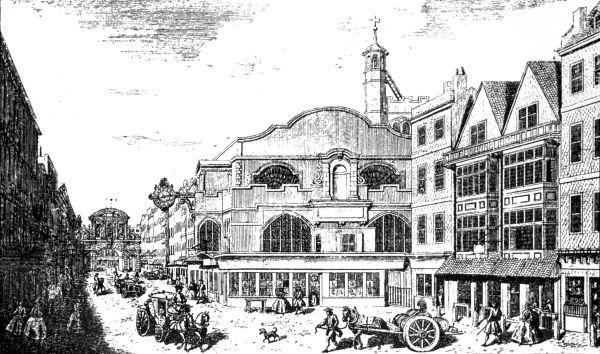
"Dr Johnson" says Boswell at the beginning
of his account of this famous tour
"had for many years given me hopes that we
should go together, and visit the Hebrides."
They had first discussed the project in a coffee-house
in the Strand in 1763, Johnson being especially
eager to see the patriarchal life of the
Highlands—the clansmen living and working and
fighting and dying under the fatherly rule of their
chieftain. Boswell, knowing something of his
friend's love of Fleet Street and of his prejudice
against Scotland, "doubted that it would not be
possible to prevail on Dr Johnson to relinquish
the felicity of a London life."
"To Scotland, however, he ventured," and the
faithful Boswell has left us a careful record of his
adventures and his talk on each of the 100 days
he spent there. This Journal was warmly praised
by Johnson, who read the manuscript, and was
published in the year after his death. Here we
must be content with extracts, first following the
travellers along the east coast of Scotland, where
Johnson found the trees very few:
"On Saturday the fourteenth of August, 1773,
late in the evening, I received a note from him,
that he was arrived at Boyd's inn, at the head of
the Canongate, [Edinburgh]. I went to him directly.
He embraced me cordially; and I exulted
in the thought, that I now had him actually in
Caledonia.... He was to do me the honour to lodge
under my roof...."
"Mr Johnson and I walked arm-in-arm up the
High-street, to my house in James's court: it was
a dusky night: I could not prevent his being assailed
by the evening effluvia of Edinburgh....
Walking the streets ... at night was pretty perilous,
and a good deal odoriferous. The peril is much
abated, by the care which the magistrates have
taken to enforce the city laws against throwing
foul water from the windows; but from the structure
of the houses in the old town, which consist
of many stories, in each of which a different
family lives, and there being no covered sewers,
the odour still continues. A zealous Scotsman
would have wished Mr Johnson to be without
one of his five senses upon this occasion. As we
marched slowly along, he grumbled in my ear, 'I
smell you in the dark.'"
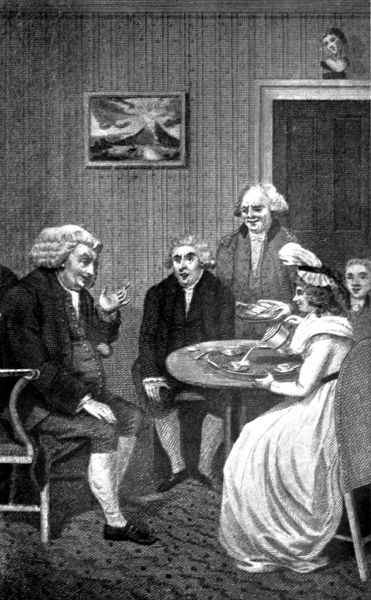
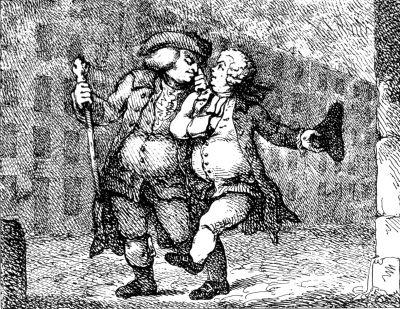 Johnson and Boswell arm-in-arm up the High Street
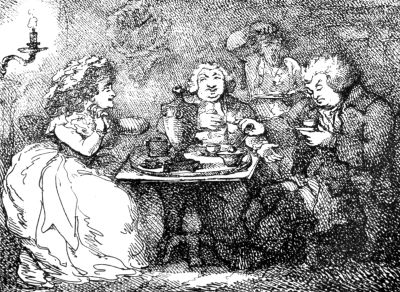 Johnson under Boswell's roof
"Wednesday, August 18.
On this day we set out from Edinburgh.... From
an erroneous apprehension of violence, Dr Johnson
had provided a pair of pistols, some gunpowder,
and a quantity of bullets: but upon being
assured we should run no risk of meeting any robbers,
he left his arms and ammunition in an open
drawer of which he gave my wife the charge....
When we came to Leith, I talked with perhaps
too boasting an air, how pretty the Frith of Forth
looked; as indeed, after the prospect from Constantinople,
of which I have been told, and that
from Naples, which I have seen, I believe the view
of that Frith and its environs, from the Castlehill
of Edinburgh, is the finest prospect in Europe.
'Ay, (said Dr Johnson,) that is the state of the
world. Water is the same every where.'"
Travelling by coach along the coast-road they
visited St Andrews, Dundee, and Montrose and
on Saturday evening reached Aberdeen, where
Johnson was cheered at finding a letter from his
"dear mistress," Mrs Thrale.
"Monday, August 23.
At one o'clock we waited on the magistrates
in the town hall, as they had invited us in order
to present Dr Johnson with the freedom of the
town, which Provost Jopp did with a very good
grace. Dr Johnson was much pleased with this
mark of attention, and received it very politely....
It was striking to hear all of them drinking
'Dr Johnson! Dr Johnson!' in the town-hall of
Aberdeen, and then to see him with his burgess-ticket,
or diploma, in his hat, which he wore as he
walked along the street, according to the usual
custom."
Johnson wrote of the ceremony to Mrs
Thrale:
"I was presented with the freedom of the city,
not in a gold box, but in good Latin. Let me pay
Scotland one just praise; there was no officer
gaping for a fee; this could have been said of no
city on the English side of the Tweed."
"Tuesday, August 24.
We set out about eight in the morning, and
breakfasted at Ellon. The landlady said to me
'Is not this the great Doctor that is going about
through the country?' I said, 'Yes.' 'Ay, (said she)
we heard of him. I made an errand into the room
on purpose to see him. There's something great
in his appearance: it is a pleasure to have such a
man in one's house; a man who does so much
good. If I had thought of it, I would have shewn
him a child of mine, who has had a lump on his
throat for some time.' 'But, (said I,) he is not a
doctor of physick.' 'Is he an oculist?' said the
landlord. 'No, (said I,) he is only a very learned
man.' Landlord. 'They say he is the greatest man
in England, except Lord Mansfield.' Dr Johnson
was highly entertained with this, and I do think
he was pleased too."
After visiting Staines Castle, Banff, Cullen
(where Johnson was disgusted by the appearance
of dried haddocks with the tea at breakfast),
Elgin (where he examined the cathedral
"with a most patient attention" in the rain),
Fores, Nairn, and Calder Castle, the travellers
reached Fort George, having an introduction to
"Mr Ferne, master of stores."
"Saturday, August 28.
Mr Ferne and Major Brewse first carried us to
wait on Sir Eyre Coote, whose regiment, the 37th,
was lying here, and who then commanded the
fort. He asked us to dine with him, which we
agreed to do. Before dinner we examined the fort.
The Major explained the fortification to us, and
Mr Ferne gave us an account of the stores. Dr
Johnson talked of the proportions of charcoal and
saltpetre in making gunpowder, of granulating it,
and of giving it a gloss. He made a very good
figure upon these topicks.... At three the drum
beat for dinner. I, for a little while, fancied myself
a military man, and it pleased me....
We had a dinner of two complete courses,
variety of wines, and the regimental band of
musick playing in the square, before the windows,
after it. I enjoyed this day much. We were
quite easy and cheerful. Dr Johnson said, 'I shall
always remember this fort with gratitude.'"
"Monday, August 30.
We might have taken a chaise to Fort Augustus,
but, had we not hired horses at Inverness,
we should not have found them afterwards: so
we resolved to begin here to ride.... Dr Johnson
rode very well....
When we had advanced a good way by the side
of Lochness, I perceived a little hut, with an old-looking
woman at the door of it. I thought here
might be a scene that would amuse Dr Johnson;
so I mentioned it to him. 'Let's go in' said he....
It was a wretched little hovel of earth only.... In
the middle of the room was a fire of peat, the
smoke going out at a hole in the roof. She had
a pot upon it, with goat's flesh, boiling....
The woman's name was Fraser; so was her husband's.
He was a man of eighty. Mr Fraser of
Balnain allows him to live in this hut, and keep
sixty goats, for taking care of the woods.... They
had five children.... This contented family had
four stacks of barley, twenty-four sheaves in each.
They had a few fowls.... They lived all the spring
without meal, upon milk and curds and whey
alone. What they get for their goats, kids, and
fowls, maintains them during the rest of the
year....
She said she was as happy as any woman in Scotland.
She could hardly speak any English except
a few detached words. Dr Johnson was pleased
at seeing for the first time, such a state of human
life. She asked for snuff. It is her luxury, and she
uses a great deal. We had none; but gave her sixpence
a piece. She then brought out her whiskey
bottle. I tasted it."
"Tuesday, August 31.
Between twelve and one we set out [from Fort
Augustus], and travelled eleven miles, through a
wild country, till we came to a house in Glenmorison,
called Anoch, kept by a M'Queen....
There were two beds in the room, and a woman's
gown was hung on a rope to make a curtain of
separation between them.... We had much hesitation,
whether to undress, or lie down with our
clothes on. I said at last 'I'll plunge in! There
will be less harbour for vermin about me, when
I am stripped!' Dr Johnson said, he was like one
hesitating whether to go into the cold bath. At
last he resolved too....
After we had offered up our private devotions,
and had chatted a little from our beds, Dr Johnson
said 'God bless us both, for Jesus Christ's
sake! Good night!' I pronounced 'Amen.' He
fell asleep immediately. I was not so fortunate for
a long time. I fancied myself bit by innumerable
vermin under the clothes; and that a spider was
travelling from the wainscot to my mouth. At last
I fell into insensibility."
The Island of Skye was reached on September
2, and a few days later came an invitation to
cross to Rasay.
"Wednesday, September 8.
We got into Rasay's carriage, which was a good
strong open boat made in Norway. The wind had
now risen pretty high, and was against us; but
we had four stout rowers, particularly a Macleod,
a robust black-haired fellow, half naked, and bareheaded,
something between a wild Indian and an
English tar. Dr Johnson sat high on the stern,
like a magnificent Triton. Malcolm sung an
Erse song.... The boatmen and Mr M'Queen
chorused, and all went well.... We sailed along
the coast of Scalpa, a rugged island, about four
miles in length. Dr Johnson proposed that he
and I should buy it, and found a good school,
and an episcopal church ... and have a printing-press,
where he would print all the Erse that
could be found.
Here I was strongly struck with our long
projected scheme of visiting the Hebrides being
realized. I called to him, 'We are contending with
seas'; which I think were the words of one of his
letters to me. 'Not much,' said he; and though
the wind made the sea lash considerably upon us,
he was not discomposed. After we were out of
the shelter of Scalpa, and in the sound between
it and Rasay, which extended about a league, the
wind made the sea very rough. I did not like it.
Johnson. 'This now is the Atlantick. If I should
tell at a tea table in London, that I have crossed
the Atlantick in an open boat, how they'd shudder,
and what a fool they'd think me to expose myself
to such danger?' ...
It was past six o'clock when we arrived. Some
excellent brandy was served round immediately,
according to the custom of the Highlands, where
a dram is generally taken every day.... On a sideboard
was placed for us ... a substantial dinner,
and a variety of wines. Then we had coffee and
tea.... Soon afterwards a fidler appeared, and a
little ball began. Rasay himself danced with as
much spirit as any man, and Malcolm bounded
like a roe.... Dr Johnson was so delighted with
this scene that he said, 'I know not how we shall
get away.'"
"Thursday, September 9.
The day was showery; however, Rasay and I
took a walk, and had some cordial conversation....
His family has possessed this island above four
hundred years.... When we returned, Dr Johnson
walked with us to see the old chapel. He was in
fine spirits. He said, 'This is truly the patriarchal
life: this is what we came to find.'"
This reception of Dr Johnson by Macleod of
Rasay may be taken as typical of the hospitality
shewn to him by the Highland chiefs, and the
story of many another jovial evening, for which
there is no space here, must be read in the pages
of Boswell's Journal.
Besides Skye and Rasay, they visited the islands
of Coll, Mull, and Iona; and, on reaching the
mainland, returned to Edinburgh by way of
Oban, Inverary, Dumbarton, Glasgow, and Auchinleck,
the home of Boswell's father.
But before leaving Skye, Johnson had a memorable
interview:
"Sunday, September 12.
I was highly pleased to see Dr Johnson safely
arrived at Kingsburgh, and received by the hospitable
Mr Macdonald....
There was a comfortable parlour with a good
fire, and a dram went round. By and by supper
was served, at which there appeared the lady of
the house, the celebrated Miss Flora Macdonald.
She is a little woman, of a genteel appearance,
and uncommonly mild and well-bred. To see Dr
Samuel Johnson, the great champion of the English
Tories, salute Miss Flora Macdonald in the
isle of Sky, was a striking sight.... Miss Flora
Macdonald ... told me, she heard upon the main
land ... that Mr Boswell was coming to Sky, and
one Mr Johnson, a young English buck, with him.
He was highly entertained with this fancy.... I
slept in the same room with Dr Johnson. Each
had a neat bed, with Tartan curtains, in an upper
chamber."
"Monday, September 13.
The room where we lay was a celebrated one.
Dr Johnson's bed was the very bed in which the
grandson of the unfortunate King James the
Second lay, on one of the nights after the failure of
his rash attempt in 1745-6.... To see Dr Samuel
Johnson lying in that bed, in the Isle of Sky, in
the house of Miss Flora Macdonald, struck me
with such a group of ideas as it is not easy for
words to describe, as they passed through the
mind. He smiled, and said, 'I have had no ambitious
thoughts in it.' The room was decorated
with a great variety of maps and prints. Among
others was Hogarth's print of Wilkes grinning,
with a cap of liberty on a pole by him....
At breakfast he said, he would have given a
good deal rather than not have lain in that bed.
I owned he was the lucky man; and observed,
that without doubt it had been contrived between
Mrs Macdonald and him. She seemed to acquiesce;
adding, 'You know young bucks are
always favourites of the ladies.' He spoke of
Prince Charles being here, and asked Mrs Macdonald,
'Who was with him? We were told,
madam, in England, there was one, Miss Flora
Macdonald with him.' She said 'they were very
right'; and ... very obligingly entertained him
with a recital of the particulars which she herself
knew of that escape....
Dr Johnson listened to her with placid attention,
and said, 'All this should be written down.'"
During his stay in Skye Dr Johnson had a mind
to become a chieftain himself:
"Thursday, September 23.
There is a beautiful little island in the Loch
of Dunvegan, called Isa. M'Leod said, he would
give it to Dr Johnson, on condition of his residing
on it three months in the year; nay one month.
Dr Johnson was highly amused with the fancy.
I have seen him please himself with little things,
even with mere ideas like the present. He talked
a great deal of this island;—how he would build
a house there,—how he would fortify it,—how
he would have cannon,—how he would plant,—how
he would sally out, and take the isle of
Muck;—and then he laughed with uncommon
glee, and could hardly leave off."
On leaving Skye the travellers were driven into
Col by a heavy sea. Boswell gives a full account
of it and does not try to hide the fact that he was
badly frightened. But he endeavoured to compose
his mind and sought for something to distract
his terror: "As I saw them all busy doing something,
I asked Col, with much earnestness, what
I could do. He, with a happy readiness, put into
my hand a rope, which was fixed to the top of one
of the masts, and told me to hold it till he bade
me pull. If I had considered the matter, I might
have seen that this could not be of the least service;
but his object was to keep me out of the
way of those who were busy working the vessel,
and at the same time to divert my fear, by employing
me, and making me think that I was of
use. Thus did I stand firm to my post, while the
wind and rain beat upon me, always expecting a
call to pull my rope....
At last they spied the harbour of Lochiern,
and Col cried, 'Thank God, we are safe!'"
Johnson lay on one of the beds and "having
got free from sickness, was satisfied." This is how
he described the voyage to Mrs Thrale:
"After having been detained by storms many
days at Sky, we left it, as we thought, with a fair
wind; but a violent gust, which Bos had a great
mind to call a tempest, forced us into Col."
Boswell was delighted by his friend's sympathy
with Highland life:
"Sunday, October 17.
Dr Johnson here [at Inchkenneth] shewed so
much of the spirit of a Highlander, that he won
Sir Allan's heart: indeed he has shewn it during
the whole of our Tour. One night, in Col, he
strutted about the room with a broad sword and
target, and made a formidable appearance; and,
another night, I took the liberty to put a large
blue bonnet on his head."
But to be mistaken for a Scotchman was past
a joke:
"Thursday, October 21.
After a very tedious ride ... we arrived, between
seven and eight o'clock, at Moy, the seat of the
Laird of Lochbuy.... Lochbuy proved to be only a
bluff, comely, noisy old gentleman, proud of his
hereditary consequence, and a very hearty and
hospitable landlord. Lady Lochbuy was sister to
Sir Allan M'Lean, but much older.... Being told
that Dr Johnson did not hear well, Lochbuy
bawled out to him, 'Are you of the Johnstons of
Glencro, or of Ardnamurchan?' Dr Johnson gave
him a significant look, but made no answer; and
I told Lochbuy that he was not Johnston, but
Johnson, and that he was an Englishman."
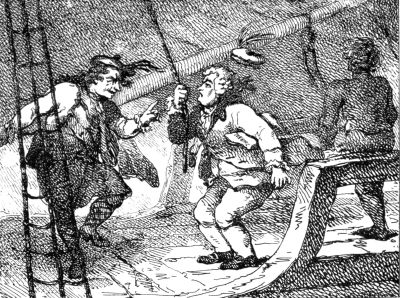 Boswell holding firm to his post
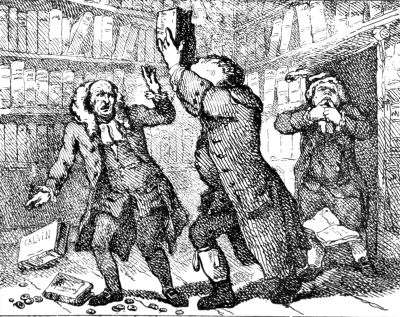 Whiggism terribly buffeted
Both Boswell and Johnson found it comfortable
to be on the mainland again:
"Saturday, October 23.
We got at night to Inverary, where we found
an excellent inn. Even here, Dr Johnson would
not change his wet clothes. The prospect of good
accommodation cheered us much. We supped
well; and after supper, Dr Johnson, whom I had
not seen taste any fermented liquor during all
our travels, called for a gill of whiskey. 'Come,
(said he,) let me know what it is that makes a
Scotchman happy!' He drank it all but a drop,
which I begged leave to pour into my glass, that
I might say we had drunk whisky together. I proposed
Mrs Thrale should be our toast. He would
not have her drunk in whisky, but rather 'some
insular lady'; so we drank one of the ladies
whom we had lately left."
"Thursday, October 28.
On our arrival at the Saracen's Head Inn, at
Glasgow ... Dr Johnson ... enjoyed in imagination
the comforts which we could now command, and
seemed to be in high glee. I remember, he put
a leg up on each side of the grate, and said, with
a mock solemnity, by way of soliloquy, but loud
enough for me to hear it 'Here am I, an English
man, sitting by a coal fire.'"
After being entertained by the university professors
at Glasgow, the travellers arrived in a
few days' time at Auchinleck. Boswell was very
nervous about the meeting between his father and
Dr Johnson. Lord Auchinleck was a Whig and
Presbyterian and commonly referred to Johnson
as 'a Jacobite fellow.' Johnson promised to avoid
awkward subjects of conversation, and all went
well for a time; but politics cropped up at length
and, to Boswell's distress, "Whiggism and Presbyterianism,
Toryism and Episcopacy, were terribly
buffeted."
"Monday, November 8.
Notwithstanding the altercation that had
passed, my father, who had the dignified courtesy
of an old Baron, was very civil to Dr Johnson,
and politely attended him to the post-chaise,
which was to convey us to Edinburgh. Thus they
parted. They are now in another, and a higher,
state of existence: and as they were both worthy
Christian men, I trust they have met in happiness.
But I must observe, in justice to my friend's political
principles, and my own, that they have met
in a place where there is no room for Whiggism...."
"Tuesday, November 9.
... We arrived this night at Edinburgh, after
an absence of eighty-three days. For five weeks
together, of the tempestuous season, there had
been no account received of us. I cannot express
how happy I was on finding myself again at
home."
Johnson stayed at Edinburgh for a fortnight
and then returned to London "without any incommodity,
danger, or weariness."
The expedition to the Hebrides, he said, was
the most pleasant journey he ever made.