The sea voyage out to the Cape was
a new life to Livingstone, and he
made the most of it. With his usual
determination to know all about everything,
he made friends with the ship's
captain, and soon began to learn how to
manage the ship.
The captain taught him how to use a sextant
and chronometer, two most important
instruments, by whose help voyagers can tell
exactly how far they are to the north or
south, to the east or west. To "take an
observation," as it is called, is no easy
matter; but by hard and steady practice
Livingstone in time became able to find out
the ship's exact position and to mark it down
neatly on the chart. And often in after life
the captain's kindly teaching came to his
aid when he lost his way in the wilds, or
when he marked some new discovery on
the map.
In his spare half-hours Livingstone
would enjoy the many delights and wonders
of the southern sea. He watched
the dazzling little flying-fish dart like tiny
rainbows from beneath the bows, glimmer
over the water, and flash into the white
comb of a wave. The dolphins, too, like
clowns of the sea, amused him with their
antics as they leapt and turned somersaults
over the waves or sportively raced, two
or three abreast, close ahead of the
cut-water. Occasionally a monster
sperm-whale would rise to the surface like a
floating islet, spout his double fountain
into the air, and plunge down again into
his home. Sometimes, also, a grim and
wicked-looking shark would prowl about
the ship's wake in the greedy hope of
human prey.
When at last the long voyage was over
and Livingstone landed at Cape Town, he
found more sights and wonders awaiting
him; but he had not been very long
ashore before he also found a very great
disappointment. He had quite supposed
that all missionaries were of course doing
their best to help forward the work
among the natives, and it was an
unpleasant surprise to him when he saw
that, in spite of the noble efforts of many
good men, mission work in South Africa
was almost at a standstill.
From want of more careful planning,
the mission stations were mostly clustered
around the Cape instead of being dotted
about far into the continent, where black
men were much more numerous. This
was a great waste of strength and time,
for hard-working missionaries had not
enough to do, while the idlers could so
easily neglect their duty for the
pleasures and amusements of white society.
Amongst the missionaries there was much
disagreement and petty jealousy over their
work, and many were full of complaint
about trifling matters, while a few, but
only a few, led such unworthy and
contemptible lives that they often brought
the good fame of mission work into bad
report.
Livingstone soon made up his mind that
the only remedy lay in two new plans: first,
to make mission stations far up in the
thickly-peopled native districts and win
over the most powerful chiefs; next, to
make a training college whence native
teachers could afterwards be sent to
educate the many tribes. It was the first of
these plans that decided the course of his
after life, for he now saw that he might do
better service to his cause by pioneering
Central Africa than by settling down in
comfort to preach.
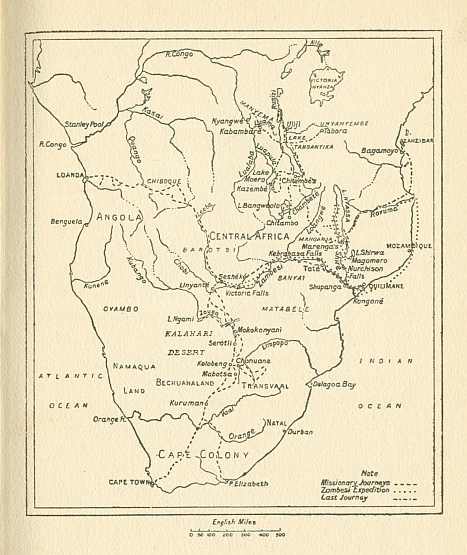
After a short stay at the Cape, Livingstone
was sent into Bechuanaland to Kuruman,
the most northern of all the mission
settlements in South Africa. This station
was worked by a good and capable missionary,
Dr. Moffat, who was then away in
England, and Livingstone had been ordered
to await his return. Livingstone, however,
did not mean to be idle, so he decided to
spend the time in exploring the almost
unknown country to the north of the station.
Accordingly he made a number of journeys
in many directions, travelling about from
tribe to tribe until he had thoroughly learnt
the nature and resources of the country,
and also the language and character of the
natives.
On the first of these journeys Livingstone
had an object-lesson in slavery that set his
noble heart aching for the freedom of Africa.
One day when he had outspanned his oxen
for rest and food, he suddenly noticed that
a young native girl had crept into camp,
and was hiding under his waggon. He
gave her some food, and in answer to his
questions she told him her story. She and
her sister had been left orphans, and they
had lived happily together till the latter
died. Then she was taken by another
family, who kept her, not out of kindness,
but with the cruel intention of selling her
to some chief as a slave wife. On learning
what was in store for her she ran away,
meaning to trudge behind the waggon all
the way to Kuruman, where she had friends.
While thus telling her tale, her face
suddenly fell with fear, and she burst into tears.
Livingstone looked up and saw that a
native, armed with a rifle, had come to
claim the poor child and take her back to
slavery.
Livingstone could not bear the thought
of giving her up, but he was at his wits'
end to know the best way of saving her,
till one of his native teachers, named
Pomari, came to the rescue. The girl was
attractive enough, with her bright eyes,
white teeth, and soft, healthy skin, and her
captors had loaded her in savage fashion
with strings of beads. Pomari stripped the
beads off the girl, and gave them to the
man, who, after a little persuasion, took
the bribe and went his way. Livingstone
took care to keep the girl out of sight till
they were safe out of the district.
Many other adventures befell the
missionary on his travels; for wild animals,
drought, fever, cattle-sickness, and the
deadly tsetse-fly, whose bite kills oxen and
horses in a few hours, always bring risk
and excitement to an African journey. Once,
when he was "trekking" several hundred
miles through Bechuanaland in an ox-waggon,
the fatal cattle-sickness fell like a
plague upon his oxen and killed them all.
There was nothing to be done but to
desert the waggon and tramp home.
Livingstone's native servants were afraid that
their master would never be able to do it.
One of them pointed to his trousers and
said, half in anxiety, half in scorn, that he
was not really strong enough, and only put
his legs into those bags to make them look
stout. Livingstone, however, proved their
fears groundless, and won their respect by
walking them nearly to a standstill.
Once, too, he travelled 400 miles on
ox-back, and found it awkward and uneasy
work to keep his seat and avoid the sweep
of the poor beast's horns as it shook off
the flies that clustered round its eyes and
nostrils. During this journey he fell down
and broke his finger, and set the bone with
his other hand. Not long after, a lion sprang
out of the bush and raided their camp.
Livingstone frightened the animal away by
firing his revolver, but the kick of the weapon
broke his finger anew.
Another time he had to fly for his life
and hide from an angry rhinoceros which
he had disturbed while she was feeding her
calf. Upon missing him, the vicious brute
charged full tilt at his waggon, and with
the deadly upward stroke of her horn (a
stroke which has been known to kill an
elephant), splintered the wheel like matchwood.
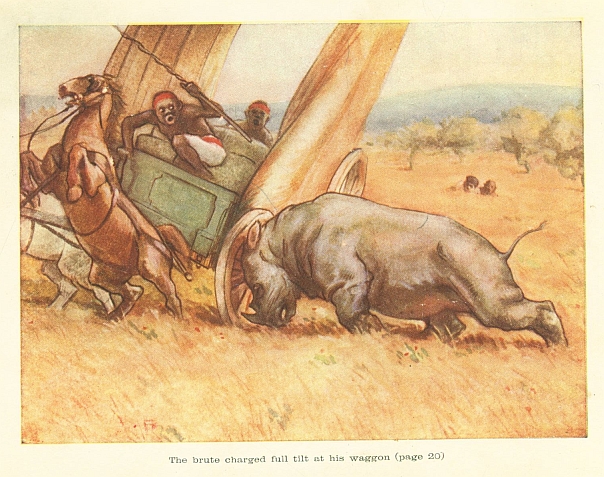
The brute charged full tilt at his waggon
All this while Livingstone was making
friends of the tribes along his track. His
manly fearlessness, his good humour and
keen sympathy, his kindly eyes full of
honesty and truth, soon showed the natives
that there was nothing to fear from him.
His medical skill got him the fame of a
wizard, and black patients from far and near
thronged his waggon to be cured of their
ills, while some spread the report that he
had brought dead men back to life.
Apart from this, he had a most wonderful
gift of finding his way into the hearts
of men; and though the natives could not
understand the reason of his coming, yet
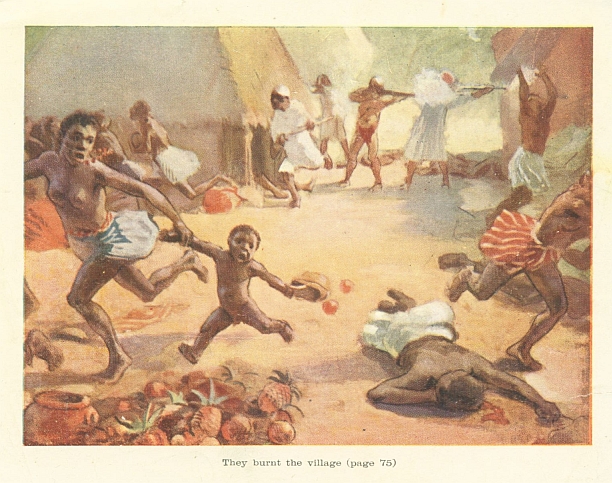
they soon saw that he had not come, like
some of the Transvaal Boers, to shoot
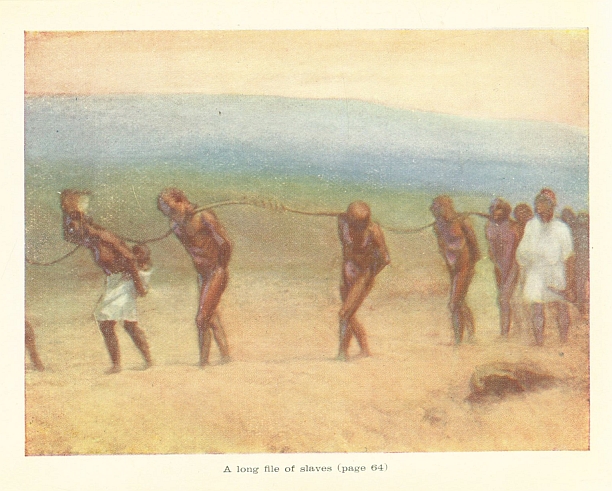
them down, plunder their cattle, and carry
off their children to a life of unpaid labour.
One chief, Bubé, was in difficulty for
want of water for his crops. Every tribe
had a sorcerer, who was supposed to have
the power of bringing down rain when
required; but Bubé's rainmaker had failed
to supply him. Livingstone, however, taught
them a surer way than sorcery, for he
induced the whole tribe to turn out and dig
a ditch from the river to their village, and
by thus saving them from famine he won
their love and respect. Bubé's faith in
witchcraft afterwards cost him his life. His
sorcerer vowed he could take the devil out
of some gunpowder by the use of certain
burning roots. Poor Bubé innocently went
to watch the performance, and both were
blown out of existence.
At last, after long waiting, Livingstone
got leave from the governors to start a
new mission-station, and this he did with
the help of a brother missionary at
Mabotsa, a place 250 miles north of Kuruman.
Here Livingstone had to build a house for
himself at his own expense, and as his
income was only £100 a year, he built it
with his own hands.
His work, however, was delayed by a
misadventure that left him with a weak
arm for all his days. A lion one day fell
upon a flock of sheep near the village and
began to kill them right and left.
Livingstone went out for a little while to
encourage the natives to surround it. The
lion, however, broke away from its
pursuers, and suddenly sprang out of the bush
upon Livingstone: then, pinning him down
with a paw on his head, it began to crunch
the bone of his arm. A faithful follower,
Mebalwé, diverted the beast from his
master, and was himself attacked, but was
saved by the lion falling dead of its
wounds.
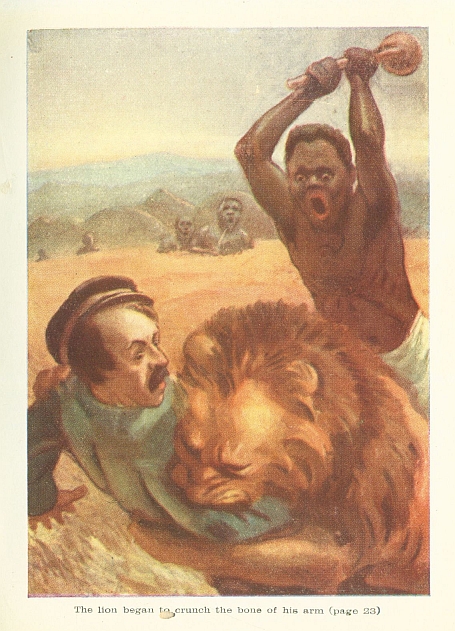
The lion began to crunch the bone of his arm
As soon as his arm was well enough,
Livingstone finished his house, and then he
brought home Mary Moffat from Kuruman
to be his wife. The two were together so
successful in their work that the jealousy
of some of their fellow-missionaries was
aroused, and Livingstone was accused of
taking more than his share of credit so
as to gain the favour of the governors in
London.
Rather than live as a source of envy to
a fellow-worker, Livingstone left Mabotsa,
and went to all the labour and expense of
building a new mission-house at Chonuane,
40 miles farther north, in the country of a
chief called Sechélé. Water, however, was
so scarce at Chonuane that Livingstone
persuaded Sechélé's people to move with him
still farther north, to Kolobeng. Here, for
the third time, he built himself a house,
but he did not dwell there for many years.
His great mind ran continually upon the
welfare of Africa, and he was losing faith
in the missionary methods that were then
practised.
He now believed the best plan would be
for Christian emigrants to come and teach
the natives useful arts and industries, and
to show them by example how to lead
better lives.
But where was he to make his first little
colony? East of Kolobeng lay the
Transvaal, and the Boers, who hated him for
his efforts against slavery, kept sending
him threatening messages. North and west
of him was the dry and trackless Kalahari
Desert. He had heard native rumours
about a large lake beyond the desert.
There he might find a place suitable for
his purpose; but he could not afford to pay
for the waggons, cattle, native servants, and
stores necessary for the journey across the
desert. House-building had already cost
him beyond his means. What was he to do?
The matter was settled for him by
the generosity of an English gentleman,
William Cotton Oswell, who had made
several hunting trips in South Africa after
big game, and had often been helped by
Livingstone's knowledge of the country and
language. Noble, fearless, and unselfish
himself, Oswell had been from the first
drawn into fast friendship with
Livingstone; and now he offered to pay the
cost of the expedition. Livingstone was
overjoyed at his goodness, and on May
27, 1849, the expedition left Kolobeng.
They had with them eighty oxen, twenty
horses, and about twenty-five natives, and
the fact that a waggon and span of oxen
costs about £125 will give some idea of
Oswell's generosity.