‘Monument unique, et qu’il faudrait comparer aux gigantesques
constructions de l’Egypte, aux monstrueuses pagodes de l’Inde pour
lui trouver des analogues.’—Didron.
‘Notre-Dame de Chartres! It is a world to explore, as if one
explored the entire Middle Ages.’—Pater.
THE Cathedral of Chartres is gifted to a peculiar degree with the
quality of impressiveness. This quality it owes to the living unity, the
animated harmony of its members, and also to the sensation of space, not
emptiness, to the impression of massiveness which is yet not heavy,
suggested by the whole, whether viewed from near or afar, and equally by
the parts, such as the west front or the nave.
‘Dependent,’ says Pater, ‘on its structural completeness, or its wealth
of well-preserved ornament, or its unity in variety, perhaps on some
undefinable operation of genius, beyond, but concurrently with, all
these, the Church of Chartres has still the gift of a unique power of
impressing. In comparison, the other famous Churches of France, at
Amiens for instance, at Reims or Beauvais, may seem but formal, and to a
large extent reproducible, effects of mere architectural rule on a
gigantic scale.’
The main body of the Cathedral was completed by 1210, for it is written
in the Latin version (1210) of the Poem of Miracles that one day there
came a shining light which dimmed the candles that were lit, and a
noise as of thunder that drowned the voices of the many faithful praying
in the church, and that a belief sprang up that the Virgin herself had
appeared to honour with her presence the Cathedral built to her
praise.[74]
The north and south porches, which were not part of the original plan,
as is evident from the manner in which they have been applied to the
walls and the buttresses cut away to admit them, would appear to have
been begun in this same year 1210.
But the dedication of the Cathedral was long deferred. It did not take
place till 1260, when S. Louis himself, the devoted benefactor of the
Cathedral, whose personality has filled the north transept, the Rose of
France and the north porch, attended with all his family, and with
multitudes of people from every side, princes and dukes and peasants,
and the bishop, surrounded by his seventy canons, joined in the solemn
dedication of the temple.
By the fire of 1194 the whole of the upper church had been destroyed.
The narthex, with the western porch and its three twelfth-century
windows, alone remained. Beyond the church stood the two towers still,
but their bells and woodwork were all gone, and the masonry was so
charred that traces of the fire may be seen to this day.
Briefly, the steps that were now taken to give us the Cathedral which we
have may be summarised as follows. Four apsidal chapels were added in
the crypt, completing thus the favourite Gothic number of seven; all the
soil of the crypt (except the martyrium) was levelled up to that of
Notre-Dame-de-Sous-Terre; aisles were constructed over the corridors of
the crypt; a vast transept was added; an enormous choir, with double
aisles and apsidal chapels, was erected over new vaulting of the crypt;
the narthex was displaced and made room for two new bays in the nave;
whilst the west porch was moved skilfully westwards, with the same
object, and set in a line flush with the two towers. Traces of this
latter process will be found in the fact that the three doorways, having
existed before the present nave and aisles, do not now correspond with
them, and traces of what was once exterior masonry of the towers may
also be seen inside the present church, between the Chapel of the
Seven Sorrows and that of the Calvary.
At the same time, above the triplet window, in a severe quadrangular
framework, was inserted the splendid Rose window, which is a masterpiece
of masonry, a superb creation, recalling at once to mind the magnificent
circular window of Lincoln, which, however, was a good score years
later, and also—for the thick radii of the circle still suggest the
spokes of a wheel quite as much as the petals of a rose—the rather
earlier Wheel of Barfreston (Kent, 1180). It is 46 feet in diameter, and
has been set, designedly, not in the exact centre of its flat stone
frame, in order to counterbalance the inequality noticeable in the
breadth of the two towers. There, with its double row of sculptured
spokes, which radiate from its centre, it looks, to borrow Mr. Henry
James’s fine phrase, on its lofty field of stone, as expansive and
symbolic as if it were the wheel of Time itself.
Above this window stretch a noble cornice and a simple balustrade which
serve for communication between the two towers, and above this again are
the sixteen niched figures which have earned for this gallery the title
of the Gallery of Kings. Higher still is the gable which terminates the
front, containing in a niche a colossal statue of the Virgin and Child,
and on the apex a statue of Christ in the act of blessing. (Both these
statues were re-made in 1855).
The kings stand upright in their niches; their pose is little varied;
their costumes uniform. M. Viollet-le-Duc suggested that they represent
the Kings of Judah, but there is no reason to doubt the tradition that,
like the royal statues at Wells and Notre-Dame de Paris and the
stained-glass figures at Strasbourg, they really represent the kings of
the country who were benefactors of the church.
The first seven, then, are the figures of Merovingian Kings, the eighth
Pepin-le-Bref, as you may tell by his small stature and the fact that he
is standing upon a lion, in allusion to his courageous feat when, after
challenging the French nobles who despised him for his smallness, he
slew a raging lion single-handed, and then demanded, ‘Do you think me
worthy to rule you now?’ The ninth statue was broken by a cannon-ball in
the siege of 1591. It was Charlemagne or Charles-le-Fauve. The others
are, according to M. Bulteau, Philippe I., Louis le Gros, Louis le
Jeune, Philippe Auguste, Louis le Lion, Louis IX., and Philippe le
Hardi, in whose reign the gallery was finished (1280).
As at Rouen and at Bayeux, it was originally intended that six new
towers, two at each corner of the north and south front, making eight in
all, should be grouped round the soaring spire of a central tower which
was to rest on the four huge piers at the point of intersection of the
transepts of the nave and choir. But they remain incomplete, even as, in
accordance it might be fancied with some inscrutable degree, almost
every Cathedral in the world is unfinished.
Thus at Chartres the Cathedral type, after which, with tentative,
uncertain hand, the twelfth-century architects of Poitiers and Soissons,
Laon and Paris had been striving, was struck out at last. It was to
serve as a model for Central Europe throughout the thirteenth and
fourteenth centuries, just as the sculpture of the western porch was to
be copied at Corbeil and Paris, Sentis, Laon and Sens.
The name of the genius who achieved this glorious success we do not
know, though the names of the builders of Reims, of Rouen and of Amiens
have come down to us. All we do know is, as has been said above, that
there was an active school of architects and sculptors, drawn chiefly
from the monks of the Monasteries of Tiron and S. Père, established at
this time in La Beauce, who worked with humble zeal, anonymous.
But, whatever his name, he succeeded at last, after the efforts and by
aid of the efforts of his so many predecessors, in striking out the
cathedral type, in shaping the mould in which, with various alterations,
modifications, improvements and excesses, all the cathedrals of France
were henceforth to be cast. In striking out the type he was himself
confined by local conditions, and limited by his lack of experience. By
bringing the western façade flush with the western extremities of the
towers he was enabled to increase the length of that nave, which he made
to leap heavenwards with almost the same joyous spring as that of
Amiens, and the length and breadth, and height and strength of that
nave, with its massive piers, its splendid vaulting, and its jewelled
windows casting their purple and crimson rays across its dark roomy
spaces, and the dim distances of the mysterious aisles, render Chartres
‘awful’ in a manner seldom or never elsewhere achieved by Gothic
architect. But the proportion of the nave to the choir, or, again, to
the vast transepts, is not perfect, for the builder was limited by the
existing towers. As a pioneer, too, he was limited by inexperience.
There is, indeed, no effect of heaviness in this nave, for the
massiveness of the work, which is almost equal to that which we call
Norman, is relieved by the stupendous height. And the solemnity, the
overwhelming impressiveness of Chartres are due, it might almost seem,
to that accident of ignorance. For if he had dared, if he had known that
it was possible and safe, can you doubt that the architect would have
added to the soaring spires of Chartres the soaring nave of Amiens? But
what we should have gained in sheer beauty we should have lost in
character. For Amiens is light and joyous; Chartres is mysterious and
sad. Amiens rises as naturally as the sparks fly upward, as ethereal as
the flute-like notes of a treble voice, as careless as a child’s light
laughter. But Chartres it would seem has more sympathy with the sadder,
deeper sides of human life; it is older, stronger, more masculine, and
more wise; combining the stern philosophy of the Pagan Stoic with the
comforting tidings of the Christian martyrs and saints; combining, that
is, as never before or since so harmoniously, the Romanesque and the
Gothic styles, the rounded and the pointed arch, taking the best of
each, and uniting them in a transition that is yet a triumph, in an
attempt that is an eternal monument of success.
The transition of style is to be observed on almost every side. Not,
indeed, so much in the plain round pillars with capitals in imitation of
the Roman composite, and with square abaci, as the eye accustomed only
to English work might assume, for these in France were retained much
later than in England, even throughout the period of Flamboyant. But in
almost every direction you can see the tentative mason at work, leaving
the old heavy style with its horizontal lines behind him, and making new
experiments, discarding or developing fresh ideas which tended to the
achievement of lightness and spring, but as yet hardly daring to believe
to the full in the capacity of stone. Here, for instance, in the nave,
the blind triforium has not broken yet into one continuous window, as it
was soon to do in the Church of S. Père, of S. Ouen at Rouen, and at
Amiens; nor have the heavy masses of stone been resolved into a network
of delicate tracery, leaving not a span uncovered by its gossamer
thread. The desire for lightness, again, which was in time to lead to
the adoption of bar tracery is, in the case of the windows, evident, but
not fully attained. Combined, however, with the rare opportunities
offered to the architect by the excellent quality of the stone of
Berchères, it has led him to invent a very simple and handsome type of
window, which consists of two lancet lights under one arch, with a
foliated circle in the head, the plate tracery of which is peculiarly
heavy, and is cut through the solid stone. Between these circular
openings, which fill a whole bay between the flying buttresses, and the
heads of the lower lights, there is, as at Soissons, Bourges, Reims and
so forth, a considerable interval of masonry. The foliated circles
themselves are surrounded by a number of small trefoil or quatrefoil
openings, not formed of bars, but likewise pierced through the solid
stone.

 FLYING BUTTRESSES
OF THE NAVE.
The buttresses of the nave, again, are amazingly heavy and massive, as
if the workmen were still afraid to trust them to support the thrust of
the vaulting of the roof at so great a height. This is borne by flying
buttresses of enormous solidity, composed of an upper and a lower
section, which are strengthened in turn by an arcade. The arcading is
remarkable for its rugged grace, its masculine beauty. Its round-headed
arches, which are supported by short, thick shafts, that remind one of
the spokes of the wheel window, are composed of two large blocks of hewn
stone.
Compare these flying buttresses with the later and lighter but less
pleasing ones of the choir, or with the almost impudent development of
the use of them in the Abbey Church of S. Père, and, without any doubt,
you perceive in what direction lay the ambition of the transitional
architect.
These buttresses of the nave will be best seen from the galleries of the
roof, with their graceful balustrading, along which you pass, when,
under the guidance of a verger from the Maison-des-Clercs, you make your
ascent of the clochers, starting from a door near the north entrance
and the sacristy. Passing, then, along these galleries, you come to the
Clocher Neuf, with its Flamboyant spire, the work of Jehan de Beauce
(1507-1513); built after the spire of timber and lead, which replaced
the one destroyed in 1194, had been destroyed itself in 1506. It was
raised 4 feet by Claude Augé in 1690, so that the present height of the
Clocher Neuf is 378 feet, that of the Clocher Vieux being 350. Augé, in
the following year, added the enormous bronze vase on the top; the cross
above that was placed in position in 1854. There is a vane in the form
of a sun (Jesus, the Sun of Justice, the Light of the World) upon this
cross, corresponding to the moon on the old spire (Mary, ‘clothed with
the sun, with the moon under her feet.’—Rev. xii.)
The third storey of the Clocher Neuf into which the gallery brings us is
the beginning of the Flamboyant work of Jehan de Beauce. An elegant
balustrade connects the parts of the different date. On the south wall
of the Chambre des Sonneurs, as the third storey is called, is graven
in Gothic, but now scarce legible characters, an inscription in six
quatrains, in which the clocher tells us the history of the disaster of
1506, and the event of its rebuilding by Jehan de Beauce, the skilful
mason, just as the bronze vase above relates in Latin prose the further
history of the spire down to 1690, and the name of the bronze-founder,
Ignace Gabois.
‘Je fus jadis de plomb et boys construit,
Grant, hault et beau, de somptueux ouvraige,
Jusques ad ce que tonnerre et oraige
M’a consumé, dégâté et détruit.
Le jour sainte Anne vers six heures de nuyt
En l’année mil cinq cens et six.
Je fu brulé démoly et recuyt
Et avec moy de grosses cloches six.
Après Messieurs en plain Chappitre assis
Ont ordonné de pierre me reffaire
A grant voultes et pilliers bien massifs
Par Jehan de Beausse, maçon qui le sut faire.
L’An dessu dist après pour l’euvre faire
Assouar firent le vint quatrième jour
Du moys de mars pour le premier affaire
Première pierre et aultres sans ce jour.
Et en avril huitiesme jour exprès
René d’Illiers évesque de regnon
Pardist la vie au lieu duquel après
Feust Erard mis par postulacion.
En ce temps là que avoys nicessité
Avoit des gens qui pour moy lors vieilloient
Du bon du cœur feust yver ou esté,
Dieu le pardont et à ceulx qui s’y emploient.
1508.’
The fourth storey, lit by four large bays, contains two great bells cast
in 1840, Marie (C., 13,228 lbs.) and Joseph, the tenor, who sounds the
Angelus throughout the year.
The fifth storey, pierced on each of its eight sides by a large bay,
contains four large bells of 1845, Anne (D., 2040 kilos.), Elizabeth
(E., 1510 kilos.), Fulbert (F., 1510 kilos.), Piat (G., 870 kilos.). The
first-named bell is always known as Anne of Bretagne. For she, when
visiting the Cathedral in 1510, was so delighted with the voice of one
of the lads singing in the choir that she begged him of the canons, and
when they granted her request she thanked them in these words:
‘Messieurs, you have given me a little voice, and I in return wish to
give you a big one.’ This she did, giving them the bell which has ever
since been called by her name. It was known also by the name of the
Cloche des biens, for at one season of the year it was rung for an
hour every evening to secure an abundant harvest. ‘At the first stroke
of the bell,’ wrote Sablon, in 1697, ‘all the people make the sign of
the cross and recite an Ave Maria for the products of the soil.’
The fifth storey marks the beginning of the spire, and is itself
octagonal. The transition is ingeniously concealed by the
richly-ornamented pinnacles at the four corners, which tie the
balustrade to the tower and support, each of them, three colossal
statues (John the Baptist and the eleven Apostles). Light flying
buttresses, adorned with graceful mouldings and admirable grotesques,
connect the pinnacles with the tower. Over one of the lights is a Christ
in the act of benediction.
The sixth storey, surrounded by a gallery in Flamboyant style, panels of
rich tracery and gargoyles, and pinnacles at the corners of the octagon,
contains the room of the watchmen, whose duty it was every half-hour
during the night to walk round this gallery and give the alarm when they
saw a fire in the town. A Latin inscription records that by the peculiar
grace of God this pyramid was preserved from the effects of a fire
(1674) due to the watchman’s carelessness. This good man, Gendrin by
name, finding that the hours of the night watch hung heavy on his hands,
used to amuse himself by reading. One night the candle fell and set
light to his straw mattress, and thence the flames spread rapidly to the
timber of the room. The wooden belfry was saved from destruction by the
great bravery of a workman named Claude Gauthier. A quotation from
Psalms cxxvii., outside the western door, draws the moral, ‘Except the
Lord keep the city, the watchman waketh but in vain.’ It is signed F.
Foucault. But the significance of the name has died away.
At last, after having mounted 377 steps, we reach the seventh storey,
where hangs the ‘Tocsin’ bell, ‘in accordance with which,’ says an old
writer, ‘all the people of Chartres order and conduct themselves.’[75]
It weighs 5000 kilos., and was cast on the 23rd September, 1520, by
Pierre Sayvet, as the inscription tells us, ‘Petrus Sayvet me fecit.’
Another and longer inscription, in beautiful Gothic characters, runs
round the bell in two lines. The bell, speaking in Latin verses, tells
us that it has been raised ‘to the lofty summit of this mighty building
to announce the eclipses of the sun and the moon.’ And it fixes its date
as 1520, with a reference to the great event of that year, the meeting
of Henry VIII. and François I., near Calais, on the field of the Cloth
of Gold, ‘when the Frenchmen met the English and lay down together in
everlasting goodwill.’
‘Facta ad signandos solis luneque labores
Evehor ad tante culmina celsa domus
Annus erat Christi millesimus adde priori
Quingentos numero bis quoque junge decem
Illo quippe anno quo francus convenit anglum
Perpetuaque simul discubuere fide.’
The arms of the Chapter, the chemisette of Notre-Dame, and the
escutcheon of a dauphin will be noticed at the end of the last line.
You reach the old tower from the new by way of the Gallery of Kings or
by crossing, within, the vaulting of the nave, beneath the copper roof
which has taken the place of the old wooden roof destroyed in the fire
of 1836. The old roof was an immense and elaborate construction of
timber known to the people as The Forest, because, one old chronicler
explains, had the trees of which it was composed still been growing they
would constitute a large forest by themselves; because, says another,
the sight of it recalled to the people the sacred groves of the ancient
Druids, who once performed their rites upon this spot. The magnificent
woodwork of the belfry of the old tower was consumed in the same fire,
and the huge bells that were once its boast—Mary and Gabriel—were
melted down in 1793 to supply the men of reason with bullets.
The great bell of the old tower (Marie) had been re-made in 1723 and
carried the inscription—
‘Marie-Anne je m’appèle
Et trente mille je pèse,
Celui qui bien me pèsera
34,000 trouvera.’
At the foot of the Clocher Neuf is the extremely elegant little
Renaissance clock tower, which was built by Jehan de Beauce in 1520,
when he had completely abandoned the Gothic style and adopted the
classic manner lately introduced by the Italian artists who had followed
Louis XII. and François I. into France. Partisans of pure Gothic may
call it mythological, mannered, mundane, but the more catholic lover of
the beautiful will not dismiss it so contemptuously. From this pavillon
de l’horloge there used to run alongside the nave up to the transept
some fourteenth-century buildings, which were demolished in 1860. They
served as a lodging for the Sœurs-cryptes, who, when the epidemic
known as the Mal des Ardents was scourging France in the eleventh and
twelfth centuries, had charge of the Hôpital des Saints-Lieux-Forts,
organised in the north gallery of the crypt to receive the crowds of
sufferers who flocked to the shrine of Notre-Dame-de-Sous-Terre. The
patients were received and nursed in this hospital for nine days and
then dismissed, healed or not.[76] From the fourteenth century onwards
the plague gradually decreased in intensity, cases became less and less
rare, and the staff of Sisters was finally reduced to one, known as La
Dame des Grottes.
We will leave for the present the exterior of the Cathedral and return
later to the consideration of the north and south porches. For it is
time to enter, by the western portal which we know, the sanctuary of
Notre-Dame. Here, amid the dim shadows of old dreams, the mystic may
indulge his fancy, and here, if anywhere, wandering through this
veritable gallery of Madonnas, in escaping from the feverish passions of
the world, a man may cool his hands awhile in the gray twilight of
Gothic things. More souls, they say, have been healed at Chartres than
bodies at Lourdes. In solitude and silence it is best; but wonderful
also and impressive is the Cathedral when filled with long trains of
pilgrims, whose shuffling feet and murmured prayers echo through the
vast nave and resound from the innumerable chapels. These sounds, these
sights carry us back in a flash of memory to those mediæval days when
Sébastien Rouillard was astonished at the crowds of all nations who
congregated here ‘and slept all night in the church or in the grottoes
for lack of lodgings.’ On the very threshold the sloping floor of the
west end of the nave, so made that it might the more easily be cleansed,
suggests that scene.
Surely the vast nave with its gloomy spaces is filled with the ghosts of
forgotten worshippers, and it thrills with the unheard echoes of
unanswered prayers. It is melancholy with the records of perverted faith
and false enthusiasm, and it is magnificent with the chanted hopes of
the faithful and the undying promises of the Risen Lord. The blood of
martyrs and the blood of infidels cries aloud from those stones which
once resounded with the fiery exhortations of a crusading monk or of a
fanatic preaching the extermination of the Jews and the persecution of
the Huguenots.
Here knights have kept their vigil and watched by their armour on the
eve of a Crusade, and here many a young squire after his night watch by
the altar, clothed in vestments of white linen that symbolised his moral
purity, has been struck on the shoulder with the consecrated sword and
made ‘a knight in the name of the Father, the Son and the Holy Ghost.’
Hither, again, courtier pilgrims have brought with them the perfume of
Paris, and Norman peasants the odour of the fields. Here many a penitent
Magdalen has poured out her soul in contrite supplication. Here, too,
the hand of the sacrilegious destroyer has wrought its vile work, and
yet failed to leave more than a few blots and stains upon the mighty
fabric reared by mediæval faith.
You may close your eyes and imagine that you are present at a Mass of
old days—a Mass of the dead—a silent Mass, at which no sound escapes
from the lips of the praying, and no tinkle comes from the bell that is
vainly shaken. Kings do penance before the sacred altar, knights in
chain armour kneel and take the sign of the cross; noble lords, clad in
velvet and brocade, with plumes in their hats and swords at their sides,
carry in their hands tall canes, with golden knobs, and bow to great
dames with powdered hair, who hide behind their fans lovely faces
powdered, painted, patched. And in the aisles a crowd of youthful
artisans, in brown jerkins, dimity breeches, and hose of blue, stand
beside young women with rosy cheeks and downcast eyes. Elsewhere peasant
women, in their old skirts and laced bodices, sit tranquil, whilst
upright, behind them, their young lovers shift their legs and twist
their hats in their fingers, gazing open-eyed.
They seem to follow with their silent lips the noiseless priests as
they perform that ritual order of Notre-Dame de Chartres, which rejoiced
the Gothic soul of Gaston de Latour; a year-long dramatic action, in
which everyone had and knew his part—the drama or mystery of
redemption, to the necessities of which the great church had shaped
itself. For all those various ‘offices’ which, in pontifical, missal and
breviary, devout imagination had elaborated from age to age with such a
range of spiritual colour and light and shade, with so much poetic tact
in quotation, such a depth of insight into the Christian soul, had been
joined harmoniously together, one office ending only where another
began, in the perpetual worship of this mother of churches. And
Notre-Dame had also its own picturesque peculiarities of ‘use,’ and was
proud of its maternal privilege therein.[77]
You notice the rich tones of the masonry, made richer by the jewelled
lights of those rare windows; you notice in the centre of the nave the
mysterious maze traced upon the pavement, the scene in old times of much
devotional exercise,—la Lieue, it is vulgarly termed, for the miniature
pilgrimages, along the line of white stones, with prayers at stated
intervals, as once at Reims, Amiens, Arras, and Bayeux, earned many
indulgences, and took the place of a journey to Jerusalem. This, with
the exception of that at S. Quentin, is the only remaining instance of a
labyrinth in the French churches. Above you, around you, tower the piers
and vaulting of the nave—
‘Heavy as nightmare, airy light as fern,
Imagination’s very self in stone.
Solemn the lift of high-embowered roof;
Solemn the deepening vault.’
Something of the power of impressing which this Cathedral possesses is
due, one begins to reflect, to the fortunate scarcity of side-chapels,
and the complete absence of the tombs, which fill up the spaces, and
therefore detract from the effect of so many churches. The reason for
this happy freedom from monuments is given by the old writer, Rouillard.
‘This church has the special prerogative of being reputed the chamber or
couch of the Virgin. As a sign thereof the soil of this church has
always hitherto been preserved pure and undefiled, without ever having
been dug or opened for any sepulture.’ But there was one exception. One
military leader was interred there with all honours in 1568, within the
precinct of the high altar itself. Much against their will, the canons
had yielded to the pressure of the King and the Court, and consented at
last to inter in the Choir the body of the Baron of Bourdeilles, the
colonel of the Gascons, who had fallen in the defence of the breach
against the Huguenots (see p. 277). To the sound of tabourins and
fifes the funeral cortège wound its way through the town of mourning
citizens, and the remains of the valiant D’Ardelay were regretfully
lowered into a vault to the left of the high altar, which was not to
prove their last resting-place. Rouillard, who saw the tomb of the
gallant colonel in 1608, adds that many believed then that the body
would not long remain where it was. And, indeed, fifty years afterwards,
the reverend canons, resenting, on the part of their immaculate
Patroness, this intrusion, reported that the corpse itself, ill at ease,
had protested, lifting up its hands above the surface of the pavement,
as if to beg interment elsewhere. This it easily obtained in the
cemetery of S. Jerome.
The nave exceeds in width any in France or Germany. Its width, as also
its length, which is short in comparison with the other parts of the
Cathedral, was determined, as we have seen, by the position of the two
towers. In height it falls short of the naves of Bourges and Amiens, and
of Beauvais, which out-rivalled even its sisters, and fell in the moment
of its mad success. But it is an unprofitable business, this comparison
of cathedrals. One is not less beautiful because another is of larger
dimensions, nor less perfect because another is more uniform. This nave
has its own qualities, which I have feebly endeavoured to suggest,
qualities different from, but not less valuable than the pure beauty of
that of Amiens.
Architecturally speaking, Parker put the matter in a nutshell when he
wrote that the nave of Chartres was ‘nearly as massive as Norman work,
although the effect of heaviness is removed by the enormous height.’[78]
Detached piers and engaged pilasters support the vaulting, which is as
daring as it is strong.
‘The main ribs of the vault spring from, or are rather continuations of
the tall clustered pilasters, which are themselves continuations of the
main piers; and from the points where each of the main ribs rise two
other cross-ribs also spring. These at their points of intersection are
adorned with crown-shaped bosses, for the most part enriched with
carvings of foliage, coloured in part, which have been marred with
colour-wash. Lines, in imitation of ashlar-work, have been painted upon
the vault’ (Massé).[79]
The piers in the nave and transept are alternately cylindrical and
octagonal in section, and have supplementary cylindrical or octagonal
columns; but in the ambulatory of the choir there are several piers
circular in section, with octagonal bases and square plinths, but
without any supplementary columns. Such plain round piers, which in
England are called Norman, are rare in France. Examples of them are,
however, to be found at Laon, Soissons and Paris. The capitals are rich
and varied, and consist chiefly of foliage; those of the piers in the
Chapel of the Seven Sorrows (Clocher Neuf), and, again, those of the
Norman pillars, in the deambulatory of the choir opposite the shrine of
Notre-Dame du Pilier, are remarkably fine. But the most noteworthy of
the piers are the four ‘Toureaus,’ as they are called: the enormous
piers at the intersection of nave and transept, which were intended to
support the central tower and spire, and which rise sheer to the roof,
in an unbroken line, to the height of 120 feet. Their faces are covered
with a quantity of slender columns.
The arcading of the triforium varies in width and character in the nave,
the choir, and the transepts and the apse. The arches of the smaller
bays into which each main bay is divided are pointed. The soffit is
flat, with a round moulding at the inner and the outer edge. The
capitals are richly carved with foliage; the bases are plain and severe.
The clerestory is composed of pairs of tall lancet windows, with a rose
window above them, which fill the whole available space in each bay. Of
the glass we have spoken in the previous chapter.
The Flamboyant period is represented in the Cathedral by the spire of
Jehan de Beauce and the Chapelle Vendôme, next to the south transept.
It was founded in 1413 by Louis de Bourbon, and dedicated to the
Annunciation. It has recently been restored. The style is incongruous
with this massive transitional nave, but serves perhaps to accentuate
the beauty of its masculine grandeur and reserve. The remains of S. Piat
and S. Taurin are preserved here; the one is invoked for fair weather,
the other for rain by the farmers of La Beauce.
The influence of the Renaissance is to be traced in the clock tower
at the foot of the Clocher Neuf, in the later portions of the Clôture
du Chœur and, in its most fatal form, in the alterations that were
made in the eighteenth century within the choir.[80] The Chapter, about
1750, was composed of men with much taste, all of it bad. A terrible
mania for ugliness had seized mankind. Men like Bossuet, Fénelon,
Montesquieu and Racine, enamoured of the classical style, declared the
Gothic barbarous. At that inopportune crisis of taste the Chapter began
to ‘decorate’ the choir. The result is simply nauseating.
The jubé, the beautiful screen which had come down from the century of
S. Louis, required repair. The excuse was welcomed, and it was
destroyed. A few fragments only remain in the Chapel of S. Martin in the
crypt. The pillar upon which the Vierge Noire (Notre-Dame du Pilier) was
then set is said to have been part of the débris of this screen. The
present grille replaced in 1866 the pretentious iron-work of the
eighteenth century.
This achievement of the Chapter seems to have whetted rather than
satisfied their shameless appetite for the hideous. ‘Sans doute,’ wrote
Victor Hugo, ‘C’est encore aujourd’hui un majestueux et sublime édifice
que Notre-Dame de Chartres. Mais si belle qu’elle se soit conservée en
vieillissant, il est difficile de ne pas soupirer, de ne pas s’indigner
devant les dégradations, les mutilations sans nombre que simultanément
le temps et les hommes ont fait subir au vénérable monument.’
Italians were sent for from Milan to wash the grand old stone of
Berchères a sickly yellow; the noble simplicity of the piers, capitals
and soffits of the arches disappeared beneath a mess of stucco, gilding
and sham marble. The choir was treated like an eighteenth century
drawing-room. The old tapestry hangings, five of which are happily
preserved in the Museum, were removed, and in their place eight mediocre
bas-reliefs in glaring white marble were substituted by Bridan, two of
which have been removed to the Bishop’s Palace. The old paving of the
choir, on which S. Louis and a thousand other illustrious pilgrims had
knelt, was also removed, and an utterly unsuitable pavement of black and
white marble laid down in its stead. In order to throw light upon the
atrocious transformation that had been wrought, several of the priceless
thirteenth-century windows were taken out and plain glass substituted.
To such an extent was this done, indeed, that in 1786 we find a canon of
the Cathedral gravely complaining that there was too much light, and
asking for a curtain to be drawn across the window! But the Revolution
surprised these canons seated in their new stalls ere the curtains had
yet been made to hide the results of their pious Paganism. They were
sent to the scaffold, and their church was converted into a Temple of
Reason amid scenes of abominable profanity and vile orgy.
The group of the Assumption was preserved by the presence of mind of an
architect, by name Morin, who placed a red cap of liberty on the
Virgin’s head and a lance in her hand. It might have been more
reasonable to destroy it. For anything more detestably out of place than
this soulless mass of Carrara marble in the old Gothic sanctuary it is
impossible to discover without going to Westminster Abbey. It is the
work of Antoine Bridan, the King’s sculptor, and the Chapter were so
pleased with it that they settled a pension on him and his wife, and
cheerfully destroyed more windows in order to throw more light upon the
monument.
Vandals, alas, are of all time and of all countries. Even the beautiful
Clôture, the great horse-shoe wall
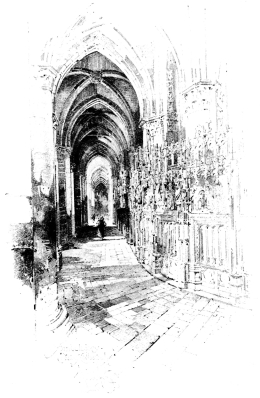
Ambulatory, Chartres Cathedral.
Facing Page 203;
which, chiselled like a silver bowl, encloses the choir, has been and
continues to be horribly defaced and defiled by the ignorant vandalism
of impious idiots and pious pilgrims, whose zeal has eaten them up and
moves them to write or scratch their names upon the walls of this
exquisite though unequal work.
More beautiful than the fourteenth-century screen of Notre-Dame de
Paris, but inferior in unity and nobility of feeling to the Pourtoir
of Amiens, this Clôture, although executed at various periods, is one in
design. The plan of forty groups, representing the principal scenes in
the life of the Virgin and the Gospel story was drawn up by the
Chancellor of the Chapter, Mainterne, at the beginning of the sixteenth
century. The work was begun in 1514 under Jehan de Beauce. It was
continued in 1611 by Boudin. It was finished by various sculptors at the
beginning of the eighteenth century, and the style naturally varies from
late Gothic to Renaissance. The earliest work is the best.
It comprises the first twelve groups in the south ambulatory. These were
wrought by or under the supervision of Jehan Soulas, a Parisian
sculptor, engaged for that purpose by the Chapter (1518). For Jehan de
Beauce, being an architect and not a sculptor, was responsible only for
the framework, and not for the groups of figures. But that framework is
a masterpiece of delicate grace and prolific imagination. A wealth of
ornament, of foliage and arabesques, of mythical personages and
fantastic beasts, covers the base and the innumerable columns about it.
The stone openwork above and the canopies are exquisite in their
lightness and finish. Before he died in 1529 Jehan de Beauce had passed
completely under the influence of the Renaissance. The elegant and
ingenious clock tower, which breaks the series of niches on the south
side of the clôture, with its decorative Titus and Vespasian, and so
forth, gives evidence of this. The elaborate clockwork with which it was
originally provided, and which showed the days, hours, months, time of
sunrise and sunset, and signs of the Zodiac, was destroyed in 1793. The
initial F, with a crown, which appears on the vertical band, refers to
the then reigning François I.
Apart from the infinite variety of other ornamental details in which the
framework is so rich, there are thirty-five medallions on the base. The
first on the south side refers to the Siege of Chartres by Rollo in 911;
the next fifteen to the lives of David, Daniel, Moses, Samson, Abraham
and Jonas; the next twelve to mythological subjects—Labours of
Hercules—and the last seven are heads of Roman emperors.
The pillars of the screen carry statuettes of founders and bishops, of
whom we have already mentioned S. Fulbert and S. Ives at the eastern
extremity. The small doors in their beautiful frames give access to
rooms of which four were once chapels, and two others served for the
night-watchers.
The first group in the south ambulatory represents the angel appearing
to S. Joachim, who is watching his flocks with two shepherds and a dog,
and announcing the birth of the Virgin. This and the three following
groups are certainly the work of Jehan Soulas (1520).
The second group shows S. Anne receiving a similar message from an
invisible angel, to whom she listens with the most intent absorption.
The servant, whose attention has also been arrested, is portrayed with
equally vivid realism. The sculptor was evidently a master of exact
observation. There is something Flemish in his closeness to life. The
third group, where the aged couple meet and embrace before the Golden
Gate, shows a minute and vivid understanding of the gestures of old age,
and the attitude of the servant is admirably suggestive of her naïve,
sympathetic delight. There is something Flemish, again, in the homely
details with which (4) the Birth of the Virgin is portrayed. S. Anne
lies on a curtained couch in the background, attended by a servant,
whilst another prepares to wash the Infant.
The next eight groups owe much to Jehan Soulas, but they cannot be
ascribed with certainty to his chisel. They show (5) the Virgin Mary
ascending the steps of the Temple with S. Joachim and S. Anne, (6) the
Marriage of the Virgin, (7) the Annunciation, (8) the Visitation.
The ninth group, next to the Renaissance clock, is of extraordinary
excellence. It is conceived in a spirit of the most bold and vivid
realism, absolutely justified in the result. Mary is sewing and reading
a book; Joseph asleep (and not his eyes only but his whole body
proclaims profound slumber), learns in a dream the immaculate conception
of the Virgin. Then follow three excellent groups—the Adoration of the
Shepherds and Angels, the Circumcision and the Adoration of the Magi. In
the latter the figure of the Virgin is particularly noteworthy. On the
threshold of the Renaissance the sculptor has suddenly left the
uninspired style of his day and gone back to the mystic ideal charm of
the thirteenth century.
The next two scenes, the Presentation in the Temple (13), and the
Massacre of the Innocents (14), with the Flight into Egypt in the
background, were finished by François Marchand, of Orléans, in 1542,
and, in spite of mutilation and restoration, they reveal the beginnings
of the influence which the Italian Renaissance was to exercise upon
French art. The Baptism of Christ in the Jordan (15), which follows, is
by Nicholas Guybert, who lacked the draughtsmanship and anatomical study
of Marchand, but was inspired with a devotional feeling quite foreign
to the seventeenth-century work of Thomas Boudin, (16, 17, 18) the
Temptation, the Canaanitish woman, the Transfiguration (1612). The Woman
taken in Adultery (19) is the work of Jean de Dieu (1681), and (20) the
Man born Blind, that of Pierre Legros (1683).
The centre of the Tour du Chœur, as it is called, was formerly
filled by an altar, above which were relics of several saints in rich
caskets (SS. Piat, Lubin, Calétric, Tugdualus, etc.); but those have
disappeared, and a fifteenth-century group, representing S. Martin
sharing his cloak with a poor man, has taken its place.
Tuby the younger executed the next two groups in 1703. They represent
(21, 22) the Entry into Jerusalem, whilst the next six are as late as
1714, and are by Simon Arazières. They depict (23) the Agony in the
Garden, (24) the Betrayal, (25) the Trial before Pontius Pilate, (26)
the Scourging of Jesus, (27) the Crown of Thorns, (28) the Crucifixion,
(29) the Virgin gazing at the dead Christ.
Thomas Boudin, again, is responsible for the next four groups
(1611)—(30) the Resurrection, (31) the Holy Women bringing vases of
perfume to the Tomb, (32) Christ and the Disciples of Emmaus, (33)
Christ dispelling the doubts of S. Thomas.
The remaining eight groups are of the same date, and almost of the same
excellence as those by Jehan Soulas at the beginning of the clôture
opposite, and contrast favourably with the cold and Pagan feeling of the
foregoing. They are probably the work of a pupil of that sculptor, and
were made under the supervision, in part, perhaps, with the aid of Jehan
Texier, called De Beauce. An inscription of the plinth beneath explains
the subject of each scene.
(34.) Comment Jésus-Christ ressuscité apparoist à la Vierge Marie.
Christ appearing to the Virgin and S. John.
(35.) Comme Nostre-Seigneur monte ès-cieux. The Virgin and the
Apostles grouped round the stone which bears the imprint of the
Saviour’s feet, look upwards to the sky, where the robe and feet of the
ascending Lord can be seen.
(36.) Comme le S.-Esprit descent sur les apôtres. The tongues of fire
descending on the day of Pentecost on the Virgin and the eight Apostles
round her.
(37.) Comme Nostre-Dame adore la Croix. The Adoration of the Cross by
the Virgin, accompanied by S. John, Mary Magdalen, Mary Salome.
(38.) C’est le trépassement de Nostre-Dame. The Death of the Virgin,
who lies upon a couch, holding a taper, whilst all the Apostles
attend—S. John weeping, S. James the Less taking off his spectacles,
and so forth.
(39.) Le Portement de Nostre-Dame. The Virgin is borne on the
shoulders of eight Apostles to the Tomb in the Valley of Jehoshaphat.
(40.) Le Sépulcre de Nostre-Dame. Four angels raise the body of the
Virgin from the Tomb, whilst Christ descending between two angels
blesses the body, which has half risen from the grave.
(41.) Le couronnement Nostre-Dame. The crowning of the Virgin by the
three Persons of the Trinity is a charming group, worthy to be compared
with the best of the first twelve in the south ambulatory.
In the dim aisle, opposite the groups of the Clôture which we have just
described, is the shrine which draws from every side the greater number
of the visitors to Chartres. Notre-Dame de la belle Verrière is, save
for the devotion of a few aged peasants, a deserted Madonna, and even
the cult of Notre-Dame-de-Sous-Terre or of the Voile de Marie is at the
present time less popular than that of Notre-Dame du Pilier, the
Vierge Noire, black also and comely. The chapel in which this statue
is placed is next to the sacristy, which was built, like the three
gables of the façades, with their turrets, galleries, balustrades and
statues, about the year 1310, under the direction of Jean des Carrières,
‘mason and master of the work of Notre-Dame.’ The Chapel of Notre-Dame
du Pilier is not, properly speaking, a chapel, but part of the
ambulatory of the choir in which the statue of the Vierge Noire du
Pilier or the Vierge aux Miracles is set. A priest from the Œuvre
des clercs is always in attendance; innumerable lamps and candles burn
before the shrine, and countless pilgrims kiss the pillar devoutly and
obtain the forty days’ indulgence granted for that act of faith. ‘The
column,’ said Rouillard (1608), ‘is worn hollow by the kisses of the
faithful.’ The statue dates from the latter part of the fifteenth
century, and was originally placed at the foot of the cross above the
choir screen. When that screen was destroyed in 1763 it was moved near a
pier in the choir, and afterwards, in 1791, banished to the crypt and
its place taken by the statue of Notre-Dame-de-Sous-Terre. It was
established in its present position in 1806, and set upon a column which
is a fragment of the old jubé. Notre-Dame du Pilier was solemnly
crowned, in the name of Pius IX., on May 31, 1855, after a month-long
festival, and amid a scene of extraordinary splendour and jubilation.
Ever since then, on the anniversary of that feast, the statue is borne
in triumphant procession round the church.
I do not think that there is any other detail in the Cathedral over
which it is necessary to linger. For the crypt and the Chapel of S. Piat
have already been described at length. Let us, then, seek the open air
and examine the copper-stained statuary of the northern porch, choosing,
if possible, the late afternoon for our visit, when the cold stone is
warmed by the rose-pink tint of the setting sun. The effect of this
gallery of seven hundred thirteenth century statues of all sizes is
splendid enough as it is, but it must have been greatly enhanced
originally, when, in accordance with the early regulation of the church,
every piece of carving was coloured or gilded. The same perfect harmony
of structure which distinguishes the western and southern porches is
visible in the northern, and the latter is even richer in detail. It was
given by the Royal Family, like the rose window above, and, like the
south porch, it was added after the plan of the Cathedral was more or
less completed. Traces of this fact are evident. Buttresses had to be
cut away to make room for it, and it was soon found necessary to insert
iron ties to hold it to the main building.
There is nothing outside France which can be compared with the splendour
of these porches. And among French churches those of S. Urbain at
Troyes, S. Maclou at Rouen, S. Germain at Paris, and the Cathedral of
Bourges and of Alby rival, but cannot claim to surpass, in harmonious
effect and delicate grace of detail, the open porches of Chartres. The
fact that these porches are opened and advanced, verandah-like, beyond
the line of the building, relieving thereby the severity of it, is
significant. It indicates the change from the primitive architecture of
the church. For the early buildings, the style of which was based on
that of the Roman basilicas, had closed porches beneath which persons of
importance were buried, catechumens were instructed and baptized, and
exorcisms of the devil performed. But in the thirteenth century it
became the practice, as here with regard to the western façade, to build
the entrance flush with the towers, and when later, in the reign of S.
Louis, the fashion of lateral porches was revived, they were no longer
used for sacred purposes as before, but merely as shelters for the
faithful coming into or going out of the church. It was not therefore
any longer necessary to build them entirely covered in.
The architect will study with pleasure the arrangement of the arcading
and the exquisite plinths of the piers which support it. To the artist
the study of the sculpture with which the bays and the piers of the
porch are filled will prove of profound interest. Comparing this
statuary with that of the western front, he will notice a distinct
difference in feeling, a marked advance in style. The overwhelming
influence of the East has disappeared. Classical and Byzantine art have
given place to the original genius of France. Throwing away the debased
classical traditions, the neo-Christian artist has given expression to
the new Christian ideal of character in a type of Germanic origin, with
wavy hair and prominent forehead, which he has observed from the men and
women of his own time and country. He has given expression, that is, to
the ideal of humility and graciousness which has been traced by the
teaching of chivalry, with all its appreciation of physical perfection
and its teaching of noble manners. ‘We have then,’ it has been well
observed, ‘in this new art, evidences of a sudden increase in the
feeling for pure sensuous charm, and at the same time for spiritual
grace.’ A perfect union between sense and spirit has arisen, imparting
to each a rare intensity. In the grace and movement of the drapery (for
the old straight folds have been discarded), and in the simple grandeur
of pose as well as in the qualities of truth and self-restraint, these
sculptors are nearer to the masterpieces of Greek sculpture than perhaps
any before or since. Yet they lack, do they not? something of the
intimate mystic charm of the kings and queens of the Porche Royal. In
the name of Philosophy and the Republic it was proposed (1793) to
destroy them. And this, save for the firm opposition of the deputy,
Sargent-Marceau, would have been done.
Some damage, however, they did succeed in doing. The left bay, for
instance, is sadly mutilated, and the large statue of Philippe-Auguste,
who had provided for the yearly expenses in connection with the work of
the porch, has disappeared from the column of the vestibule on which it
used to be. The statue of his son, Louis VIII., however survives
(central bay). Louis IX., S. Louis, followed the example of his mother,
Blanche of Castile, and, besides founding windows and chapels, he, ‘by
reason of his particular devotion to the Church of Notre-Dame, and for
the saving of his soul and the souls of his forefathers,’ to quote the
words of a charter of the year 1259, caused the north porch to be
completed. His statue is to be seen on the pier of the central bay.
The north porch, which was always in the Middle Ages dedicated to the
Virgin, is peopled by 705 statues, who are the characters of a vast poem
in stone. The subject of this poem is the ‘Glorification of Mary.’ ‘It
recounts,’ says M. Bulteau, ‘the carnal and spiritual genealogy of the
Virgin, her prerogatives, her acquaintances, her virtues, her
occupations, her life, death, assumption and crowning in heaven.’ Then
come the personages and the biblical scenes which have foreshadowed the
Messiah and His Mother; S. John the Baptist and S. Peter, who
inaugurated the Christian era; and to connect this vast whole with the
Church of Chartres, S. Potentian, S. Modesta and the donors of the
porch, S. Louis at their head. The Creation, the Earth, the Sea and the
Heavens, Time also, and its seasons, assist at this glorification of
the Mother of God, and appear to render her respectful homage.
We have had occasion to notice before (p. 27) the prominent position
which S. Anne is allotted in the iconography of this Cathedral, and we
have explained that the reason is that Chartres possessed a precious
relic of that saint. For, after the sack of Constantinople in 1204, the
Emperor Baldwin sent the head of S. Anne, the Virgin’s mother, to
Chartres, ‘in order that the head of the mother might rest in the house
of the daughter.’ Departing, therefore, from the almost invariable
custom by which the Virgin is represented on the pier between the two
sections of the central door, the sculptors have here given us a
colossal statue of S. Anne carrying the little Mary in her arms. Beneath
her feet are the remains of a group in which S. Joachim, feeding his
sheep, was depicted receiving from the angel Gabriel the announcement of
the future birth of Mary.
Ranged on either side of this central doorway are ten large statues,
beneath canopies and wearing haloes. They are the personages of the Old
Testament who have prefigured the birth of Jesus Christ, His passion,
His death, His resurrection and His eternal priesthood. They emphasise
once more the parallelism of the Old Testament and the New; the New
hidden in the Old; the Old made manifest in the New. The same thought is
symbolised by the figurative image of the Son which the five statues on
the left carry, and the effigy of our Lord which is borne by those on
the right. For thereby the prophecy and its accomplishment is
symbolised. The cathedrals of Paris, Amiens, Rouen, Sens, Bourges,
Senlis and Reims, and all the great cathedrals of the thirteenth
century, in fact, show the same persons surrounding the Virgin.
And at Reims several of the statues would seem to be from the same
chisel as those at Chartres. The characters represented are Melchizedek,
Abraham, Moses, Samuel and David on the left, and on the right, Isaiah,
Jeremiah, Simeon, S. John the Baptist and S. Peter. S. John is
introduced as the link between the old and the new, the prophecy and its
fulfilment. He stands close to S. Peter, for he was the immediate
precursor of Christ and S. Peter, shown here in the garb of a thirteenth
century Pope, the immediate successor.
Melchizedek is the first and one of the best statues. He wears a
priestly garment bound at the waist by a knotted girdle, and on his head
a Papal tiara of the thirteenth century, the lower part suggestive of a
crown, for both as king and priest he prefigures Christ.
In one hand he holds a censer, in the other the bread which he offered
to Abraham. His grave features and absorbed mysterious gaze admirably
shadow forth that most enigmatic personage, Melchizedek, King of Salem,
the Priest of the Most High God, who met Abraham returning after the
slaughter of the kings, and blessed him, to whom also Abraham gave
tithes; Melchizedek, the King of Righteousness as his name implies, and
the King of Peace also, without father, without mother, without descent,
having neither beginning of days nor end of life, who was the forerunner
and prototype of Jesus ‘made an high priest for ever after the order of
Melchizedek.’
Christ, as the Son offered by the Father and the sacrificial Ram, is
prefigured in the neighbouring statue of Abraham with his son Isaac,
whom he holds ready bound for the sacrifice. Beneath his feet is the ram
caught in the bush. His face, which, with its flowing beard and
prolonged nose, is distinctly of the Jewish type, is averted, for he is
looking up at the angel who bade him stay his hand. Moses, trampling on
the golden calf and carrying in his left hand the table of the law and
a column about which the brazen serpent entwines, stands next to
Abraham, and likewise symbolises Christ, the Deliverer and the
Law-Giver. His right hand points to the serpent and suggests the words
of our Lord himself, ‘Even as Moses lifted up the serpent in the
wilderness even so must the Son of Man be lifted up, that whosoever
believeth in Him should not perish but have eternal life.’ Next comes
Samuel, clad in a garment which resembles the taled of the Jews,
preparing to sacrifice and to anoint Saul, who is represented by the
small kneeling figure beneath. This statue illustrates 1 Samuel ix.
Lastly David, crowned in royal majesty, carries the lance and crown of
thorns, instruments of that passion which he had so minutely prophesied
in the Psalms. The lion at the base alludes to David’s answer to Saul
when he beheld Goliath, or else is the ramping and roaring lion of the
Messianic psalms. Equally with David, Isaiah foretold in detail the
events of the Gospels, and he, clad, like most of the other personages
that remain, in a long robe and mantle, occupies the niche of the right
bay facing David. The stem which was to come forth from Jesse rises at
his feet, and the prophet points to the flower which should grow from
that root.
Jeremiah is at his side, the sublime chanter of lamentations, bearing a
beautifully-wrought Greek cross and recalling to mind his own words, ‘Is
it nothing to you all ye who pass by? behold and see if there be any
sorrow like unto my sorrow.’
Next to him the aged Simeon caresses the young Christ whose sufferings
he had foreseen.
S. John the Baptist, the prince of monks, is the link between these
forerunners of Christ and His Apostles. His ascetic figure is revealed
beneath his rough raiment of skins, for, in accordance to the usual
practice of the Middle Ages, but not of former or more recent times, he
is represented in the Apostolic costume of tunic and mantle, and as with
the Apostles his feet are bare. He tramples under foot a dragon which
typifies Vice, not a locust as some suppose. The extraordinary
tenderness with which he clasps to his breast the lamb, which is Jesus,
the lively expression of his worn and wrinkled countenance and his
emaciated body, proclaim this to be one of the finest statues of the
Cathedral porches. Lastly comes S. Peter, as we have described him
above. He stands upon a rock in reference to the words of our Lord,
‘Thou art Peter, and on this rock will I build My Church.’
All the details, the costumes and ornaments of these statues are wrought
with extraordinary skill and minuteness, so that, like that of the
western porch, the work might almost seem that of a jeweller, not a
mason.
To the right of Melchizedek and to the left of S. Peter are two large
figures which are related to the scheme of the central doorway. For they
are Elijah and Elisha, who were the types of the ascension and the
resurrection of Jesus Christ. Elijah is shown mounting to heaven in his
chariot of fire; Elisha, promising to the Shunamite the son whom he
afterwards raised from the dead.
In the tympanum of the doorway we have the Death, the Resurrection and
the Crowning of the Blessed Mary, a subject which has received its most
perfect treatment at Reims. It will be noticed that the Virgin is
represented as quite young, for, as Michelangelo finely explained, when
he had painted his Lady of the Seven Sorrows, virtue confers an eternal
youth. Above are angels censing. The figures have been sadly mutilated.
In the splay of the vaulting the first row contains a multitude of
angels with halos, bearing censers, torches, books and palms, witnesses
of the triumph of the Virgin. The next four rows exhibit the ancestors
of Mary according to the flesh and according to the spirit—the
prophets, that is, who announced her. Together they form a tree of Jesse
growing from between the feet of Jesse below on the left. Compare it
with the tree in the twelfth-century Jesse window of the Porte Royale
and you will see that, though it follows the same order, the stone tree
is even more complete. It includes the greater and minor prophets, with
Judith, Esther and Deborah, and, beginning from the fourth row, the
twenty-eight ancestors of the Virgin, mostly as described in the first
chapter of the Gospel of S. Matthew. The last two rows translate into
stone the first chapter of Genesis, giving the story of the Creation of
the World and of Adam and Eve in the Garden of Eden in a series of
admirable tableaux which explain themselves sufficiently. In the gable
is Christ surrounded by angels.
Large statues of benefactors of the Cathedral and of the prophets
Jephthah and Zachariah adorn the piers in front. The first two on the
left are Philippe Hurepel, Count of Boulogne, and his wife Mahaut. The
statue of the latter is particularly beautiful, the expression full of
life and grace, the costume of striking simplicity. Next to these two
there used to be, before the Revolution, statues of Philippe-Auguste,
King of France, and Richard Cœur-de-Lion, rivals in the field but
united here in their generous devotion to Notre-Dame de Chartres. The
decoration of the plinths of these two piers is different from that of
the others; it is Anglo-Norman in character, and the name RŌBIR cut
hereon is probably that of the Norman sculptor who made them under the
patronage of Richard in Normandy.
The brackets of these four statues are storied with incidents from the
life of David—(1) a group representing the young shepherd being
anointed by Saul, (2) David chasing away the melancholy of Saul, (3)
David armed before Saul, (4) David and Goliath, (5) David triumphing
over Goliath. The armour of Goliath is extremely curious.
On the right is a prophet in the Jewish Schimla, who may be Jephthah or
perhaps Ezekiel, and next to him Louis VIII. and Isabella, his daughter,
pious Sister of S. Louis. She is habited as a nun, for she founded the
Convent of Longchamps, and died there, its abbess.
Zachariah, father of S. John the Baptist, comes next, and on the
brackets beneath are six exquisite scenes from the life of Samuel. The
prophet is shown with Hannah and Elkanah taking a lamb to Eli, serving
in the Temple, beholding a vision. The remaining scenes are those of the
capture of the Ark by the Philistines, the fall of Dagon, and the return
of the Ark.
The second part of the north porch is the left bay, and it is
consecrated to the life and virtues of the Virgin. On the splays of the
porch wall are represented on either side the Annunciation and the
Visitation, whilst on the left is Isaiah, the prophet of the
Incarnation, on the right Daniel. The heads of Isaiah and Gabriel are
broken, and indeed most of this bay is in a deplorable state. Of the
surviving figures those of Mary, of Elizabeth and Daniel are rightly
considered masterpieces. They are beautiful in pose, and their draperies
are skilfully arranged, distinctly Greek in feeling. About them there
seems to blow the wind that comes before the dawn of the Renaissance.
The tympanum is filled with the familiar scenes of the first
Christmastide, the birth of Christ, the Announcement to the Shepherds,
the Adoration of the three Magi, traditionally named Gaspar, Melchior
and Balthasar, and their gifts of gold for the King, incense for the
God, and myrrh for the Man who should die for men. Lastly comes the
scene of their warning in a dream. These scenes are lit by a row of
torch-bearing angels. The second and part of the third row of the
vaulting contains the ten virgins of the parable, on the left the five
foolish, with elegant garments and worldly, licentious faces, and lamps
turned upside down; the five wise on the right, modest and veiled, hold
their flaming lamps upright. The rest of the third row represents the
battle of the Vices and the Virtues; Wisdom carrying an open book, and
at her feet Folly nude and eating a stone; Justice with her sword and a
balance, which the Injustice whom she tramples on vainly endeavours to
disturb; Christian Strength in full armour, with Cowardice, a
terror-stricken soldier, grovelling before her; Temperance caressing a
dove, and at her feet Luxury, the abandoned courtesan. On the right
hand, after these cardinal virtues, are the three theological virtues,
Faith, Hope and Charity, and also Humility, with their corresponding
vices. Faith catches in a chalice the blood of a lamb upon the altar,
whilst Infidelity, with bandaged eyes, cowers below; the hands of Hope
are clasped and she gazes heavenward, but Despair lies at her feet and
has plunged a sword into her breast; Charity gives her garment to clothe
the naked, but Avarice plays with pieces of gold and hides them about
her person; Humility holds in her hand a dove, which is her symbol, and
at her feet Pride has fallen. These Virtues and Vices are succeeded by a
row of twelve queenly figures, which symbolise the Fruits of the Spirit.
They are a translation of the passage in Galatians (v. 22) in which S.
Paul enumerates them.
More remarkable still and more charming are the statuettes which fill
the fifth row and which translate the doctrine of the mediæval
theologians with regard to the active life and the contemplative life.
These, according to S. Gregory, were typified by the two wives of
Jacob, Leah and Rachel,[81] and again by Martha and Mary. Here, on the
left, the active life is portrayed with extraordinary vividness and
delicacy in the character of the virtuous woman described in the last
chapter of the Book of Proverbs. ‘She seeketh wool and flax and worketh
willingly with her hands ... she layeth her hands to the spindle and her
hands hold the distaff.’ The six degrees of the contemplative life are
shown on the right-hand side in the form of a veiled woman praying
before reading, opening her book to read, reading in her book of hours,
closing it immediately, comprehending the lesson she has learnt, and
thereafter rapt in ecstasy.
At the ends of the moulding of the vaulting are two statuettes which
seem to be connected with the subject of the active and the
contemplative life; they are, a cobbler cutting leather and a monk
reading.
In the last and outermost row were sculptured, for the first and only
time, the fourteen Heavenly Beatitudes first described by S. Anselm, ‘In
heaven the bodies of the just shall enjoy the seven beatitudes, which
are Beauty, Swiftness, Strength, Liberty, Health, Pleasure, Longevity;
and likewise the souls of the just shall receive the seven beatitudes,
which are Wisdom, Friendship, Concord, Honour, Power, Security and Joy.’
Two statues personifying the Synagogue and the Church were in front of
this bay till 1793, and on the pedestals of these and the two other
statues which were on these piers, but of which one only, that of
Philippe III. le Hardi, remains, traces of a series of Virtues trampling
the Vices underfoot are still visible.
On the wall of the right-hand bay, which is devoted to the persons of
the Old Testament who prefigured and foretold the Messiah and His
Mother, are six splendid statues representing Balaam, the Queen of Sheba
and Solomon on the left, and, on the right, Jesus, son of Sirach, Judith
and Joseph. Each of these statues and the figures on which they rest
demand careful study, but especially the statue of Joseph, the precursor
of Christ in his persecution, his selling into captivity, and his
deliverance of the people. A beardless figure with curling hair and a
simple, open countenance, with Pharaoh’s ring upon his finger and the
sceptre of authority in his hand, and about him a robe of fine linen, he
treads underfoot the bronzed dragon who is pouring into the eager ear of
Potiphar’s wife his foul suggestions. With extraordinary delicacy and
reserve the artist has succeeded in making every line of this
portrait—for a portrait it must be—express all the innocence and
charm, all the passionate purity of youth.
In the tympanum, over the door, is, first, Job on his hearth, with a
demon, for the trials and patience of Job foreshadowed the agony and
triumph of Christ, and, second, the Judgment of Solomon, the prototype
of Him who is called the Sun of Justice. The vaulting above contains
twelve angels doing homage to Christ, then, on the left, the story of
Samson, the story of Esther, and, on the right, the story of Gideon and
that of Judith. The fourth row tells the story of Tobias, and on the
outer edge are the twelve months of the year with the corresponding
signs of the Zodiac and the allegorical representations of summer and
winter, which should be compared with those of the western porch (see
p. 130).
Four large statues on the arcade outside this bay represent Ferdinand,
King of Castile, a great benefactor of the Cathedral, who was canonised
1671, two hundred years after his death, and whose body is
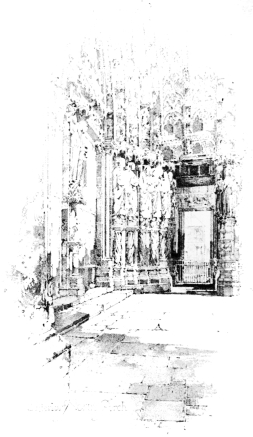
Interior North Porch.
Facing Page 221.
preserved at Seville. He is accompanied by a Judge of Israel, Barak, M.
Bulteau suggests. On the right pier Tobias accompanies S. Louis. The
beautiful and appropriate portrait of that devoted patron of Notre-Dame
was fashioned in all probability shortly after the pilgrimage which he
made to Chartres in 1260, walking, in spite of extreme fatigue, barefoot
all the way from Nogent-le-Roi. He is represented, it will be noticed,
with bare feet here, either in allusion to this pilgrimage, or to his
annual practice of visiting barefoot, and in penitential garb, all the
churches of any town in which he might be on Good Friday. But there is
another incident in his life to which reference may be intended. In 1239
he and his brother Robert carried barefoot into Paris the instruments of
the Passion which he had redeemed from Venice.
On the graceful supports of these four statues are allegorical
representations of the arts and sciences: Agriculture, personified by
Adam, Abel and Cain; Music, by Jubal, with his lyre; Metalwork, by
Tubal-Cain; Medicine, by Hippocrates; Geometry and Architecture, by
Archimedes; Painting, by Apelles; Philosophy, by Aristotle; Magic, by a
wizard and a dragon. These, it will be seen, unlike those of the western
porch, are not merely representations of the seven liberal arts taught
since the sixth century. The artist of S. Louis’s day is breaking away
from the old tradition. He invents new types; he is looking for a new
system. Lastly, on the western side of the porch, are two very beautiful
statues, the one of S. Potentian, the other of S. Modesta (see p. 18).
Below the former is a scene in which he, together with SS. Altin and
Eodald are baptizing a neophyte, and another in which the Roman
Governor, Quirinus, in spite of the intercession of his daughter
Modesta, condemns him to be cast into chains. Below the graceful and
impressive figure of Modesta are several bas-reliefs of incidents in
her life. They are much worn and mutilated, but you can discern an angel
rising from the Well of the Martyrs, the martyrdom of Modesta, and a
pair of angels carrying her soul up to heaven.
We will now walk round to the south side of the Cathedral, turning, as
it were, the last leaf of the Bible of Chartres. And, indeed, the south
porch[82] may well be regarded as a postscript to the story of the
windows and the porches; not only because it is later in date—it was
begun under Philippe-Auguste, at the expense of Pierre Mauclerc, Count
of Dreux, and only finished in the reign of Philippe le Bel—but also
because the subject of it is a variant of that of the Porte Royale. It
is the Glorification of our Lord again, but here in His office as
Supreme Judge and in the presence of His saints and elect.
Like the northern one, the south porch is evidently an afterthought,
and, like it, it consists of three open porticoes, corresponding to the
doors of the transept, and supported in front by six piers, which are
treated with amazing originality and skill. Enormous lintels of
Berchères stone connect the vestibule with the doorway. These have had
to be strengthened, as on the other side, by iron ties. Though only a
couple of yards or so broader than the north porch, the south porch,
thanks to the open space in which it stands, and to its advantageous
position on top of seventeen steps, appears much larger and more
imposing. The bays and the vestibule are peopled by 783 figures, in
which the visitor will note the advance in art made by the sculptors
since they took in hand the statuary of the western and, again, of the
northern porch. The anatomy of these figures and the treatment of their
drapery are infinitely more correct; the pose is more probable, the
work more polished, the whole undoubtedly much more beautiful according
to all the canons of classical art. But quite as undoubtedly there has
been a loss of charm as well as a gain in the technique. The figures, if
they are less crude, are also less expressive. The superb Christ of the
central bay, classic in its calm and regularity, is not so convincing,
so unforgettable as the Christ surrounded by the winged beasts of the
western façade. Even the magnificent effigies of S. Theodore and S.
George have not the same haunting loveliness as the earlier nameless
kings and queens, which are ill-drawn, and unknown indeed, but alive for
ever in their human simplicity.
The majestic statue of Christ, trampling under foot a lion and dragon,
which I have mentioned, is on the face of the central bay, and holds the
place of honour as the Master in the midst of His Apostles. On His right
is the bay of the martyrs, whose strength He is, and He is the Light of
the confessors in the bay on His left. His divine kingship is suggested
by the representation of Him in the upper part of the central bay,
judging the living and the dead.
Beneath the central statue are the figures of Pierre Mauclerc, Count of
Dreux, and Alice, his wife, who spent some 10,000,000 francs upon this
porch and the rose window above. They are represented in two scenes,
praying and being married, but in both giving bread to the poor.
The Christ is surrounded by His Apostles. On His right, S. Peter, with a
cross and two keys, tramples under foot Simon the magician. Next to S.
Peter comes S. Andrew, his brother, clasping the cross of his martyrdom
to his breast, and, beneath his feet, the proconsul who condemned him to
death; S. Philip, with a sword, and, beneath, the King of Hierapolis,
who crucified him; S. Thomas, with the sword of his martyrdom, standing
upon the Indian King who gave him to the priests to be cut in twain; and
similarly with swords, and trampling on their persecutors, S. Matthew
and S. Simon. Opposite are S. Paul and the beardless John, the former
holding and pointing to the sword of his martyrdom, and trampling down
Nero, the latter with the (broken) palm of his martyrdom and the book of
his Gospel, and, beneath him, Aristodemus, priest of Diana, offering to
him a vase of poisonous snakes; S. James, the brother of John, comes
next, and, below him, is Herod Agrippa, who put him to the sword; then
S. James the Less, and the Jew who slew him with a club, S. Bartholomew
and S. Jude and their persecutors beneath. All these statues are of
great beauty and in the grand manner, varied in pose and movement, and
correct in design.
Above them, in the tympanum of the bay, is Christ enthroned as the
Judge, on the great and dreadful day of the Lord, the Virgin and S. John
on either side of Him intercede for sinners, and around Him six angels
bear the instruments of the Passion. Below are two scenes—S. Michael
weighing a soul, and the separation of the just from the unjust. On the
right of the archangel is the glorious army of the elect, clad in long
robes, and wearing an expression of serene happiness. They are being led
by guardian angels to the abodes of everlasting joy. On the continuation
of the lintel are several types of the elect being led to Abraham’s
bosom. On the left of S. Michael is a lively picture of the fate of the
wicked, the condemned of every class are being dragged by horrible
demons to the mouth of hell, a dragon with flaming jaws, and on the
continuation of the lintel also various types of sinners are meeting
with a like fate.
On either side of the central figure of Christ the second row represents
the Resurrection of the Dead, and, above this, are nine choirs of
angels, then twenty-eight pairs of statuettes, representing the prophets
of the Old Testament; and, lastly, fourteen admirable figures of
Christian virgins who have fought the good fight of chastity, and carry
in their hands, as symbols of their purity, fleurs-de-lis.
The Virgin Mother, holding the child Jesus on her knees, sits enthroned
in a niche of the gable, whilst two archangels cense. The square pillars
continue the main thesis, and carry on one side the twenty-four elders
of the Apocalypse and their instruments of music, and, on the other
side, the twelve Vices and twelve corresponding Virtues, in accordance
with which the Last Judgment is decided. Here, then, we have once more,
as on the north porch, Faith and her cross opposed to Idolatry and her
idol, Hope to Despair, Charity to Avarice; Chastity, with her curious
symbol, the Phœnix, confronts Luxury, Prudence, Folly, Humility,
Pride. These appear on the western and southern sides of the left
pillar; the series is continued on the one opposite. Docility, with an
ox, faces, on the south side, Intractability, Mildness, Anger, Strength,
Cowardice; and, on the east face, Perseverance, Inconstancy, Temperance
with a camel, Drunkenness, Concord, Discord.
The left or western bay is entirely concerned with the noble army of
martyrs, of whom the eight most honoured at Chartres, resting on storied
bases, and beneath rich canopies of the kind called heavenly Jerusalem,
adorn the walls. They are, on the left, S. Laurence, S. Clement, S.
Stephen, and S. Theodore. The latter is clad in a coat of mail, of the
time of S. Louis and the Crusaders. The statue is beautifully modelled
and splendidly wrought, and forms a noble counterpart to the
magnificent portrait of S. George opposite, who, likewise accoutred for
battle, is trampling on the wheel of his martyrdom. The other martyrs on
the right-hand wall are S. Vincent, S. Denis, and the S. Piat of whom we
have spoken above (p. 44), and the outside of whose chapel, with the
beautiful staircase connecting it with the main body of the Cathedral,
we can see beyond the apse on our right.
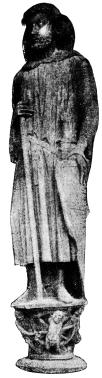 S. GEORGE
(From the South Porch)
The story of S. Stephen is retold in the tympanum and the first row of
the vaulting; in the next five rows are twenty-eight statuettes,
representing the hierarchy of martyrs; in the sixth, the parable of the
wise and foolish virgins reappears, and in the gable is S. Anne seated,
holding a vase, in which is a lily, the symbol of purity.
The square pillar on the left hand, which helps to support the vaulting,
gives us twenty-four scenes from the Golden Legend of the deaths of
martyrs. On the east face, at the top, is S. Thomas of Canterbury, whose
secretary and friend, John of Salisbury, one of the most attractive
characters and typical minds of the Middle Ages, was Bishop of Chartres
the last three years of his life. Among the other martyrs are several
whose names occur in the story of Chartres—S. Blaise, S. Leger, S.
Vincent, S. Laurence, S. Chéron; on the south face, S. John the Baptist,
S. Denys of Athens, S. Saturnin, S. Piat, S. Procopius, S. Symphorian;
on the west face, S. Calixtus, S. Cyprian, S. Ignatius, S. Theodore, S.
Eustace, S. Gervais and S. Protais; on the north, S. Clement, S.
Potentian, S. Lambert, S. Vitus and S. Modesta, S. Bacchus and S.
Quentin.
The right-hand bay is devoted to the confessors, and corresponds in
arrangement to that of the one we have just left. Eight large statues
fill the walls; on the west, S. Nicholas, S. Ambrose, S. Léon and S.
Laumer (the latter a fourteenth-century insertion); and on the right or
east, S. Martin of Tours, S. Jerome, S. Gregory the Great, S. Avitus
(also fourteenth century). The tympanum gives the story of the lives of
S. Martin and S. Nicholas. In the vaulting above S. Léon the legend of
S. Giles is told, and in the outermost row of the vaulting are ten of
the Apostles, crowning five rows in which is represented the whole
hierarchy of confessors—warriors, monks, laymen, priests, abbots,
bishops, archbishops, kings, emperors and popes, all wearing the halo of
sanctity. In the gable the Blessed Mary is seated holding a book,
supported by Gabriel and another archangel.
The pier on the right gives various incidents from the lives of
confessors: on the west face, S. Léon praying at the tomb of S. Peter;
S. Martin blessing a man who has threatened to strike him; S. Lubin (p.
36) giving extreme unction to S. Calétric; S. Avit, Abbot of Micey,
reposing; S. Anthony reading the Scriptures and a devil appearing; S.
Benedict seated and reading. On the south face is S. Gregory the Great
writing his commentaries, inspired by the Holy Spirit in the form of a
dove, and his secretary Peter behind a thick curtain; S. Remi
consecrating and S. Solemnis blessing Chlovis; S. Laumer healing the
Abbess Ulfrade; S. Calais or Karilef digging (the cloak in which, whilst
he was working in his vineyard, a wren nested and laid an egg, is
suspended from a neighbouring tree); S. Hilarion visiting S. Anthony. On
the east face, S. Sylvester baptizing Constantin; S. Martin restoring a
child to life near Chartres; S. Calétric visiting S. Lubin; S. Benedict
blessing the poisoned cup (appearing thus for the second time on this
pier, first as a hermit in the Cave of Subiaco, and now as Abbot of
Vico-Varo, where the monks objecting to his strict rule vainly
endeavoured to poison him); S. Lié or Lœtus of Pithiviers seated, and
at his feet the owner of the forest to which the holy priest retired,
and which afterwards became the site of the village Saint-Lié, in the
department of Loiret. The gift of this forest to the saint as a
dwelling-place is symbolised by the faggot which the owner is
depositing; S. Armel exorcising a dragon; a Breton saint, born in Great
Britain 482, and founder of the monastery at Plouarzel.
On the north face of the pier, S. Ambrose converting S. Augustine; S.
Martin healing a deaf mute at Chartres; S. Marcel of Paris leading a
dragon in his stole; S. Giles casting out a devil from a man at Athens;
S. Jerome translating the Holy Scriptures; S. Martinien, the hermit of
Cæsarea, with the penitent courtesan Zoe.
Above the porch, in the Gallery of the Kings of Judah, are eighteen
life-size statues arrayed in the royal vestments of the time of S.
Louis. They are the ancestors of Christ, and that was the only merit of
some of them, as their history is given us in the Books of Chronicles
and Kings. Varied in age and pose but similar in costume, they are,
where they stand, sufficiently decorative, but they cannot compare with
the kings and queens of the western porch.
Regarded merely as works of art, a large proportion of the two thousand
odd statues in the porches of Chartres deserve almost as much praise as
they excite interest. But when we consider the intentions of the artists
who made them, and remember the conditions under which they were
wrought, as they have been suggested in the previous chapters, we shall
be able to appreciate them with a more perfect sympathy and to judge
them with a broader understanding. The sculptors of the thirteenth
century did not aim exclusively at sensuous beauty or at anatomical
perfection, and they did not attain it. They were concerned with
psychology as well as and even more than anatomy, and they strove to
give by their art not only pleasure but instruction also. The perfection
of the human body was not so obvious to them as the imperfection of the
human soul. For them the flesh was only desirable when it exhaled the
odour of virtue, when it was inspired by the sympathetic sadness which
springs from the consciousness of frailty and resignation to the burdens
of this life, combined with a burning desire for the eternal life to
come, or when it was rendered sweet by the holy joyousness of spirit
which springs from peace, pity and love. They added, then, to the
science of art, the science of ideas. And if, therefore, mediæval
sculpture never rose to the height of artistic perfection achieved by a
Phidias or Praxiteles, yet their work remains fulfilled with a quality
not possessed by any Apollo, the charm of a spiritual intelligence.
Dimensions of the Cathedral.
| |
|
|
ft. |
ins. |
| 1. |
Total Length—{ |
Exterior, |
506 |
4 |
| Interior, |
426 |
5 |
| |
This is less than that
of the Cathedrals
of Le Mans, Reims,
Amiens,
Bordeaux and Rouen. |
|
| 2. |
Length of Nave, |
240 |
4 |
| 3. | Length of Choir, | 121 | 5 |
| 4. | Length of Transept
(largest in France), | 211 | 6 |
| 5. | Width of West Front, | 156 | 0 |
| 6. | Width of Nave
(largest in France), | 53 | 6 |
| 7. | Length of Crypt, | 366 | 6 |
| 8. | Width of Crypt, | 18 | 0 |
| 9. | Height of Vaulting of Nave, | 122 | 3 |
| 10. | Height of Vaulting in Aisles, | 45 | 6 |
| 11. | North Tower (Clocher Neuf), | 377 | 4 |
| 12. | South Tower (Clocher Vieux), | 349 | 6 |
| 13. | Diameter of the three large
Rose Windows, | 44 | 0 |