It was not till the days of Charlemagne that art was
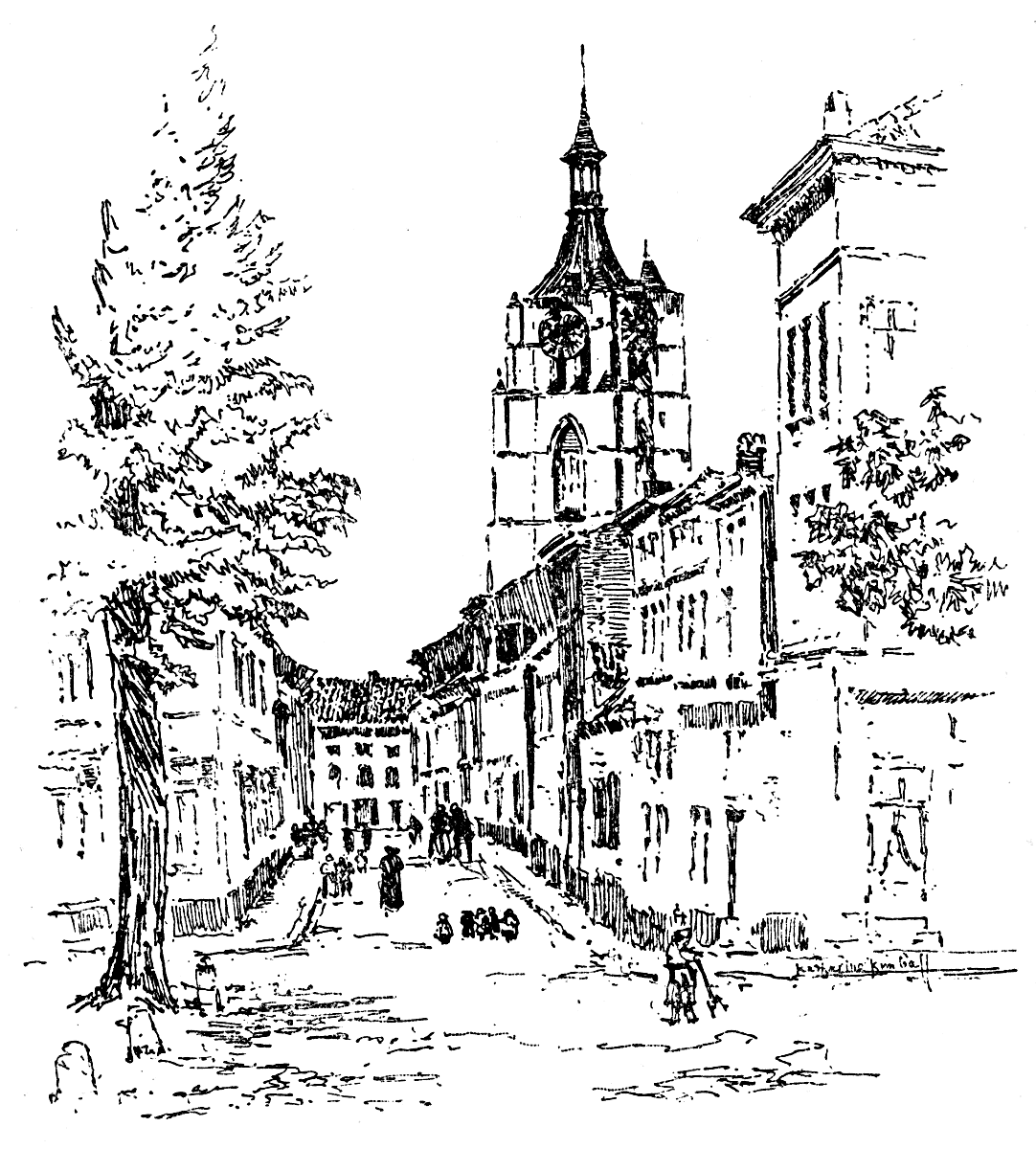
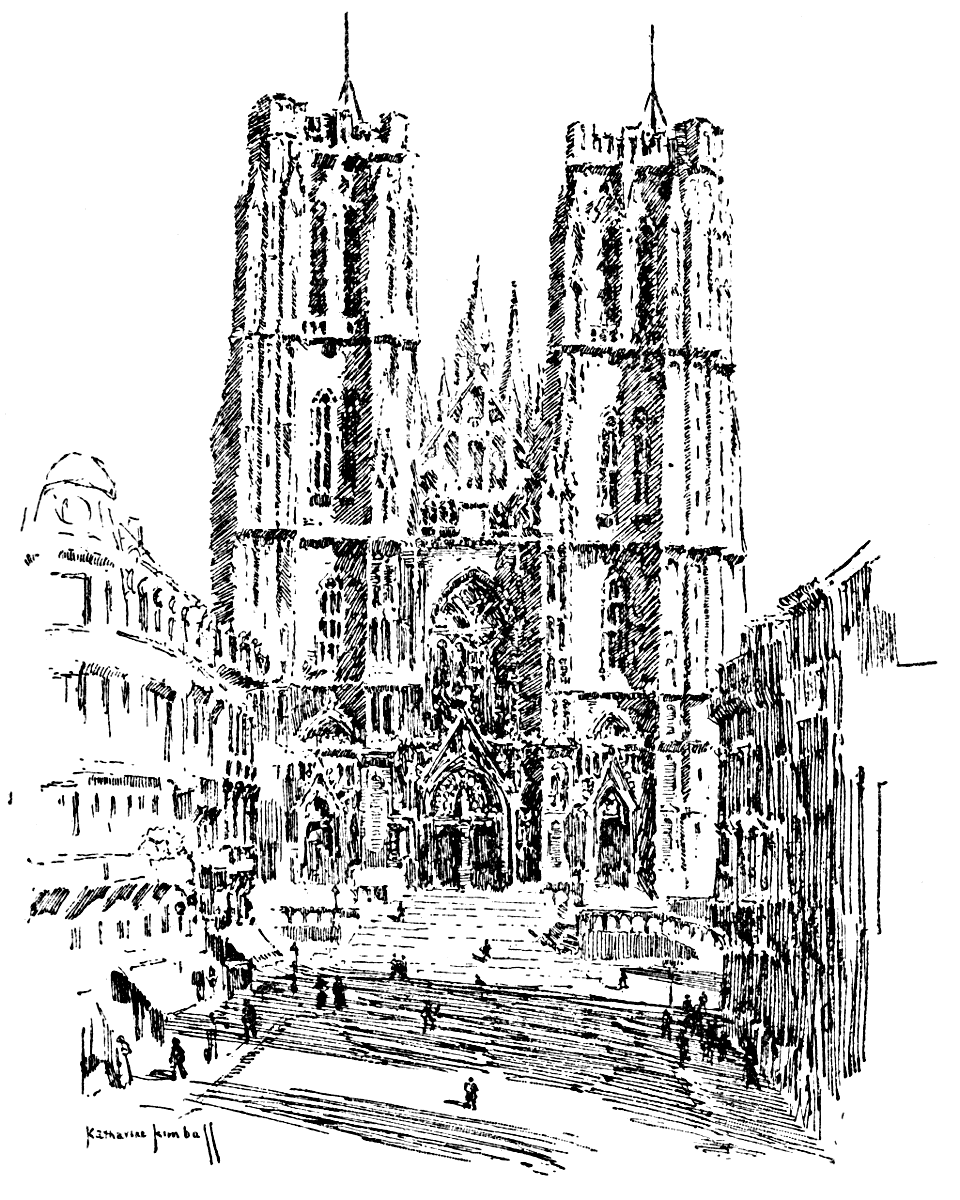
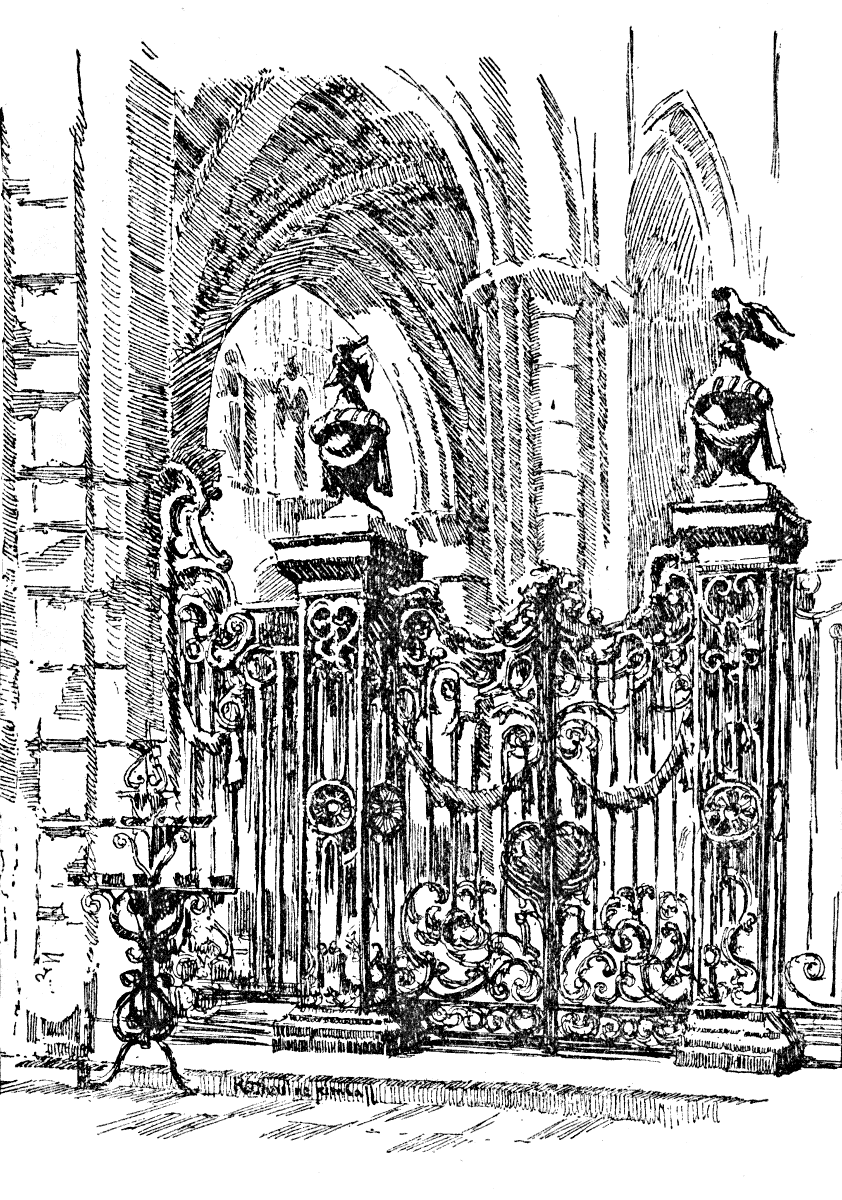
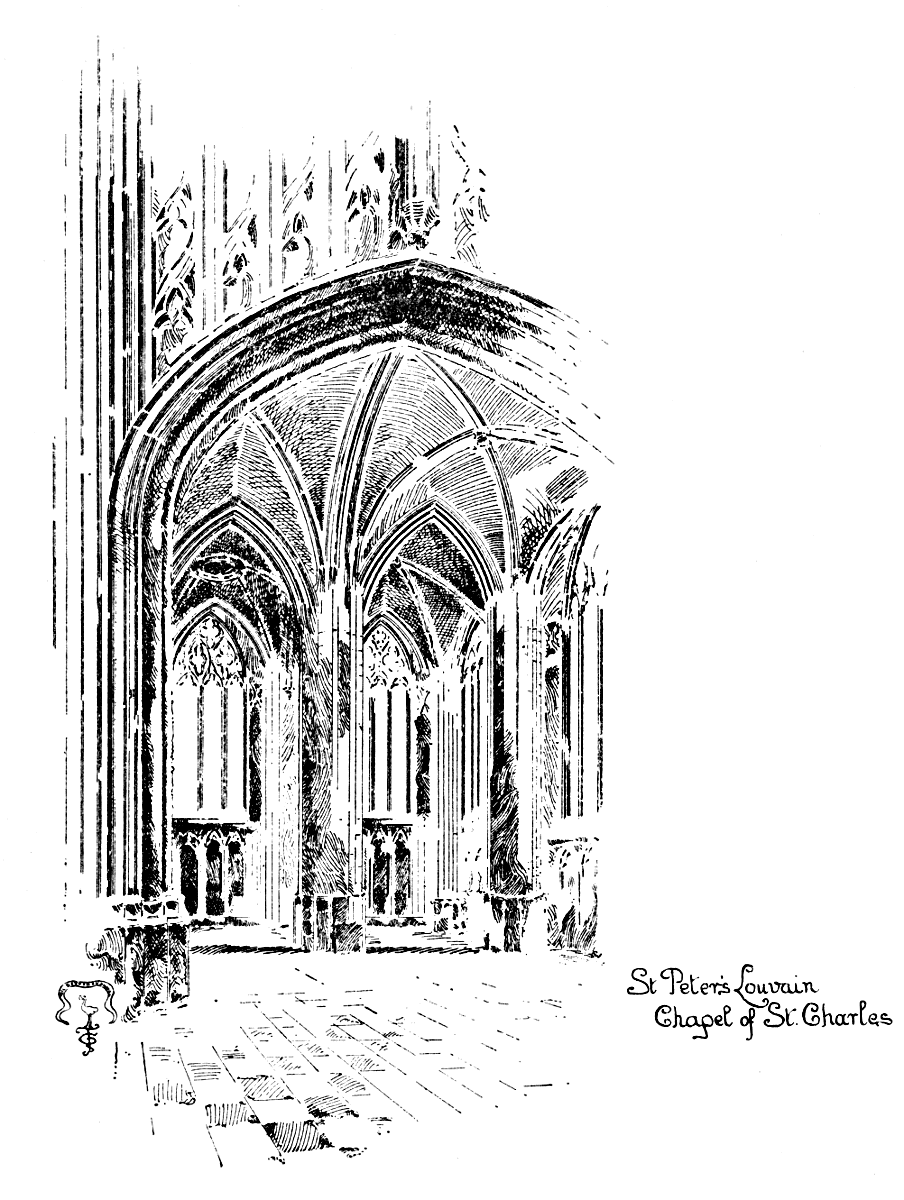
born in the Low Country, and Charlemagne may
be not inaptly said to have been its progenitor. When
that monarch planted the outposts of Christian Europe
on the banks of the Elbe he made the Low Country—a
land then of marsh and wood, whose inhabitants had
hitherto lived apart, forgotten by the rest of the world,
on the edge, so to speak, of civilisation—the central
province of his dominions, and, as such, it in due course
became the centre of contemporary culture: the
common intellectual mart of the Teutonic regions of
the East and the North, the Latin provinces of the
West and the South, of Ireland, of England, and of
the land of the Scot. The bishops, satraps, scholars,
merchants, courtiers, courtesans who flocked to Aix-la-Chapelle
from all parts of Europe, all of them
passed through the Low Country and were constrained
to sojourn for rest and refreshment in the only
hostelries which the land possessed—the convents and
monasteries sparsely scattered amid its forests and fens.
The traffic on the old Roman road across the Charbonnière
was now greater than it had ever been before;
the Meuse and the Scheldt for the first time became
highways along which were towed huge barges heavily
laden with foodstuffs for the provisionment of the
Court, and thus, as Pirenne has it, 'on this soil, formed
by the alluvial deposit of French and German streams,
there gradually sprang up a civilisation of like nature
with the soil itself, a civilisation made up of divers
elements—Latin, German, French, in a word, a civilisation
not so much national in character as European.'
Nor was it only thus indirectly that Charlemagne
promoted the civilisation of the people of the Netherlands.
The rapid progress which was at this time
made in humanising these rugged folk was in large
measure due to the Emperor's personal initiative: he
brought artists from England, Italy, Constantinople,
to decorate his palaces at Aix and Nimègue, he established
a school of art attached to the Court, he ordained
that the churches should be adorned with mural
paintings, and named inspectors to watch over the
work and see that his orders were strictly carried out,
and, most important of all, he charged himself with
the task of providing foreign teachers for the novices
of the few religious houses which at this time were
established in the land, and where the culture of art
and letters seems to have fallen wholly into disrepute.
The scholars to whom the Emperor confided this task
were among the most famous of their day. Men like
his secretary and biographer, Eginhard—the architect
of the dome of Aix-la-Chapelle—whom he set over
the twin abbeys of Saint Peter and Saint Bavon at
Ghent; and Arnon, one of the most brilliant disciples of
Alcuin, who became abbot of Elnone by Tournai; and
the Italian mechanician Georgius, who taught at Saint-Sauve,
by Valenciennes; and the great Irish scholar
Sedulius, who later on (840-855) lectured in the
frescoed hall of Bishop Hartgar's new palace at Liége.
Nor was this policy unprofitable. A spark was
enkindled which soon became a burning and a shining
light. Clerks began to polish their rusty Latin, monks
to busy themselves with history, in writing the lives of
local saints, and by erecting in their honour temples
not unworthy of the patrons to whom they were dedicated.
Cloistered women, too, devoted their leisure
hours to art: they adorned their refectories and chapels
with frescoes, and their choir-books with exquisite
miniatures and capitals cunningly devised, and, for the
service of the altar, made marvellous vestures of gold,
wrought about with divers colours. A specimen of
their illumination has come down to us: in the
sacristy of the old church at Maeseyck there is
a copy of the Gospels, painted by two sisters,
Saint Harlinda and Saint Renilda, who, about this
time, ruled over the great Abbey of Aldeneyck, on the
outskirts of the town. This is the most ancient piece
of miniature work in Belgium. In a word, the ignorance
and grossness which had so long disfigured the
Church in the Netherlands completely disappeared, the
soil teemed with religious houses, each of which was
an active centre of literary and artistic life, and there
was soon no more flourishing province in Christendom
than the land between the Rhine and the sea. But
the glory of it all was short-lived: after the Danish
Terror there was nothing left of it but a memory. Unless
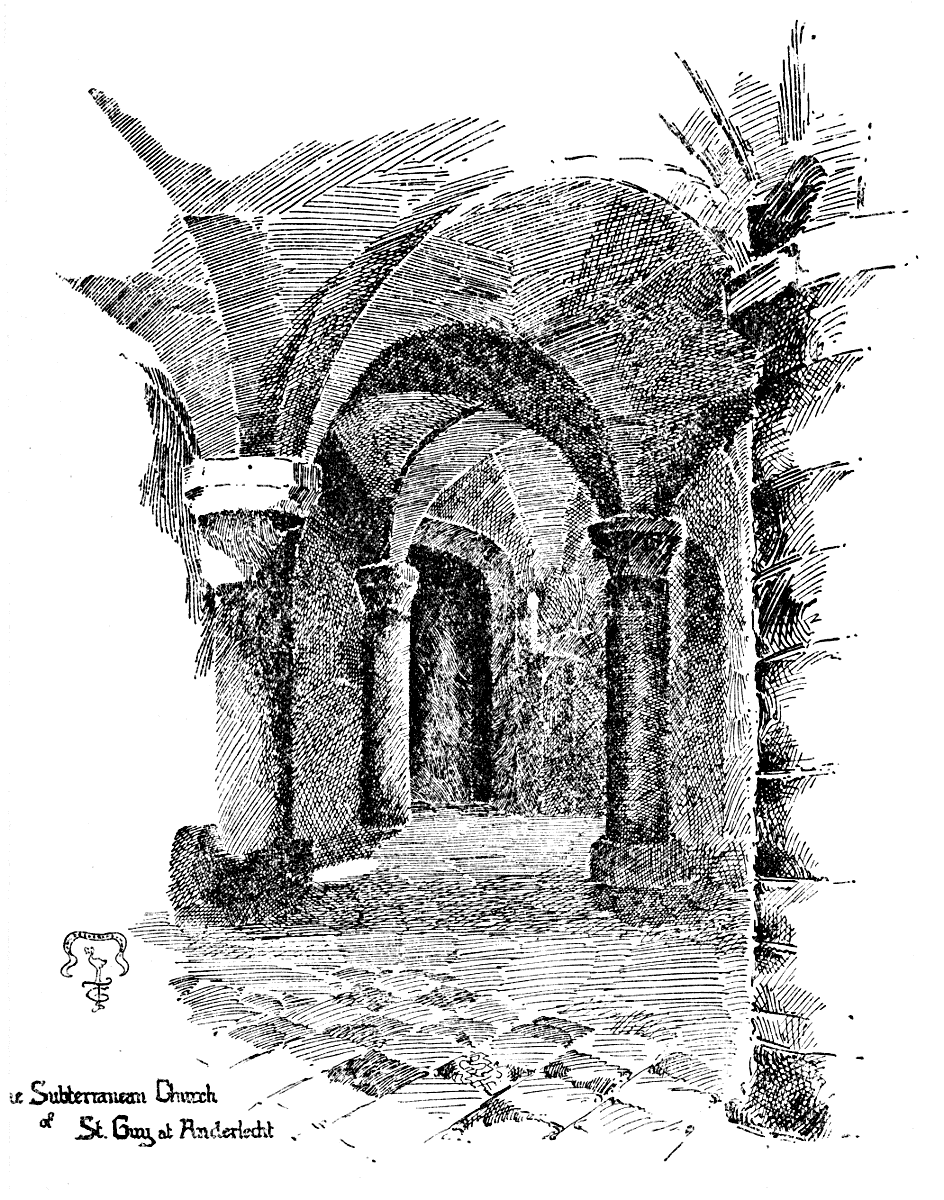
the subterranean Church of Saint Guy at Anderlecht,
as some maintain, be of this period, in Brabant,
at least, no vestige remains of Carlovingian architecture.
For more than sixty years thick darkness
enveloped the land. Isolated efforts, indeed, there
were: the monks of Lobbe maintained an obscure
school; Bishop Stephen at Liége, and, at Utrecht,
Bishops Radbod and Balderic, did what they could,
in the midst of the barbarism and anarchy of the times,
to keep alive the lamp of learning; but it was not until
953, when the Emperor Otho placed the ducal crown
of Lotharingia on the head of his brother Bruno, that
there was anything like an approach to a general Renaissance
movement. Under Saint Bruno's firm and
gentle rule discipline was re-established. Art and
literature followed in its wake. Everachar the Saxon,
whom he named to the See of Liége in 959, was the
founder, or at least the restorer, of the Cathedral
School there—a school which was renowned almost
from its origin, and which, under his successor Notger,
became one of the chief centres of learning in the West.
The masters of Liége lectured in all parts of the empire—at
Mainz, at Ratisbonne, at Brescia, and even
penetrated into France; and students from all parts of
Europe flocked to drink in knowledge in the famous
school of Saint Lambert.
The literary and artistic movement inaugurated by
Saint Bruno and the imperial bishops was no doubt
accentuated by the monastic revival promoted about the
same date by Gerard of Brogne. Great cathedrals
and abbey churches now sprang up in rapid succession,
cloisters were everywhere enlarged or rebuilt, bishops'
palaces were adorned with sculpture and painting, and
the little edifices of wood, which on the countryside
had hitherto done duty for parish churches, were replaced
by more substantial buildings of stone or brick.
German in origin for the most part, it was naturally
to German architects that the bishops of Lotharingia
entrusted their building operations. Thus the style in
vogue in the valley of the Rhine spread rapidly towards
the west. With the architects came artisans of all
sorts—sculptors, hewers of stone, painters, woodcarvers,
founders of copper and of bronze. These foreigners
founded schools in the country, a host of apprentices
joined them, who made such progress in their craft
that soon they were able to compete with their masters.
Thus was there gradually formed a native school of
architects and artists, of whose talent and technical
skill the remnants of their work which have come down
to us bear witness; and we know that in their own day
their fame was so great that Abbot Suger had recourse
to their aid for the work which at this time he was
engaged upon in the Abbey of Saint-Denis.
They did not, however, at first form a new style.
For something like two hundred years they were content
to walk in the paths which their German masters
had traced for them. Not only in architecture, but in
painting, in sculpture, in wood-carving, in metal work,
in embroidery, the school of the Meuse, as M. Pirenne
aptly puts it, was the legitimate daughter of the school
of the Rhine.
Indeed, as long as the Church in the Low Country
remained imperial, German traditions prevailed. Even
the main body of the cathedral at Tournai, with its
dome and its turreted apsidal transepts, which was
only commenced in 1030, is distinctively German in
character, and so, too, was the cathedral at
Cambrai,26
designed on similar lines, and this is all the more
remarkable from the fact that it was not completed till
nearly a hundred and fifty years later—some seventy
years, that is, after the episcopate of Walcher, the last
of the imperial bishops of this diocese.
Of the buildings in Brussels and its immediate
neighbourhood, which date from this period (950-1200),
but few remain. Indeed, in the city itself
there are only fragments. Foremost among the monuments
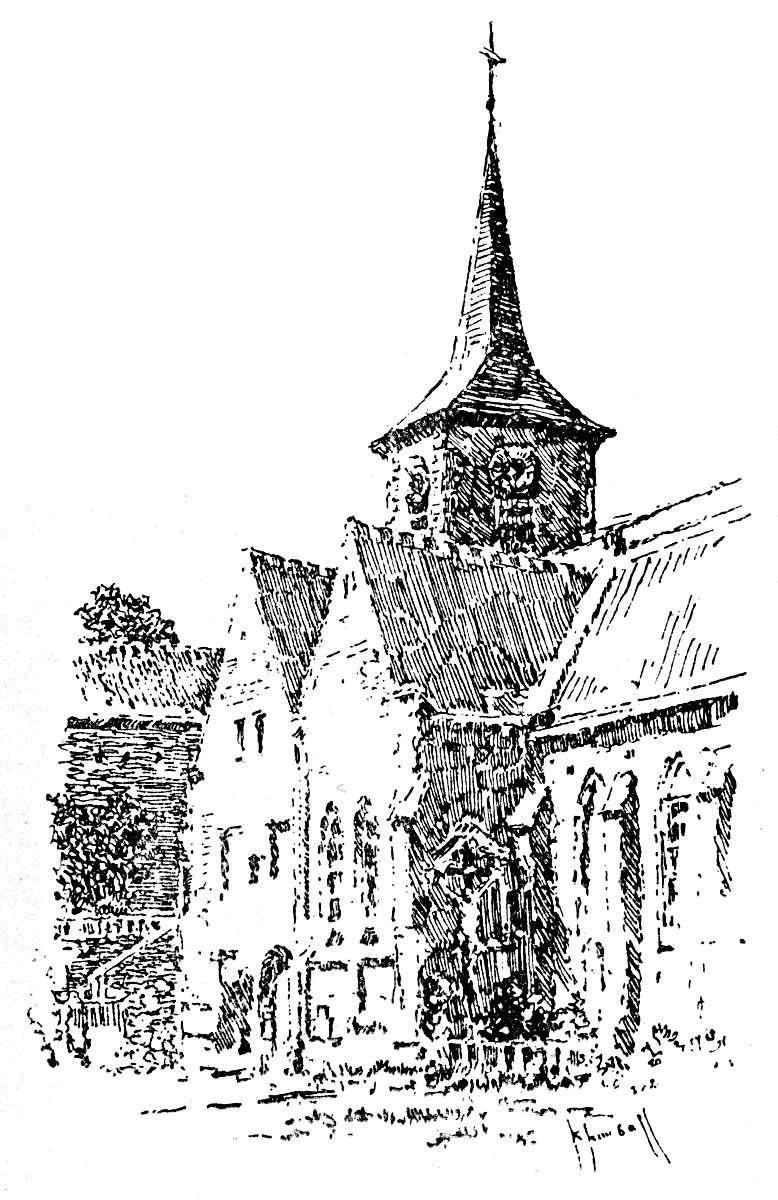
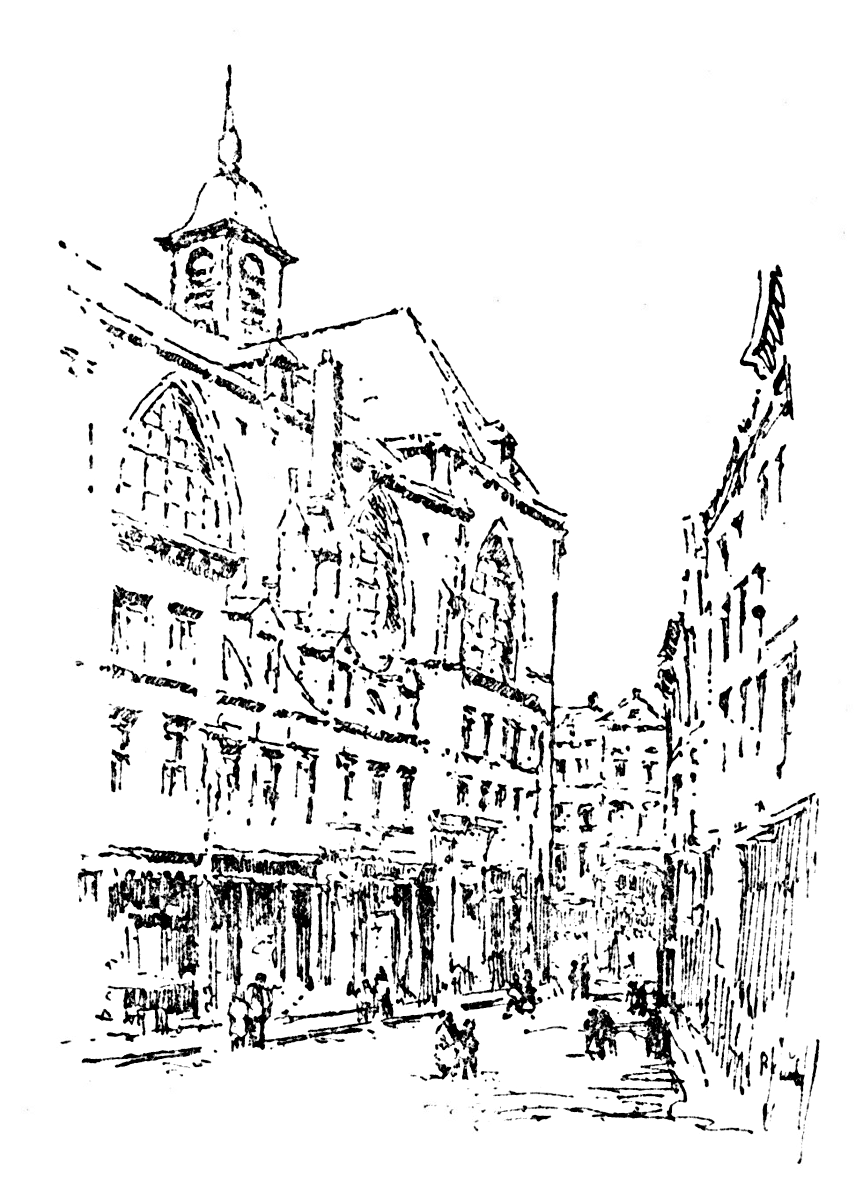
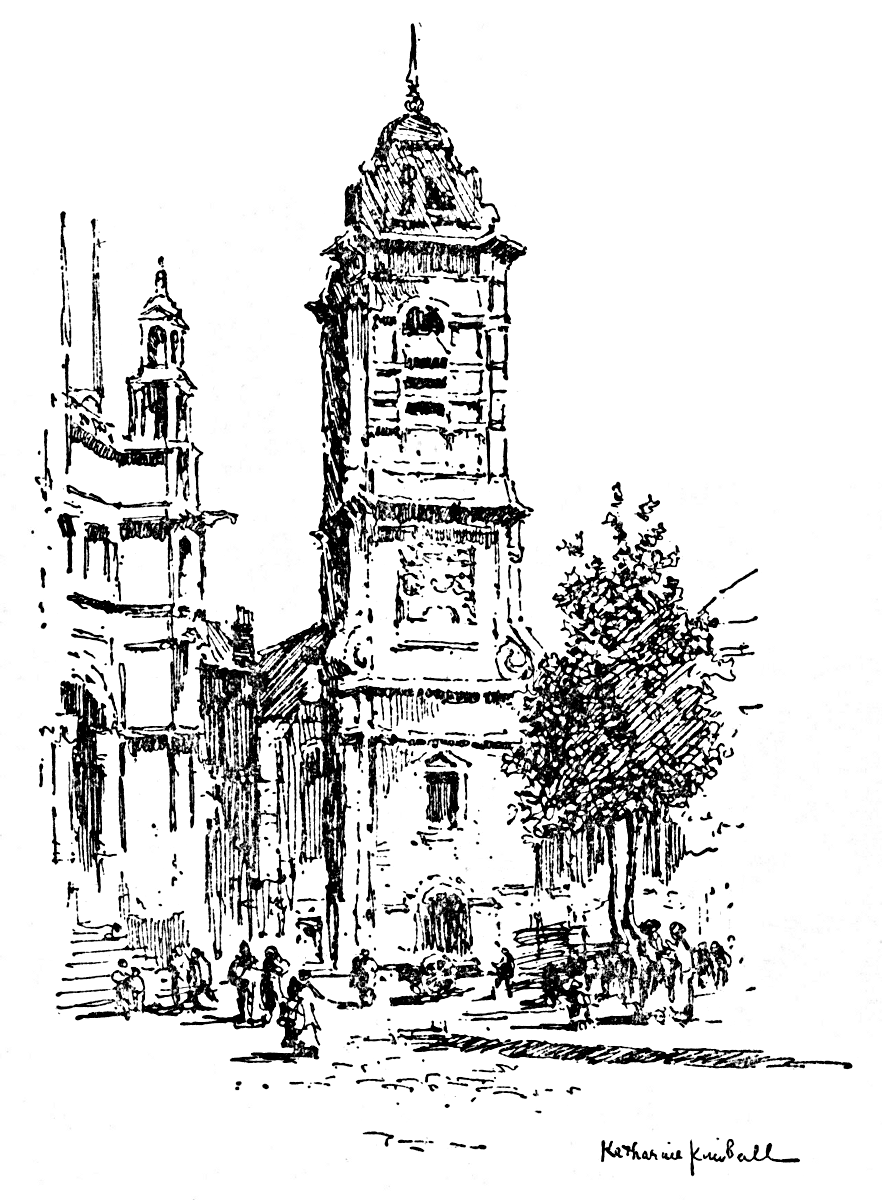
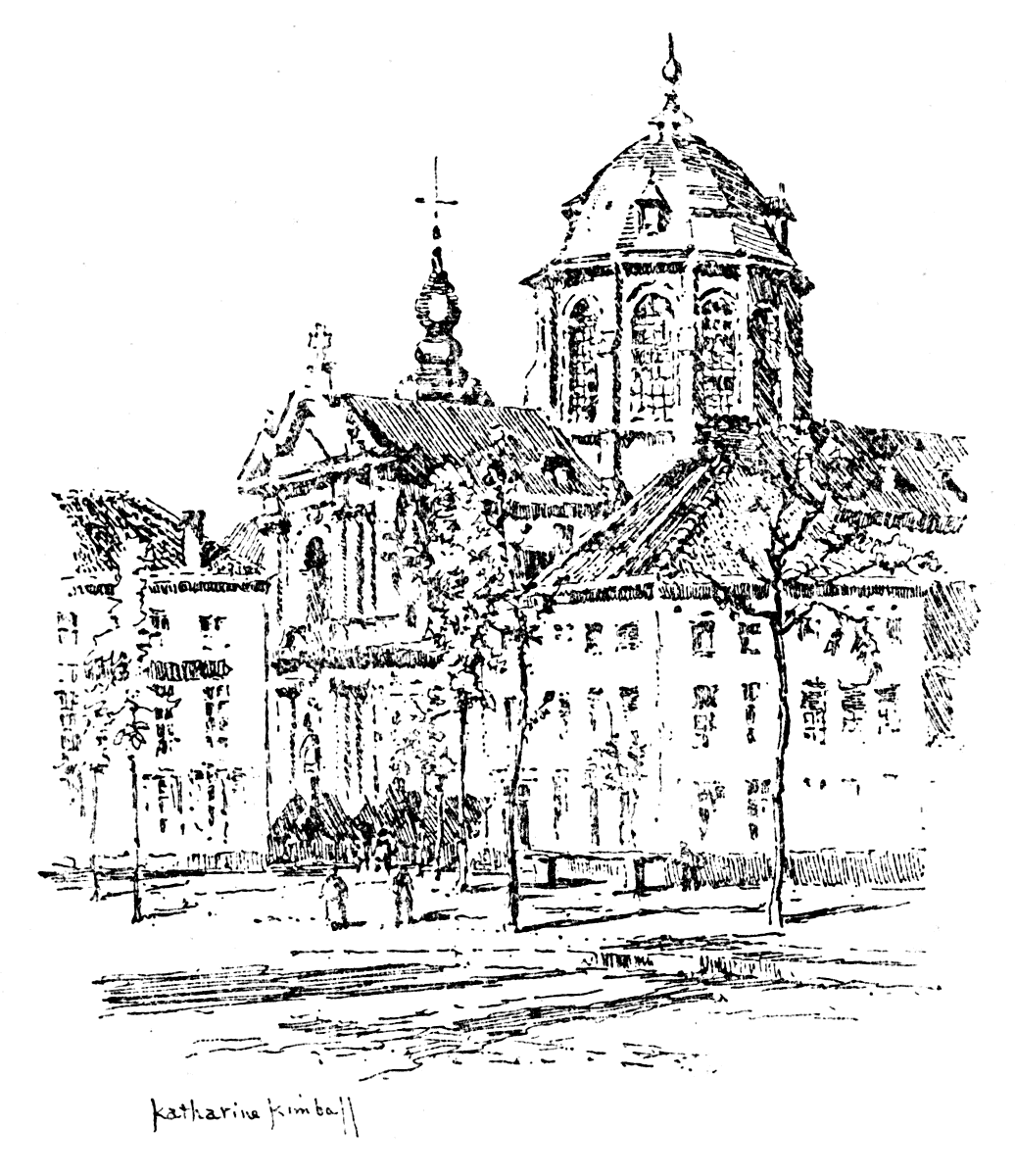
which contain them note the Parish Church of
Saint Nicholas in the Rue au Beurre, one of the oldest
and perhaps the most interesting of the time-honoured
sanctuaries of Brussels. The date of its foundation is
not known, but it cannot be later, and may be considerably
earlier, than the close of the ten hundreds. It is
one of those old buildings which, by reason of their
great age and thrilling memories, have attained individuality
and almost become living things—a stalwart
veteran who in the course of a long and honourable
career has manfully endured
an unwonted share
of the trials and vicissitudes
of life. It has
gained many scars in
wrestling with time and
the elements, more in
its conflict with man. It
has been cast down and
renewed, enlarged and
curtailed, defaced and
embellished, polluted and
blessed over and over
again; and though for the
last fifty years it has been
constantly threatened by
municipal blockheads with
total destruction, it still
towers amid the nest of
habitations which cluster
round its walls and cling on to its buttresses, a picturesque
and venerable pile in spite of its mutilations—not
the least pleasing of the rare landmarks of old-world
Brussels.
It is not, however, its intrinsic beauty which
renders this church so fascinating. It possesses in
common with many ancient things, not only buildings,
but often trees, pictures, furniture, and notably jewellery,
another attribute: there is about it a certain subtle
influence which at once lays hold of the spectator and
convinces him that it has a story. It has, and a
thrilling one which, if it were written, would fill
volumes and keep the reader spellbound from the
opening words of the first sentence to the end of the
last page.
This church, dedicated to Saint Nicholas, patron saint of burghers
and merchants, and situated on the fringe of the Great Market, hard
by their Town Hall and Guild-houses, has been, from time immemorial,
the distinctive church of the bourgeoisie, in the same way that Saint
Jacques sur Coudenberg has always been the distinctive church of the
Court. Its life is bound up with the life of the city. It is the
cradle of its liberties. Its hopes, its struggles, its victories,
its defeats are intimately associated with it. In this church the
city fathers were wont to assemble in the early days when they had
no town hall. Its steeple was the town belfry—we say advisedly
was, for it exists no more—home of the 'work-clock,'
which every morning called the craftsman to his toil and in the
evening sounded his release; and of the shrill tocsin, which in
days of terror summoned him to arms, and when he had triumphed
shouted victory. Here, too, in a lower storey, was the archive
chamber where were laid up the records and the title-deeds—the
charters which the town had bought at such great cost of blood and
gold. Thrice burnt down and thrice rebuilt, until the close of
the seventeen hundreds, this ancient tower was the pride and the
glory of the men of Brussels, who regarded it as the outward and
visible sign of their privileges as citizens and their rights as
men. Nor is this all, the Church of Saint Nicholas is possessed of a
mysterousmysterious power of attraction. Why
men should single out this particular church in preference to all
others is a question hard to answer. There is no ostensible reason
for it: it is not the shrine of some great and popular saint, no
famous relics are treasured here, nor miraculous image
or picture. They are drawn to it in spite of themselves.
Wherefore, who shall say? Enter when you
will, it is never without worshippers, and what a
motley throng they are! Of course that sex which
the breviary so quaintly and aptly styles devout is the
most in evidence. Women in shoals are there—women
of every age and every complexion, all
sorts and conditions of women: from the grande
dame of ancient date, demure, aloof, dowdy, who, to
her very rosary beads, is invested with an air of
distinction, to the market-woman with her milk cans
or her basket of fresh vegetables; from the fashion
plate of the demi monde, perfumed and painted, to the
snuffy crone in foul rags, who in the same breath asks
an alms and tells her chaplet. And the men, if there be
fewer of them, are no less heterogeneous—that sleek,
smug-faced tradesman is trying a deal with Saint
Anthony, he has made him an offering and promised
more if only he will promote his undertakings; the
youth in glorious apparel is commending, perhaps, to
Saint Joseph an affair of the heart, or—who can tell?—perhaps
he has a thorn in the flesh of which he would
fain be rid; the shabby, middle-aged, sallow-faced
wreck who stands before 'Onze Lieve Vrouw,' works,
when he is not too drunk, as a journeyman tailor,
in politics he is a social democrat, and if you were to
ask him his religion, he would tell you that he was a
libre penseur, but the woman who loves him is sick
and believes, and he has slunk in here to put up a
taper for her in honour of the 'Salus infirmorum,'
the old man with trembling limbs and palsied
head, who is painfully making the way of the Cross,
was in his day a dashing spark who could make
women's hearts throb and sometimes broke them. He
has drunk to the dregs of the joys of life and experienced
the after-taste, but all this is ancient history;
he has long ago made his peace with God, and is
quietly waiting now for the great metamorphosis.
And there are children too, not many—for the neighbourhood
is one of theatres, cafés, public buildings—ragged
urchins some of them, with bare feet and
pinched faces. The streets outside are cold and
wet, or they are hot and dusty, and where else
should these waifs seek shelter but in their Father's
house?
Such are the devotees who frequent this mysterious
shrine; and the visible objects of their devotion—the
likenesses of the ghosts who haunt it, are no less
varied than are they. Some of them are Neo-Gothic
conceptions of the school of Saint Luke—tall, emaciated
figures with gilded locks and pale, meek faces;
others are of the time of the Renaissance, and are
full-blooded, fleshy, human; others again are as old
perhaps as the church itself, and these are the most
interesting.
For how many centuries, for example, has the 'Man
of Sorrows' sat by the western doorway silently asking
of those who enter, 'Is it nothing to you, all ye
that pass by?' A strangely pathetic figure this. The
sculptor who modelled it must have had this text in
his mind, 'There is no beauty in Him,' and this, 'The
Lord has placed upon His shoulders the iniquity of us
all.' The statue is of carved wood painted after life,
but time and maybe the flare of tapers have rendered
it almost black. It is quite nude save for a loin cloth,
but someone, perhaps scandalised at this, has thrown a
mantle of purple velvet now faded and moth eaten,
over the shoulders. A relic is let into the instep of
the left foot, which is defaced and partly worn away
by the lips of innumerable troubled souls who have
found consolation in their own sorrows by pitying the
sorrows of Christ. For the rest, the church is not
without charm from an æsthetic point of view—the
axis of the choir is probably more decidedly inclined
to the north-east than that of any other church that
the visitor will call to mind: this and the divers
styles of architecture in which it is built renders it at
least picturesque. Moreover, though the stained glass
which once glowed in its windows has long since disappeared,
and though whitewash and plaster have
effaced the frescoes and carving with which its walls
were formerly adorned, the interior is still bathed in
glowing tints: it is rich in old oak furniture, in objects
of marble and copper and brass, in easel paintings and
in devotional statues resplendent with colour and gold,
and there are flowers too and red lamps, and withal
and always a host of flaring tapers. But let not the
reader be disappointed. There is much in this church
which is tawdry, trivial, vulgar, which transgresses in
a flagrant degree the canons of good taste; its
splendour, it cannot be denied, is not always the
splendour of truth. We have here the lustre of colour
which, like charity, covers a multitude of sins, the
fascination of old-world memories and the glamour of
the picturesque. Added to this there are a few
genuine works of art, notably some good pictures,
which even the most fastidious need not be ashamed
to admire; but since they are all of more recent date
than the Middle Age, they do not come within the
scope of these pages. And what, perhaps, it will be
asked, has this farrago of modern idolatry for which
space has been found to do with the Middle Age?
This much—call it idolatry if you will, we have here
mediævalism undiluted. The credulous folk who flock
to the Church of Saint Nicholas are silly enough to
believe, like their fathers in the thirteen hundreds, that
the Sabbath was made for man, not man for the Sabbath.
It is difficult, perhaps impossible, to say anything
definite as to dates in the case of a building like
the Church of Saint Nicholas, which has endured so
many vicissitudes and suffered so much at the hands of
restorers, but there can be little doubt that the great
oblong columns which support the vaulting of the nave,
and perhaps too the walls of the aisles, or at all events
some portions of them, formed part of the original
structure. But whether these things be old or new is
a matter of little moment. The burghers' church is
doomed. The decree has gone forth, and as soon as
the leases of the old houses which cluster round it fall
in, it is to be sacrificed to the demon progress. A
street has to be enlarged or straightened, or the site is
needed for a cab-stand or a public-house, or for some
purpose equally objectionable. Death indeed sits close
to our old friend, hence this disquisition. Albeit, he
has so often escaped by the skin of his teeth that it is
hard not to believe that means will even yet be found
for still further prolonging his days. One thing is
quite certain. If this piece of vandalism be carried
out, it will be for the indelible shame of the whole
city. A disgrace alike to the authors of the crime, and
to those who by their indifference or their lack of
energy, have connived at it. In Belgium there is a
permanent Government commission for the preservation
of ancient monuments, and a private society likewise
exists, of which the raison d'être is similar, yet it seems
that neither of these bodies have as much as thought
it worth their while to lodge a formal protest.
More important from an architectural point of view
than the Church of Saint Nicholas is the Church of
Notre-Dame de la Chapelle. The foundation stone
was laid by Duke Godfrey Longbeard in 1134, and
though the greater portion of the existing structure is
of more recent date, some interesting fragments still
remain of the original building, notably the little Chapel
of the Holy Cross and the beautiful façade of the south
transept, which is pure Romanesque and richly adorned
with sculpture. The plans were modified as the work
progressed, and the rest of the south transept, the
north transept and the chancel are in the style of the
Transition. A nave and aisles were also added at this
period, but they were destroyed by fire early in the
fourteen hundreds, and rebuilt in the course of the
century in the style then in vogue.
The collegiate Church of Saint Michael and Saint
Gudule was commenced by Duke Henry I. in 1170,
and the eastern wall of the ambulatory, with its Romanesque
windows, date from this period. It took the
men of Brussels five hundred years to complete this
beautiful building, and hence it contains specimens of
every style of architecture, and is on that account
none the less interesting. We shall have something
more to say of each of these churches in another
chapter.
The civil architecture of this period is represented
only by some fragments of the fortifications with
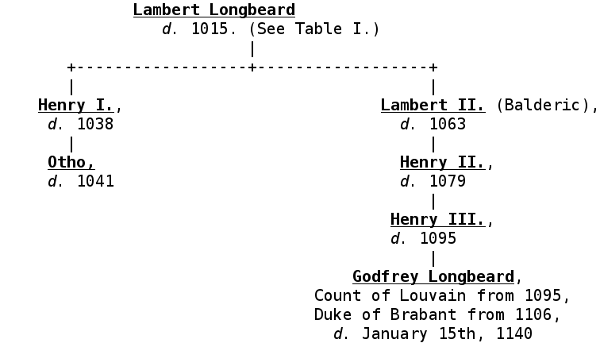
which Lambert Balderick surrounded the city in 1040.
They are scattered about here and there in various
parts of the old town. There is a picturesque bit of
wall for example in the garden of Saint Gudule's
Presbytery, another piece has been incorporated into
a house in the Rue des douze Apôtres, there is more
in the Steenporte, and, most important of all, a
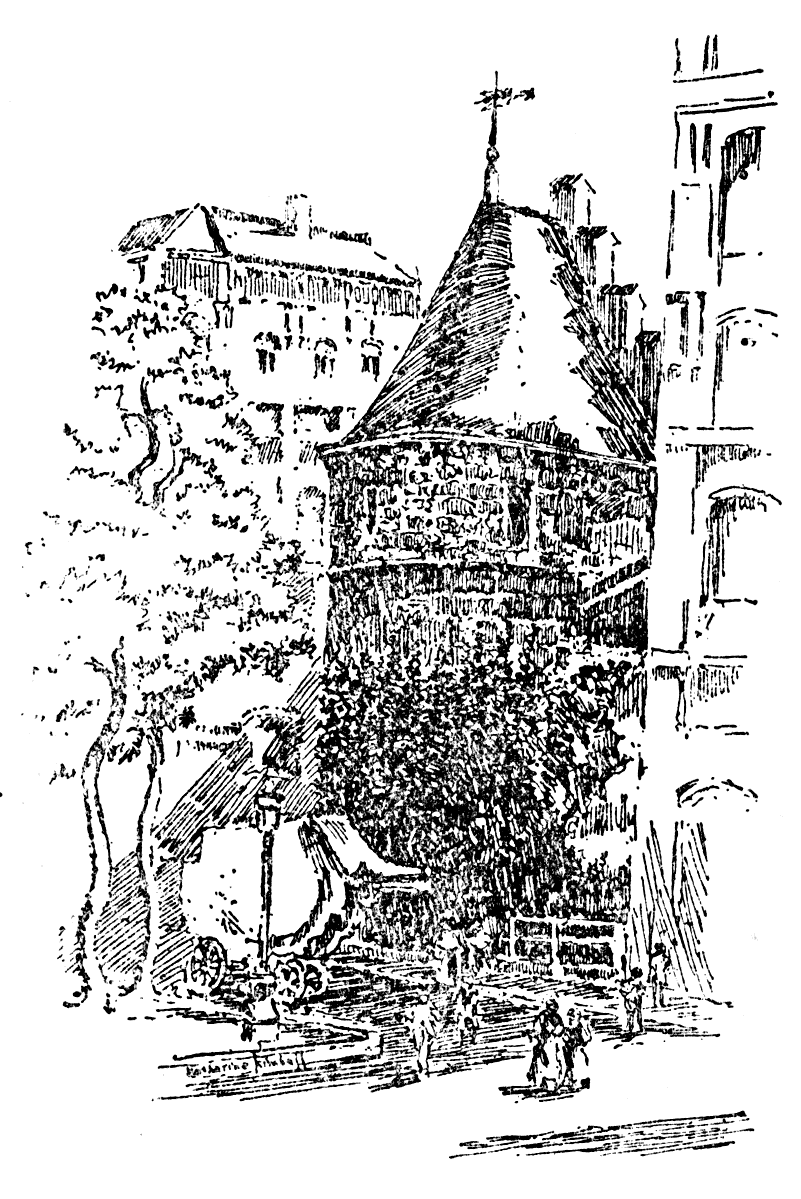
tower some sixty feet high between the Halles Centrales
and the Church of Saint Catherine.
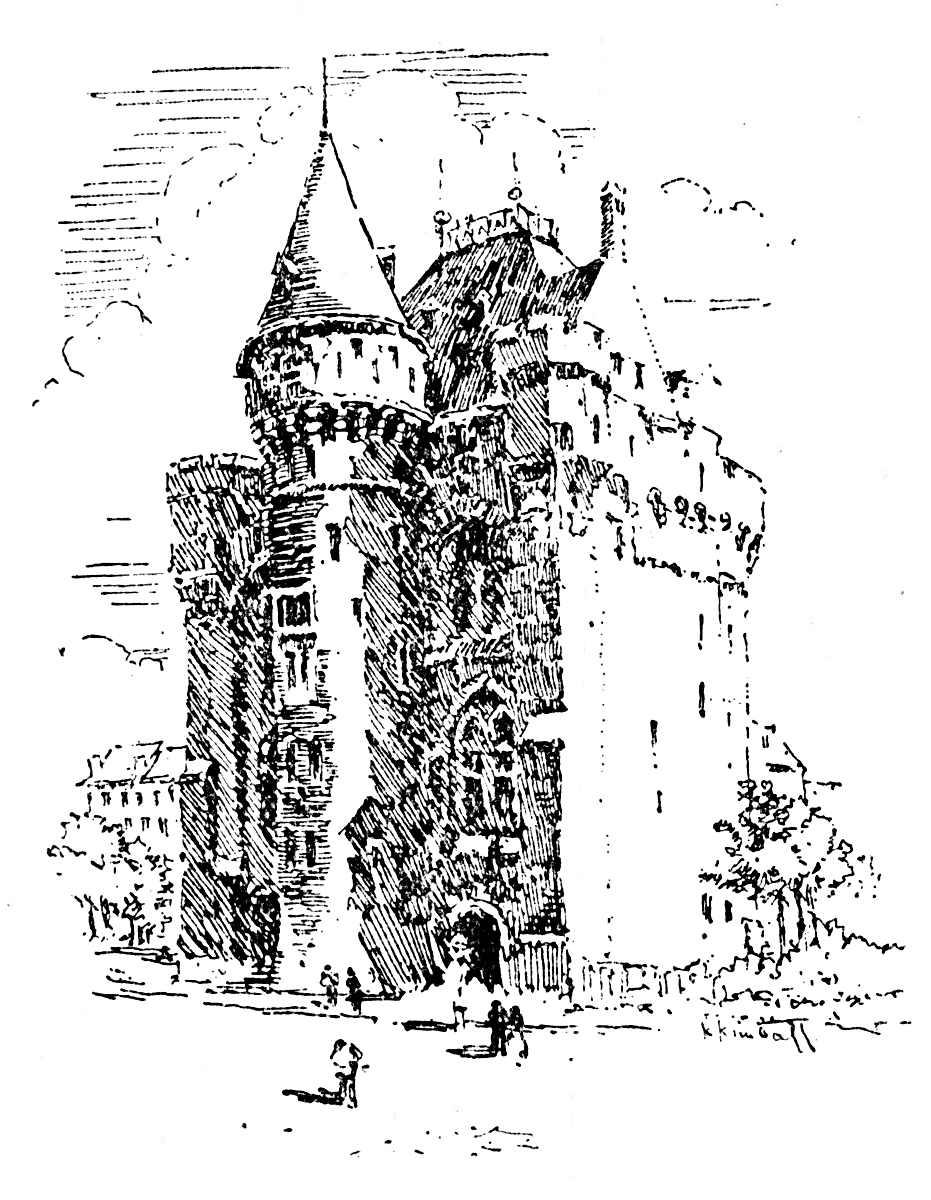
This picturesque relic, which is called 'la Tour
Noire,' was discovered when some old houses were
demolished in 1887. At first the Corporation was for
pulling it down, but fortunately Brussels at this time
had a burgomaster who was not only an artist and an
archæologist of repute, but also an enthusiastic amateur
of mediæval architecture. After a long fight, M.
Buls, who is still living though he has now withdrawn
from public life, succeeded in saving the old tower, and
thanks to his indefatigable
efforts, it was
later on restored by
the town.
It is not, however, in
the city itself, but in the
suburb of Anderlecht,
a mile and a half beyond
the line of the outer
ramparts, that the most
interesting specimen of
Romanesque architecture
is to be found.
Here we have no mere
fragment, more or less
defaced, but something
complete in itself, something
which has never
been tampered with,
something older, too, than any of the buildings of which
we have just spoken, older, indeed, for the matter of
that, than any other building in Brabant. In a word
we have here an antique jewel of rare beauty, which
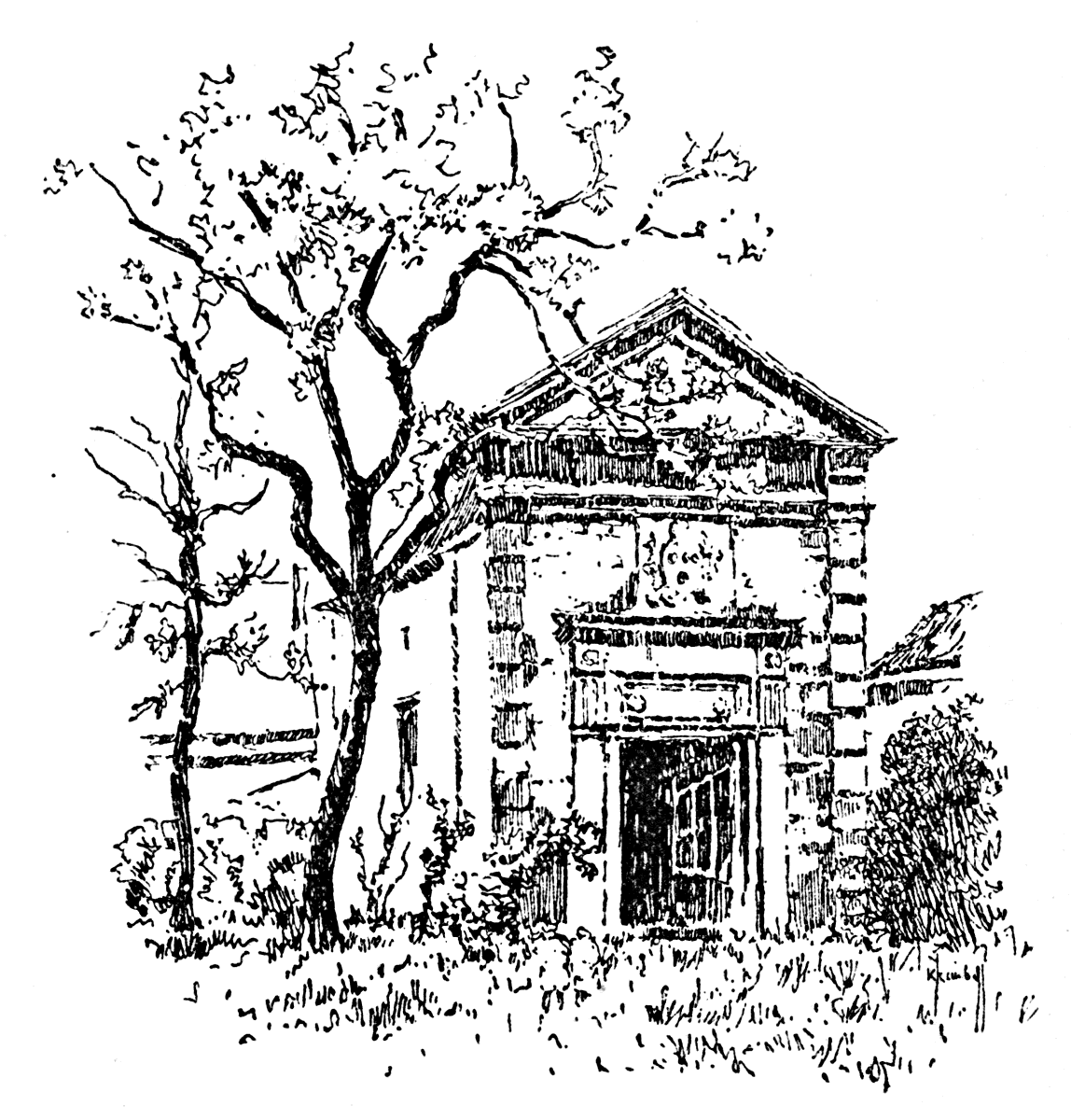
has never been re-set nor re-cut: the subterranean
Church of Saint Guy at Anderlecht remains to-day
what it was when the builders planned it.
The earliest archives of the collegiate chapter of
Anderlecht have disappeared, destroyed, no doubt, when
the Flemings invaded Brabant under Louis of Maele,
and hence the date of its foundation is not certainly
known. Some chroniclers mention the year 800,
others 914. Tradition says that it goes back to an
epoch when there were only two other chapters in
Brabant, the Chapter of Saint Berlinda, a niece of
Saint-Amand, erected at Meerbeck towards the close
of the six hundreds, and the famous Chapter of Nivelles,
founded by Saint Gertrude, a daughter of Pepin of
Landen, in 645; and we know from the Anderlecht
Life of Saint Guy, the earliest life that has come down
to us, that a dean and canons were certainly established
there early in the ten hundreds. In any case there
can be no doubt that this foundation was a very old
one, and in all probability the present subterranean
church is the church in which the first canons of
Anderlecht were wont to perform their devotional
offices.
True, it is said in the anonymous Life of Saint Guy,
written most likely by a canon of Anderlecht in the
opening years of the eleven hundreds, that about the
time when his relics were first translated (1076) the
canons of Anderlecht decided to build a new church,
and from this, M. Schaeys, in his Histoire de l'architecture
en Belgique, concludes that the present structure
dates from this epoch, but the style of the architecture
denotes a much earlier period, and the MS. account
of what took place, in spite of the passage in question,
which, read with the context, has clearly another meaning
than that which M. Schaeys attributes to it,
rather confirms than contradicts the evidence of the
architecture.
The writer informs us that at this time the church
at Anderlecht, by reason of its great age, was almost a
ruin; some of the walls had actually fallen down,
and others were in imminent danger of doing so. The
clergy and the people therefore decided with one
accord to sell the rich gifts which for years past
pilgrims had been offering at the shrine of Saint Guy,
and with the fund thus realised to build a new and
more spacious church. If, then, the present crypt,
which only measures forty feet by forty-eight, was
the outcome of this decision, the former structure must
indeed have been one of exceedingly narrow dimensions.
Although 'the poor man of Anderlecht' had during
his lifetime been regarded as a saint, he was not
publicly honoured as such until some forty years after
his demise. About this time (1054) what our
author calls a basilica, no doubt a small mortuary
chapel, had been erected over his grave, and as it
adjoined the church it now became necessary to pull it
down in view of the proposed building operations.
Hence the question arose, What should be done with
the saint's body? The matter was referred to the
bishop of the diocese, Gerard II. of Cambrai, 'who
had succeeded the Lord Lietbert of blessed memory'—this
fixes the date, Gerard received consecration in
1076—and he ordained that the body should be disinterred
and provisionally laid to rest in the centre of
the church until the new building should be ready for
its reception.
The bishop's instructions, our author avers, were
duly carried out, and in the last paragraph of his
narrative, he informs us that 'the elevation of Saint
Guy' was made by Bishop Odard on the 24th of July,
1112. It would seem, then, that from the earliest times
there have been two churches at Anderlecht, an upper
church and a lower church; that the former, having
fallen into a ruinous state, was pulled down in the year
1076 and rebuilt on a larger scale, and that the new
structure was completed in the summer of 1112,
certainly not later than that date. Further, that the
lower church, which no doubt had been more solidly
built than the upper building, seeing that it was intended
to support a superstructure, was still in 1076
in good repair, and that hence it was left standing.
That this was 'the church' where the relics of Saint
Guy reposed during the interval which elapsed
between the disinterment of 1076 and the 'elevation' of
1112 there can be no doubt whatever. Not only do the
terms employed by the writer render this point certain,
but we have the additional evidence of the empty tomb
which still stands in the centre of the crypt. As to
the date at which this interesting building was constructed
the style of the architecture points to the
eight hundreds. In form it is distinctly reminiscent of
the early Christian basilica: it consists of an apsidal
nave of three bays and double aisles, those which are
adjacent to the nave are separated from it by cylindrical
columns with capitals, which recall the Tuscan
order, and from the outer aisles by two great square
shafts without capitals, around each of which are
clustered four columns similar to the columns of the
nave. There is also a series of half columns of like
design at intervals round the walls. These, and the
piers, and the pillars of the nave support the vault,
which is a simple cross vault without ribs. Each of
the outer aisles is pierced in its west wall by a small
round-headed doorway which opens on a staircase
leading to the upper church, and the building is dimly
lighted by six narrow slits of windows, which are likewise
round-headed. The original high altar has
disappeared, but there are two side altars which are of
great antiquity, probably as old as the church itself—huge
oblong blocks of stone without ornament or
inscription. Hard by to each of them is a small
chamber built in the thickness of the wall. It has
been suggested that one was a baptistery, the other a
vesting-room. In the centre of the inner southern
aisle is the tomb of Saint Guy, an oblong mass built
up of stone covered by a granite slab rudely carved
with a double cross, floriated with vine leaves. The
monument is pierced by an aperture neither broad nor
high, just large enough for a lean man to crawl
through if he felt so inclined, as many did at one
time—the edges of the opening are worn away
by the countless pilgrims who, in days of yore,
thus gratified their devotion. Strange as they seem
to us now, practices of this kind were common
enough in the Middle Age: when in the eleven
hundreds the bodies of the saints were 'elevated'
from the crypts in which they had hitherto lain to
the temples which about this time were raised above
them, and there laid up in gilded shrines, the empty
tombs in which they had so long reposed still
continued to be the objects of popular devotion.
Sometimes the coffin was left open, in order that
the saint's clients might stretch their own limbs in the
place where his body had lain, sometimes an opening
was made in the side of the tomb large enough for a
man to peer through, or through which he might even
thrust his head. Sometimes it was larger still, and
women with sickly children would then place them
for a moment within, and pray that God, through His
servant's merits, would make the weakling strong.
They as firmly believed in the virtue of these sticks and
stones as the men of Judæa believed in the virtue of
the cloths and handkerchiefs which the Apostles had
touched, or of 'the shadow of Peter passing by.'
Of course the present upper church is not the church
which the canons of Anderlecht built with Guy's
treasure. That was pulled down in 1460, as the
Anderlecht archives bear witness. The present structure
was commenced then, and not completed until well
into the fifteen hundreds. We shall have something
to say about it presently.
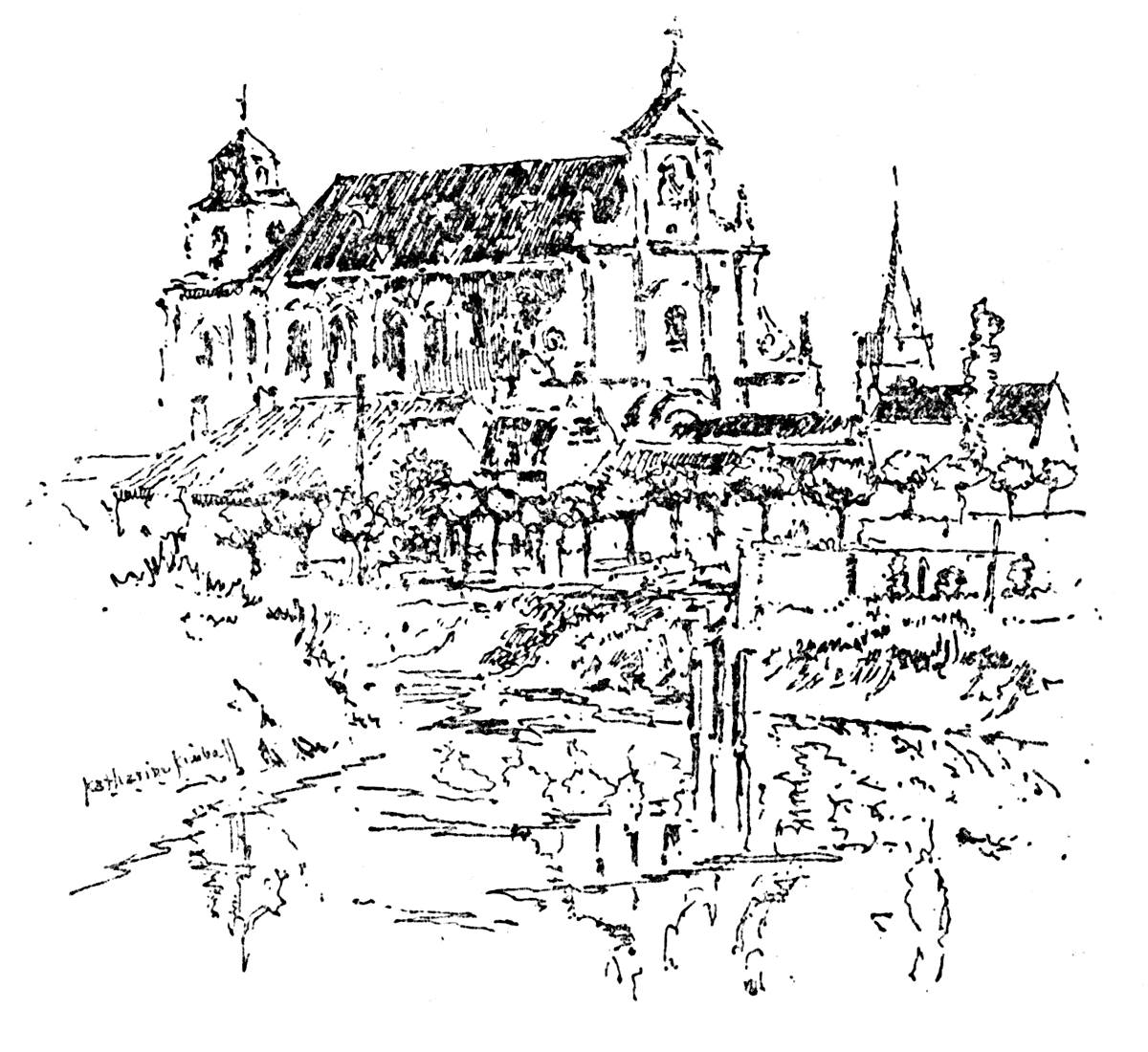
A little further afield, in the ancient town of Nivelles,
there is another and very noteworthy specimen of
Romanesque architecture. Nivelles was in former
days a far more important place than it is now. It
gradually grew up beneath the shelter of the great
abbey which, as we have seen, Saint Ita and Saint
Gertrude had founded in 625; and if so far as concerns
its material welfare it was inferior to the great
cities of Brabant, it excelled them all in the dignity of
its social standing, for the little town was an ecclesiastical
fief held directly from the Emperor27
by an abbess who bore the illustrious title of Lady Princess.
To this exalted office no mere plebeian could aspire,
nor patrician either for the matter of that, unless she
had the right to a scutcheon with at least sixteen
quarterings. The abbess lived in almost royal state in
a palace adjoining her minster, and the white-robed
canons and the Augustinian nuns, who formed the
chapter of Nivelles, and dwelt, the former in a cloister
hard by the church, the latter, apart in the town,
were submitted alike in spiritual and in temporal
things to her jurisdiction. Even the lay aristocracy
shone with an additional lustre reflected from her
magnificence. What rights and privileges they enjoyed
above their fellow-citizens were theirs not in virtue
of noble birth, but as members of the household of
Saint Gertrude. Their fathers were serfs on the
abbey domain who had risen to positions of trust,
they were men who had bartered their liberty for a
servitude freer than freedom itself, had entered a great
monastic family and become participators in its immunities,
and these their descendants continued to
enjoy for years after the days of bondage had ceased.
The Hommes de Sainte Gertrude like
the Hommes de Saint Pierre owed their title to distinction to the
servile condition of their ancestors.
Though the rulers of Brabant had for years past encroached
on her privileges whenever they had an opportunity
of doing so, the abbess was still a grande dame,
with ample means to support her high position when
the end came in 1793, but the power which she then
wielded, though still considerable, was only the shadow
of what it had been in the palmy days when she was not
only in name but in fact 'the Lady Princess of Nivelles.'
Nivelles never seems to have attained to anything
like commercial pre-eminence. In the days when the
fabrication of woollen goods was the staple industry of
the Netherlands, her manufacturers perhaps did as well
as their fellows in other small towns of like standing,
but certainly no better. Later on, when the cloth
monopoly was lost and men turned their attention to
linen, she did indeed make some reputation for the excellence
of her cambric, but she lost it after the riots
of 1647, when her weavers migrated in a body to
Cambrai and Valenciennes. Henceforth, until its suppression,
the custom of the household of Saint Gertrude
was the mainstay of her prosperity, and when that source
was cut off by the French revolutionists in 1793, she
very soon became what she is now, a little market town
with a population of some ten or eleven thousand souls.
Nivelles is situated partly on the side of a hill and
partly on the fringe of an emerald valley made fertile
by the river Senne. Here there are snug homesteads
nestling amid orchards and surrounded by well-tilled
fields, and rich pasture-lands enclosed with hedges thick
and high. There are woods too on the rising ground
beyond, and here and there a windmill or the steeple
of some village church. The landscape is one most
pleasant to behold, and if only the fields were less
carefully tilled and the cottages and farm buildings
were not so numerous nor so well cared for, it might
easily be mistaken for an English scene in one of the
home counties.
The little town itself is tranquil, dreamy, clean.
In its narrow, winding streets there are some curious
old houses with high-pitched roofs and crow-stepped
gables, and here and there are some curious old buildings
with mullioned windows and Gothic doorways,
which one is quite sure, if they are not now the homes of
nuns, were at one time, and of course there is a
sprinkling of those clean, comfortable-looking, substantial
dwellings which are always to be met with in
quiet nooks and corners in the country towns of
Belgium. Sometimes they have courtyards in front,
separated from the street by cunningly wrought
iron railings and paved with cobble-stones, on which
stand palms in tubs, or bay trees fashioned like umbrellas.
Sometimes stretching out behind there is
a trimly-kept walled garden of which the passer-by
occasionally obtains a refreshing glimpse through some
half-open door. They were built for the most part
about a hundred and fifty years ago, and are the homes
of local professional men or the winter abodes of the
neighbouring country gentry, who, reckoning their
incomes by hundreds, rather than thousands, are rich
enough not only to vegetate comfortably and in a
manner befitting their station, but to give alms with no
stinted hand, and withal and always to keep very respectable
balances at their bankers.
The most interesting feature of the town of Nivelles
is, of course, the old Minster, with the exception,
perhaps, of Tournai Cathedral, the finest Romanesque
church in Belgium. It is a noble pile three hundred
and twenty feet long, with three towers at the west end,
single nave-aisles, strongly-marked transepts, and an
unusually long rectangular choir built over a crypt.
Within, however, it is disappointing, for the interior
was so completely transformed in the course of the
seventeen hundreds that no vestige of the original work
was left visible. Efforts are now being made to repair
the mischief. The beautiful crypt, which had been
completely filled up with earth and rubble, has been
excavated and restored, the walls of the choir and
transepts have been stripped of the bastard Renaissance
ornament with which they were disfigured, the bays
which had been bricked up have been opened, a timber
roof has been substituted for the plaster ceiling, and it
is proposed, as soon as funds are forthcoming, to completely
restore the whole church.
The restoration, it is pleasing to note, is being carefully
and conscientiously carried out, but though every
available fragment is being utilised, so much of the old
work has disappeared that, alas, there is no hope of
adequately repairing the havoc wrought by the ill-judged
generosity of the canons of Nivelles in 1754.
En revanche, save for 'the golden stain of time'
and the great tower, a child of the fourteen hundreds,
without, the Church of Nivelles remains to-day what
it was when Pope Leo consecrated it in 1047 in the
presence of his imperial nephew. Not the only
association this of Saint Gertrude's Abbey with Leo
IX. Its bells, so runs the tale, were solemnly tolled
by invisible hands when on the night of the 19th of April
1054 the soul of the great reformer passed out of the
world. Whatever may be thought of this beautiful
legend, it at least bears witness to Leo's popularity.
So glorious is the exterior of this grand old building,
that did the journey from Brussels to Nivelles take as
many hours as it does minutes, the sight of it would be
ample compensation, and, too, there are cloisters as old
as the church itself, in style pure Romanesque, so vast
that forest trees flourish in the garth, without making it
appear crowded. The south, the east and the west
sides have suffered considerably from over-restoration,
but the north colonnade is still intact, and built over it
is all that remains of the ancient monastery. We
have here one of those silent, old-world nooks
which are still redolent of the incense of the Middle
Age.
The Church of Nivelles is not only interesting on
account of its architecture: Pepin of Landen is buried
here in the centre of the nave, and beside him his
wife, Saint Idenberge, and their daughter Begga,
whom the Beguines regard as their patron saint.
Here, too, are the mortal remains of another of Pepin's
daughters, Saint Gertrude, foundress of the abbey.
They are treasured in a shrine of copper gilt, adorned
with sculpture and bas-relief, and encrusted with
precious stones, a veritable triumph of the goldsmith's
craft, designed by Jaquemon, monk of Anchin, and
wrought by another Jaquemon, a townsman of Nivelles,
with the assistance of one Nicolon, who seems to have
been a citizen of Douai. The names of these men are
meet to be had in perpetual remembrance.
For the moment this marvellous piece of metal-work
is laid up in the sacristy. Presently, when
the restoration of the chancel is completed, it will
be restored to its former position above the high
altar.
Of the remaining fragments of Romanesque architecture
in the immediate neighbourhood of Brussels, most
remarkable, perhaps, is the great square tower of the
Church of Saint Jacques at Louvain, which probably
dates from the beginning of the eleven hundreds.
Within are some curious cylindrical columns, adorned
with floriated capitals of good design and workmanship.
The Abbey Church of Parc, hard by the
same city, was commenced in 1225, perhaps earlier,
but not completed till 1297. This building exists
to-day, but it has been so frequently altered by successive
abbots that no trace of the original Romanesque
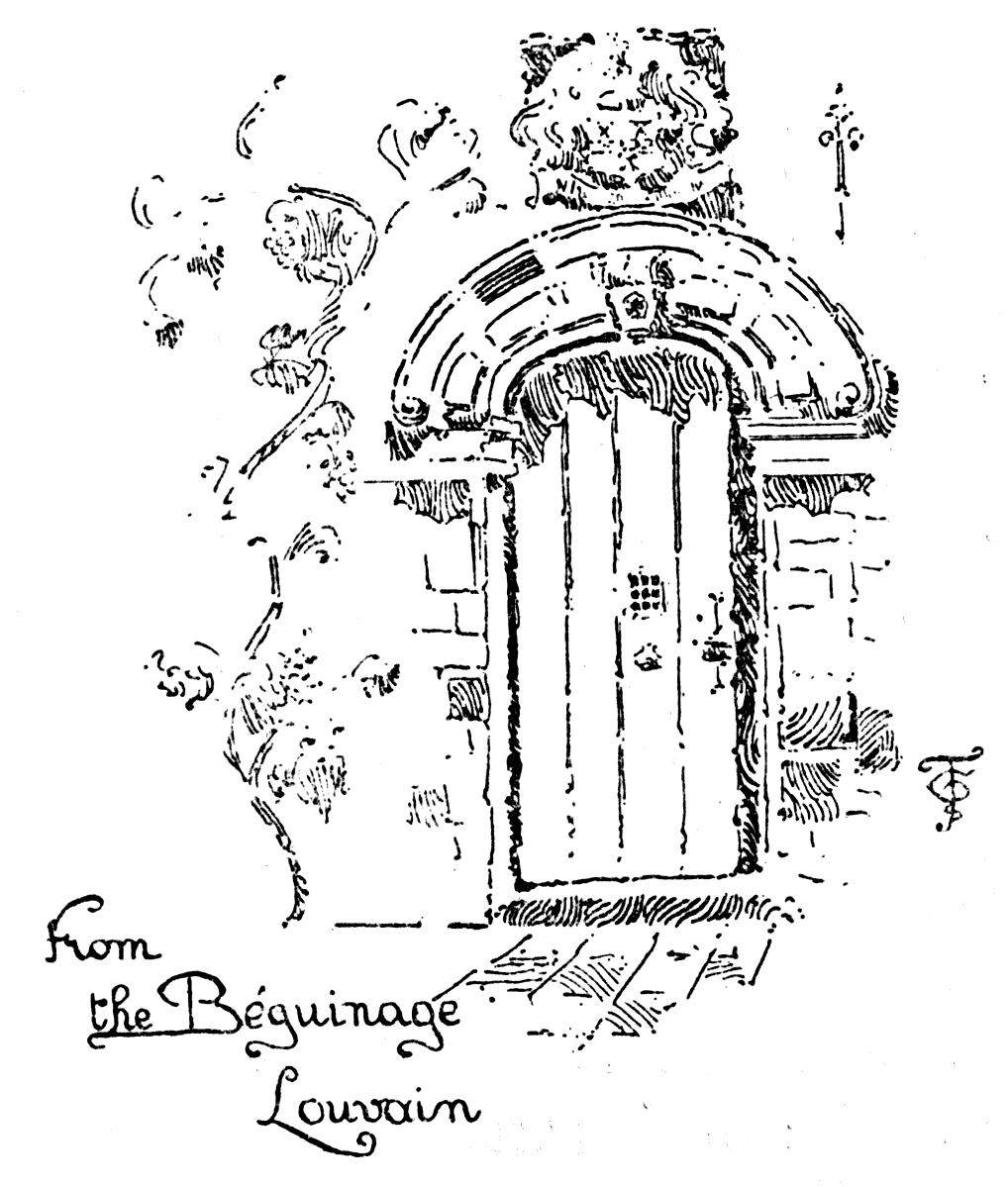
work is visible, save a little round-headed doorway
alongside the main entrance and some narrow slits of
windows in the chancel.
For the rest, in the villages and hamlets, which
are so thickly sown in the country round Brussels,
there are not a few churches or portions of churches
which date from the period we have just been considering.
It is impossible, however, within the limits
of this handbook to give even a list of them. Those
who are interested in this matter will do well to consult
Mr. Weale's Belgium. Here will be found descriptions,
with numerous historical notes, of the village
churches in the neighbourhood of the chief towns of the
kingdom and along the main lines. It was published
nearly fifty years ago, and of course since then many
archæological discoveries have been made, and, alas,
much ancient work has disappeared, but no other handbook
with which we are acquainted contains in so small
a compass such a vast mass of generally reliable information
concerning the architecture and the art of
the Low Countries.
Gothic architecture seems to have been first introduced
into the Netherlands from France by way
of Tournai. The stately choir, second to none in
Europe, which that great church-builder, Bishop
Walter de Marvis, added to his cathedral there during
the second quarter of the twelve hundreds, was probably
the first purely Gothic structure erected in
Belgium. It is altogether French in plan and
in method of construction, and it may well have
been designed by a mason of the Ile de France.
Men's minds were at once captivated by its beauty,
and the new style spread rapidly throughout the
land.
It could hardly have been otherwise: Tournai
was not only the religious capital of Flanders, it
was also the artistic capital of a very considerable
portion of the Low Country; here was established
a school of architects and sculptors, which at this
time was among the most famous of the North;
when the architects of Tournai adopted the new style
it was bound to make headway. Flanders, Holland,
Zeeland, without quarries of their own, and without
native masons, were constrained to bring from Tournai,
the nearest point where stone was to be had, alike
their building material and their builders. These
men had drawn their inspiration from beyond the
Rhine, and perhaps, too, from Normandy, and had
already attained in their craft a very high order of
excellence. When fascinated, then, by the beauty of
Bishop Walter's choir, they determined to follow the
new French fashion; they showed themselves no servile
imitators, but modified their old plans and their
old schemes of ornament in such a manner as to suit
the needs of the new methods of construction: thus
they gradually evolved a distinct style of their own,
and the flat apse, the octagonal towers, the round
turrets, adorned with pilasters with capitals delicately
carved on either side of the western gable, the high,
narrow lancet windows, without mullions or tracery—all
distinctive features of Tournai work, are to
be met with over and over again, not only in
Hainault and in Flanders, but even in Picardy and
in Holland.
Less marked was the influence of the Tournai school
on the architecture of Brabant. Brabant had quarries
of her own, and builders, inferior, indeed, to the builders
of Tournai, but for all that well skilled in their craft;
and thus what Tournai was doing for the rest of
Belgium Brabant was able to do for herself. Though
at first her architects seem to have taken as their
models the buildings which their rivals of Tournai
were constructing in Hainault, in Holland, and in
Flanders, even their earliest Gothic work is in no
way lacking in originality. Witness, for example, the
choir of the Collegiate Church of Saint Gudule at
Brussels, one of their first efforts. As time progressed
the distinctive features became more and more pronounced,
and presently a style was developed more
original and also more beautiful than anything produced
at the same time by the Tournai school. Indeed,
the Gothic architecture of Brabant of the fourteen,
fifteen and sixteen hundreds, if it be equalled, is
certainly not surpassed by the Gothic architecture
of those centuries in any other land. So far as concerns
civic buildings, Brabant certainly holds the
palm. Neither France nor Germany nor England
can show anything which can be compared, for
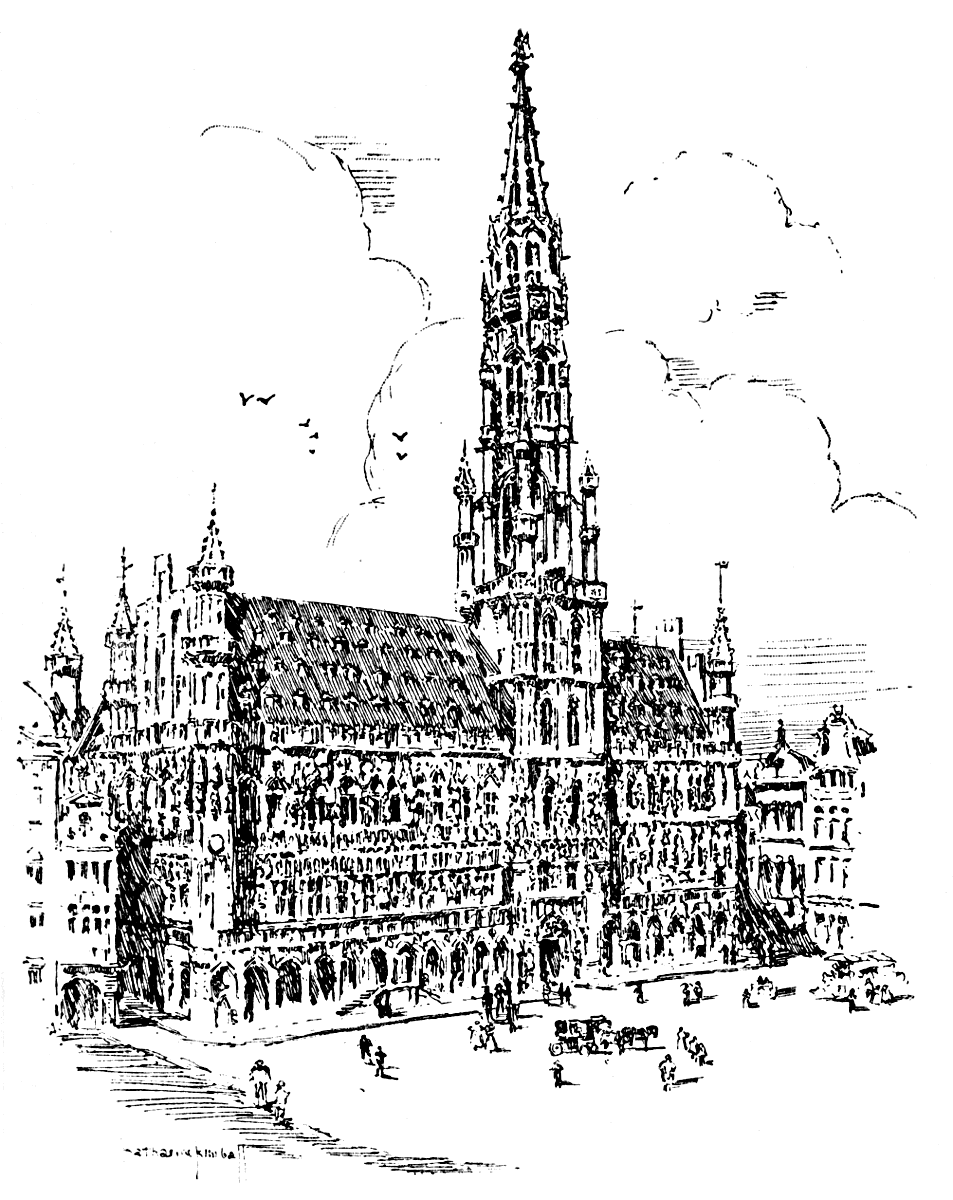
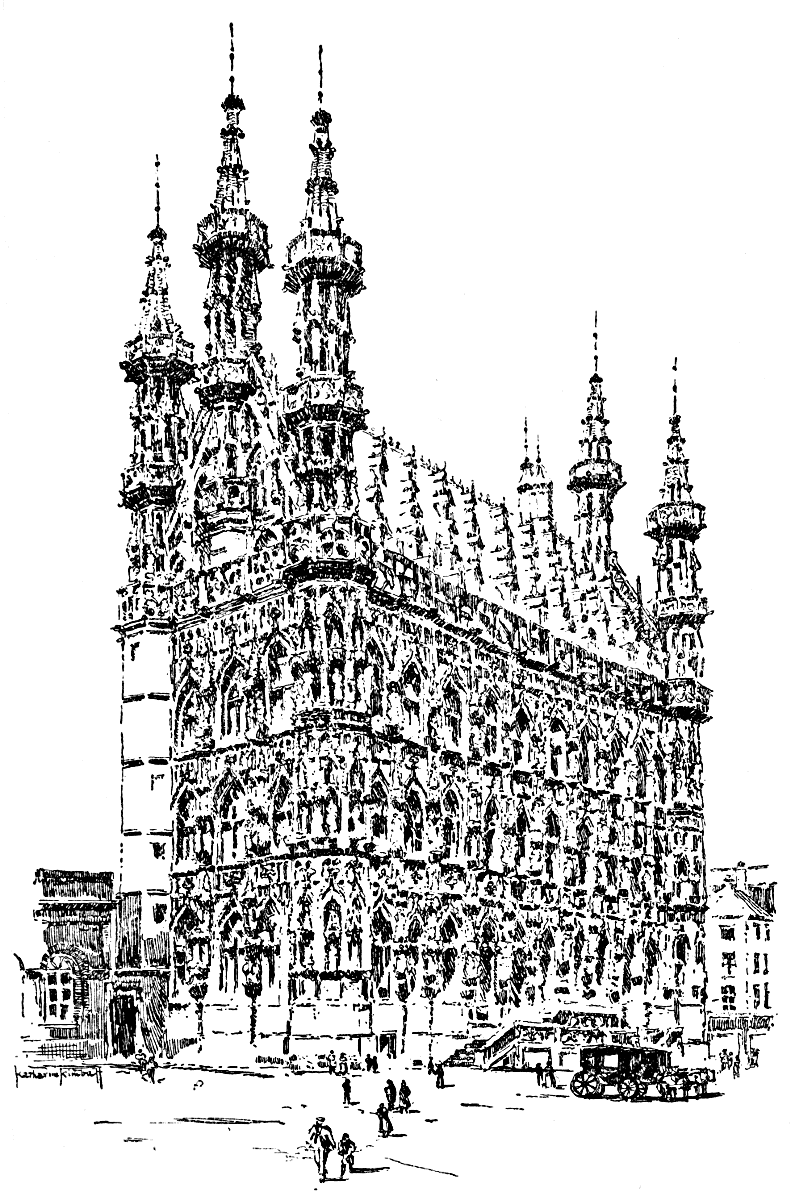
example, to the Town Hall of Brussels or the Town
Hall of Louvain, or even with the Gothic portion of
the Town Hall of Ghent, which was designed by
Brabant architects.
So great was the fame of the architects of Brabant
from the commencement of the fourteen hundreds that
their services were in request all over the Netherlands,
and later on, in the days of the Emperor Charles V., in
Germany, in France, and even in far-off Spain; and,
strangely enough, some of their latest efforts are as
nobly conceived and as carefully executed as in the
days when their art was at its zenith.
Nothing could well be finer than the Parish Church
of Saint Jacques at Antwerp, which was commenced
in 1491 and not completed till 1694, the work having
been discontinued from lack of funds in 1530, and not
renewed, owing to the religious troubles, until 1602.
This grand old building, which was designed for a
simple parish church, has all the characteristic features
of a great cathedral—triforium, clerestory, double
aisles, ambulatory chevet, transepts, and a host of
side chapels. The plans were drawn up by Herman De
Waghemakere, a burgher of Antwerp, and an architect
famous throughout the Low Countries, who not only
designed many noble buildings, but begot two sons,
Herman and Dominic, to whom he transmitted his
talent, and whom he trained to his own calling. When
he died, early in the fifteen hundreds, they were able
to worthily continue the work at Saint Jacques' which
the old man had so successfully commenced, until
1530.
At this time no portion of the church was completed,
and the choir was not even begun. When,
some seventy years afterwards, building operations were
again resumed, the original plans were strictly adhered
to, and it is worthy of note that the more recent
work is as carefully and skilfully executed as that
which was carried out under the eyes of old Herman
himself.
This church is rich in stained glass of the fourteen,
fifteen and sixteen hundreds, which, considering the
period, is of a very high order. If the designs of
some of the windows be faulty, the scheme of colour
is in each case perfect. It has retained more of its
old furniture—tapestry, metal-work, wood-carving and
the like, than most churches in Belgium. It contains
some good pictures—notably, in the Lady
Chapel, an altar-piece by Rubens, which was placed
here by his widow, and, in a vault beneath it, all
that remains of 'this prince of painters and of
gentlemen.'
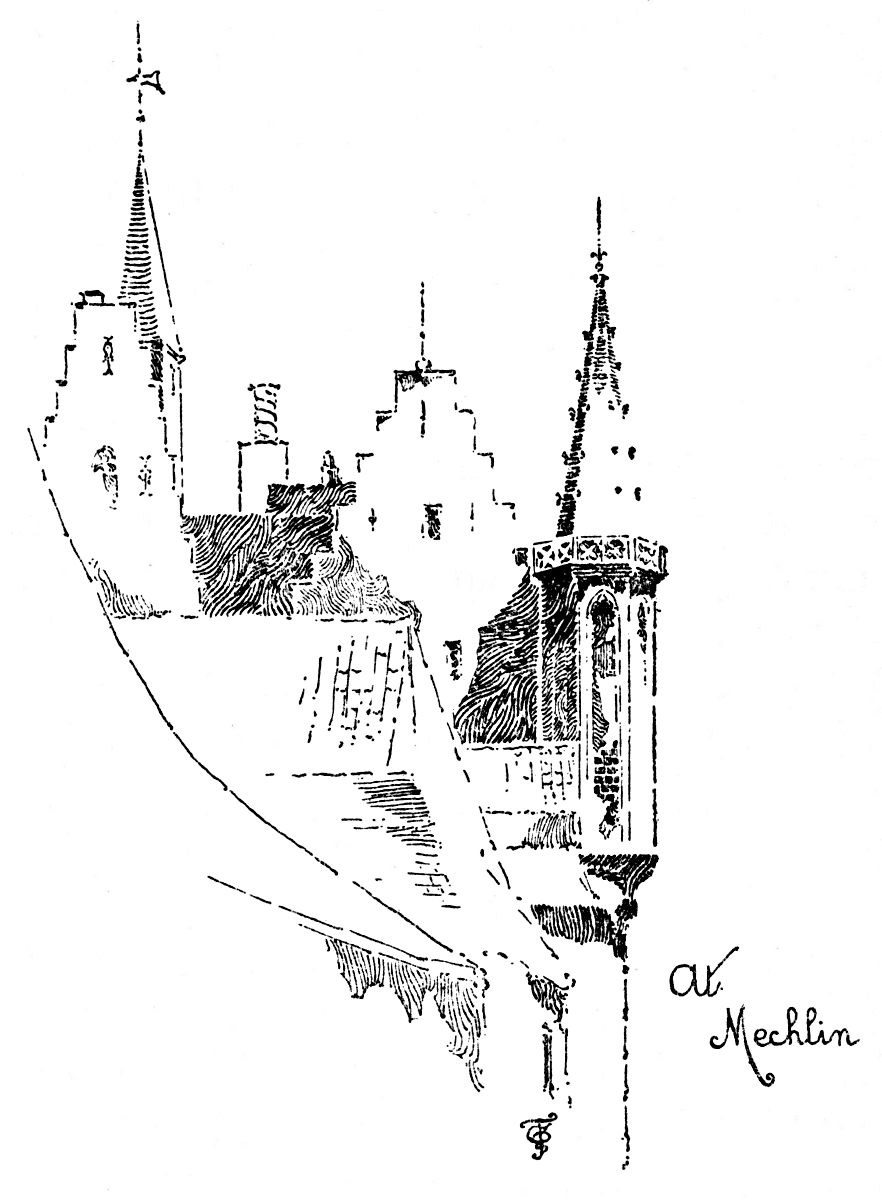
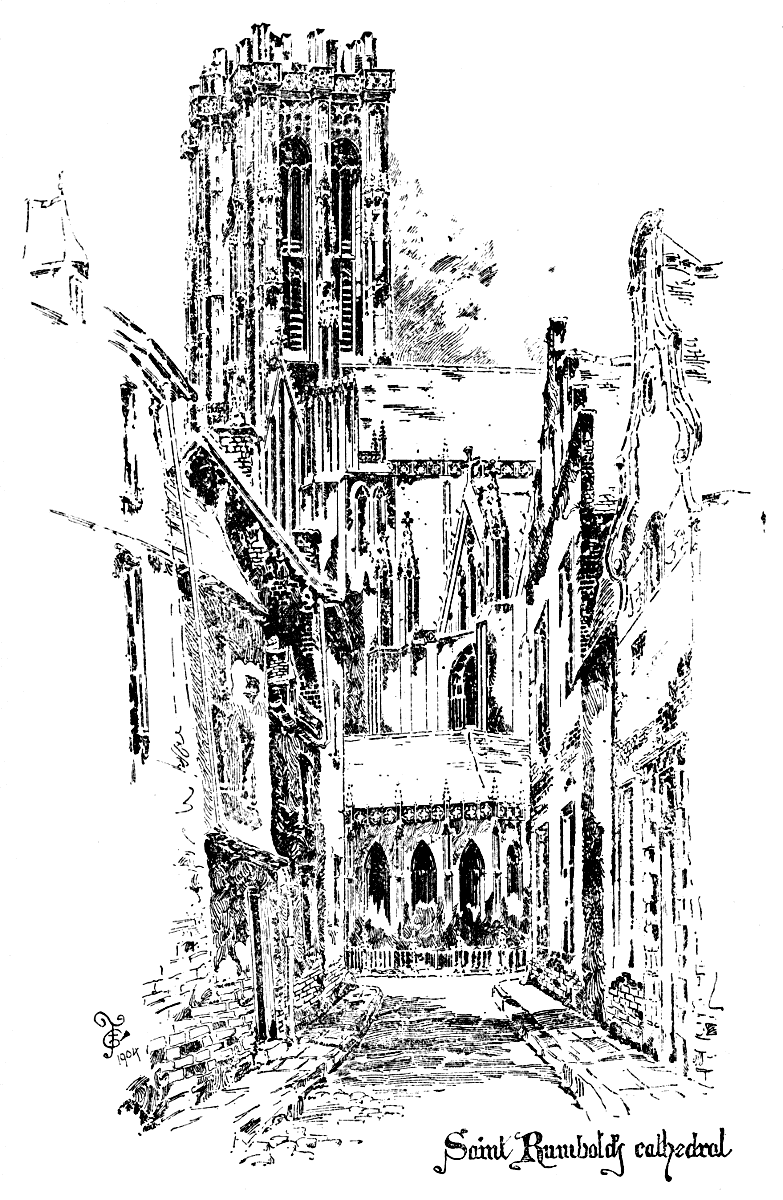
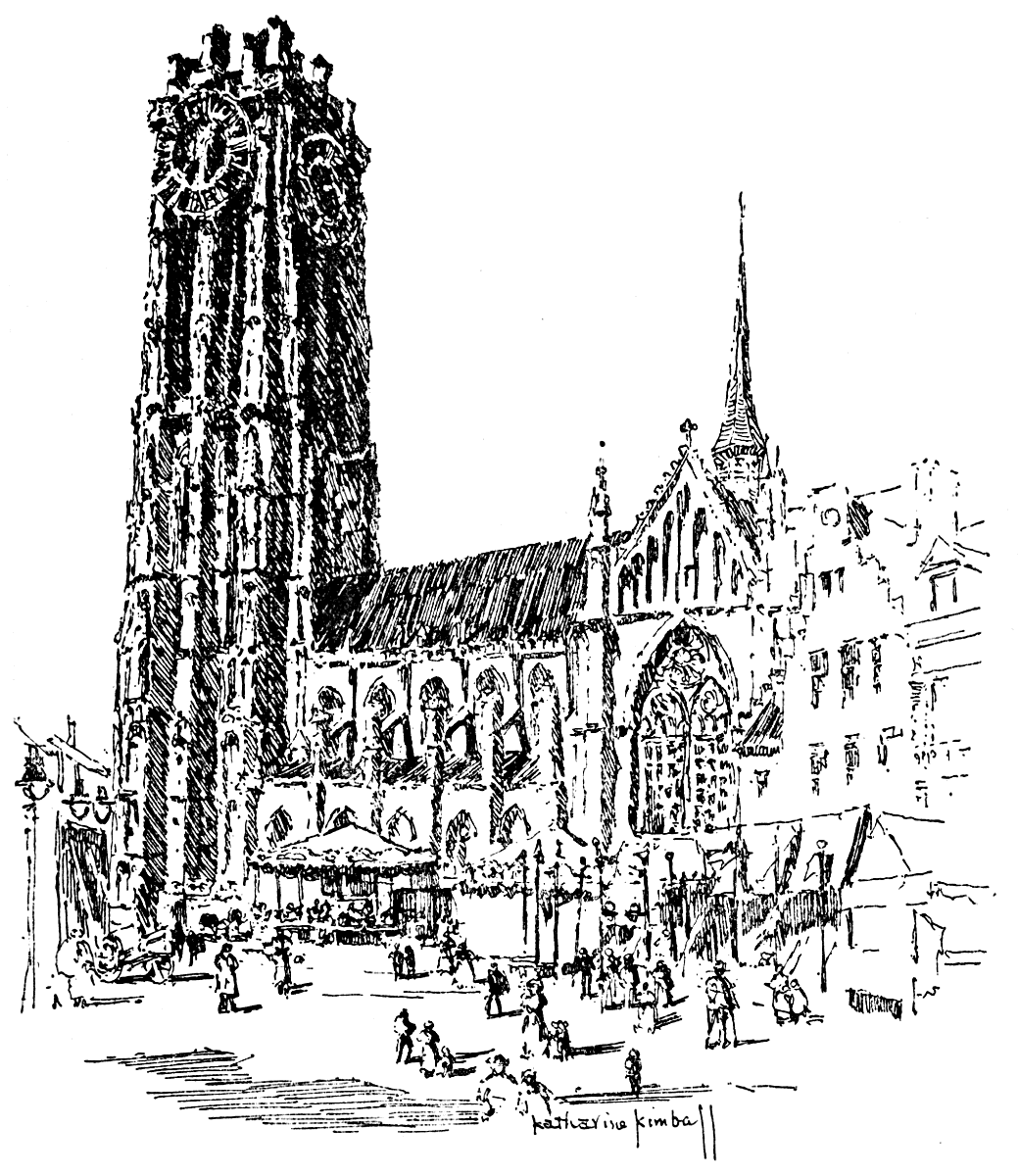
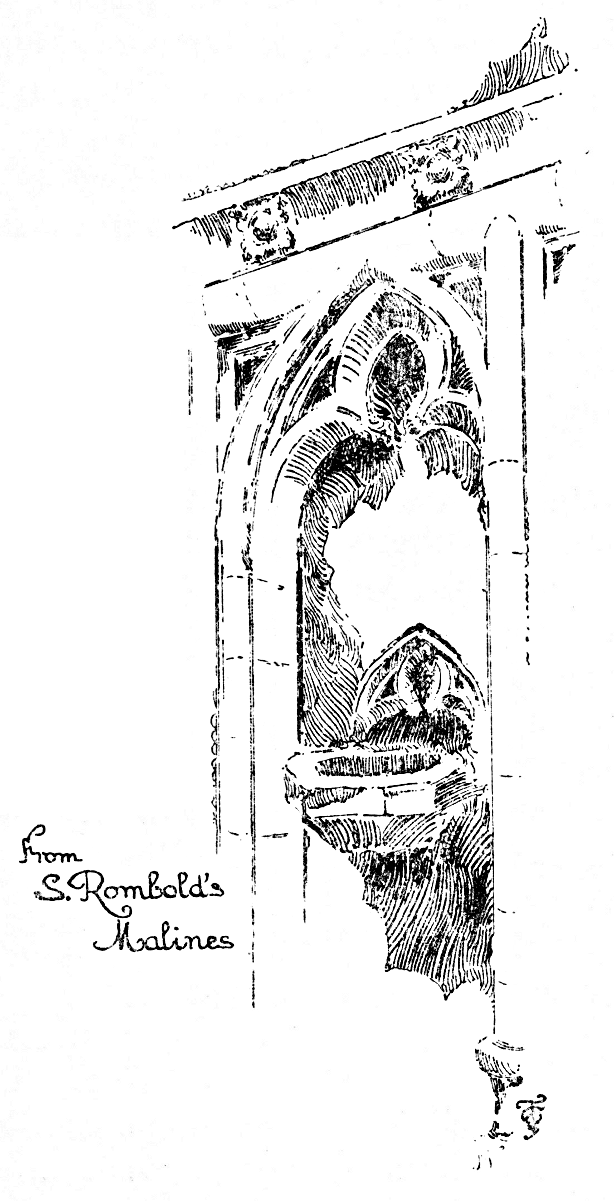
In the sublime tower of Saint Rombold's at Mechlin
we have another late creation, though not so late as the
Church of Saint Jacques at Antwerp. The foundation
stone was laid on the 1st of May 1452, and they seem to
have worked at it intermittently until 1583, when the
stones destined to complete it were carried off to Holland
by the Prince of Orange, and employed by him to build
the town of Willemstad. Even in its unfinished
state it is a colossal building. At its base it is fifty-three
feet wide without counting the buttresses, which
advance on each side to a distance of nearly fifteen feet.
Its actual height is over 320 feet, but if the spire had
been added, of which the original plans are still in
existence, it would have risen to the prodigious height
of 544 feet, and would thus have been the loftiest
steeple in Europe. This mighty tower was designed
by Jan Kelderman, master-mason, of Louvain, not
many months, perhaps not many weeks, before his
death in 1445; at which time he was in all probability
between seventy and eighty years of age.
The foundation stone was laid under the direction
of his son Andrew, and for over a hundred years
one or other of his descendants busied themselves
with carrying out the old man's designs.
A remarkable family, the Keldermans: architects,
sculptors, painters, almost all of them, during many
generations. The first of whom we have any record was
Jan van Marsdale, sculptor, of Brussels, who, for some
reason of which we are ignorant, adopted the family name
by which his descendants are generally known. He was
probably born some time during the second quarter of
the thirteen hundreds, and died at Brussels not earlier
than 1415. In his day he was an artist of renown,
but nothing which can be certainly attributed to him
has come down to us. We know that he was the
author of the richly-sculptured tomb of François van
Halen, which was placed in the first apsidal chapel
on the south side of Saint Rombold's at Mechlin in
1415, and demolished in 1810.—Of this marvellous
work of art there exists in Le Théâtre Sacré du
Brabant an engraving—and we know, too, that he was
the father of the Jan Kelderman who designed Saint
Rombold's tower. This man was a burgher of Louvain,
and city architect there from the 7th of October 1439
till his death in 1445. He directed the building of
the Council Chamber in the Hôtel de Ville, which had
been designed by his predecessor, Plyssis van Vorst,
and which still exists. Of his three sons, Rombold,
the eldest, was a painter of glass, and one at least of
his works has come down to us: a beautiful window
in the old church at Lierre, the first on the north side—representing
Godefroid Vilain XIV. and his wife,
Elizabeth d'Immersule, donors, along with their patrons,
Saint Peter and the poor man of Assisi. This window
was painted in 1474, and the sum which the artist
received for it was forty-two golden florins. Rombold
was born in the year 1420. He married before 1447
Catherine van Voshem, whose sister Elizabeth was
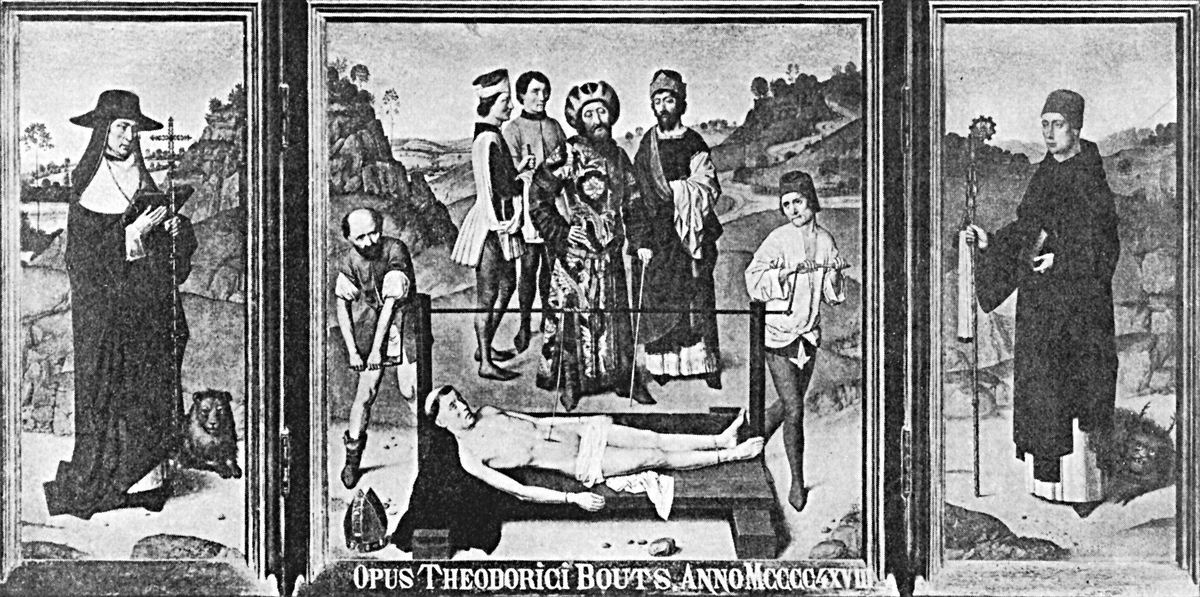
the wife of the famous painter, Dierick Boudts,
and inhabited his own house in the Rue de Diest at
Louvain, where he died on the 17th of March 1489.
Matthew, Jan's second son, followed his father's trade,
and he also busied himself with painting and sculpture:
the indentures of an apprentice whom he undertook to
instruct, in three years, in the art of painting are still
in existence, and we know, too, that some of the carved
beams in the Town Hall at Louvain are his work.
For the rest, he in due course took to himself a wife,
who presently bore him a son, whom he named Hendrick
[Pg 200]
[Pg 201]
and trained to his own calling. No record of
any work that he executed has as yet been found, but
he seems to have done well in his profession, for in
1505 he purchased a house in the Cattle Market at
Mechlin, hard by the Chapel of Saint Eloi, and
here in 1521 he received Albert Dürer, who in his
journal notes that at Mechlin he was the guest of
'Maister Heindrich.'
Andrew, the youngest son of old Jan Kelderman,
was a man more famous than either of his brethren.
He was city architect of Mechlin, and supervised the
carrying out of his father's design of Saint Rombold's
tower for thirty years; and when he died, in 1485 or
thereabout, it had risen as high as the bell-chamber.
He was the author of divers beautiful rood-screens,
amongst them that in the church at Bergen-op-Zoom,
which he wrought in 1471 with the aid of his son
Anthony, who, it will be interesting to note, dwelt in
a house at Mechlin which is still standing—No. 13
Aux Tuileries.
This man, succeeding his father, directed the
building of Saint Rombold's tower until he in his
turn died, on the 15th of October 1512. He was the
author of two famous buildings—the Town Hall of
Middelburg, in the island of Walcheren, and, in his
native city, the Church of Notre-Dame au-delà de la
Dyle, and the father of two sons who were not unworthy
of the family name, and each of whom set
their mark on the family tower. The younger was
aptly enough called after the saint with whom the
Keldermans had been so long associated; honours
were presently his, and wealth and a wide reputation,
if he were not the greatest of his race, at
least he was the most successful, of Rombold
Kelderman II. we shall have much to say later on;
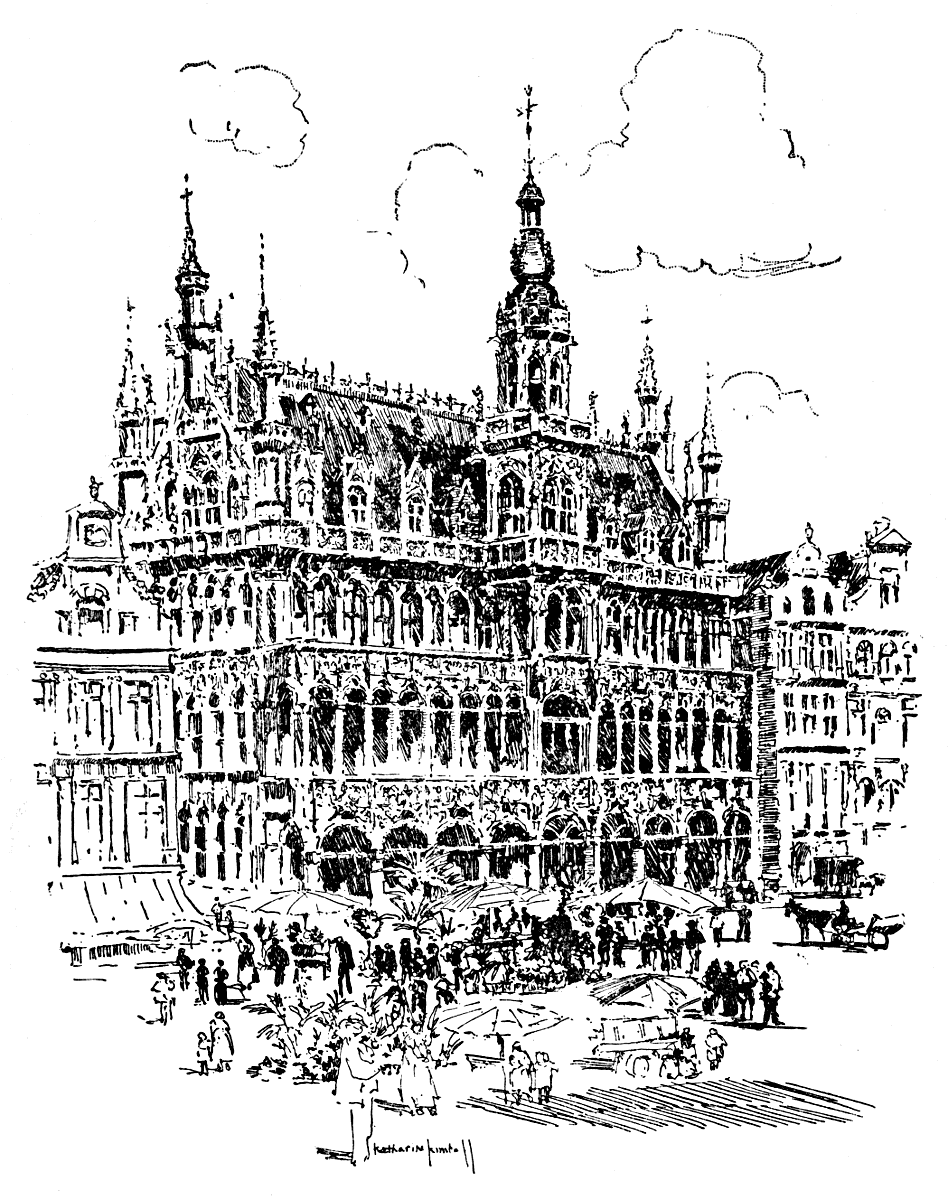
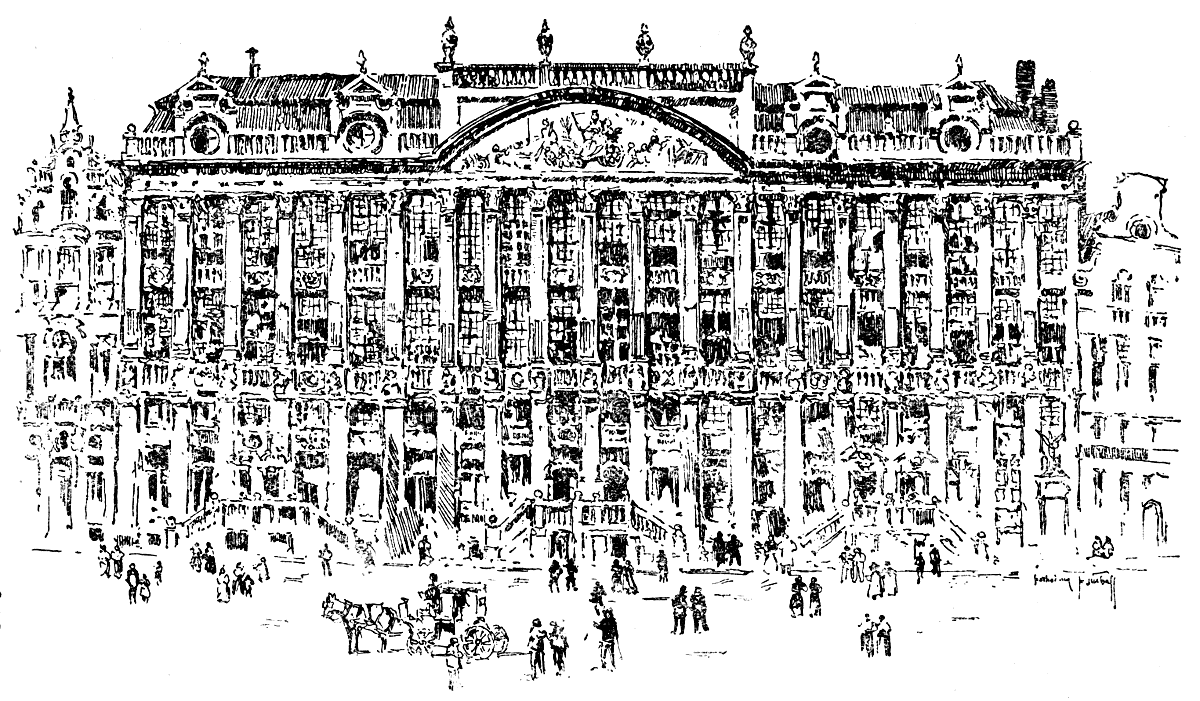
the elder was named, after his father, Anthony, and
though he died young, he lived long enough, but only
just long enough, to design a monument which still
proclaims his genius—the
old Broodhuis at Brussels, now
called La Maison du Roi. Some three days before
the foundation stone was laid young Anthony was
gathered to his fathers (December 5, 1515), and the
guerdon which he would have received was paid into
the hands of his widow.
There were other members of this talented family of
whom the record of some of their labours has
come down to us. Notably Matthew, a younger son
of Andrew Kelderman, who worked at Antwerp
Cathedral under Herman De Waghemakere from 1487
to 1498; his son, also Matthew, who migrated to
Louvain, was named city mason there and directed
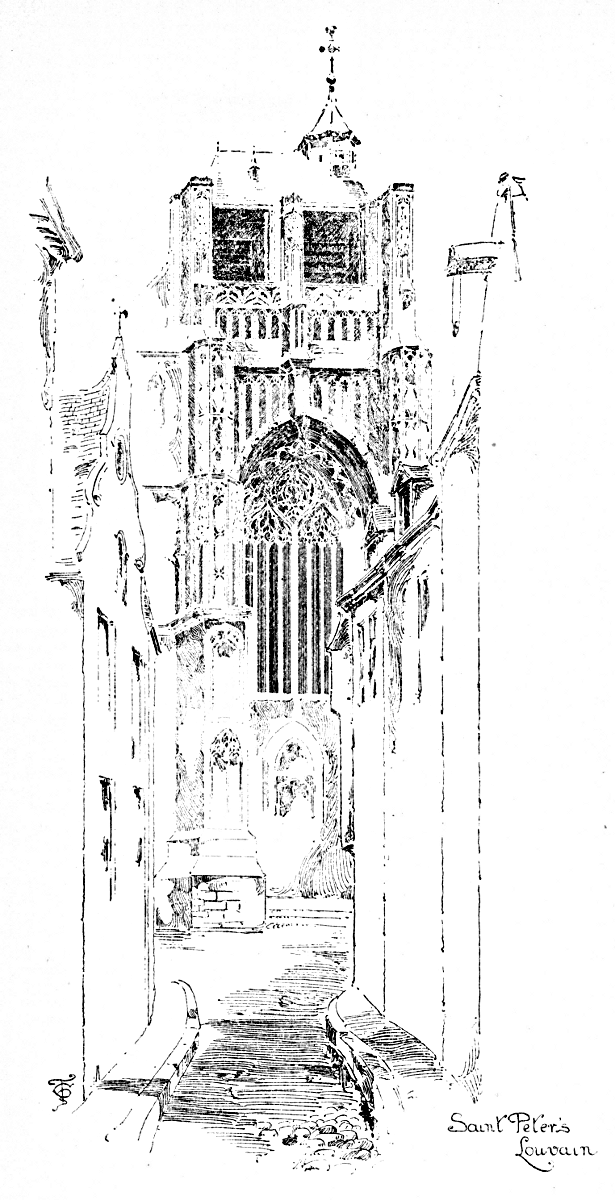
the building operations of the Church of Saint Peter
from 1503 to 1527; and Laurence, who plied his
trade, for the most part in Brussels, helped to build the
Maison du Roi, and was perhaps a nephew, perhaps a
son, of the great architect who planned it. The city
records from which these bald facts have been culled
in comparatively recent years by those who have or
have had the care of them, divulge something of the
nature of an anecdote concerning Laurence Kelderman.
We learn from certain entries in the town accounts
of Brussels that in the year 1513 he was mulcted 30
florins for wounding one of the amman's serjeants,
and the same document informs us too how it came
about.
Kelderman and two other famous masons—Hendrick
van Pede, the author of the Town Hall of Oudenaarde,
and Ludwig van Beughem, who later on built
for Marguerite of Austria the famous Church of
Brow in Bresse—were at this time at work, most
fortunately for them as it afterwards turned out, on the
beautiful palace which the Count of Nassau was erecting
for himself in Brussels with that gold, as all men
believed, which he had wrung from the vanquished
burghers of Bruges in 1490, and every evening it was
their wont, when their work was done, to drink together
at the Sign of the Star, a tavern of note in the Great
Market, which seems to have been at this time much
frequented by men of their craft. To this house of
entertainment, then, on the 13th of February, at their
accustomed hour they repaired, and each man having
bade the drawer bring the liquor he liked best, they
proceeded to pledge one another in bumpers, but their
potations that night were not destined to be of long
duration. Perhaps there was strife in the cups of some
of their boon companions, certain it is that one of them
drew his knife, and, as luck would have it, at the same
moment the amman's serjeant walked in, who, fearing
mischief or feigning to do so, forthwith disarmed the
fellow; whereat our masons, enraged at this insult to
a free citizen, hurled themselves on the officer of
justice, wrenched away his sword, and in so doing inflicted
on him a flesh wound. The offence, according
to the strict code of Brussels, was no light one, and
serious consequences would have undoubtedly followed
had it not been for the Count of Nassau, who, loth to
lose the services of such capable workmen, exerted
his influence in their behalf, and thus they were quit
with a fine. Later on we find the names of two of the
delinquents again associated, but in very different
fashion. When it was decided in 1532 to add to the
Church of Saint Gudila a new Sacrament chapel, the
Maîtres de la Fabrique commissioned three architects
to prepare plans for the proposed structure, and two of
them were our friends of the tavern brawl, Hendrick
van Pede and Ludwig van Beughem. Peter van
Wyenhoven was the third competitor, his designs
were adjudged the best, and he it was who constructed
the actual building. Bernard van Orley, the famous
painter, made the fair copy of his plans for him on
two large sheets of parchment, and received for so
doing, it will be interesting to note, £2, 10s. 9d.,
and the foundation stone was laid on the 8th of
February 1535.
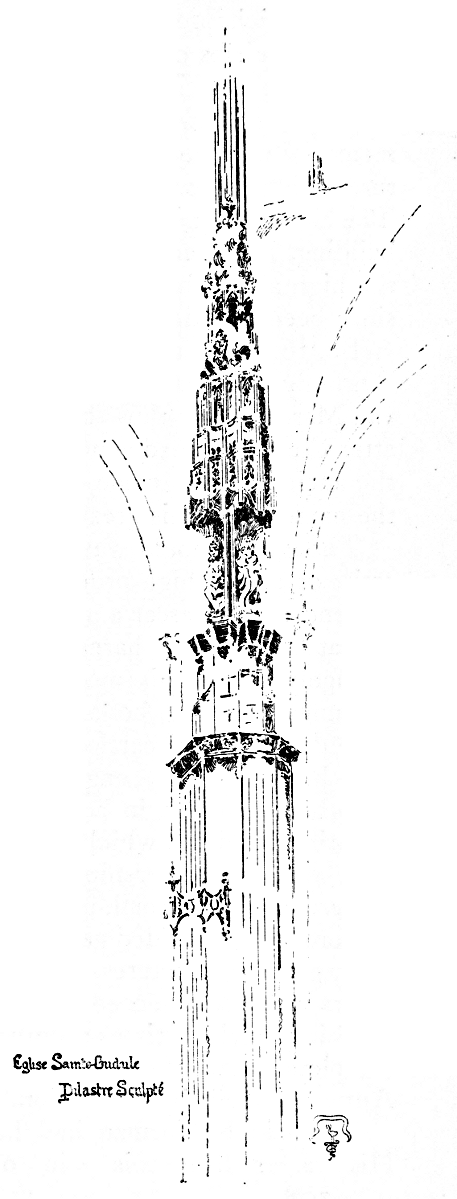
The plan of this chapel is exceedingly simple. It
consists of a nave of four bays with a flat apse pierced
by a vast window enriched
with flamboyant tracery.
The building is also lighted
by five other windows of
similar design and like dimensions,
of which four are set
in the north wall, and one in
the last bay of the south wall.
They are all of them filled
with beautiful stained glass,
which is as old as the chapel
itself, and the picture which
glows in one of them—the
second on the north side—was
designed and painted by
Bernard van Orley. The
shafts, or piers, or pilasters—it
is difficult to know
exactly what to call them—from
which spring the
numerous prismatic ribs of a
rich and intricate vault, are
strangely and elaborately
fashioned. Below they are
bold, octagonal columns, or
rather half-columns. Higher
up they break out into a
mass of tabernacle work in
the form of two canopies,
which shelter saints, and
when at last they emerge from
behind the pinnacles
and crockets, we find
that they have ceased
to be columns and are
now slender reeded
shafts, which presently spread out like palm leaves and
become the ribs of the groining.
Though Van Pede's designs were not accepted, the
Sainte Chapelle des Miracles is none the less a perpetual
memorial of his genius: the cunningly wrought sculpture
which it contains is almost all of it his handiwork.
The honoured name of Kelderman too is linked with this
building, but that association is now only a memory:
the high altar which Peter Kelderman reared has long
since been cast down.
But to return to Peter's more famous kinsman, old
Anthony Kelderman's second son, Jonkhere Rombold
van Marsdale, for thus the honest mason styled himself
after Charles V. had ennobled him. Maybe he thought
the ancient family name sounded more aristocratic than
the name which his great-grandfather had adopted.
Though Rombold was undoubtedly an architect and
artist of a very high order, and though he remained to
the end of his career a man of energy and enterprise,
and at last died in harness, full of years and honours,
strangely enough his memory is not kept alive by any
monument which he alone can be certainly said to
have designed and carried to completion. In his early
days he was largely engaged in completing the work
of other men, or in adding to, or embellishing, or
restoring buildings which already existed. Later on he
entered into partnership with Dominic De Waghemakere,
and henceforth most of his designs were not the
outcome of his unaided genius. Together they planned
many glorious structures. Some never got beyond paper,
others were commenced and left unfinished, for they
lived in troublous times; only a few were brought to
completion, and of these but one remains, the Steen of
Antwerp, spoilt by restoration.
Rombold Kelderman had honours, riches, renown.
His career from this point of view was certainly a
most successful one, but an untoward fortune seems to
have dogged his steps in the matter of his craft, and
this was so not only with his own creations but also
with the buildings which he reared and the plans which
he made conjointly with
Dominic De Waghemakere.
Thus, for example,
he was commissioned
by Charles V. to transform
the unfinished
Cloth Hall of Mechlin
into a place of assembly
for the Grand Council
of Brabant. He drew
out plans; they were all
that could be desired—the
original drawings
are preserved amongst
the city rolls; somewhere
about the year
1529 the foundation
stone was laid, and at
first the work was pushed
on bravely, but before it
was half finished came
the troubles of Philip's
reign and it had to be
abandoned, but Rombold grieved not at it, he had long
since paid Nature's debt.
Otherwise, and yet more deplorable, was the disaster
which baulked the realisation of Kelderman and
De Waghemakere's magnificent scheme for the reconstruction
of the choir of Antwerp Cathedral.
During the two centuries which had elapsed since
the commencement of this great church the ground
around it had gradually risen by reason of numerous
interments to a very considerable distance above the
pavement; hence the church was always cold and
damp, and in wet weather not unfrequently flooded.
To remedy this, it was decided early in the fifteen
hundreds, to erect a new choir with a crypt beneath
it in such a manner that the pavement of the upper
building should be on a considerably higher level
than the ground outside. Kelderman and De Waghemakere
prepared the plans, and in due course the
Emperor himself laid the foundation stone. For nearly
ten years they worked at the new structure, and then
came the catastrophe which sooner or later almost always
frustrated Kelderman's most strenuous endeavours:
a fire broke out which wrought such havoc on the
main body of the cathedral that the repairs absorbed
alike the money and the material which had gradually
been amassed for the building of the new choir. Thus
was the ambitious scheme of these two great architects
nipped, so to speak, in the bud, for ambitious scheme
it undoubtedly was: if it had been carried out Antwerp
would have possessed a cathedral vaster and, if contemporary
witnesses are to be trusted, more beautiful
than any other city in Christendom. Of this we have
no means of judging, for though the plans were carefully
treasured among the city rolls for some two hundred
years, at last they mysteriously disappeared. There
was reason to believe they had been stolen, and though
every effort was made to trace them, from that day to
this they have never been found; but of the vast proportions
of the proposed edifice there can be no manner
of doubt, the foundations still exist, and here and there
they are visible. Moreover, a few years ago, there
was discovered, hidden away in the archive chamber, a
contemporary sketch of the ground plan, from which it
appears that Kelderman's choir would have occupied a
[Pg 212]
[Pg 213]
surface just twice as large as that covered by the actual
choir including the ambulatory and the chevet. Now
Antwerp Cathedral in its present state is not one of
mean dimensions: it is somewhat longer than Westminster
Abbey, without the lady chapel, and exceeds
it in breadth at the transepts by over ten feet and at
the nave by no less than a hundred.
Kelderman and his partner were happier, or perhaps
it would be more apt to say not quite so unfortunate
in their undertakings at Ghent. Here their endeavours
were at least crowned with some measure of success.
Early in the year 1518 the city fathers of Ghent
commissioned our masons to erect for them a new
Town Hall, as we learn from the contract passed
between them on that occasion. The original deed is
still in existence; it is very curious and interesting,
and throws much light on the customs and methods of
the builders of the day. In it Rombold and Dominic
bind themselves to inspect the work three times a
year—in April, in August, and somewhere about the
Feast of Saint Bavo, at which last visit they promised
to bring with them designs for sculpture, ironwork
and so forth, to be executed by the workmen in winter
time, when building operations were invariably suspended,
and they also undertook to come to Ghent at
any time throughout the year when their presence was
deemed necessary, provided their travelling expenses
were paid and they were given four, or at least three,
weeks' notice. Moreover, the magistrates reserved to
themselves the right to name other architects in place
of De Waghemakere and Kelderman, in the event of
their not giving satisfaction. They had no occasion
to exercise it; the plans were perfect, Rombold and
his partner performed their duties with the greatest
assiduity, and the burghers began to flatter themselves
that soon Ghent would be endowed with the grandest
Town Hall in the Netherlands. Their expectations
were not realised—the building progressed slowly,
perhaps on account of the threatening state of the
political atmosphere. On the 15th of December 1531
Rombold Kelderman died, and it was not yet half
finished. Albeit, they did not lose heart; Dominic, in
virtue of a clause in the agreement, named Laurence
Kelderman to succeed his uncle; for four years
longer the work dragged on and then at last it came to
a standstill. Who could think of building operations
amid the hubbub and whirl of rebellion? Or afterwards,
when the riot was quelled, whilst Alva was begging
for the destruction of the town, or whilst the city
fathers with ropes round their necks were humbly
sueing for pardon? It was not till the close of the
century that the burghers were once more able to turn
their attention to their unfinished Town Hall.
Dominic had long since joined his partner on the
other side of the stream, the art in which these men
had so excelled was now almost dead, Ghent was
beginning to be captivated by the spurious charms of
the Renaissance, and in completing her Town Hall
she followed the bent of her fancy. The new
architects, however, left the work of their predecessors
intact, and we have this much too to be thankful for:
the original plans still exist. By a clause of the
agreement of 1518 it was provided that in the event
of the decease of both the architects before the completion
of the Town Hall the plans should be restored
by their heirs to the city magistrates; this clause was
faithfully carried out, and the plans, along with the
contracts, are still preserved among the city archives of
Ghent.
However much we may regret the setting aside of
the plans of Kelderman and De Waghemakere, it
cannot be denied that they deserved the fate which
overtook their labours, for they themselves had shown
scant respect to the memory of their predecessor,
John Stassins, an architect of no mean order, who, as
early as 1481, had made plans for the new Town
Hall, plans which were accepted by the city fathers,
and which, until his death in 1517, he had done his
utmost to realise. So much labour lost, Kelderman
and De Waghemakere discarded them and cast down
his unfinished building; but in Ghent John Stassins has
his memorial: he it was who planned and reared Saint
Bavo's stately tower, not the least beautiful of the
many beautiful towers which still adorn the cities and
the villages of the Low Country.
The mention of the tower of Saint Bavo's naturally
suggests the church itself. Here we have perhaps the
most beautiful of all the Belgian cathedrals, certainly
the most interesting. Founded in the course of the
nine hundreds, and not completed till the latter half of
the seventeenth century, this time-honoured building
contains specimens of almost every period of architecture.
The crypt, or at all events a portion of it, is
part of the original structure; it is divided into four
naves and is the largest crypt in Belgium. Here lie
the ashes of Hubert van Eyck and those of his sister
Marguerite. The choir, of blue Tournai stone, severe,
ample, stately, is of course Tournai work of the
closing years of the twelve hundreds, all of it save the
vault, which dates from four centuries later, and is so
perfect an imitation of primary Gothic work that
did we not know that the choir of Saint Bavo's, like
so many early churches in Belgium, was originally
covered with a wagon-head roof of timber, and were
it not for the cathedral records which remove all
doubt as to the period of its construction, it would
certainly be assigned at latest to the opening years of
the thirteen hundreds. For the rest, the fifteen
ambulatory chapels are of the thirteen and of the
fourteen hundreds; the tower, as we have seen, dates
from the closing years of the latter period; and the
nave and transepts, the aisles and adjoining side chapels
were built in the middle of the fifteen hundreds.
That the western half of Ghent Cathedral was
the work of a Brabant architect, is more than likely,
for though there is no documentary evidence to show
who was its author, it has all the characteristic
features of the Brabant style. The position and
character of the tower—lofty, massive, bold, proudly
standing at the head of the church, with its lower
stage as wide and as high as the nave and incorporated
with it; the peculiar treatment of the triforium—not
an arcade, but a simple gallery of sculptured stone; the
triangular oculi in the gables of the transepts, and the
vast windows, divided by great Y-shaped mullions,
which light them, these and a host of other things too
numerous to mention proclaim with no uncertain voice
what manner of man made it.
In every age and in every land it has been the aim
of Gothic masons to make their buildings, and
especially their religious buildings, the incarnation of
this mandate—Sursum corda. Almost always they
succeeded, but often, and this is notably the case in
England, their most successful efforts are cramped and
narrow, or at all events from their great height seem so.
The Gothic architects of Brabant set themselves a
harder task, which, in spite of its difficulty, they not
infrequently accomplished. Their churches should,
indeed, sing Sursum corda as loudly as the rest, but
they should add to it no less loudly this other refrain—In
loco spatioso. The builder of the cathedral at Ghent
in this respect triumphed magnificently: Saint Bavo
soars like an archangel, and it would be hard to find a
church which more emphatically preaches breadth.
Not only is the building in reality broad and high, it
looks so; nay, it has the appearance of being broader
and higher than it actually is. In order to invest it
with a large atmosphere the architect who designed it
not only gave breadth to his ground plan but made all
his openings broad, taking care that those most in
evidence should be broader in proportion than the rest.
Thus the surface covered by the nave and aisles is
almost a perfect square. Indeed, the distance from
north to south is slightly greater than that from east to
west. Of this vast space the central avenue embraces,
roughly speaking, two-fifths, the adjacent avenues each
about one-fifth, and each of the outer avenues one-tenth.
In other words, the nave is twice as broad as the inner
aisles, and these bear much the same proportion to the
outer aisles. Also, in order to give them greater
breadth, he economised his openings, and in the case
of windows reduced the intervening masonry to a
minimum. Thus the nave, notwithstanding its great
length, has only four bays—the object of this was no
doubt to give breadth to the cross vistas—and consequently
in its clerestory there are but eight windows,
four on each side, and the same number in the walls of
the outer aisles. In spite of the vast span of the
arches, the several arcades have by no means a stunted
appearance. They are too lofty for that, and also in
the case of the central avenue the rich moulding which
adorns them springs from the bases of piers without
capitals, and thus we have a series of unbroken lines
ascending from plinth to apex, which marvellously
increases their height.
Arcades are often thus treated in tertiary Brabant
work, and even too sometimes in buildings of the
second period. Not that the architects who designed
them despised capitals, or were ignorant of their
æsthetic value, but they knew where they could be
suppressed with advantage and where they could be
added with effect. None of their buildings are wholly
devoid of them, and at Saint Bavo's they are numerous
and highly developed, a very noteworthy feature in the
scheme of ornament: alike in transept, nave and
aisles, the ribs of the vault spring from them. They
are all of like fashion: bell-shaped, considerably larger
above than below, and adorned, but not over adorned,
by closely clinging conventional leaves. They crown
cylindrical columns, sometimes single, sometimes in
groups of three, five, or more, which, though they are
in reality of no mean girth, by reason of their great
height and of the vast bulk of the piers to which they
are in each case attached, seem slender, but not so
slender as to suggest weakness. One feels quite sure
that each stately shaft can easily carry the burthen
which rests on its beautiful head.
As we have already remarked, there is no direct
evidence to show who made the plans of the western
half of Saint Bavo's, or at all events, of the nave, but
the following facts are significant. It is undoubtedly
the noblest ecclesiastical structure which Brabant
produced in the first half of the fifteen hundreds;
of the Brabant architects of this period the greatest
was Dominic De Waghemakere, and he was constantly
at Ghent during the early days of its construction
busy with the new Town Hall. We suspect, then,
with Monsieur Louis Cloquet, that Dominic at least
had his say in the matter.28
Glorious, however, as these late Gothic buildings
are—and there are others in Brabant no less beautiful,
and how many, perhaps, still lovelier which exist only
on parchment, never realised, or by the hands of iconoclasts
cast down?—they are but the aftermath, the last
and the loveliest flowers of a tree which when it produced
them, was already almost dead. By a supreme
and mighty effort it had forced the little life that was
in it into one favoured branch, which thus clothed with
fairest blossoms and with the freshness of their beauty
still upon it, withered away like the rest. If we would
contemplate the tree in its vigour we must go back to
the fourteen hundreds, and more especially to the days
of Philippe l'Asseuré—to the long peace of thirty years
which followed the Treaty of Arras (September 21,
1435). Then it was that Gothic art in Belgium
reached the zenith of its magnificence, then it was that
she first became unrivalled in the abundance and in the
quality of her fruit, that each day saw some great
work completed or the foundations of some grand
building laid. Many of these monuments have perished,
but such of them as remain, though they have suffered
much at the hands of enemies and of friends, bear witness
alike to the genius of the artists who created them and
to the public spirit and the devotion of the burghers
and craftsmen who provided the funds with which
they were built, and who, hard-headed, close-fisted,
cautious men, as many of them were, counted it no loss
to have invested so much of their capital in these unremunerative
securities. In those days Brabant was
rich and free, and possessed of the faith which removes
mountains.
The years which immediately preceded the advent
of the house of Burgundy (1384) had been throughout
the length and breadth of the Netherlands evil. War
everywhere and of every description, not only with
alien foes, but province against province, city against
city, class against class; the staple industry gone or
fast going, and half the population swept away by
famine and pestilence. Flanders, with its fields untilled
and its dykes unmended, had become what it was
a thousand years before—morass and jungle, the home
of wolves which preyed on the meagre flocks that
remained, and of vast herds of stag and boar which
ravaged the scanty patches of grain which here and
there the dwindled peasantry had made shift to raise;
and though other provinces had suffered less, there was
dearth and wretchedness everywhere. Yet of these
same stricken fields some fifty years later Philippe de
Commines was able to say, 'Ils se pouvoient mieulx dire
terre de promission que nulle aultres seigneuries qui fussent
sur la terre.' The geographical position of the land,
the energy and enterprise of its people, the advantages
resultant from the union of all the provinces under one
prince, and, above all, the blessing of peace; therein
lies the explanation.
In no quarter was the recovery more rapid, nowhere
was the meed of prosperity so great as in the duchy
of Brabant. Not only had Brabant suffered less than
the other provinces, but its soil was naturally more
fertile, and the burghers of the great towns, now that
their long-standing strife had been settled, showed
themselves more apt than their fellows in Flanders for
example, in developing new industries and in adapting
their methods of trade to the changing conditions of
the commercial situation. Whilst the three bonnes
villes of Flanders—Bruges, Ypres, and Ghent, were
vainly striving to foster their dying industry to the no
small detriment of their trade, by imposing exorbitant
duties on foreign made goods, and at last by altogether
prohibiting the importation of English cloth, the 'good
towns' of Brabant found salvation in the development
of new industries, notably the manufacture of linen and
tapestry, or, as in the case of Antwerp and Bergen
-op-Zoom,
by enlarging the doors of their markets.
Antwerp, indeed, found a gold mine in her free fairs
open to all the world without toll or tribute, and,
thanks to the liberal policy which she pursued in regard
to aliens, presently succeeded in diverting to her shores
the foreign merchandise which had formerly found its
way to Bruges. Also, the towns of Brabant were
directly or indirectly aided by the personal action of
the princes of the new dynasty, who seem to have exerted
their utmost endeavours to promote their welfare:
Louvain was indebted to Duke John IV. for a boon not
to be despised, for in planting his new university in the
ancient capital, he practically gave to her a fresh lease of
life; Mechlin was helped later on by that stern and
gloomy Sovereign, Charles le Téméraire, who made the
city of Saint Rombold the seat of the national parliament;
the interests of Antwerp were invariably pushed by
the entire dynasty, often at the expense of Bruges;
and Brussels, which for years past had been in reality,
though not in name, the capital of Brabant, now
that that duchy was held by a prince who was also
Sovereign of each of the adjoining states, became,
to all intents and purposes, the common capital of the
Netherlands, the home of a prince whose revenues
were larger and whose expenses were heavier than
those of any other prince of his day, whose wont it
was to astonish the world by the splendour of his
feasts and pageants—advertisements, costly if you will,
but, from the credit they gave him, well worth the
money he paid for them, of a prince whose very
economies—for if Philip knew how to spend, he knew
too how to count and how to save—were a source of
wealth to his subjects: the vast sums which he
annually sank in building operations, or invested in
precious stones and precious stuffs, in goldsmiths'
ware, in sculpture, in pictures—so many gilt-edged
securities which, if need be, could be turned into cash,
and, if he had luck, at a profit—represented the sum
of his savings, and much of it found its way into the
pockets of Brussels tradesmen.
Brussels, then, at this time had a market in her
midst for the product of her newly-developed industries:
linen, tapestry, plate, and liquor of various
kinds—ale, nut brown, pale, and black, 'swart-bier,'
seemingly a sort of archaic stout, and wine from her
own vineyards, some of it, amongst others, from that
famous vineyard of which a portion of the site is now
occupied by the Jardin Botanique. Hers was the
profitable task of providing for the costly needs and
costlier follies of the richest Court in Europe, of a
Court of which not a few of its members less distinguished
for length of pedigree than length of purse,
sought, after the manner of nouveaux riches, to blind
men's eyes to the newness of their shields by the
glamour of their new wealth; for Philip would have
none but capable officers, and in naming them did not
restrict his choice to one class. He knew how to
choose, and chose where he saw ability: there were
great nobles at his council board, and beside them sat
men of humble origin; and these were, amongst the
most highly placed, the wealthiest and the most
trusted, men like Chancellor Rolin, the son of a plain
citizen of Autun, or Peter Bladelin, who, from a dyer
of buckram, became Controller-General of Finance.
Times had changed since the days when at Bruges
and elsewhere 'men with blue nails' were debarred
even from the rights of citizenship.
With a prince who could afford to be lavish, and
whom policy and inclination alike prompted to expenditure,
and a Court made up of new men and
men of ancient race, whose pride compelled them,
coûte que coûte, to emulate
these mushrooms, gold was
poured out like water, and Brussels flourished amazingly. Every
public event and every private happening was made the excuse for
a revel, and what revels they were! 'Convis et
banquets' to quote the words of Philippe de Commines,
'plus grands et plus prodigues qu'en nul aultre lieu ...
baignoiries et aultres festoyements avec femmes grands et
désordonnez, et à pèupeu de
honte;' but Philippe adds a saving clause: 'Je
parle,' he says, 'des femmes de basse
condition.' And what strange, fantastic, grown-up children
were those who took part in them! The decoration of the great
pavilion of wood, conveyed by water from Brussels to Bruges for
the wedding of Charles the Bold and Margaret of York, in 1468, had
occupied during many months hundreds of artists and artisans from all
parts of the Netherlands, amongst them masters of the first order.
One of the features of this marvellous construction was a tower forty
feet high adorned with apes and wolves and wild boars, which, by
mechanical means, were made to dance and sing, and in the great hall
there were a host of other quaint creations, amongst them a whale
sixty feet long, which was able to move about, several elephants, a
pelican, from whose beak streamed hippocrass, and a female figure
wrought in gold, with its breasts spurting wine. These strange
mechanical toys were much in vogue in the fourteen and fifteen
hundreds, and some of them have come down to us—'the oldest
citizen of Brussels, the famous "mannikin" of the Rue
de l'Etuve is still doing what he did in the days of Philippe
l'Asseuré.'
Never before in the course of its history had the
city of Brussels been so prosperous. Within the
circuit of its ramparts now dwelt some sixty thousand
souls—more than double the population of Louvain,
and nearly double that of Antwerp. If Brussels were
not the richest city in the Netherlands, it was at all
events the city where the evidences of wealth were the
most visible, and amongst them dissipation. When
men can afford to indulge the wayward humours of
'Brother Ass' they not unfrequently do so, and the
men of Brussels at this time rode him with an exceedingly
loose rein. They drank of the joys of life to
the dregs, and some of them were nauseated: suicides
were more frequent than of yore, and so were religious
vocations.
But it was not only by reason of human frailty that
Brussels at this time sinned: the days which had
passed had unchained a devil which still continued to
haunt the town, albeit those evil days were now but a
memory. The wars in which so many of the inhabitants
had taken an active part, and the deeds of
violence which had so often accompanied the revolutions
and counter-revolutions incident on the struggle
for freedom in almost all the great cities, had accustomed
the people to horrors, and bred in their hearts a
veritable lust for blood. Hence when strife arose the
sequel was often death in some shape or other, and the
chief effect which these crimes produced on public
opinion was to fill men's minds with a morbid and
universal dread of poison and of the assassin's knife.
No one knew whom he could trust, friend looked
askance at friend, and sturdy burghers abroad at night
turned cold as they passed dark corners. The highest
in the land were commonly believed to have had recourse
to these methods in order to rid themselves of
foes, or of friends whose existence was a bar to the
realisation of their desires, and though these rumours
were often groundless, the fact that they should have
been so widely credited, and that those whose fair names
were sullied by them should have in consequence fallen so
little in popular estimation is in itself significant, and so,
too, is what Chastelain says concerning a repast of which
Duke Philip once partook in the hut of a peasant.
Riding alone and at night from Brussels towards Hal
he had lost his way in the Forest of Soignes, and the
man in whose house he took refuge believed him to be
an ordinary wayfarer; the meal which was set
before him was a very humble one—cheese, black
bread and onions—but at least 'he ate,' old Chastelain
notes, 'without fear of poison.'
Here we have one side of the picture as contemporary
chroniclers have painted it. Perhaps they put
in the shadows too black, and maybe the scheme of
colour is too glaring. Vice makes more stir in the
world than virtue because it is something abnormal—a
monstrosity, which from its very nature compels attention;
and because, too, it is more interesting than
virtue, men talk more about it, and write more
about it, and in doing so they are often apt for the
sake of effect to exaggerate its dimensions. All this
should be taken into account, and also, there is another
side to the picture.
It was not all frivolity and bloodshed in the 'good
towns' of Brabant in the days of Philippe l'Asseuré;
the gold which was so lavishly poured out was
assuredly not all squandered on the pride of the flesh,
and the pride of life, and the pride of the eye. Men
were by no means devoid of public spirit, nor were
they unmindful of the poor; splendid as were some of
their own habitations, their splendour was eclipsed by
the greater glory of guild hall and market and church.
Somehow or other, too, in spite of their revels, they
found time for serious business: never were the towns
of Brabant so ably administered or the affairs of the
duchy in such capable hands. It was an age of much
literary and artistic activity, and the burghers showed
themselves alike collectively and, when they could
afford it, individually, generous patrons of letters and of
art; also the Christian religion was still a living
reality for all sorts and conditions of men, and though
many failed to live up to its principles there were not
a few, and some of them amongst the most highly
placed, who were keenly alive to the ills which
afflicted society and indefatigable in their efforts to
correct them, efforts which were presently crowned
with no small measure of success. For strangely
enough the ebullition of evil which characterised this
epoch was synchronal with one of those marvellous
outbursts of religious fervour which occurred periodically
in the Netherlands all through the Middle Age.
Perhaps it was not so strange after all, for each was the
outcome in some degree of the turmoil and wretchedness
which, as we have seen, formed the keynote of
the preceding period. These things act differently on
different natures: some under their influence become
devout, others seek relief in dissipation.
No people throughout the whole course of their
history have continuously shown themselves more
deeply impressed by sentiments of faith and Christian
piety than the inhabitants of those lands which are
now embraced by the kingdoms of Belgium and
Holland.
We have seen how eagerly in the early days the
nobles of Brabant and Hainault and Flanders helped
on the work of Gerard of Brogne, how staunch they
were later on in their support of the Cluniac movement,
and to what excesses they were sometimes led by
their intemperate zeal in furthering it. So, too, when
Peter the Hermit preached his first crusade, nowhere
did he find so many recruits as in this quarter of
Europe, and in no other land did the sons of Saint
Francis obtain a heartier greeting: they were received
with open arms by all classes of the population;
even the patrician burgher, who often warned off
monks, for he dreaded their wealth and influence,
opened alike his doors and his purse for the followers
of 'the poor man of Assisi.'
Again, no cities in Christendom were so richly
endowed with charitable institutions as the great
commercial centres of the Low Countries. They
were all of them served by religious, but, mark this,
all of them, or nearly all of them, under municipal
control. For the burgher would be master in
his own house, and, to tell the truth, in spite of
his faith and his good works, was something of an
'anti-clerical'—very keen to resent the interference
of the clergy in his affairs, no less eager, whenever
he could, to trench on their domain. He always
read between the lines in interpreting the charter of
his own privileges, but scrupulously adhered to the
letter of the law when theirs were called in question.
Albeit, though now and again there was a sharp
tussle, like that for the management of the schools, in
which he proved himself the better man, as a rule his
relations with the priesthood were fairly cordial: the
secular clergy, cut off from their chiefs, whose Sees for
the most part were in foreign lands, were too feeble to
resist aggression; the great monastic houses were
nearly all of them without the towns, and thus it rarely
happened that their interests clashed with his; as
for the Franciscan friars, in spite of their democratic
tendencies and their sympathy undisguised for
the toilers whom he so often oppressed, he could not
afford to quarrel with them: the services which they
rendered to the sick and the poor were not to be dispensed
with, and also he found them a useful check on
the secular clergy whose labours and whose profits they
shared, and with whom, from the force of circumstances,
they were naturally often at loggerheads.
This independence of spirit, this impatience of
ecclesiastical control, was not peculiar to the patrician
class. Outcome of the national love of liberty, it
manifested itself in various ways in all classes of the
urban population: the trade companies provided themselves
with private chapels, and seem to have claimed
the right of naming their own chaplains; a host of
religious confraternities were formed, more or less free
from ecclesiastical control, and, for those who were
inclined to be more devout, numerous lay communities
of both sexes, as we shall presently see, and, in at least
two cities of Brabant—Tirlemont and Léau—there
were regularly constituted chapters of canons composed
exclusively of married laymen.
The influence of these lay institutions—of these,
so to speak, half-way houses between the world and
the cloister, was far-reaching and profound. Their
members were held in higher esteem than either the
monks or the secular clergy; hand in hand with the
mendicant orders they directed the current of religious
thought.
Curiously enough, too, there seems to have been
something in the temperament of these people which, in
spite of their anti-clericalism, their phlegm, their commercial
pursuits, rendered them strangely susceptible to
the fascination of the interior life: in the spiritual
complexion of the towns there was an undercurrent of
mysticism which waxed and waned intermittently all
through the Middle Age. Now it would flow so deep
down and so sluggishly that it seemed almost to die
away, and then it would suddenly swirl to the surface
and become a rushing stream, which sometimes surged
over the bounds of orthodoxy and produced the wildest
extravagancies. Its normal rôle was to do for the
foolish things of the Gospel—for poverty, for purity,
for meekness, what chivalry did for the pride of life and
the pride of the eye, and what minstrelsy did for the
pride of the flesh: surround them with a halo of
romance; but it acted differently on different temperaments,
and in divers times manifested itself in divers
ways, according to the circumstances which called forth
its energy and the various kinds of material with which
it came in contact.
Thus it peopled the forests with hermits, humble,
harmless, prayerful folk, who, working out their own
salvation as best they could alone with nature and with
God, saw visions and dreamed dreams, always marvellous,
often beautiful, sometimes grotesque—if they
did nothing else for their fellow-men they at least put
a little poetry into their lives—and it raised up too,
false prophets, or, by assuring them a following, made
false prophets possible—fiery zealots, some of them,
who before they deceived others had first made dupes
of themselves, and some of them mere impostors with
one object—pelf.
To which class Tanchelm belonged who shall say?
The only contemporary account of him which has
come down to us was not written by his friends. Fool
or knave, in this man we have a picturesque personality,
and an interesting one, too, in several respects.
He lived in those days of stress and whirl when
the atoms which were presently to form the great
communes of Brabant were striving to come together:
we first hear of him at Antwerp somewhere about
the year 1113. Who he was, whence he came,
what his calling, no man could tell, but the women
whispered it about that the mysterious stranger was
a prophet, and at last Tanchelm broke silence and
publicly proclaimed in the market-place that he was
indeed a prophet, and more than a prophet—the
incarnation of the Paraclete. Half the population
believed him. Churches were consecrated in his
honour. He lived in royal state, and when he came
forth he was attended by a bodyguard of armed
men.
Riot and bloodshed were the outcome, and in the
midst of it he fled, disguised as a monk, to Rome,
where, strangely enough, he was not molested. When
the storm had had time to lull he set out on the homeward
journey, but at Cologne he was arrested by the
Archbishop, who, less complaisant than the Pope, or
perhaps better informed, set him in gaol. Somehow
or other he contrived to escape to Antwerp, where
he did as he had done before, like results followed;
Duke Godfrey meditating his arrest, the fanatic
got wind of it, and again determined on flight;
but as he was on his way to the wharf, whence he
would have taken shipping for England, he was
stabbed by a man 'full of zeal,' as an ancient writer
has it. Thus did Tanchelm end his chequered career.
His fate was not unmerited, for he himself had slain
Alaric, Burgrave of Antwerp, but in the eyes of his
disciples he was a martyr, and the sect which he had
founded did not die with him.
It was not till the close of the eleven hundreds that
religious peace was at last established throughout the
length and breadth of the land, for the movement at
Antwerp was not an isolated one. Heresy was everywhere
in the air. The infection was carried from
place to place by merchant and artisan, and fierce outbreaks
were continually occurring, sometimes in one
place and sometimes in another, all through the century.
'The social and moral disturbance provoked by the
communal movement,' notes M. Pirenne, sufficiently explains
this state of things,'29
and doubtless he is right;
but the fewness and the incapacity of the parochial
clergy must also be taken into account.
For six years the canons of Antwerp had vainly
striven to bring back their wandering sheep. Not
matter, perhaps, for wonderment. When the Tanchelm
trouble began there was only one parish priest in the
city, a man of loose life. At last they gave up the task
in despair, and invoked the aid of a stranger—Norbert,
the famous mystic of Laon, who had lately founded a
missionary order which the world was beginning to
talk about.
This man, who was born at Xanten on the Lower
Rhine, of a rich and powerful family, had taken
orders because he thought that for one of his brilliant
parts and with his wealth and influence the shortest
road to distinction was by way of the Church. And
the Church did something for him: she assured him a
lasting reputation, she presently set his name down in
her register of canonised saints. That was not the
kind of fame which Norbert had in those days looked
for, but if earthly glory escaped him he had only
himself to thank for it.
Shortly after his ordination he was named Court
chaplain to the Emperor Henry V., later on he
obtained a canon's stall at Cologne, and then one sultry
afternoon he took it into his head to ride over to a
neighbouring village. A storm arose, a flash of
lightning struck him from his saddle, and when he
came to himself he was a changed man. He resigned
his prebend, bestowed his goods on the poor, and for
two years, ragged and barefoot, wandered about France
and Germany preaching penance. He spoke well, had
the gift of address, the charm of personal beauty; he
was all things to all men, as his biographer says of
him, and he reckoned his converts by thousands.
But Norbert was not satisfied. Of all the sheep he
had brought to the fold how many would have never
strayed if the shepherds had been faithful! The care
lessness
and incompetency of the parochial clergy, that
was the crying evil of the day, and he would do what
he could to remedy it.
To this end he withdrew to the forest of Coucy, near Laon,
with a little band of disciples, and presently there rose
up in the midst of a secluded valley which Norbert called
Prémontré because, as
he said, the place had been pointed out to him in a dream,
a rude habitation with a church alongside of it and a few
out-buildingsoutbuildings. It was the first
home of the great Premonstratensian Order, an order whose members,
whilst leading the lives of monks, devoted themselves, at the same
time, to pastoral work and to preaching.
Such was the man and such were the men who now
undertook to convert Antwerp, and thanks to their
indefatigable labours the Ghost of Tanchelm was at
last laid. Whereat the canons, loth to lose their
services, ceded to them their own collegiate church and
themselves migrated to the Chapel of Saint Mary, a
very humble structure in those days, without the city
walls, and it will be interesting to note it gradually
grew into Antwerp Cathedral.
Two of the monasteries with which Norbert's
White Canons were about this time endowed are still
standing, and are still in the possession of the order:
the Abbey of Tongerloo, in the heart of the Campine,
founded by Duke Godfrey Longbeard in 1130, and
the great Abbey of Parc, hard by Louvain, founded
by the same Sovereign a few years earlier. This is
a most picturesque and charming spot and is well
worth a visit. Very little of the original work
remains, but the Gothic cloisters date from the close
of the fifteen hundreds and they are exceedingly
beautiful, so, too, the chapter-house and a most
delightful old water-mill of the same period; also there
is a large and valuable collection of ancient manuscripts,
amongst them the original charter of endowment
signed by Godfrey Longbeard, and in the church and
in the guest-house there are a few good pictures.
The national tendency to mysticism was fostered
rather than thwarted by the new evangelists: when
the people returned to orthodoxy they were more than
ever inclined to the interior life, and soon the Béguinage
appeared—that manifestation par excellence, as a
recent writer has it, of urban religiosity clothed and
in its right mind.
In the early days of the eleven hundreds, perhaps
even before Norbert began to preach, there were
women in Belgium who lived alone, and without
taking vows devoted themselves to prayer and good
works. At first there were not many of them, but as
the century grew older their numbers increased: it
was the age of the Crusades, and the cities teemed
with desolate women—the raw material for a host of
neophytes. These solitaries lived, not in the forest, but
on the fringe of the town, where their work lay, for they
served Christ in His poor. Presently, somewhere about
the beginning of the twelve hundreds, some of them,
for the sake of mutual protection, grouped their cabins
together, and the little community thus formed was the
first Béguinage.
Whence the name is hard to say. Various explanations have been
suggested. Maybe it is derived from the old Flemish word beghen, in the sense of to pray, not in the sense
of to beg, for the Beguine never asked alms; maybe from Saint
BegaBegga of Nivelles, where, it is said, the
first institution of this kind was established; maybe, again, from
Lambert le BégueBègue, a zealot
of
Liége, who died in 1180, after having expended a
fortune in founding on his own estate a church and
cloister for women whom the Crusades had deprived
of their natural protectors. The cloister has long
since disappeared, but the church is still standing,
it is dedicated to Saint Christopher, and is a very
beautiful specimen of transition work.
The Beguine was only half a nun. The vows which
she took were not irrevocable; she could return to the
world when she would, nor did she renounce her
property. If she was without private means she
neither asked nor accepted alms, but supported herself
by her spindle, or by taking in needlework, or
sometimes by teaching the children of burghers. During
the time of her novitiate she lived in the house of the
'Grand Mistress' of her cloister, but afterwards she
had her own dwelling, and, if she could afford it, was
attended by her own servants. The same aim in life,
kindred pursuits and community of worship were the
ties which bound her to her companions. There was
no common rule, each Béguinage fixed its own order
of life, and was submitted only to the jurisdiction of
its own superior, though later on many of them
adopted the rule of the third order of Saint Francis.
Nor were these communities less varied as to the
social status of their members: some of them, like
the Béguinage of Bruges, only admitted ladies of noble
birth; others, like the little Béguinage of Louvain,
were exclusively reserved for persons in humble
circumstances; others, again, opened their doors wide
to women of every condition, and these were the most
densely peopled—several of them, like the Great
Béguinage of Ghent, numbering their inhabitants by
thousands.
Such was this semi-monastic institution. Admirably
adapted to the spiritual and social needs of the age
which produced it, it spread rapidly throughout the
land, and soon began to exercise a profound influence
on the religious life of the people. By the close
of the twelve hundreds there was hardly a commune
in Belgium without its Béguinage, whilst several of the
great cities had two, or three, or even more, and, mark
this, each of these institutions was an ardent centre of
mysticism. There was a Béguinage at Brussels before
the year 1245. Witness a Bull of this date of Pope
Innocent IV., authorising the Beguines of that city to
recite the Divine Office, and by the close of the century
it seems to have attained considerable prosperity.
It occupied a large tract of land, says Wauters,
between the Chaussée de Laeken and the Couvent des
Dames Blanches, and contained several streets and
spacious gardens. It possessed its own church, which,
by concession of the Dean and Chapter of Molenbeke,
was, in 1252, made extra-parochial, its own water-mill,
granted by Duke John I, in 1290, and a hospital
for sick poor, founded by the same Sovereign four years
later. The community was suppressed at the time of
the French Revolution, and no relic of it remains save
the church—not the original building, but a reconstruction
of 1657. It now serves as a parish church,
and is dedicated to Saint John the Baptist.
The Grand Béguinage at Louvain was probably
founded early in the twelve hundreds. Two inscriptions
rudely carved in stone, and now placed on each
side of the northern doorway of the church, respectively
attest that the cloistral buildings were commenced
in 1234, and the church itself a year later.
This structure consists of a long rectangular nave, with
a clerestory, but no triforium, and single lean-to
aisles, which are of the same length as the nave.
There is no steeple, but a small bell turret marks the
entrance to the choir, which is lighted by a huge
east window filled with beautiful tracery. The interior
is singularly plain, and, save for the capitals, rudely
carved with foliage and grotesque figures, there is no
sculpture, or at all events there is none visible, though
doubtless if the plaster were removed from the walls
some relics of stone carving or moulded brick would
be brought to light. We have here a typical Béguinage
church of the latter half of
the twelve hundreds. The
Church of the Béguinage of
Bruges, for example, which
dates from the same period,
is almost a facsimile, and
this type prevailed, at least
in its main outlines, until the
end of the Gothic period,
and even in some cases until
later.
The Béguinage of Louvain
is one of the most
picturesque in Belgium. It
is situated on either side of
the Dyle, here a narrow
stream, which winds through a labyrinth of crooked
streets, and presently, after passing through a little
bridge, disappears behind the hospital, which gives on the
churchyard, where there are yew trees and a great stone
crucifix. It is a very quiet, homely spot this Béguinage,
full of old-world memories, and the widows and maidens
who dwell there while away their lives in much the
same way as their predecessors did in the thirteen
hundreds.
There were BèguinesBeguines at
Mechlin as early as 1207. At this epoch their cloister was in the
centre of the town, but its exact site is not known. In 1259 they
migrated to a spot beyond the ramparts, on the western
side of the city, between the Dyle and the Chaussée
d'Anvers. This cloister was totally destroyed during
the religious troubles of the fifteen hundreds. Towards
the close of the century, when order was once more
established, the Beguines, having obtained permission
of the civic authorities, returned to the centre of the
city and erected for themselves the cloister which they
at present inhabit, and later on (1629-1647), the
imposing temple in which they still worship. This
Béguinage was again suppressed at the time of the
French Revolution, and again re-established during the
opening years of the eighteen hundreds, but only a
portion of their property was restored to the community,
and at present the greater number of the
houses are occupied by private individuals.
Many other Béguinages still exist in Brabant, and,
indeed, all over Belgium, but many more have been
suppressed, and the buildings which once sheltered
the religious are now used for secular purposes. The
largest of the existing communities of this kind is that
of Ghent, which numbers nearly a thousand members,
and the smallest is probably that of Dixmude, which
has only three.
The religious movement of which the Béguinage was the
outcome brought forth also, about the same time, or perhaps a little
later, several similar institutions for men. Of these the Beghards,
or, as they were sometimes called, the Brethren of Penance, were
the most wide-spreadwidespread and the most
important. Their members were all of them laymen, and, like the
Beguines, took no vows, observed no fixed rule of life, and were
subject only to their own superiors, but, unlike them, they had no
private property: the brethren of each cloister had a common purse,
dwelt together under one roof and ate at the same table. They were,
for the most part, of humble origin
—weavers,
dyers, fullers and such like, and were often
men to whom fortune had not been kind—men who
had outlived their friends, or whose family ties had
been broken by some untoward event, and who, by
reason of failing health or advancing years, or perhaps
on account of some accident, were unable to stand
alone. Each establishment was self-supporting; the
members plied their wonted trades, and lived as best
they could on the meagre product of their united toil.
If, as Monsieur Pirenne observes, 'the mediæval towns
of Belgium found in the Béguinage a solution of their
"feminine question,"' the establishment of these communities
afforded them at least a partial solution of
another problem, which pressed for an answer—the
difficult problem of how to deal with the worn-out
working-man.
It should be borne in mind, however, that the primary
object of all these institutions was not a temporal but a
spiritual one. Their members, who for the most part
had received so small a share of this world's good
things, had banded together, not, in the first place, that
they might be able to keep the wolf from the door
during the few years of life that remained to them, but
in order to ensure for themselves in the next world, as
they confidently believed, an eternity of bliss. Nor,
whilst working out their own salvation, were they unmindful
of the spiritual welfare of their neighbours, nor,
for the matter of that, of their temporal welfare either.
The Celites, a kindred community to the Beghards,
were wholly occupied in tending the sick and burying
the dead—and, thanks to their intimate connection with
the trade companies, they were able to largely influence
the religious life, and to a great extent to form the
religious opinion of the mediæval towns of Belgium,
or, at all events, in the case of their working population,
during more than two centuries. They did not, how
ever,
escape the fate which, sooner or later, overtakes
all human institutions: before the close of the Middle
Age they were, most of them, in full decadence. Not,
as so often happens, that their life was crushed out by
the weight of gold: though, as time went on, they
acquired endowments, they never attained to wealth or
anything like it; they waned with the waning of the
cloth trade, and, when that industry died, gradually
dwindled away. Their crazy ships were sorely tried
by the storm of the fifteen hundreds. Some of them
went to the bottom, some weathered its fury, but were
so battered that they afterwards sank in still water; a
few, somehow or other, managed to keep afloat till
another and a fiercer hurricane at last dashed them to
pieces.
The Brethren of Penance rapidly spread all over
the Low Countries, and even penetrated into France
and into the provinces beyond the Rhine. There
were Beghards in Brussels as early as 1274, perhaps
even at a still earlier date, and they observed no
fixed rule till 1359, when they became Franciscan
Tertiaries. They earned their livelihood by weaving
cloth; indeed, until 1474, when the cloth trade was
practically dead, no man could join the order unless he
were a member of the Weavers' Company, and, naturally
enough, they lived in the weavers' quarter behind
the Town Hall. Their convent was situated in the
street which still bears their name, or rather in the Rue
des Alexiens, a continuation of the Rue des Beghards,
and which at one time seems to have formed part of it.
It stood at the foot of a steep hill, and the brethren
called their home Mariendael, or Mary's Valley.
Beghards and Beguines were everywhere renowned for
their tender devotion to the Madonna—a devotion
which they sometimes liked to emphasise in the mystical
names they gave to their dwellings. Thus the
Béguinage of Vilvorde, for example, was 'Our dear
Lady's Consolation,' 'Onze Lieve Vrouw-ten-Troost,'
'Solatium Sanctæ Mariæ.'
The Zacites or Brethren of the Sack were also
established in Brussels at a very early date; they were
never a numerous community, and in 1480, having
dwindled down to seven aged brethren, their convent
was suppressed by the civic authorities, and its revenues
bestowed on the new Carthusian priory which the city
was at this time founding at Scheut. As for the expelled
Zacites, six of them were placed in charitable institutions,
and the seventh, who was by profession a surgeon, received
a small life pension. Their chapel still remains; it
is situated in the Rue de la Madeleine, and is well worth
visiting—not so much on account of its architectural
beauty, for it can never have been anything else than
a very plain and unpretentious building, and, moreover,
it has been spoiled by clumsy restoration; but it is
interesting from its great age—it dates from the close
of the twelve hundreds—and because it is the last remaining
relic in Brussels of a very curious group of
religious communities composed entirely of laymen.
The ardent spirit of mysticism, which had raised
up in the course of the twelve hundreds the Beguines
and the Brethren of Penance, waxed rather than
waned as time went on, fostered and nourished by
these institutions; nor is it surprising that some of their
members, untrammelled as they were by ecclesiastical
control, should presently have developed opinions not
in harmony with the Christian faith. Amongst them,
in the opening years of the thirteen hundreds, Sister
Hadewych, who, in the vulgar tongue, wrote glowing
prose and frenzied verse, in which she illustrated the
Divine charity by profane comparisons, couched in the
language of earthly and carnal love; and—unless she
were the same individual, which is not unlikely—the
famous Brussels mystic, Bloemardine, who boldly proclaimed
that man in this life could attain to such a
state that sin would be impossible to him, and likewise
progress in virtue, and that then he could give free rein
to his passions without fear of incurring guilt. Crowds
were captivated by her burning eloquence; even at Court
she had numerous disciples; they gave her a silver
throne, which, when she had sat in it, was said to be
invested with miraculous powers; it was currently
believed that she was attended by two seraphim when
she approached the Holy Table; and it is significant
of the trend of public opinion, that the opposition of
Jan van Ruysbroek, himself a mystic, but of a very
different order, and at this time the best beloved and
most influential of the Brussels secular clergy—we
shall have much to say of him later on—gained for
him only the contempt and ridicule of the people, who
made him the subject of ribald songs, which were
howled after him in the streets.
Nor was Bloemardine the only devotee whom an
extravagant mysticism had deprived of mental ballast:
there were Beghards and Beguines all over the country
who were the victims of like delusions; the wildest
opinions were held and publicly proclaimed to be
orthodox—opinions, some of them, which seem to have
differed little from the religious and political opinions
professed by anarchists to-day. Of course the people
gave ear to them, in all the great towns of the Netherlands
these fanatics had numerous disciples, and the
violent outbreaks against the Jews, which occurred
periodically all through the thirteen hundreds, were in
great measure due to their teaching. The bulk of their
adherents were among the most abject of the population—weavers,
dyers, fullers and such like, who, underpaid
and without resources, living from hand to mouth,
were often compelled, when sickness came or when
work was slack, to have recourse to Shylock, and
sometimes they made him pay the penalty of his extortions.
If to slay the Jew were no sin, why not
thus obtain freedom? Why not wipe out the debt in
the blood of the man whose fathers had shown as little
pity to Christ as he himself had to them? A riot of
this kind occurred in 1308, and it needed all the energy
and decision of Duke John II., who, like most of the
sovereigns of Brabant, favoured the Jews, to hinder a
general massacre. Their houses were pillaged and
wrecked, but they themselves escaped to the Castle of
Genappe, which John had placed at their disposal;
and he at last succeeded in quelling the mob which was
clamouring round its walls for their lives.
After the great pestilence of 1348, when the poverty
and wretchedness of the lesser folk had increased tenfold
and the people had been lashed to frenzy by the
preaching of the Flagellants, a more serious outbreak
occurred. A certain Jewish convert was at this time
one of the most trusted servants of Duke John III.
Aware of the peril which threatened his compatriots,
he commended them to his master's protection. 'Be
of good heart,' said John, 'not a hair of their
heads shall perish.' But it was beyond his power
to make his words good. Prince Henry, in order to
curry favour with the people, placed himself at their
head, a score of Hebrews were cut down, and amongst
them, despite his conversion, John's servant; and
twenty years later the advent of the Dancers, a kindred
sect to the Flagellants, was the signal for a fresh
massacre.
The trouble which overtook the Jewish colony at
Brussels in 1370 must probably be placed in a different
category: it seems to have been the direct outcome of
the bigotry and fanaticism, not of the Christians, but
of some of the Jews themselves. Albeit, this should be
borne in mind: we have only the Christian version of
what took place. If some Hebrew scribe had recounted
the story he would doubtless have given it a
different complexion. The only official document
which has come down to us anent this affair was drawn
up some thirty years after the event; but since the
redactors had themselves presided at the trial of the
incriminated Jews, they must have been at least acquainted
with the main outlines of the case, though
possibly their memory may have failed them as to
details. Doubtless they shared the prejudices and
superstitions of the age in which they lived, but there is
no reason to suspect their good faith, they were
educated men of high social standing in the city of
Brussels, and they seem to have enjoyed the respect
and confidence of their fellow-townsmen. The following
is the gist of the story of the famous Miraculous
Hosts as they relate it. Towards the close of the year
1370 a certain Hebrew fanatic, one Jonathan of
Enghien, furious at the numerous conversions which had
recently taken place amongst his co-religionists, determined
to show his contempt for the Christian faith
by outraging that which those who believed in it held
to be most sacred. To this end he purchased the
assistance of John of Louvain, a Jew who had lately
discarded the Hebrew faith. This man contrived to
purloin from the Parish Church of Saint Catherine at
Brussels sixteen consecrated wafers which, as had
been agreed, he brought to Jonathan at Enghien,
who forthwith summoned his friends, and in their
presence made the Sacred Species the subject of his
scorn. Three days afterwards he was found dead in
his garden—slain by a dagger thrust. His widow,
believing that this misfortune had come upon her on
account of the stolen wafers, had them secretly conveyed
to the synagogue at Brussels—perhaps that strange
old house in the Rue Ter Arken which from time
immemorial has been called La Maison des Juifs—where
soon a great throng of Hebrews assembled to
examine the Christians' sacred bread; and some of
them with the points of their daggers pricked the
Hosts, whereat, so runs the legend, there spurted out
drops of blood.
Dismayed at the prodigy, they took counsel as to
how they might best be rid of 'this bread of evil omen,'
and at last persuaded a Jewess named Catherine who
had recently become a Christian, to carry it to
Cologne. Hardly had she set out on the journey,
however, than she was seized with qualms of conscience
and retraced her steps, sought out the priest of
Saint Catherine's, told him all that had happened, and
restored to him the consecrated wafers which John
van Loven had stolen six months before from his
church.
Presently the matter was brought before Duke
Winceslaus. Such of the Jews whom Catherine had
denounced, and who had not already fled, were at once
put under arrest, and in due course tried, found guilty,
and sentenced, some to lifelong exile, others to be
burnt at the stake, and all of them to the forfeiture
of their estates. Accounts vary as to the number
who suffered the death penalty—three, five and seven
being severally mentioned.
As for the informer Catherine, she was kept in close
confinement by way of precaution until the whole matter
had been cleared up. Her prison, it is said, was an
upper chamber above the baptistery of the Church of
Saint Gudule, in which it was at one time customary
to detain suspicious characters. It will be interesting
to note that this cell is still in existence, and that the
east wall is pierced by a little window giving on the
interior of the north aisle, by means of which prisoners
were able to assist at Mass without leaving their place
of confinement.
Bearing in mind the punishments in vogue at this
time—to be buried alive, for example, was the penalty
due to treason, and
the vintner found
guilty of falsifying
his wine was burned
in the vat containing
the adulterated liquor—the
Hebrew fanatics,
whose excesses
we have just recounted,
do not seem
to have been treated
with any extraordinary
harshness on
account of their
nationality. If any
Christian burgher
had committed a
like offence, no less
severe a penalty
would assuredly have
been meted out to
him.
The city of
Brussels still contains
a memorial in stone of this weird tragedy: the
beautiful Sacrament Chapel which was added to the
Church of Saint Gudule in 1535 was built as a shrine
for three of the 'Miraculous
Hosts.'30
But to return to Ruysbroek. His campaign in
favour of orthodoxy had not promoted his temporal
weal. Bloemardine, as we have seen, had friends at
Court, and it was perhaps owing to their opposition
that he still filled, at the age of fifty, the humble post
of vicar, or as we should say, curate, of Saint Gudule's,
and that, in spite of his acknowledged worth, and the
great name his spiritual writings had already made for
him. But in truth his dress, his manner of life, his
whole bearing was not such as to commend him to
the friendship of the world of wealth and fashion, often
then as now the shortest road to preferment. If he
were not of the people, he lived amongst them, and
fared as they did. Like them he was squalid, ill-housed,
half-clad, very often hungry. What time he
could spare from his pastoral duties he devoted to
contemplation and to writing, not in Latin, but in his
own rude native tongue, some of those marvellous
mystic treatises which later on gained for him world-wide
renown and the title of Father of Flemish prose.
Union with God and to assuage the sufferings of
Christ in His poor, this was his highest ambition: fat
livings and comfortable stalls were things which he
never thought of. Ruysbroek, however, was not
destined to remain to the end of his days an obscure
curate: in the year 1343 a circumstance occurred
which caused him to change the scene of his labours,
and presently he was called upon to fill a more responsible
and dignified position. It happened thus.
Franz Coudenberg and Jan Hinckaert, friends of
Ruysbroek's, were near kinsmen, and each of them
occupied a canon's stall at Saint Gudule's. They
sympathised with the aspirations of the people, had,
perhaps, been mixed up in one of their abortive
attempts to obtain liberty, and on this or some other
ground, early in the year 1343, Coudenberg was
accused of treason to Duke John III., who, with a
view, perhaps, to ridding the town of a dangerous
agitator, offered him a tract of land in the Forest of
Soignes at a place called Groenendael, which for the
last forty years had been the site of a hermitage now
occupied by Coudenberg's friend Lambert, a solitary
whose family name is not recorded, on condition that
he should build a monastery there for five brethren, of
whom at least two should be priests. Perhaps the
offer was one which Coudenberg was not free to refuse,
perhaps it was tantamount to a sentence of exile, which
included within its scope Hinckaert and Ruysbroek as
well. In any case, Coudenberg did not refuse it, and
when early in the following year he withdrew to
Groenendael, these men went with him. It was not,
however, till five years later that the new community
was regularly organised and that the brethren adopted
a definite rule. On the 10th of March 1349 Pierre
de Clermont, Bishop of Cambrai, clothed them with
the habit of canons regular of the Order of Saint
Augustine, and shortly afterwards they chose Jan van
Ruysbroek for their prior. Not only did he know
how to maintain discipline in his own monastery, but he
was able to restore order in a host of others, and so great
was his influence outside the cloister that within a few
years of the founding of Groenendael a whole group of
new religious houses sprang up—Rouge Cloître, Corsendonck,
Sept Fontaines, Bethléem, Ter Cluysen—which
owed their origin to one or other of his disciples, and
though they were not at first submitted to Groenendael,
observed the same rule and were intimately associated
with it by ties of the closest friendship: for the brethren
of every one of them Ruysbroek was 'the master.'
Meanwhile he did not discontinue his literary work,
and as a man of letters no less than as a theologian and
a reformer, Ruysbroek deserves to be studied. Writing
in prose and in the vulgar tongue, he addressed himself
in the first place to the people, for the art of reading
was at this time sufficiently widespread, but in what he
wrote there was no tinge of grossness or sensuality.
His mystical treatises breathe the spirit of the Imitation
of Christ, of which indeed they may be said to be
the prototype, and by reason of the loftiness of his
sentiments and the purity and the beauty of the
language in which they are expressed he merits to be
placed in the first rank of the spiritual writers of the
Middle Age. He himself
used so say that he wrote
under the immediate inspiration
of the Holy Ghost,
and a story related by his
biographer and disciple,
Hendrick Bogaerden, goes
to show that at least in his
own cloister such was believed
to be the case.
It was Ruysbroek's custom
to write as he walked in
the forest, and one day
having prolonged his ramble
beyond his wont, the monks
grew alarmed and dispatched
one of their number
to search for him, and
presently this man discovered the Prior of Groenendael.
He was seated beneath a linden tree with his tablets
in his hand, and he was surrounded with rays
of light. Perhaps the sun had suddenly pierced
through a dark cloud, but the picture is none the less
a pleasing one, and it shows in what estimation Jan
Ruysbroek was held by his spiritual sons. Nor was it
only in his own cloister or in his native land that
Ruysbroek was regarded as a saint. In Germany, in
Flanders, in Holland, wherever his books were read,
his name was held in veneration, and Groenendael was
constantly besieged by pilgrims, many of them from
distant lands, who had come there for no other reason
than to hold converse with its prior. Nor was his
head turned by so much adulation. To the end of his
days he remained the humble, gentle, unassuming
priest he had been in the days when he was an unknown
Brussels curate, and it was ever his delight to
perform the most menial offices in his priory.
He died on the night of the 2nd of December 1381,
in the eighty-ninth year of his age, and 'on that night,'
note the chroniclers of Groenendael, 'the bells of the
Church of Deventer, where dwelt his friend Geert
Groote, were solemnly tolled for him by invisible hands,
and another friend and disciple, the Dean of Saint
Sulpice at Diest, dreamed that his soul had passed from
this world, and after remaining in purgatory half an
hour, was carried by angels to heaven'; and they also
tell us that fifty years after his death, his body having
been disinterred, was found to be still incorrupt, and that
it was exposed in the cloister of Groenendael for three
days and seen by thousands of people. Strange stories
these, typical of the age in which they were first told.
The literary and religious revival which Jan Ruysbroek
had inaugurated did not die with him. The
brethren of Groenendael and of the neighbouring
monasteries at Rouge Cloître and Sept Fontaines continued
to busy themselves with spiritual writings, which
were largely read by the people, and amongst which
may be found the flower of Flemish literature of the
end of the Middle Age; and Geert Groote, the most
famous of Ruysbroek's immediate disciples, in founding
shortly before Ruysbroek's death the congregation of
the Brethren of the Common Life, had placed at the
disposal of fourteenth-century mysticism an organisation
no less active than the Béguinage had been two
hundred years before.
Groote, who belonged to a rich burgher family,
was born in the year 1340 at Deventer in Holland.
Having read at Cologne, at Paris, at Prague, he took
orders and soon obtained preferment. But his relations
with the Gottesfreunde of Cologne and, too, the books
of Ruysbroek—it was not till later on that he became
personally acquainted with their author—gradually inclined
him to mysticism, and on his recovery from a
dangerous illness in 1373 he resigned his rich livings,
bestowed the greater portion of his patrimony on the
Carthusians of Arnheim, and bade farewell to the world.
For a time he lived in strict seclusion, devoting himself
wholly to meditation and to books, and it seems to have
been during this period that he made the acquaintance
of Ruysbroek. But for a man of Geert's exuberant
energy a hermit's life was impossible: he had found a
pearl of great price and he yearned to make it known.
Moreover, he was consumed with indignation at the
worldliness of the Church, and presently he was wandering
from village to village and town to town calling men
to repentance, proclaiming the beauty of Divine love,
and bewailing wherever he went the decadence of
ecclesiastical discipline and the degradation of the
clergy. The effect of his preaching was marvellous;
thousands hung on his lips; the towns, says Moll,
were filled with devotees; you might know them by
their silence, their ecstasies during Mass, their mean
clothes, their brilliant eyes full of sweetness. From
amongst these a little band attached themselves to
Groote, and became his fellow-workers—they were
the first 'Brethren of the Common Life.' Of course
the reformer was opposed by the clerks whose evil
lives he denounced, but the cry of heresy was vainly
raised against a man no less zealous for purity of faith
than he was for purity of morals, and whose success in
combating error had gained for him the surname of
Malleus Hereticorum. The best of the secular clergy,
to escape the contagion of the prevalent disorders,
sought refuge within the ranks of his society, which in
due course was approved by the Holy See. Geert
Groote, however, did not live long enough to perfect
the work he had begun. He died in 1384, and his
mantle fell on the shoulders of his henchman, Florence
Radewyes. This man founded two years later the
famous Augustinian monastery of Windesheim, which
henceforth became the centre of Geert Groote's
association, and to which later on Ruysbroek's houses
were also affiliated.
The confraternity of the Common Life resembled
in several respects the Béguinage and the Brotherhoods
of Penance, now decadent. The members took no
vows, neither asked nor received alms, and earned their
daily bread; but their houses were more closely knit
together, and brothers and sisters alike busied themselves
exclusively with educational work and literature,
and in the case of priests by preaching.
When Groote began his campaign learning was at a
low ebb. The fame of the schools of Liége had long
since become but a memory; save for a few clerks
here and there who had read at Paris or Cologne, there
were no scholars in the Netherlands; even amongst
the higher clergy there were some who knew nothing
of Latin, and the burgher was quite content if, when
his children left school, they were able to read and
write. Groote and his friends determined to change
all this; their efforts were crowned with success, and
success came quickly; the schools which the Brethren
of the Common Life founded all over the land became
so many ardent centres of spiritual and intellectual life.
Amongst the famous men whom they educated, or who
served in their ranks, note Thomas à Kempis, Gabriel
Biel, and the Dutch Pope, Adrian VI.; in a word, a
widespread literary and religious revival was the outcome
of their endeavour, and it had not yet begun to
wane in the days of Philippe l'Asseuré.
Such was the moral complexion of the Low Country
when her art reached the acme of its magnificence, and
what a marvellous conglomeration of anomalies and
contradictions that moral complexion must have been—an
inconsequent medley of coarseness and refinement,
of luxury and restraint, of avarice and generosity, of
cruelty and compassion, of heroic virtue and crying
vice, and with it all a rampant spirit of vulgar commercialism,
which somehow or other was not incompatible
with the culture of literature and music and art,
nor, stranger still, with a firm conviction of the reality
of spiritual things.
The God whom the men of Brabant worshipped was
no vague personification of nature or natural forces, no
hazy abstract conception of righteousness, order, law,
but a personal God, a living, loving, life-giving God,
who was the founder and father and friend of the
human race, the creator and master of heaven and
earth, and of all things therein contained—almighty,
eternal, immense, incomprehensible, infinite in intelligence,
in will, and in all perfections. The saints whom
they adored were no vague, shadowy heroes who lived
only in the memory of the great things they had accomplished
when they were on earth. They had passed
through the valley of the shadow of death, but death
had no dominion over them: their hand was not thereby
shortened, they were still mighty to save. Nay, the
virtue in them was now greater than it had been in the
days of their sojourning: if by their charity and their
sweetness they had then been able to soothe the sick
and console the afflicted, they could now bestow health
and joy. If they had then reclaimed the desert and
taught the husbandman how to tend his flock and to
handle his plough, they could now ward off pest and
murrain and assure him a bountiful harvest. So
great was their love for the children of earth that no
request was too trifling to claim their attention, and
such was the efficacy of their intercession that no boon
was beyond their power to confer. They held the
first place in the heavenly court, they were the ministers
and the intimate friends of the Most High, and
He delighted to manifest His glory in them. Even
their bones, and the clothes that they had worn, and
the things that they had touched, were believed to be
endowed with miraculous powers. They were always
close at hand, and sometimes when the days were evil
and the people needed heartening, they appeared to
them in visible form all glorious in shimmering raiment
and attended by cohorts of angels.
When the famous relics of Aachen were exposed
in 1447, so great was the concourse of pilgrims
that it was impossible for the Estates of Liége to
assemble. The patricians of Bruges attributed the
victory of Rosebeke to the direct intervention of the
Mother of God, and it was Saint Michael, the patron
of Brussels, who obtained for the craftsmen of that
city the great charter of 1421.
Whatever may be thought of the religious convictions
of these people, that their art was profoundly influenced
by them is a fact which cannot be denied: the remnant
of their work which has come down to us bears ample
testimony to it, from the stateliest sanctuary to the
meanest wayside shrine and from the grandest municipal
palace to the carved lintel of some poor workman's
cot. Stories from the Old and the New Testament
are sculptured on the façade of the Town
Hall of Louvain, the original statues which peopled
the niches of the Town Hall of Brussels were all of
them the statues of saints, and on the highest pinnacle
of that network of stone which forms its spire stands
Saint Michael slaying the dragon, symbol of the
ultimate triumph of good over ill. Nor are these
things unusual, we find them over and over again
throughout the Low Country.
This is all the more remarkable because the art of
the period was in no sense hieratic: the masons and
sculptors and painters of Belgium at the time of which
we are writing were ordinary working men, members of
one or other of the craft guilds, and the patrons who
employed them were not as a rule ecclesiastics but, for
the most part, plain tradesmen; and yet their art was
nothing less than the solemn profession of faith of the
burghers and the craftsmen who created it—their creed
made manifest in piled up brick and sculptured stone, in
oak, in cedar, in iron cunningly wrought, in the saffron
sheen of hammered brass, in the glister of gems, the
glow of silk and in the burnished splendour of gold:
a harmony magnifical of perfect forms and perfect
tints in honour of Him who is above all and in all and
through all—the Alpha and Omega of the universe.
Herein we have the secret of their success—the
faith that was in them, their vivid realisation of
things unseen. This was how it was that in an age overflowing
with luxury, a nation of merchants and manufacturers,
who from the very nature of their pursuits
must have been for the most part occupied with sordid
things, were able to produce an art wholly untainted
by sensualism, an art so glorious and so nearly perfect
that it has hardly ever been equalled and never yet
surpassed. Thus it has ever been and thus it will ever
be. The average man is too commonplace and too
practical to be moved by an abstract notion. It needs
something which he believes to be a living reality,
something which he is convinced is immeasurably above
and beyond himself to enkindle in him the enthusiasm
necessary to conceive and to carry out any really great
idea. Art for art's sake is a formula which has sometimes
hypnotised individuals of a sensitive and romantic
temperament, but it has never yet converted the herd.
Some of us have been warring against the Philistines
beneath an oriflamme emblazoned with this shibboleth
for the best part of half a century, and what has been
the outcome? A modicum of success in the matter of
wall paper and a magnificent collection of pictorial bill
posters. Nor can we begin to hope for any more solid
results until we are at least as firmly convinced as were
the sinners of Brabant in the fourteen hundreds of the
truth of those words which Thomas à Kempis uttered,
and which in one phrase sum up the philosophy of his
great spiritual ancestor, old Jan van Ruysbroek—'Vanitas
vanitatum et omnia vanitas præter amare
Deum et illi soli servire.'31