London: J. M. Dent & Co.
Aldine House, 29 and 30 Bedford Street
Covent Garden W.C. * * 1901
First Edition, December 1900
Second Edition, October 1901
All rights reserved
To
Margaret Vaughan
this small book is affectionately dedicated
in remembrance of days spent together
in the Umbrian country
My sincerest thanks are due to my aunt Mrs Ross,
to Mrs Vaughan, Dr E. Percival Wright, M.
Paul Sabatier, Mr Sidney Colvin, Sir William Markby
and Mr Pearsall Smith, for the help rendered me in
various ways during the writing of this book. I wish
further to acknowledge the kindness of Mr Roger
Fry who allowed me to quote from his lectures on
Art delivered this year in London, before they were
published in the New Monthly Review; and also the
generous permission of Mr Anderson (Rome), and
Signor Lunghi (Assisi), for allowing me to use their
photographs. For the loan of old Italian books I am
indebted to Cav. Bruschi, Librarian of the Marucelliana
at Florence, to Professor Bellucci, Professor of
the University of Perugia, and to Signor Rossi, proprietor
of the Hotel Subasio at Assisi, whose intimate
knowledge of his native town has been of great service
to me.
L. D. G.
Poggio Gherardo,
Florence, October 1900.
| CHAPTER I |
| PAGE |
| War and Strife |
1 |
| CHAPTER II |
| The Umbrian Prophet |
39 |
| CHAPTER III |
| The Carceri, Rivo-Torto and Life at the
Portiuncula |
81 |
| CHAPTER IV |
| The building of the Basilica and Convent of
San Francesco. The Story of Brother
Elias |
117 |
| CHAPTER V |
| Cimabue and his School at San Francesco |
149 |
| CHAPTER VI |
| The Paintings of Giotto and his School in the
Lower Church |
168 |
| CHAPTER VII |
| The Sienese Masters in the Lower Church.
The Convent |
198 |
| CHAPTER VIII |
| Giotto's Legend of St. Francis in the Upper
Church |
228 |
| CHAPTER IX |
| St. Clare at San Damiano. The Church of
Santa Chiara |
258 |
| CHAPTER X |
| Other Buildings in the Town |
289 |
| CHAPTER XI |
| The Church of Santa Maria degli Angeli. The
Feast of the Pardon of St. Francis or
the "Perdono d'Assisi" |
335 |
|
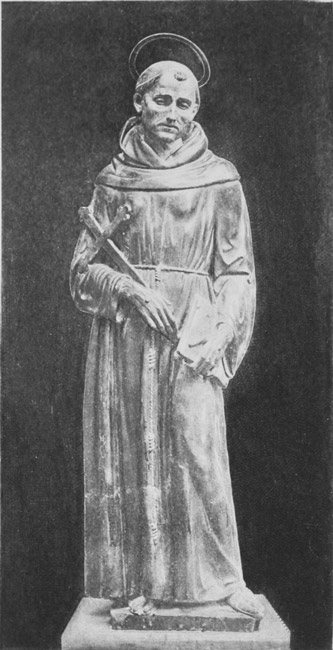
Statue of St. Francis by Andrea della Robbia in
Sta. Maria degli Angeli (P. Lunghi—photo) |
Photogravure-Frontispiece |
| PAGE |
| The Temple of Minerva |
3 |
| The Eastern Slope of Assisi with the Castle,
from the Porta Cappucini |
10 |
| The Guelph Lion of Assisi |
22 |
| The Arms of Assisi |
37 |
| Assisi in the time of St. Francis |
38 |
| Via di S. Maria delle Rose |
58 |
| The Arms of the Franciscans |
80 |
| Hermitage of the Carceri |
82 |
| The Carceri with a View of the Bridge |
89 |
| Side Door of the Portiuncula built by St. Benedict |
99 |
| The Portiuncula in the time of St. Francis, from
the "Collis Paradisi" |
107 |
| Assisi from the Plain |
113 |
| Church and Convent of San Francesco |
127 |
| San Francesco from the Plain |
147 |
| The Lower Church |
150 |
| Looking through the doors of the Upper Church
towards the Porta S. Giacomo and the
Castle |
157 |
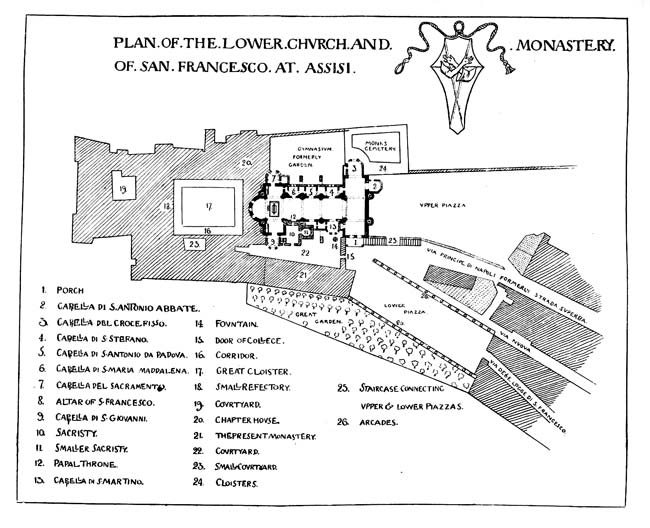
| Plan of the Lower Church and Monastery of
San Francesco at Assisi |
(facing) 168 |
| Choir and Transepts of the Lower Church |
172 |
| The Marriage of St. Francis with Poverty
(D. Anderson—photo) |
179 |
| The Old Cemetery of San Francesco |
194 |
| The Knighthood of St. Martin by Simone Martini
(D. Anderson—photo) |
201 |
| Bird's Eye View of the Basilica and Convent
of San Francesco, from a drawing made in
1820 |
213 |
| San Francesco from the Tescio |
217 |
| Staircase leading from the Upper to the Lower
Piazza of San Francesco |
220 |
| San Francesco from the Ponte S. Vittorino |
222 |
| A Friar of the Minor Conventual Order of St.
Francis |
225 |
| St. Francis Renounces the World (D. Anderson—photo) |
233 |
| Death of the Knight of Celano (D. Anderson—photo) |
247 |
| Arms of the Franciscans from the Intarsia of
the Stalls |
257 |
| Door through which St. Clare left the Palazzo
Scifi |
262 |
| San Damiano, showing the Window with the
Ledge whence St. Claire routed the Saracens |
268 |
| Santa Chiara |
282 |
| Santa Chiara from near the Porta Mojano |
287 |
| Campanile of San Rufino |
290 |
| Door of San Rufino |
295 |
| The Dome and Apse of San Rufino from the
Canon's Garden |
298 |
| Campanile of Sta. Maria Maggiore |
309 |
| Church of Sta. Maria Maggiore |
310 |
| Church of S. Pietro |
313 |
| Confraternity of San Francescuccio in Via
Garibaldi |
315 |
| Monte Frumentorio in the Via Principe di
Napoli |
320 |
| House of the Comacine Builders in the Via
Principe di Napole |
322 |
| Looking across the Assisan roofs towards the
East |
325 |
| View of San Francesco from beneath the Castle
Walls |
332 |
| The Garden of the Roses at Sta. Maria degli
Angeli |
339 |
| The Fonte Marcella by Galeazzo Alessi |
346 |
| An Assisan Garden in Via Garibaldi |
347 |
| Umbrian Oxen |
349 |
| Women from the Basilicata |
351 |
| San Francesco |
356 |
| Plan of Assisi |
372 |
The Story of Assisi
CHAPTER I
War and Strife
"C'était le temps des guerres sans pitié et des inimitiés
mortelles." H. Taine. Voyage en Italie. Perouse et Assise.
All who ascend the hill of the Seraphic City
must feel its indescribable charm—intangible,
mysterious, and quite distinct from the beauty of the
Umbrian valley. "Why," we ask ourselves, "this
stillness and sense of marvellous peace in every church
and every street?" And, as though conscious of our
thoughts, a young Assisan, with a gesture of infinite
sadness towards the large, desolate palaces and broad
deserted streets, said, as we lingered on our way:
"Ah! Signore mie, our city is a city of the dead—of
memories only." As he spoke a long procession of
a grey-clothed confraternity, bearing on their breasts
the franciscan badge, preceded by a priest who walked
beneath a baldachino, streamed out of a small church.
Slowly they passed down the road, and then the priest
turned into a wayside cottage where lay a dying woman,
while the others waited outside under the olive trees.
But the sound of their chanting and the tinkling of
the small bell came to us as we leaned over the city
walls. Of a truth we felt the religious life of the town
was not dead: perchance, down those streets, now so
still, men had passed along to battle during the sad
turmoil of the middle ages, had hated and loved as
well as prayed, with all the fervour of their southern
nature. We must turn to the early chroniclers to
find in their fascinating pages that Assisi has had her
passionate past and her hours of deepest trial.
Her origin goes back to the days when the Umbrians,
one of the most ancient people of Italy, inhabited the
country north and south of the Tiber, and lived a wild
life in caves. But the past is very dim; some
Umbrian inscriptions, a few flint arrow heads, and
some hatchets made of jade found on the shore of
lake Thrasymene are the only records we possess of
these early settlers.
If written history of their ways and origin is lacking,
the later chroniclers of Assisi endeavour to supply with
their gossip, what is missing. Rambling and strange as
their legends often seem to us, nevertheless they contain
a germ of truth, an image, faint but partly true
of a time so infinitely far away. Most of the local
Umbrian historians have awarded the honour of the
foundation of their own particular town to the earliest
heroes whom they happen to know of, and these are
invariably Noah and his family. It is, therefore,
curious to note that the Assisan chroniclers have departed
from this custom and have woven for themselves
a legend so different from the usual friar's tale:
"Various are the opinions," says one of them, "concerning
the first building of our city; but the most
probable, and the most universally accepted by serious
writers, is the one which gives Dardanus as her founder.
In the year 713 after the Deluge, and 865 years before
the foundation of Rome, the first civil war in Italy broke
out between the brothers Jasius and Dardanus, both sons
of Electra; but the father of Jasius was Jupiter, while
Dardanus was the son of Corythus, King of Cortona."
The people of Umbria took sides, as some would have
it that Jasius ought to be king in the place of the dead
prince Corythus.
Now it happened that
Dardanus had
pitched his tent on
the slope of Mount
Subasio, when a
dream came to him
that Jupiter and
Minerva were preparing
to assail the
enemy, and that Jasius
would be vanquished.
On waking he determined,
should his
dream be true, to raise
a temple to the goddess
on the spot where
he had slept. He
went forth to battle,
and with the help of
the goddess drove the
enemy back with great
slaughter; Jasius was
killed and they buried
him on the field of
battle. "Full well did Dardanus keep his vow, for in
a few months there arose a wonderful building, now
known as the sacred temple, dedicated to the true
Minerva of Heaven, under the name of Santa Maria
Sopra Minerva. Thus it is that the country round Assisi
has been called Palladios agros, the fields of Pallas."[1]
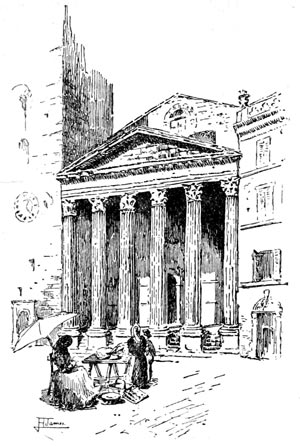
THE TEMPLE OF MINERVA
And thus the monk dreams on about the Seraphic
Province of Umbria; and we dream with him of the
Umbrians who forsook the chase and their shepherd
huts on the heights about Subasio, to gather round the
marvellous temple built by the hero ere he went forth to
found the city of Troy. People came from afar to look
at the six-fluted columns, and while marvelling at a
thing so fair, they resolved to build their homes within
sight and under the shadow of the sacred walls. Here
was the nucleus of a future town. The simple shelters
of cane and brushwood were soon replaced by huts of
a neater pattern made of wattle and clay, with earthen
floors, rounded porches and pent roofs. The dwellers
by the temple throve and prospered, and all was peace
for a while, until the van-guard of that mysterious
people, the Etruscans, appeared on the Umbrian
horizon. We are told how Dardanus, while visiting
the King of Lydia on his way to Troy, drew such a
highly-coloured picture of the loveliness of Tuscany,
the fruitful qualities of the soil, and the lightness of the
air, that Tyrrhenus, the king's son, was immediately
sent with a large army to take possession of so rich a
province. Then came a struggle, and the Umbrian
tribes were driven back south of the Tiber, which
henceforth strictly defined the boundary between
Umbria and Etruria.
Immediately to the west of Assisi, and on the longest
spur of hills which juts out into the valley of the Tiber,
stood the now Etruscan city of Perugia, to which a
band of Etruscans had lately immigrated. The huge,
grim walls which grew up round it after the advent
of the new settlers, the narrow pointed gateways,
some guarded by heads of stern and unknown deities,
the general menacing and ferocious aspect of its buildings,
soon warned the smaller Umbrian cities of what
they might in coming ages expect from her inhabitants.
It is probable that skirmishes were frequent between
the neighbouring towns of Assisi and Perugia, and to
judge from the subterranean passages which still exist
beneath the streets of the former place, we may gather
that she was open to constant attacks, and that her inhabitants
found it more prudent to disappear underground
at the approach of enemies than to meet them in open
battle. These subterranean galleries, cut in the soft
tufa, extend for miles under the present city: branching
out in all directions they form a veritable labyrinth
of secret passages. Here swiftly and silently as the
foe advanced, men and women with their children
would disappear into the bowels of the earth, some
being occasionally buried beneath masses of soil shaken
down by the tramp of many feet above them. Repeated
dangers of this sort at last decided the Assisans to meet
their enemies in more war-like fashion, and to surround
themselves—as Perugia had done—with stones and
mortar. Soon the town bristled with towers and
turreted gateways, and the houses, no longer built of
wattle and mud, began to foreshadow the strongly
fortified palaces of a later date. None too soon did
Assisi prepare for war. In the year 309 b.c. the
shrill sound of the Roman clarion echoed through the
Cimminian forest. It roused Etruria to arms, proclaiming
the fact that the Romans had dared to penetrate
beyond this dangerous barrier which hitherto had been
deemed impassable. The Etruscans and Umbrians,
forgetting all their former strifes, now joined against
the new power which threatened to crush their liberties.
The battles which followed beneath the walls of
Perugia, and by Bevagna in the plain of the Clitumnus,
brought all Umbria, in the space of a single year, under
the yoke of Rome.
And now, although we leave the fields of legend
and enter those of history, we find but little mention
of Assisi: this is, however, easily accounted for. Built
upon the unfrequented slopes of Mount Subasio, like a
flower gradually opening to the sun's rays, she was
far more secure than her neighbour Perugia who, commanding
and commanded by the road from Rome to
Ravenna, along which an army passed, stood in haughty
and uncompromising pre-eminence. The comparatively
obscure position of Assisi therefore gave her long
periods of peace, and these she employed in building
innumerable temples, a theatre, and a circus. It is
impossible to excavate in any part of Assisi without
coming upon relics of that time. Statues and busts
of the Cæsars, of gods and of consuls, are lying in
dark corners of the communal palace, and broken
fragments of delicately-wrought friezes and heads of
goddesses, half buried in bushes of oleander, adorn
the Assisan gardens. Beneath the foundations of the
more modern houses, mosaic floors and frescoed walls
have been found, showing that Assisi had her years
of early splendour. But full of life and action as this
Roman period was, it is as completely hidden from us
as are the temples now buried beneath the present
town. It passed rapidly away, and yet is of some
importance in the history of the world as having witnessed
the birth of Sex. Aurelius Propertius, great
among the poets even at a time when Virgil, Horace,
and a host of others were filling Italy with their song.
Many an Umbrian town prides itself on being the
birthplace of Propertius. The people of Spello have
even placed a tablet in their walls to claim him as her
son; but the Assisans, ignoring the rivalry of others,
very quietly point to the many inscriptions of the
Propertius' family collected beneath the portico of the
Temple of Minerva. One may be noticed referring to
C. Passennus Sergius Paullus Propertius Blaesus, said
to be a lineal descendant of the poet, who is supposed
to have married after the death of the fair Cynthia,
and returned to his native valley to pass his last days
in domestic tranquillity. Angelo Poliziano, on the
margin of an early edition of the poet's works now in
the Laurentian Library of Florence, has made a note
to the effect that Propertius, as well as St. Francis, was
born at Assisi; and certainly modern writers assign the
honour to Assisi.
The somewhat vague utterances of Propertius as to
his native town seem to show that the position of
Assisi, with regard to Perugia and the plain, more
nearly coincides with his description than that of any
other city in the valley or on the hills. To one inquisitive
friend he answers: "Tullus, thou art ever
entreating me in the name of our friendship to tell
thee my country and my descent. If thou knowest
Perusia, which gave a field of death and a sepulchre
to our father and in Italy's hour of affliction, when
domestic discord drove Rome's own citizens one
against the other—(Ah! hills of Etruria, to me
beyond measure have ye given sorrow, for ye suffered
the limbs of my kinsman to be cast aside unburied, and
denied the handful of dust to cover his bones)—there
it was that, close above the margin of her plain
spread below, Umbria, rich in fertile domains, gave
me birth."[2] The kinsman spoken of here is a certain
Gallus, who lost his life in b.c. 41, when Lucius
Antonius was besieged in Perugia by Augustus. The
horrors of the general massacre which followed the fall
of the city left sad memories in the mind of Propertius,
then a mere child. In the general confiscation of property
after the battle of Philippi his family lost their
estates. But poor as they were, Propertius was sent
to Rome to study, where, recognised as the leader of
a new school of poetry, he remained until shortly
before his death, at the age of thirty-five. His paternal
estates having been restored to him, he forsook the
splendour of the Augustan court, the patronage of
Maecenas, the friendship of Virgil, and returned to
the Umbrian country where his first inspirations had
been awakened. The contrast between a house and
garden on the Palatine hill, in the midst of the stir
of Roman life, and a farm by the silent stream flowing
through the stillest of valleys, must have been great.
But, judging from his description of the country, he
seems to have fallen readily into rural ways, and loved
to watch the herds of white oxen, dedicated to the
service of the goddesses, grazing close to the banks
of the Clitumnus. We may infer that he hunted the
"timorous hare and birds" in the thick oak forest
of the Spoletan valley, but, as he playfully tells us, he
left "the hazardous boar alone," for physical courage
was not one of his characteristics.
From the plain his eyes were often raised in the
direction of Assisi, and to his familiarity with her
towers we owe this exquisite description of his birthplace,
which, perhaps out of modesty, as he alludes to
his own fame, he places in the mouth of a soothsayer:
"Ancient Umbria gave thee birth from a noted household.
Do I mistake, or do I touch rightly the region
of your home, where misty Mevania stands among the
dews of the hill-girt plain, and the waters of the
Umbrian lake grow warm the summer through, and
where on the summit of mounting Asis rise the walls
to which your genius has added glory."[3]
Nothing happens, or at least nothing is mentioned
in Assisan chronicles until Christianity stealthily worked
its way up from Rome about the third century. Then
bloodshed followed during a period of darkness when
Christians and pagans divided the town into factions by
their bitter fights for religion. At first the Christians
suffered, and many were martyred in the Umbrian
rivers, but only to triumph later when Roman Assisi
soon vanished and Christian basilicas were built on the
site of pagan temples. Although, after the Roman
period, we find Assisi more nearly linked with the
general history of Italy, she appears uninfluenced by
outside events, and her atmosphere of remoteness
remains unimpaired. Thus we may say that Huns,
Franks, and Lombards merely passed by and left no
lasting mark upon the city. For a moment she was
suddenly aroused by the tempestuous arrival of one or
other of their leaders, but once the danger was past she
returned to her calm sleep upon the mountain side.
In 545 Totila, on his march to Rome, arrived before
the walls of Assisi which were gallantly defended for
the Emperor Justinian by Siegfried the Goth, but
unfortunately he being killed in a skirmish with the
Huns, the disheartened citizens reluctantly opened
their gates to the enemy. For the first time in her
annals (the Roman occupation had been peaceful
enough) a foreigner—a tyrant set foot in her streets
as master. But the restless Totila soon began to scan
the country round for other cities to attack. Becoming
aware of the large and wealthy city of Perugia perched
upon the western hill, he sallied forth to capture a
bigger prey, and Assisi enjoyed a further spell of peace.
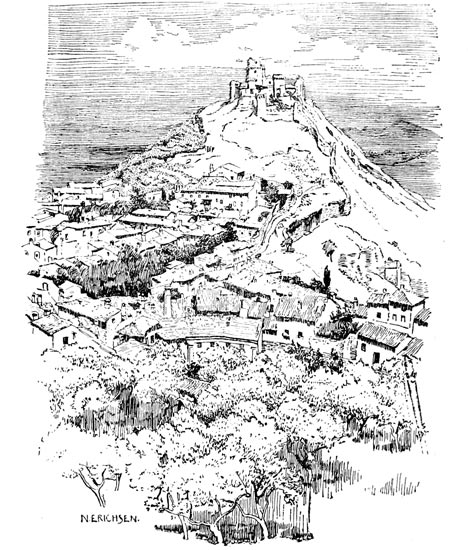
THE EASTERN SLOPE OF ASSISI WITH THE CASTLE, FROM THE
PORTA CAPPUCCINI
In reading the long-winded chronicles it is often
difficult to gather to which power the various small
towns at this time belonged. One point is, however,
clear, that during endless contentions between the Popes
and the Greek, and later the German Emperors, the
Umbrian cities were often left to manage their own
affairs, and because of the periods of rest which they
thus enjoyed and used in their individual ways, we are
inclined to speak of them as republics. For a long
time Assisi remained annexed to the Duchy of Spoleto,
then under the rule of the Lombard Dukes whose
advent had filled the different cities in the valley with
Arian Christians, unfriendly to the Papacy. Assisi,
together with other towns swerved from her allegiance
to the Pope, and it is perhaps on this account that
Charlemagne in 773 with his "terrible and fierce
followers" came to besiege her. They laid the country
waste, and made many attacks upon Assisi which
met with stout resistance; but while prowling round
the walls one night they found the main drain, and
stealing through it they were able to discover the
weakest part of the town. Next night they returned
well armed, slew the guards who were keeping watch
by the midnight fires, and before the citizens could rush
to arms, the gates were opened to Charlemagne. The
army passed in, her citizens were put to the sword, and
the town razed to the ground.
"Thus," says a chronicler, "Assisi bereft of her
inhabitants, found herself an unhappy widow. Then
was the most clement emperor grieved, and ordering
that the city should be rebuilt, he placed therein a
new colony of Christians of the Roman faith, and the
city was restored, and in it the Divine Worship."[4]
A small arched doorway ornamented with a delicate
frieze of foliage still remains as a record of the rebuilding
of the city by Charlemagne's Lombard workmen.
The stone is blackened, the tracery worn away. Few
find this dark corner in the Piazza delle Rose, and the
people wonder at those who stop to look, for "it is
ugly and very old," they say.
It was probably at this time, towards the end of
the eighth century, that the Rocca d'Assisi was built.
This made her a more important factor in Umbrian
politics; and leaders of armies, who hitherto had paid
her but a hurried visit, now vied with each other to
possess a city with so fair a crown. The citizens had
chosen for the site of the castle the part where the
hill rises in a sudden peak above the town, looking to
the north across a deep ravine towards the mountains
of Gualdo and Nocera. Above the main building and
the four crenelated towers soared the castle keep; from
the ramparts started two lines of walls which, going
east and west, gathered the town as it were within a
nest. At intervals rose forts connected by a covered
passage, and tall towers guarded the walls where they
joined the city gates. The Rocca d'Assisi with this
chain of walls bristling with iron spikes and towers,
complete in strength and perfect in architecture, looked
down upon the town like some guarding deity, and was
the pride of every citizen. It was no gloomy stronghold
such as the French kings erected in the woods
of Tourraine, but built of the yellow Subasian stone
it seemed more like a mighty palace with windows
large and square, whence many a condottiere and many a
noble prisoner leant out to look upon the splendid sweep
of country from Perugia to Spoleto.
Proud as the citizens were of their new-born importance
they soon regretted the calmer days of their
obscurity. By the twelfth century they were torn
between the Pope, the Emperor, and their own turbulent
factions, for even in the smaller towns the cries of
Guelph and Ghibelline were beginning to be heard.
Whenever German potentates—"the abhorred Germans"
as the chroniclers call them—had their hands
well clenched upon an Umbrian town, the citizens
turned imploring eyes towards Rome. The promise of
municipal liberty was the bait which every pontiff
knew well how to use for his own profit. The German,
on the other hand, troubled not to use diplomacy as a
means to gain his ends, but brought an army to storm
the town, and took up his residence in the castle,
whence he could hear the murmurings of the citizens
below planning to drive him out of their gates. The
first distinguished but unwelcome guest in the Rocca
d'Assisi was Frederick Barbarossa. He was, however,
too much occupied in his career of conquest to waste
more than a few weeks in Umbria, and in 1195 we
find Conrad of Suabia, who in the annals of the time
is known by the nickname of "the whimsical one," in
charge of the castle, with the title of Count of Assisi.
Conrad was also Duke of Spoleto, but he preferred the
fortress of Assisi as a residence and spent some two
years there to the annoyance of the citizens, who were
constrained to be more or less on their good behaviour.
With him in those days was a small but important
person, who, at the age of two, had been elected King
of Germany and Italy. This was Frederick II, and
the legend recounts how he was born in the Piazza
Minerva beneath a tent hastily erected for the occasion,
and in his third year was baptised in the Cathedral
of San Rufino, amidst a throng of cardinals, bishops,
Assisan priors and nobles. It would, indeed, be
strange that he, who later was to prove a thorn in
the side of many a Pope, should have been born and
nurtured in the Seraphic City.
The Assisans soon wearied of the German yoke,
but unaided they could not throw it off and it needed
the timely intervention of Innocent III, to rid them of
Conrad's presence. The Pope, who had been quietly
waiting an opportunity to regain his lost Umbrian
towns, felt himself powerful enough now that the
Emperor Henry VI, was dead, to send haughty commands
to Conrad. He was bidden to meet Innocent
at Narni where he solemnly made over his possessions
to the Church. Thus left to themselves, the Assisans,
with cries of "Liberty and the Pope," rushed on the
castle to tear it down. Built to be their safeguard, it
proved their greatest danger, and they determined that
no other tyrant should find shelter within its walls.
While the Assisans were rejoicing in their freedom,
and endeavouring to guard against the constant attacks
of the Perugians, the big world outside was being torn
and rent by a medley of events which was carrying
men's thoughts forward in the swift current of a fresh
era. Everywhere a new spirit was spreading—"the
fraternising spirit" it has been called. In the cities
men were joining together in guilds, heralding the
commonwealths; while, in the country, bands of people,
under the names of Patarins, Albergenses, Poor Men
of Lyons, etc., raised the standard of revolt yet higher
against their feudal and spiritual lords. A contemporary
writer speaks of thirty-two heresies as being
rampant in Italy at this time. Men were eager and
full of energy, finding relief through many channels
that set all Italy in a ferment. But amidst the confusion
of wars and heresies the Papal power grew ever
stronger, until, with the accession of Innocent III,
the claims of a temporal ruler were blended with
spiritual rights. The Marches of Ancona, Umbria,
and the seven hills of Rome belonged alike to him,
while he was powerful enough to excommunicate
cities, kingdoms, and emperors at his pleasure, and
rule all with a rod of iron. The magnificent designs
planned by Hildebrand seemed to triumph under Innocent,
and yet the papal horizon was not without its
clouds.
"Ah Constantine! of how much ill was cause,
Not thy conversion, but those rich domains
That the first wealthy Pope received of thee,"[5]
groans Dante, in writing of the condition of the
Church, and his cry reaches back to the time of which
we write. Jacques de Vitry, who was often at the
court of Innocent, also speaks with bitterness of the
depravity of the priests. They were, he tells us,
"deceiving as foxes, proud as bulls, avaricious and
insatiable as the minotaur."
Innocent III, though scheming and ambitious, was a
man of lofty character, and no one watched with so
much anguish the rising storms which threatened to
shake the mighty fabric of the Papacy. In a moment
of discouragement he is said to have exclaimed that
fire and sword were needed to heal the wounds made
by the simoniacal priests, and for a long time he in
vain sought a remedy for those ills. But salvation
was at hand, and it came from the Umbrian mountains,
as the fresh breeze comes which suddenly breaks
upon the budding trees in springtime.
Within the narrow circuit of the Assisan walls arose
a figure of magical power who drew men to him by
the charm of his mysticism and the spell of his ardent
nature. It is the sweet-souled saint of mediæval Italy—St.
Francis of Assisi—who now illuminates this
quiet corner of the world.
Francis Bernardone was born in the year 1182,
when, as we have seen, the Church was harrowed by
a hundred ills. He passed a gay youth, free from
every care, and tested all the pleasures that riches
could procure. Though the son of a merchant he
consorted with the noblest of the Assisan youths,
who, partly on account of his father's wealth, partly
because of his gaiety and love of splendour, were glad
to accept him as an equal. All looked to the high-spirited,
gifted Francis as the leader at every feast, the
organiser of every entertainment, and when Perugia
blew her war-trumpet he rode out to battle side by
side with the Assisan cavaliers. Such, in a few words,
was his position in Assisi when in his twenty-second
year, after a severe illness which brought him to the
brink of the grave, he resolved to follow to the letter
the precept of the Gospel and lead the life of the first
apostles. So complete was his conversion that he,
the rich merchant's son, was to be seen walking through
the streets with bricks on his back for the repair of the
ruined churches of Assisi, while his former companions
drew back and laughed as he passed them. But their
derision was of short duration, for the charm they had
felt in former days had by no means passed away.
Holiness could never make him sad, and in the human
tenderness and joyousness of his nature lay the secret
of that power which was strong enough, the Assisans
soon discovered, to lead them where he would—though
it was now by a new road he travelled.
The great movement, which began at Assisi and
spread throughout Europe in a very few years, can
only be likened to that witnessed by the lake of
Galilee. Rich citizens gave all to the poor; the
peasants left the vintage and sold their oxen, to join
the ever-swelling crowd of bare-footed disciples who
wandered through cities and into distant lands bringing
comfort and words of peace to all they met. Like a
ray of brilliant sunshine St. Francis dispersed the gloom
of the middle ages, teaching men that the qualities of
mercy and love were to be looked for from God
instead of the inflexible justice that had overshadowed
a religion intended to be all light. He walked the
earth with joyous steps, inviting all to come with him
and see how beautiful was the world; he looked
upwards, praising God in bursts of eloquent song for
the rain that fed the flowers, the birds that sang to
him in the woods, and the blueness of his Umbrian sky.
How different from the stern, orthodox saints who
passed through the loveliest valleys with downcast eyes
for fear of some hidden temptation or of some interruption
to their prayers! With such a founder it is
hardly surprising that the order of St. Francis spread
and multiplied, becoming a great world force, as
great and perhaps greater than that of St. Dominic.
We get an interesting picture of the change he wrought
throughout Italy and of the enthusiasm he kindled
among his followers in a letter of Jacques de Vitry;
from this we quote at length, for, being written by a
contemporary of the saint, its value is very great.
"While I was at the pontifical court I saw many
things which grieved me to the heart. Everyone
is so preoccupied with secular and temporal things,
with matters concerning kings and kingdoms, litigations
and lawsuits, that it is almost impossible to talk on
religious matters.
"Yet I found one subject for consolation in those
lands: in that many persons of either sex, rich, and
living in the great world, leave all for the love of
Christ and renounce the world. They are called the
Friars Minor, and are held in great respect by the
Pope and the Cardinals. They, on their part, care
nought for things temporal, and strive hard every day
to tear perishing souls from the vanities of this world
and to entice them into their ranks. Thanks be to
God, their labour has already borne fruit, and they have
gained many souls: inasmuch as he who listens to them
brings others, and thus one audience creates another.
"They live according to the rule of the primitive
church, of which it is written: 'The multitude of
believers were as one heart and one soul.' In the day
they go into the cities and the villages to gain over
souls and to work; in the night they betake themselves
to hermitages and solitary places and give themselves
up to contemplation.
"The women live together near to cities in divers
convents; they accept nought, but live by the labour
of their hands. They are much disturbed to find
themselves held in greater esteem, both by the clergy
and the laity, than they themselves desire.
"The men of this order meet once a year in some
pre-arranged place, to their great profit, and rejoice
together in the Lord and eat in company; and then,
with the help of good and honest men, they adopt and
promulgate holy institutions, approved by the Pope.
After this they disperse, going about in Lombardy,
Tuscany, and even in Apulia and Sicily, for the rest of
the year.... I think it is to put the prelates to shame,
who are like dogs unable to bark, that the Lord wills
to save many souls before the end of the world, by
means of these poor simple friars."[6]
Certainly one of the most remarkable events in
mediæval history was the result of the teaching of
St. Francis upon his own and future generations. In
his native city the strength of his personal influence and
the love and veneration which he excited was extraordinary.
But we notice even a stranger fact; with
his death this holy influence apparently vanished, and it
is possible that the memory of the saint is dearer to
the hearts of the Assisans in what we are inclined to
call the prosaic tedium of our trafficking nineteenth
century, than it was in the years immediately following
his death. Later centuries have shown us that his
teaching and his presence there were not in vain.
Assisi, down to our own times, has continued to be
the Mecca of thousands of pilgrims. Her churches
bear the record of infinite early piety, for when art
was in its early prime the most famous masters from
Tuscany were called upon to decorate the Franciscan
Basilica and leave their choicest treasures there as
tributes to the immortal glory of the saint. But the
note of war rings louder than the song of praise and
love for many years to come in all the Assisan
chronicles, and grass and weeds grow up to choke,
though not to kill, the blessed seed that Francis sowed
and did not live to tend. No sooner did the gates of
death close upon that sweet and genial spirit, than war,
lust, strife and pestilence burst upon the very people
he had so tenderly loved. The story of Assisi becomes,
as it had never been before, a list of murders—of
struggles to the death for individual power, and of
wars which made the fair Umbrian country a desolate
and cruel waste for months and even years.
Each town looked with hatred upon its powerful
rival, and the communal armies were for ever meeting
in the plain by the Tiber to match their strength and
see if some small portion at least of a city's domains
could not be wrested from her. The bitterest and
most pronounced enemies in the valley were undoubtedly
Assisi and Perugia. Their feuds date back
to the twelfth century; but even before the Christian
era these two cities of the hills had marked each other
as a foe for the one was Umbrian, the other Etruscan,
and they merely continued the rivalry of their founders.
It is often difficult to discover the cause of each separate
war, but it may, as a general rule, be traced to Perugia's
inborn love of fighting, and to her restless spirit which
led her to storm each town in turn. From her eyrie
she looked straight down upon half the Umbrian
country, and gazing daily on so fair a land the desire
for possession grew ever stronger. Many towns were
forced to submit to her sway, and by the thirteenth
century she was the acknowledged mistress of Umbria.
It is, therefore, with surprise and admiration that we
watch the undaunted struggle of Assisi against a tyrant
whom she hated with a hatred quite Dantesque in its
bitterness and strength. Many menacing towers were
built on either side of the valley, and heralds were
continually sent between the two towns with insulting
messages to goad the citizens forward into battle.
When Perugia was known to be preparing for an
attack upon Assisi, the castles and villages around
hastened to break their allegiance to the weaker city
and ally themselves with the Perugian griffin. Assisi
was thus often obliged to defend herself unaided
against the Umbrian tyrant. When, in 1321 Perugia
declared war against "this most wicked city of Assisi"
whose crime consisted in having fallen under the rule
of the Ghibelline party of her citizens,[7] both communes
were in need of money as their bellicose habits had
proved expensive. Busily, therefore, they set to work
about procuring it, and in a highly characteristic
manner Perugia sold her right of fishing in Thrasymene
for five years, while the citizens of the Seraphic
City entered by force into the sacristy of San Francesco
and carried off a quantity of sacred spoils. Gold
ornaments, censers, chalices, crucifixes of rare workmanship
and precious stuffs, were divided into lots
and sold, partly to Arezzo for 14,000 golden florins,
and partly to Florence for a larger sum. Now these
things did not even belong to the Franciscans, but had
been carefully stored in the sacristy by the Pope and
his cardinals during their last visit to the town. Great,
therefore, was the wrath at the Papal Court when
news came of the sacrilegious robbery, and without a
moment's delay a bull of excommunication was fulminated
from Avignon. For thirty-eight years Assisi
lay under the heavy sentence of an interdict, and, except
for the feast of the "Pardon of St. Francis," the
church doors were closed and the church bells were
silent. But not a whit did the people care for the
anger of a distant Pope, and it is related that when
the two friars brought the bull of excommunication to
Ser Muzio di Francesco, the leader of the robbers,
they were flogged within an inch of their lives, and
further, they were made to swallow the seals of lead
which hung from the Papal document.
The Assisans, having obtained the necessary funds,
set to work to defend themselves against the enemy
who were to be seen rolling their heavy catapults along
the dusty roads. A proud historian says, "they saw
without flinching 500 horsemen galloping round their
walls," and with a heroism worthy of so good a cause,
determined to be buried in the ruins of their city sooner
than cede one step to their abhorred enemies the
Perugians. They closed the shops, barred the houses
and threw the chains across the streets to stop advancing
cavalry; every artisan turned soldier, every noble
watched from the tower of his palace. Not only were
they guarding their own liberties, but they feared for
the safety of the body of St. Francis, which the
Perugians, ever prowling day and night about the walls,
were anxious to carry off. The siege, it is said, lasted
a year, when the Assisans were forced to give way and
open their gates to the enemy, who sacked the town,
"killing more than one hundred of the most wicked
citizens, to wit, all those who fought against the city of
Perugia." Then came a perilous moment, for many, not
content with a barbarous pillage, wished to destroy Assisi
altogether. Fortunately a wily Perugian, Massiolo di
Buonante, stood up in her defence, arguing that "Assisi
being now in their power, it were better to possess her
fortified, and well provided against any new attack of
the Ghibelline party."[8] His words had due effect, but
still the town suffered horribly, and her walls only lately
built were in greater part razed to the ground. The
chains that guarded the streets together with the bars
and keys of the gates were taken back to Perugia,
where, until a century ago,
they hung "as glorious
trophies" from the claws
of the bronze griffon outside
the Palazzo Pubblico.
Before leaving, the Perugians
gave their orders to
the now submissive city.
The Guelphs were to live
within the ancient circle
of walls in the upper and
more fortified part of the
town, while the Ghibellines
were left in the
undefended suburbs.
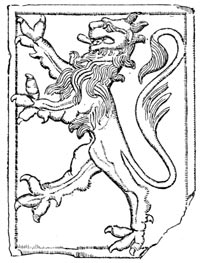
THE GUELPH LION OF ASSISI
They further commanded
that each year, on the feast
of St. Ercolano, the Assisans should bring them a
banner "worth at least 25 golden florins, in signum
subjectionis." This was the greatest ignominy of all,
and rankled even more deeply in the hearts of the
citizens of Assisi than the fact of their being governed
by Perugian officials. The delivery of the yearly
tribute was performed in a manner highly characteristic
of the times and of the love of petty tyranny and display
peculiar to the mediæval towns. An Assisan
horseman mounted on a splendidly caparisoned charger
brought the hated emblem to lay before the Priors of
Perugia, who robed in crimson, with heavy golden
chains about their necks, waited at the foot of the
campanile of San Lorenzo. Close to them stood
four mace bearers and trumpeters with white griffins
painted on the red satin streamers which hung from the
silver trumpets. Nothing was neglected that would
impress her subjects with the dignity of her hill-set
city. All the Perugians were assembled, and in their
name the Priors promised to defend Assisi against her
enemies and to preserve her from the yoke of tyrants.
Having uttered this solemn mockery, they gave the
Podestà of Assisi a sealed book wherein were written
the laws to be observed in return for the inestimable
favours granted; the book was not to be opened until
he and his retinue had returned to their own city. The
spirit of the Assisans was by no means crushed by their
misfortunes, and shortly after the events we have just
narrated they issued an edict with a pomp worthy of
Perugia herself which fairly puzzled the Priors of
that city. All Perugians holding land in Assisi were
herein ordered to pay the taxes usually demanded of
"strangers" possessing property in the territory; further,
the Assisans proclaimed their firm determination no
longer to observe any orders given to them by the
Commune of Perugia. This audacity was, however,
soon checked. Perugia issued an order to the effect
that these statutes, and these alone, which were decreed
by herself were to be valid in Assisi, all others were
worthless. Assisi therefore remained subject to Perugia
till 1367, when Cardinal Albornoz who was engaged
in recovering the allegiance of the Papal States, entered
her gates. He was received with wild enthusiasm by
the citizens, for they hailed him as their deliverer from
the hated yoke of the Perugians. The Assisans had
every reason to rejoice in this change of masters, as the
Cardinal allowed them to govern their town like a free
republic; he rebuilt the walls destroyed during the last
siege, and the castle which had also suffered much from
the Perugian soldiery. The people were delighted,
and their artists were soon busily employed in painting
the gilded arms of the church on gateways and on
palaces.
During his brief sojourn in Assisi the war-like
Cardinal had found such peace as he had probably not
often known before, and such was his love for the
church of San Francesco that he added to it several
chapels and chose a place for his tomb within its walls.
He died at Viterbo; and only five months after the
Assisans had welcomed him with such rejoicing, they
went with torches and candles, to bear his dead body
back to San Francesco, the Priors, says a chronicler,
spending 145 florins upon the crimson gowns they
bought for this occasion.
Days of peace and liberty were short, and the
Assisans were soon groaning beneath the enormous
taxes laid upon them by the zealous ministers of the
Pope. In 1376 their indignation rose to such a pitch
that they broke into open rebellion, and joined in the
war-cry against the Church, which was to be heard in
other towns of Tuscany and Umbria. The citizens
besieged the Legates in their palaces and ordered them
with haughty words to depart; so seeing it was safer to
obey, they returned to Rome without a word. "Because
of their love for the holy Pontiff, whose servants
they were, the Assisans used no violence towards them,"
but having got their way with polite bows accompanied
them safely beyond the city gates. But at this time,
when all was war and conspiracy, there seemed no
chance of a free life again for the people. No sooner
had one tyrant been disposed of than another rose to
take his place. When news of these events reached
the Perugians they thought it a good opportunity to try
and again get possession of the town, accordingly envoys
were sent "just to put things in order" as they
expressed it; but the Assisans shut the gates of the
city in their faces and informed them that in future
they intended to manage their own affairs. We cannot
say that their endeavours were crowned with success,
the nobles fought among themselves, while the mob
was ever ready for any kind of novelty. It is related
how in the year 1398 the Assisans changed their mind
three times in one day as to who should be their lord.
"Evviva the Church" was the first cry; the second,
"Evviva the people of Perugia"; and lastly, "Evviva
Messer Imbroglia," a roving adventurer who alternately
fought for the Duke of Milan and the Pope, and finally
entered Assisi at the head of a large cavalcade as
Captain and Gonfalonier of the city.
In the early centuries Assisi had bravely fought for
her independence and held her own fairly well; but in
the fourteenth century a sudden whirlwind swept across
the country threatening to destroy the last remnant of
her freedom. At this time the condottieri were busy
carving out principalities for themselves, and one after
another they marched through the land forcing the
towns to bear their yoke. Assisi, not without a sharp
struggle, fell a prey to Biordo Michelotti and Braccio
Fortebraccio, successive despots of Perugia; and the
citizens found themselves for the next twenty years
in turn the vassals of Guidantonio of Montefeltro,
of Sforza, and of the Pope. In 1442 Perugia was
governed, in the name of the Pope, by Niccolò
Piccinino, successor to Fortebraccio as the leader of
the Bracceschi troops, and consequently a successor
to the rivalry with Francesco Sforza, Duke of Milan.
Assisi, therefore, who had spontaneously given herself
to Sforza, preferring the tyranny of strangers to the
yoke of Perugia, was not likely to be favourably
looked on by Piccinino, and sooner or later he determined
to besiege her. But just at this time Perugia
had made peace with all the world, and, delighted with
this novel state of things, she rang the great bell of the
Commune, lit beacon fires on the hills, and sent a
special messenger to Assisi to proclaim the fact. The
Assisans, with more courage than discretion, cursed
the messenger and those who sent him, saying they had
half a mind to kill him. "Return with this message,"
they cried, "say unto those who sent thee, that they try
to wipe us from the face of the earth and then send words
of peace. But we will have war and only war." This
insulting message was duly delivered to the astonished
priors, and that night the beacon fires were extinguished.
When news reached Assisi of the vast preparations in
Perugia for war, these hasty words were regretted.
Luckily Francesco Sforza sent the Assisans a good
supply of troops, and every day they hoped for the
arrival of his brother Alessandro.
The month that followed was disastrous to Assisi,
and the account of the war given us by the Perugian
chronicler Graziani who took part in the siege, brings
before us vividly the many stages she had to pass
through before arriving at the calm, seraphic days of
later years.
By the end of October 1442, Niccolò Piccinino,
alluded to always as el Capitano, arrived in the plain
below Assisi with some 20,000 men, and took up his
quarters in the Franciscan monastery of San Damiano.
His first intention was to take the town by assault, but
on surveying the fortifications and walls and the impregnable
castle, he deemed it wiser to wait quietly
until hunger should have damped the valour of the
citizens. Help, however, came to him from another
quarter. It is believed that a Franciscan friar, perhaps
one of those with whom he lodged at San Damiano,
betrayed to him a way into the town by means of an
unused drain.
"On Wednesday, being the 28th day of November,
the Captain's people entered Assisi by an underground
drain, which, beginning below the smaller fortress
towards the Carceri, enters Assisi near the market-place
below the castle. There Pazaglia, Riccio da
Castello, and Nicolo Brunoro, with more than 300
men-at-arms, had seen to clearing the said sewer and
cutting through some iron bars at the exit placed by
the Assisans so that none might enter; and Pazaglia
and his companions worked so well that they entered
with all their people one by one. And when they had
entered they emerged inside the walls, and advanced
without any noise, holding close to the side of the said
walls so as not to be seen, although the darkness of the
night was great and drizzling rain was falling. But it
happened that one of those within passed by with a
lighted torch in his hand, and, hearing and seeing
people, said several times: 'Who goes there.' At
last answer was made to him: 'Friends, friends.'
The bearer of the torch went but a little farther before
he began to cry out: 'To arms, to arms. Awake,
awake, for the enemy is within.' So a great tumult
arose throughout the town. Then Pazaglia and his
companions, finding they were discovered, mounted the
walls and shouted to those outside: 'Ladders, ladders.
Enter, enter.'"[9]
With cries of "Braccio, Braccio," the captain led
his men rapidly through the town, burning the gate,
killing the citizens, and pillaging every palace as they
passed along. When Alessandro Sforza who had
stolen into Assisi the night before, "to comfort and
encourage the citizens," found that the enemy was
within he hurried with a few Assisan notables to take
refuge in the castle. From the tower-girt hill he
looked down upon the scene of carnage—and what a
sight it was as pictured by Graziani!
"The anguish, the noise, and the screams of women
and children! God alone knows how fearful a thing
it was to see them all dishevelled; some tearing their
faces, some beating their breasts, one weeping for a
father, one for a son, another for a brother, as, crying
with loud voices, they prayed to God for death....
But, in truth, these same Assisans did themselves
much injury, greatly adding to their own trouble.
They might have saved many more of their chattels
had they trusted the Perugians, but rather did they
trust the strangers, and this to their undoing, for the
said strangers deceived them. Thus was proved the
truth of that proverb which says: 'The offender
never pardons.' Often aforetime had they offended
the Commune of Perugia as we have seen. Even at
this moment, when its forces were encamped outside
Assisi, they constantly stood on their walls and hurled
insulting and menacing words at the Perugians, defying
and threatening them, whom for this reason peradventure
they did not trust.... Also on the same day, while
the city was being sacked, a multitude of women
with their children and goods, took sanctuary in Santa
Chiara; and when the captain passed and saw so many
women and children sheltered there, he said to the
women, especially to the nuns of Santa Chiara, that
it was no longer a safe refuge for them, and if they
would choose where they wished to go he would send
them thither in safety. Then, naming to them all the
neighbouring towns, he lastly offered to place them in
safety in the city of Perugia. But when they heard
the name of Perugia, first the nuns and then the other
women replied, 'May Perugia be destroyed by fire.'
And when the captain heard this answer, he immediately
cried, 'Pillage, pillage!' Thus was everything
plundered and ruined—the convent with the nuns,
the women and the children, and much booty was
there...."[10]
Assisi, now the shell of her former self, seemed
indeed a city of the dead. Through her deserted
streets, running with the blood of the slain, echoed
the sound of falling rafters and crumbling palaces,
while bon-fires flamed on the piazza fed with the
public archives by the destroying Perugians. Across
the Tiber were to be seen the unhappy citizens being
driven like droves of cattle by their captors up the
hill to the city they hated. There the women, with
their children clinging round their necks, were sold in
the market-place as slaves, and exposed to the cruellest
treatment by their masters. Even tiny children of four
and five years old were sold; a maiden, we are told,
fetched fifteen ducats, and many were bought, sometimes
for the love of God, and sometimes as maidservants.
Every day fresh booty was brought in, and
the Perugians fought over the gold chalices, missals,
and other treasures robbed from churches and convents;
but these brought lower prices, for even Perugian consciences
seem to have been troubled with scruples, and
superstitious fear kept them from buying stolen church
property. While the slave market was proceeding
amidst the clanging of bells proclaiming the victory,
the Priors of Perugia sat in their council hall of the
great Palazzo Pubblico discussing how they could bring
about the total annihilation of Assisi. The following
curious letter was finally written, sealed, and sent to
Niccolò Piccinino by five ambassadors who were to
tempt him to do the deed with a bribe of 15,000
ducats:
"Your illustrious Signory being well aware how that
city has ever been the scandal of this one, and that
now the time has come to take this beam from out
of our eyes, we pray and supplicate your illustrious
Signory, in the name of this city and of the State,
that it may please you to act in such wise that this
your city shall never again have reason to fear her;
and so, as appears good to all the community, it will
be well to raze her to the ground, saving only the
churches. And this will be the most singular among
other favours that your illustrious Signory has ever
done to us."[11]
"Trust in my words and trust in my deeds," replied
Piccinino to the bearers of this truly mediæval letter;
but, adds the chronicler, he refused his consent to their
cowardly scheme for the destruction of the town. It
is believed that he was acting upon orders received
from Eugenius IV, who appears as the benevolent
genius of Assisi, until, as the local historians tell us
with rage, the Pope offered to sell them to the Commune
of Perugia, when his clemency seems due solely
to the fact that the papal coffers were sadly empty.
Luckily the Perugians, somewhat in debt owing to
the late war, were unable to pay the price, and Assisi
thus escaped being given "like a lamb to the butcher,"
while her enemy missed the chance "of removing that
beam from out of her eye."
From this time onward Assisi remained in the possession
of the Church, and many of the Popes, touched
by the miserable condition of the town, supplied money
to rebuild its ruined walls and palaces, and thus induce
the citizens to return and inhabit the desolate city.
But hardly had the Assisans succeeded in getting back
some kind of order and prosperity than new wars
appeared to ruffle the onward flow of things. This
time the danger came from within, and in Assisi, as
in so many of the cities of Italy, it was the feud between
the nobles themselves that drenched the streets
with blood and crushed the struggles of a people
whose cries for liberty were now only faintly heard.
All sank beneath the heavy hand of the despot. The
Perugian citizens were being tyrannised over by the
powerful family of the Baglioni, whose name brings
up a picture of crime and bloodshed that has hardly
been equalled in any town in Italy.[12] In Assisi the
balance of power lay between the two families of
Fiumi and Nepis, who, in the irregular fashion of the
time, alternately ruled the city in opposition to the
legal sovereignty of the Papacy. The city was sharply
divided into the Upper town, where the Nepis had
their palaces near the castle and San Rufino, and the
Lower town, inhabited entirely by the Fiumi and
their adherents, which clustered round the church of
Santa Chiara and down to San Francesco. These
two families sought perpetually to outshine each other,
and such was the reputation they gained among the
people in the country round that even the Perugian
chroniclers speak of them as "most cultured and
splendid citizens," praising their horsemanship and
the magnificence of their dress. So great was the
rivalry between the members of the two families
Fiumi and Nepis that, when they met in the piazza
of Assisi where the nobles often walked in the evening,
they would provoke each other with scornful looks
and words, and often this was a signal for a skirmish.
The bravi would gather round them, and in an instant
the whole town be roused to arms. After a sharp
fight one party was driven to retire to its strongholds
in the open country, while the victorious nobles seized
the reins of government, and the weary citizens sank
beneath the rule of the despots. Assisi presented a
most melancholy spectacle at the end of one of these
encounters. Most of the dwellings of the exiled nobles
lay in ruins, the churches were shut in consequence of
the perpetual bloodshed, and the palaces, barred and
chained, with the gratings drawn up before the entrance,
seemed to be inhabited by no living being. Franciscan
friars stole along the streets on their errands of mercy
among the distressed citizens, who, besides the horrors
of the city feuds, suffered from the pestilence and
famine which decimated nearly all the towns of Italy
at this period. But this death-like silence within the
town was never of long duration. The exiled party,
ever on the alert to regain possession of their homes,
would creep into the town at some unguarded moment
and once more stir a people to fight who were beginning
to chafe beneath the irksome rule of the rival despots.
A climax of evils came when, in addition to a
hundred other ills, the Baglioni of Perugia took upon
themselves to interfere.
In 1494 we find the Fiumi and the Nepis living
peaceably in their palaces, dividing the power in Assisi,
until at last the hot-headed Fiumi grew weary of the
even balance of things, and determined at one stroke
to rid themselves of every foe. In open combat they
had attempted this and failed, so a treacherous plot
was hatched. Jacopo Fiumi, head of the house, and
his brother Alessandro, persuaded their friends, the
Priors of the city, to prepare a great banquet in the
Communal Palace and invite all the members of the
rival family to be present. Unarmed, and not dreaming
of danger, the Nepis entered the big hall. No
sooner had they thrown off their cloaks than the
Fiumi rushed upon them with drawn swords and
knives. Angered by such wanton treachery, the
citizens drove the murderers from the city; and the
Priors, protected by the darkness of the night, fled
into the open country to seek a refuge in some neighbouring
town.
Now this event, like many others, might have subsided
and been followed by a period of peace, only it
happened that the Baglioni were allies of the Nepis
and ready to avenge them in Assisi. They had, moreover,
old scores to settle with Jacopo Fiumi, who,
Matarazzo tells us, in pained surprise, "was a most
cruel enemy of the house of Baglioni and of every
Perugian, and studied day and night how he might
injure those of Perugia, so that he was the cause of
much trouble to the magnificent house of Baglioni."[13]
This was therefore a good opportunity for the Baglioni
to lay siege to Assisi, and perpetual skirmishes took
place in the plain, which sapped the life-blood of the
citizens and laid waste the Umbrian country for many
miles around. The peasants, whose grain had been
trampled down by the Baglioni, were driven half-naked
into the woods, and watched the high roads from
the heights above Assisi like birds of prey, swooping
down to rob or kill travellers passing by. Badgers,
wolves, and foxes roamed unmolested in the plain, and
fed upon the unburied bodies of the murdered travellers
and of those who fell in battle; while, in the dead of
night, the friars of the Portiuncula stole out to bury
what bones the wild beasts had left. Things had come
to such a pass that the Assisans, as we are told, knew
not what to say or do, so many of their number were
dead or taken captive and the enemy was ever at their
gates. Giovan Paolo, mounted on his black charger,
"which did not run but flew," led the Perugians to
storm the town and draw the citizens out to battle.
He was one of the fiercest of the Baglioni brood
and a famous soldier, and yet it was in vain he sought
to inspire the Assisans with fear. "Indeed," says
Matarazzo, "each one proved himself valiant on either
side; for the Assisans had become warlike and inured
to arms, and they were all iniquitous and desperate."[14]
The foes were of equal strength and courage, and the
war, which had already lasted three years, seemed
likely to have no end. But one day the Assisans,
watching from their ramparts, saw a large squadron
of soldiers hurrying from Perugia to the aid of the
Baglioni, and they began to ring the city bells as a
signal that the moment had come for the final stand.
Those who were skirmishing in the plain against
Giovan Paolo began to lose heart when they heard
the clanging of the bells, and the Perugians, perceiving
their advantage, took new courage, so that "each one
became as a lion." More than sixty Assisans were
slain that day, while the prisoners suffered cruelly under
the vengeance of those who took this opportunity of
remembering offences of past years. "And thus did
his lordship, the magnificent Giovan Paolo, return
victorious and joyful from this great and dangerous
battle."[15]
Once the gates of Assisi were forced open, the
Baglioni and their bravi scoured the streets from end
to end, killing all they encountered, and dragging from
the churches the poor women who sought shelter and
protection. The blood-thirsty brood did not even
respect the Church of San Francesco; and the friars,
in a letter to their patron Guidobaldo, Duke of
Urbino, complain most bitterly of the crimes committed
within the sacred edifice, even on the very
steps of the altar. "The poor city of Assisi," the
letter says, "has known only sorrow through the perpetual
raids of the Baglioni, whose many crimes would
be condemned even by the infidel Turks. They rebel
against the holy Pontiff, and such is their ferocity that
they have set fire to the gates of the city—even unto
that of the Basilica of San Francesco. They do not
shudder to murder men, cook their flesh, and give it
to the relations of the slain to eat in their prison
dungeons."[16] Matarazzo also dwells on the sad conditions
of Assisi during her final struggle for independence.
"So great was the pestilence and the famine
within the walls that human tongue could not describe
it, for great woe there was, and such scarcity and
penury in Assisi as had never been known. I myself
have talked to men who were in Assisi at that time,
and who, on remembering those days of famine, pestilence,
and war were bathed in tears; and, if the subject
had come up a thousand times in a day, a thousand
times would they have wept bitterly, so dark was the
memory thereof. Not only did they weep, but those
also who listened to them, for they would recount
how they wandered by the walls of the town, and
down to the hamlets, and in every place searching for
herbs to eat; and how, forced by hunger, they ate all
manner of cooked herbs, and many people sustained
themselves with three or four cooked nuts dipped in
wine, and with this they made good cheer."[17]
In reading the terrible chronicle of these years, one
asks, "How did any life survive in the face of such
ghastly suffering?" The strange fact remains that life
not only survived, but that the Assisans even flourished
during the period, and, like half-drowned birds, who,
rising to the surface, bask for a while in the sunshine and
then spread their wings for a fresh flight, they too arose
and prospered. But the time was drawing near when
these continual efforts were no longer needed. The
rival factions had reached the summit of their savage
strength, and the city despots were soon to be swept
from the land by the whirlwind they themselves had
raised.
In the year 1500, during one awful night of carnage
at Perugia, the Baglioni were nearly all murdered
through the treachery of some of their own family.
The manner in which the clansmen sought out their
victims and stabbed them in their sleep, driving their
teeth into their hearts in savage fury, sent a thrill of
horror throughout Italy. The downfall of this powerful
house affected the destiny of Assisi, for Perugia
was brought under the immediate dominion of the
church, and with the advent of Paul III, she lost her
independence, which she never again recovered. A
mighty fortress was erected on the site of the Baglioni
palaces, and the significant words "Ad coercendam
Perusinorum audacam" were inscribed upon its walls.
The Farnese Pope meant to warn, not only the citizens
of that proud city which he had brought so successfully
within his net, but also the Assisans and the other
Umbrians who, with anxious eyes, were watching the
storms that wrecked Perugia.
With this new order of things the last flicker of
mediæval liberty was being extinguished, and when
Paul III, ordered the cannons from the castle of
Assisi to be transferred to his new fortress at Perugia,
the Assisans felt that a crisis had been reached and
that henceforth they must be guided by the menacing
finger of an indomitable pontiff. One last effort she
did indeed make to save her dignity: she begged to be
governed independently of her old rival Perugia. To
this the Pope agreed, and a Papal Legate came with
great pomp and was met outside the gates by the Priors,
nobles, and citizens of Assisi. With that great Farnese
fortress looming in the distance they were forced to
make some show of gladness as they followed him in
solemn procession through the town and up the steep
hill to the Rocca Maggiore. Here the Legate walked
round the ramparts and through the spacious halls of
the castle, taking possession of all in the name of the
Church of Rome. Then the Castellano knelt down
before him, and as he handed the keys over to his
keeping, the history of war and strife in Assisi abruptly
closed.

THE ARMS OF ASSISI
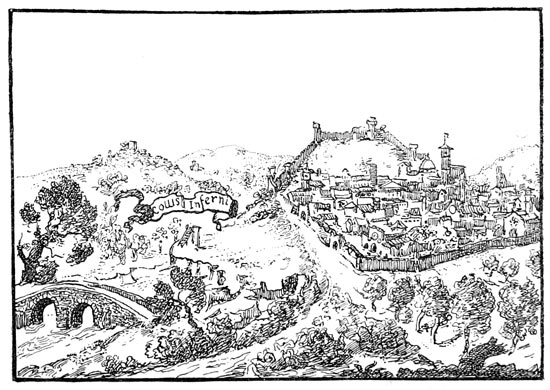
ASSISI IN THE TIME OF ST. FRANCIS

CHAPTER II
The Umbrian Prophet
"Fra santi il pui santo, e tra i peccatori quasi
uno di loro."—Celano. Vita I. cap. xxix.
ften while reading
the Italian
chroniclers we forget
that a life of
chivalry, song,
tournament, and
pagan pleasure-making
was passed
in a mediæval town even while war,
pestilence, and famine cast a settled
gloom on every home. Lazar-houses stood
at the gates of the city while sumptuous
feasts were spread in the banqueting halls
of palaces. Men rebelled against the ugliness and
squalor produced by a hundred ills that swept over
Italy during the twelfth century,[18] and so it came
about that in the darkest hours of a city's history,
scenes of maddest revelry were enacted. At this
period were founded the Brigate Amorose, or Companies
of young nobles, whose one aim in life was
amusement. There were few towns in Italy, however
small, in which these gay youths did not organise
magnificent sports and tournaments[19] to which
the ladies came in gowns of rich brocades or "fair
velvet," their tresses garlanded with precious jewels
and flowers. Or knights, ladies, and other folk
would meet in the piazzas and pass the summer evenings
with
"Provençal songs and dances that surpass;
And quaint French mummings: and through hollow brass
A sound of German music in the air."[20]
Late at night after a splendid banquet, the nobles
wandered through the streets singing as they followed
the lead of one chosen by themselves, whom they
called the Lord of Love. Sometimes their ranks
were swelled by passing troubadours from Provence
who sang of the feats of Charlemagne and of King
Arthur and his knights. For it was the time when
Bernard de Ventadour was singing some of his sweetest
love lyrics, and people were alternately laughing at the
whimsicalities of Pierre Vidal and weeping at the tender
pathos of his poems.[21] Those who listened to these
songsters were, for the moment, deceived into thinking
life was full of love and mirth, and sorrow only touched
them when their lady frowned. The music of Provence
found a way across the Alps to the feudal courts
of Este and Ferrara, to Verona, and later, southwards
to Sicily, where Frederick the Great was king. It
came even to the towns which lay hidden in the folds
of the Umbrian mountains, and some of its sweetest
strains were echoed back again from Assisi. Her
troubadour was Francis Bernardone, the rich merchant's
son, leader of the young nobles who, in their carousals,
named him Lord of Love, and placed the kingly
sceptre in his hand as he walked at their head through
the streets at night, rousing the sleepy Assisan burghers
with wild bursts of song.
Francis had learned the Provençal language from his
mother, Madonna Pica, whom Pietro Bernardone[22] is
said to have met while journeying from castle to castle
in Provence, tempting the ladies to buy his merchandise
as he told them news of Italy. The early writers do
not mention her nationality, they only allude to her as
Madonna, which might imply that she was of noble
birth; the later legend, which says that she was of the
family of the counts of Bourlemont, is without foundation.
We know she was a good and tender mother to
Francis, who was left mostly in her charge, as Pietro
Bernardone was so often absent in France. She taught
him to love the world of romance and chivalry peopled
by the heroes of the troubadours, and there he found
an escape from the gloom that enveloped Assisi during
those early days of warfare which were enough to
sadden that joyous nature rarely found among saints.
Celano gives a graphic picture of the temptations to
which the youths of the middle ages were exposed,
even in infancy in their own homes. This danger
Francis escaped, but the companions with whom he
spent the first twenty years of his life in gay living had
not been so well guarded, and Francis was not slow to
feel the influence of his time. We must remember
that the accounts we have of him were written under
the papal eye, and it is patent that both as sinner and
as saint he took a leading part.
"He was always first among his equals in all
vanities," says Celano, "the first instigator of evil, and
behind none in foolishness, so that he drew upon himself
the attention of the public by vain-glorious extravagance,
in which he stood foremost. He was not
chary of jokes, ridicule, light sayings, evil-speaking,
singing, and in the wearing of soft and fine clothes;
being very rich he spent freely, being less desirous of
accumulating wealth than of dissipating his substance;
clever at trafficking, but too vain to prevent others
from spending what was his: withal a man of pleasant
manners, facile and courteous even to his own disadvantage;
for this reason, therefore, many, through his fault,
became evil-doers and promoters of scandal. Thus,
surrounded by many worthless companions, triumphantly
and scornfully he went upon his way."[23]
His early years passed away in feasting and singing
with an occasional journey to a neighbouring town to sell
the Bernardone wares, until 1202 when war broke out
between Perugia and Assisi, and the big bell of the
cathedral called the citizens to arms in the Piazza della
Minerva. Men gathered round their captain, while
from the windows of every house women gesticulated
wildly, almost drowning the clank of armour and the
tramp of horses by their shrill screams. Francis, on a
magnificent charger, rode out of the city gates abreast
with the nobles of Assisi, filling the bourgeois heart of
Pietro with delight, that a son of his should be thus
honoured. It was a beautiful sight to see the communal
armies winding down to the plain, one coming
from the western hill, the other from the southern, to
match their strength by the Tiber. They were "troops
of knights, noble in face and form, dazzling in crest
and shield; horse and man one labyrinth of quaint
colour and gleaming light—the purple, and silver, and
scarlet fringes flowing over the strong limbs and clashing
mail like sea waves over rocks at sunset."[24]
The Assisans were vanquished: no details of the
fight have come down to us, but we know that the
nobles lay in a Perugian prison for a year and that it
was Francis who cheered them, often astonishing them
with his wild spirits. They told him he was mad to
dance so gaily in a prison, but nothing saddened him
in those days.
When peace was at last made, with hard terms for
Assisi, the prisoners returned home and threw themselves
with renewed vigour into their former pursuit of
pleasure, and soon afterwards Francis fell ill of a fever
which brought him near the grave. Face to face with
death he stood a while, and the result of the danger he
had passed through worked an extraordinary change in
his nature. His recovery was in reality a return to a
new life, both of body and soul. Celano tells us that
Francis "being somewhat stronger and able to walk
about the house leaning on a stick, in order to complete
his restoration to health one day went forth and
with unusual eagerness gazed at the vast extent of
country which lay before him; yet neither the charm
of the vineyards or of aught that is pleasant to look on,
were of any consolation to him."[25]
It was probably from the Porta Nuova, close to
where the church of Santa Chiara now stands, that he
looked out on the Umbrian country he loved so well.
Here Mount Subasio rises grey and bleak above the
olive groves which slope gradually down to the valley
where a white road leads past Spello to Foligno in the
plain and on to Spoleto high up in the mountain gorge
which brings the valley to a close. All these towns
were dear and familiar to Francis. He had watched
them in spring time when the young corn was ripening
near their walls and the children came out to look for
the sweet scented narcissi. While wandering on the
hill sides at dawn he had seen the brown roofs warmed
by the first rays of the sun and each window twinkle
like so many eyes across the plain in answer to the
light. But as he looked now upon the same scene a
great sadness came over him, and we are told he wondered
at the sudden inward change. That hour in the
smiling Umbrian landscape was the most solitary he
ever experienced; ill and weak he awoke to the
emptiness of the life he had hitherto led, and in the
bitterness of his soul he did not know where to turn
for comfort.[26]
It is a remarkable fact that Celano does not from
this moment picture Francis as an aureoled saint, but
allows us to realise the many difficulties he had to overcome
before he stands once more among the vineyards
with a song of praise upon his lips, and a look of victory
in his eyes.
Although Francis began to "despise those things he
had formerly held dear," he was not altogether freed
from the bonds of vanity, nor had he "thrown off the
yoke of servitude"; for when restored to health he
was full of ambitious projects to make a great career
for himself in the world. The realisation of his dreams
seemed indeed near, as it happened at this time that a
noble knight of Assisi was preparing to join the army
of Gauthier de Brienne, then fighting the battles of
Pope Innocent III, in Apulia. Francis, "greedy of
glory," determined to accompany the knight to the
wars, and began to prepare for the journey with more
than usual magnificence. He was all impatience to
start, and his mind was full of the expedition when he
had a dream which filled him with hope. In lieu of
the bales of silk in his father's warehouse, stood saddles,
shields, and lances, all marked with the red cross, and
as he marvelled at the sight a voice told him those
arms were intended for himself and his soldiers. Rising
next morning full of ambitious plans after such an omen
of good fortune, he mounted his charger and rode
through the town bidding farewell to his friends. He
smiled on all and seemed so light of heart that they
pressed round asking what made him so merry.
"I shall yet be a great prince," he answered, and he
passed out of the Porta Nuova, where but a short while
before he had stood looking down so sadly on the
valley he was now to traverse as an armoured knight.
At Spoleto he had a return of intermittent fever, and
while chafing at the delay a voice called to him:
"Francis, who can do the most good, the master or
the servant?"
"The master," answered Francis, not in the least
astonished by the mysterious question.
"Why then dost thou leave the master for the servant,
and the prince for the follower? Return to thy
country, there shalt thou be told what to do; for thou
hast mistaken the meaning and wrongly interpreted the
vision sent thee by God."
Next morning, leaving the knight to continue the
journey alone, he mounted his horse and returned to
Assisi, where he was doubtless received with disappointment
by his parents, and with gibes by the citizens who
had listened to his boasts of future greatness. Once
again he went back to work in his father's shop, but
now when the young nobles called to him to join in
their revels he went listlessly, often escaping from their
midst to wander alone in the fields or pass long hours
praying in a grotto near the city. One day his friends,
in despair at his frequent absences, gave a grand banquet,
making him "King of the feast." He delighted them
all with fitful bursts of merry wit, but at last when the
revellers rushed out into the night to roam about the
town till dawn, Francis fell back from the gay throng,
and stood gazing up at the calm Umbrian sky decked
in all its splendour of myriad stars. When the others
returned in search of their leader, they, wondering at
the change that had come over the wildest spirit of
Assisi, assailed him with questions. "Are you thinking
of marrying, Francis," cried one jester, and amidst
the laughter of all came his quiet answer: "Yes, a
wife more noble and more beautiful than ye have ever
seen; she will outshine all others in beauty and in
wisdom." Already the image of the Lady Poverty
had visited him, and enamoured like a very troubadour
he composed songs in her honour as he walked in the
woods near Assisi.
The kind heart of Francis had always been touched
at the sight of the poor lepers, who, exiled from the
companionship of their fellow creatures, lived in a lazar-house
on the plain, about a mile from the town. But his
compassion for their misery was mingled with a strong
feeling of repugnance, so that he had always shunned
these wretched outcasts. "When I was in the bondage
of sin," he tells us in his will, "it was bitter to me,
and loathsome to see, and loke uppon persouny enfect
with leopre; but that blessed Lord broughte me amonge
them, and I did mercy with them, and departing from
them, what before semyd bittre and lothesomme was
turned and changed to me in great sweetnesse and comfort
both of body and of soule, and afterwards in this
state I stode and abode a lytle while, and then I lefte
and forsooke the worldly lyf."[27]
Pietro Bernardone now saw his son, clothed in rags,
his face pinched and white from long vigils spent in
prayer, going forth on errands of mercy, jeered at by
the citizens, pelted with stones and filth by the children.
There were many storms in the Bernardone household
which the gentle Pica was unable to quell; and when
finally Francis began to throw his father's money
among the poor in the same regal manner in which
he had once spent it among his boon companions, Bernardone
could bear it no longer, and drove his son
from the house. When they met he cursed him, and
the family bonds thus severed were never again renewed.
Francis was still like a pilgrim uncertain of his goal,
or like a man standing before a heavy burden which
he feels unable to lift. What was he to do with his
life—how could he help the poor and suffering—were
questions he asked himself over and over again as he
vainly sought for an anchor in the troubled seas. The
answer came to him one day as he was attending mass
at the chapel of the Portiuncula on the feast of St.
Matthew the apostle, in the year 1209.
"And as ye go, preach, saying, The kingdom of
heaven is at hand. Heal the sick, cleanse the lepers,
raise the dead, cast out devils: freely ye have received,
freely give. Provide neither gold, nor silver, nor brass
in your purses, nor scrip for your journey, neither two
coats, neither shoes, nor yet staves" ... read the
priest from the gospel of the day. Those simple words
were a revelation to Francis, who, when mass was over,
ran out into the woods, and, with only the birds in
the oak trees to witness his strange interpretation of
the gospel, threw away his shoes, wallet, staff and
well-filled purse. "This is what I desired; behold,
here is what I searched for and am burning to perform,"
he cried, in the delirium of his new-found
joy.
If the Assisans had been astonished at his former
eccentricities, as they termed his deeds of charity, they
were yet more amazed to see him now, clothed in a
coarse habit, with a knotted cord round his waist, and
with bare feet, begging his bread from door to door.
After a little while they grew accustomed to the
hurrying figure of the young mendicant as he passed
rapidly down the street greeting all he met with the
salutation of "Our Lord give thee His peace." The
words brought something new and strange into men's
hearts, and those who had scoffed at him most drew
near to learn the secret of their charm. The first to
be touched by the simplicity and joyous saintliness of
Francis was Bernardo di Quintevalle, a wealthy noble of
Assisi, who had known him as King among the young
Assisan revellers, and watched with astonishment his
complete renouncement of the world. He determined
to join Francis in ministering to the lepers, and began
his new mode of life by selling all his possessions for
the benefit of the poor. His conversion created a considerable
stir in the town; and people had not ceased to
gossip on the subject when another well-known citizen,
Pietro de Catanio, a canon of the cathedral, also offered
his services at the lazar-house. A few days later a
labourer named Egidio "beholding how those noble
knights of Assisi despised the world, so that the whole
country stood amazed," came in search of Francis to
beg him to take him as one of his companions. Francis
met him at the entrance of the wood by the lazar hospital,
and gazing on the devout aspect of Egidio,
answered and said: "Brother most dear, God has
shown Himself exceeding gracious unto thee. If the
Emperor were to come to Assisi and desire to make a
certain citizen his knight or private chamberlain, ought
not such a one to be exceeding glad? How much
more oughtest thou not to rejoice that God hath chosen
thee out to be His knight and well-beloved servant,
to observe the perfection of the Holy Gospel"?[28]
and, taking him by the hand, he brought him to the
hut which was their home. Here a merchant's son,
a learned churchman, and a rich nobleman, welcomed
an Assisan labourer in their midst with the simple
brotherly love which was to be the keynote of the
franciscan order. After the reception of Egidio we
are told that Francis went with him to the Marches
of Ancona, "singing glorious praises of the Lord of
heaven and earth" as they travelled along the dusty
roads. Albeit Francis did not preach publicly to the
people, yet as he went by the way he admonished and
corrected the men-folk and the women-folk, saying
lovingly to them these simple words: "Love and fear
God, and do fit penance for your sins." And Egidio
would say: "Do what this my spiritual Father saith
unto you, for he speaketh right well."
It was not long before the fame of Francis drew
quite a little community of brethren to the tiny hut in
the plain, and the question naturally occurs—Did
Francis plan out the creation of an order when he
gathered men around him? It was so natural a thing
for disciples to follow him that his biographers simply
note it as a fact, and, not being given to speculation in
those days, pass on to other events. We may be
allowed to conjecture that the same ambition which
some years before had stirred his longing to be a great
prince was not dead, only his dreams were to be
realised in another sphere of action. The qualities
which made him the brilliant leader among the gay
nobles of Assisi were now turned into another channel—he
became a prince among saints, a controller of
men's destinies.
Varied indeed was the band of Francis' disciples,
and it is interesting to see how each one was allowed
to follow the bent of his nature. In this complete
sympathy with character lay one of the secrets of his
power. Egidio, who in the world had been a labourer,
was encouraged by his master to continue his life in the
open country. He gathered in the olives for the peasants,
helped them with their vintage, and when the
corn was being cut would glean the ears; but if anyone
offered him a handful of grain, he remarked: "My
brother, I have no granary wherein to store it."
Usually he gave away what he had gleaned to the
poor, so that he brought little food back to the convent.
Always ready to turn his hand to every job, one day
we find Egidio beating a walnut tree for a proprietor
who could find none to do the work because the tree
was so tall. But he set himself gaily to the task, and
having made the sign of the Cross, "with great fear
climbed up the walnut tree and beat it. The share that
fell to him was so large that he could not carry it in his
tunic, so taking off his habit he tied the sleeves and the
hood together and made a sack of it."[29] With this load
on his back he returned towards the convent, but on
the way distributed all the nuts to the poor. Egidio
remains the ideal type of the franciscan friar. "He
is a Knight of my Round Table," said Francis one
day as he recounted some new adventure which had
befallen the intrepid brother, who was always journeying
to some southern town, and is said even to have
visited the Holy Land.[30]
A very different man, drawn by the magic influence
of Francis into the Order at the beginning of its fame
in 1211, was Elias Buonbarone, the son of a Bolognese
mattress-maker who had for some time been settled in
Assisi. He is always represented by the biographers
as haughty, overbearing, and fond of controlling the
actions of others; in fact a strong contrast to the meek
brother Leo whom Francis lovingly named the little
lamb of God. But if lacking in saintly qualities, Elias
possessed a remarkable mind and determination of
character which enabled him afterwards to play a
considerable part in the history of his times. He
embodies the later franciscan spirit which grew up
after the saint's death, and of which we shall treat in
another chapter.
When Francis found himself surrounded by some
dozen followers, all anxious to obey his wishes to the
very letter and waiting only to be sent hither and thither
as he commanded, it became necessary to write down
some rule of life. In simple words he enjoined all to
live according to the precepts of the Gospel, "and
they that came to reseyve this forme or manner of
lyvynge departyd and distributed that they had and
myght haue too powre people. And we were content
with oone coote pesyd bothe within forthe and without
forthe with oone corde and a femorall, and we wolde
not haue ony more. Our dyvyne servyse the clerkis
saide as other clerkis, and the lay bretherne said ther
Pater noster. And we fulle gladly dwelt and taried in
pour deserte and desolat churchys, and we were contente
to be taken as ideotis and foolys of every man, and I
did exercyse my self in bodily laboure. And I wille
laboure, and yt ys my wille surely and steadfastely that
alle the bretherne occupie and exercyse themself in
laboure, and in such occupation and laboure as belongeth
to honeste. And those that have no occupation
to exercyse themself with alle, shall lerne not for
covetis to resceyve the price or hier for their laboure,
but for to give good example and eschewe and put
away idlenesse. When we wer not satisfied nor recompensied
for our laboure, we went and had recourse
to the lord of oure Lorde, askynge almes from dore to
dore. Our Lorde by reualation tawghte me to say
this maner of salutation, 'Our Lorde give to thee His
peace.'"[31]
The first rule which Francis and his companions
took in the summer of 1210 to be confirmed by Innocent
III, has not come down to us. In Rome they
fortunately met the bishop of Assisi, who promised to
obtain for them, through one of the Cardinals, an interview
with the Pope. A legend tells us how Innocent,
wrapt in deep meditation, was pacing with solemn step
the terrace of the Lateran, when this strange company
of ragged, bare-footed, dusty men was ushered into his
presence. He looked at them in surprise, his lip
curling in disdain as Francis stepped forward to make
his request. From an Umbrian pilgrim he heard for
the first time that power was not the greatest good in
life while in poverty lay both peace and joy, and the
great pope stood amazed at the new doctrine. "Who
can live without temporal possessions," sarcastically
asked the Cardinals who had been trained in the spirit
of Innocent, and the "Penitents of Assisi" bowed
their heads, and drawing their hoods forward, went
sorrowfully out of the pope's presence amid the jeers of
his court. That night Innocent had a dream in which
he saw the church of St John Lateran about to fall,
and its tottering walls were supported on the shoulders
of a man whom he recognised as the spokesman of the
band of Umbrians he had so hastily dismissed. Full
of strange visions the pope sent for Francis, who repeated
his desire to have his rule confirmed. "My
son," said Innocent, "your rule of life seems to us
most hard and bitter, but although we do not doubt
your fervour we must consider whether the road is not
too hard a one for those who are to follow thee."
Francis, with ready wit, answered these objections by
a tale he invented for the purpose. "A beautiful
but poor girl lived in a desert, and a great king, seeing
her beauty, wished to take her to wife, thinking by her
to have fine children. The marriage having taken
place, many sons were born, and when they were
grown up their mother thus spoke to them: 'My sons
be not ashamed, for you are sons of the king; go
therefore to his court and he will cause all that is
needful to be given to you.' And when they came,
the king, observing their beauty and seeing in them his
own likeness and image, said: 'Whose sons are you?'
And they answered; 'sons of a poor woman who lived
in the desert.' So with great joy the king embraced
them, saying: 'Be not afraid, for you are my sons, and
when strangers eat at my table how much more right
have you to eat who are my legitimate sons?' The
king then ordered the said woman to send all sons born
of her to be nourished at his court." "Oh, Messer,"
cried Francis, "I am that poor woman, beloved of
God, and made beautiful through His mercy, by whom
he was pleased to generate legitimate sons. And the
King said to me that he will feed all the sons born of
me, for as He feeds strangers so He may well feed His
own."
Thus did Francis describe his Lady Poverty, and
boldly hint that the crimson-robed princes of the Church
and the prelates of the Papal Court had strayed from
the teaching of the Gospel.
Who can say whether Innocent, watching with keen
eyes the earnest face of the Umbrian teacher, began to
realise the power such a man might have in restoring
to the church some of its lost purity, and was planning
how to yoke him to his service. This at least we
know, that before Francis and his companions left
Rome they received the tonsure which marked them
as the Church's own, and with blessings and promises
of protection Innocent sent this new and strange militia
throughout the length and breadth of Italy to fight his
spiritual battles. The simplicity and the love of
Francis had conquered the Pope, and to the end continued
to triumph over every difficulty.
Such was the desire of Francis and his companions
to return to Assisi with the good news, that they forgot
to eat on the way and arrived exhausted in the valley
of Spoleto, though still singing aloud for the joy in
their hearts. Somewhere near Orte they found an
Etruscan tomb—a delightful retreat for prayer. It so
pleased Francis that a strong temptation came over him
to abandon all idea of preaching and lead a hermit's
life. For there was that in his nature which drew him
into the deep solitude of the woods, and might have
kept him away from men and the work that was before
him. The battle in his soul waged fiercely as he
stood upon the mountain side looking up the valley
towards Assisi, but his heart went out to the people
who dwelt there, and the strong impulse he had to help
those who suffered and needed him won the day. The
die was cast; he left his Etruscan retreat to take up once
more the burden, and thus it was that, in the words of
Matthew Arnold: "He brought religion to the people.
He founded the most popular body of ministers of
religion that has ever existed in the church. He transformed
monachism by uprooting the stationary monk,
delivering him from the bondage of property, and sending
him, as a mendicant friar, to be a stranger and sojourner;
not in the wilderness, but in the most crowded
haunts of men, to console them, and to do them
good."
When Francis began his mission among the people
of Italy it was the custom for only the bishops to preach;
but as they lived in baronial splendour, enjoying the
present, and amassing money which they extorted from
their poor parishioners to leave to their families, they
had little time to attend to spiritual duties. The people
being therefore left much to their own devices, sank
ever deeper into ignorance, sin, and superstition. They
saw religion only from afar until Francis appeared
"like a star shining in the darkness of the night" to
bring to them the messages of peace and love. He
came as one of themselves, poor, reviled and persecuted,
and the wonder of it made the people throng in crowds
to hear one who seemed indeed inspired. Those simple
words from the depths of a great and noble heart filled
all who listened with wonder. They were like the
sharp cries of some wild bird calling to its mate—the
people heard and understood them. When the citizens
of an Umbrian town looked from their walls across the
valley and saw the grey cloaked figure hurrying along
the dusty road, they rang the bells to spread the good
news, and bearing branches of olive went out singing to
meet him. All turned out of their houses to run to
the market-place where Francis, standing on steps, or
upon a low wall, for he was short of stature, would
speak to them as one friend does to another; sometimes
charming them by his eloquence, often moving the
whole multitude to bitter tears by his preaching on the
passion of Christ. With his eyes looking up to the
heavens, and his hands outstretched as though imploring
them to repent, he seemed to belong to another world
and "not to this century." They not only repented,
but many left the world to follow him and spread the
gospel of peace and love. The first woman who begged
him to receive her vows of renunciation was Chiara
Sciffi, of a noble Assisan house. Several members of
the family, besides others from near and far, followed
her into the cloister until she became the abbess of a
numerous sisterhood, the foundress of the Poor Clares
or Second Order of St. Francis.
The first inspired messages of Francis were brought
to the Assisans, and then he left them for awhile to
journey further afield into other parts of Italy, where
he always met with the same marvellous success. In
the following account of his visit to Bologna we get a
vivid idea of his manner of appeal to the people; and
of their enthusiasm and astonishment that this poor and
seemingly illiterate man, the very antithesis of the
pedantic clergy, should have the power to hold and
sway an audience by the magic of his words. "I,
Thomas, citizen of Spalato, and archdeacon of the
cathedral church of the same city, studying at Bologna
in the year 1220, on the day of the assumption of the
Mother of God, saw St. Francis preach in the square
before the little palace, where nearly the whole town
was assembled. He spoke first of angels, of men, and
of devils. He explained the spiritual natures with
such exactness and eloquence that his hearers were
astonished that such words could come from the mouth
of a man so simple as he was. Nor did he follow the
usual course of preachers. His discourse resembled
rather one of those harangues that are made by popular
orators. At the conclusion, he spoke only of the
extinction of hatred, and the urgency of concluding
treaties of peace, and compacts of union. His garments
were soiled and torn, his person thin, his face pale, but
God gave his words unheard-of power. He converted
even men of rank, whose unrestrained fury and cruelty
had bathed the country in blood; many who were
enemies were reconciled. Love and veneration for the
saint were universal; men and women thronged around
him, and happy were those who could so much as touch
the hem of his habit."[32]
Young knights and students stepped out of the crowd
after one of these burning discourses, resolved to don
the grey habit and renounce the world. The ranks of
the followers of St. Francis were swelled at every town
through which he passed; and he left some of his own
sweetness and gentleness among those who had listened
to his preaching, so that party feuds lay dormant for
awhile, enemies were reconciled, and all tried to lead
more Christian lives. Pax et bonum was the Franciscan
war-cry which fell indeed strangely on the air in a
mediæval town. Whenever Francis heard of tension
and ill-will between the nobles and the people he
hurried with his message of peace to quell the storm.
But at Perugia he failed. Brother Leo tells us that,
"Once upon a time, when the Blessed Francis was
preaching to a great multitude of people gathered together
in the Piazza of Perugia, some cavaliers of the
city began to joust and play on their horses in the
piazza, thus interrupting his sermon; and, although
rebuked by those present, they would not desist. Then
the blessed Francis, in the fervour of his soul, turned
towards them and said, 'Listen and understand what
the Lord announces to you by me, his little servant,
and refrain from jeering at him, and saying, He is
an Assisan.' This he
said because of the
ancient hatred which
still exists between
the Perugians and the
Assisans...."[33] Rebuking
the citizens
for their pride, he predicted
that if they
did not shortly repent
civil war would break
out in the city. But
the Perugians, who
fought ever better than
they prayed, continued
in their evil
ways until at length
the words of St.
Francis were verified.
A tumult arose between
the people of
Perugia, and the
soldiers were thrust
out of the city gates
into the country, which they devastated, destroying
trees, vineyards, and corn-fields, so that the misery in
the land was great.
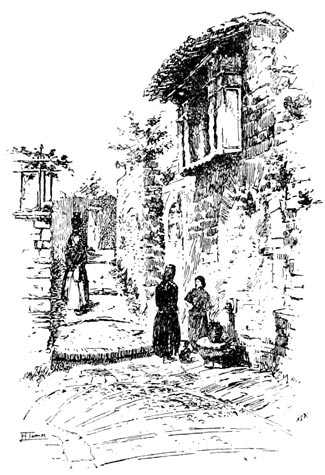
VIA DI S. MARIA DELLE ROSE
In the course of a single day Francis often preached
at five different towns or villages; sometimes he went
up to a feudal castle, attracted by the sound of music
and laughter. "Let us go up unto this feast," he
would say to his companion, "for, with the help of
God, we may win some good harvest of souls."
Knights and ladies left the banqueting hall when they
heard of his arrival, and Francis standing on a low
parapet of the courtyard preached so "devoutly and
sublimely to them that all stood with their eyes and
their minds turned on him as though an angel of God
were speaking." And then the gay company returned
to their feast and the two friars went on their way
singing aloud from the joy in their hearts, and passed
the night praying in some deserted church or rested
under the olive trees on the hill-side. At dawn they
rose and "went according to their rule, begging bread
for the love of God, St. Francis going by one street
and Brother Masseo by another. But St. Francis,
being contemptible to look upon and small of stature,
was accounted but a vile beggar by those who knew
him not, and only received some mouthfuls of food
and small scraps of stale bread; but to Brother Masseo,
because he was tall and finely made, were given tit-bits
in large pieces and in plenty and whole slices of bread.
When they had done begging they met together outside
the town to eat in a place where was a fair spring,
and near by a fine broad stone whereon each placed
the alms they had gathered, and St. Francis seeing
the pieces of bread given to Brother Masseo to be
more numerous, better, and far larger than his own
rejoiced greatly...."[34]
Masseo on one occasion wishing to try the humility
of Francis mocked him saying, "Why doth all the
world come after thee, and why is it that all men long
to see thee, and hear thee, and obey thee? Thou art
not a comely man, thou art not possessed of much
wisdom, thou art not of noble birth; whence comes
it then that the whole world doth run after thee?"
It is easy to see the naive wonder of the practical
Masseo in these words, a wonder doubtless shared by
others who looked on from the same standpoint, at the
extraordinary influence Francis obtained through his
preaching. Their astonishment must have reached its
height when Francis came to a little town near Bevagna
(perhaps Cannara) where he preached with such fervour
that the whole population wished to take the franciscan
habit. Husbands, wives, nobles, labourers, young and
old, rich and poor, rose up with one accord, ready to
leave their homes and follow him to the end of the
earth. Such an awakening by the simple words of a
road-side preacher had never before been seen, and was
the precursor of other popular demonstrations a few
years later.[35] Francis, with extraordinary diplomacy,
held the enthusiastic crowd in check without extinguishing
their piety. He calmly viewed the situation
and solved the difficulty where another, with less knowledge
of human nature, might have been carried away
by the opening of the flood-gates. It is not without
amusement that one thinks of Francis coming to convert
sinners, and then finding he had called into being
an order of Religious who absolutely refused to separate
from him. He calmed the weeping crowd, and with
caution said to them: "'Be not in a hurry, neither
leave your homes, and I will order that which ye are
to do for the salvation of your souls:' and he then
decided to create the Third Order for the universal
salvation of all, and thus, leaving them much consoled
and well disposed to penitence, he departed...."
At a time when war, party feuds, and the unlawful
seizure of property brought misery into the land, the
Tertiaries, united by solemn vows to keep the commandments
of God, to be reconciled to their enemies, and
to restore what was not rightfully theirs, became a
power which had to be reckoned with. The rule forbidding
them to fight, save in defence of the Church
or of their country, dealt a severe blow at the feudal
system, and therefore met with much opposition among
the great barons. Persecution only increased their
power, for so early as 1227 Gregory IX, protected
the Brothers of Penitence by a special Bull. The
enemies of the Church soon discovered that they had a
powerful antagonist in an Order which comprised the
faithful of every age, rank, and profession, and whose
religious practices, whilst creating a great bond of union
among them, were not severe enough to take them
away from social life in the very heart of the great
cities. They formed a second vanguard to the papacy,
and Frederick II, was heard to complain that this
Third Order impeded the execution of his plans
against the Holy See; while his chancellor Pier delle
Vigne in one of his letters exclaims that the whole
of Christendom seems to have entered its ranks.[36]
Thus both from within and from without the world
was being moulded as Francis willed; all Italy responded
to his call, and everywhere rose songs of praise to God
from a people no longer oppressed by the squalor of
their evil living. His energy and desire to gain souls
drew him still further afield into the wilds of Slavonia,
into Spain, Syria, Morocco, and later into Egypt, for
the purpose of converting the Soldan. So great was
his eagerness to arrive at his destination and begin to
preach that, often leaving his companions far behind,
he literally ran along the roads. He was "inebriated
by the excessive fervour of his spirit," and on fire with
divine love, and yet he failed on these missions in
foreign lands. The reason probably lay in his total
ignorance of any language except Italian and Provençal,
so that his words must have lost all their eloquence
and power when delivered through the medium of an
interpreter, and we know that Francis never made use
of miracles to enforce his teaching.[37]
He returned to Assisi bitterly disappointed, and so
despondent that for a while he was tempted to give up
all idea of preaching. In this uncertainty he turned
for council to Brother Sylvester and to St. Clare, who
both urged him to continue his mission to the people;
God, they said, had not elected him to work out his
salvation in the solitude of a cell but for the salvation
of all. He left the hermitage (perhaps the Carcere)
and filled with new courage by their words, started on
a fresh pilgrimage by "cities and castles," but this time
among the Umbrians who knew and loved him. As
he came near Bevagna in the plain a new crowd of
listeners awaited him—troops of fluttering birds—bullfinches,
rooks, doves, "a great company of creatures
without number." Leaving his companions in a state
of wonder on the road, he ran into the field saying,
"I would preach to my little brothers the birds," and
as he drew near, those that were on the ground did not
attempt to fly away, while those perched on the trees
flew down to listen to his sermon.
"My little brethren birds," he said, after saluting
them as was his custom, "ye ought greatly to praise
and love the Lord who created you, for He provideth
all that is necessary, giving unto you feathers for raiment
and wings to fly with. The Most High God has placed
you among His creatures, and given you the pure air
for your abode; ye do not sow neither do ye reap, but
He keeps and feeds you."[38] Stretching out their necks,
opening their beaks, and spreading their wings, the birds
listened while they fixed their eyes upon the saint and
never moved even when he walked in their midst
touching them with his habit, until he made the sign
of the Cross and allowed them to depart. He often
related this episode which had made such a happy day
in his life and had been of good augury at a time when
he was sad.
The love of Francis for his "little brethren the
birds," and indeed for all creatures however small, was
one of the most beautiful traits in a character which
stands out in such strong relief in the history of the
middle ages. It was not only a poetical sentiment but
the very essence of his being; a power felt by every
living thing, from the brigand who left his haunts in
the forests to follow him, to the half-frozen bees which
crawled in winter to be fed with wine and honey from
his hands. An understanding so complete with Nature
was unknown until Francis stretched out his arms in
yearning towards her shrines and drew the people,
plunged in the gloom of Catharist doctrines, towards
what was a religion in itself—the worship of the
beautiful.
"Le treizième siècle était prêt pour comprendre la
voix du poète de l'Ombrie; le sermon aux oiseaux clôt
le règne de l'art byzantin et de la pensée dont il était
l'image. C'est la fin du dogmatisme et de l'autorité;
c'est l'avenement de l'individualisme et de l'inspiration,"[39]
says M. Paul Sabatier. No one mocked at the sermon
to the birds; no one wondered that leverets, loosed
from the snare of the huntsman, should run to Francis
for protection, or pheasants forsake the woods to seek a
shelter in his cell; for so great an awakening had taken
place in Italy that all understood the deep vein of
poetry in their saint.
His biographers have transmitted these various anecdotes
with a tenderness and simplicity which cannot
fail to impress us with the belief that Francis, like
many in our own time, possessed a marked attraction
for all animals, a magnetism felt with equal strength by
man and beast. Love was the Orphean lute he played
upon, sending such sweet melody into the world that
its strains have not yet died away.
Besides the feeling he had for the beautiful, the
small, or the weak, there was another influence at work
that made him walk with reverence over the stones,
gather up the worms from the path to save them from
being crushed, and buy the lambs that were being
carried to market with their poor feet tied together.
He saw in all things a symbol of some great truth
which carried his thoughts straight to God. One
day near Ancona he noticed a lamb following slowly
and disconsolately a large herd of goats which made
him think of Christ among the Pharisees. In pity
he bought it from the goat-herd, and in triumph
carried it to a neighbouring town where he preached
a parable to an admiring crowd, even edifying the
bishop by his piety.
Speaking of his favourite birds he would say,
"Sister lark hath a hood like the Religious ... and
her raiment—to wit her feathers—resemble the earth....
And when she soars she praises God most
sweetly." Such was his desire to protect them that
he once said if he could only have speech with the
Emperor he would entreat him to pass a special edict
for the preservation of his sisters the larks, and command
the "Mayors of the cities and the Lord of
the castles to throw grain on the roads by the walled
towns" on the feast of the Nativity, so that all the
birds should rejoice with man on that day. He found
great joy in the open fields, the vineyards, the rocky
ravines, and the forests which gave shelter to his
feathered brethren; running water and the greenness
of the orchards, earth, fire, air, and the winds
so invited him to divine love that often he passed
the whole day praising the marvels of creation. No
wonder he turned his steps more willingly up the
mountain paths to the hermitage of the Carceri than
towards the crowded cities. Nature was his companion,
his breviary the mirror wherein he saw reflected
the face of the Creator. In the song of the
nightingales, in the sound of their wings, in the petals
of a tiny flower, in the ever changing glory of his
own Umbrian valley he was always reminded of God,
and for this he has been rightly called a "Pan-Christian."
There is not a corner in Umbria, one might almost
say in Italy, which does not bear some record of the
passage of the saint. The sick were brought to him
and cured, those in trouble laid their sorrows before
him and went away comforted. When anything went
wrong, a hasty message was sent to Francis, and all
with child-like simplicity trusted in him to set things
right. We even hear that the people of Gubbio, being
persecuted by a fierce wolf, had recourse to him, for
they failed to protect themselves though the men
sallied forth "as if going to battle." The saint had
little difficulty in persuading Brother Wolf to lead a
respectable life; and he, seeing the advantage of a
peaceful existence, bowed his head and placed his paw,
as a solemn seal to the compact, in the hand of Francis
amid the joyful cries of the people who marvelled
greatly at the "novelty of the miracle." After this
he could be seen walking gently through the streets
of Gubbio to receive his daily ration at every door,
cared for by the citizens "and not a dog would wag
even his tongue against him." When Brother Wolf
died there was bitter mourning in the city, for all felt
as if a friend had passed away, and there was none
left to remind them of the kindly saint who had
helped them in their need. "Am I expected to
believe these fairy tales?" some may ask with a sneer.
The exact events related—no—but the spirit of these
legends is more necessary to a true conception of the
saint and the times in which he lived than all the
histories that can ever be written about him. The
Umbrians pictured him as they saw and understood
him, and tradition going from mouth to mouth found
finally its perfect expression in the "Little Flowers of
St. Francis." Wonders and miracles are in every page,
it is true, but then the peasants will tell you all things
are possible in Umbria; the taming of wild beasts,
the silencing of garrulous swallows who chattered so
loudly while he preached, do not seem stranger to them
than the conversion of brigands and murderers, for did
not the very angels obey his wishes and play and sing
to him one night when he lay ill in a lonely hermitage,
longing for the sound of sweet strains to break the
awful stillness round him?
Francis would have been sorely troubled had he
foreseen the numberless miracles his biographers were
going to attribute to him, for no saint was ever
humbler. Even in his lifetime, oppressed by the
homage paid him, he would say to his adorers with a
touch of quaint humour: "do not be in such haste to
proclaim me a saint, for I may still be the father of
children." He was always fearful lest people should
overrate his good actions, and his horror of hypocrisy
drove him to confess aloud to the people gathered
round to listen to a sermon, in what manner he had
given way to the desires of "Brother Body." Upon
one occasion having used lard in lieu of the less
wholesome oil when he was ill, he began his sermon
by saying: "Ye come to me with great devoutness
believing me to be a saint, but I do confess unto God
and unto you that this Lent I have eaten cakes made
with lard." Another time, after a severe chill, his
companions sewed some fox-skin inside his habit to
keep him somewhat warmer during the bitter cold,
but he was not happy until a piece had been sewn
also on the outside so that all might see the luxury
he allowed himself.
It may at first seem strange that one so simple
should have exercised such extraordinary influence on
men and women of all ranks, an influence which has
lasted with undiminished force for seven hundred
years. But we must remember that a people, however
ready to listen to the words of a reformer (especially
an Italian crowd), will hardly be moved by calmness
or sense; only when one like Francis stirs their
imagination by a peculiar way of announcing God's
word, and by acts sometimes bordering on insanity,
can he completely succeed in winning them. The
Assisans, at first shocked by some of the spectacles
they witnessed in their sleepy town, jeered and
murmured, until at last the saint literally took them
by storm; and the more he risked their good opinion
the louder they applauded him and wept for their sins.
Astonishment was at its height when on the way to
some service at the cathedral, the citizens saw Francis
approaching them "naked save for his breeches,"
while Brother Leo carried his habit. He has gone
mad through too much penance, some thought. The
truth was that Francis had imposed this same penance
on Brother Ruffino who was then preaching to the
people in the cathedral, and his conscience smote him
so that he began to chide himself, saying: "Why art
thou so presumptuous, son of Bernardone, vile little
man, as to command Fra Ruffino, who is one of the
noblest of the Assisans, to go and preach to the people
as though he were mad."... So when Ruffino's
sermon was ended Francis went up into the pulpit and
preached with such eloquence on his Lady Poverty
and on the nakedness and shame of the Passion
suffered by Our Lord Jesus Christ "that the whole
church was filled with the sound of weeping and
wailing such as had never before been heard in Assisi."
Thus did the force of originality win the people, and
all those who had jeered but a few minutes before were
much "edified and comforted by this act of St. Francis
and Brother Ruffino; and St. Francis having reclad
Brother Ruffino and himself, returned to the Portiuncula
praising and glorifying God, who had given them
grace to abase themselves to the edification of Christ's
little sheep."
By word and example Francis taught his disciples
to be especially humble towards the clergy. "If ye
be sons of peace," he often said, "ye shall win both
clergy and people, and this is more acceptable to God
than to win the people only and to scandalise the
clergy. Cover their backslidings and supply their
many defects, and when ye have done this be ye the
more humble." He had to struggle against much
opposition among the bishops, who looked upon him
and his friars as intruders encroaching upon their
rights. People had often advised him to obtain a Bull
from Rome, to enable him to preach without asking
permission, but it was through the power of persistent
meekness that he wished to win his way to every
heart, and the only weapons he used were those of
love. St. Bonaventura tells us that the Bishop of
Imola absolutely refused to let Francis call the citizens
together and preach to them. "It suffices, friar, that
I preach to the people myself," was the cross reply,
and Francis, drawing his cowl over his head, humbly
went his way. But after the short space of an hour
he retraced his steps, and the bishop inquired with some
anger why he had returned. He made answer in all
humility of heart and speech: "My lord, if a father
sends his son out at one door there is nothing left for
him but to return by another." Then the bishop,
vanquished by his humility, embraced him with a joyful
countenance, saying: "Thou and all thy brethren
shall have a general licence to preach throughout
my diocese, as the reward of thy holy humility."[40]
This was the saint, gentle and sweet among men,
who won the friendship of Ugolino, Bishop of Ostia
(afterwards Pope Gregory IX). The bishop often
spent quiet hours at the Portiuncula, trying perhaps to
find, in the companionship of the saint and his poor
friars, a peace he in vain sought amid the luxury
of the Papal Court. Celano,[41] who may have been
present during one of these meetings, tells us how
he delighted in throwing off his rich robes and clothing
himself in the Franciscan habit. In these moments
of humility he would reverently bend the knee to
Francis and kiss his hands. Besides his great admiration
and love for the personality of the saint, he was
not slow to perceive the services Francis had rendered
in endeavouring to restore something of the pristine
purity to Christianity, and further, the Order was
fast becoming of political importance. The work of
organising a community, no longer a handful of Assisan
knights and yeomen following in the footsteps of their
leader, was by no means an easy task; and Ugolino
saw his way to bring it more closely into the service
of the Church. Francis, whether willingly or not we
cannot say, begged the Pope to name Ugolino Patron
and Father of his Order. This was readily accorded,
for it was felt in the papal circle that Francis was
not so easy to drive as became a submissive child of
the Church. They could not complain of actual
disobedience, but he liked doing things his own way.
By some at Rome it was suggested to him that he
should adopt the Benedictine rule, by others that he
might join his Order to that of St Dominic, but
the saint smiled sweetly, and though so dove-like none
succeeded in entangling him in their diplomatic nets.
Indeed he puzzled Ugolino many times, and both
Innocent III and Honorius III were never quite
sure whether they had to do with a simpleton or a
saint. The Roman prelates, completely out of sympathy
with his doctrine of poverty, were only too ready
to thwart him, and Ugolino knowing this advised him
"not to go beyond the mountains" but remain in Italy
to protect the interests of his order. He further persuaded
him to come to Rome and preach before the
Pope and cardinals, thinking that the personality of the
saint might perchance win their favour. Anxious to
do honour to his patron, Francis composed a sermon
and committed it to memory with great care. When
the slight, grey figure, the dust of the Umbrian roads
still clinging to his sandals, stood up in the spacious
hall of the Lateran before Honorius and the venerable
cardinals, Ugolino watched with anxious eyes the
course of events. In mortal fear "he supplicated God
with all his being that the simplicity of the holy man
should not become an object of ridicule," and resigning
himself to Providence he waited. There was a
moment of suspense, of awful silence, for Francis had
completely forgotten the sermon he had so carefully
learned by heart. But his humility befriended him;
stepping forward a few paces with a gesture of regret
he quietly confessed what had happened, and then, as
if indeed inspired, he broke forth into one of his most
eloquent sermons. "He preached with such fervour
of spirit," says Celano, "that being unable to contain
himself for joy whilst proclaiming the Word of God,
he moved even his feet in the manner of one dancing,
not for play, but driven thereto by the strength of the
divine love that burnt within him: therefore he incited
none to laughter but drew tears of sorrow from
all."[42]
When Francis had been preaching for some time a
certain weariness seems to have possessed him, and he
would then, "leaving behind him the tumult of the
multitude," retire to some secret place to dwell in constant
prayer and heavenly contemplation. There were
many of these refuges, but none so isolated from the
world as the lofty mountain of La Vernia, which
had been given to him by Count Orlando Cattani of
Chiusi, whose ruined castle can still be seen on a spur
of the Apennines just below. The "Sacred Mount"
rises clear above the valley of the Casentino to the
height of 4000 feet, between the sources of the Tiber
and the Arno, and looks straight down upon one of
the perfect views in Tuscany which Dante speaks of:
"The rills that glitter down the grassy slopes
Of Casentino, making fresh and soft
The banks whereby they glide to Arno's stream."
Range upon range of splendid hills falling away
gradually to the south gather in their folds the pale-tinted
mists of early summer, and seem to guard the
valley from other lands, so intense is the feeling of
remoteness. From the white towns gleaming like
pearls on their green slopes above the young Arno
cradled by poplars, is seen the sharp outline of La
Vernia against the sky, always black, gloomy, and
defiant above the cornfields and vineyards. Its summit,
covered with fir-trees, straight and close together,
appears like a great whale that has rested there since
the days of the flood. Below the forest lie huge
boulders of rock and yawning chasms, upheaved, says
the legend, during the earthquake at the time of the
Crucifixion. To this solitary place came Francis in
the year 1224 to celebrate by forty days of fasting
and prayer the feast of St. Michael the Archangel,
accompanied by Fra Leo "the little sheep of God,"
Fra Angelo "the gentle knight," Fra Illuminato, and
Fra Masseo. On former visits he had been content
to stay in a cell beneath a "fair beech tree" built for
him by Count Orlando close to where the brethren
lived; but this time he chose a spot on the loneliest
side of the mountain where no sound could be heard.
To reach it the brethren had to throw a bridge across
a "horrible and fearful cleft in a huge rock," and after
they had fashioned him a rough shelter they left him
in utter solitude; only once in the day and once at
night Fra Leo was permitted to bring a little bread
and water which he left by the bridge, stealing silently
away unless called by Francis. Near this lonely retreat
a falcon had built a nest and used to wake him
regularly a little before matins with his cry, beating
his wings at his cell until the saint rose to recite his
orations. Francis, charmed with so exact a clock,
obeyed the summons, and such was the sympathy between
the friends that the falcon always knew when he
was weary or ill, and would then "gently, and like a discreet
and compassionate person, utter his cry later ...
and besides this, in the day would sometimes stay quite
tamely with him." The birds, which had shown joy
on his arrival, filled the woods with their sweetest song
while the angels visited him, sometimes playing such
beautiful music on the viol that "his soul almost
melted away." But Francis, honoured as he was by
celestial spirits, and by man and beast, had still to receive
the greatest sign of grace ever accorded to a saint,
and the story has been gravely related by ancient and
modern writers for seven centuries.
The moment had certainly arrived for accomplishing
the high designs of Providence, for Francis through
prayer, fasting, and constant contemplation on the Passion
of Christ, had become like some spiritual being
untrammelled by the bonds of the flesh. It was on
the feast of the Exaltation of the Cross while praying
on the mountain side, that the marvellous vision was
vouchsafed to him. The dawn had hardly broken
when "he beheld a Seraph who had six wings,
which shone with such splendour that they seemed
on fire, and with swift flight he came above the face
of the Blessed Francis who was gazing upwards to
the sky, and from the midst of the wings of the
Seraph appeared suddenly the likeness of a man
crucified with hands and feet stretched out in the
manner of a cross, and they were marked with
wounds like those of Our Lord Jesus Christ, and
two wings of the said Seraph were above the head,
two were spread as though flying, and two veiled the
whole body."[43] Flames of fire lit up the mountains
and the valley during the vision, and some muleteers
seeing "the bright light shining through the windows
of the inn where they slept, saddled and loaded their
beasts thinking the day had broke." When Francis
rose from his knees and looked up to the sky where
the seraph had been and where now the sun was
rising over the Casentino and her steepled towns, he
bore on his body the marks of the Crucified. His
hands and feet appeared as though pierced through
with nails, the heads being on the inside of the
hands and on the upper part of the feet, while
blood flowed from the wound in his side. Thus transformed
by his surpassing love for Christ, Francis returned
to his four companions and recounted to them
his vision, trying all the while out of his deep humility
to hide from them the signs of the Stigmata. Before
returning to Assisi he bade them a final farewell, for
he knew this was the last time he would come with
them to La Vernia. The scene is beautifully pictured
in a letter of Fra Masseo, which, as far as we know, is
here translated for the first time.
Jesus, Mary my Hope.
"Brother Masseo, sinner, and unworthy servant of
Jesus Christ, companion of Brother Francis of Assisi,
man most dear unto God, peace and greetings to all
brethren and sons of the great patriarch Francis,
standard-bearer of Christ.
"The great patriarch having determined to bid a
last farewell to this sacred mount on the 30th of
September 1224, day of the feast of St Jerome,
the Count Orlando of Chiusi sent to him an ass in
order that he might ride thereon, forasmuch as he
could not put his feet to the ground by reason of
their being sore wounded and pierced with nails. In
the morning early having heard mass, according to his
wont, in Sta. Maria degli Angeli,[44] he called all the
brethren into the chapel, and bade them in holy
obedience to live together in charity, to be diligent
in prayer, always to tend the said place carefully, and
to officiate therein day and night. Moreover he commended
the whole of the sacred mount to all his
brethren present, as well as to those to come, exhorting
them to have a care that the said place should not
be profaned, but always reverenced and respected, and
he gave his benediction to all inhabitants thereof, and
to all who bore thereunto reverence and respect. On
the other hand, he said: 'Let them be confounded
who are wanting in respect to the said place, and from
God let them expect a well-merited chastisement.'
To me he said: 'Know, Brother Masseo, that my
intention is that on this mount shall live friars having
the fear of God before their eyes, and chosen among
the best of my order, let therefore the superiors strive
to send here the worthiest friars; ah! ah! ah! Brother
Masseo, I will say no more.'
"He then commanded and ordered me, Brother
Masseo, and Brother Angelo, Brother Silvestro and
Brother Illuminato, to have a special care of the
place where that great miracle of the holy Stigmata
occurred.[45] Having said that, he exclaimed 'Farewell,
farewell, farewell, Brother Masseo.' Then
turning to Brother Angelo, he said: 'Farewell,
farewell,' and the same to Brother Silvestro and
Brother Illuminato: 'Remain in peace, most dear
sons, farewell, I depart from you in the body, but
I leave my heart with you; I depart with Brother
Lamb of God, and am going to Sta. Maria degli
Angeli[46] never to return here more; I am going,
farewell, farewell, farewell to all! Farewell, sacred
mount. Farewell, mount Alvernia. Farewell, mount
of the angels. Farewell, beloved Brother Falcon,
I thank thee for the charity thou didst show me,
farewell! Farewell, Sasso Spicco,[47] never more
shall I come to visit thee, farewell, farewell, farewell,
oh rock which didst receive me within thine
entrails, the devil being cheated by thee, never
more shall we behold one another![48] Farewell, Sta.
Maria degli Angeli, mother of the eternal Word.
I commend to thee these my sons.'
"Whilst our beloved father was speaking these
words, our eyes poured forth torrents of tears, so
that he also wept as he turned to go, taking with
him our hearts, and we remained orphans because of
the departure of such a father.
"I, Brother Masseo, have written this with tears.
May God bless us."
For two years after his return from La Vernia,
Francis, bearing the marks of the Seraph, continued
to preach and visit the lazar houses, although he
was so ill and worn by fasts and vigils that his
companions marvelled how the spirit could still
survive in so frail a body. Moreover he had become
nearly blind, remaining sometimes sixty days
and more unable to see the light of day or even
the light of fire. It was to him a martyrdom that
while walking in the woods led by one of the
brethren, the scenes he loved so well should be
hidden by this awful darkness. He could only
dream of the past when he had journeyed from
one walled town to another through the valley of
Spoleto; sometimes rejoicing in the brilliant sunshine,
often watching the storms sweeping so gloriously
over the land in summer when the rocky beds
of torrents were filled with rushing water and clouds
cast purple shadows across the plain. Now those
wanderings were over, and the spirit imprisoned
within him found more than ever an outlet in music,
and "the strain of divine murmurs which fell upon
his ears, broke out in Gallic songs."
He went on his way singing to meet death, and the
greater his sufferings the sweeter were the melodies he
composed. It was during an access of his infirmities
and blindness that St. Clare induced him to take some
days of rest in a small wattle hut she had built in
the olive grove close to her convent of San Damiano.
After nights of bitter tribulation, of bodily suffering,
passed in earnest prayer, he arose one morning with
his heart full of new praises to the Creator. Meditating
for a while he exclaimed, "Altissimo, omnipotente
bono Signore," and then composed a chaunt
thereon, and taught it to his companions so that they
might proclaim and sing it. His soul was so comforted
and full of joy that he desired to send for
Brother Pacifico, who in the world had borne the
title of King of Verse and had been a most renowned
troubadour, and to give to him as companions some
of the brethren to go about the world preaching and
singing praises to the Lord ... he willed also that
when the preaching was ended all together should
as minstrels of God sing lauds unto Him. And at
the close of the singing he ordered that the preacher
should say to the people: "We are the minstrels of
the Lord God wherefore we desire to be rewarded
by you, to wit, that you persevere in true repentance."[49]
It was the Canticle of the Sun which Francis
composed in his days of blindness, leaving it as an
undying message to the world, an appeal that they
should not cease to love the things he had brought
to their knowledge during those earlier days of his
ministry among them. He poured the teaching of
a life-time into a song of passionate praise to the
Creator of a world he had loved and found so beautiful;
and the sustained melody of the long, rolling
lines charm our fancy like the sound of waves during
calm nights breaking upon the beach. The poem,
though rough and unhewn, still remains one of the
marvels of early literature, and to Francis belongs
the honour of setting his seal on the religious poetry
of his country. His was the first glow of colour
proclaiming the dawn—the first notes of song which,
coming from Assisi, passed along the ranks of Italian
poets to be taken up by Dante in "full-throated ease."
We give the Canticle of the Sun in the exquisite
version of Matthew Arnold.
"O most high, almighty, good Lord God, to
Thee belong praise, glory, honour, and all blessing!
"Praised be my Lord God with all His creatures;
and specially our brother the sun, who brings us the
day, and who brings us the light; fair is he, and
shining with a very great splendour: O Lord, he
signifies to us Thee!
"Praised be my Lord for our sister the moon, and
for the stars, the which he has set clear and lovely in
heaven.
"Praised be our Lord for our brother the wind,
and for air and cloud, calms and all weather, by the
which thou upholdest in life all creatures.
"Praised be my Lord for our sister water, who is
very serviceable unto us, and humble, and precious,
and clean.
"Praised be my Lord for our brother fire, through
whom thou givest us light in the darkness; and he is
bright, and pleasant, and very mighty, and strong.
"Praised be my Lord for our mother the earth,
the which doth sustain us and keep us, and bringeth
forth divers fruits and flowers of many colours, and grass.
"Praised be my Lord for all those who pardon
one another for his love's sake, and who endure weakness
and tribulation; blessed are they who peaceably
shall endure, for Thou, O most Highest, shalt give
them a crown![50]
"Praised be my Lord for our sister, the death of
the body, from whom no man escapeth. Woe to
him who dieth in mortal sin! Blessed are they who
are found walking by Thy most holy will, for the
second death shall have no power to do them harm.
"Praise ye and bless ye the Lord, and give thanks
unto Him, and serve Him with great humility."
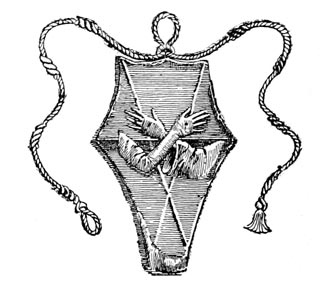
THE ARMS OF THE FRANCISCANS.
CHAPTER III
The Carceri, Rivo-Torto and Life at
the Portiuncula
"O beata solitudo,
O sola beatudine."
These three places near Assisi, so intimately
associated with St. Francis, were in a way emblematic
of the various stages in the rise and growth of
his young community, and we shall see that the saint
went from one to the other, not by chance, but with a
settled purpose in his mind. The Carceri he kept as
a something apart from, and outside his daily life; it
was a hermitage in the strict sense of the word, where,
far from the sound of any human voice, he could come
and live a short time in isolated communion with God.
As his followers increased, and the Order he had
founded with but a few brethren developed even in
its first years into a great army, we can easily understand
the longing for solitude which at times became
too strong to be resisted, for his nature was well fitted
for the hermit's life, and it called him with such persistence
to the woods among the flowers and the birds
he loved, that had he been less tender for the sufferings
of others, more blind to the ills of the Church, it
is possible that the whole course of events might have
been altered. Giotto would not have been called to
Assisi, or if he had been, the legends told to him by
the friars might not have inspired him to paint such
master-pieces as he has left us in the Franciscan
Basilica; and we should now be the poorer because
St. Francis had chosen seven hundred years ago to live
in an Etruscan tomb at Orte, or in a grotto on Mount
Subasio. So much depended, not only upon what St.
Francis achieved, but on the way in which he chose to
work. Who therefore
can tell how
much we owe to
the little mountain
retreat of the
Carceri, where,
spending such hours
of wondrous peace
surrounded by all
that he most
cherished in nature,
the saint could refresh
himself and
gain new strength
for long periods of
arduous labour
among men.
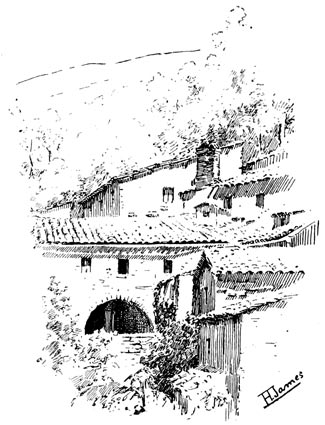
HERMITAGE OF THE CARCERI
The Carceri
came into the possession
of St. Francis
through the
generosity of the
Benedictines who,
until his advent, had held unlimited sway in Umbria.
Many churches, and we may say, almost all the hermitages
of the surrounding country belonged to them.
But their principal stronghold, built in the eleventh
century, stood on the higher slopes of Mount Subasio,
while the Carceri, lying a little to the west, was used
by them probably as a place of retreat when wearied of
monastic life. Both monastery and hermitage seem to
have been quiet enough, and we only occasionally hear
of the Benedictine monks starting off on a visit to
some hermit of renowned sanctity, or going upon some
errand of mercy among the peasants in the valley,
whom they often surprised by marvellous though
somewhat aimless miracles wrought for their edification.
Then early in the fourteenth century these
hermit monks of Mount Subasio suddenly found themselves
in the midst of the fighting of a mediæval
populace, for the Assisans, not slow to discover the great
military importance of the Benedictine Abbey, wished
to possess it. When the struggle between Guelph and
Ghibelline was at its height, the monks were driven
to take refuge in the town, while their home was
taken possession of by the exiled party who used it as
a fortress whence they could sally forth and harass the
eastern approach to Assisi. Perpetual skirmishes took
place beneath its walls until the roving adventurer
Broglia di Trino, who had made himself master of the
town in 1399, in a solemn council held at the Rocca
Maggiore issued an edict that the Monastery of St.
Benedict was to be razed to the ground, determining
thus to deprive the turbulent nobles and their party of
so sure a refuge in times of civil war.
The solid walls and fine byzantine columns of what
once was the most celebrated abbey in Umbria now
remain much as in the mediæval days of their wreckage,
and, until a few years ago when some repairs were
made, the church was open for the mountain birds to
nest in, and wild animals used it as their lair.
But both church and monastery stood proudly upon
the mountain height above the plain when St. Francis,
then the young mendicant looked upon by many as a
madman, would knock at the gates, and the abbot
followed by his monks, came out to listen to the
humble requests he so often had to make. These
prosperous religious most generously patronised St.
Francis in the time of his obscurity, giving him the
chapel of the Portiuncula, and later (the date is
uncertain but some say in 1215) they allowed him
to take possession of the still humbler chapel and huts
of the Carceri. Even to call such shelters huts is giving
them too grand a name, for they were but caverns
excavated in the rock, scattered here and there in a
deep mountain gorge. They can still be seen, unchanged
since the days of St. Francis save for the tresses
of ivy growing thick, like a curtain, across the entrance,
for now there are none to pass in and out to pray there.
Even the attempt to describe the loneliness and
discomfort of this hermitage seems to strike terror into
the hearts of later franciscan writers, who no longer
caring to live in caves, only saw Dantesque visions
when they thought of these arid, sunburnt rocks,
rushing torrents and wild wastes of mountains which
even shepherds never reached. But luckily in those
days there was one Umbrian who loved such isolated
spots; and the charm of that silence, born of the very
soul of Francis and guarded jealously by nature
herself during long centuries in memory of him, now
tempts us up the mountain side upon a pilgrimage to the
one place where his spirit still lives in all its primitive
vigour and purity.
The road leading to the Carceri[51] from the Porta
Cappucini passes first through rich corn fields and olive
groves, but as it skirts round Mount Subasio towards
the ravine it becomes a mere mountain track. Only
here and there, where peasants have patiently scraped
away the stones, grows a little struggling corn, while
small hill flowers nestle between the rocks unshaded
even by olive trees; the colour of a stray Judas tree,
or a lilac bush in bloom, only makes the landscape seem
more barren and forlorn. Looking upon the road
to Spello, winding down the hill through luxuriant
fields of indian corn and olive groves, with the oak
trees spreading their still fresher green over the vineyards
of the plain, we feel that this pathway to the
Carceri is something novel and unlike anything at Assisi
which we have hitherto explored. Just as we are
marvelling at its loveliness, a sudden turn brings Assisi
once more in view, and the sight we get of it from here
carries us straight back to the days of St. Francis; for
the great basilica and convent are hidden by the brow
of the hill, and what we now see is exactly what he
looked upon so often as he hastened from Assisi to his
hermitage, or left it when he was ready to take up the
burden of men's lives once more. The old walls,
looking now much as they did after a stormy battle
with Perugia, stretch round the same rose-tinted town,
which, strangely enough, time has altered but slightly—it
is only a little more toned in colour, the Subasian
stone streaked here and there with deeper shades of
yellow and pink, while the castle is more ruined,
rearing itself less proudly from its green hill-top than
in earlier days of splendour. But charming as the view
of the town is, we quickly leave it to watch the changes
of light and colour in the valley and on the wide-bedded
Tescio as it twists and turns in countless sharp zig-zags
till we lose it where it joins the Tiber—there where
the mist rises. We might travel far and not find so
fascinating a river as the Tescio; only a trickle
of water it is true, but sparkling in the sunshine like
a long flash of lightning which has fallen to earth and
can find no escape from a tangle of fields and vineyards.[52]
Then our road turns away again from the
glowing valley shimmering in the haze of a late May
afternoon, and mounting ever higher we plunge into
the very heart of the Assisan mountain, uncultivated,
wild, colourless and yet how strangely beautiful.
Another half mile brings us round the mountain side
to a narrow gorge, and the only thing in sight except
the ilex trees is an arched doorway with a glimpse,
caught through the half open gate, of a tiny courtyard.
A step further on and we find ourselves standing amidst
a cluster of cells and chapels seeming as if they hung
from the bare rocks with nothing to prevent them falling
straight into the depths of the ravine; and the
silence around is stranger far than the mountain solitude.
Surely none live here, we think, when suddenly
a brown-clothed friar looks round the corner of a
door, and without waste of time or asking of questions
beckons us to follow, telling rapidly as he goes the
story of each tree, rock, cell and shrine.
Crossing two or three chapels and passing through a
trap-door and down a ladder, we reach a narrow cave-like
cell where St. Francis used to sleep during those rare
moments when he was not engaged in prayer. As at
La Vernia this "bed" was scooped out of the rock,
and a piece of wood served him as a pillow. Adjoining
is an oratory where the crucifix the saint always
carried with him is preserved. The doors are so
narrow and so low that the smallest person must stoop
and edge in sideways. From these underground caves
it is a joy to emerge once more into the sunlight, and
one of the delightful surprises of the place is to step
straight out of the oppressive darkness of the cells into
the ilex wood, with the banks above and around us
glowing with sweet-scented cyclamen, yellow orchids,
and long-stemmed violets. It is not surprising that St.
Francis often left his cell to wander further into these
woods when the birds, as though they had waited for
his coming, would gather from all sides and intercept
him just as he reached the bridge close to the hermitage.
While they perched upon an ilex tree (which is still to
be seen), he stood beneath and talked to them as only
St. Francis knew how. His first sermon to the birds
took place at Bevagna, but at the Carceri he was continually
holding conversations with his little feathered
brethren. This perhaps was also where he held his
nocturnal duet with the nightingale, which was singing
with especial sweetness just outside his cell. St. Francis
called Brother Leo to come also and sing and see
which would tire first, but the "little Lamb of God"
replied that he had no voice, refusing even to try. So
the saint went forth alone to the strange contest, and
he and the bird sang the praises of God all through
the darkest hours of the night until, quite worn out,
the saint was forced to acknowledge the victory of
Brother Nightingale.
Very different is the story of his encounter with the
tempting devil whom he precipitated by his prayers into
the ravine below; the hole through which the unwelcome
visitor departed is still shown outside the saint's
cell. Devils do not play a very prominent part in the
story of the first franciscans, but this mountain solitude
seems to have so excited the imaginations of later
chroniclers that yet another story of a devil belongs to
the Carceri, and is quaintly recounted in the Fioretti.
This time he appeared to Brother Rufino in the form
of Christ to tempt him from his life of holiness. "O
Brother Rufino," said the devil, "have I not told thee
that thou shouldst not believe the son of Pietro Bernardone?...
And straightway Brother Rufino
made answer: 'Open thy mouth that I may cast into
it filth.' Whereat the devil, being exceeding wroth,
forthwith departed with so furious a tempest and shaking
of the rocks of Mount Subasio, which was hard by,
that the noise of the falling rocks lasted a great while;
and so furiously did they strike one against the other
in rolling down that they flashed sparks of terrific fire
in all the valley, and at the terrible noise they made
St. Francis and his companions came out of the house
in amazement to see what strange thing was this; and
still is to be seen that exceeding great ruin of rocks."
Close to the spot rendered famous by the devil's
visits a bridge crosses the gorge of a great torrent,
which, threatening once to destroy the hermitage, was
miraculously dried up by St. Francis, and now only
fills its rocky bed when any public calamity is near.
From it a good view is obtained of the hermitage, but
perhaps a still better is to be had from under the avenue
of trees a little beyond, on the opposite side of the deep
ravine whence the groups of hovels are seen to hang like
a honeycomb against the mountain side, so tightly set
together that one can hardly distinguish where the
buildings begin and the rock ends.
The ilex trees grow in a semicircle round this
cluster of cells and caverns, and high above it all rises
a peak of Mount Subasio, grey as St. Francis' habit,
with a line of jagged rocks on the summit which looks
more like the remains of some Umbrian temple of
almost prehistoric days than the work of nature.
The sides of this mountain ravine approach so near
together that only a narrow vista of the plain is obtained,
blue in the summer haze, with no village or even
house in sight. It would be difficult to find a place
with the feeling of utter solitude so unbroken, and as
we realised that these friars lived here nearly all their
life, many not even going to Assisi more than once
in five years, we said to one of them: "How lonely
you must be," and he, as though recalling a time of
struggle in the world, answered: "Doubtless there
are better things in the town, but here, at the Carceri,
there is peace."
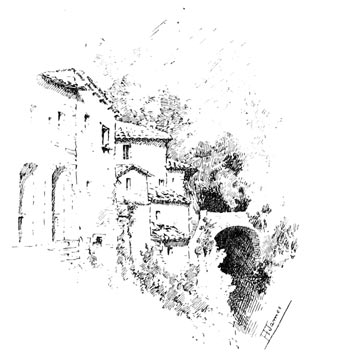
THE CARCERI WITH A VIEW OF THE BRIDGE
It is the hermit's answer; but now the need of such
lives has long since passed away, and even St. Francis,
living at the time when the strain of perpetual warfare,
famine, pestilence and crime, created a fierce craving
for solitude in the lives of many, realised that a hermitage
must only be a place to rest in for a while—not to
live in. His anxiety to keep his Order from becoming
a contemplative one is shown in the following rule
he carefully thought out for his disciples. "Those
religious who desire to sojourn in a hermitage are to
be at the most three or four. Two are to be like
mothers having a son. Two are to follow the life of
a Martha, the other the life of a Mary." Then they
were to go forth again strenuously to their work abroad
and give place to others in search of rest and peace.
But after the death of St. Francis the Carceri
gradually lost its primitive use, and the principal person
who entirely changed its character was St. Bernardine
of Siena who in 1320 made many alterations
and additions, building a larger chapel, adding cells
and a kitchen, but so small, remarks a discontented
franciscan chronicler, that it barely held the cooking
utensils. Although we can no longer call it a hermitage,
the Carceri became the type of an ideal franciscan
convent such as Francis dreamed of for his followers
when he went to live at the Portiuncula, and such it
has remained to this day. For certainly the place, as
left by St. Bernardine, would have been approved of
by the first franciscans as a dwelling-place, but those
of later years can only tell us of its discomforts. Here
is a graphic description of its primeval simplicity which
very nearly corresponds to its present state: "It were
better called a grotto with six lairs; one sees but the
naked rock untouched by the chisel, all rough and full
of holes as left by nature; those who see it for the first
time are seized with extraordinary fear on climbing the
ladder leading to the dormitory, at each end of which
are other poor buildings, added by the religious according
as need arose for the use of the friars, who do
not care to live as hermits did in the olden times. The
refectory is small, and can contain but few friars; a
brother guardian made an excavation, of sufficient
height and breadth in the rock, and added thereto a
table around which can sit other six religious, so that
those who take their places at this new table are
huddled up in the arched niche which forms a baldaquin
above their heads. There is also a little common
room which horrifies all beholders, wherein is lit a fire,
for besides being far inside the rocky mass it is gloomy
beyond description by reason of the dense smoke
always enclosed therein, this is a lively cause to the
religious of reflection on the hideousness and obscurity
of the darkness of hell; in lieu of receiving comfort
from the fire the poor friars generally come out with
tears in their eyes." To somewhat atone for these discomforts
they possessed a fountain, raised, as we are
told, by the prayers of St. Francis, which never ran
dry, "a miracle God has wished to perpetuate for the
glory of His faithful servants and the continual comfort
of the monks."
The crucifixion in the chapel built by St. Bernardine
adjoining the choir, is said to have been painted by his
orders. The artistic merits of the fresco are questionable,
but connected with it is a legend possibly invented
by some humorous member of the franciscan brotherhood
in order to point a moral to his companions.
"Here," says a chronicler, "is adored that most
marvellous crucifixion, so famous in religion; it is well
known to have spoken several times to the devout Sister
Diomira Bini of the Third Order of St. Francis and a
citizen of Assisi; and in our own times, in the last
century (the seventeenth) it was seen by Brother
Silvestro dello Spedalicchio to detach itself from the
cross, and with most gentle slaps on the face, warn a
worshipper to be reverent and vigilant while praying in
this His Sacred Oratory."
In a small wooden cupboard in the chapel, according
to an inventory made two hundred years ago, are preserved
some relics, a few of which we have unfortunately
not been able to identify. Part of the wooden pillow
used by St. Francis, and a piece of the Golden Gate
through which our Lord passed into Jerusalem, are still
here, but the hair of the Virgin, and, strangest of all,
some of the earth out of which God created Adam,
are no longer to be found!
Ten or twelve friars continued to live at the Carceri
for a few years after the death of St. Bernardine;
some begged their daily bread from the villagers in the
valley, others dug in the tiny garden at the foot of the
ravine where a few vegetables grew, and two always
remained at the convent to spin the wool for the
habits of the religious. But soon wearying of the life
they went to live at other convents, and the place passed
away from the franciscans into the possession of various
sects, among others to the excommunicated Fraticelli.
In 1415 it was given back to the Observants, and
Paolo Trinci, who had done much to reform the Order,
persuaded some friars to live once more at the deserted
hermitage. Again the Carceri became such an ideal
franciscan convent that many came from afar to visit
it, and there is a strange story of how a "woman
monk" found a home and died here in the middle of
the fifteenth century.
"Beata Anonima," a chronicler recounts, "being
already a Cistercian nun in the convent of S. Cerbone
of Lucca at the time of the siege of that city by the
Florentines, when the said nuns, for valid reasons,
were transferred to the convent of Sta. Christina inside
the city. Now this most fervent servant of God took this
opportune time and fled by stealth, disguised as a man,
and went, or rather flew, to Assisi; there, fired with
an ardent desire to fight under the seraphic standard,
she breathlessly climbed the steep slopes of Mount
Subasio, and having found the horrible cavern of Santa
Maria delle Carceri fervently entreated those good
Fathers to admit her amongst them and to bestow on
her their sacred habit, for which her longing was
extreme. At length, having overcome all resistance,
believing her to be a man as appeared from her dress,
and not a woman which in reality she was, they admitted
her to the convent and gave her the habit of religion."
She edified all by the holiness of her life and the
rigid penances she performed, but her health soon
suffered and only upon her death-bed, surrounded by
the friars chanting the psalms for the dying, the Blessed
Anonima confessed to the fraud she had practised in
order to dwell in the hermitage rendered so dear
because of the memory of the Poverello d'Assisi.
Rivo-Torto[53]
A straight and stony road, the old Roman one, now
overgrown in many parts with grass and trails of ivy
and bordered by mulberry and oak trees, leads out
of the Porta Mojano to two little chapels in the
plain. Set back from the main road in the midst of
the fields few people find them, and the peasants know
nothing of their story and can only tell of a miraculous
well in which a youthful saint met his death.
When his body was brought to the surface a lily had
grown from his mouth and upon its petals was written
in letters of gold the one word, Veritas, for he had
died in the cause of truth. Since then, as the peasants
recount with pride, many come from afar to drink of
the waters of this well for it cures every ill. It is
over-grown with ferns and close by stands an ancient
sarcophagus where the children sit to eat their midday
meal. A piece of old worn sculpture still ornaments
the chapel of the young martyr, and the feeling of the
place is very charming, but the pilgrim who comes to
Assisi to visit St. Francis, has a different picture to
recall with another kind of beauty belonging to it than
that of holy wells and flowering banks and meadows.
It is difficult, when looking on San Rufino d'Arce,
with its cluster of vine-shaded peasant houses, and
then on Santa Maria Maddalena, narrow windowed,
the small apse marking it as a primitive Umbrian
chapel of the fields, to realise that in the Middle Ages
this was a leper village separated from Assisi by a little
more than a mile of open country. And yet here,
without doubt, we have Rivo-Torto where, even
before his famous interview with Innocent III, St.
Francis had stayed with those three first Assisan
companions, Bernard di Quintavalle, Peter Cataneo
and Egidio. Then in the autumn of 1210, when he
returned from Rome after the rule of poverty had
been sanctioned by the Church, but before he was
ready to begin his mission as preacher, he came to live
among the lepers, forming with his disciples a little
family which we may call the beginning of a first
franciscan settlement.
The leper village was divided according to the social
rank of the outcasts, the richer living together near the
chapel of Sta. Maria Maddalena and forming quite a
community with the right of freely administering their
own goods. As M. Sabatier observes, it was therefore
not "only a hospital, but almost a little town
near the city with the same social distinctions of
classes."
Those tended by St. Francis were the poorest of the
lepers, whose wretched hovels lay near the chapel of
San Rufino d'Arce; and Celano must be referring to
this settlement when he tells us how Francis in his
early days, even if he chanced to look down from
Assisi upon the houses of the lepers in the plain, would
hold his nostrils with his hand, because his horror of
them was so great.
But as the grace of God touched his heart, making
him take pity upon all things weak and suffering, he
turned the force of his strong nature to overcoming this
repugnance, and there is a beautiful story telling of the
first victory gained shortly after his conversion. While
riding one day near Assisi he met a leper, and filled
with disgust and even fear at the sight, his first impulse
was to turn his horse round, but, remembering his new
resolutions to follow the teaching of Christ, he went
forward to meet the poor man, and even kissed the
hand extended to him for alms. "Then," says St.
Bonaventure, "having mounted his horse, he looked
around him over the wide and open plain, but the leper
was nowhere to be seen. And Francis being filled
with wonder and gladness, devoutly gave thanks to
God, purposing within himself to proceed to still
greater things than this." Certainly the event
heralded a life of holiness, and was the means of
rousing his latent energies and the feelings for self-sacrifice
which drove him from the wild and solitary
places he loved into the very midst of the world, there
to work strenuously, in every part of Italy, at first
among lepers and then among the wealthy, the ignorant
and the sorrowful.
For the life at Rivo-Torto led by "these valiant
despisers of the great and good things of this world"
we cannot do better than turn to the Three Companions
(Brothers Masseo, Ruffino and Leo) who
knew by personal experience the hardships and roughness
of the place. Feelingly they describe: "a hovel,
or rather a cavern abandoned by man; the which place
was so confined that they could hardly sit down to
repose themselves. Many a time they had no bread,
and ate nought but turnips which they begged for here
and there in travail and in anguish. On the beams of
the poor hut the man of God wrote the names of the
brethren, so that whoso would repose or pray might
know his place and not disturb, by reason of the
cramped and limited space in the small hovel, the
quietude of the night." Even the appearance of
Otto IV, close to their hut seems in no way to
have disturbed the peaceful course of their lives, but
only gave St. Francis the opportunity of bestowing
a timely warning upon the Emperor. Celano, ever
delighting in the picturesque details of ceremonies and
pageants, tells us how "there came at that time with
much noise and pomp the great Emperor on his way
to take the terrestrial crown of the Empire; now the
most holy father with his companions being in the said
house near the road where the cavalcade was passing,
would neither go out to see it, nor permit his brethren
to go, save one, whom he commanded fearlessly to
announce to Otto that his glory would be short-lived."
Thus, if the tale be true, a German Emperor was
the first to listen to Francis' message to a mediæval
world sunk in the love of earthly things, and who
knows whether the saint's words did not come back
to Otto again in after years.
The Penitents of Assisi only remained until the
spring at Rivo-Torto, for even during those few
months' sojourn among the lepers their numbers had
so increased that it became necessary to think of some
surer abode. One day St. Francis called the brethren
to tell them how he had thought of obtaining from one
of his various kind friends in Assisi, a small chapel
where they could peacefully say their Hours, having
some poor little houses for shelter close by built of
wattle and mud.
His speech was pleasing to the brethren, and so,
following the master they loved and trusted, all
went to dwell at the Portiuncula, where, as we shall
see, a new life was to begin for them.
The Portiuncula
"Holy of Holies is this Place of Places,
Meetly held worthy of surpassing honour!
Happy thereof the surname, 'Of the Angels,'
Happier yet the name, 'The Blessed Mary.'
Now, a true omen, the third name conferreth
'The Little Portion' on the Little Brethren,
Here, where by night a presence oft of Angels
Singing sweet hymns illumineth the watches."
(The Mirror of Perfection, translated by Sebastian Evans.)
Those who want to realise the charm of the Portiuncula
and of the memories that cling about it, must
try to forget the great church which shuts out from it
the sunlight, and with the early chroniclers as their
guides, call up the image of St. Francis with his first
disciples who in an age of unrest came here to seek
for peace.
Make your pilgrimage in the springtime or in the
early summer, when pink hawthorn and dogroses are
flowering in every hedge and the vines fill the valley
with a delicate green light. Looking at cities and
villages so purely Umbrian, some spread among cornfields
close to a swift clear river, others set upon
heights which nearly touch the sky on stormy days,
we forget that beyond these hills and mountains
encircling the big valley of Umbria stretch other lands
as fair. We forget, because it is a little world which
during long centuries has been set apart from all else, and
where man has but completed the work of nature herself.
During the long hours of a summer's day, when
the sense of remoteness in the still plain is most intense,
it brings to us, as nothing else can ever do, some feeling
of that early time when four hermits came from
Palestine and found a quiet retreat in the oak forests
of Assisi.
It was in the year 352, as St. Cyril, Patriarch of
Jerusalem, relates, when a cross had been seen stretched
from Calvary to the Mount of Olives and to shine
more brightly than the sun, that four holy men, impelled
by a feeling that some great crisis was at hand, determined
to visit the shrines of Rome. Having performed
their devotions and offered many precious relics
to Pope Liberius, they expressed a great desire to find
some hermitage where, each in a silent cell, they could
meditate upon the marvellous things they had seen in
the Eternal City. The Pope gave them most excellent
advice when he told them to go to the Spoletan
valley. With his sanction to choose any part of it they
liked, they passed over the mountains dividing Umbria
from the Campagna, and by many towns until, when
about a mile from Assisi, they determined to build their
dwellings in the plain, thinking, as indeed they might,
to find no other spot so suited for a quiet retreat.
Close to four huts of rough hewn stone and brushwood
they erected a tiny chapel with a pent roof and narrow
window which, perhaps in memory of their native
valley, they dedicated to St. Mary of Jehosaphat.
But after a few years, forsaking the life of hermits,
they again took up their staves and returned home to
Palestine by way of the Romagna, leaving beneath the
altar of the chapel they had built a relic of the
Virgin's sepulchre.
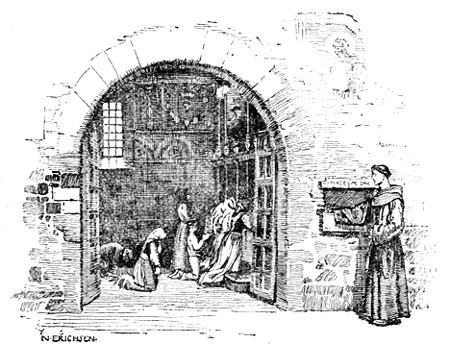
SIDE DOOR OF THE PORTIUNCULA BUILT BY ST. BENEDICT
At different times other devout hermits, charmed by
the lonely chapel, took possession of it for a time, but
it was often deserted for many years. Its preservation
is due to St. Benedict who, passing through Umbria
during the early part of the sixth century, was inspired
to restore the ruined chapel and dwell near it for awhile.
He not only repaired the walls, but built the two large
round arched doors we see to this day, and which
many declare to be quite out of proportion to the rest
of the building, but their unusual size is accounted for
by a charming legend. Once when St. Benedict was
praying in the chapel he saw a marvellous vision as he
knelt wrapt in ecstasy. A crowd of people were praying
around him to St. Francis, singing hymns of praise
and calling for mercy on their souls, while outside still
greater multitudes waited for their turn to come and
pray before the shrine. St. Benedict, understanding
from this that a great saint would one day be honoured
here, made the two doors in the chapel, and made them
large enough for many to pass in and out at a time.
Thus was the feast of the "Pardon of St. Francis"
prepared for some seven hundred years too soon.
St. Benedict obtained from the Assisans the gift of
a small plot of ground near the sanctuary, which suggested
to him the name of St. Mary of the Little
Portion—Sta. Maria della Portiuncula. When a few
years later St. Benedict founded his famous order at
Monte Cassino, he did not forget the Umbrian chapel
he had saved from ruin, and sent some of his monks
to live there and to minister among the people. Like
the first hermits they lived in poor huts, saying their
Hours in the little chapel, until in the eleventh century
they built a large monastery and church upon the
higher slopes of Mount Subasio to the east of Assisi,
and the Portiuncula was again deserted. But although
no one lived near, and mass was never celebrated there,
it still remained in the keeping of the benedictines
who occasionally must have seen to its repair, and thus
preserved it for the coming of St. Francis.
It has been suggested to me that the spot selected
by the four holy pilgrims in the fourth century may
have been even then the site of a sacred shrine, for
the custom of erecting tabernacles over the graves of
distinguished persons reaches back to very early times.
Originally designed as a mortuary cell such a structure
might, being duly oriented, come to be used as a chapel
for service.
The subject of "Sepulchral Cellæ" will be found
treated of by the late Sir Samuel Fergusson[54] in a
memoir in which he figures some of the burial vaults
and early oratories of Ireland, some of which are in
shape identical with Sta. Maria della Portiuncula, with
the same pent roof, round arched door, and perfectly
plain walls. A building thus erected over a grave was
called Porticulus, and any who pillaged "a house made
in form of a basilica over a dead person" had to pay a
fine.
From an archæological point of view there is much
to be desired in the published descriptions of the Portiuncula.
A great part of its exterior walls is now covered
with frescoes which hide all detail, but perhaps a minute
examination of the interior walls might reveal portions
of the foundations built upon by St. Benedict, and we
sincerely hope that these few words may attract attention
to so interesting a subject.
But even if the shrine said to have been built by the
hermits from Palestine for Our Lady's Girdle turns out
to have been an ancient tomb, the later legends are by no
means destroyed. It is not unlikely that St. Benedict,
attracted as much by lonely places as St. Francis, took
possession of the Umbrian tomb, and perhaps little
thinking what it was, rebuilt and used it as a chapel.
Whatever may be the true story, it is very certain that
the Portiuncula, from earliest times, has possessed a
strange attraction for all who passed by, each one
thinking a tiny chapel situated so charmingly in the
woods, within sight, though not within sound, of the
Umbrian towns, to be a perfect spot for prayer.
The country people treasure the legend that Madonna
Pica often came to pray at the Portiuncula, and through
the intercession of the Blessed Virgin obtained a son
after seven years of waiting, and this son of prayer and
patience was St. Francis of Assisi.
Half ruined and neglected as the chapel was, Francis
learned, even as quite a child, to love it, and kneeling
therein by his mother's side would pray with all the
fervour of his childish faith. Later in life when he had
turned from the mad follies of his youth to follow in the
footsteps of Christ, he remembered the shrine he had
loved in childhood, and would pass many nights there
in prayer and bitter meditation upon the Passion. At
last touched by the sight of its crumbling walls, he
set himself the task of repairing them, working so busily
with stones and mortar that the chapel soon regained
its former simple beauty. The Benedictines of Mount
Subasio, touched by his ungrudging labour and piety,
arranged with an Assisan priest to celebrate mass at
the Portiuncula from time to time, and this fact drew
the young saint there still oftener.
Then followed his time of ministry among the
lepers of San Rufino d'Arce, when day by day so
many disciples came to enlist in this new army of
working beggars that the little hut in the leper-village
could no longer hold them, and Francis
had to think of some means of housing the brethren, and
obtaining, what he had often desired, a chapel wherein
they could say the Hours. (The saint, we may be
sure, always said his office in the woods.) But evidently
he had no particular place in his mind, not
even his beloved Portiuncula, for he went first to
his friend Guido, Bishop of Assisi, and then to
the canons of San Rufino to ask if they could help
him. They only answered that they had no church
to dispose of, and could offer no advice upon the
subject. Then sorrowfully, like a man begging
from door to door, St. Francis climbed Mount
Subasio to lay his request in piteous terms before
the benedictine abbot, where he met with more
success. Brother Leo tells us that the abbot was
"moved to pity, and after taking counsel with his
monks, being inspired by divine grace and will,
granted unto the Blessed Francis and his brethren
the church of St. Mary of the Little Portion, as
being the smallest and poorest church they possessed.
And the abbot said to the Blessed Francis,
'Behold Brother, we grant what thou desirest. But
should the Lord multiply thy brotherhood we will
that this place shall be the mother-house of thy
Order.'"[55]
With a willing heart Francis promised what the
abbot asked, and further insisted upon paying rent
for the Portiuncula, because he wished his followers
always to bear in mind the point of his rule, which
he so often dwelt upon, namely, that they owned no
property whatever, but were only in this world as
pilgrims. So every year two of his brethren brought
to the gate of the benedictine monastery a basket
full of roach caught in the Chiaggio which flows
at no great distance from the Portiuncula, and the
abbot, smiling at the simplicity of Francis, who
had imagined yet another device for humility, gave
back a vessel full of oil in exchange for the gift of
fish.[56]
With great rejoicing St. Francis set to work building
cells of a most simple pattern, with walls of wattle
and dab, and thatched with straw, each brother inscribing
his name upon a portion of the mud floor set
apart for him to rest in. "And no sooner had they
come to live here," writes Brother Leo, "than the
Lord multiplied their number day by day, and the
sweet scent of their good name spread marvellously
abroad throughout all the Spoletan valley, and in
many parts of the world."
It was thus that St. Mary of the Little Portion,
henceforth to be the nucleus of the franciscan order,
and a place familiar to pilgrims from far and near for
many succeeding centuries, came into the keeping of St.
Francis in the year 1211, about nine months after
Innocent III had sanctioned his work among the
people of Italy.
St. Francis and the brethren had been but a year
in their new abode when a figure passed in among
them for a moment and then was gone, leaving, as
a vision to haunt them to their dying day, the memory
of her beauty and soul's purity.
Never in the history of any saint has there been
so touching and wondrous a scene as when the young
Clare left her father's palace in Assisi to take the
vows of perpetual and voluntary poverty at the altar
of the Portiuncula. Followed by two trembling
women, she passed swiftly through the town in the
dead of night, across the fields by the slumbering
village of Valecchio, and through dark woods made
more sombre by the starry Umbrian sky which at
intervals gleamed between the wide-spreading branches
of the oak trees. The hurrying figure of the young
girl, swathed in a long mantle, seemed like some
spirit driven by winds towards an unknown future.
One thing alone was clear to her, she was nearing
the abode of Francis Bernardone whose preaching
at San Giorgio only a month before had so thrilled
her, inspiring her in this strange way to seek the
life he had described in such fiery words. And just
as she came in sight of the Portiuncula the chanting
of the brethren, which had reached her in the wood,
suddenly ceased, and they came out with lighted torches
in expectation of her coming. Swiftly and without a
word she passed in to attend the midnight mass which
Francis was to serve.
The ceremony was simple, wherein lies the charm
of all things franciscan. The service over and the
last blessing given, St. Francis led Clare towards the
altar and with his own hands cut off her long fair
hair and unclasped the jewels from her neck. But
a few minutes more and a daughter of the proud
house of Scifi stood clothed in the brown habit of
the order, the black veil of religion falling about her
shoulders, lovelier far in this nun-like severity than
she had been when decked out in all her former luxury
of silken gowns and precious gems.
It was arranged that Clare was to go afterwards
to the benedictine nuns of San Paolo near Bastia,
about an hour's walk further on in the plain. So
when the final vows had been taken, St. Francis
took her by the hand and they passed out of the
chapel together just as dawn was breaking, while
the brethren returned to their cells gazing half sadly
as they passed, at the coils of golden hair and the
little heap of jewels which still lay upon the altar
cloth.
Those early days at the Portiuncula were among
the most important of Francis' life; dreams which
had come to him while he spent long hours in the
caves and woods near Assisi were to be fully realised,
and the work he felt inspired to perform was to be
carried out in the busy villages and cities of Italy
and even further afield. All this was now very
clear to Francis, and more than ever anxious to keep
the simplicity of his order untouched, he taught his
followers, in words which fell so gently yet so
earnestly from his lips, that they were to toil without
ceasing, and restlessly and without pause to wander
from castle to castle, from city to city, in search of
those who needed help. It may therefore at first seem
strange that the "Penitents of Assisi" owning nothing
but the peace within their hearts, desiring no better
place for prayer than a cavern in some mountain gorge,
should establish themselves near a chapel which, if
not nominally their own, was practically regarded
as the property of the Friars Minor. But in this
again we feel the wisdom and tenderness of the saint
for his little community. With all the fervour and
fire of enthusiasm which impelled him like a living
force to seek his end, he well knew that without
some place in which to meet together and rest awhile,
his followers, who however much imbued with his
ardent spirit were but mortal men, would very likely
fall away from the high ideal he had set before them.
Thus the Portiuncula became to the brethren as
a nest, where like tired birds that long had been upon
the wing, they could return after much wandering to
peaceful thoughts, to prayer and quiet labour.
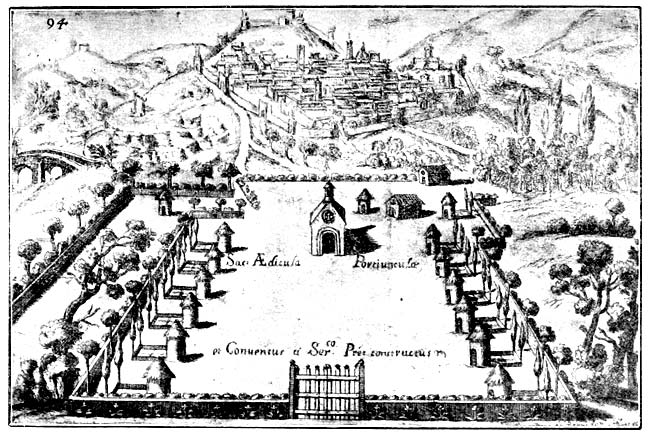
THE PORTIUNCULA IN THE TIME OF ST. FRANCIS (FROM THE "COLLIS PARADISI").
It is not very difficult, with the print from the "Collis
Paradisi"[57] before us, and the remembrance of the large
oaks which still mark the ancient Roman roads leading
from Assisi to the plain, to call up the picture of
the strange franciscan hamlet clustering round a pent-roofed
chapel, and with only trees for a convent wall.
What a life of peace in the mud huts! what a life of
turmoil and angry strife raging in the city just in
sight!
The spirit of those days, when monachism meant all
that was purely ideal and beautiful, seems to live again.
Then, day and night, each brother strove to fit himself
for the work he had in view, drawing into his soul
the peace and love he learned from nature herself as
the forest leaves rustled above his cell or the nightingales
accompanied the midnight office with their song.
And when his turn came to take up the pilgrim's staff
and follow the lead of Francis, he went with cheerfulness
to bring to the people some of that child-like
joy and lightness of heart which marked the Little
Brethren through whatever land they wandered as the
disciples of St. Francis.
Let us for a moment leave the Umbrian valley for
the country near Oxford, where on a bitter Christmas
Day, two friars were journeying upon their first mission
to England.
"Going into a neighbouring wood they picked their
way along a rugged path over the frozen mud and hard
snow, whilst blood stained the track of their naked feet
without their perceiving it. The younger friar said
to the elder: 'Father, shall I sing and lighten our
journey?' and on receiving permission he thundered
forth a Salve Regina misericordiæ.... Now, when
the hymn was concluded ... he who had been the
consoler said, with a kind of self congratulation to his
companion: 'Brother, was not that antiphonal well
sung?'"
In this simple story, told us in the chronicle of
Lanercost, how true rings the franciscan note struck
by Francis in those early days at the Portiuncula.
He was for ever telling the brethren not to show
sorrowful faces to one another, saying, as recorded by
Brother Leo: "Let this sadness remain between God
and thyself, and pray to Him that of His mercy He
may forgive thee, and restore to thy soul His healthy
joyance whereof He deprived thee as a punishment
for thy sins."
It is all so long ago, and yet in reading those ancient
chronicles the big church of the Angeli is for a time
forgotten, and only the vision of the Portiuncula and
the mud huts, with the brethren ever to and fro upon
the road, remains with us as a strange picture in our
modern hurried life.
But although the brethren lived so quietly in this
retreat of still repose, St. Francis, ever watching over
the welfare of his flock, was careful that prayer and
meditation should never be an excuse for idleness,
which of all vices he most abhorred. Therefore he
encouraged each friar who in the world had followed
some trade, to continue it here; so we hear of Beato
Egidio, on his return from one of his long journeys,
seated at the door of his hut busily employed in making
rush baskets, while Brother Juniper, in those rare
moments when he was out of mischief, would pass his
time in mending sandals with an awl he kept up his
sleeve for the purpose. Besides these individual occupations
there was much to attend to even in such humble
dwellings as those round the Portiuncula. Sometimes
there were sick friars to nurse, or vegetables had to be
planted in the orchard and provisions to be obtained,
while the office of doorkeeper, as "Angels" came
perpetually to ask pertinent questions of the brethren,
became quite a laborious task. When it fell to Brother
Masseo to answer the door he had little peace. Upon
one occasion he went in haste to see who was making
such a noise and found a "fair youth clothed as though
for a journey," so he spoke somewhat roughly, and
the youth enquired how knocking should be done.
"Give three knocks," quoth Brother Masseo, little
dreaming he was instructing an angel in the art of
knocking, "with a brief space between each knock,
then wait until the brother has time to say a paternoster
and to come unto thee; and if at the end of that time
he does not come knock once again."
Things went smoothly enough when left to the
management of such friars as Leo, Masseo or Rufino,
but when one day the office of cook fell to Juniper,
that dear jester of the brotherhood, we get a humorous
picture of what his companions sometimes had to
endure, and of the kindness with which they pardoned
all shortcomings. The brethren had gone out, and
Juniper being left alone devised an excellent plan
whereby the convent might be supplied with food
for a fortnight, and thus the cook have more time
for prayer. "With all diligence," it is related in
the Fioretti, "he went into the village and begged
for several large cooking-pots, obtained fresh meat
and bacon, fowls, eggs and herbs, also he begged a
quantity of firewood, and placed all these upon the
fire, to wit, the fowls with their feathers on, the eggs
in their shells, and the rest in like fashion." When
the brethren came home, one that was well acquainted
with the simplicity of Brother Juniper went into the
kitchen, and seeing so many and such large pots on
a great fire, sat down amazed without saying a word,
and watched with what anxious care Brother Juniper
did this cooking. Because of the fierceness of the
fire he could not well get near to skim the pots, so
he took a plank and tied it with a rope tight to his
body and sprang from one pot to the other, so that
it was a joy to see him. Contemplating all with great
delight, this brother went forth from the kitchen and
finding the other brothers, said: "In sooth I tell you,
Brother Juniper is making a marriage feast."
Then in hurried Juniper, all red with his exertions
and the heat of the fire, explaining the excellent plan
he had devised; and as he set his mess upon the table
he praised it, saying: "Now these fowls are nourishing
to the brain, this stew will refresh the body, it is so
good"; but the stew remained untasted, for, says the
Fioretti, "there is no pig in the land of Rome so
famished that he would eat of it."
At the end of any foolish adventure Brother Juniper
would always ask pardon with such humility that he
edified his companions and all the people he came in
contact with, instead of annoying them with his childish
pranks. His goodness was manifest, and St. Francis
was often heard to say to those who wished to reprove
him after one of his wildest frolics, "would
that I had a whole forest of these junipers."
Between the men who lived at the Portiuncula with
the saint, and those who in later times ruled large convents
in the cities, the contrast is so great that we would
wish to draw still further from these inexhaustible
chronicles which reveal so charmingly the life of
these Umbrian friars. But to tell of all the events
connected with the Portiuncula would mean recounting
the history of the whole franciscan brotherhood, and
we must now pass over many years to that saddest
year of all, when St. Francis was brought to die in the
place he had so carefully tended.
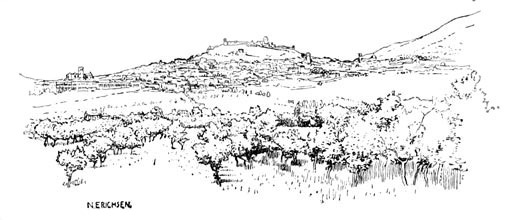
ASSISI FROM THE PLAIN
Knowing that he had but a few more weeks of life,
he begged the brethren to find some means to carry
him away from the Bishop's Palace at Assisi where
he had been staying some time. "Verily," he told them
pathetically, "because of my very infirmity I cannot
go afoot"; so they carried him in their arms down
the hill to the plain, and when they came to the
hospital of San Salvatore dei Crociferi they laid him
gently down upon the ground with his face towards
Assisi, because he desired to bless the town for the last
time before he died.
The blind saint, lifting his hand in blessing, pronounced
these words dear to the hearts of the Assisans
to this day: "Blessed be thou of the Lord, O city,
faithful to God, because through thee many souls shall
be saved. The servants of the Most High shall dwell
in great numbers within thy walls, and many of thy
sons shall be chosen for the realms of heaven."
Then they carried him to the hut nearest the
Portiuncula which was the infirmary, and here his last
days were passed.[58] Although he suffered acutely, they
were days of marvellous peace and joy. It is beautiful
to read how, with his usual tenderness, he thought
of the brethren he was leaving to carry on the work
without him, encouraging them all as they stood weeping
round his bed. Like Isaac of old, the Umbrian
patriarch blessed his first born, Bernard of Quintavalle,
saying: "Come my little son that my soul may bless
thee before I die," while he enjoined upon all to love
and honour Bernard, who had been the first to listen
to his words now so many years ago. With all his
sons near him St. Francis dictated his will, wherein
he describes the way of life they were to lead, and
which, coming from him at this solemn moment, must
always remain as a precious message from the saint, in
many ways of more importance than the Rule approved
in his life-time by Pope Honorius. When this was
done he commended once again to their special care
the chapel of the Portiuncula. "I will," he said to
them, "that for all times it be the mirror and good
example of all religion, and as it were a lamp ever
burning and resplendent before the throne of God and
before the Blessed Virgin."
The farewells to those of his immediate circle had
been made and a letter written to St. Clare, and now
he wished to bid "the most noble Roman matron,
Madonna Giacoma dei Settesoli," one of his most
devoted followers, to come and take leave of him at
Assisi. The letter had only just been written when
knocking at the door and the sound of horses trampling
was heard outside, and the brethren going out to discover
the cause of such unwonted noise found that
Madonna Giacoma, accompanied by her sons, two
Roman senators, had been inspired to come and visit
the dying saint.
The brethren, somewhat averse to allow a woman,
even one so renowned for holiness as Madonna
Giacoma, to enter their sacred precincts, called to
St. Francis in their doubt: "Father, what shall be
done? Shall we let her enter and come unto thee?"
And the Blessed Francis said: "The regulation is to
be set aside in respect to this lady whose great faith
and devotion hath brought her hither from such far-off
parts." So Madonna Giacoma came into the presence
of the Blessed Francis weeping bitterly, and she
brought with her the shroud-cloth, incense, and a
great quantity of wax for the candles which were to
burn before his body after death. She had even
thought of some cakes made of almonds and sugar,
known in Rome by the name of mostaccioli, which she
had often made for him when he visited her. But the
saint was fast failing, and could eat but little of the
cakes.
As the end came nearer his thoughts were drawn
away from earth, and true to the last to his Lady
Poverty, he caused himself to be laid naked on the
ground as a token of his complete renouncement of the
world. His face radiant with happiness, he kept asking
his companions to recite the Canticle of the Sun, often
joining in it himself or breaking forth into his favourite
psalm Voce mea ad Dominum Clamavi.
With words of praise and gladness the Blessed
Francis of Assisi, the spouse of Poverty, died in a mud
hut close to the shrine he loved, on the 3rd of October
of 1226 in the forty-fifth year of his age.
His soul was seen to ascend to heaven under the
semblance of a star, but brilliant as the sun, upon clouds
as white as snow. It was sunset, the hour when in
Umbria after the stillness of a warm autumn day an
unusual tremor passes through the land and all things
in the valley and upon the hill-sides are stirred by it,
when a flight of larks circled above the roof of the hut
where the saint lay at rest. And these birds of light
and gladness "seemed by their sweet singing to be in
company with Francis praising the Lord God."
CHAPTER IV
The building of the Basilica and Convent of
San Francesco. The Story of Brother
Elias
"O brother mine, O beautiful brother, O brother of love,
build me a castle which shall have neither stone nor iron. O
beautiful brother, build me a city which shall have neither
wood nor stone."—Beato Egidio.
ne of the strangest characteristics
of mediæval
Italy was the rivalry between
different towns to
gain possession of the
bodies of holy people.
They did not even wait
for the bull of canonisation
to arrive from Rome, but often of
their own accord placed the favoured
being in the Calendar of Saints, and
papal decrees merely ratified the choice of
popular devotion. We have an example of
this with the Perugians. Ever on the alert
to increase the glory of their city, they
hovered near the road St. Francis was to
follow during his last illness when borne
from Cortona to Assisi, meaning to carry
him off by force so that he might die in Perugia.[59]
Never at a loss for a way out of any difficulty Elias
hastily changed the itinerary for the journey, and instead
of the short way by lake Thrasymene he took the much
longer and more difficult road by Gualdo and Nocera,
far back in the mountains to the north of Assisi. He
warned the Assisans of the peril run by the little company
of friars with their sick father, and soldiers were
immediately sent to escort them safely to the Bishop's
Palace where St. Francis stayed until carried to the
Portiuncula when he knew that he was dying.
They were sad days at Assisi when St. Francis was
borne through the city blind and ill; and as he
stretched out his hands to bless the people they bowed
their heads and wept at the sight of so much suffering.
Now that the end had come and they knew he lay safely
in the little shrine of the Portiuncula, their mourning
was changed into rejoicing, and as though they were
preparing for a great festival, strange sounds of busy
talk, of laughter and of singing were heard in the
streets. Had a stranger found himself at Assisi that
Sunday morning he might well have asked: "What
victory have you gained to merit all this show of gladness,
or what emperor are you going forth to greet?"
And the answer would have been: "Francis, our
saint, the son of Bernardone, returned to us when he
was nigh to death, and now that he is dead we possess
his body which will bring great honour and fame to
our city by reason of the many miracles to be wrought
at his tomb."
The sun had not yet risen when the Assisans left
their houses and thronged down the hill to the Portiuncula
to bring the precious burden to rest within the
more certain refuge of their walled town. "Blessed
and praised be the Lord our God who has entrusted
to us, though unworthy, so great a gift. Praise and
glory to the ineffable Trinity," they sang as they
hurried along in the cold dawn. Trumpeters blew
loud and discordant notes, nearly drowning the
voices of the priests who vainly in the din tried to
intone the canticles and psalms. The nobles came
from their castles with lighted torches to join the
procession, the peasants from the hills brought sprigs
of olive, and those from the forests stripped the
oaks of their finest branches which they waved above
their heads, while children strewed the ground with
flowers.
Amidst all this stirring show of joy a kindly thought
had been taken of St. Clare and her nuns, so that when
the body of St. Francis had been laid in a coffin, and
the long line of friars, priests and townsmen turned to
climb the hill, they took a path skirting just below the
town, through the vineyards and olive groves, to the
convent of San Damiano. The sound of chanting must
have warned the watchers of their approach long before
they came in sight. An artist has pictured the nuns like
a flock of timid sheep in his fresco, trooping out of an
exquisitely marbled chapel, with St. Clare endeavouring
to suppress her grief as she bends over the dead
Francis, while the sisters press close behind her.
This is how it ought to have been; but, alas, only
an iron lattice, through which the nuns were wont
to receive the Holy Communion, was opened for
them, and the friars lifting the body of St. Francis
from the coffin, held it in their arms at the opening
as one by one the nuns came to kiss the pierced
hands. "Madonna Chiara's" tears fell fast as she
gazed on him who had brought such joy into her
cloistered solitude. "Oh father, father," she murmured,
"what are we to do now that thou hast
abandoned us unhappy ones? With thee departs
all consolation, for buried here away from the world
there is none to console us." Restraining the lamentations
which filled her heart she passed like a shadow
out of sight to her cell, and when all the sisters had
bidden farewell to St. Francis, the small window was
closed "never again to open upon so sad a scene."
The people, who until now had wept bitterly, began
to sing again as the procession went on its way up the
hill towards the Porta Mojano. The trumpets sounded
louder than ever, and "with jubilation and great exultation"
the sacred body was brought to the church of
San Giorgio, where it was carefully laid in a marble
urn covered with an iron grating, and guarded day and
night from the prying eyes of the Perugians. If
Francis had worked miracles during his life, those
chronicled at his tomb are even more marvellous;
in recounting some which read like fairy tales, a
biographer recounts with pride that, "even from
heaven, the Saint showed his courtesy to all."
Devotion to St. Francis was not confined to
Umbria or even to Italy, for we read how his fame
spread throughout France, and how the King and
Queen with all the barons of the land, came to Paris
to kiss one of his relics. "People journeyed from
the east and from the west," enthusiastically exclaims
Celano with a total disregard of detail, "they came
from the north and from the south, even the learned
and the lettered who abounded in Paris at that time."
But while France was being stirred by the news of
perpetual miracles and prodigies wrought through the
intercession of the saint, and Assisi in consequence
was fast growing into a place of great importance
in the world, Pope Gregory IX, who had been
lately elected upon the death of Honorius III, spent
many hours in the Cannonica at Perugia wrestling
with his doubts concerning the truth of the greatest
miracle of all, the miracle of the Stigmata. While
in this state of uncertainty and perplexity St. Francis,
the Fioretti relates, appeared to him one night, and
showed him the five wounds inflicted by the Seraph
upon his hands, feet and side. The vision, it seems,
dispelled all doubt from the mind of Pope Gregory,
for in conclave with the cardinals he proclaimed the
sanctity of his friend, the Poverello d'Assisi, and
determined to set the final seal of the church upon
his miracles and fame.
This vision was the prelude of a great ceremony held
a few days later in San Giorgio for the canonisation of
Francis, at which all Umbria seems to have been
present. Pope Gregory, clothed in vestments of cloth
of gold embroidered with precious stones, his tiara
"almost as an aureole of sanctity about his head," sat
stiffly on his pontifical throne like some carved image,
surrounded by cardinals in crimson garments and bishops
in white stoles. All eyes were fixed upon this splendid
group, and it is not improbable that among the spectators
stood Pietro Bernardone and Madonna Pica, and
many who had reviled Francis in his early days of
sanctity, and now, within two years of his death, witnessed
him placed among the greatest of the saints.
Gregory had prepared an eloquent address, which he
delivered in a sonorous voice occasionally broken by
sobs of emotion. Becoming more and more enthusiastic
as he proceeded, he compared Francis to a full moon,
a refulgent sun, a star rising above the morning mists,
and when he had finished the pious homily, a sub-deacon
read out a list of the saint's miracles, and a
learned cardinal, "not without copious weeping," discoursed
thereon, while the Pope listened, shedding
"rivers of tears," and breaking forth every now and
then into deep-drawn sighs. The prelates wept so
devoutly that their vestments were in great part wet,
and the ground was drenched with their tears. The
ceremony ended when the Pope rose to bless the
people, and intoned the Te Deum, in which all joined
with such good will that the "earth resounded in great
jubilee."
Had St. Francis foreseen how his humility would be
rewarded? This we know, that he in part had realised
how his order would slip away from his ideal, and
there is a deep note of sadness in many pages of his
life, showing us how fully he realised the pitfalls his
disciples were likely to fall into when he was no longer
there to watch over them with tender care. Often
while he was absent for only a little time the brethren
forgot his simple rule, building cells and houses too
spacious and pretentious for the home of the Lady
Poverty. This had been one of the signs to him that
his earnest prayers to God, his example and admonitions
to his followers, which come to us through his
letters and the pages of Brother Leo like the cry of
one who bravely fought against the inevitable, were all
to be in vain. It is a tragic story, and rendered still
more so by the fact that the Saint's last years should
have been saddened by this knowledge of coming
events.
Only a little while and the teaching of poverty and
obscurity which he had so deeply implanted in the
hearts of his followers was to be completely swept
away; upon the ruins of that first franciscan order,
guarded jealously for a time by a faithful few, arose the
new franciscan spirit which Elias Buonbarone, inspired
by the will of Gregory IX, brought into being almost
before the echo of his master's words had died away.
It is not for us in this small space to trace the many
changes that crept into the young community, but we
simply note as a fact, what to some may appear exaggerated,
that the order St. Francis founded, and prayed
would continue as he left it, ceased at his death, while
the order that grew up afterwards bore the unmistakable
stamp of Elias and the Vatican.
The extraordinary humility of St. Francis gave rise
to the myth that when he lay dying at the Portiuncula
he expressed a strong desire to be buried in the most
despised spot near Assisi, which, because criminals were
said to have been executed there, bore the name of
Colle del Inferno. It seems unlike him to have been
concerned with what might become of "brother body"
after death, and it was probably not until Gregory IX
conceived the idea of building a church in honour of
his friend, that a suitable burial-place was searched for
near the walls of the town, if not actually within them,
where the citizens could safely guard the precious
relics. Everything favoured the designs of Gregory,
for not only was he fortunate in finding a man like
Elias, capable, prompt and energetic, but the one place
suited for the erection of a great church, happened to
be in the possession of a generous citizen of Assisi.
No sooner were the wishes of the Pontiff made known
than Simon Puzzarelli offered his land on the Collis
Inferni, which from this time forward Gregory ordered
to be called Collis Paradisi, the Hill of Paradise.[60]
A document, duly sealed and signed, is still in the
Assisan archives, in which we read how the site for the
building of "an oratory or church for the most holy
body of St. Francis" was given over, in words that
admitted of no withdrawal, to Elias as representative of
the Lord Pope Gregory IX—"dedit, tradedit, cesset,
delegavit et donavit simpliciter et irrevocabiliter."
Now the use of the word oratory is a remarkable
fact as suggesting that at the beginning the Assisans
little dreamed of the erection of a great basilica which
would cast their cathedral entirely into the shade.
A few days after the ceremony of the canonisation of
St. Francis, Pope Gregory, amid the usual crowd of
Umbrian spectators, laid the foundation-stone of the
franciscan basilica. Then being recalled by his Roman
subjects, whom Assisan chroniclers describe as "a race
of men most seditious and fierce," he was obliged to
hurry south, leaving Elias to carry out his wishes as he
thought best.
So far the task left to Elias was easy enough, for
money was not lacking, and countless workmen were
ready to begin the great enterprise; but the question of
who should design a church upon the site chosen was
a more difficult matter to settle, as Vasari tells us:
"There was a great scarcity of good architects at this
time, and the church, having to be built upon a very
high hill, at the base of which flows a torrent called
the Tescio, an excellent artist was required for the
work. After much deliberation a certain Maestro
Jacopo Tedesco was called to Assisi as being the best
architect then to be found, and having examined the
site, and consulted the wishes of the fathers, who were
holding a Chapter in Assisi to discuss the matter, he
designed the plan of a very beautiful church and
convent."[61]
"Jacopo" is said to have come to Italy in the
retinue of the Emperor Frederick II. Vasari recounts
that the fame he gained all over Italy by his work at
Assisi was so great that the Florentines summoned him
to build them bridges and palaces, and "Jacopo,"
charmed with the Tuscan city, married and dwelt
there. The citizens, following a custom which still
continues in every Italian town, changed his name to
Lapo, and he is revealed to us as father of the famous
Arnolfo di Lapo, architect of the Florentine cathedral
and of the Palazzo della Signoria. In the seductive
pages of Vasari the account reads so pleasantly that it
seems a pity later writers should have discovered that
the story rests upon uncertain dates and legends.
Vasari's endeavour to amalgamate three artists into one
person, have forced many to the opposite extreme,
until even the existence of "Jacopo Tedesco" is
denied, and they are reduced to speak of an architect
who designed the church and convent of San Francesco.[62]
Such is the irony of fate, that while numerous
documents remain giving the names of contractors
and minor masons employed in the building there is
absolutely no evidence or clue of any kind as to
the architect employed by Elias. We can only
suppose that the document relating to this and other
interesting points in connection with the decoration
of the church, must have been destroyed by the
Perugians when they sacked Assisi under Jacopo
Piccinino and burnt so many treasures in the archives.
We are consequently at the mercy of local legends,
which were no doubt recounted to Vasari by the
Assisans themselves when he visited the town in the
middle of the sixteenth century. But there is still
the evidence of our own eye to help us to know
something of the builder of San Francesco, the
builder of the first Gothic church in Italy. We
are told he was a German; but then we know
from Mr Fergusson's Handbook of Architecture
that Germans were only just awakening to the
Gothic influences at the time of St. Francis's death,
and, when they wished to build churches in the
new style they called in French masons to help them.
Was it therefore likely that Germany should have
given the mysterious architect to Assisi? A church
recalling the Assisan Basilica may be vainly searched
for in Germany or in Lombardy and this further fact
inclines us to believe in the theory of M. Edouard
Corroyer.
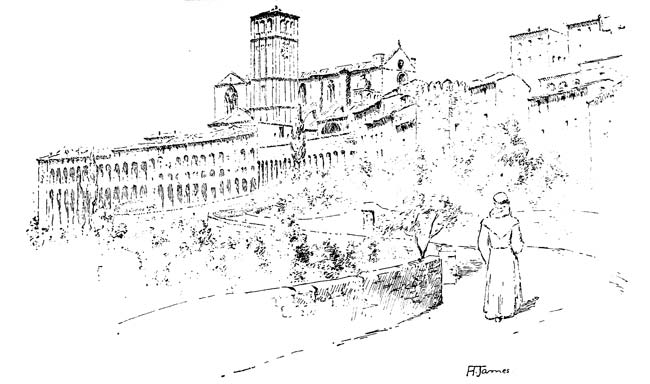
CHURCH AND CONVENT OF SAN FRANCESCO
Whether the man who conceived the original idea
of raising one church above another flanked by a
colonnaded convent on the spur of a great mountain
was called Philip or James, or whether he came
from a Lombard or a German province seems of
small importance compared with the country where
he learned his art. Even supposing "Jacopo" to
have been a northern Italian from the home of the
Comacine Guild of master masons, which is extremely
likely, everything goes to prove that he must have
drawn his inspiration for the Assisan Basilica straight
from the south of France. What establishes the
French parentage of San Francesco is the mode of
construction, especially visible in the Upper Church,
and which, as M. Corroyer says, "possesses all the
characteristics peculiar to the French architecture in
the south of France at the close of the thirteenth
and the beginning of the fourteenth century, of which
the Cathedral of Albi [in Aquitaine] is the most
perfect type. The single nave, its buttresses projecting
externally in the form of half turrets, add
to the likeness of the Italian church of Assisi with
that of Albi in France."[63] A glance at the illustrations
of the two churches will bear this theory out
better than many words; and it will be seen at
once that had the half turrets between the bay windows
of San Francesco been completed with pointed
roofs and small lancet windows, as no doubt was the
intention, the likeness would be even more striking.
Although "Jacopo" left a very substantial mark
of his genius upon the Umbrian hill-side, he came
and went like a shadow, leaving his designs and plans
to be carried on by his young disciple Fra Filippo
Campello, whom we shall meet with again in the
chapter on Santa Chiara. Little, therefore, as we
know of this earlier portion of its history, San Francesco
at least remains to us in all its first prime
and glory to tell its own tale, and endless should be
the hymn of praise sung by the Assisans for the
chance which brought so beautiful a creation within
their walls.
It seems indeed strange that a style so new and
so admired, was not more faithfully adhered to at a
time when cathedrals and churches were being erected
in every Italian city. Perhaps the Romanesque and
Byzantine influences from the south so tempered the
Gothic tendencies of Lombard architects, that they
were unable to attain the true ideal, and succeeded
only in creating a style of their own, to
be found at Florence, Siena and Orvieto, known as
Italian Gothic. Thus it happens that the Assisans
are the proud possessors, not only of the first Gothic
church built in Italy during the dawn of the new
era, but of a church which is unique, as recalling
less dimly than those of other cities the splendour
of the northern cathedrals.
The rapidity with which the Assisan Basilica progressed
is one of the most wonderful results of the love
inspired by St. Francis among mediæval Christians. The
generosity of the Catholic world was so stirred that
donations poured in without ceasing from Germany and
France, and even from Jerusalem and Morocco. "Cardinals,
bishops, dukes, princes, counts and barons," write
the chroniclers, helped Elias in his work, while the
people of Umbria, too poor to give money, came in
numbers, out of the reverence they bore the Saint, to
work for small and often for no wages. It was a busy
time; and Assisi awoke to a sense of her importance.
Under the vigilant eye of Elias, armies of masons and
labourers worked as unremittingly as ants at a nest,
while processions of carts drawn by white oxen, went
ever to and fro upon the road leading to the quarries,
bringing creamy-white, rose and golden-coloured blocks
of Subasian stone.
This universal enthusiasm enabled Elias to complete
the Lower Church in twenty-two months, while the
Upper Church was roofed in six years later, and finished
in all essential details by 1253. But while Elias was
applauded by most people, a few of the franciscans,
headed by Fra Leo, still clung to the letter of the
franciscan rule, and bitterly disapproved of these innovations.
They sorrowfully looked on at the army of
workers, raising, as if by magic, walls and colonnades
upon the hill-side and towers ever higher against the
sky. They watched blocks of marble and stone being
chiselled into cornices, friezes and capitals ornamented
with foliage and flowers, until, with despair in their
hearts, they slowly returned to their mud huts in the
plain. The dreams of Francis were vanishing fast as
the allegiance to the Lady Poverty diminished. Now
her shrine existed only in the Carceri, in San Damiano
and in the Portiuncula, where few sought her company,
for all eyes were turned towards the new Basilica. The
words of the Master, recorded faithfully in Leo's
biography, were ever ringing in his ears: "Set a
good hedge round in lieu of a wall, as a sign of holy
poverty and humility ... build poor little cells of
mud and wood, and other cells where at times the
brethren may pray and work to the gain of virtue and
the avoidance of sloth. Also cause small churches to
be built; they ought not to raise great churches for
the sake of preaching to the people, or for any other
reason, for they will show greater humility and give a
better example by going to preach in other churches.
And if by chance prelates, clerics, religious or seculars
should come to these abodes, the poor houses, the little
cells and small churches will be better sermons and
cause greater edification to them than many words."[64]
No wonder that Leo and his friends watched Elias
at his work with no friendly eye, for between the mud
huts which Francis had planned with so much simplicity,
and the massive Basilica and palatial convent,
stretched an infinite chasm, separating the old order
from the new.
They were still more unhappy and scandalised when
Elias, who had the full permission of Gregory IX. for
this innovation, placed a marble vase outside San Francesco
to receive the contributions of those anxious to
see the church quickly finished. A curious account is
given by a latin chronicler of the warfare which ensued
between the standard-bearers of the new and the
old franciscan spirit: "Some brothers of marvellous
sanctity and purity went to Perugia to consult Brother
Egidio, a good and pious man, concerning the erection
of so large a building and the manner of collecting
money, which seemed to be expressly against the rule.
And Brother Egidio answered them: "If that building
were to reach from Assisi to here [to Perugia] a
little corner would suffice for me to dwell in." And
they having asked him what he thought about the vase,
he said, turning to Brother Leo: "If thou considerest
thyself already dead [to the world and its persecutions]
go and break it. But if thou livest, stay thy hand, for
perchance thou mayest not be able to bear the persecution
of that Brother Elias."[65] Hearing this, Brother
Leo went with his companions and broke the vase to
pieces. Then Brother Elias, hearing this, had them
severely beaten by his servants, and drove them from
Assisi in great confusion. For this reason a great
tumult arose among the brethren. Because of these
aforesaid excesses, and because Brother Elias threatened
the complete destruction of the rule, when the brethren
met in general Chapter they deprived him of the office
of Vicar General, and unanimously elected Brother
John of Florence [Giovanni Parenti].[66]
But these murmurs were drowned in the din of
public applause which enabled Elias to work in his
own way, unscrupulously dispersing every difficulty
without any reference to the rule of St. Francis.
He continued to be the presiding spirit at Assisi, and
such was the success of his untiring energy that by
the month of May 1230, the Lower Church of the
Basilica was ready to receive the "most sacred body"
of the Saint, while the magnificent quarters in the
adjoining convent were ready for those friars who
belonged to the moderate party, and approved of the
new order of things.
Pope Gregory was unable to visit Assisi at this time
owing to difficulties with his unruly Roman subjects,
but he sent innumerable indulgences, golden crosses
studded with precious stones containing relics of
the true cross, vases of silver and gold, and a large
sum of money for the further advancement of the building.
These generous gifts were followed by a Brief,
which in calmer moments the monks might have viewed
with irritation, declaring both Basilica and convent to
be immediately subject to the Holy See. The franciscan
order was fast becoming a Papal institution, to
be patronised and ruled by succeeding Pontiffs.
While Giovanni Parenti was preparing for the Conclave
to be held in the spacious rooms of the new
convent, the wily Elias was holding secret councils
with the magistrates of the town as to ensuring the
safe conduct of the body of St. Francis to the Basilica.
The number of people continually arriving in anticipation
of the coming ceremony made them somewhat uneasy,
and their doubts were carefully discussed in the
Communal Palace. They came to the conclusion
that if the exact place of the saint's sepulchre was
known, there would always be the danger of its being
rifled by the citizens of neighbouring towns, especially
by the Perugians, whose partiality for relics was well
known. So a stratagem, most likely invented by the
fertile brain of Elias, was decided upon and succeeded
admirably.
The friars and citizens, unconscious of the plot
hatched in their midst, were all eager for the day
of the Translation. The Umbrians left their towns
empty to assist at the great spectacle, and their number
was so great, that, failing to find room within the walls
of Assisi, they wandered like droves of cattle on the
hills above trying to obtain a sight of the procession.
It was a great day in the annals of Assisi; outside the
little church of San Giorgio a triumphal car, drawn by
a pair of magnificent oxen, their whiteness almost
hidden beneath purple draperies and their horns
wreathed and garlanded with flowers, stood waiting
for the holy burden. Three Papal Legates and
Elias placed the heavy sarcophagus with their own
hands upon the car, covering it over with a piece
of rich brocaded silk sent for the occasion by the
mother of King Louis of France. They kept close
to the car all the time, while the brethren, holding
palms and torches, formed a long procession followed
by the bishops and their clergy, and the Podestà with
his retinue of crimson-robed priors. It was the month
of May, and from every garden and terrace the nobles
and their ladies showered flowers over the "sacred
ark" as it was borne slowly up the street amidst the
deafening sound of trumpets and the cheers of the
populace. All that could be done to honour St.
Francis had been thought of; Gregory IX. had even
composed a hymn to be sung on that day in which
the "Poverello" was compared to Christ. They were
in the midst of the hymn of praise and quite close
to the new Basilica when the heavy tramp of numerous
armed men was suddenly heard; swiftly a passage was
made through the crowd, who for the moment fell
back amazed and powerless, while the soldiers hurried
with the sarcophagus into the church, closely followed
by Elias, who promptly shut and barred the door.
After the first moment of surprise, a wild burst of
indignation arose from the thousands who were thus
deprived of a spectacle which they had come miles to
see. They howled like wild beasts baulked of their
prey, banging at the doors of the church in their fury;
but silence reigned within, for Elias and his accomplices
were stealthily engaged in hiding the body of
St. Francis in the very bowels of the mountain, where
for five centuries it remained unseen and undisturbed.
Till far into the night the people continued to murmur;
the bewildered friars asked each other what this
strange behaviour of Elias meant, and the only people
who preserved any appearance of calmness were Messer
il Podestà of Assisi and his priors, who smiled to see
how well the plot had worked. It was not long before
the scandal reached the ears of Pope Gregory. The
enemies of Elias painted the story in glowing colours,
and the Pope expressed himself greatly shocked at
sacrilegious hands having been laid upon the holy body
of the saint. He blamed the magistrates for allowing
such a tumult to arise, and called upon them to give
due explanation of their conduct within a fortnight at
the court of Rome under pain of their city being laid
under an interdict. The Pope's Brief caused consternation,
and his accusations of their ingratitude for
past favour rankled deeply. We are not told how
the anger of the Pope was pacified, but no doubt both
Elias and the Podestà explained satisfactorily the
reasons for so strange a burial, as Assisi continued
to enjoy the patronage of the Holy See. The efforts
of Elias to ensure the safety of the body of St. Francis
had been eminently successful, and Gregory could
hardly fail to pardon the unusual manner in which
this had been obtained.
Out of the mysterious events of that day of tumult
grew a legend which lasted until the body of St.
Francis was finally discovered five centuries later. It
was believed that a church far surpassing the other two
in grandeur and beauty had been built beneath them by
Elias, and that St. Francis risen from his tomb stood
in the midst, his hands crossed upon his breast, his
head thrown back, gazing eternally towards the sky.
The Umbrians, refusing to believe that their saint
could suffer the common lot of mortals, loved to think
of him as "almost alive," waiting for the last call,
surrounded by the glorious beauty of a hidden church
which they had never seen and only dimly pictured to
themselves. Vasari refers to this "invisible church"
described to him by the awe-struck citizens, when he
mentions that "the tomb containing the body of the
glorious saint is in the lowest church where no one
enters, and whose doors are walled up"; and in the
beginning of his description of the Basilica, he speaks
of three ranges of buildings placed one above the
other, the lowest of all being subterranean, which
is curious as showing how closely he followed tradition
regarding the Assisan church. Padre Angeli so unhesitatingly
accepted the story that in his "Collis
Paradisi" he drew from imagination a plan, together
with a picture of the "invisible church." It represents
a long vaulted hall somewhat recalling the architecture
of the Upper Church, at the end of which is
St. Francis standing upon his tomb in a recess corresponding
to a kind of choir; the vaulted roof is
supported by slender columns with chiselled capitals,
and the walls and floor are ornamented with marbles
and mosaic of different colours.
To close this chapter without touching upon the
career of Elias, who is at once the black sheep of the
franciscan order and one of the greatest citizens of
Assisi, would be impossible. Few have written calmly
about him, trying either to exculpate him or blaming
his actions too severely, so that it is difficult to obtain
any just idea of the real motives which guided him
in an ill-starred life. Elias was neither devil nor
saint, though he possessed the energy of both and his
marked and domineering character would have fitted
him better for the world than for the cloister.
Ambition seems to have been his chief fault, together
with a certain proud reserve which kept him aloof
from his companions. From the various references
to him in the early biographies of St. Francis we feel
the writers failed ever to come quite in touch with one
so outside their lives, and whom they considered as a
kind of Judas—for did he not betray the interests of
the Master?
"Elias is an altogether different type of man from
the simple-minded Francis," writes Mrs Oliphant,
echoing the general opinion. "He is an ambitious
and ascetic churchman, of the class which has pushed
Rome into much power and many abuses—an almost
conventional development of the intellectual monk,
making up for compulsory humbleness in external
matters by the highest strain of ecclesiastical ambition
and spiritual pride."
But while all abused him, none doubted his very
exceptional talents, and even in the Fioretti he was
accounted "one of the most learned men in the
world," and St. Francis showed the great confidence
he had in him by naming him Vicar-General after the
death of Peter Cataneo. It was at a Chapter held in
the wood by the Portiuncula that the saint expressed
his desire to again resign the government of the order
to another, and while Elias discoursed to the assembled
friars St. Francis sat at his feet listening attentively to
every word.[67] On the other hand, the saint was quite
aware of his faults, and from the Fioretti, where Elias
is pictured for artistic effect in strong colours as the
wicked friar, we seem to realize the strain that often
must have come between these two very different men.
Thus we read that it being revealed to St. Francis
that Elias was destined to lose his soul and bring dishonour
on the order, he conceived such an antipathy
towards him that he would even avoid meeting him,
although at the time they were living in the same
convent. The scene when Elias, discovering the
reason of his displeasure, threw himself at the feet of
the saint to implore his intercession with heaven reveals
in the most touching way the great belief and reverence
inspired by St. Francis in the heart of the least docile
of his followers. "I have so great a faith in thy
prayers," said Elias, "that were I in the midst of
hell, and thou wert to pray to God for me, I should
feel some relief; therefore again I pray thee to commend
me, a sinner, unto God who came to save sinners
that He may receive me into His mercy." And this
did Brother Elias say with much devotion and many
tears, so that St. Francis, like a pitying father, promised
to pray to God for him. It will be seen how
far the revelation of St. Francis came true, and the
manner in which his prayer was answered.
So long as Elias remained under the influence of
Francis his pride was tempered, and his ambition
curbed, but when cast upon his own resources he gave
full rein to the ideas which had no doubt been forming
in his mind for some years past. Elias thought the
franciscan order, if faithful to the Lady Poverty,
would prove of small importance; and he therefore
willingly leagued with Gregory IX. to mould it so
that it should become a visible power upon the earth.
The vision he conjured up with the sceptre in his
own hand was very fair; and he failed to see why
religion should not be served quite as well within the
massive convent walls he had helped to rear, as when
dwelling in a mud hut. He had too broad a mind
to look closely to the detail of his rule; he only saw
the broad outline of his master's teaching; and who
can say whether after all he was not right? This
we know, the mud huts have long since vanished,
while thousands come each year to pray at the tomb
of Francis within sight of Giotto's master-pieces.
They sing aloud his praises, and as they pray and sing
throw coppers and silver in heaps upon the altar steps,
and pass out of the church into the sunlight again,
knowing little of the lessons St. Francis spent his life
in teaching.
But we must return again to Elias and his
many troubles with the franciscan world. While
patronized by Pope Gregory, he also seems to have
had a strong party of monks on his side, probably
those who had joined the Order during the last few
years. Their names have not come down to us, and
their personalities have merged in that of Elias who
thus led them forward on a somewhat perilous way.
They began by attempting to depose Giovanni Parenti
while he was holding a Chapter in the new convent,
a few days after the ceremony of the Translation of
the body of St. Francis to the Basilica. His friars
were gathered round him discussing the various missions
to be undertaken, and the work that had been done
during the past year, when the door was thrown open
and a crowd of excited friars with Elias at their head
appeared upon the threshold. Before anyone could
realize what this strange apparition meant, Elias was
borne rapidly along by his companions and installed
in the seat of Giovanni Parenti, while a scene of
indescribable tumult arose among those whose indignation
had not yet cooled down after the events of the
past week. It is said that St. Anthony of Padua was
present at this conclave, and vainly tried to calm the
excitement, but his voice was drowned in the clamour.
At last, driven to despair, Giovanni Parenti began to
cry aloud and tear his garments as one distraught; he
could not have hit upon a better plan, for where words
had failed this piece of dramatic acting produced an
instantaneous effect. His friars formed a vanguard
round him, acclaiming him Vicar-General as they beat
back the intruders with hard blows and angry scowls.
Elias, seeing the game was lost, threw himself on the
ground, and with expressions of deep contrition
implored forgiveness. He was pardoned, but banished
to a distant hermitage, where humbled and sad he
pondered for many months upon his next move. He
allowed his hair and beard to grow to such a length
that even his enemies began to believe his repentance
was sincere, and only two years after his misconduct
we find him elected Vicar-General in the place of
his former rival, and, under the title of Guardian and
Master of the Basilica and Convent, in full command
of the works at San Francesco.
He now enjoyed a season of peace and plenty in the
comfortable quarters of the franciscan convent, and
is said to have gathered a household about him surpassing
the splendour of a cardinal's court. Fra
Illuminato di Rieti (afterwards Bishop of Assisi)
acted as his secretary, writing numberless letters to
"the Pope and the Princes of the World," for Elias
was in correspondence with more than one crowned
head and paid many visits to distant courts in quest
of money for the Assisan Church. On these journeys
he always went on horseback, and even when going
from one church to another in Umbria, he was well
mounted on a "fat and stout palfrey," to the intense
scandal of some of the friars. "He also had secular
servants," writes an indignant chronicler, "all dressed
in divers colours like to those of bishops, who ministered
to him in all things." His food was always good,
and he had the reputation of keeping an excellent cook.
This peaceful and successful period of his life
was of short duration, for he soon fell into dire
trouble and disgrace. It was his misfortune to be
sent by Pope Gregory, who trusted implicitly in
his discretion and ability, on a mission to Frederic
II, in the hopes of bringing the Emperor to a sense
of his misdoings. A disciple of St. Francis seemed
to be the right person to send as an emissary of peace;
but instead of the orthodox humble and barefooted
friar, we read of him as a very haughty personage, quite
at his ease in the political world, then ringing with the
angry cries of Guelph and Ghibelline.
No sooner had Elias reached the franciscan convent
at Parma than the magnates of the city, aware
of the errand he had come upon, assembled to do
him honour. Fra Salimbene, who was present at
the interview, describes how Elias waited for his
visitors, his head swathed in an Armenian turban,
and comfortably seated upon a soft chair drawn
close to a huge fire. When Gherardo da Correggio,
known as "Messer il Podestà of the big teeth,"
entered the room, Elias remained seated, and to the
astonishment of all in no way disturbed himself for
his illustrious guest. The Podestà very sensibly took
no offence, but passed the matter over by expressing
his wonder that the Vicar-General should have chosen
so cold a season for his visit to Lombardy—a glance
at the fire had told him that this franciscan friar liked
comfort as much as most people.
There is no detailed account of the interview of
Elias with the Emperor to inform us whether he
behaved at it with the same easy familiarity; all we
know is that Frederic, "the wonder of the world,"
and Elias, the Assisan friar, formed a friendship which
lasted during the remainder of their lives, linking
them together in a common fate. Whether Elias
was won over from the first by the charm of so
fascinating a personality, or simply baffled by a mind
more subtle than his own, it is difficult to say, as the
chroniclers have drawn too thick a veil over this
unfortunate meeting for anyone to judge with fairness.
His failure certainly gave a good opportunity to his
many enemies to commence a very satisfactory scheme
of blackening his character with the Pope; and the
rumour flew to Rome that he was a traitor to his
church. Branded with the abhorred name of Ghibelline
there was now little hope for Elias, whose friendship
with the arch-enemy of Holy Church grew always
stronger. The Lombards becoming uneasy, accused
Gregory of favouring the Emperor, while the latter
bitterly complained that the Pope listened too much
to the cause of the Lombards, and thought too little
of the imperial dignity. At last a Chapter was called
to enquire into the conduct of the Vicar-General,
and as he was not present, his misdeeds lost nothing
by the telling. Although Elias was deposed, and his
place filled by a Pisan, he still held the title of
Guardian and Master of the Assisan Basilica, but
in a city of such strong Guelph sympathies as Assisi,
it was unlikely he would be left in peace, especially as
the Pope no longer favoured him. Life soon became
impossible there, and of his own free will he retired to
a hermitage in the woods of Cortona, followed by some
dozen faithful friars, "not excepting," adds a spiteful
chronicler, "Fra Bartolomeo da Padova, his most
excellent cook." Thence he wrote to the Pope explaining
his conduct, and humbly entreating to be pardoned,
but the letter was found years afterwards in the
pocket of the Pisan Vicar-General, who had promised
to deliver it safely at Rome. Whether the letter was
wilfully laid aside or only forgotten, none have been
able to decide, but the incident had disastrous effects
upon Elias. He waited anxiously for the pardon
which never came, until embittered by finding himself
deserted by nearly everyone, he openly joined the party
of Frederic II. He went a step further, and abused
Pope Gregory in caustic language, taunting him with
injustice and avarice, and with being a simonist, which
of course ended in his excommunication "to the great
scandal of the Church." The news of his disgrace
spread quickly through Italy, and the children sang a
couplet, invented on the spur of the moment, under the
windows of franciscan convents:
"Or'e attorno Frat'Elia
Che pres'ha la mala via."
It was the cry which met the friars in every street they
passed, so that the name of their former Vicar-General
became hateful to them. And yet even now Elias
must have had some friends in the Order, as at a
council held at Genoa in 1244 there were a few who
wished to reinstate him. The Pope commanded him
to appear, but as the papal brief never arrived he was
thus again debarred from clearing his much damaged
character. The consequence of these efforts in his
behalf only ended in his falling still deeper into disgrace;
and for the second time he was excommunicated.
We next hear of him roaming about
the country with Frederic II, who found him useful
on more than one occasion as a diplomatic agent.
Elias was sent with strong letters of recommendation
from Pier delle Vigne to Baldwin II, Emperor of
Constantinople, and to Hugo I, King of Cyprus, and
he was even charged to arrange a marriage for a
daughter of Frederic. Among his various talents
Elias seems to have been able to accommodate himself
to a military life. We hear of him, both at the siege
of Faenza and of Ravenna, riding out to battle on a
magnificent charger. At other times he found a
peaceful asylum at the Emperor's court, presenting a
strange contrast to the "strolling minstrels, troubadours,
poets, warriors, jugglers and artists of every grade"
who frequented it. Upon the Emperor's death Elias
returned to Cortona where the citizens received him
kindly as he had obtained privileges for them at various
times from his patron. Here, at the small hermitage
in the ilex wood, he passed the last few years of his
life in building a Franciscan church and convent,
aided by the citizens who gave the ground for the
site.
While the last touch was being put to the building
of the great Assisan Basilica and it was about to be
consecrated by Innocent IV, in 1253, Elias lay dying
in his little cell at Cortona. His loneliness touched
the heart of a lay brother, who with gentle words
expressed his sorrow at seeing him an outcast from the
Order and offered him help. Elias, no longer the
proud ambitious churchman, answered very gently:
"My brother, I see no other way save that thou
shouldst go to the Pope and beg him for the love of
God and of St. Francis His servant, through whose
teaching I quitted the world, to absolve me from his
excommunication and to give me back again the habit
of religion." The lay brother hastened to Rome and
pleaded so humbly that Innocent "permitted him to
go back, and if he found Brother Elias alive he was
to absolve him in his name from the excommunication
and restore unto him the habit; so full of joy the friar
departed and returned in hot haste to Brother Elias,
and finding him yet alive but nigh unto death he absolved
him from the excommunication and put on him again
the habit, and Brother Elias quitted this life and his
soul was saved by the merits of St. Francis and by his
prayers in which Brother Elias had reposed such great
faith."
Some say that even at the last fate pursued Elias,
for the city of Cortona being at that time under an
interdict no blessed oil could be found for the sacrament
of extreme unction. Certainly his body was not
allowed to rest in the church he had built for the
brethren. A zealous friar dug it up and flung it on a
dunghill, saying that no Ghibelline should be permitted
to lie in consecrated ground.
Thus it was that Elias left a name hated among
the franciscans as bitterly as the Emperor Frederic's
always has been by Guelph historians. But while the
war against the latter still rages as fiercely as ever,
Elias, save for the gratitude felt by the citizens of
Assisi, rests almost forgotten and his story hidden in
the pages of old chronicles. Few even remember that
owing to the untiring energy of this man Assisi owns
one of the most beautiful monuments of mediæval art.
It is possible that had Fra Leo, Bernard of Quintavalle
and his companions succeeded in those first days
of struggle, the Basilica of San Francesco might never
have attained its present magnificence or the art of
Giotto been born in this Umbrian corner of Italy.
Chi lo sa? It is a question one hardly even likes to
think of. But the danger passed away, and who cares
now whether the franciscans grumbled at the time, or
said the church and convent with its buttresses and
towers looked more like the feudal fortress of some
mighty baron than the tomb of the Preacher of Poverty?
The San Francesco we love rises golden and rose-tinted
above the olive groves and the vineyards, above the
plain with its young corn and the white villages lying
among the fruit-trees, above a rushing torrent which
circles round the base of the Subasian mountain on its
way to the Tiber; and all day the varied group of
church, arcaded convent and terraced gardens, is
showing its beauty to the sun.
In every light it is beautiful, in every mood we
recall it, together with the choicest things we have seen
in travel, haunting us like the charm of a living person.
When the winter mists at early morning wrap round it
like a mantle, or the stars form crowns above its roof
and bell tower, there is always some new loveliness
which thrills us, some fresh note of colour we have not
noticed there before, making us again and again feel
grateful that Elias forgot or ignored the teaching of his
master.
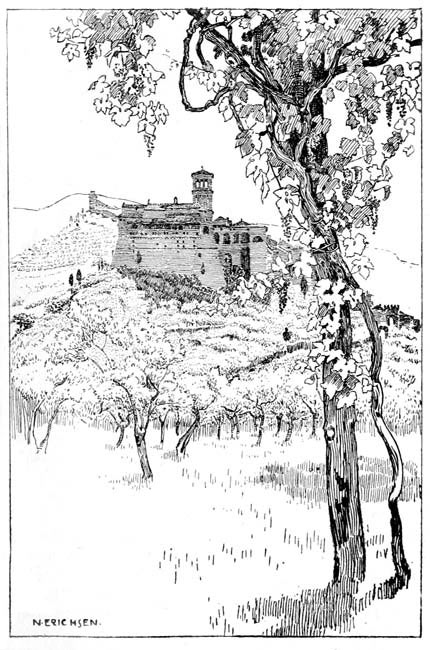
SAN FRANCESCO FROM THE PLAIN
CHAPTER V
Cimabue and his School at San Francesco
"Il semble au premier coup d'œil que le rève de François
d'Assise a dû amener la fin de tout l'art et de toute noble vie.
Chose étrange! ce sordide mendiant fut le père de l'art
italien."—E. Renan. Nouvelles Études d'Histoire Religieuse.
The Lower Church
So rarely in Italy is a church perfect both within and
without that it is with amazement we find at Assisi
not one but two churches, choir and nave piled above
each other, and covered from roof to floor with frescoes,
as perfect of their kind as the buildings which they
decorate. Wars in every town, trouble, dissension and
jealousies among men, raged like a storm over the land,
but all this turmoil of a fevered age was unable to check
the steady, rapid progress of at least this monument to
a dead saint's memory; and we perceive yet another
proof of the extraordinary influence of St. Francis,
who was able by the devotion and admiration he excited,
to inspire all with some of his own love of the
beautiful, which has lasted in Italy, from the days
of his ministry, through centuries of both faith and
unbelief down to modern times. But from this arose
a strange event; this lover of solitude, who during his
life sought only for humiliation and obscurity and
loved best the poor and deserted way-side sanctuaries,
was laid to rest in one of the most beautiful Italian
churches of that time.
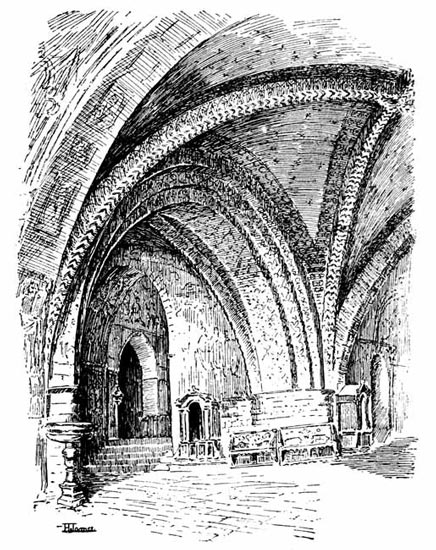
THE LOWER CHURCH
While wandering through the Lower Church, marvelling
at the delicate friezes of tiny heads, flowers and
winged horses, which frame every fresco; at the great
spreading arches—built for strength; the vaulted roof
of deep azure blue with dull golden stars upon its
surface, looming above the paintings and dimming their
brilliancy by the shadows which lurk in its depth, we
feel that within the shelter of its perpetual twilight this
is a place to pray in. It is truly the home of St.
Francis, and notwithstanding its richness and vast
splendour his spirit is here, the certainty that he once
had dwelt upon the earth is felt.
Few ever stop to look at the walls of the nave, and
indeed, upon coming out of the sunlight, the darkness
and gloom for some minutes is oppressive and but little
can be distinguished in the gloom. It was almost
by chance that we one day noticed some frescoes,
ruined and faded, just outside the Chapel of St.
Martin. They are of no beauty as works of art,
indeed they are rather ugly, but their interest lies in
showing us that from the very beginning artists had
endeavoured, however feebly, to depict the legend of
St. Francis.[68] On the left wall of the nave, outside
the Chapel of St. Martin, is a fresco representing
the Sermon to the Birds with the same idea of
composition which was adopted later by Giotto; the
saint slightly bends towards the birds upon the ground,
his companion stands behind, while the single tree
adds a certain solemnity to the scene. The figures
are large and ungainly, with feet terrible to behold,
the lines are hard, and there is little feeling of movement
or life; yet we look at it with reverence and hope,
for we know that, with all the ugliness and stiffness
of workmanship, the artist was vehemently striving in
this dark church to shake off the hampering chains of
worn-out traditions, and find for himself something nearer
to the truth. And as we look at this one and at the
next, representing St. Francis receiving the Stigmata,
our thoughts are carried to other renderings of these
scenes, and we say with light hearts: "After this poor
craftsman comes Giotto, King of Tuscan painters."
These are the only two frescoes illustrating
the life of the saint, though there may have been
others which were destroyed when the walls of the
nave were broken down in order to form entrances
to the chapels, added to the main building about
1300. But on the right side, beginning outside the
Chapel of San Stefano, are parts of several scenes
from the New Testament; a crowd of women and
men standing round the cross, a group of women, the
Descent from the Cross, a Pietà, a landscape with houses
and a decoration of circular ornaments outside the
Capella di Sta. Maria Maddalena, generally attributed
to Giunta Pisano, thus giving them too early a date.[69]
To us their interest seems rather to lie in that
they plainly show how the earliest masters, whilst
endeavouring to illustrate the franciscan legend, failed
so completely to satisfy their employers that they
were bidden to stay their hand and continue to paint
the well-worn theme of the history of the world's
redemption, which required less invention than the
legend of St. Francis, where a new out-look on
life had to be acquired. So the franciscans, failing
to find a painter who could illustrate their founder's
life to their satisfaction, contented themselves with
other things, perhaps hoping that in course of time
one might arise who could do justice to the theme.
Well it was that they waited.
Shortly after these frescoes had been completed
in the Lower Church, art received a new impulse
(one likes to think that the struggles of the first artist
towards something better and more true to life had
to do with this); others came, with Giotto at their
head, and painted over some of these early efforts,
leaving us only Cimabue's great Madonna, a few ruined
frescoes, a Byzantine pattern, and stray touches of
colour in dark corners of the church to remind us
of these first decorators of San Francesco.
We get a melancholy picture from Vasari of the
depths to which art had sunk, and of the degenerate
artists still following a worn-out tradition until it became
as a dead thing in their hands deprived of all
inspiration, when "in the year 1240, by the will
of God, Giovanni Cimabue ... was born in the
city of Florence to give the first light to the art of
painting."
Cimabue is rightly called the Father of Italian art,
as he represented a new era among Italian masters
who were awakening to their country's needs; when
men, filled with strange restless energy, grew tired
of the Byzantine Madonna with her court of stiff,
lifeless saints, and looked for something in closer
touch with their mood and aspirations.
Round the name of Cimabue are grouped many
charming legends belonging to a time when the people,
anxious to possess the new thing their hearts craved
for, looked eagerly and critically at an artist's work.
There is the story of how when he had finished the
picture of the Virgin Mary, the Florentines came to
his workshop, and, expecting much from him, yet were
amazed at the wonderful beauty of the grand Madonna,
and carried the picture with rejoicing, to the sound of
music, to the Church of Sta. Maria Novella, where it
still hangs in the dark chapel of the Ruccellai; a street
in Florence down which the picture passed being called
Borgo Allegri, because of the gladness of that day.
It is only a legend, and one that has been oft repeated,
and as often doubted. Now the existence of Cimabue
is even questioned by some, but whoever invented the
story understood the great change which had come
among the people and into art. It was only right
that in the church of the saint who personified the
feeling of the age, caught its spirit, and sent the
impulse of the people even further, should centre all
the first efforts towards this awakening and revival,
until, step by step, the masterpieces of Giotto were
reached. When we remember this, the large fresco
of Cimabue in the right transept of the Lower Church
becomes more full of beauty and meaning.[70] The
great spirit of her presence fills the church, her majesty
and nobility is that of the ideal Madonna, grave to
sadness, thinking, as her eyes look steadily out upon
the world, what future years would bring to the Child
seated on her lap, who stretches out a baby hand to
clasp her veil. All the angels round the throne sway
towards her; in their heavy plaits of hair shines a dull
red light, and in their wings and on the Madonna's
gown are mauve and russet shades like the colours
of autumnal oaks.... "To this day," says Mr
Ruskin, "among all the Mater Dolorosas of Christianity,
Cimabue's at Assisi is the noblest; nor did any
painter after him add one link to the chain of thought
with which he summed the creation of the earth, and
preached its redemption."
St. Francis has not been forgotten in this fresco,
but Cimabue having given all his art to make the
Virgin and her choir of angels beautiful, his figure is
not quite one's idea of the ethereal Umbrian preacher,
and his being there at all spoils the symmetry of the
grouping. It is not improbable that the figure of St.
Clare stood on the other side, and was erased when the
Chapel of Sta. Maria Maddalena was built, and the
ornamental border painted round this fresco, which
cut off part of the wings of the two angels on the left
of the Virgin.
Vasari vaguely tells us of some frescoes from the
lives of Jesus Christ and of St. Francis, painted by
Cimabue in the Lower Church, and later writers
have thought these must have been destroyed to make
room for Giotto's work. If paintings were there at
all they were more likely to have been the work of
inferior artists, for it seems improbable that Giotto,
coming to Assisi for the first time when he was quite a
youth, should destroy any work of his master, who was
still alive, in order to substitute his own early efforts.
The Upper Church
Not only was the Upper Church essentially fitted
for fresco painting, but it required an elaborate scheme
of decoration, just as a setting, however perfect, needs
a gem to complete it; and it almost seems as though
"Jacopo" had stayed his hand, with the intention that
here, at least, architecture should be subservient to wall
decoration, and had foreseen the need of large spaces to
be covered with paintings, as brightly coloured, as clear,
and as closely set together as are the colours upon a
butterfly's wings.
"It was here, in the Upper Church of Assisi,"
says Mr Roger Fry, "that the Italian genius first
attained to self-expression in the language of monumental
painting, a language which no other European
nation, except the Greeks, has ever mastered." But
the question as to who were the predecessors of
Giotto, and when exactly they came, can never, we
think, be answered; for the time is not far off when
these splendid ruins of early art will have totally faded
away, or, what is infinitely worse, be covered with
still thicker layers of paint than the "restorer" has
already laid upon them.
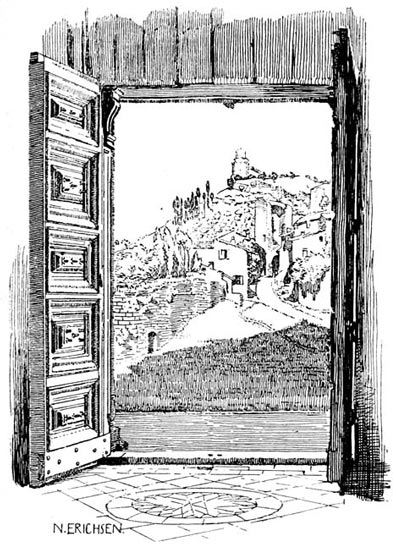
LOOKING THROUGH THE DOORS OF THE UPPER CHURCH TOWARDS
THE PORTA S. GIACOMO AND THE CASTLE
Vasari finds no difficulty about the matter, declaring,
to his own satisfaction and for the instruction of future
generations, that every fresco in the apse and transepts,
together with the series relating to the history of the
Jews and the life of Christ, are by Cimabue. But then
Cimabue was a Tuscan, and Vasari, the painter of
Tuscan Arezzo, was determined to give as much
glory to his fatherland as he could. We too would
give all possible honour to Cimabue, but are bound to
follow the opinion of later critics, who less prejudiced
and hasty in their criticisms than Vasari, see the
work of many hands in all these frescoes; so we
have gathered together a few notes concerning them
from various authorities to help the traveller to form
his own ideas upon the subject. The theme is too
endless to attempt in a small space to give more than
a very brief summary of the chief facts.
Frescoes of the Choir and Transepts.—These may be
divided into two distinct classes, those of the north transept,
which are older and inferior to those of the south
transept and choir. Herr Thode attributes their
difference to the fact that while all are the work of
Cimabue, the frescoes in the north transept were painted
when he was quite young, while the rest belong to a
later period, when he had attained his full powers.
The Crucifixion of the north transept, one of the most
ruined, reminds us somewhat of works by Margaritone
which may be studied, without much pleasure, in most
Italian galleries. The figures standing round the Cross
are short, with small heads and large hands, and not
even in the fainting Madonna is there the slightest
charm. In the Martyrdom of St. Peter, on the next
wall, it is curious to note the similarity of treatment to
Giotto's fresco at Rome of the same subject. The
Saint, head downwards upon the Cross without any
group of people would have made but a dull composition;
so both artists added an obelisk on either side to
relieve the monotony of line.
Then follows the scene of Simon Magus being borne
upwards by demons with bat-like wings; and upon the
next wall, beneath the triforium, is represented the
death of Ananias and Sapphira, and St. Peter curing
the lame before the Temple, where the figures are
certainly more majestic and, according to Herr Thode,
distinctly show the hand of Cimabue.
Behind the papal throne are medallions of the friend
and patron of St. Francis, Gregory IX, and of Innocent
IV, who consecrated the Basilica. The frescoes
represent the life of the Virgin, but they are all too
faded to be enjoyed, save that of the Coronation on
the right wall, just above the choir stalls; the Virgin
is seated upon a wooden throne with Christ by her
side and a group of apostles and spectators beneath.
There is a striking resemblance in the drawing and
form of the standing figures to those in the Crucifixion
of the south transept. This, though very ruined and
blackened in parts, showing no other trace of colour
than a faint film of golden yellow, has still the power
to make us feel that once, long ago, it was a fine work,
worthy of a great master. Weeping angels fly above
the Cross, some with outstretched hands, while others
veil their eyes from the sight of the suffering Saviour;
the Magdalen, her arms thrown up above her head, is
seen in strong relief against the sky, and contrasting
with this dramatic gesture, is the figure of the Virgin,
erect and still, her hand clasped in that of St. John.
The whole conception is dignified, replete with dramatic
feeling of the nobler kind, and has been thought worthy,
by Herr Thode, to be put down as the finest of Cimabue's
creations.
The remaining frescoes deal with scenes from the
Apocalypse, but they are so ruined that it is a thankless
task for any, except the student, to try and distinguish
each separately. Indeed after a minute examination of
so many ruined works of art, a certain sadness and
weariness is felt, but if the pilgrim has time to rest
awhile in a quiet corner of the stalls and look at choir
and transepts solely for their colour, he will gain for
himself many beautiful memories not easily forgotten.
It is a vision of youthful saints, of men with lances
hurrying down a rocky mountain side, of angels trumpeting
to the four ends of the earth, and out of this medley
of shadowy forms in fading frescoes, like sunlight
breaking through a mist with golden light, loom the
mighty angels of Cimabue. Their heads are crowned
by a heavy mass of auburn hair, their wings slightly
lifted, as though they were on earth but for a short
space, and they seem as remote from mortals as the
Sphynx herself in their dignity and calm repose. To
Cimabue belongs the conception of such grave and
strangely beautiful creations, winged messengers of
strength, who come midway between the stiff Byzantine
figures, and the swift-moving angels of Giotto and the
cherub children forms of later Umbrian and Venetian
schools.
The Nave.—All writers upon the subject agree
that here the frescoes show no trace of Cimabue's
style, but are from the hand of his contemporaries and
pupils, who worked together in unfolding the history
of the Jews and the world's redemption. If it is impossible
to hint even at the names of these artists, the
most hurried traveller must notice the different character
which marks the legend of the New Testament
from that of the Old, where the work of
talented copyists of classical works of art differ
from that of others who kept nearer to the style of
Cimabue, instilling into it more or less life, as their
individual powers permitted. Herein lies much of
the history of early Italian art, but the few remaining
frescoes, especially on the left wall, have been
so terribly over-painted that the work of the critic
is rendered well-nigh hopeless.
Beginning at the right wall by the High Altar
we have probably the work of a fine Byzantine
master, or at least of one who must have copied a
Greek masterpiece. In the Creation of the World,
God, represented as a young man seated on a globe
of fire, is, with a gesture of his hand, casting upon
the earth his last creation—man—who, still suffused
with celestial colour, is borne across the sea towards
the land. A ram, a bull and a lion besport themselves
upon the shore, enormous birds sit on the
bushes, and the sea is already full of every kind of
fish; slender pink clouds are in the sky, and the
distant hills on the horizon have faded into shades
of blue-green, like the landscape of an Umbrian
picture.
The nude figures of Adam and Eve in the Expulsion
from Paradise are wonderfully good for the
time, and the manner in which the angels are kicking
them out of the garden of Eden is somewhat
unusual.
Beginning again at the first bay window but on
the lower row of frescoes, in the Building of the
Ark Noah is seated, an obelisk-shaped rock rising
behind him, and gives his directions with a majestic
air to his sons as to the sawing and placing of the
great beams. A man, standing by his side, completes
the composition, which has much dignity and
finish.
The fresco of the Sacrifice of Isaac, with Abraham
raising his sword above him his body slightly thrown
back, is perhaps one of the most striking of the series.
The wind has caught his yellow robe, which unfurls
itself against a landscape of sandy hills.
All that remains of the next are three angels, whose
grandeur can only be compared to those of Cimabue in
the south transept. The remaining subjects on this side
are by a different master, who followed closely the best
classical traditions, and succeeds in giving extraordinary
repose to his compositions as well as meaning to the
various figures.
In Jacob before Isaac, Isaac is waiting for his dish of
venison, and Jacob's attitude denotes uncertainty as to
the reception he is likely to receive, while his mother,
lifting the curtain of her husband's bed, seems to encourage
her son.
The next fresco is similar in composition, but better
preserved. Here we feel the blindness of Isaac, the
perplexity of Esau, who cannot understand why his
father refuses to bless him, and the fear of Rebecca,
who has stepped back, knowing that her fraud must
now be discovered. In this composition the artist
has strictly kept to rules laid down by his predecessors,
and the result, if a little stiff and wanting in
originality, is yet pleasing and restful to look at, presenting
a great contrast to the somewhat exaggerated
movements expressed in the preceding ones.
The last of the series is the steward finding the cup
in Benjamin's sack, though greatly ruined it still shows
much beauty of composition.
Upon the opposite wall, by the altar, is depicted the
life of Christ by followers of Cimabue, but the few
frescoes that remain are so mutilated and repainted,
that it is impossible to say much about them, or even
to imagine what they may once have been.
"In the Capture," writes Messrs Crowe and
Cavacaselle, "the Saviour is of a superior size to
the rest of those around him, and of a stern but
serene bearing. Trivial conception marks the scene
of the Saviour carrying the Cross."
The Pietà, one of the last, is evidently by a finer
scholar of Cimabue, and the woman coming round the
rocks resembles slightly the figure of Rebecca in the
two frescoes on the opposite side. "The composition,"
write the same authors, "is more like that which
Giotto afterwards conceived than any other before or
since"; but the colossal figure of Christ destroys the
harmony of the scene.
The arch at the end of the nave is painted to represent
a series of niches, in each of which stands the
figure of a saint, all are much repainted, as are the
medallions of St. Peter and St. Paul by the door.
The Descent of the Holy Spirit is greatly ruined, and
in the Ascension the intonaco has peeled off, showing
the bricks, so that the apostles have the appearance of
looking over a wall.
The ceiling is frescoed in three different places
by other masters, whose names have not come down
to us. Between the transepts and nave the four Evangelists,
seated outside the gates of towns, are so utterly
ruined and blackened by time and damp that it is
barely worth craning one's neck to look at them.[71]
But the four medallions of Christ, the Madonna, St.
John the Baptist and St. Francis, which ornament
the centre of the nave, are among the most beautiful
things in the church, and quite perfect as decoration.
At each corner of the spandrels stands
an angel upon a globe, with wings uplifted, delicate
in outline and brilliantly coloured, while the whole
is bordered by the most exquisite design of blossoms
and green foliage rising out of slender vases, which
mingle with cupids, angels, winged horses and rabbits
on a dull red ground. It must have been painted by
one who had learned his art from the same source
whence the decorative painters of Pompeii drew their
inspiration.
It is not an easy thing to fit entire figures seated
on large marble thrones into triangular spaces, and
so the artist found, who in the groined ceiling nearest
the door had to paint the Doctors of the Church,
Sts. Jerome, Gregory, Ambrose and Augustin,
dictating their epistles to busy clerks. But there is
much that is charming in them, though as decoration
they partly fail, and a resemblance may be found to
the frescoes of Isaac and his sons, which seem to
have influenced Giotto in his paintings of old men.
Vasari's enthusiasm was roused when he looked
upon these endless paintings, and he tells us that:
"This work, truly grand and rich, and admirably
well executed, must, I conceive, in those times have
astonished the world, the more so that painting had
for so long been sunk in such obscurity: and to
me, who saw it once more in 1563, it appeared
most beautiful, as I thought how Cimabue, in such
darkness could have discovered so much light."
It would be well, before leaving, to look at the
windows of the Upper Church, which are among
the oldest in Italy, and, according to Herr Burckhardt,
the most beautiful. As of most things connected
with San Francesco, little is known about
them; Vasari says they were designed by the painters
of the frescoes; an opinion partly held by Herr
Thode, who sees a great resemblance to the style
of Cimabue in the right-hand window of the choir
(the centre one is modern) with scenes from the
lives of Abraham, David and Christ, of most beautiful
colour and design. The left window, belonging to
the same period, contains naïve scenes from the Old
Testament, amongst which (the sixth from the top
of the left half) is Jonah emerging from a blue-green
whale the colour of the waves, and possessed
of large white eyes.
Those of the transepts of the same date are even
finer and more beautifully coloured. Medallions of
geometrical patterns of exquisite design and hue
ornament the left-hand window of the north transept,
while that on the right contains scenes from the
Old Testament and the life of Christ; in both of
these, according to Herr Thode, the influence of
Cimabue is apparent.
The left window of the south transept contains seven
scenes from the Creation and seven from the lives
of Adam and Eve, who (in the last two divisions
of the right half) are being driven out of Eden, and,
spade in hand, are working at the foot of a tree.
The eight saints of the right window, seated majestically
on gothic thrones ornamented with spires, and
dressed in rose-coloured, red and green garments,
have certainly the appearance of being, as Herr Thode
suggests, of a style even anterior to Cimabue.
Half of the bay window on the left, looking towards
the altar, is the work of the Umbrian school of the
time of Fiorenzo di Lorenzo (there is a Madonna in a
blue mantle, and St. Onofrio clothed in vine-leaves),
while the left half, with medallions composed of very
small pieces of glass representing scenes from the early
life of Christ, are perhaps the most beautiful, and
certainly the oldest, in the church, and can even be
compared to the stained glass of French cathedrals.
The third window (the second has suffered considerably,
and what is left of the original belongs to the
fifteenth century) has been a good deal restored, but
the large angels with blue and purple wings standing
in an arch, behind which a little town is seen, are very
fine, and below them is a curious small figure of
St. Francis floating in front of a colossal Christ,
belonging also to the fifteenth century.
Very beautiful are the two saints beneath gothic
arches in the last window, and the priests in their rose-coloured
stoles, the bishops in crimson and gold, and
the other figures of warriors and saints.
The right half of the bay window near the door
upon the opposite side, belonging also to the Umbrian
school, contains some charming scenes from the life of
St. Anthony, while on the left are incidents of the life
of St. Francis. The whole is remarkable for delicate
rose colours, greens and pale blues, and a total absence
of the strong deep tones of the older and finer windows;
but they are very beautiful of their kind, like patches
of pale sunshine in the church.
The next two windows betray a more ancient style
in the fine figures of the apostles (their heads, alas,
are modern), and in the scenes from their lives, which
are of a deeper tone than the former one; but even
more beautiful is the last window, which does not seem
to have been restored within the last three centuries,
and where the colours standing out from a creamy
background are very lovely. The two large and grand
figures of two apostles are believed by Herr Thode to
be from drawings by Cimabue.
Both Francesco di Terranuova and Valentino da
Udine were employed to repair all the windows about
1476, large sums being expended, principally by the
Popes who never ceased to patronise the franciscan
Basilica. A most comical appearance is given by the
distressing additions made in our own time of modern
heads upon bodies of the thirteenth or fourteenth century.
Until very lately an exquisite rose window was to be
seen over the eastern door, now replaced by white
glass; one would like to know how it so mysteriously
disappeared and where it now is.
No pains had been spared to make San Francesco
as lovely in every detail as the brain of man could
devise, and it is most remarkable how the frescoes
belong to the general idea of the building as though
every artist had thought as much of this unity as of
the individual perfection of his work. The beautiful
papal throne in the choir, of white marble encrusted in
mosaic with its frieze of strange animals in low relief,
its arms supported by red marble lions, is almost a
replica of the Soldan's throne in Giotto's fresco, and
was designed by Fuccio Fiorentino in 1347, when the
architecture that Giotto delighted in was still the recognised
style in Italy.[72] The marble and mosaic altar
is of the same date, and the octagonal pulpit of sculptured
stone, with saints in small tabernacles, spiral
columns and designs of leaves slightly tinted, supposed
also to be by Fuccio, is placed at the corner of the
wall of the nave looking as if it had grown there.
The columns supporting the arched gallery round the
church have each been painted to represent mauve and
rose-coloured marbles, and there is not a single space in
all the building which has not been decorated to harmonise
with the frescoes, giving a perfect sense of
infinite completeness and beauty, to which time has
added by mellowing everything into a pale orange
colour—the colour of Assisi.
CHAPTER VI
The Paintings of Giotto and his School
in the Lower Church
"... Cimabue thought
To lord it over painting's field; and now
The cry is Giotto's, and his name eclipsed."
Dante, Purgatory, xi., Cary's translation.
The work of Cimabue, grand and noble as it is,
yet gives the impression of belonging to remote
times, between which and that of Giotto, his pupil, a
great gulf is set. In both churches at Assisi we pass
from the early efforts of an awakening age to the work
of one, who, if not the first to see the light, was the
first to discover the true principles of art, to give it
life, and to found a school whence a long series of
painters came to carry on for generations the lessons
he had taught. Cimabue did wonders for the century
in which he lived; of Giotto, even granting that his
drawing was sometimes faulty, and the types of faces
he painted were not always beautiful, it would be an
insult to express such condescending praise; and even
a hasty study of his frescoes in San Francesco must
soon explain the everlasting sway he holds, now, as in
those first years when his work seemed little short of
miraculous to the wondering Florentines.
Some fourteen miles to the north of Florence, among
the hills of the Mugello, lies the scattered hamlet of
Vespignano where Giotto Bondone was born of a poor
peasant family in the year 1265. Even at an early
age, Vasari says, the boy was remarkable for the
vivacity and quick intelligence which endeared him
not only to his parents, but to all who knew him in
the village and country round. He passed his childhood
among them, knowing nothing of the city just
across the hills, but learning much, during the long
days while he wandered forth to tend his father's
sheep, which was helpful to him in after years to
preserve his straightforward outlook upon life and
the strength and freshness of a nature that loved the
sunburnt valleys and the freedom of the shepherd's
existence.
When Giotto was ten years old it happened that
Cimabue, on his way from Florence to Vespignano
upon a matter of business, found him seated by the
roadside, his flock gathered near, busily employed in
drawing the outline of a sheep from life upon a smooth
piece of rock. Struck by the boy's industry in the
pursuit of art and his evident cleverness, Cimabue
hastened to obtain the father's consent to adopt and
make an artist of him. Leaving the old life in the
peasant's cottage for ever, Giotto now turned south
along new roads, and with Cimabue by his side, saw
for the first time the city of Florence, beautiful as she
lay upon the banks of the Arno in a setting of wooded
hills.
The progress he made under Cimabue's guidance,
who taught him all he knew, was marvellous indeed.
At ten years of age a shepherd tracing idle fancies on
the stones, then for a few years an apprentice in a
Florentine workshop grinding colours with the others
for his master's big Madonnas; while ten years later he
had already gained the title of Master and was a
famous painter, courted by popes and kings, and
leaving masterpieces upon the walls of churches
throughout Italy, that people of all times and
countries have come and paused awhile to see.
Let us suppose it was the air of Florence, which,
according to Vasari, "generates a desire for glory and
honour and gives a natural quickness to the perceptions
of men," that made Giotto a perfect Florentine,
alert, witty, and ever ready with a caustic repartee to
anyone who bandied words with him. But though
other influences were at work around him, and new
images crowded upon his active brain, he kept undimmed
the vision of his mountain valley, of the
fields, of the days spent in his native village, and,
with the eyes of a shepherd he continued to look
on all the incidents of human life; he saw the
grandeur, the tragedy, the weaknesses, aye, and the
humour too, in everything that surrounded him, setting
it all down in his frescoes in his own simple and
original way. In a few words Mr Ruskin has
touched upon the keynotes of Giotto's character
when he says: ... "his mind was one of the
most healthy, kind and active that ever informed a
human frame. His love of beauty was entirely free
from weakness; his love of truth untinged by severity;
his industry constant without impatience; his workmanship
accurate without formalism; his temper serene
and yet playful; his imagination exhaustive without
extravagance; and his faith firm without superstition.
I do not know, in the annals of art, such another
example of happy, practical, unerring, and benevolent
power."
Such was the man who came to Assisi to take
up the work left uncompleted by Cimabue and his
contemporaries. Giotto was then almost unknown,
not having executed any of those great works upon
which his fame now rests, and it is not unlikely
that the recommendation by Cimabue of his promising
pupil to the friars of San Francesco led to his
being called there when barely twenty years of age.[73]
Opinions differ as to which were his first works and
whether he began in the Lower or in the Upper Church,
and as there are absolutely no documents relating to
the subject, and Vasari is of no help in the matter
of dates or precise details, the only way to come to
any conclusion is to group these frescoes according
to their style. We do not wish to force any arbitrary
opinions on this matter, and have simply placed
Giotto's work in the order that it seems to us more
likely to have been executed. Those who disagree
have only to transpose the chapters as they think
fit. The chief thing is to enjoy the frescoes and
speculate as little as possible on all the contradictory
volumes written about them.
Right Transept.—According to Messrs. Crowe and
Cavalcaselle these frescoes are by Giotto, and Mr
Bernhard Berenson is of the opinion that they
belong to his early period, and were executed by
him before the franciscans knew what his powers
were, and whether they could entrust to him the
more difficult task of illustrating the legend of St.
Francis. The subjects are taken from the early
life of Christ which had been depicted many
times in preceding centuries, but although Giotto
attempted no very elaborate or original manner of
treatment, his style was rapidly developing, and we
have in some of the scenes little traits of nature
which only belong to him. On the outside of the
Chapel del Sacramento, over the arch, he painted the
Annunciation with such charm, dignity and harmony
of outline that it would be difficult to find a more
perfect conception of religious feeling even among
the pictures of Angelico. Unfortunately it can only
be seen in the early afternoon when the light comes
in through the windows of S. Giovanni; the Madonna
rising with queenly grace and the angel hastening
forward with his message then stand out from their
dark background like living people, and show how,
from the first, Giotto attained the power of giving
vitality to his figures. His Madonna is not like a
graven image to be worshipped from afar; she is
essentially the earthly mother of the Saviour, and
Giotto, while treating her story with dignity and a
certain sense of remoteness, tells it by the simplest
means, endowing her with the maternal tenderness
of a young peasant girl whom we meet upon the
roads carrying her child to lay beneath the shadow
of a tree while she goes to her work in the fields
close by.
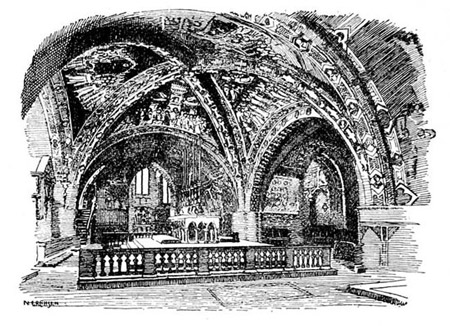
CHOIR AND TRANSEPTS OF THE LOWER CHURCH
The Visitation (on the same wall as Cimabue's
Madonna) is one of those frescoes that we remember
like a scene we have witnessed, so naturally does
the Virgin move forward, followed by a group of
handmaidens, and hold out her arms to greet Elizabeth
who is bending with such reverence to salute
her cousin. They stand at the entrance of a dainty
house inlaid with mosaic which is set among the
bare rocks with only a stunted tree here and there.
But Giotto does not forget to place a flowering plant
in the balcony just as the peasants have always done
in his mountain home.
It is interesting to compare the next fresco of the
Nativity with the same subject in the Upper Church,
treated by a follower of Cimabue where the same
idea is depicted, but with what a difference. Though
two episodes are placed in one picture, Giotto succeeds
in giving a harmonious composition, which, if a little
stiff and over symmetrical, is full of charm and beauty.
The angels singing to the new-born Infant and those
apprising the shepherds of the news hover like a flight
of birds above the barn. They are in truth the winged
spirits of the air, "birds of God" Dante calls them,
and thus Giotto paints them. As though to accentuate
the sadness and poverty of Christ's birthplace, the barn,
all open and exposed to the night breezes, is laid in a
lonely landscape with a high rock rising behind it.
Beyond in the valley, a leafless tree grows upon the
bank of a calm stream where the heavenly light from
the angels is seen to play like moonbeams in its
waters.
Messrs. Crowe and Cavalcaselle hold that the Visit of
the Magi was "never painted with more feeling, more
naturally or beautifully composed than here"; and
Giotto must have felt he could add little to the perfection
of the scene when in later years he painted the
same subject at Padua. All interest is centred on the
Child, who, bending forward from the Virgin's arms,
lays a tiny hand in blessing upon the head of the aged
king. Curiously enough St. Joseph has been forgotten,
and instead an angel stands upon either side to receive
the offerings of the Magi.
But to us the Purification seems even more beautiful
in sentiment, composition and the perfection of religious
feeling. Giotto was the first to conceive the idea
of the Infant Jesus turning from Simeon towards the
Virgin Mary as if anxious to come back to her, while
she holds out her arms to invite him with a naïve
attitude of gentle motherhood.
From charming frescoes like these we come to the
grand and powerful scene of the Crucifixion. Every
figure tells a different tale of sorrow; of tender pity, as
in the group of women round the fainting Virgin; of
wonder that Christ should be allowed to suffer, as in
the gesture of the woman with arms thrown back and
St. John who wrings his hands almost fiercely; of sympathy
expressed by the Magdalene, as she kisses the
pierced feet; and of hope and prayer, in the kneeling
figures of St. Francis and his brethren. Even more
vehement in their grief are the angels, who rending
their garments fly away with arms stretched out as if
unable to bear the sight of so much pain. How rapidly
they turn and circle in the air; they are not borne
along by the winds, but trusting to their wings they
rise with the swift, sure flight of a swallow.[74]
Upon the opposite wall the early life of the Virgin
is continued with the Flight into Egypt, which bears a
strong resemblance to the fresco at Padua. There is
the same sense that St. Joseph, his bundle slung on a
stick over his shoulder like a pilgrim, is really walking
along and in a moment must disappear from sight; a
palm tree bends sideways to the breeze, and above two
angels seem to cleave the air as they hurriedly lead on
the travellers to exile and safety. Only the Virgin sits
calm and unruffled. In the Massacre of the Innocents
Giotto has happily not painted the full horror of the
scene, but has aimed rather at suggesting the tragedy
than at giving its actual representation. Very beautiful
are the women to the left mourning for their dead
children. One rocks her child in her arms and tries
to awaken him with her kisses, whilst another raises
her hands in despair as she gazes upon the dead child
upon her knees.
The Return of the Holy Family from Egypt,
though only showing a group of houses within surrounding
walls and a gateway and a group of
people, suggests better than a more complicated
composition would have done the scene of a home-coming
after long absence.
The Preaching of the Child in the Temple completes
the series, and like the one at Padua, it is the
least interesting of Giotto's paintings.
There are three other frescoes in the Transept which
most people, with reason, attribute to Giotto, representing
miracles of St. Francis. The first refers to a
child of the Spini family of Florence who fell from a
tower of the Palazzo Spini (now Feroni), and was
being carried to the grave, when the intercession of
St. Francis was invoked and he appeared among
them to restore the child to life. Part of the fresco
has been lost owing to the ruthless way in which the
walls were cut into for the purpose of erecting an organ—a
barbarous act difficult to understand. But the
principal group of people are seen outside an exquisite
basilica of marble and mosaic, and each figure can be
studied with pleasure as they have not been mutilated
by the "restorer's" usual layers of thick paint. Seldom
has Giotto painted lovelier women than those kneeling
in the foreground, their profiles of delicate and pure
outline recalling a border of white flowers. Near them
is a figure bearing so strong a resemblance to Dante,
that we would fain believe that Giotto meant to represent
the type of a true Florentine in a portrait of the
poet. Above the staircase is a fine picture of St.
Francis resting his hand upon the shoulder of a crowned
skeleton "in which," says Messrs. Crowe and Cavalcaselle,
"a much deeper study of anatomy is revealed
than has ever been conceded to Giotto." The oval
face of the saint, with clear brown colouring, is very
beautiful, strongly resembling the St. Francis in glory
in the fresco above the high altar. By him also is
the half-length figure of Christ in the vaulting of
the window.
Although the two remaining frescoes deal with the
death and resurrection of a child, they probably have
nothing to do with the Spini miracle; the one where
the dead child is lying in the arms of two men has unfortunately
been so repainted as to take all character away
from the faces, and we can only admire the general
grouping, the fine gestures of the weeping women, and
the grand modelling of the figures. Only a great artist
could make one feel, by such simple means, the strain
of the dead weight upon the men's arms. The man
to the left (the second from the one holding his finger
to his chin) is believed to be the portrait of Giotto; if
it is, the painter has not flattered himself, and we can
believe Dante's tale that he was remarkably ugly, and
had six hideous children. On the other side of the
arch the legend continues; a procession of white-robed
monks and sorrowing friends approach the house to
which the child has been taken, but in the meantime
St. Francis has called him back to life, and a man,
evidently in great excitement over the miracle, is
hurrying down the steps to announce what has
occurred. The story is so well and simply told
that, although we have failed to find any account
of it, it is easy to understand the sequence of the
two frescoes, and the events they relate.
Allegories by Giotto in the ceiling over the High Altar.—The
task was now given to Giotto to depict by the
medium of allegory the three virtues of the franciscan
order and St. Francis in glory. These virtues, the
rocks upon which the franciscan order was so securely
founded, had been preached by St. Francis to the
people of Italy with the extraordinary results we have
seen, and now Giotto came to take up the theme and,
by means of his immortal art, perpetuate it as long as
the great basilica lasts, and pilgrims come to pray and
read upon the walls, in a language even the unlettered
can understand, the lessons taught by the Umbrian
preacher seven centuries ago. Apart from the fact of
his genius, it was a fortunate thing that he should have
been chosen for the task. A man of weaker and more
impressionable temperament might have been led into
such exaggerations of feeling and sentiment as we find
in the Lorenzetti frescoes of the transept. Giotto
came not many years after the Flagellants, roaming
in hordes through the land calling for mercy and beating
their half-naked bodies with leathern thongs, had
spread a spirit of fanaticism which threatened to destroy
the healthy influence of the teaching of St. Francis.
But the mountain-born painter, impervious to such
influences, kept his faith pure amidst the turmoil and
unrest; and much as he admired the saint (it is said
he belonged to the Third order), he looked upon his
teaching from the practical point of view and was by
no means carried away by the poetical manner in which
it had been presented to the people. Nothing shows
the mind and character of Giotto so plainly as some
lines he wrote on poverty, most likely after painting
his famous Allegories when he had an opportunity to
observe how little the manners and customs of mediæval
monks corresponded with the spirit of their founder.
Every line of the poem is full of common sense and
knowledge of human frailty. Many, Giotto remarks
somewhat sarcastically, praise poverty; but he does not
himself recommend it as virtue is seldom co-existent
with extremes; and voluntary poverty, upon which he
touches in a few caustic lines, is the cause of many ills,
and rarely brings peace to those who have chosen her
as a mate and who too often study how to avoid her
company; thus it happens that under the false mantle
of the gentlest of lambs appears the fiercest wolf, and
by such hypocrisy is the world corrupted.[75]
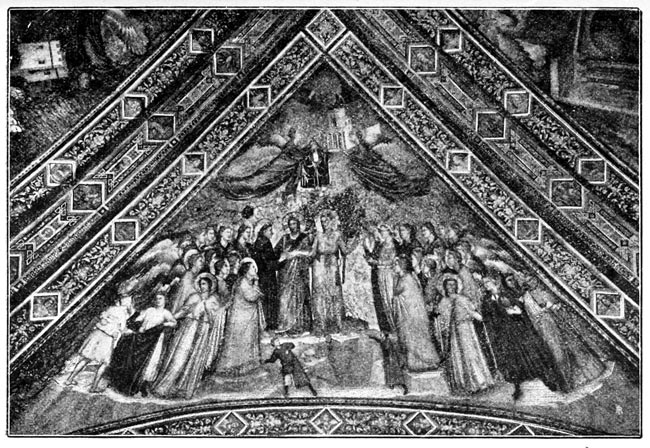
THE MARRIAGE OF ST. FRANCIS WITH POVERTY
(D. Anderson—photo)]
Giotto, an artist before he was a moralist, undertook
to carry out the wishes of his patrons, and thought
only how he could best fill the triangular spaces of the
ceiling with the figures of saints and angels. It was
by no means an easy task, but Giotto succeeded so
well that these four frescoes are reckoned among his
masterpieces and the wonders of the thirteenth century.
They certainly show a marked advance upon the earlier
works in the Transept, but they lack the power and
assurance of those in the Upper Church, where the
youthful painter all but reached the zenith of his
fame.
The Marriage of St. Francis and Poverty.[76]—In this
fresco Giotto has represented three incidents, but just
as they all refer to one subject, so do the figures form
a perfect harmony, faultless as decoration and beautiful
as a picture. A youth, imitating the charity of St.
Francis to whom his guardian angel is pointing, is seen
on the left giving his cloak to a beggar, while upon the
other side, a miser clutching his money-bag and a youth
with a falcon on his gloved hand refuse to listen to
the good suggestions of an angel and of the friar who
stands between them. The lines of decoration are
further carried out by the two angels who fly up carrying
a temple with an enclosed garden, perhaps symbolising
Charity, and a franciscan habit, which may be the
symbol of Obedience. But these are details and
the eye does not rest upon them, but rather is carried
straight into the midst of a court of attendant angels
where Christ, standing upon a rock, gives the hand of
St. Francis to the Lady Poverty, who slightly draws
away as if in warning of the hardships and disillusions
in store for him who links his life with hers. Cold
and white, her garments torn by a network of accacia
thorns, she is indeed the true widow of Christ, who,
after His death as Dante says,
". . . . . . slighted and obscure
Thousand and hundred years and more, remain'd
Without a single suitor, till he came."[77]
The bridesmaids, Hope pointing to the sky, and
Charity holding a heart and crowned with flowers that
start into tiny flames, come floating out of the choir
of angels towards the pale bride whose veil is bounded
only by her hair. Heedless of the children of earth,
who encouraged by the barking of a dog, press the
thorns still deeper into her flesh, she gazes at St.
Francis, and shows him the pink and white roses of
paradise and the Madonna lilies which are flowering
behind her wings.
Chastity.—The different stages of perfection in the
religious life are portrayed in this allegory. To the
left St. Francis welcomes three aspirants to the order—Bernard
of Quintavalle—typifying the franciscans;
St. Clare—the Second Order; and one, who is said to
be the poet Dante, in the near foreground in a florentine
dress of the period—the Third Order. Two
angels in the central group impose hands and pour the
purifying water upon the head of a youth standing
naked in a font, and two other angels bend forward
with the franciscan habits in their hands, while leaning
over the wall of the fortress are two figures, one presenting
the banner of purity the other the shield of
fortitude to the novice. On either side stands a grey-bearded,
mail-clad warrior, lash and shield in hand to
denote the perpetual warfare and self-mortification of
those who follow St. Francis. To the right three
youthful warrior-monks, beautiful of feature, bearing
the signs of the Passion in their hands, aided by one in
the garb of a Penitent with angels' wings, are chasing
away the tempting spirits of the flesh from the rocks
about the fortress into the abyss below. The winged
boar falls backwards, followed by a demon and a
winged skeleton emblematic of the perpetual death of
the wicked, while poor blindfolded Love writhes beneath
the lash of Penitence. But just as he is about
to spring down with the rest, his string of human hearts
still slung across his shoulders, he snatches up a sprig
of roses from the rocks.
Above, out of a walled enclosure guarded at each
end by towers like every mediæval castle on the hills
about Italian towns, rises a crenulated fortress. At
the open window of the magnificent central tower is
seen Chastity, veiled and in prayer as if unconscious of
the scene below, her vigilance typified by the bell
o'erhead. She appears to be reading, by the light of
a taper, from the open book held before her by an
angel, while another is bringing her the palm of sanctity.
They are no longer Giotto's bird-like creations,
but stately messengers with splendid human forms
uplifted by outstretched wings their garments brought
into long curved lines by the rapidity of their flight.
Obedience.—Under an open loggia sits the winged
figure of Obedience in the habit of a franciscan,
holding his finger to his lips as he places a wooden
yoke (symbol of obedience) upon the neck of a
kneeling friar. Prudence, with double face, holding
a glass mirror and a compass, and Humility, with her
lighted taper to illumine the path to paradise, are
seated on either side, perhaps to show that he who
imposes obedience upon others must be prudent and
humble himself. An angel upon the right is pointing
these virtues out to a centaur (symbolizing pride, envy
and avarice), who, thrown back upon his haunches
by a ray of light from the mirror of Prudence, is
thus stopped from tempting away the young novice
kneeling on the opposite side, encouraged in his act
of renunciation by the angel who holds him firmly by
the wrist. Two divine hands appear from the clouds
above and are holding St. Francis by his yoke, while
two angels unroll the rules of his order.
The Glory of St. Francis.—The throng of fair-haired
angels, seem, as they move towards the throne
of the saint and press around it, to be intoning a hymn
of perpetual praise and jubilation. Their figures,
against the dull gold background, are seen white and
strong, with here and there a touch of mauve or pale
blue in their garments bringing out more distinctly the
feeling of light and joyousness. The perpetual movement
of the heavenly choir, some blowing long trumpets,
others playing on flutes and tambourines, while many
gaze upwards in silent prayer as they float upon the
clouds, contrasts strangely with the stiff and silent
figure of St. Francis, who in his robe of gold and
black brocade, a brilliant light behind him, looks like
some marvellous eastern deity, recalling Dante's words
of how he
"... arose
A sun upon the world, as duly this
From Ganges doth: ..."
In the dimness of the cave-like church built to serve
the purpose of a tomb and keep men's ideas familiar
with the thought of death, these frescoes are glimpses
into the heaven of the blest. Watch them at all
hours of the day and there will be some new wonder
to be noted, a face among the crowd which seems
fairer than the rest, or, as the sunshine moves across,
a flash of colours in an angel's wing like the sudden
coming of a rainbow in a cloudy sky. And who shall
forget the strange play of fancy as the candle light,
during an afternoon service, mingles with the strong
sunshine upon the white figures of saints and the
whiter figure of the Lady Poverty, who appear to
move towards us from amidst a blaze of golden
clouds, until gradually as the evening closes in and
the candles go out one by one, they are set once more
in the shadow of their backgrounds like so many
images of snow.
La Capella del Sacramento, or the Chapel of St. Nicholas.—Giotto
left one scholar at Assisi whose work it is
easy to discover, but who, as far as name and personality
are concerned, is unknown, and shares in the
general mystery which surrounds both the builders
and painters of San Francesco. All we know is that
he followed his master's style and great laws of composition
even more closely than Taddeo Gaddi, and
that he possessed much charm and originality. By the
kind help of Mr Bernhard Berenson we have been able
to group together some of the works of this interesting
artist, who was evidently working at Assisi between 1300
and 1310 when he executed the last nine frescoes of
the Upper Church illustrating the death and the
miracles of St. Francis, decorated the Capella del
Sacramento in the Lower Church with the legend
of St. Nicholas, and painted a fine Crucifixion in the
Confraternity of San Rufinuccio (see chap. x). There
is a very delightful panel picture also by him in the
corridor of the Uffizzi (No. 20 in the corridor),
with eight small scenes from the life of St. Cecilia.
In a fresco over the arch on the inside of the
Capella del Sacramento are portraits of the donors
of the chapel, Cardinal Napoleone Orsini, who is
being presented to Christ by St. Francis, and his
younger brother Giovanni (below him is written
Dñs Joñs Gaetanus frater ejus), presented by St.
Nicholas. It helps to date the decoration of the
chapel, for we know that Giovanni Orsini received
the cardinal's hat in 1316, while here he is represented
in the white dress of a deacon confirming
the general opinion that these frescoes must have
been painted before that date.[78]
St. Nicholas of Myra, generally known as St.
Nicholas of Bari, both during his life and after his
death was forever coming to the assistance of the
oppressed; he did not even object to be the patron
saint of drunkards and thieves, as well as of maiden
virtue. He can easily be recognised in art by the
three purses or golden balls which are always placed
at his feet, in reference to the first kind action he
performed when a wealthy young noble. This incident
is charmingly recorded in the chapel upon the
right wall near the entrance. Three sleeping maidens
are lying by their father's side, and St. Nicholas, who
has heard of their poverty, throws in three bags of gold
as he passes by the open window. This charitable deed
has made him a famous saint; when Dante is in Purgatory
he hears the spirit of Hugh Capet recounting various
acts of virtuous poverty and generosity, among which
"... it spake the gift
Of Nicholas, which on the maidens he
Bounteous bestow'd, to save their youthful prime
Unblemish'd...."
Below (the picture immediately beneath is entirely
obliterated) is a very beautiful composition, recalling
the same artist's treatment of St. Clare and her nuns in
the Upper Church. In front of a Gothic chapel of
white and black marble stands St. Nicholas, between
two placid and portly friars, listening to the petition of
a despairing father who implores his protection for his
three sons, unjustly condemned to death by a wicked
consul. The figures of the prisoners, with halters round
their necks, followed by sympathising friends, are full of
movement and life; St. Nicholas is particularly charming,
dressed in his episcopal robes, slightly bending forward
and listening attentively to the doleful tale.[79]
The legend is continued upon the opposite side,
where he arrives just in time to save the youths. The
figure of the kneeling victim expecting the blow every
moment to fall upon his neck and the majestic attitude
of the saint in the act of seizing the sword, are finely
rendered, but Giotto would hardly have approved of
the complicated building decked with much superfluous
decoration which is supposed to represent the
city gate.
The fresco below relates a vision of the Emperor
Constantine who had ordered his three generals, unjustly
accused of treason, to be put to death. St.
Nicholas appears and commands him to release the
prisoners, who are in a wooden cage by the bed.
High up in the lunette of this wall is an interesting
fresco referring to a humorous incident of one of the
saint's miracles. It appears that a Jew, hearing that
St. Nicholas gave special protection to property, placed
a statue of him in his house; but it must be remembered
that St. Nicholas was also the patron of thieves,
and one day all the Jew's possessions disappeared.
Enraged by the failure of his plan he administered a
sound thrashing to the statue, which stands in a beautiful
niche with spiral columns, behaving much in the
same way as the childish sons of faith in Southern Italy
who turn the Madonna's picture to the wall when
their prayers have not been effectual. In this case
St. Nicholas was so deeply offended that he appeared
in a vision to the thieves, who kindly restored the
goods of the irate Jew. There are dim remains of
frescoes on this wall, but it is impossible to make out
what they represent. Other wonderful miracles are
related upon the opposite side, beginning high up in the
lunette, where, with some difficulty, we distinguished
St. Nicholas restoring a child to life who has been
taken from his parents and killed by evil spirits. Below
is a scene in a banqueting hall, where a king, seated at
table, takes a goblet of wine from the hand of a slave
boy. St. Nicholas, in full episcopals, performs one of
his many ærial flights, lays his hand upon the boy's
head and carries him back to his parents. In the
scene beneath St. Nicholas is restoring to his people
another youth, who, it seems, was nearly drowned
while filling a goblet with water for the altar of
St. Nicholas; or it may be the continuation of the
preceding legend, and show the home-coming of the
captive boy from the king's palace. It is one of the
most charmingly rendered of the series; the impetuous
action of the mother rising with outstretched
arms to welcome her son, and the calm dignity of the
father's embrace, are almost worthy of Giotto himself.
A small dog bounds forward to add his welcome to
the others, while St. Nicholas surveys the scene with
great gravity, every line of his figure denoting dignity,
power and repose.
On one side of the arched entrance to the chapel
is a fresco of St. Mary Magdalen, on the opposite
side is St. John the Baptist, and in the vaulting of the
arch, on the right, are St. Anthony of Padua with
St. Francis; St. Albino with St. George; St. Agnes
holding a lamb, perhaps the most graceful of the
figures, with St. Cecilia crowned with roses. Opposite
are St. Rufino and St. Nicholas holding a book; St.
Sabino and St. Vittorino, both Assisan martyrs; and
St. Claire with St. Catherine of Alexandria. But the
quality of this artist will be only half realised if the
single figures of the apostles on the walls below the
scenes from the life of Nicholas are overlooked.
Very grave and reposeful they lend an air of great
solemnity to the chapel, and as Messrs. Crowe and Cavalcaselle
remark, they are "after those of Giotto in the
Ciborium of Rome, the most admirable that were
produced in the early times of the revival...."
It is as difficult to explain why the Chapel of St.
Nicholas possesses so much charm, as it is to understand
why people seldom spend more than sufficient
time to read the few lines in their guide-book about
it and verify for themselves that the frescoes are there;
but perhaps when some fifty frescoes by Giotto have
to be realised in about an hour, which is the time
usually devoted to them by the visitor to Assisi, it is
not surprising that Giotto's follower, the closest and
the best he ever had, should be neglected.
The stained glass windows, remarkable rather for
their harmony than for their depth of tone, belong also
to the early part of the fourteenth century, and are decorated
with the Orsini arms. On the left side of the
central window is a charming design of St. Francis in
a rose-coloured mantle, recommending to Christ the
young Giovanni Gaetano Orsini, who is said to be
buried in the chapel. His monument behind the altar,
erected soon after his death in 1347, is, according to
Vasari, the work of Agostino da Siena, a pupil of
Giovanni Pisano. Very calm and youthful-looking
the Cardinal lies at full length in long folded robes
while two angels guard his slumbers.
There is yet another treasure in St. Nicholas' Chapel;
a lovely picture on panel of the Virgin and saints (rather
difficult to see as it is against the light over the altar),
by a Sienese artist who possesses some of Simone Martini's
talent of depicting ethereal and serene Madonnas.
The Chapel of St. Maria Maddalena.—According to
a legend given by Padre Angeli the chapel was built
and consecrated by St. Bonaventure while General of
the franciscan order towards the end of the thirteenth
century. The three frescoes on the left wall certainly
belong to Giotto's time, and if not actually painted by
him they appear to be from his designs, and not merely
copies of the Paduan frescoes which they resemble.
Above the frescoes of the Raising of Lazarus and the
Anointing of Christ's feet is the Communion of the
Magdalen, rendered with such simplicity yet with so
much religious feeling and solemnity that we realise
it is indeed the last communion of the saint on earth.
The attitude of the priest, the splendid drapery of the
man in orange-coloured garments, and the way in which
the figure of the saint being carried by angels to heaven
completes the composition, bear unmistakably the impress
of Giotto's style before the Paduan period
(1206).
The "Noli mi Tangere" upon the opposite wall may
also have been designed by him, but the type of the
faces are heavier than his, and the angels are no longer
swift spirits of the heavens ending in flame and cloud.
The painter, as if wishing to remind the faithful of
the new life symbolised in the resurrection of Christ,
has covered the rocks and ground with flowering rosebushes
and exquisitely designed tufts of ferns and leaves.
The story of the Prince and Princess of Marseilles is
a favourite subject with the Giottesque school. The
legend tells that when Mary Magdalen arrived at Marseilles
with Lazarus and Martha, she met a prince and
his wife who were praying to the gods for a son, and
she persuaded them to pray instead to the God of the
Christians. Their desire was granted, and they were
converted, but evidently being of a cautious turn of
mind, they resolved to sail at once for Jerusalem and
find out if St. Peter's teaching agreed with that of the
Magdalen. On the way a terrible storm arose, and
during the tempest the princess gave birth to a son, and
died. The sailors insisted that her body must be thrown
overboard or the storm, they said, would not abate; at
last the prince was forced to lay the body of his wife
upon a rocky island in the midst of the ocean, and
calling upon Mary Magdalen for help, he left the child
wrapt in the cloak of its dead mother by her side and
continued the journey to the Holy Land. His visit
to St. Peter ended in his complete conversion, and upon
his return to France he stopped at the rocky island
where he found his wife and son alive and well, thanks
to the prayers of St. Mary Magdalen. They returned
to Marseilles, the vessel being guided by angels, and
the whole town became Christian.
Above the arch facing the altar is a very charming
fresco of the Magdalen standing at the entrance of
a cave, her hair falling like a mantle of cloth of gold
about her, to receive the gift of a garment from a
charitable hermit who had heard of her life of austerity
and privation among the mountains of Provence.
The single figures of St. Clare, St. Mary
Magdalen and St. Rufino, as well as the saints in
the vaulting opposite the altar, no longer follow
Giotto's designs and are far inferior to the other
frescoes. Teobaldo Pontano, Bishop of Assisi between
1314 and 1329, is supposed to be the kneeling
figure at the feet of St. Rufino as donor of the
chapel. It is so unlikely Giotto should have repeated
his later Paduan designs in a feebler manner,
as seen here, or that a pupil should have slavishly
copied them, that it seems more probable the chapel
dates from the time of St. Bonaventure, when its
decoration may have been begun by Giotto and completed
by some later Florentine follower called in
by the bishop who desired to be buried here. The
Pontano arms decorate the beautiful stained glass
windows, which certainly date from the first half of
the fourteenth century, and are the finest in the
Lower Church with the exception of those in St.
Martin's chapel. Each figure has a claim on our
admiration, but especially lovely is the figure of the
Magdalen whose hair falls to her feet in heavy waves
of deepest gold. In the last division of the right
window is the death of the saint, with the lions at
her feet which are supposed to have dug her grave.
The Chapel of St. Antonio di Padova.—Built by the
Assisan family of Lelli in the fourteenth century, it
was once ornamented by Florentine frescoes of the
same date which were destroyed when the roof fell
in, and it has now nothing of interest save the windows.
These contain some naïve scenes from the life of St.
Anthony; among them may be noticed his preaching
to the fish which raise their heads above the water
to listen.
Chapel of San Stefano.—This like the last, has only
very decadent frescoes by Adone Doni and is solely
interesting for its windows (second half of fourteenth
century), where below the symbols of the Evangelists
are single figures of saints, among them King Louis
and the royal Bishop of Toulouse. Cardinal Gentile
di Montefiore, founder of the chapel of S. Martino, was
also the donor of this one and is represented in the
right window with his crest, a tree growing out of
a blue mound against an orange background.
The Chapel of St. Catherine, or Capella del Crocifisso.—This
chapel was built by order of Cardinal Albornoz
towards the end of the fourteenth century when
on his passage through Umbria to reconquer the
rebellious cities for the Roman Pontiff. He conceived
at Assisi so great a love for the memory of St. Francis
that he desired to be buried there; but though his body
was brought to Assisi from Viterbo where he died
in 1367, it was afterwards carried to his bishopric
at Toledo "at small expense," writes an economical
chronicler, "upon men's shoulders"; only a cardinal's
hat, suspended from the roof of the chapel, now
remains to remind us of the warlike Spanish prelate.
The frescoes here have been assigned to that mythical
person Buffalmaco, of whom Vasari relates such
humorous tales. All we can say is that they belong
to the second half of the fourteenth century and are
not very pleasing scenes from the life and martyrdom
of St. Catherine of Alexandria, with a fresco of Cardinal
Albornoz receiving consecration from a pope
under the auspices of St. Francis. The windows are
the first things to shine out amidst the gloom as one
enters the Lower Church. Especially attractive are
the figures of St. Francis and St. Clare, their cloaks
of the colour of a tea-rose, and of the other saints
in green and russet-brown standing in a frame of
twisted ribbons tied in bows above their heads. Unfortunately
the glass has been repaired in some places
by careless modern workers and we see such strange
results as the large head of a bearded man upon the
body of St. Catherine, high up in the left hand
window.
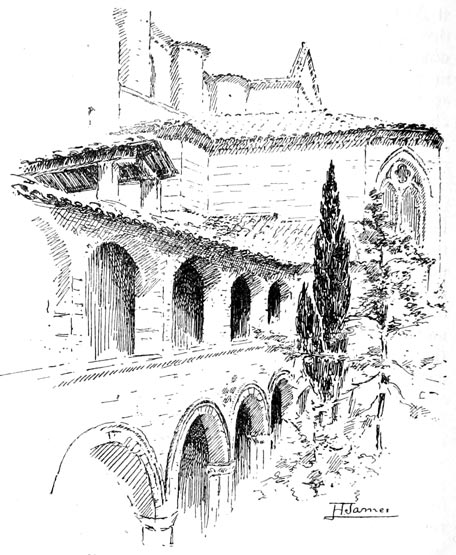
THE OLD CEMETERY OF SAN FRANCESCO
The Chapel of St. Anthony the Abbot.[80]—About 1367
two monuments were erected in this chapel over the
sepulchres of two murdered princes—Messer Ferdinando
Blasco, nephew of the Cardinal Albornoz,
and his son Garzia. Some say they met their
death at Spoleto where the father was vice-governor,
others that they were killed at Assisi close to the
convent of S. Appolinare by the citizens before they
submitted to the kindly rule of the Cardinal. The
chapel had been built by a liberal Assisan gentleman
who also left money for its decoration; but if
there were paintings (Vasari mentions some by Pace
di Fænza) nothing now remains but a rather feeble
picture by a scholar of Pinturicchio. The white
stone monuments, the white-washed walls and the
total absence of colour gives an uncared-for look to
this out-of-the way corner of the church. A much
brighter spot is the old cemetery opening out of this
chapel, which was built in the fourteenth century
with the intention of adorning it with frescoes in
imitation of the Campo Santo at Pisa. The double
cloister seen against a background of cypresses and
firs, above which rises the northern side of the Basilica,
form a pretty group of buildings, and can be better
enjoyed now than in former days, when the bones
of Assisan nobles and franciscan friars were piled
in the open galleries.
The Basilica of San Francesco became the burial
place, not only of some of the saint's immediate followers,
but also of many distinguished personages. The
large stone tomb at the end of the church is always
pointed out as that of "Ecuba," Queen of Cyprus,
who is said to have come to Assisi in 1229 to give
thanks for having been cured of an illness by the intercession
of St. Francis, when she gave the porphyry vase
full of ultramarine which is still to be seen, though
now empty of its precious contents. She is said to have
died in 1240, and to have been buried in San Francesco.
But this "Ecuba" is a mysterious person not
to be found in the history of her country, which has
led some writers to say that it is Iolanthe, the second
wife of Frederick II, who lies here. It is one of
those tombs common in the time of Giovanni Pisani,
but bearing only a faint resemblance to his masterpiece
in the Church of San Domenico in Perugia.
"On one side," says Vasari, in surprise at the novelty
of the style, "the Queen, seated upon a chair, places
her right leg over the left in a singular and modern
manner, which position for a lady is ungraceful, and
cannot be regarded as a suitable action for a royal
monument."
The tomb to the right was erected soon after 1479
in memory of Niccolò Specchi, an Assisan physician
of renown attached to the persons of Eugenius IV, and
Niccolò V.
Tomb of St. Francis.—Although it had always been
supposed that St. Francis lay beneath the high altar,
no one knew precisely the spot where Elias had hidden
him. In the last centuries many attempts were made
to find the tomb by driving galleries in every direction
into the bed of rock on which the Basilica stands;[81]
but all failed, until more energetic measures were taken
in 1818. And after fifty nights of hard work, conducted
with the greatest secrecy (it would seem as though the
spirit of Elias still presided over the workers), below
the high altar, encased in blocks of travertine taken
from the Roman wall near the temple of Minerva, and
fitted together neatly as those of an Etruscan wall, was
found the sepulchral urn of St. Francis. It was evidently
the same in which he had been laid in the
Church of San Giorgio, untouched till that day.
Round the skeleton were found various objects,
placed, perhaps, by the Assisans, who in this seem
to have followed the custom of their earliest ancestors,
as offerings to the dead. There were several silver
coins, amongst them some of Lucca of 1181 and
1208, and a Roman ring of the second century, with
the figure of Pallas holding a Victory in her right
hand engraved on a red cornelian. Five Umbrian
bishops, four cardinals, numberless priests and archæologists
visited the spot to verify the truth of the discovery,
and finally published the tidings far and wide,
which brought greater crowds than ever to Assisi, and
among them no less a personage than the Emperor
Francis I, of Austria. Donations poured in for building
a chapel beneath the Lower Church round the
saint's tomb, and in six months the work was completed
by Giuseppe Brizzi of Assisi. The citizens,
in their zeal, decorated it with marble altars and
statues, until the tradition treasured by the people of
a hidden chapel below the Basilica and rivalling it in
richness was almost realised, and they flocked down
the dark staircases with lighted torches to witness the
accomplishment of the legends weaved by their forefathers
(see p. 136). It is a most impressive sight to
attend mass here with the peasants in early morning
ere they go forth to their work in the fields. Silently
they kneel with bowed heads near the tomb, touching
it now and again through the grating with their rosaries;
the acolytes move slowly about the altar and the voices
of the priests are hushed, for here at least all feel the
solemnity of a religious rite. The candles burn dimly
with a smoky flame, the sanctuary lamps cast a flickering
red light upon the marble pavement and the walls
cut out of the living rock, and with the darkness which
seems to press around is the damp smell, reminding us
that we are indeed in the very bowels of the Assisan
mountain.
CHAPTER VII
The Sienese Masters in the Lower
Church. The Convent
... "Je donnerais pour ce caveau toutes les églises de
Rome."—H. Taine. Voyages en Italie. Pérouse et Assisi.
The Chapel of St. Martin[82]
The best masters of Tuscany having, by the beginning
of the thirteenth century, covered most of
the walls of San Francesco with choice work, it now
remained for Siena to send artists to complete their
loveliness by effigies of calmly sweet Madonnas and
saints whose gentle beauty seemed rightly fitted for
their Umbrian surroundings.
The first to come, probably very few years after
Giotto had left, was Simone Martini, "the most lovable,"
Mr Berenson calls him, "of all the artists
before the Renaissance."[83] He married Giovanna
Memmi, a Sienese, whose brother Lippo Memmi
often helped him in minor works; this may account
for the confusion between the two, and why he is so
often called by his brother-in-law's surname. One of
the artist's claims to immortality, the highest, according
to Vasari who was not partial to the Sienese, was
the praise he won from Petrarch for the portraits he
painted on more than one occasion of Madonna Laura.
Simone's talents were sung by the "love-devoted"
Tuscan poet who calls him "mio Simon," and in one
perfect sonnet tells how he must surely have been in
paradise and seen the loveliness of Madonna Laura, as
he has drawn her features with such fidelity that all on
earth must perforce acknowledge her beauty.
The Chapel of St. Martin at Assisi is filled with
such faces as Petrarch describes. It possesses, too, all
the varied colour of a garden, only a garden not inhabited
by earthly mortals, but by gentle knights and
fairy kings wearing wonderful crowns of beaten gold,
with cherubs' heads, flowers and moons upon their
surface, and women who hold their lilies with caressing
fingers. All gives way before his sense of the
beautiful, the ornate and the charming, so that he
creates a world apart of saints and angels with a feeling
of remoteness about them which is one of the most
striking features of his art. He loved all that was
joyous; he depicted no tragic scenes; his saints have
already won their crowns in heaven, his kings are conquerors,
and around a death-bed the angels sing. He
may sometimes fail as a story-teller, and his compositions
do not always give the same sense of perfection
as those of other stronger artists, but his very faults are
lovable, and all can be forgiven for the exquisite finish of
his paintings, which, in their brilliant colouring, are like a
piece of old embroidery where design and hues have
been woven in by patient fingers. "To convey his
feeling for beauty and grace and splendour," says Mr
Berenson, "Simone possessed means more than sufficient.
He was a master of colour as few have been
before him or after him. He had a feeling for line
always remarkable, and once, at least, attaining to a
degree of perfection not to be surpassed. He understood
decorative effects as a great musician understands
his instruments."[84]
It is a little difficult to find out where Simone
begins his legend of St. Martin, as he seems to
have fitted in the different scenes just where he
could, thinking, as was only right, more of the effect
of decoration than of the sequence of the story. The
two frescoes on the left wall refer to the well-known
act of charity, when St. Martin, a young Lombard
soldier serving in the army of the Emperor Constantine
in Gaul, met, on a bitter winter's day, a beggar
outside the gates of Amiens, and having nothing but
the clothes he wore divided his cloak with the poor
man. It is not one of Simone's pleasing compositions;
far better is the next where Christ appears to
the saint in a dream, wearing the cloak he had given
in charity and saying to the angels who surround
him: "Know ye who hath thus arrayed me? My
servant Martin, though yet unbaptised, hath done
this." The face of the young saint is very calm
and palely outlined against his golden aureole as
he lies asleep, clasping his throat gently with one
hand. With what patience has Simone drawn the
open-work of the sheets, the pattern on the counterpane,
the curtain about the bed; no detail has been
passed over. And who can forget his angels, the
profile of one, the thick waving hair of another, and
the grand pose of the standing figure, a little behind
Christ, whose head is poised so stately upon a well-moulded
neck.
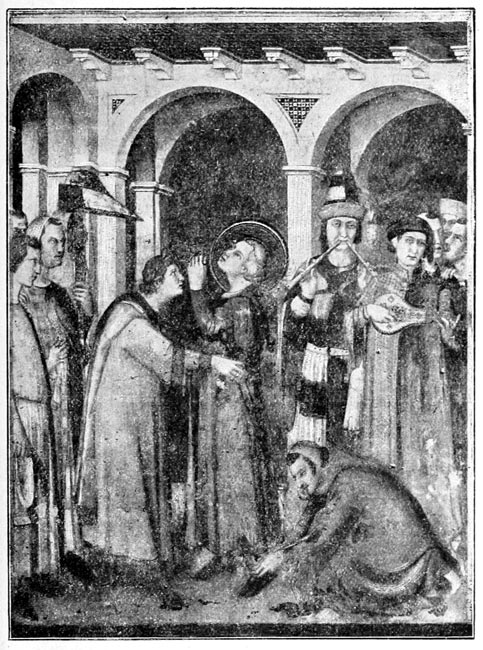
THE KNIGHTHOOD OF ST. MARTIN BY SIMONE MARTINI
(D. Anderson—photo)]
Exactly opposite are two scenes belonging to the
early times of the saint's life when he was yet a
soldier. In one the Emperor Constantine is giving
him his sword, while an attendant buckles on the
spurs of knighthood; here also, as in most of the
frescoes, we pick out single figures to dwell on, such
as the youth with a falcon on his wrist, whose profile
is clearly outlined yet tender, with that pale red-golden
tinge over the face by which Simone always
charms us. Remarkable for grace and motion is the
man playing on the mandoline, with a sad dreamy
face, who seems to sway to the sounds of his own
music; whilst almost comic is the player on the double
pipes, with his curious headgear and tartan cloak.
The next scene is divided by a rocky ridge, behind
which is seen the army of the Gauls, who, by the way,
have Assisan lions on their shields. St. Martin, after
refusing to accept his share of the donations to the
soldiers, declares his intention of leaving the army to
become a priest, and when accused of cowardice by
the Emperor, he offers to go forth and meet the enemy
without sword or shield. Simone pictures him as he
steps forth upon the perilous enterprise, holding the
cross and pointing to the sky, as he refuses the helmet
held out to him by the Emperor. Next day, says the
legend, the Gauls laid down their arms, having submitted
to the word of St. Martin who was then
allowed to quit the world for the religious life.
On the opposite wall, above the apparition of Christ
with the cloak, we see St. Martin no longer in soldier's
garb, but as the holy Bishop of Tours. The saint has
fallen into a reverie whilst saying mass, and in vain a
priest tries to rouse him by laying a hand upon his
shoulder for his eyes remain closed, and the kneeling
priest waits patiently with the book of the Gospels
upon his knee. Simone never surpassed the dignity,
the religious feeling, the quiet repose and ease expressed
in the figure of St. Martin; while he has kept the
scene as simple as one of Giotto's frescoes, thus
making it the most perfect among these compositions.
To the left is a much ruined picture of the restoration
of a child to life through the prayers of the saint, who
was preaching at Chartres. Among a crowd of people
one figure, with a Florentine headgear such as Andrea
del Castagno paints, stands clearly out; below a small
child can be discerned stretching out little hands towards
the kneeling bishop.
Above this again, almost too high to be clearly seen,
is the death of St. Hilary of Poitiers, at which St.
Martin assisted. One of the mourners has a mantle of
turquoise blue, a beautiful piece of colour like the sky
seen through the arches of the Gothic windows.
On the other wall, over the fresco where St. Martin
receives knighthood, is recorded the legend of how
"as he went to the church on a certain day, meeting
a poor man naked, he gave him his inner robe, and
covered himself as he best might with his cope. And
the archdeacon, indignant, offering him a short and
narrow vestment, he received it humbly, and went up
to celebrate mass. And a globe of fire appeared above
his head, and when he elevated the host, his arms being
exposed by the shortness of the sleeves, they were
miraculously covered with chains of gold and silver,
suspended on them by angels."[85]
The next picture, which is very ruined, represents
the visit of St. Martin to the Emperor Valentinian,
who, because he had rudely kept his seat in his presence,
suddenly found it to be on fire, and, as the
legend says, "he burnt that part of his body upon
which he sat, whereupon, being compelled to rise,
contrite and ashamed, he embraced Martin, and granted
all that he required of him."
Above this is the death of St. Martin, with a graceful
flight of angels hovering over the bier singing as
they prepare to carry his soul to heaven. Very fine is
the fresco in the lunette of the entrance, where Cardinal
Gentile, in his franciscan habit, is kneeling before the
saint who bends forward to raise him from so humble
a position. But in the single figures of saints, in the
arch of this chapel, standing like guardian deities within
their Gothic niches, Simone rivals greater artists in
grace and strange beauty. In honour of the franciscan
donor the chief franciscan saints are depicted beside
two others of universal fame. St. Francis and St.
Anthony of Padua, and below them St. Catherine of
Alexandria and St. Mary Magdalen; on the other
side, St. Louis, King of France and St. Louis, Bishop
of Toulouse, and below them St. Clare and St. Elisabeth
of Hungary. Nowhere has St. Clare received
so true an interpretation of her gentle saintliness as in
this painting by Simone, and he has surpassed his other
works in the exquisite drawing of the hand which
holds her habit to one side. It would seem as though
in these saints he had attained the limits of his power
of expressing types of pure beauty, were it not for the
half figures in the embrasures of the window of such
finish and subtle charm as to haunt us like some strain
of long remembered music. There is a bishop in a
cope of creamy white with gold embroidery, a hermit
with a long brown beard, and saints who calmly pray
with clasped hands. The broad white band of pale
shadowed fur is low enough to show the graceful line
of the neck of the young saint in the left hand window,
his hair tinged with pale red and his face so fair as to
seem a shadow upon the wall, coming and going in the
play of light.
So enthralling is the study of the frescoes that it is
possible to leave the chapel without noticing the stained-glass
windows, perhaps the loveliest in the church
where all are lovely. They seem to belong to the
same epoch as the paintings, and in one or two instances
a figure may have been inspired by them, such
as the angels with sword and shield who resemble
Simone's angels in the upper part of the fresco of
St. Martin's death. Cardinal Gentile was in all probability
the donor of these as well as of the chapel, for
he is represented in the central window kneeling before
St. Martin, who is in full episcopals. These windows
are dazzling; there are warriors in red and green,
saints standing against circles of cream-tinted leaves,
St. Jerome in magenta-coloured vestments harmonising
strangely with the crimson of his cardinal's hat; and
St. Anthony of Padua in violet shaded with paler
lights as on the petals of a Florentine iris. A saint
in white is placed against a scarlet background, another
in pale china blue against a sky of deep Madonna blue,
and all these colours lie side by side like masses of
jewels of every shade.
On leaving we find to the left of the papal throne a
small chapel ornamented only by a window which has
an apostle standing in a plain Gothic niche, the ruby
red and tawny yellow of his mantle making a brilliant
patch of colour in this dark corner of the church.
The head is modern, but the figure, the circular pattern
beneath, and the right half of the window with five
medallions, are, according to Herr Thode, the oldest
pieces of coloured glass in the lower church.
Just above the papal throne is a handsomely
worked ambo in red marble and mosaic, forming a
kind of pulpit from which many illustrious people
have preached, among them St. Bonaventure and St.
Bernardine of Siena. In the recess a Florentine
artist of the fourteenth century has painted the
Coronation of the Virgin, a fresco worthy of its
beautiful setting; and there is a crucifixion and
scenes from the martyrdom of St. Stanislaus of Poland
by a follower of Pietro Lorenzetti, pupil of Simone
Martini. St. Stanislaus was canonised in 1253 when
Innocent IV, came to consecrate the Basilica, and
upon this occasion a miracle took place which redounds
to the honour of the saint. While Cardinal
de Conti (afterwards Alexander IV,) was preaching,
one of the capitals of a pillar above the pulpit fell
upon the head of a woman in the congregation, and
thinking she was dead, as she had sunk down without
a groan, her neighbours covered her over with a
cloak "so as not to disturb the solemnity of the
occasion." But to their amazement when the sermon
ended the woman rose up and gave thanks to St.
Stanislaus, for the blow, far from doing her harm,
had cured her of headaches to which she had been
subject. The legend would long since have been
forgotten, were it not that the capital which fell on
that memorable day is still suspended by chains in
the opposite corner of the nave, and often puzzles the
visitor who does not know its history.
Below the pulpit is a slab of red marble let into
the wall with these simple words inscribed: "Hic
jacet Jacoba sancta nobilisque romana," by which the
Assisans commemorated the burial place of Madonna
Giacoma da Settesoli the friend of St. Francis, who
after his death lived at Assisi and followed the rule
of the Third order until she died in 1239 (see p. 114).
Left Transept.—To Pietro Lorenzetti was given
the work of decorating these walls with scenes
from the Passion, and so far as completing the rich
colour of the church be succeeded. But when studied
as separate compositions they betray the weakness of
an artist who, as Mr. Berenson remarks, "carries
Duccio's themes to the utmost pitch of frantic
feeling." Great prominence is given to the subject
of the crucifixion where the vehement actions of the
figures rather than the nobility of the types are pre-eminent.
It may be of interest to some that the
man on the white horse is said to be Gualtieri, Duke
of Athens, the tyrant of Florence, whose arms Vasari
says he discovered in the fresco which he describes
as the work of Pietro Cavallini.
A curious composition is that on the opposite wall
where the disciples sit in awkward attitudes and the
servants in the kitchen are seen cleaning the dishes
while a dog hastily licks up the scraps. It would
be difficult to know this represented a religious scene
were it not for the large aureoles of the apostles.
Nor has Pietro succeeded in giving solemnity to the
scene of the Stigmata, where the strained position
of St. Francis and the agitated movement of the
Seraph partake of the general characteristics of these
frescoes. But in his Madonna, St. Francis and St. John
the Evangelist, below the crucifixion, Pietro Lorenzetti
gives his very best and their faces we remember
together with the saints of Simone Martini. Referring
to this fresco M. Berenson says: "At Assisi,
in a fresco by Pietro, of such relief and such enamel
as to seem contrived of ivory and gold rather than
painted, the Madonna holds back heart-broken tears
as she looks fixedly at her child, who, Babe though
he is, addresses her earnestly; but she remains unconsoled."[86]
Chapel of S. Giovanni Battista.[87]—Another lovely
work by Pietro Lorenzetti is the triptych over the
altar, the Madonna, St. Francis and St. John the
Baptist, but here the action of the child leaning towards
the Virgin and holding the end of her veil,
is more caressing and suggestive of babyhood. Above
are small heads of angels like those Pietro places in
medallions round the frescoes in the south transept.
This, and the panel picture over the altar in the
opposite chapel, complete the works of the Sienese
school in Assisi. The Umbrian school is represented
by a large and unsympathetic picture by Lo Spagna
(dated 1526), which is however considered by local
admirers of the painter to be his masterpiece. It
is a relief to turn from his yellow-eyed saints and
hard colouring to the windows of this chapel which
are remarkable for their harmony and depth of tone.[88]
The figures of the central window date from the
second half of the thirteenth century, those of the
left window are at least two centuries later.
The Sacristies.—These open out of St. Giovanni's
Chapel. Both are ornamented with handsomely carved
cupboards of the sixteenth century where the friars
store their vestments and costly lace, and which once
were full of gold and silver vessels amassed during
many centuries. But often during mediæval times
of warfare the friars had to stand aside and see the
sacristies sacked by the Perugians, or even the Assisans,
when they must have envied the peace of
mind of the first franciscans who, possessing nothing,
could have no fear of robbers.[89]
Devoted as the citizens were to the memory of
St. Francis they do not seem to have hesitated, when
in want of money, to help themselves liberally to
the things in his church. At one time when the
Baglioni were besieging Assisi, her despot Jacopo
Fiumi gathered the citizens about him, and in an
eloquent harangue called upon them to rob the church
at once before the enemy had entered the gates, lest
the treasure should fall into the hands of the Perugians.
So the sacristies were rifled, and with the
proceeds Jacopo Fiumi rebuilt the walls and the
palaces which had fallen to ruin during the incessant
fighting of past years. The next plunderers were
the soldiers of Napoleon, and it is a marvel that so
many things still remain. A cupboard in the inner
sacristy contains a beautiful cross of rock-crystal ornamented
with miniatures in blue enamel brought by
St. Bonaventure as a gift from St. Louis of France;
there is also the second rule of St. Francis which
was sanctioned by Honorius III. Even more precious
is a small and crumpled piece of parchment, with a
blessing written in the big child-like writing of St.
Francis, which he gave to Brother Leo at La Vernia
after he had received the Stigmata. On one side he
wrote part of the Laudes Creatoris, upon the other the
biblical blessing:
"Benedicat tibi Dominus et custodiat te:
Ostendat faciem suam tibi et misereatur tui:
Convertat vultum suam ad te et de tibi pacem":
and then below:
"Dominus benedicat te, Frate Leo."
Instead of the Latin, the saint signs with the Thau
cross, which is of the shape of the mediæval gallows,
and may have been yet another way of showing his
humility by humbling himself even to the level of
malefactors. Many pages have been written about
this relic; the line by Brother Leo in explanation
below the signature of St. Francis:
"Simili modo fecit istud signum Thau cum capite manu sua,"
has puzzled many people, but in a pamphlet by Mr
Montgomery Carmichael[90] it has received a plausible
translation. He thinks that cum capite refers to the
small knob at the top of the Thau, by which St.
Francis meant to represent a malefactor's head; the
line would read thus: "in like manner with his own
hand he made a cross with a head," and not "with
his own head," as some believe. Mr Carmichael
thinks the curious mound out of which the cross
rises is a rough drawing of La Vernia. Above the
benediction, in neatly formed letters, Brother Leo has
written a short account of the sojourn at the Sacred
Mount and of the Vision of the Seraph. This relic
has been mentioned in the archives of the convent
since 1348, and is always carried in procession at
the commencement of the feast of the "Perdono" on
July 31st.
Almost more honoured by the faithful is the "Sacred
Veil of the most Holy Virgin," which can only be exposed
to the public in the presence of the Bishop of
Assisi, and is shown in times of pilgrimage when the
sacristy and church are full of men and women waiting
for their turn to kiss the holy relic.
The picture over the door, painted by Giunta
Pisano (?) is always pointed out as a portrait of St.
Francis, but as the painter's first visit to Assisi was
in 1230 he can only have seen the body of the
saint borne to its last resting-place in the Basilica,
and even that is doubtful when we remember with
what secrecy the burial was performed. Here the
face is pointed and emaciated, with a curious look
in the eyes as though Giunta had desired to record
his blindness. The figure is surrounded by small
scenes from the miracles of St. Francis, performed
during his lifetime and at his tomb in San Giorgio.
But though in the so-called portraits of the saint,
the artists think more of representing him as the
symbol of asceticism and sanctity than of aiming at
giving a true likeness, both this picture and a fresco
painted in 1216 at Subiaco when the saint stayed
there on his way to Spain, are not very dissimilar
from the graphic description left us by Celano. He
tells us that St. Francis "was rather below the middle
stature with a small round head and a long pinched
face, a full but narrow forehead and candid black
eyes of medium size, his hair likewise was black;
the brows were straight, the nose well-proportioned,
thin and straight, the ears erect but small, and the
temples flat; his speech was kindly, yet ardent and
incisive; his voice powerful, sweet, clear and sonorous;
his teeth were regular, white and set close; his
lips thin and mobile, his beard was black and scant,
his neck thin, his shoulders square; the arms were
short, the hands small with long fingers and almond-shaped
nails, his legs were thin, his feet small, his skin
delicate, and he was very thin...."
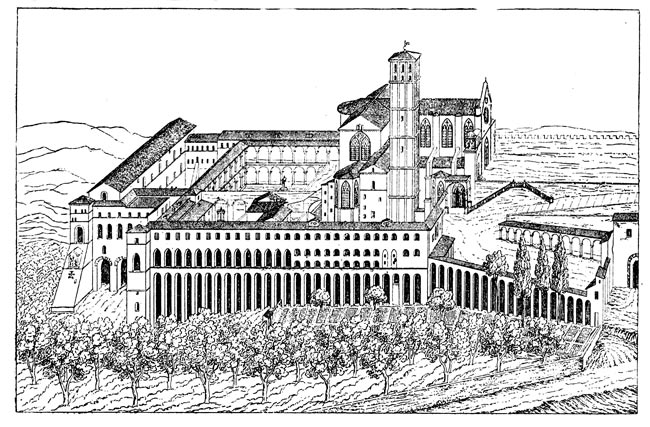
BIRD'S EYE VIEW OF THE BASILICA AND CONVENT OF SAN FRANCESCO, FROM A DRAWING MADE IN 1820
Right Transept.[91]—On the walls between the Chapels
of the Sacramento and of St. Maria Maddalena, Simone
Martini has left some of his loveliest work in the half
figures of franciscan saints he places near the Madonna.
These are St. Francis, St. Louis of Toulouse, St.
Elizabeth of Hungary, St. Clare clothed in the habit
of her order, always to be recognised when painted
by Simone by her heavy plaits of hair, St. Anthony
of Padua with the lily, St. Louis of France with a
crown of fleur-de-lis, and upon the right of the
Virgin, a noble saint who may be Helen the mother
of King Louis, as she too holds a sceptre with the
lily of France on the top. Never had saints so
majestic a queen as Simone's Madonna. The subdued
greens and tawny reds of their mantles and
their auburn hair look most beautiful against the gold
ground which shines with dull light about them.
Each of their aureoles bears a different pattern in
raised gesso; a garland of flowers, a circle of human
heads, suns, a tracery of roses and ivy, or yet again
another of oak leaves. After Giotto's Allegories and
the frescoes in San Martino, these saints are by far the
loveliest things in San Francesco, and as they look
towards us, ethereal, like a faint moon on a misty
night, they seem the very incarnation of mediæval
faith. Dante created women such as Matilda, who
sings to him in Purgatory as she is picking flowers on
a woodland river's edge, and Simone paints them and
conveys their spirit in the faces of St. Clare and St.
Elizabeth.
The Convent
It is natural to think that the Basilica and Convent
built under the guidance of Elias was as we see it
now in its full magnificence of chapels, porch, colonnades
and cloisters. Certainly the essential form of the
building has not been altered, but in the early days it
stood isolated from the town, surrounded by such rocks
as jut out among the grass in the ravine outside Porta
S. Pietro, and approached by a drawbridge which
made it resemble, even more than it does now, a
feudal stronghold guarding the Umbrian valley. Later
on, as the life of the place centred ever more round
the church of the saint, the citizens no longer built
their houses near San Rufino or below the castle, but
close to San Francesco, until a second town sprang
up where once were only rough mountain pastures.
It is still possible to form an idea of how it looked by
following round the base of the hill by the Tescio,
whence a wonderful and unique view of the northern
side of church and convent is obtained (see
Appendix). Assisi lies hidden, and standing high
above us, shutting out the view of the valley, is San
Francesco; not the building with great arches we are
familiar with, rising high above the vineyards, but a
castle, seen clearly defined and strong against the sky,
whose bastions clasp the hill top as powerfully as a
good rider bestrides his horse. Oak copses cover the
slopes from the convent wall straight down to the
banks of the Tescio, where little mills are set above
deep pools of emerald green water and narrow canals
fringed by poplar trees. The minute detail of the
landscape in this deep ravine gives a curious feeling
that we are walking in the background of one of Pier
della Francesca's pictures—even to the distant view
of low-lying hills where the torrent makes the sudden
bend round the mountain edge; and the contrast is
strange between it and the fortress-church upon the
dark hill, where deep shadows lie across it and
lurk within the crannies of its traceries in the bay
windows of the chapels and in the depths of
jutting stones. Such was the massive building
"Jacopo" planned to stand upon the mountain ridge,
as much a part of the rocks and the red earth as the
cypresses which crown the summit. And in the midst,
but on the southern side, he placed, as if to balance the
rest, a square and boldly conceived bell-tower rising
high above the church.[92] At the time it was the wonder
of the Assisans, who boasted that for beauty as well as
for solidity it could be counted among the first, not in
Italy only, but in Europe. Bartolomeo of Pisa, came
to cast one of the big bells, and together with his
own name he inscribed those of Elias, Gregory IX,
and Frederick II. On another bell, which has been
recast, was graven a delightful couplet informing the
faithful of the many services which consecrated bronze
could render to the country round.
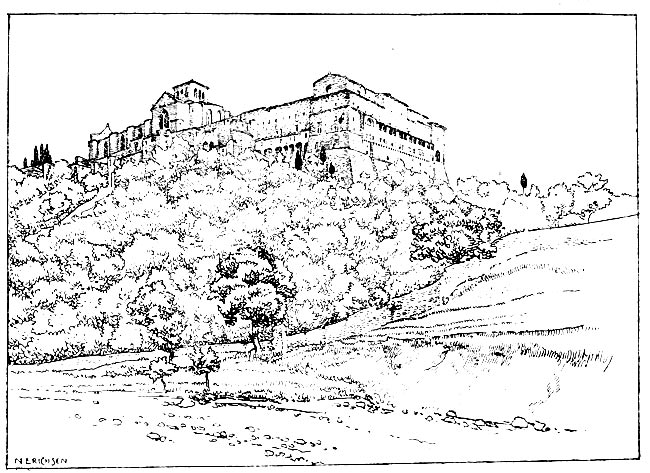
SAN FRANCESCO FROM THE TESCIO
"Sabbatha pango, funera plango, fulgura frango:
Excito lentos, domo cruentos, dissipo ventos."
("I ring in Sunday, I lament for the dead, the lightning I break,
I hurry the sluggards, I vanquish the wicked, the winds I disperse.")
To the time of Elias also belongs the fine entrance
to the Upper Church, where the Guelph lion and the
eagle of Frederick II, record the liberality of both
parties towards the building of the church, while the
four animals round the wheel window seem to show
that "Jacopo," notwithstanding his marked love for
pure Gothic architecture, could not quite forget the
strange but fascinating beasts of Lombard façades.
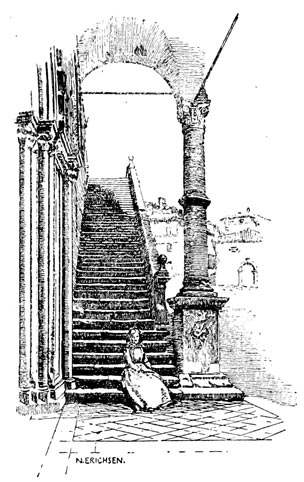
STAIRCASE LEADING FROM THE UPPER TO THE
LOWER PIAZZA OF SAN FRANCESCO
One friar in the fifteenth century inherited some of
the enthusiasm of Elias for the basilica; this was
Francesco Nani, the General of the franciscans,
known as Francesco Sansone because his patron,
Sixtus IV, is said to have addressed him with these
words in allusion to his energy and strength of character,
"Tu es fortissimus Samson." His name is
found upon the beautiful stalls of the Upper Church,
and it was he who superintended the laying out of the
upper piazza, connected with the lower one by a long
flight of stairs. It may also have been at this time
that the loggie of San
Francesco were built for
the purpose of erecting
booths during the festival
of the "Pardon of St.
Francis." Certainly it
was chiefly at his expense
that Baccio Pintelli
(1478) built the handsome
entrance door and
porch to the Lower
Church, which in olden
times was entered by a
small door close to the
campanile. The architect
fitted his work admirably
into a corner of the
building, completing with
clustered columns of pink
marble, wheel window,
trefoiled arches and stone
traceries, the scheme of
colour and the perfect
proportions for which San
Francesco is so remarkable.
The doors of carved wood, darkened now
and of such massive workmanship as to resemble
bronze, were made in 1546 by Niccolò da Gubbio,
who has carefully commemorated the legend of St.
Francis and the wolf of Gubbio in one of the
panels to the left. Sansone also commissioned the
doorway of what is now the entrance to the friars'
convent a year after the porch was finished, then it
was only a small chapel, built by the members of the
Third order when St. Bernardine of Siena revived
the religious enthusiasm of the people. The Assisan
artist placed a bas-relief of the saint in the arch
above the door, and it is still called "la porta di
San Bernardino."
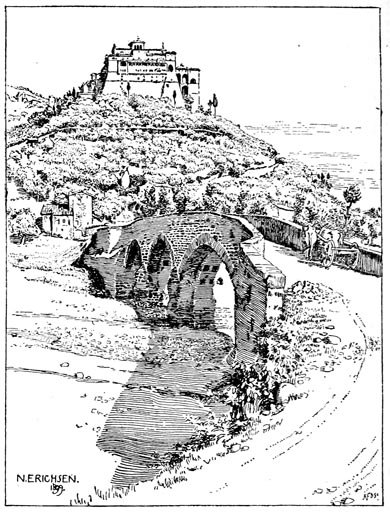
SAN FRANCESCO FROM THE PONTE S. VITTORINO
None should leave Assisi, not even those who only
hurry over for the day, without visiting the convent,
which recalls an eastern building from the whiteness of
its great vaulted rooms, long corridors and arcaded courtyards
when seen against the bluest of summer skies.[93]
Then from the cool and spacious convent, a place to
linger in upon a hot day in August, we step out into
the open colonnade which skirts the building to the
south, makes a sharp turn west, and then juts out at
the end, facing south again. This last portion was
added by Cardinal Albornoz in 1368, and goes by
the name of the Calcio. But two centuries later the
foundations were found to be insecure, and Sixtus IV,
strengthened it by a bastion, which looks solid enough
to resist even the havoc of an earthquake. The Pope
was a great benefactor of the convent, and the friars
placed his statue in a niche in the bastion, where he
sits, his hand raised in benediction, on a papal throne
overlooking the valley. From the rounded arches of
rough stone, turned by storm and sunshine to russet-red,
pink and yellow, we look out upon one of the
most beautiful and extensive views in Umbria. To the
right is Perugia standing out almost aggressively on
the hill top; opposite, on a separate spur which divides
the valley of Spoleto from that of the Tiber, Bettona
and Montefalco hang upon peaks like the nests of birds
in trees, and beyond are Spoleto, Trevi and Narni,
nearer again Spello, and the domes of Foligno in the
plain, with a host of small villages near. All the
Umbrian world lies before us from the convent of San
Francesco.
Many weary people besides the popes came to rest
here in early times, and one mediæval warrior, Count
Guido of Montefeltro, the great leader of the Ghibellines,
laid down his arms and left his castle at Urbino
in the year 1296, to pass his last days as a friar doing
penance within the peaceful shelter of San Francesco
for a long life of intrigue and bloodshed. He prayed
by day, for at night they say he stood gazing out of
his window, one of those we see above the walled
orchard of the monks, watching the stars and attempting
to divine the mysteries and destinies he read there,
exceeding even the superstition of the age by his faith
in the laws of astrology. But his meditations and
careful preparation for a holy death were suddenly disturbed,
and he found himself once more plunged into
the whirl of Italian politics and intrigue. War raged
between Pope Boniface VIII, a Gaetani, and the
powerful family of the Colonna who braved his excommunications,
and, when their Roman palaces were
burnt, fled to their strongholds in the country. Many
of these fell into the hands of the papal troops, but
Penestrino, their principal fief, resisted all attacks and
the Pope was nearly defeated when, remembering the
old soldier Count Guido known to be "more cunning
than any Italian of his time, masterly alike in war and
in diplomacy," he hastened to ask his counsel. The
story is recounted by Dante, who could not forgive the
Ghibelline chieftain for coming to the assistance of the
Pope.
Boniface, seeking to silence the scruples of the friar,
promised to absolve him from all sin, even before committal,
if only he would tell him how to act so "that
Penestrino cumber earth no more." Guido, whose
subtlety had not deserted him in the cloister, gave an
answer which, while it ensured success to the papal
arms, stamped him as a man of such deceit and treachery
that Dante placed him in the eighth gulf of hell, among
the evil counsellors eternally surrounded by flaming
tongues of fire.
"Then, yielding to the forced arguments,
Of silence as more perilous I deem'd,
And answer'd: 'Father! since thou washest me
'Clear of that guilt wherein I now must fall,
'Large promise with performance scant, be sure
'Shall make thee triumph in thy lofty seat.'"[94]
Besides Count Guido and the popes who, finding
the large and airy rooms of the convent a convenient
summer resort, were constant visitors at Assisi, it
can show a fine list of royal visitors. Among them
is the Queen of Sweden who, in 1655, came escorted
by Papal Nuncios, foreign ambassadors and cavalry,
to pray at the tomb of St. Francis. The Assisans
sent out their best carriages with horses ridden by
postillions to meet her, adorned their palaces with
flags and damask hangings, and rang all the bells
as she approached the Basilica. "The Queen is
called Christina," a chronicler tells us; "she is aged
twenty-nine, is very learned, being able to write in
eleven languages; she is small but very comely....
One hundred and fifty beds were prepared in the
convent and beautiful it was to see the numerous suite
and the pages of the nobles."
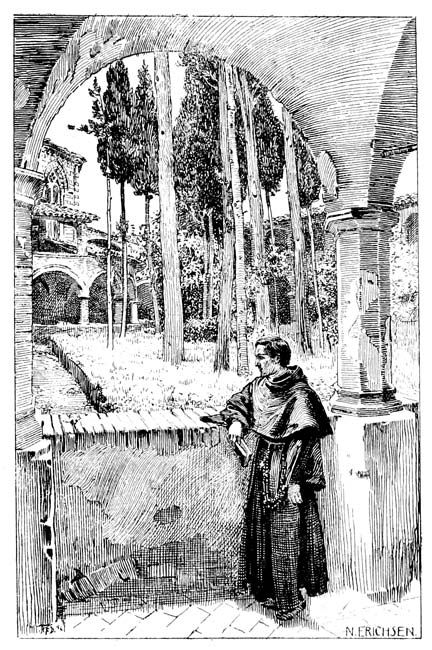
A FRIAR OF THE MINOR CONVENTUAL ORDER OF ST. FRANCIS
It strikes the visitor to Assisi as strange that the
black-robed friars in charge of the Basilica are so
unlike the franciscans with whom everyone is
familiar, and it may be well to give a few facts
relating to the many divisions in the Order which,
as we have seen, began already to change in the time
of Elias. In 1517 a portion of the brethren, desiring
a mitigation of their rule, obtained from Leo X,
a dispensation and received the title of Friars Minor
Conventuals with the permission to choose their own
Minister General. Their dress is shown in the
illustration. Those who kept to the rule more nearly
approaching to that of St. Francis, like those of
Sta. Maria degli Angeli, the Carceri and San
Damiano, were called Friars Minor of the Observance,
or Observants, and take precedence over the
others, enjoying the privilege of electing the "Minister
General of the whole order of the Friars Minor
and successor of St. Francis." In 1528, Matteo
Baschi, an observant, instituted a new branch called
the Capucins, because of their long pointed capuce,
whom he inspired with the desire to lead a hermit's
life in solitary places, preaching to the people but once
in the year. They have deserted their hermitages
and are a very popular order in Italy, devoting themselves
especially to preaching and hearing confessions,
and form quite a distinct family from the rest. The
Basilica at Assisi no longer belongs to the Conventuals,
as after the union of Italy it was declared to be
a national monument. The Government also took
possession of the convent as a school for boys,
leaving only a small portion for the reduced number of
friars to inhabit. They went to law, and the judge
pronounced the convent to be the property of the
Holy See which had never ceased to exercise jurisdiction
over it; but a proviso was made that the
school was to remain in its present quarters until the
Pope or the franciscans should erect a suitable
building for it in another part of the town. As
much money is required for so large an edifice and
sites are not so easily procured, it seems probable that
for many years the sound of boys at play will be
heard in the convent walls instead of the slow footsteps
of silent friars.
CHAPTER VIII
Giotto's Legend of St. Francis in the
Upper Church
"What, therefore, Giotto gave to art was, before all
things, vitality."—J. A. Symonds. Renaissance in Italy.
Giotto in the Lower Church had felt his way
towards the full expression of his genius; succeeding
so well in the four Allegories that he was chosen
to illustrate the life of St. Francis, withheld, as we
have seen, from all former artists, while Cimabue was
to hear the poet's praise of his pupil, "Ora ha Giotto
il grido." The task undertaken by the young painter,
already a master at twenty-five, was almost superhuman,
and certainly unique in the career of any artist;
for whereas the pictorial treatment of the New Testament
had been attempted by many during several
centuries, Giotto was destined to invent forms for the
whole franciscan cycle with such perfection that no
succeeding artist has varied his formula. It remains a
wonderful achievement, and the noble manner of its
accomplishment proved him to be, as Mr Roger Fry
expresses it, "the supreme epic painter of the world."
If St. Francis was fortunate in having his life related
by so admirable a story-teller, Giotto also owed something
to the early chroniclers who seeing, perhaps unconsciously,
the extraordinary poetry and the dramatic
incidents in the saint's career, had faithfully recorded
them in simple and beautiful language. So far the
work was ready for Giotto, even the exact scenes were
chosen for him to illustrate, but the problem how to
unfold and make them familiar to the faithful by simple
means, and yet not to lose the dignity and charm of
the theme, remained for him to solve; and the representation,
by a few figures, of a whole dramatic incident
in so vivid a manner could only have succeeded in the
hands of a great master of the fourteenth century. It
is nearly certain that Giotto used St. Bonaventure's
Life of St. Francis, finished in 1263 and founded,
with but few additions, upon The Three Companions
and Celano's first and second Life of St.
Francis. Though written with a certain charm of
style and though it lacks the ring of those early
pages, in which St. Francis becomes known to us in
such a way that we forget he lived seven hundred years
ago; and although the various incidents of his life are
presented like so many beautiful pictures, there is the
feeling always that St. Bonaventure was writing about
a saint already honoured upon earth and in heaven,
and not of the man whom all loved as the "Poverello
d'Assisi." But this legend served Giotto's purpose;
and a knowledge of the words he followed being necessary
in order to see where he simply kept to the
franciscan legend, and where he penetrated the true
spirit of the saint's life and its dramatic interest, we
quote from it at some length, although many of the
main facts have already been treated of in a preceding
chapter.[95]
1. St. Francis honoured by the Simpleton.—(We begin
on the right wall by the High Altar, and follow straight
on to the opposite side, the legend unfolding as in the
pages of a book.)
"A certain man of great simplicity dwelt in those days
in Assisi, who, by virtue of knowledge divinely infused,
whenever he met Francis in the street, would take off his
mantle, and spread it upon the ground before him, declaring
that he did so because he was a man worthy of all honour
and reverence, who should shortly perform great works and
marvellous deeds...."[96]
The bare facts are here narrated which Giotto does
not alter, but he puts such life into the scene that we
feel he might have been present when the simpleton cast
himself at Francis' feet and astonished the Assisans by
his words. Attention is fixed upon the six people in
the foreground. Two worthy citizens have just arrived
in time to see the cloak being spread on the ground before
Francis, and to hear the prophetic words; and as
they turn to each other, one pointing to the scene, the
other raising his hand with a movement of surprise, we
seem to hear their carping criticisms upon the brilliant
youth who, although he spent his time in singing and
carousals, was one day to bring renown to their city.
The young Francis, ever heedless of worldly comment,
is stepping lightly on to the cloak, with a movement of
surprise that he should receive such honour. All have
the Florentine headgear, but the head of St. Francis is
covered by a small white cap fitting close behind the ears,
just showing his hair in front, and we feel that Giotto
would have left him so, but the franciscans, ever to and fro
in the church to see that the story was painted as they
liked, insisted upon an aureole being added. As much
glory for St. Francis they cried, as gold and money
can give him. So Giotto, who disliked unnecessary
decorations, was made to put an aureole above the white
cap, larger than any we have ever seen. But take away
the halo and we should yet know which of the figures
is the saint, for he stands a little apart from his two
noble friends with ermine lined cloaks who talk with
hands clasped together, and is perhaps already wondering
about the destiny which awaits him and of which
he was unaware, "for as yet he understood not the
great purposes of God towards him."
Besides the human interest of the frescoes it is a
delightful task to study the architecture in each scene,
for here, in the Upper Church, Giotto has built a whole
city of little pink houses with balconies, towers and
turrets, of exquisite Gothic basilicas, of temples and
gabled thrones. His priests sit within palaces full of
lancet windows and pointed arches, the groined roofs,
as in the Assisan Church, ablaze with myriads of stars.
What love he had for dainty ornaments, simple, nay
almost severe in outline, but perfectly finished; and he
always likes to show the blue sky overhead, or at
least peeping through one of the windows, making the
marble seem more lustrous and creamy white. Would
that all Florence had been built by him.
2. St. Francis giving his cloak to a poor Knight.
"Going forth one day, as was his wont, in apparel suited to
his state, he met a certain soldier of honour and courage, but
poor and vilely clad; of whose poverty, feeling a tender and
sorrowful compassion, he took off his new clothes and gave
them to the poor man-at-arms."
None are there to witness the kind action of the
young saint who, like another St. Martin, has dismounted
to give his mantle to the poor man in a ravine
near a little town enclosed by walls, a church spire
rising upon the opposite hill. Giotto must have been
thinking of the small rock-set towns, with stunted
trees growing outside their walls, in his Tuscan
home in the Mugello when he painted this, instead
of the Umbrian town, standing amid vineyards and
cornfields above an open valley with winding rivers,
whose church he was decorating. It is the only
one of the series in which the landscape is an important
part of the picture, in the others it is a mere
accessory.
3. The Vision of St. Francis.
"On the following night, when he was asleep, the divine
mercy showed him a spacious and beautiful palace filled with
arms and military ensigns, all marked with the Cross of Christ
to make known to him that his charitable deed done to the
poor soldier for the love of the great King of heaven should
receive an unspeakable reward."
It will be remembered that after this dream St.
Francis started to join the army of Walter de
Brienne, having wrongly interpreted the vision, which
in reality symbolised the army he was eventually to
lead in the service of the Pope (see p. 44). This
is, perhaps, the least successful of the frescoes; probably
the subject did not appeal strongly to the
painter (he only seems to have enjoyed inventing
the colonnaded palace with its trefoil windows) and
also, as Mr Ruskin explains: "Giotto never succeeded,
to the end of his days, in representing a figure
lying down, and at ease. It is one of the most
curious points in all his character. Just the thing
which he could study from nature without the smallest
hindrance, is the thing he never can paint; while
subtleties of form and gesture, which depend absolutely
on their momentariness, and actions in which
no model can stay an instant, he seizes with infallible
accuracy."[97]
4. St. Francis praying before the Crucifix in San
Damiano.
"As he lay prostrate before a crucifix he was filled with
great spiritual consolation, and gazing with tearful eyes upon
the holy cross of the Lord, he heard with his bodily ears a
voice from the crucifix, which said thrice to him: 'Francis,
go and build up My house, which as thou seest, is falling into
ruin.'"
Unfortunately this fresco is much faded and in
parts peeled off; this, combined with the representation
of a ruined church, gives a curious effect of
total destruction, as if an earthquake had passed over
the land. The figure of the saint, just visible, and
his attitude of earnest prayer is very charming.
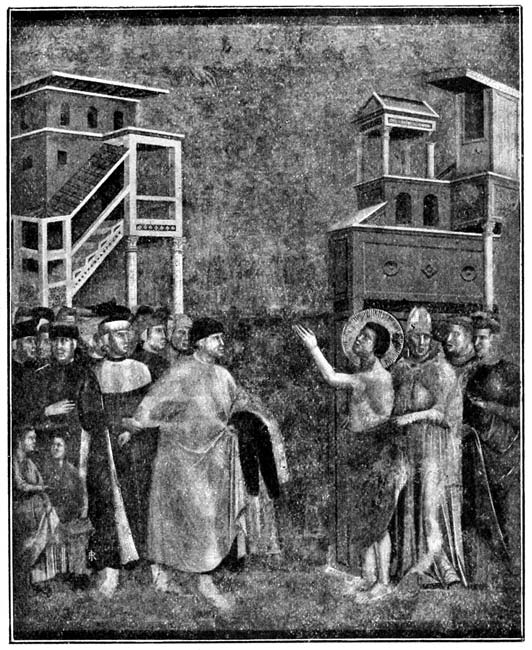
ST. FRANCIS RENOUNCES THE WORLD
(D. Anderson—photo)
5. St. Francis renounces the world.
"And now his father, ... brought this son, ... before
the Bishop of Assisi to compel him to renounce in his hands
all his inheritance.... As soon, therefore, as he came into
the Bishop's presence, without a moment's delay, neither
waiting for his father's demand nor uttering a word himself,
he laid aside all his clothes, and gave them back to his
father.... With marvellous fervour he then turned to
his father, and spoke thus to him in the presence of all:
'Until this hour I have called thee my father on earth; from
henceforth, I may say confidently, my Father Who art in
heaven.'"
This, perhaps the most interesting of Giotto's
frescoes, can be compared with the one in Sta. Croce
at Florence on the same subject, painted when time
and labour had given greater strength to his genius.
The Assisan scene is treated with more simplicity,
and, if less perfect as a decorative scheme, possesses
quite as much dramatic interest and vitality. A little
block of pink houses on either side reminds us that
we are outside the Bishop's palace in the Piazza S.
Maria Maggiore, where the scene is said to have
occurred. Of course all the Assisans have turned
out to see how the quarrel between Bernardone and
his son will end. They stand behind the irate father
like a Greek chorus, while one, evidently a citizen
of distinction from his ermine lined cloak and tippet,
restrains Messer Pietro, who is throwing back his arm
with the evident intention of striking his son. Francis'
passion for repairing Assisan churches and ministering
to the wants of the poor had proved a costly business
to the thrifty merchant, who loved his money and
had little sympathy with Assisan beggars (sojourners
in Assisi may agree with him). Delightful are the
two tiny children who with one hand clutch up their
garments, full of stones to throw at St. Francis. The
bishop is the calmest person there, turning to his
priests he seems to say: "All is well, there is God
the Father's hand in the sky (with a little patience
it can be distinguished in the fresco), and we are sure
to gain the day, spite of Pietro's angry words."
And so he quietly folds his episcopal mantle around
St. Francis, who from this moment becomes indeed
the Child of heaven. It may seem strange, as Mr
Ruskin truly observes, that St. Francis, one of whose
virtues was obedience, should begin life by disobeying
his father, but Giotto means to show that the young
saint was casting off all worldly restraint in order
to obey the Supreme Power, and the scene is a counterpart
to Dante's lines referring to his marriage with the
Lady Poverty.
"A dame, to whom none openeth pleasure's gate
More than to death, was, 'gainst his father's will,
His stripling choice: and he did make her his,
Before the spiritual court, by nuptial bonds,
And in his father's sight: from day to day,
Then loved her more devoutly."[98]
6. The dream of Innocent III.
"He saw in a dream the Lateran Basilica, now falling
into ruin, supported by the shoulders of a poor, despised,
and feeble man. 'Truly,' said he, 'this is he who by his
works and his teaching shall sustain the Church of Christ.'"
In the representations of this vision painted for
Dominican churches, the Lateran is always supported
by the two great founders, Francis and Dominic, who,
in their different ways, helped Innocent in his difficult
task of reforming the Church. Giotto shows his
power and the advance art is making under his hand, in
the figure of St. Francis, who with body slightly bent
back and one hand on his hip, seems to support the
great weight, while his feet are so firmly planted that
there is no uncomfortable feeling of strain and only a
sense of strength and security. Two men are seated
by the bedside of the Pope, one is asleep while the other
keeps watch, and in his slightly wearied attitude and
the reposeful figure of the sleeper, Giotto's keen observation
of the ordinary incidents of every day life
is very apparent.
7. Innocent III, sanctions the Rule of St. Francis.
"He was filled with a great and special devotion and love
for the servant of God. He granted all his petitions, and
promised to grant him still greater things. He approved
the Rule, gave him a mission to preach penance, and granted
to all the lay brothers in the company of the servant of God
to wear a tonsure smaller than that worn by priests, and
freely to preach the Word of God."
Giotto, in his fresco, has to represent the most
important event in the life of the saint—his arrival at
the papal court when he comes face to face with one
of the greatest of the Roman Pontiffs; and by the
simplest possible means the scene is brought before us.
Here are no crimson-robed cardinals, no gilded papal
throne; the bishops grouped behind Innocent are hardly
noticed, or even the brethren who, with hands clasped
as though in prayer, press closely to their leader like a
flock of sheep round their shepherd. The eye is so fixed
upon the two central figures, that all else fades away.
Giotto has seized the supreme moment when the Pope,
having overcome his fear lest St. Francis should falter
in a life of poverty and prove to be only another
heretical leader of which Italy had already too many,
is, with kingly gesture, giving the Umbrian penitent
authority to preach throughout the land. St. Francis,
holding out his hand to receive his simple Rule, now
bearing the papal seals, looks up with steady gaze; he
is the most humble among men kneeling at the feet of
Rome's sovereign, but strong in love, in faith and
in knowledge of the righteousness of his mission. M.
Paul Sabatier has beautifully illustrated the meaning of
Giotto when he writes: "On pourrait croire que le
peintre avait trempé ses lèvres dans la coupe du Voyant
Calabrais [Joachim de Flore] et qu'il a voulu
symboliser dans l'attitude de ces deux hommes la rencontre
des représentants de deux âges de l'humanité,
celui de la Loi et celui de l'Amour."
8. Vision of the Friars at Rivo-Torto.
"Now while the brethren abode in the place aforesaid, the
holy man went on a certain Saturday into the city of Assisi,
for he was to preach on the Sunday morning in the Cathedral
Church. And being thus absent in body from his children, and
engaged in devout prayer to God (as was his custom throughout
the night), in a certain hut in the canon's garden, about
midnight, whilst some of the brethren were asleep and others
watching in prayer, a chariot of fire, of marvellous splendour,
was seen to enter the door, and thrice to pass hither and
thither through the house; ..."
Giotto's was not a nature to find much enjoyment
in the portrayal of such events as saints being carried
aloft in fiery chariots, and in dealing with this miracle
he dedicated all his power to representing the astonishment
of the brethren who witness the vision at Rivo-Torto.
Two talk together and point to St. Francis
being borne across the heavens by crimson horses, one
hastens to awaken his companions who are huddled
together in their hut like tired dogs asleep, and another
starts from his slumbers to hear the wondrous news.
9. Vision of Brother Pacifico.
"This friar being in company with the holy man, entered
with him into a certain deserted church, and there, as he was
praying fervently he fell into an ecstacy, and amid many
thrones in heaven he saw one more glorious than all the rest,
adorned with precious stones of most glorious brightness.
And marvelling at the surpassing brightness of that throne,
he began anxiously to consider within himself who should be
found worthy to fill it. Then he heard a voice saying to
him: 'This was the throne of one of the fallen angels, and
now it is reserved for the humble Francis.'"
With what devotion St. Francis, his hands crossed
upon his breast, prays upon the steps of the altar,
while the friar behind is intent on asking questions
about the marvellous thrones he sees poised above his
head. Nothing can exceed the grace of the wide-winged
angel floating down to earth to record the
humility of Francis, his garments slightly spread by
his movement through the air.
10. St. Francis chases the Devils away from Arezzo.
"In order to disperse these seditious powers of the air, he
sent as his herald Brother Sylvester, a man simple as a dove,
saying to him: 'Go to the gates of the city, and there in the
Name of Almighty God command the demons by virtue of
holy obedience, that without delay they depart from that
place....'"
The main facts of the legend are followed closely in
this fresco, but St. Bonaventure does not tell us how
the miracle was performed, while Giotto, understanding
the soul of Francis, paints him kneeling outside the
gates of Arezzo praying with intense fervour for the
salvation of the city. His faith is so strong that he
does not even look up like Brother Sylvester, to see
the demons flee away; some springing from off the
chimneys, others circling above the towers, their bat-like
wings outspread. The figure of Brother Sylvester
is very fine, and the way he is lifting his tunic and
stepping forward, as he stretches out one arm with a
gesture of command towards the demons, could not be
rendered with more ease and truth.
11. St. Francis and Brother Illuminatus before the
Sultan of Egypt.
"When they had gone a little further, they met with a
band of Saracens, who, quickly falling upon them, like wolves
upon a flock of sheep, cruelly seized and bound the servants
of God ... having in many ways afflicted and oppressed
them, they were ... according to the holy man's desire,
brought into the presence of the Sultan. And being
questioned by that prince whence and for what purpose they
had come ... the servant of Christ, being enlightened
from on high, answered him thus: 'If thou and thy people
will be converted to Christ I will willingly abide with thee.
But if thou art doubtful whether or not to forsake the law
of Mohamed for the faith of Christ, command a great fire to
be lighted, and I will go into it with thy priests, that it may
be known which faith should be held to be the most certain
and the most holy.' To whom the Sultan made answer: 'I
do not believe that any of my priests would be willing to
expose himself to the fire or to endure any manner of torment
in defence of his faith.' Then said the holy man: 'If thou
wilt promise me for thyself and thy people that thou wilt
embrace the worship of Christ if I come forth unharmed, I
will enter the fire alone.' ... But the Sultan answered that
he dared not accept this challenge, because he feared a sedition
of the people."
This subject, from its dramatic interest, appealed to
Giotto, giving full scope to his powers, both as a story-teller,
and as a painter with such genius for portraying
dignity and nobility of character. The principal
persons, the Sultan and St. Francis, are here clearly
placed before us as Giotto wished us to conceive them,
and how correctly he realised their characters we learn
from the chronicles of the time. "We saw," writes
Jacques de Vitry in one of his letters, "Brother Francis
arrive, who is the founder of the Minorite Order; he
was a simple man, without letters, but very lovable
and dear to God as well as to men. He came while
the army of the Crusaders was under Damietta, and
was much respected by all." This is indeed the man
depicted by Giotto in the slight figure of the preacher
standing at the foot of the marble throne, so humble,
yet full of that secret power which won even the
Sultan's admiration. But though the story centres in
St. Francis, the person Giotto wishes all to notice is
the Sultan, who, far from being an ignorant heathen
to be converted, conveys the idea of a most noble
and kingly person, Malek Camel in short, known
throughout the East as the "Perfect Prince." His
mollahs had wished to kill St. Francis and his companion,
and the fine answer he made was worthy of his
high character. "Seigneurs," he said, addressing his
visitors, "they have commanded me by Mahomet and
by the law to have your heads cut off. For thus the
law commands; but I will go against the order, or else
I should render you bad guerdon for having risked
death to save my soul."
Giotto has chosen the most dramatic moment when
St. Francis offers to go through the ordeal by fire with
the mahommedan priests, to prove the power of the
Christian God. With one look back upon the fire
the mollahs gather their robes around them and hurriedly
leave the Sultan's presence; St. Francis points towards
the flames as though he were assuring the Sultan that
they will not hurt him, while the friar behind gazes
contemptuously after the retreating figures of the
mollahs.
Dante and Milton in their different ways were able
to give us a vivid idea of fire, flame and heat, and so
would Giotto have done had he expressed his ideas
by words instead of in painting; but he was wise enough
not to attempt it in his fresco, and so in lieu of a blaze
of crimson flames we have only what looks like a
stunted red cypress, realistic enough to make us understand
the story without drawing our attention away
from the main interest of the scene. In this fresco we
are again reminded of the simple methods, grand and
impressive by their very straightforwardness, by which
he brings before us so strange a scene and accentuates
the importance of an event in his own individual way.
12. Ecstasy of St. Francis.
This legend is not recounted by St. Bonaventure,
Celano, or in The Three Companions, but there is a
tradition of how St. Francis one day in divine communion
with God, was wrapt in ecstasy and his
companions saw him raised from the ground in a cloud.
All that is human in the scene Giotto has done as
well as possible, but he evidently found it hard to
realise how St. Francis would have looked rising up
in a cloud, so he has devoted himself to rendering
truthfully the astonishment of the disciples who witness
the miracle.
13. The Institution of the Feast at Greccio.
"... in order to excite the inhabitants of Greccio to
commemorate the nativity of the Infant Jesus with great devotion,
he determined to keep it with all possible solemnity;
and lest he should be accused of lightness or novelty, he
asked and obtained the permission of the sovereign Pontiff.
Then he prepared a manger, and brought hay, an ox and
an ass to the place appointed. The brethren were summoned,
the people ran together, the forest resounded with their
voices, and that venerable night was made glorious by many
brilliant lights and sonorous psalms of praise. The man of
God stood before the manger, full of devotion and piety,
bathed in tears and radiant with joy; many masses were
said before it, and the Holy Gospel was chanted by Francis,
the Levite of Christ.... A certain valiant and veracious
soldier, Master John of Greccio, who, for the love of Christ,
had left the warfare of this world, and become a dear friend of
the holy man, affirmed that he beheld an Infant marvellously
beautiful sleeping in that manger, whom the blessed Father
Francis embraced with both his arms, as if he would awake
him from sleep."
Besides the wonderful way in which Giotto has
succeeded, to use the words of Mr Roger Fry, "in
making visible, as it were, the sudden thrill which
penetrates an assembly at a moment of supreme significance,"
there is the further interest of knowing
that the scene of the Nativity arranged by St. Francis
at Greccio, was the first of the mystery plays represented
in Italy which were the beginning of the Italian
drama. Giotto makes not only Master John of Greccio
see the miracle of the Holy Child lying in the saint's
arms and smiling up into his face, but also those who
accompany him and some of the friars, while the other
brethren, singing with mouths wide open like young
birds awaiting their food, are much too occupied to
notice what passes around them. A group of women,
their heads swathed in white veils, are entering at the
door, and the whole scene is one of animation and festivity.
The marble canopy, with tall marble columns
and gabled towers, over the altar is one of Giotto's
most exquisite and graceful designs. But Giotto the
shepherd has not succeeded so happily in depicting an
ox which lies at the saint's feet like a purring cat.
14. The Miracle of the Water.
"Another time, when the man of God wished to go to
a certain desert place, that he might give himself the more
freely to contemplation, being very weak, he rode upon an ass
belonging to a poor man. It being a hot summer's day, the
poor man, as he followed the servant of Christ, became weary
with the long way and the steep ascent, and beginning to
faint with fatigue and burning thirst, he called after the
saint: 'Behold,' he said, 'I shall die of thirst unless I can
find a little water at once to refresh me.' Then without
delay the man of God got off the ass, and kneeling down
with his hands stretched out to heaven, he ceased not to pray
till he knew he was heard."
Giotto has here rendered the aridity of the summit
of La Vernia, its pinnacles of rocks with stunted trees.
Two friars, by now quite accustomed to miracles,
converse together as they lead the donkey from which
St. Francis has dismounted to pray that the thirsty
man's wishes may be gratified. The grouping of the
figures repeat the pointed lines of the landscape, and
the whole is harmonious and of great charm of composition.
It was justly admired by Vasari, who thought
the peasant drinking was worthy of "perpetual praise."
Florentine writers were continually harping on what
they considered to be Giotto's claim to immortality,
his genius for portraying nature so that his copy seemed
as real as life, an opinion shared by Vasari when he gives
his reason for admiring this particular fresco. "The
eager desire," he says, "with which the man bends down
to the water is portrayed with such marvellous effect, that
one could almost believe him to be a living man actually
drinking."
Over the door is a medallion of the Madonna and
Child which once was by Giotto, but now, alas, the
eyes of faith must see his handiwork through several
layers of paint with which restorers have been allowed
to cover it. A slightly sardonic smile has been
added to the Madonna, and to appreciate what is left
of her charm it is necessary to look at her from the
other end of the church, where the beauty of line and
composition can still be discerned notwithstanding the
barbarous treatment she has undergone.
15. St. Francis Preaching to the Birds at Bevagna.
"When he drew near to Bevagna, he came to a place
where a great multitude of birds of different kinds were
assembled together, which, when they saw the holy man,
came swiftly to the place, and saluted him as if they had the
use of reason. They all turned towards him and welcomed
him; those which were on the trees bowed their heads in an
unaccustomed manner, and all looked earnestly at him, until
he went to them and seriously admonished them to listen to
the Word of the Lord.... While he spoke these and other
such words to them, the birds rejoiced in a marvellous
manner, swelling their throats, spreading their wings,
opening their beaks, and looking at him with great
attention."
This theme has been treated by another artist in the
Lower Church, with little success as we have seen; it
is also sometimes introduced in the predellas of big
pictures of the school of Cimabue; but it remained for
Giotto to give us a picture as beautiful in colour as
those left by the early chroniclers in words. He never
painted it again on a large scale, and the small representation
in the predella of the picture in the Louvre
follows the Assisan fresco in every detail. Two friars
whose brown habits are tinted with mauve, one tree, a
blue, uncertain landscape and some dozen birds, are all
he thought necessary to explain the story, and yet
the whole poetry of St. Francis' life is here, the
keynote of his character, which has made him the
most beloved among saints, and the man who though
poor, unlettered and often reviled, was to herald the
coming of a new age in religion, art and literature.
With what love he bends towards his little feathered
brethren as he beckons them to him, and they gather
fearlessly round him while he points to the skies and
tells them in simple words their duties towards their
Creator.
Another Florentine, Benozzo Gozzoli, painted
this subject; there across the Assisan valley at
Montefalco we can see it. His birds are certainly
better drawn, there are more of them too, and we
can even amuse ourselves by distinguishing among them
golden orioles, blackbirds, doves and wood pigeons,
but no one would hesitate to say that real charm
and poetry are missing. Giotto's fresco, painted 600
years ago, is somewhat faded and many of the birds
are partly effaced, but we do not feel it matters
much what they are—we only love the fact that St.
Francis called the Umbrian birds around him and
preached them a sermon with the same care as if
he had been in the presence of a pope, and that
Giotto believed the legend and took pains with his
work, intending that we also should believe and understand
something of the sweetness of this Umbrian
scene.
16. Death of the Knight of Celano.
"When the holy man came into the soldier's house all
the family rejoiced greatly to receive this poor one of the
Lord. And before he began to eat, according to his custom,
the holy man offered his usual prayers and praises to God,
with his eyes raised to heaven. When he had finished his
prayer, he familiarly called his kind host aside, and said to
him: 'Behold, my host and brother, in compliance with thy
prayers I have come to eat in thy house. But now attend
to that which I say to thee, for thou shalt eat no more here,
but elsewhere. Therefore, confess thy sins with truly penitent
contrition; let nothing remain in thee unrevealed by
true confession, for the Lord will requite thee to-day for the
kindness with which thou hast received His poor servant.'
The good man believed these holy words, and disclosing all
his sins in confession to the companion of St. Francis, he
set all his house in order, making himself ready for death,
and preparing himself for it to the best of his power. They
then sat down to table, and the others began to eat, but
the spirit of the host immediately departed, according to
the words of the man of God, which foretold his sudden
death."
This is one of the most characteristic of Giotto's
works, showing his power, unique at that time, of
touching upon human sorrow with simplicity, truth
and restraint. Here is no exaggerated gesture of
grief, no feigned expression of surprise or false note
to make us doubt the truth of the tragedy that has
befallen the house of Celano. But the movement
of the crowd of sorrowing people, the men gazing
down on the dead knight, the women weeping, their
fair hair falling about their shoulders, tell better than
any restless movement the awful grief which fills
their hearts. It has happened so suddenly that the
friar still sits at table with his fork in his hand,
while St. Francis hast just risen to go to the people's
assistance, while a man in the Florentine dress turns
to him seeming, from the gesture of his hand, to
say: "See, your prophecy has been fulfilled but too
soon."
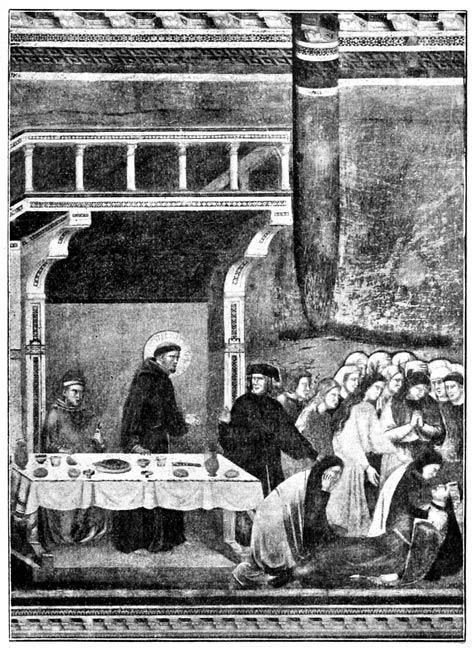
DEATH OF THE KNIGHT OF CELANO
(D. Anderson—photo)
17. St. Francis preaches before Honorius III.
"Having to preach on a certain day before the Pope and
the cardinals, at the suggestion of the Cardinal of Ostia he
learned a sermon by heart, which he had carefully prepared;
when he was about to speak it for their edification he wholly
forgot everything he had to say, so that he could not utter a
word. He related with true humility what had befallen him,
and then, having invoked the aid of the Holy Spirit, he began
at once to move the hearts of these great men...."
In this fine fresco Giotto has represented St. Francis
holding his audience as though spell-bound by the power
of his eloquence, and the contrast is great between the
charming figure of the saint and that of the stern and
earnest Pope, who, deep in thought, is leaning his chin
on his hand, perhaps wondering at the strange chance
which has brought the slight brown figure, so dusty and
so poorly clad, so ethereal and so eloquent, into the
midst of the papal court. It is delightful to study the
faces and gestures of the listeners; some are all enthusiasm
and interest, like the charming young cardinal in an
orange-tinted robe, whose thoughts seem to be far away
following where St. Francis' burning words are leading
them; but the older man gazes critically at the saint,
perhaps saying within himself: "What is this I hear,
we must give up all, our fat benefices, our comfortable
Roman palaces, to follow Christ"; and the cardinal on
the right of the Pope also seems surprised at the new
doctrines of love, poverty and sacrifice. Four others
lean their heads on their hands; but how varied are the
gestures, from the Pope, all eagerness and keen attention,
to the cardinal bowing his head sadly thinking,
like the man of great possessions, how pleasant it would
be to become perfect, but how impossible it is to leave
the goods of this world. St. Francis' companion is
seated at his master's feet as though affirming, "I follow
his teaching, and all he says is right."
18. The Apparition of St. Francis.
"For when the illustrious preacher and glorious Confessor,
Anthony, who is now with Christ, was preaching to the
brethren in the chapel at Arles on the title upon the Cross—'Jesus
of Nazareth, the King of the Jews'—a certain friar
of approved virtue named Monaldus, casting his eyes by divine
inspiration upon the door of the chapter-house, beheld, with
his bodily eyes, the blessed Francis raised in the air, blessing
the brethren, with his arms outstretched in the form of a
Cross."
The friars sit in various attitudes of somewhat
fatigued attention before St. Anthony who is standing,
and none seem as yet to be aware of the apparition
of St. Francis, who appears at the open door
under a Gothic archway, the blue sky behind him.
There is a strange feeling of peace about the scene.
19. The Stigmata.
"... On the hard rock,
'Twixt Arno and the Tiber, he from Christ
Took the last signet, which his limbs two years
Did carry...."[99]
This fresco is unhappily much ruined; enough however
remains to trace a close resemblance to Giotto's
predella of the same subject now in the Louvre, but
where the solemnity of the scene is increased by the
saint being alone with the Seraph upon La Vernia.
It may be well here to give some of the various
opinions as to the authorship of these frescoes, though in
this small book it is impossible to go at all deeply into
the subject. Some, following Baron von Rumohr, hold
that the only paintings in the Upper Church by Giotto,
are the two by the door, the Miracle of the Water and
the Sermon to the Birds, while Messrs. Crowe and
Cavalcaselle give also the first of the series and the last
five to him, but while "youthful and feeling his way,"
and all the rest to Gaddo Gaddi, or maybe Filippo
Rusutti. Lastly, Mr Bernhard Berenson is of opinion
that Giotto's style is to be clearly traced from the first
fresco, St. Francis honoured by the Simpleton, to the
nineteenth, The Stigmata; and they show so much
affinity to the work of the great Florentine in Sta.
Croce and elsewhere, that it is impossible not to agree
with him. In the remaining frescoes, representing the
death and miracles of St. Francis, he sees a close
resemblance to the work of the artist who painted in
the chapel of St. Nicholas (Lower Church), and
who may have aided Giotto in the Upper Church
before being chosen to continue his master's work.
20. Death of St. Francis.
"The hour of his departure being at hand, he commanded all
the brethren who were in that place to be called to him, and
comforted them with consoling words concerning his death,
exhorting them with fatherly affection to the divine love....
When he had finished these loving admonitions, this man,
most dear to God, commanded that the Book of the Gospels
should be brought to him, and ... his most holy soul being
set free and absorbed in the abyss of the divine glory, the
blessed man slept in the Lord."
This fresco has suffered from the damp and all that
clearly remains are the angels, in whom the artist's
feeling for graceful movement is shown, their flight
down towards the dead recalling the rush of the
swallows' wings as they circle in the evening above the
towers of San Francesco.
21. The Apparitions of St. Francis.
"... Brother Augustine, a holy and just man, was
minister of the Friars at Lavoro: he being at the point of
death, and having for a long time lost the use of speech,
exclaimed suddenly, in the hearing of all who stood around:
'Wait for me, Father, wait for me; I am coming with
thee....'
"At the same time the Bishop of Assisi was making a
devout pilgrimage to the church of St. Michael, on Mount
Gargano. To him the Blessed Francis appeared on the very
night of his departure, saying: 'Behold I leave the world and
go to Heaven.'"
In one fresco the artist has represented two different
scenes, the greater prominence being given to the dying
friar surrounded by many brethren. In neither is
shown the figure of St. Francis, as the artist probably
thought that it would have been difficult to introduce
the apparition twice. But while the gesture of the
friar stretching out his arms and the arrangement of
the others explain the story, it would be difficult, without
St. Bonaventure's legend, to know the feelings of
the bishop who is so calmly sleeping in the background.
22. The Incredulous Knight of Assisi.
"... when the holy man had departed from this life,
and his sacred spirit had entered its eternal house ... many
of the citizens of Assisi were admitted to see and kiss the
Sacred Stigmata. Among these was a certain soldier, a
learned and prudent man, named Jerome, held in high estimation
in the city, who, doubting the miracle of the Sacred
Stigmata, and being incredulous like another Thomas, more
boldly and eagerly than the rest moved the nails in the
presence of his fellow-citizens, and touched with his own
hands the hands and feet of the holy man; and while
he thus touched these palpable signs of the wounds of
Christ, his heart was healed and freed from every wound of
doubt."
This fresco is so much ruined that it is difficult to
enjoy it as a whole, but some of the figures of the
young acolytes bearing lighted torches, and the priests
reading the service and sprinkling the body with holy
water, are very life-like.
23. The Mourning of the Nuns of San Damiano.
"Passing by the church of St. Damian, where that noble
virgin, Clare, now glorious in heaven, abode with the virgins
her sisters, the holy body, adorned with celestial jewels [the
marks of the Stigmata], remained there awhile, till those
holy virgins could see and kiss them."
This, the loveliest of the last nine frescoes, recalls
the one in St. Nicholas' Chapel of the three prisoners
imploring the saint's protection; even to the basilica
which forms the background of both. Considering
that it is the last farewell of St. Clare and her companions
to St. Francis the artist might have given a
more tragic touch to the scene, but all is made subservient
to the rendering of graceful figures, like the
charming nuns who talk together as they hasten out of
San Damiano, whose humble façade of stone the artist
has transformed into a building of marble and mosaic
almost rivalling the glories of such cathedrals as Siena
and Orvieto. St. Clare stoops to kiss the saint while
priests and citizens wait to resume their hymns of praise,
and a small child climbs up a tree and tears down
branches to strew upon the road in front of the bier.[100]
24. The Canonisation of St. Francis.
"The Sovereign Pontiff, Gregory IX, ... determined
with pious counsel and holy consideration to pay to the holy
man that veneration and honour of which he knew him to
be most worthy ... and coming himself in person to the
city of Assisi in the year of our Lord's Incarnation, 1228, on
Sunday the 6th of July, with many ceremonies and great
solemnity, he inscribed the Blessed Father in the catalogue
of the saints."
This fresco is so ruined that it is impossible to form
any idea of its composition; about the only object
clearly to be seen is the sepulchral urn of St. Francis,
represented beneath an iron grating in the church of
San Giorgio.
25. The Dream of Gregory IX, at Perugia.
"On a certain night, then, as the Pontiff was afterwards
wont to relate with many tears, the Blessed Francis appeared
to him in a dream, and with unwonted severity in his countenance,
reproving him for the doubt which lurked in his
heart, raised his right arm, discovered the wound, and commanded
that a vessel should be brought to receive the blood
which issued from his side. The Supreme Pontiff still in
vision, brought him the vessel, which seemed to be filled
even to the brim with the blood which flowed from his
side."
We are here left with an impression that the artist was
hampered by not having enough figures for his composition,
and the four men seated on the ground and
guarding the Pope, compare unfavourably with Giotto's
fresco of the three grand watchers by Innocent III,
upon the opposite wall.
16. St. Francis cures the Wounded Man.
"It happened in the city of Ilerda, in Catalonia, that a
good man, named John, who was very devout to St. Francis,
had to pass through a street, in which certain men were
lying in wait to kill him and ... wounded him with so
many dagger-strokes as to leave him without hope of life....
The poor man's cure was considered impossible by all
the physicians.... And, behold, as the sufferer lay alone
on his bed, frequently calling on the name of Francis ...
one stood by him in the habit of a Friar Minor, who, as it
seemed to him, came in by a window, and calling him by
his name, said, 'Because thou hast trusted in me, behold, the
Lord will deliver thee.'"
The artist having here an incident less difficult to
deal with than visions and dreams, betrays a certain
humour in the stout figure of the doctor, who, as he
leaves the room, turns to the two women as though
saying, "He has begun to pray, as if that can help him
when I have failed to cure him." Meantime St.
Francis, escorted by two tall and graceful angels with
great wings, is laying his hands upon the wounded
man. Here, as in most of these latter frescoes, a single
scene is divided into more than one episode; this seems
to us to be the great difference between them and the
works of Giotto, where the eye is immediately attracted
towards the principal figure or figures, the others only
serving to complete the composition.
27. The last Confession of the Woman of Benevento.
"... a certain woman who had a special devotion to St.
Francis, went the way of all flesh. Now, all the clergy being
assembled round the corpse to keep the accustomed vigils,
and say the usual psalms and prayers, suddenly that woman
rose on her feet, in presence of them all, on the bier where she
lay, and calling to her one of the priests ... 'Father,' she
said, 'I wish to confess. As soon as I was dead, I was sent to
a dreadful dungeon, because I had never confessed a certain sin
which I will now make known to you. But St. Francis, whom
I have ever devoutly served, having prayed for me, I have
been suffered to return to the body, that having revealed that
sin, I may be made worthy of eternal life.' ... She made
her confession, therefore, trembling to the priest, and having
received absolution, quietly lay down on the bier, and slept
peacefully in the Lord."
The legend is dramatic and the artist has not failed
to make us feel the great sadness and solemnity of the
scene. A moment more, and the group of people to
the left will come forward to carry the woman away
for burial while the relations weep most bitterly; they
stand aside with heads bowed in grief, for already the
presence of death is felt. Only the sorrow of the
child, who stretches out his arms, has passed away
upon seeing her rise to speak with the priest. Very
tall and slender are the figures of the women, bending
and swaying together like flowers in a gentle
breeze.
28. St. Francis releases Peter of Alesia from Prison.
"When Pope Gregory IX, was sitting in the chair of St.
Peter, a certain man named Peter, of the city of Alesia, on an
accusation of heresy, was carried to Rome, and, by command
of the same Pontiff, was given in custody to the Bishop of
Tivoli. He, having been charged to keep him in safety ...
bound him with heavy chains and imprisoned him in a dark
dungeon.... This man began to call with many prayers
and tears upon St. Francis ... beseeching him to have mercy
upon him.... About twilight on the vigil of his feast, St.
Francis mercifully appeared to him in prison, and, calling
him by his name, commanded him immediately to arise....
Then, by the power of the presence of the holy man, he beheld
the fetters fall broken from his feet, and the doors of
the prison were unlocked without anyone to open them, so
that he could go forth unbound and free."
Everything here gives the impression of height; the
tall slim figures, the high doorway, and the slender
tower and arches. St. Francis is seen flying up to
the skies with the same swift motion the artist has
given to the figure of St. Nicholas in the Lower
Church, and the "Greek Chorus" to the left serves
to show surprise at the unusual occurrence of a prisoner
suddenly emerging from his prison with broken fetters
in his hands.
None should leave the church without looking at
the stalls in the choir; they are by Domenico da San
Severino, made in 1501, by order, as an inscription
tells us, of Francesco Sansone, General of the franciscan
order, and friend of Sixtus IV. The artist
only took ten years to execute this really wonderful
work; the intarsia figures of the stalls in pale yellow
wood, most of them fancy portraits of the companions
of St. Francis, are remarkable for their form and character.
They betray, in the opinion of Mr Berenson,
Venetian influences of Crivelli and of the school of
the Vivarini.

ARMS OF THE FRANCISCANS FROM THE INTARSIA OF THE STALLS
CHAPTER IX
St. Clare at San Damiano. The
Church of Santa Chiara.
"Comme les fleurs, les âmes ont leur parfum qui ne trompe
jamais."—P. Sabatier. Vie de S. François d'Assise.
The days of St. Clare from the age of eighteen
until her death in 1253 were passed within the
convent walls of San Damiano, and though peaceful
enough, for a mediæval lady, they were full of events
and varied interest.
She was born on the 10th of July 1194 in Assisi
of noble parents, her father being Count Favorino Scifi
(spelt also Scefi) the descendant of an ancient Roman
family who owned a large palace in the town, and
a castle on the slope of Mount Subasio to the east
of the ravine where the Carceri lie among the ilex
woods. The castle gave the title of Count of Sasso
Rosso to its owners, and was the cause of much skirmishing
between the Scifi and the Ghislerio who were
continually wresting it from each other, until in 1300,
during one of these struggles, the walls were razed to the
ground and no one sought afterwards to repair its ruins.
Of Sasso Rosso a few stones still remain, which, as
they catch the morning light, are seen from Assisi like
a grey crag projecting from the mountain, high above
the road to Spello. When not fighting beneath the
walls of his castle Count Favorino was generally away
on some skirmishing expedition, and during his absences,
his wife, the Lady Ortolana of the noble family of the
Fiumi, would depart upon a pilgrimage to the south of
Italy or even to the Holy Land.[101] An old writer remarks
that her name "Ortolana (market gardener) was
very appropriate, because from her, as from a well-tended
orchard, sprang most noble plants." After her
return from Palestine she one night heard a voice
speaking these prophetic words to which she listened
with great awe. "Be not afraid Ortolana, for from
thee shall arise a light so bright and clear that the
darkness of the earth shall be illuminated thereby."
So the daughter who was born soon after was called
Chiara in memory of the divine message. With so
pious a mother it is not surprising that Clare should have
grown up thoughtful and fond of praying; we even
hear of her seeking solitary corners in the palace where
she would be found saying her rosary, using pebbles
like the hermits of old instead of beads upon a chain.
But her evident inclination for a religious life in no
way alarmed Count Favorino, who had made up his
mind that she should marry a wealthy young Assisan
noble, for even at an early age she showed great promise
of beauty. "Her face was oval," says a chronicler,
"her forehead spacious, her complexion brilliant,
and her eyebrows and hair very fair. A celestial smile
played in her eyes and around her mouth; her nose was
well-proportioned and slightly aquiline; of good stature
she was rather inclined to stoutness, but not to excess."
A little while and her fate in life would have been
sealed in the ordinary way, and she would have continued
to look out upon the world through the barred
windows of some old Assisan palace; but great changes
were being wrought in the town even when Clare had
just passed into girlhood. With the rest of her fellow-citizens,
rich and poor, she was destined to feel the
potent influence of one who suddenly appeared in
their midst like an inspired prophet of old, calling
on all to repent, and picturing higher ideals in
life than any had hitherto dreamed of. Although
her first meeting with St. Francis has not been recorded
by any early biographer, we may be sure that
from the age of fourteen, and perhaps even before, the
story of his doings had been familiar to her, for the
stir his conversion made among the people, his quarrels
with his father, and the many followers he gained,
even among the nobles, were of too extraordinary a
nature to pass without comment in the family of the
Scifi.[102] Their palace being near the Porta Nuova it is
certain that Clare and her younger sister Agnes must
have often seen St. Francis pass on his way to San
Damiano, carrying the bricks which he had begged
from door to door to repair its crumbling walls, and
heard him scoffed at by the children and cursed by his
angry father. As his fame as a preacher grew the
Scifi family hurried with the rest to listen to his
sermons in the cathedral, or perhaps even in the
market-place, where he would stand upon the steps of
the old temple and gather the peasants around him on
a market day. But the decisive time arrived in the
year 1212, when St. Francis, by then the acknowledged
founder of a new order sanctioned by the Pope,
and no longer jeered at as a mad enthusiast, came to
preach during Lent in the church of San Giorgio. It
was the parish church of the Scifi, and the whole
family attended every service. Clare was then
eighteen, young enough to be carried away by the
words of the franciscan and build for herself a life
outside her present existence; old enough to have felt
unbearable the trammels of a degraded age, and to
long, during those years of warfare to which all the
cities of the valley were subjected, for an escape to
where peace and purity could be found. Only dimly
she saw her way to a perfect love of Christ. The
preacher's words were addressed to all, but she felt
them as an especial call to herself, and unhesitatingly
she resolved to seek out the friar at the Portiuncula
and ask his help and counsel in what was no easy task.
Instinctively knowing her mother could be of no aid,
even if she sympathised in her cravings for a more
spiritual life, she gained the confidence of her aunt,
Bianca Guelfucci, who all through played her part
regardless of Count Favorino's possible revenge.
Even during the first two years of his mission St.
Francis was accustomed to receive many men who
wished to leave home and comforts, and tramp along
the country roads with him, but when the young
Chiara Scifi threw herself at his feet imploring him to
help her to enter upon a new way of life, his heart was
troubled, and, reflecting on what wide results his preaching
was taking, fear even may have formed part of his
surprise. Bernard of Quintavalle he had bidden
sell all that he had, distribute it to the poor, and join
him at the leper houses; but before allowing Clare to
take the veil he sought to prove her vocation beyond
a doubt, and bade her go from door to door through the
town begging her bread, clad in rough sack-cloth with
a hood drawn about her face. Her piety only increased
until St. Francis, believing that he was called upon to
help her, resolved to act the part of the spiritual knight
errant.
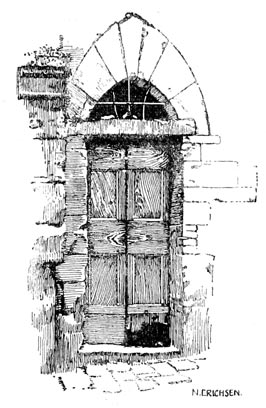
DOOR THROUGH WHICH ST. CLARE
LEFT THE PALAZZO SCIFI
On Palm Sunday, arrayed in their richest clothes,
the members of the Scifi and the Fiumi families
attended high mass in the cathedral, and with the rest
of the citizens went up to receive the branches of
palms. But to the astonishment
of all Clare remained
kneeling as if wrapt in a
dream, and in vain the bishop
waited for her to follow
the procession to the altar.
All eyes were upon her as
the bishop, with paternal
tenderness, came down from
the altar steps to where the
young girl knelt and placed
the palm in her hand. That
night Clare left her father's
house for ever. A small
door in the Scifi palace is
still shown through which
she is said to have escaped.
It had been walled up for
some time, but the fragile
girl gifted that night with
superhuman strength and
courage, tore down timber
and stones and joined Bianca Guelfucci, who was
waiting with some trembling maidservants where
the arch spans the street, to accompany her to the
Portiuncula (see p. 104). Great was the consternation
in the family when next morning her flight was
discovered, and news came that she had found shelter
in the benedictine convent near Bastia. Count
Favorino and his wife lost no time in following her,
fully persuaded that by threats or entreaties they would
be able to induce her to return home and marry the
man of her father's choice; but they knew little of
the strength of character which lay hidden beneath the
gentle nature of the eldest and hitherto most docile of
their daughters. The violent words of her father and
the tears of her mother in no way shook Clare's determination;
approaching the altar she placed one hand
upon it while with the other she raised her veil, and
facing her parents showed them the close cut hair which
marked her as the bride of Jesus Christ. No earthly
power, she said, should sever her from the life she
had chosen of her own free will, and crest-fallen they
left the convent without another word. It was hardly
surprising that Agnes, the second sister, who sometimes
went to see St. Clare at Bastia, should wish to take
the veil. At this the fury of Count Favorino knew
no bounds, and he sent his brother Monaldo with
several armed followers, among whom may have been
Clare's slighted lover, to force Agnes, if persuasion
failed, to abandon her vocation. She was at their
mercy but refused to leave the convent, so they caught
her by her long fair hair and dragged her across the
fields towards the town, kicking her as they went; her
cries filled the air, "Clare, my sister, help, so that I
may not be taken from my heavenly spouse." The
prayers of Clare were heard, for suddenly the slight
form of the girl became as lead in the arms of the
soldiers, and in vain they tried to lift her. Monaldo,
beside himself with rage, drew his sword to strike her
when his arm dropt withered and useless by his side.
Clare, who had by this time come upon the scene,
begged them to desist from their cruel acts, and cowed
by what had happened they slunk away, leaving the
sisters to return to the convent.
St. Francis seeing the devotion and steady vocation
of both Clare and Agnes, and doubtless foreseeing that
many would follow their example, began to seek for
some shelter where they could lead a life of prayer and
labour. Again the Benedictines of Mount Subasio
came forward with a gift, offering another humble
sanctuary which the saint had repaired some years
before. This was San Damiano, a chapel so old that
none could tell its origin; the vague legend that it
stands on the site of a pagan necropolis seems confirmed
by a lofty fragment of Roman masonry which juts up
on the roadside between the Porta Nuova and San
Damiano. With his own hands St. Francis built a
few rude cells near the chapel, resembling the cluster
of huts by the Portiuncula, and here the "Poor Ladies"
were to pass their days in prayer and manual labour.
The little humble grey stone building among the olive
trees with the pomgranates flowering against its walls,
so different to a convent of the present day, must have
seemed to Clare the realisation of a freer life than ever
she had known before. Others felt its charm and before
long several friends had joined her besides Bianca Guelfucci,
while upon the death of Count Favorino, Madonna
Ortolana received the habit from the hands of St. Francis
together with her youngest daughter Beatrice. The fame
of the order spread far and wide, gaining so many
novices that several new houses were founded in Italy
even during the first few years. In those early days St.
Clare was given no written law to follow, but like the
brethren she and her nuns learnt all the perfection of a
religious life from St. Francis, who would often stop
at San Damiano on his way to and from the town.
He did not allow them to go beyond their boundaries,
but a busy life was to be passed in their cells; owning
nothing, they were to depend entirely upon what the
brothers could beg for them in the town and country
round, and when provisions were scarce they fasted.
In return the nuns spun the grey stuff for the habits of
the friars and the linen for their altars; and after St.
Francis received the Stigmata, St. Clare fashioned
sandals for him with space for the nails so that he
might walk with more ease. Often the poor came
to seek help at her hands, and many times the sick
were tended in a little mud hut near her cell which she
used as a hospital. Silently her life was passed, and to
those who looked on from the outside perhaps it might
have seemed of small avail compared with the very
apparent results of St. Francis' endeavours to help his
fellow creatures. But very quietly she was guiding
the women of mediæval Italy towards higher aims, for
even those who could not follow her into the cloister
were aided in their lives at home by the thought of the
pure-souled gentle nun of San Damiano. Not the least
important part of her work was the womanly sympathy
and help which she gave to St. Francis. He turned
to her when in trouble, and it was she who encouraged
him to continue preaching to the people when, at one
time he thought that his vocation was to be a life of
solitary prayer and not of constant contact with mankind.
He counted on her prayers, and trusting in her
counsel went forward once more to preach the words
of redemption. From her lonely cell she watched his
work with tender solicitude, and when blind and ill he
came for the last time to San Damiano she tended
to his wants in a little hut she erected for him not far
from the convent whence, across the vineyard and olive
grove which separated them, the first strains of his
glorious Canticle to the Sun came to her one morning.
Her gentle influence played an important part in his
life, giving him a friendship which is one of the most
beautiful things to dwell on in their lives. Some have
sneered at its purity, and compared so ideal a connection
to a commonplace mediæval tale of monk and nun;
but it is degrading even to hint at such an ending to
the love of these two for each other, and impossible
to believe it after reading M. Sabatier's beautiful
chapter on St. Clare, where he touches, in some
of his most charming pages, upon a side of St.
Francis' character that most biographers have but
little understood.
A beautiful story in the Fioretti relates how once
St. Clare, desiring greatly to eat with St. Francis, a
boon he had never accorded her, was granted the request
at the earnest prayer of the brethren, "and
that she may be the more consoled," he said, "I
will that this breaking of bread take place in St.
Mary of the Angels; for she has been so long
shut up in S. Damian that it will rejoice her to
see again the House of Mary, where her hair was
shorn off, and she became the bride of Christ."
Once more St. Clare came to the plain of the
Portiuncula, and the saint spoke so sweetly and eloquently
of heavenly things that all remained wrapped
in ecstacy, oblivious of the food which was spread
before them on the floor and, as Clare dwelt in
divine contemplation, a great flame sprang up and
shrouded them in celestial light. The Assisans and
the people of Bettona, looking down from their
walls upon the plain, thought that the Portiuncula
was on fire, and hurried to the assistance of their
beloved saint. "But coming close to the House,"
says the Fioretti, "they entered within, and found
St. Francis and St. Clare with all their company in
contemplation wrapt in God as they sat round the
humble board." Comforted by this spiritual feast
St. Clare returned to San Damiano, where she was
expected with great anxiety, as it had been imagined
that St. Francis might have sent her to rule some
other convent, "wherefore the sisters rejoiced exceedingly
when they saw her face again." Those
were peaceful and happy days, but sorrow came
when news reached her that St. Francis was near
his end; "she wept most bitterly, and refused to
be comforted," for she too was ill, and feared to
die before she could see his face again. This fear
she signified through a brother unto the Blessed
Francis, and when the saint, who loved her with a
singular and paternal affection, heard it, he had pity on
her; and considering that her desire to see him once
more could not be fulfilled in the future, he sent her
a letter with his benediction and absolving her from
every fault.... "Go and tell sister Clare to lay aside
all sadness and sorrow, for now she cannot see me,
but of a truth before her death both she and her
sisters shall see me and be greatly comforted." But
the last she saw of him was through a lattice window,
when they brought his dead body for the nuns to see
and kiss the pierced hands and feet (see p. 119).
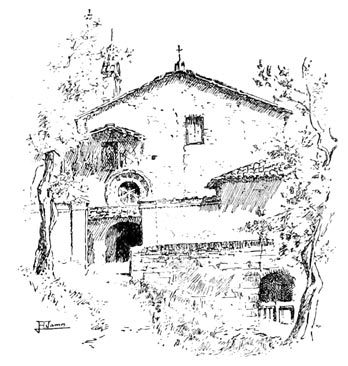
SAN DAMIANO, SHOWING THE WINDOW WITH
THE LEDGE WHENCE ST. CLARE ROUTED
THE SARACENS
A strange thing happened to disturb the peaceful
serenity of their lives at San Damiano in the year
1234, when the army of Frederic II, was fighting
in the north of Italy, and a detachment of Saracen
troops under one of his generals, Vitale d'Anversa,
came through Umbria, pillaging the country as they
passed. Assisi was a desirable prey, as it had been to
many before them, and coming to the convent of San
Damiano they scaled its walls, preparatory to a final
rush upon the town. The terror of the nuns may be
imagined, and running to the cell where Clare lay ill
in bed they cowered round her "like frightened doves
when the hawk has stooped upon their dovecote."
Taking the Blessed Sacrament, which she was allowed
to keep in a little chapel next to her cell, she proceeded
to face the whole army, trusting like St.
Martin in the power of prayer and personal courage.
As she walked towards the window overlooking the
small courtyard a voice spoke to her from the ciborium
saying, "Assisi will have much to suffer, but my arm
shall defend her." Raising the Blessed Sacrament on
high she stood at the open window, against which the
soldiers had already
placed a ladder;
those who were
ascending, as they
looked up towards
her, fell back blinded,
while the others took
to flight, and thus
cloister and city
were saved through
the intercession of
the gentle saint.
Vitale d'Anversa,
who had not been
present at the prodigy,
probably thinking
the soldiers had
failed in their enterprise
through lack of
valour, came with a
still larger company
of men, and led them in person to storm the town.
St. Clare, hearing what peril encompassed Assisi,
and being asked by the citizens to intercede with
Heaven as the enemy had sworn to bury them beneath
their city walls, gathered all her nuns about her, and
knelt in prayer with them. At dawn the next
morning a furious tempest arose, scattering the tents
of the Saracens in every direction, and causing such
a panic that they took refuge in hasty flight. The
gratitude of the citizens increased their love for St.
Clare, as all attributed their release to her prayers,
and to this day she is regarded as the deliverer of
her country.
One cannot help regretting that while so many contemporary
chroniclers have left detailed and varied accounts
of St. Francis, they only casually allude to St. Clare,
calling her "a sweet spring blossom," or "the chief
rival of the Blessed Francis in the observance of Gospel
perfection," but leaving later writers to form their own
pictures of the saint. And the picture they give is
always of a silent and prayerful nun, beautiful of feature,
sweet and gentle of disposition, coming ever to the help
of those who needed it, and acting the part of a guardian
angel to the Assisans. Her horizon was bounded
by the mountains of the Spoletan valley; and from the
outside world, on which her influence worked so surely
during her life and for long centuries after her death,
only faint echoes reached her when a pope or a cardinal
came to see her, or a princess wrote her a letter from
some distant country. Among the many royal and
noble people who had entered a Poor Clare sisterhood,
or like St. Elizabeth of Hungary had joined the Third
Order, was the Blessed Agnes, daughter of the King
of Bohemia, who, kindled with a desire for a religious
life upon hearing the story of St. Clare, refused the
hand of Frederick II, and passed her life in a convent.
Often she wrote to the Assisan abbess getting in reply
most charming letters, beginning "To her who
is dearer to me than any other mortal," or "To the
daughter of the King of Kings, to the Queen of Virgins,
to the worthy spouse of Jesus Christ; the unworthy
servant of the poor nuns of San Damiano sends
greetings and rejoicings in the good fortune of living
always in the extremest poverty." These two never
met, but their friendship was a close one, and their
correspondence, of which many letters are preserved,
ceased only with their death.
St. Clare survived St. Francis twenty-seven years,
and they were sad years for one, who, like her clung
so devoutly to his rule and teaching. She lived to see
the first divisions among the franciscans, and before
she died the corner-stone of the great Basilica had
been raised, filling her with dismay for the future,
for in its very grandeur and beauty she saw the downfall
of the franciscan ideal. Not only did she witness
all these changes, but in her own convent she had many
battles to fight for the preservation of the rule she
loved, she even courageously opposed the commands of
the Pope himself who wished to mould the nuns to his
wishes as he had done the friars. Even during the
lifetime of St. Francis, while he was absent on a
distant pilgrimage, Gregory IX, then Cardinal Ugolino,
persuaded St. Clare of the necessity of having a written
rule, and gave her that of the Benedictine nuns.
But when she found that, although it was strict enough,
it allowed the holding of property in community,
which was entirely against the spirit of her order, she
refused to agree to the innovation. So upon the saint's
return he composed a written rule for the sisters, so
strict, it is said, that its perusal drew tears from the
eyes of the Cardinal Ugolino. Still she had to fight
the battle of loyalty to a dead saint's memory; for the
very year that Gregory came to Assisi for the canonisation
of St. Francis he paid a visit to St. Clare, and
with earnest words endeavoured to persuade her to
mitigate her rule. She held so firmly to her way that
the Pope thought she might perhaps be thinking of the
vow of poverty which she had made at the Portiuncula,
and told her he could absolve her from it through the
powers of his papal keys. Then Clare summoned all
her courage as she faced the Pontiff, and said to him
these simple words which showed him he need try no
more to tempt her from duty, "Ah holy father," she
cried, "I crave for the absolution of my sins, but I
desire not to be absolved from following Jesus Christ."
Gregory had often been puzzled by the unique unworldliness
of St. Francis; his admiration for St. Clare
was even more profound, and in reading his letters after
leaving the franciscan abbess one forgets that he was
over eighty at the time. With him she had gained
her point once and for all, but upon his death she had
to oppose the wishes of Innocent IV, who did all in his
power to merge the franciscan order of Poor Clares
into an ordinary Benedictine community. Again it
ended in the triumph of St. Clare, and the day before
her death she had the joy of receiving the news that
the Pope had issued a papal bull sanctioning the rule
for which both St. Francis and she had fought;
namely, that they were to live absolutely poor without
any worldly possession of any kind. "N'est-ce pas,"
says M. Sabatier, "un des plus beaux tableaux de
l'histoire religieuse, que celui de cette femme qui,
pendant plus d'un quart de siècle, soutient contre les
papes qui se succèdent sur le trône pontifical une lutte
de tous les instants; qui demeure également respectueuse
et inébranlable, et ne consent à mourir qu'après avoir
remporté la victoire?"
St. Clare during the remaining years of her life
suffered continually from ill-health, and it was from
a bed of infirmity that she so ardently prayed the Pope
to sanction her rule of poverty, and enjoined the
sisterhood to keep its tenets faithfully. Like St.
Francis, brave and cheerful to the last, she called her
weeping companions around her to give them her final
blessing and farewell. Among them knelt the Blessed
Agnes, who had come from her nunnery in Florence
to assist her sister, and the three holy brethren Leo,
Angelo and Juniper. On the 11th of August 1253,
the feast of St. Rufino, as she was preparing to leave
the world they heard her speak, but so softly that the
words were lost to them. "Mother, with whom are
you conversing?" asked one of the nuns, and she
answered: "Sister, I am speaking with this little soul
of mine, now blessed, to whom the glory of paradise
is already opening."
Then as the evening closed in and they were still
watching, a great light was seen to fill the doorway
leading from the oratory of St. Clare to her cell; and
from out of it came a long procession of white-robed
virgins led by the Queen of Heaven, whose head was
crowned with a diadem of shining gold, and whose
eyes sent forth such splendour as might have changed
the night into the brightest day. And as each of the
celestial visitors stooped to kiss St. Clare, the watching
nuns knew that her soul had already reached its home.
Once the little chapel of San Damiano has been seen
there can be no fear of ever forgetting the charm
attached to the memory of St. Clare, for she has left
there something of her own character and personality,
which we feel instinctively without being able quite to
explain its presence. So near the town, only just
outside its walls, this little sanctuary yet remains as in
the olden times, one of the most peaceful spots that
could have been chosen for a nunnery; but the silence
which falls upon one while resting on the stone seats
before entering the courtyard, has this difference with the
silence of such a piazza as that of San Rufino or of some
of the Assisan streets; that there the buildings tell of an
age which is dead whose memories raise no responsive
echoes in our hearts, whereas San Damiano is filled
with the associations of those who, living so long ago,
yet have left the atmosphere of their presence as a living
influence among us. As we look at the steep paths
below us leading through the fields and the oak trees
down to the plain, to Rivo-Torto and the Portiuncula,
we think how often St. Francis went up and down it
whenever he passed to see St. Clare and her sisters.
And how many times did Brother Bernard come with
messages when he lay dying, and news was anxiously
awaited at San Damiano; then along the grass path
skirting the hill from Porta Mojano were seen the crowds
of nobles, townsfolk, peasants and friars bearing the
dead body of the saint to San Giorgio, and pausing
awhile at the convent for the love of St. Clare. A
pope with all his cardinals next passes, on a visit to the
young abbess; St. Bonaventure stops to ask her prayers;
while the poor and the ill were ever knocking at the
convent door to obtain her help or a word of kindly
sympathy. In the Umbrian land it is so easy to realise
these things, they are more than simply memories for
those who have time to pause and dream awhile; and
sometimes it has seemed, while reading the Fioretti or
Brother Leo's chronicle beneath the olive trees of San
Damiano, that we have slipped back through the ages, and
looking up we half expect to see the hurrying figure of
St. Francis moving quickly in and out among the trees.
Suddenly the low sound of chanting comes through
the open door of the convent reaching us like the
incessant drone of a swarm of bees in the sunshine,
until it dies away, and brown-clothed, sandalled
brethren pass out across the courtyard, and two by
two disappear down the hill on their way to the
Portiuncula. They bring a whole gallery of portraits
before our eyes, of brethren we read of, the companions
of St. Francis; but when we look along the path they
have taken and see the church of the Angeli standing
high in the midst of the broad valley, its dome showing
dark purple against the afternoon light, where we had
thought to catch a glimpse of the Portiuncula and a
circle of mud huts, the dream of the olden time fades
suddenly away. As we turn to enter the little church
of San Damiano with the image of the great church
of the plain still in our thoughts, we feel how much we
owe to the reverence of the people and the friars who
have kept it so simple and unadorned, its big stones
left rough and weather-beaten as when St. Francis
came to prepare a dwelling-house for sister Clare.
Truly says M. Sabatier, "ce petit coin de terre
ombrienne sera, pour nos descendants, comme ce puits
de Jacob où Jésus s'assit un instant, un des parvis
préférés du culte en esprit et en vérité."
The church is very small and dim, with no frescoed
walls or altar pictures to arouse the visitor's interest, and
only its connection with the names of Francis and Clare
bring the crowds who come to pray here. Even the
crucifix which spoke to St. Francis, telling him to rebuild
the ruined sanctuary, no longer hangs in the choir, but is
now in the keeping of the nuns in Santa Chiara. A
few relics are kept in the cupboard—a pectoral cross
given by St. Bonaventure, the bell with which St.
Clare called the sisters to office, her breviary written
by Brother Leo in his neat, small writing, and the
tabernacle of alabaster which she held up before the
invading host of Saracens upon that memorable occasion.
There is also a small loaf of bread which recalls
the well-known story recounted in the Fioretti (cap.
xxxiii.) of how Pope Innocent IV, came to see St. Clare,
"to hear her speak of things celestial and divine; and
as they were thus discoursing together on diverse
matters, St. Clare ordered dinner to be made ready,
and the bread to be laid on the table so that the Holy
Father might bless it; and when their spiritual conference
was finished, St. Clare, kneeling most reverently,
prayed him to bless the bread which was on the
table. The Holy Father replied: 'Most faithful
Sister Clare, I will that thou shouldst bless this bread
and make upon it the sign of the most blessed Cross of
Christ, to whom thou hast so entirely given thyself.'
St. Clare said: 'Holy Father, pardon me, for I
should be guilty of too great a presumption if in the
presence of the Vicar of Christ, I, who am but a
miserable woman, should presume to give such a
benediction.' And the Pope answered: 'That this
should not be ascribed to presumption, but to the merit
of obedience, I command thee by holy obedience to
make the sign of the Holy Cross on this bread, and to
bless it in the name of God.' Then St. Clare, as a
true daughter of obedience, most devoutly blessed that
bread with the sign of the Holy Cross. And marvellous
to say, incontinently on all the loaves the
sign of the Holy Cross appeared most fairly impressed;
then of that bread part was eaten and part kept for
the miracle's sake."
A ring belonging to St. Clare was also kept here,
until in the year 1615 a Spanish franciscan vicar-general
with his secretary came to visit San Damiano,
and such was his devotion for anything that had
belonged to the saintly abbess that when a few months
later the relics were being shown to some other visitors,
the precious ring was missing. A great disturbance
arose in the city, and angry letters were speedily sent
after the Spanish priest as suspicion had fallen upon
him at once; he did not deny that he had piously
stolen the ring, but as it was now well upon its way to
Spain where, he assured the irate Assisans, it would
be much honoured and well cared for, he refused
to return it. The citizens and friars still regret the
day that the Spanish dignitary and his secretary called
at San Damiano.
The small chapel out of the nave was built in the
middle of the seventeenth century to contain the large
Crucifix which is still there, and whose story is very
famous. In 1634 Brother Innocenzo of Palermo was
sent to the convent to carve a crucifix for the friars, his
sanctity and the talent he possessed as an artist being
well known. After nine days he completed all except
the head, and on returning next morning after early
mass he found that mysterious hands had fashioned it
during the night; not only was it of wonderful workmanship,
but looking at it from three different points
of view three different expressions were seen—of peace,
of agony, and of death. The fame of the Crucifix
spread throughout Umbria, and people flocked to San
Damiano. "Now, the devil," says a chronicler,
"very wrath to see such devotion in so many hearts,
turned his mind to finding out some means of sowing
seeds of discord. Through his doing there arose in
Assisi a whisper that owing to the rapidly growing fame
of this Crucifix, the ancient one of the cathedral would
lose the veneration in which it had hitherto been held."
Now before placing the Crucifix of San Damiano
in its place over the high altar the monks settled that
it should be carried in solemn procession through
Assisi. "But," writes the angry chronicler, "those
who had joined this diabolical conspiracy against our
Crucifix were not slow to prevent this, and had recourse
to the Inquisitor of Perugia, who was induced
to send his vicar to stop the procession, and bid the
monks of San Damiano to keep their Crucifix hidden
and allow no one to see it." There arose a terrible
storm in the troubled community of Assisi, between
those who took the part of the "persecuted Crucifix"
and those who sided with the jealous canons of the
cathedral. Finally, the case was placed before the
Pope himself, and all waited anxiously the result of
his investigations. A duplicate of the Crucifix of
San Damiano was sent to Rome that it might be
well examined by the Pope and the whole college of
cardinals, and they not finding in the pious Brother
Innocenzio's work anything contrary to the teaching
of the gospel, it was unanimously decreed that the
Crucifix of San Damiano might receive all the homage
and love of the friars and citizens. So on a burning
Sunday in August solemn high mass was sung at the
altar of St. Clare in San Damiano and, although the
friars were defrauded of their procession, such was the
concourse of people who came to gain the plenary indulgence
granted by His Holiness that the good friars rejoiced,
and were comforted for all the persecution they
had suffered on account of this marvellous Crucifix.
What must have been the feelings of Brother Innocenzo
as he stood by the high altar and watched the
crowd of worshippers and the women lifting up their
streaming eyes to the crucifix he had fashioned in his
cell? The devotion to it grew as the years passed on,
and we read that a century later the monks were
obliged "for their greater quiet to transfer it from the
choir to the chapel," where it now is, after which the
monks could say their office in peace. Now we see it
surrounded with votive offerings, and our guide pours
forth an incessant stream of praise, and recounts at
length numberless miracles.
Through the chapel of the Crucifix we reach the
choir of St. Clare, left as when she used it, with
the old worm-eaten stalls against the wall. It is
probable that originally this was part of the house
of the priest who had the keeping of San Damiano
before the benedictines gave it to the Poor Clares;
for here is shown the recess in the wall where St.
Francis hid when his father came to seek for him,
and where he is supposed to have lived in hiding
for a whole month until the storm should have blown
over. It was for the rebuilding of the chapel that
he had taken bales of costly stuffs from the Bernardone
warehouse in Assisi to sell at the fair of
Foligno, and thus called forth the wrath of Messer
Pietro. The good priest of San Damiano was so
much astonished at this sudden conversion of Francis,
that thinking he mocked him he refused to accept
the purse of gold, which Francis finally threw on to
a dusty window-sill. But the priest soon became
his friend, allowing him to remain at San Damiano
and partake of such humble fare as he could give,
joining him in repairing of the poor ruined chapel.
An artist of the sixteenth century had sought to
adorn the altar with a fresco of the Crucifixion which
was only discovered a few months ago, but the whitewashed
walls and severe simplicity of the rest seem
more in keeping with the place than this crude attempt
at decoration. By a rough flight of stairs we reach
the small private oratory of St. Clare, which communicated
with her cell and where, in her latter days
of illness, she was permitted to keep the Blessed
Sacrament. The rest of the convent being strict
"clausura," ever since the Marquess of Ripon
bought San Damiano from the Italian Government
and gave it into the keeping of the franciscan friars,
can only be seen by men. Within is the refectory
of St. Clare where Innocent IV, dined with her and
witnessed the miracle of the loaves, and Eusebio di
San Giorgio (1507) has painted in the cloister two
fine frescoes of the Annunciation and St. Francis receiving
the Stigmata.
But anyone may step out into the small and charming
garden of St. Clare which is on a level with
her oratory. Walls rising on either side leave only
a narrow vista of the valley where Bevagna, and
Montefalco on her hill, can just be seen. Within
this small enclosed space the saint is said to have
taken her daily exercise and carefully attended to
the flowers, and the friars to this day keep a row of
flowers there in memory of her. It will be well on
leaving the chapel of San Damiano to look at the
open chapel in the courtyard where Tiberio d'Assisi
has painted one of his most pleasing compositions.
The Madonna is seated in an Umbrian valley, low
lines of hills fade away in the distance, and franciscan
saints, among whom St. Jerome with his lion
seems curiously out of place, surround her, while at
her feet is placed the kneeling figure of the nun
who succeeded St. Clare as abbess. It is signed
and dated 1517, while the fresco on the side-wall of
St. Sebastian and St. Roch was painted five years
later. In another corner of the courtyard, near the
entrance, is a painting in a niche of the Madonna
and saints by some Umbrian artist who felt the influence
of both Giotto and Simone Martini, so that
we have a curious, if pleasing result.
Santa Chiara
St. Clare was no sooner dead than the people, as
they had done with St. Francis, sought to honour
her memory, but in this case, Innocent IV, being
in Assisi for the consecration of the Franciscan
Basilica, the funeral service was conducted by the
Pope and cardinals. Such a gathering of church
dignitaries, Assisan nobles, priors and people had
certainly never been seen in the humble convent of
San Damiano; their presence, though honouring the
saint, filled the hearts of the nuns with sorrow for
they knew they had come to take the body of St.
Clare to Assisi. With tears they consented to its
being placed in safety in San Giorgio, but only on
the condition that they might eventually be allowed
to live near her tomb in some humble shelter. San
Damiano without her, alive or dead, meant little to
them, and they were ready to abandon a home of
so many memories to go where they and their successors
could guard her body to the end of time.
Devotion to her memory and belief in her sanctity
was not solely confined to them; when the friars
rose to intone the service of the dead, Pope Innocent
signified that there should be silence, and to the
wonder of all ordered high mass to be sung and
the funeral service to be changed into one of triumph,
in honour of her who he believed was already with
the Virgins in heaven. It was a kind of canonisation,
but could not be regarded as valid without the usual
preliminaries being performed, and the cardinals, more
cautious and less enthusiastic than His Holiness, persuaded
him to wait and in the meanwhile allow the
ordinary service to proceed. To this he consented,
and then amidst music and singing the Pope led the
people up the hill where years before another saint
had been borne to the same church of San Giorgio,
and as on that day a funeral ceremony became a
triumphal procession.
Innocent IV, died soon after, and it was Alexander
IV, who in September 1255, two years after her
death, canonized St. Clare in a Bull replete with
magnificent eulogy in which there is a constant
play upon her name: "Clara claris præclara meritis,
magnæ in coelo claritate gloriæ, ac in terra miraculorum
sublimum clare gaudet ... O admiranda
Claræ beatæ claritas." Another two years were
allowed to elapse before they began to erect a building
to her memory; besides the readiness shown by
every town to honour their saints, the Assisans had
especial cause to remember St. Clare, as she had
twice saved them from the Saracen army of Frederic
II. Willingly the magistrates and nobles, besides
many strangers who had heard of the saint's renown,
contributed money for the new building, and Fra
Filippo Campello the minorite was chosen as the
architect. Fine as his new work proved to be it
was rather the copy of a masterpiece than the inspiration
of a great architect, which makes it more probable
that he was only employed in completing the
church of San Francesco from the designs of that
first mysterious architect, and not, as some have said,
its sole builder.
The canons of San Rufino offered the church and
hospital of San Giorgio which belonged to them. A
more fitting site for the church to be raised in honour
of St. Clare could not have been chosen, for it was
here that St. Francis had learnt to read and write as a
child under the guidance of the parish priest; here he
preached his first sermon, and later touched the heart
of Clare by his words during the lenten services; and
here both of them were laid in their stone urns until
their last resting places were ready. So around the
little old parish church with its many memories, and
within sight of the Scifi palace, arose "as if by magic"
the new temple with its tall and slender campanile.
The hospital enlarged and improved became the convent,
and the church was used by the nuns as a choir,
the rest of the large building, which they could only
see through iron gratings, being for the use of the congregation.
With its alternate layers of pink and cream-coloured
stone, wheel window and finely modelled
door, the church fits well into its sunny piazza, and
is a beautiful ending to the eastern side of Assisi. But
in building it Fra Filippo forgot the crumbling nature
of the soil, and failed to overcome the difficulty of position
as had been done so admirably at San Francesco,
so that in 1351 it became necessary to prop up the sides
by strong flying buttresses, which, while serving as an
imposing arched entrance to the side of the church,
sadly detract from the feeling of solidity of the main
building. A darker stone with no rosy tints was used
for the convent, which makes it look very grim and
old as it rises out of a soft and silvery setting of olive
trees on the hillside, with orchards near of peaches
and almonds. There is a great charm in the brown,
weather-beaten convent, though a certain sadness when
we remember, in looking at its tiny windows like holes
in the wall through which only narrow vistas of the
beautiful valley can be seen, how changed must be the
lives of these cloistered nuns from those of the Poor
Ladies of San Damiano in the time of St. Clare. They
are now an order of the orthodox type, an order given
to prayer and not to labour, and seeing no human face
from the outside world except through an iron grating.
So early as 1267 their connection with the franciscan
brotherhood ceased; the brethren no longer heard their
confessions or begged for them through the land as St.
Francis had decreed; they lived under the patronage
of the Pope, who declared their convent to be
under the especial jurisdiction of the Holy See, and on
the feast of St. Francis called upon the nuns to send a
pound of wax candles in sign of tribute. As the Pope
had often in olden times become master of Assisi so
now he obtained the rule over her monastic institutions,
gaining the temporal allegiance of the religious, as he
had gained that of the citizens.
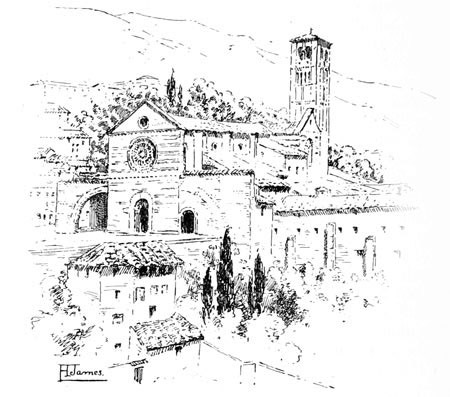
SANTA CHIARA
Upon entering the church of Santa Chiara out of
the sunshine, we are struck with a sense of the coldness
of its scant ornamentation, a want of colour, and a
general idea that artists in first directing their steps to
San Francesco had not had time to give much thought
to the church of the gentle saint. Giottino is said by
Vasari to have painted frescoes here, and they may be
those ruined bits of colour in the right transept where
it is only possible to distinguish a few heads or parts of
figures here and there in what seems to be a procession,
perhaps the Translation of St. Clare from San Damiano to
San Giorgio. It is said that their present condition of ruin
is due to the German bishop Spader who, fearing that
the nuns might see too much of the world through the
narrow grating because of the number of people who came
to see the frescoes, had them whitewashed in the seventeenth
century. The people came less, the nuns were
safer, but Giottino's (?) frescoes are lost to us and we
do not bless the memory of the German bishop of
Assisi. The frescoes of the ceiling he did not
touch, and we have in them some interesting work of
an artist of the fourteenth century whose name is unknown,
but who undoubtedly followed the Giottesque
traditions, though not with the fidelity or the genius of
the artist who painted the legend of St. Nicholas in
San Francesco. In decorating the four spandrels he
has been influenced by the allegories of Giotto, and
the angels are grouped round the principal figures in
much the same manner; they kneel, some with hands
crossed upon their breasts, but they are silent worshippers
with not a single instrument among them. The
saints who stand in the midst of the angels in Gothic
tabernacles are the Madonna with a charming Infant
Jesus who grasps her mantle, and St. Clare; St. Cecilia
crowned with roses, and St. Lucy; St. Agnes holding
a lamb, and St. Rose of Viterbo; St. Catherine, and
St. Margaret with a book in her hand. The artist has
used such soft harmonious colours and bordered his
frescoes with such pretty medallions of saints' heads
and designs of foliage that one wishes he had been
given the whole church to decorate and thus saved it
from its present desolate appearance.
The large crucifix behind the altar, a characteristic
work of that time, has been ascribed to Margaritone,
Giunta Pisano, or Cimabue. It was painted, as the inscription
says, by the order of the abbess Benedicta,
who succeeded St. Clare and was the first to rule in
the new convent, but the artist did not sign his name.
The chapel of St. Agnes contains a Madonna which
Herr Thode with far-seeing eyes recognises through all
its layers of modern paint as Cimabue's work. There
is also a much retouched, but rather charming picture
of St. Clare, painted according to its inscription in
1283. She stands in her heavy brown dress and
mantle, a thick cord round her waist, and on either
side are scenes from her life. The small triptych of
the Crucifixion on a gold ground is an interesting work
by the artist of the four frescoes of the ceiling, and a
nearer view of some of the peculiarities of his style is
obtained. It is impossible to mistake the long slender
necks, the curiously shaped ears with the upper part
very long, the narrow eyes, straight noses and small
mouths, sometimes drooping slightly at the corners,
which he gives his figures. He is another of those
nameless painters who came to Assisi in the wake of
the great Florentine.
The visitor would leave Santa Chiara with a feeling
of disappointment were it not for the chapel of San
Giorgio, the original place so often mentioned in connection
with St. Francis and now open to the public.
The crucifix of the tenth century, so famous for having
bowed its head to St. Francis in the church of San
Damiano bidding him to repair the ruined churches
of Assisi, is to be removed from the parlour, where it is
temporarily kept, and placed behind the altar. The
chapel, with a groined roof, is square, small and of
perfect form, and ornamented with several frescoes.
On the left wall is a delightful St. George fighting the
dragon in the presence of a tall princess, her face showing
very white against her red hair. There is a naïve
scene of the Magi, whose sleeves are as long and whose
hands are as spidery as those of the princess; and
above is an Annunciation. Behind the curtain in the
fresco a small child is standing who is evidently the
donor, but some people believe he represents the Infant
Jesus, which certainly would account for the surprised
attitude of the Virgin. This wall was painted in the
sixteenth century by some artist of the Gubbio school,
but his name we have been unable to discover. Quite
a different character marks the frescoes upon the next
wall, which would seem to be the work of an Umbrian
scholar of Simone Martini, or at least by one more
influenced by the Sienese than the Florentine masters.
There is a softness and an ivory tone in the paintings
of the saints, a languid look in their eyes, a sweetness
about the mouth peculiar to the Umbrian followers of
Simone, who like him succeed less well with male than
with female saints. Here the Madonna, seated on a
Gothic throne against a crimson dais, with a broad
forehead and blue eyes, her soft veil falling in graceful
folds about her slender neck, is unusually charming.
The St. George with his shield is perhaps less disappointing
than St. Francis, but then Simone fails to
quite express the nature of the Seraphic Preacher.
We turn to St. Clare of the oval face and clear brown
eyes, and feel that the painter had a subject which
appealed to him, even to the brown habit and black
veil which makes the face seem more delicate and fair.
Above are the Crucifixion, Entombment and Resurrection,
suggesting in the strained attitudes of the figures a
follower of Pietro Lorenzetti. Some remains of frescoes
upon the next wall resemble those in the nave of the
Lower Church, and probably also belong to the second
half of the thirteenth century. Indeed the architecture
of the chapel bears a striking resemblance to San
Francesco, so that although this is the original building
of San Giorgio which existed long before the Franciscan
Basilica, it was in all probability remodelled by
Fra Campello, who may have given it the pretty
groined roof.
But above all the works of art and all the views of
church or convent, the pious pilgrim treasures the
privilege of being able to gaze upon the body of the
saint in the crypt below the high altar reached by
a broad flight of marble stairs. St. Clare had been
buried so far out of sight and reach that her tomb was
only found in the year 1850, after much search had
been made. Five bishops, with Cardinal Pecci, now
Pope Leo XIII, and the magistrates of the town, were
present at the opening of the sepulchre; the iron bars
which bound it were filed asunder, and the body of the
saint was found lying clad in her brown habit as if
buried but a little while since; the wild thyme which
her companions had sprinkled round her six hundred
years ago, withered as it was, still sent up a sweet
fragrance, while a few green and tender leaves are said
to have been clinging to her veil. So great was the
joy at discovering this precious relic that a procession
was organised "with pomp impossible to describe."
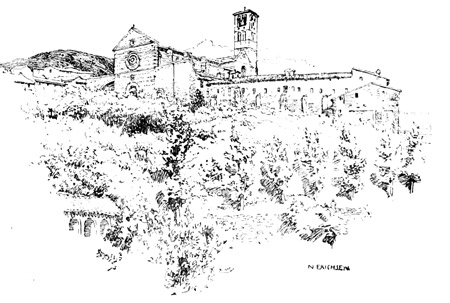
SANTA CHIARA FROM NEAR THE PORTA MOJANO
On the Sunday at dawn every bell commenced to
ring calling the people to high mass, and never, says
a proud chronicler, were so many bishops and such
a crowd seen as upon that day. At the elevation of
the Host the bells pealed forth again announcing the
solemn moment to the neighbouring villages; soon
after the procession was formed of lay confraternities,
priests and friars, and little children dressed as
angels strewed the way with flowers. The peasants,
with tears raining down their cheeks, pressed near the
coffin, and had to be kept back by some of the Austrian
soldiers then quartered in Assisi. First they went
to the Cathedral, then to San Francesco, "the body
of St. Clare thus going to salute the body of her great
master. Oh admirable disposition of God." It was
evening before they returned to the church of Santa
Chiara, where the nuns anxiously awaited them at the
entrance of their cloister to place the body of their
foundress in the chapel of San Giorgio until a sanctuary
should be built beneath the high altar. It was soon
finished, ornamented with Egyptian alabaster and Italian
marbles, and the body of St. Clare was laid there to be
venerated by the faithful.
As pilgrims stand before a grating in the dimly
lighted crypt the gentle rustle of a nun's dress is
heard; slowly invisible hands draw the curtain aside,
and St. Clare is seen lying in a glass case upon a
satin bed, her face clearly outlined against her black
and white veils, whilst her brown habit is drawn in
straight folds about her body. She clasps the book
of her Rule in one hand, and in the other holds a lily
with small diamonds shining on the stamens. The
silence is unbroken save for the gentle clicking of the
rosary beads slipping through the fingers of the invisible
nun who keeps watch, and as she lets the curtain down
again and blows out the lights there is a feeling that
we have intruded upon the calm sleep of the "Seraphic
Mother."
CHAPTER X
Other Buildings in the Town
The Cathedral of San Rufino. Roman Assisi. The Palazzo
Pubblico. The Chiesa Nuova. S. Paolo. Sta. Maria Maggiore.
S. Quirico. S. Appolinare. S. Pietro. The Confraternities
(Chiesa dei Pellegrini, etc.). The Castle.
Assisi is the only town we know of in Italy where
the interest does not centre round its cathedral
and a certain sadness is felt, which perhaps is not difficult
to explain; St. Francis holds all in his spell now
just as he held the people long ago, so that the saints
who first preached Christianity to the Assisans, were
martyred and brought honour to the city, are almost
forgotten and their churches deserted. The citizens,
though proud of their Duomo, with its beautiful brown
façade, hardly appear to love it, and we have often
thought that they too feel the sense of gloom and isolation
in the small piazza, which makes it a place ill-fitted
to linger in for long. Men come and go so
silently, women fill their pitchers at the fountain but
only the splashing of water is heard, and they quickly
disappear down a street; even the houses have no life,
for while the windows are open no one looks out, and
the total absence of flowers gives them a further look
of desolation. This part of the town was already old
in mediæval times, and the far away mystery of an
age which has few records still lives around the cathedral
and its bell tower. San Rufino stands in the very
centre of Roman Assisi and its history begins very
soon after the Roman era, one might say was contemporary
with it, as the saint whose name it bears, was
martyred in the reign of Diocletian. All the details
of his death, together with the charming legend about
the building of the cathedral, come down to us in a
hymn by St. Peter Damian, who, although writing in
1052 of things which it is true happened long before,
had very likely learnt the traditions about it from the
Assisans while he lived in his mountain hermitage near
Gubbio. The story goes back to the time when the
Roman consul of Assisi received orders to stamp out
the fast-spreading roots of Christianity, and began his
work by putting to death St. Rufino, the pastor of
the tiny flock. The soldiers hurried the Bishop down
to the river Chiaggio and, after torturing him in horrible
fashion, flung him into the water with a heavy stone
round his neck. Some say that the Emperor Diocletian
came in person to see his orders carried out.
That night the Assisan Christians stole down to the
valley to rescue the body of their Bishop and place it
in safety within the castle of Costano, which still stands
in the fields close to the river but almost hidden by
the peasant houses built around it. Here, in a marble
sarcophagus he rested, cared for and protected by each
succeeding generation of Christians who had learned
from tradition to love his memory, and secretly they
visited the castle in the plain to pray by the tomb of
the martyred saint. Their vigilance continued until
the fifth century, when the Christians had already
begun to burn the Pagan temples and build churches
of their own. Christianity, indeed, spread so rapidly
throughout Umbria that other towns cultivated a love
for relics, and fearing that the body of St. Rufino
might be stolen from the castle in the open country,
the Assisans took the first opportunity of bringing it
within the town. In the year 412 Bishop Basileo,
with his clergy and congregation met at Costano, to
seek through prayer some inspiration so that they
might know where to take the body of their saint.
As they knelt by his tomb an old man of venerable
aspect suddenly appeared among them, and spoke these
words in the Lord's name: "Take," he said, "two
heifers which have not felt the yoke, and harness them
to a car whereon you shall lay the body of St. Rufino.
Follow the road taken by the heifers and where they
stop, there, in his honour shall ye build a church."
These words were faithfully obeyed: the heifers, knowing
what they were to do, turned towards Assisi, and
brought the relics, through what is now the Porta S.
Pietro, to that portion of the old town known as the
"Good Mother" because the goddess Ceres is said to
be buried there. The heifers then turned slowly round,
faced the Bishop and his people, and refused to move.
For some obscure reason the place did not please the
Assisans, and they began to build a church further up
the hill; but every morning they found the walls, which
had been erected during the preceding day, pulled
down, until discouraged, they submitted to the augury,
and returned to the spot chosen by the heifers. Before
long, over the tomb of the Roman goddess, arose the
first Christian church of Assisi, dedicated to San
Rufino.
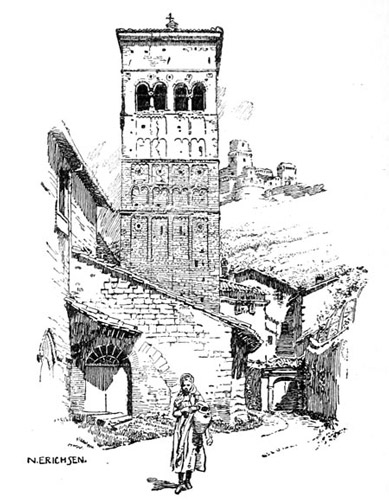
CAMPANILE OF SAN RUFINO
A few years ago the late Canon Elisei who has
written many interesting pamphlets on the cathedral,
obtained permission from the government to
clear away the rubble beneath the present church;
masses of Roman inscriptions and pieces of sculpture
were brought to light, together with part of the primitive
church of Bishop Basileo, and the whole of what
is known as the Chiesa Ugonia, from the Bishop of
that name who built it in 1028. With lighted torches
the visitor can descend to the primitive basilica and
realise what a peaceful spot had been chosen for this
early place of worship, while picturing the Christians
as they knelt round the body of their Bishop,
the light falling dimly upon them through the
narrow Lombard windows. The six columns, with
their varied capitals rising straight from the ground
without the support of bases, give a somewhat
funereal aspect, recalling a crypt rather than a
church. The few vestiges of frescoes in the apse—St.
Mark and his lion, and St. Costanso, Bishop of
Perugia—are said to be, with the paintings in S.
Celso at Verona, the oldest in Italy after those in the
catacombs at Rome. Ruins of other frescoes, perhaps
of the same date, can be traced above the door
of the first basilica, together with some stone-work
in low relief of vine leaves and grapes, but it is difficult
to see them without going behind a column built in
total disregard of this lower building. The Roman
sarcophagus is still in the apse where the altar once
stood, but open and neglected, for the body of St.
Rufino now lies beneath the altar of the present cathedral.
It is ornamented in rough high relief with the
story of Endymion; Diana steps from her chariot
towards the sleeping shepherd, Pomona has her arms
full of fruit and flowers, and there are nymphs and little
gods of love and sleep. "It appeared to us," remarks
one prudish chronicler of the church, "the first time
we beheld it, that it was indecent to have present before
the eyes of the faithful so unseemly a fable; our scruples
we however laid aside in remembering that Holy Church
is endowed with the power of purging from temples,
altars and urns, all pagan abominations, and from superstition
to turn them to the true service of God." No
such scruples existed during the early times, and there
is an amusing story of how the people wishing to place
the marble sarcophagus, which had been left at Costano
five centuries before, in the Chiesa Ugonia,
were prevented by the Bishop who admired it, and
had given orders that it should be brought to his
palace at Sta. Maria Maggiore. A great tumult
arose in the town, but although the people came to
blows and the fight was serious on both sides, no blood
was shed. A further miracle took place when the
Bishop, determined to have his way, sent sixty men
down to Costano who were unable to move the sarcophagus
which remained as though rooted in the
earth; and the event was the more remarkable as
seven men afterwards brought it at a run up the
hill to the church of San Rufino, where it remains
to this day.
Already two basilicas had been built in honour of
the saint, but the Assisans dissatisfied with their size
and magnificence, in the year 1134 called in the most
famous architect of the day, Maestro Giovanni of
Gubbio, who before his death in 1210 had all but
completed the present cathedral and campanile. It
is a great surprise when, emerging from the narrow
street leading from the Piazza Minerva thinking to
have seen all that is loveliest in Assisi, we suddenly
catch sight of the cathedral and its bell-tower. The
rough brown stone which Maestro Giovanni has so
beautifully worked into delicately rounded columns,
cornices, rose-windows and doors with fantastic beasts,
sometimes looks as dark as a capucin's habit, but there
are moments in the late afternoon when all the warmth
of the sun's rays sinks into it, radiating hues of golden
orange which as suddenly deepen to dark brown again
as the light dies away behind the Perugian hills.
All three doors are fine with their quaint ornaments
of birds and beasts and flowers, but upon the central
one Giovanni expended all his art. It is framed in
by a double pattern of water-lilies and leaves, of
human faces, beasts, penguins and other birds with
a colour in their wings like tarnished gold. The
red marble lions which guard the entrance, with
long arched necks and symmetrical curls, a human
figure between their paws, may belong to an even
earlier period, and perhaps were taken by Giovanni
da Gubbio from the Chiesa Ugonia to decorate his
façade, together with the etruscan-looking figures of
God the Father, the Virgin and St. Rufino in the
lunette above. Just below the windows a long row
of animals, such pre-historic beasts as may have walked
upon Subasio when no man was there to interrupt their
passage, seem to move in endless procession, and look
down with faces one has seen in dreams.
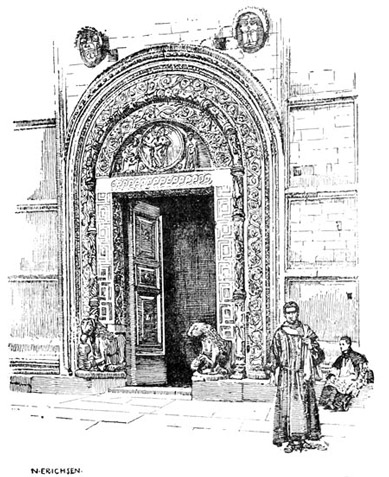
DOOR OF SAN RUFINO
The interior of the cathedral is a disappointment; at
first we accuse the great Maestro Giovanni for this painful
collection of truncated lines and inharmonious shapes,
until we find how utterly his work was ruined in the
sixteenth century by Galeazzo Alessi of Perugia. To
understand what the church was five centuries before
Alessi came, it is necessary to climb the campanile
(only those who are attracted by ricketty ladders and
dizzy heights are advised to make the trial), and when
nearly half way up step out on to Alessi's roof, whence
we can view the havoc he has made. But he could
not spoil Giovanni's rose-windows, and through one of
them we see the castle on its green hill and the town
below, cut into sections as though we were looking
at the Umbrian world through a kaleidoscope.
The outside of San Rufino is so lovely that we
should be inclined to advise none to enter, and thus spoil
the impression it makes, were it not for the triptych
by Niccolò da Foligno, "the first painter in whom the
emotional, now passionate and violent, now mystic and
estatic, temperament of St. Francis' countrymen was
revealed."[103] Here we find a dreamy Madonna with
flaxen hair, surrounded by tiny angels even fairer than
herself in crimson and golden garments folded about
their hips. The lunettes above are studded with
patches of jewel-colour, angels spreading their pointed
wings upwards as they seem to be wafted to and fro
by a breeze. Four tall and serious saints stand round
the Virgin like columns; to the right St. Peter Damian
busily writing in a book, and St. Marcello, an Assisan
martyr of the fourth century who might pass for a
typical Italian priest of the present day. On the left
is St. Rufino in the act of giving his pastoral blessing,
and St. Esuberanzio, another of Assisi's early martyrs,
holding a missal. They stand in a meadow thickly
overgrown with flowers drawn with all Niccolò's firm
outline and love of detail. Fine as the picture is, it
cannot compare with the charming predella where the
artist has worked with the delicacy of a miniature painter.
It represents the martyrdom of St. Rufino; in the
first small compartment the Roman soldiers on horseback,
their lances held high in the air, followed by a
group of prying boys, watch the Bishop's tortures as
the flames shoot up around him; and in the distance
are two small hill-towns with the towers of Costano in
the plain. Then follows the scene where two young
Assisan Christians have come down to the Chiaggio to
rescue the body of their saint from the river. He lies
stiffly in their arms, attired in his episcopal vestments,
and the water has sucked the long folds of his cope
below its surface. The last represents the procession
of citizens led by Bishop Basileo bringing St. Rufino's
body from Costano, and is one of the most exquisite
bits of Umbrian painting. Niccolò has placed the
scene in early morning, the air is keen among the
mountains, the sun has just reached Assisi, seen against
the white slopes of Subasio, and turns its houses to a
rosy hue, while the tiny wood in the plain is still in
deepest shadow. The white-robed acolytes mount the
hill in the sunlight followed by the people and the
heifers which ought, Niccolò has forgotten, according
to the legend, to have led the way. The picture is
signed Opus Nicholai De Fuligneo MCCCCLX.
The only other fine things in the cathedral are the
stalls of intarsia work of carved wood, by Giovanni di
Pier Giacomo da San Severino (1520), a pupil of the
man who executed the far finer stalls in San Francesco.
In the chapel of the Madonna del Pianto is a
curious wooden statue of the Pietà, how old and
whether of the Italian or French school it is difficult
to say. A tablet records that in 1494 because of the
great dissensions in the town this Madonna was seen to
weep, for which she has been much honoured, as is
shown by the innumerable ex-votos hung by the faithful
round her altar.
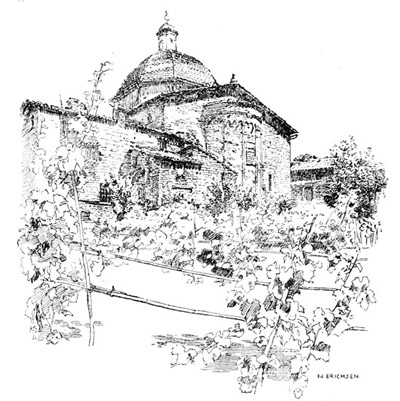
THE DOME AND APSE OF SAN RUFINO FROM THE CANON'S GARDEN
The marble statue of St. Francis is by the French
artist, M. Dupré (a replica in bronze stands in the
Piazza), while that of St. Clare is by his daughter,
who both generously gave their work to Assisi in
1882. The statue of St. Rufino is by another
Frenchman, M. Lemoyne.
The proudest possession of San Rufino is the font in
which St. Francis, St. Clare, St. Agnes and Frederick
II, were baptised, and the stone is shown upon which
the angel knelt, who in the disguise of a pilgrim
assisted at the baptism of Assisi's saint. Often did
Francis come to San Rufino to preach when the small
church of S. Giorgio could no longer hold the
crowds who flocked to hear him, and the hut where
the saint spent his nights in prayer and meditation
before he preached in the cathedral is now a chapel.
This was the place of the miracle when his companions
at Rivo-Torto saw him descend towards them in a
chariot of fire (see p. 238). In the time of the saint
it was the cottage of a market-gardener and still stands
amidst a vineyard, one of the prettiest and sunniest
spots in the town, where vines, onions, wild flowers
and cherry trees grow in happy confusion, and birds
and peasants sing all day long.
The charm of the Cathedral is best realised after
witnessing one of its many ceremonies, when the canons
in crimson and purple, processions of scarlet clothed
boys swinging censers, and the Bishop seated beneath
a canopy of yellow damask his cope drawn stiffly to
the ground by a fussing acolyte, recall some of the
magnificence of the middle ages. The young priests
bow low before the Bishop on their way to the altar,
return to their seats and bow again; incense fills the
church; the organ peals half drown the tenor's
song, and through it all, from the stalls, drone the
voices of the canons reciting their office. It is a
gorgeous service but without a congregation, for even
the beggars have not stolen in; and Niccolò's Madonna
looks out upon the scene with big soft eyes which
seem to follow us into the darkest corners of the aisles.
Roman Assisi.
Assisi is so much a place of one idea—of one interest—around
which everything has grown, that it is difficult
to remember that a fairly important town existed
in Roman times, and that the Roman buildings, still to
be seen are, in the opinion of Mr Freeman, worth a
visit even if the church of San Francesco had never
arisen. Some pleasant hours may be passed finding
the sites of pagan monuments, the remains of ancient
walls, and tracing the outline of the original town. In
every case we see how Roman Assisi has, in a very
marked way, become part of Mediæval Assisi, palaces
having been erected upon the foundations of Roman
houses and Christian churches upon the sites of ancient
temples. The Temple of Hercules stood at the bend
of Via S. Quirico (now Via Garibaldi) where it turns
up to the ancient palace of the Scifi; while the Porta
Mojano, near which old walls and part of an aqueduct
can be seen, took its name from a temple of Janus
which stood between it and the Vescovado. Standing
a little off the Piazza Nuova, in a part of the town
known as the "Gorga," are the remains of the amphitheatre.
It would be difficult to find much of the
original edifice, but houses having been built exactly
on the ancient site its shape has been preserved, and this
strange medley of old and new was thought worthy of a
doric entrance gate by Galeazzo Alessi. Much the
same thing has happened with many of the castles in
the country near Assisi, where the peasant houses are
grouped round them in such a way that only by penetrating
into the midst of a tangled mass of dwellings
can the vestige of a tower be here and there discerned
to remind us of its former state. Assisi, though of no
military importance at that time, aspired to become a
little Roman town even more perfect than her neighbours
on the hills. The broad and strongly built drain
which extends from near the Porta Perlici beneath the
Piazza Nuova to the garden behind San Rufino, is
said to have been used to carry off the water from the
amphitheatre after the mimic sea-fights which in
Roman times were so popular. A use was found for
all things, and in time of war a Roman drain proved
a most efficient means of escape, especially when the
Baglioni were raiding the town and putting to death
all they met upon their road.
Some small remains of a Roman theatre are to be
seen near the cathedral but so buried amidst a wild
garden that it is difficult to form any just idea of its
extent. The most splendid piece of masonry, a
Roman cistern, lies beneath the campanile of the
cathedral and can be easily looked into by the light of
a torch, the sacristan even suggests a descent into its
dark depths by means of a rickety ladder. An inscription
recording the proud fact that Assisi possessed an
amphitheatre has been removed to the cathedral where
it is placed above the side entrance to the left. Other
large portions of Roman walls are to be found at the
back of a shop in the Via Portica and also in the Via
San Paolo; both are marked upon the map. In those
days the town seems to have been identical with what
we now call old Assisi, namely the quarter round San
Rufino extending to the portion round San Francescuccio
where are noticed the arched Lombard
windows.
But by far the most interesting record of this early
age is the Temple of Minerva, which in spite of the
damage done when it was turned into a church, and
the way in which the mediæval buildings are crowded
round it, yet remains one of the most beautiful of
ancient monuments. The raising of the Piazza makes
it difficult to realise, without going below ground, how
imposing the temple must have been when its steps led
straight down to the Forum. This can be reached by
descending from the Piazza into the "scavi," or excavations,
where stands the great altar with drains for
the blood of the victims; the long inscription giving
the name of the donor of the Temple runs:
GAL. TETTIENVS PARDALAS ET TETTIENA GALENE
TETTRASTILVM SVA PECVNIA FECERVNT, ITEM SIMVLACRA
CASTORIS ET POLLVCIS. MVNICIPIBVS ASISINATIBVS DONO
DEDER. ET DEDICATIONE EPVLVM DECVRIONIBVS SING. XV.
SEVIR. XIII. PLEBI X. DEDERVNT. S.C.L.D.
It is well known that Goethe went to Assisi solely
to see the Temple, and surprised the citizens by going
straight down the hill again without stopping to visit
San Francesco. He wished to keep unimpaired the
impression this perfect piece of classical architecture
had made upon his mind, and we cannot refrain from
translating his enthusiastic description of it for these
pages.
"From Palladio and Volkmann I had gathered
that a beautiful temple of Minerva, of the time of
Augustus, was still standing and perfectly preserved.
Asking a good-looking youth where Maria della
Minerva was, he led me up through the city which
stands on a hill. At length we reached the oldest
part of the town, and I beheld the noble building
standing before me, the first complete monument of
ancient days that I had seen. A modest temple as
befitted so small a town, yet so perfect, so finely conceived,
that its beauty would strike one anywhere.
But above all its position! Since reading in Vitruvius
and Palladio how cities ought to be built and temples
and other public edifices situated, I have a great respect
for these things.... The temple stands half way up
the mountain, just where two hills meet together, on
a piazza which to this day is called the Piazza....
In old times there were probably no houses opposite
to prevent the view. Abolish them in imagination,
and one would look towards the south over a most
fertile land, whilst the sanctuary of Minerva would be
visible from everywhere. Probably the plan of the
streets dates from long ago as they follow the conformation
and sinuosities of the mountain. The temple
is not in the centre of the Piazza, but is so placed that
a striking, though fore-shortened, view of it is obtained
by the traveller coming from Rome. Not only should
the building itself be drawn but also its fine position.
I could not gaze my full of the façade; how harmonious
and genial is the conception of the artist.... Unwillingly
I tore myself away, and determined to draw
the attention of all architects to it so that correct
drawings may be made; for once again have I been
convinced that tradition is untrustworthy. Palladio,
on whom I relied, gives us, it is true, a picture of this
temple, but he cannot have seen it, as he actually places
pedestals on the level whereby the columns are thrown
up too high, and we have an ugly Palmyrian monstrosity
instead of what is a tranquil, charming object,
satisfying to both the eye and the understanding. It
is impossible to describe the deep impression I received
from the contemplation of this edifice, and it will
produce everlasting fruit."[104]
S. Paolo[105]
A little off the Piazza della Minerva is the old
Benedictine church dedicated to St. Paolo, erected in
1074, when it probably stood alone with its monastery
and not, as now, wedged in with other houses. Built
in the very heart of Roman Assisi, its foundations rest
upon solid walls of travertine, where a secret passage
reaches to the castle. In this part of the town there
are several underground passages spreading out in
various directions, reminding us of the insecurity of
life in the early times when Pagan consuls persecuted
the weaker Christian sect. Just within the doorway
of the church, now alas thickly coated with whitewash,
is an ionic column belonging to some building of
importance which must have stood within the Forum.
Few people visit S. Paolo as it is only mentioned in
local guide-books, and the passing stranger is generally
told that there is nothing to see which is borne out by
the modesty of its exterior; but no lover of the early
Umbrian school who has the time to spare should fail
to step in, if only for a moment, as on a wall to the
left of the entrance is a large fresco by Matteo da
Gualdo. He has signed the date in the corner—1475—though
not his name, but it would be difficult to
mistake so characteristic a work of this delightful
painter. The Virgin, tall and stately, is accompanied
by St. Lucy, who holds her eyes upon a dish and is
clothed in a richly coloured orange gown falling in
heavy folds about her; on the other side is St. Ansano,
the patron of the Sienese, looking in his elegant green
jacket, trimmed with fur, more like a courtier than a
holy martyr. He holds his lungs in one hand, because
he is a patron of people suffering from consumption,
but why we know not, as there was nothing in the way
he met his death in the river Arbia by the order of
Diocletian to explain the presence of this strange
symbol. He stands in Matteo's fresco very daintily
by the Madonna's side, pointing her out to the small
donor who is seen kneeling in a doorway. The colour
is deep, perhaps a little crude, and if the figures may
seem somewhat stiff and their draperies angular, all such
defects are amply redeemed by the small angels on
the arch above, who composedly gaze down upon the
Madonna as they sing and play to her.
Palazzo Pubblico or Palazzo Communale
In the beginning of the thirteenth century the civil
affairs of Assisi had assumed such large proportions
that it was found impossible to transact business in
unsheltered quarters of the piazza as had hitherto been
done, and the citizens determined to build a Palazzo
Pubblico. Other towns were rising to municipal importance,
notably Perugia whose palace for her priors
proved a beautiful example of a gothic building,
while Assisi was directing all efforts to adorn her
churches. A house was bought belonging to the same
Benedictine abbot of Mount Subasio, who had given
the humble dwellings to St. Francis, and on its site
they erected the present municipal palace, which was
enlarged in 1275 and again in the fifteenth century,
but it always remained a humble building with little
pretensions to fine architecture. Here the priors and
the consuls ruled the citizens in the absence of a
despot, while in the palace of the Capitano del Popolo
(now the residence of the Carabinieri), whose tower
dates from 1276, the council of the citizens met to
check the tyranny of the governing faction. These
municipal magnates lived upon opposite sides of
the Piazza, and acted as a drag upon each
other in civil matters. The many small towns,
villages and castles which were beneath the yoke
of Assisi in mediæval times have been represented
by a modern artist in the entrance hall of the Palazzo
Pubblico, and are a happy record of her days of conquest
and prosperity, which are duly remembered by
the citizens. There is also a picture by Sermei of St.
Francis blessing Assisi from the plain which, painted
in the sixteenth century, is interesting as a likeness of
the town at that time. There is also a picture of
Elias hung upon the wall, intended as a portrait and
not as an object for popular devotion. An effort has
been made to adapt one of the rooms as a gallery of
Umbrian art, and a few frescoes taken from walls and
convents and transferred to canvas are preserved here,
giving some idea, notwithstanding their ruined condition,
of the liberal way in which Umbrian artists distributed
their work in every corner of the town. The
gateway of S. Giacomo exposed to constant sun,
wind and rain, was yet thought a fitting place for
Fiorenzo di Lorenzo to paint a fresco of a beautiful
Madonna. It now looks sadly out of place in this room
of the Municipio with a little paper ticket on the
corner of the canvas marking it as No. 17. The
half figures of angels, No. 23 and No. 24, by Matteo
da Gualdo, were taken from the Confraternity of S.
Crispino together with No. 21. From the Chiesa
dei Pellegrini came No. 5, the Madonna and Saints by
Ottaviano Nelli of Gubbio; while No. 6, a Madonna,
with angels holding a red damask curtain behind her,
was found at the fountain of Mojano and is attributed
to Tiberio d'Assisi. That mysterious painter L'Ingegno
d'Assisi may be the author of No. 12. Vasari recounts
how he learnt his art in the workshop of Perugino in
company with Raphael, and even helped his master in
the Cambio frescoes. His real name was Andrea Aloisi,
the nickname of Ingegno arising from the fact that
he was looked up to by his fellow citizens as a very
remarkable man, for not only could he paint beautiful
Madonnas but he was a distinguished Procurator,
Arbitrator, Syndic and Camerlingo Apostolico. But
to try and trace his work is like following a will-o'-the-wisp,
for no sooner do we hear of a fresco by
him than it eventually turns out to be by Fiorenzo
di Lorenzo or by Adone Doni, and this fresco in
the Municipio is the only one in Assisi which may be
by him. If it is, Tiberio d'Assisi would seem to
have been his master and not Perugino.
In the same room is a small but interesting painting
in fresco (No. 87), the figure of a winged Mercury,
which was excavated a few years ago in the Casa
Rocchi, via Cristofani. In another room is the head
of a saint which some believe to be also of Roman
times, but a good authority attributes it to a late
follower of Raphael. The saint's head is seen against
a shadowy blue landscape, and like all Umbrian things
has an indescribable charm, a feeling that the artist
loved the valleys in spring-time, and tried to convey
some of the soft colour of the young corn and budding
trees into the picture he was painting.
The Chiesa Nuova
A little below the Piazza della Minerva is the
Chiesa Nuova, built at the expense of Philip III, of
Spain in 1615 by the Assisan artist Giorgetti and
finished in seven years. Few people come to Assisi
without visiting it, for although containing nothing
of artistic value, it stands upon the site of the Casa
Bernardone, and recalls many incidents of St. Francis'
life. The small door is shown through which Madonna
Pica passed when the angel disguised as a pilgrim
told her that her son was to be born in a stable, and
we see part of the cell where St. Francis endured such
cruel imprisonment from his father, until his mother in
the absence of Messer Pietro let him out to return
to his haunts at San Damiano and the Carceri.[106] Other
places preserve more of the charm of the saint than
the Chiesa Nuova.
Two buildings in the town are intimately connected
with St. Francis, his father's shop in the Via Portica
the entrance of which the sculptor of St. Bernardino's
door at the franciscan convent has adorned with a
beautiful pattern of flowers, shields and cupids; and
the house of Bernard of Quintavalle which is reached
from this street by the Via S. Gregorio. It is now
the Palazzo Sbaraglini and has no doubt been much
enlarged since the thirteenth century, but the little old
door above a flight of steps bears the unmistakable stamp
of age; it leads into a long vaulted room, now a chapel,
which there seems every reason to believe was the
one where Bernard, the rich noble, invited St. Francis
to stay with him at a time when he doubted his
sanctity. The story is too long to quote and extracts
would only spoil it, but the pilgrim to Assisi
should read it as related in that franciscan testament,
the Fioretti (chap. iii.). Popular devotion has
happily not tampered with this corner of the town as
it has with the house of the Bernardone.
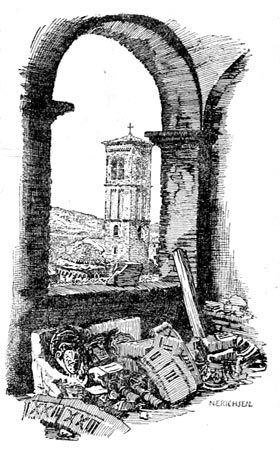
CAMPANILE OF STA. MARIA MAGGIORE
Sta. Maria Maggiore
This romanesque church stands above a Roman
building whose columns and mosaic floor can easily be
seen from the garden behind the apse, and for many
centuries it was the cathedral of Assisi as is testified by
its close proximity to the Bishop's palace. But there is
now little to remind us of any pretensions to splendour
which it may once have possessed, only vestiges
of the frescoes destroyed by the great earthquake of
1832 can be seen on its walls, and an Annunciation
in a cupboard of the
sacristy—in such
strange places do we
find an ancient fresco
in Assisi. The church
was already an old
building in the twelfth
century, for we hear
of its being restored
and enlarged after a
fire by Giovanni da
Gubbio, and finished
later by the help of St.
Francis who is said
to have rebuilt the
apse. One gladly
hurries out of it into
the little piazza which,
though the humblest
looking in Assisi, is
very famous for the
scenes it has witnessed.
Here St. Francis renounced
the world in
the presence of his
angry father, and received
protection from
Bishop Guido; (see p.
235). Many years later the dying saint was brought to
rest at the Bishop's palace near the church, and edified
those who guarded the gates by singing so gaily in the
midst of terrible suffering. Then again when a quarrel
arose between Guido and the Podestà of Assisi, two
friars came up with a message of peace from St. Francis,
then on his deathbed at the Portiuncula, who had heard
with grief of the dissension. The story, and it is a true
one we may be sure, has been faithfully recorded by
Brother Leo, who tells us how "when all were assembled
together in the piazza by the Bishop's palace
the two brethren rose up and said: "The blessed
Francis in his illness has composed a canticle to the
Lord concerning His creatures, to the praise of the
Lord Himself and for the edification of the people."
It was the verse beginning "Praised be my Lord for
all those who pardon one another for His love's sake,"
which he had added to his Hymn to the Sun (see p.
79). All listened intently to the message which so
touched the heart of the Podestà that he flung himself
at the Bishop's feet and promised to make amends for
his offence for the love of Christ and the Blessed
Francis. The Bishop lifting him from the ground
spoke words of forgiveness and peace, and then "with
great kindness and love they embraced and kissed one
another."
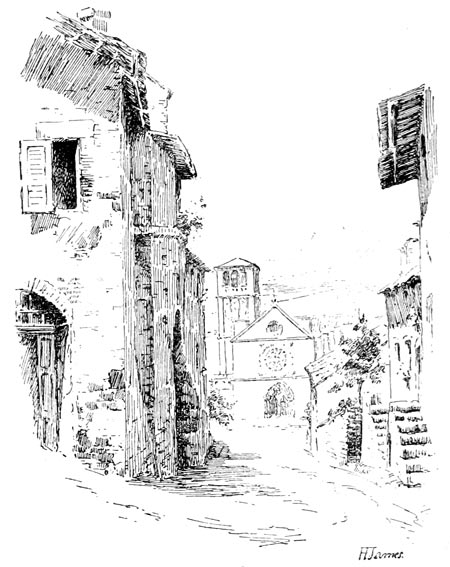
EAST FRONT OF SAN FRANCESCO
Convents of S. Quirico and S. Appolinare
Every church and convent wall in Assisi was once
adorned by frescoes, and even now, when time and ill-usage
have done their best to ruin them, it is still
possible to come upon delightful specimens of Umbrian
art. But they are so stowed away in out of the way
corners that one hardly likes to pass a door, however
poor and uninviting, without glancing in to see what
treasure may be hidden away behind it.
Curiosity was amply rewarded one day while visiting
the convent of S. Quirico which we pass on the way
from Sta. Maria Maggiore to S. Pietro, attracted there
by the small fresco of the Virgin and St. Anne by
Matteo da Gualdo over the door. The whitewashed
parlour contained nothing of interest, not even a nun
peered through the iron grating, but a murmur from the
attendant about frescoes drew us to a window where,
above the brown-tiled roof under a rough pent ledge,
exposed to rain and wind, was a fresco of Christ rising
from the tomb, and four small angels. It is not perhaps
one of Matteo da Gualdo's most pleasing compositions
and might be passed unnoticed in a gallery,
but the thought of the wealth of Umbrian art, when
masters left their paintings over gateways upon city
walls, and above a roof where even the nuns can
scarcely see it as they walk in the cloister below, give
it a peculiarly Assisan charm which we cannot easily
forget. A few steps further on, down the Borgo San
Pietro, is the large convent of S. Appolinare, remarkable
for its pretty campanile of brick, and a wheel
window above the door. It once possessed many
frescoes of the fourteenth and fifteenth century, but
now it is not worth while to seek admittance for they
are much destroyed; some have been ruthlessly cut in
two by lowering the ceiling of the rooms, and only
here and there, where the whitewash has peeled off,
faces of Madonnas and saints look out like ghosts imprisoned
in a convent wall.
S. Pietro
The church of S. Pietro stands upon a grass
piazza surrounded by mulberry trees, with a broad
outlook upon the valley. The central door, supported
by two lions, has a twisted design of water-plants
and birds which formerly were coloured, but
now only show here and there traces of green stalks
on a dark red background. A finely carved inscription
above it records that in the year 1218 the cistercian
Abbot Rustico built the façade, but its proud historians
believe the church itself to have existed in the second
century, thus claiming for it the honour of being the
first church erected in Assisi. The present building
cannot be older than 1253 when it was rebuilt after a
great fire, and consecrated by Innocent IV. The interior
is finely proportioned, and the remains of ancient
frescoes discovered upon the walls show the zeal of
the Assisans in making all their churches, as well as
San Francesco, as beautiful as they could.
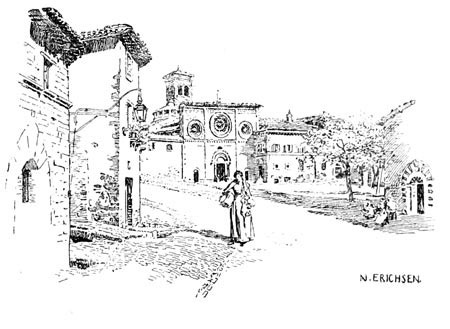
CHURCH OF S. PIETRO
In the small chapel to the left of the high altar are
four stencilled medallions of a hunter with his dogs
chasing a stag, besides symmetrical patterns like those
of the nave of the Lower Church of San Francesco.
Over the altar is a signed picture by Matteo da Gualdo
(he was at Assisi in 1458, but the date here is partly
effaced), of a Madonna with a choir of angels, and
upon either side St. Peter and the Assisan martyr St.
Vittorino. By standing on the altar steps a fresco
of the Annunciation of the fifteenth century may be
seen on the wall of the sacristy, discovered beneath the
usual layer of whitewash some fifty years ago. The
angel's profile, the hair turned back in waves from the
face over the shoulders, is clearly outlined, and shows
pale against the golden light of his wings. But the
real treasures of this church, according to a pious
author, are the bones of St. Vittorino, an Assisan
Christian who was the second Bishop of Assisi, and
died a martyr's death in the third century. In 1642
these relics were deposited in a more suitable marble
urn than the one that had contained them before, during
a grand ceremony presided over by a Baglioni, Bishop
of Perugia. Other bones and ashes of some Roman
martyrs were afterwards added which were taken
from the cemetery at Rome by the Abbot of San
Pietro "to further enrich his church."
The Confraternities
An enduring mark of St. Francis' influence is seen
in the number of confraternities established in Assisi
which, if they have lost many of their primitive customs,
still retain a hold upon the people and are the
great feature of the town. Hardly a day passes without
seeing members either preparing for a service in
one of their chapels, or following a church procession,
or carrying the dead along the cypress walk from Porta
S. Giacomo to the cemetery. Clothed in long grey
hooded cloaks, holding lanterns and candles and singing
their mediæval hymns, these citizens of the nineteenth
century belong to Assisi of the past as much as
all her frescoes and early buildings. Their origin goes
back to the middle of the thirteenth century when, out
of the great devotional movement due to St. Francis,
arose that strange body of penitents the Flagellants,
who are said to have first appeared in Perugia, and
thence spread throughout Italy.[107] "The movement,"
says Dr Creighton, "passed away; but it left its dress
as a distinctive badge to the confraternities of mercy
which are familiar to the traveller in the streets of
many cities of Italy." Assisi was among the first to
witness the hordes of fanatics who roamed from town
to town increasing as they passed like a swarm of locusts
through the land, and often at night going forth into
the streets clothed in white garments to dance a dance
of the dead, clanging bones together as they sang. It
was inevitable that their passage through Assisi should
have its results, and many brotherhoods were founded;
those who had no chapels of their own met in S. Pietro
or S. Maria delle Rose, where they performed their
penances, sometimes, as in the case of the Battuti (Flagellants),
beating themselves as they sang the wild, love-inspired
hymns of Jacopone da Todi, the franciscan
poet of Umbria. Since those days their fervour has
taken a more practical form, and very simple are their
services.
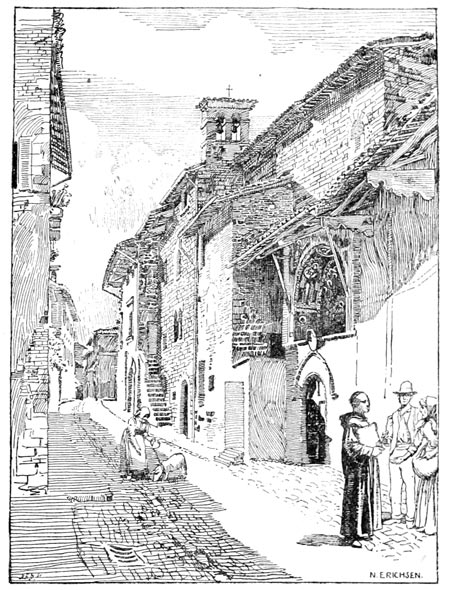
CONFRATERNITY OF SAN FRANCESCUCCIO IN VIA GARIBALDI
The members of San Francescuccio, or Delle Stimate,
ever to and fro upon some errand of mercy, belong
to the most important confraternity, and own one of
the most picturesque chapels in the towns. When its
doors are open during early Mass or Benediction the
sound of prayer and chanting comes across the quiet
road, and in the blaze of candle-light is seen the great
Crucifixion of Ottaviano Nelli (?) in the lunette of the
wall above the altar. At other times, the chapel being
so sunk below the level of the road with no windows
to light it, both fresco and the charming groined roof,
blue as that of San Francesco, can with difficulty be
seen. The pent roof outside overshadows some Umbrian
frescoes by Matteo da Gualdo recording the famous
miracle of the roses which flowered for St. Francis in
the snow, and which he offered to the Virgin at the Altar
of the Portiuncula. On the wall to the right are some
ruined frescoes in terra-verde by a scholar of Matteo.
Another confraternity in this street is San Crispino,
which once possessed a picture by Niccolò Alunno,
but that has long since disappeared, and only faint
patches of colour remain above its gateway. There are
many other confraternities, but as they do not all
possess pictures of interest, we only mention three
others; and first of these, the Oratory of St. Anthony
the Abbot, or Chiesa dei Pellegrini, which every visitor
to Assisi ought to visit.[108] After the Church of San
Francesco it is by far the most important sight of the
town; a Lombard façade, a Roman temple, or a
mediæval castle, delightful and beautiful as they are,
may be seen elsewhere, but we know nothing with
such individual charm as the little chapel of St.
Anthony, in the Via Superba. So often a hundred
vicissitudes arrested the adornment of a building during
those troubled times of the middle ages, but here
we find a small and perfectly proportioned oratory
decorated with frescoes upon the ceiling and upon
every wall, by two Umbrian masters who have
sought to make it a complete and perfect sanctuary
of Umbrian art.
Built in 1431 by the piety of the brotherhood of
St. Anthony the Abbot, it served as a private chapel
to the adjoining hospital, where pilgrims coming to
pray at the shrine of St. Francis found food and
shelter for three days. The liberal donations given
by Guidantonio, Duke of Urbino and sometime
Lord of Assisi, whose devotion to the saint was
great, may have enabled the confraternity to adorn
it with its many frescoes. Outside, in the arched
niche above the door, are the patrons of the chapel,
St. Anthony and St. James of Campostello, that
great saint of pilgrims, with a frieze of small angels
above them playing upon various instruments, also
by Matteo da Gualdo. To him we owe the fair
Madonna over the altar who gazes so dreamily before
her, and sits so straight upon her throne. Angels
gather round bending towards their instruments with
earnest faces; Matteo's angels can never only calmly
pray, they must sing or else play on tambourines,
viole d'amore, cymbals and organs. Less pleasing
are the large figures of St. James and St. Anthony,
while in contrast to them are the slender winged
figures on either side bearing tall candelabra, and
moving forward with such stately step, their white
garments sweeping in long folds behind them, their
fair curls just ruffled by the air. Surely Matteo must
have been thinking of a group of babies at play in the
cornfields, or under the hedges near his own Umbrian
town, when he painted that frieze of laughing children,
with little caps fitting so closely round their heads,
who are tossing the branches of red and white roses
up into the air. Each one is different, and all are full
of graceful movement. They divide the frescoes
below from that of the Annunciation, which recalls
the manner of Boccatis da Camerino, the master of
Matteo. He paints a swallow, the bird of returning
spring, perched outside the Virgin's bedroom, to
symbolise the promise of redemption, and a lion cub
meant to represent the lion of Judah walks leisurely
towards the Madonna.
Matteo da Gualdo, as the inscription tells, worked
here in 1468, and Pier Antonio da Foligno, known as
Mezzastris, came in 1482 to paint the rest of the chapel,
and upon the right wall he related the most famous of
St. James' miracles in a naïve and delightful manner.
The legends tell how in the time of Pope Calixtus II,
a certain German with his wife and son on their way
to the saint's Spanish shrine of Campostello lodged at
Tolosa, where their host's daughter fell in love with
the fair young German. But he, being a cautious
youth, resisted every advance of the Spanish maiden,
who sought to avenge herself by hiding a silver drinking
cup belonging to her father in his wallet. The
theft was discovered, and the judge of Tolosa condemned
the young pilgrim to be hanged. Pier Antonio
has painted the scene when the father and mother, after
visiting Campostello, return to take a last look at the
place where their son was executed and find him well:
"O my mother! O my father!" he says, "do not
lament for me, as I have never been in better cheer,
the blessed Apostle James is at my side, sustaining me
and filling me with celestial joy and comfort." In
the fresco near the altar the story is continued; the
judge, stout and imposing as one of Benozzo Gozzoli's
Florentine merchants, is seated at a table in crimson
and ermine robes surrounded by his friends, when the
pilgrim and his wife arrive and beg him to release
their son. Somewhat bored at being interrupted at his
banquet he mocks them, saying: "What meanest thou,
good woman? Thou art beside thyself. If thy son
lives so do these fowls before me." No sooner had
he spoken than, to the astonishment of all, the cock
and hen stood up on the dish and the cock began to crow,
as we see in Mezzastris' fresco. On the opposite wall
are miracles of St. Anthony. In the fresco near the door
he is sitting in the porch of the church surrounded by
his companion hermits; they are watching the arrival
of camels which, in answer to the saint's prayer, have
brought a supply of food neatly corded on their backs.
The artist has pictured the desert with sandy mountains,
little flowers growing in the burning sand and thick
grass in the wood by the convent. In the second
fresco St. Anthony, beneath a portico of lapis lazzuli
and green serpentine, is distributing the food brought
by the friendly camels, to the beggars, who appear as
suddenly upon the scene as the beggars do in an Assisan
street.
The four figures in the ceiling, Pope Leo III, St.
Bonaventure, St. Isidor of Seville and St. Augustine,
and the angels with shield-shaped wings, are also by
Mezzastris. A graceful piece of his work is the
Christ above the door, in a glory of angels who form
a wreath around Him with their wings like sheaves
of yellow wheat. Delightful, but very different from
Matteo's, are the cupid-angels flying across the sky on
clouds, and the two seated playing with a shield upon
which is painted the pilgrim's scallop-shell.
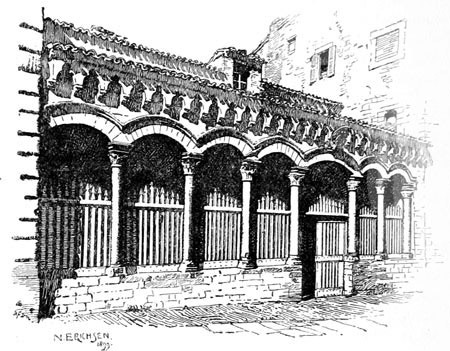
MONTE FRUMENTARIO IN THE VIA PRINCIPE DI NAPOLI
The figure of St. James near the door is of small
interest, being a much restored work of a pupil of
Perugino; but in the dark corner on the other side is,
says Mr Berenson, a youthful work of Fiorenzo di
Lorenzo. It is the young St. Ansano holding his
lungs suspended daintily from one finger as in the
fresco of S. Paolo, and looking so charming in his page's
dress, his fair curls falling about his shoulders. He
stands at the entrance of a cave with pointed rocks
above, and saxifrage and ferns delicately drawn are
growing in their crevices. Would that Mezzastris
had given his pupil a larger space of wall to work on,
so that we might have had more saints and landscapes
like these. We leave the chapel with regret, giving
one last look at Matteo's Madonna and his frieze of
child-angels, and then go out into the long broad
Via Principe di Napole. Its fine palaces, once the
abode of some of the richest nobles of the town, have
now been turned into schools and hospitals, and our
thoughts once more revert to the past days of prosperity
and magnificence as we walk along this grand but
silent street where the grass grows unmolested between
the stones. A little way further on to the right is the
fine loggia of the Monte Frumentario which in olden
times was an agricultural Monte di Pietà, where
the peasants who had no other possessions than the
produce of the fields would come to pawn their grain
in time of need. The door is finely sculptured, and
the delicate chiselling of the capitals of the pillars of
the loggia mark it as a work of the fourteenth century.
Not far from the Chiesa dei Pellegrini, but to the left,
stands one of the oldest Assisan houses which does
not seem to have suffered much alteration since it was
built. It was the lodge of the Comacine guild of
workers, who have left their sign of the rose
between the compass over the entrance, and two pieces
of sculpture, showing that those to whom the house
belonged were people who worked at some trade.
It does not appear to have been a dwelling-house,
but only a place where the members of the guild,
employed in building the different civil and religious
buildings for the Assisans, could meet together to discuss
their interests, draw out their plans and execute
different pieces of their work. They probably did
not build the house, but perhaps in the year 1485,
which is the date above the door, adapted for their
use one already standing.[109] It is always pointed out as
the Casa di Metastasio, but his paternal dwelling is a
less interesting house, standing
at the angle of Via S. Giacomo
and Via S. Croce, which can
be reached from the Comacine
Lodge by the steep by-street
of S. Andrea. Metastasio,
though the Trapassi were Assisans,
had little to do with
the town as his family were
engaged in trade at Rome,
where he was born in 1698.
There he was found improvising
songs to a crowd of
wondering people by the celebrated
Vincenzo Gravina, who
adopted and educated him.
When set to music, Metastasio's
poetry brought all Rome
to his feet and earned him the
title of Cæsarean poet from the
Emperor Charles VI; he ended
his life at the court of Vienna
as the favourite of Maria
Theresa, honoured by all the
great musicians of the day. Truly he has little to do
with Assisi, yet he must be added to the list of her
numerous illustrious citizens.
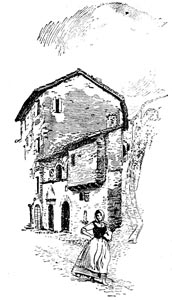
HOUSE OF THE COMACINE BUILDERS
IN THE VIA PRINCIPE DI NAPOLE
Following the street by the Casa di Metastasio,
we get into delightful lanes above the town and reach
another little confraternity, the oldest of all, San
Rufinuccio.[110] Its small chapel, built of alternate layers
of pink and white Subasian stone, is a very characteristic
example of an Umbrian way-side sanctuary, always open
in the olden days for the peasants to come into for rest
and prayer. It is worth a visit, not only because the
way there is beautiful, but also for the grand Crucifixion
painted above the altar by the decorator of St.
Nicholas' Chapel in San Francesco. It is a strong
and splendid composition, which even much repainting
has been unable to destroy. Unfortunately the scenes
at the sides can only just be seen. Below, the half-length
Madonna and angels by another artist recall the
Annunciation of S. Pietro, in the marked outline of
their pale faces and the rainbow colour of clothes and
wings.
Turning off from the Via Nuova to the left we
mount still higher through the olive groves along a path
possessing no name, but which is the nicest way to the
heights above the town. We come in a few minutes
to the confraternity of San Lorenzo, standing somewhat
below the level of the castle. It has nothing of
interest inside, but behind the wooden covering of the
gateway at the side is a fresco by an unknown Umbrian
artist, an Assisan perhaps, who above the Virgin's
throne signs himself "Chola Pictor." He paints the
faces of his saints with a smooth surface, betraying
the influence of Simone Martini which he felt together
with many of his fellow Umbrian artists. The Virgin's
throne is full of wonderful ornaments; unfortunately
the fresco has suffered from a large crack across the
wall. Very quaint is a group of hooded members of
the confraternity at her feet, and there is a charming
figure of St. Rufino, young, with an oval face and
brown eyes, but to be seen only from the top of a
ladder as he is painted in a corner of the arch. It
has been suggested to remove this much-ruined painting
to the safer custody of the Municipio, but we hope
this will not occur, for, taken away from its gateway
on the hillside, where the redstarts build their nests
and the evening sun lights up the colour in the Virgin's
face, its interest and charm would be lost.
The Castle or "la Rocca d'Assisi"
Within her city walls Assisi possesses nothing
wilder or more beautiful than the undulating slopes
which rise from the city up to the Castle, where
wild orchises grow among the grass, and the hedges
of acacia wind around the hill. The town lies
so directly below, that by stepping to the edge and
looking across the white acacias, we can only see
a mass of brown roofs all purple at sundown, the
tops of towers and the battlements of gateways.
Then there are places where the grassy hillocks
stand up so high that they hide the town altogether,
and we seem to be looking out upon the broad vista
of the valley from an isolated peak. At all times it
is beautiful; but choose a stormy day in springtime,
when the clouds are driving upwards from the plain
only lately covered with mist, and the nearer hills
are dark their cities catching the late evening sunshine
as it breaks through the storm, while wind-swept
Subasio looks bleak in the white light showing here
and there patches of palest green. And behind us,
cresting the hill, so near the town yet seen absolutely
alone and clear against the sky, rise the tower
and the vast walls of the Rocca d'Assisi, looking, not
like a ruin crumbling beneath the constant driving
of wind and rain, but as though torn down in war-time,
grand in its destruction. It stands upon the site
of an ancient burial ground, where in remote times
the Umbrian augurs came to watch for omens from
the heights of a tower that is said to have crowned
the summit. The legend of this building gave rise
to the belief that a castle stood here in very early
times which was taken by Totila when he besieged
Assisi. But it is more probable that when Charlemagne
rebuilt the town in 733 after it had been
destroyed by his army, he also erected a castle to
enable the Papal emissaries to keep the people in
subjection; or perhaps the citizens themselves may
have wished to protect themselves more securely from
passing armies (see p. 16). It ended by becoming,
much to the displeasure of the people the residence of
whoever held Assisi for the time, and in the twelfth
century they experienced the despotic rule of Conrad
of Suabia, who lived here with his young charge,
Frederic II. When, by the superior power of the
Pope, Conrad was driven out of Umbria, the citizens
did their best to destroy the walls which had harboured
a tyrant, and to avoid further tyranny they obtained an
edict forbidding the erection of another fortress. But
promises such as these were vain indeed, for when, in
1367, escaping from the hated yoke of the Perugians
Assisi welcomed Cardinal Albornoz in the Pope's
name as her ruler, she lent a willing ear to his
plans for rebuilding the castle. The people were
well satisfied as they watched the improvements he
made in the town, and two centuries had so dimmed
the remembrances of Conrad's tyranny, that they
gladly assisted him, little deeming that they were
giving away their liberty. Albornoz, not slow to
perceive what a valuable possession it would prove
to the rulers of Assisi, spared neither money nor
efforts to make it large and strong. By his orders
the castle keep, which we see to this day, called
the "maschio," and the squarely-set walls enclosing
it were erected, and in a very few years the Rocca again
rose proudly on its hill, warning the Umbrian people
of its newly-found importance, and enticing passing
condottieri to lay siege to a town that offered so fine
a prize. Albornoz also rebuilt most of the city walls
which had been so battered during the Perugian wars;
we can trace them from gateway to gateway encircling
the city, and it is curious to see how in the upper
portion near San Rufino large open spaces exist, as if
in those active days when the Assisans had hopes of
becoming powerful, they purposely set the walls far
back to provide for a large and flourishing town. The
feeling of arrested growth is one of the most mournful
spectacles, and we half wonder if the great castle
dominating the heights was not in part the cause of it.
There was war enough at the time, inevitable among
the restless factions of a people groping towards freedom
and power, but here above the town was placed a
fresh cause of dissension and struggle against perpetual
bondage through varied tyrannies.
Albornoz, in planning out the city walls, discovered
that the part between Porta Cappuccini and Porta
Perlici, where the hill descends towards the ravine,
needed protection, so he built the strong fortress of San
Antonio known as the Rocca Minore. It had a
separate governor or Castellano, and though of minor
importance, proved very efficient in repelling the attacks
of besieging armies. The principal tower, though
somewhat ruined, still looks very fine within its square
enclosure of massive walls, now covered in places with
heavy curtains of ivy, the home of countless birds. A
pious Castellano in the fifteenth century left a fresco
of the Crucifixion in the chapel with his portrait at
the foot of the Cross, and as we look at it through the
wooden gateway we are reminded of what otherwise
from the deserted look of the place it is easy to forget,
that people once lived and prayed at the Rocca as well
as fought.
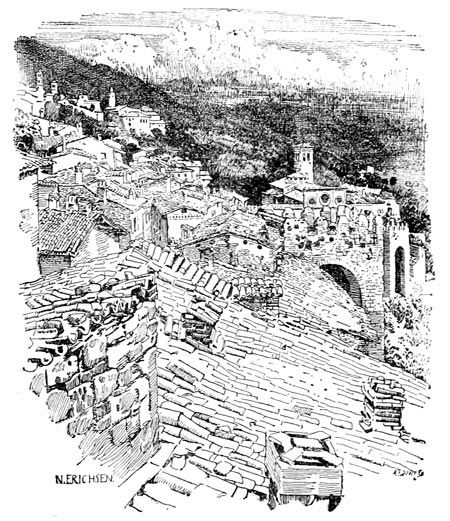
LOOKING ACROSS THE ASSISAN ROOFS TOWARDS THE EAST
Cardinal Albornoz left the castle in charge of two
Assisan captains, but from 1376 an uninterrupted line
of governors received their salaries from whoever was
master of Assisi at the time. Always chosen from
other towns their privileges were quite distinct from
those of the civil governors; but in the fifteenth century,
owing to the weakness of the Priors, who failed
to keep order among the lawless nobles of the town,
their power increased. The Papal Legate then gave
into the hands of the Castellano authority to issue edicts
which the Priors had to obey, and in 1515 he was
invested with the title of Podestà and Pretor of
Assisi. But none of these governors seems to have
misused their power over the town, probably because
their rule was of too short a duration to carry out any
ambitious scheme. And when the despot for the time
being of Assisi came to stay, he took up his quarters
in the castle, ruling governors, magistrates and people
alike. In the time of the despot Broglia di Trino,
we hear of the Priors wearily toiling up the steep
ascent to place before him the acts they had passed in
the municipal palace. He received them always in the
open air, holding his councils either in the first enclosure
by the well, or in the second by the castle keep, where
many important conclusions were arrived at, and plans
for the city's dominion laid out.
So perfect is the harmony of the castle from wherever
it is seen, that it is difficult to realise how many
hands have formed it, how many times its walls have
been battered down and rebuilt at different periods by
popes, cardinals, and passing condottieri, who have nearly
all left their arms upon its walls as a record of their
munificence. After Albornoz had built the principal
mass of fortifications little was done until 1458, when
Jacopo Piccinino, the son of the great general, entered
Assisi as master, and obtained immediate possession of
the Rocca. His reign was short, but with the quick
eye of a soldier he soon discovered the weakness of the
western slope, and seeing that it might be carried by
assault from Porta San Giacomo, he laid the foundations
of a polygonal tower and a long wall connecting
it with the main building. The Comacine builders
established in Assisi were employed and left their sign,
the rose between the compass and the mason's square,
upon its lower walls. But long before the work was half
completed Piccinino sold the city to the Pope, and it
was Æneas Piccolomini, Pius II, who, when he visited
Assisi in 1459, ordered it to be brought to a termination;
within a year the wall was raised to its full
height, the tower received its battlements and the arms
of the Piccolomini were placed above those of Piccinino.
The covered gallery, running along the top of the wall
from the castle, still leads the visitor to the giddy
heights of the tower whence he obtains truly a bird's-eye
view of all the country round, from Spoleto to
Perugia, across range upon range of hills towards
Tuscany, and from Bettona to the wild tract of
mountainous country leading to Nocera, Gualdo and
Gubbio.
To recount the full history of the castle needs a
book to itself, and would include not only the history
of Assisi but almost of all Umbria.[111] The possession
of the Rocco Maggiore entailed that of the Rocca
Minore and gave undisputed sway over Assisi, so that
the desperate efforts made to hold it can be understood.
During the intervals when Papal authority was relaxed,
we find the names of many famous people whose armies
fought for this much contested prize. Biordo Michelotti,
Count Guido of Montefeltro, the two Piccininos,
Francesco Sforza and Gian Galeazzo Visconti, were
in succession its owners. Cosmo de' Medici obtained
it from Pope Eugenius IV, in payment of a bad debt,
and a Florentine governor ruled over it for a year. It
even, together with the town of Assisi, became the
property of Lucrezia Borgia, who received it from
Alexander VI, as part of her dower on her marriage
with Giovanni Sforza, Lord of Pesaro. Sometimes it
happened that a private citizen of Perugia conceived
the ambitious scheme of making himself master of the
castle, and by fraud the Castellano would be enticed
outside the gates and murdered with his family. But
it always ended by Perugia, fearing the wrath of the
Pope, or not liking one of their own citizens to gain so
much power, sending an army to dislodge the tyrant,
who soon lost his head. Sometimes criminals were
kept imprisoned in the castle; we can still see the
room in the keep where they scratched their names
upon the wall, with many references to their horror of
the place, and a roughly traced heart pierced with an
arrow. Ordinary malefactors were shut up in a dark
cell on the stairs. When their crimes merited death
they were executed on the Piazza della Minerva, or if
time pressed, the Castellano hanged them from the
battlements of the fortress or threw them out of a
window into the ravine below. The governors had a
difficult and not a very peaceful time, for they had not
only to guard against outside foes, but occasionally
against a faction who attempted to get possession of
the castle, and great on those occasions was the fight
outside its walls. It was in vain that they took every
precaution for the general safety, that a night guard
walked up and down the Assisan streets playing his
castanets to warn off all evil-doers, or that men-at-arms
watched incessantly from the castle battlements. In
the sixteenth century the castle became a prey to the
rival families of the Nepis and the Fiumi who divided
Assisi between them. First it fell into the hands of
Jacopo Fiumi and the Pope, Alexander VI, furious
when he heard of this citizen's audacious act, wrote
that "by love or by force" he would have his fortress
back again; but Jacopo remained impervious to threats
or promises and held out for another year, until the
Priors fearing the anger of the Pope came to an agreement
with him. Some thirty years later the Nepis
obtained possession of it by treachery and violence,
and it required all the astuteness of Malatesta Baglione,
who was fighting for Clement VII, to dislodge them,
while the Pope branded them and their adherents as
"sons of iniquity" for having dared to wrest from
the Papacy the castle of Assisi.
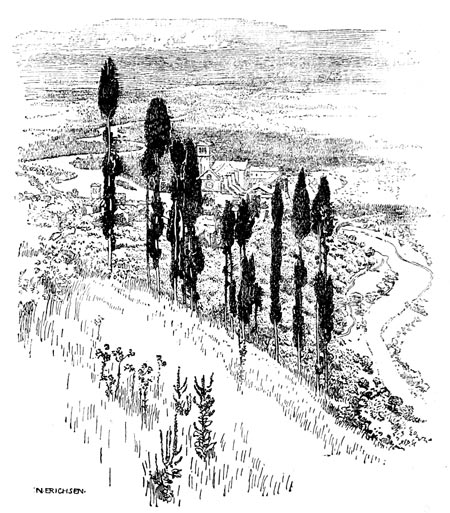
VIEW OF SAN FRANCESCO FROM BENEATH THE CASTLE WALLS
But the days of the great military importance of the
Rocca were fast drawing to a close; Assisi, no longer
oppressed by the nobles, harassed by the armies of
Perugia, or alarmed by the coming of the despots
whose power was on the wane all over Italy, lost her
character of individuality as a fighting and turbulent
city, and sank beneath the wise and beneficent government
of the Papacy. With the arrival of Paul III,
in 1535, the final blow was given to mediæval usages
of war and scheming in Umbria. The great Farnese
Pope was building his fortress at Perugia to finally
crush that hitherto indomitable people, and fearing the
Assisans might yet give trouble in the future to his
legates as they had so often done in the past, he gave
orders that the fortress should be repaired, and a bastion
suitable for the more modern methods of warfare be
built to the right of the castle keep. This is now
the best preserved portion of the building. For some
time a Castellano still remained in command of the
castle but his title was purely a nominal one, and his
chief duty seems to have consisted in guarding prisoners.
Its political need having disappeared the
popes thought less of their Assisan fortress, the one
lately erected at Perugia being more efficient as a safeguard
of their interests, and gradually its walls showed
signs of decay, but no papal legates were sent to see to
their repair. So terribly did it suffer during the years
that followed the reign of Paul III, that in 1726 we
read of the governor of the city sending an earnest
supplication to the Pope that "this strong and ancient
castle of Assisi, which had always been the chief
fortress of Umbria, should be saved from ruin." The
Pope, he tells us in another letter, had already sent
Count Aureli, the military governor of Umbria, to
inspect it, who declared it was "one of the strongest
and most splendid fortresses of the ecclesiastical states,
and as fine as any he had seen in France or in Flanders,
when as head page he had accompanied Louis XIV."
In the same document there is mention also of beautiful
paintings in the chief rooms, and of a miraculous
Crucifixion in the chapel, but these decorations, needless
to say, have long since disappeared. Entreaties
were vainly sent to Rome; the castle was so utterly
abandoned that its gates stood open for all to roam in
and out as they pleased, pulling down the ancient arms
of the popes, and vying with the storms to complete its
ruin and destruction. Such was its strength that it
endured the ill-treatment of seasons and of men, and
people now alive remember in their youth to have seen
it still roofed in and possessing much of its former
magnificence. A little money might have restored it
to its pristine state, but during those years of struggle
for the Unity of Italy the general fever of excitement
invaded the quiet town, and as if remembering all the
tyrants their castle walls had harboured, and the skirmishes
their ancestors had fought beneath them, the
citizens continued its destruction with renewed vigour.
It was no uncommon thing to see cartloads of stones
being taken down the hill for the construction of some
modern dwelling, or boys amusing themselves by throwing
down portions of the walls, and trying who could
succeed in making great blocks of masonry reach the
bed of the torrent below. Luckily the government
gave it over to the commune of Assisi in 1883 and
they did something towards its repair, though within
certain limits, for a large sum would have been necessary
to complete its restoration.
But it still remains a very wonderful corner of Assisi,
and delightful hours may be passed sitting in the castle
keep and looking out of the large windows upon a
land so strangely peaceful, with little cities gathered on
the hills or lying by some river in the plain. We see the
battered walls around us bearing traces of ancient warfare,
and wonder at the power which made the mediæval
turmoil so suddenly subside. In vain we scan the
valley for the coming of a warlike cardinal with glittering
horsemen in his rear, or look for Gian Paolo
Baglione riding hastily through the town upon his
swift black charger. The communal armies met for
the last time by the Tiber many centuries ago; popes,
emperors, condottieri and saints have passed like
pageants across Umbria, and as if touched by a
magician's wand have as suddenly vanished, leaving
her cities with only the memories of an active and
glorious past. Thus Assisi, with the rest of the
smaller towns, gradually sank as a prosperous and
governing city though decidedly not as a place of pilgrimage
and prayer, into that deep sleep from which
she has never again awakened.
CHAPTER XI
Church of Santa Maria degli Angeli.
The Feast of the Pardon of
St. Francis or "il Perdono
d'Assisi"
The sanctuary of the Portiuncula has, in its present
surroundings, rightly been called a jewel within a
casket—a casket indeed too large for so small a gem.
But the great Church of Santa Maria degli Angeli was
the best the Umbrians could procure for the object
they loved best after their Basilica in the town, and
the famous architects of the day were called in to
build it.[112] A smaller shelter would have served the
purpose in earlier times but the ever increasing flow
of pilgrims who came in thousands for the "Perdono"
rendered it necessary to think about a church large
enough to contain them; and it was the dominican
Pope Pius V, who enabled the work to be commenced
in 1569, giving large sums to the vast enterprise.
Jacopo Barozio da Vignola gave the ground-plan,
leaving the execution of it, at his death in 1573, to
be carried out by the well-known Perugian architect and
sculptor, Giulio Danti, and his fellow-citizen Galeazzo
Alessi, who designed the fine cupola and arches.
The church was built in the doric style, divided
into nave and aisles with numberless side chapels;
and certainly they succeeded in giving it a great
feeling of space and loftiness, which if less charming
than the mysterious gloom of other churches yet seems
to belong better to the open and sunlit Umbrian plain,
where it rises as a beacon to the people for many miles
round. The earthquake in 1832, which laid the
villages near Ponte San Giovanni in almost total ruin,
shook down the nave and choir of the Angeli creating
havoc impossible to describe. By supreme good fortune,
shall we say by a miracle, the cupola of Danti
and Alessi remained intact above the Portiuncula, which
otherwise would have been utterly destroyed. In rebuilding
the church, Poletti, the Roman architect employed,
deviated slightly from Vignola's original plan,
and further he erected a more elaborate and far less
elegant façade than the first one, but baroque as it is
we may be thankful that the niches for statues of the
saints have remained empty. There have been other
earthquakes since that of 1832, and when they occurred
a pyramid of faggots was carefully piled upon the
Portiuncula for protection in case a miracle might not
intervene a second time to save it from destruction.
The friars took an active part in the work, building
the campanile and carving the handsome pulpit and the
cupboards in the sacristy. The marble altar was given
in 1782 by Mehemet Ali, the ruler of Egypt, and many
noble Italian families contributed towards the erection
of the chapels containing decadent paintings which it
would be useless to describe or to look at. One priceless
treasure ornaments the chapel of San Giuseppe (in
the left transept), a work of Andrea della Robbia in
terra-cotta of blue and white which is like a portion of
the sky seen through the cool branches of a vine on a
glaring summer's day. Andrea is truly the sculptor
of the franciscans, for there are but few of his works
where an incident from St. Francis' life is not introduced,
and with what feeling they are realised. On
one side of the beautiful Madonna who bends to receive
her crown from the hands of the Saviour, is represented
with great dignity and simplicity St. Francis receiving
the Stigmata, on the other St. Jerome and his lion.
Beneath is a predella divided into three compartments,
the Annunciation, Christ in the manger, and the Adoration
of the Magi; and Andrea has framed in the whole
with a slightly raised garland of apples, fir-cones and
Japanese medlars, which suits the delicacy of the workmanship
of the small scenes better than a heavier wreath
of fruit and leaves. In the Capella delle Reliquie (in
the right transept) is a Crucifixion painted on panel by
Giunta Pisano (?) with medallion half figures of the Virgin
and St. John; below are kneeling angels by an Umbrian
artist, whose work contrasts most strangely with the
ancient painting belonging to the dark years before Giotto.
In a preceding chapter we lamented the efforts that
have been made to decorate the Portiuncula, now alas
no longer the shrine among the oak trees; not only in
earlier centuries did Umbrian artists cover its rough
stones in many parts with frescoes, but the German
artist Overbeck has added another superfluous decoration
to the façade, severely, but justly criticised by M. Taine,
and a German lady has painted the Annunciation on
the apse. A very small picture by Sano di Pietro of
the Madonna and Child hangs above, a very charming
example of the master's work. Very little remains of
Pietro Perugino's Crucifixion, and what there is has
been well covered over with modern paint. The choir
of the monks built outside the Portiuncula having been
removed in the eighteenth century half of Perugino's
fresco was destroyed, leaving only the groups of people
at the foot of the Cross, amongst whom we recognise
St. Francis.
A naïve legend is recalled to us by the stone slab
let into the wall close to the side entrance, recording
the spot where Pietro Cataneo, the first vicar of the
Order during the life of the saint, is buried. He was
as holy as the rest of those first enthusiasts, and after
death so many miracles were wrought at his tomb that
the peace of the friars was disturbed. The case
becoming serious they had recourse to St. Francis
who, seeing the danger that their lonely abode would
become a place of pilgrimage, addressed an admonition
to Pietro Cataneo, saying that as he had ever been
obedient in life so must he be in death and cease to
perform such marvellous miracles. After this when
peasants came to pray for some favour at his tomb no
answer was vouchsafed, so that gradually their faith in
his intercession ceased and peace again reigned at the
Portiuncula.
The extent of the present church is so immense that
the site of all the scattered huts of the brethren and the
little orchard so carefully tended by the saint, are contained
within its walls. Over what was the infirmary
where St. Francis died St. Bonaventure built a chapel
which Lo Spagna decorated with portraits (?) of the
first franciscans, now seen very dimly like shadows on
its walls by the flickering light of the tapers. Out of
the half gloom stands strongly outlined in a niche above
the altar, a beautiful terra-cotta statue of St. Francis
by Andrea della Robbia. The hood is thrown back,
the head slightly raised, and in the sad but calm expression
of the exquisitely modelled face Andrea conveys
a truer feeling of the suffering Poverello than
all the so-called portraits. One of these, said to be
painted on the lid of the saint's coffin by Giunta Pisano,
hangs outside the chapel, but it looks more like a bad
copy of Cimabue's St. Francis in the Lower Church,
and we would fain leave with the remembrance unspoilt
of Andrea's fine conception. Passing through the
sacristy containing a head of Christ by an unknown
follower of Perugino and a small Guido Reni (?), we
reach the chapel of St. Charles Borromeo where an
ancient and much restored portrait of St. Francis, said
to be painted on part of his bed, hangs above the altar;
it is in every way less interesting than the one in the
sacristy of the Lower Church. From here an open
colonnade leads past a little plot of ground, which in
the days of the Little Brethren was the orchard of the
convent. One day as the saint left his cell he stopped
a moment to speak with the friar who attended to the
land, "begging him not to cultivate only vegetables,
but to leave a little portion for those plants which in
due time would bring forth brother flowers, for the love
of Him who is called 'flower of the field and lily of
the valley.'" Accordingly a "fair little garden" was
made, and often while St. Francis caressingly touched
the flowers, his spirit seemed to those who watched
him to be no longer upon earth but to have already
reached its home. On the other side, carefully preserved
within wire netting, is the famous Garden of
Roses, and standing in the midst, like ruins of some
temple, are the four pillars which in olden times
supported a roof above the Portiuncula. In the days
when St. Francis had his hut close by, this cultivated
garden was only a wilderness of brambles in the forest,
and the legend tells how the saint being assailed by
terrible temptation as he knelt at prayer through the
watches of the night, ran out into the snow and rolled
naked among the brambles and thorns to quiet the
fierce battle within his soul. The moonlight suddenly
broke through the clouds shining upon clusters of white
and red roses, their leaves stained with the saint's blood
which had fallen upon the brambles and produced these
thornless flowers, while celestial spirits filled the air with
hymns of praise. Throwing a silken garment over him
and flooding his pathway with heavenly radiance, the
angel led him to the Portiuncula where the Madonna
and Child appeared to him in a vision. The legend
has been often illustrated, Overbeck's fresco on the
façade of the chapel records it yet again where St.
Francis is represented as offering to the Virgin the
roses he had gathered.
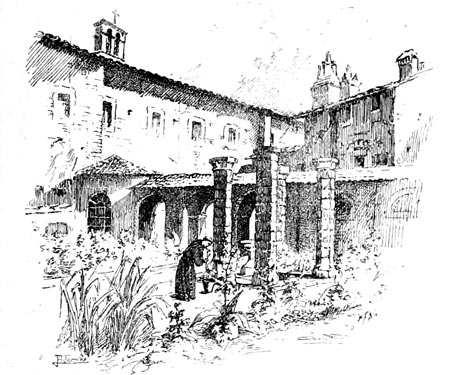
THE GARDEN OF THE ROSES AT STA. MARIA DEGLI ANGELI
A few steps beyond the Garden of the Roses lies
the Chapel of the Roses built by St. Bonaventure over
the hut of St. Francis, which was afterwards enlarged
by St. Bernardine. The place where he spent his few
moments of repose and so many hours of prayer, can
be seen through the grating on a level with the chapel
floor, and resembles more the lair of a wild animal than
an ordinary abode of man; but such places were dear
to him, and he rejoiced in having the open forest outside
his cell into which he wandered at all times of the
day and night, and where the brethren, ever curious to
watch their beloved and holy master, could see him on
moonlight nights holding sweet converse with heavenly
spirits. The choir of the chapel is frescoed by Lo
Spagna who repeated again the figures of the first
franciscans, adding those of St. Bonaventure, St.
Bernardine of Siena, St. Louis of Toulouse, and St.
Anthony of Padua on the left wall, and St. Clare and
St. Elisabeth of Hungary on the right wall. The
fresco on the ceiling is said to be by Pinturricchio.
The paintings in the nave by Tiberio d'Assisi are
faintly coloured and a poor example of Umbrian art;
only the last scene is interesting, where St. Francis
publishes the indulgence in the presence of the seven
bishops, as it gives an accurate representation of the
Portiuncula in the fifteenth century with Niccolò
da Foligno's fresco still upon the façade. It tells the
legend of the "Perdono" which even to the present
day plays so important a part in the religious life of
Assisi, bringing crowds every year to the Portiuncula
for whom the Angeli was finally built. Disentangling
the story from the legend by no means diminishes its
charm, while we get a very striking historical scene
showing us St. Francis in yet another light. Once
when the saint was praying at the Portiuncula, Christ
and his Mother appeared to him to ask what favour he
desired, for it would be granted by reason of his great
faith. The salvation of souls being ever the burden of
his prayers he begged for a plenary indulgence, to be
earned by all who should enter the Portiuncula on a
special day. "What thou askest, O Francis," replied
Christ, "is very great; but thou art worthy of still
greater favours. I grant thy prayer; but go and find
my Vicar, the Sovereign Pontiff Honorius III, at
Perugia, and ask him in my name for this indulgence."
Early next morning St. Francis, accompanied by Peter
Cataneo and Angelo da Rieti, started along the road
to Perugia where Innocent III, had but lately died
and the pious Honorius been immediately elected as his
successor. It was in the early summer of 1216 that
the little band of friars were led into the presence of
the Pope in the old Canonica, but not for the first
time did St. Francis find himself in the presence of
Rome's sovereign, gaining his cause now as before
through the great love that made his words and
actions seem inspired. At first the Pope murmured at
the immensity of the favour asked but finally, his
heart being touched by the fervour of the saint, he
said: "For how many years do you desire this indulgence.
Perchance for one or two, or will you that
I grant it to you for seven?" The Pope had still to
learn the depths of love in the saint's heart who stood
before him pleading so earnestly for the souls of men,
not during his life only, but during centuries to come.
"O Messer il Papa," cried St. Francis in accents
almost of despair, "why speakest thou of years and of
time? I ask thee not for years, but I ask thee for souls."
"It is not the custom of the Roman Curia," answered
the Pope, "to grant such an indulgence."
"Your Holiness," said the saint, "it is not I who ask
for it, but He who has sent me, the Lord Jesus Christ."
The Pope conquered by these words and driven by a
sudden impulse said, "We accord thee the indulgence."
The Cardinals who had remained silent now began
to murmur and reminded the Pope, like cautious
guardians of the Papal interests, that this plenary indulgence
would greatly interfere with those granted
for pilgrimages to the Holy Land, and for visiting the
tombs of the Blessed Apostles.
"We have given and granted it to him," answered
Honorius. "What has been done we cannot undo, but
we will modify it so that the indulgence will be but
for one full day." And motioning the saint to approach
he said: "From henceforth we grant that whoso comes
to and enters this church, being sincerely repentant
and having received absolution, shall be absolved from
all punishment and all faults, and we will that this
indulgence be valid every year in perpetuity, but for
one day only from the first vesper of the one day
until the first vesper of the next." Hardly had the
Pope ceased speaking when St. Francis radiant with
joy turned to depart.
"O semplicione quo vadis? O simple child without
guile, whither goest thou? Whither goest thou without
the document ratifying so great a favour?" quoth
the Pope.
"If this indulgence," answered the saint, "is the
work of God, I have no need of any document, let
the chart be the Blessed Virgin Mary, the notary
Christ and my witnesses the angels."
Round this historical interview the legend makers
wove the pretty story of the roses which flowered
in mid-winter among the snow, relating that after the
concession of the indulgence in the summer of 1216
occurred this rose miracle, and Christ in a vision
bade the saint go to Rome in order that the day might
be fixed for the gaining of the indulgence, and to
convince Honorius of the truth of his revelation he
was to carry some of the roses with him. But having
already obtained the Pope's sanction at Perugia, it
was unlikely that the saint would wait another year
before proclaiming the glad tidings to all the country-side,
and we may be sure that no sooner had he
returned to the Portiuncula from Perugia than he made
speedy preparations for the arrival of a great concourse
of people. On the afternoon of the first of August the
plain about the Portiuncula was filled with pilgrims
from far and near, and many friars hastened from
distant parts to listen to their master's wonderful
message. He mounted the wooden pulpit which had
been erected beneath an oak tree close to the chapel,
followed by the seven Umbrian bishops who were to
ratify his proclamation of the indulgence. St. Francis
discoursed most eloquently to the assembled multitude
and then in the fullness of his joy cried out to them,
"I desire to send you all to Paradise," and announced
the great favour he had obtained for them from the
Holy Pontiff. When the bishops heard him proclaim
the indulgence as "perpetual" they murmured among
themselves, and finally exclaimed that he had misunderstood
the words of the Pope, and that they
intended to do only what was right and ratify the
indulgence for ten years. Full of righteous feeling
the bishop of Assisi stepped forward to correct the
error into which the saint had fallen, but to the astonishment
of his companions he declared the indulgence to
have been granted for all time. Then the others
murmured still more, saying he had done this because
he was an Assisan and wished to bring great honour
to his diocese; so the bishop of Perugia, determining
to set the mistake right, began to speak, but he found
himself forced by a supernatural power to proclaim the
indulgence in the very words of St. Francis. The
same thing happened to the other five bishops, and
St. Francis then saw his dearest wishes realised.
Daily the fame of the Portiuncula increased, and
the year 1219 witnessed another immense gathering of
people, but this time it was the meeting of the five
thousand franciscan friars who came from distant
parts to attend the Easter Chapter held by St. Francis
in the plain. One of the most vivid and interesting
chapters (the xiii) in the Fioretti, pictures for us "the
camp and army of the knights of God," all busily
employed in holy converse about the affairs of the
Order. It relates how "in that camp were shelters,
roofed with lattice and mat, arranged in separate groups
according to the diverse provinces whence came the
friars; therefore was this Chapter called the Chapter
of the Lattices or of the Mats; their bed was the bare
earth, though some had a little straw, their pillows
were stones or billets of wood. For which reason the
devotion of those who heard or saw them was so great,
and so great was the fame of their sanctity, that from
the court of the Pope who was then at Perugia, and
from other towns in the vale of Spoleto, came many
counts, barons and knights, and other men of gentle
birth, and much people, and cardinals and bishops and
abbots with many other clerics, to see so holy and great
a congregation and so humble, the like had never yet
been in the world of so many saintly men assembled
together: and principally they came to see the head
and most holy father of all these holy men...."[113]
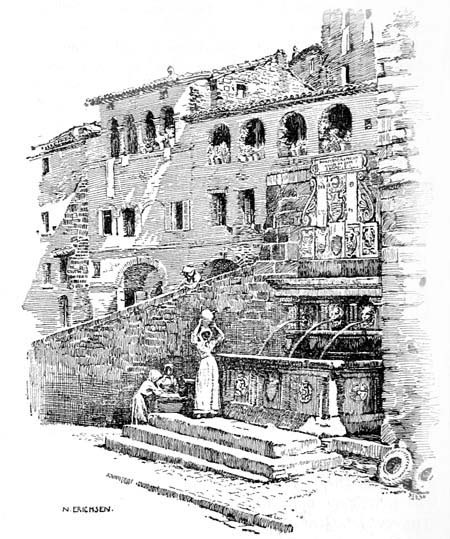
THE FONTE MARCELLA BY GALEAZZO ALESSI
The Pardon of St. Francis or "Il Perdono
d'Assisi."
We cannot study the story of any Umbrian town
without experiencing the feeling that it belongs to the
past and was built in an age, which can only dimly be
realised in the pages of old chronicles, by a people
who were ever hurrying to battle, bent on glory and
conquest for their cities. The character of the inhabitants
has changed, and though the wonderful little
cities they built upon the hills remain much as in
mediæval times, they have a peaceful and quiet loveliness
of their own which could not have existed in
those days of fevered struggle and unrest. The word
Assisi brings up, even to those who have seen the
town but for a day, a host of sunlit memories; of way-side
shrines with fading frescoes, whence Umbrian
Madonnas smile down upon the worshippers; of
ravines and forest trees; of vineyards where the
peasants greeted you; of convent and Basilica glowing
golden and crimson in the sudden changes from
afternoon to sun-down, as they lie bathed in the last
rays of light upon the hill above the darkness of the
valley. All these things and many more pass through
our minds, but the picture would be incomplete if we
fail to recall two days in August when the undying
power of St. Francis once more reaches across the
centuries, arousing the people to a sudden return to
mediæval times of expiation, prayer and strong belief
in the power of a great saint's intercession.
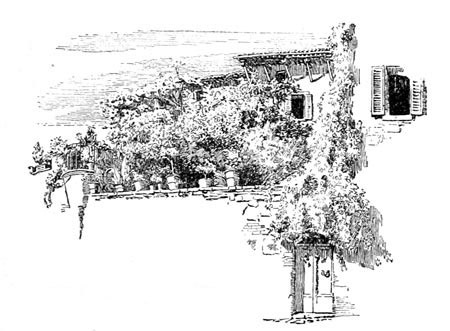
AN ASSISAN GARDEN IN
VIA GARIBALDI
The very mention of a feast savours in Italy of delightful
things, of songs, of crowds of happy-looking
people bent on the pleasures of a holiday as well as on
praying for the good of their souls, and as a feast at
Assisi sounded fairer than any other, we determined to
become for the moment pilgrims and seek with them
for the "Pardon of St. Francis." So as the days
drew near to August we stood once more on the
terrace of the Hotel Subasio, and as we felt the cool
air of the early morning coming from the mountains,
long days of interminable heat at Florence were forgotten,
and Assisi, with her gardens full of sweet-scented
summer flowers, her streets resounding only
with the plash of the water of many fountains, seemed
to us indeed to possess more beauty, variety and
brilliancy of colour than we had realised before. Never
had the nights been so still as in that late July, when
the peasants had gathered in their harvest and were
waiting for the time of vintage; only the shrill notes
of the crickets answered each other occasionally along
the valley, and the frogs croaked on the margin of the
rills below the town. But soon this calmness ceased
as the country roused itself for the annual spell of
madness; there were voices in the vineyards during
the night, bonfires in the plains, and a general tremor
of excitement filled men and animals, setting the thin
Assisan cocks crowing at unearthly hours in the morning.
A night of sounds and wakefulness preceded a
day when the people of all the cities and villages near
appeared to have arrived in Assisi, not for the feast—for
it was only the 29th of July—but for the fair.
We followed them to the Piazza della Minerva, no
longer the quiet place of former visits when only a
few citizens sat sipping their cups of coffee, or talked
together as they walked leisurely up and down.
Temples, buildings and frescoes were forgotten as
we watched the peasants gather round the booths to
purchase articles of apparel and household wares,
bargaining in shrill voices to the delight of purchaser,
seller and onlooker. All the people of the country
seemed to be here, and the Umbrian sellers had decked
their stalls with a dazzling mass of coloured stuffs as
attractive to us as to the Umbrian women. We bought
large kerchiefs with red roses on a yellow ground to
wear over our heads at the feast, and enormous hats with
flapping brims, which the peasants, always interested in a
neighbour's purchase, helped us to choose, saying, "take
this one for no rain will come through it, and you need
never use an umbrella." So a sun-bonnet was bought
for rain and we went away convinced that no more
delightful shopping could be done than during a fair
day at Assisi, when a passing farmer and his family
were ready to help us to choose the goods and to
bargain, and moreover comforted us in the end by the
assurance that in their opinion the money had been well
spent. Later we strolled up to the Piazza Nuova,
where an immense fair of oxen was being held, transforming
another sleepy corner of the town into a busy,
bustling thoroughfare. They were quiet beasts enough
and we walked in among them stroking their soft noses
as we watched the groups of excited peasants performing
the various rites of selling and buying. When an ox
was sold the broker joined the hands of vendor and
purchaser by dint of much pulling, and then shook them
up and down, shouting all the while, until our joints
ached at the sight of this energetic signing of a treaty.
The bargaining causes enormous amusement, the discussion
on either side bringing a current of eager talk
through the crowd; only the oxen were thoroughly
weary of the whole affair as they gazed pensively at
their owners. They were large milk-white creatures,
the whole place was one white shimmering mass seen
against the old walls of the town and the blocks of
Roman masonry, calling up idle fancies of Clitumnus
down in the valley just in sight, whose fields had given
pasture to the oxen of the gods.
The whole of that day Assisi was full of Umbrian
men and women greatly concerned in buying and selling;
but on the next the streets began to fill with
people from distant parts of Italy, whose only thought
was for St. Francis. At a very early hour of the 30th
we were roused by the sound of many voices in the
distance; going out on the terrace we saw a crowd of
pilgrims coming across the plain, and others moving
with slow steps up the hill. When near the Porta S.
Francesco they knelt outside in the road and sang their
hymn of praise before entering the Seraphic City. From
dawn to evening a steady stream of pilgrims passed into
the town, and the chanting, rising and falling like a
fitful summer breeze, was the only sound to be heard
throughout the day. Such different groups of people
knelt together in the church, with nothing in common
but the love for the franciscan saint whose name was
for ever on their lips. They came from distant corners
of Southern Italy generally in carts drawn by mules
or oxen, for few could afford the luxury of coming by
train. The Neapolitan women and those from the
Abruzzi wore spotlessly white head-kerchiefs which
fell round their shoulders like a nun's coif, a white
blouse and generally a brilliant red or yellow skirt
gathered thickly round the hips; the men were even
more picturesque, with their waistcoats and knickerbockers
of scarlet cloth, their white shirt sleeves showing,
and their stockings bound round with leathern
thongs. Some of the women from the Basilicata wore
wonderful necklaces of old workmanship, and gold
embroidered bands laid across their linen blouses, while
long pins with huge knobs of beaten silver fastened
their headgear of black and white cloth. There were
two women from the mountains of the Basilicata who
wore thick cloth turbans, and blue braid plaited in and
out of their hair at one side, giving them a coquettish
air; they suffered beneath the burden of their thick
stuff dresses made with straight short jackets and
skirts and big loose sleeves. Their felt boots
were ill-fitted for Umbrian roads, and altogether
they were attired for a winter climate and not for
a burning August day in mid Italy. "Ah, it is cool
among our mountains," they said with a sigh gazing
wearily down at the plain which sent up hot vapours to
mingle with the dust. Many of them had been three
weeks on their journey and they look upon it as a great
holiday, an event in
their lives which cannot
be often repeated
for they are poor and
depend for their livelihood
upon the produce
of their fields; but even
the poorest brings enough
to have a mass said at
the Portiuncula and to
drop some coppers on
the altar steps. A few
wandered through the
Upper Church looking
at Giotto's frescoes, but
unable to read the story
for themselves turned to
us for an explanation
when we happened to be there. They patted our faces,
saying carina by way of thanks, but realised little or
nothing about the saint they had come so far to honour,
only being certain that his intercession was all powerful.
Several peasants sat in turn upon the beautiful Papal
throne in the choir, both as a cure and as a preventive
against possible ailments, and thinking there was some
legend as to its miraculous qualities we asked them to
tell us about it. They looked up surprised and very
simply said, "It stands in the church of San Francesco,"
this was enough in their eyes to explain all miracles
and wonders. A favourite occupation was kneeling by
the entrance door of the Lower Church and listening
for mysterious sounds which are said to come from the
small column fixed in the ground. "What are you
doing," we asked, cruelly disturbing the devotion of an
old man in our desire for information. "I am listening
to the voice of St. Francis," he answered, telling us
that we might hear it too, but as he was in no hurry to
cede his place to others we had no chance of verifying
his strange assertion. The priests had a double function
to perform, for while hearing confessions they held a
long rod in their hands with which they tapped the
heads of the peasants passing down the church; it was
a blessing, which by the ignorant might be mistaken
for some mysterious kind of fishing in invisible waters.
At first the northern mind was surprised at the familiar
way the pilgrims used the churches as their home, many
being too poor to afford a lodging in the town.
Especially at the Angeli we saw the strange uses side altars
were put to; a family, having heard several masses and
duly performed all their spiritual duties, would settle
themselves comfortably on the broad steps of an altar,
unfasten their bundles and proceed to breakfast off large
hunches of bread and a mug of water; what remained
of the water was employed in washing their feet. One
man who had tramped for many days along dusty roads
and wished to change his clothes, conceived the novel
idea of retiring into a confessional box for the purpose.
His wife handed him in the clean things and presently
he drew aside the curtain, and emerged in spotless festive
apparel with his travelling suit tied up in a large red
handkerchief.
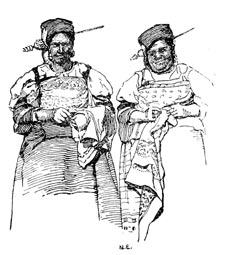
WOMEN FROM THE BASILICATA
Late in the evening of the 30th we happened to be
at the Angeli when a new batch of pilgrims arrived,
and for a long time we watched them reverently approach
the Portiuncula on their knees, singing all the
time the pilgrim's hymn with the ever-recurring refrain,
"Evviva Maria e Chi la creò," which resounded through
the church in long drawn nasal notes ending in a kind
of stifled cry. There was something soothing in the
plaintive, monotonous cadence as it reached us at the
Garden of the Roses, where we had gone to breathe
the cool air which blows across the open colonnade even
on the hottest of summer days. We were listening to
Father Bernardine's peaceful talk about St. Francis
and the cicala which sang to him in the fig tree, and
the lamb which followed the brethren to office, when
suddenly we were startled by shrieks and screams in
the church. "It is nothing, only the Neapolitans,"
said Father Bernardine, smiling at our distress. But
unable longer to bear what sounded like the moanings
of the wind which always fills one with uneasy feelings,
half of fear, half of expectation that something unusual
is going to happen, we hurried once again into the
church. There a sight met our eyes which we shall
never forget. Lying full length on the ground, their faces
prone upon the pavement, were women crawling slowly,
so slowly that the torture seemed interminable, from the
entrance of the great church to the Portiuncula, and
as they crawled they licked the floor with their tongues
leaving behind them a mark like the trail of a slug.
As we watched these poor penitents dragging themselves
along, unconscious of aught around them and
only overwhelmed by the consciousness that they must
make atonement for past sins, a terrible sense of compassion,
misery and disgust came over us. Who could
restrain their tears, though they may have been tears
of anger that people should be allowed to practise such
ignoble acts of self-abasement. One girl especially
called forth all our sympathy. She came running in
out of the sunlight, and after standing for a moment
at the entrance with her eager face uplifted towards
the holy shrine, her eyes alight with the strange look
of one bent upon some great resolve, she threw herself
down full length upon the ground and commenced the
terrible penance which she had come all the way from
the Abruzzi mountains to perform.[114] She was very
slight and her black skirt fell round her like a veil,
showing the delicate outline of her figure against the
marble pavement. Resting her naked feet against the
knees of a man kneeling behind her, she pushed
herself forward with the movement of a caterpillar.
Another man tapped his pilgrim's staff sharply on the
floor in front of her face to direct her towards the
chapel, whilst her mother ever now and then bent
down to smooth away the tangle of dark hair which
fell round the girl like a shroud. Though prematurely
aged by toil and suffering, the elder woman had a
beautiful face, reminding one of a Mater Dolorosa
as with bitter tears she assisted at her daughter's
deep humiliation. Just as this sad little group
neared the Portiuncula the girl stopped as though
her strength were exhausted, when the mother, choked
by sobs, lifted the heavy masses of her daughter's
hair and tried to raise her from the ground. The
pilgrims pressed round singing "Evviva Maria e Chi
la creò" until the sound became deafening, while
the men struck the ground almost angrily with their
sticks, and at last the girl still licking the ground crawled
forward once again. When she reached the altar
of the Portiuncula she stretched out one hand and
touched the iron gates, and then like a worm rearing
itself in the air and turning from side to side, she
dragged herself on to her knees. As consciousness
returned and the Southern blood coursed again like fire
through her veins, she started to her feet and with wild
cries entreated San Francesco to hear her, beating the
gates with her hands and swaying from side to side.
The cry of a wounded animal might recall to one's
memory the prayer of that young girl, storming heaven
with notes of passionate entreaty wrung from a soul in
great mental agony. Other penitents came up to take
her place almost pushing her out of the chapel. We
last saw her fast asleep on the steps of a side altar
curled up like a tired dog, but on her face was an expression
of great calm as though she had indeed found
the peace sought in so repulsive and terrible a manner.
Silently we left the church and turned towards Assisi,
breathing with joy the pure air and looking long at the
hills lying so calm and clear around us. Next day, the
31st of July, there was an excited feeling in the town,
not among the Umbrians, for they take the annual
feast of the "Perdono" quietly enough, but among the
pilgrims, who having now arrived in hundreds and paid
their first visit to the franciscan churches of the hill
and of the plain, stood about in the lower piazza of San
Francesco waiting with evident impatience for the opening
of the feast of the afternoon. We caught their
feeling of expectation and found it impossible to do
aught else than watch the people from the balcony, and
then we went down and wandered about among them.
There were such tired groups of women under the
loggie of the piazza, leaning back in the shadow of the
arches with their shawls drawn across their faces to
shut out the glare of the August sun. A crowd of
girls rested on the little patch of grass near the church,
some eating their bread, others sleepily watching the
constant passage of people in and out of the church;
for long spaces they sat silent, listlessly waiting, then
suddenly one among them would rise and sing a southern
song, sounding so strange in Umbria. Her companions,
casting off the desire to sleep, joined in the chorus
until the song was ended and they once more became
silent watchers. The shadows began to deepen round
the church, the feeling of expectation increased, and
the hours of waiting seemed long to the crowd and to
us, when about four o'clock the dense mass of people
in front of the church divided. A procession of priests
in yellow copes filed out of the Basilica, one among
them carrying the autograph benediction of St. Francis
(see p. 210), and went to the little chapel near the
Chiesa Nuova built over the stable where the saint is
said to have been born. Here the holy relic is raised
for the faithful to venerate, and the procession returns
to San Francesco. It is a small but important
ceremony, the prelude to the granting of the indulgence.
We had reached the chapel before the procession,
through side streets, but soon returned to the lower
church for the crowd was intolerable, and we had
been warned that once the blessing had been given a
mad rush might be made to reach San Francesco and
that sometimes people were trampled under foot. Out
of the burning heat we entered the cool dark church
where Umbrian peasants had already taken their places,
as spectators, but not as actors in the feast. Seated
on low benches against the wall they formed wondrous
groups of colour, like clumps of cyclamen and primroses
we have seen flowering in a wood upon an Italian
roadside. The gates across the church had been shut,
and were guarded by gendarmes; we had arrived too
late. But presently Fra Luigi appeared at the gate of
St. Martin's chapel, and hurriedly we followed him
down the dark, narrow passage leading to the sacristy;
we had only just time to run across the church and
take our places outside the chapel of St. Mary
Magdalen, when the great crowd surged into the
church. The excitement became intense, and the
pilgrims who had followed in the procession as docile
as lambs now could restrain themselves no longer, and
hustled the priests forward, pressing them against the
iron gates in their efforts to approach the altar. There
was a moment of tension as the whole of the iron screen
bent beneath the weight of the crowd when the gendarmes
half opened the gate to allow the priests to pass through.
With the relic swaying above their heads, they slipped
in from among the pilgrims, who, finding the gates once
more barred against them, began to moan and shout with
deafening fury. The organ pealed forth mad music,
the incense rose in clouds around the altar, and eager
faces peered through the gates, which were battered
with angry fists as the people pushed against each other
so that the whole crowd rocked from side to side.
Through it all stood the quiet figure of the priest,
raising the relic high above the heads of the people
whose voices were for the moment hushed, as the
words of benediction were pronounced. Rapidly
crossing the church, followed by his attendants, he
entered the sacristy and shut the door, while four
gendarmes stationed themselves at the corners of the
altar to prevent people from mounting the steps, and
others went to unbar the gates. There was a great
creaking of bolts and hinges and in a moment the
pilgrims rushed forward, afraid of losing even a single
moment of the precious hours of indulgence, and cries
of "San Francesco" almost drowned the sound of
hurrying footsteps. Families caught each other by
the arms and swept wildly round the altar, often
knocking people down in their wild career, old women
gathered up their skirts and ran, the Abruzzesi in their
scarlet jackets, whom we had seen so calmly walking
down the streets, stepped eagerly forward with outstretched
arms and clasped hands calling loudly on the
saint. Round they went in a perpetual circle, first past
the altar, then through the Maddalena chapel out into
the Piazza, and back again without a single pause.
Each time they entered the church they gained a new
plenary indulgence. From the walls the frescoed
saints leant towards us, and never had they seemed so
full of peace and beauty, as on that day of hurry and
strange excitement. We saw them through a mist of
dust, but they were more real to us than the fanatics
streaming past in mad career, and we greeted them as
friends. Then as the sun went down in a crimson sky
behind the Perugian hills, a great stillness fell upon the
people, the gaining of indulgences for that day had
ceased, and quietly those who had no shelters went
into the country lanes to pass the night, or rested
beneath a gateway of the town. Already Assisi was
returning to her long spell of silence, for next morning
at dawn the pilgrims would be on their road
to Sta. Maria degli Angeli for the early morning
mass.
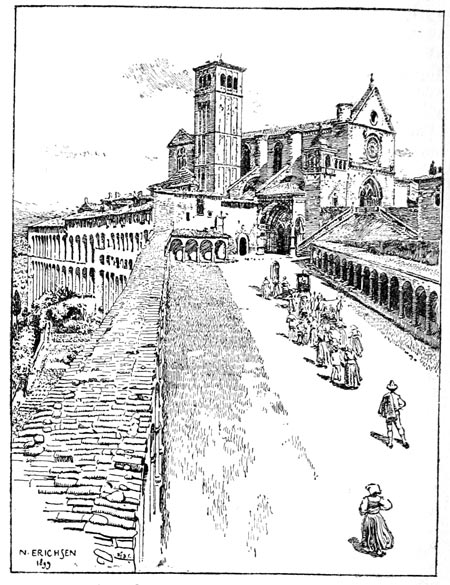
SAN FRANCESCO AND THE LOWER PIAZZA
Rashly we left the quietness of the town to join the
crowd again down in the plain late the next afternoon
when the feast was nearly over. The press of
people was felt more at the Angeli than at San
Francesco, as they gained the indulgence by simply
walking round the church and through the Portiuncula
without going outside. It was useless to struggle, or
to attempt to go the way we wanted, for we were
simply carried off our feet and borne round the church
in breathless haste in the temperature of a Turkish
bath. There were moments of suspense when we
doubted, as the crowd bore us swiftly forward, whether
we should pass the confessional boxes without being
crushed against the sharp corners. The cries of
"Evviva Maria, Evviva San Francesco," became
deafening as we neared the Portiuncula, and the people
surged through the doors, throwing handfuls of coppers
and silver coins upon the altar steps, and even at the
picture of the Madonna above the altar in their
extraordinary enthusiasm. How tired they looked,
but in their eyes was a fixed look showing the feelings
which spurred them on to gain as much grace as time
would allow. They never paused, they never rested.
With a last glance back upon the people and the names
of Mary and Frances ringing in our ears we left the
stifling atmosphere for the burning, but pure air outside.
How peaceful it all seemed in comparison to the
scene we had just witnessed. The Piazza was full of
booths as on a market day, with rows of coloured
handkerchiefs, sea-green dresses such as the peasants
like, and endless toys and religious objects; old women
sat under large green umbrellas selling cakes, and
cooks, in white aprons and caps, stood by their pots
and pans ready to serve you an excellent meal. From
under a tree a man sprang up as we passed with something
of the pilgrim's eagerness about him, saying,
"See, I will sing you a song and dance for you,"
shaking his companions from their sleep and snatching
up his accordion, he began a wild, warlike dance upon
the grass, while the others accompanied him with an
endless chant. And so the hours crept on, until once
again as the sun went down the pilgrims streamed
quietly out of the church, but this time they gathered
up their bundles and walked to the ox waggons
which were standing ready in the road, and quite
silently without delay they seated themselves, fifteen
or twenty in a cart, to start upon their long journey
home.
Never had the town been so deadly still as on the
2nd of August, when the inhabitants had gone down
the hill to the church of the Angeli where they sought
to obtain their indulgences now the pilgrims had
departed. Very quietly they knelt on the marble
floor during the High Mass, silently they prayed, and
with slow reverent steps they passed in and out of the
Portiuncula until the Vesper hour, and the beautiful,
calm evening then found them gathered round the
altar of their saint. "Pray, ye poor people, chant and
pray. If all be but a dream to wake from this were
loss for you indeed."
APPENDIX
To visitors who stay at Assisi for more than the usual
hurried day, the following notes of walks and excursions
may be of some use. A few of them have
been already indicated by M. Paul Sabatier, in a paper
printed at Assisi, to explain the sixteenth century map of
the town found by him in the Palazzo Pubblico, of which a
copy hangs in a room in the Hotel Subasio.
In the Town.—The public garden on the slope of the hill
above the Via Metastasio is a delightful place. It was the
ilex wood of the Cappucine convent until the present
garden was laid out in 1882 by Sig. Alfonso Brizzi, when
the friars' convent became a home for the aged poor.
From Porta S. Giacomo.—(a) A new idea of Assisi is
obtained by following the mountain track from the Campo
Santo round by the quarries and below the Castle to Porta
Perlici. Looking across the ravine of the Tescio and up
the valley of Gualdo and Nocera is a vision of Umbrian
country in its austerest mood. Even if the whole of this
walk cannot be taken we recommend all to follow the broad
smooth road leading to the Campo Santo for a little, as the
view of San Francesco and the valley beyond is very beautiful.
(b) By taking the Via di Fontanella (see map), straight
down the hillside, the picturesque bridge of S. Croce is
reached in about twenty minutes. M. Sabatier recommends
the ascent of Col Caprile just opposite for the fine view of
Assisi, but those who do not care for an hour's climb would
do well, having seen the old bridge and its charming
surroundings, to retrace their steps, and after about two
minutes turn off to the right through the fields along a
narrow footpath leading to a bridge over the Tescio and a
farmhouse. Following the right bank of the torrent we
reach the Ponte S. Vittorino (see map), and return to the
town by the old road skirting the walls of the franciscan
convent and emerging opposite the Porta S. Francesco.
Want of space prevents more being said than to urge all
visitors to go this walk, which is little known and will be
found one of the loveliest they have ever seen. Every step
brings something new; banks of orchis and cyclamen,
glimpses of crimson and yellow rock in the brushwood by
the hillside, the soft blue distance of the valley beyond, and
above all, innumerable views of San Francesco, seen now
with a bridge in the foreground, now framed in by the
curved and spreading branches of an oak, and at every turn
carrying our thoughts away to valleys of Southern France
and fortress-churches crowning the wooded hills (see
illustrations, pp. 215, 220). To realise the variety of
scenery to be found in Umbria we must come to Assisi and
hunt out her hidden lanes and byways.
From Porta Perlici.—(a) Out of this gate, turning to the
left by the city walls, is one of the roads leading to the
Castle; the others are clearly marked on the map. (b) The
carriage road to Gualdo and Nocera goes for some miles
along the valley, but is not completed.
From Porta Cappucini.—(a) The Rocca Minore is reached
by a grass path going up the hill just inside the walls.
A fine view of the eastern slope of Assisi is obtained (see
illustration, p. 10). (b) The Carceri is about an hour's
walk from this gate, donkeys are to be had in the town for
the excursion, or a small carriage drawn by a horse and a
pair of oxen can get there, but it is the least pleasant way
of going.
From Porta Nuova.—(a) A pleasant though not the shortest
way back to the town, is the one which skirts round the hill
inside the mediæval walls from this gate to Porta Mojano,
and then outside the walls through the fields past the
Portaccia to the carriage road just below Porta S. Pietro.
(b) The ascent of Monte Subasio occupies about two hours
and a half, though quick walkers will do it in less time.
There are several paths which anyone will indicate to the
traveller. The easiest, though the longest (about four hours),
is the one mentioned by M. Sabatier, the road to Gabbiano
and Satriano, which branches off to the left from the Foligno
road not far from the Porta Nuova. After walking along
the Gabbiano road for an hour, a lane leads up the hill for
another hour to the ruined abbey of San Benedetto (p. 82).
The path skirts the mountain to Sasso Rosso, three quarters
of an hour, the site of the fortress of the family of St. Clare,
and then one hour and a half brings us to the southern slope
of Mount Subasio called the Civitelle, where the craters of
the extinct volcano are to be seen. The highest point
(1290 metres), is reached in another half hour. The view
is very fine; Nocera and Gualdo lie to the north, Monte
Amiata to the west, a range of snowy mountains to the
south, Mount Terminillo, the Sabine Appenines and the
mountains of the Abruzzi, and Mount Sibella to the east.
The return to Assisi, without passing the Carceri, takes two
hours. (c) The road to San Damiano is marked on the map;
it is good but very steep, requiring oxen to draw the carriage
up the hill on the return. On foot it is only a quarter of an
hour from the gate. (d) A long day's drive will take the
traveller to Spello, Foligno and Montefalco, but it is a tiring
excursion and only a faint idea can be obtained of these
beautiful Umbrian towns. It is better, if possible, to give a
day to each, and to see Bevagna, with her two exquisite
romanesque buildings, on the way to Montefalco.
From Porta Mojano.—(a) To follow the path taken by St.
Francis, when carried from the bishop's palace to the Portiuncula
(p. 111), just before his death, we must take the
road leading from the gateway to a small chapel, and turn
to the right down a lane marked Valecchio on the map.
St. Francis either passed through Porta Mojano or the
Portaccia (now closed), but from here we follow in his
footsteps straight down the hill to the hamlet of Valecchio,
set so charmingly on a grass plot among the walnut trees,
with part of its watch tower still standing (p. 104). In the
plain we come to cross roads; the one on the left leads to
San Damiano in about forty minutes, that to the right to the
leper hospital (now known as S. Agostino), whence St.
Francis blessed Assisi for the last time (p. 111). (b) From
the gate a few minutes brings us to a path crossing the fields
to the left, to the old church of S. Masseo built in 1081 by
Lupone Count of Assisi to serve as a chapel to the monastery,
now the dwelling place of peasant families. (c) From
Porta Mojano a lane leads straight down to the plain, and
just before reaching the high road where it crosses the
railway at right angles, the chapel of S. Rufino d'Arce—the
real Rivo-Torto—is seen in the fields to the left (see pp.
93-95). By the side of the lane close to the railway line
is the chapel of Sta. Maria Maddalena (see pp. 93-95).
This is about half an hour's walk.
From Porta S. Francesco.—There are several drives. (a)
Perugia. (b) Bastia, the first station on the railway
between Assisi and Perugia, possessing a triptych by Niccolò
da Foligno. A beautiful view of the river Chiaggio is obtained
at the bridge of Bastiola. (c) A road from the Angeli
branches off to Torre d'Andrea, where there is a picture by
a scholar of Pinturicchio. But more delightful is the chapel
of S. Simone a little further on, built right in the midst of
the cornfields, whose walls are covered with frescoes of the
fifteenth and sixteenth centuries. (d) A beautiful drive is to
the Rocca di Petrignano, a hill-set village above the Chiaggio.
To fully recount its story, the picturesqueness of its rock-cut
streets and the charm of the chapel upon the heights,
whose walls are covered from floor to roof with votive
Madonnas and saints, would need a chapter to itself. It has
been enthusiastically described by M. Broussolle in his
Pélerinages Ombriens, but it may be well to remark that he
calls the Rocca di Petrignano, for some unknown reason,
the Rocca d'Assisi. (e) It is an hour and a half's walk to
the church of S. Fortunato, across the bridge of S. Vittorino,
recommended by M. Sabatier in his list of excursions. The
way side chapel of S. Bartolo, with its interesting apse is
passed on the way.
It would be well to get the Italian military map, Fo. 123
(either at Seeber, Via Tornabuoni, Florence, or at D. Terese,
Perugia), if the pilgrim to Assisi wishes to explore the
country round Assisi.
INDEX
A
- Agnes, Blessed, persecution of, 263;
enters convent of San Damiano, 264;
assists at death-bed of St. Clare, 271.
- Agostino da Siena, tomb by, 189.
- Albi, Cathedral of, 129.
- Albornoz, Cardinal, takes Assisi, 23;
rebuilds castle, 24, 326;
builds chapel in San Francesco, 24, 193;
builds portion of colonnade of convent, 221; 327.
- Alessi, Galeazzo, note 193;
remodels San Rufino, 296;
designs cupola of the Angeli, 335.
- Alexander IV, Pope, 207;
canonizes St. Clare, 280.
- —— VI, Pope, 330; 331.
- Alunno, see Niccolò da Foligno.
- Angelo, Brother, 72; 271.
- Angeli, Padre, book by, note 106, 152.
- Anthony, St., of Padua, at Assisi, 140; 166; 192; 250.
- Ansano, St., 304; 320.
- Arezzo, 20; 239.
- Arles, Apparition of St. Francis at, 250.
- Arno, 72; 250.
- Arnold, Matthew, quoted, 55.
- Assisi, passim.
- Avignon, Popes at, 21: note 2 209.
B
- Baglioni, The, besiege and take Assisi, 33, 34, 210;
feud with the Fiumi, 33;
note 2 259;
downfall of, 36.
- —— Gian Paolo, 34, 334.
- —— Malatesta, 331.
- Bagnora, St. Bonaventure born at, note 229.
- Basileo, Bishop, builds first church of San Rufino, 292.
- Bastia, Benedictine convent at, 105, 262, 263.
- Benedict, St., repairs the Portiuncula, 99, 100.
- Benedictines, Abbey of, on Mount Subasio, 82, 83;
gifts of, to St. Francis, 84, 103, 264.
- Berenson, Bernhard, 171;
quoted, 198, 199, 207, 208; 251; 257.
- Bernard of Quintavalle, 48; 94; 114; 182; 273;
house of, 308.
- Bernardine, St., of Siena, 206; 221; 340.
- Bernardone, Pietro, family of, note 41;
quarrels with St. Francis, 47, 235, 278, 309;
house of, 307;
shop of, 308.
- Bevagna, Roman battles near., 5;
St. Francis preaches to the birds at, 62, 244.
- Blasco, Ferdinando, tomb of, 194.
- —— Garzia, tomb of, 194.
- Bologna, St. Francis preaches at, 56.
- Bonaventure, St., quoted, 69, 229-256; note 181; 206; 210; 273; 274; 338.
- Boniface VIII, Pope, seeks counsel of Guido of Montefeltro, 223.
- Borgia, Lucrezia, 330.
- Brienne, Gauthier de, 45; 232.
- Broglia di Trino, 25; 83; 328.
- Brizi, Alfonso, note 322; note 329.
- ——, Giuseppe, 197.
- Burckhardt, J., 164.
C
- Campello, Fra Filippo, aids in building San Francesco, 129;
builds Santa Chiara, 281.
- Carceri, Hermitage of the, 27; 81;
given to St. Francis by the Benedictines, 84;
road to, 84, 85;
story of, 86-93.
- Carmichael, W. Montgomery, 211.
- Castle, The, of Assisi (Rocca d'Assisi), building of, 11, 326;
Frederick II, stays at, 13, 326;
destruction of, 14, 326; rebuilt by Albornoz, 24, 326;
story of, 325-334.
- Celano, quoted, 42, 43, 44; note 2 69;
his description of St. Francis, 212; 229.
- —— Knight of, 246.
- Charlemagne, Emperor, besieges Assisi, 11;
rebuilds Assisi, 11, 326.
- Chiaggio, River, 103; note 259;
St. Rufino martyred in the, 291.
- Cimabue, Giovanni, 153;
legends about, 154;
Madonna by, in San Francesco (Lower Church), 155;
frescoes in San Francesco (Upper Church), 156-160;
Giotto adopted by, 169;
Giotto completes works of, at Assisi, 170; 228; 284.
- Church of Santa Chiara, sacked by Niccolò Piccinino, 28, 29;
building of, 281, 282;
frescoes in, 283;
portrait of St. Clare in, 284;
church of San Giorgio in, 285, 286;
tomb of St. Clare found in, 287;
body of St. Clare in, 288.
- —— San Damiano, Niccolò Piccinino stays at, 26;
body of St. Francis brought to, 119, 253, 267;
St. Clare and her nuns live at, 264, et seq.;
attacked by army of Frederick II, 267, 268;
Innocent IV, at, 274, 278;
relics at, 274, 275;
crucifix of, 276, 277;
choir of St. Clare at, 277;
bought by the Marquess of Ripon, 278;
frescoes in, 278, 279;
funeral service of St. Clare held at, 279, 280;
miraculous crucifix of, 274, 285.
- —— San Francesco, building of, 123, et seq.;
architect of, 124, 125;
convent of, 124; 133; 139; 221; 223; 227;
resemblance to cathedral of Albi, 129;
St. Francis buried in, 133, 135;
legend about, 136; 144; 146;
in the first years, 215, 216;
campanile of, 216; note 219;
bells of, 219;
feast of the "Perdono" in, 351, 352, 357-359.
- —— —— Lower Church, The, 149, 150;
pre-Giottesque frescoes in, 151, 152, 153;
Madonna by Cimabue in, 155;
Giotto's frescoes of the early life of Christ in, 171, et seq.;
Giotto's frescoes of the miracles of St. Francis in, 174;
Giotto's allegories in 177, et seq.;
Chapel del Sacramento or of St. Nicholas in, 185, et seq.;
stained glass windows in, 189; 192; 193; 205; 206; 209;
frescoes by Giotto in chapel of St. Maria Maddalena in, 190, et seq.;
chapel of St. Antonio da Padova in, 192;
chapel of San Stefano in, 192;
chapel of St. Catherine or del Crocifisso in, 193;
chapel of St. Antonio in, 193;
cemetery of, 195;
tomb of Ecuba in, 195;
tomb of St. Francis in, 196, 197;
chapel of St. Martin in, 198;
legend of St. Martin, frescoes by Simone Martini in, 199, et seq.;
frescoes by Simone Martini in, 212, 215;
frescoes above the papal throne in, 206, 207;
frescoes by Pietro Lorenzetti in, 207, 208;
chapel of St. Giovanno Battista in, 208;
sacristies in, 209, et seq.;
portrait of St Francis in, 211;
porch of, 220.
- —— —— Upper Church, The, note 152; 156;
frescoes by Cimabue in, 158-160;
frescoes by contemporaries of Cimabue in, 160, et seq.;
stained glass windows in, 164, et seq.;
papal throne, pulpit and altar in, 166, 167;
door of, 219;
Giotto's frescoes of the legend of St. Francis in, 229-250;
frescoes by a follower of Giotto in, 254-256;
intarsia stalls in, 256.
- —— San Giorgio, St. Francis canonized in, 121; 273;
body of St. Clare brought to, 279, 280;
church of Santa Chiara built over, 281;
frescoes in, 285.
- —— Santa Maria degli Angeli, building of, 335;
rebuilt after earthquake, 336;
works of Andrea della Robbia in, 336, 338;
works of Giunta Pisano in, 337, 338;
the Portiuncula in, 337 (see Portiuncula); fresco by Perugino in, 337;
garden and chapel of the Roses in, 339, 340;
frescoes by Lo Spagna in, 338, 341;
frescoes by Tiberio d'Assisi at, 341;
feast of the "Perdono" at, 353-355, 359-361.
- —— Santa Maria Maggiore, franciscan legend connected with, 235, 308, 309, 310.
- —— Chiesa Nuova, 307; 308.
- —— San Paolo, 303;
fresco by Matteo da Gualdo in, 304.
- Church of San Pietro, 312;
triptych by Matteo da Gualdo in, 313;
fresco in, 313.
- —— Pellegrini, see Confraternity.
- —— San Rufino (Cathedral), Frederick II, baptised in, 13; 289;
church beneath, 292;
building of, 294;
bell-tower of, 290, 294, 301;
doors of, 294, 295;
interior of, 296;
triptych by Niccolò da Foligno in, 296, 297;
connection with St. Francis, 238, 299.
- Clare, St., parentage of, 258;
description of, 259;
founds order of Poor Clares, 104, 262;
delivers her sister Agnes from her persecutors, 263;
goes to live at San Damiano, 264;
friendship with St. Francis, 62, 77, 265;
last farewell to St. Francis, 119, 267;
saves her convent and Assisi from the Saracens, 267, 268;
her struggle with the Papacy, 270, 271;
death of, 272;
miracle of the bread by, 274, 275;
canonization and funeral of, 280;
church of, 281;
early picture of, 284;
body of, 288.
- Clement VII, Pope, 331.
- Clitumnus, river, 5;
Propertius lived near, 8; 350.
- Comacine builders, Guild of, 321;
house of, in Assisi, 322.
- Confraternity of San Crispino, 316.
- —— San Francescuccio, 315;
frescoes at, 316.
- —— San Lorenzo, fresco at, 323.
- —— dei Pellegrini, 316;
frescoes by Matteo da Gualdo in, 317, 318;
frescoes by Mezzastris in, 318-320;
fresco by Fiorenzo di Lorenzo in, 320.
- —— San Rufinuccio, frescoes in, 185, 323.
- Conrad of Suabia, 13; 326.
- Convent of Santa Chiara, 281; 282.
- —— of San Francesco, 124; 133; 139; 221;
Guido of Montefeltro lives in, 223; 227.
- Corroyer, E., quoted, 129.
- Cortona, 117; 144.
- Corythus, King of Cortona, 2.
- Costano, 291; 297.
- Christine, Queen of Sweden, 222.
- Crowe & Cavalcaselle, Messrs, quoted, 162, 174, 176, 187; 171; 251.
D
- Damiano, San, see Church.
- Dante, quoted, 14, 71, 168, 182, 184, 186, 224, 236, 250;
portrait of, by Giotto, 176, 182.
- Danti, Giulio, note 193;
designs cupola of the Angeli, 335.
- Dardanus, 2; 3; 4.
- Domenico da San Severino, designs stalls for San Francesco, 256.
- Dominic, St., 17; note 229; note 345.
- Doni Adone, 192; 307.
E
- Ecuba, Queen of Cyprus, tomb of, 195.
- Egidio, Brother, 48; 50; 94; 111;
quoted, 117; note 118; 132.
- Elias, Brother, 51;
influence of, on the franciscan order, 122, 130, 132;
superintends building of San Francesco, 124, et seq.;
character of, 137;
hides body of St. Francis, 135; note 196;
account of, 137-146; note 152; 306.
- Elisei, Canon, 292.
- Etruscans, The, found Perugia, 4; 5.
- Eusebio di San Giorgio, fresco by, 278.
F
- Fiorenzo di Lorenzo, 165;
frescoes by, in Assisi, 306, 307, 320.
- Fioretti, The, quoted, 49, 50, 59, 68, 88, 111, 137, 138, 266, 345;
charm of, 66.
- Fiumi, Jacopo, murders the Nepis, 32; 33;
robs sacristy of San Francesco, 210;
despot of Assisi, 331.
- Fiumi, The, their rivalry with the Nepis, 31, 32;
mother of St. Clare belongs to family of, 259.
- Flagellants, The, note 60; 178; 314.
- Fortebraccio, Braccio, 25.
- Francis, St., birth of, 15;
teaching of, 16, 18;
childhood of, 41;
description of, by Celano, 42, 212;
imprisoned at Perugia, 43;
conversion of, 44;
dream of, at Spoleto, 45, 232;
his symbol of the Lady Poverty, 46, 53;
succours the lepers, 46, 95;
first foundation of the Order, 48, 49;
interview of, with Innocent III, 52, 53;
rule sanctioned by Innocent III, 54, 237;
eloquent preaching of, 55, 56, 57, 59;
gives St. Clare the veil, 56, 105, 262;
founds Third Order, 60;
preaches before the Sultan of Egypt, 61, 240;
sermon of, to the birds at Bevagna, 62, 244;
love of nature, 63, 64, 65;
converts the wolf of Gubbio, 65;
friendship with Gregory IX (Bishop Ugolino), 69;
preaches before Honorius III, 71, 249;
stays at La Vernia, 71, 72;
receives the Stigmata at La Vernia, 73, 74;
farewell to La Vernia, 75;
blindness of, 76, 116;
composes the Canticle to the Sun, 78;
elects the Carceri as his hermitage, 81-83;
cell of, at the Carceri, 86;
challenges the nightingale to sing the praises of God at the Carceri, 87;
dries up the torrent, 88;
causes a miraculous fountain to appear at the Carceri, 91;
prophecy of, to Otto IV, 96;
goes to the Portiuncula with his brethren, 97;
visits the Portiuncula as a child, 102;
obtains the Portiuncula as a gift, 103, 104;
hut of, note 106, 340;
blesses Assisi, 113;
dictates his will, 114;
death of, 115, 116;
funeral of, 119, 120;
canonisation of, 121, 153;
church built in honour of, 123, et seq.;
secret burial of, 134-136; influence of, on Elias, 138, 139;
miracles of, 176, 239, 243, 254, 255, 256;
fresco of marriage with the Lady Poverty, 181;
tomb of, 196, 197;
autograph of, 210, 211;
portrait of, by Giunta Pisano, 211;
legends of, illustrated by Giotto and a follower, 229-256;
obtains San Damiano as a gift, 264;
friendship of, with St Clare, 265, 266;
statue of, by Andrea della Robbia, 338;
garden of, 339, 340;
roses flower in the snow for, 340;
obtains the indulgence of the Portiuncula, 342, 343;
proclaims the indulgence, 344.
- Frederick I., Emperor, at Assisi, 13.
- —— II, Emperor, at Assisi, 13; 61;
befriends Elias, 142; 143; 144; 217;
army of, besieges Assisi, 267-269; 326.
- Fry, Roger, quoted, 156, 228, 243.
- Foligno, 222; 278.
- —— Niccolò da, see Niccolò.
G
- Gentile de Monteflori, Cardinal, founds chapel in San Francesco, 192, note 198; 205.
- Giacoma da Settesoli, friendship of, with St. Francis, 114;
tomb of, 207.
- Giottino, note 186; 283.
- Giotto, birth of, 108;
adopted by Cimabue, 169;
character of, 170, 178;
first early frescoes of, at Assisi, 171-177;
poem of, on poverty, 178;
Allegories by, 181-184;
frescoes by, in chapel of Sta. Maria Maddalena, 188;
genius of, 228;
illustrates legend of St. Francis, 229-250;
characteristics of, 229, 232, 255;
architecture of, 231;
contemporary opinion on, 244;
follower of, at Assisi, 185, 251.
- Giovanni da Gubbio, builds San Rufino, 294; 309.
- Giunta Pisano, crucifix by, note 152;
portraits by, of St. Francis, 211, 284; 337; 338.
- Goethe, Wolfgang von, description of the Temple of Minerva, 302, 303.
- Gozzoli, Benozzo, 245.
- Gregory IX., Pope, friendship with St. Francis, 69;
dream of, 121, 254;
canonises St. Francis, 121, 253;
founds San Francesco, 123, note 152;
portrait of, 159; 219;
wishes to give St. Clare the Benedictine rule, 270.
- Gualdo, 12; 118; 329.
- —— Matteo da, see Matteo.
- Gualtieri, Duke of Athens, portrait of, 208.
- Guelfucci, Bianca, 261;
aids St. Clare in her flight, 262;
enters convent of San Damiano, 264.
- Gubbio, wolf of, 65, 221; 291; 329.
- Guidantonio da Montefeltro, owns Assisi, 25, 317.
- Guido da Montefeltro, a monk in San Francesco, 223;
treacherous counsel of, to Boniface VIII, 224.
- Greccio, feast of, 242.
H
- Honorius III., Pope, St. Francis preaches before, 70, 249;
rule of St. Francis sanctioned by, 114, 210;
grants St. Francis the indulgence of the Portiuncula, 342.
I
- Ibald, Rev. Father Bernardine, note 2 103.
- Illuminatus, Brother, 141; 240.
- Ingegno, L', 306; fresco by, 307.
- Innocent III., Pope, 13; power of, 14;
court of, 15; 45;
meeting of, with St. Francis, 52, 53;
dream of, 53, 236;
confirms rule of St. Francis, 54, 70; 237; 342.
- —— IV., Pope, sanctions rule of St. Clare, 271;
at funeral of St. Clare, 279, 280.
J
L
- Leo X., Pope, mitigates franciscan rule, 224.
- —— XIII., Pope, 287.
- —— Brother, 51; 72;
quoted, 103, 104, 114, 131, 310;
quarrel with Elias, 132;
receives autograph benediction from St. Francis, 210.
- Liberius, Pope, 98.
- Lorenzetti, Pietro, frescoes by, in San Francesco, 207, 208.
- Louis, St., of France, note 51; 210.
M
- Margaritone, 158; 284.
- Martin, St., chapel and legend of, in San Francesco, 198, et seq.
- Martini, Simone, 198;
friendship with Petrarch, 199;
characteristics of, 199;
legend by, of St. Martin, 200, et seq.;
other frescoes by, 212, 215.
- Mary Magdalen, St., legend and chapel of, 190, 191.
- Marzario, Professor, note 125.
- Masseo, Brother, 59; 72;
letter of, 74; 111.
- Matarazzo, note 31;
quoted, 33, 35; note 259.
- Matteo da Gualdo, frescoes by, in Assisi, 304, 306, 311, 313, 317, 318.
- Metastasio, house of, at Assisi, 322.
- Michelotti, Biordo, 25; 329.
- Milton, John, 14; 241.
- Minerva, The Temple of, its legend, 3; 301;
description of, by Goethe, 302, 303.
- Montefeltro, see Guido.
- Montefalco, 221; 245.
- Monte Frumentario, 321.
N
- Narni, 13; 221.
- Nepis, the family of, rivalry with the Fiumi, 31, 32, 330, 331.
- Niccolò da Foligno, triptych by, in San Rufino, 296, 297; 341.
- —— da Gubbio, carves doors for San Francesco, 220.
- Nicholas, St., chapel and legend of, 185, et seq.
- Nocera, 12; 118; 329.
O
- Orsini, Giovanni Gaetano, portrait of, 185;
tomb of, 189.
- —— Napoleone, 185.
- —— The family of, note 2 208.
- Ortolana, Madonna, 259; 264.
- Otto IV., Emperor, at Rivo-Torto, 96.
- Oxford, 110.
P
- Pacifico, Brother, vision of, 239.
- Palazzo Pubblico, 32; 305;
frescoes in, 306.
- —— Sbaraglini, 308.
- —— Scifi, 258; 260; 262; 281.
- Parenti, Giovanni, 132; 133; 139; 140.
- Paul III, Pope, 36; 331; 332.
- Perugia, 4; 9;
wars with Assisi, 5, 19, 20, 21, 43;
governs Assisi, 22, 23; 29; 36;
tries to steal body of St. Francis, 21; note 196;
St. Francis mocked in, 57; 221; 342.
- Perugino, Pietro, fresco by, 337.
- Piazza, di Sta. Maria Maggiore, encounter of St. Francis with his father in, 235, 309; 310.
- —— di San Francesco, 220.
- —— della Minerva, 13; 31; 302; 330; 348.
- —— Nuova, 300; 349.
- —— di San Rufino, 289.
- Pica, Madonna, 41; 102; 119; 307.
- Piccinino, Niccolò, besieges Assisi, 25, 26; 27; 30; 126.
- —— Jacopo, 329.
- Pietro Cataneo, Brother, 48; 138; 342.
- Pintelli, Baccio, 220.
- Pinturicchio, 337.
- Pius II, Pope, 329.
- —— V, Pope, 335.
- Portiuncula, The, early connection with St. Francis, 47, 102;
repaired by St. Benedict, 99;
given to St. Francis, 103;
cradle of franciscan order, 104;
St. Clare comes to, 104, 273;
St. Francis dies at, 114, 115, 337; 338;
indulgence of, 344;
chapter of the lattices at, 345; 353; 355; 359.
- Puzzarelli, Simone, 123.
- Pontano, Teobaldo, 191.
- Propertius, born at Assisi, 6;
describes Assisi, 7, 8.
R
- Renan, E., quoted, 149.
- Reni, Guido, 339.
- Rivo-Torto, 93;
leper hospitals at, 95;
description of, 96
vision of friars at, 238, 299.
- Robbia, Andrea della, his work in the Angeli, 336-338.
- Rocca d'Assisi, see Castle.
- Rufino d'Arce, San, 94;
St. Francis ministers to lepers at, 95.
- Rufino, Brother, 68; note 260.
- —— St., legend of, 291, 292, 293, 297; 299.
- Rumohr, von, B., 251.
- Ruskin, John, quoted, 155, 170, 232; 236.
S
- Sabatier, Paul, quoted, note 44, 63, 238, 258, 266, 271, 274; note 138.
- Sansone, Francesco, 219; 256.
- Scifi, Chiara, see St. Clare.
- —— Count Favorino, 258; 259; 261; 263; 264.
- Scott, Leader, note 125.
- Severino, see Domenico.
- Sforza, Alessandro, 27; 28.
- —— Francesco, Duke of Milan, 25; 26; 328.
- Sixtus IV, Pope, 219;
statue of, 221; 257.
- Spagna, Lo, 207; 338; 341.
- Spoleto, 44; 45.
- Stanislaus, St., 207.
- Subasio, Mount, 84; 258;
ways to, 363.
- Sylvester, Brother, 239.
T
- Taine, H., quoted, 1, 198.
- Tescio River, 85; note 86; 124; 214.
- Thode, Henry, note 125; 158; 164; 165; note 171; 206.
- Three Companions, legend of, 96; 229; 242.
- Tiberio d'Assisi, frescoes at Assisi, 279, 306, 341.
- Totila, 9; 325.
- Trevelyan, R. C., 7; 8.
U
V
- Vasari, Giorgio, quoted, 124, 153, 164, 170, 195, 244; 155, 156, 306.
- Vernia, La, 71; note 75;
St. Francis receives the Stigmata at, 72; 210; 211; 243; 250.
- Vespignano, Giotto, born at, 168; 169.
- Vitry, Jacques de, 15; quoted, 17, 240.
TURNBULL AND SPEARS, PRINTERS. EDINBURGH