We have spoken of the Notochord as a structure which precedes the
formation of the spinal column in Vertebrates. This needs a little more
definite explanation. We all know that the spinal column of vertebrates
is formed to protect the spinal cord. This protection is, however, an
afterthought, so to speak, of the vertebrate structure; the lowest of
all vertebrates is quite without it; and in the lower groups of fishes
we may trace various steps of its formation. But in these cases where
the spinal column is absent or incomplete, there is a large and
well-developed notochord; and in the embryo of higher vertebrates, when
the spinal column has not yet begun to be formed, the notochord is
equally a conspicuous feature.
It runs from the region known as the mid-brain, to the end of the tail,
and lies throughout just beneath the spinal cord. Whatever its original
use in the animal body may have been, it undoubtedly acts now as a
support to the spinal cord, and indeed to the whole body. Bones, we must
explain, do not exist either in the lower vertebrate, or in the early
embryo. In the latter they are formed by degrees. The spinal cord and
the notochord each begin to be surrounded by rings of cartilage or
gristle, which by degrees is changed into bone. The rings surrounding
the notochord, however, gradually encroach upon it and obliterate it.
The place where it has been becomes the Centrum, or most solid part of
each vertebra. The notochord at first is continuous, and has no division
into successive parts; but when the bony spinal column is developed, it
consists of a series of successive vertebræ. Each of them is made
up of several parts, which by degrees become consolidated into the
vertebræ.
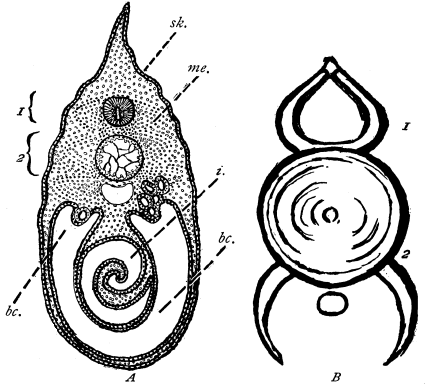
Fig. 41.—A, The Notochord of Vertebrates. Section,
considerably magnified, through the middle of an embryo one inch long,
of Acanthias, one of the Spiny Dog-fishes allied to the sharks. 1,
Section through Spinal Cord; 2, Section through Notochord; below it lies
a bean-shaped space, which is a section through a large blood-vessel;
sk, epiblast or skin; me, mesoblast or middle layer of the body; the
dots represent the nuclei of its transparent cells. The intestine, i,
lined with hypoblast, is traversed by a spiral valve, and surrounded by
the horse-shoe shaped body-cavity. B, Diagram indicating the position
of the Notochord in the vertebra of an adult Common Dog-fish (Scyllium
canicula). 1, "Neural arch" of the vertebra, consisting of processes of
bone enclosing the central nervous system, or spinal cord; 2, bony
centrum of the vertebra, hollowed out into a cup, in which lies a soft
pad, the remains of the notochord.>
The lowest member of the vertebrate group, separated in fact from the
true vertebrates and placed in a lower division all by itself, is the
little animal called the Lancelet or Amphioxus. It is often spoken of as
a "fish"; but it is only by a stretch of our courtesy that it can
receive that name, being an animal of a much lower form than the fishes.
It was discovered in 1834, in the Mediterranean, and described as a
fish; but it had previously been discovered in 1778, by a German
naturalist who described it as a slug. The latter was misled by its
external shape. He had not the advantage of the modern methods of
preparing animals for examination under the microscope; in these days,
Amphioxus is cut into successive slices along its whole length, and each
of these carefully magnified, so that no detail of structure is lost.
The Amphioxus burrows in the
sea-sand; it lies buried in it, with its
mouth just uncovered. Its food consists of microscopic vegetable
organisms. Its distribution is very wide; it is found in both the
Atlantic and Pacific waters. It occurs most abundantly in the salt-water
lakes of Sicily, and in the Gulf of Naples. The specimen first seen, in
1778, came from the coast of Cornwall. There are eight species; the one
which is found in the English Channel is the Amphioxus lanceolatum,
also found in the Mediterranean and on the shores of North America.
The classes of the Vertebrata are Fishes, Amphibia, Reptiles, Birds and
Mammals. We used to learn that of these, fishes had gills, and Amphibia
gills for a time; but, to be strictly accurate, we must say that fishes
have gills, and all the rest of the Vertebrata have gills for a time.
There is no exception to this rule, not even among the highest
vertebrates of all. But in those vertebrates which stand higher in the
scale of life than Amphibia, viz., Reptiles, Birds, and Mammals, these
gills are never brought into use. They only exist in the early embryo,
and afterwards disappear, giving rise by their modification to other
structures.
Strange to say, one of these structures is the ear. This takes its
origin from one of the gill-"clefts" or spaces. The Eustachian tube,
which communicates between the ear and the nose, is part of this cleft;
and the little bones which are inside the ear represent the bones of
that gill-cleft. For, in fishes, bones support each gill, and are
connected together to form a complex arrangement. In the higher
vertebrates, which possess gills only in the embryo, this gill-skeleton
is much modified, and persists as a bone, the hyoid bone supporting the
tongue.
The gills of vertebrates, arranged in successive pairs along the throat,
are "perforating gills"; that is to say, they consist essentially of
holes or spaces which pass right through the wall of the throat.
If we were to seek for a general character of the vertebrates, besides
those mentioned above, that they all possess a notochord and gills, we
might also find it in the character of the skin. Fishes, Reptiles, Birds
and Mammals, all agree in this, that they have a special clothing of the
skin—scales, feathers and fur, respectively. These three kinds of
structure, although so widely differing in appearance, are practically
formed all in the same way, viz., by alternate ingrowths and outgrowths
of the skin; the ingrowth forming the root of the scale, hair or
feather, and the outgrowth its projecting part. If these infoldings and
outgrowths of the skin could be straightened out into a plane surface,
the skin of a small vertebrate would cover an enormous area. The above
list excludes the Amphibia: in this class, it should be mentioned, the
scales have been lost, and are only found in one group.
The scales of Fishes were at one time proposed as a basis of
classification: large groups being characterized respectively by the
possession of plain rounded scales (cycloids), scales fringed at the
posterior end (ctenoid, or comb-like); placoid scales, consisting of
bony plates, and ganoid scales, large plates covered with shiny enamel.
These distinctions, however, were not found useful as a guide in
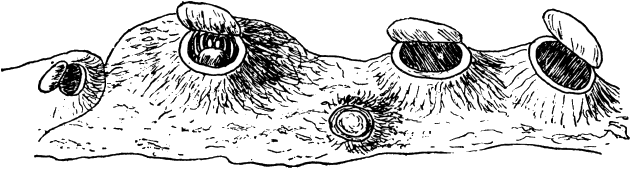
classification. The diagram shows the elaborate scales of the common
sole.
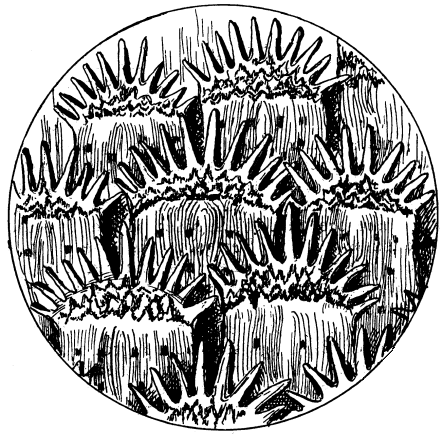
Fig. 42.—Scales
of the Common Sole, highly magnified.
Let us now consider some other creatures that resemble vertebrates in
some ways, and help to form the group of Chordata. Balanoglossus is one
of them, the Acorn-tongue Animal. This odd name is given to it on
account of a structure which is called (like the elephant's trunk) a
Proboscis; this may be compared with a tongue, so far as its use goes,
for it is thrust out to catch prey and again drawn in. It is oval in
shape, and therefore fancifully compared to an acorn. It is highly
sensitive, being richly supplied with nerves. The creature is to all intents
and purposes a kind of worm; and, like many of the higher
worms, it has a larva with bands of cilia. This larva, which is better
represented in some species than in others, was originally described
under the name of Tornaeria. It is considered to resemble, in some
degree, the larva of Echinoderms; on this hint, some zoologists have
sought to establish a connection between Vertebrates and Echinoderms,
and have been able to find other points of comparison besides the one
named. It remains to be seen whether this suggestion will lead to
further results. It may be added that the larva of Balanoglossus has
also been compared with that of Phoronis (p. 122), thus assuming a
relationship with the Polyzoa, and through them with the Brachiopoda. It
appears, therefore, that the subject of the possible relationships of
the Vertebrata is one of the greatest complexity. The last named theory,
however, has been adversely criticised by very high authority.
We have not, however, explained yet what is the claim of Balanoglossus
to be grouped with the Chordata. This consists in the fact that a
certain part associated with the interior of the proboscis has been
identified, from its structure, mode of origin, and relations with the
nerves, as a notochord. Balanoglossus also agrees with the true
vertebrates in possessing successive pairs of perforating gills
(see p. 142), which are especially noticeable in the young animal. The presence
of this feature is important, in view of the fact that some authorities
have sought to throw doubt on the genuineness of the notochord of
Balanoglossus.
Balanoglossus is not without relations, some
of which have been
recently discovered, while others have been known for some time,
although their affinities were not at first recognised. Among these the
most remarkable are sessile forms which have received the names
respectively of Cephalodiscus and Rhabdopleura. Both produce buds
and form a colony, and in both a notochord has been distinguished. The
former was procured from the Straits of Magellan, while the latter makes
its dwelling-place in a nearer region, having been found off the
Shetland Islands, and off the Lofoden Islands. Cephalodiscus, which is a
very curious creature, receives its name from a disc placed at the head
end. The use of this structure is believed to be as follows. The units
of the colony live inside a common system of tubes, which they secrete;
each unit, when adult, is independent, and can move about inside the
tubes; the disc is used as a means of attachment to successive spots of
the tube-wall, as the animal wanders from place to place. Above the disc
are twelve plume-like tentacles covered with cilia, which create a
current in the water surrounding the head, and wash food particles into
the mouth.
That these creatures are but distant relations of the true vertebrates
is a fact expressed by the names under which they are grouped in
classification. Those forms which we have just described have received
the name of Hemichordata—that is to say, Chordata which have but half a
notochord, since the notochord is very restricted in extent; while the
Ascidians are grouped under the name of Urochordata, or Chordata which
only possess a notochord in the tail. The name of Adelochorda, "with an
obscure chord," is sometimes applied to the Hemichordata.
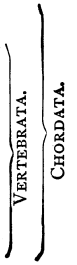
TABLE SHOWING THE CLASSIFICATION OF THE CHORDATA
| CHORDATA. |
 |
HEMICHORDATA, Balanoglossus, &c.
UROCHORDATA, the Ascidians.
VERTEBRATA, the Back-boned Animals. |
Let us return now to the Vertebrate. A character common to all the
groups of the Vertebrata is the possession of teeth. Readers of the
previous volumes of this series will recollect that, even among birds,
instances of the possession of teeth may be found among fossil forms,
although they are absent in the birds of the present day. In all the
other divisions of the Vertebrata, the presence of teeth is the rule,
their absence an exception so rare that we may easily note the chief
instances of it. Among Amphibia, there are Toads that have no teeth;
among Reptiles, the Tortoises and Turtles have none; among Mammals,
teeth are wanting in Echidna, the Spiny Ant-eater; and in the
Ant-eaters and the Whalebone Whales they are absent in the adult,
although present in early embryonic life.
The majority of people, if asked to give a definition of the meaning of
teeth, would reply that they are hard structures that grow in the jaw.
But this is an idea that requires very considerable modification from a
scientific point of view. In the first place, they are found in other
places besides the jaws; and in the second place, they are by rights
structures originally belonging to the skin. Both these important facts
must be illustrated by reference to the Fishes, which exhibit the
primitive types of teeth.
In fishes, not only are teeth found on the jawbone, but sometimes also
on other bones which border upon the cavity of the mouth; they are found
on the palatine bone, or roof-plate of the mouth, and, still more
strange, upon bones which belong to the "hyoid apparatus," or skeleton
of the gills (see above). The latter may form a set of throat-teeth,
which are used for grinders, while
the jaw-teeth are used for biting.
Among the Carps, the jaw-teeth are reduced, and the fish depends upon
its throat-teeth only. In the Wrasses, one pair of the bones that bear
throat-teeth (the inferior pharyngeal bones) are fused, so as to form a
stronger apparatus: and from this circumstance, the group of Fishes to
which they belong has been given the name of Pharyngognathi, fishes
possessing throat-jaws. They have, however, biting teeth as well, in the
true jaws. The grinding teeth are apparently used for consuming the food
in a leisurely manner when once it has been taken into the mouth.
A curious circumstance in connection with these "throat-jaws" is, that
they produce musical sounds. Fishes have other means, however, of
producing a voice—usually by means of the swimming-bladder and muscles
in connection with it. Probably they are able, to some extent, to effect
communication with each other in this way.
It has already been stated that teeth, in their primitive form, are to
be regarded as skin-structures. Certain fish, which are looked upon as
ancestral types, have, dispersed throughout the skin, a number of bony
plates, or granules (placoid scales), more or less formidable, and
tipped with a hard enamel-like substance. Teeth are regarded as but a
special form of these. But if they are skin-structures, how come they in
the mouth and throat? Because the mouth and throat are lined by an
ingrowth from the external skin; the origin and growth of this is seen
in the embryo.
In the Mammalia the teeth, though restricted in number, attain the
greatest possible variety of form, so that the jaws of different but
allied species may be distinguished by their teeth.
Let us now return to the lowest vertebrate of all, which has a large
notochord and no bones. This is the Amphioxus, the Lancelet. Amphioxus
has no bones whatever, and no head, in the sense in which we usually
employ that term; that is to say, most of the structures which we see in
the vertebrate head are undeveloped. The peculiarities of the structure
of Amphioxus are many. Among them may be named the curious gills: these
form a sort of basket-work along the sides of the throat, which at first
sight bears little resemblance to the gills of fishes, and reminds us of
those of Ascidians. The gills lead also, as in Ascidians, to another
cavity, the Atrial chamber. This basket-work is formed, however, by the
subdivision of the primary pairs of gills. These are very numerous,
ninety pairs being sometimes named as the number. They cut up the wall
of the throat to such an extent, that additional supporting bars are
needed to strengthen it; and, by the formation of these, both in
parallel and in transverse directions to the primary partitions, the
"basket-work" is produced, as the growth of the animal proceeds.
The primitive nature of the notochord is, however, perhaps the most
striking feature of Amphioxus. The chord passes to the front of the
animal's snout—head it can hardly be called—instead of ending in the
middle of the brain, as in true vertebrates, for there is, indeed, no
"brain" of any extent to lie in front of it; and the notochord, together
with the spinal cord itself, have no other protection than a fibrous
sheath. The spinal column is thus entirely absent, except so far as it
may be regarded as represented by this thin sheath.
The Lancelet also differs from the true vertebrates, in that it has no
limbs. There is a fringing fin along the body, but it is not comparable
with the fins of fishes. It differs also in possessing no teeth.
In one respect, however, the Lancelet reminds us of a fish: and that is
in the arrangement of its muscles; these form a successive series of
overlapping masses on each side of the body, as in a fish.
The development of the Lancelet presents us with an instance of the
two-layered larva, or Gastrula. This shows that Amphioxus is a
comparatively primitive type. But it has been suspected that it is less
primitive than it looks, and that it has degenerated from some higher
form, owing to its preferring a dull mode of existence, half-buried in
sand or mud.
There is a huge gap between the Lancelet and the true vertebrates. The
lowest form of the latter is Ammocœtes, the larva of the Lamprey
(Petromyzon). The latter, even in the adult form, has no true limbs,
though there are fringing fins. The notochord sheath is supplemented,
however, by cartilage bars which are equivalent to the beginnings of the
vertebræ of the back-bone. The gills are very different from those of
other true vertebrates, and it has no jaws. Teeth it has, however, on
the tongue and the lining of the mouth. Probably this creature is
greatly altered by adaptation to its peculiar mode of life, so that no
certain conclusions can be drawn from it regarding the structure of
primitive fishes. It has a sucking mouth, by means of which it hangs on
to fishes, while it rasps away their flesh with its rough tongue. When
not thus engaged, it hangs on to
a stone by means of its suctional
mouth, thus fixing itself at rest. The Hag-fish, Myxine, in many
respects similar, devours dead fishes chiefly. The Hag-fish is found on
English coasts: so is the Marine Lamprey; while two freshwater forms are
found in streams.
Leaving the Cyclostomata, as the above fishes are called, we reach the
true fishes, which have limbs and scales. Something has already been
said regarding their teeth and gills. The Cartilaginous fishes, in which
most part of the skeleton remains gristle and does not become
transformed into bone, include the Sharks, Rays, and Dog-fishes, all
savage animals with strong teeth. The common spotted Dog-fish of our own
shores is familiar to everybody: fishermen regard it with disgust, as it
is not eatable. The Rays are flattened fishes, which live at the bottom
of rather deep water, and attain enormous size even on our own coasts.
The Thornback Skate is covered with prickles (placoid scales). All these
fishes are grouped under the name of Elasmobranchii, the Strap-gilled,
so called from the structure of the gill-arches.
The majority of familiar fishes, such as the herring, mackerel, cod and
sole, belong to the group of Teleostei, or Bony Fishes, in which, by
contradistinction from the last group, as much of the skeleton as
possible becomes bone. Nevertheless, traces of the notochord persist in
the back-bone of these fishes. Break the back-bone across, of a cod or a
sole, and you will find between adjacent sides of the centra, or middle
parts of the vertebræ, a pad of gristly substance. This is the remaining
substance of the notochord, which finds room between the cup-shaped sides of
the centra. When the centrum, instead of being biconcave, is
solid, as in the higher Vertebrata, the notochord is obliterated by its
encroachment.
The Amphibia, familiarly represented by Frogs and Toads, receive their
name, "adapted for both lives," from the fact that they usually divide
their lives between land and water. They are, from one point of view,
the most interesting of the classes of the Vertebrata, for they form a
dividing line between the lower and upper Chordata. Below we have
Hemichordata, Ascidians, Amphioxus, Fishes; all water-dwellers,
breathing by gills. Above, we have Reptiles, Birds, Mammals,
air-breathers, never possessing gills, except for a short time, as
rudiments in the embryo, not brought into use. They are linked by the
Amphibia, in which we see the larva a water-dweller, breathing by gills;
the adult, an air-breather, adapted for life on land, and obliged to
come to the surface to breathe, even when it passes its time in the
water. The individual Amphibian tells us the past history of the higher
groups; once they had gills—but growing older, they lost them.
Fig. 43 shows us an outline sketch of Amphibian larvæ; we should require
an enlarged diagram of an earlier stage, to show the gills, which are
external and projecting at first, but afterwards are overgrown by the
skin with the exception of an orifice on each side. The diagram shows
the gradual change of form. The tails in these tadpoles will presently
be lost, for they belong to the Anura, or tail-less order of Amphibia
(Frogs and Toads). The tailed Amphibians, Urodela, are represented in
Great Britain by the Newts, Triton, popularly called
Efts. Belonging
to the Tailed Amphibians also, is the Axolotl, a creature found in the
lakes of Mexico, and in those of the Rocky Mountains. It may or may not
retain its gills; and forms with gills, and forms without, may be found
in the same lake, each capable of laying eggs. The two forms were at
first described under two different generic names: but when specimens of
the gill-bearing Siredon, kept in confinement, lost their gills, it
was seen that they became Amblystoma. There are other cases of larval
forms that produce young, and this curious occurrence is known as
"pædogenesis."
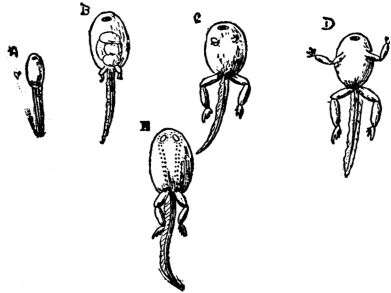
Fig. 43.—Tadpoles, three-quarters of their natural size.
A to D, different stages of the Tadpole of the Common Toad, from
Epping Forest, England. E, Tadpole of Pelodytes punctatus, dorsal
view.
The Amphibia include the curious creatures called Cæciliæ (blind
animals), or Gymnophiona. They are snake-like in form, and are without
limbs; they burrow underground. Their real place in classification was
not found out at first, but they were classed, by a wrong shot, with the
Reptiles. They are interesting as being the only
Amphibians that have
scales. These are very minute, embedded in the skin, and arranged in
transverse rings. The name Gymnophiona, naked serpents, is therefore
doubly inapplicable: for they are not serpents, and not scaleless.
The Reptiles and Birds at first sight seem to be widely different. The
latter are the warmest blooded of all vertebrates, the former are
coldblooded. The one wear feathers, the other scales. Nevertheless,
there is an intimate connection between them; the reader has doubtless
already learned from other sources the facts about their relationship,
so we will not here do more than recall a few of these facts. One is,
that the birds of earlier times had teeth in their beaks, and possessed
jointed tails. Another, that the Reptiles of earlier times included
forms that were able to fly. A third notable fact is the presence of
claws on the wings of some birds, showing that the wing of the bird was
not always wholly specialised for use in flight.
We owe to Professor Huxley, the recognition of the close relationship of
Birds and Reptiles, and the name Sauropsida (Reptile-like animals),
under which both are included. They agree in being air-breathers and
never having gills, except the rudiments present in the early embryo:
this distinguishes them from Amphibia. They agree in having the skull
set on to the back-bone by a single articulating surface or condyle; and
thus differ alike from Amphibia and from Vertebrata. They agree in
having the red corpuscles of the blood nucleated; and in this differ
from the Mammalia, in which the red corpuscles are non-nucleated discs.
From a popular point of view, we may say that the striking distinction between
birds and reptiles lies in beauty and ugliness. Even in their
eggs, the reptiles display no love for adornment, no colouring or
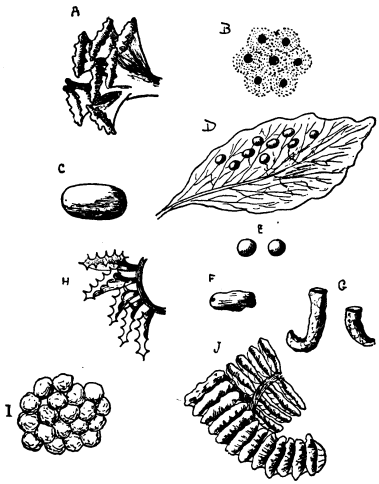
pattern. Fig. 44 shows the eggs of some reptiles.
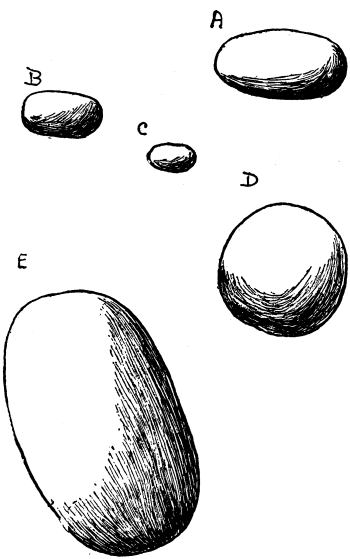
Fig. 44.—Eggs of Reptiles, half the natural size. A,
of African Cobra. B, of Common English Snake. C, of Common English
Lizard, Lacerta agilis. D, of Elephantine Tortoise. E, of
Crocodile.
The five chief groups of existing reptiles are the Chelonia (Tortoises
and Turtles); the Rhyncocephala, represented only by Hatteria, a lizard
found in New Zealand; the Lacertilia or Lizards; the Ophidia, or
Snakes and Serpents; and the Crocodilia.
Perhaps the most interesting point regarding the reptiles that can be
mentioned in brief space, is the fact that they present traces of a
median third eye, which have been described by Baldwin Spencer, in the
New Zealand Hatteria, and in other reptiles. It is situated on the roof
of the brain. While the structure in Hatteria shows it to be an eye, its
position corresponds with that of the pineal gland of vertebrates
generally; so that we find, in fact, the trace of a third eye in all
vertebrates, including ourselves. It is, however, a trace only. In the
Lamprey fishes as well as in Hatteria, it reaches a further degree of
development. This pineal eye has been compared in structure to the eye
of Ascidians.
The Birds, excluding the extinct form with teeth and a jointed tail, to
which the group name of Archæornithes is given, fall into two groups.
These are the Ratitæ, or Birds with Raft-like, i.e. flat,
breast-bones, and the Carinatæ, or Birds with keeled breast-bones. The
former include the African Ostrich (Struthio), the American Ostrich
(Rhea), the Australian Emu, the Cassowary of New Guinea, and the Kiwi,
or Apteryx of New Zealand; all of them birds that cannot fly. The vast
majority of birds belong to the Carinatæ, characterised by the
projecting keel (Carina) in the middle of the breast-bone. The presence
of this, which affords a safe attachment for strong muscles, is
associated with the power of flight. It is impossible to treat the birds
more fully in the space allotted to this little
story, but a few words
about feathers, however, may find a place here.
The colour of feathers is a subject of much interest. Everyone is
familiar with the brilliant tints often presented by the feathers of
birds, and everyone who is a close observer of natural objects knows
that there are some feathers which are iridescent, changing colour
according to the direction in which light falls on them. It has been
shown by Dr. Gadow that this variation of the colour of a feather is due
to its structure; this may be described as prismatic, for the small
divisions of the feather present acute angular edges, which reflect the
light like the edges of a prism. These are symmetrically repeated all
along the feathers, so as to reflect the same colour throughout. Thus in
the plumage of the common red and green parrot, we see feathers that are
red when held in one position, and yellow when shifted to another
position; while there are also feathers that are blue when seen in one
position, and green when seen in another; the alternative colour being
the one next in order in the rainbow.
Another point regarding the colours of feathers has no doubt puzzled
many of our readers; and that is, the metallic quality of the colouring
in some exceptional feathers, and in these only. The feathers of the
parrot just referred to, are, for instance, simply red and yellow, or
blue and green; but the feathers of the peacock, though displaying the
same colours, show a metallic lustre which is wanting in the other case.
The feathers of the starling, the blackbird, and the black hen of the
farmyard, though not so brilliant as those of the peacock, are the same
as regards the quality of the light they reflect. The secret of the
difference lies in the greater opacity of the feathers named; they are
black feathers, while those of the parrot are light-coloured. Now
after the metals themselves, there are few objects in nature so opaque
as the black pigment of a black feather. If a thin section through the
roots of young black feathers is cut for examination under the
microscope, the pigmented parts, although cut so very thin, appear
completely opaque. And just as a glass gives a better reflection when
backed by something opaque, so does the reflecting surface of the
feather. Hence it is that the quality of the colours reflected by these
feathers is what we call "metallic." If we ask for a definition of this
metallic brightness, other than the accepted fact that it resembles the
light reflected from metals, the artist will reply that it consists in
two things—(1) the greater brilliancy of the light reflected, that is
to say the greater completeness of the reflection; and (2) the entire
absence of those gradations of light which are afforded by the
reflections from any object, however dark, that possesses a surface
translucent, even in the smallest degree. "Metallic" reflections, in
fact, may be defined as those in which the greatest amount of light is
reflected, and the reflected sunlight receives from the reflecting
surface the least possible degree of modification. While the actual tint
of the colour reflected by a black feather, then, is determined by the
form and position of its angular ridges, the quality of the reflection
is determined by the opacity of the substance itself. It is interesting
to note that the opacity necessary for reflecting a "metallic"
lustre,
may be produced by means of pigment, in the vegetable as well as in the
animal organism; for instance, in the dark centres of Coreopsis (the
Beetle Flower), and several other fashionable garden plants belonging to
the Compositæ or Daisy family. Within the animal kingdom, we may note
that the metallic lustre is almost entirely confined to land animals;
their dry skins have more chance to develop opaque parts, than the moist
tissues of creatures that live in the water. The most familiar exception
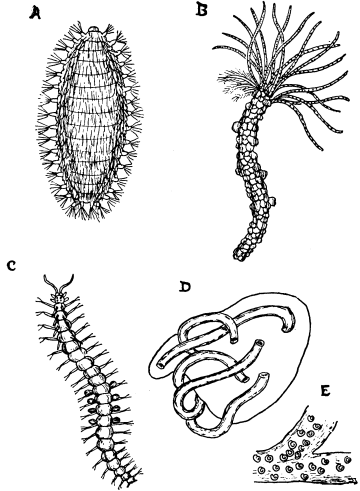
to this rule is the Sea-Mouse, an Annelid worm found on English coasts
(p. 73), which receives its odd name because it is a fat oval creature,
covered with bristles, thus greatly differing in appearance from most
worms. The larger bristles, which are of a dark purplish-black colour,
have a bronze or golden metallic lustre. Various other annelids exhibit
brilliant rainbow colours; for example, Nereis, the Rainbow Worm, also
found on English shores; but without the underlying black opaque
pigment, the reflections from the surface fall short of absolutely
metallic brightness. On land, we see among the insects innumerable forms
which present a metallic lustre, the beetles being the most notable in
this respect. To return to the vertebrates, from which we started,
everybody must have noticed that the fur of a clean well-kept black cat,
when lit up by the bright sunlight in which the animal loves to bask,
shows little rainbow reflections of red and green. These are due to the
presence of little grooves and irregularities on the surface of the
hairs, which play the same part in breaking up the light which they
reflect, as do the sharp angles of
iridescent feathers. Like the
iridescence of the Rainbow Worm, they fall short of absolutely metallic
brightness; the fault in this case being due not to the nature of the
underlying stratum, so much as to the incomplete development of the
light-reflecting grooves. Yet this instance serves to show the part
taken by the dark pigment; for while the play of colours is perfectly
obvious in the fur of a black cat, it is almost impossible to
distinguish it in the case of cats with fur of lighter shades.
The Mammalia, or animals that suckle their young and produce them by
birth, were formerly considered to be sharply defined from animals that
lay eggs, such as the birds and reptiles. But in 1884 Mr. Caldwell
confirmed the statement which had been made previously, yet hardly
credited by the scientific world, to the effect that the lowest form of
mammals lays eggs. This, the Duck-Mole or Ornithorhyncus anatinus
(Bird-billed animal much like a goose), is a native of Australia and
Tasmania. It lives on the banks of rivers, and burrows in the bank. It
has webbed feet, and therefore sometimes receives the name of Platypus
(flat-foot). It lays eggs two at a time, in its burrow; and these eggs,
like those of other egg-laying vertebrates, have a yolk.
A kindred form, Echidna hystrix or Spiny Ant-eater, is found in
Australia, Tasmania, and New Guinea. The Echidna hatches its young in
a temporary pocket, which appears in the neighbourhood of the breasts,
and disappears after the young are old enough to take care of
themselves. The Ornithorhyncus has fur, the Echidna has spines, with
hairs between them. Neither bears the slightest
resemblance to a bird;
the comparison suggested in the name of Ornithorhyncus is fanciful,
and depends chiefly on the flat beak-like mouth; these egg-laying
quadrupeds may, however, be reasonably brought into comparison with
Reptiles. Neither of them has any teeth; the Echidna has no teeth at
all; the Ornithorhyncus loses them at an early stage of growth, and
develops instead hard horny patches in each jaw. With these it crushes
its food, which consists of small insects, worms, etc. The Echidna, on
the contrary, lives in rocky places, and feeds on ants, which it
searches for with its long-pointed snout. These two genera are grouped
under the name of Prototheria or Primitive Mammals.
The pocket in which Echidna hatches its young, suggests a relationship
with the next group, the Metatheria or Marsupialia, which are the
characteristic mammals of Australasia. These are distinguished by the
possession of a permanent nursery-pocket, the "marsupium." In this they
put their young, which are born, like those of other mammals, not
hatched from eggs like those of the last group. They are, however, born
in a very backward condition, and therefore require to go through a
further period of incubation, so to speak, in the marsupium. Here each
one attaches itself to a teat, to which it remains fixed. But it cannot
suck as a new-born kitten or puppy does; and the milk is forced down its
throat by the muscles of the teat.
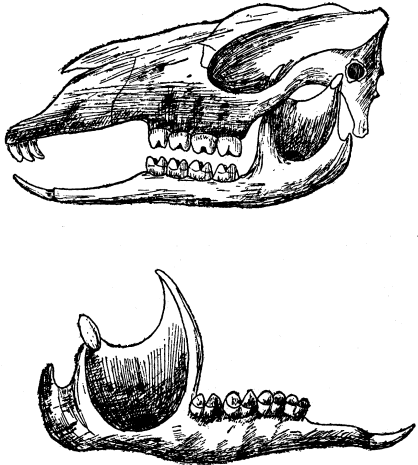
Fig. 45.—Skull and Lower Jaw of Great Kangaroo,
Macropus giganteus, much reduced.
The Marsupialia are not entirely confined to Australasia; a few occur in
South America, and in North America they are represented by the
"'possum," i.e. Opossum, of American stories. The Marsupials seem
almost to mimic the forms of ordinary quadrupeds. Thus Notoryctes, a
form discovered a few years ago, mimics a mole. The fact is that, just
as among the Eutheria, or higher mammals, special types have become
established, possessed of certain habits, and especially of certain
habits with regard to food, and modified in accordance with those
habits. Thus there are among them savage carnivora, harmless herbivora,
and rodents; and these respectively share
certain characteristics in
common with the carnivora, herbivora, and rodents, belonging to the
Eutheria. One of the herbivorous marsupials is the Great Kangaroo,
Macropus. It gets its name, Large-foot, from the size of its
hind-paws; on these it stands, and by their aid it takes remarkably long
leaps. Its skull is shown in Fig. 45; this, however, has not the full
set of teeth, some of which are soon shed. It crops the herbage with its
front teeth, and grinds it with its back teeth, like other herbivora.
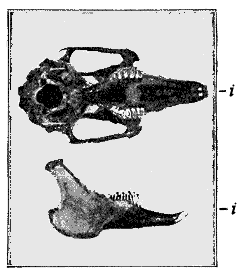
Fig. 46.—Skull and lower jaw of Rodent; i, i,
incisor teeth, separated by a long interval from the molars. About
one-half the natural size.
The study of the teeth is of great help in the classification of the
Mammalia. Of the eight orders of the Eutheria, two alone, the Sloth
order and the Whale order, show a tendency to the suppression of the
teeth. Those of the herbivora and carnivora may easily be compared by
anyone, in the sheep and the dog respectively. Fig. 46 shows the skull
of a Rodent, with elongated front teeth, adapted for that persistent
gnawing which makes the animals of the order, such as the Rat and
Rabbit, so terribly destructive.
TABLE SHOWING THE CLASSIFICATION OF THE MAMMALIA
| MAMMALIA. |
|
1. PROTOTHERIA, or Egg-Laying Mammals.
One order, the Monotremata.
2. METATHERIA, or Marsupial Mammals.
3. EUTHERIA, or Higher Mammals. |
The Mammalia are a terrestrial group. Exceptions are the Cetacea
(Whales), Sirenia (Dugongs), and Seals or Sea-Carnivora, but all of
these are air-breathers; even the Whale can only stay under water for a
limited period of time. Hence we see that none of them are really
animals belonging to the water; they are land animals adapted for life
in the water.
This brings us very near to the last chapter in the Story of Animal
Life. We have seen that our story began with the One-celled Animals, and
went on with the tale of the Two-layered Animals, in which each layer
was built up by cells in partnership. From Two-layered Animals we passed
to Three-layered Animals, and from them to Three-layered Animals with a
"body-cavity." When we reached the latter, we found amongst them traces
of the ancestry of the vertebrates. From the lowest of the Vertebrata,
the Lancelet, we passed on to the Lamprey, and from that to the true
fishes. In the latter we found the parent type of all the other
Vertebrata, possessing gills in the adult, while the latter only possess
them, or traces of them, in early stages of growth. The Amphibia formed
a group to themselves, in which we traced the loss of gills in the
adult. In the Reptiles, four-legged egg-laying animals, we found not
only a close relationship with birds, but also, through the four-legged
egg-laying Ornithorhyncus, a relationship with the Mammalia. The last
group comprises all the furry animals, and culminates in the order
Primates, in which the great Cuvier included Man.
TABLE SHOWING THE DISTRIBUTION OF ANIMAL LIFE BETWEEN LAND AND WATER
| LAND |
WATER |
Except a few forms living in damp places,
or as parasites |
—All the Protozoa. |
| —All the Sponges. |
| —All the Cœlenterata. |
Except a few forms terrestrial, and many
parasitic |
—Vermes. |
| Insects, except |
—A very few adult forms and a few larvæ. |
 |
| Except Wood-lice and a very few others |
—Crustacea. |
| Spider-like animals, except |
—Limulus. |
|
—All the Brachiopoda. |
|
—All the Polyzoa. |
|
—All the Echinodermata. |
| Except the Land-snails |
—Mollusca. |
|
—Hemichordata. |
 |
|
—Urochordata, or Ascidians. |
|
—All the Fishes: (some few can exist in damp places |
|
Amphibia belong to both. |
| All the Reptiles |
—Except swimming forms, which are nevertheless
air-breathers,
only partially adapted for water life:
Tortoises and Turtles,
Crocodiles and Water-Snakes, e.g. |
All the Birds: swimming and diving forms
are only adapted
for temporary
visits to the water |
|
| All the Mammals |
—Except Whales, Sirenia, and Seals, which
are nevertheless
air-breathers, only partially adapted
for water life. |
Another volume of this series, "The Story of the Earth," has already
dealt with the distribution of animal life in time; while "The Story of Animal
Life in the Sea" tells about the present inhabitants of the
ocean. It is therefore unnecessary to say much in this volume regarding
the distribution of animal life. A table is, however, appended, which is
not without interest. It shows how the chief great groups of animals are
divided between land life and water life, whether in fresh water or
salt. It will be seen that the terrestrial animals are much in a
minority, and that they belong, for the most part, to the higher types.
They are, in fact, stragglers, bold emigrants from the early home of
animal life, which lies in the more shallow parts of the waters of the
sea.