One fine summer morning two old
robins were consulting about breaking
up their household. In other words,
they thought the time had come when
their young ones should turn out of the
nest and find food for themselves. There
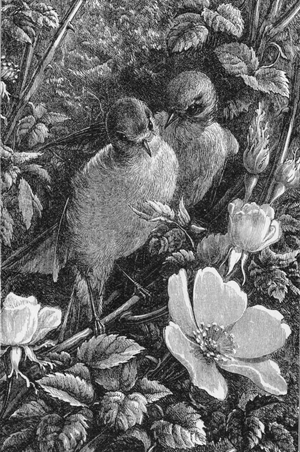
were five little birds in that nice, warm
nest, but it was much too small for them
now that they were so well feathered; and
as they quarrelled terribly about getting
the best place, the weakest one was in
danger of being tumbled over the side
with the pushing and struggling that went
on. Then they were such hungry birds
that their parents could not find enough
of food to satisfy them, and the poor old
birds were getting quite thin, and were
tired flying from their nest to the plot
where the gardener was raising some early
potatoes, which was the best place to find
food, and back with their mouths full.
Cock Robin said to his wife,—
“This is going to be a very warm day,
and I am not going to work all through
the sunshiny hours feeding birds old
enough to look after themselves. We
shall say we are going away for a holiday,
as we require change of air, and they
must go and find their own food. Don’t
look so sad, my dear; it is the way of the
world. The same thing happened to us.
I wonder what my father would have said
had I screamed to him for food when I
was the age my sons are?”
Mrs. Robin listened dutifully to this
long speech, and, like a good wife, acquiesced
in what her husband said. But as
she flew with him to tell the youngsters of
the change awaiting them, her heart was
a little sore on account of her latest
hatched birdie. He was not so big or so
strong as the others, and she feared he
might be caught by a cat or die of cold.
However, it was no use dwelling on these
dismal ideas; he must just take his chance,
as all birds before him had done. She
would give him some good advice as to
avoiding cats, and the proper drying of
his feathers when they got wet, so that
he should not get rheumatism in his bones.
On reaching the nest, they found there
had been a fierce fight among their children.
All the five were out of the nest,
and four of them were on the ground
fluttering and screaming, each trying to
tell its own story and throw the blame on
its neighbour.
“What is the meaning of this noise?”
said Cock Robin.
“Where is Robinette?” cried Mrs.
Robin. “Has a cat or a weasel been
here?”
Chip, chip, chip was heard among
the leaves close to the deserted home, and
the mother flew up to see if her darling
was all right, leaving the father of the
family to settle matters with the others.
Robinette was safe, and as he took the
breakfast his mother had brought him, he
told her what a fight there had been, and
how he in the struggle had been pushed
over the side. He also told her he could
use his wings so well that he had been
able to steady himself and keep from falling,
until he found a branch that he could
rest on comfortably. And there he had
waited for his mother’s return, knowing
that she would bring him something good
to eat.
The poor mother was wondering how
she was to tell her wee birdie that this
was the last breakfast she would bring
him, when he introduced the subject himself
by saying he wished he had not to get
back into that nest. Indeed he did not
think he could do it, for his wings were
so stretched with using them that he was
sure they would never crumple up into so
small a space as they used to occupy.
“Seeing that your wings are grown,
my son, your father has decided we must
all fly away. Let us join him now, and
hear what he is saying to your brothers
and sisters. He is very angry about this
quarrelling, which is out of all order, and
quite contrary to the doctrine taught by
Dr. Watts that ‘Birds in their little nests
agree;’ and he does not like to think
that his children are naughty beyond
all others.”
Robinette obediently accompanied his
mother to the ground, and Mrs. Robin
was glad to see how cleverly he managed
both legs and wings. They found Cock
Robin still haranguing his unruly family;
but on seeing his wife, he concluded his
remarks thus,—
“You are old enough and strong
enough to do for yourselves, so off you go.
Your mother and I will look after Robinette,
and keep an eye on you for a day or
two to see how you get on. I hope the
gardener will be considerate enough to
leave those worm-enticing carrots in the
ground, for then there will be plenty of
food for us all. Now good-bye.”
Cock Robin, having dismissed the four,
turned to his wife and Robinette.
“I hope, my dear, he was not hurt by
his rough brothers and sisters?”
“No,” she replied, “he was not hurt;
and I am now satisfied that his legs and
wings are all they should be. As for his
brains, he has more in his little head than
all the others put together. I feel sure
Robinette will have a history.”
Cock Robin put his head first to one
side, then to the other, and gave a funny,
chirrupy laugh.
“Ah! you mother birds are all alike;
you think your special nursling is sure to
turn out the flower of the flock.”
“Let us fly away. There is an uncomfortable
feeling about my feathers, plainly
telling me there is a cat near us.”
At this moment there was a rustle
among some leaves, and a beautiful tabby
cat came into view close to where the
birds were. Robinette got such a fright
that he rose suddenly from the ground,
and he seemed to go on rising, rising, until
he was far away from his home in the
rhododendron bush.
In his pleasure at finding himself going
along so easily up in the air he quite forgot
the cat, and, alas! he forgot his
parents too. He forgot everything but
himself.
“What a big place the world is!”
thought he, as he sat on a branch of a large
walnut-tree and looked round about him.
He was rather tired, so he rested there
a while. Then he remembered that he had
no one to bring him his food now; he
must look for it himself. So he spread
his wings and let himself gently down to
the ground, where he soon found some
earth newly turned over, and there was a
feast for a king. Oh, those thoughtless
wire-worms playing in the sunshine, they
little knew who was just going to pounce
upon them!
Robinette was now quite “on his own
hook,” as people who speak slang say.
There was no one to consult as to what he
should do; and though this freedom was
enjoyable in the full daylight, he began to
feel lonesome as evening drew on. He
found a good supper where he had found
his dinner, then crept into a nice, thick
rose-bush, dropped a silent tear as he
thought of his mother, and tucking his
head under his wing, fell fast asleep.
For some time Robinette’s life was
much the same day by day. He met
with no accidents, and had no adventures.
However, one morning he saw something
new and strange. He was on his usual
point of observation—the branch of the
walnut-tree—when he saw the gardeners
bringing a long seat and putting it against
the trunk of his tree. Then a neat maid
from the house brought cushions and rugs.
Next came a lady, and seated herself comfortably
among those cushions and rugs.
“This must be ‘the mistress’ I hear the
men speak about. She is evidently at
home here, and looks as though she were
some one of importance; but, poor thing,
she seems lonely. I am lonely too. I don’t
care for the other birds in the garden;
they are a common lot with no manners.
I’ll get acquainted with ‘the mistress.’
From what the men say, it is a wise thing
to be on friendly terms with those in
authority. I’ll go down and speak to her.”
With this he flew down near to the lady’s
feet. She was reading The Standard with
close attention, and did not see the wee
bird.
“Chip, chip, chip,” said Robinette—his
way of saying “good-morning,” you know.
Down went the newspaper with a
crackling noise that somewhat alarmed
him, so he withdrew to what he thought
a safe distance. He flew to a dahlia
stake, and from there again addressed the
lady.
“Chip, chip, chip. Ah! she sees me
now,” he said to himself.
The lady looked and saw him. He
came near her, almost to her feet again.
Robinette was very brave—whether from
real courage or from ignorance is a disputed
point.
“What a very friendly bird! You seem
quite tame.”
“I wonder what she means,” thought
the birdie. “Chip, chip, chip,” he said.
“Come near, robin; I shall not hurt
you. Sing me a song.” And the lady
made that curious, kissing sound with her
lips that people always make when speaking
to birds.
Robinette thought she was very polite
to sing to him on such a slight acquaintance;
and not to be behind in his manners,
he sang to her with his strange, twittering
note. The two conversed and sang to
each other for some little time, when
another lady came under the tree.
“Do look at that funny, little bird,
Polly; it has been hopping about close to
me, and seems very tame. We must bring
some crumbs next time we come out.—Good-bye,
Robin; but really you are so
small that we shall call you Robinette.”
The ladies moved away, and the bird was
left wondering what “crumbs” were like.
For some days after this the rain came
down so fast that poor Robinette had
much ado to keep himself dry. He
cowered under his rose-bush or kept close
to the thick hedge; but all the places
got so very wet that the poor wee birdie
thought life was not worth living. However,
just as he was in the depths of
despair, out came the sun from behind the
clouds, and soon all nature was rejoicing
again. The two ladies came out from the
house to breathe the perfume-laden air
and to enjoy the sounds of reviving nature.
Robinette was so glad to see them that he
flew quite close to them, saying in his own
way, “Good-day to you—chip, chip, chip.”
“There is Robinette, I declare,” said
Polly; “how wet and draggled he looks,
poor birdie! He needs the sun to dry his
wings.”
The next day was all that could be
wished in the way of heat and bright sunshine,
so the ladies came to the garden
seat. Robinette was looking out for
them, and could scarcely wait for the
older lady to be settled among the
cushions and wrapped up in the rugs by
her daughter. There are treacherous
draughts under trees, and Polly was very
careful of her mother. At last all arrangements
were complete, and Mrs. Lewis
opened her book to read. Suddenly Robinette
flew on to it, quite startling her by
such an approach. But she was charmed
with his trusting familiarity, and at once
asked Polly for the crumbs she had
brought out. Polly produced them from
her useful apron pocket, and threw some
gently on the grass at her feet, and Robinette
was soon eating the finest feast he
had ever had.
You may be sure, after having eaten
these good things, Robinette was always
watching for the ladies, and he hopped
beside them and sang to them as they
walked or worked in the garden. He was
soon tame enough to eat from their hands,
and Polly, looking upon him as a great
curiosity, wished to show him off to some
gentlemen friends. But Robinette obstinately
refused to be made a spectacle
of. Not the most enticing crumbs would
bring him to her hands if strangers were
near, particularly of the male sex. He had
no faith in men.
As the summer days passed away, and
autumn came and went, the days became
shorter and colder, and Robinette found
his way into the house, and soon was as
much at home there as in the garden.
He made friends with the cook in the
kitchen, and had many a rich meal when
she was preparing the family dinner. He
knew all the meal-times. He came in by
the morning-room window in time for
breakfast. But there he ran some risks.
He sometimes encountered the table-maid,
who was very cross with him; and perhaps
not without reason, for he was not
particular to wipe his feet before flying on
to the clean white table-cloth, and often
left the marks of his claws all over it; so
she feared her mistress would insist on
her changing the cloth. As this young
woman especially disliked extra work, she
used to frighten Robinette nearly out of
his senses by shaking her duster at him
and pretending to catch him.
Whenever the ladies came downstairs he
was quite safe. They let him do what he
liked. He tasted the bacon, he feasted
on butter, he burned his toes on the tea-pot—in
fact, he did whatever came into
his little head. At lunch he again presented
himself, and he came to the
drawing-room for afternoon tea.
With all this high living he became a
big, fat bird, and I am sorry to say he
was very selfish and very jealous. He
could not endure the thought of any
other bird sharing his privileges, as the
following incident proves.
One morning after breakfast he heard
a noise in the hall.
“Whoever is Polly speaking to? It
must be another bird,” said he to himself.
“That is the way she speaks to me. I
must see to this. If it is another robin, I
shall be the death of him.”
He ruffled up his feathers and flew into
the hall, prepared to do battle with any
intruder. He was very angry to hear
Polly speak in such petting tones to any
bird but himself, and he was tempted
to give her ear a bite as he sat on her
shoulder. He found he had put himself
in a rage very needlessly. It was not
another robin, but a little wren.
“Oh!” he thought, “I wonder what
she wants.—Good-day, Miss Wren; are
you coming to live here?”
“I was thinking of it,” she replied,
tossing her head; “but I don’t think the
society is very select.”
As she made this speech, she gave it
point by looking straight at Robinette.
“Indeed,” he said, “you are rather a
small person to have formed such a large
opinion; but as you are so small, you are
welcome to stay as long as you do not
interfere with me.”
“Thank you for nothing, Cock Robin.
I shall stay or I shall go without asking
your leave.”
“You are a very rude bird, Jenny Wren.”
“Am I, Cock Robin? There are various
opinions about that. What a great, fat,
clumsy bird you are, to be sure! I would
not have you for a husband though there
were not another bird in the garden.”
“You will perhaps wait until you are
asked, Miss Wren,” replied Robinette,
feeling he had better retire from the argument
after this retort, for Jenny, like all
females, would try to have the last word.
Polly had been watching the birds
fluttering towards each other, and was a
little fearful Robinette might be rough
with Jenny, so she was glad to see them
part company after simply speaking, as
she thought.
This is the only incident worth mentioning
that occurred during the winter
months. Robinette’s life was happy and
comfortable. Free to come and go as he
pleased, he always felt himself a guest—never
a prisoner.
At last winter was over, and the garden
was beginning to have more attractions.
There were some rather pretty Miss
Robins flying about, and our bird thought
he must go a-courting. He could not
easily make up his mind whether he
should bring a wife into the house, or
whether he should go and live in the
garden with her. Finally he decided on
the latter plan.
One very fine morning he dressed his
feathers most carefully, saw that each one
was lying exactly over the other, that his
brown coat was perfect and his red waist-coat
faultless. He practised his singing
until his love-song was all he could wish
it. He was wonderfully well satisfied
with himself; but Jenny Wren’s impertinent
speeches would recur to his mind.
The words fat and clumsy had especially
annoyed him, and he never could altogether
rid himself of their effect.
As he flew past the greenhouse he saw
a bucket with pure, clear water in it. He
thought he would rest on the edge and
take a drink. Imagine his delight when
he saw reflected in the water a perfectly
beautiful cock robin, as charming a bird
as any one could desire to see. After
such a vision, what cared he for Jenny
Wren and her impudence? Away he
went, flying up and down the garden,
quite sure that no Miss Robin in her
senses would say “no” to him.
He rested a while on the branch of an
apple-tree, while he meditated on the
various Miss Robins, and considered to
which he should pay his addresses. He
was startled by a slight movement of
some leaves just beneath him, and on
looking down to find the cause, he saw his
too candid friend Jenny.
“So you are come out a-courting?”
said she. “You are not a bit thinner.
Which of the Miss Robins do you think
will have you—a fat, over-fed house-bird?”
“You are quite mistaken, Miss Wren,
if you think I am out for any such purpose.
I am only taking an airing this fine
day. A-courting, indeed! A bird like
you would frighten any bachelor. I am
sorry for your husband, if you ever get
one.”
Away he flew, for he did not like Miss
Wren’s remarks. You see, he had not
mixed much with other birds, so he had
not, as it were, found his level. He was
in danger of thinking too much or too
little of himself; and then, you perceive,
he was thin-skinned.
Poor birdie! That pert young Jenny
had put his spirits down to his very toes.
Had it not been for the glimpse he got in
the bucket, he would have returned to the
house discouraged for that day. However,
like many other creatures, he did
not know what the near future had in
store for him.
The time of day was noon, and he bethought
him the kitchen dinner would be
ready; so he prepared to fly towards the
house, as he was very hungry. Just at
this moment he caught sight of the gardener
turning over some stuff for a hot-bed,
and he also saw some fine, fat worms
thrown to the surface by the fork. He
concluded to dine there that day, and proceeded
to make a very satisfactory meal.
He had with some difficulty swallowed a
very large worm, when he heard the gardener
say, “Hush! gently; now we shall
see some fun.” Robinette looked up.
He saw, and he loved. The daintiest
Miss Robin in all the garden was hopping
towards him. Alas! beside her was a fine
cock robin, and they seemed on the pleasantest
terms with each other, and hopped
along, quite unaware of Robinette’s presence.
To be ignored was what he could
not stand. So he came near to them,
made a deep bow to the lady, and ruffled
his feathers and scowled at his rival. A
fierce rage and jealousy took possession of
him. He would kill this bird or die in
the fight. The other cock robin was as
eager for the fray as he was; so these two
little birds were soon fighting savagely for
the lady of their choice. She watched
the duel from a twig close by. She had
made up her mind to marry the winner,
and it did not seem to matter much which
that was. Both were handsome; and the
victor would prove himself the stronger.
The birds were very equally matched, and
fought for some time with varying fortune.
At last, however, Robinette was conqueror,
and he flew at once to the lady
and claimed her as his bride. He knew
he now had a right to her; but just in case
her mind should waver towards another,
he placed before her the advantages of an
alliance with him, the chief one being that
he could get as much food as ever they
could eat, with very little trouble, and the
food was of the most rare and nourishing
kind.
“I can get some for you now, for I see
my friends in the garden, and Polly is
sure to have crumbs in her pocket. Wait
here until I come back.”
The ladies had come out for a stroll in
the garden. What a garden that was!
At almost any season it was beautiful, but
in the summer it was a paradise alike for
birds and human beings. It was surrounded
by grand old trees of many kinds
and flowering shrubs as large as trees.
Then the wealth of roses and sweet-scented,
old-fashioned flowers of all sorts,
mixed here and there with their more
modern sisters, made it a perfect dream of
delight. How the town-wearied friends
rejoiced when they were bidden to visit
that garden! There their eyes were refreshed
by the softly-blended colouring
and exquisite beauty of the whole scene.
They breathed in the delicious air, and
thought it better than wine as a restorer of
strength. No words can describe the feeling
to the feet of those soft, green avenues—the
grass so short that the most delicate
could walk there without harm, and so
smooth that a child’s bare foot could run
there scathless. That garden is now to
those dear friends a place in their memory
only. The ladies have passed away from
it, and strangers are in possession.
Excuse this digression.
Robinette flew to Polly’s hand.
“So here you are, Bobbie. We wondered
what had become of you, as you did
not come in at lunch-time. Don’t fill your
mouth so full; you will choke yourself.
Oh! he is off.”
Polly had held the crumbs for him as
usual, and he just stuffed his mouth full
and flew in the direction of the greenhouse.
“Mother, Robinette must have a lady-love.
He has taken the crumbs away;
he did not swallow them.”
Mrs. Robinette was charmed with the
crumbs—that kind of food suited her taste
exactly; and she hoped her husband would
keep her well supplied with them when she
was too much occupied with other matters
to seek food for herself. Robinette gallantly
promised to do his best for her.
Now it was time to seek a place for
their nest, and begin building. Like most
young people under similar circumstances,
they were difficult to please. Robinette,
having been so much accustomed to a
house, thought the greenhouse the best
place; Mrs. Robinette, knowing nothing
about houses, thought a nice, thick bush
much superior. She, like a good wife,
gave in to her husband, and allowed him
to choose the site for their nest. He
selected a nice, quiet corner of the greenhouse,
beside some large flower-pots that
looked as if they had not been disturbed
for a century. Here they would be safe
from storms and cats and all creatures
which terrify small birds. As evening was
drawing on, our little lovers parted, having
appointed a place to meet next morning
at sunrise to begin to build their nest.
The following day the sun rose bright
and beautiful, making all things and creatures
rejoice, and none more than our two
little birds, who were soon as busy as
possible, finding and bringing the materials
necessary for their purpose.
They had such a happy time building
that nest; he was so gallant and she was
so sweet. How he sang to her when she
was tired, and what delicious crumbs he
brought her! Some shortbread had been
sent to Polly as a present, and it is such
a crumbling cake that the birds feasted
royally while it lasted.
At last the nest was finished. The little
builders looked it all over and could find
no fault with it. As they were rather
exhausted with their hard work, they
agreed to rest themselves a while near the
hot-bed where the memorable fight had
taken place. There they could find plenty
of worms without fatigue, and they would
sleep or chat as they felt disposed. When
they were sufficiently rested, they went
back to look at their pretty, new house.
Alas! alas! what desolation they found!
The gardener, who had been cleaning
his greenhouse, had moved the big, dirty
flower-pots, and had thrown out the robins’
nest. Poor, tired birds, they had to begin
all over again. Mrs. Robinette burst into
tears, saying,—
“I told you not to choose a house to
build in; I was sure a bush would have
been safer. Do, dear husband, come away
now to some other place; I do not like
the men.”
Robinette was very angry at his work
being spoiled, and he answered a little
sharply,—
“Nonsense, my dear; I am not going to
be driven out of my way by a stupid old
gardener. We shall build here again.
Let us set to work at once; and if that
man interferes I shall tell the mistress.
Hallo! here is a piece of good-luck for us;
he has only thrown it down here. To be
sure, it is torn to pieces. But never mind;
we shall soon have it up again.”
You see Robinette had a temper; but
he was a cheery wee bird, inclined to
make the best of things. When his anger
had cooled, he chirped to his down-hearted
little wife so brightly that she was obliged
to pluck up spirit, and they were soon as
merry as before the terrible misfortune.
A few days after these events Mrs.
Lewis came into her greenhouse, and seeing
it look so much brighter and lighter
than usual, she said to the gardener,—
“You must acknowledge that the house
looks better for being clean. Try to keep
it so.”
“I’ll try, ma’am; but it is not much
use when these mischievous birds come in,
bringing their stuff to build with. Just
look there. I threw away a nest from
that very spot three days ago, and there
is another. And there is a robin in it.”
“It is Robinette,” cried Polly. “I am
sure it is.—Bobbie, come for crumbs.”
Robinette, sly bird, had been watching
and listening; and when he saw that attention
was drawn to the nest, he sat down
in it as though he were the lady on her
eggs, knowing well “the mistress” would
give orders that he was not to be disturbed.
And when she saw it was her
own pet robin, of course she was more
decided, and told the gardener he was on
no account to take down the nest, and
every possible arrangement was to be
made for the comfort and happiness of
Robinette and his wife.
It is customary to close all stories when
the hero marries. So, having come to the
end of Robinette’s bachelor days, we shall
take leave of him and his bride, hoping
that, now they are married, they will
“live happy ever after.”