The War and Sanderson's Propaganda of Reconstruction
The disaster of the great war came to Sanderson as a tremendous
distressful stimulant, a monstrous and tragic turn in human affairs
that he had to square with his aims and teaching. He had had our common
awareness of its possibility, and yet when the crash came it took him,
as it took most of us, by surprise. At first he accepted the war as a
dire heroic necessity. This aggression of a military imperialism had to
be faced valiantly. That was how he saw it. Both his sons joined up at
the earliest possible moment, and the school braced itself up to train
its senior boys as officers, to help in the production of munitions, to
produce aviators, gunners and engineers for the great service of the
war.
The practical quality of the old boys from Oundle became apparent
at once. They stepped from laboratory and factory and office into
commissions; they returned from all over the world to prepare for
the battlefields. By 1918 over a thousand Oundle boys had gone into
the fighting services, three had V.C.'s, many had been mentioned in
despatches, awarded the Military Cross and the like.
He did his best to find God and creative force in the world convulsion.
Here is a part of an address to the Church Parade of the Cadet Corps
which shows his very fine and very human struggle to impose a nobility
of interpretation upon the grim distressful last stages of the war.
'It is a pleasant thing to wander about these fields and watch the
cadets who are told off to instruct their squads. It is a splendid
illustration of the power of co-operation in education—where boys
and men, or where a community work together, teaching one another,
learning one from the other, where all are teachers and scholars, a
body of co-workers, helping, encouraging, stimulating each other.
This community method is dominant wherever there is a great stirring,
e.g. a great call, a great pressing into a new kingdom; wherever
there is a great discovery and a new need. The war will establish it in
schools.
And just one word when you go forth from here. You will carry this
mutual co-operative spirit with you. You will love your men, take care
of their interests, making full use of their individual faculties, and
learn to be co-workers with them.
It is often said that wars will never cease—that they are a
necessity—and in a sense this is true. One thing we know quite well,
that in all affairs of life peace may be simply the peace of death.
There is the peace of lifelessness, of inactivity, notwithstanding all
its autumnal beauty. There is the quiet peace which changes not, the
conventional belief, the conventional kind of round of work, with lack
of initiative, of experiment, of testing and trials. There is the peace
which follows on contentment with things as they are, the peace of
death. The land of peace and of convention, and of cruel contentment.
The land of dark Satanic mills—as in Blake's imagery. War may come to
break up this deathful peace. So said John Ruskin. I have a letter
written to me just when the war broke out. In July 1914 the O.T.C.
was inspected by General Birkbeck, and in his speech he expressed his
belief that war was coming. On 2nd August, 1914, he wrote to me:—
"Dear Mr. Sanderson,—We little thought when I spoke to
those boys of yours how near we were to our trial!" and he adds:
"These are the words of a peaceful philosopher, Mr. Ruskin, when
concluding a series of lectures on War at Woolwich Royal Academy
Institution, which may give you comfort. Men talk of peace and
plenty, of peace and learning, of peace and civilisation; but I
found that those are not the words which the muse of history has
coupled together! On her lips the words are Peace and Selfishness,
Peace and Sensuality, Peace and Death!!! I learned, in short,
that all great nations learned their truth of word and strength
of thought in war; that they were taught by war and betrayed by
peace—trained by war and deceived by peace—nourished in war
and decayed in peace; in a word, that they were born in war and
expired in peace."
This is the prophet's call to arise and awaken out of sleep; to abandon
the easy life of routine and routine's belief. It is a call to rise up
and breathe life into the dry bones of the past; it is the trumpet
blast for active warfare against all things that have become lifeless
and dead. It is the herald call for a new army, to build up a new world
of active, creative, dynamic Peace.'
In April 1918 his eldest son, Roy, died of wounds at Estaires after the
battle of the Lys. Loss after loss of boys and trusted colleagues had
grieved and distressed him; now came this culminating blow. There had
been the closest understanding between father and son; Roy had left
engineering to become a master at the Royal Naval College, Osborne,
which Sanderson had helped to reconstruct, and more and more had the
father looked to his boy as his chosen disciple and possible successor.
On the Whitsunday following Sanderson preached a sermon on the text: 'I
will not leave you desolate, I will come unto you.' The notes of the
sermon were untidy, and have had to be carefully pieced together, but
I think they rise to a very high level of poetry. And when I copy them
out I think how the dear sturdy man in his academic gown must have
stood up and clung to his desk, after his manner, full of grief and
sorrowful memories of the one 'gentle soul,' in particular, and of many
other gentle souls, he had lost—clinging to his desk with both hands
as he clung to his faith and speaking stoutly.
Whitsunday—White Sunday—white, pure, untainted—day of
consolation—day of inspiration—perhaps the most joyous time of all
the year. Spring in its power, life, Spirit of Peace, joy. Everywhere
joy—sanctified, subdued. Joy, and peace, and new life in the music,
the harmonies and discords, of Nature—here, in the country. The
singing of the birds, their twittering, chattering, calling; their
excitement; their restful chirping, abandon of joy, peace without
alloy—they are friends of the soul. The atmosphere too—the gentleness
of it, the life within it and soft warmth of it: freedom, imagination,
inspiration are in the air; the wind bloweth where it listeth. Joy,
innocent, white, pure, and happy. Happiness too. Life steeped in the
sunshine of happiness. The spring, the elasticity, the eutrophy of
life: life-creating life; life-giving life. Happiness on every hand
mystic, elusive as the forces of Nature. "The wind bloweth where it
listeth, and thou hearest the voice thereof, but cannot tell whence it
cometh, nor whither it goeth." Happiness! Not freedom from care, or
from sorrow, or from sleepless anguish; not freedom from abasement,
not even from dark gloom—the accidie of depression—yet nevertheless
the increasing sense of the life of love and service, the power of
service, the completeness of it. The happiness which breaks ever and
again through the clouds of uncertainties, doubts, darknesses of
life—revealing it may be, for a moment, the signs of long years of
effort—for as life goes on it is given to catch glimpses of the growth
of the soul, something of the part the soul has taken in the building
of the kingdom. It is in this life of love and service the words of the
Master come to us: "I will not leave you desolate, I will come unto
you."'
Followed praise of the beauty of work with which his congregation must
have been familiar. And then came this concluding passage:—
'And when these days of wrath are passed away, there will be a great
battlefield for a new birth. Days of wrath and then a new revelation.
When God came down on the first Pentecost on Mount Sinai, He came amid
thunders and lightnings, and in a thick dark cloud—and when the Holy
Spirit of God came to the waiting disciples there was a sound of a
rushing mighty wind. And it must be so. New birth comes through much
sorrow. So we may hope that new theories of life which for a century
have been growing towards birth will spring forth out of this great
contest in all the lands of the earth. Vast work there will be, and the
labourers sadly fewer. The nation is now sending of her very best into
the battlefield. There will be great call for new recruits to restore
the countries which are devastated—great calls, too, for investigators
in all branches of knowledge. Pioneers are now leading the way in
research, in mathematics, in science, in industry, in the laws of logic
and thought, with new ways of expression in language and art.
'There is the great pressing need of revolution in the laws and
relationships in the social life. We may have visions of a regenerated
social state, in which courtesy, justice, mercy, the spirit of the
gentle knight, will show themselves in change of thought, of belief;
we may have visions of communities guided by principles which we hope
and believe rule in our great school. Care for the weak; clothing,
feeding, housing, medical care for all; a crime to be poor; to be
diseased, to be underfed; these regenerations controlled by the true
and public spirit at the cost of the community. Laws for reform and
redemption, and not for punishment. Each member of the state cared for,
as it is our hope each boy of this school is. Great changes—essential
to the well-being of a state, and to each member of it. We may have
visions that the spirit of chivalry, of kindness, of courtesy, of
gentleness, of all that goes to make the "gentle soul" will bring this
redemption to the people.'
The war turned Sanderson from a successful schoolmaster into an
amateur statesman. Life had become intolerable for him unless he could
interpret all its present disorders as the wreckage and confusion of
the house-breakers preparing the site for a far nobler and better
building. He shows himself at times by no means certain that this
would ever prove to be the case, but he had the brave man's assurance
that with luck and courage there was nothing impossible in the hope
that a more splendid human order might be built at last upon this
troubled and distressful planet. But for that to happen every possible
soul must be stirred, no latent will for order but must be roused
and brought into active service. He had no belief in hopeless and
irremediable vulgarity. People are mean, base, narrow, implacable,
unforgiving, contentious, selfish, competitive, because they have still
to see the creative light. Let that but shine upon them and seize them
and they would come into their places in that creative treatment of
life which ennobles the servant and enriches the giver, which is the
true salvation of souls.
He became a propagandist. He felt he had now made good sufficiently
in his school. He had established a claim as an able and successful
man to go out to able men, to business men, to influential men of all
sorts, and tell them the significance of this school of his, this
hand-specimen, this assay sample, of what could be done with the world.
He went to Chambers of Commerce, to Rotary Clubs, to Civic Assemblies,
to Luncheon gatherings of business men, to tell them of this idea of
organisation for service, instead of for profit and possession. He
tried to find industrial magnates who would take up the methods of
Oundle in productive organisation. He corresponded extensively with
such men as, for example, Lord Weir and Sir Alfred Yarrow and Lord
Bledisloe. He wanted to see them doing for industrial and agricultural
production what he had done for education, reconstructing it upon a
basis of corporate service, aiming primarily at creative achievement,
setting aside altogether competitive success or the amassing of private
wealth as the ends of human activity. Surely they would see how much
finer this new objective was, how much fuller and richer it must make
their own lives!
When I tell of this search for a kindred spirit among ironmasters
and great landlords and the like I am reminded of Confucius and his
search for a duke in China, or of Plato or Machiavelli looking for
a prince. There is the same belief in the power of a leader and the
need of a personal will; the same utter scepticism in any automatic
or crowd achievement of good order; once again the schoolmaster sets
out to conquer the world. Perhaps some day that perennial attempt will
come to fruition, and the schoolmaster will then indeed conquer the
world. Perhaps the seeds that Sanderson has sown will presently be
germinating in a crop of masterful business men of a new creative type.
Perhaps there are Sandersons yet to come, men of energy; each with his
individual difference, but all alight with the new conception of man's
creative life. Perhaps Oundle may, after all, prove to be the egg of a
new world. Oundle may relapse, probably will relapse, but other, more
enduring Oundles may follow in other parts of the world. At present all
that I can tell is of the message Sanderson was preaching during the
last six years of his life.
Here he is, talking to the textile manufacturers of Bradford. This that
follows is from his printed address, restrained and pruned, but for the
manner of his delivery, the reader should think rather of that sample
sermon and the other descriptions I have given of his personal quality.
'I am very much honoured by your invitation to address this important
congress, and I am honoured, too, in being permitted to speak on
education in this great city of Bradford. For your city stands out very
prominently in the annals of education, and its work is well known by
all who have watched educational progress.
You, gentlemen, are concerned with education: you are much concerned
with the education which will promote the welfare of the leaders
and workers in your industry; and the welfare of the people in your
districts. Industrialism has tumbled upon us, and it is an untamed,
unruly being, the laws of which are not yet known, and need study.
For some thirty-five years—a long spell—I have, in places removed
far away from the voices of industry, devoted my time towards the
introduction into Public Schools of those Scientific and Technical
studies which, as I understand it, lie at the basis of industrial life.
I have always had before me the work of organising Technical Subjects
so that they might give all that is best to give of spiritual and
intellectual training. And our object is to send forth from school boys
that will be in sympathy with the work that they have to do, that they
will be privileged to do, and to send them forth equipped for it. You
have the same purpose. Your wish is that the boys and girls of your
country should have every chance of developing into effective workers
in the community, and that they should take a zealous intellectual
interest in their work—that they should love their work, love to do it
well, ever anxious to mount to higher things.
And one of the difficulties of the immediate future will be to
reorganise industrial conditions so that each worker may have the
chance of stretching his faculties and of getting the work that will
give him reasonably full play for his abilities. The fact that able and
clever men are, in the present system, kept too long at work which does
not stretch their brains, is a cause of unrest. Fortunately there is a
growing consensus of opinion that more freedom for opportunity and for
advancement is seriously necessary, and this sympathetic opinion will
lead towards a solution. It is also well within the work of a school to
promote this sympathy by sending out boys with those intellectual and
scientific tastes and knowledge which will react upon themselves and
attract them to the workers.
There are two other questions which I will mention before I come to
the actual work which may be done in schools. One of the main aims
of a good school is to see that each boy and girl is cared for, that
each one has every opportunity for development. We must not cast out,
or send our weak ones away, we must keep them in school—we must find
out what kind of work will appeal to them, so that they, too, may move
upwards, gain in self-respect, and love their life. And we claim that
this is what we would have done in all factories, or in any occupation.
It is the essential duty of every nation. We are anxious that no
worker should be stunted mentally or physically by the kind of work
he has to do. This again is a difficult as it is an urgent problem.
It is one which can be studied in schools, and there is no doubt
that the attempts of a school to provide avenues of advance for all
kinds of boys will tend to bring the right spirit into industrial and
agricultural life....'
So much for the Bradford discourse. Here is the gist of a discourse
given to the Reconstruction Council in London a year later.
'The object of this paper is to describe in practical working
terms an organisation of schools which shall be based on a close
association with the manifold needs and labours of the community life.
At the outset I may say that the proposals will refer—even if not
specifically so stated—to all types of schools, from the elementary to
the Public Schools. It will be seen that the change needs a change in
the ideals which have usually prevailed in schools of the past. In the
community life the one urgent thing to be done to-day is to reorganise
industry and the conditions of labour. This reorganisation may require
quite organic or even anarchic changes—and for these changes the
ideals of boys and girls must be changed, and to prepare for this
change is the urgent work of the schools.
'Before I come to the proposals for reconstruction of schools, I will
state very briefly some facts in industry which are now meeting with
acceptance:
'1. Modern industrial life has come in with a tumultuous rush, in
a haphazard, ungoverned way, through the activities of forceful,
capable, and industrious leaders who have made use of the scientific
discoveries of another type of men.
'2. The shrinkage of the world, and the growth of population which
followed, has led to fierce competition; and this spirit of competition
has ruled everywhere.
'3. In the ungoverned rush for production all sorts of methods are
adopted which seem to be justified by their effectiveness. An example
is the modern system of efficiency, at first sight captivating to the
intellect and the desires, but yet a method which needs very careful
study.
'4. Now men are beginning to believe that the first product of industry
must be for the worker; that the worker should grow physically,
intellectually, spiritually by his work.
'I shall claim that the work in schools should be permeated by Science
and by the scientific method and outlook, and it will be found that
Science itself does not set all this store on efficiency. Efficiency,
I believe, is entirely contained within the first, or quantitative law
of Thermo-dynamics. But eutrophy based on the more elusive qualitative
law is concerned with the quality which leads to the giving up of life
to others. We must see to it that whatever the efficiency may be, the
eutrophy of industry be high.
'The principle that the first product of industry must be the worker
leads to great organic changes. It will lead to no less a thing than
closing down certain productions, certain classes of occupations,
certain industries or processes. It will lead to a modification in
repetition work; and to adjustments in organisation. I hope to show the
bearing of this on our educational methods, and how the ideals implied
may bring some help in diagnosing Labour unrest.
'It will be seen that most of the changes needed to-day depend upon
international agreements; and a league of nations is essential, not,
I think, to end wars, but to make the change from competition to
co-operation possible.
'We are concerned to-day with the part education must take in this
change of ideals of life. It is not too much to say that without the
influence of a reconstructed education the way to change in the ideals
of men will be hard to find. The change has to be made from competitive
methods and ideals to co-operative methods; from the spirit of
dominance to creativeness; and the present system of aristocraticism in
schools must give way to democratisation.
'Competition holds sway to-day in industrial life with disastrous
results. Every employer of labour feels this, and wrestles, and would
be glad of a change, but he is held in the grip of a system. Every
one feels that competition destroys the creative, inventive life—and
is the seat of unrest. And yet the spirit of competition holds sway,
not in commerce only nor in diplomacy, but in the schools. Our public
schools are professedly schools for training a dominant class; the
aims, the educational methods, the school subjects and their relative
values, the books read, the life led—are all based on this spirit. The
methods are largely competitive, possessive. With, as I believe, tragic
results in industrial life this same system, with the ideals behind it,
has been unwittingly impressed on the working class in the elementary
schools....
'The change which I am advocating will demand a new organisation,
and will call for a new type of school buildings, and new values of
subjects. The new-comer Science, and with it organised industry,
which springs out of it, must take a prominent and inspiriting place
in school, and in every part of school work. It is not sufficient to
say that Science should be taught in schools. The time has gone by for
this. We claim that scientific thought should be the inspiring spirit
in school life. Science is essentially creative and co-operative, its
outlook is onwards towards change, it means searching for the truth, it
demands research and experiment, and does not rest on authority. Under
this new spirit all history, literature, art, and even languages should
be rewritten.
'A new type of school buildings and requirements will arise. No longer
buildings comprised only of class-rooms, but large and spacious
workrooms. Class-rooms are places where boys go to be taught. They
are tool-sharpening rooms—necessary, but subsidiary. For research
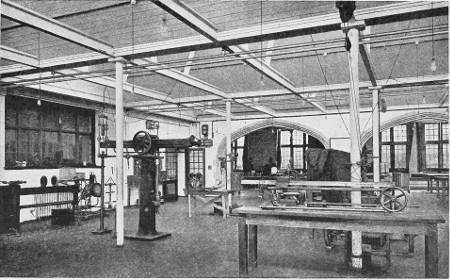
and co-operative creative work the larger halls are needed. Spacious
engineering and wood-working shops, well supplied with all kinds of
machine tools, a smithy, a foundry, a carpenter's shop, a drawing
office—all carried on for manufacturing purposes. Plenty of work
which will employ boys of all ages will be found to do.
'There will be a corresponding spacious literary and historical
workshop with a really spacious library full of books: books on modern
subjects, as well as reference books. The building should have wings in
it for foreign books—modern as well as classic, history, economics,
literary, scientific. As many as possible of the foreign languages
should be represented here, that boys may grow up with knowledge and
sympathy and respect for other nations, and thus aid in promoting wider
and deeper ideals of life. Another gallery for geography, and natural
history, travels, ethnology.
'Here is full scope for a large number of boys of all ages to be
engaged in research. It is all of a co-operative character. They can
study the various social and economic systems—from co-partnership to
syndicalism; or the Liberation of Slaves; or the League of Nations; or
the Liberation of Italy.
'Another block will be a science block with an engineering laboratory,
machinery hall, physical, chemical, and biological laboratories—well
supplied with apparatus and plant for applied science; plant, too, to
lead to the investigations of the day; testing machine, ship tank, air
tunnel; a miniature standardising laboratory; and with this a botanical
garden and an experimental farm.
'Another would be an art-room, music-room, theatre, a home of industry
for studying industrial development and industrial life.
'This is not a Utopian scheme, but one within possibility in town and
country. To each large central high school should be associated groups
of elementary schools, and there should be free highways between them,
neither barred by examinations nor barred by expense....
'Another change must also come. Books on modern problems, strangely
enough, are not yet read in schools. For example, the time is overdue
for a change in the English books: Burke's Reflections and Pitt's
War Speeches, or Addison, to Ruskin's Unto This Last and Time and
Tide, or to Bernard Shaw, Wells, Galsworthy, and the modern poets.
Some would go so far as to give Shakespeare a rest. It is astonishing
how the newer books bearing on the large questions of the day, and
bearing on the actual life of the boy, strike the imagination of
boys—even quite young boys of the upper elementary school age. They
stir up the faculties and appeal to a less used kind of imagination.
It is surprising, too, what open and live views young boys will reach.
And one thing the study of these books possesses, which I hope to dwell
upon later, is that they bring the schools into close touch with the
everyday life of their homes and of the community.
'Creative education demands that schools should be brought into harmony
with the community life, and should take part in the industrial and
economic life. When boys and girls go home from school (even to the
humblest home) the parents should find there is something their
children have done at school which will help them in their work. This
means that technical and vocational training should hold a prominent,
and not a subsidiary, place in the schools. It is not difficult to see
that this kind of work contains within it the spirit and genius of
Science. We claim that education should be turned in this direction,
with confidence and inspiration. The divorce of industrial life from
the life of the spirit is one of the tragedies of the age. It produces
calamitous results. A man's work may be of an impossible kind, it may
be sordid and destructive of life—and the cure proposed is that he
should have shorter hours and more pay. This leads to bad diagnosis of
the cause of the Labour difficulty, and prevents necessary reforms in
the industries....
'Creativeness, the co-operative spirit and method, the vision, the
experimental method of searching for the truth, form the unique gift
Science and Industry have to give to the "New Education." Under the
influence of this new outlook all other departments of knowledge must
be restudied. Under its influence the life of school will become
active, the workers self-reliant, love abounding. It will make good
craftsmen and make the school of use in the community—whether in the
manufacturing life or in the investigation of economic conditions.
Incidentally it will give rise to a new body of men capable of going
wholly or in part to teaching, and the school will be thus linked up
with the life of the place.
'It may be well to state that with an education of this kind based
fundamentally on Science a capable boy will leave a secondary school
with a good knowledge of Science and of its application, with a
research attitude towards history and modern problems, and with a good
working knowledge of two, or three, or even four languages....
'The study of social questions is seriously needed. Industries would
then have a close connection with the boys and girls, and yet boys
and girls would be free to follow the best of their own talents and
inclinations—the industrial life would not be separated from the
spiritual life; and we may hope that some part of this ideal would pass
over into the workshops and factories; so that the labourer would learn
to love his work better than his wage—for so indeed he would wish to
do. And the faculties of the worker would grow. The method of the work
would follow the method of the school, as it is doing more and more
in our own land and in many a workshop. For the spirit is with these
ideals; the practice difficult for any single firm to carry out. Hence
is the need for radical change in schools. Firms are being driven to
start trade schools of their own, when they would prefer the work to
be done with all the wider scope of a school. And the same enlightened
firms endeavour to "promote" their men.
'And here we come to what is probably the natural source of all
labour "unrest"—the unstretched faculties of the worker. Men there
are in any great shops who have intellectual faculties of the highest
order, and these faculties are not used, so the greatest possession
a man has, and the greatest his country has—the "faculties" of its
owners—is allowed to dissipate. And in the feeling of the mental want
of equilibrium, in the slow frittering away of life, there arrives the
turbulent spirit. The study of these questions is the problem for our
coming international university. The industrial and economic problems
involved can only be approached under international agreement. All that
has been possible at present in the way of making industrial life pure
and holy is by legislative restrictions, often enough rankling to the
worker even when needed for his amelioration. Such legislation (Factory
Acts, Insurance Acts, wages, hours) does not remove the source of the
disease; at best it only mitigates the worst results. More drastic
changes may be needed in the nature of the work—to the ruling out
certain manufacturing processes until new discoveries can be made.
'So with the work in the shops. Men do not want wages, or shorter
hours; these demands are only symptoms of a disease; short cuts to
amelioration. They are doctoring. What men want is that their work may
be such that they can love it, and want more of it. They do not want
slaves' work in the shops and a "dose" of the spiritual life out of it.
So we believe.
'Parents, too, would let their children remain at school. As a class
there is no one more unselfish and self-sacrificing and co-operative
than the working-class parent. Boys want to leave school because of
the natural urge for making something and getting to business—as they
see it at home. To remain at school without joining in some work is
unthinkable when they see the life their parents lead.
'I may be permitted to insert one paragraph on the unfortunate
opposition to this new position which is claimed for Science in the
schools. The opposition springs from the belief that vocational work is
simply material, having no spiritual outlook. But the truth is all the
other way. Unfortunately the present studies of history, art, economy,
literature, are biassed by "possessive" instincts and education, and
we claim that Science and its methods are seriously demanded for a new
reading of these things. However, the opposition finds expression in
high quarters. The Workers' Educational Union, acting in sympathy with
the Labour view—that vocational studies are to be avoided—practically
taboos technical studies. This is reasonable as things are to-day,
when a man's work is too often for the profit of others, and for this
reason the workers are not in love with their work, and when the day
is over they have seen plenty of it; so the best of them go elsewhere
for the springs of the spiritual life. But this is all disastrous to
individuals and disastrous to progress. What the workers should do is
to watch for the spirit in their daily work, for it is the work itself
which will hold a man to God—nothing else will.'
I have quoted from this London Reconstruction discourse very fully.
In the official Life there are a number of such addresses in which
the student will find the main doctrines of that particular address
repeated, varied, amplified, but as my object in this book is to strip
Sanderson's views down to his essential ideas, I will make only one
further quotation from this propaganda material here. This is from the
notes he arranged for an address to the Newcastle Rotary Club. His
favourite contrast between the possessive instincts and the creative
instincts comes out very clearly here. Like all the great religious
teachers, Sanderson aims quite clearly at an ultimate communism, to be
achieved not by revolution but by the steady development of a creative
spirit in the world.
'Schools should be miniature copies of the world we should love to
have. Hence our outlooks and methods must have these aims in mind.
Schoolmasters have great responsibilities. We should be able to say to
a boy, we have endeavoured to do such things for you, and we ask you to
go forth, it may be, into your father's business or factory and do the
same to the workers. Let me illustrate from the workshops. Workshops in
a school are by far the most difficult things to carry on along the
lines I have in mind. Here are three conditions which must be kept in
the shops:—
'(a) The work boys are doing should not be for themselves, or
exercises to learn by; it must always be work required by the
community.
'(b) Each boy must have the opportunity of doing all the main
operations, and all the operations should be going on in the
workshops.
'(c) Whenever a boy goes into the shop he should find himself
set to work which is up to the hilt of his capacity. There is
no "slithering" down to work which is easy, no unnecessary and
automatic repetition, no working for himself but for the community.
'And we can say, and are entitled to say, to the boy, when you go forth
into life, perhaps into your father's work or business or profession,
you must try to do for your apprentices and workers what we have tried
to do for you. You, too, will try to see that every one has work which
exacts their faculties—by which they will grow and develop; you will
see to it that they are working directly on behalf of and for the
welfare of the community, and not for yourself.
'This is your real duty towards your neighbour. It is a vastly hard
thing to do. This duty of believing that others are of the same blood
with yourself, and have the same feelings, and loves, and desires and
needs, and natural elementary rights; this duty of setting them free
to exercise their faculties spaciously that they, too, may get more of
life—is the real duty towards your neighbour. It is a hard thing. If
you think of the works, the factory, the office, it is a hard thing. It
involves vast sacrifice—the hardest sacrifice—the sacrifice of belief
and economic tradition. We need not be surprised that Christianity
has "slithered down" to an easier and softer level of culture and
duty towards our neighbours. But whether the workers know it or not,
this hard duty is essential in considering the relationships of our
community system and our international system to-day.
'It is a hard duty, and boys must be immersed in it in school. The
outlook, values, and organisation of a school should be based on the
fundamental fact of the community service. By habit of mind, and by the
activity of the schools, boys should be imbued with this high duty. It
means a reorganisation of methods and aims.
'It is a hard duty, this duty towards your neighbour—the hardest
part being to believe that he has like feelings with yourself and
equal rights. The young man went away sorrowful, for he had great
riches—riches intellectual or other. Yet the young man went away
sorrowful, and there is no doubt that he eventually sold all that
he had. This is Watts' version of it. The young man was at heart a
follower of Jesus; he did not say that the commandment was an old one
and well known, that it had been said before in the Hagadah and by
Moses; he did not say that the language was the language of Plato or
Philo; he did not say that it was too difficult and could not be true
for every one—he went away sorrowful. We have no doubt that he sold
all that he had.
'The system of education in the past has been based on training for
leadership, i.e. for a master class, and its method has been a
training of the faculties. But the sharply defined line between the
leaders and the led has been broken down. The whole mass of people has
been aroused towards intellectual creative efforts. The struggle going
on in all communities and amongst all races is a struggle to grow and
have more of life. Whether at home amongst our workers, or in India,
or Egypt, or Ireland; or between China and Europe—the struggle is the
same. It is a struggle to make progress, and have more of life. This
urge to grow is a biological fact. We cannot tell why it is or what
creates it—but everything around us has this urge to grow, and to grow
in its own particular way. One seed grows into a tulip, another into
wheat. We know not how, but we recognise it. And it is precisely the
same urge to grow that is causing all this apparent conflict. It is the
fundamental creative instinct—the most powerful instinct of the human
race, by which the race is preserved. Deep down in human nature lies
this instinct; it is never forgotten, it is always present in the mind.
It is voluptuous, anarchic, joyful, violent, powerful.
'The other instinct is called the fighting, aggressive, acquisitive,
possessive instinct. It is the instinct to acquire, to overcome. It is
distinct from the creative instinct even in the biological growth, but
the distinction manifests itself more clearly in the community or herd
relationships. It has none of the beautiful and life-giving qualities
of the creative urge. It is essentially, even in its romance (of which
we have plenty), dull, selfish, destructive. It varies its forms from
sheer animal force to the dialectical methods which have assumed the
names of talent and culture. The same characteristics are seen in
the force of the slave-driver, in the forces of the wage-nexus, and
in the dialectical force of the council. These are hard sayings, but
for the solution of the problems of the present times it is wise, and
necessary, to look facts in the face. At any rate it is well to know of
the possibilities, feelings, and loves of the uprising mass....
'But what has this to do with schools? My answer is that if we are to
deal with the problems thrown up by science in our industrial system,
and our close national and international contacts, the schools must be
the seed grounds of the new thought and visions....'