I never could like that boy Norman; I thought
him both cowardly and conceited. I could not
forget that he had killed my friend, the poor
dog, Jenny. One day, when he came to my
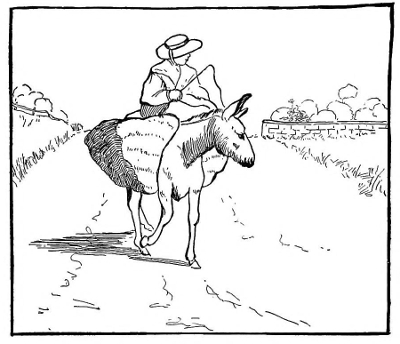
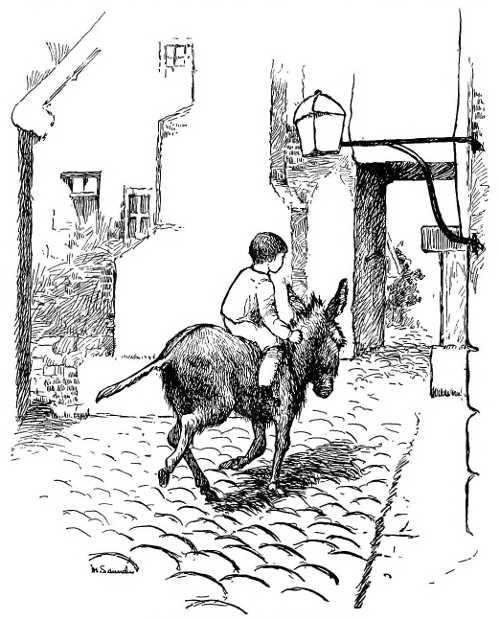
mistress’s house on a visit, he insisted on riding
on my back. “Now,” thought I to myself, “I’ll
have my revenge.”
Just beyond the garden there was a wood,
and beyond the wood there was a very deep and
dirty ditch, generally full to the brim with mud.
Norman had been boasting what an excellent
rider he was, and invited the others to come
with him through the wood to see him jump the
ditch. They all came, though they did not believe
he could do it.
Scarcely had they started, Norman on my
back, and the others running by my side along
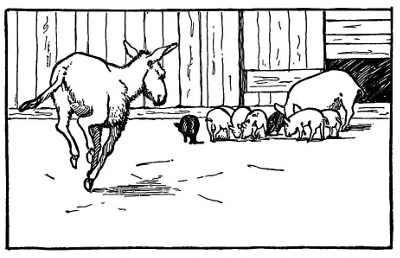
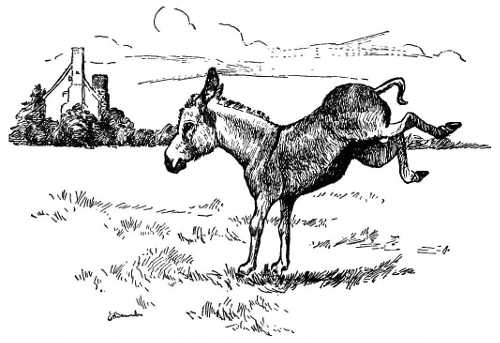
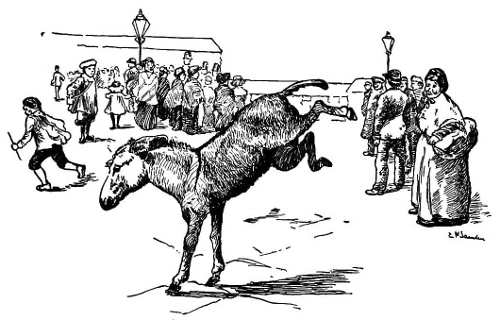
the path through the wood, when I threw up my
heels and dashed aside from the path into the
bushes. “All right,” shouted Norman, “you run
on by the path as far as the ditch, and see
whether I don’t jump it before you get there.”
“Oh, you will?” I said to myself. I went
quietly along for a little way, where the
bushes were thin and fairly far apart, and then,
without any warning, I plunged right into a
thicket of brambles. My skin is tough, so I
didn’t mind them, but Norman’s face and hands
and stockinged legs were scratched, and the
thorns stuck into his clothes from head to foot.
He was a nice object by the time we got to the
ditch: he had quite given up his boastful idea of
jumping over it, and did all he could to make
me stop and let him get off my back.
“Not if I know it,” thought I. “I shall never
get such a chance again of punishing you for
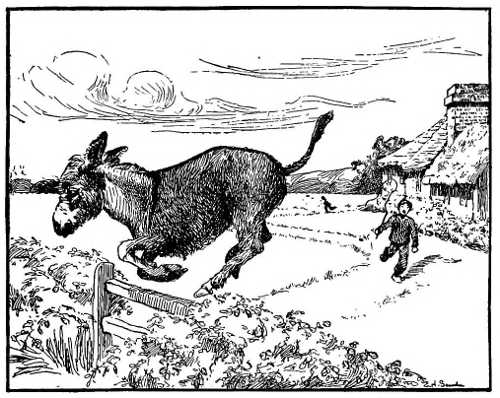
shooting Jenny;” so I galloped along the edge of
the ditch, and when I had reached a very steep
and slippery place, I suddenly stopped short, and
jerked Norman off my back. He was unable to
gain his footing, and pitched headlong into the
thick, black mud.
Just then the other children came racing down
the path; but what was their surprise and alarm
to find me looking into the ditch, and Norman
nowhere to be seen.
“Norman! Norman!” they shouted, “where
are you?”
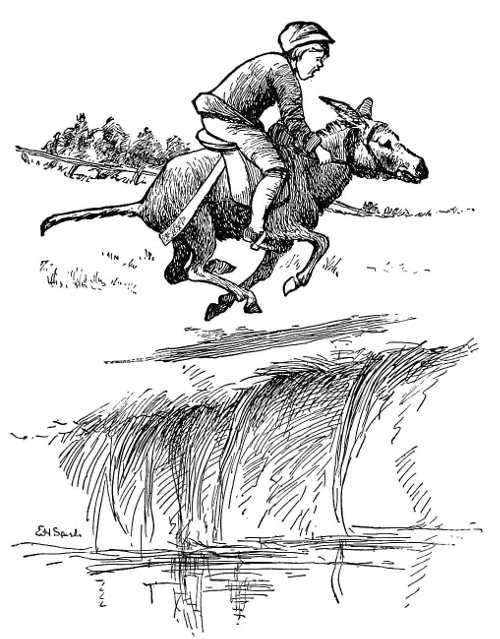
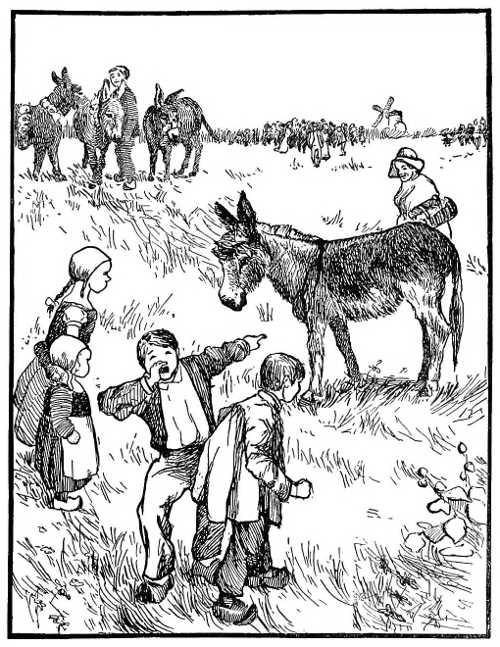
"Along from the Edge of the Ditch."
“Here—oh, help!” said a half-stifled voice
at last. They looked into the ditch, and there
was Norman, half drowned in mud; he was on
his feet again, and was standing on the bottom
of the ditch; but it was nearly five feet deep, and
the mud was up to his neck. “Help me out!
oh, help me out! I shall be drowned!”
Norman’s screams attracted the attention of
two farm-hands who were passing near at hand,
and they ran up to see what was the matter. In
a few minutes they had got a long pole and
had let one end down into the ditch so that
Norman could catch hold of it. Then the men
pulled slowly at the other end of the pole, and
at last Norman managed to scramble out. He
was covered with mud, and his teeth were chattering
with cold and fright. I began to be sorry
for what I had done, and kept behind the children,
who were hurrying Norman home as fast
as he could go.
I heard the next day that Norman was very
ill; he was obliged to stay in bed. The doctor
was afraid he was going to have a bad fever, and
be ill a long while. He shook his head when
the children went to inquire after Norman, and
advised my mistress not to let the children ride
me at present, until Norman was better, and
could tell them how the accident had happened.
I knew it was not an accident, and began to
be much afraid in consequence of what I had
done. When Norman got well enough to tell
them all about it, and how badly I had behaved,
they all looked at me very seriously.
The next morning, when Robert, the stableman,
came as usual to fetch me to be saddled,
and to take Jack and Janie for a ride, he said
nothing to me, but, to my great alarm, groomed
and saddled the other donkey that lived in the
stable. In a few minutes Jack came in at the
door, his face very sad, and his eyes full of tears.
“Neddy,” he said, “I’m very, very sorry, but
grandma won’t let me ride you any more. She’s
afraid you’ll be naughty again, and kick me off,
as you did poor Norman. Oh, Neddy dear, how
could you do it?”
I was dreadfully upset by this, and wanted to
explain to Jack that it was because I hated Norman,
and that I shouldn’t think of doing it to
him, or Janie, or anybody else whom I loved,
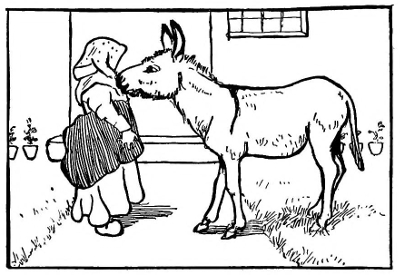
and who was kind to me. But I didn’t know
how to say this to Jack, so I only drooped my
head, and touched his shoulder with my nose.
“Mind, Master Jack,” said Robert, “don’t let
that vicious donkey touch you. Perhaps he’ll bite
you. Come away, my lad, directly,” and Robert
seized Jack by the hand, and pulled him away.
“Yes, the horrid brute!” said Teddy, who,
with the others, had come to the stable door.
“Of course, Norman isn’t always nice, but Neddy
had no business to try to drown him. I’ll take
good care that I have nothing more to do with
such a donkey.”
“And I, too,” said Dick, and so said all the
others. Jack looked very sorrowful, but as
Robert put him on the other donkey’s back and
led him away he looked round and said to me in
his usual kind little voice:—
“Poor, poor Neddy! Never mind, I’ll always
love you just the same, though I mustn’t ride you
any more, and perhaps some day you’ll be good
again, won’t you, dear Neddy?”
I could have cried when I heard this. It was
more than I could bear. As soon as Jack was
gone, I crept out of the stable, and made my way
into the fields. Then I lay down and thought of
all the wicked things I had done in my life: how
I had knocked my first mistress down, and broken
her nose; how I had deceived the farmer, and
how revengeful and evil I had been when he
punished me for my deceit. I thought of all the
happy life I had led in my present home, and how
very, very kind they had all been to me until I
had done this wicked thing to Norman. Norman
had killed poor Jenny, it is true; but then
he didn’t do it on purpose, and his father had
punished him for it; what business had I to give
way to feelings of revenge? I thought of dear
little Janie and Jack, and how good and kind
they had been to me when I was ill; and when I
remembered that, owing to my wickedness, they
were not to be allowed to ride me any more, I
felt so unhappy that I could not keep still any
longer. I began to run as hard as I could, trying
to run away from myself, but the faster I ran, the
more miserable I was, until at last I ran my head
right up against a stone wall, and fell down
senseless.
When I came to myself it was late in the afternoon,
and I couldn’t tell where I was. Three
people were sitting a little way off by the roadside,
but as their backs were turned they didn’t
see me. What was my astonishment to recognize
in them the owner of the performing donkey
Muffles, with his wife and son! They looked
unhappy and hungry, and I learned from what
they said that poor Muffles had been badly hurt
by the crowd that day at the fair, and that they
had been obliged to leave him for a time with a
kind farmer who offered to turn him out to grass
in his field, while they went about looking for a
little work to keep them alive until Muffles was
once more well enough to perform at fairs.
When I heard all this, I felt still more unhappy,
for it was all my fault that Muffles had been hurt,
and the showman’s family forced to go hungry
because they had no money to buy food. Then
I suddenly remembered that little Jack hoped I
would some day turn good again. “I can begin
to be good again this very minute,” thought I.
“I can follow these people to the next village,
and earn some money for them by performing
tricks.” So I jumped up, and trotted behind
them until they stopped at the door of a little
inn to ask the host if he would let them stay
there that night. They said they had no money
to pay for a night’s lodging, but perhaps he could
give them some work to do instead. The host
shook his head, and said that he had plenty of
people in his house to do all his work, and that
the showman must go somewhere else.
Just as they were turning sorrowfully away
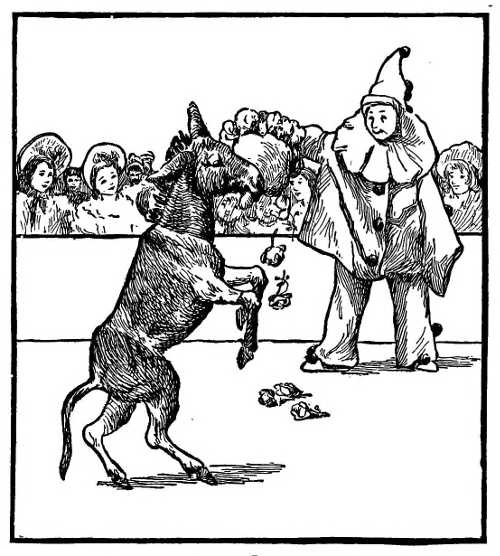
from the door, I trotted up, bowed to the innkeeper,
and then stood up on my hind legs and
began to dance. I did several of the tricks that
Muffles was accustomed to do, and I did them so
gracefully that quite a large crowd collected. At
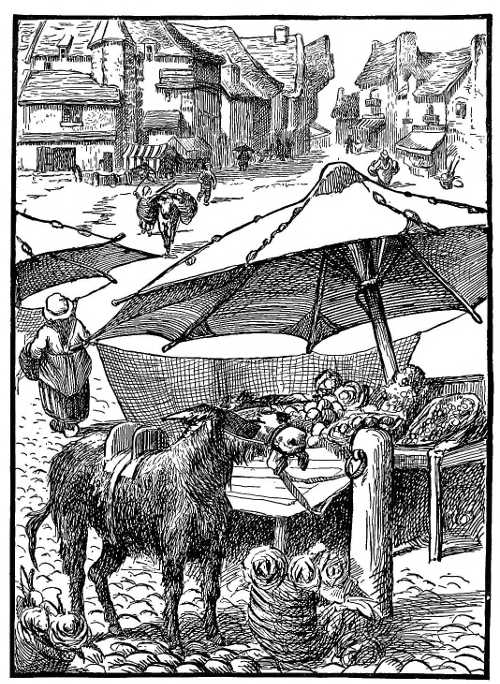
last I thought it was time to make the collection,
so I picked up the showman’s hat in my teeth
and took it round to everybody in the crowd.
Before I had finished my round the hat was so
full of money that I had to empty it into the
showman’s hands, and when he came to count his
gains there proved to be nearly ten dollars. So
the showman and his wife and boy were able to
have a good supper and a night’s lodging at the
inn, and they gave me a supper and a night’s
lodging in the stable.
In the morning I followed them to the next
place, and we gave two or three performances
in different parts of the town; so that before
dinner-time I had earned for the showman no
less than sixteen dollars, and then I thought I had
atoned for my unkindness to him on the day of
the fair, and that I would go back and try to
show Jack that I was now good.
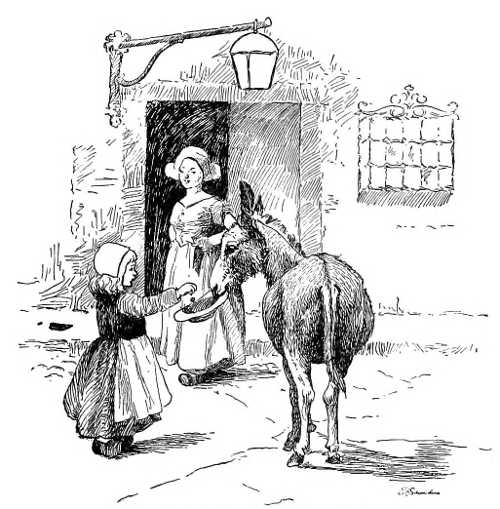
““I took the Hat in my Teeth.””
I soon found the right road, and reached the
house in the afternoon when everything was
quiet, and all the people indoors at tea. Just as
I came up to the high wall of the kitchen garden,
on my way to the stable, I saw a tramp trying to
climb over it, doubtless intending to steal things
out of the garden. I made a jump, caught the
tramp’s foot in my mouth, and pulled him down.
He called out for help, but in another moment
he fell, hitting his head, and lay still. At this
moment another tramp came running up; I gave
him a kick as he passed me, and stretched him
flat by his friend. The second tramp howled
so loudly that all the servants came running
out of the house to see what was the matter.
I was still standing over the tramps, ready to
kick them if they offered to get up. When they
were questioned, their replies were so suspicious
that they were taken into the house, and the
police sent for.
So I had saved my good mistress’s garden,
and perhaps several other people’s houses, from
being robbed. They were all so pleased with
my intelligence that they said I should be forgiven
for my past wickedness, and that the bigger
boys should ride me for a time; and if they
found me always gentle and quiet, then perhaps
they would let Janie and Jack ride me as
before.
To crown all, I heard in a few days that Norman
was nearly well again, and that he bore me
no ill-will, for he said I must have seen something
or other in the path, perhaps a toad, or a
piece of paper, that frightened me and made me
run away. How dreadfully ashamed of myself
I felt when I heard this! After all, Norman
seemed a much better and more generous boy
than I had at first imagined him to be. At any
rate, he was not revengeful.