New original cover art included with this eBook is granted to the public domain.
THE STORY OF A BORDER CITY DURING THE CIVIL WAR
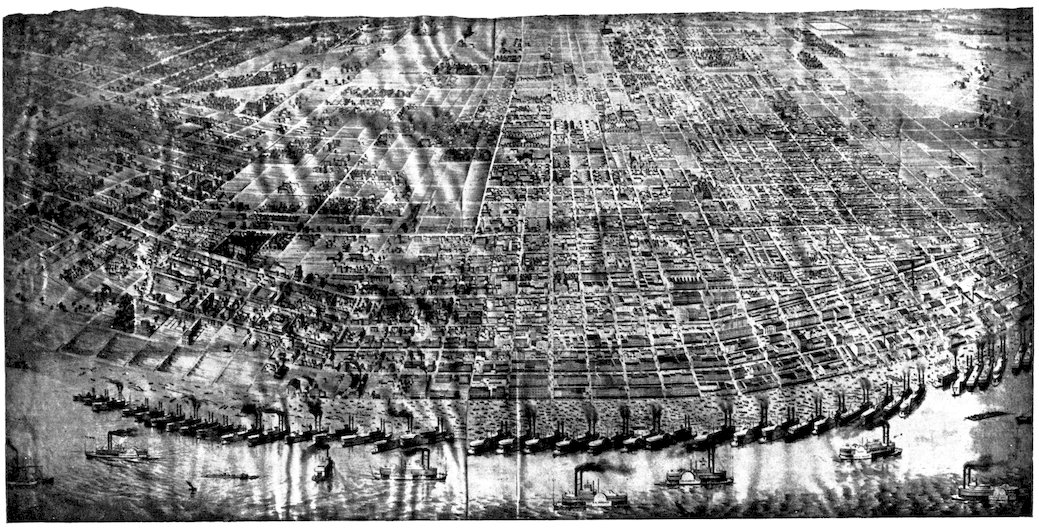
A BIRD’S-EYE VIEW OF ST. LOUIS IN 1860.
[Frontispiece
BY
GALUSHA ANDERSON, S. T. D., LL. D.
PROFESSOR IN THE UNIVERSITY OF CHICAGO
RESIDENT OF ST. LOUIS FROM 1858 TO 1866
With Twelve Portraits and Views
“On the perilous edge of battle.”—John Milton.
Boston
Little, Brown, and Company
1908
Copyright, 1908,
By Galusha Anderson.
All rights reserved
Published September, 1908
COLONIAL PRESS
Electrotyped and Printed by C. H. Simonds & Co.
Boston, U. S. A.
To all those, living or dead, who by wisdom, tact and
self-sacrifice helped to keep Missouri in the
Union, this book is affectionately
dedicated
AN EXPLANATION
vii
I have been frequently urged by men in different
parts of the country to write out, and give to the public,
the story of St. Louis during the Civil War. Having
had of late my time largely at my own disposal, I determined
to yield to these earnest solicitations. But I have
found the task somewhat more difficult than I anticipated.
While all that I saw in St. Louis, and all in which
I participated, came back to my mind with remarkable
freshness and vividness, I have been compelled, because
of the lapse of time since the war, to verify my recollections
by wide reading and painstaking research. I have
tried to weigh impartially what has been said both by
those who were for, and those who were against, the
Union.
Upon some points pertaining to military operations in
St. Louis and Missouri, I have found considerable
conflicting testimony. In such cases I have either given
authorities on both sides, or, having sifted the evidence
pro and con, have presented what seemed to me to be,
at least approximately, the historical facts. And while
in some instances I may have come short of absolute
accuracy, in all my statements I have earnestly endeavored
to present the exact truth.
But I have treated of the movements of troops and
the acts of the general government only in so far as they
immediately affected the life and experiences of those
within our city. My sole object in all that I have written
viiihas been to portray as clearly and vividly as I could
what transpired among us from 1860 to 1865; to note
some events that preceded the war and were the harbingers
of it; to reveal the currents of thought and
feeling in St. Louis during the whole fratricidal struggle,
and especially to point out what was peculiar to us as
a community made up of the loyal and disloyal.
To my own mind it is clear that our great Civil War
can never be fully understood without a knowledge of
the unique experiences of a border city, and especially
of St. Louis, for the possession of which both parties
to our great national conflict so earnestly contended.
During the long and bloody battle for the Union, my
home was there, and this book is simply “an unvarnished
tale” of what I saw and of work in which I
shared. As a testimony I trust that it may be of some
worth.
And since I intended it to be only a simple testimony,
it has not been written to make out a case. I have tried
to divest myself of the spirit of a partisan, and to present
in an unbiased manner what I personally observed.
I have endeavored to write, as the martyred President
did, “with malice toward none, with charity for all.”
Galusha Anderson.
Newton Centre, Mass.
April, 1908.
For the originals of several of the illustrations in
this volume the author is indebted to Miss Mary
Louise Dalton, the late Librarian of the Missouri Historical
Society, whose many kindnesses will always be
held in grateful remembrance.
I need not say that St. Louis is built on the western
bank of the Mississippi River about twenty miles below
the mouth of the Missouri, since everybody knows that.
But the present generation thinks of the city only as it
is to-day, with its more than half a million of inhabitants,
extensive parks, palatial residences, well-constructed
churches, imposing business blocks, great
railroad bridges spanning the river, unrivalled central
depot and attractive trolley cars. But all this has
flowed from its wonderful development since the close
of the Civil War. We write of it as it was immediately
before, and during, that mighty conflict.
In 1860 it had only one hundred and fifty-one thousand
seven hundred and eighty inhabitants, about one thousand
five hundred of whom were slaves. A large number
of enterprising young men had flocked to the city from
every part of the United States, so that the white males
of the city exceeded the white females by more than
ten thousand. Among the whites there were many
thousands of intelligent, manly, thrifty Germans, a
fact which needs to be borne in mind, if we would fully
understand and duly appreciate the part which the city
acted in the earlier stages of the Civil War.
2Most of the city stood then, as now, on bluffs or
extended terraces that rise gradually one above the
other. Its situation is both healthful and beautiful.
But before the war its area was comparatively small.
It extended along the river only six and a half miles
and between three and four back from it. It contained
only fifteen and a half square miles. The ground now
occupied by the finest residences was then rough,
open fields, lying beyond its western limits. The city
was built of brick. The business blocks, warehouses,
hotels, residences, schoolhouses, and churches were all
of the same material. Most of the sidewalks were also
made of red brick. Whichever way you looked your
eyes rested on red brick, and wherever you walked
you trod on red brick. I remember but one business
block that had a stone front, and that was marble. The
enterprising citizen who built it made quite a fortune
out of it. Its very novelty made it attractive, and its
rooms were readily rented to professional men. The
city is still largely built of brick. The clay from which
the brick is made is found in large quantities near the
city, and its inhabitants naturally and wisely use this
excellent building material that lies close at hand.
Most of the dwelling-houses were built out to the
street, so that, with rare exceptions, there were no front
yards. On warm summer evenings the families living
in any given block sat on the front stone steps of their
houses, that they might be refreshed by the cooler
air of the evening. But most of the streets were macadamized
with limestone, and in summer absorbed
during the day so much heat, as they lay under the
burning rays of the sun, that they continued to radiate
it long after the sun went down. At such times a perch
on the front stone steps afforded so little relief from
3the heat-laden atmosphere that the half-baked sufferers
longed for the arctic regions. A distinguished
man from the East, on a hot night in September, waking
up at two o’clock in the morning from a troubled sleep,
declared that he found himself, on account of the
stifling heat, swelling up like a mouse in an exhausted
receiver. But such days were exceptional and not
peculiar to St. Louis.
The larger part of the fuel then consumed in the city
was soft coal. We bought it not by the ton, but by the
bushel. In those days there were no smoke-consumers.
Vast volumes of smoke poured forth from the black
throats of great chimneys in manufacturing establishments,
while the chimneys of every dwelling-house, and
the smoke-stack of every steamer on the river, added
their contribution to render the atmosphere dusky. In
still days of the autumn or winter the smoke hung like
a pall over the city.
But in spite of a few such drawbacks it was even
then a very pleasant city. There were few who
were very poor. None were permitted to go unclothed
and unfed. Most of the people were thrifty; many
of them were rapidly accumulating wealth. The markets
of the city were well supplied with all the varied
products of the fields and the forests. The homes of
the people were comfortable, many of them attractive.
Their tables were loaded with abundant and wholesome
food. The churches were numerous and well attended.
The public schools were of a high order. Private schools
and colleges had been founded, and were already doing
good work.
The inhabitants of the city were a conglomerate;
but just on that account were broad and catholic in
their thinking. Coming from every section of the
4Republic, by attrition their provincialisms and prejudices
were worn away till they came to take comprehensive
and just views of the great questions that were
at that time agitating the nation. Men from the South
and North had learned each other’s excellences, and
with mutual respect and high esteem stood shoulder
to shoulder in business, civic duty and charitable and
religious service. I have never met anywhere men of
broader gauge.
Among them were those distinguished as lawyers,
statesmen, and preachers. To name some to the neglect
of others would seem to be invidious. But among the
lawyers, Samuel Glover and James O. Broadhead;
among the preachers, Henry A. Nelson, Truman M. Post,
Wm. G. Eliot and Father Smarius; among the statesmen,
Frank P. Blair and Edward Bates, the latter
afterwards Attorney-general in President Lincoln’s
Cabinet, are names which readily occur to those of that
generation who still live.
When, in the autumn of 1858, I made St. Louis my
adopted home, the name of Thomas H. Benton was on
all lips. He had died in April of that year. The people
of the city were justly very proud of him. He had
represented Missouri for thirty years in the Senate of
the United States, and was unquestionably the most
distinguished man of the State and of the Northwest.
A funeral procession fully five miles in length had followed
his body to its burial-place in Belle Fontaine
Cemetery. But this great man, like many others who
have been pre-eminent, had marked peculiarities. In
the Senate he was called “The Magisterial.” In consonance
with that descriptive phrase, when he addressed
crowds at political meetings in St. Louis, he
never said, “Fellow-citizens,” but always simply,
5“Citizens.” And the contents of his speeches from
the stump were often quite as magisterial.
Mr. Benton, while United States Senator, at times
took an active part in the election of congressmen
from St. Louis. It was customary then for those opposed
to each other to speak in turn to the people from
the same platform. On one occasion Mr. Crum was
the name of the candidate who, with Mr. Benton, was
addressing the voters of the city. Near the close of
one of Mr. Benton’s speeches, he said, “Citizens, is
my opponent a loaf, or even a crust? No,” then suiting
the action to the word, he apparently picked up and
held a very small particle between his thumb and
finger, while he added in a tone of great contempt,—“No,
citizens, he is nothing but a tiny Crum.”
During another canvass, he was stoutly opposing Mr.
Bogie, who was a candidate for Congress. Late one
evening when about to close his speech in reply to him,
he said, “Citizens, you have been told that my opponent’s
name is Bogie. Citizens, it is a mistake; his
name is Bogus. But, citizens, notwithstanding that,
like Cato of Rome, I would now send my servants
(slaves) to light him home, were it not that to-morrow
you would be asking, ‘Mr. Benton, what sort of company
do your servants keep?’”
In 1856, his son-in-law, John C. Fremont, was offered
the Republican nomination for the Presidency, and
asked him if he thought it was best for him to accept
it? Benton, believing the Republican party to be
sectional, was bitterly opposed to it; so he said to
Fremont, “If you accept the nomination, I’ll drop you
like a hot potato, sir! like a hot potato, sir!”
These incidents, standing alone, would misrepresent
Mr. Benton; but they throw a side-light on his character
6and help us better to understand the most eminent
citizen of St. Louis, a statesman of large mold and of
a well-merited national reputation.
The early history of St. Louis is so full of interest that
we cannot refrain from briefly noting a few items that
belong to it. Its beginning carries us back to 1764.
It was then a mere trading-post of a company of merchants,
whose leader was Pierre Ligueste Laclede.
The post consisted of one house and four stores. It
was named St. Louis in honor of the patron saint of
Louis XV of France. Though not possessing the dignity
of an incorporated town, the following year it became
the capital of Upper Louisiana. Through the wise
foresight of Jefferson, despite his party principles,
the vast and vaguely defined territory of Louisiana
was purchased from France at a time when Napoleon
sorely needed money. In transferring this immense
region there were two formal ceremonies, one at New
Orleans, Dec. 20th, 1803; the other at St. Louis, on
March 10th, 1804. On the latter day Major Stoddard,
who was the agent of the French Government to receive
Upper Louisiana from Spain, for France, was also the
accredited agent of our government to take over the
same territory for the United States. That one man
should represent both nations in affairs of such tremendous
importance was, to say the least, unique.[1]
This ceremony of transfer took place at the northeast
corner of First, or Main, and Walnut Streets. The event
should be commemorated by some suitable tablet or
monument erected on the spot of transfer. We trust
that the Missouri Historical Society will have the honor
7of doing this work so consonant with its aims and
character.
The town of St. Louis was laid out between the river
and the first range of bluffs on the west, and a series of
circular towers was erected around it for defence. The
houses were mainly built of rough stone and whitewashed,
and each house had a separate lot for fruit
and flowers. These houses were without cellars. The
first house provided with such a convenience was built
by Laclede on what is now called Main Street, between
Market and Walnut. Indian women and children
helped dig it, carrying out the dirt on their heads, in
wooden platters and baskets. In this house civil government
was inaugurated in 1765 by Captain Louis Saint
Ange, Acting French Governor of Upper Louisiana; in it,
also, the Marquis de Lafayette was entertained in 1825.
The streets of the old town were all quite narrow;
it was thought that such streets could be more easily
defended. And there they are, cramped and narrow
to this day. But in time the land above and
west of the village was laid out in town lots, and the
chief promoters of this enterprise, Judge Lucas and
Colonel Chouteau, built their dwelling-houses far back
from the river and the old town, the former at the
corner of Seventh and Chestnut Streets, the latter at
the corner of Sixth and Olive Streets. In 1809, the
year in which St. Louis was incorporated as a town,
Fort Belle Fontaine became the headquarters of the
Department of Upper Louisiana. It was several miles
north of the village, on a high bluff, overlooking the
Mississippi. The land for this fort was secured by treaty
from the Sac and Fox Indians. On it was a great
spring of pure water capable of supplying a thousand
men; hence the name of the fort, Belle Fontaine.
8St. Louis was early called the Gateway of the West.
In 1817 the first steamboat tied up to her levee.[2] This
was the beginning of an imperial trade. Streams of
commerce now began to flow into her markets from the
great continental rivers, from the upper Mississippi,
the Illinois, the Missouri, the Ohio, the lower Mississippi
with its far-reaching affluents; and, through the Gulf
of Mexico, even from the cities of the Atlantic seaboard.
For many years her chief trade had been in
the pelts and furs of wild animals; but now this lucrative
traffic was greatly augmented. For forty years
the annual value of it alone was between two and three
hundred thousand dollars, while commerce in all agricultural
products and in manufactured goods was
constantly swelling in volume. Still it is worthy of
note that deerskins were an article of barter, and furs
were currency in St. Louis, from the days of Laclede
until Missouri became a State in 1821; and a year later,
even before St. Louis had five thousand inhabitants,
it was chartered as a city.
When under Spanish control, it was strictly Roman
Catholic. In 1862 I met at a wedding in St. Louis a lady
almost a hundred years old. She was still in excellent
health. Her intellect was clear and vigorous. As
she took my arm to go to the wedding supper, she archly
remarked, “Your wife will not be jealous when she
learns how old I am.” Yet, when we were seated at
the table, after some moments of absolute silence on
her part, into which I did not venture to intrude, she
said, “I do believe that God has forgotten me.” I looked
at her with mingled astonishment and curiosity and
said, “Why so?” She replied, “All the friends of my
early life are gone and I am left alone.” She now
9became reminiscent and added, “I lived here when St.
Louis belonged to Spain. And just as for many years
no free negro has been permitted to enter this city
without a pass, so for years, in my early life, no Protestant
could enter it without a written permit from the
Spanish authorities.”
But, while under the rule of the United States all
religious intolerance disappeared, African slavery
flourished, established and protected by law. And
although in 1860 St. Louis had but few slaves, nevertheless
pro-slavery sentiment largely prevailed. Those
who cherished it were often intense and bitter, and at
that time socially controlled the entire city. But on
the other hand the leading business men of the city
were quietly, conservatively, yet positively, opposed
to slavery. Many of them had come from New England
and the Middle States and believed slavery to be a
great moral wrong; but those from the North and
South alike saw that slavery was a drag upon the
commercial interests of the city and all were hoping
that in some way the incubus might be lifted off from
it. For St. Louis, the commercial capital of Missouri,
already had many great merchants and enterprising
manufacturers, who were not only throwing out their
lines of trade into every part of the State, but also into
all the surrounding States and territories. It was linked
by the Mississippi and Missouri, fed by numerous and
important affluents, with a vast territory which was
probably the richest on the earth’s surface. And very
much of its trade was with southern cities. In 1860,
more than four thousand steamers, with a capacity
of one million one hundred and twenty thousand and
thirty-nine tons, loaded and unloaded at its wharves. To
obstruct the Father of Waters at the mouth of the
10Ohio, or to divide it by secession, was a matter of life
and death to all the business interests of St. Louis.
And no one without this conception clearly in mind
can adequately understand what took place there in
those days of awful storm and stress between 1860 and
1865.
CHAPTER II FOREBODINGS OF CONFLICT
11
For many years the subject of slavery, in its varied
aspects, had been constantly and hotly discussed in
all political and religious journals, on the stump, in the
pulpit, and in the Congress of the United States. The
higher law doctrine, propounded by William H. Seward,
the repeal of the Missouri Compromise in 1854, the
Kansas war, Lincoln’s celebrated debate with Douglas,
and his pregnant declaration in 1858, that the nation
could not continue to exist half slave and half free,
that “a house divided against itself cannot stand,”
had greatly agitated the whole nation. In the hearts
of pro-slavery men, vengeful fire was smouldering;
it needed only an added breath to make it shoot up into
a devouring flame. The apprehensiveness and extreme
sensitiveness of pro-slavery Missouri manifested itself
in the winter of 1859–60, through its legislature. That
body of lawmakers passed a bill by an overwhelming
majority, expelling from the State all free negroes.
There were more than a thousand of that class in St.
Louis, and a large majority of these were females, doing
domestic service in the best families of the city. The
excitement caused by this short-sighted action of the
legislature was intense. The bill enacted was a declaration
in the form of law, that the presence of free negroes
was a menace to slavery. Many men in St. Louis were
12asking with flushed faces, “What shall be done to meet
this emergency, to avert this calamity?”
I met on the street one of the coolest men that it has
been my lot to know during a long life, and even he,
whose spirit never seemed to be ruffled by any exasperating
event, was hot with indignation. With great
vehemence he denounced the barbarous legislation,
and said that something must be done to thwart its
purpose. But on inquiry I found that he was unable
to suggest any line of action by which this vicious
legislation could be neutralized.
Now let us note in contrast another man. There was
a negro pastor in the city by the name of Richard
Anderson. When a boy he was a slave, and had been
brought from Virginia to Missouri. When he was twelve
years old his master, Mr. Bates, had given him his
freedom. He now began to do odd jobs about the city.
He became a newspaper carrier, and thus aided in distributing
among its subscribers The Missouri Republican.
While doing his work he learned to read; the
newspaper that he carried from door to door was his
spelling-book and school reader. With his ability to
read came broader intelligence. He industriously
thumbed and mastered good books. The Bible was
constantly read by him. He became a Christian.
He was called to be a preacher and pastor. He was a
large man of commanding presence, a descendant of
an African chief. He was very black. While his nose
was somewhat flattened, it was straight and sharply
cut; his thick lips were firmly set. His eyes were
large and lustrous, his forehead was high and broad.
He preached well. His manner was quiet, suggesting
reserved power; his thought was orderly and clear.
He had great power over an audience. If his black
13hearers became noisy with their shouting of “amen”
and “hallelujah,” by a gentle wave of the hand he
reduced them to silence. He was a born leader, but he
led by the inherent force of his character. One of his
deacons said, “He led us all by a spider’s web.” He
was universally respected, and was welcome to all
houses where the members of his church were employed.
He never betrayed any confidence reposed in him.
Like his Master “he went about doing good.” Nothing
diverted him from his purpose. Nothing seemed to
disturb his equanimity. While he sometimes burned
with indignation, he never lost control of himself.
He was a man of rare balance of mind.
He presided over a church of a thousand members.
Fully half of them were free. The bill for the expulsion
of free negroes from the State fell with greater severity
upon him than upon any other man in St. Louis. I
met him expecting that he would be greatly agitated
and cast down; but was surprised to find him absolutely
unruffled. I ventured to ask him if he had heard
of the recent legislation pertaining to free negroes.
He quietly replied that he had, and then added with
emphasis, “That bill will never become a law.” With
mingled curiosity and surprise I asked, “How do you
know that?” Lifting his hand and pointing upward
toward heaven, and turning his eyes thitherward he
replied, “I know because I have asked up there.”
Calm and assured as he was, I feared that he was the
victim of a fatal illusion from which he might be soon
rudely awakened. But nothing that I said in opposition
to his conclusion moved him in the slightest
degree from his conviction.
Time soon showed that this black man with his great,
calm soul, and unswerving faith was right. Hon.
14R. M. Stewart was then governor of the state. He was
a staunch Bourbon Democrat. He believed slavery
to be right. He drank whiskey freely and said: “Cotton
is not king, but corn and corn-whiskey are king.” He
knew that. He spoke from abundant and sad experience.
But he had been brought up in eastern New York.
The doctrine that all men, irrespective of color, have
an inalienable right to liberty had been breathed in
with the air of his native hills, and had become part
and parcel of his life-blood. As he looked at that
infamous bill, passed almost unanimously, the teaching
received in boyhood asserted itself. It was stronger
than his pro-slavery Bourbonism, stronger than party
ties; his soul was in revolt against this shameless
iniquity. If, however, he should veto the bill, these
legislators would quickly pass it over his head. So he
took the only course by which it could be effectually
defeated. The legislature was about to adjourn. It
was his constitutional privilege to retain the bill instead
of returning it with his signature or his veto. If he did
not return it within twenty days, it failed to become
a law. He pocketed it, and the free negroes were left
in peace. And who can say that the praying, believing,
black pastor did not know?
But although this execrable legislation failed, it
left its indelible mark on the public mind. Men were
made by it sensitive and suspicious. They doubted,
as never before, the possibility of maintaining a government
which extended its ægis over forces so utterly
antagonistic as freedom and slavery. In this portentous
state of the public mind the presidential campaign of
1860 began. Throughout the Union the political
conflict was fierce, but in Missouri, and in its great commercial
15city, St. Louis, it was unusually hot and acrimonious.
African slavery was the distracting problem.
None attempted to disguise it. Men on every hand
spoke plainly and boldly. Most of the people of the
slave states, and the citizens of Missouri among the rest,
believed with all their hearts that if the Republican
party should be successful at the polls, henceforth
slavery would probably be excluded from the territories,
and, at no distant day, would become extinct even in
the states. They seemed to see on the wall the handwriting
that foretold its doom. Their more fiery orators
declared that if slavery were hemmed into the states,
“like a scorpion girt by fire, it would sting itself to
death.” This was a most unfortunate simile with
which to characterize an institution that they stoutly
contended was not only beneficent, but also divine.
They regarded the Republican candidate for the
Presidency as the embodiment of all their apprehended
woes, and so they poured out upon him without stint
their bitterest execrations. In this they were encouraged
by the outrageous cartoons of Harper’s Weekly.
In one of its issues he was depicted in ludicrous, not to
say horrible, uncouthness of figure, as drunk in a bar-room.
The moral turpitude of such a representation
was simply unspeakable when we remember that Mr.
Lincoln in his boyhood promised his mother that he
would never drink intoxicating liquor and had sacredly
kept his word. In another issue of the Weekly he was
portrayed as frightened by ghosts, his shocky hair
standing on end. So, sustained by a widely read
Northern journal in their grotesque and monstrous
representations of Mr. Lincoln, many of them, not
all, emptied upon him a flood of billingsgate. Some in
common conversation, others in their political harangues
16on the stump, called him an idiot, a buffoon, a baboon,
the Illinois ape, a gorilla.
But in St. Louis there were from fifty to sixty
thousand Germans, and they were almost solidly
Republican. During this vituperative presidential
canvass they invited Carl Schurz to address them and
their fellow-citizens, on the burning question of the
hour. He was not as widely known then as he afterwards
became; still he had already acquired considerable
reputation as a political speaker. Moreover, he
came to us from a free state, and a host of men in the
city were anxious to hear what this German from
Wisconsin had to say to them concerning our great
national problem. In the evening of the first of August,
1860, he appeared in Verandah Hall. Fully three thousand
enthusiastic souls were there to greet him and
hear him. He spoke, as was his custom, from manuscript.
His subject was, “The Doom of Slavery.”
With rare lucidity and forcefulness he justly stated
the position of slavery and showed that, from its very
nature, it could not permit men on its own soil freely
to discuss it; nor could it safely permit the slaves to be
educated except for servants, lest thereby there might be
engendered within them aspirations for freedom incompatible
with involuntary servitude; nor could slavery
favor the development of domestic industries, since
that would build up the free states more rapidly than
their own, and so disturb the political equilibrium of
the Republic; and for the same reason slavery could
not consent to be kept out of the territories of the
Northwest.
In contrast with this, he stated with equal clearness
and cogency the position of free labor. It requires
the highest advantages, educational and industrial,
17for all; instead of class privileges it demands privileges
that are universal. He showed the utter incompatibility
of slavery and free labor.
With unusual incisiveness he now analyzed the platforms
of the parties that were then appealing to the
people for their suffrages, pouring out his racy satire
especially on squatter sovereignty or non-intervention,
of which Senator Douglas of Illinois was the champion.
In the latter part of his masterful speech, by the
clearest and most trenchant argument, he revealed the
egregious folly of attempting to dissolve the Union, and
then powerfully appealed to the reason and good sense
of the slaveholders, some of whom sat before him,
and urged them to abandon their position.
Two short paragraphs will reveal in some measure
the spirit with which the orator spoke. He said: “I
hear the silly objection that your sense of honor forbids
you to desert your cause. Sense of honor! Imagine a
future generation standing around the tombstone of
the bravest of you, and reading the inscription, ‘Here
lies a gallant man, who fought and died for the cause—of
human slavery.’ What will the verdict be? His
very progeny will disown him, and exclaim, ‘He must
have been either a knave or a fool.’ There is not one
of you who, if he could rise from the dead a century
hence, would not gladly exchange his epitaph for that
of the meanest of those who were hung at Charlestown.”
“I turn to you, Republicans of Missouri. Your
countrymen owe you a debt of admiration and gratitude
to which my poor voice can give but a feeble expression.
You have undertaken the noble task of showing the
people of the North that the slaveholding States themselves
contain the elements of regeneration, and of
demonstrating to the South how that regeneration can
18be effected. You have inspired the wavering masses
with confidence in the practicability of our ideas.
To the North you have given encouragement; to the
South you have set an example. Let me entreat you
not to underrate your noble vocation. Struggle on,
brave men! The anxious wishes of millions are hovering
around you. Struggle on until the banner of emancipation
is planted upon the Capitol of your State, and one
of the proudest chapters of our history will read: Missouri
led the van, and the nation followed.” (Immense
and long continued cheering.)
It was a great speech, profoundly philosophical,
keen in analysis, virile in argument, brilliant in style,
and absolutely and refreshingly fearless. It strengthened
feeble knees, stiffened gelatinous backbones, and gave
courage to the faint-hearted. Again and again the
great throng that listened broke out into rapturous
applause. Thinking men were profoundly stirred.
The free-soilers who for many months had been battling
against fearful odds for the freedom of all, from that
hour walked with firmer tread. One could feel in it
all the first breath of the coming battle between freedom
and slavery.
At last the canvass was over; November came; the
ballots were cast and counted, and, in spite of all the
abuse heaped upon him, Mr. Lincoln was triumphantly
elected. In the slave State of Missouri, he received
more than seventeen thousand votes, almost wholly
in St. Louis, Gasconade and Cole counties.[3] To me it
has always been a genuine joy that it fell to my lot to
cast one of those ballots. They were ballots of freedom
and progress.
After the election, all those in St. Louis, who had hoped
19against hope that the Republican party might be defeated,
seemed to settle down into sullen, silent, blank
despair. Under the circumstances no one cared to
talk openly. Those whose hearts were full of joy over
the outcome of the battle of ballots gave little or no
public expression of their gladness, lest they might
unduly vex their disappointed and downhearted neighbors;
while most of the latter rigidly refrained from
openly proclaiming their bitter chagrin over their defeat,
lest they might augment the elation of the victors. Moreover,
most of those in St. Louis, irrespective of their
party affiliations, felt the supreme importance of keeping
the peace of the city unbroken. A large minority,
however, were too proud to give expression to their
despair, but thought in silence, and, as subsequent
events proved, much of their thinking was desperate.
From one cause or another all, so far as public utterance
was concerned, held their peace, but it was that ominous
stillness that precedes the bursting of the storm.
But underneath this surface-calm there were clandestine,
but energetic, movements that portended armed
conflict. There were two formidable political clubs in
the city. The one was the Wide-Awakes. This was
Republican in politics. It was made up of the most
progressive young men of St. Louis. Many of them
had just come into the Republican ranks; their political
faith was new; they had the zeal and enthusiasm of
recent converts. They were also stimulated by the
fact that they were called upon to maintain their
political doctrine in the face of the stoutest opposition.
With their torchlights they had just been marching
and hurrahing for Lincoln. They had cheered the
vigorous speeches of their brilliant orators. Their
candidate, though defeated in their city and State,
20had been triumphantly elected to the Presidency.
Such a body of men, flushed with victory, was a political
force which every thoughtful man saw must be reckoned
with.
The other political club was the Minute Men. They
were mostly young, but conservative, Democrats.
They had supported Douglas for the Presidency. They
too had had their torchlight processions. They had
listened to impassioned harangues from the stump
and loudly cheered them. Even their distinguished
political leader came during the canvass and spoke to
them with rare persuasiveness in defence of squatter
sovereignty, and they were proud of “The Little
Giant,” as Senator Douglas was popularly called.
Then, in their city and State they had been victorious
at the polls. While defeated in the nation at large,
they felt strong, braced, as they believed themselves
to be, by the old and oft-tested doctrines of Democracy.
Here was another mighty political force. If armed
conflict were to come, on which side would it array itself?
While Mr. Douglas, their admired leader, was a staunch
Union man, most of these Minute Men, who had so
strenuously striven to elect him to the Presidency,
after they learned the verdict at the polls, began to
drift into the ranks of the secessionists. Nor did they
disband; but they began to organize for hostilities.
When this was observed, influential Republicans advised
the Wide-Awakes not to break up their organizations,
but to continue to meet statedly, just as they
had during the presidential campaign, to procure
arms so far as they were able, and to subject themselves
to military drill. And during the winter of 1860–61
these antagonistic political organizations, the Minute
Men and the Wide-Awakes, now to all intents and
21purposes transformed into military bodies, met regularly
at their various rendezvous and went through
the manual of arms. Late in the evening, I often passed
a hall occupied by a company of Minute Men, or secessionists,
where I heard them march, countermarch and
ground arms. Things like this were unmistakable
premonitions of bloody battle. Some of our immediate
neighbors and friends evidently already contemplated
appealing “from ballots to bullets,” and a shiver of
apprehension ran down our spines.
But a serious problem now presented itself for solution.
How could arms be obtained for the Wide-Awakes or
Union men? In some mysterious way the Minute Men
or secessionists had been at least partially armed.
We could only guess what was the source of their supply.
But where could the Wide-Awakes secure guns? There
were arms in abundance at the Arsenal in the southern
part of the city, but they belonged to the United States;
and as there were as yet no open hostilities, private
military organizations could not lawfully be furnished
with them. Notwithstanding this, we did not propose,
if the hour of need should strike, to be found napping.
So after due deliberation it was announced that, in a
certain hall, there would be an art exhibition, which
would continue for three weeks or more. To the general
public it seemed to be an unpropitious time for such a
venture, but as it had no warlike look it aroused no
suspicion, and was generously patronized by those
of all shades of political opinion. The exhibition in
its display of statuary and painting was not only creditable
but attractive. It was also a financial success;
but outside the few determined Union men who made
up the inner circle, the secret reason of that burning
zeal for cultivating the artistic tastes of the city was
22quite unknown. Considerable material for the exhibition
was sent to us from the East; among other things
was a plentiful supply of plaster casts from New York.
These were packed in large boxes; but some patriots
of Gotham, who sent them, knew our secret and our
necessities, and also forwarded to us boxes of muskets
labeled as plaster casts, with plain directions to handle
the fragile contents with care. Those who arranged
the material of the art exhibit, unable, on account
of the rush of work, to unpack these boxes in the daytime,
were compelled to leave them till midnight
before they were cared for. Then, unopened, they were
carted to the places where patriotic Wide-Awakes were
gathered. Shining muskets never gave more joy than
these imparted to the Union men of St. Louis. And
during that anxious, dismal winter, they often met in
their secret places, and while hoping that all threatened
disaster might be averted, statedly went through the
manual of arms. Hoping for the best, they determined
to be ready for the worst.
So the city had a number of hostile camps, which had
been so secretly formed and maintained that many
did not even know of their existence. These hostile
bodies had been armed; but no one yet knew where
the Minute Men, or secessionists, obtained their arms;
and the secessionists did not even know that the Wide-awakes,
the Union men, were armed at all. Yet there
these opposing bands of men were, cherishing diametrically
opposite purposes. Some of them had determined
if possible to disrupt the Republic; some
of them had determined to do all in their power
to prevent such a catastrophe. To make good
their respective purposes, they were secretly drilling,
while the whole city was full of apprehension, often
23greatly depressed in spirit and sometimes wrapped
in gloom.
While these things were being done under cover,
the people of the city carefully abstained from all
outward manifestations of their patriotism. The fire
burned in the bones of Union men, but for prudential
reasons they did not permit it to flame
forth. They determined if possible to avoid conflict
and bloodshed within our gates. No preacher
spoke for the Republic. No congregation sang, “My
country, ’tis of thee.” No band played “The Star-Spangled
Banner.” Outside of the Arsenal there was
but one United States flag hung out in all the city, and
that floated over the main entrance of a dry-goods
store; partly, as we thought, from patriotic, and partly
from mercenary, motives; but to all lovers of the
Union, it was a cheering sight. And this flagless condition
of the city continued till May of 1861, when
gradually the houses, places of business, and in some
instances even the churches of the loyal, began to
blossom with national banners.
Events outside of the city greatly agitated us. In
December of 1860, the Governor of Alabama sent
commissioners to all the slaveholding States, inviting
and urging them to secede from the Union. He wished
these States to act as a unit, to go out of the Union together,
in order that the resulting Confederacy might
from the start be as formidable as possible. One of
these commissioners, Mr. William Cooper, presented
this appeal from Alabama to Governor Stewart at our
State capital, who received him with frigid courtesy and
listened unsympathetically to his message. He then
called on the Governor-elect, Claiborn F. Jackson, who
unhesitatingly expressed his sympathy with the proposed
24secession movement.[4] This of course aroused
our indignation, but it was what we should have expected
of one who had been prominent among armed Missourians,
that, at an earlier day, invaded Kansas, and
by force deposited their votes in order to make it a slave
State.
Then on the heel of this came the secession of
South Carolina on the twentieth of December. To
be sure, the excitement caused among us by these ominous
political measures was shared by the whole nation.
But as the situation of a border city was peculiar, the
agitation that we felt was unique. Unionism and secessionism
in our streets, homes, places of business, and
social gatherings met face to face. An awful uncertainty
pervaded all minds. Our political destiny
trembled in the balance. Which way the scale would
turn no one knew. Moreover, the same events awakened
in the city opposite and antagonistic emotions. When
one party was filled with apprehension and sadness, the
other was filled with hope and joy. Which party was
most numerous in those days that immediately preceded
the war was a matter of uncertainty. Upon which side
our neighbors, our partners in business, and often those
of our own households would array themselves it was
difficult to determine. Nor could we forget that the
announcement of the secession of a State might lead
to bloody conflict in our streets. Under such peculiar
circumstances the proposed, or actual, secession of States
stirred profoundly our whole city. The excitement was
not noisy, it was too deep for that. Men met, and
transacted business, without uttering a word concerning
the country. Many of the most thoughtful seemed
to hold their breath and listen to the beating of their
25hearts. Not because they were afraid, but because,
standing in the presence of such portentous movements,
they did not yet know what they ought to do.
Still, some relief came from engaging in the benevolent
activities of the churches and in attending the
usual concerts and lectures. Among the lecturers were
two of special note. One was the Hon. Thomas Marshall
of Kentucky. He was a brilliant man. He had won
distinction at the bar, when his State was noted for able
lawyers; the highest legal and political honors were
within his grasp; but through drink he had sadly sacrificed
them all. At times he rallied and seemed to have
conquered his infirmity. During these sane and sober
intervals, to turn an honest penny he sometimes lectured.
Occasionally from the depths of his own sad
experience, with rare eloquence, he advocated total
abstinence. In the winter of 1860–61 he lectured in
St. Louis. He was a tall man and well-proportioned.
He came to the lecture platform dressed from top to toe
in spotless white. He spoke without notes and with
ease. His articulation was distinct. At times he was
simply and naturally conversational; at times he
became imaginative and impassioned; in his oratorical
flights he profoundly impressed and swayed his audiences.
He was a Union man, and among the subjects
that he chose for discussion in our city were Henry
Clay, and the war of the Revolution. He tried by his
lectures to stir in the hearts of his hearers the purest
and loftiest patriotism. All that was noblest and best
in Mr. Clay as a man and as a statesman was justly
and vividly set forth. In speaking on the Revolution
he did all that he could to lead those who at times
hung upon his lips with breathless interest to defend
the government which had been wrought out at so great
26self-sacrifice. In this manner he rendered to our city
and to his country an invaluable patriotic service, at a
time when, and in a place where, it was most needed.
In his lectures on the Revolutionary War he was
compelled to speak at considerable length on the priceless
contributions made to that conflict for freedom
by Massachusetts. But at that time Massachusetts
was foolishly but intensely hated by many in St. Louis.
Many men with Southern sentiments seemed to regard
it as a duty and privilege to reproach her. There were
before him not a few hearers of that sort. How could
he surmount an obstacle so great? When he reached
the passage in which he was to set forth what Massachusetts
did during the period of the Revolution, he
uttered the name, “Massachusetts,”—and then
stopped speaking, and looked at his audience. Every
eye was riveted on him. He walked slowly to the
extreme left end of the platform. There he stood for a
moment in silence, still surveying his audience. Then
he said deliberately, “I suppose that it would be the
popular thing in this place to damn Massachusetts;
but whatever you may think of her now, in the Revolution
she was some pumpkins.” The great audience
broke out into a hearty and prolonged cheer. With
marvellous tact and consummate art he had brushed
the obstacle that confronted him from his path; broken
down the wall that separated him from his hearers, and
for the nonce they listened without prejudice as he
glowingly set forth the great work which Massachusetts
did in achieving our independence.
A few days afterwards I caught my last glimpse of
this fascinating orator. A damp snow had fallen.
It lay fully two inches deep, half-melted on the brick
sidewalk. He came out of a house on Chestnut Street
27where he was being entertained by a friend. He was
hatless and in his study-gown and slippers. He walked
hurriedly on through the slush. His eye was wild.
The demon that had robbed him of wealth, of a good
name, of friends, of untold usefulness once more had
him in his relentless clutch.
During the same winter the Hon. Joshua R. Giddings,
a lawyer of high standing, came to lecture in our city.
He was not a brilliant speaker like Mr. Marshall; but
he had something to say which was of real value to
his fellow-citizens. He had no flights of oratory, but
he uttered sound sense and talked right on. He was
a self-made man of massive character. For twenty-one
years he had represented in the United States Congress
the Connecticut Western Reserve in northeastern Ohio,
and during all that long period of important public
service had sturdily opposed slavery. He had been
assaulted and mobbed in Washington for his opinions.
But no vituperative opposition in debate, nor physical
violence daunted him. Seeing his unflinching courage,
many that did not endorse his political doctrines, nor
approve of his course of action, admired him. He came
to St. Louis with the garnered wisdom of years and with
convictions as firm and immovable as a mountain of
granite. Still, a large number did not gather to hear
him. He was generally regarded as an abolitionist,
and that, in the estimation of most men in St. Louis
of all parties, was worthy of the deepest detestation.
He spoke in Mercantile Library Hall. It was about
two-thirds full. Many that came had no sympathy
with the speaker’s views. They were attracted by
curiosity; they wished to hear what this old anti-slavery
war-horse would say in the great commercial
city of a slave State. His lecture was a plain unvarnished
28statement of the rise and growth of slavery
in the United States. When about half way through
his address he made a declaration that aroused the
antagonism of a part of his audience, which expressed
itself in an emphatic and prolonged hiss. Those in
sympathy with the doctrine of the speaker answered
the hiss with a loud and hearty cheer. After the cheer
there was a still more determined hiss, which was quickly
followed by a still louder cheer. But at last when there
came a lull in this sharply contested battle of hissing
and cheering, the lecturer, who had stood without the
slightest movement coolly surveying the tumultuous
scene, said, in a strong, clear voice, “It makes no difference
to me whether you hiss or cheer.” By that one
declaration he seemed to capture his entire audience,
and all broke out into enthusiastic applause. True
men everywhere admire honesty and pluck. The coming
to our city of one so prominent among anti-slavery men,
who was permitted to make unhindered a judicial and
luminous historical statement of the beginning and
development of African slavery in our country, before
a large audience of our fellow-citizens, marked for us
the dawn of a new era. The old was passing, the new
with its broader freedom was at hand.
But on New Year’s Day of 1861 we were startled
by an event altogether unique. It filled many pro-slavery
men with bitter resentment, but put new life and hope
into anti-slavery men of all shades of opinion, and even
some who were supposed to uphold slavery were amused
and in their secret souls rejoiced over the strange happening.
It came to pass in this wise. When estates
in St. Louis and St. Louis County were in process of
settlement, there were often slaves belonging to them
that must be disposed of at their market value. But
29when there was no immediate demand for such property
these poor creatures were put for safe keeping into the
county jail, until they could be sold. Of course they
were not regarded as criminals, but simply as valuable
assets that, having brains, and wills, and consciences,
might run away, to the financial detriment of voracious
heirs. So, until the conditions were favorable for a
sale, these self-willed chattels were securely lodged
behind the stone walls and barred doors and windows
of the malodorous jail.
In connection with this reprehensible procedure, a
culpable custom had sprung up,—a custom exceedingly
offensive to most of the inhabitants of St. Louis. It had
become the duty of the sheriff, or his deputy, when the
kind-hearted heirs gave the order, to sell at auction,
on New Year’s Day, these imprisoned slaves from the
granite steps of the Court-house. So, on the first of
January, 1861, a slave auctioneer appeared with seven
colored chattels of various hues, the thinking fag-ends
of estates, just led out by him from the jail, where,
some of them, for more than a year, without having
been charged with any crime or misdemeanor, had
been forced to be the companions of thieves, adulterers,
and murderers. The auctioneer placed these cowering
slaves on the pedestal of one of the massive pillars of
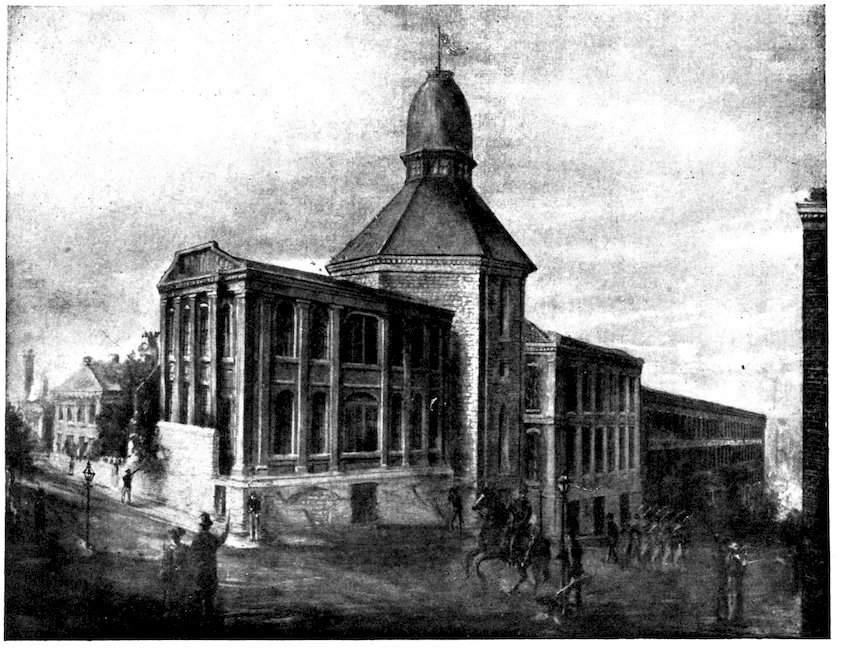
the Court-house. Crowning the cupola of this building,
dedicated to the righteous interpretation and execution
of the law, was a statue of Justice, with eyes blindfolded,
holding in her hand a pair of scales, the symbol
of impartial equity. From the top of the great granite
pillar, beside which these shrinking human chattels
stood, waved for the hour a star-spangled banner, the
symbol of freedom for all the oppressed. This auction
of slaves had been extensively advertised, and about
30two thousand young men had secretly banded themselves
together to stop the sale and, if possible, put an
end to this annual disgrace. The auctioneer on his
arrival at the Court-house found this crowd of freemen
in a dense mass waiting for him. The sight of bondmen
about to be offered for sale, and that too under the
floating folds of their national flag, crimsoned their
cheeks with shame and made their hearts hot within
them. Yet they scarcely uttered a word as they stood
watching the auctioneer and the timid, shrinking slaves
at his side. At last he was ready and cried out, “What
will you bid for this able-bodied boy?[5] There’s not a
blemish on him.” Then the indignant, determined
crowd in response cried out, at the top of their lungs,
“Three dollars, three dollars,” and without a break
kept up the cry for twenty minutes or more. The auctioneer
yelled to make himself heard above that deafening
din of voices, but it was all in vain. At last, however,
the cry of the crowd died away. Was it simply
a good-natured joke only carried a little too far? The
auctioneer seemed to be in doubt how to take that
vociferating throng. “Now,” he said in a bantering
tone, “gentlemen, don’t make fools of yourselves;
how much will you bid for this boy?” Then, for many
minutes, they shouted, “Four dollars, four dollars,”
and the frantic cries of the auctioneer were swallowed
up in that babel of yells; his efforts were as futile as
if he had attempted to whistle a tornado into silence.
To the joy of that crowd of young men the auctioneer
was at last in a rage. It had dawned upon him that this
was no joke; that the crowd before him were not
shouting for fun on this annual holiday, but were in
dead earnest. When their cries once more died away,
31he soundly berated them for their conduct. But they
answered his scolding and storming with jeers and catcalls.
At last he again asked, “How much will you bid
for this first-class nigger?” This was answered by a
simultaneous shout of “Five dollars, five dollars,” and
the roar of voices did not stop for a quarter of an hour.
And so the battle went on. The bid did not get above
eight dollars, and at the end of two hours of exasperating
and futile effort, the defeated auctioneer led his
ebony charges back to the jail. Through the force of
public opinion freedom had triumphed. No public
auction of slaves was ever again attempted in St. Louis.
But in the cries and counter cries of the auctioneer and
that throng of freemen could be felt the pulsations of
the coming conflict. We had before us in concrete
form Lincoln’s doctrine, that the nation cannot exist
half slave and half free.
CHAPTER III RUMBLINGS OF THE CONFLICT
32
Far away to the south we now began to hear, like
the low growling of distant thunder, a rumbling of the
approaching conflict. Early in 1861, secession ordinances
in quick succession were passed by the Gulf States.
By February 1st all of them, following the lead of South
Carolina, through the action of their respective State
conventions, had severed their relations with the Union.
They also forcibly seized United States forts, arsenals,
arms, custom-houses, lighthouses and subtreasuries.
In Texas the United States troops had been treacherously
surrendered. The Federal government offered
no resistance to those who thus trampled on its authority,
inaugurated revolution, and resorted to acts of war.
These hostile movements, coming before the inauguration
of the President-elect, made all classes in St.
Louis anxiously thoughtful. To be sure a few extreme
pro-slavery men, who were pronounced secessionists,
heartily approved of what the Cotton States had done,
and were secretly rejoicing over it. From prudential
motives they refrained from open and noisy support
of the acts of the seceding States; but most of our
fellow-citizens, who had formerly lived in States further
south, regarded these early acts of secession as at least
ill-timed and precipitate, as born of thoughtless, groundless
hatred and blind passion. They were not at all
prepared to join this open and violent revolt against
33the Federal government, and to engage in the unlawful
seizure of its property. And in this conservative,
pro-slavery class lay the hope of the unconditional
Union men of St. Louis and Missouri. If its undivided
influence, through any motives, however diverse, could
be directed firmly against the secession of our State,
we might remain in the Union.
Very few in St. Louis had at all anticipated such early,
radical, revolutionary action on the part of the Gulf
States, and perhaps least of all was it foreseen by those
who were unconditionally loyal. They had fondly
hoped that threatened secession would expend itself
simply in violent talk; that a second and sober thought
would come to control the acts of the pro-slavery States;
that the ill wind would blow over without doing any
serious damage. They knew, to be sure, that a messenger
from Alabama had, in December, visited our
Governor and Governor-elect, urging them to join
in a concerted secession movement of the slave States;
that in that same month South Carolina had passed an
ordinance of secession; but they could not believe that
this madness would continue, that the slave States
would generally be infected by it. To their minds
abrupt and violent secession was so palpably foolish
that it seemed to them impossible that it could be approved
by any large number of men in the South.
But when in January one State after another seceded,
and these seceded States on the 4th of February assembled
by their delegates at Montgomery, Alabama,
formed a confederacy, adopted a provisional government,
and elected a president and vice-president, they
unmistakably heard in the distance the angry growl
of the coming bloody conflict.[6]
34The loyal men of St. Louis turned their eyes to
Washington, hoping that they might discern something
there which would quiet their baleful apprehensions.
But instead of sunshine and hope, they saw there the
same black war-cloud. The representatives and senators
of the seceding States were shamelessly plotting the
overthrow of the very government in whose legislative
councils they still continued to sit. In the Cabinet of
the President were some who were aiding and abetting
secession. The Secretary of War, John Buchanan
Floyd of Virginia, had sent large detachments of the
standing army to distant and not easily accessible
parts of the country, and had removed large quantities
of arms and ammunition from Northern to Southern
arsenals, that, at the beginning of the conflict, which
he evidently believed to be close at hand, the South
might be better prepared for battle than the North.
In the midst of all this treachery the chief executive
sat nerveless. In his last annual message, he declared
that the general government had no power to coerce
a State. He said: “After much serious reflection, I have
arrived at the conclusion that no such power has been
delegated to Congress, nor to any other department
of the Federal government.” He again declared:
“The power to make war against a State is at variance
with the whole spirit and intent of the Constitution.”
Moreover, he asserted: “Congress possesses many
means of preserving it (the Union) by conciliation; but
the sword was not placed in its hand to preserve it
by force.” This message for a moment quite disheartened
the loyal men of our city. The executive of a great
nation, by his own public confession, stood powerless
before those domestic foes that were tearing down the
government bequeathed us by our fathers. In his
35message he assured them that with impunity they could
complete their work of dismembering the Republic.
So for a time the secessionists seemed to have the upper
hand all around; at Montgomery they ruled over the
seceded States; at Washington they subsidized to their
own interests the Federal government; its President
openly proclaiming that, do what they might, he had
no constitutional power to lay upon them punitively
even the weight of a finger.
We had no Andrew Jackson in the presidential chair.
In 1832, when South Carolina arrayed herself against
the general government and proceeded to nullify its
legislative acts, he said with an emphasis which showed
that he was conscious of having the whole constitutional
power of the nation behind him to make his
words effective, “The Union, it must, and shall be,
preserved;” and nullification in weakness and shame
hid itself. If we had had such a President in December,
1860, when South Carolina seceded, we might have
been saved from the awful conflict that, unchecked in
its beginning, daily gathered to itself power until it
was almost beyond control.
Loyal men throughout the nation utterly repudiated
the President’s interpretation of the Constitution.
The unconditional Unionists of St Louis shared the
thoughts that were pervading and agitating the minds
of all true patriots. But they had anxieties which were
peculiar to all, in the border slave States, who were uncompromisingly
loyal to the Federal government. These
States, largely on strictly economic grounds, hesitated
to join in the secession movement; still a large majority
of their inhabitants were in profound sympathy with
the underlying cause of secession, the preservation and
perpetuation of slavery. So the absorbing thought of
36the uncompromisingly loyal men of St. Louis was,
whether, in the sweep of events, they would be drawn
with their State, against their will, into the vortex
of secession. What could they do to avert such a dire
calamity? They still hoped, even when hope was seemingly
baseless, that as muttering storms which blacken
the horizon often pass on and away forever, so in some
way, hidden from their view, this rising, growling storm
of rebellion and revolution would be finally dissipated,
leaving the southern sky once more clear and serene.
Nevertheless, while they were thoughtful and anxious,
they were undaunted. There never was a band of braver
men. The precipitate acts of the Gulf States, the disintegration
of the national Congress, the unrebuked
intrigues in the Cabinet of the subservient President
saddened, but did not terrify them. By these untoward
and ominous events their courage was re-enforced,
their vision cleared, their purpose made definite and
robust. They resolved anew to resist with all their
heart, and with all their mind, and with all their strength
the secession of Missouri from the Union. Any that had
been timid became suddenly courageous; any that had
been weak became strong in spirit. These unconditional
loyal men, surrounded by a morass of difficulties, beset
on every side by insidious, plotting political foes,
often utterly at a loss in whom to confide, with everything
seemingly against them, at last, fully aroused and
braced for the conflict, became the hope, and, as it
proved, the political salvation of St. Louis and Missouri.
They became the leaders who, by wise counsels and sane
action, gathered around them the conservative pro-slavery
men of the city and the commonwealth, and
these two classes standing together saved the State
from the disaster of secession.
37The fourth of March drew near. Mr. Lincoln, in
tender, pathetic speech, bade adieu to his neighbors
at Springfield and hastened on to Washington. As he
journeyed towards the national capital the loyal of
St. Louis followed him with almost breathless interest.
They pored over his short speeches to the crowds that
gathered to greet him at railway stations. They were
thrilled with his brave and patriotic utterances at
Independence Hall in Philadelphia. In the malicious
plot laid at Baltimore, they heard once more the rumbling
of the approaching conflict; and when, in his
great inaugural address, he said, “In your hands,
my dissatisfied fellow countrymen, and not in mine, is the
momentous issue of civil war. The government will
not assail you. You can have no conflict, without being
yourselves the aggressors. You have no oath registered
in Heaven to destroy the government, while I shall
have the most solemn one ‘to preserve, protect, and
defend’ it;” we knew that, if neither the Federal
government nor the secessionists yielded, the civil war
of which the President spoke would inevitably burst
upon us.
But the rumblings of the bloody conflict were not
heard alone in the black war-clouds that hung threateningly
over the Gulf States and the national capital, but
at last directly over the streets along which we daily
walked.
Succeeding the inauguration of Mr. Lincoln there was
a period of silence more painful than actual battle. To
us who were straining our eyes toward Washington,
to see what the President, of whom we expected so
much, was doing; who, intent, were listening that we
might hear from his lips words of cheer and wisdom, he
seemed to be paralyzed. We saw nothing. We heard
38nothing. Perhaps he was vainly hoping that those
already in rebellion against the general government
would yield to his eloquent appeal at the close of his
famous inaugural. “I am loth to close. We are not
enemies, but friends. We must not be enemies. Though
passion may have strained, it must not break, our bonds
of affection. The mystic chords of memory, stretching
from every battlefield and patriot grave, to every living
heart and hearthstone, all over this broad land, will
yet swell the chorus of the Union, when again touched,
as surely they will be, by the better angels of our nature.”
But he could not, by any appeal however reasonable and
urgent, persuade men in the Cotton States. It was too
late. He could not extinguish a conflagration by pouring
oil upon it. Perhaps, however, he himself had no
hope of peace, but was noiselessly preparing for the
inevitable conflict. But whatever was the cause of these
days of silence, they were days of sorest trial to the loyal
of our city.
During all this time the secessionists were active;
active everywhere south of Mason and Dixon’s line;
active in St. Louis. For the sake of peace in our city,
loyal men still withheld from the public gaze the Stars
and Stripes, but just at this time, when the Unionists
were greatly depressed, when the tension of mind and
heart was so great that it seemed that the addition of
another grain would be unendurable, a rebel flag,
attached to a wire, was hung out over Sixth Street
near one of the central avenues of the city. The war-cloud
was now right over our heads. From its black
belly a thunderbolt might fall at any moment. I saw
the whole street under that defiant, revolutionary flag
packed with angry men. They had flocked together
without collusion, from a spontaneous and common
39impulse. They were a unit in their determination to
tear down that symbol of revolt and destroy it. My
whole soul was knit in sympathy with that pulsating,
heaving, throbbing throng all aflame with patriotic passion.
But there soon appeared, mounted on a barrel, at
the side of the street, a citizen, southern-born, and highly
respected by all. He spoke from a full heart earnest
words to his friends and neighbors. The din of voices
gradually died away. The speaker was master of the
situation. He assured that excited, indignant multitude
that he was in full tide of sympathy with them,
that he too ardently longed to tear down that insulting
banner, but in eloquent, impassioned words he entreated
them to bear patiently the stinging indignity offered
to a loyal city, and not needlessly to precipitate mortal
combat between those who had been for years neighbors
and friends. He assured them that the secession flag
would soon be taken down by the authority and arm
of the government, the star-spangled banner would be
vindicated and would float in honor and triumph over
our streets. The quieted but resentful crowd by degrees
melted away and the stars and bars, oh, the shame
of it! was left there for a few days to flutter undisturbed
in the breeze. It however did a good work.
Every loyal man that saw it, determined as never
before to stand for, and, if need be, to fight for the
integrity of the Union. So that over-hanging, growling,
threatening cloud did not hurl its bloody bolt among
us. We were, in spite of it, mercifully still at peace.
CHAPTER IV THE BOOMERANG CONVENTION [7]
40
Missouri could not escape the dreaded, impending
conflict. She carried the elements of it within her own
bosom. Union and disunion forces angrily faced each
other throughout all her borders. They jostled each
other in the streets, marts and society of St. Louis. But
amid these strong cross-currents of opinion, she remained
securely anchored to the Union. She was, to
be sure, somewhat battered and broken, but was surprisingly
kept from the disaster of disunionism, that
overtook most of her sister slave States. It is my
object in this chapter to show that this great State,
probably contrary to the expectation of a majority
of her inhabitants, was early in 1861, through the very
machinery devised to take her out of the Union, kept
from that destructive folly.
When a Southern State contemplated seceding from
the Union, first of all, through an act of its legislature,
it provided for the creation of a sovereign Convention.
The delegates to this Convention were duly elected by
the people. At the appointed time they assembled,
organized for business, and took up the question of
secession, which they had been chosen to examine
and decide. If they passed an ordinance of secession,
41it was believed that by such action the relations
of the State to the Union were utterly and irrevocably
severed, unless the convention determined of its
own motion, or was required by the legislative act that
called it into being, to submit the ordinance to the
people to be ratified or rejected by their suffrages.
For example, in Texas and Virginia the secession ordinances
were ratified by popular vote.
In Missouri the secession Governor, re-enforced by
a secession legislature, early in 1861, began to devise
measures to take the State out of the Union. He followed
in the wake of the Cotton States. The legislature, in
full sympathy with him, passed an act which provided
for the calling of a State Convention. In a “Whereas,”
which precedes the sections of this act, it announced
in fair words its “opinion,” that “The condition of
public affairs demands that a Convention of the people
be called to take such action as the interest and welfare
of the State may require.” Then the act specifies
the time and the conditions of the election of the members
of the contemplated Convention, and specifically
designates the subject that the Convention was expected
to consider, viz.: “The then existing relations between
the government of the United States, the people and
governments of the different States, and the government
and people of the State of Missouri, and to adopt
such measures for vindicating the sovereignty of the
State, and the protection of its institutions as shall
appear to them to be demanded.” But this act contained
one section of vital importance. It provided
that any act of the Convention, changing or dissolving
the political relations of Missouri “to the government
of the United States,” should not be deemed valid
until ratified by a majority of the qualified voters of the
42State. However, when this act became a law, neither
the Governor nor the legislature seemed to have the
slightest doubt that the people of the State would
ratify by a decided majority an ordinance of secession;
happily, no occasion ever arose for testing that question.
Nor was the confidence entertained by the Governor
and the legislature unfounded. They had every reason
to believe that the same voters who had elected them,
when appealed to, would elect a Convention that would
favor their project of secession, and that an ordinance
of secession submitted to them would be triumphantly
ratified. But
“The best laid schemes o’ mice and men
Gang aft agley.”
Still, to the secessionists at that time all things betokened
certain success. Their skies looked bright.
If there were a threatening cloud as big as a man’s hand
they did not see it.
But too great confidence often leads men to overlook
weaknesses in their most hopeful projects. Those who
devised the legislative act providing for a convention,
neglected to put into it any provision for limiting its
continuance or life. It was made a sovereign body, and
also the sole judge as to the time when it should adjourn
sine die. So, as we shall see, the Governor and the
legislature “builded better than they knew.” To
them the Convention proved to be a boomerang, but
to the State a priceless blessing.
This act was approved by the Governor on the 21st
of January. The election of the members of the Convention
took place on the 18th of February, and the
Convention met, according to the provision of the act
43by which it was created, at Jefferson City, the capital
of the State, on February 28th, 1861.
But if this Convention was to keep the State from
secession as some began to hope it might, it was unmistakably
clear that it should not continue its deliberations
at the capital of the State. Jefferson City was
then a small, and to sojourners in it, a somewhat desolate
place. Since the legislature was in session the Convention
could not meet in its halls, which, for such a body, were
the only suitable places of meeting in the city. Instead
of that, the delegates were compelled to occupy for
their deliberations a small, repulsive court-house.
No desks were there provided for them. Moreover,
the hotel accommodations were meagre and unattractive,
and, most of all, the libraries and reading-rooms of the
capital were about equivalent to nothing. The tallow
candles and oil lamps which at night gave just enough
light in the houses and on the muddy streets to make
darkness visible, were far more luminous than the
intellectual lights of that then cheerless place; and
the light of the legislature then in session was darkness.
There was at that time hardly any considerable town
in Missouri more intellectually stagnant than its capital.
Should the Convention carry on its deliberations there,
its members would have few if any facilities for the
investigation of vastly important questions that were
certain to arise, while all the currents of influence that
would flow in upon them, would urge them on to declare
for secession. To all this the Union men of St. Louis,
together with a few scattered here and there throughout
the State, were keenly alive. Dr. Linton, a distinguished
physician of our city, and a member of the Convention,
said, “When I got to Jefferson City and heard nothing
but the ‘Marseillaise’ and ‘Dixie’ in place of ‘The
44Star-Spangled Banner,’ I felt uneasy enough, and when
I heard Governor Jackson speak I felt badly....
I recollect, with my colleague, Mr. Broadhead, hearing
‘Dixie’ played on the streets, and that we stepped up
to the leader of the band and asked him to play ‘The
Star-Spangled Banner;’ he said, being a foreigner, ‘Me
’fraid to play that.’ We assured him that there was
no danger, and he played one stanza of ‘The Star-Spangled
Banner,’ but immediately went off into ‘Dixie,’
and of course we went off in disgust.”
The Union men of St. Louis not only saw the danger
arising from the continuance of the Convention in
Jefferson City, but they determined if possible to avert
it. Having in secret seriously considered the whole
matter, they cautiously and wisely laid their plan to
bring the Convention to their own city. Since many
men in the State were deeply prejudiced against St.
Louis, regarding it as the stronghold of Free-soilism,
it was necessary carefully to conceal the movement
that was being made. If any delegate from St. Louis
had openly moved that the Convention should adjourn
to our city, the motion would undoubtedly have been
promptly and decisively voted down. But the delegates
from St. Louis, instead of making an open move,
quietly and unobserved found some delegates from
the country to whom they deemed it safe to make
their suggestions, and without any knowledge of it on
the part of the Convention these men were won to their
ideas. When, therefore, the Convention, on the second
day of its session, was perfecting its organization,
Mr. Hall of Randolph County,—a strong pro-slavery
district near the centre of the State,—moved that when
the Convention adjourned, it should adjourn to meet
“in the Mercantile Library Hall of St. Louis, on Monday
45morning next, at 10 o’clock.” The motion met with
strong opposition, but after some discussion it became
evident that there was probably a majority in its favor.
Still, the Convention, wishing to act prudently in a
matter of such vital importance, inquired if it were
certainly known that they could occupy the hall mentioned
in the motion of the gentleman from Randolph
County? This brought to his feet Judge Samuel M.
Breckinridge, a delegate from St. Louis, who said that
at the request of some members from the country, he
had already telegraphed to St. Louis, and had received
an answer that the Convention could occupy without
expense either of the two halls belonging to the Mercantile
Library Association. The undivulged fact was that
the Union men of St. Louis, days before, had arranged
to offer to the Convention, without cost, either of these
halls, if by any means that body could be induced to
occupy it. At last, to remove any objection that might
arise from pecuniary considerations, the citizens of our
city telegraphed that the railroad fare of all the members
of the Convention had also been provided for;
so, at the close of the second day’s session at Jefferson
City, on March 1st, the Convention, by a decided
majority, adjourned to meet on the following Monday,
March 4th, at 10 A. M. in the Mercantile Library Hall
of St. Louis; and by that move the doubt that Missouri
would secede from the Union was greatly strengthened.
On Monday morning, when the Convention met for
the first time in its new quarters, its members found
themselves in a beautiful hall, such as some of them
had never before seen. Each member was provided
with a desk, and pages were at hand to do his bidding,
all at the expense of the loyal men of the city. The
free use of the Mercantile Library and Reading Room,
46with its papers and periodicals from every part of the
Union, and also of the Law Library of the city, was also
tendered them. Then, by a secret prearrangement,
in companies of from six to twelve, the members of
the Convention were daily invited by Union men to
dine with them; and, so long as the Convention continued
its sessions, in the most conservative and kindly
way, at the tables and in the parlors of the best and
most intelligent men and women of the city, the whole
question of secession in all its phases was thoroughly
discussed. By such a procedure, without arousing antagonism,
deep-rooted prejudice began gradually to
give way, and new light, unobserved, penetrated the
minds of the members of this sovereign Convention, and,
as one by one the days passed, the hope of the disloyal
that Missouri would secede was constantly on the wane.
Let us now notice the composition of this sovereign
body, in whose hands was providentially placed the
political destiny, not only of Missouri, but perchance
also of the entire Republic. It had ninety-nine members.
Of these, fifty-two were lawyers, seven of whom
were judges. These men by their training were capable
of clearly and firmly grasping the fundamental principles
of law and government. Happily more than half of the
Convention was of this class. Twenty-six were farmers,
who from habit of thought were decidedly conservative.
Eleven were merchants, who intuitively discerned the
conditions that must be maintained in order to secure
and promote the commercial prosperity of their State.
Three were physicians, one of whom, Dr. Linton, was
an exceptionally clear-headed and brilliant man. There
were also one lumber dealer, one bank commissioner,
one civil engineer, one blacksmith, one tanner, one
leather dealer and one circuit clerk. Each of these,
47by his pursuit, was fitted to appreciate what was necessary
to secure the highest material interests of the State.
The Convention as a whole was in ability quite above
the average, and unmistakably superior both in intellectual
and moral force to the legislature which had
called it into being.
Considering the vastly important question which
the Convention was called upon to decide, it is also
a matter of great interest to note the ages of its members.
One man, like an elderly maiden, was coy, and refused
to give his age; of the remaining ninety-eight, six were
between twenty-four and thirty; twenty-one were between
thirty and forty; forty-one were between forty
and fifty; twenty-four were between fifty and sixty;
and six were between sixty and seventy. Most of these
men, then, were in the maturity and vigor of manhood.
Two-thirds of the Convention, lacking one, were between
forty and sixty, old enough to have gotten rid of crudities
of thinking, and the impulsiveness and rashness of young
blood, and yet young enough to be free from the enfeebling
touch of age.
And since they were to deal with the question of secession,
the underlying cause of which was slavery, we
should not fail to consider their nativity, and the influences
that surrounded them in early life, when the deepest
and most lasting impressions are made upon men.
Thirty of the ninety-nine delegates to this Convention
were born in Kentucky; twenty-three in Virginia;
thirteen in Missouri; nine in Tennessee; three in North
Carolina; three in New York; three in New Hampshire;
two in Maryland; two in Pennsylvania; two in Illinois;
one in Alabama; one in the District of Columbia; one
in Ohio; one in New Jersey; one in Maine; one in
Prussia; one in Bremen; one in Austria; and one in
48Ireland. Eighty-two were born in the South, including
the one from the District of Columbia, while there were
only thirteen born in the North and four in Europe.
When we observe that more than four-fifths of the Convention
had been born and brought up in slave States,
we might rationally conclude from this surface view
that Missouri would soon follow her seven erring sisters,
like them secede from the Union, and link her destiny
to the Southern Confederacy.
Beyond question the Convention was almost unanimously
pro-slavery. Some of those born and educated
in the North had become sweeping and positive in their
advocacy of slavery. There were none in the Convention
who did not denounce the Abolitionists, and very many
of its members condemned with equal severity the
Republican party. All of them, with possibly a very
few exceptions, desired to protect and preserve the
system of human bondage that had unhappily fastened
itself upon the nation. But right here where there was
so high a degree of unanimity, strange to say, the Convention
divided. The vexed question with them was,
“What will preserve slavery?” Some of them were
in favor of going out of the Union to preserve it; others
with at least equal emphasis and force urged that in
order to preserve it Missouri must remain in the Union.
These delegates pointed to the geographical position
of their State; on three sides of her were free States. If
she should secede, she would be confronted on the east,
north and west by a foreign nation and by hostile territory,
which would be an asylum for fugitive slaves.
One speaker declared: “It will make a Canada of
every Northern State, and the North will be a borne
from which no slave traveller will return.” Such men
vehemently urged that secession would be the inevitable
49destruction of slavery in Missouri. If the State should
secede, it would not be long before she would present
to the world the anomaly of a slave State without a
slave. To be sure, the Cotton States withdrew from
the Union in order to preserve slavery; but even if
the citizens of Missouri believed that they had the
constitutional right to secede, they could not follow
the example of the Gulf States, for if they did, they
would blot out forever the very institution that they
were so earnestly striving to save. So many in Missouri,
and not a few in this Convention, reasoned.
While, however, the Convention was divided on the
question of the secession of the State, and, during its
earlier sessions, how evenly divided none could tell,
nearly all, if not all, of its members were professed
Unionists. The people had elected them as Unionists.
It was loudly proclaimed that Unionism had triumphed
at the polls by from forty to sixty thousand majority.
Nearly every man that spoke during the deliberations
of the Convention with great vigor asserted that he was
in favor of maintaining the Union. The Hon. Hamilton
R. Gamble, chairman of the Committee on Federal
Relations, in explaining to the Convention the report of
that committee, said: “As far as my acquaintance with
the gentlemen of this Convention extends, I know
of no gentlemen who avow, or insinuate, or in any
manner admit, that they entertain any unfriendly
feeling to the Union. You may speak to any member
of the Convention you please in reference to his position
about the Union, and he will proclaim that he is in
favor of the Union. How, then, in the introduction
of this question before this body, shall I undertake to
speak in favor of the Union, when there is a unanimity,
an entire unanimity, among all the members upon the
50very view which I would endeavor to take and enforce?”
Any one unacquainted with the hair-splitting political
doctrines of that day might have been deceived by this
emphatic and universal profession of Unionism by the
members of this sovereign Convention. Calhoun also
frequently made the strongest declarations of his warm
attachment to the Union. But neither he nor they had
in mind the actual government formed by the people
of the States under the Constitution, in contradistinction
to the confederation that preceded it, but simply a
compact of sovereign States, which having been voluntarily
entered into could by any State be lawfully
terminated at will. Many in this Convention were
conscious or unconscious disciples of Calhoun, and in
their speeches advocated his political heresies. Their
effusive professions of devotion to the Union deceived
no one who was at all conversant with our political
history. The Hon. Mr. Gamble, whose words I have
quoted in reference to their “entire unanimity” for
the Union, understood them perfectly, and he expatiated
on their professions of devotion to the Union in order
to induce them, if possible, to act in accordance with
them, and to vote to keep Missouri in that Union for
which they expressed such fervent love. On the surface
there was unity; beneath the surface, contrariety.
Some of the Convention meant by the Union a centralized,
sovereign government under the Constitution,
while others meant a loose compact of sovereign States.
And if both parties when they spoke of the Union had
meant the same thing, which manifestly they did not,
the phrase, “Union man,” would still have been ambiguous.
In the debates of the delegates it came out
clearly that there were two kinds of Union men in the
51Convention, conditional and unconditional. Mr. Sheeley
of Independence said: “I admire this Union, and while
perhaps I will stick in it as long as any man in the
Convention, who is not an unconditional Union man,”
thus openly announcing himself a conditional Union
man. Mr. Vanbuskirk of Holt County, in an able
speech, declared that on the part of some of the Convention,
“the whole matter is brought to this point,
that it is Union upon condition; that is, Union with
the ‘buts’ and ‘ifs,’ or ‘under existing circumstances.’”
Of course that kind of Unionism was a mockery. Only
about six months before, the rabid secessionist, Yancey
of Alabama, had proclaimed himself to be a pre-eminent
Union man, but declared that if Abraham Lincoln
should be elected to the Presidency, he would favor
immediate secession. That was being a Calhoun Unionist,
a Unionist according to a construction of the Constitution
that was utterly at variance with John Marshall’s
interpretation of it. In 1861, in Missouri, whenever
a man said, “I am a Union man in the Constitution,”
we knew for a certainty that his Unionism was
conditional, and that he should probably be classed
with the secessionists.
Let us notice the conditions on which the loyalty
of these “but” and “if” Unionists was based. First,
they felt themselves to be under no obligation to sustain
the Union unless the Federal government should guarantee
to them their rights. They meant by this, their
rights in slave property. The people of the Northern
States must not obstruct by legislation, or in any
other way, the faithful execution of the Fugitive Slave
Law; in fact must aid the Southern slaveholder in recapturing
his fleeing property.
In the second place, they demanded a compromise
52by which slavery south of 36° 30′ should be protected
in the territories. In demanding no more than this,
many of them thought that they were making very
generous concessions to the North, since they believed
that, under the Constitution, the Southern slaveholder
had the undoubted right to go into any territory of
the United States with his human chattels, and there
be protected in both person and slave property.
In the third place, they announced that they would not
sustain the Union, if the general government should
attempt to coerce the seceded States. They declared
that they would neither aid their seven erring sisters
in making an attack on the Federal government, nor
the Federal government in coercing the States that had
left the Union. This view was urged by Mr. Howell
on the floor of the Convention in a resolution, a part
of which was, “We earnestly remonstrate and protest
against any and all coercive measures, or attempts at
coercion of said States into submission to the general
government, whether clothed with the name or pretext
of executing the laws of the Union, or otherwise. And
we declare that in such contingency Missouri will not
view the same with indifference.” This resolution intimated,
and it came out clearly in the ensuing debate,
that if the United States should attempt to compel
by force the collection of the national customs in the
South, such an act on the part of the general government
would be regarded as coercion. This is sufficient
to reveal the true character of the conditional Unionists.
They affirmed emphatically, “we are in favor of keeping
Missouri in the Union, if the Northern States will
guarantee the execution of the Fugitive Slave Law,
protect slavery in the territories south of 36° 30′, and
the general government will not even in the execution
53of the Federal laws south of Mason and Dixon’s line
use any force whatever; but if these conditions are not
fulfilled, we are in favor of going out of the Union, and
uniting our fortunes with the Southern Confederacy;”
and when the Convention adjourned to St. Louis, the
Unionism of a decided majority of its members was
unquestionably of that conditional type.
Since we have so fully set forth the composition and
views of the Convention, it will be unnecessary to
reproduce in detail its organization and proceedings.
The Hon. Sterling Price, afterwards a Confederate
general, was chosen president, and presided over the
deliberations of the Convention with ability and impartiality.
The delegates to the Convention took an
oath to sustain the Constitution of the United States
and that of the State of Missouri. A strong Committee on
Federal Relations was appointed, of which Hon. Hamilton
R. Gamble, an unconditional Union man of whom
we have already spoken, was chairman. During the
first sittings of the Convention, numerous resolutions in
reference to the attitude that Missouri ought to maintain
toward the Union were introduced and referred to the
Committee on Federal Relations; and while that
committee was deliberating, the members of the Convention
occupied the time in making speeches on the
general subject of secession. As each one seemed
anxious to declare himself, there was much speaking.
Both extreme and conservative views were freely aired,
and each day evidently added new strength to the position
that it would be unwise for Missouri to sever her relations
with the Union.
There was one unique incident that profoundly stirred
the whole Convention. The Convention of the State
of Georgia, that passed an ordinance of secession,
54sent the Hon. Luther J. Glenn as a commissioner to
present it to the Convention of Missouri and to urge
its delegates to enact a similar ordinance and to join
the Southern Confederacy. He appeared at Jefferson
City, during the proceedings of the second day of the
Convention, and his communication from Georgia to
the Convention was read by the Chair.[8] This communication
was promptly laid on the table, but the
incident greatly disturbed all genuine Union men,
especially since the commissioner with his secession
message had been received with open arms by the
Governor, and in the evening both houses of the disloyal
legislature in joint session had listened to an address
from him with the most manifest marks of sympathy.[9]
At the first day’s session in St. Louis this communication
of the Georgia commissioner was called up, and a
motion was made that he be invited to address the Convention.
Thereupon there was hot debate. Hon.
Sample Orr, referring to Mr. Glenn, said: “He is here
to-day and called an ambassador by some, by others
a commissioner. If he is an ambassador, he has missed
the right city. He should have gone to Washington.
If he is here as a commissioner from a sister State,
then the oath we have taken forbids that we should
have an alliance with any other State in the Confederacy.”
He meant by Confederacy, the United States.
Mr. Smith, a delegate from St. Louis, said: “We did not
come here to receive ambassadors from foreign States.”
But finally the Convention deemed it best on the whole
to listen to the gentleman from Georgia, who then
proceeded to tell the very old story of the atrocious
conduct of the Northern abolitionists, and of the equally
55reprehensible acts of the Chicago Convention, that
nominated Abraham Lincoln for the Presidency; of
the deplorable condition of his State, on account of
the protective tariff, that built up the North and pulled
down the South, and that, on account of these things,
which a long-suffering people could no longer endure,
his State had peaceably seceded, and he was commissioned
by Georgia to urge Missouri to follow her
example.[10]
Georgia’s Ordinance of Secession and the address of
her commissioner were referred to a special committee,
of which the Hon. John B. Henderson, the author of
the fourteenth amendment of the Constitution of the
United States,[11] was chairman. On the eighteenth
day of the sittings of the Convention, Mr. Henderson,
slaveholder though he was, presented a comprehensive
report recommending the rejection of the prayer from
Georgia to secede, presented by Mr. Glenn, and urging
the weightiest and most conclusive reasons against the
disruption of the Union. This report was stronger
meat than the Convention was then able to digest,
so after a short, sharp debate it was laid on the table[12]
and was never afterwards taken up. It did not need to
be. It had done its work. The author of it had seized
his opportunity to deal a staggering blow against the
secession of Missouri, and the effect of it could not be
neutralized. So what at first was a menace was transmuted
into a blessing.
The Georgia commissioner made a vow that he
would never buy a new hat until Missouri seceded
from the Union. In 1900 he was still living. The
56silk hat that covered his obfuscated brain when he
represented seceded Georgia before the Convention
in St. Louis had been fixed over three times. He was
still proud of it and of the cause that he represented
in 1861. Whether he now lives, we do not know. He
has died, or will die, in the faith. He was made of stern
stuff. If he has, or when he shall have, departed to
the land where silk hats are not needed, and from which
no one ever secedes, every one who admires pure grit
will heartily breathe the prayer, Requiescat in pace.
We return now from this peculiar and important
transaction, unexpectedly thrust upon the attention
of the Convention from without, to notice that, by the
time it had fairly begun its work in St. Louis, the secession
legislature which had created it, repented of what
it had unwittingly wisely done, and began to agitate
the question whether it had the power to repeal the
ordinance that called the Convention into being, and
thus permanently dissolve it. They saw of course that
the Convention was not of their way of thinking. They
refused to vote the necessary means for the publication
of its proceedings. Mr. Foster of the Convention said
in debate, “Although the legislature of Missouri
called this body into existence, yet, sir, its complexion
so very materially differs from the complexion of the
legislative body, that, if they had the power, in my
judgment, they would crush us out of existence to-day.”
To the Union men of St. Louis and the State this growing
antagonism of the two law-making bodies was a
cheering symptom. The legislature, however, soon
learned from its legal advisers that it could not efface
the wisdom into which it had blindly blundered; that
the chicken which it had so fondly hatched and fostered
into maturity could not be put back into the shell again;
57that, in short, there was no political power in Missouri
superior to the sovereign Convention which it had
evoked into being, and which was now calmly and wisely
deliberating in the great commercial city of the State.
All parties were finally convinced that though the
legislature had created the Convention, it could not
destroy it. So the work of this sovereign body moved
on undisturbed. On the eighth day of its sittings the
Committee on Federal Relations reported through its
chairman. In their report the Committee, with but
partial success, detailed the political events which led
to the secession of the Cotton States, and had raised the
question of secession in the remaining slave States. But
they presented with cumulative force many cogent reasons
why Missouri should not follow her erring sisters
in seceding from the Union, and finally crystallized
their recommendations on the whole subject of secession
in seven resolutions, the first and chief of which was,
“That at present there is no adequate cause to impel
Missouri to dissolve her connection with the Federal
Union.” This resolution seems to us now tame and
timid. But a more sweeping and positive resolution
could not have been carried through the Convention.
Its very weakness was its strength. Its apparent
obeisance to the doctrine of secession made it acceptable
to many conditional Union men. When the loyal men
of St. Louis heard it, they were lifted up with hope.
However the Committee was not unanimous. On
the next day some conditional Union men on the Committee
presented a minority report. Then numerous
amendments were offered, and for eight days longer
the debate went on, more earnest and vigorous than
ever, but each day it was evident that the more positive
secession sentiment was slowly vanishing, so that when
58on the sixteenth day of the Convention, the vote was
taken on the resolution quoted above, while nine members
of the Convention were absent, all present but one
voted for it. George Y. Bast, a farmer from Rhineland,
Montgomery County, has the unenviable distinction
of being the minority of one that voted for the secession
of Missouri. The other resolutions of the Committee,
with varying majorities, were also adopted.
On the 22d of March the Convention adjourned
to meet on the third Monday in December following;
but it also appointed a committee of seven, one from
each congressional district, to whom the power was
delegated to call the Convention together before the
third Monday in December, if, in their judgment, the
public exigencies demanded it.
The reasons urged by the Convention against the
secession of Missouri as we gather them from its reported
proceedings, briefly stated, were these:
First: the geographical position of Missouri. She
was so far north that her climate was better adapted
to the white man than to the black. Moreover, she was
shut in on three sides by free States, into which, if
she seceded from the Union, her slaves would flee and
from which they could not be brought back.
Second: she had other, and far greater interests
than her slaves. They numbered only one hundred and
twelve thousand, while she had within her borders
more than one million, one hundred thousand white
men. During the then preceding decade her slaves
had increased twenty-five per cent; while her white
population had increased one hundred per cent. The
taxable value of her slaves was only forty-five million
dollars, while that of her other property was three hundred
and fifteen million dollars. Most of her slaves were
59engaged in raising tobacco and hemp, while her white
population, which, through immigration, was rapidly
increasing, was developing her mining, manufacturing,
and commercial interests. The members of her sovereign
Convention, from whose brains the cobwebs had at last
been swept, and whose vision had become clear, saw
that the immigration of free white men to Missouri
would nearly, if not wholly, cease, if the State by secession
should be placed under the political domination of
the Confederacy, whose corner-stone had been declared
by its brilliant Vice-President to be African slavery.
Third: timid men were everywhere crying out for
compromise. And most of the members of the Convention
still hugged the delusion that the political antagonisms,
which were then shaking the nation to its foundations,
and had already severed seven States from the
Union, might be overcome by compromise. To inaugurate
measures by which such compromise might be
effected some advocated a convention of the border slave
States; others of the border slave and border free States;
and still others of all the States, and, so long as they
cherished hope of such a peaceful adjustment of difficulties,
they thought it inexpedient for Missouri to secede.
Fourth: most of the Convention believed that the
seven States which had already seceded had been
carried out of the Union by ambitious politicians;
that the people had not been permitted fairly and fully
to discuss the question of secession, and freely to cast
their ballots for or against it. During the deliberations
of the Convention extreme Southern politicians, like
Yancey of Alabama, were roundly and bitterly denounced.
Moreover, the State pride of the Missourians
had been deeply stung by the seceded States. Those
States, they affirmed, had rudely snapped the tie which
60bound them to the Union, without any consultation with
the border slave States, and then after they were out
of the Union and had gone so far as to set up a Southern
Confederacy, they complacently turned around and
invited the States whose counsels they had ignored to
join them. Missouri felt that she should have been
consulted before secession was enacted, and some strong
pro-slavery members of the Convention declared in
unmistakable terms that they were utterly opposed to
following the cotton lords of the South Atlantic and
Gulf States. Thus the precipitancy of the hot-headed
Southern politicians became no inconsiderable element
of the force which kept Missouri in the Union.
But there is reason for grave doubt if even all these
considerations combined would have led to this result,
if the Convention had continued its deliberations at
Jefferson City. It was well known that the object
of the Governor and the legislature in creating the
Convention was to secure the secession of the State.
Had it continued its sittings at the State capital, the
influences by which it would have been surrounded
would probably have incited its members to enact an
ordinance of secession. But the adjournment to St.
Louis at once awakened a reasonable hope of a better
outcome. The delegates were now surrounded by an
entirely different atmosphere. They met in that city
the highest intelligence and the staunchest loyalty in
the State. They were mightily impressed with the fact
that scores of men there who had formerly been slaveholders
in the South were unflinchingly loyal to the
old flag. Gradually they came to see that secession
antagonized all the commercial, educational, and moral
interests of the State; that it was, in short, a suicidal
policy. As they deliberated day by day, even those
61who had been the warmest advocates of such a policy
began to waver. Every day their vision grew clearer
and truer. Even the president of the Convention, who
so soon afterwards became a commander of Confederate
troops, for the nonce, seemed to be a genuine Union
man, and when the vote was taken on the question of
secession, as we have already noted, only one man could
be found in the entire Convention, who had the hardihood
to vote against the resolution, that it was not just
then expedient for Missouri to secede from the Union.
The victory was won. It was a momentous victory.
Who won it? A little band of intrepid Union men,
men of whom, with perhaps two exceptions, the nation
at large knew little or nothing. They had come together
in St. Louis from every part of the Republic and from
foreign countries. That city was their adopted home.
They had largely laid aside the prejudices that they
brought with them from their former places of
abode. Their contact with each other had made them
larger, grander men. Upon them unexpectedly a day
of darkness had fallen. Dangers thickened around
them, but the very perils which beset them united their
hearts in unswerving, burning loyalty to the Union.
At last the only hope of keeping their State in the Union
was the sovereign Convention called into being for the
very purpose of taking it out of the Union. So, before
God, they firmly resolved to use as well as they could
the unpropitious instrument made ready to their hand.
They could not directly control the deliberations and
votes of the Convention. Forbidding as the prospect
seemed to be, there was hope, however, if this sovereign
body could be induced to carry on its deliberations
in their adopted city. They must invite the Convention
to do this. Not openly; such publicity would utterly
62defeat their purpose. They must work in secret. Fortunately
some of their own number were members of
the Convention. They were good men and wise and
true. They did their delicate work with skill. The
Convention, apparently self-moved, came to St. Louis.
It deliberated there. Missouri stayed in the Union.
What was the significance of this outcome to the
nation at large? It had a mighty influence in keeping
Kentucky, West Virginia, Delaware and Maryland in
the Union. It cheered and strengthened our wise,
conservative, patriotic President, whose manifold perplexities
and vast responsibilities pressed upon him
like the superincumbent weight of a mountain. It put
into the Union army more than one hundred and nine
thousand men, of whom more than eight thousand were
colored,[13] besides the Home Guards in every considerable
town of the State. It is probable, however, that
part of this number, even if the State had seceded,
would have found its place in the Union ranks; but the
doctrine of State rights was so dominant that probably
at least seventy-five thousand of that number would
have followed the State and helped fight the battles
of the Southern Confederacy. It is quite possible that
this great military force added to the Federal army
really decided the conflict in favor of the Union; and
that when some future historian impartially surveys
the whole field, he may be constrained to affirm that
a band of patriotic men, most of them unknown to
fame, in a border city, on the western bank of the
Mississippi River, confronted with apparently insurmountable
obstacles, by prudent, decisive action, not
only saved their State from the madness of secession,
but the whole Union from irretrievable disruption.
The United States Arsenal was situated in the southern
part of the city by the river. It contained nearly
thirty thousand percussion-cap muskets, about one
thousand rifles, some cannon unfit for use, a few hundred
flint-lock muskets, and a large quantity of ammunition.[14]
It was the settled policy of the seceding States to seize
the United States arsenals and arms within their boundaries.
So those, who were now trying to force Missouri
out of the Union, were intent on following the pernicious
example of the seceded States. Moreover, our
secession Governor was about to call out the militia
of the State and put it under military drill; the militia
would need arms and ammunition; both were in the
Arsenal; why should not these citizen soldiers have
them? Why should the sovereignty of the United
States override the sovereignty of Missouri? So secessionists
reasoned.
And the fight for the Arsenal began early. Each
party saw clearly that those who held it would hold
the city, and those who held the city would hold
the State. So all eyes were riveted on the coveted
prize. Isaac H. Sturgeon, a Kentuckian by birth,
was Assistant United States Treasurer at St. Louis.
64He belonged to the southern right wing of the Missouri
Democracy. He consorted with secessionists.
He heard their plans for seizing the Arsenal, and as
the Subtreasury vaults contained four hundred thousand
dollars in gold, he began to fear that they might
also seize that. He therefore wrote a cautious letter
to President Buchanan, setting forth the facts of the
case, and suggesting that it might be wise to send a
company of soldiers to guard the money belonging to
the United States. The President turned this letter
over to General Scott, who forthwith sent Lieutenant
Robinson to St. Louis with a detachment of forty men
and ordered that they be placed at the disposal of the
Assistant Treasurer. They arrived on the 11th of
January, and were quartered in the Government Building.
Here, in addition to the Subtreasury, were the
Post-office, the Custom-house and the Federal Courts.
The report that Federal soldiers, under the control of
the Assistant Treasurer, were on guard over the Subtreasury,
flew like wild-fire over the entire city. To
put it mildly, the excitement was intense. The papers
sent out extras, that were carried by running, yelling
boys to almost every house. A great angry, vociferating
crowd packed the narrow streets on which the Government
Building stood. They hurled dire threats of
vengeance against the United States, the President,
the general of the army and Mr. Sturgeon, that recreant
States-rights democrat. Some of the crowd were red,
some pale, with anger; they were hot for a fight. But
nobody was in any special danger; their rage would
unquestionably soon have spent itself in angry yells
and in the shaking of empty fists; but in order to calm
the secession mind, General Harney, the department
commander, ordered Robinson and his detachment
65of soldiers to the Arsenal. As they went thither the
tempest subsided, and no bones were broken.
But brief as the excitement was, it invaded the capital
of the State, and agitated the lawmakers there. A grave
and reverend State Senator forthwith offered some
resolutions, in which he characterized “this act of
the administration” at Washington “as insulting to the
dignity and patriotism of this State,” and asked the
Governor “to inquire of the President what has induced
him to place the property of the United States within
this State in charge of an armed Federal force?”
Since, however, the excitement was over in St. Louis,
these resolutions were never passed; and it is now
difficult for us to believe that a sane legislator should
ever have felt it incumbent upon him to protest
against the guarding of United States property by an
armed Federal force. But so good men thought and
felt then.
The incident at the Government Building, which
aroused such passion both in our city and throughout
the State, was a side-light which revealed the settled
determination of the secessionists to get control of
all United States property on the sacred soil of
Missouri. Perhaps the fears of Mr. Sturgeon for the
safety of the Subtreasury—fears that had been
awakened by the declarations of the secessionists with
whom he consorted—may have been groundless, but
there was no mistake in reference to the determination
of the disloyal to get into their possession, at the earliest
possible moment, the Arsenal and all that it contained.
To understand the fight for the Arsenal, it will be
necessary for us to get before our minds as clearly as
possible some of the principal characters that directed
and controlled it. The first to claim our attention,
66though at the beginning of the contest subordinate
in military rank is Captain, afterwards Brigadier-General,
Nathaniel Lyon. He was a native of Connecticut,
and a graduate of West Point. He had served
with distinction in Florida, and in the Mexican War,
brilliantly as an Indian fighter in northern California,
and with moderation and wisdom in Kansas, when that
territory was harassed by the lawless incursions of
border ruffians. He was forty-two years old, just in
his prime. He was only five feet seven inches in height.
He was thin and angular, rough and rugged in appearance.
He had deep-set, clear blue eyes, sandy hair and
reddish-brown stubby beard. What he was in mind and
heart, unfolding events soon clearly revealed. He
reported for duty at the Arsenal about February 2d.
He at once made himself familiar with its history.
He learned that Major William H. Bell, by birth a North
Carolinian, a graduate of West Point in 1820, had been
its commander for several years; that the major, aside
from his duties as an officer of the United States army,
had amassed quite a fortune in our city in town lots
and suburban property, and had come to regard St.
Louis as his home; that his sympathies had been with
the extreme pro-slavery men of Missouri; that in January
he had pledged himself to General Frost that while
he would defend the Arsenal against all mobs, he would
not defend it against State troops; that as late as Jan.
24th, Frost had written this to Governor Jackson, at
the same time claiming that Bell was in accord with
them; that on the same day, to the honor of the military
service of the United States, Bell had been removed
from his command and ordered to report at New York;
that he had refused to obey this order, and, instead,
had had the good sense to resign his commission
67and retire to his farm in St. Charles County,
Missouri.
So at the start, the real situation of affairs in our city
was opened up to Captain Lyon.
He was now associated in military duty with Brigadier-General
William Selby Harney and Major Peter V.
Hagner. The former was the commander of the Department
of the West. He was more than sixty years old,
having been born in 1798. He was a Southerner;
Louisiana was his native State. He had had large
experience as a soldier in the Mexican War, and as an
Indian fighter both in Florida and on the plains. He
had acquitted himself with distinction as the commander
of the military Department of the Pacific Coast.
For several years he had lived in Missouri. And now
in this time of stress no one could successfully question his
patriotism, and unswerving loyalty to the Union;
but he was so interlinked with Southern families, both
by blood and friendships of long standing, that he
was unfitted to command where grave and delicate
questions, involving old neighbors and intimate friends,
were constantly arising. So at last, without any stain
on his honor, he was called by his government to serve
in another field.
The latter, Major Hagner, was the successor of Major
Bell in the command of the Arsenal. Washington, the
national capital, was his birthplace. He too was a
graduate of West Point and was older than Lyon.
He was five years Lyon’s senior in service. But as to
whether Hagner really outranked Lyon there was room
for difference of opinion. Hagner had served in the
ordnance department of the army, where promotions
were slower than in the infantry, to which Lyon belonged.
Lyon’s commission as captain in the regular army
68was twenty days earlier than Hagner’s; but Hagner,
having received in 1847 the brevet rank of major,
claimed to outrank him. Under this Lyon was restive.
He saw at a glance what must be done if Missouri was
to be kept in the Union. He was persuaded that Hagner
was unequal to the demand made upon him by the
exigencies of the hour. So, on the ground of the priority
of his commission as captain, he claimed the right
to supreme command. When his claim was denied,
first, by Gen. Harney, and then by President Buchanan
and Gen. Scott, he chafed under the decision
of his superiors. He did not, however, sulk in his tent;
he was too patriotic for that; yet, in his correspondence,
he vigorously and somewhat ungraciously criticized those
who differed from him.
While his superiors in command at St. Louis were
both men of undoubted loyalty to their government,
they did not have the same point of view that he had.
He was originally a Connecticut democrat. In 1852
he had enthusiastically advocated the election of
Franklin Pierce to the Presidency. But he was sent to
do military duty in Kansas, while the people there were
struggling in opposition to pro-slavery men from Missouri
to make Kansas a free State. There his political views
were almost completely changed. The full tide of his
sympathy flowed out to the Free-State men and to the
negro. He then and there became convinced that two
civilizations so diametrically opposed to each other
could not continue to exist peacefully under the same
flag. He saw the coming of the inevitable conflict, and
he was ready, not to say eager, for it.
While Harney was not in sympathy with Lyon’s
political views, he nevertheless showed that he admired
him both as an officer and as a man; but between Lyon
69and Hagner there was but little if any real fellowship.
Lyon therefore formed his friendly associations in the
city, outside the Arsenal. His political views led him
into the company of such men as Frank P. Blair, our
brilliant congressman and aggressive free-soil leader;
Oliver D. Filley, our popular mayor, a New Englander
by birth and education; John How, a Pennsylvanian,
a member of the Union Safety Committee; and others
of the same ilk, whose trumpets never gave an uncertain
sound in reference to the maintenance of the Union.
These uncompromising loyalists at once saw in Lyon
the man for the hour and the place, and he saw in them
men who would do all in their power to help him realize
his aims. He frequently visited the rendezvous of the
Wide-Awakes, now, under the lead of Blair, transformed
into Home Guards. He encouraged them in their work,
suggested plans for their more perfect organization, and
often personally drilled them in the manual of arms.
They needed muskets. Blair thought that they should
be armed from the Arsenal; and while this was contrary
to the letter of the law, Lyon was in full accord with
Blair.
In view of threatened attacks on the Arsenal, Lyon
urged Hagner to fortify it. He refused. He then
urged him to arm the Home Guards; this he regarded
as illegal, and from his point of view justly decided
against it. Not that Lyon was lawless, but his reasoning
was, a law that was made to preserve the Republic
must not be obeyed when such obedience would destroy
the Republic. In such a case obedience to the letter
of the law would be disobedience to its spirit. He held
that the commandant at the Arsenal was bound to
defend it at all hazards, and by all means within his
reach, since on the holding of it depended the political
70destiny of Missouri. Nothing must stand in the way of
securing an end so transcendently important. Laws
good and wholesome in the “weak piping time of
peace,” for the highest public good may be held in
abeyance in a time of revolt against constituted authority.
But this captain, all aflame with patriotism, and
so impatient of restraint, must still wait a little
longer before unhindered he can do his appointed
work.
The first of February, Blair went to Washington and
in person urged President Buchanan to give Lyon the
supreme command of the Arsenal; but neither he nor
General Scott would consent to this, having full confidence
in Harney and Hagner. But a serious disturbance
around the headquarters of the Minute Men, or organized
secessionists, which threatened the peace of the whole
city, led Harney, on March 13th, to give the command
of the troops at the Arsenal to Lyon, while Hagner
was still permitted to retain his command over the
ordnance stores. Nothing could have been more
impractical and absurd. The Arsenal now had two
heads; one over the troops, the other over the arms.
If the two had been in perfect accord, the doubleheaded
arrangement might have worked efficiently;
but in all their thinking and methods they were at sword’s
points with each other. But strange to say, out of this
apparent deadlock of authority came deliverance.
This anomalous state of affairs, seemingly so favorable
to the secessionists, together with a legislative act
expressly in their interest, resulted in their discomfiture.
In March, the secession lawmakers at Jefferson
City, disappointed and incensed because the Convention
at St. Louis had voted that, for the present, at least,
it was inexpedient for the State to secede from the
71Union, determined if possible to neutralize, or to overturn,
this reasonable and wise decision. They saw
clearly that if in any way they could get control of St.
Louis, they could through it, in spite of the Convention,
control the State. They thought that if the police of
the city could by some device be put under the jurisdiction
of their secession Governor, there would be a
rational and strong hope of uniting the destiny of St.
Louis and Missouri with that of the Southern Confederacy.
Swayed by this thought, and intensely
anxious to realize it, they framed and passed an act,
authorizing the Governor to appoint four commissioners,
who, together with the mayor, should have absolute
control of the police, of the local voluntary militia,
of the sheriff, and of all other conservators of the peace.
This act virtually threw the whole police force of the
city into the hands of the Governor, and seemed also
to put under his absolute control not only the ordinary
local volunteer militia, but also the Minute Men, and
Wide-Awakes or Home Guards of St. Louis. On the
heel of this sweeping and radical legislation came the
municipal election of April 1st, when Daniel G. Taylor,
a plastic, conditional Union man, openly opposed to
Lincoln’s administration and to the coercion of the
South, was elected mayor by a majority of two thousand
six hundred and fifty-eight over John How, a very
popular, unconditional Union man. In the preceding
February, when the city chose delegates to the Convention,
the unconditional Union men had triumphed by a
majority of full five thousand; but now we had elected
a mayor who would play into the hands of our disloyal
Governor. The cause of this backset it was difficult
to discover; and the alarming thing about it all was that
with a pliant mayor under the thumb of our foxy
72Governor we seemed to be in the tightening grip of the
secessionists.
The Governor, under the recent enactment of the
legislature, now appointed the police commissioners.
In doing this he carried into effect this new and pernicious
statute both in its letter and spirit. He had
probably originally suggested it. At all events it was
evidently a legislative act after his own heart. Under
it he named as commissioners three of the most outspoken,
virulent secessionists in the city, and a man
of Northern birth, who was strongly opposed to any
attempt to coerce seceded States. At the head of this
interesting quartette stood Basil Wilson Duke, the
acknowledged leader of the Minute Men, the organized
secessionists of St. Louis. This man inspired those
who hung out a rebel flag over their rendezvous on Pine
Street, and defied the Union men of the city. He was
a man of ability and conviction. He fought for what
he believed to be right. Like the Governor that appointed
him, he regarded the coming of United States
troops, even for the purpose of defending United
States property, as an invasion of the State that should
be met and repelled by force.
But out of apparent defeat came victory; out of the
gloom light streamed. Lyon at the Arsenal was undaunted.
While he chafed under his limitations, he
used energetically all the power that he had. Rightly
regarding the holding of the Arsenal as of paramount
importance, he declared, perhaps unwisely, that if the
secessionists attempted to seize it, he would issue arms
to the Home Guards and other Union men, and if
Hagner interfered he would “pitch him into the river.”
Harney, at last convinced that right there in St. Louis
war was imminent, enlarged the powers of Lyon so that
73for the time being he had supreme command over the
arms at the Arsenal as well as over the soldiers.
Lyon now, as a precautionary measure, patrolled
the streets beyond the Arsenal, and planted his artillery
on the bluffs above it. Against this the police commissioners
protested, but Lyon would not budge. So
they appealed to Harney. For the sake of peace he
ordered the patrols back into the limits of the Arsenal,
and forbade Lyon to issue arms to any one without his
consent. This reactionary and disheartening movement
on the part of Harney soon made Lyon the master of
the situation. Blair appealed for relief to the Secretary
of War, who at once summoned Harney to Washington.
In obeying this summons on the 23d of April, he
temporarily retired from his command.
Lyon had now what he and Blair had so intensely
desired, supreme command at the Arsenal. He at once
re-enforced it. He fortified it. All approaches to it
were vigilantly guarded. Lyon was now empowered
by the Federal government to arm the Home Guards;
to raise and arm additional regiments and muster them
into the United States’ service. So the battle within
the Arsenal for the Arsenal was at last won. But what
of the battle for it without?
Taken as a whole, the city at this time was tossed
and torn with doubt and fear. That there was
a mighty struggle on the part of the disloyal, in
some way to get possession of the Arsenal, we all
knew. How many of them there were, and what
were their resources, we could not with any certainty
ascertain. Our imaginations were often active. When
we retired at night we thought it at least possible that,
by some strategic stroke, we might wake up in the morning
and find our city turned over into the hands of the
74secessionists. The very indefiniteness of the force
which threatened us made our situation peculiarly
weird, and filled us at times with apprehension. This
hostile force was as vague and indeterminate as the
shadowy power that passed before Eliphaz, concerning
which he said (Job 4: 12):
“Now a thing was secretly brought to me, and mine ear received a whisper thereof.
In thoughts from the visions of the night, when deep sleep falleth on men,
Fear came upon me, and trembling, which made all my bones to shake.
Then a spirit passed before my face; the hair of my flesh stood up:
It stood still, but I could not discern the form thereof.”
Not that we feared for our personal safety. But
we were often anxious lest the city, by some secret
move, should be swept into the maelstrom of secession.
True men could not help being anxious. Ugly rumors
filled the air. The Post-office, the Custom-house, the
Subtreasury, the Arsenal were all about to be seized.
At last, on April 12th, the whole nation, North and South,
burst into flame. Beauregard was bombarding Fort
Sumter. Hostilities had not been formally declared.
Without any preannouncement, the dread conflagration
of war began to sweep over the land. But after all, this
was but fanning into fiercer flame the fire that was
already burning. For several months the seceding
States had been committing acts of war in seizing
the property of the United States. From the strong
desire of averting armed conflict, such acts had been
overlooked by the Federal authorities. The nation had
been hoping for a peaceful solution of its difficulties.
75But now the belching cannon at Charleston, the very
nest of secession, had swept away the last hope of peace.
Every ear in St. Louis was attent. The shameful
end came all too soon. The Old Flag, around which
clustered so many glories, was lowered before a disunion
army. On the 14th of April those brave troops that
had so gallantly defended the fort marched out with the
honors of war. There was now no longer any hesitation
at the White House. The President’s call for seventy-five
thousand men to put down the rebellion rang out
trumpet-tongued all over the Republic. The lines that
had separated political parties faded away. Persons
of all shades of political opinion rallied as one man to
save the Union.
To depict the effect in St. Louis of the capture of Fort
Sumter and the President’s call for volunteer troops
would require an abler pen than mine. At first the
Union men were silent, but their thoughts were hot
within them. The fall of Sumter stirred them to
indignation; the call of the President inflamed their
patriotism and strengthened their hope. Most of their
secession neighbors for a time were also silent. They
too were agitated by conflicting emotions. While the
lowering of the Old Flag at the behest of Beauregard’s
thundering guns lighted up their faces with smiles,
they hotly protested against Lincoln’s call for troops
as an invasion of State rights. But these national
events that had so suddenly come upon us, producing in
the minds of our fellow-citizens such varied and antagonistic
effects, greatly intensified the determination of
both Unionists and secessionists. Each party now
began to struggle as never before to gain its end. And
the immediate purpose of the one was to seize, and of
the other to hold, the Arsenal.
76Men of the same race, the same nation, the same State,
the same city, hot with passion, stood face to face.
One party declared: “Come what may, we will take the
Arsenal.” The other responded: “At all hazards we
will defend and retain it.” But those who determined
to get possession of it did not yet understand the ability
and resourcefulness of the officer who at last had secured
supreme command over it. He was cool and clear-headed.
He saw intuitively the manifold dangers by
which he and his command were beset. He penetrated
the designs of our acute and wily Governor. He unearthed
his correspondence with the Confederate authorities
at Montgomery. He also discovered what was going
on in the rebel rendezvous of the city. He unerringly
detected and unravelled the plots of the disloyal. Just
how he did these things, no one knew. But his apprehension
of what his enemy was doing was but the means
to the end. When he made a discovery he knew just
what to do. And in executing his plans he was resolute
and decisive. In him, purpose and deed were yoked
together, thought was crowned with act. He was
admired and trusted by the loyal, but distrusted,
feared and hated by the disloyal.
Even while he was in subordinate command, as early
as April 16th, with perhaps unjustifiable officiousness,
he had written to Governor Yates of Illinois, that it
might be well for him “to make requisition for a large
supply of arms, and get them shipped from the Arsenal
to Springfield.”[15] Governor Yates, acting on his suggestion,
made the requisition. But the execution of the
enterprise was difficult and dangerous. Secession spies
swarmed in the neighborhood of the Arsenal. Everything
done there was promptly reported to the disloyal
77of the city in their various places of meeting. These
segregated secessionists grew more and more determined,
come what might, to make the coveted Arsenal
their own. A rumor also got afloat that the Governor
had ordered two thousand of his militia down from
Jefferson City to assist the secessionists in seizing it,
and that he had determined to plant cannon on the
heights above it and bombard it. And even if the rumor
were merely a creation of the imagination, it was none
the less effective on that account. It now became doubly
clear that if the munitions of war at the Arsenal were to
be delivered from constant liability of seizure, no time
should be lost in removing them to Springfield, Illinois.
In this Captain Lyon and Governor Yates were agreed.
To make sure the safe delivery of them at Springfield,
Governor Yates summoned to his aid Captain James H.
Stokes, late of the regular army. He chose the right
man for this delicate and hazardous undertaking.
Under the direction of the United States authorities, he
commissioned him to remove ten thousand muskets
from the Arsenal in St. Louis to the capital of Illinois.
To accomplish this work Captain Stokes chartered the
steamer “City of Alton.” She was, however, to remain
at Alton until called for.
In the meantime, Stokes, in citizen’s dress, came
quietly and unobserved to St. Louis. When he went
to the Arsenal, he found it surrounded by a crowd
of sullen, resolute secessionists. At first he was unable
even to work his way through the compact throng;
but by patience and good nature he finally elbowed
his way to the coveted fortress and handed to Captain
Lyon the requisition from Governor Yates. At first
Lyon doubted if it were possible at that time to meet
it, but promptly decided that, if it could be met at all,
78there must be no delay in action. Both Lyon and Stokes
were resourceful. The latter sent a spy into the secession
camp. He met him at a designated time and place,
and through him learned every move that the secessionists
proposed to make. On the 25th of April,
a little more than twenty-four hours after his arrival,
he telegraphed the “City of Alton” to drop down
to the Arsenal landing about midnight. He then returned
to the Arsenal and, with the help of the soldiers
there, began moving the boxes of muskets from the
upper to the lower floor. When this work had been
done, he sent some boxes of old flint-lock muskets up
the bank of the river, as if he intended to ship them
by some steamboat lying at the levee; but it was merely
a blind to divert attention from his real enterprise.
The secessionists eagerly followed and seized these
almost worthless guns; thinking that they had secured
a rich prize, they made night hideous by their boisterous
rejoicing. A few of them, however, still hung round the
Arsenal. These Captain Lyon arrested and locked up.
Between eleven and twelve o’clock the “City of
Alton” tied up at the landing. The seven hundred
men in the Arsenal quickly put aboard of her the ten
thousand muskets demanded. Captain Stokes then
urgently asked permission to empty the Arsenal of all
guns except those that were immediately needed to arm
the volunteers that Lyon was gathering around him.
He was told to go ahead. With marvellous celerity,
he then put aboard the steamer ten thousand more
muskets, five hundred new rifle carbines, five hundred
revolvers, one hundred and ten thousand musket
cartridges, and a considerable quantity of miscellaneous
war material. Seven thousand muskets were left to arm
the St. Louis volunteers.
79When in hot haste the steamer had been loaded, the
word was given to push off from the landing; but she
could not be moved. The boxes of muskets had been
piled up around the engine-room to guard it against any
shot that might be sent from the battery planted by
our plausible Governor for the defence of the State on
the levee above, and their weight had pressed the prow
of the steamer down into the clay of the river-bank, and
she stuck fast. Such a moment would have paralyzed
many men; but the undaunted Stokes was cool and
equal to the occasion. He cried to his energetic helpers,
“Move the boxes aft.” With right good will the order
was obeyed. Two hundred boxes of muskets were
quickly carried astern, when the steamer’s prow was
lifted free from the clay and she floated out upon deep
water. “Which way?” said the captain of the “City
of Alton.” Stokes replied, “Out to the channel of the
river, then north to Alton.” “But,” said Captain
Mitchell of the steamer, “what if the battery on the
levee fires upon us?” “We will defend ourselves,”
said Stokes. “What if they beat us?” asked Mitchell.
“Push her to the middle of the river and sink her,”
replied Stokes. “I’ll do it,” said Mitchell. On he
steamed. He came abreast the battery; he passed it.
Cannoneers and cannon seemed to be asleep. There
was no sound from human or brazen throat. Plash,
plash went the steamer’s wheels; on, on she ploughed
through the murky waters, and at five in the morning
reached her destination.
As soon as she touched the landing at Alton, Captain
Stokes ran to the market-house and rang the fire-bell.
The inhabitants roused from their morning slumbers,
came pouring out of their houses, some of them
half-dressed, to fight fire as soon as they found it.
80The Captain told them, “There is no fire; but at the
landing is that steamer which you all know; it is now
loaded with arms and ammunition from the Arsenal
at St. Louis; to get them we outwitted and of course
disappointed the secessionists; they may pursue us;
so we wish as speedily as possible to get these guns to
the capital of your State. Will you help us carry them
from the ‘City of Alton’ to these empty freight-cars?”
With a shout that rolled across the Father
of Waters to the opposite shore, men, women, and
children laid hold of this hard task. They tugged at
the heavy boxes of muskets, carrying, dragging, wheeling
them. Their enthusiasm rose every moment to a higher
pitch; and just as the clock struck seven the work was
done. The cargo of the steamer was on the cars. The
doors were shut and padlocked. The locomotive
whistled, the bell rang, the steam puffed, the wheels
moved, on went the ponderous train with its coveted
load amid the shouts and huzzas of the patriotic Altonians.[16]
Nor did they forget that morning their own
martyred Lovejoy, who, fighting against slavery and
for the freedom of the press, poured out his blood on the
same spot where they then stood; and that his blood
so ruthlessly spilled foretokened the awful conflict into
which the whole nation was then rapidly drifting.
When the morning of April 26th dawned, to say
that the secessionists of St. Louis were unhappy would
be an inadequate expression of their mental state.
They then discovered that they had immoderately
exulted over a few worthless, flint-lock muskets; and
that while they had shouted, most of the arms for which
they had been scheming, had, in the darkness, slipped
forever beyond their reach. When they fully apprehended
81that they had been artfully outwitted, their
mortification was unbounded. Covered with shame,
they crept into their holes. That night’s work by Lyon
and Stokes was decisive and pivotal. On it the political
destiny of St. Louis seemed to turn. Every day thereafter
both the Arsenal and city grew more and more
secure, and volunteers to defend the city gathered in
ever increasing numbers.
The foundation for this volunteer movement had been
laid weeks before. In February, or early in March,
many of our most influential loyal citizens petitioned
the Minute Men or secessionists to lay down their
arms, to quit their rendezvous, and to dissolve all their
military organizations, promising if they would do
this, that the Wide-Awakes or Union men would do the
same. This very earnest petition was for the purpose of
maintaining peace within the city; but the secessionists
rejected it with scorn. So some days later a regiment
of Wide-Awakes appeared on the streets, bearing on
their shoulders bright, burnished muskets. These were
the guns of which we have before spoken, that were
sent as plaster casts to our Art Exhibition. Most of
this regiment were ready, when the call came, to enter
the volunteer service of the United States. Many
Germans of the city eagerly volunteered. Soon Captain
Lyon had over three thousand men from St.
Louis, all well armed and under drill. The number
continued to swell till all anxiety for the safety of the
Arsenal at last died away.
Now, however, a strange phenomenon arrested our
attention. Many of those who were bent on forcing
Missouri out of the Union, for the time being relaxed
all effort. They seemed to have given up the contest.
What led them thus to lay aside their open belligerency?
82We were able soon to solve this mystery. It had been
often and confidently asserted that the Federal government
was to send, from the adjoining free States, several
thousand men to defend the Arsenal and other property
of the United States. A little later some regiments
from Illinois came. This wrought up the secessionists
to fever heat. To their minds the introduction of troops
from other States was an outrageous invasion of State
sovereignty.
Moreover there had been for several weeks a persistent
effort to misrepresent the attitude of the general government.
While it was simply endeavoring to defend
its property and domain, it had been dinned into the
ears of the secessionists, in the most emphatic terms,
that the object of the United States was invasion
and subjugation; and as true men they must arise
and defend their hearths and homes, wives and
children against Lincoln’s minions. So our fellow-citizens,
who had been devising every possible scheme
to secure the secession of Missouri, thought it quite
unnecessary for them to put forth any further effort
to attain their object, since the incoming of soldiers
from other States would produce such a revulsion of
feeling against the Federal government, that the people
without any further incentive would speedily determine
to secede. They began to talk confidently of setting
aside the decree of the Convention. But without
proposing any further effort, they were quietly awaiting
the natural drift of events. They believed that by the
force of circumstances the State would be carried out
of the Union and into the Southern Confederacy.
Their confident expectation was not altogether
baseless. Clear-headed Union men saw the danger of
introducing troops at that time from other States into
83our city. The authorities at Washington were induced
to take this view of the case into serious consideration.
The result was that for the time being they wisely
changed their policy. Some regiments that had been
ordered from Illinois to St. Louis were sent elsewhere.
Moreover, the President, carefully humoring the prejudices
of those who tenaciously held the doctrine of State
sovereignty, on April 30th, ordered Captain Lyon “to
enroll in the military service of the United States the
loyal citizens of St. Louis and vicinity, not exceeding,
with those heretofore enlisted, ten thousand in number,
for the purpose of maintaining the authority of the
United States, and for the protection of the peaceable
inhabitants of Missouri.” So the State rights men
were beaten at their own game and on their own ground.
In his order the President seemed carefully to respect
the doctrine of State sovereignty. Only Missourians,
and they from “St. Louis and vicinity,” were to defend
the Arsenal and city. Could anything have been more
fitting and beautiful? But the secessionists were altogether
unwilling to take their own medicine. The order
of the President was not to their liking. It took the
wind out of their sails; it upset their calculations.
If ten thousand volunteers were to be gathered from
their own city and vicinity, and no troops were to come
from adjoining States, State sovereignty would not
apparently be infringed, and there would be no revulsion
of feeling against the Federal government; and, most
of all, if the secessionists should attempt to rise in force,
these ten thousand local volunteers would in all probability
quickly and sternly suppress them. The very
care that the President had taken to humor their
prejudices aroused them to intense and bitter activity
against the Federal government. With warmth they
84asked if these ten thousand Missourians were not to be
used in defending the property of the United States,
the very property that they had vainly tried to get into
their own hands? Was it not as unjust to use Missourians
to guard Federal property within the boundaries of
their own State as it was to use them to guard like property
in Maryland or Virginia? Did not the President’s
plausible policy ruthlessly override State sovereignty?
Had not our Governor peremptorily refused to furnish
the Federal government with Missouri soldiers to put
down rebellion in the seceded States? Had he not
already replied to Mr. Cameron, President Lincoln’s
Secretary of War, that the requisition for troops from
Missouri by the United States “is illegal, unconstitutional,
revolutionary, inhuman, diabolical, and cannot
be complied with?”[17] They did not propose to submit
quietly to such indignities. They were once more on
fire for action, but their activity now showed itself
not in any attempt to take the Arsenal, but in sharp
denunciation of the Federal authorities, and in aiding
in every possible way those already in open revolt.
On May 6th, an event transpired which excites laughter
now, but to a large number of our fellow-citizens
was natural and very serious then. The disloyal police
commissioners of St. Louis, appointed by our secession
Governor, in a solemn and weighty document, formally
demanded of Captain Lyon the removal of all United
States troops from all places and buildings occupied
by them outside the Arsenal grounds. The commissioners
declared that such occupancy was “in derogation
of the Constitution and laws of the United States.”[18]
Captain Lyon in his reply to them asked: “What provisions
85of the Constitution and laws were thus violated?”
The commissioners replied that originally
“Missouri had sovereign and exclusive jurisdiction
over her whole territory,” that she had delegated a
portion of her sovereignty to the United States over
certain tracts of land for military purposes, such as
arsenals and parks, and asserted that outside of such
places the United States had no right to occupy her
soil. The whole thing was so ludicrous that thousands
in St. Louis were merry over it. Police commissioners
dictating as to where the United States should house
the officers of its army and quarter its troops! But
it was an object lesson that vividly revealed the absurdity
of State sovereignty, in which so many at that
time implicitly believed. Captain Lyon of course
positively refused to comply with a demand so preposterous,
and the commissioners with great gravity
referred it to the Governor and legislature. Nothing
more was ever heard of it.
During all this time the work at the Arsenal went
right on. The number of volunteer soldiers daily increased.
By the middle of June there were more than
ten thousand of them, three fourths of whom were
Germans. This latter fact should be specially noted
since it alone can explain some events with which we
yet shall have to deal. And under the command of
Captain Lyon, the Arsenal ceased to be a bone of contention.
It was no longer regarded with solicitude
by the loyal of the city. It had become a bulwark of
Unionism. Whatever came we felt measurably safe,
since all the force of the Arsenal was now wielded
to prevent the secession of Missouri, and to maintain the
integrity of the Union.
CHAPTER VI CAMP JACKSON
86
The story of Camp Jackson roots itself in that of the
Arsenal. A few facts will show this. During the first
days of April our disloyal Governor became unusually
patriotic. He thought, or appeared to think, that our
State was about to be pounced upon by some lurking
foe, and must be made ready to defend itself. To ensure
its safety against an enemy that no loyal eyes could
anywhere discern, he determined to plant a battery
of artillery on Duncan’s Island in the river immediately
opposite the Arsenal. From this he was dissuaded,
but he did plant one farther down the river at Powder
Point, and another, to which we have already referred,
on the levee, some distance above the Arsenal. All
intelligent men of both parties understood at once that
these batteries were hostile to the defenders of the Union,
and if occasion offered were to be used in securing the
Arsenal and its munitions of war for the secessionists.
The Governor’s patriotic professions really deceived
but very few. Still, to their honor, some charitable Union
men strove to put the best construction on his words;
but they were often in great perplexity when they
tried to harmonize his words with his acts. While
plotting for the secession of the State he constantly
harped upon his devotion to it. To his mind evidently
its secession from the Union would be its highest good.
87Still, under existing circumstances, just what he intended
to do, many could not even guess. Captain
Lyon declared that he was in correspondence with
the Confederate authorities at Montgomery. We then
thought that this might be true, and now know from
war documents that Lyon as usual was right. In reply
to a letter written by the Governor on the 17th of April,
and sent to Montgomery by private messengers, Jefferson
Davis wrote: “After learning as well as I could
from the gentlemen accredited to me what was most
needful for the attack on the Arsenal, I have directed
that Captains Green and Duke should be furnished
with two 12–pounder howitzers and two 32–pounder
guns, with the proper ammunition for each. These,
from the commanding hills, will be effective, both
against the garrison and to breach the enclosing walls of
the place. I concur with you as to the great importance
of capturing the Arsenal and securing its supplies.”
On that same 17th of April, Governor Jackson visited
St. Louis and had a conference with the leading secessionists
who resided there. Prominent among them
was Brigadier-General Daniel M. Frost. He was born
and bred in the State of New York. He graduated
from West Point in 1844, and served both in the Mexican
War and on the western frontier. He subsequently
married in St. Louis, resigned his commission in the
army, and went into business in his adopted city. He
dipped into politics, became a State Senator, and was
finally assigned to the command of the First Brigade of
Missouri Volunteer Militia. Snead, who was aide-de-camp
of our secession Governor and a soldier in the
Confederate army, says that “The Governor trusted
Frost fully.”[19] And two days before the conference
88of April 17th, Frost presented to him a carefully prepared
memorial,[20] praying that he would authorize him
to form an encampment of militia near our city, and
order Colonel Bowen, then defending the western
counties of the State against Kansas, to report to him
for duty. General Frost also disclosed his plan for
placing this encampment on the bluffs just below the
Arsenal. This however was too bold a move for the
politic Governor. It would too clearly reveal to all
thoughtful observers his real purpose. He preferred
so far as possible to veil his intention. He chose clandestine
action. So while on that memorable 17th of
April he refused the requisition of the Secretary of War
for troops from Missouri in the vehement and absurd
language already quoted, and secretly appealed by
private messengers to Jefferson Davis for cannon with
which to bombard and take the Arsenal, and in hot
haste summoned the legislature to meet in extra session,
at Jefferson City, on May 2d, in order “to place the
State in a proper attitude of defence;” that all might
be legally done, he fell back on the militia law of 1858,
and ordered the commanding officers of the several
militia districts of the State to call together, on May 6th,
for six days, those legally required to do military duty
for the purpose of drill in the art of war. This order
gave General Frost liberty to form a military camp in
any place he might choose within the limits of our city
or county.
89But it was now too late to form his encampment
as he had proposed to the Governor on the hills overlooking
the Arsenal; the lynx-eyed, energetic Lyon
had already occupied those heights with an adequate
force of infantry and artillery. So Frost called his
militia together on the western border of the city, in
Lindell’s Grove, near the intersection of Olive Street
and Grand Avenue. There, at the time designated by
the Governor, he went into encampment. As he had
urged in his memorial, Colonel Bowen was ordered to
report to him. This to every loyal onlooker was a
suspicious circumstance. Professedly the encampment
was formed for the purpose of drilling the local militia,
and at the start soldiers who were doing duty in the
extreme western counties of the State were ordered to
join it. While some of them hailed from St. Louis,
many of them did not. Four companies of Minute Men
in our city, open and avowed secessionists, with alacrity
and enthusiasm responded to Frost’s call and stood
foremost among the troops of his encampment.[21] Young
men from different parts of the State, one here and another
there, also became part of this motley military
force. It is true that some loyal young men had belonged
to Frost’s command, and had been deceived as to his
real character, but in the latter part of April, headed
by Colonel Pritchard, they had abandoned it. Those
that now gathered under his standard were homogeneous
in sentiment. So by common consent, in honor
of the Governor, they dubbed their encampment Camp
Jackson. Still, every one that joined it took the oath
of allegiance to Missouri and the United States. But
this did not reassure us, since the significance of that
act depended on each man’s view of State sovereignty
and on his construction of the Federal Constitution.
The citizens of St. Louis looked on thoughtfully.
Some of them were happy; but that very fact tended
to make those of opposite views apprehensive. If the
90new encampment had been just what it professed to
be, simply a place for military drill, there was not a
loyal man in the city who would have thought of disturbing
it. But there were disquieting rumors that its
real character did not appear on the surface; that it had
been formed to promote the secession of the State,
that it had been put on the western verge of the city so
that, at a moment’s notice, it could be used to suppress
any movement that might be made by its loyal inhabitants;
that the secessionists, having failed to take the
Arsenal, proposed now, when the opportune time should
arrive, to seize the city, and that the professed defence
of the State was simply its defence against United
States troops. So from the beginning of the encampment
there was earnest debate among loyal men as to
what was the wisest course of action, which continued
until the whole city was heaving with suppressed
excitement.
This excitement was augmented by an ugly report
concerning the Governor. It was said that immediately
after the munitions of war had been removed from
the Arsenal to Springfield, Illinois, he had sent General
Harding, his quartermaster general, to St. Louis to
procure for the State all the arms and ammunition that
he could find there; that he had purchased in our city
several hundred hunting rifles, some camp equipage,
and many tons of powder. This looked like preparation
for war. For what purpose did the Governor of the
State, whose professions were so bland and pacific,
need tons of powder? Moreover, this war material was
shipped to Jefferson City on May 7th, the second day
of the encampment at Lindell’s Grove, under guard of
Captain Kelly and his company, detailed from Frost’s
brigade for that special duty. The more the loyal of
91the city learned or guessed at, the more certain they
became that Camp Jackson was a menace both to St.
Louis and the State. Still, the force at the Camp was
not large. After Kelly and his company had been
detailed for special duty elsewhere, there remained
only between six and seven hundred men. But whatever
was the strength of the force, the Union men of the
city, with almost absolute unanimity, regarded it as
hostile; still as to what ought to be done, they differed
among themselves.
This military force had been called together under the
form of law; it had done nothing illegal; it had not
interfered with the liberties or privileges of any one.
Should it therefore be disturbed before it had committed
any overt illegal act? Such was the question
anxiously discussed by Union men; while the secessionists
evidently regarded the whole situation with great
satisfaction, thinking that they now had at last a
reasonable hope of securing their end without violating
the letter of the law.
But nothing escaped the eye of Lyon. In some way,
he knew everything that pertained to Camp Jackson,
and proposed to do promptly and energetically his
whole duty as an officer of the United States Army.
He had now an ample force under arms and in process
of drill. There has been some dispute as to the exact
number of this force. The War Documents put it at
about three thousand five hundred. Snead in his
“The Fight for Missouri,” says that Lyon had, May
10th, seven thousand well-armed men. This is not at
all sustained by the best authorities. But whatever
may have been the exact number, he at all events was
fully prepared for his work.
He did not however propose to seize Camp Jackson
92by force before completely satisfying his counsellors
that such a step was absolutely demanded in order
to preserve the city and the State from being forced into
secession. He himself had not the shadow of a doubt
that the Camp was hostile to the United States, and
should be broken up. His opinion was based upon the
known character of its commander, and of many of
the men that he had gathered around his standard.
He had also learned much that was suspicious and disturbing
from those who had visited this encampment
of militia. But he determined to view it with his own
eyes, so that from personal observation he could testify
to its real character. On the 9th of May, he arrayed
himself in the bombazine gown and close veil of Mrs.
Alexander, the mother of Mrs. Frank P. Blair. She
was an invalid and blind. In a light, open carriage,
he was driven by a colored servant up and down the
avenues of Camp Jackson. He observed their names.
He saw the arms of the militia and noted from whence
they had come. No one challenged him. Many in
camp knew Mrs. Alexander, that she was an invalid
and blind, and was accustomed to be driven out for
her health. When he returned from his ride, Mr. Blair
sat chatting with Colonel Simmons on the porch of the
southern house of the Arsenal. Mr. Blair rose to help
his mother-in-law from the carriage, but saw, when the
bombazine gown was slightly raised, a pair of stout
cavalry boots. He and Simmons looked significantly
at each other but said nothing.[22]
That evening Lyon called together his Committee
of Safety consisting of Oliver D. Filley, James O. Broadhead,
Samuel T. Glover, John How and Julius J. Witzig.
When this Committee met, Mr. Blair was usually present,
93and he sat with them at this important, pivotal conference.
Lyon laid the whole case before them. He
set forth in detail the facts pertaining to Camp Jackson.
He portrayed its character. He testified to what he
had seen. He declared it to be a nest of secessionists;
that its design was to get control of the city and if
possible carry the State out of the Union, and that the
only thing which remained to be done was to capture
it at once.
With this view three of the committee, together with
Mr. Blair, were in hearty accord; but Mr. Glover, an
able lawyer, strongly maintained that since the organization
of the encampment was in strict conformity to the
law of the State, and those gathered there had committed
no overt illegal act, it would be rash to attack
and overcome it by an armed force. If it had in unlawful
possession arms that belonged to the United States, a
writ of replevin should be served by the United States
marshal on those in command there in order to recover
these munitions of war without any infraction of law.
If the United States marshal required any force to aid
him in serving the writ, he might be accompanied by all
the soldiers under Lyon’s command. Mr. How, while
unconditionally for the Union, was a conservative
business man and agreed with Mr. Glover. But Lyon
and Blair and the majority of the Committee were so
insistent for immediate radical action, that the minority
at last reluctantly yielded to them. Nevertheless
that very night Glover, with some confidential friends,
prepared the writ of replevin, but on the following
forenoon, Mr. Blair gave it a coup de grace in language
more forceful than elegant.[23] When the story about the
writ got abroad it afforded the Unionists of the city
94much merriment. It was one of those humorous incidents
that enlivened and cheered us amid much that
was sad and depressing. Some repeated the words of
Lincoln in his inaugural address: “The power confided
to me will be used to hold, occupy, and possess the property
and places belonging to the government,” and
then added, “by replevin;” and this evoked derisive
laughter.
For two or three days rumors had reached General
Frost that Captain Lyon was preparing to attack his
encampment, and these rumors were so numerous and
persistent, that Frost, on the morning of May 10th,
addressed a letter to Captain Lyon referring to these
ominous reports and wishing to know if there was any
truth in them; also declaring that neither he nor his
command intended any hostility “towards the United
States, or its property or representatives.” How
Frost could say this is a mystery. In January he
secured from the disloyal Major Bell the pledge that he
would not defend the Arsenal against State troops and
so reported to Governor Jackson; in April he was in
conference with the Governor and chief secessionists of
St. Louis; in a formal memorial he had already prayed
the Governor to authorize him to form a military
encampment near the city, and advocated placing it on
the heights above the Arsenal; immediately thereafter
the Governor in an autograph letter, sent by two of
the secessionists with whom he and Frost had been
plotting to take the very property of the United States
that Frost now declared he had no intention of touching,
solicited personally from Jefferson Davis cannon to be
planted on those heights, where Frost contended that
his encampment should be formed. This very loyal
man a little later went straight into the rebel army.
95He evidently went to his own place. On June 12th,
1861, he openly proclaimed himself a rebel.[24] In December
of that year he was doing for the Southern Confederacy
the work of a spy at St. Louis.[25] The sandy-haired,
blue-eyed Captain at the Arsenal knew Frost’s
real character; and did not deign to answer his letter
that was so full of professed loyalty to the United States.
All of Lyon’s forces were at noon gathered at the
Arsenal and ready to do his bidding. About two o’clock
he divided his brigade into three detachments and
ordered them to proceed by different routes to Camp
Jackson. Two of them went on different streets up
through the central part of the city, one along its
western boundary. They arrived simultaneously on
different sides of the camp and took possession of
every approach to it. The artillery took positions
on the higher points of ground around the encampment.
The whole movement was executed with skill and
precision. Lyon now sent a communication to Frost,
setting forth what he considered to be the real character
of his camp. He demanded the immediate and unconditional
surrender of his entire command. He gave
him thirty minutes to decide what he would do. Frost
now had a brief consultation with his staff. They saw
that they were surrounded by a force greatly superior
to their own. To fight would be worse than folly.
They chose the part of wisdom and surrendered. They
turned over to the United States forces all their arms,
ammunition, accoutrements and camp equipage.
The excitement produced in the city by the marching
96of Lyon’s troops through it, and by his investment
and capture of the secession camp, was wide-spread and
intense. To what deeds of violence it might lead
no one could conjecture, but all feared some catastrophe.
When the troops were moving towards the
encampment, almost involuntarily I joined the throngs
on the street that were hurrying thitherward. I met
a large sandy-haired man, fully six feet in height, hat
in hand, head partially bald, with shaggy over-hanging
eyebrows. He was a stranger to me. He was not
apparently in a rage, but his massive frame shook
with emotion. He knew me, and with nervous, jerky
gesticulation and in a loud tone of voice he cried,
“This is the result of just such preaching as yours!”
I replied, “What do you think Lyon is going to do?”
With still greater vehemence he cried out, “He’s gone
out to kill all the boys,—to kill the boys,” and strode
on faster than I cared to go. He was a slightly exaggerated
example of the agitation that swayed and
impelled the thousands that were gathering in the
neighborhood of that fated camp. It was invested
at half past three in the afternoon. Then men came
running from all directions with rifles, shot guns and
pistols. When they heard of the movement of Lyon
and Blair they had, by common impulse, started
out, with such weapons as they could command
on the spur of the moment, to re-enforce the brigade
of Frost. It was a pity that they arrived too late.
If they had been thirty minutes earlier the number
of prisoners taken by Lyon would have been largely
increased, and possibly the unfortunate and needless
effusion of blood, which marked the close of the scene
at Camp Jackson, would have been avoided.
Lyon offered to release the prisoners if they would
97swear to support the Constitution of the United States,
and not to take up arms against the Federal government.
This they then refused to do on the ground that they
had already taken the oath of allegiance to the United
States, and to repeat it would be a confession of disloyalty.
So they were marched out of the camp, forming
a long column between two lines of Union soldiers. While
this column of prisoners was being completed those
farthest in advance were brought to a halt. That brief
delay resulted in bloody disaster. Many of the prisoners
belonged to families of high social standing in the city.
The soldiers that were in line on either side of them
were mostly Germans, always scornfully called Dutch
by the secessionists. Throngs of angry men and
women pressed up close to them, gesticulating and
heaping upon them opprobrious, stinging epithets.
It was difficult for them to endure this without retaliation.
Among those who upbraided them were the men
who had hurried thither with arms to re-enforce the
camp. With their rifles, shotguns and pistols in hand
they bitterly taunted, and struck with their fists, the
captors of their relatives and friends. Human nature
at last gave way. A few of the soldiers at the head of
the column turned and fired into the mocking, vituperative
crowd and for their rash act were promptly put
under arrest. By that volley happily no one was injured.
But the firing enhanced the fury of the disloyal in the
gathered and gathering multitude. Some, pressing
upon the soldiers, spat upon them. Some threw stones
into their ranks; there were two or three shots from the
turbulent throng, when, at the lower end of the columns
of soldiers, one or two volleys were poured into the
excited throng. It was positively denied that any
officer commanded the soldiers under him to fire.
98These undisciplined volunteers were unable to stand
motionless and in silence when attacked by stones and
guns. The result was pitiable. The number of killed
and wounded was about twenty-five. Not alone those
guilty of jeering and attacking the soldiers were struck
down, but chiefly the innocent, who had been attracted
to the spot by the general and unusual excitement, and
some of them were women and children. This catastrophe
stirred the city to its depths. While the loyal
rejoiced over the capture of the camp, they deplored
the unnecessary bloodshed that had attended it; still,
taking into account the irritating provocation, they
could not lay the blame wholly on the raw German
troops; nevertheless, the secessionists, humiliated and
exasperated, swore that they would avenge the capture
of their camp.
At about half past five, soldiers and prisoners began
their long march to the Arsenal. The streets through
which they passed were lined with people agitated
with deep but diverse emotions. Some viewed with
smiles, if not with open-mouthed exultation, the column
of disarmed, tramping prisoners, shut in between files
of newly armed Germans; the same scene stirred others
to bitter execration. From the windows of some houses
the soldiers were saluted by the waving of handkerchiefs;
from the windows of others women expressed
their bitter scorn by spitting at them. These troops
with their crestfallen prisoners marched along a street
which crossed the one on which I lived. A lady from
the South was spending a few days with a family that
lived next door to me. She was a very pleasant person,
and altogether sane on every subject except that of
secession. Any allusion to that seemed at once to unbalance
her. She stood with quite a large group of
99spectators at the intersection of the streets, viewing
the troops as they began to file past with the prisoners.
She trembled with excitement. She forgot her ladyhood.
She clenched and shook her fist at the soldiers, and
cried, “They’ve got my lover.” A moment after she
ran up to, and spat upon, a soldier; in a twinkling he
broke ranks, leveled his bayonet toward her, and chased
her down the street before my door. A sergeant followed
him, seized him by the collar and led him back
to his place in the marching column.
When night was slowly shutting down on the city,
soldiers and prisoners arrived at the Arsenal; the
former to stand guard over their new charge, the latter
to think after the excitement of the day was over on
this sudden and unexpected change in their affairs.
For supper they were offered ordinary soldier’s fare;
but having been luxuriously fed at Camp Jackson from
the tables of their secession friends, they scorned army
rations. They not only refused to eat but, to show their
contempt for their captors and their resentment for
being treated as prisoners of war, they kicked over the
buckets of coffee provided for them, and tossed the
hardtack and bacon over the enclosing wall of the Arsenal.
They were not very hungry, but some of them
afterwards reported that they were treated with indignity
and that the Yankees tried to starve them.
At the taking of Camp Jackson there was a spectator,
then comparatively unknown, who was destined to fill
a large place in his country’s history. He was a graduate
of West Point and had served with fidelity as a subordinate
officer in the regular army. Besides such service
he had been by turns a banker in San Francisco and
New York, an attorney in Leavenworth, Kansas, and
superintendent of a military academy in Louisiana.
100Just then he was president of a street horse-car railway
in St. Louis. Such, up to that time, had been the
checkered career of William Tecumseh Sherman.
Immediately after the taking of Camp Jackson, a
rebel flag at Fifth and Pine Streets came down never
to be run up again. This was the first visible effect of
Lyon’s victory. The lowering of that symbol of disunion
was witnessed by a modest man, before whom
was opening a marvellously brilliant career of which as
yet he had not even dreamed. He was then thirty-nine
years old. He too was a graduate of West Point, and
while an officer of lower rank had distinguished himself
by efficient and brilliant service. But for a time,
turning aside from a military life, he had been a farmer,
a speculator in real estate, and a leather-dealer. But
now, when needed in defence of the Union, he had
offered his services to his country through the Governor
of Illinois, and had come over to St. Louis on a tour of
observation. He heard the shouts that the taking
of Camp Jackson and the coming down of the Stars
and Bars from the roof of the secession rendezvous drew
from loyal throats. Soon after he started in a horse-car
for the Arsenal that he might personally congratulate
Captain Lyon on the wise and timely work that he had
so resolutely and skilfully done. In the car a young
Southerner, full of anguish and wrath over the lowering
of the secession flag, said to him: “Things have come
to a d——d pretty pass when a free people can’t choose
their own flag. Where I came from, if a man dares to
say a word in favor of the Union, we hang him to a limb
of the first tree we come to.” The modest man, into
whose ears he poured this vengeful screed, quietly
replied: “After all, we are not so intolerant in St. Louis
as we might be; I have not seen a single rebel hung
101yet, nor heard of one; there are plenty of them who
ought to be, however.”[26] To this stinging rebuke
there was no response. The young and fiery secessionist
was dumb before a man of power; he felt, but could not
understand, the humbling force of his simple words.
The name of that unswerving Unionist and patriot,
Ulysses Simpson Grant, is now in our own nation, and
in all nations that love freedom, a household word.
But the excitement that was created in the city by
the capture of Frost and his brigade is indescribable.
Throngs gathered on all the principal thoroughfares.
On Fourth Street, then the centre of the retail trade
of the city, crowds moved to and fro eager for news.
They bore banners of various and diverse devices. One
band of men as they pushed excitedly along cheered,
another going in the opposite direction answered the
cheer by a groan. Distinguished and influential citizens
addressed an excited multitude in front of the Planters’
Hotel, endeavoring to allay their seething passions.
At different places in the city men were speaking to
impromptu audiences, in which some were cheering
while others were yelling defiance, to bring them if
possible to calmness and reason. In different directions
a shot could now and then be heard. As soon as it was
dark, from fear of riot, the saloons and restaurants were
closed and their doors were bolted and barred. The
windows of many private houses were also shut and
securely fastened. The theatres and all places of public
amusement were empty. The police were on the alert,
but were taxed to the utmost to nip in the bud any
show of disorder. In spite of their vigilance and efficiency
a crowd made a charge on Dimick’s gun-store
on Main Street, broke open the door and secured fifteen
102or twenty guns, when the gathering mob was dispersed
by about twenty policemen armed with muskets. But
as the night wore on the excitement abated; men by
degrees sought their homes and their beds; some in
quietude to rejoice over the brightening prospects of
Unionism, others to mourn over the fading hopes of
secession.
When morning dawned, the prisoners at the Arsenal
viewed more favorably the conditions on which the day
before parole had been offered them. All but one now
took the prescribed oath of allegiance to the United
States, and, thereupon being paroled, left for their
homes, where they were joyfully greeted and sat
down to well-loaded tables. The plucky one, however,
persisting for a time in his refusal to subscribe to the
oath, remained in durance vile. But many of those
who were paroled openly declared that they did not
intend to abide by their oaths, excusing their purposed
perjury on the specious plea that an oath taken
under compulsion is not binding.
This disregard of the oath of allegiance stirred up
all good men in our city to consider its sanctity and
to protest against its wanton violation. Still, most of
those captured at Camp Jackson, in spite of the fact
that they were paroled because they deliberately swore
that they would not take up arms against the United
States, enlisted sooner or later in the army of the
Southern Confederacy.
The sudden and unexpected taking of Camp Jackson
carried consternation into the secession legislature, then
in extra session at Jefferson City. It was announced to
them between five and six o’clock in the afternoon.
The members of the Assembly were discussing a militia
bill, which, after receiving the news, they passed within
103fifteen minutes. In haste they sent it to the Senate,
where it was passed instanter without debate.
This bill, which General Harney later characterized
as a secession measure, created a military fund for
arming and equipping the militia of the State. All
moneys in the treasury collected for other and specified
objects were diverted to this purpose. To augment
this military fund taxes on the assessed value of property
were enormously increased. Even the school tax was
subsidized for three years. Moreover, the Governor
was authorized to call on the banks for a loan of five
hundred thousand dollars. By this bill, the militia
were required to take an oath that asserted fealty to
Missouri as first and supreme;[27] so dominant was State
sovereignty in the minds of these secession legislators.
At half past seven the legislature, which had become
calmer and in some measure reassured, met once more
to discuss the anomalous condition of affairs. But as
there seemed to be no immediate danger, these disloyal
lawmakers adjourned at half past nine, and, with most
of the peaceably disposed inhabitants of Jefferson City,
retired for the night. But their rest was soon broken.
A little after midnight the bells began to ring furiously;
a tremendous thunder-storm was just bursting upon the
city; amid vivid lightning flashes, deafening thunderclaps,
and torrents of pelting rain, men on foot and on
horseback flew through the city, summoning with
stentorian cries the legislature to assemble with all
possible despatch. It met in secret session at half past
three in the morning. Without deliberation it gave the
Governor absolute control over St. Louis and conferred
upon him extraordinary powers for suppressing
insurrectionary movements throughout the State.
104What terrible thing had produced this panic? A
rumor, flying on the wings of darkness, had reached the
city that Colonel Blair, with two thousand troops,
was on his way to the State capital. He was coming
on the Pacific Railroad. Steam-cars moved rapidly and
this hostile invasion must be met at once, if met at all.
Without any delay the Governor and his staff began
to remove war material from the city. Under the cover
of darkness they sent twelve thousand kegs of powder
into the country. An armed and tumultuous band of
men moved eastward and burned the railroad bridge
over the Osage. This relieved the fears of those at the
capital, since Blair with his German minions would for
a time, at all events, be hindered by that swollen and
bridgeless river. But it was all a baseless fright. Colonel
Blair and his soldiers were serenely sleeping at St. Louis,
having been lulled to their slumbers by the satisfaction
that in taking Camp Jackson they had done a good
day’s work for the Union.
The next day, the 11th of May, all the material
captured at Camp Jackson was removed to the Arsenal.
Then all the city knew, what Lyon had known before,
the hostile nature of that captured camp. Its main
avenue was named Jefferson Davis; one of its principal
cross-streets Beauregard. Its arms, both muskets and
cannon, had been stolen from the Arsenal at Baton
Rouge. They had been consigned as marble[28] to “Tamoroa,
Care of Greely and Gale.” This was of course
a mere blind, since the firm of Greely and Gale was
distinguished in the city for its outspoken loyalty.
But the officers of the steamer on which these munitions
of war were brought up the river to St. Louis were
105in sympathy with General Frost and his immediate
counsellors, and, without raising any question, delivered
this war material, not to those to whom it was
consigned, but to those for whom it was intended.
Among the cannon were the pieces that Jefferson Davis
had ordered to St. Louis, that were to be placed, according
to the plan of General Frost and the Governor, on
the bluffs, overlooking the Arsenal, in order to capture
it; but since the opportunity to plant them there
had passed, they were taken instead to Camp Jackson.
Everybody who did not know before, knew now that
Camp Jackson was an ally of the Southern Confederacy.[29]
Some of the young men within that camp, as has been
claimed, may have been hoodwinked Unionists, but
considering all the evidences of the disloyal character
of the encampment, daily thrust before their eyes, if
they were deceived, they must have been unusually
stupid.
CHAPTER VII RIOT, PANIC, SEARCH AND CONFISCATION
106
While on the 11th of May, the day succeeding the
capture of Camp Jackson, the frenzy evoked by that
startling event had measurably passed away, it had been
succeeded, in the minds of many of the disloyal, by a
grim determination to take summary vengeance on the
victorious Unionists. On that very day, at the evening
twilight, the opportunity presented itself for carrying
out their vindictive purpose. It was rumored that a
regiment of Home Guards, made up largely of Germans,
was about to return from the Arsenal, where it had
just been armed. In some way a band of fiery secessionists
ascertained the route that the regiment would
take on its return march, and for the purpose of harassing
and attacking it, hid themselves behind the pillars
of a Presbyterian Church, at the corner of Fifth and
Walnut Streets. In dwelling-houses opposite the church
were some of their allies. They had planned to attack
the regiment simultaneously on both flanks. And when
in the gathering darkness, these newly armed men were
peacefully passing westward along Walnut Street,
their concealed foes at first jeered and hissed them. This
was followed by unprovoked and dastardly attack.
Missiles of various kinds, from both sides of the street,
were hurled into the ranks of these new, undisciplined
volunteers. A revolver was fired at them from behind
107the pillars of the church and a soldier fell dead. Two
shots then rang out from the windows of the houses
opposite the church. The soldiers in the van, now
thoroughly demoralized, wheeled about and wildly
fired down the street. The musket-balls flew in every
direction. Some hit the church, some the houses
opposite the church, while some were poured into their
own ranks. When the firing ceased six men lay dead
on the pavement: four of their own regiment, three of
whom they themselves had killed, and two unarmed
citizens; while several innocent passers-by were wounded.[30]
This sad event stirred up much vengeful passion.
There was crimination and recrimination. Feeling
on both sides ran high. It was intense, bitter, hot.
Portentous rumors filled the air. Apprehension of
something awful pervaded many minds. Disaster
seemed impending. On a city thus agitated and torn
midnight darkness at last graciously fell. A merciful
Providence had at least held the contending multitudes
back from general riot.
Morning dawned. It was Sunday, the 12th of May.
The heavens were partially overcast, and there was a
chill in the air. Very few besides the newsboys were
seen in the streets. The general silence seemed in some
way to foretoken the near approach of some overwhelming
calamity. Abject fear had taken possession of many
minds. The doors of hundreds of dwelling-houses were
shut and bolted, and the windows darkened by blinds
and shades were securely fastened. No one passing
along the nearly deserted thoroughfares could escape
a certain weird influence that enwrapped him and all
things about him. Objects the most familiar wore an
unusual and an uncanny aspect. What power was this
108which, from enfolding shadows, reached out its formless
yet mighty hand and grasped thousands in our city
and held them quivering with terror in its relentless
grip? This, for want of a better name, men have called
a panic. How it comes no one has ever been able to
tell; how it departs never to return is equally mysterious.
But on that Sunday morning, so long ago, it had
thrown its horrid spell over St. Louis. And while men
according to their varied constitutions were differently
affected, none wholly escaped its dread touch. Still,
what it was, no one was astute enough to explain, but
that it was an awful reality thousands in the evening
of that day of inexplicable alarm could testify.
The day before, General Harney had returned from
Washington and resumed his old command. Before
the gray dawn of the day of panic, some prominent
citizens, incited by fear of which they could give no
rational explanation, implored the General to protect
them against the murderous Dutch (Germans), who
were about to kill them and loot and burn their houses.
When Harney asked them for the evidence of their
declarations they had nothing more substantial to offer
than Dame Rumor. Still, wishing to quiet their fears,
he decided to yield to their entreaties so far as he could
do so with dignity. So he sent from the Arsenal detachments
of soldiers to those parts of the city, represented
to be most exposed to the incursions of what
he himself believed to be purely imaginary foes. He
also issued a proclamation and posted it up in all of
the most frequented streets and public places, declaring
to the people that he nowhere saw any evidence of special
danger, and appealed to them to lay aside their groundless
fear. These considerate acts of the General had exactly
the opposite effect from what he intended; instead
109of quieting the people they excited them still more;
instead of allaying, they intensified, their alarm. And
such an outcome was altogether natural. Bodies of
armed men marching hither and thither through the
city and stationed at different points as guards, and a
proclamation hurriedly issued on Sunday morning,
seemed to them to be tangible proof of the existence
of greater danger than they had supposed. And, as
the hours of the morning wore away, the apprehension
of some awful calamity about to fall upon the inhabitants
of the city grew until a great multitude were filled
with terror.
At the usual hour for morning service, I went to
church. On my way thither, I saw but few going to
the different houses of worship. My own congregation
was about one third of its usual size. Most of the church
officers were absent. At the close of the service, groups
of the small audience exchanged with each other a
few words, declaring that in their judgment there was
no danger, that the general fright was baseless, and
then evidently with some degree of anxiety quickly
departed for their homes.
It was now between twelve and one. The clouds of
the morning were gone. The sun shone brightly. But
the few people venturing out into the streets seemed
even more cheerless and terror-stricken than earlier in
the day. Here and there a carriage, filled with anxious
faces, was driven hurriedly along. Just after my dinner,
about two o’clock, my landlord and next-door neighbor,
a moderate secessionist, cautious, conservative, phlegmatic,
called to see me. He asked, apparently with
great coolness: “Do you think that we are in any special
danger?” I answered, “No, I do not think we are.
The Germans, who have inspired so many with alarm,
110have no ill will towards us. The fear, now agitating
so many in the city, has not a particle of foundation.”
“Well,” he replied, “that is just what I think, but”—and
here he betrayed his suspicion that there might be
some danger which did not appear on the surface—“do
you think when General Harney declared this
morning in his proclamation that there was no cause
for alarm, he concealed anything from the public?”
I assured him that I fully believed that the general
was acting a truthful and honorable part. He said:
“I think so too,” and bade me good day; but within
thirty minutes, an open two-horse carriage drove up
to his door; his family brought out satchels, bags and
pillow-cases, hastily stuffed with necessary articles
of clothing, threw them pell-mell into the vehicle,
and unceremoniously clambering in after them, drove
away at breakneck speed as though they were pursued
by some invisible demon.
This led me to go out and walk hither and thither
through the central part of the city. The scene presented
to my view was surpassingly strange. Carriages and
wagons filled with trunks, valises, hastily made bundles,
and frightened men, women and children were flying
along the streets towards every point of the compass.
Some scared souls, unable to obtain a vehicle of any
kind, were walking or running with breathless haste,
carrying all sorts of bundles in their hands, under their
arms or on their shoulders. All these were fleeing from
imaginary danger. But the fancied conflagration and
slaughter which they believed themselves to be escaping
were to them awful realities, enacted, with all their
attendant horrors, over and over again within their
minds.
Some of the panic-stricken fled into the country
111and found shelter in outside villages and farmhouses.
A gentleman, who lived several miles northwest of the
city, told me that these frightened fugitives filled all
his spare beds, and lay all over the floors of his upper
and lower hall and parlor. He was a Union man and
poked fun at his unexpected secession guests on their
senseless terror, but finding them just then incapable
of mirth, and seeing that they were still keenly suffering
from imaginary horrors, he mercifully desisted.
The scene at this farmhouse was representative of
many similar scenes on that night in all the country
about St. Louis. But many of the fugitives crossed the
river on the ferry-boats and sought refuge in black-Republican
Illinois. A host of them also filled the
steamers at the levee and went north to Alton and
Quincy, and South to Cairo and Columbus, while some
of them refused to land till they reached Memphis.
It is difficult for any one not an eye-witness to believe
that such a stupid stampede could ever have taken
place.
But some of the terror-stricken, who did not flee,
acted with equal folly. A secession acquaintance of
mine, living but two squares from my door, early in
the day transformed his house into a fortress. He
invited under his roof a dozen or more of his southern
friends. Among them they had sixteen guns of various
kinds. They barricaded the door and windows of the
house, leaving loop-holes through which they could
shoot. And there behind these hastily constructed
defences, during all that Sabbath day, they waited with
shivering apprehension for the coming of the dreaded
foe, determined, if they should be called to lay down
their lives, to sell them dearly.
But evening came. During the day no one had been
112injured. Nothing had transpired to justify the abject
fear of so many thousands of people. Yet many of the
terrified, who still remained in the city, were apprehensive
lest the expected blow might fall under the
cover of the gathering darkness. At the hour of evening
service I was, as usual, in my pulpit. Only about sixty
or seventy were in the pews. Only one officer of the
church was present. Three neighboring pastors of other
denominations were there. My wife and my sister were
the only women in the congregation. I preached
without making the slightest reference to the events of
the day, believing that to be the wisest course. When
the last word was spoken, the little company quickly
and quietly dispersed. I learned the next day that we
were the only Protestant congregation in the city that
publicly worshipped on that anxious evening, and that
the most prominent men in my church and congregation,
belonging as they did to the Home Guards, were absent
because engaged in military duty. With their muskets
they were endeavoring to protect their terrified fellow-citizens
against imaginary foes.
On Monday one of them gave me a detailed account
of the movement of the Home Guards the night before.
Early in the evening they threw a line of scouts across
the city from east to west. Each soldier in the line
was a square from his fellow. They then began to feel
their way cautiously toward the southern part of the
city, where most of the Germans lived, who were supposed
to be so bloodthirsty. As they reached each
street, running east and west, the scouts halted until
word was passed from one to another along the whole
extended line; then they crept on again toward that
awful, invisible enemy. Nobody was abroad on the
streets. The city was almost as still as a churchyard.
113The very stillness added to the general terror and made
the flesh of the timid creep. A little before midnight
these doughty scouts as they slowly moved southward,
carefully scanning every street, alley and house for some
lurking foe, saw before them armed men coming towards
them from the south. They hailed each other. Word
was passed along the whole of their respective lines;
at last they were all gathered together. They were not
enemies but friends, all equally intent on keeping the
peace. Each man eagerly told what had been transpiring
during the day in the part of the city to which he
belonged. These scouts that had gone southward said
that hosts of American-born citizens, living in the central
part of the city, heard and fully believed that the
Germans were coming up in force to loot and burn their
houses and put them to the sword. On the other hand,
the armed Germans said that the southern part of the
city, where they lived, had all day been filled with terror,
because a baseless rumor was firmly believed that the
American-born citizens to the north of them were coming
down to loot and burn their dwellings and kill them.
Having thus told of the mutual fears of those whom
they represented, and found their fancied foes to be
their ardent friends, gloom gave way to merriment and
joy. The whole day with all its fantastic scenes inspired
by abject fear seemed now a huge joke. All anxiety gone,
these mutual guardians of the peace shook hands with
each other and shook their sides with laughter. Proud
of the city in which they lived and grateful for its continued
safety, they gave three cheers for her. The
sound of those ringing cheers at midnight carried assurance
and quietude to many that heard.
The next morning the lethargy of the city was as profound
as the excitement of the preceding day had been
114intense. Before nine o’clock very few were astir. Here
and there a pedestrian passed along on some necessary
errand. On some streets market-wagons lumbered by.
The morning markets, usually so full of life, were half
deserted. However, as the day wore on, signs of returning
activity multiplied; but when men met each other,
they made scant allusion to the scenes of yesterday.
There was evidently a good deal of thinking, but there
certainly was very little talking. Many appeared to be
ashamed of themselves. Those who had been terrorized
manifestly desired to cover up and forget their folly;
those who had not been much moved by the general
alarm, in kindness restrained themselves from saying,
“I told you so.” This was cheering. It showed that
neighborly kindness and true manhood had not perished
in the panic; that what was noblest and best in those
who disagreed so radically on great questions of state
policy, stretched itself over all their differences like a
rainbow on the clouds of a passing storm.
But hundreds of our fellow-citizens were still in the
places to which they had so hurriedly fled. On Monday
most of them heard that no ruthless enemy had wrapped
their dwellings in flames and slaughtered the defenceless;
that the current of affairs in their beloved city was
flowing on unimpeded and unruffled. By Tuesday a
large number of them had quietly returned to their
homes, and by the end of the week even those that
sought refuge in distant cities shamefacedly came back.
Unannoyed they resumed their duties. Few made any
curious inquiries, or even alluded to their strange and
groundless terror and ludicrous flight. No event so
startling and unique was apparently so soon and utterly
forgotten.
However, to make this portrayal of the panic adequate
115and just, one more thing must be specially noted. While
but few could wholly escape its subtle and awful influence,
I knew of no Unionist, nor heard of one, that
through fear fled from the city. They did not for a
moment believe that the loyal Germans intended violence
to anybody. They therefore looked upon the
scene of terror enacted before them with both amusement
and amazement; but most of them learned,
probably for the first time, how terribly real to frightened
men and women imaginary evils can be, and so for
their returning secession neighbors they had only kindly
greetings.
Other stirring events soon claimed our attention and
absorbed our thoughts. As soon as the panic was over,
General Harney, in a vigorous proclamation, sustained
the act of Lyon in taking Camp Jackson, enumerating
the evidences that the camp was hostile to the general
government; denounced the military bill recently
passed by the legislature as an indirect secession ordinance,
a nullity and not at all to be obeyed by the
people of the State; declared that all the power of the
United States would be used to maintain its supreme
authority, and that “no subterfuges, whether in the
form of legislative acts or otherwise, can be permitted
to harass or oppress the good and law-abiding people
of Missouri.”
This manifesto of the commanding general was a
genuine surprise both to the secessionists and Unionists.
Up to this time the former had regarded him as a
moderate Unionist, whose hesitancy and vacillation
enabled them to plot almost unmolested against the
general government; while the latter had at times
even doubted his loyalty to the Union. But now both
parties saw the real sentiment of his heart. On account
116of it the secessionists were quite dispirited. The Missouri
Republican, a semi-secession, Democrat paper, the
next morning gave voice to their disappointment by
saying, “We are bound hand and foot; chained down by
a merciless tyranny; are subjected and shackled.”[31]
But on all sides men were now asking, “Will the
general by act make good the words of his proclamation?”
He did not leave them long in doubt. His
conclusive reasoning evidently was that if, for the protection
of loyal citizens, it was necessary to capture
Camp Jackson, it was equally necessary to break up all
other places where the disloyal were gathering means
which, at the opportune moment, they might use to
secure the secession of the State. So, on the 17th of
May, just five days after the panic, in order “to preserve
the peace of St. Louis and promote the tranquillity of
Missouri,” warrants were issued by the Federal Court
for the search of all places within our city suspected
of harboring articles contraband of war. With these
warrants in hand, United States Marshal Rawlings,
accompanied by a squad of Federal soldiers, under the
command of Captain Sweeney, proceeded to the State
Tobacco Warehouse on Washington Avenue, and to
the Central Metropolitan Police Station on Chestnut
Street.[32] Both of these places were dominated and
controlled by secessionists. In the latter gathered
those police commissioners, who were appointed by
the Governor, and reflected his notions and policies.
At the Warehouse were found several hundred rifles,
muskets, cavalry pistols, holsters, and small boxes of
ammunition; and at the Police Station two pieces of
cannon and many rifles. The marshal took possession
117of this war material, and the accompanying soldiers
captured all the aiders and abettors of treason found
in these nests of disloyalty. We all now saw that
General Harney was acting up to his brave and true
words, and that the judges and officers of the United
States courts were intent on recovering, so far as
possible, the stolen property of the general government;
that both the civil and military powers were joining
hands in enforcing the law and in suppressing secession
and revolt.
But very soon after this exhibition of energy and
loyalty on the part of Harney, anxious to preserve the
peace of his beloved Missouri, on the 21st of May, just
four days after the search and seizure narrated above,
he entered into a formal agreement with Price,[33] then
the major-general of the Missouri militia, in which he
committed the whole military care of the State to the
latter, binding himself not to use United States troops
in Missouri for the suppression of disorder or the defence
of any of its inhabitants, unless asked to do so by the
State authorities. In short he covenanted to abandon
utterly all initiative in military operations within our
commonwealth, and to subject himself to the lead of the
commander of the State militia. This agreement
pledged the Federal government to uphold in the most
practical fashion the doctrine of State sovereignty;
it sustained the very thing which the United States
was marshalling its armies to oppose and if possible to
crush out forever. Over this ill-starred covenant with
our enemies, every Unionist of St. Louis and Missouri
was sick at heart. Such an agreement carried out
would have been the death-blow to all loyalty throughout
118the State. The Unionists of St. Louis wondered
how a general, who had been so outspoken against
disunionism a few days before, could be so hoodwinked
as to enter into a solemn compact by which he permitted
the enemy of his country to bind him hand and foot.
As he ought to have expected, the government which
he had so utterly misrepresented in this strange compact
with Price promptly removed him from his command,
and put in his place Lyon, who a few days before had
been made brigadier-general.
Lyon took hold of his new duties with a will. In the
latter part of May, by his order, the steamer “J. C. Swan”
was seized at Harlow’s Landing, about thirty miles
below the city, and brought up to the St. Louis Arsenal.[34]
This was the boat that surreptitiously brought from
Baton Rouge the arms that were captured at Camp
Jackson. By due process of law she was confiscated
and put into the service of the Union. But nothing
escaped the eagle eye of the Yankee general at the
Arsenal. He seemed intuitively to apprehend the designs
and movements of the Confederates. So while with
one hand he seized this recreant steamer, with the other
he intercepted at Ironton, on the Iron Mountain Railroad,
several tons of lead en route for the South. A
party of secessionists resisted the military force sent to
make this capture, some shots were fired, but happily
no blood was shed. That lead was diverted from the
Southern Confederacy. Lyon saw to it that it was
shot not at Union men, but by them at the enemies
of the Union.
The exportation of lead from Missouri was one of the
cherished plans of the Southern malcontents. As early
as May 1st, 1861, Samuel Tate, writing from Charleston,
119South Carolina, to the Hon. A. M. Clayton of Montgomery,
Alabama, pressed upon his attention the importance
of keeping Missouri under the control of the
Confederacy. Without her, he urged, the last hope
would be cut off “for a full supply of provisions and
lead.”[35] He said, “Governor Jackson is with us. His
people are with us, except at St. Louis, where they
are divided. The first thing we know, we shall be out
of powder, lead and percussion caps.” So, early in
the war, one clear-headed man, south of Mason and
Dixon’s line, understood our Governor, and saw what an
important storehouse for the rebel armies Missouri
would be, and insisted that no effort should be spared
to unite her destiny with that of the Confederacy. But
Lyon had otherwise determined; and during that ever
memorable month of May, mainly through his initiative
and under his direction, the most startling events
followed each other in rapid succession. Camp Jackson
was taken; the rebel flags were lowered; nests of secessionists
were broken up and their arms, gathered with
hostile intent, were captured; a treacherous steamboat
was seized and confiscated; a train of cars laden with
lead for the Southern Confederacy was intercepted.
At that early stage of the war, all these things were
surpassingly strange to us, and by them for weeks the
whole city was kept bubbling with excitement.
CHAPTER VIII THE PULPIT AND THE PRESS
120
Before the war of the rebellion, the pulpit had ably
discussed in all of its aspects the question of slavery.
And as the mighty conflict for the preservation of the
Union was approaching, all the vast issues wrapped up
in it were handled with rare skill by distinguished
preachers both of the North and the South. But
since in St. Louis Christian ministers holding opposite
views on the great national questions of slavery and
secession stood face to face, for a time they refrained
from speaking upon them publicly. They were not
silent from cowardice; so far from that, it required
no small degree of self-control to hold their peace. They
shut their lips lest by speaking they should unnecessarily
disturb the peace of the community.
Moreover, many a pastor, out of tender regard for the
members of his church and congregation, for some
months at the beginning of the Civil War refused to
discuss in his pulpit the question of the hour. Unless,
in his judgment, the public good imperatively demanded
it, he felt unwilling to wound the feelings of Christian
friends and split his church into hostile parties by
openly proclaiming his patriotic convictions. Nor
should we fail to note that most of the preachers of the
city rightly felt that their work primarily was distinctively
spiritual, rather than political; that however sacred
121might be their duty to their country, there were duties
still higher and still more sacred. They were also persuaded
that they should, so far as in them lay, calm
the public mind rather than agitate it; should strengthen
reason and cool passion; promote love and discourage
hatred and revenge. Accordingly, such men as Eliot
of the Unitarians, Post of the Congregationalists, Nelson
of the Presbyterians, Schuyler of the Episcopalians, the
staunchest of Union men, and each of them a tower of
strength in the city, seeking to do the largest possible
good in a community divided and torn by antagonistic
political doctrines, for a season refrained from giving
public utterance to their Union sentiments. When,
however, they did speak, they boldly discussed with
great ability and thoroughness the duties which citizens
owe to the State.
During the winter of 1860–61 there was but one
clergyman in the city, who publicly spoke upon the
great national issue, and he was a pronounced and
prominent secessionist, or, which was the same thing
under a different label, a conditional Unionist. And
strange to say, this good Presbyterian brother regarded
the introduction of politics into the pulpit with holy
horror; at all events he thought that his brethren in
the ministry should refrain from discussing in the house
of God disturbing political problems; nevertheless, he,
in an elaborate discourse, on the Lord’s Day, set forth
in his pulpit, “The Ultimatum of the South.” But
our ministerial brother apparently failed to see that
“wherein he judged another he condemned himself.”
He not only preached a political sermon, but published
it in pamphlet form, and did what he could to scatter
copies of it all over the State. So he was not after
all really opposed to preaching politics, but to preaching
122politics that antagonized his own cherished political
views. Not his own, but his opponent’s politics degraded
the pulpit.
Since, however, it is my purpose to present in these
pages not only my observations of others, but also my
own experiences, I trust that it will not be regarded
as egotistical and indelicate on my part, if I carefully
portray some scenes in which I was called to be an actor.
From 1858 to 1866 I was pastor of the Second Baptist
Church of St. Louis and preached at the corner of Sixth
and Locust Streets, in a plain, steepleless, brick meetinghouse,
painted lead color. The membership of the church
was five or six hundred, and for three years of my pastorate,
the men outnumbered the women. The church
contained an unusual number of able, aggressive young
men. In the congregation the rich and the poor sat
side by side. All walks and pursuits of life were there
represented. In the pews were a goodly number of
lawyers, some of them among the ablest advocates
and counsellors in the State. One of them, James O.
Broadhead, not a Baptist, a member of the Union
Safety Committee, was a man of conspicuous ability.
He was a native of Virginia, liberal-minded, conservative,
clear-headed. He was an ardent patriot without
fanaticism. While instinctively shrinking from all
extreme positions on the vexed political questions of
the hour, he was unswervingly loyal to the Union. In
those dark tempestuous days, he stood like a granite
rock amid the swirling waves of passion.
Moreover, in the congregation, and also in the membership
of the church, was William M. McPherson. He
came from the poor whites of Kentucky. What he was
he owed largely to a godly mother. Amid great disadvantages
he secured the rudiments of an English
123education. He then studied law at night, in his humble
Kentucky home, by the light of flaming pine knots. He
also taught a country school to put an honest penny into
his empty purse. While yet in the beginning of his professional
career as a lawyer, he came to St. Louis. He
there at one time filled the office of United States attorney.
Out of tender remembrance of his mother, and
a sacred promise that he made her, he regularly attended
church. He became a Christian. During my pastorate,
out of choice he was an usher in the middle aisle, and
none that received his attentions could ever forget the
gracious kindliness of his manner. But back of his
marked benevolence of spirit lay immense power of
will. When he laid his hand to a work within or without
the church, if human energy could accomplish it, it
was quickly done. He was passionately devoted both
to his city and his country. In the darkest days of the
war, he was as true to the Old Flag as the needle to the
pole. To preach to him and others of like spirit was an
inspiration.
In my church were seven deacons, all of them loyal
to the Federal government. Of some of them we shall
have occasion to speak in another connection. But one
of them, Daniel J. Hancock, a Gibraltar of strength
to his pastor, I refer to here, on account of an interesting
incident in connection with the public mention of his
name. General Hancock, who in the Civil War acquired
a world-wide military fame, spent the winter of 1860–61
in St. Louis. His father, who was a deacon of a Baptist
church in Pennsylvania, paid him a visit. One Sunday
morning they both worshipped with us. Before the
sermon a collection was to be taken for some special
object. I said, “Will Deacon Pratt and Deacon Hancock
pass the contribution boxes?” General Hancock’s
124father, not knowing that there was a Deacon Hancock
in my church, was on his feet in a moment, ready to do
the duty asked. The general, pulling his father’s coattail,
said to him in a whisper, “There is a Deacon Hancock
in this church.” Was not the general’s readiness
for any duty on the battlefield in large measure an
inheritance?
As the winter wore away, and in turn spring and
summer came, military officers in constantly increasing
numbers appeared in the congregation. I very distinctly
remember General Sumner. Every Sunday night for
two or three months, he sat to my right near the pulpit.
Being slightly deaf, he got as near as he could to the
speaker. He was tall and graceful in form and movement,
a man who would attract attention even in a
crowd. He was afterwards conspicuous in the great
battles of Fair Oaks, Antietam and Fredericksburg.
What I have now said may suggest with some distinctness
the circumstances under which I performed
my pulpit ministrations. But I was full of unrest because
I had not spoken concerning the duties that we
all sacredly owed to our country. I felt that sooner
or later every man, who had any influence whatsoever,
regardless of his surroundings, must speak out boldly
on the great national issue. This conviction was re-enforced
by two distasteful incidents thrust upon my
attention. The first was this. At the Sunday morning
service I usually prayed for the President and his
advisers. So long as Mr. Buchanan was in office this
appeared to be agreeable to all; but no sooner was Mr.
Lincoln inaugurated than some began to object to this
part of my prayer. In private conversation they gave
free expression to their resentment. The congregation
was divided on the question. Among themselves they
125warmly debated it. No one as yet had uttered his protest
to me. But I had heard of the strenuous objection
urged against my petition for our Chief Magistrate.
Believing, however, that I was discharging a sacred
duty, a duty positively enjoined in Scripture, I kept
right on praying publicly for the President. There was
as yet no sign of yielding on either side. Relations were
already strained, if not wrenched. Something must
be done, so, at least, thought the opposition forces. They
got together and requested William M. McPherson, on
their behalf, to talk the matter over with me. While he
had no sympathy with their opposition, in order that he
might do something in the interest of harmony in the
church, he consented to lay their grievance before me.
He invited me to meet him at his business office, that
our interview might be strictly private. Since I had no
truer friend, I gladly responded to his courteous request.
When we met he at once said: “A considerable number
of the church and congregation have sent to you through
me an earnest petition that in the future you should
forego praying publicly for the President. And they
have asked me to induce you, if I can, to grant their
desire.” I replied: “Such prayer is no new thing in
my pulpit ministrations. I prayed for Mr. Buchanan
and no one objected to that; and I do not see why
any one should now object to my praying for Mr.
Lincoln.” “Ah!” he answered, “that is just the sore
point; they think that praying for Lincoln is partisan,
that it is praying against the South; and can’t you for
the sake of peace forego it?” I responded, “If Lincoln
is as bad as they say he is, I am sure that both I and they
ought to pray for him; he needs our prayers. Moreover,
be so kind as to say to your brethren and mine, that
according to the Protestant idea, prayer is indited by
126the Holy Spirit; and if the Holy Spirit leads me to pray
publicly for the President, I must do it even though it
may be disagreeable to my fellow men.”
My reply seemed to please him, and he said: “Shall I
say that that is your message to them?” “Certainly,”
said I, and our interview thus ended very pleasantly;
but as I went towards my home, I became more positively
convinced than ever, that all true men holding
positions of trust in the city would soon be compelled
to speak out with no uncertain accent on the question
that was threatening to disrupt the Union. When the
pews in opposition to good government go so far as
to attempt to dictate the prayers of the pulpit and to
repress all petitions for the President, the pulpit must
either become subject to the pews, or squarely assert
and defend its independence.
The second incident, constantly rankling like a thorn
in my side, was the secession flag, already mentioned
in a previous chapter. It fluttered over Sixth Street,
about half a square from my church. Going to and fro
in the discharge of my duties, I was compelled to pass
beneath it. With many others, I wondered why the
military authorities did not take it down by force.
I did not then know, what all learned later, that just
at that time they were in pursuit of larger game; that
they were planning to strike at the centre of secession
in our city, and so for the moment were wisely ignoring
its incidental manifestations. But I had reached the
limit of my patience, and could no longer mutely endure
the flaunting of disloyalty. A fire was fiercely burning
within my bones. I felt that it must have vent, or I
should be consumed.
It was nineteen days before the taking of Camp
Jackson. Sunday, April 21st, dawned. It was a warm
127bright day. My morning audience was large and attentive,
but I was far from being happy. Back of the
morning message there was another flaming in my
soul for expression. No one yet knew what I contemplated
doing in the evening. In the afternoon I met
on the street one of my good deacons and made known
to him my intention. Although a pronounced Unionist,
for the sake of peace in the church and congregation he
tried to turn me from my purpose; but when he found
that my mind was fully made up, he said, “Well, if
you must preach on secession, give them a 12–inch
columbiad.” He had evidently overestimated the size
of my gun, but such as I had, it was my fixed purpose
to fire.
The evening came. The sky was clear. It was neither
hot nor cold. The balmy air of spring enticed people
from their houses. The church was unusually well-filled,
and my secession friends were present in large numbers.
I read for the Scripture lesson the 13th chapter of
Romans, in which Paul teaches the duty of obedience
to established government. Those in the pews listened
with almost breathless interest to the words of the great
Apostle. But while I read, two deacons of the church,
who had been engaged in seating the congregation,
standing under the gallery, between the doors of entrance
to the audience room, had this suggestive colloquy.
Both of them were unconditional Union men; but one
of them, formerly a citizen of Massachusetts, nervously
anxious to keep the peace, said to the other, who had
once lived in Maryland, and afterwards in Indiana,
“I hope the pastor is not going to preach to-night
from any text in that chapter.” His associate in office
replied, “Aren’t you willing that your pastor should
take his text from any portion of the Word of God?”
128He responded, “I ought to say yes, but I confess that
in the present circumstances I can’t.” Considering the
sections of the Republic from which these gentlemen
hailed, we should naturally have thought that their
respective attitudes would have been the exact reverse.
We should have looked for unyielding grit in the New
Englander, and for pliancy in the Marylander. But
happily in our country geography does not determine
character, and this incident shows how two good men
and true in St. Louis, in those dark days, were divided
as to the line of action that should be taken to secure
what they mutually and earnestly desired.
But the service moved on. The very air seemed
tremulous with excitement. While singing the hymn
immediately before the sermon, anxious expectation
was depicted on the faces of the audience. I announced
as my text Romans, the 13th chapter, the 1st and 2nd
verses: “Let every soul be subject unto the higher
powers. For there is no power but of God: the powers
that be are ordained by God. Whosoever therefore
resisteth the power, resisteth the ordinance of God: and
they that resist shall receive to themselves damnation.”
When I began to speak such a hush fell upon the congregation,
that at the pauses between the sentences,
I could hear the flicker of the gas. A large bronze-faced
man, a stranger, had been seated near the centre of
the audience room, in the end of a pew, that opened
into the middle aisle, so that he was directly before me.
My eye instinctively turned to him and at times seemed
to be riveted upon him. I thought that he must be the
deacon of some Baptist church back in the State. At
first he was restless, and frequently changed his position;
so I concluded that he was a secessionist and did not
like what I was saying. But when I was a little more
129than half way through my discourse, he cried out, so
that all in the house heard him, “Amen,” making the a
long and emphatic. My wrong impression of him was
at once corrected. He was, as I had surmised, a Baptist
deacon, but from Illinois, not from Missouri, and his
hearty “amen” added to the already intense excitement
of the congregation. The sudden consciousness
of having in him an ally instead of an enemy gave me
a new sense of freedom, and I preached on with more than
my usual ease and fervor, closing with these words:
“I wish to bear my own individual testimony, to express
the feelings of my heart. I love my country—I love
the government of my country—I love the freedom
of my country. It was purchased by the blood of our
fathers, and when I become so base, so cowardly, so
besotted that I dare not speak out in behalf of that for
which they so bravely fought, I pray that my tongue
may cleave to the roof of my mouth.
“But, brethren, we need have no fears as to the ultimate
issue. The Lord God Omnipotent reigneth. In
this conflict your property may be swept away, and all
may be reduced to a common level. Your life and mine
may be sacrificed on the altar of our country, yet
Jehovah, who presides over the scene, will bring the
nation forth from the ordeal wiser, purer, nobler. If
the scythe of rebellion is swung over our whole land,
mowing down all of our free institutions, leave us the
Christian family, the Christian Church, and the time-honored
Bible, and in the track of the destroyer, they will
spring up with new life, new power, and new glory.
‘The Lord reigneth: let the earth rejoice: let the
multitude of isles be glad thereof.’”
For the last hymn I gave out “My country, ’tis of
thee.” I am quite sure that it had not been sung for
130many months in St. Louis; at all events, as a congregation,
we had refrained from singing it lest somebody
might be offended by it. My secession friends did not
even deign to open their hymn-books, but stood dumb
while we sang. But compensations for their silence
had been providentially provided. A part of a congregation
of loyal Methodists, passing our house of worship
on the way home from their evening service, had crowded
into the vestibule, and listened to the close of my
discourse; lingering there, they sang the national hymn
as only Methodists can. Also a band of loyal Unitarians
going along Locust Street by the church just as we began
to sing, stood on the sidewalk, under the open windows,
and sang with fervor. Half a square away a gentleman,
sitting in his parlor with its windows shut, heard our
patriotic song and was glad.
At the close of the service, a stranger unceremoniously
approached me, and with some excitement of manner
asked, “Do you expect to remain in the city?” I
assured him that I did, but that it was a matter of indifference
to me whether I did or not. Expressing the
opinion that the people of the city would not permit
me to remain, he disappeared in the departing crowd.
Who he was, whence he came and whither he went,
I knew not. From my own soul a burden had been
lifted. As well as I could, I had spoken on behalf of
our country. My mistake was that I had not spoken
sooner. With a light heart I went back to my home
and slept.
I must now mention what was to me an exceedingly
important event, to which on account of its sacredness
I should make no allusion if it were not intertwined
with an incident which sets in a startling light the
determination of not a few in St. Louis at that time to
131suppress, even by brute force, freedom of speech. Two
days after the delivery of my sermon on “The Duty of
Obedience to Established Government,” profoundly
believing in the Union, I was married. But our city
was so agitated and divided, that it was deemed best both
by my bride and myself to make but a short wedding
trip. We thought that we should not be long absent
from pressing duties at home. So we went no farther
than Cincinnati. We left behind us a flagless city; but
when we reached the great city on the Ohio, it was just
one gorgeous bouquet of national banners. The exhilaration
and ecstasy of that scene no words can express.
The remembered experience, the patriotic exultation
of that hour, lingers like undimmed sunshine in my soul.
We remained in Cincinnati over the following Sunday.
By a happy prearrangement, the young and eloquent
Irish preacher of Quincy, Illinois, Rev. H. M. Gallaher,
supplied my pulpit. As he began the evening service,
a turbulent crowd gathered on Sixth and Locust Streets,
in front and by the side of the church. They had evidently
come together to mob me for my discourse the
week before. When Mr. Gallaher was offering prayer
before the sermon, some one of the crowd on Locust
Street hurled a brickbat through the window, immediately
to the left of the pulpit; the great window-pane
was shivered in pieces, but the missile aimed at the
preacher happily failed to reach its mark. It was caught
by a Venetian blind and fell harmless to the floor. In
spite of the sudden, unexpected crash, the plucky
Irishman prayed on as though nothing had happened,
and his cool persistence probably averted further disaster.
My marriage had been a private one. Only a few
intimate friends had witnessed it. Nobody had advertised
it; so those intent on executing mob law upon me
132quite naturally supposed that I was in my pulpit. But,
for some unknown reason, somebody in that vengeful
throng began to suspect that their coveted game had
slipped through their toils. While the fearless preacher
in the pulpit continued to pray in apparent oblivion
to splintering glass and a falling, resounding brickbat,
two men from the mob without, pushing partly open
one of the doors of the audience room, intently watched
him. They evidently became satisfied before he closed
his prayer that the object of their malice had in some
way eluded them. They reported to the noisy, angry
crowd in the street. The clamor gradually subsided.
There followed for a few minutes a murmur of voices,
then the disappointed multitude little by little melted
away.
This menacing event greatly disturbed the officers
of my church. Knowing the train on which we were
returning to St. Louis, several of them came to greet
us and tell us of the mob. They feared that it might
gather again to carry out its fell purpose, and anxiously
asked what line of action would be wisest and best?
In a moment I decided what I should do. I told them
that those who did not hear my sermon, but had learned
of it merely from flying rumor, had exaggerated and
false notions concerning it; that they had unquestionably
misconceived its spirit; that I would at once write
it out, just as I had uttered it in the pulpit, and print
it in The Missouri Republican; that that journal of
doubtful loyalty gladly published articles on both sides
of the national question, and was very generally read
by the secessionists; and that when those who were
bent on mobbing their fellow-citizens for their honestly
expressed political views should read it, they would not
fail to see that it was not quite as objectionable as
133they supposed, and would lay aside their vengeful purpose.
Those who had anxiously sought my counsel approved,
some of them with apparent reluctance, this proposed
line of action. So I went directly from the boat on which
we were ferried over the river, to my study, sat down
to my self-appointed task, and did not rise until it was
done. Over the sermon I wrote the following explanatory
and conciliatory note.
“Since the delivery of this sermon, on the evening
of April 21st, its statements and sentiments have been
greatly misrepresented. While it was not prepared for
publication, no word of it in fact having been written
before its delivery, at the suggestion of judicious friends,
we give it to the press, in order to correct the mistatements
that have been made.”
I at once carried my manuscript to the editors of
The Republican, who apparently received it with pleasure.
The next day it was published, and having been so
extensively talked about, it was widely read. The effect
of its publication was just what I had anticipated.
The excitement aroused by the spoken discourse, whose
scope and spirit had been greatly misapprehended by
those who did not hear it, measurably died away; but
no one thereafter doubted where my pulpit stood on
the vexed question which was then dividing the nation.
The next Sunday morning, when I stepped into my
pulpit, I had before me one striking evidence of the
effectiveness of my patriotic sermon. In one entire row
of pews, stretching from the pulpit to the outer door,
there were only three families. There my secession
friends, whom I highly esteemed, had been accustomed
to sit; but a discourse on loyalty to the general government
had driven them away, never to return. That
134row of empty pews was on the north side of the middle
aisle, but a Southern brother of high standing with a
twinkle in his eye said to me, “That is the South side of
the house.” We deeply regretted to lose those who so
unceremoniously left us; but as no man or set of men
is indispensable, we went on prosperously without them.
Their departure in some measure strengthened us.
They had been a disturbing element, and after they
had gone, we had that power that flows from unity of
spirit and action.
They took with them when they seceded a bright
young Scotchman; but after an absence of six weeks,
he returned. At the close of the morning service he
very cordially greeted me, and said in his broad Scotch
accent: “I suppose you have noticed that I have been
away. I went with the rest, and we were foolish enough
to think that when we departed the roof of the church
would fall in and the walls would fall down; but every
morning, when I went to business, I looked over this
way, and saw that she still stood, and so I thought I
would come back.” But all did not have the horse-sense
of this Scotchman; only a few of the seceders ever
returned, but others came to take their places, and by
the following October the pews were fuller than ever;
but many who sat in them wore the shoulder-straps of
army officers.
There was, however, one sad, yet ludicrous, incident,
connected with my sermon on “Obedience to the State,”
which shows that the brutal spirit of the mob was not
wholly extinct. On Locust Street, two squares west
of our house of worship, stood the Central Presbyterian
Church. Its pastor was Rev. S. J. P. Anderson, D. D.
He had occupied that position for fifteen or twenty
years, and both on account of the length of his pastorate
135and his acknowledged ability was generally known,
even among non-churchgoers, while I, having the same
surname, had been in St. Louis not quite three years.
It was therefore perfectly natural for godless outsiders
to attribute to him my pulpit utterances, which had
stirred up so much bad blood. So they determined to
chastise him for what I had said. Now he was a secessionist.
In the preceding winter he had preached the
sermon to which we have already alluded, on “The
Ultimatum of the South.” While of course he would
have utterly condemned all mob violence, still the
men who had marked him out for brutal usage were
in political fellowship with him. They watched for an
opportunity to carry out their ruthless purpose, and
found it. He was accustomed, every Saturday night,
just at dusk, to go to the Post-office, at the corner of
Third and Pine Streets, to get his mail. There was then
no free delivery. His assailants hid themselves in an
alley which ran into Pine Street, and as he was passing
by, threw brickbats at him, one of which struck
him on the cheek, and knocked him down. The next
day his face was so swollen and painful that he could not
preach. They aimed at me and hit him. They ignorantly
knocked down their own political ally. They
compelled him to be my substitute. He unwillingly
suffered in my stead. He soon recovered, and I hastened
to assure him of my deep regret that he had been
compelled to suffer vicariously for me. To which he very
naturally replied: “Yes, indeed, I don’t wish to be mixed
up with you.” Nor did I wish to be politically mixed
up with him, however useful in this case it had been to
me. On one point we were in absolute agreement, our
mutual desire not to be confounded with each other in the
public mind.
136Two more incidents, though pertaining wholly to
my own church and congregation, are worthy of notice,
as revealing the peculiar sensitiveness of those among
whom we lived and toiled. My secession brethren
determined if possible to oust me from my pastorate;
they declared that their opposition to me was solely
because I had introduced politics into the pulpit. To
carry out their purpose, they drew up a paper setting
forth their grievances, and urgently praying me to
resign. They made an extended canvass for signatures,
but had such meagre success that they abandoned their
project.
They then sent a committee to me, asking that, inasmuch
as I had fully expressed my views on the great
national issue, I would hereafter refrain from all utterance
on the subject in my pulpit, promising, if I would
enter into such an agreement, that they would resume
their places and duties in the church. But I assured
them that, while it would give me great pleasure to yield
to their wishes, I could not enter into any such compact;
that I might be under solemn obligation to speak again,
and that I must not become a party to any bargain
that would debar me from doing my whole duty. My
answer enraged the chairman of the committee, and he
declared that I wanted “to kick them out of the church.”
I replied, “You will bear witness that that is your language,
not mine. I should be glad to keep you all in
the church, and have you willingly grant me unrestricted
freedom of speech; but whether you go or stay I cannot
put my neck under the yoke that you have prepared
for it.” With this interview, so far as I am aware,
ended their efforts to drive me from my post or to padlock
my lips.
The sermon that provoked so much opposition had in
137itself no special merit. It was the time of its utterance,
and the circumstances in which we were then living,
that gave it importance. It proved to have been the
first out and out Union sermon preached in St. Louis,
and, with the sermons of other preachers North and
South, was published in Moore’s Rebellion Record.
There are some sentences in it that must be set down
both to the hot blood of youth and the aggravation
of the times; but at all events it was an utterance
of intense conviction.
But in our varied experiences it is clear that the good
far outweighed the bad. There was more honey than
gall, more love than hate, more self-sacrificing toil for
others than self-seeking; and while some Christian
pastors were anxious and harassed, and all churches
were more or less agitated and some of them divided,
in the face of a common danger, sectarianism for the
time being seemed to be utterly swept away. In the
loyal churches men and women, irrespective of denomination,
frequently met to pray for the Republic.
Trinitarian and Unitarian, Baptist and Methodist,
Presbyterian, Congregationalist and Episcopalian stood
or kneeled side by side and poured out their petitions
to God for our distracted city and country. They
prayed with special fervency for the President, his
Cabinet, the deliberating Congress and gathering
army.
In addition to the meetings in the different churches,
we frequently met for prayer at nine o’clock in the
morning in one of the large halls of the city. There were
often from fifteen hundred to two thousand present.
At the close of each devotional hour the whole congregation
rose and simultaneously lifting up their right
hands repeated in concert, after the leader of the meeting,
138the oath of allegiance to the government of the
United States. During my life I have looked upon
many impressive scenes, but never upon one so morally
sublime as that. At each repetition of that oath, the
loyalty of every one that took it with his hand uplifted
to the God of nations, daily grew deeper and stronger.
Every one thus crowning his prayer for his country with
his oath of fealty to it went out from those meetings
with a mightier purpose to do all within his power to
maintain the integrity of the Union.
There were many very peculiar incidents in the
churches, growing out of the excitement of the time,
some of which are indelibly impressed upon my mind.
An eccentric lawyer regularly attended the weekly
prayer-meeting of my church. He rightly held that we
should be specific in our prayers, and lived up fully
to his conviction. He was very tall, and while offering
prayer he usually stood by a supporting post and leaned
his head sidewise against it, reminding one of a massive
prop placed to strengthen a weakening pillar. In that
unusual attitude of body, he asked God with minute
particularity for the things that he desired. When he
prayed for any public official or general in the army he
called him by name. He prayed for the soldiers that
they might have good health and strength, and courage
in battle, and be obedient to their commanding officers,
and that God would direct the Minie balls when they
shot and make them effective, that the enemies of our
country might be speedily subdued. Whatever any
one may think of such prayers, they at all events caught
the attention of even the dullest and waked up the
sleepers.
We note also a very different incident, which was
still more indicative of the feelings which at that time
139swayed many minds in our city. A lady of my congregation
was exceedingly prejudiced against preaching
politics, without having any clear notion of what
politics was. She once sat immediately before me when
I was speaking to the children of the Sunday-school.
To illustrate and enforce my thought, I related an
incident concerning a drummer-boy, whereupon she
nudged with her elbow a woman who sat by her side,
and said in a tone so loud that I distinctly heard her,
“I do wish the pastor would let politics alone.”
An excellent Presbyterian pastor, with whom I often
conversed, was greatly perplexed as to whether he
should preach on the subject of secession. He was
intensely loyal; but his church was not large and in
national politics was apparently about equally divided.
In determining his duty he sought my counsel. I told
him that, taking into account all the circumstances,
he ought in my judgment to forego, for a time at least,
the public discussion of the national problem. While
he seemed satisfied that I had pointed out what was
wisest for him to do, he found it very difficult to keep
silent concerning his country even for a season. Patriotism
burned hotly within his heart. To get some
relief he preached one Sunday afternoon on Paul’s
words, “I have fought the good fight.” He began his
sermon by saying, “There are then some fights that
are good. The fight against sin is a good fight. The
fight against the devil is a good fight.” But just as he
pronounced the last sentence, a pew-door flew open
spitefully, and one of the ablest women of his church
walked excitedly down the middle aisle and out of the
outer door, never again to return. Immediately after
the service he went to see her. He went too soon. She
had not had time to cool; moreover his prompt visit
140tended to pamper her self-importance. He gently
asked why she left the church so abruptly? She replied
that she left because she was offended, and said that
she thought he ought not to have preached from that
text. But he inquired why that text displeased her.
She said, “Did you not say that some fights are good
fights?” “Certainly,” he replied, “and are they not?”
“Oh, yes,” she responded, “but you meant the fight
against the Southern Confederacy.” That was probably
the fact. He was giving, perhaps unconsciously, just
a little vent to his own flaming patriotism. She felt
it. She intuitively knew it. He could not persuade
her to return to her place and her duty. That good pastor,
sorely beset and tried, at last delivered fully his
patriotic message and resigned. From such an event
we learn how difficult it was to be a good and faithful
minister of Christ in a border city at the beginning of our
civil war.
But there were also many cheering occurrences during
those dismal days; some deeds of sense and self-restraint
illumined the thickening gloom.
“How far that little candle throws his beams!
So shines a good deed in a naughty world.”
Early in 1861, before the river to the South was obstructed,
a Christian gentleman from Mississippi often
came up to St. Louis on business. Whenever he stayed
over Sunday he worshipped with my congregation.
He was a pro-slavery man and a secessionist. In those
days I always prayed publicly for the country, for all
that were in authority, and that all efforts to break
up the Union might be thwarted. One of my brethren
asked him if the prayers did not offend him. He pleasantly
141replied, “No, not at all; I pray with your pastor
till he gets to the country, and then I just skip that.”
He was one of those rare souls that in a time of discord
and conflict are lifted above unseemly passion, and kept
with his brethren, from whom he politically differed,
“the unity of the Spirit in the bond of peace.”
Nor must I fail to notice a warm-hearted, impulsive
member of my church, a Kentuckian by birth. He firmly
believed that secession was constitutional and right, and
that slavery was of divine origin. He had not yet learned
that “what is inhuman cannot be divine.” He was filled
with indignation when I maintained in the pulpit that
there was no just cause for rebellion against the Federal
government, and that instead we were under solemn
obligation to obey it; notwithstanding, soon after he
invited me, together with my wife, to dine at his house
just outside the city. At the appointed time he sent
his carriage for us. On our arrival, after warmly greeting
us at the gate, he said to me, “I think that you had
no right to preach on the subject of secession; but you
thought you had, and I do not think that this difference
of opinion should destroy our Christian fellowship.
You have had your say, and now that I have had mine,
be so good as to walk into the house and make yourselves
at home.” I assured him that his position was
altogether satisfactory to me; and that I rejoiced that
we could hold and express antagonistic political views
without marring our brotherly love. Considering how
fiery the disposition of this good man was, the stand
that he took was as gratifying as it was surprising.
The grace of the gentle and forgiving Lord, in whom
he trusted and whom he loved, had in some measure
been imparted to his own soul. Thus in the midst
of much that was unlovely and repulsive there were
142here and there many noble acts that fascinated us, and
allured us to Christ-like living.
From the few incidents which we have here presented,
it is painfully evident that at the beginning of the war
the influence of the pulpits and churches of St. Louis
in shaping public opinion on national questions was
sadly divided. Some of them were decidedly for the
Union; some were just as decidedly for secession; in
some churches the membership was so evenly divided
between Unionism and secessionism that it was deemed
inexpedient to make any allusion in the pulpit to the
great national issue. All things considered, the preponderating
influence of the pulpits and churches
seemed to be in favor of secession. But as time rolled
on the Union sentiment of the churches gradually
became stronger, and before the close of the war decidedly
predominant. Some pastors, unquestionably
loyal to the general government, at first doubted the
expediency of publicly expressing their views, but finally
boldly uttered their entire thought. As a whole the
Union pastors were as true as steel, and each in his own
chosen time, in the midst of clashing forces and interests,
unflinchingly did his patriotic duty. The state of
affairs was such as might reasonably have baffled the
wisdom of the wisest. It was a time that tried men’s
souls.
But the press was quite as dubious in its testimony
and influence as the pulpit. There were in our city over
fifty periodicals of all sorts. Full half of these either
advocated or apologized for secession; and some of
those that stood for the Union were faint-hearted and
spoke with hesitation and feebleness. There were
eleven dailies, great and small—and some of them were
very small, their editors scarcely knowing in the tumult
143surging around them whether their souls were their
own. And since to a large extent each citizen took
his cue from the paper that he read, the press, take it
all in all, propagated among the masses of the city much
of its own dubiousness and bewilderment. However
among the dailies were two great political organs, that
did much to mould public sentiment, The Missouri
Democrat and The Missouri Republican. Their very
names confused strangers, since the Democrat was the
organ of the Republicans, and the Republican was the
organ of the Democrats. The Democrat years before
had been established in the interests of Free-soilism,
which had long been a pronounced and growing sentiment
in Missouri and especially in St. Louis. It naturally
therefore became the organ of the Republican party,
and was uncompromisingly for the Union. Its trumpet
always rang out loud and clear; it had no uncertain
sound. The paper had able editors who advocated
the cause of the Union with unusual clearness, breadth
and power. They permitted no one, whether he were
keen or dull, to misunderstand them. So, in a reign of
doubt and bitter conflict, their paper became a mighty
ally of the Federal government, and did much to bring
order out of confusion, to harmonize antagonistic forces,
and at last to restore the reign of civil law. It is doubtful
if this great journal ever received its just meed of
praise. Noiselessly, day by day, it scattered in thousands
of homes its message in behalf of the Union. That
message gradually cleared the vision of those who read.
Friends of the general government were multiplied by
it. It was a tremendous force for the right. Its influence
for all that was truest and best in government
can no more be gathered up and weighed than one
can collect and weigh the sunbeams.
144Its great rival, The Missouri Republican, was also a
power, and, on the whole, for good. It was exceedingly
conservative, and by its utterances did much to moderate
and cool burning and unreasoning passion. It seemed
usually to be nicely balanced on the fence. It had
two editors, one a secessionist, the other a Unionist.
The secessionist was somewhat advanced in years and,
after writing his editorial, left his office for the day
about four o’clock in the afternoon. The Unionist editor
was much younger, and wrote his editorial about nine
o’clock at night. And these two editorials, conservatively
advocating opposite views of the great
national conflict, daily appeared side by side. But
this old and influential journal was very widely read, and,
consistently with its position of neutrality, published any
decent and reasonable article for, or against, the Union.
Its constituency, though largely disloyal in sentiment,
read what it published on behalf of the Union. So to
their own advantage, as well as to that of the Federal
government, they were thus led to read and think much
on both sides of the question that was then dividing
the nation. But the general public, deeming it a weakness
and a sign of duplicity to receive and publish all
sorts of articles, advocating the most diverse and contradictory
views, with more force than elegance dubbed
this great paper, “The swill-tub.” Nevertheless, it
seems reasonable, all things considered, that to have
had then and there one such journal was a mighty
power for good.
Early in the summer of 1861, when the people had
become eager for war news, some of the papers began
to issue evening editions. This new move was sensational
simply because it was unusual. A wag, commenting
upon it, said, “They issue these evening editions to
145contradict the lies that they tell in the morning.” But
neither editors nor their critics, especially in times of
social upheaval and commotion, can at once determine
what among flying rumors is true and what is false.
Now if we ask in what direction at the beginning of
the war, the press of St. Louis threw its influence, we
see that taken as a whole, like the pulpit, it was double-tongued.
Some journals were for and some against
secession. Some were vacillating, at times both for and
against—they blew both hot and cold; some were
simply bewildered; some half-apologized for the rebellion;
some were lost in the fog of State sovereignty.
The editors on either side of the national question,
and those on the fence, were doubtless honest; nevertheless
their varied and discordant voices confused
the public mind. It was not strange that the people
were divided. They listened to a divided pulpit; they
read the deliverances of a divided press. But while
amid this din of antagonistic voices some were confused,
many in downright earnestness began to think for themselves,
and in spite of the clashing utterances of the
pulpit and the press, at last thought themselves out
of the mist into the clear light of day.
CHAPTER IX DECISION AND DIVISION
146
As soon as Camp Jackson had been taken, and the
panic which so closely followed it was over, a new spirit
pervaded the entire community. Those who had been
halting between Unionism and secession felt almost
irresistibly impelled to decide with which party they
would act. And those who from the start had quietly
but firmly allied themselves with the one or the other, and
for prudential reasons had refrained from declaring
their political faith, now felt constrained to show their
true colors. The process of open alignment was rapid.
Society seemed to be suddenly transformed. We felt
as though we had been transported in a state of unconsciousness
to another world and when there had waked
up in astonishment, gazing upon new and strange scenes.
At first some thought that the celerity with which men
were being converted to Unionism was marvellous;
but in this they were deceived. There were, to be sure,
many striking political conversions, but in the vast
majority of cases, what amazed observers was not
conversion, but a frank and open declaration of principles
that up to that hour had been secretly held.
Almost everybody seemed to be confessing his political
faith. The star-spangled banner which, out of deference
to the feelings of secession neighbors, had been so
long concealed, began to be hung out from the balconies
147and windows of public buildings and private dwellings.
It now waved from the cupolas of schoolhouses and
even from the steeples of some of the churches. Union
teamsters decked their mules and horses with it. Little
children on their way to school, or playing in the streets,
carried it. Just as sometimes in the spring the sudden
coming of the warm sunshine and showers stars the
cherry and apple trees all over with blossoms, so our
city, so long bannerless, all at once bloomed with the
Stars and Stripes. Badges made of strips of red, white
and blue were also extensively worn both by men and
women, while on every side, at morning, noon and
night, could be heard the song born of the hour, “Hurrah!
For the Red, White and Blue.” And the suddenness
of this outburst of patriotism for a time threw those
who had been struggling in doubt and gloom to prevent
the secession of Missouri into a delirium of joy.
Nevertheless secessionism in St. Louis was neither
dead nor hopeless. It was, to be sure, for the time
being overawed; but it was in fact as tenacious and
determined as ever. Our disloyal fellow-citizens were
led to believe that the city would be at last captured
by the rebel army, and both it and the State turned over
to the Southern Confederacy. So, bating neither heart
nor hope, they labored incessantly for the realization
of this purpose. In secret they plotted to secure the
secession of the State. Protected by United States troops,
they harbored in their homes spies from the rebel army.
Some of them themselves acted the part of spies and
were arrested for their crime. Many of them contributed
freely of their substance to help disrupt the Union and
establish the Confederacy. But while they worked
clandestinely,—as they were compelled to do if they
worked at all,—most of them in social intercourse
148manfully declared their sentiments. In fact the time
had at last come when true men on either side abhorred
those sordid souls that sat on the fence, ready for the
sake of self, at the opportune moment, to jump off
upon the side of those who should chance to be victorious.
The words of Dryden in his “Duke of Guise,”
written concerning the Whigs and Tories of his day,
slightly altered, fittingly depict them.
One of my own deacons, a true and brave man, at
first hesitated as to the stand he ought to take. With
him it was a matter of conscience. He was not swayed
by any sordid motive. His associations had been largely
with Southern and pro-slavery men. He regretted that
I had felt impelled to speak from my pulpit for the Union.
But when asked by some of his secession brethren to
sign a petition to which I have already referred, asking
me to resign my pastorate, he began earnestly to think
what he ought to do. He said to those that solicited
him to put his name to that petition, “I have never
yet openly opposed any one of my pastors; and even
now, while I regret that our present pastor publicly
discussed a political question, I cannot sign this petition
without careful consideration. I wish to take it home
with me to-night, and pray over it, before I decide
what to do in reference to it.” He prayed. He determined
149not to sign it. He began to think as never before.
He now observed that all the newspapers and journals
that came to his house were pro-slavery and secession;
and he decided to secure for daily reading some that
presented the opposite view. He at once subscribed
for two Union papers. He looked over his library and
did not find a book in it that was antagonistic to slavery.
He went at once to a bookstore and bought three anti-slavery
books, which he carefully read. Within a few
days his mind was completely revolutionized. He had
decided what to do. Every fibre of his being was for the
Union. He soon called me into his office and said:
“Pastor, you made one serious mistake. You ought
to have preached against secession at least three months
before you did.” And the good deacon was undoubtedly
right. From that time all measures taken for the preservation
of the Union seemed to him to be dilatory.
He chafed because the President held back his emancipation
proclamation. After the war was over, St. Louis
sent him to Washington as one of its representatives.
But we should not forget how much such a decision
made in that time of political upheaval cost him. It
may seem easy to us now, but it tried the soul then.
It broke up old associations, and for a time at least
made lifelong friends enemies.
In my own neighborhood there lived a most excellent
Christian family. It consisted of husband and wife and
four or five children. The children, I should judge,
were from twelve to eighteen years of age. But the
father and mother were divided on the great national
issue. He was decidedly for the Union, she just as
decidedly for the Southern Confederacy. At the dinner
hour almost every day, in the presence of their children,
they hotly discussed the question on which they were
150divided. This procedure at last menaced the union of
the household. But with good sense, the father, before
his whole family, proposed to the mother that,
for the sake of peace in their home, they declare
a truce until the close of the war. The wife and
mother acceded to this timely proposal. The national
question was never thereafter mooted under
that roof; but when the war ended I noticed that the
wife as well as the husband was for the Union. Silence
and events had prevailed. But this divided household
was not an isolated case. There were scores of families
in the city made discordant and unhappy over the burning
issue of the hour.
In those days of decision there was a distinguished
judge of one of our courts who was a Southerner by
birth and education. He was pro-slavery in sentiment,
but a decisive, ardent Union man. One morning he
met an old Southern friend at the Post-office, whither
in those days we all went for our mail. As usual they
cordially greeted each other. Then the judge said to
him: “I understand from others that you are an enemy
of the Old Flag?” He replied that he was. Then
responded the judge, “You are my enemy. Never
recognize me again by look or word.” That decision
was positive and irreversible; the division was sharp
and irreconcilable.
Living on the same square with myself was a man of
Southern birth. He was a pleasant, agreeable gentleman.
I held him in high esteem. I had been called by
him to minister in his household in a time of sickness
and death. Tenderness of feeling had marked our
intercourse in those sad days. He and I had never
exchanged a word on the subject of secession. Still,
one morning as I met him and as usual saluted him, he
151did not, as he had been wont to do, return my salutation.
I concluded that, absorbed in something else, he did not
see me. I could not believe that his seeming discourtesy
was intended. Two or three days after, I greeted him
again, but obtained from him no sign of recognition.
I determined not to give up my friend without one more
effort. A week later I met him on the sidewalk near his
own door, stood within four feet of him, looked him
straight in the face, and said, “Good morning,” calling
him by name; but he made no response either by word
or look. He was no longer my friend, but my enemy.
Why? He had learned from others that I was for the
Union,—that was the explanation of his rudeness.
During all the war we frequently met, but passed each
other as though we were walking, insensate posts.
I always felt a strong impulse to speak once more, but
I checked it, lest speaking might give to my dumb
neighbor useless offence. Such experiences as this were
peculiar to those who lived in a border city during the
war of the rebellion.
But the open alignment of men and women in our
city for or against the Union, disturbed, if it did not
destroy, in many of our churches the Christian fellowship
that had hitherto existed. Where the membership
of a church was politically very largely of the same
mind, the friction arising from the few in opposition,
while deplorable, did not very seriously interfere with
its general harmony. In such a case the small minority
either remained and held its peace, or else withdrew
noisily or quietly, while the main body of the church,
freed from irritation and unified, continued its legitimate
work with increased power and efficiency. But where
the members of a church were about equally divided
on the great national issue their contention sometimes
152became acrimonious. When such conflict was waged,
brotherly love was overwhelmed, and the very existence
of the church itself was imperilled. I well knew one such
church. It occupied, in the northern part of our city,
a very important field for aggressive Christian work,
but by its internal dissensions its influence for good was
neutralized. It was of course no wonder that they were
absorbed in the gigantic national battle then being
waged. Not only the most vital political interests were
at stake, but a great moral question was submitted
to the arbitrament of the sword. These Christian men
and women were irresistibly impelled to take sides. Some
of them were fighting for the Union and against slavery;
others against the Union and for slavery. They were all
honest and intensely earnest. The government of their
church was democratic, and they were continually
counting noses. Each party sharply watched the other
lest in some unexpected exigency it should be outvoted.
Their pastor, worn out by their belligerency, resigned
and quit the city. All real Christian work in that church
was now at a standstill. Something must be done to
prevent the church itself from being blotted out. The
case was desperate and called for heroic treatment.
The remedy was forthcoming. A neighboring pastor,
who had at heart both the highest good of his country and
of the kingdom of God, persuaded two of his brethren
to take their letters from his church and to unite with
that. They did so, and that gave those there who were
loyal to their country a majority. With them he considered
a series of measures, which both he and they
believed to be for the highest good of that contentious
and divided Christian body. A meeting was called to
consider them. Some of these measures were very distasteful
to the secession party in the church; so they were
153long and hotly debated. That memorable meeting
began at eight o’clock in the evening and did not adjourn
until two o’clock the next morning. A little
after one in the morning a measure long and stubbornly
resisted by the secessionists passed by a bare
majority; in their resentment a half dozen of them
asked for letters of dismission; these were of course
promptly granted; when they discovered that by their
spiteful withdrawal they had given their opponents
an assured majority, they requested to be restored to
membership again, but their request was ignored. And
now for a time pandemonium seemed to have broken
loose. A half dozen of either party were on their feet
at once, each in loud tones addressing the moderator,
while he pounded with his gavel and cried, “Order!
Order!” At last the tempest subsided. The discomfited
left. The remaining projected measures were
quickly passed, and the meeting adjourned. Both the
victors and the vanquished were all good brethren. But
both did what, under soberer circumstances, they would
not approve. Nevertheless, after that stormy business
meeting prosperity came to that church. Their house
of worship, which had been only half constructed, was
soon after finished. A strong, level-headed pastor was
called, and a Sunday-school of more than a thousand
pupils met there every Lord’s day.
The divisive work, which we are endeavoring to set
forth, went on through almost the whole period of the
war. As late as January 9th, 1862, it appeared in the
Chamber of Commerce. A number of Union business
men applied for membership. The secession members
of the Chamber were bitterly opposed to their admission,
and by the ballots which they controlled secured their
defeat. This insulting and unbusiness-like act split
154the Chamber of Commerce in twain. The Union members
withdrew and established the Union Chamber of
Commerce. Thus at the very centre of trade in our city
corrupt politics overruled legitimate business. For a
time the eternal laws of exchange gave place to scheming
policies of secession. In that border city, men who did
not believe in the Union and in free labor refused for
awhile even to barter with those who did. Every
human association seemed to be rent asunder. But
this unjust and short-sighted action of the secessionists
in the Chamber of Commerce stirred up much bad
feeling throughout the city. It was vehemently denounced.
Very few outside the extreme disunionists
rose up to defend it. It was folly so unmitigated that
it soon reacted on its authors; what they attempted
to make a stronghold of secession soon ceased even to
exist, and the Union Chamber of Commerce remained
without a rival; and there every worthy business man
was welcomed irrespective of his political opinions.
But notable events, in swift succession, were now
casting new light on the problems over which armed
hosts were contending and for the solution of which
they were freely pouring out their blood. The views of
receptive souls were rapidly becoming broader and
more national. Some original secessionists under the
increasing illumination joined the Unionists, and did
it at great personal self-sacrifice. Their Southern
friends looked upon them as traitors to the Southern
Confederacy, and scorned them. They cut them on
the street; they socially ostracized them. It required
great moral courage in one born and bred in the South,
to become, in that border city, an out and out, patriotic
nationalist. But no inconsiderable number were equal
to the demand. For the sake of an undivided country
155they gave up tender social relations and the amenities
of life and boldly proclaimed their change of heart.
In illustration of this I wish briefly to call attention
to one of the many converts to Unionism. Just before
the war there was a slave auction on the steps of the
Court-house. An artist, Mr. Thomas S. Noble, made
sketches of the impressive and shameful scene. He
was a Southerner, but from a child had been opposed
to the system of slavery. He then and there determined
from the sketches which he had made to depict on canvas
that sale of men and women under the hammer of the
auctioneer. But he was too busy with other work to put
his hand at once to this projected task. And while it was
deferred the war broke out. Out of sympathy for the
people of the South he enlisted as a soldier in the Confederate
army. When the term of his enlistment expired,
he returned to St. Louis, and took up again the
work of his studio. On account of his absence his
patrons to a considerable extent had fallen away from
him. He found that he had leisure time on his hands,
and so determined to begin the work of painting the slave
auction, projected so long before. In his mind this
public sale of men and women was a typical national
crime. It was sanctioned by both State and national
law. The steps of the Court-house in which both were
interpreted and enforced became without protest a
slave mart. The Stars and Stripes floating over the
heads of the auctioneer and cowering slaves exposed
to the gaze of the curious throng made the sale a national
offence. Under a sense of this flagrant national injustice
he began to paint and the product was a mighty protest
against the crime of legalized bondage. With his sword
he had just been fighting for slavery and the Southern
Confederacy; now with his brush, he was contending
156against both. And his brush was mightier than his
sword.
But he was soon put to the severest test. What he
had painted with exhilaration and joy brought upon
him the sharpest of trials. In a social way some
highly esteemed Southern friends dropped into his
studio. For the first time they looked on his slave
auction, or “Slave Mart” as he called it. Knowing
nothing of his real attitude towards slavery, they nevertheless
at once felt the powerful protest which that new
painting uttered against slavery and its accompanying
evils.
In the front window of a picture store on Fourth
Street the artists of the city were accustomed to display
their paintings. The Southern friends of Mr. Noble,
as in his studio they gazed upon his embodied protest
against slave auctions, anxiously asked: “Are you going
to exhibit that painting in the window on Fourth
Street?” He replied that he had thought of doing so.
They said, “If you do, you shall have no social standing
with us. Our relations with you will end forever.”
Almost all of the artist’s intimate friends were Southerners.
To be cut by them in that way seemed to him
a very bitter trial. For the moment he hesitated. Up
to that time I had not known him; but I was known
in St. Louis as an uncompromising Union man; so,
in his hesitation as to what he should do, he called at
my house, told me his whole fascinating history, and
asked my advice as to whether, in view of the threats
of his old friends, he should put his painting of the slave
auction in the show-window. I counselled him not
to be turned aside by threats from doing any right
thing, and insisted that in his case his conscience was
involved; that he was bound in some way to bear witness
157to his conviction concerning slavery, and that he
should do it by his brush as well as by his lips. I told
him, come what would, he ought to display his painting;
that while it would cost him much so to do, there certainly
would be compensations for his sacrifice; that,
in my judgment, where he would lose one friend he
would gain three; and that those whom he would gain
would be better than those whom he would lose. At
the close of our conversation he determined to act in
accordance with his own judgment and conscience,
even if he lost all his old friends and gained none.
The next day his “Slave Mart”[37] was in the show-window.
Before it all day long stood a crowd, ever
going, ever coming. Thousands viewed with admiration
the work of the artist. There was a soul, a life in
the picture, that appealed to every onlooker. Some
subtle power in it laid hold of the imagination and
touched the heart. The artist became more widely
known. He entered on a new career. Friends such
as he never had before sprung up on every hand.
He afterwards painted John Brown going out, with
pinioned arms, to execution, and stooping to kiss a
negro baby. This historical painting was afterwards
engraved, and the engraving was extensively sold.
We have written enough to show how much it cost
one in St. Louis, during the war, to decide firmly with
which party in the national conflict he would cast his
lot. Such decisions in a multitude of cases were divisive;
they often set in bitter antagonism husbands and wives,
parents and children; in not a few instances destroyed
old friendships and blotted out for a time the ordinary
amenities of life, and even split asunder Christian
158churches, the very body of Christ; and the cleavage
was so deep and radical that it remains to this day;
some churches still being designated either “North”
or “South.”
The whole thing was amazing when it was enacted,
the recollection of it now is weirdly strange. But we
should never forget that those who uncomplainingly
sacrificed for their country the tenderest relations of
life were as heroically patriotic as those brave men
who fell pierced with Minie balls on the “high places”
of bloody battlefields.
CHAPTER X BITTERNESS
159
I should be glad to omit all reference to the bitterness
of feeling that pervaded the minds of many in St. Louis
during the period of the war, if, without mentioning it,
I could faithfully present what was there enacted. But
it was an important factor in the life of that city so long
as the gigantic and heroic struggle to preserve the Union
lasted. Happily such intense bitterness as then confronted
us has forever passed away. As a mere reminiscence
it is like a wasp in amber, interesting perchance,
but harmless.
We shall best enable the generation born since the
war vividly to apprehend the extreme virulence of not
a few in St. Louis at that time, by calling attention to
some concrete examples of it.
Soon after the taking of Camp Jackson, when a multitude
of national banners, large and small, began to be
displayed, a mother with her little son, who was not
more than five years old, boarded an Olive Street
horse-car. Some one had given to the little boy a tiny
flag. Up to that moment she had not observed it. When
she caught sight of it, before all in the car she cried,
in anger, “Where did you get that dirty rag?” Then
snatching it from the hand of her child, she threw it
upon the floor as though it were a viper, and stamping
it beneath her feet, said in a rage, “Let me never see
160you touch that vile thing again.” Such an exhibition
of wrath against the Stars and Stripes seems to us
now astounding, but it was all too common then.
This extreme bitterness, early in 1861, began to manifest
itself against the Germans of the city, who, as we
have already noted, with hardly an exception were
openly and stoutly opposed to secession. Those who
favored the Southern Confederacy seldom if ever called
them Germans, but usually denominated them, “the
Dutch.” The intense contempt which, by the tone of
their voices, they injected into that simple phrase,
“the Dutch,” was marvellous. And this scorn for our
German fellow-citizens was especially manifested by
the gentler sex. The secession women, belonging to
the best society of the city, often poured out their
vituperation on the loyal Germans. At parties and
receptions, more than once I heard them hotly denounce
the Germans as Amsterdam Dutch without
the Amster. This was shocking then, it is almost
unbelievable now.
But even this pales before the irate utterance of a
woman, who lived hardly a block from my own door.
A few weeks after the battle of Wilson’s Creek, the
body of General Lyon, who fell on that well-fought
field, was being borne through the city on its way for
burial in his native State of Connecticut. Some one
said to this woman: “The hearse with the body of
General Lyon is coming down the street;” to which in
a flash she responded, “Good! if I had a piece of his
liver, I’d fry it and eat it.” Nobody but a woman could
have compressed so much gall into so few words. Shakespeare,
who sounded the depths of woman’s soul, and
understood her power of passion as no other English
writer ever did, in his “Much Ado about Nothing,”
161put into the mouth of “Sweet Beatrice,” as she raged
against Claudio, “O God, that I were a man! I would
eat his heart in the market place.” What the prince of
dramatists in imagination attributed to woman, we saw
in real life in St. Louis, in 1861.
If now in what we further relate in illustration
of the bitterness of feeling which for a season was
manifested in our city, we shall find amid the grave
and solemn conflicts of civil war much that is ludicrous
and laughable, we must not forget, that by a merciful
Providence this tended to lighten burdens that otherwise
might have been insupportable; that the grave and
the gay, the sad and mirth-provoking, the sublime and
the ridiculous often keep very close company, and that
we are responsible neither for the facts, nor for the
strange juxtapositions in which at times they presented
themselves.
Into the two words, abolitionist and Yankee, a
genuine Southerner and secessionist, by his intonation
and emphasis, condensed an amazing amount of bitterness.
To hurl either epithet at some despised Northerner
was the climax of vituperation. Nothing could be,
nothing needed to be, added. And such objurgation,
harmless to the recipient, was often freely indulged in,
in our city.
I sat one morning in the study of Rev. G. J. Johnson,
D. D., pastor of a Baptist church on Sixth Street,
when a Kentuckian came in to see us. In a moment
we saw that he was an ardent, impulsive soul. Without
a break, for some time he talked right on about the
war and those who were conducting the government.
With rare volubility he denounced the Yankees; but
soon checked himself for a moment and asked if we were
Yankees? We assured him that we were not; so he
162went on with his bitter tirade against the hated and
despised Yankees. At last he stopped, apparently
to take breath, and asked, “Where were you born?”
We replied that we were both born and brought up in
western New York. “Western New York!” he excitedly
exclaimed, “Western New Yorkers are the
meanest kind of Yankees!” We greeted his discourteous
declaration with a peal of laughter. At which he
blushed, and, partially infected by our merriment,
with a smile, but without an apology, bade us good day.
In my church and congregation were two bright,
attractive Southern women. In sentiment however
they were politically divided; one was for secession,
the other was for the Union. In January, 1861, the
latter, in some way, discovered that she was a distant
relative of Mr. Lincoln. Thereupon she visited Springfield,
and called upon him. He heartily urged her to
spend several days under his roof. She was delighted
to accept this cordial invitation, and was charmed with
her new-found blood relation. She returned to St.
Louis full of enthusiasm for the President elect, and
embraced every fitting opportunity to lavish upon him
her praises. By chance she and the other woman of
opposite political sentiment, of whom I have spoken
above, making a social call, met, without any collusion,
in my parlor. The conversation soon drifted into a
discussion of the ominous events which were then
agitating all minds. Very soon Mr. Lincoln was spoken
of and the lady who favored secession called him a
clown and a mountebank. This brought her Southern
friend, who was a Unionist, to his defence. Her words
had in them no tinge of bitterness, but they were positive
and cordial. She said that Mr. Lincoln was a relative of
hers, a warm personal friend, that she had recently
163spent, by his urgent invitation, ten days in his house,
and that he was no clown; if she had ever met a kind,
warm-hearted gentleman he was one. To hear Mr.
Lincoln so warmly eulogized as a gentleman, and that
by a Southern woman, was a little more than the secession
lady could endure. She burst into tears, and
said in broken accents, “I—can—never speak—to
you again.” She rose to depart. Confounded by this
unexpected explosion of spleen, and hardly knowing
whether I was at home or somewhere else, I managed
to help my tearful friend to the door, where, as politely
as I could, I bade her good day. She did not respond.
Her choking emotions forbade it. With her handkerchief
to her eyes, she went sobbing down the street,
because one of her own dear friends had, in the most
lady-like manner, declared that Mr. Lincoln was not a
clown.
But the unseemly virulence of some prompted them
to deeds of violence. In the autumn of 1861, a young
Southern fire-eater appeared one morning on Fourth
Street before the Planters’ Hotel, with a loaded revolver.
He flourished it around and above his head, boasting
that as soon as he should get a sight of Frank Blair,
he would shoot him. A gentleman who heard his
braggadocio felt keenly solicitous for Mr. Blair’s safety.
Just then he caught sight of him on Fourth Street,
about a square and a half north of the hotel. Hastening
to him, he reported what the hot Southerner had just
said, and pointed out to him his would-be murderer.
Mr. Blair was a tall, well-proportioned, vigorous man.
He was among the bravest of the brave. He never
feared the face of clay. That chilly morning he wore an
overcoat with a cape. He at once threw the cape across
his breast and over his shoulder, and, to the consternation
164of the friend, who had warned him of his imminent
danger, walked directly to the hotel, before which,
with loaded revolver in hand, stood the swaggerer, who,
a few minutes before, had so loudly threatened to take
his life. Mr. Blair went past him, came within six feet
of him, looked him in the eye, but the poltroon did not
shoot. He found it easier to boast than to act. The
piercing glance of his enemy cooled his heated passion
and made him a shivering coward. When Mr. Blair
reached the street south of the hotel, he turned on his
heel and walked back, and once more brushing by his
cowed foe went on his way unhurt.
But even in the fair sex, bitterness sometimes manifested
itself with bloody intent. A lady who lived only
a few rods from my door told me one day that she
intended to shoot Frank Blair. Mr. Blair was intensely
hated by Southerners for his pronounced free-soil
views, and on account of the leading part he was
taking in saving Missouri from the madness of secession.
The more malignant disunionists determined if possible
to put him out of the way. It was more than once whispered
that in due time he would be assassinated. And
here was a lady that was aspiring for the honor of
shedding his blood. Just why she so frankly declared her
intention to me, I could never understand. However,
we were well acquainted with each other, and she,
knowing how warmly I contended for the Union,
evidently meant to annoy me by declaring her fell
purpose. Nevertheless, I made light of it, and said to
her, “I don’t think Mr. Blair will suffer much from
you.” “Ah!” she replied, “I have a revolver, and I
am practising with it every day in the back yard and
have already become a good shot.” “Still,” I said,
“I don’t think you will seriously injure him.” She
165responded, “You will see pretty soon.” And sure
enough her opportunity for doing that meditated deed
of blood soon came.
We have already noted the fact that when Lyon took
Camp Jackson, he divided his force and sent different
detachments of it along different routes, all converging
on the encampment in Lindell’s Grove. A regiment
of artillery went through Chestnut Street, on which
this lady of bloody intent lived. Mr. Blair rode on
horseback at the head of it. The street was not very
wide. He sat majestically on his horse. He was a
splendid target, enticing to any one who longed to shoot
him. The house in which our lady lived had at the
second story an iron balcony on which French windows
opened. Some one said to her, “Frank Blair is
coming.” She seized her loaded revolver. She panted
to become famous, and saw not that at the same time,
if she carried out her purpose, she would become infamous.
She grasped and turned the knob of the window; it
swung back on its hinges into the room; she put one
foot out upon the balcony; Blair was now nearly abreast
of her, and only a few feet from her; just behind him
was a battery of artillery; this was the first time that
she had seen the brazen throats of cannon. Did she fire
at that living target on horseback? She utterly failed
to act the assassin; the sight of those six and eight
pounders sent the blood from her head to her heart;
things went swirling around her; she faintly whispered
“Oh! Oh!” and fell back into the room in a dead faint.
Blair rode on all unconscious of his feminine foe, while
the members of her family, with cold water and hartshorn,
anxiously labored to restore her to consciousness.
She at last opened her eyes, a sadder but wiser woman.
During the years of the war that followed, her neighbors,
166when they greeted her, often asked, “And how is Frank
Blair?” Just how we then made merry over intended
murder, it is now difficult to explain. The lady of whom
I write would have been shocked to have heard it so
characterized. She simply meditated the deed of a
patriotic heroine. But after her vaunted violence ended
in a faint she seemed to lose all interest in the war. The
sight of a few brass field pieces drove out of her forever
all bitterness of spirit.
Belonging to the Presbyterian Church at the corner
of Eighth and Locust Streets was a good deacon by the
name of Tucker. He was editor of an evening paper.
Believing with all his heart in the righteousness of
secession, and wishing both in season and out of season,
to strike telling blows against all advocates of Unionism,
he came out in an editorial, one Saturday evening, in
which he said: “The devil preaches at the corner of
Sixth and Locust Streets, and he is just the same sort
of a being that he was more than eighteen hundred
years ago; he wants everybody to bow down and worship
him.” Now since that was just where I preached,
the editorial was rather personal, and was intended to
be offensive. The deacon, fearing that I might miss
reading his highly complimentary words, and so lack
the stimulus that they might impart to my Sunday
ministrations, early on the morning of the Lord’s day,
sent a copy of his paper to me by special messenger,
having thoughtfully marked his amiable editorial with
his blue pencil. Instead of demanding satisfaction of
the pious editor as almost any hot-blooded Southerner
of that day would have done, the blue-penciled editorial
was read at my breakfast-table amid roars of laughter.
The good deacon a little while after left St. Louis,
became a member of Claybourn F. Jackson’s political
167family, fled with the Governor and his staff to Arkansas
and printed the proclamations of the discarded, peripatetic
government of Missouri, as it wandered here and
there in exile. About two years thereafter he died and,
by the special permit of the general in command of the
department of Missouri, was buried from the church
where for many years he had filled the office of deacon.
He was an honest, earnest soul, striving according to
his light to do his duty.
Moreover, it fell to my lot not only to be at times
the subject of objurgation in secession newspapers,
but the enemies of the Union also honored me by threatening
to take my life. On a June morning of 1861, a
gentleman accosted me at the Post-office, whither I
had gone for my morning mail, and with pardonable
inquisitiveness and much earnestness asked if I went out
nights. I assured him that I did. He then urgently
advised me not to do so, saying that he knew that a
plot had been laid to kill me. I answered that I had
very important duties as a Christian pastor, and when
in order to perform them it was necessary for me to go
out in the evening, I must go regardless of consequences
to myself. Although a stranger to me, he declared himself
to be a friend, and that he said what he did out of
personal solicitude for me. He wished to know if I were
not afraid. I assured him that I had not the slightest
consciousness of fear; and that come life or death I
proposed to stand at my post and do my duty. He went
his way and I went mine. Soon it occurred to me that
I did not ask his name, and who my solicitous friend
was I never learned.
Very soon thereafter a neighboring pastor called upon
me, and with evident anxiety which expressed itself
both in his words and in the tone of his voice, detailed
168what he had heard about the planned assassination of
myself. He thought that I was in imminent danger
and that perhaps it might be best for me to leave the
State. I replied that I suspected that some of these
gruesome stories had been invented to frighten me from
my post; and, if that was the design, the authors of
them had missed their mark. As for myself I had no
apprehension of any special danger, and I had settled
the question as to what course I should take; it was my
unalterable purpose to go right on in the discharge of
my duties as a minister of the gospel and as a citizen
of Missouri and of the United States, if the heavens fell.
What the foundation of these murderous rumors was
I never attempted to discover. Society in the city was
wrenched from its moorings, and was tempest-tossed.
That some cherished wild and bloody purposes was only
too evident. Now and then a citizen, under the darkness
of night, was done to death in the street, and they who
did the deed of blood were never discovered. Men’s
minds were filled with apprehension. Their imaginations
were weirdly active. No human mind fully understood
the situation; none but the divine mind could
fathom and comprehend it. No man could see the dangers
that stealthily lurked by his pathway; then as ever there
was only one safe thing for any true man to do, trust in
God and fearlessly do his duty as he saw it day by day.
In November of 1861, General Halleck took forcible
possession of the main rendezvous of the secessionists
of the city and seized the arms, furniture, books and
papers that were found there. One book among others
stirred up no little excitement. In it were several pages
of names of our citizens. One column of names was
written in red ink, the rest in black. Upon investigation
it was ascertained that it was the declared purpose
169of the disloyal, who made the place their headquarters,
when the city should be taken by the Confederates,
to seize those whose names were written in red and,
without trial, hang them from the nearest lamp-post
or telegraph-pole; while those whose names were written
in black were to be thrown into prison and tried
by court martial. At the head of the red list stood the
flaming name of Frank P. Blair. Beneath his many of
us were permitted to read our names upon that blood-red
roll of honor.
The instances of malignity now noted by us are but
a few among many. Still such bitterness was far from
being universal. There seemed to be comparatively little
of it among the loyal. They were resolute, but not often
virulent. They were animated by confident hope.
Few of them, after Camp Jackson was taken, ever
believed that Missouri would secede. They however
saw the need of constant vigilance. They coped with
an able foe; but feeling that their star was in the ascendant,
they gave themselves largely to works of
charity, generously meeting the wants of both friends
and foes. On the other hand, the cause of the disloyal
was clearly on the wane. The fact was so evident that
they were often in a state of desperation. In such trying
circumstances some of them gave way to blind passion.
Their better natures were overborne and some of them expressed
their pent up bitterness in hot, hasty words, or
in despicable deeds; still a large majority of them, in
all the stress of the hour, cherished and manifested
a kindly spirit. But it has been necessary for us, in
order faithfully to depict society as it was in St. Louis
during the war, to present some of the many sad and
startling exhibitions of bitterness.
CHAPTER XI SLAVES AND SLAVE-PENS
170
When the Civil War broke out, as we have before said,
there were only about fifteen hundred slaves in St.
Louis. Among these the females, specially demanded
for domestic service, far outnumbered the males.
While the system of slavery was essentially barbarous
and cruel, most of these bondmen were kindly treated.
Occasionally, however, some brutal master gave vent
to his passion and punished his slaves with unreasonable
and unbridled severity. A man of my acquaintance,
who had among his household servants a small colored
girl, not more than fifteen years old, for trivial offences,
used to take her into the bath-room, remove all her
clothing, and then hold her for many minutes at a time
under the streaming cold water of the shower bath.
Her cries, while undergoing this torture, could be heard
in the street and in the houses of his neighbors. And
while humane slaveholders denounced the savagery,
such was the law, and such was public sentiment, that
nobody ventured to take the part of the poor slave girl,
while her owner and tormentor gloried in his cruelty,
evidently regarding the punishment as original and a
mark of his genius.
But, on the other hand, there were some masters who
were conspicuous for their kindness to their slaves.
One of the deacons of my church was a slaveholder.
171He was a Virginian by birth. His slaves came to
him by inheritance. He was a tall man with sandy
hair and a mild blue eye. In him, linked with sterling
ability, were rare modesty and unusual benevolence.
Giving seemed to be a luxury to him. He
contributed to every good cause to the extent of his
ability and often beyond what could have been reasonably
required of him. The suggestion of a smile
was always upon his lips. No one that observed it
could ever forget it. It was a part of the man; the
outward expression of the sunshine of his soul. And
yet this noble, tender-hearted man held his fellow men
in bondage.
About two months after I became his pastor, in
response to his cordial invitation, one evening I dined
with him. After the cheerful meal was over, he took
me aside into a private room, and to my astonishment
and delight said: “If you ever wish to say anything
in the pulpit against slavery you need not hesitate
on my account; there are two things that I abominate:
one is selling liquor, and the other is selling niggers.”
Yes, he said “niggers;” they all did. He then told me
that he had inherited his slaves, and felt under solemn
obligation to care for them. He also declared that they
were all manumitted, and that their manumission
papers were in a certain drawer in a bureau, which he
pointed out to me; so, if he should die, they would all
be free. But he said, “I do not wish them to know
this. They are all young and I am trying to train them,
so that when they know that they are free and must
shift for themselves, they will be able to earn their own
living. They are well cared for; for the present I am
the nigger of this household.” So he was. Marshal
Brotherton served everybody, even his own slaves.
172The sexton of my church was a colored man. Everybody
called him George. One day he said to me, “I
am the slave of Marse Brotherton. If he should die, I’se
afraid I’ll be sold down souf. Won’t you speak to him
about it, and axe him to make me free?” I told him
that I would, and I soon found my opportunity to do
so. My good deacon then told me the story of George.
A few years before George belonged to a man who lived
in the county of St. Louis, outside the city. His master
died. When settling up his estate the executors put
George in the county jail for safe-keeping, intending
to sell him to New Orleans slave-traders. Mr. Brotherton
was at that time sheriff of the county. Visiting the jail
one day, George entreated him to buy him and keep
him from being carried down to the New Orleans slave
market, which all slaves instinctively dreaded. Mr.
Brotherton did not need a servant, but his heart was
so touched with pity for him that he bought him.
He at once opened an account of which the slave knew
nothing, charging George a fair price for keeping, and
crediting him with his earnings. In a little while the
slave had paid for himself. His manumission papers
were then made out. All this was concealed from
George. He was a freeman, but did not know it. Mr.
Brotherton had set him up in the wood and coal business,
was teaching him how to buy and sell and keep his
account books, so that he could intelligently care for
himself. Having heard this interesting and touching
story of my sexton and Christian brother,—for George
was a true believer in Christ and an exemplary member
of the church,—I asked Mr. Brotherton if in his judgment
it would be well for me to tell him that he was a
freeman in order to relieve him of anxiety. For a
moment that bewitching smile played upon his lips, and
173then he said, “Yes, you may tell him if you want
to.”
The next day I met George at the church. It was a
great joy to me to tell a man who thought that he was
a slave that instead he was a freeman. And my poor
pen cannot depict either his happiness or mine, as I told
him that simple story of his master’s kindness and
benevolence of which he had been the unconscious
recipient. He listened at first amazed; then joy beamed
from those large, tear-filled, black eyes. He seemed at
once to be transformed. In broken utterances he
expressed his gratitude to his master and to me. There
was no happier soul on earth than he just then. He had
come to his duties that day supposing that he was a
slave; he did those duties with the new-born sense that
he was free. No two states of mind could be in sharper
contrast. To him old things in a moment passed away,
and all things became new.
How can the acts of this Virginia slaveholder be explained?
Why did he deal kindly with his slaves?
What led him to make such great pecuniary sacrifices
in manumitting them? The explanation is probably
in part to be found in the benevolent disposition with
which God had endowed him; but in addition to this
he was a genuine Christian. He was vitally united to
Christ. Christ was in him and he had the Spirit of Christ.
He was living the life of Christ. He had much of Christ’s
love to his fellow men. He never for a moment doubted
the manhood of his slaves, and he felt impelled by the
spirit within him to treat them as his fellow men. He
was a constant reader of the Bible. He had, I think,
the best-thumbed New Testament in my entire congregation,
and the truths of the gospel were antagonistic
to slavery. He evidently very profoundly believed
174what the great apostle to the Gentiles wrote: “There is
neither bond nor free: for we are all one in Christ Jesus.”
A few months after I made my home in St. Louis,
my good deacon wished me to go with him a few miles
out of the city and call upon Captain Harper, one of his
close friends. He did not tell me the real reason why
he wished me to make the captain a visit, but thereby
hangs an interesting tale. On a beautiful autumn day,
we drove out to the farmhouse of his friend. We were
welcomed with genuine Southern hospitality. After
a few moments conversation under the shade-trees in
front of the house, Mr. Brotherton said, “I think that
you would enjoy a walk over the farm with Captain
Harper.” To this I eagerly assented. The farm appeared
to be in perfect order; the fences were well built, the
fields were thoroughly tilled, and the maturing crops
were abundant. It was the best kept farm that it had
been my lot to see up to that time in my adopted State.
There were several hundred acres of it. Here and there
in different directions I saw on the farm neat cottages
painted white. I asked the captain what they were.
He told me that they were occupied by German and
Irish families, the families of the men who worked his
farm. “A few years ago,” he said, “I carried on this
plantation by slave labor. I had twenty-one slaves.
But one day as I was walking across this field, where we
now are, the thought came to me for the first time in
my life that my slaves had the same right to themselves
and to the product of their labor, that I had to myself
and the product of my toil. And this conviction was
strong and persistent; I could not shake it off. But
what could I do with my slaves? The laws of the State
were such that if I should give them their freedom
they would be worse off than in their bondage. I then
175thought of the Colonization Society and decided to free
my slaves, and, if I could get their consent, to send
them to Liberia. I called them all together one day in
my dooryard, and told them that I had been convinced
that I had no just right to them or to their labor; but
I pointed out to them the woful plight of free negroes in
Missouri, told them of the free State of Liberia, of the
Colonization Society and of my wish to send them to
live among their own people in Africa. I told them
that they were now at liberty to do as they pleased, but
that I should advise them to learn trades, and if they
would do so, at the end of three years I would send them
to Liberia. They all accepted my offer, except Mammy,
whom you saw at the house. She said that she would
not go ‘nowhere for nobody;’ and she has never left
my home. Some of my slaves learned the trade of the
carpenter and joiner, some that of the shoemaker,
some that of the mason, others that of the cooper, and
some of them remained here on the farm and I did what
I could to teach them to be independent farmers. When
the three years of their apprenticeship had passed, I
sent them through the Colonization Society to Africa.”
As I listened to this wonderful story, so modestly and
artlessly told, I felt like taking off my hat to my new
acquaintance. This was a kind of abolitionist that I
had never before met. For conscience’ sake he freed,
educated, and deported his slaves to a free state. It
cost him fully sixty thousand dollars. But he cheerfully
made the sacrifice that he might satisfy his sense of justice.
I knew now why my deacon had been so insistent
that I should with him visit Captain Harper. The
Captain was a man after his own heart. Both had been
born and reared in the midst of slavery, and both had
become emancipators of their own slaves. They were
176practical abolitionists, but both would then have
indignantly repudiated a title so opprobrious at that
time in their own neighborhood and State.
Richard Anderson, the colored Baptist pastor to
whom we have referred in a previous chapter, caring
for a church, the members of which were fully half
slaves, had many interesting and suggestive experiences.
One winter he conducted for a few days a protracted
meeting. At the close of an earnest and sensible sermon,—for
he was an excellent preacher, sometimes truly
eloquent,—he invited those who wished to be Christians
and desired the prayers of the Church to come
forward and take the front seat immediately before
the pulpit. It was called the “mourners’ bench.”
Those who occupied it were supposed to be mourning
over their sins. Six persons, four men and two women,
in response to his invitation came forward and occupied
that front seat. As he stood before them he saw at a
glance that they were all slaves, and his talk to them
was suited to their condition. He had a quaint humor
of which he appeared to be quite unconscious. Among
other things he said, “You are slaves; you belong to
your masters; you have very little in common with
other people. But there is one verse in the Bible that
was written especially for you: ‘Ho, every one that
thirsteth, come ye to the waters; and ye that have no
money, yea, come.’ Now you have no money, but you
can have as much religion as any one else; you can
have as much as the President of the United States, and
a good deal more than I believe he has got.” Mr. Buchanan,
who was still in the White House, was very unpopular
among the colored people, which may account
for this surprising and mirth-provoking remark on so
solemn an occasion.
177But this colored pastor had many sad, heart-breaking
trials. This is one of them. Two members of his congregation,
a widowed mother and her little daughter,
were slaves in the family of a Presbyterian deacon. In
the autumn of 1860 the mother came to him, sobbing
and wringing her hands, because her master had determined
to sell her to a New Orleans slave-trader, and
to retain in his own household her little daughter.
She must take her chances in the dreaded slave market,
and be sold to whom she knew not, a fate from which
the slaves of the border States shrank with untold
horror, and must be torn from her only child, her greatest
earthly solace. But what could her pastor do? He too
belonged to the servile race, and in his boyhood had been
a slave. Too vehement protestation on his part would
damage the case rather than help it. But he fearlessly
sought out her master, and pleaded as well as he could
the case of the distressed mother. Whatever the deacon
may have felt as he listened to the modest, earnest
pleading of that great-hearted black pastor, he inflexibly
held to his resolution to sell his dark-skinned sister in
Christ; not that she had been an unfaithful or inefficient
servant, but because the deacon needed money, and as
he thought must have it. So he carried out his purpose.
The day came when, with a hundred or more consigned
to the same pitiless fate, she boarded the steamer at
the levee to be carried to her doom. Her little slave
daughter was there to give her the last tearful kiss
and embrace. Her faithful pastor stood by filled with
sorrow and deep down in his soul hot with righteous
wrath. The steamer moved out from the levee, the
anguished mother and the pastor waved to each other
their red bandanas, and slowly the vessel with its freight
of sorrow disappeared down the river.
178Immediately after, I met this pastor with his burden
of grief, and he told me the sad tale. He said: “Think
of it! she came to me for comfort. And I did the best I
could.” I said to him, “I don’t see what you could
have said to comfort her.” He replied, “There was not
much that I could say; but I did tell her that God was
down there as well as up here, and in some way he would
take care of her, and that when she got to heaven, where
the wicked cease from troubling, she would not find
that Presbyterian deacon there to torment her.” He
uttered this in dead earnestness, and with a solemn
gravity befitting the heart-breaking story, seemingly
without the slightest consciousness of the mingled
humor and sarcasm of his last declaration.
Belonging to my congregation, though not a member
of my church, was a banker and slaveholder. He was
a Mississippian by birth and education, and profoundly
believed in the righteousness of slavery. Knowing that
I came from the North, he set out to convince me that
African slavery was not only right, but beneficent and
beautiful. But he little suspected how difficult the job
was that he had undertaken. However, to attain his
object, he proceeded in a cautious, artful manner. He
invited me and mine to dinner. It was a very natural
move for a man to make in reference to his pastor. But
once warmly welcomed under his roof and to his table
loaded with the best from the market, his unseemly
ardor in setting forth the attractiveness of the “peculiar
institution” slightly revealed his ulterior purpose in
making me a recipient of his bountiful hospitality.
But the dinner was good, his wife was a charming hostess
and his young daughters were winsome. Under the circumstances
it became me to be a good listener, to make
some commonplace remarks, and to ask questions with
179an air of innocence. This seemed to encourage mine
host, and he set forth with much particularity and
with the accent of conviction the manifold benefits of
slavery as it existed in the United States. I made no
adverse comment, which incited him to illustrate the
beauties of human bondage by the condition of the
slaves in his own household. He was the proud owner
of two. One of them was a mulatto, over six feet in
height, and between twenty-five and thirty years of
age. He was good-looking, and evidently a man of
energy and decision. My host said, “Did you see
Wash when you came in?” I assured him that I did,
and that I was very much impressed by him. “Well,”
he said, “Wash has been with me for many years; I
think a great deal of him, and he is warmly attached
to me and my family. Nothing could persuade him to
leave me. I have perfect confidence in him. He is also
a man of good judgment. I never buy a horse or trade
horses unless I first get Wash’s opinion.” And so he
went on extolling his slave, who seemed to me to be a
manlier man than his master.
Having exhausted the subject of Wash, he began to
dilate on Mammy. “Did you notice her?” he said.
“She waited on the table. She has nursed these daughters
of ours, and loves them as though they were her
own children and they love her. Why, sir, she is so
attached to her home and to us all that nothing could
tempt her to leave us.” Well, to hear mine host talk,
if one had never known anything about slavery except
what he set forth, it could not but have been considered
in some respects a beneficent institution.
He at last asked his wife to play the piano, while the
young daughters danced. I noticed Mammy in an
adjoining room, looking in upon the happy scene and
180in her delight showing her ivory. About ten o’clock,
with many warm wishes each for the prosperity of the
other, we parted, I to think of the beneficence and
beauty of slavery, and my host probably to contemplate
his success in commending to my good graces an
institution that I had been educated to abhor.
But what was the sequel of that evening’s conversation?
What light did the immediate future throw back
upon it? Was my genial host’s emphatic and repeated
declaration that nothing could entice Wash and Mammy
from their home verified? The war came on apace.
Everything appeared to be out of joint. The most stable
relations of life were unexpectedly and strangely upset.
Property in slaves grew precarious. And the first slave
in St. Louis reported in the papers as having run away
was Wash.
His master was an officer of a bank. The young men
employed there, to whom he had declared as he did to
me that nothing could induce Wash to leave him,
asked him if he intended to catch his runaway slave
and bring him back. He replied, “No, let him go, I
never liked to have him around anyway; I am glad
that he has gone.” While this quite flatly contradicted
his previous utterances, under the circumstances it
was wisest not to attempt to apprehend his fleeing
chattel. But for many weeks, almost every day, some
one in the bank would exasperatingly ask him, “How
is Wash?” But did Mammy, so full of affection and so
delighted with her home, prove true to her master and
mistress? About two weeks after Wash’s departure, she
left without giving notice to the family. She slept in
the second story of the house. In the night she made
up a budget for herself, and threw it out into the yard.
She then made a rope of her bed-clothes, fastened one
181end of it to her bedstead, and threw the other out of
the window. Her improvised rope reached nearly
to the ground. She climbed down the rope, took up
her budget and departed. That household never saw
that devoted mammy again. Such incidents are representative
of hundreds of others at that time. To be
sure many of the slaves were true to their masters and
remained with their families to the close of the war; but
those who wished to leave did so, and the fugitive slave
law, having suddenly become a dead letter, could no
longer be invoked to catch them.
And the slaves had a pretty clear idea of the meaning
of the war. They knew that their own bondage was the
real bone of contention. They believed that their
chains were to be broken and that they would soon
be free. Very early in the war the slaves saw the
drift of events. As they met each other they gave
joyful expression to their expectation of freedom,
believing it to be near at hand. The morning after
Camp Jackson was taken, all the equipage of the camp
was carried in army wagons down the street near my
door. Out of curiosity a promiscuous crowd had gathered
at the corner of the street to see the sight. Two
female slaves belonging to a family near by stood there
grinning with delight. A young woman, a pronounced
secessionist, from one of the Gulf States, said, with an
air of triumph, stretching out her arm and excitedly
shaking her hand, “We’ll whip you yet.” In response,
quick as a flash, the two slave girls, pointing to the
loaded wagons, gleefully cried out, “They’ve got all
your tents.” I knew those slaves, but had not known
that they had any interest in the war. However, it
was now clear that they understood its real meaning
and took sides with the Unionists.
182But slave-pens were a necessary adjunct of slavery.
Even though, by barbarous laws, men, women and
children were made chattels, they still continued to feel,
think and will. And since many of them abhorred their
condition, it was necessary to pen them up so that
they might be securely kept and safely handled. Without
thick stone walls, windows barred with iron, strong
doors locked and bolted, such property while being
bought and sold might vanish.
When in my pulpit, facing my congregation, I also
faced, only half a square away, a hideous slave-pen.
It was kept by Mr. Lynch, an ominous name. I sometimes
saw men and women, handcuffed and chained together,
in a long two-by-two column, driven in there
under the crack of the driver’s whip, as though they
were so many colts or calves. Had they committed
any crime? Oh, no, they had been bought, in different
parts of the State, by speculators, as one would buy
up beef-cattle, and were kept in the pen to be sold to the
good people of St. Louis and of the surrounding towns
and country districts; and those not thus disposed of
were bought by slave-dealers for the New Orleans
market.
In 1859, some preachers from the eastern States,
who had been at New Orleans, attending the annual
meeting of the Young Men’s Christian Association of
the United States, on their return to their homes,
stopped for three or four days in our city. They painted
in glowing terms the lavish and delicate hospitality
that they had received in the commercial capital of
Louisiana. Appreciating the truth of all they said, I
nevertheless asked them if they visited the famous
slave market of that city. They said that they did not.
I affirmed that they had missed a great opportunity
183of seeing the other side of the picture; that when
they had seen and experienced the Christian hospitality
of that old Spanish and French city, they ought also to
have viewed in contrast a slave auction there—as
heartless and cruel a scene as the wide earth afforded.
Regretting that they had so superficially done New
Orleans, they said, “Have you any slave markets
here?” I replied, “We have some slave-pens, but
they are as paradise to perdition to the slave market
down there. Nevertheless, to-morrow I will show
you the sights, slave-pens included.”
In the morning, three or four of the residents of the
city joined us, so that we had a party of nine. We
first visited the Mercantile Library with its treasures
of art. “Now,” I said, “since we are always impressed
by contrasts, let us go from tasteful rooms, books
and art to Lynch’s slave-pen.” All were agreed, and we
were soon on our way. I had some slight acquaintance
with Mr. Lynch, having often spoken to him as he sat
out on the sidewalk in warm weather before his pen.
He was sitting there when we arrived. “Good morning,
Mr. Lynch,” I said, “these gentlemen wish to go into
your slave-pen.” “Certainly,” he said, “gentlemen,
I am glad to see you.” He evidently thought that we
had come to trade with him. As we entered the room
immediately in front of the pen, one of the party, a tall
ungainly-looking lawyer, full of humor and fun, said,
“Mr. Lynch, look out for these fellows, they are a pack
of abolitionists.” Lynch received the declaration
simply as a chaffing joke and laughed heartily. It was,
however, sober truth. He put his great iron key into
the lock, turned back the bolt, swung open the door,
and turning his face towards us, said, “Gentlemen, I
have not much stock on hand to-day.” Every man in
184our company was shocked beyond expression by that
brutal announcement. We filed solemnly in. He shut
the door and left us alone and undisturbed to examine
his “stock.” The room was in shape a parallelogram.
It was plastered and had one small window high up
near the ceiling. There was no floor but the bare
earth. Three backless, wooden benches stood next to
the walls. There were seven slaves there, both men
and women, herded together, without any arrangement
for privacy. Some of the slaves were trying to while
away their time by playing at marbles. One fairly
good-looking woman about forty years old, tearfully
entreated us to buy her, promising over and over again
to be faithful and good. In that sad entreaty one
could detect the harrowing fear of being sold down
South. Her plaint was more than a good pastor from
Troy, N. Y., could endure. Coming up close to my side
he said, “For God’s sake, Anderson, let us get out of
here!” I rapped on the door; Mr. Lynch opened it;
we thanked him for his kindness, bade him good day,
and marched silently down the street. There was now
no joking, no merriment. We turned the corner into
another street. We were hidden from Lynch’s gaze.
My friend from Troy stopped; in indignation he stamped
his foot; he was in agony of spirit; he planted his heel
on the brick sidewalk and, turning the toe of his foot
hither and thither again and again, he ground the brick
under his heel. It was an instinctive bodily movement,
an irrepressible outward expression of his intense desire
to grind slavery to powder. At last he exclaimed,
“Thank God, I never had anything to do with that.”
“Don’t be too sure about that,” I replied, “how have
you voted? Now,” I added, “let us go to a slave-pen
at the corner of Fifth and Myrtle Streets, where they
185keep little colored boys and girls for sale.” “No,”
he vehemently replied, “I will not go a step, I have
seen enough. You could not hire me to go there with
all the gold in California.”
This pen where slave children were kept was much
larger than Lynch’s. The traffic in children seemed to
be specially brisk and profitable. The inmates of this
grim prison-house were from about five to sixteen years
old. Both sexes were there. When the slave-trader
bought a mother and her children, she was sometimes
for a season shut up with her brood in that hated place.
Every few weeks there was an auction of these black
children, with all of its repulsive, heart-breaking scenes.
On one such occasion the auctioneer commended to a
crowd a beautiful mulatto girl, about sixteen years old,
as having the blood of a United States senator running
in her veins. Some in that gaping throng listened with
delight; but a gentleman from the East, a mild-mannered
man, unexpectedly flamed out with indignation,
and denounced the auctioneer and the whole vile slave-trade.
For this drastic, burning denunciation he was
threatened with violence. But this man of gentle spirit
and manners, when aroused, proved to be a veritable
“son of thunder,” and he defied his assailants.
“When,” he said, “this shameless injustice is not only
periodically enacted in our city, but our whole State is
plunged into ignominy by offering for sale a daughter
of a United States senator, I cannot and will not hold
my peace. Do what you please. I denounce the outrage.”
Those that threatened him were cowed into
silence; the disturbance was only a momentary ripple;
the auctioneer went on with his nefarious task; the girl
with senatorial blood was knocked down to the highest
bidder. And then another, and another, and another,
186boy or girl, was sold under the hammer till the fall of
the curtain of darkness put temporary end to the
shameless work.
A man connected with this pen defended the breaking
up of families by the sale of slaves. He said that black
mothers and children did not much mind being separated;
that they had little, if any, real affection for each other;
it was very much like separating a cow and her calf.
A little while after, at that very slave-pen, I saw the
disproof of his words. A man had just bought there,
at private sale, a little boy about ten years old. The
lad’s mother was with him. As he was taken away
from the pen, he began in his grief to howl as though
his heart was breaking. After he had been taken about
two squares, his purchaser, annoyed by the wailing,
returned with him to the pen, secured the loan of his
mother till he could get his tearful chattel to his home,
without attracting a curious and sympathetic crowd
on the street. Once there his little slave could be
quieted by a sugar plum or a whip. When the lad was at
last under the roof of his new master, the bereft and
sobbing mother was led back to the desolate pen to be
sold to some other master in the city or State, or to some
trader who would take her down to the rice or cotton
plantations of the South.
But when the war came on, there was no longer
any demand for slaves. The traffic in human beings
suddenly ceased. Lynch shut up his pen. The military
authorities seized the pen at the corner of Fifth and
Myrtle Streets and transformed it into a military prison.
No little colored boy or girl was ever again to be sold
there. The place hallowed by the sighs and tears of
bondmen and of motherless children was for a time
to become the prison-house of those who had bought and
187sold their fellow men, and were now waging unholy war
against the very government that had protected them
and their slaves,—the government that had complacently
caught and returned to them their chattels
who had attempted by flight to cast off their bondage
and secure freedom for themselves and their children
amid the frosts and snows of Canada.
One morning in 1862, an old negro, who for many
years had been a drayman for a mercantile firm on
Second Street, was full of merriment. He was overheard
mumbling something to himself and every now and then
breaking out into a laugh. His employer said, “Joe,
what is it? What’s the matter?” He responded with
a chuckle, “Strange tings happen des days!” “So,
what things?” “You kno’s dat slave-pen, corner Fifth
an Myrtle?” “Yes.” “Well, de col’ed folks used to
carry in tings dar fo der chillen to eat. Dis mawnin,
boss, I seed white folks carrying in tings for der folks
to eat. Ha! ha! strange tings happen des days.”
Sure enough, the tables were turned. Wrongs were being
righted. Justice, poetical justice, was being meted out.
“With what measure ye mete it shall be measured to
you again,” saith the Lord.
“Though the mills of God grind slowly, yet they grind exceeding small,
Though with patience he stands waiting, with exactness grinds he all.”
CHAPTER XII PRISONS AND PRISONERS
188
It is not my purpose to give a complete history of the
military prisons in St. Louis during the war. There were
several of them. They were for the most part improvised
to meet the exigencies of the hour. The military authorities
seized certain buildings belonging to the disloyal,
which, by a little alteration, were easily and quickly made
suitable for the reception of political prisoners. Among
these buildings was the slave-pen, mentioned in the preceding
chapter, at the corner of Fifth and Myrtle Streets.
Another was the McDowell Medical College on Gratiot
Street.
Dr. McDowell, who founded this college, and had
conducted it successfully for many years, was one of
the staunchest of pro-slavery men, and a pronounced
and bitter secessionist. He was tall and imposing in
appearance. His long, white locks, thrust back of his
ears, hung down over his coat collar. His eyes gleamed
from beneath shaggy, gray eyebrows. Any stranger
would have noted him in a crowd as an unusual character.
Although he was old, his step had the elasticity
of youth. He was an antagonist that few men cared to
encounter. For years he had been active in politics.
On the stump he at times denounced those of opposite
views in terms of unmeasured severity. On one occasion,
having some apprehension that his opprobrious epithets might provoke violent opposition, just as he
began his speech, as a warning to all antagonists, he
drew his revolver and ostentatiously laid it down on
the desk before him and then proceeded with his fiery
harangue. At the beginning of the war he left our city
for the more congenial society of the Southern Confederacy,
and the military authorities confiscated
his college building and made it serve the cause that its
owner hated and denounced.
GRATIOT STREET PRISON, FORMERLY THE MCDOWELL MEDICAL COLLEGE.
189The military prisons of St. Louis were sanitary and
well kept. No one within them was permitted unnecessarily
to suffer. All had enough wholesome food. The
fare of the prisoners was as good as that of the soldiers
who guarded them. In winter, so far as it was possible,
they were kept warm and comfortably clad. Most of
them were incarcerated, not for ordinary criminal acts,
but because taken in arms against the United States, or
detected in aiding those who were intent on breaking
up the Union. Not a few of them had been accustomed
to the luxuries of life, and could not but contrast their
prison with the homes from which they had come.
Still, while they inevitably suffered more or less, taking
everything into consideration, the government treated
them with great leniency. Their friends were often
permitted not only to minister to their necessities, but
also to eke out their prison fare with the delicacies of
the season.
But a few incidents, which came under my observation,
and in some of which I was an active participant,
will more clearly reveal what transpired in those military
prisons than any general statements that I could make,
however full and just they might be. Early in the war
I received a note from an officer at the Arsenal, stating
that the son of an honored Baptist minister of Illinois
190was a prisoner in the Guard-house and wished me to
visit him. I at once went to see the young man in his
prison-house. I found him in a wretched plight. The
Guard-house was far from being a model of neatness.
The young man’s clothing was begrimed and repulsive,
his face and hands unwashed, his hair unkempt, and to
his foot was riveted a chain to which was attached a
heavy iron ball. He was cowed in spirit, and had nearly
lost heart and hope. He timidly told me his story.
He was a boy scarcely out of his teens. He had patriotically
enlisted in the Union army, but having had a very
imperfect notion of the rigorous discipline to which
every soldier must necessarily be subjected, he had
grown weary of his task and more than once had tried
to desert, not fully realizing how heinous his offence
was. I saw at a glance that, instead of being cast down
on account of his heavy punishment, he ought to be
grateful that he had not been court-martialed and shot.
While his condition aroused my sympathy, I laid before
him the gravity of his crime, then vainly pleaded with
the military authorities for his release. They argued
that his offence was so great he richly deserved further
punishment, and that his release would be detrimental
to the discipline of the army. The boy at last became
very sick in his prison. His father, large both in body
and in heart, came, and so put the case of his son before
the officers in command, that they discharged him
from the army.
This case was a type of many others. Some young
men, among the hundreds of thousands that enlisted
in the Northern and Southern armies, failed adequately
to count the cost of what they so enthusiastically
undertook to do. Two young men of St. Louis, who
enlisted in the Confederate army, were doing duty under
191Price, in Missouri. November had come with its chilling
storms of rain and sleet; and without a tent they were
compelled to spend a night in the shelterless field.
They had gathered some logs and sticks and were endeavoring,
as the gusts of wind swept over them, to
light a fire; but their kindling was wet and the wind
would quickly blow out their matches. Shivering with
cold that seemed to pierce to the very marrow of their
bones, looking in blank despair on those wet sticks
and logs, one of them said: “Joe, soldiering is not what
it is cracked up to be. It is just hell, and I am going to
get out of it as soon as I can.” Still he was an ardent
Southerner, but just for a little his burning zeal was
damped and cooled by a chill November rain.
But my chief experiences were with Confederate
prisoners. While the disloyal of my own denomination
abhorred my politics and exercised at best a rather
strained and attenuated brotherly love towards me,
when, for any cause, they were so unfortunate as to get
into prison, they often urgently appealed to me for
succor.
Out on the Gravois road, a few miles west of the city,
lived a Baptist preacher. He had sandy hair, a florid
face, a muscular frame, and was about six feet in
height. While rough in his manners, he was a man of
great force. Brought up, or as he said, “raised,” in
Mississippi, he was an uncompromising rebel. Late
in the autumn of 1861, up in the State, at the town of
Mexico, in a dark night, he swiftly rode on horseback
through the lines of the Federal troops stationed there,
and as he did so holloed: “Hurrah for Jeff Davis.”
He was tracked to his home and arrested. He appeared
at my door about nine o’clock in the morning, in a
buggy, sitting between two United States officers.
192One of them rang my bell and I went out to see their
prisoner. While he heartily despised me for my loyalty,
he had evidently concluded that I was just the man
to help him in his dire extremity. I asked the officers
on what charge he had been arrested. They said that
they had not been informed. I then asked him the
same question, and he said that he did not know. He
told no lie, but at the same time he could have very
accurately guessed. Still, he could not have been
reasonably expected to incriminate himself before the
officers who had him in charge. He blubbered over his
sad plight and entreated me to intercede with the
provost marshal on his behalf. His tears, however,
were not on account of his misdemeanor; he evidently
cried because he had been caught. Nevertheless, I
told him that I would do what I could for him.
A heavy damp snow was falling fast. I had to go on
foot through it fully a mile and a half to intercede for
this enemy of my country; while he rode to his prison-house
in a buggy at the government’s expense. On my
way I met one of my deacons, a physician. He was by
birth a Kentuckian, but staunchly loyal. Thinking
that I had no right to expose myself to that pitiless
storm, he asked me in peremptory tones where I was
going. I told him. He then wished to know what offence
the imprisoned preacher had committed. I replied
that I did not certainly know, but a report was abroad
that he had ridden in a dark night through the picket
line of the Federal army at Mexico, and, having been
called upon to halt, had put spurs to his horse, and had
holloed as he rode at breakneck speed to elude the
musket-balls of the soldiers, “Hurrah for Jeff Davis!”
The deacon cried out in indignation, “You go home out
of this storm and let him sweat.” But I could not break
193my word to the prisoner, so I trudged on, saw the
provost marshal, and pleaded as earnestly as I could
for my incarcerated brother. He said that he would
grant me anything that I might ask within the bounds
of reason, but on account of the imperative demands
upon him, he could not try the prisoner until the next
day. Having done my best at the office of the provost
marshal, I walked a mile through the damp snow,
that was still copiously falling, to the prison at the
corner of Fifth and Myrtle Streets, to make known to
my rebel neighbor the result of my effort on his behalf.
When I told him that his case could not be heard till
the next day, he said in a disappointed tone: “Then,
I must stay here all night,—it is a horrible place.”
“Yes,” I quickly replied, “it is a slave-pen.” His
eyes filled with tears as he said, “I never sold a slave.”
His reply made me regret the thrust that I had inconsiderately
given him. But in a moment he added,
“I wish that I had some apples and tobacco.” Though
I did not use tobacco myself I went through the storm
about a mile, purchased for him out of my own pocket
the desired articles, carried them back to him, and
giving him my best wishes, I bade him good day, leaving
him in that old slave-pen to his tobacco, apples and
thoughts.
The next morning he was brought before the Military
court, which having heard his case, through its great
leniency decided, in spite of his grave offence, to discharge
him. Returning to his home he had to go by
my door; but he did not call to thank me for what I
had done on his behalf; neither did he write me, nor did
he ever in any way express the slightest gratitude or
appreciation of what I did for him on that stormy day in
order to secure his deliverance from the slave-pen prison.
194A word more in reference to so extraordinary a character
may not be amiss. Many months afterwards
he had the brass to come to me again. Without any
allusion to our relations in the past, he at once went on
to say, that General Schofield by a military order had
taken away the firearms of all in his neighborhood, and
among the rest his shotgun had been seized and confiscated;
that wild turkeys were coming into his cornfield,
and he wished me to ask the general to grant him
a permit to buy a shotgun so that he might shoot them.
Making no allusion to what I had done for him in 1861,
I asked him, “Are you a Union man?” He replied,
“Yes, in the Constitution.” “Why,” I said, “do you
say in the Constitution? Why do you not say, yes,
I am a Union man?” “Well,” he answered, “the fact
is, I am a secessionist.” “Why,” said I, “did you not
then honestly say so?” “Oh! I don’t want to talk
about that,” he responded, “I want to get a shotgun.”
I then said to him, “I will ask the general to grant you a
permit to get one on the condition that, if Missouri
becomes a free State, you will leave it forever.” He
said that he would gladly agree to that since he would
not live in a free State. So I went with him to the
military headquarters and said to the general: “This
is Rev. Mr. ——, a Baptist minister; under your order
his shotgun was taken away from him. The wild
turkeys are coming into his cornfield and he has nothing
to shoot them with. I cannot vouch for his loyalty,
but I feel quite sure that if he has a shotgun he will
not shoot black-Republicans, and he wishes you to
give him a permit to buy one.” The general replied,
“I will grant the permit, if you say so.” “Well,”
I responded, “I think it safe to do so;” and writing
out the permit he handed it to the secession preacher,
195who went away happy. I never saw him again. A
friend told me that a few months afterwards he heard
him bitterly denounce me in a large public assembly.
But let us now turn to another scene. On Thanksgiving
Day of 1861, a secession family, living next door
to me, determined to cheer some of their disloyal friends
shut up in the Gratiot Street prison, by setting before
them an abundant and delicious dinner. Their neighbors
of like political views threw themselves with ardor
into the scheme. Early in the day baskets full of appetizing
food were brought from every direction, until
these parcels, piled one upon another, quite covered
the floor of their front hall. Then a covered wagon
appeared at the door. Into it all these tempting viands
were hastily packed and carried to the military prison.
Those in charge of them asked the officer of the day,
if they could give the prisoners a Thanksgiving dinner.
He assured them that it would give him great pleasure
to receive the food that had been so thoughtfully and
kindly provided, but since it was contrary to orders to
allow any outsiders to enter the prison, he would himself
distribute the contents of the baskets and be careful
that the most needy should not be overlooked. Two
Iowa regiments that had just arrived had been sent
down to Gratiot Street to do guard duty. They were
weary, cold and hungry. The officer who had received
the food, sent by devoted secession women, deeming
these newly arrived soldiers to be the most needy, gave
to them the roast turkey, fried chicken, mince pies,
cranberry sauce, roast pig and apple sauce, and kept
the disloyal within the prison walls on wholesome,
but coarser, diet. While that commanding officer told
no explicit lie, the ethics of his act will hardly bear very
close inspection. He may have justified his deception
196by the fact that we were in a state of war, and have
erroneously thought that war excuses “a multitude
of sins.”
A little later, one of my ministerial brethren was
lodged in the same prison. After having been there for
several weeks, being in great anguish of spirit, he sent
for me. When I met him he entreated me to secure if
possible his discharge from that repulsive place. My
heart was touched at his distress, and I assured him
that the military authorities would gladly release him
if he would take the oath of allegiance to the United
States. I urged that this was a very reasonable demand
on the part of the government that had protected his
property and person for many years, and had never
interfered in the slightest degree with his rights or
liberty. He was, however, unconvinced, and sullenly
refused to do what I urged upon him. But a few days
afterwards, sick at heart from lying in prison, he decided
to take the oath, did so, and was discharged.
But when he went out to his freedom his conscience
smote him for what he had done. He walked along the
street hesitatingly and in zigzag lines. At times he
stopped and gazed intently on the pavement. One
of his friends met him and asked: “What is the matter?”
He replied: “Matter enough, I was overpersuaded
to take the oath of allegiance to the awful
government of the United States, and feel as if I should
go to hell.”
Such were some of the military prisons and such
were some of the prisoners in St. Louis during the civil
war. Those who kept these prisons and guarded these
prisoners were patriots, intent on preserving the Union;
those who were incarcerated and guarded were equally
intent on disrupting the Union and establishing the
197Southern Confederacy, whose corner-stone, according
to its Vice-President, was slavery. Both could not have
been right, but both believed themselves to be right,
and suffered for their faith.
CHAPTER XIII LYON IN CONFERENCE AND IN CAMPAIGN
198
War really began in Missouri at the taking of Camp
Jackson. But many hoped against hope that the fire
that then began to flame might be dampened and
extinguished. Eminent citizens of St. Louis besought
the Governor and his chief of staff, General Price,
to ask for a conference with General Lyon, that, by a
frank, honest interchange of views, some basis for peace
might be discovered. This these officers reluctantly
consented to do. When their request was presented
to General Lyon, some men, who commanded his confidence,
urged him to grant it, in order that no one in
the future might be able to say that he refused to consider
any measure by which war might have been honorably
averted. Lyon, yielding to this reasonable
solicitation, agreed to participate in the proposed conference.
But with him time was precious. Harney had
relinquished his command of the department on May
30th, and Lyon had assumed it on the following day.
Since that time he had been exceedingly busy in gathering
and equipping troops. To him war in Missouri,
probably fierce and protracted, was inevitable, and he
was bending every energy upon the work of preparation,
that he might be able to wage it successfully. He considered
any suspension of his activity as intolerable.
Whatever was done by way of compromise must be
done without delay. So he fixed an early day for the
solicited conference. He announced that if the Governor
and his general, or either of them, “should visit St.
Louis on, or before, the 12th of June, in order to hold
an interview with him for the purpose of effecting,
if possible, a pacific solution of the troubles in Missouri,
they should be free from molestation or arrest during
their journey to St. Louis, and their return from St.
Louis to Jefferson City.” Thus assured of safe-conduct,
in the afternoon of June 10th, Governor Jackson, General
Price, and one of the Governor’s aides-de-camp,
Thomas L. Snead, left the State capital for our city.
On the following morning, June 11th, they apprised
Lyon that they were at the Planters’ Hotel. In the
afternoon of that day, the conference took place.[38]
The fact of that vitally important meeting became generally
known. All intelligent persons in the city were
full of interest, not to say anxiety, in reference to the
outcome.
199Both parties to the rapidly developing national
conflict were ably and fittingly represented in the conference.
The Unionists felt that their interests, identical
with the national interests, would be wisely guarded
by General Lyon, Colonel Blair and Major Conant.
General Lyon opened the conference, stating that it
would be conducted on the side of the Union by Colonel
Blair, than whom no one was better equipped for the
responsible task. But as the deliberations between
these men of irreconcilable views proceeded, Lyon, who
had profoundly studied the underlying questions and
principles that divided the Federals and the Confederates,
and was by nature aggressive and inclined to disputation,
gradually assumed the part of leader in that
200momentous interchange of views, while Mr. Blair lapsed
into silence, a satisfied and admiring listener. State and
national sovereignty there met face to face. They were
opposites. Both could not be true. Hours passed in
seeking some basis of agreement, but none was found.
So long as each party held his view unflinchingly,
there could be no common standing ground. Colonel
Blair, afterwards speaking of the conference, declared
that he said little or nothing, and did not need
to; that General Lyon, in the most thorough
and lucid manner, analyzed every proposal submitted
by the Governor, pointed out every subterfuge and
held up to the light every fallacy. The main contention
of the secessionists was that the United States
had no right to organize and arm Home Guards, nor to
send troops into, and to occupy, the territory of sovereign
Missouri; if General Lyon would agree to these vital
propositions, on other grounds they were willing for the
sake of peace to make what seemed to them great and
humiliating concessions. But what they asked no
loyal officer of the United States army would or could
grant. So, after the conference had lasted nearly five
hours, and all the views presented had been thoroughly
discussed, Lyon closed this memorable, crucial debate
by saying: “Rather” (he was still seated and spoke
deliberately, slowly and with peculiar emphasis) “rather
than concede to the State of Missouri the right to demand
that my government shall not enlist troops within her
limits, or bring troops into the State whenever it pleases,
or move its troops at its own will into, out of, or through
the State; rather than concede to the State of Missouri
for one single instant the right to dictate to my government
in any matter however unimportant, I would”
(rising as he said this, and pointing in turn to every one
201in the room) “see you, and you, and you, and you, and
you, and every man, woman and child in the State
dead and buried.” Then turning to the Governor, he
said: “This means war. In an hour one of my officers
will call for you and conduct you out of my lines.”
And then, without another word, without an inclination
of the head, without even a look, he turned upon his
heel and strode out of the room, rattling his spurs and
clanking his sabre.[39]
The report of the abortive deliberations of the conference
spread with lightning speed through the city and
State. But notwithstanding the untoward result, it
brought relief to all loyal hearts; for while all desired
peace, a host of true men and women preferred war to
peace with dishonor. Like their general, rather than
tamely yield the vital question at stake, they were
ready to sacrifice their property and lay down their
lives. It was inspiring to feel the touch and thrill of this
unselfish devotion.
The Governor and his attendants at once returned to
Jefferson City. They reached their destination at two
o’clock in the morning of the 12th. The Governor at
once issued a proclamation, calling for fifty thousand
volunteers to repel the invasion of the State.[40] For fear
of the speedy coming of Lyon by rail, General Price
ordered the railroad bridges across the Osage and Gasconade
to be burned. Jefferson City was hastily evacuated.
The archives of the State were removed, and
such material of war as had been gathered at the capital,
including even the armory and workshop. The rebel
forces were concentrated at Boonville, farther to the
west, for the purpose of holding that place and the
202Missouri River long enough at least for the secessionists
in the northern counties of the commonwealth to rally
to the support of the fugitive State government. The
Governor desired if possible to segregate and solidify
the disloyal, and so carry the State by force over into
the Southern Confederacy.
But the lynx-eyed, alert Lyon thwarted that scheme.
When he left the Planters’ Hotel in the evening of June
11th, he at once telegraphed the national War Department
for five thousand additional stand of arms, and
for authority to enlist more troops in the State.[41] What
he asked was granted without hesitation or delay.
The next day, with characteristic energy, he prepared
his small army for an offensive campaign. A part of it,
on the 13th, he ordered to Springfield, in southwest
Missouri, to cut off the retreat of Price, whom he expected
to drive in that direction. Knowing that he
could not use the Pacific Railroad, since its main bridges
had been destroyed, on the same day, with the rest of
his army, he moved up the Missouri by steamboat.
On the 15th, he quietly took possession of Jefferson City,
and garrisoned it. On Sunday, the 16th, he was steaming
on toward Boonville. On Monday, a few miles south
of that city, he met and easily dispersed the rebel army,
which, having been hastily gathered, was raw, undisciplined,
and poorly armed. The collision between these
hostile forces did not, in the sacrifice of life, reach the
dignity of a battle. Only two or three on each side
were killed and a few wounded. The Union army,
however, took a goodly company of prisoners, together
with considerable war material and camp equipage;
and this comparatively bloodless conflict secured the
end that from the beginning Lyon had clearly in view.
203By taking Camp Jackson in May, he had suppressed
the open disloyalty of St. Louis and the counties adjacent
to it, assuring their support of the Union; by dispersing
Price’s gathering host at Boonville he cleared
the Missouri River of all formidable hostile forces;
isolated the counties north of the river, which were
rich, populous, and largely disloyal; drove the fleeing
Governor with his general and army panic-stricken
into the extreme southwest of the State; and sent General
Price, with several members of his staff, on a flying
expedition into northwestern Arkansas, to urge General
McCulloch of the Confederate army to invade Missouri
and deliver him and his retreating troops from utter
disaster.
Lyon and his army were received with exultant
gladness by the many loyal citizens of Boonville, and
on the 18th he issued a proclamation, assuring all that
were peaceful and law-abiding of his protection. He
also paroled the prisoners that he had taken, putting
them under oath not again to take up arms against the
United States.
Without going further into detail, which would be aside
from our object, it is sufficient to say that Lyon, following
up his victory at Boonville as best he could, with the
inadequate force under his command, finally made his
headquarters at Springfield. There we must leave him
for a time. Every act that he had thus far performed,
every step of his victorious march, had been watched
with breathless interest by both the loyal and disloyal
of St. Louis. The former well knew that his victory
was theirs; the latter considered his triumph their
defeat.
But while Lyon with unusual energy and startling
celerity was prosecuting his victorious campaign in the
204State, a lamentable event within the city saddened all
hearts. On the east side of Seventh Street, between
Olive and Locust, in a substantial brick building,
was the Recorder’s Court. On Saturday, June 15th,
a company of volunteer soldiers, belonging to the
regiment of Colonel Kallman, was marching by, when
somebody, from a window of the story just above the
court-room, fired a revolver into the ranks of these
armed volunteers. They were raw and undisciplined.
Being Germans, they were bitterly hated by the secessionists.
They had become sensitive and vindictive
under the stinging taunts which had been wantonly
hurled at them by their hostile neighbors. So now,
when unexpectedly fired upon, exasperated, and evidently
without a moment’s thought, they turned and
fired into the building, from which they had been
assailed. They did not stop to think from which story
the hostile shot had come, and emptied their muskets
into the room occupied by the innocent recorder.
He and three other guiltless citizens were instantly
killed, while two others were mortally wounded and
another sadly injured.[42] Such not unprovoked, but
inconsiderate, action on the part of these Union soldiers
for the time being materially damaged the cause of
the loyal in our city and put weapons into the hands
of the secessionists. Nevertheless, all conservative
citizens on either side were grateful that an event so
ill-starred did not lead, as it naturally might have done,
to general bloody conflict in our streets.
The whole affair was investigated; not very thoroughly,
many of us thought. Those who attempted
it, found it difficult to get at the bottom facts.
Their investigation at last came to a rather inglorious
205end, leaving the community in doubt as to whether
any one fired upon the soldiers. Several in the neighborhood
testified that they saw no one shoot from the
building; but one man declared that he saw the shot
from the second-story window, and described the position
of the man’s arm when he discharged his revolver
into the ranks of the unoffending soldiers; but there
was no other witness, aside from the soldiers themselves,
to confirm this testimony, and as only in the
mouth of two or three witnesses so grave a matter
could be satisfactorily established, the investigators
returned the Scotch verdict, “Not proven.” This,
however, was quite unsatisfactory to thinking men.
Very few believed that these soldiers, without provocation,
fired into the room of a civil magistrate with whom
they were unacquainted, and against whom they could
have had no ill will. Still, the lamentable event was
part and parcel of the mad effort to dismember the
Republic, and hardly surprising in a city where earnest,
passionate men on both sides of the great national
conflict daily looked each other in the eye. But as it has
often happened, so in this sad case, the innocent suffered,
while the undetected guilty went free. However,
in the onrushing tide of events, the deplorable incident
was soon lost sight of and forgotten.
CHAPTER XIV FREMONT AND FIASCO
206
On the 3d of July, the States and territories west of
the Mississippi River and east of the Rocky Mountains,
including New Mexico, were constituted the Western
Department, under the command of Major-General
John Charles Fremont.[43] On the 26th he arrived in our
city and took up the vastly important work confided
to his hands. All the loyal wished him well. Many of
them received him with exultation. He came with
prestige. He was a renowned path finder to the Pacific.
He had been the standard-bearer of the Republican
party in 1856, and though defeated had polled a heavy
vote in the most intelligent and progressive States of
the Union. No one ever assumed military command
under more favorable auspices.
GENERAL FREMONT’S HEADQUARTERS, EIGHTH STREET AND CHOUTEAU AVENUE, ST. LOUIS.
207He at once appointed Colonel McNeil commandant of
St. Louis,[44] that he himself, measurably free from local
demands, might expend his energies in directing the
larger affairs of his department. The best volunteers
of the West rapidly and enthusiastically gathered
around him. He gave himself without reserve to
his great and difficult task. But from the start he
appeared to be vainglorious. His headquarters were
luxurious. Immediately around him he gathered a
body-guard of about three hundred men, some of whom
were foreigners with jaw-breaking names. It was later
shown that most of them were enlisted not to serve the
United States, but simply the general.[45] He and they,
in full uniform, on horseback, often went thundering
along our streets, kicking up a cloud of dust, or else
making the mud fly. At Fremont’s headquarters were
stationed so many sentinels that it was exceedingly
difficult to find access to his person. Eminent citizens
of St. Louis early began to complain that he ignored
both them and the important questions on which they
needed his counsel.
Moreover, there was a marked lack of system in all
that he undertook to do. He evidently had little talent
for details; so everything in the encampments of his
volunteer soldiers was in confusion. All this was inauspicious
and disheartening. We had expected so
much and were getting so little.
The general soon reported to the authorities at
Washington that his department was in a critical condition;[46]
that troops of the Southern Confederacy in
large numbers were moving northward to aid the disloyal
of Missouri; that General Pillow threatened to
invade the State from the southeast, General Hardee
from the south, and General McCulloch from the southwest;
and that while the volunteers gathering at St.
Louis to meet the invaders were numerous, many of
them were unarmed.
In the meantime, Lyon at Springfield, with a clear
view of the whole situation, seeing that by far the most
formidable rebel force, under McCulloch and Price,
was moving upon him from the southwest, pleaded in
208vain with Fremont to re-enforce his altogether inadequate
army by at least one or two regiments and to pay
and clothe his soldiers.[47] Fremont’s assistant adjutant-general,
J. C. Kelton, wrote him at Cairo, August 2d:
“General Lyon wants soldiers, soldiers, soldiers. So
says Colonel Hammer, who has just arrived from Springfield.”[48]
The same day Fremont wrote General Scott:
“Force large in front of General Lyon.” But all was
without avail. The Confederates, by a feint at New
Madrid, in the southeastern corner of the State, had
deceived him. Pillow was reported as being there with
eleven thousand men.[49] He was led to believe that the
main invasion of our commonwealth was to be at that
point.
So the general called into his service eight river
steamboats, loaded them with an abundance of provisions,
camp equipage, ammunition and arms, and put
on board about five thousand soldiers, infantry and artillery.
The Stars and Stripes waved proudly over each
boat, while over the “City of Alton,” “the flag steamer,”
on which were the general and his staff, waved also
the Union Jack and a broad pennon. On August 1st this
warlike fleet, to us an unusual and imposing sight, began
to move down the Mississippi.[50] The crowds on the levee
cheered, waved handkerchiefs, and threw up hats. But
not a few of the more thoughtful, shaking their heads,
said, “We believe that Lyon, whose urgent pleadings
have been unheeded, and to whom no re-enforcements
have been sent, is right in thinking that the main invading
rebel force is not at New Madrid, in the southeast,
but comes from the southwest to attack him and his
209brave little army at Springfield.” And “This ostentatious
expedition of Fremont,” they added, “is in utter
contrast with the silent, swift, effective movements of
the neglected Lyon.” Moreover, some of the ablest
Union men of the city, half disheartened by the display
on the river, exclaimed, “Fuss and feathers!” Their
criticism may have been somewhat passionate, and perhaps
uncalled for, but the event justified their main
contention. There was only a handful of the enemy
at New Madrid. But these Confederates had shrewdly
played their game. They had diverted the attention of
the Union general from McCulloch and Price to themselves,
and made it difficult for him now to re-enforce
Lyon before he must meet the enemy. Enlightened
by experience, Fremont ordered his fleet back to St.
Louis. Still, his expedition was not bootless. While
he found but a few hundred rebels at New Madrid,
and these escaped him unscathed, he laid, as he wisely
intended to do, the foundation of a military encampment
across the river at Cairo, Illinois, from which later began
the great campaign under Grant down the east bank
of the Mississippi. Nevertheless the general’s ostentatious
and ill-starred movements disgusted many of the
loyal of the city. Perhaps they did not fully understand
him, but they saw enough to evoke their heated opposition
to him; some indeed defended him, for he had true
and warm friends, but others sharply condemned him;
while the overawed and silenced secessionists, still by
thousands among us, looked on with satisfaction.
In the meantime, the clear-sighted, intrepid Lyon
at Springfield was left to shift for himself. He concluded
that retreat would be hazardous, if not absolutely destructive,
in the face of a hostile force nearly three times
as great as his own, and unhesitatingly decided to take
210the initiative instead of simply standing on the defensive.
His matured purpose was quickly executed.
The army of Price and McCulloch was at Wilson’s
Creek, about nine or ten miles south of Springfield.
He determined to move upon it in two columns, the
first under himself, the second under Colonel Siegel.
The advance was to begin about sunset of the 9th;
the attack was to be made at daylight the next morning.
Having given his orders, he calmly wrote General
Fremont the following memorable letter. It was his
last.
“I retired to this place, as I before informed you,
reaching here on the 5th. The enemy followed to
within ten miles of here. He has taken a strong position
and is recruiting his supply of horses, mules, and provisions,
by forays into the surrounding country: his
large force of mounted men enabling him to do this
without much annoyance from me. I find my position
extremely embarrassing, and am at present unable
to determine whether I shall be able to maintain my
ground, or be forced to retire. I can resist any attack
from the front, but, if the enemy were to surround me,
I must retire. I shall hold my ground as long as possible,
though I may, without knowing how far, endanger the
safety of my entire force, with its valuable material,
being induced, by the important considerations involved,
to take this step. The enemy showed himself
in considerable force yesterday five miles from here,
and has doubtless a full purpose of attacking me.”[51]
It has remained for an officer of the Confederate
army, Thomas L. Snead, in his comment on this letter
to utter perhaps the most eloquent eulogy pronounced
211on General Lyon. “Not one word about the desperate
battle that he was to fight on the morrow; not one
fault-finding utterance; not a breath of complaint!
But true to his convictions; true to his flag; true to
the Union men of Missouri who confided in and followed
him; true to himself; and true to duty, he went out
to battle against a force twice as great as his own, with
a calmness that was as pathetic as his courage was sublime.”[52]
The next morning before sunrise, the 10th of August,
he vigorously attacked the enemy, who were taken
utterly by surprise. It is not within the scope of my
purpose to attempt any description of the fierce and
bloody battle that followed. It raged for fully six
hours. According to the most conservative estimates,
Lyon lost of his small army of four or five thousand men
more than thirteen hundred in killed, wounded, and
missing. The Confederates lost still more. Lyon was
twice wounded, and afterwards, while leading a regiment
of his troops in a desperate charge, was shot through
the heart and instantly killed; but even after his death
his plucky little army fought on for a time unflinchingly,
and with a large measure of success. Nor did they abandon
the well-contested field until the ammunition of a
large part of their force was utterly exhausted. Even
then they retreated in good order. They had inflicted
a blow so terrible and unexpected that the Confederates
were unwilling or unable to pursue them. Having rested
a few hours at Springfield, they retreated unmolested
to Rolla, with all their wagons, provisions, and munitions
of war; while McCulloch and Price sat down at
Springfield and wrote reports of their great victory at
Wilson’s Creek. Some of their subordinate officers in
212their reports declared with refreshing frankness that
Lyon, in his attack on their camp, had completely
surprised them.
A few days later came the last act of this sad drama.
The body of General Lyon was brought back to us.
It was borne through the city and across the Mississippi
to the railroad depot. It was escorted by prominent
citizens, city officials, regiments of soldiers, infantry,
cavalry and artillery, marching with arms reversed.
Conspicuous in this martial array was General Fremont,
with his staff and body-guard. The bands played
plaintive dirges. The bells tolled. The national flags
of the city, encampments and Arsenal were draped
and at half-mast. A great, sad, silent throng, on either
side of the street along which the funeral cortège moved,
stood with heads uncovered. The dust of one of the
best friends the loyal of St. Louis ever had thus passed
on its way to burial in Connecticut, the native State
of the dauntless hero, who poured out his heart’s blood
at Wilson’s Creek to save our commonwealth and city
from secession. But strange as it may seem to the
present generation, we were then and there so utterly
divided in judgment and feeling that while many
mourned, some rejoiced; tears stained some cheeks,
smiles rippled across some faces.
And during all this pageant of mourning our hearts
bled afresh, as we remembered that the ear of Fremont
had been apparently deaf to Lyon when he pleaded for
at least one more regiment of troops, and was left unaided
to fight, against great odds, a forlorn and desperate
battle in which he laid down his life. We knew then, as
we know now, that Fremont could have granted the request
of his subordinate; that General Pope had in the
northern part of the State an army of fully nine thousand
213men that were not just then imperatively needed there;
that Fremont called for and put under his own immediate
command a part of that force; that he sent troops at
that time into different parts of the State; that two
regiments were guarding Rolla, and that one of them,
without jeopardizing any important interest, could have
been sent to Lyon; but for some occult reason he refused
to lift a finger in time to help his capable subordinate,
but abandoned him to defeat and death. To
be sure, on August 5th, he ordered a regiment of a thousand
men at Fort Leavenworth to re-enforce Lyon,[53]
but that was too late. There was no railroad connection.
The order had to be sent by express. Before the regiment
had gotten half way to Springfield the fate of
Lyon was sealed. On the same date, August 5th,
he ordered Colonel Stevenson, commanding the Seventh
Missouri Volunteers, to report to Lyon with despatch.
When the colonel reached Rolla, he found no transportation
for his troops. They could not reach their destination
in time. The remembrance of this on that
funeral march rankled in every loyal heart.
But when our general reported to the War Department
the battle of Wilson’s Creek, in just and fitting words
he eulogized the slain hero. In a measure that dulled
the edge of our resentment towards him, and partially
revived our wavering confidence in him. We were still
further reconciled to him, when, seeing the anarchy by
which we were threatened, and believing that certain
inimical movements among us could not be adequately
and decisively dealt with by ordinary civil processes,
on August 14th, he declared martial law in St. Louis
and St. Louis County. At that time, according to the
most conservative estimate, there were in our city at
214least eight thousand pronounced and active secessionists,
and seven thousand of them were reported to be armed
with weapons of various kinds.[54] They were prepared,
whenever their compatriots in rebellion should attack
the city from without, to join hands with them by a
vigorous movement from within. So while the necessity
of martial law was regretted by all, its proclamation
came as a distinct relief and assurance to all the loyal.
Major J. McKinstry of the United States army was
appointed provost marshal. He was an able, faithful
officer and discharged his delicate and weighty duties
with fearlessness and thoughtful discrimination. He at
once issued a proclamation, declaring that he should
not interfere with the operation of the civil law, except
in cases where that law was found inadequate to the
maintenance of the public peace and safety.[55] He
followed this considerate and reassuring manifesto with
orders forbidding under heavy penalties all persons not
in the military service of the United States, or in the
regularly constituted police of the city, carrying concealed
weapons, and prohibiting the sale of all firearms
without a special permit from his office. This was striking
at the root of all the dangers that immediately
threatened the loyal of the city and county, and we
retired that night with a deeper sense of security than
we had felt for several months.
215On the following day, he suppressed The War Bulletin
and The Missourian, papers that, to the detriment of the
loyal, had maliciously and shamefully misrepresented
the movements of the Federal troops in the State. But
under a government like ours, where all enjoy such
unbounded freedom of speech, such acts, whether by
the direction of civil or military authority, are usually
offensive, whatever public necessity may be urged as
a justification of them. And both the right and expediency
of suppressing even these virulent secession journals
were doubted by very many of the Unionists.
But, at a later day, we felt that we could approve, if not
applaud, much of what the provost marshal wrote to
the editor of the Christian Advocate, who had inquired
if the rumors were true that the marshal intended to
suppress his paper. The suggestive reply was: “Permit
me to say that in my judgment, in these times of political
excitement, and heated discussion, and civil war, it
would be more becoming, as well as more consistent,
that a public newspaper, belonging to, and advocating
the doctrines and principles of the church of Christ,
should abstain from publishing articles of a political
character, calculated to inflame the passions of men,
and evidently hostile to the government of the country.
Let your journal be a religious paper, as it professes
to be, and it will never come under the discipline of this
department.”
After the suppression of these papers, rigorous measures
multiplied. The provost marshal, by a general
order, forbade any one to pass beyond the limits of the
city and county of St. Louis without a special permit
from his office. That those born since the war may know
under what stringent regulations all of us lived for many
months, see the facsimile of both sides of a pass issued
to myself, in October of 1861.
These requirements made and strictly enforced by
martial law greatly annoyed many, even among the
loyal of the city and county, especially elderly men and
women, who had spent most of their lives in unrestrained
216liberty of movement. To be compelled to solicit in
person a permit from the provost marshal to leave or
enter the city seemed to them an arrogant and galling
invasion of their freedom. And while they bowed to
this inexorable demand so necessary to guard the fealty
of their city and State to the Union, it was a yoke to
which they unwillingly submitted, and under which
they chafed.
I well remember meeting at that time a large, venerable
man, who by a multitude of people was affectionately
called Father Welsh. He was a pioneer Baptist minister.
He had long lived in St. Louis County, and had preached
not only in churches, schoolhouses, and private residences,
but in summer in groves under the canopy of
leafy boughs. He was not only generally respected,
but sincerely loved by very many who had been blessed
through his faithful, sympathetic ministrations. He was
loyal to his country. His patriotism was unqualified
and ardent, but to him martial law was abhorrent.
He complained bitterly that one as old and well known
as he was should be compelled to solicit a pass from
a United States officer, in order that, unmolested by
military sentinels, he might enter and leave the city
and county where he had so long proclaimed the
gospel. And he evidently represented many of unsullied
patriotism, who deeply felt the infringement
of their accustomed liberties. But in a border city, we
were all compelled to learn by experience the difference
between a state of war and a state of peace.
But if martial law was so distasteful even to some
of the truly loyal, what was it to the men and women
among us, who were aiding and abetting those in rebellion
against the Federal government? They could not
take the stringent oath printed on the pass, without
217which it could not be granted to them. If they should
undertake to get out of the city or county without
a pass, in all probability they would be challenged and
arrested by the military sentinels, and, unable to take
any oath of allegiance, would be duly landed in durance
vile. Rather than run such risks, most of them, muttering
their indignant protests, sat down in their homes
and sulkily waited for deliverance. But the kind of
deliverance that they ardently longed for happily never
came.
On the same day that the provost marshal issued his
order in reference to passes, General Fremont put the
whole State under martial law, and, as many contended,
unwarrantably assuming the functions of the
general government, proclaimed the freedom of all
slaves belonging to those guilty of disloyalty to the
United States.[56] He made good his extraordinary proclamation
by explicit act. On September 12th, notwithstanding
the President had written him on the 2d, taking
exception to this manifesto, he manumitted two
slaves, belonging to Thomas L. Snead of St. Louis,
and issued their manumission papers over his signature
as major-general.[57] Lincoln kindly called his attention
to the fact that he was transcending his authority,
and gave him the opportunity to modify his own policy,
without any open declaration of dissent on the part of
the general government. But in reply, Fremont preferred
that the President himself should modify the
obnoxious proclamation;[58] so, reluctantly but firmly,
218Mr. Lincoln publicly set aside so much of the general’s
proclamation of August 30th as pertained to the manumission
of slaves belonging to rebels.[59]
The question on which the President and his general
clashed was confessedly delicate and manifestly perplexing
to those in administrative circles. At bottom,
the duty of the President was clear. Since slavery was
a local institution he could not legally interfere with it
in any loyal State; and, as a State, Missouri had declared
against secession. Just what, however, might be
rightly done, according to the laws of war, with the
slaves of the disloyal in loyal States was as yet apparently
not altogether clear to those in authority at
Washington. Still, on grounds of expediency, conservative
action was manifestly wisest, in order not
unnecessarily to alienate the loyal pro-slavery element
of the border States. The problem in all its bearings
greatly agitated the Unionists of our city. Upon it they
were divided in both judgment and sentiment. Some
said: “The enslavement of the negro is the real cause
of the war. By law he is declared to be property; and
if, as has been done before our eyes, a general may
confiscate buildings belonging to the disloyal, and
appropriate them to the use of the United States,
why can he not treat the slave property of rebels in
the same way?” “But,” their opponents replied,
“this is what Fremont did not do with the slaves of
Mr. Snead; he did not turn them over to the United
States to be used in promoting the interests of the Federal
government; he simply set them free. He is putting
himself forward as an emancipator.” So the ideas
of staunch Unionists were in conflict. Evidently the
most intelligent and thoughtful unhesitatingly sustained the President in his modification of the general’s
manifesto. And without expressing here any opinion
as to whether or not their judgment of Fremont was
just, it is true that many of them began to feel that in
attempting to do what in itself as a matter of merely
abstract justice was right, he was quite too impulsive,
effusive, and spectacular, and that he had clearly exceeded
his authority. In fact he was attempting to do
what the general government felt itself debarred from
doing by constitutional law and by a late specific act
of Congress.
THE AUTHOR, GALUSHA ANDERSON, IN 1861, WHEN THE PASS WAS GRANTED HIM.
219But Fremont’s career, as commander of the Western
Department, now drew rapidly to its close. He had
gathered an army of twenty-five thousand men; but
when the brave Mulligan at Lexington, on the Missouri
River, in the western part of the State, was besieged
by a rebel force more than four times greater than his
own, and yet fought on pluckily for days, Fremont
failed to re-enforce him. To be sure, he made what
seemed to us a rather belated and languid effort so to do,
but the troops ordered by him to Lexington failed
to reach their destination before Mulligan was compelled
to surrender.[60] This was a blow so disastrous
to the Union cause, that the loyal of our city were
filled with disappointment and discontent. Some of
them murmured their disapprobation of the commanding
general, some openly and bitterly denounced
him. The Evening News, a Union journal, in a strong,
manly editorial, entitled “The Fall of Lexington,”
sharply criticized his failure to re-enforce Mulligan, and
for this criticism, the proprietor, Charles G. Ramsay,
was arrested by order of the provost marshal, taken
to headquarters and there examined by the military
220authorities. He was sent to prison, and his paper was
suppressed. All the manuscript in his office was seized
and the building, where his paper was published, was
put into the possession of a provost-guard.[61] With very
few dissenting voices, this invasion of the freedom of
the press was sharply condemned by Union men. The
occurrence added largely to the distrust of the capacity
of the general for a command so large and difficult.
The surrender of Mulligan’s small heroic army at
Lexington stimulated Fremont to more strenuous
effort. He now contemplated marching against the
enemy that was so rapidly gaining strength in west and
southwest Missouri. But in that event St. Louis would
be left quite uncovered; so to provide for the defence
of the city in the absence of his army, he proceeded to
surround it on the north, west and south with earthworks,
in which he placed great guns. These works he
intended to man with a few hundred soldiers, who, if any
enemy should approach, could with those big guns
sweep with grape and canister all the roads that led to
the city. Many of us, little acquainted with military
affairs, looked on with curiosity mingled with wonder,
grateful for the benign care bestowed upon us by our
patriotic commander; but I noticed that those who
evidently knew more of war viewed these earthworks
with ill-concealed contempt. And during many months
they remained unmanned, mute reminders of the wisdom
or folly of the celebrated Fremont, under whose immediate
direction they had been constructed.
He seemed to have a mania for fortifications. He
put Jefferson City, the capital of the State, under the
command of Brigadier-General Ulysses S. Grant, then
221unknown to fame, and especially enjoined him to fortify
it. To this order Grant replied that he had neither
sufficient men nor tools to fortify the place, and added:
“Drill and discipline are more important than fortifications.”
That pithy, pregnant sentence foreshadowed
the hero of Fort Donelson, Vicksburg and Appomattox.
At last, during the closing days of September, Fremont
and his army, attended, as it seemed to us, with inextricable
confusion and indescribable clatter, left St.
Louis for Jefferson City. No armed host ever went forth
to battle made up of nobler men. The best blood of the
West ran in their veins. They were unusually intelligent
and patriotic. Price, apparently always unwilling
to risk a doubtful conflict, abandoning his project of
destroying the railroads in the northern part of the
State, with an army of about twenty thousand men,
retreated in orderly fashion towards southwest Missouri.
The loyal of our city now took new heart and hope.
Our general, unopposed, moved on towards Springfield.
On the 25th of October, Zagonyi, with a hundred and
fifty of Fremont’s body-guard, made a brilliant dash
into that city, dispersing the rebel soldiers stationed
there to defend it. Over this we were exultant. The
first brush with the enemy had resulted in decisive
victory and had added glory to our arms. The people
of Springfield, with tumultuous joy, ran up the Stars
and Stripes in every part of their city. Fremont’s
army was now rapidly concentrated there. The enemy
was steadily falling back toward northwestern Arkansas.
Victory for our whole army seemed hovering near,
ready to perch on our banners. Even if our general had
made mistakes, he was about to atone for them all by
utterly defeating the enemy; so loyal St. Louis felt.
But while this apparently auspicious campaign
222was being prosecuted, not a few leading men, headed
by Colonel Frank P. Blair, were urging the authorities at
Washington to remove Fremont from his command.
Mr. Blair was evidently bent on securing this end. He
preferred formal charges against the general,[62] in which
he accused him of conduct unbecoming an officer and
a gentleman, extravagance and waste of the public
moneys, despotic and tyrannical conduct, and disobedience
of orders. These charges he sustained by many
specifications. While Mr. Blair’s onslaught seemed
not wholly destitute of heat and partisanship, it contained
so much of truth that the authorities at Washington
felt that they could not ignore it. It also greatly
disturbed the loyal of our city and divided them
into opposing parties, some for, some against, the
general.
The situation was so grave that the Secretary of War
himself came to make an investigation. He evidently
found much that he did not approve. He went out into
the State to Tipton and had an interview with Fremont,
who was then on the march; and when, on
October 14th, he was about to return from St. Louis
to Washington, he instructed Fremont to correct certain
irregularities in his disbursement of military funds,
to discontinue the erection of earthworks around our city,
as wholly unnecessary, and of barracks near his own
headquarters.[63] He also declared that no payments
would be made to officers, other than those of the volunteer
forces, who had been commissioned by Fremont
without the President’s approval. Such deliverances
from the head of the War Department betokened
reprehensible, even if it were thoughtless, insubordination,
223and contained a pretty clear hint of incompetence.[64]
In fact the evidence of his incompetence was startling
and cumulative. When at Jefferson City, he ordered
his army to march without sufficient means of transportation.
He did the same at Tipton. His ammunition was
wet; the Belgian rifles that he bought in Europe were
nearly useless. In the preceding September, Grant
at Cairo, Illinois, learning that the rebels at Columbus,
Kentucky, had planned to seize Paducah at the
mouth of the Tennessee, saw that he must move
without delay if he would thwart their purpose.
He at once telegraphed Fremont that he was taking
steps to anticipate the enemy in the occupation
of that place. He received no reply that day, September
5th. So he telegraphed that he should start for Paducah
that night unless he received further orders. Getting
no response, he occupied Paducah at daylight the next
morning, anticipating the enemy by six or eight hours.
After he had garrisoned the town, placed General Smith
in command and returned to Cairo, he found a despatch
from Fremont authorizing him to take Paducah if he
“felt strong enough.”[65]
It soon leaked out that Fremont had appointed general
and staff officers without the authority of the general
government; that those constituting his body-guard
had been commissioned primarily to serve him personally
rather than the United States;[66] and that often
ignoring his adjutant-general, he had sent in bills payable,
approved simply by himself.[67] At a later day, a committee
appointed by the House of Representatives,
224after thoroughly investigating these alleged misdemeanors,
in the main confirmed the conclusions reached
by the Secretary of War.
When the Secretary arrived at Washington and made
his report, the removal of Fremont from his command
soon followed. He was apprised of it on November 2d,[68]
and immediately took leave of his army. To most of
us, this seemed at the moment a calamity. Not that
we could justly find fault with the decision reached
by the government, but we keenly felt that the time for
promulgating this decision was most inopportune.
The general was apparently on the eve of a great battle;
his army glowed with enthusiasm; the prospect of
complete victory was unusually bright; he had in fact,
with the smallest modicum of fighting, nearly driven
the rebel army from our State. The strong, instinctive
feeling of the great body of loyal men and women of
our city was that he ought to have had the chance to
finish the campaign so auspiciously begun. But the
authorities at Washington had, with apparently abundant
justification, decreed otherwise. There was only one
thing to be done; that was to submit without murmuring.
By the removal of Fremont his patriotic army was
greatly disheartened. Some of them, in the first flush
of disappointment, declared that they would not serve
under another leader; that when he left they would
throw down their arms and return to their homes.
But in his farewell address to his troops, Fremont
rose above all personal resentment, and in a tender
patriotic appeal exhorted them to be as faithful to his
successor as they had been to him.[69] Their sober second
225thought responded to his manly, unselfish words, and,
in spite of their personal attachment to him, sinking all
individual preferences, they determined unswervingly
to fight on for the Union under any general that might be
placed over them. So, as we generally anticipated, the
highest motive prevailed.
Fremont returned to St. Louis. The loyal Germans,
to whom we and the whole country owed so much,
received him with unshaken confidence, and with the
warmest expressions of affection. At the time they were
firmly convinced that those who had so strenuously
urged his removal had treated him with marked injustice.
These tokens of personal loyalty and confidence
touched his heart. In response to the assurances of his
steadfast friends, he complained of the unjust charges
that, in his absence, had been “rained on his defenceless
head—defenceless because his face was turned to the
public enemy.” But, though smarting under what he
deemed grievous personal wrong, there was no note of
recreancy to his country.
Whatever were his faults, whatever were his mistakes,—and
they seemed to be many,—he was a patriot, and
laid down the duties of his department with honor.
And I am sure that all true Unionists of St. Louis, even
those who did not join their German fellow-citizens
either in their expressions of confidence in the retiring
commander, or in their criticisms of those who thought
the highest good of the Republic demanded his retirement,
were nevertheless glad that these spontaneous and
hearty demonstrations of the loyal Germans came to
cheer the heart of Fremont in what evidently was to him
a dark and bitter day.
His command was turned over to General Hunter, the
oldest officer in his army. But Hunter, perhaps considering
226himself only a temporary bridge to Fremont’s
real successor, refused to continue the campaign, which
had been so suddenly arrested by the removal of his
chief. In a leisurely and orderly manner he soon began
a retrograde movement, for which the onlooking loyalists
of our city could discover no reason. No foe immediately
confronted him, and if the rebels of that region
with all their forces had borne down upon him, he
could have easily defeated them. But from no cause
patent to us, that splendid army, under his command,
was retracing its steps. We viewed the inglorious spectacle
with profound disgust.
Price and his army advanced as ours retreated. Before
him, dreading his approach, fled a great company
of well-to-do Unionists, poor whites and negroes. They
were the heralds of his march, and the motley trail of
our retreating troops. In a few days the great army
was once more encamped at our gates, and the disheartened,
footsore, hungry crowd that had followed in
its wake thronged our streets and taxed to the uttermost
our charities. Thus ended a campaign of brilliant
promise. To the sorely tried loyalists of our city it
seemed to be such a fiasco that by it they were reminded
of the oft quoted words:
We should first of all carefully note the fact that
although General Lyon in desperate battle laid down
his life, he had accomplished his purpose. He had
sustained by arms the decision of the Convention in
March against secession, and, in spite of all who were
disloyally striving to reverse that decision, had held
Missouri true in her allegiance to the Union. By his
military movements he had put to flight the secession
Governor, Lieutenant-Governor and legislature, so that
the State had now no governing body except her sovereign
Convention. That had adjourned in March to
meet in December, unless, on account of some exigency,
it should be called together earlier. That exigency was
at hand. If the processes of civil government were not
to be wholly abandoned, there must be some duly
appointed officers of the State, through whom its authority
might find legitimate expression. So while Lyon and
his devoted soldiers kept the disloyal at bay in the
southwestern part of the State, the committee which
had been previously appointed by the Convention for
that purpose, on the 6th of July, summoned the members
of that sovereign body to meet at the capital of the
State, on the 26th of that month.
In response to this call, it met at the appointed time
and place. On the 30th of July, it declared vacant the
228offices of Governor, Lieutenant-Governor and Secretary
of State; also the seats of the members of the General
Assembly. Moreover, it provided for the reorganization
of the Supreme Court, giving to the Governor, whom
they should choose, authority to appoint four new
justices in addition to the three which then comprised
the court.[71] The Convention also repealed the radical
and mischievous war measures enacted in May in secret
session, by the now scattered and defunct legislature.
On the 31st, it chose as provisional State officers, Judge
Hamilton R. Gamble, Governor; Willard P. Hall,
Lieutenant-Governor; and Mordecai Oliver, Secretary
of State. These provisional officers were inaugurated
on the next day, August 1st, making short, sensible,
patriotic addresses, in which they showed their keen
appreciation of the difficulties that attended them in
the anomalous position into which they had been thrust
against their will.[72]
But radical as these acts of the Convention were,
it did not forget the sacred rights of the people. It
decreed that its measures should be submitted to them
for ratification or rejection, and that on the first Monday
in November they should elect by ballot State officers,
although on account of the stress and confusion of war,
the date was subsequently changed to November,
1862. It also in a carefully prepared paper explained
to the people of the State the imperative necessity that
called them together, and that justified their revolutionary
action.
On August 3d, the new provisional Governor by
proclamation set forth the lawless, turbulent condition
229of the State, and appealed to all within the commonwealth
to put forth their utmost endeavor to secure,
as speedily as possible, a reign of law and order, and
commanded all State troops called out by his predecessor,
Governor Jackson, to lay down their arms and return
to their homes, promising them protection.[73] But a
few days later[74] he found it necessary, in order to suppress
marauding and violence, to call for forty-two
thousand volunteers, infantry and cavalry. The Governor,
while conservative in character, and an ardent
lover of peace, was forced for the public good to put
down anarchy by the strong hand of the armed militia
of the State.
But there was another series of interesting events
running parallel with the foregoing. During the month
of July, our fleeing Governor and Lieutenant-Governor
were among their political friends in the Southern Confederacy.
They visited Richmond and took counsel
with Jefferson Davis. The Lieutenant-Governor having
returned to New Madrid, on the 31st of July,
while the Convention in session at Jefferson City was
choosing provisional State officers, issued a proclamation
as “acting Governor of Missouri, in the temporary
absence of Governor Jackson,” eulogizing the
President of the Southern Confederacy, welcoming to
the State the Confederate General Pillow with his rebel
army, declaring that in view of the rebellion in St.
Louis against Missouri, and the war of the United States
upon her, “she is, and of right ought to be, a sovereign,
free, and independent State.” He also called upon
Brigadier-General Thompson, commanding the Missouri
State Guards of the district that included New Madrid,
230to join hands with General Pillow in his beneficent work
of protecting “the lives and property of the citizens.”
That he referred only to citizens in full sympathy with
secession was made clear by Thompson’s proclamation
on the following day. This proclamation, which, in
bombast, stands without a peer among all written manifestoes
of military commanders, was issued on the same
day of the inauguration at the State capital of the provisional
Governor and Lieutenant-Governor, and of
Fremont’s river campaign to Cairo and New Madrid.
Thus strange and stirring events overlapped each other.
Antagonistic proclamations from men of diametrically
opposite views met and clashed. To those uncertain of
their ground the din was bewildering. But amid the
confusion of these discordant appeals, Thompson’s
turgid screed greatly amused all in whom there was
even the smallest grain of humor. I remember how
companies of men in our city, irrespective of their
political sympathies, casually thrown together, read it
to each other amid peals of laughter. A single extract
from it cannot fail to amuse those of this generation
and justify our comment upon it.
“Come now, strike while the iron is hot! Our enemies
are whipped in Virginia. They have been whipped in
Missouri. General Hardee advances in the centre,
General Pillow on the right, and General McCulloch
on the left, with twenty thousand brave Southern
hearts to our aid. So leave your plows in the furrow,
and your oxen in the yoke, and rush like a tornado
upon our invaders and foes, to sweep them from the
face of the earth, or force them from the soil of our
State! Brave sons of the Ninth District, come and join
us! We have plenty of ammunition and the cattle on
231ten thousand hills are ours. We have forty thousand
Belgian muskets coming; but bring your guns and
muskets with you, if you have them; if not come without
them. We will strike our foes like a Southern thunderbolt,
and soon our camp-fires will illuminate the
Meramec and Missouri. Come, turn out![75]
“Jeff. Thompson,
“Brigadier-General Commanding.”
But the itinerant Governor, whose office had been
declared vacant by our sovereign Convention while
he was engaged in earnest consultation with the rebel
authorities at Richmond, soon after returned, and,
on August 5th, inflicted upon a distracted commonwealth
another proclamation, in which he supplemented
and confirmed that issued by the defunct Lieutenant-Governor
on the 31st of July. He declared Missouri
independent of the government of the United States,
and that all relations hitherto existing between the two
governments were dissolved.[76] He did this of course
without a shred of authority. He was no longer Governor;
but even if there had been a reasonable doubt that the
Convention had the power to declare his office vacant,
as Governor he had no constitutional power to dissolve
the relations existing between the Federal government
and the State over which he was called to preside;
especially since the sovereign Convention, which he
and his legislature called into existence, had voted down
all propositions for the secession of Missouri; and even
his subservient legislature, whose seats, in July, had
been declared vacant by the same Convention, did not
adopt an ordinance of secession until November 2d,
232almost three months after the peripatetic Governor had
proclaimed at New Madrid that the secession of the
State was an accomplished fact. And this belated ordinance
of secession was passed at Neosho, a small mining
town in the extreme southwestern part of the State,
near the border of Arkansas, where the defunct legislature,
that assumed such extraordinary powers, found
itself without a quorum, and secured one only by
arbitrarily padding out its number by proxies. So in
August, Missouri was declared by an officeless Governor
to be out of the Union; then as late as November an
unseated legislature, without a quorum, voted the
secession of the State from the Union. What was
already out, according to the defunct Governor, was
solemnly voted out by his defunct legislature. The
secession State government manifestly died hard. Even
its expiring spasms were comical. Its proclamations
and legislative acts were wild and futile. Rather than
to have committed such folly it would have been better
“to be a dog, and bay the moon.” And all the loyal of
Missouri looked on and laughed.
But the action of our officeless Governor flowed out
of his agreement with the Confederate authorities at
Richmond. Three days after Jackson declared the
sovereign independence of Missouri, the Confederate
Congress authorized Jefferson Davis to raise troops in
Missouri for the Southern army, and to establish recruiting
stations to facilitate this work; and on the
19th of August voted to admit Missouri into the
Southern Confederacy, when, by her legally constituted
authority,—the authority being the overturned State
government,—she shall have ratified the constitution
of the Confederate States.[77] This act of the Confederate
233Congress was duly approved by President
Davis.[78]
This hostile legislation at Richmond was followed
by a proclamation of General Price at Springfield, on
the 21st, declaring all Missouri Home Guards enemies
of the Southern Confederacy, and that they would be
treated as such. What the general proclaimed was unquestionably
true, what he threatened was expected.
However, all that transpired at Richmond we did not at
that time know fully. We got some inkling of it; just
enough to stimulate our imaginations, and to spur us to
greater vigilance and to unremitting effort to keep
Missouri true to the general government. We well
knew that the seceded States would do their utmost
to secure her for the Confederacy; that St. Louis was
the key of the situation; that it was the objective point
of every movement of the State Guards,[79] and of every
invading army from the South, and that our position
would not be secure until the battle for the Union had
been fought to a finish. Hence all military movements
within our borders, all armed conflicts great and small,
all secret plottings of the disloyal, all acts of the Convention
or of the defunct legislature, all proclamations,
hostile or friendly, demanded and received our unremitting,
earnest attention. By midsummer of 1861,
all loyal citizens of St. Louis had fully made up their
minds that adhesion to the Union, and security in it,
were to be purchased only by the price of eternal vigilance.
CHAPTER XVI HALLECK AND HIS MANIFESTOES
234
Major-General Halleck, Fremont’s successor,
appeared among us on November 18th, 1861.[80] He was
already famous as the author of “Elements of Military Art
and Science.” He was forty-six years old, in the prime
of life, in perfect health, and full of vigor. As he peered
at us out of his large black eyes underneath dark heavy
eyebrows, and a high, massive forehead, he looked
wondrous wise. His soldierly bearing, without ostentation,
gave us confidence in him as a safe and able leader;
nor did he as an administrator disappoint our expectations.
He seemed intuitively and clearly to grasp the situation.
He took right hold of his work and did it with a
will. He soon brought order out of chaos. To lighten
his burden and to secure greater thoroughness in administration,
together with promptness and effectiveness
in military movements, Kansas was separated from
his department and put under the command of Major-General
Hunter.
First of all, without neglecting for a moment the
movements of the army of Price in the State, he began to
disentangle the military snarl in and about St. Louis.
One after another, the different divisions of Fremont’s
235army were returning from their bootless campaign.
There was great confusion. All seemed to be at cross-purposes.
Each subordinate commander, uncertain
as to his duty, was anxiously awaiting orders. But
General Halleck, amid the din of conflicting interests
from various quarters demanding his immediate attention,
never for a moment lost his head. With a masterful
hand he reduced to system what, at first blush, seemed
an inextricable mass of antagonistic interests. In a
comparatively short time every imperative call upon
him had been fully met, every subordinate officer had
found his place, learned his duties and was efficiently
doing them. The internal affairs of his department were
at last running as smoothly as the most critical could
reasonably expect.
As soon as General Halleck had put things to rights
in his military household, he broke up the different
secret rendezvous in St. Louis, where the secessionists
met to plot against the government, where they stowed
their war material, and clandestinely drilled that they
might be prepared for open conflict, which they still
hoped would soon be precipitated. He did this important
work with such downright thoroughness, that so
far as could be seen he put an end to these secret rebel
gatherings.
He also determined to sustain with all the power at his
command the enactments of the sovereign Convention,
now the only legislative body of the State. During the
preceding month the Convention had once more reassembled
in St. Louis and enacted weighty laws to safeguard
loyal Missouri. Among other important measures,
it prescribed an oath of allegiance to the United States
to be taken by all municipal and State officers under
pain of deposition.
236The general did not permit this requirement to go
unheeded. He insisted that all who were amenable to
this law should obey it. So from time to time peremptory
orders were sent out from his headquarters, commanding
all who had been remiss in subscribing to the
oath to take it at once or vacate their places. He
expressly enjoined the mayor of St. Louis to compel
all city officers to take the prescribed oath, and the
provost-marshal general to arrest all State officers who
had from any cause failed to subscribe to it.[81] As late as
January 26th, 1862, he ordered all officers of the St.
Louis Mercantile Library Association, and of the St.
Louis Chambers of Commerce to take the oath before
the provost marshal within ten days, or quit their
posts. On February 4th, he issued a similar order, which
was a drag-net, in which he tried to catch every disloyal
official in Missouri, of whatever grade. He decisively
commanded all officials of the University of Missouri,
all presidents and directors of railroads, all quartermasters,
clerks and agents in the service of the United
States to subscribe to the oath or immediately to resign
their offices.[82] And at last he evidently considered even
this to be inadequate, since, a month later, he ordered
all licensed attorneys, counsellors-at-law and proctors,
and all jurors to take the oath or at once cease to exercise
their public functions;[83] and to make the work
complete in every detail, to unearth all rebels in hiding,
he ordered every voter in Missouri to take the oath of
allegiance to the United States on pain of disfranchisement.[84]
Thus did this Union general, with his numerous
237drastic orders, endeavor to uncover every disloyal man
in our commonwealth. Was it wise? He thought it was,
else he would not have done it.
But we have not enumerated a tithe of his swarming
manifestoes. We soon concluded that his distinguishing
characteristic was orders. Orders, orders came in volleys
from his headquarters. He was evidently earnestly
endeavoring to find out who, in his military department,
were for the Union and who were against it. His
orders were trumpet-calls to every man to take his
stand openly and show his colors. He wished to ascertain
who were the enemies of the Union that he might
justly deal with them. When, therefore, by the testimony
of reliable witnesses, and by his own daily observation,
he had gotten a clear view of the state of things that
confronted him, the disloyal began to feel the grip of
his iron hand. He ordered the arrest of occupants of
carriages carrying rebel flags, and the confiscation of the
carriages.[85] Rebel flags from all such vehicles disappeared
as by magic. Their owners of course had not
met with any change of heart, but in order to save
their personal property concluded to conduct themselves
with outward decency and civility in a loyal city.
The general directed another manifesto against the
fair sex, who, having the courage of their convictions,
and relying on the courtesy and gallantry universally
shown in our country to women, had vauntingly carried
the Confederate flag on their persons, and at times
had waved it to their rebel friends, who were confined
in the Gratiot Street prison. He ordered their arrest.
Some of them were apprehended and imprisoned. One,
who had been a prominent worker in my own church and
congregation, having been found guilty of conveying
238important information to the enemy, was banished from
the city and State. Having acted the part of a spy, her
punishment was exceedingly mild. If a man had
committed the same crime he would have been shot or
hung. In fact General Halleck had already ordered
that all persons found within the Federal lines, giving aid
to the rebels, be treated as spies, arrested and shot.
But previous good character and deference to sex saved
the guilty woman from a fate so dire.
Other women of high social position, whose homes
were outside the city in the State, had fled from the
disorder and violence of their neighborhoods to St. Louis
for safety. Generously protected within our gates
and by our army, some of them hatched and executed
schemes to aid the Southern Confederacy, to overturn
the very government under whose sheltering wings
they were abiding in security. While the disloyal deeds
of many of them remained undiscovered, and they
continued during the whole period of the war to dwell
unmolested under the flag that they hated and clandestinely
plotted to destroy, others, betrayed by their
over-bold acts of disloyalty, were by our general remorselessly
banished from our city. He sent them back
to their homes in the State, around which the swirling
tides of war still swept. Some prominent loyal men
pleaded for them, but pleaded in vain. The general
unflinchingly did his duty as he saw it.
Nor did the disloyal press elude his eye, or escape his
retributive hand. By his direction the provost-marshal
general ordered all newspapers throughout the State to
furnish him a copy of each issue. The penalty for any
failure to obey this drastic mandate was suppression
or confiscation.
Moreover, every important military movement within
239the bounds of his department received his thoughtful
critical attention. At this time, General Price had
returned to the State and was leading his army northward.
He wished to destroy the Hannibal and St.
Joseph Railroad, and so cut off communication between
that part of the State and St. Louis. He also desired
to secure recruits for his depleted ranks from the northern
counties, especially notorious for their disloyalty.
Many of the people of that region hailed his approach
and flocked to his standard. But aside from those who
enlisted in his army there were various companies of
secessionists, that enthusiastically entered into the work
of destroying the railroad. At several different points
they tore up the tracks, bent the rails, burned depots and
bridges, and demolished telegraph-poles. This was a
serious blow to us, and men in our city were anxiously
asking to what this would lead. But General Halleck
was equal to the situation. He regarded such irresponsible
bands of rebels, engaged in the wanton destruction
of public property, as mere outlaws, having no claim to
the immunities accorded to regularly enlisted soldiers.
To meet the exigency he ordered that these lawless
bridge-burners be forthwith arrested and shot. Scores
of them were apprehended; the ringleaders were court-martialed,
condemned to be shot, and were long kept in
prison awaiting the execution of the sentence, which
was afterwards commuted to a period of hard labor.
He also followed up the first manifesto by a second,
in which he ordered that, where railroad property had
been destroyed, the commanding officer nearest to the
scene of devastation should impress the slaves of all
secessionists in that neighborhood, and, if need be,
also the owners of them, and compel them to do all the
menial work required in repairing the damage that had
240been done. This order was faithfully carried out, and
it put an end to the destruction of railroad property
in that part of the State. It was a great comfort to us
in St. Louis to see that the orders of our general were
not mere fulminations, but the immediate precursors
of deeds; that they hit hard the things aimed at.
But while he put a stop to the destruction of railroad
property, he also organized an effective military campaign
before which the ever cautious Price retreated,
with his re-enforced army, into the southwest part of the
State and finally into Arkansas.
But such a statement of the grand result of this campaign
gives no adequate idea of the general condition
of the State at that time. There was great confusion
throughout all our borders. Confederate troops, coming
up from Arkansas, invaded at different points our sacred,
sovereign soil. They came to strengthen the hands of
the disloyal. Federal soldiers, in detached bands,
were endeavoring to defend the loyal. There was a
skirmish here, a conflict there. State Guards and Home
Guards were in frequent collision. Guerrillas, riding
swiftly, suddenly struck unsuspecting neighborhoods
and left behind them dying men and flaming dwellings.
Bushwhackers, hiding in thickets or behind stone walls,
coolly shot down many of the best men of our State.
Small towns often changed hands, one week controlled
by Confederates, the next by Federals. Halleck, as
well as he could, kept all his subordinate officers, in these
harried and disordered districts, under his eye. His
orders addressed to them flew thick and fast.
These military movements, that we have briefly
noted, were of vast importance to us. Our destiny hung
upon the turn that they took. Hence they gave us
much anxious thought. But while they were transpiring,
241we were stirred up by startling and significant events
within our gates. Foremost among the suggestive incidents
that agitated our city was the hand that Halleck
took in the negro question. But unlike his predecessor
in command, he kept, in what he did, strictly within the
limits of his authority as a military officer.
Sixteen fugitive slaves had been thrown into the
county jail. They were shut up there, not because they
had committed crime, but because that prison was a
convenient place to keep securely such lively property,—property
that did some thinking, had some ardent
desires for freedom, and was blessed with legs. In the
latter part of December, 1861, these slaves were advertised
for sale, under State laws. The general, satisfied
that they were the property of rebels, ordered the
provost marshal to take them from jail, turn them
over to the chief quartermaster, who was instructed
to put them to work for the Federal government.[86] The
general, however, declared that by his order he did not
contravene any civil enactment, by which they might be
legally turned over to their masters. Nevertheless, to
their great joy, his move on their behalf made them
virtually free. They became the servants of Uncle Sam,
a kind and gracious master that fully recognized their
manhood. This unexpected act of our general set wagging
the tongues of both secessionists and Unionists, the
former sharply condemning, the latter warmly applauding.
There was very bitter war, waged by tongues on the
streets, in the marts of trade and in the parlor, as well
as with Minie balls, solid shot and shell in the field.
But without respect to its chronological position
among the manifestoes of our general, we have reserved
one for more extended comment. It was called forth
242by events intensely interesting and profoundly significant.
We noted in a preceding chapter, that when
the army of Fremont, after his removal from its command,
fell back from Springfield upon St. Louis, there
followed in its train a motley multitude of refugees
that, as best they could, found shelter and care within
our city. But their number became so great that their
wants could not be adequately met by private charity.
To keep them from starvation, General Halleck supplied
many of them with army rations. Still, such continued
use of government stores was of doubtful propriety.
In determining his duty in a matter so grave, he could
not but reflect that the fruitful cause of all the misery
of this unhoused and hungry throng was the rebellion
against the government of the United States, and that
many of the wealthiest citizens of St. Louis were clandestinely
doing what they could to aid this revolt
against Federal authority. To his mind they were
chiefly responsible for the inflocking of these forlorn
and ragged crowds. He therefore decided that they
must be compelled to do their part in relieving the
wretchedness which they had helped, and were still
helping to produce. He wished in carrying out his
purpose to avoid if possible all injustice. So he sought
for trustworthy information concerning well-to-do secession
households. When he had secured it and felt that
the way was clear for intelligent action, perhaps falling
back for precedent on the searches and seizures of his
predecessor, he issued an order assessing the rich secessionists
of the city ten thousand dollars for the support
of the refugees that had fled for safety to us from the
south and west.[87]
243No act of any commander, stationed at St. Louis
during the war, created more excitement than this.
At first both the loyal and disloyal were amazed. Then
vengeful resentment and bitterness took possession of
the assessed. The order fell chiefly on the “first families,”
the bon ton of Southern society, in our city; and
was doubly offensive since it both galled their pride
and struck at their devotion to the Southern Confederacy.
Nevertheless they hardly ventured to protest above
their breath, lest their words might justify the general’s
order. Most of them having the saving grace of common
sense, and regarding discretion as the better part of
valor, with compressed and dumb lips quietly paid their
assessments. If any hot denunciation clamored for
utterance, it was temporarily suppressed and kept for
secret fulmination under their own rooftrees. When,
however, any one, resenting the exaction, refused to
pay his assessment, a sufficient amount of his property
to meet this extraordinary military tax was promptly
confiscated, and a penalty of twenty-five per cent. was
added to the original levy. Mr. Engler, whose tax had
been collected in this manner, undertook to recover
his confiscated goods through the civil court by a writ of
replevin, and was at once apprehended and sent beyond
the lines of the Union army,[88] where he had leisure to
reflect on the folly of deliberately butting against
martial law.
Whatever may now be thought of General Halleck’s
procedure in forcing men to alleviate the misery that
they had helped to produce, at the time by far the larger
part of the Unionists of our city heartily sustained it,
and it did much toward solving the problem of feeding
244the multitude of refugees among us; for, by army
rations, spontaneous private charity, and enforced
assessments, all refugees that were poor, and hungry,
and shelterless, were fairly well provided for.
But we were constantly agitated by events outside
our gates as well as within. During 1861 and the first
three months of 1862, there were fully seventy armed
conflicts in Missouri. We called them battles then,
although only four or five of them really attained to that
dignity. And we all knew that St. Louis was the object
for which hostile forces were fighting. Although we held
the city, the enemy was bending all his energies to snatch
it from us. Who at last should permanently hold the
prize none could yet determine.
But our volunteer army grew apace. Early in 1862
an aggressive campaign was planned against the enemy
in the southwest. A force of over ten thousand well-armed
men under the immediate command of General
Samuel Ryan Curtis, swept Price and his army from our
State; and at Pea Ridge, Arkansas, met and defeated
the combined forces of Van Dorn, Price, McCulloch
and Pike, the last commanding a brigade of Indians.
But to the south of us lay a greater peril than that in
northwestern Arkansas. The Confederates had seized,
and were tenaciously holding, the Tennessee, Cumberland
and Mississippi Rivers, the main arteries of our southern
trade. So long as these highways of commerce were obstructed,
the business of our city languished. Moreover,
if the forces of the enemy were permitted to gather
unmolested on these water-courses, they would soon
be able to march against us in battle array. To meet
this impending danger, to make such an invasion impracticable,
if not impossible, by the order of General
Halleck an army was rapidly gathered on the Mississippi
245above Columbus, Kentucky. General Grant had been
fortunately ordered to organize, drill, and lead these
troops. To join his command many soldiers were sent
by Halleck from the encampments in and around St.
Louis. I saw one morning a regiment of stalwart men
from Indiana, marching with elastic step down Pine
Street to the levee, their every movement instinct with
exuberant life, and singing, in clear strong tones,
“John Brown’s body lies a-mouldering in the grave;
John Brown’s body lies a-mouldering in the grave;
John Brown’s body lies a-mouldering in the grave;
His soul is marching on!
Glory, halle-hallelujah! Glory, halle-hallelujah!
Glory, halle-hallelujah!
His soul is marching on.”
That was about the middle of January, 1862. That
famous war song may have been sung before in our
city, but this was the first time that I had heard it. It
thrilled me through and through. That to me was an
ecstatic moment. So it evidently was to the crowd that
lined the street. They looked on as if entranced. Tears
started in many eyes, and when the song, so prophetic
of triumph, ended, the throng burst out into rapturous,
ringing cheers. And the patriots who sang those inspiring
words were on their way to swell the ranks of Grant’s
army. Into the souls of all that heard them on that
day came the assurance of victory.
The last of January, General Grant led his army
southward. He was supported by a fleet of gunboats
under the command of Commodore Foote. The movement
was without ado, unexpected by the enemy, and
effective. On February 6th, Fort Henry on the Tennessee
River was captured by the gunboats. On the
12th, the general led his army across the country and,
246with considerable fighting during the afternoon, invested
Fort Donelson on the Cumberland River. On the next
day, while waiting for the arrival of the gunboats,
there was no general attack, but constant skirmishing.
On the 14th, the enemy repulsed the gunboats and
attacked the investing army. A furious battle ensued,
lasting several hours. The right wing of Grant’s army
was at first driven back. The report reached us that our
troops were repulsed, and we thought that the campaign
so brilliantly begun had failed. We did not then know
that at last a general had appeared who regarded war
as a serious business, which at all hazards must be
relentlessly prosecuted to a successful issue; who if he
did not conquer on the first day, fought the next, and
if he did not succeed on the second day, only waited for
the dawn of the third that he might renew the conflict.
That third day came at Fort Donelson. Grant and his
troops, in spite of sleet and hail and snow that all night
had pitilessly beat upon their tentless heads, were
ready for the fray. But the enemy, though sheltered
behind breastworks, felt that they could no longer
withstand the onslaughts of that aggressive host, whom
neither storms of ice nor showers of bullets could daunt.
Some in the beleaguered fort, led by their faint-hearted
commanders, had slipped away under the cover of night,
and by flight reached places of safety. At dawn
General Buckner, to whom had been left the responsibility
of surrendering, proposed that commissioners be
appointed to agree upon terms of capitulation of the
forces under his command, and received from Grant
the famous reply, now familiar to every schoolboy,
“No terms, except unconditional and immediate surrender,
can be accepted. I propose to move immediately
on your works.” When the telegraph flashed to us
247those immortal words every loyal heart in our city
overflowed with delight. One said to another: “We
have at last an able general who means business.”
On the following day, February 17th, the news of the
surrender came. More than fourteen thousand prisoners,
with forty pieces of artillery, thousands of small arms
and large quantities of commissary stores had been
taken, and the Union troops occupied the fort. In
spontaneous celebration of these glad tidings from all
the encampments around our city came the roar of cannon;
brass bands played “The Star-Spangled Banner”
and “Yankee Doodle;” the Union Merchants Exchange
laid aside all business and sang patriotic songs; large
companies of Unionists, drawn together by some irresistible
impulse, in the stores, in the market, on the
streets, congratulated each other, laughed, clapped
their hands and stamped their feet in glee. It was an
hour of triumph; and the Missouri Democrat issued in
hot haste an extra, heading its column with “Te Deum.”
It thus caught and expressed the sentiment then dominant
in all loyal hearts, that of thanksgiving and praise
to God, who presides over and directs the affairs of
nations and in wisdom withholds or grants victories to
armies. But our secession neighbors were mute. What
gave us joy, gave them pain. At such times we always
felt it to be sad that we were so divided. Both of us
could not be right. That which separated us was being
decided by the dread arbitrament of battle, and the
thought began to penetrate the minds of the more considerate
of the disloyal that after all the Federal government
might be able to subdue the rebellion; a notion
which, at the beginning of the war, they rejected with
ineffable contempt.
The following Saturday was Washington’s birthday.
248All the Unionists of the city were in fit mood for its
celebration. The victories both in the southwest and
south filled them with unbounded satisfaction. One of
the morning papers accurately reflected their state of
mind by declaring that “the last vestige of military
insurrection had been swept away.” So, at all events,
it seemed just then. The curtain of the future for the
moment graciously hid from view the perils that still
awaited us. So on that 22d of February our political
horizon was bright. Clouds were soon to arise; but on
that glad day we saw none of them. Our patriotism
was at white heat. Nothing could repress it; it flamed
out. Early in the day it found devout expression. At
nine o’clock in the morning, the Unionists flocked into
the First Presbyterian Church, and filled it to overflowing.
The ablest Protestant pastors of the city were
there. We sang patriotic hymns. We read the Scriptures
together. We prayed for wisdom and strength
that we might do our delicate and difficult duties wisely
and courageously. A brother read to us significant
portions of Washington’s farewell address. We then
stimulated each other by earnest speeches to strive on
for the maintenance of the Union. So at the beginning
of our festivities we were made strong by entering into
fellowship with God.
Before noon a mammoth procession was formed.
Many rode in carriages, a great company on horseback,
four abreast, and a host marched on foot. Every vehicle,
every horse, and every person was decorated with, or
carried, the Stars and Stripes. There were many bands
of music. Regiments of soldiers were in the procession,
marching to patriotic music, discoursed not only by
brass bands, but also by fife and drum. It took two
and a half hours for the procession to pass any given
249point. And as we marched, from different directions
came the boom of cannon, and the houses all along our
route were decked with flags and with red, white and
blue bunting intertwined, while crowds of the loyal on
either side the street shouted for the Union and sang
war songs. Again and again we were greeted with,
“The Union forever, hurrah! boys, hurrah!
Down with the traitor, up with the star;
While we rally round the flag, boys, rally once again,
Shouting the battle cry of Freedom.”
While this procession was a hearty, spontaneous
outburst of patriotism, those who planned it intended
to make as profound an impression as possible on the
disloyal of the city. They wished to show them that
no party among us adverse to the Federal government
could hereafter have any reasonable hope of withstanding
this mighty tide of Unionism, which was daily rising
higher and had already become resistless. In this
I was in full tide of sympathy with my fellow Unionists.
Accompanied by a neighboring pastor, I rode a horse
over the whole route of that famous procession, with
a star-spangled banner on my horse’s head, another on
the lapel of my coat, and a third in my hand. Nor was
I singular in this; very many others did the same. As
we rode the Christian pastor at my side said: “Is not
this glorious? Why, you can see the shell crack and the
light stream in.”
Sunday evening, April 6th, I was greatly surprised
and delighted to see my old mathematical teacher,
Major-General Quinby, come into church. It was a joy
once more to look into his genial face and to feel the warm
grasp of his hand. He seemed to me to have appeared
just in the nick of time. For many days I had been very
250anxious to enlist in the army, and here, thought I, is
my chance to talk the whole matter over with one that
knows me well, and can appreciate my aspirations.
When I made known to him my desire, he said at once
that I could have a place on his staff, but thought that I
ought not to quit my post at St. Louis. He felt quite
sure that I could do the country more good by remaining
there than by becoming a soldier in the field. Others
urged upon me the same view of the case; and I reluctantly
abandoned my purpose of enlisting, although I
had had for many weeks a burning desire to be in the
fight at the front.
On the 9th of April I met General Quinby at the levee,
as he was taking a steamer to go down the Mississippi.
He was with General Halleck, with whom I conversed,
and with whom I was most favorably impressed. While
few fully approved of all his measures, he had been a
godsend to the Unionists of the city. He had done his
duty faithfully and fearlessly. He had held an extremely
difficult position. He had been compelled at times to
listen to many diverse opinions, yet had never been confused
as to what he deemed wise and just. His decisions
had been clear. He had carried them out promptly
and thoroughly. He had, to be sure, unwittingly sown
dragon’s teeth whose harvest tormented some of his
successors in command; but if he had shown as much
wisdom in the field as he did in our city and State, he
would have made himself immortal. But when he went
down the river to take personal command of the army,
he apparently left his wisdom behind him.
CHAPTER XVII REFUGEES
251
In the preceding chapter we pointed out the manner
in which General Halleck, by forced assessments, compelled
the more wealthy of the disloyal of St. Louis to
assist in caring for the refugees among us. This suggests
our varied experiences in dealing with these unfortunates
that, during the whole period of the war, came
flocking in upon us, not only from Missouri, but also
from regions farther south. When General Grant, by
his masterful campaign, had swept all obstructions
from the Mississippi River, and opened up western
Kentucky, western Tennessee, Mississippi, Alabama,
Arkansas, and northern Texas, poor whites and negroes,
freed by the onward march of our victorious army,
fled, in ever-increasing numbers, from all that conquered
territory, to our city. They came on government
transports, came by boat-loads, sent by Union
generals because they had become a serious impediment
to military movements; they came also in wagons and
carts of wonderful make, and in large numbers on foot.
St. Louis was for them a city of refuge.
But to set forth clearly the problem that was thrust
upon us by their coming, we must separate the heterogeneous
multitude that appealed to us for charity into
homogeneous classes. We certainly cannot justly affirm
the same things of them all. Here, as elsewhere
in society, we found different and interesting types.
252First of all there were some loyal white refugees.
While most of these were from the western and interior
counties of our own State, a few came from States farther
south. They fled from their homes, which had been
made unsafe by rebel guerrillas and bushwhackers.
So far as possible they had converted their property
into money, which they brought with them. They came
to stay. Some of them purchased residences in St.
Louis. Many of them, by the stern logic of war, had
become emancipationists, while they retained some
of their old prejudices. The notion that everything
vile lurked under the harmless word, abolitionist, had
been woven into the very tissue of their being. They
persistently believed that there were at least three
devils in the North and East: an editorial devil, Horace
Greeley; a clerical devil, Henry Ward Beecher; and
a lecturing devil, Wendell Phillips. But war by its
victories and defeats gradually illuminated their minds.
The horns and hoofs of these imaginary devils slowly
faded from their vision. And a few years after the
surrender at Appomattox, many of these very men by
tongue and ballot endeavored to make the editorial
devil President of the United States.
But there was a still larger number of rebel refugees.
They were usually found in knots at boarding-houses
kept by Southern sympathizers. They were always
hilarious when the rebel army was victorious, and
crestfallen when it suffered defeat. Most of them had
sufficient means, snatched from the ravages of war, to
sustain them in comfort. A few of them were rich.
For the most part they were permitted to live in peace
among us, securely shielded by the government that
they sought to overthrow. Occasionally, they were
found aiding those in arms against the United States,
253and a few of them, as we have already noted, were
arrested and sent beyond the lines of the Federal army.
But by far the most numerous class of refugees were
poor and wretched beyond description. They entered
St. Louis in rags, often hatless and shoeless, sallow, lean,
half-starved, unkempt. Very many of them were
women and children in pitiable plight, half naked,
shivering, penniless, dispirited. Most of them professed
to be loyal. Their husbands and fathers had been
killed because they were Union men. Some of them
were the wives and children of Union volunteer soldiers
from Arkansas; on that account the rebels drove them
from their homes. Moreover, the Confederates, to a
considerable extent, recruited their armies from the
poor whites, whose families they left to find their way
into the Union lines. But many that came were dazed.
They hardly knew why the war was being waged.
Whether they were loyal or disloyal it would have
puzzled the most astute to find out. Pinching want
had driven them from their comfortless dwellings in
the South. Their main quest was bread.
But while in tatters and gaunt with hunger, most of
them were utterly unwilling to work. They regarded
manual labor as a disgrace. They had been taught in
the school of slavery that honest toil was servile and
ignoble. The notion quite generally prevailed among
them that since they had fled from rebeldom, the
government was under obligation to feed and clothe
them, while they sat down in idleness and glumly
received its gifts. What charity added to government
supplies they thoughtlessly consumed, and then
stretched out empty, thriftless hands for more.
An incident or two will present in concrete form
their aristocratic notions concerning labor. James
254E. Yeatman, President of the Western Sanitary
Commission, became deeply interested in a girl of
sixteen, belonging to a refugee family from Arkansas.
With considerable personal effort he secured for her the
position of nurse-girl in a household where her highest
good, in every way, would have been sought. Rejoicing
in doing a benevolent deed, though a very busy man,
with great responsibilities weighing on mind and heart,
he drove more than two miles to apprise her mother of
his success. The family were living on government
rations, and every article of their dress showed their
extreme poverty; but the mother met this offer of a
place for her half-starved child by exclaiming: “W’at,
my darter a sarvant and work like a niggah! no, sah!
she’ll rot fust!” “Very well, madam,” with righteous
indignation replied Mr. Yeatman, “let her rot;” and
jumping into his buggy, drove hurriedly back to his
office in the city.
I visited a family of this class at the Virginia Hotel,
an old hostelry, which was used as an asylum for
freedmen and white refugees. The room adjoining
one occupied by a family of refugees had been assigned
to a negro. These refugees were clothed in rags and
were barefooted. The unkempt hair of the wife and
mother was a mass of matted tangles. In their cheerless
apartment there was neither stove nor bed. They
slept on straw and ate from the hand of charity. While
I was taking in the situation and speaking an
encouraging word, a benevolent lady stepped in to
relieve their pressing wants, but, strange to tell, found
their pride sorely mortified, not by their personal appearance
nor by the litter and filth in which they were living,
but because there was a negro in the next room. The
mother voiced the complaint of that poverty-stricken
255household, by saying, in a peculiar drawl: “I say now,
we’uns doan think that ah sooperintend ort to put that
niggah in thah; we’uns doan like that ah purty wal.”
I stepped into the adjoining apartment that I might
see what had so offended these aristocratic paupers,
and found that the negro, a contraband or fugitive
from bondage, had entered his room at the same time
that the white refugees had entered theirs. But he
had found an old broom and had swept his room, an
old stove and had put it up; had gathered some soft
coal to burn in it; had gotten somewhere a rickety bedstead
and set it up and had put on it a tick filled with
straw. He had procured a wash-basin, a cracked looking-glass,
and something to eat. While his room was bare
and poor enough, he had made it look in some measure
homelike. At all events he greatly distanced his squalid
white neighbors, who felt degraded by his presence.
Most of the white refugees were illiterates. Their
ignorance was so dense that we are in no danger of
exaggerating it. I once sat down by the side of a sick
boy of this class, who lay on a dirty blanket spread on
the floor. His mother, also ill, lay near him. She was
afraid that he would die. They had fled from Batesville,
Arkansas, and exposure to cold and rain, while
on their journey, had brought on fever. She could not
read and knew very little of the world outside of the
neighborhood where, up to that time, she had spent
her life. Her sick son was fifteen years old. She wished
me to talk with him, which I was glad to do. I told
him of Christ, who came into the world to save sinners,
and was ready to save him. He listened eagerly, but
soon said: “If you mean by sin cussin, I never done
that.” When I told him of Jesus he looked intently
into my face, and said: “I never heard of him before.”
256I felt myself to be a real missionary, sent to tell one
poor, sick boy, a stranger in a strange city, of the
Saviour, who then and there was ready to receive him
as his child. But these cases were not rare among poor
whites. The few that could read formed the exceptional
class.
Moreover, a large part of them were discouraged,
downhearted, often utterly hopeless. Very many of
them also were ill. For a considerable period about
fifty per cent. of the poor white refugees, when they
reached our city, were sent to hospitals. It was extremely
difficult to care for them. Unaccustomed to
the ordinary comforts of intelligent and thrifty communities,
they had little or no appreciation of the things
offered to them by the benevolent to alleviate their
sufferings. The delicacies usually so highly prized by
the sick were manifestly repulsive to many of them.
Some Christian women, anxious to do what they could
to help and cheer them, carried to the hospital preserved
fruits and jellies. Rejoicing in doing good to those in
distress, they personally offered them these tempting
delicacies, prepared by their own hands. But the
wretched sufferers, having never seen nor tasted such
food, said to the angels of mercy that urged them to
partake, “We’uns don’t want that ah; bring us clabber
and cawn cakes, that’s what we’uns like.”
A few days after I visited the same hospital and
talked with the surgeon in charge of it. He told me
that the sick refugees seemed to be utterly destitute of
heart and hope, and that it was quite impossible to
get such dejected men upon their feet again. While
he spoke the clock struck twelve. “Before nine o’clock,”
he said, “I visited every man in the hospital and carefully
noted his condition. I did not find one desperately
257ill, nor did I see any evidence of approaching death.
But since that time three of them have died.” “And
how,” I asked, “do you account for their deaths?”
He replied, “They die simply because they have not
enough ambition to breathe.”
But of course they were not all alike. Their differences
were interesting and suggestive. A gentleman told
me that a Baptist woman from Mississippi wished to
see me. I found her on Third Street, in the second
story of a tumble-down brick house. She was not an
object of charity. She had brought along with her
enough money and household stuff to meet all of her
bodily wants. But the things in her room seemed to
be in inextricable confusion. She apparently had a
genius for disorder. Her apartment was grimy, filthy,
malodorous; like the king’s “offence” in “Hamlet,” it
was rank and smelled to heaven. She was of medium
height, fat, had brown, frowzy hair, and dull, leaden
eyes, under dust-colored eyebrows. Her cheeks were
sallow and flabby. Around her obesity hung a faded,
dirty, calico gown, that did not quite reach her ankles.
Her bare feet were conspicuous, thrust into a pair of
coarse slippers, with worn-down, run-over heels. Hanging
to her belt by her side was a cow’s horn, in which
was a stick, frayed at one end, making a rude brush.
She offered me a chair, and having seated herself by a
rusty, rickety cooking-stove, our conversation began.
“Ah ye,” she said, “the Babtis’ minister?” I told her
who I was. She now took the stick from the horn at
her side, put the brush end of it into her mouth and
sucked it for a moment, and then thrusting it once
more into the horn, returned it, laden with snuff, to her
mouth again. I had heard of snuff-dippers, but this
was the first one that I had ever seen. Apparently
258refreshed by her dip, she said that she was a member
of a “Babtis’” church down in “Mississipp,” and
wished to “jine” a “Babtis’” church here in St.
Louis. What could I say to such a proposal? I saw
at a glance that unless she was thoroughly converted
from her present habits and mode of life my church
would not be congenial to her; so I fell back upon a
stratagem, by which I might satisfy her without denying
her request, which request, in itself, was of course
altogether creditable to her. I fled for refuge to the
deep prejudice of the poor whites against negroes.
I commended her, I could not do otherwise, for her
determination to identify herself with her own denomination
in our city, but told her that a negro belonged
to my church, and that I had never heard any one in
the church object to it, and that she might not on that
account feel at home there. I did not tell her that he
was the sexton, and had, before his manumission, belonged
to one of my deacons. But the fact that I did lay before
her was sufficient for my purpose. Her prejudice was
aroused; even her dull eyes for a moment shot fire, as
she declared that she would never “jine” a church
that had a “niggah” in it. Thus ended my call.
But I found in my varied labors on their behalf, that
most women among them were free from the disgusting
habit of snuff-dipping, and that some of them were not
violently prejudiced against negroes. If in a measure
all entertained such prejudice, some at least held it
in reasonable abeyance. A woman of this sort became
a member of my church. She was ordinarily neat in
appearance, but could neither read nor write. She
had lived in a back country place in Tennessee, where
most of those with whom she daily associated were
illiterates. At the breaking out of the war her husband
259became a volunteer Union soldier. On that account
she was harassed and tormented by the people of her
neighborhood so that she fled to St. Louis for asylum,
where soon after her husband’s regiment was encamped.
Being an earnest Christian, she at once united with the
church; but her husband was soon sent South to
engage in active service in the field. He knew how to
write, and she often received letters from him, which
she could not read. She was deeply mortified in being
compelled to ask others to read to her her husband’s
letters and to write hers in reply. Spurred by her sense
of shame, she resolved to overcome her defect. And
such was her ability that in a few weeks she could both
read and answer her husband’s letters without any help
from others. I shall never forget the triumphant joy
with which she told me that in a letter just received,
her husband assured her that he was able to read every
word that she had written him. Then she said to me,
“Where I lived in Tennessee hardly anybody could
read and write, and I never thought of learning; but
up here, where everybody reads and writes, I felt awfully
ashamed that I couldn’t, so I said I must know how
too.” And with great glee, she added, “I do now.”
During all the period of the war she was a very efficient
Christian worker in the encampments and hospitals
in and around our city. This was another species of
the white refugees; a class that had the will and native
talent to overcome their disabilities and rise to a higher
rank in the social scale.
There were also many among them who were improvident
and wasteful. Still some of this class were teachable.
I remember a widow with three little daughters
who came up from Arkansas. She had there some real
estate, but being a Unionist, she had been compelled
260by the violence of her secession neighbors to leave in
hot haste. Having had neither time nor opportunity
to convert her holdings into money, on her arrival in
St. Louis, she found herself in want, and was forced,
for a time, to depend on charity for the bare necessities
of life. She could neither read nor write, but was a
sincere Christian, and anxious to do her best. She and
her children were decent in appearance. She united
with my church and as often as she could attended the
public services. The good women of my congregation
took her under their care and generously provided for
her. Among other things they gave her a boiled ham,
and were greatly disheartened by finding, two or three
days after, that when she and her children had eaten a
part of it, she had thrown the rest of it out of the window.
In the heat of the moment they declared that they
would never help her any more. But I pleaded for
her. I told them that what seemed to them inexcusable
wastefulness was simply her habit of life, and that they
must talk kindly with her about it, and if possible,
lead her to live reasonably and economically. They
did so. She received their instructions with hearty
thanks, declaring that she had done only what she had
been accustomed to do at her home in Arkansas, but
that she would now act according to their wishes and
directions. Soon there was manifest improvement in
her humble home, and in the personal appearance of
herself and her little daughters. She sent them to the
public school. They soon learned to read. Great was
her joy when they could read to her their Sunday-school
books and the New Testament. At the close of the war
she sold her property in Arkansas, and bought a place
a few miles from St. Louis in Illinois. The last time I
saw her was at the depot, across the river, whither she
261had gone with her children, to take the cars for her new
home. They were plainly but neatly dressed. They
had been transformed by the patient, kindly work of
intelligent Christian women. They had found a new life
and were radiant with joy. So to me, the curtain fell on
that scene. With renewed confidence I went back to
the city and to my labors, feeling how richly it paid to
work for poor white refugees.
But the greatness of their number appalled us. During
the war nearly forty thousand entered our gates. To
care adequately and discriminatingly for such a multitude,
many of whom, as we have already seen, were
densely ignorant and averse to honest toil, was a task
too vast for a city of not more than a hundred and
fifty-two thousand inhabitants. So in this, as in every
great need engendered by the war, the Federal government,
through its military officers, lent a strong, helping
hand; while the Sanitary Commission, whose work we
propose to set forth in a subsequent chapter, took a
leading part in this great and urgent charity. Through
this triune agency, among many projects inaugurated
to meet the wants of the refugees, a six-story building,
the precursor of several others of like character, was
fitted up for their accommodation. Into it a thousand
of them were put. Here they were not simply lodged
and fed, but were taught to read and write. They were
also set at various kinds of manual labor, and while
this to many of them was the bitterest ingredient in
their cup, it helped pay their way, and gave them truer
and higher ideas of work. And in all our manifold
efforts on their behalf, we endeavored not simply to
feed and clothe them, but also to meet their higher
needs, to develop their minds and elevate their morals.
But the presentation of our experiences with the
262refugees would not be complete without at least a brief
survey of the freedmen or fugitives from bondage.
After General Benjamin F. Butler, in 1861, had felicitously
decided that slaves captured by his troops, or
fleeing into his lines, were contraband of war, and so
justly subject to confiscation, throughout the North
they were generally designated contrabands, and they
usually bore that name among us. While from first
to last a multitude of them of various shades of color
fled to our city, they were by no means as numerous
as the white refugees; and while they were all illiterate,
having been inured to labor they were usually ready to
engage in any menial service. Those who had been
trained in household work were at once employed by
the best families of the city; while many field hands,
that came to us in the winter, had to be cared for by the
government and by private charity, until spring, when
most of them found remunerative work in cleaning up
yards, cultivating gardens, and on farms outside the
city. Only a small contingent remained to tax our
benevolence. Some of these were spiritless and thriftless;
and some were crippled or sick. However, since
the contrabands, taken as a whole, were ready to work,
and were greatly delighted, for the first time in their
lives, to work for wages, the problem of caring for them
was comparatively an easy one.
Many suggestive incidents pertaining to them, some
sad, some mirth-provoking, came under my eye. The
contrabands usually trudged into the city in groups,
bearing in their hands or on their shoulders budgets,
filled with old clothing or useless traps, their heads
covered with dilapidated hats or caps, or, in the case of
the women, wrapped about with red bandanas. Their
garments were coarse, often tattered, and usually quite
263insufficient to shield them against the cold of winter.
They wore shoes and boots of cowhide which in very
many cases were nearly worn out, so that often their
black toes protruded. But one cold, frosty, winter
day a motley company of fugitives, men, women and
children, came marching in barefooted. We asked them
how they came to be in such a wretched plight? They
said that as they were going “long de road” out in the
country, some “Confed sogers” seized them, set them on
a bank by the roadside, and pulled off their shoes, and
then told them just to run for their lives. Their unusual
predicament, and the unanimity and heartiness of their
artless testimony, convinced all who heard that they
told the truth. It might have been horse-play on the
part of some company of the State Guards, but if so, it
was a grim and terrible joke to this knot of contrabands,
compelling them to walk many miles with bare feet
along frozen, snowy roads, the feet of the little children
frost-bitten and bleeding.
An occurrence vastly more pathetic was woven into
my pastoral experience. A slaveholder of the cruel sort
lived near Jefferson City. There belonged to him a
little girl eight years old, together with her mother
and aunt. The early winter of 1861 and 1862 was
bitterly cold. During one of the severest days of that
trying season, the thermometer hovering about zero,
he compelled these two women to saw wood all day
out in the open air, and the mite of a girl to bring the
sawed sticks into his wood-shed. With hands stinging
from the biting frost, they besought him to let them
warm themselves by the fire; and he answered their
petition with the lash. Before the day ended they
nearly perished and the fingers of the child were frozen.
That night they determined to run away. They knew
264that on account of the war many other slaves were
quitting their masters; why should not they flee from
the cruelty of theirs? In the darkness the following
night they slipt away unobserved. They headed for
St. Louis. The little child, always feeble, was soon
exhausted. So the mother and aunt by turns carried
her on their backs. They hid in ravines and thickets,
when they thought themselves in danger. They ate
the crackers and bread that they brought with them.
They slept by haystacks and in outhouses. They
were frost-bitten. They were full of fear lest the child
should die. For seventy-five or eighty miles they
breasted wind and snow, when they met a squad of
Union soldiers, and asked them for protection and
guidance. The soldiers as best they could supplied
their wants, and conducted them to St. Louis. There
the doors of a Christian home opened to them. No
longer slaves, they were happy. Those who employed
them spoke to them kindly. The lash was never again
to lacerate their quivering flesh. They were justly paid
for their toil. They owned themselves. They had no
words to express the joy of it all.
But the bitter was mingled with the sweet. That
perilous flight from bondage with the chilling winds
and snows beating upon them proved fatal to the child
that they so tenderly loved. From exposure during
that long winter journey on foot consumption fastened
itself upon her. She was happy, however, even in her
extreme sickness. The children in the household loved
and petted her. Little children have no prejudice
against color. But she grew weaker day by day. She
had some notion that God loved her, and that Jesus
would come and take her to heaven. And on her cot,
with her face turned upward, she sank as gently to her
265long slumber as the infant falls asleep in its mother’s
arms.
At this time, when ruthless war, without respect to
slave laws, was breaking the chains of bondmen, two
contrabands became servants under my own roof. One
of them was a black man about twenty-five years old.
He said his name was Jim, and so we called him, though
his full name was James Jackson. He did the rougher
work required by the household, split the wood, brought
in the coal, kept the yard in trim, ran errands, and cared
for the horse and carriage. He proved to be teachable
and trustworthy. According to his light, he was a good
man. One day when he was splitting wood, I said to
him: “Jim, they say that if you negroes are set free
you will not be able to take care of yourselves, to earn
your own living. What do you say to that?” He left
his axe sticking in the log that he was splitting and fell
into a brown study, but soon replied: “I’se can’t see
that. We’se took care of them and us too for a long
time, and can’t we’se take care of ourselves?” That
seemed to be good reasoning, and I felt sure that Jim
could earn his own way.
He said that he would like to learn to read, and for
a good many weeks I tried to instruct him in the art.
But being utterly unaccustomed to that sort of mental
effort, he made very slow progress. However, by degrees,
he mastered the names of the letters, and was able with
painful effort to read a few of the simplest words. He
was a Christian and wanted to read the Bible. So I
bought him a New Testament of large, plain print and,
after a hard struggle, he was seemingly able to read
the text: “Come unto me, all ye that labor and are
heavy laden, and I will give you rest.” He was very
happy over his acquisition, and so was I. He would
266read that text over and over again. He had no doubt
that he really read it, nor had I. But wishing him to
add something to his acquisitions, I turned to another
chapter in the Gospel of Matthew, and, putting my
finger on a verse, asked him to read it. He intently
fixed his eyes upon it and began: “Come unto me,
all ye that labor and are heavy laden, and I will give
you rest.” I asked him to read another verse, in another
chapter, and running his finger along the words, he
read: “Come unto me, etc.” I afterwards found him
at times reading his New Testament, but I feel quite
sure that he never found anything in it except that
gracious, tender invitation of his Saviour. He of course
read simply from his memory, but thought that he read
from his book.
I afterwards united him in marriage to an excellent
colored woman. They set up housekeeping for themselves.
They did well and were happy. Whether Jim
lives now or not, I do not know, but if he has passed
away, I am sure that in the hour of his death he heard
his Lord say: “Come unto me, all ye that labor and are
heavy laden, and I will give you rest.”
The other contraband servant was a middle-aged
woman, who gave her name as Harriet. She was large
and muscular, and black as ink. She would pick up,
as though it were a trifle, a washtub full of water and
carry it across the room. Nothing seemed to weary her,
She did cheerfully her daily tasks. She was happy in
her new-found freedom. To receive week by week
money for her labor made her cup of joy brim over.
The dawning consciousness that she belonged to herself
and had a right to what she earned filled her with
unspeakable gladness.
She too had an abiding trust in Christ. She said she
267was “Methdis.” She had an active mind. She was
intellectually much brighter than Jim. Her new condition
and surroundings awakened within her mind
many inquiries. Busy with her new thoughts as she
worked, one day she said: “Dar ah some tings that I
doan unerstan. Up in de State where I lived, wen thar
was ’vival meetin an dey wanted us to be good and
’jine’ de chuch, den we had souls; but wen dey wants
to sell us down souf, den we has no souls. Can you
tell me about dat? Seems mighty strange!”
This was an outburst from an honest, sturdy soul,
that had been kept in ignorance. It vividly revealed
the antagonistic forces that often battled for supremacy
in the minds of Christian slaveholders. When they
sorely needed money they stifled their consciences with
the figment that their slaves were merely beasts, that
might be sold with impunity; but when their better
selves were touched by heavenly influences, they felt
that their chattels had immortal souls that might be
saved or lost. It has been said that some men, like
modern ships, are made up of distinct compartments,
which, in moral action, have no communication with
each other. So it seems to have been with some professedly
Christian slaveholders; at slave sales and
whipping-posts the tyrant compartment was in full and
exclusive activity; while at revival meetings the Christian
compartment put forth its exclusive energy.
CHAPTER XVIII DIFFICULT CURRENCY
268
When the Federal government, soon after the breaking
out of the war, began to issue paper money, all
specie, both gold and silver, speedily disappeared. For
many years the five-cent piece had been the smallest
coin used in the stores and markets of St. Louis. It
was silver, since the day of the nickel had not yet come.
The copper cent, then large and cumbersome, was
absolutely tabooed in our city; it was nowhere current
except at the post-office. This was always a surprise to
newcomers, and sometimes an embarrassment. A lady,
who was a comparative stranger to our customs, going
to the market when cabbages were unusually abundant,
asked a vender the price of them, and was quite upset
when he replied, “Six for five cents, madam.” “But,”
she gasped, “I don’t want so many.” “Very well,”
he said, “take them as you want them.”
But when all coins had disappeared both buyers and
sellers were often at their wits’ end, and only by patience
and mutual forbearance could ordinary business be
transacted.
This want of coin for a time also seriously interfered
with travel in our city. Happy were those who had
horses and carriages; but most of us must either go
afoot, or take the horse-cars. Nobody then had so much
as dreamed of either the grip-car or trolley. But the
269vexed question was, how could we pay our fare? Neither
we nor the conductor had any change and none was to
be had. But necessity is the mother of invention; and
necessity for a considerable period drove us to pay our
horse-car fare in postage-stamps. But in summer
the weather in St. Louis is often very warm, sometimes
sissing hot. On such days we found the requisite stamps
glued to our pocketbooks, or, if folded in our vest pockets,
melted into a glutinous mass. How we then worked to
separate the sticky things so as not to destroy them!
How dilapidated they were when finally disengaged
from their adhesive fellows! In getting them ready
for service, some lost patience and expressed themselves
in words that would not pass muster in polite society;
while others differently made up broke out into laughter
at the comicality of the whole thing.
Soon the government came to our aid by issuing in
March, 1862, “postage currency.” Five, ten, twenty-five
and fifty cent notes abounded. Postage stamps
as currency then disappeared from the marts of retail
trade, and no longer pestered street-car passengers
and conductors. These tiny notes of green paper were
now doing the usual work of the silver coins that had
gone into hiding. And a year later, in March, 1863,
the government, still seeking to help the people in that
time when metallic currency was no longer in evidence,
issued paper “fractional currency.” For greater convenience
notes of three and fifteen cents were issued in
addition to those of the “postage currency.”
These small notes were generally called shinplasters.
How fine they looked as they came crisp and clean from
Washington; but in a dusty, smoky city like ours,
constantly passing from hand to hand, they soon became
worn, tattered, almost illegible, and unspeakably nasty.
270But few seemed to care for this. These begrimed notes
met our necessities in barter; and as to any inconvenience
or repulsiveness that was accounted for and
cheerfully endured as a part of the war.
The government, in order to raise money to meet its
necessities, issued seven per cent. bonds of fifty and one
hundred dollars. I invested five hundred dollars in
these securities, and to my astonishment was reported
in the papers and personally congratulated on the street
as having done a patriotic act. I had not looked upon
it in that light. But the incident shows that very many
in St. Louis then thought the stability of our Republic
so precarious that investing money in her bonds at
seven per cent. was regarded as an act of patriotic self-sacrifice.
That is a sort of self-sacrifice that hosts of
men would be glad to indulge in now.
CHAPTER XIX NOT PEACE BUT THE SWORD
271
On the 19th of May, 1862, Edward Everett came to
us and delivered his famous oration on Washington.
Very few in our city had ever before seen him. A large
audience of the most intelligent and cultured among
us gathered to hear him. The style of his great speech
was clear and finished; his elocution, while a little
stately, was nearly faultless; his voice was agreeable
and reaching; his gestures graceful and fitting, but
he lacked magnetism. His whole effort seemed somewhat
studied and a bit mechanical. When pronouncing a
given phrase he stretched out his arm and from the
palm of his hand extended one finger; when uttering
another, he extended two fingers; when enunciating
another, three fingers; and now and then in making
a full-arm gesture he opened the whole hand. One could
not help thinking that before appearing in public he
had carefully drilled himself before a looking-glass.
His audience listened intently, but was not much
moved. He appealed to the head far more strongly
than to the heart. Still to sit at the feet of so distinguished
an orator was to us all a rare treat.
He was not only gathering funds to complete the
Washington monument at the national capital, but was
still endeavoring, through the love borne to Washington
by the people both of the North and South, to unite a
272divided and warring nation. Amid the clash of arms
he was eloquently pleading for peace. His purpose was
noble, but his effort was futile. The ears of contending
hosts, seething with the passions of war, were deaf to
all appeals for peace. One might as well have undertaken
to put out the fires of a conflagration by a speech,
as to stay the bloody national conflict then raging by
an oration on Washington.
Fiercer war soon followed this eloquent pleading for
good will and harmony. When, in April, General
Halleck departed for Corinth, Mississippi, he left General
Schofield in command of the greater part of our State,
and on the 1st of June he put him in temporary command
of the entire Department of Missouri. General
Schofield now sent all the soldiers that could possibly
be spared from St. Louis and Missouri to swell the ranks
of the army in Mississippi. The ever watchful enemy
learned from spies among us that we were largely
denuded of national troops, and determined to put
forth one more vigorous effort to secure the secession
of Missouri.
Their hostile campaign had been manifestly skilfully
planned. Their open and aggressive movement began
in the latter part of June. All at once guerrillas swarmed
in every part of the State. It is estimated that there
were full ten thousand of them.[89] They were first in
northeast, then in central and western, Missouri; now
here, now there, they looted and burned the houses of
Union men; plundered farms and villages; tore up
railroad tracks; destroyed bridges; attacked different
detachments of militia; were by turns victorious and
defeated; but on August 13th, having massed their
forces, they won a signal victory over the Union troops
273at Independence, and two days later ambushed eight
hundred of them in Jackson County. No one now cares
for the rebel Colonels Porter, Quantrell, Cobb, Poindexter,
Coffee, McBride and Hughes; but they were
then the chief figures in these scenes of desolation. But
when they were at the height of their success, the scale
turned. General Blunt from Kansas appeared with a
small but well-appointed army and drove them with
their ill-gotten plunder into Arkansas.
But as flies when brushed away at once return again,
so they appeared again in September, in northeast
Missouri, and so effective were their movements that
for the time being they took possession of that part of
the State, except posts adequately garrisoned by United
States troops.
But during this period of turmoil General Schofield
was wide awake. On June 22d, very soon after these
devastating raids began, he issued an order in which
he held “rebels and rebel-sympathizers responsible in
their property, and, if need be, in their persons, for
damages thereafter committed by guerrillas or marauding
parties.” And while this had no immediate effect the
order was not in vain. It was the precursor of energetic
action. On the 22d of July, Governor Gamble authorized
the general to organize the entire militia of the State,
and to order so much of it into active service, as he
should deem necessary to put down all marauders, and
to defend the peaceable citizens of the commonwealth.
On the same day, Schofield commanded the immediate
organization of the militia “for the purpose of exterminating
the guerrillas infesting the State.” This difficult
work was pushed with great rapidity and was
soon effected.
In September, Missouri, Kansas and Arkansas were
274made a single military district, and over it was put in
command General Curtis, with headquarters at St.
Louis. General Schofield now took the field. It is
important that each army have a name, and the one
that he led, made up largely of State militia, was quite
appropriately called the “Army of the Frontier.” He
moved his forces wisely, and with great energy. He
vanquished his enemies in battle, and by October 10th
had cleared southwest Missouri of them, and driven
them into Arkansas, which was a refuge for rebels
worsted in our State. By the close of the month, two
able Union colonels had driven all rebel guerrillas from
southeast Missouri into the same haven. So ended that
memorable guerrilla uprising, and for a season our State
was quite generally free from the turmoil of war.
Now we in St. Louis were bound up, as in one bundle,
with all that transpired in the State. We learned by
manifold experiences that there was a depth of meaning
in the phrase, “body politic.” The sensation from a
stinging blow on toe or finger is no more certainly conveyed
to the brain, than were the distresses in the State
quickly felt in our city. When any part of our commonwealth
suffered, we suffered. So we realized with ever-increasing
clearness that our destiny was one with that
of the State at large. Whatever our differences might
be, together we should stay in the Union, or together
go out of it. So when in June came the unexpected
guerrilla uprising, that seemed simultaneously to burst
out of the earth in all parts of the commonwealth, it
put all St. Louis in an attitude of defence. Most of the
army that had been our protection were in the field far
to the south. For many months we had had an organization
of Home Guards, and now with fresh zeal they gave
themselves to military drill. Many hitherto supine
275joined them. One regiment was made up of old men.
To see them in uniform and under arms was an inspiration.
Their ranks were full. They marched along the
streets with firm, determined tread, their gray hair and
white beards speaking eloquently of their devotion and
patriotism.
New regiments were formed. I joined one of them.
We were drilled on the ground floor of a defunct brewery.
There we marched and countermarched and went
through with the manual of arms, so that if the city
should be attacked we might defend it with some
degree of efficiency.
But stirring us up to make more complete preparation
for the defence of the city was not the sole outcome of
the guerrilla uprising; the devastation wrought by it
in the State sent flying to us for succor another swarm
of refugees. Fortunately, many of them could care
for themselves, still a large contingent were dependent
on the government and on private charity for the necessaries
of life.
But the saddest result of the ruthless guerrilla campaign
was the shutting up for many months of the
common schools in nearly every county of the State.
Such a calamity was measureless. And while our city
schools were undisturbed, we keenly sympathized with
our fellow-citizens in the State, and learned anew that,
in what was of highest worth, we were kin.
CHAPTER XX CHARCOALS AND CLAYBANKS
276
In our hot fight for Missouri and the Union we unhappily
split up into factions. We not only contended
against secession but against each other. And the
warring factions were significantly named Charcoals
and Claybanks. The Charcoals taken as a whole were
uncompromising radicals, while the Claybanks were the
conservatives. Many of the Claybanks had been born
and educated in the North, while some of the blackest
of the Charcoals had been reared in the midst of slavery.
They were recent converts to Unionism and gloried in
their new-found faith.
What gave birth to these party names no one can
certainly tell. Apparently, like Topsy, they “just
growed.” The clay of Missouri is of a decidedly neutral
tint. Perhaps an extremist, indignant at a conservative
for his colorless views, called him a claybank; and
since the name was descriptive, fitting, and easily understood
by Missourians, it stuck. The conservative, stung
by the epithet, may have warmly retorted, “You are a
charcoal.” And that name, equally descriptive and
fitting, also stuck. At all events each faction named the
other, and each adopted the name hostilely given and
gloried in it. And for many months these names bandied
by the opposing factions played an important part in
the heated controversies of our State.
277Both Charcoals and Claybanks were loyal to the
Federal government. Upon the main issue, the preservation
of the Union, they agreed; but they were at
swords’ points upon the statement of the problem in
hand and the method of its solution. The Claybanks
contended that the foremost question was the maintenance
of the Union. They were ready to preserve it
either with or without slavery. So their cry was:
“Let us first save the Union, and afterwards adjust the
matter of slavery.”
On the other hand, the avowed object of the Charcoals
was to save the Union without slavery; and perhaps
they were unduly impatient with those who would save
the Union with slavery, or even with those who would
save the Union with or without slavery. But they were
always ready to give a reason for the faith that was in
them. They said: “Slavery is unquestionably the
cause of secession and of this bloody war. If we preserve
the Union and with it the cause of its present disruption,
then, at no distant day, the same cause will rend it
again, and our soil will be drenched with the blood
of our children. We believe the doctrine of our great
President, that the nation cannot continue half slave
and half free. We therefore give ourselves to the
extermination of the fruitful cause of all our present
distress. We fight and pray for the restoration of the
Union, but of the Union purged of human bondage.”
These opposing factions also radically disagreed as
to the method of dealing with the disloyal, or those
suspected of disloyalty. The Claybanks contended
that in dealing with rebels or rebel-sympathizers their
previous surroundings and education should be taken
into account, and large allowance should be made for
their inevitable prejudices; that many slaveholders
278were Unionists and ought not to be driven into hostility
to the general government by needlessly severe measures;
that every day that they remained in our ranks their
Unionism would grow stronger; and that since they were
with us on the main question of Unionism, all other
questions should be permitted to sink from sight.
But the shibboleth of the Charcoals was: “No
quarter to slavery or secession.” They maintained that
since the war had been begun by secessionists, in a
mixed community like Missouri it was of the utmost
importance to find out who were really for the Union
and who were against it; and that the shortest road to
such knowledge was through uncompromising and
drastic measures; and that in the long run such a course
of action, rigidly adhered to, would be productive of the
least suffering, and consequently most humane. So
they urged that all aiders and abetters of rebellion
should be imprisoned or sent beyond the lines of the
Federal army, and their property confiscated.
But all Charcoals were not alike; some were much
more extreme in their views than others. At times
they strenuously opposed one another, and the more
moderate among them held the more radical in check.
A like diversity of views was seen among Claybanks.
But notwithstanding the variety of views held by each
of these factional parties, each, as we have seen, unitedly
and bitterly opposed the other, both in reference to the
aim of the war and the manner of conducting it.
Maj.-Gen. John C. FremontMaj.-Gen. Henry W. Halleck Maj.-Gen. John McA. SchofieldMaj.-Gen. William S. Rosecrans Hon. Frank P. Blair, Jr.
279When our military commanders came to us one
after another, they were beset, not to say besieged,
by the Charcoals and Claybanks in reference to the
conduct of the war in Missouri. Each faction tried to
forestall the other by getting the ear of the new general
first, and telling him just what he ought to do in order
to achieve success. Each was absolutely sure that only
its way was right. Any other course than the one
suggested would lead to utter disaster. Each party
was so dead in earnest that when its views were discarded
it cursed the idiot that had not heeded them.
To do his duty intelligently and fearlessly amid this
din of clashing opinions, a commander of the Department
of Missouri needed great clearness of thought,
coolness of disposition, and firmness of purpose. He
did not lie on a bed of roses, but on bumblebees’ nests.
General Fremont, whose career among us I have
already briefly delineated, gave himself too much into
the hands of the radicals. He did this partly because
he himself was naturally radical, and partly from the
influence of his environment. Our German fellow-citizens,
whose views were extreme, at the start got the
ear of the general and held it to the last. Mr. Blair,
the leader of the Union men of St. Louis, although at
first very radical, soon drew away from the extremists,
and became a conservative. It was through his great
personal influence that Fremont had been put over
the Department of the West, and by that same influence
he had been removed from his command. Among
other reasons urged as making his removal necessary
was his radicalism, that had offensively manifested
itself when he exceeded his authority in manumitting
slaves.
His successor in command was quite as radical as
he; but Halleck courted information. He listened
attentively to both Charcoals and Claybanks. Having
gotten the views of both factions, he discreetly kept his
own counsels. He was independent and fearless. His
measures were often startlingly radical; but his blows,
which fell hard and fast, were mainly directed against
280rebels, rebel-sympathizers, bushwhackers, bridge-burners
and spies. He did, to be sure, as we have seen, deliver
a batch of slaves from durance vile and put them on the
road to freedom; but in doing it he was very careful
to keep strictly within the limits of his authority. While
he did not fully please any faction, his administration
taken as a whole was far more satisfactory to the Charcoals
than to the Claybanks.
General Samuel R. Curtis, Halleck’s successor, leaned
decidedly to the Charcoals; in fact he was a Charcoal
himself. He and they evidently were one in thought
and sentiment. He carried out so far as he was able
their extreme views. Without possessing Halleck’s
discretion, he continued the policy of assessing wealthy
secessionists. But this policy had gradually taken on
new features. What began in assessments had unfolded
into confiscation. During the last month of his administration,
General Curtis sent to the South, beyond the
lines of the Union army, not a few persons of means.
Those having families were permitted to take with
them a thousand dollars; those without families two
hundred dollars each. The rest of their property was
confiscated and used to meet the necessities of sick
and wounded soldiers.
While in some cases this mode of procedure was
unquestionably justifiable, still it was a policy specially
liable to abuse. It was deprecated by many of the
staunchest Union men. They maintained that in a
heterogeneous community like ours, where there was
every kind and shade of political opinion, it could hardly
fail to subject some good men to the rankest injustice;
that those who did not openly participate in rebellion,
whatever might be their political views or sympathies,
should be let alone. There were among us many good
281men who were born and educated in the South, and
while opposed to the folly of secession, they nevertheless
naturally sympathized with their kith and kin; and
the drastic policy of the extreme radicals and of their
Charcoal general greatly disturbed and disheartened
them.
Take this as a representative case. There was in
St. Louis a prominent Presbyterian minister of Southern
sympathies. He had been born and bred in the midst
of slavery. He hardly knew where he stood politically.
He swung uncertainly between Unionism and secessionism.
Like all such irresolute, hesitating mortals,
he got into difficulty. The staunch Union men of his
church secured his removal from his pulpit by ecclesiastical
authority; and he now stood in fear lest the hand
of military power might be laid upon him. So he determined
to leave the State. One of his familiar acquaintances
found him one morning boxing up his household
goods, on the sidewalk before his door, and in surprise
exclaimed: “Doctor, what’s up now?” He replied:
“I am going to get out of this State of Misery;[90] I can
endure it no longer.” “Where are you going?” asked
his friend. He answered, “I am going to Kentucky.”
“Why,” said his neighbor, “that is a worse State than
this.” “Then,” said the doctor, “it must be a State
of Despair.”
The extreme policy of General Curtis soon brought
him into collision with our conservative, provisional
Governor. The sparks flew. The Charcoals and Claybanks
put on fresh war-paint. The one upheld the
general and his radical policy; the other the Governor
and his more moderate policy. While both parties were
for the Union, they denounced each other in the hottest
282terms. If we had believed what both factions declared,
we should have been forced to conclude that there was
scarcely a decent man among all the Unionists in the
State. Each party again and again appealed to the
President for his support, but of course he could not
side with either. At last, worn out by this incessant
strife, in May, 1863, he removed General Curtis from his
command and put General Schofield in his place.
On May 24th, the new commander began his work.
He was not a stranger to us. Before the war he had been
for several months professor of physics in Washington
University, which adorned our city, and was highly
esteemed by all who knew him. Nor was he unfamiliar
with this military department, having been put in command
of it for a time by General Halleck. During his
brief administration at that time he did such thorough
and heroic work that we all expected of him wise,
liberal, patriotic service, and were not disappointed.
Three days after he had relieved General Curtis, the
President wrote him a letter, which is so quaint and
so packed with good sense that we feel impelled to
reproduce it. It tersely portrays the difficult task
that confronted him.
“Executive Mansion, Washington,
“May 27, 1863.
“General J. M. Schofield:
“My dear Sir:—Having relieved General Curtis and
assigned you to the command of the Department of
Missouri, I think it may be of some advantage for me
to state to you why I did it. I did not relieve General
Curtis because of any full conviction that he had done
wrong by commission or omission. I did it because
of a conviction in my mind that the Union men of
283Missouri, constituting, when united, a vast majority
of the whole people, have entered into a pestilent factional
quarrel among themselves—General Curtis,
perhaps not from choice, being the head of one faction,
and Governor Gamble that of the other. After months
of labor to reconcile the difficulty, it seemed to grow
worse and worse, until I felt it my duty to break it up
somehow; and as I could not remove Governor Gamble,
I had to remove General Curtis. Now that you are in
the position, I wish you to undo nothing merely because
General Curtis or Governor Gamble did it, but to exercise
your own judgment and do right for the public interest.
Let your military measures be strong enough to repel
the invader and keep the peace, and not so strong as to
unnecessarily harass and persecute the people. It is
a difficult rôle, and so much greater will be the honor
if you perform it well. If both factions, or neither,
shall abuse you, you will probably be about right.
Beware of being assailed by one and praised by the
other.
“Yours truly,
“A. Lincoln.”
So the general was to begin his duties with a clean
slate. But no sooner had he taken firmly hold of his
work than the extreme Charcoals began to oppose him
and Governor Gamble. Happily he and the Governor
agreed in policy and were united in action.
An act of the Governor first elicited the wrath of the
extremists. The policy of assessing well-to-do disunionists,
begun in St. Louis, had spread itself over the
whole State. The dragons’ teeth sown by Halleck were
producing an abundant harvest. Just at this time the
Provost-marshal general was engaged in gathering
284assessments in different parts of our commonwealth.
Opposed as the Governor was to this arbitrary method
of dealing with supposed disloyalty, he commanded the
enrolled militia, that was under his immediate control,
not to aid the Marshal in collecting the assessments that
he had made. For this, the Charcoals poured the vials
of their wrath upon his head.
But the Federal commander did not long escape their
vituperation. That border ruffian, Quantrell, and his
lawless gang, made a raid into Kansas, looted Lawrence
and murdered many of its inhabitants. For this dastardly
outrage the extreme radicals unreasonably blamed
General Schofield. And when General Lane of Kansas
and the men following his lead wished to invade Missouri
in order to make reprisals, Schofield, in the interest of
peace and good order, would not permit it. For this
the extreme Charcoals bitterly denounced him, and
even called in question his loyalty. They determined
to down him. In their newspapers they sharply criticized
him and his methods. In return he fulminated an order
against the immoderate and lawless press, threatening
to throttle it. This was an unwise act on his part. It
encouraged them in their opposition. They had not
toiled in vain. At least they had made the lion roar.
They went to reprehensible extremes. The general
believed that they tampered with some of the enrolled
militia, that had been put by the Governor under his
command. He sent a regiment of militia to New
Madrid to relieve the 25th Missouri, and while on
board the steamboat, going down the Mississippi, they
mutinied, landed, and went to their homes. So if the
general’s information was not at fault, faction began
to blossom into treason.
As late as October (1863) the radicals sent a communication
285to the War Department complaining that
General Schofield had enrolled rebels in the militia of
northwest Missouri, and disarmed Unionists. The
general, replying to this charge, declared that he had
enrolled “twice as many former rebels” as were
named by his accusers, “amounting to from five to
ten per cent. of the whole” militia organization
of that part of the State, and that he was glad to
make a repentant rebel of “more service to the government
than a man who never had any political sins to
repent of.” He also felt great satisfaction in putting
men of that class to “guard the property of their more
loyal neighbors.”[91] So that the act of which his enemies
complained was evidently both wise and patriotic.
At last the extremists sent a large delegation to Washington
to lay the situation in Missouri, as they apprehended
it, before the President, and to urge him to
remove General Schofield and appoint in his place
General Butler. Mr. Lincoln heard them patiently,
and on the following day replied to them in a strong,
lucid paper. With marvellous insight he analyzed the
parties in our State, and pointed out their attitude
towards each other, and towards both the State and
national government. He also heartily sustained
General Schofield. The members of the delegation were
of course disappointed, but returned wiser than when
they went. They had surveyed at a distance the
factional strife of their State. The perspective gave
them a juster notion of its relative importance. They
had listened to the luminous analysis of it all by the
clear-headed President. They saw new light. From
that day factional strife began to subside. It lingered,
but it was less virulent. Little by little reason resumed
286its sway, and a larger charity found place in the minds
of those holding divergent views.
But the view of these radicals which General Schofield
presents in Chapter V of his “Forty-Six Years in the
Army,” seems to me to be somewhat misleading. Admitting,
as he claims, that some of them plotted to
overthrow the provisional State government, and to
change the policy of the national administration, and
instigated to open mutiny a regiment of enrolled militia,
his declaration that “they are loyal only to their
radical theories, and so radical that they cannot possibly
be loyal to the government,” certainly was not
true of the great mass of them. While some of them, in
their zeal for the extinction of slavery and secession,
were led into the advocacy of condemnable policies,
the loyalty of most of them was spotless. Many who
clamored for the general’s removal did so patriotically,
believing that the highest interests of Missouri demanded
it. I believed then, as I do now, that they were in
error, but they were true as steel both to their honest
convictions and, as they saw it, to their country. And
with the unswerving conviction that in the conflict
then raging slavery would perish, they fought right on.
Never were men more intensely in earnest. They won
at last, as we shall see. Not the Claybank, but the
Charcoal triumphed, and in that triumph both were
equally blessed. And both contributed to the victory;
the intensity of the Charcoal made it possible; the
conservatism of the Claybank made it reasonable and
most largely beneficent. But General Schofield came
near to achieving the position between the factions
that the President craved for him. While on the whole
he was more satisfactory to the Claybanks than to the
Charcoals, he was not wholly satisfactory to either.
287Some of the Claybanks were bitterly opposed to his
policy of enlisting negro troops. And when some loyal
slaveholders found their chattels wearing the uniform
of United States soldiers, and claimed their property,
they were both amazed and wrathful when informed by
the general that, notwithstanding their loyalty, their
slaves by their act of enlistment had been made free.
So it came to pass that some Claybanks and some
Charcoals approved him, some Claybanks and some
Charcoals, for totally different reasons, sharply condemned
him. In a most delicate and difficult position,
he tactfully did what he believed to be right, and won
the approval of the best elements in both of the warring
factions.
CHAPTER XXI HOMES AND HOSPITALS [92]
288
When, in 1861, the war broke out in Missouri, and
the battles of Boonville, Carthage, Dug Spring and
Wilson’s Creek were fought, and collisions and skirmishes
multiplied throughout the State, the demand for
greater hospital accommodations at St. Louis became
imperative. The New House of Refuge Hospital, two
miles south of the city, proved to be altogether inadequate;
and when all the wards of the St. Louis Hospital,
kept by the Sisters of Charity, and of the City Hospital
had been filled, still more room was at once required.
To meet this urgent necessity something must be
done immediately. In our straits we appealed to General
Fremont, who promptly came to our aid,[93] and, on
September 5th, issued an order, authorizing the Western
Sanitary Commission, under the medical director of
the army, to select, fit up, and furnish suitable buildings
for “Army and Brigade Hospitals;” to choose and
appoint, under the authority of Miss Dorothea L. Dix,
general superintendent of the nurses of military hospitals
in the United States, female nurses; to cooperate
with the surgeons of the army in providing male nurses;
to visit the various military camps, consult with the
289commanding officers in reference to the sanitary condition
of the troops, and aid them in providing the
best means for preventing sickness, such as proper
drainage, warm clothing and wholesome food. Moreover
the Commission was enjoined to use every available
means for the promotion of the social and moral welfare
of the soldiers. To satisfy the varied wants of those in
camps and hospitals, the Commission was directed to
procure from the people at large such supplies as they
would freely contribute to supplement those furnished
by the government. But all this must be done in full
and hearty cooperation with the regular medical staff
of the army, some members of which were jealous of
their honors and at times foolishly sensitive to innovations.
Finally, the general’s order declared that “This
Sanitary Commission will, for the present, consist of
James E. Yeatman, Esq.; C. S. Greely, Esq.; J. B.
Johnson, M. D.; George Partridge, Esq.; and Rev.
William G. Eliot, D. D.” Two of these were broadminded,
enterprising merchants; one was a physician
of high standing; while Mr. Yeatman was a retired
Tennessee planter. He had been a slaveholder; but,
called to go down the Mississippi River on business, he
received from what he saw during his trip such an
impression of the enormity of slavery, that, when he
returned, he manumitted his slaves, sold his plantation,
and thereafter made St. Louis his home. He was a rare
man. He was eminently just. He saw clearly the
fundamental elements of every problem presented to
the Commission for solution. He had large administrative
ability, a sharp eye for details, and, to crown
all, a great heart. Few men in the nation did more
than he to bring the war to a successful issue.
290Dr. Eliot, whose name stands last on this roll of
honor, was the pastor of the only Unitarian church in
our city. By long and efficient ministerial service he
had endeared himself to all the people. His name in
St. Louis was a household word. But he was as noted
for his skill and efficiency in inaugurating and successfully
conducting large public enterprises, as for his
wise and multifarious pastoral labors. He was the
founder of Washington University and of Mary Institute,
and it was through his personal efforts that these
institutions, an ornament to our city, were built up. In
fact every beneficent enterprise in St. Louis felt the
stimulating touch of his hand and was indebted to him
for his thoughtful guidance. Among the ablest pastors
of our city, he was unquestionably best equipped for
membership in this all-important Sanitary Commission.
The Commission, thus organized and launched, at
once began its labors. It rented a five-story building
at the corner of Fifth and Chestnut Streets, and speedily
fitted it up for hospital service. It was named the
“City General Hospital.” On September 10th, it
was thrown open for the reception of patients. A throng
of sick and wounded men, who had been anxiously
waiting for accommodation and succor, quickly filled
all its rooms.
In this building the Sanitary Commission made its
headquarters. Mr. Yeatman was chosen president and
gave his whole time to his duties, while the other members
of the Commission met with him every day, except
Sunday, for consultation. For this incessant, exacting
toil no one of them received any moneyed compensation.
Without a thought of personal gain they worked unremittingly
and cheerfully for their country. The only
motive that impelled them was a glowing, self-sacrificing
291patriotism. For a time, they employed only one man,
and he acted as storekeeper, porter and clerk for thirty
dollars a month. And this gratuitous, arduous service,
beset at times with swarms of perplexities, was continued
to the close of the war.
The sick and wounded of the army multiplied so
rapidly, and the demand for medical aid became so
insistent, that within two months after the opening of
the first hospital, the Commission, with almost incredible
energy, had added five more and all were filled to overflowing.
On April 6–7, 1862, the battle of Pittsburg Landing,
or Shiloh, was fought. On that field of carnage, one
thousand seven hundred and thirty-five Union soldiers
were killed outright, and seven thousand eight hundred
and eighty-two were wounded. The latter were sent
up to St. Louis by boat-loads. They were carried on
stretchers up through our streets to the hospitals. The
business men, merchants, clerks, manufacturers, bankers
and artisans of various crafts helped bear along these
ghastly burdens. Young men, the flower of the northwestern
States, had been maimed, crippled, shot to pieces
in defence of the Union. We were horror-stricken, and
with a depth of emotion which we had not before felt,
pledged to the defence of our government “our lives,
our fortunes, and our sacred honor.”
We now found that we had not sufficient room for
these suffering heroes. Two large halls were immediately
secured, transformed into hospitals, filled with the
wounded, and furnished with sanitary stores, nurses
and physicians. At last we had fifteen well-appointed
hospitals in and around our city, with accommodation
for six thousand patients. The largest was at Jefferson
Barracks, which, within two years, received and treated
292more than eleven thousand sick and wounded soldiers.
So out of necessity grew with ever accelerated pace this
great work of beneficence.
But the exigencies of the times called into being
hospitals not only for sick and wounded soldiers, but
also for refugees; in fact, for any, who, on account of
the war, were rendered helpless. And in order by
association of ideas to give the greatest possible cheer
to those congregated in them, they were called Homes.
This name was full of tender suggestion, especially to
all of English or Scandinavian blood.
The first Home established was for soldiers. It was
on Walnut Street. It was opened in March, 1862. It
was designated as a temporary rest for troops that had
been discharged or furloughed. Since many of them
had little or no money they were here gratuitously
furnished with food and lodging. Those who were weak
from sickness or wounds received the ministrations of
skilful physicians and experienced nurses. They were
also protected against sharpers, who, under the guise of
friendship, would collect what little money might be
due these war-worn heroes, and put it in their own
pockets. Moreover, their intellectual, moral and
spiritual wants were met in the Home. A reading-room
was put into it. Many daily papers and religious
journals came regularly to its table, while hundreds of
volumes of good books placed upon its shelves allured
the weary or convalescing soldiers to read.
No one can measure the good done through the manifold
appliances of that Home. During the war over
seventy thousand soldiers enjoyed its hospitality.
There they were helped over rough places; their difficulties
that seemed to them like mountains vanished;
they were nursed into strength and took on new heart
293and hope; became in fact new men, and very many of
them went back into the ranks, courageously to fight to
the finish the battle for the preservation of the Union.
Early in 1862 the Sanitary Commission also opened
a Home on Elm Street, for refugees, of which we have
already spoken in a previous chapter; and still another
in 1863. These Homes were conducted on the same
general principles as the Home for soldiers. A man of
great excellence of character, Mr. Cavender, out of his
deep sympathy for the forlorn refugees, voluntarily
gave his entire time to the care of them. Thus the
demand for loving, self-sacrificing toil for others always
seemed to be met by some unselfish soul like his.
But the care of the needy among us was not for a
moment left to chance volunteers. Not long after the
Commission began its work, the Ladies Union Aid
Society was formed. It was made up of the best and
most efficient women of the city. Social distinctions
were for the time being obliterated. The hearts of
the rich and the poor were united by the common
danger and by a common love of country. Any one
who could do some useful service to suffering soldiers
was welcomed by all. This society enlisted women,
in different parts of the city, who met regularly in
groups to prepare such comforts as were needed by our
brave boys both in camp and hospital. It had its
ramifications in all the loyal churches. Without a
thought of denominational distinctions, patriotic women
of all creeds or of no creed met to work for the armed
defenders of the Union. They freely donated the
material that they prepared for use. They scraped lint,
knit socks, made under-garments, furnished beds for
the sick in hospitals, and secured aid and employment
for the wives of soldiers.
294Out from the ranks of these women came many of
our most efficient hospital nurses. Miss Dix, by whom,
or by some deputy of hers, all nurses must be approved,
had appointed as her agent in St. Louis, Mr. Yeatman,
president of the Sanitary Commission. On account of
his position he had unusual opportunities for observing
among volunteer helpers those best qualified for stated
and official service, and his selections were eminently
wise.
No one could be a candidate for this honor unless she
was between twenty-five and fifty years old, had good
health, and was cheerful in disposition, without frivolity.
And her official entrance upon the work of nursing
hardly robbed her of the blessing of gratuitous patriotic
service, since the compensation was twelve dollars a
month and her keep. How does that strike a professional
nurse of to-day?
But the spirit of helpfulness was not confined to
special organizations; it seemed quite universal. Separate
households planned and carried out benevolent
enterprises to aid soldiers in the camps around the
city. These soldiers were generally intelligent; many
of them were from our academies and colleges. They
were always glad to get good papers and magazines.
In many households all such reading matter was carefully
saved for them. At times when regiments of
soldiers marched by our doors it was handed to them.
They received it with avidity and often answered the
attention bestowed upon them with hearty cheers.
But the distinctive classes of the needy gave rise to
specialization on their behalf. Some expended their
energies in helping white refugees, others in caring for
the freedmen; the efforts of the latter resulted in the
organization of the Freedmen’s Relief Society, in 1863.
295But all lines of special effort were generously aided by
the Sanitary Commission. It was the central, controlling
energy, and directed by it, the multiplied benevolent
agencies worked in perfect harmony. They simply
divided the labor that it might be more thoroughly
done. The work was one, and behind all its multifarious
details there was one spirit and one purpose.
But, however tempting the subject may be, I must
not undertake to write even an outline history of the
Western Sanitary Commission. This would require a
volume, and it would embrace much that does not
distinctively belong to our city. And yet we all bore
some humble part in its magnificent work, and that work
was all wrought before our eyes. But the country at
large contributed to it, and the Federal government
supported it with a liberal hand. In illustration of this
take a single example. In opening the Home for the
Refugees, the Commission expended three thousand
dollars, the general government two thousand dollars.
This is a fair specimen of the whole. All the generals
of the Western Department heartily sustained it. So
did the Secretary of War, and also Grant and Sherman.
I cannot refrain from giving a hint of the source,
nature, and extent of the contributions, which the
people poured out to help the Commission in its benevolent
and patriotic work. Donations came from all the
Northern States, especially, as might have been anticipated,
from Michigan and the Northwest; but Philadelphia,
New York, Providence and Boston were
specially lavish in their gifts. They contributed much
money, but also sent in boxes vast quantities of blankets,
and bed-linen, of underwear and all sorts of comforts
for camps and hospitals. By January, 1864, more than
two hundred thousand dollars in cash had been received,
296of which St. Louis and Missouri had donated more than
half; while the distant States of California and Massachusetts
had each contributed fifty thousand dollars.
But one million five hundred thousand dollars worth of
sanitary supplies and hospital comforts had come to
hand. From first to last the Commission received and
distributed three million five hundred thousand dollars
worth of useful articles, and almost a million of money,
gladly given by the people. Among the cities of the
Republic, the largest givers were Boston and St. Louis.
But if possible, let us get a bird’s-eye view of the
manner in which these liberal donations were used.
We have already seen how they made possible
the founding and equipment of the various hospitals
and Homes at St. Louis. But great as the work was
there, it was still greater in the regions beyond. As
early as October, 1861, the Sanitary Commission, under
an order from General Fremont, fitted up two hospital
cars, on the Pacific Railroad, with berths, nurses and all
necessary arrangements for cooking. So far as I can
discover, these were the first hospital cars in the United
States, and they proved to be exceedingly useful.
After the battle of Fort Donelson, in February,
1862, the Commission, striking hands with the medical
staff of the army, did all that they could to succor the
wounded, and to save the many who were ill from
exposure in the open field to a driving storm of snow
and sleet. One of the Commission, taking with him a
large quantity of sanitary stores, went down to Cairo
and Paducah, accompanied by a delegation of physicians,
nurses and members of the Ladies’ Union Aid Society.
At Paducah, whither many of the sick and wounded
had been sent, the volunteer helpers from St. Louis
were courteously received by Medical Director Simmonds.
297He put at their disposal the steamboat, “Ben
Franklin,” and filled it with wounded soldiers to be
carried to St. Louis. On their way thither these suffering
soldiers were tenderly nursed. The steamer became a
hospital. Out of this experience naturally emerged a
most practical and beneficent institution, the Floating
Hospital. The Western Sanitary Commission took up
this new idea. They at once purchased and fitted up
the “City of Louisiana,” at a cost of three thousand
dollars. A year later the government purchased her,
put into her five hundred beds, and, in honor of the
Assistant Surgeon General of the United States Army,
named her, the “R. C. Wood.” From time to time, as
new exigencies arose, the commission added other
steamers to their medical flotilla, until they had on the
Mississippi four floating hospitals. As our armies and
gunboats moved down the river, these floating asylums
for the sick and wounded were always close at hand,
ready to receive and aid with all their resources those
disabled by disease or by shot and shell.
The Commission also devised the flying hospital, or
hospital on wheels. It was furnished with cots and
medical stores. It could accompany an army on the
march and be always close at hand promptly to meet
urgent needs whenever any unlooked-for disaster might
come. This hospital did considerable service in Missouri,
and was warmly commended by Assistant Surgeon
General Wood.
Nor must we fail to note the fact that the Commission
not only planted hospitals and homes in St. Louis, but,
acting in concert with the regular medical staff of the
army, in all the principal cities captured by our armies
on or near the Mississippi River. They struck hands
with the United States Sanitary Commission in founding
298and equipping at Memphis ten hospitals. They sent
sanitary supplies as far as Little Rock, the Red
River, Nashville, Jackson, Miss., Chattanooga, Tenn.,
and Texas. Wherever there was any pressing need,
workers from St. Louis, both men and women, were
found.
Mr. Yeatman himself often went down the river to
superintend in person this ever-expanding work of
benevolence. On one of his expeditions, he took to
Grant’s army, then engaged in the siege of Vicksburg,
two hundred and fifty tons of sanitary supplies. And
during all that protracted siege, the floating hospitals
fitted out by the Commission were just at hand.
But the Commission did not confine itself wholly to
the West. During the Peninsular Campaign by McClellan,
they sent sanitary stores to Washington; and
from May 1st to November 1st, 1864, forwarded to
Sherman’s army, operating in Georgia, supplies
“amounting to hundreds of tons.” Nor did they forget
the starving prisoners at Andersonville, but sent them
through General Sherman such stores as were imperatively
needed to alleviate their appalling miseries,
although these gifts of mercy never reached their
destination. When, however, at a later day, a goodly
number of these prisoners were exchanged at Vicksburg,
the same supplies were then distributed among them,
and when they saw on the boxes the name of General
Sherman, their joy was unbounded.
But in this meagre sketch of the magnificent work of
the Sanitary Commission, we wish in a few lines to give
at least a hint of its efforts to meet in some measure
the necessities of the freedmen outside of St. Louis.
Between Cairo, Ill., and Natchez, Miss., at least forty
thousand of them were found that greatly needed help.
299That whole region had been for months a battle-ground.
Landowners had fled. Plantations were broken up.
Slaves, happy in their new-found freedom, had followed
our armies, looking upon them as their deliverers; yet
bewildered as to what they were to do. Some Union
generals, impeded by them, and lacking in humanity,
treated them with cruelty. Especially was this true
at Helena and Memphis, where they compelled the
freedmen to work hard without compensation, while
their families were left in extreme want. This to Mr.
Yeatman was like a trumpet blast. He took hold of this
new problem with marvellous energy. He appealed
to the country for help. There was benevolent response
from almost every quarter. Massachusetts especially
sent in generous quantities both goods and money.
Nor did St. Louis lag behind in her gifts. The replenished
Commission sent to the hungry and ragged freedmen
large supplies of both food and clothing; established
hospitals for them in different places; provided them
with physicians, nurses and medicines; put a stop to
the tyranny of inconsiderate or hard-hearted military
officers; and established schools for them in which they
were taught to read, and write, to add and substract,
and to do properly the ordinary work of the kitchen and
field. Mr. Yeatman went over all the territory where
the men and women, sent out by the Commission, were
working for the freedmen, and gave to them such suggestions
and directions as in his judgment would render
their work most beneficent and fruitful. He himself
established for the freedmen a system of work on plantations
around Vicksburg, which, before the close of the
war, yielded the best results. On behalf of his project
he appealed to the public through the press; laid it
personally before the President and found for it an open
300ear and thus enlisted the government on its behalf.
He had the qualities needed for dealing with an ignorant
people just freed from bondage: sense, justice, and love.
Still our cursory survey of the work of the Commission
would be quite incomplete without casting a glance
at what they did for the white refugees in all that great
region south of Missouri on both sides of the Mississippi
River. Great as the number of these refugees was in
St. Louis, it was far greater in that vast territory.
There the Commission, as exigencies arose, selected,
one after another, ten central points, each of which was
made headquarters for all the region contiguous to it.
At these centres they founded temporary hospitals,
and opened schools for the refugees. They fed, clothed,
taught and nursed them, and, so far as practicable, put
them to work. It takes but a moment to write this, but
these words are a symbol representing a prodigious
amount of patient, self-sacrificing toil.
Moreover, the Soldiers’ Home had proved itself to be
so great a blessing in St. Louis, that the Commission
established five others in the States to the south conquered
by our armies. And up to December, 1865, all
these Homes, including the one in our city, had entertained
without charge four hundred and twenty-one
thousand six hundred and sixteen soldiers; furnished
them nine hundred and eighty-two thousand five hundred
and ninety-two meals, and four hundred and ten
thousand two hundred and fifty-two lodgings.
In all this beneficent work the loyal inhabitants of
St. Louis had a large share. We liberally contributed
to it goods, money and service. But the demands upon
us within our own gates were onerous and well nigh
exhausting. The time, strength and material resources
of every one were laid under tribute; tribute which, for
301the most part, was gladly paid. All Christian pastors
and priests worked much in camps and hospitals. They
conducted many public services, often preached, and
incessantly ministered to the sick and dying.
When volunteers began to gather in large numbers
at St. Louis, in connection with other pastors of the
city, I preached, as I had time and opportunity, in the
camps. I was greeted by attentive, intelligent audiences.
Many regiments were made up largely of Christian
men who, while encamped, regularly maintained prayer
meetings. There was one regiment from Illinois, having
in its ranks above a thousand young men, more than
half of whom read their Greek Testaments.
But we met them for religious services not only in
camp, but also in buildings in the city specially provided
for that purpose.
In an empty store on Fourth Street, on the ground
floor, there were long tables. For many days, at the
noon hour, soldiers passing through the city or temporarily
stopping there, marched in and sat down at
those tables for their midday meal. I was asked by
Drs. Eliot and Post to take my turn with them in
preaching to these soldiers as they ate. To this I consented,
but found it a difficult task. I stood at the
head of the table and delivered my message, while the
militant audience consumed their rations of hardtack,
bacon and coffee. They had tin plates, cups and spoons,
and cheap iron knives; and though they were always
respectful, and declared that they wanted and enjoyed
the preaching, the clatter of their metal dishes was so
loud and incessant, that it disturbed not a little my
course of thought. But I did my best.
When the hospitals were opened I found in them the
largest opportunities to labor on behalf of the soldiers.
302For a time I worked a part of almost every day in the
Sisters’ Hospital. For years it had been cared for by
the Sisters of Charity; but for the time being it was
thrown open for the use of the government. Here I
often found sick and wounded men from both of the
contending armies; Federal and Confederate soldiers,
the blue and the gray, here lay peacefully side by side.
For the time at least their animosity was gone. Suffering
had made them kin. The heart of the man in gray
was touched, when he saw that he was as carefully nursed
as the man in blue.
In my ministrations to suffering Southerners, I carefully
avoided all allusion to the war, and our political
differences. But, apparently astonished at the kindness
shown them, many of them would broach some question
concerning the national conflict, and when they did so,
I always answered their queries as best I could. On
one point most of them were set, and that was that the
North began the war. I assured them that in this they
were altogether in error, and rehearsed to them the
historical facts. They said that they could hardly
believe my statement, since they had been often told
the exact contrary.
I met in that hospital a Confederate soldier from one
of the western counties of Arkansas. His name was
Anderson. He had small, shining black eyes, peeping
out from under black eyebrows; long, heavy, black
whiskers, unkempt and begrimed, needing the cleansing
power of soap and water; thick, shocky black hair that
hung down to his shoulders, and was as coarse as the
hair on a horse’s tail. When I first saw him I had a
strong desire to have a talk with a man so peculiar and
who bore my surname. While he could neither read
nor write, I found him intelligent on all matters pertaining
303to his county, but about things outside of his
own immediate neighborhood, he knew next to nothing.
He never had been away from home before. Having
been taken prisoner, he was compelled to travel. Contrary
to his will he had begun to see more of the world.
But he was absolutely sure that the “Yanks” had
begun the “wicked war.” He informed me, that the
North first fired on the South. Nor could I convince him
of his error. He was ignorant, and a hot Southerner.
His under jaw was square and each ropy hair springing
out of his tawny scalp looked as though it were clinched
on the inside of his skull. A face so strange and strong,
I can never forget.
A few days later, in the same hospital, I was urgently
asked by a man about thirty-five years of age to help
him solve a question of conscience. He was a Quaker
by birth and conviction. He had imbibed with his
mother’s milk the notion that war was prohibited by
the commandment, “Thou shalt not kill.” By education
it had been interwoven with all his thinking. But
having at the same time a great abhorrence of human
bondage, when, in his neighborhood, scores of men
were enlisting to fight a Confederacy, the corner-stone
of which had been boastfully declared to be African
slavery, the doctrine that war was murder sank so
completely into the background that, for a time, he
became quite unconscious of it. Aflame with patriotism,
along with his neighbors, he volunteered to fight the
enemies of the Union. Then came the long, toilsome
days of military drill, and the march southward to meet
the foe in battle. He had much time for thought.
As he reflected, the conviction that no war is justifiable,
which, for a season, had been submerged, came up out
of the depths of his subconsciousness and reasserted
304itself. He began to feel utterly out of place. He
had taken a solemn oath to do what his conscience
utterly forbade. He was in deep distress. There was
no one to whom he could unbosom himself. He was
among thousands of his countrymen, but felt absolutely
alone. His regiment was ordered into battle. For
hours with his comrades in arms he loaded and fired;
but he could not shoot at his fellow men, so he shot into
the air above their heads. But this was a violation of
his oath. And after the battle was over and he had
been sent to this hospital, what he had done tortured
him. Conscience pierced him for having broken his
oath as a soldier, although that same conscience had
driven him to break it. In his agony of spirit he pitifully
appealed to me. “What shall I do? What can I
do?” I dealt with him honestly. I told him that he
had no moral right to violate his conscience. But
since his conscience had put him between two fires, it
was his duty to tell his story to the military authorities,
and ask to be discharged from the army. I assured
him that they had no wish to compel men to fight, who
could not do so with a good conscience. Still he seemed
to be greatly distressed to think that, contrary to his
oath, he had shot into the air, during that battle. But
he did as I advised him to do, and a few days afterwards
I heard that, on the ground of his conscientious scruples,
he had been honorably dismissed from his regiment.
About this time, March, 1862, I was asked to take
the oversight of the religious work in the Fifth Street
Hospital. It became my duty to supply the sick and
wounded there with religious papers and books. These
were freely contributed by loyal Christian families. A
book from my own library, “The Signet Ring,” was very
popular among the soldiers. It is a good book still, but
305scarcely known to the present generation. It was also
incumbent on me to provide for religious services in the
hospital. These were held in the different wards, but
especially in those wards where were gathered the
convalescents, and those suffering from the milder
forms of disease. The services were very simple and
brief. A few words of Scripture were read, some joyful
hymn was sung, and a prayer was poured out from the
heart. Then a short sermon followed, presenting some
truth that comforted and helped those that were in
trouble. These services were conducted sometimes by
chaplains of regiments, often by the different pastors
of the city, and were frequently marked by unusual
fervor. The eagerness with which the sick and wounded
men listened was wonderful. They were reminded of
their churches at home, of loved ones with whom they
had often met; their hearts were full and the irrepressible
tears started. At times during those moments of service
heaven and earth seemed to meet and blend.
There were in this hospital, as in all the rest, some
professional women nurses, and they were very efficient.
They did their work not only with technical skill, but
they had that prime quality that must ever characterize
nurses of the highest order, heartfelt sympathy with
those whose sufferings they strove to alleviate. But in
addition to these, there were many volunteer nurses,
women, who, by regular appointment, were there at
all hours of the day and night. They were ready to do
any service within their power. They worked under the
direction of the physicians and in harmony with the
professional nurses. They often brought with them,
from their own household stores, such appetizing foods
as reminded the sick soldiers of the tender nursing that
in homes far away they had sometimes received from
306mother or sister. A little gruel or soup, or fruit, or
jelly, how grateful to the palate, and cheering to the
spirit! The very thought of it started many a sick
soldier boy on the road to health and further service
in the field.
The tender sympathy which these women lavished on
the suffering was often more healing than medicine.
And when, sitting by the bedside of languishing heroes,
sick it may be even unto death, they wrote letters for
them to the loved ones at home, these missives throbbed
with a mother’s love and were often wet with a mother’s
tears.
An incident of that kind comes vividly to mind as I
write. A young man from Indiana lay on his death-bed.
He was about twenty-two years old and fully six feet
in height. He was muscular and strong. But pneumonia
had seized upon him and had baffled the best skill of
the surgeon. He had been told that he could not live
more than five or six hours longer. But he was a
Christian and had hope of a glorious immortality. In
the final arrangement of his affairs he was as calm in
spirit as if he were going out on dress parade. By his
cot sat a young mother. He asked her to write to his
family and tell them what to do with his things. She
wrote as he suggested, her heart almost bursting with
emotion. He gave one thing to this sister, another to
that brother, and last of all he said, “I give Jeff. C.
Davis to my youngest brother.” “But what is Jeff.
C. Davis?” asked the one who was writing for him his
last letter, and there were tears in her voice. He replied,
a smile playing around his lips, “It is my colt. I named
him for General Davis, who is an Indianian and very
popular in our State.”
It was no formal letter which she penned in that
307sad hour. Into its words and sentences went the glowing
sympathy of a mother’s heart. But it is only an example
of thousands of others. When the letter was finished,
the face of the young man betokened the most perfect
satisfaction. His work was done. He was ready to
depart. I prayed with him. I left him with a smile
on his face. He was so cheerful that I began to think
that the surgeon had made a mistake; but when I
returned a few hours afterwards, “he was not, for God
took him.”
In addition to the above it is with no little pleasure
that I give one incident among many that vividly
reveal the patriotic devotion of the rank and file of
our army. Near the beginning of the war, I was called
one night to marry a volunteer cavalry soldier. Immediately
after, he rode away under the command of
Zagonyi, to Springfield, Missouri. In entering that city
a charge was made between two lines of Confederate
soldiers, and my friend was shot. For several hours
he lay on the frosty ground, slowly bleeding; and
then, faint and exhausted, he was put into an army
wagon which went jolting over rough roads to Rolla,
and from there he was sent by the cars to St. Louis. I
found him in the hospital, so changed that I did not at
once recognize him. But when all doubt as to his
identity was brushed away, he pathetically told me the
story of his suffering. He had been shot through the
shoulder; the bone had been shattered; pieces of it
had protruded from the wound and had been removed.
He had preserved them. They were more precious to
him than diamonds. He kept them neatly wrapped in
a paper under his pillow. With his trembling, emaciated
hand he took them out slowly and carefully unwrapped
them and showed them to me. Then wrapping them
308up again, he put them back under his pillow, and looking
up, his eye began to gleam as he said: “The doctors
say that I cannot recover. I think that they are mistaken.
I shall get well. You see that it is the left
shoulder that is wounded. When it heals it will be stiff,
but I can still hold the reins of my horse in my left hand;
and then, sir,” with great emphasis for an apparently
dying man, he added, “I have one more shoulder for
my country.” He did live to fight many a hard battle
thereafter. But I could never forget those brave,
burning words, words instinct with self-sacrifice: “Then,
sir, I have one more shoulder for my country.”
In closing this inadequate sketch of our hospitals, I
wish gratefully to call attention to the fact that they
were an immeasurable blessing to St. Louis. They
marvellously developed the benevolence of the city.
By them scores of men and women were lifted up out
of their selfishness. In ministering to those in need
they forgot themselves. In spite of all the evils of the
war, it led more people in our city to live in some measure
the life of Christ than any other influence had ever
before done. The best exhibition of Christianity ever
witnessed within our gates was that band of devoted
workers seen every day and night in the camps and
hospitals. Hundreds of women whose Christian activities
had never before gone beyond the family or the individual
church, now like their divine Lord went about doing
good. Like the good Samaritan, they had compassion
upon all that they found in distress, irrespective of
nationality or creed.
CHAPTER XXII THE MISSISSIPPI VALLEY SANITARY FAIR
309
As the war went on, the demands on the Western
Sanitary Commission became enormous. At the close
of 1863 and the beginning of 1864 the Commission
found its treasury well nigh empty. Something must
be done to replenish it. After careful deliberation, the
Commission decided to hold a fair, believing that thereby
it could secure the funds required for its vastly important
work. So on February 1st, 1864, it inaugurated this
popular movement.
General William Starke Rosecrans, who, in January,
had succeeded General Schofield in command of the
Department of Missouri, was made president of the Fair.
From the start the project was popular. In St. Louis
the people took hold of it with marked enthusiasm.
They were ready to work and give to make it a success.
That thoroughness might characterize all that was done
they carefully organized their forces. They divided
among themselves the multifarious tasks to be performed.
They appointed committees to look after every
important detail, and to report to the central authority.
So amid the multiplicity of things there was unity and
order. It was exhilarating to see a great community
so stirred up in the doing of a patriotic and benevolent
work, that, for a time, all conventionalities of society
and distinctions of race or creed were forgotten. Protestant
310and Catholic, Jew and Gentile, Europeans and
Americans, whites and blacks met, and elbowed, and
emulated each other in working for the soldiers of
the Union.
But a work so great could not be done by our city
alone, however willing and diligent we might be; so,
the Commission appealed for help to the people of other
cities and States. The response was prompt and exceedingly
generous. Money and large consignments of
useful articles to be sold at the Fair came from Boston,
Salem, Worcester, Providence, New Bedford, New
Haven, New York, Brooklyn, Philadelphia, Nevada
(then a remote mining territory), England and Germany.
Other givers also in justice should be mentioned, but
we name these merely to show how cosmopolitan the
donations to the Fair were. Helping hands were
stretched across the sea to us. Wars on behalf of the
oppressed are wars of progress, and make kin the
lovers of righteousness in all the nations.
But among the givers St. Louis herself ranked with
the first. Her business men contributed large amounts
of goods; her families, vast numbers of salable articles
made in their homes; her artists and lovers of art,
valuable paintings, etchings, and engravings; and
some liberally gave money.
When the Fair opened on May 17th, there was in its
treasury two hundred thousand dollars in cash, which
had been contributed by men in St. Louis and in different
parts of the Union.
The building for the Fair was on Twelfth Street. It
was five hundred feet long and extended from St. Charles
to Olive Street. It had wings on Locust Street, each
one hundred feet by fifty-four. In the centre of the
building was an octagon seventy-five feet in diameter
311and fifty feet high. This octagon was lavishly decorated
with mottoes, national banners, battle trophies, such as
flags and weapons captured from the enemy, and arbors
of evergreens and flowers.
The building was divided into various departments.
One department was devoted to the refugees. Since
they were a special object of charity and so much
was needed adequately to meet their wants, and the
sympathies of so many were specially drawn out
to them, it seemed quite necessary to devote a generous
space in the building to their particular benefit.
The same was true of the freedmen, and a department
was assigned to those who were especially interested
in meeting their wants and promoting their general
welfare.
The Germans, being so large a part of our population,
and so ardently devoted to the maintenance of the
Union, were given a large space in the building, where
they patriotically sold lager beer, and a host of people
patriotically drank it. Very many connected with the
Fair strongly objected to this, but being in the minority
were unable to prevent it.
During the days of preparation for the Fair a committee
was appointed to meet a delegation from our
German fellow-citizens and if possible persuade them
to give up the project of selling beer at the Fair. I
was chairman, and presented as well as I could the
earnest desire of the temperance people. The German,
who was the spokesman of his delegation, understood
English quite perfectly, but could not speak it very
well. He had not been at all persuaded by the considerations
that I had presented, and among other
things that he vehemently urged in reply was this:
“Zhentelmen,” said he, “lager peer vill not make
312men trunk; it vill not, it vill not. Zhentelmen, and ef
any one gets trunk, we have already, zhentelmen,
engaged the police to take him to de calaboose.” So
this, and every effort that we put forth to rid the Fair
of lager beer, proved abortive; and it was sold, innumerable
kegs of it, to alleviate the sufferings of our soldiers.
But in justice it ought to be added that no one became
so intoxicated that it was necessary to take him to the
calaboose.
But we can only name the multiplied departments
and varied attractions of this famous Fair. It had its
curiosity shop, and skating park; its floral park and
gallery of fine arts; its counters on which all kinds of
merchandise were offered for sale; its separate rooms
for war trophies, agricultural implements, sewing
machines, for the sale of works of art, and for the
exhibition of gold and silver bars from Nevada. There
were also refreshment saloons or restaurants, the New
England, and the Holland kitchen, where patriotic women
cooked and washed dishes for the Union and where the
hungry ate for the same lofty purpose. And then there
were confectioners’ counters, a café, and an improvised
theatre, where were presented various dramas and other
public amusements. Patriotism, the underlying motive
of it, lifted up and glorified all the drudgery and all the
innocent pastimes connected with it.
The evenings at the Fair were made specially attractive.
Then the men that had been absorbed in business
during the day came with their families. The great
building was lighted as brilliantly as it could be with
gas. Electric lights had not yet appeared. In the
gallery trained bands skilfully discoursed patriotic
music. Often the commanding general with his staff,
in their brightest uniform, was present. It is wonderful
313how the crowd is charmed by military clothes! The
names of the Union generals together with the names
of the battles that they had fought were blazoned on the
walls, and the Stars and Stripes hung out everywhere,
while women from the first families of the city were
busy selling all sorts of useful articles. No one who
shared in those festivities, who saw and heard and
drank in the spirit of that patriotic throng can ever
forget it.
One feature was specially novel. The colored soldiers,
enlisted and drilled under the direction of General
Schofield, during the Fair constantly did guard duty.
They also distinguished themselves, and greatly commended
themselves to all right-minded people, by
liberally contributing from their meagre wages to aid
the refugees and freedmen. Colored people also freely
visited the Fair and made purchases. It looked like a
revolution when we saw, in a slave State, white women
of high social standing, without complaint or a murmur,
sell articles to colored purchasers. Once or twice indeed
some whites took offence at this radical and apparently
abrupt change from the old order of things, but on the
whole the sentiment toward the colored people was
humane, reasonable, and liberal.
The Fair proved a great financial success. Its net
proceeds were five hundred and fifty-four thousand
five hundred and ninety-one dollars, at least three
dollars and fifty cents for each inhabitant of our city;
but the result was largely due to contributors beyond
our borders; nevertheless it can be said of St. Louis
that she did the work which made this great success
possible, and at the same time liberally gave to the
Fair both merchandise and money. The large amount
of money realized, together with other donations,
314enabled the Sanitary Commission to complete its great
work. In addition to the sums of money that it directly
disbursed to aid our armies, it appropriated to the
Ladies’ Union Aid Society fifty thousand dollars for
hospital work and the assistance of soldiers’ families.
It also devoted one thousand dollars per month to the
aid of the freedmen, and established at Webster, ten
miles west of the city, a Soldiers’ Orphans’ Home, at
a cost from first to last of over forty thousand dollars.
The Home accommodated one hundred and fifty fatherless
children.
But the Fair was a blessing not only to refugees and
freedmen, to the sick and wounded in hospitals, to the
widows and orphans of our slain heroes, but it was also
a measureless boon to St. Louis. It was one more
mighty agency for curing us of our selfishness. For a
time at least it broke in upon our commercialism, and
led us to think of others and to do something for their
welfare.
CHAPTER XXIII A DARK PLOT THWARTED
315
When Major-General Rosecrans, on January 30th,
1864, assumed command of the Department of Missouri,
he delivered to his predecessor, General Schofield, a complimentary
farewell address. He warmly commended
him for what he had done in our State, and congratulated
him that he was about to take part in great campaigns.
It was no flattery, but a candid, sincere utterance of
which the recipient was altogether worthy. It was an
honor both to him who uttered it and to him on whom
it was bestowed.
General Rosecrans himself came to us from active
campaigning, where he had rendered the most patriotic
and arduous service, but had failed in attaining the
highest success. At the eleventh hour he had lost the
great and hotly contested battle of Chickamauga by
giving a blundering order to one of his subordinate
generals.[94] His intimate friends thought that ever after
he carried in his face the sadness of that defeat. But
his spirit was not soured. He was still ready to serve
his country in any way that he could, and in any position
to which he might be called. So he could heartily congratulate
one, then subordinate in rank, upon entering
the service that he had been compelled to abandon,
while he himself cheerfully took up the military
316administration of the most distracted region in the
Union.
We have already seen him filling the office of president
of the Mississippi Valley Sanitary Fair, and doing all
that he could to promote its interests by being present
evenings with his staff. To those who did not, or could
not, look below the surface, the battle in Missouri for
the Union seemed to have been fought out. So, I am
sure, most of the loyal in St. Louis at that time regarded
it. But the general, and a few of the inner circle, already
had an inkling of a deep-laid plot to promote the rebellion
of the Southern States and if possible to make it
successful. They were persuaded that the surface of
things was deceptive; that beneath the dead ashes
there were smouldering fires that might suddenly
burst out into flame; that there never had been a more
urgent demand for diligence than at that hour of superficial
quiet.
Having found a clue to the furtive foe, the general,
through wisely chosen and trusted lieutenants, followed
it up. He discreetly kept his own counsels. He was
sleeplessly persistent. His adroit agents or spies wormed
themselves into the confidence of the clandestine enemies
of the Republic, joined their secret organization
and learned all their plots; at the same time they
kept constantly in touch with their chief, by whom they
were directed. They reported to him each startling fact
that they unearthed. One discovery quickly led to
another. To be sure the existence of a hostile secret
organization had been hazily known for many months,
but through the efforts of General Rosecrans its extensive
ramifications were traced out, and its treasonable designs
were laid bare. It proved to be the most formidable
secret political organization that probably ever existed
317in America; it was conceived in treason; its avowed
object was the dismemberment of the Union, the
overthrow of the government of the United States. Its
members were bound by oath to effect this nefarious
purpose. They were to hesitate at no crime in order
to reach their end. Rather than fail in it, they swore
that they would commit perjury, arson, pillage, assassination.
The penalty for disobedience of any command,
even one that demanded the committing of
these diabolical crimes, was death.
The organization, while one brotherhood, bore in
different localities different names: the most notorious
of which were: “The Knights of the Golden Circle,”
“The Order of American Knights,” “The Order of
the Star,” and “The Sons of Liberty.”[95]
Its ramifications were found both north and south
of Mason and Dixon’s line. It claimed in Missouri
twenty-five thousand members; in Illinois one hundred
and forty thousand; in Indiana one hundred thousand;
in Ohio eighty thousand; in Kentucky seventy thousand;
and some in New York, Pennsylvania, Delaware and
Maryland. Vallandigham of Ohio was supreme commander
of the northern wing of this secret organization,
while General Sterling Price was the supreme commander
of the southern wing. The northern wing for many
months had done what it could to supply the rebels
with provisions and war material; it had also done for
them the work of spying, keeping them informed as
to what was transpiring in the North. It was still
committing these treasonable acts, and even a few
officers in our army were suspected of lending a hand
to help on this villainous work. And, in that summer
of 1864, the northern part of this oath-bound society
318had planned to put forth a united and desperate effort
to aid the rebels in invading and revolutionizing the
northern States of the Middle West[96].
Now all this our general had quietly ferreted out.
The knowledge acquired by his skilful manipulation
was of vast importance not only to our city and State,
but also to the general government. All the evidence
pertaining to this secret organization was carefully
written out and transmitted to President Lincoln. It
covered one thousand pages of foolscap.
But at first only a very few of the loyal of St. Louis,
and, in fact, of the nation, had any definite knowledge
of the existence of this secret, insidious foe. The great
mass of our fellow-citizens stood in blissful ignorance
over a destructive mine, that might at any moment be
exploded. But thanks to our general, the President
and his counsellors knew it more perfectly than heretofore.
He made known what he had recently discovered
to a few in our city in whom he reposed special confidence.
He also revealed it to his most trusted lieutenants.
And what was all-important to us, he knew
the facts of the whole case probably more thoroughly
than any loyal man in the nation. And this knowledge
shaped every order that he issued and inspired his
most weighty acts.
It was still necessary to garrison all parts of the State.
Those in command of the garrisons were instructed to
keep the sharpest possible watch of all whose loyalty
was suspected; to break up all rendezvous of such men
wherever found; to permit no illicit gatherings of
secessionists, and to deprive of arms all who expressed
sympathy with the rebellion. Thus the general laid a
strong, repressive hand upon “The Knights of the
319Golden Circle” in our State. And before our story
ends we shall see how wise such action was.
Evidently with his eye on this secret fraternity of
the disloyal, that a little later he so fully unearthed,
on March 1st, he forbade any one to take negroes from
the State, but demanded that by every legitimate
method they should be encouraged to enlist as soldiers.
He declared that in all such enlistments the property
rights of the master would be guarded; the government
would compensate him for his chattels, but the slaves
by their enlistment would become freemen. The general
felt that he should soon need, to circumvent any threatened
disloyal uprising, as many soldiers as he could
secure, whether they were white or black.
To diminish as far as possible the incitement of the
secretly disloyal to open rebellion, on the 26th of March,
he prohibited the circulation, in the Department of
Missouri, of the Metropolitan Record. This was a bitter
rebel sheet published in New York. It professed to be
a Catholic family newspaper. On that account it was
specially offensive to the general, who was a devout
Catholic. He felt that by it not only was his country
betrayed, but also his church was greatly misrepresented
and traduced. He declared it to be “without ecclesiastical
sanction,” and so “traitorous” that it could not
be tolerated even by the most liberal interpretation of
the freedom of the press.[97] Nor did he relish the fact
that such a journal found so many eager readers in St.
Louis and in the State at large. It was an alarming
symptom of what was going on hidden from the public
view.
He also wisely and firmly corrected all illegal assumption
of power on the part of his subordinates. Some
320district commanders had assumed the right of forming
sub-provost-marshal districts, and of appointing assistant
provost marshals. They were true, patriotic
men. Unquestionably they meant to do exactly right.
But unwittingly they had transcended their powers.
So by an order issued April 9th, the general called
their attention to this unwarrantable usurpation of
authority, and put a stop to it.[98] He knew that he was
called to cope with a foe burrowing in every part of the
State, and so far as possible must know every subordinate
officer, and must hold firmly in his own hand all the
lines of authority. He felt that such unification of
power alone could preserve the State from the grasp of
a secret, ubiquitous foe.
While the great mass of our fellow-citizens were not
acquainted with the facts that were already in possession
of our commander, rumors of a secret organization of
the disloyal began to get abroad. This was just enough
to fire the popular imagination, and to keep the people
standing on tiptoe and craning their necks for news.
And while filled with apprehension, they were not a
little disturbed by seeing the troops that had been
faithfully guarding our city sent elsewhere. The masterful
campaign of Grant in Virginia had begun. The
general-in-chief and his great lieutenants, Sherman
and Canby, were all clamorous for soldiers, and each
in turn urgently pressed General Rosecrans to send them
regiments from our State and city. He generously
responded to these calls, until he had sent them nearly
all of the troops in and around St. Louis.[99] When still
further pressed for recruits by the generals in the field,
knowing, as they did not, the powerful hostile secret
321organization intrenched in every part of our State, he
pathetically pleaded that he could not safely spare any
more; that he must not abandon, but must protect,
the loyal citizens in the various counties of our commonwealth,
who remained unflinchingly true to the Union
while confronted with manifold perils. Grant, underestimating
our dangers and needs, and intent on
his great work, accused Rosecrans of acting in violation
of orders; but later he softened his accusation by
merely declaring that in his judgment Rosecrans might
have granted what he asked without so much correspondence.[100]
One marked fault of our general was his
great proneness to irritating disputation. Nevertheless
both of these patriotic generals were doing their level
best. But we must bear in mind this denuding our
city of troops, if we would justly appreciate the administration
of General Rosecrans, and fully understand the
events that soon followed.
As early as March ugly rumors were flying about the
city that small roving bands of guerrillas and bushwhackers
had begun to appear in various parts of the
State. Information concerning this daily became more
definite. On the 3d of April, a lieutenant-colonel of the
61st enrolled Missouri militia reported from Columbia that
rebel officers and guerrillas had been coming into that
region from the South and that they were re-enforced
from Illinois. That patriotic Illinois was taking a
hand in this clandestine, hostile invasion seemed to the
uninitiated incredible. But the announcement was
unequivocal, and the invaders were reported as operating
in small squads, robbing and pillaging in all
directions. The disloyal in that part of the State,
stirred to wrath on account of the enlistment of negroes
322in the army and the prospect of a draft, were receiving
these desperadoes hospitably. And along with
these specific reports of devastation there was a
persistent rumor that Price was coming with a large
army.[101]
In the latter part of April it was declared that the
rebels had planned to send into northern Missouri two
brigades of cavalry and two of mounted infantry; and
into the region about Rolla in the southern part of the
State a column of guerrillas, together with the Confederate
Seventh Missouri Regiment, to act in conjunction with
some conspirators’ organization[102] of whose existence
and character the public at large had received only an
inkling. At the same time it was reported that three
Confederate colonels, with over a hundred armed men,
were on their way to northern Missouri and that most
of these men were recruiting officers of the rebel army.[103]
We began to apprehend that the quietude that we had
felt and in which we had prematurely rejoiced was only
the stillness that precedes the fierce tornado. On the
last day of April it was announced that rebel raids from
the South into the central part of the State had begun,
and that many of the citizens of Boonville, alarmed by
these reports, were fleeing from their homes. Four days
after, companies of Confederate cavalry, numbering
from one to three hundred, were reported as advancing
towards our State from the southwest, and, what was
still more astounding and bewildering, it was rumored
that there were rebel organizations in Illinois, and that
Quantrell, with eight hundred men, was below Quincy
between the Illinois and Mississippi Rivers. Of the
323truth of this, Rosecrans was convinced, because he
declared that he hoped to bring “these conspirators
and raiders to grief.”[104] On the 4th of May from eight
to twelve hundred rebels were seen on Grand River,
west of Neosho.[105] Rumors multiplied. Marmaduke
with eleven hundred men was observed going toward
Missouri.[106] Officers of the army on watch in the interior
were persuaded that the State would be soon invaded
by a powerful force.[107] Before the middle of June this
became clear to all. Reports of guerrillas drifting in
from the South came from all parts of the State,[108] coupled
with the rumor that Price and his veteran host would
soon be upon us.
And what in the meantime were these invaders
doing? They were endeavoring with but scant success
to secure recruits for the Confederate army. Their
campaign had been shrewdly planned. They were in
all parts of the commonwealth. They made their appeal
to every one in sympathy with the rebellion. Every
able-bodied man disloyal at heart had a chance now
to show his colors, to come out into the open and enlist
in the Confederate army.
But at this supreme moment most of them thought
it imprudent so to do. The Federal officers had never
been so alert as now. Every concerted rebel movement
in their respective districts was unerringly detected by
them and at once checkmated. Every nest of secessionists
was broken up. In every place the disloyal
seemed to be in the grasp of an iron hand. They did
not know that Rosecrans had in his possession all the
facts in reference to their secret conspiracy, and that
through his able and efficient subordinates, he was
324succeeding even beyond his expectations in holding it
in check.
Still, his success was not complete; for while most of
the disloyal of the State refused to enroll themselves as
Confederate soldiers, they struck hands with their
friends from the South in gathering commissary stores
for the rebel army and especially for that part of it
which was expected soon to appear within our borders.
They regarded the property of Union men as legitimate
plunder; so they gave themselves to pillage. Since
these marauders were scattered in small bands all over
the State beyond the immediate vicinity of St. Louis,
it was impossible for our soldiers, however vigilant and
alert, to defend against them the property of all
Unionists. So they robbed here and plundered there,[109]
and in each case were quickly gone, no one knew where.
Many of them, to be sure, came to grief. Some were
taken prisoners; some were shot or hung; but most of
them escaped to rob the defenceless, and to make night
lurid with burning farmhouses and barns.
If the depredators had confined themselves to plunder
and arson, this orgy of lawlessness would happily have
lacked its darkest colors. But they were joined by bushwhackers.
These by birth or adoption were Missourians.
They knew every Union man in their respective neighborhoods.
They piloted the invaders to the homes of
the loyal, that they might seize upon what they considered
their rightful prey. Many of them wore the
uniform of United States soldiers,[110] that they might
deceive the Unionists. They had many grudges that
they determined to feed fat. So to robbery was often
added murder, cold-blooded, dastardly murder. All
325over Missouri, wherever these assassins, clothed in the
loyal blue, dared to go, they shot down Union men.
Many of these atrocities were unspeakably revolting.
A bushwhacker rode up to the door of a peaceable old
man, and asked for a drink of water. Whether the
man regarded the thirsty traveller as a friend or enemy
was never known; at all events, he brought him a cup
of cold water, which he drank and then, handing back
the cup, shot his benefactor dead. Not because he had
previously injured him or any one else, but solely because
amid many perils he had been a true Union man.
The leader of a band of guerrillas, by the name of
Anderson, ordered his gang to shoot into, and stop, a
train of cars on the North Missouri Railroad. In one
of the coaches he found twenty-two unarmed United
States soldiers that, on account of sickness, had been
furloughed. They were on their way to their homes and
loved ones. He ordered them all out of the car, robbed
them, stood them in a row and shot them. Some of
the bodies he scalped, others he put across the track
and ran the engine over them. He afterwards attacked
a hundred and twenty men of the 39th Missouri Volunteer
Infantry, and having stampeded their horses, shot
every one of them in cold blood. A few days later he
was recognized by General Price as a Confederate
captain, and with the gentle admonition that he must
behave himself, was sent out to destroy railroads.[111]
But this carnage went on. It was the culmination
of horrors in Missouri. All the barbarism that had
gone before was now eclipsed. No other State of the
South was so harried by lawless, irresponsible armed
men. They did not wage war, and were entitled to none
of the amenities of war as conducted by civilized nations.
326In St. Louis we were as yet safe. But we breakfasted
and supped on horrors. Our hearts bled for our suffering
brethren in the State. We did what we could to help
them; but we were able to effect very little. The persistent
rumors that a large army of invaders would
soon sweep into our State from the South made us
apprehensive that there might at no distant day be
fighting at our own gates.
At last these rumors of invasion were followed by the
ingress of a veteran rebel force under the command of
General Price. They came up from Arkansas. On the
24th of September, General Shelby, one of Price’s
division commanders, with five thousand men and
several pieces of artillery, was reported as just south of
Pilot Knob, about eighty-five miles from St. Louis.
It was the vanguard of an army of at least fifteen
thousand men.
Excitement ran high among us. We had no force
at all adequate to our protection. As we have already
seen, most of the soldiers in and around St. Louis had
been sent to the front. Of this state of things, the rebel
general had undoubtedly been informed. He expected
to capture our city, and, comparatively defenceless as
we were, we thought that his expectation would probably
be realized; at all events, we could not see why it should
not be. Still we all deeply felt that we must do our
utmost to save that for which we had so successfully
contended for more than three years.
Days before, when rumors of this invasion filled the
air, and evidences multiplied that rumor would soon
be transmuted into reality, at the earnest solicitation
of our general, the military authorities at Washington
had halted at Cairo, General A. J. Smith, with about
four thousand five hundred infantry, when on his way
327to join General Sherman, and ordered him to turn back
and assist Rosecrans in defending Missouri against the
hostile forces of Price. To our great relief he came up
to St. Louis, knowing full well that our city was the
coveted prize and the objective point of the invading
army. He wisely determined to stand, with his brave
soldiers, between our comparatively defenceless city
and the invaders when they should appear on our soil.
But he was not our only defence. When the invading
rebels were reported as being in the southern part of
the State all the Home Guards of St. Louis were called
out. Their whole strength was from four to five thousand
men, none of whom had ever been under fire. Under
the best officers that could be secured they were daily
drilled. Moreover, some one hundred days’ volunteers,
then in Illinois, who had more than served out their
time, with great alacrity and generosity came to our
support, but refused under the circumstances to go
beyond the city. They were willing to fight there on
the defensive, but were unwilling to join in an offensive
campaign, which might require long and perhaps
forced marches. We could not blame them, and were
glad that they stood ready with us to defend our city
if it should be attacked.
Now, with such force as was at hand the defensive
campaign began. General Ewing was sent with about
fifteen hundred men, half of whom were raw recruits,
to Pilot Knob. He was ordered to hold that position
until he found out as nearly as possible the number of
the invading army. He was an able, gallant soldier,
and we knew that he would do his utmost to carry out
the command of his chief.
At the same time, General Smith marched with his
division of infantry in the direction of Pilot Knob.
328His movement was noted by Price, who, wishing to
prevent him from uniting his force with that of General
Ewing, sent General Shelby to oppose him and if possible
check his advance. General Smith, having discovered
that the enemy was moving west and north, was ordered
to keep between the rebel force and St. Louis; so he
retired behind the Meramec, a little river a few miles
south of our city.
In the meantime, full of anxiety, we at St. Louis
waited for tidings from General Ewing. Hours seemed
to be days, and days weeks. At last the thrilling news
came. Ewing, after using part of his troops to guard
a portion of the Iron Mountain Railroad, with a thousand
men took his stand at Fort Davidson, a small field work
in a valley surrounded by hills. It commanded the
opening between the mountains through which Price
had determined to pass. Throughout the whole of
September 27th, he was terrifically assaulted by the
invaders. While half of his thousand troops were
undisciplined volunteers, he pluckily held his ground,
repulsing the attacking army and killing and wounding
fifteen hundred of them; while his own loss in killed,
wounded and missing was only two hundred and fifty.
A part of this number in the desperate fighting of the
day had been taken prisoners and soon after were
paroled. The general had triumphantly accomplished
his object. He had developed the fact that the whole
of Price’s army was in the State, and for a whole day he
had confronted and fought all of it except Shelby’s
division.
The enemy, towards evening, had gained the slopes
of the adjacent mountains and were planting batteries
there which would command the fort that Ewing had
so tenaciously and gallantly held. Fully eight thousand
329five hundred men with ten pieces of artillery were prepared
to attack him in the morning. His position was
no longer tenable. He therefore spiked his big guns,
blew up his magazine, destroyed as far as he was able
the supplies that he could not carry away, and with his
field battery and what remained of his command
retreated under the cover of darkness toward the Meramec
valley. When his absence was discovered, the
enemy pursued and greatly harassed him and his small
intrepid army. The only wonder is that his whole
command was not captured or destroyed; but he got
upon a ridge of land between two creeks, and so was
able, as he marched rapidly on, to repulse again and again
the pursuing forces. He reached at last Harrison
Station, a little more than a day’s march from our city.
Here he hastily occupied and extended some earthworks
that had been thrown up by a regiment of militia,
and with his raw troops, now become a Spartan band,
withstood the assaulting army for thirty-six hours,
when he was re-enforced by a detachment of cavalry.
The enemy now withdrew. Ewing and his brave men
escaped to Rolla.
We were soon in possession of all the facts. A great
burden was lifted from our hearts. The well-earned fame
of Ewing and his dauntless little army floated on the
lips of the multitude. But why Price did not take St.
Louis was to us all an inscrutable mystery. He could
have done so. He came for that very purpose, and
yet passed by us to the west and north. He was a
cautious general; as we have before observed, he never
wished to attack unless he felt quite sure of victory.
And like most overcautious commanders, he overestimated
the strength of his enemy. We know now,
what we did not then, that he sent a spy to our city,
330one in whose judgment he placed the utmost confidence,
who reported to him that we had for our defence two
soldiers to his one. How that spy could have been so
deceived is still an unsolved riddle. Price had almost
two soldiers to our one. His soldiers were veterans;
ours to a great extent were raw and undisciplined.
With a little resolute, hard fighting he could have
seized the prize which he and his troops so intensely
coveted. But the God of nations and battles, who
holds in his hand the hearts of kings and generals, had
graciously decreed otherwise.
It would be aside from my object to present in detail
the events which belong to this invasion of our State.
When we saw that the rebel general had evidently
abandoned the purpose of attacking St. Louis, its loyal
inhabitants felt the intensest satisfaction. We now
saw with increasing delight that the distance between
the invaders and our city was daily growing greater;
that General Price, overestimating the number of
Union troops at Jefferson City, just as he had at St.
Louis, passed on to the west and north, leaving the
State capital unharmed. Soon the scattered detachments
of Federal troops began to concentrate in his rear, and
he hastened his march. Near the western border of
the State, Union troops from Kansas joined in the pursuit.
Now in every battle the rebel forces met with
defeat, and were soon driven from southwest Missouri
into Arkansas, never more to return. This was the last
invasion of our State.
But in this invasion the rebel general was in some
ways largely successful. He killed and wounded very
many of our troops. During this campaign, though it
lasted only a few days, there were more than forty
skirmishes and about fifteen battles, some of them of
331considerable dimensions. Many places, either utterly
without defence, or inadequately defended, were temporarily
occupied, and plundered. Houses of Union
men were burned. Railroad tracks were torn up, and
the rails twisted and destroyed. Bridges, depots and
warehouses were reduced to ashes. Horses, mules and
wagons in large numbers were carried away. Vast
quantities of commissary stores were ruthlessly gathered
for the Confederate army. Price, in his report of this
campaign, claims that he destroyed full ten million
dollars worth of property. Perhaps that is an exaggeration;
but he marched by a circuitous route from one
end of our State to the other, devastating a strip of
territory about twenty miles wide.
He, to be sure, lost heavily. Ten pieces of his artillery,
two stand of colors, large numbers of wagons, mules
and small arms, and nearly two thousand prisoners
were captured by the Federals. Many of his men were
slain in battle. He had also been compelled in his
flight to burn very many of the wagons that he had
confiscated, and to destroy much of his ill-gotten
plunder.
Moreover, he had utterly failed, politically. He
anticipated the uprising of the “Order of American
Knights,” fully twenty-five thousand in number, and
that most of them would join his army; he also expected
to take St. Louis and swing our State into the Southern
Confederacy; march into Illinois, where, re-enforced
by the one hundred fifty thousand Knights of that
State, and greeted by the Knights from Indiana and
Ohio, with Vallandigham at their head, he hoped to
establish a Northwestern Confederacy and put a stop
to the war, which was being waged for the maintenance
of the Union. But divine Providence had decreed that
332this audacious scheme of rebels and copperheads should
never be realized. The effort to make the airy fabric
of that dream a reality had been attended with devastation,
misery and blood, and had ended in inglorious
defeat.
But one sad outcome of the devastating march of
Price’s army was patent to every eye. Before it Union
men with their families fled for their lives. Many of
them hastily left their homes at night, lighted on their
way by their flaming houses. Avoiding their pillaging
foes, they made their way to St. Louis. They came in
great numbers, and like the refugees that preceded them,
were kindly received and abundantly cared for.[112]
CHAPTER XXIV NEGRO SCHOOLS
333
Before the last invasion of our State by Price,
a few of us became deeply interested in the education
of the colored children of our city. No public
school was open to them. Although the negroes of
St. Louis owned taxable property, assessed year by year
at a valuation of hundreds of thousands of dollars, and
had long paid annually no inconsiderable school tax,
it had been used for the education of white children
alone. This rank injustice, one of the many shameful
wrongs of chattel slavery, led the colored people to
establish in different parts of the city a few private
schools for the education of their own children. By
the flocking of contrabands into St. Louis the demand
for colored schools had steadily grown more imperative.
But these schools, founded and conducted by colored
teachers, were of a very low grade. They were worthy
of hearty commendation, as earnest efforts on the part
of those who, though brought up in ignorance, desired
better things for their children than they themselves had
known. This ignorance yearning for knowledge, this
stretching out of black hands toward the light, was an
appeal too eloquent to be resisted. A goodly company
of us determined to do what we could to lay the foundation
for the future education of our colored population.
It was already pretty clear that they were to be
334enfranchised citizens, and would need greater intelligence
to enable them to discharge creditably their
obligations to the community and the State.
We saw at a glance what they needed was better
schools and more of them. Larger and more cleanly
rooms, more and better elementary books, and above all
more thoroughly trained teachers were absolutely necessary
in order to secure results even moderately satisfactory.
To accomplish this, two things were demanded,
money and self-sacrificing workers. The first could not
be obtained from the public treasury. While the law
compelled thrifty blacks to pay a school tax, it forbade
the use of a cent of it in educating black children.
We and they had to bow before the majesty of the law.
The only resort left us was private charity. But this
did not fail us. The negro property holders not only
cheerfully paid the school tax for the education of white
children, but also generously contributed from their
limited incomes to sustain the private schools for colored
children. And loyal whites, who, from the beginning
of the war, had nobly responded to a multitude of
appeals for charity, by their bountiful gifts helped on
this new educational enterprise, while a company of
men and women came forward with alacrity to do the
necessary work involved in this philanthropic project.
They met with and counselled the colored school board;
solicited and collected money; secured the donation of
the necessary furnishings for the schoolrooms and the
books and simple apparatus required; encouraged pupils
to attend the schools and inspirited teachers when in
their new and difficult work their hearts began to fail
them.
I was chosen to examine the colored applicants for
positions as teachers. In the months of September and
335October, I spent six half days in the work of examination.
It was a difficult task. These aspirants for the
responsible office of teacher knew accurately very little.
The superintendent of our city schools furnished me
with the questions to be asked. But these questions
were framed for white teachers of larger knowledge and
greater discipline and were quite unfit for my purpose;
however, being required to use them, I did my best in
Saul’s armor.
During the war the price of gold in New York was
quoted in every daily paper. It was one dollar and
forty cents or one dollar and seventy-five cents or two
dollars and twenty-five cents, that is, it took so much in
paper currency to buy one dollar in gold. One of the
questions designated for these examinations was: “What
is the leading industry of New York?” referring of course
to the State of New York. It was a rather difficult
question for any one to answer. I gave it to a bright-looking
colored girl, as a part of her examination. Her
answer was, “Buying and selling gold.”
Out of the fourteen that I examined, male and
female, I found four that showed that they were tolerably
well-prepared for their duties as primary teachers and
they acquitted themselves very well in the schoolroom.
Our schools flourished. Most of the pupils learned
rapidly. The number of them multiplied. Soon our
room was insufficient. From time to time we added
other schools, and succeeded with small means in doing
a great, beneficent work.
We finally carried our case to the School Board of the
city. We went with faint hearts. In a community
accustomed to slave laws, which public opinion had
heartily sustained, we were to ask the great boon of
public schools for those who by legislative enactment
336had been long kept in ignorance. Moreover, the character
of the men before whom we were to plead the
cause of the negro made us hesitate. Most of them
were what were then called Bourbon Democrats, who,
it was declared, never learned anything nor forgot anything,
and a majority of the Board were Roman Catholics.
What could we expect men of that kind to do for
the servile and despised race among us? We were
ushered into their presence. With warm hearts we began
to state our case. We criminated nobody. We spoke
earnestly and tenderly for the wronged and neglected.
We were wonderfully cheered when we saw that those
whom we addressed were all eye and all ear. They
intently looked us in the face, they seemed unwilling
to lose a single word that fell from our lips. The
injustice that we pointed out was so rank that all their
hearts were touched. Without a dissenting voice they
declared that the great wrong must be righted; that
the children of the men who paid a school tax must
share in its benefits.
But, just as we expected, they affirmed that they
could do nothing for the colored children under the
existing law; but unsolicited they pledged themselves
to petition the next legislature for a law that would
enable them to provide school buildings, books, apparatus,
and teachers for the black children, and to
support these schools, just as the schools for white
children are maintained, by the public school funds.
They were as good as their word. The legislature to
which they appealed was mainly made up of men of
radical, progressive views, and what was asked was
enthusiastically granted. The school buildings for
colored children were put up and all that could make
these schools most highly efficient was liberally provided.
337The negro question for Missouri was solved in
this high-minded, philanthropic way, and the solution
was unstained by partisanship or demagogism; and in
it we saw the grand fruition of our toil on behalf of a
few private negro schools.
CHAPTER XXV AFTER DARKNESS LIGHT
338
In the beginning of the autumn of 1864 the Unionists
of St. Louis were sadly disheartened. They had not
been so hopeless since the war began. Men were unable
to give any rational explanation of their discouragement.
It probably arose from a combination of untoward
events. Grant and Sherman had begun their great
campaigns in Virginia and Georgia. Some hard battles
had been fought but no very decisive victories had yet
been gained. Mr. Lincoln had been renominated for
the Presidency, but without the triumph of our arms
his election seemed to us somewhat doubtful. For the
opposing candidate the Democrats had nominated
General McClellan, who had many enthusiastic followers.
In their platform they had declared the war a failure.
The existence of “The Knights of the Golden Circle,”
their great numbers in several States of the Middle West
and their ardent support of the Democratic candidate
had become quite generally known. Such an array
of antagonistic forces seemed to many of the loyal in our
city, wearied with the long and costly conflict for the
Union, to betoken possible defeat.
In this too general gloom I could not share. With
other optimistic souls I felt sure of ultimate victory.
It was my duty, therefore, to impart so far as possible
my confidence to others; so I preached to a full house
339from the text: “Think not that I came to send peace
on the earth; I came not to send peace, but a sword.”
The press asked for my sermon and gave it to a far
greater number than those who heard it. Its closing
passage enshrines the spirit and stress of that day.
“There are those, however, who cry out for peace.
Who does not desire it? Have we not had enough of
fratricidal strife? Yes, verily. Has not enough blood
been shed? Yes, a thousand fold more than ought to
have flowed. Have we not had enough of lamentation
and tears? Let the Rachels who weep for their children,
and refuse to be comforted, answer. He has a stone for
a heart who, looking on the desolations of war, does not
sigh for peace. But peace at what price? At the price
of truth? Shall we for the sake of peace give up the
principle that good government must be obeyed? Shall
we tamely abandon the truth that all men are equal
in God’s sight, and have a right to the product of their
own labor? Shall we timidly assent to the tyrannical
doctrine that the normal condition of a portion of our
race is slavery? We cannot purchase peace at so great
cost. God giving us strength, we never will. Let our
wives be widows and our children orphans; let them beg
their bread from door to door; let them die without
care in almshouses, and be buried uncoffined in the
potter’s field; yea, ‘let a general conflagration sweep
over the land, and let an earthquake sink it,’ before we
yield one rood of our territory to those who, without
cause, lifted up the red hand of rebellion against the
government of our fathers in the interest of slavery.
And why all this? Because the truth for which we
contend is worth more than your life or mine—or
more than the lives of a generation of men. When peace
shall be obtained which is based in righteousness,
340which flows forth from justice established and exalted
in the midst of the nation, which grants to all classes
of men their inalienable rights, we will sing pæans of
joy over it; but if we are to have a peace based on a
compromise with iniquity, which will be as deceptive
as the apples of Sodom, involving our children in disasters
more dire than those which have befallen us,
every lover of truth, and justice, and good government
will hang his head in shame. O, God, save us in mercy,
from such a peace! Give us anything rather than it.
Grant us an eighty years’ war like that waged by the
Netherlands, rather than pour into our cup such an
insidious curse.
“Brethren, be of good cheer. God now goes before us
to battle, and grants us victories. This is no time for
fear and faltering. We must quit ourselves like men,
like Christian freemen. This conflict is not anomalous.
There have been many such. Christ, the Prince of Peace,
anticipated it, and His words coming across the centuries
shall cheer us till the last blow is struck, truth
vindicated and righteousness immovably established.”
As we approached November the tide of public opinion
turned in favor of the election of Mr. Lincoln for a second
term. The invasion of Missouri had failed of its object.
St. Louis was no longer threatened by her foes; she was
now secure and serene. The great secret political
organization, which aspired to destroy the Union and
defeat the second election of the President, had become
innocuous; the fangs of the copperhead had been drawn;
Grant with the hammer of Thor, over grass-covered
fortifications, was steadily pounding his way towards
Richmond. Sherman had achieved brilliant success in
Georgia. All things for the cause of the Union were
propitious. Lincoln’s election was triumphant. Great
341patient soul, he now knew that he was enthroned in
the hearts of the people to whom he was so ardently
devoted.
In Missouri many were kept from voting because they
could not take the prescribed oath of allegiance. On
that account the result of the election was not the real
expression of the judgment of the whole people; but
it gave the most intense satisfaction to all radical Union
men of our city and State. The President received over
forty thousand majority; the unconditional Union
candidate for Governor, Thomas C. Fletcher, received
a still heavier vote. The people, by more than thirty-seven
thousand majority, declared themselves in favor
of another Convention and at the same time elected the
members of it, more than three fourths of whom were
Charcoals. The entire radical ticket for State officers
was chosen, and the legislature was heavily radical in
both its branches. Eight of the nine candidates elected
to Congress were radicals. In eighty of the one hundred
and fourteen counties of the State the radical ticket
prevailed. The loyal of our city celebrated this triumph
of unconditional Unionism with unbounded joy. They
rang the bells; kindled bonfires; marched with torches
to martial music; sang patriotic songs; and almost
split their throats and the welkin with their huzzas.
Well they might do all this. Every plot against the
Union had been thwarted; they held at last firmly
within their grasp the prize for which they had so long
and patiently struggled. The darkness had fled; the
light shone.
CHAPTER XXVI RADICALS IN CONVENTION [113]
342
The radicals for many months had been deeply dissatisfied
with the conservatism of the old Convention.
While recognizing its inestimable service in keeping
Missouri in the Union, they were strongly opposed to
its policy of gradual, compensated emancipation. They
clamored for a new Convention to which this, and other
vitally important questions, should be submitted. So
many in the State adopted and advocated their views
that the legislature in February, 1864, passed an act
creating and calling a new Convention to meet in St.
Louis on January 6th, 1865, “to consider, first, such
amendments to the Constitution of the State as may be
by them deemed necessary for the emancipation of
slaves; second, such amendments to the Constitution
of the State as may be by them deemed necessary to
preserve in purity the elective franchise to loyal citizens;
and such other amendments as may be by them deemed
essential to the promotion of the public good.”
At the election in November, the people, as we have
already noted, by a decisive majority, declared for a
new Convention and elected delegates to it most of
whom were radicals. The Charcoals were at last in the
343saddle. The conservatives were dispirited; and even
the more moderate radicals held their breath in fear of
measures too extreme and impracticable. But, whatever
drawbacks there were, on the whole the radical triumph
was a healthful onward movement.
On January 6th, 1865, the Convention met in the
small Mercantile Library Hall. There were sixty-nine
delegates. More than half of them had been born
and bred in slave States. Twenty-three were natives of
the free States, while ten were immigrants from Europe,
chiefly from Germany. Some of those who were natives
of the South had recently been converted from their
pro-slavery notions and were intent on magnifying their
new faith. They were uncompromising radicals.
Unlike the old Convention, there were in this more
farmers than lawyers, while the medical profession was
as numerously represented as the legal; almost one-fifth
of the Convention were physicians. There were
also twelve merchants, mostly from small towns whose
business had never been large. Editors, clerks, a mechanic,
a railroad agent, a law student, a nurseryman,
a surveyor, a schoolmaster, and a major of Missouri
volunteers made up the rest.
In the main the delegates were young. More than a
third of them were under forty, and more than two-thirds
under fifty; none of them were enfeebled by age.
But a single glance at them convinced any intelligent
beholder that, taken as a whole, they were in capacity
mediocre; and most of them by their occupations had
not been fitted to grapple with questions that pertained
to the fundamental law of the State. The people who
chose them had evidently not kept clearly in view the
delicate and difficult work that they would be called
upon to perform. To a large extent passion and prejudice
344born of the hour had controlled the voters in their
choice of delegates. In their anxiety to elect men who
were uncompromisingly in favor of immediate emancipation,
they had not been sufficiently careful in demanding
that they should also be men qualified to do their part
intelligently in reconstructing the organic law of the
commonwealth.
Moreover, the Convention did not fairly represent
the whole body of loyal men in the State. Ruling out
all downright rebels as justly debarred from voting, the
conservative anti-slavery element secured at the best
but a very small representation in this deliberative
assembly. The stringent oath of allegiance, framed by
the old Convention and rigidly required of every voter,
kept many from making any attempt to deposit their
ballots; not because they were not, even under such a
severe test, legal voters, but because they shrank from
the catechizing to which they would be subjected at the
polls by men who looked with suspicion upon any one
with conservative views.
Now when the Convention made up mainly of men
holding ultra notions came together and organized for
work, choosing, at its second session, for president,
Arnold Krekel of St. Charles, a native of Prussia, an
able lawyer, but an extremist of the most pronounced
type, all St. Louis was agog. This first important act
of the Convention unmistakably revealed its radical
drift, and showed how potent in it were the ultra political
notions of our German fellow-citizens. It proceeded at
once to the paramount business for which it had been
created and called together, the emancipation of the
slaves of Missouri. On the fifth day after its organization
it passed, with only four votes in the negative, the
following ordinance:
345“Be it ordained by the People of the State of Missouri,
in Convention assembled:
“That hereafter, in this State, there shall be neither
slavery nor involuntary servitude, except in punishment
of crime, whereof the party shall have been duly
convicted; and all persons held to service or labor as
slaves are hereby declared free.”
The hall was packed with spectators; and when the
almost unanimous vote for this ordinance was announced
by the president they broke out into loud applause;
they swung hats, waved handkerchiefs, stamped, clapped
their hands and cheered. The president cried, “Order,
order,” pounded with his gavel and called on the sergeant-at-arms
to suppress the exultant uproar; but
every effort was futile; he might as well have attempted
to still a hurricane by pounding on a board with a gavel
and by threatening it with an attack by one man armed.
And how foolish it was to try. For many years men in
that shouting crowd had longed for that hour; they had
often feared that they should die without the sight.
And now that it had come in such unexpected ways
their joy must have vent. And in spite of all efforts
to quiet them they continued to cheer until they were
exhausted. No wonder. The event that excited them
was great and significant. More than a hundred thousand
slaves were in a moment made freemen and the
greatest obstacle to the progress of Missouri was swept
out of the way.
When at last the glad cries of the onlooking throng
died away, Dr. Eliot was called upon to voice the gratitude
of all present by returning thanks to Almighty
God. He came to the president’s desk and from a full
heart poured out in tremulous tones this fitting petition:
“Most merciful God, before whom we are all equal,
346we look up to thee who hast declared thyself our
Father and our helper and our strong defence, to thank
thee that thou art no respecter of persons, to thank
thee that thou didst send Jesus Christ into the world
to redeem the world from sin, and that he was the friend
of the poor, that he came to break the manacles of the
slaves, ‘that the oppressed might go free.’ We thank
thee that this day the people of this State have had
grace given them to do as they would be done by. We
pray that thy blessing may rest upon the proceedings
of this Convention, that no evil may come to this State
from the wrong position of those who do not agree with
the action of to-day, but that we, all of us, may be
united to sustain this which is the law of the land. We
pray, O God! but our hearts are too full to express our
thanksgiving! Thanks be to God for this day that light
has now come out of darkness, that all things are now
promising a future of peace and quietness to our distracted
State. Grant that this voice may go over the
whole land until the Ordinance of Emancipation is
made perfect throughout the States. We ask it through
the name of our dear Lord and Redeemer. Amen.”
This prayer was followed by some moments of reverent
silence; the hearts of all present had been deeply
touched. Then the hush that had fallen alike on delegates
and spectators was reluctantly broken. In subdued
tones a motion was offered that the Ordinance of
Emancipation be engrossed on parchment, attested by
the secretary and signed by the members of the Convention.
This was unanimously adopted.
Without a moment’s delay, it was moved and carried
that a duly authenticated copy of the Ordinance be sent
by special messenger to the Governor of the State, at
Jefferson City, and that he be requested to issue a
347proclamation to the people of the commonwealth,
apprising them that, “by the irrevocable action of the
Convention, slavery is abolished in the State of Missouri,
now and forever.”
The Convention, being in no mood to take up other
business, adjourned till the next day. But the report
of what they had done had already spread through the
whole city. It outran the newsboys who were soon
vociferously hawking on every street the extras that
had been quickly sent forth from the newspaper presses.
All business for the rest of the day was suspended. The
joyful peal of bells from tower and steeple struck every
ear. Crowds spontaneously gathered on the streets.
They eagerly rehearsed and animatedly discussed what
the Convention had done. Most approved it; a few
condemned it. Public buildings and most private
dwellings quickly hung out in profusion the national
banner, and when night came hundreds of buildings were
illuminated. There was a carnival of joy.
The negroes filled their churches, sang songs of
deliverance, and poured out their quaint thanksgiving
to God that the day for which they had so long sighed
had come. As their leaders prayed, those in the pews,
swaying their bodies back and forth, cried: “Bress de
Lawd, Amen, Glory, Hal’luah, We’s free.” To them it
was the day of days. Their year of jubilee had come.
They shouted, and sang their touching melodies till
long after midnight.
But our picture would be far from complete without
a glance at the capital of the State. Before the special
messenger, bearing the Ordinance of Emancipation, had
reached Jefferson City, the telegraph had anticipated
both him and his message. The legislature was in session.
On receipt of the news, business was at once
348suspended and the members of both houses, with rare
exceptions, gave themselves up to rejoicing. By a
resolution enthusiastically adopted, Colonel Jameson
of St. Louis, Mr. Kützner of Hannibal, and Mr. Doan of
Grundy were invited to sing “John Brown.” Standing
in front of the speaker’s desk they sang it amid hearty
applause, the members of the legislature joining in the
chorus, “Glory, glory Hallelujah.” When the legislature
adjourned, there were several spontaneous gatherings
of the citizens of Jefferson City. These meetings
were addressed by the ablest speakers residing at the
capital; also by some members of the legislature, and
by the Congressman of the district. National banners
were run up on all public buildings, and out from the
windows of most of the private houses; bells rang,
bands played, and in the evening tar barrels were burned
in the streets, while every window-pane of the Capitol
seemed to be illuminated. The trees and the neighboring
hills caught up the light and seemed to rejoice with
the city; reminding many of the rapt words of the
prophet; “The mountains and the hills shall break
forth before you into singing and all the trees of the
field shall clap their hands.”
On the same day, January 11th, as “requested” by
the Convention, Governor Fletcher, reciting the Ordinance
of Emancipation, proclaimed to all the inhabitants
of the commonwealth “that henceforth and forever no
person within the jurisdiction of this State shall be
subject to any abridgement of liberty, except such as
the law may prescribe for the common good, or know
any master but God.”
And so the curtain fell on the first and greatest act
of the Convention. If, after eliminating from the
Constitution of the State all that pertained to involuntary
349servitude, thus making it consonant with the
Ordinance of Emancipation, the Convention had adjourned
sine die, it would have covered itself with
imperishable glory. But the act of the legislature by
which it was created gave to it almost unlimited powers.
It was especially called upon so to amend the Constitution
that the elective franchise should be preserved in
its purity to all loyal citizens, and to make such other
amendments as it might think “essential to the public
good.” Under this last clause apparently there was
nothing that they might not legally do, and in their
remaining work they went to the full limit of their
powers. Instead of simply revising the old Constitution
they in fact made a new one, and in spots it was admirable.
It contained the most progressive doctrines of
popular government; but in prescribing who should be
legal voters their enactments were so extreme that they
appear to us now quite ludicrous. To justify this statement
we venture to give in full sections 3 and 6 of
article II of the Constitution, together with the prescribed
oath, believing that any intelligent reader who
begins the perusal of them will proceed with increasing
interest to the last line.
“Sec. 3. At any election held by the people under this
Constitution, or in pursuance of any law of this State,
or under any ordinance or by-law of any municipal
corporation, no person shall be deemed a qualified voter,
who has ever been in armed hostility to the United
States, or to the lawful authorities thereof, or to the
Government of this State; or has ever given aid, comfort,
countenance, or support to persons engaged in any
such hostility; or has ever, in any manner, adhered to
the enemies, foreign or domestic, of the United States,
either by contributing to them, or by unlawfully sending
350within their lines, money, goods, letters, or information;
or has ever disloyally held communication with such
enemies; or has ever advised or aided any person
to enter the service of such enemies; or has ever,
by act or word, manifested his adherence to the
cause of such enemies, or his desire for their triumph
over the arms of the United States, or his sympathy
with those engaged in exciting or carrying on rebellion
against the United States; or has ever,
except under overpowering compulsion, submitted to
the authority, or been in the service, of the so-called
‘Confederate States of America;’ or has left this
State, and gone within the lines of the armies of the
so-called ‘Confederate States of America,’ with the
purpose of adhering to said States or armies; or has
ever been a member of, or connected with, any order,
society, or organization, inimical to the Government of
the United States, or to the Government of this State;
or has ever been engaged in guerrilla warfare against loyal
inhabitants of the United States, or in that description
of marauding commonly known as ‘bushwhacking;’
or has ever knowingly and willingly harbored, aided, or
countenanced, any person so engaged; or has ever come
into or left this State for the purpose of avoiding enrollment
for or draft into the military service of the United
States; or has ever, with a view to avoid enrollment
in the militia of this State, or to escape the performance
of duty therein, or for any other purpose, enrolled himself,
or authorized himself to be enrolled, by or before
any officer, as disloyal, or as a Southern sympathizer,
or in any other terms indicating his disaffection to the
Government of the United States in its contest with
rebellion, or his sympathy with those engaged in such
rebellion; or, having ever voted at any election by the
351people in this State, or in any other of the United States,
or in any of their Territories, or held office in this State,
or in any other of the United States, or in any of their
Territories, or under the United States, shall thereafter
have sought or received, under claim of alienage, the protection
of any foreign government, through any consul
or other officer thereof, in order to secure exemption
from military duty in the militia of this State, or in the
army of the United States; nor shall any such person
be capable of holding, in this State, any office of honor,
trust, or profit, under its authority; or of being an
officer, councilman, director, trustee, or other manager
of any corporation, public or private, now existing or
hereafter established by its authority; or of acting as
a professor or teacher in any educational institution,
or in any common or other school; or of holding any
real estate, or other property, in trust for the use of
any church, religious society, or congregation. But the
foregoing provisions in relation to acts done against the
United States shall not apply to any person not a
citizen thereof, who shall have committed such acts
while in the service of some foreign country at war
with the United States, and who has, since such acts,
been naturalized, or may hereafter be naturalized,
under the laws of the United States; and the oath of
loyalty hereinafter prescribed, when taken by such
person, shall be considered as taken in such sense.”
“Sec. 6. The oath to be taken as aforesaid shall be
known as the Oath of Loyalty, and shall be in the
following terms:
“‘I, A. B., do solemnly swear, that I am well acquainted
with the terms of the third section of the
second Article of the Constitution of the State of Missouri,
adopted in the year eighteen hundred and sixty-five,
352and have carefully considered the same; that I
have never, directly or indirectly, done any of the acts
in said section specified; that I have always been truly
and loyally on the side of the United States against all
enemies thereof, foreign and domestic; that I will
bear true faith and allegiance to the United States, and
will support the Constitution and laws thereof, as the
supreme law of the land, any law or ordinance of any
State to the contrary notwithstanding; that I will,
to the best of my ability, protect and defend the Union
of the United States, and not allow the same to be
broken up and dissolved, or the Government thereof
to be destroyed or overthrown, under any circumstances,
if in my power to prevent it; that I will support
the Constitution of the State of Missouri; and that I
make this oath without any mental reservation or
evasion, and hold it to be binding on me.’”
We see from this how intensely in earnest were the
delegates of this Convention. But this oath was not
wholly a creation of theirs. It had a gradual growth.
We have seen with what imperativeness General Halleck
demanded an oath of allegiance of all officers of the
State, county and city, without which they were not
permitted to exercise their functions. The generals of
the department that came after him rigorously maintained
the same policy. The first sovereign Convention
adopted it and strenuously enforced it by the sword.
This Convention, receiving it from the first, with wonderful
genius for probing the conscience, elaborated it.
Under its manipulation the oath became retrospective,
introspective and prospective. No man could take it
without perjury, who by word or act had been in the
past, was in the present, or should be in the future, disloyal
to the government of the United States. It not
353only prohibited one who could not subscribe to it from
voting, but also from holding any government office
of whatever grade, teaching in any school or preaching
the gospel. And to make sure that the fountains of
justice should be freed from every suspicion of disloyalty,
the Convention vacated the offices of the
judges of the Supreme Court, circuit and county courts,
and special courts of record throughout the State, and
of all clerks of courts, county recorders, and circuit
attorneys and their assistants, and “empowered and
directed” the Governor of the State to fill these offices
so vacated by his appointment. Since most judges and
subordinate officers of the courts were unable to subscribe
to the oath of loyalty without perjury, the Convention
was determined that court officials should be
appointed that could. And thinking it unsafe to wait
for the slow process of a popular election and probably
fearing, if they should, that the elections might not go
according to their liking, they took a short cut to clean
the Augean stables. It looked like revolution. At all
events the Convention went to the full limit, if not
beyond the limit, of its powers. The judges of the
Supreme Court resisted what they regarded a gross
usurpation of authority; but their resistance was vain.
They were arrested and tried before the City Recorder
as disturbers of the peace, and so sank from public
view.
While the Convention designated the oath the “Oath
of Loyalty;” the people, seizing upon its exact intent,
called it the Test Oath. Its object was to test the
loyalty of those who were required to take it. But the
oath was too indiscriminate. It did not sufficiently
recognize different degrees of guilt. Many in our city
and State who were at first swept by the excitement of
354the hour into the ranks of the secessionists, soon saw
their error and thereafter loyally supported the Federal
government. Others had at times expressed their
sympathy with secessionism, but in all their overt acts
had been faithful to the Union. It would naturally
have been expected that ordinarily wise and humane
legislators would have provided for the full, unconditional
pardon of such men. But no; this oath of
loyalty was pitiless. It made not the slightest provision
for the penitent. The majority of the Convention seem
to have proceeded on the assumption that men who
had been guilty of rebellion in any degree, if they had
but expressed a sympathetic emotion in its behalf,
were unfit either to vote or teach or preach.
And, for a decade, the most genuine and heartfelt
repentance would be altogether vain; since the Convention
provided, in the 25th section of the second
article of the Constitution, that the General Assembly
of the State might repeal the provisions of the oath, so
far as they affected voters, after 1871, but so far as
they pertained to lawyers, school teachers and ministers
not till after 1875. Therefore irrespective of the degree
of his guilt, to the attorney, the pedagogue or the
preacher, these astute constitution-makers, with a scent
for disloyalty keener than that of a hound, for ten long
years, granted “no place of repentance,” even though
he should seek it “diligently with tears.”
It would, however, be unjust to overlook the fact that
there was in the Convention a conservative minority,
who steadily and sturdily fought this extreme legislation.
They contended that it was unjust to many in
the State; that, especially since the end of the war must
be near, the true policy was that of forgiveness and
reconciliation; that those who in spite of their Southern
355birth and education had, through bitter experiences,
become loyal, should not have their new-born faith
crushed out of them by this merciless oath; that the
oath was a political blunder since it would give all the
enemies of the new Constitution some just ground for
their opposition to it. The debate was long and sharp.
Dr. Linton, a physician of our city, who had been a
member of the first Convention, while loyal to the core,
distinguished himself by his strong opposition to the
oath. He had a genius for cogent, laconic speech. And
since Charles D. Drake, a Southerner by birth, was the
pre-eminent advocate of the oath and the author of most
of its details, with grim sarcasm he called it “the Draconian
oath.” But the faithful minority could not stem
the tide of radicalism in the Convention and this
notorious oath became a part of the new Constitution
of Missouri.
But we must cordially recognize the fact that the
authors of it, and all in the Convention who voted to
make it part and parcel of the ground law of the State,
were genuinely patriotic. They sought not primarily
party ends, but the highest good of their commonwealth
and of the entire Republic. While they no
longer doubted the favorable issue of the terrible grapple
of the Northern and Southern armies at Petersburg
and the Weldon Railroad, they clearly saw that this
battle of blood would be followed by a desperate political
contest; that what disunionists should fail to gain by
the sword, they would endeavor to achieve by statecraft.
They were firmly persuaded that Missouri now faced
her greatest peril; that her future destiny trembled in
the balance. If her old, corrupt politicians, who, through
necessity and with a sigh, had relinquished their hold on
slavery, should at once gain political ascendency, much,
356if not all, that had been wrought out on the field of
carnage, would be hopelessly lost. The leaders of the
Convention, with an accurate knowledge of the situation,
shaped its legislation effectively to meet, if possible,
the emergency. They framed this searching test oath
to hold in check the rebellious, pro-slavery element of
the commonwealth, until the new order of things should
be thoroughly established. They were firmly resolved
that those who had striven with savage might to force
Missouri into secession, and link her to a Confederacy
founded on slavery, should not shape her future political
character; that since God had preserved the people in
their passage through a sea of blood, the taskmaster
should not now lead them back to a worse than Egyptian
bondage. Whether the acts of the Convention were
wise or unwise, the whole drift of the Constitution
framed by it clearly shows that this was its sole and
commendable object.
But after the Emancipation Act was passed, the Convention,
having, against the earnest protest of some of
its own members, doggedly set itself to the work of
making a new Constitution, lost, to a large extent, the
confidence of many of the best loyal men of the State.
Even a goodly number of the delegates that composed
it became to the extent of their power obstructionists.
Absenteeism grew apace, and only by the rigid enforcement
of the rules could the Convention be saved from
disastrous disintegration. Some of its members fell
into a vein of ridicule and one of them offered a string
of satirical resolutions, which, though unmitigated
balderdash, the Convention complacently spread on its
minutes.
Most of the constituents of the Convention, while
generously recognizing the great merit of much of its
357work, were often ashamed of what it did and said. In
fact its debates were never published, beyond the brief
and imperfect reports of them in the daily papers. In
explanation of this curious fact, it was hinted that the
leaders of the Convention were so mortified by them,
that they managed to suppress the whole, both good
and bad together.
The Convention, after dragging drearily on for seventy-eight
days, completed its work. It submitted the new
Constitution which it had wrought out to the suffrages
of the people, that it might be by them adopted or
rejected. On the sixth of June it was ratified at the
polls by less than two thousand majority. This slender
majority was in part accounted for when, on analyzing
the vote, it was found that the saner radicals either
stayed at home on election day or voted with the opposition.
On the first day of July (1865) the Governor formally
proclaimed the vote for the adoption of the “Revised
and amended Constitution,” and declared that “it
will take effect as the Constitution of the State of Missouri,
on the fourth day of the present month of July.”
And while this Constitution was not in all respects what
the sanest minds demanded, it contained so much that
was progressive and admirable that its rejection at that
transitional epoch would have been a calamity. While
some parts of it were reprehensible, it embodied much of
the most advanced statesmanship of the day, and
crystallized in fundamental law what we had achieved
by the war. It was progress made permanent.
But as soon as the Constitution became operative,
there was throughout the State confusion, trouble and
distress. No attorney, clerk of court, judge of any
grade, teacher male or female, deacon, elder or minister
358was permitted to perform the duties which pertained
to his profession or office unless he had subscribed to
the test oath. Hosts of those upon whom this demand
was made could not take it without perjury. If without
subscribing to it they ventured to do the duties which
belonged to their respective callings, they were liable
to a fine of five hundred dollars or to imprisonment in
the county jail for not less than six months, or to both;
if they should take the oath falsely they would be
adjudged guilty of perjury, and punished by imprisonment
in the penitentiary for not less than two years.
As was inevitable, arrests and indictments for the violation
of this statute were frequent. Its attempted
enforcement outraged and angered the people. A
multitude of protests loud and bitter came up from every
part of the commonwealth. Sympathy was aroused
especially for those who had repented of their disloyalty,
and now ardently desired to serve their country, but
in whose faces the new Constitution shut and barred
every door of forgiveness. Christian pastors, especially
of the Episcopal and Baptist churches, raised the cry of
persecution. But persecution was the very farthest
from the purpose of the framers of the Constitution.
In their bill of rights they set forth with great breadth
and explicitness the doctrine of unrestricted religious
liberty. And in fact in the enforcement of the test
oath there was no religious persecution. No one was
punished for holding and promulgating any religious
tenet. Moreover, the oath was required of lawyers and
school teachers as a prerequisite to their duties as well
as of ministers. Many ministers all over the State had
in one way or another supported the rebellion, and
were now suffering for that and nothing else.
But the Convention had strangely blundered. After
359having proclaimed unrestricted religious liberty, it had
decisively invaded it. For a civil offence it had meted
out an ecclesiastical penalty. For his disloyalty to the
Federal government and the State, it declared under
pains and penalties, that the pastor should neither
marry the betrothed, bury the dead, administer the
ordinances of the church, nor preach the gospel. Thus
what, with a flourish of trumpets, it proclaimed in its
Bill of Rights, it struck down by its enacted Oath of
Loyalty. In its legislation it entered a sphere from which
by its own pronunciamento it was utterly debarred. It
forgot the pithy utterance of the martyred Lincoln,
when appealed to restore a pastor to his parish and
pulpit from which on political grounds he had been
deposed by a Presbyterian synod, that “he could not
run the government and churches too.” What a pity
that the leaders of the Convention in their consuming
zeal for loyalty undertook the impossible task of doing
both. Especially when just the smallest modicum of
logic in the interpretation of their own new Constitution
would have kept them from this colossal folly.
But blessed be the Supreme Court of the United States!
About three years after the new Constitution had been
ratified by the people, it declared by barely one majority
that the notorious test oath was unconstitutional. A
multitude in our State ever after held in grateful remembrance
that one Federal judge, who tipped the scales
against the oath that had too long been a thorn in the
side of the body politic.
CHAPTER XXVII THE WIND-UP
360
It was April 10th, 1865, the last day of the Constitutional
Convention. As, in the morning, the Convention
began listlessly and wearily to do the formal and necessary
things before its final adjournment, a telegram was
received announcing the surrender of General Lee on
the preceding day to General Grant at Appomattox.
The effect was electric. In a flash all dulness and
languor fled. For the nonce all differences of opinion
vanished. All hearts were surcharged with patriotic
emotion. The die was cast. The integrity of the
Union was assured. From all parts of the hall came
shouts of joy; delegates and spectators vied with each
other in expressions of gladness. They clapped, stamped
and cried, “The Union forever!” Mr. Drake, the
leader of the Convention, finally got the ear of the
rejoicing patriots and gravely moved that they give
cheers three times three “for the glorious news just now
received.” They were given with full lung power.
Those nine hurrahs brought the members of the Convention
to quietude once more, and they proceeded by
resolution to thank “Almighty God for the success of
our noble and patriotic army and navy; for the steady
and persistent perseverance of our noble President in
the work of breaking the power of the rebellion; and
especially for the noble and humane disposition which
361has been manifested by our authorities to our conquered
enemy.” But they also declared, that they were
not ready “to sanction any terms of peace which will
admit of the perpetuation of slavery in any part of the
Republic.” While this last resolution was well enough
as an expression of opinion, it showed, at the very last,
a disposition on the part of the Convention to get beyond
its jurisdiction and attempt to shape the policy of the
general government. Its remaining routine work was
soon done. Its life ended. But the city and State,
rejoicing over the close of the war, scarcely noted it.
Those who did notice its termination were twice glad;
glad that it had adjourned sine die and that national
peace, founded in justice, had come.
That 10th of April was memorable not only for the
whole nation, but also especially for St. Louis. A border
city, which, for four long years, had been a bone of contention,
fought over and snarled over by the dogs of
war, had perhaps a keener appreciation of the surrender
of the illustrious Lee, than could be found in any city
far to the north of Mason and Dixon’s line. At all
events no pen however able and eloquent could adequately
depict our joy on the day which followed
Grant’s final victory in Virginia. No business was done,
except that which was most necessary and perfunctory.
Men spontaneously gathered in crowds, their faces
radiant, their lips rippling with smiles; they shook
hands with firm grip; with tears starting in their eyes
they talked of the surrender; all bitterness seemed to
be gone; there was little or no exultation over those
who had laid down their arms; men on every hand just
brimmed over with gladness that the fratricidal strife
had ended, and that slavery, the fruitful cause of our
greatest woes, was no more.
362And it was remarkable how few secessionists there
were in our city on that day. During the four preceding
years they had been alarmingly numerous, but now only
a very few could be found; they had been strangely
and magically transformed into Unionists. Even those
who for four years had sat on the fence hopped off on
the Union side, flapped their wings and crowed.
Still our city was not a unit in political thought and
sentiment. While Grant’s victory caused the great
multitude to rejoice, it was wormwood and gall to
the few, who, in spite of disaster to the Confederacy,
were still faithful to it. While their neighbors were
exultant, they bitterly mourned. The city put on its
gala dress. Public buildings and private dwellings were
lavishly decorated with red, white and blue. National
flags of all sizes were flung to the breeze. But here and
there a house was flagless. Within sat sad and sombre
secessionists sighing over their shattered hopes. They
refused to be comforted. At night once more the bells
rang, bands played, bonfires blazed, cannon boomed,
and the windows of most buildings, public and private,
were illuminated; while in public halls the people
gathered to listen to patriotic speeches and to sing the
most popular and stirring war songs. “The Star
Spangled Banner,” “Rally Round the Flag, Boys,”
and “The Soul of Old John Brown,” had a large place
in our festivity, while “My Country, ’Tis of Thee,” was
sung as the crowning and parting hymn.
But sorrow and tears trod on the heels of joy. April
15th, five days after our exultant celebration of Lee’s
surrender, came the astounding news that our great
President had been shot the night before at Ford’s
Theatre, in Washington, and that he had died in the
morning. For an hour or two we were dazed by this
363sudden and overwhelming calamity. No one thought
of doing business. Those who gathered on the Board
of Trade did nothing but talk over the crushing national
sorrow. Men as if in a dream moved along the streets;
few said anything; they dumbly shook hands and
passed sadly on; as the most stalwart met, tears started;
the city was silent and a pall of gloom rested upon all.
Men at last began slowly to drift together in companies
upon the streets. They conversed in low but earnest
tones. Beneath that calm exterior fierce passion burned.
On Fourth Street a great, excited crowd had instinctively
gathered; they, like all others, were talking
over the appalling national loss. A stranger passed
by. They thought that he expressed himself as pleased
with the assassination of Mr. Lincoln. In a moment the
pent up fires within them flashed forth. They seized
the stranger, beat him, dragged him roughly along the
pavement, he all the time pleading to be heard. At last
they listened to his statement and were convinced that
they had quite misunderstood what they believed to
have been a grossly offensive utterance. They were
deeply ashamed of what they had passionately done,
and humbly apologized for it. But the incident showed
that the life of any one in our city, who, on that day,
should have openly approved of the murder of the
President, would have been indignantly snuffed out.
Throughout the city all flags were at half-mast. On
public buildings, churches and private dwellings, the
emblems of rejoicing gave place to those of mourning.
Public sentiment was such that no one living in the
better part of the residential districts dared to withhold
the ordinary tokens of the general sorrow. Houses
that five days before were conspicuously dark amid
the almost universal illumination were now draped in
364black; some it may be in self-defence, but probably
in most cases as the expression of genuine sorrow.
Though the Confederacy for which the secessionists of
our city had worked and prayed was irretrievably lost,
they had at least come to respect Mr. Lincoln, not only
for his unswerving fidelity to what he believed to be
the right, but also for his broad charity, and not a few
of them, while still differing from him politically, admired
him as a man. They recognized in him a great and
generous friend of the South, and so joined with us, on
that day of tears, in eulogizing the martyr and denouncing
his assassin. The same lips that four years before
had scornfully called him clown, the Illinois ape, baboon
and gorilla, now praised him. He had not only subdued
the rebellion by force of arms, but also by his clearness
of conception, fairness in administration, unflinching
advocacy of the rights of all, patience and persistence
in duty, and large-heartedness, had conquered their
inveterate prejudices.
In the afternoon of that day of sorrow, the churches
were thrown open, and large congregations met to pray.
They poured out their hearts in thanksgiving to God
for the unsullied life of the martyred President; for his
courage and wisdom in proclaiming liberty to the captive,
and freedom to the oppressed. They prayed for his
constitutional successor in office, and for God’s blessing
on the people both North and South. Nor did they
forget the assassin whose wanton act had bowed a nation
in grief. In all their utterances they were calm and
sane, as men always are when, in submission to the
will of God, they commune with Him. At last the
curtain of darkness fell on that terrible day, and men
with throbbing brows and aching hearts lay down
to rest; but to many, if sleep came at all, it came but
365fitfully. We seemed to be living in a new world. One
era of our national life had ended, another had begun.
And with ever new experiences our mourning was
prolonged as from day to day with the whole Republic
we followed in thought the dust of the immortal martyr
to its last resting-place at Springfield, Illinois. It was
most fitting that it should lie near the home of his early
manhood, and in the State that he, in larger measure
than any other, had made illustrious.
Thirty days after the assassination of Mr. Lincoln,
the Baptist Missionary Societies of the North held, by
urgent invitation, their May Meetings in our city.
This had been made possible by the war. The churches
of this great denomination had long been divided by
slavery; but now the delegates from the churches of
the North came to hold out the olive branch to their
brethren of the South on what had been slave soil.
They came by hundreds. The city gave them a royal
welcome. Christians of all denominations threw open
their doors to them and lavished upon them their hospitality.
It was an era of good feeling. Denominationalism
and the irritating questions of the war decidedly
fell into the background.
But there was another side to the picture. Southern
Baptists, except from the national capital, did not come
to us. The olive branch seemed to be held out in vain.
The brotherly act was even misconstrued. The coming
of these Northern missionary societies to our city was
regarded as an unwarrantable invasion of Southern
soil. Forty years had to pass away, a generation had
to die in the wilderness, before, in St. Louis, during the
progress of the May Meetings of the same societies,
Northern and Southern Baptists, standing face to face,
truly fraternized with each other and sang heartily:
366“Blest be the tie that binds
Our hearts in Christian love.”
There was one unique incident at the meetings in
1865, that deserves special notice. The name of the
martyred President was on all lips. Men were just
beginning to understand and appreciate something of
his greatness, both of mind and heart. It was whispered
in the ears of our guests that an artist of our city, A. J.
Conant, had painted, from sittings, a portrait of Mr.
Lincoln. He was invited to unveil this portrait before
the assembled delegates. He did so. A great and
distinguished company greeted it with enthusiasm and
cheers; and were specially delighted to hear the artist’s
account of what the great President did and said while
he kindly sat for his portrait,—what quaint and suggestive
stories he told. The portrait was painted before
Mr. Lincoln’s first inauguration. His face was then
smooth shaven. He had not yet covered up with
scraggly whiskers the rugged outlines of his lower jaw,
which, from a side view, as some one has said, was
shaped like the keel of a three-masted schooner.[114] It
is doubtful if any one has produced a better portrait
of that strong face with its undertone of sadness.
A little later the Presbyterians held a convention in
our city. This too was an outcome of the war. In May,
their General Assembly at Pittsburg had enacted some
severe and radical measures in reference to slavery and
loyalty to the national government. Many Presbyterians,
especially of the border States, protested against
this. The convention was called to consider the whole
question. There were over two hundred delegates,
mainly from the North; probably not a score of them
367were from the border States, including Missouri.[115] The
aggrieved States were very slimly represented. The
synod of Missouri was so opposed to the legislation of
the General Assembly as to ask permission peaceably
to withdraw from it. Their request was very earnestly
debated. A pastor from Brooklyn, N. Y., joined hands
with a pastor of St. Louis in behalf of the recalcitrant
synod, urging, by great ingenuity of argument, that
the synod should be permitted unmolested to secede.
In their impassioned appeals on behalf of the aggrieved
synod they were at times so eloquent that the galleries
burst out into applause. The ladies waved their
handkerchiefs. The style of the brother from our city
was often quite flowery. These two defenders of the
refractory synod sometimes complained in their
speeches that they were not being fairly dealt with,
and posed as martyrs; at other times their language
became somewhat threatening.
But at last a Scotchman from Ohio got the floor.
His speech was replete with mingled humor and sarcasm.
The delegates and spectators were at times convulsed
with laughter. Among other things he said, with a
decided Scotch accent, “Mr. Moderator, the brethren
who have defended the synod that wishes to secede
have posed as martyrs. What is a martyr? In the
time of the early church it was one who suffered for
the truth which he believed and advocated. He was
thrown to wild beasts and was torn limb from limb;
or he was sewed in a sack and thrown into the Tiber, or
he was burned at the stake. But what is a modern
martyr? It is to live on Brooklyn Heights and be
sent to Europe for the bronchitis.” A too personal
thrust at the delegate from Brooklyn. “What is a
368modern martyr? It is to make an eloquent speech in
an assembly like this and have the fair in the galleries
wave their handkerchiefs. But the speech of the brother
from this city brought to my mind an experience of
my school days. I wrote an oration and handed it to
my teacher for correction. When he had examined it
he called me to him and said, ‘Taylor, if you would
only pluck a few feathers from the wings of your imagination
and stick them into the tail of your judgment,
you would write a great deal better.’
“And then, if I heard correctly, we are threatened
with disaster if we now vote against permitting this
seceding synod to depart in peace. But shall we by
threats be deterred from our duty? Having already
cut off the seven hydra heads of secession, shall we now
be frightened with the wriggle of its tail?”
This was the climax. There was long continued
laughter and applause, which the moderator was unable
to check. Peaceable secession found no more favor in
this Presbyterian Convention than it had found under
the general government of the United States. Secession
was dead.
At last the end of strife in Missouri had come. It
came in fact even before the surrender of Lee. Three
days after the second inauguration of Mr. Lincoln,
Governor Fletcher declared by proclamation that no
organized armed force against the general government
any longer existed in the State. He called upon all
civil officers to resume their duties. And on the 17th
of March, Major-General Pope, then in command of
the Department of Missouri, issued orders to aid in
carrying out the proclamation of the Governor. He
withdrew the military forces from all districts where
the people were ready to return in good faith to civil
369rule, and by August there remained less than a dozen
military posts in the State; and these were kept up
chiefly for the protection of the property of the Federal
government.
And now rejoicing in peace which was based upon
righteousness, St. Louis entered upon an era of great
prosperity. She grew apace in commerce, wealth and
population. No longer, as Carl Schurz characterized
her before the war, “a free city on slave soil,” but a
great free city on free soil.
1. The originals of both these commissions are in the archives of
the Missouri Historical Society. See also Scharf’s History of St.
Louis, and Billon’s Annals of St. Louis.
92. In addition to my own observations, for the facts set forth in this
chapter I am largely indebted to “The Western Sanitary Commission: A
Sketch ——.”
113. For the facts of this chapter, aside from my own personal observations,
see “Journal of the Missouri State Convention, held at the
City of St. Louis, January 6–April 10, 1865.”