The Story Hour: A Magazine of Methods and Materials for Story Tellers (Vol. I, No. 2)
Whole book · 11 sections
The Story Hour: A Magazine of Methods and Materials for Story Tellers (Vol. I, No. 2)
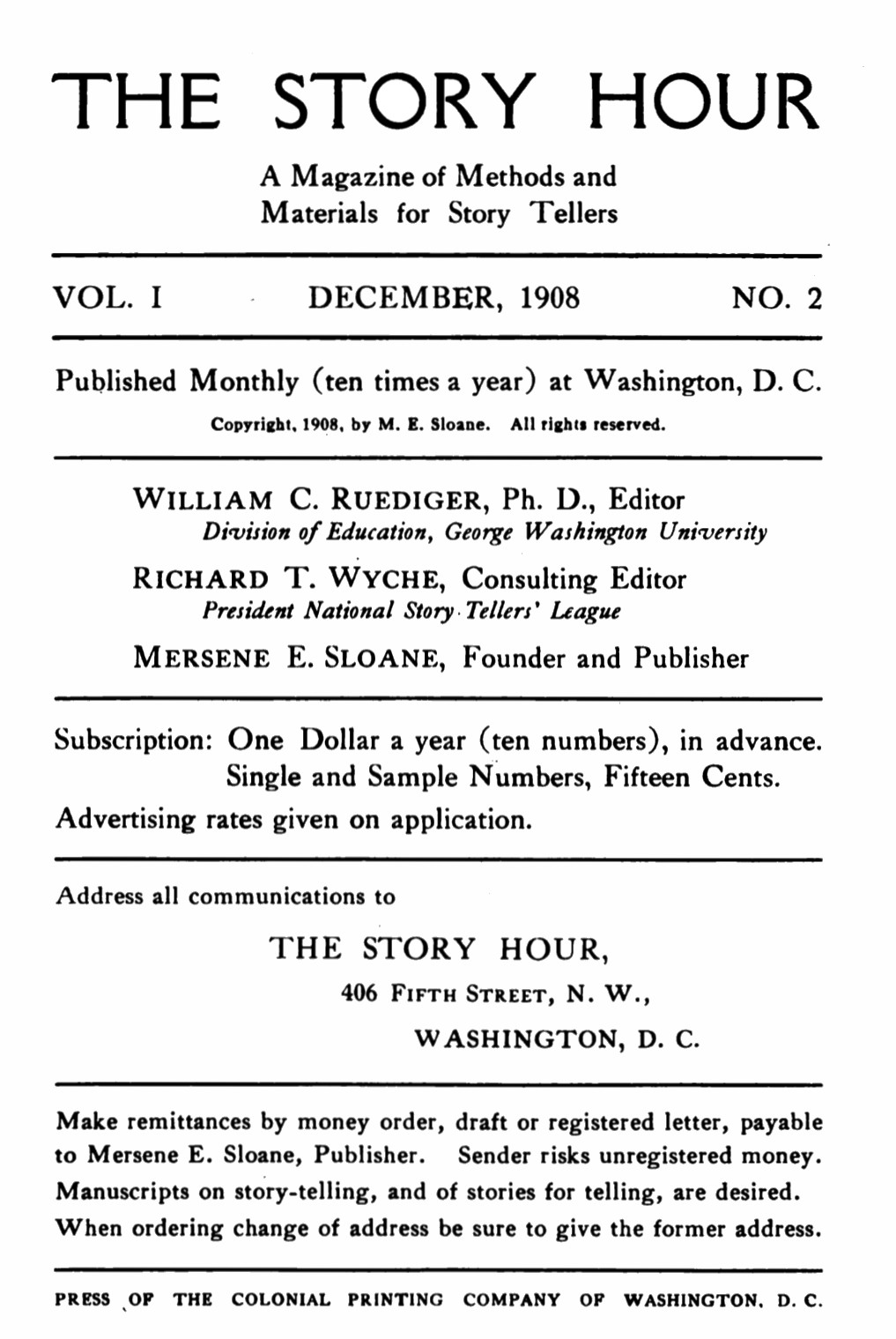
THE STORY HOUR
A Magazine of Methods and
Materials for Story Tellers
VOL. I DECEMBER, 1908 NO. 2
Published Monthly (ten times a year) at Washington, D. C.
Copyright, 1908, by M. E. Sloane. All rights reserved.
William C. Ruediger, Ph.D., Editor
Division of Education, George Washington University
Richard T. Wyche, Consulting Editor
President National Story Tellers’ League
Mersene E. Sloane, Founder and Publisher
Subscription: One Dollar a year (ten numbers), in advance.
Single and Sample Numbers, Fifteen Cents.
Advertising rates given on application.
Address all communications to
THE STORY HOUR,
406 Fifth Street, N.W.,
WASHINGTON, D. C.
Make remittances by money order, draft or registered letter, payable
to Mersene E. Sloane, Publisher. Sender risks unregistered money.
Manuscripts on story-telling, and of stories for telling, are desired.
When ordering change of address be sure to give the former address.
PRESS OF THE COLONIAL PRINTING COMPANY OF WASHINGTON, D. C.
OFFICERS OF THE NATIONAL
STORY-TELLERS’ LEAGUE
Honorary President, Hamilton Wright Mabie
President, Richard T. Wyche, 501 W. 120th Street, New York
Secretary, Dr. Richard M. Hodge, Teachers College,
Columbia University, New York
Treasurer, Mr. W. H. Keister, Harrisonburg, Va.
EXECUTIVE COMMITTEE
Dr. P. P. Claxton, Knoxville, Tenn.
Professor Education, University of Tenn. Superintendent Summer
School of the South
Miss Annie Laws, Cincinnati, Ohio
President Ohio Federation of Women’s Clubs
Miss Maud Summers, Cincinnati, Ohio
Member of Faculty, Kindergarten Training School
Miss Anna C. Tyler, New York City
Children’s Librarian
Dr. Richard M. Hodge
Mr. W. H. Keister
Mr. Richard T. Wyche
ADVISORY BOARD
Dr. G. Stanley Hall, President Clark University
Dr. Henry Van Dyke, Princeton University
Miss Elizabeth Brown, City Schools, Washington
Dr. Jennie B. Merrill, Supervisor Kindergartens, New York City
Dr. A. Fortier, Tulane University, New Orleans
Dr. C. W. Kent, University of Virginia
Wharton S. Jones, Assist. Supt. Public Schools, Memphis, Tenn.
Dr. J. E. McKean, Oberlin, Ohio
Supt. B. C. Gregory, Supt. of Schools, Chelsea, Mass.
Miss Elizabeth Harrison, Pres. Chicago Kindergarten College
Miss Marian S. Henckle, Kindergarten Training School, Charleston, S. C.
Miss Pearl Carpenter, Covington, Ky.
Mrs. A. W. Cooley, University of North Dakota
Miss Elizabeth J. Black, Greensboro, N.C.
THE STORY HOUR
VOL. I DECEMBER, 1908 NO. 2
EDITOR’S AND PUBLISHER’S NOTES
With this issue The Story Hour has the pleasant
privilege of wishing all its readers a Merry Christmas. That
the Christmas spirit may everywhere prevail, and prevail
abundantly, is its sincerest wish; and if the stories herein told
and retold will contribute their mite in enhancing this spirit, it
will indeed feel that it is fulfilling its mission.
Among the many elements of cheer at Christmas time is
the Santa Claus myth. Belief in this myth adds greatly to
the enjoyment of Christmas in early childhood. The children
who believe in it, and pass out of the literal belief without a
shock to their faith, are to be congratulated. They never forget
looking back to the time when they watched, waited and
listened for Santa Claus, animated by an expectancy tinged
with a happy fear.
But this belief naturally cannot persist through life. Near
the beginning of the school period it must be replaced by a
knowledge of the literal truth, which the children get usually
from their associates. Whether the knowledge of this literal
truth is to be more true or less true than the belief in the myth
depends upon the parents, teachers and adult friends in whose
care the children are. It rests with them to transform the
myth into a symbol filled with meaning. The best things in
life are such things as faith, love, kindness and generosity.
These we cannot touch, hear or see. They exist primarily
as soul experiences, and in order to make them more palpable
and give them a base of reference we symbolize them. Now
one of these symbols is Santa Claus. He stands for the cheer,
good will and love of Christmas time, and every feature of his
traditional representation symbolizes these qualities. He is
as real as Uncle Sam, and his mission is no less important.
He is the embodiment of Christmas love, and even children
of six can appreciate this signification of Santa Claus. The
fact that they previously believed in the kind saint literally
only helps this appreciation. And who would not have a
child believe in this kind of a Santa Claus, and believe in him
always?
For several years Mr. Wyche has told his original Santa
Claus story to audiences in many places. It has been in great
demand, but has never heretofore been published. The version
given in this number of The Story Hour from a
stenographic record will be a permanent addition to the
Christmas literature of the country. It will be noted that this
and all other articles in the magazine are copyrighted.
Readers are requested to write us freely regarding their
experiences in story telling, also to suggest stories they wish
to have reproduced, or stories they have found useful in their
own work.
Suggestions of principles and methods contained in the
notes from local leagues are already becoming one of the most
helpful features of this magazine. It was so anticipated by
the publisher when he planned the local news department. It
is desired to have such notes frequently from all local leagues
in the country.
Mothers are becoming interested in the new story-telling
as a means of home education and even discipline. They
are making inquires as to methods and materials. The
Story Hour will be a helpful counsellor for them.
A Query Page will be useful to many, especially to
those who live remote from the cities and their large libraries.
Any who desire information of any kind regarding stories, or
the literature of stories, or anything at all related to the subject
of story-telling, or the League movement may feel free to
write to The Story Hour. Our best efforts will be
made to give suitable and helpful replies.
The Story Hour invites contributions of articles on
story-telling and any topic related to the general subject, also
stories for use in story-telling. Both original and retold
stories may be submitted.
Many expressions of interest in and approval of The
Story Hour magazine have reached us. All say that it
will supply a real need—a long-felt want.
STORIES FOR CHRISTMAS TIME
The following selected list of Christmas stories is given in the hope
that it will prove of service to readers of The Story Hour. The list
is suggested by Mr. Charles L. Spain, of Detroit, Mich.
The Discontented Pine Tree—Anderson.
The Fir Tree—Anderson.
The Little Match girl—Anderson.
The Golden Cobwebs, From “How to Tell Stories to Children”—Bryant.
Fulfilled: A Legend of Christmas Eve, From “How to Tell Stories
to Children”—Bryant.
Story of Christmas, From “How to Tell Stories to Children”—Bryant.
Why Evergreen Trees Keep Their Leaves in Winter, From “How
to Tell Stories to Children—Bryant.”
Yuletide Myth, From Old Norse Stories—Brodish.
Christmas Truants—Fanciful Tales. Stockton.
The Ruggles’ Christmas Dinner, From Brid’s Christmas Carol—R.
D. Wiggin.
Legend of St. Christopher
A Christmas at Cafe Spaander. Scribners, Dec. 1902.
New subscribers who did not begin with the November
number, but who desire the special information it contains regarding
the new educational story-telling movement, including
the Constitution of the National Story Tellers’ League,
can obtain copies by sending 25 cents to the publisher.
HOW THIS MAGAZINE GOT ITS NAME [EXPLANATION BY THE PUBLISHER]
About the time the November number of this magazine was on the
press a letter was received from Houghton Mifflin Company saying
that Miss Nora A. Smith had complained to them about the title of
the forthcoming magazine, an advance notice of which had come to
her attention. It appears that Miss Smith and her sister Mrs. Kate
Douglas Wiggin, some years ago published, through the Houghton
Mifflin Company, a book entitled “The Story Hour.” Miss Smith
assumed that this magazine was named in honor of their book, and
resented it. Lest others should think likewise to our discredit, it is
fitting to explain that this magazine did not find its name from any
book, print, writing, word or advice from anybody, but was entirely
original with the publisher, who had never seen or heard of any book
or other print bearing such title.
In the course of the preliminary correspondence regarding a proposed
periodical, Mr. Wyche stated (last August) that among those
interested in such a publication would be the playground workers,
who would find it useful for their story hour, referring to the practice
in some playgrounds of setting apart an hour each day for story-telling.
It struck the publisher at once that The Story Hour would be
just the title wanted, and he was delighted to have hit upon so
excellent and appropriate a name. That he was not familiar with the
book bearing the same title is not a reflection upon the book, which
is undoubtedly quite excellent in every way, and is said to have enjoyed
a wide circulation, but it is due to the fact that for several years
he has not been in direct touch with educational interests, hence is
not acquainted with current literature along such lines.
The publisher has no apology to offer for adopting so excellent a
title, but does disavow any intention, inclination or necessity for
“borrowing” for this or any other literary purpose. The Story
Hour magazine is for the benefit of a worthy educational movement—for
the good of children—and there is room for both it and the book
of the same name to be a blessing to the rising generation. In doing
good, time and priority are not factors, but the will and the deed.
STORIES AND HOW TO USE THEM
BY RICHARD THOMAS WYCHE
PRESIDENT, NATIONAL STORY TELLERS’ LEAGUE
ARTICLE NUMBER TWO
WHEN our forefathers grappled with theological problems
and made dogmatic statements as to their faith, such as
we find in some of our catechisms, they had in mind the church
and theological controversies, and not the child and his needs.
The truth that they had suffered and died for was contained
in the catechisms, their articles of faith, therefore he who
committed to memory the catechism had the truth. But in
that reasoning they made a fatal mistake. To make children
memorize these dogmatic statements expecting them to grow
religiously or morally thereby, would be like feeding them on
bone meal, expecting therefrom an increase in the bony tissue
of the body. The lime that the body needs is there, but not
in an assimilative form. Nor is there truth for the child in
dry-bone statements of religion. If the child asks for bread
will you give him a stone? That is what we do when we
make him memorize theological statements, the language and
thought both of which are beyond him.
The writer recalls two teachers and two methods of religious
instruction in his childhood. One who taught him the
catechism and one who told him Bible stories. The catechism
bored and wearied him, and so far as he can see today
was time wasted, while the stories charmed and uplifted, and
remain even today a pleasant memory. This is not arguing
that the child should not memorize some things. There
are many selections from Scripture and other sources that he
can memorize both with great pleasure and profit to himself.
“The Lord is my Shepherd I shall not want,
He maketh me to lie down in green pastures,
He leadeth me beside the still waters,”
is full of beautiful imagery that appeals to the child. But
theological definitions of sin, justification and the like, have
neither feeling nor imagery and make no appeal to the child.
The child is interested in the deeds of man and not in his
doctrines. Tell him connectedly the life-story of Moses,
Buddha, Jesus, St. Augustine, Luther or Wesley, and you
have given him the spirit and life of the great religious leaders
and the institutions which grew out of their work. No
catechism could do that. Gladly he would hear the life
story of a great religious hero and teacher, but his doctrines
do not interest him now. Give him the life-story now, and
when he has reached later the philosophic period he will himself
raise the theological and philosophical questions, and
knowing the lives of the great religious leaders he will have
the historical background whereon to build his faith. Anyone
can take a catechism and have a class memorize and
repeat the answers, but it takes a teacher to so read the Bible
that he can tell in a creative way the story of its great heroes.
That is what we must do if we base our methods on true
psychology. And the story should be studied connectedly to
the close and not by piecemeal, beginning as some do with
one character and before the life-story is done dropping him
and skipping to another, in order to conform to a certain
doctrinal theme which may interest the adult but not the
child. That method may account for the fact that Bible
heroes have not always been as popular with children as
some others. If the story of Ulysses and Hiawatha were
taught in a similar way they would lose much of their charm
and interest for the child.
The day school in its literature courses is incidentally
giving the child a comparative course in religion, greatly to
the advantage of the Sunday School worker. In Hiawatha
we have an Indian Messiah who worshipped the Great Spirit,
and prayed and fasted for his people. In the Norse we have
the worship of Odin, and Balder, the God of Light, Gladsheim
and the Life Beyond the Grave. In the Greek we have
the gods in their relations to man, the upper and lower world,
immortality, rewards and punishments. Saint George was a
protector of the faith, while King Arthur had heaped upon
him the attributes of a divinity, until his life-story reminds
one of the Christ story.
The heroism and prowess in these stories is the main point
of interest to the child, but none the less does the religious
life of the race come out; and to have religion associated with
physical strength as well as moral heroism is an advantage.
And none the less are we giving him the great truths that are
common to all religions, making him tolerant and charitable,
and teaching him that religion is as broad as life itself and that
it is natural for every human heart to go in quest of the
Eternal. With this broad outlook we can then better help
our young people interpret the old truths in terms of modern
thought and contribute much toward that larger religious life
and thought which must inevitably come.
The work of story-telling covers a much larger field than
the school. It does not matter whether we are kindergartners,
teachers or preachers, every adult owes to the rising
generation of children something of the culture that has been
given to him. The “Tell me a story” on the part of the child
is his cry for spiritual food, and to hear stories from the great
story-books of the world is, as Dr. G. Stanley Hall says, “one
of the most inalienable rights of children.” There is no better
place in all the world for telling a story than in the home,
that institution which is greater and more important than all
other institutions combined.
It is in the home that we come into the sweetest and divinest
relations with children and with one another. It is here
that we find the best conditions for a play of those subtle and
delicate psychic influences which enter into the story, making
it both a perfect art and an inspiration to a noble and beautiful
character. There are many homes that cannot afford
libraries and the rich adornments of art, but no home is so
humble that parents cannot gather the children around the
fireside on a winter’s evening or about the doorsteps in the
twilight of a summer’s day and tell them stories. A simple
fireside is a greater stimulant to the creative imagination than
the wealth of a palace.
To enter thus into the child’s world and into the joyous
companionship of children is one of the highest privileges of
parent and teacher. He who fails in this does not form the
deepest and most lasting ties with the child, and he also robs
himself of one of the greatest sources of perennial youth.
JUNIOR STORY TELLERS’ LEAGUES
ORIGIN AND GROWTH
ONE of the most interesting developments of the League
idea was the organization of Junior Leagues. The
originators of the League thought only of an organization for
adults. But where the children have, under the guidance of
a wise teacher, had a League, the work they have done and
the interest shown reveals one of its greatest educational possibilities.
As the child likes to build with clay, sand or wood,
and in doing so educates himself, so he likes to build with
words, voice and gesture an ideal world, peopling it with
life as he sees it.
While we are training children for all sorts of skilled trades,
it is a matter of no small satisfaction to record an experiment
that has for its object the revival of the ancient art of telling
stories—for it is an art.
The children of Corinth, Miss., under the supervision of
Susie E. Blitch, were the first to organize a Junior League.
The League began with the children of the fifth grade.
They had the usual officers, and a program of stories, songs
and games, meeting out of doors when possible.
Those who have had charge of Junior Leagues report the
following principles for the guidance of those who wish to
organize Leagues among the young people:
(1) Help the children to make the organization thoroughly
democratic.
(2) The supervisor has no right to stop or correct a
member in telling a story. The speaker has the floor; the
atmosphere and the spirit he brings with his story is the
essential thing, and not grammar or pronunciation.
(3) To hear other children tell a story is a better model
for a child than the criticism of an older person who cannot
tell a story.
(4) Reciting a story is not telling a story.
Last December Miss Anna C. Tyler formed a “Junior
Story-Tellers’ League” in the children’s room of Pratt
Institute Library, in Brooklyn. Out of an audience of from
forty to sixty children, two Junior Leagues were formed.
They all assemble regularly to hear the evening story, and
the leagues meet afterward.
Each league elects its own officers and conducts its own
meetings. The president takes the names of seven or eight
of the children present, most of whom volunteer to have a
story ready for the next meeting, and of those so chosen there
have only been a few who have not been ready with a story
when called upon. They know they can call upon Miss
Tyler for help, but seldom require her services.
There has been but little attempt to dictate to them the
kind of story that they shall tell, the director’s only request
being that they shall not tell silly stories. Some of the best
Norse, Greek, and Indian myths; animal and nature stories
by Kipling, Seton-Thompson, Charles Dudley Warner, and
John Burroughs; “Macbeth,” “Evangeline,” “The Lady
of the Lake,” “A Yankee at King Arthur’s Court;” stories
of adventure, and some of the most famous of the fairy-tales
have been told—and nearly always well told—by boys and
girls from ten to fifteen years old. The children are learning
to read—the careful search through book after book for the
story they think will be the best to tell. The final selection
is always their own.
“After the cycle of eighteen stories from King Arthur had
been finished,” says Miss Tyler, “the children asked me to
tell them Indian, detective, and ghost stories, and tales from
‘Arabian Nights’—to be told in that order, and I was not to
tell stories that they would read for themselves. The Indian
myths were not so difficult to find, but good detective and
ghost stories were another matter; at last I remembered the
delicious thrill of those wondrous tales of Poe. I began
with ‘The Purloined Letter,’ telling it, as it is written, in
the first person, but ‘skipping’ the parts that I knew would
weary. Then followed ‘The Black Cat;’ then Stephenson’s
‘The Bottle Imp.’ So fascinated were they that they
voted to change the evening of fairy-tales for another story
by Poe, and the story they chose was ‘The Pit and the Pendulum.’
By the children’s urgent request these stories were
told with the lights turned low, as the best substitute for
fire-light, and it is hard to say whether the absorbed young
listeners or the story-teller enjoyed those hours most.”
The leagues have voted that their story-teller shall tell
them Indian stories next winter, and she hopes, therefore, by
beginning with the Indian myths and folk-lore, then telling
of their life, warfare, and famous battles, to bring her boys
and girls to a vivid interest in reading history as told by
Francis Parkman.
The writer recalls with so much pleasure a visit to a young
people’s story tellers’ league. He happened once upon a
time to visit one of our smaller towns, and was invited to a
meeting of the Junior Story Tellers’ League that met on the
day of his visit. He had never heard of the organization
among children before, and was of course interested in seeing
what the children were doing with such an organization. The
meeting was held out of doors on the lawn. It was in the
month of May when the weather permitted such a meeting.
The League was composed of children of the fifth grade,
who sat in a circle on the grass. The teacher of the grade
was present, but the children conducted their own meeting—a
program of stories, songs and games in which all joined.
The stories told by the children were their own selections, and
were told in a creative way. One was especially impressive,
being loudly applauded by the children. It was told by a
twelve year old girl and was one of her own creation. Since
then she has written enough stories to make a small volume,
and so popular is she as a story-teller that the children in her
neighborhood flock to her home to hear her tell stories.
Several years after that the writer saw this same girl, now
passing into young womanhood, stand before a thousand
teachers and tell in the same easy, natural way some of her
stories. Not seeking this opportunity to appear in public,
[only in rare instances would the author allow children to
appear in public], it came to her because she had something
to give; something that she had for several years given every
week to her playmates and friends, as naturally as she would
give herself to them in games and play; something too, that
had made her life a radiant one.
Miss Elizabeth J. Black, teacher of the sixth grade in one
of the public schools of Greensboro, N.C., has been very
successful with a League among her pupils. Through the
League she got hold of the children as never before, and is
enthusiastic over the results.
We give below a program of one League meeting. Miss
Black has laid special emphasis on Norse stories.
PROGRAM.
Chorus—Carolina, American Legend—The White Doe; Chorus—“I’m
a Tar Heel Born and a Tar Heel Bred;” Legend of Sir Galahad—“The
Bright Boy Knight;” Chorus—“The Watch on the
Rhine,” “Seigfried;” Rhine Legends—“Parsifal;” “Lohengrin,”
Chorus—“The Violet,” Icelandic Saga—“Burnt Njal;”
Folklore and Nonsense, “The Cat and the Parrot;” Chorus—“When
I’m Dreaming;” Impersonation of Uncle Remus, “Miss
Sallie,” “Uncle Remus,” “Little Boy,” Chorus—Dixie.
R. T. W.
A BOY’S VISIT TO SANTA CLAUS
BY RICHARD T. WYCHE
ONCE upon a time there was a little boy who talked a
great deal about Santa Claus. He talked to his father,
his mother, his brother and sisters, until it was Santa Claus
at the breakfast table, Santa Claus at dinner and Santa Claus
at supper. This little boy had been told that far away in the
Northland lived Santa Claus. He was sitting by the fire one
day watching the embers glow, and seeing castles in the glowing
embers. There is Santa Claus’ house, he said, the great
building covered with snow. “Why can’t I go to see him?”
The little boy had worked and had saved some money. He
took the money and went down to the depot, bought a ticket
and before his father or mother knew about it was gone to see
Santa Claus. He traveled a long time on the train and by
and by reached the end of the railroad. He could go no
farther on the train for there was a great wide ocean, but
people cross the ocean and so must the little boy, or at least
a part of it, in order to reach Santa Claus’ land. There was
a great ship lying in port soon to sail over the seas, and along
with many people who went aboard the ship, went the little
boy. Soon every sail was spread and out from the port went
the ship leaving far behind them the town.
The ship sailed and sailed a long time, and finally land
came in sight. They had reached an island lying somewhere
far out in the mid-seas. Some of the people went ashore and
so did the little boy. But what a funny land it was to the
little boy, all the people were little people. The grown men
were not taller than the little boy, and they rode little ponies
that were not larger than dogs. Then the little boy asked,
“What land is this, does Santa Claus live here?” And they
said—“No.”
“This is the land that lies east of the sun
And west of the moon.
You have not come too soon.
Northward you must go
To the land of ice and snow.”
And so one day the little boy found a ship that was going
to sail to the Northland and in this ship he went. The ship
sailed and sailed a long time until it finally came to where
the sea was all frozen over, to the land of icebergs and snow
fields. The ship could go no farther, so what do you suppose
the little boy did then? He was in the land of the reindeer,
and over the snow fields he went in search of Santa Claus.
One day, as he was traveling over the snow fields to find
Santa Claus’ house, he saw not far away what at first seemed
to be a hill, but soon he saw that it was not a hill, but a
house covered with ice and snow. “That must be Santa
Claus’ house,” he said. Soon the little boy was standing in
front of the great building whose towers seemed to reach the
sky. Up the shining steps he went and soon he was standing
in front of the door. The little boy saw no door bell and
so he knocked on the door. No one answered and then
louder he knocked again. Still no one answered. He began
to feel afraid, perhaps this was the house of a giant. If Santa
Claus lived there, he might be angry with him for coming,
but once more he knocked. And then he heard a noise far
down at the other end of the hall. Some one was coming.
Then suddenly the latch went “click,” and the door stood
wide open, and who do you suppose was there? Santa Claus?
No; a little boy with blue eyes and a bright sweet face.
Then the little boy said, “Good morning. Does Santa Claus
live here?” And the other little boy said, “Yes. Come in,
come in. I am Santa Claus’ little boy.” He took him by
the hand and said, “I am very glad to see you.”
Then the two little boys walked down the long hallway,
doors on this side and doors on that, until they came to the
last door on the left-hand side. On this door Santa Claus’
little boy knocked, and a great voice said, “COME IN.”
He opened the door and walked in, and who do you suppose
was there? Santa Claus? Yes, there was Santa Claus himself;
a great, big fat man sitting by the fire, with long white
beard, blue eyes and the merriest, cheeriest face you ever saw.
Then Santa Claus’ little boy said, “Father, here is a little
boy who has come to see you.” Santa Claus looked down
over his spectacles and said, “Well, how are you? I am
mighty glad to see you. Yes, yes, I know him. I have been
to his house on many a night and filled up his stocking. How
are Elizabeth and Louise and Katherine?” Over on the other
side of the fireplace sat Mrs. Santa Claus. She was a grandmother-looking
woman, with white hair and gold-rimmed
spectacles. She was sitting by the fire knitting; she put her
arms around the little boy and kissed him.
Then the two little boys sat down in front of the fire and
talked together. By and by, Santa Claus’ little boy said to
the other little boy, “Don’t you want to go over the building
and see what we have in the different rooms? This building has
a thousand rooms.” And the little boy said, “who-o-o-o-e.”
And Santa Claus’ little boy said, “Yes, and something
different in every room.”
Then they went in a large room and what do you suppose
was in there? Nothing but doll babies; some with long
dresses and some with short; some with black eyes and some
with blue. Then into another room they went, and it was
full of toys, wagons and horses; another room was full of
story books; another room was a candy kitchen where Santa
Claus made candy; another room was a workshop where
Santa Claus made toys for the children. Then they went
in a long, large room, the largest of them all, and in this room
were a great many tables. On these tables were suits, cloaks
and hats and shoes and stockings for the children. The little
boy wanted to know what they did with so many clothes, and
Santa Claus’ little boy said, “We take these to the little
children who have no father or mother to make them clothes.”
And so they went through all the rooms of the great building,
except one, which was away upstairs in the corner. What
was in this room no one would tell the little boy, nor would
they take him into the room. And the little boy wondered
what was in the room.
The little boy stayed at Santa Claus’ house several days
and he had a splendid time. Some days the two little boys
would slide down the hill on a sled, some days they would
hitch up the reindeer and go sleighing, some days they would
go into the candy kitchen and help Santa Claus make candy,
or into the workshop and help him make toys.
But one day something happened. Santa Claus came to
the little boy and said, “I am going away today for a little
while; my wife and my little boy are going with me. Now,”
he said, “you can go with us or you can stay here and keep
house for us while we are gone.” The little boy thought to
himself that Santa Claus had been so good to him that he
would stay and keep house while Santa Claus was away. So
he said he would stay and then Santa Claus gave him a great
bunch of keys and said, “Now you can go in all the rooms
and play, but you must not go in that room upstairs in the
corner.” The little boy said, “Alright,” and with that Santa
Claus, his wife and his little boy went down the steps, got
into the sleigh, wrapped themselves up in furs, popped the
whip and away they went! The little boy stood and watched
them until they disappeared behind the snow hills.
Then he turned and went back into the house. He felt
like a little man in that great house all by himself. From
room to room he went. He went into the game room and
rolled the balls. Some of the balls were so large that they
were as high as the little boy’s head. They were of rubber,
and if you would drop one from the top of the house it would
bounce clear back to the top. The little boy went into the
candy kitchen and ate some of the candy. He went into the
workshop and worked on some toys, then into the library and
read some of the books, then into the parlor and banged on
the piano.
But after a while, the little boy was tired, and he said, “I
wish Santa Claus would hurry and come back.” He was
lonely. And so he thought he would go up on the housetop
and look out to see if he could see Santa Claus coming home.
Up the steps he went. When he reached the top, there was
another flight. Up these he went and still another flight; up,
up, he went until it seemed he had gone a thousand steps.
But, finally, he came out on top. The little boy stood there
with his hands on the railing and looked out, but all he could
see were the snow fields, white and glistening. Santa Claus
was not in sight. He could see the track over the snow that
the sleigh had made, but that was all.
Then down the steps he came, and it just happened that
he came by the room that Santa Claus told him he must not
go in. As he passed, he stopped in front of the door and said
to himself, “I wonder what they have in that room and why
they did not want me to go in?” He took hold of the knob
and gave it a turn, but the door was locked. Then he shut
one eye and peeped through the keyhole, but he could see
nothing; it was all dark. Then he put his mouth at the keyhole
and blew through it, but he could hear nothing. Then
he put his nose there and smelled, but he could smell nothing.
“I wonder what they have in the room?” he said, “I believe
I will see just for fun which one of these keys will fit in the
lock.” The little boy had in his hand the great bunch of
keys. He tried one key and that would not fit, then he tried
another and another and another, and kept on until he came
to the last key. Now, he said to himself, “If this key does
not fit I am going.” He tried it and it was the only key on
the bunch that would fit. “Now,” he said, “I shall not go
into the room, but I will just turn the key and see if it will
unlock the lock. It may fit in the lock and then not unlock
the lock.” He turned the key slowly and the latch went
“click,” “click,” and the door flew wide open. What do you
suppose was in the room? It was all dark; the little boy
could see nothing. He had his hand on the knob and it
seemed to him that his hand was caught between the knob
and key, and somehow, as the door opened, it pulled him in.
When he stepped into the room, he felt a breeze blowing and,
more than that, as he stepped down, he found the room did
not have any bottom; just a dark hole.
Well, as the little boy stepped over into the room, he felt
himself falling, away down, down, down yonder. He shut
his eyes, expecting every moment to strike something and be
killed. But, before he did, some one caught him by the
shoulders and shook him and said, “Wake up!” “Wake up.”
He opened his eyes and where do you suppose the little boy
was? At home. It was Christmas morning and his father
was calling him to get up. The sun was shining across his
little bed. He looked towards the fireplace and there all the
stockings were hanging full. The little boy had been to see
Santa Claus, but he went by that beautiful route we call
“Dreamland”.
HARALD’S CHRISTMAS TREE
BY ANNA BOGENHOLM SLOANE
IN a little log hut at the edge of a forest in far-away Sweden
lived Harald and his widowed mother. The winter
snows crept in through the window cracks and the biting
winds found their way between the decaying logs. All the
fuel they had was the dry sticks that Harald gathered in the
woods, and, indeed, nearly all the money used in their humble
home was earned by his hands. But, notwithstanding the
poverty and uncomfortable habitation, Harald was as happy
as though he lived in a palace; for he loved the fading beauty
of his mother’s tender face and the whitening hair under her
stiff cap. And for playmates he had all the elves and fairies
about whom his mother had told him so many wonderful
tales.
Harald had never seen a Bible or heard about the Saviour,
but he knew the Eddas by heart and he prayed to Odin and
Thor with as devout reverence as a Christian boy prays to
the Lord Jesus, and he had firmly resolved to live the noble
life of a brave hero so as to be worthy to die on the battlefield,
and by kind Valkyrias be borne to the fair gardens of
Valhall.
One December evening, when the wind howled dismally
among the forest trees and piled up snow in great drifts across
the roadway, little Harald, chilled and shivering, returned
home from a hard day’s work. To keep up a brave heart he
whistled as he walked, looking earnestly at the flashing flames
of light which people now call the “Northern Lights,” but
which, to him, was the flickering of the helmets and shields
and spears of Odin’s maidens; for so had he been taught.
Just as he turned into the dark forest he heard a faint moan,
as of a human being in distress. Hastening to the spot
whence it came, he found an ugly Dwarf lying in the snow
nearly frozen. Although Harald was quite numb himself
from cold, he began briskly to rub the Dwarf’s hands and
face, and after a little while helped him to his feet, and Harald
then asked the Dwarf to go home with him where he might
get warm and have some supper.
“Why should you befriend a poor wretch such as I am,
who cannot repay you?” whined the Dwarf as he leaned
heavily on Harald’s young shoulders.
“I don’t ask to be repaid,” replied Harald. “Have you
not heard the proverb, ‘Do good and throw it into the sea.
If the fishes don’t know it, Odin will.’”
“Yes; Odin shall know about this, you may be sure of
that, and although I am only a poor deformed wretch, I know
how to be grateful, and would like to do you a favor,” replied
the Dwarf. “I wonder if you have happened to notice
a little green ash tree somewhere near here.”
“A green ash tree in winter!” exclaimed Harald.
“It is an unusual sight, indeed,” said the Dwarf, “but in
one of my rambles, the other night, I saw one in this vicinity.
Oh, here it is, right before our eyes!”
There, sheltered by a cluster of evergreen trees, was a
small ash sapling, with green leaves on its branches as in
summer, while the other forest trees stood about nodding in
their slumber, their leaves all gone and their hearts frozen
within them.
When Harald went and touched its branches, the little
tree came right up out of the ground.
“Take home the little ash and plant it beside your window,”
said the Dwarf, and when Harald turned about to thank him
he was gone out of sight.
Then Harald started to run home with the little ash tree,
but had gone only a few steps when he struck his foot against
something. Stooping to see what it was, he found a bag,
glistening with brightness and full of something heavy. Upon
opening the bag, he found it to be full of pieces of gold
money.
“I must go to town and ask who has lost a bag filled with
gold,” thought the boy. “Oh, I do wish I might keep it
and buy mother a nice warm coat.”
But the next instant he loosened his tightening grip on
the bag. “It is not my gold, and stolen money is worse than
a mill-stone about one’s neck, says mother, so I think it
would be too heavy for me.”
“Keep the purse, little boy,” said a sweet voice at his elbow.
Turning, he saw a little girl as radiant as a sunbeam, dressed
in shining gold.
“I am your friend, little boy, and I tell you that a lady who
wears a fine cloak and a long veil, and who has more gold
than she needs, dropped that purse, and if she asks for it I
will say it fell into a hole in the ground.”
“Poor misguided Angel,” said Harald, “you are a beautiful
temptress, but I must go to town and try to find the lady
you speak of, who wears a fur cloak and a long veil.”
“Well, if you are determined to be so foolish, I will go
with you to show you the way,” replied the Fairy, for such
was the beautiful little girl.
So Harald wrapped his jacket about the little ash tree, to
protect the tender roots from the cold, and tucking it under his
arm, ran to town in the footsteps of his guide. The beautiful
fairy led him to the doorsteps of a great mansion and then
vanished from sight.
The lady of the house was glad to get her purse back, and
offered Harald one of the gold pieces as reward for bringing
it to her. But, much as he wished to have it, he shook his
head, saying, “My mother taught me not to take pay for not
being a thief, and she always tells me to be honest without
hope of reward.”
Then Harald ran home with all speed to tell his mother
of his wonderful adventures, and while they were talking together
about the strange little ash tree they discovered a soft,
unfrozen spot of earth near a southern window, and there
planted the green sapling. Harald cared for it tenderly and
prayed Odin to shield it from frost and wind.
Next morning was the twenty-fifth of December, and was a
holy day then as now, though it was not called Christmas and
was not celebrated in memory of the birth of Christ, but to
commemorate the death and cremation of the pure and loving
Balder, who was the Saviour of the old Northmen’s religion.
Contrary to our Christian custom, the old pagans of Sweden
celebrated the birth of their Redeemer at Easter, when
all nature becomes imbued with renewed life.
At the winter solstice, when nature slumbers, they kept fires
burning on the mountain tops, in memory of his death and
funeral pyre.
Early on Christmas morning, when Harald went out to see
the Balder fires, he met three armed men in the forest. One
of them asked gruffly if he knew what had become of a little
green ash tree that Loki, the giant, had planted there.
Harald became very much frightened. He knew the men
must be looking for the green sapling he took home the night
before, for there was no other such green bush in the forest.
He also knew that Loki was a fierce and terrible god to offend.
“I will not tell,” he first thought, “but run home and pull
up the bush and burn it. Then they will never know what
became of it.”
But, notwithstanding his fears, he could not forget his
mother’s counsel: “Speak always the truth, my son, even
though a sword should be swinging over your head.” Indeed,
a sword was just now hanging over his head, but he
would speak the truth.
As soon as he could control his trembling voice Harald confessed
that he had removed a little green ash tree the night
before. He begged for mercy, for he did not know that it
belonged to the fearful giant.
The men told Harald to lead the way to his mother’s
dwelling. Arriving there, they at once recognized the little
green ash as the one belonging to Loki, and commanded
Harald to pluck it up and follow them with it to the giant’s
castle.
Stiff and white as though the frost giant had breathed upon
him, Harald reached out his hand and touched the tree. Instantly
it came from the ground of its own accord. For a
moment it stood quivering and shaking its branches, which
gradually became arms, and in another moment it was no
longer a green sapling, but a dazzling, beautiful girl.
“Poor men! I pity you for being in Loki’s service,” she
said in a sweet voice. “Go, tell your cruel master that his
plotting against me has failed and that my enchantment is
over. This little boy has saved me,” she continued, pointing
to Harald. “The merciless Loki, enraged at the love I bore
humanity, changed me into an ash tree, but he had no power
to keep me so forever, and was obliged to make a condition.
He made the hardest he could think of. Said he: ‘Since
you so love mankind, none but the child of man shall free
you from your enchantment. You shall remain a tree until
you feel the touch of a child who is generous enough to share
his last loaf with a stranger; honest enough to give back a
reward for honesty, and brave enough to speak the truth when
a lie might save his life. Long shall you wait for such a deliverer.’”
Then the soldiers left, glad the little brave boy had escaped
the threatened doom.
Harald, looking at the beautiful child, thought she looked
very much like the one he had met the evening before, and
spoke of it.
“That little elf was my sister,” replied the fairy, “and the
brown dwarf who pointed me out to you was my dear friend.
He had heard of the little Harald, who was said to be so
generous and brave and true, and he tried you, as also did my
little sister, who was greatly delighted when she found you
could not be tempted to steal.”
Harald’s mother, who had been standing near unnerved and
speechless, now came up. Clasping her boy to her heart, she
said: “I am prouder today than I would have been if my
son had slain a hundred men on the battlefield.”
The little grateful elf always remained Harald’s true friend.
She whispered into the ear of the old King about the generosity,
bravery, honesty and truthfulness of the boy who lived
in the forest.
The King sent his men to bring Harald and his mother
to the palace. For his noble virtues he became so well loved
by everybody in the land that when the old King, who had
no children, died, Harald was chosen King.
For many years he ruled, constantly widening his country’s
domain and for his victorious sword was called Harald Hildetand,
which means “Harald, the Biting Tooth.”
[This story incorporates some fragmentary elements of certain old
Swedish legends, and the following explanations will be useful to the
unfamiliar American reader.
The Eddas, mentioned in the story, are books containing the sacred
lore of the old Scandinavians.
In the old Norse mythology the first human beings were represented
as having sprung from the ash tree; hence the use made of the ash in
this story.
A continual state of warfare existed among the tribes of the ancient
Scandinavians, and valor in war was regarded the supreme virtue, and
prowess in battle the supreme achievement of men. Valhall was the
heaven of sword-fallen heroes, called Enherjar, who forever lived
there in the enjoyment of fighting each other daily, drinking mead
from beakers, and eating the flesh of a hog that was slaughtered each
day, but each night became alive and whole again.
In Norse mythology the Valkyrias made contests on the Vidar
Plains (at the North Pole) to determine which favorites should enter
Valhall first. In the course of these events, the spears and shields of
the contestants gleamed and flashed until the northern heavens were
illuminated—the “Northern Lights.”
At the winter solstice was held a great sacrificial feast in memory of
Balder, the second son of Odin, the god of heaven, and Frigga, the
goddess of earth. He was of heaven and earth, like the Christ, and,
like Him, was pure and loving. At the instigation of the evil Loki,
the son of Surtur (Satan) he was killed by blind Hoder, as Christ
was killed by the truth-blind people.
The Scandinavian pagans believed in a God-Power so holy and
great that they dared not even give a name. The three head representatives
of this Power were Odin, Vele and Ve, who overcame the
evil giants. These giants strove to injure men, while the gods fostered
them. Thor was Odin’s son, the strong-arm of retribution, punishing
evil doing among men and giants.]
THE FIRST CHRISTMAS.
BY W. J. MORRISON.
ONE December, years and years before people had rail-roads
or street cars, crowds of men, women and children
were traveling on the roads and paths that led to a little town,
called by the Jews, House of Bread. The dark-skinned
Arabs, who lived out in the desert, called this town the House
of Meat, but all children know it by the Bible name, Bethlehem,
in the country of Judea. Some of these people were
riding, and some were walking, toward this town of Bethlehem.
Among them, seated on a donkey, was a beautiful
young woman by the name of Mary, the donkey being led by
her husband, a Jew, named Joseph, who, though a poor
carpenter, was related to King David, and belonged to what
was called the royal family.
Mary and Joseph lived at Nazareth, and it was a long
walk of three or four days from their home to the city of
Bethlehem. The way wound in and out, and over hills and
mountains, which made it a hard road to travel. Bethlehem
was built on the top of these mountains. In the summertime
it was a delightful place to visit. From the city one could see
the beautiful gardens in the valley, together with the fig, olive
and almond orchards. The far-away hillsides were covered
with rows of grape vines, that changed their hues and shades
as the wind tossed their leaves up and down, or from side to
side. But, as this was December, all these people were not
going to Bethlehem for pleasure, or to buy Christmas things.
They did not even know it was Christmas-eve. These people
were crowding into Bethlehem, because the Roman law
required that, at this time, every one should go to his old
home, or the place where he was born, and pay his taxes.
That the Roman Emperor might know how many people
there were in the world, they were also required to have their
names written on long rolls, or sheets, of dried sheep skin, for
in those days they did not have paper.
Mary and Joseph could not climb up the mountain to the
city as fast as some of the others and so were the last to
arrive. When they got to the town, they found that the only
hotel or inn, in those days called a “Caravansary,” was full
of people and there was no room for them. They went from
house to house, to get a place to stay, but found that the people
who had arrived before them had taken every room in the
place. Joseph must have known something of the country
about the town, for, when he could find no room in any of
the houses, he began to hunt for one of the many grottoes,
or caves, that are under the sides of the mountains in and
around Bethlehem. When he found a cave that ran away
under the ground, with rooms, one opening into the other,
they decided to use this place for a home until he could find
something better.
Now, children, should any of you ever go to Bethlehem,
you can see this very cave. In those days, these caves were
used as stables to shelter sheep and other stock in cold, bad
and stormy weather.
Although it was the last of December, it is said Mary and
Joseph found only an ox and an ass in this cave. The
weather could not have been so very cold, as Bethlehem is
about as far South as the northern part of Florida, and the
shepherds had their sheep out in the open country eating grass.
That the sheep might not wander away at any time, or be
stolen during the dark hours, these shepherds divided the night
into what was called Watches. In other words, some of the
men stood guard over their flocks for three or four hours, while
the others slept; then they would awaken their friends to look
after the sheep. The men who came off watch would then
go to sleep by the camp fire, for the Bible says, “And there
were in the same country shepherds watching and keeping
the night watches over their flocks.”
It was while some of these men were watching the sheep
that they were greatly startled, because a beautiful angel, who
shone with the brightness of God, came and stood by them.
The angel saw that these poor men were scared, so, in a kind
and gentle voice, he told the shepherds not to be afraid, for
he had brought them good news, that would be of great joy
to all the people. The angel then said, “This day is born
to you a Saviour, who is Christ, the Lord. You shall find
this infant Saviour wrapped in swaddling clothes and laid in
a manger.” When he had finished speaking, an army of
angels came around him, praising God and saying, “Glory
to God in the highest and on earth peace to men of good
will.” Then all of the angels ascended into heaven.
The shepherds who beheld this glorious and beautiful sight
woke those who were asleep and told them what they had
seen. When the other men heard the wonderful news that
the angel had brought, they all went at once to Bethlehem as
fast as they could. They soon found the cave where Mary
and Joseph were. Here they saw the sweetest little baby
who had for his bed a manger, or horse trough, filled with
straw. This little baby did not have on long clothes, made
of lace, embroidery and fine linen, like the little babies have
these days and times. He had only a cloth wrapped around
his body, in such a way that it made for him swaddling clothes.
As soon as the shepherds saw the child lying in the manger,
wrapped in swaddling clothes, they knew that this was the
infant Saviour of whom the angel had told them; that this
Child was Christ, Son of God, and that Mary was His
Mother.
The day on which the infant Saviour was born has ever
since been known as The First Christmas.
1. From How To Tell Stories To Children, by Sara Cone
Bryant. Copyright 1905. Printed by special permission of the publishers,
Houghton Mifflin Company.
I AM going to tell you a story about something wonderful
that happened to a Christmas tree like this, ever and ever
so long ago, when it was once upon a time.
It was before Christmas, and the tree was all trimmed with
pop-corn and silver nuts and [name the trimmings of the tree
before you], and stood safely out of sight in a room where the
doors were locked, so that the children should not see it before
it was time. But ever so many other little house-people had
seen it. The big black pussy saw it with her great green
eyes; the little gray kitty saw it with her little blue eyes; the
kind house-dog saw it with his steady brown eyes; the yellow
canary saw it with his wise, bright eyes. Even the wee, wee
mice that were so afraid of the cat had peeped one peep when
no one was by.
But there was some one who hadn’t seen the Christmas
tree. It was the little gray spider!
You see, the spiders lived in the corners,—the warm corners
of the sunny attic and the dark corners of the nice cellar.
And they were expecting to see the Christmas Tree as much
as anybody. But just before Christmas a great cleaning-up
began in the house. The house-mother came sweeping and
dusting and wiping and scrubbing, to make everything grand
and clean for the Christ-child’s birthday. Her broom went
into all the corners, poke, poke,—and of course the spiders
had to run. Dear, dear, how the spiders had to run! Not
one could stay in the house while the Christmas cleanness
lasted. So, you see, they couldn’t see the Christmas Tree.
Spiders like to know all about everything, and all there is
to see, and they were very sad. So at last they went to the
Christ-child and told him all about it.
“All the others see the Christmas Tree, dear Christ-child,”
they said; “but we, who are so domestic and so fond of beautiful
things, we are cleaned up! We cannot see it, at all.”
The Christ-child was sorry for the little spiders when he
heard this, and he said they should see the Christmas Tree.
The day before Christmas, when no body was noticing, he
let them all go in, to look as long as ever they liked.
They came creepy, creepy, down the attic stairs, creepy,
creepy, up the cellar stairs, creepy, creepy, along the halls,—and
into the beautiful room. The fat mother spiders and the
old papa spiders were there, all the little teenty, tonty, curly
spiders, the baby ones. And then they looked! Round and
round the tree they crawled, and looked and looked. Oh,
what a good time they had! They thought it was perfectly
beautiful. And when they had looked at everything they
could see from the floor, they started up the tree to see more.
All over the tree they ran, creepy, crawly, looking at every
single thing. Up and down, in and out, over every branch
and twig, the little spiders ran, and saw every one of the
pretty things right up close.
They stayed till they had seen all there was to see, you
may be sure, and then they went away at last, quite happy.
Then, in the still, dark night before Christmas Day, the
dear Christ-child came to bless the tree for the children. But
when he looked at it—what do you suppose?—it was covered
with cobwebs! Everywhere the little spiders had been they
had left a spider-web; and you know they had been just
everywhere. So the tree was covered from its trunk to its tip
with spider-webs, all hanging from the branches and looped
around the twigs; it was a strange sight.
What could the Christ-child do? He knew that house-mothers
do not like cobwebs; it would never, never do to have
a Christmas Tree covered with those. No, indeed.
So the dear Christ-child touched the spiders’ webs, and
turned them all to gold! Wasn’t that a lovely trimming?
They shone and shone, all over the beautiful tree. And
that is the way the Christmas Tree came to have golden cobwebs
on it.
[This story was told me in the mother-tongue of a German friend,
at the kindly instance of a common friend of both; the narrator had
heard it at home from the lips of a father of story-loving children for
whom he often invented such little tales. The present adaptation has
passed by hearsay through so many minds that it is perhaps little like
the original, but I venture to hope it has a touch of the original fancy,
at least.]
LOCAL LEAGUE WORK — Memphis League — Tuscumbia, Alabama — Blue Mountain, Miss. — Cincinnati, Ohio. — Des Moines, Iowa — Covington, Ky., Teachers’ League — Covington, Ky., Junior League — Mankato, Minn. — Oxford, Ohio. — NATIONAL LEAGUE NOTES
The program for the current year embraces a study of the stories of
Ancient Greece, Rome and Italy, Germany, France, Russia, and
Japan, interspersed with meetings devoted to the study of stories of
Christmas and other holidays. One of the October meetings was
devoted to Thanksgiving stories. The topic for the Second meeting
in November was “Xerxes and Prehistoric Stories.” The meetings
of this league are conducted primarily for the benefit of teachers to
prepare them for telling stories to their classes.
Two flourishing junior leagues are maintained in the Tuscumbia
public schools. One is made up from pupils of the fifth and sixth
grades; the other from pupils of the third and fourth grades. They
meet every Friday afternoon for story-telling. The children are
greatly interested and are eager for some new stories. It is the purpose
of The Story Hour to supply just such needs, both by the
stories it reproduces and by directing to good books of stories.
Excellent work is reported from the leagues in Blue Mountain College,
at Mississippi Heights. These three leagues are among the first
to have been organized in the State. One league is for the teacher
girls of the school and two are for the boys and girls respectively.
Mrs. Jennie M. Hardy, who organized these leagues, more recently
organized work at some of the State Summer Schools. She also
organized the league at the Sherman State Normal, in July, this year.
The Cincinnati Story Tellers’ League was organized Sept. 23, 1906,
at the Kindergarten Training School on Linton Street, and has conducted
two successful series of meetings. The last annual report
shows a membership of sixty. Meetings have been held once a month,
on the fourth Tuesday, at 7:15 p.m., sometimes in School houses
and at other times at the homes of members. A variety of interesting
subjects have been profitably considered, as indicated in the following
schedules of meetings:—
Nov. 1906, “Historical Stories;” Feb. 5, 1907, “Bible Stories;”
March, 1907, “Parables, Fables and Allegories;” April, 1907, “Fairy
Stories and Myths;” Jan, 1908, “Legends of the American Indians;”
Feb. 1908, “Norse Legends;” March, 1908, “East India and Art;”
April, 1908, “Japan.” At the May, 1908, meeting a program of
miscellaneous stories was given, including “An Adaptation of the
Story ‘Cinderella’,” by Miss Lillian Southgate; “A Mother’s Love,”
by Mrs. H. Dickore; “The Camel and the Jackal,” by Miss Pearl
Carpenter; “A Story of Great Love,” by Rabbi Grossmann; “A
Hindoo Tale;” by Miss Reta M. Lockhart. The program was enlivened
with songs by Mrs. M. T. Williams.
The June meeting was held out under the trees of Eden Park, when
many enjoyable stories were told.
The graduates of the Primary Training Department of Drake University
who are teaching in Des Moines met during the Summer of
1908 and organized a Story Tellers’ League, with Mrs. Ella Ford
Miller, of Drake University, as president. The first meeting was
held early in November at the University. It is proposed to make a
special study of stories and Story-telling for primary grades.
The girls of the Primary Training Department of Drake University
have also organized a club to meet twice a month, taking up practically
the same work.
A number of teachers in the Public Schools of Covington, Ky., who
believe in the value of constructive literature, particularly in the primary
and grammar grades, organized themselves into a Story Tellers’
League in October, 1908. These teachers represent all the grades of
the Public Schools and every school in the city. Their purpose is to
cultivate the art of story-telling so that they may make use of it in
the school-room for ethical instruction, as an aid to composition, both
oral and written, to enliven the teaching of history and geography,
and to stimulate nature-study. There is filed with the editor of this
league the source, the outline, the purpose of each story told, so that
the members who may have use for it in their work may have ready
access to it. By the interchange of their experiences with their stories
in the school-room, the teachers hope to develop a plan by which
the pupils in their charge may be made acquainted, in a systematic and
natural way, with the great stories every child should know.
In November, 1906, some forty students in the High School at
Covington, Ky., were organized into a Junior Story Tellers’ League.
They met in the school on alternate Fridays, immediately after dismissal.
From the beginning, the meetings were interesting, profitable
and instructive. So enjoyable were they, that members of the faculty
were pleased to come in, not occasionally, but regularly, to listen,
and to contribute their share to the pleasure of the meeting. The
programs were definitely planned, and a variety of stories was told at
each meeting. These included myths, fairy-tales, folk-tales, fables,
festival-stories, Bible-stories, and an occasional good anecdote.
During the first year, also, there was a systematic presentation of the
King Arthur legends in story form; and during the second year the
story of Ulysses was developed in the same manner. At the close of
the regular program, volunteer stories were called for, and there was
always a response.
Many excellent story-tellers were developed, and one genius was
discovered. The latter was a girl, who, at fifteen, gave promise of
becoming a rival to Uncle Remus, himself, in telling, in dialect, the
folk-tales of the South. Our National President, after hearing her,
saw fit to invite her to tell stories before the Knoxville Convention of
1907.
In May, 1908, a public meeting was held, to which the parents,
teachers, and friends of the story-tellers were invited. No successful
evening’s entertainment was ever so easily prepared. Seven students,
whose stories, told at the regular meetings, had been so well selected
and so charmingly presented that their companions desired to hear
them again, were elected to tell them in public. This, with some
musical selections furnished by the school glee-clubs, formed the
program of the evening, which an enthusiastic audience voted a
success. The outcome of that meeting was a demand for two more
leagues, one of which has recently been organized.
Our organization is very simple. The club membership changes
from term to term of our school year. Three times a year a group of
from fifteen to twenty-five comes to me as student teachers. We
then organize a Story Club which meets once in two weeks. We
elect an Executive Committee. This Committee, a group of three,
prepare the programs. We have our meetings in different homes and
serve very simple refreshments. Those not on the program bring their
needle work.
I have had in mind these ends in keeping up the organization,—First,
A good time together;—Second, A better knowledge of Story
material; and Third, An opportunity to tell stories.
We have as yet no Junior organization. I have thought of it, but
am not quite sure whether it is the best thing for us. All teachers
should feel indebted to the National League. I have this year for the
first time told stories to “grown-ups” and am amazed at their delight
in them.
Helen M. Reynolds.
Among the lecturers in the summer term of the Ohio State Normal
College of Miami University at Oxford, Ohio, during the summer of
1908, was Mr. Richard Wyche, who has done so much to advance
the great movement known as the Story Tellers’ League.
Through his inspiration there gathered at twilight every Wednesday
evening under the magnificent trees of the campus a group of students
and faculty members to tell stories.
Realizing the possibilities for a greater field of work, a permanent
organization was effected known as the Story Telling League of the
Ohio State Normal College of Miami University. The constitution
was a very flexible one, the main condition being for each member to
pledge himself on his return home to organize a branch league. One
hundred and fifty-six members promised service.
In various County Teachers’ Institutes held in the State during the
month of August, branch leagues were formed, meeting in church,
school house, library, village park or courthouse. Everywhere the
harvest fields were ripe and workers ready and eager. From all parts
of the country, even as remote as the state of Washington, came inquiries
for help in the movement of such promising influence.
Annie E. Logan.
On November 19, at 2:45 p.m., the Detroit University School held
an invitation gathering in honor of Richard T. Wyche, President of
the National Story Tellers’ League. Mr. Wyche made an address on
story telling to children.
Dr. Henry Van Dyke, Princeton University, who is a member of
the Advisory Board of the National Story Tellers’ League, has
accepted the American Lectureship in the University of Paris for the
current year. He writes to express interest in the League work, but
regrets that, on account of absence, he will not be able to take any
active part this year.
Prof. A. E. Frye, Author of the well-known School Geographies, says:
“I have been greatly interested in examining your Geography and
History games. While the minds of children are keenly alert in the
rivalry of games, important facts are easily and firmly fixed in memory.
* * * The products of happy work carry farthest in our lives.”
The “NEW GAMES”
Graded Educational Series
NOW READY
AMERICAN HISTORY TO 1783, Intermediate
LIFE OF CHRIST (for Sunday), Special
WORLD GEOGRAPHY, Advanced
PRICE FOR THIS SALE, ONLY 15¢. EACH
“OTHERS” IN PREPARATION
The Fidelity Publishing Company
406 Fifth Street N.W. Washington, D. C.
Hugh Cork, Sec’y International Sunday School Ass’n, Chicago, says:
“I have tried it (the Bible “NEW GAME”) with my five
children on Sunday afternoons and find it most interesting, profitable,
and in line with what should be the spirit of the day. I believe it
will solve the question as to what to do with children on Sunday.”
Story-Telling to Children
BY MISS SUSAN HOLTON at Clubs,
Churches, Schools, Libraries, and Private
Houses. Send for circular. 37 Concord Avenue,
Cambridge, Mass., or 311 N. 33rd Street,
Philadelphia, Penna.
SCHOOL PRINTING
¶ WE Can Save You Money on this class of
work. Our plant is equipped with the
best modern machinery, we employ only
the most skilled workmen, and give the same
attention to all jobs, large or small. Mail
orders given prompt attention.
The Colonial Printing Company
406 Fifth Street N.W.Washington, D. C.
Transcriber’s Notes:
Missing or obscured punctuation was silently corrected.
Typographical errors were silently corrected.
Inconsistent spelling and hyphenation were made consistent only when a predominant
form was found in this book.