COLUMBUS died poor and in
prison because nobody was
interested in his effort to find
a northwest passage to India,
or cared whether the earth was
round or flat. They wanted gold, and
the stories of El Dorado told by the
ignorant sailors had more influence on
the people than anything Columbus
said or did.
"I have merely opened the gates
for others to enter," he exclaimed
bitterly, when he found himself
thwarted in all his plans, but there is
more honor accorded his memory than
to any of the others who came after him, and made
immense fortunes.
The same year that Queen Isabella died, a
young man, but nineteen years old, named Hernando
Cortez, sailed from Spain for Cuba. Already
there was quite a Spanish settlement on the island,
and when the Governor offered him a large tract of
land with Indian slaves to cultivate it, he answered
angrily:
"I came to get gold, not to till the soil like a
peasant."
He expected to find untold wealth locked up
in the unexplored regions of the new world, and
had no patience with any of the slower methods of
gaining riches. Instead of working he meant to
fight for what he wanted and we shall find when
we know more about him that he broke his word
to his king, the governor of Cuba, to his wife, to his
soldiers, and to every friend who served him. Yet
he was born a gentleman, handsome and well mannered,
but a greedy love of gold rendered him brutal
and treacherous to a degree.
In his company were gallant knights of chivalry,
servile retainers of the king, soldiers of fortune,
and bearded friars, who left behind them country,
home, family, friends and sweethearts, to seek El
Dorado, which to them meant simply gold. When
we study the history of the United States we shall
be surprised to find men like them in full armor
of steel, with lance, shield and helmet, mounted on
prancing steeds, caparisoned in gay colors, glittering
through the untracked wilderness of Florida,
Georgia, Alabama, and even as far west as Arizona,
always in search of El Dorado. And in every case
their greed for gold led to such bloodshed and violence,
that it makes the heart ache to think about it.
Not many years after Cortez landed in Cuba,
the Governor sent for him and said:
"I have at last secured permission from the
king to explore the continent lying to the west, and
I desire you to take ships and soldiers and have
command of the expedition."
Something in Cortez' manner excited the suspicion
of the Governor, but he said nothing until
he was ready to sail. Then he withdrew the commission,
and ordered Cortez to remain in Cuba.
Instead of obeying he stole away in the night, and
did not land until he came to the coast of Mexico,
close to the point from which the Golden Hearted
had sailed. His men were afraid to venture far
from shore, but he painted glowing pictures of the
gold they were to find, and said:
"I hold out to you a glorious prize, but it is
only to be won by incessant toil."
Then holding up a black velvet standard with
a red cross in the center, surrounded by flames of
blue and white, he continued:
"Comrades, let us follow the cross, and under
this sign if we have faith, we shall conquer."
The
padres with them, who had come to minister to the
spiritual welfare of the cavaliers and soldiers, urged
them to go forward, saying:
"We are in honor bound to carry the gospel to
these poor, ignorant heathens, and God has given
you the privilege of helping in this work."
The Indians were friendly and when asked for
gold, answered:
"We on the sea coast have little, but in Tenochtitlan
there is a rich and powerful king named
Montezuma, who has much gold and other
treasures."
Around them were parched and sandy plains,
but on the march they soon came to "the land of
bread," as the Tlascallan country was called, and
here they heard of Cholula, the sacred city. When
they came in sight of it they exclaimed:
"It is the promised land!" and were amazed at
the splendor of the city, as well as the surrounding
country, where there were fields of maize,
vanilla, indigo, sugar cane, flowering cacao groves,
and banana trees in profusion. The streets of Cholula
were filled with a concourse of priests whom
Cortez mistook for beggars. They were holding a
religious festival in honor of Quetzalcoatl, which
was their name for the Golden Hearted, who had
now become the Fair God of tradition. Long had
they been expecting him to return to Cholula, and
because Cortez had a fair complexion, and was
accompanied by other white men they thought the
Golden Hearted had come at last. The people lined
the streets and roadways and not only wore garlands
of flowers on their heads, but tossed bouquets
to the soldiers, while the priests met them with
music and swung incense up and down the cleanly-swept
streets they passed through.
"What is the will of Quetzalcoatl?" they asked
eagerly of Cortez.
"Do you come from Tlapalla?" they inquired
of his followers.
"No," they were answered, "but we have a
disease of the heart which only gold can cure."
Then the simple natives brought all the gold-dust
and little trinkets they could find and gave to
their visitors. Cortez thanked them, but said:
"This is not enough. We must have very much
more."
"Then you would better ask our friend and
ally, the great king, Montezuma. He has immense
stores of it."
"Where is this great king, and this city of
Tenochtitlan?"
"Farther to the west," they answered.
Shortly after this an embassy of nobles from
the court of Montezuma appeared with rich presents
and an invitation to Cortez to visit the king.
None of them had ever seen a white man before,
and they did not for a moment doubt that Cortez
was the Golden Hearted, returned to claim his own,
and they were very anxious to please him. Touching
his brass helmet one of them said timidly:
"It is very like that worn by Quetzalcoatl, and
I would like our king, Montezuma, to see it."
"Certainly," responded Cortez, "but bring it
back filled with gold." And they did. No one
knows just why, but something made Cortez suspect
the gentle natives of treachery, and one morning
at daybreak he fell upon them in the market
place, and slew thousands of people, and then set
fire to the city. His rude soldiers went up on the
pyramid and threw down the statue of the Golden
Hearted, and erected a cross in its place. History
says that the Aztecs had long been offering the
hearts of human beings in sacrifice to the Golden
Hearted in Cholula, while in Tenochtitlan they had
set up an image of a terrible war god, and were
worshiping that more than the gentle, inoffensive
Golden Hearted. It was this disobedience which
made Montezuma fear that he was returning to take
vengeance.
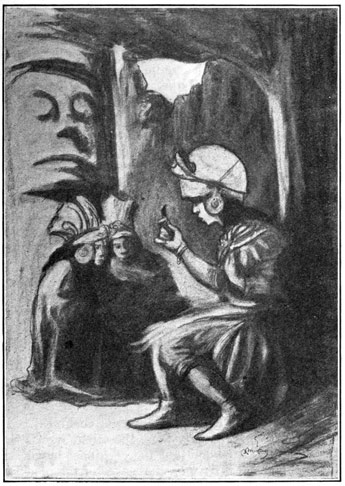
One morning early the king went to see the
Paba, who had charge of the sacred fires on the
altars built by the Golden Hearted himself. The
chamber in the temple was square, with the ceiling
covered by a lattice work of shining white and
yellow metal which, at the intersections, was carved
to represent flowers set with jewels. All around
the walls were sculptured pictures of men. As the
king approached the Paba said:
"The gloomy clouds hanging overhead are not
darker than is the mood of Quetzalcoatl, but to the
poor Paba the voice of the king is ever welcome."
"Why should the mood of Quetzalcoatl be
dark? A new teocalli holds his image, and they
say he is happy and that he comes from the place of
sunrise with a canoe filled with blessings."
"Do you remember, O king! that in some of
the underground chambers of this temple, besides
vast stores of wealth, there are prophecies to be
read?"
"I remember it well," said Montezuma.
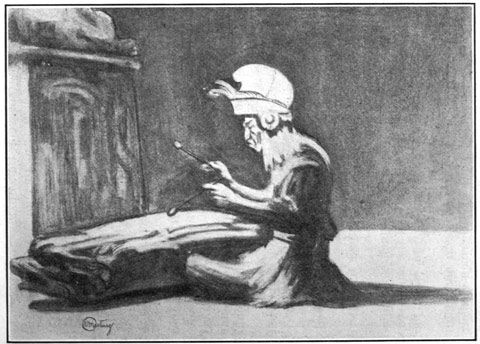
"Give me leave, and I will show you the writing
from Quetzalcoatl himself."
Groping their way through the great underground
cavern, but dimly lighted, the Paba said:
"Son of a king, is your heart strong? The writing
begins here and continues around the wall."
"Read it," said Montezuma.
"The first is here on the north and represents
the ancient king on the march. You see him in the
midst of warriors who are dancing in honor of his
victories. Here we have the whole story of our
race."
"This was before the coming of Quetzalcoatl
and is of the remote past," said Montezuma, with a
frown.
"On the southern wall, opposite," replied the
Paba, "is what you seek. Observe the king stands
on a rock, and a priest points out to him an eagle
on a cactus holding a serpent in its claws. Beside
it the king reclines on a couch. Our city has been
founded."
Montezuma said not a word, but turned to
another panel.
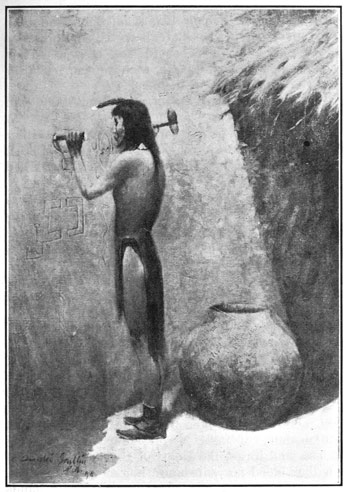
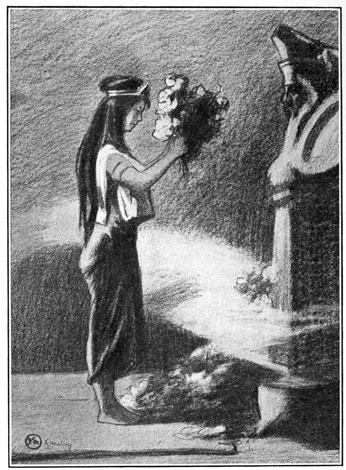
"Look well to this, O king! There is Quetzalcoatl
before an altar offering a sacrifice of fruit
and flowers. His hands are free from blood!"
Montezuma's face was deadly pale, because he
knew that many orders of priests in his kingdom
sacrificed human beings by cutting out their hearts,
and he was afraid that the coming of the strange
white men was on account of this forbidden
practice.
"See! Oh majesty! the fair god is departing
from our beloved Tenochtitlan. Saddest of all
days was that for us."
"Show me a prophecy if you would have me
believe that this was written by Quetzalcoatl. I
would know something of the future."
"Be wise, oh my master! Let the future
alone; it is sown with sorrows for all you love."
"Until I wrong the gods why should I fear
them? Have done, Paba. I, too, am a priest,"
said Montezuma, earnestly.
"I, his true servant, tell you never again to
look for smile from Tlapalla. I will show you
from Quetzalcoatl himself, that the end of your
empire is at hand. Every breeze from the east
is filled with woe for you and yours. The writing
is on the wall. Look again and closely."
"I see nothing," cried the king.
"All that you have heard about the return
of Quetzalcoatl is true. He is coming to end the
days of the Aztecs forever."
"Forever! It cannot be. Read the next
panel."
"There is no other, this is the last," answered
the Paba sadly.
Montezuma turned quickly to the north wall,
but found it without a single mark. Here indeed
was the end.
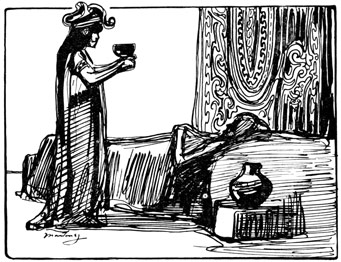
That night the Aztec king could neither eat nor
sleep. The prophecy was with him all the time.
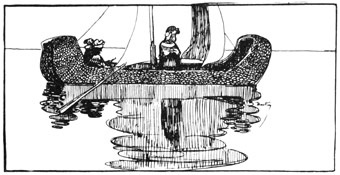
When the morning came he called for his canoe.
From the battlements of Chapultepec, the palace
and tomb of his fathers, he would see the sun rise.
If Quetzalcoatl was angered and meant to wreak
vengeance, he naturally supposed the sun, his
dwelling place, would give some warning.
In all the heavens around there was not a
fleck when suddenly a cloud of smoke rushed
upward, and across the pathway of the sun, so that
when it crept over the mountain range, it looked
like a ball of blood! Montezuma drew the hood
over his face quickly, and his head dropped on his
breast.
The Paba had spoken the truth. Quetzalcoatl
was coming! and next evening a runner sped hotly
over the causeway and up the street, stopping at
the gate of the royal palace. He was taken before
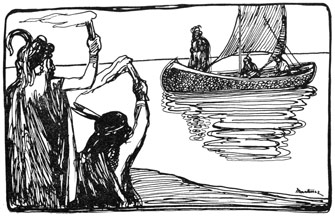
the king and shortly after the news went flying over
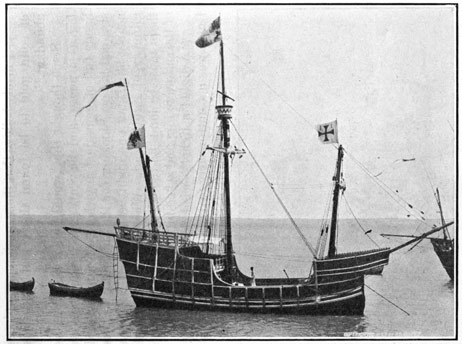
Tenochtitlan, that Quetzalcoatl had arrived in his
huge water-house with wings, and filled with
thunder and lightning! for that was what the
Aztecs called the ships and cannon brought by
Cortez.
When Montezuma heard of the terrible massacre
in Cholula, he called a council of wise old
men and said:
"Of what use is it, uncles? The gods are
against us and resistance is of no avail. I mourn
most for the women and children, and the old and
infirm who are too feeble to fight or fly. For myself
and the brave men around me, we must bare our
breasts to the storm and meet it as we may."
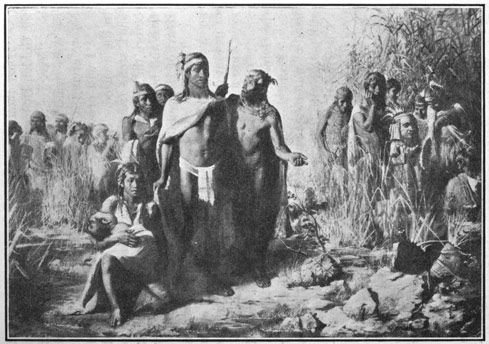
As Cortez neared Tenochtitlan he was met by
so many chiefs and nobles under Montezuma, that
it took them an hour to pass before him, and make
their salutation which they did by touching the
ground with the right hand and then carrying it
to the forehead. The four nobles carrying Montezuma
on their shoulders, were preceded by three
officers of state bearing gold wands in their hands
to show that they came in peace. The royal palanquin,
or chair, in which Montezuma was seated,
blazed with gold, jewels and gaudy feather-work,
while the nobles carrying it were barefooted.
They walked with slow measured steps and kept
their eyes bent on the ground. Finally the train
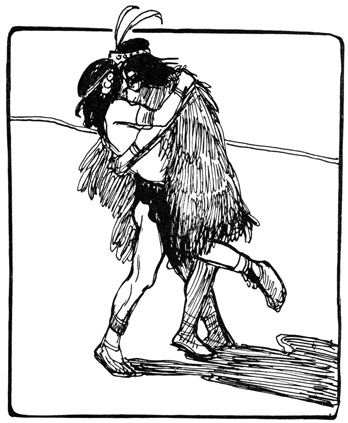
of warriors and nobles halted, and Montezuma
came forward to meet Cortez.
Imagine what their feelings must have been
as they looked at each other! Montezuma thought
he was welcoming back the gentle, kind Quetzalcoatl,
whom we know as the Golden Hearted, while
Cortez knew he had found more gold and riches
than he ever dreamed existed anywhere.
The poor misled Aztec king approached the
Spanish adventurer and putting an exquisitely
wrought gold collar around his neck said:
"This was my father's palace but it belongs
to you and your brethren. Rest here after your
fatigues and in a little while I will visit you
again."
When he went out of the palace he sent slaves
to wait upon them, and he gave each one new
clothes, and a splendid feast. When they had
finished eating, the rude soldiers searched all
through the palace for hidden wealth, and finding
the treasure house of the king proceeded to help
themselves. When Montezuma heard of it he said:
"They are welcome to the gold and silver and
other articles, if they will but spare the things
belonging to the gods."
In the palace grounds where they were
quartered they found an aviary filled with beautiful
singing birds; a menagerie full of strange animals,
and snakes; ten big tanks stocked with water-fowl
and fish; fountains playing everywhere, and
wonderful floating gardens on the lakes, while all
around them lay a city filled with temples, market
places, and handsome houses.
True to his promise Montezuma returned
shortly and in speaking to Cortez said:
"I have been expecting you for many days.
The wonderful deeds attributed to you, your complexion
and the quarter from whence you come
show me that you are Quetzalcoatl. You and
your brethren shall share all things with me," and
with tears in his eyes he gave them as many costly
presents as they could carry. The padres and
soldiers were constantly asked:
"Do you come from Tlapalla?" while Montezuma
did everything he could to please Cortez.
One day he went to the king's palace and after
accepting the usual presents of gold and silver,
Montezuma offered him one of his daughters for
a wife. Cortez declined, and seeing that the courtyard
was partly filled with his trusted men, he
approached Montezuma abruptly and said:
"You have treated me treacherously, and have
allowed one of my officers to be killed on the sea
coast."
Montezuma turned very pale. No one else in
his kingdom would have dared speak to him in
such an insulting manner, and besides that he
knew nothing of the death of the officer before. In
reality the officer had been murdered while torturing
the poor natives to make them give him more
gold.
"I demand that you send for the chief and all
the notable men in his council that I may punish
him for the death of my comrade," said Cortez,
trying to pick a quarrel with the king.
"Very well," said Montezuma, kindly. "I
will have them brought as you desire."
"I believe in your promise, but you must come
to my quarters as hostage until the thing is done."
Poor Montezuma thinking it was a command
of God did not dare refuse, and in a short time
afterward the chief and his council were brought
before him. He turned them over to Cortez for
punishment, and they were burned to death in the
public square, where Montezuma could see them
from his window. Cortez had the poor creatures
tortured to make them accuse Montezuma of telling
them to commit the murder, so that he would have
an excuse for what he intended to do to the king.
Pretending to believe the confessions, he went
before the king and ordered two common Spanish
soldiers to put him in irons. Poor Montezuma
moaned and groaned like his heart would break,
while his faithful attendants, weeping bitterly tried
to put their mantles under the irons so they would
not touch his flesh.
Cortez now demanded that he abdicate his
power, and pay tribute to Spain, so he compelled
the king to assemble all his chiefs, which he did
saying to them:
"You are acquainted with the traditions which
say that the good Quetzalcoatl is to return and rule
over us. That time has come and we must obey
our new masters. You have been faithful vassals
of mine, and I expect you to show me this last act
of obedience by acknowledging the great king
across the water as your lord also." The tears
streamed down his face, and his haughty chiefs
were very sad at heart, but they were loyal as well
as brave men, and they answered:
"Your will is our law, and if you think the
king of the strangers is the ancient lord of our
country we are willing to acknowledge him as
such."
As soon as this was done the grasping Spaniards
compelled Montezuma to send throughout
his kingdom for all the gold, silver, precious stones
and feather-work that could be found, in the name
of the king of Spain, but when they got it they
divided it among themselves, and then quarreled
fiercely over who should have the greater part.
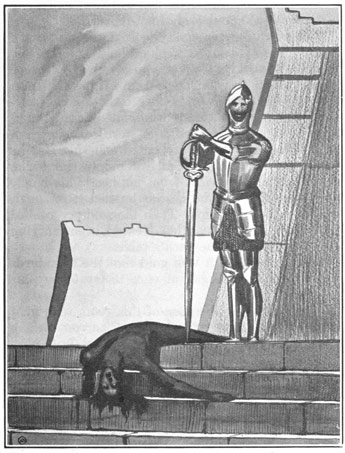
Here indeed was their fabled El Dorado!
There was but one more humiliation awaiting
Montezuma, and that was to have his own people
revile him. The Spaniards had been so brutal and
cruel in their dealings with the Aztecs that some of
them began to doubt whether they could have come
from Tlapalla, and whether Cortez was the Golden
Hearted. Knowing this Cortez induced Montezuma
to dress himself in his royal robes, and
appear on the stone parapet of the palace where he
was confined, to quiet the mob and induce them to
go about their work peaceably. Cortez was beginning
to fear for his own safety, but the populace
were not to be tricked by him. They did not believe
it was Montezuma before them, and hurling a stone
at the royal palanquin accidentally hit the unhappy
king on the forehead. The blow was not sufficient
to kill him, but he took to his bed and refused to
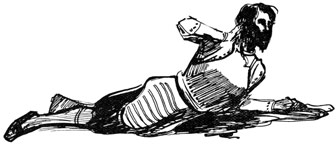
eat until he finally died. History says of him that
"his great heart was burst in twain by the sorrows
that oppressed his high courage." Certain it is
that he could not live when he found that both his
God and his people despised him. It has never
been known what became of his body, for a terrible
war followed his death.
Today we call his country and city Mexico.