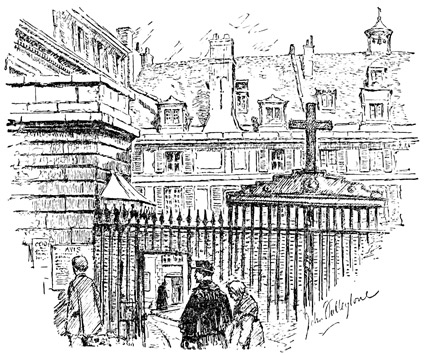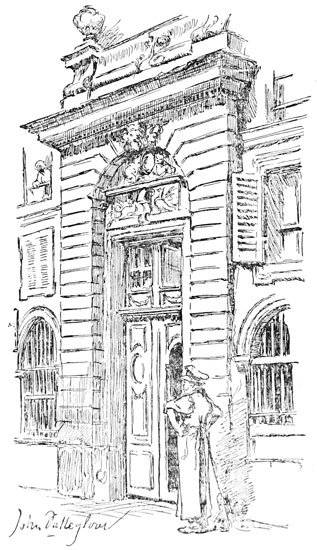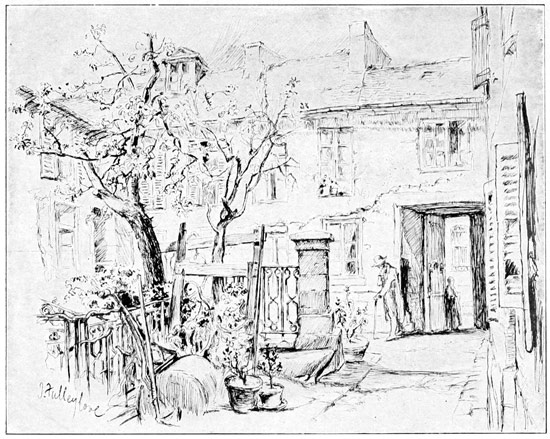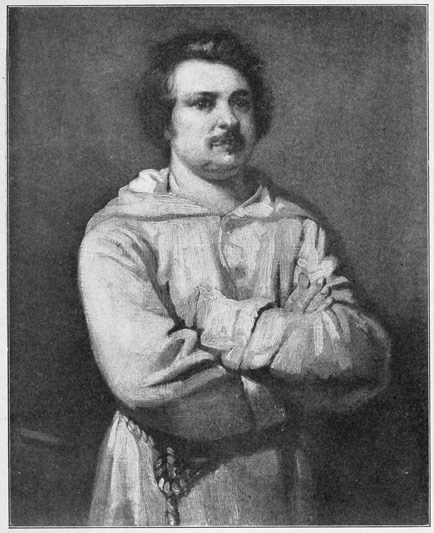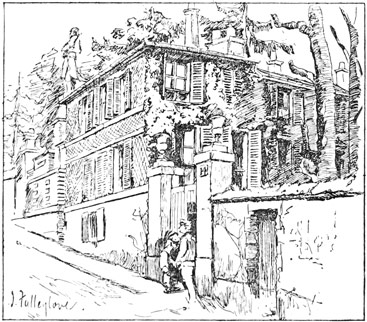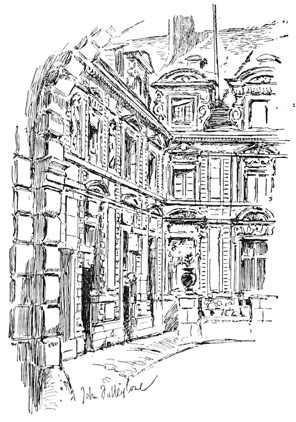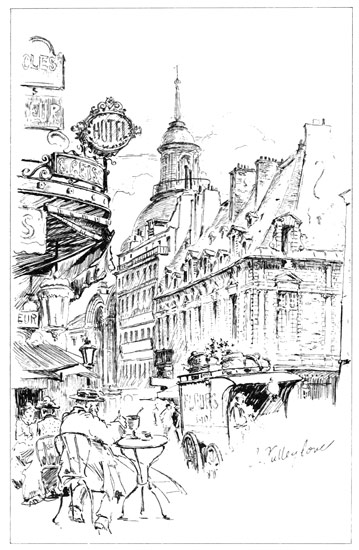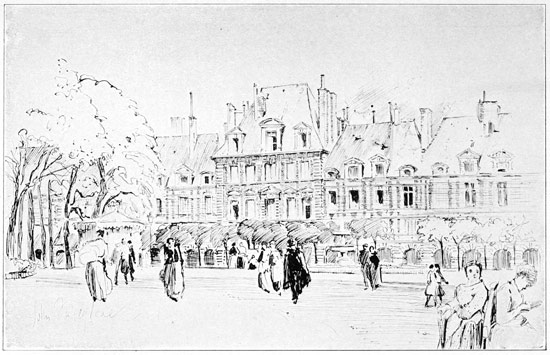
The Place des Vosges.
THE WOMEN OF THE MARAIS
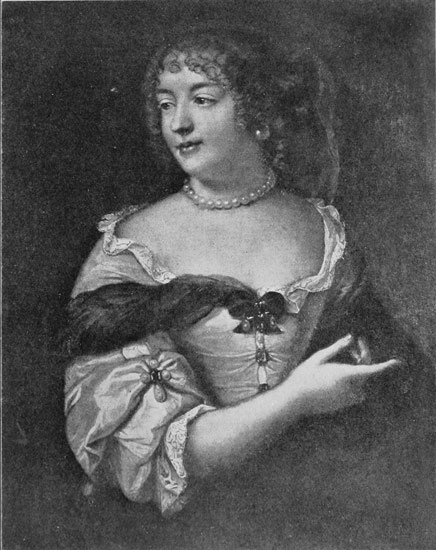
"Dans cet hôtel est née, le 6 Fevrier, 1626, Marie de
Rabutin-Chantal, Marquise de Sévigné:" so reads the
tablet set in that wall, which fronts on the square, of
the house numbered 1 Place des Vosges, having its entrance
at No. 11 Rue de Birague. There is no name
more closely linked with the Marais than that of this
illustrious woman. Born in this house, baptized in its
parish church of Saint-Paul-et-Saint-Louis, she here
grew up to girlhood; she was married in Saint-Gervais,
her daughter was married in Saint-Nicolas-des-Champs;
and the greater portion of her life was passed
within this quarter. Her father was killed in a duel a
few months after her birth, at the age of seven she lost
her mother, and when only twenty-five years old, she
found herself a widow. After a short sojourn in the
provinces with her son and daughter, she came back,
in 1655, to Paris and to the Marais. She had casual
and unsettled domiciles, for many years, in Rues de
Thorigny, Barbette, des Francs-Bourgeois, des Lions-Saint-Paul,
des Tournelles—all within our chosen district—before
she settled in her home of twenty years,
the Carnavalet.
It is but a step away from this tablet above us, to
the corner of Rues des Francs-Bourgeois and Sévigné;
the latter street, at that time, bearing its original
name of Culture-Sainte-Catherine, having been opened
through that portion under cultivation of the grounds
of the great monastery of Sainte-Catherine du Val-des-Écoliers.
On the corner of this new street and that of
Francs-Bourgeois—then Rue Neuve-Sainte-Catherine—a
piece of the convent garden was bought by Jacques
de Ligneris, and thereon a house for his residence was
erected. Its plans were drawn by Pierre Lescot, it
was built by Jean Bullant, was decorated by Androuët
du Cerceau, and its sculptures were carved by Jean
Goujon. And thus these walls, on which we are looking,
speak in mute laudation of four famous men. One
more notable name may be added to this list—that of
François Mansart. He was called in, a century or so
after the completion of this mansion, for its renovation
and enlargement; and, to his lasting honor, he contented
himself with doing only what seemed to him to
be imperatively demanded, and with attempting no
"improvements" nor "restoration" of the work of
his great predecessors. He knew what we have learned,
that those words too often mean desecration and ruin
to all historic monuments in all lands. During this
interval, the building had come into the hands of Françoise
de la Baume, Dame de Kernévalec, whose Breton
name, corrupted to Carnavalet, has clung to it ever
since. That name suggested the pun of the carnaval
masks, carved in stone over the arches of the wings in
the court. They were done by a later hand than that of
Goujon, whose last work is to be seen about that window
of the Louvre, on which he was busy, when a
bullet picked him off, a day or two after the night
of Saint Bartholomew. The tranquil elegance of his
chisel has adorned this almost perfect gateway with the
graceful winged figure in its keystone. It lifts and
lightens the severe dignity of the façade. And, in the
court—its centre not unworthily held by the bronze
statue of Louis XIV., remarkable in its exquisite details,
found in the old Hôtel de Ville—we linger in joy
before the graceful flowing curves and the daylight
directness of the Seasons of this French Phidias. The
figures on the wings are from a feebler chisel than his.
Of all the crowding memories of this spot, those of the
Marquise de Sévigné and of Jean Goujon are the most
vivid and the most captivating. The busts of these two,
one on either side, greet us at the head of the staircase
leading to her apartments; she is alert and winsome,
he is sedate and thoughtful and a trifle too stern for the
most amiable of sculptors, as he shows himself here,
rather than the staunch Huguenot, killed for his convictions.
She was fifty-one years of age by the records when
she came to live here, in 1677, and half that age at heart,
which she kept always young. She had been so long
camping about in the Marais, that she was impatient to
settle down in the ideal dwelling she had found, at last.
She writes to her daughter: "Dieu merci, nous avons
l'hôtel Carnavalet. C'est une affaire admirable; nous
y tiendrons tous, et nous aurons le bel air. Comme on
ne peut pas tout avoir, il faut se passer des parquets,
et des petites cheminées a la mode.... Pour moi,
je vais vous ranger la Carnavalette, car, enfin, nous
l'avons, et j'en suis fort aise."
So she moved in, with her son and daughter, both
dear to her. It was to the daughter, however, that the
mother's affluence of affection flowed out, all through
her life; and it may well be that this veritable passion
saved her from all other passions, during the years of
her long widowhood, when many a grand parti fell at
her feet. She looked on them all alike, with pity for
their seizure, and each of them got up and walked away,
unappeased. Yet hers was a rich nature, wholesome
and womanly withal, and there are potentialities of
emotion in the pouting lips and inviting eyes of the
pretty pagan of this bust. Nor was she a prude, and
her way of quoting Rabelais and listening to La Fontaine's
verses would horrify us moderns of queasy
stomachs. She had ready pardon for the infidelities
of her husband, and later for the misdeeds of her
scampish cousin, Bussy-Rabutin, "the most dangerous
tongue in France."
Above all, this real woman showed a masculine
strength and loyalty of friendship for men; showed it
most markedly in her sympathy for those who had fallen
in the world. There is no finer example in the annals
of constancy than her devotion to the broken Fouquet,
howbeit he may have merited breaking. The spirit of
her letters, at the time of his disgrace and imprisonment,
cannot be twisted into anything ignoble, as Napoleon
tried to do, on reading them in the State archives.
He sneeringly suggested that her sympathy with Fouquet
was "bien chaud, bien vif, bien tendre, pour de la
simple amitié." So it was, indeed; for her friendships
were attachments, and warmth and tenderness
pulsate in all her letters; and these qualities will, along
with their unpremeditated spontaneity, keep them alive
as long as letters live. What else was in her letters
has been told by Nodier, when he says that they regulated
and purified the language for ordinary use; and
by Jules Janin, who rightly claims that, from this Carnavalet,
came the purest and most perfect French
hitherto heard in France.
In forming and housing the great collection of the
History of Paris, to which the Musée Carnavalet is devoted,
new buildings about a trim garden in the rear
have been added to the original mansion, whose own
rooms have been subjected to as little change as possible.
Madame de Sévigné's apartment, on the first
floor, is hardly altered, and her bedroom and salon have
been especially kept inviolate. The admirable mouldings,
the curious mirrors, the old-fashioned lustre, remain
as she left them, when she went to her daughter
at Grignan to die. In this salon, and in the wide corridor
leading to it, both now so silent and pensive, she
received all the men of her day worth receiving; and
it is here alone that we breathe the very atmosphere of
this incomparable creature.
We may join the early-goers among these men, who
make their way to another house, not far distant. There
are temptations to stop before, and explore within, the
seventeenth-century mansions all along Rues Sévigné
and du Parc-Royal, but we pass on into Rue Turenne—once
Rue Saint-Louis, the longest and widest and
foremost in fashion of Marais streets, now merely big
and bustling, with little left of its ancient glory—until
we come to its No. 58, on the corner of old Rue des
Douze-Portes, now named Ville-Hardouin, after the
contemporary chronicler of the Fifth Crusade. This
modest house at the corner has been luckily overlooked
by the modern rebuilder of this quarter, who has not
touched its two stories and low attic above a ground
floor, its unobtrusive portal, its narrow hall, and its
staircase; small and quaint, in keeping with the cripple
who was carried up and down for many years. Paul
Scarron lived here, in the apartment au deuzième à
droite, dubbed the "Hôtel de l'Impécuniosité" by his
young wife, who was the granddaughter of the Calvinist
leader, Agrippa d'Aubigné, and who was to be
the second wife of Louis XIV. Sitting at her scantily
supplied supper-table here, the maid would whisper
that a course was lacking, and that an anecdote from
the hostess must fill the bill of fare instead. Goldsmith
tells us, at the beginning of his "Retaliation:"
"Of old when Scarron his companions invited,
Each guest brought his dish, and the feast was united."
And, just here, it is curious to recall the fact that Goldsmith
was busied, during the last months of his life,
on a translation of Scarron's "Roman Comique," and
his bethumbed copy was found on his desk, after his
death.
Scarron was always poor and always importunate,
and yet he was "a pleasant prodigy never before seen,"
he says of himself; rightfully claiming that he was able
"to sport with misery and jest in pain." Paralyzed
and still a prey to incurable torments, immovable in
his armchair except for his nimble fingers, he drove his
pen merrily to the making of comedies, tales, pamphlets,
and the verse that, like him, was impishly awry with
mockery, as if chattered by "a wilderness of monkeys."
Letters, too, he wrote in this house, that give us striking
glimpses of the man and of his time. In them we
discover that "most terribly" was the sanctified slang
then for the modern abomination "awfully." Appeals
for money make up much of his correspondence, but
there is never a hint of a loan in the charming letters
to the "belle ange en deuil," Madame de Sévigné; in
which he always assures her that she is a dangerous
person, and that those who look on her without due
care, grow sick upon it immediately, and are not long-lived.
Mlle. de Lenclos was a favorite of his, too, and
that "charmant objet, belle Ninon," came to sit for
hours beside his invalid-chair. She made friends with
the young wife, too, but complained that she was
"trop gauche" to learn gallantry, and was "vertueuse
par faiblesse." The large-minded lady frankly owns:
"J'aurais voulu l'en guérir, mais elle craignait trop
Dieu." For all that, the friendship then formed between
the two women was never broken, and when the
widow Scarron came to position and power she offered
a place at court to her elder friend; an offer that
was refused, for the old lady never grew old enough
to change her mode of life. And there is little doubt
that the younger woman often looked back with longing
to those wretched days that were so happy. She
said once, seeing the carp dying of surfeit in the Versailles
pond: "Elles regrettent leur bourbe," suggesting
that, like them, she suffered from satiety.
Years before his marriage, Scarron had lived with
his sister in this same little street of "Twelve Doors,"
and had grown very fond of the "beau quartier des
Marests." He asks: "Who can stay long from the
Place Royale?" When he returned to Paris in 1654—having
married in 1652, and having made a long stay in
Touraine—he came back to his beloved Marais, and
took a three-years' lease of this apartment. At its
termination the lease was probably renewed, for it is a
time-honored tradition that makes this old house the
place of his death, on October 14, 1660.
Between fifty and one hundred years later—the exact
date is not to be got at—the garret above was crowded
with the pet dogs and cats and birds of Prosper
Jolyot de Crébillon, who lived in filth among them,
seldom eating, never washing, always smoking. The
big blond dramatist had fallen a victim to poverty and
melancholy, after a short career of success on those
boards which he stained with the blood of many violent
deaths. He had said that, since Corneille had taken
heaven for his own and Racine had seized upon earth,
he could place his scenes only in hell. He was rescued,
and taken from this garret, by the pension obtained
through La Pompadour. That great lady was not
prompted by any comprehension of the sombre power
of his tragedy, but by a desire to wreak her spite against
Voltaire by the exaltation of a rival.
Scarron's widow was left in poor case, with only her
husband's small pension for support, and this was
stopped by Colbert on the death of Anne of Austria, in
1666. That Queen-Mother had endowed an institution
for poor girls and sick women, and with these
"Hospitalières de la Place Royale," Madame Scarron
found shelter, having sold all that she owned. In 1669
she was put in charge of the first child of the King and
Madame de Montespan, and we know all the rest, to the
secret marriage in 1685. Such of the buildings of the
"Hospitalières" as are left now form part of the Hôpital
Andral, and their old roofs and dormers and chimneys
take our eye above the low wall as we turn into
Rue des Tournelles. In this street is the hospital's
main entrance, and through its gate we look across the
garden, that stretches back to the former entrance in
Impasse de Béarn; now opened only to carry out for
burial the bodies of those dying in the hospital.
The line of walls along Rue des Tournelles was
broken by only a few isolated houses, when François
Mansart selected a site here, and put thereon his own
dwelling, unpretending as the man himself, in contrast
with the grand mansions he had planned for his
noble and wealthy clients. This is his modest entrance-court,
at No. 28 Rue des Tournelles, and behind it is
the simple façade of his hôtel. This building probably
formed his entire frontage, or it may have been the
corps-de-logis of a more extensive structure, whose
two wings reached out toward the street at Nos. 26 and
30. This number 28, whether the central or the entire
body of the building, remains in perfect preservation.
At Mansart's death, in 1666, it came, along with
most of his property, to his sister's son, whom he had
adopted, and trained to be the architect known as Jules
Hardouin Mansart. He gained position and pay in
the royal employ, more by this adoptive name than by
his abilities. As Superintendent of Buildings under
Louis XIV. he is responsible for most of the horrors of
the palace of Versailles, yet the dome of the Invalides
proves him to have been capable of less meretricious
work.
On taking possession of his uncle's mansion, he had,
as sole tenant of his spacious and inviting first floor,
Mlle. Anne Lenclos, popularly christened Ninon de
Lenclos, then fifty years of age. Her dwelling is the
end and object of this short walk, and together with the
house from which we started, and the one at which we
stopped, it gives us a complete picture of the social doings
of the Marais at that period. We are allowed to
enter among the men with whom we have come, and we
will go in, let us say, with young de Sévigné, who finds
his way here frequently, from his pied-à-terre in his
mother's house, as his father and his grandfather had
found their way to Ninon's abode. Under the stone
balcony on the court-front we step up into a goodly
hall, from which rises a stone staircase, its outer end
finely carved, its steps well worn by many visitors
through the years. An admirable medallion looks down
from the wall as we mount, and in the rooms above
we find carved panels and decorated ceilings, many of
them done by Lebrun and Mignard, probably for the
fair tenant. They are so carefully kept that canvas
covers such of them as are feared to be "trop lestes"
for modern eyes, in the modest words of the ancient
concierge. Mansart put an excellent façade on his
garden-front, and its coupled Ionic columns, and balconies
of wrought-iron railings, are all there unmutilated.
But the garden, then stretching to Boulevard
Beaumarchais, is now hidden under the shops that
front on that boulevard.
To these rooms and this garden thronged the same
men whom we have seen in the Sévigné and Scudéry
salons, and these reunions were as decorous as those,
and perhaps somewhat more cheerful and more natural
in tone. For, while Ninon had the honor of being enrolled
in the "Grand Dictionnaire des Précieuses,"
published in 1661, and while she had been presented at
the Hôtel de Rambouillet at the early age of seventeen,
she had none of the pretensions nor the ridiculosities of
"Les Femmes Savantes." She was absolutely genuine,
not ashamed to be natural, quite ready to laugh or to cry
with her friends. These friends, drawn to her less by
her beauty than by her charm, were held always by her
sunny amiability, her quick sympathies, her frank
camaraderie. She was the Clarisse of Mlle. de
Scudéry's "Clélie;" an enjouée aimable, who never
denied herself the indulgence of any caprice of head
or of heart. Yet, as she laughingly confessed, while
she thanked God every night for the good wits given
her, she prayed every morning for better protection
against the follies of her heart. It is a faithful portrait
that is given in the verse of her day:
"L'indulgente et sage Nature
A formé l'âme de Ninon,
De la volupté d'Épicure,
Et de la vertu de Caton."
Beyond most women of that time, she was really
cultivated, in the best meaning of that word; far different
from the meaningless Culture with a capital, of
our time. She was fond of philosophy, withal, and
took turns with Plato and with Montaigne; and would
speculate on the problems of life either with Church
dignitaries or with the epicurean Saint-Évremond.
And she captivated them all, men of all sorts, beginning
with her girlish years—when she dutifully obeyed her
father, who preached pleasure to her, rather than her
mother, who pushed her toward a convent—through
all her long life of incredibly youthful heart and body,
to her amazing conquests when over sixty. A portrait
of her at about this age hangs in Knole House, Sevenoaks;
her hair, parted down the middle and plainly
drawn back in modest fashion, her alluring eyes and her
ingenuous direct smile, give her the look of a girl.
Richelieu was her first admirer, Voltaire was the latest.
When brought to this house, where he celebrated
Ninon's ninetieth birthday in verse, young Arouet was
only about twelve years old, as was told in a preceding
chapter. She was charmed with the youthful genius,
and, dying within a few weeks, in 1706, she left him
two thousand crowns for buying his beloved books.
From five until nine in the evening, Ninon was "at
home" here, up to her eighty-fourth year, in 1700. Before
her visitors went away, they sat down to a simple
supper, served with no parade and at small expense.
Many of the guests, following the fashion of Scarron's
friends and of the persistent diners-out of that
day, brought their own plats. We get a glimpse of the
simplicity of these suppers "à tous les Despréaux et
tous les Racines," and of the homely, social ways of the
bourgeoisie, in Voltaire's tiresome comedy "Le Dépositaire."
We look about these rooms, in which we are standing,
and wish we might have seen Boileau and Racine
here; we seem to see Molière, reading his unacted and
still unnamed play, and consulting his hostess as to
whether "Tartufe" will do for a title; and old Corneille,
forgetting to be shy and clumsy at her side; and
Scarron, wheeled in his chair, quicker in his scoffing
for her quick catching of the point; and La Rochefoucauld,
less of a surly and egotistic poseur in her presence,
content to sparkle as a boudoir Machiavelli; and
Huyghens, fresh from his discovery of the moons of
Saturn, finding here a heavenly body of unwonted radiance,
and setting to work to write erotic verse mixed
with mathematics. The great Condé himself, proud,
vain, hardest-hearted of men, melts when he meets
her; broken and decrepit, he climbs out from his sedan-chair—"that
wonderful fortification against bad
weather and the insults of the mud," says delicious
Mascarille—and approaches, hat in hand, the calèche
of that other aged warrior, Ninon de Lenclos.
Through No. 23 of Boulevard Beaumarchais, which
occupies the site of her garden, we come out on that
broad thoroughfare, passing on our right the buildings
covering the gardens that once countrified this east side
of Rue des Tournelles. We cannot now search among
the houses there for that one inhabited by the Abbé
Prévost, some time between 1730 and 1740, while he
was writing his enthralling story of "Manon Lescaut."
Almost at the end of the boulevard, men are sitting
about tin tables on the pavement, drinking good beer,
on the very site of the gate of Saint-Antoine. Just
there, outside the gate, stood Lady de Winter, pointing
out to her two hired assassins her pet enemy, d'Artagnan,
as he rode out on the Vincennes road, on his way to
the siege of Rochelle. The gate abutted on the western
side of the Bastille, and its figures, carved by Jean
Goujon for decorations of a later day, may be seen in
the Cluny Gardens.
Traced in the pavement of Place de la Bastille and
across Rue Saint-Antoine, you may follow the outlines
of such portions of the walls and towers of the great
prison as are not hidden under the houses at the two
corners. When you ask for your number in the omnibus
office of the place, you are standing in the Bastille's
inner court. Across its outer eastern ditch and connected
with the wall of Charles V., was thrown a projecting
bastion, the tower of which stood exactly where
now rises the Column of July. At the corner of Rues
Saint-Antoine and Jacques-Cœur, a tablet shows the
site of the gateway that gave entrance to the outer
court, which led southwardly along the line of the latter
small street. By this gateway the armed mob entered
on July 14, 1789. Lazy Louis XVI., hard at work
on locks and other trifles at Versailles—having as yet
no news from Paris—writes in his diary for that day:
"Rien"! That mob had found the fortress as little
capable of resistance as the throne that it overturned
a while later; both proved to be but baseless fabrics of
an unduly dreaded terror. Indeed, it was the power
behind this prison that was stormed on that day. There
were plenty of prisons in Paris, as fast and as secret as
was the Bastille. This was more than a prison to these
people; it gloomed over their lives as its towers
gloomed over their street—a mysterious and menacing
defiance, a dumb and docile doer of shady deeds, a symbol
of an authority feared and hated. And so these
people first tore away the tool, and then disabled the
hand that had held it. It was a stirring act in the
drama, though a trifle melodramatic.
"Palloy le Patriote," as he styled himself, takes the
centre of the stage just here, and, like all professional
patriots, in all lands and all times, he makes a good
thing of his patriotism. He was the contractor for
demolishing the walls and for clearing the ground of
the wreckage, at a handsome price; and he doubled his
wage by the sale of the materials. Some of the stones
went, queerly enough, to the building of Pont de la
Concorde; others of them may be seen in the walls of
the house on the western corner of Boulevard Poissonière
and Rue Saint-Fiacre, and of other houses in
the town. With the stones not fit for these uses, and
with the mortar, he made numerous models of the Bastille,
which were purchased by the committees and sent
as souvenirs to the chief towns of the then newly created
departments. One of these models is in the Musée
Carnavalet. So, too, the thrifty Palloy turned the ironwork
dug out into hat and shoe buckles, and the woodwork
into canes and fans and tobacco-boxes; all, at
last, into coin for his patriotic pocket. The gate of one
of the cells was removed, and rebuilt in the prison of
Sainte-Pélagie; where it may be seen by the inmates,
who care nothing for a door more or less, but never by
the outsider, who would like to get in for a glimpse!
To "Palloy the Patriotic" and his gang of a thousand
workingmen, rides up on his white horse, one day, the
first commander of the just invented and organized
National Guard—Lafayette, aptly named by Mirabeau
the "Cromwell-Grandison" of his nation. He looks
over the busy ground, and gives orders that the men
shall receive a pint of wine and a half-franc daily; but
they got neither money nor wine, both doubtless "conveyed,
the wise it called," on the way, by Palloy or by
other "patriots." Lafayette carried away the great key
of the Bastille's great entrance-door, and sent it to
George Washington by Thomas Paine, when, a few
years later, Paine got out of the Luxembourg prison
and out of France. It is one of the cherished relics at
Mount Vernon, and not one is more impressive and
more appropriate in that place, since it was the success
of the American revolutionists that inspirited those
who opened the Bastille.
We pass along Rue Saint-Antoine, so commonplace
and sordid to-day, so crowded with history and tradition.
It has seen, in its short length, pageants of
royalty and nobility, the hide-and-seek of romance, the
blood-letting of sharp blades, the carnage of the common
people, such as no other street of any other town
has known. Its memories would fill a fat volume.
The little temple of Sainte-Marie on our left, as we
go—a reduced imitation of Rome's Pantheon—is a
design by François Mansart, and while it has his grace
of line and his other qualities, it is not a notable work.
Built on the site of the Hôtel de Boissy, wherein Quélus
died and his lover Henry wept, it was intended for the
chapel of the "Filles de la Visitation," and their name
clings to it, although it has been made over to the Protestant
Church. To this convent fled Mlle. Louise de la
Fayette from Louis XIII.; who, ardent in the only love
and the only chase known in his platonic career, visited
her here until his confessor, Vincent de Paul, showed
him the scandal of a King going to a nunnery. So he
had to leave her, secure under the veil and the vows of
the cloister. She became Sœur, and later Mère, Angélique,
of the Convent of Sainte-Madeleine, founded
in 1651 by Henrietta Maria, widow of Charles I.,
which stood on the far-away heights of Chaillot, where
now is the museum of the Trocadéro. There the sister
and the sweetheart of Louis XIII. lived together for
many years.
A few steps farther, and we come to Rue Beautreillis;
its pavement and its houses on both sides,
nearly as far as Rue Charles V., covering the Cemetery
of old Saint-Paul; which extended westerly toward
Passage Saint-Pierre, wherein we may find the stone
walls, now roofed in with wood, of the charniers.
There had been a suburban cemetery outside the old
wall, which was brought within city limits by the new
wall, and served as the burial-ground of the prisoners
who died in the Bastille. It did not so serve,
as is commonly asserted, for the skeletons found in
chains in the cells, when the prison was opened by
righteous violence, because no such skeletons were
found. "The Man in the Iron Mask" was buried
in this ground, close alongside the grave of Rabelais,
dug exactly one hundred and fifty years earlier. Pass
through the two courts that lie in the rear of No. 17 Rue
Beautreillis, and you will find yourself in a large waste
garden, in one corner of which the persuasive concierge
points out the grave of the "Masque-de-Fer." It may
well be that she is not misled by topographical pride,
for this ground was certainly a portion of the old burial-ground,
and not impossibly that portion where Rabelais
and "Marchioly" were laid near together. This is the
prisoner's name on the Bastille's burial-register, and
not far from his real name. For we know, as surely as
we shall ever know, that this prisoner of State was the
Count Ercolo Antonio Mattioli, Secretary of State of
Charles IV., Duke of Mantua. The count had agreed to
betray his trust and to sell his master's fortress of Casali
to the French representative; with this in their possession,
Pignerol belonging already to France, Louis XIV.
and Louvois would dominate all upper Italy. Mattioli
took his pay, and betrayed his paymaster; the scheme
miscarried, and the schemer deserved another sort of
reward. His open arrest, or execution, or any public
punishment, meant exposure and scandal to the Crown
and the Minister and the Ambassador of France. So he
was secretly kidnapped, and became "The Man in the
Iron Mask." At his death, in 1703, his face was mutilated,
lest there might be recognition, even then; the
walls of his cell were scraped and painted, to obliterate
any marks he might have put on them; his linen and
clothing and furniture were burned. Had Voltaire
suspected the results of modern research, he would not
have put forth his theory, in the second edition of his
"Questions sur l'Encyclopédie," that this prisoner was
an elder brother of Louis XIV. Yet, but for Voltaire's
error, we should have lost those delightful pages
of Dumas, wherein Aramis carries off from the Bastille
this elder brother and rightful heir to the crown, leaving
Louis XIV. in the cell, and at last replaces his puppets
in their original positions.
This Cemetery of Saint-Paul, dating back to Dagobert,
when the burial-grounds on the Island had become
overpeopled, had its own small chapel of the same
name, which had fallen out of use and into ruin.
Charles V., bringing it within his enclosure of the
Hôtel Saint-Paul, rebuilt and enlarged it and made it
the church of the royal parish. All the daughters and
the sons of France were thenceforth baptized here, and
it became the favorite church of the nobility. After
Louis XI.'s time, and the desertion of this quarter by
royalty, the little church lost its vogue. In 1794 it was
appropriated and sold as National Domain, and torn
down soon after. Its site is covered by the buildings on
and behind the eastern side of Rue Saint-Paul, opposite
the space between Passage Saint-Paul and Rue Eginhard.
This is the small street selected by Alphonse
Daudet for the shop of his brocanteur Leemans, to
which comes the fascinating Sephora, of "Les Rois en
Exil." Daudet has overdone it in going so far for his
local color; the street is a noisome alley, entered by an
archway from Rue Saint-Paul, holding only two or
three obscene junk-shops.
And now, passing the flamboyant Italian façade—a
meretricious imitation of the front of Saint-Gervais—of
the Church of Saint-Paul-et-Saint-Louis, which has
absorbed the name of old Saint-Paul, we reach at last
the ample space where the two streets of Rivoli and
of Saint-Antoine meet and so make one broad, unbroken
thoroughfare through the length of the town,
from the place where the Bastille was to the place now
named Concorde. This grand highway has existed
only since the middle of the nineteenth century. The
Consulate and the First Empire had cut Rue de Rivoli
along the upper edge of the Tuileries Gardens as far
easterly as Rue de Rohan; from there it was prolonged,
taking the line of some of the old, narrow streets and
piercing through solid masses of ancient buildings, in
the last years of Louis-Philippe; and was carried from
the Hôtel de Ville to this point by the Second Empire.
All through earlier days, the route, common and royal,
from the Louvre and the Tuileries to the Hôtel
Saint-Paul, the Tournelles, the Bastille, and the Arsenal,
was by way of narrow Rue Saint-Honoré and
its narrower continuation, Rue de la Ferronerie, thence
around by Rue Saint-Denis into Rue des Lombards,
and so along Rues de la Verrerie and Roi-de-Sicile to
the old gate of Saint-Antoine, that stood just behind
us here at the end of Rue Malher. Outside that gate
was the country road leading to Vincennes, which
was transformed into the city street, known to us as
Rue Saint-Antoine, through the protection given by
Charles V.'s new wall and by his Bastille. There had
been, long before, a Rue Saint-Antoine, and it curves
away here on our left, and is called Rue François-Miron,
so named in honor of that Prévôt des Marchands
in Henri IV.'s time, who merits remembrance
as an honest, high-minded, capable administrator of his
weighty office.
Thus this street of old Saint-Antoine was the thoroughfare—at
first from the entrance into the town by
the old gate of Saint-Antoine, and afterward from the
new street of Saint-Antoine and its entrance gate
farther east—to the open space behind the Hôtel de
Ville, alongside Saint-Gervais, and so to the bridges
and the Palace on the Island. It was a street "marvellously
rich" in shops, having no rival except in
Rue Saint-Denis. Its shopkeepers shouted, from their
doors or from the pavement in front, the merits of
their wares to the throng swarming always along.
Their wares were worthy of the city that, with its
fast-growing population, equalled Venice herself in
wealth, display, and splendor, if we may trust the
word of an exultant scribbling citizen of the Paris of
Charles V.
So, too, it was the grand highway for royal entries,
for troops, for ambassadors with their trains, for any
parade that demanded display and attracted spectators.
Such an array came along here on August 26, 1660,
when young Louis XIV. brought into his town his
young bride, Maria Theresa of Spain, each of them being
just twenty-two years old. It was the showiest
pageant and the longest procession yet seen in Paris,
taking ten or twelve hours to pass. The bride—a
slight, pretty, girlish figure, in white satin and pearls,
and a violet mantle of velvet—leaned back on the crimson
velvet of her huge gilded chariot; at her right on
horseback was the King, in cloth-of-gold and black
lace, his collars and ruffles of white point. In the resplendent
retinue nothing so blazed as the superb
empty coach of the Cardinal-Minister Mazarin, its
panels painted by Lebrun, drawn by the famous mules
and escorted by the Mousquetaires. Less than a year
later Mazarin was carried through Paris in his hearse,
caring no more for mules or any tomfoolery.
The procession had entered the town under Claude
Perrault's triumphal arch at the end of the Vincennes
Avenue, and through Porte Saint-Antoine, cleaned up
and sculptured afresh for this day, and so by new
Rue Saint-Antoine, along this present Rue François-Miron.
It was packed with spectators, among whom
was La Fontaine, who sent a long rhymed description
of the show to his patron, Fouquet, not omitting mention
of the cardinal's mules. These, too, were spoken
of with fitting praise in a letter written to a friend by
young Madame Scarron—to be a widow, within a few
weeks—who was also in the throng. Years after, she
confessed to the credulous King that on that day she
had first seen him and first loved him, and that she
had never ceased to love him since! We may not consider
the Duchess of Orleans unduly prejudiced when
she refers to Madame de Maintenon as "that hussy."
At No. 88 Rue François-Miron you may see an
excellent balcony of that period, solidly and richly
wrought in iron, supported by captivating stone dragons
of fantastic design. There were similar balconies
on the front of the great mansion at No. 68—which
was then No. 62—but of these only a small one is still
left over the portal. They were all crowded with a
most select mob of the elect on the day of this procession.
There was Anne of Austria, in her black
mantle, looking down on her son, her thoughts turning
back to her own bridal procession over the same
route, and her own youthful blond beauty of forty-five
years before. By her side sat Henrietta of France,
widow of Charles I., and her daughter, Henrietta
Anne of England. The girl may have gazed with
curiosity on the over-dressed fop riding at the bride's
left wheel. This was Philippe d'Orléans, who was to
be her husband, and was, through his complacent creatures,
to poison her within ten years from this day.
In another balcony sat Mazarin, too ill to take part in
the procession.
The hostess of these great ladies was one Catherine
Bellier, wife of Pierre de Beauvais; and this house
is the Hôtel de Beauvais. The husband had been a
pedlar or a shopkeeper, and had amassed sufficient
wealth from ribbons to enable him to buy his title.
The wife had served as first femme-de-chambre to
Anne of Austria, and had so learned many secrets of
that queer court, of its Queen-Mother, and of her
Cardinal. In that court there was no more unscrupulous
creature than this Catherine Bellier. The deliciously
outspoken Duchess of Orleans—the second
wife of that Philippe we have just seen—describes this
woman as one-eyed and hideous, of profligate life, and
apt in all intrigue. To the day of her death she loved
to appear in flamboyant costumes at the court, where
she was treated with distinction because of what she
knew. Anne of Austria gave her the stone for the
construction of this hôtel, and she used to visit her
waiting-woman and confidente here. A popular verse
of the day ran:
"Mercredi notre auguste Reine,
Cette charmante Souveraine,
Fut chez Madame de Beauvais;
Pour de son admirable palais
Voir les merveilles étonnantes,
Et les raretés surprenantes."
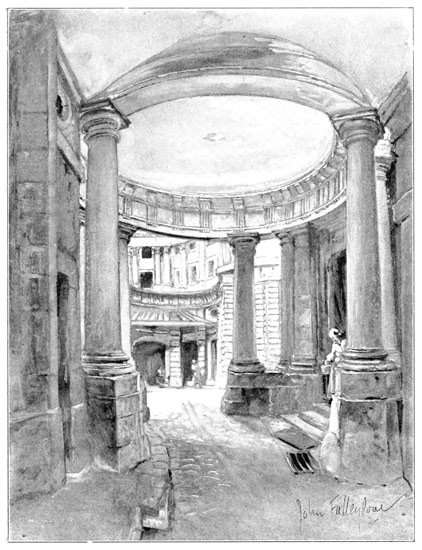
The Hôtel de Beauvais.
The design of the Hôtel de Beauvais, by Antoine
Lepautre, is most daring and original in its great interior
oval court, embellished with pilasters that are
topped with finely carved stone masks. Despite the
unhallowed devotion to cleanliness which, with its
whitewash, has robbed it of its former lovely bloom
of age, this court remains one of the most impressive
specimens of seventeenth-century domestic architecture
in all Paris. From the street we pass through an
ample gateway, its curved top surmounted by a great
shell. The vestibule is ornamented with escutcheons,
alternating with the garlanded ox-skulls of Roman-Doric
decoration—mistaken by many for rams' heads,
so as to make a sculptor's pun on Bellier—all admirably
carved in stone. The noble staircase has Corinthian
columns, and a massive stone balustrade so perfectly
pierced into fine lines of intertwisted tracery as to
give delicacy to it, thick and broad as it is. Cut in
stone escutcheons in the ceiling of this stairway are
the intertwined initials of the brand-new nobility that
built it. The grand salons of the first floor have been
partitioned off into small rooms for trade purposes.
No character of any sort has been left to the interior.
The ground on which we tread here, while a portion
of the Marais of old Paris, is not the Marais of modern
Paris, as it is commonly designated. Yet this region
toward the river, built on during the sixteenth and
seventeenth centuries, after the opening up of the
grounds of the Hôtel Saint-Paul and the cutting of
streets through them, holds enticements in architecture
and in story that tempt us to turn our backs for a while
on our own Marais.
Many of the streets here remain unmodernized and
unspoiled, and here are hôtels as perfectly preserved
as this Hôtel de Beauvais. At No. 26 Rue Geoffroy-Lasnier
we stop in delight before an entrance-door
superbly carved and heavy with a glorious knocker—a
lion's head holding a great ring in its mouth. Above
this door we read: "Hôtel de Châlons, 1625, et de Luxembourg,
1659." The small court within, diminished
by modern stables on one side, retains on its other
side an ancient iron fountain. The façade of the
miniature hôtel giving on this court is in well-balanced
stone and brick; its shapely windows are surrounded
by male and female masks, and by delicate foliage
twining about the monograms of the aforetime exalted
owners—all elaborately carved in stone. The roof
rises gracefully to its ridge, and each gable end is
surmounted by a well-wrought iron finial. There is
a modest garden behind, shut in and hid by the buildings
about, which hide, too, the simple and attractive
stateliness of that rear face of the Hôtel de Châlons.
The enchanting isolation and the singular charm of
this concealed corner give us the feeling that here is
a bit of Bourges, gently dropped, tranquil and untroubled,
into the midst of these turbulent streets.
A little farther along, at No. 32 in this street of
Geoffroy-Lasnier, behind a commonplace house-front
and a commonplace court, you shall find a staircase,
with an iron rail below and a wooden rail above, that
make a most uncommon and interesting picture.
Turning into Rue de Jouy, an altogether delightful
old-time street, we pass through a monumental gateway
at No. 7 into a symmetrical court. Facing us is
the Hôtel d'Aumont, and it tells us more than is told
by any structure hereabout of the merits of François
Mansart. This front of two stories and of his own
roof is faultless in proportion and dainty in adornment.
He has given it the stamp of the stately days
of the Grand Monarch by the four œils-de-bœuf above
the perfect cornice of the second floor, two on either
side of the central window. In the two corners of the
court, at each angle of the building, are round-fronted
stone perrons, broad and low and inviting. That on
our left gives entrance to a small hall, the staircase in
which carries an exquisite wrought-iron rail that lifts
and lightens the stone steps. By them we mount to
the chambers of the first floor, small as was the custom
then, with one grand central reception-room,
excellent in its proportions, its vaulted ceiling curiously
carved in relief. All these rooms are, by the
good taste and generous spirit of the owners of the
property, kept in perfect condition, the furniture is of
the period, and the painting—done by Lebrun a century
later than the ceiling on which it is placed—is
fresh and untarnished.
Mansart's commission for this construction came
from that Duc d'Aumont who was Maréchal of France
and Governor of Paris under Louis XIII. A descendant
of the early fighters of old France, he seems to
have been one of those favorites of fortune who, in
the phrase of Beaumarchais, give themselves only the
trouble to be born. At the age of ten he began his
career as a colonel of cavalry, and continued it through
a long line of lucky promotions in place and pay. Dying
in 1704, he left this hôtel packed with furniture,
paintings, bibelots, and curios, and its stables filled
with the carriages he had invented; an amazing collection,
requiring months for its sale by his heirs.
The hôtel is now occupied by the Pharmacie Centrale
of France, to whose officials is due our gratitude
for their rare and scrupulous respect for this delightful
relic. Over its spacious gardens behind they have
erected their immense laboratories and offices, which
we may enter under the great vaulted porch at No. 21
Rue des Nonnains-d'Hyères. That once narrowest of
the streets of old Paris, as quaint as its name, given it
by the branch of the Hyères nunnery having its seat
here, has become a broad and bustling thoroughfare.
The plain rear elevation of the hôtel can be seen here
from the little corner of the garden that is still kept,
and kept green by the choice plants of the company.
In it is a capital bust of Dorvault, physician, author,
founder of the Pharmacie Centrale. This may be the
very bit of garden noticed by Dr. Martin Lister, an
English traveller in France at the close of the seventeenth
century. He dined with the Duc d'Aumont,
and records that, opening from the dining-room, was
a greenhouse through which his noble host led him
into the garden.
Along through the rocky ravine that bears the name
of Charlemagne, and does him no honor, we pass, by
way of Rue Saint-Paul, into the short street that
started in life as Rue Neuve-Saint-Paul, and has now
taken the name of Charles V. Here, among the ancient
fronts, we are attracted by that which is numbered
12, low and wide, with two floors and dormers
above. Through its entrance-door, capped by a
well-carved mask that smiles stonily down on us, we
may enter the court by the courtesy of the sister, who
smiles sweetly. This building is occupied by the girls'
school of a sisterhood, whose youthful communiantes
happen to be forming in procession for a function to-day.
They flutter about in innocent white, in unconscious
contrast with the great lady and great criminal
whom we have come to see. For this was the Hôtel
d'Aubray, and its most distinguished tenant was the
Marquise de Brinvilliers.
Let us look about the court and the little garden
behind, both embraced by the two wings of the structure.
That wing on our right, with round arches and
a round tower at its end, is evidently of the original
fabric and intended for stabling. This wing on our
left, now extended by a new chapel, was, when built,
meant to contain only this staircase, whose wide and
broad stone steps and well-wrought iron balustrade
mount gradually about a spacious central well. Here,
resting on the bench at its foot, we may recall what is
known about the strange and monstrous woman who
once lived here.
She was Marie-Madeleine Dreux d'Aubray, and her
father was an officer of Louis XIV., appointed Civil
Lieutenant of the Châtelet Prison. He married her in
1651, when she was twenty-one, to the wealthy and
dissolute Marquis de Brinvilliers, who was not a model
husband. She was nothing loath, with her inborn instincts,
to follow the example set by him. Among her
lovers, a certain Gaudin de Sainte-Croix was much
talked of; so much so that the lady's father, more
powerful than her husband, and doubtless more outraged
by the shameless publicity of the liaison, had
Sainte-Croix taken from his daughter's carriage, as
they rode together, and put into the Bastille. There
his cell-mate was an Italian known only as Exili, a
past-master in poisons, who boasted that he had
brought to death at least one hundred and fifty men
and women in Rome alone. He taught his trade to
Sainte-Croix, who proved to be an apt pupil, and who
continued his studies after his release. He took rooms
with an apothecary in the Faubourg Saint-Germain,
and fitted up a laboratory. There his Marquise visited
him, and was taught in her turn the use of his potions,
among which the "manna of Saint-Nicholas" became
her favorite.
For she took pains and showed conscience in her
experiments, mainly on the patients in the hospitals,
wherein she was a constant charitable worker. Thus
she soon learned to dispense her poisoned wafers with
scientific slowness and precision. But she was anxious
that her charity should begin at home. Her father
failed gradually with some obscure and unaccountable
malady, and died in torment; and she nursed him tenderly
to the end. There were too many in her family
for her comfort, and her relatives outside had been too
solicitous about her; so some sickened and some died
off, she caring for all and lamenting each death. She
had a sister, a Carmelite nun, who was never blinded
by the round, girlish face, appealing blue eyes, and beguiling
ways that bewitched so many. This woman
guarded her own life and watched over others of the
family. The attempts made by the marchioness on
her husband's life were caused to fail, it is believed,
by the attenuation of the poisons mixed for her by
Sainte-Croix, who doubtless feared that he must marry
the widow if he allowed her to become a widow. He
himself was found dead, in 1672, in his laboratory,
poisoned by the fumes of his devilish brews, through
the breaking of the glass mask worn at his work. The
official search among his effects discovered a casket,
addressed to the marchioness at this dwelling; being
opened, its contents were found to be her own ardent
love-letters to him, a document detailing the doses and
periods for the proper administration of the poisons,
and a choice assortment of preparations of opium,
antimony, sulphur. There was also a water-like liquid,
unknown to chemists, which was found to kill animals
instantaneously, leaving no lesions of any organ that
could be traced by science. Sainte-Croix's servant
made a disclosure, and the marchioness, hearing of
his arrest and the finding of her package, made "confession
by avoidance" by a flight to England. She
slipped down these stairs, out through that doorway,
and took coach around the corner for a northern port.
Colbert's brother was then Ambassador at the court
of Saint James, and between them her capture was
planned; she got wind of it, and fled to Liège, where
she felt sure of safety in a convent. To her appears,
after a while, a handsome and susceptible young abbé,
who allows himself to be corrupted, and arranges for
an elopement to a more congenial refuge for lovers.
She climbs gayly into his carriage, his men surround
it, and she is driven across the frontier into France and
to the Bastille. The abbé was Desgrais, an eager police
officer detailed for this duty. He returned to her room
in the convent, and found scattered sheets of paper containing
notes that began a confession. This confession
she was forced to complete and confirm by the torture
by water—repugnant to her coquetry, because it would
spoil her figure; "toute mignonne et toute gracieuse,"
had said an adorer of her early days. She showed courage
at the last, Madame de Sévigné states, in the letters
that were full of the trial and execution. She was
burned, having first been beheaded. "Her poor little
body was thrown, after her execution, into a good
large fire, and her ashes blown about by the wind; so
that we may be breathing her," Sévigné writes. This
took place late in the afternoon of July 16, 1676—she
was just over forty-five years of age—on Place de
Grève, to which she was carted in a tumbril, having
stopped on the way in front of Notre-Dame, and there,
on her knees on the stones—her feet bare, a rope around
her neck, a consecrated lighted taper in her uplifted
hand—made to confess afresh.
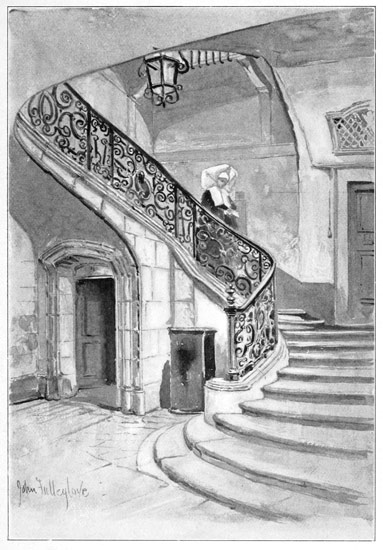
The Staircase of the Dwelling of the Marquise de Brinvilliers.
The painter Lebrun was one of the great crowd that
gathered to see her go by, and he made a drawing,
which you may see in the gallery of Old French Designs
in the Louvre. She half sits, half reclines, in her tumbril,
clad in a gown, its cowl drawn forward; her
head is thrown back; her thick chestnut hair brushed
away from her face; her eyes are wide and her mouth
drawn with terror; her face is round, her lips are
thick; in her folded hands she holds a cross, and she
stares straight before her without seeing. At one side
is the profile of a woman, very lean and ugly, her expression
full of horror as she bends forward to gaze.
Turning from this street down through Rue Beautreillis,
we pass the end of Rue des Lions, on whose
southern side we have already found remains of the
Hôtel des Lions du Roi. On its northern side is a row
of plaster-fronted houses, commonplace and shabby.
In one of those garrets there was living, shortly after
1830, a poor family of Jews named Félix, lately arrived
from the Canton Aarau in Switzerland. Their two
little girls went about the streets, singing and picking
up coppers. One day in the Place Royale, among those
who stopped to listen was a kindly eyed gentleman,
who handed to the younger and thinner of the two
pinched children a piece of silver. "That is Victor
Hugo," said a woman in the crowd, as he went his
way to his home in the corner. That small singer was
Élisa Rachel Félix, known to us as the great Rachel.
Years after, when the world had given all that it
could give to Rachel, she returned, from a voyage to
Egypt in search of health, to the Place Royale to die.
"It is on the way to Père-Lachaise," she said, when,
in 1857, she moved into the immense and superbly furnished
apartment on the first floor of No. 9, where
her friends, she thought, would have ample room for
her burial service. It is only a step in space from this
garret to that palace. There, within a few months—although
her death came at the country-seat of Victorien
Sardou's father, whom she was visiting—that
service was held, and from there her body was borne
to Père-Lachaise.
Going down Rue du Petit-Musc, we reach the Quai
des Célestins, and here on our left is the beginning of
broad Boulevard Henri IV., cutting away, in its diagonal
course through the grounds of the Hôtel Saint-Paul,
much history and romance. Nothing is left of
the gardens of the Hôtel de Lesdiguières, whose site
is marked by a tablet on the corner of the street of that
name, at No. 10 Rue de la Cerisaie. This tablet tells
us that the hôtel was the residence of the Czar Peter
the Great in 1717; the guest, during his short sojourn
in Paris, of the Maréchal de Villeroy, its owner then.
We prefer to go back from that visit over a hundred
years to a more attractive presence in this house.
This was Gabrielle d'Estrées, beloved of Henry, who—for
his fondness for her and their two fine boys—would
have made her his wife, and have made them
his legitimate successors, if he could have had his
way.
It was Sébastien Zamet who was their host in
this "palais d'amour du roi." The son of a shoe-maker
of Lucca, he had found his fortune in Paris, like
so many of his countrymen in those days, and he built
here "a true fairy palace, such as romances describe,"
says Saint-Simon. And here, walking in the garden
after supper on the evening of April 9, 1599, the lovely
Gabrielle was taken ill very suddenly. They carried
her to the Hôtel de Sourdis and put her in the care of
her aunt, with whom she had passed a portion of her
girlhood in that mansion. It stood within the precincts
of Saint-Germain-l'Auxerrois, its entrance on Rue de
l'Arbre-Sec, where now is the end of Rue Perrault.
Here Gabrielle died, in agony, at six o'clock of the
next morning; poisoned, say Sismondi, Michelet, and
the rest, but by whose hand we shall never know. The
Hôtel des Mousquetaires, that you will find at No. 4
of Rue de l'Arbre-Sec, was then in existence, and so,
too, were many of these tall façades, with ancient, iron
balconies that look down on the narrow winding street,
then a crowded thoroughfare of old Paris. After
Zamet's death his house was bought by the Duc de
Lesdiguières, Marshal and later Constable of France,
from whom it took its permanent name. We have already
come here with Boileau to see the veteran Frondeur,
Paul de Gondi, Cardinal de Retz, whose last
years were passed in this mansion, under the care of
one niece, Madame de Lesdiguières, and comforted
by another niece, Madame de Sévigné.
On the quay, off on our left, the Célestins caserne
occupies a small portion of the immense grounds of
the Célestins Monastery. It was a rich community,
made so by the many gifts of kings, from Charles V.
down, to "leurs bien aimés chapelains et serviteurs en
Dieu." These pious beggars were not too proud to
accept anything, and time fails to tell of the splendors
of their church, which became a museum of monuments,
tombs, statues, and was demolished in 1849,
many of its treasures having been destroyed during
the Revolution. The godly brethren are remembered
in the name of the barracks and of the quay, and to
some of us, it must be owned, by the delectable dish
of their invention, omelette à la Célestins.
That long façade beyond, on Rue de Sully, belongs
to the Arsenal, the building alone left, its spacious
gardens now under streets and houses. We have come
to its library with young Balzac, when he escaped from
his grinding drudgery and his dreary garret in Rue
Lesdiguières. We have driven here with Madame Récamier
on the day before her death. The most winning
memory of the place is that of Charles Nodier,
an adorable man of genius, whose very defects were
lovable, we are told by the elder Dumas, who loved
him. Nodier and Charles Lamb were hissing, almost
in the same year, each his own damned play. Many
others besides Dumas loved Nodier—Royalists and
Republicans, Classicists and Romanticists; and they
crowded his salon here of an evening. For this was
his official residence as Librarian, occupied by him
from his appointment in 1823 until his death in 1844.
His historic green drawing-room, where men were
friendly who fought outside, and the smaller rooms of
his apartment on the first floor overlooking Boulevard
Morland, have been thrown into the library, and are
now its reading-rooms. They have kept their old-time
panelling, carvings, mouldings, but their walls, once
decorated en grisaille, have been toned to a uniform
delicate gray-white.
This library was begun in 1785 by the Comte d'Artois,
who purchased the valuable books and manuscripts
of Voyer de Paulmy, Marquis d'Argenson, and of the
Duc de la Vallière. Rooms in the Arsenal were arranged
for this collection, and it was named the "Librairie
de Monsieur;" the Comte d'Artois, brother of
Louis XVI. and of Louis XVIII., having been the last
"Monsieur" in France. His library has grown to be
the grandest in Paris after the Bibliothèque Nationale.
It contains the original archives of the Bastille—such
as were saved, when so many were scattered and destroyed
at its taking—and it is especially rich in dramatic
literature and in manuscripts.
Here, above our heads as we stand in Rue du Petit-Musc,
is the tasteful, unspoiled side wall of the Hôtel
de Lavallette, formerly the Hôtel Fieubet. It was
built by the younger Mansart, on the corner of Saint-Paul's
grounds, for the Chancellor of Maria Theresa,
Gaspard de Fieubet, and it became a gathering-place
of the writers of those days. They were courted by
its owner, whose name is frequent in the letters of
Madame de Sévigné, and he himself turned his hand
to rhyming, at odd hours. Nearly two hundred years
after he had gone, his mansion was rescued from the
sugar-refiners, who had degraded it to their uses, by
the Lavallette who has given it his name, and who
"restored" it beyond the recognition of its great architect,
could he see it now. Its façade behind the little
court is overloaded with carvings, buttressed by caryatides,
surmounted by campaniles; it is a debauch of
sculpture, an orgy of ornamentation, under which the
stately lines of the original fabric are almost lost. They
are quite hidden, on one side, by a modern wing that
has been thrust in on the court. All this dishonor to
architecture does not trouble the boys, whose big school
fills the building now, and who troop about the court
in their black jackets and trousers, their wide, white
collars, their big, white ties, pulling on reluctant gloves,
as they line up on their unwilling way to some church
function.
We pass along the quay, glancing at the homelike
and homely house numbered 4, whose quiet dignity
behind its court is in pleasing contrast with the place
just left. Here were the home and the studio of Antoine-Louis
Barye, and here he died on June 25, 1875.
On the quay at the corner of Rue Saint-Paul there
stood until very lately the entire and unspoiled hôtel
built for young Charles, Duc de La Vieuville, in the
last days of the Valois men. It was an admirable
specimen of the architecture of their time, as we may
still assure ourselves by a glance at the wing that is
left within the court entered from Rue Saint-Paul; a
stone side wall toned to the glorified grayness of age,
pierced by tall, slender windows of graceful proportions,
and, above, the picturesque brick dormers of that
period.
The last of the Valois women, Marguerite, had her
home hard by here, and its story begins just on this
spot. When Charles V., to round out and make entire
his Saint-Paul estate, was taking in neighboring hôtels
and outlying bits of land, he found, here where we
find the Hôtel de La Vieuville, the Paris seat of the
archbishops of Sens. Their palace on this corner, and
its grounds extending along the river-front and back
along the east side of Rue Saint-Paul, up beyond present
Rue des Lions, cut out a goodly slice from this
angle of the royal domain. The King took this property,
giving in exchange, to the archbishop, the feudal
fortress, the Hôtel d'Éstoménil, a little farther west on
the river-bank, at the meeting-place of several country
roads. Those roads are now the streets named Hôtel-de-Ville,
Figuier, Fauconnier, de l'Ave-Maria; and
where they meet stands the Hôtel de Sens, in almost
the same state, as to its walls, as when they were finished
by the archbishop Tristan de Salazar. This
soldier-priest had rebuilt the old structure in the last
years of the fifteenth and the earliest years of the sixteenth
century, and it remains an authentic and authoritative
document of the domestic architecture of
that period. The delicate ornamentation of its façade
has suffered, some few mutilations have despoiled the
fabric, its gardens are built upon, their great trees are
gone, yet it stands, time-stained and weather-worn, a
most impressive example of that Gothic strength and
beauty whose frozen lines were just beginning to melt
under the fire of the upspringing Renaissance.
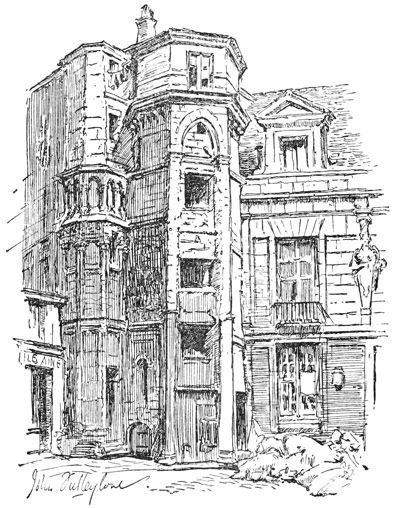
The noble arch of the ogival portal is, by a touch
of genius, pinched forward at its topmost point, and
is there sliced away, so as to make a snub-nosed protuberance
that seems to lift up the whole front. Its
two high-peaked bartizan turrets are a trifle heavy,
as we see them hemmed in by other buildings, but their
panelling and moulding plead for pardon for any
slight disproportion; and the one on the corner is perfect
in situation and in effect. The few windows of
the front have lost their stone-crossed mullions, some
broken, some bricked up. The great dormer window
above, possibly of later construction, is a prediction of
the loveliness that was to come to dormers, such as we
see in the roofs of Rouen's Hôtel de Ville and of the
château of Blois. The fine effect of the chimneys, once
entirely of stone, has been marred by cheap patching.
As to the rest, the oddities and irregularities of this
façade are yet all in good taste and all captivating.
Within the groined porch we see, across the small
court, the main building meant for the archbishop's
dwelling, and the solid square tower meant for defence
and for watching. Its entrance-door tells, in its
size and shape, the entire tale of feudal days. Away
up on one angle of this tower is an imitation sentry-box,
battlemented and supported by corbelled brackets.
The interior of the buildings has been defaced and
degraded by the base usages to which it has been subjected,
yet traces are left of its past grandeur in some
of the rooms and halls.
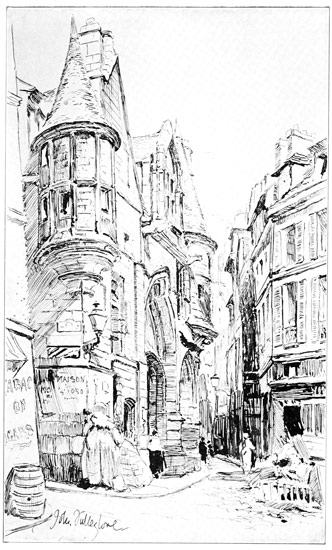
The Hôtel de Sens.
These awaited in orderly and decorous silence, in
their early days, the coming of their owner from the
mother-church at Sens. He came along the banks of
the Yonne and the Seine on his richly caparisoned
mule, his foot-servants in advance, his clerkly servitors
and ecclesiastics riding behind, and so he entered into
this tranquil court. Years later the place was noisy
enough, when the religious wars made it one of the
meeting-places of the leaders of the Holy League. On
the very day when Henri IV. entered Paris, the Archbishop
of Sens, Cardinal de Pellevé, lay dying in this
his palace, almost within hearing of the triumphant Te
Deum in Notre-Dame.
The King had been allowed his divorce by his childless
wife, Marguerite, and he in turn allowed her to
return to Paris from her long exile in Auvergne; ordering
that this hôtel should be fittingly arranged for
her residence, in 1605. We saw her last, a charming
child, in the gardens of the Tournelles. And now she
comes here, a worn wanton of nearly fifty-five, her
wonted fires still smouldering under the ashes. It is
between these two appearances that we like to look
on her in the pages of Brantôme and on the canvas of
Clouet. Pierre de Bourdeilles, Seigneur de Brantôme,
has been aptly dubbed the valet-de-place of history;
and yet a valet has the merit of looking out of his own
eyes from his own point of view. It was for him that
Marguerite wrote her "Mémoires," and to him she
left them. In after days, when exiled from the court
he loved, able only to lick the chops of memory, he
wrote her éloge in these glowing words: "If there
has ever been anyone in the world perfect in beauty,
it is the Queen of Navarre. All who have been, or
shall be, near her, are ugly beside her. If there is a
miscreant who believes not in the miracles of God, let
him look upon her. Many believe that she is rather
a goddess of heaven than a princess of earth, and yet
perhaps no goddess was ever so lovely."
It is indeed a lovely creature, yet all of earth, whom
we see in Clouet's half life-size portrait in the château
of Azay-le-Rideau. Her plentiful blond hair curves
back above her fine brow, and her bluish-gray eyes
smile out with inviting mischievousness. Yet Brantôme
has to own that his goddess was easily first in
the escadron volant that sailed under her mother's
flag, and we may guess what that meant in the court
"whose vices it would be repulsive to suggest, and
whose virtues were homicide and adultery."
In this Hôtel de Sens, Madame Marguerite held receptions,
twice a week, of men of letters and of the
arts, with whom her learning allowed her to converse
on equal terms; and her kindliness allowed them to feel
at ease. For "from her behavior it could never be discovered
that she had once been the wife of the King."
But the wayward Margot made trouble for herself
that ended her stay here after a year or less. She came
home from mass at the Célestins on the morning of
Wednesday, April 5, 1606, and as she was helped from
her coach by her newest favorite page of eighteen, he
was killed by her latest discarded favorite, already
twenty. She sat in one of these front windows the
next day, having neither eaten nor drunk nor slept
meanwhile; she looked out on the beheading of the
jaunty assassin; that evening she left the Hôtel de
Sens forever. For a while she stayed at her hunting-lodge
at Issy, already visited by us in former pages,
and then went to her last dwelling, on the southern
bank in the Pré-aux-Clercs, which looked out across
the river at the Louvre, where Henry was unhappy with
her successor. The two women remained always
friendly, and were seen together in festivities and processions,
and the reigning Queen paid many a debt of
the deposed Queen. To the last she rouged to the eyes,
and wore a flowing wig and low frocks, albeit she had
turned dévote, and had found a new idol in her confessor.
This was young Vincent de Paul, not yet
canonized, whose chaste ministrations made him adored
by sinners elderly enough to repent. There she died
in the spring of 1615, at the age of sixty-three, the last
of the Valois name, leaving everything, mostly debts,
to young Louis XIII.
Later along in the seventeenth century, when the
court end of the town went to the west, and the Church
dignitaries found this region too far afield, this Hôtel
de Sens was sold. Its new owners and tenants were
the merchants and financiers who crowded then to this
quarter. They, too, soon moved farther west, and the
place had many strange employments forced upon it.
As early as 1692, the messageries for Dijon and Lyons
rented it for their town head-quarters. By the middle
of the eighteenth century, the palace of the archbishops
was degraded to a livery stable and a horsedealer's
lair, and the ancient arms of Sens on its front and the
escutcheons of Lorraine and Bourbon, prelates of the
Church, were covered by a great sign, "Maison de Roulage
et de Commission." From this court, in the words
of the advertisement of that date, "Le Courrier de la
Malle de Paris à Lyons partit à cinq heures et demi du
soir, 8 Floréal, an IV."—which was April 27, 1796.
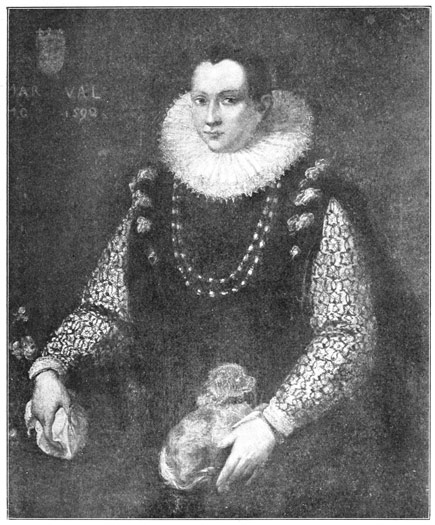
Marguerite de Valois.
(From a portrait by an unknown artist, in the Musée de Montpellier.)
That mail-coach was stopped near Lieussart, its
driver killed, and a large sum in assignats and gold carried
off. For this crime one Joseph Lesurques was arrested,
and was recognized by several witnesses as the
robber. He had been an official in Douai, had saved
money, and had gone to Paris for the education of his
children. Neither his record nor his alibi sufficed to
acquit him, the strongest of circumstantial evidence
convicted him, and he was executed on October 30,
1796. Two years later the murderer and robber was
captured in one Dubosc, who, after a daring escape
and recapture, went to the guillotine. By Dubosc's
conviction Lesurques was posthumously morally acquitted,
but his judicial rehabilitation has never been
made, albeit his broken and crazed children petitioned,
courts debated, and Deputies chattered through many
long years. This true story, our last reminiscence of
the Hôtel de Sens, has been put on the French stage
as "Le Courrier de Lyons," and on the English stage
as "The Lyons Mail."
We go on to the upper end of Rue Fauconnier, and
across Rue Saint-Antoine, to where begins Rue Pavée-au-Marais,
a most ancient and aristocratic street, filled
with grand mansions in its best days and in days not
so long gone. It had taken its name as early as the
middle of the fifteenth century, when, first of all the
Marais streets, it was paved. It was known, unofficially
and popularly, as le petit Marais, so closely did
it crowd, within its short and select limits, the essential
characteristics in architecture and atmosphere of the
great Marais. Now, wofully modernized, it holds one
relic only, a magnificent relic, that suggests to us, in
its solitary dignity, something of the lost glories of
this street.
We cross Rue du Roi-de-Sicile, a main thoroughfare
of old Paris, whose odd name came from Charles,
brother of Saint Louis, Count of Anjou and Provence,
and King of Naples and Sicily in 1265. His fortified
abode stood on the northern side of this street, at its
eastern end just within the old walls. It became, in
after times, the hôtel and then the prison of La Force.
Its entrance was over yonder, at the corner of modern
Rue Malher; and opposite, on the southern corner,
was the stone that served as the axeman's block for
the Princess of Lamballe. Along this pavement the
small Gavroche led the two smaller Thénardier boys,
on his way to his hôtel—the plaster elephant in Place
de la Bastille. A wide avenue, bordered by modern
constructions, is fast taking the place of the old street
and robbing it of all its character.
Where Rue Pavée meets Rue des Francs-Bourgeois,
stands the Hôtel Lamoignon, formerly the Hôtel
d'Angoulême. At that corner a square turret juts out
from above the ground floor, overhanging the pavement,
its supporting bracket cut under in shell-like
curves. About the stately court, entered from Rue
Pavée, rise the imposing walls, those of the wings of
a little later date and a little more ornate than that of
the façade. This front is pre-eminently impressive in
its height, in the unusual loftiness of its floors and their
windows, in the single Corinthian pilasters, tall and
slender and graceful, rising from ground to cornice.
They may serve us as a souvenir of Jean Bullant's
work in the château of Ecouen and in his portion of
Chantilly. Above that cornice the dormer windows
spring high under their gabled ends. Beneath them,
and over the entrance porch, and on the side wall of
Rue des Francs-Bourgeois—profusely decorating, but
not overloading, the spacious surfaces that carry them
easily—we trace without effort the unworn hunting-horns,
the stags' heads, the dogs in chase, the crescent
and the initial H so interlaced as to form an H and a
D—all the carved emblems of Diane de France, for
whom this remarkable structure was planned and
built, a little after 1580, by a now unknown architect.
She was born of an Italian mother, during a stay in
her country of the son of François I., who was later
Henri II. On coming to the throne, in 1547, he legitimatized
this daughter, then ten years of age, and gave
her education and position in France. She grew up
to be a good woman and a good wife to Horace Farnese,
Duc de Castro, and to her second husband, François,
the eldest son of the Constable Montmorenci.
She spent her long life—which saw seven monarchs
sitting on the French throne—doing kindly acts, not
one of which meant so much for the France she loved
as the reconciliation between Henri III. and Henri
de Navarre; possible through her, because the sceptic
Béarnais took her word for or against any written
word of anyone. Dying in 1619, she left this mansion
to Charles, Duc d'Angoulême, son of Charles IX. and
Marie Touchet, the last of her many benefactions to
him. He added these wings, and placed in that on
the northern side this stately stone staircase, filling the
width between the stone walls, with no hand-rail to
break its sweep. Nothing is left of the former grandeur
of the interior, which is given up to large industries
and petty handicrafts; even the vast and lofty
chambers are cut up for trade purposes by partitions
and by interposed floorings.
In 1658 the Hôtel d'Angoulême became the Hôtel
Lamoignon by purchase of Guillaume de Lamoignon,
a wealthy President of Parliament, and in 1684 it went
to his son, Chrétien-François de Lamoignon. It was
a dwelling worthy of him and of his illustrious name,
which it still bears. In it he received the best society
of that day—represented to us by Racine, Boileau,
Bourdaloue, Regnard, and others of their kidney, all
honored in finding a friend in this magistrate of ability,
probity, kindliness. It was to him that Boileau addressed
his "Sixth Epistle," and to him, when, as
Master of Requests, it was his official duty to forbid
further performances of "Tartufe" after the first
night, Molière submitted without rancor. Perhaps his
highest honor, during a life of honors, was his refusal
of an election to a fauteuil in the Académie Française.
On April 13, 1763, in this building was opened the
first public library of the Hôtel de Ville of Paris. One
Antoine Moriau had been for many years collecting,
in his apartment on this second floor, some 14,000 volumes
and 200 manuscripts, all left to the town at his
death in 1759. The municipality kept his rooms, and
rented additional rooms on this first floor, opening
them to the public on Wednesdays and Saturdays.
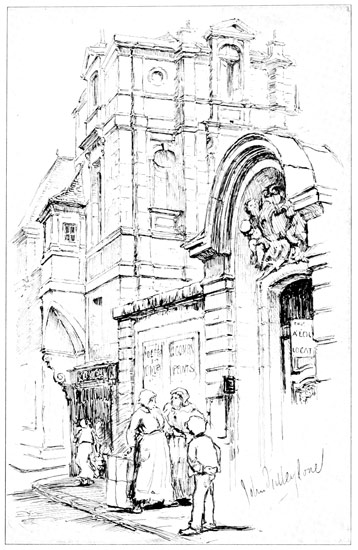
The Hôtel Lamoignon.
The concierge or his wife, honored by the interest
shown in their splendid show-place, will conduct such
curious strangers as may wish around the corner into
Rue des Francs-Bourgeois, and through a little gate
on that street into a small back court. This is the
shabby remnant of Diane's and of Lamoignon's extensive
gardens, which once stretched to those of the Hôtel
de La Force on the south, and eastwardly to Rue
Sévigné. From this spot you may see four or five
windows away up in the rear wall of the mansion, and
you will be told that these are the windows of Alphonse
Daudet's former apartment, wherein he wrote "Fromont
jeune et Risler aîné." His large study on the top
floor had two high, wide windows, from which he saw
the roofs of all Paris on that side. Against the wall
at one end of the room was his shelf for standing at
his work, and his wife's desk was at the other end;
while, between them, carrying the freshly written
sheets, trotted the little boy Léon, who is now a man,
wielding his own good pen. To him, in those days,
the tall Flaubert and Tourgueneff were "giants" by
the side of his father, and of the other friends who used
to climb these many stairs to this salon in the sky.
Daudet has left affectionate records of the old house.
His "Rois-en-exil" was written in a pavilion in the
garden of Richelieu's old mansion, which stood in the
northwestern corner of the then Place Royale, now
Place des Vosges, where has been cut, through house
and garden, the prolongation of Rue des Francs-Bourgeois
in Rue des Vosges.
The gentle artist, "handsome as a Hindoo god" in
those days, says M. Claretie, brought from his beloved
Midi a longing for space and air and quiet, and all his
abodes in the city were high above the street, with ample
breathing-space and unbroken horizon. His earliest
Paris home was at the very top of the furnished Hôtel
du Senat, still at No. 7 Rue de Tournon. This was the
wretched room to which he came back, early one morning,
from his first swell reception, his only dress-suit
drenched with the wet snow through which he had
waded, owning no overcoat. Then, for a while, he
occupied an entresol in No. 4 Place de l'Odéon, in "la
maison A. Laissus," one of the unaltered houses of
that historic place. His last home was on the third
floor of No. 31 Rue Bellechasse, in the heart of the Faubourg
Saint-Germain, and one of its delightful old
gardens lay beneath his windows, giving him the greenness
and the tranquillity so dear to him.
The name of Madame Daudet may not be omitted
from this record of the illustrious women of the
Marais, although now, in the maturity of her distinction
and elegance, she adorns another quarter of
Paris. She has made for herself an honored place
among French women of letters, and she helped her
husband to his own place by her critical powers and
her sympathetic appreciation. She both tranquillized
and stimulated him through his earlier years of robust
strength, and the later invalidism that was yet
filled with labor. Her son, who carried the father's
sheets across the room to her for approval or correction,
has dedicated his "Alphonse Daudet" to his
mother, "who aided and encouraged her husband alike
in the hours of discouragement and of hopefulness."
There are bits and fragments of vanished antiquity—portals,
windows, balconies, brackets, pitifully sundered
from the grandeur they stand for and suggest—scattered
all about this portion of the Marais. Much of this
bygone grandeur was to be found in Rue des Francs-Bourgeois,
a street that had been a country road just
outside the wall of Philippe-Auguste, and, with the
crumbling of the wall, had been speedily built up with
stately mansions. One of these, with a fund for its support,
was willed, in 1415, to the Grand Prior of France,
in trust for such burghers as were freed from all
taxation by reason of their extreme poverty. So it came
that these francs bourgeois gave their name to the
street. Here at No. 30 is a quaint low front, mostly
taken up by a spacious entrance-porch, decorated with
finely cut dragons; here at No. 31 is the superb portal
of the Hôtel Jeanne d'Albret; all that is left of the noble
residence of that niece of François I. who married
the Duc de Clèves in 1541. It is more than a century
from that date before this hôtel holds any history for us,
when it became tenanted by César Phébus d'Albret,
Marshal of France; a rich and frolicsome Gascon, a
friend of Scarron, an especial friend of young Madame
Scarron. It was he who killed the Marquis de Sévigné
in a duel. The Duchesse d'Albret was an eminently
proper person, a bit of a précieuse, and her salon here
was a flimsy copy of that of the Hôtel Rambouillet.
Scarron's widow, poor and by no means unfriended,
found a temporary home in this house, after a short
stay with her life-long friend, Mlle. de Lenclos, before
taking rooms in the convent, where we have seen
her.
When la veuve Scarron, reincarnated in Madame de
Maintenon, was living in the grand establishment at
Vaugirard, provided by the King for his two children,
she is said, by local tradition, to have had her private
apartment in the Marais, near where we stand. It was
on the first floor of the small and shabby house at No.
7 bis Rue du Perche, and you are shown a ceiling in
an upper room, that is claimed to have been painted for
the great lady. It is in four sunken squares, wherein
pose the four Seasons, in conventional attitudes and
unconventional raiment.
Let us stop here on the southern side of Rue des
Francs-Bourgeois, where it meets the end of a little
street with the big name of des Hospitalières-Saint-Gervais,
given to it by the great hospital and monastery
that occupied these grounds, through which this street
was afterward cut, when Philippe-Auguste gathered
them just within the safe-keeping of his wall. Just
without that wall lay the Hôtel Barbette, in the midst of
its own wide lands. On this corner, we stand just on
the line of the wall, and look across Rue des Francs-Bourgeois
into a court, once the Alleé aux Arbalétriers,
over whose entrance is a tablet, recording the murder
of Louis d'Orléans, near that spot—a scene sketched in
our first chapter. That maze of courts, crowded close
with ancient wooden structures, tempts us to search
within it for vestiges of the outbuildings of the Hôtel
Barbette. And it is worth while exploring the interior
of the corner house, if only for its mediæval staircase.
Coming out by the courts opening into Rue Vieille-du-Temple,
we take a few steps to where it meets the southern
side of Rue des Francs-Bourgeois, and we stand on
the exact site of the Porte Barbette of the old wall.
There, on the northeastern corner of the two streets,
stands a most ancient building well worth our regard.
On the angle, reaching from just above its ground floor
to the cornice, is hung a five-sided tourelle of singular
beauty. Its heavy supporting bracket is deeply and
handsomely corbelled out, and at each angle is a slim
colonette, delicately carved. The division line between
its two stories is defined by a fine moulding. In the
first story is cut a small ogival window, under a prettily
crocketed head and a flat finial. This window is
iron grated, and its grim visage is softened by a flowering
plant set within. The panels of the lower story
are plain, and those above are decorated with a lace-like
pattern, graceful and elegant, whose lines and curves
carry one's eye to the cornice. The plain façade of the
house in Rue Vieille-du-Temple has been degraded by
modern windows, while that in the other street remains
most impressive, with its gabled end. All in all, no
such delightful specimen of fifteenth-century Gothic as
this Barbette turret can be found in our Marais.
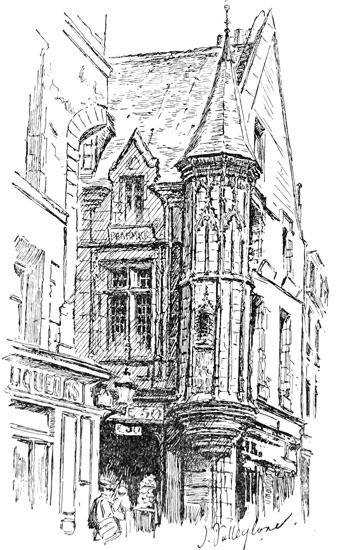
The Tourelle of the Hôtel Barbette.
Yet turret and structure are not, as is often stated,
any portion of the original Hôtel Barbette. That was
built, at the end of the thirteenth century, by Étienne
Barbette, a man of wealth and importance, the Provost
of Paris under Philippe "le Bel," and his Master of the
Mint. The vast enclosure of his grandiose hôtel covered
all the ground, from the old wall northward to the
line of the present Rues de la Perle and du Parc-Royal;
and eastwardly from this Rue Vieille-du-Temple
to the gardens of Saint-Catherine du Val-des-Écoliers,
near where now runs Rue Sévigné. This ample domain
sufficed for the menus plaisirs of this lucky man,
and was merely his petit séjour. Under that blameless
guise it served as the abode, a little more than a century
later, when rebuilt after the mob had wrecked it, of
Isabeau de Bavière, official wife of mad Charles VI.
Leaving him to the neglect of servants and to the companionship
of Odette, the Queen escaped boredom here,
by her dinners and suppers, balls and fêtes; here she
invented, or first introduced, the masquerades that were
soon the rage of Polite Society. She amused herself
with other games, too; such as statecraft, in partnership
with her husband's younger brother, Louis d'Orléans.
It was from the Barbette that she mismanaged
the kingdom, ground down the people with intolerable
taxes, pushed the marriage of her daughter Catherine
with Henry V. of England, plotted the shameful Treaty
of Troyes, which made France an appanage of the English
crown, and gave Paris to English troops.
After her husband's death, cast aside by Burgundy
and England, she found a drearier refuge in the Hôtel
Saint-Paul than that to which she had condemned him
there. In its corners she hid while Joan the Maid was
undoing the evil work done by this shameless woman,
and was bringing back to Paris the son hated by this
shameless mother. All through those years she wept
and moaned, witnesses have reported; left alone, as she
was, with the memories of her lusts and her treasons,
with the wreckage of the animal beauty, for which, and
for no other quality, she had been selected as the royal
consort. Seven days after she learned of the signing
of the Treaty of Arras she died, "et son corps fut tant
méprisé," says Brantôme, that it was thrown into a
boat at the water-gate of Saint-Paul, and, after an unseemly
service in Notre-Dame, was sent by night down
the Seine to Saint-Denis, "ainsi ni plus ni moins qu'une
simple demoiselle!"
Partly destroyed by fire and partly rebuilt, we find
the Hôtel Barbette, after another hundred years and
more, in the hands of the Comte de Brézé, Seneschal of
Normandy. Aged, ugly, crippled, as we see him in
Hugo's verse, he is pleasantly remembered for the
lovely widow he left for Henri II., and for his lovely
tomb left, for our joy, in the cathedral of Rouen. When
his widow, Diane de Saint-Vallier, became Diane de
Poictiers, Duchesse de Valentinois—an elderly siren of
thirty-seven, who was yet "fort aymée et servie d'un
des grands rois et valeureux du monde"—she wore
always her widow's white and black, and kept to the
last that whiteness of skin and purity of complexion
that came, she claimed, from her only cosmetic, soap
and water. Her coldness of heart had much to do with
it, to our thinking. Brantôme saw her when she had
come to sixty-two, and was struck by her freshness,
"sans se farder," as of thirty. He adds, with his ever-green
susceptibility: "C'est dommage que la terre
couvre ce beau corps." This property had gone, on
her husband's death, in 1561, to his and her two daughters;
who profited by its vast extent and by the example
set by François I. in similar jobs, to open streets
through it, and divide it into parcels for selling. Those
streets were named Barbette and Trois-Pavilions, the
latter now renamed Elzévir. And if any remnant exists
of the second Hôtel Barbette of Diane de Poictiers,
it is this corner house and its lovely turret.
By way of this corner, the body of Louis d'Orléans
was carried to the Church of the Blancs-Manteaux, in
the street of that name just behind us. It lay till morning
in the nave, and about the bier gathered royalty and
nobility, all through the long November night. The
church is gone, and so, too, is his chapel in the Church
of the Célestins; and the monument, erected there by
Louis XII. to his murdered grandfather and his martyred
grandmother, has been placed in the Cathedral
of Saint-Denis. The site of the Church of the Blancs-Manteaux
is covered by the great central establishment
of the Mont de Piété; its grounds are entirely built
over; the street that took the name of the monastery,
once a perilous coupe-gorge, has grown to be, not respectable,
but characterless. We must be content with
the phantoms of Saint Louis's white-mantled monks,
strolling in their cloisters; later, grown fat and scampish,
haunting the low cabarets of this mal-famed street,
and rehearsing, within their own precincts, those
frenzied mysteries of the mediæval stage, that led to the
disbandment and the driving-out of the debauched
order.
A step to the south from this street, along Rue Vieille-du-Temple,
brings us to the massive entrance-doors of
No. 47. Their outer surfaces are richly carved with
masks and with figures; on their inner side is an excellent
bas-relief representing Romulus and Remus found
by the shepherd, when the wolf is giving them suck.
About the court, diminutive and dainty, the walls of
the small hôtel are adorned with tasteful sculptures,
and laden with dials, two of the sun and two of the
moon. These anomalous adornments came here
through the caprice of a Director of the Royal Observatory,
who once occupied the house and who wreaked his
scientific humor in this odd fashion. This is the Hôtel
de Hollande, a rebuilt remnant of the large mediæval
mansion of Maréchal de Rieux. The street just in
front of his hôtel, some authorities insist, was the scene
of the assassination of the Duc d'Orléans. Reconstructed
early in the seventeenth century, the carvings,
sculptures, and decorations of this elegant little
hôtel are excellent examples of late Renaissance. Unluckily,
the bas-reliefs and paintings of the interior
may no longer be seen. Beyond this outer court is a
smaller court, containing an attractive structure of a
later date.
This Hôtel de Hollande has borne that name since, in
the reign of Louis XIV., it was the seat of the embassy
representing Holland at his court. This being officially
Dutch soil, at that time, we may see Racine coming
through this entrance-doorway, in full wig and court
costume; coming to present his son for introductions at
The Hague, where the young man is to be a member of
the French Embassy. We have seen the letters sent to
him there by his thrifty father. There is another bit of
history for us here. It was in this house that the firm
"Roderigue Hortalez et Compagnie" started in business
in 1776, with a capital of 3,000,000 francs. The
firm was composed of Caron de Beaumarchais, with
the governments of France and Spain for his silent
partners; the former putting in 2,000,000 francs, and
the latter the other million. The business of this house—and
it did a lively business while it lasted—was to
supply, secretly and unknown to the English officials in
Paris, arms and equipments to the American colonies.
Anne de Montmorenci, the great constable of France,
in alliance, against the Huguenots, with the Guises, his
near neighbors in the Marais, outfought Condé and
Coligny at Saint-Denis in 1567, and died, of the wounds
he got in that battle, "in his own hôtel in Rue Saint-Avoie."
So says the chronicle, and it tells us further
that his was the grandest mansion in the town, with
most extensive grounds; far surpassing in size and
magnificence the Hôtels Lamoignon and Carnavalet.
It was sufficiently spacious for the large-minded John
Law, who established his bank in the building two
centuries later. When the crash came, and he sought
more modest quarters, the State took the building for
its bureaux. Now, no stone of the structure can be
found, the street from which it had entrance—Saint-Avoie—is
merged in that portion of Rue du Temple
which crosses Rue Rambuteau, and this broad thoroughfare
sweeps over the site of Montmorenci's palace
and his gardens.
Turning from Rue Rambuteau into Rue du Temple,
we are face to face, at No. 71, with a monumental gateway,
richly carved, giving entrance to an ample court.
The stately walls surrounding this court have suffered
much from time, and more from man. The old façade
of this wing on our left is hidden behind a paltry new
frontage for shops, and on the roof of the central body
before us a contemptible top story has been put. The
face of the original lofty attic, above the cornice, carried
pilasters in continuation of those below, and these have
been brutally mutilated by a line of low windows just
over the cornice. For all that, there is a majesty in the
stately arcades of these lower stories, and in the unspoiled
lower walls, up which climb graceful Corinthian
pilasters from ground to cornice. They are similar to
those of the Hôtel Lamoignon, built before this Hôtel
de Saint-Aignan was transformed from a former
structure by de Muet, who doubtless admired, perhaps
unconsciously imitated, the best features of the earlier
architecture. He has put, in this almost intact right
wing, just such a stone staircase, of easy grade and no
hand-rail, as that we have seen in the residence built for
Diane de France.
There is hardly any history to detain us here, and the
great names that once resounded in this court make
only far-away echoes now. Claude de Mesme, Comte
d'Avaux, a diplomat of the seventeenth century, built
this hôtel. At his death, it came to the Duc de Saint-Aignan,
a royal Purveyor at the head of Louis XIV.'s
Council of Finance. He was a relative of Madame de
Scudéry, wife of the Georges whom we have met in
his sister's salon. Through his wife's influence with
Saint-Aignan, Georges was presented to the King, and
succeeded in obtaining a pension—useful to supplement
such of his sister's earnings as came in his way. His
merits, for which the royal bounty was granted, seem
to have been of so momentous a literary character as to
be pronounced equal to those of Corneille!
When Olivier de Clisson—Constable of France after
the death of his comrade-in-arms, the mighty Duguesclin—brought
back Charles VI. victorious to Paris,
after crushing the revolt in Ghent under Philip van
Artavelde, he found the Marais du Temple fast being
reclaimed and built upon. At one corner of the Templars'
former wood-yard, on a street to be named du
Chaume, now merged in the southern end of Rue des
Archives, opposite the end of Rue de Braque, was the
fortress-home of his wife, Marguerite de Rohan, within
the family enclosure. Here de Clisson made his head-quarters,
giving his name to the hôtel. Its entrance,
an ogival portal sunk beneath two impressive round
turrets, built of different sizes through some vagary,
still remains; a most impressive relic, imbedded in more
recent walls.
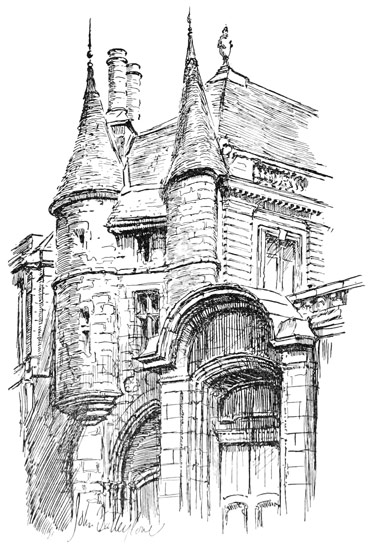
The Gateway of the Hôtel de Clisson.
It was de Clisson, who, quite without his consent,
gave the King one of the several shocks which culminated
in his madness. King and Constable had
supped together in the royal apartment of the Hôtel
Saint-Paul, and the Constable went on his way home.
Lighted by the main facts of the affair, we may easily
track him. After crossing Rue Saint-Antoine and
passing through one of the narrow lanes to Rue Neuve-Sainte-Catherine—now
the eastern end of Rue des
Francs-Bourgeois—he should have kept along this
street to this new home of his. Perhaps the old soldier
was not quite sure of his way, so soon after supper and
the plentiful petit vin de l'hôtel Saint-Paul, for he found
himself beyond his corner, up in Rue Sainte-Catherine,
now Rue Sévigné; and there, in front of a baker's shop
opposite the spot where now is the Carnavalet, he was
set upon by a band of men led by Pierre de Craon, a
crony of Louis d'Orléans. They left the tough old
warrior in the baker's doorway, bleeding from many
wounds, but not quite killed. The King was summoned,
came hastily in scanty clothing, and it was long
before he recovered from his affright. When he had
rallied, he started out to punish the assailant of his
favorite captain, and it was on his way to Brittany, with
whose duke de Craon had taken refuge, that the King
received the final blow to his reason.
The history of the Hôtel de Clisson would weary us,
were it told in detail. We may jump to the year 1553,
when it came to Anne d'Est, wife of François de Lorraine,
Duc de Guise. He and his family were beginning
to feel and to show their growing power, and he found
these walls not wide enough for his swelling consequence.
He bought the Hôtels de Laval and de la
Roche-Guyon, whose grounds adjoined his own; so
adding to his estate, while others, following the example
of François I., were cutting up and selling their
Paris lands. Soon the Hôtel de Guise was made up of
several mansions, rebuilt and run together, within one
enclosure, bounded by Rues de Paradis (now the western
end of Rue des Francs-Bourgeois), du Chaume
(now des Archives), des Quatre-Fils, and Vieille-du-Temple.
The heirs of the last Guise, who died in 1671,
sold this property at the end of the seventeenth century,
and it came into the grasping hands of Madame de
Soubise; bought with the savings of the French peasants,
squeezed from them by Louis XIV.'s farmers of
taxes, and by him poured into the lap of this lady, one
of the many ladies so turning an honest penny. Her
complaisant husband, François de Rohan, Prince de
Soubise, began to tear down much of the old work, and
to replace it by new work, in 1706. For thirty years
he kept the most skilful artists and artisans of that day
employed on the place within and without; and he left
the Hotel de Soubise much as we find it now. To him
we owe this striking cour d'honneur, square with curved
ends, and framed in a colonnade of coupled columns,
that leads a covered gallery from the grand entrance
around to the portal of the main building. This is his
façade of three stories, with pediment, its columns both
composite and Corinthian. For general effect this
court has no parallel in Paris.
A light elegant staircase, its ceiling delicately painted,
leads to the first floor, whose rooms retain some of their
mouldings, their wood-carvings, their decorated doorways
and ceilings. Gone, however, are the tapestries,
"the most beautiful in the world and most esteemed in
Christendom, after those of the Vatican," Sauval assures
us.
Vast and magnificent as was this palace, it did not
suffice for the son of this prince, the Cardinal Armand
Gaston de Rohan, Bishop of Strasburg, who, says
Sauval, "was, in his prosperity, very insolent and
blinded." On the site of the demolished Hôtel de la
Roche-Guyon he built for himself the Palais Cardinal,
now commonly known as the Hôtel de Strasbourg.
The library, great and precious, which he there collected,
together with his hôtel and his blind insolence,
came to his grand-nephew, the Cardinal de Rohan of
the Diamond Necklace, the last cardinal of a family of
cardinals.
At his death, in 1803, desertion and emptiness came
to the Hôtel de Strasbourg, as they had already come
to the Hôtel de Soubise. The huge size of the buildings
rendered them unfit for private residences. At
length they were taken for the State by the Emperor, at
the urging of Daunou, Director of the Archives of
France. By the decree of March 6, 1808, those archives
took for their own the Hôtel de Soubise, and the Hôtel
de Strasbourg was given to the Imprimerie Impériale.
No after-revolution nor any change of rulers has
troubled them. As their contents grew, new structures
have been added, over the gardens and on the street
behind, all done in good taste, all suggesting the uses
for which they are meant. The Imprimerie, entered
from Rue Vieille-du-Temple, through a court containing
a statue of Gutenberg, does the work for the Senate
and the Chamber of Deputies, for the Ministers and for
the Institute. Its Bulletin des Lois, issued to all the
Communes of France, carries to completion the mission
meant for it when it was begun by Louis XIII.,
Hugo asserts.
The archives of France must be studied and may not
be described. This amazing collection of manuscripts,
charters, diplomas, letters, and autographs begins with
the earliest day of writing and of records in France, and
comes down through all the centuries. It is a spot for
unhurried and unhindered browsing during long summer
days.
Just in this region is to be seen, better than anywhere,
an aspect of the Marais not yet seen in our historic
strolling. It is the Marais of to-day and of every day,
the work-a-day Marais, whose heart is here in this
street of the Temple and the old street of the Temple.
In them, and in the streets that cross them, are numerous
mansions of a bygone time, with little to say to
us in architecture, nothing at all to say to us in history
or letters. Side by side with them are tall buildings and
huge blocks of modern construction; new and old held
and possessed by factories, warehouses, show-rooms;
their upper portions given over to strange handicrafts,
strangely met together. The making of syphon-tops is
next door on the same floor to the wiring of feathers,
as Daudet discovered. These narrow streets between
the buildings, and these walled-in courts within them,
are hushed all through the working-hours, save for the
ceaseless muffled rumble of the machinery, and the unbroken
low murmur of the human toilers, both intent
on their tasks.
Suddenly at noon, these streets are all astir with an
industrial, unarmed mob, and the whole quarter is given
over to an insurrection, peaceful and unoffending.
These workers are making their way to restaurant or
rôtisserie or cabaret; some of them saunter along, taking
their breakfast "sur le pouce." The men, in stained
blouses, are alert, earnest, and self-respecting; the girls,
direct of gaze, frank of manner, shrill of voice, wear
enwrapping aprons, that fall from neck to ankle, and
their hair, the glory of the French working-woman who
goes hatless, is dressed with an artless art that would
not dishonor a drawing-room. We can carry away
with us, from these last scenes, no more captivating
memory than this of the most modern woman of our
Marais.