MOLIÈRE AND HIS FRIENDS
In the early years of the seventeenth century there
stood a low, wide, timbered house on the eastern corner
of Rues Saint-Honoré and des Vieilles-Étuves. To
the dwellers in that crowded quarter of the Halles it
was known as "la Maison des Singes," because of the
carved wooden tree on its angle, in the branches of
which wooden monkeys shook down wooden fruit to
an old wooden monkey at its foot. This house, that
dated from the thirteenth century surely, and that may
have been a part of Queen Blanche's Paris, was torn
down only in 1800, and a slice of its site has been cut
off by Rue Sauval, the widened and renamed Rue des
Vieilles-Étuves. The modern building on that corner,
numbered 92 Rue Saint-Honoré, is so narrow as to
have only one window on each of its three floors facing
that street. Around the first story, above the
butcher's shop on the entrance floor, runs a balcony
with great gilt letters on its rail, that read "Maison de
Molière." High up on its front wall is a small tablet,
whose legend, deciphered with difficulty from the
street, claims this spot for the birthplace of Molière.
This is a veracious record. The exact date of the
birth of the eldest son of Jacques Poquelin and Marie
Cressé, his wife, is unknown, but it was presumably
very early in January, 1622, for, on the fifteenth of
that month, the baby was baptized "Jean Poquelin,"
in his father's parish church of Saint-Eustache—a
new church not quite completed then. The name
"Baptiste" was, seemingly, added a little later by his
parents.
On this corner the boy lived for eleven years; here
his mother died, ten years after his birth, and here
his father soon married again; he removed, in 1633, to
a house he had inherited, the ground floor of which he
made his shop of upholstery and of similar stuffs, the
family residing above. It was No. 3 Rue de la Tonnellerie,
under the pillars of the Halles, possibly, but
not certainly, on the site of the present No. 31 Rue du
Pont-Neuf. In a niche, cut in the front wall of this
modern building, has been placed a bust of Molière
and an inscription asserting that this was his birthspot,
a local legend that harms no one, and comforts at
least the locataire.
Hereabout, certainly, the boy played, running forward
and back across the market. On its northern
side, near the public pillory, was another house owned
by his father, on the old corner of Rue de la Réale,
and its site is now covered by the pavement of modern
Rue Rambuteau. It is pleasant to picture the lad in
this ancient quarter, as we walk through those few of
its streets unchanged to this day, notably that bit of
Rue de la Ferronerie, so narrow that it blocked the
carriage of Henri IV., a few years before, and brought
him within easy reach of the knife of Ravaillac as he
sprang on the wheel.
François Coppée, not yet an old man, readily recalls
the square squat columns of the old Halles, and,
all about, the solid houses supported by pillars like
the arcades of Place des Vosges; all just as when
young Poquelin played about them. Plays, as well as
play, already attracted him; he loved to look at the
marionettes and the queer side-shows of the outdoor
fairs held about the Halles; and his grandfather,
Louis Cressé, an ardent playgoer, often took him to
laugh at the funny fellows who frolicked on the trestles
of the Pont-Neuf, and at the rollicking farces in
the Théâtre du Marais. No doubt he saw, too, the
tragedies of the theatre of the Hôtel de Bourgogne,
and this observant boy may well have anticipated the
younger Crébillon's opinion, that French tragedy of
that day was the most absolute farce yet invented by
the human mind. For this was a little while before
the coming of Corneille with true tragedy.
This son of the King's upholsterer cared nothing
for his father's trade, and not much for books. He
learned, early, that his eyes were meant for seeing,
and he not only saw everything, but he remembered
and reflected; showing signs already of that bent which
gave warrant, in later life, for Boileau's epithet,
"Molière the Contemplator."
He was sent, in 1636, being then fourteen years old,
to the Collége de Clermont, named a little later, and
still named, Lycée Louis-le-Grand. Rebuilt during
the Second Empire, it stands on its old site behind the
Collége de France, in widened Rue Saint-Jacques.
Here, during his course of five years, he was sufficiently
diligent in such studies as happened to please
him; and was prominent in the plays, acted by the
scholars at each prize-giving. He made many friendships
with boys who became famous men; with one,
just leaving school as he came, who especially stood
his friend in after life—the youthful Prince de Conti,
younger brother of the great Condé. And this elder
brother became, years after, the friend and protector
of the young actor-playwright, just as he was of some
others of that famous group, Racine, La Fontaine,
Boileau. All these, along with all men eminent in any
way, were welcomed to his grand seat at Chantilly, and
were frequent guests at his great town-house, whose
salon was a rival to that of the Hôtel de Rambouillet.
His mansion, with its grounds, occupied the whole of
that triangular space bounded now by Rues de Vaugirard,
de Condé, and Monsieur-le-Prince. At the
northern point of that triangle, nearly on the ground
now covered by the Second Théâtre Français, the
Odéon, stood the prince's private theatre; wherein
Molière, by invitation, played the rôles of author,
actor, manager. Molière's customary rôle in this great
house was that of friend of the host, who wrote to
him: "Come to me at any hour you please; you have
but to announce your name; you visit can never be
ill-timed."
Jean-Baptiste Poquelin betook himself early to the
boards for which he was born, from which he could
not be kept by his course at college or at law. He
studied law fitfully for a while; sufficiently, withal, to
lay up a stock of legal technicalities and procedure,
which he employed with precision in many of his
plays. So, too, he took in, no doubt unconsciously,
details of his father's business; and his references, in
his stage-talk, to hangings, furniture, and costumes,
are frequent and exact.
The father, unable to journey with the King to Narbonne
in the spring of 1642, as his official duties demanded,
had his son appointed to the place, and the
young man, accompanying the court and playing tapissier
on this journey, saw, it is said, the execution
of Cinq-Mars and de Thou. In the provinces at this
time, or it may have been in Paris earlier, he met,
became intimate with, and soon after joined, a troupe
of strolling players, made up of Joseph Béjart, his
two sisters Madeleine and Geneviève, and other young
Parisians.
This troupe was touring in Languedoc early in 1642,
and was rather strong in its talent and fortunate in
its takings; in no way akin to that shabby set of barnstormers
satirized by Scarron in his "Roman Comique."
We cannot fix the date of Poquelin's début in the company,
but we know that—with the unhallowed ambition
of the born and predestined comedian—he began
in tragedy, and that he was greeted by his rural audiences
with hootings, punctuated by the pelting of fried
potatoes, then sold at the theatre door. And we know
that the troupe came north to Rouen in the autumn of
1643, playing a night or two in the natal town of Corneille.
It is a plausible and a pleasing fancy that sees
the glory of French dramatic art of that day, at home
on a visit to his mother, receiving free tickets for the
show, with the respects of the young recruit to the
stage, the glory of French dramatic art at no distant
day. The troupe had gone to Rouen and to other provincial
towns only while awaiting the construction of
their theatre in the capital, contracted for during the
summer. At last, on the evening of December 31,
1643, it raised its first curtain to the Parisian public,
under the brave, or the bumptious, title of "l'Illustre
Théâtre."
To trace, from his first step on Paris boards, the
successive sites of Molière's theatres is a delightful
task, in natural continuation of that begun in an earlier
chapter, where those theatres in existence before his
time were pointed out. In England, we know, stage-players
were "strollers and vagabonds" by statute;
not allowed to play within London's walls. All their
early theatres were outside the City limits. The Globe,
the summer theatre of Shakespeare and his "fellows"—"whereon
was prepared scaffolds for beholders
to stand upon"—was across the Thames, on Bankside,
Southwark. So, too, were the Hope, the Rose,
the Swan. The Curtain was in Shoreditch, Davenant's
theatre in Lincoln's Inn Fields, and the Blackfriars
theatre on Ludgate Hill, just without the old wall.
The early playhouses of Paris were built—but for
another reason—on the outer side of the town wall of
Philippe-Auguste, and their seemingly unaccountable
situations are easily accounted for by following on
either bank the course of that wall, already plainly
mapped out in preceding pages.
This magnificent wall of a magnificent monarch had
lost much of its old significance for defence with the
coming of gunpowder, and a new use was found for
it, in gentler games than war, as the town outgrew its
encircling limits. In the Middle Ages, tennis—the
oldest ball-game known—was a favorite sport of kings
and of those about them. It was called le jeu de paume,
being played with the hand until the invention of the
racket; the players standing in the ditch outside the
wall, against which the ball was thrown. Beyond the
ditch was built the court for onlookers, the common
folk standing on its floor, their betters seated in the
gallery. When the game lost its vogue, these courts
were easily and cheaply turned into the rude theatres
of that day, with abundant space for actors and spectators;
those of low degree crowding on foot in the
body of the building, those who paid a little more
seated in the galleries, those of high degree on stools
and benches at the side of the stage, and even on the
stage itself. This encroachment on the stage, within
sight of the audience, grew to such an abuse that it
was done away with in 1759, and the scene was left
solely to the players.
Where a tablet is let into the wall of the present
Nos. 12 and 14 Rue Mazarine, then named the Fossé-de-Nesle—the
ancient outer ditch of the old wall—a
roomy playhouse had been contrived from a former
tennis-court owned by Arnold Mestayer, a solid citizen
of the town, captain of the Hundred Musketeers
of Henri IV.'s day. This was the theatre taken by the
Béjart troupe and named "l'Illustre Théâtre." Here
young Poquelin made his first bow to Paris. The
building stood on the sites of the present Nos. 10, 12,
and 14 Rue Mazarine, its only entrance for spectators
reached by an alley that ran along the line between
Nos. 14 and 16, and so through to Rue de Seine, to
where the buildings extended over the ground now
covered by Nos. 11 and 13. These latter houses are
claimed by local legend for Molière's residence, and it
may well be that the rear part of the theatre served as
sleeping-quarters for the troupe. The interior of No.
11 is of very ancient construction, its front being of
later date. In the wall between it and No. 9—a low
wooden structure, possibly a portion of the original
fabric—is hidden the well that served first the tennis-players
and then the stage-players. There is no longer
any communication between these houses in Rue de
Seine and those in Rue Mazarine. These latter were
built in 1830, when the street was widened, that portion
of the old theatre having been demolished a few
years earlier.
It was in June, 1644, that the name Molière first
appears, signed—it is his earliest signature in existence—among
the rest of the company, to a contract
with a dancing man for the theatre. How he
came to select this name is not known, nor was it
known to any of his young comrades; for he always
refused to give his reasons. What is known, is that
it was a name of weight even then, proving that, within
the first six months of the theatre's existence, his
business ability had made him its controlling spirit.
But his abilities as manager and as actor could not
bring success to the theatre. Foreign and civil wars
made the State poor; wide-spread financial troubles
made the people poor; that cruelly cold winter froze
out the public. "Nul animal vivant n'entra dans notre
salle," are the bitterly true words, put into the mouth
of the young actor-manager, by an unknown writer of
a scurrilous verse.
He and the troupe were liberated from their lease
within the year, and, early in 1645, they migrated over
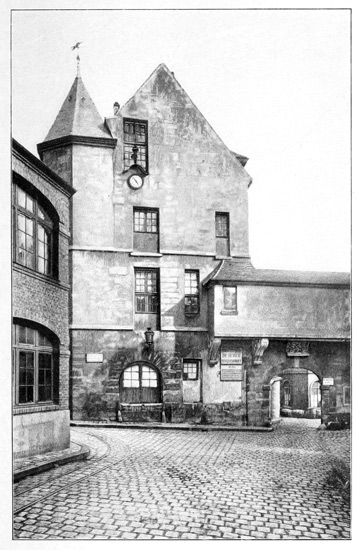
the river to the Jeu de Paume de la Croix-Noire. On
either end of the long, low building at No. 32 Quai des
Célestins is a tablet; the western one showing where
stood the Tour Barbeau that ended the wall on this
river-bank; that at the eastern end marking the site
of this theatre, just without the wall. It had an entrance
on the quay-front for the boatmen and other
water-side patrons, another in Rue des Barrés for its
patrons coming by coach. Molière lodged in the house—probably
a portion of the theatre—at the corner of
the quay and of Rue des Jardins-Saint-Paul—that
country lane wherein had died Rabelais, nearly a century
earlier. Little Rue des Barrés, already seen taking
its name from the barred or striped gowns of the
monks who settled there, is now Rue de l'Ave-Maria,
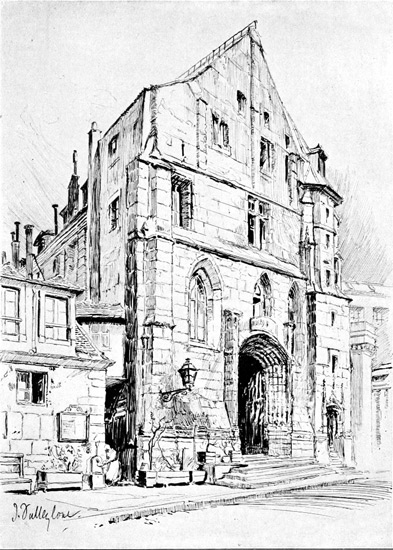
and at its number 15 you will find the stage entrance
of this theatre, hardly changed since it was first trodden
by the players from over the river. There is the low
and narrow door, one of its jambs bent with the
weight of the more modern structure above, and beyond
is the short alleyway, equally narrow, by which
they passed to the stage. At its inner end, where it
opens into a small court, is the stone rim of a well, half
hidden in the wall. It is the well provided in each
tennis-court for the players, and handed on, with the
court itself, for the use of the actors. Molière has
leaned over this well-curb to wash away his rouge
and wrinkles. It is an indisputable and attractive witness
of his early days. In Saint-Germain-l'Auxerrois,
where he knelt at the altar for his marriage and stood
at the font with his son; in Saint-Eustache, where he
carried his second son for baptism; in Saint-Roch,
where he wrote his name as godfather of a friend's
daughter—within these vast and dim aisles, his bodily
presence is vaguely shadowed forth; here we can
touch the man.
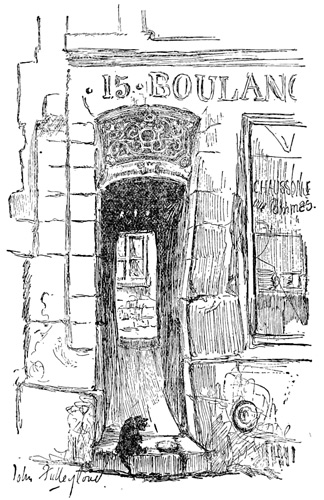
Stage Door of Molière's Second Theatre in Paris.
What sort of plays were presented at this house we
do not know, the only record that remains referring
to the production of "Artaxerxes" by one Mignon.
Whatever they played, neither the rough men of the
quay and of Port Saint-Paul, nor the bourgeoisie of
the Marais, nor the fine folk of Place Royale, crowded
into the new theatre.
During this disastrous season, the troupe received
royal commands to play at Fontainebleau before the
King and court, and later, by invitation of the Duc de
l'Éperon, at his splendid mansion in Rue de la Plâtrière—that
mansion in which lived and died La Fontaine,
half a century later. Neither these fashionable
flights, nor the royal and noble patronage accorded to
the troupe, could save it from failure and final bankruptcy.
Molière, the responsible manager, was arrested
for the theatre's poor little debt for candles and
lights. He was locked up for a night or two in the
dismal prison of the Grand Châtelet, once the fortress
of Louis "le Gros," torn down only in 1802, on whose
site now sparkles the fountain of Place du Châtelet.
From this lock-up, having petitioned for release to M.
d'Aubray, Civil Lieutenant of the town and father of
the Marquise de Brinvilliers, Molière was released by
the quickly tendered purse of Léonard Aubry, "Royal
Paver and Street Sweeper," who, when filling in the
Fossé-de-Nesle and laying out over it the present Rue
Mazarine a year before, had made fast friends with
the young actor. "For his good service in ransoming
the said Poquelin," the entire troupe bound itself
to make Aubry whole for his debt.
Now they cross the river again to their former Faubourg
Saint-Germain, taking for their house the Jeu
de Paume de la Croix-Blanche, outside the wall on
the south side of the present Rue de Buci, between
the carrefour at its eastern end and Rue Grégoire-de-Tours.
Here they played, still playing against disaster,
from the end of 1645 to the end of 1646, and
then they fled from Paris, fairly beaten, and betook
themselves to the southern provinces. We cannot
follow their wanderings, nor record their ups and
downs, during the twelve years of their absence. In
the old play-bills we find the names of Béjart aîné and
of his brother Louis, of their sisters Madeleine and
Geneviève. Toward the end of their touring they
added to the family, though not to the boards, Armande,
who had been brought up in Languedoc, and
who was claimed by them to be their very young sister,
and by others to be the unacknowledged daughter
of Madeleine.
Molière, the leader and manager of the troupe from
the day they started, was then only twenty-five years
of age, not yet owning or knowing his full powers.
These he gained during that twelve years' hard schooling
and rude apprenticeship, so that he came back to
the capital, in 1658, master of his craft, with a load of
literary luggage such as no French tourist has carried,
before or since.
Under princely patronage, won in the provinces, his
troupe appeared before Louis XIV., the Queen-Mother,
and the entire court, on October 24, 1658, in a theatre
improvised in the Salle des Gardes of the old Louvre,
now known as the Salle des Caryatides. The pieces
on that opening night were Corneille's "Nicomède"
and the manager's "Le Docteur Amoureux." In November,
the "troupe de Monsieur"—that title permitted
by the King's brother—was given possession
of the theatre in the palace of the Petit-Bourbon. It
stood between the old Louvre, with which it was connected
by a long gallery, and the Church of Saint-Germain-l'Auxerrois,
and was torn down in 1660 to
make place for the new colonnade that forms the present
eastern face of the Louvre. The dainty Jardin de
l'Infante covers the site of the stage, just at the corner
of the Egyptian Gallery.
In this hall Molière's company played for two years,
on alternate nights with the Italian comedians, presenting,
along with old standard French pieces—for
authors in vogue held aloof—his provincial successes,
as well as new plays and ballets invented by him for
the delectation of the Grand Monarque. From this
time his remaining fifteen years of life were filled with
work; his brain and his pen were relentlessly employed;
honors and wealth came plentifully to him,
happiness hardly at all.
While at this theatre Molière lived just around the
corner on Quai de l'École, now Quai du Louvre, in
a house that was torn away in 1854 for the widening
of present Rue du Louvre. Many of the buildings
left on the quay are of the date and appearance of this,
his last bachelor home.
Driven from the Petit-Bourbon by its hurried demolition
in 1660, Molière was granted the use and the
privileges of the Salle of the former Palais-Cardinal,
partly gone to ruin and needing large expenditure to
make it good. It had been arranged by Richelieu,
just before his death, for the presentation of his
"Mirame." For the great cardinal and great minister
thought that he was a great dramatist too, and in his
vanity saw himself the centre of the mimic stage, as
he really was of the world-stage he managed. He is
made by Bulwer to say, with historic truth: "Of my
ministry I am not vain; but of my muse, I own it."
His theatre in his residence—willed at his death to
the King, and thenceforward known as the Palais-Royal—was
therefore the only structure in Paris designed
especially and solely for playhouse purposes.
It stood on the western corner of Rues Saint-Honoré
and de Valois, as a tablet there tells us. During the
repairs Molière took his troupe to various châteaux
about Paris, returning to open this theatre on January
20, 1661. This removal was the last he made, and
this house was the scene of his most striking successes.
It is not out of place here to follow his troupe for
a while after his death, and so complete our record of
those early theatres. His widow, succeeding to the
control of the company, was, within three months,
compelled to give up the Cardinal's house to Lulli,
the most popular musician of that day, and a scheming
fellow withal. The unscrupulous Florentine induced
the King to grant him this Salle des Spectacles for
the production of his music. The opera held the house
until fire destroyed it in 1763, when a new "Academy
of Music" was constructed on the eastern corner of
the same streets; this, also, was burned in 1781.
Above the tablet recording these dates on this eastern-corner
wall is a fine old sun-dial, such as is rarely seen
in Paris, and seldom noticed now.
The widow Molière, being dispossessed, found a
theatre in Rue Mazarine, just beyond her husband's
first theatre, "in the Tennis-Court where hangs a Bottle
for a Sign." For it had been the Jeu de Paume de
la Bouteille, and now became the Théâtre Guénégaud,
being exactly opposite the end of that street. Within
the structure at No. 42 Rue Mazarine may be seen the
heavy beams of the front portion of its fabric, where
was the entrance for the public. The space behind,
now used for a workshop, with huge pillars around
its four sides, served for the audience, and the stage
was built farther beyond. On the court of this house,
and on the contiguous court of No. 43 Rue de Seine,
stood a large building, whose first floor was taken by
Madame Molière, and in its rear wall she cut a door
to give access to her stage. The entrance for the
performers was in the little Passage du Pont-Neuf,
and under it there are remains of the foundations of the
theatre. Here, in May, 1677, the widow took the name
of Madame Guérin on her marriage with a comedian
of her company. And we feel as little regret as she
seems to have felt for her loss of an illustrious name.
In the words of a derisive verse of the time:
"Elle avoit un mari d'esprit, qu'elle aimoit peu;
Elle prend un de chair, qu'elle aime davantage."

COMÉDIE FRANÇAISE 1680
This was the first theatre to present to the general
public "lyric dramas set to music," brought first to
France by Mazarin for his private stage in the small
hall of the Palais-Royal, where they were presented
as "Comédies en Musique, avec machines à la mode
d'Italie." They bored everybody, the fashion for
opera not yet being set. On October 21, 1680, by
letters-patent from royalty, the troupe of the Théâtre
Guénégaud was united to that of the Hôtel de Bourgogne,
and to the combined companies was granted
the name of Comédie Française, the first assumption
of that now time-honored title. The theatre became
so successful that the Jansenists in the Collége
Mazarin—the present Institute—made an uproar because
they were annoyed by the traffic and the turmoil
in the narrow street, and succeeded in driving away
the playhouse in 1688. After
a long search, the Comédie
Française found new quarters
in the Jeu de Paume de
l'Étoile, built along the outer
edge of the street made over
the ditch of the wall, named
Rue des Fossés-Saint-Germain,
now Rue de l'Ancienne-Comédie.
At its present No. 14, set in the original
front wall of the theatre, between the second and third
stories, a tablet marks the site; above it is a bas-relief,
showing a Minerva reclining on a slab. She traces on
paper, with her right hand, that which is reflected in
the mirror of Truth, held in her left hand. At the
rear of the court stands the old fabric that held the
stage. Since those boards were removed to other
walls—the story shall be told in a later chapter—the
building has had various usages. It now serves as a
storehouse for wall-paper. During the Empire it was
taken for his studio by the artist Antoine-Jean Gros,
the successor of David and the forerunner of Géricault;
so standing for the transition from the Classic
to the Romantic school. It is not true that he killed
himself in this studio. He went out from it, when
maddened by the art critics, and drowned himself in
the Seine in the summer of 1835.
It was a great bill with which the Comédie Française
opened this house on the night of April 18, 1689,
for it was made up of two masterpieces, Racine's
"Phèdre" and Molière's "Le Médecin Malgré Lui."
A vast and enthusiastic audience thronged, with joyous
clatter, through narrow Rues Mazarine and Dauphine,
coming from the river. The Café Procope, recently
opened just opposite the theatre, was crowded
after the performance, the drinkers of coffee not quite
sure that they liked the new beverage. And so, at
the top of their triumphs, we leave the players with
whom we have vagabondized so long and so sympathetically.
Molière, at the height of his career, had married
Armande Béjart, he being forty years of age, she
"aged twenty years or thereabout," in the words of
the marriage contract, signed January 23, 1662. No
one knows now, very few knew then, whether the bride
was the sister or the daughter of Madeleine Béjart,
Molière's friend and comrade for many years, who
doubled her rôle of versatile actress with that of provident
cashier of the company. She was devoted to
Armande, whom she had taken to her home from the
girl's early schooling in Languedoc, and over whom
she watched in the coulisses. She fought against the
marriage, which she saw was a mistake, finally accepted
it, and at her own death in 1672 left all her
handsome savings to the wife of Molière.
In the cast of the "École des Maris," first produced
in 1661, appears the name of Armande Béjart, and,
three months after the marriage, "Mlle. Molière"—so
were known the wives of the bourgeoisie, "Madame"
being reserved for grandes-dames—played the
small part of Élise put for her by the author into his
"Critique de l'École des Femmes." Henceforward
she was registered as one of the troupe, the manager
receiving two portions of the receipts for his and her
united shares. She was a pleasing actress, never more
than mediocre, except in those parts, in his own plays,
fitted to her and drilled into her by her husband. She
had an attractive presence on the boards, without much
beauty, without any brains. Her voice was exquisite,
opulent in tones that seemed to suggest the heart she
did not own. For she was born with an endowment
of adroit coquetry, and she developed her gift. She
was flighty and frivolous, evasive and obstinate, fond
of pleasures not always innocent. Her spendthrift
ways hurt Molière's thrifty spirit, her coquetry hurt
his love, her caprices hurt his honor. His infatuation,
a madness closely allied to his genius, brought to him
a fleeting happiness, followed by almost unbroken torments
of love, jealousy, forgiveness. In his home he
found none of the rest nor comfort nor sympathy so
much needed, after his prodigious work in composing,
drill-work in rehearsing, and public work in performing
at his theatre, and at Versailles and Fontainebleau.
He got no consolation from his wife for the sneers of
venomous rivals, enraged by his supremacy, and for
the stabs of the great world, eager to avenge his keen
puncturing of its pretence and its priggishness. And
while he writhed in private, he made fun in public of
his immitigable grief, and portrayed on the stage the
betrayed and bamboozled husband—at once tragic and
absurd—that he believed himself to be. These eleven
years of home-sorrows shortened his life. On the
very day of his fatal attack, he said to the flippant
minx, Armande: "I could believe myself happy when
pleasure and pain equally filled my life; but, to-day,
broken with grief, unable to count on one moment of
brightness or of ease, I must give up the game. I
can hold out no longer against the distress and despair
that leave me not one instant of respite."
The church ceremony of their marriage had taken
place on February 20, 1662, at Saint-Germain-l'Auxerrois,
as its register testifies. He had already left
his bachelor quarters on Quai de l'École, and had
taken an apartment in a large house situated on the
small open space opposite the entrance of the Palais-Royal,
the germ of the present place of that name.
His windows looked out toward his theatre, and on
the two streets at whose junction the house stood—Saint-Thomas-du-Louvre
and Saint-Honoré. The
first-named street, near its end on Quai du Louvre,
held the Hôtel de Rambouillet, which was a reconstruction
of the old Hôtel de Pisani, made in 1618, after
the plan and under the eye of the Marquise de Rambouillet.
She is known in history, as she was known
in the salons of her day, by her sobriquet of "Arthénice"—an
anagram coined by Malherbe from her
name Catherine. Hither came all that was brilliant in
Paris, and much that pretended to be brilliant; and
from here went out the grotesque affectations of the
Précieuses Ridicules. The mansion—one of the grandest
of that period—having passed into other hands,
was used as a Vauxhall d'Hiver in 1784, as a theatre
in 1792, and was partly burned in 1836. The remaining
portion, which served as stables for Louis-Philippe,
was wiped away, along with all that end of the old
street, by the Second Empire, to make space for the
alignment of the wings of the Louvre. The buildings
of the Ministry of Finance cover a portion of the
street, and the site of Molière's residence, in the middle
of the present Place du Palais-Royal, is trodden,
almost every day of the year, by the feet of American
women, hurrying to and from the Museum of the
Louvre or the great shop of the same name.
After a short stay in their first home, Molière and
his wife set up housekeeping in Rue de Richelieu. It
is not known if it was in the house of his later domicile
and death. Their cook here was the famous La
Forêt, to whom, it is said, Molière read his new plays,
trying their effect on the ordinary auditor, such as
made up the bulk of the audiences of that time. Servants
were commonly called La Forêt then, and the
real name of this cook was Renée Vannier. Within a
year, domestic dissensions came to abide in the household,
and it was moved back to its first home, where
Madeleine had remained, and now made one of the
ménage. To it came a new inmate in February, 1664,
a boy, baptized at Saint-Germain-l'Auxerrois, having
the great monarch for a godfather, and for a godmother
Henrietta of England, wife of the King's
brother, Philippe d'Orléans, and poisoned by him or
his creatures a few years later, it is believed. These
royal sponsors were represented at the christening by
distinguished State servants, the whole affair giving
ample proof of this player's position at the time.
A little later, we have hints that the small family
was living farther east in Rue Saint-Honoré, at the
corner of Rue d'Orléans, still near his theatre, in a
house swept away when that street was widened into
Rue du Louvre. From this house was buried, in November,
1664, the child Louis, the burial-service being
held at Saint-Eustache, their parish church, Molière's
baptismal church, his mother's burial church. Here,
too, in the following year, August, 1665, he brought
to the font his newly born daughter, Esprit-Madeleine.
In October of this same year he took a long lease of
an apartment in their former house on the corner of
Rue Saint-Thomas-du-Louvre, and there they stayed
for seven years, removing once more, and for the last
time, in October, 1672, to Rue de Richelieu.
Where now stands No. 40 of that street, René
Baudelet, Tailor to the Queen by title, had taken a
house only recently builded, and from him Molière
rented nearly every floor. His lease was for a term
of six years, and he lived only four and a half months
after coming here. The first floor was set apart for
his wife, whose ostentatious furnishing, including a
bed fit for a queen, is itemized in the inventory made
after her husband's death. He took for his apartment
the whole second floor, spaciously planned and sumptuously
furnished; for he, too, was lavish in his expenditure
and loved costly surroundings. His plate
was superb, his wardrobe rich, his collection of dramatic
books and manuscripts complete and precious.
His bedroom, wherein he died, was on the rear of the
house, and its windows looked over the garden of the
Palais-Royal, to which he had access from his terrace
below, and thence by steps down to a gate in the garden
wall. Thus he could get to his theatre by way of
those trim paths of Richelieu's planning, as well as
by going along the street and around the corner. You
must bear in mind that the galleries of the Palais-Royal,
with their shops, were not constructed until
1784, and that Rues de Valois and Montpensier were
not yet cut; so that the garden reached, on either side,
to the backs of the houses that fronted on Rues de
Richelieu and des Bons-Enfants. Many of the occupants
had, like Molière, their private doors in the
garden wall, with access by stone steps. One of these
staircases is still left, and may be seen in Rue de Valois,
descending from the rear of the Hôtel de la Chancellerie
d'Orléans, whose Doric entrance-court is at No.
19 Rue des Bons-Enfants.
The house now numbered 40 Rue de Richelieu and
37 Rue Montpensier was erected soon after 1767, when
the walls that had harbored Molière were torn down
to prevent them from tumbling down. The present
building has an admirable circular staircase climbing
to an open lantern in the roof. The houses on either
side, numbered 37 bis and 35 Rue Montpensier, retain
their original features of a central body with projecting
wings, and so serve to show us a likeness of
Molière's dwelling. Their front windows look out now
on the grand fountain of the younger Visconti's design,
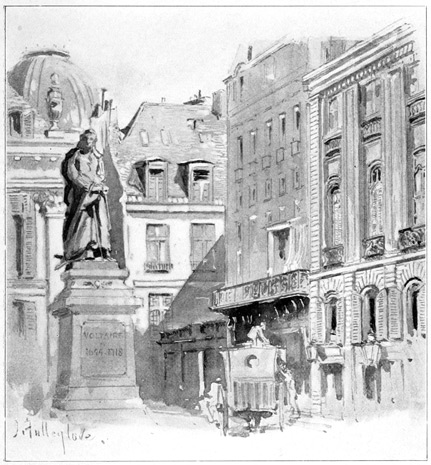
erected to Molière's memory in 1844, at the junction
of Rue de Richelieu and old Rue Traversière, now
named Rue Molière. This fountain, flowing full and
free always, as flowed the inspiration of his Muse, is
surmounted by an admirable seated statue of the player-poet
by Seurre, the figures of Serious and of Light
Comedy, standing at his feet on either side, being of
Pradier's design. And in Rue de Richelieu, a little
farther south, at the present Nos. 23 and 23 bis—once
one grand mansion, still intact, though divided—lived
his friend Mignard, and here he died in 1795.
The painter and the player had met at Avignon in
1657-8, and grew to be life-long friends, with equal
admiration of the other's art. Indeed, Molière considered
that he honored Raphael and Michael Angelo,
when he named them "ces Mignards de leur âge."
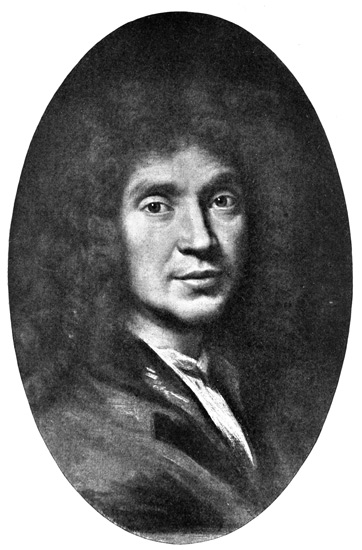
Certainly no such vivid portrait of Molière has come
down to us as that on the canvas of this artist, now
in the gallery at Chantilly. It shows us not the comedian,
but the man in the maturity of his strength
and beauty. His blond perruque, such as was worn
then by all gallants, such as made his Alceste sneer,
softens the features marked strongly even so early in
life, but having none of the hard lines cut deeper by
worry and weariness. The mouth is large and frank,
the eyes glow with a humorous melancholy, the expression
is eloquent of his wistful tenderness.
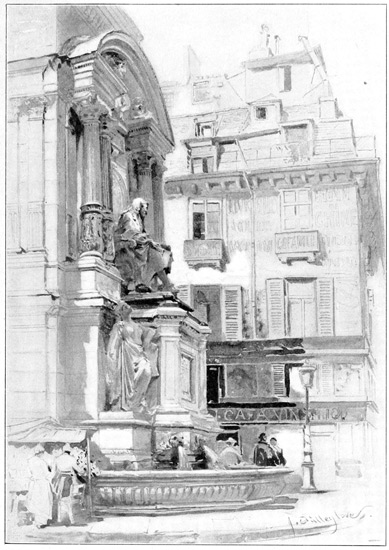
The Molière Fountain.
Early in 1667 we find Molière leasing a little cottage,
or part of a cottage, at Auteuil, for a retreat at
times. He needed its pure air for his failing health,
its quiet for his work, and its distance from the disquiet
of his home with Armande and Madeleine. He
had laid by money; and his earnings, with his pension
from the King—who had permitted to the troupe the
title of "His Majesty's Comedians"—gave him a
handsome income. He was not without shrewdness
as a man of affairs, and not without tact as a courtier.
Success, in its worst worldly sense, could come only
through royal favor in that day, and no man, whatever
his manliness, seemed ashamed to stoop to flatter.
Racine, La Fontaine, the sterling Boileau, the
antiquely upright Corneille, were tarred, thickly or
thinly, with the same brush.
Auteuil was then a tranquil village, far away from
the town's turmoil, and brought near enough for its
dwellers by the silent and swift river. Now it is a
bustling suburb of the city, and the site of Molière's
cottage and grounds is covered by a block of commonplace
modern dwellings on the corner of Rue Théophile
Gautier and Rue d'Auteuil, and is marked by a tablet
in the front wall of No. 2 of the latter street. It has
been claimed that this is a mistaken localization, and
that it is nearly opposite this spot that we must look
for his garden and a fragment of his villa, still saved.
The conscientious pilgrim may not fail to take that
look, and will ring at the iron gate of No. 57 Rue
Théophile Gautier. It is the gate of the ancient hôtel
of Choiseul-Praslin, a name of unhappy memory in
the annals of swell assassins. The ducal wearer of the
title, during the reign of Louis-Philippe, stabbed his
wife to death in their town-house in the Champs Élysées,
and poisoned himself in his cell to save his condemnation
by his fellow-peers of France. The ancient
family mansion has been taken by "Les Dominicaines,"
who have devoted themselves for centuries to the education
of young girls, and have placed here the Institution
of Saint Thomas of Aquinas.
A white-robed sister graciously gives permission to
enter, and leads the visitor across the spacious court,
through the stately rooms and halls—all intact in their
old-fashioned harmony of proportion and decoration—into
the garden that stretches far along Rue de
Rémusat, and that once spread away down the slope
to the Seine. Here, amid the magnificent cedar trees,
centuries old, stands a mutilated pavilion of red brick
and white stone or stucco, showing only its unbroken
porch with pillars and a fragment of the fabric, cut
raggedly away a few feet behind, to make room for a
new structure. Over the central door are small figures
in bas-relief, and in the pediment above one reads,
"Ici fut la Maison de Molière." It would be a comfort
to be able to accept this legend; the fact that prevents
is that the pavilion was erected only in 1855 by
the owner of the garden, to keep alive the associations
of Molière with this quarter!
It is in his garden, behind the wall that holds the
tablet, that we may see the player-poet as he rests in
the frequent free hours, and days withal, that came
in the actor's busy life then. Here he walks, alone or
with his chosen cronies: Rohault, his sympathetic
physician; Boileau, a frequent visitor; Chapelle, who
had a room in the cottage, the quondam schoolfellow
and the man of rare gifts; a pleasing minor-poet, fond
of fun, fonder of wine, friendly even to rudeness, but
beloved by all the others, whom he teased and ridiculed,
and yet counselled shrewdly. He sympathized
with, albeit his sceptic spirit could not quite fraternize
with, the sensitive vibrating nature of Molière, that
brought, along with acutest enjoyment, the keenest suffering.
In this day-and-night companionship, craving
consolation for his betossed soul, Molière gave voice
to his sorrows, bewailing his wife's frailties and the
torments they brought to him—to him, "born to tenderness,"
as he truly put it, but unable to plant any
root of tenderness in her shallow nature—loving her
in spite of reason, living with her, but not as her husband,
suffering ceaselessly.
This garden often saw gayer scenes of good-fellowship
and feasting, and once a historic frolic, when the
convives, flushed with wine, ran down the slope to the
river, bent on plunging in to cool their blood, and were
kept dry and undrowned by Molière's steadier head
and hand. His ménage was modest, and his wife seldom
came out from their town apartment, but his
daughter was brought often for a visit from her boarding-school
near by in Auteuil. He was beloved by all
his neighbors, to whom he was known less by his public
repute than by his constant kindly acts among them.
It was not the actor-manager, but the "tapissier valet-de-chambre
du Roi," then residing in Auteuil, who
signed the register of the parish church, as god-father
of a village boy on March 20, 1671; just as he had
signed, in the same capacity, the register of Saint-Roch
on September 10, 1669, at the christening of a
friend's daughter, Jeanne Catherine Toutbel. These
signatures were destroyed when all the ancient church
registers, then stored in the Hôtel de Ville, were burned
by the Commune.
On the night of Friday, February 16, 1673, while
personating his Malade Imaginaire—its fourth performance—Molière
was struck down by a genuine
malady. He pulled through the play, and, as the curtain
went down at last, he was nearly strangled by a
spasm of coughing that broke a blood-vessel. Careful
hands carried him around to his bedroom on the second
floor of No. 40, where in a few days—too few,
his years being a little more than fifty—death set him
free from suffering.
This fatal crisis was the culmination of a long series
of recurrent paroxysms, coming from his fevered life
and his fiery soul, that "o'er informed the tenement
of clay," in Dryden's phrase. And his heart had been
crushed by the death of his second boy, Pierre-Jean-Baptiste-Armand,
in October of the previous year.
Then, on the physical side, he had been subjected
throughout long years to constant exposure to draughts
on the stage, and to sudden changes within and without
the theatre, most trying to so delicate a frame.
His watchful friend, Boileau, had often urged him to
leave the stage before he should break down. Moreover,
it distressed Boileau that the greatest genius of
his time, as he considered Molière, should have to
paint his face, put on a false mustache, get into a
bag and be beaten with sticks, in his ludicrous rôle
of comic valet. But all pleading was thrown away.
The invalid maintained that nothing but his own management,
his own plays, and his own playing, kept
his theatre alive and his company from starvation;
and so he held on to the end, dying literally in harness.
His wife appeared too late on the last scene, the priest
who was summoned could not come in time, and the
dying eyes were closed by two stranger nuns, lodging
for the time in the house.
The arm-chair, in which sat the Malade Imaginaire
on the last night of his professional life, is treasured
among the relics of the Théâtre Français. It is a
massive piece of oak furniture, with solid square arms
and legs; the roomy back lets down, and is held at
any required angle by an iron ratchet; there are iron
pegs in front for the little shelf, used by the sick man
for his bottles and books. The brown leather covering
is time-worn and stitched in spots. It is a most
attractive relic, this simple piece of stage property.
Its exact copy as to shape, size, and color is used on
the boards of the Théâtre Français in the performances
of "Le Malade Imaginaire." And, with equal reverence,
they kept for many years in the ancient village
of Pézénas, in Languedoc—where the strolling troupe
wintered in 1655-6, playing in the adjacent hamlets
and in the châteaux of the seigneurie about—the big
wooden arm-chair belonging to the barber Gély, and
almost daily through that winter occupied by Molière.
Upon it he was wont to sit, in a corner, contemplating
all who came and went, making secret notes on the
tablets he carried always for constant records of the
human document. It has descended to a gentleman
in Paris, by whom it is cherished.
The curé of Saint-Eustache, the parish church, refused
its sacrament for the burial of the author of
"Tartufe." "To get by prayer a little earth," in Boileau's
words, the widow had to plead with the King;
and it was only his order that wrung permission from
the Archbishop of Paris for those "maimed rites" that
we all know. They were accorded, not to the player,
but, as the burial register reads, to the "Tapissier
valet-de-chambre du Roi." Carried to his grave by
night, he was followed by a great concourse of unhired
mourners, of every rank and condition; and to the poor
among them, money was distributed by the widow.
The grave—in which was placed the French Terence
and Plautus in one, to use La Fontaine's happy phrase—was
dug in that portion of the cemetery of the Chapel
of Saint-Joseph, belonging to Saint-Eustache, that was
styled consecrated by the priesthood. This cemetery
going out of use, the ground, which lay on the right
of the old road to Montmartre, was given to a market.
This, in its turn, was cleared away between 1875 and
1880, and on the site of the cemetery are the buildings
numbered 142 and 144 Rue Montmartre, 24 and 26
Rue Saint-Joseph. Over the grave, as she thought,
the widow erected a great tombstone, under which, tradition
says, Molière did not lie. Tradition lies, doubtless,
and Armande's belated grief and posthumous devotion
probably displayed themselves on the right spot.
The stone was cracked—going to bits soon after—by a
fire built on it during the terrible winter a few years
later, when the poor of Paris were warmed by great
out-of-door fires. The exact spot of sepulture could
not be fixed in 1792, when the more sober revolutionary
sections were anxious to save the remains of their
really great men from the desecrations of the Patriots,
to whom no ground was consecrate, nor any memories
sacred. Then, in the words of the official document,
"the bones which seemed to be those of Molière" were
exhumed, and carried for safe keeping to the Museum
of French Monuments begun by Alexandre Lenoir in
1791, in the Convent of the Petits-Augustins. Its site
is now mostly covered by the court of the Beaux-Arts
in Rue Bonaparte. Those same supposed bones of Molière
were transferred, early in the present century, to
the Cemetery of Père-Lachaise, where they now lie in
a stone sarcophagus. By their side rest the supposed
bones of La Fontaine, removed from the same ground
to the same museum at the same time; La Fontaine
having really been buried, twenty-two years after Molière's
burial, in the Cemetery of the Innocents, a half-mile
from that of Saint-Joseph!
Our ignorance as to whether these be Molière's
bones, under the monument in Père-Lachaise, is
matched by our unacquaintance with the facts of his
life. And we know almost as little of Molière the man,
as we know of the man called Shakespeare—the only
names in the modern drama which can be coupled. We
have no specimens of the actual manuscript, and few
specimens of the handwriting, of either. The Comédie
Française has a priceless signature of Molière given by
Dumas fils, and there are others, it is believed, on legal
documents in notaries' offices, but no one knows how to
get at them.
His portraiture by pen, too, would have been lost to
us, but for an old lady who has left a detailed and vivid
description of "Monsieur Molière." This Madame
Poisson was the daughter of Du Croissy, whose name
appears in the troupe's early play-bills; and the wife
of Paul Poisson, also an actor with Molière, and with
his widow. Madame Poisson died in 1756, aged ninety-eight,
so that she was an observant and intelligent
girl of fifteen at the time of Molière's death. In her
recollections, written in 1740, she says that he was
neither stout nor thin; in stature he was rather tall than
short, his carriage noble, his leg very fine, his walk
measured, his air most serious; the nose large, the
mouth wide, the lips full, his complexion dark, his eyebrows
black and heavy, "and the varied movements he
gave them"—and, she might have added, his whole
facial flexibility—"made him master of immense comic
expression."
"His air most serious," she says; it was more than
that, as is proven by hints of his companions, and shown
by strokes in the surviving portraits. All these go to
assure us of his essential melancholy. Not only did
he carry about with him the traditional dejection of
the comic actor, but he was by character and by habit
contemplative—observant of human nature—as well
as introspective—peering into his own nature. The
man who does this necessarily grows sad. Molière's
sadness was mitigated by a humor of equal depth, a
conjunction rare in the Latin races, and found at its
best only in him and in Cervantes. This set him to
writing and acting farces; and into them he put sentiment
for the first time on the French stage. There is
a gravity behind his buffoonery, and a secret sympathy
with his butts. So, when he came to write comedy—that
hard and merciless exposure of our common human
nature, turned inside out for scorn—he left place
for pity in his ridicule, and there is no cruelty in his
laughter. His wholly sweet spirit could not be soured
by the injustices and insolences that came into his life.
If there was a bitter taste in his mouth, his lips were all
honey. "Ce rire amer," marked by Boileau in the
actor's Alceste, was only his stage assumption for that
character. The inborn good-heartedness that made his
comedy gracious and unhostile, made his relations with
men and women always kindly and generous. You see
that sympathy with humanity in Mignard's portrait,
and in the bust in the foyer of the Comédie Française,
made by Houdon from other portraits and from descriptions.
Under the projecting brow of the observer
are the eyes of the contemplator, shrewd and speculative,
and withal infinitely sorrowful, with the sadness
of the man who knew how to suffer acutely,
mostly in silence and in patience; and this is the face
of the man who made all France laugh!
Pierre Corneille stands in bronze on the bridge of
his natal town, Rouen, where he stood in the flesh of his
twenty-eight years, among other citizens who went to
welcome Louis XIII. and his ruler, Richelieu, on their
visit in 1634. The young advocate by profession and
poet by predilection presented his verses in greeting and
in honor of the King, and was soon after enrolled one of
the small and select band of the Cardinal's poets. With
the Cardinal's commission and a play or two, already
written when only twenty-three, he made his way to
Paris. For nearly thirty years, the years of his dramatic
triumphs, Corneille lived alternately in Paris and
in Rouen, until his mother's death, in 1662, left him
free to make his home in the capital. In that year he
settled in rooms in the Hôtel de Guise, now the Musée
des Archives, whose ducal owner was a patron of the
Théâtre du Marais, close at hand. At his death, in or
about 1664, Corneille sent in a rhymed petition for
rooms in the Louvre, where lodging was granted to
men of letters not too well-to-do. His claim was refused,
and he took an apartment in Rue de Cléry during
that same year. It was a workman's quarter, and none
of its houses were very grand, but that of Corneille is
spoken of as one of the better sort, with its own porte-cochère.
Pierre's younger brother, Thomas, came to
live in the same house. And from this time on, the two
brothers were never parted in their lives. They had
married sisters, and the two families dwelt in quiet happiness
under the common roof. This house in Rue de
Cléry cannot be fixed. It may be one of the poor
dwellings still standing in that old street, or it may no
longer exist. It is the house famous in anecdotal history
for owning the trap-door in the floor between the
working-rooms of the brothers, which Pierre—at loss
for an adequate rhyme—would lift up, and call to
Thomas, writing in his room below, to give him the
wished-for word.
This dull street formed the background of a touching
picture, when, in 1667, Corneille's son was brought
home, wounded, from the siege of Douai. The straw
from the litter was scattered about the street as the
father helped them lift his boy to carry him into the
house, and Corneille was summoned to the Châtelet,
for breaking police regulations with regard to the care
of thoroughfares; he appeared, pleaded his own cause,
and was cast in damages!
Here in 1671, Corneille and Molière, in collaboration,
wrote the "tragedy-ballet 'Psyche'"; this work in
common cementing a friendship already begun between
the two men, and now made firmer for the two years of
Molière's life on from this date. The play was begun
and finished in a fortnight, to meet the usual urgency of
the King in his amusements. Molière planned the
piece and its spectacular effects, and wrote the prologue,
the first act, and the first scenes of the second
and third acts; Corneille's share being the rest of the
rhymed dialogue and the songs. It was set to music by
Lulli—"the incomparable Monsieur Lulli," as he was
called by Molière—whose generous laudation of the
musician was not lessened by his estimate of the man.
For Lulli was not an honest man, and he prospered at
the expense of his fellows. His magnificent home was
built by money borrowed from Molière, whose widow
was repaid as we have seen. Lulli's hôtel is still in perfect
condition as to its exterior, at the corner of Rues
des Petits-Champs and Sainte-Anne. This latter front
is the finer, with its pilasters and composite capitals, its
masks carved in the keystones of the low entresol windows,
and the musical instruments placed above the
middle window of the first grand floor.
They make a pretty picture, not without a touch of
the pathetic—and M. Gèrôme has put it on canvas—as
they sit side by side, planning and plotting their play:
Molière at the top of his career, busy, prosperous, applauded;
Corneille past his prime and his popularity,
beginning to bend with age and to break in spirit. He
had, by now, fallen on evil days, which saw him "satiated
with glory, and famished for money," in his words
to Boileau. Richelieu may not have done much for
him, but he had been at least a power in his patronage,
and his death, in 1642, had left the old poet with no
friend at court, albeit the new minister, Mazarin, had
put him on the pension list. His triumphs with "Le
Cid" and "Les Horaces" had not saved him from—nor
helped him bear—the dire failures of "Attila" and
of "Agésilas." Poetry had proved a poor trade, royalty
had forgotten him, Colbert's economies had left his
pension in arrears along with many others, and finally,
after Colbert's death, the new minister, Louvois, had
suppressed it entirely. Against the earlier default he
had made patient and whimsical protest in verse; each
official year of delay had been officially lengthened to
fifteen months; and Corneille's Muse was made to hope
that each of the King's remaining years of reign might
be lengthened to an equal limit!
The contrast between the two figures—the King of
French Tragedy shabby in Paris streets, the King of
French people resplendent at Versailles—is sharply
drawn by Théophile Gautier in his superb verses, read
at Corneille's birthday fête at the Comédie Française,
on June 6, 1851. Gautier had not been able to find
any motive for the lines, which he had promised to
prepare for Arsène Houssaye, the director, until Hugo
gave him this cue.
The faithful, generous Boileau—the man called
"stingy," because of his exactness, which yet enabled
him always to aid others—offered to surrender his own
well-secured and promptly-paid pension in favor of
his old friend; a transfer not allowed by the authorities,
and the King sent a sum of money, at length, to Corneille.
It came two days before the poet's death, when
he might have quoted, "I have no time to spend it!"
There is extant a letter from an old Rouen friend of his
who, visiting Paris in 1679, describes a walk he took
with Corneille, then aged seventy-three. In Rue de la
Parcheminerie—that ancient street on the left bank of
the Seine, which we have already found to be less
spoiled by modern improvements than are its neighbors—Corneille
sat down on a plank by a cobbler's stall,
to have one of his worn shoes patched. That cobbler's
stall, or its direct descendant, may be seen in that street,
to-day. Corneille counted his coppers and found just
enough to pay the cobbler's paltry charge; refusing to
accept any coin from the proffered purse of his friend,
who, then and there, wept in pity for such a plight for
such a man.
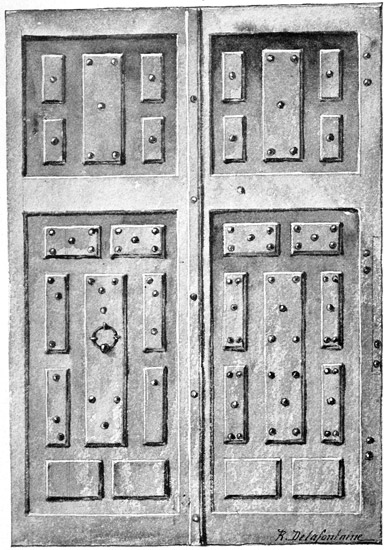
The Door of Corneille's Last Dwelling.
(From a drawing by Robert Delafontaine, by permission of M. Victorien Sardou.)
Age and poverty took up their abode with him—as
well as his more welcome comrade, the constant Thomas—in
his next dwelling. We cannot be sure when they
left Rue de Cléry, and we find them first in Rue d'Argenteuil
in November, 1683, the year of Colbert's death.
That old road from the village of Argenteuil had become,
and still remains, a city street absolutely without
character or temperament of its own; it has not the
merit even of being ignoble. And the Corneille house
at No. 6, as it was seen just before its destruction, was
a gloomy and forbidding building. It had two entrances—as
has the grandiose structure now standing
on its site—one in Rue d'Argenteuil, on which front is
a tablet marking this historic scene of the poet's death,
and the other in Rue de l'Évêque. That street was
wiped out of existence by the cutting of Avenue de
l'Opéra in 1877-8, which necessitated the demolition
of this dreary old house. Its most attractive relic is
now in the possession of M. Victorien Sardou, at his
country house, at Marly-le-Roi, in the porte-cochère,
with its knocker. Every guest there is proud to put
his hand on the veritable knocker lifted so often by
Corneille's hand.
That hand had lost its fire and force by this time, and
the poet's last months were wretched enough in these
vast and desolate rooms on the second floor, so vast and
desolate that he was unable to keep his poor septuagenarian
bones warm within them. Here came death
to him on Sunday, October 1, 1684. They buried him
in his parish church, Saint-Roch, a short step from his
home; and on the western pillar within the entrance a
tablet to his memory was placed in 1821. The church
was so short a step, that, feeble and forlorn as he was,
he had found his way there early of mornings during
these last years. And in his earlier years, when living
in Rue de Cléry, he had often hurried there, drawn by
the strong and splendid Bossuet, whose abode was
either in Rue Sainte-Anne hard by, or in the then new
mansion still standing in Place des Victoires. Here in
the church, as we stand between Corneille's tablet and
Bossuet's pulpit, the contrast is brought home to us
of the two forms of eloquence that most touch men:
that of this preacher burning with ancient Hebraic
fire, and that of this dramatist glowing with the white-heat
of classicism.
After the burial, the bereft Thomas removed to
rooms in Cul-de-sac des Jacobins, only a little way
from his last home with Pierre. This blind alley has
now been cut through to the market of Saint-Honoré,
and become a short commonplace street, named Saint-Hyacinthe.
Twenty years the younger of the two,
Thomas was, during his life, and has been in his after-renown,
unduly overshadowed by his imperishable
brother. He had a rare gift of versification, and a
certain skill in the putting together of plays. Of them
he constructed a goodly lot, some few of them in collaboration.
His "Timocrate," played for eighty consecutive
nights at the Théâtre du Marais, was the most
popular success on the boards of the seventeenth century.
His knack in pleasing the public taste was as
much his own as was his mastery of managers, by
which he got larger royalties than any playwright of
his day. He was a competent craftsman, too, in more
weighty fabrications, and turned out, from his factory,
translations and dictionaries, which have joined his
plays in everlasting limbo.
All the early theatrical productions of Pierre Corneille
were originally put on the stage of the Théâtre du
Marais, which had been started by seceders from the
theatre of the Hôtel de Bourgogne, as has been told in
our first chapter. After a temporary lodgment in the
quarter of the Hôtel de Ville, it was soon permanently
housed in the recast tennis-court of the "Hôtel Salé."
There it remained until 1728, when Le Camus bought
the place and turned the theatre into stables. Where
stands modern No. 90 in the widened Rue Vieille-du-Temple
was the public entrance of the theatre. The
"Hôtel Salé," the work of Lepautre, is still in perfect
condition behind the houses of Rue Vieille-du-Temple.
Its principal portal is at Rue Thorigny, 5, with a side
entrance in Rue Saint-Gervais-des-Coutures. Known
at first as the Hôtel Juigné, it was popularly renamed,
in the seventeenth century, the "Hôtel Salé," because
its rapacious owner, Aubray de Fontenay, had amassed
his wealth by farming out the salt tax—that most exacting
and irritating of the many taxes of that time.
Through a lordly arch in Rue Thorigny, we pass into
the grand court, and find facing us the dignified façade,
its imposing pediment carved with figures and flowers.
Within is a stately hall, made the more stately by the
placing at one end of a noble chimney-piece, a copy of
one at Versailles. In the centre a superb staircase rises,
wide and easy, through a sculptured cage, to the first
floor; its old wrought-iron railing is of an exquisite
pattern; nothing in all Paris is nearer perfection than
this staircase, its railing, and its balustrade. In the
rooms above, kept with reverence by the bronze-maker
who occupies them, admirable panelling and carvings
are found. The façade on the gardens—now shrunk
from their former spaciousness to a small court—is
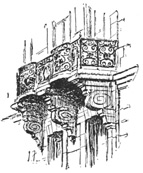
most impressive, with ancient wrought-iron balconies;
in its pediment, two vigilant dogs watch the hands
that move no more on the great clock-face between
them.
The Théâtre du Marais had been established here by
the famous Turlupin, made immortal in Boileau's verse,
who, with his two comic confrères—baker's boys, like
the brothers Coquelin of our day—kept his audiences in
a roar with his modern French farces farcied with old
Gaulish grossness. It was he who invented the comic
valet—badgered and beaten, always lying and always
funny—who was subsequently elaborated into the immortal
Sganerelle by Molière. He, while a boy, had
sat in this theatre, watching Turlupin; and when he
had grown into a manager, he is said to have bought
some of the stage copies of these farces, when Turlupin's
death disbanded his troupe.
These "Comédiens du Marais" were regarded with
a certain condescension not unmingled with disdain by
their stately confrères left at the Hôtel de Bourgogne,
who were shocked when Richelieu, becoming bored by
their dreary traditional proprieties, sent for Turlupin
and his troupe to give a specimen of their acting in his
palace. And the great cardinal actually laughed, a
rare indulgence he allowed himself, and told the King's
Comedians that he wished they might play to as good
effect!
Still, the Théâtre du Marais was not entirely given
over to farce, for it alternated with the tragedy of the
then famous Hardy; and Mondory, the best tragedian
of the day, was at one time the head of the troupe.
Mondory had brought back from a provincial tour, in
1629, the manuscript of "Mélite," by a young lawyer
of Rouen, named Corneille. This piece was weak, but
it was not a failure. And so, when the author came
to town, his tragedies were played at this theatre and
drew crowds to the house. There they first saw the
true tragic Muse herself on the French boards. Those
rough, coarse boards of that early theatre he planed
and polished, with conscience and with craft, and made
them fit for her queenly feet; and through her lips he
breathed, in sublime tirades, his own elevation of soul,
to the inspiration of that shabby scene. For the first
time in the French drama, he put skill into the plot,
art into the intrigue, taste into the wit; in a word, he
gave to dramatic verse "good sense"—"the only aim
of poetry," Boileau claimed—and showed the meaning
and the value of "reason" on the stage; and for the
doing of this Racine revered him.
As to Corneille's personality, we are told by Fontenelle—his
nephew, a man of slight value, a better
talker than writer, an unmoved man, who prided himself
on never laughing and never crying—that his
uncle had rather an agreeable countenance, with very
marked features, a large nose, a handsome mouth, eyes
full of fire, and an animated expression. Others who
saw Corneille say that he looked like a shopkeeper; and
that as to his manner, he seemed simple and timid, and
as to his talk, he was dull and tiresome. His enunciation
was not distinct, so that in reading his own verses—he
could not recite them—he was forcible but not
graceful. Guizot puts it curtly and cruelly, when he
writes that Corneille was destitute of all that distinguishes
a man from his equals; that his appearance was
common, his conversation dull, his language incorrect,
his timidity ungainly, his judgment untrustworthy.
It was well said, in his day, that to know the greatness
of Corneille, he must be read, or be seen in his work on
the stage. He has said so in the verse that confesses
his own defects:
"J'ai la plume féconde et la bouche stérile,
Et l'on peut rarement m'écouter sans ennui,
Que quand je me produis par la bouche d'autrui."
In truth, we must agree with Guizot, that the grand
old Roman was irrevocably doomed to pass unnoticed
in a crowd. And he was content that this should be.
For he had his own pride, expressed in his words: "Je
sais ce que je vaux." He made no clamor when
Georges de Scudéry was proclaimed his superior by
the popular voice, which is always the voice of the foolish.
And when that shallow charlatan sneered at him
in print, he left to Boileau the castigation that was so
thoroughly given. His friends had to drive him to the
defence of his "Cid" in the Academy, to which he had
been elected in 1647. His position with regard to the
"Cid" was peculiar and embarrassing; it was Richelieu,
the jealous playwright, who attacked the successful
tragedy, and it was Richelieu, the all-potent patron,
who was to be answered and put in the wrong. The
skirmish being ended, with honor to Corneille, he retired
into his congenial obscurity and his beloved solitude.
And there the world left him, alone with his
good little brother Thomas, both contented in their
comradeship. For in private life he was easy to get on
with, always full of friendliness, always ready of access
to those he loved, and, for all his brusque humor and
his external rudeness, he was a good husband, father,
brother. He shrank from the worldly and successful
Racine, who reverenced him; and he was shy of the society
of other pen-workers who would have made a
companion of him. His independent soul was not
softened by any adroitness or tact; he was clumsy in
his candor, and not at home in courtier-land; there
was not one fibre of the flunky in his simple, sincere,
self-respecting frame; and when forced to play that
unwonted rôle, he found his back not limber enough
for bowing, his knees not sufficiently supple to cringe.
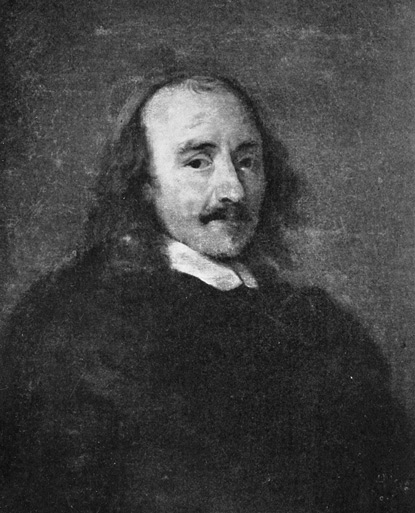
Pierre Corneille.
(From the portrait by Charles Lebrun.)
And in what light he was looked upon by the lazy
pensioned lackeys of the court, who hardly knew his
face, and not at all his worth, is shown by this extract
from one of their manuscript chronicles: "Jeudi, le 15
Octobre, 1684. On apprit à Chambord la mort du bonhomme
Corneille."
Jean Racine came to Paris, from his native La
Ferté-Milon in the old duchy of Valois—by way of
a school at Beauvais, and another near Port-Royal—in
1658, a youth of nineteen, to study in the Collége
d'Harcourt. That famous school was in the midst of
the Scholars' Quarter, in that part of narrow, winding
Rue de la Harpe which is now widened into Boulevard
Saint-Michel. On the site of the ancient college,
direct heir of its functions and its fame, stands the
Lycée Saint-Louis. The buildings that give on the
playground behind, seem to belong to the original college,
and to have been refaced.
Like Boileau-Despréaux, three years his senior here,
the new student preferred poetry to the studies commonly
styled serious, and his course in theology led
neither to preaching nor to practising. He was a wide
and eager reader in all directions, and developed an
early and ardent enthusiasm for the Greeks and the
Latins.
As early as 1660 he had made himself known by his
ode in celebration of the marriage of Louis XIV.;
while he remained unknown as the author of an unaccepted
and unplayed drama in verse, sent to the Théâtre
du Marais.
Racine's Paris homes were all in or near the "Pays
Latin," for he preserves its ancient appellation in his
letters. On leaving college, in 1660-61, he took up
quarters with his uncle Nicolas Vitart, steward and intendant
of the Duchesse de Chevreuse, and secretary of
her son the Duc de Luynes. Vitart lived in the Hôtel
de Luynes, a grand mansion that faced Quai des
Grands-Augustins, and stretched far back along Rue
Gît-le-Cœur. It was torn down in 1671. La Fontaine
had lodgings, during his frequent visits to Paris at this
period, a little farther west on Quai des Grands-Augustins,
and he and Racine, despite the eighteen years'
difference of age, became close companions. La Fontaine
made his young friend acquainted with the cabarets
of the quarter, and Racine studied them not unwillingly.
Just then, too, Racine doubtless met Molière,
recently come into the management of the theatre of the
Palais-Royal. An original edition of "Les Précieuses
Ridicules," played a while before this time at the Hôtel
du Petit-Bourbon, bears on its title-page "Privilège au
Sr. de Luyne." This was Guillaume de Luyne, bookseller
and publisher in the Salle des Merciers of the
Palais de Justice; and at his place, a resort for book-loving
loungers, we may well believe that the actor-manager
made acquaintance with the young poet, coming
from his home with the Duc de Luynes, within
sight across the narrow arm of the river.
Not as a poet was he known in this ducal house, but
as assistant to his uncle, and the probable successor of
that uncle, who tried to train him to his future duties.
Among these duties, just then, was the construction
of the new Hôtel de Luynes for the Duchesse de
Chevreuse. This is the lady who plays so prominent
a rôle in Dumas's authentic history of "The Three
Musketeers." The hôtel that was then built for her
stands, somewhat shorn of its original grandeur, at
No. 201 Boulevard Saint-Germain, and you may look
to-day on the walls constructed under the eye of Jean
Racine, acting as his uncle's overseer. This uncle was
none too rigid of rule, nor was the household, from
the duchess down, unduly ascetic of habit; and young
Racine, "nothing loath," spent his days and eke his
nights in somewhat festive fashion. His anxious country
relatives at length induced him to leave the wicked
town, and in November, 1661, he went to live at Uzés,
near Nîmes, in Languedoc. Here he was housed with
another uncle, of another kidney; a canon of the local
cathedral, able to offer church work and to promise
church preferment to the coy young cleric.
Racine was bored by it all, and mitigated his boredom,
during the two years he remained, only by flirting
and by stringing rhymes. The ladies were left behind,
and the verses were carried to the capital, on his
return in November, 1663. He showed some of them,
first to Colbert and then to Molière, who received the
verse with scant praise, but accepted, paid for, and
played "La Thébaïde"—a work of promise, but of no
more than promise, of the future master hand. It was
at this period, about 1664, that Racine, of his own
wish, first met Boileau, who had criticised in a kindly
fashion some of the younger poet's verses. Thus was
begun that friendship which was to last unmarred so
many years, and to be broken only by Racine's death.
With Corneille, too, Racine made acquaintance, in
1665, and submitted to him his "Alexandre." He was
greatly pleased by the praise of the author of the
"Cid"; praise freely given to the poetry of the play,
but along with it came the set-off that no talent for
tragedy was shown in the piece. It was not long before
the elder poet had to own his error, and it is a sorrow
to record his growing discontent with the younger
man's triumphs. Racine believed then and always, that
Corneille was easily his master as a tragic dramatist;
a belief shared with him by us of to-day, who find Corneille's
tragedies as impressive, his comedies as spirited,
as ever, on the boards of the Comédie Française; while
Racine's tragic Muse seems to have outlived her day
on those boards, and to have grown aged and out of
date, along with the social surroundings amid which
she queened it.
Racine's reverence for his elder and his better never
wore away, and on Corneille's death—when, to his
place in the Academy, his lesser brother Thomas was
admitted—it fell to Racine, elected in 1673, to give
the customary welcome to the new Academician, and
to pay the customary tribute to his great forerunner.
He paid it in words and in spirit of loyal admiration,
and no nobler eulogy of a corrival has been spoken
by any man.
On his return to town, in 1663, Racine had found his
uncle-crony Vitart living in the new Hôtel de Luynes,
and in order to be near him he took lodging in Rue de
Grenelle. It was doubtless at the eastern end of that
street, not far from the Croix-Rouge—a step from Boileau
in Rue du Vieux-Colombier, and not far from La
Fontaine on Quai Malaquais. Here he stayed for four
years, and in 1667 he removed to the Hôtel des Ursins.
This name had belonged to a grand old mansion on the
north bank of Île de la Cité, presented by the City of
Paris to Jean Juvénal des Ursins, Prévôt des Marchands
under Charles VI. In the old prints, we see its two
towers rising sheer from the river, and behind them its
vast buildings and spacious grounds extending far
away south on the island. According to Edouard
Fournier, a painstaking topographer, all this structure
was demolished toward the end of the eighteenth century,
and over its site and through its grounds were
cut the three streets bearing its name of des Ursins—Haute,
Milieu, Basse. Other authorities claim that
portions of the hotel still stand there, among them that
portion in which Racine lived; his rooms having remained
unaltered up to 1848. The street is narrow and
dark, all its buildings are of ancient aspect, and on its
south side is a row of antiquated houses that plainly
date back to Racine's day and even earlier. It is in
one of these that we may establish his lodgings.
The house at No. 5, commonly and erroneously
pointed out as his residence, is of huge bulk, extending
through to Rue Chanoinesse on the south. No. 7 would
seem to be still more ancient. No. 9 is simply one wing
of the dark stone structure, of which No. 11 forms the
other wing and the central body, massive and gloomy,
set back from the street behind a shallow court, between
these wings. In the low wall of this court, under
a great arch, a small forbidding door shuts on the pavement,
and behind, in a recess, is an open stairway leading
to the floor above. No. 13 was undoubtedly once a
portion of the same fabric. All these street windows
are heavily barred and sightless. These three houses
evidently formed one entire structure at first, and this
was either an outlying portion of the Hôtel des Ursins,
or a separate building, erected after the demolition of
that hôtel, and taking the old name. In either case,
there can be no doubt that these are the walls that
harbored Racine. The tenants of his day were mostly
men of the law who had their offices and residential
chambers here, by reason of their proximity to the
Palais de Justice. With these inmates Racine was certainly
acquainted—the magistrates, the advocates, the
clerks, of whom he makes knowing sport in his delightful
little comedy, "Les Plaideurs." It was played at
Versailles, "by royal command," before King and court
in 1668. This was not its original production, however;
it had had its first night for the Paris public a month
earlier, and had failed; possibly because it had not yet
received royal approval. Molière, one of the audience
on that first night, was a more competent critic of its
quality, and his finding was that "those who mocked
merited to be mocked in turn, for they did not know
good comedy when they saw it." This verdict gives
striking proof of his innate loyalty to a comrade in
trade, for he and the author were estranged just then,
not by any fault of Molière, and he had the right to feel
wronged, and by this unasked praise he proved himself
to be the more manly of the two.
The piece was an immediate success at Versailles.
The Roi Soleil beamed, the courtiers smiled, the crowd
laughed. The players, unexpectedly exultant, climbed
into their coaches as soon as they were free, and drove
into town and to Racine, with their good news. This
whole quiet street was awakened by their shouts of congratulation,
windows were thrown open by the alarmed
burghers, and when they learned what it meant, they
all joined in the jubilation.
Racine lived here from 1667 to 1677, and these ten
years were years of unceasing output and of unbroken
success. Beginning with his production of "Andromaque"
in the first-named year, he went, through
successive stage triumphs, to "Phèdre," his greatest
and his last play for the public stage, produced on
New Year's Day of 1677, at the Hôtel de Bourgogne.
It was on these boards that almost all his plays were
first given.
Then, at the age of thirty-seven, at the top of his
fame, in the plenitude of his powers, he suddenly
ceased to write for the stage. This dis-service to dramatic
literature was brought about by his forthcoming
marriage, by his disgust with the malice of his rivals,
by his weariness of the assaults of his enemies, by his
somewhat sudden and showy submission to the Church—that
sleepless assailant of player and playwright. He
hints at the attitude of the godly in his preface to
"Phèdre," assuring them that they will have to own—however,
in other respects, they may or may not esteem
this tragedy—that it castigates Vice and punishes
Badness as had no previous play of his. Doubtless he
was hardened in this decision, already made, by the
hurt he had from the reception of this play in contrast
with the reception of a poorer play for which his own
title was stolen, which was produced within three
nights of his piece, and was acclaimed by the cabal that
damned the original. Nor was it only his rivals and
enemies who decried him. "Racine et le café passeront,"
was La Harpe's contemptuous coupling of the
playwright with the new and dubious drink, just then
on its trial in Paris. His mot has been mothered on
Madame de Sévigné, for she, too, took neither to
Racine nor to coffee. And a century later it pleased
Madame de Staël to prove, to her own gratification,
that his tragedies had already gone into the limbo of
out-worn things.
Racine's whole life—never notably sedate hitherto,
with its frequent escapades and its one grand passion—was
turned into a new current by his love match with
Catherine de Romenet. On his marriage in June, 1677—among
the témoins present were Boileau-Despréaux
and Uncle Vitart, this latter then living in the same
house with his nephew—Racine ranged himself on the
side of order and of domestic days and nights. He gave
proof of a genuine devotedness to his wife; a good
wife, if you will, yet hardly a companion for him in
his work at home and in the world outside. It is told
of her, that she never saw one of his pieces played, nor
heard one read; and Louis, their youngest son, says
that his mother did not know what a verse was.
The earliest home of the new couple was on Île
Saint-Louis. Neither the house nor its street is to be
identified to-day, but both may surely be seen, so slight
are the changes even now since that provincial village,
in the heart of Paris, was built up from an island wash-house
and wood-yard under the impulse of the plans
prepared for Henri IV., by his right hand, Sully. And
in this parish church, Saint-Louis-en-l'Île—a provincial
church quite at home here—we find Racine holding
at the font his first child, Jean-Baptiste, in 1678.
Two years later he moved again, and from early in
1680 to the end of 1684 we find him at No. 2 Rue de
l'Eperon, on the corner of Rue Saint-André-des-Arts.
Here his family grew in number, and the names of three
of his daughters, Marie-Catherine, Anne, and Élisabeth—all
born in this house—appeared on the baptismal
register of his parish church, Saint-André-des-Arts.
This was the church of the christening of
François-Marie Arouet, a few years later. The Place
Saint-André-des-Arts, laid out in 1809, now covers the
site of that very ancient church, sold as National Domain
in 1797, and demolished soon after.
This residence of Racine was left intact until within
a few years, when it was replaced by the Lycée Fénelon,
a government school for girls. There they read their
"Racine," or such portions as are permitted to the
Young Person, not knowing nor caring that on that
spot the author once lived.
From here he removed, at the beginning of the year
1685, to No. 16 Rue des Maçons. That street is now
named Champollion, and the present number of his
house cannot be fixed. It still stands on the western
side of the street, about half way up between Rue des
Écoles and Place de la Sorbonne; for none of these
houses have been rebuilt, and the street itself is as secluded
and as quiet as when Racine walked through it.
Here were born his daughters Jeanne and Madeleine,
both baptized in the parish church of Saint-Séverin—a
venerable sanctuary, still in use and quite unaltered,
except that it has lost its cloisters. And in this home
in Rue des Maçons he brought to life two plays finer
than any of their forerunners, yet, unlike them, not
intended for public performance. "Esther" was written
in 1689 to please Madame de Maintenon, and was
performed several times by the girls at her school of
Saint-Cyr; first before King and court, later before
friends of the court and those who had sufficient influence
to obtain the eagerly sought invitation. "Athalie,"
written for similar semi-public production, two years
later, failed to make any impression, when played at
Versailles by the same girls of Saint-Cyr. After two
performances, without scenery or costumes, it was
staged no more, and had no sale when published by the
author. Yet Boileau told him that it was his best work,
and Voltaire said that it was nearer perfection than any
work of man. Indeed, "Athalie," in its grandeur and
its simplicity, may easily outrank any production of the
French pen during the seventeenth century. And, as
literature, these two plays are almost perfect specimens
of Racine's almost perfect art and diction; of
that art, wherein he was so exquisite a craftsman; of
that diction, so rich, so daring, so pliable, so passionate,
yet restrained, refined, judicious.
In May, 1692, we learn by a letter to Boileau, Racine
was still in Rue des Maçons, but he must have left it
shortly after, for in November of this year he brought
to be christened, in Saint-Sulpice, his youngest child,
Louis. This is the son who has left us an admirable
biography of his father, and some mediocre poems—"La
Religion" and "La Grâce" being those by which
he is best known. So that Saint-Sulpice was, already
in November, 1692, the church of his new parish; and
the house to which he had removed in that parish,
wherein the boy was born, stands, quite unchanged to-day,
in Rue Visconti. That street was then named Rue
des Marais-Saint-Germain, having begun life as a country
lane cut through the low marshy lands along the
southern shore. It extends only from Rue de Seine to
Rue Bonaparte, then named Rue des Petits-Augustins.
Near its western end, at the present number
21, the Marquis de Ranes had erected a grand mansion;
and this, on his death in 1678, was let out
in apartments. It is asserted that it is the house of
whose second floor Racine became a tenant. Within
the great concave archway that frames the wide entrance
door is set a tablet, containing the names
of Racine, of La Champmeslé, of Lecouvreur, and
of Clairon, all of whom are claimed to have been inhabitants
of this house. That tablet has carried conviction
during the half-century since it was cut and set,
about 1855, but its word is to be doubted, and many
of us believe that the more ancient mansion at No. 13
of the street was Racine's home. Local tradition makes
the only proof at present, and the matter cannot be absolutely
decided until the lease shall be found in that
Parisian notary's office where it is now filed away and
forgotten. We know that Mlle. Lecouvreur lived in
the house formerly tenanted by Racine, and that she
speaks of it as being nearly at the middle of the street,
and this fact points rather to No. 13 than to No. 21.
And we know that Mlle. Clairon had tried for a long
time to secure an apartment in the house honored by
memories of the great dramatist and the great actress;
for whose sake she was willing to pay the then enormous
rental of 200 francs. But the tablet's claim to
La Champmeslé as a tenant is an undue and unpardonable
excess of zeal. Whatever Racine may have
done years before in his infatuation for that bewitching
woman, he did not bring her into his own dwelling!
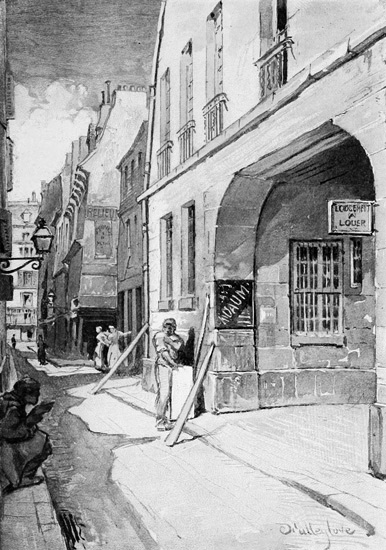
Rue Visconti.
On the right is the Hôtel de Ranes, and in the distance is No. 13.
She had come from Rouen, a young actress looking
for work, along with her husband, a petty actor and
patcher-up of plays; for whose sake she was admitted
to the Théâtre du Marais. How she made use of this
chance is told by a line in a letter of Madame de Sévigné,
who had seen her play Atalide in "Bajazet,"
and pronounced "ma belle fille"—so she brevets her
son's lady-love—as "the most miraculously good comédienne
that I have ever seen." It was on the boards
of the Hôtel de Bourgogne that she showed herself to
be also the finest tragédienne of her time. She shone
most in "Bajazet," and in others of Racine's plays,
creating her rôles under his admiring eye and under his
devoted training. He himself declaimed verse marvellously
well, and had in him the making of a consummate
comedian, or a preacher, as you please. La Champmeslé
was not beautiful or clever, but her stature was
noble, her carriage glorious, her voice bewitching, her
charm irresistible. And La Fontaine sang praises of
her esprit, and this was indeed fitting at his age then.
She lived somewhere in this quarter, when playing in
the troupe of the widow Molière at the Théâtre Guénégaud.
When she retired from those boards, she found
a home with her self-effacing husband in Auteuil, and
there died in 1698.
The first floor in the right wing of the court of both
13 and 21 is said to be the residence of Adrienne Lecouvreur.
She had appeared in 1717 at the Comédie
Française, in Rue de l'Ancienne-Comédie, and had won
her place at once. The choice spirits of the court, of the
great world, of the greater world of literature, were
glad to meet in fellowship around her generous and
joyous table. Among them she found excuse for an
occasional caprice, but her deepest and most lasting passion
was given to the superb adventurer, Maurice de
Saxe. His quarters, when home from the wars—for
which her pawned jewels furnished him forth—were
only a step down Rue Bonaparte from her house, on
Quai Malaquais. They were at No. 5, the most ancient
mansion left on the quay, with the exception of No. 1,
hid behind the wing of the Institute. He died at Chambord
on November 30, 1750, and at this house, May 17,
1751, there was an auction of his effects.
There came a time when the meetings of these two
needed greater secrecy, and he removed to Rue de Colombier,
now named Rue Jacob. The houses on the
north side of this ancient street had—and some of them
still have—gardens running back to the gardens of the
houses on the south side of Rue Visconti. These little
gardens had, in the dividing fence, gates easily opened
by night, for others besides Adrienne and Maurice, as
local legend whispers. Scribe has put their story on the
stage, where it is a tradition that the actress was actually
poisoned by a great lady, for the sake of the fascinating
lover. He stood by her bedside, with Voltaire and the
physician, when she was dying in 1730, at the early age
of thirty-eight, in one of the rooms on this first floor
over the court. Voltaire had had no sneers, but only
praise for the actress, and smiles for the woman whose
kind heart had brought her to his bedside, when he was
ill, where she read to him the last book out, the translation
of the "Arabian Nights." He was stirred to
stinging invective of the churlish priest of Saint-Sulpice,
who denied her church-burial. In the same verse
he commends that good man, Monsieur de Laubinière,
who gave her body hasty and unhallowed interment.
He came, by night, with two coaches and three men, and
drove with the poor body along the river-bank, turning
up Rue de Bourgogne to a spot behind the vast wood-yards
that then lined the river-front. There, in a hole
they dug, they hid her. The fine old mansion at No.
115 Rue de Grenelle, next to the southeast corner of
Rue de Bourgogne, covers her grave. In its garret,
thrown into one corner and almost forgotten, is a marble
tablet, long and narrow, once set in a wall on this
site, to mark the spot so long ignored—as its inscription
says—where lies an actress of admirable esprit, of good
heart, and of a talent sublime in its simplicity. And
it recites the efforts of a true friendship, which got at
last only this little bit of earth for her grave.
Yet a few years further on, the same wing on the
court of this dingy old house sparkled with the splendid
personality of Hippolyte Clairon, who outshines all
other stars of the French stage, unless it be Rachel.
Here she lived the life of one of those prodigal princesses,
in whose rôles she loved to dazzle on the boards
of the Comédie Française, where she first appeared in
1743. It was her public and not her private performances
that shocked the sensitive Church into a threat
of future terrors for her. When, in the course of a theatrical
quarrel, she refused to play, she was sent to prison,
being one of "His Majesty's Servants," disobedient
and punishable. She preferred possible purgatory
to present imprisonment, and went back to her duty.
To this house again came Voltaire, as her visitor
this time, along with Diderot and Marmontel and many
such men. Garrick came, too, when in Paris—came
quietly, less eager to proclaim his ardent admiration
for the woman than his public and professional acclamation
of the actress in the theatre. Her parts all
played, she left the stage when a little past forty, and,
sinking slowly into age and poverty and misery, she
died at the age of eighty in 1803.
All these flashing fireworks are dimmed and put to
shame by the gentle glow and the steadfast flame of
the wood-fire on Racine's home hearthstone. It lights
up the gloomy, mean street, even as we stand here.
He was, in truth, an admirable husband and father,
and it is this side of the man that we prefer to regard,
rather than that side turned toward other men. Of
them he was, through his over-much ambition, easily
jealous, and, being sensitive and suspicious as well, and
given to a biting raillery, he alienated his friends.
Boileau alone was too big of soul to allow any estrangement.
These two were friends for almost forty
years, in which not one clouded day is known. The
letters between them—those from 1687 to 1698 are
still preserved—show the depth of Racine's manly and
delicate feeling for his friend, then "in his great solitude
at Auteuil." They had been appointed royal
historiographers soon after Racine's marriage in 1677,
and, in that office, travelled together a good deal, in
the Ghent campaign of 1678 and again with the army
in other fields. They worked together on their notes
later, and gathered great store of material; but the result
amounted to nothing, and they were posthumously
lucky in that their unfinished manuscript was finally
burned by accident in 1726.
Whether with Boileau in camp, or alone in the Luxembourg
campaign of 1683—Boileau being too ill to
go—or at Namur in 1692, or with the King and court
at Fontainebleau, Marly, Versailles, in these royal
residences where he had his own rooms, wherever he
was, Racine never seemed to cease thinking of his
home, that home in Rue des Maçons when he first
went away, and for the last seven years of his life in
Rue Visconti. When absent from home he wrote to
his children frequently, and when here he corresponded
constantly with his son, who was with the French Embassy
at The Hague. To him he gave domestic details
and "trivial fond records" of what his mother was
doing, of the colds of the younger ones, and of the
doings of the daughter in a convent at Melun. He
sends to this son two new hats and eleven and a half
louis d'or, and begs him to be careful of the hats and
to spend the money slowly.
Yet he was fond of court life, and, an adroit courtier,
he knew how to sing royal prowess in the field and
royal splendor in the palace. He had a way of carrying
himself that gave seeming height to his slight
stature. His noble and open expression, his fine wit,
his dexterous address, his notable gifts as a reader to
the King at his bedside, made him a favorite in that
resplendent circle. And he was all the more unduly dejected
when the Roi Soleil cooled and no longer smiled
on him; he was killed when Madame de Maintenon—"Goody
Scarron," "Old Piety," "the hag," "the
hussy," "that old woman," are the usual pet epithets
for her of delicious Duchesse d'Orléans—who had
liked and had befriended him, saw the policy of showing
him her cold shoulder, as she had shown it to
Fénelon. From this shock, Racine, being already
broken physically by age and illness, seemed unable
to rally. As he sank gradually to the grave he made
sedulous provision for his family, dictating, toward
the last, a letter begging for a continuance of his pension
to his widow, which, it is gladly noted, was afterward
done. He urged, also, the claim of Boileau to
royal favor: "We must not be separated," he said to
his amanuensis; "begin your letter again, and let
Boileau know that I have been his friend to my death."
His death came on April 21, 1699. His body lay
one night in the choir of Saint-Sulpice, his parish
church, and then it was carried for burial to the Abbey
of Port-Royal. On the destruction of that institution,
his remains were brought back to Paris, in 1711, and
placed near those of Pascal, at the entrance of the lady-chapel
of Saint-Étienne-du-Mont. Racine's epitaph,
in Latin, by Boileau, the friend of so many men who
were not always friendly with one another, is cut in a
stone set in the first pillar of the southern aisle of the
choir.
Jean de la Fontaine began to come to Paris, making
occasional excursions from his native Château-Thierry,
in Champagne, toward 1654, he being then
over thirty years of age. A little later, when under
the protection and in the pay of the great Fouquet,
his visits to the capital were more frequent and more
prolonged. He commonly found lodgings on Quai
des Grands-Augustins, just around the corner from
young Racine, and the two men were much together
during the years 1660 and 1661. La Fontaine made
his home permanently in the capital after 1664, when
he arrived there in the train of the Duchesse de Bouillon,
born Anne Mancini, youngest and liveliest of
Mazarin's many dashing nieces. Her marriage with
the Duc de Bouillon had made her the feudal lady of
Château-Thierry, and if she were not compelled to
claim, in this case, her privilege as châtelaine over her
appanage, it was because there was ampler mandate
for the impressionable poet in the caprice of a wilful
woman. Incidentally, in this flitting, he left behind
his provincial wife. He had taken her to wife in 1647,
mainly to please his father, and soon, to please her
and himself, they had agreed on a separation. They
met scarcely any more after his definite departure.
There is a tradition that he chatted, once in a salon
somewhere, with a bright young man by whom he
found himself attracted, and concerning whom he
made inquiry of the bystanders, who informed him
that it was his son. Tradition does not record any
attempt on his part to improve his acquaintance with
the young stranger, or to show further interest in his
welfare.
He did not entirely desert his country home, for
the duchess carried him along on her autumnal visits
to Château-Thierry. He took advantage of each
chance thus given him to realize something upon his
patrimony, that he might meet the always pressing
claims on his always overspent income.
He writes to Racine during one of these visits, in
1686: "My affairs occupy me as much as they're worth
it, and that's not at all; and the leisure I thus get is
given to laziness." He almost anticipated in regard to
himself the racy saying of the Oxford don of our day
of another professor: "Such time as he can save from
the adornment of his person he devotes to the neglect
of his duties." But La Fontaine neglected not only
his duties all through life, but, more than all else, did
he neglect the care of his dress. A portion of the income
he was always anticipating came from his salary
at one time, as gentleman in the suite of the dowager
Duchesse d'Orléans, that post giving him quarters in
the Luxembourg. These quarters and his salary went
from him with her death. For several years after
coming to town with the Duchesse de Bouillon he had
a home in the duke's town-house on Quai Malaquais.
This quay had been built upon the river-front soon
after the death, in 1615, of Marguerite de Valois,
Henri IV.'s divorced wife. The streets leading from
Quais Malaquais and Voltaire, and those behind, parallel
with the quays, were cut through her grounds and
through the fields farther west. This was the beginning
of the Faubourg Saint-Germain. To save the
long detour, to and from the new suburb, around by
way of Pont-Neuf, a wooden bridge was built in 1632
along the line of the ferry, that had hitherto served
for traffic between the shore in front of the Louvre
and the southern shore, at the end of the road that is
now Rue du Bac. The Pont Royal has replaced that
wooden bridge. One of the buildings that began this
river-front remains unmutilated at the corner of Quai
Malaquais and Rue de Seine, and is characteristic of
the architecture of that period in its walls and roofs
and windows clustering about the court. It was the
many years' dwelling of the elder Visconti, and his
death-place in 1818. The house at No. 3 was erected
early in the nineteenth century, on the site of Buzot's
residence, as shall be told in a later chapter. In it
Humboldt lived from 1815 to 1818. The associations
of No. 5 have already been suggested. The largest
builder on the quay was Cardinal Mazarin, whose college,
to which he gave his own name, and to which
the public gave the name Collége des Quatre-Nations,
is now the Palais de l'Institut. He paid for it with
money wrung from wretched France, as he so paid
for the grand hôtel he erected for another niece, Anne
Marie Martinozzi, widow of that Prince de Conti who
was Molière's school friend. On the ground that it
covered was built, in 1860-62, the wing of the Beaux-Arts
at Nos. 11 and 13 Quai Malaquais. That school
has also taken possession of the Hôtel de Bouillon of
the cardinal's other niece, almost alongside. It had
been the property of the rich and vulgar money-king
Bazinière, whom we shall meet again, and he had sold
it to the Duc de Bouillon. The pretty wife of this
very near-sighted husband had the house re-decorated,
and filled it with a marvellous collection of furniture,
paintings, bric-à-brac. She filled it, also, by her open
table twice a day, with thick-coming guests, some of
whom were worth knowing. The hôtel came by inheritance
in 1823 to M. de Chimay, who stipulated, in
making it over to the Beaux-Arts, in 1885, that its
seventeenth-century façade should be preserved, and
by this agreement we have here, at No. 17 Quai Malaquais,
an admirable specimen of the competence of the
elder, the great Mansart. It is higher than he left it,
by reason of the wide, sloping roof, with many skylights
toward the north, placed there for the studios
within, but its two well-proportioned wings remain
unchanged, and between them the court, where La
Fontaine was wont to sit or stroll, has been laid out
as a garden. While living here he brought out the
first collection of his "Contes" in 1665, and of his
"Fables" in 1668. His "Les Amours de Psyché,"
written in 1669, begins with a charming description
of the meetings in Boileau's rooms of the famous
group of comrades.
From this home he went to the home of Madame de
la Sablière, with whom, about 1672, he had formed
a friendship which lasted unbroken until her death.
This tender and steadfast companionship made the
truest happiness of La Fontaine's life. For twenty
years an inmate of her household, a member of her
family, he was petted and cared for as he craved. In
her declining years she had to be away from home attending
to her charitable work—for she followed the
fashion of turning dévote as age advanced—and then
he suffered in unaccustomed loneliness. His tongue
spoke of her with the same constant admiration and
gratitude that is left on record by his pen, and at her
death he was completely crushed.
When he was invited by Madame de la Sablière and
her poet-husband to share their home, they were living
at their country-place, "La Folie Rambouillet,"
not to be mistaken for the Hôtel de Rambouillet. Sablière's
hôtel, built by his father, a wealthy banker,
was in the suburb of Reuilly, on the Bercy road, north
of the Seine, not far from Picpus. The Reuilly station
and the freight-houses of the Vincennes railway now
cover the site of this splendid mansion and its extensive
grounds. Here Monsieur de la Sablière died in
1680, and his widow, taking La Fontaine along, removed
to her town-house. This stood on the ground
now occupied by the buildings in Rue Saint-Honoré,
nearly opposite Rue de la Sourdière. In the court of
No. 203 are bits of carving that may have come down
from the original mansion. Here they dwelt untroubled
until death took her away in 1693. It is related
that La Fontaine, leaving this house after the
funeral, benumbed and bewildered by the blow, met
Monsieur d'Hervart. "I was going," said that gentleman,
"to offer you a home with me." "I was going
to ask it," was the reply. And in this new abode he
dwelt until his death, two years later.
Berthélemy d'Hervart, a man of great wealth, had
purchased, in 1657, the Hôtel de l'Éperon, a mansion
erected on the site of Burgundy's Hôtel de Flandre.
M. d'Hervart had enlarged and decorated his new
abode, employing for the interior frescoes the painter
Mignard, Molière's friend. The actor and his troupe
had played here, by invitation, nearly fifty years before
La Fontaine's coming. It stood in old Rue Plâtrière,
now widened out, entirely rebuilt, and renamed
Rue Jean-Jacques-Rousseau; and on the wall of the
Central Post-office that faces that street, you will find
a tablet stating that on this site died Jean de la Fontaine
on April 13, 1695.
Madame d'Hervart was a young and lovely woman,
and as devoted to the old poet as had been Madame
de la Sablière. She went so far as to try to regulate
his dress, his expenditure, and his morals. Congratulated
one day on the splendor of his coat, La Fontaine
found to his surprise and delight that his hostess had
substituted it—when, he had not noticed—for the
shabby old garment that he had been wearing for years.
She and her husband held sacred, always, the room
in which La Fontaine died, showing it to their friends
as a place worthy of reverence.
He was buried in the Cemetery of Saints-Innocents,
now all built over except its very centre, which is kept
as a small park about the attractive fountain of Saints-Innocents.
The Patriots of the Revolution, slaying so
briskly their men of birth, paused awhile to bring from
their graves what was left of their men of brains.
Misled by inaccurate rumor, they left La Fontaine's
remains in their own burial-ground, and removed what
they believed to be his bones from the graveyard of
Saint-Joseph, where he had not been buried, along
with the bones they believed to be those of Molière,
who had been buried there. These casual and dubious
remains were kept in safety in the convent of Petits-Augustins
in present Rue Bonaparte, until, in the early
years of the nineteenth century, they were removed
for final sepulture to Père-Lachaise.
No literary man of his time—perhaps of any time—was
so widely known and so well beloved as La Fontaine.
He attracted men, not only the best in his own
guild, but the highest in the State and in affairs. Men
various in character, pursuits, station, were equally
attached to him; the great Condé was glad to receive
him as a frequent guest at Chantilly; the superfine
sensualist, Saint-Évremond, in exile in England, urged
him to come to visit him and to meet Waller. He
nearly undertook the journey, less to see Saint-Évremond
and to know Waller, than to follow his Duchesse
de Bouillon, visiting her sister, the Duchess of Mazarin,
in her Chelsea home. It was at this time that Ninon
de Lenclos wrote to Saint-Évremond: "You wish La
Fontaine in England. We have little of his company
in Paris. His understanding is much impaired."
Racine, eighteen years his junior, looked up to La
Fontaine as a critic, a counsellor, and a friend, from
their early days together in 1660, through long years
of intimacy, until he stood beside La Fontaine's bed
in his last illness. He even took an odd pleasure in
finding that he and La Fontaine's deserted country
wife had sprung from the same provincial stock.
Molière first met La Fontaine at Vaux, the more than
royal residence of Fouquet, at the time of the royal
visit in 1661. La Fontaine wrote a graceful bit of
verse in praise of the author of "Les Fâcheux," played
for the first time before King and court during these
festivities, and the two men, absolutely opposed in essential
qualities, were fast friends from that time on.
"They make fun of the bonhomme," said the ungrudging
player once, "and our clever fellows think they can
efface him; but he'll efface us all yet."
It is needless to say that La Fontaine was beloved
by Boileau, the all-loving. That kindly ascetic was
moved to attempt the amendment of his friend's laxity
of life, and to this blameless end dragged him to
prayers sometimes, where La Fontaine was bored and
would take up any book at hand to beguile the time.
In this way he made acquaintance with the Apocrypha,
and became intensely interested in Baruch, and asked
Boileau if he knew Baruch, and urged him to read
Baruch, as a hitherto undiscovered genius. During
his last illness, he told the attendant priest that he had
been reading the New Testament, and that he regarded
it as a good, a very good book.
In truth, his soul was the soul of a child, and, childlike,
he lived in a world of his own—a world peopled
with the animals and the plants and the inanimate
objects, made alive by him and almost human. He
loved them all, and painted them with swift, telling
strokes of his facile pen. The acute Taine points out
that the brute creations of this poet are prototypes of
every class and every profession of his country and his
time. His dumb favorites attracted him especially by
their unspoiled simplicity, for he loathed the artificial
existence of his fellow-creatures. With "a sullen
irony and a desperate resignation" he let himself be
led into society, and he was bored beyond bearing by
its high-heeled decorum. It is said that he cherished,
all his life long, a speechless exasperation with the
King, that incarnation of pomposity and pretence to
his untamed Gallic spirit. Yet this malcontent had to
put on the livery of his fellow-flunkies, and his dedication,
to the Dauphin, of his "Fables," is as fulsome
and servile as any specimen of sycophancy of that toad-eating
age.
Yet, able to make trees and stones talk, he himself
could not talk, La Bruyère tells us; coloring his portraiture
strongly, as was his way, and rendering La
Fontaine much too heavy and dull, with none of the
skill in description with his tongue that he had with
his pen. He may be likened to Goldsmith, who "wrote
like an angel and talked like poor Poll." Madame de
Sablière said to him: "Mon bon ami, que vous seriez
bête, si vous n'aviez pas tant d'esprit!" Louis Racine,
owning to the lovable nature of the man, has to own,
too, that he gave poor account of himself in society,
and adds that his sisters, who in their youth had seen
the poet frequently at their father's table in Rue Visconti,
recalled him only as a man untidy in dress and
stupid in talk. He gave this impression mainly because
he was forever dreaming, even in company, and
so seemed distant and dull; but, when drawn out of
his dreams, no man could be more animated and more
delightful.
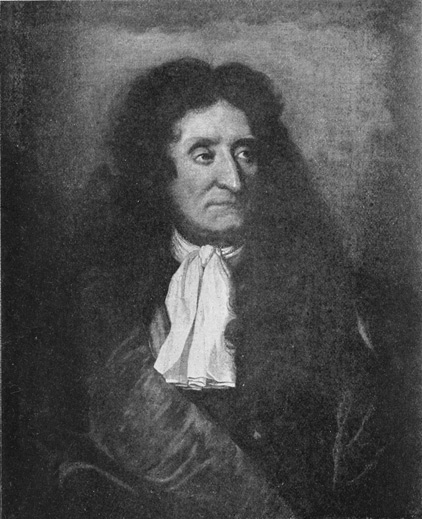
La Fontaine.
(From the portrait by Rigaud-y-Ros.)
So he was found by congenial men, and so especially
by approving women. These took to him on the spot,
women of beauty and of wit, and women commonplace
enough. To them all his prattle was captivating,
devoid as it was of the grossness so conspicuous in his
poems. He depended on women in every way all
through his life; they catered to his daily needs, and
they provided for his higher wants; they helped him
in his money troubles, they helped him in all his troubles.
And he requited each one's care with a genuine
affection, not only at the time, but for all time, in the
record he has left of his gratitude and his devotion to
these ministering women. His verse is an unconscious
chronicle of his loves, his caprices, his inconstancies,
and his loyalties. Nor did a woman need to be clever
and cultivated to be bewitched by his inborn, simple
sweetness. A matter-of-fact nurse, hired to attend
him during an illness which came near being fatal, said
to the attending priest: "Surely, God could not have
the courage to damn a man like that."
This memory he has left is brought pleasantly home
to the passer-by in Rue de Grenelle by the sign of a
hotel, a quiet clerical house, frequented by churchmen
and church-loving provincials visiting Paris. The
sign bears the name "Au bon La Fontaine," in striking
proof of the permanent place in the common heart
won by this lovable man.
He was content to drift through life, his days spent,
as he put it in his epitaph on "Jean," one-half in doing
nothing, the other half in sleeping. He had no library
or study or workroom, like other pen-workers;
he lived out of doors in the open air, and wandered
vaguely, tasting blameless epicurean delights. Some
of us seem to see, always in going along Cours la
Reine, that quaint figure, comical and pathetic, as he
was seen by the Duchesse de Bouillon on a rainy morning,
when she drove to Versailles. He was standing
under a tree on this wooded water-side, and on her
return on that rainy evening he was standing under
the same tree. He had dreamed away the long day
there, not knowing or not caring that he was wet. He
explained, once when he came late—inexcusably late—to
a dinner, that he had been watching a procession of
ants in a field, and had found that it was a funeral;
he had accompanied the cortége to the grave in the
garden, and had then escorted the bereaved family
back to its home, as bound by courtesy.
This genuine poet, of dry, sly humor and of unequalled
suppleness of phrase, was by nature a gentle,
wild creature, and by habit a docile, domesticated pet,
attaching himself to any amiable woman who was willing
to give him a warm corner in her heart and her
house. And how such women looked on him was
prettily and wittily put by one of them: "He isn't a
man, he is a fablier"—a natural product of her own
sudden inspiration—"who blossoms out into fables as
a tree blossoms out with leaves."
Nicolas Boileau began his acquaintance with Molière
by his tribute of four dainty verses to the author
of "L'École des Femmes," and the friendship thus
formed was broken only by the death of Molière, to
whose memory Boileau inserted his magnificent lines
in the "Epître à Monsieur Racine." It was Boileau
who criticised the early verse of young Racine, so
justly and so gently, that the two men were drawn together
in an amity that was never marred. It was
Boileau who, after nearly forty years of finding him
out by the distrustful Racine, was acknowledged to
be "noble and full of friendship." It was Boileau
who sang without cessation praises of Racine to Louis
XIV., and who startled the nimble mediocrity of his
majesty's mind by the assertion that Molière was the
rarest genius of the Grand Monarch's reign and realm.
It was Boileau who made, in his fondness for La Fontaine,
the unhappy and hopeless attempt to reform
his friend's loose living, and in so doing nearly led to
the undoing of La Fontaine's goodwill for him. It
was Boileau, prompted by compassion for Corneille's
impoverished old age, who offered to surrender his
own pension in favor of the distressed veteran of letters.
It was Boileau who found Patru forced to sell
his cherished books that he might get food, and it
was Boileau who bought them, on condition that Patru
should keep them and look after them for their new
owner. It was Boileau who tried to work a miracle
in his comrade Chapelle by weaning him from his
wine-bibbing; and when Chapelle found the lecture
dry, and would listen to it only over a bottle or two,
it was Boileau who came out of the cabaret the tipsier
of the pair. It was Boileau who was known to every
man who knew him at all—and he was known to many
men of merit and demerit—as a loyal, sincere, helpful,
unselfish friend. It was of Boileau that a perplexed
woman in the great throng at his burial said, in the
hearing of young Louis Racine: "He seems to have
lots of friends, and yet somebody told me that he
wrote bad things about everybody."
Those friends could have explained the puzzle. They
mourned the indulgent comrade who was doubled with
the stern satirist. The man, so rigid in morals and
austere of life, was tolerant to the foibles of his friends,
tender in their troubles, open-handed for their needs.
The writer, so exacting in his standard and severe in
his judgment, was cruel only with his pen. Trained
critic in verse, rather than inspired poet, Boileau
had an enthusiasm for good work in others equal to
his intolerance of bad. He loathed the powdered
and perfumed minauderies of the drawing-room poetasters,
and he loved the swift and sure stroke of
Molière's "rare et fameux esprit." It was in frank
admiration that he demanded of his friend: "Enseigne-moi
où tu trouves la rime!" For this impeccable artist
in words, who has left his profession of faith in
the power of a word in its right place, had to reset
and recast, file and polish, to get the perfection he
craved. And so this bountiful admirer was easily
an unsparing censor. Sincere in letters as in life, he
insisted on equal sincerity from his fellow-workers,
and would not let them spare their toil or scamp their
stint. He watched and warned them; his reproof and
his approval brought out better work from them; and
he may well be entitled the Police President of Parnassus
of his country and his day.
Boileau's sturdy uprightness of spine stood him in
good stead in that great court where all men grew
sleek and servile, and where no pen-worker seemed
able to escape becoming a courtier. His caustic audacity
salted his sycophancy and made him a man apart
from the herd of flatterers. His thrust was so suave,
as well as sharp, that the spoiled monarch himself accepted
admonition from that courageous cleverness.
"I am having search made in every direction for Monsieur
Arnauld," said Louis, when eager in his pursuit
of the Jansenists. "Your Majesty is always fortunate;
you will not find him," was Boileau's quick retort,
received with a smile by the King. When money
was needed for Dr. Perrault's new eastern façade of
the Louvre and for its other alterations, the King
naturally economized in the incomes of other men.
The pensions of literary men—in many instances the
sole source of their livelihood—were allowed to lapse;
that of Boileau was continued by an order that his
name should be entered on the Louvre pay-roll as "an
architect paid for mason's work." His mordant reply
to the questioning pay-clerk was: "Yes, I am a mason."
His masonry in the stately fabric of French
literature stands unmarred to-day; coldly correct, it
may be, yet elegant, faultless, consummate.
Nicolas Boileau-Despréaux was long believed to
have been born in the country and to have played in
the fields as a child, and so to have got his added name
des préaux; but it is now made certain that the house
of his birth, in 1636, was in Rue de Jérusalem, a street
that led to the Sainte-Chapelle, from about the middle
of the present Quai des Orfèvres. The only field he
knew lay at the foot of his father's garden at Crosne,
where the lad was sometimes taken. Fields and gardens
had never anything to say to this born cockney,
and there is not a sniff of real country air in all his
verse. The street of his birth was one of the narrow,
dark streets of oldest Paris, on Île de la Cité; and
the house, tall and thin, had its gable end on the court
of the old Palais de Justice. The earliest air breathed
by this baby was charged with satire, it would seem.
For the room of his birth had been occupied, nearly
half a century earlier, by Jacques Gillot, the brilliant
canon of Sainte-Chapelle. In this room assembled in
secret that clever band of talkers and writers, who
planned and wrote "La Ménippée"; the first really
telling piece of French political satire, so telling, in its
unbridled buffoonery, that it gave spirit to the arms
that shattered the League, and helped to put Henry
of Navarre on the throne of France.
After his father's death, young Nicolas kept his
home with his elder brother Jérôme, who had succeeded
to the paternal mansion, and who gave the boy
a sort of watch-tower, built above the garrets, in which
he could hardly stand upright. The house, the court,
the old palace, were long since swept away, and with
them went all the melodramatic stage-setting of Hugo's
"Notre-Dame de Paris" and Sue's "Mystères de
Paris." Only the Sainte-Chapelle is left of the scenes
of Boileau's early years.
He was sent for a while to Collége d'Harcourt,
where young Racine came a little later, and was then
put to the study of law, the family trade; passing
by way of Beauvais College to the Sorbonne. He is
known to have pleaded in but one case, and then with
credit to himself. Still the law did not please him,
any more than did the dry theology and the pedantic
philosophy that he listened to on the benches of the
Sorbonne. He was enamoured early of poetry and
romance, and soon affianced himself to the Muse. This
was his only betrothal, and he made no other marriage.
He was born an old bachelor, and he soon
sought bachelor quarters, driven by the children's
racket from his nephew's house—also in the Cour du
Palais—where he had found a home. This nephew
and this house were well known to Voltaire when a
boy, as he tells us in his "Épître à Boileau":
"Chez ton neveu Dongois je passai mon enfance,
Bon bourgeois, qui se crut un homme d'importance."
It is first in the year 1664 that we can place with
certainty Boileau's residence in Rue du Vieux-Colombier,
in that small apartment which fills a larger
place in the annals of literary life than any domicile
of that day, perhaps of any day. It was the gathering-place
of that illustrious quartette—
"The goodliest fellowship of famous knights
Whereof this world holds record."
Molière comes from his rooms in Rue Saint-Honoré,
or from his theatre; crossing the Seine by the Pont-Neuf,
and passing along Rues Dauphine and de Bucy,
and through the Marché Saint-Germain; moody from
domestic dissensions, heavy-hearted with the recent
loss of his first-born. Once among his friends, he listens,
as he always listened, talking but little. La Fontaine
saunters from the Hôtel de Bouillon, by way of
Rue des Petits-Augustins—now Rue Bonaparte—and
of tortuous courts now straightened into streets. Sitting
at table, he is yet in his own land of dreams, until,
stirred from his musing, his fine eyes brighten, and
he chatters with a curious blending of simplicity and
finesse. Racine steps in from his lodging in Rue de
Grenelle, hard by; the youngest of the four, he, unlike
those other two, is seldom silent, and gives full
play to his ironical raillery. Next above him in age
is the host; shrewd, brusque, incisive of speech and
manner. So he shows in Girardon's admirable bust
in the Louvre. The enormous wig then worn cannot
becloud the bright alertness of his expression, or over-weigh
the full lips that could sneer and the square
chin, so resolute. These comrades talked of all sorts
of things, and read to one another what each had
written since they last met; read it for the sake of
honest criticism from the rest, and with no other
thought. For never were four men so absolutely without
pose, without any pretence of earnestness, while
immensely in earnest all the time. In "Les Amours
de Psyché," La Fontaine assures us that they did not
absolutely banish all serious discourse, but that they
took care not to have too much of it, and preferred the
darts of fun and nonsense that were feathered with
friendly counsel. Best of all, his fable makes plain
that there were no cliques nor cabals, no envy nor
malice, among the men that made this worshipful band.
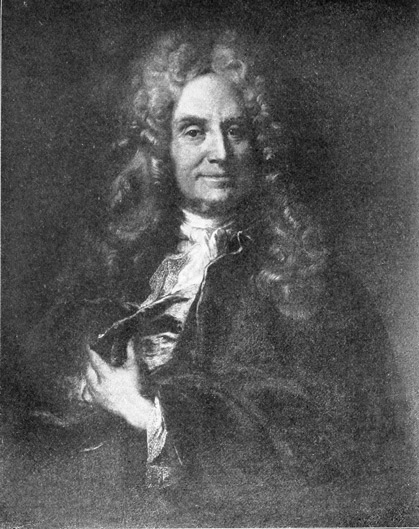
Boileau-Despréaux.
(From the portrait by Largillière.)
Their table served rather to sit around than to eat
from, for their suppers were simple, and the flowing
bowl was passed only when boisterous Chapelle or
other bon-vivant dropped in. For others were invited
at times, men of the world, the court, and the camp.
And Boileau was the common centre of these excentric
stars, and when each, in his own special atmosphere of
coolness, swayed from the others' vicinage, Boileau
alone let no alienation come between him and any one
of them. For each, he was what Racine had found
him, "the best friend and the best man in the world."
The house was near a noted cabaret, to which they
sometimes resorted, at the Saint-Sulpice end of the
street. The cabaretier was the illustrious Cresnet,
made immortal in Boileau's verse. For the poet was
no prude, and enjoyed the pleasures of the table so
far as his health permitted; and, a trained gastronomic
artist, he knew how to order a choicely harmonized
repast. His street is widened, his house is
gone, and no one can fix the spot. Yet the turmoil
of that crowded thoroughfare of to-day is deadened
for us by the mute voices of these men.
We have noted Boileau's camp-following with Racine,
in their rôles of royal historiographers—in 1678
and later—but he was not strong enough for these
excursions, even though they were made a picnic for
the court. He was never at home on a horse, and yet
out of place in the mud, and he could not enjoy the
laughter he caused in either attitude, before or after
he was thrown; laughter that is recorded in the letters
of Madame de Sévigné.
It was probably because of Molière's taking a country
place at Auteuil that Boileau began to make frequent
excursions to that quiet suburb about 1667, and
went to live in his tiny cottage there in 1685. "He
had acquired it," to use his biographer's words, "partly
by his Majesty's munificence, and partly by his own
careful economy," so that he was opulent, for a poet.
His purchase papers were made out by the notary
Arouet—Voltaire's father—who drew up Boileau's
pension papers in 1692, and who did much notarial
work for the Boileau family. The cottage stood exactly
on the ground now covered by the rear wing of
the Hydropathic Establishment, at No. 12 Rue Boileau,
Auteuil. Here he spent the spring and summer months
of many a year, always alone, but with a hand-shake
and a smile for his many visitors, men of birth as well
as men of brains. Hither Voltaire certainly came,
when a lad living with Dongois, for he says, in his
pleasant rhymed epistle to Boileau:
"Je vis le jardinier de ta maison d'Auteuil."
To this same "laborieux valet," to this same
"Antoine, gouverneur de mon jardin d'Auteuil,"
Boileau wrote his letter in verse in 1695. The widow
Racine came, too, for frequent outings with her children,
who loved the garden and adored Boileau, for
the peaches he picked for them and the ninepins he
played with them. Louis Racine, a sort of pupil of his,
says that the old poet was nearly as skilful at this game
as in versifying, and usually knocked over the entire
nine with one ball. And when he went to town, no
warmer welcome met the crusty old bachelor than in
Rue des Marais-Saint-Germain, still the dwelling-place
of Racine's family.
In great mansions, too, he had long been cordially
received. He was a visitor at that of Madame de
Guénégaud, which has given its site to the Hôtel de la
Monnaie, and its name to the street alongside. He was
fond of meeting kindred spirits and kindly hosts in the
hôtel of the great Condé and his younger brother Conti.
He was one of the select set that sat about the table
of Lamoignon, every Monday, at his home in the Marais,
to be visited by us later. And whenever old
Cardinal Retz came to town, Boileau hastened to the
Hôtel de Lesdiguières, of which no stone stands in
the street of its name. Here the white-headed, worn-out
old fighter, compelled to live in retirement, after
the storms and scandals of his active life, was made
at home by his admirable niece, Madame de Lesdiguières,
and here he was encircled by admiring men
and women. Here, writes Madame de Sévigné, his
other niece, who came often to sit with him, Boileau
presented to Retz early copies of "Le Lutrin," and of
"L'Ars Poétique."
Boileau could not live in the country in winter, and
even in summer he had to go often into town to get the
care of his trusted physician. For he was an invalid
from boyhood, and all his life an uncomplaining sufferer.
But he hurried back, whenever permitted, to the
pure air and the congenial solitude of his small cottage,
where three faithful servants cared for him; not as
would have cared the wife, whom he ought to have had,
all his friends said, and so, too, he thought sometimes.
He grew lonely as life lengthened, and as he saw his
cronies passing away, fast and faster, old Corneille being
the last of them to go.
His winters in the great city were spent in lodgings
on the island, in the cloisters of Notre-Dame. Their
quiet had always attracted him, as he avows in the verse
that quivers with his nervous irritability, caused by the
noises of the noisiest of towns. He cries, "Does one go
to bed to be kept awake?" Indeed, he had rooms in the
cloisters as early as 1683, keeping them for town quarters,
in the official residence of l'Abbé de Dreux, his
old friend, a canon of Notre-Dame. To this address
Racine sent him a letter as late as 1687. The ecclesiastical
settlement within the cathedral cloisters, and its
only remaining cottage, have been spoken of in an
earlier chapter. The cloisters themselves survive only
in the name of the street that has been cut through
their former site.
In 1699 we find Boileau living with his confessor, the
Abbé Lenoir, also a canon of the cathedral, who had the
privilege of residing within the cloisters. This house
stood exactly where now is the southern edge of the
fountain behind Notre-Dame, above Le Terrain and the
Seine. His rooms were on the first floor, his bed in an
alcove, and his windows looked out on the terrace over
the river, as we learn by the amiable accuracy of the lawyer
who drew up his will. Here Boileau lived through
painful years of breaking bodily health, but with unbroken
faculties. He yearned for his old home at Auteuil,
and yet he was too feeble to go so far. He had
sold his cottage to a friend, under the condition that a
room should be reserved always for his use. That use
never came. One day toward the end, he summoned up
strength to drive to the beloved place; but all was
changed, he changed most of all, and he hurried home
to his lonely quarters, where death found him at ten
o'clock in the morning of March 2, 1711.
His devoted servants were requited for years of
faithful service by handsome legacies, then the relatives
were provided for, and no friend was forgotten.
The remainder of his fortune went to the "pauvres
honteux" of six small parishes in the City. A vast
and reverent concourse of mourners of every rank followed
his coffin to its first resting-place. This was in
the lower chapel of the Sainte-Chapelle, as he had ordered;
the church of his baptism, and of the burial of
his mother and father. By a strange chance, his grave
had been dug under that very reading-desk which had
suggested to him the subject of his most striking production,
the heroic-comic poem "Le Lutrin." Early
in the Revolution his remains were removed, to save
them from fortuitous profanation by the "Patriots," to
the Museum of French Monuments established in the
convent of the Petits-Augustins, in the street of that
name, now Rue Bonaparte. In 1819 his bones were
finally placed in Saint-Germain-des-Prés, where, in the
chapel of Saint-Peter and Saint-Paul, they are at rest
behind a black marble tablet carved with a ponderous
Latin inscription.