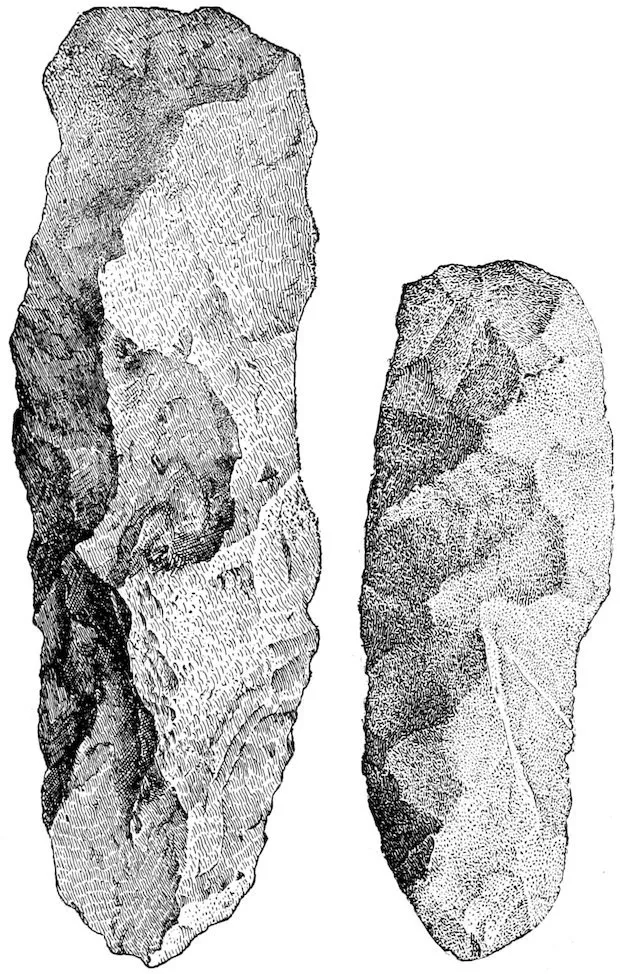
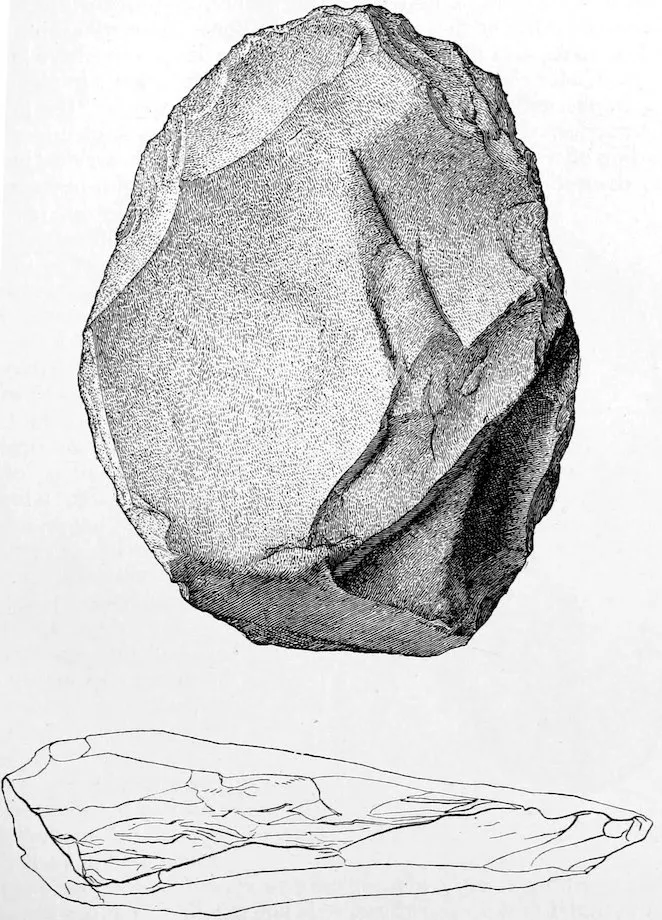
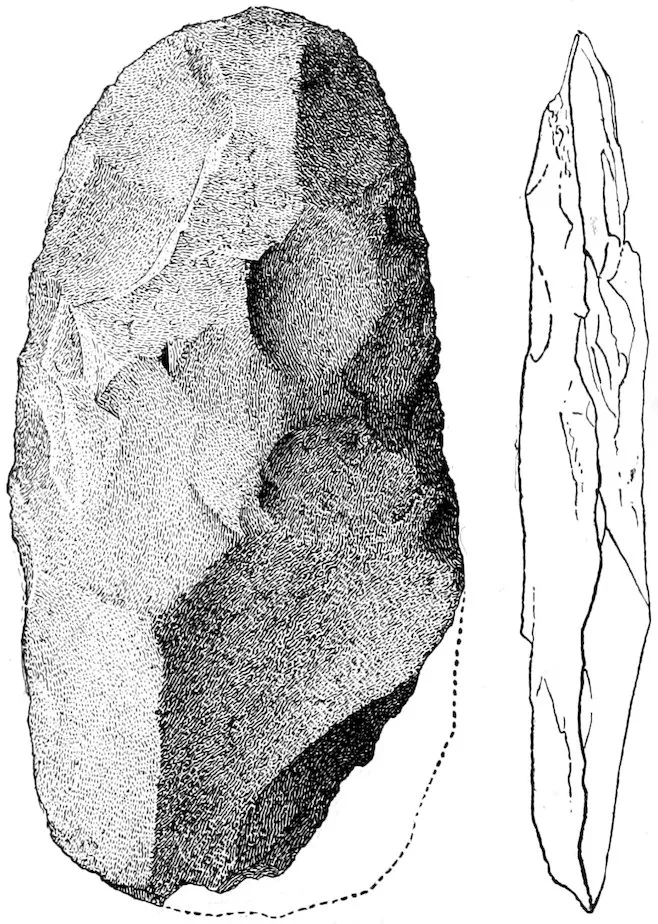
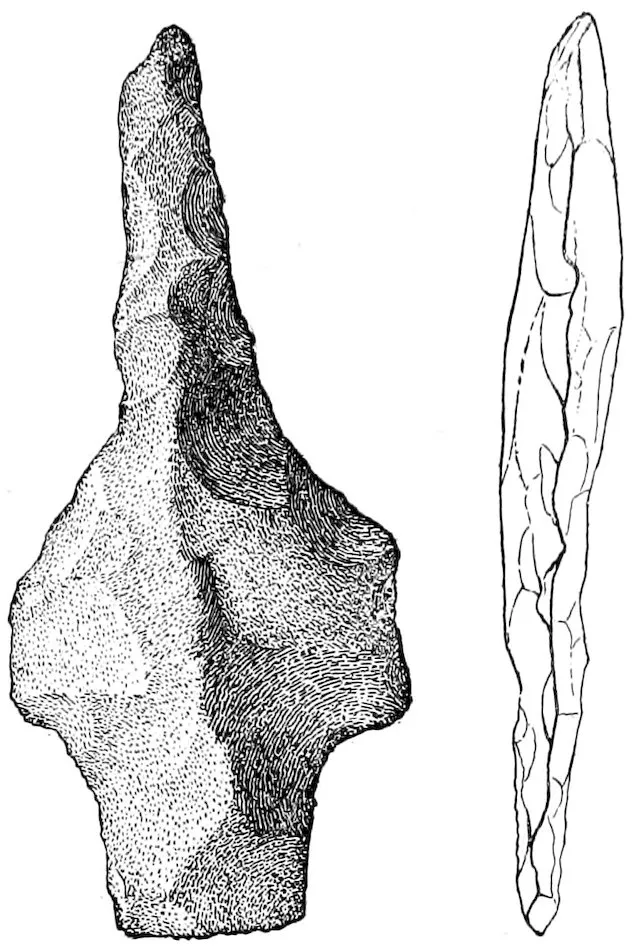
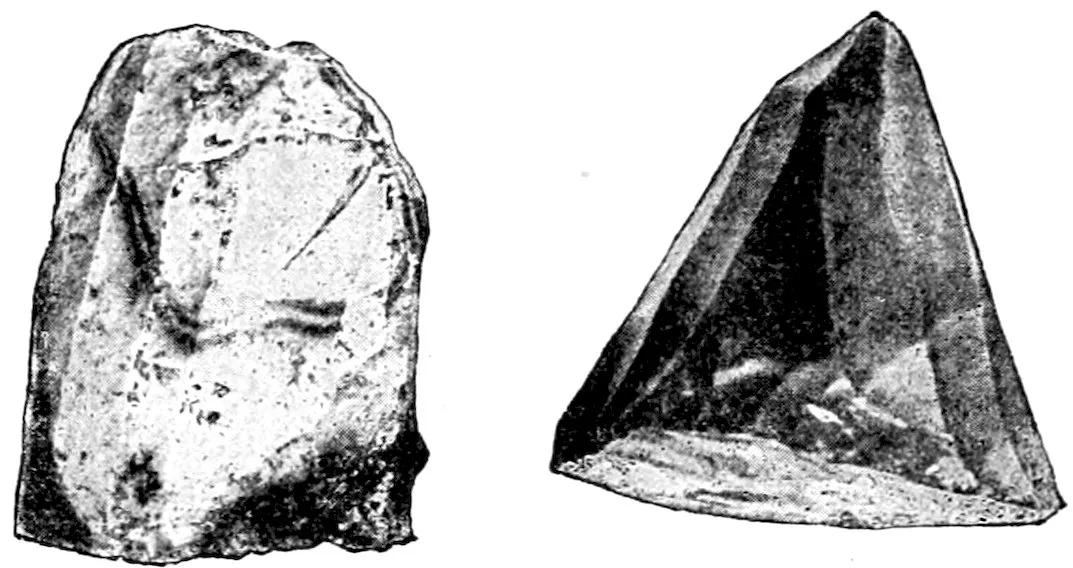
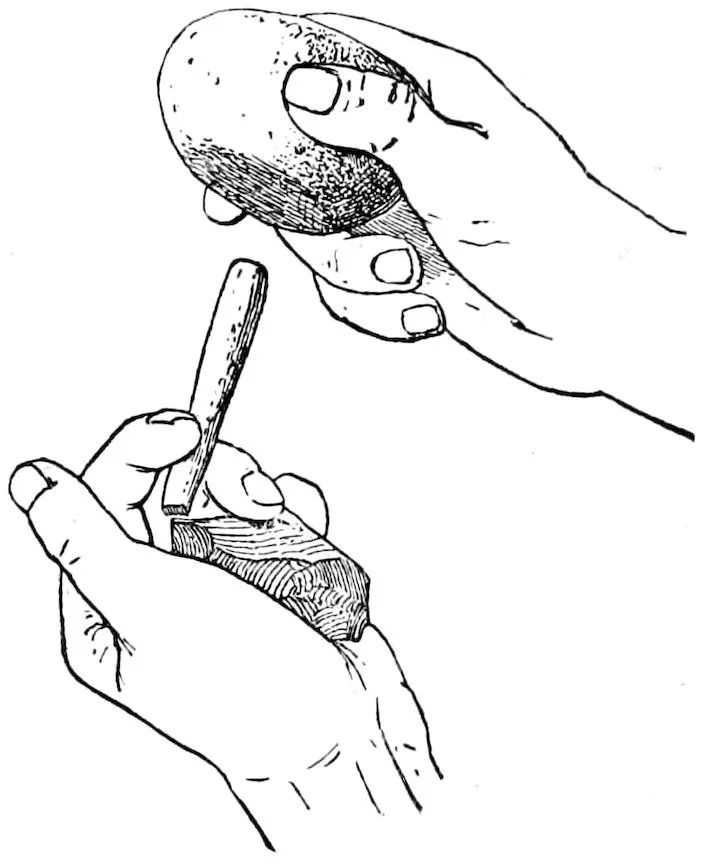
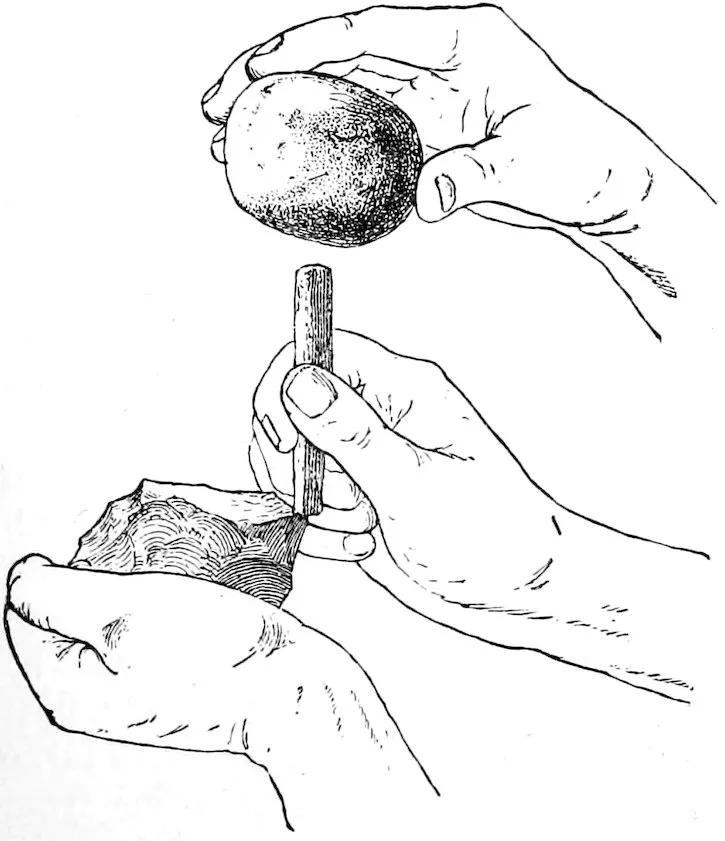
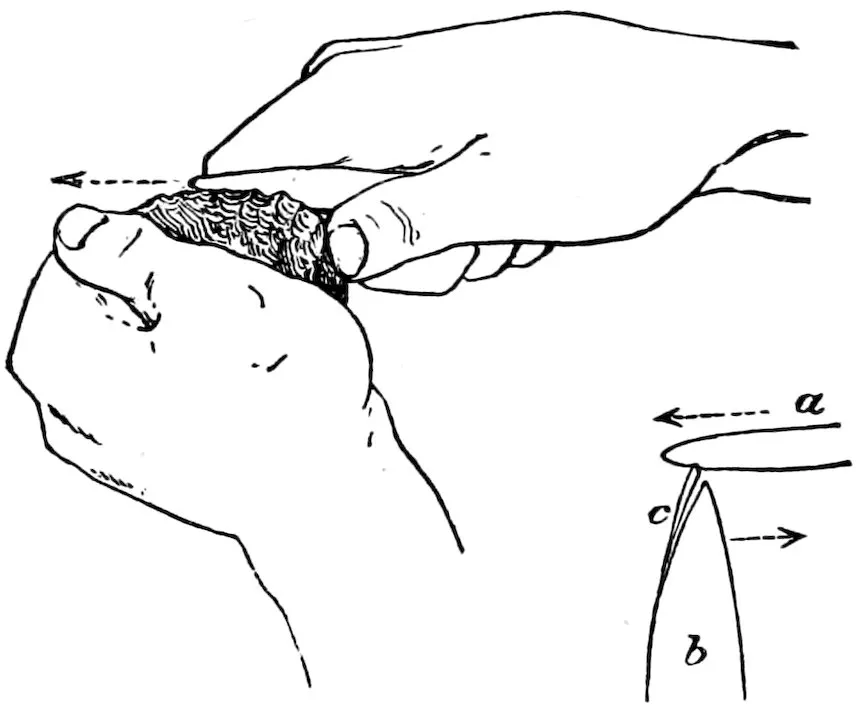
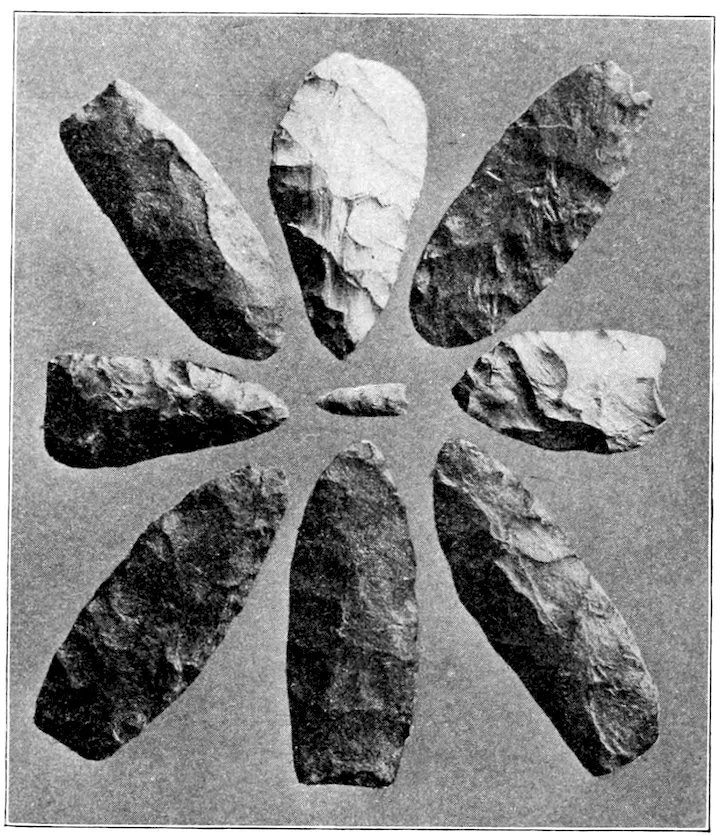
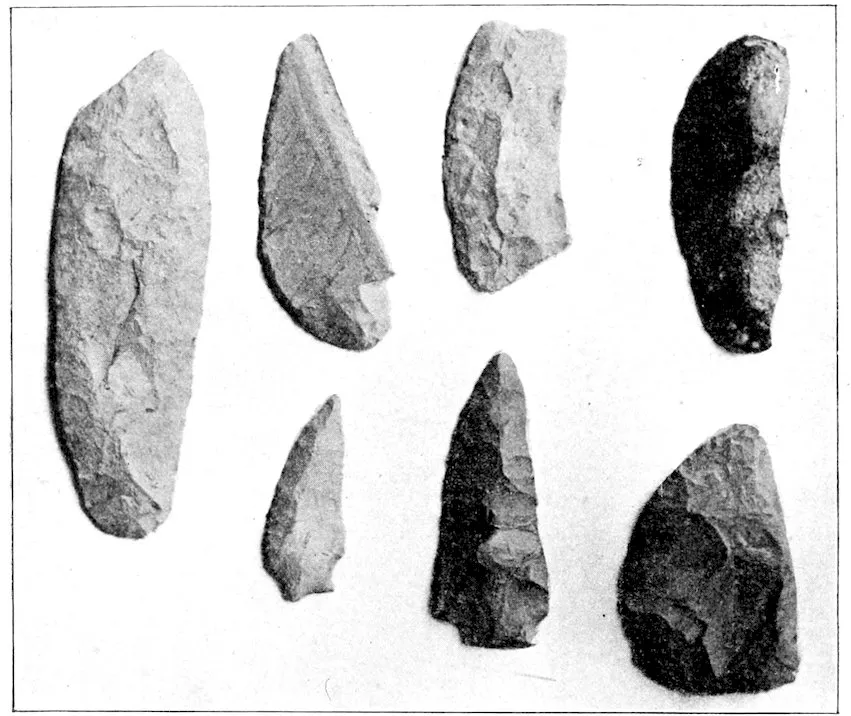
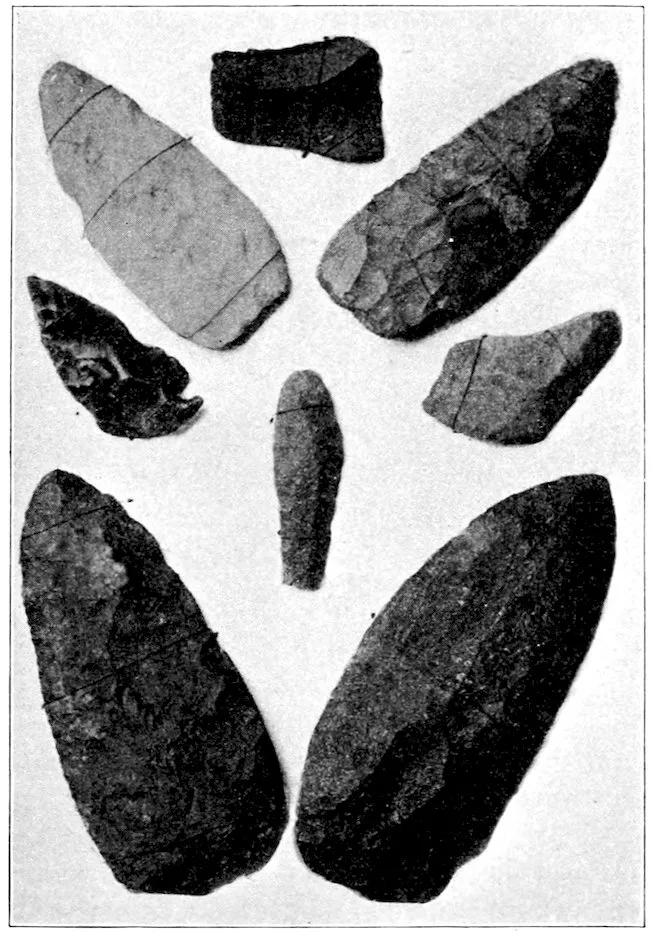
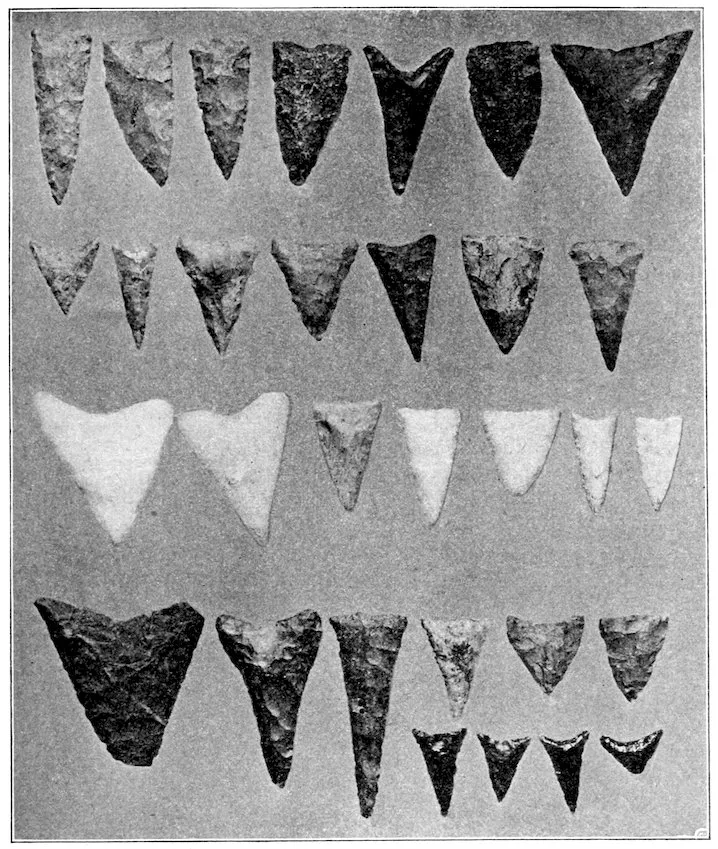
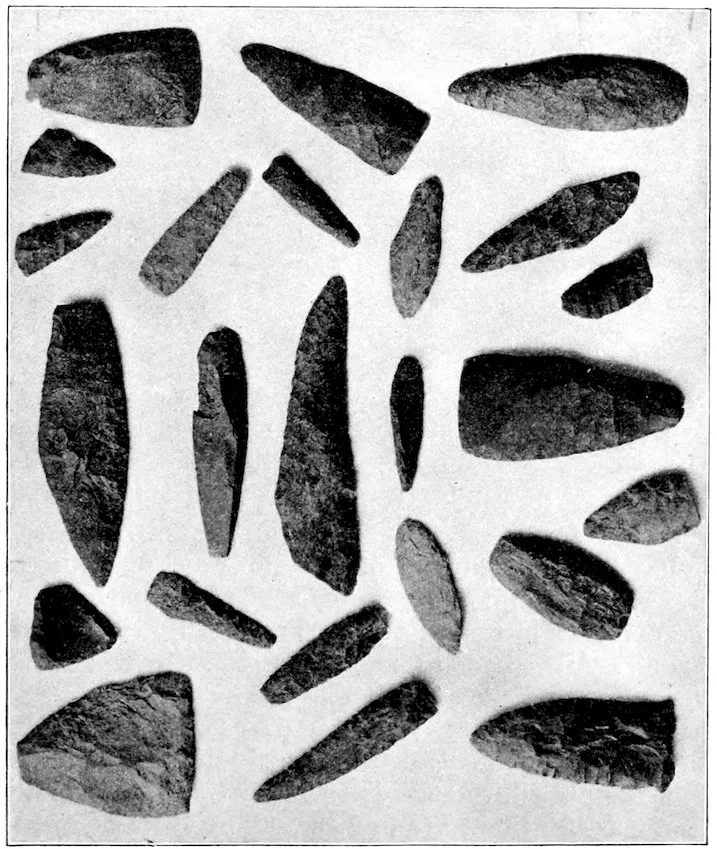
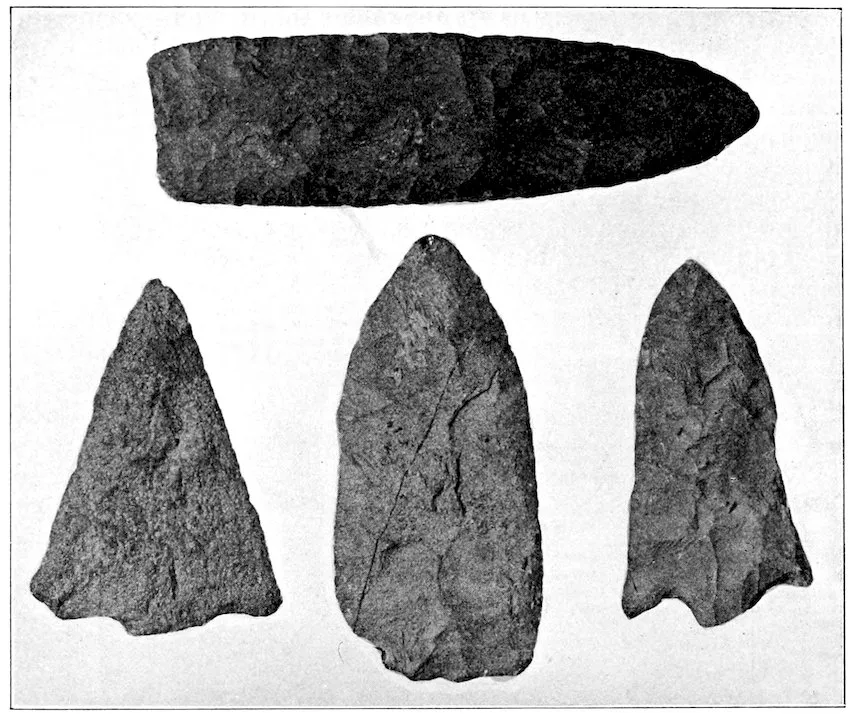
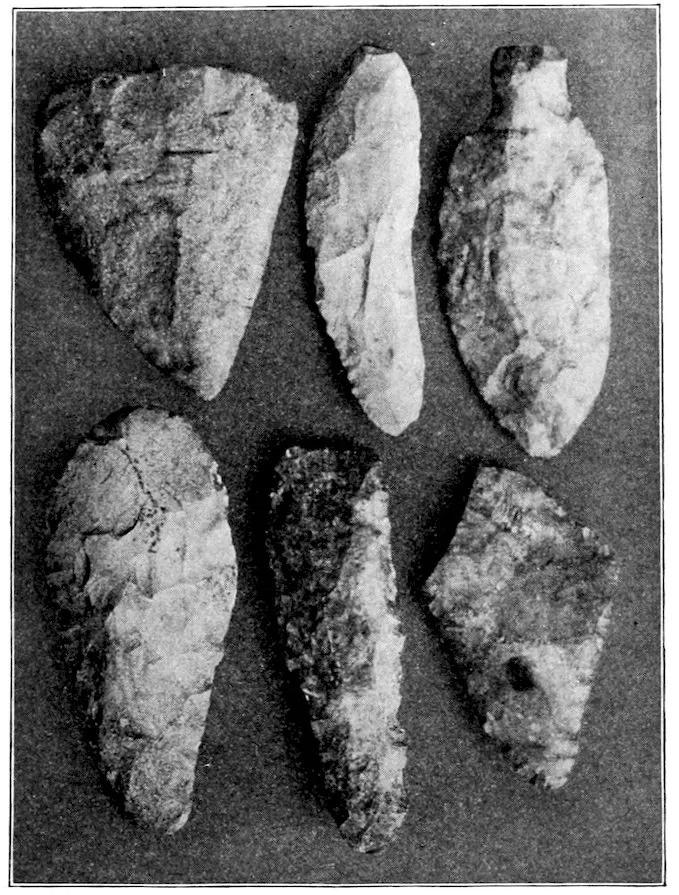
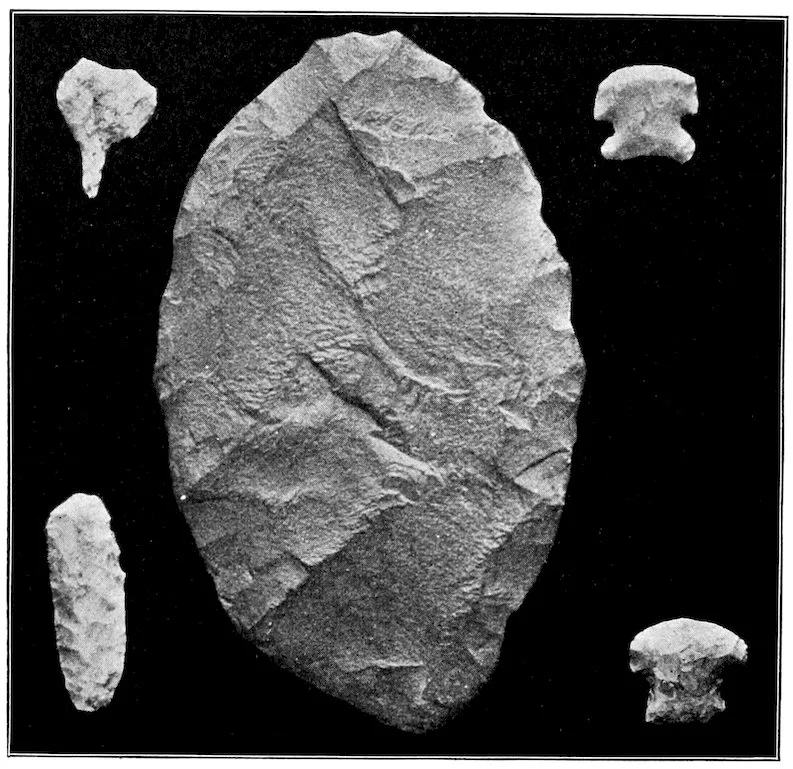
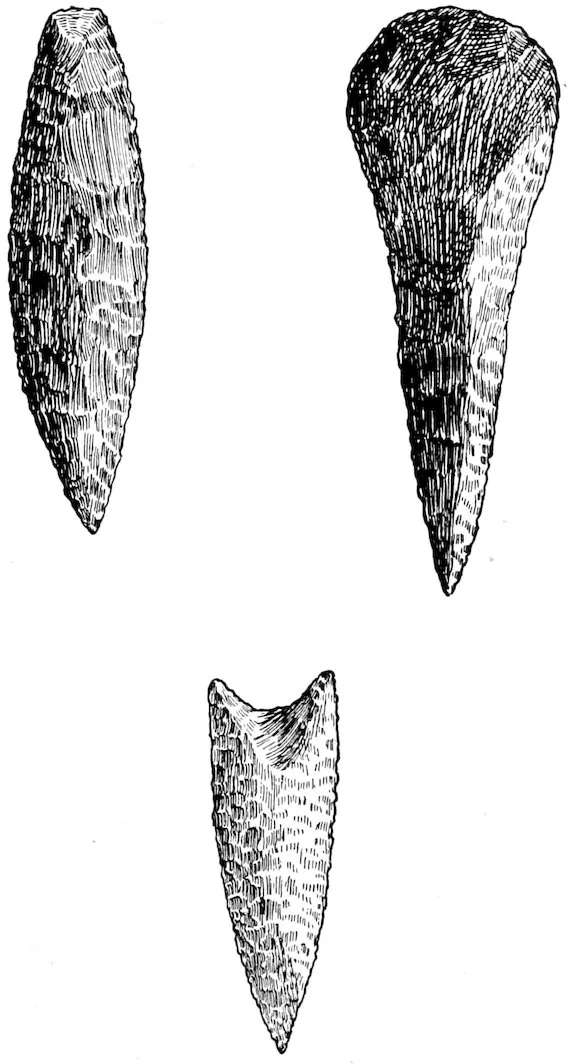
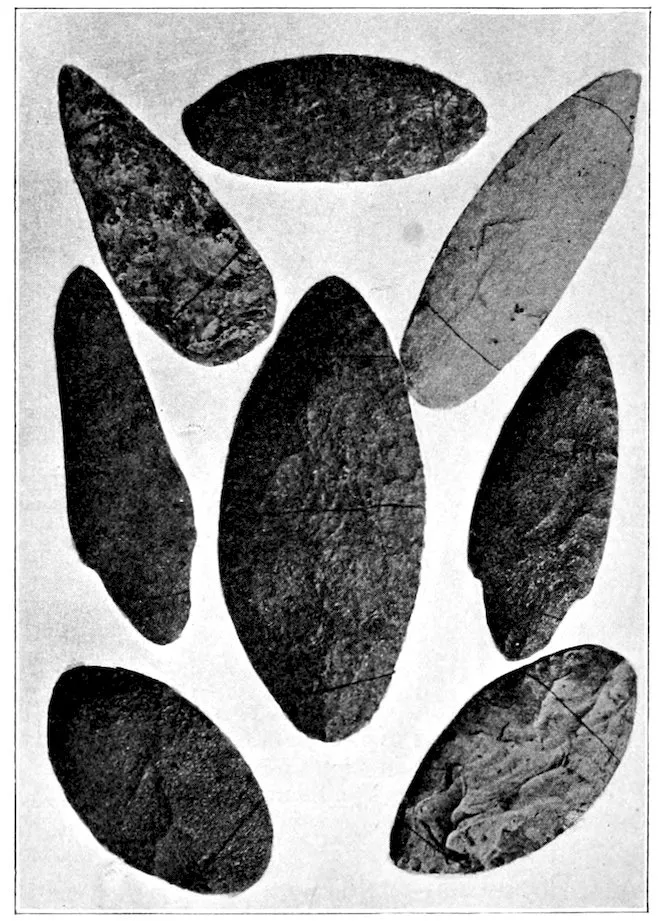
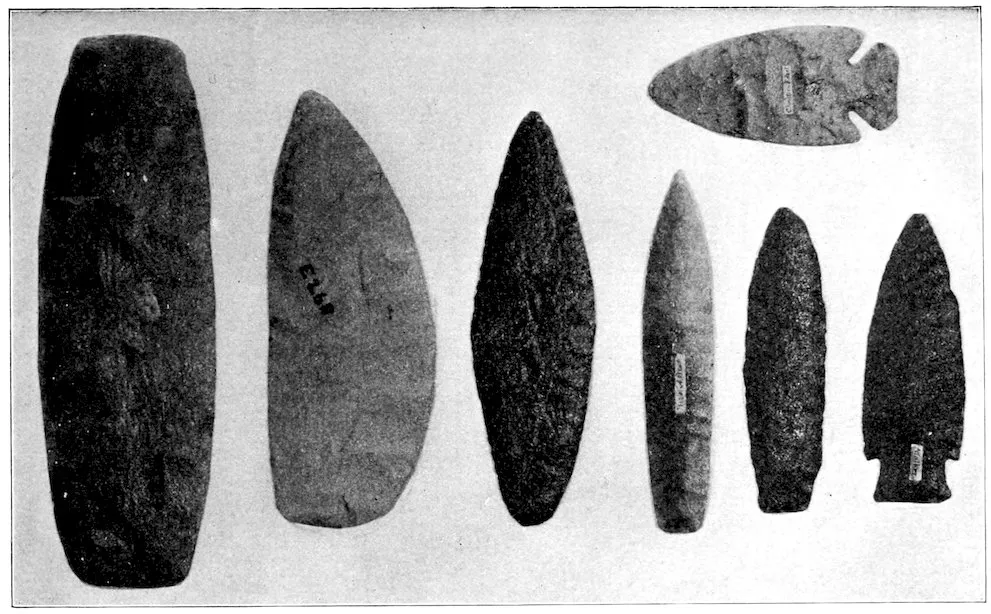
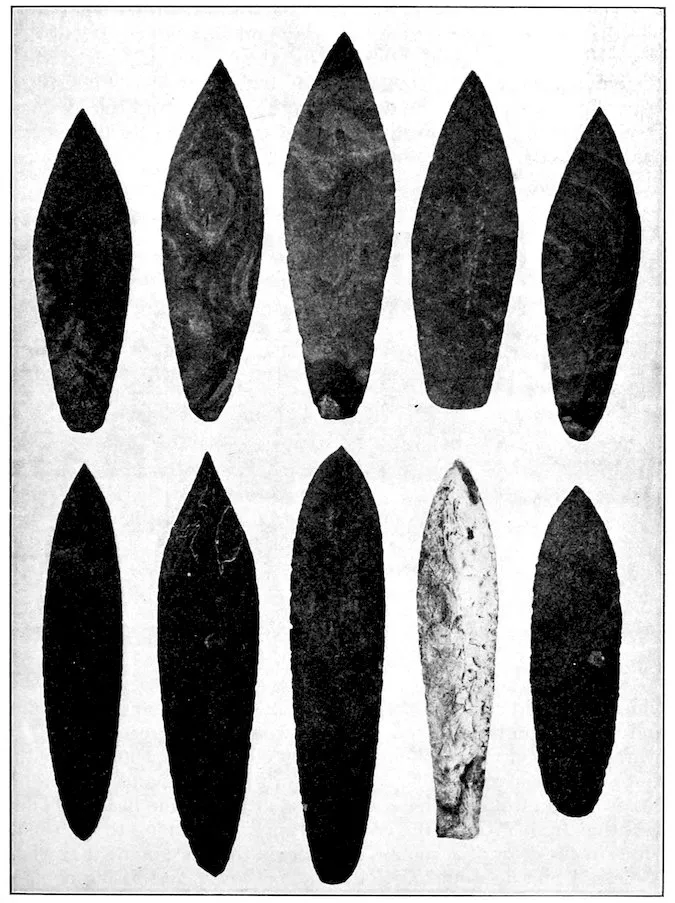
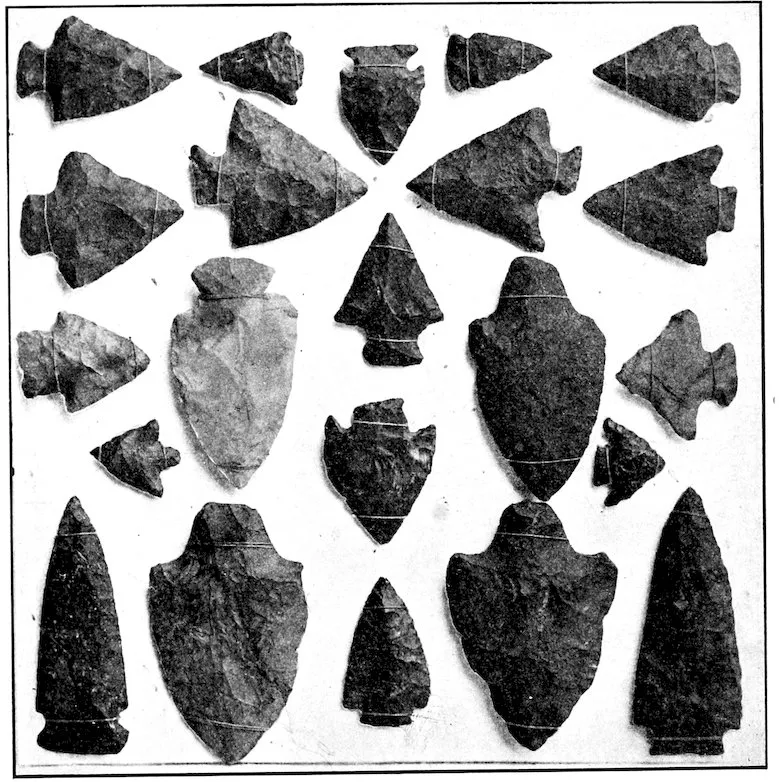
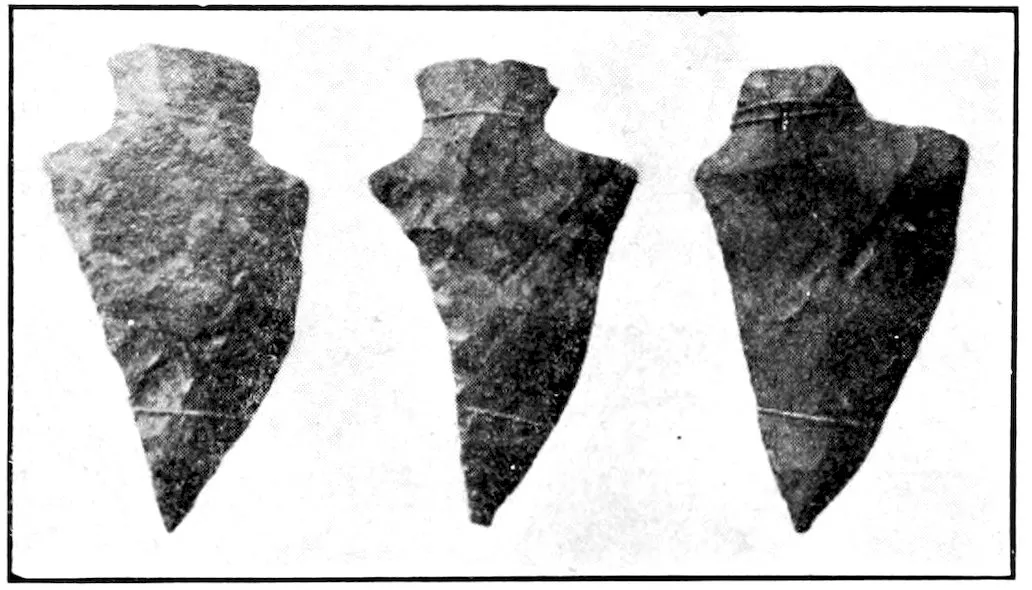
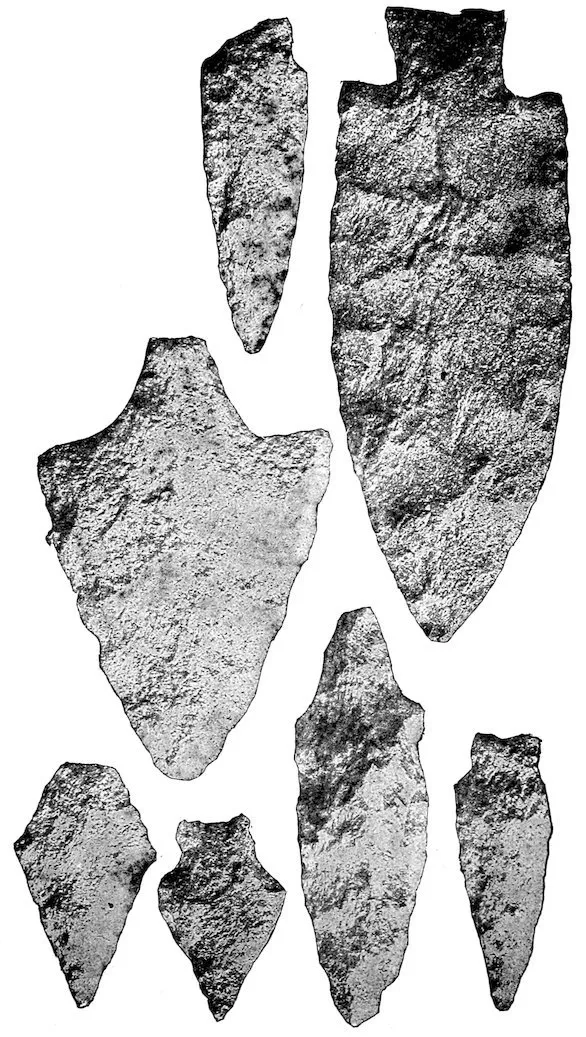
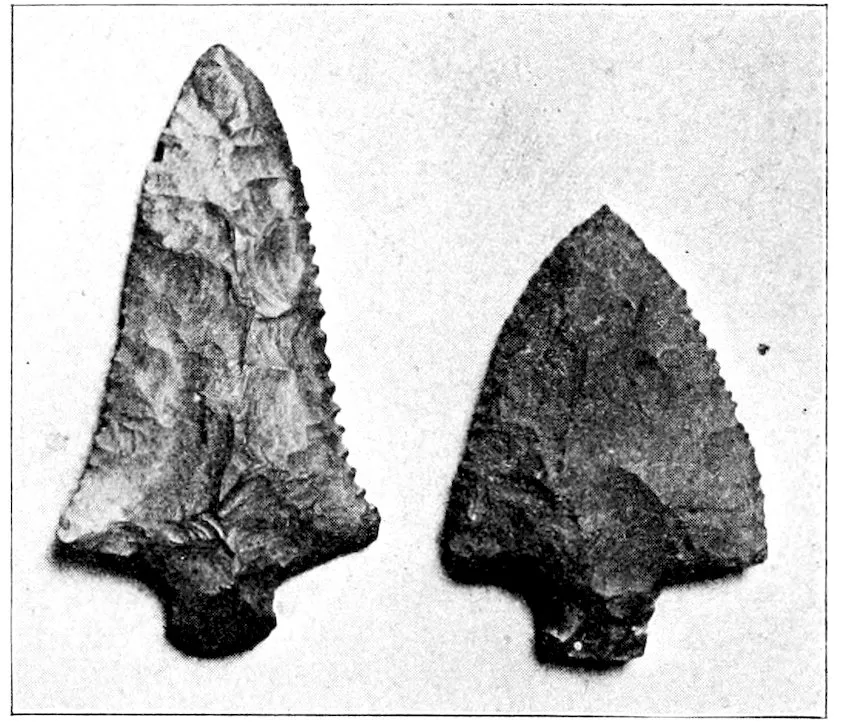
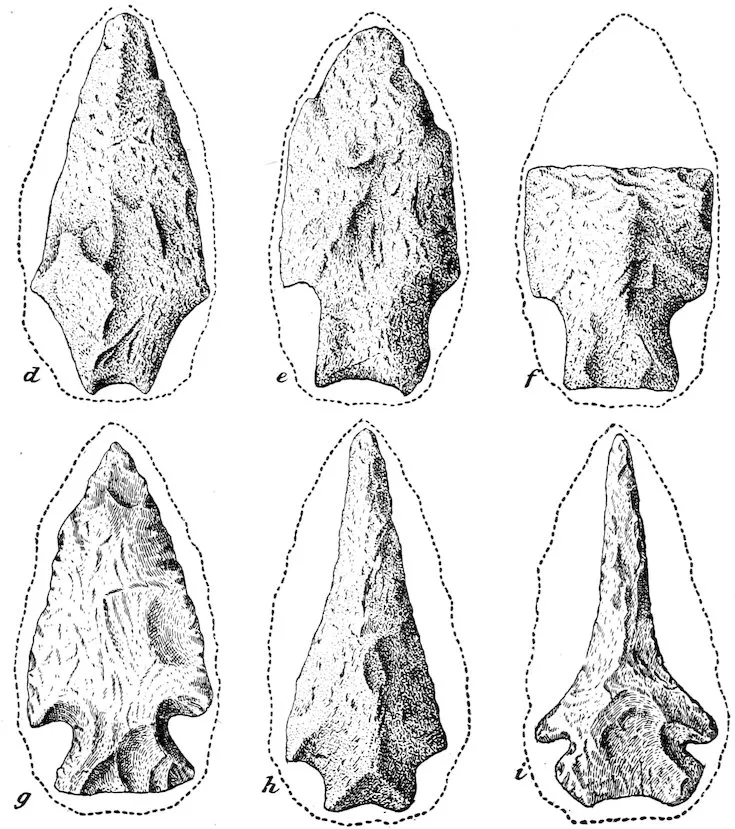
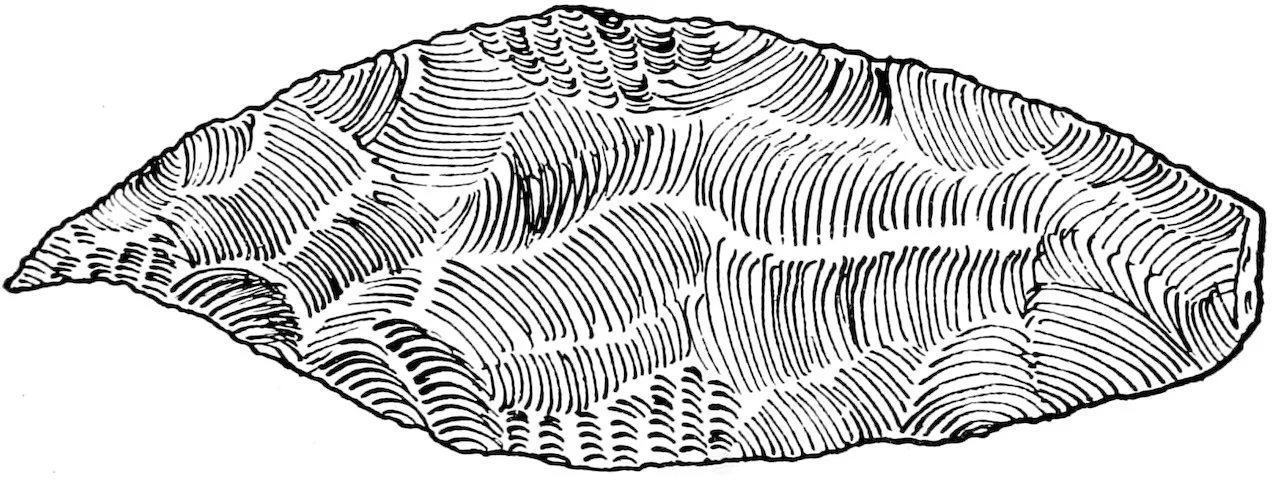
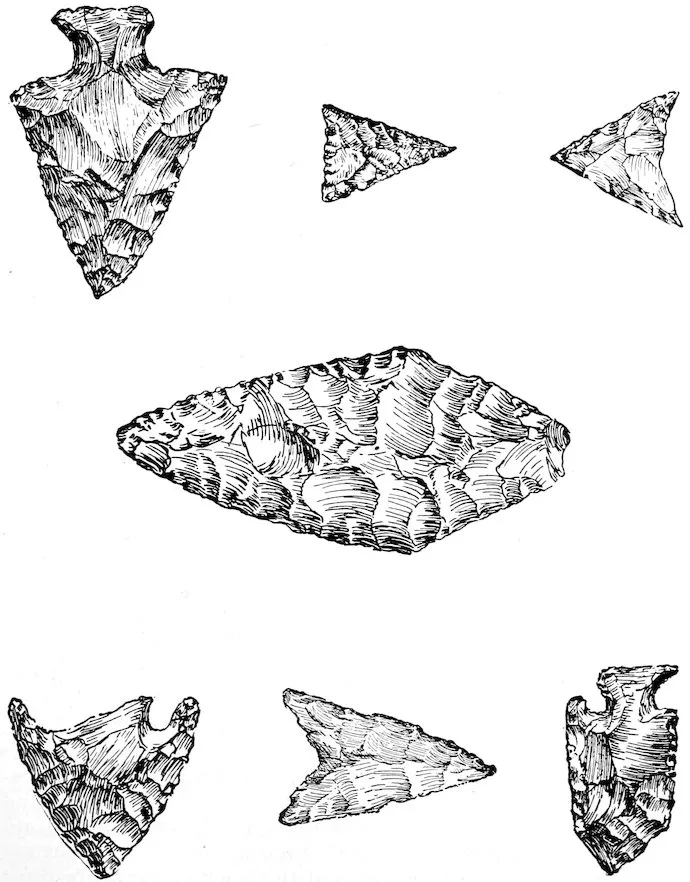
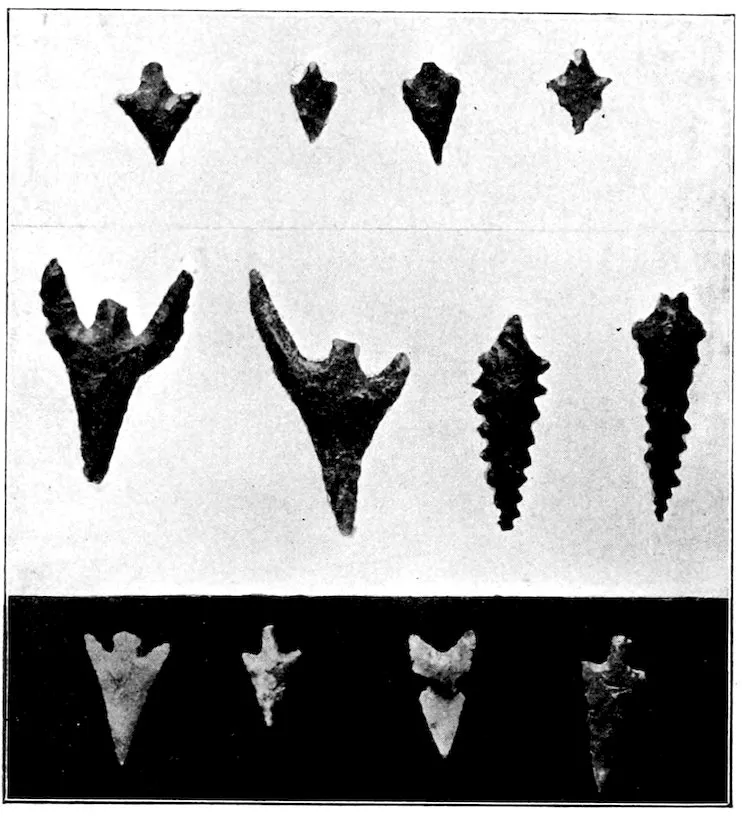
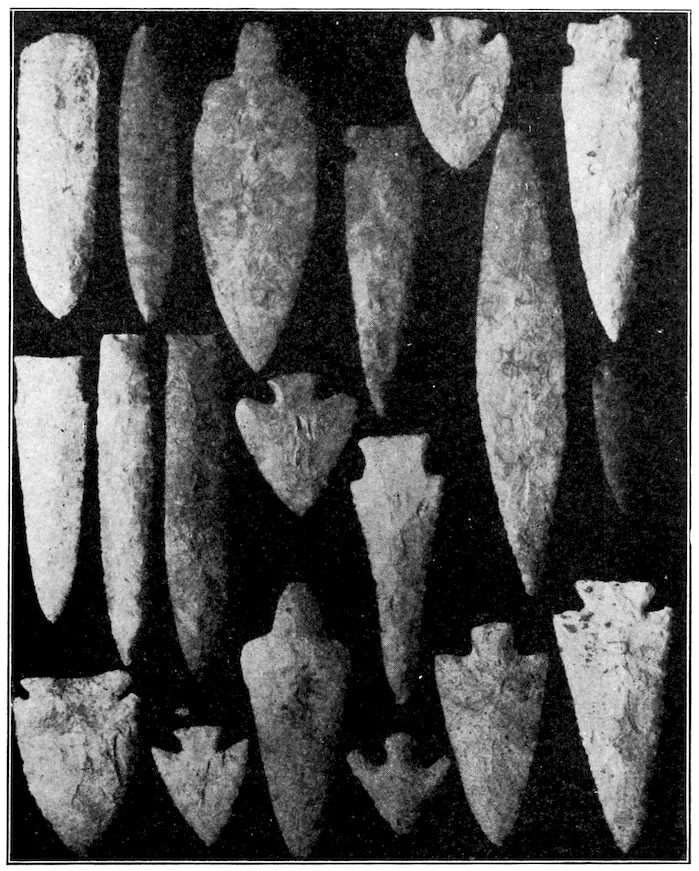
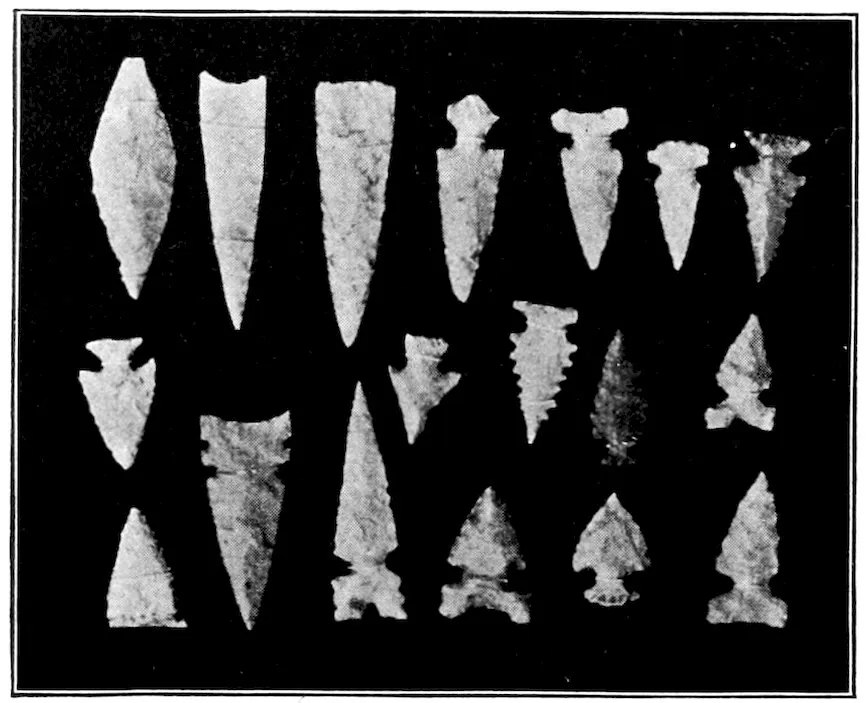
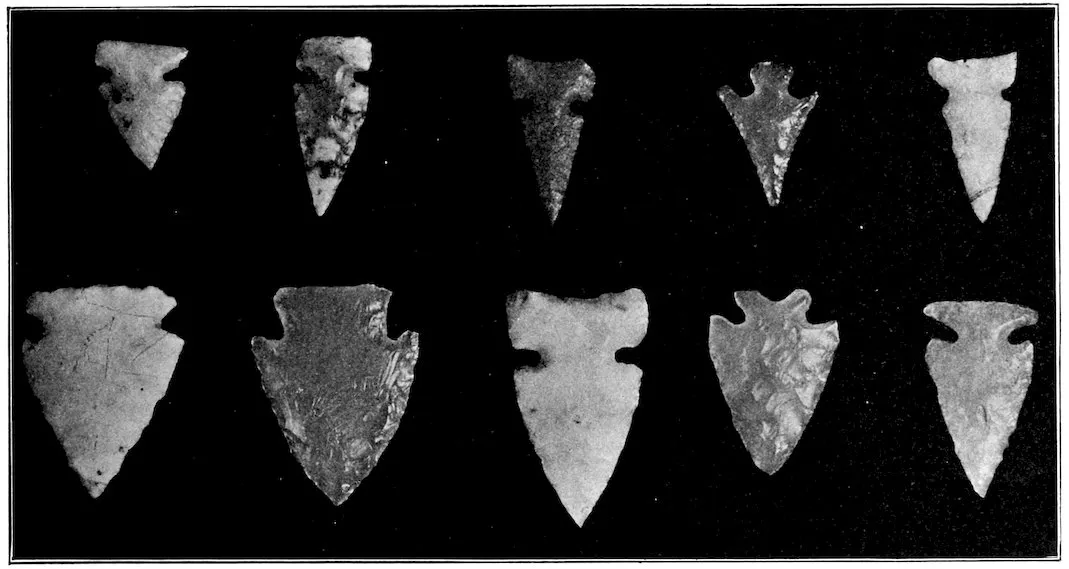
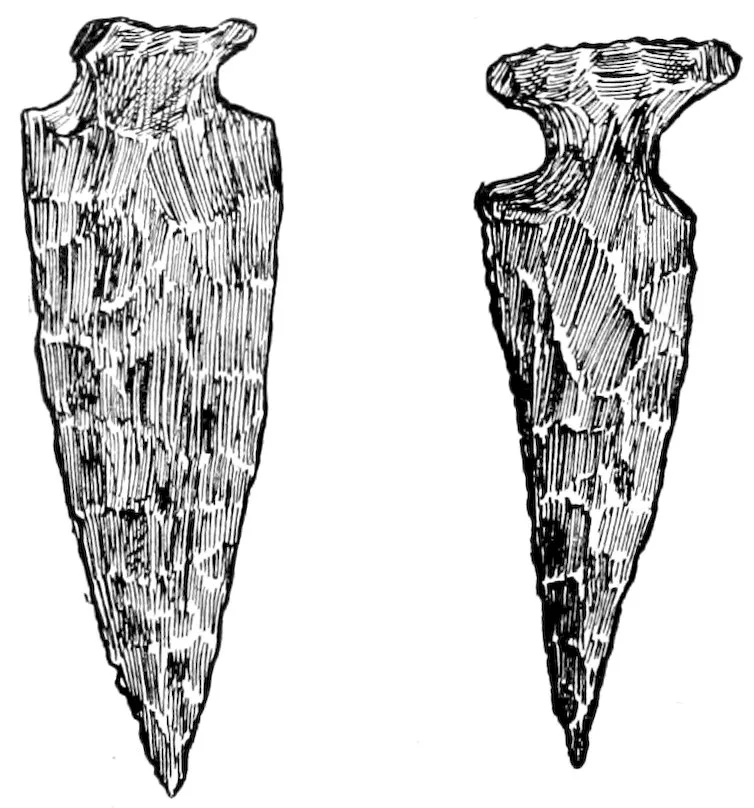
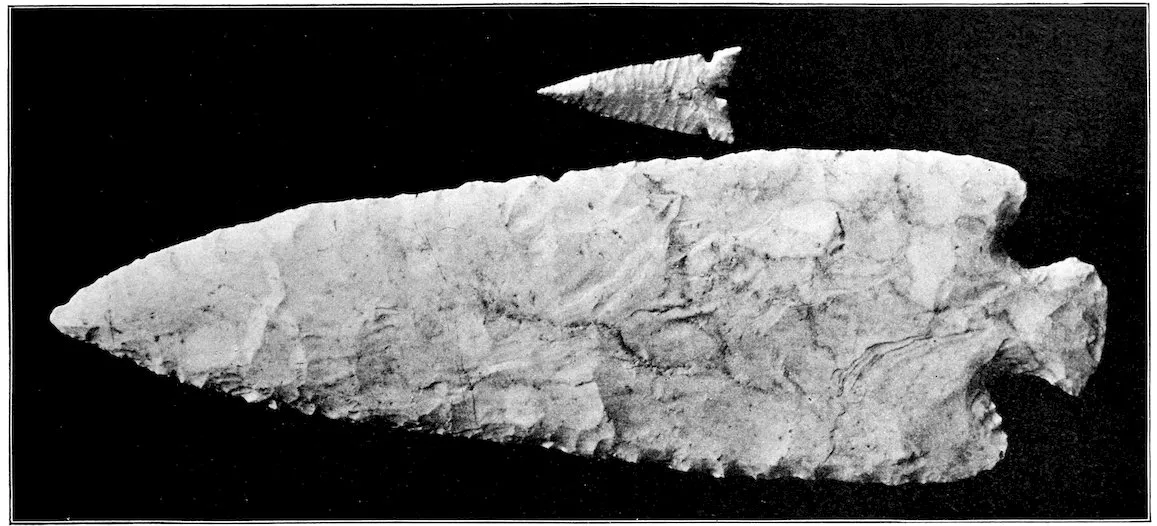
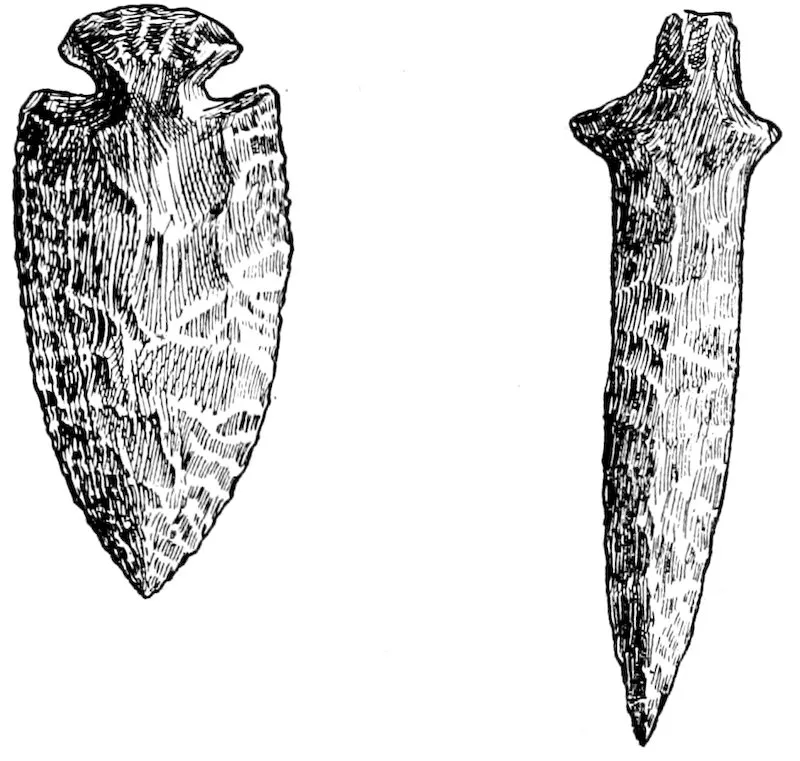
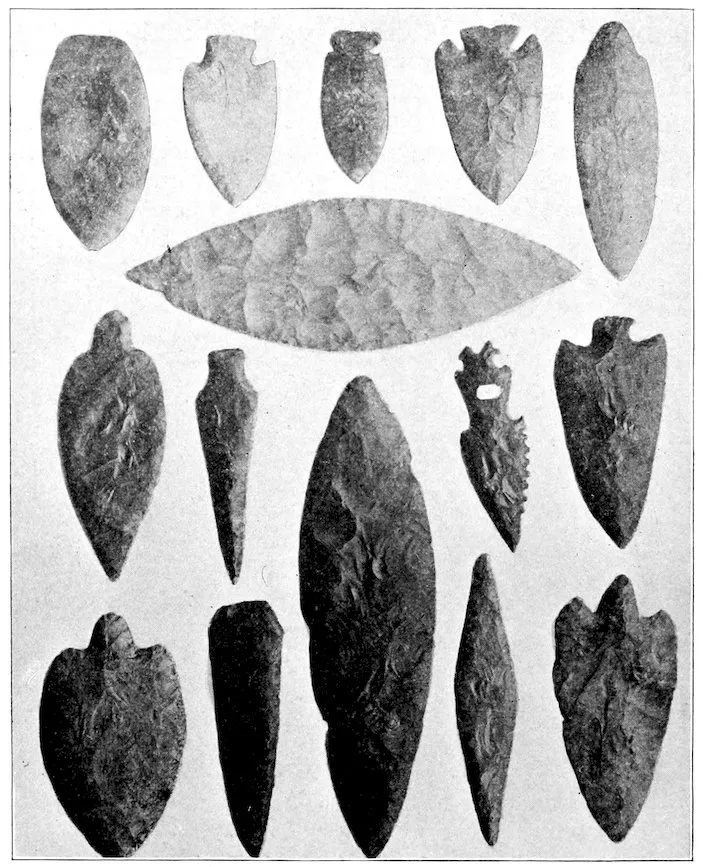
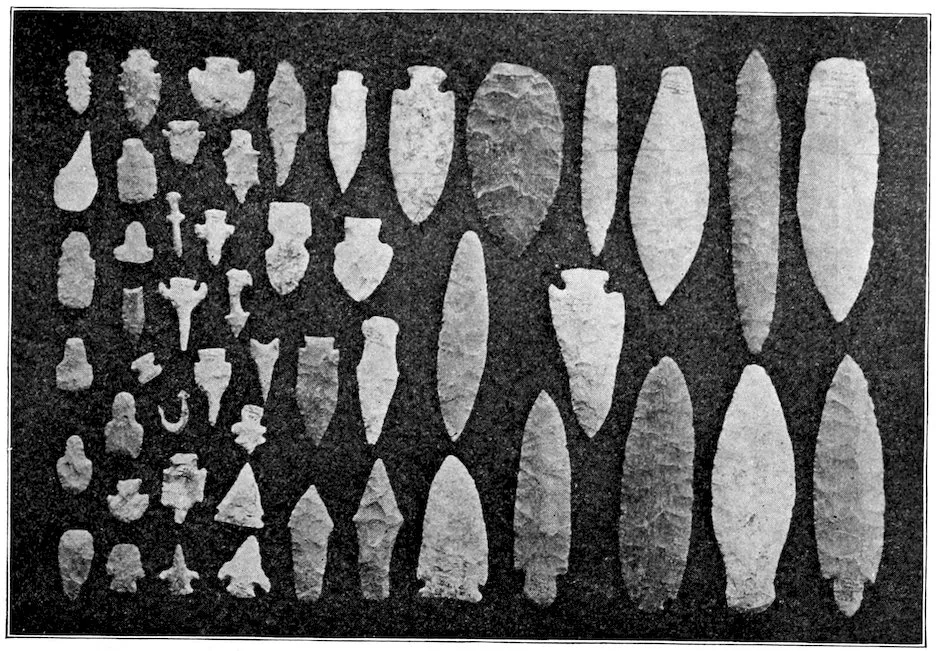
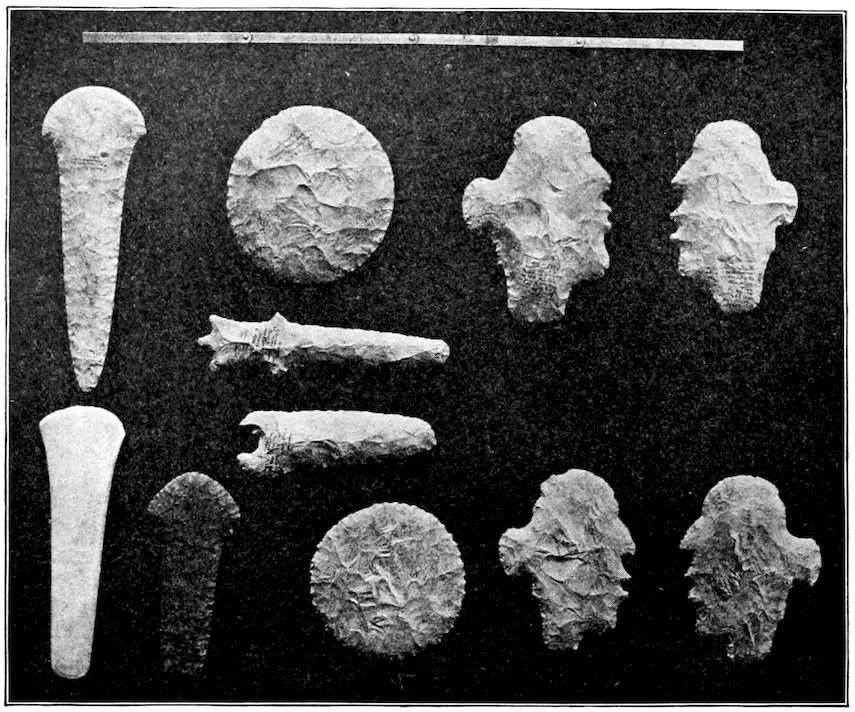
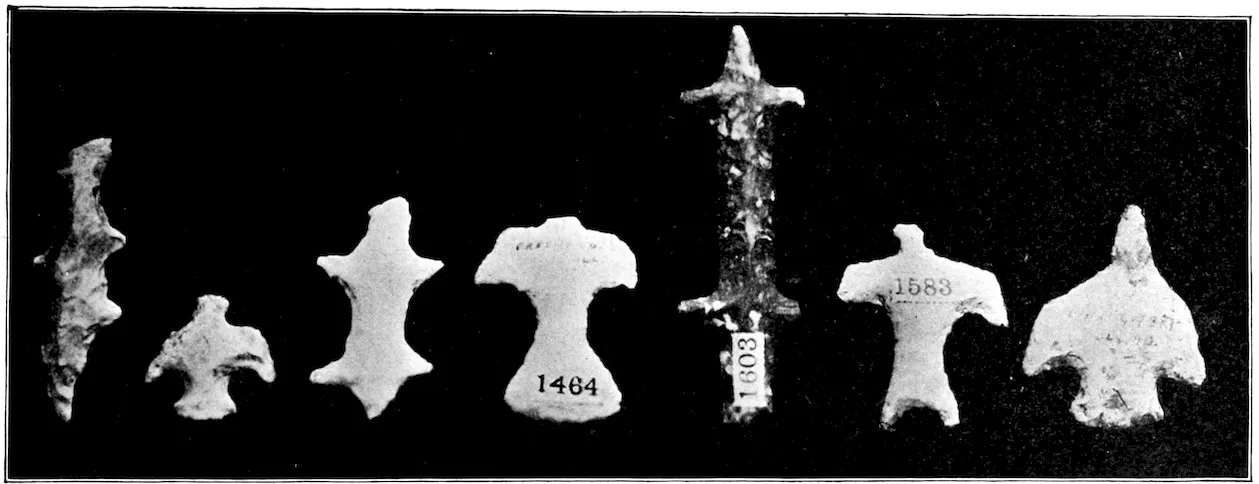
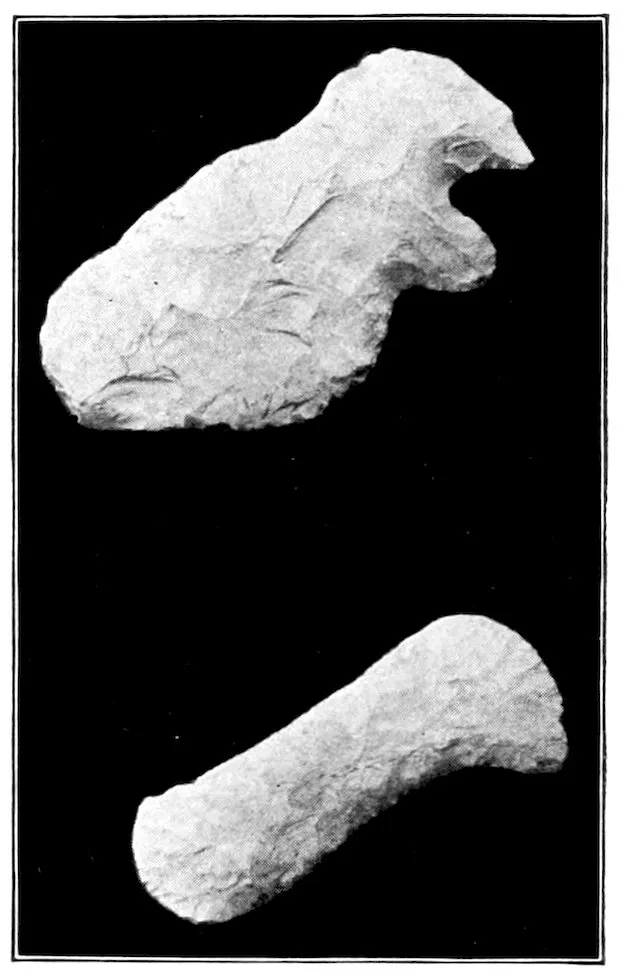
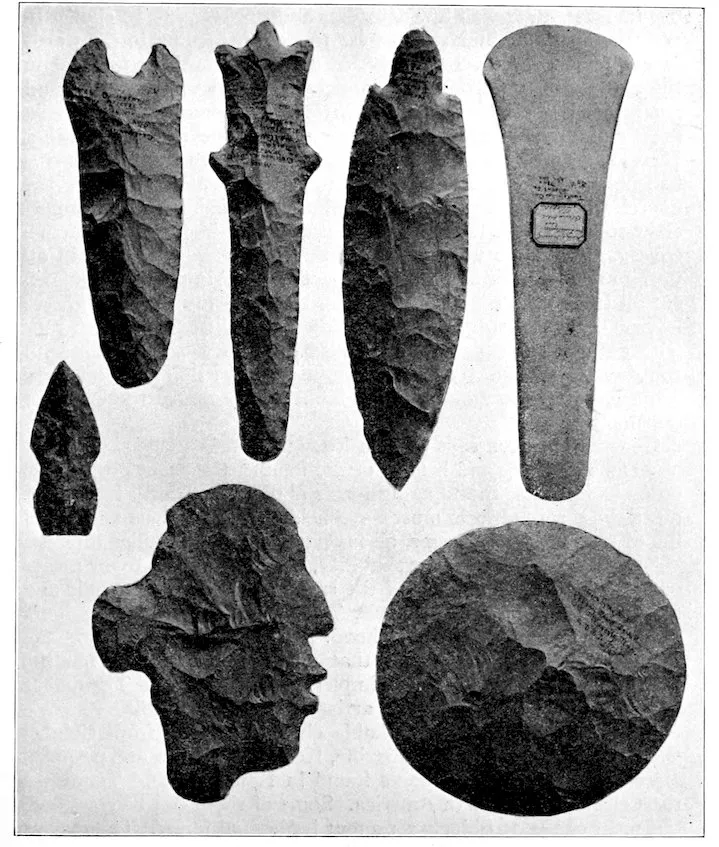
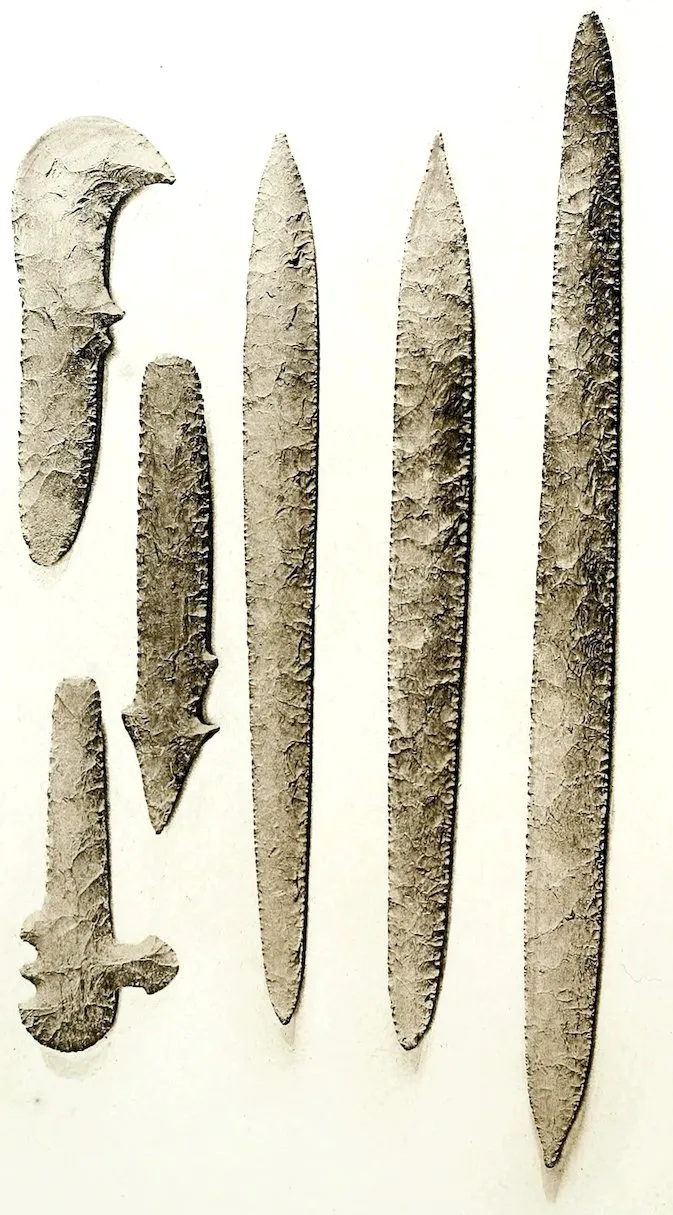
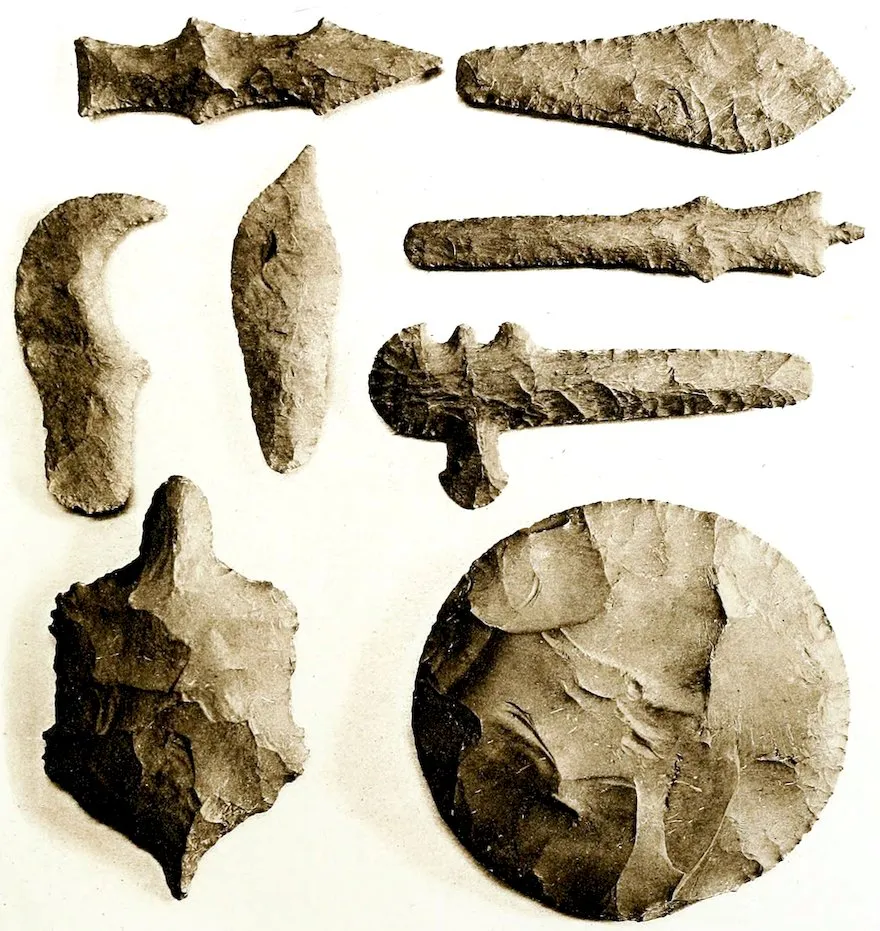
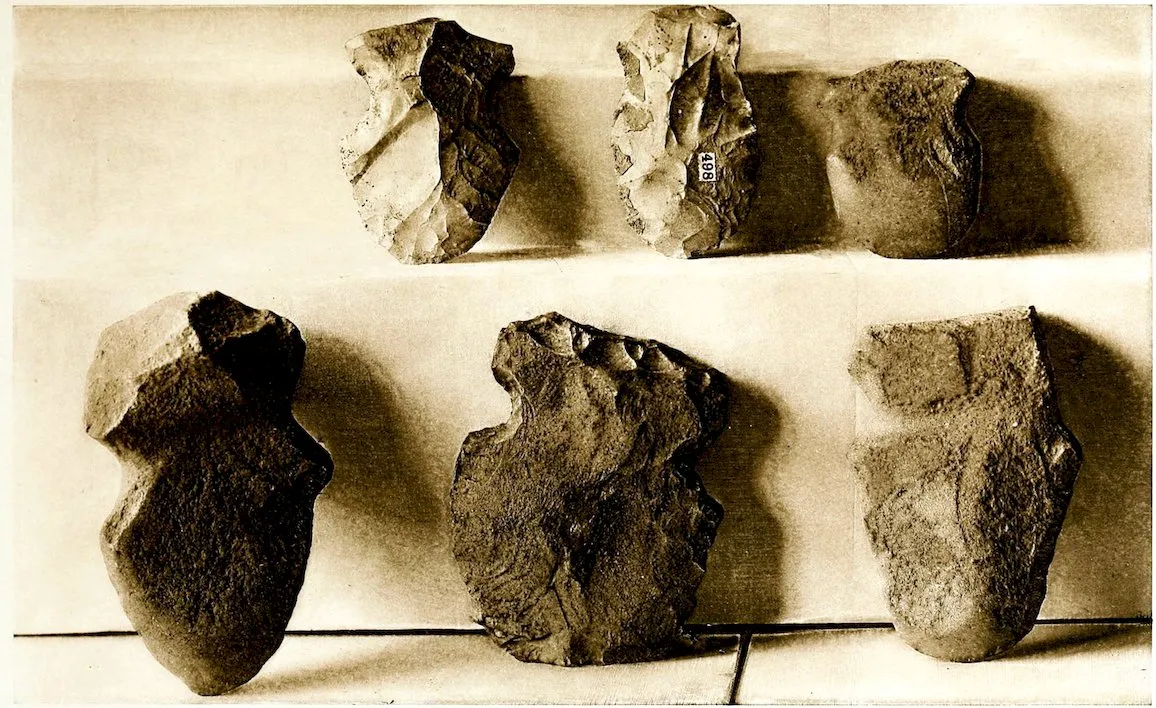
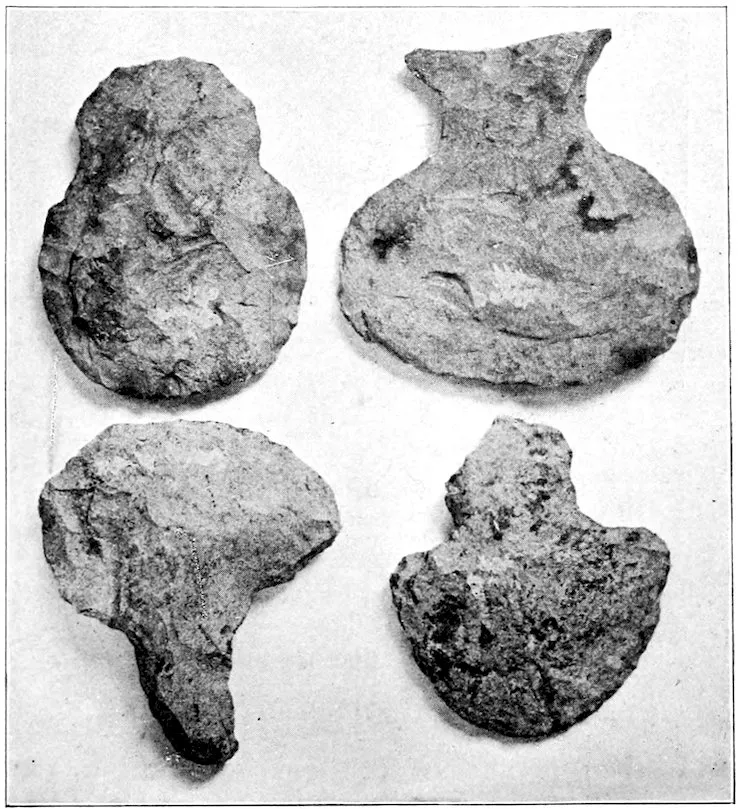
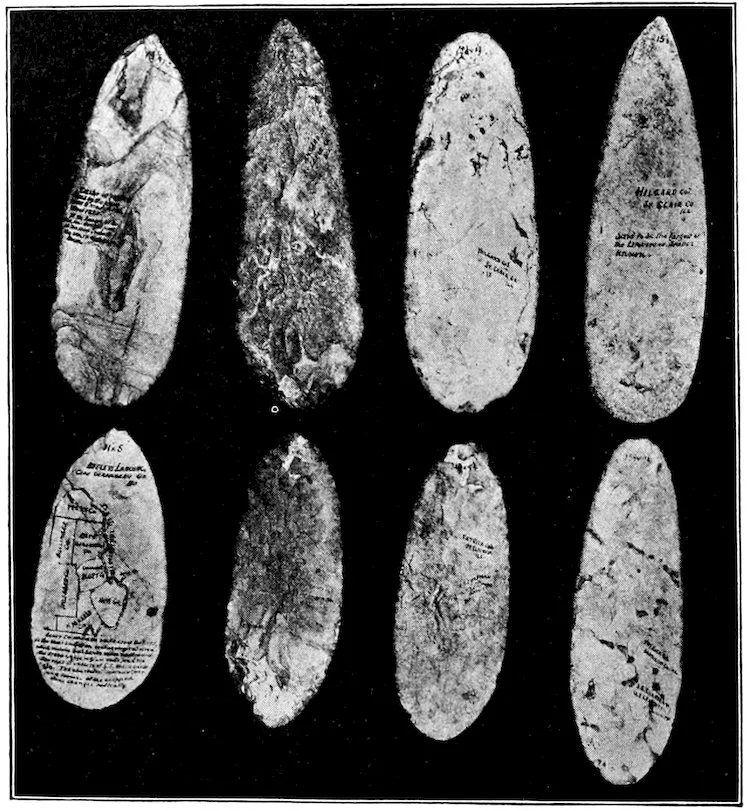
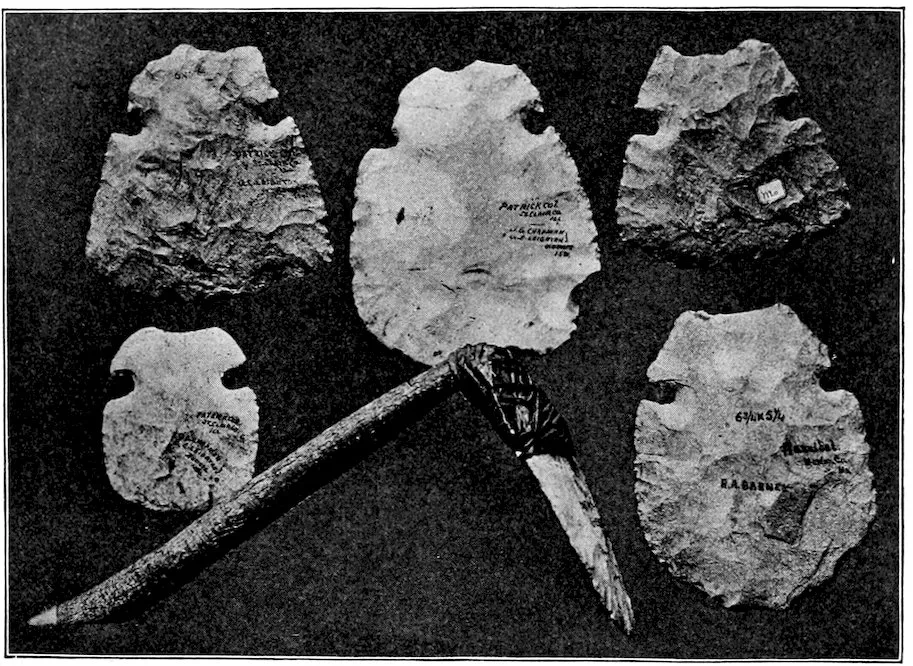
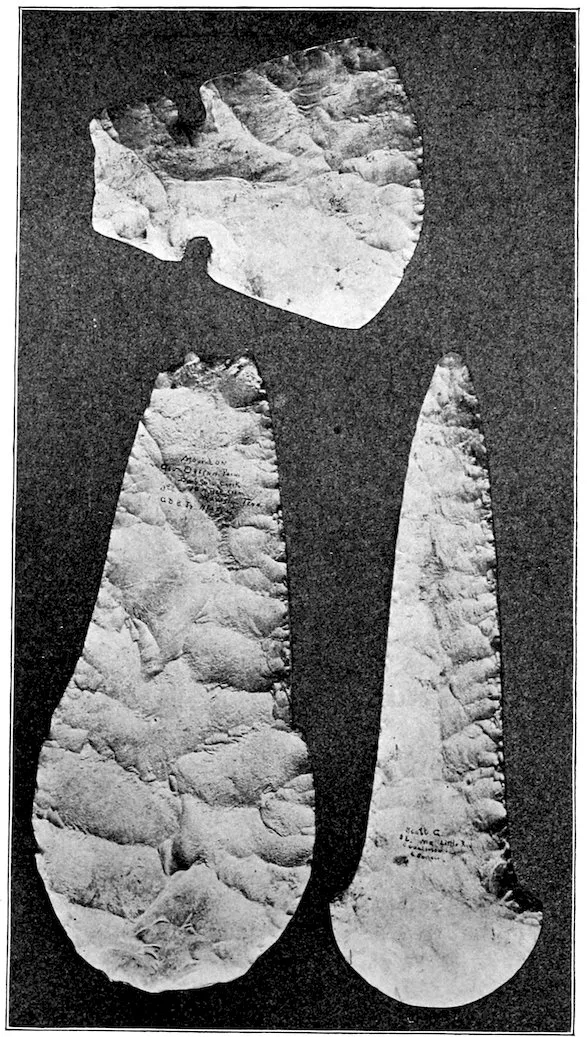
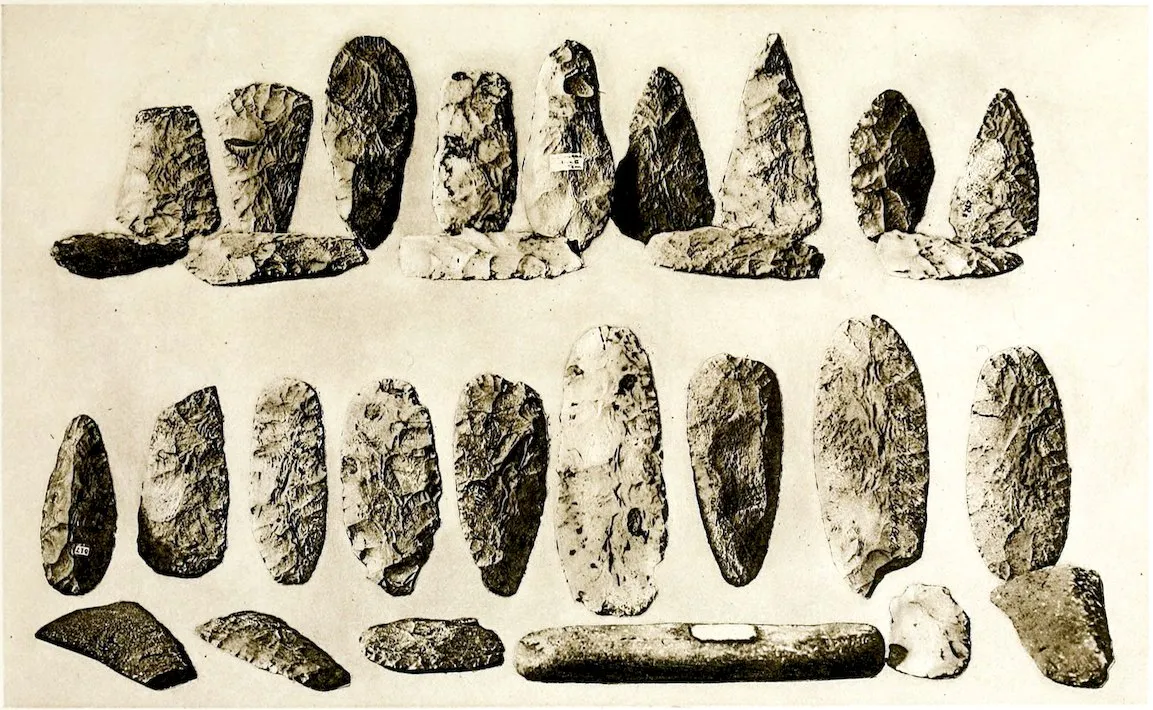
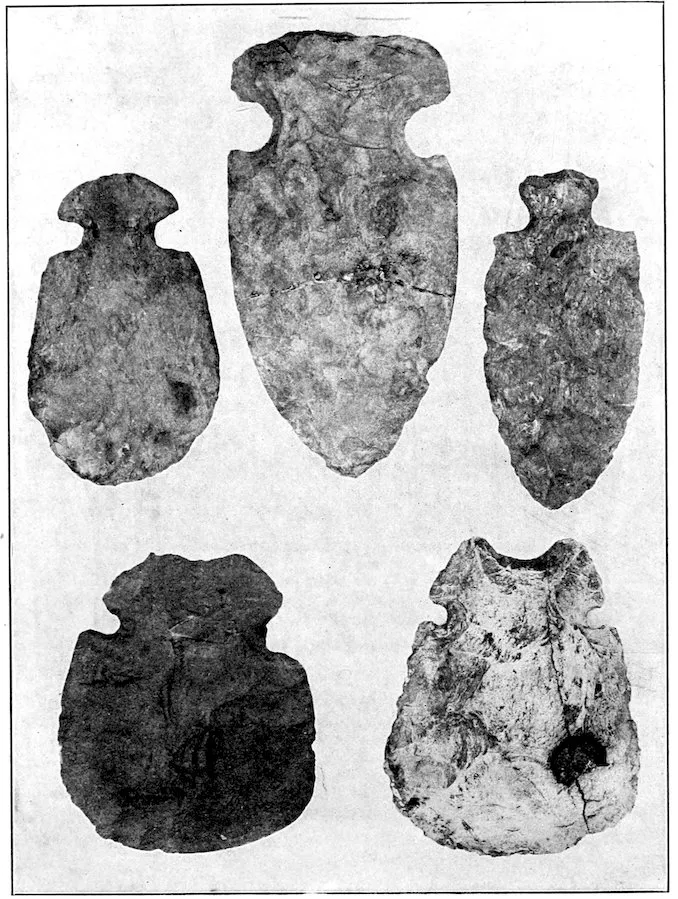
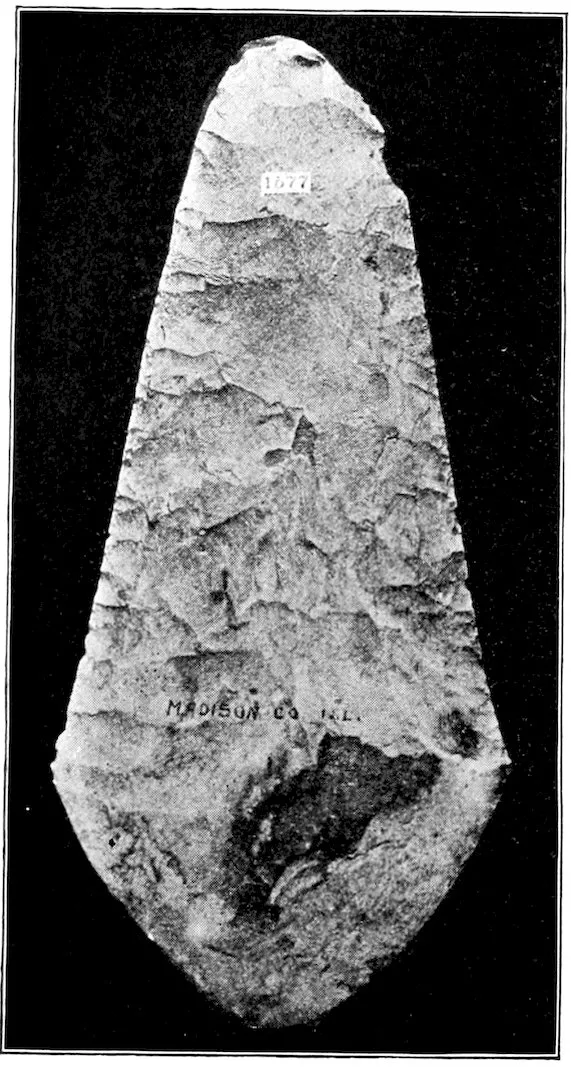
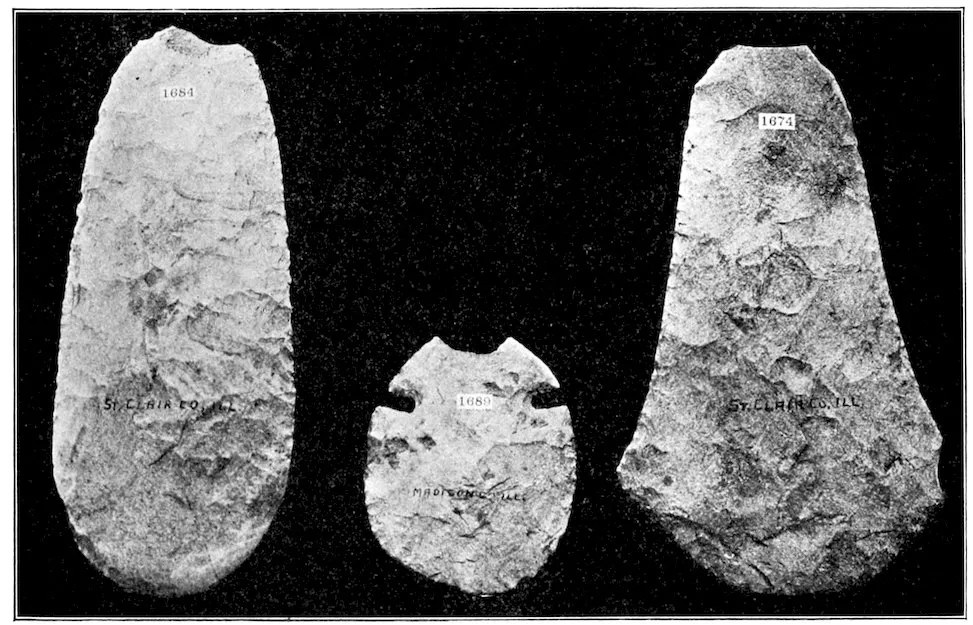
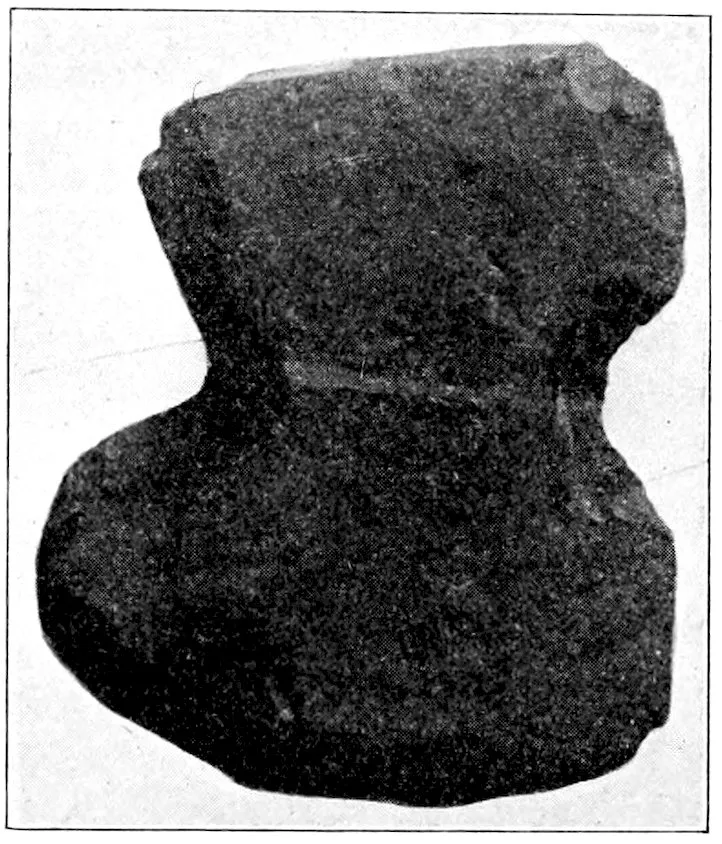
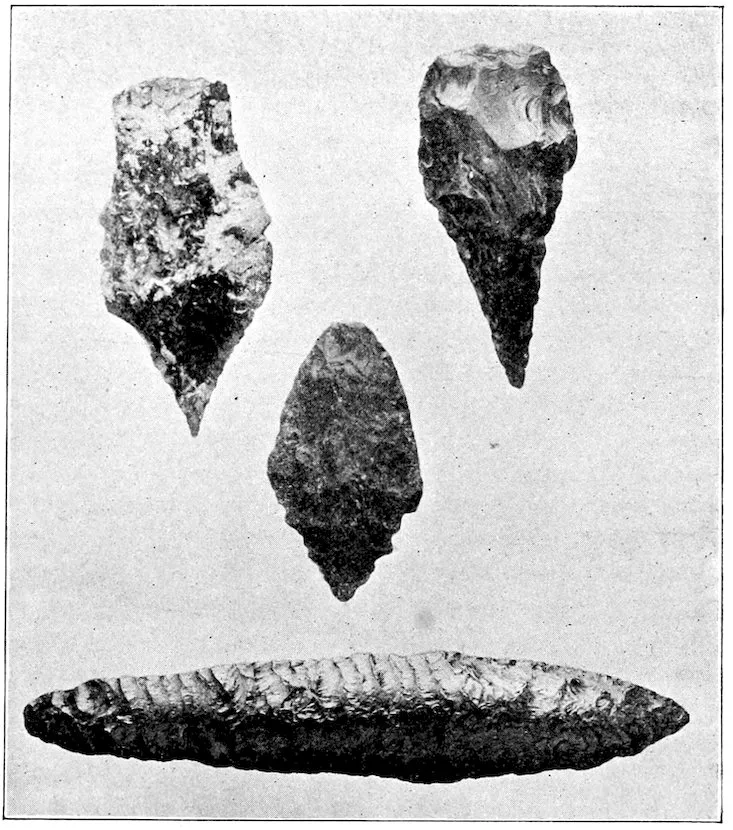
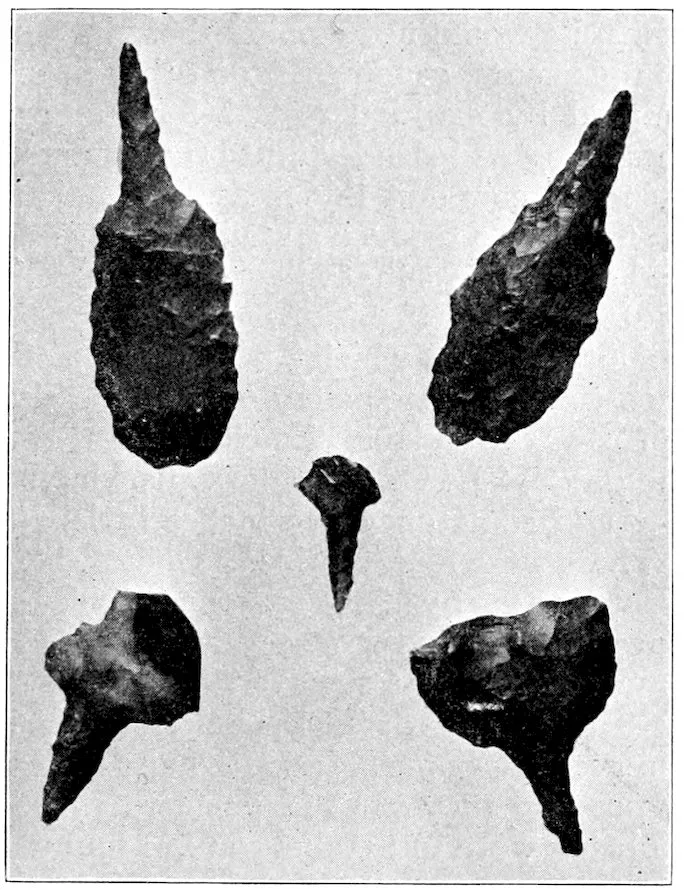
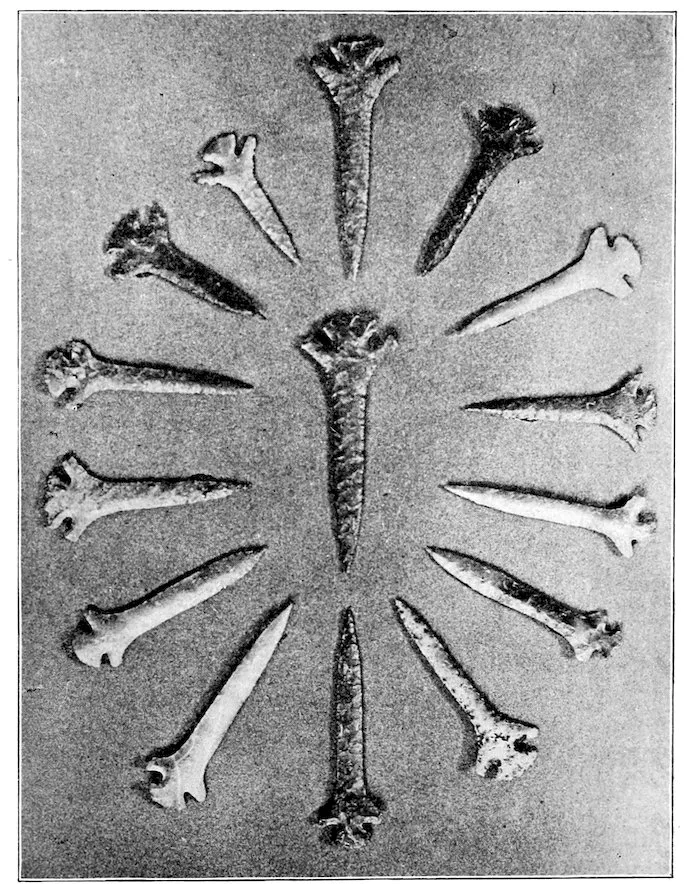
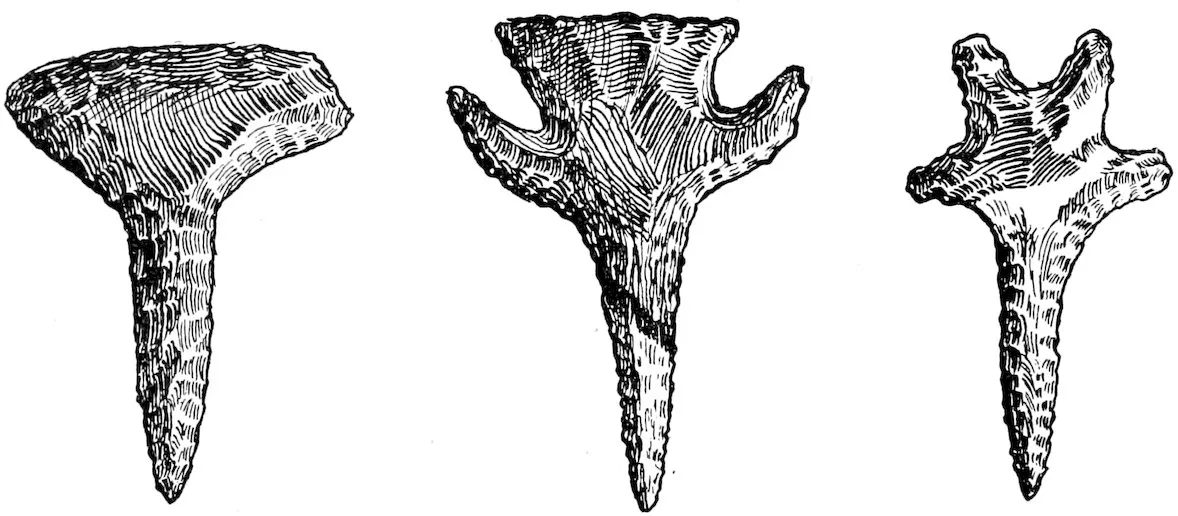
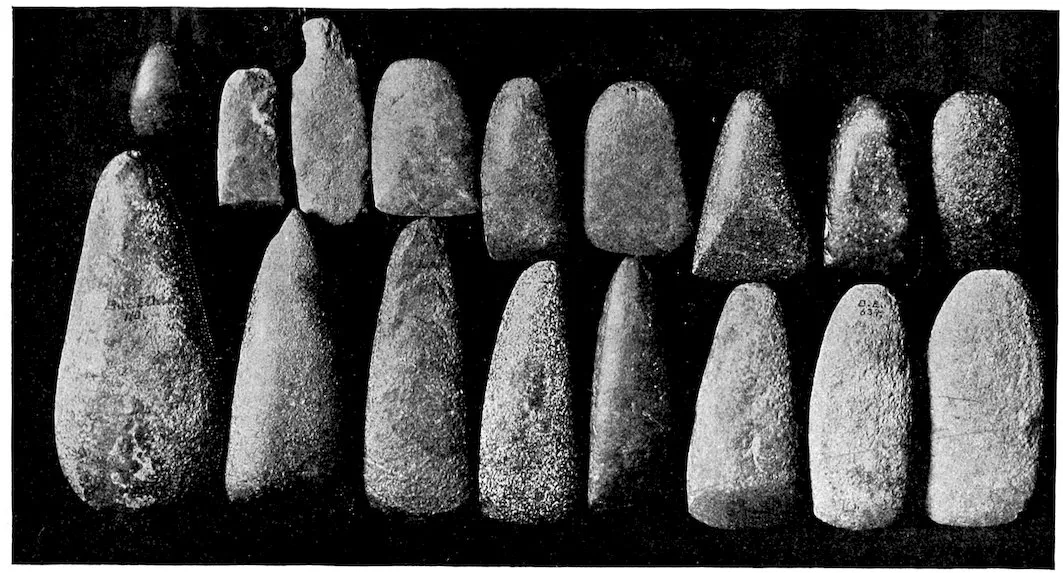
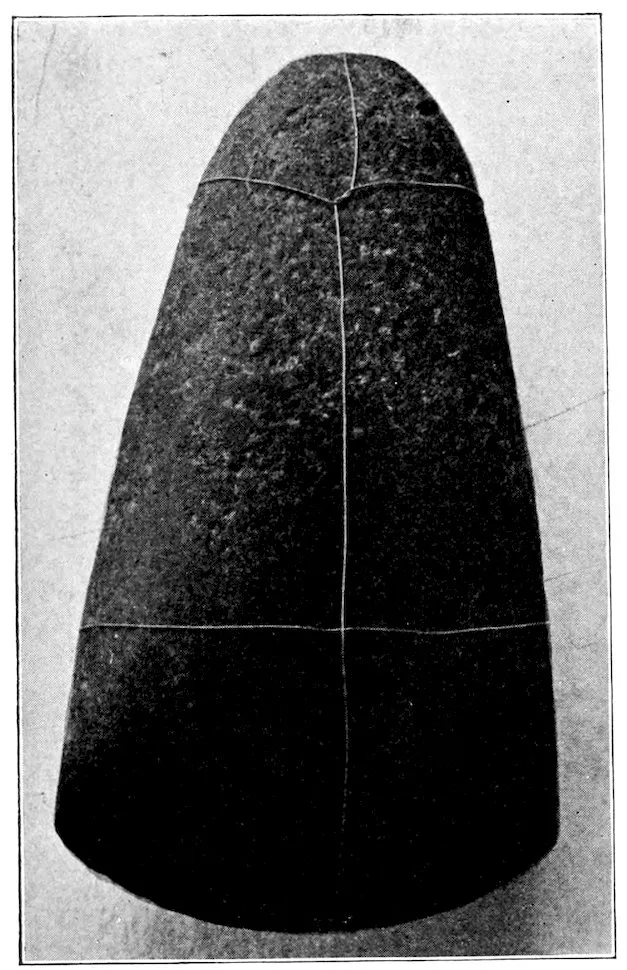
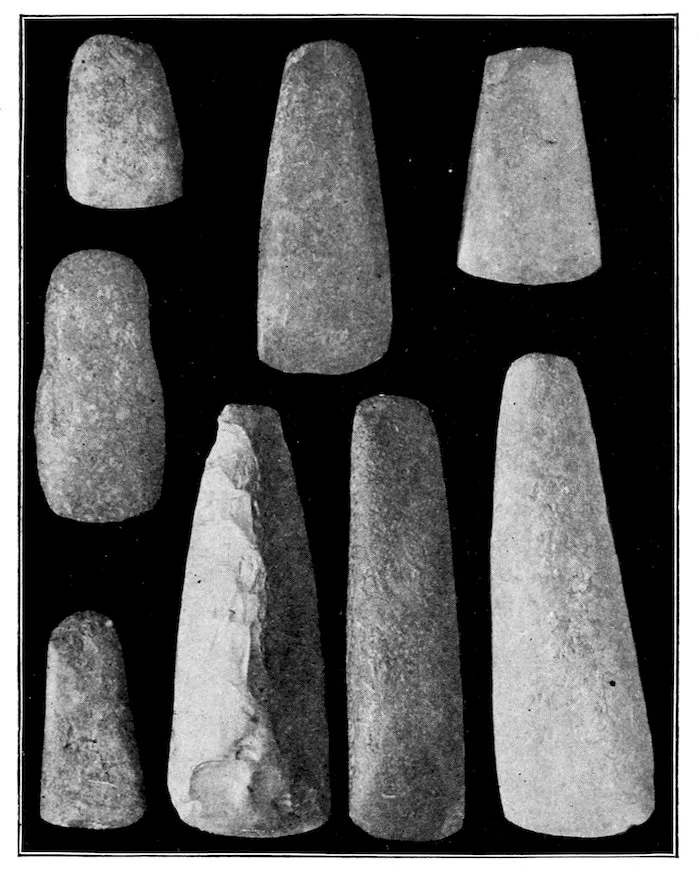
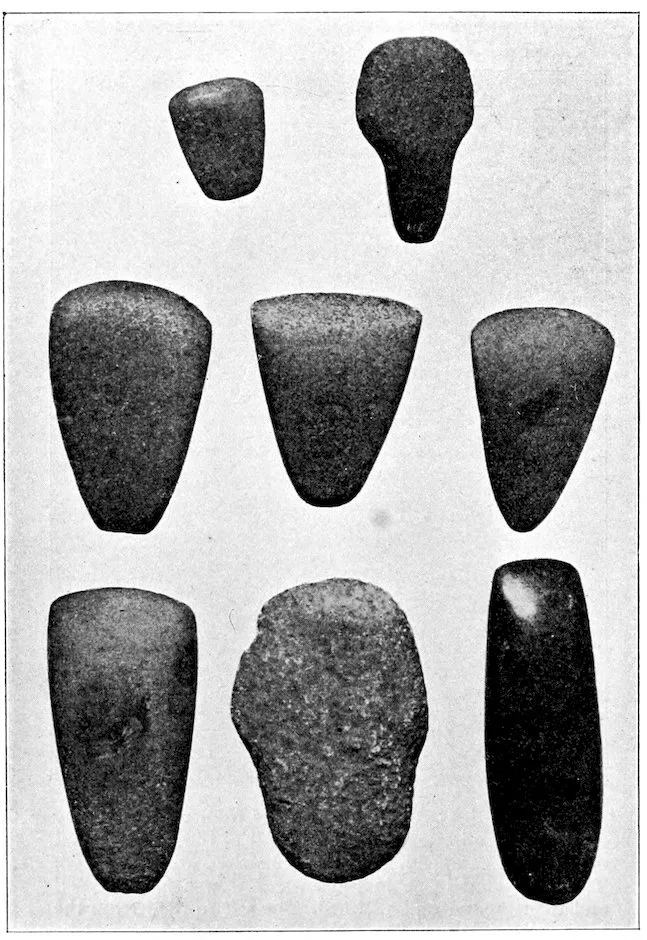
THE STONE AGE IN NORTH AMERICA AN ARCHÆOLOGICAL ENCYCLOPEDIA OF THE IMPLEMENTS, ORNAMENTS, WEAPONS, UTENSILS, ETC., OF THE PREHISTORIC TRIBES OF NORTH AMERICA, WITH MORE THAN THREE HUNDRED FULL-PAGE PLATES AND FOUR HUNDRED FIGURES ILLUSTRATING OVER FOUR THOUSAND DIFFERENT OBJECTS
Transcriber's Note:
New original cover art included with this eBook is granted to the public domain.
THE STONE AGE IN
NORTH AMERICA
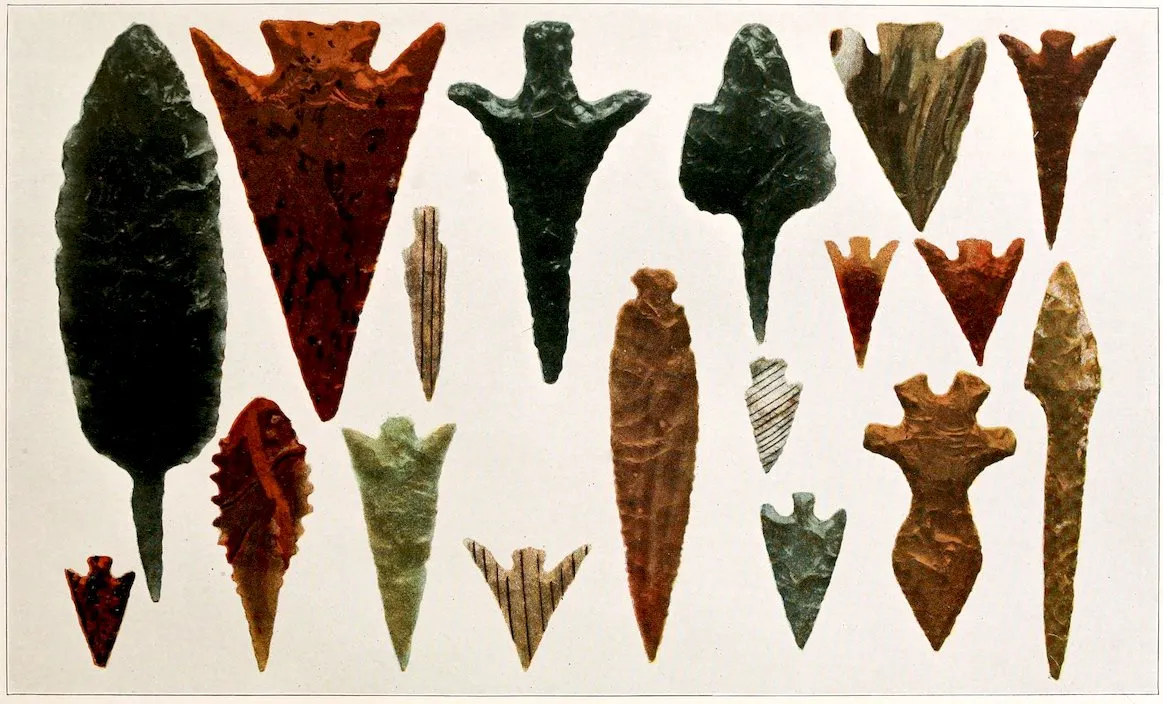
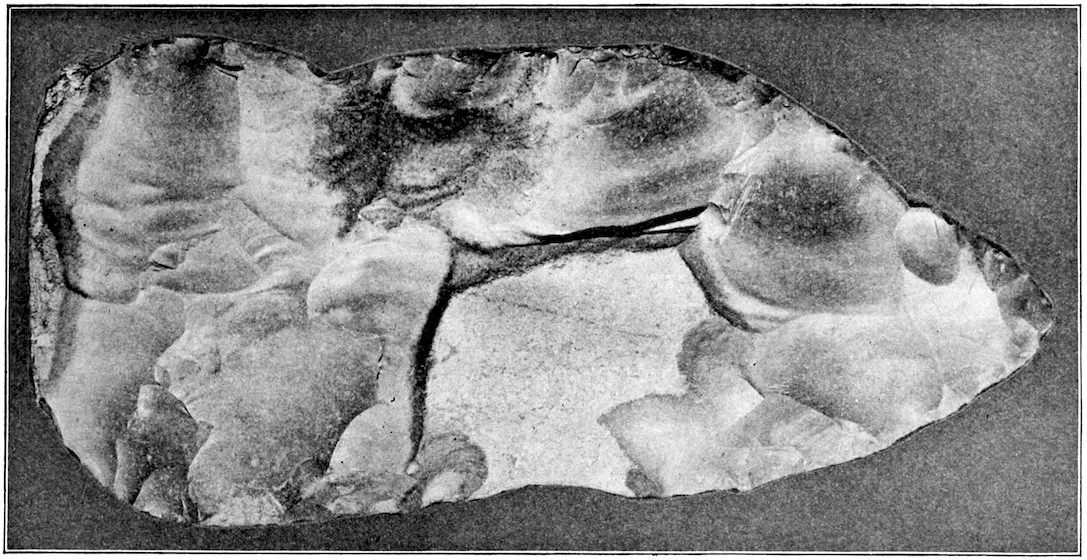
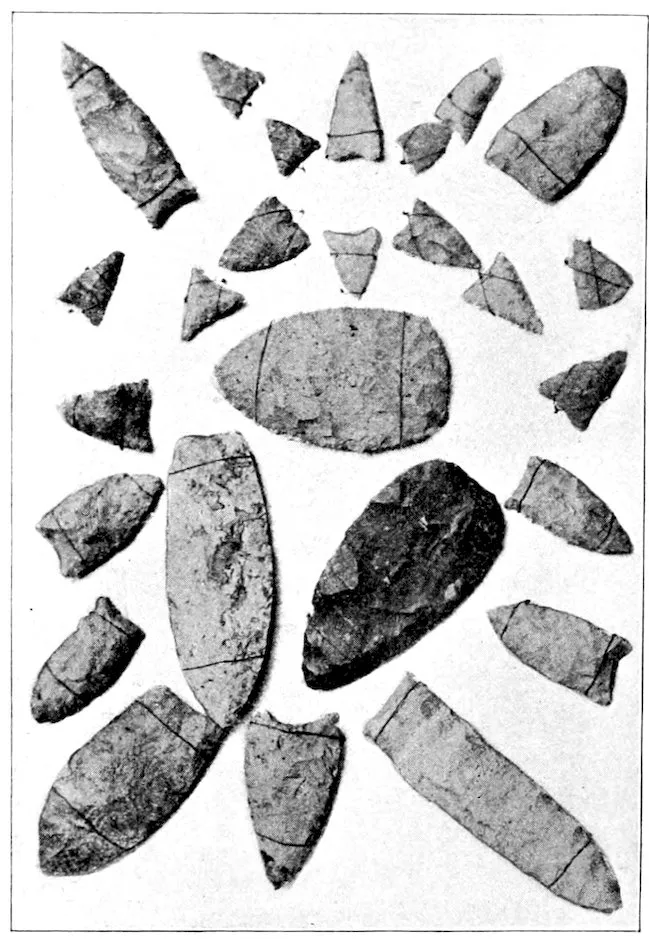
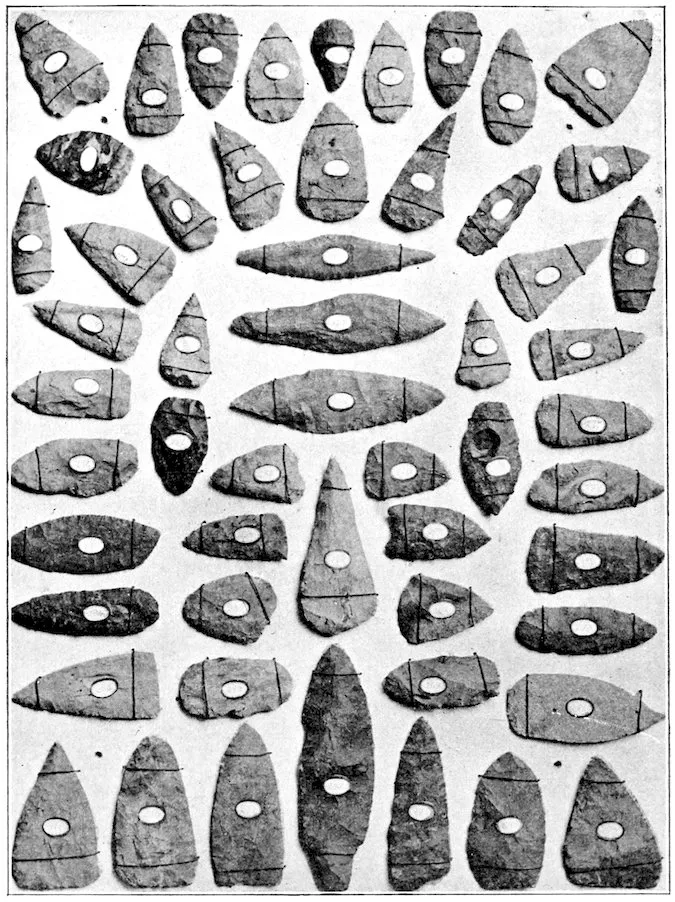
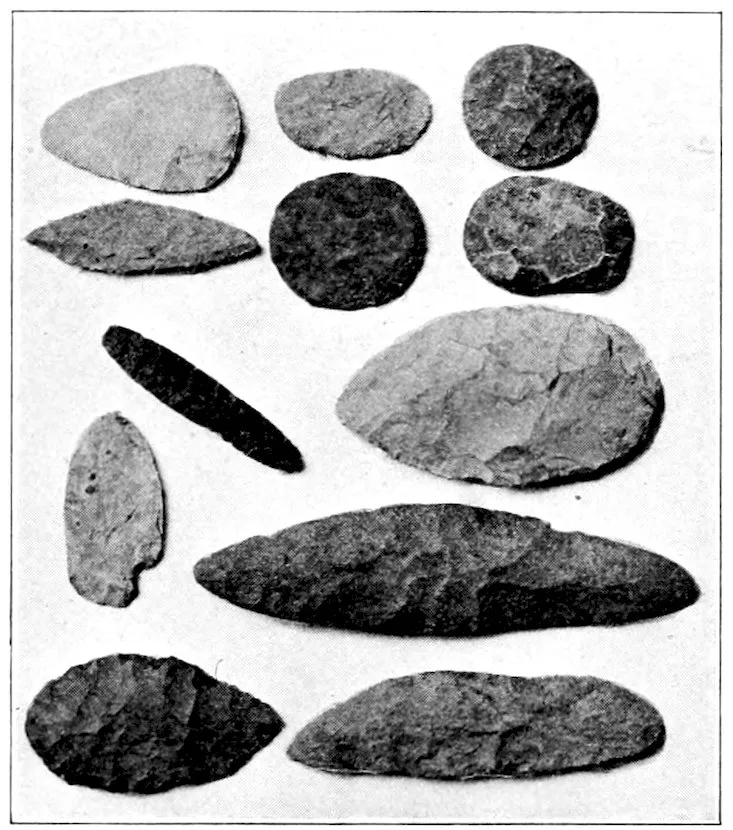
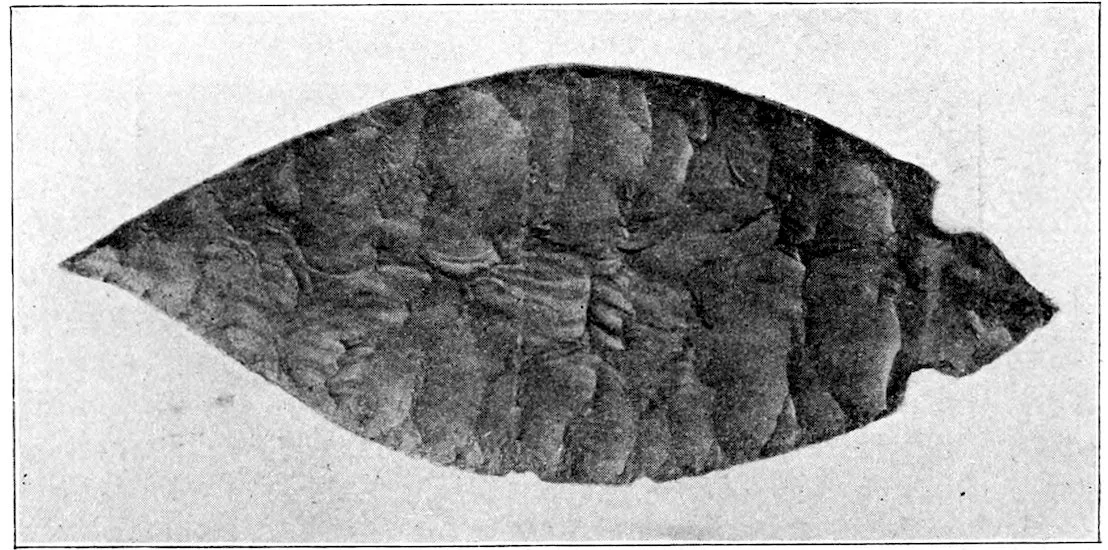
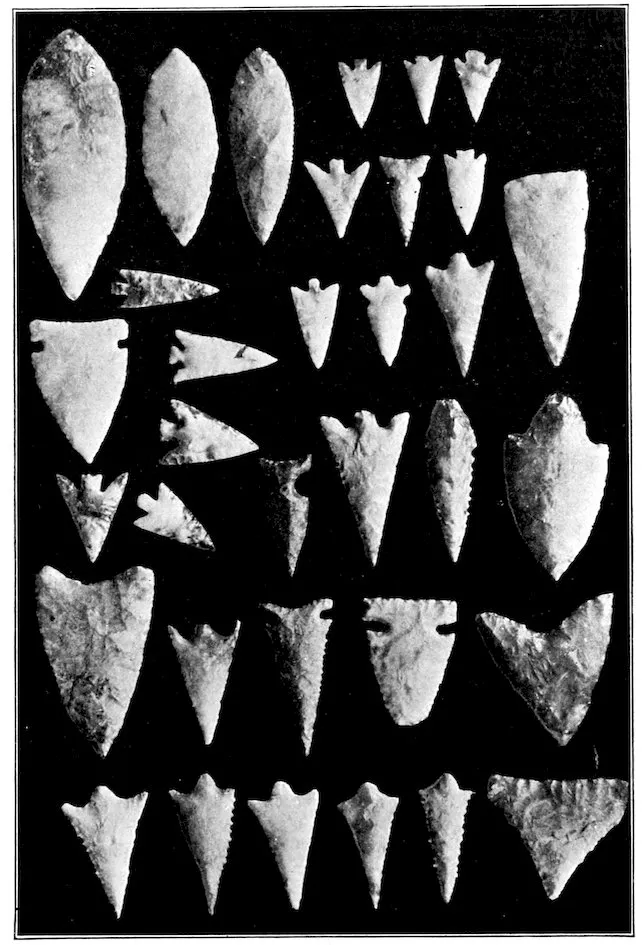
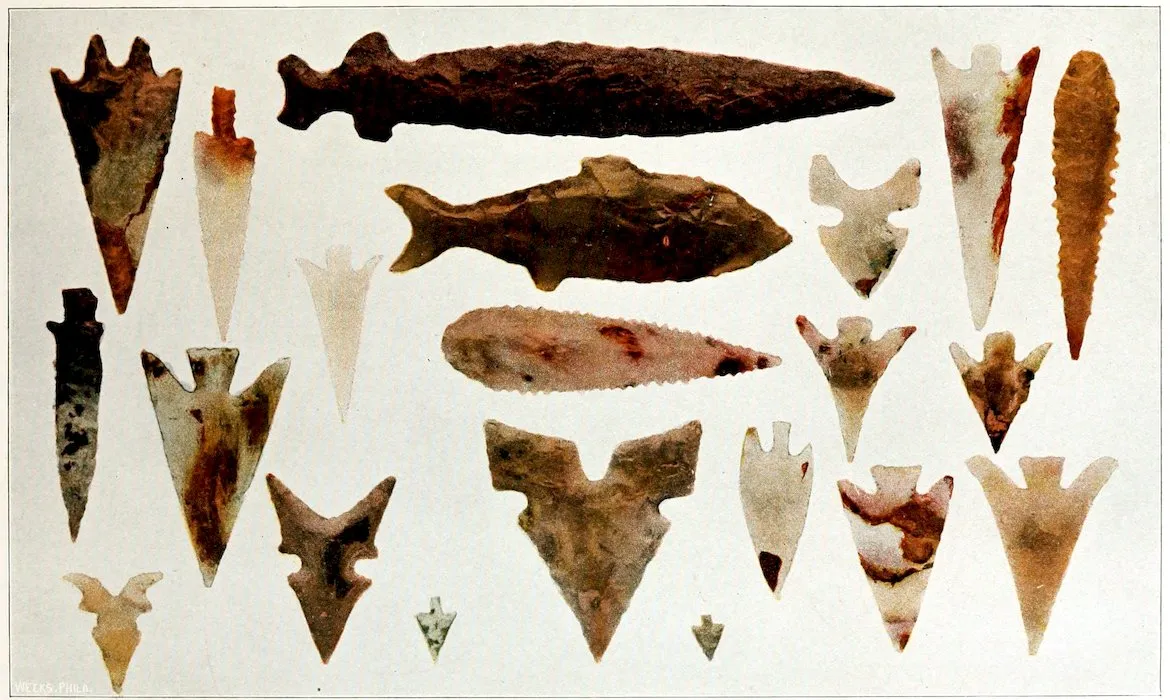
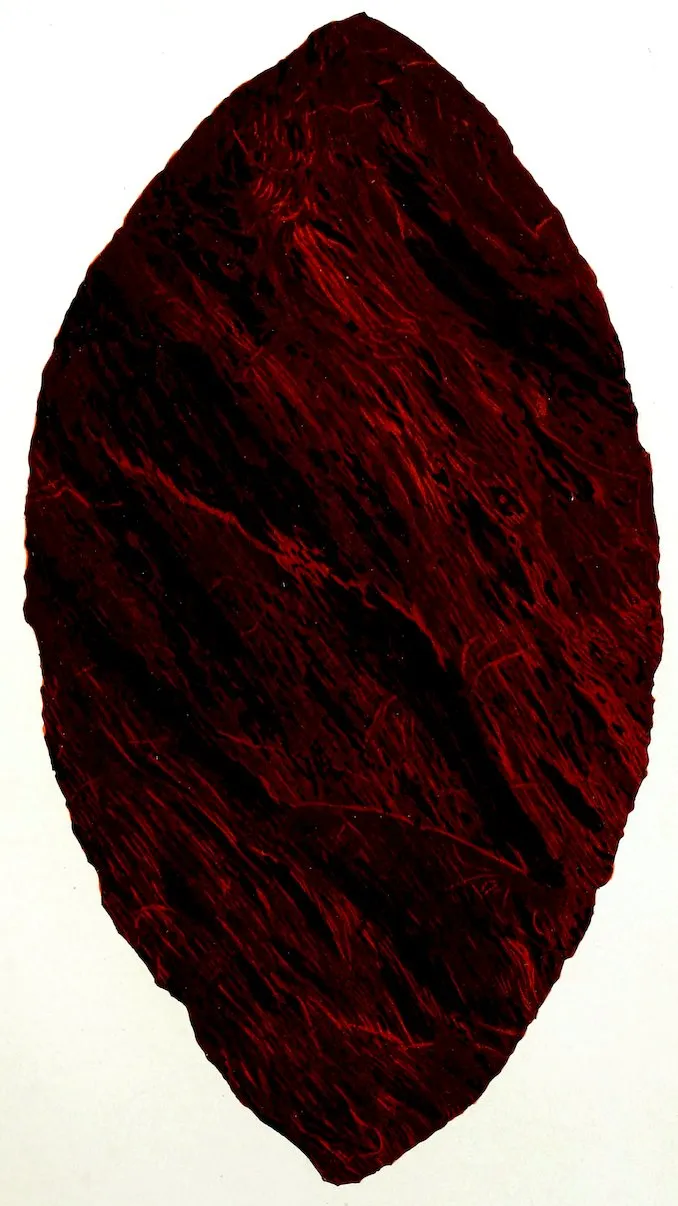
Colored plate of fine chipped implements. Materials: jasper, carnelian, agate, obsidian, and chalcedony. These were collected in the Willamette Valley, Oregon, and are selected as indicative of aboriginal American art in flint-chipping. B. W. Arnold’s collection, Albany, New York.
BY
WARREN K. MOOREHEAD, A.M.
CURATOR OF THE DEPARTMENT OF AMERICAN ARCHÆOLOGY, PHILLIPS ACADEMY, MEMBER OF THE BOARD OF INDIAN COMMISSIONERS, ETC.
IN TWO VOLUMES
VOL. I
BOSTON AND NEW YORK
HOUGHTON MIFFLIN COMPANY
The Riverside Press Cambridge
1910
COPYRIGHT, 1910, BY WARREN K. MOOREHEAD
ALL RIGHTS RESERVED
Published December 1910
PREFACE
v
Before one enters fully upon a discussion of ancient man’s
handiwork, some introductory explanation is necessary. This work
is the result of twenty-five years’ study of primitive man’s prehistoric
implements, weapons, and utensils found in America. During
the past ten years I have presented several attempts at classification
of these various objects, two of them being in book form. But my
publications were incomplete and unsatisfactory, although in a sense
they prepared the way for “The Stone Age.”
A classification of stone, bone, shell, clay, and copper implements
in the United States is a difficult and tedious task in itself. There
were different cultures, some of which are known, others but slightly
known, and it is quite likely that, as time passes, implements will
be discovered in such numbers as to justify the establishing of new
types. Therefore my work cannot be complete, although I have endeavored
to include in it all type-specimens brought to my notice.
The work has necessitated an extensive correspondence with
museums, scientific men, and private collectors throughout the
United States, much travel, and the reading of thousands of pages
of reports, books, and articles.
It is probable that some of the statements will be challenged,
and if in any of the conclusions I am in error, I court correction.
All these observations are based on the study of actual specimens
or photographs of them, on field-work, on published material, and
on museum specimens.
After deliberation I concluded to describe the implements, ornaments,
and utensils of North America according to class or type
rather than by locality. The several scholars who had aided me in
this work and to whom I am under the greatest of obligations are
therefore given credit in their several places. This was a better
plan, and all of my observations are so grouped.
I am especially indebted to Mr. Charles E. Brown, Secretary
and Curator of the Wisconsin Archæological Society and at present
Dean of the State Historical Museum at Madison, Wisconsin; and to
Professor Henry Montgomery, Ph.D., Head Curator of the New
Museum of the University of Toronto, Ontario. Both of these
vigentlemen are co-laborers in the preparation of the pages which
follow; both have offered suggestions and been of great assistance;
both made thorough studies in their respective regions. Mr. Brown’s
papers in the Wisconsin Archeologist and other reports, and his
studies in museums in the Northwest, have made him an authority
on copper and other forms of ancient objects. Professor Montgomery
has carried on investigations, extending through many
years, of the archæology of the Dakotas, Utah, and eastern and
central Canada.
Readers will observe that I have embodied Mr. Brown’s papers
in various portions of “The Stone Age” according to the types
under discussion, but Professor Montgomery’s several papers are
presented as geographical treatises in Volume II, just before my own
Conclusions.
Much credit is due to both of these scholars for their permission
to make use of previously published papers, and for hearty coöperation.
I am under obligations to the Wisconsin Archæological Society
for the loan of plates illustrating specimens in its collection, and to
Mr. George A. West, the authority on Wisconsin pipes, for the loan
of figures illustrating pipes from the Northwest; and, further, to
Mr. West for his kindness in reading my chapter on pipes and offering
suggestions. The Directors of the Milwaukee Public Museum
have my thanks for their generous action in making, especially for
“The Stone Age,” a series of plates illustrating type-specimens in
copper on exhibition in their collection. Dr. S. A. Barrett, Curator
of Anthropology in the Milwaukee Public Museum, also rendered
me assistance.
Dr. George L. Collie, Curator of the Logan Museum, Beloit,
Wisconsin, kindly made for me a number of plates of interesting
copper objects, striated axes, and other artifacts in his museum.
He also furnished me with descriptions, and permitted me to republish
portions of his paper entitled “Aboriginal Discrimination
in the Selection of Material for Tools,” printed in volume VII, number
3, of the Wisconsin Archeologist. These and other gentlemen
have been very kind to me and I appreciate their coöperation.
That “The Stone Age” may be a success is largely due to the interest
taken in it by my numerous correspondents.
The student who wishes to consider all the forms in a given
region will find it necessary to refer to the Index. Because of my
viimethod of treatment, I was compelled to ignore geographical lines.
Otherwise endless repetition would result. The only exception to
be noted was made in favor of Professor Montgomery’s paper.
I am especially indebted for assistance in the preparation of this
work to my colleague, Charles Peabody, Ph.D., Honorary Director
of the Department of American Archæology, Phillips Academy,
Andover, Mass., and also connected with the Peabody Museum
of Harvard University. Having access to the great library of Harvard
University, he kindly took in charge the Bibliography covering
necessary titles for the information of readers and students.
While the result does not embody every reference, yet it is the most
extensive list ever presented up to the present time. Messrs. Montgomery,
Barr, and Brown also added a number of titles. Dr. Peabody’s
interest in “The Stone Age” and his unselfish labors and
his many suggestions and advice were potent factors in making the
work possible.
I am also under particular obligations to about forty-five persons
who have been kind enough to assist in the making of illustrations
for “The Stone Age.” It is no more than fair to state that
without this coöperation it would have been impossible for us to
present so many figures and such excellent photogravure plates,
and at the same time offer the two volumes at the price named in
the original circulars.
Colonel Bennett H. Young, of Louisville, Kentucky, has made for
me about fifty half-tones of type-specimens in bone, shell, clay,
and stone which he used in his work “Prehistoric Men of Kentucky,”
and also in “Discoveries in Kentucky Caves,” just published. Mr.
F. P. Graves, of Doe Run, Missouri, a friend of mine for more than
twenty years, made eight photogravure plates of the best specimens
in his collection and presented these for use in “The Stone Age.”
Mr. B. W. Arnold, of Albany, New York, sent me by express a
portion of his collection, comprising some of the most beautiful
projectile points and knives of semi-precious stone that it has ever
been my privilege to examine. In order to emphasize the high workmanship
and beauty of these points, Mr. Arnold had five colored
plates made. Color reproductions and photogravures do justice
to the art of stone-age man. I am particularly indebted to both
Messrs. Graves and Arnold for their kindness in making possible
these fine plates.
Professor William C. Mills, Curator of the Ohio State Archæological
viiiSociety and State University Museum at Columbus, and
Mr. Clarence B. Moore of Philadelphia, loaned me plates illustrating
specimens found during their explorations.
Professor William H. Holmes and Dr. F. W. Hodge of the Smithsonian
Institution, Washington, permitted the free use of contributed
articles as well as figures published in the Smithsonian Reports
and the American Anthropologist. The generous and hearty
coöperation of all these individuals and institutions whose names
are herewith appended is no small personal satisfaction to me. In
addition to the names presented, there are more than three hundred
persons who sent me photographs, drawings, or lengthy descriptions
of the types in their several localities.
LIST OF CONTRIBUTORS TO “THE STONE AGE”
ix
Addis, Albert L., Albion, Indiana.
Albee, C., Red Rock, Montana.
Arnold, B. W., Albany, N. Y.
Bagg, Harry W., New Berlin, N. Y.
Baird, E. E., Poplar Bluff, Mo.
Barr, James A., Stockton, Cal.
Barrett, S. A., Milwaukee, Wis.
Beauchamp, W., Syracuse, N. Y.
Braun, H. M., E. St. Louis, Ill.
Brown, C. E., Madison, Wis.
Buffalo Society of Natural Sciences, Buffalo, N. Y.
Burkett, H. F., Findlay, Ohio.
Caldwell, F. M., Venice, Ill.
Collie, G. L., Beloit, Wis.
Deisher, H. K., Kutztown, Pa.
Franck, H. W., Sandwich, Ill.
Graves, F. P., Doe Run, Mo.
Hamilton, H. P., Two Rivers, Wis.
Hampton, George, Bridgeton, N. J.
Hills, L. W., Ft. Wayne, Ind.
Hodge, F. W., Washington, D. C.
Holmes, W. H., Washington, D. C.
Holmes, W. A., Chicago, Ill.
Hull, George Y., St. Joseph, Mo.
Logan Museum, Beloit, Wis.
Mills, W. C., Columbus, Ohio.
Milwaukee Public Museum, Milwaukee, Wis.
Missouri Historical Society, St. Louis, Mo.
Mitchell, S. D., Ripon, Wis.
Montgomery, Professor Henry, Toronto, Can.
Moore, C. B., Philadelphia, Pa.
xNew York State Museum, Albany, N. Y.
Norland, Luther A., La Jara, Colo.
Ohio State Archæological and Historical Society, Columbus, Ohio.
Owen, Dr. C. L., Chicago, Ill.
Peabody, Charles, Cambridge, Mass.
Perkins, G. H., Burlington, Vt.
Records of the Past, Washington, D. C.
Reeder, John T., Houghton, Mich.
Steinbrueck, E. R., Mandan, N. Dakota.
Tooker, Paul S., Westfield, N. J.
Van Rensselaer, Stephen, Newark, N. J.
Webster, R. T., Rochester, N. Y.
West, G. A., Milwaukee, Wis.
Whelpley, H. M., St. Louis, Mo.
Williams, Professor E. H., Jr., Woodstock, Vt.
Wing, E. T. S., Portland, Maine.
Young, Col. B. H., Louisville, Ky.
CONTENTS
xi
I.
Why a Classification based on Archæological Evidence alone is needed
CHAPTER I WHY A CLASSIFICATION BASED ON ARCHÆOLOGICAL EVIDENCE ALONE IS NEEDED
1
In 1907 the Smithsonian Institution published a remarkable work
entitled “Handbook of American Indians.”[1] This volume was the
result of years of labor on the part of about forty-five contributors.
Had the “Handbook of American Indians” treated of Stone-Age
man as extensively as it has dealt with modern tribes, historical
occurrences, and arts and customs, there would be no occasion for
“The Stone Age.” Indeed it would be presumptuous for one to
offer the public “The Stone Age,” did the “Handbook of American
Indians” take up prehistoric cultures in complete detail.
It is no more than right that this word of explanation be presented,
in order that my purpose in writing “The Stone Age” may
be made clear, as well as that the difference between the two works
should be emphasized. There is room for both publications, and
I particularly recommend the “Handbook of American Indians”
to students and librarians, for it serves an admirable purpose in
bringing into reasonable compass everything relating to Indian
tribes, languages, arts, and customs. But it must also be known
that “The Stone Age” is a very different work from the “Handbook
of American Indians.”
2
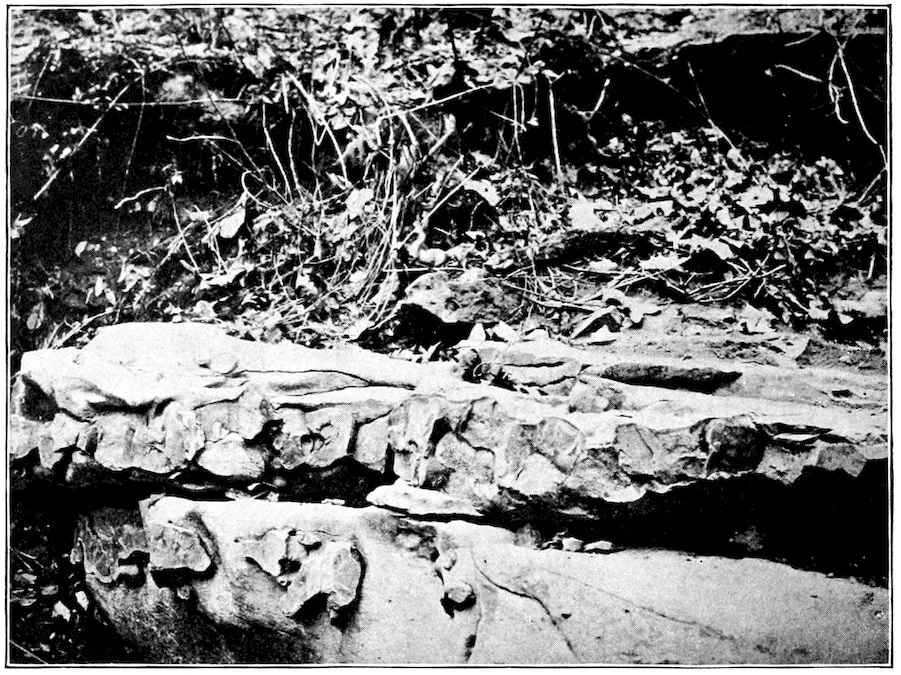
Fig. 1. A ledge in which are flint nodules. Johnson’s farm, near Herndon, Tennessee.
In the “Handbook” the writers have concentrated their attention
upon the life of the American Indian as seen through the eyes and
conceived by the brains of those familiar with Indian history of the
past two centuries. Under various citations are axes, arrows, copper
objects, and other artifacts treated. But these must be necessarily
brief, excellent though they are. And I speak in no hostile criticism
whatsoever in stating that the “Handbook of American Indians”
could not take up these subjects in detail. While I highly recommend
the “Handbook of American Indians,” I am persuaded that
the life of the Indian of to-day is influenced by his contact with the
white people; that he has drifted far away from Stone-Age times;
that while there were examples of real aboriginal culture to be found
in America during the past century, yet the great bulk of the natives
of this country passed out of the Stone Age with the advent of the
French into Canada, the Spaniards into the South, and the Puritans
into New England. It seems to me that the study of all these learned
individuals, the results of which are set forth in the Indian “Handbook,”
has led many of them to consider prehistoric life in America
as nearly the same as the life of our Indians for the past one or two
centuries. I cannot believe that the arts of the past are the same
to any appreciable extent as those which obtained at the time of
the Lewis and Clark expedition, and I am convinced that the tribes
living at the time of Lewis and Clark practiced arts which are to-day,
if not extinct, at least greatly inferior to those of ancient times.
Furthermore, I do not believe that the ceremonies practiced by the
tribes of to-day are of special value in measuring or understanding
prehistoric life.
3
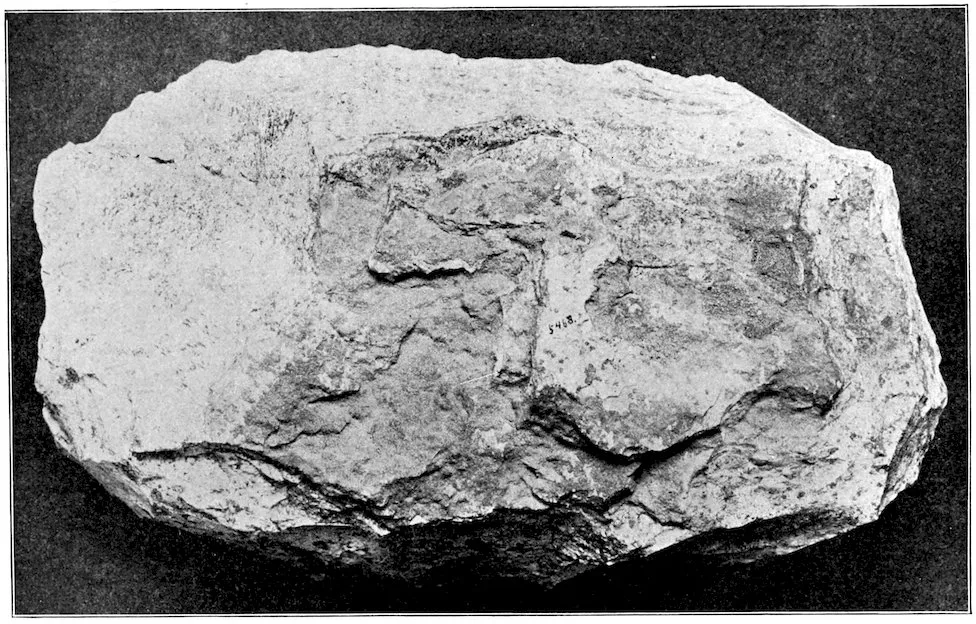
Fig. 2. A block of flint from a quarry in Indian Territory. (S. 1–2.) Phillips Academy collection. See Figs. 3, 7, 11, etc., for further reduction of this form.
Explanation. S. 1–1 means full size; S. 1–3 means one third size; etc.
4All of this does not mean that such studies have no value. On
the contrary, they are of the greatest value in ethnology. What
I mean is that they are of little value to the archæologist. The
archæologist must live in the past, and must deal with stone, shell,
bone, and clay objects, the like of which are not in use to-day. He
must, through long and painstaking labors both in the field and in
the museum, form his deductions. In these he is aided by numerous
reports, papers, books, and other published records of explorers,
travelers, archæologists, and ethnologists. But he must remember
that he is studying the past and not the present—an unwritten
past, in fact.
It is well to emphasize the fact that “The Stone Age” is a classification
of man’s handiwork. It is not a work relating to cultures,
although remarks as to the culture and relation of tribes are suggested
frequently by certain types of specimens. And the cultures
I describe are ancient cultures, not modern. The linguistic map
compiled by Major Powell, and the “Handbook of American
Indians” present the habitations of existing tribes and their customs,
far better and more comprehensively than could I. The
Sioux, the Cherokees, the Iroquois (or any one of a score of tribes),
may occupy the same region to-day that other and extinct bands
of red men claimed for their own centuries ago, and the artifacts
found therein may or may not be comparable with those made and
used by the present inhabitants of the section. It is these older
things and cultures to which I would confine “The Stone Age.”
In some respects the points of view of the ethnologist and of the
student of folk-lore and linguistics on the one hand, and of the
archæologist on the other, are quite divergent. And touching upon
this variance of opinion there is something to be said.
It has occurred to me that those museum men who collect and
study modern material more than the prehistoric have not a clear
perspective of the past in this country. As against this statement
these gentlemen might properly reply that those of us who study
olden times fall into grievous errors because we do not explain
ancient cultures through a study of cultures among living tribes.
5
Fig. 3. (S. 2–3.) Block of flint; partly worked. W. A. Jacobs collection. Similar to Fig. 5.
6If any man will read carefully the “Jesuit Relations” and the
narrations of our earliest explorers among the Indians, he will see
at once that there is a great gulf between the aborigines of long ago
and the Indians of the present. The Sun Dance as witnessed by
Catlin among the Mandans and the Sun Dance as seen by Dr.
George A. Dorsey on the Kiowa Reservation are quite different
affairs. The latter showed white man’s influence, the former was
more aboriginal. Much of the ancient or prehistoric life we cannot
reconstruct, but the day is coming when by minute and unceasing
study of these peculiar objects, and by the process of elimination,
we shall arrive at certain definite conclusions as to the life of man
in the past.
The aboriginal man was influenced by what he saw and heard
in the world of nature surrounding him. His religion, folk-lore,
daily life, and his entire being, were affected, modified, or directed
by the primitive world,—that world of the forest, the plain, the
air, and the waters. To study him aright we must cast aside our
modern civilization, and if possible—and that is very difficult—place
ourselves in his world. The Indian of to-day is not in that
world. He hears his grandparents speak of the “buffalo days,”
and that conveys some meaning to his mind. But he cannot go
beyond the buffalo days; he knows nothing of the more interesting
times preceding. He can tell you about the folk-lore of his tribe,
yet he has no tradition of the first Spaniards, whether De Soto or
Coronado, or others. Notwithstanding that these Spaniards traversed
many Indian lands, and bore in their hands unheard-of
weapons which made smoke and noise, and killed at a distance;
that they were clad in iron suits, and were riding horses,—one hears
little or nothing about it. Such scenes must have impressed Indians
who had never beheld the like before, and one would imagine that
there would be traditions handed down regarding these miraculous
strangers, yet one reads in vain for any folk-lore relating to the
coming of the Spaniards. This has always appeared to me as one of
the arguments against the trustworthiness of folk-lore in matters
of evidence as compared with that of archæology.
When one considers the subject in its broad aspect, one must
admit that our knowledge of prehistoric times has not advanced
in the same ratio as has our knowledge of the Indians of the historic
period. The tribes themselves show marked contrasts to-day, and
in the past the differences in culture may have been even more
striking. It is, therefore, quite likely that an implement used for a
certain purpose by one tribe may have been made use of by another
tribe for a totally different purpose.
7
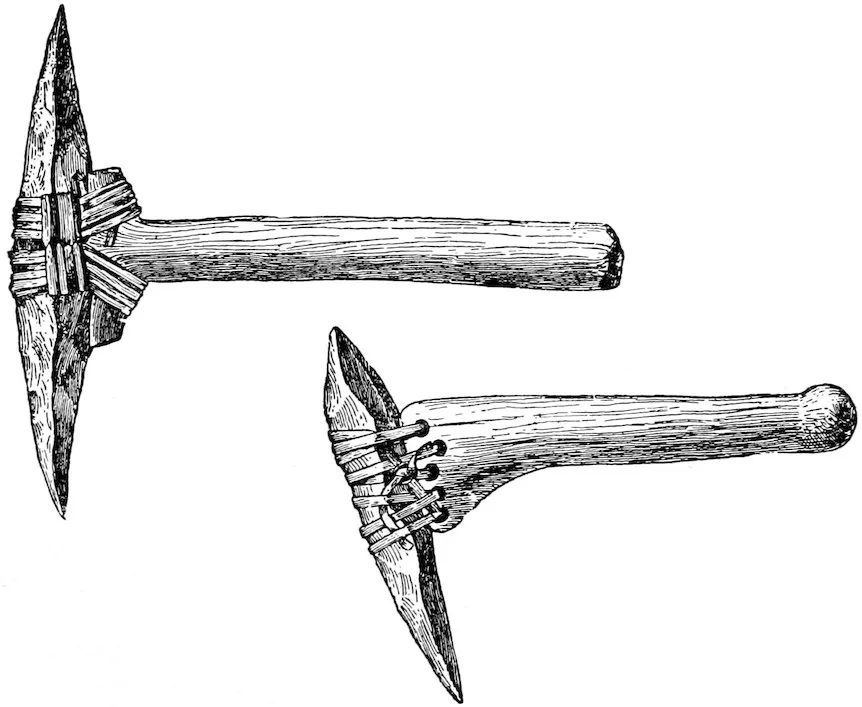
Fig. 4. (S. unknown.) Probable manner of hafting the single-pointed and the two-pointed chisels or picks, used in quarrying flint—in digging the pits. Figs. 4 to 12, and Figs. 36 to 40, are from the 15th Annual Report, Bureau of Ethnology.
The tendency to explain much of prehistoric times through
knowledge of tribes whose customs are more or less saturated with
white man’s influence seems to me to be unfortunate. To make this
clear, let me present as an illustration the Sun Dance described by
George Catlin, and the Sun Dance described by Dr. Dorsey. More
than sixty years intervened between the two ceremonies. Catlin
had no training in science, and therefore some things must be overlooked
in his favor. Yet the dance he describes is purely aboriginal,
or nearly so. Dr. Dorsey, on the other hand, had all the advantages
of scientific training covering many years, and was able to take
advantage of everything that he saw and heard concerning the
ceremony, to compare it with other observances and to draw
learned conclusions. Yet the Sun Dance as seen by Dorsey is
totally different, and is far less interesting and heroic than the same
dance observed by Catlin.
8Going back further, we find
among the “Jesuit Relations” and
narratives of other explorers, descriptions
of certain ceremonies
which appear to retain their aboriginal
character. In other words,
they were less European than similar
affairs of later dates. Particularly
is this true among the Hurons,
Iroquois, Ojibwa, etc. The customs
seen among the Sioux by
Hennepin do not exist to-day.
It seems to me that in our haste
to make records of tribes that are
passing away, we have published
much material that the future ethnologist
will consider less important
than similar observations of a century
ago. No matter how much
tribes are affected by contact with
civilization, it is well to preserve
their records even although the
more able scholars of the future will
question some of our observations.
But while admitting the above, I
wish to go on record as against the
present tendency, so general, to
explain the arts, customs, daily life,
etc., of prehistoric man through
our knowledge of a degenerate culture
among modern Indians.
Much of the material presented
in this work cannot be explained
through such agencies; for there
are hundreds of objects found in
graves and tombs, village-sites and
cliff-houses, the like of which have
been seen in use among Indians by
no white man whatsoever.
Fig. 5. (S. 1–1.) First stage of work, after blocking-out. See Fig. 7 for description.
Therefore, it appears to me that
9a classification based on archæological evidence (as far as possible)
is needed, and I have attempted this in “The Stone Age.”
The critical reader will wonder why I have quoted at length from
certain ethnologists on such subjects as textiles, bows and arrows,
clothing, pottery, and pipes, and omitted extensive quotations in
other sections. This is done purposely. In the field of ethnology
much work has been done. The “Handbook of American Indians”
covers fully such subjects as the bow, arrow, blanket, clothing, etc.
Professor Mason was our highest authority on the basket and textiles
generally, as is Professor Holmes on ceramic art. No possible
improvement could have been made by me on the published studies
of these men. And as “The Stone Age” carries out in detail the
plan of the “Handbook,” I have embodied their papers in part or in
whole, where such papers dealt with titles which I had not made
the subject of a special study.
Of problematical forms, the divisions of chipped implements,
hematites, agricultural implements, hammers, pestles, mortars,
tubes, and other types, there are frequent descriptions. But these
are brief, as a rule, and I do not concur in some of the conclusions.
Therefore, I have not quoted at any length under such titles. Copper
presents an extensive and almost new field, and Mr. Charles
E. Brown has, therefore, made it one of the longest sections.
But, while “The Stone Age” does contain many quotations of
length, I have made all these a part of one general plan, and this
leads up, as readers will observe, to the differentiation of the various
culture-groups existing in America in very ancient times. And thus,
towards the end of Volume II, one enters an entirely new field.
There are opened to archæologists possibilities of future study—very
important study, in fact.
CHAPTER II PLANS FOR AN ARCHÆOLOGICAL CLASSIFICATION — CLASSIFICATION OF PREHISTORIC ARTIFACTS, MADE BY THE COMMITTEE ON NOMENCLATURE — ARTICLES IN STONE — ARTICLES IN CLAY
10
There are something like three hundred museums or institutions
in the United States that contain archæological collections. These
exhibits range from more than a million objects, as in the case of
the Smithsonian Institution, or Field Museum of Chicago, or the
American Museum of Natural History, to private collections of
one to ten thousand specimens each. I have roughly estimated the
number of prehistoric artifacts available for study, or those of
aboriginal manufacture that show little influence of European
culture, at about eight million objects.
Mr. Paul M. Rea, curator of the Charleston (South Carolina)
Museum and secretary of the American Museums Association,
reports to me by letter that seventy-eight museums have 991,974
specimens by count. This total does not include the larger museums,
and forty-seven smaller ones have not reported. Mr. Rea states:
“The following museums of importance have either not returned
information or have failed to give the extent of their collections in
figures: American Museum of Natural History, Smithsonian Institution,
National Museum, Peabody Museum (Cambridge), Peabody
Museum (New Haven), University of Toronto, Canada.”
I suppose that these six institutions contain a total of at least
four million prehistoric, or early historic Indian objects. Most of
these exhibits are of objects in use long before Columbus discovered
America, although many are in ethnological collections comprised
of things fifty or a hundred years old. How many specimens are
in the hands of private collectors of the United States no man may
know.
Reference to the Bibliography, presented in the second volume
(just before the Index) of this publication, will convince the reader
that much of our archæological material has been described by
various writers. But there is difference between description and
classification. Save Professor W. H. Holmes’s papers upon pottery,
Dr. Thomas Wilson’s work on the classification of knives,
spear-points, and arrow-heads, Mr. Gerard Fowke’s published papers
11along the same lines, Mr. Charles E. Brown’s papers upon the
so-called “spud,” and copper, Mr. J. D. McGuire’s “Pipes and
Smoking Customs,” and Cushing’s contributions (see Bibliography),
everything is description and not classification.
Or, if classifications are attempted,
they relate to certain types,
and are brief. The “Handbook of
American Indians” describes and illustrates
artifacts, but does not classify.
Fig. 6. See Fig. 7 for description.
Sixteen years ago, in the Archæologist
(May, 1894, page 156), I called
attention to the need in this country
of an archæological nomenclature and
classification. Whether some one had
preceded me, or whether I had made
similar suggestions earlier, I am unable
to state, but am of the opinion that
the matter had been suggested in one
of my articles previous to the date
mentioned. However, be that as it
may, no one paid attention to the suggestion,
which was afterwards repeated
in two or three articles over my signature.
About five years ago, after several
attempts at such a classification, I
had a long conference with Dr. Charles
Peabody, and presently he took up the
matter with the American Anthropological
Association, and a committee
was formed consisting of Professor
John H. Wright, Mr. J. D. McGuire,
Dr. F. W. Hodge, Dr. C. Peabody, and
myself, with Dr. Peabody as chairman.
We worked long and assiduously upon
this classification. Dr. Peabody and
myself grouped and regrouped most of
the available specimens in the Andover
collection before we were satisfied with the results of our labors.
Then we submitted our scheme to the other members of the Committee.
After more than a year of labor the Committee presented
12a preliminary classification which was accepted by the members
of the Anthropological Association at the Baltimore meeting,
December, 1908. This classification in its
complete form will be found on pages 23
to 30.
Fig. 7. (S. about 2–3 to full S.) Series of rejects from the South Mountain rhyolite quarry, showing range of shaped forms. Figs. 5, 6, and 7 are illustrative of successive grades of development.
But before explaining and expanding the
accepted classification, it is well to state
that we have confined our plan to the arts,
industries, and so forth, of man, as expressed
in his handiwork.
If one realizes
this, he will at once
understand that we
have not included the
vocations, or cultures,
or divisions of labor, or
anything of that sort.
Such would be, manifestly,
out of place in
a classification of the
products of man’s
handiwork.
13
Fig. 8. (S. 1–1.) These four figures which follow are from W. H. Holmes’s paper in the 15th Annual Report, pp. 5–150, Bureau of Ethnology. They are selected forms illustrating progressive steps in the shaping of leaf-blade implements from argillite, from village- and shop-sites at Point Pleasant, Pennsylvania.
14Were one to consider
primitive or prehistoric
man from every aspect
of his life, a totally
different classification
would be necessary,
one far broader and
more comprehensive.
Again, we have thought
of other classifications
which suggested themselves
to the investigators.
None of these could be accepted entirely, for the simple
reason that we do not yet know the purpose of every object made
and used by prehistoric man. There are, however, two grand
divisions to which no one can object—the Known and the Unknown.
All objects naturally fall into these. But they are too
sweeping in character and have not been adopted, although—regardless
of form or material—all Stone-Age implements are of
one or the other of these two grand divisions: those whose purpose
is clear to us, and those regarding which we have no positive knowledge.
Under these heads one might summarize all the implements
or paraphernalia made use of by the man, the woman, the priest,
the warrior, the child. Or one might subdivide, and under the
heading of woman place objects made use of in the carrying industry,
domestic science, agriculture, etc. But in following such a
classification one is beset
by certain difficulties. We
are not certain as to the
division of labor between
man and woman. The
lines are not so sharply
drawn among barbarians
as with ourselves in some
matters; in others they
are more sharply drawn.
The construction of a
wigwam, a cabin, a tepee,
or a council-house, might
be placed under archæological
architecture, primitive
though it is. Just
where to draw the line
between the insignia of
the priest and highly ornamental
possessions of
the wealthy warrior presents
a problem not easy
of solution.
As has been stated on
page 12 the life of prehistoric
man is such that
while one may classify his implements according to type or form
and material and supposed use, it is not possible in every instance
to affirm positively that this object was made use of by the man
and that by the woman, this by the priest and that by the warrior.
Fig. 9. Described under Fig. 8.
15
Fig. 10.
Fig. 11.
Fig. 12.
All described under Fig. 8.
16Professor Otis T. Mason, of the United States National Museum,
gave much thought to ethnological matters, and particularly his
studies have been directed toward the arts, industries, and occupations
of living tribes. These studies led him to discourse upon the
divisions of labor, beginnings of culture, on the carrying industry,
agriculture, traps in use among the Indians, and other subjects.
He grouped the various industries in the “Handbook of American
Indians,” page 97; and under the citation of implements, tools,
utensils, he gave a sketch-classification of the daily pursuits and
implements used therein. His paper upon arts and industries I copy
in part (omitting references), as it embodies one of several classifications
possible of the life of the Indian:—
“The arts and industries of the North American aborigines,
including all artificial methods of making things or of doing work,
were numerous and diversified, since they were not limited in purpose
to the material conditions of life; a technique was developed
to gratify the esthetic sense, and art was ancillary to social and
ceremonial institutions and was employed in inscribing speech on
hide, bark, or stone, in records of tribal lore, and in the service of
religion....
“The arts and industries of the Indians were called forth and
developed for utilizing the mineral, vegetal, and animal products
of nature, and they were modified by the environmental wants and
resources of every place. Gravity, buoyancy, and elasticity were
employed mechanically, and the production of fire with the drill
and by percussion was also practiced. The preservation of fire and
its utilization in many ways were also known. Dogs were made
beasts of burden and of traction, but neither beast nor wind nor
water turned a wheel north of Mexico in pre-Columbian times. The
savages were just on the borders of machinery, having the reciprocating
two-hand drill, the bow and strap-drills, and the continuous-motion
spindle.
“Industrial activities were of five kinds: (1) Going to nature
for her bounty, the primary or exploiting arts and industries; (2)
working-up materials for use, the secondary or intermediary arts
and industries, called also shaping arts or manufactures; (3) transporting
or traveling devices; (4) the mechanism of exchange; (5)
the using-up or enjoyment of finished products, the ultimate arts
and industries, or consumption. The products of one art or industry
were often the material or apparatus of another, and many tools
could be employed in more than one; for example, the flint arrow-head
or blade could be used for both killing and skinning a buffalo.
17Some arts or industries were practiced by men, some by women,
others by both sexes. They had their seasons and their etiquette,
their ceremonies and their tabus.
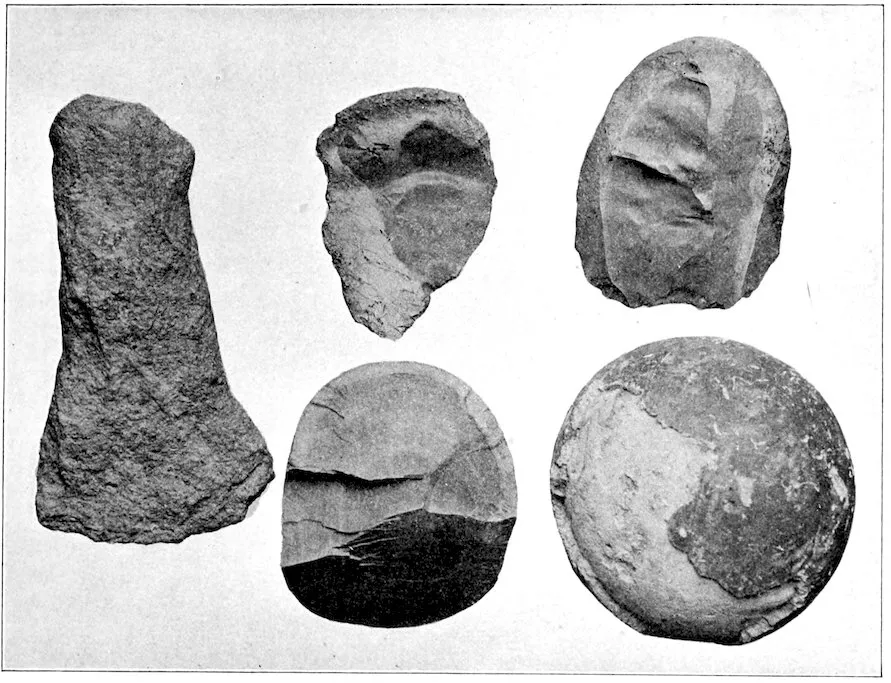
Fig. 13. (S. about 1–3.) Hammer-stones. Phillips Academy collection. These are from Flint Ridge, Ohio, and were made use of in the manufacture of turtlebacks and discs.
“Stone-craft.—This embraces all the operations, tools, and
apparatus employed in gathering and quarrying minerals and working
them into paints, tools, implements, and utensils, or into ornaments
and sculptures, from the rudest to such as exhibit the best
expressions in fine art. Another branch is the gathering of stone
for building.
“Water industry.—This includes activities and inventions concerned
in finding, carrying, storing, and heating water, and in
irrigation; also, far more important than any of these, the making
of vessels for plying on the water, which was the mother of many
arts. The absence of the larger beasts of burden and the accommodating
waterways together stimulated the perfecting of various
boats to suit particular regions.
18“Earth-work.—To this belong gathering, carrying, and using
the soil for construction purposes, excavating cellars, building sod-
and snow-houses, and digging ditches. The Arctic permanent
houses were made of earth and sod, the temporary ones of snow cut
in blocks, which were laid in spiral courses to form low domes. The
Eskimo were especially ingenious in solving the mechanical problems
presented by their environment of ice....
Fig. 14. Free-hand, or direct percussion. First step in shaping an implement from a boulder. Figs. 23, 28, and 29 to 33 are from the American Anthropologist, vol. IV, 1891—W. H. Holmes’s paper.
“Ceramic art.—This industry includes all operations in plastic
materials. The Arctic tribes in the extreme North, which lack proper
stone, kneaded with their fingers lumps of clay mixed with blood
and hair into rude lamps and cooking-vessels, but in the zone of
intense cold, besides the ruder forms there was no pottery....
“Metal-craft.—This includes mining, grinding of ores and paint,
rubbing, cold-hammering, engraving, embossing, and overlaying
with plates. The metals were copper, hematite and meteoric iron,
lead in the form of galena, and nugget gold and mica. No smelting
was done.
19
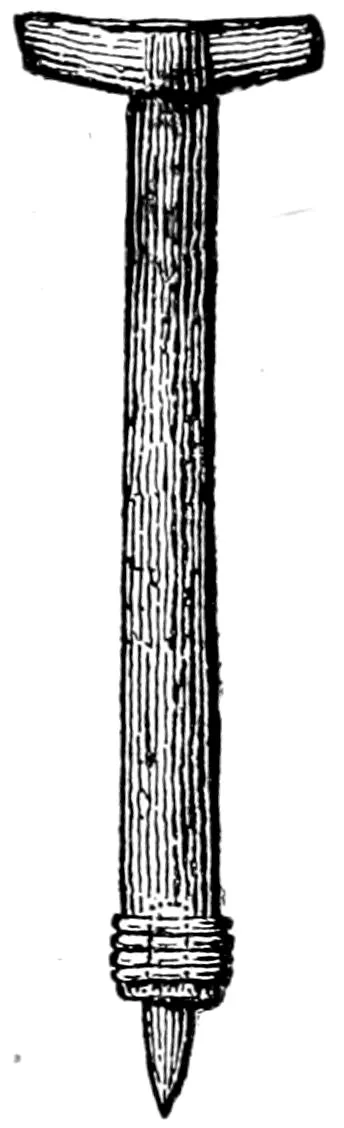
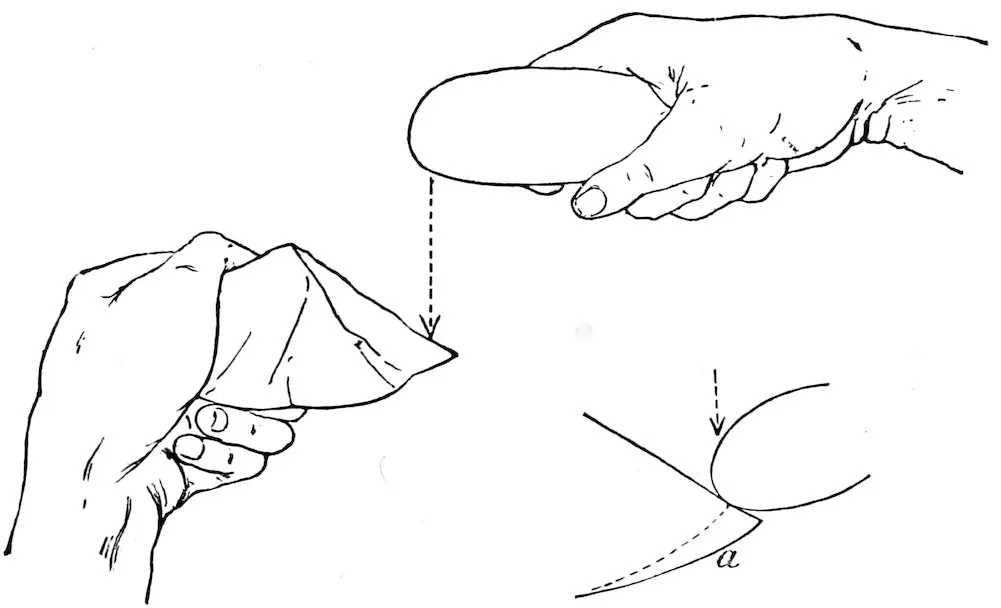
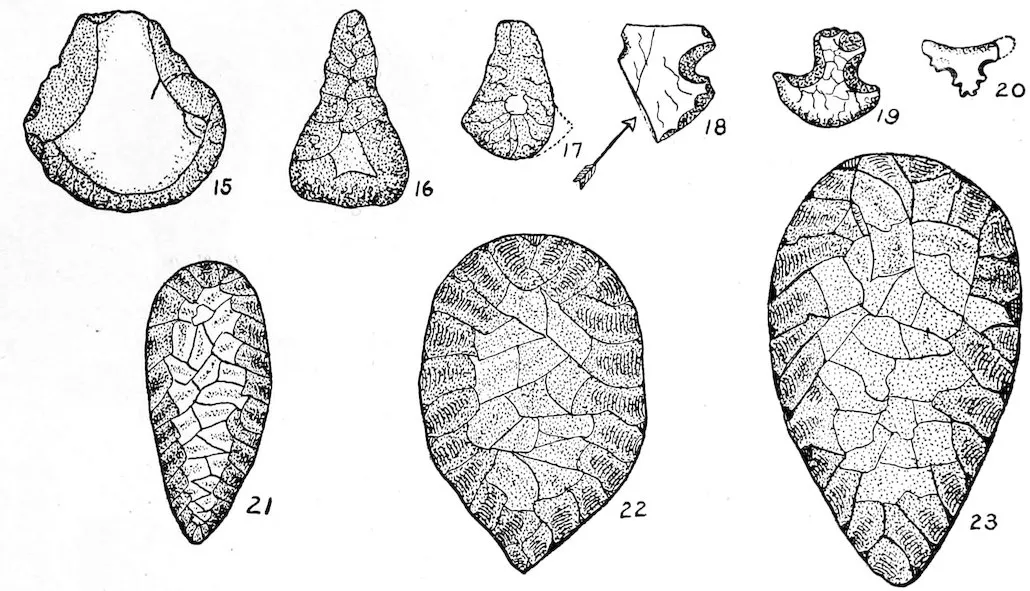
Fig. 15. Flaking-tool—being a shaft or stick, thirty inches to four feet. These were pointed with bone or buck-horn.
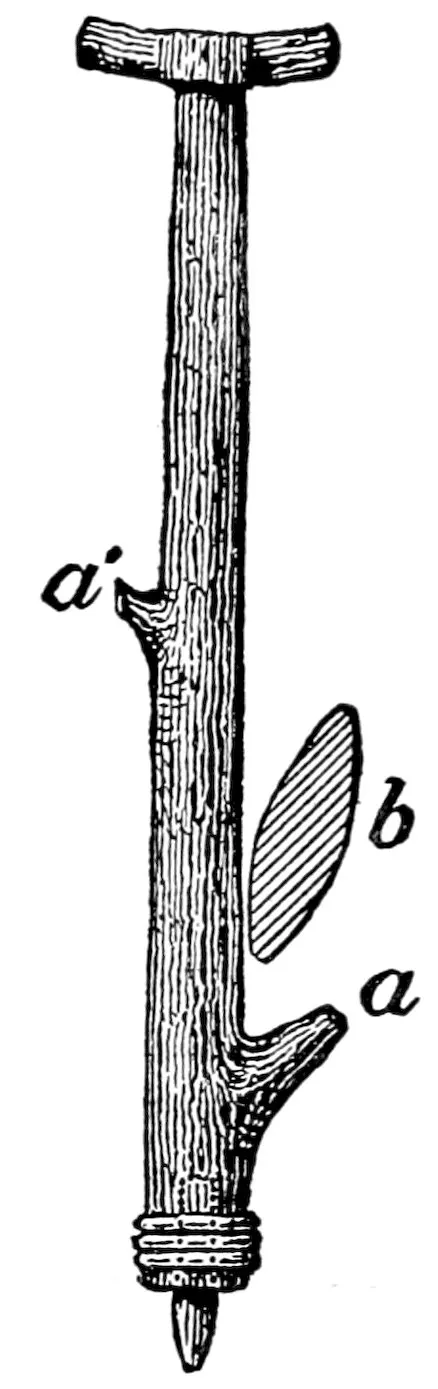
Fig. 16. Flaking-tool—lower branch utilized to form a crotch in which blow was struck. Upper opposite branch used to secure a heavy stone to give weight and increase the pressure.
(From George Sellars’s article in the Smithsonian Report, 1885, pt. 1, reprinted in Chapter IV.)
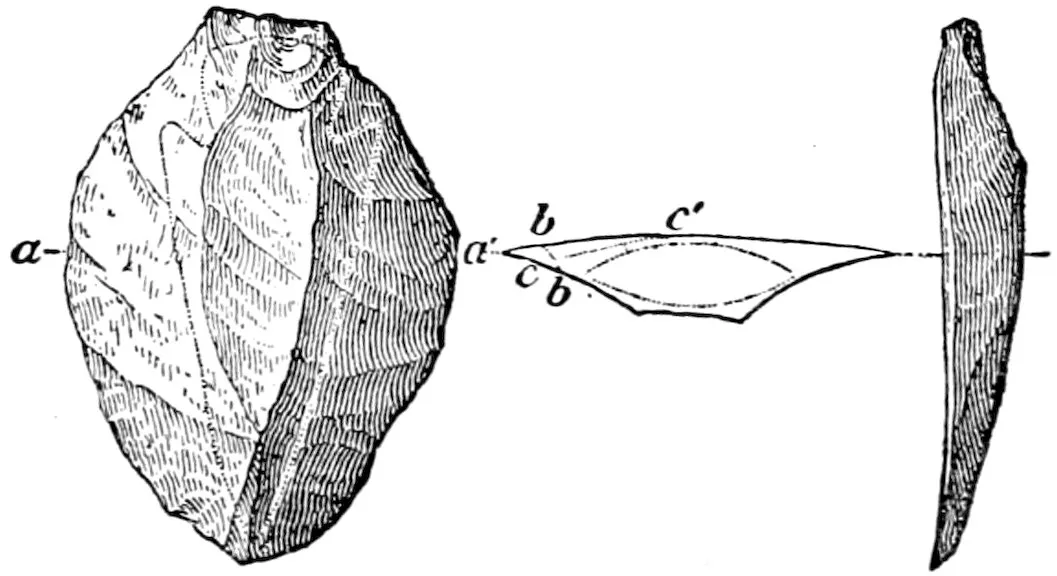
Fig. 17. A plan view of the outer or high side of an ordinary flake.
20“Wood-craft.—Here belongs the felling of trees with stone axes
and fire. The softest woods, such as pine, cedar, poplar, and cypress,
were chosen for canoes, house-frames, totem-poles, and other large
objects. The stems of smaller trees were used also for many purposes.
Driftwood was wrought into bows by the Eskimo. As there
were no saws, trunks were split and hewn into single planks on the
North Pacific Coast. Immense communal dwellings of cedar were
there erected, the timbers being moved by rude mechanical appliances
and set in place with ropes and skids. The carving on house-posts,
totem-poles, and household furniture was often admirable.
In the Southwest underground stems were carved into objects of
use and ceremony.
“Root-craft.—Practiced for food, basketry, textiles, dyes, fish-poisoning,
medicine, etc. Serving the purposes of wood, the roots
of plants developed a number of special arts and industries.
“Fibre-craft.—Far more important than for textile purposes,
the stems, leaves, and inner and outer bark of plants and the tissues
of animals having each its special qualities, engendered a whole
series of arts. Some of these materials were used for siding and
roofing houses; others yielded shredded fibre, yarn, string, and rope;
and some were employed in furniture, clothing, food receptacles and
utensils. Cotton was extensively cultivated in the Southwest.
“Seed-craft.—The harvesting of berries, acorns, and other nuts,
and grain and other seeds, developed primitive methods of gathering,
carrying, milling, storing, cooking, and serving, with innumerable
observances of days and seasons, and multifarious ceremony
and lore.
“Not content with merely taking from the hand of nature, the
Indians were primitive agriculturalists. In gathering roots they
first unconsciously stirred the soil and stimulated better growth.
They planted gourds in favored places, and returned in autumn
to harvest the crops. Maize was regularly planted on ground
cleared with the help of fire, and was cultivated with sharpened
sticks and hoes of bone, shell, and stone. Tobacco was cultivated
by many tribes, some of which planted nothing else.
“Animal industries.—Arts and industries depending on the
animal kingdom include primarily hunting, fishing, trapping, and
domestication. The secondary arts involve cooking and otherwise
preparing food; the butchering and skinning of animals, skin-dressing
in all its forms; cutting garments, tents, boats, and hundreds
21of smaller articles, and sewing them with sinew and other thread;
working claws, horn, bone, teeth, and shell into things of use, ornaments,
and money; and work in feathers, quills, and hair....
Fig. 18. A device for holding stones in place while pressure was being applied.
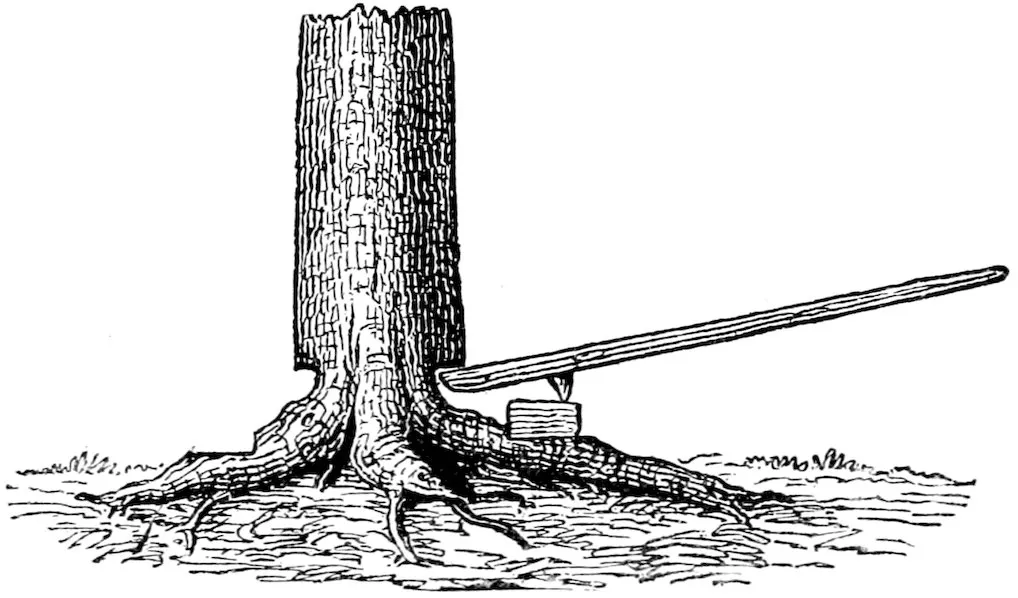
Fig. 19. Making flakes by means of lever pressure. This shows the manner of utilizing a standing tree. (See Sellars’s article in Chapter IV.)
“The artizans of both sexes were instinct with the esthetic impulse;
in one region they were devoted to quillwork, those of the
next area to carving wood and slate; the ones living across the mountains
produced whole costumes adorned with bead-work; the tribes
of the central area erected elaborate earthworks; workers on the
Pacific Coast made matchless basketry; those of the Southwest
22modeled and decorated pottery in an endless variety of shapes and
colored designs. The Indians north of Mexico were generally well
advanced in the simpler handicrafts, but had nowhere attempted
massive stone architecture.”
The Committee on Archæological Nomenclature presented its
completed report at the Baltimore meeting of the American Anthropological
Association, 1908. This was published in the American
Anthropologist, January-March, 1909, page 114. Pottery was classified
first, but as I begin with chipped implements I present the
classification of pottery last.
Fig. 20. Showing strong massive shank for securing to a shaft or handle.
Fig. 21. First two objects beveled—the one to the left showing strength of cutting-edge. The one to the right shows a different mode of attachment. (See Sellars’s article, Chapter IV.)
23
Chipped Stone
I.
Knives and projectile points.
Larger—5 cm. (2 inches) or more in length.
Smaller—less than 5 cm. (2 inches) in length.
Types.
1.
Without stem.
(A)
Without secondary chipping (flakes).
(B)
With secondary chipping.
(a)
Pointed.
(a´)
At one end.
Base concave.
Base straight.
Base convex.
Sides convex.
One side convex, one side straight.
(b)
Ends convex.
(b´)
At both ends.
(c)
More or less circular.
2.
With stem.
(A)
Stem expanding from base—with or without barbing.
(a)
Base concave.
(b)
Base straight.
(c)
Base convex.
(B)
Stem with sides parallel—with or without barbing.
(a)
Base concave.
(b)
Base straight.
(c)
Base convex.
(C)
Stem contracting from base—with or without barbing.
(a)
Base concave.
(b)
Base straight.
(c)
Base convex.
II.
Scrapers.
Types.
1.
With one or more scraping edges.
2.
Without or with notch (including circular.)
24
III.
Perforators.
Types differentiated by
1.
Cross-section.
(A)
Round.
(B)
Quadrangular or irregular.
2.
Stem.
(A)
Without stem.
(B)
With stem.
(a)
Stem expanding gradually.
(b)
Stem expanding suddenly.
IV.
Hammer-stones.
Types.
1.
Spheroidal.
2.
Discoidal (a) “Pitted.”
(b)
Not “pitted.”
3.
Elongated (a) Grooved.
(b)
Not grooved.
Ground Stone
I.
Problematical forms.
1.
Laminæ (i. e., flat “spuds,” “gorgets,” and pendants.)
Types.
(A)
Spade-shaped.
(B)
Ovate.
(a)
Sides concave (not common).
(b)
Sides straight.
(c)
Sides convex.
(C)
Leaf-shaped.
(D)
Spear-shaped.
(E)
Rectangular.
(a)
Sides concave.
(b)
Sides straight.
(c)
Sides convex.
(F)
Shield-shaped.
(G)
Pendants.
(a)
Celt-shaped.
(b)
Rectangular.
(c)
Oval or circular.
2.
Resemblances to known forms.
(A)
Animal-shaped stones.
(B)
Boat-shaped stones.
(C)
Bar-shaped stones.
(a)
Longer, resembling true “bars.”
(b)
Shorter, “ridged” or “expanded gorgets.”
(D)
Spool-shaped stones.
(E)
Pick-shaped stones.
(F)
Plummet-shaped stones.
(G)
Geometrical forms.
(a)
Spheres.
(b)
Hemispheres.
(c)
Crescents.
(d)
Cones.
3.
Perforated stones with wings.
(A)
Wings with constant rate of change of width.
(a)
Wings expanding from perforation.
(b)
Wings with sides parallel.
(c)
Wings contracting from perforation.
(B)
Wings with varying rate of change of width.
II.
Tubes and tube-shaped stones.
III.
Beads.
IV.
Pitted stones other than hammer-stones.
25
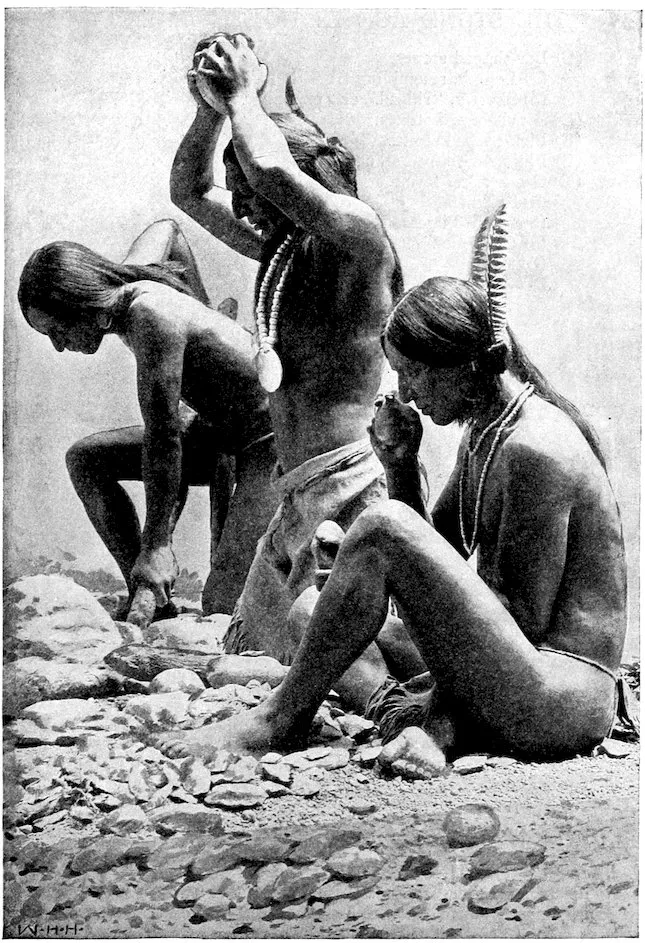
Fig. 22. Indians quarrying and hammering quartzite boulders. From 15th Annual Report, Bureau of Ethnology. Designed by Holmes.
26
Fig. 23. Direct percussion. Manner of striking where the edge is sharp.
Simple vessels in clay may be presumed to cover all forms except eccentric
or conventionalized (i.e., animal-shaped) forms on the one hand, and
discs and pipes on the other.
27
Fig. 24. (S. about 1–3.) A chipped hoe or digging-tool, and four specimens from the ancient quarries near Herndon, Tennessee. Phillips Academy collection. A complete nodule is shown in the lower right-hand corner. The others are broken nodules, showing the concretionary character of the flint.
28It is suggested by the Committee that members of the American Anthropological
Association having occasion to describe clay vessels, may
classify them: first, as to material, as consisting of clay, sand, shell, and
their combinations, and as possessing certain general ground-color; second,
as to manufacture, as sun-dried or fired, as coiled or modeled—with the
variations and steps of each process; third, as to form; fourth, as to decoration,
as plain, stamped, incised, or painted. With regard to form,
the Committee begs to offer the following definitions and suggestions in
classifications.
(Note. In all cases measurements are considered as referring to an
upward direction.)
A simple vessel must consist of a body, and may have a rim, neck, foot,
handle, or any combination.
1. Body: A formation capable of holding within itself a liquid or a solid
substance.
2. Rim: (A) A part of the vessel forming the termination of the body.
(B) A part of the vessel recognizable by a change in the thickness of the
material in the terminal sections.
3. Neck. A part of the vessel recognizable by a more or less sudden decrease
in the rate of increase or decrease of the diameter.
4. Foot. An attachment to the vessel which serves as support to the
body when upright.
5. Handle: A part of the vessel consisting of some outside attachment,
not serving as support.
Body: It is suggested that in comparing the forms or cross-sections of
vessels particular attention be paid to the proportion of the diameter to
the height, to the rate of change of this proportion, to the place of change
of direction in this proportion, and to refer to the following definitions of
the two dimensions:
Height: the distance from the base to a horizontal plane passing through
the most distant part of the rim.
Diameter: the distance from any one point on the sides to any opposite
point on the sides, measured on a plane at right angles to the height.
Base: the point of contact or a plane of contact of the body with a
horizontal surface.
Types. Body: These are so varied, depending on relative height and
diameter of the cross-section, that an analysis is too cumbersome to be
of service to general reference.
Neck: 1.
Expanding.
2.
Cylindrical.
3.
Contracting.
4.
Combinations.
Lip: A part of the neck or body recognizable by a suddenly increasing
diameter of neck or body, that continues increasing to the rim.
29
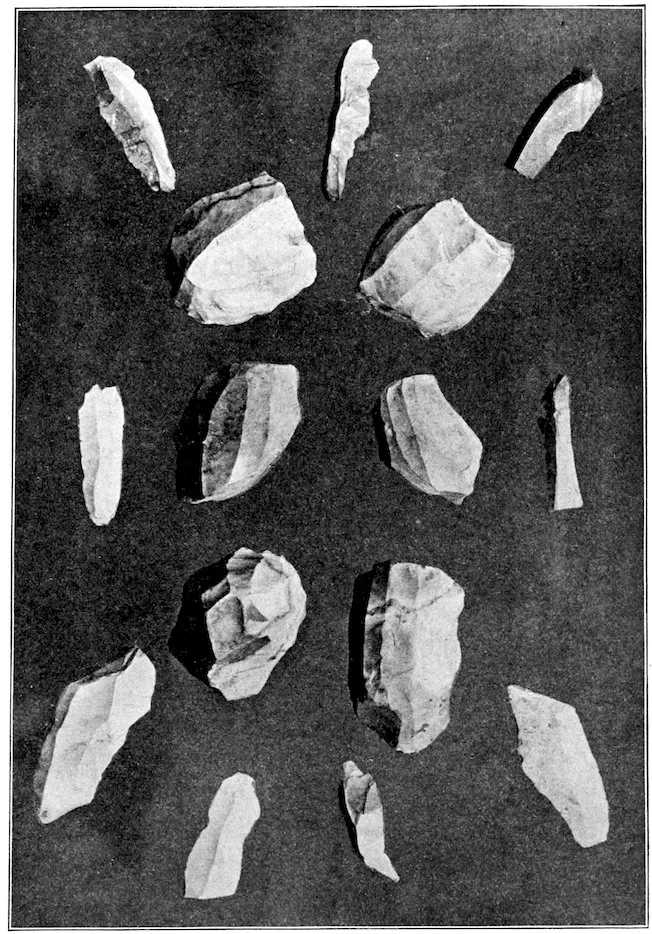
Fig. 25. (S. about 1–2.) Cores and flake knives from the ancient quarries, Flint Ridge, Licking County, Ohio. Material: light pink, white and brown chalcedony. Phillips Academy collection.
Foot: 1.30
Continuous.
(A)
Expanding.
(B)
Cylindrical.
(C)
Contracting.
(D)
Combinations.
Feet: 2.
Not continuous.
Differentiated by
(A)
Number.
(B)
Angle with the horizontal.
(a)
Expanding upward.
(b)
Perpendicular.
(c)
Contracting upward.
Handles.
Types.
Differentiated by
1.
Number.
2.
Position on the vessel.
(A)
Body.
(B)
Neck.
(C)
Foot.
(D)
Combinations.
3.
Form.
(A)
Continuous with body or neck.
(B)
Not continuous with body or neck.
(a)
With constant direction.
(b)
With varying direction.
(c)
With reëntry upon vessel.
(A′)
Round.
(B′)
Flat.
(C′)
Coiled.
Here ends the Committee’s Classification, but there should be
added, I feel convinced, articles in bone, shell, copper, hematite,
mica, and cannel coal. Copper has been classified by Mr. Charles
E. Brown, while I have grouped bone, shell, and hematite.
CHAPTER III THE CLASSIFICATION — QUARRYING MATERIALS — THE BEGINNINGS OF CULTURE — QUARRIES
31
We have seen that Professor Mason dealt with occupations
rather than implements,[2] and did not attempt a classification of
artifacts.
The result of the Committee’s investigation was to the effect
that we should classify objects as to form and material, not taking
into account possible use in our grouping. It was supposed that
whoever made use of the classification would present his own interpretation
of the meaning of these various forms.
The classification was intended merely as a skeleton on which
future classifications were to be built. It must be understood that
the expansion of this classification and the changes found necessary
and presented here in “The Stone Age” are submitted on my own
responsibility. The classifications in axes, celts, copper, bone and
shell, mortars and pestles, etc., were made by me because the Committee
did not present grouping of these forms; all of which is no
reflection on the Committee. It is simply that as no classification
of these other things existed, it was necessary to make one.
In describing ancient art there is another method of classification—according
to locality. But in any work as large as “The
Stone Age,” the adoption of such classification necessitates more
or less repetition, and I think it better to describe under a given
chapter all the implements of one kind no matter where found in
the United States than to treat of geographical distributions. I
consider this method less cumbersome and more satisfactory than
the separate treatment of all the localities. So far as possible all
illustrations are confined to prehistoric objects.
No illustrations—save one or two—of axes in handles, wooden
objects or ancient bows are offered. Readers are referred to the
museums for such exhibits. To show such, would swell the volumes
to unwieldy proportions, and “The Stone Age” already contains
more figures than were originally intended.
32The textile fabrics, wooden objects, and other things of perishable
materials, except where buried in caves in the dry Southwest,
have long ago disappeared, and therefore, to make comparisons,
one must inspect the older forms among ethnological objects in the
collections at New York, Chicago, Denver, Washington, Milwaukee,
Cambridge, Toronto, etc., for illustration. There are many
hafted implements of various kinds in existence in museums to-day—particularly
in the case of specimens collected one hundred years
ago—which present trustworthy evidence as to how similar
things may have been mounted in prehistoric times. Again, there
are hundreds of modern objects collected in the past century among
living tribes that to the student of archæology appear to exhibit
white man’s influence and are of little or no value in understanding
real Stone-Age times. As an illustration of this, I mention the
various forms of catlinite pipes, recent examples of which are quite
degenerate as compared with the old forms. The same is true of
most of the Pueblo pottery, and the war-clubs of Plains tribes.
Fig. 26. (S. 2–3.) Flint knives, made of red and yellow jasper. William C. Mills, Columbus, Ohio.
It seems strange that with the thousands of pages on archæological
and ethnological subjects, with which our libraries are filled,
no such classification was attempted previously. The time is certainly
opportune for such a work and while I am aware that the
following pages are more or less incomplete, still I believe that some
one should make a beginning, even though the future observers,
who will know much more regarding these interesting and mysterious
33artifacts of the past than do we of the present, may question
some of the observations herein set forth.
Fig. 27. (S. 1–2.) Flint cores from which the knives are made. Specimen to the left, red and yellow jasper. Specimen to the right, maroon colored jasper. Flint Ridge material. William C. Mills, Columbus, Ohio. This and some thirty other figures loaned by Mills, appeared in the publications of the Ohio State Archæological and Historical Society, and illustrated his explorations.
I suggest that the critical reader bear in mind that a classification
of all the implements of the United States brings out certain
facts or tendencies, or may indicate conclusions which escape the
observer who is interested in the exploration of a given territory
rather than in a study
of types, or who is not
familiar with the implements
of most of the
United States.
Therefore, “The Stone
Age” is narrowed to a
description of the ornaments,
utensils, weapons,
and artifacts of ancient
man in America.
Otherwise, one could
easily fill ten volumes
instead of two, and even
then not exhaust the
subject.
No description of
mounds, earthworks, cliff-houses, pueblos, or village-sites is possible
in “The Stone Age.” Readers are referred to the Bibliography,
where titles relative to mound, cliff, fortification, and village-site
exploration and description will enable them to consult publications
relating to these subjects.
Some remarks upon the antiquity of man in America will be
presented in the concluding chapter of Volume II.
No one will deny that the present high culture enjoyed by most
races and tribes of men is the result or culmination of thousands of
years of development. Practically the entire world has advanced
beyond the Stone Age, and much of it may be said to have gone
even beyond the Iron Age, and into that of electricity. No sane
man doubts that at some time or other all the divisions of the human
race were in the Stone Age. Whether all the various peoples of
34many tongues and different colors are derived from the same stock,
it is not my purpose to discuss. It is sufficient to state that while
certain races of men developed a high culture, others did not.
Whether all these peoples had similar advantages or began more or
less in the same fashion, is beyond the scope of this work. Suffice
it to say that even so far back as in times undoubtedly prehistoric,
in every country the archæologist observes differences in culture.
This is true of America as of Egypt, or Europe, or Asia. We have
heard much with regard to the late date of the Stone Age in our
own country. True, stone implements and arts persisted some time
after the discovery by Columbus. Yet the recentness of the Stone
Age in the United States is easily explained when one considers that
America was unknown until 1492. Because stone implements were
in use in remote portions of the United States two centuries ago,
it does not follow that man on this continent is of no antiquity as
compared with his brother in Europe.
In fact man may be, for aught we know, as old in America as in
Europe or Asia. There have been hundreds of pages published by
Professor Holmes, Dr. Abbott, the Reverend Dr. Wright, Dr. Wilson,
Professor Chamberlin, and others as to whether man of the
glacial period, or earlier tertiary man, existed in America. The evidence
for and against the presence of man twenty or thirty thousand
years ago in the United States has been presented in numerous
places, and the Bibliography will acquaint readers with what has
been said. It is not my purpose to attempt to decide this question—as
to the age of man on the American continent.
There are certain cultures that appear older than others, and it
is quite likely that they are older. All of these will appear in the
forthcoming pages, properly substantiated by such evidence as I am
able to present.
Let us, then, drop glacial or tertiary man and consider quarry
material and methods of working.
During the process of manufacture of implements of flint the
first forms would scarcely fit into a classification based on complete
forms or types; therefore I have decided to begin a description of
chipped objects with a chapter on methods of quarrying and manufacture.
The quarries from which we know aboriginal man in the United
35States obtained material for his
knives and projectile points number
perhaps twenty. There may
be small isolated sites, but the following
were the chief sources of
material:—
Fig. 28. Indirect percussion, as practiced by the Wintuns and also described by B. B. Redding. In addition to this, Figs. 26, 32, 33, and 34 are from the American Anthropologist, vol. II, 1891—W. H. Holmes’s paper.
Flint Ridge, Licking County, Ohio.
The jasper quarries on the Susquehanna
and Delaware.
Those of Indian Territory, Missouri,
and Illinois.
Near Coshocton, Ohio.
Near Allentown, Pennsylvania.
The obsidian cliffs of Yellowstone
Park.
Piney Branch, in the District of
Columbia.
Southwestern New Mexico.
Little River, Tennessee. (See Fig. 1.)
Wyoming and California quarries.
(See Bibliography for others.)
Fig. 29. Indirect percussion. Two persons being concerned. Practiced by the Apaches, according to George Catlin.
Flint, chert, chalcedony,
jasper, quartz, argillite, and
other materials of flint-like
character occurred in regular
veins, or in nodules or in
ordinary boulders or pebbles
in the drift. Aboriginal man,
therefore, mined in a quarry
or he dug in the drift, or he
picked up from the surface,
or he worked in a limestone
stratum to extract the nodular
flint. He sought in any
one of these places according
to his locality and character
of the material and its position.
At Flint Ridge, the
largest flint quarries in the
United States, there is a hill
36or ridge, nearly eight miles in length and varying from a few hundred
yards to as much as three miles in width, which is literally filled
with depressions varying from small pits to one nearly a hundred
feet in diameter and twenty or more feet in depth at the present
time. The flint from this quarry is distributed throughout Ohio,
Indiana, Kentucky, portions of Pennsylvania, and even west of the
Mississippi. The amount of work done at Flint Ridge by the aborigines
passes comprehension. When one considers their primitive
methods of quarrying, it is surprising that they were able to quarry
such hard material as flint. Without the use of fire, which they had
to apply very carefully, first placing a coating of clay over the flint,
they would have been unable to remove any considerable portion
of the material.
The Flint Ridge chalcedony is beautifully colored, red, blue,
cream color, pink, and pure white. It is easily chipped, and was
highly prized by the natives.
I have not space for a long narrative of how the flint was quarried.
It is of more importance to tell readers how the implements
were manufactured. Mr. Gerard Fowke has made a study of Flint
Ridge and published an able paper in the National Museum Reports,
1884–5. He also wrote a chapter for “Primitive Man in
Ohio.” His paper was reprinted in Bulletin no. III, Department of
Archæology, Phillips Academy, 1906. I quote, as to how the flint
was quarried, from his paper:—
37
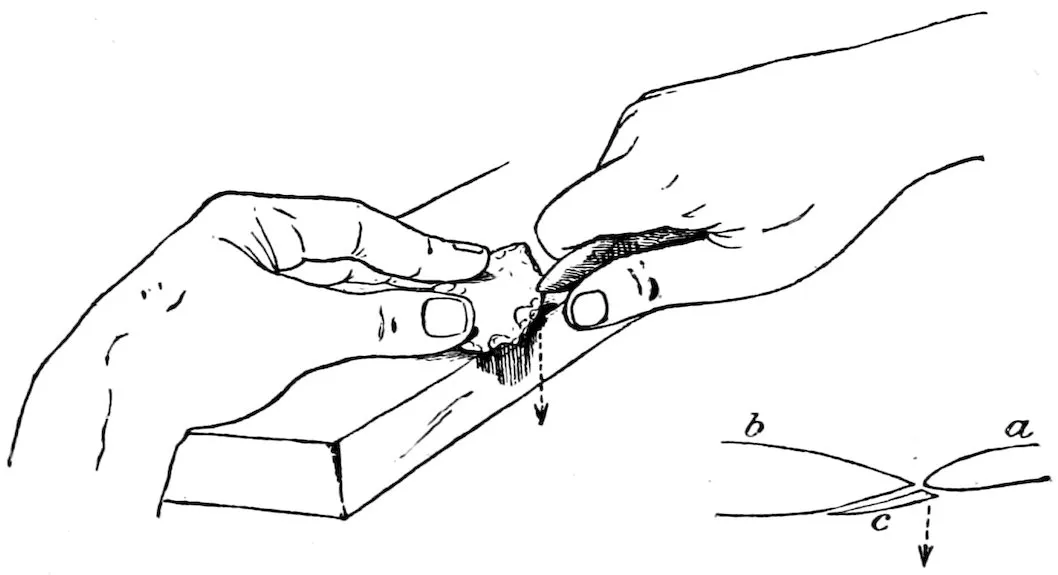
Fig. 30. Flaking by pressure, a bone implement being used; (a) the bone tool, (b) the stone, (c) the flake.
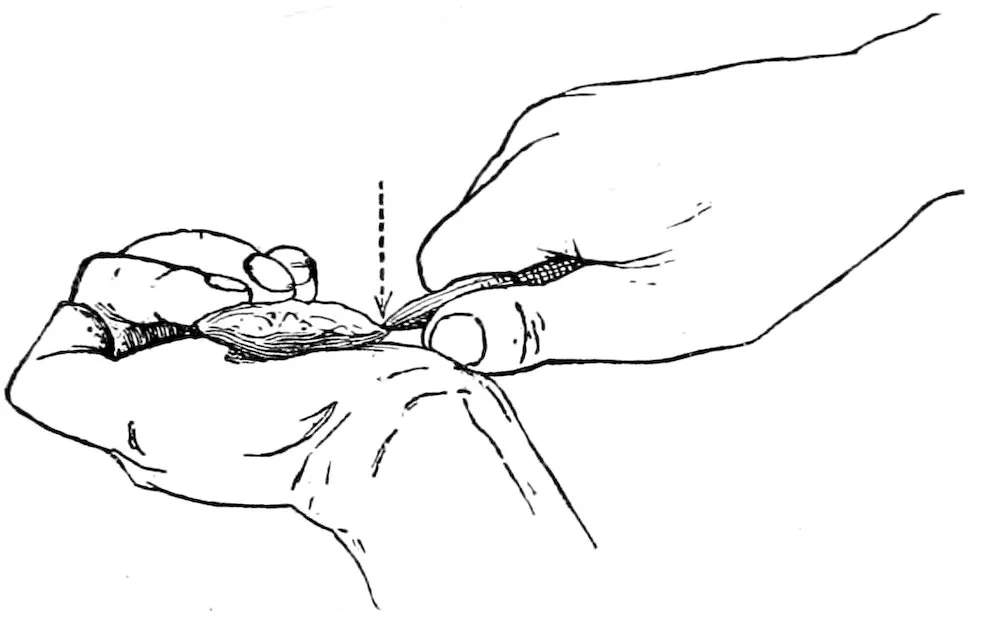
Fig. 31. Flaking by pressure, a bone point being used, the implement to be shaped resting on a support.
“Digging away the earth with such tools as he could improvise,—pointed
sticks hardened by fire, antler, bone, or stone,—he came
to the surface of the flint. This resisted all his efforts until he thought
of the effects of heat. Placing wood upon it, he set fire to the pile.
When the stone had reached a high temperature he threw cold
water on it; this caused it to shatter and crack in all directions.
Casting aside the fragments, he repeated the operation, until he had
finally burned his way to the limestone beneath. Removing all
burned portions of the flint, he next procured a quantity of fine clay
and spread a thick coating on the top and sides of the stone, to prevent
injury to it. Then building a fire at the bottom of the hole, he
soon burned away the limestone and the lower part of the flint
stratum, leaving the top projecting. This he broke loose with large
boulders of quartz or granite; hammers of this sort, weighing from
twenty to one hundred and fifty pounds, have been found in the
bottoms of pits that have been cleared out. Knocking loose the
clay, which had burned almost as hard as the stone, he found himself
in possession of a block of clear, pure flint. By means of the
same hammers he broke this into pieces of a convenient size for
handling. These were carried to a spot near by, which may be termed
a “blocking-out” shop. Here they were further broken by smaller
hammers, and brought somewhat into the shape of the implements
which were to be made from them. The work was never, or very
seldom, carried beyond this stage at the spot where it was begun;
the subsequent manipulation was at some other place, best designated
as a “finishing-shop.” These are characterized by quantities
38of small chips, flakes and spalls, broken implements, and unfinished
pieces, which were unavailable by reason of some flaw or
defect not discernible until the final work was begun. The finishing
touches were always made by means of pressure with a bone, antler,
or some other tough substance. Many finishing-shops are located
near the quarries, others at a distance, some of them several miles
away. The principal one was near the cross-road; here a pile of fine
chips, covering one fourth of an acre, and fully six feet in depth at
the central portion, existed when the country was first settled by the
whites, but from various causes it has been reduced until it now is
all of one level. This, while the largest, is only one of several hundred
such places.”
Similar operations were employed in Indian Territory and elsewhere.
In the quarries of Little River, Tennessee, the flint occurred
in nodular form in limestone ledges. It was easier for the natives to
burn the limestone and remove the nodules than to quarry in the
flint layers of Flint Ridge. Fig. 1 shows the nodules outcropping
in two layers in the limestone ledge.
Mr. D. N. Kern, of Allentown, Pennsylvania, informs me that
there are fully two hundred pits of various sizes where the natives
quarried material, within some miles of his home.
Professor Wm. H. Holmes published in the 15th Annual Report
of the Bureau of Ethnology a comprehensive paper entitled “Stone
Implements of the Potomac-Chesapeake Tide-Water Province.”
This paper embodies the observations for a number of years on
the archæology of Virginia, Maryland, and the District of Columbia.
The description of the quarries along Piney Branch, a small tributary
of the Potomac, in the District of Columbia, in this volume is
complete, and I wish to recommend to students and readers who
wish to obtain a broad understanding of the subject a perusal of
Professor Holmes’s paper. The entire genesis of implement making
is ably presented.
While other quarries have not been so carefully worked, and certainly
not described in detail, the method employed by the prehistoric
peoples at the Piney Branch quarry, and in the rhyolite
sites further back in the hills on either side of the Potomac, may be
taken as typical of aboriginal quarrying in the United States. That
is, of quarrying in beds where boulders or nodules are embedded
in clay or gravel or till. The boulder or nodule materials and the
flint strata occurring in different formations were quarried by
39different methods. The Piney Branch quarries are an illustration
of the separation of material from the general mass and composite
of boulder and clay. It was easy to get at the material, but more
difficult to fashion the implements, because quartzite, quartz, and
argillite were harder to work than flint. At Flint Ridge, while quarrying
was extremely difficult, the material once secured could be very
easily fashioned. The planes of cleavage of flint, as all know, were
very different from those of the boulders found at Piney Branch.
Fig. 32. Flaking by pressure. Manner of holding as observed among many tribes by J. W. Powell and others.
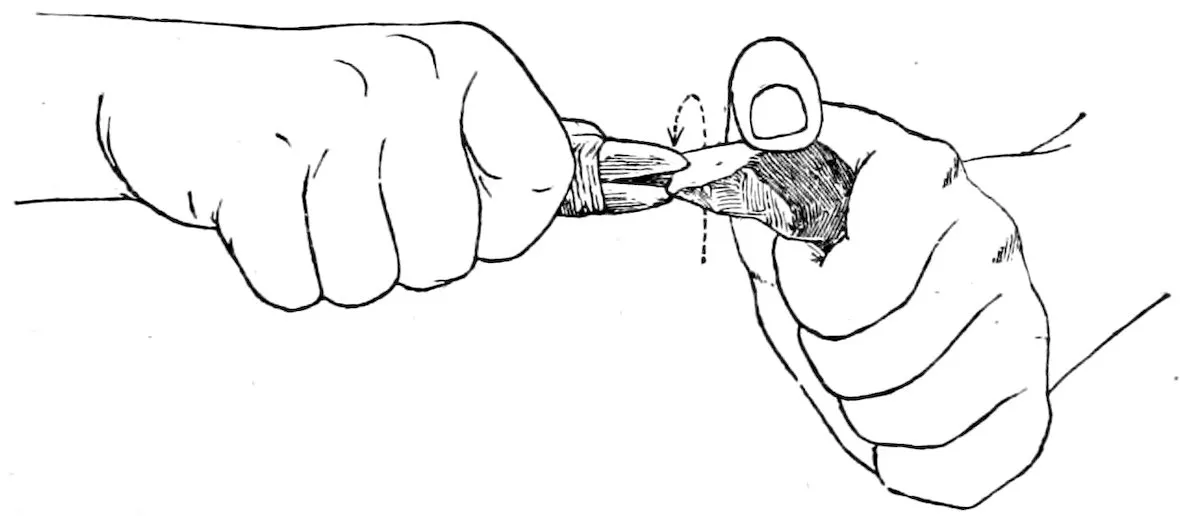
Fig. 33. Flaking by pressure, bone pincers being used.
One illustration, Fig. 40, reproduced from Professor Holmes’s
plate, is self-explanatory. Before the stage represented in Fig. 37
is reached one must imagine the ordinary oval or water-worn pebble
of either quartzite or argillite. This pebble was pried by means of
levers from its ancient bed. Both Professor Holmes and Mr. F. H.
Gushing have constructed life-sized models of Indians at work in the
Piney Branch quarries digging, hammering, flaking, in order to produce
40blades. (See Fig. 22.) At Piney Branch itself the abundance
of material made it a mecca for the prehistoric people of the region.
Several trenches dug by workmen under the direction of Professor
Holmes penetrated this mass of material to a considerable distance.
All of these, while varying in minor details, emphasize the general
proposition that the quarry was in use for a considerable length of
time.
I present several illustrations showing the method of hammering
the rough turtleback and partly finished blades and the completed
forms. These are from Professor Holmes’s paper. In addition
I show hammer-stones and blades from the collection of Phillips
Academy, Andover, representing similar work on other sites.
The difference to be noted between Piney Branch material and
the material of chert and flint, the working of which is described
by Mr. George Sellars, in Chapter IV, page 48, of this book, is considerable,
and the probable method of treatment varies in a more
marked degree. Apparently there was more pecking, hammering,
etc., of these rude forms than in the case of flint and chert. That
is, flint and chert lent themselves more readily to the flaker’s art.
The quarry at Piney Branch was productive of large numbers of
rejects. This is true of other sites as well, but it would seem that
where material was scarce, the natives made use of many objects
quite as crude as those we have designated as rejects. Only flawless
materials seem to have been made into implements at Piney Branch,
at Flint Ridge, on the Little River sites in Tennessee, and about the
jasper quarries of Pennsylvania. This is natural when one reflects
that there was a wealth of material and that the Indian naturally
selected the best. But were these objects, blocks of flint, and objects
of all kinds deposited in any of the large prehistoric villages, I am
confident that much of the material called by Professor Holmes
rejects, would have been made use of. I think we have overlooked
the significance of this fact in our archæological studies. On the
Great Plains, and at certain places in Texas, about the Mandan
sites, and elsewhere, there are implements quite as rude and ill-shaped
as many of those illustrated in the several reports as rejects,
yet which show unmistakable evidence of usage.
41
Fig. 34. (S. about 2–3.) Scrapers and rejects from an ancient workshop near Swarts, on the Rio Mimbres, New Mexico. Material, unknown. There are ancient ruins near by. Phillips Academy collection. (Clement L. Webster.)
42Again, the turtlebacks and discs and the other materials may be
in part rejects, and yet may represent material blocked out for
transportation. I have always been a firm believer in the theory
that, as most of the flint was carried on the backs of Indians, or
transported in canoes from one point to another, the discs, turtlebacks,
and other forms which had been quickly blocked out by a
few strokes of the stone hammer, represented material to be transported
to distant villages and there refashioned. We may explain
the quantity of such material on all these quarry sites by means of
a dozen different theories. The workers blocked out more than
they could transport; they were interrupted during the course of
their labors by the enemy; they were prevented from returning;
they found that the home villages were supplied with knives, and
arrow-points, and did not return to the quarries for another supply;
and so on. That much of the material of quarries is rejects and
refuse no one will deny, but that all of it is to be so classed I do not
believe.
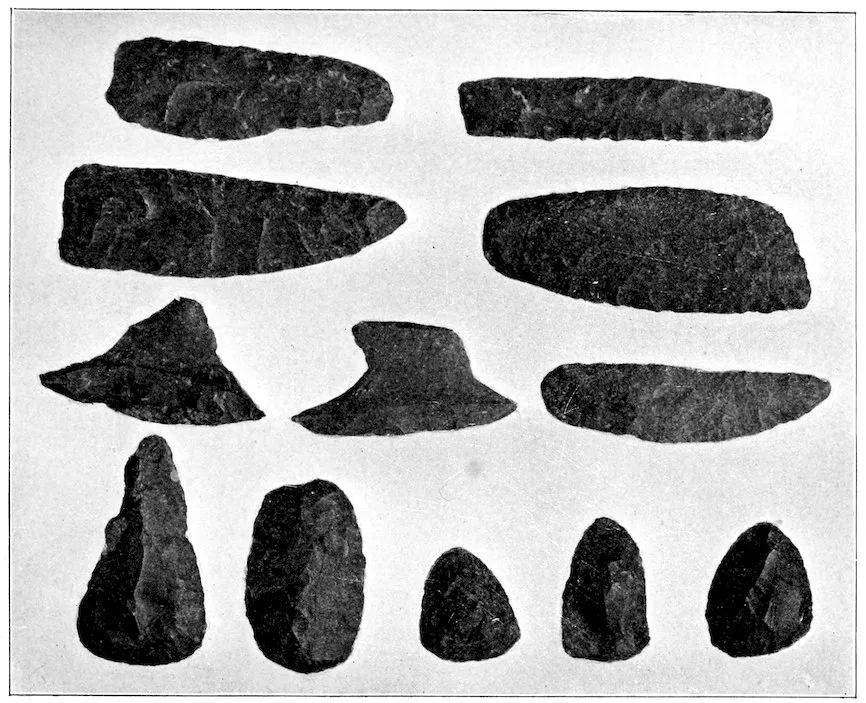
Fig. 35. (S. 1–1.) Flake knife. Frank L. Grove, Delaware, Ohio.
There seems to be no evidence that Flint Ridge, Piney Branch,
Little River, the Indian Territory quarries, or other sites were
worked in historic times. On the contrary, one may believe that
the quarries developed through a long period of time. The very
character of them seems to indicate this. If America has been peopled
for thousands of years, I can see no reasons against the suggestion
that the quarries were discovered three or four thousand years ago,
that a few Indians visited them each season, or at intervals, and
that quarrying ceased about the year 1600. While this is my opinion
merely, yet I have given the subject a great deal of thought.
If all the material in a certain region came from a special quarry,
no long period of time could be assigned that quarry. But an inspection
of village-sites, of local collections, of museum collections,
will teach the observer that not only is there present material from
the local quarry, but there is also a considerable quantity of chipped
implements of flint, or chert, or quartz, or rhyolite, or jasper, or
other stones which are not native to the locality. Not one site, but
43many sites furnished material. It is evident from the abundance
of chipped material that river boulders, the talus of bluffs, and
drift pebbles furnish a great part of the chipped implements of
this country. If the Indian found a suitable pebble or block of
flint or fragment of stone, he most certainly would fashion that into
an implement rather than travel a considerable distance and work
laboriously to produce that which was found nearer home. Because
of the observations cited above, I cannot believe that the quarries
represent the work of aboriginal man during a few generations, but
that they indicate, perhaps, three or four thousand years of occupation.
Dr. W. C. Barnard, of Seneca, Missouri, has given the subject
much study. He contributes his observation as follows:—
Fig. 36. (S. 1–3 to 1–6.) Rejects from rhyolite quarried from the mass, in upper row. Rejects from jasper quarried from the mass, in lower row.
“Prehistoric man of this region [the Ozarks] secured his principal
supply of flint from boulders and pebbles found in the beds of
water-courses as evinced by the character of the material found in
hundreds of workshops along the banks of streams. All the more
primitive implements are of this boulder and pebble material.
44
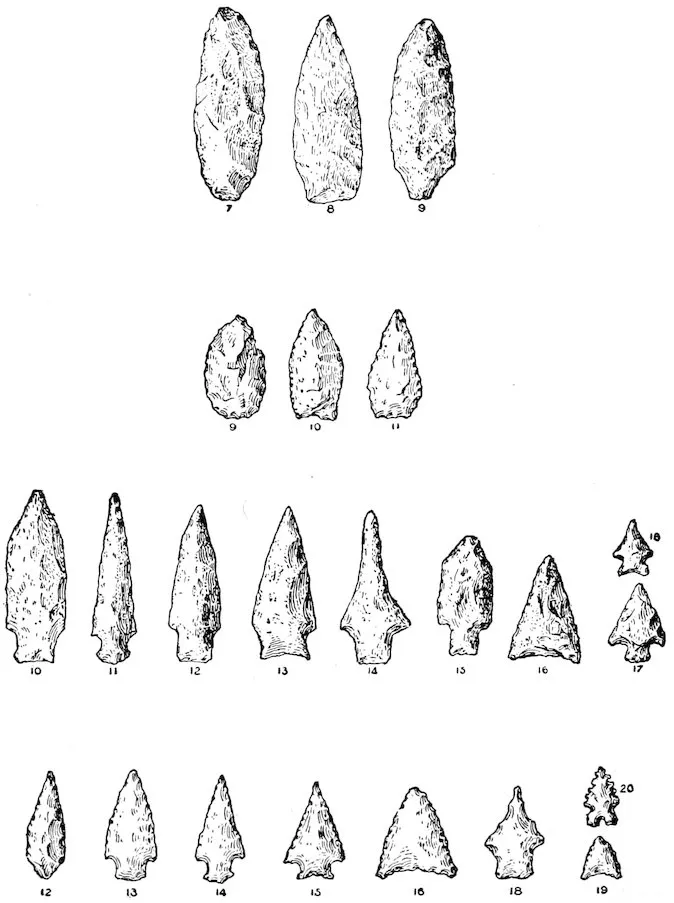
Fig. 37. (S. 1–3 to 1–6.) This figure is a portion of Professor Holmes’s plate, chap. 1 (15th Annual Report, Bureau of Ethnology), which for convenience I have divided. It carries to complete form the specimens shown in Fig. 36. Numbers 7, 8, and 9 are cache forms worked down from quartzite boulders; 9, 10, and 11 are from quartz pebbles. It will be observed that these six specimens could be used as knives, or when notched or barbed they were available as projectile points.
“Later the rich deposits of cream white chert located in what
is now Ottawa County, Oklahoma, were discovered, yet this, I am
sure, after a close study of the two flint quarries, must have been in
comparatively recent times, for only a small per cent of implements
made of the quarry chert are found in the hundreds of village-sites
and workshops of this region, and all these, making due allowance
for texture and location, look new compared with the
45deeply patina-covered and frequently decomposed surfaces of the
pebble flint implement.”
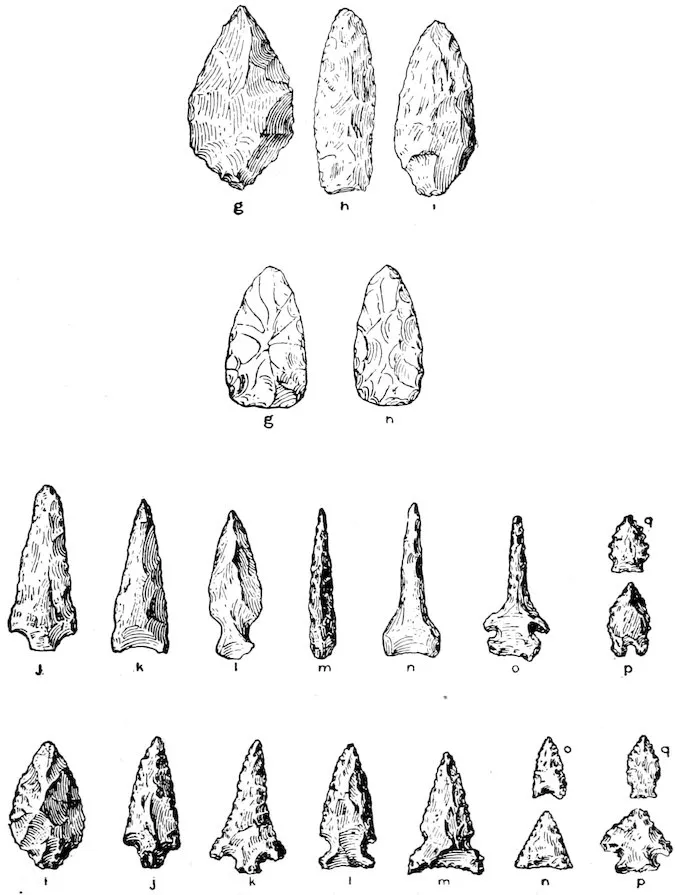
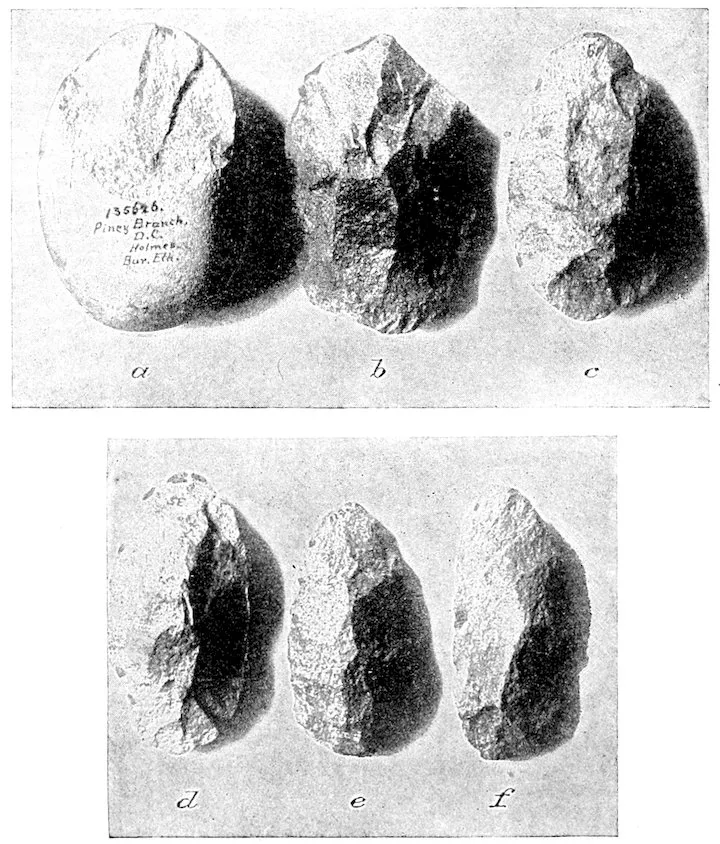
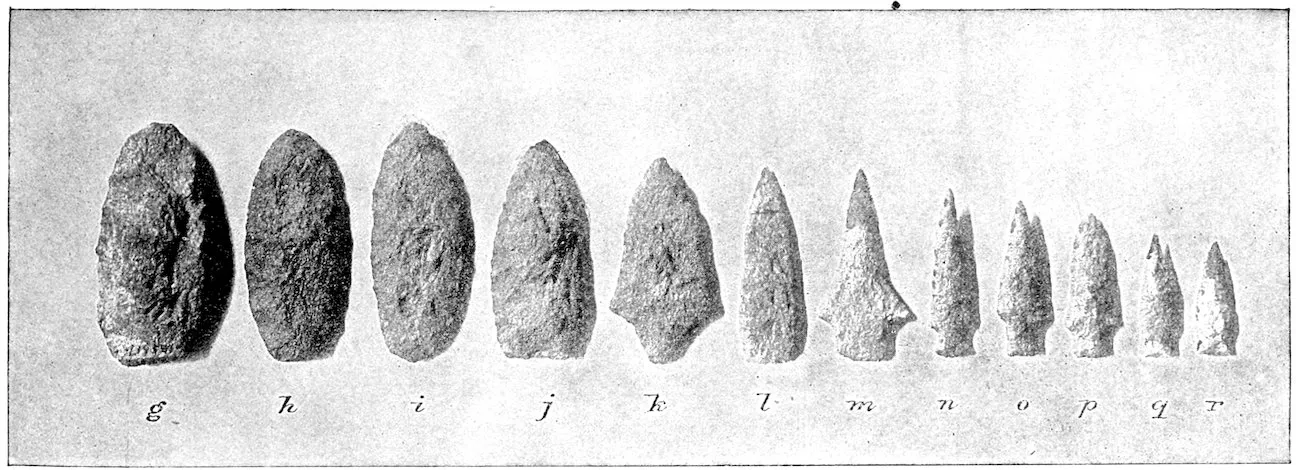
Fig. 38. (S. 1–3 to 1–6.) Continuation of Professor Holmes’s plate (Fig. 36). First and second rows, g, h, and i, and g, h, are rhyolite and jasper objects of quarry material. These represent first the blades and forms more convenient for exchange, and in the series j to q the completed projectile points.
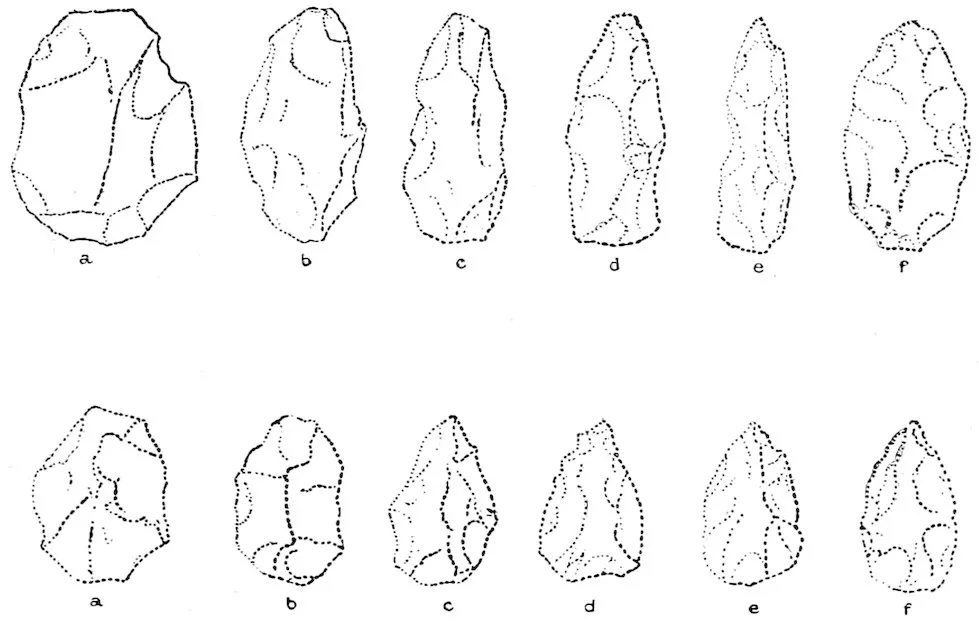
Figs. 39 and 40 illustrate the process of manufacture. Fig. 39
shows native quartzite boulders which have been reduced from a,
to forms e and f. These are not implements, and while Professor
Holmes says they were not transported, yet I am of the opinion
46that letters e, f, g, and h, represent types which were in such form
as would admit of transportation. That is, they represent stone in
such form as to be of value for barter or exchange. If these specimens
show flaws, as might letters a, b, and c, then they are properly rejects,
or if they have hard protuberances which resisted the skill
of the Indian, then they are rejects.
Readers should compare Figs. 39 and 40 with Figs. 31 and 36. A
difference is observed between the pebbles and boulders shown in
Figs. 39 and 24, and the quarry material shown in Figs. 31 and 36.
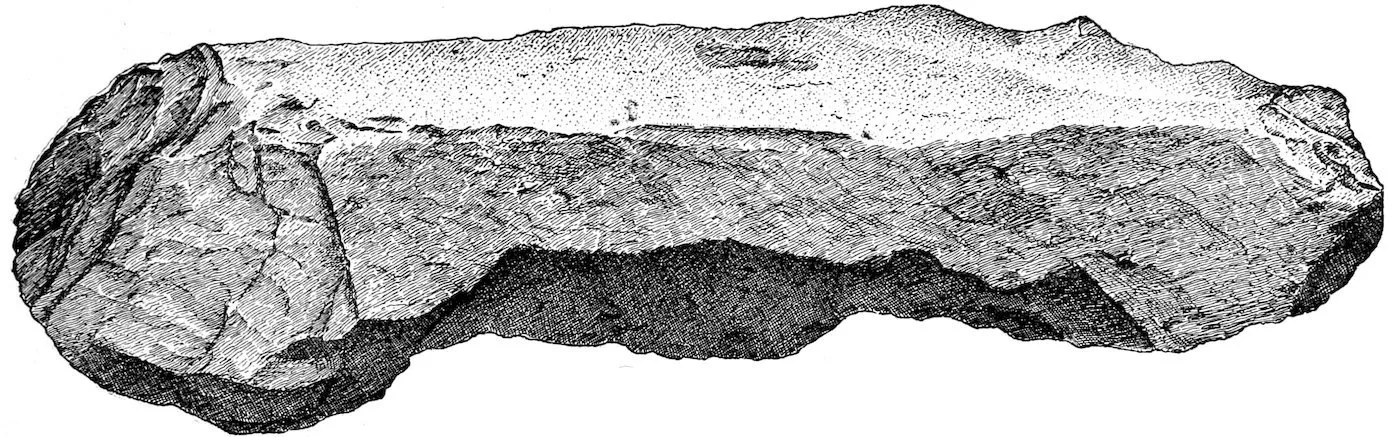
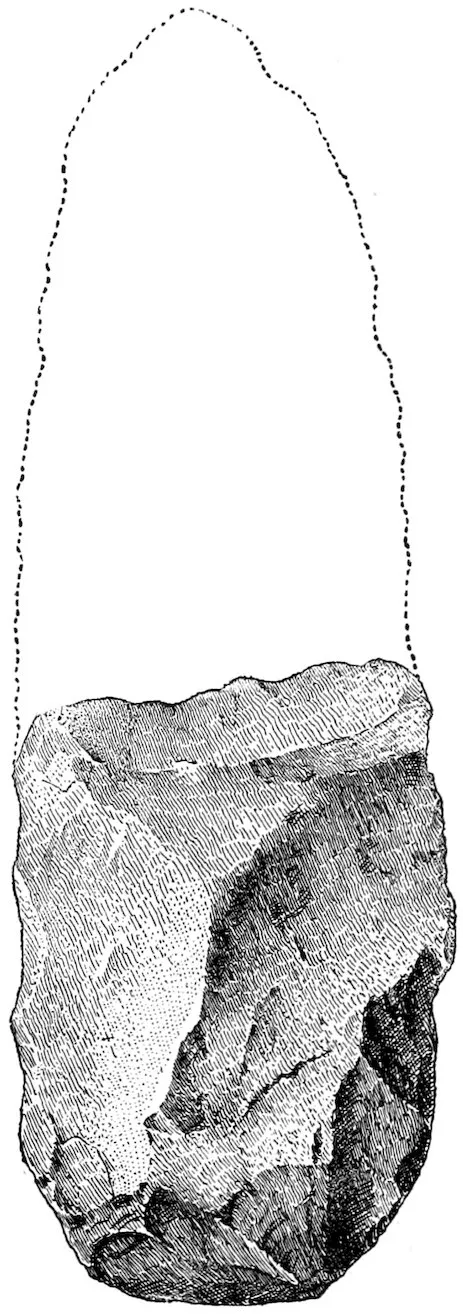
Fig. 39. (S. 1–3.) See Fig. 40 for description.
47
Fig. 40. (S. 1–3.) Series of flaked forms illustrating progressive steps in the manufacture of projectile points, etc., from quartzite boulders, obtained from shop- and village-sites about Washington City.
CHAPTER IV CHIPPED IMPLEMENTS — HOW MANUFACTURED
48
In all that has been said about the manufacture of chipped implements
the past thirty years, I have seen no paper that will compare
in technique with that presented by Mr. George E. Sellars of Illinois
in the Smithsonian Report, 1885, page 871. I have on several occasions
quoted a few pages from Mr. Sellars’s narrative, and intend
here, with the omission of some irrelevant paragraphs, to present
his entire paper, with the illustrations. At the time he wrote it, he
was about eighty years of age.
When, in 1885, Mr. Sellars called upon Dr. Rau of the Smithsonian
Institution and gave an account of his experiments and
studies in stone-chipping, he was asked by Dr. Rau to prepare the
following paper. This is now out of print, and it certainly merits
preservation, as nothing done in recent times by any observer can
compare with the knowledge obtained of flint-flaking by this remarkable
citizen of the Middle West.
As a boy Mr. Sellars was interested in mechanical arts. He enjoyed
the friendship of George Catlin. His mother’s father had come
from Maryland, bringing with him a large library of the best literature.
Mr. Peale, Sellars’s grandfather, was in correspondence with
distinguished men of England, and Sellars had access to letters from
Thomas Jefferson and to the letters of Captain John Smith of the
Virginia colony, all of which were family heirlooms.
Mr. Sellars devoted many years to study of stone implements
found in the Ohio Valley. Except with reference to a few of his remarks
concerning the use of levers in detaching flakes from implements,
I am willing to accept all that he says in explanation of how
all objects were manufactured. And even with reference to the use
of levers, Sellars may be correct, as it would be impossible to make
flint spades by means of a small flaking-tool held in the hand, although
the first stage of the implement might possibly be produced by
the use of the hand-hammer. Be that as it may, I am willing to accept
49Mr. Sellars’s observations, at least until some one proves them
to be of no value.
After an account of how he came to be interested in this subject,
he discourses upon Captain John Smith’s letters.
Fig. 41. (S. about 1–3.) Mandan bone chipping-tools. These were made use of in flaking flint implements, Mandan village-site, North Dakota. Collected for Phillips Academy by E. R. Steinbrueck. The Mandan collection, of which a score of figures are presented, was purchased and presented to Phillips Academy by Edward H. Williams, Jr.
“He [Smith] said in substance that the Indian carried with him
a pouch filled with flakes of precious stones, and within his mantle,
in a pocket made for the purpose, a small instrument made of bone
or horn, that he valued above all price and would not part with,
and with it he deftly shaped arrow-points and spear-heads from or
out of the stone flakes. On calling my grandfather’s attention to this,
he said that although there was much truth in what at the time was
written from the colonies, some things were highly colored and had
to be sifted out or taken with caution, and he supposed the cutting
of hard stone with bone or horn was one of these, and might be set
down as one of Smith’s yarns. I asked myself the question, what
object could he have in inventing and telling it? There must be
some foundation. At all events, it made an indelible impression on
my mind.
“Most of the arrow-points found within my reach in Philadelphia,
Delaware, and Chester Counties, Pennsylvania, were chipped
from massive quartz, from the opaque white to semi-transparent
50and occasionally transparent. Once, in company with my early preceptors,
Jacob Pearce and Isaiah Lukens, both well-known scientists,
on a mineralogical excursion, we came to a place where (judging
from the quantities of flakes and chips) arrow-points had been made.
After most diligent search only one perfect point was found, which
is still in my possession marked with ink ‘1818.’ There were many
broken ones, showing the difficulty in working the material. Mr.
Lukens collected a quantity of the best flakes to experiment with,
and by the strokes of a light hammer roughed out one or two very
rude imitations. No effort was made by pressure, which I cannot
now understand, for at that time I was in the habit of breaking off
points and trimming mineral specimens (likely to be injured by the
jarring of a hammer-stroke) by pressure with the hickory handle of
my mineral hammer.
“Major S. H. Long, afterwards colonel, who in the latter part of
his life succeeded Colonel John J. Abert as head of the Topographical
Department of the United States Army, whenever in Philadelphia,
was a frequent visitor at my father’s house; and, when preparing
for his expedition to the Rocky Mountains, in which my
mother’s youngest brother, Titian R. Peale, went as assistant naturalist,
I saw him almost daily. The subject of flaking and forming
arrow- and spear-heads was one of frequent discussion. My grandfather,
C. W. Peale, was at that time owner of the Philadelphia
Museum, which had for that period a large collection of Indian
curiosities, among them, many collected by Lewis and Clark on
their northwestern expedition,—and to me the most interesting
was a box of stone implements in various stages of manufacture,
evidently collected with the view of illustrating the process. They
were never put on exhibition other than in the original package, the
lid of the box only having been removed. Major Long’s attention
was called to these, and he expressed his belief that on his expedition
he would learn the entire process, and on his return be able to
explain everything in the Lewis and Clark collection.
51
Fig. 42. 7232 flint discs from a mound of the Hopewell group. Largest cache of implements known to archæologists. (See page 218.)
52“The expedition returned, and, as far as I know, without any
positive information as to the process of making the flakes. Mr.
Peale said he had seen squaws chipping flakes into small arrow-points,
holding the flake in their left hand, grasped between a piece
of bent leather, and chipping off small flakes by pressure, using a
small pointed bone in the right hand for that purpose. From this it
was evident that John Smith’s story was no myth. In my lifelong
intimacy with Colonel Long the subject of the flaking operation has
frequently been one of conversation, on my regretting that more
attention had not been paid to it on either of his expeditions.
Knowing his preëminence as a civil engineer and his high attainments
as a mechanic, I thought more reliable information would
have been obtained by him and his party, composed as it was of
such prominent men of science. He said that flakes prepared for
points and other implements seemed to be an object of trade or
commerce among the Indian tribes that he came in contact with;
that there were but few places where chert or quartzite was found
of sufficient hardness and close and even grain to flake well, and at
those places there were men very expert at flaking. He had understood
that it was mostly done by pressure, and rarely by blows, but
he had never witnessed the operation. He expressed his belief that
it was an art fast being lost, for he had found among tribes who had
never seen a white man since the advent of Lewis and Clark,
wrought-iron arrow-points made in England by the Birmingham
nailers, sent out as articles of trade by the fur companies, and that
they were preferred to the stone points.
“My early acquaintance with Catlin, the artist, was in the shop
of Catlin, musical instrument and model maker, of Philadelphia.
There I knew him as a very expert and superior workman in wood
and ivory. As a portrait painter he was not at that time successful.
He painted strong likenesses, but they lacked lifelike coloring. A
delegation of Indians on their way to Washington gave him an opportunity
to paint the likeness of one of the chiefs. This was exhibited
in the Pennsylvania Academy of Fine Arts, and from its
novelty attracted much attention; in fact, it was so far a success as
to bring him into notice. About this time, I met him very frequently;
his conversation always drifted on to the great value and importance
of preserving correct likenesses of the Indians, whom he believed to
be fast passing away. We all know how well he lived up to this idea,
devoting his life to the work of producing the collection of Indian
portraits now in the National Museum.
“On Mr. Catlin’s return from his long sojourn among the Indians,
believing that, as an observing practical mechanic, nothing in the
way of art among them would escape him, I took the first opportunity
to see him. On my inquiry as to the mode in practice of
splitting the stone into flakes for arrow- and spear-points, his reply
was by a question characteristic of the man. He asked if I had forgotten
53Dr. Jones’s axiom, ‘The least possible momentum is greater
than the greatest possible pressure.’ This was in allusion to a lecture
on mechanics we had together heard delivered by Dr. Thomas
P. Jones (afterwards Commissioner of Patents). He then added,
‘That is well understood by the flake-makers among the Indians,
but it will soon be among the lost arts, just as the nests of Birmingham
brass battered-ware kettles, the Yankee tinware, and glass
whiskey bottles have already almost totally destroyed their crude
art of pottery-making. The rifle is taking the place of the bow and
arrow. For boys’ practice and for small game the iron points got
from the fur traders are preferred to stone. A common jack-knife is
worth to them more than all the flint knives and saws ever made.’
Fig. 43. (S. 1–2.) Curved flake knife. Clement L. Webster collection. Found in New Mexico.
“After expressing himself in this manner he went on to explain
what he had seen. He considered making flakes much more of an
art than the shaping them into arrow- or spear-points, for a thorough
knowledge of the nature of the stone to be flaked was essential, as a
slight difference in its quality necessitated a totally different mode
of treatment. The principal
source of supply for what
he termed home-made flakes
was the coarse gravel bars of
the rivers, where large pebbles
are found; those most
easily worked into flakes for
small arrow-points were
chalcedony, jasper, and agate.
Most of the tribes had
men who were expert at flaking, and who could decide at sight the
best mode of working. Some of these pebbles would split into
tolerably good flakes by quick and sharp blows striking on the
same point; others would break by a cross-fracture into two or
more pieces; these were preferred, as good flakes could be split
from their clean fractured surface by what Mr. Catlin called impulsive
pressure, the tool used being a shaft or stick of between two
and three inches diameter, varying in length from thirty inches to
four feet, according to the manner of using them. These shafts were
pointed with bone or buck-horn, inserted in the working end bound
with sinews, or rawhide thongs, to prevent splitting. (See Fig. 15.)
For some kinds of work the bone or horn tips were scraped to a rather
blunt point, others with a slightly rounded end of about one half
54inch in diameter. He described various ways of holding the stone
while the pressure was being applied. A water-worn pebble broken
transversely was commonly held by being sufficiently embedded
in hard earth to prevent its slipping when held by the foot as the
pressure was applied. Large blocks of obsidian or any easily flaked
stones were held between the feet of the operator while sitting on
the ground, the impulsive pressure being given to the tool grasped
in both hands, a cross-piece on the upper end resting against his
chest, the bone end against the stone in a slight indentation, previously
prepared, to give the proper angle and to prevent slipping.
“In some cases the stone operated on was secured between two
pieces or strips of wood like the jaws of a vise, bound together by
cords or thongs of rawhide; on these strips the operator would stand
as he applied the pressure of his weight by impulse. The best flakes,
outside of the home-made, were a subject of commerce, and came
from certain localities where the chert of the best quality was quarried
in sheets or blocks, as it occurs in almost continuous seams in
the intercalated limestones of the Coal Measures. These seams are
mostly cracked or broken into blocks, that show the nature of the
cross-fracture, which is taken advantage of by the operators, who
seem to have reduced the art of flaking to almost an absolute science,
with division of labor; one set of men being expert in quarrying and
selecting the stone, others in preparing the blocks for the flaker.
This was done when the blocks were nearly right-angled at the corners,
by striking off the corner where the flaking was to commence,
and, with a properly directed blow with a hard pebble stone, knock
off of the upper edge a small flake, making a seat for the point of the
flaking-tool. Sometimes these blows were carried entirely across the
front upper edge of the block, making a groove entirely across the
edge, when the first row of flakes have been thrown off. It is the
work of this operator to prepare seats for a second row, and so on.
What was meant by almost absolute science was a knowledge and
skill that would give the proper direction to the pressure to throw
off the kind of flake required.... The staffs of these flaking-tools
were selected from young hard-wood saplings of vigorous growth.
A lower branch was utilized to form the crotch in which the blow
was struck. (See Fig. 16.) Another branch on the opposite side was
used to secure a heavy stone to give weight and increase the pressure.
When the stone to be flaked was firmly held, the point adjusted
to give the pressure in the required direction, the staff firmly
55grasped, the upper end against the chest of the operator, he would
throw his weight on it in successive thrusts, and if the flake did
not fly off, a man standing opposite would simultaneously with the
thrust give a sharp blow with a heavy club, it being so shaped that
its force is downward close in the crotch. It has been represented
to me that a single blow rarely failed to throw off the flake, frequently
the entire depth of the block of stone, sometimes as much
as ten or twelve inches. The tooth or tusk of the walrus was highly
prized for tips of the flakers.
Fig. 44. (S. 1–2.) Crude knives. Material: jasper and chert. D. N. Kern collection, Allentown, Pennsylvania.
“What I have thus far written is at second hand, being merely
recollections of conversations at various times with the parties I
have referred to, and more recently with a man who for over thirty
years had been connected with a fur company, and who had lived
most of that time among the Indians, and much of it, as a trapper.
56“What I now propose is to give some of my experimental practice
in flaking and working flint (chert), and (from a purely mechanical
standpoint) some conclusions drawn from a pretty extensive examination
of the waste and refuse as well as finished and partly finished
work left in the aboriginal flint workshops.
Fig. 45. (S. about 1–2.) Turtlebacks almost ready for the flaking process. Collection of E. T. Wing, South Portland, Maine.
“There are many places along the banks of the Ohio River and
its tributaries that are not subject to the annual overflow, but are
still below the occasional great floods, where the flaking process has
been extensively carried on, and where cores and waste chips are
abundant. At one of these places, on the Kentucky side of the river,
I found a number of chert blocks, as when first brought from the
quarry, from which no regular flakes had been split; some had a
single corner broken off as a starting-point. On the sharp, right-angled
edge of several, I found the indentations left by small flakes,
having been knocked off evidently by blows, as described by Catlin,
as a preparation for seating the flaking-tool. Most of the localities
57referred to are now under cultivation, but before being cleared of
timber and subjected to the
plow, no surface relics were
found; but on the caving and
wearing away of the riverbanks,
as the light earth
washed away, many spear-
and arrow-heads and other
stone relics were left on shore.
After the land had been cleared
and the plow had loosened the
soil, one of the great floods
that occur at intervals of some
fifteen or twenty years would
wash away the loose soil, leaving
the great flint workshops
exposed. It is from the stores
of material left, the cores or
nuclei thrown aside, caches of
finished and unfinished implements
and flakes, the tools and
wastage, vast accumulations
of splints, etc., that we can, on
critical examination, draw tolerably
correct ideas of the
mode of working pursued.
Fig. 46. (S. 4–5.) Knife made from a large flake from a long block of flint. Material: yellow chert. Dr. A. G. Clyne, Paragould, Arkansas.
“Experience has taught the
operator the best shape of
edge to apply the pressure to
accomplish his object, and it
has also taught him how to
reach it in the simplest possible
way. A spoon-shaped hollow
on the top of a flattened
log, or even a gutter or groove
cut in it, furnishes the means
of holding the flake firmly,
the raised or high side placed
in the hollow, the flat side up;
with the ends of the fingers of
58his left hand pressed on it he holds it firmly, while with his right
hand a downward pressure is given by the flaking-tool which breaks
off chips with a fracture of about forty-five degrees from the flat
surface, leaving the edge in the best possible shape for future work,
and that is the condition of these cache flakes as they are found.
“In old times, before the invention and introduction of planing
and shaping machines to work metals, the first and most important
lesson taught to the machinist’s apprentice was the use of the hand-hammer
and cold-chisel. When an outer shell was to be removed
from a metal casting and its surface left in condition to be finished
by file or scraper, the smoothness and regularity of that surface was
essential, not only for economy in working, but accuracy of the file
finish. The apprentice was taught to hold his cold-chisel and so
direct the strokes of his hammer that when a chip was started the
chisel should hold to it, and not be allowed to cut too deep or slip
and fly out, leaving a shape that is difficult to start a fresh cut without
leaving ridges or cutting deeper, in either case causing additional
labor for the finisher.
“To a practical mechanic the examination of such a flint workshop
as I have described—its waste chips to the partly worked flakes,
the roughed-out blocks, and the finished implements—reveals a line
of workmanship so clear that it can be followed to the production of
the same results.
59
Fig. 47. (S. 1–3.) Group of knives. From the collection of D. H. Kern, Allentown, Pennsylvania. Material: argillite and jasper. As to the use of flint knives, an interesting description is given by Pedro De Castaneda, who accompanied Coronado in 1541 to Quivira (Kansas); he states: “They cut the hide open at the back and pulled it off at the joints, using a flint as large as a finger, tied in a little stick, with as much ease as if working with a good iron tool. They gave it an edge with their own teeth. The quickness with which they do this is something worth seeing and noting.”
“The handling of the tool and flake to form an arrow-point is as
much an act requiring exactness and precision as the handling of the
cold-chisel and hammer is to the machinist. The first chip thrown
off is analogous to the first starting-work of the cold-chisel; it is the
text that must be adhered to the end of the chapter. Holding the
flake in such position that, commencing at what is intended for the
point of the intended work, the pressure with the flaking-point is
brought to bear close to the edge of the forty-five degrees angle and
at right angles to it; the result is a flake thrown off inclining towards
the stem end of the arrow-point. The seat left by this chip when
thrown off is concave on the edge of the flake, the advance corner
of which is the seating-point for the tool to throw off the next chip,
which does not entirely obliterate the concave of the first, and the
following chip leaves a serrated edge, the chips or flakes being generally
parallel, which is the object of a good workman to make them.
When the flat side by chipping has been reduced to nearly the required
form, its edges are in the best possible shape for chipping
the opposite or high side, then by alternate working from side to
side the point is finished, either leaving it with serrated edges or by
after delicate work throwing off the points, leaving a smooth, sharp
edge. The indentations at the base either for barbs or for thongs
to secure the point to its shaft are made by direct down pressure of
a sharp point working alternately from side to side, the arrow-point
being held firmly on its flat face. From the narrowness of the cuts
in some of the specimens, and the thickness of the stone where they
60terminate, I have inclined to the belief that at the period they were
made, the aborigines had something stronger than bone to operate
with, as I have never been able to imitate some of their deep, heavy
cuts with it; but I have succeeded by using a copper point, which
possesses all the properties of the bone, in holding to its work without
slipping and has the strength for direct thrust required. A soft
iron or a thoroughly annealed steel point answers even a better purpose.
As yet no copper has been found on this flaking-ground, though
a few copper beads and remnants of what appear to have been ornaments
have been taken from the mounds on the ridges of the Saline,
which I think is evidence that they had that metal at the earliest
time work was done on this flaking-bank.
Fig. 48. (S. a little over 1–2.) Knives with curved blades. Materials: black flint, slate, and jasper. Dr. T. B. Stewart, Lockhaven, Pennsylvania.
61
Fig. 49. (S. 2–5.) Three flake knives; four ordinary ovate knives; one peculiar knife. S. D. Mitchell, Ripon, Wisconsin.
“Bryce Wright in his description of the Scandinavian knives or
daggers refers to them as being most beautifully dentilled with
parallel flaking and serrated edges. He says: ‘These knives or
lances are true marvels of prehistoric art, and show an amount of
skill and workmanship which cannot be imitated in the present age,
the art of fashioning them having been entirely lost.’ Sir John Lubbock,
on page 104 of ‘Prehistoric Times,’ says: ‘The crimping
along the edge of the handle is very curious.’ As to parallel flakings
with serrated edge, I have endeavored to show (from a mechanical
standpoint) that the refuse of the great flint quarries points
to a mode of working that must leave the dentilled markings parallel,
and the edges worked from, serrated. What Lubbock speaks of
62as curious crimping on the edge of the handles is but the natural
result of the mode of working. I have examined these Scandinavian
dagger-handles, and find the same appearance on the blades
of large-size broken piercers, numbers of which I have found among
the rubbish, picked up, examined, and thrown away as imperfect
specimens. Some of them have a spread, flat end or handle of over
one and a half inches, with nearly square blades, evidently having
been worked by down pressure from the edges corresponding to the
spread end, these forty-five degrees flakes meeting form angles and
produce the square. The interlocking of the flakes at their meeting
causes the crimped appearance, in some cases not unlike a row of
beads, very beautiful, but not made with any such view, but simply
the natural result of the mode of working.
“Here also are found massive flakes or chips of fine-grained
quartzite, that teach another lesson to a seeking practical mechanic,
nosing about among the accumulated refuse. These flakes are often
rough on one face, showing them to be an outside scale from the
stone; occasionally, fragments of large flat implements that have
been classed as agricultural (hoes or spades). These fragments have
not been broken by want of skill in the workman, but from undiscovered
seams in the stone that did not show until the outer surface
was thrown off. None of these fragments shows any sign of use;
in fact, some of them have not been wrought to an edge. I have
several specimens of hoes from the same ridge beyond the settlement
where it would naturally be cultivated, that from their highly
polished working ends show long use. The lesson is that they are
not made from great flakes, but rather represent the core from which
flakes have been thrown off. Finished hoes and spades frequently
have portions of natural stone partings that have not been worked
off, and show them to have been worked from thin slabs. These
slabs are a metamorphic thin bedded sandstone, belonging to what
our state geologist, Professor A. H. Worthen, calls the Chester group.
They occur near the Saline, about eight miles above the flaking-ground,
in an upheaval that has brought them to the surface with
the upturned edges of the carboniferous limestone through which
the salt springs flow. This is probably the source whence this quartzite
was obtained, as slabs from one inch to two inches thick are found
there; but there are many other locations stretching across Southern
Illinois to the Mississippi River where they also occur.
63
Fig. 50. (S. 1–2.) War or triangular points; straight and concave bases. Material: quartz, chert, obsidian, argillite, jasper, and porphyry. Phillips Academy collection. (See page 86.)
“It is the large agricultural implements that I refer to as having
been made from quartzite slabs, some of which are as much as sixteen
inches long by six inches and seven inches wide at the spadeblade
end. There are many smaller specimens of the same form and
character that have been regularly flaked from chert, white waxy
quartz, yellow and brown jasper, that do not exceed six or seven
inches in length, their working ends highly polished by long use in
digging. It is the large hoes and spades flaked from quartzite slabs
64that to me are evidence of a much higher degree of intelligence and
skill than the most highly-finished spear- and arrow-points evince.
Take an edge view of one of these large spades, and observe how accurately
straight and free from wind the edge has been carried entirely
around the implement, the flattening of one side and rounding
the other; then observe that the long, flat, very slightly depressed,
flakes have been thrown off at right angles to the edge, even to those
curving around its digging or cutting end, which appear to have
radiated from a common centre. If these flakes have been thrown
off by blows so struck and directed as to preserve the cleanly lined
edges, as the operator had carried them in his mind, a skill must
have been acquired that we cannot approach.
“In all the experiments that I have tried with a hammer, whether
of stone, steel, soft iron, or copper, they have failed to produce the
desired result; the seat of the flake is more conchoidal, shorter and
deeper depressed, whereas the direct percussive pressure throws off
the shape of flake that we find has been done in making these spades.
If this mode has been resorted to, it necessarily required considerable
ingenuity in devices for holding the stone slab firmly, while the
pressure was being applied in the right direction. The wooden clamp
described by Catlin may have been used. The simplest device that
occurs to me that will answer the purpose is a block of wood planted
in the ground, with its end grain up, cut on top into steps, the lower
step having grooves parallel with the rise of the upper step; in one
of these grooves the edge of the implement is placed, its back resting
against the edge of the higher step as represented by the dotted
lines showing the form of a spade. (See Fig. 18.) When in this
position, presenting the proper angle to the operator, a man holds
it firmly while another applies the pressure. A lower step and the
back edge of the top are hollowed out to receive the work, while its
lower end rests in an indentation in the lower step. In this manner
a spade can be firmly held while its cutting end is being flaked. I do
not present this as a mode that was practiced, but as a device that
answers the purpose, and I judge to be within the capacity of the
ancient flint-workers, of whom there is nothing left but their chips
and finished work.
“Let any one experiment with a bone point in chipping flint; he
will soon discover the value of a dry bone, a bone free from grease
that will hold to its work without slipping, a bone with sufficient
hardness to resist abrasion, a bone of strength to bear the pressure,
65and he will value such a pointed bone, and will understand why,
with such a bone, John Smith’s ancient arrow-point maker ‘valued
his above price, and would not part with it.’ I have been informed
that the modern Indians free their flaking-bones from grease by
burying them in moistened clay and wood ashes, not unlike the
common practice of our housewives to remove grease-spots from
their kitchen floors.
Fig. 51. (S. 2–5.) Triangular, or war points and knives. Implements with straight, concave, and convex bases. S. D. Mitchell, Ripon, Wisconsin.
“The hunter or trapper described to me a mode still in practice
among the remote Indians of making flakes by lever pressure combined
with percussion, that is more philosophical and a better mechanical
arrangement than by the use of the flaking-staff, as described
66by Catlin. Fig. 22 shows the manner of utilizing a standing tree with
spreading roots for this purpose; a flattened root makes a firm seat
for the stone, a notch cut into the body of a tree the fulcrum for the
lever; either a pointed stick is placed on the point of the stone where
the flake is to be split from it, its upper end resting against the under
side of the lever, or a bone or horn point let into and secured to the
lever takes the place of this stick. When the pressure is brought to
bear, by the weight of the operation, on the long end of the lever,
a second man with a stone, mall, or heavy club strikes a blow on the
upper side of the lever, directly over the pointed stick or horn
point, and the flake is thrown off.
Fig. 52. (S. 1–1.) Knife with curved sides or edges. This form seems more specialized than other types under Class I, sub-type A′. Dr. T. B. Stewart, Lockhaven, Pennsylvania.
“Lubbock, in ‘Prehistoric Times,’ illustrated the Eskimo scraper
as used at the present time in preparing skins. When we consider
the close proximity of the flint workshop to the great salt licks on
the Saline River, the flowing salt springs, the deeply worn buffalo
paths still to be seen after having been subject to the destructive
work of cultivation by the plow for more than a generation, where
skins by the thousands must have been dressed, it is not surprising
that the many chert flakes, that have been split off with too great
a curvature of their flat sides in their length to admit of being chipped
67into arrow-points, should have been utilized for scrapers, many of
which are the exact facsimile of what Lubbock has illustrated as
the Eskimo and others of the European type, of which he says: ‘It
is curious, that while these spoon-shaped scrapers are so common
in Europe, they are very rare, if indeed they occur at all, in North
America south of the Eskimo region.’
Fig. 53. (S. 1–2.) Translucent scraper made of chalcedony. Length, 9 inches; greatest width, 5 inches. Found near Lake St. John, Quebec. In Toronto University collection, collected by H. Montgomery.
68“I think it most probable, from their close resemblance to refuse
flakes and chips, they were overlooked by early collectors. In the
great game districts of the West, both in flint workshops and among
the waste of Indian settlements, they are much more abundant than
arrow-heads, or any other implements, with the exception of the
small flint knives.
“It is also in these game districts that what is known as the
‘bevel-edge arrow-points’ are found, that have been a subject of
much discussion as to their use. (See Fig. 21.) Foster says of the
one he has illustrated: ‘The specimen represented is from Professor
Cox’s collection, and the two edges are symmetrically beveled,
as if to give it a rotary motion.’ I have met many others that accept
this idea, unmindful of the fact that a ship is not steered at its
stem, but by the rudder at its stern, and an arrow is not directed
or held to its course by its point, but by the feather at the butt end
of its shaft; and if a rotary motion was required, it would naturally
be given by placing the feathers spirally around the shaft. The
broad flat sides of these beveled points would neutralize any effect
from the short bevels in passing through the air.
“I have heard it urged that they were reamers, and that the uniform
bevel being in one direction, to cut as reamers they would have
to be turned to the left, or, as our workmen say, ‘against the sun.’
From this it has been argued that the people who used them belonged
to a left-handed race. The direction and uniformity in the
bevels is to me evidence of exactly the reverse. Among all the points
we find they are the simplest and easiest to form by chipping when
laid on their flat. Nothing but the down pressure of the flaker is required
to separate a chip from a flat at a forty-five-degree angle.
Suppose a flake that had been roughly shaped held flat on a block
of wood by the fingers of the left hand, the tool in the right hand
chipping from the point to the broad end by direct down pressure;
then by turning the flake over and working the other edge in the
same manner, we have in a centre cross-section a form resembling
a long-stretched rhomboid with sharp cutting serrated edges at the
acute angles.
“With the wooden bow and arrow arose the necessity for an arrow-point
harder than wood. If bone was used, the pebble scraper
was essential. The river drift or gravel bars, when subjected to the
grinding and crushing action of drift-logs or rolling boulders, would
furnish many suggestive forms and shapes that a little ingenuity
would apply, and out of which would naturally grow the art of
flaking.
69
Fig. 54. (S. 1–1.) Long implement, convex base, sides almost straight. E. E. Baird, Poplar Bluff, Missouri.
70
Fig. 55. (S. about 1–5.) A group of knives typical of central Ohio. J. A. Rayner collection, Piqua, Ohio.
“The streets of Paducah, Kentucky, are paved with partly
rounded, angular, silicious gravel, mostly of jasper. Seeing heaps
of this ready for spreading, I was struck by the many forms, mostly
71highly water-polished, that if found on a flaking-ground would pass
for refuse flakes and rubbish left by the workmen.
“On inquiry I was informed that this coarse gravel was from
banks on the Tennessee River above the ordinary overflows. I selected
many forms that any archæologist would
pronounce to be the work of man.
Fig. 56. (S. 1–2.) Concave base, but shoulders so pronounced as to be almost barbs. E. E. Baird collection, Poplar Bluff, Missouri.
“A heavy wagon, loaded with hogsheads of tobacco,
drawn by five or six yoke of oxen, passed
over the fresh-spread gravel with a sharp, crushing,
grinding sound. On examining the wheel tracks I
was surprised to find the slight impression the iron
tire had made on the surface stones. They had
been pressed aside from the wheels, leaving a slight
rut, those under the wheels compressed together, but
very little broken; not sufficient to account for the
sharp, crackling noise made as the wagon wheels
passed over them. On examining the effect from the
tread of the wheels to the old road-bed, a depth of
about six inches, I found most of the larger gravel
stones under the top layer split, some into flakes,
the fractures in various directions, some
crossing others. This spread from the width
of the wheel-tires to about three times as
wide on the old road-bed. Many of the fresh
fractures presented the forms and appearance
of genuine cores, and would be mistaken for the work of
man. It was a beautiful illustration of the effect of pressure on small
points of contact. Our lady friends, often inveterate iced-tea drinkers,
when they find a lump of ice too large for their glass, will, with
a common toilet-pin between thumb and finger, press its point into
the ice, tap its head with the handle of a case-knife, or give it a
click with a thimble. The cohesion is destroyed and the ice splits
with just such a fracture as is made by impulsive point pressure on
the more tenacious and refractory chert.
“These Paducah observations led to considerable investigation
as to the action of lodged drift-logs on gravel bars, and finally to an
experiment that I should recommend the Smithsonian Institution
to try on more extensive scale than I was able to.
“I filled a metal cylinder with pebbles of various sizes and shapes,
brought a pressure by a screw on them through a plunger; immediately
72a crepitating sound was heard, which as the pressure increased
became sharper and louder, at times almost explosive, as
the interstices became filled with broken fragments, producing side
pressure and cross fractures. The sound became more confused and
died away. On emptying the cylinder, the result was many representations
of the rude implements found in the drift.”
So much for Sellars’s observations. I consider them remarkable.
A series of papers entitled, “Arrows and Arrow-makers,” appeared
in the American Anthropologist, vol. IV, 1891. Professor
Holmes’s paper (p. 49) particularly refers to the manufacture of
arrow-points, although Drs. Wilson, Hoffman, and Hough, Captain
Bourke, Professor Mason, and Mr. Flint contributed papers relating
to various phases of the arrow and its use.
Fig. 57. (S. 1–3.) Long, slender lance-heads. Material: fine yellow chert. H. M. Braun’s collection, East St. Louis, Illinois.
I quote at some length from Professor Holmes, taking the liberty
of changing his numbers to suit the numerical order of figures in this
book:—
73
Fig. 58. (S. 1–2.) A beautiful knife from a grave near Sebago, Maine. Material: porphyry, finely chipped. A. E. Marks’s collection.
Fig. 59. (S. 2–3.) A beautiful knife of quartzite from near Albany, Georgia. H. F. McIntosh’s collection.
74“In most cases the shaping operations carried on in the quarry
can be followed out with reasonable certainty. On all sites where
the raw material was extensively worked, series of forms can be
secured illustrating every stage of the morphology. These series
begin with the amorphous mass or natural shape, and pass through
a succession of modifications, ending in the rude blade or blank. The
making and collecting of flakes and fragments to be carried away
in an unshaped condition, although undoubtedly carried on in all
quarries and upon sites of other sources of raw material, leave little
or no refuse that can be studied to advantage.
“Large masses in quarries or on simple shop-sites were reduced
by means of rude hammers with or without halting. Fire was often
employed as an auxiliary in this work. Approximate masses were
reduced to more definite shapes by a succession of free-hand blows.
The first step in the shaping of an implement from a boulder is
illustrated in Fig. 14. In this work the free-hand blow is employed
for the reason that no other method would be efficacious. Fig. 23
illustrates the position in which the partially shaped mass must be
held after its margins have become too sharp to be split by a blow
directly upon the edge.
“When the incipient implement became too attenuated or
fragile to withstand the blows necessary to flaking without imminent
danger of breaking, other methods had to be employed. The
statement has been made by some writers that arrow-points are
produced by simple percussion, the hammers being reduced in size
to correspond with the increasing fragility of the object worked.
This process, however, must be exceptional.
“Instances are recorded in which indirect percussion—that is,
the use of a mallet and punch—was employed in removing flakes
intended to be shaped by pressure. Two varieties of indirect percussion
are illustrated in Figs. 28 and 29. The first is practiced by
the Wintuns of California and other tribes. The drawing is made
from a very careful description by B. B. Redding. The second is
derived from the observations of George Catlin. According to Catlin,
the point is sometimes carried to a finish by the indirect stroke,
two persons being employed in the operation, as shown in Fig. 29.
As a rule, however, the method of manipulation was changed at the
proper stage from percussion to pressure.
75
Fig. 60. (S. 1–2.) A ceremonial flint knife in original handle from the northwest coast. Material: reddish flint. Found by “a whaler” many years ago and now in the Peabody Museum, Salem, Massachusetts.
76“The blanks from the quarries—the roughed-out blades and
selected flakes, as well as similar products from all varieties of sites—had
acquired such outline, attenuation, sharpness of edge, and
bevel when the change from percussion to pressure took place that
the gentler method would be operative. It is probable that in many
cases the work was transferred from operatives skilled in the blocking-out
to others especially skilled in shaping by pressure; but it is
also pretty certain that nearly every hunter was able, in case of
necessity, to shape his own arrow-points, howsoever roughly, from
the raw material.
“The flaking of stone, and especially that part of it relating to
the making of arrow-points, has very generally been regarded as a
great mystery and is often spoken of as a lost art; but the art is
still practiced by many of our aboriginal tribes, and it appears that
almost any one who desires can by a little systematic practice do
the work. Of course to acquire great skill much practice is necessary,
but the methods are for the most part so well known and so simple
that the mantle of mystery no longer enshrouds them.
“When pressure is first suggested as an adequate means of flaking
hard stones, doubt is usually felt as to its competency, and when
it is stated that the tool used is not of metal or of stone, but of
bone or ivory, incredulity is usually expressed; but the test is easily
made.
“A blank form, or a flake having the approximate shape, is held
firmly between the fingers and thumb of the left hand. A firm piece
of bone, having a rather thin edge or angle like that of a three-cornered
file, is taken in the right hand and set upon the sharp edge of
the stone and at right angles to it, so firmly that a slight cut or notch
is made in the bone, then with a quick, firm movement of the right
hand, met by a similar movement of the left, the bone is made to
move across the edge of the stone (Fig. 30), in doing which it takes
with it a flake, varying in length, width, and depth with the skill
and power of the workman, the nature of the stone, etc. A rapid
repetition of this operation, accompanied by a proper resetting of
the tool, quickly reduces the piece, if it works readily, to almost
any desired outline. The position and manner of holding may be
changed, as shown in Fig. 32. In both cases the hand holding the
stone must be protected against cutting by the sharp flakes by
a piece of buckskin or leather. This is true of some of the other
cases illustrated.
77
Fig. 61. (S. 1–2.) Irregular knives. Material: sugar quartz. S. D. Mitchell, Ripon, Wisconsin.
78“The same result may be obtained in various other ways, but
always by means of suddenly applied or spasmodic pressure. Numerous
methods of applying this pressure are known. The blank may
be held down by the fingers upon the edge of a table or board, as
shown in Fig. 31, and the point of the bone or of a bit of metal as
well, held in the other hand, may be set so as to catch the edge of
the stone to a width corresponding to that caught by the notched
bone in the other position, when a quick downward pressure upon
the flaking-tool will remove the flake. Again, in larger work, where
greater force is required to remove the flakes, a tool long enough to
place against the arm or chest of the operator may be used. In this
way much additional force is thrown into the spasmodic movement.
Another device consists of a notched or forked bone or pincers, which
is set upon the sharp edge of the blank and given a sudden twist,
thus removing the flake. (Fig. 33.)”
There is a feature in the reduction of boulders to finished implements
in which it seems to me that Professor Holmes may be in
error. Figs. 2, 3, and 5 to 23, and 28 to 41 show all the more important
stages of manufacture. Other figures present sufficient specimens
to cover each form of the implement, making every step from
the rough boulder to completed objects.
It is natural that the finished knife or spear-head should be less
in length and width than the ordinary boulder. But in following
Professor Holmes’s series to its logical conclusion I am impressed
with the fact that the finest specimens are much smaller and the
blades are very much smaller than the boulder. A certain amount of
reduction in size must be admitted. But on the other hand the
worker in flint was very skillful. He knew his material, he knew how
to work it, and he was saving. He was so skillful that he was able
to reduce large, common, rough blades to large finished knives or
spear-heads, chipping from the sides and throwing off flakes rather
than reducing the length or breadth. While he would to some extent
reduce the two diameters, yet I do not believe that small implements
are the result of work upon large boulders. If in chipping
a large boulder, he discovered flaws, he would either discard the
whole object, or strike off that part available for use and make of
it a small implement. A large boulder worked into a large blade
represented a large implement when finished; and the small finished
implements were obtained from small boulders or blades, I
firmly believe.
79
Fig. 62. (S. 1–3.) Knives with double edges and curved edges. Phillips Academy collection. Localities, Ohio, West Virginia, Kentucky, Tennessee, Missouri, and Illinois.
CHAPTER V CHIPPED IMPLEMENTS — TYPES WITHOUT STEMS
80
The complete classification of chipped implements was presented
on pages 23 to 30 of this work. It is now my purpose to describe
and illustrate each form or type mentioned in the classification.
Therefore, we begin with types without stem, which are considered
to be knives and projectile points. I have referred to figures,
in the following table, in order that readers may have no
difficulty in distinguishing one type from another.
A.
Without secondary chipping (knife flakes). (See Figs. 26 and 35.)
B.
With secondary chipping (rougher knives). (See Figs. 44 and 46.)
1.
Pointed at one end, base straight. (See Figs. 47, 50, and 58.)
2.
Pointed at one end, base convex. (See Figs. 54 and 69.)
3.
Pointed at one end, base concave. (See Figs. 50 and 56.)
4.
Pointed at one end, sides convex. (See Figs. 55 and 74.)
5.
Pointed at one end, one side convex, one side straight. (See Figs. 52 and 53.)
6.
Pointed at both ends. (See Figs. 67 and 131.)
7.
Decreasing diameter towards end, ends convex. (See Figs. 61 and 72.)
8.
More or less oval, or circular. (See Figs. 72 and 75.)
Before I take up the large class cited above, I wish to state that
in a classification of flint implements much depends upon one’s
point of view. Some observers may classify according to whether
the stem contracts or expands. Others might adopt yet another form
of classification. There are some specimens that on classification
because of variation in the stem might be included along with more
simple forms, yet there are not a few which the Indian apparently
specialized, which he purposely made different from the others.
These doubtless represent individual fancy and should not be entered
as types. Many specimens not included by the committee in
its classification seem to me to be types, and I have therefore added
such in subdivisions. These, I am firmly convinced, are as representative
81type specimens as are the others that have been entered.
Along with these, illustrations of certain beautiful flint implements
are submitted herewith.
Fig. 63. (S. 1–4.) Knives of various forms and material, from Maine sites. Collection of E. T. Wing, South Portland, Maine.
Most investigators in archæology assume that man’s first stone
implements were palæolithic, or rude stone hatchets used without
handles, and through a long process of evolution was obtained the
leaf-shaped and later the shouldered and stemmed chipped objects,
the heads of arrows and spears. I am willing to accept the conclusions
of these observers, but while it is true the implements made by
man passed through regular process of evolution from the simple
form to more complicated and serviceable, yet it is undoubtedly
82true that many tribes living in the past thousand years made use
of as crude implements as those of glacial times. In the same tribe
were in use flint implements of superior workmanship and high
finish and rudely chipped objects as well. The rudeness of an object
is no evidence of its antiquity. The locality, rather, is the deciding
factor. All depends upon the position in which the implement
was found and the surrounding soil or gravel or clay.
Fig. 64. (S. 1–2.) Typical New Jersey knives. Material: black flint and argillite. Stephen Van Rensselaer’s collection, Newark, New Jersey.
We have remarked in the foregoing pages on types of implements
assumed to be very old. Independent of whether an implement is
finished or unfinished, thousands or hundreds of years old, it is susceptible
of classification. We find that chipped implements include
all objects worked from flint, chert, quartz, argillite, chalcedony,
obsidian, agatized wood, carnelian, jasper, rhyolite, etc. The range
83is from a large flint agricultural implement to a minute arrow-point.
This division embraces everything from a block of quarry
flint to a delicate, perfect flint hairpin. Not excluding broken pottery,
chipped objects are more numerous in America than other
artifacts. Classifications have been made by Mr. Gerard Fowke
and Dr. Thomas Wilson. With some changes the Committee on
Nomenclature accepted these classifications. However, I have
thought best to add numbers to the list, as I think that certain types
have been omitted.
Fig. 65. (S. 1–2.) Types of Northern knives. Collection of F. M. Caldwell, Wisconsin
Many insignificant bits of flint scales or chips show worked edges.
Hasty examination of a given amount of material from a village-site
does not give one adequate conception of the use to which
ancient man put the material. The savage was saving, the white
man is extravagant.
84
Fig. 66. (S. about 1–2.) One Tennessee disc, one drill, two scrapers, and one small oval knife. C. Albee’s collection, Redrock, Montana.
Most persons familiar with the handiwork of prehistoric man
agree that when man began to use stone implements he selected
such natural or water-worn stones as required little work to make
of them effective weapons. Along the shores of a river or lake, about
the foot of a cliff, or on stony ground, he was apt to find fragments
of rock broken by natural agencies. Some of these had sharp edges,
and it is quite likely that his first knives and scrapers were flakes
or spalls which served him as crude implements. This theory has
been worked out at length in several publications and need not be
repeated here. The chipped implements themselves evince all
kinds of workmanship; some are well made, others appear to be
either childish attempts or the work of artisans unskilled in flint-chipping.
Some are finished, others are unfinished. Many an implement
is open to question as to whether it is a rude complicated
85form, or an unfinished object, and numbers of these rude forms may
be exceedingly old so far as we know; again some of the finer implements
are doubtless old.
Fig. 67. (S. 1–2.) Lance-heads: obsidian, from California. H. P. Hamilton collection.
In classifying flint implements it is generally conceded that the
oval form is the more simple, and Dr. Wilson’s classification begins
with these. While the Committee accepted, as stated previously,
his scheme, together with that of Mr. Fowke, yet it seems to me that
a careful study of the oval forms convinces one that many of them
are unfinished, and may have been intended for implements that
would on completion be placed in another class. Also, that many
of the oval and circular forms are thick and rough and do not appear
to be implements. However, in the classification it is best not
to consider whether these objects are finished or unfinished or for
what purpose they were intended, but in my descriptions I have
separated those which appear to be implements from those that do
not. I have presented original specimens rather than tracings as
did Dr. Wilson.
The ordinary form of knife and the simplest form of projectile
point is shown in Fig. 44, collection of Mr. D. N. Kern. These
86specimens were found in Lehigh County, Pennsylvania, and are
made of yellow jasper, except the central one, which appears to
be Flint Ridge stone. I have selected this group as typical. They
represent the first stage of complete work after the turtleback or
discs have been scaled to a proper size. Some of these are knives,
some may have been arrow-points, all look old, and most of them
fall in Class 1 B, although none of the bases are concave.
Fig. 45 represents two rough knives which are just beyond the
stage of turtlebacks. Fig. 46 is taken from a large flake of flint detached
while chipping spades and other implements of unusual
size on the site of the Indian Territory quarries. This flake has been
edged and used as a knife.
The next stage in the evolution of the knife is shown in Fig. 47.
These objects will fall under type 1 B, some being pointed, some
with base convex, base straight, sides convex. The workmanship
on these is better than that exhibited in Fig. 44. They were all
found near Allentown, Pennsylvania, by Mr. Kern.
While these two illustrations are of Pennsylvania specimens, they
are typical of B, 1, forms whether the specimen came from California,
Georgia, or Wisconsin. I shall present in this work specimens from
every portion of the United States, but, of course, it would be impossible
to show all the type specimens of a given locality.
The pointed flint objects without stem are, for the most part,
triangular war points. The story of their use is so old, having been
printed in many publications, that it is only necessary to state that
these are called war points because there is no means of fastening
them securely to the arrow, and they became detached from the
arrow when the victim attempted to withdraw the shaft. But of
these triangular points there are such numbers and so many diversified
forms, I have presented a plate of thirty-one of them in Fig.
50, taken from the collection of Phillips Academy Museum. These
points are from the following localities:—
Top row, from left to right; first three, banks of the Ohio River,
Brown County, Ohio; next, Indiana; concave base, Oregon; last two
to right, Pottsgrove, Pennsylvania.
Second row—First two, Oregon; next two, Natchez, Mississippi,
Professor E. H. Williams’s collection; next, Santa Anna, Texas; next
two, Bethlehem, Pennsylvania.
Third row—White quartz, Georgia and Virginia.
87
Fig. 68. (S. 1–2.) Maine knives, and two spear-heads. Material: block flint, porphyry, quartzite. A. E. Marks’s collection, Yarmouth, Maine.
88Fourth row—Two to the left from Massachusetts; central
long one, Illinois; four small ones to right, Willamette Valley,
Oregon; three small ones over these, from Natchez, Mississippi,
Professor E. H. Williams’s collection.
Fig. 69. (S. 2–3.) Lance-head. Material: jasper. Stephen Van Rensselaer’s collection, Newark, New Jersey.
Fig. 70. (S. 1–2.) Lance-head (?). Dudley A. Martin’s collection, Duboistown, Pennsylvania.
In Fig. 51 I have shown the projectile points and knives without
stems. Some of these are clearly triangular arrow-points, others
are knives with flat bases or concave bases. The convex base, except
in minute projectile points, is rare. Most knives have straight
or concave bases.
Some of the implements pointed out have one end straight, and
the others are beautiful specimens of aboriginal workmanship.
89Fig. 58 exhibits a knife of porphyry, half-size, found by A.E. Marks,
near Sebago, Maine. This knife is one of similar types found in
Maine graves, but is a better specimen than the average.
Fig. 71. (S. 1–2 to 1–3.) Lance-heads. Beautiful forms of art in flint. Materials: argillite and jasper. Stephen Van Rensselaer’s collection, Newark, New Jersey.
Fig. 57 presents long, slender lance-heads, or possibly knives from
Mr. Braun’s collection, East St. Louis. The originals of these are
about three times the size of the figure. About East St. Louis is
the famous Cahokia Mound, with some thirty other mounds. The
art in stone of this region is very high, and some of the best implements
90in the country have been found on either side of the Mississippi
River, near the present site of St. Louis.
Specimens pointed at both ends are more common on the Pacific
Coast and in the Colorado Valley than elsewhere in the United States.
Some of the large problematical forms in flint from Tennessee and
Kentucky are of this type.
Fig. 67 presents two pointed at either end. Some simpler forms
are shown in Fig. 55, and in groups of chipped objects of all kinds
are some more or less pointed at either end, notably Figs. 68 and 73.
Fig. 72. (S. 2–5.) Wisconsin-Michigan types of knives and slightly shouldered objects. S. D. Mitchell collection, Ripon, Wisconsin.
91
Fig. 73. (S. 1–2.) Five knives and two spear-heads. These are typical Wisconsin objects of sugar quartz and argillite. The one to the left has two ends and convex sides. The next, E 268, has a straight back and a convex edge. It is a remarkable knife. The others are all interesting specimens. Beloit College collection, Beloit, Wisconsin.
92There are many knives irregular in form, and it is quite difficult
to select specimens having one side straight and the other convex,
as mentioned by the Nomenclature Committee. However, in Figs.
52, 61, and 65 are several knives having one side straight and the
other convex; or the sides may be irregular. It is difficult to classify
the knives just cited under an arbitrary rule on this account.
Attention is particularly called to these figures. Each one of these
knives represents individual fancy on the part of the owner, yet
they are more serviceable than the ordinary oval knife so common
throughout the country. I would add to the Committee’s classification,
as deserving of a special place, knives so chipped that they
appear to have handles.
Fig. 65. From Central Wisconsin I illustrate six knives, two of
which have convex ends. The others are not as pronounced, and
two of the specimens show the first steps in shouldering or stemming.
All that was necessary to shoulder an implement was to chip a
little on either side, thus making a shoulder. The two specimens
above and below the shouldered object belong to the shoulder
class, but as they are so slightly shouldered I have left them in
this illustration to emphasize the observation.
Fig. 48. Typical Pennsylvania knives, from Dr. T. B. Stewart’s
collection, and Fig. 55, Mr. Rayner’s Ohio types, give the range
in the unstemmed objects that are not projectile points.
In all the number of flint implements that I have handled I have
never seen two that were exactly alike. Some of the triangular
points have almost the same form, but there are peculiarities in the
chipping or in the material, and the statement holds good that no
two flint implements are precisely uniform.
Some of the long, slender blades, either lances or knives, such as
are shown in Figs. 54, 57, and 71, are of superior workmanship, and
may represent objects belonging to the priests or the more prominent
leaders among ancient men.
As shedding some light on the use of such a knife, I was interested
to read, when studying the accounts of early Spanish explorers,
1530–1540, to find a description of how such implements as are shown
in Figs. 65, 66, and 67 were used in the Southwest. An ethnologist
would have made great sacrifices to have been with Cabeza De
Vaca. In his narrative he gives a description of a remarkable
medicine-man. This man represented the true Stone Age type;
although what we have concerning him is but a fragment, it is worthy
of preservation in that it sheds light on the use of certain large flint
implements, and on practices of ancient medicine-men.
93
Fig. 74. (S. 1–3.) Long, lance-like objects of fine flint. From the collection of B. H. Young, Louisville, Kentucky. The upper row is of specimens found in a cache, Livingston county, Kentucky. The lower ones are from various portions of the same state. Attention is called to the beautiful character and the fine chipping exhibited in these.
94
Fig. 75. (S. 1–4.) Flint disc, and knives of various forms. S. D. Mitchell, Ripon, Wisconsin. These twelve objects show the range of knives through that region fairly well.
“They said that a man wandered through the country whom they
called Badthing; he was small of body and wore a beard, and they
never distinctly saw his features. When he came to the house where
they lived, their hair stood up and they trembled. Presently a
blazing torch shone at the door, when he entered and seized whom
he chose, and giving him three great gashes in the side with a very
sharp flint, the width of the hand and two palms in length, he put
his hand through them, drawing forth the entrails, from one of
which he would cut off a portion more or less, the length of a palm,
and throw it on the embers. Then he would give three gashes to an
arm, the second cut on the inside of an elbow, and would sever the
limb. A little after this, he would begin to unite it, and putting his
hands on the wounds, these would instantly become healed. They
said that frequently in the dance he appeared among them, sometimes
in the dress of a woman, at others in that of a man; that when
it pleased him he would take a buhio, or house, and lifting it high,
after a little he would come down with it in a heavy fall. They also
stated that many times they offered him victuals, but that he never
ate; they asked him whence he came and where was his abiding-place,
95and he showed them a fissure in the earth and said that his
house was there below. These things they told us of, we much
laughed at and ridiculed; and they, seeing our incredulity, brought
to us many of those they said he had seized; and we saw the marks
of the gashes made in the places according to the manner they had
described. We told them he was an evil one, and in the best way
we could, gave them to understand, that if they would believe in
God our Lord, and become Christians like us, they need have no fear
of him, nor would he dare to come and inflict those injuries, and they
might be certain he would not venture to appear while we remained
in the land. At this they were delighted and lost much of their
dread.”
Fig. 76. (S. 1–2.) Oval knife, fine workmanship. Stephen Van Rensselaer’s collection, Newark, New Jersey.
Along with the types not stemmed are such specimens as are
shown at the bottom at the right of Fig. 77; possibly that one was
a drill, but I have included the three under the classification we
have been following—without stem, base straight, base convex and
pointed. Yet these typical Pacific Coast leaf-shaped artifacts are
96different from the forms found East. In specimens with stems
especially in the Susquehanna and Delaware Valleys, and the
greater part of the Mississippi Valley are occasionally found chipped
implements with straight sides and the points sharply contracting.
Some of these will be shown under the proper divisions. This angular
effect of the object is intentional and merits a class by itself as
much as do the objects which are classified according to stem form
alone. In Fig. 68 are beautiful specimens from Maine, Mr. Marks’s
collection. In these six we have the simple form of knife, well
chipped, the pointed knives, the oval and pointed knife, and the
two beautiful spear-heads, which, of course, come under a later classification.
The spear-head to the left is of that cloudy quartzite
approaching agate, which is also found in Arkansas and Wisconsin,
and a material of which some of the finest specimens in the United
States have been manufactured by our aborigines.
Fig. 77. (S. 1–1.) Serrated obsidian points (or knives). Typical of California artifacts. F. M. Gilham’s collection, Highland Springs, California.
97
Fig. 78. Obsidian problematical chipped objects. Sizes and locality stated on the specimens. Dr. H. M. Whelpley’s collection, St. Louis, Missouri.
98Figs. 72 and 75 represent the sub-class C, more or less circular.
A splendid example of the knife with square ends is shown at the
left in Fig. 73. Also a knife with one edge straight and the other
convex is shown in the same figure, and the specimen is labeled
E 268. Fig. 72 marks the transition stage from the oval knife to
the slightly stemmed or shouldered spear-head. All these are Wisconsin
specimens from Mr. S. D. Mitchell’s collection and the collection
of Beloit College.
Oval knives, or oval chipped objects, may range from minute
specimens a half an inch in length to magnificent problematical
forms in obsidian shown in Fig. 78. A few such as these have been
found in ancient graves or burial-places in California and Oregon.
The workmanship on them is not quite as fine as on the “ceremonial
swords” from Tennessee shown in Plates 161 and 162, but obsidian
was more easily chipped than Tennessee chert. An inspection of
the Tennessee objects referred to and these immense obsidian blades,
and a comparison between them and the objects found elsewhere
in the world, proves that the American aborigine did not have
a superior on this globe in art forms of neolithic types.
Fig. 75 illustrates the circular discs, and the almost circular
knives, and by way of comparison is added the oval knife.
Discs may be material in convenient form for exchange or transportation,
or to be worked down into implements. Hopewell discs
shown in Fig. 42 are of this character.
The smaller discs and circular knives may also have been scrapers,
thus representing a double purpose. Figs. 59 and 60 show the more
beautiful oval knives, one of which is mounted in its original handle.
Fig. 60 was brought down from the Northwest coast to the Peabody
Museum at Salem, Massachusetts, many years ago.
CHAPTER VI CHIPPED IMPLEMENTS — PROJECTILE POINTS WITH STEMS EXPANDING FROM BASE OR WITH SIDES PARALLEL — ARROWS, BOWS, AND QUIVERS
99
This division embraces large numbers of projectile points which
served as shaft-heads to spears and lances. The triangular war
points mentioned and illustrated in a previous chapter were also
made use of as projectile points. But, as a rule, arrow-heads were
notched, in order that they might be more securely fastened to the
shaft.
In order that there may be no misunderstanding as to the terms
employed in these descriptions, I have illustrated herewith (Fig.
79) one of the best spear-points in the Phillips Academy collection
at Andover. The terms accepted as descriptive of the various portions
of the arrow-head are taken from Mr. Fowke’s arrow-head
nomenclature in the Bureau of American Ethnology Report, 1891–2,
page 143. Mr. Fowke’s terms have been generally accepted. I have
presented a different specimen from the one he shows and have
added the term “serration.”
We have passed from the class of implements supposed to be
simple forms to the beginning of more complicated ones. The Committee
gave first, stems with straight sides, the bases of which might
be straight, concave, or convex. In the South the flint implements
which exhibit a narrow base and expanding stem predominate. But
specimens in which the sides of the stem are parallel or straight are
not uncommon. Perhaps more of the “stem with sides parallel”
type are found on the tributaries of the Columbia River and in
Texas and California.
In my illustrations it is difficult to procure specimens all of one
type, and on some plates the predominating shapes are of the type
described. Yet here and there will be seen objects which belong in
another class. As a matter of course, “The Stone Age” describes
few objects that are not imperishable material; wooden shafts and
weapons, fabrics, whether skin or basketry, have long since resolved
100themselves into dust. However, a few words of description
concerning bows and arrows themselves will not be amiss.
Fig. 79. (S. 1–1.) Material: white flint, Southern Ohio. A, point; B, edge; C, face; D, bevel; E, blade; F, tang; G, stem; H, base; I, notch; K, neck; M, barb or shoulder; N, serration. Phillips Academy collection.
The bows and arrows of the Indians are numerous in our larger
museums. Yet, with here and there an exception, these are of the
past sixty years, a few are one hundred and fifty or more years old,
though now and then one may observe a bow in a European museum
dating back two or three centuries. I have not presented figures of
the bows and have given but one of the arrows. Dr. Pepper found
a bundle of ancient arrows in Pueblo Bonito, a prehistoric ruin in
northern New Mexico. It lay at considerable depth in one of the
lower rooms, rubbish-filled at the time of his exploration. There
can be no question as to the prehistoric origin of these arrows. They
were all tipped with obsidian points, well gummed and sinewed
to the shafts.
101
Fig. 80. (S. 1–5.) Buffalo skull with long, slender arrow penetrating the left frontal bone. Found on the Great Plains in Iowa. Collection of the Historical Department of the State of Iowa.
102
Fig. 81. (S. 1–2.) Human skull from California, with an arrow-point embedded in the frontal bone causing the death of the subject. H. K. Deisher, Kutztown, Pennsylvania.
Any reader may be able to obtain a good idea of the types prevailing
among tribes the past sixty years if he will inspect the museum
collections in his nearest city, for there are now public museums
in upwards of seventy cities in the United States.
Professor Mason, Dr. Hough, and other gentlemen made a study
103of bows and arrows in the Smithsonian Institution. After many
years of observation, Professor Mason prepared an article for the
“Handbook of American Indians” and portions of it are herewith
presented.
“The bow and arrow was the most useful and universal weapon
and implement of the chase possessed by the Indians north of
Mexico for striking or piercing distant objects.
Fig. 82. (S. 1–1.) Two without barbs and shoulders. The central one but for the notches would be of “expanding from the base” type. Material: dark chert (to right), argillite (left). Dr. T. B. Stewart collection, Lockhaven, Pennsylvania.
“Arrows. A complete Indian arrow is made up of six parts:
Head, shaft, foreshaft, shaftment, feathering, and nock. These
differ in material, form, measurement, decoration, and assemblage,
according to individuals, locality, and tribe.... In the Southwest
a sharpened foreshaft of hard wood serves for the head. Arctic
and Northwest coast arrows have heads of ivory, bone, wood, or
104copper, as well as of stone; elsewhere they are more generally of
stone, chipped or polished. Many of the arrow-heads from those
two areas are either two-pronged, three-pronged, or harpoon-shaped.
The head is attached to the shaft or foreshaft by lashing with
sinew, by riveting, or with gum....
Fig. 83. (S. 1–1.) Pennsylvania types. Many expanding from base. Materials: jasper, quartz, black flint. Deisher collection, Kutztown, Pennsylvania.
“Arrow-shafts of the simplest kinds are reeds, canes, or stems
of wood. In the Arctic region they are made of driftwood or are
bits of bone lashed together, and are rather short, owing to the
scarcity of material. The foreshaft is a piece of ivory, bone, or heavy
105wood. Among the Eskimo foreshafts are of bone or
ivory on wooden shafts; in California, of hard wood
on shafts of pithy or other light wood; from California
across the continent to Florida, of hard wood
on cane shafts. The shaftments in most arrows are
plain; but on the Western coast they are painted
with stripes for identification. The Plains Indians
and the Jicarillas cut shallow grooves lengthwise
down their arrow-shafts, called ‘lightning marks,’
or ‘blood grooves,’ and also are said by Indians to
keep the shaft from warping (Fletcher) or to direct
the flight. The feathering is an important feature
in the Indian arrow, differing in the species of birds,
the kind and number of feathers, and in their form,
length, and manner of setting....
Fig. 84. (S. 2–7.) Obsidian arrow-head lashed with sinews, from Arizona—probably Apache and of the ’50’s; there is blood dried in the grooves. Drawn by J. H. Richardson.
“Bows. The bows of the North Americans are
quite as interesting as their arrows. The varied
environments quickened the inventive faculty and
produced several varieties. They are distinguished
by the materials and the parts, which are known
as back, belly, wings, grip, nocks, and string. The
varieties are as follows: (1) Self-bow, made of one
piece; (2) compound bow, of several pieces of wood,
bone, or horn lashed together; (3) sinew-backed bow,
a bow of driftwood or other brittle wood, reinforced
with cord of sinew wrapped many times about it
lengthwise, from wing to wing; (4) sinew-lined bow,
a self-bow, the back of which is further strengthened
with sinew glued on. In some cases bows were
decorated in colors. The varieties characterizing the
culture areas are distinguished as follows:—
“(1) Arctic. Compound bows in the East, very
clumsy, owing to scarcity of material; the grip may
be of wood, the wings of whale’s ribs or bits of wood
from whalers. In the West excellent sinew-backed
bows were made on bodies of driftwood. Asiatic
influence is apparent in them.[3]
106“(2) Northern Athabascan. Long, straight bows of willow or
birch, with wooden wrist-guards projecting from the belly.
“(3) St. Lawrence and Eastern United States. Self-bows of ash,
second-growth hickory, osage orange (bois d’arc), oak, or other hard
wood.
“(4) Gulf States. Long bows, rectangular in section, of walnut
or other hard wood.
“(5) Rocky Mountains. (1) Self-bow of osage orange or other
hard wood; (2) a compound bow of several strips of buffalo horn
lashed together and strengthened.
“(6) North Pacific coast. Bows with rounded grip and flat wings,
usually made of yew or cedar.
“(7) Fraser-Columbia region. Similar to number 6, but with
wings much shorter and the nocks curved sharply outward.
“(8) Interior basin. A long slender stick of rude form; many are
strengthened by means of a sinew lining on the back and cross-wrappings.
“(9) California. Like number 7, but neatly lined with sinew and
often prettily decorated.
“(10) Southwest. Like number 8, but seldom sinew-lined (Navaho).
Fig. 85. (S. 1–2.) All expanding from base. Probably knife-blades for hafting—because of curved edge. H. K. Deisher’s collection, Kutztown, Pennsylvania.
“Small painted bows are used much in ceremony, especially by the
Pueblos, who deposit them in shrines. In the south part of this area
long cottonwood bows with cross-lashing are employed by Yuman
and Piman tribes. The Jicarillas make a Cupid’s bow, strengthened
with bands of sinew wrapping.”
107
Fig. 86. (S. 1–1.) Specialized quartzite blades, probably in the main projectile points, from Potomac village-sites.
108We have observed that the form of bow and arrow varies among
different tribes. Probably similar variations obtained in ancient
times. Arrow-heads have been often found embedded in human
bones. A prehistoric specimen was unearthed in 1869 from an Indian
mound in the vicinity of Fort Wadsworth, Dakota, by Surgeon
A. T. Comfort, of the United States Army. It consists of a human
lumbar vertebra with a small arrow-point of white quartz embedded
and incrusted in it. The vertebra is covered with a new bony
formation, showing that the wounded man survived the injury for
some months at least.
Fig. 87. (S. 1–2.) Expanding stem, serrated edges. Georgia forms. H. F. McIntosh’s collection, Albany, Georgia.
An ancient aboriginal skull from Henderson County, Illinois,
contributed to the National Museum by M. Tandy, had a hole in
the squamosal bone on the left side, inserted in which, when found
and received by the museum, was a stone arrow-point of the perforator
or drill type.
Fig. 84 is a drawing of an obsidian-pointed Indian arrow found
in Arizona after a fight between Apaches and miners. The specimen
was picked up some fifty years ago. It is grooved as were most
arrows, and particles of dried blood still adhere to the shaft, and
may be observed in the grooves. The feathers are cut off in order
that it might be withdrawn, without enlarging the wound. Miss
M. Gorton owns this interesting specimen.
109
Fig. 88. (S. 1–2.) Part of a cache found near Salem, Massachusetts. Material: porphyry. Peabody Museum collection, Salem, Massachusetts.
It is quite apparent that flint implements in which the stem expands
from the base are more common in the West and South than
in the North, and yet great numbers of both types (stem expanding
and stem contracting) are very numerous. It is quite easy to classify
most of them on the form of the stem. But others have almost
no stem, the barbs being cut in the shoulders of what were at first
leaf-shaped, or oval implements. There are not many stems which
are concave in the base. Figs. 86 and 99 illustrate several expanding
from base types.
Fig. 86 presents seven specimens from the Chesapeake, Virginia,
and Maryland region. One of these has a straight base, six
of them stem expanding, and all are typical quartzite specimens of
the region.
Fig. 112 presents some Southern types from Georgia, North and
110South Carolina, in the Andover
collection. The white quartz and
three of the rhyolite specimens
have stem expanding, but in some
of the small barbed objects the
stem contracts. Readers are requested
to note the range in material
in the South, as these twenty-two
specimens show eight variations
of four dominating materials,
quartz, rhyolite, chert, argillite.
Fig. 92, from Professor Holmes’s
paper on the Potomac-Chesapeake
tidal implements, presents three
specimens expanding from base
and three contracting. It will be
observed that these forms were
worked out from leaf-shaped objects,
approximately indicated by
the dotted lines.
Fig. 89. (S. 3–4.) Finely chipped object of unusual form from Kentucky. Material: concretionary flint. F. Wetherington’s collection, Paducah, Kentucky.
As one studies implements and
puts to a severe working test the
classification, it becomes clear that
while an object may have an expanding
stem, yet there are other
features which overshadow the
mere fact that the stem expands.
Fig. 96, from Mr. Mitchell’s collection,
shows a specimen in which
the point is curved or turned, and
the base beveled off sharply to an
angle. The same is true of Fig.
93, from Dr. Winship’s collection,
Minnesota, only that the base is
square and there are no shoulders
or barbs. Fig. 89, from Mr. Wetherington’s
collection, Kentucky, is
another type similar to these I illustrate, and all three are beautifully
worked implements of the first grade, and it would be difficult
to excel them anywhere in the world.
111
Fig. 90. (S. 1–2.) New Jersey types found near Orange, New Jersey. The central one is weathered rhyolite. The others are jasper and chert. The two lower ones have prominent stems, and show broad blades. They are very angular. This form is common in Georgia, New Jersey, and Pennsylvania, but rare elsewhere. Stephen Van Rensselaer’s collection, Newark, New Jersey.
In the entire West are many small delicate points made of semi-precious
stones. A plate of these is shown in Fig. 97, from Mr.
Hamilton’s collection, Wisconsin. Here we have the triangular
points, oval knives, the expanding at base, the slightly barbed, and
the deeply barbed. Figs. 98 and 99 present interesting and yet common
112types of specimens from a given locality. These range from
the triangular to the expanding base and the contracting base; in
Fig. 99 a rare specimen having four notches is shown. Fig. 100 presents
typical Connecticut forms. The one to the left is a knife.
Fig. 102, from Mr. Arnold’s collection, Albany, New York, presents
nine beautiful specimens, in nearly all of which the stem is straight.
The barbs are very long and wing-like, as in the case of many obsidian,
agate, and carnelian points from the Northwest.
Fig. 80, of a buffalo skull found in North Dakota many years ago,
and belonging to the Historical Department of the State of Iowa,
illustrates the penetrating power of the flint arrow-head. This is
a long, slender arrow driven into the skull, so that the point penetrated
the brain. Fig. 81, a skull from California, Mr. H. K. Deisher’s
collection, Pennsylvania, illustrates a human skull in which an arrow-point
was driven into the brain through the frontal bone over the
left eye. I have seen in museums human vertebræ and other bones
which were pierced by flint arrow-heads. Such
may be observed in the Ohio State Archæological,
the Peabody, and United States National
Museum collections.
In the American Anthropologist for 1901 Dr.
Thomas Wilson wrote an article entitled “Arrow-Wounds.”
This is deserving of preservation
and will enable students to realize what
an important factor the arrow was in ancient
times. I omit all of Dr. Wilson’s remarks on
discoveries of human remains in foreign countries
in which arrow-points were embedded, and
quote a portion of that which relates to the
United States:—
“The skull of an ancient Indian man of advanced
age, originally received by the Smithsonian
Institution from Dr. L. G. Yates, of
Alameda County, California, and transferred to
the Army Medical Museum, exhibits a wound
made by a long flint arrow-point which penetrated the left orbit.
Fig. 91. (S. 1–2.) Fine broad spear-head. Material: brown flint. Stephen Van Rensselaer’s collection, Newark, New Jersey.
“The arrow-point exhibited belongs to the class usually called
perforators, or drills, but in this instance it was used as an arrow-point.
“Two specimens of prehistoric flint arrow-points or spear-heads
113found inserted in human bones were sent to the National Museum
by Dr. John E. Younglove, of Bowling Green, Kentucky. One had
pierced the pelvic bone and the other is still inserted in the head of
a human femur. The material of both points is the black or brown
lustreless pyromachic flint, common to the country in which it was
found. The specimens came from a cavern about four miles northeast
of Bowling Green, and an equal distance from Old Station.
Fig. 92. (S. 1–1.) Showing relation of specialized leaf-blade implements of various kinds to the original blade.
“Most of the specimens of arrows and arrow-wounds in the Army
Medical Museum pertain to modern Indian warfare. The arrow-points
114of iron or steel show, by actual experience and ocular demonstration,
the effect of these projectiles upon bones, the endurance of
the patient, and the skill of the surgeon; consequently they are
of considerable interest. They also show that none of the arrow-points
were poisoned.
Fig. 93. (S. 1–2.) Quartzite knife. P. D. Winship’s collection, Park Rapids, Minnesota.
“An attack was made by Indians near Pecos River, Texas, September
1, 1870, in which one man was killed, one escaped, and the
patient received an arrow-wound in the head and three gunshot
flesh-wounds. Seven days later he was admitted to the hospital at
Fort Concho, Texas, having traveled part of the distance on foot.
He complained of soreness from the gunshot wounds, but spoke
lightly of the ‘scratch’ made by the arrow on the side of his head.
The gunshot wounds healed, but cerebral complications developed.
An effort was made to reopen the wound in the temple, which
proved unsuccessful on account of the resistance of the temporal
bones, and doubt as to the cause of the existing symptoms prevented
the surgeon from making a free incision. The case terminated
fatally September 19, and the autopsy revealed the real injury to
have been caused by the entry of the iron arrow-head half an inch
from the external incision.
“A Mexican was killed by an arrow in an Indian fight seventy-five
miles northwest of Fort Concho, Texas, February 22, 1868. He
was treated by W. M. Notson, Assistant Surgeon, United States
Army, who reported:—
115
Fig. 94. (S. 1–1.) Seven chipped objects. In the centre is a peculiar object with wide shoulders and angular sides. This form is found in the East, but is not common. Its purpose has never been satisfactorily explained. The object to the right with straight sides and point made angular is also seldom found save east of the Mississippi River. Why it was made in this form is not known. Material: jasper. H. K. Deisher’s collection, Kutztown, Pennsylvania.
116“‘When I opened the skull I found an incision extending clear
across the opposite hemisphere, touching the dura mater just above
the tentorium. The dura mater was stained, but I could find no mark
on the skull. When I made the post mortem I found the arrow-head
in the brain. When the patient was hit, he seized the arrow-shaft
with both hands and pulled it out, then dropped and remained unconscious
until he died, about six hours after.’
“Private John Krumholz, Company H, 22d Infantry, was
wounded at Fort Sally, South Dakota, June 3, 1869, by an arrow,
which, entering at the outer canthus of the left eye, penetrated the
skull two inches, and is supposed to have passed between the skull
and the dura mater. The operation for extraction, which was immediately
performed, consisted in sawing nearly through the skull
with a Hey’s saw, in close proximity to the arrow. Recovery was
rapid, the soldier returning to duty later.
“Private Snowden, 14th Infantry, was one of a party surprised
by Apaches, March 22, 1866, while en route from Maricopa Wells
to Fort Goodwin, Arizona. He was struck in the back of the head
by an arrow, which penetrated the skull, and nine days later reached
Maricopa Wells, weak and fatigued, but unimpaired in intelligence.
He believed the arrow-point to be within the cranium, since, in pulling
on the shaft after receiving the injury, nothing but the shaft
responded. The usual treatment was being given with success,
when in examining the scalp there was discovered a small tumefaction
over the parietal side of the left occipito-parietal suture.
Pressure caused the issue of a small quantity of serous matter from
the cicatrix of the arrow-wound. This was enlarged, and a probe
passed into it was made to feel along the fissure in the bone, when
it struck something metallic. The cranium was laid bare by a crucial
incision, and with considerable difficulty a hoop-iron arrow-head
one and three fourths inches long and one half inch in breadth was
withdrawn from the brain. About a dram of pus followed it. After
the operation the right side of the body was observed to be paralyzed.
The patient’s condition fluctuated, but the first week in May his
improvement had been such as to cause belief in his ultimate recovery.
On the 7th he ate something which disagreed with him, and
gradually grew worse until the morning of the 13th, when death
ensued. The post mortem showed that the brain tissue to the extent
of three fourths of an inch around the track of the arrow-point
was softened and disorganized.
“Private William Drum, 14th Infantry, was wounded in a fight
with Apaches, November 11, 1867. One arrow entered over the
malar bone of the left side of the face, and passed along the lower
117border of the orbit to within half an inch of the nose. Another arrow
entered through the tendons of the latissimus dorsi muscle on
the right side, and passed directly backward toward the spine under
the deep muscles, penetrating two and one half inches. On the
19th the arrow-point was cut out, the parts healed by first intention,
and on December 3 the patient was returned to duty.
Fig. 95. (S. 1–1.) Obsidian, agatized wood, and carnelian points. These specimens are half-expanding bases, but the barbs and the serrated edges are distinguishing features. C. F. Case’s collection, Sams Valley, Oregon.
“John Fenske, a civilian, aged nineteen years, came to Fort
Ridgely, Minnesota, on the night of August 20, 1862. He had been
wounded on the previous day by an Indian arrow, shot from a distance
of about twelve feet, which had entered horizontally between
the third and fourth ribs on the left side, close to the vertebræ. The
arrow—a barbed one with a head about three inches long—was
buried an inch below the surface of the skin and had penetrated the
118left lung. On account of the barbs, it became necessary to make a
large perpendicular incision in order to remove the arrow-head,
which required considerable pulling, the sharp edges having been
wedged in between the ribs with such force as to bend them over
on each side. After dressing and the usual treatment, a healthy
suppuration ensued, and the wound closed by granulation in thirteen
days. The surgeon reported that ‘it was evident in this case
that the arrow had penetrated the lung,’ which diagnosis was fully
corroborated by the objective as well as the subjective symptoms.
The patient left the hospital for his home, September 30, 1862,
forty-two days after receiving the injury. The surgeon met this
patient four years after and found the pleural symptoms considerably
ameliorated.
Fig. 96. (S. 1–2.) A beautiful leaf-shaped implement. This was originally a thin, leaf-shaped blade and was notched at one end. The point was somewhat curved, an unusual feature, although occasionally found in specimens in Wisconsin, Minnesota, and Michigan. S. D. Mitchell’s collection, Ripon, Wisconsin.
119
Fig. 97. (S. 1–1.) Thirty-four clear California points from the Columbia Valley, Oregon. Materials: chalcedony, agate, and jasper. H. P. Hamilton’s collection, Two Rivers, Wisconsin.
120
Fig. 98. (S. 1–3.) These seventeen specimens are the common forms of the upper St. Lawrence basin. Many of them are of expanding base type. Locality, Wisconsin. Materials: quartz, sugar quartz, argillite, and flint. F. M. Caldwell’s collection, Venice, Illinois.
Fig. 99. (S. 1–4.) Sixteen various chipped implements of blue hornstone. These are types of the upper St. Lawrence basin. F. M. Caldwell’s collection. Venice, Illinois.
“A remarkable case of arrow-wounds was that of Private Osborn,
2d Nebraska Cavalry, wounded in a skirmish with Indians
near Pawnee Reserve, Nebraska, June 23, 1863. Eight arrows entered
different parts of his body, and all were extracted except the head
of one which had entered at the outer and lower margin of the right
scapula and passed upward and inward through the upper lobe of
the right lung or trachea. The hemorrhage was so severe that all
hope of his recovery was abandoned. The patient, however, rallied,
but continued to suffer great pain on swallowing or coughing, and
occasionally spat blood. In July, 1866, more than three years
afterward, he called upon Dr. J. H. Peabody to be examined for
a pension. Upon probing through a small fistulous opening just above
the superior end of the sternum, the point of the arrow was found
resting against the bone about an inch and a half below, the head
lying flat against the trachea and esophagus, with the carotid
121artery, jugular vein, and nerves overlying it. After some difficulty
the point of the arrow was raised above the sternum, and it was
extracted without the loss of an ounce of blood, the edge grating
against the sheath of the innominata artery during the operation.
His health underwent a remarkable improvement, and the operator,
in January, 1869, reported him perfectly well. His pension was not
allowed.
Fig. 100. (S. 1–3.) Compare these specimens carefully with those found elsewhere in the country and note the difference. Materials: black flint and quartzite. Benton Holcomb’s collection, Simsbury, Connecticut.
“Private Spillman, 7th Cavalry, was wounded June 12, 1867,
about a mile from Fort Dodge, Kansas, by a party of Kiowas, who
made a dash upon the herd of horses he was guarding. He received
three arrow-wounds—one in the right shoulder; one in the right
side, striking the rib; and a third through the right lumbar region,
penetrating the abdominal cavity eight inches or more. The last-mentioned
wound was enlarged, two fingers were inserted on each
side of the shaft until the base of the iron head was reached, the
fingers serving as a guide and protection when, traction being made,
the arrow was withdrawn. The wound proved mortal.”
And so I might continue giving illustrations of the power and
force of Indian arrows. Students are referred to the Bibliography
for further titles upon this subject. I would suggest that readers who
expect to visit Washington at some time in the near future, call at
the Army and Medical Museum and see the interesting exhibits on
view illustrating the matters touched upon in the preceding pages.
122The use of drills as war arrow-points brings up an interesting subject,
and would indicate that many of the things that we have named
according to our own fancy were doubtless made use of by the
Indians for totally different purposes from those to which we have
assigned them. Drills—the smaller kind—certainly possess great
power of penetration, and when discharged may have entered to
a greater depth. The broader points, however, would produce a
more tearing wound and cause greater flow of blood. Broad points
were more in evidence as hunting-points, for the obvious reason
that if the deer or other game lost blood freely, its capture became
more certain.
Professor Henry, of the Smithsonian, made a collection of buffalo
and human bones, in which arrow-heads were embedded. In
several of the buffalo ribs and scapulæ were arrow-points which
had been shot through the animal, piercing the bone on the inner
side. Wilson says that such specimens “illustrate the force with
which an arrow can be shot by the bow, and, because of its initial
velocity, there is no comminution of the bones. The edges around
the wounds are not fractured or fissured on either side; there are
no splinters made by the arrow on entering or leaving. This is due
to the same principle that a pistol-ball fired at short range passes
through a pane of glass without shattering it.”
A paper by W. Thornton Parker, M.D., describes the arrow and
its mode of manufacture, and magnifies the malignity of arrow-wounds.
The author explains the apocryphal difference between
hunting- and war-arrows, saying:—
“The head of the war-arrow is shorter and broader than that of
the hunting-arrow, and is attached to the shaft at right angles with
the slot which fits the bow-string, the object being to allow the
arrow in flight more readily to pass between the human ribs, while
the head of the hunting-arrow, which is long and narrow, is attached
perpendicularly to the slot, to allow it to pass readily between the
ribs of the running buffalo.
“Ashhurst wrote an extensive article on arrow-wounds. He takes
a favorable view of the curability of arrow-wounds, which is borne
out by the cases cited, and says: ‘Those penetrating the chest and
wounding the lung, although serious, are by no means mortal....
If the patient survives the hemorrhage, the prognosis is favorable,
for the consecutive inflammation is trifling and requires no treatment
beyond placing the patient at rest and affording a supply of
pure warm air.’
123
Fig. 101. (S. 1–1.) Large spear-point from Coshocton County, Ohio. Material: clear chalcedony. W. C. Mills’s collection.
124
Fig. 103. (S. 1–3.) Large, notched flint spear-head. One of the largest in America. Owned by G. F. Arvedson, Carpentersville, Illinois.
“His table of arrow-wounds in the chest
shows that out of eighteen cases there were
thirteen deaths.”
In 1528 the Spanish traveler, Cabeza De
Vaca, said that the Indian arrows were discharged
with such force that the armor worn
by the Spaniards did not always avail. He
stated that the Indians in Florida used bows
as thick as the lower part of one’s own arm
and discharged arrows at a distance of two
hundred paces “with so great precision that
they missed nothing.”
He himself observed an arrow sticking in
the base of an elm tree to the depth of a span
(four inches).
Fig. 87 illustrates two specimens from near
Albany, Georgia, typical Southern forms, the
edges being slightly serrated. Figs. 101, 104,
and three in 83, present objects with almost
straight stems, 104 presenting Oregon types
and 83 Pennsylvania. Fig. 86 marks the beginning
of the transition from the straight
stem to the stem contracting from the base.
Such objects, with abnormally long stems,
were undoubtedly originally much longer specimens.
The point broke off and the specimen
was re-chipped and made serviceable again.
White quartz was largely used in the South
and in New England, also yellow quartz
in North and South Carolina and Virginia.
Quartz was harder to chip than other materials.
Therefore, there are fewer highly specialized
forms in quartz than in either
flint or argillite. Yet examples are
not wanting in which even so refractory
material as quartz was worked
down, chipped, and made into a very beautiful arrow-point or
spear-head.
125
Fig. 104. (S. 1–1.)
Chipped implements, from the Willamette Valley, Oregon. B. W. Arnold’s collection, Albany, New York. Reproduced in natural colors. Highest grade of workmanship. Materials: agate, carnelian, jasper, chalcedony, etc.
CHAPTER VII CHIPPED IMPLEMENTS — STEM CONTRACTING FROM BASE — A MASTER AT FLINT-CHIPPING
127
Although there are fine examples of flint-workers’ art in the
class, “Stems expanding from base,” yet as a rule it includes more
simple forms than stems contracting from base. This is true of
most types. Fig. 90 shows simple forms in Class C, p. 23. Fig. 107,
from Mr. Braun’s collection, East St. Louis, stands for the long,
slender spear-heads occasionally found in the South and the Mississippi
Valley region, evincing high art in stone-chipping. The
convex stem is shown in Fig. 99. Fig. 119 is from Dr. Jack Shipley
of Texas. These present typical Texas specimens with both contracting
and expanding stems.
Fig. 105. (S. 1–2.) Found near Kutztown, Pennsylvania. Material: block chert. D. K. Deisher’s collection, Kutztown, Pennsylvania.
128
Fig. 106. (S. 1–2.) Long black spear-head. The common form of stem contracting from base. Stephen Van Rensselaer’s collection, Newark, New Jersey.
Fig. 107. (S. 1–3.) Two beautiful white spear-heads. Found near the Cahokia group of mounds. Material: flint. H. M. Braun’s collection, East St. Louis, Illinois.
Fig. 108. (S. 1–2.) Rotary spear-head. S. Van Rensselaer’s collection, Newark, New Jersey.
Fig. 109. (S. 2–3.) Arrow-head, with stem unusually long. Phillips Academy collection.
129
Fig. 110. (S. 3–4.) This Figure represents twenty-nine chipped objects from the Willamette Valley, Oregon. Many beautiful specimens have been found in this valley. It has produced possibly as many objects as any given area in the world. Material: the usual semi-precious stones. A careful study of these and other pictures of Willamette Valley types will acquaint readers with the fact that there is an endless variety of form. And yet the treatment is such that the chipped implements from this valley can be recognized and described as differing from others in any part of the world. H. P. Hamilton’s collection, Two Rivers, Wisconsin.
130Fig. 121, Wisconsin types, Fig. 110, Willamette Valley, Oregon,
and Fig. 112 should be compared by readers. These plates will emphasize
the difference in form. Some of these are classified under
“Stems contracting from base,” others belong in the division,
“Stems expanding from base.” Yet even in the same class there are
to be observed certain differences, for the stem is not always the
essential feature.
Fig. 111. (S. 1–2.) Points from Idaho. C. Albee’s collection, Red Rock, Montana. Note the angular sides in the object in the upper row, second from the right.
Fig. 121 represents some of the best specimens from Wisconsin
sites. Fig. 126 is from Mr. Reeder’s collection, Michigan, and represents
the best type in spear-heads of all kinds from Tennessee
and Kentucky and Ohio. The tops of many of these are convex
and have been worn smooth either because of the method of fastening,
or on account of some particular purpose. This is noticed in a
great many of the finer specimens, and leads me to believe it is not
hard usage that brings about such a condition, but that specimens
were in position for a great length of time, and this polished or
smoothed surface is brought about through such means.
131
Fig. 112. (S. 1–3.) A group of Southern types, projectile points, Georgia, South Carolina, North Carolina. It will be observed that in form and material these are easily recognized as being different from those from Northern and Western points. Phillips Academy collection.
132
Fig. 113. (S. 1–1.) This is one of the short-stemmed, broad arrows, the result of working a broken specimen. J. P. Smith’s collection, Howard, Rhode Island.
Fig. 114. (S. 1–1.) Stem contracting from base; double notches; bases concave. These forms are not rare, but occur most frequently in Ohio, Pennsylvania, West Virginia, and Tennessee. H. K. Deisher’s collection, Kutztown, Pennsylvania.
Fig. 122, from Dr. Barnard’s collection, Seneca, Missouri, illustrates
the best of the small Missouri points. Dr. Barnard’s collection
is from the outskirts of the Ozarks, where the art is superior
to the cave art of the Ozarks proper. The points found throughout
the buffalo country do not vary greatly, although it is possible to
distinguish such points as these from those of Texas. Fig. 105
represents Pennsylvania specimens from Mr.
Deisher’s collection, and Fig. 132, more of the
interesting Mississippi Valley spear-heads from
Mr. Reeder’s exhibit. Figs. 125 and 147, Mr. L.
Gibson’s collection, Schenectady, New York, give
two abnormal points, such as are occasionally
found. I do not think that such were arrow- or
spear-heads, but
must have been
knives. It would
be impossible to
shoot them with
much accuracy.
They are always
interesting, and I
shall have more
to say regarding
them later. Figs. 116 and 117 present
two plates from the collection of Phillips
Academy, Andover, Massachusetts.
These were found generally
throughout the Ohio Valley. Careful
study of them will acquaint readers
with several points. First, they are
of the best workmanship. Second,
they are almost entirely of flint ridge
or Tennessee nodular flint. Third, a
large proportion are rotary. Fourth,
the barbs are unusually chipped and
fine. Fifth, the bases are straight,
concave, and convex. Sixth, what is
more important than either stems or
bases, the striking feature in these is
the barbing and notching. The tangs
and shoulders are the prominent
points in these three plates—not the
stems—which are of secondary consideration.
For example, in Fig. 116
the shoulders and tangs are everything,
and this will be found to be true of many flint implements.
Consider Figs. 97, 110, and 133 from the Columbia River Valley.
In some of these the stem is of importance, in others the stem is
secondary to the barbing. Fig. 114 presents typical Pennsylvania
specimens from Mr. Deisher’s collection. The central one has
expanded shoulders and represents a type more common in Pennsylvania
than elsewhere. Fig. 115 is a plate of spear- and arrow-points
from George Charters’s collection, Greene County, Ohio. I
wish to call attention to those seven specimens on this plate which
are marked “S,” and to refer to them in considerable detail.
133
Fig. 115. (S. 1–3.) Projectile points. George Charters’s collection.
134
Fig. 116. (S. 1–3.) Beveled spear-heads, chipped in the form known as “rotary” points. These are selected from the collection at Andover. They come from various portions of the Mississippi Valley, and are all splendid examples of the skill of the master worker in stone. Note particularly the differences in the notches and tangs. The central one to the right has notches expanded. To make these is extremely difficult, and although white men are able to make flint implements, the working of the expanded notches is a lost art.
135
Fig. 117. Ten splendid specimens from the Mississippi Valley of various kinds of points, all exceedingly well made. The workmanship of these should be compared with those in other figures. Phillips Academy collection.
Little attention has been paid by archæologists to ascertain an
important feature of prehistoric times. I refer to the presence in
most of the tribes of skilled workmen whose specialty seems to
have been the manufacture of certain kinds of implements. That
some men were more skillful in the making of axes or pipes, and
handled bone chipping-tools with more dexterity than others, goes
without saying. If one were asked to state what proportion of men
were skillful in the art of stone-working, no one could give a definite
answer; but the searcher finds in limited areas a particular style
of flint-chipping, or a local form of axe or pipe. These appear to
have been made in the same manner, perhaps with tools of the
136same pattern. The guiding hand of the master workman is seen.
Each one is stamped with individuality,
therefore one may conclude that either
a certain person made these objects, or
perhaps the men of a given family made
them.
Fig. 118. (S. 1–1.) This is of that peculiar white or cream-colored flint common in Iowa and northeastern Missouri. It is a fine stone. This specimen is of a type occasionally found in Iowa and Missouri. E. E. Baird’s collection, Poplar Bluff, Missouri.
Supposing that a young man who
showed proficiency in flint-chipping
should at the age of twenty become so
skillful that his works were in demand.
It would follow that if he were given
the ordinary span of life his period of
proficiency would extend for forty years.
If he retained his health and faculties,
his activity might reach fifty years. It
is also quite likely that other men, perhaps
not so competent as himself, assisted
him in his work and blocked out
the forms or reduced them to convenient
size for him to finish. Such a labor
division as Catlin and Sellars affirm
existed, enabled the skillful worker in
flint to produce a larger number of
implements than if he attempted to
work his own material from the initial
stage to the completed form. His people
residing in the same village would avail
themselves of his wares, giving him in
return food, or implements, or clothing.
His surplus stock in all likelihood was
sent to a distance to be exchanged with
other tribes.
Such a man may have selected flint
of a certain color, so that the product
of his labor might be instantly recognized.
137
Fig. 119. (S. 1–2.) This cut presents 14 specimens. These illustrate the Texas types. As a rule they are smaller and more slender than those from the east and southeast of Louisiana. Dr. Jack Shipley’s collection, Pilot Point, Texas.
138
Fig. 120. (S. 1–2.) Typical Oregon projectile points. H. P. Hamilton’s collection, Two Rivers, Wisconsin.
In order to place the evidence I have
collected along these lines before readers,
I would cite the finding of twenty-two
axes in one room of a ruined pueblo,
five miles south of Phoenix, Arizona, in 1897. These are of the
variety of stone and the same workmanship. Six particular
disc-pipes were found in graves at the mouth of the Wabash
by Clifford Anderson, in 1898, when exploring for the founder of
the Archæology Department of Phillips Academy. I would mention
the effigy pipes found by Squier and Davis at Mound City, a
cache of forty leaf-shaped implements, slightly different from the
ordinary leaf-shaped knife of similar material and the same workmanship,
found in 1896 in a mound near Coshocton, Ohio, the
Hopewell discs, and the Hopewell sheet copper.
139
Fig. 121. (S. 1–3.) White flint knives and arrow-heads. These are from Michigan-Wisconsin sites and illustrate the peculiar forms obtained there. The types are long and slender or short and broad and are easily recognized. H. P. Hamilton’s collection, Two Rivers, Wisconsin.
140
Fig. 122. (S. 1–2.) These are the finest points in the Ozark region, where most of the types are crude. Materials: chert and quartz. At the bottom in the centre are shown three points almost Oregon-like in character. Attention is called to the serrated point in the middle row. Dr. W. C. Barnard’s collection, Seneca, Missouri.
141
Fig. 123. (S. 1–1.) These points are different from Oregon points so frequently shown. Materials: opalescent and white chalcedony and mauve quartzite. These are Eastern types, but are made of Western material. Luther A. Norland’s collection, La Jara, Colorado.
142
Fig. 124. (S. 1–2.) Common New Jersey forms. Stephen Van Rensselaer’s collection, Newark, New Jersey.
Fig. 125. (S. 2–3.) A Mohawk Valley type. Langdon Gibson’s collection, Schenectady, New York.
Fig. 126. (S. 1–7.) Twenty-eight fine spear-heads. These are from the Ohio Valley, and present most of the forms of stemmed and barbed objects. John T. Reeder’s collection, Houghton, Michigan.
143
Fig. 127. (S. 1–3.) Two symmetrical implements. Material: reddish flint. These were found in central New Jersey, and may have been obtained by barter or exchange. Stephen Van Rensselaer’s collection, Newark, New Jersey.
Fig. 128. (S. 1–1.) Small, delicate obsidian points, found in a ruin, Mesa, Arizona. Andover collection.
My boyhood days were spent in Greene County, Ohio, and from
1876 to 1886, and during short intervals afterwards, I diligently
searched the fields and village-sites of the Little Miami River,
Cæsar’s Creek, Massey’s Creek, Oldtown Run, and Shawnee Creek.
The observations made by a boy are of no scientific value, save in
this respect—that these hundreds of excursions, in which my mind
was concentrated on flint implements and flint workings exclusively,
gave me a knowledge of a distribution of flint implements in
Greene County, Ohio, which has been of value to me in after years.
And it is fortunate that a gentleman living in my home town, Mr.
George Charters, has since collected from farmers and boys Greene
County specimens to the number of three or four thousand. As his
collection contains no objects of consequence outside of Greene
County, one may obtain from that exhibit the proof of my contention
that in Greene County, within a radius of ten miles of Xenia,
Ohio, in any direction, there were, perhaps, three or four men who
were exceedingly skillful in the manufacture of large spear-heads or
lance-points of Flint Ridge material. These are somewhat different
from other spear-heads and may be easily recognized. They are of
white chalcedony, and are mottled and veined with pink or red or
grey. They are usually made of the most beautiful stone to be found
in the Flint Ridge quarries. They are not only oval, but if turned on
edge one will observe that they are exceedingly symmetrical, being a
fourth to as much as one third inch in thickness in the centre and yet
tapering to an edge almost as thin as a knife-blade entirely around.
The notches are evenly and deeply cut, the shoulders and tangs in
sharp relief. No large flakes were detached from these implements
during the final stages of manufacture; on the contrary, small minute
scales or flakes were thrown off, and the finished specimen is as delicately
worked as the average obsidian point from the Willamette
Valley in Oregon.
144
Fig. 129. (S. 1–1 and 3–4.) The large white spear-head is a little over nine inches long and was found near Marion, Grant County, Indiana. It is composed of white flint, slightly mottled. The small arrow-head was found near Laramie, Wyoming. The picture shows the exact size. This arrow-head presents wonderful workmanship. The point is almost as fine as a needle and the chipping is regular, clear to the point. It is of a dark amber color and the spots on it are moss-agate. The arrow-head is translucent. Collection of H. F. Burket, Findlay, Ohio.
145
Fig. 130. (S. 1–2.) Two spear-heads from near Orange, New Jersey. Stephen Van Rensselaer’s collection, Newark, New Jersey.
Both Catlin and Sellars have said that the knowledge of cleavage
in stone is an acquired art. We have in modern times the lapidary
who works semi-precious as well as precious stones. He must understand
the texture of every stone he works. So with the lapidary
who worked carnelian, agate, and chalcedony—which are semi-precious
stones.
No ordinary aboriginal workman made these specimens. They
were the work of an artist who was a lapidary. He was an expert
in selecting his material and he was an expert in bringing it to completion.
In color and shape these specimens reminded me as a boy
of a certain sun-fish in the streams in that part of Ohio, and we
used to call them “sun-fish spears” to distinguish them from the
others.
146
Fig. 131. (S. 1–2.) Flint arrow-heads, spear-points, and knives from eastern Wisconsin. These interesting specimens represent eight types. All of them are of superior workmanship. The beautiful leaf-shaped object below the top row is especially fine. The irregular form in the centre to the right is very rare. H. P. Hamilton’s collection, Two Rivers, Wisconsin.
147
Fig. 132. (S. 1–6.) 50 flint implements from the collection of John T. Reeder, Houghton, Michigan. These are from various portions of the Ohio Valley and Tennessee. The flint fish-hook is a rare specimen. The two objects in the lower line near the middle are interesting, in that the stems are very long and the points exceedingly short. This may be intentional or not. It may be that the objects were broken and then re-chipped.
There are examples of the work of these artisans in near-by sections
of Ohio, but they are most common in Ross, Warren, Clinton,
and Greene counties. I never heard of them in Indiana or Kentucky.
From the number of them found I venture the opinion that the art
was handed down through several generations, for I do not believe
that two or three men could have made them all. Furthermore,
there are other specimens of this same peculiar pattern to be found
in southern Ohio. These, while creditably done, are not the work
of an artist. The famous workmen may have had imitators, or they
may have attempted to train others in order that the art might be
perpetuated. Be that as it may, the other implements bear the
same relationship to these beautiful products as does a copy made
by an amateur of a famous painting to the work of the great
artist himself. Readers are requested to study carefully the style,
form, and chipping of these “S”-marked specimens shown in Fig.
115.
148
Fig. 133. (S. 1–2.) Arrow-points from Oregon and Washington. H. P. Hamilton’s collection, Two Rivers, Wisconsin.
149
Fig. 134. (S. 1–1.) In this illustration are shown six different types. Note that the Colorado types are large like the Eastern, and yet are made of fine agate, chalcedony, and obsidian. The workmanship in these is better than the average because the material is more easily worked than Eastern flint or quartz. Collection of Luther A. Norland, La Jara, Colorado.
150
Fig. 135. (S. 1–1.) Long, serrated obsidian spear-head from California. A rare type as to size and form. H. K. Deisher’s collection, Kutztown, Pennsylvania.
Fig. 136. (S. 1–2.) Serrated types from California. H. K. Deisher’s collection, Kutztown, Pennsylvania.
151
Fig. 137. (S. 1–2.) This figure shows a series of 39 chipped implements. These were found in various portions of Kentucky, and are in the collection of Bennett H. Young, Louisville, Kentucky. Because of the number shown, readers might infer that they are common. Such is not the case. Colonel Young was many years in collecting these specimens and they are selected after an examination of fifteen or twenty thousand chipped objects, if not more. They represent both the skill of the worker and individual fancy.
152
Fig. 138. (S. 1–2.) Arrow-heads, spear-heads, and a drill, which were found on the Mandan sites, on the banks of the Missouri River, North Dakota, by Mr. Steinbrueck. Material: dark agate. Phillips Academy collection. Presented by Edward H. Williams.
And there are many places in the United States where types that
stand for the lifework of a family or of an individual, or let us say
of the grandfather, and then the father, and following him the son,
may be found. All of this is not opinion merely. To the man who
states that all projectile points are alike,—and, surprising as that
153statement is, I have heard a number
make it who should know better,—the
spears referred to might seem identical
with the yellow chert spears of Illinois.
But if one is seriously interested in archæology
let him examine an exhibit from a
given locality, and I think that he will
soon come to the belief that in that locality
there lived one or more persons
whose specialty was the manufacture
of a certain type of implement made in
a way that was clearly individual; and
the man, or men, who made them were
artists beyond question.
Fig. 139. (S. 2–3.) This remarkable problematical form in obsidian was found near Highland Springs, California. The serrations are worked in high relief. Professor Putnam saw the original, and pronounced it genuine, and compared a similar type from a grave near one of the great Maya ruins in Yucatan. Collection of E. E. Baird, Poplar Bluff, Missouri.
Figs. 110 to 134 show groups from
various localities in the United States
including specimens under various classifications
previously described. Attention
is called to the central specimen
in the upper row of Fig. 110. It is
a long, thin, leaf-like blade, slightly
notched at one end. Fig. 95 presents
several serrated Oregon points; and
Fig. 138 shows nine objects from the
Mandan village-sites, North Dakota.
The Mandan points are nearly all triangular
in form with square bases. That
is, before being notched or barbed
they were stemmed square, or at one
end angular, and seldom with convex
sides. Then the notches were cut, giving
the appearance of a war-point with
notches.
A few Mandan objects have concave
bases, prominent shoulders,
or barbs, but the most of
them were of the form
shown in the lower specimen
in Fig. 138.
CHAPTER VIII UNUSUAL FORMS IN CHIPPED OBJECTS
154
We have presented illustrations and brief descriptions of all forms
classified by the Nomenclature Committee. There remain numbers
of forms which do not fit in any of the divisions. Fig. 140 shows a
long, pointed object, half-size. There are two distinct projections
at the top; the base is concave. Such an implement would be classed
as stemmed or not stemmed according to one’s point of view. But
the exaggerated shoulders are the essential features, not the stem.
Fig. 140. (S. 1–2.) Material: dark blue flint. W. P. Agee’s collection. Found near Hope, Arkansas.
Fig. 141. (S. 1–1.) Drill-like object. There are really four barbs, or shoulders. Collection of E. E. Baird, Poplar Bluff, Missouri.
155
Fig. 142. (S. 1–1.) Collection of Mr. Kendall. This is of expanding stemmed type, yet there is observed on the right side a projection intentionally made. A few such objects have been found, and their purpose must remain problematical.
Fig. 143. (S. 1–1.) This figure is probably a knife. It was found by Mr. J. R. Smith in Rhode Island. It has a notch in the top, a large one in the side, and the cutting edge is beveled, or rather made sharply convex. Mr. Smith sent the specimen for examination. It shows evidence of considerable use. Such an object defies classification.
Fig. 144. (S. 1–2.) Unusual forms from Pennsylvania. H. K. Deisher’s collection, Kutztown, Pennsylvania.
Fig. 145. (S. 1–2.) Very rare form of chipped implement from California. H. K. Deisher’s collection, Kutztown, Pennsylvania.
156
Fig. 146. (S. 1–1.) Peculiar object from F. Delaney’s collection. Fig. 140 and also Fig. 146 are similar specimens, one from W. P. Agee’s collection, Arkansas, and the other from the cabinet of F. Delaney, Rhode Island. In both these the barbs are purposely exaggerated and made the predominant feature of the specimen. It is easy to theorize that these were worked over from broken forms, which may or may not be the case. Fig. 140, Mr. Agee’s collection, has unusual, long, rounded shoulders, the edges beveled, and the angles are very marked. Both these specimens are interesting; similar ones are not frequently found. The above specimen is of mottled flint and was found in Pulaski County, Kentucky.
Fig. 147. (S. 1–1.) An object (knife) with sloping shoulder, well-defined blade, or cutting edge. Collection of Langdon Gibson, Schenectady, New York.
Fig. 148. (S. 1–2.) The curved knife shown above is from one of the altars of the Hopewell group, and is shown half-size. A number of these barbed knives, made of obsidian, were taken from the Hopewell effigy mound. The material is from Yellowstone Park, and must have been brought over twenty-five hundred miles (by canoe).
157
Fig. 149. (S. 1–1.) This is from Wisconsin. Such specimens are beautiful examples of high art in chipping. G. L. Collie’s collection, Beloit, Wisconsin. A similar specimen to Fig. 149 is in the collection of Mr. L. Simonton of Warren County, Ohio.
158
Fig. 150. (S. 1–1.) Black, opaque obsidian with double serration; notched for handle. Very delicate workmanship. Found by James A. Barr at the Stockton Channel mound.
Fig. 152. (S. 1–1.) Unknown form of chipped object. E. E. Baird collection, Poplar Bluff, Missouri.
Fig. 151. (S. 1–3.) “Stockton Curves.” Black obsidian, fine workmanship. James A. Barr’s collection.
159
Fig. 153. (S. 1–1.) To the right a scraper or knife of finely grained chocolate quartzite. At the left, the upper specimen is a knife of white chalcedony; the lower specimen, gray jasper, assuredly a handled knife, with tang so small that it must have been used on something easy to cut. Possibly a knife for opening fish, as it was found where trout are plentiful. Point broken, cutting edge unusually sharp. Collection of Luther A. Norland, La Jara, Colorado.
160In the neighborhood of Stockton, California, are many small
mounds and prehistoric sites. Professor James A. Barr and the
late Rev. H. C. Meredith spent considerable time in examination.
As a result numerous peculiar curved and angular obsidian artifacts
were discovered. I present a few views of these in Figs. 150
and 151. In “Prehistoric Implements,” page 362, Professor Barr
expresses his opinion that the curves were used to scarify the flesh
on ceremonial occasions. This was a universal custom among Indians,
particularly the tribes west of the Mississippi and along the
Pacific Coast.
Fig. 154. (S. 1–2.) This cut presents peculiar serrated unknown forms from the Fraser River, British Columbia. These were found by Harlan I. Smith.
The peculiar thing is that these curves are confined to the locality
of Stockton and do not occur elsewhere. Therefore, my individual
theory is that certain skilled workers in obsidian developed
or made a specialty of this form. In other words, a peculiar art
was developed by a certain clan or group of families, as has been
observed in Greene County, Ohio.
Fig. 155. (S. 1–2.) This is a flint chipped in an imitation of a moose antler, and was found by W. H. Davis in Lowell County, Ohio. It is a remarkable specimen.
Regarding the amount of obsidian available for chipping, Professor
Barr states: “The great obsidian beds of Lake and Napa
counties, which I have examined
several times, could furnish
all the Indians of the United
States with material for generations.
The hills are full of great
blocks of obsidian, too heavy for
a man to handle, and it breaks
as straight as a shingle.”
161
Fig. 156. (S. 1–1.) A fish, a crescent, and possibly a bird, together with highly specialized points in carnelian and moss-agate, found near Arlington, Oregon. The skilled worker was able to make effigies of human beings, as well as of birds and animals, in agate, etc. F. A. Thomas’s collection, California.
162I call attention to Fig. 160,
from Mr. Reeder’s collection,
Michigan. In this plate are seven
large flint objects. The spear-head
does not differ from other
similar kinds of spears, but the
flint celt, to the right, is unusually well-shaped and so highly polished
that the flake depressions are scarcely visible. To obliterate
all traces of chipping must have required a great deal of labor.
The round, flat disc at the bottom is very carefully worked, and
cannot be classed as unfinished. It is purposely worked in this
form. What was the object of the natives in making this, I leave
to others.
Fig. 157. (S. 1–9.) In addition to other specimens, this represents four Indian heads, showing both the features and the method of hair-dressing. These are from the collection of J. T. Reeder, Houghton, Michigan, and were collected by him in Tennessee and Kentucky.
The human head shaped out of flint is such as is occasionally
found in Tennessee in the stone graves. Some similar heads are
shown on a smaller scale, in Fig. 157, of Mr. Reeder’s collection.
At the top to the left, in Fig. 160, are two of those problematical
forms in flint which have so puzzled archæologists. These, together
with the slender dagger-shaped objects of prodigious length, have for
many years been listed under that opprobrious name, “ceremonial
swords.”
163
Fig. 158. (S. 2–3.) This illustration represents three animals and four birds, all chipped out of flint, and in the possession of H. M. Braun, East St. Louis, Illinois.
164The remarkable problematical forms in flint which have been
called “stone swords,” shown in Figs. 161 and 162, deserve special
mention. These are part of a series of forty-six flint implements
which were found in Tennessee. I surrender the pen to Mr. W. J.
Seever, former curator of the Missouri Historical Society Museum,
who furnished the following description:—
“On the banks of the beautiful Duck River, Humphreys County,
Tennessee, near Painted Rock, on the farm of Mr. Banks Links,
are the remains of an extensive, ancient, stone-grave cemetery,
which at one time contained hundreds upon hundreds of stone cists.
The land having been in cultivation for many years, wagon-loads
of flat rocks used in building the graves have been carted off and
the human remains scattered; innumerable objects of prehistoric
art have been turned up by the plow and are now among the collections
of the Ohio Valley.
Fig. 159. (S. about 1–4.) Effigies in flint, from the collection of J. T. Reeder, Houghton, Michigan; from stone graves near Waverly, Tennessee.
165
Fig. 160. (S. about 1–3.) From John T. Reeder’s collection, Houghton, Michigan. I know of few more remarkable finds in American archæology than this series of flint implements which were collected in Tennessee by Mr. Reeder.
166“In December, 1894, an employé of Mr. Links, while plowing in
this field, turned up several implements. Their form and size being
unusual, time was taken to dig, and the objects as shown in
the accompanying illustration were found. According to the words
of the finder, they were simply ‘in a bunch’; nothing unusual in
the manner of the deposit was noted. The find was talked of and
commented upon for several months. The precise spot having
been carefully noted, further digging was done in the following
March. At a depth of a foot or two below where the flint objects
had been deposited, two images or idols were found. Whether the
deposits had been associated with human remains, it was impossible
to determine. From appearances and accounts of the discovery,
the images were placed in the ground side by side, in an
upright position, the flints in a compact ‘bunch’ immediately above.
On all sides were remains of graves, but so many of these graves
having been disturbed and the stones removed in cultivation, that
with certainty it cannot be said that the find was a deposit with
the dead, although the writer inclines to the opinion that they
were and that the stone cist lay immediately above the cache of
objects.”
General Thruston says of such forms:—
“The symmetry and beauty of the handle, the exact projections
on opposite sides, the tapering forms and the evidently important
place these rare objects must have held in the religious and social
life of the old Tennesseeans, all invest them with peculiar interest.
“Here we have, in all probability, the sceptres or royal maces
once used by the magnates of the race that built the mounds and
fortifications of middle Tennessee. They may have been the insignia
of chieftainship or of the priesthood.”
I feel confident in asserting that nowhere in the world has the
equal of these magnificent flint implements been found. The maker
of such forms was a Stone-Age artist of remarkable skill.
Fig. 137 exhibits 39 remarkable chipped objects from Colonel
B. H. Young’s collection, Louisville, Kentucky. There are, perhaps,
more specialized flint artifacts found in Kentucky and Tennessee
than elsewhere in North America. Some of these can be classified,
but most of the 39 objects represent individual fancy. The master
workman exerted himself to produce unusual types, and being a
master at flint-flaking he rounded out his work skillfully and artistically.
Readers are requested to examine Fig. 137 with some
care.
167
Fig. 161. (S. about 1–3.)
Chipped problematical forms, from a grave in Tennessee. Missouri Historical Society collection. (See page 164.)
169Figures 161 and 162 illustrate problematical forms in flint from a grave in Tennessee. See pages 164–166. Missouri Historical Society collection, St. Louis, Missouri.
These specimens are part of a deposit of forty-six and vary from eight to twenty-two inches
in length. The longest one in Fig. 161 is twenty inches. All of them exhibit unusual skill in
their manufacture.
171
Fig. 162.
The same as Fig. 161.
173
Fig. 163. (S. about 1–3.)
Chipped axes and hoes. F. P. Graves’s collection, Doe Run, Missouri.
CHAPTER IX AGRICULTURAL IMPLEMENTS
175
According to our classification, we should place under our first
division, “Chipped objects, without Stem,” all the spades and agricultural
implements except those that are stemmed, or notched.
Some of the Pennsylvania roughly chipped hoes might be considered
as stemmed. But the chipped hoes of the Mississippi Valley are
simply angular spades to which have been added notches by the
aborigines. I have, therefore, thought best to describe them all
under the general title of agricultural implements.
Fig. 164. (S. 1–3.) These specimens were found in Illinois and made of Mill Creek, Illinois, material. H. M. Whelpley’s collection, St. Louis, Missouri.
176It is quite likely that some of them are ceremonial in character
rather than mere agricultural tools; for one cannot conceive that
the fine work on the lower specimens in Fig. 167 is indicative of
use as a common digging-tool.
Fig. 165. (S. 1–6.) Typical oval spades. Missouri Historical Society collection.
A classification of agricultural implements would be, it seems to
me:—
(a)
Notched, flint or stone digging-tools. (See Figs. 163, 164.)
(b)
Oval spades. (See Fig. 165.)
(c)
Increasing diameter towards digging-end. (See Fig. 166 and several in 168.)
(d)
Flaring or convex or angular digging-end. (See Figs. 167, 170.)
Objects of the general shape of those shown in Fig. 182 are scattered
throughout a considerable portion of the United States. Of
course, some of the notched, chipped objects may be axes instead
of hoes or agricultural implements, and I have illustrated such in
177Figs. 173 to 177. But there are roughly notched and shouldered
objects which may be hoes instead of axes. These are not necessarily
all flint, for some are of shell, limestone, and other materials.
Fig. 163 is a group of six from Mr. F. P. Graves’s collection, Doe
Run, Missouri. Three of them are certainly digging-tools, whereas
the other three may be axes.
Fig. 166. (S. 1–5.) Collection of Missouri Historical Society, St. Louis, Missouri.
In Fig. 164 are shown notched or shouldered hoes of more primitive
type than the hoes in Fig. 166. Many of these, together with
rough spades, are found in Missouri, Arkansas, and Illinois. The
beautifully chipped flint spade is the exception. But there are a
large number of spades which are graceful in outline and well made,
and which are typified in the exhibits from the Missouri Historical
Society shown in Fig. 165.
The long spade-like objects are never notched, but they are frequently
narrow at the top, or flaring at the base. Note the lower
specimen to the right in Fig. 167.
The hoes are really small spades. Hoes may be oval or angular.
178A third class, shown at the top in Fig. 167, is a highly specialized
form.
Fig. 168 presents several specimens of oval type, chiefly from
Missouri, Arkansas, and Illinois, from F. P. Graves’s collection,
Doe Run, Missouri. Further study of these will give readers a
general idea of the range through which these implements pass.
These are all of the more simple forms, save some of the larger
ones just above the elongated pestle. The two to the left, in the
upper row, are angular and not oval spades.
In Fig. 169 are shown five interesting notched hoes from B. H.
Young’s collection. These are not as highly finished as those in Fig.
166, but they exhibit a pointed hoe and hoes with a curved edge
and the hoe with the digging-edge almost straight.
It may be decided, after thorough investigation, that the finer
spades were used for a particular purpose or in the cultivation of
sacred ground. Mr. Sellars thought that the spades evince more
care and skill in their manufacture than the other implements.
Formerly, there was some question as to just what purpose these
served, but we know now that their distribution was confined to
the rich soils of the central Mississippi basin. They do not occur
at all frequently in the far South, neither are they found in the
Great Plains proper, save perhaps occasionally in eastern Kansas
and central Iowa. The polished edges of many of them plainly indicate
that they were made use of by the more sedentary tribes to
prepare the ground for the planting of corn, beans, squashes, and
such other seeds as the Indians possessed. Judging from the prodigious
number of these implements in the hands of museums and
private collectors, agriculture was carried on by the natives in no
small measure. The chipping on most of them is rather rough.
It was not necessary for the ancient worker in flint to exert his skill
on an implement designed for a rough, although a very useful purpose,
yet there are specimens not lacking in the museums to prove
that the implement was blocked out after the ordinary fashion, and
by means of secondary chipping, small flakes were detached and the
surface made as smooth and even as that of a large spear-head.
179
Fig. 167. (S. 1–3.) Flint spades and a hoe—all three unusually fine objects. J. T. Reeder’s collection, Houghton, Michigan.
180As to the polish on these things, there are some who contend that
it is due to action of the soil, that a patina or coating of some sort
accumulates. In other words, the polish is said to be a result of
chemical action. Others have thought it due to long-continued
use. Some spades, hoes, and flint celts exhibit this polish, others do
not. The polish appears on specimens which look as if they had been
long used. Yet all specimens showing much use do not exhibit the
polish. But the most significant thing to my mind in favor of the
theory that the polish is due to use, lies in the fact that it is not
found on long flakes, spalls, or blades from quarries where flint suitable
for agricultural implements was taken out and removed. Some of
the quarry pits must be very old, yet polish does not appear on
specimens found there. Again, if polish is due to some elements in the
soil of river terraces, then one would suppose that the whole surfaces
of the implements would be polished. But only the ends are
polished, and always the end used in digging—that is, the edge
of the spade.
May 5, 1910, I lectured in Springfield, Illinois. Spades are numerous
in the region lying between Springfield, Illinois, and the Mississippi
River. Therefore, I took occasion to inquire particularly into
the circumstances observed when spades were found, in order to
settle this question as to polish. A number of gentlemen, who have
collected several hundred spades, furnished me with much information
with reference to conditions under which spades are found.
Mr. H. M. Braun of East St. Louis, who lives near the Cahokia group
of mounds, has one hundred and eighty-seven spades and more than
a hundred hoes and two or three hundred flint celts and rough
chipped implements in his collection. Mr. Braun informs me that no
one who has found or collected spades could by any possibility believe
that the polish is the result of chemical action. His reasons are
as follows: First, that the polish is found on spades irrespective of
location; that is, a spade may be found in the Mississippi bottoms,
where the soil is very rich, or on the upland, or near a quarry. And
it may or may not be polished. Second, that spear-heads, arrow-points,
and knives of the same material as the spades do not show the
polish. Third, that spades, hoes, and projectile points of the same
material, from the same field, do not exhibit this polish. It is only
the spade which has long been used, the edge of which is polished.
If the polish is due to chemical action, the same polish would be
found on small as well as large objects, or all the objects of a given
locality would present that polish.
In view of these facts, it is beyond question that the polish is
due to use, and it is quite clear that any one who takes the opposite
point of view is not familiar with the locality and conditions under
which spades are found.
181
Fig. 168. (S. about 1–6.)
Oval and other spades, from the collection of F. P. Graves, Doe Run, Missouri.
183
Fig. 169. (S. 1–3.) Shouldered hoes. Large hoe measures 9½ inches in length. Material: yellow chert. B. H. Young’s collection, Louisville, Kentucky.
184Mr. Charles E. Brown, Chief of the Wisconsin Historical Society
Museum at Madison, reports upon flint spades as follows:—
Fig. 170. (S. 1–4.) This is a surface find, from near Edwardsville, Madison County, Illinois. Material: chert, straw color. Collection of H. M. Braun, East St. Louis, Illinois.
“A small number of these have
been found in Wisconsin, specimens
being recovered as far north
as Green Lake and Sheboygan
counties. Most are oval or elliptical
in outline, and are made of
the same quality of flint as are
the fine agricultural implements
of the middle Mississippi Valley.
It is likely that they were introduced
through aboriginal trade
relations with tribes located in
that region. One of the largest
measures thirteen and three
fourths inches in length. A few
spades are manufactured of materials
procurable in Wisconsin.
In the collections of the State
Historical Museum is a fine
example made of brown quartzite.
“Several notched flint hoes
have also been found in southern
Wisconsin. They are made
of local flint, but are patterned
after those of the middle Mississippi
Valley.”
It is curious that no spades
have been found in Southern Indiana
and Ohio.
185
Fig. 171. (S. 1–4.) These beautiful spades and the hoe are from the Mississippi “Bottoms,” near the Cahokia mound. Note the concave base in the hoe, and the squared stem. Very few such hoes are found. Material: straw-colored, cherty flint. H. M. Braun’s collection, East St. Louis, Illinois.
CHAPTER X FLINT CELTS AND AXES
186
Closely related to hoes and spades are the flint celts, and occasionally
a chipped flint object notched on either side, which may have
served as an axe. Flint axes are sometimes found east of the Mississippi,
but they are more common in Missouri, Arkansas, and Kansas.
The ones from the site of Harahey and Quivira are rude, being
flint turtlebacks or rejects notched on either side, but those from
Wisconsin and a few from the South are better made and evince
some skill in their manufacture.
Fig. 172. (S. 1–2.) A notched axe from the collection of A. M. Brooking, Trumbull, Nebraska. These notched axes are frequently found west of the Mississippi River in various portions of Kansas, Missouri, Iowa, Nebraska, and Arkansas.
There are rude, notched chipped implements of the type shown
in Fig. 172, which may not be of flint but of other materials. This
one is from Mr. A. M. Brooking’s collection, Trumbull County,
187Nebraska. It is very like types from Pennsylvania. A large implement
slightly notched in the side, found in La Jara, Colorado, is
shown in Fig. 175. This is of clear chalcedony, and a very fine
specimen.
Fig. 173. (S. 1–1.) Notched flint axe, or rough implement from the collection of F. Wetherington, Paducah, Kentucky. This is of chert and may have originally been a turtleback, but was afterwards hafted in a handle.
Mr. Dudley A. Martin of Pennsylvania has mounted a large,
flint implement in a handle which I show in Fig. 176. Two specimens,
one from Iowa and one from Kansas, from our Andover
collection, are shown in Fig. 174, and one from Kentucky in
Fig. 173.
An unusually well-chipped, notched, flint axe is shown in Fig.
177. It was found by Mr. W. H. Davis near the mouth of the
Muskingum River in Ohio. The types of flint celts vary.
I show five ordinary ones from Mr. Mitchell’s collection, Ripon,
Wisconsin, in Fig. 178, and the ten various forms of celts from the
Andover collection in Fig. 180.
188
Fig. 174. (S. 2–3.) Collection of Phillips Academy, Andover. One from Iowa, the other from Kansas. The edges are worn smooth and they both show considerable use. They are covered with patina and appear very old.
189
Fig. 175. (S. 1–1.) Double-bitted war-axe, chipped out, but never polished. Dull chalcedony, tipped at each cutting edge with red. Flecked in the middle with gray spots. Luther A. Norland collection, La Jara, Colorado.
190
Fig. 176. (S. 2–5.) Supposed method of hafting the notched flint implements. Such objects would make formidable weapons for use in close quarters. Collection of Dudley A. Martin, Duboistown, Pennsylvania.
191There is a lesson to be drawn from the preponderance of these
flint celts and axes over those of granite or limestone. Where flint
is more common—as in the Ozarks—than other materials, aboriginal
man modified his form of hatchet in accordance with the
material at hand. It would be too hard for him to groove a flint axe.
He, therefore, notched the sides of the rough blade or turtleback,
and lashed it in the handle. If the blade got dull he scaled off a few
flakes and restored the cutting edge. Flint axes made convenient
and formidable implements and weapons. There was an abundance
of surface flint in Indian Territory and Kansas, as well as quarry
material. And the flint celt became widespread from a point about
two hundred miles east of the Mississippi in Tennessee and Kentucky
to southern Iowa and southern Indian Territory, three hundred
miles west of the Mississippi. Outside of this belt flint celts are rare.
Yet in widespread areas where flint abounds, celts and kindred implements
of flint are not found. The range of the flint celts is from
the rough implements to the highly developed spud-shaped polished
flint celts found in Tennessee graves.
Fig. 177. (S. 1–2.) More highly specialized notched implement, from the collection of W. H. Davis, Lowell, Ohio. Dark, bluish-gray flint. Found on the banks of the Muskingum River, near Marietta, Ohio, in 1887.
These flint celts are usually rough, but frequently present a very
high polish, indicating a long and continued use. Particularly is
this polish noticed on the edges. The form of them does not vary as
much as the forms of the celts in granite, limestone, sandstone, porphyry,
or other materials. But flint celts may be divided into two
classes, the oval form and the form with the sides somewhat square.
I think the latter class represents the art of more skillful workmen.
The specimens thus made are more nearly like the European type
of square flint celts than are our other prehistoric implements.
Flint axes form, of course, a separate division or class from the
celts.
192
Fig. 178. (S. 1–2.) Five flint celts from the collection of S. D. Mitchell, Ripon, Wisconsin. Such are found in Wisconsin as well as other parts of the country.
193
Fig. 179. (S. 1–3.) Polished celts of flint. Upper row, adze-shaped; lower row, celt-shaped. From central and southern Kentucky. B. H. Young’s collection, Louisville, Kentucky.
194
Fig. 180. (S. 1–2.) Ten flint celts of various types, Phillips Academy collection, Andover. These are of chert, jasper, and argillite, and were found in Kentucky, Arkansas, Missouri, and Iowa. They range from square celts to oval, although the cutting edge is usually at one end.
195
Fig. 181. (S. 2–3.) Flint celt. Material: light-colored flint. Collection of M. L. Young, Pontiac, Illinois. Found in Massac County, Illinois, on the surface.
196It is significant that although large quantities of flint were quarried
at Flint Ridge, Ohio, yet there are few celts made of Flint
Ridge stone, the Ohio Valley natives preferring other materials.
Fig. 182. (S. 1–2.) All chipped celts and hoes are by no means of flint. Sandstone, limestone, and trap rock were often employed by the natives of Pennsylvania and other sections. W. E. Bryan of Elmira has sent me photographs of chipped celts found near Elmira. Fig. 182 is a chipped and polished celt, having on its face a bow and unknown signs carved into the stone.
Fig. 183. (S. 1–2.) A better example of chipped celt in stone other than flint is shown in Fig. 183, also from near Elmira. Both front and side views are presented half-size. W. E. Bryan’s collection, Elmira, New York. The Mohawk, Susquehanna, Connecticut, Delaware, and other valleys furnish numerous specimens of chipped hoes and celts, but seldom of high workmanship, as they were rather common agricultural implements or general service tools for use about the camps.
The flint celts, nine in number, shown in Fig. 179 are from various
portions of Kentucky. I am indebted to Colonel Young for the
loan of these and some fifty other illustrations. Attention is called
to the high finish on these celts. Compared with other flint celts,
197they tell an interesting story. It is not so much the material or
the location in which the implement occurs, as it is the amount
of work put upon it and skill evinced by the manufacturer.
While speaking of the flint celts in Colonel Young’s collection a
few lines previously, I would call attention to Fig. 181, Mr. M. L.
Young’s collection, Pontiac, Illinois. This is also a remarkable
flint object in that it is neatly grooved, well chipped, with sharp
point, and it was doubtless used as a hand-hatchet, mounted as
in Fig. 176.
CHAPTER XI SCRAPERS — TYPES WITH ONE OR MORE SCRAPING EDGES WITHOUT OR WITH NOTCH (INCLUDING CIRCULAR)
198
A good deal has been published regarding scrapers. They served
pretty much the same purpose everywhere in the world. While
this is true, yet there is a great difference in scrapers, and the simple
statement that they are scrapers with or without notches does not
suffice. There are ordinary flakes worked to a scraping edge, and
scrapers with deep notches and long tangs; there are scrapers with
barbs, and without barbs; there are broken arrow-heads worked into
scrapers. I have subdivided the scrapers under the Committee’s
general class as follows:—
A.
Flakes worked to a scraping edge (several in Fig. 192).
B.
Ordinary oval and circular scrapers. (See Fig. 184.)
C.
Spoon-shaped scrapers. (See bottom row, Fig. 190, and bottom row, Fig. 184.)
D.
Scraping edge extending entirely around (bottom row, Fig. 188).
E.
Notched or shouldered scraper. (See Figs. 187, 193.)
F.
Crescent scraper. (Two to the left in Fig. 187, one in Fig. 193.)
G.
Specialized scraper. (See Figs. 188, 190, 191, 193.)
Scrapers are commonplace tools, yet they played an important
part in the life of ancient man. They illustrate his economy, for
we know that he made over broken spear-heads and arrow-points
into scrapers.
I have endeavored to show in these illustrations all types, from
the circular disc with the scraping edge to the highly specialized
forms. Of course, scrapers and knives merge the one into the other,
and where the scraper ends, the knife begins.
Series can be arranged in any large collection beginning with the
simple knife and working back to the scraper, or vice versa. In
the Mandan village-site ash-heaps more than seven hundred scrapers
were found by Mr. E. R. Steinbrueck; the large Mandan collection
of five thousand specimens, which contains them, was presented
to our Museum through the kindness of Professor E. H. Williams,
Jr. A plate of these scrapers is shown in Fig. 190.
199
Fig. 184. (S. 1–2.) Scrapers of classes “A,” “B,” “C,” and “D,” Phillips Academy collection, Andover, Massachusetts. These are from various portions of the Ohio and Mississippi Valleys.
200
Fig. 185. (S. 1–2.) Scrapers of Class “E.” These are the more common Wisconsin-Minnesota forms. F. M. Caldwell’s collection, Venice, Illinois.
Fig. 186. (S. 1–1.) Scrapers, New Jersey types. Materials: jasper and quartz. Stephen Van Rensselaer’s collection, Newark, New Jersey.
201
Fig. 187. (S. 1–2.) Twenty scrapers, all with notches or shoulders, from various portions of the United States. Andover collection. Attention is called to the second one from the left in the lower row, which is sharply concave on one side.
202
Fig. 188. (S. 1–1.) Specialized scrapers from the Columbia River Valley. B. W. Arnold’s collection, Albany, New York.
203
Fig. 189. (S. 2–3.) In the top row a chipped flake and simple forms of scrapers. No. 20 is a highly specialized form. Dr. Jack Shipley’s collection, Pilot Point, Texas.
204
Fig. 190. (S. 2–3.) In the lower row, a spoon-shaped scraper to the left, and four ordinary scrapers; the next row from the bottom, two heavy flint flakes worked to a scraping edge. They are of the same form as the Pennsylvania scrapers shown in Fig. 191.
205
Fig. 191. (S. 1–1.) Two specialized scrapers from the collection of George A. Huber, East Greenville, Pennsylvania. These are of quartzite and are interesting specimens. The form is not as rare in Pennsylvania and Georgia as one would imagine. Similar forms are shown to the left in the middle row of Fig. 190.
In the past, among archæologists, there has been no little discussion
with reference to scrapers. They were mounted in short
handles of both bone and wood. Numbers of them have been found
in the cliff-houses in the Southwest attached to their original
handles. It is unfortunate that in the Mississippi Valley, east of
the Great Plains, the climate is such that none of the larger bone
tools have withstood decay. At Madisonville, the cemeteries and
ash-pits have furnished us with some of the larger bone handles, but
elsewhere, all have disappeared. Stone scrapers were inserted by
the Plains tribes in bone handles, and under the chapter devoted
to bone objects several of the handles will be illustrated. One of
these was found near the head of the Missouri River about twenty
years ago, and apparently had been lying on the surface for a considerable
length of time. It is of old type, and I have taken it to
represent how the scrapers in ancient times might have been
mounted. There are some similar tools in the Smithsonian, American
Museum of Natural History, Peabody Museum, and other
institutions. Scrapers are few in New England compared to the
Mississippi Valley and the North.
206
Fig. 192. (S. 2–3.) Andover collection.
207In view of the small number of flint implements occurring on the
Great Plains, which the Indians called the “buffalo country,”
there are more scrapers of yellow chert, poor jasper, and white flint,
in proportion to other parts of the country than elsewhere in the
United States. By the buffalo country I mean all the territory
drained by the following rivers: the Missouri, Red, Brazos, Arkansas,
Mississippi, and tributaries. The Indians of this region, particularly
of the Dakotas, Nebraska, Kansas, Iowa, and Texas, depended
on the buffalo. The buffalo was used by them for manifold
purposes: (1) Food; (2) bones for implements and weapons; (3)
glue from the hoofs; (4) strings from the sinews; (5) skin for garments;
(6) skin for dwellings; (7) skin for boats; (8) hide for packing-cases
and bags, shields, etc.; (9) skull for ceremonies; (10) the
small bones for rattles; (11) the hair for filling material; (12)
droppings for fuel, etc., etc.
Fig. 193. (S. 1–1.) Five scrapers from the collection of Stephen Van Rensselaer, Newark, New Jersey. These are of argillite and red chert. The central one is quite unique, having three concavities, all of which show that they have been much used, being polished.
208
Fig. 194. (S. 2–5.) From the collection of the University of Vermont, Burlington. These specimens were collected about the shores of Lake Champlain. Ten of them are scrapers, three of them are reamers or short drills, five of them are scraper-knives and seven are drills. This little collection is typical of Lake Champlain forms, and emphasizes how one type merges into another. Near the centre, the almost angular object with the broken point may illustrate the first form of drill. Just below it and above the two scrapers is a rudely chipped object which may also stand for the beginning of the drill form.
The preparation of hides was perhaps the most important work,
and required the attention of all the women in each village and consequently
the employment of thousands of scrapers and flint knives.
The value of the buffalo to the aborigines cannot be overestimated.
The Indian killed and made use of every part of the animal, and
the hide-hunters and white men, who made record killings simply
to satiate a lust for blood and slaughter, exterminated the buffalo.
Chief of these was W. F. Cody, or “Buffalo Bill,” who killed
4280 buffalo in fifteen months, according to Professor W. T.
Hornaday in the Smithsonian Report for 1887. The slaughter of the
209buffalo by himself and nameless Bills and Dicks, of frontier fame, was
responsible for much of the trouble with our Plains tribes. Canada
was cursed with no such class of frontiersmen, and Canada never
had one twentieth part of the trouble with her Indians that we
have had with ours. The extermination of the buffalo by the white
hide-hunters was justly considered a national calamity by the
Indians of the West. It menaced their very existence and made
paupers of whole tribes.
CHAPTER XII CHIPPED IMPLEMENTS — PERFORATORS — CACHED FLINT OBJECTS
210
These most interesting objects are widespread throughout the
United States. Wherever chipped implements abound, they are to
be found.
Their classification is:—
1.
Cross-section.
(A)
Round.
(B)
Quadrangular or irregular.
2.
Stem.
(A)
Without stem. (All types shown in Fig. 196.)
(B)
With stem.
(a)
Stem expanding gradually.
(b)
Stem expanding suddenly.
3.
Irregular forms.
Many objects heretofore called drills are in my opinion hairpins
and cloak-fasteners, even in early historic times. Blankets or
cloaks draped over the shoulders, and joined together on the chest,
had on the edge loops of buckskin. A decorated stick or long bone
was run through these loops to hold the covering together. In prehistoric
times it is not unlikely that long bone pins and flint so-called
drills were used for this purpose. Many of the so-called drills
are too irregular in the cross-section to have been of much service
in the real drilling. And if one inspects specimens in which the drilling
was incomplete, one will be surprised at the percentage of cores
in the bottom of the holes. This is especially true in the Mississippi
Valley and the South, where wild reeds and canes grow.
I cannot believe that we have satisfactorily explained these drills.
The generally accepted theory, indicated by the name we have
given them, that they were used in drilling, seems to me to be incorrect.
I conclude that more of them served as coat-fasteners, hairpins,
and ornaments.
211
Fig. 195. (S. 1–1.) Drills from Colorado sites. Materials: jasper and chalcedony. Collection of Luther A. Norland, La Jara, Colorado.
212One must not forget that both sexes of Indians wore their hair
long and ornamented the locks with copper bands, narrow strips of
bead-work, feathers, etc. Narrow beaded bands were popular among
certain tribes, not only as hair ornaments, but were worn across the
forehead, while ornamented tassels of various kinds hung down on
either side, or behind.
It must be remembered that long, slender shell pins, not unlike
the long drills, were worn as hairpins. These could not by any possibility
have served as drills, as they are too fragile. Shell hairpins
were easier to make and, naturally, more common than those of
flint or copper. The manufacture of the long, slender, drill-shaped
objects was no more difficult than the making of fine flint implements,
but it is my opinion that there was greater risk of breakage.
Another class of perforators which will fall, on form, under the
classification presented above, was frequently called “reamers.”
Illustrations are presented of these in Figs. 198 and 203. Reamers
apparently were used for different purposes from the long drills. No
sensible man will conclude that they were both identical in purpose.
A reamer would be more effective for punching holes in soft,
thin substances and drilling shallow holes in wood. I suppose buckskin
was perforated by the means of bone awls, although the smaller
reamer might be used for such purposes. The shorter drills seem to
me to be more suitable for drilling in stone than the longer ones.
An ironclad classification on size and form is, from a mechanical
and technical point of view, impossible in this class of objects. The
reamers shown in Fig. 198 have both sharp and dull points and are
classed together. One may drill with a dull-pointed stone drill, not
with a sharp slender point. It will invariably break. The sharpest
reamers were for perforating, for lancing, etc., in soft substances,
such as leather and flesh.
There are in all museum collections many rough, thick perforators.
It would appear that these are more suitable for drilling than
other forms. I never believed that the long, slender, beautifully
worked perforators were used for perforating. I think that they
would break; I have often experimented to a limited extent with
these and find that the rougher drills shown in Fig. 194 are much
better for drilling purposes than the long slender ones.
Drills with stems expanding either gradually or suddenly, placed
side by side, would appear to one who was familiar with these things
as quite different objects. If the term “stem expanding suddenly”
means that these two belong to the same class and are used for an
identical purpose, one may with propriety retort that the real purpose
is unknown save by inference, that one does not believe that
these two specimens were used for precisely the same purpose.
213
Fig. 196. (S. 2–3.) This cut shows seven drills representing the types in our classification from all parts of the country. They are with stem, without stem, stem expanding gradually, stem expanding suddenly, notches in the side, base straight, concave, and convex. Phillips Academy collection.
214
Fig. 197. (S. 1–1.) Three peculiar obsidian reamers with long stems and short points. Collection of F. M. Gilham, Highland Springs, California. The figure at the bottom is a pointed obsidian knife.
More skill, time, and care were required in the manufacture of
these more beautiful, delicate “drills,” than in the making of common
perforators. Again, the ancient Indians were saving and never
extravagant. It is to be thought that they would scarcely be so
foolish as to employ in a hazardous operation the finest implements
in their possession. Yet, if an Indian found it necessary to employ
his finest and most precious object in a ceremony or for the purpose
of appeasing the gods, or as a gift to the dead, he would not hesitate
to do so. He placed all such desires and thoughts first. This is characteristic
of Indian nature.
215Witness Professor Holmes’s discovery of remarkable flint implements
in a spring near Afton, Indian Territory. His contention is
that these were gift offerings.[4]
Fig. 198. (S. 1–1.) Five jasper and obsidian reamers or small drills. Collection of C. F. Case, Sams Valley, Oregon.
We seldom find axes, pestles, spades, and grooved stone hammers
in mounds or graves. I never knew of more than two instances in
the whole United States where pestles were buried in ancient graves,
and I never knew of a single find of pitted hammer-stones in a prehistoric
mound or grave. This does not mean that the Indian regarded
labor as beneath him. It means that he drew a special line
of demarcation between those ideals which concerned his “mystery,”
and the affairs of everyday life. His religion, or as unthinking people
have called it, his superstition, he placed first.
He worshiped the Unknown in the air and sky above. Naturally,
216he showed respect to the dead, and perhaps not so much to the person
of the dead as to that estate into which the deceased entered.
Truly, one might say that “nothing unclean or common” was placed
by him with the dead, or offered as a sacrifice to the spirits. For this
very reason I maintain that while the Indian would spend hours of
rigorous laborious work upon bringing to perfection certain art
forms or weapons, he would not employ these in the manufacture
of commoner implements, ornaments, or other forms. But on the
contrary, prompted by his high regard for stone objects of the
character of these long and slender flint ornaments, he made use of
more serviceable and common things as tools. Therefore, it was
natural for him to select a reed, or a stout hickory stick, or a heavy
flint drill instead of an object that will chip or break in the course of
five or ten minutes drilling.
There is yet another use to which I believe some of the finest perforators
was put, which I state as my opinion merely.
Among the Crows, Mandans, Sioux, and other Indians were
common, in the days of Lewis and Clark, necklaces of long bones
of three to four and sometimes five inches in length arranged in
parallel rows. These were highly prized. One of these breast ornaments
was presented to me by Mah-een-gonce, a chief of the Ojibway,
at a squaw dance in August, 1909, at White Earth Reservation.
While it is my opinion that such objects as are shown in Figs.
199 and 202 were not used as drills, I should like to offer the suggestion
that they served other purposes. Perhaps they were made use
of as hairpins, possibly they were fastened to strips of buckskin,
several of them being worn in parallel rows. Mounted in that manner
they would form unique ornaments and appeal to aboriginal
fancy.
These would follow, according to classification, under knives and
projectile points without stem—“C,” more or less circular.
217
Fig. 199. (S. 1–2.) Fifteen beautiful slender drills of chalcedony, blooded quartz, and agate. Collection of W. P. Agee, Hope, Arkansas. There were over two hundred of these drills found in one grave. They range from two inches to four and a half inches in length. These beautiful specimens doubtless represented an offering of some kind. They are all of the same workmanship and represent as high an art in flint-chipping as is to be found anywhere in the world.
218In many portions of the United States deposits of flint implements
have been found. These were called caches from the obvious
fact that they were buried temporarily, and that in time the owners
would seek them again. Numbers of finds of caches reported during
the past thirty years are cited in the Bibliography, under
“Caches” and also “Discs.” Although many caches have been
reported, there must have been an unknown number discovered by
farmers and laborers of which no record was ever kept. One of the
most important was a report by Dr. J. F. Snyder, of Virginia, Illinois,
and described at length in the Archæologist (October, 1893).
The largest deposit was in mound number 22 of the Hopewell
group, and from this we took out 7532 flint discs about six inches
in diameter and a half inch thick, when we explored the group, in
1891–2. These are now on exhibit in the Field Museum of Natural
History, Chicago. (See Fig. 42.) Squier and Davis had taken out
about six hundred in 1845, and prior to our official count, we gave
to Mr. Hopewell and others about fifty, so that the grand total was
nearly eighty-five hundred. In the case of the Hopewell deposit
these discs represented a storage of raw material. The discs were
not placed in that mound as an offering. There were no burials
and no altars.
Fig. 200. (S. 2–3.) Three splendid drills from the Andover collection. From Ohio. Particular attention is directed to the one to the right with the shoulders projecting horizontally. In the central one the shoulders are curved upwards, a more common form than with the shoulders horizontal.
Many years later I discovered the quarries on Little River,
Tennessee, eighteen miles south of Hopkinsville, Kentucky, whence,
I am persuaded, this flint was obtained. It was of the nodular
variety, gray-blue in character, and could be easily worked. The
quarry showed signs of extensive working.
219
Fig. 201. (S. 1–2.) A fine pointed drill-lance (possibly used in scarifying flesh, or opening sores) at the left; next, a rotary point, almost drill-shaped; and a gracefully curved drill. Collection of S. Van Rensselaer, Newark, New Jersey.
Fig. 202. (S. slightly less than 1–2.) Three fine drills from the collection of S. Van Rensselaer, Newark, New Jersey.
220After a thorough investigation I concluded that the ancient
people had quarried this flint, worked it down to convenient disc
form for distribution, and taking it in canoes down the Little River
to the Cumberland, down the Cumberland to the Ohio, up the
Ohio to the Scioto, and thence to North Fork of Paint Creek,
landed it one half mile from the Hopewell village. The distance by
water would be seven or eight hundred miles, as near as I can judge.
If the material was not brought in this manner, it must have been
obtained by trade, and one can scarcely conceive of over eight
thousand discs weighing from one fourth to two thirds of a pound
each, being carried overland on the backs of Indians from northwest
Tennessee to central Ohio.
In spite of the great quantity of material stored in the Hopewell
mound referred to, yet most of the chipped objects on the village-sites
of the Hopewell group and in the mounds were made of Flint
Ridge material, instead of the nodular flint of the cache. My theory
is that the deposit was made in the last years of the occupancy of the
Hopewell group, and for that reason the Indians did not make general
use of it.
Fig. 203. (S. 1–1.) Peculiar reamer with very broad base. The stem is wanting, the shoulders are squared. This form is rare. E. H. Collins’s collection, Cherokee, Iowa.
Fig. 204. (S. 1–1.), one of those specimens difficult of classification, is from Mr. Gibson’s collection, Schenectady. The turned point is sometimes found in knives, seldom in drills. Quite likely this specimen should appear in the knife-class; yet the point (rare in that it is curved) is not unlike the reamers.
Deposits, or caches, contained not only discs but elaborate blades
and oval forms. The latter are the most common. The delicate leaf-shaped
blades found in many of the caches could have been used
as knives without further workmanship, or notched and barbed
and employed as spear- and lance-heads. More slender spears were
produced by chipping from the sides of the leaf-shaped implements
and barbing. These caches represented
the stock in trade of the
aboriginal merchant rather than
the possessions of a warrior or
priest. If a warrior or chief, or
any other man, buried his possessions,
221we should find in that cache objects not entirely of one
class.
The number of these caches, their widespread extent, and the fact
that all of them tell the same story, are to my mind clear evidence
that when the greatest villages of ancient times from Pittsburg to
Mandan, from Lake Itasca to New Orleans, and from Bangor to Los
Angeles, were inhabited, there were numerous aboriginal traders and
artisans who traveled from point to point disposing of their wares.
Curiously enough, caches of other than chipped objects are extremely
rare, and I have never heard of a cache of bird-stones,
problematical forms, or of “bicaves.” There have been a few caches
of axes and hematites. Squier and Davis’s great find of two hundred
pipes in an altar of the “Mound-City” group near Chillicothe,
Ohio, can hardly be called a cache.
CHAPTER XIII HAMMER-STONES AND HAMMERS
222
These were classified by the Committee under chipped implements
as “IV, chipped stone,” although most of them are not chipped.
But they were much used in shaping chipped objects, and I have
left them in the place assigned by the Committee.
1. Spheroidal.
2. Discoidal
(a) “Pitted.”
(Figs. 205, 206.)
(b) Not “pitted.”
3. Elongated
(a) Grooved.
(Figs. 207, 209, 210.)
(b) Not grooved.
The types of stone hammers and hammer-stones are fully described
by J. D. McGuire in the American Anthropologist, in volumes
4, 5, and 6. Mr. McGuire has devoted more study to the manufacture
of hammer-stones and stone hammers than any other person,
and has made a number of implements using the stone hammer and
fragments of other stones to reduce irregular surfaces. I quote from
Mr. McGuire’s article in the Anthropologist for October, 1891:—
“An examination of these objects will demonstrate that three
types probably contain them all.
“First. The oblong or flattened ellipsoid having a pit on one or
both sides; the pits probably being intended as finger-holds to
relieve the index finger from the constant jar occasioned by quickly
repeated blows on a hard surface. The periphery of these will often
be found quite smooth, at other times rough, according as it has
been last used as a hammer or as a rubber, although hammers of
hard and tough material, when used on stone of similar character,
wear away on the periphery as though rubbed. Often one or both
of the flattened sides shows the effect of rubbing, as in Fig. 1.
“Second. The spherical implement slightly flattened at the poles
showing a battered and commonly a smooth surface. These two
types may be considered as common all over the world.
“The third type would appear to be the grooved hammer, of the
use and distribution of which less is known. This type was evidently
intended for hafting, which would interfere with its use as
a rubber.
223
Fig. 205. (S. 1–2.) University of Vermont collection. This illustrates several hammer-stones and rude pestles, for the hammer is closely related to the pestle.
224“All three types vary greatly in dimensions, but as a rule the two
first are of a size suitable for hand use, not only for hammering
but also for rubbing.
Fig. 206. (S. 1–4.) Hand-hammers. W. A. Holmes’s collection, Chicago, Illinois. It seems that the hardness of the stone was a prominent factor in the time consumed in making an implement. Mr. McGuire once used a jasper hammer-stone during the total of forty hours’ work, and yet the surface of the stone showed slight wear. His opinion is that the hammer of quartzite—hard quartzite, for there are soft varieties of that stone—is hard enough to fashion a number of implements.
“It is intended to discuss here the hammer used in stone pecking
as distinguished from the chipping hammer. By the latter a slower
and more deliberate blow would be given, and consequently its
shape would not be material.
“That nuts and bones could be cracked and paint and grain could
be ground with hammers is admitted, but it is contended that no
reasonable amount of such work would cause the implements to
present the appearance they do if only so used. Moreover, any
unshaped stone would have answered these purposes as well as a
finished implement; hence, is it reasonable to suppose that savage
man would trouble himself to fashion useless objects?
225
Fig. 207. (S. slightly less than 1–2.) Two hammer-stones. Collection of C. Albee, Red Rock, Montana.
“Hammers were made of any hard stone that could be obtained.
It is common to find them of diorite, quartzite, or other
tough material capable of the greatest amount of work with the
least wear; they would be gritty, as is almost invariably the case,
to grind the pecked surface as work progressed. It can hardly be
doubted that men living in an age of stone must have been conversant
not only with the best sources of material, but also with its
adaptability for particular uses.
“Some may doubt whether the stone hammer could do the work
suggested [Mr. McGuire illustrated the truth of this contention by
making an axe]. It is made of a close-grained black porphyry that
in 1878 was pecked out and grooved entirely with a stone hammer
by the writer as a first effort, to demonstrate the method of axe-grooving.
The work on this stone represents approximately five
hours’ labor. When the hardness of material is taken into consideration,
it is safe to conclude that it could not have taken more than
one half as much time to groove an ordinary axe, since they are of
much softer material. From this may roughly be calculated the
time that would be required to fashion a stone axe or in fact any other
stone implement which was made by pecking and polishing; and it
will be seen that, granting a liberal allowance of time, the manufacture
226of stone implements consumed a small portion of the time supposed
to be requisite. The statement that the manufacture of an
axe or in fact of any other stone implement was a long process has
so often been made that it may be regarded as a common belief
among archæologists. So great have the difficulties of their manufacture
been supposed to be that it has been surmised even that
early races had other than stone tools.”
Fig. 208. (S. 3–4.) This may be an unfinished discoidal or “bicave,” or it may be a hammer-stone finer than the average. Hy. B. Bischoff, Collinsville, Illinois.
The various types of hammer-stones used in chipping flint implements
are shown in Chapter II, Figs. 13 and 14, of this book.
In the Anthropologist for April, 1892, Mr. McGuire gave an account
of the manufacture of the nephrite axe. I quote from Mr.
McGuire’s paper as follows:—
227
Fig. 209. (S. 1–4.) Phillips Academy collection.
Fig. 210. (S. 1–3.) Phillips Academy collection.
The various types of grooved hammers.
228“The material of a grooved nephrite axe made by the writer is
from New Zealand, and was procured through the kindness of Professor
Clarke, of the United States National Museum. This stone
is one of the toughest as well as of the hardest known, and when
work was first commenced on it was irregular in shape as when
broken from the large boulder, with sharp edges that cut the hand
as the stone was struck with the hammer. In pecking with the
stone hammer, about one hundred and forty blows were given to
the minute. The hammers first used were of quartzite from Piney
Branch, on the edge of Washington City. About forty pebbles
were destroyed before one was found tough enough to stand the
necessary pounding. With a single exception, none lasted more than
ten minutes. The exception was a close-grained gray quartzite,
with which was performed eight or ten hours’ work.
“Gabbro or black granite was then used for a hammer and was
found useless; gneiss proved to be no better, and the work appeared
hopeless. Finally, through the kindness of Mr. Weed, of the United
States Geological Survey, a rough piece of compact yellow jasper
from the Yosemite was obtained, with which about forty hours’
work was done. The jasper was worn but slightly, the nephrite
losing about the same weight as the jasper. This hammer is yet
large enough to manufacture many dozens, if not hundreds, of such
implements as the celts and axes usually found in this section of
country. With a nephrite hammer of suitable shape, having a narrow
periphery, the work of fashioning this axe could probably have
been done in one half the time.
“In the process of manufacture, owing to a flaw, a large piece of
the blade was broken off and a second flaw, running diagonally
through the specimen, threatened to destroy it if the hard pounding
was continued. Work on it had therefore to be curtailed. The groove
could not be worked deeper because the jasper hammer did not have
a narrow edge. The outline having been carried as far as was thought
safe, grinding on a block of rotten granite was resorted to; the granite
was kept wet and the nephrite, being held in the hand, was rubbed
backward and forward for about five hours. Subsequently it was
polished with a pebble of compact quartzite, both dry and wet, the
process occupying about six hours. The axe was then rubbed with
wood and with buckskin to further polish it, but apparently without
effect. The pecking occupied 55 hours and 10 minutes, which
period, estimating the number of blows per minute as 140, would
give over 460,000 blows required for the manufacture of the implement.
This stone weighed when first received 7625 troy grains;
the present weight is 5143 grains; the loss therefore is 2482 grains.
This specimen, however, can hardly be taken as a fair standard of
aboriginal work, for in selecting the material a workman would
naturally choose a pebble as nearly the desired shape as could be
229procured, and thus avoid a large part of the labor. The savage, if
we can believe the accounts given of him by early travelers, was not
likely to make unnecessary exertion.
Fig. 211. (S. 1–5.) Material: granite. All are from South Dakota. Collection of Mrs. Ella V. Milliken, Alpena, South Dakota.
“In contrast to the obdurate nephrite, a block of kersantite was
selected. This kersantite is from New Jersey, and is a much tougher
stone than was generally used for the common stone axe or celt
found in the eastern portion of the United States. The block was
exceedingly rough when first taken in hand, yet it required less than
two hours’ labor with an ordinary quartzite hammer to produce a
comparatively well-finished axe. A good idea of the time necessary
to manufacture such an implement is thus afforded. The polishing
was done with sand and water rubbed with a smooth piece of quartzite,
the time required being included in the time specified.”
In his later paper in the Anthropologist, for July, 1893, Mr. McGuire
continues his observations. He considers that all chipped
implements show a special fracture, and therefore the weight of the
hammer and its material and shape “are all important elements to
be considered; the intended implement must be struck with a certain
weight and force, and at a particular angle, to accomplish the
desired result.” Mr. McGuire, in his papers, follows out more in
detail what Mr. Sellars originally observed many years before any
of the experiments by men connected with the Smithsonian Institution
were made.
230Mr. McGuire calls attention to the difference between the heavy
hammer and the light hammer-stone:—
“The battering hammer is commonly a discoidal stone, having
a rounded periphery, with a pit on each flat surface intended to
hold the thumb and middle finger, whilst the index finger is placed
on the periphery. The pits are but slight depressions, but are sufficient
to prevent the stone from slipping as the blow is given, and
at the same time enable the workman to raise the index finger
slightly, and thus save the jar which would otherwise in a few
minutes disable the arm. The blows with the battering hammer are
given at the rate of two hundred or more a minute, which would be
impossible with the ordinary chipping hammer. With this hammer
rapidity is essential, and the blow is ordinarily given to a broad surface,
and no deliberation is necessary. Battered objects are numerous
and vary greatly in size; consequently the hammer is found to
vary likewise.”
Fig. 212. (S. 2–3.) Collection of W. P. Agee, Hope, Arkansas.
Figs. 209, 210, and 211 present eighteen hammers from various
portions of the United States.
The pitted stone, the round hammer-stone, and the other rude
grooved hammer are tools, as we have seen; but the more carefully
worked grooved hammer served a different purpose. On the Plains
large hammers were frequently made and used by Indian tribes
that subsisted on the buffalo, as it would be impossible to break
the larger bones of that animal with ordinary hand-hammers.
231Some of the hammers have flat backs, as have axes, and wedges
could be inserted for securely fastening them to the handle. As has
been previously stated, primitive man was economical, and when
he broke an axe he could make the edge round and use it as a hammer.
The finer grooved hammers (Fig. 212) were undoubtedly
used as weapons and lashed in sticks to serve as clubs or maces, the
handles being more or less ornamental. Much is to be learned from
a study of the hammer-stone and the grooved hammer, and I agree
with Mr. McGuire’s statement, “the hammer is homely at best,
yet the hammer tells us more of ancient times than does the celt.”
Mr. Charles E. Brown, the able archæologist, says of these
grooved hammers:—
“They closely resemble grooved stone axes in shape, but have
blunt edges. Examples are to be seen in all of the larger Wisconsin
collections. Several specimens are ornamented with flutings.
“Mauls and club-heads were made of pebbles or small boulders
and have a groove about their middles. The smaller are said to
have been used as club-heads. Some are very rude, and others
smoothed or polished. Specimens are found in most parts of the
state. They are most numerous in northwestern Wisconsin and
along Lake Superior, where they were employed as weapons in the
early struggles between the Chippewa and Dakotas. From the
Lake Superior aboriginal copper mining-pits hundreds of stone
mauls have been recovered.
“A rare type of stone club-head has two grooves. A few specimens
have a ridge on either side of the groove. Another unusual
form has intersecting grooves.
“Specimens of these hand-hammers or hammer-stones have been
found on every Indian village-site in the state. They show every
stage of work, from the ordinary pebble with its surface scarcely
altered to those dressed into convenient shape and provided with
grips or hand-holds.
“Good series of these spherical stones or stone balls, from the size
of a marble to that of an orange, are in all of the larger public and
private collections. They are found on Indian village- and camp-sites,
and occasionally in mounds.”
CHAPTER XIV CONCLUSIONS AS TO CHIPPED IMPLEMENTS
232
We have finished describing the chipped implements, and it is
proper to offer some conclusions and deductions. If one will walk
through the halls of the Peabody Museum at Cambridge, or the
Smithsonian Institution at Washington, or the Field Museum of
Natural History at Chicago, one will observe that chipped objects
are more numerous than any other class of artifacts on exhibition.
Personally, I have examined sites in twenty states, and I saw but
one section of the country where broken pottery exceeded chipped
objects in quantity. That was the Chaco region in northern New
Mexico and the San Juan Valley. Elsewhere spalls, flakes, discs, and
broken chipped implements exceeded axes, pottery, or any other
class of prehistoric artifacts. When we counted the specimens in
the Andover Museum, November 10, 1906, we found that out of
55,928 objects, more than thirty-two thousand were of the chipped
class. Our collection is general, representing most of the states in
this country. The count indicated not only that chipped objects
were more numerous than any other division, but that they were
more numerous than all others combined.
The range in chipped objects is from the minute arrow-heads
found on an island at Moccasin Bend, Tennessee (near Chattanooga)
to large obsidian blades from California, or large unfinished chert
implements on exhibition in the Peabody Museum, Cambridge. I
have never measured these immense objects seen at Cambridge, but
some of them appear to be fully thirty to thirty-five inches in length
and the weight may be from ten to twenty pounds. One may suppose
that when these large, roughly chipped, flint, oval-shaped objects
were worked down, the completed form would be similar to
those long, slender dagger- and sword-like objects on exhibition in
the Missouri Historical Society and the Tennessee Historical Society
collections.
What impresses me most is the skill of the ancient worker in
flint—his ability to reduce the rough, unfinished objects of such
size to the completed form.
233Contrasted with these are the minute points, varying from one
fourth to two thirds inches in length, which are found at Moccasin
Bend, Tennessee. Colonel Young has made a large collection of
these and there are numbers on exhibition in our Andover Museum.
Why the aborigines left such numbers of delicate points, which in
workmanship quite equal those of the Willamette Valley, Oregon,
must remain a mystery. Possibly these were left on the island as
“spirit offerings,” as in the case of the finely chipped objects found
by Professor Holmes in the spring at Afton, Indian Territory.
The largest barbed or shouldered chipped specimen I have seen
is in the possession of a lady near Bainbridge, Ohio. It is seventeen
inches in length, and of pink and white quartz.
As has been remarked elsewhere in this book, such objects as
the Tennessee “swords,” and the other unusual forms in obsidian
from California and from the Hopewell altars, defy classification.
In form, they may be included along with the rough turtleback,
and crude knife, and highly finished knife, under “I. Type 1, without
stem,” of the Nomenclature Committee’s classification.
Readers are requested to glance at all the illustrations presented
and observe that the highly specialized barbed and notched implements
may be arranged: (a) notches parallel to the base; (b) notches
diagonal to the base; (c) notches on either side and in the base. Also
that there is a distinct type with sides parallel or convex for half
the length of the specimen, and that the point is sharply narrowed
down, forming an appreciable angle to the sides of the specimen.
The harder materials, such as quartz, quartzite, and argillite,
frequently reach a high state of perfection. But as a rule the less
refractory the material, the finer the workmanship. Thus, it is natural
that the points found throughout the eastern Alleghenies, in
New England, New York, and Pennsylvania are not as highly
finished as those of the central Mississippi basin. And again, the
flint of the Mississippi basin, while beautifully worked, is not, on
the whole, of as high average as that of the Columbia Valley. Yet
the small points from Moccasin Bend, Tennessee, the “sun-fish
spears” of Greene County, Ohio, the ceremonial “swords” of Tennessee,
equal anything found on the Pacific Coast. While this is true,
there are many crude implements in the Mississippi Valley for
every finely worked object. But because of the predominance of
obsidian, agate, carnelian, and agatized wood—all which materials
are easily worked and of bright color—the Indians west of the
234Plains were able to chip exquisite projectile points and knives,
that in the average are higher in workmanship than elsewhere. Had
the Mississippi Valley tribes possessed as fine material as the natives
from the Columbia Valley, I think that their specimens would have
been just as well made. However, the Pacific Coast furnishes nothing
better than those shown in Figs. 213 and 214.
Although chipped implements have been placed in a class by
themselves, a few of them could be fitted into other divisions. A
small polished stone celt may have been used in hide-dressing even
as was a chipped flint scraper. Occasionally, as in the Ozark region,
axes or hatchets were made of flint, and notched and hafted somewhat
after the fashion of Eastern grooved axes, yet it was not
thought best to place chipped axes in the same class with grooved
and polished axes.
The range in form and material, in size and general character, is
remarkable. I have said more than once in this book that chipped
implements of a given locality exhibit a certain individuality. I
repeat this observation purposely because I have heard it stated,
by those who should know better, that chipped implements are
more or less alike the world over. It would be as accurate for
one to say that because leaves grow on trees and serve the same
purpose, therefore, all leaves are of the same form.
To one who has examined chipped implements in a perfunctory
manner they will appear more or less alike, just as to him who is
not a botanist, leaves convey no more information than that they
are leaves. Yet he who is interested in the technology of flint implements
will become proficient after a few years of work, and may
distinguish the arrow-points of one section from those of elsewhere.
Such a student will observe that there are at least thirty already
known and localized types. It is probable that this number will
be expanded, as we study localities more carefully.
In the following pages I refer to materials of which implements
are made and to certain illustrations in my text. If readers will
examine the figures cited and compare the variations and form
between one part of the country and another, the distribution of
these types will be made clear.
235
Fig. 213. (S. 1–3.) From Trigg County, Kentucky, and Stewart County, Tennessee. These adjoining counties are divided by the Cumberland River. B. H. Young’s collection.
236The New Hampshire form of chipped implements is seen in quartz,
quartzite, chert, porphyry, slate, and other materials. In quartz,
the difference is not great between New England and the South.
But there are forms of slate spears or lance-heads found in New England
that do not occur elsewhere, whether the same materials are in
use or not. Note Figs. 88 and 100 which present typical New England
forms. Passing west from New England there is little change
in character until one crosses the Hudson, and then we have the
Delaware and New Jersey, long slender forms chiefly in jasper,
chert, argillite, and a few in quartz. North, in New York and Canada,
in the Iroquois country, there is much black chert, some white
quartz and jasper, and a multitude of the triangular or war arrow-heads.
Illustrations of New Jersey types are in Figs. 64, 90, and
201. About Lake Champlain there was much travel and trade in
ancient times, and not only New England but also the western
New York forms are present. Types are shown in Fig. 194.
In the American Anthropologist for October-December, 1909
(vol. 2, no. 4, p. 607), Professor G. H. Perkins, of the University of
Vermont, describes the Lake Champlain types.
Although resembling the chipped points or knives in their general
form, certain smooth objects are found which he observes are
quite different in material from the average; being ground and not
chipped. Professor Perkins states: “These represent a class of
implements which are found on both sides of Lake Champlain.
They are all made from slate, red, purple, or drab, such as occurs
abundantly in this region. The use of these objects is rather problematical.
They are almost always well made, the surface is smooth
and almost polished, the edges are sharp and do not indicate that
the tool had been severely treated. And yet the material is not very
hard and is very brittle, and some of the specimens (knives?) are
slender. One is nine inches long and an inch and a half at the widest
part; it would easily break, and there are other specimens nearly
as fragile.... The greater number are three or four inches long
and of varying width. All are stemmed, and usually the stem is
notched on each side. In the collection at Burlington there are more
than thirty of these objects, and a smaller number in the state collection
at Montpelier.”
Leaving New York, passing south into the great Chesapeake region,
the slate points of New England and the jasper of New Jersey
have disappeared. Instead we have chert, quartzite, argillite, rhyolite,
calcareous quartzite, and the peculiar modeled white and pink
quartzite. Specimens from this region are illustrated in Figs. 40,
86, and 92. It is quite easy to recognize them, as reference to the
plates will prove.
237
Fig. 214. (S. 1–1.) Drill. Spears. Dr. H. M. Whelpley’s collection. Presented as beautiful examples of American art in flint.
238The number of flint implements in the State of Pennsylvania
is surprising. The range is greater than that found in any other
section of the country. Pennsylvania types are shown in Figs. 82,
83, 94, and 114.
Professor E. H. Williams, Jr., has called my attention to the
broad distribution of quartzite and argillite and to the fact that
many shades in color and variation of texture are to be observed in
these two materials.
I regret that it is not possible to present a series of colored plates
illustrating the various color shades of the same material. By that
means I would emphasize what I wish to convey to readers of “The
Stone Age.”
We cross the Alleghenies, passing through West Virginia into
Ohio, where quartz has disappeared (save an occasional stray),
and we find yellow and brown chert along the Ohio River, where
Eastern and Southern tribes often traveled. Rude implements are
more numerous along the Ohio River, on both sides, than in the
interior in the states bordering that stream. (See Fig. 50.) But
the presence of Flint Ridge enabled the natives to employ as fine
material for their implements as is to be found in America. The rude
types of the East and the South, save as stated above, have disappeared
and the beautiful handiwork of the most skillful manipulators
of flint and chalcedony are to be found everywhere. (See
Figs. 101, 115, 116, 129, and 200.)
On crossing the Ohio River and passing through Kentucky and
Tennessee, one encounters yet another section wherein the implements
may be separated from those of elsewhere. Less quarry
flint is in use, and more of nodular flint, both brown and gray, black
and blue, was made use of by the prehistoric tribes. (See Figs. 74,
137, and 179.) In this region large problematical forms, commonly
called “swords” and “daggers,” also flint effigies and remarkable
leaf-shaped implements, slightly notched, are to be found. (See
Figs. 159, 160, and 161, 162.) A few of the latter have strayed into
Ohio, Wisconsin, and Michigan, but they are, as a rule, Tennessee-Kentucky
types. Such forms are no more a resemblance to New
England types than is the leaf of the pawpaw tree like that of the
maple.
South of Tennessee the chipped implements of Georgia, Louisiana
(see Figs. 59, 87, 112, and 140), Arkansas, and western Mississippi
are jasper, yellow chert, quartz, and peculiar milk-colored
239quartzite, often variegated with blood-red veins; also ferruginous
chert. Most of these types are small. East, along the Gulf, in
Florida and South Carolina, the implements are ruder, of larger
size, and usually of a rough chert. The finer spears and knives are
made of a beautiful translucent yellow flint. Where this is found
I am unable to state. Stone of suitable kind is rare in Florida.
The Florida, the lower Mississippi, and Tennessee regions are separate
and distinct as to their chipped implements. Of course, there
are duplications of types, as in any section of the country, but
speaking broadly each section is to be differentiated from the others,
and any man who maintains the contrary has not studied the subject
in all its details, which, by the way, are multitudinous.
In the far North, in Wisconsin, Minnesota, and Michigan (see
Figs. 72, 96, and 131), there is a quarry of peculiar granulated
quartzite commonly known as “sugar quartz,” of which many implements
are made. There is also a beautiful milk-colored variation
of quartzite. The implements are of all sizes and types, the
spear-heads being broad and of delicate finish.
Mr. Charles E. Brown, chief of the Wisconsin Historical Society
Museum, says of the types in the Superior-Michigan country:—
“The flint implements of this region embrace nearly all of the
numerous forms common to the Ohio Valley and the Upper Mississippi
Valley States. In beauty of material and workmanship they
are the equal of any produced elsewhere. Many thousands of arrow-
and spear-points, knives, perforators, and scrapers have been collected
from the fields, workshop- and village-sites of the state. A
small number of hammer-stones, saws, spades, hoes, celts, and objects
of unknown use have also been obtained. Flint blanks, discs,
and unfinished, broken, and rejected articles may be collected from
every local workshop-site. Caches or hoards of blanks, or of finished
implements, or of a mixture of both, have been unearthed in many
localities. These contain from a few to several hundred specimens.
They have been recovered from peat-bogs, the margins of
springs, the banks of streams and lakes, beneath the roots of trees,
beneath rocks, and in other places. Large numbers of flint implements
have occasionally been found with burials in mounds or
graves.
“Chert of a suitable quality occurs in many localities in Wisconsin
in strata or in nodules and also in the glacial drift. Of this local
material the greater number of our flint implements are manufactured.
240Quartzite is quite widely distributed in Wisconsin, and this
stone was also much utilized in implement making. It occurs in a
variety of beautiful colors, from white to bluish or greenish gray, and
from light brown through various shades of brown to a rich orange,
and from a flesh color to a bright carmine. Implements made of
light brownish quartzite are the most common and most widely distributed.
Like other stone implements, Wisconsin quartzites present
all grades of workmanship and finish. The majority are of ordinary
workmanship, while others are finely or beautifully chipped. What
agate and obsidian artifacts are to the West, quartzites are to Wisconsin.
Quartzite quarries of small extent have been found at several
points in the state. Mr. William H. Ellsworth of Milwaukee is
the owner of an especially choice collection of quartzite implements.
“In the Fox River Valley are obtained numbers of arrow-points
and other implements made of the rhyolite which occurs there.
Implements made of quartz are found in the same region and in
smaller numbers elsewhere. Implements made of chalcedony, agate,
jasper, slate, sandstone, limestone, and other stone are also found in
Wisconsin.
“There is evidence to show that a considerable traffic in the finer
qualities of flint and other materials desired for the manufacture of
arrow- and spear-points, knives, etc., was carried on in prehistoric
times with tribes in outlying and distant regions. Excursions may
also have been made to points for the purpose of quarrying such
stone. Thus blue and brownish hornstone appears to have found its
way to Wisconsin over the trails from the quarries or deposits in
Ohio and Indiana in the form of blanks, discs, and nodules. Some
finished implements were probably also imported. Thousands of
implements made of this hornstone are widely distributed throughout
Wisconsin. The choice ivory white and pinkish flint appears to
have come from Illinois or regions farther to the south. Black flints
entered from the same direction. Some of the beautiful tortoiseshell-colored
chalcedony so frequently employed here may have
been imported from localities in Minnesota or North Dakota. A
small number of obsidian implements have been recovered from
mounds in southwestern Wisconsin and from fields and sites elsewhere
in the state. Mr. Publius V. Lawson has published a list of
some of these.
“There is much yet to be learned concerning the materials, extent
and direction and causes of this early inter-tribal commerce of the
241Upper Mississippi Valley. The present lack of a greater knowledge
is largely due to the lack of state organization and intelligent coöperation
on the part of archæologists and students in the outlying
states of Michigan, Indiana, Illinois, Iowa, and Minnesota.
Fig. 214A. (S. 1–1.) Spear-point of agate from a mound in Ramsey County, North Dakota. H. Montgomery’s collection.
“Owing to the time and toil required to carefully examine the
great number of both public and private collections now existing and
being developed in Wisconsin, studies of the distribution of the
numerous local forms of flint implements have but been begun. It
is, however, possible to venture a few general statements concerning
them. Thus certain forms of arrow- and spear-points are found commonly
in most districts of the state, some are of much more common
occurrence in certain areas than in
others, some appear to be limited
in their distribution to only certain
restricted areas, and others
are of infrequent or rare occurrence
everywhere. About Aztalan,
in Jefferson County, and in the
region of the Madison lakes, there
are obtained specimens of a small
notched triangular point which is
also occasionally provided with a
deeply notched base. But very
few examples of these delicate and
beautiful flint implements appear
to have been found elsewhere. In
the latter region is found a small
barbed point of choice workmanship,
with truncated barbs, and
frequently with serrated edges. It
is wholly unknown or of very rare
occurrence in most parts of Wisconsin.
Blue hornstone knives
of the peculiar diamond shape
have been found sparingly by single
examples or in caches, in
many localities in southern Wisconsin.
“A lack of space forbids the description of other forms of unusual
interest. In the Logan Museum, Milwaukee Public Museum, State
242Historical Museum, the H. P. Hamilton, J. P. Schumacher, and
several other collections are to be seen specimens of a rare and beautiful
form of large flint ceremonial knife, which appears not yet to
have been described from other states. These implements are somewhat
elliptical in form, with a narrow square or slightly rounded
base. All are finely chipped of selected material, and are graceful and
beautiful implements. They range from nine to thirteen and a half
inches in length and from three to three and a half inches in width
across the widest portion of their blades. Most of the specimens,
whose history it has been possible to fully trace, have accompanied
burials in graves, in some instances associated with other
implements.”
Illinois and Missouri were favorite camping- and hunting-grounds
of prehistoric man (see Figs. 54, 57, 181), and chipped implements
are as numerous in Illinois as in any state in the Union. The
material is yellow chert, white flint, nodular flint; hoes and spades
abound. Many flint celts occur and the flint art is high. Illinois and
eastern Missouri and northeastern Arkansas types are characterized
by light colors, broad thin blades, etc.
Iowa and western Missouri present implements of white flint
which when seen cannot be confused with those of other sections of
the country, for the form is peculiar (see Figs. 118 and 122). On the
Plains, from the Black Hills to the Arkansas River, large rough
implements abound (see Figs. 153 and 174) on certain sites, but generally
the projectile points are small and slender. The notched
objects of flint, probably used as axes, are common in certain sections.
Scrapers are to be found everywhere in this region.
The implements of the Rocky Mountains themselves might be
separated into three or four localities. There are so few collections
from the Rocky Mountains, south of the headwaters of the Columbia
and the Missouri, that I have not sufficient data on which to
base accurate observations. This will be secured, however, at some
future time. Typical Mandan spears and arrows are shown in Fig.
138. Colorado types and those from elsewhere in the mountains
are seen in Figs. 123, 134, and 153.
It appears that many of the scrapers, knives, and projectile
points of the Great Plains were made of material brought down from
the mountains. Naturally, the natives went to the nearest quarry
sites, obsidian ledges, or where chert and agatized wood and other
flakable materials were to be found.
243
Fig. 215. (S. 7–8.) Egyptian points from near Cairo, Egypt. Presented for comparison. Note how unlike any American forms. Of these 22, only 6 are similar to the United States types. Material: finely chipped, true brown flint. Age unknown. Collection of L. V. Case, Tarrytown, New York.
244Central and western Texas furnish slender points of yellow chert
and scrapers of the same material. But there are also projectile
points of white and red flint quite different from those of Kansas and
Nebraska. (See Figs. 119 and 189.) Arizona and New Mexico types
are chiefly of obsidian, yet there is chalcedony and agatized wood.
(See Fig. 128.) While Arizona and New Mexico chipped objects
are of the same general character as those from the Columbia River
and its tributaries, yet, usually, they can be distinguished. (See
Figs. 97, 104, 110.) But there are obsidian points in both regions
identical in character.
The Pacific Coast furnishes more large implements than are to be
found between California and Tennessee. Illustrations of California
types are in Figs. 78, 136, and 151. There are also California forms
which are rare in the Columbia Valley. Obsidian was used almost
exclusively in California.
The sugar quartz of Wisconsin, and the pink quartz of Arkansas
are almost agates. The range in texture of the stone and color of all
these implements is considerable. Although mineralogists name
many of them as of one kind of stone, yet these implements can be
distinguished, because of peculiar color or markings or texture, by
the naked eye. There is nothing visionary about such differentiation.
It is real and apparent. The people of a given village-site, or of
a given territory, obtained their material from a certain ledge or
quarry or river drift, and neighboring tribes, two or three hundred
miles away, went elsewhere for their material.
I have referred on previous pages to the long flint objects from
the Middle South. Readers will do well to compare them with the
best flint abroad or elsewhere. It was necessary for the master
workman who made these objects to secure unusually long, clear
blocks of flint, in which were no imperfections. Where the material
was obtained for these specimens (some of which are twenty to
twenty-two inches in length) is a mystery. It was a simple task for
the ancient workman to block out the implement, leaving it spade-like
in character, fairly thick, and exhibiting a surface from which
flakes an inch or more in size had been chipped. The next step
required, one may imagine, the combined efforts of two or three
skillful workmen.
Possibly they made use of simple levers and heavy bone tools, as
Sellars has stated, in order to detach the flakes. Pressure wrongly
directed would result in breaking the implement. The final chipping
245must have been the work of one man, and doubtless it was performed
by means of a single bone flaking-tool. We can imagine
with what care the master workman proceeded. How many of these
long thin blades he broke no man may know.
Fig. 216. (S. 1–3.) Mr. H. M. Braun’s collection, East St. Louis, Illinois. This is a highly developed chipped object, with an exceedingly keen cutting edge. It would appear to be a special ceremonial axe. It belongs to the class of unknown objects of remarkable form and workmanship.
Formerly, it was thought that native Americans could not have
produced, in flint, the equal of the slender flint daggers found in
Scandinavia. We now know—and have
the specimens to prove it—that prehistoric
man in America was at least
the equal, and possibly the superior,
in point of skill of Neolithic man in
Europe.
Regarding the value that Indians
attached to large flint or obsidian objects,
Mr. H. N. Rust of California, for
many years interested in archæology,
presents a paper in the American Anthropologist,
vol. VII, no. 4, p. 688, which
sheds some light on the matter. I quote
a few paragraphs:—
“During a canoe voyage on the Klamath
and Trinity rivers in the northern
part of California, in 1898, the author
had occasion to visit many Indian villages,
and took the opportunity to make
special inquiry for obsidian spears,
knives, or swords, as they are commonly
called. Ten in all were seen and five
procured. They measure from seven to
fifteen inches in length and from two
to four inches in width, and are beautifully
chipped to the edge from end to
end. In color the obsidian is black, red,
or gray.
“In almost every instance the owners
were reluctant to show these blades.
All were carefully wrapped in redwood
bark and carefully hidden away, sometimes under the floor of the
lodge, oftener outside beyond the knowledge of any one except the
owner. In one instance the owner could not be induced to get his
246blade until nightfall, in order that no one should learn of its hiding-place.
This habit of secreting valuable articles for safety no doubt
accounts for such objects having been found at times in isolated
places remote from dwellings or burial-places....
“These obsidian blades pass from father to son, with hereditary
rank, and are retained with pride as heirlooms; consequently it was
only by much persuasion and considerable expenditure that they
could be obtained. In several instances the Indians regarded the
blades as tribal property, and in one case I found it impossible to
persuade the holder to part with the one in his possession at any
price.”
Dr. A. L. Kroeber commented in the same number of the Anthropologist
at considerable length on Mr. Rust’s paper. I advise readers
to read both articles, and regret that I have not space to reproduce
them in full.
It would seem to me, however, that although these Indians still
venerate the large brown and red obsidian blades, it is because
their traditions tell them that such were considered very valuable as
charms, or tribal possessions of their ancestors. It would appear
that these objects are not regarded to-day in the same light as
formerly, and that the original office or meaning is lost sight of by
the modern Indians.
Dr. Kroeber concludes his paper with these words:—
“These obsidian blades of the Indians of northwestern California
have been called, and in a measure are, sacred. Nevertheless the
term can be applied to them only qualifiedly. They are primarily
objects of wealth. Their display in important ceremonies, their preciousness,
and the general disposition of these Indians to connect
exhibitions of wealth and ceremonies, give to these objects certain
associations of a religious nature. They do not, however, appear to
be sacred in the same sense in which a small class of other objects,
such as certain pipes, fire-sticks, and similar ceremonial paraphernalia,
which are used in a purely ritualistic way and whose value lies
entirely in this ritualistic and traditionary use, are sacred. Like
the white deerskins and woodpecker scalp-ornaments, the obsidian
blades are not used directly in connection with any of the sacred
formulas around which the deeper religious life of these Indians
clusters. There seems also to be very little and probably no sense of
their being charms or objects with a fetish or medicine or animistic
power. They are thus sacred in a very different sense from the objects
belonging to an altar of the Pueblo Indians, or from the
objects contained in a sacred bundle of the Plains Indians. Their
general position in the ceremonies and social life of the Indians of
northwestern California resembles more nearly that of the coppers
of the Indians of the North Pacific Coast.”
247
Fig. 217.(S. 1–1.)
A red and brown obsidian blade, found on the shore of Goose Lake, California, by the Reverend H. C. Meredith, in 1905. H. K. Deisher’s collection, Kutztown, Pennsylvania.
249A study of chipped implements of the varieties presented in the
foregoing pages opens up a field of research of great possibilities. A
comparison of types, an examination of material—in other words,
the same technical work that classical scholars spend in research
into certain phases of Greek and Roman archæology—will lead to
important results. For instance, chips of a certain stone, which
appear to have come from Labrador, are said to be found occasionally
in Maine or Massachusetts. If this statement is true, it leads
us to question whether the Eskimo and the New England natives
bartered, or whether there was a migration in earliest times from
Labrador to New England, or vice versa. Or, whether the stone is
found in New England as well as in Labrador.
The Ozark Mountain region, a strange country about sixty miles
in extent, where Dr. Peabody and myself found evidence of culture
different from any other existing in this country, contains two kinds
of chipped material: that found on the surface generally, and that
which occurs in the caves and caverns occupied by man. The one
can be differentiated from the other. Both might be called “flint,”
or “chert,” and yet each came from a different site and represents
a different culture.
Entirely too much has been made of the fact that chipped implements
of various kinds have been seen in the possession of modern
Indians the past two hundred years. As an illustration of how
the modern Indian has drifted away from the past, and in support
of my contention that his present condition, while entertaining and
interesting, is of little value to archæology, I desire to call attention
to one who is more competent to pass upon this subject than many
white persons who have written regarding it. Dr. Charles A. Eastman,
a full-blooded Sioux Indian, himself a scholar who has given
many years to a careful study of the traditions of his own people,
informs me that his grandfather repeatedly stated that all the Sioux
record-keepers were insistent in their statements that the arrow- and
spear-points found by them on the Plains were made and used by
earlier tribes, and that they always considered them as “mystery
stones” and had no tradition with regard to their use.
250I predict that the day is coming when our museums will be filled
with specimens; when most of the sites shall have been explored.
Men will then turn their attention to a detailed study of the chipped
objects on exhibition. They will make tables of these, they will measure
them, they will subdivide the materials, giving each a different
name. At present we call by the general term “chert” a dozen different
colors and textures which to the practiced eye represent different
sites. The precise meaning of all these forms and the reason for
the selection of colors or varieties, will some day, I am persuaded,
become clear.
CHAPTER XV GROUND STONE — POLISHED STONE HATCHETS OR CELTS—THE CLASSIFICATION OF HATCHETS, ADZES, GOUGES, AND AXES
251
Under the general term “ground stone” fall all objects not
chipped; as well as utensils, weapons, ornaments, and artifacts not
of copper, bone, shell, mica, etc. The term “ground stone” would
include axes, celts, pestles, mortars, and a score of other types.
But I confine this and the next three chapters to the celt-hatchet-axe-adze
class of artifacts or tools, and have presented my own
classification of these.
Polished stone hatchets or celts are supposed to have been made
and used before man discovered that a grooved stone was more serviceable
and could be securely fastened in the handle. These objects
have been the subject of much study. My friend of many years
standing, a distinguished archæologist, the late Dr. Thomas Wilson
of the Smithsonian Institution, made axes and celts a study covering
years. Excepting Professors Holmes and Putnam, there is nobody
to-day professionally engaged in archæology in possession of Dr.
Wilson’s technical knowledge of the use of stone implements in
ancient times. Dr. Wilson knew little about modern tribes, and
cared less. He was not an ethnologist, as was Professor Mason, but
he had labored for many years in the field in France, Italy, and
Spain, was familiar with archæological literature and in full sympathy
with the point of view of stone-age man.
Men who live in the present rather than the past cannot appreciate
this distinction. It is more than a fine distinction, as it is a
broad and true distinction. Dr. Wilson, while trained in archæology
abroad, was able to catch the correct point of view in American
archæology. While his classifications of the celt, axe, chipped stone,
and so forth have been enlarged and improved upon in recent years,
yet to him belongs no little credit.
Dr. Wilson’s papers on the celt and the axe (see Bibliography), and
Mr. Willoughby’s article in the Anthropologist, June, 1907, p. 296, on
252the “Adze and Ungrooved Axe of the New England Indians,” are
suggested to students for reading.
Dr. Wilson treats almost exclusively of the axe and adze and celt
in prehistoric times. Mr. Willoughby illustrates prehistoric forms,
but cites all the early writers who have made reference to the celt.
However, none of these writers are clear as to whether tools used are
celts, adzes, hatchets, either grooved or ungrooved.
My classification of stone hatchets is as follows:—
Stone Hatchets
1.
Ungrooved hatchets, or celts.
(a)
Simple, oval pebble with a sharp edge. (Figs. 219–220.)
Three fourths grooved; the back flat or hollowed. (Figs. 254, 257.)
(c)
Grooved and the poll pointed or rounded. (Figs. 263, 265.)
(d)
Double-edged, or double-bitted—grooved in the centre. (Figs. 274, 283, 284, 299, 300.)
(e)
Double-grooved. (Figs. 282; one in 286, one in 257.)
The polished stone hatchet or celt is an implement much in use
entirely throughout the world, and we may doubt whether primitive
man could have existed without it. Celts served a multitude of purposes;
the ruder ones may be considered as general utility tools in
use about the wigwams and cabins. The more skillful worker in stone
made very artistic as well as serviceable celts and hatchets, usually
paying particular attention to the edge, which was often keen and
sharp. Sufficient time and labor were put on certain of the specimens
to bring them to a high state of perfection; to work out fancy
or specialized forms.
253
Fig. 218. (S. 1–3.) W. J. Martin collection, Leon, Kansas (p. 260).
254Most archæologists suppose that primitive man made his first
celts by selecting water-worn pebbles of near the desired shape and
grinding them until sharp edges were obtained. Within the gravelly
bed of any stream were multitudinous stones, and as primitive man
traveled about, his attention was attracted to these, and it was but
a natural conclusion that he should make edged tools or weapons of
them.
Fig. 219. (S. about 1–6.) This represents six celts of hard, reddish slate partly chipped, partly ground, from A. E. Kilbourne’s cabinet, Connecticut. It may be said to mark the beginning of the ground objects, for these celts might be placed under the classification of chipped objects, although I have included them with the ground stone.
The illustrations of the more simple forms of celts presented in
this chapter are of types from several portions of the country. The
oval celt was the most common of all, and occurred pretty much
everywhere in the United States except on the Pacific Coast and on
the Great Plains. It is not frequent in that part of New England
lying east of Lake Champlain, yet specimens are not wanting. But
it is absent in the Ozark Mountains, and quite rare in Texas. In the
Mississippi Valley and the area drained by Southern rivers, in
the central East and valleys of the Hudson, the Susquehanna, and
Delaware, it occurs in great numbers. As one approaches the East,
celts diminish in the Connecticut Valley, and are less frequent in the
Merrimac, in the Penobscot, and the Kennebec regions.
255
Fig. 220. (S. 1–3.) A group of celts from the Tidewater region, Chesapeake Bay, Virginia and Maryland. Reproduced from the 15th Annual Report of the Bureau of Ethnology. Most of these, especially the three at the lower right-hand corner, are oval forms of polished stone hatchets. Such are the most common, and with these my classification begins. All are typical specimens from the Smithsonian collection. The edges are broad; the upper portions of several show the work of hand-hammers.
256
Fig. 221. (S. 1–1.) This celt belongs in Class “B.” It is a typical specimen from the collection of J. J. Snyder, Frederick, Maryland. Such a celt would serve as a convenient hand-hatchet or tomahawk. It is sharp, small, and could be conveniently carried on the war-path, as the weight of the object and the handle, together, would not exceed two or two and a half pounds. The small, sharp, triangular hatchets I have always believed were weapons.
257
Fig. 222. (S. 1–3.) A plate of celts from the University of Vermont collection, Burlington. All of these were found near Lake Champlain. Several peculiarities are to be noted. The light-colored one in the lower row was first chipped and then ground and polished. The celt to the left, in the centre, is slightly indented on either side, and, as will be shown elsewhere in this book, such forms are not rare in New England. Five of these celts have straight sides. It is not necessary that the sides should be equidistant from each other, or that the poll should be exactly as wide as the blade, in order that celts may be classified as having straight sides. By straight sides, I mean sides which may be either sloping or straight, yet not curved. A tapering celt, a celt with a flaring edge and other forms may or may not have straight sides.
258
Fig. 224. (S. 1–3.)
It will be observed by the illustrations that celts, gouges, and
stone hatchets are all closely related. Yet celts may be subdivided
into six divisions, all of which are different. In adzes and gouges
there are three divisions; in axes, five. But some other observer
might place in two or three divisions what I have classed under C; for
there are broad adzes, broad celts, alike in character, which may or
may not have a knob on the back. There are also adzes slightly
grooved, but not broad and thin. Some celts are thick, and others
chisel-like, or pick-shaped. Yet in certain New England forms the
distinguishing knob appears on the back. An adze may be almost
triangular in cross-section. It may have no knobs on the back. Mr.
Willoughby’s classification of these is presented in three plates,—the
first, celts; the second, adze-blades or gouges; the third, adze-blades
with grooves or knobs.
259
Fig. 225. (S. 1–2.) Celts and unknown objects from the New York State collection, Albany.
260Fig. 218, from W. J. Martin’s collection, Leon, Kansas, exhibits
pieces of sandstone and limestone almost celt-like in form, yet
which were used for grinding and polishing. This illustrates how
an ordinary stone could be worked into a celt and that almost any
series can be arranged beginning with one type and ending with
another.
It is easy for any archæologist to select a series of celts, beginning
with the oval form and ending with the spud-shaped implement. It
is not difficult to group the extremes. We hesitate over the specimens
which may be said to lie in the borderland of two divisions.
One student would place them in this class, and another observer
might contend that they belonged in that division.
The average celt is not large, although specimens have been found
weighing as much as fifteen or twenty pounds. Celts five and six
pounds in weight are not of rare occurrence, although they are by
no means common. Abnormally large celts, axes, and other cutting-tools
seem to me to indicate the skill of the aboriginal worker in
stone, for it is quite clear that it would be impossible to put to any
practical use such unwieldy stone implements.
The largest grooved mauls I have ever seen were found about the
ancient copper-mines of Lake Superior or in flint quarries.
Mr. H. M. Braun owns two beautiful specimens of large celts
which are shown in Fig. 228. The sizes have been indicated in white
letters on the specimens. A few similar ones have been found in
Tennessee, but such are rare. I would call attention to the slightly
flaring edges of these specimens and to the fact that they are not
highly polished, which might indicate that they are not finished.
There are chisel-shaped celts and celt-like implements sharp at
either end, the purpose of which is not clear. A number of these odd
forms in celt-like or pointed instruments are found in the Iroquois
country. Dr. William Beauchamp, the authority on archæology and
ethnology of northern New York, has referred to these peculiar
forms and illustrated them in the Bulletin of the New York State
Museum, vol. IV, no. 18. It may not be out of place here to remark
that the New York State Museum has published many bulletins,
eight of which are of special interest to students of archæology and
Indian history. These describe not only polished stone articles and
the chipped implements, but metallic implements and ornaments,
wampum, shell and bone, and also aboriginal use of wood. I recommend
all these to readers.
261
Fig. 226.(S. 1–1.)
Beautiful polished stone hatchets, from Andros and New Providence Islands, Bahamas, West Indies; other objects from Tlaxcala, Mexico. The central one is almost jade-like. The specimens are colored accurately. Collection of B. W. Arnold, Albany, New York.
264
Fig. 227.(S. 1–1.)
A celt, a chisel, and four unknown forms in dark, highly polished stone and obsidian. Celts from Andros and New Providence Islands, Bahamas, West Indies; other objects from Tlaxcala, Mexico. The original colors are reproduced. Collection of B. W. Arnold, Albany, New York.
265
Fig. 228. (S. 1–4.) Unusually large celts from Mr. Braun’s collection, East St. Louis, Illinois. I have referred on a previous page to celts such as these. There are quite a few in our museums, particularly in the Washington, Chicago, Cambridge, and New York collections. It is very seldom that they are highly finished; usually they are a trifle rough, although there are instances in which the specimen is brought to a high finish, as is the case of the smaller polished stone hatchets. Whether these were tribal possessions, or were made to show the skill of the worker in stone, or were brought forth under certain conditions and placed in the medicine lodge, I leave for others to decide.
In Fig. 225 I have reproduced from Dr. Beauchamp’s Bulletin ten
specimens, ranging from a small wedge-shaped celt to three long
double-pointed instruments. The one to the right is sharply convex
with a flat base. To the extreme left is an elongated oval not very
sharp at either end. Next to it is an object with quite pointed ends.
While these are placed by me in the celt class, the four larger specimens
are scarcely celts.
266
Fig. 229. (S. 1–3.) To the right is a remarkable celt. It is eighteen inches long, 7 3–4 wide at the cutting edge. Made of dark greenstone; weight, six pounds. To the left is a very slender celt 17 1–2 inches long. Largest circumference, 3 1–2 inches. The two central ones are 10 1–2 and 9 3–4 inches. One is made of greenstone, and the other of syenite. All are from Kentucky. B. H. Young’s collection, Louisville, Kentucky.
267Elsewhere in the United States, particularly in the St. Lawrence
Basin—which includes southern and eastern Canada and northern
Minnesota, Wisconsin, Michigan, northern Indiana and Ohio, a
strip through Pennsylvania and New York and the Lake Champlain
region and a little of New Hampshire, Vermont, and Maine, other
specimens, but smaller than these, though the same general type, are
found. Sometimes they are so blunt that they resemble commercial
whetstones.
Fig. 230. (S. 2–5.) This presents two views of a rare form of celt, from the John Merkle collection, Bellevue, Iowa. The specimen exhibits much use. It is just the opposite of the lower specimen shown in Fig. 224, and illustrates that the Indian put the edge on either end of an axe or celt blade to suit his fancy. It is quite likely that Fig. 230 was mounted in a handle and used as a tomahawk. The flaring blade is quite unusual. Drawn by Richard Herrmann. Material: blue-black, close-grained, hard rock, probably diorite.
In Fig. 224 there are shown eight celts from the collection of
Phillips Academy, Andover. They come from various portions of the
268United States. In the upper row at either side are typical oval celts,
with this difference, that the one to the right has a broad cutting
edge, and the one to the left is quite convex, with poll and edge of
equal width. This approaches the chisel type. In the centre of the
top row is a roughly pecked, unpolished celt, the poll of which is narrowed
for the purpose of fitting it into a handle.
Fig. 231. (S. about 1–3.) Reproduced from Baron G. Nordenskiöld’s “Cliff-Dwellers of the Mesa Verde,” pl. 36.
In the central row are three celts. (Class D.) The surfaces presented
in the figure are flat, and beveled off toward the edge; the
other surface being convex. In the lower row is a small chisel-like
celt with wide poll or top, and narrow cutting edge.
Such specimens as are shown in Fig. 225 are not only celts, but
stone tools which are pointed at either end. If space permitted, I
should be glad to present more of these implements, for they range
from long, slender, pointed tools to celts, and include many objects
which other observers might place in the problematical class.
Aside from three of them shown in Fig. 225, there are illustrated
two in Figs. 237, 238. There is also a large specimen about a foot in
length in the Andover collection. Dr. Beauchamp says of Fig. 225:—
“The figure to the left is reduced in size to about one half, as are
269also the nine other specimens in the illustration. This left-hand
figure is of a rare and peculiar celt, several of which have been found.
They are very slender, usually nearly cylindric, and more or less
pointed at each end. Sometimes the material seems too frail for use.
It is angular and four-sided, but the angles are rounded, and the
points likewise. It tapers to each end, and shows no signs of use.
The material is a polished dark gritty slate, from Seneca River.
Fig. 232. (S. 1–3.) A stone celt mounted in a wooden handle. From the collection of the Peabody Museum, Salem, Massachusetts. This was found on the Northwest Coast, and was in use among natives many years ago, and was brought to the Salem institution by a “whaler,” as were many other specimens in the Salem collections.
“The figure to the right might be classed as an adze. One surface
270is nearly a plane, and the other curves to each sharp end. It is of
sandstone, from Brewerton, N. Y., and a rare form for the size.”
All through the Cliff-Dweller country the celts almost approach
knives in character. In Fig. 231 we observe three fine stone celt-like
knives from ruins in southwestern Colorado. They all have broad
cutting-blades and narrow polls.
So much has been written with reference to the use of celts that
I shall not present a lengthy paper upon them. One may dismiss
them briefly by stating that the principal uses were: The lighter ones
in short handles were used as weapons or tomahawks and as hand-hatchets
in killing game; larger ones were used for cutting down
trees, splitting soft wood, chopping ice (fish-holes), and general use
about the wigwam. The Bibliography cites numerous articles on
hatchets and celts, in which the authors tell us in great detail regarding
the use of these necessary implements.
Fig. 233. (S. 1–3.) presents three beautiful flint celts from Mr. Braun’s collection. These were originally chipped and afterwards ground and polished. The edges on them are as keen as the polished flint hatchets found in Europe. Such specimens as these, which are often found in the Tennessee graves or in mounds, are not to be classed as mere tools. They are more of the nature of problematical forms in flint which were discussed under “Conclusions as to Chipped Objects” in Chapter XIV. 1733, polished chalcedony; 1735, polished greenstone; 1725, yellow quartzite.
271
Fig. 234. (S. 2–5.) Two polished celts from the collection of B. H. Young, Louisville, Kentucky. Particular attention is called to the one to the left, which shows that the edge is worked out angularly.
Professor George H. Perkins, of the University of Vermont,
furnishes me with some notes on the celts of his region:—
“I do not think that the celts of this region exhibit any peculiar
characteristics which distinguish them from those of other localities.
We have none as large as have been found elsewhere. Rarely is
there one over a foot long, and the majority are not more than five
to eight inches in length. Some are very small, not more than two
or three inches long. Some of these little celts are finely made,
272and of various shapes. While most of these implements are at least
fairly well made, there are some that are very coarse and clumsy.
These are usually made from quartz pebbles.”
Mr. Charles E. Brown writes of the principal classes of Wisconsin
celts as follows:—
“Poll rounded, square, or pointed. General shape conical, oval,
or square. Roughly made, smooth, or polished. A few of the
larger examples have the blade roughened near the poll by pecking;
presumably for the better attachment of the handle. These specimens
range in weight from a few ounces to ten or more pounds.
Thousands have been found in Wisconsin.
“Oblong celts occur especially in the Rock River Valley. There
are fine series of these in the Milwaukee Public Museum, in the
Logan Museum, and in the State Historical Museum. A few are bell-shaped
in outline.
“Handled celts. These have the lower portion or the lower half
of the blade slightly elevated over the remainder, thus providing
a convenient handle. A few examples of these have been found in
Wisconsin.
“Fluted celts. A few examples of celts so ornamented have been
found. The finest specimen is in the State Historical Museum.
Another is in the Logan Museum, at Beloit. A specimen has been
found in Michigan, and one in Canada.
“Long narrow chisel-shaped celts occur in many Wisconsin collections.
They are square, oval, or circular in section. Some are
nine or more inches in length.”
CHAPTER XVI GROUND STONE — THE ADZE AND THE GOUGE
273
The adze and the gouge are peculiar to New England and northeastern
Canada. The adze is also found in British Columbia and
in the Northwest.
Fig. 235. (S. 1–6.) To the right is a beautiful celt with straight sides, one surface convex, the other flat—Class D under celts. The next specimen is a celt very slightly grooved, and marks the beginning of the gouge (Class II, A). The next specimen to the left is a broader gouge, while the one to the extreme left is ridged and slightly hollowed on the reverse side. All from Maine, except the one to the left. From A. E. Mark’s collection, Yarmouth, Maine.
The New England specimens seem to be more properly hafted
celts than plain celts. Of course there are multitudes of grooved
axes found in New England,
but as a rule they may be distinguished
from the axes west
of the Allegheny Mountains.
The New England celt is like
the Western celt, but there
are few New England celts,
and the native in New England
not only made use of
axes, but he put on his celt
a knob, or a ridge, or two
ridges, or two knobs, thereby
distinguishing it from the
average celt.
In the Ohio Valley there
are none of the gouges or
ridged celts, and aboriginal
man was content with simple
forms. Yet he worked his
simple forms into high-grade
tools, as we shall see. This
emphasizes the development
of given types in certain localities
rather than that man first employed an oval pebble which
he edged and then developed the gouge, the specialized celt, or a
grooved axe. Were this not true, should we not find gouges and
274ridged celts in the Ohio Valley? Certain
art forms were developed in certain
localities if not elsewhere. The
progress was not along the same lines,
or, I am persuaded, of the same time
period in all places.
As to the above specimens, I quote
from Henry A. Crosby, who wrote
about the triangular stone adze in the
Wisconsin Archeologist, vol. II, no. 4,
July, 1903:—
“Among the several interesting and
well established classes of aboriginal
pecked stone implements which it may
be claimed with more or less truth are
especially characteristic of Wisconsin
archæological districts, may be mentioned
the so-called triangular stone
adzes.
“So far as the author has been able
to ascertain, no description of these
implements, of which a considerable
number have been collected from local
camp- and village-sites and are at present
contained in Wisconsin cabinets,
has yet appeared in any of the numerous
works and periodicals devoted to
North American archæology. There is
some doubt in the author’s mind
whether Mr. Gerard Fowke was acquainted
with this type. Certainly his
description of adze-form celts can
hardly be construed to include it.
(‘Stone Art,’ pp. 79–80.) Curiously
enough Mr. Warren K. Moorehead has
also omitted to mention them in his late
work, ‘Prehistoric Implements.’ This being the case, a general
description of the type is given herewith.
Fig. 236. (S. about 1–2.) Presents a gouge eleven and a half inches long and two inches wide. It is sharpened at either end, slightly hollowed, and was found not far from Davenport, Iowa. This specimen must be a stray and brought in by means of trade or exchange. Material: dark gray granitic stone. Collection of the State Historical Department of Iowa, Des Moines, Iowa.
“They are of a general elongated elliptical shape, one extremity
narrowing to and terminating in a pronounced blunted point and
275the other in a somewhat broadly rounded fairly sharp cutting-edge.
The most noticeable feature of these implements is the generally
well curving central ridge which traverses the top or back from the
narrow pointed extremity to within several inches of the cutting-edge.
“From the termination of the ridge the surface slopes or bevels
off quite broadly to the cutting-edge. The pecked surfaces on either
side of the ridge are slightly rounded or nearly flat and slope away
quite sharply to the edges of the base on either side, thus giving the
more or less pronounced triangular transverse section from which
the implement takes its name.
Fig. 237. (S. 2–7.) This is a drawing of a double-edged celt. A similar one is in the Andover collection, from northern Ohio, and I believe that numbers have been found elsewhere in the country. It is owned by S. R. Turner, Riverside, Rhode Island.
“Less labor appears to have been expended upon the flat, sometimes
curving or arching, bases of these adzes. The surface is generally
rough, with the exception of a slight concavity or polished plane
surface extending back from the cutting-edge for a distance of from
one and one half to three inches.
“These adzes vary in length from six to eighteen inches. The
average length, however, appears to be somewhat less than one foot
and the extreme width about two and three fourths inches.
“The specimen illustrated (Fig. 238) is the property of Mr. W. H.
Ellsworth of Milwaukee.
“Fig. 1 (upper figure) was obtained at Elkhart Lake, in Sheboygan
County. It is eleven and one fourth inches in length. The
extreme height is two inches and the extreme width of the base one
and seven eighths inches. The material is probably diabase. It
weighs one and five eighths pounds.
“The implement represented in Fig. 2 (lower figure) presents a
slight modification of the usual type. The ridge on the back is
smooth and broadly flattened, one half inch wide at the middle and
broadens out rapidly at either extremity. The cutting-edge is in
good condition, the opposite extremity being somewhat blunted and
slightly fractured. The sides are roughly smoothed.
276
Fig. 238. (S. 2–5.) This shows two of the double-edged celts; one with ridges and flattened back, the other convex above and flat underneath.
277“This specimen measures eight and one half inches in length and
is one and one half inches high and wide at the middle. It weighs
about one and one fourth pounds. The material is diorite. Locality,
Kilbourn, Columbia County.”
Fig. 239. (S. 1–3.) Eight gouges from the University of Vermont, Burlington, Vermont.
In the October-December, 1909, American Anthropologist, Professor
George H. Perkins, speaking of gouges, says:—
“Although by no means confined to the Champlain Valley, the
gouges may be regarded as very characteristic of this region, for
unless I am in error, they are found here more abundantly and in
greater variety than elsewhere.
“None of our specimens, not even the best ‘banner-stones,’ are
more beautifully finished or of handsomer material than some of
278the best of our gouges. As is true of other objects, there are all
grades of rudeness or elegance in these. As a class, however, the
gouges are more carefully shaped and more perfectly finished than
most other implements. Indeed, some are so finely finished, of such
attractive material, and so apparently unused that it is very difficult
to conjecture for what purpose they were made. One of these
is shown by the longest in Fig. 253. This is as perfect in all respects,
except a recent break at the top, as when it left the maker.
If this and others like it were of hard stone, it would be more easy
to think of some use to which they could have been put. They are
of only moderately hard talcose slate, often of a greenish drab color,
and could not be used for any hard work without very evident abrasion,
and yet most of them do not show anything of the sort. The
surface is not only smooth, but well polished and the edge is sharp.
Fig. 240. (S. 1–4.) Five gouges from the collection of L. G. Ogden, Penn Yan, New York. From Yates and Ontario counties, New York. Material: dark gray sandstone, greenstone.
“While, as has been noticed, great variety occurs in the shape of
the gouges in general, these are long, slender, flat, or slightly concave
on the upper side and strongly carinate on the other, so that a
cross-section has the form of a narrow, sharply pointed arch. The
groove may, as in the figure, extend throughout the whole length, or
279only part way. The specimen figured is fourteen inches and a half
long and rather more than an inch and a half across the edge. There
are other gouges that are several inches longer, but by far the
larger number are much shorter. Perhaps six or eight inches may
be taken as the average length of the gouges of this region.
Fig. 241. (S. 1–3.) These are front and side views of beveled celts. The gouge is from Province Ontario, Canada. The side view of the beveled celt illustrates clearly my Class E, under ungrooved hatchets.
“These finer examples are usually longer. Evidently great care
and labor were expended in fashioning such gouges as the long one
figured, and they must have been made for some important purpose,
but what that purpose was I cannot imagine. Diligent search in
various old accounts which early explorers have left us has failed
to bring any satisfactory explanation of these singular objects.
“But however these were used, there can be no doubt as to the use
of most of the gouges. By far the larger portion are of hard stone,
well fitted to endure rough service. As the figures in Fig. 253 show,
280the groove is sometimes short and shallow, sometimes deep and
long. In a few it is triangular, as in the middle specimen on the left.
This also is an example of a sort of chisel-gouge. In these, of which
we have a number of specimens, one end is hollowed and curved to
form a regular gouge edge, while the other is straight and beveled
to form a chisel. More rarely, both ends are hollowed, and of course
in these the groove runs from end to end. As to the use for which
the gouges were usually intended, there have been numerous suggestions,
but none is entirely satisfactory.
“In one of his accounts Champlain speaks of seeing Indians on the
coast of Maine making canoes, dug-outs, etc., by charring a properly
prepared log and scraping out the burned portions, then charring
again, and thus by alternate charring and scraping, they accomplished
the desired end. Water poured over portions of the wood that were
to be retained confined the burning, which was done with hot stones,
to the part to be hollowed.[5]
“No theory of the use of these gouges so well explains the excellent
condition in which most of them are found as does the one that they
were used chiefly in excavating or cutting where wood had been more
or less charred. Among considerably more than a hundred of these
specimens that have been found in this region, by far the greater
number do not show much, if any, effect of use.”
Willoughby reports that in the Maine graves he found two, four,
or even six adze-blades with certain interments. As some were large,
others small, he concludes, “... two or more of different sizes
and both of types with varying degrees of edge curvature were often
the property of a single individual.”
It is an utter impossibility to present, in this volume, all the illustrations
and information on adzes and gouges in my possession. It
will be observed by readers, I have more than once in “The Stone
Age” lamented that there is not sufficient space in these pages to
describe all the types of certain artifacts.
There are some unusual specimens which defy classification.
One of them is presented in Fig. 244.
Four strange objects are presented in Fig. 245. These do not belong
in the adze or celt class. Yet they are all edged or pointed. As
my problematical class occupies a great deal of space, I have inserted
this figure here.
281
Fig. 242. (S. 1–3.) Five beautiful gouges from the collection of A. E. Marks, Yarmouth, Maine. These present the best types of long slender gouges in Maine. The Connecticut, Vermont, and Massachusetts forms are not different.
282
Fig. 243. (S. 1–3.) Gouges from A. E. Marks’s collection, Yarmouth, Maine. Some of these were found in graves. All are from Maine, except one of the central figures.
283Colonel Young sent me the originals of these specimens for examination
in 1900. They are of dark, reddish-brown stone. It appears
like very fine sandstone or graphite slate. Regarding these specimens,
Colonel Young says:—
“I do not know for what purpose these were used. I sent them to
the Smithsonian Institution for them to determine the nature and
character of the stone, but they could give me no satisfactory statement
of what they were or where they came from. These three
articles were found in a niche of a rock in Pine Mountain, Bell
County, Kentucky. At the same time several arrow-heads were
found. I have been able to obtain but one of the arrow-heads.
The stone is unusual and the finish is also very fine. They were
found by a coal-miner, who gave them to a physician, from whom
I got them at Jellico, Kentucky. I know nothing of their history
except the statements of the men as given to me, but they are
handsome specimens and I value them highly.”
Fig. 244. (S. 1–1.) This is one of those unusual celt-like, problematical forms, having a depression in the centre. This was found by Clarence B. Moore, in a mound at Keno Plantation, Morehouse Parish, Louisiana, and I am indebted to him for the loan of the illustration.
A review of the illustrations in two preceding chapters convinces
one that nearly all the celts, adzes, and gouges may be grouped
284satisfactorily. But here and there we find specimens illustrated on
the previous pages which indicate specialization, or particular effort
on the part of the maker. These, of course, are open to questions as
to where one should include them. That they meant a great deal to
the mind of the Stone-Age man, no one can deny.
Fig. 245. (S. 1–3.)
There were two or three methods of mounting celts in handles.
The ordinary hatchet-blade was set so that the edge was parallel to
the handle. This is the natural way of mounting a tool used in cutting
or striking. The small celts, serving as scrapers, and also adzes,
were set at right angles to the handles.
The latter style of mounting was customary among the tribes of
the Rocky Mountains, and on the Great Plains. I present several
original bone handles from the Mandan sites in the chapter on bone
implements, in Volume II. Again, gouges and long cutting-blades
were mounted in wooden handles of various lengths, the blades
being set at an angle which varied according to necessity. As to
how adzes and gouges were mounted, Mr. Willoughby is clear in
his excellent article on “The Adze and the Ungrooved Axe of the
New England Indians,” cited on a previous page.
285
Fig. 246. (S. 2–3.) This is from the collection of S. E. Turner, Riverside, Rhode Island, and is one of those polished hafted hatchets which defies classification. It is angular, highly polished, keen of edge, and symmetrical. The illustration describes it better than can any words of mine.
Fig. 247. (S. 1–2.) From the collection of Charles A. Perkins, Wakefield, Massachusetts. It was found near Wakefield. There are seven small elevations on the back of this gouge.
286A study of specimens in handles in the various museums from
caves, caverns, cliff-houses, and the Northwest country, convinces
one that these were usually fastened with sinews, and often gummed
in order to make them more secure. The narrow part of the implement
was usually uppermost. The reason for this is obvious, for
when the native used the tool, the harder he worked the more firmly
it became fastened in the handle. Specimens with broad tops and
narrow cutting edges were doubtless used in the hand and not
mounted in a handle.
Mr. Brown reports that a small number of gouges and adzes have
been found in Wisconsin.
CHAPTER XVII GROUND STONE — GROOVED STONE AXES — Other Classes — FLUTED STONE AXES — CONCLUSIONS AS TO CELTS, ADZES, GOUGES AND AXES
287
It will be seen by reference to page 252 that these are placed under
five classifications.
The grooved axe is as widely distributed throughout the United
States as the celt, and the form varies quite as much. Axes of the
following localities may be differentiated: New England, the South,
the Cliff-Dweller country, the Ohio Valley, the Wisconsin-Michigan
region, Pennsylvania. In all of these sections there are certain types
of axes not found elsewhere.
The first incentive to the native in making a grooved axe was to
obtain an implement of practical service, and which could be securely
fastened in the handle. That was his primary object. Otherwise
he would not have used grooved axes at all, but confined himself
to celts, chisels, and gouges.
Axes are of all sorts. There is the very rough chipped axe of slate,
or chert, or limestone which it is almost impossible to decide whether
it was a digging-tool, or something to be used in quarrying, or a
defensive tool, or for domestic purposes. Certainly, the very rough
axe with dull edges could not be made use of in felling trees, in making
canoes, or anything of that sort. The small light axes with sharp
edges, such as are common in various portions of the United States,
were doubtless used as hand-hatchets and carried on hunting or war
expeditions, just as were the polished stone hatchets referred to on
a previous page. As to the various forms of axes, I do not believe
that form in a stone axe carries the significance that form does in
problematical stones, pipes, or chipped implements. Axes are seldom,
if ever, found in mounds or graves. Celts do occasionally occur
in burial-places. But axes, more than celts, were utility tools, and
do not, to my mind, carry any significance as objects made use of
in ceremonies. Naturally, the larger axes required special care in
lashing them to handles of hickory, or oak, or other pliable woods.
It is quite likely that small straight limbs were cut off near a knot,
288an aperture hollowed-out in the knot, and the celt or other object
inserted. We know that the New England tribes made bowls of the
knots taken from trunks of maples, and that these bowls were firm
and lasted for a considerable length of time. It was a slow and
laborious process, the hollowing-out of these knots, but we are advised
by early writers that the Indian accomplished it. Clubs of
hard wood, with a knot at the end, are favored weapons among the
aborigines all over the world, and it is quite likely that in America
ancient man made use of them and inserted small celts.
Fig. 248. (S. 1–1.) The ordinary grooved hand-hatchet shown here is from the collection of J. J. Snyder, Frederick, Maryland. The edge is moderately sharpened; the upper part shows the work of the stone hammer. I present the specimen full size. There are thousands of this form in the United States, and they are typical general utility tools, and also served as weapons. The size is convenient, the specimen is light.
In discussing celts, gouges, and adzes, I said almost nothing about
the material out of which these were manufactured. Fortunately,
our friends the geologists and mineralogists have devoted some time
to this subject.
289Professor George L. Collie, Dean of Beloit College and Curator of
the Logan Museum, prepared a paper which is published in the
Wisconsin Archeologist, June-September, 1908. The title of this is
“Aboriginal Discrimination in the Selection of Materials for Tools.”
I reproduce sections of it here, as it describes the various stones
selected by aboriginal man.
Fig. 249. (S. 1–6.) In this figure I have shown five of the Connecticut axes from A. E. Kilbourne’s collection. So far as type is concerned these might have been found in Pennsylvania, Connecticut, or eastern Canada, for they are typically New England. The ones at the right and the left show scarcely any traces of chipping, but the centre ones have been chipped and later ground and polished. These are of Class “A,” the groove entirely encircling the specimen, yet the groove on the surfaces is very slight, but pronounced and deep at the edges.
I would call attention to Professor Collie’s able paper, because he
comments not only on these implements from the point of view of a
geologist, but also adds no little to our sum of archæological knowledge:—
“Under this head it is my desire to discuss some evidences that the
American aborigine exercised deliberate choice when he picked out
materials for the manufacture of artifacts.
“Stone had to be shaped by some one or more of five processes as
is well known. These manual arts, as stated by Holmes, are as follows:
(1) Fracturing by splitting, breaking, flaking; (2) bruising by
battering, pecking, bushing; (3) abrading by grinding, rubbing,
polishing; (4) incising by cutting, piercing, drilling; (5) modeling by
stamping or hammering. These shaping arts called for different
290types of material in several instances and this necessitated choice
on the worker’s part at the outset. He not only needed to know
what kind of an artifact he was to make, but which of the several
processes he was to employ before he finally settled upon the material
he would use. Man learned by slow degrees and by experience the
nature of rock properties. He learned to distinguish between different
types of rocks much as a modern geologist does in the field by
taking account of two features, namely: (1) The mineralogical composition;
(2) the texture of the rock. I do not mean to imply that
early man was absolutely guided by the quality of the rock; other
factors entered into the choice, but rock character was always a
prominent factor.
Fig. 250. (S. 1–6.) Illustrates 14 axes from the collection of J. A. Rayner, Piqua, Ohio. These were all found in the Miami Valley about Piqua. Five of them are of Class “A,” the others, Class “B.” They are typical Ohio axes, for the most part large and heavy. Such, it is not supposed, were carried any distance, but were used about the camp or in the woods.
291
Fig. 251. (S. about 1–3.) It seems to me that not a few axes were made from chipped or broken fragments of rock. Doubtless some were the result of working down rejects or angular fragments. But most of them are water-worn pebbles, slightly flat, and generally oval. The axe owned by S. D. Mitchell, of Ripon, Wisconsin, and shown in this figure, is a splendid example of the pebble grooved, pecked, and ground to an edge. This implement is just as serviceable as the highly polished axe. Moreover, the form is slightly adze-like. The longer it was in use, the more even and polished would become the surfaces.
Throughout New England and Pennsylvania there are many axes which might be placed in the class of chipped objects; for a chipped object may be an axe as well as something else. And for that matter there are shell and bone arrow-heads, yet they are not placed in the class, “chipped objects.”
292
Fig. 252. (S. 1–3.); showing two broad, short axes from near Salem, Massachusetts. The material is porphyry and diorite. Both of these were originally much longer, became broken, and were worked down. Peabody Museum, Salem, collection.
Fig. 253. (S. 1–6.) Two ordinary short axes and three long narrow axes approaching the grooved gouge in form. At the top is a narrow double-edged celt-like object. Collection of A. E. Kilbourne, East Hartford, Connecticut.
293
Fig. 254. (S. 1–4.) Illustrating six axes from the collection of W. A. Holmes of Chicago. Five are of the flat back and one with the groove entirely surrounding the specimen. The ridges on either side of the grooves are of varying prominence. These six axes are from Indiana, Illinois, and Kentucky.
294
Fig. 255. (S. 1–3.) Two large axes from the collection of H. M. Braun, East St. Louis, Illinois. The specimen to the left is of Classes “B” and “C,” being both grooved and pointed. Similar large axes have been found in Ohio, and one or two weighing as much as twenty pounds are in the Smithsonian collection, and one of about sixteen pounds in the collection of the Ohio State University.
“All artifacts are the resultant of an interaction between several
factors,—character of the rock, need of the worker, form of the
blank selected, skill of the worker. If the tool-maker was in a hurry
for a utensil he would be likely to choose material easier to work than
ordinarily would be the case,—material that he could shape hurriedly.
If he were not skilful he would spend time to look for a blank
that was a close approximation to the desired tool, that he might be
spared the necessity of shaping it with his unskilled fingers. This
would often mean the selection of poorer material than might have
been the case under different circumstances. Primitive man, as a
recent writer has pointed out, had to exercise more real mental
acumen and sagacity, had to be more agile and alert and bring into
action more varied qualities of mind and body in order to live, than
the great mass of our present population. He used his mind and his
judgment in the selection of materials, he weighed all of the pros and
cons in the choice of materials for artifacts, just as he did in all the
concerns of life. A prevailing notion that he picked up any old
stray piece of rock that came conveniently to his hand is a mistake;
his choices were results of purpose and intellectual effort. To illustrate
my position, allow me to select one type of tool, the grooved
axe, and discuss the choice of materials for that particular utensil.
It must be borne in mind that early man in Wisconsin rarely used
quarried material for axes, he sought rather for water-worn or
ice-worn cobbles, and made the axe from these partially shaped
and polished forms. It must also be remembered that there are
three general classes of rocks, viz.: the igneous, clastic, and the
metamorphic. The igneous rocks are of two general types, the
coarser-grained intrusives, such as the granites, and the finer textured
extrusives like basalts and their close relatives the diabases,
though the latter is often quite coarsely crystalline.
295
Fig. 256. (S. 1–4.) This illustrates nine grooved objects from the collection of W. A. Holmes of Chicago. The one to the right, lower row, grooved in the centre and either edge sharpened, is of Class “D.” The upper row, second from the right, double-grooved, Class “E.” In the lower row is a large grooved hammer. The two axes in the upper row to the left are highly polished and show evidence of much use.
296“In selecting material for axes the aborigine employed both types
of igneous rocks.
“Clastic rocks are of two general types, those deposited in solution
from water and those deposited from mechanical suspension.
Flint, chert, etc., are examples of the former; sandstone, limestone,
etc., are instances of the latter. The aborigine rarely used this type
of rock for axes. The metamorphic rocks are made from the two preceding
types by heat and pressure. They have certain structural
features, as a rule, such as cleavage and fissility. There is a banded
arrangement of the material not due to deposition but to dynamic
action; hence arises the familiar banded structure of such metamorphic
rocks as gneiss and schist. This type of rock was used by
early man for axes to some extent. Nine tenths of the axes in a
given collection are made of igneous rocks, and the great bulk of the
igneous rocks used are the fine textured rocks, especially basalt and
diabase. No rock is better suited for pecking and polishing than the
finer grained igneous rocks, nor on the whole are any more resistant
to fracture, none are tougher. These are qualities of prime importance
in axes. The very fact that so large a percentage of axes are
made of the best obtainable material is significant of the fact that
early man deliberately sought for certain qualities and looked until
he found them.
“It shows how truly he was a judge of rock composition and texture,
of the suitableness of any given rock for a given purpose. Let
us consider in more detail some of the features which he sought, or
those which he rejected. In selecting a rock for axe purposes, other
things being equal, he would take first of all a quartzless type. If
it were a question between granite, which contains quartz, and
syenite, which has little, he would almost invariably select the
latter. You very rarely see an axe made of quartz-bearing rock in
this region. The axe-maker was aware apparently of the hardness
of the mineral, of the difficulty with which it was worked, and he
naturally avoided rocks that contained it in abundance when seeking
axe material. He recognized the mineral, because in rocks which
have such similarities as syenite and granite he chose the former,
that is, he did not depend upon color or texture alone to guide him,
but he must have looked for that glassy mineral that we call quartz.
297
Fig. 257.(S. about 1–4.)
Grooved stone axes of various types. Localities: Missouri, Illinois, Kentucky. F. P. Graves’s collection, Doe Run, Missouri.
299
Fig. 258. (S. 1–2.), from the Phillips Academy collection, indicates the infinite variety of axes. These may be classed under “A,” “B,” and “C,” and yet each possesses an individuality of its own. Particular attention is called to the two lower specimens, which are beautiful examples of axes in stone.
300
Fig. 259. (S. 1–3.) Grooved axe, long slender type. C. D. Romig’s collection—Audenried, Pennsylvania. In this specimen the groove is slightly diagonal, a peculiarity noted in a number of instances in Pennsylvania and Wisconsin axes.
“Though he used quartz abundantly for other purposes we do not
find him selecting the massive forms of that mineral for axes except
occasionally. Then again the axe-maker
selects rocks that are relatively free from
mica. Rocks rich in that mineral are used
for pendants and ceremonials, but not for
axes or other tools that have to undergo
hard usage. Micaceous rocks flake readily,
and they also show a marked tendency to
disintegration through hydration. Here
again the aborigine recognized a mineral
which contributed undesirable qualities to
a rock and he rejected it. Again he refrained
from using coarse-grained types of
rocks, as a rule. He chose rather those
of fine and even texture. The only common
exception in Wisconsin is the employment
of feldspar porphyry where the
porphyritic crystals are sometimes of fair
size. The crystals in coarse-grained rocks
have coarse structural planes. They tend
to fracture along such planes readily, and
fragments will break out from the parent
mass and mar if not ruin the tool.
Experience taught early man the inefficiency
of such materials and his judgment,
of which we are speaking, kept
him from wasting his time in experimenting
with them.
301
Fig. 260. (S. 1–4.) An illustration which presents two axes from the collection of A. E. Marks, Yarmouth, Maine. The one to the left has the same sloping groove noted in Fig. 259. This form of groove is intentional.
“Again the aborigine avoided the use of rocks that contain gneissic
and schistose structures. Rocks that contain well developed planes of
any sort are obviously unfit for axes, as they tend to split along these
structural planes and become unfitted for use; hence, metamorphic
rocks are not useful for axes and are not commonly employed save the
greenstone, a metamorphosed igneous rock which was used quite extensively
by axe-makers along the shore of Lake Michigan, especially
in the neighborhood of Manitowoc and Sheboygan. Greenstone possesses
a fine texture. It is hard and tough and forms an ideal material
in many respects, but it has this one drawback, it does contain
a great many structural planes, and the axe sooner or later comes to
grief. How rarely a greenstone axe is well finished, the aborigine
knew all too well that in some unexpected hour it would break. If
ninety per cent of our Wisconsin axes are made of igneous rocks,
about eight per cent perhaps are made of metamorphic rocks, while
the remaining two per cent are formed from sedimentary rocks of
various types, chiefly sandstone and limestone. The latter were not
used if any better material were at hand, and axes made of this
material are generally found in the southwest portion of the state
in the Driftless region, where better material was and is scarce, and
where it was often necessary to use the local limestone or sandstone.
Clastic rocks lack the cohesion and hardness that is desirable in
axes; they break easily, become dull very readily and need constant
attention. Aborigines did not restrict themselves to this somewhat
limited choice of materials from volition. Wherever opportunity
afforded he selected unusual types of rock and thus showed his desire
for variety and wide range
of materials. This is shown
by his employment of jadeite,
hematite, actinolite, etc., wherever
they were obtainable. It is
noticeable that in this country,
the axe-maker sought a type of
material that could be pecked
and polished. He did not use
flaking material very abundantly,
but just the reverse seems
to be true in Europe. This may
be due partly to the fact that a
better grade of flint is found in
Europe than here, and it is obtainable
much more readily in
the soft chalk than in limestone,
or it may be due to an entirely
different trend in culture. In
contrast to the selection of materials for axes, we find that the large
hammers or bone crushers, etc., were made of a greater diversity of
materials, in which quartz-bearing rocks are not infrequent. The
aim seemed to be to select a cobble as near to the desired shape as
302possible without much reference to material. Comparatively little
work needed to be done upon these types beyond pecking a groove.
On the other hand, in pestles and mortars, we find that tough, fine-grained,
quartzless rocks of igneous origin are employed, as a rule,
though the use of fine limestones is not unusual. Here again there
seems to be an avoidance
of quartz-bearing rocks,
possibly because they disliked
the coarse grit which
would inevitably arise
when such rocks were employed.
Fig. 261. (S. 1–3.) These three axes are in the Museum of the Historical Department of Iowa. They are highly polished, with sharp edges, and the two to the right shaped somewhat like tomahawks. Inspection of these figures will acquaint readers with the fact that Iowa axes, in some instances, may be distinguished from those of other sections of the country.
“What has been said
regarding the axe illustrative
of aboriginal judgment
and knowledge might
be repeated for each type
of artifact. In each case
we should find that the
worker had particular reasons
why he selected material
for a certain artifact,
and that these reasons
were founded in an understanding
of the mineralogical
and structural differences in rocks. If we study ornaments and
ceremonial stones, we shall see that ordinarily he selected a soft
ornamental rock, especially the banded slates, but if he chose to use
igneous rocks he rarely employed the types used for axes, but ordinarily
the handsome porphyries which made showy and attractive
objects. If he wished material for net-weights or sinkers for lines
or weights for spears, he took the easily worked and abundant sandstones
and limestones, which he rejected for other and harder
usage.”
On writing Professor Harlan I. Smith of the American Museum of
Natural History, New York, regarding axes of the Columbia Valley,
British Columbia, Alaska, and the Northwest, generally, Professor
Smith replied and quoted from the data collected by the Jesup
North Pacific Expedition, part vi of vol. vi of the Memoirs.
303
Fig. 262. (S. 1–1.)
304Mr. Daniel Ashworth spent several years in the far Northwest,
near Yale, British Columbia. While there he made a collection of stone
implements and among them a grooved axe. Professor Smith writes:
Fig. 263. (S. 1–4.) This shows two axes of Class “C,” the one to the right being adze-like in character, although I have included it with the axes, it being grooved. These were found near Ipswich, Massachusetts. The specimen to the left has straight sides, a keen edge, and is splendidly worked out. Peabody Museum, Salem.
Fig. 263.A. (S. 1–5.)
305
Fig. 264. (S. 2–3.) Grooved stone axe, from near Portsmouth, Ohio. W. K. Moorehead collection, Ohio State University Museum.
Fig. 265. (S. 2–3.) Grooved stone axe, from Miami Valley, Ohio. W. K. Moorehead collection, Ohio State University Museum.
“A grooved axe was purchased from an Indian at or near Yale,
who showed him how the people formerly hafted such objects in a
split stick, fastening the axe in place with withes. The poll is
hemispherical; the cutting edge has been sharpened about equally
from both sides, and the surfaces are quite convex; the edge is
convex in outline, and has been battered until it has become quite
flat. The groove extends around the sides and rear edge, and
occupies about half the distance between the middle of the specimen
and the top. The ungrooved side edge of the blade is flatter than the
other, and meets the sides at a slight angle. One side and the side
edge are crossed by a pecked surface, as if a second groove had
been attempted. These two grooves, as well as the general shape of
the axe, remind one of the grooved axes found in the Southwest.
Grooved axes are rarely found in
the region including Washington
and the southern interior of British
Columbia, and the one just described
is the most authentic specimen from the whole area of which
I have any knowledge. There is one other known to me. It is an
axe made of stone and grooved entirely around. It is in the Museum
of the Oregon Historical Society at Portland (no. 237, list 30), and
is labeled as coming from the Cascades. It is hafted in the split end
of a stick, and held in place by thongs.
It appears to have been grooved recently,
and the handle bears cuts resembling those
made by a modern axe. The edge of this
specimen bears longitudinal lines similar
to those found on some skin-scrapers and on the sharp end of many
of the agricultural implements chipped from stone and found in
the Middle Mississippi Valley. They also somewhat resemble the
results of the action of the natural sand-blast such as affected many
specimens in the Columbia Valley. The material is a black or blackish-gray
stone, possibly diorite. There is a longitudinal groove
pecked in one side of this specimen. This specimen may have been
taken west among the belongings of some pioneer, or it may have
been hafted from a description similar to that given by Mr. Ashworth.
The method of hafting is similar to that employed for skin-scrapers.[6]
The only other grooved axe from the Pacific Coast of
306America which has come to my attention is from Central California.[7]
Dr. J. W. Hudson informs me that several grooved axes
have been found in northeastern California, but that they are supposed
to have been brought there in prehistoric times from farther
east.”
Fig. 266. (S. 1–2.) An interesting, double-bladed axe, from Missouri. One may observe that the ridges are prominent. Dr. H. M. Whelpley’s collection.
Mr. Charles E. Brown, who contributed so much to the Stone Age,
writes several pages on the axes of his region. While he speaks for
Wisconsin, much of his
description will apply to
Michigan, central and eastern
Minnesota types:—
“Of grooved stone axes,
the following classes occur.
“1. Notched axes. Not
numerous. Most are rough;
a few are well made, being
ground smooth or polished.
“2. Axes completely encircled
by a groove. Thousands
have been found.
Especially numerous in the southern half of the state. Rough,
ground, or polished. Weight from one half pound to eighteen or
more pounds.
“2a. Similar but with prominent ridges above and below the
handle groove. Poll rounded or conical. Usually very well
made.
“3. Groove extending around three sides, back flattened or
rounded. Groove straight or diagonal. Thousands have been found.
Most numerous in the southern half of the state.
“3a. Similar but with prominent ridges above and below the
handle groove, or only below. Back flat, rounded or concave. Poll
rounded or conical. Usually well made and ground or polished.
Not as numerous as No. 3.
“3b. Similar to No. 3 but with very long blade. Known as long-bitted
(adze-form) axes. Poll rounded or conical, groove straight or
diagonal, back rounded, flat or concave, cutting edge narrow.
Some have prominent projecting ridges above and below, or only
below the handle groove. Length, nine to twelve or more inches.
307“These axes are peculiar to Wisconsin, but are of rare occurrence
even here. They occur in the Lake Michigan shore tiers of counties.
All are very well made and are ground smooth or polished. They
resemble somewhat the long-bitted axes of Arizona and New Mexico.
Some specimens have the poll ornamented with transverse, spiral,
or concentric flutings. Some have the blade ornamented on one or
both sides with longitudinal flutings.
“3c. Oval axes. Groove does not extend quite to the back.
Back rounded. A few have prominent grooves above and below the
handle groove. Rare. Most are well made and ground or polished.
Fig. 267. (S. 2–5.) All axes, in company with other implements, pass through the usual stages of manufacture, and we may assume that the oval pebble is first grooved at the top and pecked on the edge, as in this Figure. The above specimen was found five feet deep in a sand-bank on the Merrimack River at Lawrence, Massachusetts. Phillips Academy collection. Because it was buried at such a depth in fine, yellow sand, the original markings, or pits, caused by the hand-hammers, appear in all their freshness. Were this specimen brought into my office and offered for sale, I would conclude that it had been made recently and that some one was endeavoring to deceive me. But it was found under conditions which preclude the possibility of recent origin.
“4. Double-grooved axes. With two grooves. Rare. Similar to
double-grooved axes found in other states.
“5. Centrally grooved axes. Groove at or near the middle of the
implement, and completely encircling it. Rare.
“6. Double-bitted axes. Centrally grooved. Both extremities
have a cutting edge. Of rare occurrence.
“7. Fluted axes. (See Wisconsin Archeologist, vol. I, no. I.) The
308polls or blades are ornamented with shallow grooves or ridges. Such
ornamentation is not confined to any single class of Wisconsin axes.
They occur on both roughly made, and smooth or polished axes.
These axes are peculiar to Wisconsin. About two hundred and fifty
specimens have been found. The finest series of examples are in
the Logan Museum, Beloit; the State Historical Museum, Madison;
the Milwaukee Public Museum, and the H. P. Hamilton Collection
at Two Rivers. No two specimens are exactly alike in their
ornamentation.
Fig. 268. (S. 1–1.) This is an axe made from a large pitted hammer-stone. Collection of G. F. Powers, Wilmington, Illinois. The edge is not very sharp. The figure explains itself,—that the aborigine desired to make an axe out of his hammer-stone, and did so. Previously I never saw a specimen like this one.
309
Fig. 269. (S. 1–3.) Presents two Connecticut axes from the collection of Benton Holcomb, Simsbury. These, being found near together, of the same form and material, emphasize what I have frequently stated in this book, that the implements of one section may be differentiated from those of another. The unfinished bird-stone in the centre will be described in its proper place.
310
Fig. 270. (S. 1–3.) In the axe-adze class are presented three beautiful specimens from the collection of A. E. Marks. The one to the left is double-grooved. The upper specimen has a short blade, the poll of the axe being as long as the blade. All of these specimens are worn smooth by contact with the handles and wrappings.
311
Fig. 271. (S. 5–12.) J. H. Richardson collection. Found on Neutaconkanut Hill, Johnston, Rhode Island.
Fig. 272. (S. 1–2.) Collection of W. H. Foster, Andover, Massachusetts.
Fig. 273. (S. 1–1.) The smallest axe in the United States. H. K. Deisher collection, Kutztown, Pennsylvania. For what purpose this toy was made, I do not know. It was found near East St. Louis, Illinois, some years ago.
Fig. 274. (S. 1–3.) Rev. James Savage collection. Material: argillite. Lenawee County, Michigan.
312“8. Ridged axes. Prominent longitudinal ridge in the centre on
both sides of the blade. Very well made and smooth or polished.
Very rare. Several specimens are known. Probably peculiar to
Wisconsin.”
“Barbed axes. Occur in Michigan. None have been found in
Wisconsin. Rough, or smooth, or highly polished. (See Fig. 275 for
illustration of specimens in Father James Savage’s collection.)
Fig. 275. (S. 1–3.) Rev. James Savage’s collection. Barbed axes. Just why such a form was made, no one is able to determine. These must remain as mysterious. To the left, argillite, Jackson County, Michigan; to the right, limestone, Washtenaw County, Michigan.
“Indented axes. Occur in central and northern Illinois. They have
a central circular depression on one side of the blade. Several examples
are known. All are well made, smooth or polished.
“Groove extending over poll and into the handle groove. Occur
in Missouri. Rare. Several examples known. Well made, small size,
smooth or polished.”
Down in the Cliff-Dweller country—and by this I mean the region
drained by the Colorado and its tributaries—are discovered axes
different from those found elsewhere in the United States. There are
two in Fig. 262 from the collection of Luther A. Norland, La Jara,
Colorado. I have shown these full size. They are made of agate-like
stone, from which the Cliff-Dwellers worked some of their best axes,
although such rocks are extremely hard. These specimens lashed in
short handles would make formidable weapons, and the material
is so hard that wood could be cut as easily, almost, as with an iron
axe.
313
Fig. 276. (S. 1–4.) Fluted stone axe types. Drawn by Charles E. Brown.
314
Fig. 277. (S. 1–4.) Collection of Logan Museum, Beloit, Wisconsin. All these fluted axes were found in Wisconsin.
315
Fig. 278. (S. nearly 1–1.) Fluted axe. Joseph Ringeisen collection, Milwaukee, Wisconsin. Found on a farm at the southwest end of Wind Lake, Racine County, Wisconsin.
316No large axes are found in the Cliff-Dweller country and this type
does not occur in the Pueblo country lying in the Salt River and
Gila valleys, where axes similar to the central one shown in the top
row, Fig. 254, are common. That axe is typical of the adobe ruins
of the Salado and Gila valleys.
The two axes in Fig. 262 were found near each other on Agua
Caliente, a tributary of the La Jara River. The one to the left is
jadeite, in two shades of green, flecked with reddish brown. It shows
three notches and two grooves. The one to the right is actinolite,
the color is waxy burnt umber, flecked on the reverse side with green
and white.
In Iowa there was an axe discovered, some years ago, which
weighed thirty-two pounds. This is shown in Fig. 263 A, one fifth
size. It is in possession of the Historical Department of Iowa and
one of the most remarkable specimens in the United States. I am
indebted to Messrs. Aldrich and Van Hyning for a cast of this axe.
The material is hard gray granite. It was beautifully worked and
polished, and said to be the largest axe in America.
Of effigy mounds, native copper implements, and fluted stone
axes the State of Wisconsin may be said to possess a monopoly.
These are features peculiar to her interesting archæology. The
following information concerning the fluted axes is furnished by
Mr. Charles E. Brown, chief of the State Historical Museum of Wisconsin,
who has personally examined a large number of specimens:
317
Fig. 279. (S. nearly 1–1.) Fluted axe. Edge view of Fig. 278. Joseph Ringeisen collection, Milwaukee, Wisconsin.
318
Fig. 280. (S. a trifle over 1–2.) Double-grooved axe to the left. Two peculiar axes at the right. Wisconsin types.
319“The so-called fluted or ornamented stone axes are distinguished
from those of all other sections of the United States by the shallow
or well defined ornamental grooves which have been pecked or
ground into the surfaces of their blades and polls. In the accompanying
plates figures of a number of examples of these curious and
interesting axes are shown. Several distinct styles of ornamentation
are illustrated. Such ornamentation is not confined to any special
form or forms of Wisconsin axes. Neither is it confined to only well
made or finely finished axes. Many of the specimens which have
received decorative treatment of this
nature are themselves but rudely fashioned,
or of very ordinary form; some
have received rough use at the hands
of their aboriginal owners, as is evidenced
by their fractured polls and
blades. A small number are gracefully
shaped axes, with surfaces ground
smooth or highly polished. These may
be truthfully said to represent the
highest attainment of the ancient axe-maker’s
art. The greater number of
these axes have the surface of the
blade ornamented with from one to
five or more parallel longitudinal
grooves which extend from just below
the handle groove to within a short distance
of the cutting edge. The grooves
are separated from one another by
plane surfaces, or well-marked ridges.
Fig. 281. (S. 1–2.) Fluted axe. R. Kuehne’s collection, Sheboygan, Wisconsin. A remarkable specimen.
“A few specimens have transverse
or diagonal grooves (see Fig. 276).
Occasionally but one surface of the
blade is fluted, the other being devoid
of ornamentation. In many instances
there is a difference in either the number
of the grooves, or in the manner
of the arrangement of the grooves on
the two faces of the blade. Thus the
grooves on one side may be longitudinal
and on the other side transverse.
One well-known specimen has the
grooves arranged in the form of a
chevron (see no. 1, Fig. 276) and several
have circular figures pecked into
the surfaces of their blades. The specimen
in the lower right-hand corner
of Fig. 277 is unique in having both
longitudinal and transverse grooves on
one face of its blade.
320
Fig. 282. (S. 1–2.) C. A. Perkins’s collection, Wakefield, Massachusetts. A fine example of the double-grooved axe.
321
Fig. 283. (S. 1–1.) Phillips Academy collection. Two small objects in celt-axe class and a beautiful double-edged axe from a ruin near Phoenix, Arizona.
322“A small number of axes have both ornamented blades and polls.
In some specimens the poll only is ornamented. The method of its
ornamentation may consist of a number of grooves radiating from
the crown downwards toward the handle groove, as seen in no. 4,
Fig. 276, or of a spiral groove, or a circle, or number of concentric
circles, as are shown in the other types illustrated. There are other
styles of treatment.
“The finest examples of the fluted stone axes are undoubtedly
those of the long-bitted form (see Figs. 277, 281). One of these has
eighteen longitudinal grooves cut into the two faces and front of its
blade. In their style and finish these graceful, slender axes are unsurpassed.
A small number of fluted celts and fluted grooved hammers
have also been found. Several of these are in the State Museum.
“We now have record of the recovery of about two hundred and
fifty fluted stone axes and other implements in Wisconsin, a considerable
increase since 1901 when the existence of only slightly over
one hundred was known. Almost all come from the southern half
of the state and the greater number from eastern Wisconsin. None
are known to have been secured from mounds or graves.
“Fine series of these axes are now to be seen in the collections of
the Logan Museum, at Beloit, in the Milwaukee Public Museum, and
in the State Historical Museum at Madison. Several private collectors
also possess fine examples. There are a few specimens from
Wisconsin in Eastern museums.
“Outside the State of Wisconsin only a few fluted implements
have been found. Mr. Harlan I. Smith has described a fluted celt
from the Saginaw Valley in Michigan, and Dr. David Boyle another
from Ontario. We should expect to find a few stray examples in the
adjoining states of Illinois, Iowa, and Minnesota, but none have yet
been reported.
“The significance of the fluted ornamentation of these axes is
unknown.”
The distribution of axes in the United States is not equal to that
of chipped implements. Axes occur in certain sections of the country
where other types of prehistoric objects are wanting, are most numerous
where the problematical forms occur frequently, and are more
or less individualistic, and one can frequently differentiate the
Eastern from the Southern or the Northern from the Western type.
323There are practically no stone axes in Florida, and few along the
seaboard from Florida to Texas. Almost none are found in Texas,
and northward from Texas
until southern Iowa is reached
axes are almost wanting. On
the Great Plains of Kansas and
Nebraska, where chipped implements
are to be found, axes
are rare. In the cave region of
the Ozarks, which, by the way,
is an anomaly in archæology,
there are no stone axes, only
two having been found in the
entire region; whereas, according
to percentages elsewhere,
there should be several hundred,
if not nearly one thousand.
On some village-sites in
this country numbers of axes
have been found; whereas, on
other village-sites there are no
axes. This is significant, and
along with other similar facts
of interest should be noted.
In addition to the places already
cited where axes are
rare, it is strange that a dearth
of them exists on the head
waters of the Columbia, Missouri,
and Colorado. They are
very rare on the Pacific Coast,
and axes from California, Oregon,
and Washington should
be considered as strays.
Fig. 284. (S. 2–3.) H. M. Braun’s collection.
Thus our distribution of axes
narrows to the whole Mississippi
Valley, the Delaware and
Susquehanna, the eastern South, New England, eastern and central
Canada, and the Cliff-Dweller country. We have already seen where
adzes and gouges occur. The chisel-like form of celt is limited to
324the central Mississippi Valley and the Ohio Valley, with a few in
the Hudson, Susquehanna, and St. Lawrence regions.
Many of these types are more or less alike, and yet one may suggest
that they represent different tribes if not different cultures.
A statement was made that axes occur most numerously where
the problematical forms are to be found. This statement is true
and significant.
Again, axes do not occur where there is an abundance of material
suitable for the making of axes, such as in the Ozarks, California,
and throughout the Rocky Mountains. I have commented elsewhere
on the lack of axes in graves and mounds, although they are
frequently found in cliff-houses. But this does not necessarily mean
that the Cliff-Dwellers place them with their dead. They are found
in cliff-houses along with other objects for the simple reason that
the Cliff-Dwellers lived in these places.
Fig. 285. (S. 1–2.) B. H. Young’s collection. To the left is an engraved axe. There is a skull worked in relief on one side of the poll. On the reverse, arm and leg bones seem to be indicated. The other specimen is a fine stone tomahawk. Both of granite; locality, the Cumberland Valley.
It would be possible for one to devote an entire volume to axes,
325their forms, material of which they are made, and uses. It seems to
me that when we scrutinize axes with that detail and care observed
by botanists, biologists, and other scientists in their studies of various
forms in life, that we shall be able to solve some of the mysteries
regarding the purposes of the more highly specialized forms. There
is a great deal to be learned, as I have previously remarked, by such
study.
Fig. 286. (S. 1–3.) At either side are slate tomahawks from Trigg County, Kentucky; one of which was found in a grave at the mouth of Little River. The central object was found in Wayne County, near the Cumberland River. It is remarkable as having three distinct grooves. It is made of slate and was found in a mound. B. H. Young’s collection.
I do not wish to weary readers with these technical remarks, but
in real archæology they are of the greatest importance. It is only by
tedious comparisons that we shall arrive at a true understanding of
stone-age times. We must cast aside the present, and our mental
attitude must be in sympathy with stone-age man. The student
who hastily passes over exhibits of axes or celts or flint implements
as “more or less alike” will never understand real American archæology,
any more than the student in Latin would become proficient
were he to conclude that two words were derived from the same root
because they happen to look somewhat alike in his text-book.
326
Fig. 287. (S. 2–5.) Ceremonial axe from northeastern Kentucky. Material: hard reddish-brown sandstone. Length, 10 inches. B. H. Young’s collection.
It must be observed that in many axes the groove appears to be
the essential and characteristic thing, whereas it is not. A groove
may be made by elevating, or bringing into prominence the ridges.
Examine the numerous axes illustrated in this chapter, or inspect
the axes in some large museum, as evidence of the statement. The
groove, in many, will be found to be no deeper than the surface of
the axe, yet because the ridges are worked into high relief, it appears
to be deeper than it is.
327
Fig. 288. (S. about 3–5.) This figure is from “Certain Aboriginal Remains, Black Warrior River, etc.,” and was loaned by Mr. Moore. Length, 11.6 inches. Monolithic hatchet from Moundville, Alabama.
328Fig. 288 is a beautiful stone tomahawk, both handle and base
being of stone cut from a solid piece. This is justly considered one
of the rarest stone artifacts in the United States. It is shown about
three fifths size. Mr. Clarence B. Moore says of it:—
“Some years ago, a colored man, ploughing near one of the larger
mounds at Moundville, found a superb hatchet and handle carved
from a solid mass, probably amphibolite, and highly polished. This
hatchet was procured by Mr. C. S. Prince, from whom it was obtained
by the Academy of Natural Sciences.
“The hatchet, 11.6 inches in length, with a neatly made ring at
the end of the handle (not clearly shown in the reproduction), resembles,
to a certain extent, the one found by Dr. Joseph Jones,
near Nashville, Tennessee, and described and figured by him.
C. C. Jones describes and figures this same hatchet, and speaks of
the finding of another exactly similar in South Carolina.
“Thruston also describes and illustrates the Jones hatchet, and
refers to the South Carolina specimen, and to still another, somewhat
ruder in form, as coming from Arkansas.
“It is interesting in this connection to note the presence of ‘celts’
with stone handles in Santo Domingo, though these hatchets are
much inferior to the specimen from Moundville.
“The Monolithic hatchet from Moundville seems to be much
more beautiful than the one discovered by Doctor Jones, for it
leaves nothing to be desired as to finish, and the graceful backward
curve of the part of the handle above the blade seems more artistic
than the form of the corresponding portion of the Jones hatchet,
which is straight.”
CHAPTER XVIII GROUND STONE—PROBLEMATICAL FORMS — THE GORGET AND ORNAMENTS AS SEEN BY EARLY EXPLORERS
329
On pages 24–26 will be found the Nomenclature Committee’s
classification of these, which it is not necessary to repeat here.
While I follow that grouping, yet I expand it somewhat. I do not
begin with the spade-shaped form, but with the oval, whether
pendant or ornament.
Fig. 289. (S. 1–1.) Perforated pebbles from near Menard mound, Arkansas County, Arkansas. The simplest form of ornament. Collection of C. B. Moore, Philadelphia, Pennsylvania.
Fig. 290. (S. 1–1.) An object of jade, which was found on a village-site, on the banks of the Miami River, Miami County, Ohio. It is in the collection of J. A. Rayner.
Fig. 292, showing two hundred and twenty-one forms in this
class, is followed by a list of figures illustrating each type. It was
not required, therefore,
that figures be appended
to the Committee’s
list—these outlines
being sufficiently close
to that arrangement to
stand in its stead.
If one will reflect on
the beginnings of human culture, it may seem to one that the earliest
man picked up a flat bit of bright stone without irregular edges—perhaps
it was oval—and drilled a little hole in the top, and
wore it about his neck as an ornament. It is not to be supposed
that man began with the specialized forms, or a ridged ornament,
which must have been of later development. Whether by later, one
330means a few generations or a thousand years, is immaterial, for, as
we have observed in other places in this book, some tribes progressed
rapidly, while others did not. Among the latter, the period
of development in ornamental stones would be practically nil, for
there are no problematical forms among such Indians as the Seris,
whom McGee found in the stone age as late as 1901.[8]
Fig. 291. (S. 1–2.) Peabody Museum, Harvard University, collection. Further development of the single-perforation stone ornament. The circular disc is seldom found, and was probably an ear-ring.
Fig. 292
331Now, while such Indians as the Seris have not progressed, we
must not imagine that the rate of progress among other tribes was
always very low. It may have been rapid or it may have been retarded;
no man can affirm with reference to this. But it is to be
supposed that the progress was considerable, for the Indian is superior
to most other tribes of barbarians.
Fig. 293. (S. varying.) Andover collection. Three ovate pendants drilled at either end. The one to the right is decorated with eight incised lines on the right end, and seven at the left. The specimen to the left is full size, the centre one, a pendant of veined quartz, is two thirds size, while the smaller one is one third size.
It is not necessary to point out that the Indian brain is finer than
the Australian or African brain. The Indian is bright, he is alert, he
is quick to avail himself of natural advantages. I have always been
of the opinion that, had the Indian discovered the properties of
332iron, and constructed more permanent dwellings, he would have
developed a high culture peculiarly his own, on this continent.
Fig. 294. (S. 1–1.) Ohio State Archæological and Historical Society collection. An ornament made of strips of ocean shell about one inch wide at the centre and gradually tapering to about three fourths of an inch at the end. Ornaments of this kind varied in length from six inches to four inches. The ends were cut square, into which a small hole was bored, about the centre of the ornament, to a depth of one fourth of an inch. A second hole was bored from the concave side to connect with the first hole, thus forming a means of attachment that could not be seen from the convex side. The strips were cut from the body of the shell and conform to the general curve of the shell.
We may imagine that the first aborigine to discover the possibilities
of the stone ornament, selected an unusually soft claystone,
punched a hole through it with a thorn, and the material being very
soft, the rim between the perforation and the upper part gave way
and the stone was lost. Meantime, other natives, seeing and admiring
this new ornament, followed his example. Presently, it was
ascertained that slate and sandstone, while harder to drill, retained
their shape and were more serviceable than softer clay-stones.
Somebody discovered that it was well to make two perforations in
the oval stone. Again, that by grinding the edge of the stone one
could change the form, and thus the objects shown in Fig. 291 came
into use. A stone of near the desired shape was worked accordingly,
and flat discs remained as more or less circular or rectangular ornaments.
Thus, slate and shale, rectangular in the natural state, were
made into rectangular or square ornaments and tablets.
333
Fig. 295. (S. about 1–2.) Five specimens, two of which are ovate, two pointed, and the upper one to the left is spade-shaped. But the upper one was broken and afterwards ground down, so that its present form is no indication that the original form is spade-shaped. Collection of Peabody Museum, Cambridge, Mass.
On the folder herewith presented as Fig. 292, I have drawn all the
forms of polished stones of the problematical and ornamental class.
That is, all of them that have been brought to my attention. There
will be few specimens illustrated in this section that are not included
in the figure mentioned. My aim in presenting so many of
these is to include all the types. Some odd-shaped problematical
334forms may be considered as the result of individual fancy on the
part of prehistoric man, and not true types.
The outlines shown in Fig. 292 are illustrated, further on in the
chapter, by specimens either full size, half-size, or less. To the left
are the letters indicating the various rows, while the numbers refer
to type specimens. Readers should bear in mind that the numbers
represent illustrations and not pages.
Left side of diagram
Right side of diagram
A.
Two specimens in 305.
A. 311.
B.
298, 296.
B. 296.
C.
295, 381.
C. 381.
D.
371, 373.
D. 376.
E.
299, 300.
E. 301, lower specimen.
F.
301, several in 348.
F. 330, central specimen.
G.
338, lower specimen 355.
G. 338, lower specimen.
H.
305, 308.
H. 344, specimens 1 and 3.
I.
355, 357–8.
I. 351, lower specimen (centre).
J.
353.
J. 353, right specimen.
K.
332, nos. 7 and 9 of 344.
K. 344, no. 10.
L.
314, top row at the right;
L. 344, specimens 1 and 3.
349, bottom specimen to left.
M.
386.
M. 362.
N.
315.
N. 366.
O.
386.
O. 363.
These two hundred and twenty-one outlines are of different
objects in various museum collections, not quite one third being on
exhibition in Andover and the others in the Peabody Museum,
Harvard University; Ohio State Archæological and Historical
Society, Columbus; the Field Museum, Chicago; Smithsonian at
Washington; the Dominion Museum at Toronto; the Art Museum
at Cincinnati, etc. I have omitted the locality of these, but reference
to the illustrations presented in this chapter of specimens from
all over the country, will give one an idea of the range.
Each row is lettered. At the top, A, are the simple forms, pecked
and ground and perhaps polished, but not perforated. A begins
with the oval and ends in the tablet form with four concave sides.
B also begins with the oval, is perforated, and ends in the pendant
form. Under the 10th specimen, counting from the left end of row
B, I have drawn a small arrow indicating that this form may be
traced through another series. This is lettered row C. The sixth
335specimen, counting from the right towards the left in row B, is a
spade-shaped gorget. This may have suggested the true spade form.
I have drawn an arrow from this specimen and inserted a number
of spud-shaped objects which are lettered D.
Row E begins with the simple oval, again, but is doubly perforated.
This row ends in the flat tablet, concave
sides with two perforations on either side
of the centre. The seventh specimen, counting
from right to left in this row, has underneath
it two arrows, which indicate two
other series. The first, row F, ending in the
ridged form; second, row H, exhibiting
progression in the concavity in the sides
until it terminates in the double crescent,
or problematical form with curved arms.
Opposite the short series F is another series
under the same letter, beginning with the second specimen from
right to left in row E. This form of tablet may be carried through
the series to a highly specialized form with angular depressions on
either side of the centre.
Fig. 296. (S. 1–2.) The purpose of these spade-shaped forms is not clear. Probably they are developments of the simple, straight-side ornament. Andover collection.
Fig. 297. (S. 1–1.) This long, rectangular slate ornament becoming broken was ground down and reperforated and used for suspension. This specimen was originally something like six inches in length and was perforated about two inches from either end. Aside from the perforations it was worn or tied at right angles to the position in which it would hang in its present form. The two perforations would cause it to hang downwards. Andover collection.
336
Fig. 298. (S. 1–2.) Pendants and shield forms (top). In the centre is a small pendant perforated for suspension. The three specimens at the bottom of the figure represent the squared pendant and oval pendant. The latter has been grooved for suspension. It was probably a different form originally, judging from the perforations, and was later changed to the pendant form. Andover collection.
All the specimens thus far in the plate, except the spud-shaped
form and the ridged objects, are flat gorgets and pendants which
the Committee classify under the general term “laminae”; that is
those having flat surfaces, or surfaces nearly flat. In row G, to the
left, is arranged the development of yet another form with wings.
The first specimen is the pick-shaped object of slate or granite,
drilled through. This may gradually expand or change its form, but
usually the centre is wide and the wings not very prominent.
337
Fig. 299. (S. 1–1 to 1–2.) Andover collection. The ordinary flat tablet with concave sides and rounded ends. I have found several of these on the chests and arms of skeletons. The lower specimen presents a peculiarity noted in a number of similar objects in the Peabody Museum, Cambridge. There is a polished groove between the two perforations. There are four or five specimens, all from the same locality in Maine, on exhibition in the Peabody Museum which present this peculiarity. The groove is worn smooth and apparently the polish is the result of the rubbing back and forth of the thongs with which this specimen was fastened. To what it was fastened I am unable to state. The upper specimen exhibits three perforations.
338
Fig. 300. (S. 1–5.) This figure illustrates twenty-nine slate pendants and tablets of several types ranging from the oval to the ridged form. These are from Indiana and Ohio and are all beautiful specimens, well made. The one at the bottom, in the centre, is rather an unusual form. Collection of Albert L. Addis, Albion, Indiana.
339
Fig. 301. (S. 2–5.) Denotes the passing of the oval ornament into the rectangular class and the tablet form. The long one to the left is rather unusual. Sometimes these long ornaments have concave sides, or may be straight pendants of unusual size. Collection of C. L. Baatz, Massillon, Ohio.
340
Fig. 302. (S. 1–1.) A long pointed red sandstone ornament with notches (presumably records) on either edge and originally perforated near each end. Becoming broken, it was perforated on either side at the top either for repair or for suspension. Andover collection.
Fig. 303. (S. 1–1.) A splendid illustration of the ovate form, pointed at either end, highly polished. Such a specimen as this must have been very highly prized by ancient man. Collection of Dudley A. Martin, Duboistown, Pennsylvania.
341In row I we begin with the oval pebble, not the flat pebble of the
gorget class. This specimen is practically the same as the first in
row G, with this difference that it is placed horizontally instead of
vertically. But after the first two forms, the type varies, being
long or short, but always with rounded ends until it terminates in
the beautiful crescents shown in the centre of the page. Readers are
referred to various illustrations throughout this chapter on problematical
forms which show specimens of this type nearly full size.
Fig. 304. (S. 1–1.) An unusual form of ornament. Small perforation at the top, grooves or indentations, forming a neck. Large perforations below, which are worn smooth. A few such ornaments have been found in this country, but they are exceedingly rare. Material, dark red jasper. Collection of F. B. Valentine, Ridgeley, West Virginia.
At the right, in row I, are the slightly curved crescents or pick-like
forms. More pronounced curves in these, as shown in row J, enable
one to make a series ending in the L-shaped forms. In row K, the
oval slate pebble is drilled through its
long diameter, or through the short diameter,
according to the fancy of the native,
and the grain or strata of the stone. Some
of the specimens exhibit slightly flaring
sides and these become more pronounced
until the “butterfly” form of problematical
stones is apparent. The eighth specimen
from the left toward the right in row
K indicates how this stone may take
another form. Row M to the left indicates
small pendants, probably used for nose,
rings, and ear-rings. These are not very
common. M, to the right, is the series
beginning with two forms of ridged unperforated
gorgets which are coffin-shaped,
and ending in the ridged gorget, opposite
which (to the right) are drawn
two arrows. On the right of the
plate, in row N, is the ridged gorget
terminating in the boat-shaped object;
and below, the ridged form ending
in two objects having elevated,
horn-like protuberances in the centre.
Row O, to the left, is the ordinary
oval, not flat but thick and round, which may be slightly
grooved at one end. This series progresses through forms with
wide shoulders and narrow necks and long, pointed bodies. Of
the purpose of these we possess no knowledge. Numbers of them
are found in the United States; but none of the specimens shown
at the right in row O (left side of sheet) have to my knowledge been
found in mounds or graves.
342
Fig. 305. (S. 1–5.) A good series of the flat, rectangular gorgets (also a few ovate ones) of all kinds. The three central objects and the lower central one do not belong in this classification. Students should examine all these twenty-seven objects carefully. Materials: slate, granite, sandstone, diorite. Collection of J. A. Rayner, Piqua, Ohio.
343The materials out of which these two hundred and twenty-one
specimens are made are various shales, granite, sandstone, banded
slate, mica schist, and porphyry.
The arranging of all these types is not arbitrary. Another observer
might group them in a different manner. I do not maintain
that they should be grouped this way. But we have so many of them
in our American museums that an attempt at grouping and classifying
them should be made.
About twelve years ago, just before Mr. Peabody endowed the
Department of Archæology at Phillips Academy, I began the study
of the problematical or unknown forms. I found that these objects
were mentioned more or less briefly in nearly a hundred reports,
books, and scientific papers. In the “Handbook of American Indians,”
they are discussed under various heads and small illustrations
are presented.
Fig. 306. (S. 1–2.) The straight bar-pendant; then one with slightly concave sides. At the top, a broken rectangular form with concave sides. Andover collection.
344
Fig. 307. The upper ones, full size. The two to the left, 1–3 size. The two to the right, 3–5 size. Andover collection. These broken and re-worked forms are described elsewhere in this chapter.
345
Fig. 308. (S. 4–5.) Found in a mound at Moundville, Alabama, on the Black Warrior River, by Clarence B. Moore. Material: dark mica schist. There are tablets found in the South and Southwest which are different from the forms occurring in the Ohio Valley. This tablet lay near a skeleton. Mr. Moore states that it was covered with decayed wood and that there were traces of pigment. Tablets somewhat similar to this are found in the Pueblo ruins in southern Arizona. But in these the centre is depressed, and it appears as if they were used as palettes on which was placed paint, according to the theory of Frank Hamilton Gushing. Such tablets do not properly belong in a class of objects for suspension, but I have included two or three of them here.
346In presenting deductions in this volume on problematical forms
I shall not be so presumptuous as to claim to have arrived at a
solution of the origin and uses of this class of objects. It is quite
certain that a great deal that I have to say will be improved upon
by archæologists of a generation hence. But I want to offer some
suggestions as to this strange class
of implements. Since nobody appears
fully to understand them,
there can be no harm in pointing
out certain features common to
this or that type of problematical
forms. The deductions are based
on a study of these objects and
the conditions under which they
are found, and I beg the critical
archæologist, who may not concur
in my deductions, to offer suggestions
and determinations of his
own as to their classification and
use.
Fig. 309. (S. 1–1.) Material: dark, hard slate. A typical perforated ornament on which some marks or lines have been cut. Collection of Dauphin County Historical Society, Pennsylvania.
Before placing these objects into
their various classes, we should
consider the essential points at issue.
These objects are called problematical
forms, or ceremonials,
or charms, or banner-stones, or any
one of fifty other names. Such
names both indicate ignorance of
the purpose prehistoric man had
in mind, and also emphasize the
need of a complete archæological
nomenclature which will enable us to do away with such unscientific
and amateurish terms. The difficulty in the way of superseding
these is, that after thirty or more years of use some of these
terms have become fixed. The general designation—problematical
forms—was first applied to them by Professor W. H. Holmes.
First, most of them are made of unusual materials; that is, the
ancient Indian selected a bright, clear stone, a stone with well-defined
bands, or a fine-grained, dark brown sandstone, or a bright
granite. He did not use ordinary limestone, and he employed gray
slate or black slate without bands when he could obtain nothing else.
He preferred brighter colors. The very material and its treatment
347indicate that these objects in their purpose stand apart from the
ordinary run of common artifacts.
Second, he brought these objects to a state of high finish, all of
which involved a deal of labor.
Fig. 310. (S. 1–1.) Carved animal figures on both sides of a flat piece of catlinite. North Dakota. Collection of Henry Montgomery, Toronto, Canada.
Third, he was very particular how he made them, and I shall
show pictures illustrating the progress of the double-winged problematical
form from the block of
slate to the chipped specimen.
Fourth, he cast away broken
axes or celts, and we seldom find
a broken spear that is re-chipped,
unless for use as a scraper. But
it is significant that he made use
of at least half of the broken
problematical forms. This may
seem trivial, but it is important;
for we must inquire into every
detail with reference to these
objects because it is only by such
study that we shall learn anything
about them.
Fifth, he made his perforations
at right angles to the grain
or bands of the stone, which
should be noted. The exceptions
are rare. If he drilled with the
grain, the stone would chip, and
before he finished the object, it
might break.
Sixth, he drilled the specimen
before it was completed, knowing
that the drilling was a dangerous
process at best. And if
he did not prize the specimen
very highly, he would not have
cared when he drilled it.
Seventh, he placed these objects with his dead. He buried them
in altars, or under other conditions which stamped them as peculiar
and valuable.
After ascertaining that slate pebbles were rare, he looked about
348for material and discovered veins of slate which outcropped in certain
portions of the United States. He quarried slate even as he
quarried flint, though on a less extensive scale. He blocked out this
slate after the fashion of “turtle backs,” in order that he might
conveniently transport it and work it into desired forms at his
leisure. There is a village-site on Martin’s Creek, Pennsylvania,
where numbers of these problematical forms have been found.
There are thirty or more of them in our museum from this site
alone.
Fig. 311. (S. 1–1.) J. A. Rayner’s collection. Material: fine sandstone, dark brown color. An unusual flat tablet, in that there are four concave sides. Yet this specimen must not be considered of the winged type. It is a flat tablet with the sides cut out into this fanciful form. It seems to me that the intention of the workman was to cut lines or designs upon the surfaces as he did in Figs. 309 and 312.
349A study of the distribution and character of problematical forms
acquaints one with the significant fact that the quarried slate or
shale was worked into forms more or less specialized. The specimens
from Martin’s Creek are of the winged or crescent or expanded
winged type; and they can be recognized as from that site.
The flat ornaments seem to have been manufactured out of ordinary
water-worn fragments, or thin slabs of shale.
Fig. 312. (S. 1–1.) Brown fine-grained sandstone. J. A. Rayner’s collection, Piqua, Ohio. Found in a mound one half mile north of Piqua. The original was sent me for examination. It bears a close resemblance to the “Cincinnati tablet” in treatment and form. The designs are not hieroglyphic, but are of that peculiar serpentine character noted on so many of the engraved shells, pottery, etc. Only half of it was found, and as the break appears to be old, the specimen is of unquestioned genuineness.
Up to the present, with few exceptions, I have considered the
manufacture and use of these objects in prehistoric times. Now,
350I wish to present a number of pages with reference to the ornaments
in use among Indians between the years 1600 and 1800.
I said in the introduction of “The Stone Age” that wherever I
found a valuable paper dealing with certain subjects along the lines
followed in this book, such paper would in whole, or in part, be
quoted.
Fig. 313. (S. 1–2.) Engraved tablets of fine sandstone. Collection of J. A. Rayner, Piqua, Ohio. These may or may not be genuine. At any rate, they are two very interesting tablets, but they have to me a suggestion of the school slate, as if the person who made them was familiar with our modern slates. However, I do not wish to do the specimens an injustice, although they bear written characters, and of course these are always viewed with suspicion, since so few have been found in this country. Whether the tablets are the work of prehistoric man, I leave for others to decide. Mr. Rayner, who owns these tablets, states that they were both found in a mound near Piqua, Ohio. He sent me at the time a blue-print picture of the mound and gave a complete account of the exploration.
351
Fig. 314. (S. 1–4.) Gorgets and problematical forms from the collection of W. A. Holmes, Chicago, Illinois. The tube to the left in the lower row is somewhat longer than the average specimen. The one to the right, lower row, being grooved and perforated at one end, is quite rare. The double-pointed object in the centre has its counterpart in the Andover collection, and at Washington and elsewhere.
352Professor Lucien Carr, for many years librarian at Harvard University,
published a number of important papers. In 1897, the
American Antiquarian Society printed one of Professor Carr’s memoirs
entitled, “Dress and Ornaments of Certain American Indians.”
This paper, and others along similar lines, brings within convenient
compass the essential things said by early travelers concerning our
natives. As a librarian—for Mr. Carr, although a historian, was
not an archæologist—he dealt with the early historic period. His
paper is, therefore, of peculiar value in connection with our study
of ornaments, problematical forms, etc. It must be remembered
that there is little in the literature of early America as to the use of
stone in problematical form. Since Professor Carr, who examined
the material thoroughly, found so few references, his paper is in support
of my contention that the early historians and travelers among
Indians found few, if any, of the problematical forms in use. On the
contrary there were great quantities of ornamental objects in evidence,
and these are mentioned by the eighty writers quoted by
Professor Carr in his footnotes:—
Fig. 315. (S. 1–3.) Unfinished objects, ridged, with expanded sides. This form occurs both in the flat tablet and in the true ridged type. Material: slate and shale. Collection of B. Beasley, Montgomery, Alabama.
“Of the use of labrets and of the custom among the men of piercing
the nipples and inserting a reed or cane in the hole, I do not propose
to speak, as the evidence on the point is not altogether satisfactory.
Cabeza de Vaca,[9] it is true, asserts that both customs existed among
353the Indians of Florida; and Adair[10] and Father Paul Ragueneau[11]
speak of piercing the lip, but in such an indefinite manner that it does
not carry much weight. At all events their statements are not corroborated,
as they would
have been if the custom
had been general, and hence
I do not insist upon their
acceptance.
Fig. 316. (S. 1–2.) Face and rear of the gorget with expanded sides. The face is flat, the reverse is convex. These are usually perforated from the face downward, the holes being small on the reverse. They were not drilled with a reed or hollow drill, as the holes are cone-shaped. This type and the flat, tablet-like form occur more in the mounds than other forms, and seem to have been favorite ornaments among mound-building tribes. Phillips Academy collection.
“But whilst the existence
among our Indians of these
two methods of bodily mutilation,
or, if the term be
preferred, of ornamentation,
may well be doubted, the
same cannot be said of the
customs of piercing the nose
and ears. These were widespread,
and were usually
common to all the members
of the tribe, women as well
as men; though there were
tribes, like the Iroquois, in
which the women did not
pierce the nose, and ‘it was
only among certain others,
that they pierced the ears.’[12]
Although evidently intended for ornamental purposes, yet there
were people among whom the custom had something of a religious
significance, resembling in this respect the practice of infant baptism
354among ourselves. Thus, for example, we are told by Perrot[13]
that the operation was performed when the child was five or six
months old by a medicine-man (‘jongleur’), who made an invocation
to the sun, or some chosen spirit, beseeching him to have
pity on the child and preserve its life. He then pierced the ears
with a bone, and the nose with a needle; and filled the wounds
in the former with small rolls of bark, and that in the latter with
the quill end of a feather. These
were suffered to remain until the
wounds healed, when they were
removed, and in their places
were substituted tufts of the
down of birds. The ceremony
was always accompanied by a
feast, and handsome presents
were made to the Shaman and
his assistants.
Fig. 317. (S. about 1–2.) The specimen to the left, the winged type, is a typical Pennsylvania-New Jersey type. It is quite different from those of farther west and the upper Mississippi Valley. The one to the right is not essentially different from kindred specimens north or west of the Pennsylvania region. From the collection of C. E. Cromley, Williamsport, Pennsylvania.
“The holes in the ears of the
men and women were of different
sizes, and served to distinguish
the sexes;[14] those in the
ears of the women being small,
whilst the men sometimes
cut a slit almost entirely
around the rim of the ear,
which ‘they distend and
stretch as much as possible,’
so much so, in fact, that the
loop hangs almost to the
shoulder.[15] Not unfrequently
the outer edge of skin is torn apart; and then the Indian is plunged
into the depths of humiliation until, by paring the broken ends,
they can be made to grow together.[16] Heckwelder[17] reports an instance
of an Indian, who was with difficulty prevented from killing
355himself on account of an accident of this character; and he adds
that it was owing to the frequency of such accidents that the custom
of stretching the holes in the ears to this enormous extent was
falling into desuetude.
“Of the articles worn in the ears and nose, our accounts are full
and explicit. To a certain extent they were the same—might in fact
have been used indiscriminately; and yet such an arrangement must
have been one-sided, for whilst the nose ornaments could be used
in the ears, there were so many worn in the ears that could not be
adapted to the nose, that it seems advisable to consider them
separately. Beginning then with nose-rings, as this entire class is
usually called, we find that, relatively speaking, they were few in
number, and that the material of which they were generally made
was shell. The savages, for instance, whom Sagard[18] saw in Canada,
had a blue bead (patinotre) of good size which hung down from
above, on the upper lip. On the Atlantic Coast a ‘large pearl, or a
piece of silver, gold, or wampum’[19] was used; and in ‘the interior
parts’ of the country, sea-shells were much worn and were ‘reckoned
very ornamental.’[20] In the Gulf States, ‘such coarse diamonds as
their own hilly country produced were, in old times, fastened with
a deer’s sinew to their hair, nose, ears and maccasenes.’ They also,
so it is said, formerly used nose-rings and jewels; but, ‘at present
they hang a piece of battered silver or pewter, or a large bead to the
nostril, like the European method of treating swine to prevent them
from rooting.’[21]
“On the other hand, their supply of rings, pendants, and articles
of different kinds worn in the ears, was practically unlimited.
Shells in the shape of beads of different sizes, pendants, and small
cylinders like the stem of a Holland pipe, were in use among the
Indians of Canada, as were small pieces of a red stone worked into
the shape of an arrow-head.[22] The New England and Western Indians
indulged in pendants in ‘the formes of birds, beasts, and fishes,
carved out of bone, shells, and stone’[23] and farther to the south ‘they
356decorate the lappets of their ears with pearls, rings, sparkling stones,
feathers, flowers, corals, or silver crosses.’[24] In Carolina they ‘wear
great Bobs in their Ears and sometimes in the Holes thereof they
put Eagles and other Birds Feathers for a Trophy.’[25] Copper, in
the shape of beads, pendants, or wire, was in use from Canada to
Florida, as were tufts of down as large as the fist, oiled and painted
red.[26] Fish-bladders, which are said to have looked like pearl, were
worn in the South,[27] as was a pin made of the interior of a shell,
called Burgo, as large as the little finger and quite as long, with a
head to prevent it from slipping through the hole in which it was
inserted.[28] Finally, according to Strachey,[29] and his account, we may
remark, in passing, is a good summary of the whole subject, ‘their
ears they bore with wyde holes, commonly two or three, and in the
same they doe hang chaines of stayned pearls, braceletts of white
bone or shreds of copper, beaten thinne and bright, and wound up
hollowe, and with a great pride, certaine fowles leggs, eagles, hawkes,
turkeys, etc., etc., with beast’s claws, beares, arrahacounes, squirrels,
etc.’
“Closely connected with this style of personal ornamentation, and
of interest on account of the wide field it afforded for the display of
individual taste,[30] were the methods of dressing the hair. To specify
a tithe of the fashions that prevailed in this particular among the
different tribes, or among the members of the same tribe, would
take more time than we can well afford.”
Professor Carr proceeds to discuss at some length the various
methods of hair-dressing, of hair-ornamentation, etc. I omit much
of his discourse.
He states that medicine-men in Virginia “‘shave all their heads
357saving their creste which they weare in manner of a cokscombe,’
and ‘fasten a small black birde above one of their eares as a badge
of their office.’”[31]
Fig. 318. (S. about 1–4.) Types of problematical forms from H. M. Braun’s collection, East St. Louis, Illinois. Most of the specimens found near Edwardsville (as were these), not far from the famous Cahokia group of mounds, seem to be typical of that region. The specimen to the left, no. 1595, is more of the Wisconsin than of the Mississippi Valley type. The two to the right are similar to Georgia and Tennessee forms. All of these are unfinished, except perhaps the one to the right. Materials: steatite and rose quartz.
“On solemn occasions, as on gala-days, the Iroquois wore above
the ear a tuft of the feathers, or the wing, or the whole skin, of some
rare bird;[32] and the Virginia Indians tied up the lock of hair which
they leave full length on the left side of the head, with an ‘arteficyall
and well labored knott, stuck with many colored gew-gawes, as the
cast head or brow-antle of a deare, the hand of their enemie dryed,
croisettes of bright and shyning copper, like the newe moone. Many
wore the whole skyne of a hauke stuffed, with the wings abroad ...
and to the feathers they will fasten a little rattle, about the bignes
of the chape of a rapier, which they take from the tayle of a snake,
and some tymes divers kinds of shells, hanging loose by small purflects
or threeds, that, being shaken as they move, they might make
a certaine murmuring or whisteling noise by gathering wynd, in
358which they seeme to take great jollity, and hold yt a kind of
bravery.’[33]
Fig. 319. (S. 1–4.) Four unfinished winged objects from Beloit College collection, Wisconsin. Material: mottled granite and porphyry. To work hard materials into these forms must have required both skill and patience on the part of the natives.
“In addition to the articles noted above and worn as ornaments,
honors, etc., there were others that were used as bracelets, necklaces,
gorgets, etc. As a rule they were of bone, pearl, shell, and
copper, though the claws and talons of beasts and birds of prey[34]
were also used. Except occasionally in size, they did not differ
materially from the beads, pendants, etc., that were worn on the
head and in the ears. Taking up these articles in their order, we
find that in the Gulf States the Indians made bracelets of bone.
For this purpose they chose the rib of a deer, which was soaked in
boiling water and thus rendered soft and pliable. It was then worked
into the desired shape, and is said to have been as white and smooth
as polished ivory.[35] In Virginia ‘polished,’ or as they are sometimes
called ‘smooth bones,’ were used in connection with ‘pearles and
little beedes of copper,’ as necklaces and ear-rings;[36] and in New
England, as we have seen, bones carved in the shape of birds, beasts
and fishes were worn as pendants in the ears; and in Waymouth’s
voyage we are told that they were also used as bracelets.
359
Fig. 320. (S. 1–2.) The first stage in the making of the problematical form. These are of slate and are from Ohio, Indiana, and Pennsylvania. The upper specimen is a block of slate which has been worked into shape by means of a heavy hand-hammer. The first stage is not unlike that observed in the manufacture of flint implements. The central and lower ones represent the second stage in the process of pecking, while the one to the right is still further reduced, and the elevation, strengthening the perforation, is worked into relief. Andover collection.
360“Of pearls, there seems to have been an abundance,[37] though they
were unequally distributed. Owing perhaps to this fact, and to the
extravagant accounts of some of the old writers, it has been thought
that they were, not unfrequently, confounded with shell beads;
and, yet, the statements as to their use are too frequent and too
detailed in character, to leave any doubt about the matter, even
without the confirmatory evidence of the mounds. Upon this point
the chroniclers of De Soto’s expedition are in full accord; and
whilst we may well doubt whether the Spaniards took ‘three hundred
and ninety-two pounds of pearls, and little babies and birds
made of them’ from the graves near Cutifachiqui,[38] yet when we are
told that pearls ‘of the bigness of good pease’ were found in Virginia,
and that one man ‘gathered together from among the savage
people about five thousand’ of them,[39] we cannot but admit that
there is a foundation of fact in the story of the old writer, extravagant
as it seems to be.”
Professor Carr, in the same paper I have quoted, speaks regarding
both copper and shell in use in early historic times as ornaments.
I shall quote what he has to say on those subjects in their proper
places in subsequent chapters. His article on “Dress and Ornaments,”
ends with these words:—
“With this suggestion, as to the additional use of what was evidently
a leading article in the Indian’s toilet, our investigation must
come to a close. In it we have endeavored not only to picture the
dress and ornaments of our savages, but we have been obliged to
examine the materials of which their dresses and ornaments were
made, and to describe the arts by which these materials were fitted
for their several uses. It has been a laborious task, but fortunately
361the sources of information were abundant; and whilst it is probable
that our treatment of the subject has not been as complete as might
have been desired, yet it is believed, that enough has been given
to justify us in accepting, as our own, the statement that ‘from
what has been said as to their method of adorning themselves, it
might be inferred that the savages, instead of adding to their personal
beauty (for they are, nearly all, well made), were really trying to
render themselves unnatural and hideous.’ This is true; and yet
when they are in full dress, the fantastical arrangement of their
ornaments not only has nothing in it that is offensive, but it really
possesses a certain charm which is pleasing in itself and makes them
appear to great advantage.”[40]
CHAPTER XIX GROUND STONE—PROBLEMATICAL FORMS — THE GORGETS — Broken and worked Gorgets
362
Since we have examined these gorgets and ornaments from a
historical point of view, let us now return to our archæological
position and study them through the natural history method.
In 1906 Dr. Charles Peabody and myself published Bulletin II,
“The So-Called ‘Gorgets.’” This pamphlet was the outcome of a
great deal of study, correspondence, and travel. In that report we
published a very technical description of gorgets, but omitted winged
objects and the crescents and everything except flat and ridged
objects with perforations at the centre or near the ends. None of
our objects were perforated through their long diameter. The work
on the gorgets is too technical to be reproduced here. We measured
all of the gorgets in the Andover and Harvard and other collections,
over six hundred, and gave the diameters in millimetres. This total
embraces a number of specimens seen at Washington and elsewhere,
as at Andover and Cambridge there were four hundred and eight
specimens by count. These specimens were examined by means of
a triple lens in every possible way. They were measured by the
metric system, and the size of each one set down, the diameter of
the perforation being given. In “The Stone Age,” I shall adopt the
conclusions reached by Dr. Peabody and myself with some additions.
When one studies this class, one learns more than if one confined
his observations to the perfect forms alone. I have presented several
illustrations of broken gorgets, and it is well to comment upon them
and the meaning they unquestionably convey.
Fig. 307 shows a group of these “doctored” gorgets. Each one
tells an interesting story.
363
Fig. 321. (S. 1–1.) A beautiful specimen of unfinished problematical form. Material: dark blue slate. Phillips Academy collection. Secured by A. B. Winans, Battle Creek, Michigan. The ancient workman had not completed his pecking process, but had begun to cut and scrape the surfaces to some extent on either wing. He had left an elevation in the centre to strengthen that part through which the perforation must pass. The flint or sandstone cuttings on the surfaces of the specimen are well brought out in the half-tone.
364In the centre, to the left, is a broken winged object—broken
whether by accident or design one may not say. But having been
broken, it was drilled through the centre by means of a reed drill,
near the lateral perforation, and worn as an ornament. There are
other specimens in the collection at Phillips Academy that have
been broken and made use of as ornaments. It is probable that in
not a few instances these specimens have been found by subsequent
individuals, long afterwards, and made use of for a purpose entirely
foreign to the original maker.
Fig. 322. (S. about 1–2.) This presents a stone in unfinished winged form, showing pecking. Material: close-grained sandstone. From the collection of E. Ralston Goldsborough, Frederick, Maryland.
365
Fig. 323. (S. about 1–2.) Three winged objects. Andover collection. The upper specimen, to the left, shows that the pecking process has come to an end. An irregular bump, or projection, is left on either side to strengthen, and to allow sufficient diameter for the perforation. The maker had begun to cut a groove, in order to separate the wings. In the specimen to the right, upper row, the wings are almost cut out and the object nearly ready for the polishing stage. Both these specimens exhibit on their surfaces the marks of flint cutting-tools and are scratched and scarred. The lower specimen is a complete “butterfly” winged object and is presented for comparison. The two upper specimens are very important from an archæological point of view. F. M. Hughes of Plympton, Ohio, found the one to the right, and Albert L. Addis, Albion, Indiana, the one to the left.
366
Fig. 324. (S. 1–3.) Four winged, unfinished, problematical forms from various parts of the country. Material: highly banded slate. Phillips Academy collection. Two of these were collected by Albert L. Addis, of Albion, Indiana. The upper one at the right is interesting in that it has been perforated, as if worn for suspension in the unfinished stage. Such use is frequently noted in these objects and is to me an indication of great age, that they were done by a certain individual, lost, afterwards found by another individual, an unknown length of time intervening, and perforated. This, being of the winged type, seems too heavy to be worn suspended as an ornament, yet the perforation seems to indicate that purpose. The perforation is different from that ordinarily seen in winged objects, being at right angles to the faces instead of parallel to them.
367In the lower right-hand corner of Fig. 307 is a perforated steatite
object from Ohio. It has been broken and afterwards worn as an
ornament. The former perforations show on either end. Steatite
being foreign to Ohio may account for the fact that so rude an implement
had been again made use of as an ornament. It was originally
rather long, possibly over five inches.
Fig. 325. (S. 1–3.) A large double-winged problematical form, roughly broken out, dark gray slate. The unusual size of this object makes it very interesting. It is about two thirds of an inch in thickness. It was found by a farmer near the home of Mr. Addis, Albion, Indiana, to whom the museum of Andover is indebted for a number of fine specimens of the problematical class.
In the Andover collection are many interesting broken gorgets.
In some instances the maker has attempted to repair them, but it
is also quite evident that in others some one drilled additional
perforations in order that the gorgets might be again worn as ornaments.
368In the lower left-hand corner of Fig. 307 is another broken
winged object. Had the native wished it to hang with the heavier
part downwards he would have drilled in the small or narrow end
rather than along the broad end. Moreover, the drilling is where
the break occurred. In one instance, Fig. 302, the specimen is so
perforated that it was possible to tie the ends together. This indicates
that these things were greatly prized.
Fig. 326. (S. about 3–5.) Large, unfinished, winged object of fine-grained, highly banded slate. This shows the specimen at a stage when the pecking and grinding are completed and the object is partly polished. After further rubbing, the specimen would be perforated through the centre, and the edges further ground down. Collection of J. E. McLain, Bluffton, Indiana.
Because of its unusual high polish and slightly oval surface, one
cannot well illustrate a tablet-like gorget which was found by Clarence
B. Moore in Washington County, Florida, in 1902. This is a
remarkable specimen, and although it is set down as having one
surface flat and the other convex, it would be more accurate to say
that the flat or upper surface is slightly hollow. The entire specimen
369is highly polished, so much so that it has a glossy appearance. The
specimen is broken. After breaking it has been used, possibly by
later Indians, for smoothing the sinews or similar purposes, as there
are grooves worn across its larger diameter. These grooves almost
obliterate the perforation. It is possible, but not probable, that the
specimen was a pipe of the monitor type. There is a raised circular
line still traceable, and this was originally one inch in diameter.
As this is in the centre of the object at the broken end, where the
specimen is one half inch thick, it is possible that this may have been
the base of the bowl.
Fig. 327. (S. 1–2.) Unfinished problematical forms. From Georgia and Alabama. Material: quartzite and sandstone. Phillips Academy collection, Andover.
In the centre, to the right in Fig. 307, is half of a winged and perforated
or butterfly-shaped stone. Becoming broken, the maker
ground it until traces of the centre perforation had disappeared.
Then he perforated the stone on either side after the manner of the
bird or saddle stone. One should note that the stone is more polished
on either side of the perforation.
370Another winged perforated “butterfly” stone was broken long
ago, and the Indian who found it drilled it at the top and wore it as
an ornament. All the edges and perforations carry patina and evince
great age. This is a very old specimen, and we may construct theories
that the second owner made of it an object entirely different
from that intended through the workmanship of the first.
Fig. 328. (S. 1–2.) Four problematical forms and one slate spear-head, from the collection of H. F. Burket, Findlay, Ohio. These specimens were found in Hancock County, Ohio.
371
Fig. 329. (S. 2–3.) Three specimens from Stephen Van Rensselaer’s collection, Newark, New Jersey. These were found near Orange, New Jersey, and are typical New Jersey specimens. The lower one has been broken and is covered with patina, and appears to be a very old specimen. These two lower ones are dark gray slate.
372The Andover collection contains a broken gorget of curious,
mottled stone. It was found in the Connecticut Valley. There were
two perforations, one on either side of the centre. The one that remains
shows unmistakable wearing in the perforation. The specimen
is not a work of art, but it is one of the most important in this
entire series, if not in the whole museum, because it clearly and
positively indicates that two strings were put through the opening,
and the wearing is on such side of the perforation as could come from
two strings and not from one. The wearing is at the right of the
perforation on one side, and at the left of it on the other. Further,
the specimen was worn across the body or at least tied across something
rather than in a vertical position; the thong or cord slipped
and caused the wearing. To the suggestion that the specimen
should show wearing on four sides of the perforation rather than on
two, it may be remarked that the string while flat and tight against
one surface was tied to something on the other side that elevated
or brought it out more from the perforation. Possibly this may
seem ambiguous, but if one experiments with strings, as has been
done, he will observe that it is impossible for one string to cause the
wearings indicated. One string drawn back and forth will cause a
polish on the edges of the perforation at the same places on either
side.
The more one studies these objects the firmer becomes the conviction
that the term gorget, as applied to some of them as a class,
is misleading or even more than misleading. That most of them are
gorgets one may not deny. That a lesser number are not gorgets
we are free to affirm; that the bulk of them one cannot positively
assign to this purpose or that purpose is quite probable.
The study indicated in the description of these various specimens
is based on the collections in the Peabody Museum, the Phillips
Academy Museum, and previous studies on the same types in the
joint museums of the State University and Historical Society of
Columbus, together with extensive reading. As to the examination
of the individual specimens, a number show wearing in such a manner
as to preclude the idea of suspension as gorgets, as this term is
understood. Now the term gorget indicates an ornament of one
type or another suspended about the neck or upon the chest. The
wearing in such place as has been noted could only have resulted
from the tying of these specimens, or the fastening of them with
two, three, or even four strings, each stretched to a tension so as
to hold the object firmly. The wearing would naturally occur at
points very different from those which would be in evidence if the
object was simply suspended by means of one string. Again, the
form, in instances, precludes the idea of the gorget.
Certain forms, from their positions on skeletons in burial-places
373or by means of reliable evidence on the part of travelers, one can
safely call ornamental gorgets.
I found more of them on prehistoric sites than on Shawano or
Delaware sites in the Ohio Valley. From the surface of South Fort
at Fort Ancient, Warren County, Ohio, I collected one rectangular
gorget with straight sides and two perforations; one oval, with two
perforations, one concave—two perforations; one rectangular
pendant, straight sides, one perforation.
In graves within the South Fort, I found two pendant-shaped
gorgets among decayed human bones. There was one perforation
near the end of each gorget.
In the Coiner mound, three miles east of Frankfort, Ohio, a
diamond-shaped gorget was found under the head of a skeleton.
Three miles down the Scioto River from Chillicothe, in the Redman
mound, were found two gorgets. One with expanded centre,
two perforations, with skeleton. One broad, with concave sides,
two perforations, and under head of skeleton. Both these were of
slate.
With skeleton no. 278, in the Hopewell group (explored, 1891),
lay a gorget of cannel coal.
The Storey mound, west of Chillicothe, sheds some light upon the
gorget class. On the right wrist of a skeleton was found a fine expanded centre
gorget of ribbon slate, with two perforations. On
the left wrist, one of the same kind, but not perforated. Also at the
left wrist, a concave one with unusually sharp edges.
In the Roberts mound, Perry County, Ohio, was found a gorget
injured by fire. It was thick, expanded centre, with two perforations,
and lay amid the remains of a cremated skeleton.
At the Corwin mound, one and one half miles north of Waverly,
Ohio, a curious thick stratum of a soft, black substance lay upon the
base-line. In this were several objects of the “problematical” class.
One, of galena, had two perforations, and was almost boat-shaped.
At Beavertown, Ohio, in a mound, the same survey discovered
another slate gorget with straight sides and two perforations.
In all these burials with skeletons, the forms found were chiefly
the pendant, the expanded centre, the ridged and the octagonal
outline and tablets.
Reference has been made to certain ornaments made of broken
ceremonials or broken gorgets. It seems that they may mean more
than what is implied in the simple statement that a broken ornament
374was re-made into a serviceable ornament. That the following is probable,
it is not claimed, but the assertion is ventured that it is possible.
Since on becoming broken they are afterwards made into entirely
different objects in shape, is it not possible that in their original form
they were made and used by a much earlier tribe? Were they not
found upon the surface by later natives, and fashioned by them into
such ornaments as are common upon sites occupied in comparatively
recent times? If this is not so, why do all the broken stones, when
refashioned, take the form of ornaments different from those found
generally throughout the country? It may be offered as a suggestion
that the original form was a design common to the tribe that made
them. Becoming broken they were cast aside. Subsequent individuals
or tribes made quite differently shaped gorgets, and accordingly
changed the broken gorget of their predecessors to the pattern that
best suited them.
Regarding Wisconsin gorgets, Mr. Charles E. Brown writes for
“The Stone Age”:—
“Wisconsin has produced a large number of gorgets. A few are
from mounds or graves. They range in their distribution from the
Wisconsin-Illinois line to as far north as Barren and Langlade
counties, and embrace a variety of well known as well as some curious
forms. A small number are ornamented with incised markings
upon one or both faces. Some bear a succession of small incisions
upon their edges at the extremities or sides, or in both places.
“Our gorgets are made of slate, steatite, catlinite, sandstone,
limestone, syenite, mica schist, and of other materials. Most specimens
have a single perforation near one extremity or at the middle.
A smaller number have two perforations, these being placed at the
middle, or one near either end. Gorgets with three or more perforations
are of rare occurrence. Unperforated specimens and
specimens in which the drilling has only been begun are occasionally
found. Broken and re-drilled examples occur. The accompanying
outlines are of some of the common and of the infrequent forms.
“Referring to Fig. 292, rows A and B are common and widely
distributed forms. We have them from every county in the southern
half and from a few of the southern counties of northern Wisconsin.
“Row E contains quite common forms. Many with a rude incised
ornamentation. Fine specimens have been recovered in
Ozaukee, Kenosha, Washington, Walworth, Jefferson, Rock, Dane,
Dodge, Green Lake, and Waupaca counties.
375“Rectangular and oval gorgets (centre of row E) are also of quite
common occurrence. Examples have been recovered in Milwaukee,
Waukesha, Rock, Dodge, Sauk, Manitowoc, Winnebago, Juneau,
Portage, Waupaca, Outagamie, and other counties.
“Specimens like those in row M have been found in La Fayette,
Jefferson, Waukesha, Winnebago, and several other counties.
“A small number of small perforated stone ornaments, known to
local collectors as ‘pendants,’ have also been found on Wisconsin
camp- or village-sites. These are often circular, oval, or triangular
in shape. A few are in the shape of small animals. These are made
of catlinite.”
CHAPTER XX GROUND STONE — WINGED PROBLEMATICAL FORMS
376
This remarkable class of unknown objects will be studied first
in the unfinished form. Previous to this page, in Figs. 320 to 328;
and subsequently in Figs. 331 and 356, I have presented nearly all
the steps or stages of process of manufacture in problematical forms.
It would appear to readers that the accumulation of these types is
an easy matter; it is not, but requires much time and patience and
an endless correspondence. I was more than ten years in accumulating
a hundred unfinished problematical forms. These all vary according
to locality and material. There are local cultures, developed
in this form of object as in flint or other types.
There are some sites in this country where shale or slate occur;
notably at Martin’s Creek, Pennsylvania, where we obtained many
unfinished butterfly and winged stones of Pennsylvania form.
These materials are not as hard as granite, but they are not always
soft. So far as I can ascertain, aboriginal man visited such places
and secured masses of material. He reduced this by pecking or
pointing with stone hammers or round blocks of flint (for a flint pebble
makes a better hammer than other stones).
I have, under each of these figures mentioned, stated at some
length what stages of workmanship the objects represent. Reference
to these in conjunction with reading the following paragraphs will
acquaint readers with the essential facts.
After pecking with stone hammers the surfaces and sides of the
slate or shale until he had reduced it to desired shape, the worker
then began to grind the stone. The scratches on several of these
specimens indicate that they were ground vigorously with other
gritty stones, or rubbed back and forth on the edges of larger stones.
There is no other way to account for the scratches on the surfaces.
377
Fig. 330. (S. 1–2.) From the collection of Stephen Van Rensselaer. Found near Orange, New Jersey. These are typical New Jersey types of ornaments or problematical forms, and very interesting specimens. The materials are red and gray slate.
378The average tablet, a flat gorget, must have been made from a
piece of slate or water-worn shale. It is not to be supposed that the
native would put himself to the trouble and inconvenience of reducing
a block of slate larger than the required size. Large fragments
of slate, shale, granite, and blooded quartz he did make into winged
objects. Manifestly, he could not make a winged object out of a
thin, flat stone (such as our Committee have classified under
“laminae”). The flat tablets, gorgets and pendants are more numerous
than the winged objects, for the reason that they are easy to
make. Inspection of the specimens illustrated in this chapter will
prove the point I make that many of these objects required little
work, save in shaping the edges. Man cut or ground the edges until
they were concave or convex or angular to suit his fancy.
Fig. 331. (S. 1–1.) Andover collection. These are presented to show the use of the reed drill. Unfortunately, the camera does not show the perforations and the central cores as it should. What appears to be a rim in each specimen is the dark circular depression about the core left by the reed drill.
Most of these tablets were ground out, or the stone was nice and
smooth, so no grinding was necessary save on the edges. The tablet
was then ready for perforation, and he perforated it and rubbed and
polished it until the scratches had disappeared. In the case of the
379winged stones much more care was necessary. The crescents and
the ridged stones being thicker were not as easily broken, and we
find fewer broken specimens among them than of the winged class.
There were more broken “butterfly” or winged stones than of any
other class. Because of the thin wings it was necessary for him to
work very carefully, and probably to place one half of the specimen
on a raised surface covered with buckskin or hide and to rub that
until he was ready to turn the specimen and work on the other wing.
At best the process was a long and laborious one, as the many
unfinished objects of this character attest.
Fig. 332. (S. 1–1.) Andover collection. Short winged object, showing that perforation was made by means of a reed drill, the core remaining in the hole. Reed drills were made use of in many of the larger and problematical forms. Another example of reed drilling is shown in Fig. 331.
A study of the unfinished winged objects in the Andover collection
furnishes one with a great deal of information. When I said
that we had a hundred unfinished winged problematical forms, I
meant of those with exaggerated wings, those in which the wings
are the prominent feature. Of all classes, unfinished objects of all
the types shown in the outlines (Fig. 292), we have over one thousand.
The larger objects in this series indicate that, after being quarried,
or, if not quarried, after the blocks were chipped or hammered, the
process of pecking followed next. Then grinding, scratching, or
cutting. Last of all came rubbing with softer materials and polishing.
Another thing that we proved was that most of these winged
objects were drilled with a reed drill. Illustrations of the core remaining
in the centre of the perforation are shown in Figs. 331 and
380332. It is also apparent that the specimens were not drilled until
they were nearly completed. A specimen is worked down until
quite thin before the drilling is undertaken. Apparently, the pecking
has been ended, most of the grinding done, and the fine grinding
and polishing remain to be completed after the specimen is drilled.
Mr. Paul S. Tooker of Westfield, New Jersey, sent me a hundred
and fifty New Jersey specimens for study and description in “The
Stone Age.” Of these, sixteen represent the problematical-ceremonial
class. Unfortunately, they came too late to be illustrated
in “The Stone Age.”
I was pleased to observe in the collection a gorget of pink, hard
sandstone, curiously mottled, being on one side pink, and on the
other variegated with yellow and green bands. Apparently this
stone was considered unusual by the Indians. They had drawn five
wigwams near one end, and a snowshoe and other objects at the
other end and in the centre. There are four notches on each side,
made V-shaped, and six in each end.
In New Jersey the winged stones are more frequently of shale,
quartzite, and granite than of banded slate. This is true of Delaware
and lower New York. The stones are thin in the centre (see
Figs. 329 and 330) and the wings usually curve downwards instead
of being at right angles, or expanding from the perforations. These
New Jersey types to me suggest a bird in motion, and may stand for
the “thunder bird,” so common in American mythology.
Mr. Tooker possesses a broken butterfly form of mica schist.
This has been perforated through the centre at right angles to the
original long perforation, and was worn as an ornament until the
rough, broken edges became polished through use. The New Jersey
specimens look old and do not appear to show white man’s influence
in any way.
In the collection was a bit of broken winged object (like that
shown in Fig. 338) of the blooded quartz stone from Arkansas.
This specimen was probably secured by the New Jersey natives
through exchange.
Dr. Beauchamp’s remarks on certain specimens in Fig. 337 should
be quoted, and I insert them, save the change from his numbers,
which do not correspond with mine:—
381
Fig. 333. (S. 1–4.) Northern Illinois and northern Indiana types, from W. A. Holmes’s collection, Chicago. The winged type and also several that defy classification are present; notably, those on the upper row, the heart-shaped objects at either end, and the central unknown form with three perforations. The heart-form is occasionally found in the United States, but is rare. Just what significance it carries, I am unable to state.
382
Fig. 334. (S. about 1–3.) A group of problematical forms, from the collection of Leslie W. Hills, Fort Wayne, Indiana. Most of these are in banded slate, although two are in granite. They will fall under three or four subdivisions of the classification.
383
Fig. 335. (S. 1–1.) Problematical forms found in Cumberland County, New Jersey. The smaller one appears to be finished and is highly polished. The larger one is unfinished. The hole is drilled about halfway through, leaving a projection which indicates that the boring was done with a hollow instrument, probably a reed. These specimens are in the collection of George Hampton, Bridgeton, New Jersey.
384
Fig. 336. (S. 1–1.) Side view of the large form in Fig. 352. George Hampton’s collection.
385
Fig. 337. (S. 2–3.) These are reproduced from plates illustrating Dr. Wm. M. Beauchamp’s “Polished Stone Articles used by the New York Aborigines,” New York State Museum Bulletin, vol. 4, no. 18. They have been drawn, which shows the bands in the stone better than do half-tones. These types are found in New York State and Canada, Ohio, and Indiana. As one passes into Michigan or south of Kentucky, the forms and materials change. Attention is called to the central object, perforated on either side. This was originally a winged object, but becoming broken was perforated after the manner of a tablet and used in a way different from that the original form would indicate. It must be observed, in studying these problematical forms, that the perforations or drilling are even in all winged types and the large objects, but in the flat tablets the holes were rimmed out, and are wide on the face, and small on the reverse side.
386“Next from the right is a beautiful article and comes from Fabius
or Pompey, much resembling one in the State Museum from that
vicinity. It is made of a beautiful olive-green striped slate, and in
form is like a slender pickaxe, having a central ridge along both sides,
from end to end. Each end has a slight projection. In the centre, on
one side, is a partially effaced ornament. It is seven inches wide by
one and one fourth deep, and the orifice is nine sixteenths of an inch
in diameter. No finer example of this form is on record.
“To the left is a pick-shaped article of black slate, unique in some
respects. The centre is enlarged by a distinct concave sweep on either
side, terminating in a central flattened surface. Near this is a lateral
perforation on either hand, drilled precisely as in the gorgets. No
other has been reported with holes like these, and if the stone had
been placed on a staff, they might have served to attach pendant
ornaments. The sides are covered with transverse lines, suggesting
tallies. The blades are thin, and the total length is six inches, with
a depth of one and one fourth inches. It was found on a camp-site
on the Seneca River in 1875. The ends are abrupt, and may be
either broken or unfinished.
“In the lower left-hand corner is a thick, crescent-formed banner-stone
from Skaneateles Lake, made of green striped slate, and one
inch deep by three and three eighths wide. The ends are rounded,
and the orifice is a little over half an inch in diameter, contracting
slightly in the interior of the stone. There are no village-sites near,
and but few small camps.”
Occasionally, there are fine winged objects found in New England,
and I present one in the lower specimen in the photogravure plate,
Fig. 338. This was found in Massachusetts and is of mottled granite.
But most of the New England forms are such as are shown in
Fig. 339, from the collection of Mr. Deisher, and Fig. 342, from the
collection of Professor G. H. Perkins, Burlington, Vermont, and
the unfinished one, Fig. 322. It will be observed that these are quite
different from the winged types of Illinois, Kentucky, and Ohio
which we have illustrated. In the photogravure plate, Fig. 338, is
a small ceremonial to the right, of hard, mottled granite from
Illinois. A blooded quartz object from Arkansas is shown to the
left, while at the top is a beautiful “butterfly form” from southern
Ohio.
Of the form and distribution of Wisconsin problematical stones,
Mr. Charles E. Brown writes:—
387
Fig. 338.(S. 1–2.)
Problematical forms in stone. Localities: Ohio, Massachusetts, Arkansas. Phillips Academy, Andover, Massachusetts, collection.
389“Wisconsin has produced a large number of specimens of banner-stones,
many of which are of exceptional beauty of material and
workmanship. Unfinished specimens are occasionally found. Portions
of broken specimens (the wings) were sometimes perforated
for use as gorgets or pendants. In the manufacture of local banner-stones
slate, syenite, granite, rhyolite, quartz, and other rocks were
employed. The range of form is quite wide and includes many of
the types described from Ohio and other states. A few forms and
varieties from other regions, not yet described, occur here. The
following notes are based upon our present knowledge of their
forms and distribution:—
1.
Tablet or rectangular form. Fairly common and widely distributed in southern
Wisconsin. Specimens have been recovered in Kenosha, Dane, Monroe, La Crosse, Fond du
Lac, Winnebago, Waupaca, and Outagamie counties.
2.
Square form. Specimens of this form are equally as common as the preceding.
Examples have been collected in Washington, Waukesha, Dodge, Jefferson, Dane, Sauk,
Grant, Sheboygan, and Winnebago counties.
3.
Reel-shaped form. The only known specimens have come from Green Lake and Outagamie
counties.
Fig. 339. (S. 1–5.) Problematical form. Material: greenish slate. Collection of H. K. Deisher, Kutztown, Pennsylvania.
Fig. 340. (S. about 3–10.) Problematical form of cannel coal. This was found in Mercer County, Ohio, in a gravel-pit. It was on the breast of a skeleton. Phillips Academy collection.
4.
Boat-shaped form. A single specimen of this shape comes from Jefferson County; (it
resembles no. 3 in Fig. 361.)
5.
A fine example of this rare form, from Dane County, is in the State Historical Museum, at
Madison. It measures 390seven and one quarter inches in length. Other examples
are from Racine, Kenosha, and Washington counties.
Fig. 341. (S. 1–2.) Unfinished winged object. From the collection of Stephen Van Rensselaer, Newark, New Jersey. New Jersey type of winged stone is interesting in that the wings are graceful and sloping, usually narrow, and often angular. Compare Figs. 317, 341, and 342. It will be observed that although there is varying weight and width in the wings, yet the three specimens present certain characteristics in common.
6.
Butterfly form. This is one of our most common forms of Wisconsin banner-stones.
It is represented by fine examples in many public and private collections. Unfinished
specimens occur in several cabinets. The following counties have produced specimens:
Milwaukee, Ozaukee, Racine, Washington, Dodge, Jefferson, Rock, Dane, La Crosse,
Manitowoc, Green Lake, Winnebago, and Waupaca.
Fig. 342. (S. 1–2.) Winged problematical stone. Vermont. University of Vermont collection.
7.
An allied form, with rounded wings. Only two examples, one from Washington and the
other from Ozaukee County, are known. The latter is made of ferruginous quartz, and is in
the Joseph Ringeisen, Jr., collection at Milwaukee.
8.
Oval form. This form is of quite as common occurrence as the 391butterfly
form. Nearly all of the specimens are made of plain or banded slate. Specimens have come
from Kenosha, Racine, Waukesha, Dodge, Dane, Sheboygan, Fond du Lac, Kewaunee, Brown,
Door, Marquette, Winnebago, Waupaca, and Wood counties. Wood, Waupaca, and Door counties
mark the northern limit of its distribution. This form also occurs in the adjoining
states of Michigan, Illinois, and Iowa.
Fig. 343. (S. 1–1.) Winged form of mottled granite. Wisconsin Historical Society; kindness of the Wisconsin Archeologist. One can distinguish this form at once as typical of the Wisconsin-Michigan region.
9.
A related form, of which specimens have been obtained in Racine, Dane, and Sheboygan
counties. It also occurs in Iowa.
10.
Double-crescentic form. An example of this graceful form in the State Historical
Museum comes from Dane County. Fragmentary specimens are known from Kenosha and Waupaca
counties. All are fashioned from slate. This form also occurs in Illinois and Michigan.
11.
Crescent form. Specimens have been recovered in Racine, Fond du Lac, and Green
Lake counties. Michigan, Iowa, and Indiana have produced specimens.
12.
Knobbed crescent form. A fine example, in the C. T. Olen collection, comes from
Omro, Winnebago County. It is made of banded slate. A fragmentary specimen is reported to
have been found at Winneconne in the same county. Illinois and Ontario have produced
specimens of this form.
13.
Pick-shaped form. Specimens have been found in Racine, Washington, Green Lake, and
Brown counties. This form also occurs in Michigan.
14.
L-shaped form. Specimens of this interesting form have been obtained in Dodge,
Dane, Waukesha, Ozaukee, Columbia, Sheboygan, Fond du Lac, Marquette, and Manitowoc
counties. All are made of slate.
392Description of Fig. 344.
1
2
3
5
4
6
7
8
9
10
11
12
13
1.
Banded slate, Kentucky.
2.
Mottled granite, Trigg County.
3.
Banded slate, Meade County.
4.
Soft green slate, Madison County.
5.
Compact blackstone, Livingston County.
6.
Steatite, Madison County.
7.
Greenstone, Franklin County.
8.
Hard red material, Livingston County.
9.
Blooded quartz, Hancock County.
10.
Slate, black, Trigg County.
11.
Blooded quartz, Oldham County.
12.
Green banded slate, Madison County.
13.
Quartz, Trigg County.
These specimens, found in Kentucky, are beautiful, highly finished, and represent the acme of stone-age art in the problematical class. The double-winged crescents at the top on either side are to be noted. Also the fine crescent, no. 5. No. 9, of blooded quartz, is a type somewhat common in the South, but very seldom found in the Ohio Valley and never in the East, or west of a line drawn between Omaha, Nebraska, and Dallas, Texas.
No. 13 is of that same beautiful blooded quartz, which material was selected by the natives because of its fine texture and brilliant colors. This plate emphasizes that while winged objects, as a general proposition, may be somewhat alike, yet in the detailed form and material they are different, and those of one section can be distinguished from those of another.
393
Fig. 344. (S. 1–4.) Problematical forms. B. H. Young’s collection, Louisville, Kentucky.
394
Fig. 345. (S. 1–1.) Ceremonial axe of stone. Found at Thornhill Lake, Volusia County, Florida. From “Certain Sand Mounds, St. Johns River, pt. II.” This is one of the angular Southern forms, with expanded wings. It is not of the butterfly type. It reminds one very strongly of a Wisconsin-Michigan form which is typified in Fig. 343. There are few of the winged stones found in Georgia, Florida, or Alabama.
Figs. 343, 349, 357 illustrate the Wisconsin types. Other specimens
from Ohio, Indiana, etc., illustrate the more widespread Wisconsin
types.
It often happens that a later tribe makes use of an object of
ancient form and special purpose, for some service totally foreign to
the mind of the original owner.
This fact is illustrated in specimen number 38,205, from our
Andover exhibit, shown in Fig. 352, which has a remarkable and
interesting history. It was found in Indiana on the banks of the
Wabash River, on the site of a Miami Indian village. The Miamis
395lived on that site about seventy years ago, and the specimen was
found shortly after they departed for their reservation west of the
Mississippi. As will be seen, the object is an unfinished ceremonial,
or possibly an ornament. Material, banded slate. The maker had
done little more than block it out roughly. The specimen is clearly
prehistoric and is covered with patina. It has every appearance of
age. It was picked up from its ancient site by some Miami Indian
who was in search of a suitable instrument for tapping sugar-trees.
As the specimen was of the right weight, and shaped something
like a hammer-head, he lashed it in a stick and used it as an
instrument with which to drive pegs or chips into the sugar-maples.
The original handle has been preserved, although it is now frail and
much decayed.
Fig. 346. (S. 1–3.) Four winged objects and one pick-shaped from the collection of A. L. Addis, Albion, Indiana. Attention is called to the central object, a crescent with the broad ends. This type is interesting, and different from others. Several have been found, but no one can explain the purpose of these peculiar projections on the tips of the wings.
Moreover, the specimen carries a moral. We cannot explain the
purpose of the “ceremonial” or unknown or “problematical” class
through information or data obtained from modern Indians, and so
396far as prehistoric times are concerned, modern folk-lore sheds little
light on them. In this case the Indian made use of an unfinished
ceremonial as a rude hand-hammer. No glimmer of what that specimen
stood for in the mind of prehistoric man entered his head. He
saw a convenient tool and he made use of it accordingly. How
long ago that ceremonial was manufactured, it is impossible to determine.
One fact stands forth indisputably, and that is that the
modern Miami had not the faintest conception of the original or
true import of the object he used as a hammer.
Fig. 347. (S. 1–1.) Very highly polished slate winged object. Collection of Leslie W. Hills, Fort Wayne, Indiana. This was originally of butterfly form, such as is shown at the top in Fig. 350, and my theory is that it was broken and the wings ground down until this form resulted.
397
Fig. 348. (S. 1–6.) This is a group of interesting problematical forms showing type specimens from Indiana. The double crescent in the centre is one of the finest of its class I have ever seen. On either side are two ridged gorgets, the elevation being horn-like in character. Some tubular pipes from California are shown at the top. Some of the ornaments are quite unusual. The light-colored one to the left of the lower part of the double crescent is made of galena. The bar-amulet, just below the central tubular pipe, is a fine specimen. Collection of Leslie W. Hills, Fort Wayne, Indiana.
398
Fig. 349. (S. 2–3.) Problematical forms from the collection of Beloit College, Wisconsin. The two objects in the centre are not unlike Ohio Valley forms, but the upper one to the left and the one in the lower right-hand corner are typical of Wisconsin. These two are made of mottled granite and beautifully worked.
399
Fig. 350. (S. about 1–2.) Types of finished problematical forms. Ohio Valley. Of these four winged stones, I would call attention to the one in the lower right-hand corner. It is very unusual to find an object with wings so short that it appears more like a reel on which to wind cord than a true problematical stone. It is believed that it originally had longer wings, but these becoming broken, were ground down until nothing remained but what appears in the present specimen. The object is fully finished, and highly polished. Phillips Academy collection, Andover, Massachusetts.
400
Fig. 351. (S. 1–3.) A group of winged objects from the collection of Leslie W. Hills, Fort Wayne, Indiana. Material: banded slate and black slate. One or two are not entirely completed. An imitation of horns in stone is shown in the lower specimen. These antler-shaped stones are not uncommon, although one as pronounced as this type is rare. It is possible that they were part of a head-dress, as the perforation would indicate it was worn with the points extending upwards.
401
Fig. 352. (S. 2–5.) Found in Indiana. Material: banded slate. Handle, hickory. Phillips Academy collection.
CHAPTER XXI GROUND STONE—PROBLEMATICAL FORMS — PICK AND CRESCENT, THE BOAT-SHAPED, BAR-FORMS, ETC.—CONCLUSIONS — BARS AND BAR-AMULETS — CONCLUSIONS AS TO GORGETS, WINGED OBJECTS, ETC.
402
There are many winged perforated stones different from the
forms commonly called banner-stones. In some specimens one of
the wings is omitted, the other being cut angularly, forming the
L-shaped objects shown in Figs. 353 and 354. The L-shaped objects
are closely related to the crescents. I have seen few unfinished objects
of the L-shaped class. A series of six unfinished specimens,
pick or crescent type, are shown in Fig. 356. A comparison of Figs.
355, 356, and 357 will indicate that the range is from pick-shaped
(shown in the centre of Fig. 355) to slightly curved pick crescents,
terminating in examples like the beautiful large crescent shown in
Fig. 358. This specimen is, by the way, one of the best in any collection
in this country. Little or nothing is known regarding these
pick- and crescent-shaped forms and absolutely nothing regarding
the L-shaped. So far as theory is concerned, I am of the opinion
that two of them were worn by men during ceremonial dances, or
something of that sort. Then they were fastened to the head and
stood up on either side in imitation of horns. I have no evidence
of that belief; it is simply my opinion.
The “Handbook” says a little about these. Mr. A. E. Douglas,
of the American Museum, in a pamphlet published some years ago,
offered remarks concerning them. I present Figs. 364 to 368 illustrating
these. All kinds are shown from the straight bar to the
ridged bar, to the highly complicated form shown in Fig. 367.
Whether these were worn on the forearm, or tied to the head, or
worn across the chest, I am unable to state. All these various uses
have been assigned them by other observers.
It will be seen that there are not only straight bars, but bars with
the ends slightly enlarged, as specimen number 22 in Fig. 364, and
also bars, convex above, and flat underneath. One with a ridge
along the back is shown in the lower figure in 365.
403The ridged gorgets gradually develop, according to my arrangement,
until they terminate in bars, or the series may be traced the
other way. Five of these are shown in Fig. 366. However, there is
this difference, the bars are perforated or grooved at each end and
the ridged gorgets are perforated on either side of the centre.
Fig. 353. (S. 2–3.) All of banded slate. Andover collection. These are the L-shaped or horn-shaped problematical forms, regarding which absolutely nothing is known. Reference to our series of outlines presented in Fig. 292 will indicate that there is gradual progression in this series. The slate bars are slightly curved, forming the dark, L-shaped type shown in the centre of the lower row. I know nothing about these objects.
The remarkable specimen from Iowa presented in Fig. 367 is the
most highly developed bar-amulet that I have seen in any collection.
Fig. 360 in the upper right-hand corner is an engraved spool-shaped
object of sandstone. Numbers of these have been found in
the United States. They are of various sizes and diameters for the
most part engraved in various lines, circles, etc. The best of the
shorter articles dealing with these was published in The Antiquarian
(Columbus, 1897) page 172, and was written by Mr. A. F. Berlin.
Dr. Thomas Wilson in The Swastika, page 975, speaks of these
404spool-shaped ornaments and draws comparisons between those
found in America and foreign countries. Wilson thought that they
were bobbins on which thread was wound. They appear to have
been highly appreciated by the aborigines, for they are always carefully
made and decorated with Maltese and St. Andrews crosses,
zig-zag lines, sun symbols, etc.
Fig. 354. (S. 1–1.) Collection of W. F. Matchett, Pierceton, Indiana.
The “Handbook of American Indians,” page 157, contains brief
descriptions of boat-stones, written by Gerard Fowke and Professor
Holmes. I quote their remarks:—
405
Fig. 355 is a group of six objects from the Andover collection. (Size 1–2.) These illustrate the type of problematical form, a straight body sloping toward the ends, and running the perforations invariably at right angles to the grain. The two on either side are ordinary crescent-shape. The one at the bottom is a winged type, but is not cut down on either side to bring the wings into review.
406
Fig. 356. (S. 1–2.) The evolution of the crescent from the rough block of red slate at the top, which has been pecked into shape, down to the completed crescent at the bottom. Phillips Academy collection, Andover. This series, arranged from the Andover collection, is made up of specimens from Pennsylvania, Ohio, West Virginia, and Indiana.
407
Fig. 357. (S. 1–2.) From the collection of Rev. James Savage, Detroit, Michigan. Three pick-shaped objects, half-size, which are described elsewhere in the text.
Fig. 358. (S. 1–2.) is a highly specialized crescent with flaring ends. It is beautifully worked, highly finished, and was found by Willard H. Davis, near the mouth of the Muskingum River in southern Ohio.
408“Prehistoric objects of polished stone having somewhat the shape
of a canoe, the use of which is unknown. Some have straight parallel
sides and square ends; in others the sides converge to a blunt point.
A vertical section cut lengthwise of either is approximately triangular,
the long face is more or less hollow, and there is usually a perforation
near each end; some have a groove on the outer or convex
side, apparently to receive a cord passed through the holes. Sometimes
there is a keel-like projection in which this groove is cut.
It is surmised that they were employed as charms or talismans and
carried about the person. They are found sparingly in most of the
states east of the Mississippi River, as well as in Canada. Those
in the Northern States are made principally of slate, in the South and
West steatite is most common, but other varieties of stone were
used. In form some of these objects approach the plummets and
are perforated at one end for suspension; others approximate the
cones and hemispheres. Analogous objects are found on the Pacific
Coast, some of which are manifestly modeled after the native canoe,
while others resemble the boat-stones of the East, although often
perforated at one end for suspension.”
Fig. 359. (S. 1–1.) Phillips Academy collection. This figure shows an engraved spool in the upper right-hand corner, an L-shaped object below, and a peculiar slate ornament in which an angular opening has been cut. Whether the spool-shaped object should be classed with plummets or in the problematical series, I do not know.
Dr. Thomas Wilson had a theory that these boat-stones were
made to ward off evil and that in the hollow of the boat-stone was
tied a wooden effigy of a human being; that boat-stone and effigy
were put away for a certain length of time, and thus the evil was
avoided or the influence of the effigy rendered of no effect.
409
Fig. 360. (S. 1–2.) Andover collection. An interesting spool-shaped object in the centre, a highly ornamental plummet at the left, all of sandstone; rare slate bead at the right.
Fig. 361. (S. 1–1.) From the collection of A. Setterlun, The Dalles, Oregon.
410
In the preceding pages I have had so much to say about supposed
use of problematical forms, that there is little need for lengthy conclusions.
Moreover, in general Conclusions in “The Stone Age,” I
shall consider the meaning of these and other things in more detail.
Fig. 362. (S. 1–3.) Four beautiful boat-stones from the collection of B. H. Young, Louisville, Kentucky. All are highly executed and polished, from various portions of Kentucky. Materials: Greenstone and banded slate.
Many of the tablets or winged objects have been called “shuttles,”
and were supposed to have been used in the weaving of cloth and
nets. Other less sensible uses have been applied to these things.
It has always seemed to me ridiculous to claim that the prehistoric
peoples made use of objects, on which a great deal of time and hard
labor were spent, for ordinary purposes. Last summer when among
the Ojibwa, I made particular inquiries of them regarding the
use of various implements; particularly the small triangular boards,
411cut in the form of stone tablets, with which I saw old women weaving
nets. They informed me that they used similar small, flat pieces
of wood with concave ends in olden times.
Fig. 363. (S. 1–2.) Five ridged gorgets from the Andover collection. Attention is called to the one with the horn-like elevation.
An Indian could make a wooden shuttle in far less time than
required to make one of stone, and if he dropped the wooden shuttle
it would not break. If he dropped a winged stone and it struck any
hard substance, it would be pretty apt to break or at least to be
nicked.
Regarding the winged and other forms it is significant that no
great number of these objects are found in the mounds, rather do
they occur in the surface, pretty much anywhere in the Mississippi
Valley and the St. Lawrence basin. In the great mounds of the Ohio
Valley and also in the South, copper objects and pipes are common,
the winged specimens in slate are very rare. My own opinion is that
these things are older than the mounds. The gorgets with raised
surfaces, such as Fig. 363, occur more frequently in the mounds of
the Scioto Valley, than other types, excepting pendants, which are
412common everywhere. The same is true of the large squared or
rectangular tablets; the double-winged stones are almost entirely
wanting in the mounds and graves.
The beauty and symmetry of these specimens have always appealed
to students of prehistoric art.
It is interesting to note—and one is persuaded that it has
a direct bearing upon the usages to which the aborigines put
these objects—that few of the forms are found accompanying the
burials, and that these few are confined to the pendant shape, the
tablet, and the “boat-shaped”—not hollowed-out. That is, that
the “canoe-form” is so seldom found in interments as to be considered
an exception, and that even when found it is not hollowed-out.
Fig. 364. (S. 1–2.) Slender bar-amulets. Collection of Albert L. Addis, Albion, Indiana. These three were found near Albion and are more slender than most bars.
Certain forms are common in stated localities. When one has
time to list all of the “gorget” class now on exhibition in the
museums, it will be possible to deduce further conclusions. Until
then, what facts have already been ascertained must suffice.
Cushing thought that many of these slate and granite gorgets
were bases on which bird-stones and similar effigies were mounted.
Formerly I was inclined to accept Cushing’s views, but as careful
413study of the soft slate surfaces fails to reveal scratches, I am not
now prepared to accept his suggestion. Rather let it be said that,
if one is to theorize at all, the more complicated of these gorgets
belong to the shamanistic individuals who were numerous in primitive
tribes; that these, adorned with a variety of feathers and gewgaws,
were brought before the lodge or into the central dance-ground
and placed before the shaman, or that they were carried by him, or
worn upon his person.
Fig. 365. (S. 1–2.) Bar-amulets; Phillips Academy collection, Andover. These range from base with slightly turned ends to long straight objects pointed at either end. They are of black slate, perforated in the bottom like a bird-stone.
The fact that so few of these are found in burial-places leads me
to believe that the problematical class was made and used largely
in times previous to the interment of bodies in mounds, graves, or
cliff-houses. That is, they were all very old and did not belong to
mound-building tribes or to those who were buried in graves. Of
course, some of them did, but I am speaking of the average, for a
small per cent of them were found in burial-places. Professor Edward
H. Williams, Jr., of Woodstock, Vermont, examined with great care
for me the surfaces of a number of these problematical forms, testing
414them from a point of view of chemistry and mineralogy, to ascertain
what elements in the stones weathered out and what elements remained.
In the Conclusions, Volume II, I present his observations,
referring to them by our museum numbers, instead of by the
figure numbers used in “The Stone Age.” His observations are of
great importance in indicating that many of these stones are old.
How old, I do not attempt to say in years, but that the most of
them were made and used long before the Christian era, I firmly
believe.
Fig. 366. (S. 1–3.) Bar-amulet and four ridged objects, somewhat different from bar-amulets, but of such forms as could be ranged in a series, beginning with bar-amulet and ending in a ridged type, or vice versa.
There is another point with reference to the problematical class
that I wish to place before readers. If there is anything that denotes
peculiar development here in America on the part of stone-age
man—a development dissimilar to that found anywhere else in
the world, it is evinced in these strange, problematical forms.
Here and there one will find a stone pendant or simple ornament
similar to stone pendants elsewhere in the world. But as a class
these things stand aloof as distinctly American. Compare them
with stone objects from any other country in the world, and you will
catch my meaning. They are unique, they are individualistic. I
defy any one to pick a series in Egypt, Europe, Babylonia, or elsewhere
that will type for type compare with them. They constitute
a problem in American archæology. We have seen that on the forearm
or chest, or the hand, or the neck, of skeleton remains some of
these are found. But most of the forms have not been found buried
with the dead. The few vague references to “charm-stones,” and
“bull-roarers” are feeble attempts at explanation. Certainly, we do
not know, in the broad sense, what they meant to stone-age man.
To dismiss them with a wave of the hand as witchcraft stones is likewise
a confession to ignorance and of inability to solve the problem.
I find no specific reference among the works of early writers to their
use. Their distribution is not confined to the territory of the Iroquois,
the Creeks, the Delawares, the Eries, or the Ojibwa. While
they are most numerous in the areas occupied by such tribes, that
does not mean that they were used by those same Indians.
415
Fig. 368. (S. 1–2.) Two of a series of peculiar pointed type regarding which I am totally in the dark. Material: black slate and granite. Phillips Academy collection, Andover. The one to the right has a groove about the top. There are many of these in all museum collections, and I am sorry I cannot illustrate a large number of them. They range from the ordinary ridged form, unperforated, to long, slender, almost pick-shaped objects. They constitute a study in themselves. There have been many theories as to drilled and winged objects, but these pendant-shaped, “coffin”-shaped, and kindred stones not only defy classification, but there is absolutely no use to be assigned them. There are no perforations, seldom are they grooved, and there is no way whereby one might judge for what purpose they were made use of. Truly the word “problematical” belongs to them more than to any other type of stone objects.
416
Fig. 367. (S. 1–2.) Peculiar bar-amulet, of which three views are represented; top, side, and bottom. John Merkel collection, Bellevue, Iowa. Material: mottled granite.
I closed my part of the Bulletin no. 2, on gorgets, Phillips Academy
publication, with the same quotations with which I close this
chapter on “Problematical Forms.” I see no reason to change it,
although it applied to gorgets exclusively:—
“If one were to find Zuñi paraphernalia independent of any
association of Zuñi people, and if the discoverer had no knowledge
of the Zuñis, he could not conceive of the peculiar, not to say
417incredible, usages to which Zuñi charms are put. The Zuñis gave
up most of their time to ceremonies. Other native tribes may have
done the same.
“In the earlier Jesuit ‘Relations’ the natives are said to have
devoted many days to ceremonies, incantations, etc.,—‘Works
of the Devil.’ But there is no clear and tangible reference, in all of
the voluminous writings of early explorers, to the more complicated
gorgets, to the forms more elaborate than the merely pendant
shape. The suggestion forces itself that these objects were made
and used before the Discovery by Columbus.”
CHAPTER XXII GROUND STONE—PROBLEMATICAL FORMS — THE SPUD-SHAPED IMPLEMENT — Classification
418
Contrary to many of the preceding classes of ancient artifacts,
we have two excellent modern authorities on the stone spud-shaped
implement. To begin with, permit me to register a protest against
the word “spud”—which is suggestive of a heavy iron implement
in the hands of a laborer. It is to be supposed that the word “spud”
is retained because no one has proposed a good substitute.
In the Wisconsin Archeologist[41] Mr. Charles E. Brown published
a paper describing the spud. This could in no wise be improved
upon, and with the omission of some local specimens he has cited,
I quote most of his article. His figure numbers have been changed
to suit my figures, and a few paragraphs at the end are not included:
“The class, or more properly, classes of stone implements of which
a consideration is attempted in the following pages, have been
variously referred to in our archæological literature as spuds, hoe,
spade and paddle-shaped implements and spade ceremonials and by
other names equally indefinite and undesirable, and the only explanation
which can be offered for the adoption of the present title is,
that though not entirely satisfactory, it has nevertheless the advantage
of being the one by which these varied, peculiar, and interesting
objects are now most familiarly known to the archæologists and
collectors of our own state and of the country at large.
“It is apparent that the term ‘spud,’ as at present employed, is
being used to define and include within its scope at least two classes
of stone implements, which, though they resemble each other in a
general way, were, if we may judge by the difference in condition,
workmanship, and general adaptability, intended for and undoubtedly
served quite distinct purposes.
“Save that presented by Fowke, which embraces only such forms
as are represented in the United States National Museum and does
not include the Western form, no regular classification of these implements
419appears to have been attempted. In a like manner, nearly
all of the published descriptions of various authors relate only to
Southern and Southeastern forms and but little or no effort appears
to have been made to assemble the data or compare them with others.
“Such being the case, a re-classification or re-consideration of all
of the known types, is both timely and necessary.
Fig. 369. (S. 1–2.) Two beautiful black slate ornaments from Fulton County, Kentucky. The one to the left is almost spudlike in character, but is too slender to be considered a true spud. Ornaments of this form are very rare and doubtless represent individual fancy, as do many of these things. Collection of B. H. Young, Louisville, Kentucky.
“In the following convenient classification which is based upon
420a rather exhaustive study of the available specimens and literature,
the writer has attempted to explain to his brother students what
are the differences both in form and probable mode of application
of the several classes of these implements. This he has supplemented
with extracts from the published descriptions, notes, suggestions,
and theories advanced by leading archæologists and with such
additional data as he has himself been able to collect.
“Those who have undertaken similar studies will appreciate
the difficulties with which he has had to contend. It is therefore
unnecessary to recall them here. The rather broad divisions proposed
may hardly be found to include all of the known forms, yet
the classification is probably as good as any that can be devised
in the present and as yet limited state of our knowledge. The author
desires to acknowledge his indebtedness to Dr. J. F. Snyder, Mr.
Harlan I. Smith, Prof. T. H. Lewis, Prof. W. K. Moorehead, Hon.
J. V. Brower, Rev. James Savage, Rev. E. C. Mitchell, and others
for suggestions and data received and to his brother students in
various parts of Wisconsin for the loan of material from their collections.
“In the first of these classes may be included implements answering
the following description:—
“Class A, see Fig. 376. Blade broad, of a semi-circular, semi-elliptical,
or somewhat hexagonal or triangular shape, flat or slightly
convex, thickest near the handle and ground down to a dull rounded
or fairly thin edge in front; shoulders square or sloping, in some
cases rounded or barbed; handle generally long, tapering to a blunt
point, and usually circular or elliptical in section. Some examples
have the edge of the blade near the shoulder ornamented with incisions
or deep notches and others also have incisions at the extremity
of the handle. These implements are as a class graceful
and beautiful objects and represent a high type of aboriginal stone
art. They are usually wrought of hard primitive rock and are
generally highly polished. Nearly all are of large size, the largest
known example measuring 22 3–4 inches in length. Of their distribution
Mr. Clarence B. Moore says: ‘Unlike so many of our aboriginal
relics, this implement is of a type unknown in Europe. It
is comparatively rare, though of wide distribution in the United
States.’
421
Fig. 370. (S. about 1–2.) Collection of L. B. Ogden, Penn Yan, New York. At the bottom is a long slender ornament with slightly spade-like ends. At the left is the hoe-shaped implement which may be said to belong to the spud class.
“As the greater number of the known examples have been obtained
in the Southern and Southeastern United States, that is
generally considered to be the natural habitat of this class of stone
artifacts. Specimens have been procured in districts as far north
as Canada, but there is every reason to believe that these have been
brought from some distant Southern or Southeastern locality in
the course of aboriginal trade or war relations. It is this class of
spade, or paddle-shaped spud, which we find most frequently
described and figured in our archæological literature, and which
in their endeavors to understand its precise office has cost so much
trouble to our leading archæologists. Some idea of the several
theories and suggestions thus advanced may be gleaned from the
following extracts:—
“Dr. Charles Rau, in a chapter devoted to a consideration of
‘Scraper and Spade-like Implements,’ figures one and describes
another of these implements. He speaks of their resemblance to
diminutive spades, but does not assert that they were so employed.
422One of these in the collection of Dr. Joseph Jones, now in the University
of Louisiana at New Orleans, was taken from a grave mound
at Old Town, Tennessee. It is made of greenstone and is 17 1–2
inches in length. The other specimen is from South Carolina.
“Colonel C. C. Jones also describes and figures the Jones spud,
and adds: ‘We suppose this to have been an agricultural tool.’
“Gerard Fowke describes and figures a specimen fashioned of
chloritic slate, from Prairie County, Arkansas. His remarks are
intended to apply to both this and the perforated class of spuds.
He says: ‘They are, usually, of a comparatively soft material,
carefully worked and polished, and bear no marks of rough usage.
On the other hand, they are too large for ornament. Perhaps their
office may have been in some ceremony or game.’ He states that
old residents of the Shenandoah Valley claimed that the last century
Indians of that locality used implements of similar pattern for
removing the bark from trees.
“General Gates P. Thruston figures three of these implements,
including a very handsome specimen in his own collection which was
found in the stone grave settlement near Nashville, Tennessee.
He says of them: ‘As no other more practical use has been suggested
as to them, we call them ceremonial spades or maces.’ He
also describes two others, ‘one 15 3–4 inches long and the other a
delicate little type 5 1–2 inches in length,’ and concludes his description
with the following statement: ‘These implements are too dull for
cutting purposes and must have been too valuable for use as
ordinary agricultural or mechanical tools.’
“Mr. Clarence B. Moore figures several fine specimens in the
magnificent reports of his explorations. One of these, 14 inches in
length, is made of sassurite and was taken from the Shields mound
in Duval County, Florida. Another of polished claystone and 11
inches in length was procured from Mt. Royal (mound) in Putnam
County, Florida. The same author credits Thomas Wilson, Esq.,
for a report of two of these implements, one of blue trap rock,
highly polished, found near Columbia, South Carolina, and the
other from Kentucky.
“He quotes Dr. Joseph Jones, who says: ‘Several conjectures
have been formed as to the use of these singular implements.
Some have supposed them to have been used in agriculture, the
flat head being employed as a spade and the round handle for making
small holes in the earth for the deposit of Indian corn; others believe
423that they were used to strip bark from trees; others again, that
they were used in dressing hides, in excavating caves, or in felling
trees after the wood has been charred by fire. It is possible that
they may have been used for all these purposes and also as warlike
weapons, since it would be easy to cleave or fracture the human
skull with a single blow from one of these stone implements.’
Fig. 371. (S. 1–3.) Two beautiful hoe- or spud-shaped objects from B. H. Young’s collection. The one to the left is made of greenstone, that to the right of cannel coal. Cumberland Valley, Kentucky.
“Mr. Moore concludes his remarks as follows: ‘Mr. Thruston
reports a number of these implements from various parts of Tennessee,
and rightly, we think, classes them as ceremonial. We consider
them of too infrequent occurrence to suggest their employment
for any practical use. We have been able to learn of none
showing breakage or signs of use and some are too small in size to
render them useful as weapons. Moreover the tally-marks on certain
specimens connect them with the ceremonial class.’
“In closing this chapter the author desires to present the following
conclusions and remarks which, though at variance with much
that has been written concerning the purpose of this class of implements,
are, he believes, worthy of consideration:—
424
Fig. 372. (S. about 1–6.) Wisconsin Archæological Society collection.
425“He is convinced that further researches in the field and examination
of the thousands of public and private collections of our
country will show that these implements are of more frequent occurrence
than we entertain any idea of at present. The very considerable
amount of additional data which he has been able to collect
in his own and adjoining states would indicate as much.
“Contrary to what has been supposed some broken and mutilated
specimens have been found.
“Such specimens as have come to his notice and which he has
been able to examine were generally so substantially fashioned and
their blades so edged as to suggest their employment for a practical
purpose, though possibly not for all or any of those which have been
suggested.
Fig. 373. (S. 1–2.) Black stone spud ceremonial. From Kyle mound, near Columbus, Georgia. Collection of H. M. Whelpley, St. Louis, Missouri.
426
Fig. 374. (S. 2–3.) Collection of C. B. Moore. Ceremonial axe of stone. Mound C, Black Warrior River, Alabama. Plutonic rock.
“The presence of notches or incisions upon the blades and
handles of some examples does not imply a relationship with objects
of the so-called ‘ceremonial class,’ any more than do the flutings
upon the polls and blades of a fairly numerous class of Wisconsin
grooved stone axes, which, notwithstanding their often artistic
ornamentation, are of equal value for service and present the same
evidence of hard usage that other stone axes have received.
“Class B. See Fig. 372. Blade generally short, crescent-shaped
or oval, convex or flat, reduced to a sharp cutting edge, shoulder
when present also partially edged; handle generally of short or
medium size, of nearly uniform width, circular, elliptical, less frequently
square or somewhat rectangular in section.
“Diorite, diabase, and granite appear to have been most employed
in the making of these implements. Specimens made of
slate, sandstone, and other materials are known.
“They are usually quite smooth and polished. The sides of the
handle are frequently pecked or left unpolished as if to afford a
better grip for the hand. The notches and incisions which characterize
many specimens of the former class are absent in this. There
is a well-marked tendency in some of the smaller types toward
celt forms.
“The blades of a majority of these implements exhibit nicks
and fractures and other unmistakable signs of use. Broken specimens
are common and there can be no doubt of their having been
employed by the aborigines for one or more useful purposes.
427“Dr. J. F. Snyder, who is well acquainted with these implements,
says of them: ‘These indigenous specimens were evidently
tools in common use. It is readily to be seen that they were
serviceable appliances for stripping the bark from trees, for skinning
large animals, for dressing hides, and a variety of domestic
purposes.’
“Honorable J. V. Brower of St. Paul, who has spent fifty years in
studying the habits and customs of the Northwestern Indian tribes
at their camping-grounds, and whose work in the archæological
field is well known, says:—
“‘They were most likely used in the process of making canoes from
burned-out logs.’ He has not found them in Kansas, where ‘boat
tools were very scarce, simply because they used bull-boats instead
of log canoes.’
Fig. 375. (S. 1–4.) Collection of J. R. Lovejoy, Schenectady, New York. Small groove near small end. Sixteen notches are upon the more perfect surface. Dark greenish stone, smooth as satin.
“This, then, is the form of stone implement which has come to
be designated by the name of ‘spud’ by Western archæologists
and of which curiously enough little or nothing has been written.
“The majority of the implements illustrated and described in this
article as Wisconsin types, belong to this class. Dr. Snyder and
others have informed me of the occurrence of these implements in
Illinois, Honorable J. V. Brower, Professor T. H. Lewis, Reverend
E. C. Mitchell, and others, of their being found in various localities
in Minnesota and North and South Dakota. The writer has seen
specimens from Ohio, Michigan, and Iowa. It is quite probable
that further research will show them to be quite common in nearly
all of these states.
“In the Terry collection, in the American Museum of Natural
History, there is an example (T. 2011) of this type. It is of limestone
and comes from Charleston, Missouri. Mr. H. P. Hamilton has
a specimen which was found near El Paso, Texas.
428“Class C. Broad flattish implements, generally of comparatively
small size. (See Figs. 371 and 373.)
“Blade broad, nearly circular, elliptical or semi-elliptical in shape,
edge fairly thick and smooth, or thin and sharp, shoulders rounded
or sharply pointed; handle narrower than the blade, flat or convex,
sides straight or curved, parallel or slightly tapering to the top.
“Some specimens have the handle perforated, as if it were intended
to attach them to the person by means of a thong passed
through the hole. It is quite probable that some of these, and of
the finer unperforated forms as well, are, as has already been suggested,
deserving of being classed with the stone ornaments known
as gorgets. Their generally small size, soft material, shape, finish,
and the condition of their edges, would appear to make such a separation
desirable and proper.
“In the making of others, greenstone and other hard rocks have
been employed. Many of these are roughly made and have quite
sharp cutting edges. There is a tendency on the part of some of
these toward a scraper form, and it is quite likely that they were
utilized for such or a similar domestic purpose.
“There appears to be but little reason for associating any of these
implements with the large paddle-form (Class A), as some writers
have done. Some examples might be included with the former
class (B) as medium types.
“Implements of this class are said to be of fairly common occurrence
in the South and specimens are to be seen in various public
and private collections, and have been described by various authors
from Kentucky, Tennessee, Arkansas, Virginia, North and South
Carolina, Georgia, and Florida. The writer has sketches of several
specimens which were found in Ohio.
“Mr. W. H. Ellsworth formerly possessed two specimens of this
class, one made of slate and the other of red sandstone, which were
found near Stafford, Tolland County, Connecticut.”
Mr. Clarence B. Moore, who has conducted extensive explorations
in Florida, Georgia, Alabama, Mississippi, etc., is an authority on
archæology in the South. After Mr. Brown’s paper appeared, Mr.
Moore wrote an article for the American Anthropologist (July-September,
1903, p. 498), in which is contained much additional and
valuable information. I quote certain portions of it:—
429
Fig. 376. (S. 1–3.) Seven spud-shaped objects of slate and greenstone. These range from 3 1–8 to 17 1–4 inches. All are from sites along the Cumberland and Tennessee rivers in southwestern Kentucky. Collection of Bennett H. Young, Louisville, Kentucky.
430“As I have found, in place, in Florida, in Georgia, and in Alabama,
a considerable number of what have been called ‘hoe-shaped
implements’ (Mr. Brown’s ‘Class C,’ among spuds, though he
differentiates their uses from those of the other two classes), I have
thought a description of these ‘implements’ found by me might
be of interest.
“Three of these ‘implements,’ all beautifully made of hard stone,
all with perforations, came from a mound on the ‘Charlotte
Thompson place,’ near Montgomery, Alabama. One of these
specimens clearly bears the marks left by a handle. The shank has
projected beyond the handle on one side; on the other side the line
of the handle passes across the top of the perforation. Another
‘implement’ has similar traces of a handle which are less distinctly
marked.
“An interesting feature is that marks made by a drill, probably
a reed, since the nucleus of a core is apparent, are plainly visible
on the implement. Seemingly the endeavor to perforate the shank
was abandoned after several attempts. The line left by one side of
the handle is just above where the perforation was to have been.”
From the twelve specimens found by Mr. C. B. Moore in his explorations
he draws conclusions as follows:—
“From the soft character of the stones from which some of these
‘implements’ are made, it would not seem that they were intended
for active use.
“As some are not pierced, and as others have the hole too low on
the shank to allow graceful suspension, it does not seem likely that
these objects were used as ornaments or that the hole was intended
for attachment to the person.
“Inasmuch as on some of these, marks left by a handle are plainly
discernible, probably all were used with handles, some of which
left no trace. On certain ‘celts’ also one plainly sees where handles
have been, but more frequently no marks are apparent.
“Presumably, then, the ‘hoe-shaped implement’ was an axe and,
as it was not intended for active use, it was a ceremonial axe, as I
have maintained in previous writings; and the hole, when it existed,
was to lash the blade more firmly to the handle. Perhaps, where
the hole is not present, the blade was used without one, since the
hole is not indispensable; or just as likely an unfinished object was
buried with the dead. The discovery of cases of this kind abound in
mound work.”
CHAPTER XXIII GROUND STONE—PROBLEMATICAL FORMS — PLUMMET-SHAPED STONES: STONE RINGS
431
For the instruction of readers, we are fortunate in having to
recommend a monograph entitled “The So-Called Plummets,”
which was written by Dr. Charles Peabody.[42] This contains an
exhaustive description of such forms of objects as are illustrated in
Figs. 377–383. Dr. Peabody examined all that the writers have
said with reference to these interesting, problematical forms. The
many theories offered were presented by him in the form of a table
which is herewith reproduced.
I.
In connection with fishing.
1. Drag-line sinkers.
2. Fishing-line sinkers (above hook).
3. Fishing-line sinkers (below hook).
4. Net-sinkers.
5. Bait and hook combined.
II.
In connection with the chase or warfare.
6. As slingstones.
7. As black-jacks.
8. As bolas.
III.
In connection with textiles.
9. Twine or sinew twisters.
10. Spinning-weights.
11. Netting-weights.
12. Weaving-weights.
IV.
In connection with hitting or grinding.
13. Hand-pestles.
14. Hanging-pestles.
15. Paint-stones.
16. Rubbing-stones.
17. Hammers.
V.
As ornaments.
18. Ear ornaments.
19. Simple pendants.
VI.
With superstitious significance.
20. Amulets and
21. Charm-stones.
22. Lucky stones.
VII.
As drum-rattles.
VIII.
As true plummets.
IX.
As game stones.
X.
In connection with phallic worship.
432
Fig. 377. (S. 1–3.) Four porphyry plummets from the Peabody Museum collection, Salem, Massachusetts. A number of these were found together, not far from Ipswich. The Salem collection contains numerous examples of fine plummet-shaped stones. They range from those having a narrow neck to those with broad necks. In some, there is a sudden swelling between the neck and body of the plummet. Usually, the bases are round, but occasionally there is a variation in the lines of contour. All four types are shown in this figure.
All of the above uses were assigned by various writers. Now
and then bright-colored stones, slender and oval in form, have been
made use of by tribes in the far North and on islands of the sea as
fish lure, just as we make use of bright spoons in trolling. But the
average fresh-water fish would not be attracted by such clumsy
lures. I have seen objects similar to those shown in Fig. 293 in the
Peabody Museum, Cambridge, and in the Smithsonian Institution,
which were made use of for such purposes. But these are very different,
in form, as readers will observe by reference, from plummets.
Among observers, it is generally accepted, that in the Delaware and
Susquehanna valleys where many common, flat pebbles are found,
the notches on these indicate that they were made use of as net-sinkers.
I have seen old Ojibwa Indians on White Earth reservation
using such sinkers as net-weights. Although several writers,
including Mr. Meredith, claim that plummets were made use of
in line-fishing, I cannot bring myself to accept the statement.
433
Fig. 378. (S. 1–2.) Plummets from Phillips Academy collection, Andover, Massachusetts. These are from New England, Ohio, and West Virginia. The form varies from long cylindrical-shaped objects to simple oval plummets. Occasionally specimens are gracefully beveled to a point, as in the second specimen from the bottom. There is an infinite variety, as will be observed by studying these forms. Materials: sandstone, granite, and shale.
434It seems to me that the uses assigned under V and VI are more
probable. I am of the opinion that we can set aside the proposal
under IV, that plummets served as hand-pestles, they being too
small for that purpose. All the paint-pestles I have ever observed
were miniature hand-pestles, or “mullers,” and not grooved.
Fig. 379. (S. 1–4.) This figure shows a series of plummet-shaped stones from California. These are in the Peabody Museum, Harvard University. Quite a number of these are not grooved. More highly specialized plummets from California are shown in Fig. 383. Nobody has ever satisfactorily explained the anchor-shaped stones from along the Pacific Coast, some of which are illustrated in this figure.
There is presented by Dr. Peabody on page 25 of his paper, the
opinion that these might be worn about the neck by a man when
fishing or hunting, rather than that they were in actual use as a
part of fishing or hunting paraphernalia. Here we have what seems
to me to be the solution of the mystery. The charm-stone brought
luck to the man in his pursuits of game on land and fish in the sea.
But it was entirely too valuable a stone to attach to the cord and
risk losing during the fishing operations. Pursuing our study of aboriginal
traits, we may, at last, come to an understanding of the
workings of the Indian mind, and we may learn that the man placed
435greater faith in the potency of his medicine, or of his charms, than
he did in his actual implements made use of in capturing game or
defeating the enemy. Such things as these plummets and other problematical
forms served as charms, amulets, and medicine-stones.
But ruder things were made use of in the actual workings necessary
to achieve the desired results.
We have already seen (page 26) under which classification the
Committee places plummets. Plummets do not cover a wide range,
and yet the plummet form is doubtless an early development.
Fig. 380. (S. 1–2.) Ornament and plummet. W. H. Foster collection, Andover.
It was natural for man to select a bit of shell, oval in form, and
perforate it, and make of it a pendant just as he did in bright-colored
flat stones. It is quite likely that he next
grooved a soft stone and wore it as a plummet-shaped
ornament. Becoming proficient
in the working of stone, he was able to groove
harder materials and make of them the plummets
we find so frequently in some portions
of America. I have not attempted to subdivide
plummets, although they may be
long and slender, short and thick, oval, flat
on one side; or the body large, and the neck
somewhat lengthened. Plummets may also
be grooved at either end, and instead of
being grooved may be perforated, as is seen
in California types.
It is well for readers and students alike to consult the large folder
of outlines (Fig. 292) which presents plummets as well as other
forms.
The plummet may not only be plain, but also almost effigy-like
in character. Some of the sandstone plummets of the South, and
of southern Ohio as well, are decorated with incised lines as indicated
in Fig. 360, in which one is shown.
The New England plummets are of varying lengths, and the body
may be oval or almost globular. Occasionally, it is drawn to a point
at the base, as is observed in the central one, Fig. 377. There are
also, in this region, effigy-like plummets, and Fig. 414 shows one
of these.
436
Fig. 381. (S. 1–3.) Plummet-shaped stones from various sites in Kentucky. Bennett H. Young’s collection, Louisville, Kentucky.
Fig. 380, Mr. William H. Foster’s collection, Andover, presents an
interesting stone plummet, one third size, and also a flat, grooved
slate object, in which distinct notches have been cut. Fig. 378,
seven plummets of varying dimensions and form, from northeastern
Ohio, and West Virginia, in the Andover collection. Fig. 382, a
beautiful black granite plummet from Dr. Charles F. Noe’s collection.
This represents the height of stone-age art in plummet-making.
Fig. 383, ninety-five plummets from the collection of the late Mr.
J. B. Lewis, Petaluma, California. Some of those hung on the lower
row are perforated, some are grooved and also perforated. Those
on the six upper rows are not only oval, but also slender, and yet
437
Fig. 382. (S. 1–1.) From Section 21, Monroe Township, Johnson County, Iowa. C. F. Noe’s collection, Amana, Iowa.
Regarding these numerous plummets and kindred shaped stones
so common on the Pacific Coast, not a little has been written, as
reference to the Bibliography will prove. Rev. H. C. Meredith[43] once
wrote for me a page concerning these
strange objects. As it is concise and
to the point and as good as anything
I have seen in print, I reproduce it here:
“The evidence seems to point to a
variety of uses and not to one only.
The view most commonly held now, I
believe, is that these objects are ‘medicine-stones’
or ‘charms,’ supposed to
bring good luck and success to their
owners. Mr. J. G. Henderson, in an article
published in the American Naturalist,
in 1872, appears to be the first
to suggest this use of the stones. Mr.
H. W. Henshaw followed, in the American
Journal of Archæology, with an
elaboration of this theory. Others have
followed with additional evidence in
support of it. When a final conclusion
is reached, however, I think it will be
to the effect that while these stones
were used as ‘charms,’ such use was
not original and primary, but secondary,
perhaps only occasional and incidental.
438
Fig. 383. (S. about 1–6.) California plummets and small mortars. J. B. Lewis collection, Petaluma, Cal.
439“Personally, I have no doubt that these stones were objects of
utility designed for several practical services in the economy of the
Californian aborigines. In the course of time, by a process of evolution
readily suggesting itself, a few of them, like the arrow and the
pestle, passed from the sphere of utility into that of veneration and
ceremony. Any one knowing the Indian character intimately will
appreciate the ease with which such a change could be wrought.
I but lately witnessed an illustration parallel. I was in attendance
upon a ceremonial gathering that continued through five days and
nights. The native game called ‘hand-game’ or ‘guessing-game’
was played. Before the game began, I bargained with a young
Indian for his set of game-bones, to be delivered at the close of the
game. The bones had never been used. The play continued for two
days, and the team represented by this Indian won everything the
opposition could put up. The time of adjournment had not been
reached, but wishing to close my bargain, I offered the man the sum
agreed upon. This he refused, and with many and earnest words
explained that the bones were ‘good medicine’ and ‘lucky’; that
he had never done so well before. If he sold them he could never get
such lucky ones again, etc. After much talk he proposed to let me
have them for twice the sum agreed upon. I declined, though I
really intended to take them. I imagined I would lose nothing by
delay. In the meantime a company of Pah-Utes came in and joined
the losers. A stake was raised and a new game started, the Pah-Utes
using their own songs and changing them often for ‘luck.’ But
after six hours they were wholly defeated, losing everything to the
same set of bones. After a while I hunted up my Indian and reopened
negotiations for the bones. After beating about the bush I offered
him his price. To my chagrin he refused the sum and would not
listen to any offer. I was given to understand that no Indian could
sell such lucky bones. I then called other Indians to my aid, men
who had refused me nothing I was willing to pay for, but they
gravely repeated the saying that the bones were ‘lucky’ and ‘good
medicine’; that they could never be replaced, and it was useless
to talk about buying them. Now any one can see how a few more
successes with these bones would place them in the sphere of veneration.
Any one having them in his possession would be considered
an invincible player. Ultimately they would pass from the sphere
of utility into that of superstition and become ‘charms.’
Fig. 384. (S. 1–2.) Stone Rings. Collection of W. H. Thacker, Arlington, Washington.
440“So with the perforated stones I am considering. Suppose they
were used as net sinkers, or line sinkers, as there is reason to believe
they were, and remarkable catches of fish with that net or line
would make for the stones the reputation of being ‘lucky.’ Continued
successes would transfer them to the realm of veneration—they
would become ‘charms.’ They need no longer be fastened
to net or line. It would be enough to hang them over the water or
from the canoe. Suppose they were used to twist bow-strings; and
some were no doubt so used. Unusual success with that bow would
sooner or later change the twister into a ‘charm,’ and so on.
Fig. 385. (S. 1–3 to 2–3.) Collection of B. H. Young, Louisville, Kentucky.
“When a stone would be regarded as lucky, it would begin to
receive at the hands of the owner the finishing and polishing touches
which at last produced the rare specimen of elegant finish, sometimes,
but not often, found.”
The stone rings and circular stones (not discoidals) in which the
centres have been cut out and other curious forms, similar to those
shown in Figs. 384 and 385, have never been sufficiently studied.
There are a great many of these found in the United States, but not
many in one locality. There are little ornamented stone rings found
in the mounds of the Scioto Valley, Ohio. Also, from Tennessee
graves. There are large, clumsy rings from Arizona, New Mexico,
and California. There are rings which are apparently finger-rings,
not only in stone but also in shell and copper. I regret that I have
not sufficient space to consider these more in detail.
441
Fig. 386. (S. 1–1.) Andover collection. To the left is a broken problematical form made into an ornament, but it is to the two other specimens that I would direct attention. This circular form of ornament is rare. It is my theory that having made this type the native enlarged the hole until but a rim remained. Thus developed the finger-ring and the bracelet. Materials: sandstone and black slate. Localities: Indiana, Kentucky, and Ohio.
442The rings may be divided into two classes: those for ornamentation
and those for use in certain pursuits. Regarding the large
rings found in California and Arizona, several theories have been
advanced, chief among which are that they were weights for making
more serviceable digging implements; that they were put on clubs
and used as defensive weapons.
Regarding the ornamental rings such as are shown in Fig. 385
from Kentucky, these were finger-rings. Sometimes large ones are
worn as bracelets, but most bracelets were made of copper or shell.
The rings with concave sides such as Fig. 384 were probably made
use of in ceremonies concerning the nature of which we are ignorant.
CHAPTER XXIV GROUND STONE—PROBLEMATICAL FORMS — BICAVES, OR DISCOIDAL STONES, TUBES, ETC. — TUBULAR FORMS
443
Some years ago, Dr. J. F. Snyder coined the term “bicave,” or
“twice hollowed,” as applying to these. He contended that the
term “discoidal” was meaningless. I have always adopted his new
word, and those who have not liked it have not offered convincing
reasons for disregarding the term. It is possible for Latin scholars
to coin many concise words to describe certain objects, and these
words would convey precise meaning. This is done in palæontology,
geology, and all other branches of science, and there is no reason
why it should not be followed in archæology. The arguments to the
contrary savor of pedantry.
Dr. Snyder’s term does not fit any other stone object, although
Mr. McGuire, Professor Holmes, and others have all discussed these
bicaves under the term “discoidals.”
There are many flat, thin discs of both stone and clay found
throughout the United States. These could not be called bicaves,
because they are not twice hollowed. But they mark the beginning
of that form.
Of these discs, especially numerous in Tennessee, Kentucky, and
Ohio and along the Ohio River, there are three kinds: simple discs,
discs with slightly depressed centres, and ornamented discs. The
bicaves themselves are alike in outline, having depressed centres.
But there are great differences in the depressions.
In the centre of Fig. 388 is a large disc of black slate around
which is a well-defined rim. This form is rare. To the right of this
specimen is a large quartzite bicave with a more extended rim. In
Fig. 389 are four typical quartz and quartzite bicaves of general
type.
Certain specimens in Figs. 389 and 391 have a second small but
prominent depression exactly in the centre. Usually about this
depression is a little rim.
Fig. 392 is a photogravure plate from the collection of Mr. F. P.
Graves of Doe Run, Missouri.
444Here we have all of the discs and bicaves present. In the lower
row is a large polished disc with flat base, which is not concave on
either side. To the left of it, one in which the concavity is slightly
marked. The others range from this type to those that are perforated
through the centre. In Fig. 390, Colonel Young’s collection,
there is a bicave of unusual form, being high instead of broad, with
slight concavities, yet having the central depression clearly indicated.
These have been called “chunky” stones by those who have
written regarding the famous Southern game played by various
Indians in the South and which has been described so frequently
that I dismiss it with the statement that round discs similar to those
illustrated in this chapter were rolled along the ground and a spear
or lance shot after them, and the stone when it fell over on the side
was supposed to be transfixed by one of these projectiles. Or, the
nearness of a projectile to the hole in the stone counted in various
ways. There is an early historical reference to this game cited in
the Conclusions, Volume II.
Fig. 387. (S. 1–4.) This series of fourteen circular stones, with depressed centres, and most of them perforated, is from the Andover collection. They represent the smaller bicave or discoidal stones. All of them are fine and interesting specimens. Materials: sandstone, clay, and granite. Localities: Kentucky, Tennessee, Indiana, and Ohio.
445
Fig. 388. (S. 1–4.) Discoidal stones from Kentucky; valley of the Cumberland River. The central one is of slate. B. H. Young’s collection, Louisville, Kentucky.
446Discoidals may be common, circular discs with flat polished sides,
or circular with concave sides and perforated through the centre, or
with the centre rimmed out, as certain specimens in Fig. 387. In
this figure all are bicaves save three. That all of these small ones
were used in playing chunky games I do not believe. They may
have served as gaming-stones in other events. Some of the ruder
ones, of the small stones I mean, may have been spindle-whorls.
Fig. 389. (S. 1–3.) Phillips Academy collection. Locality: Tennessee. Material: quartz and quartzite.
Fig. 389 shows four beautiful specimens from Tennessee, Andover
collection. These are not merely depressed in the centre, but have
a high, fluted rim, the centre being cut out, and the surfaces on
the inside of the rim either sloping toward a second depression in
the centre, or made flat. All are highly polished, and of Tennessee
marble or quartz. The colors vary from rich brown to spotted, with
yellow predominating. Fig. 388, from Colonel Young’s magnificent
collection, illustrates nine bicaves of various sizes and materials—the
447black slate one in the centre, flanked by those of beautifully
mottled quartz on either side, and one of pure white quartz to the
right of the centre.
Fig. 391 is a remarkable object with a slightly depressed top, and
with the central depression plainly marked. Around this central
depression is a rim.
In the “Handbook of American Indians,” page 391, Mr. Fowke
has described the bicaves, and his description I here quote, as it is
the best published up to this time:—
Fig. 390. (S. 1–2.) Barrel-shaped bicave. Hard, light-colored material. B. H. Young’s collection, Louisville, Kentucky.
448
Fig. 391. (S. 1–2.) Quartzite bicave found on sandy bank of Hightower River, Cherokee County, Georgia. Weight, 37 ounces. Translucent between the depressions. Pink by reflected light and pink by transmitted light. It has a perfect secondary depression, and is highly polished and perfect. H. M. Whelpley’s collection, St. Louis, Missouri.
449
Fig. 392. (S. 1–4.)
Various types of bicaves, etc. Localities: Missouri, Illinois, Tennessee. F. P. Graves’s collection. Doe Run, Missouri.
451“Prehistoric objects of unknown use whose most typical form is
that of a double-convex or double-concave lens. The perimeter is
a circle and the sides range from considerably convex through plane
to deeply concave. The diameter varies from 1 in. to 8 in., the thickness
from one fourth of an inch to 6 inches, very rarely passing these
limits; the two dimensions have no definite relation to each other.
Some specimens are convex on one face and plane on the other;
but when one face is concave the other is also. Of the latter form
many have a secondary depression at the centre; others have a perforation
which is sometimes enlarged until the disc becomes a ring.
They are made principally of very hard rock, as quartz, flint, jasper,
novaculite, quartzite, porphyry, syenite, and the like, though stone
as soft as marble, sandstone, barite, and even steatite was sometimes
chosen. No type of relics is more difficult to classify than
these discs. The name first given them, and by which they are still
commonly known, is ‘chunky stones,’ from the native name of the
game played with analogous discs by Southern Indians. But the description
of the game, considered in connection with the great variation
in size and material of the specimens, shows that only a small
percentage of them could have been thus utilized. Culin believes
that a limited number may be definitely regarded as ‘chunky
stones.’ He recognizes three types: (1) perforated (least common);
(2) symmetrical, unperforated; (3) asymmetrical, unperforated. A
similar diversity is observed in the stones used in the analogous
Hawaiian game of maika.[44] From the smooth, symmetrical, highly
polished ‘chunky’ stone they merge by insensible gradations into
mullers, pestles, mortars, pitted stones, polishing- and grinding-stones,
hammers, sinkers, club-heads, and ornaments, for all of
which purposes except the last they may have been used in some
of their stages, so that no dividing-line is possible. They present
various styles and degrees of finish. Many retain their natural
surface on both sides with the edge worked off by grinding or pecking,
the latter marks possibly resulting from use as hammers. The
sides may be ground down while the edge remains untouched; or,
when made from a thick pebble, the sides may be pecked and the
edge ground. Some specimens which are entirely unworked require
very close examination to distinguish them from others whose whole
surface has been artificially produced. It is possible, however, to
arrange a large number of specimens from one locality in a regular
series from a roughly chipped disc to a finished product of the
highest polish and symmetry. The finest specimens, in greatest
numbers, come from the states south of the Ohio River, and from
Arkansas eastward to the Atlantic. The territory within a radius
of one hundred miles around Chattanooga, Tennessee, and for about
the same distance around Memphis, is especially rich in them. From
southeastern Ohio to central Missouri considerable numbers have
been found, though few of them are as well wrought as those from
the South. Rather rough ones occur along the Delaware River.
Beyond the limits indicated, the type practically disappears.
Discoidal stones corresponding closely with Eastern types, save
that the faces are rarely concave, are found in the Pueblo country
and in the Pacific States.”
452The remarkable stone disc, engraved and presented in Fig. 393,
was found near a mound eight miles from Arkansas Post, Arkansas.
Mr. H. L. Stoddard secured this specimen and permitted me to
make illustrations from the photographs. There were also found
two effigy pipes which are shown in Fig. 491.
These stone discs were found in considerable numbers by Mr.
Clarence B. Moore at Moundville, Black Warrior River, Alabama.
He figures several of them in “Certain Aboriginal Remains on the
Black Warrior River” (Philadelphia, 1905).
The culture at Moundville was high as is evinced by the character
of the objects found by Mr. Moore. These discs were more or less
thickly smeared with paint, cream color or red.
Mr. Moore states: “The universal presence of paint upon these
discs and slabs seems to offer a clue to the purpose for which they
were used, and, until a better suggestion is offered, we shall consider
them palettes for the mixing of paint.”
Fig. 393. (S. 1–3.) Engraved discs from Arkansas Post, Arkansas. H. L. Stoddard’s collection.
453As ordinary slabs serve just as well as stones on which to mix
paint, it is my opinion that these highly ornamented stones, if used
for this purpose, were employed by the shamans in painting the
warriors for certain ceremonies.
But the discs owned by Mr. Stoddard have not smooth centres
as have Mr. Moore’s discs, and are apparently for other purposes
than the mixing of paint.
Not only are there tubular pipes, but there are also tubular forms
which apparently are not pipes. I show numbers of these in Figs.
394 and 398. Fig. 394 illustrates a number of steatite beads from
the collection of H. K. Deisher, Kutztown, Pennsylvania.
Cylindrical forms may be said to begin with the beads and end
with the long tubular objects, which are really pipes.
Fig. 393A (S. 1–3.) Engraved discs from Arkansas Post, Arkansas. H. L. Stoddard’s collection.
454
Fig. 394. (S. 1–1.) H. K. Deisher’s collection, Kutztown, Pennsylvania.
455Various uses have been assigned these and I have commented in
so many of my writings on tubes, that one would tell an old story to
repeat all that has been said. It suffices to say, that passing from
the bead class to larger objects, the size of marbles, these may have
been worn as stone beads. But these stone objects are usually made
of banded slate. They may be oval in outline,
such as Fig. 395, or long and slender, as Fig. 396.
Again, some are grooved, others flattened, others
rounded, and yet some are square.
Fig. 395. (S. 1–3.) Collection of H. K. Deisher, Kutztown, Pennsylvania. Material: red granite.
In Fig. 396 are seven from the Andover collection.
In the lower left-hand corner is the short,
small tube or large bead, with a curious depression,
the purpose of which is unknown. In Mr.
Deisher’s specimen, Fig. 395, the depression is
longer and the groove extends from end to end.
In the upper left-hand corner of Fig. 396 is a
tube with a broad, shallow groove, and concave
sides.
Sometimes there are specimens found here and there in the country
which seem to be more pipe-like than tube-like in character.
I present one of these in Fig. 397, from the collection of Mr. G. P.
Chandler, Knoxville, Tennessee.
This specimen is of fine sandstone. The drilling makes it appear
as an hour-glass. It was impossible to photograph the openings in
this specimen, there being no contrast, and therefore it is drawn.
One of the openings is about one fourth of an inch larger than the
other. There is a band about the centre of the stone. Mr. Chandler
kindly presented the specimen to me for our Andover collection.
In Fig. 398, I present three large tube-like stones—perhaps
pipes. This form, called by some of the early writers, “telescope,”
is fairly common throughout the South. What they were used for,
no one knows. I think the general explanation that they were
shamans’ charms used in incantations, whereby the evil spirit was
drawn from the bodies of the sick, is as good as any. We know
that bone and wooden tubes were used for such purposes in historic
times and these may have been also made use of in prehistoric
times.
456
Fig. 396. (S. 2–3.) Phillips Academy collection.
Fig. 397. (S. 2–3.) Phillips Academy collection. Drawn by George P. Chandler, Knoxville, Tennessee.
457
Fig. 398. (S. 1–2.) Stone tubes. The two upper specimens are of steatite, and the lower one is of hard clay stone. B. H. Young’s collection, Louisville, Kentucky.
1. 459Bureau of American Ethnology, Bulletin no. 30, pt. 1, Washington, D. C.
3. See Boas, in 6th Report, Bureau of American Ethnology, pp. 399–669 (1884); Murdoch,
in 9th Report, Bureau of American Ethnology, pp. 133–617 (1887); and Report of
the National Museum for 1884, pp. 307–316.
4. American Anthropologist, vol. IV, no. 1, p. 108.
5. For further account of these implements, see the article by the writer in American
Naturalist, vol. XV, p. 425.
6. See vol. I, Fig. 64 (p. 185), and plate XIV, Fig. 1.
7. Roland B. Dixon, The Northern Maidu (Bulletin of the American Museum of Natural
History, 1905, vol. XVII, Fig. 5, p. 135).
8. See 17th Annual Report, Bureau of American Ethnology.
10. “Some of the South American natives cut the lobes of their ears, and for a considerable
time fastened small weights to them, in order to lengthen them; that others cut
holes in their upper and under lips; through the cartilage of the nose, their chins and jaws,
and either hung or thrust through them, such things as they most fancied, which also
agrees with the ancient customs of our Northern Indians.” History of the American Indians,
p. 213; London, 1775.
11. “En d’autres endroits de l’Amérique, quelques Nations se percent le nez, entre les
deux narines, d’où ils font dépendre quelques joli vetez; ... et d’autres sur leurs lèvres
pendantes et renversées, et tout cela pour contenter leurs yeux, et pour trouver le point
de la beauté.” Jesuit Relation, 1658, p. 30.
12. “Leurs narines ne sont jamais percées, et il n’y a que parmi quelques Nations, qu’elles
se percent les oreilles.” Charlevoix, VI, p. 43. As to the existence of these customs, cf.
Lafitau, III, p. 53; Sagard, p. 135; Carver, p. 227; Loskiel, p. 49; Marquette, p. 48; Iberville,
p. 72; in Hist. Coll. Louisiana, 1875; Adair, p. 171.
13. Mémoire sur les Mœurs, Coustumes et Religion des Sauvages de l’Amérique Septentrionale,
p. 30; Leipzig et Paris, 1864.
15. Compare Jesuit Relations, 1658, p. 30; Adair, p. 171; Carver, p. 277; Loskiel, Indians
of North America, p. 49; Lafitau, III, p. 49; Bartram, p. 499.
16. Adair, North American Indians, p. 171; London, 1775.
17. Heckwelder, Indian Nations, p. 207; Philadelphia, 1876.
18. Voyage des Hurons, I, p. 135; Paris, 1865. Radisson, Voyages, in Prince Society Publications,
pp. 146, 226.
21. Adair, p. 171. Among the articles traded to the Indians at different times, mention
is made of nose crosses.
22. Lafitau, III, pp. 49, 53; Charlevoix, VI, p. 43; Sagard, p. 133.
23. Wood, New England’s Prospect, p. 74, Prince Society Publications; Plaine Dealing,
or Newes from New England, in Collections of the Massachusetts Historical Society,
p. 103; Father Rasle, in Kip, Jesuit Missions, p. 38.
24. Loskiel, Indians of North America, pp. 49, 52; Beverly, Virginie, plate II; First Voyage
to America, in Hakluyt, II, p. 286; Edinburgh, 1889.
26. Lafitau, III, pp. 49, 50; Brereton, p. 90, in vol. VIII of Third Series, Massachusetts
Historical Society Collections; Adair, p. 171; Radisson, Voyages, loc. cit., p. 146; Verrazzano,
loc. cit., p. 401; First Voyage to America, in Hakluyt, II, p. 286; Edinburgh, 1889.
27. De Bry, Brevis Narratio, quoted in Antiquities of the Southern Indians, p. 521; New
York, 1873.
29. Historie of Travaile into Virginia, pp. 57, 67. Compare Captain Smith, Virginia, p.
130; Hariot, plates III, IV, VII; London, 1893; Brevis Narratio, in De Bry, plate XIV; Geo.
Percy, in Purchas’ Pilgrims, IV, p. 1687.
30. Jesuit Relations, 1633, p. 35; Megapolensis, loc. cit., p. 154; Cartier, in Early English
Voyages to America, II, p. 43; Laudonnière, in same, p. 413; Champlain, I, p. 380; Lafitau,
I, p. 201.
31. Frazer, Totemism, p. 26; Edinburgh, 1887. “They differ from each other in the mode
of dressing their heads, each following the custom of the nation or band to which they belong,
and adhering to the form made use of by their ancestors from time immemorial.”
Carver, Travels, p. 229. Cf. Miss Fletcher, Journal of American Folk-Lore, vol. I, no. 11,
pp. 116, et seq., for modes of cutting hair among Omahas; and Hariot, plate XI, for statement
as to medicine-man. See Captain Smith, p. 139, for an account of the snake-skin
head-dress of the chief Priest.
32. Lafitau, III, p. 50. Cf. Adair, p. 8, for same custom among Southern tribes.
33. Strachey, loc. cit., p. 67. Cf. First Voyage, in Hakluyt, II, pp. 286 et seq., for account
of copper pendants, sometimes five or six in either ear, and red pieces of copper on the
head.
37. “A quantity of pearls amounting to six or seven arrobes.” Biedma, in Historical
Collections of Louisiana, part II, p. 101. “In her eares bracelets of pearls hanging down to
her middle.” Voyages of English Nation to America, in Hakluyt, II, p. 286. In same, p.
304, it is said, “not only his own skinnes that hee weareth, and the better sort of his gentlemen
and followers are full set with the sayd Pearle, but also his beds, and houses are garnished
with them, and that hee hath such quantitie of them, that it is a wonder to see.”
“Bracelets of real pearls; but they pierce them when hot and thus spoil them.” Membré,
loc. cit., p. 183. Cf. Shea, Early Voyages, p. 86, and in same, p. 140, Father Gravier says,
“the chief’s wife had some small pearls ... but about seven or eight which are as large
as small peas.” Cf. Captain Smith, loc. cit., pp. 138, 144, 191, etc.; Strachey, pp. 54, 132;
Tonti, loc. cit., p. 62.
38. Knight of Elvas, loc. cit., p. 144. Cf. Garcilaso de la Vega, I, pp. 424, 434; and in vol.
II, pp. 5 et seq., there is an account of the way in which the Indians extracted pearls from
shells; Paris, 1670.
39. First Voyage, in Hakluyt, II, pp. 286, 334; Edinburgh, 1889.
40. “De tout ce que je vient de dire de la manière de s’orner, on conclura aisément, que
les Sauvages, au lieu d’ajouter à leur beauté naturelle, (car ils sont presque tous bien faits,)
travaillent à se rendre laids & à se défigurer. Cela est vrai aussi; cependant quand ils sont
bien parez à leur mode, l’assemblage bizarre de tous leurs ornemens, non seulement n’a
rien qui choque, mais il a un je ne sçai quoi qui plaît, & leur donne de la bonne grace.”
Lafitau, Mœurs des Sauvages Amériquains, tome III, p. 57; Paris, 1724.