Just within the race-track enclosure and in the
shade of the judges’ stand, stood Deputy Sheriff
Pusey’s side-bar buggy and his famous roadster.
The rig was known all over the county. Its appearance
usually meant the service of a writ, a
subpoena or a warrant. It was a forlorn hope,
but, before the aeroplane had reached the far
end of the track again, the deputy and Attorney
Stockwell were in the buggy and the county official,
his big official badge blazing on his blue
coat and his official voice demanding that the
crowd give way, were forcing a path through
the packed crowd.
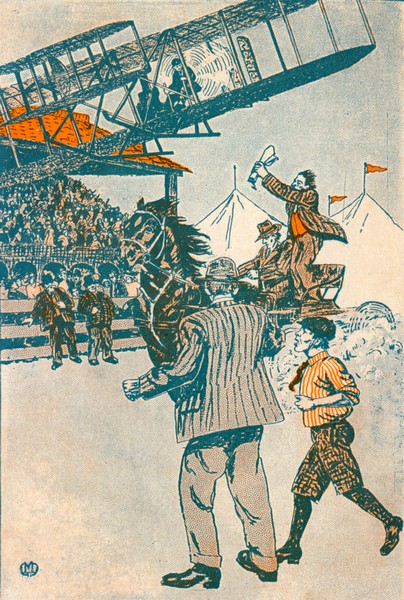
Before the horse could make much headway,
the aeroplane was racing down the “stretch”
once more—this time even nearer the ground.
As the whirr of the engine struck on the horse’s
ears and the wide white planes of the car filled
the width of the track just above, the horse
reared, lunged forward, and the aeroplane had
passed once more.
“Hello,” rang out from the aeroplane at once.
“Want me, Mr. Stockwell?”
There was a mutter of enraged words in the
buggy, and then, the crowd, alarmed at the
horse’s actions, fell back in confusion. With a
quick command, the lawyer spoke to his companion,
and, with a glance at the aeroplane, already
on the far side of the race-track on its next
round, the frightened horse was forced through
the crowd toward the head of the “stretch” down
which the flying-machine would come on its next
lap.
The turn was reached just before Bud arrived
from the opposite direction.
“Now, Pusey,” exclaimed the lawyer, grabbing
the lines and whirling the horse about, “get
on the seat and serve him ef you can. Get your
writ ready. Ef he comes clost enough, grab him
and hold on. I’ll take care of the horse.”
Attorney Stockwell, whip in hand, headed the
rearing animal down the track, yelling to the
crowd to get out of the way. The massed people
saw what was coming. Between the low-flying
aeroplane and the galloping horse, a second injunction
was not needed. As the track opened
up before the snorting animal, already on a dead
run, with its ears laid back, Deputy Pusey
sprang to the seat of the buggy, and began to
wave his writ.
Bud understood the situation as well as if it
had been explained to him. A provoking smile
came on his face, and with a reckless daring he
headed the car straight at the deputy’s head.
Down the stretch together, came the foaming,
galloping horse and the swiftly moving aeroplane.
Holding with one hand to Attorney
Stockwell’s shoulder, the deputy sheriff—he had
already lost his official hat—waved his writ and
yelled:
“Hey, there, Bud Wilson, in the name of the
law, Stop!”
“Busy,” cried out Bud. “See you to-morrow.
Can’t stop to-day.”
“You’re under arrest,” shouted Attorney
Stockwell.
The temptation was too great. Without answering,
Bud gave the horizontal rudder a slight
turn, and the speeding car shot at the deputy’s
wobbling form.
“Grab him,” shouted the lawyer, as the car
dropped.
Spurred on by the jeers and hoots of the thousands
watching the strange contest, the county
officer made a feeble effort to respond. As he
threw his body up in a half-hearted effort to
catch the car, now just overhead, the aeroplane
sprang up once more.
“Good-bye,” shouted Bud, “you’re too slow.
See you later.”
Deputy Pusey balanced himself for a second,
and then tumbled forward between the foam-flecked
horse and the light buggy. A dozen men
grabbed the bridle of the horse, and the lawyer,
with an effort pulled the deputy into the buggy.
As the machine sped by the judges’ stand,
Bud heard a voice:
“Good boy, Bud,” it sounded jubilantly.
Bud glanced quickly, and saw President Elder,
Superintendent Perry, and a crowd of other
laughing and excited fair officials.
“Be back at three o’clock to-morrow,” sang
out the boy in response.
In another instant, his obedient craft was on
the lower turn, and, with the shouts and cheers of
the assembled multitude ringing in his ears, Bud
prepared to make his escape. At the extreme
end of the track, he threw the lever of the vertical
rudder over so sharply that the car almost
capsized. Like a bird with a wounded wing,
the framework fell partly on its side. Bud’s
heart thumped. The ground seemed rushing up
to meet him. To even scrape the surface meant
ruin to the car.
The boy retained his presence of mind and did
the right thing. But the car had lost so much
headway that it did not respond at once. It
wavered, tried to recover itself and then, almost
balanced, fell within five or six feet of the earth.
Escape did not seem possible. The aeroplane
was yet on an angle, and the low end of the frame
was just escaping the ground. If it struck, Bud’s
work was over. Like lightning, the thought
came to him that he must jump to escape the
wreckage.
Just then, with the spring of an animal, a man’s
crouched form hurled itself from the ground beneath
the dragging end. Bud’s dry lips tried to
cry out, but there was no time. His eye was
quicker than his tongue. He saw the bronzed
face of Jack Stanley, his gypsy friend, but no
sound came from the boy’s lips. As the gypsy’s
face flashed before him, something seemed to
strike the car. A shock ran through the frame,
and then, as if caught by a gale of wind, the
dragging end of the frame flew up—the aeroplane,
gathering speed, darted ahead, and the
ship righting herself, began once more to climb
skyward.
“Go it, Kid—yer all right!”
These words followed after Bud as he renewed
his flight, and he realized that once again Jack
Stanley had helped him over a crisis. Or, was
it Madame Zecatacas’ magic ring?
“If it’s the ring,” thought Bud, “I’m goin’
to have still more use fur it. It’s got to make
Jack and his wife sign the deed for me.”
Straight west over the “aerodrome,” the aeroplane
took its new course as steadily and easily
as if had not just escaped destruction. Several
hundred feet in the air, Bud set the car on a level
keel headed for the “slashings”—the valley
some miles ahead.
He was well out of the grounds when Attorney
Stockwell and the deputy untangled themselves
from the dense crowd. But at no time, was he
out of the lawyer’s sight. To the indignation
of the spectators, Mr. Stockwell forced the deputy’s
horse through the crowd and hurried toward
the fair-ground entrance. There was no
rear entrance leading in the direction Bud had
flown, and in hastening to the main gate, the
buggy had nearly a half mile to cover before
passing from the enclosure. This was under
trees and behind buildings that at once cut off
the view of the disappearing aeroplane.
The road leading to the fair-grounds from the
main thoroughfare or pike, ran north. Finally
reaching the east-and-west road, the deputy’s
horse was put to a run. It was then a half mile
further before the flying car could possibly be
seen, as, for that distance, the main road ran
between trees. It was not until ten minutes
after the excited lawyer and the bruised deputy
had started on their chase that they came out
into the open road.
“There he goes,” exclaimed Deputy Pusey,
when they did.
“Giddap,” shouted the lawyer, hitting the already
galloping animal with the end of the lines.
“He’s goin’ like all sixty.”
Almost directly ahead, and perhaps four miles
away, the aeroplane hung like a bird. Without
knowledge of what it really was, the object could
not have been picked out for other than a bird
in flight.
“I’m afeered he’s given us the slip,” added
the deputy.
“He ain’t goin’ far,” replied the panting lawyer,
still slapping the already jaded horse.
“You’re right,” sang out his companion.
“He’s lightin’ a’ready.”
It seemed that this was true. The aeroplane,
which was no great distance in the air, was dropping
slowly toward a distant line of trees.
“Comin’ down in the woods,” said Attorney
Stockwell.
“Ain’t that the aidge o’ the ‘slashins’?” exclaimed
the deputy.
“Looks like it. Well, there ain’t any place
there to hide. It’s all marsh or medder or underbrush,”
argued the lawyer. “Anyway, keep
your eyes peeled to see ’at he don’t come up
again on the fur side.”
Twenty minutes later, the pursuers mounted
the high ground concealing the valley beyond.
There was a final quick dash down the gully road,
and the low ground spread out before them. The
aeroplane was nowhere in sight.
“Well,” began the deputy, “there ye are—all
for nothin’.”
The lawyer pointed his whip ahead. An old
man, apparently in charge of a solitary cow
whose bell had attracted the attorney’s attention,
was slowly coming toward them. The pursuers
hastened ahead to meet the man.
“D’you see an airship sailing out here?”
called out the attorney.
The herdsman looked up blankly. On a venture,
Deputy Pusey addressed him in German.
Some intelligence came into the old man’s face.
Then he nodded his head and pointed north.
“He thought it was a big bird,” explained
the deputy with a sneer. “And he says it flew
low like a hawk.”
He questioned the man some minutes, and then
added:
“As near as I can make out, the kid kept
down below the trees and then disappeared in
them. That means he probably kept going till
he struck the Little Town pike about two miles
north. He couldn’t fly into the trees. He’s
took the Little Town road. Like as not he’s
headed for Little Town.”
The lawyer looked at his watch. It was three-forty-five.
“It’s no use to hurry now,” he explained.
“We’ll go on till we come to the section road
and cross over to the Little Town pike. Then
we’ll go to Little Town. We’ll probably meet
some one who’s seen him. If we don’t we’ll
get supper at that place an’ do some telephonin’.
He can’t hide that thing out in the open country.”
Some minutes before Bud’s estimated return,
Josh Camp, perched upon the roof of the mill,
set up a shout.
“Here he comes,” was his cry to those waiting
below, and almost before Josh could reach
the ground, the bird-like craft was slowly drifting
to rest in the mill place—the engine shut off,
and the propellers at rest. Eager hands caught
it and eased it to the ground, and Bud, trembling
under the strain, climbed stiffly from his seat.
“I’ve had the time of my life,” he began
abruptly. “Old Andy Pusey chased me around
the track with some kind of a paper—said I was
under arrest.”
“Are they after you?” interrupted Mr.
“Stump” Camp at once.
“Sure,” went on Bud. “Mr. Stockwell and
Andy had a buggy and Pusey’s big bay horse.
You can bet they’re after me. But I don’t
believe they saw me after I got in the ‘slashins.’
I didn’t see them.”
Bud’s hands trembled so that he could
scarcely assist in disposing of the aeroplane.
But he was hardly needed. Before five o’clock,
the airship had been hauled into the sawing
shed on the log car, drawn to the roof by means
of the waiting tackles and the false floor put into
place. To the uninformed, a glance into the shed
suggested as unlikely a place for hiding a forty-foot
aeroplane as the top of a haystack.
It was yet an hour before supper time, and
the irrepressible Bud and Josh set out at once
to select a place for the next day’s flight.
“An’ don’t be late,” called out Mrs. Camp.
“We got fried chicken, sweet potato pie and
hickorynut cake.”
About the time the Camps, Bud, and the hired
hands were attacking a big platter of fried
chicken, Attorney Stockwell and Deputy Sheriff
Pusey were making the best supper they could
out of yellow cheese, dried beef and crackers in
the Little Town general store. This accomplished,
the lawyer, tracing in a general way on
a county map the probable course of the lost
aeroplane, called by telephone those farmers who,
in his judgment, might have seen the airship.
Fortunately for Bud, the Camp’s Mill telephone
was out of order. The operator in Scottsville
could not tell what was the matter. She had
no way of knowing that the wily mill owner had
taken the instrument off the hook just after Josh
announced the returning aeroplane was in sight.
Josh’s report that there had been telephoning
in Little Town the day before was tip enough
to the unlearned but crafty farmer.
But, unfortunately for Bud, an incident occurred
in the general store a little later that set
the lawyer to thinking.
“Hey, Phil,” called out the proprietor, “I
don’t see no charge o’ that five gallon o’ gasoline
Josh Camp got this mornin’.”
Phil’s excuse was lost on Attorney Stockwell.
He looked at Deputy Pusey significantly. The
moment the officer’s horse had finished his oats,
the two men were in the buggy hurrying toward
Camp’s Mill, a locality as well known to both of
them as to Bud. At seven o’clock, it was growing
dusk. When the buggy turned from the road
into the open space before the mill, Mr. Camp,
Josh, and Bud were sitting on the porch, the
former with his cob pipe. Mr. Camp nudged
Bud, who rolled off the edge of the porch onto
the grass and crawled around the house.
The greeting between the deputy and the mill
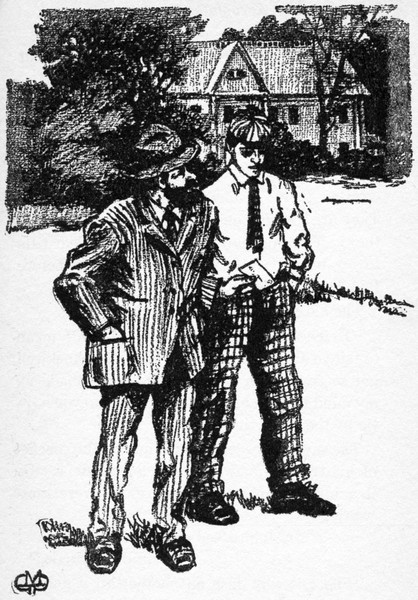
owner was that of old friends, but Attorney
Stockwell did not stop for civilities. He became
officious at once.
“Say, Camp,” he exclaimed, “we have reason
to believe you know something about some stolen
property.”
Before he could say more, the deputy interrupted
his companion to explain in detail what
had happened. Then he added why they had
come to the mill, telling of Josh’s gasoline purchase.
“Well,” said Mr. Camp, drawing on his not
very fragrant pipe. “Can’t I buy gasoline if I
like?”
“Don’t beat around the bush,” broke in Attorney
Stockwell.
“Look a’ here, Stockwell,” exclaimed old
“Stump.” “I never did have the best opinion o’
you. I don’t like to say right out I think you’re
a shyster cause I ain’t lookin’ to start nothin’.
An’ that’s more considerate than some bluffers
I know.”
“Have you seen the machine?” put in the deputy
again, anxious to avoid trouble.
“I don’t know much about the law,” drawled
the mill owner, “but I got a hunch I don’t have
to answer that less’n I want to.”
“Don’t lose time with him,” sneered the lawyer.
“You have the authority. Search the
place. I’ll help you.”
“So’ll I,” volunteered Mr. Camp. “Ef ye find
any flyin’-machine on this place or round about,
yer welcome to it. Mr. Deputy, you do your duty.
An’ when you’re convinced, git.”
The lawyer and the deputy began rather unsystematically
to look about the premises, starting
first for the lumber piles below the mill.
“Better look in the mill afore it’s too dark,”
suggested Mr. Camp, pointing to the sawing
shed.
The lawyer sneered again.
“I reckon we’ll look amongst them piles of
timber,” he exclaimed.
Deputy Pusey followed the mill owner up the
little track to the long, open shed and peered
inside.
“Like to climb up into the attic?” asked Mr.
Camp, carefully filling his pipe, and nodding
upward.
The officer smiled, turned and shook his head.
When it was completely dark and the two
searchers had returned to the buggy empty
handed, Mr. Camp was sitting on the fence, his
pipe sputtering and glowing in the black night.
“Camp,” exclaimed Attorney Stockwell angrily,
“I think you know a good deal more’n
you’re lettin’ on.”
“I reckon that’s right, Mr. Stockwell,”
drawled the mill owner, without changing his
position. “I wouldn’t be supprized ef I told
all I knowed ’at a certain lawyer might take to
the woods. D’you find any airships?”
With a curse, the lawyer sprang into his
buggy and drove rapidly away. Before the
buggy was out of sound, a small figure seemed
to appear out of the grass back of the silent man
on the fence. It was Bud, a little nervous, but
with a wide smile.
“Say, Mr. Camp,” he exclaimed, “I was kind
o’ scart when you askt ole Pusey to git up there
in the attic where the machine was.”
“How’s that?” asked the old man.
“’Cause I was up there, hidin’.”