THE STEREOSCOPE ITS HISTORY, THEORY, AND CONSTRUCTION
WITH ITS APPLICATION TO THE FINE AND USEFUL ARTS
AND TO EDUCATION.
BY
SIR DAVID BREWSTER, K.H., D.C.L., F.R.S., M.R.I.A.,
VICE-PRESIDENT OF THE ROYAL SOCIETY OF EDINBURGH, ONE OF THE EIGHT
ASSOCIATES OF THE IMPERIAL INSTITUTE OF FRANCE, OFFICER OF THE
LEGION OF HONOUR, CHEVALIER OF THE PRUSSIAN ORDER OF MERIT,
HONORARY OR CORRESPONDING MEMBER OF THE ACADEMIES
OF PETERSBURGH, VIENNA, BERLIN, COPENHAGEN,
STOCKHOLM, BRUSSELS, GÖTTINGEN, MODENA,
AND OF THE NATIONAL INSTITUTE OF
WASHINGTON, ETC.
The Stereoscope, a word derived from στέρεος,
solid, and σκόπειν, to see, is an optical instrument, of
modern invention, for representing, in apparent relief and solidity,
all natural objects and all groups or combinations of objects, by
uniting into one image two plane representations of these objects or
groups as seen by each eye separately. In its most general form the
Stereoscope is a binocular instrument, that is, is applied to
both eyes; but in two of its forms it is monocular,
or applied only to one eye, though the use of the other eye,
without any instrumental aid, is necessary in the combination of the
two plane pictures, or of one plane picture and its reflected image.
The Stereoscope, therefore, cannot, like the telescope and microscope,
be used by persons who have lost the use of one eye, and its remarkable effects
cannot be properly appreciated by those whose eyes are not equally good.
When the artist represents living objects, or groups of them, and
delineates buildings or landscapes, or when he copies from statues or
models, he produces apparent solidity, and difference of distance from
the eye, by light and shade, by the diminished size of known objects as
regulated by the principles of geometrical perspective, and by those
variations in distinctness and colour which constitute what has been
called aerial perspective. But when all these appliances have been
used in the most skilful manner, and art has exhausted its powers,
we seldom, if ever, mistake the plane picture for the solid which it
represents. The two eyes scan its surface, and by their distance-giving
power indicate to the observer that every point of the picture is
nearly at the same distance from his eye. But if the observer closes
one eye, and thus deprives himself of the power of determining
differences of distance by the convergency of the optical axes, the
relief of the picture is increased. When the pictures are truthful
photographs, in which the variations of light and shade are perfectly
represented, a very considerable degree of relief and solidity is
thus obtained; and when we have practised for a while this species of
monocular vision, the drawing, whether it be of a statue, a living
figure, or a building, will appear to rise in its different parts from
the canvas, though only to a limited extent.
In these observations we refer chiefly to ordinary drawings held in the
hand, or to portraits and landscapes hung in rooms and galleries, where
the proximity of the observer, and lights from various directions,
reveal the surface of the paper or the canvas; for in panoramic and
dioramic representations, where the light, concealed from the observer,
is introduced in an oblique direction, and where the distance of the
picture is such that the convergency of the optic axes loses much of
its distance-giving power, the illusion is very perfect, especially
when aided by correct geometrical and aerial perspective. But when
the panorama is illuminated by light from various directions, and the
slightest motion imparted to the canvas, its surface becomes distinctly
visible, and the illusion instantly disappears.
The effects of stereoscopic representation are of a very different
kind, and are produced by a very different cause. The singular relief
which it imparts is independent of light and shade, and of geometrical
as well as of aerial perspective. These important accessories, so
necessary in the visual perception of the drawings in plano,
avail nothing in the evolution of their relievo, or third
dimension. They add, doubtless, to the beauty of the binocular
pictures; but the stereoscopic creation is due solely to the
superposition of the two plane pictures by the optical apparatus
employed, and to the distinct and instantaneous perception of distance
by the convergency of the optic axes upon the similar points of the two
pictures which the stereoscope has united.
If we close one eye while looking at photographic pictures in the
stereoscope, the perception of relief is still considerable, and
approximates to the binocular representation; but when the pictures are
mere diagrams consisting of white lines upon a black ground, or black
lines upon a white ground, the relief is instantly lost by the shutting
of the eye, and it is only with such binocular pictures that we see the
true power of the stereoscope.
As an amusing and useful instrument the stereoscope derives much of its
value from photography. The most skilful artist would have been
incapable of delineating two equal representations of a figure or a
landscape as seen by two eyes, or as viewed from two different points
of sight; but the binocular camera, when rightly constructed, enables
us to produce and to multiply photographically the pictures which we
require, with all the perfection of that interesting art. With this
instrument, indeed, even before the invention of the Daguerreotype and
the Talbotype, we might have exhibited temporarily upon ground-glass,
or suspended in the air, the most perfect stereoscopic creations, by placing
a Stereoscope behind the two dissimilar pictures formed by the camera.
CHAPTER I. HISTORY OF THE STEREOSCOPE.
When we look with both eyes open at a sphere, or any other solid
object, we see it by uniting into one two pictures, one as seen by the
right, and the other as seen by the left eye. If we hold up a thin book
perpendicularly, and midway between both eyes, we see distinctly the
back of it and both sides with the eyes open. When we shut the right
eye we see with the left eye the back of the book and the left side of
it, and when we shut the left eye we see with the right eye the back
of it and the right side. The picture of the book, therefore, which we
see with both eyes, consists of two dissimilar pictures united,
namely, a picture of the back and the left side of the book as seen by
the left eye, and a picture of the back and right side of the book as
seen by the right eye.
In this experiment with the book, and in all cases where the object is
near the eye, we not only see different pictures of the same
object, but we see different things with each eye. Those who
wear spectacles see only the left-hand spectacle-glass with the left
eye, on the left side of the face, while with the right eye they see
only the right-hand spectacle-glass on the right side of the face, both
glasses of the spectacles being seen united midway between the eyes, or
above the nose, when both eyes are open. It is, therefore, a fact well
known to every person of common sagacity that the pictures of bodies
seen by both eyes are formed by the union of two dissimilar pictures
formed by each.
This palpable truth was known and published by ancient mathematicians.
Euclid knew it more than two thousand years ago, as may be seen in the
26th, 27th, and 28th theorems of his Treatise on Optics.[1]
In these theorems he shews that the part of a sphere seen by both eyes,
and having its diameter equal to, or greater or less than the distance
between the eyes, is equal to, and greater or less than a hemisphere;
and having previously shewn in the 23d and 24th theorems how to find
the part of any sphere that is seen by one eye at different distances,
it follows, from constructing his figure, that each eye sees different
portions of the sphere, and that it is seen by both eyes by the union
of these two dissimilar pictures.
More than fifteen hundred years ago, the celebrated physician
Galen treated the subject of binocular vision more fully than Euclid.
In the twelfth chapter of the tenth book of his work, On the
use of the different parts of the Human Body, he has described with
great minuteness the various phenomena which are seen when we look at
bodies with both eyes, and alternately with the right and the left.
He shews, by diagrams, that dissimilar pictures of a body are seen
in each of these three modes of viewing it; and, after finishing his
demonstration, he adds,—
“But if any person does not understand these
demonstrations by means of lines, he will finally give his assent to
them when he has made the following experiment:—Standing near a column,
and shutting each of the eyes in succession;—when the right eye
is shut, some of those parts of the column which were previously seen
by the right eye on the right side of the column, will
not now be seen by the left eye; and when the left eye is
shut, some of those parts which were formerly seen by the left
eye on the left side of the column, will not now be seen by the
right eye. But when we, at the same time, open both eyes, both
these will be seen, for a greater part is concealed when we look with
either of the two eyes, than when we look with both at the same
time.”[2]
In such distinct and unambiguous terms, intelligible to the meanest
capacity, does this illustrious writer announce the fundamental
law of binocular vision—the grand principle of the Stereoscope,
namely, that the picture of the solid column which we see with
both eyes is composed of two dissimilar pictures, as seen by each eye
separately. As the vision of the solid column, therefore, was
obtained by the union of these dissimilar pictures, an instrument
only was wanted to take such pictures, and another to combine them.
The Binocular Photographic Camera was the one instrument, and the
Stereoscope the other.
The subject of binocular vision was studied by various optical writers
who have flourished since the time of Galen. Baptista Porta, one of
the most eminent of them, repeats, in his work On Refraction,
the propositions of Euclid on the vision of a sphere with one and both
eyes, and he cites from Galen the very passage which we have given above
on the dissimilarity of the three pictures seen by each eye and by
both. Believing that we see only with one eye at a time, he denies the
accuracy of Euclid’s theorems, and while he admits the correctness of the
observations of Galen, he endeavours to explain them upon other principles.
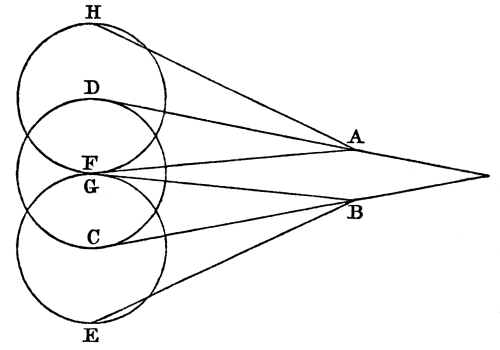
Fig. 1.
In illustrating the views of Galen on the dissimilarity of the three
pictures which are requisite in binocular vision, he employs a much
more distinct diagram than that which is given by the Greek physician.
“Let a,” he says, “be the pupil of the right eye, b
that of the left, and dc the body to be seen. When we look
at the object with both eyes we see dc, while with the left
eye we see ef, and with the right eye gh. But if it
is seen with one eye, it will be seen otherwise, for when the left
eye b is shut, the body cd, on the left side, will
be seen in hg; but when the right eye is shut, the body
cd will be seen in fe, whereas, when both eyes are
opened at the same time, it will be seen in cd.” These results
are then explained by copying the passage from Galen, in which he
supposes the observer to repeat these experiments when he is looking at
a solid column.
In looking at this diagram, we recognise at once not only the
principle, but the construction of the stereoscope. The double
stereoscopic picture or slide is represented by he; the
right-hand picture, or the one seen by the right eye, by hf;
the left-hand picture, or the one seen by the left eye, by ge;
and the picture of the solid column in full relief by dc, as
produced midway between the other two dissimilar pictures, hf
and ge, by their union, precisely as in the stereoscope.[3]
Galen, therefore, and the Neapolitan philosopher, who has employed
a more distinct diagram, certainly knew and adopted the fundamental
principle of the stereoscope; and nothing more was required, for
producing pictures in full relief, than a simple instrument for uniting
hf and ge, the right and left hand dissimilar
pictures of the column.
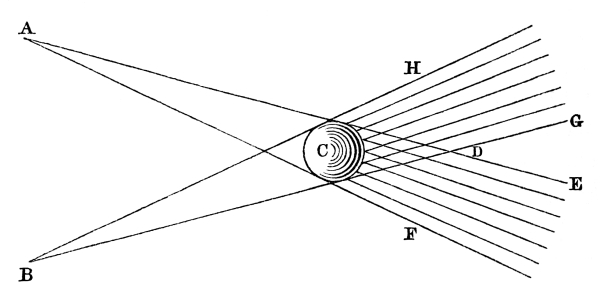
Fig. 2.
In the treatise on painting which he left behind him in MS.,[4]
Leonardo da Vinci has made a distinct reference to the dissimilarity
of the pictures seen by each eye as the reason why “a painting, though
conducted with the greatest art, and finished to the last perfection,
both with regard to its contours, its lights, its shadows, and its
colours, can never shew a relievo equal to that of the natural
objects, unless these be viewed at a distance and with a single
eye,”[5] which he thus demonstrates. “If an object c be
viewed by a single eye at a, all objects in the space behind
it—included, as it were, in a shadow ecf, cast by a candle
at a—are invisible to an eye at a; but when the
other eye at b is opened, part of these objects become
visible to it; those only being hid from both eyes that are included,
as it were, in the double shadow cd, cast by two lights at
a and b and terminated in d; the angular
space edg, beyond d, being always visible to both
eyes. And the hidden space cd is so much the shorter as the
object c is smaller and nearer to the eyes. Thus he observes
that the object c, seen with both eyes, becomes, as it were,
transparent, according to the usual definition of a transparent thing,
namely, that which hides nothing beyond it. But this cannot happen when
an object, whose breadth is bigger than that of the pupil, is viewed
by a single eye. The truth of this observation is, therefore, evident,
because a painted figure intercepts all the space behind its apparent
place, so as to preclude the eyes from the sight of every part of the
imaginary ground behind it. Hence,” continues Dr. Smith, “we have one
help to distinguish the place of a near object more accurately with
both eyes than with one, inasmuch as we see it more detached from
other objects beyond it, and more of its own surface, especially if
it be roundish.”
We have quoted this passage, not from its proving that Leonardo
da Vinci was acquainted with the fact that each eye, a,
b, sees dissimilar pictures of the sphere c,
but because it has been referred to by Mr. Wheatstone as the only remark on
the subject of binocular vision which he could find “after looking over
the works of many authors who might be expected to have made them.” We
think it quite clear, however, that the Italian artist knew as well as
his commentator Dr. Smith, that each eye, a and b,
sees dissimilar parts of the sphere c. It was not his purpose
to treat of the binocular pictures of c, but his figure proves
their dissimilarity.
The subject of binocular vision was successfully studied by Francis
Aguillon or Aguilonius,[6]
a learned Jesuit, who published his Optics in 1613. In the first book
of his work, where he is treating of the vision of solids of all forms,
(de genere illorum quæτὰ στέρεα [ta sterea] nuncupantur,)
he has some difficulty in explaining, and fails to do it, why the two
dissimilar pictures of a solid, seen by each eye, do not, when united,
give a confused and imperfect view of it. This discussion is appended
to the demonstration of the theorem, “that when an object is seen with
two eyes, two optical pyramids are formed whose common base is the
object itself, and whose vertices are in the eyes,”[7]
and is as follows:—
“When one object is seen with two eyes, the angles at the vertices of
the optical pyramids (namely, haf, gbe,
Fig. 1) are not always equal, for beside the direct view in which the pyramids
ought to be equal, into whatever direction both eyes are turned, they
receive pictures of the object under inequal angles, the greatest of
which is that which is terminated at the nearer eye, and the lesser
that which regards the remoter eye. This, I think, is perfectly
evident; but I consider it as worthy of admiration, how it happens that
bodies seen by both eyes are not all confused and shapeless, though
we view them by the optical axes fixed on the bodies themselves. For
greater bodies, seen under greater angles, appear lesser bodies under
lesser angles. If, therefore, one and the same body which is in reality
greater with one eye, is seen less on account of the inequality of the
angles in which the pyramids are terminated, (namely, haf,
gbe,[8])
the body itself must assuredly be seen greater or less at the same
time, and to the same person that views it; and, therefore, since
the images in each eye are dissimilar (minime sibi congruunt)
the representation of the object must appear confused and disturbed
(confusa ac perturbata) to the primary sense.”
“This view of the subject,” he continues, “is certainly consistent with
reason, but, what is truly wonderful is, that it is not correct, for
bodies are seen clearly and distinctly with both eyes when the optic
axes are converged upon them. The reason of this, I think, is, that
the bodies do not appear to be single, because the apparent images,
which are formed from each of them in separate eyes, exactly coalesce,
(sibi mutuo exacte congruunt,) but because the common sense
imparts its aid equally to each eye, exerting its own power equally in
the same manner as the eyes are converged by means of their optical
axes. Whatever body, therefore, each eye sees with the eyes conjoined,
the common sense makes a single notion, not composed of the two which
belong to each eye, but belonging and accommodated to the imaginative
faculty to which it (the common sense) assigns it. Though, therefore,
the angles of the optical pyramids which proceed from the same object
to the two eyes, viewing it obliquely, are inequal, and though the
object appears greater to one eye and less to the other, yet the same
difference does not pass into the primary sense if the vision is made
only by the axes, as we have said, but if the axes are converged on
this side or on the other side of the body, the image of the same body
will be seen double, as we shall shew in Book iv., on the fallacies of
vision, and the one image will appear greater and the other less on
account of the inequality of the angles under which they are
seen.”[9]
Such is Aguilonius’s theory of binocular vision, and of the union
of the two dissimilar pictures in each eye by which a solid body is
seen. It is obviously more correct than that of Dr. Whewell and Mr.
Wheatstone. Aguilonius affirms it to be contrary to reason that two
dissimilar pictures can be united into a clear and distinct picture, as
they are actually found to be, and he is therefore driven to call in
the aid of what does not exist, a common sense, which rectifies
the picture. Dr. Whewell and Mr. Wheatstone have cut the Gordian knot
by maintaining what is impossible, that in binocular and stereoscopic
vision a long line is made to coincide with a short one, and a large
surface with a small one; and in place of conceiving this to be done by
a common sense overruling optical laws, as Aguilonius supposes, they
give to the tender and pulpy retina, the recipient of ocular pictures,
the strange power of contracting or expanding itself in order to
equalize inequal lines and inequal surfaces!
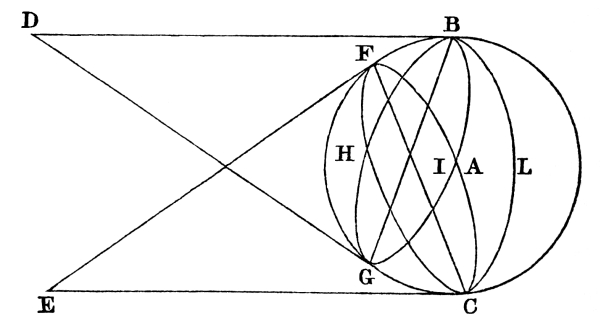
Fig. 3.
In his fourth and very interesting book, on the fallacies of distance,
magnitude, position, and figure, Aguilonius resumes the subject of the
vision of solid bodies. He repeats the theorems of Euclid and Gassendi
on the vision of the sphere, shewing how much of it is seen by each
eye, and by both, whatever be the size of the sphere, and the distance
of the observer. At the end of the theorems, in which he demonstrates
that when the diameter of the sphere is equal to the distance between
the eyes we see exactly a hemisphere, he gives the annexed drawing
of the mode in which the sphere is seen by each eye, and by both. In
this diagram e is the right eye and d the left,
chfi the section of that part of the sphere bc which
is seen by the right eye e, bhga the section of the
part which is seen by the left eye d, and blc the
half of the great circle which is the section of the sphere as seen by
both eyes.[10]
These three pictures of the solids are all dissimilar. The right eye
e does not see the part blcif
of the sphere; the left eye does not see the part blcga,
while the part seen with both eyes is the hemisphere blcgf,
the dissimilar segments bfg, cgf
being united in its vision.[11]
After demonstrating his theorems on the vision of spheres with one
and both eyes,[12]
Aguilonius informs us, before he proceeds to the vision of cylinders,
that it is agreed upon that it is not merely true with the sphere,
but also with the cylinder, the cone, and all bodies whatever, that
the part which is seen is comprehended by tangent rays, such as
eb, ec for the right
eye, in Fig. 3. “For,” says he, “since these tangent lines
are the outermost of all those which can be drawn to the proposed body from the
same point, namely, that in which the eye is understood to be placed,
it clearly follows that the part of the body which is seen must be
contained by the rays touching it on all sides. For in this part no
point can be found from which a right line cannot be drawn to the eye,
by which the correct visible form is brought out.”[13]
Optical writers who lived after the time of Aguilonius seem to
have considered the subject of binocular vision as exhausted in
his admirable work. Gassendi,[14]
though he treats the subject very slightly, and without any figures,
tells us that we see the left side of the nose with the left eye,
and the right side of it with the right eye,—two pictures sufficiently dissimilar.
Andrew Tacquet,[15]
though he quotes Aguilonius and Gassendi on the subject of seeing
distances with both eyes, says nothing on the binocular vision of
solids; and Smith, Harris, and Porterfield, only touch upon the subject
incidentally. In commenting on the passage which we have already
quoted from Leonardo da Vinci, Dr. Smith says, “Hence we have one help
to distinguish the place of a near object more accurately with both
eyes than with one, inasmuch as we see it more detached from other
objects beyond it, and more of its own surface, especially if it be
roundish.”[16]
If any farther evidence were required that Dr. Smith was acquainted
with the dissimilarity of the images of a solid seen by each eye, it
will be found in his experiment with a “long ruler placed between the
eyebrows, and extended directly forward with its flat sides, respecting
the right hand and the left.” “By directing the eyes to a remote
object,” he adds, “the right side of the ruler seen by the right
eye will appear on the left hand, and the left side on the right
hand, as represented in the figure.”[17]
In his Treatise on Optics, published in 1775, Mr. Harris, when
speaking of the visible or apparent figures of objects, observes,
that “we have other helps for distinguishing prominences of small
parts besides those by which we distinguish distances in general,
as their degrees of light and shade, and the prospect we have round
them.” And by the parallax, on account of the distance betwixt
our eyes, we can distinguish besides the front part of the two sides
of a near object not thicker than the said distance, and this gives a
visible relievo to such objects, which helps greatly to raise or detach
them from the plane in which they lie. Thus the nose on a face is the
more remarkably raised by our seeing both sides of it at once.“[18]That is, the relievo is produced by the combination of the two
dissimilar pictures given by each eye.
Without referring to a figure given by Dr. Porterfield, in which he
actually gives drawings of an object as seen by each eye in binocular
vision,[19]
the one exhibiting the object as seen endwise by the right
eye, and the other the same object as seen laterally by the left eye,
we may appeal to the experience of every optical, or even of every
ordinary observer, in support of the fact, that the dissimilarity of
the pictures in each eye, by which we see solid objects, is known to
those who have never read it in Galen, Porta, or Aguilonius. Who has
not observed the fact mentioned by Gassendi and Harris, that their left
eye sees only the left side of their nose, and their right eye the
right side, two pictures sufficiently dissimilar? Who has not noticed,
as well as Dr. Smith, that when they look at any thin, flat body, such
as a thin book, they see both sides of it—the left eye only the
left side of it, and the right eye only the right side, while the
back, or the part nearest the face, is seen by each eye, and both the
sides and the back by both the eyes? What student of perspective is
there—master or pupil, male or female—who does not know, as certainly
as he knows his alphabet, that the picture of a chair or table, or
anything else, drawn from one point of sight, or as seen by
one eye placed in that point, is necessarily dissimilar to
another drawing of the same object taken from another point of sight,
or as seen by the other eye placed in a point 2½ inches distant from
the first? If such a person is to be found, we might then admit that
the dissimilarity of the pictures in each eye was not known to every
student of perspective.[20]
Such was the state of our knowledge of binocular vision when two
individuals, Mr. Wheatstone, and Mr. Elliot, now Teacher of Mathematics
in Edinburgh, were directing their attention to the subject. Mr.
Wheatstone communicated an important paper on the Physiology of
Vision to the British Association at Newcastle in August 1838, and
exhibited an instrument called a Stereoscope, by which he united the
two dissimilar pictures of solid bodies, the τὰ στέρεα, (ta
sterea of Aguilonius,) and thus reproduced, as it were, the bodies
themselves. Mr. Wheatstone’s paper on the subject, which had been
previously read at the Royal Society on the 21st of June, was printed
in their Transactions for 1838.[21]
Mr. Elliot was led to the study of binocular vision in consequence
of having written an Essay, so early as 1823, for the Class of Logic
in the University of Edinburgh, “On the means by which we obtain
our knowledge of distances by the Eye.” Ever since that date he was
familiar with the idea, that the relief of solid bodies seen by the eye
was produced by the union of the dissimilar pictures of them in each
eye, but he never imagined that this idea was his own, believing that
it was known to every student of vision. Previous to or during the
year 1834, he had resolved to construct an instrument for uniting two
dissimilar pictures, or of constructing a stereoscope; but he delayed
doing this till the year 1839, when he was requested to prepare an
original communication for the Polytechnic Society, which had been
recently established in Liverpool. He was thus induced to construct
the instrument which he had projected, and he exhibited it to his
friends, Mr. Richard Adie, optician, and Mr. George Hamilton, lecturer
on chemistry in Liverpool, who bear testimony to its existence at that
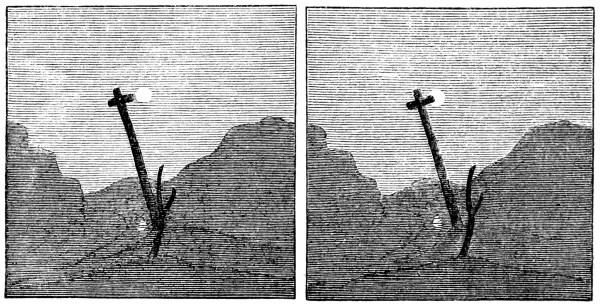
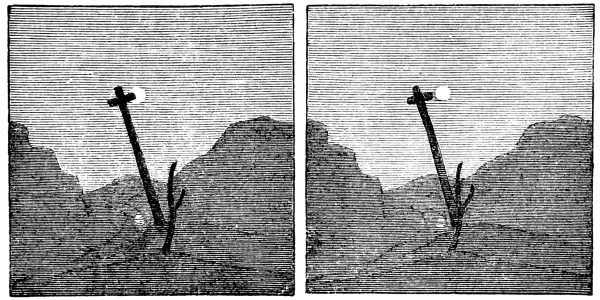
date. This simple stereoscope, without lenses or mirrors, consisted of
a wooden box 18 inches long, 7 broad, and 4½ deep, and at the bottom
of it, or rather its farther end, was placed a slide containing two
dissimilar pictures of a landscape as seen by each eye. Photography did
not then exist, to enable Mr. Elliot to procure two views of the same
scene, as seen by each eye, but he drew the transparency of a landscape
with three distances. The first and most remote was the moon
and the sky, and a stream of water from which the moon was reflected,
the two moons being placed nearly at the distance of the two eyes,
or 2½ inches, and the two reflected moons at the same distance. The
second distance was marked by an old cross about a hundred feet
off; and the third distance by the withered branch of a tree,
thirty feet from the observer. In the right-hand picture, one arm of
the cross just touched the disc of the moon, while, in the left-hand
one, it projected over one-third of the disc. The branch of the tree
touched the outline of a distant hill in the one picture, but was
“a full moon’s-breadth” from it on the other. When these dissimilar
pictures were united by the eyes, a landscape, certainly a very
imperfect one, was seen in relief, composed of three distances.
Owing, no doubt, to the difficulty of procuring good binocular
pictures, Mr. Elliot did not see that his contrivance would be very
popular, and therefore carried it no farther. He had never heard of
Mr. Wheatstone’s stereoscope till he saw his paper on Vision reprinted
in the Philosophical Magazine for March 1852, and having
perused it, he was convinced not only that Mr. Wheatstone’s theory
of the instrument was incorrect, but that his claim to the discovery
of the dissimilarity of the images in each eye had no foundation. He
was, therefore, led to communicate to the same journal the fact of
his having himself, thirteen years before, constructed and used a
stereoscope, which was still in his possession. In making this claim,
Mr. Elliot had no intention of depriving Mr. Wheatstone of the credit
which was justly due to him; and as the claim has been publicly made,
we have described the nature of it as a part of scientific history.
In Mr. Wheatstone’s ingenious paper of 1838, the subject of binocular
vision is treated at considerable length. He gives an account of the
opinions of previous writers, referring repeatedly to the works of
Aguilonius, Gassendi, and Baptista Porta, in the last of which the
views of Galen are given and explained. In citing the passage which we
have already quoted from Leonardo da Vinci, and inserting the figure
which illustrates it, he maintains that Leonardo da Vinci was not aware
“that the object (c in Fig. 2)
presented a different appearance to each eye.” “He failed,” he adds,
“to observe this, and no subsequent writer, to my knowledge, has supplied
the omission. The projection of two obviously dissimilar pictures on the
two retinæ, when a single object is viewed, while the optic axes
converge, must therefore be regarded as a new fact in the theory of
vision.” Now, although Leonardo da Vinci does not state in so many
words that he was aware of the dissimilarity of the two pictures, the
fact is obvious in his own figure, and he was not led by his subject to
state the fact at all. But even if the fact had not stared him in the
face he must have known it from the Optics of Euclid and the writings
of Galen, with which he could not fail to have been well acquainted.
That the dissimilarity of the two pictures is not a new fact we
have already placed beyond a doubt. The fact is expressed in words,
and delineated in drawings, by Aguilonius and Baptista Porta. It was
obviously known to Dr. Smith, Mr. Harris, Dr. Porterfield, and Mr.
Elliot, before it was known to Mr. Wheatstone, and we cannot understand
how he failed to observe it in works which he has so often quoted, and
in which he professes to have searched for it.
This remarkable property of binocular vision being thus clearly
established by preceding writers, and admitted by himself, as the cause
of the vision of solidity or distance, Mr. Wheatstone, as Mr. Elliot
had done before him, thought of an instrument for uniting the two
dissimilar pictures optically, so as to produce the same result that is
obtained by the convergence of the optical axes. Mr. Elliot thought of
doing this by the eyes alone; but Mr. Wheatstone adopted a much better
method of doing it by reflexion. He was thus led to construct an
apparatus, to be afterwards described, consisting of two plane
mirrors, placed at an angle of 90°, to which he gave the name of
stereoscope, anticipating Mr. Elliot both in the construction
and publication of his invention, but not in the general conception of
a stereoscope.
After describing his apparatus, Mr. Wheatstone proceeds to consider
(in a section entitled, “Binocular vision of objects of different
magnitudes”) “what effects will result from presenting similar images,
differing only in magnitude, to analogous parts of the retina.”
“For this purpose,” he says, “two squares or circles, differing
obviously but not extravagantly in size, may be drawn on two
separate pieces of paper, and placed in the stereoscope, so that the
reflected image of each shall be equally distant from the eye by
which it is regarded. It will then be seen that notwithstanding
this difference they coalesce and occasion a single resultant
perception.” The fact of coalescence being supposed to be perfect,
the author next seeks to determine the difference between the length
of two lines which the eye can force into coalescence, or “the limits
within which the single appearance subsists.” He, therefore, unites
two images of equal magnitude, by making one of them visually less
from distance, and he states that, “by this experiment, the single
appearance of two images of different size is demonstrated.” Not
satisfied with these erroneous assertions, he proceeds to give a sort
of rule or law for ascertaining the relative size of the two unequal
pictures which the eyes can force into coincidence. The inequality,
he concludes, must not exceed the difference “between the projections
of the same object when seen in the most oblique position of the eyes
(i.e., both turned to the extreme right or the extreme left)
ordinarily employed.” Now, this rule, taken in the sense in which it is
meant, is simply a truism. It merely states that the difference
of the pictures which the eyes can make to coalesce is equal
to the difference of the pictures which the eyes do make to coalesce
in their most oblique position; but though a truism it is not
a truth, first, because no real coincidence ever can take place,
and, secondly, because no apparent coincidence is effected when the
difference of the picture is greater than what is above stated.
From these principles, which will afterwards be shewn to be erroneous,
Mr. Wheatstone proceeds “to examine why two dissimilar pictures
projected on the two retinæ give rise to the perception of
an object in relief.” “I will not attempt,” he says, “at present
to give the complete solution of this question, which is far from
being so easy as at first glance it may appear to be, and is, indeed,
one of great complexity. I shall, in this case, merely consider
the most obvious explanations which might be offered, and shew their
insufficiency to explain the whole of the phenomena.
“It may be supposed that we see only one point of a field
of view distinctly at the same instant, the one, namely, to which
the optic axes are directed, while all other points are seen so
indistinctly that the mind does not recognise them to be either single
or double, and that the figure is appreciated by successively directing
the point of convergence of the optic axes successively to a sufficient
number of its points to enable us to judge accurately of its form.
“That there is a degree of indistinctness in those parts of the
field of view to which the eyes are not immediately directed, and which
increases with the distance from that point, cannot be doubted; and it
is also true that the objects there obscurely seen are frequently
doubled. In ordinary vision, it may be said, this
indistinctness and duplicity are not attended to, because the eyes
shifting continually from point to point, every part of the object is
successively rendered distinct, and the perception of the object is not
the consequence of a single glance, during which a small part of it
only is seen distinctly, but is formed from a comparison of all the
pictures successively seen, while the eyes were changing from one point
of an object to another.
“All this isin some degreetrue, but were it
entirely so no appearance of relief should present itself when the
eyes remain intently fixed on one point of a binocular image in the
stereoscope. But in performing the experiment carefully, it will be
found, provided the picture do not extend far beyond the centres of
distinct vision, that the image is still seen single, and in relief,
when in this condition.”[22]
In this passage the author makes a distinction between ordinary
binocular vision, and binocular vision through the stereoscope,
whereas in reality there is none. The theory of both is exactly the
same. The muscles of the two eyes unite the two dissimilar pictures,
and exhibit the solid, in ordinary vision; whereas in stereoscopic
vision the images are united by reflexion or refraction, the eyes in
both cases obtaining the vision of different distances by rapid and
successive convergences of the optical axes. Mr. Wheatstone notices
the degree of indistinctness in the parts of the picture to
which the eyes are not immediately directed; but he does not notice the
“confusion and incongruity” which Aguilonius says ought to
exist, in consequence of some parts of the resulting relievo being seen
of one size by the left eye alone,—other parts of a different size
by the right eye alone, and other parts by both eyes. This confusion,
however, Aguilonius, as we have seen, found not to exist, and he
ascribes it to the influence of a common sense overruling the
operation of physical laws. Erroneous as this explanation is, it is
still better than that of Mr. Wheatstone, which we shall now proceed to
explain.
In order to disprove the theory referred to in the preceding extract,
Mr. Wheatstone describes two experiments, which he says are equally
decisive against it, the first of them only being subject to
rigorous examination. With this view he draws “two lines about two
inches long, and inclined towards each other, on a sheet of paper,
and having caused them to coincide by converging the optic axes to a
point nearer than the paper, he looks intently on the upper end of
the resultant line without allowing the eyes to wander from it for a
moment. The entire line will appear single, and in its proper
relief, &c.... The eyes,” he continues, “sometimes become fatigued,
which causes the line to become double at those parts to which the
optic axes are not fixed, but in such case all appearance of relief
vanishes. The same experiment may be tried with small complex
figures, but the pictures should not extend too far beyond the centre
of the retinæ.”
Now these experiments, if rightly made and interpreted, are not
decisive against the theory. It is not true that the entire line
appears single when the axes are converged upon the upper end of the
resultant line, and it is not true that the disappearance of the relief
when it does disappear arises from the eye being fatigued. In the
combination of more complex figures, such as two similar rectilineal
figures contained by lines of unequal length, neither the inequalities
nor the entire figure will appear single when the axes are converged
upon any one point of it.
In the different passages which we have quoted from Mr. Wheatstone’s
paper, and in the other parts of it which relate to binocular vision,
he is obviously halting between truth and error, between theories
which he partly believes, and ill-observed facts which he cannot
reconcile with them. According to him, certain truths “may be supposed”
to be true, and other truths may be “in some degree true,” but “not
entirely so;” and thus, as he confesses, the problem of binocular and
stereoscopic vision “is indeed one of great complexity,” of which “he
will not attempt at present to give the complete solution.” If he had
placed a proper reliance on the law of visible direction which he
acknowledges I have established, and “with which,” he says, “the laws
of visible direction for binocular vision ought to contain nothing
inconsistent,” he would have seen the impossibility of the two eyes
uniting two lines of inequal length; and had he believed in the law of
distinct vision he would have seen the impossibility of the two eyes
obtaining single vision of any more than one point of an object at a
time. These laws of vision are as rigorously true as any other physical
laws,—as completely demonstrated as the law of gravity in Astronomy,
or the law of the Sines in Optics; and the moment we allow them to be
tampered with to obtain an explanation of physical puzzles, we convert
science into legerdemain, and philosophers into conjurors.
Such was the state of our stereoscopic knowledge in 1838, after the
publication of Mr. Wheatstone’s interesting and important paper.
Previous to this I communicated to the British Association at
Newcastle, in August 1838, a paper, in which I established the law
of visible direction already mentioned, which, though it had been
maintained by preceding writers, had been proved by the illustrious
D’Alembert to be incompatible with observation, and the admitted
anatomy of the human eye. At the same meeting Mr. Wheatstone exhibited
his stereoscopic apparatus, which gave rise to an animated discussion
on the theory of the instrument. Dr. Whewell maintained that the
retina, in uniting, or causing to coalesce into a single resultant
impression two lines of different lengths, had the power either of
contracting the longest, or lengthening the shortest, or what might
have been suggested in order to give the retina only half the trouble,
that it contracted the long line as much as it expanded the short one,
and thus caused them to combine with a less exertion of muscular power!
In opposition to these views, I maintained that the retina, a soft
pulpy membrane which the smallest force tears in pieces, had no such
power,—that a hypothesis so gratuitous was not required, and that the
law of visible direction afforded the most perfect explanation of all
the stereoscopic phenomena.
In consequence of this discussion, I was led to repeat my experiments,
and to inquire whether or not the eyes in stereoscopic vision did
actually unite the two lines of different lengths, or of different
apparent magnitudes. I found that they did not, and that no such union
was required to convert by the stereoscope two plane pictures into the
apparent whole from which they were taken as seen by each eye. These
views were made public in the lectures on the Philosophy of the
Senses, which I occasionally delivered in the College of St.
Salvator and St. Leonard, St. Andrews, and the different stereoscopes
which I had invented were also exhibited and explained.
In examining Dr. Berkeley’s celebrated Theory of Vision, I saw the vast
importance of establishing the law of visible direction, and of proving
by the aid of binocular phenomena, and in opposition to the opinion of
the most distinguished metaphysicians, that we actually see a third
dimension in space, I therefore submitted to the Royal Society of
Edinburgh, in January 1843, a paper On the law of visible position
in single and binocular vision, and on the representation of solid
figures by the union of dissimilar plane pictures on the retina.
More than twelve years have now elapsed since this paper was read, and
neither Mr. Wheatstone nor Dr. Whewell have made any attempt to defend
the views which it refutes.
In continuing my researches, I communicated to the Royal Society of
Edinburgh, in April 1844, a paper On the knowledge of distance as
given by binocular vision, in which I described several interesting
phenomena produced by the union of similar pictures, such
as those which form the patterns of carpets and paper-hangings. In
carrying on these inquiries I found the reflecting stereoscope of
little service, and ill fitted, not only for popular use, but for the
application of the instrument to various useful purposes. I was thus
led to the construction of several new stereoscopes, but particularly
to the Lenticular Stereoscope, now in universal use. They were
constructed in St. Andrews and Dundee, of various materials, such as
wood, tin-plate, brass, and of all sizes, from that now generally
adopted, to a microscopic variety which could be carried in the pocket.
New geometrical drawings were executed for them, and binocular pictures
taken by the sun were lithographed by Mr. Schenck of Edinburgh.
Stereoscopes of the lenticular form were made by Mr. Loudon, optician,
in Dundee, and sent to several of the nobility in London, and in other
places, and an account of these stereoscopes, and of a binocular camera
for taking portraits, and copying statues, was communicated to the
Royal Scottish Society of Arts, and published in their Transactions.
It had never been proposed to apply the reflecting stereoscope to
portraiture or sculpture, or, indeed, to any useful purpose; but it was
very obvious, after the discovery of the Daguerreotype and Talbotype,
that binocular drawings could be taken with such accuracy as to
exhibit in the stereoscope excellent representations in relief, both
of living persons, buildings, landscape scenery, and every variety of
sculpture. In order to shew its application to the most interesting of
these purposes, Dr. Adamson of St. Andrews, at my request, executed
two binocular portraits of himself, which were generally circulated
and greatly admired. This successful application of the principle to
portraiture was communicated to the public, and recommended as an art
of great domestic interest.
After endeavouring in vain to induce opticians, both in London and
Birmingham, (where the instrument was exhibited in 1849 to the
British Association,) to construct the lenticular stereoscope, and
photographers to execute binocular pictures for it, I took with me to
Paris, in 1850, a very fine instrument, made by Mr. Loudon in Dundee,
with the binocular drawings and portraits already mentioned. I shewed
the instrument to the Abbé Moigno, the distinguished author of
L’Optique Moderne, to M. Soleil and his son-in-law, M. Duboscq,
the eminent Parisian opticians, and to some members of the Institute
of France. These gentlemen saw at once the value of the instrument,
not merely as one of amusement, but as an important auxiliary in the
arts of portraiture and sculpture. M. Duboscq immediately began to make
the lenticular stereoscope for sale, and executed a series of the most
beautiful binocular Daguerreotypes of living individuals, statues,
bouquets of flowers, and objects of natural history, which thousands of
individuals flocked to examine and admire. In an interesting article in
La Presse,[23]
the Abbé Moigno gave the following account of the introduction of the
instrument into Paris:—
“In his last visit to Paris, Sir David Brewster intrusted the models
of his stereoscope to M. Jules Duboscq, son-in-law and successor of M.
Soleil, and whose intelligence, activity, and affability will extend
the reputation of the distinguished artists of the Rue de l’Odeon, 35.
M. Jules Duboscq has set himself to work with indefatigable ardour.
Without requiring to have recourse to the binocular camera, he has,
with the ordinary Daguerreotype apparatus, procured a great number
of dissimilar pictures of statues, bas-reliefs, and portraits of
celebrated individuals, &c. His stereoscopes are constructed with more
elegance, and even with more perfection, than the original English
(Scotch) instruments, and while he is shewing their wonderful effects
to natural philosophers and amateurs who have flocked to him in crowds,
there is a spontaneous and unanimous cry of admiration.”
While the lenticular stereoscope was thus exciting much interest in
Paris, not a single instrument had been made in London, and it was not
till a year after its introduction into France that it was exhibited in
England. In the fine collection of philosophical instruments which M.
Duboscq contributed to the Great Exhibition of 1851, and for which he
was honoured with a Council medal, he placed a lenticular stereoscope,
with a beautiful set of binocular Daguerreotypes. This instrument
attracted the particular attention of the Queen, and before the closing
of the Crystal Palace, M. Duboscq executed a beautiful stereoscope,
which I presented to Her Majesty in his name. In consequence of this
public exhibition of the instrument, M. Duboscq received several orders
from England, and a large number of stereoscopes were thus introduced
into this country. The demand, however, became so great, that opticians
of all kinds devoted themselves to the manufacture of the instrument,
and photographers, both in Daguerreotype and Talbotype, found it a
most lucrative branch of their profession, to take binocular portraits
of views to be thrown into relief by the stereoscope. Its application
to sculpture, which I had pointed out, was first made in France, and
an artist in Paris actually copied a statue from the relievo
produced by the stereoscope.
Three years after I had published a description of the lenticular
stereoscope, and after it had been in general use in France and
England, and the reflecting stereoscope forgotten,[24]
Mr. Wheatstone printed, in the Philosophical Transactions for 1852,
a paper on Vision, in which he says that he had previously used “an apparatus
in which prisms were employed to deflect the rays of light proceeding from
the pictures, so as to make them appear to occupy the same place;” and
he adds, “I have called it the refracting stereoscope.”[25]
Now, whatever Mr. Wheatstone may have done with prisms, and at whatever time
he may have done it, I was the first person who published a description
of stereoscopes both with refracting and reflecting prisms; and
during the three years that elapsed after he had read my paper, he made
no claim to the suggestion of prisms till after the great success of
the lenticular stereoscope. The reason why he then made the claim, and
the only reason why we do not make him a present of the suggestion,
will appear from the following history:—
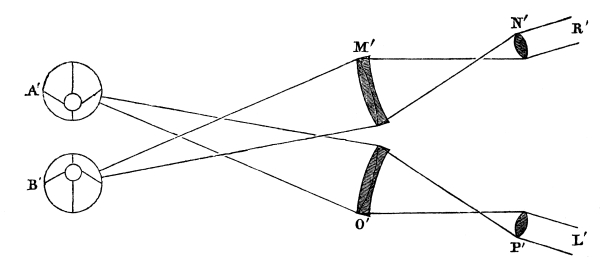
In the paper above referred to, Mr. Wheatstone says,—“I recommend,
as a convenient arrangement of the refracting stereoscope
for viewing Daguerreotypes of small dimensions, the instrument
represented, (Fig. 4,) shortened in its length from 8 inches
to 5, and lenses 5 inches focal distance, placed before and close to the
prisms.”[26]
Although this refracting apparatus, which is simply a
deterioration of the lenticular stereoscope, is recommended by
Mr. Wheatstone, nobody either makes it or uses it. The semi-lenses or
quarter-lenses of the lenticular stereoscope include a virtual and
absolutely perfect prism, and, what is of far more consequence,
each lens is a variable lenticular prism, so that, when the eye-tubes
are placed at different distances, the lenses have different powers
of displacing the pictures. They can thus unite pictures placed at
different distances, which cannot be done by any combination of whole
lenses and prisms.
In the autumn of 1854, after all the facts about the stereoscope
were before the public, and Mr. Wheatstone in full possession of all
the merit of having anticipated Mr. Elliot in the publication of
his stereoscopic apparatus, and of his explanation of the theory of
stereoscopic relief, such as it was, he thought it proper to revive
the controversy by transmitting to the Abbé Moigno, for publication in
Cosmos, an extract of a letter of mine dated 27th September 1838. This
extract was published in the Cosmos of the 15th August 1854,[27]
with the following illogical commentary by the editor.
“Nous avons eu tort mille fois d’accorder à
notre illustre ami, Sir David Brewster, l’invention du stéréoscope
par réfraction. M. Wheatstone, en effet, a mis entre nos mains une
lettre datée, le croirait on, du 27 Septembre 1838, dans lequel nous
avons lû ces mots écrits par l’illustre savant Ecossais: ‘I have also
stated that you promised to order for me your stereoscope, both with
reflectors and PRISMS. J’ai aussi dit (à
Lord Rosse[28])
que vous aviez promis de commander pour moi votre stéréoscope, celui
avec réflecteurs et celui avec prismes.’ Le stéréoscope par réfraction
est donc, aussi bien que le stéréoscope par réflexion, le stéréoscope
de M. Wheatstone, qui l’avait inventé en 1838, et le faisait construire
à cette époque pour Sir David Brewster lui-même. Ce que Sir David
Brewster a imaginée, et c’est une idée très ingénieuse, dont M.
Wheatstone ne lui disputât jamais la gloire, c’est de former les deux
prismes du stéréoscope par réfraction avec les deux moitiés d’une même
lentille.”
That the reader may form a correct idea of the conduct of Mr.
Wheatstone in making this claim indirectly, and in a foreign journal,
whose editor he has willingly misled, I must remind him that I
first saw the reflecting stereoscope at the meeting of the British
Association at Newcastle, in the middle of August 1838. It is
proved by my letter that he and I then conversed on the subject of
prisms, which at that time he had never thought of. I suggested
prisms for displacing the pictures, and Mr. Wheatstone’s natural
reply was, that they must be achromatic prisms. This fact, if
denied, may be proved by various circumstances. His paper of 1838
contains no reference to prisms. If he had suggested the use of prisms
in August 1838, he would have inserted his suggestion in that paper,
which was then unpublished; and if he had only once tried a
prism stereoscope, he never would have used another. On my return
to Scotland, I ordered from Mr. Andrew Ross one of the reflecting
stereoscopes, and one made with achromatic prisms; but my words do not
imply that Mr. Wheatstone was the first person who suggested prisms,
and still less that he ever made or used a stereoscope with prisms.
But however this may be, it is a most extraordinary statement, which
he allows the Abbé Moigno to make, and which, though made a year and a
half ago, he has not enabled the Abbé to correct, that a stereoscope
with prisms was made for me (or for any other person) by Mr.
Ross. I never saw such an instrument, or heard of its being
constructed: I supposed that after our conversation Mr. Wheatstone
might have tried achromatic prisms, and in 1848, when I described my
single prism stereoscope, I stated what I now find is not correct, that
I believed Mr. Wheatstone had used two achromatic prisms.
The following letter from Mr. Andrew Ross will prove the main fact that
he never constructed for me, or for Mr. Wheatstone, any refracting
stereoscope:—
”2, Featherstone Buildings, 28th September 1854.
“Dear Sir,—In reply to yours of the 11th
instant, I beg to state that I never supplied you with a stereoscope in
which prisms were employed in place of plane mirrors. I have a perfect
recollection of being called upon either by yourself or Professor
Wheatstone, some fourteen years since, to make achromatized prisms
for the above instrument. I also recollect that I did not proceed to
manufacture them in consequence of the great bulk of an achromatized
prism, with reference to their power of deviating a ray of light, and
at that period glass sufficiently free from striæ could not readily
be obtained, and was consequently very high-priced.—I remain, &c.
&c.
“Andrew Ross.
“To Sir David Brewster.”
Upon the receipt of this letter I transmitted a copy of it to the Abbé
Moigno, to shew him how he had been misled into the statement, “that
Mr. Wheatstone had caused a stereoscope with prisms to be constructed
for me;” but neither he nor Mr. Wheatstone have felt it their duty to
withdraw that erroneous statement.
In reference to the comments of the Abbé Moigno, it is necessary to
state, that when he wrote them he had in his possession my printed
description of the single-prism, and other stereoscopes,[29]
in which I mention my belief, now proved to be erroneous, that Mr. Wheatstone
had used achromatic prisms, so that he had, on my express authority, the
information which surprised him in my letter. The Abbé also must bear
the responsibility of a glaring misinterpretation of my letter of 1838.
In that letter I say that Mr. Wheatstone promised to order certain
things from Mr. Ross, and the Abbé declares, contrary to the
express terms of the letter, as well as to fact, that these things
were actually constructed for me. The letter, on the contrary, does
not even state that Mr. Wheatstone complied with my request, and it
does not even appear from it that the reflecting stereoscope was made
for me by Mr. Ross.
Such is a brief history of the lenticular stereoscope, of its
introduction into Paris and London, and of its application to
portraiture and sculpture. It is now in general use over the whole
world, and it has been estimated that upwards of half a million
of these instruments have been sold. A Stereoscope Company has
been established in London[30]
for the manufacture and sale of the lenticular stereoscope, and for the
production of binocular pictures for educational and other purposes.
Photographers are now employed in every part of the globe in taking
binocular pictures for the instrument,—among the ruins of Pompeii and
Herculaneum—on the glaciers and in the valleys of Switzerland—among the
public monuments in the Old and the New World—amid the shipping of our
commercial harbours—in the museums of ancient and modern life—in the sacred
precincts of the domestic circle—and among those scenes of the
picturesque and the sublime which are so affectionately associated with
the recollection of our early days, and amid which, even at the close
of life, we renew, with loftier sentiments and nobler aspirations, the
youth of our being, which, in the worlds of the future, is to be the
commencement of a longer and a happier existence.
CHAPTER II. ON MONOCULAR VISION, OR VISION WITH ONE EYE.
In order to understand the theory and construction of the stereoscope
we must be acquainted with the general structure of the eye, with the
mode in which the images of visible objects are formed within it, and
with the laws of vision by means of which we see those objects in
the position which they occupy, that is, in the direction and at the
distance at which they exist.
Every visible object radiates, or throws out in all directions,
particles or rays of light, by means of which we see them either
directly by the images formed in the eye, or indirectly by looking at
images of them formed by their passing through a small hole, or through
a lens placed in a dark room or camera, at the end of which is a
piece of paper or ground-glass to receive the image.
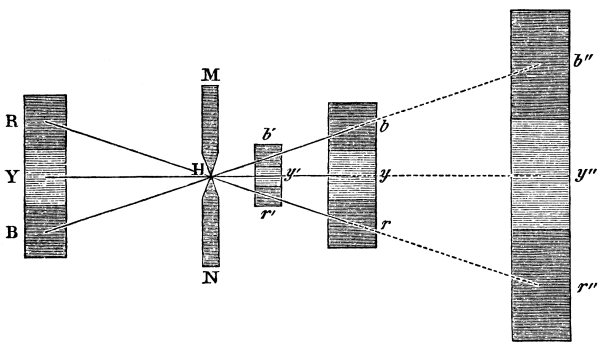
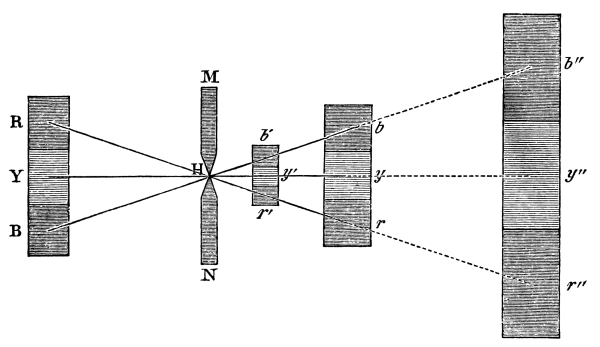
In order to understand this let h be a very small pin-hole in
a shutter or camera, mn, and let ryb be any object
of different colours, the upper part, r, being red,
the middle, y, yellow, and the lower part, b,
blue. If a sheet of white paper, br, is placed behind
the hole h, at the same distance as the object rb is
before it, an image, br, will be formed of the same ray and the
same colours as the object rb. As the particles or rays of
light move in straight lines, a red ray from the middle part
of r will pass through the hole h and illuminate
the point r with red light. In like manner, rays from
the middle points of y and b will pass through
h and illuminate with yellow and blue light
the points y and b. Every other point of the coloured
spaces, r, y, and b,
will, in the same manner, paint itself, as it were, on the paper, and produce a
coloured image, byr, exactly the same in form and colour as the object
ryb. If the hole h is sufficiently small no ray from
any one point of the object will interfere with or mix with any other
ray that falls upon the paper. If the paper is held at half the
distance, at b′y′ for example, a coloured image, b′y′r′,
of half the size, will be formed, and if we hold it at twice the
distance, at b″r″ for example, a coloured image, b″y″r″,
of twice the size, will be painted on the paper.
Fig. 4.
As the hole h is supposed to be so small as to receive
only one ray from every point of the object, the images of the object, viz.,
br, b′r′, b″r″, will be very faint. By widening the
hole h, so as to admit more rays from each luminous point of
rb, the images would become brighter, but they would become
at the same time indistinct, as the rays from one point of the object
would mix with those from adjacent points, and at the boundaries of
the colours r, y, and b,
the one colour would obliterate the other. In order, therefore, to obtain sufficiently
bright images of visible objects we must use lenses, which
have the property of forming distinct images behind them, at a point
called their focus. If we widen the hole h, and place in it a
lens whose focus is at y, for an object at the same distance,
hy, it will form a bright and distinct image, br,
of the same size as the object rb. If we remove the lens,
and place another in h, whose focus is at y′, for
a distance hy, an image, b′r′, half of the size of
rb, will be formed at that point; and if we substitute for
this lens another, whose focus is at y″, a distinct image,
b″r″, twice the size of the object, will be formed,
the size of the image being always to that of the object as their
respective distances from the hole or lens at h.
With the aid of these results, which any person may confirm by making
the experiments, we shall easily understand how we see external
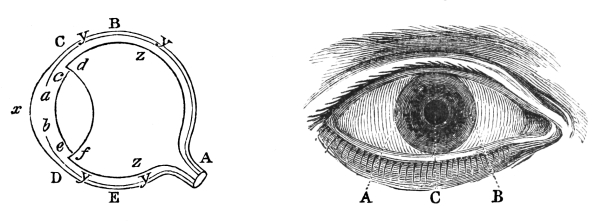
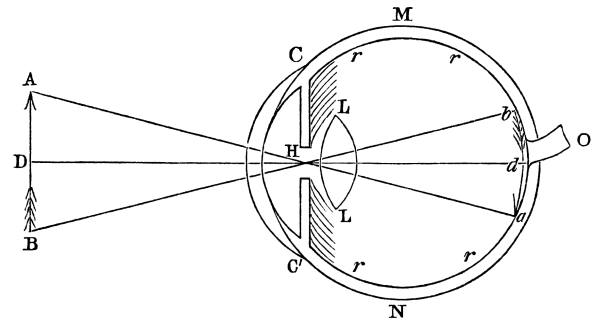
objects by means of the images formed in the eye. The human eye, a
section and a front view of which is shewn in Fig. 5, a,
is almost a sphere. Its outer membrane, abcde, or mno,
Fig. 5, b, consists of a tough substance, and is called
the sclerotic coat, which forms the white of the eye,
a, seen in the front view. The front part of the eyeball,
cxd, which resembles a small
watch-glass, is perfectly transparent, and is called the cornea. Behind it is
the iris, cabe, or c in the front view, which is
a circular disc, with a hole, ab, in its centre, called the
pupil, or black of the eye. It is, as it were, the
window of the eye, through which all the light from visible
objects must pass. The iris has different colours in different
persons, black, blue, or grey; and the pupil,
ab, or h, has the power of contracting or enlarging
its size according as the light which enters it is more or less bright. In
sunlight it is very small, and in twilight its size is considerable.
Behind the iris, and close to it, is a doubly convex lens, df,
or ll in Fig. 5, b, called the crystalline
lens. It is more convex or round on the inner side, and it is
suspended by the ciliary processes at lc, lc′,
by which it is supposed to be moved towards and from h, in
order to accommodate the eye to different distances, or obtain distinct
vision at these distances. At the back of the eye is a thin pulpy
transparent membrane, rrorr, or vvv,
called the retina, which, like the ground-glass of a camera
obscura, receives the images of visible objects. This membrane is an
expansion of the optic nerve o, or a
in Fig. 5, a, which passes to the brain, and,
by a process of which we are ignorant, gives us vision of the objects whose images are formed on
its expanded surface. The globular form of the eye is maintained by two
fluids which fill it,—the aqueous humour, which lies between
the crystalline lens and the cornea, and the vitreous humour,
zz, which fills the back of the eye.
Fig. 5, A.
Fig. 5, B.
But though we are ignorant of the manner in which the mind takes
cognizance through the brain of the images on the retina, and may
probably never know it, we can determine experimentally the laws by
which we obtain, through their images on the retina, a knowledge of the
direction, the position, and the form of external objects.
If the eye mn consisted only of a hollow ball with a
small aperture h, an inverted image, ab, of
any external object ab would be formed on the retina
ror, exactly as in Fig. 4. A ray of light from
a passing through h would strike the
retina at a, and one from b would strike the retina at b.
If the hole h is very small the inverted image ab would
be very distinct, but very obscure. If the hole were the size of the
pupil the image would be sufficiently luminous, but very indistinct. To
remedy this the crystalline lens is placed behind the pupil, and gives
distinctness to the image ab formed in its focus. The image,
however, still remains inverted, a ray from the upper part
a of the object necessarily falling on the lower part
a of the retina, and a ray from the lower part b
of the object upon the upper part b of the retina. Now, it has
been proved by accurate experiments that in whatever direction a ray
aha falls upon the retina, it gives us the vision
of the point a from which it proceeds, or causes us to see
that point, in a direction perpendicular to the retina at a,
the point on which it falls. It has also been proved that the human
eye is nearly spherical, and that a line drawn perpendicular to the
retina from any point a of the image ab will very
nearly pass through the corresponding point a of the object
ab,[31]
so that the point a is, in virtue of this law,
which is called the Law of visible direction, seen in nearly its
true direction.
When we look at any object, ab, for example, we see only one
point of it distinctly. In Fig. 5 the point d only is seen
distinctly, and every point from d to a,
and from d to b, less distinctly. The point
of distinct vision on the retina is at d, corresponding with the point d
of the object which is seen distinctly. This point d is the
centre of the retina at the extremity of the line aha,
called the optical axis of the eye, passing through the centre of the
lens lh, and the centre of the pupil. The point of
distinct vision d corresponds with a small hole in the retina
called the Foramen centrale, or central hole, from its
being in the centre of the membrane. When we wish to see the points
a and b, or any other point of
the object, we turn the eye upon them, so that their image may fall upon the central point
d. This is done so easily and quickly that every point of an
object is seen distinctly in an instant, and we obtain the most perfect
knowledge of its form, colour, and direction. The law of distinct
vision may be thus expressed. Vision is most distinct when it is
performed by the central point of the retina, and the distinctness
decreases with the distance from the central point. It is a curious
fact, however, that the most distinct point d is the least sensitive
to light, and that the sensitiveness increases with the distance
from that point. This is proved by the remarkable fact, that when an
astronomer cannot see a very minute star by looking at it directly
along the optical axis dd, he can see it
by looking away from it, and bringing its image upon a more sensitive
part of the retina.
But though we see with one eye the direction in which any object or
point of an object is situated, we do not see its position, or the
distance from the eye at which it is placed. If a small luminous point
or flame is put into a dark room by another person, we cannot with one
eye form anything like a correct estimate of its distance. Even in good
light we cannot with one eye snuff a candle, or pour wine into a small
glass at arm’s length. In monocular vision, we learn from experience to
estimate all distances, but particularly great ones, by various means,
which are called the criteria of distance; but it is only with
both eyes that we can estimate with anything like accuracy the distance
of objects not far from us.
The criteria of distance, by which we are enabled with one eye
to form an approximate estimate of the distance of objects are five in number.
1. The interposition of numerous objects between the eye and the object
whose distance we are appreciating. A distance at sea appears much
shorter than the same distance on land, marked with houses, trees, and
other objects; and for the same reason, the sun and moon appear more
distant when rising or setting on the horizon of a flat country, than
when in the zenith, or at great altitudes.
2. The variation in the apparent magnitude of known objects, such as
man, animals, trees, doors and windows of houses. If one of two men,
placed at different distances from us, appears only half the size of
the other, we cannot be far wrong in believing that the smallest in
appearance is at twice the distance of the other. It is possible that
the one may be a dwarf, and the other of gigantic stature, in which
case our judgment would be erroneous, but even in this case other
criteria might enable us to correct it.
3. The degree of vivacity in the colours and tints of objects.
4. The degree of distinctness in the outline and minute parts of
objects.
5. To these criteria we may add the sensation of muscular action, or
rather effort, by which we close the pupil in accommodating the eye to
near distances, and produce the accommodation.
With all these means of estimating distances, it is only by binocular
vision, in which we converge the optical axes upon the object, that we
have the power of seeing distance within a limited range.
But this is the only point in which Monocular is inferior to
Binocular vision. In the following respects it is superior to it.
1. When we look at oil paintings, the varnish on their surface reflects
to each eye the light which falls upon it from certain parts of the
room. By closing one eye we shut out the quantity of reflected light
which enters it. Pictures should always be viewed by the eye farthest
from windows or lights in the apartment, as light diminishes the
sensibility of the eye to the red rays.
2. When we view a picture with both eyes, we discover, from the
convergency of the optic axes, that the picture is on a plane surface,
every part of which is nearly equidistant from us. But when we shut one
eye, we do not make this discovery; and therefore the effect with which
the artist gives relief to the painting exercises its whole effect in
deceiving us, and hence, in monocular vision, the relievo of the
painting is much more complete.
This influence over our judgment is beautifully shewn in viewing,
with one eye, photographs either of persons, or landscapes, or solid
objects. After a little practice, the illusion is very perfect, and is
aided by the correct geometrical perspective and chiaroscuro of
the Daguerreotype or Talbotype. To this effect we may give the name
of Monocular Relief, which, as we shall see, is necessarily
inferior to Binocular Relief, when produced by the stereoscope.
3. As it very frequently happens that one eye has not exactly the same
focal length as the other, and that, when it has, the vision by one eye
is less perfect than that by the other, the picture formed by uniting a
perfect with a less perfect picture, or with one of a different size,
must be more imperfect than the single picture formed by one eye.
CHAPTER III. ON BINOCULAR VISION, OR VISION WITH TWO EYES.
We have already seen, in the history of the stereoscope, that in
the binocular vision of objects, each eye sees a different picture
of the same object. In order to prove this, we require only to look
attentively at our own hand held up before us, and observe how some
parts of it disappear upon closing each eye. This experiment proves, at
the same time, in opposition to the opinion of Baptista Porta, Tacquet,
and others, that we always see two pictures of the same object combined
in one. In confirmation of this fact, we have only to push aside one
eye, and observe the image which belongs to it separate from the other,
and again unite with it when the pressure is removed.
It might have been supposed that an object seen by both eyes would be
seen twice as brightly as with one, on the same principle as the light
of two candles combined is twice as bright as the light of one. That
this is not the case has been long known, and Dr. Jurin has proved
by experiments, which we have carefully repeated and found correct,
that the brightness of objects seen with two eyes is only ¹/₁₃th part
greater than when they are seen with one eye.[32]
The cause of this is well known. When both eyes are used, the pupils
of each contract so as to admit the proper quantity of light; but
the moment we shut the right eye, the pupil of the left dilates to
nearly twice its size, to compensate for the loss of light arising
from the shutting of the other.[33]
Fig. 6.
This beautiful provision to supply the proper quantity of light when
we can use only one eye, answers a still more important purpose, which
has escaped the notice of optical writers. In binocular vision, as we
have just seen, certain parts of objects are seen with both eyes, and
certain parts only with one; so that, if the parts seen with both eyes
were twice as bright, or even much brighter than the parts seen with
one, the object would appear spotted, from the different brightness of
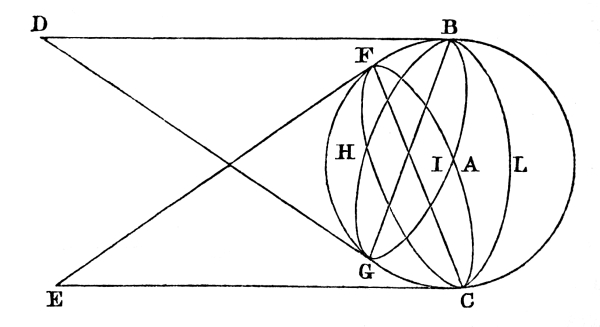
its parts. In Fig. 6, for example, (see p. 14,)
the areas bfi and cgi,
the former of which is seen only by the left eye, d,
and the latter only by the right eye, e,
and the corresponding areas on the other side of the sphere, would be
only half as bright as the portion figh,
seen with both eyes, and the sphere would have a singular appearance.
It has long been, and still is, a vexed question among philosophers,
how we see objects single with two eyes. Baptista Porta, Tacquet, and
others, got over the difficulty by denying the fact, and maintaining
that we use only one eye, while other philosophers of distinguished
eminence have adopted explanations still more groundless. The law of
visible direction supplies us with the true explanation.
Fig. 7.
Let us first suppose that we look with both eyes, r and
l, Fig. 7, upon a luminous point, d,
which we see single, though there is a picture of it on the retina of each eye. In
looking at the point d we turn or converge the optical axes
dhd, d′h′ d, of each eye to the
point d, an image of which is formed at d in the right eye
r, and at d′ in the left eye l.
In virtue of the law of visible direction the point d is seen in the
direction dd with the eye r, and in
the direction d′d with the eye l,
these lines being perpendicular to the retina at the points d, d′.
The one image of the point d is therefore seen lying upon the
other, and consequently seen single. Considering d, then, as a
single point of a visible object ab, the two eyes will see the
points a and b single by the same
process of turning or converging upon them their optical axes, and so quickly
does the point of convergence pass backward and forward over the whole object,
that it appears single, though in reality only one point of it can
be seen single at the same instant. The whole picture of the line
ab, as seen with one eye, seems to coincide
with the whole picture of it as seen with the other, and to appear
single. The same is true of a surface or area, and also of a solid
body or a landscape. Only one point of each is seen single; but we do
not observe that other points are double or indistinct, because the
images of them are upon parts of the retina which do not give distinct
vision, owing to their distance from the foramen or point which
gives distinct vision. Hence we see the reason why distinct vision is
obtained only on one point of the retina. Were it otherwise we should
see every other point double when we look fixedly upon one part of an
object. If in place of two eyes we had a hundred, capable
of converging their optical axes to one point, we should, in virtue of
the law of visible direction, see only one object.
The most important advantage which we derive from the use of two
eyes is to enable us to see distance, or a third dimension in
space. That we have this power has been denied by Dr. Berkeley, and
many distinguished philosophers, who maintain that our perception of
distance is acquired by experience, by means of the criteria already
mentioned. This is undoubtedly true for great distances, but we shall
presently see, from the effects of the stereoscope, that the successive
convergency of the optic axes upon two points of an object at different
distances, exhibits to us the difference of distance when we have no
other possible means of perceiving it. If, for example, we suppose
g, d, Fig. 7, to be separate points, or parts of
an object, whose distances are go, do, then if we
converge the optical axes hg, h′ g upon g,
and next turn them upon D, the points will appear to be
situated at g and d at the distance gd
from each other, and at the distances OG, OD from
the observer, although there is nothing whatever in the appearance of
the points, or in the lights and shades of the object, to indicate
distance. That this vision of distance is not the result of experience
is obvious from the fact that distance is seen as perfectly by children
as by adults; and it has been proved by naturalists that animals newly
born appreciate distances with the greatest correctness. We shall
afterwards see that so infallible is our vision of near distances, that
a body whose real distance we can ascertain by placing both our hands
upon it, will appear at the greater or less distance at which it is
placed by the convergency of the optical axes.
We are now prepared to understand generally, how, in binocular vision,
we see the difference between a picture and a statue, and between a
real landscape and its representation. When we look at a picture of
which every part is nearly at the same distance from the eyes, the
point of convergence of the optical axes is nearly at the same distance
from the eyes; but when we look at its original, whether it be a living
man, a statue, or a landscape, the optical axes are converged in rapid
succession upon the nose, the eyes, and the ears, or upon objects in
the foreground, the middle and the remote distances in the landscape,
and the relative distances of all these points from the eye are
instantly perceived. The binocular relief thus seen is greatly
superior to the monocular relief already described.
Since objects are seen in relief by the apparent union of two
dissimilar plane pictures of them formed in each eye, it was a
supposition hardly to be overlooked, that if we could delineate two
plane pictures of a solid object, as seen dissimilarly with each
eye, and unite their images by the convergency of the optical axes,
we should see the solid of which they were the representation. The
experiment was accordingly made by more than one person, and was found
to succeed; but as few have the power, or rather the art, of thus
converging their optical axes, it became necessary to contrive an
instrument for doing this.
The first contrivances for this purpose were, as we have already
stated, made by Mr. Elliot and Mr. Wheatstone. A description of these,
and of others better fitted for the purpose, will be found in the
following chapter.
CHAPTER IV. DESCRIPTION OF THE OCULAR, THE REFLECTING, AND THE LENTICULAR STEREOSCOPES. — The Ocular Stereoscope. — Description of the Ocular Stereoscope. — Description of the Reflecting Stereoscope. — Description of the Lenticular Stereoscope.
Although it is by the combination of two plane pictures of an object,
as seen by each eye, that we see the object in relief, yet the relief
is not obtained from the mere combination or superposition of the two
dissimilar pictures. The superposition is effected by turning each eye
upon the object, but the relief is given by the play of the optic axes
in uniting, in rapid succession, similar points of the two pictures,
and placing them, for the moment, at the distance from the observer of
the point to which the axes converge. If the eyes were to unite the two
images into one, and to retain their power of distinct vision, while
they lost the power of changing the position of their optic axes, no
relief would be produced.
This is equally true when we unite two dissimilar photographic pictures
by fixing the optic axes on a point nearer to or farther from the eye.
Though the pictures apparently coalesce, yet the relief is given by the
subsequent play of the optic axes varying their angles, and converging
themselves successively upon, and uniting, the similar points in each
picture that correspond to different distances from the observer.
As very few persons have the power of thus uniting, by the eyes alone,
the two dissimilar pictures of the object, the stereoscope has been
contrived to enable them to combine the two pictures, but it is not
the stereoscope, as has been imagined, that gives the relief. The
instrument is merely a substitute for the muscular power which brings
the two pictures together. The relief is produced, as formerly, solely
by the subsequent play of the optic axes. If the relief were the effect
of the apparent union of the pictures, we should see it by looking
with one eye at the combined binocular pictures—an experiment which
could be made by optical means; but we should look for it in vain.
The combined pictures would be as flat as the combination of two
similar pictures. These experiments require to be made with a thorough
knowledge of the subject, for when the eyes are converged on one point
of the combined picture, this point has the relief, or distance from
the eye, corresponding to the angle of the optic axes, and therefore
the adjacent points are, as it were, brought into a sort of indistinct
relief along with it; but the optical reader will see at once that
the true binocular relief cannot be given to any other parts of the
picture, till the axes of the eyes are converged upon them. These
views will be more readily comprehended when we have explained, in a
subsequent chapter, the theory of stereoscopic vision.
We have already stated that objects are seen in perfect relief when
we unite two dissimilar photographic pictures of them, either by
converging the optic axes upon a point so far in front of the pictures
or so far beyond them, that two of the four images are combined.
In both these cases each picture is seen double, and when the two
innermost of the four, thus produced, unite, the original object is
seen in relief. The simplest of these methods is to converge the
optical axes to a point nearer to us than the pictures, and this may
be best done by holding up a finger between the eyes and the pictures,
and placing it at such a distance that, when we see it single, the two
innermost of the four pictures are united. If the finger is held up
near the dissimilar pictures, they will be slightly doubled, the two
images of each overlapping one other; but by bringing the finger nearer
the eye, and seeing it singly and distinctly, the overlapping images
will separate more and more till they unite. We have, therefore, made
our eyes a stereoscope, and we may, with great propriety, call it the
Ocular Stereoscope. If we wish to magnify the picture in relief,
we have only to use convex spectacles, which will produce the requisite
magnifying power; or what is still better, to magnify the united
pictures with a powerful reading-glass. The two single images are hid
by advancing the reading-glass, and the other two pictures are kept
united with a less strain upon the eyes.
As very few people can use their eyes in this manner, some instrumental
auxiliary became necessary, and it appears to us strange that the
simplest method of doing this did not occur to Mr. Elliot and Mr.
Wheatstone, who first thought of giving us the help of an instrument.
By enabling the left eye to place an image of the left-hand picture
upon the right-hand picture, as seen by the naked eye, we should have
obtained a simple instrument, which might be called the Monocular
Stereoscope, and which we shall have occasion to describe. The same
contrivance applied also to the right eye, would make the instrument
Binocular. Another simple contrivance for assisting the eyes
would have been to furnish them with a minute opera-glass, or a small
astronomical telescope about an inch long, which, when held in the hand
or placed in a pyramidal box, would unite the dissimilar pictures with
the greatest facility and perfection. This form of the stereoscope
will be afterwards described under the name of the Opera-Glass
Stereoscope.
Fig. 8.
A stereoscope upon the principle already described, in which the eyes
alone are the agent, was contrived, in 1834, by Mr. Elliot, as we
have already had occasion to state. He placed the binocular pictures,
described in Chapter I., at one end of a box, and without
the aid either of lenses or mirrors, he obtained a landscape in perfect relief.
I have examined this stereoscope, and have given, in Fig. 8, an
accurate though reduced drawing of the binocular pictures executed and
used by Mr. Elliot. I have also united the two original pictures by
the convergency of the optic axes beyond them, and have thus seen the
landscape in true relief. To delineate these binocular pictures upon
stereoscopic principles was a bold undertaking, and establishes, beyond
all controversy, Mr. Elliot’s claim to the invention of the ocular
stereoscope.
If we unite the two pictures in Fig. 8, by converging
the optic axes to a point nearer the eye than the pictures, we shall see
distinctly the stereoscopic relief, the moon being in the remote
distance, the cross in the middle distance, and the stump of a tree in
the foreground.
If we place the two pictures as in Fig. 9, which is the
position they had in Mr. Elliot’s box, and unite them, by looking at a point beyond
them we shall also observe the stereoscopic relief. In this position
Mr. Elliot saw the relief without any effort, and even without being
conscious that he was not viewing the pictures under ordinary vision.
This tendency of the optic axes to a distant convergency is so rare
that I have met with it only in one person.
Fig. 9.
As the relief produced by the union of such imperfect pictures was
sufficient only to shew the correctness of the principle, the friends
to whom Mr. Elliot shewed the instrument thought it of little interest,
and he therefore neither prosecuted the subject, nor published any
account of his contrivance.
Mr. Wheatstone suggested a similar contrivance, without either mirrors
or lenses. In order to unite the pictures by converging the optic axes
to a point between them and the eye, he proposed to place them in a
box to hide the lateral image and assist in making them unite with
the naked eyes. In order to produce the union by looking at a point
beyond the picture, he suggested the use of “a pair of tubes capable
of being inclined to each other at various angles,” the pictures being
placed on a stand in front of the tubes. These contrivances, however,
though auxiliary to the use of the naked eyes, were superseded by the
Reflecting Stereoscope, which we shall now describe.
This form of the stereoscope, which we owe to Mr. Wheatstone,
is shewn in Fig. 10, and is described by him in the following
terms:—“aa′ are two plane mirrors, (whether of glass or metal
is not stated,) about four inches square, inserted in frames, and so
adjusted that their backs form an angle of 90° with each other; these
mirrors are fixed by their common edge against an upright b,
or, which was less easy to represent in the drawing against the middle
of a vertical board, cut away in such a manner as to allow the eyes
to be placed before the two mirrors. c, c′
are two sliding boards, to which are attached the upright boards d,
d′, which may thus be removed to different distances from
the mirrors. In most of the experiments hereafter to be detailed it
is necessary that each upright board shall be at the same distance
from the mirror which is opposite to it. To facilitate this double
adjustment, I employ a right and a left-handed wooden screw, r,
l; the two ends of this compound screw pass through the nuts
e, e′, which are fixed to the lower parts of the upright
boards d, d, so that by turning
the screw pin p one way the two boards will approach, and by turning them
the other they will recede from each other, one always preserving the
same distance as the other from the middle line f; e,
e′ are pannels to which the pictures are fixed in such manner
that their corresponding horizontal lines shall be on the same level;
these pannels are capable of sliding backwards or forwards in grooves
on the upright boards d, d′.
The apparatus having been described, it now remains to explain the manner of using it. The
observer must place his eyes as near as possible to the mirrors, the
right eye before the right-hand mirror, and the left eye before the
left-hand mirror, and he must move the sliding pannels e,
e′ to or from him till the two reflected images coincide at
the intersection of the optic axes, and form an image of the same
apparent magnitude as each of the component pictures. The picture
will, indeed, coincide when the sliding pannels are in a variety of
different positions, and, consequently, when viewed under different
inclinations of the optic axes, but there is only one position in which
the binocular image will be immediately seen single, of its proper
magnitude, and without fatigue to the eyes, because in this position
only the ordinary relations between the magnitude of the pictures on
the retina, the inclination of the optic axes, and the adaptation of
the eye to distinct vision at different distances, are preserved. In
all the experiments detailed in the present memoir I shall suppose
these relations to remain undisturbed, and the optic axes to converge
about six or eight inches before the eyes.
Fig. 10.
“If the pictures are all drawn to be seen with the same inclination of
the optic axes the apparatus may be simplified by omitting the screw
rl, and fixing the upright boards d,
d′ at the proper distance. The sliding
pannels may also be dispensed with, and the drawings themselves be made
to slide in the grooves.”
The figures to which Mr. Wheatstone applied this instrument were pairs
of outline representations of objects of three dimensions, such as a
cube, a cone, the frustum of a square pyramid, which is shewn on one
side of e, e′ in Fig. 10,
and in other figures; and he employed them, as he observes, “for the purpose of
illustration, for had either shading or colouring been introduced it might be supposed
that the effect was wholly or in part due to these circumstances,
whereas, by leaving them out of consideration, no room is left to
doubt that the entire effect of relief is owing to the simultaneous
perception of the two monocular projections, one on each retina.”
“Careful attention,” he adds, “would enable an artist to draw and
paint the two component pictures, so as to present to the mind of the
observer, in the resultant perception, perfect identity with the object
represented. Flowers, crystals, busts, vases, instruments of various
kinds, &c., might thus be represented, so as not to be distinguished
by sight from the real objects themselves.”
This expectation has never been realized, for it is obviously beyond
the reach of the highest art to draw two copies of a flower or a
bust with such accuracy of outline or colour as to produce “perfect
identity,” or anything approaching to it, “with the object represented.”
Photography alone can furnish us with such representations of natural
and artificial objects; and it is singular that neither Mr. Elliot
nor Mr. Wheatstone should have availed themselves of the well-known
photographic process of Mr. Wedgewood and Sir Humphry Davy, which, as
Mr. Wedgewood remarks, wanted only “a method of preventing the unshaded
parts of the delineation from being coloured by exposure to the day, to
render the process as useful as it is elegant.” When the two dissimilar
photographs were taken they could have been used in the stereoscope
in candle-light, or in faint daylight, till they disappeared, or permanent
outlines of them might have been taken and coloured after nature.
Mr. Fox Talbot’s beautiful process of producing permanent photographs
was communicated to the Royal Society in January 1839, but no attempt
was made till some years later to make it available for the stereoscope.
In a chapter on binocular pictures, and the method of executing them
in order to reproduce, with perfect accuracy, the objects which they
represent, we shall recur to this branch of the subject.
Upon obtaining one of these reflecting stereoscopes as made by the
celebrated optician, Mr. Andrew Ross, I found it to be very ill adapted
for the purpose of uniting dissimilar pictures, and to be imperfect in
various respects. Its imperfections may be thus enumerated:—
1. It is a clumsy and unmanageable apparatus, rather than an instrument
for general use. The one constructed for me was 16½ inches long, 6
inches broad, and 8½ inches high.
2. The loss of light occasioned by reflection from the mirrors is
very great. In all optical instruments where images are to be formed,
and light is valuable, mirrors and specula have been discontinued.
Reflecting microscopes have ceased to be used, but large telescopes,
such as those of Sir W. and Sir John Herschel, Lord Rosse, and Mr.
Lassel, were necessarily made on the reflecting principle, from the
impossibility of obtaining plates of glass of sufficient size.
3. In using glass mirrors, of which the reflecting stereoscope is
always made, we not only lose much more than half the light by the
reflections from the glass and the metallic surface, and the absorbing
power of the glass, but the images produced by reflection are made
indistinct by the oblique incidence of the rays, which separates the
image produced by the glass surface from the more brilliant image
produced by the metallic surface.
4. In all reflections, as Sir Isaac Newton states, the errors are
greater than in refraction. With glass mirrors in the stereoscope, we
have four refractions in each mirror, and the light transmitted
through twice the thickness of the glass, which lead to two
sources of error.
5. Owing to the exposure of the eye and every part of the apparatus
to light, the eye itself is unfitted for distinct vision, and
the binocular pictures become indistinct, especially if they are
Daguerreotypes,[34]
by reflecting the light incident from every part of
the room upon their glass or metallic surface.
6. The reflecting stereoscope is inapplicable to the beautiful
binocular slides which are now being taken for the lenticular
stereoscope in every part of the world, and even if we cut in two
those on paper and silver-plate, they would give, in the reflecting
instrument, converse pictures, the right-hand part of the
picture being placed on the left-hand side, and vice versa.
7. With transparent binocular slides cut in two, we could obtain
pictures by reflection that are not converse; but in using them, we
would require to have two lights, one opposite each of the pictures,
which can seldom be obtained in daylight, and which it is inconvenient
to have at night.
Owing to these and other causes, the reflecting stereoscope never came
into use, even after photography was capable of supplying binocular pictures.
As a set-off against these disadvantages, it has been averred that in
the reflecting stereoscope we can use larger pictures, but this, as we
shall shew in a future chapter, is altogether an erroneous assertion.
Having found that the reflecting stereoscope, when intended to produce
accurate results, possessed the defects which I have described, and
was ill fitted for general use, both from its size and its price, it
occurred to me that the union of the dissimilar pictures could be
better effected by means of lenses, and that a considerable magnifying
power would be thus obtained, without any addition to the instrument.
Fig. 11.
If we suppose a, b, Fig. 11,
to be two portraits,—a a portrait of a gentleman,
as seen by the left eye of a person viewing him at the proper distance and in the best
position, and b his portrait as seen by the right eye, the
purpose of the stereoscope is to place these two pictures, or rather
their images, one above the other. The method of doing this by lenses
may be explained, to persons not acquainted with optics, in the
following manner:—
If we look at a with one eye through the centre of
a convex glass, with which we can see it distinctly at the distance
of 6 inches, which is called its focal distance, it will
be seen in its place at a. If we now move the lens from
right to left, the image of a will move towards
b; and when it is seen through the right-hand edge
of the lens, the image of a will have reached the position
c, half-way between a and b.
If we repeat this experiment with the portrait b, and move the lens from
left to right, the image of b will move towards
a; and when it is seen through the left-hand edge
of the lens, the image of b will have reached the position
c. Now, it is obviously by the right-hand half of the
lens that we have transferred the image of a to c,
and by the left-hand half that we have transferred the image
of b to c. If we cut the lens in two,
and place the halves—one in front of each picture at the distance of 2½ inches—in
the same position in which they were when a was transferred
to c and b to c,
they will stand as in Fig. 12, and we shall see the portraits
a and b united
into one at c, and standing out in
beautiful relief,—a result which will be explained in a subsequent chapter.
Fig. 12.
The same effect will be produced by quarter lenses, such as those shewn
in Fig. 13. These lenses are cut into a round or square form, and
placed in tubes, as represented at r, l,
in Fig. 14, which is a drawing of the Lenticular Stereoscope.
Fig. 13.
This instrument consists of a pyramidal box, Fig. 14, blackened
inside, and having a lid, cd, for the admission of light
when required. The top of the box consists of two parts, in one of which is
the right-eye tube, r, containing the lens g,
Fig. 13, and in the other the left-eye tube, l, containing the
lens h. The two parts which hold the lenses, and which form
the top of the box, are often made to slide in grooves, so as to suit
different persons whose eyes, placed at r, l,
are more or less distant. This adjustment may be made by various pieces
of mechanism. The simplest of these is a jointed parallelogram, moved
by a screw forming its longer diagonal, and working in nuts fixed on
the top of the box, so as to separate the semi-lenses, which follow
the movements of the obtuse angles of the parallelogram. The tubes
r, l move up and down, in order
to suit eyes of different focal lengths, but they are prevented from turning round
by a brass pin, which runs in a groove cut through the movable tube.
Immediately below the eye-tubes r, l,
there should be a groove, g, for the introduction of convex or
concave lenses, when required for very long-sighted or short-sighted persons,
or for coloured glasses and other purposes.
Fig. 14.
If we now put the slide ab, Fig. 11, into the horizontal
opening at s, turning up the sneck above s to
prevent it from falling out, and place ourselves behind r,
l, we shall see, by looking through r with the right
eye and l with the left eye, the two images a,
b united in one, and in the same relief as the living person
whom they represent. No portrait ever painted, and no statue ever
carved, approximate in the slightest degree to the living reality now
before us. If we shut the right eye r we see with the left
eye l merely the portrait a,
but it has now sunk into a flat picture, with only monocular relief. By closing
the left eye we shall see merely the portrait b, having,
like the other, only monocular relief, but a relief greater than the
best-painted pictures can possibly have, when seen even with one eye.
When we open both eyes, the two portraits instantly start into all the
roundness and solidity of life.
Many persons experience a difficulty in seeing the portraits single
when they first look into a stereoscope, in consequence of their eyes
having less power than common over their optic axes, or from their
being more or less distant than two and a half inches, the average
distance. The two images thus produced frequently disappear in a few
minutes, though sometimes it requires a little patience and some
practice to see the single image. We have known persons who have lost
the power of uniting the images, in consequence of having discontinued
the use of the instrument for some months; but they have always
acquired it again after a little practice.
If the portraits or other pictures are upon opaque paper or
silver-plate, the stereoscope, which is usually held in the left hand,
must be inclined so as to allow the light of the sky, or any other
light, to illuminate every part of the pictures. If the pictures are on
transparent paper or glass, we must shut the lid cd,
and hold up the stereoscope against the sky or the artificial light, for which
purpose the bottom of the instrument is made of glass finely ground on
the outside, or has two openings, the size of each of the binocular
pictures, covered with fine paper.
In using the stereoscope the observer should always be seated, and it
is very convenient to have the instrument mounted like a telescope,
upon a stand, with a weight and pulley for regulating the motion of the
lid cd.
The lenticular stereoscope may be constructed of various materials
and in different forms. I had them made originally of card-board,
tin-plate, wood, and brass; but wood is certainly the best material
when cheapness is not an object.
Fig. 15.
One of the earliest forms which I adopted was that which is shewn
in Fig. 15, as made by M. Duboscq in Paris, and which may be called
stereoscopic spectacles. The two-eye lenses l,
r are held by the handle h,
so that we can, by moving them to or from the binocular pictures, obtain distinct vision
and unite them in one. The effect, however, is not so good as that which is
produced when the pictures are placed in a box.
The same objection applies to a form otherwise more convenient, which
consists in fixing a cylindrical or square rod of wood or metal to
c, the middle point between l
and r. The binocular slide having a hole
in the middle between the two pictures is moved along this rod to its
proper distance from the lenses
Fig. 16.
Another form, analogous to this, but without the means of moving the
pictures, is shewn in Fig. 16, as made by M. Duboscq. The
adjustment is effected by moving the eye-pieces in their respective tubes,
and by means of a screw-nut, shewn above the eye-pieces, they can be adapted
to eyes placed at different distances from one another. The advantage
of this form, if it is an advantage, consists in allowing us to use
larger pictures than can be admitted into the box-stereoscope of the
usual size. A box-stereoscope, however, of the same size, would have
the same property and other advantages not possessed by the open instrument.
Another form of the lenticular stereoscope, under the name of the
cosmorama stereoscope, has been adopted by Mr. Knight. The box is
rectangular instead of pyramidal, and the adjustment to distinct vision
is made by pulling out or pushing in a part of the box, instead of the
common and better method of moving each lens separately. The
illumination of the pictures is made in the same manner as in the
French instrument, called the cosmorama, for exhibiting dissolving
views. The lenses are large in surface, which, without any reason, is
supposed to facilitate the view of the binocular pictures, and the
instrument is supported in a horizontal position upon a stand. There
is no contrivance for adjusting the distance of the lenses to the
distance between the eyes, and owing to the quantity of light which
gets into the interior of the box, the stereoscopic picture is injured
by false reflections, and the sensibility of the eyes diminished. The
exclusion of all light from the eyes, and of every other light from the
picture but that which illuminates it, is essentially necessary to the
perfection of stereoscopic vision.
When by means of any of these instruments we have succeeded in forming
a single image of the two pictures, we have only, as I have already
explained, placed the one picture above the other, in so far as the
stereoscope is concerned. It is by the subsequent action of the two
eyes that we obtain the desired relief. Were we to unite the two
pictures when transparent, and take a copy of the combination by the
best possible camera, the result would be a blurred picture, in which
none of the points or lines of the one would be united with the points
or lines of the other; but were we to look at the combination with both
eyes the blurred picture would start into relief, the eyes uniting in
succession the separate points and lines of which it is composed.
Now, since, in the stereoscope, when looked into with two eyes, we see
the picture in relief with the same accuracy as, in ordinary binocular
vision, we see the same object in relief by uniting on the retina two
pictures exactly the same as the binocular ones, the mere statement of
this fact has been regarded as the theory of the stereoscope. We shall
see, however, that it is not, and that it remains to be explained, more
minutely than we have done in Chapter III., both how we see objects
in relief in ordinary binocular vision, and how we see them in the
same relief by uniting ocularly, or in the stereoscope, two dissimilar
images of them.
Before proceeding, however, to this subject, we must explain the manner
in which half and quarter lenses unite the two dissimilar pictures.
Fig. 17.
In Fig. 17 is shewn a semi-lens mn, with its section
m′n′. If we look at any object successively through
the portions aa′a″ in the semi-lens mn, corresponding
to aa′a″ in the section m′n′, which is the same as in
a quarter-lens, the object will be magnified equally in all of them,
but it will be more displaced, or more refracted, towards n,
by looking through a′ or a′ than through a or
a, and most of all by looking through a″ or a″,
the refraction being greatest at a″ or a″, less at
a′ or a′, and still less at a or a.
By means of a semi-lens, or a quarter of a lens of the size of
mn, we can, with an aperture of the size of a, obtain
three different degrees of displacement or refraction, without any
change of the magnifying power.
If we use a thicker lens, as shewn at m′n′nm, keeping
the curvature of the surface the same, we increase the refracting
angle at its margin n′n, we can produce any degree of
displacement we require, either for the purposes of experiment, or for
the duplication of large binocular pictures.
When two half or quarter lenses are used as a stereoscope, the
displacement of the two pictures is produced in the manner shewn in
Fig. 18, where ll is the lens for the left eye e,
and l′l′ that for the right eye e′, placed so that
the middle points, no, n′o′, of each are 2½ inches
distant, like the two eyes. The two binocular pictures which are to
be united are shewn at ab, ab, and placed at nearly
the same distance. The pictures being fixed in the focus of the
lenses, the pencils ano, a′n′o′, bno,
b′n′o′, will be refracted at the points n,
o, n′, o′, and at their points of incidence on
the second surface, so as to enter the eyes, e, e′,
in parallel directions, though not shewn in the Figure. The points
a, a, of one of the pictures, will therefore be seen
distinctly in the direction of the refracted ray—that is, the pencils
an, ao, issuing from a′, will be seen as if they
came from a′, and the pencils bn, bo, as if
they came from b′, so that ab will be transferred by
refraction to a′b′. In like manner, the picture ab will
be transferred by refraction to a′b′, and thus united with
a′b′.
Fig. 18.
The pictures ab, ab thus united are merely circles,
and will therefore be seen as a single circle at a′b′. But
if we suppose ab to be the base of the frustum of a cone,
and cd its summit, as seen by the left eye, and the circles
ab, cd to represent the base and
summit of the same solid as seen by the right eye, then it is obvious that when
the pictures of cd and cd are similarly displaced or
refracted by the lenses lll′l′, so that cc′
is equal to aa′ and dd′
to bb′, the circles will not be united, but will overlap one another
as at c′d′, c′d′, in consequence of being carried
beyond their place of union. The eyes, however, will instantly
unite them into one by converging their axes to a remoter point,
and the united circles will rise from the paper, or from the base
a′b′, and place the single circle at the point of
convergence, as the summit of the frustum of a hollow cone whose base is
a′b′. If cd, cd had been farther
from one another than ab, ab, as in
Figs. 20 and 21,
they would still have overlapped though not carried up to their place of
union. The eyes, however, will instantly unite them by converging their
axes to a nearer point, and the united circles will rise from
the paper, or from the base ab, and form the summit of the
frustum of a raised cone whose base is a′b′.
In the preceding illustration we have supposed the solid to consist
only of a base and a summit, or of parts at two different
distances from the eye; but what is true of two distances is true of
any number, and the instant that the two pictures are combined by the
lenses they will exhibit in relief the body which they represent. If
the pictures are refracted too little, or if they are refracted too
much, so as not to be united, their tendency to unite is so great,
that they are soon brought together by the increased or diminished
convergency of the optic axes, and the stereoscopic effect is produced.
Whenever two pictures are seen, no relief is visible; when only one
picture is distinctly seen, the relief must be complete.
In the preceding diagram we have not shewn the refraction at the second
surface of the lenses, nor the parallelism of the rays when they enter
the eye,—facts well known in elementary optics.
CHAPTER V. ON THE THEORY OF STEREOSCOPIC VISION.
Having, in the preceding chapter, described the ocular, the reflecting,
and the lenticular stereoscopes, and explained the manner in which the
two binocular pictures are combined or laid upon one another in the
last of these instruments, we shall now proceed to consider the theory
of stereoscopic vision.
Fig. 19.
In order to understand how the two pictures, when placed the one above
the other, rise into relief, we must first explain the manner in
which a solid object itself is, in ordinary vision, seen in relief,
and we shall then shew how this process takes place in the two
forms of the ocular stereoscope, and in the lenticular stereoscope.
For this purpose, let abcd, Fig. 19,
be a section of the frustum of a cone, that is, a cone with its top cut off by a plane
cedg, and having
aebg for its base. In order that the figure may not be complicated,
it will be sufficient to consider how we see, with two eyes, l and
r, the cone as projected upon a plane passing through its
summit cedg. The points l,
r being the points of sight, draw the lines ra,
rb, which will cut the plane on which the projection is to be
made in the points a, b, so that ab will represent
the line ab, and a circle, whose diameter is ab, will
represent the base of the cone, as seen by the right eye r. In
like manner, by drawing la, lb, we shall find that
a′b′ will represent the line ab, and a circle, whose
diameter is a′b′, the base aebg, as seen by the left
eye. The summit, cedg, of the frustum
being in the plane of projection, will be represented by the circle
cedg. The representation of the frustum
abcd, therefore, upon a plane surface, as seen by the left eye
l, consists of two circles, whose diameters are ab,
cd; and, as seen by the right eye, of other two circles,
whose diameters are ab, cd, which, in Fig. 20, are
represented by ab, cd, and ab, cd.
These plane figures being also the representation of the solid on the
retina of the two eyes, how comes it that we see the solid and not the
plane pictures? When we look at the point b, Fig. 19, with
both eyes, we converge upon it the optic axes lb, rb,
and we therefore see the point single, and at the distances
lb, rb from each eye. When we look at the point
d, we withdraw the optic axes from b, and converge
them upon d. We therefore see the point d single, and
at the distances ld, rd from each eye; and in like
manner the eyes run over the whole solid, seeing every point single and
distinct upon which they converge their axes, and at the distance of
the point of convergence from the observer. During this rapid survey
of the object, the whole of it is seen distinctly as a solid, although
every point of it is seen double and indistinct, excepting the point
upon which the axes are for the instant converged.
Fig. 20.
From these observations it is obvious, that when we look with both eyes
at any solid or body in relief, we see more of the right side of it
by the right eye, and more of the left side of it by the left eye.
The right side of the frustum abcd, Fig. 19, is represented
by the line db, as seen by the right eye, and by the
shorter line db′, as seen by the left eye. In like manner, the
left side ac is represented by ca′,
as seen by the left eye, and by the shorter line ca′,
as seen by the right eye.
When the body is hollow, like a wine glass, we see more of the
right side with the left eye, and more of the left side with the right eye.
If we now separate, as in Fig. 20, the two projections shewn together
on Fig. 19, we shall see that the two summits, cd, cd,
of the frustum are farther from one another than the more distant
bases, ab, ab, and it is true generally that in the
two pictures of any solid in relief, the similar parts that are near
the observer are more distant in the two pictures than the remoter
parts, when the plane of perspective is beyond the object. In
the binocular picture of the human face the distance between the two
noses is greater than the distance between the two right or left eyes,
and the distance between the two right or left eyes greater than the
distance between the two remoter ears.
We are now in a condition to explain the process by which, with the
eyes alone, we can see a solid in relief by uniting the right and left
eye pictures of it,—or the theory ocular stereoscope. In order to
obtain the proper relief we must place the right eye picture on the
left side, and the left eye picture on the right side, as shewn in Fig.21,
by the pictures abcd, abcd, of the
frustum of a cone, as obtained from Fig. 19.
Fig. 21.
In order to unite these two dissimilar projections, we must converge
the optical axes to a point nearer the observer, or look at some point
about m. Both pictures will immediately be doubled. An image
of the figure ab will advance towards p, and an image
of ab will likewise advance towards p;
and the instant these images are united, the frustum of a cone, which they
represent, will appear in relief at mn, the place where the
optic axes meet or cross each other. At first the solid figure will
appear in the middle, between the two pictures from which it is formed
and of the same size, but after some practice it will appear smaller
and nearer the eye. Its smallness is an optical illusion, as it has
the same angle of apparent magnitude as the plane figures, namely,
mnl = abl;
but its position at mn
is a reality, for if we look at the point of our finger held beyond
m the solid figure will be seen nearer the eye. The
difficulty which we experience in seeing it of the size and in the position
shewn in Fig. 21, arises from its being seen along with its
two plane representations, as we shall prove experimentally when we treat in a
future chapter of the union of similar figures by the eye.
The two images being thus superimposed, or united, we shall now see
that the combined images are seen in relief in the very same way that
in ordinary vision we saw the real solid, abcd, Fig. 19,
in relief, by the union of the two pictures of it on the retina. From the
points a, b, c, d, a, b, c, d, draw lines to l
and r, the centres of visible direction of each eye, and it
will be seen that the circles ab, ab, representing
the base of the cone, can be united by converging the optical axes
to points in the line mn, and that the circles cd,
cd, which are more distant, can be united only by converging
the optic axes to points in the line op. The points a,
a, for example, united by converging the axes to m, are
seen at that point single; the points b, b at n
single, the points c, c at o single, the points
d, d at p single, the centres s,
s of the base at m single, and the centres s′,
s′ of the summit plane at n single. Hence the eyes
l and r see the combined pictures
at mn in relief, exactly in the same manner as they saw in relief
the original solid mn in Fig. 19.
In order to find the height mn of the conical frustum
thus seen, let d = distance op; d =
ss, the distance of the two points united at
m; d′ = s′s′, the distance of the two
points united at n; and c = lr = 2½ inches,
the distance of the eyes. Then we have—
MP =
Dd
C + d
NP =
Dd′
,
and
C + d′
MN =
Dd
-
Dd′
C + d
C + d′
IfD =
9.24 inches,
C =
2.50, then
d =
2.14
d′ =
2.42, and
MN =
0.283, the height of the cone.
WhenC = d,MP =
DC
2C
As the summit plane op rises above the base mn by the
successive convergency of the optic axes to different points in the
line onp, it may be asked how it
happens that the conical frustum still appears a solid, and the plane op
where it is, when the optic axes are converged to points in the line
mmn, so as to see the base distinctly?
The reason of this is that the rays emanate from op exactly in the
same manner, and form exactly the same image of it, on the two retinas
as if it were the summit cd, Fig. 19,
of the real solid when seen with both eyes. The only effect of the advance of the point
of convergence from n to m
is to throw the image of n a little to
the right side of the optic axis of the left eye, and a little
to the left of the optic axis of the right eye. The summit plane
op will therefore retain its place, and will be seen slightly
doubled and indistinct till the point of convergence again returns to it.
It has been already stated that the two dissimilar pictures may be
united by converging the optical axes to a point beyond them. In order
to do this, the distance ss′ of the pictures, Fig. 21,
must be greatly less than the distance of the eyes l, r,
in order that the optic axes, in passing through similar points of the
two plane pictures, may meet at a moderate distance beyond them. In
order to explain how the relief is produced in this case, let ab,
cd, ab, cd, Fig. 22, be the dissimilar pictures
of the frustum of a cone whose summit is cd, as seen by the
right eye, and cd as seen by the left eye. From l
and r, as before, draw lines through all the leading points
of the pictures, and we shall have the points a, a
united at m, the points b, b at n, the
points c, c at o, and the points d,
d at p, the points s, s at m,
and the points s′, s′ at n, forming the cone
mnop, with its base mn towards the observer, and its
summit op more remote. If the cone had been formed of lines
drawn from the outline of the summit to the outline of the base, it
would now appear hollow, the inside of it being seen in place
of the outside as before. If the pictures ab, ab
are made to change places the combined picture would be in relief, while
in the case shewn in Fig. 21 it would have been hollow.
Hence the right-eye view of any solid must be placed on the left
hand, and the left-eye view of it on the right hand, when
we wish to obtain it in relief by converging the optic axes to a point
between the pictures and the eye, and vice versa when we wish to
obtain it in relief by converging the optic axes to a point beyond the
pictures. In every case when we wish the combined pictures to represent
a hollow, or the converse of relief, their places must be exchanged.
Fig. 22.
In order to find the height mn, or rather the depth of the
cone in Fig. 22, let d, d, c,
c, represent the same quantities as before, and we shall have
MP =
Dd
C - d
NP =
Dd′
,
and
C - d′
OP =
Dd′
-
Dd
C - d′
C - d
When d, c, d, d′ have the same values
as before, we shall have MN = 18·7 feet!
When c = d, mp will be infinite.
We have already explained how the two binocular pictures are
combined or laid upon one another in the lenticular stereoscope.
Let us now see how the relief is obtained. The two plane pictures
abcd, abcd, in Fig. 18,
are, as we have already explained, combined or simply laid upon one another by the
lenses ll, l′l′, and in this state are shewn
by the middle circles at aabb,
ccdd. The images of the bases
ab, ab of the cone are accurately united in the double
base ab, ab, but the summits of the conical frustum
remain separate, as seen at c′d′, c′d′. It is now the
business of the eyes to unite these, or rather to make them appear as
united. We have already seen how they are brought into relief when
the summits are refracted so as to pass one another, as in Fig. 18.
Let us therefore take the case shewn in Fig. 20, where the summits
cd, cd are more distant than the bases ab,
ab. The union of these figures is instantly effected, as shewn
in Fig. 23, by converging the optic axes to points m and
n successively, and thus uniting c and c and
d and d, and making these points of the summit plane
appear at m and n, the points of convergence of the
axes lm, rm, and
ln, rn.
In like manner, every pair of points in the summit plane, and in the sides
am, bn
of the frustum, are converged to points corresponding to their distance from
the base ab of the original solid frustum, from which the plane
pictures abcd, abcd, were taken. We shall,
therefore, see in relief the frustum of a cone whose section is
amnb.
Fig. 23.
The theory of the stereoscope may be expressed and illustrated in the
following manner, without any reference to binocular vision:—
1. When a drawing of any object or series of objects is executed on
a plane surface from one point of sight, according to the
principles of geometrical perspective, every point of its surface that
is visible from the point of sight will be represented on the plane.
2. If another drawing of the same object or series of objects is
similarly executed on the same plane from a second point of
sight, sufficiently distant from the first to make the two drawings
separate without overlapping, every point of its surface visible from
this second point of sight will also be represented on the plane, so
that we shall have two different drawings of the object placed, at a
short distance from each other, on the same plane.
Fig. 24.
3. Calling these different points of the object 1, 2, 3, 4, &c., it will be seen from
Fig. 24, in which l, r are the two
points of sight, that the distances 1, 1, on the plane mn, of any pair of points in the two
pictures representing the point 1 of the object, will be to
the distance of any other pair 2, 2, representing the point 2,
as the distances 1′p, 2′
p of the points of the object from the plane
mn, multiplied inversely by the distances of
these points from the points of sight l,
r, or the middle point o between them.
4. If the sculptor, therefore, or the architect, or the mechanist, or
the surveyor, possesses two such pictures, either as drawn by a skilful
artist or taken photographically, he can, by measuring the distances of
every pair of points, obtain the relief or prominence of the original
point, or its distance from the plane mn or
ab; and without the use of the stereoscope,
the sculptor may model the object from its plane picture, and the
distances of every point from a given plane. In like manner, the other
artists may determine distances in buildings, in machinery, and in the field.
5. If the distance of the points of sight is equal to the distance of
the eyes l, r, the two plane
pictures may be united and raised into relief by the stereoscope, and thus give the sculptor
and other artists an accurate model, from which they will derive
additional aid in the execution of their work.
6. In stereoscopic vision, therefore, when we join the points 1, 1 by
converging the optic axes to 1′ in the line pq, and the points
2, 2 by converging them to 2′ in the same line, we place these points
at the distances o1, oO2,
and see the relief, or the various differences of distance which the sculptor
and others obtained by the method which we have described.
7. Hence we infer, that if the stereoscopic vision of relief had never
been thought of, the principles of the instrument are involved in the
geometrical relief which is embodied in the two pictures of an object
taken from two points of sight, and in the prominence of every part of
it obtained geometrically.
CHAPTER VI. ON THE UNION OF SIMILAR PICTURES IN BINOCULAR VISION.
In uniting by the convergency of the optic axes two dissimilar
pictures, as shewn in Fig. 18, the solid cone mn ought to
appear at mn much nearer the observer than the pictures which
compose it. I found, however, that it never took its right position in
absolute space, the base mn of the solid seeming to rest on
the same plane with its constituent pictures ab, ab,
whether it was seen by converging the axes as in Fig. 18 or in
Fig. 22. Upon inquiring into the reason of this I found that
the disturbing cause was simply the simultaneous perception of other objects in the
same field of view whose distance was known to the observer.
In order to avoid all such influences I made experiments on large
surfaces covered with similar plane figures, such as flowers or
geometrical patterns upon paper-hangings and carpets. These figures
being always at equal distances from each other, and almost perfectly
equal and similar, the coalescence of any pair of them, effected by
directing the optic axes to a point between the paper-hanging and the
eye, is accompanied by the instantaneous coalescence of them all. If
we, therefore, look at a papered wall without pictures, or doors, or
windows, or even at a considerable portion of a wall, at the distance
of three feet, and unite two of the figures,—two flowers, for example,
at the distance of twelve inches from each other horizontally, the
whole wall or visible portion of it will appear covered with flowers as
before, but as each flower is now composed of two flowers united at the
point of convergence of the optic axes, the whole papered wall with
all its flowers will be seen suspended in the air at the distance of
six inches from the observer! At first the observer does not decide
upon the distance of the suspended wall from himself. It generally
advances slowly to its new position, and when it has taken its place it
has a very singular character. The surface of it seems slightly curved.
It has a silvery transparent aspect. It is more beautiful than the real
paper, which is no longer seen, and it moves with the slightest motion
of the head. If the observer, who is now three feet from the wall,
retires from it, the suspended wall of flowers will follow him, moving
farther and farther from the real wall, and also, but very slightly,
farther and farther from the observer. When he stands still, he may
stretch out his hand and place it on the other side of the suspended
wall, and even hold a candle on the other side of it to satisfy himself
that the ghost of the wall stands between the candle and himself.
In looking attentively at this strange picture some of the flowers have
the aspect of real flowers. In some the stalk retires from the plane of
the picture. In others it rises from it. One leaf will come farther out
than another. One coloured portion, red, for example, will be
more prominent than the blue, and the flower will thus appear
thicker and more solid, like a real flower compressed, and deviating
considerably from the plane representation of it as seen by one eye.
All this arises from slight and accidental differences of distance in
similar or corresponding parts of the united figures. If the distance,
for example, between two corresponding leaves is greater than the
distance between other two corresponding leaves, then the two first
when united will appear nearer the eye than the other two, and hence
the appearance of a flower in low relief, is given to the combination.
In continuing our survey of the suspended image another curious
phenomenon often presents itself. A part of one, or even two pieces
of paper, and generally the whole length of them from the roof to
the floor, will retire behind the general plane of the image, as if
there were a recess in the wall, or rise above it as if there were a
projection, thus displaying on a large scale the imperfection in the
workmanship which otherwise it would have been difficult to discover.
This phenomenon, or defect in the work, arises from the paper-hanger
having cut off too much of the margin of one or more of the adjacent
stripes or pieces, or leaving too much of it, so that, in the first
case, when the two halves of a flower are joined together, part of
the middle of the flower is left out, and hence, when this defective
flower is united binocularly with the one on the right hand of it, and
the one on the left hand united with the defective one, the united or
corresponding portion being at a less distance, will appear farther
from the eye than those parts of the suspended image which are composed
of complete flowers. The opposite effect will be produced when the
two portions of the flowers are not brought together, but separated
by a small space. All these phenomena may be seen, though not so
conveniently, with a carpet from which the furniture has been removed.
We have, therefore, an accurate method of discovering defects in the
workmanship of paper-hangers, carpet-makers, painters, and all artists
whose profession it is to combine a series of similar patterns or
figures to form an uniformly ornamented surface. The smallest defect
in the similarity or equality of the figures or lines which compose
a pattern, and any difference in the distance of single figures is
instantly detected, and what is very remarkable a small inequality
of distance in a line perpendicular to the axis of vision, or in one
dimension of space, is exhibited in a magnified form at a distance
coincident with the axis of vision, and in an opposite dimension of
space.
A little practice will enable the observer to realize and to maintain
the singular binocular vision which replaces the real picture.[35]
The occasional retention of the picture after one eye is closed, and even
after both have been closed and quickly reopened, shews the influence
of time over the evanescence as well as over the creation of this class
of phenomena. On some occasions, a singular effect is produced. When
the flowers or figures on the paper are distant six inches,
we may either unite two six inches distant, or two twelve
inches distant, and so on. In the latter case, when the eyes have been
accustomed to survey the suspended picture, I have found that, after
shutting or opening them, I neither saw the picture formed by the two
flowers twelve inches distant, nor the papered wall itself, but
a picture formed by uniting all the flowers six inches distant!
The binocular centre (the point to which the optic axes converged,
and consequently the locality of the picture) had shifted its place,
and instead of advancing to the real wall and seeing it, it advanced
exactly as much as to unite the nearest flowers, just as in a ratchet
wheel, when the detent stops one tooth at a time; or, to speak more
correctly, the binocular centre advanced in order to relieve the eyes
from their strain, and when the eyes were opened, it had just reached
that point which corresponded with the union of the flowers six
inches distant.
Fig. 25.
We have already seen, as shewn in Fig. 22, that when we
fix the binocular centre, that is, converge the optic axes on a point beyond
the dissimilar pictures, so as to unite them, they rise into relief
as perfectly as when the binocular centre, as shewn in Fig. 18,
is fixed between the pictures used and the eye. In like manner we may
unite similar pictures, but, owing to the opacity of the wall and the
floor, we cannot accomplish this with paper-hangings and carpets.
The experiment, however, may be made with great effect by looking
through transparent patterns cut out of paper or metal, such as those
in zinc which are used for larders and other purposes. Particular
kinds of trellis-work, and windows with small squares or rhombs of
glass, may also be used, and, what is still better, a screen might be
prepared, by cutting out the small figures from one or more pieces of
paper-hangings. The readiest means, however, of making the experiment,
is to use the cane bottom of a chair, which often exhibits a succession
of octagons with small luminous spaces between them. To do this, place
the back of the chair upon a table, the height of the eye either when
sitting or standing, so that the cane bottom with its luminous pattern
may have a vertical position, as shewn in Fig. 25, where
mn is the real bottom of the chair with its openings,
which generally vary from half an inch to three-fourths. Supposing the distance
to be half an inch, and the eyes, l, r, of the
observer 12 inches distant from mn, let lad,
lbe be lines drawn through the centres of two
of the open spaces a, b, and rbd,
rce lines drawn through the centres of b and
c, and meeting lad, lbe
at d and e, d being the binocular centre to which the optic
axes converge when we look at it through a and b, and
c the binocular centre when we look at it through b and
c. Now, the right eye, r, sees the opening b
at d, and the left eye sees the opening a at d,
so that the image at d of the opening consists of the similar
images of a and b united, and so on with all the rest; so
that the observer at l, r no longer sees
the real pattern mn, but an image of it suspended at mn, three
inches behind mn. If the observer now approaches mn,
the image mn will approach to him, and if he recedes, mn
will recede also, being 1½ inches behind mn when the observer
is six inches before it, and twelve inches behind
mn when the observer is forty-eight inches before it,
the image mn moving from mn with a velocity one-fourth of
that with which the observer recedes.
The observer resuming the position in the figure where his eyes,
l, r, are twelve inches distant
from mn, let us consider the important results of this experiment.
If he now grasps the cane bottom at mn, his thumbs pressing
upon mn, and his fingers trying to grasp mn, he will
then feel what he does not see, and see what he does not
feel! The real pattern is absolutely invisible at mn,
where he feels it, and it stands fixed at mn. The fingers may
be passed through and through between the real and the false image,
and beyond it,—now seen on this side of it, now in the middle of it,
and now on the other side of it. If we next place the palms of each
hand upon mn, the real bottom of the chair, feeling
it all over, the result will be the same. No knowledge derived from touch—no
measurement of real distance—no actual demonstration from previous
or subsequent vision, that there is a real solid body at mn,
and nothing at all at mn, will remove or shake the infallible
conviction of the sense of sight that the cane bottom is at mn,
and that dl or dr
is its real distance from the observer. If the binocular centre be now drawn back to
mn, the image seen at mn will disappear, and the
real object be seen and felt atmn. If the binocular
centre be brought further back to f, that is, if the optic
axes are converged to a point nearer the observer than the object,
as illustrated by Fig. 18, the cane bottom mn will again
disappear, and will be seen at uv, as previously explained.
This method of uniting small similar figures is more easily attained
than that of doing it by converging the axes to a point between the
eye and the object. It puts a very little strain upon the eyes, as we
cannot thus unite figures the distance of whose centre is equal to or
exceeds 2½ inches, as appears from Fig. 22.
In making these experiments, the observer cannot fail to be struck with
the remarkable fact, that though the openings mn, mn,
uv, have all the same apparent or angular magnitude, that is,
subtend the same angle at the eye, viz., dlc,
dre, yet those at mn appear larger, and
those at uv smaller, than those at mn. If we cause the
image mn to recede and approach to us, the figures in mn
will invariably increase as they recede, and those in uv
diminish as they approach the eye, and their visual magnitudes,
as we may call them, will depend on the respective distances at which
the observer, whether right or wrong in his estimate, conceives them to
be placed,—a result which is finely illustrated by the different size
of the moon when seen in the horizon and in the meridian. The fact now
stated is a general one, which the preceding experiments demonstrate;
and though our estimate of magnitude thus formed is erroneous, yet it
is one which neither reason nor experience is able to correct.
It is a curious circumstance, that, previous to the publication of
these experiments, no examples have been recorded of false estimates of
the distance of near objects in consequence of the accidental
binocular union of similar images. In a room where the paper-hangings
have a small pattern, a short-sighted person might very readily turn
his eyes on the wall when their axes converged to some point between
him and the wall, which would unite one pair of the similar images,
and in this case he would see the wall nearer him than the real wall,
and moving with the motion of his head. In like manner a long-sighted
person, with his optical axes converged to a point beyond the wall,
might see an image of the wall more distant, and moving with the motion
of his head; or a person who has taken too much wine, which often fixes
the optical axes in opposition to the will, might, according to the
nature of his sight, witness either of the illusions above mentioned.
Illusions of both these kinds, however, have recently occurred. A
friend to whom I had occasion to shew the experiments, and who is
short-sighted, mentioned to me that he had on two occasions been
greatly perplexed by the vision of these suspended images. Having taken
too much wine, he saw the wall of a papered room suspended near him in
the air; and on another occasion, when kneeling, and resting his arms
on a cane-bottomed chair, he had fixed his eyes on the carpet, which
had accidentally united the two images of the open octagons, and thrown
the image of the chair bottom beyond the plane on which he rested his arms.
After hearing my paper on this subject read at the Royal Society of
Edinburgh, Professor Christison communicated to me the following
interesting case, in which one of the phenomena above described was
seen by himself:—“Some years ago,” he observes, “when I resided in a
house where several rooms are papered with rather formally recurring
patterns, and one in particular with stars only, I used occasionally
to be much plagued with the wall suddenly standing out upon me,
and waving, as you describe, with the movements of the head. I was
sensible that the cause was an error as to the point of union of the
visual axes of the two eyes; but I remember it sometimes cost me a
considerable effort to rectify the error; and I found that the best
way was to increase still more the deviation in the first instance. As
this accident occurred most frequently while I was recovering from a
severe attack of fever, I thought my near-sighted eyes were threatened
with some new mischief; and this opinion was justified in finding that,
after removal to my present house, where, however, the papers have
no very formal pattern, no such occurrence has ever taken place. The
reason is now easily understood from your researches.”[36]
Other cases of an analogous kind have been communicated to me; and
very recently M. Soret of Geneva, in looking through a trellis-work in
metal stretched upon a frame, saw the phenomenon represented in Fig. 25,
and has given the same explanation of it which I had published long
before.[37]
Before quitting the subject of the binocular union of similar
pictures, I must give some account of a series of curious phenomena
which I observed by uniting the images of lines meeting at an angular
point when the eye is placed at different heights above the plane of
the paper, and at different distances from the angular point.
Fig. 26.
Let ac, bc,
Fig. 26, be two lines meeting at c,
the plane passing through them being the plane of the
paper, and let them be viewed by the eyes successively placed at
e‴, e″, e′, and e, at different heights in a plane,
gmn, perpendicular to the plane of the paper. Let r
be the right eye, and l the left eye, and when at e‴,
let them be strained so as to unite the points a, b. The
united image of these points will be seen at the binocular centre
d‴, and the united lines ac, bc, will have the
position d‴c. In like manner, when the eye descends to e″,
e′, e, the united image d‴c will rise and diminish,
taking the positions d″c, d′c, dc, till it disappears
on the line cm, when the eyes reach m. If the eye
deviates from the vertical plane gmn, the united image will
also deviate from it, and is always in a plane passing through the
common axis of the two eyes and the line gm.
If at any altitude em, the eye advances towards acb
in the line eg, the binocular centre d will also
advance towards acb in the line eg, and the image
dc will rise, and become shorter as its extremity d
moves along dg, and, after passing the perpendicular to
ge, it will increase in length. If the eye, on the other hand,
recedes from acb in the line ge, the binocular centre
d will also recede, and the image dc will descend to
the plane cm, and increase in length.
Fig. 27.
The preceding diagram is, for the purpose of illustration, drawn in a
sort of perspective, and therefore does not give the true positions
and lengths of the united images. This defect, however, is remedied
in Fig. 27, where e, e′, e″, e‴ is the middle point between
the two eyes, the plane gmn being, as before, perpendicular
to the plane passing through acb. Now, as the distance of the
eye from g is supposed to be the same, and as ab
is invariable as well as the distance between the eyes, the distance of
the binocular centres oO, d, d′, d″, d‴, p from g,
will also be invariable, and lie in a circle odp, whose centre
is g, and whose radius is go, the point
o being determined by the formula
go = gd =
gm × ab
.
ab + rl
Hence, in order to find the binocular centres d, d′, d″, d‴,
&c., at any altitude, e, e′, &c., we have only to join eg,
e′g, &c., and the points of intersection d, d′, &c., will
be the binocular centres, and the lines dc, d′c, &c., drawn
to c, will be the real lengths and inclinations of the united
images of the lines ac, bc.
When go is greater than gc there is obviously
some angle a, or e″gm, at which d″c is
perpendicular to gc.
This takes place when
Cos. A =
gc
.
go
When o coincides with c, the images
cd, cd′, &c., will have the same positions and magnitudes as the chords of the
altitudes a of the eyes above the plane gc. In this
case the raised or united images will just reach the perpendicular when
the eye is in the plane gcm, for since
GC = GO,
Cos. A = 1 and A = 0.
When the eye at any position, e″ for example, sees the points
a and b united at d″,
it sees also the whole lines ac, bc
forming the image d″c. The binocular centre must, therefore, run rapidly
along the line d″c; that is, the inclination of the optic axes must
gradually diminish till the binocular centre reaches c, when all
strain is removed. The vision of the image d″c, however, is
carried on so rapidly that the binocular centre returns to d″
without the eye being sensible of the removal and resumption of the
strain which is required in maintaining a view of the united image
d″c. If we now suppose ab to diminish, the binocular
centre will advance towards g, and the length and inclination
of the united images dc, d′c, &c., will diminish also, and
vice versa. If the distance rl (Fig. 26) between the
eyes diminishes, the binocular centre will retire towards e,
and the length and inclination of the images will increase. Hence
persons with eyes more or less distant will see the united images
in different places and of different sizes, though the quantities
a and AB be invariable.
While the eyes at e″ are running along the lines ac,
bc, let us suppose them to rest upon the points ab
equidistant from c. Join ab, and from the point
g, where ab intersects gc, draw the line
ge″, and find the point d″ from the formula
gd″ =
gE″ × ab
.
ab + RL
Hence the two points a, b will be united at d″,
and when the angle e″gc is such that the line joining
d and c is perpendicular to gc,
the line joining d″c will also be perpendicular to gc,
the loci of the points d″d″, &c., will be in that
perpendicular, and the image dc, seen by successive movements
of the binocular centre from d″ to c,
will be a straight line.
In the preceding observations we have supposed that the binocular
centre d″, &c., is between the eye and the lines ac,
bc; but the points a, c, and all the other points of
these lines, may be united by fixing the binocular centre beyond
ab. Let the eyes, for example, be at e″; then if we
unite a, b when the eyes converge to a point, Δ″, (not seen in
the Figure) beyond g, we shall have
GΔ″ =
GE × AB
;
RL - AB
and if we join the point Δ″ thus found and c, the line
Δ′c will be the united image of ac and bc,
the binocular centre ranging from Δ″ to c, in order to see it
as one line. In like manner, we may find the position and length of the
image Δ‴c, Δ′c, and Δc,
corresponding to the position of the eyes at e‴e and e.
Hence all the united images of ac, bc, viz., cΔ‴,
cΔ″, &c., will lie below the plane of abc,
and extend beyond a vertical line ng continued; and they will grow larger and
larger, and approximate in direction to cg as the eyes
descend from e‴ to m. When the eyes are near to
m, and a little above the plane of abc, the line,
when not carefully observed, will have the appearance of coinciding
with cg, but stretching a great way beyond g.
This extreme case represents the celebrated experiment with the compasses,
described by Dr. Smith, and referred to by Professor Wheatstone. He
took a pair of compasses, which may be represented by acb, ab
being their points, ac, bc their legs, and c
their joint; and having placed his eyes about e, above their plane,
he made the following experiment:—“Having opened the points of a pair
of compasses somewhat wider than the interval of your eyes, with your
arm extended, hold the head or joint in the ball of your hand, with the
points outwards, and equidistant from your eyes, and somewhat higher
than the joint. Then fixing your eyes upon any remote object
lying in the plane that bisects the interval of the points, you will
first perceive two pair of compasses, (each by being doubled with their
inner legs crossing each other, not unlike the old shape of the letter
W). But by compressing the legs with your hand the two inner points
will come nearer to each other; and when they unite (having stopped the
compression) the two inner legs will also entirely coincide and bisect
the angle under the outward ones, and will appear more vivid, thicker,
and larger, than they do, so as to reach from your hand to the remotest
object in view even in the horizon itself, if the points be exactly
coincident.”[38]
Owing to his imperfect apprehension of the nature of
this phenomenon, Dr. Smith has omitted to notice that the united legs
of the compasses lie below the plane of abc, and that they
never can extend further than the binocular centre at which their
points a and b are united.
There is another variation of these experiments which possesses some
interest, in consequence of its extreme case having been made the
basis of a new theory of visible direction, by the late Dr. Wells.[39]
Let us suppose the eyes of the observer to advance from e to
n, and to descend along the opposite quadrant on the left
hand of ng, but not drawn in Fig. 27, then the united image
of ac, bc will gradually descend towards cg, and
become larger and larger. When the eyes are a very little above the
plane of abc, and so far to the left hand of ab that
ca points nearly to the left eye and cb to the right
eye, then we have the circumstances under which Dr. Wells made the
following experiment:—“If we hold two thin rules in such a manner that
their sharp edges (ac, bc in Fig. 27) shall be in the optic
axes, one in each, or rather a little below them, the two edges will
be seen united in the common axis, (gc in Fig. 27;) and
this apparent edge will seem of the same length with that of either of
the real edges, when seen alone by the eye in the axis of which it is
placed.” This experiment, it will be seen, is the same with that of Dr.
Smith, with this difference only, that the points of the compasses are
directed towards the eyes. Like Dr. Smith, Dr. Wells has omitted to
notice that the united image rises above gh, and he commits
the opposite error of Dr. Smith, in making the length of the united
image too short.
If in this form of the experiment we fix the binocular centre beyond
c, then the united images of ac,
and bc descend below gc,
and vary in their length, and in their inclination to gc,
according to the height of the eye above the plane of abc,
and its distance from ab.
CHAPTER VII. DESCRIPTION OF DIFFERENT STEREOSCOPES. — 1. The Tubular Reflecting Stereoscope. — 2. The Single Reflecting Stereoscope. — 3. The Double Reflecting Stereoscope. — 4. The Total-Reflexion Stereoscope. — 5. The Single-Prism Stereoscope. — 6. The Opera-Glass Stereoscope. — 7. The Eye-Glass Stereoscope. — 8. The Reading-Glass Stereoscope. — 9. The Camera Stereoscope. — 10. The Chromatic Stereoscope. — 11. The Microscope Stereoscope.
Although the lenticular stereoscope has every advantage that such
an instrument can possess, whether it is wanted for experiments on
binocular vision—for assisting the artist by the reproduction of
objects in relief, or for the purposes of amusement and instruction,
yet there are other forms of it which have particular properties,
and which may be constructed without the aid of the optician, and of
materials within the reach of the humblest inquirers. The first of
these is—
In this form of the instrument, shewn in Fig. 28, the pictures
are seen by reflexion from two specula or prisms placed at an angle of 90°, as
in Mr. Wheatstone’s instrument. In other respects the two instruments
are essentially different.
In Mr. Wheatstone’s stereoscope he employs two mirrors, each four
inches square—that is, he employs thirty-two square
inches of reflecting surface, and is therefore under the necessity
of employing glass mirrors, and making a clumsy, unmanageable, and
unscientific instrument, with all the imperfections which we have
pointed out in a preceding chapter. It is not easy to understand why
mirrors of such a size should have been adopted. The reason of their
being made of common looking-glass is, that metallic or prismatic
reflectors of such a size would have been extremely expensive.
Fig. 28.
It is obvious, however, from the slightest consideration, that
reflectors of such a size are wholly unnecessary, and that one
square inch of reflecting surface, in place of thirty-two,
is quite sufficient for uniting the binocular pictures. We can,
therefore, at a price as low as that of the 4-inch glass reflectors,
use mirrors of speculum metal, steel, or even silver, or rectangular
glass prisms, in which the images are obtained by total reflexion. In
this way the stereoscope becomes a real optical instrument, in which
the reflexion is made from surfaces single and perfectly flat, as in
the second reflexion of the Newtonian telescope and the microscope
of Amici, in which pieces of looking-glass were never used. By thus
diminishing the reflectors, we obtain a portable tubular instrument
occupying nearly as little room as the lenticular stereoscope, as will
be seen from Fig. 28, where ABCD is a tube whose diameter
is equal to the largest size of one of the binocular pictures which we
propose to use, the left-eye picture being placed at CD, and
the right-eye one at AB. If they are transparent, they will
be illuminated through paper or ground-glass, and if opaque, through
openings in the tube. The image of AB, reflected to the left
eye L from the small mirror mn, and that of CD
to the right eye R from the mirror op, will be
united exactly as in Mr. Wheatstone’s instrument already described. The
distance of the two ends, n, p, of the mirrors should be
a little greater than the smallest distance between the two eyes. If we
wish to magnify the picture, we may use two lenses, or substitute for
the reflectors a totally reflecting glass prism, in which one or two of
its surfaces are made convex.[40]
This very simple instrument, which, however, answers only for
symmetrical figures, such as those shewn at A and B,
which must be either two right-eye or two left-eye pictures, is shewn
in Fig. 29. A single reflector, MN, which may be either
a piece of glass, or a piece of mirror-glass, or a small metallic
speculum, or a rectangular prism, is placed at MN. If we
look into it with the left eye L, we see, by reflexion from
its surface at C, a reverted image, or a right-eye picture
of the left-eye picture B, which, when seen in the direction
LCA, and combined with the figure A, seen
directly with the right eye R, produces a raised cone; but if
we turn the reflector L round, so that the right eye may look
into it, and combine a reverted image of A, with the figure
B seen directly with the left eye L, we shall see
a hollow cone. As BC + CL is greater than
RA, the reflected image will be slightly less in size than
the image seen directly, but the difference is not such as to produce
any perceptible effect upon the appearance of the hollow or the raised
cone. By bringing the picture viewed by reflexion a little nearer the
reflector MN, the two pictures may be made to have the same
apparent magnitude.
Fig. 29.
If we substitute for the single reflector MN, two reflectors
such as are shewn at M, N,
Fig. 30, or a prism P, which gives
two internal reflexions, we shall have a general stereoscope, which answers for landscapes and portraits.
Fig. 30.
The reflectors M, N
or P may be fitted up in a conical tube,
which has an elliptical section to accommodate two figures at its
farther end, the major axis of the ellipse being parallel to the line
joining the two eyes.
This instrument differs from the preceding in having a single
reflector, MN, M′N′, for each eye,
as shewn in Fig. 31, and
the effect of this is to exhibit, at the same time, the raised and
the hollow cone. The image of B, seen by reflexion from
MN at the point C, is combined with the picture of
A, seen directly by the right eye R, and
forms a hollow cone; while the image of A, seen by reflexion
from M′N′ at the point C′, is combined with the
picture of B, seen directly by the left eye L,
and forms a raised cone.
Fig. 31.
Fig. 32.
Another form of the double reflecting stereoscope is shewn in Fig. 32,
which differs from that shewn in Fig. 31 in the position of the two
reflectors and of the figures to be united. The reflecting faces of
the mirrors are turned outwards, their distance being less than the
distance between the eyes, and the effect of this is to exhibit at the
same time the raised and the hollow cone, the hollow cone
being now on the right-hand side.
If in place of two right or two left eye pictures, as shewn in
Figs. 29, 31, and 32,
we use one right eye and one left eye picture, and
combine the reflected image of the one with the reflected image of the
other, we shall have a raised cone with the stereoscope, shewn
in Fig. 31, and a hollow cone with the one
in Fig. 32.
The double reflecting stereoscope, in both its forms, is a general
instrument for portraits and landscapes, and thus possesses properties
peculiar to itself.
The reflectors may be glass or metallic specula, or total reflexion prisms.
This form of the stereoscope is a very interesting one, and possesses
valuable properties. It requires only a small prism and one
diagram, or picture of the solid, as seen by one eye; the other
diagram, or picture which is to be combined with it, being created by
total reflexion from the base of the prism. This instrument is shewn
in Fig. 33, where D is the picture of a cone as seen by the
left eye L, and ABC a prism,
whose base BC is so large, that when
the eye is placed close to it, it may see, by reflexion, the whole
of the diagram D. The angles
ABC, ACB must be equal, but may be of
any magnitude. Great accuracy in the equality of the angles is not
necessary; and a prism constructed,
by a lapidary, out of a fragment of thick plate-glass, the face
BC being one of the surfaces of the plate, will answer
the purpose. When the prism is placed at a, Fig. 34, at one end of a
conical tube LD, and the diagram D
at the other end, in a cap, which can be turned round so as to have the line mn,
Fig. 33, which passes through the centre of the base and summit of the
cone parallel to the line joining the two eyes, the instrument is ready
for use. The observer places his left eye at L, and views with
it the picture D, as seen by total reflexion from the base
BC of the prism, Figs. 33
and 35, while with his right eye
R, Fig. 33, he views the real picture directly. The first of
these pictures being the reverse of the second D, like all
pictures formed by one reflexion, we thus combine two dissimilar
pictures into a raised cone, as in the figure, or into a
hollow one, if the picture at D is turned round
180°. If we place the images of two diagrams, one like one of those
at A, Fig. 31, and the other
like the one at B, vertically above one another,
we shall then see, at the same time, the raised and the hollow cone,
as produced in the lenticular stereoscope by the three diagrams, two like those in Fig. 31,
and a third like the one at A. When the prism is good,
the dissimilar image, produced by the two refractions at B
and C, and the one reflexion at E,
is, of course, more accurate than if it had been drawn by the most skilful artist;
and therefore this form of the stereoscope has in this respect an
advantage over every other in which two dissimilar figures, executed
by art, are necessary. In consequence of the length of the reflected pencil
DB + BE
+ EC + CL
being a little greater than the direct pencil of rays DR,
the two images combined have not exactly the same apparent magnitude; but the
difference is not perceptible to the eye, and a remedy could easily be
provided were it required.
Fig. 33.
Fig. 34.
If the conical tube LD is held in the left hand,
the left eye must be used, and if in the right hand the right eye must be used, so
that the hand may not obstruct the direct vision of the drawing by the
eye which does not look through the prism. The cone LD
must be turned round slightly in the hand till the line mn joining
the centre and apex of the figure is parallel to the line joining the
two eyes. The same line must be parallel to the plane of reflexion from
the prism; but this parallelism is secured by fixing the prism and the drawing.
It is scarcely necessary to state that this stereoscope is applicable
only to those diagrams and forms where the one image is the reflected
picture of the other.
Fig. 35.
If we wish to make a microscopic stereoscope of this form, or to
magnify the drawings, we have only to cement plano-convex lenses, of
the requisite focal length, upon the faces AB, AC
of the prism, or, what is simpler still, to use a section of a deeply convex
lens ABC, Fig. 35, and apply
the other half of the lens to the right eye, the face BC
having been previously ground flat and polished for the prismatic lens.
By using a lens of larger focus for the right eye, we may correct, if
required, the imperfection arising from the difference of paths in the
reflected and direct pencils. This difference, though trivial, might
be corrected, if thought necessary, by applying to the right eye the
central portion of the same lens whose margin is used for the prism.
Fig. 36.
If we take the drawing of a six-sided pyramid as seen by the right eye,
as shewn in Fig. 36, and place it in the total-reflexion stereoscope
at D, Fig. 33, so that the line MN
coincides with mn, and is parallel to the line joining the eyes of the
observer, we shall perceive a perfect raised pyramid of a given
height, the reflected image of CD, Fig. 36, being combined
with AF, seen directly. If we now turn the figure round 30°,
CD will come into the position AB,
and unite with AB, and we shall still perceive a raised pyramid,
with less height and less symmetry. If we turn it round 30° more, CD
will be combined with BC, and we shall still perceive a
raised pyramid with still less height and still less symmetry. When
the figure is turned round other 30°, or 90° degrees from its first
position, CD will coincide with CD
seen directly, and the combined figures will be perfectly flat. If we continue the
rotation through other 30°, CD will coincide with DE,
and a slightly hollow, but not very symmetrical figure, will be seen.
A rotation of other 30° will bring CD into coalesence with
EF, and we shall see a still more hollow and more symmetrical
pyramid. A further rotation of other 30°, making 180° from the
commencement, will bring CD into union with AF;
and we shall have a perfectly symmetrical hollow pyramid of still greater
depth, and the exact counterpart of the raised pyramid which was seen
before the rotation of the figure commenced. If the pyramid had been
square, the raised would have passed into the hollow
pyramid by rotations of 45° each. If it had been rectangular, the
change would have been effected by rotations of 90°. If the space
between the two circular sections of the cone in Fig. 31
had been uniformly shaded, or if lines had been drawn from every degree of the
one circle to every corresponding degree in the other, in place of
from every 90th degree, as in the Figure, the raised cone would have
gradually diminished in height, by the rotation of the figure, till it
became flat, after a rotation of 90°; and by continuing the rotation it
would have become hollow, and gradually reached its maximum depth after
a revolution of 180°.
Although the idea of uniting the binocular pictures by a single prism
applied to one eye, and refracting one of the pictures so as to place
it upon the other seen directly by the other eye, or by a prism applied
to each eye, could hardly have escaped the notice of any person
studying the subject, yet the experiment was, so far as I know, first
made and published by myself. I found two prisms quite unnecessary, and
therefore abandoned the use of them, for reasons which will be readily
appreciated. This simple instrument is shewn in Fig. 37, where A,
B are the dissimilar pictures, and P a prism with such
a refracting angle as is sufficient to lay the image of A
upon B, as seen by the right eye. If we place a second
prism before the eye R, we require it only to have half the
refracting angle of the prism P, because each prism now
refracts the picture opposite to it only half way between A
and B, where they are united. This, at first sight, appears
to be an advantage, for as there must always be a certain degree of
colour produced by a single prism, the use of two prisms, with half the
refracting angle, might be supposed to reduce the colour one-half. But
while the colour produced by each prism is thus reduced, the colour
over the whole picture is the same. Each luminous edge with two prisms
has both red and blue tints, whereas with one prism each luminous
edge has only one colour, either red or blue. If the picture is very
luminous these colours will be seen, but in many of the finest opaque
pictures it is hardly visible. In order, however, to diminish it, the
prism should be made of glass with the lowest dispersive power, or
with rock crystal. A single plane surface, ground and polished by a
lapidary, upon the edge of a piece of plate-glass, a little larger than
the pupil of the eye, will give a prism sufficient for every ordinary
purpose. Any person may make one in a few minutes for himself, by
placing a little bit of good window glass upon another piece inclined
to it at the proper angle, and inserting in the angle a drop of fluid.
Such a prism will scarcely produce any perceptible colour.
Fig. 37.
If a single-prism reflector is to be made perfect, we have only to make
it achromatic, which could be done extempore, by correcting
the colour of the fluid prism by another fluid prism of different
refractive and dispersive power.
With a good achromatic prism the single-prism stereoscope is a very
fine instrument; and no advantage of any value could be gained by using
two achromatic prisms. In the article on New Stereoscopes,
published in the Transactions of the Royal Society of Arts for 1849,
and in the Philosophical Magazine for 1852, I have stated in a note
that I believed that Mr. Wheatstone had used two achromatic
prisms. This, however, was a mistake, as already
explained,[41]
for such an instrument was never made, and has never been named in any work
previous to 1849, when it was mentioned by myself in the note above
referred to.
If we make a double prism, or join two, as shewn at P,
P′ in Fig. 38, and apply it to two dissimilar figures
A, B, one of which is the reflected image of the
other, so that with the left eye L and the prism P we
place the refracted image of A upon B, as seen by the
right eye R, we shall see a raised cone, and if with
the prism P′ we place the image of B
upon A we shall see a hollow cone.
If we place the left eye L at
O, behind the common base of the prism, we
shall see with one-half of the pupil the hollow cone and with
the other half the raised cone.
Fig. 38.
As the eyes themselves form a stereoscope to those who have the power
of quickly converging their axes to points nearer than the object which
they contemplate, it might have been expected that the first attempt
to make a stereoscope for those who do not possess such a power, would
have been to supply them with auxiliary eyeballs capable of combining
binocular pictures of different sizes at different distances from the
eye. This, however, has not been the case, and the stereoscope for this
purpose, which we are about to describe, is one of the latest of its forms.
Fig. 39.
Fig. 40.
In Fig. 39, MN is a small inverting telescope, consisting of two convex
lenses M, N, placed at the sum of their
focal distances, and OP another of the same kind. When the
two eyes, R, L, look through the two telescopes
directly at the dissimilar pictures A, B,
they will see them with perfect distinctness; but, by the slightest inclination
of the axes of the telescopes, the two images can be combined, and the
stereoscopic effect immediately produced. With the dissimilar pictures
in the diagram a hollow cone is produced; but if we look at
B with the telescope M′N′,
as in Fig. 40, and at A′
with O′P′, a raised cone will be seen.
With the usual binocular slides containing portraits or landscapes, the
pictures are seen in relief by combining the right-eye one with the left-eye one.
The instrument now described is nothing more than a double opera-glass,
which itself forms a good stereoscope. Owing, however, to the use of
a concave eye-glass, the field of view is very small, and therefore a
convex glass, which gives a larger field, is greatly to be preferred.
The little telescopes, MN, OP, may be made one and
a half or even one inch long, and fitted up, either at a fixed or with a variable
inclination, in a pyramidal box, like the lenticular stereoscope, and
made equally portable. One of these instruments was made for me some
years ago by Messrs. Horne and Thornthwaite, and I have described it
in the North British Review[42]
as having the properties of a Binocular Cameoscope, and of
what has been absurdly called a Pseudoscope, seeing that every
inverting eye-piece and every stereoscope is entitled to the very same
name.
The little telescope may be made of one piece of glass, convex
at each end, or concave at the eye-end if a small field is not
objectionable,—the length of the piece of glass, in the first
case, being equal to the sum, and, in the second case,
to the difference of the focal lengths of the virtual lenses at
each end.[43]
As it is impossible to obtain, by the ocular stereoscope, pictures in
relief from the beautiful binocular slides which are made in every part
of the world for the lenticular stereoscope, it is very desirable to
have a portable stereoscope which can be carried safely in our purse,
for the purpose of examining stereoscopically all such binocular
pictures.
If placed together with their plane sides in contact, a plano-convex
lens, AB, and a plano-concave one, CD,
of the same glass and the same focal length, will resemble a thick watch-glass, and
on looking through them, we shall see objects of their natural size and
in their proper place; but if we slip the concave lens, CD,
to a side, as shewn in Fig. 41, we merely displace the image
of the object which we view, and the displacement increases till the centre of the
concave lens comes to the margin of the convex one. We thus obtain a
variable prism, by means of which we can, with the left eye, displace
one of the binocular pictures, and lay it upon the other, as seen by
the right eye. We may use semi-lenses or quarters of lenses, and we may
make them achromatic or nearly so if we desire it. Double convex and
double concave lenses may also be used, and the motion of the concave
one regulated by a screw. In one which I constantly use, the concave
lens slides in a groove over a convex quarter-lens.
Fig. 41.
By employing two of these variable prisms, we have an Universal
Stereoscope for uniting pictures of various sizes and at various
distances from each other, and the prisms may be placed in a pyramidal
box, like the lenticular stereoscope.
If we take a reading-glass whose diameter is not less than two inches
and three quarters, and look through it with both eyes at a binocular
picture in which the right-eye view is on the left hand, and the
left-eye view on the right hand, as in the ocular stereoscope, we shall
see each picture doubled, and the degree of separation is proportional
to the distance of the picture from the eye. If the distance of the
binocular pictures from each other is small, the two middle images of
the four will be united when their distance from the lens is not very
much greater than its focal length. With a reading-glass 4½ inches in
diameter, with a focal length of two feet, binocular pictures, in which
the distance of similar parts is nine inches, are united without
any exertion of the eyes at the distance of eight feet. With the same
reading-glass, binocular pictures, at the usual distance of 2½ inches,
will be united at the distance of 2¼ or even 2½ feet. If we advance the
reading-glass when the distance is 2 or 3 feet, the picture in relief
will be magnified, but, though the observer may not notice it, the
separated images are now kept united by a slight convergency of the
optic axes. Although the pictures are placed so far beyond the anterior
focus of the lens, they are exceedingly distinct. The distinctness of
vision is sufficient, at least to long-sighted eyes, when the pictures
are placed within 16 or 18 inches of the observer, that is, 6 or 8
inches nearer the eye than the anterior focus of the lens. In this case
we can maintain the union of the pictures only when we begin to view
them at a distance of 2½ or 3 feet, and then gradually advance the lens
within 16 or 18 inches of the pictures. At considerable distances, the
pictures are most magnified by advancing the lens while the head of the
observer is stationary.
The object of this instrument is to unite the transient pictures of
groups of persons or landscapes, as delineated in two dissimilar
pictures, on the ground-glass of a binocular camera. If we attach
to the back of the camera a lenticular stereoscope, so that the two
pictures on the ground-glass occupy the same place as its usual
binocular slides, we shall see the group of figures in relief under
every change of attitude, position, and expression. The two pictures
may be formed in the air, or, more curiously still, upon a wreath of
smoke. As the figures are necessarily inverted in the camera, they
will remain inverted by the lenticular and every other instrument but
the opera-glass stereoscope, which inverts the object. By applying
it therefore to the camera, we obtain an instrument by which the
photographic artist can make experiments, and try the effect which will
be produced by his pictures before he takes them. He can thus select
the best forms of groups of persons and of landscapes, and thus produce
works of great interest and value.
The chromatic stereoscope is a form of the instrument in which relief
or apparent solidity is given to a single figure with different colours
delineated upon a plane surface.
If we look with both eyes through a lens LL,
Fig. 42, about 2½ inches in diameter or upwards, at any object
having colours of different degrees of refrangibility, such as the coloured boundary
lines on a map, a red rose among green leaves and on a blue background,
or any scarlet object whatever upon a violet ground, or in general any
two simple colours not of the same degree of refrangibility, the
differently coloured parts of the object will appear at different
distances from the observer.
Fig. 42.
Let us suppose the rays to be red and violet, those
which differ most in refrangibility. If the red rays radiate from the
anterior focus R, or red rays of the lens LL,
they will emerge parallel, and enter the eye at m; but the violet
rays radiating from the same focus, being more refrangible, will emerge
in a state of convergence, as shewn at mv, nv, the red
rays being mr, nr. The part of the object, therefore,
from which the red rays come, will appear nearer to the observer than
the parts from which the violet rays come, and if there are other
colours or rays of intermediate refrangibilities, they will appear to
come from intermediate distances.
If we place a small red and violet disc, like the
smallest wafer, beside one another, so that the line joining their
centres is perpendicular to the line joining the eyes, and suppose that
rays from both enter the eyes with their optical axes parallel, it is
obvious that the distance between the violet images on each retina
will be less than the distance between the red images,
and consequently the eyes will require to converge their axes to a
nearer point in order to unite the red images, than in order to
unite the violet images. The red images will therefore appear at this
nearer point of convergence, just as, in the lenticular stereoscope,
the more distant pair of points in the dissimilar images appear when
united nearer to the eye. By the two eyes alone, therefore, we obtain
a certain, though a small degree of relief from colours. With the lens
LL, however, the effect is greatly increased,
and we have the sum of the two effects.
From these observations, it is manifest that the reverse effect must
be produced by a concave lens, or by the common stereoscope, when
two coloured objects are employed or united. The blue
part of the object will be seen nearer the observer, and the
red part of it more remote. It is, however, a curious fact,
and one which appeared difficult to explain, that in the stereoscope
the colour-relief was not brought out as might have been expected.
Sometimes the red was nearest the eye, and sometimes the blue, and
sometimes the object appeared without any relief. The cause of this is,
that the colour-relief given by the common stereoscope was the opposite
of that given by the eye, and it was only the difference
of these effects that ought to have been observed; and though the
influence of the eyes was an inferior one, it often acted alone, and
sometimes ceased to act at all, in virtue of that property of vision by
which we see only with one eye when we are looking with two.
In the chromatic stereoscope, Fig. 42, the intermediate
part mn of the lens is of no use, so that out of the margin of a lens upwards
of 2½ inches in diameter, we may cut a dozen of portions capable of
making as many instruments. These portions, however, a little larger
only than the pupil of the eye, must be placed in the same position as
in Fig. 42.
All the effects which we have described are greatly increased by using
lenses of highly-dispersing flint glass, oil of cassia, and other
fluids of a great dispersive power, and avoiding the use of compound
colours in the objects placed in the stereoscope.
It is an obvious result of these observations, that in painting, and in
coloured decorations of all kinds, the red or less refrangible colours
should be given to the prominent parts of the object to be represented,
and the blue or more refrangible colours to the background and
the parts of the objects that are to retire from the eye.
The lenticular form of the stereoscope is admirably fitted for its
application to small and microscopic objects. The first instruments
of this kind were constructed by myself with quarter-inch lenses, and
were 3 inches long and only 1 and 1½ deep.[44]
They may be carried in the pocket, and exhibit all the properties of the instrument
to the greatest advantage. The mode of constructing and using the instrument
is precisely the same as in the common stereoscope; but in taking the
dissimilar pictures, we must use either a small binocular camera, which
will give considerably magnified representations of the objects, or
we must procure them from the compound microscope. The pictures may
be obtained with a small single camera, by first taking one picture,
and then shifting the object in the focus of the lens, through a space
corresponding with the binocular angle. To find this space, which
we may call x, make d the distance of the object from
the lens, n the number of times it is to be magnified, or the
distance of the image behind the lens, and D
the distance of the eyes; then we shall have
nd : d = D : x, and
x =
D
,
n
that is, the space is equal to the distance
between the eyes divided by the magnifying power.
With the binocular microscope of Professor Riddell,[45]
and the same instrument as improved by M. Nachet, binocular pictures are obtained
directly by having them drawn, as Professor Riddell suggests, by the
camera lucida, but it would be preferable to take them photographically.
Portraits for lockets or rings might be put into a very small
stereoscope, by folding the one lens back upon the other.
CHAPTER VIII. METHOD OF TAKING PICTURES FOR THE STEREOSCOPE. — Geometrical Solids. — Portraits of Living Persons or Animals. — On the Proper Position of the Sitter. — The Binocular Camera. — The Single Lens Binocular Camera. — The Binocular Camera made the Stereoscope.
However perfect be the stereoscope which we employ, the effect which it
produces depends upon the accuracy with which the binocular pictures
are prepared. The pictures required for the stereoscope may be arranged
in four classes:—
1. The representations of geometrical solids as seen with two eyes.
2. Portraits, or groups of portraits, taken from living persons or animals.
3. Landscapes, buildings, and machines or instruments.
4. Solids of all kinds, the productions of nature or of art.
Representations of geometrical solids, were, as we have already seen,
the only objects which for many years were employed in the reflecting
stereoscope. The figures thus used are so well known that it is
unnecessary to devote much space to their consideration. For ordinary
purposes they may be drawn by the hand, and composed of squares,
rectangles, and circles, representing quadrangular pyramids, truncated,
or terminating in a point, cones, pyramids with polygonal bases, or
more complex forms in which raised pyramids or cones rise out of
quadrangular or conical hollows. All these figures may be drawn by the
hand, and will produce solid forms sufficiently striking to illustrate
the properties of the stereoscope, though not accurate representations
of any actual solid seen by binocular vision.
If one of the binocular pictures is not equal to the other in its
base or summit, and if the lines of the one are made crooked, it is
curious to observe how the appearance of the resulting solid is still
maintained and varied.
The following method of drawing upon a plane the dissimilar
representations of solids, will give results in the stereoscope that
are perfectly correct:—
Fig. 43.
Let L, R, Fig. 43, be the left and right eye, and A
the middle point between them. Let MN be the plane on which an
object or solid whose height is CB is to be drawn. Through
B draw LB, meeting MN
in c; then if the object is a solid, with its apex at B, Cc
will be the distance of its apex from the centre C of its base, as
seen by the left eye. When seen by the right eye R, Cc′
will be its distance, c′ lying on the left side of C.
Hence if the figure is a cone, the dissimilar pictures of it will
be two circles, in one of which its apex is placed at the distance
Cc from its centre, and in the other at the distance
Cc′ on the other side of the centre. When these two
plane figures are placed in the stereoscope, they will, when combined,
represent a raised cone when the points c, c′ are nearer
one another than the centres of the circles representing the cone’s
base, and a hollow cone when the figures are interchanged.
If we call E the distance between the two eyes, and h
the height of the solid, we shall have
AB : h =
E
: Cc,
2
and Cc =
hE
or,
5h
,
2AB
4AB
which will give us the results in the following table,
E being 2½, and AC 8 inches:—
Height of object.
AB = AC - h
Cc
BC = h
Inches.
1
7
0.179
2
6
0.4166
3
5
0.75
4
4
1.25
5
3
2.083
6
2
3.75
7
1
8.75
8
0
Infinite.
If we now converge the optic axes to a point b, and wish to ascertain
the value of Cc, which will give different
depths, d, of the hollow solids corresponding to
different values of Cb, we shall have
Ab :
E
- d : Cc′,
2
and Cc′ =
dE
,
2AB
which, making AC = 8
inches, as before, will give the following results:—
Depth.
Ab = AC + d
Cc′
Cb = d
Inches.
1
9
0.139
2
10
0.25
3
11
0.34
4
12
0.4166
5
13
0.48
6
14
0.535
7
15
0.58
8
16
0.625
9
17
0.663
10
18
0.696
11
19
0.723
12
20
0.75
The values of h and d when Cc,
Cc′ are known, will be found from the formulæ
h =
2AB · Cc
, and
E
d =
2AB · Cc′
.
E
As Cc is always equal
to Cc′ in
each pair of figures or dissimilar pictures, the depth of the
hollow cone will always appear much greater than the height of
the raised one. When Cc = Cc′ = 0.75,
h:d = 3:12. When Cc = Cc′
= 0.4166, h:d = 2:4, and when Cc =
Cc′ = 0.139, h:d = 0.8:1.0.
When the solids of which we wish to have binocular pictures are
symmetrical, the one picture is the reflected image of the other, or
its reverse, so that when we have drawn the solid as seen by one eye,
we may obtain the other by copying its reflected image, or by simply
taking a copy of it as seen through the paper.
When the geometrical solids are not symmetrical, their dissimilar
pictures must be taken photographically from models, in the same manner
as the dissimilar pictures of other solids.
Although it is possible for a clever artist to take two portraits, the
one as seen by his right, and the other as seen by his left eye, yet,
owing to the impossibility of fixing the sitter, it would be a very
difficult task. A bust or statue would be more easily taken by fixing
two apertures 2½ inches distant, as the two points of sight, but even
in this case the result would be imperfect. The photographic camera is
the only means by which living persons and statues can be represented
by means of two plane pictures to be combined by the stereoscope; and
but for the art of photography, this instrument would have had a very
limited application.
It is generally supposed that photographic pictures, whether in
Daguerreotype or Talbotype, are accurate representations of the human
face and form, when the sitter sits steadily, and the artist knows the
resources of his art. Quis solem esse falsum dicere audeat? says
the photographer, in rapture with his art. Solem esse falsum dicere
audeo, replies the man of science, in reference to the hideous
representations of humanity which proceed from the studio of the
photographer. The sun never errs in the part which he has to perform.
The sitter may sometimes contribute his share to the hideousness of his
portrait by involuntary nervous motion, but it is upon the artist or
his art that the blame must be laid.
If the single portrait of an individual is a misrepresentation of his
form and expression, the combination of two such pictures into a solid
must be more hideous still, not merely because the error in form and
expression is retained or doubled, but because the source of error
in the single portrait is incompatible with the application of the
stereoscopic principle in giving relief to the plane pictures. The art
of stereoscopic portraiture is in its infancy, and we shall therefore
devote some space to the development of its true principles and practice.
In treating of the images of objects formed by lenses and mirrors
with spherical surfaces, optical writers have satisfied themselves by
shewing that the images of straight lines so formed are conic sections,
elliptical, parabolic, or hyperbolic. I am not aware that any writer
has treated of the images of solid bodies, and of their shape as
affected by the size of the lenses or mirrors by which they are formed,
or has even attempted to shew how a perfect image of any object can be
obtained. We shall endeavour to supply this defect.
In a previous chapter we have explained the manner in which images
are formed by a small aperture, H, in the side, MN,
of a camera, or in the window-shutter of a dark room. The rectangles
br, b′r′, and b″r″, are images of the object RB,
according as they are received at the same distance from the lens as
the object, or at a less or a greater distance, the size of the image
being to that of the object as their respective distances from the
hole H. Pictures thus taken are accurate representations
of the object, whether it be lineal, superficial, or solid, as seen from
or through the hole H; and if we could throw sufficient
light upon the object, or make the material which receives the image very
sensitive, we should require no other camera for giving us photographs
of all sizes. The only source of error which we can conceive, is that
which may arise from the inflexion of light, but we believe that it
would exercise a small influence, if any, and it is only by experiment
that its effect can be ascertained.
Fig. 44.
The Rev. Mr. Egerton and I have obtained photographs of a bust, in the
course of ten minutes, with a very faint sun, and through an aperture
less than the hundredth of an inch; and I have no doubt that when
chemistry has furnished us with a material more sensitive to light, a
camera without lenses, and with only a pin-hole, will be the favourite
instrument of the photographer. At present, no sitter could preserve
his composure and expression during the number of minutes which are
required to complete the picture.
But though we cannot use this theoretical camera, we may make some
approximation to it. If we make the hole H a quarter
of an inch, the pictures br, &c., will be faint and indistinct; but by
placing a thin lens a quarter of an inch in diameter in the hole
H, the distinctness of the picture will be restored,
and, from the introduction of so much light, the photograph may be completed in
a sufficiently short time. The lens should be made of rock crystal,
which has a small dispersive power, and the ratio of curvature of its
surfaces should be as six to one, the flattest side being turned to the
picture. In this way there will be very little colour and spherical
aberration, and no error produced by any striæ or want of homogeneity
in the glass.
As the hole H is nearly the same as the greatest
opening of the pupil, the picture which is formed by the enclosed lens will be
almost identical with the one we see in monocular vision, which is
always the most perfect representation of figures in relief.
Fig. 45.
With this approximately perfect camera, let us now compare the
expensive and magnificent instruments with which the photographer
practises his art. We shall suppose his camera to have its lens or
lenses with an aperture of only three inches, as shewn at
LR in Fig. 45. If we cover the
whole lens, or reduce its aperture to a quarter of an inch, as shewn at a,
we shall have a correct picture of the sitter. Let us now take other four
pictures of the same person, by removing the aperture successively to
b, c, d, and e: It is obvious that these
pictures will all differ very perceptibly from each other. In the
picture obtained through d, we shall see parts on the left side
of the head which are not seen in the picture through c, and
in the one through c, parts on the right side of the head not
seen through d. In short, the pictures obtained through c
and d are accurate dissimilar pictures, such as we have in
binocular vision, (the distance cd being 2½ inches,) and fitted
for the stereoscope. In like manner, the pictures through b
and e will be different from the preceding, and different
from one another. In the one through b, we shall see parts
below the eyebrows, below the nose, below the upper lip, and
below the chin, which are not visible in the picture through e,
nor in those through c and d; while in the picture
through e, we shall see parts above the brow, and above the
upper lip, &c., which are not seen in the pictures through b,
c, and d. In whatever part of the lens, LR,
we place the aperture, we obtain a picture different from that through
any other part, and therefore it follows, that with a lens whose
aperture is three inches, the photographic picture is a combination
of about one hundred and thirty dissimilar pictures of the sitter,
the similar parts of which are not coincident; or to express it
in the language of perspective, the picture is a combination of
about one hundred and thirty pictures of the sitter, taken from one
hundred and thirty different points of sight! If such is the
picture formed by a three-inch lens, what must be the amount of
the anamorphism, or distortion of form, which is produced by
photographic lenses of diameters from three to twelve
inches, actually used in photography?[46]
But it is not merely by the size of the lenses that hideous portraits
are produced. In cameras with two achromatic lenses, the rays which
form the picture pass through a large thickness of glass, which may
not be altogether homogeneous,—through eight surfaces which
may not be truly spherical, and which certainly scatter light in all
directions,—and through an optical combination in which straight lines
in the object must be conic sections in the picture!
Photography, therefore, cannot even approximate to perfection till the
artist works with a camera furnished with a single quarter of an inch
lens of rock crystal, having its radii of curvature as six to one, or
what experience may find better, with an achromatic lens of the same
aperture. And we may state with equal confidence, that the photographer
who has the sagacity to perceive the defects of his instruments, the
honesty to avow it, and the skill to remedy them by the applications of
modern science, will take a place as high in photographic portraiture
as a Reynolds or a Lawrence in the sister art.
Such being the nature of single portraits, we may form some notion of
the effect produced by combining dissimilar ones in the stereoscope, so
as to represent the original in relief. The single pictures themselves,
including binocular and multocular representations of the individual,
must, when combined, exhibit a very imperfect portrait in relief,—so
imperfect, indeed, that the artist is obliged to take his two pictures
from points of sight different from the correct points, in order to
produce the least disagreeable result. This will appear after we have explained
the correct method of taking binocular portraits for the stereoscope.
No person but a painter, or one who has the eye and the taste of
a painter, is qualified to be a photographer either in single or
binocular portraiture. The first step in taking a portrait or copying
a statue, is to ascertain in what aspect and at what distance from the
eye it ought to be taken.
In order to understand this subject, we shall first consider the
vision, with one eye, of objects of three dimensions, when
of different magnitudes and placed at different distances. When we
thus view a building, or a full-length or colossal statue, at a
short distance, a picture of all its visible parts is formed on the
retina. If we view it at a greater distance, certain parts cease to be
seen, and other parts come into view; and this change in the picture
will go on, but will become less and less perceptible as we retire
from the original. If we now look at the building or statue from a
distance through a telescope, so as to present it to us with the same
distinctness, and of the same apparent magnitude as we saw it at our
first position, the two pictures will be essentially different; all the
parts which ceased to be visible as we retired will still be invisible,
and all the parts which were not seen at our first position, but became
visible by retiring, will be seen in the telescopic picture. Hence
the parts seen by the near eye, and not by the distant telescope,
will be those towards the middle of the building or statue, whose
surfaces converge, as it were, towards the eye; while those seen by
the telescope, and not by the eye, will be the external parts of the
object, whose surfaces converge less, or approach to parallelism. It
will depend on the nature of the building or the statue which of these
pictures gives us the most favourable representation of it.
If we now suppose the building or statue to be reduced in the most
perfect manner,—to half its size, for example,—then it is obvious
that these two perfectly similar solids will afford a different
picture, whether viewed by the eye or by the telescope. In the reduced
copy, the inner surfaces visible in the original will disappear, and
the outer surfaces become visible; and, as formerly, it will depend on
the nature of the building or the statue whether the reduced or the
original copy gives the best picture.
If we repeat the preceding experiments with two eyes in place of
one, the building or statue will have a different appearance;
surfaces and parts, formerly invisible, will become visible, and the
body will be better seen because we see more of it; but then the
parts thus brought into view being seen, generally speaking, with
one eye, will have less brightness than the rest of the picture. But
though we see more of the body in binocular vision, it is only parts
of vertical surfaces perpendicular to the line joining the eyes that
are thus brought into view, the parts of similar horizontal surfaces
remaining invisible as with one eye. It would require a pair of eyes
placed vertically, that is, with the line joining them in a vertical
direction, to enable us to see the horizontal as well as the vertical
surfaces; and it would require a pair of eyes inclined at all possible
angles, that is, a ring of eyes 2½ inches in diameter, to enable us to
have a perfectly symmetrical view of the statue.
These observations will enable us to answer the question, whether or
not a reduced copy of a statue, of precisely the same form in all its
parts, will give us, either by monocular or binocular vision, a better
view of it as a work of art. As it is the outer parts or surfaces of a
large statue that are invisible, its great outline and largest parts
must be best seen in the reduced copy; and consequently its relief, or
third dimension in space, must be much greater in the reduced copy.
This will be better understood if we suppose a sphere to be
substituted for the statue. If the sphere exceeds in diameter the
distance between the pupils of the right and left eye, or 2½ inches, we
shall not see a complete hemisphere, unless from an infinite distance.
If the sphere is very much larger, we shall see only a segment, whose
relief, in place of being equal to the radius of the sphere, is equal
only to the versed sine of half the visible segment. Hence it is
obvious that a reduced copy of a statue is not only better seen from
more of its parts being visible, but is also seen in stronger relief.
With these observations we are now prepared to explain the proper
method of taking binocular portraits for the stereoscope.
The first and most important step is to fix upon the position of
the sitter,—to select the best aspect of the face, and, what is of
more importance than is generally supposed, to determine the best
distance from the camera at which he should be placed. At a short
distance certain parts of one face and figure which should be seen are
concealed, and certain parts of other faces are concealed which should
be seen. Prominent ears may be either hid or made less prominent by
diminishing the distance, and if the sight of both ears is desirable
the distance should be increased. Prominent features become less
prominent by distance, and their influence in the picture is also
diminished by the increased vision which distance gives of the round
of the head. The outline of the face and head varies essentially with
the distance, and hence it is of great importance to choose the best. A
long and narrow face requires to be viewed at a different distance from
one that is short and round. Articles of dress even may have a better
or a worse appearance according to the distance at which we see them.
Let us now suppose the proper distance to be six feet, and since
it is impossible to give any rules for taking binocular portraits with
large lenses we must assume a standard camera with a lens a quarter of
an inch in diameter, as the only one which can give a correct picture
as seen with one eye. If the portrait is wanted for a ring, a locket,
or a binocular slide, its size is determined by its purpose, and the
photographer must have a camera (which he has not) to produce these
different pictures. His own camera will, no doubt, take a picture for a
ring, a locket, or a binocular slide, but he does this by placing the
sitter at different distances,—at a very great distance for the ring
picture, at a considerable distance for the locket picture, and at a
shorter distance for the binocular one; but none of these distances are
the distance which has been selected as the proper one. With a single
lens camera, however, he requires only several quarter-inch lenses
of different focal lengths to obtain the portrait of the sitter when
placed at the proper distance from the camera.
In order to take binocular portraits for the stereoscope a binocular
camera is required, having its lenses of such a focal length as to
produce two equal pictures of the same object and of the proper size.
Those in general use for the lenticular stereoscope vary from 2.1
inches to 2.3 in breadth, and from 2.5 inches to 2.8 in height, the
distance between similar points in the two pictures varying from 2.30
inches to 2.57, according to the different distances of the foreground
and the remotest object in the picture.
Having fixed upon the proper distance of the sitter, which we shall
suppose to be six feet,—a distance very suitable for examining
a bust or a picture, we have now to take two portraits of him, which,
when placed in the stereoscope, shall have the same relief and the
same appearance as the sitter when viewed from the distance of six
feet. This will be best done by a binocular camera, which we shall
now describe.
This instrument differs from the common camera in having two lenses
with the same aperture and focal length, for taking at the same instant
the picture of the sitter as seen at the distance of six feet,
or any other distance. As it is impossible to grind and polish two
lenses, whether single or achromatic, of exactly the same focal length,
even when we have the same glass for both, we must bisect a good lens,
and use the two semi-lenses, ground into a circular form, in order
to obtain pictures of exactly the same size and definition. These
lenses should be placed with their diameters of bisection parallel
to one another, and perpendicular to the horizon, at the distance
of 2½ inches, as shewn in Fig. 45, where MN is the camera,
L, L′ the two lenses, placed
in two short tubes, so that by the usual mechanical means they can be directed to the sitter,
or have their axes converged upon him, as shewn in the Figure, where
AB is the sitter, ab his image as given by the lens
L, and a′b′ as given by the lens L′. These
pictures are obviously the very same that would be seen by the artist
with his two eyes at L and L′, and as
ALB = aLb
= a′L′b′,
the pictures will have the same apparent magnitude as the original,
and will in no respect differ from it as seen by each eye from E,
E′, Ea being equal to aL, and
E′a′ to aL.
Fig. 46.
Since the publication in 1849 of my description of the binocular
camera, a similar instrument was proposed in Paris by a
photographer, M. Quinet, who gave it the name of Quinetoscope,
which, as the Abbé Moigno observes, means an instrument for seeing
M. Quinet! I have not seen this camera, but, from the following
notice of it by the Abbé Moigno, it does not appear to be different
from mine:—“Nous avons été à la fois surpris et très-satisfait de
retrouver dans le Quinetoscope la chambre binoculaire de notre
ami Sir David Brewster, telle que nous l’avons décrite après lui il y a
dix-huit mois dans notre brochure intitulée Stéréoscope.”
Continuing to speak of M. Quinet’s camera, the Abbé is led to criticise
unjustly what he calls the limitation of the instrument:—“En un mot,
ce charmant appareil est aussi bien construit qu’il peut être, et nous
désirons ardemment qu’il se répand assez pour récompenser M. Quinet
de son habileté et de ses peines. Employé dans les limites fixées à
l’avance par son véritable inventeur, Sir David Brewster; c’est-à-dire,
employé à reproduire des objets de petite et moyenne grandeur,
il donnera assez beaux résultats. Il ne pourra pas servir,
evidemment, il ne donnera pas bien l’effet stéréoscopique voulu, quand
on voudra l’appliquer à de très-grands objets, on a des vues ou pay
sages pris d’une très-grande distance; mais il est de la nature des
œuvres humaines d’être essentiellement bornées.”[47]
This criticism on the limitation of the camera is wholly incorrect; and it
will be made apparent, in a future part of the Chapter, that for objects of
all sizes and at all distances the binocular camera gives the very
representations which we see, and that other methods, referred to as
superior, give unreal and untruthful pictures, for the purpose of
producing a startling relief.
In stating, as he subsequently does, that the angles at which the
pictures should be taken “are too vaguely indicated by theory,”[48]
the Abbé cannot have appealed to his own optical knowledge, but must have
trusted to the practice of Mr. Claudet, who asserts “that there cannot
be any rule for fixing the binocular angle of camera obscuras. It is
a matter of taste and artistic illusion.”[49]
No question of science can be a matter of taste, and no illusion can be
artistic which is a misrepresentation of nature.
When the artist has not a binocular camera he must place his single
camera successively in such positions that the axis of his lens may
have the directions EL, EL′ making an angle equal to
LCL′, the angle which the distance between the eyes subtends
at the distance of the sitter from the lenses. This angle is found by
the following formula:—
Tang. ½A =
½d
=
1.25
d
d
d being the distance between the eyes,
D the distance of the sitter, and
A the angle which the distance between the
eyes, = 2.5, subtends at the distance of the sitter. These angles for
different distances are given in the following table:—
D = Distance of Camera from the Sitter.
A = Angle formed by the two directions of the Camera.
5
inches,
28°
6′
6,
23
32
7,
20
14
8,
17
46
9,
15
48
10,
14
15
11,
13
0
12,
1 foot,
11
54
13,
11
0
14,
10
17
15,
9
32
16,
8
56
17,
8
24
18,
7
56
19,
7
31
20,
7
10
24,
2 feet,
5
58
30,
4
46
36,
inches, 3 feet,
3
59
42,
3
25
48,
4 feet,
2
59
54,
2
39
60,
5 feet,
2
23
72,
6 feet,
1
59
84,
7 feet,
1
42
96,
8 feet,
1
30
108,
9 feet,
1
20
120,
10 feet,
1
12
The numbers given in the greater part of the preceding table can be
of use only when we wish to take binocular pictures of small objects
placed at short distances from cameras of a diminutive size. In
photographic portraiture they are of no use. The correct angle for a
distance of six feet must not exceed two degrees,—for
a distance of eight feet, one and a half degrees, and
for a distance of ten feet, one and a fifth degree. Mr.
Wheatstone has given quite a different rule. He makes the angle to
depend, not on the distance of the sitter from the camera, but on
the distance of the binocular picture in the stereoscope from the eyes
of the observer! According to the rule which I have demonstrated,
the angle of convergency for a distance of six feet must be 1°
59′, whereas in a stereoscope of any kind, with the pictures six
inches from the eyes, Mr. Wheatstone makes it 23° 32′! As such a
difference is a scandal to science, we must endeavour to place the
subject in its true light, and it will be interesting to observe how
the problem has been dealt with by the professional photographer. The
following is Mr. Wheatstone’s explanation of his own rule, or rather
his mode of stating it:—
“With respect,” says he, “to the means of preparing the binocular
photographs, (and in this term I include both Talbotypes and
Daguerreotypes,) little requires to be said beyond a few directions as
to the proper positions in which it is necessary to place the
camera in order to obtain the two required projections.
“We will suppose that the binocular pictures are required to be seen
in the stereoscope at a distance of eight inches before the eyes, in
which case the convergence of the optic axes is about 18°. To obtain
the proper projections for this distance, the camera must be placed
with its lens accurately directed towards the object successively in
two points of the circumference of a circle, of which the object is the
centre, and the points at which the camera is so placed must have the
angular distance of 18° from each other, exactly that of the optic axes
in the stereoscope. The distance of the camera from the object may be
taken arbitrarily, for so long as the same angle is employed, whatever
that distance may be, the picture will exhibit in the stereoscope
the same relief, and be seen at the same distance of eight inches,
only the magnitude of the picture will appear different.
Miniature stereoscopic representations of buildings and full-sized
statues are, therefore, obtained merely by taking the two projections
of the object from a considerable distance, but at the same time as
if the object were only eight inches distant, that is, at an angle
of 18°.”[50]
Such is Mr. Wheatstone’s rule, for which he has assigned no reason
whatever. In describing the binocular camera, in which the lenses must
be only 2½ inches distant for portraits, I have shewn that the pictures
which it gives are perfect representations of the original, and
therefore pictures taken with lenses or cameras at any other
distance, must be different from those which are seen by the artist
looking at the sitter from his camera. They are, doubtless, both
pictures of the sitter, but the picture taken by Mr. Wheatstone’s rule
is one which no man ever saw or can see, until he can place his eyes at
the distance of twenty inches! It is, in short, the picture of a
living doll, in which parts are seen which are never seen in society,
and parts hid which are always seen.
In order to throw some light upon his views, Mr. Wheatstone got “a
number of Daguerreotypes of the same bust taken at a variety of
different angles, so that he was enabled to place in the stereoscope
two pictures taken at any angular distance from 2° to 18°, the former
corresponding to a distance of about six feet, and the latter to a
distance of about eight inches.” In those taken at 2°, (the proper
angle,) there is “an undue elongation of lines joining two unequally
distant points, so that all the features of a bust appear to be
exaggerated in depth;” while in those taken at 18°, “there is an undue
shortening of the same lines, so that the appearance of a bas-relief is
obtained from the two projections of the bust, the apparent dimensions
in breadth and height remaining in both cases the same.”
Although Mr. Wheatstone speaks thus decidedly of the relative effect
produced by combining pictures taken at 2½° and 18°, yet in the very
next paragraph he makes statements entirely incompatible with his
previous observations. “When the optic axes,” he says, “are parallel,
in strictness there should be no difference between the
pictures presented to each eye, and in this case there would be no
binocular relief, but I find that an excellent effect is
produced when the axes are nearly parallel, by pictures taken at an
inclination of 7° or 8°, and even a difference of 16° or 17° has no
decidedly bad effect!”
That Mr. Wheatstone observed all these contradictory facts we do
not doubt, but why he observed them, and what was their cause, is
a question of scientific as well as of practical importance. Mr.
Wheatstone was not aware[51]
that the Daguerreotype pictures which he was combining, taken with
large lenses, were not pictures as seen with two human eyes, but
were actually binocular and multocular monstrosities, entirely unfit
for the experiments he was carrying on, and therefore incapable of
testing the only true method of taking binocular pictures which we have
already explained.
Had Mr. Wheatstone combined pictures, each of which was a correct
monocular picture, as seen with each eye, and as taken with a small
aperture or a small lens, he would have found no discrepancy between
the results of observation and of science. From the same cause, we
presume, namely, the use of multocular pictures, Mr. Alfred Smee[52]
has been led to a singular method of taking binocular ones. In one place he
implicitly adopts Mr. Wheatstone’s erroneous rule. “The pictures for
the stereoscope,” he says, “are taken at two stations, at a greater or
less distance apart, according to the distance at which they are to be
viewed. For a distance of 8 inches the two pictures are taken at angles
of 18°, for 13 inches 10°, for 18 inches 8°, and for 4 feet 4°.” But
when he comes to describe his own method he seems to know and to follow
the true method, if we rightly understand his meaning. “To obtain a
binocular picture of anybody,” he says, “the camera must be employed
to take half the impression, and then it must be moved in the arc of
a circle of which the distance from the camera to the point of
sight[53]
is the radius for about 2½ inches when a second picture is
taken, and the two impressions conjointly form one binocular picture.
There are many ways by which this result may be obtained. A spot may
be placed on the ground-glass on which the point of sight should be
made exactly to fall. The camera may then be moved 2½ inches, and
adjusted till the point of sight falls again upon the same spot on the
ground-glass, when, if the camera has been moved in a true horizontal
plane the effect of the double picture will be perfect.” This
is precisely the true method of taking binocular pictures which we had
given long before, but it is true only when small lenses are used. In
order to obtain this motion in the true arc of a circle the camera
was moved on two cones which converged to the point of sight, and Mr.
Smee thus obtained pictures of the usual character. But in making
these experiments he was led to take pictures when the camera was
in continual motion backwards and forwards for 2½ inches, and he
remarks that “in this case the picture was even more beautiful than
when the two images were superimposed!” “This experiment,” he adds,
“is very remarkable, for who would have thought formerly that a picture
could possibly have been made with a camera in continual motion?
Nevertheless we accomplish it every day with ease, and the character
of the likeness is wonderfully improved by it.” We have now left the
regions of science, and have to adjudicate on a matter of opinion and
taste. Mr. Smee has been so kind as to send me a picture thus taken. It
is a good photograph with features enlarged in all azimuths, but it has
no other relief than that which we have described as monocular.
A singular effect of combining pictures taken at extreme angles has
been noticed by Admiral Lageol. Having taken the portrait of one of his
friends when his eyes were directed to the object-glass of the camera,
the Admiral made him look at an object 45°! to the right, and took a
second picture. When these pictures were placed in the stereoscope,
and viewed “without ceasing, turning first to the right and then to
the left, the eyes of the portrait follow this motion as if they were
animated.”[54]
This fact must have been noticed in common stereoscopic
portraits by every person who has viewed them alternately with each
eye, but it is not merely the eyes which move. The nose, and indeed
every feature, changes its place, or, to speak more correctly, the
whole figure leaps from the one binocular position into the other.
As it is unpleasant to open and shut the eyes alternately, the same
effect may be more agreeably produced in ordinary portraits by merely
intercepting the light which falls upon each picture, or by making
an opaque screen pass quickly between the eyes and the lens, or
immediately below the lens, so as to give successive vision of the
pictures with each eye, and with both. The motion of the light
reflected from the round eyeball has often a striking effect.
From these discussions, our readers will observe that the science, as
well as the art of binocular portraiture for the stereoscope, is in a
transition state in which it cannot long remain. The photographer who
works with a very large lens chooses an angle which gives the least
unfavourable results; his rival, with a lens of less size, chooses,
on the same principle, a different angle; and the public, who are no
judges of the result, are delighted with their pictures in relief, and
when their noses are either pulled from their face, or flattened upon
their cheek, or when an arm or a limb threatens to escape from their
articulation, they are assured that nature and not art is to blame.
We come now to consider under what circumstances the photographer may
place the lenses of his binocular camera at a greater distance than 2½
inches, or his two cameras at a greater angle than that which we have fixed.
1. In taking family portraits for the stereoscope, the cameras must be
placed at an angle of 2° for 6 feet, when the binocular camera is not used.
2. In taking binocular pictures of any object whatever, when we wish
to see them exactly as we do with our two eyes, we must adopt the same method.
3. If a portrait is wanted to assist a sculptor in modelling a statue,
a great angle might be adopted, in order to shew more of the head. But
in this case the best way would be to take the correct social likeness,
and then take photographs of the head in different azimuths.
If we wish to have a greater degree of relief than we have with our two
eyes, either in viewing colossal statues, or buildings, or landscapes,
where the deviation from nature does not, as in the human face, affect
the expression, or injure the effect, we must increase the distance of
the lenses in the binocular camera, or the angle of direction of the
common camera. Let us take the case of a colossal statue 10 feet wide,
and suppose that dissimilar drawings of it about three inches
wide are required for the stereoscope. These drawings are forty
times narrower than the statue, and must be taken at such a distance,
that with the binocular camera the relief would be almost evanescent.
We must therefore suppose the statue to be reduced n times,
and place the semi-lenses at the distance n × 2½ inches. If
n = 10, the statue 10 feet wide will be reduced to ¹⁰/₁₀, or to
1 foot, and n × 2½, or the distance of the semi-lenses will be
25 inches. With the lenses at this distance, the dissimilar pictures of
the statue will reproduce, when combined, a statue one foot wide, which
will have exactly the same appearance and relief as if we had viewed
the colossal statue with eyes 25 inches distant. But the reproduced
statue will have also the same appearance and relief as a statue a foot
wide reduced from the colossal one with mathematical precision, and it
will therefore be a better or more relieved representation of the work
of art than if we had viewed the colossal original with our own eyes,
either under a greater, an equal, or a less angle of apparent magnitude.
We have supposed that a statue a foot broad will be seen in proper
relief by binocular vision; but it remains to be decided whether or
not it would be more advantageously seen if reduced with mathematical
precision to a breadth of 2½ inches, the width of the eyes, which gives
the vision of a hemisphere 2½ inches in diameter with the most perfect
relief.[55]
If we adopt this principle, and call B the breadth
of the statue of which we require dissimilar pictures, we must make
n = B/2½, and n × 2½ = B, that is, the
distance of the semi-lenses in the binocular camera, or of the lenses
in two cameras, must be made equal to the breadth of the statue.
In concluding this chapter, it may be proper to remark, that unless
we require an increased relief for some special purpose, landscapes
and buildings should be taken with the normal binocular camera, that
is, with its lenses 2½ inches distant. Scenery of every kind, whether
of the picturesque, or of the sublime, cannot be made more beautiful
or grand than it is when seen by the traveller himself. To add an
artificial relief is but a trick which may startle the vulgar, but
cannot gratify the lover of what is true in nature and in art.
As every photographer possesses a camera with a lens between 2½ and 3
inches in diameter, it may be useful to him to know how he may convert
it into a binocular instrument.
In a cover for the lens take two points equidistant from each other,
and make two apertures, c, d, Fig. 43, ²/₁₀ths of an
inch in diameter, or of any larger size that may be thought proper,
though ²/₁₀ is the proper size. Place the cover on the end of the tube,
and bring the line joining the apertures into a horizontal position.
Closing one aperture, take the picture of the sitter, or of the statue,
through the other, and when the picture is shifted aside by the
usual contrivances for this purpose, take the picture through the
other aperture. These will be good binocular portraits, fitted for
any stereoscope, but particularly for the Achromatic Reading Glass
Stereoscope. If greater relief is wanted, it may be obtained in larger
lenses by placing the two apertures at the greatest distance which the
diameter of the lens will permit.
If the lenses of the binocular camera, when they are whole lenses, be
made to separate a little, so that the distance between the centres of
their inner halves may be equal to 2½ inches, they become a lenticular
stereoscope, in which we may view the pictures which they themselves
create. The binocular pictures are placed in the camera in the very
place where their negatives were formed, and the observer, looking
through the halves of his camera lenses, will see the pictures united
and in relief. If the binocular camera is made of semi-lenses, we
have only to place them with their thin edges facing each other to
obtain the same result. It will appear, from the discussions in the
following chapter, that such a stereoscope, independently of its being
achromatic, if the camera is achromatic, will be the most perfect of
stereoscopic instruments.
The preceding methods are equally applicable to landscapes, machines,
and instruments, and to solid constructions of every kind, whether they
be the production of nature or of art.[56]
CHAPTER IX. ON THE ADAPTATION OF THE PICTURES TO THE STEREOSCOPE. —THEIR SIZE, POSITION, AND ILLUMINATION.
Having described the various forms of the stereoscope, and the method
of taking the binocular portraits and pictures to which it is to be
applied, we have now to consider the relation that ought to exist
between the instrument and the pictures,—a subject which has not been
noticed by preceding writers.
If we unite two dissimilar pictures by the simple convergency of
the optical axes, we shall observe a certain degree of relief, at a
certain distance of the eyes from the pictures. If we diminish the
distance, the relief diminishes, and if we increase it, it increases.
In like manner, if we view the dissimilar pictures in the lenticular
stereoscope, they have a certain degree of relief; but if we use
lenses of a higher magnifying power, so as to bring the eyes nearer
the pictures, the relief will diminish, and if we use lenses of a less
magnifying power, the relief will increase. By bringing the eyes nearer
the pictures, which we do by magnifying them as well as by approaching
them, we increase the distance between similar points of the two
pictures, and therefore the distance of these points, when united, from
any plane in the picture, that is, its relief will be diminished. For
the same reason, the diminution of the distance between similar points
by the removal of the eyes from the picture, will produce an increase
of relief. This will be readily understood if we suppose the eyes
R, L, in Fig. 24, to be brought nearer the plane MN,
to R′L′, the points 1, 1 and 2, 2 will be united at points
nearer MN than when the eyes were at R, L,
and consequently their relief diminished.
Now we have seen, that in taking portraits, as explained in Fig. 46,
we view the two pictures, ab, a′b′, with the eyes at E
and E′, exactly, and with the same relief in the air, as when
we saw the original AB, from L, L′, and therefore
Ec is the distance at which the dissimilar pictures
should be viewed in the stereoscope, in order that we may see the
different parts of the solid figure under their proper relief. But the
distance Ec = Lc is the conjugate focal
length of the lens L, if one lens is used, or the conjugate
equivalent focal length, if two achromatic lenses are used; and
consequently every picture taken for the stereoscope should be taken by
a camera, the conjugate focal length of whose lens corresponding to the
distance of the sitter, is equal to five inches, when it is to
be used in the common stereoscope, which has generally that depth.
Between the pictures and the purely optical part of the stereoscope,
there are other relations of very considerable importance. The
exclusion of all external objects or sources of light, excepting that
which illuminates the pictures, is a point of essential importance,
though its advantages have never been appreciated. The spectacle
stereoscope held in the hand, the reflecting stereoscope, and the open
lenticular stereoscope, are all, in this respect, defective. The
binocular pictures must be placed in a dark box, in order to
produce their full effect; and it would be a great improvement on
the lenticular stereoscope, if, on the left and right side of each
eye-tube, a piece of brass were to be placed, so as to prevent any
light from entering the left angle of the left eye, and the right angle
of the right eye.[57]
The eyes, thus protected from the action of all external light, and seeing nothing
but the picture, will see it with a distinctness and brilliancy which could not
otherwise be obtained.
The proper illumination of the picture, when seen by reflected light,
is also a point of essential importance. The method universally adopted
in the lenticular stereoscope is not good, and is not the one which I
found to be the best, and which I employed in the first-constructed
instruments. The light which falls upon the picture is prevented from
reaching the observer only by its being incident at an angle greater
or less than the angle of reflexion which would carry it to his eyes.
A portion of the scattered light, however, does reach the eye, and in
Daguerreotypes especially, when any part of the surface is injured,
the injury, or any other imperfection in the plate, is more distinctly
seen. The illumination should be lateral, either by a different form of
window in the front, or by openings on the two sides, or by both these
methods.
When the lenticular stereoscope is thus fitted up, and the pictures in
this manner illuminated, the difference of effect is equally great as
it is between a picture as commonly seen, and the same picture
exhibited as a panorama or a diorama, in which no light reaches the
eyes but that which radiates from the painting itself, the reflexion
from the varnish being removed by oblique or lateral illumination.
The great value of transparent binocular slides, when the picture
is to be upon glass, is obvious from the preceding considerations.
The illumination is uniform and excellent, but care must be taken to
have the ground-glass in front of the picture, or the paper, when it
is used, of a very fine grain, so that it may throw no black specks
upon the sky or the lights of the picture. Another advantage of the
transparent slides is, that the pictures are better protected from
injury than those upon paper.
It is obvious from these considerations that the size of the pictures
is determined, as well as the distance at which they are to be viewed.
Much ignorance prevails upon this subject, both among practical
photographers and optical writers. Large binocular pictures have been
spoken of as desirable productions, and it has been asserted, and
claimed too, as a valuable property of the reflecting stereoscope, that
it allows us to use larger pictures than other instruments. There never
was a greater mistake. If we take a large picture for the stereoscope
we must place it at a great distance from the eye, and consequently use
a large stereoscope. A small picture, seen distinctly near the eye, is
the very same thing as a large picture seen at a greater distance. The
size of a picture, speaking optically and correctly, is measured by the
angle which it subtends at the eye, that is its apparent magnitude. A
portrait three inches high, for example, and placed in the lenticular
stereoscope five inches from the eye, has the same apparent size as a
Kit Cat portrait in oil the size of life, three feet high, seen at the
distance of five feet, the distance at which it is commonly examined;
and if we increase the magnifying power so as to see the three-inch
picture at the distance of two inches, it will have the same apparent
size as the three feet oil portrait seen at the distance of two feet.
If the pictures used in the stereoscope were imperfect pictures that
would not bear being magnified, it would be improper to use them; but
the Daguerreotypes, and the transparent pictures, which are taken
by the first artists, for the lenticular stereoscope, will bear a
magnifying power ten times greater than that which is applied to them.
If we take a large picture for the stereoscope, we are compelled by
pictorial truth to place it at a distance from the eye equal to the
equivalent focal distance of the camera. Every picture in every camera
has the same apparent magnitude as the object which it represents;
whether it be a human figure, or the most distant landscape; and if
we desire to see it in its true relief in the stereoscope, we must
place it at a distance from the eye equal to the focal length of the
lens, whether it be an inch or a foot high. There is, therefore,
nothing gained by using large pictures. There is, on the contrary, much
inconvenience in their use. They are in themselves less portable, and
require a larger stereoscope; and we believe, no person whatever, who
is acquainted with the perfection and beauty of the binocular slides in
universal use, would either incur the expense, or take the trouble of
using pictures of a larger size.
In the beautiful combination of lenticular stereoscopes, which was
exhibited by Mr. Claudet, Mr. Williams, and others, in the Paris
Exhibition, and into which six or eight persons were looking at the
same time, binocular pictures of a larger size could not have been
conveniently used.
But, independently of these reasons, the question of large pictures
has been practically settled. No such pictures are taken by the
Daguerreotypists or Talbotypists, who are now enriching art with
the choicest views of the antiquities, and modern buildings, and
picturesque scenery of every part of the world; and even if they could
be obtained, there are no instruments fitted for their exhibition. In
the magnificent collection of stereoscopic pictures, amounting to above
a thousand, advertised by the London Stereoscopic Company, there are no
fewer than sixty taken in Rome, and representing, better than
a traveller could see them there, the ancient and modern buildings of
that renowned city. Were these sixty views placed on the sides
of a revolving polygon, with a stereoscope before each of its faces, a
score of persons might, in the course of an hour, see more of Rome, and
see it better, than if they had visited it in person. At all events,
those who are neither able nor willing to bear the expense, and undergo
the toil of personal travel, would, in such a panorama,—an analytical
view of Rome,—acquire as perfect a knowledge of its localities,
ancient and modern, as the ordinary traveller. In the same manner, we
might study the other metropolitan cities of the world, and travel from
them to its river and mountain scenery,—admiring its noble castles in
our descent of the Rhine,—its grand and wild scenery on the banks of
the Mississippi, or the Orinoco,—the mountain gorges, the glaciers,
and the peaks of the Alps and the Ural,—and the more sublime grandeur
which reigns among the solitudes of the Himalaya and the Andes.
The following general rule for taking and combining binocular pictures
is the demonstrable result of the principles explained in this
chapter:—
Supposing that the camera obscura employed to take binocular
portraits, landscapes, &c., gives perfect representations of them, the
relief picture in the stereoscope, produced by their superposition
and binocular union, will not be correct and truthful, unless the
dissimilar pictures are placed in the stereoscope at a distance from
the eyes, equal to the focal distance, real or equivalent, of the
object-glass or object-glasses of the camera, and, whatever be the size
of the pictures, they will appear, when they are so placed, of the same
apparent magnitude, and in the same relief, as when they were seen from
the object-glass of the camera by the photographer himself.
CHAPTER X. APPLICATION OF THE STEREOSCOPE TO PAINTING.
Having explained the only true method of taking binocular portraits
which will appear in correct relief when placed in the stereoscope,
we shall proceed in this chapter to point out the application of the
stereoscope to the art of painting in all its branches. In doing this
we must not forget how much the stereoscope owes to photography, and
how much the arts of design might reasonably expect from the solar
pencil, when rightly guided, even if the stereoscope had never been
invented.
When the processes of the Daguerreotype and Talbotype, the sister arts
of Photography, were first given to the world, it was the expectation
of some, and the dread of others, that the excellence and correctness
of their delineations would cast into the shade the less truthful
representations of the portrait and the landscape painter. An invention
which supersedes animal power, or even the professional labour of man,
might have been justly hailed as a social blessing, but an art which
should supersede the efforts of genius, and interfere with the exercise
of those creative powers which represent to us what is beautiful and
sublime in nature, would, if such a thing were possible, be a social evil.
The arts of painting, sculpture, and architecture have in every age,
and in every region of civilisation, called into exercise the loftiest
genius and the deepest reason of man. Consecrated by piety, and
hallowed by affection, the choicest productions of the pencil and the
chisel have been preserved by the liberality of individuals and the
munificence of princes, while the palaces of sovereigns, the edifices
of social life, the temples of religion, the watch-towers of war, the
obelisks of fame, and the mausolea of domestic grief, stand under the
azure cupola of heaven, to attest by their living beauty, or their
ruined grandeur, the genius and liberality which gave them birth. To
the cultivation and patronage of such noble arts, the vanity, the
hopes, and the holiest affections of man stand irrevocably pledged;
and we should deplore any invention or discovery, or any tide in the
nation’s taste, which should paralyse the artist’s pencil, or break the
sculptor’s chisel, or divert into new channels the genius which wields
them. But instead of superseding the arts of design, photography will
but supply them with new materials,—with collections of costume,—with
studies of drapery and of forms, and with scenes in life, and facts
in nature, which, if they possess at all, they possess imperfectly,
and without which art must be stationary, if she does not languish and
decline.
Sentiments analogous to these have been more professionally expressed
by M. Delaroche, a distinguished French artist,—by Sir Charles
Eastlake, whose taste and knowledge of art is unrivalled,—and by Mr.
Ruskin, who has already given laws to art, and whose genius is destined
to elevate and to reform it. M. Delaroche considers photography “as
carrying to such perfection certain of the essential principles of art,
that they must become subjects of study and observation, even to the
most accomplished artist.”... “The finish of inconceivable minuteness,”
he says, “disturbs in no respect the repose of the masses, nor impairs
in any way the general effect.... The correctness of the lines, the
precision of the forms in the designs of M. Daguerre, are as perfect
as it is possible they can be, and yet, at the same time, we discover
in them a broad and energetic manner, and a whole equally rich in
hue and in effect. The painter will obtain by this process a quick
method of making collections of studies, which he could not otherwise
procure without much time and labour, and in a style very far inferior,
whatever might be his talents in other respects.” In the same spirit,
Mr. Ruskin[58]
considers “the art of photography as enabling us to obtain as many
memoranda of the facts of nature as we need;” and long before Mr.
Talbot taught us to fix upon paper the pictures of the camera obscura,
the Rev. John Thomson, one of the most distinguished of our Scottish
landscape painters, studied, in one of these instruments, the forms
and colours of the scenes which he was to represent. Other artists,
both in portrait and in landscape, now avail themselves of photography,
both as an auxiliary and a guide in their profession; but there are
certain difficulties and imperfections in the art itself, and so
many precautions required in its right application, whether we use
its pictures single, as representations on a plane, or take them
binocularly, to be raised into relief by the stereoscope, that we must
draw from the principles of optics the only rules which can be of real
services to the arts of design.
In painting a landscape, a building, a figure, or a group of figures,
the object of the artist is to represent it on his canvas just as
he sees it, having previously selected the best point of view,
and marked for omission or improvement what is not beautiful, or what
would interfere with the effect of his picture as a work of high art.
His first step, therefore, is to fix upon the size of his canvas, or
the distance at which the picture is to be seen, which determines
its size. His own eye is a camera obscura, and the relation between
the picture or image on its retina is such, that if we could view it
from the centre of curvature of the retina, (the centre of visible
direction,) a distance of half an inch, it would have precisely the
same apparent magnitude as the object of which it is the image. Let us
now suppose that the artist wishes to avail himself of the picture in
the camera obscura as received either on paper or ground-glass, or of
a photograph of the scene he is to paint. He must make use of a camera
whose focal length is equal to the distance at which his picture is to
be seen, and when the picture thus taken is viewed at this distance
(suppose two feet) it will, as a whole, and in all its parts,
have the same apparent magnitude as the original object. This will be
understood from Fig. 47, in which we may suppose H to be the
lens of the camera, RB the object, and Hy′ the
distance at which it is to be viewed. The size of the picture taken
with a lens at H, whose focal length is Hy′,
will be b′r′, and an eye placed at H will see the
picture b′r′ under an angle b′Hr′, equal
to the angle RHB, under which the real object RB was
seen by the artist from H. In like manner, a larger picture,
byr, taken by a camera the focal distance of whose lens at
H is Hy, will be an accurate representation of
the object RB, when viewed from H, and of the
same apparent magnitude. If either of these pictures, b′r′
or br, are viewed from greater or less distances than
Hy′, or Hy, they will not be correct
representations of the object RB, either in apparent magnitude
or form. That they will be of a different apparent magnitude,
greater when viewed at less distances than Hy′,
Hy, and less when viewed at greater distances, is too
obvious to require any illustration. That they will differ in form,
or in the relative apparent size of their parts, has, so far as I
know, not been conjectured. In order to shew this, let us suppose a
man six feet high to occupy the foreground, and another of the
same size to be placed in the middle distance, the distance of the two
from the artist being ten and twenty feet. The apparent magnitudes
of these two men on the photograph will be as two to one; and if we
look at it at any distance greater or less than the focal length
Hy′ of the lens, the same proportion of two to
one will be preserved, whereas if we look at the original figures at a greater
or less distance from them than the place of the artist, the ratio of
their apparent magnitudes will be altered. If the artist, for example,
advances five feet, the nearest man will be five feet distant and the
other fifteen feet, so that their apparent magnitude will now be as
three to one.
Fig. 47.
The same observations apply to a portrait of the human face. In looking
at a human profile let us suppose the breadth of the nose to be one
inch, that of the ear one inch, and that we view this profile at the
distance of three feet from the ear, which is two inches nearer
the observer than the nose. The apparent magnitude of the ear and
nose will be as thirty-eight to thirty-six inches, whereas if we view
the profile from the distance of one foot the ratio will be as
fourteen to twelve, that is, the ear will be increased in apparent
size more than the nose. Hence it follows that all pictures should be
viewed under the same angle of apparent magnitude under which they were
seen by the artist as taken photographically, for if we view them at a
greater or less angle than this we do not see the same picture as when
we looked at the original landscape or portrait, under the same angle
of apparent magnitude.
From the observations made in the preceding Chapter
on photographic and stereoscopic portraiture, the reader must have already
drawn the inference that the same landscape or building, seen at different
distances, varies essentially in its character,—beauties disclosing
themselves and defects disappearing as we approach or recede from them.
The picture in the camera, therefore, as used by Mr. Thomson, or, what
is still better, with the exception of colour, the photograph obtained
by the same instrument, will supply the artist with all the general
materials for his picture. The photograph will differ considerably from
any sketch which the artist may have himself made, owing to certain
optical illusions to which his eye is subject. The hills and other
vertical lines in the distance will be lower in the photograph than in
his sketch.[59]
The vertical lines of buildings will converge upwards
in the photograph, as they ought to do, in receding from the eye; and
in the same picture there will be a confusion, as we shall afterwards
shew, in the delineation of near and minute objects in the foreground,
increasing with the size of the lens which he has employed.
In his admirable chapter “On Finish,” Mr. Ruskin has established,
beyond a doubt, the most important principle in the art of painting.
“The finishing of nature,” he states, “consists not in the smoothing
of surface, but the filling of space, and the multiplication of life
and thought;” and hence he draws the conclusion, that “finishing
means, in art, simply telling more truth.” Titian, Tintoret, Bellini,
and Veronese have, as he has shewn, wrought upon this principle,
delineating vein by vein in the leaf of the vine, petal by petal in
the borage-blossoms, the very snail-shells on the ground, the stripe
of black bark in the birch-tree, and the clusters of the ivy-leaved
toad-flax in the rents of their walls; and we have seen that a modern
artist, Delaroche, considers a finish of inconceivable
minuteness as neither disturbing the repose of the masses, nor
interfering with the general effect in a picture.
The Pre-Raphaelites, therefore, may appeal to high authority for
the cardinal doctrine of their creed; and whatever be their errors
in judgment or in taste, they have inaugurated a revolution which
will release art from its fetters, and give it a freer and a nobler
aim. Nature is too grand in her minuteness, and too beautiful in her
humility, to be overlooked in the poetry of art. If her tenderest and
most delicate forms are worthy of admiration, she will demand from the
artist his highest powers of design. If the living organizations of the
teeming earth, upon which we hourly tread, are matchless in structure,
and fascinating in colour, the palette of the painter must surrender
to them its choicest tints. In the foreground of the highest art, the
snail-shell may inoffensively creep from beneath the withered leaf or
the living blade; the harebell and the violet may claim a place in the
sylvan dell; the moss may display its tiny frond, the gnarled oak or
the twisted pine may demand the recognition of the botanist, while the
castle wall rises in grandeur behind them, and the gigantic cliffs or
the lofty mountain range terminate the scene.
If these views are sound, the man of taste will no longer endure
slovenliness in art. He will demand truth as well as beauty in the
landscape; and that painter may change his profession who cannot
impress geology upon his rocks, and botany upon his plants and trees,
or who refuses to display, upon his summer or his autumn tablet, the
green crop as well as the growing and the gathered harvest. Thus
enlarged in its powers and elevated in its purposes, the art of
painting will be invested with a new character, demanding from its
votaries higher skill and more extended knowledge. In former times, the
minute and accurate delineation of nature was a task almost impossible,
requiring an amount of toil which could hardly be repaid even when
slightly performed; but science has now furnished art with the most
perfect means of arresting, in their most delicate forms, every object,
however minute, that can enter into the composition of a picture. These
means are the arts of photography and stereoscopic re-combination,
when rightly directed, and it is the object of the present chapter
to shew how the artist may best avail himself of their valuable and
indispensable aid.
Every country and district, and even different parts of the same
district, have a Flora and Geology peculiar to themselves; and the
artist who undertakes to represent its beauties owes to truth the
same obligations as the botanist who is to describe its plants, or
the mineralogist its rocks and stones. The critic could not, in
former times, expect more details from his unaided pencil than it has
generally furnished; but with the means now at his command, he must
collect, like the naturalist, all the materials for his subject. After
the camera has given him the great features of his landscape, he must
appeal to it for accurate delineations of its minuter parts,—the
trunks, and stems, and leafage of his trees—the dipping strata of its
sandstone beds—the contortions of its kneaded gneiss, or the ruder
features of its trap and its granite. For the most important of these
details he will find the camera, as at present constructed, of little
service. It is fitted only to copy surfaces; and therefore, when
directed to solid bodies, such as living beings, statues, &c., it gives
false and hideous representations of them, as I have shewn in a
preceding chapter. It is peculiarly defective when applied
to parts of bodies at different distances from it, and of a less diameter than the
lens. The photograph of a cube taken by a lens of a greater diameter,
will display five of its sides in a position, when its true
perspective representation is simply a single square of its surface.
When applied to trees, and shrubs, and flowers, its pictures are still
more unsatisfactory. Every stem and leaf smaller than the lens, though
absolutely opaque, is transparent, and leaves and stems behind and
beyond are seen like ghosts through the photographic image.
Fig. 48.
This will be understood from Fig. 48, in which LL is the
lens of the camera, AB the breadth of the trunk or stem of a
tree less than LL in width. Draw LA, LB, touching
AB in the points A, B, and crossing at C.
Objects behind AB, and placed within the angle ACB,
will not have any images of them formed by the lens LL,
because none of the rays which proceed from them can fall upon the
lens, but objects placed within the angle ECF, however
remote be their distance, will have images of them formed by the
lens. If D, for example, be a leaf or a fruit, or a portion
of a branch, the rays which it emits will fall upon the portions
Lm, Ln of the lens, determined by
drawing Dm, Dn touching AB,
and an image of it will be formed in the centre of the photographic
image of AB, as if AB were transparent. This image
will be formed by all the portions of the surface of the lens on which
the shadow of AB, formed by rays emanating from D,
would not fall. If the object D is more remote, the shadow of
AB will diminish in size, and the image of the object will
be formed by a greater portion of the lens. If the sun were to be in
the direction MN, his image would appear in the centre of the
trunk or stem, corresponding to AB, Fig. 49.
Fig. 49.
If the stem occupies any other position, ab, Fig. 48,
in the landscape, objects, such as d, within the angle ecf, will
have images of them formed within the corresponding portion of the
trunk or stem. Hence, if AB, Fig. 49,
represents the shadow of the stem across the lens LL,
the image of any object, which if luminous would give this shadow,
will be formed within the photographic image of the stem, and as every
part of it may have branches, or leaves, or fruit behind it, its
photographs will be filled with their pictures, which will have the
same distinctness as other equidistant parts of the landscape.
These observations are applicable to the limbs and slender parts of
animate and inanimate figures, when they are of a less size than the
lens with which their photograph is taken. They will be transparent
to all objects behind them, and their true forms and shades cannot be
taken with the cameras now in use.[60]
In order, therefore, to collect from nature the materials of his
profession, the artist must use a camera with a lens not much larger
than the pupil of his eye, and with such an instrument he will obtain
the most correct drawings of the trunks and stems of trees, of the
texture and markings of their bark, of the form of their leaves, and
of all those peculiarities of structure and of leafage by which alone
the trees of the forest can be distinguished. In like manner, he will
obtain the most correct representations of the rocks and precipices,
and the individual stones[61]
which may enter into his picture,—of the plants which spring from their
crevices or grow at their base, and of those flowers in their native
grace and beauty, which hitherto he has either drawn from recollection,
or copied from the formal representations of the botanist.
In addition to their correctness as true representations of natural
forms, photographs have a peculiar value, for which no labour or skill
on the part of the artist can compensate. In drawing the sketch of a
landscape, or delineating the trees, rocks, and foliage which are near
him, or the objects in the middle or remote distance, several hours
must be spent. During this period, the landscape and its individual
parts are undergoing no inconsiderable change. A breeze may disturb
the masses of his foliage, and bend his tree stems, and ruffle his
verdure, and throw new reflected lights upon the waving crops, while
every direct light is changing in intensity and direction during the
culmination or descent of the sun. What he has delineated in the
morning will hardly correspond with what he draws at noon, and the
distances which at one time are finely marked in aerial perspective,
will disappear, or even suffer inversion by variations in the intensity
and position of the haze. If cottages, or castles, or buildings of
any kind, enter into the picture, the shadows of their projections,
and the lights upon their walls and roofs will, in sunshine, undergo
still greater variations, and the artist will be perplexed with the
anachronisms and inconsistencies of his choicest materials. The
landscape thus composed in patches will, in its photograph, have a
very different aspect, as much in its forms as in its lights and
shadows. The truths of nature are fixed at one instant of time; the
self-delineated landscape is embalmed amid the co-existing events of
the physical and social world. If the sun shines, his rays throw their
gilding on the picture. If the rain-shower falls, the earth and the
trees glisten with its reflexions. If the wind blows, the partially
obliterated foliage will display the extent of its agitation. The
objects of still life, too, give reality and animation to the scene.
The streets display their stationary chariots, the esplanade its
military array, and the market-place its colloquial groups, while
the fields are studded with the forms and attitudes of animal life.
The incidents of time and the forms of space are thus simultaneously
recorded, and every picture from the sober palette of the sun becomes
an authentic chapter in the history of the world.[62]
But, however valuable photography has become to the artist, science
has recently given him another important auxiliary. In order to make
this available, he must employ a small pocket binocular camera, to
take double pictures to be united in the stereoscope. His trees will
thus exhibit the roundness of their trunks and stems, the leaves and
branches will place themselves at their proper distance, and he will
discover the reason of peculiar effects which in the plane photograph
he has been unable to understand. Seeing that his own picture is to be
upon a plane surface, I can hardly expect to convince the artist that
he will obtain more information by reproducing the original in relief.
It is a fact, however, beyond dispute, that effects are produced by
the stereoscopic union of two plane photographs which are invisible in
the single picture. These effects, which are chiefly those of lustre
and shade, are peculiarly remarkable in Daguerreotype, and it is by
no means easy to explain the cause. In a Daguerreotype, for example,
of two figures in black bronze, with a high metallic lustre, it is
impossible, by looking at the single picture, to tell the material of
which they are made; but the moment they are united into stereoscopic
relief their true character is instantly seen. In a Daguerreotype of
Alexander and Bucephalus, portions of the figure seem as if shaded
with China ink of a nearly uniform tint, but when seen in relief the
peculiar shade entirely disappears. The stereoscopic combination of
two surfaces of different intensities, though of the same colour,
produces effects which have not yet been sufficiently studied. But,
independently of these peculiarities, the artist will certainly derive
more aid from his landscape in relief, and from the study of its
individual parts, in their roundness and relative distances, than when
he examines them in their plane representations. The shadows which the
branches of leaves cast upon the trunks and stems of his trees he will
be able to trace to the causes which produce them. Effects in outline,
as well as in light and shadow, which may perplex him, will find an
explanation in the relative distances and differences of apparent
magnitude of individual parts; and, after becoming familiar with his
landscape in relief, as it exists in Nature, he cannot fail to acquire
new principles and methods of manipulation. Nature flattened upon paper
or metal, and Nature round and plump, as if fresh from the chisel of the
Divine sculptor, must teach very different lessons to the aspiring artist.
The historical painter, or the more humble artist who delineates the
scenes of common or domestic life, will derive from the photographic
camera and the stereoscope advantages of equal importance. The
hero, the sage, and the martyr, drawn from living originals, may
be placed in the scenes where they suffered, or in the localities
which they hallowed. The lawgiver of Egypt, though he exists only
in the painter’s eye, may take his place beside the giant flanks of
Horeb or the awe-inspiring summit of Mount Sinai; and He whom we may
not name may challenge our love and admiration amid the sun-painted
scenes of his youth, of his miracles, and of his humiliation. The
fragments of ancient grandeur which time and war have spared, the
relics of bygone ages which have resisted the destructive elements,
will, as the materials of art, give reality and truth to the pictorial
history of times past, while the painter of modern events can command
the most accurate representations not only of the costume, but of
the very persons of the great men whose deeds he is called upon to
immortalize. The heroes of the Crimean war, whether friends or foes,
will be descried in the trenches in which they fought, amid the ranks
which they led to victory, or among the wrecks of the fatal encounter
in which they fell. The sun will thus become the historiographer of
the future, and in the fidelity of his pencil and the accuracy of
his chronicle, truth itself will be embalmed and history cease to be
fabulous.
But even in the narrower, though not less hallowed sphere of domestic
life, where the magic names of kindred and home are inscribed, the
realities of stereoscopic photography will excite the most thrilling
interest. In the transition forms of his offspring, which link infancy
with manhood, the parent will recognise the progress of his mortal
career, and in the successive phases which mark the sunset of life,
the stripling in his turn will read the lesson that his pilgrimage too
has a term which must close. Nor are such delineations interesting
only as works of art, or as incentives to virtue; they are instinct
with associations vivid and endearing. The picture is connected with
its original by sensibilities peculiarly tender. It was the very light
which radiated from her brow,—the identical gleam which lighted up
her eye,—the hectic flush or the pallid hue that hung upon her cheek,
which pencilled the cherished image, and fixed themselves for ever there.
CHAPTER XI. APPLICATION OF THE STEREOSCOPE TO SCULPTURE,ARCHITECTURE, AND ENGINEERING.
To the arts of sculpture and architecture, the processes of binocular
photography and stereoscopic combination are particularly applicable.
The landscape painter has every day within his reach examples of the
picturesque, the wild and the sublime in nature. In the fields which
surround him, in the river, or even in the “brook that bubbles by,” on
the shore, on the heath, or on the mountain side, he has the choice of
materials for every department of his art. The sculptor has no such
advantage. Swathed in impenetrable drapery the human figure mocks his
eager eye, and it is only by stolen glances, or during angel visits,
few and far between, that he can see those divine forms which it is his
business to portray. He must therefore quit his home and seek for the
models of ancient and modern art. In the British Museum, in the Louvre,
in the Vatican, and in the repositories of art in Berlin, Munich, and
other European cities, he must spend months and years in the study of
his profession. He must copy, day after day, those master triumphs of
genius which the taste of ages has consecrated, and gather from their
study the true principles of his art. Transferred to his own studio,
these copies will be his instructor and his guide. They will exhibit
to him forms more than human, though human still, embodying all that
is true and beautiful in what might be man. The value of these copies,
however, depends on the skill and care with which they have been taken;
but no labour however great, and no power of drawing however masterly,
can give even an approximate idea either of the outline or round of
solid figures, whether single or in groups. Light and shade can alone
evolve those muscular prominences, or those soft and sphere-like
relievos which give such power and beauty to forms, male and female;
but how can an artist catch and fix those lights and shades which give
relief to the parts which they illuminate or obscure? The light of
the sun, even in a cloudless sky, is ever varying in intensity, and
the breadth and direction of the shadows which he casts are varying
from hour to hour. In a cloudy day, the motion of the clouds, and the
varying reflexions within his apartment, subject the lights and shadows
to constant change. The portions of the drawing executed in the morning
will not harmonize with what is drawn at noon, or during the decline
of day. We consider it, therefore, impossible to execute a drawing of
a statue, or of a group of statues, from which the artist can have
anything like an accurate idea of the forms which compose them.
From all these difficulties the sculptor has been relieved by the
invention of the photographic process. He may thus take copies of
statues in a few minutes, and take them in all their aspects, and as
seen at various distances, and in this manner he will obtain drawings
with the shadows as they existed at a particular instant, so that the
lights and shades, upon every individual part of the statue, will be
correctly related to each other. But valuable as these drawings are,
compared with those executed by the pencil, their value becomes tenfold
greater when they are taken with the binocular camera, and with small
lenses, as already described. When combined in the stereoscope, he may
reproduce the statue in relief, in all its aspects, and of different
sizes, and derive from its study the same advantages which the statue
itself would have furnished. In one respect the creations of the
stereoscope surpass the original. While the artist is surveying and
drawing instruction from the marble prototype, its lights and shadows,
and consequently the delicate forms, convex and concave, by which they
are produced, are constantly changing, whereas, in the stereoscopic
statue, everything is fixed and invariable.[63]
In taking busts and statues from the living subject, the sculptor will
derive great advantage from the stereoscope. Double pictures of the
whole, or of any portion of the subject, may be taken and raised into
relief, and from such binocular pictures, executed on one side of the
globe, an artist, on the other side, may complete an admirable statue.
The dying and the dead may thus be modelled without the rude contact of
a mask, and those noble forms perpetuated which affection or gratitude
has endeared.
We must warn the sculptor, however, against the employment of binocular
pictures taken with large lenses. Not only will the individual picture
be deformed, but a double deformity will be induced by their union; and
whether he copies from a statue or from a living figure, his work must
be defective, even to an ordinary eye.
In architecture, and all those arts in which ornamental forms are
given to solid materials, the binocular camera and the stereoscope
will be found indispensable. The carvings of ancient, or mediæval,
or modern art may be copied and reproduced in relief, whatever be
the material from which they have been cut. The rich forms of Gothic
architecture, and the more classical productions of Greek and Roman
genius, will swell the artist’s portfolio, and possess all the value
of casts. With the aid of the Kaleidoscope the modern artist may
surpass all his predecessors. He may create an infinite variety of
those forms of symmetry which enter so largely into the decorative
arts; and if the individual forms, which constitute the symmetrical
picture, are themselves solid, the binocular-kaleidoscopic pictures,
taken photographically, will be raised into the original relief of
their component parts, or they may be represented directly to the eye
in relief, by semi-lenses placed at the ocular extremities of the
reflecting plates.[64]
If the symmetrical forms are taken from lines in the same plane, no
relief will be obtained from the kaleidoscopic pictures.
But it is not merely to the decorative parts of architecture that the
stereoscope is applicable. The noblest edifices, whether of a civil, a
religious, or a military character, which he could otherwise study only
as a traveller, and represent in hurried and imperfect sketches, will,
when taken binocularly, stand before him in their full relief and
grandeur, reflecting to his eye the very lights and shadows which at a
given hour the sun cast upon their walls.
In the erection of public buildings, hourly or daily photographs have
been taken of them, to shew to the absent superintendent the progress
of his work; but these pictures will be still more expressive if
binocular ones are combined in the stereoscope.
To the engineer and the mechanist, and the makers of instruments of all
kinds, the stereoscope will be of inestimable value. The difficulty of
representing machinery is so great that it is not easy to understand
its construction or its mode of operation from plans and perspective
views of it. The union of one or two binocular pictures of it, when
thrown into relief, will, in many cases, remove the difficulty both
of drawing and understanding it. Photographs of machinery, however,
consisting of a number of minute parts at different distances from
the eye, have, when taken by large lenses, all the defects which we
explained in reference to trees and their branches and leaves. Supports
and axles will be transparent, and the teeth of the wheels, and the
small and distant parts of the mechanism, will be seen through all the
nearer parts whose width is less than the diameter of the lens.
In taking a binocular picture of a machine or instrument consisting
of various parts, that minute accuracy which is necessary to give the
true form and expression of the human face is not required; but if it
should happen that, in a correct binocular view of the object, parts
are concealed which it would be useful to see, we must discover the
binocular angle which will shew these parts in the two pictures, or,
generally speaking, which will give the best view of the mechanism,
and then adjust the lenses of the camera to give the desired
representations of it. These observations will be found useful in
obtaining stereoscopic views of the structures in carpentry and
ship-building.
CHAPTER XII. APPLICATION OF THE STEREOSCOPE TO NATURAL HISTORY.
In treating of those objects of natural history which enter into the
composition of landscape scenery, such as trees, plants, and rocks, we
have pointed out the method of having them accurately drawn for the
stereoscope; but it is to the importance of stereoscopic photography
in natural history as a science that we propose to devote the present
Chapter.
When we reflect upon the vast number of species which have been
described by zoologists, the noble forms of animated nature, whether
wild or domesticated, and the valuable services which many of them
perform as the slaves of man, we can hardly attach too much importance
to the advantage of having them accurately delineated and raised into
stereoscopic relief. The animal painters of the present day,—the
Landseers, the Cowpers, and the Ansdells, have brought this branch of
their art to a high degree of perfection, but the subjects of their
pencil have been principally dogs, horses, deer, and cattle, and a few
other animals, with which they are well acquainted, and specimens of
which were within their reach. To give accurate representations of
giraffes, hyænas, and the rarer animals which are found alive only in
zoological gardens and travelling caravans, is a more difficult task,
and one which has been necessarily intrusted to inferior hands. In this
branch of his art the photographer is perplexed with the difficulty of
arresting his subject in a position of repose and in the attitude which
he requires. But this difficulty will diminish as his materials become
more sensitive to light; and means may be found for fixing, without
constraint, certain animals in the desired position. We have seen the
portrait of a dog taken with such minute accuracy that the slightest
trace of any motion could not be perceived. Its master directed his
attention to a piece of bread, and he stood firmly waiting for his
reward. Considering truth as an essential element in all photographs,
we are unwilling to counsel the artist to have recourse to a large lens
for the purpose of accelerating his process by seizing his restless
object in a single instant of time; but what cannot be tolerated in the
human form may be permitted in animal portraiture as a necessary evil.
The divine lineaments and delicate forms which in man the intellect
and the affections conspire to mould, are concealed under the shaggy
drapery of the world of instinct; and even if they existed and were
perceived, could hardly be appreciated by those who have not studied
its manners and submitted to its laws. But even in the present state
of photography such a celerity of process has been attained that a
distinguished amateur in Edinburgh has constructed a portable camera,
which, by pulling a trigger, instantaneously records upon its sensitive
retina the surf which is hurrying to the shore, or the stranger who is
passing in the street. With such an instrument, in such hands, the
denizens of the jungle or of the plains may be taken captive in their
finest attitudes and in their most restless moods. Photographs thus
obtained will possess a value of no ordinary kind, and when taken in
the binocular camera and raised into relief by the stereoscope, will be
valuable auxiliaries to the naturalist, and even to the painters and
the poets whose works or whose lyrics may require an introduction to
the brutes that perish.
In representing with accuracy the osteology and integuments of
the zoological world—the framework which protects life, and to
which life gives activity and power, the aid of the stereoscope is
indispensable. The repose of death, and the sharp pencil which resides
in the small lens, will place before the student’s eye the skeleton,
clothed or unclothed, in accurate perspective and true relief, while
he contemplates with wonder, in their true apparent magnitude, the
gigantic Mastodon, the colossal Megatherion, and the huge Dinornis, or
examines the crushed remains of the lengthened Saurian, or the hollow
footsteps which ancient life has impressed on the massive sandstone or
the indurated clay.
In the other branches of natural history, ichthyology, ornithology,
conchology, &c., the stereoscope will be found equally useful. In
entomology, where insects are to be represented, the microscopic
binocular camera must be used; and in order to prevent the legs, the
antennæ, and other small parts of the object from being transparent,
and therefore spotted, with the images of objects or parts beyond them,
as explained in a preceding chapter, the smallest lenses should be employed.
The roots and bulbs which are raised by the agriculturist and the
horticulturist, the turnip, the beet, the carrot, and the onion; and
the fruits raised in the orchard, on the wall, or in the hothouse, may
be exhibited in all their roundness and solidity in the stereoscope;
and as articles of commerce they might be purchased on the authority
of their pictures in relief. The microscopic stereoscope will, in like
manner, give accurate magnified representations in relief of grains and
seeds of all kinds, and by comparing these with the representations of
those of a standard form and quality, the purchaser may be enabled to
form a better idea of their excellence than if he saw them with his own
eyes, or had them in his own hands.
CHAPTER XIII. APPLICATION OF THE STEREOSCOPE TO EDUCATIONAL PURPOSES.
The observations contained in the preceding chapters prepare us for
appreciating the value of the stereoscope as an indispensable auxiliary
in elementary as well as in professional education. When the scholar
has learned to read, to write, and to count, he has obtained only the
tools of instruction. To acquire a general knowledge of the works of
God and of man—of things common and uncommon—of the miracles of
nature and of art, is the first step in the education of the people.
Without such knowledge, the humblest of our race is unfit for any place
in the social scale. He may have learned to read his Bible, and he
may have read it after he had learned to read;—he may have committed
to memory every sentence in the Decalogue;—he may have packed into
the storehouse of his brain all the wisdom of Solomon, and all the
divine precepts of a greater than Solomon, while he is utterly ignorant
of everything above him, around him, and within him,—ignorant,
too, of the form, the magnitude, and the motions of his terrestrial
home,—ignorant of the gigantic structures which constitute the
material universe,—ignorant of the fabrics which industry prepares for
his use, and of the luxuries which commerce brings from the ends of
the earth and places at his door,—ignorant even of the wonderful
operations of that beneficent commissariat, which is every moment,
while he sleeps and dreams, elaborating the materials by which he is
fed and clothed.
Were we to say, though we do not say it, that in our own country the
teachers, so penuriously endowed by the State, are not much in advance
of their pupils, we should err only in stating what is not universally
true; and yet there are men of influence and character insisting upon
the imposition of sectarian tests, and thus barricading our schools
against the admission of the wisest and the fittest masters! And while
every civilized community in the world is eagerly teaching their
people, irrespective of religious creeds, the same bigots, civil and
ecclesiastical, in our own country, have combined to resist the only
system of education which can stem the tide of vice and crime which is
desolating the land.
Missionary labour and reformatory institutions, valuable as they are,
presuppose an educated community. To instruct and reform a race that
can neither read their Bible nor derive knowledge from books, is a task
beyond human achievement. The dearest interests of society, therefore,
call loudly for Secular Education,—the greatest boon which
philanthropy ever demanded from the State. The minister who, in the
face of sectarian factions, dares not identify himself with a large
legislative measure for the education of the people, and resigns office
when he fails to carry it, prefers power to duty, and, if he ever
possessed it, divests himself of the character of a statesman and a
patriot. He may be justified in punishing the law-breaker who cannot
read his statutes, but he is himself the breaker of laws of a higher
order, and sanctioned by a higher tribunal.
If the education of the people is to be attempted either by partial or
comprehensive legislation, the existing system is utterly inefficient.
The teacher, however wisely chosen and well qualified, has not at his
command the means of imparting knowledge. He may pour it in by the
ear, or extract it from the printed page, or exhibit it in caricature
in the miserable embellishments of the school-book, but unless he
teaches through the eye, the great instrument of knowledge, by means
of truthful pictures, or instruments, or models, or by the direct
exhibition of the products of nature and of art, which can be submitted
to the scrutiny of the senses, no satisfactory instruction can be
conveyed.[65]
Every school, indeed, should have a museum, however limited and humble.
Even from within its narrow sphere objects of natural history and
antiquities might be collected, and duplicates exchanged; and we are
sure that many a chimney-piece in the district would surrender a tithe
of its curiosities for the public use. Were the British Museum, and
other overflowing collections, to distribute among provincial museums
the numerous duplicates which they possess, they would gradually pass
into the schools, and before a quarter of a century elapsed, museums
would be found in every proper locality.
As we cannot indulge in the hope that any such boon will be conferred
on our educational institutions, it becomes an important question how
far it is possible to supply the defect by the means within our reach.
The photographic process may be advantageously employed in producing
accurate representations of those objects, both of nature and of art,
which it would be desirable to describe and explain in the instruction
of youth; but as experience has not yet taught us that such pictures
will be permanent, and capable of resisting the action of time and the
elements, it would be hazardous to employ them in the illustration
of popular works. It is fortunate, however, that the new art of
galvanography enables us, by a cheap process, to give to photographs
the permanence of engravings, and to employ them in the illustration of
educational works.[66]
But however much we may value such an auxiliary, representations or
drawings, on a plane, of solids or combinations of solids at different
distances from the eye, are in many cases unintelligible even to
persons well informed; so that, on this ground alone, we cannot but
appreciate the advantages to be derived from binocular pictures and
their stereoscopic relievo, not only in the instruction of youth, but
in the diffusion of knowledge among all ranks of society.
One of the most palpable advantages to be derived from the illustration
of school-books by pictures in relief, is the communication of correct
knowledge of the various objects of natural history. If, as we have
already shewn, the naturalist derives important assistance in his
studies from correct representations of animated nature, how much more
valuable must they be to the scholar who never saw, and may never see
the objects themselves. In the department of zoology, the picture
might frequently be taken from the living animal, standing before the
camera in vigorous life and transcendent beauty; or when this cannot
be done, from the fine specimens of zoological forms which adorn our
metropolitan and provincial museums. The trees and plants, too, of
distant zones, whether naked in their osteology, or luxurious in their
foliage, would shew themselves in full relief;—the banyan, clinging
with its hundred roots to the ground,—the bread-fruit tree, with its
beneficent burden,—the cow tree, with its wholesome beverage,—the
caoutchouc tree, yielding its valuable juice,—or the deadly upas,
preparing its poison for the arrow of the savage or the poniard of the
assassin.
With no less interest will the schoolboy gaze on the forms of insect
life, which will almost flutter before him, and on the tenants of
the air and of the ocean, defective only in the colours which adorn
them. The structures of the inorganic world will equally command
his admiration. The minerals which have grown in the earth beneath
his feet, and the crystals which chemistry has conjured into being,
will display to him their geometric forms, infinite in variety, and
interesting from their rarity and value. Painted by the very light
which streamed from them, he will see, in their retiring and advancing
facets, the Kohinoor and other diamonds, and the huge rubies, and
sapphires, and emeralds, which have adorned the chaplet of beauty, or
sparkled in the diadem of kings. The gigantic productions of the earth
will appeal to him with equal power,—the colossal granites, which have
travelled in chariots of ice, and the rounded boulders, which have
been transported in torrents of mud; and while he admires, in their
strong relief, the precipices of ancient lava—the Doric colonnades
of basalt—the upheaved and contorted strata beside them, and the
undisturbed beds which no internal convulsions have shaken, he will
stand appalled before the fossil giants of the primeval world that trod
the earth during its preparation for man, and have been embalmed in
stone to instruct and to humble him.
In acquiring a knowledge of physical geography, in which the
grander aspects of nature arrest our attention, their stereoscopic
representations will be particularly instructive. The mountain range,
whether abrupt in its elevation, or retiring from our view,—whether
scarred with peaks or undulating in outline,—the insulated mountain
tipped with snow or glowing with fire,—the volcano ejecting its
burning missiles,[67]—the
iceberg fixed in the shore, or floating on the deep,—the deafening
cataract,—the glacier and its moraines, sinking gently to the
plains,—and even the colossal wave with its foaming crest, will be
portrayed in the binocular camera, and exhibited in all the grandeur
and life of nature.
The works of human hands,—the structures of civilisation, will stand
before the historian and the antiquary, as well as the student,
in their pristine solidity, or in their ruined grandeur,—the
monuments by which sovereigns and nations have sought to perpetuate
their names,—the gorgeous palaces of kings,—the garish temples of
superstition,—the humbler edifices of Christian faith,—the bastions
and strongholds of war, will display themselves in the stereoscope as
if the observer were placed at their base, and warmed by the very sun
which shone upon their walls.
Although few of our village youth may become sculptors, yet the
exhibition of ancient statues in their actual relief, and real apparent
magnitude, cannot fail to give them salutary instruction and rational
pleasure. To gaze upon the Apollo Belvidere,—the Venus de Medici,—the
Laocoon, and the other masterpieces of ancient art, standing in the
very halls which they now occupy; or to see the chef d’œuvres of
Canova, Thorvaldsen, and Chantrey, or the productions of living artists
in their own studio, with the sculptor himself standing by their side,
will excite an interest of no ordinary kind.
From the works of the architect, the engineer, and the mechanist,
as exhibited in full relief, the student, whether at our schools or
colleges, will derive the most valuable instruction. The gigantic
aqueducts of ancient and modern times,—the viaducts and bridges which
span our valleys and our rivers, and the machinery in our arsenals,
factories, and workshops, will be objects of deep interest to the
general as well as the professional inquirer.
There is yet another application of the stereoscope to educational
purposes, not less important than those which have been mentioned. In
the production of diagram representing instruments and apparatus,
which cannot be understood from drawings of them on a plane, it will
be of incalculable use to the teacher to have stereoscopic pictures
of them. In every branch of physical science, diagrams of this kind
are required. When they are intended to represent apparatus and
instruments, either for illustrating known truths, or carrying on
physical researches, binocular pictures can be easily obtained; but
when the diagrams have not been taken from apparatus, but are merely
combinations of lines, we can obtain binocular photographs of them only
from models constructed on purpose. These models will give binocular
representations in various azimuths, so that the true position of
planes at different inclinations, and lines at various angles with
each other, and at different distances from the eye, will be readily
apprehended. Astronomical diagrams, in which orbits, &c., may be
represented by wires, and optical figures, in which the rays may be
formed by threads or wires, would be thus easily executed.
Among the binocular diagrams, consisting of white lines upon a black
ground, which have been executed in Paris, there is one representing
the apparatus in which a ray of light, polarized by reflexion from a
glass plate, passes through a crystallized film perpendicular to the
plane of the paper, and is subsequently analysed by reflexion from
another plate at right angle to the following plate. This diagram, when
placed in relief by the stereoscope, gives as correct an idea of the
process as the apparatus itself.
As an auxiliary in the investigation of questions of difficulty and
importance, both in physics and metaphysics, the stereoscope is
peculiarly valuable. It enables us to place in its true light the
celebrated theory of vision on which Bishop Berkeley reared the ideal
philosophy, of which he was the founder, and it gives us powerful
aid in explaining many physical phenomena which have long baffled
the ingenuity of philosophers. It would be out of place to give any
account of these in a work like this, but there is one so remarkable,
and at the same time so instructive, as to merit special notice.
In order to exhibit, by means of three diagrams, a solid in
relief and hollow at the same time, which had not been previously
done, I executed three drawings of the frustum of a cone, resembling
those in Fig. 31, so that the left-hand one and the middle
one gave the hollow cone, while the middle one and the
right-hand one gave the raised cone. Having their summits
truncated, as in the figure, the cones exhibit, in the one case, a
circle at the bottom of the hollow cone, and in the other, a circle on
the summit of the raised cone. When these three diagrams[68]
are placed in an open lenticular stereoscope, or are united by the convergency
of the optical axes, so that we can not only see the hollow
and the raised cones, but the flat drawing on each side of
them, we are enabled to give an ocular and experimental proof of the
cause of the large size of the horizontal moon, of her small size
when in the meridian or at a great altitude, and of her intermediate
apparent magnitude at intermediate altitudes,—phenomena which had
long perplexed astronomers, and which Dr. Berkeley, rejecting previous
and well-founded explanations, ascribed to the different degrees of
brightness of the moon in these different positions.
As the circular summit of the raised cone appears to be
nearest the eye of the observer, the summit of the hollow
cone farthest off, and the similar central circle in the flat
drawing on each side, at an intermediate distance, the apparent
distances from the eye of different and equal circles will represent
the apparent distance of the moon in the zenith, or very high
in the elliptical celestial vault,—the same distance when she is in
the horizon, and the same when at an intermediate altitude.
Being in reality of exactly the same size, and at the same distance
from the eye, these circular summits, or sections of the cone, are
precisely in the same circumstances as the moon in the three positions
already mentioned. If we now contemplate them in the lenticular
stereoscope, we shall see the circular summit of the hollow
cone the largest, like the horizontal moon, because it
seems to be at the greatest distance from the eye,—the
circular summit of the raised cone the smallest, because
it appears at the least distance, like the zenith
or culminating moon,—and the circular summits of the flat cones
on each side, of an intermediate size, like the moon at an
intermediate altitude, because their distance from the eye is
intermediate. The same effect will be equally well seen by placing
three small wafers of the same size and colour on the square summits of
the drawings of the quadrangular pyramids, or more simply, by observing
the larger size of the square summit of the hollow pyramid.
This explanation of the cause of the increased size of the horizontal
moon is rigorously correct. If any person should suspect that the
circles which represent the moon are unequal in size, or are at
different distances from the eye, they have only to cut the diagram
into three parts, and make each drawing of the frustum of the cone
occupy a different place in the binocular slide, and they will obtain
the very same results. Hence we place beyond a doubt the incorrectness
of Dr. Berkeley’s theory of the size of the horizontal moon,—a theory
to which the stereoscope enables us to apply another test, for if we
make one or more of these circles less bright than the rest, no change
whatever will be produced in their apparent magnitude.
CHAPTER XIV. APPLICATION OF THE STEREOSCOPE TO PURPOSES OF AMUSEMENT.
Every experiment in science, and every instrument depending on
scientific principles, when employed for the purpose of amusement, must
necessarily be instructive. “Philosophy in sport” never fails to become
“Science in earnest.” The toy which amuses the child will instruct
the sage, and many an eminent discoverer and inventor can trace the
pursuits which immortalize them to some experiment or instrument which
amused them at school. The soap bubble, the kite, the balloon, the
water wheel, the sun-dial, the burning-glass, the magnet, &c., have all
been valuable incentives to the study of the sciences.
In a list of about 150 binocular pictures issued by the London
Stereoscopic Company, under the title of “Miscellaneous Subjects of the
‘Wilkie’ character,” there are many of an amusing kind, in which scenes
in common life are admirably represented. Following out the same idea,
the most interesting scenes in our best comedies and tragedies might be
represented with the same distinctness and relief as if the actors were
on the stage. Events and scenes in ancient and modern history might
be similarly exhibited, and in our day, binocular pictures of trials,
congresses, political, legislative, and religious assemblies, in
which the leading actors were represented, might be provided for the
stereoscope.
For the purpose of amusement, the photographer might carry us even
into the regions of the supernatural. His art, as I have elsewhere
shewn, enables him to give a spiritual appearance to one or more of his
figures, and to exhibit them as “thin air” amid the solid realities of
the stereoscopic picture. While a party is engaged with their whist or
their gossip, a female figure appears in the midst of them with all the
attributes of the supernatural. Her form is transparent, every object
or person beyond her being seen in shadowy but distinct outline. She
may occupy more than one place in the scene, and different portions
of the group might be made to gaze upon one or other of the visions
before them. In order to produce such a scene, the parties which are
to compose the group must have their portraits nearly finished in the
binocular camera, in the attitude which they may be supposed to take,
and with the expression which they may be supposed to assume, if the
vision were real. When the party have nearly sat the proper length of
time, the female figure, suitably attired, walks quickly into the place
assigned her, and after standing a few seconds in the proper attitude,
retires quickly, or takes as quickly, a second or even a third place
in the picture if it is required, in each of which she remains a few
seconds, so that her picture in these different positions may be taken
with sufficient distinctness in the negative photograph. If this
operation has been well performed, all the objects immediately behind
the female figure, having been, previous to her introduction, impressed
upon the negative surface, will be seen through her, and she will
have the appearance of an aerial personage, unlike the other figures
in the picture. This experiment may be varied in many ways. One body
may be placed within another, a chicken, for example, within an egg,
and singular effects produced by combining plane pictures with solid
bodies in the arrangement of the persons and things placed before
the binocular camera. Any individual in a group may appear more than
once in the same picture, either in two or more characters, and no
difficulty will be experienced by the ingenious photographer in giving
to these double or triple portraits, when it is required, the same
appearance as that of the other parties who have not changed their
place. In groups of this kind curious effects might be produced by
placing a second binocular slide between the principal slide and the
eye, and giving it a motion within the stereoscope. The figures upon
it must be delineated photographically upon a plate of glass, through
which the figures on the principal slide are seen, and the secondary
slide must be so close to the other that the figures on both may be
distinctly visible, if distinct vision is required for those which are
to move.
Another method of making solid figures transparent in a photograph
has been referred to in the preceding chapter, and
may be employed in producing amusing combinations. The transparency is, in
this case, produced by using a large lens, the margin of which receives the
rays which issue from bodies, or parts of bodies, situated behind
other bodies, or parts of bodies, whose images are given in the
photograph. The body thus rendered transparent must be less in
superficial extent than the lens, and the body seen through it must be
so far behind it that rays emanating from it would fall upon some
part of the lens, the luminosity of this body on the photograph being
proportional to the part of the surface of the lens upon which the rays
fall. This will be readily understood from Figs. 48
and 49, and their description, and the ingenious
photographer will have no difficulty in producing very curious effects
from this property of large object-glasses.
One of the most interesting applications of the stereoscope is in
combining binocular pictures, constructed like the plane picture,
used in what has been called the cosmorama for exhibiting
dissolving views. These plane pictures are so constructed, that when
we view them by reflected light, as pictures are generally viewed,
we see a particular scene, such as the Chamber of Deputies in its
external aspect; but when we allow no light to fall upon it, but
view it by transmitted light, we see the interior of the building
brilliantly lighted up, and the deputies listening to the debate. In
like manner, the one picture may represent two armies in battle array,
while the other may represent them in action. A cathedral in all its
architectural beauty may be combined with the same building in the act
of being burned to the ground; or a winter scene covered with snow
may be conjoined with a landscape glowing with the warmth and verdure
of summer. In the cosmorama, the reflected light which falls upon the
front of the one picture is obtained by opening a lid similar to that
of the stereoscope, as shewn at CD, Fig. 14,
while another lid opening behind the picture stops any light which might pass through
it, and prevents the second picture from being seen. If, when the first
picture is visible, we gradually open the lid behind it, and close the
lid CD before it, it gradually disappears,
or dissolves, and the second picture gradually appears till the
first vanishes and the second occupies its place. A great deal of
ingenuity is displayed by the Parisian artists in the composition of
these pictures, and the exhibition of them, either in small portable
instruments held in the hand, or placed on the table, or on a great
scale, to an audience, by means of the oxygen and hydrogen light, never
fails to excite admiration.
The pictures thus exhibited, though finely executed, have only that
degree of relief which I have called monocular, and which
depends on correct shading and perspective; but when the dissolving
views are obtained from binocular pictures, and have all the high
relief given them by their stereoscopic combination, the effect must be
singularly fine.
Very interesting and amusing effects are produced by interchanging
the right and the left eye pictures in the stereoscope. In general,
what was formerly convex is now concave, what was round is hollow, and
what was near is distant. The effect of this interchange is finely
seen in the symmetrical diagrams, consisting of white lines upon black
ground, such as Nos. 1, 5, 9, 12, 18 and 27 of the Parisian set; but
when the diagrams are not symmetrical, that is, when the one half is
not the reflected image of the other, such as Nos. 26, &c., which are
transparent polygonal solids, formed as it were by white threads or
wires, no effect, beyond a slight fluttering, is perceived. As the
right and left eye pictures are inseparable when on glass or silver
plate, the experiments must be made by cutting in two the slides on
Bristol board. This, however, is unnecessary when we have the power of
uniting the two pictures by the convergency of the optic axes to a
nearer point, as we obtain, in this case, the same effect as if we
had interchanged the pictures. The following are some of the results
obtained in this manner from well-known slides:—
In single portraits no effect is produced by the interchange of the
right and left eye pictures. If any loose part of the dress is in the
foreground it may be carried into the distance, and vice versa.
In one portrait, the end of the hat-band, which hung down loosely
behind the party, was made to hang in front of it.
In pictures of streets or valleys, and other objects in which the
foreground is connected with the middle-ground, and the middle-ground
with the distance, without any break, no effect is produced by the
interchange. Sometimes there is a little bulging out of the middle
distance, injurious to the monocular effect.
In the binocular picture of the Bridge of Handeck, the Chalet in the
foreground retires, and the middle distance above it advances.
In the picture of the sacristy of Notre Dame, the sacristy retires
within the cathedral.
In the Maison des Chapiteaux at Pompeii, the picture is completely
inverted, the objects in the distance coming into the foreground.
In the Daguerreotype of the Crystal Palace, the water in the
foreground, with the floating plants, retires and takes an inclined
position below a horizontal plane.
In the binocular picture of the lower glacier of Rosenlaui, the roof of
the ice-cave becomes hollow, and the whole foreground is thrown into a
disordered perspective.
In Copeland’s Venus, the arm holding the bunch of grapes is curiously
bent and thrown behind the head, while the left arm advances before the
child.
In the picture of the Greek Court in the Crystal Palace, the wall
behind the statues and columns advances in front of them.
The singular fallacy in vision which thus takes place is best seen in
a picture where a number of separate articles are placed upon a table,
and in other cases where the judgment of the spectator is not called
upon to resist the optical effect. Although the nose of the human face
should retire behind the ears yet no such effect is produced, as all
the features of the face are connected with each other, but if the nose
and ears had been represented separately in the position which they
occupy in the human head, the nearer features would have retired behind
the more remote ones, like the separate articles on a table.
We shall have occasion to resume this subject in our concluding chapter
on the fallacies which take place in viewing solids, whether raised or
hollow, and whether seen by direct or inverted vision.
CHAPTER XV. ON THE PRODUCTION OF STEREOSCOPIC PICTURES FROM A SINGLE PICTURE.
Those who are desirous of having stereoscopic relievos of absent
or deceased friends, and who possess single photographic portraits of
them, or even oil paintings or miniatures, will be anxious to know
whether or not it is possible to obtain from one plane picture another
which could be combined with it in the stereoscope; that is, if we
consider the picture as one seen by either eye alone, can we by any
process obtain a second picture as seen by the other eye? We have no
hesitation in saying that it is impossible to do this by any direct
process.
Every picture, whether taken photographically or by the eye, is
necessarily a picture seen by one eye, or from one point of sight; and,
therefore, a skilful artist, who fully understands the principle of
the stereoscope, might make a copy of any picture as seen by the other
eye, so approximately correct as to appear in relief when united with
the original in the stereoscope; but the task would be a very difficult
one, and if well executed, so as to give a relievo without distortion,
the fortune of the painter would be made.
When the artist executes a portrait, he does it from one point of
sight, which we may suppose fixed, and corresponding with that which
is seen with his left eye. If he takes another portrait of the
same person, occupying exactly the same position, from another point of
sight, two and a half inches to the right of himself, as seen with his
right eye, the two pictures will differ only in this, that each
point in the head, and bust, and drapery, will, in the second picture,
be carried farther to the left of the artist on the plane of
representation. The points which project most, or are most distant
from that plane, will be carried farther to the left than those which
project less, the extent to which they are carried being proportional
to the amount of their projection, or their distance from the plane.
But since the painter cannot discover from the original or left-eye
plane picture the degree of prominence of the leading points of the
head, the bust, and the drapery, he must work by guess, and submit his
empirical touches, step by step, to the judgment of the stereoscope. In
devoting himself to this branch of the art he will doubtless acquire
much knowledge and dexterity from experience, and may succeed to a very
considerable extent in obtaining pictures in relief, if he follows
certain rules, which we shall endeavour to explain.
If the given portrait, or picture of any kind, is not of the proper
size for the stereoscope, it must be reduced to that size, by taking
a photographic copy of it, from which the right-eye picture is to be drawn.
Fig. 50.
In order to diminish the size of the diagram, let us suppose that the
plane on which the portrait is taken touches the back of the head, and
is represented in section by AB, Fig. 50.
We must now assume, under the guidance of the original, a certain form of the head, whose
breadth from ear to ear is EE″, N being the point of the nose
in the horizontal section of the head, E″NEN′, passing through
the nose N, and the lobes EE″ of the two ears. Let
L, R be the left and right eyes of the person viewing them,
and LN the distance at which they are viewed, and let lines be
drawn from L and R, through L, N, E and
E″, meeting the plane AB on which the portrait is
taken in e′, E‴, n, N′, e, and
E′. The breadth, E‴e′, and the distances of
the nose from the ears N′E′, N′E‴, being given by
measurement of the photograph suited to the stereoscope, the distances
NN′, EE′, E″E‴ may be approximately obtained from the known
form of the human head, either by projection or calculation. With these
data, procured as correctly as we can, we shall, from the position of
the nose n, as seen by the right eye R, have the formula
N′n =
LR × NN′
.
NL
The distance of the right ear e′,
from the right-eye picture, will be,
ne′ = e′N
- N′n;
and as E′e =
LR × EE′
.
EL
The distance of the left ear e, in
the right-eye picture, from the nose n, will be
ne = N′n
+ N′E′ - E′e.
In order to simplify the diagram we have made the
original, or left-eye picture, a front view, in which the nose is in
the middle of the face, and the line joining the ears parallel to the
plane of the picture.
When the position of the nose and the ears has been thus approximately
obtained, the artist may, in like manner, determine the place of the
pupils of the two eyes, the point of the chin, the summit of the
eyebrows, the prominence of the lips, and the junction of the nose with
the teeth, by assuming, under the guidance of the original picture, the
distance of these different parts from the plane of projection. In the
same way other leading points in the figure and drapery may be found,
and if these points are determined with tolerable accuracy the artist
will be able to draw the features in their new place with such
correctness as to give a good result in the stereoscope.
In drawing the right-eye picture the artist will, of course, employ as
the groundwork of it a faint photographic impression of the original,
or left-eye picture, and he may, perhaps, derive some advantage from
placing the original, when before the camera, at such an inclination
to the axis of the lens as will produce the same diminution in the
horizontal distance between any two points in the head, at a mean
distance between N and N′, as projected upon the
plane AB. The line N′E‴, for example, which in the
left-eye photograph is a representation of the cheek NE″,
is reduced, in the right-eye photograph, to ne′, and, therefore, if
the photograph on AB, as seen by the right eye, were placed
so obliquely to the axis of the lens that N′e
was reduced to ne′, the copy obtained in the camera would have an
approximate resemblance to the right-eye picture required, and might be
a better groundwork for the right-eye picture than an accurate copy of
the photograph on AB, taken when it is
perpendicular to the axis of the lens.
In preparing the right-eye picture, the artist, in place of using
paint, might use very dilute solutions of aceto-nitrate of silver,
beginning with the faintest tint, and darkening these with light till
he obtained the desired effect, and, when necessary, diminishing the
shades with solutions of the hypo-sulphite of soda. When the picture
is finished, and found satisfactory, after examining its relief in the
stereoscope, a negative picture of it should be obtained in the camera,
and positive copies taken, to form, with the original photographs, the
pair of binocular portraits required.
CHAPTER XVI. ON CERTAIN FALLACIES OF SIGHT IN THE VISION OF SOLID BODIES.
In a preceding chapter I have explained a remarkable fallacy of sight
which takes place in the stereoscope when we interchange the binocular
pictures, that is, when we place the right-eye picture on the left
side, and the left-eye picture on the right side. The objects in the
foreground of the picture are thus thrown into the background, and,
vice versa, the same effect, as we have seen, takes place when
we unite the binocular pictures, in their usual position, by the ocular
stereoscope, that is, by converging the optic axes to a point between
the eye and the pictures. In both these cases the objects are only the
plane representations of solid bodies, and the change which is produced
by their union is not in their form but in their position. In certain
cases, however, when the object is of some magnitude in the picture,
the form is also changed in consequence of the inverse position of
its parts. That is, the drawings of objects that are naturally convex
will appear concave, and those which are naturally concave will appear
convex.
In these phenomena there is no mental illusion in their production. The
two similar points in each picture, if they are nearer to one another
than other two similar points, must, in conformity with the laws of
vision, appear nearer the eye when combined in the common stereoscope.
When this change of place and form does not appear, as in the case of
the human figure, previously explained, it is by a mental illusion that
the law of vision is controlled.
The phenomena which we are about to describe are, in several respects,
different from those to which we have referred. They are seen in
monocular as well as in binocular vision, and they are
produced in all cases under a mental illusion, arising either from
causes over which we have no control, or voluntarily created and
maintained by the observer. The first notice of this class of optical
illusion was given by Aguilonius in his work on optics, to which we
have already had occasion to refer.[69]
After proving that convex and concave surfaces appear plane when
seen at a considerable distance, he shews that the same surfaces,
when seen at a moderate distance, frequently appear what he calls
converse, that is, the concave convex, and the convex concave.
This conversion of forms, he says, is often seen in the globes or balls
which are fixed on the walls of fortifications, and he ascribes the
phenomena to the circumstance of the mind being imposed upon from not
knowing in what direction the light falls upon the body. He states that
a concavity differs from a convexity only in this respect, that if
the shadow is on the same side as that from which the light comes it
is a concavity, and if it is on the opposite side, it is a convexity.
Aguilonius observes also, that in pictures imitating nature, a similar
mistake is committed as to the form of surfaces. He supposes that a
circle is drawn upon a table and shaded on one side so as to represent
a convex or a concave surface. When this shaded circle is seen at a
great distance, it appears a plane surface, notwithstanding the shadow
on one side of it; but when we view it at a short distance, and suppose
the light to come from the same side of it as the part not in shadow,
the plane circle will appear to be a convexity, and if we suppose the
light to come from the same side as the shaded part, the circle will
appear to be a concavity.
More than half a century after the time of Aguilonius, a member of the
Royal Society of London, at one of the meetings of that body, when
looking at a guinea through a compound microscope which inverted the
object, was surprised to see the head upon the coin depressed, while
other members were not subject to this illusion.
Dr. Philip Gmelin[70]
of Wurtemberg, having learned from a friend, that when a common seal is
viewed through a compound microscope, the depressed part of the seal
appeared elevated, and the elevated part depressed, obtained the same
result, and found, as Aguilonius did, that the effect was owing to the
inversion of the shadow by the microscope. One person often saw the
phenomena and another did not, and no effect was produced when a raised
object was so placed between two windows as to be illuminated on all sides.
In 1780 Mr. Rittenhouse, an American writer, repeated these experiments
with an inverting eye-tube, consisting of two lenses placed at a
distance greater than the sum of their focal lengths, and he found that
when a reflected light was thrown on a cavity, in a direction opposite
to that of the light which came from his window, the cavity was raised
into an elevation by looking through a tube without any lens. In this
experiment the shadow was inverted, just as if he had looked through
his inverting eye-tube.
In studying this subject I observed a number of singular phenomena,
which I have described in my Letters on Natural Magic,[71]
but as they were not seen by binocular vision I shall mention only some of
the more important facts. If we take one of the intaglio moulds used
by the late Mr. Henning for his bas-reliefs, and direct the eye to it
steadily, without noticing surrounding objects, we may distinctly see
it as a bas-relief. After a little practice I have succeeded in raising
a complete hollow mask of the human face, the size of life, into a
projecting head. This result is very surprising to those who succeed in
the experiment, and it will no doubt be regarded by the sculptor who
can use it as an auxiliary in his art.
Till within the last few years, no phenomenon of this kind, either
as seen with one or with two eyes, had been noticed by the casual
observer. Philosophers alone had been subject to the illusion, or
had subjected others to its influence. The following case, however,
which occurred to Lady Georgiana Wolff, possesses much interest, as it
could not possibly have been produced by any voluntary effort. “Lady
Georgiana,” says Dr. Joseph Wolff in his Journal, “observed a
curious optical deception in the sand, about the middle of the day,
when the sun was strong: all the foot-prints, and other marks that
are indented in the sand, had the appearance of being raised out of
it. At these times there was such a glare, that it was unpleasant
for the eye.”[72]
Having no doubt of the correctness of this observation, I have often
endeavoured, though in vain, to witness so remarkable a phenomenon.
In walking, however, in the month of March last, with a friend on the
beach at St. Andrews, the phenomenon presented itself, at the same
instant, to myself and to a lady who was unacquainted with this class
of illusions. The impressions of the feet of men and of horses were
distinctly raised out of the sand. In a short time they resumed their
hollow form, but at different places the phenomenon again presented
itself, sometimes to myself, sometimes to the lady, and sometimes
to both of us simultaneously. The sun was near the horizon on our
left hand, and the white surf of the sea was on our right, strongly
reflecting the solar rays. It is very probable that the illusion arose
from our considering the light as coming from the white surf, in which
case the shadows in the hollow foot-prints were such as could only
be produced by foot-prints raised from the sand, as if they were in
relief. It is possible that, when the phenomenon was observed by Lady
Georgiana Wolff, there may have been some source of direct or reflected
light opposite to the sun, or some unusual brightness of the clouds, if
there were any in that quarter, which gave rise to the illusion.
When these illusions, whether monocular or binocular, are produced by
an inversion of the shadow, either real or supposed, they are instantly
dissipated by holding a pin in the field of view, so as to indicate by
its shadow the real place of the illuminating body. The figure will
appear raised or depressed, according to the knowledge which we obtain
of the source of light, by introducing or withdrawing the pin. When the
inversion is produced by the eye-piece of a telescope, or a compound
microscope, in which the field of view is necessarily small, we cannot
see the illuminating body and the convex or concave object (the
cameo or intaglio) at the same time; but if we use a small inverting
telescope, 1½ or 2 inches long, such as that shewn at MN,
Fig. 36, we obtain a large field of view, and may see at the
same time the object and a candle placed beside it. In this case the illusion will
take place according as the candle is seen beside the object or withdrawn.
If the object is a white tea-cup, or bowl, however large, and if it is
illuminated from behind the observer, the reflected image of the window
will be in the concave bottom of the tea-cup, and it will not rise into
a convexity if the illumination from surrounding objects is uniform;
but if the observer moves a little to one side, so that the reflected
image of the window passes from the centre of the cup, then the cup
will rise into a convexity, when seen through the inverting telescope,
in consequence of the position of the luminous image, which could
occupy its place only upon a convex surface. If the concave body were
cut out of a piece of chalk, or pure unpolished marble, it would appear
neither convex nor concave, but flat.
Very singular illusions take place, both with one and two eyes, when
the object, whether concave or convex, is a hollow or an elevation
in or upon a limited or extended surface—that is, whether the
surface occupies the whole visible field, or only a part of it. If
we view, through the inverting telescope or eye-piece, a dimple or a
hemispherical cavity in a broad piece of wood laid horizontally on the
table, and illuminated by quaquaversus light, like that of the
sky, it will instantly rise into an elevation, the end of the telescope
or eye-piece resting on the surface of the wood. The change of form
is, therefore, not produced by the inversion of the shadow, but by
another cause. The surface in which the cavity is made is obviously
inverted as well as the cavity, that is, it now looks downward in place
of upward; but it does not appear so to the observer leaning upon the
table, and resting the end of his eye-piece upon the wooden surface in
which the cavity is made. The surface seems to him to remain where it
was, and still to look upwards, in place of looking downwards. If the
observer strikes the wooden surface with the end of the eye-piece, this
conviction is strengthened, and he believes that it is the lower edge
of the field of view, or object-glass, that strikes the apparent wooden
surface or rests upon it, whereas the wooden surface has been inverted,
and optically separated from the lower edge of the object-glass.
In order to make this plainer, place a pen upon a sheet of paper with
the quill end nearest you, and view it through the inverting telescope:
The quill end will appear farthest from you, and the paper will not
appear inverted. In like manner, the letters on a printed page are
inverted, the top of each letter being nearest the observer, while the
paper seems to retain its usual place. Now in both these cases the
paper is inverted as well as the quill and the letters, and in reality
the image of the quill and of the pen, and of the lower end of the
letters, is nearest the observer. Let us next place a tea-cup on its
side upon the table, with its concavity towards the observer, and view
it through the inverting telescope. It will rise into a convexity, the
nearer margin of the cup appearing farther off than the bottom. If we
place a short pen within the cup, measuring as it were its depth, and
having its quill end nearest the observer, the pen will be inverted,
in correspondence with the conversion of the cup into a convexity, the
quill end appearing more remote, like the margin of the cup which it
touches, and the feather end next the eye like the summit of the convex
cup on which it rests.
In these experiments, the conversion of the concavity into a convexity
depends on two separate illusions, one of which springs from the
other. The first illusion is the erroneous conviction that
the surface of the table is looking upwards as usual, whereas it is
really inverted; and the second illusion, which arises from
the first, is, that the nearest point of the object appears
farthest from the eye, whereas it is nearest to it. All
these observations are equally applicable to the vision of convexities,
and hence it follows, that the conversion of relief, caused by the use
of an inverting eye-piece, is not produced directly by the inversion,
but by an illusion arising from the inversion, in virtue of which we
believe that the remotest side of the convexity is nearer our eye than
the side next us.
In order to demonstrate the correctness of this explanation, let the
hemispherical cavity be made in a stripe of wood, narrower than the
field of the inverting telescope with which it is viewed. It will then
appear really inverted, and free from both the illusions which formerly
took place. The thickness of the stripe of wood is now distinctly seen,
and the inversion of the surface, which now looks downward, immediately
recognised. The edge of the cavity now appears nearest the eye,
as it really is, and the concavity, though inverted, still appears a
concavity. The same effect is produced when a convexity is placed
on a narrow stripe of wood.
Some curious phenomena take place when we view, at different degrees
of obliquity, a hemispherical cavity raised into a convexity. At every
degree of obliquity from 0° to 90°, that is, from a vertical to a
horizontal view of it, the elliptical margin of the convexity will
always be visible, which is impossible in a real convexity, and the
elevated apex will gradually sink till the elliptical margin becomes a
straight line, and the imaginary convexity completely levelled.
The struggle between truth and error is here so singular, that while
one part of the object has become concave, the other part retains its
convexity!
In like manner, when a convexity is seen as a concavity, the concavity
loses its true shape as it is viewed more and more obliquely, till
its remote elliptical margin is encroached upon, or eclipsed, by the
apex of the convexity; and towards an inclination of 90° the concavity
disappears altogether, under circumstances analogous to those already
described.
If in place of using an inverting telescope we invert the concavity, by
looking at its inverted image in the focus of a convex lens, it will
sometimes appear a convexity and sometimes not. In this form of the
experiment the image of the concavity, and consequently its apparent
depth, is greatly diminished, and therefore any trivial cause, such
as a preconception of the mind, or an approximation to a shadow, or a
touch of the concavity by the point of the finger, will either produce
a conversion of form or dissipate the illusion when it is produced.
In the preceding Chapter we have supposed the convexity
to be high and the concavity deep and circular, and we have supposed them also
to be shadowless, or illuminated by a quaquaversus light, such as that
of the sky in the open fields. This was done in order to get rid of
all secondary causes which might interfere with and modify the normal
cause, when the concavities are shallow, and the convexities low and
have distinct shadows, or when the concavity, as in seals, has the
shape of an animal or any body which we are accustomed to see in relief.
Let us now suppose that a strong shadow is thrown upon the
concavity. In this case the normal experiment is much more perfect
and satisfactory. The illusion is complete and invariable when the
concavity is in or upon an extended surface, and it as invariably
disappears, or rather is not produced, when it is in a narrow stripe.
In the secondary forms of the experiment, the inversion of the shadow
becomes the principal cause of the illusion; but in order that the
result may be invariable, or nearly so, the concavities must be shallow
and the convexities but slightly raised. At great obliquities, however,
this cause of the conversion of form ceases to produce the illusion,
and in varying the inclination from 0° to 90° the cessation takes place
sooner with deep than with shallow cavities. The reason of this is that
the shadow of a concavity is very different at great obliquities from
the shadow of a convexity. The shadow never can emerge out of a cavity
so as to darken the surface in which the cavity is made, whereas the
shadow of a convexity soon extends beyond the outline of its base, and
finally throws a long stripe of darkness over the surface on which it
rests. Hence it is impossible to mistake a convexity for a concavity
when its shadow extends beyond its base.
When the concavity upon a seal is a horse, or any other animal,
it will often rise into a convexity when seen through a single
lens, which does not invert it; but the illusion disappears at
great obliquities. In this case, the illusion is favoured or produced
by two causes; the first is, that the form of the horse or other animal
in relief is the one which the mind is most disposed to seize, and
the second is, that we use only one eye, with which we cannot measure
depths as well as with two. The illusion, however, still takes place
when we employ a lens three or more inches wide, so as to permit the
use of both eyes, but it is less certain, as the binocular vision
enables us in some degree to keep in check the other causes of illusion.
The influence of these secondary causes is strikingly displayed in the
following experiment. In the armorial bearings upon a seal, the shield
is often more deeply cut than the surrounding parts. With binocular
vision, the shallow parts rise into relief sooner than the shield, and
continue so while the shield remains depressed; but if we shut one eye
the shield then rises into relief like the rest. In these experiments
with a single lens a slight variation in the position of the seal, or
a slight change in the intensity or direction of the illumination,
or particular reflexions from the interior of the stone, if it is
transparent, will favour or oppose the illusion. In viewing the shield
at the deepest portion with a single lens, a slight rotation of the
seal round the wrist, backwards and forwards, will remove the illusion,
in consequence of the eye perceiving that the change in the perspective
is different from what it ought to be.
In my Letters on Natural Magic, I have described several cases
of the conversion of form in which inverted vision is not employed.
Hollows in mother-of-pearl and other semi-transparent bodies often
rise into relief, in consequence of a quantity of light, occasioned by
refraction, appearing on the side next the light, where there should
have been a shadow in the case of a depression. Similar illusions take
place in certain pieces of polished wood, calcedony, mother-of-pearl,
and other shells, where the surface is perfectly plane. This arises
from there being at that place a knot, or growth, or nodule, differing
in transparency from the surrounding mass. The thin edge of the knot,
&c., opposite the candle, is illuminated by refracted light, so that
it takes the appearance of a concavity. From the same cause arises
the appearance of dimples in certain plates of calcedony, which have
received the name of hammered calcedony, or agate, from
their having the look of being dimpled with a hammer. The surface on
which these cavities are seen contains sections of small spherical
formations of siliceous matter, which exhibit the same illusion as
the cavities in wood. Mother-of-pearl presents similar phenomena, and
so common are they in this substance that it is difficult to find a
mother-of-pearl button or counter which seems to have its surface flat,
although it is perfectly so when examined by the touch. Owing to the
different refractions of the incident light by the different growths of
the shell, cut in different directions by the artificial surface, like
the annual growth of wood in a dressed plank, the surface of the
mineral has necessarily an inequal and undulating appearance.
In viewing good photographic or well-painted miniature portraits in an
erect and inverted position, and with or without a lens, considerable
changes take place in the apparent relief. Under ordinary vision there
is a certain amount of relief depending upon the excellence of the
picture. If we invert the picture, by turning it upside down, the
relief is perceptibly increased. If we view it when erect, with a
lens of about an inch in focal length, the relief is still greater;
but if we view it when inverted with the same lens the relief is very
considerably diminished.
Fig. 51.
A very remarkable illusion, affecting the apparent position of the
drawings of geometrical solids, was first observed by the late
Professor Neckar, of Geneva, who communicated it to me personally in
1832.[73]
“The rhomboid AX,” (Fig. 51,) he says, “is drawn
so that the solid angle A should be seen nearest to the
spectator, and the solid angle X the farthest from him, and
that the face ACBD should be the foremost, while the face
XDC is behind. But in looking repeatedly at the same figure,
you will perceive that at times the apparent position of the rhomboid
is so changed that the solid angle X will appear the nearest,
and the solid angle A the farthest, and that the face
ACDB will recede behind the face XDC,
which will come forward,—which effect gives to the whole solid a quite contrary
apparent inclination.” Professor Neckar observed this change “as well
with one as with both eyes,” and he considered it as owing “to an
involuntary change in the adjustment of the eye for obtaining distinct
vision. And that whenever the point of distinct vision on the retina
was directed to the angle A for instance, this angle,
seen more distinctly than the other, was naturally supposed to be nearer and
foremost, while the other angles, seen indistinctly, were supposed to
be farther away and behind. The reverse took place when the point of
distinct vision was brought to bear upon the angle X. What I
have said of the solid angles (A and X)
is equally true of the edges, those edges upon which the axis of the eye, or the
central hole of the retina, are directed, will always appear forward;
so that now it seems to me certain that this little, at first so
puzzling, phenomenon depends upon the law of distinct vision.”
In consequence of completely misunderstanding Mr. Neckar’s explanation
of this illusion, Mr. Wheatstone has pronounced it to be erroneous,
but there can be no doubt of its correctness; and there are various
experiments by which the principle may be illustrated. By hiding with
the finger one of the solid angles, or making it indistinct,
by a piece of dimmed glass, or throwing a slight shadow over it, the
other will appear foremost till the obscuring cause is removed.
The experiment may be still more satisfactorily made by holding above
the rhomboid a piece of finely ground-glass, the ground side being
farthest from the eye, and bringing one edge of it gradually down
till it touches the point A, the other edge being
kept at a distance from the paper. In this way all the lines diverging from
A will become dimmer as they recede from A,
and consequently A will appear the most forward point. A similar
result will be obtained by putting a black spot upon A, which
will have the effect of drawing our attention to A rather than
to X.
From these experiments and observations, it will be seen that the
conversion of form, excepting in the normal case, depends upon various
causes, which are influential only under particular conditions, such as
the depth of the hollow or the height of the relief, the distance of
the object, the sharpness of vision, the use of one or both eyes, the
inversion of the shadow, the nature of the object, and the means used
by the mind itself to produce the illusion. In the normal case, where
the cavity or convexity is shadowless, and upon an extended surface,
and where inverted vision is used, the conversion depends solely on the
illusion, which it is impossible to resist, that the side of the cavity
or elevation next the eye is actually farthest from it, an illusion not
produced by inversion, but by a false judgment respecting the position
of the surface in which the cavity is made, or upon which it rests.
CHAPTER XVII. ON CERTAIN DIFFICULTIES EXPERIENCED IN THE USE OF THE STEREOSCOPE.
There are many persons who experience great difficulty in uniting the
two pictures in the stereoscope, and consequently in seeing the relief
produced by their union. If the eyes are not equal in focal length,
that is, in the distance at which they see objects most distinctly;
or if, from some defect in structure, they are not equally good, they
will still see the stereoscopic relief, though the picture will be
less vivid and distinct than if the eyes were in every respect equal
and good. There are many persons, however, whose eyes are equal and
perfect, but who are not able to unite the pictures in the stereoscope.
This is the more remarkable, as children of four or five years of age
see the stereoscopic effect when the eye-tubes are accommodated to the
distance between their eyes. The difficulty experienced in uniting the
binocular pictures is sometimes only temporary. On first looking into
the instrument, two pictures are seen in place of one;
but by a little perseverance, and by drawing the eyes away from the
eye-tubes, and still looking through them, the object is seen single
and in perfect relief. After having ceased to use the instrument for
some time, the difficulty of uniting the pictures recurs, but,
generally speaking, it will gradually disappear.
Fig. 52.
In those cases where it cannot be overcome by repeated trials, it must
arise either from the distance between the lenses being greater or less
than the distance between the eyes, or from some peculiarity in the
power of converging the optical axes, which it is not easy to explain.
If the distance between the pupils of the two eyes, E, E′,
Fig. 52, which has been already explained on Fig. 18,
is less than the distance between the semi-lenses L, L′,
then, instead of looking through the middle portions no, n′o′, of the
lenses, the observer will look through portions between o and
L, and o′ and L′,
which have a greater power of refracting or displacing the
pictures than the portions no, n′o′, and therefore the
pictures will be too much displaced, and will have so far
overpassed one another that the observer is not able to bring
them back to their place of union, half-way between the two
pictures in the slide.
If, on the other hand, the distance between the pupils of the
observer’s eyes is greater than the distance between the
semi-lenses L, L′, then, instead of looking through
the portions no, n′o′ of the lenses, the observer will look
through portions between n and L, and n′
and L′, which have a less power of refracting or
displacing the pictures than the portions no, n′o′, and therefore the
pictures will be so little displaced as not to reach their place
of union, and will stand at such a distance that the observer is not
able to bring them up to their proper place, half-way between
the two pictures in the slide.
Now, in both these cases of over and under displacement,
many persons have such a power over their optical axes, that by
converging them to a point nearer than the picture, they would,
in the first case, bring them back to their place of union, and
by converging them to a point more remote than the picture,
would, in the second case, bring them up to their place of
union; but others are very defective in this power of convergence, some
having a facility of converging them beyond the pictures, and others
between the pictures and the eye. This last, however, namely, that of
near convergence, is by far the most common, especially among men; but
it is of no avail, and the exercise of it is injurious when the under
refracted pictures have not come up to their place of union. The power
of remote convergence, which is very rare, and which would assist in
bringing back the over refracted pictures to their place of union, is
of no avail, and the exercise of it is injurious when the pictures have
been too much displaced, and made to pass beyond their place of union.
When the stereoscope is perfectly adapted to the eyes of the observer,
and the general union of the pictures effected, the remote
parts of the picture, that is, the objects seen in the distance, may
be under refracted, while those in the foreground are over refracted,
so that while eyes which have the power of convergence beyond the
picture, unite the more distant objects which are under refracted, they
experience much difficulty in uniting those in the foreground which
are over refracted. In like manner, eyes which have the power of near
convergence will readily unite objects in the foreground which are over
refracted, while they experience much difficulty in uniting objects in
the distance which are under refracted. If the requisite power over the
optical axes is not acquired by experience and perseverance, when the
stereoscope is suited to the eyes of the observer, the only suggestion
which we can make is to open the eyes wide, and expand the eyebrows,
which we do in staring at an object, or in looking at a distant one,
when we wish to converge the axes, as in Fig. 22, to
a point beyond the pictures, and to contract the eyes and the eyebrows,
which we do in too much light, in looking at a near object,
when we wish to converge the optic axes, as in Fig. 21,
to a point between the pictures and the eye.
When the binocular pictures are taken at too great an angle, so as to
produce a startling amount of relief, the distance between similar
points in each picture, both in the distance and in the foreground, is
much greater than it ought to be, and hence the difficulty of uniting
the pictures is greatly increased, so that persons who would have
experienced no difficulty in uniting them, had they been taken at the
proper angle, will fail altogether in bringing them into stereoscopic relief.
In these observations, it is understood that the observer obtains
distinct vision of the pictures in the stereoscope, either by the
adjustment of the moveable eye-tubes, if they are moveable, as they
ought to be, or by the aid of convex or concave glasses for both eyes,
either in the form of spectacles, or separate lenses placed immediately
above, or immediately below the semi-lenses in the eye-tubes. If the
eyes have different focal lengths, which is not unfrequently the case,
lenses differing in convexity or concavity should be employed to
equalize them.
EDINBURGH: T. CONSTABLE, PRINTER TO HER MAJESTY.
Footnotes:
[1]
Edit. of Pena, pp. 17, 18, Paris, 1577; or Opera,
by Gregory, pp. 619, 620. Oxon. 1703.
[2]De Usu Partium Corporis Humani, edit. Lugduni, 1550, p. 593.
[3]
Joan. Baptistæ Portæ Neap., De Refractione Optices parte,
lib. v. p. 132, and lib. vi. pp. 143-5. Neap. 1593.
[4]Trattata della Pictura, Scultura, ed Architettura. Milan, 1584.
[5]
Dr. Smith’s Compleat System of Opticks, vol. ii., Remarks, pp. 41 and 244.
[6]Opticorum Libri Sex Philosophis juxta ac Mathematicis
utiles. Folio. Antverpiæ, 1613.
[7]
In Fig. 1, ahf is
the optical pyramid seen by the eye a,
and bge the optical pyramid seen by the eye
b.
[8]
These angles are equal in this diagram and in the vision
of a sphere, but they are inequal in other bodies.
[9]
Aguilonius, Opticorum, lib. ii. book xxxviii. pp. 140, 141.
[10]
It is obvious that a complete hemisphere is not seen with both eyes.
[11]
Aguilonius, Opticorum, lib. iv. pp. 306, 307.
[12]
In the last of these theorems Aguilonius describes and explains, we
believe for the first time, the conversion of relief in the
vision of convex and concave surfaces. See Prop. xciv. p. 312.
[18]Treatise on Optics, p. 171; see also sect. 64, p. 113.
[19]Treatise on the Eye, vol i. p. 412, Plate 5, Fig. 37.
[20]
As Mr. Wheatstone himself describes the dissimilar pictures or
drawings as “two different projections of the same object seen from
two points of sight, the distance between which is equal to the
interval between the eyes of the observer,” it is inconceivable on what
ground he could imagine himself to be the discoverer of so palpable and
notorious a fact as that the pictures of a body seen by two eyes—two
points of sight, must be dissimilar.
[24]
“Le fait est,” says the Abbé Moigno, “que le stéréoscope par
réflexion était presque complètement oublié, lorsque Sir David
Brewster construisit son stéréoscope par refraction que nous allons
décrire.”—Cosmos, vol. i. p. 4, 1852.
[29]
The Abbé gave an abstract of this paper in the French
journal La Presse, December 28, 1850.
[30]
No. 54, Cheapside, and 313, Oxford Street. The prize of twenty
guineas which they offered for the best short popular treatise on the
Stereoscope, has been adjudged to Mr. Lonie, Teacher of Mathematics in
the Madras Institution, St. Andrews. The second prize was given to the
Rev. R. Graham, Abernyte, Perthshire.
[31]Edinburgh Transactions, vol. xv. p. 349, 1843; or
Philosophical Magazine, vol. xxv. pp. 356, 439, May and June 1844.
[32]
Smith’s Opticks, vol. ii., Remarks, p. 107. Harris
makes the difference ¹/₁₀th or ¹/₁₁th; Optics, p. 117.
[33]
This variation of the pupil is mentioned by Bacon.
[34]
Mr. Wheatstone himself says, “that it is somewhat difficult to render
the two Daguerreotypes equally visible.”—Phil. Trans., 1852, p. 6.
[35]
A sheet of Queen’s heads may be advantageously used to
accustom the eyes to the union of similar figures.
[36]
See Edin. Transactions, 1846, vol. xv. p. 663, and
Phil. Mag., May 1847, vol. xxx. p. 305.
[43]
These solid telescopes may be made achromatic by cementing concave
lenses of flint glass upon each end, or of crown glass if they are made
of flint glass.
[51]
Mr. Wheatstone’s paper was published before I had pointed
out the deformities produced by large lenses. See p. 130.
[52]The Eye in Health and Disease, by Alfred Smee, 2d edit.
1854, pp. 85-95.
[53]
This expression has a different meaning in perspective. We understand
it to mean here the point of the sitter or object, which is to be the
centre of the picture.
[55]
It is only in a horizontal direction that we can see 180° of the
hemisphere. We would require a circle of eyes 2½ inches distant to see
a complete hemisphere.
[57]
When any external light falls upon the eye, its picture is
reflected back from the metallic surface of the Daguerreotype, and a
negative picture of the part of the Daguerreotype opposite each eye is
mixed with the positive picture of the same part.
[58]Modern Painters, vol. iii., Preface, pp. 11, 12.
[59]
Sir Francis Chantrey, the celebrated sculptor, shewed me, many years
ago, a Sketch-Book, containing numerous drawings which he had made with
the Camera Lucida, while travelling from London to Edinburgh
by the Lakes. He pointed out to me the flatness, or rather lowness,
of hills, which to his own eye appeared much higher, but which,
notwithstanding, gave to him the idea of a greater elevation. In order
to put this opinion to the test of experiment, I had drawings made by a
skilful artist of the three Eildon hills opposite my residence on the
Tweed, and was surprised to obtain, by comparing them with their true
perspective outlines, a striking confirmation of the observation made
by Sir Francis Chantrey.
[60]
By using large lenses, we may obtain the picture of an object within
the picture of an opaque one in front of it; and with a telescope,
we may see through opaque objects of a certain size. Many singular
experiments may be made by taking photographs of solid objects, simple
or compound, with lenses larger than the objects themselves.
[61]
In a landscape by Mr. Waller Paton, called the “Highland Stream,”
now in the Edinburgh Exhibition, the foreground consists principally
of a bed of water-worn stones, on the margin of a pool at the bottom
of a waterfall. The stones are so exquisitely painted, that nature
only could have furnished the originals. We may examine them at a few
inches’ distance, and recognise forms and structures with which we have
been long familiar. A water-ousel, peculiar to Scottish brooks and
rivers, perched upon one of them, looks as anxiously around as if a
schoolboy were about to avail himself of the missiles at his feet.
[62]
These views are well illustrated by the remarkable
photographs of the Crimean war.
[63]
A French sculptor has actually modelled a statue from the
stereoscopic relief of binocular pictures.
[64]
See my Treatise on the Kaleidoscope, second edition, just published.
[65]
“The importance of establishing a permanent Museum of Education
in this country, with the view of introducing improvements in the
existing methods of instruction, and specially directing public
attention in a practical manner to the question of National Education,
has been of late generally recognised.”—Third Report of the
Commissioners for the Exhibition of 1851, presented to both Houses
of Parliament, p. 37. Lond., 1856.
[66]
This fine invention we owe to Mr. Paul Pretsch, late director of the
Imperial Printing Office at Vienna. It is secured by patent, and is now
in practical operation in Holloway Place, Islington.
[67]
An accomplished traveller, the Rev. Mr. Bridges, who ascended Mount
Etna for the purpose of taking Talbotype drawings of its scenery,
placed his camera on the edge of the crater to obtain a representation
of it. No sooner was the camera fixed and the sensitive paper
introduced, than an eruption took place, which forced Mr. Bridges to
quit his camera in order to save his life. When the eruption closed, he
returned to collect the fragments of his instrument, when, to his great
surprise and delight, he found that his camera was not only uninjured,
but contained a picture of the crater and its eruption.
[68]
A binocular slide, copied from the one originally designed
by myself, forms No. 27 of the Series of white-lined diagrams upon a
black ground executed in Paris. The drawings, however, are too large
for the common stereoscope.