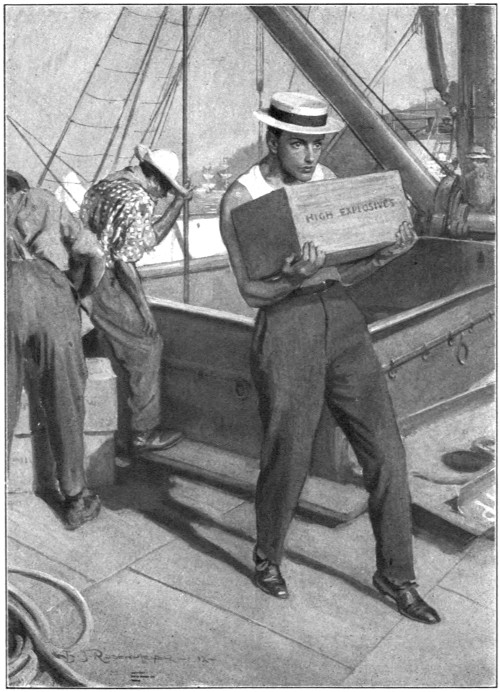
The dynamite ship had been almost emptied of cargo, when Naughton
suggested:
"I won't need you on this job after to-day, Goodwin. Why not go to
Culebra with me to-morrow morning and see some of the canal work? I
shall have to inspect the dynamite stored in the magazines."
Walter jumped at the chance of a holiday before venturing to interview
Major Glendinning. He was eager to behold the famous cut where they
were "making the dirt fly," and to find his friend Jack Devlin, the
steam-shovel man who had beguiled him to the Isthmus.
It was with a sense of wonderment as keen as that of the early
explorers that Walter was whisked in a passenger train, as if on a
magic carpet, into the heart of the jungle, past palm-thatched native
huts perched upon lush green hill-sides, by trimly kept American
settlements, by vine-draped rusty rows of engines, cars, and dredges
long ago abandoned by the French.
Soon there appeared the mighty Gatun dam and locks flung majestically
across a wide valley, resembling not so much man's handiwork as an
integral part of the landscape, made to endure as long as the hills
themselves. Upon and around them moved in ceaseless, orderly activity
a multitude of men and battalions of machines, piling up rock and
concrete.
Walter drew a long breath and exclaimed, his face aglow:
"It makes me sit up and blink. Is there anything bigger to see?"
"The Gatun locks alone will cost twenty-five million, not to mention
the dam," replied the practical Naughton, "but Culebra Cut is the
heftiest job of them all. It broke the poor Frenchmen's hearts and
their pocket-books."
They came at length to this far-famed range of lofty hills which link
the Andes of South and Central America. Leaving the train, Naughton
tramped ahead toward the gigantic gash dug in the continental divide.
Clouds of gray smoke spurted from far below, and the earth trembled
to one booming shock after another. Dynamite was rending the rock and
clay, and Walter realized, with a little thrill of pride, that he had
been really helping to build the Panama Canal.
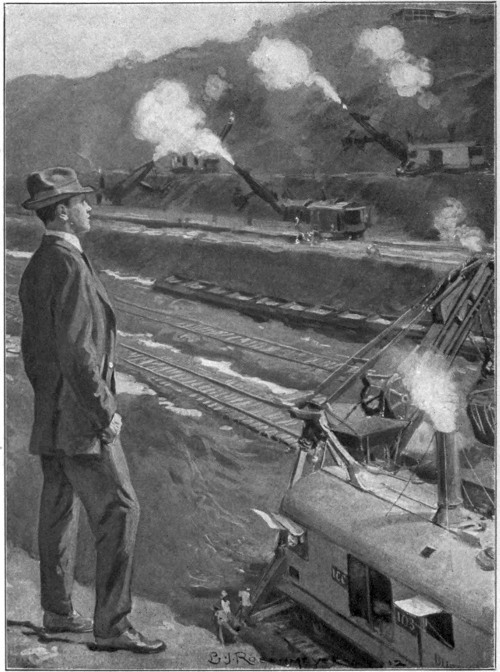
Presently he stood at the brink of this tremendous chasm. It seemed
inadequate to call it a "cut." He gazed down with absorbed fascination
at the maze of railroad tracks, scores of them abreast, which covered
the unfinished bed of the canal. Along the opposite side, clinging to
excavated shelves which resembled titanic stairs, ran more tracks.
Beside them toiled the steam-shovels loading the processions of waiting
trains.
No wonder Jack Devlin, engineer of "Number Twenty-six," had swaggered
across the deck of the Saragossa. He knew that he was doing a man's
work. To tame and guide one of these panting, hungry monsters was like
being the master of a dragon of the fairy stories. There could be no
Panama Canal without them. Intelligent, docile, tireless, they could
literally remove mountains.
Walter sat upon a rock and watched one of them nudge and nose a huge
bowlder this way and that with its great steel dipper, exactly as if
it were getting ready to make a meal of it. Then the mass was picked
up, swung over a flat-car, swiftly, delicately, precisely, and the
huge jaws opened to lay down the heavy morsel. Walter decided that he
wanted to be a steam-shovel man. Naughton had to speak twice before the
interested lad heard him say:
"I shall be busy for some time, and may have to jump on a work-train
as far as Pedro Miguel station. Go down into the Cut, if you like, and
look around."
"Thanks. Say, Mr. Naughton, how old must a man be to run a
steam-shovel?"
"They break them in as firemen. Are you tough enough to shovel coal all
day? Don't let these Culebra tarriers coax you away from us. You are
scheduled to play ball for Cristobal, understand?"
By means of several sections of steep wooden stairs Walter clambered
to the bottom of the cut, and dodged across the muddy area of trackage
to gain the nearest bank upon which the steam-shovels were at work.
Fascinated, he halted to watch one of them at closer range.
A noise of shouting came from several laborers who were running along
a track further up the steep slope. The nearest steam-shovels blew
their whistles furiously. The shrill blasts were sounding some kind of
warning and Walter said to himself:
"Naughton's men must be ready to set off a blast. I guess I had better
move on."
He started to follow the fleeing laborers when a mass of muddy earth
came slipping down a dozen yards in front of him. It blocked the shelf
upon which he had climbed, and he checked himself, gazing confusedly up
the slope. A large part of the overhanging hill-side appeared to be in
sluggish motion. The wet, red soil far up toward the top of the cut had
begun to slide as if it were being pushed into the bed of the canal by
some unseen force. Dislodged fragments of rock rolled down the surface
of the slide and clattered in advance of it, but so deliberate was the
movement of the mass that there seemed to be time enough to escape it.
Walter ran along the ties and began to plough knee-deep through the
impeding heap of muddy tenacious clay on the track. He glanced upward
again, halted irresolutely, and gasped aloud:
"Great Scott, here comes a whole train of cars falling downhill."
The landslide had started just beneath the uppermost shelf of
excavated rock, and the line of track supported thereupon was almost
instantly undermined. The rails tilted and slipped with their weight
of rock-laden cars before the engine could drag them clear. The train
crew jumped and managed to crawl to the firm ground at the crest of
the slope a moment before the flat-cars toppled over and broke loose
from their couplings. Then the cars hung for an instant, spilled their
burden of rock, which made a little avalanche of its own, and rolled
down the slope with a prodigious clatter.
At this new peril, Walter knew not which way to turn. He could not be
blamed for losing his presence of mind. The cars parted company, taking
erratic courses, tumbling end over end. One of them bounded off at a
slant to fall in front of him, while another was booming down to menace
his retreat. All this was a matter of seconds, precious time that was
wasted for lack of decision.
Instead of making a wild dash in one direction or the other, Walter
danced up and down in the same spot, his eyes fairly popping from his
head. The result was that, by a miracle of good fortune, the flat-cars
roared and rattled past on either side and left him unscathed.
Then the huge, loosened layer of earth, moving with lazy momentum,
filled the ledge on which he stood, brushed him off, and carried him
down the slope. To his amazement he was not wholly buried, but rolled
over and over, now on the surface, now struggling in a sticky smother
of stuff that held him like a fly in a bed of mortar. A projecting
stratum of rock, not yet blasted away, checked the leisurely progress
of the mass before it reached the bottom of the cut.
Plastered with mud from his hair to his heels, bleeding from a dozen
scratches, his clothes in rags, Walter was quite astonished to find
himself alive. He was stuck fast in clay almost to the waist and so
dazed and breathless that he was unable to call for help.
Glancing stupidly up the slope, he beheld a steam-shovel sway and
totter. Nothing could surprise him now. With languid interest he
watched the towering machine turn over on its side in a leisurely
manner and then come slipping down to the next shelf. It resembled some
prehistoric monster with a prodigiously long neck, which had lost its
footing.
It came to rest on its side and out of one of the cab windows spilled
a large man in overalls who tobogganed down the miry slope with
extraordinary velocity, arms and legs flying.
He fetched up within a few yards of Walter, sat up, wiped the mud from
his eyes, and sputtered:
"Poor old Twenty-six! She's sure in a mess this time."
Recognizing Jack Devlin, Walter managed to find his voice and called
feebly:
"Is this what you call a great place for a husky young fellow?"
The steam-shovel man scrambled to his feet, active and apparently
unhurt, as if such incidents were all in the day's work. Plunging
through the débris of the slide, he peered into Walter's besmeared and
bleeding countenance. The voice and the words had sounded familiar and
assisted identification.
"Well, I'll be scuppered!" roared Jack Devlin. "Goodwin is your name.
You took my advice and beat it to the Isthmus. I'll have you out of
this in a jiffy."
A gang of laborers arrived a moment later, and with Devlin shouting
stentorian orders, their shovels speedily and carefully dug out
the hapless Walter. They were about to carry him to the nearest
switch-tender's shelter when he groaned protestingly:
"Ouch! Don't grab my right arm. It hurts."
Battered and sore as he was, all other damage was forgotten as he tried
to raise the precious right arm, his pitching arm, the mainstay of his
fortunes on the Isthmus. An acute pain stabbed him between wrist and
elbow. He murmured sorrowfully:
"It is broken or badly sprained. I'm not dead, but I certainly am
unfortunate."
"Those that try to stop a landslide in the Cut are generally lugged out
feet first," cheerfully remarked Devlin. "The landscape isn't fastened
down very tight. Were you looking for me?"
"Yes. And I found you, didn't I?" Walter grinned as he added: "We were
thrown together, all right."
They made him as comfortable as possible, while Devlin forgot his
sorrow over the plight of his beloved "Twenty-six."
"I feel sort of responsible for you, Goodwin," said he. "I'm going to
put you in the hospital car of the next train to Ancon, where they'll
give you the best of everything. I can't go with you, but I'll try to
see you to-night. I must boss a first-aid-to-the-injured job on that
poor old steam-shovel of mine. She looks perfectly ridiculous, doesn't
she? Now, cheer up."
The American hospital buildings at Ancon are magnificently equipped,
and their situation along the windy hill-side commands a memorable view
of the gray old city of Panama, the wide blue bay adorned with islands,
and the rolling Pacific. To Walter Goodwin the place seemed like a
prison, and he awaited the surgeon's verdict with the dismal face of
a man about to be sentenced. The sundry cuts and contusions were of
small account. A few days would mend them. But his aching, disabled arm
was quite a different matter.
"You were born lucky or you would be in the morgue," said the genial
young surgeon of the accident ward.
"I am damaged enough," sighed Walter. "What about this arm?"
"No fracture. A severe wrench that will make it pretty sore for a month
or so."
"A month or so!" and Walter winked to hold back the tears. "Why, I have
to pitch a game of ball with this arm next week."
"Nothing doing," decreed the surgeon. "You had better stay here for two
or three days and we'll try our best to patch you up in record time. Do
you want to notify any friends?"
"Yes, indeed," cried Walter. "Please send word to Mr. Harrison, captain
of the Cristobal nine."
"'Bucky' Harrison?" The surgeon showed lively interest. "Then you must
be the new pitcher for Cristobal. We heard about you. You are in the
enemy's camp, but we will treat you kindly."
Having been tucked in bed, Walter felt that he was a perfectly useless
member of society. The landslide had wiped out his bright expectations.
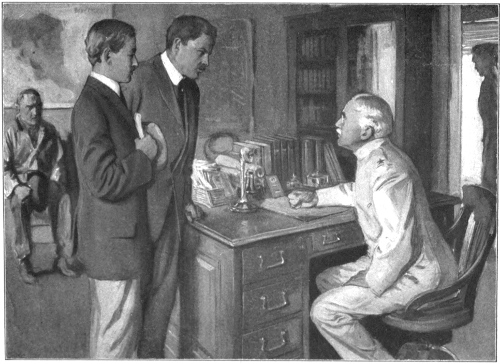
Major Glendinning could have no possible interest in a pitcher with a
crippled arm. When dismissed from the hospital he would be unable to
earn his food and lodging even as a laborer. As for his brave plan of
helping the dear household in Wolverton, he might have to beg aid from
them.
Jack Devlin appeared after supper. His manner was contrite and subdued
as he sat down by the cot and strongly gripped Walter's sound hand.
"You and I were sort of disorganized there in the Cut," said he. "I had
no chance to find out how things have been breaking for you. Have you
landed a job? What about it?"
Walter ruefully related the story of his pilgrimage. At the episode of
the parrot and broomstick, the steam-shovel man violently interrupted:
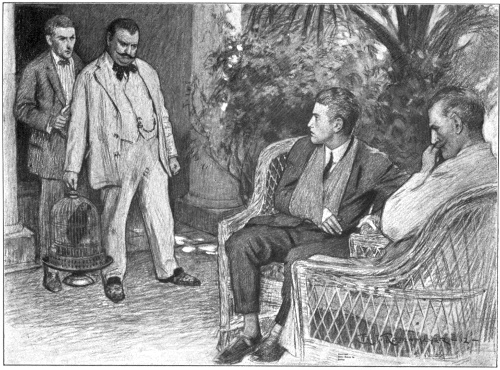
"General Quesada? I know who he is—a gambler, and a grafter, and a
fake soldier. He trimmed some friends of mine, but never mind that. He
is a large, fat, false alarm. Forget him."
When informed of the base-ball episode, he shook his head
disapprovingly.
"You ought to have given Culebra first chance at you," he expostulated.
"Maybe we could have found you a job. I am catcher of the Culebra nine,
do you see?"
"I'd rather be fireman of a steam-shovel than anything else in the
world," Walter eagerly exclaimed.
"You will not be fit to handle a shovel or a base-ball for some time,
my boy. We will not let it come between us, but I'm sorry you tied up
with those low-browed pirates at Cristobal. Need any money? Want to
write a letter home?"
"I am all right for the present, Mr. Devlin. And I think I'll wait a
day or so before writing the folks."
"You told me when we met on the ship that you were anxious to give your
father a lift. It made a great hit with me. What about that?"
"I guess I was like General Quesada's parrot, I talked too much,"
confessed Walter. "I shall be lucky if I can take care of myself."
Devlin was silent for a moment. Then he bade the patient farewell with
words of rough and hearty encouragement and departed from the ward,
a big, masterful man with a hard fist and a soft heart. As he walked
across the hospital grounds he repeated under his breath:
"He aimed to give his father a lift. The pluck of him! 'Tis a pity
that more men on the Isthmus are not thinking about the old folks at
home. 'Tis a safe bet that his father needs a lift. The lad looked very
solemn about it."
He turned into the hospital superintendent's office and asked a clerk
for Walter Goodwin's home address, which the rules required to be
recorded. Then he made a détour to the Ancon post-office, smiled
craftily, and demanded a money-order application blank. Separating
several bills from a wad crumpled in his trousers pocket, he reflected:
"He would fly off the handle if I suggested anything like this, being a
most independent young rooster. But I used to have a daddy of my own.
I'll say nothing about it till the lad gets a job. Then he can square it."
Thereupon he wrote to Mr. Horatio Goodwin as follows:
Dear Sir:
Your son will be unable to attend to his affairs for a few days,
so I am sending the enclosed amount which had been advanced
against his salary account.
Yours truly,
John Devlin.
P. S.—He is in the Ancon Hospital, a bit mussed up but nothing
serious. He will write soon.
"There! I may be guilty of committing something or other under false
pretences, but I feel a whole lot easier in my mind," quoth the
steam-shovel man.
Next morning that bland dynamite expert, Naughton, came to the hospital
to show Walter that his friends in Cristobal had not forgotten him.
"What about the base-ball practice?" demanded the patient. "Have you
found another pitcher?"
"No. We haven't given you up as a total loss."
"Does Major Glendinning know I have been put out of commission?"
Walter's voice was very anxious.
Naughton smiled broadly.
"Yes. I saw him just after your message came to Harrison yesterday
afternoon. There is no finer man on the Isthmus than the major, but
he is a trifle unreasonable at times. He was so upset at the notion
of playing Culebra without you that he got peevish and blamed me for
letting you wander into that landslide. And then he sailed into you for
being too slow to get out of the way of it."
"Then he will have nothing more to do with me," was Walter's mournful
conclusion.
"You are not fit to do anything just now," evasively returned Naughton.
"The major's bearings are heated, but he will cool down. He took a
fancy to you. Now what can I do for you? You will soon be on your feet
again and going strong. Need any money?"
Walter flushed and his lip quivered. Jack Devlin had asked the same
question. These were friends worth having.
"I can get along somehow," he bravely answered.
Naughton exclaimed reprovingly:
"None of that. We folks on the Isthmus are one big family. You have
made good. Don't worry about your meal-ticket after you leave the
hospital. You may need some spare change for clothes and so on. I'll
leave a few dollars with the nurse."
"But I don't deserve all this kindness."
"Nonsense. What else?"
"I think I had better send a letter home to-day. I feel more like it
now. May I dictate it to you, Mr. Naughton?"
"Sure thing. But don't let the folks infer you are down and out. Tell
'em about the scenery."
"If the scenery would only stay put, I shouldn't be in the hospital,"
was the patient's comment.
Naughton chewed his pencil until Walter began:
My Dearest Family:
I have had a slight accident, so I cannot very well use my right
hand. I have the very best of care, and everybody is just bully to
me.——
He stared at the ceiling and confided to Naughton:
"I am stumped. You see, it is hard to explain things. I was so cocksure
of myself—and—and—I was going to find a good position right away,
and it hurts a fellow's pride like the mischief to own up that he was
all wrong. And I don't want them to worry——"
Naughton nodded gravely and suggested:
"Shall I tell them about your impressions of the canal? You are right.
We ought to send them no hard-luck stories."
"Go ahead, then. My first impressions were dents. I'm covered with
them. You know more about the canal than I do."
Naughton scribbled industriously, and the patient seemed pleased with
the results.
"Harrison will be over to see you soon," said the amanuensis. "You are
going to help us dig the Big Ditch, so keep your nerve. Good-by and
good luck until next time."
Walter was a low-spirited and restless patient. Now and then he forgot
his troubles in chatting with the other men who had been brought into
the accident ward. They had been wounded on the firing-line of this
titanic conflict with Nature. Like good soldiers they were eager to
be up and at it again. They worked and dared for something more than
wages. They manifested intense pride and loyalty. It was their ambition
to "stay with the job." Their talk was mostly of progress made, of new
records set. Their spirit thrilled Walter, it was so fine and clean and
worthy of the flag they served.
After three days the surgeon examined him carefully, and announced:
"You are fit to leave us, but you must take it easy. And that arm
should be looked after. What are your plans?"
"I haven't any. I am not a canal employee, so I suppose I can't go to a
commission hotel."
"Naughton or Devlin will be here to see you again," said the surgeon.
"Why not bunk with me for a few days? I am in bachelor quarters. You
don't want to wait around in one of those Panama hotels. They are
fierce."
Walter thought of the vengeful General Quesada and had no desire, in
his disabled condition, to linger in the city of Panama, beyond the
Canal Zone. He gratefully accepted the surgeon's invitation and added:
"I should like to go out this afternoon and see something of Ancon."
"Very well. It will brace you up to get outdoors. If you want the
good salt wind, why don't you run over to Balboa docks? It is only
a trifling journey by train. And you can see the Pacific end of the
canal. It's a busy place."
The railroad station was no more than a few minutes' walk down the
hill from the hospital, and Walter footed it slowly, feeling weak and
listless. He enjoyed the brief trip to Balboa and his first glimpse
of the shipping of the Pacific. The wharves were American, but the
high-sided steamers crowded bow and stern were bound to strange,
romantic ports, to Guayaquil and Valparaiso and around the Horn, to
Mazatlan and Acapulco.
Picking his way among the jostling, noisy gangs of black laborers,
Walter perched himself upon a bale of merchandise under the long cargo
shed. The wharf was not large enough for its traffic. Freight of every
description covered it. Tally clerks, checkers, and foremen were at
their wits' ends to keep the streams of boxes, barrels, and crates
moving with order and system.
At one berth a Pacific mail-boat from San Francisco was discharging
supplies for the Canal Commission. Just beyond her, one of the Chilean
Navigation Company's fleet was filling her holds for the long voyage
down the west coast. Against her seaward side, as if waiting for room
at the wharf, was moored a rusty little coastwise steamer flying the
flag of the Panama Republic.
During a summer vacation from high-school, Walter had worked in the
shipping-rooms of the Wolverton Mills. He knew something about this
activity on the wharf. He thought himself capable of tallying freight
and sorting consignments. Sharp-eyed and interested, he watched the
hurly-burly of hard-driven industry. Presently he noticed something
which awoke his curiosity. It seemed extremely odd.
The freight trundled out of the Pacific mail-boat was piled compactly
between two narrow aisles or runways on the wharf, convenient for
transfer to the freight-cars of the Panama Railroad. Walter noted the
marks on the boxes, because most of the stuff was consigned to the
"Dept. of Commissary and Subsistence," and he was thereby reminded of
Major Glendinning.
Separated from this great heap of merchandise only by a runway was the
freight that was being rushed into the outward-bound Chilean steamer. A
negro halted his truck between the two piles and loaded it with cases
marked for Major Glendinning's department. Then he went clattering at
full speed to the gangway of the Chilean steamer.
Evidently the thick-witted laborer had made a blunder, thought Walter.
He had loaded his truck at the wrong side of the runway. At the gangway
of the South American vessel was stationed a "checker," one of the
white employees of the Zone, whose business was to discover just such
mistakes as this. Walter saw him halt the truck, glance at the marks
on the boxes, and then shove the negro along into the ship instead of
turning him back to the wharf.
Walter did some rapid thinking. He was enough of a shipping-clerk to
surmise that something was wrong. It might have been carelessness, but
he eyed the checker suspiciously. He was a long, stooping young man
with rather pallid, sullen features, and he conveyed an impression of
slouchiness and dissipation quite unlike the clean-cut type of the
average American in the Zone.
Walter disliked him. Perhaps this was why he was unwilling to give him
the benefit of the doubt.
The checker forsook the gangway, hurried into the runway where the
truckmen were passing in procession and gave them an order, roughly,
with a gesture which carried a meaning to the vigilant Walter. They
were told to continue shoving the merchandise consigned to Major
Glendinning's department into the Chilean steamer. They viewed any
white man as a "boss" to be obeyed. Unable to read the marks, they did
as they were ordered, without hesitation.
The checker ran back to the gangway, where he made pretence of
examining each arriving truck-load and passing it as O.K. Walter was
convinced that he had stumbled on a flagrantly crooked transaction.
It looked barefaced and bold, but it was actually much less so than
appeared. In the rush and confusion of the wharf, one dishonest
checker could engineer the business with small risk of official
detection. The merchandise would be missed later, but what proof was
there that it had been slipped aboard the Chilean steamer?
"It was one chance in a hundred that I happened to see it," said Walter
to himself. "I'm sure the checker is a rascal, but there must be others
in it, or how can the stolen goods be received and disposed of at the
other end of the voyage?"
He forsook his place of observation and moved cautiously nearer the
Chilean steamer, screened from the observation of the checker by a huge
crate of machinery. There he discovered, to his great surprise, that
the trucks loaded with pilfered merchandise were being wheeled across
the lower deck, through the open cargo port on the other side, and into
the small Panamanian coaster tied up to the larger steamer.
This altered the circumstances. Very likely the Chilean officers and
crew knew nothing about the shady business. The Panamanian craft
might have been courteously permitted to take on part of her cargo by
transferring it across the intervening deck.
Walter tingled with excitement. The checker must have an understanding
with the captain or owner, or both, of the disreputable-looking little
steamer hailing from Panama. Her destination could not be far distant.
She could be overhauled at short notice. Instead of informing the
American officials at Balboa, Walter swiftly decided to try to unravel
the plot by himself. It would show them that he was good for something
besides base-ball. And it might mean solid recognition. But there was
something bigger than his own interests at stake. The spirit of the
Canal Zone had taken hold of him. He knew that "graft" had been kept
out of the organization. To have the fair record blotted, even in the
smallest way, was hateful to him. He was as jealous of the honor of the
"Big Ditch" as Colonel Gunther himself.