High-pressure Engines. — Leupold's Engine. — Trevithick and
Vivian. — Effects of Improvement in Locomotion. — Historical
Account of the Locomotive Engine. — Blenkinsop's
Patent. — Chapman's Improvement. — Walking Engine. — Stephenson's
First Engines. — His Improvements. — Liverpool and Manchester
Railway Company. — Their Preliminary Proceedings. — The Great
Competition of 1829. — The Rocket. — The Sanspareil. — The
Novelty. — Qualities of the Rocket. — Successive
Improvements. — Experiments. — Defects of the Present
Engines. — Inclined Planes. — Methods of surmounting
them. — Circumstances of the Manchester Railway Company. — Probable
Improvements in Locomotives. — Their capabilities with respect to
speed. — Probable Effects of the Projected Railroads. — Steam Power
compared with Horse Power. — Railroads compared with Canals.
(80.) In the various modifications of the steam engine which we have
hitherto considered, the pressure introduced on one side of the piston
derives its efficacy either wholly or partially from the vacuum
produced by condensation on the other side. This always requires a
condensing apparatus, and a constant and abundant supply of cold
water. An engine of this kind must therefore necessarily have
considerable dimensions and weight, and is inapplicable to uses in
which a small and light machine only is admissible. If the condensing
apparatus be dispensed with, the piston will always be resisted by a
force equal to the atmospheric pressure, and the only part of the
steam pressure which will be available as a moving power, is that
part by which it exceeds the pressure of the atmosphere.
Hence, in engines which do not work by condensation, steam of a much
higher pressure than that of the atmosphere is indispensably
necessary, and such engines are therefore called high-pressure
engines.
We are not, however, to understand that every engine, in which steam
is used of a pressure exceeding that of the atmosphere, is what is
meant by a high-pressure engine; for in the ordinary engines in
common use, constructed on Watt's principle, the safety-valve is
loaded with from 3 to 5 lbs. on the square inch; and in Woolf's
engines, the steam is produced under a pressure of 40 lbs. on the
square inch. These would therefore be more properly called condensing
engines than high-pressure engines; a term quite inapplicable to
those of Woolf. In fact, by high-pressure engines is meant engines
in which no vacuum is produced, and, therefore, in which the piston
works against a pressure equal to that of the atmosphere.
In these engines, the whole of the condensing apparatus, viz. the
cold-water cistern, condenser, air-pump, cold-water pump, &c. are
dispensed with, and nothing is retained except the boiler, cylinder,
piston, and valves. Consequently, such an engine is small, light, and
cheap. It is portable also, and may be moved, if necessary, along with
its load, and is therefore well adapted to locomotive purposes.
(81.) High-pressure engines were one of the earliest modifications of
the steam engine. The contrivance, which is obscurely described in the
article already quoted (27.), from the Century of Inventions, is a
high-pressure engine; for the power there alluded to is the elastic
force of steam working against the atmospheric pressure. Newcomen,
in 1705, applied the working-beam, cylinder, and piston to the
atmospheric engine; and Leupold, about 1720, combined the
working-beam and cylinder with the high-pressure principle, and
produced the earliest high-pressure engine worked by a
cylinder and piston. The following is a description of Leupold's
engine:—
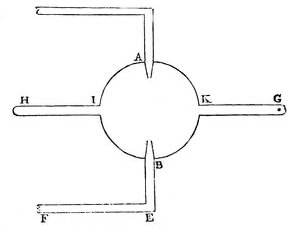
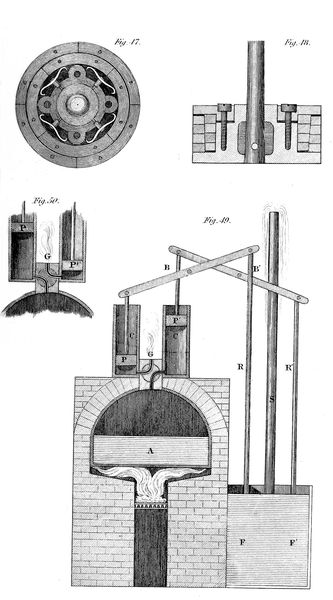
A (fig. 49.) is the boiler, with the furnace beneath it; C C´ are two
cylinders with two solid pistons, P P´, connected with the
working-beams B B´, to which are attached the pump-rods, R R´, of two
forcing-pumps, F F´, which communicate with a great force-pipe S; G is
a four-way cock (66.) already described. In the position in which it
stands in the figure, the steam is issuing from below the piston P
into the atmosphere, and the piston is descending by its own weight;
steam from the boiler is at the same time pressing up the piston P´,
with a force equal to the difference between the pressure of the steam
and that of the atmosphere. Thus the piston R of the forcing-pump is
being drawn up, and the piston P´ is forcing the piston R´ down, and
thereby driving water into the force-pipe S. On the arrival of the
piston P at the bottom of the cylinder C, and P´ at the top of the
cylinder C´, the position of the cock is changed as represented in
fig. 50. The steam, which has just pressed up the piston P´, is
allowed to escape into the atmosphere, while the steam, passing from
the boiler below the piston P, presses it up, and thus P ascends by
the steam pressure, and P´ descends by its own weight. By these means
the piston R is forced down, driving before it the water in the pump
cylinder into the force-pipe S, and the piston R´ is drawn up to allow
the other pump-cylinder to be re-filled; and so the process is
continued.
A valve is placed in the bottom of the force-pipes, to prevent the
water which has been driven into it from returning. This valve opens
upwards; and, consequently, the weight of the water pressing upon it
only keeps it more effectually closed. On each descent of the piston,
the pressure transmitted to the valve acting upwards being greater
than the weight of the water resting upon it, forces it open, and an
increased quantity of water is introduced.
(82.) From the date of the improvement of Watt until the
commencement of the present century, high-pressure engines were
altogether neglected in these countries. In the year 1802, Messrs.
Trevithick and Vivian constructed the first high-pressure engine
which was ever brought into extensive practical use in this kingdom. A
section of this machine, made by a vertical plane, is represented in
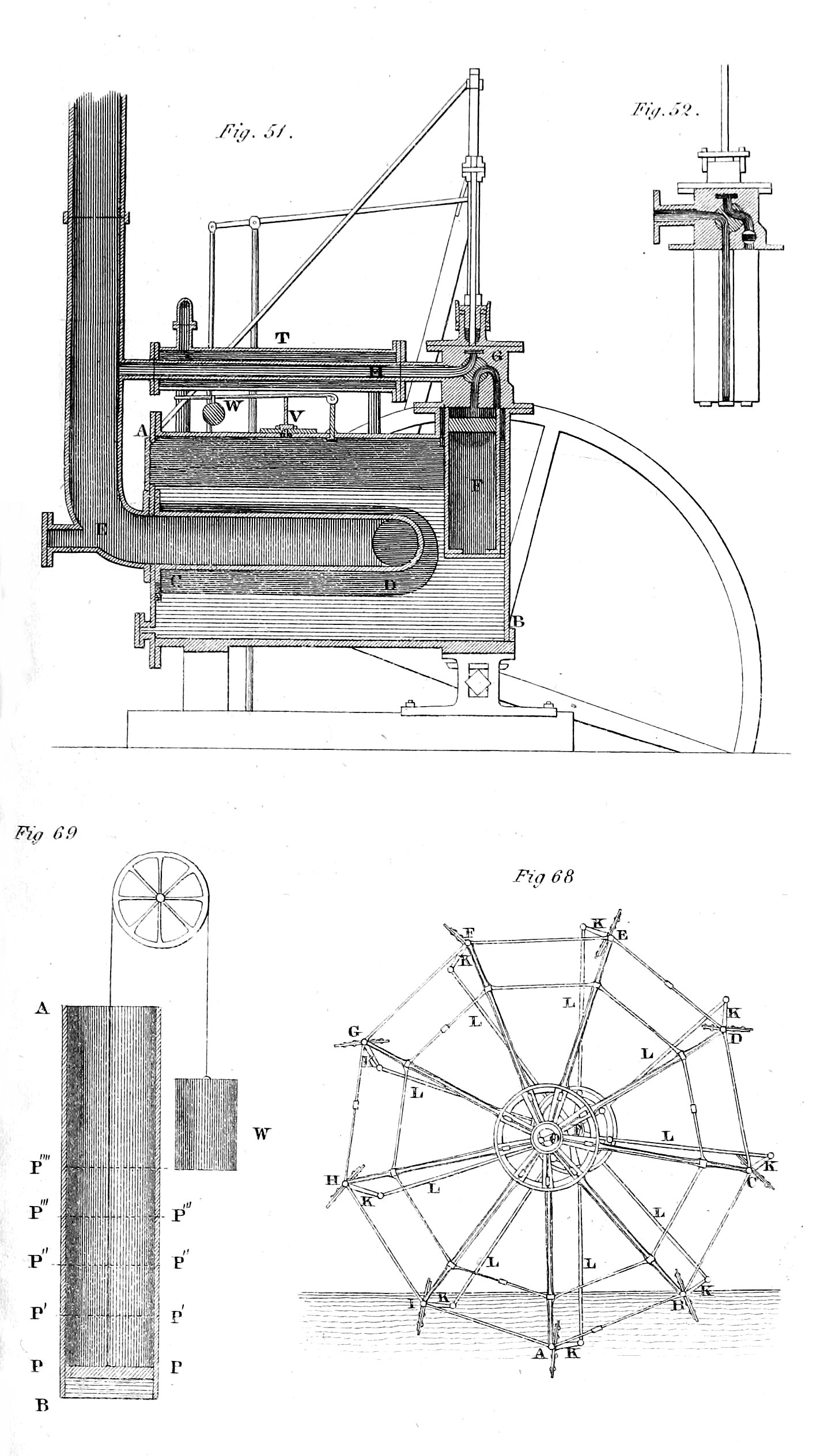
fig. 51.
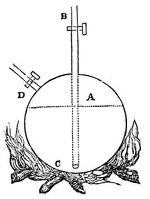
The boiler A B is a cylinder with flat circular ends. The fire-place
is constructed in the following manner:—A tube enters the cylindrical
boiler at one end; and, proceeding onwards, near the other extremity,
is turned and recurved, so as to be carried back parallel to the
direction in which it entered. It is thus conducted out of the boiler,
at another part of the same end at which it entered. One of the ends
of this tube communicates with the chimney E, which is carried
upwards, as represented in the figure. The other mouth is furnished
with a door; and in it is placed the grate, which is formed of
horizontal bars, dividing the tube into two parts; the upper part
forming the fire-place, and the lower the ash-pit. The fuel is
maintained in a state of combustion, on the bars, in that part of the
tube represented at C D; and the flame is carried by the draft of the
chimney round the curved flue, and issues at E into the chimney. The
flame is thus conducted through the water, so as to expose the latter
to as much heat as possible.
A section of the cylinder is represented at F, immersed in the boiler,
except a few inches of the upper end, where the four-way cock G is
placed for regulating the admission of the steam. A tube is
represented at H, which leads from this four-way cock into the
chimney; so that the waste steam, after working the piston, is carried
off through this tube, and passes into the chimney. The upper end of
the piston-rod is furnished with a cross-bar, which is placed in a
direction at right angles to the length of the boiler, and also to the
piston-rod. This bar is guided in its motion by sliding on two iron
perpendicular rods fixed to the sides of the boiler, and parallel to
each other. To the ends of this cross-bar are joined two
connecting rods, the lower ends of which work two cranks fixed on an
axis extending across and beneath the boiler, and immediately under
the centre of the cylinder. This axis is sustained in bearings formed
in the legs which support the boiler, and upon its extremity is fixed
the fly-wheel as represented at B. A large-toothed wheel is placed on
this axis; which, being turned with the cranked axle, communicates
motion to other wheels; and, through them, to any machinery which the
engine may be applied to move.
As the four-way cock is represented in the figure, the steam passes
from the boiler through the curved passage G above the piston, while
the steam below the piston is carried off through a tube which does
not appear in the figure, by which it is conducted to the tube H, and
thence to the chimney. The steam, therefore, which passes above the
piston presses it downwards; while the pressure upwards does not
exceed that of the atmosphere. The piston will therefore descend with
a force depending on the excess of the pressure of the steam produced
in the boiler above the atmospheric pressure. When the piston has
arrived at the bottom of the cylinder, the cock is made to assume the
position represented in the figure 52. This effect is produced by the
motion of the piston-rod. The steam now passes from above the piston,
through the tube H, into the chimney, while the steam from the boiler
is conducted through another tube below the piston. The pressure above
the piston, in this case, does not exceed that of the atmosphere;
while the pressure below it will be that of the steam in the boiler.
The piston will therefore ascend with the difference of these
pressures. On the arrival of the piston at the top of the cylinder,
the four-way cock is again turned to the position represented in fig.
51., and the piston again descends; and in the same manner the process
is continued. A safety-valve is placed on the boiler at V, loaded
with a weight W, proportionate to the strength of the steam
with which it is proposed to work.
Pl. XI.
Engr. by P. Maverick
In the engines now described, this valve was frequently loaded at the
rate of from 60 to 80 lbs. on the square inch. As the boilers of
high-pressure engines were considered more liable to accidents from
bursting than those in which steam of a lower pressure was used,
greater precautions were taken against such effects. A second
safety-valve was provided, which was not left in the power of the
engine-man. By this means he had a power to diminish the pressure of
the steam, but could not increase it beyond the limit determined by
the valve which was removed from his interference. The greatest cause
of danger, however, arose from the water in the boiler being consumed
by evaporation faster than it was supplied; and therefore falling
below the level of the tube containing the furnace. To guard against
accidents arising from this circumstance, a hole was bored in the
boiler, at a certain depth, below which the water should not be
allowed to fall; and in this hole a plug of metal was soldered with
lead, or with some other metal, which would fuse at that temperature
which would expose the boiler to danger. Thus, in the event of the
water being exhausted, so that its level would fall below the plug,
the heat of the furnace would immediately melt the solder, and the
plug would fall out, affording a vent for the steam, without allowing
the boiler to burst. The mercurial steam-gauge, already described, was
also used as an additional security. When the force of the steam
exceeded the length of the column of mercury which the tube would
contain, the mercury would be blown out, and the tube would give vent
to the steam. The water by which the boiler was replenished was forced
into it by a pump worked by the engine. In order to economise the
heat, this water was contained in a tube T, which surrounded the pipe
H. As the waste steam, after working the piston, passed off through H,
it imparted a portion of its heat to the water contained in the tube
T, which was thus warmed to a certain temperature before it
was forced into the boiler by the pump. Thus a part of the heat, which
was originally carried from the boiler in the form of steam, was
returned again to the boiler with the water with which it was fed.
It is evident that engines constructed in this manner may be applied
to all the purposes to which the condensing engines are applicable.
(e) To the plates of the English edition has been added one, (plate
A) representing a high-pressure engine as constructed by the West
Point Foundry in the state of New York. The principal parts will be
readily distinguished from their resemblance to the analogous parts of
a condensing engine. The condenser and air-pump of that engine, it
will be observed, are suppressed. At v x and y z are forcing-pumps
by which a supply of water is injected into the boiler at each motion
of the engine. For the four-way cock, used in the English
high-pressure engines, a slide valve at r s, is substituted, and is
found to work to much greater advantage. It is set in motion by an
eccentric, in a manner that will be more obvious from an inspection of
the plate than from any description.—A. E.
(f) A very safe and convenient boiler for a high-pressure engine has
been invented in the United States by Mr. Babcock. The boiler consists
of small tubes, into which water is flashed by a small forcing-pump at
every stroke of the engine. The tubes are kept so hot in a furnace, as
to generate steam of the required temperature, but not hot enough to
cause any risk of the decomposition of the water. The strength of the
apparatus is such, and the quantity of water exposed to heat at one
time so small, as to leave hardly any risk of danger.—A. E.
(83.) Two years after the date of the patent of this engine, its
inventor constructed a machine of the same kind for the purpose of
moving carriages on railroads; and applied it successfully, in the
year 1804, on the railroad at Merthyr Tydvil, in South Wales.
It was in principle the same as that already described. The cylinder
however was in a horizontal position, the piston-rod working in the
direction of the line of road: the extremity of the piston-rod, by
means of a connecting rod, worked cranks placed on the axletree, on
which were fixed two cogged wheels: these worked in others, by which
their motion was communicated finally to cogged wheels fixed on the
axle of the hind wheels of the carriage, by which this axle was kept
in a state of revolution. The hind wheels being fixed on the axletree,
and turning with it, were caused likewise to revolve; and so long as
the weight of the carriage did not exceed that which the friction of
the road was capable of propelling, the carriage would thus be moved
forwards. On this axle was placed a fly-wheel to continue the rotatory
motion at the termination of each stroke. The fore wheels are
described as being capable of turning like the fore wheels of a
carriage, so as to guide the vehicle. The projectors appear to have
contemplated, in the first instance, the use of this carriage on
turnpike roads; but that notion seems to have been abandoned, and its
use was only adopted on the railroad before mentioned. On the occasion
of its first trial, it drew after it as many carriages as contained 10
tons of iron a distance of nine miles; which stage it performed
without any fresh supply of water, and travelled at the rate of five
miles an hour.
(84.) Capital and skill have of late years been directed with
extraordinary energy to the improvement of inland transport; and this
important instrument of national wealth and civilisation has received
a proportionate impulse. Effects are now witnessed, which, had they
been narrated a few years since, could only have been admitted into
the pages of fiction or volumes of romance. Who could have credited
the possibility of a ponderous engine of iron, loaded with several
hundred passengers, in a train of carriages of corresponding
magnitude, and a large quantity of water and coal, taking
flight from Manchester and arriving at Liverpool, a distance of about
thirty miles, in little more than an hour? And yet this is a matter of
daily and almost hourly occurrence. Neither is the road, on which this
wondrous performance is effected, the most favourable which could be
constructed for such machines. It is subject to undulations and
acclivities, which reduce the rate of speed much more than similar
inequalities affect the velocity on common roads. The rapidity of
transport thus attained is not less wonderful than the weights
transported. Its capabilities in this respect far transcend the
exigencies even of the two greatest commercial marts in Great Britain.
Loads, varying from 50 to 150 tons are transported at the average rate
of 15 miles an hour; but the engines in this case are loaded below
their power; and in one instance we have seen a load—we should rather
say a cargo—of wagons, conveying merchandise to the amount of 230
tons gross, transported from Liverpool to Manchester at the average
rate of 12 miles an hour.
The astonishment with which such performances must be viewed, might be
qualified, if the art of transport by steam on railways had been
matured, and had attained that full state of perfection which such an
art is always capable of receiving from long experience, aided by
great scientific knowledge, and the unbounded application of capital.
But such is not the present case. The art of constructing locomotive
engines, so far from having attained a state of maturity, has not even
emerged from its infancy. So complete was the ignorance of its powers
which prevailed, even among engineers, previous to the opening of the
Liverpool railway, that the transport of heavy goods was regarded as
the chief object of the undertaking, and its principal source of
revenue. The incredible speed of transport, effected even in the very
first experiments in 1830, burst upon the public, and on the
scientific world, with all the effect of a new and unlooked-for
phenomenon. On the unfortunate occasion which deprived this country
of Mr. Huskisson, the wounded body of that statesman was
transported a distance of about fifteen miles in twenty-five minutes,
being at the rate of thirty-six miles an hour. The revenue of the road
arising from passengers since its opening, has, contrary to all that
was foreseen, been nearly double that which has been derived from
merchandise. So great was the want of experience in the construction
of engines, that the company was at first ignorant whether they should
adopt large steam-engines fixed at different stations on the line, to
pull the carriages from station to station, or travelling engines to
drag the loads the entire distance. Having decided on the latter, they
have, even to the present moment, laboured under the disadvantage of
the want of that knowledge which experience alone can give. The
engines have been constantly varied in their weight and proportions,
in their magnitude and form, as the experience of each successive
month has indicated. As defects became manifest they were remedied;
improvements suggested were adopted; and each quarter produced engines
of such increased power and efficiency, that their predecessors were
abandoned, not because they were worn out, but because they had been
outstripped in the rapid march of improvement. Add to this, that only
one species of travelling engine has been effectively tried; the
capabilities of others remain still to be developed; and even that
form of engine which has received the advantage of a course of
experiments on so grand a scale to carry it towards perfection, is far
short of this point, and still has defects, many of which, it is
obvious, time and experience will remove. If then travelling steam
engines, with all the imperfections of an incipient invention—with
the want of experience, the great parent of practical
improvements—with the want of the common advantage of the full
application of the skill and capital of the country—subjected to but
one great experiment, and that experiment limited to one form of
engine; if, under such disadvantages, the effects to which we have
referred have been produced, what may we not expect from this
extraordinary power, when the enterprise of the country shall
be unfettered, when greater fields of experience are opened, when
time, ingenuity, and capital have removed the existing imperfections,
and have brought to light new and more powerful principles? This is
not mere speculation on possibilities, but refers to what is in a
state of actual progression. Railways are in progress between the
points of greatest intercourse in the United Kingdom, and travelling
steam engines are in preparation for the common turnpike roads; the
practicability and utility of that application of the steam engine
having not only been established by experiment to the satisfaction of
their projectors, but proved before the legislature in a committee of
inquiry on the subject.
The important commercial and political effects attending such
increased facility and speed in the transport of persons and goods,
are too obvious to require any very extended notice here. A part of
the price (and in many cases a considerable part) of every article of
necessity or luxury, consists of the cost of transporting it from the
producer to the consumer; and consequently every abatement or saving
in this cost must produce a corresponding reduction in the price of
every article transported; that is to say, of everything which is
necessary for the subsistence of the poor, or for the enjoyment of the
rich, of every comfort, and of every luxury of life. The benefit of
this will extend, not to the consumer only, but to the producer: by
lowering the expense of transport of the produce, whether of the soil
or of the loom, a less quantity of that produce will be spent in
bringing the remainder to market, and consequently a greater surplus
will reward the labour of the producer. The benefit of this will be
felt even more by the agriculturist than by the manufacturer; because
the proportional cost of transport of the produce of the soil is
greater than that of manufactures. If 200 quarters of corn be
necessary to raise 400, and 100 more be required to bring the 400 to
market, then the net surplus will be 100. But if by the use of steam
carriages the same quantity can be brought to market with an
expenditure of 50 quarters, then the net surplus will be increased
from 100 to 150 quarters; and either the profit of the farmer, or the
rent of the landlord, must be increased by the same amount.
But the agriculturist would not merely be benefited by an increased
return from the soil already under cultivation. Any reduction in the
cost of transporting the produce to market would call into cultivation
tracts of inferior fertility, the returns from which would not at
present repay the cost of cultivation and transport. Thus land would
become productive which is now waste, and an effect would be produced
equivalent to adding so much fertile soil to the present extent of the
country. It is well known, that land of a given degree of fertility
will yield increased produce by the increased application of capital
and labour. By a reduction in the cost of transport, a saving will be
made which may enable the agriculturist to apply to tracts already
under cultivation the capital thus saved, and thereby increase their
actual production. Not only, therefore, would such an effect be
attended with an increased extent of cultivated land, but also with an
increased degree of cultivation in that which is already productive.
It has been said, that in Great Britain there are above a million of
horses engaged in various ways in the transport of passengers and
goods, and that to support each horse requires as much land as would,
upon an average, support eight men. If this quantity of animal power
were displaced by steam engines, and the means of transport drawn from
the bowels of the earth, instead of being raised upon its surface,
then, supposing the above calculation correct, as much land would
become available for the support of human beings as would suffice for
an additional population of eight millions; or, what amounts to the
same, would increase the means of support of the present population by
about one-third of the present available means. The land which now
supports horses for transport would then support men, or
produce corn for food.
The objection that a quantity of land exists in the country capable of
supporting horses alone, and that such land would be thrown out of
cultivation, scarcely deserves notice here. The existence of any
considerable quantity of such land is extremely doubtful. What is the
soil which will feed a horse and not feed oxen or sheep, or produce
food for man? But even if it be admitted that there exists in the
country a small portion of such land, that portion cannot exceed, nor
indeed equal, what would be sufficient for the number of horses which
must after all continue to be employed for the purposes of pleasure,
and in a variety of cases where steam must necessarily be
inapplicable. It is to be remembered, also, that the displacing of
horses in one extensive occupation, by diminishing their price must
necessarily increase the demand for them in others.
The reduction in the cost of transport of manufactured articles, by
lowering their price in the market, will stimulate their consumption.
This observation applies of course not only to home but to foreign
markets. In the latter we already in many branches of manufacture
command a monopoly. The reduced price which we shall attain by
cheapness and facility of transport will still further extend and
increase our advantages. The necessary consequence will be, an
increased demand for manufacturing population; and this increased
population again reacting on the agricultural interests, will form an
increased market for that species of produce. So interwoven and
complicated are the fibres which form the texture of the highly
civilized and artificial community in which we live, that an effect
produced on any one point is instantly transmitted to the most remote
and apparently unconnected parts of the system.
The two advantages of increased cheapness and speed, besides extending
the amount of existing traffic, call into existence new objects of
commercial intercourse. For the same reason that the reduced
cost of transport, as we have shown, calls new soils into cultivation,
it also calls into existence new markets for manufactured and
agricultural produce. The great speed of transit which has been proved
to be practicable, must open a commerce between distant points in
various articles, the nature of which does not permit them to be
preserved so as to be fit for use beyond a certain time. Such are, for
example, many species of vegetable and animal food, which at present
are confined to markets at a very limited distance from the grower or
feeder. The truth of this observation is manifested by the effects
which have followed the intercourse by steam on the Irish Channel. The
western towns of England have become markets for a prodigious quantity
of Irish produce, which it had been previously impossible to export.
If animal food be transported alive from the grower to the consumer,
the distance of the market is limited by the power of the animal to
travel, and the cost of its support on the road. It is only particular
species of cattle which bear to be carried to market on common roads
and by horse carriages. But the peculiar nature of a railway, the
magnitude and weight of the loads which may be transported on it, and
the prodigious speed which may be attained, render the transport of
cattle, of every species, to almost any distance, both easy and cheap.
In process of time, when the railway system becomes extended, the
metropolis and populous towns will therefore become markets, not as at
present to districts within limited distances of them, but to the
whole country.
The moral and political consequences of so great a change in the
powers of transition of persons and intelligence from place to place
are not easily calculated. The concentration of mind and exertion
which a great metropolis always exhibits, will be extended in a
considerable degree to the whole realm. The same effect will be
produced as if all distances were lessened in the proportion in which
the speed and cheapness of transit are increased. Towns, at present
removed some stages from the metropolis, will become its
suburbs; others, now a day's journey, will be removed to its immediate
vicinity; business will be carried on with as much ease between them
and the metropolis, as it is now between distant points of the
metropolis itself. Let those who discard speculations like these as
wild and improbable, recur to the state of public opinion, at no very
remote period, on the subject of steam navigation. Within the memory
of persons who have not yet passed the meridian of life, the
possibility of traversing by the steam engine the channels and seas
that surround and intersect these islands, was regarded as the dream
of enthusiasts. Nautical men and men of science rejected such
speculations with equal incredulity, and with little less than scorn
for the understanding of those who could for a moment entertain them.
Yet we have witnessed steam engines traversing not these channels and
seas alone, but sweeping the face of the waters round every coast in
Europe. The seas which interpose between our Asiatic dominions and
Egypt, and those which separate our own shores from our West Indian
possessions, have offered an equally ineffectual barrier to its
powers. Nor have the terrors of the Pacific prevented the "Enterprise"
from doubling the Cape, and reaching the shores of India. If steam be
not used as the only means of connecting the most distant points of
our planet, it is not because it is inadequate to the accomplishment
of that end, but because the supply of the material from which at the
present moment it derives its powers, is restricted by local and
accidental circumstances.[24]
We propose in the present chapter to lay before our readers some
account of the means whereby the effects above referred to have been
produced; of the manner and degree in which the public have availed
themselves of these means; and of the improvements of which
they seem to us to be susceptible.
(85.) It is a singular fact, that in the history of this invention
considerable time and great ingenuity were vainly expended in
attempting to overcome a difficulty, which in the end turned out to be
purely imaginary. To comprehend distinctly the manner in which a wheel
carriage is propelled by steam, suppose that a pin or handle is
attached to the spoke of the wheel at some distance from its centre,
and that a force is applied to this pin in such a manner as to make
the wheel revolve. If the face of the wheel and the surface of the
road were absolutely smooth and free from friction, so that the face
of the wheel would slide without resistance upon the road, then the
effect of the force thus applied would be merely to cause the wheel to
turn round, the carriage being stationary, the surface of the wheel
would slip or slide upon the road as the wheel is made to revolve. But
if, on the other hand, the pressure of the face of the wheel upon the
road is such as to produce between them such a degree of adhesion as
will render it impossible for the wheel to slide or slip upon the road
by the force which is applied to it, the consequence will be, that the
wheel can only turn round in obedience to the force which moves it by
causing the carriage to advance, so that the wheel will roll upon the
road, and the carriage will be moved forward, through a distance equal
to the circumference of the wheel, each time it performs a complete
revolution.
It is obvious that both of these effects may be partially produced;
the adhesion of the wheel to the road may be insufficient to prevent
slipping altogether, and yet it may be sufficient to prevent the wheel
from slipping as fast as it revolves. Under such circumstances the
carriage would advance and the wheel would slip. The progressive
motion of the carriage during one complete revolution of the wheel
would be equal to the difference between the complete circumference
of the wheel and the portion through which in one revolution
it has slipped.
When the construction of travelling steam engines first engaged the
attention of engineers, and for a considerable period afterwards, a
notion was impressed upon their minds that the adhesion between the
face of the wheel and the surface of the road must necessarily be of
very small amount, and that in every practical case the wheels thus
driven would either slip altogether, and produce no advance of the
carriage, or that a considerable portion of the impelling power would
be lost by the partial slipping or sliding of the wheels. It is
singular that it should never have occurred to the many ingenious
persons who for several years were engaged in such experiments and
speculations, to ascertain by experiment the actual amount of adhesion
in any particular case between the wheels and the road. Had they done
so, we should probably now have found locomotive engines in a more
advanced state than that to which they have attained.
To remedy this imaginary difficulty, Messrs. Trevithick and Vivian
proposed to make the external rims of the wheels rough and uneven, by
surrounding them with projecting heads of nails or bolts, or by
cutting transverse grooves on them. They proposed, in cases where
considerable elevations were to be ascended, to cause claws or nails
to project from the surface during the ascent, so as to take hold of
the road.
In seven years after the construction of the first locomotive engine
by these engineers, another locomotive engine was constructed by Mr.
Blinkensop, of Middleton Colliery, near Leeds. He obtained a patent,
in 1811, for the application of a rack-rail. The railroad thus,
instead of being composed of smooth bars of iron, presented a line of
projecting teeth, like those of a cog-wheel, which stretched along the
entire distance to be travelled. The wheels on which the engine
rolled were furnished with corresponding teeth, which worked
in the teeth of the railroad; and, in this way, produced a progressive
motion in the carriage.
The next contrivance for overcoming this fictitious difficulty, was
that of Messrs. Chapman, who, in the year 1812, obtained a patent
for working a locomotive engine by a chain extending along the middle
of the line of railroad, from the one end to the other. This chain was
passed once round a grooved wheel under the centre of the carriage; so
that, when this grooved wheel was turned by the engine, the chain
being incapable of slipping upon it, the carriage was consequently
advanced on the road. In order to prevent the strain from acting on
the whole length of the chain, its links were made to fall upon
upright forks placed at certain intervals, which between those
intervals sustained the tension of the chain produced by the engine.
Friction-rollers were used to press the chain into the groove of the
wheel, so as to prevent it from slipping. This contrivance was soon
abandoned, for the very obvious reason that a prodigious loss of force
was incurred by the friction of the chain.
The following year, 1813, produced a contrivance, of singular
ingenuity, for overcoming the supposed difficulty arising from the
want of adhesion between the wheels and the road. This was no other
than a pair of mechanical legs and feet, which were made to walk and
propel in a manner somewhat resembling the feet of an animal.
Fig. 53.
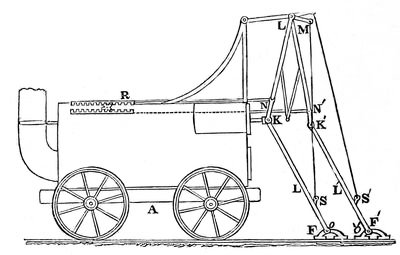
A sketch of these propellers is given in fig. 53. A is the
carriage moving on the railroad, L and L´ are the legs, F and F´ the
feet. The foot F has a joint at O, which corresponds to the ankle;
another joint is placed at K, which corresponds to the knee; and a
third is placed at L, which corresponds to the hip. Similar joints are
placed at the corresponding letters in the other leg. The knee-joint K
is attached to the end of the piston of the cylinder. When the piston,
which is horizontal, is pressed outwards, the leg L presses the
foot F against the ground, and the resistance forces the carriage A
onwards. As the carriage proceeds, the angle K at the knee becomes
larger, so that the leg and thigh take a straighter position; and this
continues until the piston has reached the end of its stroke. At the
hip L there is a short lever, L M, the extremity of which is connected
by a cord or chain with a point, S, placed near the shin of the leg.
When the piston is pressed into the cylinder, the knee, K, is drawn
towards the engine, and the cord, M S, is made to lift the foot, F,
from the ground; to which it does not return until the piston has
arrived at the extremity of the cylinder. On the piston being again
driven out of the cylinder, the foot, F, being placed on the road, is
pressed backwards by the force of the piston-rod at K; but the
friction of the ground preventing its backward motion, the re-action
causes the engine to advance: and in the same manner this process is
continued.
Attached to the thigh, at N, above the knee, by a joint, is a
horizontal rod, N R, which works a rack, R. This rack has beneath it a
cog-wheel. This cog-wheel acts in another rack below it. By these
means, when the knee K is driven from the engine, the rack R is
moved backwards; but the cog-wheel, acting on the other rack beneath
it, will move the latter in the contrary direction. The rack R being
then moved in the same direction with the knee, K, it follows that
the other rack will always be moved in a contrary direction. The
lower rack is connected by another horizontal rod with the thigh of
the leg, L´ F´, immediately above the knee, at N´. When the piston is
forced inwards, the knee, K´, will thus be forced backwards; and
when the piston is forced outwards, the knee, K´, will be
drawn forwards. It therefore follows that the two knees, K and K´,
are pressed alternately backwards and forwards. The foot, F´, when the
knee, K´, is drawn forward, is lifted by the means already described
for the foot, F.
It will be apparent, from this description, that the piece of
mechanism here exhibited is a contrivance derived from the motion of
the legs of an animal, and resembling in all respects the fore legs of
a horse. It is however to be regarded rather as a specimen of great
ingenuity than as a contrivance of practical utility.
(86.) It was about this period that the important fact was first
ascertained that the adhesion or friction of the wheels with the rails
on which they moved was amply sufficient to propel the engine, even
when dragging after it a load of great weight; and that in such case,
the progressive motion would be effected without any slipping of the
wheels. The consequence of this fact rendered totally useless all the
contrivances for giving wheels a purchase on the road, such as racks,
chains, feet, &c. The experiment by which this was determined appears
to have been first tried on the Wylam railroad; where it was proved,
that, when the road was level, and the rails clean, the adhesion of
the wheels was sufficient, in all kind of weather, to propel
considerable loads. By manual labour it was first ascertained how much
weight the wheels of a common carriage would overcome without slipping
round on the rail; and having found the proportion which that bore to
the weight, they then ascertained that the weight of the engine would
produce sufficient adhesion to drag after it, on the railroad, the
requisite number of wagons.[25]
In 1814, an engine was constructed at Killingworth, by Mr.
Stephenson, having two cylinders with a cylindrical boiler, and
working two pair of wheels, by cranks placed at right angles;
so that when the one was in full operation, the other was at its dead
points. By these means the propelling power was always in action. The
cranks were maintained in this position by an endless chain, which
passed round two cogged wheels placed under the engine, and which were
fixed on the same axles on which the wheels were placed. The wheels in
this case were fixed on the axles, and turned with them.
Fig. 54.
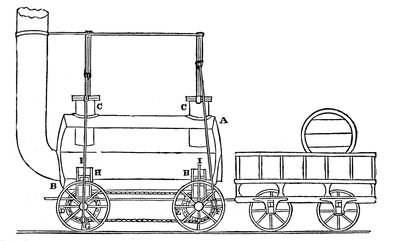
This engine is represented in fig. 54., the sides being open, to
render the interior mechanism visible. A B is the cylindrical boiler;
C C are the working cylinders; D E are the cogged wheels fixed on the
axle of the wheels of the engine, and surrounded by the endless chain.
These wheels being equal in magnitude, perform their revolutions in
the same time; so that, when the crank, F, descends to the lowest
point, the crank, G, rises from the lowest point to the horizontal
position, D; and, again, when the crank, F, rises from the lowest
point to the horizontal position, E, the other crank rises to the
highest point; and so on. A very beautiful contrivance was adopted in
this engine, by which it was suspended on springs of steam. Small
cylinders, represented at H, are screwed by flanges to one side of the
boiler, and project within it a few inches; they have free
communication at the top with the water or steam of the
boiler. Solid pistons are represented at I, which move steam-tight in
these cylinders; the cylinders are open at the bottom, and the
piston-rods are screwed on the carriage of the engine, over the axle
of each pair of wheels, the pistons being presented upwards. As the
engine is represented in the figure, it is supported on four pistons,
two at each side. The pistons are pressed upon by the water or steam
which occupies the upper chamber of the cylinder; and the latter being
elastic in a high degree, the engine has all the advantage of spring
suspension. The defect of this method of supporting the engine is,
that when the steam loses that amount of elasticity necessary for the
support of the machine, the pistons are forced into the cylinders, and
the bottoms of the cylinders bear upon them. All spring suspension is
then lost. This mode of suspension has consequently since been laid
aside.
In an engine subsequently constructed by Mr. Stephenson, for the
Killingworth railroad, the mode adopted of connecting the wheels by an
endless chain and cog-wheels was abandoned; and the same effect was
produced by connecting the two cranks by a straight rod. All such
contrivances, however, have this great defect, that, if the fore and
hind wheels be not constructed with dimensions accurately equal, there
must necessarily be a slipping or dragging on the road. The nature of
the machinery requires that each wheel should perform its revolution
exactly in the same time; and consequently, in doing so, must pass
over exactly equal lengths of the road. If, therefore, the
circumference of the wheels be not accurately equal, that wheel which
has the lesser circumference must be dragged along so much of the road
as that by which it falls short of the circumference of the greater
wheel; or, on the other hand, the greater must be dragged in the
opposite direction, to compensate for the same difference. As no
mechanism can accomplish a perfect equality in four, much less in six,
wheels, it may be assumed that a great portion of that dragging
effect is a necessary consequence of the principle of this
machine; and even were the wheels, in the first instance, accurately
constructed, it is not possible that their wear could be so exactly
uniform as to continue equal.
(87.) The next stimulus which the progress of this invention received,
proceeded from the great national work undertaken at Liverpool, by
which that town and the extensive commercial mart of Manchester were
connected by a double line of railway. When this project was
undertaken, it was not decided what moving power it might be most
expedient to adopt as a means of transport on the proposed road: the
choice lay between horse-power, fixed steam engines, and locomotive
engines; but the first, for many obvious reasons, was at once rejected
in favour of one or other of the last two.
The steam engine may be applied, by two distinct methods, to move
wagons either on a turnpike road or on a railway. By the one method
the steam engine is fixed, and draws the carriage or train of
carriages towards it by a chain extending the whole length of road on
which the engine works. By this method the line of road over which the
transport is conducted is divided into a number of short intervals, at
the extremity of each of which an engine is placed. The wagons or
carriages, when drawn by any engine to its own station, or detached,
and connected with the extremity of the chain worked by the next
stationary engine; and thus the journey is performed, from station to
station, by separate engines. By the other method the same engine
draws the load the whole journey, travelling with it.
The Directors of the Liverpool and Manchester railroad, when that work
was advanced towards its completion, employed, in the spring of the
year 1829, Messrs. Stephenson and Lock and Messrs. Walker and
Rastrick, experienced engineers, to visit the different railways
where practical information respecting the comparative effects of
stationary and locomotive engines was likely to be obtained; and from
these gentlemen they received reports on the relative merits,
according to their judgment, of the two methods. The particulars of
their calculations are given at large in the valuable work of Mr.
Nicholas Wood on railways; to which we refer the reader, not only on
this, but on many other subjects connected with the locomotive steam
engine into which it would be foreign to our subject to enter. The
result of the comparison of the two systems was, that the capital
necessary to be advanced to establish a line of stationary engines was
considerably greater than that which was necessary to establish an
equivalent power in locomotive engines; that the annual expense by the
stationary engines was likewise greater; and that, consequently, the
expense of transport by the latter was greater, in a like proportion.
The subjoined table exhibits the results numerically:—
| |
Capital. |
Annual
Expense. |
Expense of
taking a Ton of
Goods One Mile. |
| |
£ |
s. |
d. |
£ |
s. |
d. |
|
| Locomotive Engines |
58,000 |
0 |
0 |
25,517 |
8 |
2 |
0·164 of a penny. |
| Stationary Engines |
121,496 |
7 |
0 |
42,031 |
16 |
5 |
0·269 |
| Locomotive System—less |
63,496 |
7 |
0 |
16,514 |
8 |
3 |
0·105 |
On the score of economy, therefore, the system of locomotive engines
was entitled to a preference; but there were other considerations
which conspired with this to decide the choice of the Directors in its
favour. An accident occurring in any part of a road worked by
stationary engines must necessarily produce a total suspension of work
along the entire line. The most vigilant and active attention on the
part of every workman, however employed, in every part of the line,
would therefore be necessary; but, independently of this, accidents
arising from the fracture or derangement of any of the chains, or from
the suspension of the working of any of the fixed engines, would be
equally injurious, and would effectually stop the intercourse
along the line. On the other hand, in locomotive engines an accident
could only affect the particular train of carriages drawn by the
engine to which the accident might occur; and even then the difficulty
could be remedied by having a supply of spare engines at convenient
stations along the line. It is true that the probability of accident
is, perhaps, less in the stationary than in the locomotive system; but
the injurious consequences, when accident does happen, are
prodigiously greater in the former. "The one system," says Mr.
Walker, "is like a chain extending from Liverpool to Manchester, the
failure of a single link of which would destroy the whole; while the
other is like a number of short and unconnected chains," the
destruction of any one of which does not interfere with the effect of
the others, and the loss of which may be supplied with facility.
The decision of the Directors was, therefore, in favour of locomotive
engines; and their next measure was to devise some means by which the
inventive genius of the country might be stimulated to supply them
with the best possible form of engines for this purpose. With this
view, it was proposed and carried into effect to offer a prize for the
best locomotive engine which might be produced under certain proposed
conditions, and to appoint a time for a public trial of the claims of
the candidates. A premium of 500l. was accordingly offered for the
best locomotive engine to run on the Liverpool and Manchester Railway;
under the condition that it should produce no smoke; that the pressure
of the steam should be limited to 50 lbs. on the inch; and that it
should draw at least three times its own weight, at the rate of not
less than ten miles an hour; that the engine should be supported on
springs, and should not exceed fifteen feet in height. Precautions
were also proposed against the consequences of the boiler bursting;
and other matters, not necessary to mention more particularly here.
This proposal was announced in the spring of 1829, and the time of
trial was appointed in the following October. The engines
which underwent the trial were, the Rocket, constructed by Mr.
Stephenson; the Sanspariel, by Hackworth; and the Novelty, by
Messrs. Braithwait and Ericson. Of these, the Rocket obtained the
premium. A line of railway was selected for the trial, on a level
piece of road about two miles in length, near a place called Rainhill,
between Liverpool and Manchester; the distance between the two
stations was a mile and a half, and the engine had to travel this
distance backwards and forwards ten times, which made altogether a
journey of 30 miles. The Rocket performed this journey twice: the
first time in 2 hours 14 minutes and 8 seconds; and the second time,
in 2 hours 6 minutes and 49 seconds. Its speed at different parts of
the journey varied: its greatest rate of motion was rather above 29
miles an hour; and its least, about 11-1/2 miles an hour. The average
rate of the one journey was 13-4/10 miles an hour; and of the other,
14-2/20 miles. This was the only engine which performed the complete
journey proposed, the others having been stopped from accidents which
occurred to them in the experiment. The Sanspariel performed the
distance between the stations eight times, travelling 22-1/2 miles in
1 hour 37 minutes and 16 seconds. The greatest velocity to which this
engine attained was something less than 23 miles per hour. The Novelty
had only passed twice between the stations when the joints of the
boiler gave way, and put an end to the experiment.
(88.) The great object to be attained in the construction of these
engines was, to combine with sufficient lightness the greatest
possible heating power. The fire necessarily acts on the water in two
ways: first, by its radiant heat; and, second, by the current of
heated air which is carried by the draft through the fire, and finally
passes into the chimney. To accomplish this object, therefore, it is
necessary to expose to both these sources of heat the greatest
possible quantity of surface in contact with the water. These ends
were attained by the following admirable arrangement in the
Rocket:—
Fig. 55.
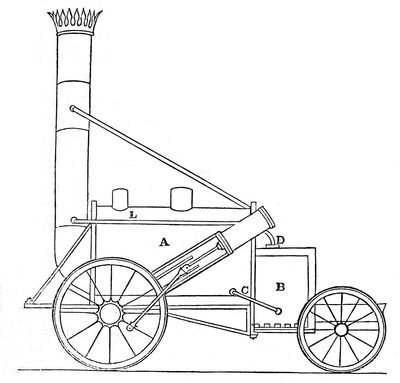
Fig. 56.
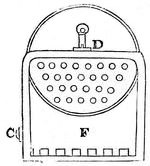
This engine is represented in fig. 55. It is supported on four wheels;
the principal part of the weight being thrown on one pair, which are
worked by the engine. The boiler consists of a cylinder 6 feet in
length, with flat ends; the chimney issues from one end, and to the
other end is attached a square box, B, the bottom of which is
furnished with the grate on which the fuel is placed. This box is
composed of two casings of iron, one contained within the other,
having between them a space about 3 inches in breadth; the magnitude
of the box being 3 feet in length, 2 feet in width, and 3 feet in
depth. The casing which surrounds the box communicates with the lower
part of the boiler by a pipe marked C; and the same casing at the top
of the box communicates with the upper part of the boiler by another
pipe marked D. When water is admitted into the boiler, therefore, it
flows freely through the pipe C, into the casing which
surrounds the furnace or fire-box, and fills this casing to the same
level as that which it has in the boiler. When the engine is at work,
the boiler is kept about half filled with water; and, consequently,
the casing surrounding the furnace is completely filled. The steam
which is generated in the water contained in the casing finds its exit
through the pipe D, and escapes into the upper part of the boiler. A
section of the engine, taken at right angles to its length is
represented at fig. 56. Through the lower part of the boiler pass a
number of copper tubes of small size, which communicate at one end
with the fire-box, and at the other with the chimney, and form a
passage for the heated air from the furnace to the chimney. The
ignited fuel spread on the grate at the bottom of the fire-box
disperses its heat by radiation, and acts in this manner on the whole
surface of the casing surrounding the fire-box; and thus raises the
temperature of the thin shell of water contained in that casing. The
chief part of the water in the casing, being lower in its position
than the water in the boiler, acquires a tendency to ascend when
heated, and passes into the boiler; so that a constant circulation of
the heated water is maintained, and the water in the boiler must
necessarily be kept at nearly the same temperature as the water in the
casing. The air which passes through the burning fuel, and which fills
the fire-box, is carried by the draft through the tubes which extend
through the lower part of the boiler; and as these tubes are
surrounded on every side with the water contained in the boiler, this
air transmits its heat through these tubes to the water. It finally
issues into the chimney, and rises by the draft. The power of this
furnace must necessarily depend on the power of draft in the chimney;
and to increase this, and at the same time to dispose of the waste
steam after it has worked the piston, this steam is carried
off by a pipe L, which passes from the cylinder to the chimney, and
escapes there in a jet which is turned upwards. By the velocity with
which it issues from this jet, and by its great comparative levity, it
produces a strong current upwards in the chimney, and thus gives force
to the draft of the furnace. In fig. 56. the grate-bars are
represented at the bottom of the fire-box at F. There are two
cylinders, one of which works each wheel; one only appearing in the
drawing, fig. 55., the other being concealed by the engine. The spokes
which these cylinders work are placed at right angles on the wheels;
the wheels being fixed on a common axle, with which they turn.
In this engine, the surface of water surrounding the fire-box, exposed
to the action of radiant heat, amounted to 20 square feet, which
received heat from the surface of 6 square feet of burning fuel on the
bars. The surface exposed to the action of the heated air amounted to
118 square feet. The engine drew after it another carriage, containing
fuel and water; the fuel used was coke, for the purpose of avoiding
the production of smoke.
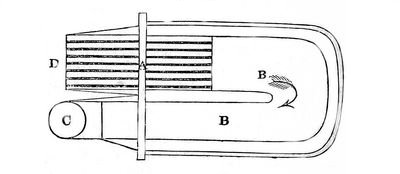
(89.) The Sanspareil of Mr. Hackworth is represented in fig. 57.;
the horizontal section being exhibited in fig. 58.
Fig. 57.
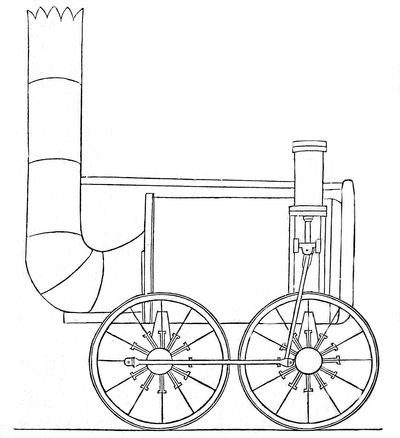
Fig. 58.
The draft of the furnace is produced in the same manner as in the
Rocket, by ejecting the waste steam coming from the cylinder into the
chimney; the boiler, however, differs considerably from that of the
Rocket. A recurved tube passes through the boiler, somewhat similar to
that already described in the early engine of Messrs. Trevithick and
Vivian. In the horizontal section (fig. 58.), D expresses the
opening of the furnace at the end of the boiler, beside the chimney.
The grate-bars appear at A, supporting the burning fuel; and a curved
tube passing through the boiler, and terminating in the chimney, is
expressed at B, the direction of the draft being indicated by the
arrow; C is a section of the chimney. The cylinders are placed, as in
the Rocket, on each side of the boiler; each working a separate
wheel, but acting on spokes placed at right angles to each
other. The tube in which the grate and flue are placed diminishes in
diameter as it approaches the chimney. At the mouth where the grate
was placed, its diameter was 2 feet; and it was gradually reduced, so
that, at the chimney, its diameter was only 15 inches. The grate-bars
extended 5 feet into the tube. The surface of water exposed to the
radiant heat of the fire was 16 square feet; and that exposed
to the action of the heated air and flame was about 75 square feet.
The magnitude of the grate or sheet of burning fuel which radiated
heat, was 10 square feet.
(90.) The Novelty, of Messrs. Braithwait and Ericson, is
represented in fig. 59.; and a section of the generator and boiler is
exhibited in fig. 60.: the corresponding parts in the two figures are
marked by the same letters.
Fig. 59.
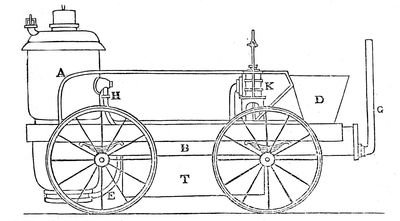
A is the generator or receiver, containing the steam which works the
engine; this communicates with a lower generator, B, which extends in
a horizontal direction the entire length of the carriage. Within the
generator, A, is contained the furnace, F, which communicates in a
tube, C; carried up through the generator, and terminated at the top
by sliding shutters, which exclude the air, and which are only opened
to supply fuel to the grate, F. Below the grate the furnace is not
open, as usual, to the atmosphere, but communicates by a tube, E, with
a bellows, D; which is worked by the engine, and which forces a
constant stream of air, by the tube E, through the fuel on F, so as to
keep that fuel in vivid combustion. The heated air, contained in the
furnace, F, is driven on, by the same force, through a small curved
tube marked e, which circulates like a worm (as represented in fig.
60.) through the horizontal generator or receiver; and, tapering
gradually, until reduced to very small dimensions, it finally
issues into the chimney, G. The air, in passing along this tube,
imparts its heat to the water by which the tube is surrounded, and is
brought to a considerably reduced temperature when discharged into the
chimney. The cylinder, which is represented at K, works one pair of
wheels, by means of a bell-crank; the other pair, when necessary,
being connected with them.
Fig. 60.
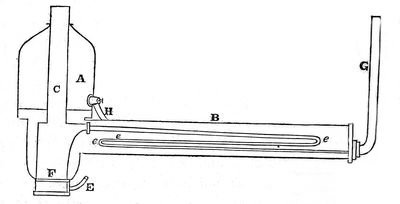
In this engine, the magnitude of the surface of burning fuel on the
grate-bars is less than 2 square feet; the surface exposed to radiant
heat is 9-1/2 square feet; and the surface of water exposed to heated
air is about 33 square feet.
The superiority of the Rocket may be attributed chiefly to the greater
quantity of surface of the water which is exposed to the action of the
fire. With a less extent of grate-bars than the Sanspareil, in the
proportion of 3 to 5, it exposes a greater surface of water to radiant
heat, in the proportion of 4 to 3; and a greater surface of water to
heated air, in the proportion of more than 3 to 2. It was found that
the Rocket, compared with the Sanspareil, consumed fuel, in the
evaporation of a given quantity of water, in the proportion of 11 to
28. The suggestion of using the tubes to conduct through the water the
heated air to the chimney is due to Mr. Booth, treasurer of the
Liverpool and Manchester Railway Company; and, certainly, nothing has
been more conducive to the efficiency of the engines since used than
this improvement. It is much to be regretted that the ingenious
gentleman who suggested this has reaped none of the
advantages to which a patentee would be legally entitled.[26]
(91.) The great object to be effected in the boilers of these engines
is, to keep a small quantity of water at an excessive temperature, by
means of a small quantity of fuel kept in the most active state of
combustion. To accomplish this, it is necessary, first, so to shape
the boiler, furnace, and flues, that the water shall be in contact
with as extensive a surface as possible, every part of which is acted
on either immediately, by the heat radiating from the fire, or
mediately, by the air which has passed through the fire, and which
finally rushes into the chimney: and, secondly, that such a forcible
draught should be maintained in the furnace, that a quantity of heat
shall be extricated from the fuel, by combustion, sufficient to
maintain the water at the necessary temperature, and to produce the
steam with sufficient rapidity. To accomplish these objects,
therefore, the chamber containing the grate should be completely
surrounded by water, and should be below the level of the water in the
boiler. The magnitude of the surface exposed to radiation should be as
great as is consistent with the whole magnitude of the machine. The
comparative advantage which the Rocket possessed in these respects
over the other engines will be evident on inspection. In the next
place, it is necessary that the heat, which is absorbed by the air
passing through the fuel, and keeping it in a state of combustion,
should be transferred to the water before the air escapes into the
chimney. Air being a bad conductor of heat, to accomplish this it is
necessary that the air in the flues should be exposed to as great an
extent of surface in contact with the water as possible. No
contrivance can be less adapted for the attainment of this end than
one or two large tubes traversing the boiler, as in the earliest
locomotive engines: the body of air which passes through the
centre of these tubes had no contact with their surface, and,
consequently, passed into the chimney at nearly the same temperature
as that which it had when it quitted the fire. The only portion of air
which imparted its heat to the water was that portion which passed
next to the surface of the tube.
Several methods suggest themselves to increase the surface of water in
contact with a given quantity of air passing through it. This would be
accomplished by causing the air to pass between plates placed near
each other, so as to divide the current into thin strata, having
between them strata of water, or it might be made to pass between
tubes differing slightly in diameter, the water passing through an
inner tube, and being also in contact with the external surface of the
outer tube. Such a method would be similar in principle to the
steam-jacket used in Watt's steam engines, or to the condenser of
Cartwright's engine already described. But, considering the facility
of constructing small tubes, and of placing them in the boiler, that
method, perhaps, is, on the whole, the best in practice; although the
shape of a tube, geometrically considered, is most unfavourable for
the exposure of a fluid contained in it to its surface. The air which
passes from the fire-chamber, being subdivided as it passes through
the boiler by a great number of very small tubes, may be made to
impart all its excess of heat to the water before it issues into the
chimney. This is all which the most refined contrivance can effect.
The Rocket engine was traversed by 25 tubes, each 3 inches in
diameter; and the principle has since been carried to a much greater
extent.
The abstraction of a great quantity of heat from the air before it
reaches the chimney is attended with one consequence, which, at first
view, would present a difficulty apparently insurmountable; the
chimney would, in fact, lose its power of draught. This difficulty,
however, was removed by using the waste steam, which had passed from
the cylinder after working the engine, for the purpose of
producing a draught. This steam was urged through a jet presented
upwards in the chimney, and driven out with such force in that
direction as to create a sufficient draught to work the furnace.
It will be observed that the principle of draught in the Novelty is
totally distinct from this: in that engine the draught is produced by
a bellows worked by the engine. The question, as far as relates to
these two methods, is, whether more power is lost in supplying the
steam through the jet, as in the Rocket, or in working the bellows, as
in the Novelty. The force requisite to impel the steam through the jet
must be exerted by the returning stroke of the piston, and,
consequently, must rob the working effect to an equivalent amount. On
the other hand, the power requisite to work the bellows in the Novelty
must be subducted from the available power of the engine. The former
method is found to be the more effectual and economical.
The importance of these details will be understood, when it is
considered that the only limit to the attainment of speed by
locomotive engines is the power to produce in a given time a certain
quantity of steam. Each stroke of the piston causes one revolution of
the wheels, and consumes two cylinders full of steam: consequently, a
cylinder of steam corresponds to a certain number of feet of road
travelled over: hence it is that the production of a rapid and
abundant supply of heat, and the imparting of that heat quickly and
effectually to the water, is the key to the solution of the problem to
construct an engine capable of rapid motion.
The method of subdividing the flue into tubes was carried much further
by Mr. Stephenson after the construction of the Rocket; and, indeed,
the principle was so very obvious, that it is only surprising that, in
the first instance, tubes of smaller diameter than 3 inches were not
used. In engines since constructed, the number of tubes vary from 90
to 120, the diameter being reduced to 2 inches or less, and in some
instances tubes have been introduced, even to the number of
150, of 1-1/2 inch diameter. In the Meteor, 20 square feet are exposed
to radiation, and 139 to the contact of heated air; in the Arrow, 20
square feet to radiation, and 145 to the contact of heated air. The
superior economy of fuel gained by this means will be apparent by
inspecting the following table, which exhibits the consumption of fuel
which was requisite to convey a ton weight a mile in each of four
engines, expressing also the rate of the motion:—
| Engines. |
Average rate of
speed in miles
per hour. |
Consumption of
Coke in pounds
per ton per mile. |
| No. 1. |
Rocket |
14 |
2·41 |
| 2. |
Sanspareil |
15 |
2·47 |
| 3. |
Phœnix |
12 |
1·42 |
| 4. |
Arrow |
12 |
1·25 |
(92.) Since the period at which the railway was opened for the actual
purposes of transport, the locomotive engines have been in a state of
progressive improvement. Scarcely a month has passed without
suggesting some change in the details, by which fuel might be
economised, the production of steam rendered more rapid, the wear of
the engine rendered slower, the proportionate strength of the
different parts improved, or some other desirable end obtained. The
consequence of this has been, that the particular engines to which we
have alluded, and others of the same class, without having, as it
were, lived their natural life, or without having been worn out by
work, have been laid aside to give place to others of improved powers.
By the exposure of the cylinders to the atmosphere in the Rocket, and
engines of a similar form, a great waste of heat was incurred, and it
was accordingly determined to remove them from the exterior of the
boiler, and to place them within a casing immediately under the
chimney: this chamber was necessarily kept warm by its proximity to
the end of the boiler, but more by the current of heated air which
constantly rushed into it from the tubes. This change, also,
rendered necessary another, which improved the working of the engine.
In the earlier engines the motion of the piston was communicated to
the wheel by a connecting rod attached to one of the spokes on the
exterior of the wheel, as represented in fig. 55. By the change to
which we have just alluded, the cylinders being placed between the
wheels under the chimney, this mode of working became inapplicable,
and it was considered better to connect the piston-rods with two
cranks placed at right angles on the axles of the great wheels. By
this means, it was found that the working of the machine was more
even, and productive of less strain than in the former arrangement. On
the other hand, a serious disadvantage was incurred by the adoption of
a cranked axle. The weakness necessarily arising from such a form of
axle could only be counterbalanced by great thickness and weight of
metal; and even this precaution does not prevent the occasional
fracture of such axles at the angles of the cranks. The advantages,
however, of this plan, on the whole, are considered to predominate.
In the most improved engines in present use two safety-valves are
provided, of which only one is in the power of the engine-man. The
tubes being smaller and more numerous than in the earlier engines, the
heat is more completely extracted from the air before it enters the
chimney. A powerful draft is rendered still more necessary by the
smallness of the tubes: this is effected by forcing the steam which
has worked the pistons through a contracted orifice, presented upwards
in the chimney, by the regulation of which any degree of draft may be
obtained.
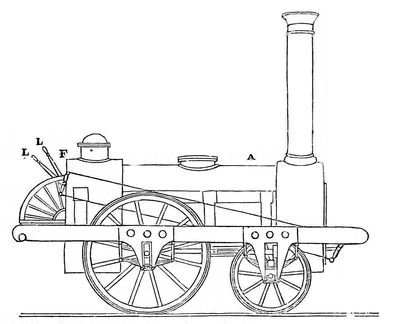
One of the most improved engines at present in use is represented in
fig. 61.
A represents the cylindrical boiler, the lower half of which is
traversed by tubes, as described in the Rocket. They are usually from
80 to 100 in number, and about 1-1/2 inch in diameter; the boiler is
about 7 feet in length; the fire-chamber is attached to one
end of it, at F, as in the Rocket, and similar in construction; the
cylinders are inserted in a chamber at the other end, immediately
under the chimney. The piston-rods are supported in the horizontal
position by guides; and connecting rods extend from them, under the
engine, to the two cranks placed on the axle of the large wheels. The
effects of any inequality in the road are counteracted by springs, on
which the engine rests; the springs being below the axle of the great
wheels, and above that of the less. The steam is supplied to the
cylinders, and withdrawn, by means of the common sliding valves, which
are worked by an eccentric wheel placed on the axle of the large
wheels of the carriage. The motion is communicated from this eccentric
wheel to the valve by sliding rods. The stand is placed for the
attendant at the end of the engine, next the fire-place, F; and two
levers, L, project from the end, which communicate with the valves by
means of rods, by which the engine is governed, so as to stop or
reverse the motion.
Fig. 61.
The wheels of these engines have been commonly constructed of wood,
with strong iron tires, furnished with flanges adapted to the rails.
But Mr. Stephenson has recently substituted, in some
instances, wheels of iron with hollow spokes. The engine draws after
it a tender carriage containing the fuel and water; and, when carrying
a light load, is capable of performing the whole journey from
Liverpool to Manchester without a fresh supply of water. When a heavy
load of merchandise is drawn, it is usual to take in water at the
middle of the trip.
(93.) In reviewing all that has been stated, it will be perceived that
the efficiency of the locomotive engines used on this railway is
mainly owing to three circumstances: 1st, The unlimited power of draft
in the furnace, by projecting the waste steam into the chimney; 2d,
The unlimited abstraction of heat from the air passing from the
furnace, by Mr. Booth's ingenious arrangement of tubes traversing
the boiler; and, 3d, Keeping the cylinders warm, by immersing them in
the chamber under the chimney.[27] There are many minor details which
might be noticed with approbation, but these constitute the main
features of the improvements, and should never, for a moment, be lost
sight of by projectors of locomotive engines.
The successive introduction of improvements in the engines, some of
which we have mentioned, has been accompanied by corresponding
accessions to their practical power, and to the economy of fuel; and
they have now arrived at a point which is as far beyond the former
expectations of the most sanguine locomotive projectors, as it
assuredly is short of the perfection of which these wonderful machines
are still susceptible.
In the spring of the year 1832, I made several experiments on the
Manchester railway, with a view to determine, in the actual state of
the locomotive engines at that time, their powers with respect to the
amount of load and the economy of fuel. Since that time I am
not aware that, in these respects, the engine has received any
material improvement. The following are the particulars of three
experiments thus made:—
On Saturday, the 5th of May, the engine called the "Victory" took 20
wagons of merchandise, weighing gross 92 tons 19 cwt. 1 qr., together
with the tender containing fuel and water, of the weight of which I
have no account, from Liverpool to Manchester (30 miles,) in 1 h. 34
min. 45 sec. The train stopped to take in water half-way, for 10
minutes, not included in the above mentioned time. On the inclined
plane rising 1 in 96, and extending 1-1/2 mile, the engine was
assisted by another engine called the "Samson," and the ascent was
performed in 9 minutes. At starting, the fire-place was well filled
with coke, and the coke supplied to the tender accurately weighed. On
arriving at Manchester the fire-place was again filled, and the coke
remaining in the tender weighed. The consumption was found to amount
to 929 pounds net weight, being at the rate of one third of a pound
per ton per mile.
Speed on the level was 18 miles an hour; on a fall of 4 feet in a
mile, 21-1/2 miles an hour; fall of 6 feet in a mile, 25-1/2 miles an
hour; on the rise over Chatmoss, 8 feet in a mile 17-5/8 miles an
hour; on level ground sheltered from the wind, 20 miles an hour. The
wind was moderate, but direct ahead. The working wheels slipped three
times on Chatmoss, and the train was retarded from 2 to 3 minutes.
The engine, on this occasion, was not examined before or after the
journey, but was presumed to be in good working order.
On Tuesday, the 8th of May, the same engine performed the same
journey, with 20 wagons, weighing gross 90 tons 7 cwt. 2
qrs., exclusive of the unascertained weight of the tender. The time of
the journey was 1 h. 41 min. The consumption of coke 1040 lbs. net
weight, estimated as before. Rate of speed:—
| Level |
17-5/8 miles per hour. |
| Fall of |
4 feet in a mile |
22 |
| —— |
6 |
22-1/2 |
| Rise of |
8 |
15 |
On this occasion there was a high wind ahead on the quarter, and the
connecting rod worked hot, owing to having been keyed too tight. On
arriving at Manchester, I caused the cylinders to be opened, and found
that the pistons were so loose, that the steam blew through the
cylinders with great violence. By this cause, therefore, the machine
was robbed of a part of its power during the journey; and this
circumstance may explain the slight decrease in speed, and increase in
the consumption of fuel, with a lighter load in this journey compared
with that performed on the 5th of May.
The Victory weighs 8 tons 2 cwt., of which 5 tons 4 cwt. rest on the
drawing wheels. The cylinders are 11 inches diameter, and 16 inches
stroke; and the diameter of the drawing wheels is 5 feet.
On the 29th of May, the engine called the "Samson," (weighing 10 tons
2 cwt., with 14-inch cylinders, and 16-inch stroke; wheels 4 feet 6
inches diameter, both pairs being worked by the engine; steam 50 lbs.
pressure, 130 tubes) was attached to 50 wagons, laden with
merchandise; net weight about 150 tons; gross weight, including
wagons, tender, &c., 223 tons 6 cwt. The engine with this load
travelled from Liverpool to Manchester (30 miles) in 2 h. and 40 min.,
exclusive of delays upon the road for watering, &c., being at the
rate of nearly 12 miles an hour. The speed varied according
to the inclinations of the road. Upon a level, it was 12 miles an
hour; upon a descent of 6 feet in a mile, it was 16 miles an hour:
upon a rise of 8 feet in a mile, it was about 9 miles an hour. The
weather was calm, the rails very wet; but the wheels did not slip,
even in the slowest speed, except at starting, the rails being at that
place soiled and greasy with the slime and dirt to which they are
always exposed at the stations. The coke consumed in this journey,
exclusive of what was raised in getting up the steam, was 1762 lbs.,
being at the rate of a quarter of a pound per ton per mile.
(94.) From the above experiments it appears that a locomotive engine,
in good working order, with its full complement of load, is capable of
transporting weights at an expense in fuel amounting to about 4 ounces
of coke per ton per mile. The attendance required on the journey is
that of an engine-man and a fire-boy; the former being paid 1s.
6d. for each trip of 30 miles, and the latter 1s. In practice,
however, we are to consider, that it rarely happens that the full
complement of load can be sent with the engines; and when lesser loads
are transported, the proportionate expense must for obvious reasons,
be greater.
The practical expenditure of fuel on the Liverpool and Manchester line
may, perhaps, be fairly estimated at half a pound of coke per ton per
mile.
(95.) Having explained the power and efficiency of these locomotive
engines, it is now right to notice some of the defects under which
they labour.
The great original cost, and the heavy expense of keeping the engines
used on the railway in repair, have pressed severely on the resources
of the undertaking. One of the best constructed of the later engines
costs originally about 800l. It may be hoped that, by the excitement
of competition, the facilities derived from practice, and from the
manufacture of a greater number of engines of the same kind, some
reduction of this cost may be effected. The original cost,
however, is far from being the principal source of expense: the wear
and tear of these machines, and the occasional fracture of those parts
on which the greatest strain has been laid, have greatly exceeded what
the directors had anticipated. Although this source of expense must be
in part attributed to the engines not having yet attained that state
of perfection, in the proportion and adjustment of their parts, of
which they are susceptible, and to which experience alone can lead,
yet there are some obvious defects which demand attention.
The heads of the boilers are flat, and formed of iron, similar to the
material of the boilers themselves. The tubes which traverse the
boiler were, until recently, copper, and so inserted into the flat
head or ends as to be water-tight. When the boiler is heated, the
tubes are found to expand in a greater degree than the other parts of
the boiler; which frequently causes them either to be loosened at the
extremities, so as to cause leakage, or to bend from want of room for
expansion. The necessity of removing and refastening the tubes causes,
therefore, a constant expense.
It will be recollected that the fire-place is situated at one end of
the boiler, immediately below the mouths of the tubes: a powerful
draught of air, passing through the fire, carries with it ashes and
cinders, which are driven violently through the tubes, and especially
the lower ones, situated near the fuel. These tubes are, by this
means, subject to rapid wear, the cinders continually acting upon
their interior surface. After a short time it becomes necessary to
replace single tubes, according as they are found to be worn, by new
ones; and it not unfrequently happens, when this is neglected, that
tubes burst. After a certain length of time the engines require new
tubing, which is done at the expense of about 70l., allowing for the
value of the old tubes. This wear of the tubes might possibly be
avoided by constructing the fire-place in a lower position, so as to
be more removed from their mouths; or, still more effectually, by
interposing a casing of metal, which might be filled with
water, between the fire-place and those tubes which are the most
exposed to the cinders and ashes. The unequal expansion of the tubes
and boilers appears to be an incurable defect, if the present form of
the engine be retained. If the fire-place and chimney could be placed
at the same end of the boiler, so that the tubes might be recurved,
the unequal expansion would then produce no injurious effect; but it
would be difficult to clean the tubes if they were exposed, as they
are at present, to the cinders. The next source of expense arises from
the wear of the boiler-head, which is exposed to the action of the
fire. These require constant patching and frequent renewal.
A considerable improvement has lately been introduced into the method
of tubing, by substituting brass for copper tubes. We are not aware
that the cause of this improvement has been discovered; but it is
certain, whatever be the cause, that brass tubes are subject to
considerably slower wear than copper.
It has been said by some whose opinions are adverse to the advantage
of railways, but more especially to the particular species of
locomotive engines now under consideration, that the repairs of one of
these engines cost so great a sum as 1500l. per annum, and that the
directors now think of abandoning them, or adopting either stationary
engines or horse-power. As to the first of these statements I must
observe, that the expense of repairs of such machines should never be
computed in reference to time, but rather to the work done, or the
distance travelled over. I have ascertained that engines frequently
travel a distance of from 25,000 to 30,000 miles before they require
new tubing. During that work, however, single tubes are, of course,
occasionally renewed, and other repairs are made, the expense of which
may safely be stated as under the original cost of the engine. The
second statement, that the company contemplate substituting stationary
engines, or horses, for locomotives, is altogether at
variance with the truth. Whatever improvements may be contemplated in
locomotives, the directors assuredly have not the slightest intention
of going back in the progress of improvement, in the manner just
mentioned.
The expense of locomotive power having so far exceeded what was
anticipated at the commencement of the undertaking, it was thought
advisable, about the beginning of the year 1834, to institute an
inquiry into the causes which produced the discrepancy between the
estimated and actual expenses, with a view to the discovery of some
practical means by which they could be reduced. The directors of the
company, for this purpose, appointed a sub-committee of their own
body, assisted by Mr. Booth, their treasurer, to inquire and report
respecting the causes of the amount of this item of their expenditure,
and to ascertain whether any and what measures could be devised for
the attainment of greater economy. A very able and satisfactory report
was made by this committee, or, to speak more correctly by Mr.
Booth.
It appears that, previous to the establishment of the railway, Messrs.
Walker and Rastrick, engineers, were employed by the company to
visit various places where steam power was applied on railways, for
the purpose of forming an estimate of the probable expense of working
the railway by locomotive and by fixed power. These engineers
recommended the adoption of locomotive power, and their estimate was,
that the transport might be effected at the rate of .278 of a penny,
or very little more than a farthing per ton per mile. In the year
1833, five years after this investigation took place, it was found
that the actual cost was .625 of a penny, or something more than a
halfpenny per ton per mile, being considerably above double the
estimated rate. Mr. Booth very properly directed his inquiries to
ascertain the cause of this discrepancy, by comparing the various
circumstances assumed by Messrs. Walker and Rastrick, in
making their estimate, with those under which the transport was
actually effected. The first point of difference which he observed was
the speed of transport: the estimate was founded on an assumed speed
of ten miles an hour, and it was stated that a fourfold speed would
require an addition of 50 per cent. to the power, without taking into
account wear and tear. Now the actual speed of transport being double
the speed assumed in the statement, Mr. Booth holds it to be
necessary to add 25 per cent. on that score.
The next point of difference is in the amount of the loads: the
estimate is founded upon the assumption, that every engine shall start
with its full complement of load, and that with this it shall go the
whole distance. "The facts, however, are," says Mr. Booth, "that,
instead of a full load of profitable carriage from Manchester,
about half the wagons come back empty, and, instead of the tonnage
being conveyed the whole way, many thousand tons are conveyed only
half the way; also, instead of the daily work being uniform, it is
extremely fluctuating." It is further remarked, that in order to
accomplish the transport of goods from the branches and from
intermediate places, engines are despatched several times a day, from
both ends of the line, to clear the road; the object of this
arrangement being rather to lay the foundation of a beneficial
intercourse in future, than with a view to any immediate profit. Mr.
Booth makes a rough estimate of the disadvantages arising from these
circumstances by stating them at 33 per cent. in addition to the
original estimate.
The next point of difference is the fuel. In the original estimate
coal is assumed as the fuel, and it is taken at the price of five
shillings and tenpence per ton: now the act of parliament forbids the
use of coal which would produce smoke; the company have, therefore,
been obliged to use coke, at seventeen shillings and sixpence a
ton. Taking coke, then, to be equivalent to coal, ton for
ton, this would add .162 to the original estimate.
These several discrepancies being allowed for, and a proportional
amount being added to the original estimate, the amount would be
raised to .601 of a penny per ton per mile, which is within one
fortieth of a penny of the actual cost. This difference is considered
to be sufficiently accounted for by the wear and tear produced by the
very rapid motion, more especially when it is considered that many of
the engines were constructed before the engineer was aware of the
great speed that would be required.
"What then," says Mr. Booth, in the Report already alluded to, "is
the result of these opposite and mutually counteracting circumstances?
and what is the present position of the company in respect of their
moving power? Simply, that they are still in a course of experiment,
to ascertain practically the best construction, and the most durable
materials, for engines required to transport greater weights, and at
greater velocities, than had, till very recently, been considered
possible; and which, a few years ago, it had not entered into the
imagination of the most daring and sanguine inventor to conceive: and,
farther, that these experiments have necessarily been made, not with
the calm deliberation and quiet pace which a salutary caution
recommends,—making good each step in the progress of discovery before
advancing another stage,—but amidst the bustle and responsibilities
of a large and increasing traffic; the directors being altogether
ignorant of the time each engine would last before it would be laid up
as inefficient, but compelled to have engines, whether good or bad;
being aware of various defects and imperfections, which it was
impossible at the time to remedy, yet obliged to keep the machines in
motion, under all the disadvantages of heavy repairs, constantly going
on during the night, in order that the requisite number of engines
might be ready for the morning's work. Neither is this great
experiment yet complete; it is still going forward. But the
most prominent difficulties have been in a great measure surmounted,
and your committee conceive, that they are warranted in expecting,
that the expenditure in this department will, ere long, be materially
reduced, more especially when they consider the relative performances
of the engines at the present time compared with what it was two
years ago."
In the half year ending 31st December, 1831, the six best engines
performed as follows:—
| |
Miles. |
| Planet |
9,986 |
| Mercury |
11,040 |
| Jupiter |
11,618 |
| Saturn |
11,786 |
| Venus |
12,850 |
| Etna |
8,764 |
| |
——— |
| Making in all |
66,044 |
| |
——— |
In the half year ending 31st December, 1833, the six best engines
performed as follows:—
| |
Miles. |
| Jupiter |
16,572 |
| Saturn |
18,678 |
| Sun |
15,552 |
| Etna |
17,763 |
| Ajax |
11,678 |
| Firefly |
15,608 |
| |
——— |
| Making in all |
95,851 |
| |
——— |
(96.) The advantages derivable from railroads are greatly abridged by
the difficulty arising from those changes of level to which all roads
are necessarily liable; but in the case of railroads, from causes
peculiar to themselves, these changes of level occasion great
inconvenience. To explain the nature of these difficulties, it will be
necessary to consider the relative proportion which must subsist
between the power of traction on a level and on an inclined
plane. On a level railroad the force of traction necessary to propel
any load, placed on wheel carriages of the construction now commonly
used, may perhaps be estimated at 7-1/2 pounds,[28] for every ton
gross in the load; that is to say, if a load of one ton gross were
placed upon wheel carriages upon a level railroad, the traces of
horses drawing it would be stretched with a force equivalent to 7-1/2
pounds. If the load amounted to two or three tons, the tension of the
traces would be increased to 15 or 22-1/2 pounds, and so on. The
necessity of this force of traction, arising from the want of perfect
smoothness in the road, and from the friction of the wheels and axles
of the carriages, must be the same whether the road be level or
inclined; and consequently, in ascending an inclined plane, the same
force of traction will be necessary in addition to that which arises
from the tendency of the load to fall down the plane. This latter
tendency is always in the proportion of the elevation of the plane to
its length; that is to say, a plane which rises 1 foot in 100 will
give a weight of 100 tons a tendency to fall down the plane amounting
to 1 ton, and would therefore add 1 ton to the force of traction
necessary for such a load on a level.
Now since 7-1/2 pounds is very nearly the 300th part of a ton, it
follows that if an inclination upon a railroad rises at the rate of 1
foot in 300, or, what is the same, 17-1/2 feet in a mile, such an
acclivity will add 7-1/2 pounds per ton to the force of traction. This
acclivity therefore would require a force of traction twice as great
as a level. In like manner a rise of 35 feet in a mile would require
three times the force of traction of a level, 52-1/2 feet in
a mile four times that force, and so on. In fact, for every 7 feet in
a mile which an acclivity rises, 3 pounds per ton will be added to the
force of traction. If we would then ascertain the power necessary to
pull a load up any given acclivity upon a railroad, we must first take
7-1/2 pounds as the force necessary to overcome the common resistance
of the road, and then add 3 pounds for every 7 feet which the
acclivity rises per mile. For example, suppose an acclivity to rise at
the rate of 70 feet in a mile, the force of traction necessary to draw
a ton up it would be thus calculated:—
| Friction |
7-1/2 lbs. |
| 70 feet = 10 times 3 lbs. |
30 |
| |
——— |
| Total force |
37-1/2 |
It will be apparent, therefore, that if a railroad undulates by
inclined planes, even of the most moderate inclinations, the
propelling power to be used upon it must be of such a nature as to be
capable of increasing its intensity in a great degree, according to
the elevation of the planes which it has to encounter. A plane which
rises 52-1/2 feet per mile presents to the eye scarcely the appearance
of an ascent, and yet requires the power of traction to be increased
in a fourfold proportion.
It is the property of animal power, that within certain limits its
energy can be put forth at will, according to the exigency of the
occasion; but the intensity of mechanical power, in the instance now
considered, cannot so conveniently be varied, except indeed within
narrow limits.
In the application of locomotive engines upon railways the difficulty
arising from inclined planes has been attempted to be surmounted by
several methods, which we shall now explain.
1. Upon arriving at the foot of the plane the load is divided, and the
engine carries it up in several successive trips, descending the
plane unloaded after each trip. The objection to this method
is the delay which it occasions,—a circumstance which is incompatible
with a large transport of passengers. From what has been stated, it
would be necessary, when the engine is fully loaded on a level, to
divide its load into four parts, to be successively carried up when
the incline rises 52 feet per mile. This method has been practised in
the transport of merchandise occasionally, when heavy loads were
carried on the Liverpool and Manchester line, upon the Rainhill
incline.
2. A subsidiary or assistant locomotive engine may be kept in constant
readiness at the foot of each incline, for the purpose of aiding the
different trains, as they arrive, in ascending. The objection to this
mode is the cost of keeping such an engine with its boiler continually
prepared, and its steam up. It would be necessary to keep its fire
continually lighted, whether employed or not; otherwise, when the
train would arrive at the foot of the incline, it should wait until
the subsidiary engine was prepared for work. In cases where trains
would start and arrive at stated times, this objection, however, would
have less force. This method is at present generally adopted on the
Liverpool and Manchester line. This method, however, cannot be
profitably applied to planes of any considerable length.
3. A fixed steam engine may be erected on the crest of the incline, so
as to communicate by ropes with the train at the foot. Such an engine
would be capable of drawing up one or two trains together, with their
locomotives, according as they would arrive, and no delay need be
occasioned. This method requires that the fixed engine should be kept
constantly prepared for work, and the steam continually up in the
boiler. This expedient is scarcely compatible with a large transit of
passengers, except at the terminus of a line.
4. In working on the level, the communication between the boiler and
the cylinder in the locomotives may be so restrained by partially
closing the throttle valve, as to cause the pressure upon the piston
to be less in a considerable degree than the pressure of
steam in the boiler. If under such circumstances a sufficient pressure
upon the piston can be obtained to draw the load on the level, the
throttle valve may be opened on approaching the inclined plane, so as
to throw on the piston a pressure increased in the same proportion as
the previous pressure in the boiler was greater than that upon the
piston. If the fire be sufficiently active to keep up the supply of
steam in this manner during the ascent, and if the rise be not greater
in proportion than the power thus obtained, the locomotive will draw
the load up the incline without further assistance. It is, however, to
be observed, that in this case the load upon the engine must be less
than the amount which the adhesion of its working wheels with the
railroad is capable of drawing; for this adhesion must be adequate to
the traction of the same load up the incline, otherwise whatever
increase of power might be obtained by opening the throttle valve, the
drawing wheels would revolve without causing the load to advance. This
method has been generally practised upon the Liverpool and Manchester
line in the transport of passengers; and, indeed, it is the only
method yet discovered, which is consistent with the expedition
necessary for that species of traffic. The objections to this method
are, the necessity of maintaining a much higher pressure in the boiler
than is sufficient for the purposes of the load upon more level parts
of the line.
In the practice of this method considerable aid may be derived also by
suspending the supply of feeding water during the ascent. It will be
recollected that a reservoir of cold water is placed in the tender
which follows the engine, and that the water is driven from this
reservoir into the boiler by a forcing-pump, which is worked by the
engine itself. This pump is so constructed that it will supply as much
cold water as is equal to the evaporation, so as to maintain
constantly the same quantity of water in the boiler. But it is
evident, on the other hand, that the supply of this water has a
tendency to check the rate of evaporation, since in being
raised to the temperature of the water with which it mixes, it must
absorb a considerable portion of the heat supplied by the fire. With a
view to accelerate the production of steam, therefore, in ascending
the inclines, the engine-man may suspend the action of the
forcing-pump, and thereby stop the supply of cold water to the boiler;
the evaporation will go on with increased rapidity, and the exhaustion
of water produced by it will be repaid by the forcing-pump on the next
level, or still more effectually on the next descending incline.
Indeed the feeding pump may be made to act in descending an incline if
necessary, when the action of the engine itself is suspended, and when
the train descends by its own gravity, in which case it will perform
the part of a brake upon the descending train.
This method, on railroads intended for passengers, may be successfully
applied on inclines which do not exceed 18 feet in a mile; and, with a
sacrifice of the expense of locomotive power, inclines so steep as 36
feet in a mile may be worked in this manner. As, however, the
sacrifice is considerable, it will, perhaps, be always better to work
the more steep inclines by assistant engines.
5. The mechanical connexion between the piston of the cylinder and the
points of contact of the working wheels with the road may be so
altered, upon arriving at the incline, as to give the piston a greater
power over the working wheels. This may be done in an infinite variety
of ways, but hitherto no method has been suggested sufficiently simple
to be applicable in practice; and even were any means suggested which
would accomplish this, unless the intensity of the impelling power
were at the same time increased, it would necessarily follow that the
speed of the motion would be diminished in exactly the same proportion
as the power of the piston over the working wheels would be increased.
Thus, on the inclined plane, which rises 55 feet per mile, upon the
Liverpool line, the speed would be diminished to nearly one fourth of
its amount upon the level.
Whatever be the method adopted to surmount inclined planes
upon a railway, inconvenience attends the descent upon them. The
motion down the incline by the force of gravity is accelerated; and if
the train be not retarded, a descent of any considerable length, even
at a small elevation, would produce a velocity which would be attended
with great danger. The shoe used to retard the descent down hills on
turnpike roads cannot be used upon railroads, and the application of
brakes to the faces of the wheels is likewise attended with some
uncertainty. The friction produced by the rapid motion of the wheel
sometimes sets fire to wood, and iron would be inadmissible. The
action of the steam on the piston may be reversed, so as to oppose the
motion of the wheels; but even this is attended with peculiar
difficulty.
From all that has been stated, it will be apparent that, with our
present knowledge, considerable inclines are fatal to the profitable
performance on a railway, and even small inclinations are attended
with great inconvenience.[29]
(97.) To obtain from the locomotive steam engines now used on the
railway the most powerful effects, it is necessary that the load
placed on each engine should be very considerable. It is not possible,
with our present knowledge, to construct and work three locomotive
engines of this kind, each drawing a load of 30 tons, at the same
expense and with the same effect as one locomotive engine drawing 90
tons. Hence arises what must appear an inconvenience and difficulty in
applying these engines to one of the most profitable species of
transport—the transport of passengers. It is impracticable,
even between places of the most considerable intercourse to obtain
loads of passengers sufficiently great at each trip to maintain such
an engine working on a railway.[30] The difficulty of collecting so
considerable a number of persons, at any stated hour, to perform the
journey, is obvious; and therefore, the only method of removing the
inconvenience is to cause the same engine which transports passengers
also to transport goods, so that the goods may make up the requisite
supplement to the load of passengers. In this way, provided the
traffic in goods be sufficient, such engines may start with their full
complement of load, whatever be the number of passengers.
(98.) In comparing the extent of capital, and the annual expenditure
of the Liverpool and Manchester line, and adopting it as a modulus in
estimating the expenses of similar undertakings projected elsewhere,
there are several circumstances to which it is important to attend. I
have already observed on the large waste of capital in the item of
locomotive engines which ought to be regarded as little more than
experimental machines, leading to a rapid succession of improvements.
Most of these engines are still in good working order, but have been
abandoned for the reasons already assigned. Other companies will, of
course, profit by the experience which has been thus purchased at a
high price by the Liverpool Company. This advantage in favour of
future companies will go on increasing until such companies have their
works completed.
A large portion of the current expense of a line of railway is
independent of its length; and is little less for the line connecting
Liverpool and Manchester, than it would be for a line
connecting Birmingham with Liverpool or London.
The establishments of resident engineers, coach and wagon yards, &c.
at the extremities of the line, would be little increased by a very
great increase in the length of the railway; and the same observation
will apply to other heads of expenditure.
It has been the practice of the canal companies between Liverpool and
Manchester to warehouse the goods transported between these towns,
without any additional charge beyond the price of transport. The
Railway Company, in competing with the canals, were, of course,
obliged to offer like advantages: this compelled them to invest a
considerable amount of capital in the building of extensive
warehouses, and to incur the annual expense of porterage, salaries,
&c. connected with the maintenance of such storage. In a longer line
of railway such expenses (if necessary at all) would not be
proportionally increased.
(99.) The comparison of steam-transport with the transport by horses,
even when working on a railway, exhibits the advantage of this new
power in a most striking point of view. To comprehend these advantages
fully, it will be necessary to consider the manner in which animal
power is expended as a means of transport. The portion of the strength
of a horse available for the purpose of a load depends on the speed of
a horse's motion. To this speed there is a certain limit, at which the
whole power of the horse will be necessary to move his own body, and
at which, therefore, he is incapable of carrying any load; and, on the
other hand, there is a certain load which the horse is barely able to
support, but incapable of moving with any useful speed. Between these
two limits there is a certain rate of motion at which the useful
effect of the animal is greatest. In horses of the heavier class, this
rate of motion may be taken on the average as that of 2 miles an hour;
and in the lighter description of horses, 2-1/2 miles an hour. Beyond
this speed, the load which they are capable of transporting
diminishes in a very rapid ratio as the speed increases: thus, if 121
express the load which a horse is able to transport a given distance
in a day, working at the rate of four miles an hour, the same horse
will not be able to transport more than the load expressed by 64, the
same distance, at 7 miles an hour; and, at 10 miles an hour, the load
which he can transport will be reduced to 25. The most advantageous
speed at which a horse can work being 2 miles an hour, it is found
that, at this rate, working for 10 hours daily, he can transport 12
tons, on a level railway, a distance of 20 miles; so that the whole
effect of a day's work may be expressed by 240 tons carried 1 mile.
But this rate of transport is inapplicable to the purposes of
travelling; and therefore it becomes necessary, when horses are the
moving power, to have carriages for passengers distinct from those
intended for the conveyance of goods; so that the goods may be
conveyed at that rate of speed at which the whole effect of the horse
will be the greatest possible; while the passengers are conveyed at
that speed which, whatever the cost, is indispensably necessary. The
weight of an ordinary mail-coach is about two tons; and, on a
tolerably level turnpike road, it travels at the rate of 10 miles an
hour. At this rate, the number of horses necessary to keep it
constantly at work, including the spare horses indispensably necessary
to be kept at the several stages, is computed at the rate of a horse
per mile. Assuming the distance between London and Birmingham at 100
miles, a mail-coach running between these two places would require 100
horses; making the journey to and from Birmingham daily. The
performance, therefore, of a horse working at this rate may be
estimated at 2 tons carried 2 miles per day, or 4 tons carried 1 mile
in a day. The force of traction on a good turnpike road is at least 20
times its amount on a level railroad. It therefore follows, that the
performance of a horse on a railroad will be 20 times the amount of
its performance on a common road under similar circumstances.
We may, therefore, take the performance of a horse working at 10 miles
an hour, on a level railroad, at 80 tons conveyed 1 mile daily.
The best locomotive engines used on the Liverpool railway are capable
of transporting 150 tons on a level railroad at the same rate; and,
allowing the same time for stoppage, its work per day would be 150
tons conveyed 200 miles, or 30,000 tons conveyed 1 mile; from which it
follows, that the performance of one locomotive engine of this kind is
equivalent to that of 7500 horses working on a good turnpike road, or
to 375 horses working on a railway. The consumption of fuel requisite
for this performance, with the most improved engines used at present
on the Manchester and Liverpool line, would be at the rate of
eight[31] ounces of coke per ton per mile, including the waste of fuel
incurred by the stoppages. Thus the daily consumption of fuel, under
such circumstances, would amount to 15000 lbs. of coke; and 2 lbs. of
coke daily would perform the work of one horse on a good turnpike
road; and 40 lbs. of coke daily would perform the work of one horse on
a railway.
In this comparison, the engine is taken at its most advantageous
speed, while horse-power is taken at its least advantageous speed, if
regard be only had to the total quantity of weight transported to a
given distance. But, in the case above alluded to, speed is an
indispensable element; and steam, therefore, possesses this great
advantage over horse power, that its most advantageous speed is that
which is at once adapted to all the purposes of transport, whether of
passengers or of goods.
(100.) The effects of steam compared with horse-power, at lower rates
of motion, will exhibit the advantages of the former, though in a
less striking degree. An eight-horse wagon commonly weighs 8
tons, and travels at the rate of 2-1/2 miles an hour. Strong horses
working in this way can travel 8 hours daily; thus each horse performs
20 miles a day. The performance, therefore, of each horse may be taken
as equivalent to 20 tons transported 1 mile; and his performance on a
railway being 20 times this amount, may be taken as equivalent to 400
tons transported 1 mile a day. The performance of a horse working in
this manner is, therefore, 5 times the performance of a horse working
at 10 miles an hour; the latter effecting only the performance of 4
tons transported 1 mile per day on a good turnpike road, or 80 tons on
a railway. We shall hence obtain the proportion of the performance of
horses working in wagons to that of a locomotive steam engine. Since 2
lbs. of coke are equivalent to the daily performance of a horse in a
mail-coach, and 40 lbs. on a railway, at 10 miles an hour, it follows
that 10 lbs. will be equivalent to the performance of a horse on a
turnpike road, and 200 lbs. on a railway, at 2-1/2 miles an hour.
Since a locomotive engine can perform the daily work of 7500
mail-coach horses, it follows that it performs the work of 1500 wagon
horses.
These results must be understood to be subject to modifications in
particular cases, and to be only average calculations. Different
steam-engines, as well as different horses, varying in their
performance to a considerable extent; and the roads on which horses
work being in different states of perfection, and subject to different
declivities, the performance must vary accordingly.
In the practical comparison, also, of the results of so powerful an
agent as steam applied on railways, with so slight a power as that of
horses on common roads, it must be considered that the great
subdivision of load, and frequent times of starting, operate in favour
of the performance of horses; inasmuch as it would oftener occur that
engines capable of transporting enormous weights would start with
loads inferior to their power, than would happen in the application of
horse-power, where small loads may start at short intervals.
This, in fact, constitutes a practical difficulty in the application
of steam engines on railroads; and will, perhaps, for the present,
limit their application to lines connecting places of great
intercourse.
The most striking effect of steam power, applied on a railroad, is the
extreme speed of transport which is attained by it; and it is the more
remarkable, as this advantage never was foreseen before experience
proved it. When the Liverpool and Manchester line was projected, the
transport of heavy goods was the object chiefly contemplated; and
although an intercourse in passengers was expected, it was not
foreseen that this would be the greatest source of revenue to the
proprietors. The calculations of future projectors will, therefore, be
materially altered, and a great intercourse in passengers will be
regarded as a necessary condition for the prosperity of such an
undertaking.
If this advantage of speed be taken into account, horse-power can
scarcely admit of any comparison whatever with steam-power on a
railway. In the experiments which I have already detailed, it appears
that a steam engine is capable of drawing 90 tons at the rate of about
20 miles an hour, and that it could transport that weight twice
between Liverpool and Manchester in about 3 hours. Two hundred and
seventy horses working in wagons would be necessary to transport the
same load the same distance in a day. It may be objected, that this
was an experiment performed under favourable circumstances, and that
assistance was obtained at the difficult point of the inclined plane.
In the ordinary performance, however, of the engines drawing
merchandise, where great speed is not attempted, the rate of motion is
not less than 15 miles an hour. In the trains which draw passengers,
the chief difficulty of maintaining a great speed arises from the
stoppages on the road to take up and let down passengers. There are
two classes of carriages at present used: the first class stops but
once, at a point half-way between Liverpool and Manchester, for the
space of a few minutes. This class performs the thirty miles
in an hour and a half, and sometimes in 1 hour and 10 minutes. On the
level part of the road its common rate of motion is 27 miles an hour;
and I have occasionally marked its rate, and found it above 30 miles
an hour.
But these, which are velocities obtained in the regular working of the
engines for the transport of passengers and goods, are considerably
inferior to the power of the present locomotives with respect to
speed. I have made some experimental trips, in which more limited
loads were placed upon the engines, by which I have ascertained that
very considerably increased rates of motion are quite practicable. In
one experiment I placed a carriage containing 36 persons upon an
engine, with which I succeeded in obtaining the velocity of about 48
miles an hour, and I believe that an engine loaded only with its own
tender has moved over 15 miles in 15 minutes.
It will then perhaps be asked, if the engines possess these great
capabilities of speed, why they have not been brought into practical
operation on the railroad, where, on the other hand, the average speed
when actually in motion, does not exceed 25 miles an hour? In answer
to this it may be stated, that the distance of 30 miles between
Liverpool and Manchester is performed in an hour and a half, and that
10 trains of passengers pass daily between these places: the mail,
also, is transmitted three times a day between them. It is obvious
that any greater speed than this, in so short a distance, would be
quite needless. When, however, more extended lines of road shall be
completed, the circumstances will be otherwise, and the despatch of
mails especially will demand attention. Full trains of passengers,
commonly transported upon the Manchester railroad, weigh about 50 tons
gross: with a lighter load, a lighter and more expeditious engine
might be used. The expense of transport with such an engine would of
course be increased; but for this the increased expedition there
would be ample compensation. When, therefore, London shall
have been connected with Liverpool, by a line of railroad through
Birmingham, the commercial interest of these places will naturally
direct attention to the greatest possible expedition of
intercommunication. For the transmission of mails, doubtless, peculiar
engines will be built, adapted to lighter loads and greater speed.
With such engines, the mails, with a limited number of passengers,
will be despatched; and, apart from any possible improvement which the
engines may hereafter receive, and looking only at their present
capabilities, I cannot hesitate to express my conviction that such a
load may be transported at the rate of above 60 miles an hour. If we
may indulge in expectations of what the probable improvements of
locomotive steam engines may effect, I do not think that even double
that speed is beyond the limits of mechanical probability. On the
completion of the line of road from the metropolis to Liverpool we
may, therefore, expect to witness the transport of mails and
passengers in the short space of three hours. There will probably be
about three posts a day between these and intermediate places.
The great extension which the application of steam to the purpose of
inland transport is about to receive from the numerous railroads which
are already in progress, and from a still greater number of others
which are hourly projected, impart to these subjects of inquiry
considerable interest. Neither the wisdom of the philosopher, nor the
skill of the statistician, nor the foresight of the statesman is
sufficient to determine the important consequences by which the
realization of these schemes must affect the progress of the human
race. How much the spread of civilization, the diffusion of knowledge,
the cultivation of taste, and the refinement of habits and manners
depend upon the easy and rapid inter-mixture of the constituent
elements of society, it is needless to point out. Whilst population
exists in detached and independent masses, incapable of transfusion
amongst each other, their dormant affinities are never called into
action, and the most precious qualities of each are never
imparted to the other. Like solids in physics, they are slow to form
combinations; but when the quality of fluidity has been imparted to
them, when their constituent atoms are loosened by fusion, and the
particles of each flow freely through and among those of the other,
then the affinities are awakened, new combinations are formed, a
mutual interchange of qualities takes place, and compounds of value
far exceeding those of the original elements are produced. Extreme
facility of intercourse is the fluidity and fusion of the social
masses, from whence such an activity of the affinities results, and
from whence such an inestimable interchange of precious qualities must
follow. We have, accordingly, observed, that the advancement in
civilization and the promotion of intercourse between distant masses
of people have ever gone on with contemporaneous progress, each
appearing occasionally to be the cause or the consequence of the
other. Hence it is that the urban population is ever in advance of the
rural in its intellectual character. But, without sacrificing the
peculiar advantages of either, the benefits of intercourse may be
extended to both, by the extraordinary facilities which must be the
consequence of the locomotive projects now in progress. By the great
line of railroad which is in progress from London to Birmingham, the
time and expense of passing between these places will probably be
halved, and the quantity of intercourse at least quadrupled, if we
consider only the direct transit between the terminal points of the
line; but if the innumerable tributary streams which will flow from
every adjacent point be considered, we have no analogies on which to
build a calculation of the enormous increase of intercommunication
which must ensue.
Perishable vegetable productions necessary for the wants of towns must
at present be raised in their immediate suburbs; these, however, where
they can be transported with a perfectly smooth motion at the rate of
twenty miles an hour, will be supplied by the agricultural labourer
of more distant points. The population engaged in towns, no
longer limited to their narrow streets, and piled story over story in
confined habitations, will be free to reside at distances which would
now place them far beyond reach of their daily occupations. The
salubrity of cities and towns will thus be increased by spreading the
population over a larger extent of surface, without incurring the
inconvenience of distance. Thus the advantages of the country will be
conferred upon the town, and the refinement and civilization of the
town will spread their benefits among the rural population.[32]
(101.) The quantity of canal property in these countries gives
considerable interest to every inquiry which has for its object the
relative advantage of this mode of transport, compared with that of
railways, whether worked by horses or by steam-power; and this
interest has been greatly increased by the recent extension of railway
projects. This is a subject which I shall have occasion, in another
work, to examine in all its details; and, therefore, in this place I
shall advert to it but very briefly.
When a floating body is moved on a liquid, it will suffer a
resistance, which will depend partly upon the transverse section of
the part immersed, and partly on the speed with which it is moved. It
is evident that the quantity of the liquid which it must drive before
it will depend upon that transverse section, and the velocity with
which it will impel the liquid will depend upon its own speed. Now, so
long as the depth of its immersion remains the same, it is
demonstrable that the resistance will increase in proportion to the
square of the speed; that is, with a double velocity there will be a
fourfold resistance, with a triple velocity a ninefold resistance, and
so on. Again, if the part immersed should be increased or diminished
by any cause, the resistance, on that account alone, will be
increased or diminished in the same proportion.
From these circumstances it will be apparent that a vessel floating on
water, if moved with a certain speed, will require four times the
impelling force to carry it forward with double the speed, unless the
depth of its immersion be diminished as its speed is increased.
Some experiments which have been made upon canals with boats of a
peculiar construction, drawn by horses, have led to the unexpected
conclusion, that, after a certain speed has been attained, the
resistance, instead of being increased, has been diminished. This fact
is not at variance with the law of resistance already explained. The
cause of the phenomenon is found in the fact, that when the velocity
has attained a certain point, the boat gradually rises out of the
water; so that, in fact, the immersed part is diminished. The two
conditions, therefore, which determine the resistance, thus modify
each other: while the resistance is, on the one hand, increased in
proportion to the square of the speed, it is, on the other hand,
diminished in proportion to the diminution of the transverse section
of the immersed part of the vessel. It would appear that, at a certain
velocity, these two effects neutralise each other; and, probably, at
higher velocities the immersed part may be so much diminished as to
diminish the resistance in a greater degree than it is increased by
the speed, and thus actually to diminish the power of traction.
It is known that boats are worked on some of the Scottish canals, and
also on the canal which connects Kendal with Preston, by which
passengers are transported, at the rate of about ten miles an hour,
exclusive of the stoppages at the locks, &c. The power of horses,
exerted in this way, is, of course, exerted more economically than
they could be worked at the same speed on common roads; and, probably,
it is as economical as they would be worked by railroad. It is,
probably, more economical than the transport of passengers
by steam upon railroads; but the speed is considerably less, nor, from
the nature of the impelling power, is it possible that it can be
increased.
There is reason to suppose that a like effect takes place with steam
vessels. Upon increasing the power of the engines in some of the Post
Office steam packets, it has been found, that, while the time of
performing the same voyage is diminished, the consumption of fuel is
also diminished. Now, since the consumption of fuel is in the direct
ratio of the moving power, and the latter in the direct ratio of the
resistance, it follows that the resistance must in this case be
likewise diminished.
(102.) When a very slow rate of travelling is considered, the useful
effects of horse-power applied on canals is somewhat greater than the
effect of the same power applied on railways; but at all speeds above
three miles an hour, the effect on railways is greater; and when the
speed is considerable, the canal becomes wholly inapplicable, while
the railway loses none of its advantages. At three miles an hour, the
performance of a horse on a canal and a railway is in the proportion
of four to three to the advantage of the canal; but at four miles an
hour his performance on a railway has the advantage in very nearly the
same proportion. At six miles an hour, a horse will perform three
times more work on a railway than on a canal. At eight miles an hour,
he will perform nearly five times more work.
But the circumstance which, so far as respects passengers, must give
railways, as compared with canals, an advantage which cannot be
considered as less than fatal to the latter, is the fact, that the
great speed and cheapness of transit attainable upon a railway by the
aid of steam-power will always secure to such lines not only a
monopoly of the travelling, but will increase the actual amount of
that source of profit in an enormous proportion, as has been already
made manifest between Liverpool and Manchester. Before the opening of
the railway there were about twenty-five coaches daily
running between Liverpool and Manchester. If we assume these coaches
on the average to take ten persons at each trip, it will follow that
the number of persons passing daily between these towns was about 500.
Let us, then, assume that 3000 persons passed weekly. This gives in
six months 78,000. In the six months which terminated on the 31st of
December 1831, the number of passengers between the same towns,
exclusive of any taken up on the road, was 256,321; and if some
allowance be made for those taken up on the road, the number may be
fairly stated at 300,000. At present there is but one coach on the
road between Liverpool and Manchester; and it follows, therefore,
that, besides taking the monopoly of the transit in travellers, the
actual number has been already increased in a fourfold proportion.
The monopoly of the transit of passengers thus secured to the line of
communication by railroad will always yield so large a profit as to
enable merchandise to be carried at a comparatively low rate.
In light goods, which require despatch, it is obvious that the
railroad will always command the preference; and the question between
that mode of communication and canals is circumscribed to the transit
of those classes of heavy goods in which even a small saving in the
cost of transport is a greater object than despatch.
(103.) The first effect which the Liverpool railroad produced on the
Liverpool and Manchester canals was a fall in the price of transport;
and at this time, I believe, the cost of transport per ton on the
railroads and on the canals is the same. It will, therefore, be
naturally asked, this being the case, why the greater speed and
certainty of the railroad does not in every instance give it the
preference, and altogether deprive the canals of transport? This
effect, however, is prevented by several local and accidental causes,
as well as by direct influence and individual interest. A large
portion of the commercial and manufacturing population of
Liverpool and Manchester have property invested in the canals, and are
deeply interested to sustain them in opposition to the railway. Such
persons will give the preference to the canals in their own business,
and will induce those over whom they have influence to do so in every
case where speed of transport is not absolutely indispensable.
Besides these circumstances, the canal communicates immediately with
the shipping at Liverpool, and it ramifies in various directions
through Manchester, washing the walls of many of the warehouses and
factories for which the goods transported are destined. The
merchandise is thus transferred from the shipping to the boat, and
brought directly to the door of its owner, or vice versâ. If
transported by the railway, on the other hand, it must be carried to
the station at one extremity; and, when transported to the station at
the other, it has still to be carried to its destination in different
parts of the town.
These circumstances will sufficiently explain why the canals still
retain, and may probably continue to retain, a share of the traffic
between these great marts.