Over the hills and far away there was
once a quaint little old town which
was safely beyond the reach of the long,
grasping arms of any of the great cities.
The little town nestled up against the
side of a big, kind hill, at the top of which
was a beautiful old country-place, called
Primrose Hall.
The house was a great white colonial
affair that had belonged to the Flint family
for generations; and at present was
occupied only by two elderly maiden ladies
who admirably fitted their names of
Priscilla and Dorinda.
[4]
Now of course you know, without being
told, what a lady named Priscilla Flint
would look like. Tall, straight, thin, stiff,
formal, prim, smug, demure, with a stately,
old-fashioned dignity and refinement.
And Miss Dorinda Flint was like unto
her, except that she was a little taller,
straighter, thinner, stiffer, and a trifle
more stately and old-fashioned. And these
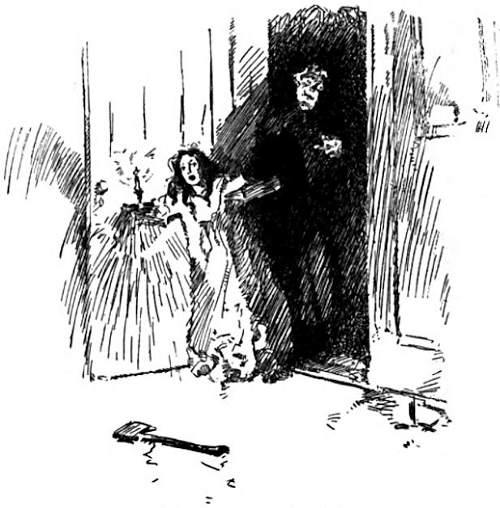
ladies, whene’er they took their walks
abroad, or drives either, for that matter,
wore stiff, prim black silk dresses, and
black lace mitts, and little point-lace
collars pinned with big gold brooches;
and they always carried tiny, black, ruffled
parasols that tipped on their handles to
any desired angle.
With such mistresses as these, it is easy
to see why Primrose Hall was the stiffest,
primmest place in the whole world.
Never a chair dared to move from its
exact place against the wall; never a curtain
dared to flutter with joy if a morning
breeze came in to tell it the news. Even
the clock ticked softly and very regularly;
the well-bred fire never crackled or sputtered,
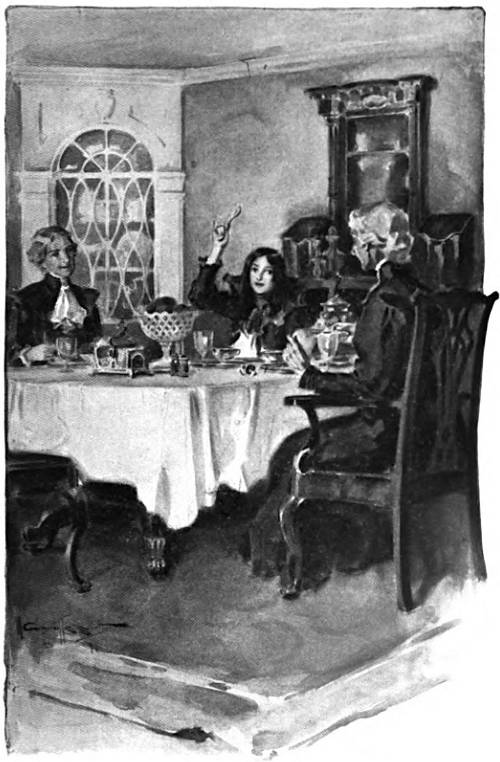
but let its flame glide decorously up
the chimney; and the cat looked as if she
had never been a kitten.
[5]
Out of doors it was just the same. The
carefully trimmed hedges wouldn’t think
of poking out a stray leaf or twig, and
every blade of grass on the lawn measured
itself against its neighbor that it might
be exactly the same length and breadth.
One bright May morning the sun was
shining all over the place, and, out of sheer
curiosity, I suppose, was doing his best to
poke himself into the house. But it was
all shut up tighter than a drum, and he
could get in only at one little window, and
even that was a mistake, and ought not
to have been left open, for it was the next
window but one to where the ice-box stood.
But the sun was in a mischievous mood,
and he aimed his beams again and again at
the parlor windows in hopes that he could
squeeze himself in and fade a sofa or a bit
of carpet. And finally he did get in
through a tiny space at the side of a shade
which was pulled down crooked, when, to
his great disgust, he found newspapers
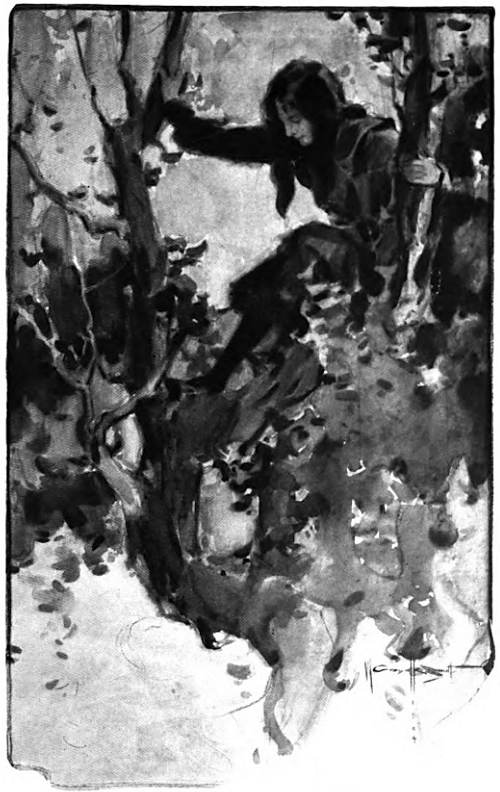
spread all over that very blue satin sofa
he was after. Miss Priscilla had looked
out for just such a trick, and the sun concluded
he would have to get up very early
in the morning to get ahead of Miss Priscilla
Flint.
[6]
Always during the summer months
Primrose Hall had its doors and windows
thrown open soon after daybreak, to
“air” the house, and at eight o’clock precisely
they were all closed again, and the
shades drawn to preserve the carpets
and furniture from any possible contamination
of sun and dust. This caused
a sort of artificial night during the middle
of the day, but the Primrose ladies
were used to it, and went about the darkened
house like cats or bats or owls or
moles, or any other creatures who can see
in the dark.
[7]
Miss Priscilla Flint was the older of the
sisters, and therefore was nominally mistress
of Primrose Hall. But it was her
habit in every household matter to express
her opinion at length, and then to ask Miss
Dorinda what she thought about it. And
as Miss Dorinda’s opinion always coincided
with Miss Priscilla’s it would be impossible
to say what would have happened
if it hadn’t.
On this particular morning, then, when
the sun was baffled in his attempt to fade
even a streak on the blue satin sofa, and
was so provoked about it that he went behind
a cloud to sulk, and stayed there quite
a little while, Miss Priscilla and Miss Dorinda
sat in the morning-room holding
their after-breakfast conference.
“It seems to me,” Miss Priscilla was
saying, “that spring has really come at
last. I saw a fly in the library yesterday
morning. I didn’t speak of it to you, for
I thought I might have been mistaken, as
I had on my near-glasses, but Martha says
she saw it too, so there can be no doubt
about it. And I think, Dorinda, that as
we go to the sewing-society to-morrow,
and it may rain the next day, I think that
to-day we will clean the attic.”
[8]
“Yes, sister,” said Miss Dorinda, “it
is quite time, and we will set about it at
once.”
Cleaning the attic was a mere figure of
speech, for how can any one clean what is
already spick and span, and speckless?
But although frequent periodical sweepings
and dustings kept every nook and
cranny of Primrose Hall as bright as a
new penny, yet a semi-annual housecleaning
occurred as regularly as the spring
and fall came; and, indeed, I daresay the
Misses Flint thought that spring and fall
were invented as comfortable seasons for
the performance.
The morning-room at Primrose Hall
had a wide bay-window in which were two
great arm-chairs facing each other, and
in these chairs the two ladies sat every
morning while they systematically planned
the day’s occupations.
Near Miss Priscilla’s hand was a bell,
and after she had pressed it, Bridget, the
cook, appeared—automatically, it seemed—in
the doorway, which, by the way, she
nearly filled.
[9]
Miss Priscilla gave her the kitchen orders
for the day, then dismissed her and
rang for Martha, the waitress.
Then Martha came and stood in the
doorway. She was a pretty young German
girl, and seemed to be attired principally
in starched pieces.
“Martha,” said Miss Priscilla, pleasantly,
“to-day we will clean the attic.
Send Matthew after Mrs. Dolan and her
granddaughter to assist us, and we will
start at ten o’clock.”
Martha disappeared with a starchy
rustle, and Miss Priscilla and Miss Dorinda
went to make their toilettes for the
great event.
[10]
Their housecleaning costumes had been
renewed, but never varied, during many
springs and falls; and when attired for the
fray, each good lady wore a black stuff
skirt, short and scant, a white muslin
sacque with a bit of neat embroidery at
throat and wrists, and a huge checked
gingham apron. As Miss Priscilla observed,
“No one can work if she is conscious
of her clothes,” and this garb had
been chosen as the best possible compromise
between usefulness and comeliness.
On their dignified heads the sisters wore
ruffled sweeping-caps made of shiny muslin,
and in the way of accoutrements, each
carried a pair of scissors, a ball of string,
a paper of pins, some sheets of paper, and
a pencil.
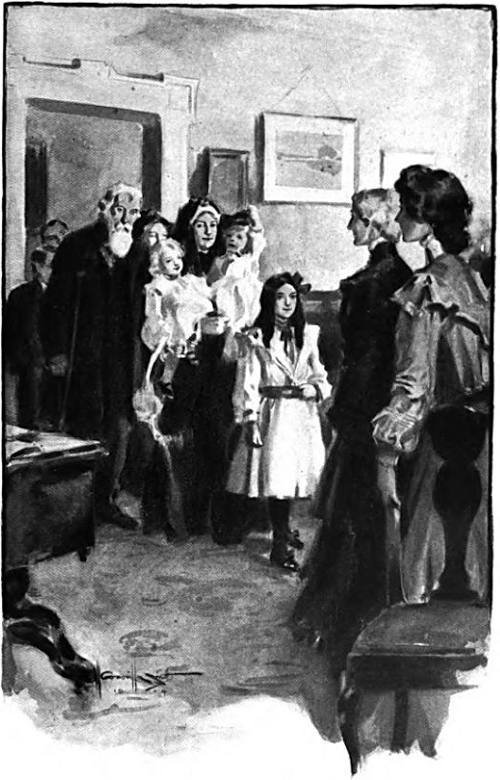
“Precisely at ten o’clock the procession formed”
[11]
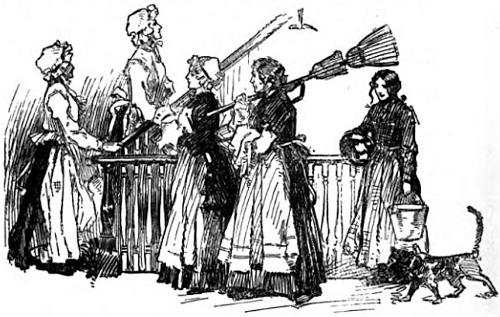
Precisely at ten o’clock the procession
formed and solemnly ascended the attic
stairs. Miss Priscilla went first, then Miss
Dorinda, then Martha, with dusters, hammer
and tacks, camphor-balls and moth-powders.
Then Mrs. Dolan, with big
broom, little broom, and dust-pans. Then
Mrs. Dolan’s granddaughter, with soap,
pail, scrub-brush, and floor-cloths, and sedately
following all walked Tabby, the cat.
Having arrived at the scene of action,
Miss Priscilla and Miss Dorinda set themselves
to work, and at the same time gave
orders to their assistants, which were vigorously
carried out, and soon the attic
seemed to be in the path of a well-trained
cyclone. Quilts and feather beds were
shaken and beaten; trunks and chests were
emptied of contents which were unrolled,
inspected, rolled up again, patted and
punched, and returned to their places.
Discarded garments were critically examined
to see what should be given away
and what should be packed in tar-balls for
the summer.
“This gray barege always makes me
think of chicken-pie,” said Miss Dorinda,
unfolding an old-fashioned skirt.
[12]
“Why?” said Miss Priscilla, in muffled
tones, by reason of her head and shoulders
being deep in a huge trunk.
“Because I wore it the day Ann Haskell
came to see us. Do you remember? She
came in the morning to spend the day, and
she stayed a full-fledged week. I thought
she never would clear herself off. And she
wanted chicken-pie made for her.”
“Yes,” said Miss Priscilla; “and then
when she got it she wouldn’t eat it.”
“No; and we couldn’t eat it, because
she would have onions in it. And the cats
wouldn’t eat it: nothing would eat it, and
at last we had to throw it away.”
“I suppose we’re not very hospitable,”
said Miss Priscilla; “but I just hate to
have company, they upset things so.”
“But sometimes it seems a duty,” said
her sister.
[13]
“Not at all; that’s where you’re silly,
Dorinda. I believe in charity, and giving
of our worldly goods to help our less fortunate
neighbors; but that doesn’t mean
we’re to open our doors and let them all
come in and make themselves at home.
Do you remember when Ann Haskell came
again, and rode up in a hack from the station,
bringing a big bag with her?”
“Yes; and you told the driver to come
for her again directly after dinner.”
“I did, or she would have stayed another
week. My, but she was surprised!”
“I know it; I couldn’t do anything like
that!”
“Then you’re a coward, Dorinda. It
is certainly cowardly to have company because
you’re afraid to tell them they can’t
stay. Now here’s another matter. The
Dorcas Circle wants to make up a box of
clothing for those fire-sufferers; so what
do you think of giving them some of Lavinia’s
things?”
“Oh!” gasped Miss Dorinda, in a
startled tone.
[14]
“I think we may as well,” went on Miss
Priscilla. “It’s fourteen years now since
Lavinia died. They say, keep a thing
seven years, and you’ll have use for it
again; but we’ve kept these things twice
over seven years, and I don’t see how they
can ever be of use to us, except to give
away.”
“Well,” said Miss Dorinda, still dazed,
“perhaps you are right.”
Lavinia Flint, the younger, very much
younger sister of these two ladies, had run
away from her home fifteen years ago to
marry a dashing young soldier named
Jack Lovell, and had sailed with him to
India. A year or so later the Flint ladies
heard from Mr. Lovell that his wife had
died, leaving a tiny baby named Lavinia.
He sent them no address, so they could not
have answered his letter if they had
wanted to. And they had no desire to answer
it, for they looked upon their sister
as lost to them from the day of her elopement,
and they had no wish to see her husband
or child.
The Flints were a hard-hearted, stiff-necked
race, and if one of the family did
wrong, the others felt no relenting mercy
because of ties of blood.
[15]
And so when Lavinia went away, her
pretty dresses and other girlish finery were
packed away in the attic, and had lain
there ever since.
She was so much younger than her sisters
that they had petted her as a child,
and had taken great pleasure in her girlish
enjoyments. But when she left them, with
only a note to say she had eloped with Jack
Lovell, their hearts hardened, and they
now rarely mentioned her, even to each
other.
And so year after year the trunks of
Lavinia’s clothing had been looked over
and put in order, with no reference to
their future disposition, until now Miss
Priscilla concluded the time had come.
But when they shook out the old-fashioned
gowns, the lovely taffetas and organdies
and embroidered muslins did
seem inappropriate to send to people who
were suffering for plain, substantial clothing.
[16]
“Oh, my!” said Mrs. Dolan’s granddaughter,
her eyes as big as saucers, as she
looked at the beautiful show, “ain’t them
just elegant! I wisht I was a fire-sufferer,
or a freshet victim.”
“How well I remember Vinnie in that
flowery frock,” said Miss Dorinda; “she
looked like a spring blossom herself, she
was so pretty and fresh.”
Miss Dorinda sighed; but Miss Priscilla
shut her teeth together with a snap, and
returned the dresses to their trunks and
shut down the trunk-lids with a snap, and
the cleaning of the attic went on again.
Except during an interval for luncheon,
the workers worked all day, and at five
o’clock the attic was cleaned, and the procession
filed down-stairs again.
“Deary me,” said Miss Dorinda, as she
reached her own room, “how tired I am!
I believe I grow older every year. Are
you tired, sister?”
“Yes; but I’m so thankful that the attic
is done. When that’s over I always feel
like singing the long-meter doxology.”
“Well, I’m too tired to sing; I’ll rest
a bit before dinner.”
[17]
CHAPTER II LADYBIRD
Dinner at Primrose Hall was rather
an elaborate meal, and was always
served promptly at six o’clock. Old Josiah
Flint had been very particular about his
household appointments and habits, and
since his death his daughters had made
no changes.
After dinner the ladies always went to
the library and read the village newspaper,
or dozed over their knitting-work
until bedtime.
[18]
But one evening in early June this routine
was interfered with, by the arrival of
a letter bearing a foreign postmark. It
was addressed in what was evidently a
man’s hand, and the two good ladies were
greatly excited. Miss Dorinda felt a pleasant
flutter of anticipation, but Miss Priscilla
felt a foreboding that something
disagreeable was in the letter, and she
hesitated before she opened it.
“It’s postmarked ’London’”
“It’s postmarked ‘London,’” she said.
“Do we know any one in London? Maria
Peters went there once, but she came back,
and anyway, she’s dead.”
[19]
“Open it, sister,” implored Miss Dorinda.
And after scrutinizing it thoroughly
once more, Miss Priscilla did
open it.
“It is signed ‘Thomas J. Bond,’” she
exclaimed, looking at the signature.
“Now, can it be Tom Bond who was old
Jonathan Bond’s son? His mother was
a Coriell.”
“Read it, sister,” said Miss Dorinda.
[20]
So Miss Priscilla read the letter aloud,
and this is what it said:
Miss Priscilla Flint,
Dear Madam:
During a recent visit to India I learned that
a friend of mine, Jack Lovell, was living at Bombay,
and I went there to see him. But it was
my sad experience to reach his home the day
after he had died from a sudden attack of fever.
He left a little child, who told me that her
mother had been dead many years, and, indeed,
the poor child seemed utterly alone in the world.
I tried to find out from Lovell’s papers something
about his effects, but as he was of a roving
and careless disposition, everything was left at
sixes and sevens, and I am afraid there is no
provision for the child. Therefore, since Jack’s
wife was your sister, I think the right thing to
do is to send the little girl to you at once. And
if I can find any money or property belonging
to her I will advise you later.
My wife and I brought her from India to
London with us, and I will send her to you on
the next steamer.
Trusting that this letter will insure her a
kindly reception, I am
Yours very respectfully,Thomas J. Bond.
To say that after reading this remarkable
letter Miss Priscilla appeared surprised,
amazed, astounded, excited, irritated,
angry, umbrageous, furious, or even
to say that she was in a state of high
dudgeon, would give but an inadequate
idea of the indignation shown in her face
and manner.
But she only said, “She cannot come!”
and snapped her teeth shut in the way she
always did when very decided.
“But she’ll have to come, sister,” said
Miss Dorinda; “how will you prevent
her?”
[21]
“Well, then, she cannot stay,” said Miss
Priscilla, with another snap; “I will send
her back just as I did Ann Haskell. Why,
think of it, Dorinda! Think of a child
living in this house! She’d very likely
leave doors open, and she’d be sure to
chatter when we wished to be quiet, and
she’d fairly worry us into our graves.”
“Yes,” said Miss Dorinda, “I suppose
she would. But I don’t see how you can
send her away.”
“I don’t care whether I can or not, I’m
going to do it. This Lawrence J. Bond, or
whoever he is, discovered her without our
consent; now he can attend to the rest; I
shall simply get her a ticket back to his
address in London and pack her off.”
“Of course that is the only thing to do—we
can’t have her here. And yet—Priscilla—she
is Lavinia’s daughter.”
“What of it? Lavinia didn’t consider
our feelings when she deserted and disgraced
us, so why should we concern ourselves
about her child?”
[22]
“True enough; and yet I shall be glad
to see the little girl. How old is she,
Priscilla?”
“I suppose she must be about fourteen.
Yes; it was fourteen years ago that Jack
Lovell wrote, saying his wife had died,
leaving a tiny baby. He said the little one
had blue eyes and golden curls, so I daresay
she has grown up to look like her
mother. Lavinia was pretty.”
“Oh, she was. And how sweet she used
to look dancing round the house in her
bright, pretty frocks.”
“Well, what if she did? Lavinia’s
daughter is not Lavinia, and I wash my
hands of the little nuisance. If you choose
to—”
“Oh, no, no! I wouldn’t do anything
that you would disapprove of. But I only
thought—perhaps—if she is a sweet, docile
child she might be a comfort to us.”
[23]
“Are you losing your mind, Dorinda?
What comfort could come of a responsibility
like that? Think of the worrying
over her clothes and education and accomplishments.
And then, after a while,
probably she would treat us as her mother
did, and run away with a good-for-nothing
scamp.”
“Yes, yes, sister, you are quite right.
What is the child’s name, do you know?”
“Lavinia; don’t you remember her father
said so in that letter—the only letter
he ever wrote us? If he had acted more
kindly toward us, I might feel different
toward the child; but as it is, I’ve no use
for her.”
“Do you remember sister Lavinia at
fourteen? She was a lovely child, chubby
and rosy-cheeked, with eyes like the sky,
and beautiful, soft golden curls. She
didn’t look much like us, Priscilla.”
“No,” admitted the older sister; “but
beauty is a doubtful good. I’d rather be
plain and do my duty, than to be handsome
and break the hearts of those who love
me.”
[24]
“Well,” said Miss Dorinda, placidly,
“we’d better not talk any more about it,
or we’ll get so excited we won’t be able
to sleep. Let’s go to bed, sister, and to-morrow
morning, after breakfast, we’ll
read the letter again and decide what we
can do.”
So, taking their bedroom candles, the
two old ladies went up-stairs. But as Miss
Dorinda had feared, they could not get to
sleep, and they lay awake thinking about
their sister and their sister’s child.
And so it happened that they were both
awake when at about eleven o’clock the
great brass knocker on the front door sent
clattering clangs all through the house.
Such a thing had never before been known
at Primrose Hall, and the sisters, terror-stricken,
jumped from their beds and met
at the door of their connecting rooms,
where they faced each other with pale,
startled faces.
“What can it be?” whispered Miss
Dorinda.
“The house must be on fire,” said Miss
Priscilla, decidedly; “let us get our fire-gowns.”
[25]
These were commodious robes of thick,
dark flannel which hung on the sisters’
bed-posts, to be hurried on in case of fire.
For years they had been hung there every
night and put away every morning, but it
seemed that at last their time had come.
While the sisters were tremblingly trying
to get into them, Martha appeared in
her fire-gown and asked what she should
do.
“Answer the door,” said Miss Priscilla.
“But stay: it may not be the firemen; I
don’t smell any smoke. In that case it
must be burglars. Let us call Matthew.”
By this time the great knocker sounded
again, and Bridget and Matthew both appeared
in the hall. Each wore a fire-gown,
and as all of the party had on night-caps,
they were an imposing-looking
crowd. The Flint ladies wore great be-ruffled
caps, tied with wide white strings,
suspiciously fresh and smooth; and, indeed,
these caps had been for years awaiting
this very occasion; for if the Misses
Flint were to be heroically rescued from
fiery flames, they wanted to look decent at
the time.
[26]
Bridget and Martha wore neat, narrow-ruffled
caps, as befitted their station; and
Matthew was crowned with a queer-looking
thing of knitted yarn with a long
tassel hanging down behind.
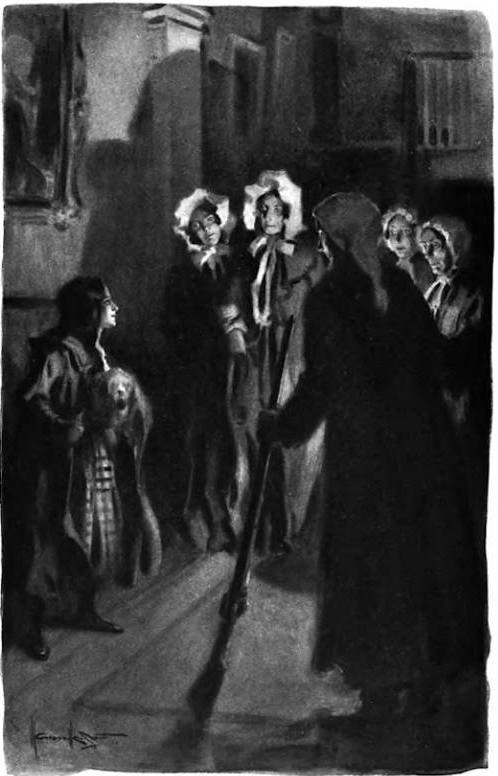
With an old musket in his hands, Matthew
led the procession to the front door.
Bridget and Martha followed, holding
candles, and Miss Priscilla and Miss Dorinda,
arm in arm, encouraged each other,
and nerved themselves for whatever might
be about to happen.
Then Matthew flung the great front
door wide open, and there was no fire-engine
outside, no burglars—only a tiny mite
of a girl who fairly jumped into the hall as
the door opened, and stood looking at the
strange beings who surrounded her. Her
face was small and very white, with large,
dark eyes that seemed to be dancing with
mirth. Her straight black hair hung
round her ears like elf-locks, and she wore
a long red cloak and a wide-brimmed red
hat.
[27]
She looked inquiringly from one to the
other, as if uncertain which to address,
and then, with a smiling glance that
seemed to include them all, she flung off
her hat and cloak, and said, in a sweet,
childish voice, “I’m Ladybird, and I’ve
come to stay.”
[28]
CHAPTER III A GUEST FOR THE NIGHT
As no one else seemed able to make any
reply to this astounding announcement,
old Matthew said:
“Well, if so be ’s you’ve come to stay,
I might as well lock the door behind you.”
And he proceeded to do so, while the
small visitor followed his movements with
her laughing eyes.
Then she turned, still smiling, to the
four women who stood watching her with
various expressions of surprise, consternation,
admiration, and dismay.
The mite gave a quick, comprehensive
look at each one, and then, intuitively
judging by the superior cap-ruffles rather
than by any appearance of friendly welcome,
she pointed a tiny forefinger at the
two Flint ladies in turn, and said:
[29]
“I think you’re my aunts, and I hope
you’re glad to see me.”
Then Miss Priscilla found her voice.
“Your aunts!” she almost screamed.
“Who are you, child, and what are you
doing here?”
“I’m Ladybird,” answered the mite—“Ladybird
Lovell. My father is dead, and
you’re my aunts, you know, so I’ve come
to live with you. Mr. Bond says my mother
used to be your sister,” she went on
in an explanatory tone; “but she’s dead
too: she died long ago, so I’m all alone,
except Cloppy.”
In the hollow of her little bent arm was
what seemed to be a gray muff with a
blue bow on it, but as she shook it out and
held it up it proved to be a dog.
“This is Cloppy,” she said; “he’s my
dog, and he’s such a dear, though he’s a
lot of trouble. Do you like dogs?”
[30]
Now Miss Priscilla Flint did not like
dogs, but that was a matter of small importance
compared with the dire calamity
which threatened her quiet household. Her
very cap-bows shook with the vehement
decision of her tone as she answered:
“No, I do not like dogs, and still less
do I like visitors. I cannot turn you
from my door in the middle of the night,
but nevertheless you must go away as
soon as I can arrange it, for you cannot
live here.”
Then Ladybird laughed again—such a
gay, merry, mirthsome laugh.
“Why, aunty,” she said, “I’m not
company; I’m one of the family. And I’m
not visiting you; I’ve come to live here
forever and ever. This is my home, and I
haven’t any other. And you’ll learn to
love Cloppy, too, he’s so soft and cuddly.
Just hold him once.”
She put the blinking Skye terrier into
Miss Priscilla’s arms, which promptly unfolded
and let the dog drop to the floor.
Then Ladybird laughed again.
“Oh, you funny aunty,” she cried, and
turning to Miss Dorinda said brightly,
“Don’t you like dogs, either?”
[31]
“Not very much,” said Miss Dorinda,
looking at her new-found relative with a
sort of fascination.
“Well, never mind,” said Ladybird,
cheerfully, as she took Cloppy up and
threw him over her arm like a folded
shawl, “I won’t let him bother you any.
And now shall we go to bed?”
This suggestion, though timely, gave
Miss Priscilla another shock. No preparations
had been made for such hospitality,
and at Primrose Hall nothing was ever
done without preparation.
“Come on, then,” said the guest, interpreting
the silence to mean consent; and
taking the candle that Martha had set
down, she darted up the wide, old-fashioned
staircase. At the first turn she
paused.
“Where is my room, aunty?” she inquired,
looking back at her hostess.
[32]
As she stood there on the great square
landing, with one foot on the stair above,
and the candle held high above her head,
she looked so white and eerie, so like a
small wraith, that Miss Priscilla could
scarcely believe she was real, and indulged
in a vague hope that the vision
would disappear as suddenly as it had
come.
But Martha felt that it was her turn
now, and she said:
“Shall I make up the spare-chamber
bed, ma’am?”
“Yes,” said Miss Priscilla, catching
gladly at a temporary solution of the problem;
“take her there, and put her to bed.
I’ll make no plans until morning.”
And shutting her teeth together with a
snap, Miss Priscilla went to her room and
was seen no more that night.
Miss Dorinda did likewise, and Martha
said:
“Now, if you’ll come with me, little
miss, I’ll try to make you comfortable.”
Ladybird, still holding her dog, followed
Martha to the great spare bed-chamber.
“Is this my room?” she said wonderingly,
looking at the massive mahogany
furniture and old-fashioned decorations.
“It is for to-night, miss, whatever happens
to-morrow.”
[33]
“Oh, I like it,” said the child, contentedly;
“only, it seems so big. But it’s very
pleasant, and when my things come, I can
stack them all away in these big bureaus
and chests of drawers. But what a funny
bed! It’s like a queen’s bed. I’ll play
I’m a queen, and you be my lady in waiting,
will you, Martha?”
“Yes, miss,” said the good-natured
Martha, smiling at the strange little girl,
who had already won her heart. “And
where’s your bag, miss, with your night-clothes?”
“Why, do you know, I forgot it and
left it on the train. I came alone from
Boston, and when the man said ‘All out
for Plainville,’ I just jumped out and forgot
everything. But you can lend me a
nightie, can’t you? and to-morrow I think
my boxes will come.”
So Martha provided her new charge
from her own wardrobe; and the child
laughed gleefully when, in a night-dress
far too long for her, and a ruffled night-cap
tied under her chin, she found herself
ready to climb into the four-poster bed.
[34]
There was a wide dimity ruffle all
around the top, and a dimity valance below,
and long dimity curtains all around. These
were looped back at one side with huge
rosettes, and with Martha’s assistance the
little girl stepped on a chair, and so up on
the high feather bed. As she sank down
into it, and it nearly closed over her, she
laughed merrily.
“It is like drowning in the sea,” she
said; “the billows are high on both sides
of me. Where’s Cloppy, Martha?”
“Here he is, miss. Shall I put him in
the cellar?”
“Cellar? No, indeed; put him at the
foot of the bed, please; and I hope he
won’t smother. Oh, how good these
sheets smell! Why do they?”
“That’s lavender, miss; we always keep
it between the fresh linen.”
“Well, it’s just lovely. Good night,
Martha.”
“Good night, miss,” and Martha took
the candle and went away, and Ladybird
was asleep in ten seconds.
[35]
CHAPTER IV A FEW QUESTIONS
The next morning Ladybird woke
early, with a strange feeling of suffocation.
The day was warm, and the dimity
curtains, the feather bed, and the night-cap
all combined to stifle a little girl who
was fond of fresh air.
She hopped out of bed and ran to the
window, the extra length of Martha’s
long night-dress tripping her feet and flapping
against her hands.
Throwing open the blinds, she saw that
the window opened on a veranda roof,
and swinging herself over the sill, she
stood delightedly gazing at the spring
beauty of Primrose Farm.
She was soon joined by Cloppy, who had
scrambled out of the feather nest and followed
in his young mistress’s steps.
[36]
“Hello, Cloppy-Dog,” she cried as she
picked him up, “how do you like our new
home? I think it is lovely. Let’s look
in at these windows.”
There were several along the veranda,
each with closed blinds. Ladybird tried
them all, but could not open any until she
reached the last one. There the blinds
flew open at her touch and disclosed an
open window with a pair of the ever-recurring
dimity curtains tied back with
blue ribbons.
Ladybird perched herself on the window-sill
and surveyed the room.
Opposite the window was a curtained
bed like the one she had slept in, and as she
looked, a night-capped face appeared at
the opening and stared at the intruder.
Except that the face between the window-curtains
was young, and the face
between the bed-curtains was old, it was
almost like a reflection in a mirror.
Ladybird smiled most engagingly and
chanted:
“Good morning, Aunt Dorinda; I’m
sitting in your window.”
[37]
And then, with the little dog still in her
arms, she jumped down into the room.
“I’ll just hop in beside you for a minute,”
said she, approaching the bed,
“’cause my feet are cold—though it’s a
lovely warm morning. What time do you
have breakfast?”
As she spoke she snuggled herself, dog
and all, into her aunt’s bed, and softly
patted the old lady’s cheek.
Miss Dorinda knew she ought to be
stern, but it was impossible, with the little
childish face framed in its big cap-ruffle
looking up into her own, and she
said:
“About eight o’clock, dearie; are you
hungry?”
“Yes, ’m; I’m ’most starved. The train
was late last night, and I didn’t get any
supper.”
“Why, you poor child! There, that’s
the rising-bell. Run right back to your
room and dress; the breakfast-bell will
ring in just thirty minutes. Can you be
ready?”
[38]
“In thirty minutes? I should hope
so!” said Ladybird, laughing.
Gathering up her dog, she stepped
through the window and ran along the
veranda roof to her own room.
Peeping in, she saw Martha staring in
dismay at the empty bed.
“Hello, Martha,” she cried gaily, “did
you think I was lost? I’ve been calling
on my aunt; it’s such a lovely morning
for visiting, you know. But I’m as hungry
as a bear, and now I think I’ll get
dressed and go to breakfast.”
She jumped into the room, and with
Martha’s assistance her toilette was soon
made; then she seized her dog and went
dancing down-stairs.
After wandering through several of the
large rooms she came to the dining-room,
where the breakfast-table was laid; seeing
nothing to eat, she went on to the kitchen.
Bridget looked at her with no kindly
eye, for she resented any intrusion on the
quiet of Primrose Hall as much as Miss
Priscilla did.
[39]
But when Ladybird said wistfully,
“I’m very hungry,” the good-hearted
old cook fell a victim at once to the irresistible
charm of the strange child.
“Are ye that, miss? And what would
ye like now?”
“Oh, anything!—I don’t care what; and
if I go and sit at the table will you bring
me something?”
“I will indeed, miss. Run along, thin,
and set at the place forninst the side-board.”
And so that’s how it happened that
when, a few minutes later, Miss Priscilla
and Miss Dorinda came into the dining-room
they found their guest ensconced at
their table and apparently enjoying herself
very much.
“Good morning, aunties,” she said
smilingly. “I ought to have waited for
you, I know, but truly, I was so hungry
I just couldn’t. And Bridget brought me
such lovely things! I never had strawberries
and cream before. Do you always
use these beautiful blue-and-white dishes?
For if you don’t, you needn’t get them
out just because I’ve come.”
[40]
“We always use them,” said Miss Priscilla;
“we have used them for forty years,
and not a piece has ever been broken.”
“Is that so?” said Ladybird, with great
interest, quite unconscious that the remark
was intended for a warning to herself,
as her quick motions and unexpected
gestures seemed to threaten the safety of
anything in her vicinity.
Having finished her strawberries, she
sat back, and throwing her little thin
arms above her head, grasped the carved
knobs of the high, old-fashioned chair.
“Why, you’re just like me, aunty,” she
said; “I think that’s the right way to do—to
use your best things every day. It’s
such a comfort to see them around; and
you needn’t break china or glass just because
you use it. Why, I’ll show you
what can be done with them, and there’s
not the slightest danger if you’re careful.”
[41]
As the child spoke, she pushed away her
plate, and ranged her cup, saucer, and
glass in a row in front of her, and seized
a spoon in one hand and a fork in the other.
Then in a sweet, crooning voice she began
to sing:
“Should auld acquaintance be forgot,
And never brought to mind?”
striking her glass lightly with her spoon
at the accented notes, and beating an accompaniment
alternately on her cup and
saucer.
Miss Priscilla’s eyes grew almost as big
as her precious and endangered saucers,
but the dear old tune, sung in the pretty,
childish voice, with its tinkling accompaniment,
held her spellbound, and she said
not a word.
As Ladybird finished the refrain she
said eagerly:
“Now we’ll do it again, and you both
tap your glasses and sing with me.”
[42]
And would you believe it? Those two
old ladies were so interested that they
tapped on their glasses with their thin old
silver spoons, and sang with their thin old
voices for all they were worth.
“That was very pretty,” observed Ladybird,
approvingly, when at last they all
laid down their spoons. “And now if
you’ve finished your breakfast, Aunt Priscilla,
will you take me out and show me
round the garden?”
But Miss Priscilla Flint had by no
means lost her mind entirely, and she said:
“You have no time to go round the garden,—you
are to start back to Boston this
morning, and from there to London as
soon as possible.”
“Oh, am I?” said Ladybird, with a
wise smile, and an air as of one humoring
a wayward child.
“You are indeed,” said her aunt, severely;
“and now, if you will come into
the morning-room with us, we will ask you
a few questions before you go.”
“All right, come on,” said Ladybird;
and she grasped Miss Priscilla’s hand in
both her own, and danced along at the old
lady’s side.
[43]
“‘Should auld acquaintance be forgot?’”
[45]
Miss Dorinda followed, and she and her
sister took their accustomed seats in the
bay-window.
Then Ladybird placed a low ottoman at
Miss Priscilla’s side and sat down upon it,
and laid her head against her aunt’s knee.
Although Miss Dorinda might seem to
a casual observer to be a softer, kinder nature
than her elder sister, yet for some unaccountable
reason Ladybird felt more attracted
toward Miss Priscilla; and, too, the
child could already see that Miss Priscilla’s
word was law at Primrose Hall, and that
Miss Dorinda merely acquiesced in her
sister’s decisions.
But it was no spirit of diplomacy that
actuated Ladybird, and she caressed Miss
Priscilla’s hand for the simple reason that
she was beginning to love the stern old
lady.
“Now,” said Miss Priscilla, glaring at
her niece, “will you tell me what your
name is?”
“Ladybird Lovell,” said the little girl,
with a bewitching smile.
[46]
“I mean your real name, not that absurd
nickname.”
“It is my real name. I never had any
other.”
“Nonsense! Your real name is Lavinia
Lovell.”
“It is? All right—Lavinia Lovell,
then. I don’t mind.”
“And how old are you?”
“Twelve years old.”
“You are not! You are fourteen.”
“Yes, ’m. Fourteen.”
Ladybird began to treat her aunt as one
would treat a harmless lunatic who must
be humored, whatever she might say.
“And why have you black eyes and
straight black hair? Your father wrote,
when you were a baby, that you had blue
eyes and golden curls.”
“Did he write that? Why, how I have
changed, haven’t I? Did you ever know
a baby to change as much as that before?”
[47]
“No, I never did. And I don’t say that
I would have kept you here if you had had
blue eyes and golden hair; but it might
have influenced me if you had looked more
like your mother,—and your father said
you did. As it is, I cannot think of allowing
you to stay here, and so when your
trunks come this morning—and I suppose
Mr. Marks will bring them pretty soon—I
shall send them back, and you with them,
to Boston. There my lawyer will meet you
and start you back to London. Mr.
Thomas J. Bond had no right to send you
here uninvited, and he may burden some
one else with you. I positively decline the
honor.”
Ladybird had paid polite attention at
first, but toward the end of her aunt’s
speech her mind began to wander, and as
Miss Priscilla finished the child said:
“Aunty, I can make poetry, can you?”
Now the one ambition of Priscilla
Flint’s early life had been to become a
poetess.
[48]
Her favorite day-dream was of a beautiful
volume, bound in blue and gold, that
should contain poems like those of Mrs.
Hemans. But though she had written
many, many verses,—and indeed, had a little
hair-trunk in the attic packed quite full
of them,—yet she had never been able to
summon sufficient courage to offer them
to any publisher; and lately she had begun
to think she never would, for poetry
had changed since Mrs. Hemans’s day,
and she doubted if her efforts would stand
the tests of modern editors or publishers.
But she said: “Yes, child, I have written
poetry. It is a talent that runs in our
family. Have you written any?”
“Oh, no, I don’t write it. I just say it.
Like this, you know:
“I have a dear aunt named Priscilla,
Who lives in a beautiful villa;
She has lovely old cups,
But she can’t abide pups,
And she flavors her cake with vanilla.
“That’s the kind I make. Of course you
have to use words that rhyme, whether the
sense is very good or not. I made this
one too:
“Tell her ‘The Sunset Star,’ sister,”
said Miss Dorinda.
Miss Priscilla simpered a little; then,
folding her hands, she recited:
“The sunset star is shining
Across the meadow green;
The woodbine vines are twining
The trellises between;
“And every pleasant evening
I watch it from afar,
Romantic fancies weaving
About that evening star.”
[50]
“Why, aunty, that’s lovely,” exclaimed
Ladybird: “and I do understand it. I
know the sunset star that comes out in the
sky just as the sun goes down. Yours is
more poetry than mine, but mine are funnier.
Don’t you think so?”
“Yes, child; but as you grow older
you’ll see that poetry is more important
than fun.”
“Yes; and then I’ll learn to make verses
like yours. Can you make poetry too,
Aunt Dorinda?”
“No,” said Miss Dorinda, simply; “my
talent is for painting.”
“Oh, is it? And do you paint pictures?
And will you teach me how? I’ve always
wanted to learn to paint, and I’m very industrious.
I can play on the piano like a
house afire.”
“Sister Lavinia used to play the piano
very prettily,” said Miss Dorinda; “doubtless
you have inherited her talent.”
“Yes, I think I have. Shall I play for
you now?”
“No!” said Miss Priscilla, decidedly;
“the piano has never been touched since
your mother left us, and it never shall be
opened again with my consent.”
[51]
“Aunty, did my mamma look like you?
It seems funny, doesn’t it? but I’ve never
seen a picture of my mamma, and papa
never told me anything about her. I
didn’t know papa very well, either,—he
was always going off on long journeys, and
I stayed with nurse. What was my
mamma like, aunty?”
“She was a beautiful blonde, with rosy,
plump cheeks. You are not a bit like her.”
“No, I should say not,”—and Ladybird
laughed merrily,—“with my straight
black hair and thin white face. Papa
used to call me a black-and-white ghost.
But after I live here awhile, I expect I’ll
get plump and rosy; though I don’t suppose
anything will ever make my hair
curl.”
“But you’re not going to live here;
you’re going away this morning.”
[52]
“Now, Aunt Priscilla,” said Ladybird,
with an air of being kind but firm, “this
joke has gone far enough. I’m going
to stay here because it’s my home, and I
have no other. I belong to you and Aunt
Dorinda, because I have no other relatives.
I hope you’ll learn to like me; but if not,
I have to stay here, all the same. People
have to live where their homes are, and so
we’ll consider the matter settled.”
“Indeed, miss, we’ll consider no such
thing! What do you mean by defying me
in my own house? I say you are to go,
and go you shall. Here comes Mr. Marks
up the road now, in his wagon. Get that
worthless dog of yours, and prepare to go
at once.”
Miss Priscilla looked at the little girl
with flashing eyes, and Ladybird, who had
risen from her stool, looked back at her
aunt, smiling and unalarmed.
Then the child gave a quick glance
round the room. The windows were high
from the ground, and there was but one
door, which led to the hall.
Like a flash, Ladybird flew out through
the door, shut it behind her, and turned the
key in the lock, making the Misses Flint
her prisoners.
[53]
She went out on the front veranda just
as Mr. Marks drove up with her trunks in
his wagon.
“Good morning!” she said brightly.
“Will you please set the boxes out on the
porch? Oh, here is Matthew; he will help
you. Now, if you please, will you carry
them up-stairs? I’ll show you where to
put them.”
She ran up the broad staircase; the
men followed; and finally her three trunks
were safely lodged in the room she had occupied
the night before, and which she
looked upon as her own.
“How much is it, Mr. Marks?” she
said; and when he told she paid him from
her little purse, and bade him good morning.
She watched until he was well out of
sight, and then she went to unlock the door
of the morning-room.
[54]
CHAPTER V ANOTHER ATTEMPT
When the Misses Flint saw the door
shut behind Ladybird, and heard
the key click in the lock, they could believe
neither their eyes nor their ears.
Miss Priscilla rose and walked majestically
to the door and turned the knob,
fully expecting the door would open. But
it would not open, of course, being locked,
and the good lady, almost stupefied with
anger and amazement, uttered an explosive
and exasperated “Well!” and
dropped into the nearest chair.
Miss Dorinda responded with a terrified
and apprehensive “Well!” and then
the two sisters sat and stared blankly at
each other.
Miss Dorinda spoke first, timidly.
[55]
“Priscilla, don’t you think perhaps it
is our duty to give a home to Lavinia’s
child?”
“Duty!” exclaimed the elder sister, in
a tense, restrained voice. “Duty! To
keep such a vixen as that in our house?
No! I confess I had some such thought
during the night; but now I have only
one desire, and that is, to get rid of her.”
“Yes,” said Miss Dorinda, sighing;
“of course she can’t stay after this; but
she seems very affectionate and loving.”
“Affectionate! Loving! Dorinda
Flint, what are you talking about? Do
you call it affectionate to lock us helplessly
in this room?”
“No; but that was impulsive, and because
she wants to stay here. I don’t
think she is really a vicious child.”
“Well, I don’t want to think anything
about her!”
[56]
Miss Priscilla took up a newspaper and
pretended to read, so desirous was she of
not appearing defeated; and, indeed, she
would have stayed quietly in that room
all day rather than call for assistance, or
in any way show that she was at the
mercy of her erratic niece.
Miss Dorinda was as much perturbed
as her sister, but she made no effort to
hide it. She fluttered about the room,
looked out of the window, tried the door-knob,
and at last sat down in a big rocking-chair
and began to rock violently.
Suddenly the door burst open and
Ladybird came flying in.
“Aunties,” she cried, “the house is on
fire! What do you want to save most?”
“Mercy on us!” cried Miss Priscilla,
rushing from the room, “let me get my
Lady Washington geranium. The buds
are just ready to open.”
“Where is it? I’ll get it,” said Ladybird,
dancing around in great excitement.
“Up-stairs, on a stand by the south-room
window; but you can’t go up—you’ll
be burned to death.”
“No, I won’t,” screamed Ladybird, already
half-way up-stairs; “I’ll get it.
What do you want, Aunt Dorinda?”
[57]
“I don’t know,—everything! Oh, my
lace handkerchief,” called the distracted
lady. “And get some of your own things;
and bring our fire-gowns.”
Meantime volumes of smoke rolled into
the hall through
the dining-room
door.
“Suddenly Matthew’s face appeared”
Suddenly Matthew’s
face appeared
in the
midst of the
smoke.
“Don’t be frightened,
ma’am,” he
said; “it’s all right
now. The soot got
afire in the chimbley;
but we’ve put
it out. But if the little
lady hadn’t been
afther runnin’ down
an’ tellin’ me that the wall felt hot, I’m
thinkin’ the house wud have been burned
to the ground.”
[58]
“Oh, Matthew, are you sure the fire is
all out?” asked Miss Dorinda.
“And are you sure my house would
have burned up but for that child?”
asked Miss Priscilla.
“Yis, ma’am, sure as sure! An’ I’ll jist
open the windies till the shmoke disappears.”
Then Miss Priscilla called, “Come
down, Ladybird; it’s all right now.”
And in a moment the child came flying
down-stairs.
“I put the geranium back in its place,”
she said, “and I left your lace handkerchief
on your bureau, Aunt Dorinda; but
I brought both your smell-salts bottles,
’cause I thought you might be faint from
the scare. Now sit down and rest, won’t
you?”
She hovered about her aunts, ministering
to each in turn, and her caressing
touch was so gentle, and her sympathy
so sincere, that Miss Priscilla, who was
unaccustomed to such attentions, quite
forgot she had called her niece a vixen,
and that, too, with good and sufficient
reasons.
[59]
But after a while, as her nerves became
quieted and she felt more composed,
Miss Priscilla Flint determined to attempt
again the dismissal of her unwelcome
guest.
“Lavinia,” she said in a tone of firm
decision.
“Oh, aunty, don’t call me that; it makes
me feel so old and grown up!”
“It is your name, and I have no desire
to call you by any other. Lavinia, you
are my niece, and the child of my dead
sister; but I am in no way inclined to take
you into my home for that reason. You
have some kind and winning ways, but
you appear to have an ungovernable temper,
which would make you impossible to
live with. How dared you lock the door
on me in my own house?”
[60]
“Why, aunty,” said Ladybird, laughing
at the memory of it, “that wasn’t
temper, and I didn’t mean to be rude;
but truly, there was nothing else to do.
Why, if you had been out on the veranda
when my trunks came, you would have
sent them back to Boston, and I didn’t
want them to go back; so I just left
you by yourselves until the man took
them up-stairs.”
“You think you have outwitted me,
miss, but you will find that Priscilla Flint
is not so easily set aside.”
“Oh, I’m not going to set you aside,
aunty; that isn’t it. I’m just going to
stay here and be your little girl—yours
and Aunt Dorinda’s.”
“I think, sister, we might keep her a
week on trial,” said Miss Dorinda, timidly.
Miss Dorinda always said everything
timidly. In this respect she was not like
her niece.
“I shall not keep her a week, nor a day;
and no more hours than I can help. I
am going now to write a note to Mr.
Marks, and tell him to come back at once
for her and her trunks. So, Miss Lavinia
Lovell, you may as well get yourself
ready, for this time you will have to go.”
[61]
“Do you know, it doesn’t seem to me
as if I would go this time,” said Ladybird,
thoughtfully; “it seems to me as if
I would stay here years and years, until
I get to be a dear old lady like you,” and
she patted the top of Miss Priscilla’s head.
Then she danced out of the room, and out
to the garden, singing as she went:
“I am not going away to-day;
I’m going to stay and stay and stay.”
When the luncheon-bell rang, she
danced back again, and seeing a letter on
the hall-table addressed to Mr. Marks,
she tore it into bits and threw it into the
waste basket.
The gay good humor of their visitor
was infectious, and the Flint ladies
laughed and chatted over their luncheon,
so that the meal was nearly over before
Miss Priscilla said:
“Mr. Marks will call for you at three
o’clock, Lavinia.”
“I don’t think he will,” replied the
child, “because I tore up that letter you
wrote to him and threw it away.”
[62]
“What!” gasped Miss Priscilla. “This
is too much!”
“Well, you see, aunty, there was nothing
else to do. If he’d got that letter
he would have come, and I don’t want him
to come, so I tore it up. Don’t write
another.”
“I won’t,” said Miss Priscilla, in an
ominous voice, and snapping her teeth
together with a click.
But half an hour later the Primrose
Hall carriage went down toward the village,
and inside of it sat a very determined-looking
old lady.
She went to Mr. Marks’s office and
asked him to get his wagon and follow her
home at once, and bring back the young
miss and her luggage.
“That firebrand as I saw at your
house this morning?” exclaimed the old
countryman. “Wal, I guess she won’t
be so easy brung.”
He chuckled to himself as he drove
along the road behind Miss Priscilla
Flint; and when they reached the farm-house,
he waited decorously for further
orders.
[63]
Then the hunt began. For Ladybird was
nowhere to be found. Miss Priscilla called
in vain. Then Miss Dorinda called. Then
they went up and looked in the room which
Ladybird had appropriated as her own.
Her three trunks stood there wide open
and empty. Their contents were all
around: on the bed, on the bureaus, on
the chairs, and many of them on the
floor. But no trace of the missing child.
Then Miss Priscilla called the servants.
“The little girl is hiding somewhere,”
she explained, “and she must be found.”
“Yes, ’m,” Bridget said; and she began
systematically to search the house
from attic to cellar.
Matthew shook his old head doubtfully.
“I’m thinkin’ yez’ll niver find her,” he
said. “She was a spookish piece, an’ the
likes of her flies up chimbleys an’ out of
windies an’ niver appears ag’in.”
Martha, much mystified, stared helplessly
around the room, and in doing so
noticed a bit of paper pinned to the pin-cushion.
[64]
She handed it to Miss Priscilla, who
read:
Aunty, Aunty, Do not look for me;
Until you send that man away, I’ll stay just where I be.
“Oh,” groaned Miss Priscilla, “what
can I do? We must find her!”
Miss Dorinda felt pretty sure, in her
secret heart, that they wouldn’t find
Ladybird until that strange being was
ready to be found; but she continued
looking about in her placid way, which
did no good nor harm.
After an hour’s search, the case did
seem hopeless, and Mr. Marks declared
he couldn’t wait any longer; so Miss
Priscilla reluctantly let him go away.
Two more hours passed; and then it
was five o’clock, and still no sign from
the missing child.
Although they hadn’t confessed it to
each other, the Flint ladies were both a
little scared.
[65]
Finally Miss Dorinda said:
“You don’t think she’d do anything
rash, do you, sister?”
“From the little I’ve seen of her,” replied
Miss Priscilla, “I should say that
what she does is never anything but rash.
However, I don’t think she has drowned
herself in the brook, or jumped down the
well, if that’s what you mean.”
That was what Miss Dorinda had
meant, and somehow she was not very
much reassured by her sister’s word.
They sat silent for a while; then Miss
Dorinda, with a sudden impulse of determination
such as she had never known
in all her life, and, indeed, never experienced
again, said:
[66]
“Priscilla, I think you are doing
wrong; and you needn’t look at me like
that. For once, I’m going to say what
I think! This child has been sent to us,
and in your secret heart you know it is
our duty to keep her and do for her. The
Bible says that those who neglect their
own families are worse than infidels, and
we have no right to turn away our kin.
Your dislike of visitors has nothing to do
with the matter. The child is not a visitor,
as she says herself. And it makes no
difference what kind of a child she is:
she is our sister’s daughter, and we are
bound by every law of humanity and decency
to give her a home. If father were
alive, do you suppose he would turn his
orphan grandchild from his door? No;
he would do his duty by his own: he
would be just, if he could not be generous;
and he would accept a responsibility that
was rightly thrust upon him.”
Miss Priscilla looked at her sister in
utter amazement. Dorinda had never
spoken like this before, and it seemed as
if the spirit of old Josiah Flint was manifesting
itself in his daughter.
But if Miss Dorinda had acted in an
unusual manner, Miss Priscilla proceeded
to behave no less strangely.
At the close of her sister’s speech, she
suddenly burst into tears; and the times
in her life when Miss Priscilla Flint had
cried were very few indeed.
[67]
Then the younger sister was frightened
at what she had done, and tried to
pacify the weeping lady.
“I know you’re right, Dorinda,” said
Miss Priscilla, between her sobs; “I—I
knew it all along,—and I suppose we shall
have to keep her. Father would have
wished it so,—and—and I wouldn’t mind
it so much if she wouldn’t—wouldn’t
leave the doors open.”
[68]
CHAPTER VI UP A TREE
While the aunts were deciding
upon Ladybird’s future, old Matthew
was wandering down the garden
path toward the orchard.
“She bates the Dutch, that child,” he
said to himself. “Now I’ll wager me
dinner that she’s hidin’ under a cabbage-leaf,
or in some burrd’s nest.”
But if so, Ladybird made no sign, and
old Matthew tramped up and down the
orchard, peering anxiously about while
the shadows deepened.
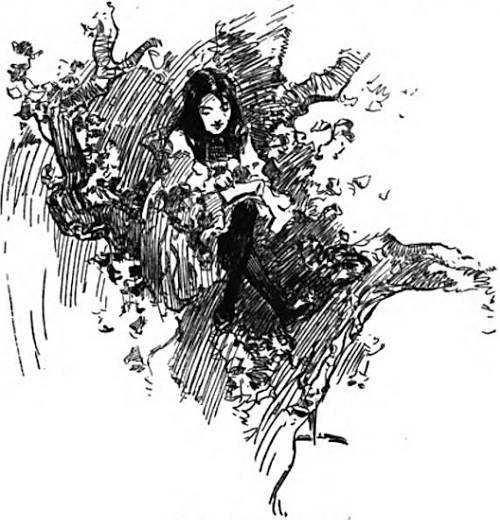
At last, as he stood beneath an old
gnarled apple-tree, he heard what seemed
to be a far-away crooning sort of song.
“Bird, bird,
Ladybird;
They called and called,
But she never stirred.”
[69]
“Arrah, miss! an’ are ye up there?
Come down, ye rascally baby. Yer aunts
is afther huntin’ high an’ low for ye. Do
ye hear?”
“I hear and I hear, and I don’t heed,”
came back the answering voice.
“Ye must heed,” said old Matthew,
earnestly. “Yer aunts is clean daft.
Come down, little lady, come down
now.”
“Nixy,” said Ladybird, saucily. “You
know very well, Matthew, that if I come
down my aunts will send me away, and
I won’t be sent away.”
“But ye can’t stay up in the tree forever,
miss.”
“Well, I can stay for the present. I
don’t think it’s going to rain to-night,
do you, Matthew?”
“The saints presarve us, miss, how ye
do talk! And are ye going to stay up
there all night, now?”
“Of course I am; I’ve got to sleep
somewhere. And say, Matthew, I’m
awful hungry.”
[70]
“Are ye that, miss? Well, thin, come
down to yer supper.”
“Nay, nay,” said Ladybird, laughing
merrily; “but do you, O good Matthew,
go to Bridget and beg for me a bit of
supper.”
“Oh, miss, what dratted foolishness!”
“Foolish nothing! I am a captive princess;
you are my henchman. Do you hear,
Matthew?—henchman.”
“What’s that, miss?”
“Oh, well, it only means that you must
do just as I tell you, because you love me.”
“Yes, miss.”
“So go to Bridget and ask her to put
up some supper in a basket, and bring it
out here to me.”
“And thin will ye come down and get
it, miss?”
“Go at once, Matthew! Henchmen do
as they’re told without question.”
“Yes, miss”; and half dazed, the old
man shuffled away, followed by a ringing
peal of Ladybird’s laughter.
He soon shuffled back again, bringing
a fair-sized basket well filled with good
things.
[71]
“‘Come down, little lady’”
[73]
“Hello, henchman!” called Ladybird,
“you’re mighty spry. What did you tell
my aunt?”
“Nothing, miss,” said Matthew; “sure,
ye gave me no message.”
“Good Matthew,” said Ladybird, approvingly.
“It seems to me we shall be
great friends, you and I. And now for
my supper.”
“But I can’t climb up with it to ye,”
said Matthew.
“Small need,” said Ladybird, who was
already uncoiling a long bit of string.
Tying a bunch of twigs to the end of
it, she carefully let the string down
through the branches of the old apple-tree.
“Tie the basket on, Matthew,” she
called, and the old man, mumbling, “It’s
as much as me place is worth,” tied the
basket firmly to the string and started
it on its ascending course.
[74]
After safely passing several dangerous
obstacles in the way of knots and twigs,
the savory basket-load reached Ladybird,
and she gleefully examined the contents.
“It seems to me,” she said reflectively,
“that Bridget is a duck—a big fat duck.”
“She is that, miss,” said Matthew,
agreeably.
The conversation flagged then, for Ladybird
was busily engaged; and Matthew
was bewildered, and quite uncertain what
course to pursue. He could not see the
child, though between the thickly leaved
branches he could catch glimpses of her
red frock at the very top of the tree.
Presently he heard her voice again.
“Matthew, there’s no use of your staying
there; you’ll get rheumatism. You
may go now. I shall stay here. There is
no message for my aunts. Good night.”
“Oh, miss, don’t be foolish now; come
down; let me take ye to the house.”
“Good night, Matthew.”
“Miss, yer aunts is that worrited!”
“Good night, Matthew.”
[75]
“Well, miss,” with a sigh of resignation,
“it does be awful cold here after
dark. Sha’n’t I bring ye a blanket jist?”
“Good night, Matthew.”
Baffled, the old man went back to the
house. His emotions were rioting within
him; his sense of duty was dulled. He
well knew he ought to tell the Flint ladies
where the child was; and yet she had said
there was no message, and somehow the
little witch’s word seemed like an iron
law.
But when he reached the farm-house
and found the Misses Flint pale with real
anxiety concerning their niece, he felt
intuitively that their feelings had changed,
and so he said:
“Well, yes, ma’am; I do know where
she is.”
“Oh, Matthew, where?” cried Miss
Priscilla, mistaking the cause of his hesitation;
and Miss Dorinda said faintly:
“Is she down the well?”
[76]
“Down the well!” exclaimed Matthew.
“No, indeed, ma’am; she’s up a
tree. She’s up in the tiptopmost branch
of the old Bell-flower apple-tree, and she
won’t come down. She says she’s going
to stay there all night, ma’am.”
“Stay there all night!” cried Miss
Priscilla. “How ridiculous! She must
come down at once.”
“Perhaps we can coax her down with
something to eat,” said Miss Dorinda.
“Perhaps, ma’am,” said Matthew, his
eyes twinkling.
“Bring us our things, Martha,” said
Miss Priscilla, with a dogged, do-or-die
air, “and then Matthew can show us
where our niece is, and we will bring her
back.”
“If yez do, she’ll come home holding
the ribbons,” thought Matthew to himself,
as he respectfully waited his mistresses’
pleasure.
Martha brought to each of the Flint
ladies a long black cloak, a wool crocheted
cloud, and black worsted gloves; for without
such sufficient protection the sisters
never went out after dusk.
[77]
“And I think rubbers, Martha,” said
Miss Priscilla, anxiously scanning the
sky.
“Oh, sister, the grass is as dry as a
bone,” said Miss Dorinda.
“No signs of rain, ma’am,” said Matthew.
“Rubbers, Martha,” said Miss Priscilla.
Martha obediently brought four large
rubber overshoes, and in a few moments
the two aunts were following old Matthew
in search of their wayward and erratic
niece.
The party paused under the apple-tree
which Matthew had designated. But
though the old ladies peered anxiously
up into the tree, they could see nothing
but leaves.
“Lavinia,” called Miss Priscilla, in a
calm, dignified voice.
No answer.
“Lavinia,” she called again, and still
no sound came from the apple-tree.
[78]
Then Miss Priscilla Flint, moved by
the exigencies of the occasion, made what
was perhaps the greatest effort of her
long and uneventful life.
“Ladybird,” she called, more graciously;
and a little voice piped down from
the tree-top:
“What is it, aunty?”
Like the larger proportion of human
nature, Miss Priscilla, having gained her
point, returned to her former mental attitude.
“Child,” she said sternly, “come down
at once from that tree!”
“Why?” said Ladybird.
“Because I tell you to,” said Miss Priscilla.
“Why?” said Ladybird.
“Because I wish you to,” said Miss
Priscilla, with a shade more of gentleness
in her tone.
“Why?” said Ladybird, with two
shades more of gentleness in hers.
“Tell her she’s going to stay with us,”
whispered Miss Dorinda; “tell her we
want her to.”
[79]
But such was the perversity of Miss
Priscilla’s nature that a suggestion from
her sister to do the thing she wanted to
do most, made her do just the reverse.
“You are to come down,” she said,
again addressing the top of the tree, “because
I command you to do so. You are
a naughty girl!”
“Am I a naughty girl?” called back
Ladybird; “then I’ll stay up here and be
naughty. It will make you less trouble
than if I’m naughty down there.”
“Tell her, sister,” urged Miss Dorinda.
“Tell her yourself,” said Miss Priscilla,
shortly.
Dorinda needed no second bidding.
“Ladybird,” she cried gladly, “come
down, dearie. You are going to stay with
us. So come down and be a good girl.”
“Of course I’m going to stay with you;
I told you, and I told you true,”
chanted Ladybird, in her crooning, musical
voice.
[80]
“Then come down at once,” said Miss
Priscilla, whose patience was nearly exhausted.
“Why?” said Ladybird, gently, but
aggravatingly.
“Because I want you,” said Miss Priscilla
Flint, with a sudden burst of whole-hearted
welcome. “Because I want you
to live with us and be our little girl,—my
little girl.”
“All right, aunty dear, I’ll come right
straight smack down!” and Ladybird,
gathering up her basket of fragments, began
to scramble rapidly down through
the gnarled branches of the old apple-tree.
[81]
CHAPTER VII CIVIL WAR
Miss Priscilla Flint was a
lady who never did anything by
halves or any other fractions.
Once having accepted the fact that
Ladybird was to remain at Primrose Hall,
Miss Priscilla began to lay plans as to
how her small niece should live and move
and have her being.
Details were the delight of Miss Priscilla
Flint’s heart, and she prepared to attend
to the details of Ladybird’s life with
a great and large gusto; but in her planning
she reckoned without her niece, who
proved a not unimportant factor in the
case.
[82]
Although Miss Flint’s indomitable will
could unflinchingly face battle, murder,
and sudden death, the will of her young
relative was of the sort that jumped right
over such obstacles and came down smiling
on the other side.
One of the first of these Greek tugs of
war was in reference to Ladybird’s dog.
“Of course, Lavinia,” Miss Priscilla
said, “you must see that it will be impossible
for you to keep that beast here.”
There was no reply from Ladybird,
who sat with a happy, beaming countenance,
swaying back and forth in a tiny,
old-fashioned rocker, with her blinking
terrier closely clasped in her arms.
Miss Priscilla had effectually learned
that to get any answer from her niece
she must call her Ladybird. But the good
lady compromised by using the more dignified
title when making a statement
which required no answer.
“I say you cannot keep that dog here.
What are you going to do about it—Ladybird?”
Ladybird smiled at her aunt in a bewitching
way.
[83]
“I don’t know, aunty,” she said.
“Where could I keep him?”
“You can’t keep him at all, Lavinia.
You know both your Aunt Dorinda and
I detest dogs, and so you must either sell
him or give him away.”
Ladybird gazed at her aunt with great,
serious eyes.
“I won’t sell him,” she said slowly;
“but I will give him away.”
“That’s a good girl,” said her aunt,
approvingly. “And will you do it to-day?”
“Yes; right away,” said Ladybird, rising,
with Cloppy still cuddled in her arms.
“Ah!” said Miss Priscilla, uncertain
how to account for such docility. “And to
whom will you give him?”
“To you,” cried Ladybird, and depositing
the moppy mass in her aunt’s lap,
she ran laughing from the room.
[84]
Miss Priscilla rang a furious peal on
the bell, and when Ladybird, who was
dancing through the hall, saw Martha
appear and answer to the summons, she
sauntered leisurely into the room behind
the rustling maid.
“Martha,” said Miss Priscilla, pointing
to the dog, which she had slid from
her lap to the floor, “take that animal and
dispose of it somehow. You may give it
away or sell it, or take it to the pound;
but never let me see it in or near this house
again.”
“Yes, ma’am,” said Martha, picking
up Cloppy, while Ladybird burst into a
peal of ringing laughter.
“Such a funny aunty!” she cried,
dancing over to Miss Flint, and putting
one little thin arm round the old lady’s
neck. “Martha, of course aunty is only
joking. Please put Cloppy in his basket
in my room; I’m sure he wants a nap.”
“Yes, miss,” said Martha, glancing
furtively at Miss Priscilla.
But whether it was the touch of the
child’s tiny fingers on her old cheek, or
whether her will bowed perforce to a superior
one, Miss Priscilla’s face expressed
no contrary orders.
[85]
Martha left the room, and Ladybird,
dreamily curling a wisp of her aunt’s hair
over her forefinger, remarked:
“That lemon-pie yesterday was so
good, aunty, can’t we have another to-day?”
“Yes, child, of course, if you want it.
Run and ask Bridget to make one, and
then come back here; for I want to talk
to you about some new clothes.”
“Geranium blossom!” said Ladybird
to herself, as she walked slowly along the
hall. She always manufactured her own
expletives.
“Now I shall have a high old time!
It seems to me that Aunt Priscilla won’t
have the same ideas about clothes that I
do; and the trick is to change her opinions.”
Without having formed any definite
plans, but with a sublime determination
to conquer in the fray, Ladybird came
back and sat down demurely in a small
chair facing her aunt.
[86]
“Your clothes, Lavinia,” Miss Priscilla
began, “are shocking, and quite unfit
for you to wear.”
“Do you think so?” said Ladybird,
with the air of polite interest which her
aunts had learned to regard as ominous.
“Now I think they’re real pretty. They
were made for me in Bombay. I picked
out the stuffs myself.”
“I should think you did,” said Miss
Priscilla; “and they’re hideous. Now
that white dress with the huge round red
spots is something awful, and you shall
never wear it again.”
“Oh, I guess I will, aunty,” said Ladybird,
cheerfully; “that’s my very favoritest
dress of all, and I wouldn’t let you
send that to the heathen for anything.”
“It’s far more suitable for a Fiji cannibal
than for a Christian child. Your
clothes are all too gaudy in coloring, Lavinia,
and they must be discarded. I shall
buy you some neat, quiet patterns in soft
grays and browns, which will be much
more suitable for a refined little gentlewoman.”
[87]
“Aunty,” cried Ladybird, springing
up, her black elf-locks flying about her
thin little face, and her long arms waving,
while her whole body quivered with excitement,
“do I look like a refined little
gentlewoman?”
“You do not,” said Miss Priscilla Flint,
staring critically at her niece; “but I shall
do all in my power to make you look like
one.”
Ladybird leaned her head on one hand
and gazed thoughtfully at her aunt. After
a few moments’ pause, she said reflectively:
“Well, that black-and-yellow striped
frock of mine is really a fright; and the
red-and-green plaid isn’t much better:
it’s such a ’normous plaid; but”—and
Ladybird shook her forefinger decisively
at her aunt—“it seems to me I shall keep
that white dress with the great big red
spots. And so we’ll consider that matter
settled.”
[88]
“It is settled,” said Miss Flint, rising,
“but not in the way you seem to think.
You shall never wear that dress again,
Lavinia. Now the Dorcas Circle meets
here this afternoon, and I wish you to do
me credit. Wear that new brown dress
I had made for you, and do not dare to
appear before my guests in those red
spots.”
“Aunty,” said Ladybird, and the little
forefinger was again wagged at the old
lady, not threateningly, but as a token
of final decision, “if I don’t wear those
red spots to the Dorcas meeting, you’ll
have to wear them yourself.”
“Whatever nonsense are you talking,
child?” inquired Miss Priscilla, whose
thoughts were already busy with the supper
for the Dorcas Circle.
“Well, wear your brown dress, Lavinia,”
said Miss Priscilla, as she started
for the kitchen in the interests of the
elaborate feast demanded by the august
and self-respecting Dorcas Circle.
[89]
Ladybird, with a peculiar nod of her
head that betokened a completed plan of
action, went up-stairs to her room.
“It seems to me,” she said to herself,
“that I just must do it.”
She took the red-spotted dress down
from its hook and threw it on the bed.
Then she knelt beside it, and burying her
little face in its soft folds, she burst into
furious tears.
“I do love it so,” she sobbed, “it’s so
bright and gay and comforting: and I
think Aunt Priscilla is mean. Hominy
hornets, but she’s mean! I wouldn’t
treat a little girl so. I wouldn’t make her
wear old mud-colored frocks when she
loves red, red, RED! And these red spots
are so beautiful! But since I can’t wear
them, Aunt Priscilla shall.”
Stamping her feet as she rose, and angrily
brushing the tears from her eyes,
Ladybird took her sharp little scissors
and carefully cut out a score or more of
the large disks from the condemned dress.
She grew more cheerful as she did this,
and her merry smiles came back, though
they alternated with an expression of angry
sadness.
[90]
Gathering up the red scraps, she went
to her Aunt Priscilla’s room. Spread out
in stately grandeur on the bed lay the
black silk dress that was as much a part
of the Dorcas meeting as the lady who
wore it.
Taking the paste-pot from her aunt’s
writing-table, Ladybird proceeded to
paste the bits of red fabric at intervals
over the black silk skirt and bodice. She
worked diligently and rapidly, and after
a few moments surveyed the effect with
great satisfaction.
“Now,” she said to herself, as she replaced
the paste-pot, “I think it would be
wise for me to go out to spend the day.”
Slipping on the despised brown frock,
a mild and amiable-looking Ladybird
walked through the kitchen, humming a
little tune.
“I’m going out, aunties,” she said,
“and I won’t be back until late this afternoon.”
[91]
The Flint ladies were not surprised at
this, for Ladybird often spent a whole day
out in the fields and orchards.
“Take something to eat
before you go,” said Miss
Dorinda; “here are some
fresh seed-cakes.”
Ladybird accepted half
a dozen, and Miss Priscilla,
looking approvingly
at the brown
frock, said:
“Be back by
four. The Dorcas
ladies will
be here, you
know.”
“Yes, aunty,”
said Ladybird,
“and I hope
they’ll think
the red spots
are becoming to
you.”
“She worked diligently and rapidly”
[92]
“What does
she mean?” asked Miss Dorinda, as Ladybird
disappeared down the garden path.
“Who can ever tell what her nonsense
means?” said Miss Priscilla, feeling rather
irritated at having carried her point
regarding the brown frock.
But the brown frock arrayed a very gay
and mischievous Ladybird, who danced
along through the sunshine, singing:
“It was best to leave you thus, dear—
Best for you and best for me.”
[93]
CHAPTER VIII STELLA RUSSELL
With no other intent than to put
as great a distance as possible between
herself and Primrose Hall, Ladybird
wandered on through the last of the
Flint orchards, and found herself confronted
by a rail fence, over which she
promptly climbed. She crossed a small
brook, two fields, and another orchard,
when from one of the trees she heard a
pleasant, young voice say:
“Hello, little girl!”
Although, as a rule, not many creatures,
except birds, are looked for in trees,
yet Ladybird’s mind was of the type
which accepts without question, and looking
up, she called back, “Hello!” though
she could see of the person addressed only
some pink muslin and a small swinging
slipper.
[94]
“What do you want?” said the voice
again, and a pretty, smiling face appeared
above the pink muslin.
“I don’t want anything,” said Ladybird;
“I’m just taking a walk.”
“Oh, well, if you’ve walked from
Primrose Hall ’way over here, you must
be tired. Won’t you come up here and sit
by me?”
“Yes, thank you,” said Ladybird; and
she easily swung herself up the crooked
old boughs of the apple-tree, and seated
herself facing her hostess, who proved
to be a very charming young woman indeed.
“Aren’t you the little girl who lives
with the Flint ladies?” she said.
“Yes,” said Ladybird; “they’re my
aunts.”
“I am Stella Russell, and I live on this
farm, which is next to Primrose Place. I
live with my grandfather and grandmother.”
[95]
“Oh, haven’t you any mother, either?”
said Ladybird, quickly, and her little
brown paw slid into the girl’s white hand.
“No,” said Stella, silently accepting
Ladybird’s unspoken sympathy. “I
haven’t a friend in the world, except my
grandparents.”
“Why, how funny!” said Ladybird. “I
should think you could have lots of
friends, you are so pretty and so bright.
I’ll be your friend.”
“I think I should like to have you,”
said Stella, but slowly, as if considering
a weighty matter; “but you see, I am
queer about my friends.”
“How?” asked Ladybird.
“Well,” said Stella, wearily, “of
course I know all the people in Plainville,—I
have lived here a great many years,—but
I can’t seem to persuade myself that
they are the kind of people I want for
my friends. Oh, of course they are nice,
good people, you know—”
“Yes, I know,” said Ladybird, nodding
her head wisely.
[96]
“It isn’t that they’re plain,” Stella
went on, “or countrified. I don’t mind
those things. But they’re uninteresting.
When I go to see them, they just talk
about the minister, and the dressmaker,
and the village gossip.”
“Yes,” said Ladybird, again nodding
her head like an owl, “I know.”
“How do you know, you ridiculous
child?” said Stella, laughing. “How old
are you, you mountain of knowledge?”
“I do know,” said Ladybird, shaking
her thin forefinger at her companion
across an intervening apple-twig—“I do
know just what it is you want and can’t
get,—and I’m twelve.”
“Oh, you are. Well, my twelve-year-old
Solomon, what is it that Stella Russell
wants and can’t get?”
[97]
“You don’t want beauty,” said Ladybird,
who was gazing in sheer delight at
the lovely face before her, “for you’ve
got it; and I think you have education,
and accomplishments, and all those
things. But you want to be in a place
where you can give all those things to
others and take some of theirs in return.”
“You’re a witch,” said Stella, looking
at the pale child before her with amazement.
“Oh, I know,” went on Ladybird, her
big eyes growing bigger, and her head
nodding most expressively. “You want
to be among people who talk quick, shining
talk that doesn’t mean much, but
that’s witty and bright, and most pleasant
to hear; and people can’t talk like that
unless they have a whole lot of big knowledge,
too, that they can use when they
need it; and of course,” and now the head
was shaking slowly from side to side,
“the Plainville people aren’t like that.”
“No, they’re not,” said Stella. “But
will you please tell me how you know all
this?”
[98]
“I know it,” said Ladybird, “because
it is true, that’s all. I always know
true things; and besides, my mamma ran
away from Plainville because she wanted
to marry my papa, who was the other
kind.”
“Well, I can’t run away,” said Stella,
laughing.
“You could if you had any one to run
with,” said Ladybird, gravely.
“Well, perhaps I could, but I certainly
wouldn’t.”
“No, I s’pose you wouldn’t.”
“Well, never mind about me,” said
Stella; “it doesn’t make any difference
what sort of people I want if I can’t get
them; and since you’ve offered, I think
you’ll do very nicely for a friend.”
“Yes; I’m a good friend,” said Ladybird,
with an air of calm confidence in
herself; “but I’m not always good.
Sometimes I’m very naughty, and I try
my dear aunts most exceeding; but then,”
she added, with a sigh, “sometimes they
are a fearsome trial to me.”
“I’ve heard of some of your pranks,”
said Stella, smiling; “and I’m not sure
but you are a naughty little girl.”
[99]
“I guess I am a naughty girl,” said
Ladybird, soberly; “and sometimes I do
it on purpose, and sometimes it’s just
because I was born so.”
“Well, there’s the dinner-bell,” said
Stella; “even if you are a naughty girl,
I’d like to have you come in and take dinner
with us, if you will. My grandparents
will be glad to see you.”
“I’d like to come very much, thank
you,” said Ladybird; and the two scrambled
down the old apple-tree to the
ground.
Seen at this better advantage, Stella
Russell proved to be an exceptionally
beautiful girl. Tall and slender, with
brown eyes and dark-brown hair, her
fresh, sweet color and dainty grace
showed the best type of physical beauty,
combined with an unusual amount of perceptive
and responsive intelligence. Unsophisticated
in many ways, she was possessed
of an inherent power to see things
clearly, and this showed in her beautiful,
sensitive face.
[100]
Ladybird, too, possessed this power;
but while hers was quicker, Stella’s was
truer.
As the two girls walked up the path
to the house, Stella said:
“It’s very strange, but though you are
twelve and I am twenty-one, I see very
clearly that we shall be good friends.”
“Oh, twelve from twenty-one doesn’t
leave much,” said Ladybird, laughing.
Stella’s grandparents, old Mr. and Mrs.
Marshall, were very much pleased to meet
the young stranger.
“I knew your mother,” said Mr. Marshall,
as he looked at Ladybird; “but you
do not look a bit like her.”
“No,” said Ladybird; “that’s what
my aunts told me.”
The two girls spent a long and pleasant
afternoon together. Stella showed Ladybird
all her books and other treasures,
and notwithstanding the difference in
their ages, the girls became congenial
friends.
[101]
As it neared four o’clock Ladybird said
she must go home, for her aunt had told
her to come at that time.
“I am going over to Primrose Hall,”
said Mrs. Marshall, “to the meeting of
the Dorcas Circle. You can drive over
with me.”
So among the earliest arrivals at the
Dorcas meeting were Mrs. Marshall and
Miss Ladybird Lovell.
Now that Ladybird’s quick and tempestuous
anger had spent itself, she felt
sorry to see her Aunt Priscilla arrayed
in her second-best black silk, for she knew
how it must have hurt that good lady to
appear before her guests in anything less
than the resplendent glory of her best and
cherished black silk gown.
Both the Misses Flint wore a look of
sternness that Ladybird could not misinterpret.
But they said nothing to the
child, and cordially invited Mrs. Marshall
to step into the bedroom and lay off her
bonnet.
Many successive guests were treated
with the same punctilious courtesy.
[102]
The Dorcas meeting came, the Dorcas
meeting ate its supper, the Dorcas meeting
went, and after the door of Primrose
Hall had closed behind the last departing
guest, Miss Priscilla said:
“Now, Lavinia, I will talk with you, if
you please.”
“Good for you, aunty,” said Ladybird,
clambering into her Aunt Priscilla’s lap
and twining her thin brown arms about
the old lady’s neck, thereby—although
unconsciously—seriously modifying the
tenor of the remarks which Miss Flint
had meant to make.
“Lavinia,” she said, with much sternness
in her voice.
“Now, aunty,” murmured Ladybird,
“please!”
“Lavinia,” went on Miss Flint, unmoved
by her niece’s words, “I am more
pained than I can tell you at your unkindness
to me to-day.”
“Aunty,” said Ladybird, solemnly,
“I was more pained than I can tell you
at your unkindness to me to-day.”
[103]
“But,” said Miss Priscilla, “you must
realize, my child, that I am older than
you are, and know more.”
“But, aunty,” said Ladybird, “you
must realize that I am younger than you
are, and care more.”
“Care more for what?” said Miss
Priscilla.
“For red spots,” said Ladybird. “Of
course I know, Aunt Priscilla, that you
have a right to say what kind of horrid
old clothes I shall wear; but it seems to
me, if I had a little girl to look after, and
she wanted to wear red spots, I’d let her
wear them. It wouldn’t kill anybody,
you know.”
“Priscilla,” said Miss Dorinda, “I
think the child is right.”
“I’m not aware, Dorinda,” said the
elder Miss Flint, “that I asked your
opinion concerning our niece’s conduct.”
“No,” said Miss Dorinda, humbly.
[104]
“Aunty,” said Ladybird, still refusing
to be pushed from her position on the old
lady’s lap, and still with her arms clasped
about Miss Priscilla’s stately, if withered,
neck, “aunty, are red spots wicked?”
“Not that I know of,” said Priscilla
Flint.
“Then don’t you think, aunty, that
you might as well have let me keep them,
in the first place? Then I wouldn’t have
pasted them on your dress; then I
wouldn’t have been naughty; and then
everything would be lovely, and the goose
hang high,” concluded Ladybird, with an
airy, careless gesture of her thin, brown,
little paws.
“Ladybird,” said Miss Priscilla, and
her voice softened as she used the more
endearing title, “I am not sure but that
you are right in this case. There is no sin
in bright colors, and if you want them, I
suppose there is no real reason why you
should not have them. I am sorry for
my part of this unfortunate episode. I
was unjust—”
[105]
“Never mind, aunty,” said Ladybird,
clasping her arms tighter round the old
lady’s throat and kissing her hard, “I
was unjust, too, I was naughty, and I was
a bad, bad girl, and I—that is, we’re
both sorry, aren’t we?”
“Yes,” said Miss Priscilla Flint,
“we’re both sorry, and I will get you a
new red dress.”
“Do,” said Ladybird, cheerfully: “and
get yourself a new black silk one, won’t
you, aunty?”
[106]
CHAPTER IX DOING RIGHT
Ladybird hated school. Not the
lessons, they were learned quickly
enough, and with but little study; but the
out-of-doors child grew very restive in
the restraint and confinement of the
school-room, and her whole touch-and-go
nature rebelled at the enforced routine.
Many battles were fought before she
consented to go at all; but though Ladybird
was strong-willed, Miss Priscilla
Flint was also of no pliable nature, and
she finally succeeded in convincing her
fractious niece that education was desirable
as well as inevitable.
So Ladybird went to school—to a
small and not far distant district school—whenever
she could not get up a successful
excuse for staying at home.
[107]
With her sun-dial-like capability of
marking the bright hours only, she eliminated
as much as was possible of the ugly
side of school life.
She enjoyed the walks to and from
the school-house, across the fields and
through the lanes, and she enjoyed them
so leisurely that she was a half-hour late
nearly every morning, thus escaping the
detestable “opening exercises.”
During school hours, when not studying
or reciting her lessons she read
fairy-tales or else worked out puzzles.
Though this was not exactly in line with
the teacher’s methods of discipline, yet it
was overlooked after several experimental
endeavors which showed unmistakably
what was the better part of valor.
Also, Ladybird always kept fresh
flowers on her desk, and kept lying in her
sight any new toy or trinket which she
might have recently acquired.
[108]
She would have been fairly happy during
school hours if she could have had her
dog with her; but the teacher’s discretion
did not extend as far as this, and so
Cloppy was left at home each day to add
to the gaiety of Primrose Hall.
“Ladybird at school”
One day after he had added gaiety
with especial assiduity, Miss Priscilla announced
that she was at the end of her
rope, and the dog must go.
[109]
It happened that Ladybird came in
from school that day in an unusually docile
frame of mind. To begin with, it was
Friday afternoon and the next day was
a holiday. Furthermore, she had wrested
a good half-hour from the long school
afternoon, with its horrid “general exercises,”
by the simple method of rising
from her seat and walking out at the door.
The teacher saw her do this, but allowed
her feeling of relief to blunt her sense of
duty. Not but what she liked Ladybird:
no one could know the child and not like
her; but when one is teaching a district
school it is easier if the disturbing element
be conspicuous by its absence.
And so, with her course unimpeded,
Ladybird marched out of school into the
fields, and drawing a long breath, sauntered
slowly and indirectly home.
“I had a beautiful time,” she announced
to her aunts. “There’s the loveliest
afternoon outdoors you ever saw,
and I’ve walked all around it. Such a
big, fair, soft afternoon, and the sunlight
is raining down all over it, and it’s
full of trees, and sticks, and fences, and
dry leaves; and where’s Cloppy? I’m
going out in the orchard.”
[110]
“Wait a moment, Lavinia,” said Miss
Flint, “I wish to talk to you; sit down in
your chair.”
“Yes, ’m,” said Ladybird, dropping
into a chair suddenly,
“And hurry up your talking
For I want to go a-walking.”
“That will do, Lavinia, I’m in no
mood for foolishness; I want to say that
that wretched dog of yours cannot stay
here any longer.”
“Is that so, aunty?” said Ladybird,
with her most exasperating air of polite
interest. “Well, now I wonder where we
can stay? Would they take us to board
down at the hotel? I don’t know. Or perhaps
Mrs. Jacobs would take us, if I
helped her with the housework and sewing.”
“That is enough nonsense, Lavinia.
I tell you that dog is to be put away.”
[111]
“I understand that, Aunt Priscilla;
I’m not stupid, you know; I’m only wondering
where we can go, for whithersoever
Cloppy goest, I’m going, and there
will I be buried.”
“Very well, you may go if you choose;
but that dog shall not remain in this house
another day.”
“You don’t like him, do you aunty?”
said Ladybird, leaning her chin on her
hand and gazing thoughtfully at her
aunt. “Now I wonder why.”
“He’s always under foot,” said Miss
Priscilla, “and he’s such a moppy, untidy-looking
affair!”
“He’s a smart dog,” said Ladybird,
meditatively.
“That’s just it,” said Miss Flint,
“he’s too smart: he looks at you just
like a human. Why, when I scold him for
anything, he sits up and stares at me, and
those brown eyes of his blink through
that ridiculous fringe of hair, and he
never says a word, but sits there, and
looks and looks at me until I feel as if I
should just perfectly fly.”
[112]
“Aunt Priscilla,” said Ladybird, looking
at Miss Flint very steadily, “you
haven’t been doing anything wrong, have
you?”
“What do you mean?” said her aunt,
angrily.
“Oh, nothing, but when I think
Cloppy’s looking at me like that, it’s
really my conscience inside of me telling
me I’ve done wrong, when I think it’s
only a little dog blinking.”
Miss Flint sat quiet for a moment.
Then the fact that there was a modicum
of truth in her niece’s remarks caused
her annoyance to find vent in sarcasm.
“I did not know, Lavinia, that you
ever thought you had done wrong.”
“Oh, aunty, what a foolishness! Of
course I know when I’ve done wrong,
and you know I know it; and you know
I’m as sorry as sorry as sorry! But
sometimes I don’t know it until I see that
Cloppy-dog staring at me, and then I realize
what’s up; and so you see, aunty,
I have to keep my little blinky doggy as a
sort of a conscience. And now we’ll consider
that matter settled.”
[113]
“You may consider what you choose,”
said Miss Priscilla, looking at her niece
very sternly; “I consider it is not settled,
and will not be until the dog is disposed of
permanently, and if you don’t attend to
it, I shall.”
“Aunt Priscilla,” said Ladybird, rising
from her chair with great dignity, “I
will go to my room and think this matter
over.”
“Do,” said Miss Priscilla, dryly, “and
take your conscience with you.”
“Come on, Conscience,” said Ladybird
to Cloppy, and swinging the dog up to her
shoulder, she went to her room.
She was not in one of her stormy
moods; she closed her chamber door
quietly behind her and gently deposited
Cloppy on his favorite cushioned chair.
She then seated herself on a low ottoman
directly in front of him, and resting her
chin on her hands and her elbows on her
knees, she gazed intently at the dog.
[114]
“It seems to me, Cloppy,” she began,
“that something is going to happen. You
heard what Aunt Priscilla said, and I
have learned my Aunt Priscilla well
enough to know that when she clicks her
teeth and waggles her head over her
glasses like that she’s made up her mind
most especial firmly, and it is ours but
to do or die. Now, Clops, the whole
question is, shall we do or die?”
Save for an occasional blink, the dog’s
brown eyes gazed straight through his
wispy locks of hair at Ladybird, who
gazed steadily back at him also through
stray, straight wisps of hair, and also
blinking now and then.
[115]
“You see, Cloppy-dog, it’s a crisis; like
the heroes in the history book, you’ve
got to cross the Rubicon or cut the Gordian
knot, or something. Of course I sha’n’t
let you go away from me; you know that
as well as I do. Why, I’d rather have
you than all the aunts in the world, yes,
or uncles either, or man-servants, or
maid-servants, or cattles or strangers
within our gates. Why, Cloppy, if they
tried to take you away from me, I’d—I’d
kill them! Yes, I would! I’d kill them
all, and burn the house down, and I’d—oh,
I’d even break the buds off of Aunt
Priscilla’s Lady Washington geranium!
Cloppy, don’t sit there staring at me like
that! Don’t you think so too? Wouldn’t
you kill and murder and massacre anybody
that tried to take me away from
you? Stop it, Cloppy; stop looking at me
in that reproachful way! I’m not
naughty; Aunt Priscilla is naughty: she
says you’ve got to go—go,
do you understand,
GO!”
“‘You see, Cloppy-dog, it’s a crisis’”
[116]
By this time Ladybird
was on her knees in front of the dog,
alternately caressing and shaking him to
emphasize her remarks; but Cloppy, being
used to his emotional mistress, continued
to gaze at her without sharing her excitement.
“Dog! if you don’t stop looking at me
like that I’ll tie a bandage over your eyes.
I know perfectly well what you mean, but
I won’t pay a bit of attention to it: you
mean that I ought not to let my angry
passions rise; but I guess you would too
if you had an Aunt Priscilla like mine!
Suppose you had an old aunt dog with
gray hair and spectacles, who wouldn’t
let you have anything you wanted,
wouldn’t you get mad at her, I’d like to
know?
[117]
“Oh, I understand you; don’t trouble
yourself to put it into words: you mean
that aunty does let me have some things
that I want,—most things, in fact,—and
you mean I’m a bad, ungrateful girl to
act like this, and you mean that no decent
dog would act so. Well, I suppose they
wouldn’t; I suppose I am worse than
a dog, or a cat, or a hyena. But I’m
sorry, Cloppy, I am sorry, and I guess
I’ll be good. Yes, I believe I will be
good!”
As this high and noble resolve formed
itself in Ladybird’s mind, the glory of it
appealed to her, and she began at once to
elaborate upon it.
“Now will you stop piercing me with
those daggery eyes of yours? I’m going
to do right; I’m going to honor and obey
my Aunt Priscilla Flint; and though I
shall be a martyr in the cause, I sha’n’t
mention that, because it would spoil all
the goodness of my deed. Of course my
duty is to my aunt—my dear aunt who
feeds and clothes me, and lends me her
roof to keep off the rain; and though she
has asked me for the apple of my eye and
the apple-core of my heart, I will give
them. I will sacrifice them on the altar
of duty, even though they are my dear
little dog. And now I shall go right
straight down and tell my aunt before I
change my mind.”
[118]
Buoyed up by the elation of her noble
resolve, and enveloped in an atmosphere
of conscious rectitude, Ladybird gathered
up Cloppy and marched down-stairs, with
her head erect and her eyes shining.
“Aunty,” she announced, “I am ready
to obey you; I’m going to take Cloppy
away, and you will never see him again.”
“What’s that, child?” said Miss Priscilla,
looking up from an article she was
reading, and in which she was deeply absorbed.
“I say,” repeated Ladybird, with dignity,
“that since you say Cloppy must go,
he is going.”
“That’s a good girl,” said Miss Priscilla,
half absent-mindedly, and she returned
to her reading.
“I am a good girl,” said Ladybird;
“but this is the goodest thing I have ever
done, and I wish you appreciated it
more.”
[119]
But Miss Flint was again deep in her
book, and made no reply.
Ladybird left the house, her enthusiasm
somewhat impaired, but her purpose
strengthened by a certain contrary stubbornness
which her aunt’s indifference
had aroused.
“I’m a martyr, Cloppy,” she said—“a
perfectly awful martyr; but I’m not going
to show it, for I detest people who act
martyrish outside. Of course you can’t
help what you feel inside.
“And, anyway, if I’m the martyr,
Aunt Priscilla is the tyrant and the oppressor
and the Spanish Inquisitor, and all
those dreadful things, and that’s a great
deal worse! I’m ground under her iron
heel, and crushed beneath her yoke, and
chastised with her scorpions; but I’ll bear
it all cheerfully, and never even mention
it. Because you see, Cloppy, we’re doing
right; and it’s a great thing to do right,
and very exciting.”
[120]
CHAPTER X A SELF-MADE BURGLAR
Thus steadfastly pursuing the straight
and narrow path of rectitude, Ladybird
arrived at Mr. Bates’s farm and
turned in at the gate.
Her purpose had begun to waver a little,
but she bolstered it up with her determination
and enthusiasm, and vigorously
rang the Bates door-bell.
In a few moments a little girl tense
with suppressed excitement, and a blinking,
quivering dog sat facing a large,
strong-looking man whose face betokened
humorous as well as muscular Christianity.
[121]
“It’s a crisis, Mr. Bates,” began Ladybird;
“it’s a perfectly awful crisis; but
of course when crisises come they have
to be met, and I’m fully prepared to meet
it. I hate it, I hate it something fearful!
But I’m going to do right, the whole
right, and nothing but the right, and I
want you to help me, Mr. Bates. Will
you? I pause for a reply.”
Ladybird paused dramatically, and Mr.
Bates, impressed with the spirit of the
situation, placed his hand on his heart
and replied:
“You have only to command me,
madam; my time and talents are entirely
at your service.”
“Well, you see it’s this way,” said
Ladybird. “I have here a dog—a most
beautiful and valuable dog—which I want
to present to you.”
“To me?” said Mr. Bates, much astonished.
“Don’t you care for him yourself?”
This simple question proved too much
for Ladybird’s unstable, though carefully
built structure of heroism.
“Don’t I care for him!” she repeated;
and dropping her head on Cloppy’s fat
back, she burst into one of her most spectacular
storms of tears.
[122]
Mr. Bates, though much distressed, had
sufficient tact to say nothing for a few
moments. Had his wife been at home,
he would have called her to minister to the
sobbing child; but as it was, he sat regarding
Ladybird with a grave and
kindly sympathy.
“What is it, dear?” he said gently
when there was a break in the storm and
a pair of large dark eyes looked brightly
through their wet lashes.
“Oh, it’s such a comfort to give way
to your feelings, isn’t it?” said Ladybird,
conversationally. “But I really ought to
have a waterproof handkerchief; this one
is perfectly soaked.”
Mr. Bates quietly took a folded handkerchief
from his pocket, and shaking out
the ample square of cambric, politely offered
it to his visitor, who took it gratefully.
“It’s a beautiful October day,” he said,
glancing out of the window, and desiring
to introduce a commonplace subject.
[123]
“Yes,” said Ladybird; “October is one
of my favorites. I think it is the prettiest-colored
month of the whole year, except,
perhaps, April. But I must proceed with
my business; I’ll promise not to cry again:
that’s over now; but you see I care so
very much for my dog that I forgot myself.
But my aunt, Miss Flint, doesn’t
care for him just in the way I do, so she
desires that I should give him away; and
as it is my duty to do as she wishes me,
I have brought the dog to you as a free-will
offering.”
“How do you know I want him?” said
Mr. Bates, a little quizzically.
“Oh, you couldn’t help wanting him!
Why, in the first place, he has a wonderful
pedigree: he’s a real Yorkshire; but
besides all that, he’s the dearest, best,
loveliest, sweetest dog in the whole world.
Of course you couldn’t be supposed to feel
intimately acquainted with him yet; but in
a day or two you’ll name him but to
praise.”
“And your Aunt Priscilla doesn’t like
him? Why is that?”
[124]
“Well, sir, you see my aunt, Miss Flint,
is a very handsome and dignified lady.
She doesn’t admire such frivolous things
as flippy-floppy little dogs, and they seem
to interfere with her nerves. My aunt,
Miss Flint, is of an old family and very
exclusive, and has a great deal of what
they call the—the infernal feminine.”
“Yes, she has,” said Mr. Bates, with
grave acquiescence. “And your other
aunt, Miss Dorinda, doesn’t she like your
valuable dog either?”
“Oh, Aunt Dorinda is different. She’s
younger, you know; or at least she can’t
seem to let go of her youth as Aunt Priscilla
does. But that doesn’t matter; my
aunt, Miss Flint, is head of the house, and
she says the dog must go, so go it’s going
to! Now the thing is, will you take him,
Mr. Bates? I’m sure Mrs. Bates would
like him—he’s a dear dog.”
[125]
At this Ladybird’s head went down
on Cloppy’s back again, and Mr. Bates
feared another deluge; but suddenly the
child looked up with a bright smile. “I
could come to see him sometimes, couldn’t
I, Mr. Bates?”
“I haven’t said I’d take him yet. I’m
a business man, you know. What is your
dog good for?”
Ladybird considered.
“Well now, do you know, I never
thought of that; I don’t know as he is
good for anything.”
“Bless my soul, child, do you expect me
to accept a dog that is good for nothing?”
“He isn’t good for nothing,” said
Ladybird, indignantly; “he’s a wonderful
comfort, and I guess that counts for a
lot! Oh, and he is good for something,
too: he can scare burglars away.”
“But no well-conducted burglar would
stand greatly in awe of such a small bundle
of dog as that.”
“No,” said Ladybird, earnestly; “but
he would bark, you know, and rouse the
family, and then they could shoo the burglar
out.”
“Has he ever scared a burglar away
from Primrose Hall?”
[126]
“No, because we never had any to
scare; but I know he could do it, and I
just wish burglars had attacked us in the
watches of the night, because I know
Cloppy would have barked like fury, and
so saved us all from murder and pillage;
and then Aunt Priscilla would have loved
him and wanted to keep him.”
“Oh, you think she would?” said Mr.
Bates, a queer look of mischief coming
into his eyes.
“I’m sure of it,” said Ladybird.
“But burglars never could get into
Primrose Hall; isn’t it securely locked
up every night?”
“Aunty means to have it so,” said
Ladybird; “but old Matthew is so forgetful.
Why, sometimes he leaves the parlor
windows unfastened, and they open
right on the front piazza.”
“Oh, well, there are no burglars
around here,” said Mr. Bates, reassuringly;
but his whole big frame seemed
to be shaking with suppressed laughter,
for which Ladybird could see no just
cause.
[127]
“Now, I’ll tell you what, child,” he
said: “I’ll take your dog; but I must
speak to Mrs. Bates about it first, and she
isn’t home now. So you take that animated
mop back with you and tell your
respected aunt that his doom is sealed,
but that he will have to stay one more
night under her roof; then to-morrow you
bring him back here, and I’ll guarantee
he’ll be well taken care of.”
“All right; and thank you, sir,” said
Ladybird, her grief at parting with the
dog temporarily forgotten in the fact
that the farewell was to be postponed
for twenty-four hours. Then with a
brief good-by, as if fearful lest Mr. Bates
should change his mind, she darted out of
the door and across the fields.
“It’s all right, aunty,” she cried as
she flew into Primrose Hall: “the Bateses
are going to take Cloppy, but he can’t go
till to-morrow; they haven’t got his room
ready; but that’s all right if you’ll just
let him stay here one more night. And now
am I a good girl, aunty? I do want to
be good.”
[128]
“Yes, you’re a good girl,” said her
aunt, “and you have done your duty; but
don’t expect to be praised for it every
minute. To do one’s duty is right and
even necessary, but not praiseworthy.”
“I think I’ll go down to the orchard,
Aunt Priscilla,” said Ladybird; “the trees
are so sympathetic.”
That night a strange thing happened
at Primrose Hall.
As he did nine times out of ten, old
Matthew had left the front parlor windows
unfastened. But in that quiet country
neighborhood no marauder had ever
profited by the old man’s carelessness.
The family went to bed as usual; the
Flint ladies slept calmly in their ruffled
night-caps behind their dimity curtains;
the objectionable Cloppy was curled up on
the foot of Ladybird’s bed; and though
that sad-hearted maiden had firmly made
up her mind to cry all night, she soon fell
asleep and had only happy dreams.
[129]
About midnight a large man with a firm
tread walked boldly, but quietly, across
the dooryard to the front door of Primrose
Hall.
He was presumably a burglar, but his
attitudes and effects were by no means
of the regulation type. Instead of skulking
as the traditional burglar always does,
he walked fearlessly and seemed to know
exactly where he was going; while instead
of a black mask his face wore a
broad grin, and he chuckled noiselessly as
he looked at a large hatchet which he carried
in his hand.
Although he walked quietly up the veranda
steps, he used no especial caution in
opening the front window. It slid easily
up, and the burglar stepped over the sill,
heedless of the fact that his muddy boots
made huge tracks on the light carpet. He
struck several matches in quick succession,
blowing each out and throwing it
on the floor; he then deliberately pocketed
two or three articles of value which
lay on the center-table. An old silver card-case,
an antique snuff-box, and a small
silver dish were appropriated; and then
turning to a white marble bust of a foolish-looking
lady in a big hat, which stood
on a mottled-green pedestal, he calmly
knocked it over, and laughed as it crashed
into a thousand pieces.
[130]
This sound was quickly followed by a
few short, sharp yelps from above, which
developed into a loud and ferocious barking.
A smile of intense satisfaction spread
over the burglar’s features; he laid his
hatchet carefully in the middle of the
floor, removed his old felt hat and placed
it half-way between the hatchet and the
window, and then went out the way he
came in. On the steps he laid gently the
snuff-box and card-case, and dropped the
silver tray on the grass in the yard; then
turning for a last glance, to make sure
that the family were aroused, and seeing
flickering lights in the windows, he pulled
a cloth cap from his pocket, put it on his
head, and went back home, still chuckling.
[131]
Inside of Primrose Hall all was confusion.
Cloppy’s frantic and continued
barking had awakened everybody, and
though all were convinced that burglars
were in the house, none dared go down-stairs
to investigate.
The Flint sisters, though scared out of
their wits, possessed a certain sub-consciousness
that was pleased at this opportunity
of donning their fire-gowns and
best caps. The servants were variously
frightened according to their respective
dispositions; and Ladybird was quite in
her element, for to her any excitement
was pleasurable, no matter what might
be its cause.
“Let me go down! Let me go down,
aunty!” she cried, dancing about in the
upper hall.
“Be quiet, child! Of course you can’t
go down; there is probably a whole gang
of burglars, and they’d kill you and then
come up for us. Look out for Cloppy;
don’t let him get down.”
“But I don’t hear any noise down there
now, aunty; I think the burglars have
gone: Cloppy scared them away by his
barking.”
[132]
“‘Come on, Matthew’”
“Stay where you are, Ladybird,” said
Miss Priscilla, sternly. “Matthew, go
down-stairs and see what caused that
commotion.”
[133]
“Yes, ma’am,” said Matthew; but his
old knees were shaking with fear, and he
made no motion to carry out his mistress’s
orders.
“Come on, Matthew,” cried Ladybird,
grasping his hand, “don’t be afraid; I’ll
go with you,” and before Miss Flint could
stop her, Ladybird was dancing down-stairs,
dragging the old man with her.
The child had provided herself with a
candle, and hand in hand, she and Matthew
reached the parlor door and looked
in.
Then Ladybird treated the listeners to
one of her best blood-curdling yells.
“Oh, gracious, glorious goodness!”
she cried, “here’s a hatchet! They were
going to kill us! Come down, aunty;
there’s nobody here but a hatchet. And
your white lady is all smashed to smithereens!
And here’s matches all over!
And here’s one of the burglar’s hats! Oh,
aunty, come down; truly there’s nobody
here!”
[134]
Timidly the Misses Flint, followed by
Bridget and Martha, came down and
viewed with dismay the havoc in the parlor.
At first Miss Priscilla was overcome
with sorrow at the smashed marble;
then appalled with fear at their narrow
escape from the dreadful hatchet; but was
most deeply stirred by indignation at the
muddy footprints on the carpet.
“They’ll never come out,” she wailed;
“those spots will always show!”
“Don’t be foolish, Priscilla,” said her
sister; “be thankful you’re here to scrub
at them, and not dead in your bed,
hatcheted into eternity by a gory villain!”
“Oh, I am thankful,” moaned Miss
Priscilla. “And to think we owe our lives
to that blessed little dog! Ladybird, don’t
you ever hint at giving him away! The
Bateses can’t have him. Why, I wouldn’t
be safe a minute without that dog in the
house!”
And so the next day Ladybird went
over to tell Mr. Bates she had changed
her mind about giving him the dog.
[135]
That good man was greatly interested
in the story of the burglars, but he
seemed much more anxious to hear how
the Flint ladies were affected by it than
to learn the details of the burglary itself.
“And when the burglars heard Cloppy
bark,” went on Ladybird, thrilled by the
exciting mental picture, “they dropped
their hatchet and ran. And the hatchet
had a B cut on it.”
“It did?” said Mr. Bates, suddenly
startled. “Oh, well, that stands for
Burglar.”
“And he left a horrid old hat. And he
must have been awful scared, for he only
stole three things; but they were three
of aunty’s pet treasures. And what do
you think! We found them, all three,
this morning, out on the piazza and
lawn!”
“Then he did no real damage?” said
Mr. Bates.
“Oh, yes; he smashed Aunt Priscilla’s
head.”
“What?”
[136]
“Oh, I don’t mean her own head, but
that big marble one, or plaster or something;
it’s called ‘Cherry Ripe,’ and it
was a work of art.”
“It was a civic calamity,” said Mr.
Bates.
“I don’t know what civic means,” said
Ladybird; “but it was an awful calamity,
and Aunt Priscilla feels perfectly dreadful
about it. But anyhow, Cloppy saved
us all from our untimely ends, and so
aunty says we’re going to keep Cloppy,
and so it has all turned out right.”
“Yes,” said Mr. Bates, with a smile of
deep satisfaction, “it all turned out
right.”
[137]
CHAPTER XI A MATRIMONIAL BUREAU
“Ladybird and Stella Russell seem
to be great cronies,” observed Miss
Dorinda one afternoon as she sat knitting
by the window and watched the two
girls walking down the garden path.
“Yes,” said her sister; “and in some
ways it is a good thing for Lavinia. She
is so hoydenish and daring that I think
a nice, quiet girl like Stella Russell will
have a refining influence over her.”
“Ladybird isn’t unrefined, Priscilla,”
said Miss Dorinda. Insinuations against
her niece were the one thing which could
rouse the meek and mild ire which this
good lady possessed.
[138]
“No, not unrefined, since she is a Flint;
but you must admit, Dorinda, that at
times she is exasperating beyond all measure.
Why, only this morning she cut the
strings from my best bonnet, and tied
them round the kittens’ necks, because, she
said, she never had seen kittens with black
ribbons on, and she wanted to see how
funny they looked; and she said, too, that
the bonnet looked better without strings.”
“Yes, she’s thoughtless and careless,”
sighed Miss Dorinda, “but not wicked.
I think she means all right.”
“Then she very seldom expresses her
meaning,” snapped Miss Priscilla.
“Well, she’s only a child,” said
Dorinda; “you can’t put old heads on
young shoulders. Sometimes I think perhaps
Stella’s influence isn’t altogether
good for her: it may fill her head with
grown-up nonsense. You know she’s so
imaginative.”
“Oh, Stella isn’t flighty,” said Miss
Priscilla. “She’s a fine, wholesome young
woman, and I am sure Lavinia is already
better for having known her.”
[139]
At that moment Ladybird came flying
in. Her cheeks were red, her eyes big
and bright, and she seemed in a state of
wild excitement. She flung her hat one
way and her cape the other, and dropped
into a chair.
“My, aunties,” she exclaimed, “what
do you think! Stella Russell thinks maybe—perhaps—she’s
going to be engaged
to be married!”
“Goodness gracious me, child!” exclaimed
Miss Priscilla, “what are you
talking about?”
“I told you so,” said Miss Dorinda.
“And she doesn’t want to a bit,” Ladybird
went on; “it’s perfectly awful.
They’re making her do it—her cruel,
cruel grandparents and that silly Charley
Hayes; and there isn’t anybody else.
And she wouldn’t have confidanted to
me only I guessed it, and she said yes;
and then I made her tell me all about it.
And isn’t it perfectly awful, and can’t
we help her some way?”
[140]
“Lavinia Lovell,” said Miss Priscilla,
“do you know what you’re talking
about? And if so, can you tell it so any
one can understand it?”
“That’s the way it is, aunty; and if
you can’t understand it, I can’t help it.
Charley Hayes wants to marry Stella, and
he says she must; and Stella’s grandfather
and grandmother they say she
must; so everybody wants her to, except
Stella herself and me. I think it’s just
dreadful. He’s as silly as a loon. He
doesn’t know anything, and he’s awkward
and rude and countrified and awful
homely, and I don’t care if he is rich.”
“Lavinia,” said Miss Priscilla, with
a tone of displeasure, “you have no business
with these matters at all, and I am
surprised that Stella should have talked to
you about this.”
“She didn’t mean to, aunty,” said
Ladybird, eagerly; “honest injun, it
wasn’t her fault. She wasn’t going to
say a word to me about it; but I couldn’t
help seeing there was some fearful thing
going on in her heart, and so I made her
tell me what it was; and of course after I
got her started she kept going, and now
I know all about it.”
[141]
“You do!” said Miss Priscilla. “And,
pray, what do you propose to do about
it?”
“Oh, aunty, I don’t know; but let’s
help her out some way, can’t we?”
“No, we can’t,” said Miss Priscilla,
shortly. “It’s none of our affair, and I
forbid you, Lavinia, ever to refer to the
subject again.”
“Yes, aunty, I’ll remember; but just
listen a minute.”
Ladybird had gone to her aunt’s side,
and she perched on the arm of her chair,
and caressed the withered old face as she
talked.
“You see, aunty,” she went on, “both
aunties,”—for she felt instinctively that
Miss Dorinda would show more sentiment
in this matter than her sister,—“Charley
Hayes is not half, nor quarter,
nor not even the least little mite good
enough for my beautiful, lovely, sweet
Stella. She’s so pretty, and so wise, that
she ought to marry an earl, or a duke, or
a king, at least.”
[142]
“Yes,” said Miss Dorinda, timidly,
“I can’t help thinking it is all true, Priscilla.”
“It makes no difference how true it is,”
said Miss Priscilla, angrily, “it is nothing
to us; and I repeat, Lavinia, that I wish
you to drop the subject at once and forever.”
“Yes, aunty,” said Ladybird, with
every outward show of obedience; “but
I’ve got the loveliest plan. You know
there are places where you can advertise
and get husbands.”
“What?” cried Miss Priscilla Flint,
unable to believe her own ears.
“Yes, really, aunty; didn’t you know
it? I’ve often wondered why you and
Aunt Dorinda didn’t get some husbands
that way. I didn’t know you didn’t know
about it. It’s perfectly lovely. Martha
told me about it; and you just send your
name and the color of your eyes, and you
say what kind of a husband you want,
and they send them to you right away.
What kind would you like, aunty?”
[143]
Miss Dorinda was speechless at these
fearsome revelations; but Miss Priscilla
was rarely affected that way.
“Lavinia Lovell,” she exclaimed, with
flashing eyes, “hush this talk at once! I
am more ashamed of you than I can say.
Hush! do not speak another word.”
“No,” said Ladybird, “I won’t; but
truly, Aunt Priscilla, it’s a great scheme.
Martha knew a lady who got a lovely
husband that way, and—”
“Silence, Lavinia!”
“Yes, ’m. And he married her, and
they lived happy ever after. Martha said
so.”
“Lavinia, be quiet.”
“Yes, ’m. And so you see, aunty, if we
could just get a real nice husband for
Stella, instead of that horrid Charley
Hayes, we’d be doing as we’d be done by,
and our neighbor as ourselves.”
“Lavinia,” began Miss Priscilla again.
[144]
“Now, Priscilla,” said her sister,
“there’s no use talking to her like that.
She doesn’t understand. Ladybird,”
Aunt Dorinda went on gently, “these institutions
you speak of, and which Martha
had no right to mention to you—”
“I’ll attend to Martha,” said Miss
Priscilla, with a competent snap of her
eyes.
“Are not nice,” went on Miss Dorinda,
“and are not even spoken of by nice people.
If you love Stella, the most dreadful
thing you could do would be to think of
her in connection with such a place as you
spoke of.”
“Is that so, Aunt Priscilla?” said
Ladybird, who, though she loved Aunt
Dorinda, always referred her opinions to
Miss Flint for sanction.
“Yes,” said Aunt Priscilla, “of course
it’s true—more than true; and you did
very wrong, Lavinia, to listen to Martha’s
tales.”
“Well, but, aunty, then if I can’t help
Stella that way, how can I help her?”
[145]
“You cannot help her at all,” said Miss
Priscilla, very sternly. “Am I to be mistress
in my own house, or am I not?
Cease talking, Lavinia, and go at once to
your room.”
“And I can’t help Stella in any way?”
said Ladybird, slowly.
“You cannot. Go!” and Miss Priscilla
pointed to the door.
Ladybird gathered up her dog, which
had been lying, a shapeless mass, at her
feet, and without a word walked from
the room.
“She’s gone up-stairs to cry, Priscilla,”
said Miss Dorinda; “she always
does that when she feels very bad about
anything.”
“I can’t help it,” snapped Priscilla
Flint; “she’s a spoiled child. We over-indulge
her in her whims; and in this
case she ought to be made to feel ashamed
of herself.”
“She didn’t do anything wrong, Priscilla;
Martha did the wrong. Ladybird
thought only of helping her friend.”
[146]
“She’s old enough to know better,”
said Miss Priscilla, sternly. “And now I
will see Martha.”
After what was undoubtedly a very
stormy interview, Miss Flint returned
with the edge of her anger a little dulled.
“I suppose Lavinia wasn’t altogether
to blame,” she said.
“No,” said Miss Dorinda, timidly.
“Shall we go and find her, Priscilla?”
“Yes; but we must make her understand
that it is wrong for her even to
think of interfering in Stella’s love-affair.
Lavinia’s too romantic already to be
mixed up in such doings.”
“I suppose so,” said Miss Dorinda,
meekly.
“Suppose so? You know it. You
know as well as I do, Dorinda Flint, that
Lavinia’s head is chuck-full of silly, romantic
ideas, just as her mother’s was;
and unless we’re careful, she’ll only get
more and more so, until she’ll run away
with some good-for-nothing, as her mother
did before her.”
[147]
“I suppose so,” said the meek Miss Dorinda
again. “But I do think, Priscilla,
we ought to do something to entertain the
child. We might have a children’s party
for her.”
“Well—we might,” said Miss Priscilla,
who had begun to relent a little. “It
would be an awful lot of extra trouble;
but romping play would be better for that
child than sentimental twaddle.”
“I suppose so,” said Miss Dorinda.
“We could get the ice-cream from the
village,” said Miss Priscilla, who had already
begun to see the party in its details.
“Yes,” said her sister, eagerly; “and
I could make my sunshine cake, and Martha
could make cookies. It would be a
very nice party.”
“And they could play games on the
lawn,” said Miss Priscilla; “that wouldn’t
make the house quite so topsyturvy.”
“Well, let us go and find the child and
tell her about it,” said Dorinda; “I’m
sure she’ll be pleased.”
[148]
Meantime Ladybird, holding Cloppy
fast in her arms, had gone up-stairs. Angry
tears were rolling down her cheeks,
and her whole thin little frame was shaking
with sobs.
“It’s awful,” she whispered as she
buried her face in the dog’s soft, silky hair;
“it’s just awful; and I wish I could find
a place where you and I could get away
from everybody.”
She turned toward the great linen-closet,
opened the door and went in. The
piles of lavender-scented linen looked
very cool and pleasant, and throwing
Cloppy over her shoulder, which was one
of his favorite positions, Ladybird climbed,
with a monkey-like agility, up the broad
shelves until she reached the top one.
There she curled herself up in a little heap,
pillowing her head on the dog, and the
dog on a pile of sheets. Being thus comfortably
settled, she indulged in one of
her first-class crying spells, a thing so
turbulent and volcanic that it defies all
description. It was during this performance
that the aunts came up-stairs in
search of their agonized niece.
[149]
Ladybird had no intention of responding
to their repeated call, but her tumultuous
sobs easily guided the old ladies to
her hiding-place.
“Come down, Lavinia,” said Miss Priscilla,
sternly, as she saw her precious linen
in imminent danger of being spoiled by
the tears of her weeping niece; “come
down at once.”
“Can’t get down, aunty,” said Ladybird,
between her choking sobs; “it’s
easy enough to get up, but I can’t get
down; the shelves will come down if I
try.”
“Then what do you propose to do?”
exclaimed Miss Priscilla, exasperated
beyond measure at her ridiculous relative.
“I don’t know,” said Ladybird, cheerfully,
her tears quite dried by the interest
of the situation in which she now found
herself; “I expect I shall have to stay
up here always.”
[150]
“Don’t be silly,” said her aunt. “And I
don’t want my shelves broken. I will send
Matthew for the step-ladder, and you must
come down at once.”
Once more on the floor, with Cloppy
still clasped in her arms, Ladybird looked
at her aunts’ faces and sagely concluded
they had come in search of her to propose
a truce. Always ready to meet them half-way,
she sat down in her little chair and
said pleasantly:
“I’m sorry I cried; but I couldn’t help
it. I always have to cry until my tears
are all gone, and then I feel better.”
“Well, dearie,” began Aunt Dorinda,
“we’re sorry to make you feel bad,
but—”
“But,” interrupted Miss Priscilla,
“we’re older than you are, and we know
what is best for you; but we do not wish
you to have no pleasure, and so, if you
will give up your absurd idea of helping
Stella Russell, we will let you have a
children’s party.”
“A very nice children’s party,” supplemented
Aunt Dorinda.
[151]
“I don’t want any children’s party,”
said Ladybird; “but it would comfort me
to have hot waffles and syrup for supper.”
“You shall have them,” said her Aunt
Priscilla.
[152]
CHAPTER XII A SCRIPTURAL COMMAND
Every one knows the comforting
qualities of hot waffles and syrup,
so none will be surprised to learn that
after supper Ladybird was in a frame
of mind nothing short of angelic.
“My aunties,” she remarked, as she
extended her thin length along the old-fashioned
sofa in the sitting-room, “I
think I would like to have a children’s
party, if it wouldn’t make too much
trouble.”
“Hospitality is a duty,” said Miss
Flint, laconically. “And though it will
doubtless make more or less trouble, I
shall be very glad to give you a party,
Lavinia, and you may invite your school-mates.”
“How many?” said Ladybird.
[153]
“Not more than twelve, including yourself;
because everything is in dozens, and
I don’t want to get out the extras.”
“That’s eleven besides me. Why, Aunt
Priscilla, I don’t like that many children
in the whole school!”
“I’m ashamed of you, Lavinia; you
should feel more kindly toward all your
fellow-creatures.”
“Oh, I feel kindly enough about them,
and I like them well enough, but I just
don’t want to make a party of them. A
party ought to be a few people that you
can really enjoy.”
“That’s a very selfish way to look at
it,” said Miss Flint; “a party is intended
to give your guests pleasure.”
“And it ought to give you pleasure,”
put in Aunt Dorinda, in her gentle way,
“to know that your guests are enjoying
themselves. Wouldn’t that please you,
Ladybird?”
[154]
“Oh, yes, I’d be awful glad to have
them enjoy themselves; but I don’t see
why I couldn’t be enjoying myself at the
same time. Why not let the party come,
and you and Aunt Priscilla give them
their supper, and let Edith and Cloppy and
me go down by the brook and have some
fun?”
“Don’t be absurd, Lavinia,” said Miss
Priscilla. “It is quite right that you should
give a party to your young friends, and
I think you will enjoy it quite as much
as they do. It will be a very nice party;
your Aunt Dorinda and I will provide a
pretty supper, and the young people can
stroll about the lawn, or, if the day is
chilly, you can play at games in the
house.”
“It doesn’t sound a bit nice,” said
Ladybird; “but I suppose the other children
will like it, and so I don’t mind.
When shall we have it?”
“To-morrow is Saturday,” said Miss
Priscilla, “and I think to-morrow afternoon
from three to six will be a good time
for it. You can go out in the morning
and invite your friends, while we make
the cakes and jellies.”
[155]
“All right,” said Ladybird, with an air
of resignation. “Who shall I ask?”
“Oh, I don’t care,” said Miss Flint, who
was already looking into her recipe-book;
“ask any one you choose. But be sure to
get eleven; I like to have just twelve at
the table.”
“I’ll help you make out a list, dearie,
if you want me to,” said Aunt Dorinda.
“No, thank you,” said Ladybird; “the
list will be easy enough. I like Edith Fairchild
and Bob Sheldon the best, and then
I’ll ask the Smith girls and Tom Cooper,—it
will be easy enough to get eleven, and
they’ll be awfully glad to come.”
“That’s a good child,” said Aunt Dorinda,
patting her head; “and if you’re
undecided, give the preference to those
who will enjoy it most.”
“Yes, ’m,” said Ladybird, a trifle absent-mindedly,
for she was trying to make
Cloppy stand on his head.
[156]
The next morning all of the Flint
household, except Ladybird, were busily
engaged in preparations for the party,
and that light-hearted damsel started
out in high spirits to deliver her invitations.
“It seems to me,” she said to herself
as she went along, “that my aunts are
very good people. I know it’s a trouble
to them to have this party, and yet they do
it just out of kindness to me, and kindness
to these other children that I’m going to
invite. I wish I had a kinder heart.
Somehow I never think of doing good to
people until somebody puts me up to it.
But now I’ve got a chance, and I’m in
the notion, and I’m just going to invite
those that it will do the most good to. I
believe I’ll ask Jim Blake; he’s the poorest
boy in school, and he’s awful dirty,
but I know he’d like to come, and I think
that’s what aunty meant. Anyway, she
said to invite those who would enjoy it
most, and I know Jim would enjoy it like
a house afire. I’ll go right to his house
and ask him first.”
[157]
Arriving at the Blakes’ small and exceedingly
unattractive residence, Ladybird
entered and seated herself with her
most conventional calling manner.
“I’d like to have your son Jim attend
my party this afternoon, Mrs. Blake,” she
said; and her hostess responded:
“Laws, miss, are you in earnest now?
Does your aunts know you’re askin’
him?”
“I’m inviting any one I choose,” said
Ladybird; “and I want Jim to come if
he’ll enjoy it.”
“Oh, he’ll enjoy it tiptop, miss, and
I’m terrible glad to have him go.”
“Then that’s all right,” said Ladybird,
joyously. “And I must go now, as
I have to invite the others.” But as she
reached the door she turned, and added,
with a smile that entirely cleared the
words of any rude effect, “My aunts are
very particular about people’s personal
appearance.”
“Oh, never fear,” said Mrs. Blake,
comprehendingly, “I’ll redd Jim up until
nobody’ll know him.”
[158]
Ladybird went away thrilling with an
exalted sense of having done a most meritorious
act, and eager to let the good work
go on.
“It seems to me,” she thought, “that
people like Jim Blake will enjoy the party
heaps more than the Smiths and Fairchilds,
and I’m going to ask all the poor
ones I know first, and then fill up with the
others. Why, it says in the Bible, when ye
make a feast to scoop in the halt and the
blind and the maimed and the lamed; and
that reminds me, Dick Harris is lame, and
so is his grandfather, for that matter. I
believe I’ll ask them both; Aunt Priscilla
didn’t say I had to have only children.
And Mr. Harris got lame in the war, so
I’m sure he’ll enjoy it; he’s a veteran
G. A. R., and I just know Aunt Priscilla
will like him.”
The Harris gentlemen were delighted
to accept; and Ladybird gracefully apologized
for not inviting the other members
of the family by saying, “I’d love to ask
you all, but I can only have eleven, and
there are so many who seem to need invitations.”
[159]
“The two firemen”
As Ladybird proceeded, her charity
grew wider, and finally acknowledged no
bounds either social or ethical.
[160]
She invited old Miss Leech, who had
lost most of her physical and many of her
mental faculties; and whose acceptance
was unduly delayed because for a long
time she could not make out what her excited
visitor was driving at.
Next, Ladybird invited two firemen.
This she did with mixed motives: partly
because she happened to meet them, and
their red shirts and shiny helmets attracted
her color-loving eye, and partly
because she had a vague impression that
it was always wise to keep on good terms
with firemen. But to her surprise, though
evidently highly appreciating the invitation,
they positively declined.
This experience moved Ladybird to
confine her invitations to younger guests,
and she succeeded in securing Sam Scott,
an idiot boy, and the widow Taylor’s two
small twins. The widow Taylor frankly
announced that she would have to accompany
the twins, as they were imps of mischief
and would destroy everything in
sight; but as she seemed so anxious to
come, Ladybird concluded she was a most
desirable guest.
[161]
The Tuckermans, a family of ten, were
all clamorous to come, but Ladybird was
obliged to select two, as that made her
number ten, and she was determined to
invite Stella Russell.
Her errands all accomplished, she went
home with a light heart, and found her
aunts just putting the finishing touches to
a daintily set table.
Although buoyed up during the morning
by a firm conviction that she was following
out her aunts’ wishes in spirit, if
not in letter, the incongruity between the
pretty table and the forlorn-looking specimens
of humanity she had invited to sit
at it suddenly came home to her, and she
began to doubt whether she had acted
wisely after all. So grave was this doubt
that she could not bring herself to tell her
aunts what she had done.
“Did you invite eleven?” asked Miss
Priscilla, who was placing the chairs
which Martha brought from other rooms.
“Yes, ’m,” said Ladybird; “and Stella
Russell is one of them.”
[162]
“Very well,” said Miss Flint; “she
seems somewhat old for your party, but
she can help entertain the children. Now
we will eat our luncheon at the side-table,
for I don’t want this one disturbed, and
then after that you can dress for the
party. You may wear your white cashmere
frock with red ribbons, and see that
your hair is smooth and tidy. I want you
to look as neat as any of your guests.”
“Yes, ’m,” said Ladybird, with a growing
conviction that her aunts would not
care to practise what they preached, so
radically as she had arranged.
“Aunt Priscilla,” she said at luncheon,
“perhaps you won’t like some of the people
I have invited; but you know you told
me to invite those who would enjoy it
most.”
“For the land’s sake, Ladybird, what
have you been doing now? If you’ve
done anything ridiculous, you may as well
out with it first as last.”
[163]
Like a flash, Ladybird realized that
what she had done was ridiculous. Right
it might be, charitable it might be, even
according to Scripture it might be, but
none the less it certainly was ridiculous.
“What is it, dearie?” said Aunt Dorinda,
noticing Ladybird’s dismayed
countenance. “Whom have you invited?”
“I asked Jim Blake,” said Ladybird,
thinking it wise to begin with the least
objectionable one.
“Jim Blake!” exclaimed Miss Priscilla.
“Why, Lavinia Lovell, whatever possessed
you to ask that ragamuffin! I shall
send him home as soon as he appears.”
“Why, Aunt Priscilla, he’s perfectly
crazy to come, and you said to ask those
who would enjoy it most.”
Miss Flint looked utterly exasperated.
“Of course I meant within the bounds
of decent society,” she said; “I didn’t
suppose you intended to disgrace yourself
and your relatives and your home! But
never mind now. Go to your room and
get dressed, and I will attend to Jim Blake
when he arrives.”
[164]
“But, aunty—”
“Not a word more. Do as I told you.
I am busy.”
Ladybird went up-stairs feeling crushed
and despondent; but when she began to
array herself in the white cashmere with
red ribbons, which was her favorite frock,
the humor of the situation appealed to her.
What her aunt would do when the unwelcome
guests arrived she did not know;
but, on the other hand, there was no way to
avert the issue, and so there was nothing
to be done but to await developments.
“And anyway,” she said to herself, “I
haven’t done anything wrong; I’ve done
just what the Bible says, even if it is ridiculous.”
[165]
CHAPTER XIII A RIDICULOUS PARTY
Stella came early, and Ladybird
was tempted to confide in her, and
perhaps ask her to enlighten Aunt Priscilla.
But the child’s sense of the dramatic
was too strong for this, and notwithstanding
her own precarious position,
she preferred to wait and let the whole
remarkable situation burst unheralded
upon her unsuspecting aunts.
And it proved to be worth while; for the
expression on Miss Priscilla Flint’s patrician
countenance as she saw a motley
crowd coming in at her front gate was
never forgotten either by Ladybird or
Stella.
[166]
The guests had been bidden to come at
three o’clock, and as they obeyed with
scrupulous promptness, the greater part of
the party arrived all at once. As they
came up the path, Ladybird grasped the
situation with both hands, and turning
to her Aunt Priscilla, said:
“This is my party, aunty, that is coming
in, and I hope they will like you. I did
as you told me: I invited those who would
enjoy it most, and I also followed the
Bible command, ‘If you must make a feast,
make it for the poor, and the halt, and the
maimed, and the blind’; and if you can
find anybody poorer or maimeder or
halter than these people, I don’t know
where they are. I am now going to open
the front door and admit my guests, and I
expect them to receive the welcome of
Primrose Hall; and for goodness’ sake,
aunty, brace up!”
The last admonition was by no means
unnecessary, for Miss Flint certainly
looked as if she were about to fall in a
faint.
[167]
“Did you know of this?” she demanded,
turning to Stella, who stood by,
uncertain whether to laugh or sympathize.
“No,” said the girl; “I knew nothing
of it, and I don’t understand it yet; but I
think, Miss Flint, you will be glad afterward,
if you rise to the occasion and show
to these friends of Ladybird’s, whoever
they may be, the hospitality for which
Primrose Hall is so justly famous.”
Now Primrose Hall was not famous for
its hospitality; indeed, the reverse was
nearer the truth. But Stella’s remark
touched the old lady’s pride, and she answered:
“Hospitality is all very well, but it does
not mean inviting a parcel of paupers to
come in and make themselves at home
in one’s house.”
“No,” said Stella, soothingly; “but
since Ladybird has asked these people,
and apparently from good and honest motives,
is it not your duty to uphold your
niece, at least before strangers?”
[168]
“No, it is not!” said Miss Priscilla,
angrily. “My niece can bear the consequences
of her own rash act. I’m going
to order those people out of my house at
once! Where is Dorinda? Does she
know of this outrage?”
Just then Miss Dorinda appeared from
the dining-room. She was flushed, but
smiling, and her face wore a satisfied expression
which betokened that all was well
in the commissariat department.
Her smile faded as she caught sight
of Miss Priscilla’s face; but before that
irate lady could say a word, Ladybird
came in from the front hall, marshaling
her guests in a decorous line to be presented.
The widow Taylor came first, and she
held a twin on either arm. The Taylor
children were about a year old and of
strenuous disposition.
Ladybird’s eyes were dancing with excitement,
but with a demure politeness
that had in it a charming touch of gentle
courtesy she introduced Mrs. Taylor to
her aunts.
[169]
“Ladybird marshaling her guests”
[171]
The widow was of the affably helpless
type, and encumbered as she was with
fidgety impedimenta, found herself unable
to offer the hand of fellowship.
“I’m glad to meet you,” she said, earnestly
looking the Misses Flint in their
stony faces; “and if you’ll just hold these
children a minute, I’ll shake hands, and
then I’ll take my bonnet off, for this long
veil is dreadfully in the way, and the babies
do pull at it so!”
While Mrs. Taylor talked she distributed
her offspring impartially between her
two hostesses, and as the visitor’s movements
were far quicker than the Flint
ladies’ wits, Miss Priscilla and Miss Dorinda
each found herself with a fat, roly-poly
baby securely seated in the angle of
her thin, stiff old left arm.
It may have been that some latent chord
was touched in the hearts of the good
ladies, or it may have been that their muscles
were actually paralyzed with amazement,
but at any rate they did not let the
babies drop to the floor, as Ladybird confidently
expected they would.
[172]
Having shaken hands politely, Mrs.
Taylor proceeded to take off her bonnet,
talking all the while in a casually conversational
manner.
“Nice and neat, isn’t it?” she said,
viewing with satisfaction the tiny bonnet
which only served as a starting-point for
the long black crape veil and a resting-place
for the full white crape ruche. “I
don’t often get a chance to wear it; but
I’m so fond of it; it’s my greatest consolation
since Mr. Taylor died. I call it
my cloud with the silver lining.”
Stella took the precious bonnet from
Mrs. Taylor’s hands, promising to put
it safely away, and by that time Ladybird
was presenting the elder Mr.
Harris.
Though the old soldier was disabled
and poor, he was a courtly gentleman
of the old school and greeted the ladies
with a quiet comprehension of his own
dignity and theirs. Moreover, Richard
Harris had been a friend of the Flint
ladies in their youth, and though circumstances
had pushed them far apart, a few
slender threads of memory still held.
[173]
Ignoring their squirming left-armfuls,
Major Harris shook hands with the Primrose
ladies, and then, with the aid of his
crutches, limped away.
It seemed a pathetic coincidence that
his grandson Dick, who followed him,
should also be on crutches, especially as
his lameness lacked the patriotic glory of
his grandfather’s.
Dick Harris was frankly delighted with
the whole occasion, and did not hesitate
to say so. He shook hands vigorously
with the Misses Flint, and his face beamed
as he expressed his gratitude for their invitation.
“But you ladies oughtn’t to be holdin’
them heavy kids,” he said. “I wish I
could take ’em, but I can’t. Here, Jim
Blake and Tom Tuckerman, you take
these infants away from the ladies, so’s
they can shake hands decent.”
[174]
Apparently the lame boy’s word was
law, for the two boys he had called,
though looking a little embarrassed,
darted up and secured the twins with an
awkward but efficacious clutch.
Miss Leech and Sam Scott were then
presented together.
Ladybird didn’t do this for the logical
reason that two half-witted people ought
to count as one, but because she was impatient
to get the introductions over with
and begin the party.
Miss Leech wandered a little, confused
the ladies’ names, and asked Miss Priscilla
if she had paid off her mortgage yet.
Sam Scott wandered a great deal, and
grasping Miss Priscilla’s hand, shook it
up and down continuously, while he babbled,
“Beautiful day, beautiful day, beautiful,
beautiful day, beautiful day, beautiful—”
He was still expressing his opinion of
the weather when Stella led him away
and seated him in a corner with a picture-book
to look at.
[175]
By this time Miss Priscilla had reached
that state of mind which can only be described
as the obstupefaction of the tumultuous.
Her brain was benumbed by
rapid and successive emotions, and as the
climax of each had proved absurdly inadequate
to the situation, Miss Priscilla was
perforce in a condition of helpless docility,
and Ladybird recognized this, and was
not slow to take advantage of it.
Realizing that her aunt had interests,
or at least memory, in common with Major
Harris, she contrived to establish the two
on a comfortable old sofa, where, despite
the differences of the present, they were
soon lost in the past.
Then Ladybird, with her natural talent
for generalship, but with a tact and ability
really beyond her years, arranged her
other guests to the happy satisfaction of
each.
Miss Dorinda found herself entertaining,
or rather being entertained by, Mrs.
Taylor, and each of these ladies held one
of the romping twins, and actually seemed
to enjoy it.
[176]
Miss Leech required no entertaining
save to be allowed to wander about at will,
touching with timid, delicate fingers the
ornaments or curios about the room, and
making happy, though inarticulate, comments
upon them.
Then Ladybird and Stella devoted
themselves to the amusement of the rest
of the guests, who were all children and
easily pleased by playing games or listening
to Stella while she sang funny songs
to her banjo accompaniment.
During one of these songs, Ladybird
slipped out to the kitchen in search of
Martha and Bridget, who were as yet unacquainted
with the character of the
Primrose Hall guests.
“I expect they’ll raise Cain,” she said
to herself; “but I feel like Alexander to-day,
and I’d just as soon conquer a few
more worlds as not.
“Martha,” she began in a conciliatory
tone, though determination lurked beneath
her eyelashes, “the people who have
come to my party are not the ones I expected
to invite at first. They’re—they’re
different.”
“Yes, miss,” said Martha, impassively.
[177]
“And two of them are lame, Martha,
and two of them are babies, and two of
them are not quite right in their heads.”
“Luny, miss?”
“Well, yes; I think you might call it
that,” said Ladybird, gravely considering
the case. Then after a pause she
added, “And Martha, we’ll have to fix
high chairs for the babies; put cushions
in the chairs, you know, or dictionaries, or
something.”
“Did your aunts invite these people,
miss?” said Martha, suspecting, more
from Ladybird’s manner than her words,
that there was something toward.
“I invited them,” said Ladybird, with
one of her sudden, but often useful, accessions
of dignity, “and my aunts are at
present entertaining them. You’ll see
about the high chairs, won’t you Martha?”
In reality, Ladybird’s strong friend
and ally, Martha, was always vanquished
by the child’s dazzling smile, and she answered
heartily, “Indeed I will, miss;
you’ll find everything in the dining-room
all right.”
[178]
Reassured, Ladybird went back to the
parlor, to find her party still going on
beautifully. Stella’s graceful tact and
ready ingenuity were the best assistance
Ladybird could have had, and the child
gave a sigh of relief as she thought to
herself she had certainly succeeded in inviting
the ones who would enjoy it the
most.
At five o’clock supper was served. Although
the technical details of the table
proved a trying ordeal to most of the
guests (indeed, only the half-witted ones
were wholly at ease), yet the delicious
viands, and the kind-hearted dispensers of
them, went far toward establishing a general
harmony.
The guests took their leave punctually
at six o’clock, as they had been invited to
do, and Miss Priscilla’s parting words to
each evinced a mental attitude entirely
satisfactory to Ladybird.
[179]
“Though I wish, Lavinia,” she said
much later, after they had discussed the
affair in its every particular—“I do wish
that when you are about to cut up these
fearfully unexpected performances of
yours you would warn us beforehand.”
“I will, aunty,” said Ladybird, with a
most lamb-like docility of manner, “if
you’ll promise to agree to them as amiably
beforehand as you do afterward.”
[180]
CHAPTER XIV SOME LETTERS
As the weeks and months went on, life
at Primrose Hall adjusted itself to
the new conditions made necessary by the
addition of a child and a dog to its hitherto
unrippled routine.
Miss Priscilla lived with her usual energy;
Miss Dorinda existed a little more
calmly, and Ladybird lived and moved
and had her excited being with all sorts
of variations, from grave to gay, from
lively to severe, ad libitum.
The winter passed much in its usual
way, and after that the spring came,
laughing. April tumbled into May, and
May danced into June, bringing ecstasy
to one little heart, for with late June days
came the summer vacation from school.
[181]
“My aunties,” said Ladybird, looking
up from a lesson she was studying, “who
is the governor of this State?”
“Hyde,” replied her Aunt Priscilla.
“Governor Horace E. Hyde.”
“Is he a nice man?” asked Ladybird,
drumming on the table with both hands,
and on the floor with both feet.
“Do stop that fearful noise, Lavinia.
Yes, he is a fine, capable governor, and
a true gentleman. Why?”
“Are you studying your history lesson,
dear?” asked Aunt Dorinda. “Is it about
the governor?”
“I’m studying my history lesson, but
it isn’t about the governor,” answered
Ladybird, truthfully. “I only asked because
I wanted to know.”
“That is right, Lavinia,” said Miss
Priscilla, approvingly. “It is wise to
inquire often concerning such matters of
general information; by such means one
may acquire much valuable knowledge.”
“Yes, ’m,” said Ladybird. “Where is
his office?”
[182]
“Whose, the governor’s? Oh, in the
State House, I suppose, though he would
doubtless have a private office at home.”
“Yes, ’m,” said Ladybird.
That same afternoon Ladybird collected
some apples and cookies, and with
a pad of paper and a pencil in her hand,
and Cloppy hanging over her arm, she
remarked that she was going down to the
orchard, and went.
“You see, Cloppy,” she said as they
walked along, “we’ve just got to help
Stella,—my pretty Stella; she has no one
to help her but you and me. She’s a
damsel in distress, and we’re a brave
knight. Of course we can’t fight for her
with spears and lancets; but we can do
better than that. The pen is mightier
than the sword, and, Cloppy, I’ve got the
very elegantest scheme. I’m going to
write to the governor—the governor
of the State, you know. He can do anything,
and if I write him a nice letter,
I’m sure he’ll send a duke, or a belted
earl, or something that’s nicer than
Charley Hayes, anyway. But oh, Cloppy-dog,
how I do hate to write a letter! I
can’t write very good, and I can’t spell
very good, and I’m scared to death of
the governor. You know he’s an awful
big man, Cloppy, a great man, with a
white wig and a cocked hat; but I’m going
to do it, and I won’t tell my aunties,
because I’m ’most sure they wouldn’t let
me. But I must do something to rescue
my beautiful Stella from dire dismay.”
[183]
“Writing the letter”
[184]
Ladybird climbed one of her favorite
apple-trees, settled Cloppy comfortably in
her lap, and placing her paper pad on him
as on a desk, prepared to write. A puckered
brow was for a long time the only
outward and visible sign of her inward
and spiritual resolve to help her friend.
“Oh,” she said at last, “it is harder
even than I thought it would be; but I’ll
do it for my Stella.”
“Of course,” she thought, “‘Dear Mr.
Governor’ must be the way to begin it,
because there isn’t any other way.”
After writing the three words, she
paused again, trying to remember what
her language lessons had taught her. “I
only remember one rule,” she said to herself,
talking aloud, as she was in the habit
of doing, “and that is: ‘Never use a preposition
to end a sentence with.’ But goodness
me! if I can’t begin a sentence, it
doesn’t make much difference what I use
to end it with; does it, Clops?”
[185]
She poked the dog with her pencil, to
which he responded by a series of wriggles.
“Do keep still, Cloppy, or I’ll never
get my letter done. Now let me see. I
think another rule was something like,
‘If you have a story to tell, state it clearly,
and in as few words as you can’t get along
without.’ Now I’m not going to tell any
story; it’s the solemn truth; but I suppose
the rule’s the same for that.”
After long and hard work, and much
scratching out and putting in again, Ladybird
succeeded in producing the following
epistle:
[186]
Dear Mr. Governor:
It is a traggedy! Stella is a lovly girl, and
that silly Charley Hayes is not good enough;
but I don’t know of any other men in Plainville,
except married ones, and the ragman, so
what can I do? But you are noble, brave, and
powerful, so please send by return mail a nice,
handsum, good, young man. I mean send a
letter about him, with blue eyes if possible, and
anyway, an earl. Don’t tell Stella right off.
Send the earl to me, and I will see if he will do.
Please write to
Ladybird Lovell,Primrose Hall,Plainville.
P. S. And I am much obliged. I would
have said more thanks but this is a business
letter.
Ladybird.
“Now, Cloppy,” said Ladybird, as she
finished reading her work of art, “I do
really think that’s a very nice letter, and
I do really believe the governor will send
a perfectly lovely young man for my
Stella, and then Charley Hayes can go
and marry somebody else.”
Cloppy wagged his tail, and blinked his
eyes in his usual bored fashion, and Ladybird
scrambled down from the apple-tree
and trotted off to the post-office to mail
the important letter. She stamped it carefully,
and addressed it to “Governor
Hyde, State House.”
[187]
“Now,” she said, as she walked home
in great satisfaction, “I just guess I’ve
done something for my friend, and I wish
the answer would come quick.”
It is not remarkable that Ladybird’s
letter should have safely reached its destination.
It was opened among the other
mail by Gilbert Knox, the governor’s
private secretary. As letters of a similar
type had been received before, and found
no favor in the governor’s eyes, not even
as interesting curiosities, young Knox
was about to toss it into the waste-basket,
when his chum Chester Humphreys came
into the office.
“Hello, Chester,” he said; “you like
odd tricks. Here’s a letter that may interest
you. Want to read it?”
Chester Humphreys read Ladybird’s
letter.
“You might go down to Plainville,”
said Gilbert Knox, “and personate the
earl.”
[188]
“I don’t think I care for the lovely
Stella,” returned Humphreys; “besides,
I’m not an earl. But I’d like to see the
kid that wrote that letter. I think I’ll
write and make an appointment with her
just for fun.”
“Do,” said the secretary; “that is, if
you see any fun in hunting up a little
freckle-faced child, who will probably be
too shy to speak to you after you get
there.”
“I don’t see anything in this letter,”
said Humphreys, scanning it again, “to
make me inevitably deduce freckles, nor
yet shyness. In fact, the more I look at
it, the more I think that baby’s a genius;
and anyway, I’ve nothing to do, and it’s
lovely country down there, and I’m going
to chance it.”
“All right,” said Knox. “You’d better
write her that you’re coming.”
“I will. Give us a pen.”
[189]
And that’s how it happened that in due
time Ladybird received a letter which
set her eyes and heart dancing. It caused
no comment when old Matthew handed
her the precious document, for the child
often had letters—often, too, from distant
cities, where she exchanged souvenir-cards
with other young collectors.
Stopping only to catch up Cloppy, she
ran to the orchard and tore open the envelope.
Over and over again she read these
lines:
Miss Ladybird Lovell,
Dear Madam:
Without committing myself definitely to an
offer to aid you in your project, I may say I
would be glad to have an interview with you
regarding the matter, and will be pleased to
keep any appointment that you may make.
Yours obediently,Chester Humphreys.
“Oh,” said Ladybird, with a sigh of
rapturous delight, “isn’t it grand! I
can’t understand hardly a word of his letter,
but he says he’ll come to see me about
it, and that’s all I want to know. Now
I suppose I’ll have to write him again.
It’s awful hard work, but to think what
it may mean to Stella!” With a little
sigh, she went to fetch paper and pencil,
and, returning, composed the third document
in the case.
[190]
Mr. Chester Humphreys [she began],
Dear Earl:
I am glad you’re coming [the letter went on]
Hurry, oh, hurry, the day draws near. I
hope you are the right one, but I can tell the
minute I look at you. I will be in the plum-orchard,
at half-past three Thursday afternoon.
Come, oh, come.
Ladybird Lovell,Primrose Hall.
“He may not be an earl,” she thought,
“but then he may; and if he is, it will
be dreadful if I don’t tell him so.”
[191]
CHAPTER XV THE ARRIVAL OF THE EARL
At half-past three Thursday afternoon
Ladybird was in the plum-orchard.
It had never occurred to her to doubt the
arrival of Chester Humphreys, or that he
could experience any difficulty in finding
her at her somewhat indefinite address.
And being a fairly clever and up-to-date
young man, Chester Humphreys did
not experience any difficulties, or, if he
did, he overcame them; for promptly at
the appointed hour he stood before Ladybird,
and bowed politely, saying, “Miss
Ladybird Lovell?”
“Yes,” said Ladybird, rising from her
seat on the grass, and suddenly acquiring
a new dignity as she heard her name pronounced
in such a formal tone. Then she
looked at him steadily, without a touch
of impertinence, but with an air of gravest
criticism.
[192]
She saw a tall, well-built young man
with broad, strong shoulders, and a frank,
honest face which showed both perception
and responsiveness.
“You’re not an earl,” she said; and
though her tone showed disappointment,
it was more in sorrow than in anger.
“How do you know I’m not?” he said,
smiling a little.
“By your clothes,” said Ladybird, simply.
“Of course I know you wouldn’t
wear your coronet and robes; but you’d
wear something prettier than blue serge.”
“I am not an earl,” said her visitor;
“but if I were, I would wear on this occasion
these very same clothes. And now,
tell me all about it.”
With a smile that seemed to compel
a comfortable confidence, he motioned
Ladybird back to her grassy seat under
the plum-tree, and then sat down by her
side.
“First of all, who are you?” he said.
[193]
“No; first of all, who are you?” said
Ladybird.
“Quite right,” said the young man;
“I accept the rebuke. My name you already
know; my home is New York. Just
now I’m on my vacation, and in vagrant
mood I’m enjoying this part of our
country.”
“Are you a good man?” said Ladybird.
“I am a good man,” said Humphreys,
“though very few people know it; still,
I’m prepared to prove it whenever it may
be necessary.”
“Are you accomplished?” said Ladybird.
“I can play a few things, work at a
few more, and I can sing.”
“I’m glad you can sing,” said Ladybird;
“Stella is very fond of music.”
“But, my dear child,” said Humphreys,
“I told you I didn’t come down here in
the interest of that philanthropic scheme
of yours; I came only to see you. And now
it’s your turn to tell me who you are.”
“Me? Oh, I’m just Ladybird.”
[194]
“Is that your real name?”
“No, I suppose not,” with a slight
frown; “my aunties say it is Lavinia;
but I never knew that till I came here.
They say, too, I’m fourteen years
old; but I know I’m twelve. And they
say I used to have yellow hair and blue
eyes; but I can’t think I ever did, can
you?”
“It is hard to think so,” said Humphreys,
looking at the little brown face
with its big dark eyes and elfish wisps of
straight black hair. “At the same time,
I dislike to doubt your aunts’ word. Why
do they have such apparently contradictory
notions?”
“I don’t know,” said Ladybird; “I’ve
only lived here a little while, you know.
My mama was my aunts’ younger sister,
and she ran away with my papa, and they
lived in India. And I lived there, too, until
papa died; and then I was sent here to
aunties’. And at first my aunties didn’t
like me a bit, and didn’t want me to stay;
but I had to stay, so of course they had
to like me. You can’t live with people
without liking them, you know.”
[195]
“Can’t you?” said Humphreys. “And
do you like them?”
“Yes,” said Ladybird, “I love them.
I love Aunt Dorinda best; but I love Aunt
Priscilla most.”
“I should like to know them,” said
Humphreys. “Can’t you take me in and
introduce me to them?”
“I will pretty soon,” said Ladybird;
“but first I want to settle about Stella.”
“What is this Stella story, anyhow,
you ridiculous child? Do your aunts
know you wrote that letter to Governor
Hyde?”
“No,” said Ladybird, seriously, “they
don’t. If they had they wouldn’t have
let me write it. You see, everything I’ve
tried to do to help Stella they scolded me
about it, and told me I mustn’t do it, and
that it was none of my affair. Now it is
my affair, for Stella is my friend; and
what can be more your affair than your
friend?”
[196]
“Nothing,” said Humphreys, seeing
that an answer was demanded of him.
“No, of course not. And so I thought,
and I thought; and I decided this was the
only way to do it; and I was sure the
governor would send somebody nice, because
my aunties say he is such a nice
man.”
“But tell me about Stella; I don’t understand
it all yet.”
“Well, you see,” said Ladybird,
“Stella is the beautifulest, loveliest, angelest
girl in the whole world, and she
has a horrid old grandfather and grandmother
who want her to marry Charley
Hayes, and Charley Hayes is horrid too.
And Stella doesn’t love him, but she
doesn’t hate him as much as I do.”
“I should hope not, if she’s going to
marry him,” said Humphreys.
“But she thinks she’s got to marry
him,” went on Ladybird, “because her
grandparents say she must, and because
there isn’t anybody else in Plainville that
would be any better.”
[197]
“And must she marry somebody?”
“Well, she doesn’t want to marry anybody;
but old Mr. and Mrs. Marshall say
she’s got to. And I mean that I can’t find
anybody better for her in Plainville, and
so that’s why I wrote to the governor;
and I’m glad he sent you, for you’re
ever so much handsomer than Charley
Hayes, and I really think you’ll do very
nicely.”
“My dear little girl,” said Humphreys,
“you must get that notion out of your
head. I told you in my letter that I did
not come down in the interests of the fair
Stella, but to see you.”
“Why did you want to see me?” said
Ladybird, her big eyes wide with bewilderment.
“Because I wanted to know what kind
of a child it was who wrote that letter.”
“And the governor didn’t send you?”
cried Ladybird.
“No, of course the governor didn’t
send me.”
[198]
“Oh, well, it’s all the same,” she said
airily; “you came because I wrote that
letter to the governor, so it doesn’t make
any difference. And you’ll have to marry
Stella, you know, because that’s what I
sent for you for. You aren’t married
to anybody else, are you?”
“No, of course not,” said the young
man.
“Then that’s all right; and Stella is so
sweet and beautiful you won’t mind it a
bit.”
“You said she was beautiful, before,”
observed Humphreys. “And now I
think, if you please, we will go up to the
house and see your aunts. I would like
to pay my respects to them. You have a
nice dog there.”
“Cloppy?” said Ladybird. “Yes; he
is the beautifulest dog in the world.”
She was kneading him like a mass of
dough as she spoke. “He’s such a comfort!
He never minds what I do to him.”
“And Stella, doesn’t she mind what
you do to her, either?”
[199]
“Stella! Oh, she doesn’t know what
I do for her. Of course when you do
things for your friends you don’t tell them
about it.”
“And doesn’t Stella know that you
wrote to the governor in her behalf?”
“Of course not!” said Ladybird, with
great dignity; and rising, she gathered
up Cloppy, hung him over her arm and
said: “Now, if you please, we will go to
the house.”
Remarking to himself that this was certainly
a jolly go, Chester Humphreys followed
the picturesque figure of Ladybird
as she flew through the orchards.
Crossing the great sweep of lawn, they
came to Primrose Hall, where, on the
front veranda, sat the Misses Flint, placidly
knitting.
“My aunties,” cried Ladybird, as she
came near them, “this is a friend of mine
I have brought to see you. His name
is Mr. Chester Humphreys, and he lives
in New York, and he came here to see
me.”
[200]
“Chester Humphreys!” exclaimed
Aunt Priscilla, rising and dropping her
knitting. “Excuse me, sir, but was your
mother a Stedman?”
“She was,” said the young man; “and
my father was Chester Humphreys of
Newburyport.”
“Then you are the son of one of my
dearest girlhood friends,” said Miss Priscilla,
“and I am very glad to see you.”
Miss Dorinda fluttered about, brought
a piazza chair and cushions to make their
guest comfortable, while Ladybird seated
herself on a cricket, took her chin in her
hands, and sat gazing at the young man.
“Do you know,” Humphreys observed,
“that, notwithstanding my interview with
your small niece here, and my subsequent
introduction to you, I don’t even yet know
the name of my hostesses?”
“Flint,” said Miss Priscilla. “We are
the daughters of Josiah Flint.”
“Then,” said young Humphreys, “I
have always known of you; for I have
heard of the Flints all my life.”
[201]
“Yes,” said Miss Priscilla, “Esther
Stedman was not one to forget her old
friends. And though I have not seen her
for many years, I am more than glad to
welcome her son to my house.”
“And I,” said Miss Dorinda. “But
may I ask how it came about? Were you
passing through Plainville? And how
did you chance to meet Ladybird?”
“Perhaps Ladybird would prefer to tell
you that herself,” said Chester Humphreys,
his grave eyes looking quizzically
at the child.
“Why, you know, aunties,” said Ladybird,
“you know very well, for I’ve told
you a hundred million times, that I wanted
to find a nice, handsome young man for
Stella; and so you see I wrote to the governor
for one, and—and Mr. Humphreys
came.”
“Lavinia Lovell,” exclaimed Miss Priscilla
Flint, “do you mean to tell me—”
[202]
“One moment, Miss Flint,” said Chester
Humphreys. “Let me assure you that
Ladybird’s letter was quite decorous and
proper. Every citizen is privileged to
write to his governor; that’s what governors
are for. And it was a very nice,
ladylike letter. But let me also assure you
that I did not come down here in response
to what the letter asked for, but merely
to meet the plucky and loyal friend who
wrote it.”
“I am glad to see you, Mr. Humphreys,”
said Miss Priscilla. “I beg you
will dismiss entirely from your mind this
ridiculous performance of my niece, and
I will promise you that Lavinia shall not
be allowed to think of it again, or to mention
it to that very estimable young lady,
Miss Stella Russell.”
“Oh, no, aunty,” said Ladybird; “I
wouldn’t say a word to Stella for anything;
but won’t Mr. Humphreys be gorgeous
for her?”
“Go to your room, Lavinia,” said Miss
Priscilla, sternly; and picking up Cloppy,
Ladybird went.
[203]
CHAPTER XVI LADYBIRD TRIUMPHANT
“Mr. Humphreys,” said Miss
Priscilla Flint, “I cannot tell you
how sorry I am that my niece should have
been guilty of this escapade; but I beg
you to believe that we regret it sincerely,
and that she shall be appropriately punished.”
“Oh, don’t punish her!” said the young
man, impetuously. “I’m very sure she
had no other thought than a kind interest
in her friend’s welfare.”
“That makes no difference,” said Miss
Priscilla; “she is old enough to know better,
and she should have come to us for
advice, and then this ridiculous piece of
business would not have happened.”
[204]
“And we should never have met Mr.
Humphreys,” said Miss Dorinda, smiling
at the pleasant-faced young man.
“That would have been my misfortune,”
he replied. “But truly, dear ladies,
you take this affair too seriously.
Your niece is apparently full of wild and
erratic schemes; but she is a dear little
girl, and most true-hearted, and loyal to
her friend. How old is she?”
“She is fourteen,” said Miss Flint, decidedly,
“but she insists that she is only
twelve. It is very strange,” she went on
musingly; “but her whole history is
strange. She is the daughter of my dead
sister, but in no way does she resemble
her, nor is she at all like her father. Although
we knew him but slightly, he was
a firm, well-balanced character, while
Lavinia is wilful, mischievous and erratic.”
“But she is a clever child,” put in Miss
Dorinda, “and most loving and affectionate.”
[205]
“She seems to be,” said Mr. Humphreys.
“And I beg, dear ladies, that you
will dismiss entirely from your mind
this incident of her letter to Governor
Hyde; for you may rest assured that no
one else shall ever hear of it; and personally,
I am very glad that it has given me
the pleasure of knowing some of my
mother’s friends.”
“I, too, am glad of that part of it,” said
Miss Priscilla Flint. “And we shall be
most happy to have you dine with us and
remain overnight.”
Chester Humphreys gladly accepted the
invitation, privately wondering if Ladybird
were allowed to sit up to dinner. A
few moments later, light footsteps crossed
the veranda, and a flushed and smiling
young woman entered the room quickly.
“How do you do, Miss Dorinda?” she
said. “How do you do, Miss Flint? Is
Ladybird ill?”
“No,” said Miss Priscilla, rising, and
looking severe. “What nonsense has that
child been up to now? But first, Stella,
may I present Mr. Humphreys? Miss
Russell, Mr. Chester Humphreys.”
[206]
Ladybird’s description of her friend
had been inadequate. Chester Humphreys,
though a man of no little experience,
felt sure he had never before seen
such a beautiful girl. Tall and graceful,
with soft, dark hair and eyes, Stella had,
moreover, a wonderful charm of her own,
and her perfect features were merely a
setting for an exquisite and individual
beauty which young Humphreys had
never seen equaled.
“Ladybird sent for me,” said Stella;
“she sent a note by Jackson saying she
was not well, and nothing would help her
but for me to come over to dinner. So
I came.”
“Where did she see Jackson?” said
Miss Priscilla.
“That’s the funny part of it,” said
Stella. “He was passing the house, and
she called to him from her window; so
I hurried over at once. May I see her?”
“She is not ill at all,” said Miss Priscilla.
[207]
“Oh, yes I am, aunty,” cried a roguish
voice, and Ladybird flew into the
room.
She was dressed in her new red frock,
her eyes were starry and dancing, and
Cloppy was perched on her shoulder. He
wore a red neck-ribbon, and a festive air
generally.
“I’m awful miserable, aunty,” Ladybird
went on: “I have a misery in my
foot; but I’m so glad to see Stella that
it may cure it. She may stay to dinner,
mayn’t she, aunty?”
Taken thus by storm, Miss Flint could
only say yes. So Stella stayed.
Such a merry dinner as it was! Ladybird
was in her element. She made such
droll remarks, and her gaiety was so infectious,
that Chester Humphreys appeared
quite at his best; and his best was
very good indeed.
Stella looked radiant, and met Mr.
Humphreys’s banter with a pretty, graceful
wit of her own.
[208]
The Flint ladies, though a little bewildered,
were affected by the general joyousness
of the atmosphere, and beamed
most amiably.
After dinner they all sat on the veranda.
“Stella might sing for us,” suggested
Ladybird, in an insinuating tone.
“I might,” said Stella, calmly, “if I
thought any one would listen to me; but
I fear you would all run away, except
Ladybird; she, I believe, really enjoys my
songs.”
“I can sing a little, too,” said Mr.
Humphreys; “we might warble together.”
“No,” said Stella, “I can’t sing, really;
but if I had my banjo here, I could play
accompaniments for you to sing, Mr.
Humphreys.”
“Your banjo is here,” said Ladybird;
“you left it here day before yesterday.”
“Did I?” said Stella. “Well, I shall
be glad to pick at it, if Mr. Humphreys
will sing.”
[209]
“After dinner they all sat on the veranda”
[211]
Mr. Humphreys was most willing to
sing, so Ladybird brought the banjo, and
Stella began to play. The girl had a real
talent for music, and not only played well,
but sang with a beautiful, though untrained
voice.
Together they sang many of the popular
airs of the day; and then, at the
request of the older ladies, they sang old-time
songs, catches, and glees. Ladybird
could sing these too, and though her
voice was shrill and light, it rang clear
and true.
Stella, in her white gown, looked very
fair and sweet as she sat in a veranda
rocker swaying to and fro to the time of
her banjo; and when, promptly at ten
o’clock, Miss Flint announced that she
must send her home, Chester Humphreys
half hoped that he might be allowed to escort
her. But Miss Priscilla ordered that
Martha should take charge of the young
lady, and Humphreys disappointedly refrained
from offering his services.
“Your Stella is very beautiful,” he
said to Ladybird after Miss Russell had
gone.
[212]
“Yes,” said Ladybird, calmly; “I told
you so.”
“And she looks amiable as well.”
“She is,” said Ladybird, earnestly;
“she is the amiablest girl on the face of
the great round world. She can’t refuse
anybody anything. That’s why it’s so
hard for her to say she won’t marry
Charley Hayes. But now she won’t have
to, so it’s all right.”
“Lavinia,” said Miss Priscilla Flint,
with her sternest and most decided air,
“once for all, now, you are to stop that
wicked nonsense. Unless you do, I shall
lock you in your room and keep you there
until you are ready to obey me.”
“Goodness gracious me!” said Ladybird,
laughing, “whatever could I do—staying
in my room so long? I do so like
to play out of doors. Now it seems to me
that you and Aunt Dorinda ought to be
locked in your rooms until this matter is
all settled, for you certainly do interfere
with my plans.”
[213]
“Go to bed at once, Lavinia,” said Miss
Priscilla, in cold, level tones; “at once,
I say! Not another word!”
“Yes, aunty, certainly,” said Ladybird,
making no move to go, however.
“Miss Flint,” said Humphreys, “as I
am, in a way, a part of this situation,
couldn’t I be permitted to discuss it with
little Miss Lovell?”
“I should be very glad, Mr. Humphreys,”
said Miss Flint, “if you could
say anything to my niece that would cause
her to behave like a rational human
being.”
“Then, child,” said Chester Humphreys,
turning to Ladybird, “I will ask
you a few straightforward questions.”
“Do,” said Ladybird, looking at him
with an air of such intense interest that
the young man felt a little discomfited.
“First,” he said, “do you realize that
a child of twelve—”
“Fourteen,” corrected Miss Priscilla.
“Very well—that a child of fourteen
has no right to meddle with the love-affairs
of a young lady of twenty-one?”
[214]
“I realize,” said Ladybird, putting on
her wise-owl expression, and shaking her
thin brown forefinger at Chester Humphreys—“I
realize that a child of twelve—or
fourteen—has a right to do anything
to help a friend, unless it’s against the
law and she’ll get arrested.”
“But you must know,” went on young
Humphreys, warming to his task, “that
if Miss Russell knew what you had
done, she would not be your friend any
longer.”
“Wouldn’t she!” exclaimed Ladybird.
“Wouldn’t she! That’s all you
know about Stella! She would be my
friend though the heavens fall: because
she understands friends, she does, and she
would know that whatever I did, I did
single to her glory! But never mind
about me now: the thing is, Mr. Humphreys,
will you marry Stella, and so save
her from the awful jaws of Charley
Hayes? Will you?”
[215]
Miss Priscilla Flint, almost choking
with wrath and indignation, undertook to
speak, but Chester Humphreys stopped
her.
“Wait, Miss Flint,” he said; “please
let me answer for myself.”
“Will you?” said Ladybird.
“Ladybird,” he said, “you are indeed a
true, loyal, and warm-hearted friend; and
you are sinning through ignorance, and
not through any wrong intent.”
“Will you?” said Ladybird.
“When you are older you will learn
that people do not marry, or allow themselves
to be given in marriage, at the whim
of a wayward child. But as you cannot
seem to grasp that fact now, you must
accept the wisdom of your elders, and
drop at once and forever this well-meant
but impossible plan of yours.”
“Will you?” said Ladybird.
She had not seemed to hear anything
Mr. Humphreys had said, but sat with her
sharp elbows on her knees, and her chin
in her little brown hands, while her great
dark eyes looked at him wistfully, pleadingly,
and insistently.
[216]
“Ladybird,” said Aunt Dorinda’s gentle
voice, “you don’t seem to comprehend
what Mr. Humphreys has been saying,
and perhaps it is because you are not capable
of understanding it; but I want to
say this to you: you know that your
aunts, who love you very dearly, would
not advise you except for your own good
and the good of your friend. And so,
dearie, because we love you, and because
you love us, won’t you give up this foolishness
and do as we tell you?”
“Aunt Dorinda,” said Ladybird, “you
and Aunt Priscilla do love me, and I love
you both; but you see you’ve never been
married, either of you, and so you don’t
know anything about it; but if you would
do a little realizing yourself, and just
think of the difference whether my sweet,
beautiful, angel Stella marries that horrid,
awkward, ignorant Charley Hayes, or
this handsome, refined, and nobly educated
Mr. Humphreys!”
[217]
Ladybird waved her hands dramatically,
and with a triumphant air of having
incontrovertibly proved her case, she continued:
“And so we’ll consider that matter
settled. And now the only thing to
find out is if Mr. Humphreys will marry
Stella. Will you?”
Impressed by the futility of further argument
of any sort, Chester Humphreys
sat looking at Ladybird in a helpless sort
of way.
“You see,” Ladybird went on, and now
her voice was soft and gentle, and the expression
on her elfish face very sweet and
tender—“you see she is so good and
lovely you couldn’t find anybody better or
more beautiful; and she loves to have fun;
and she can make gorgeous cake; and
she’s awful fond of me and Cloppy: and
altogether she’s the best one in the world
for you to marry. Will you?”
“I am not sure but I shall,” said Chester
Humphreys.
[218]
CHAPTER XVII IN THE APPLE-TREE
Chester Humphreys was by
no means a fool, nor was he unduly
influenced by Ladybird’s rhapsodies; but
the winsome and beautiful Stella had attracted
him very strongly, and were it
not for the absurd complications of the
case, he would have greatly enjoyed making
her further acquaintance; and although
he realized that it would perhaps
be wiser for him to go away at once, he
felt a strong, though vague and undefined
hope that he might see the young woman
again before his departure.
At breakfast next day, then, when he
announced his intention of leaving that
morning, and his hostesses hospitably
begged him to stay until afternoon, he
willingly accepted.
[219]
“Let’s go for a walk,” said Ladybird,
as they rose from the table; and the young
man assented cordially, for this strange
child had a peculiar fascination for him,
and he was glad of a further opportunity
to study her.
Ladybird chattered gaily as they
walked through the gardens and orchards,
and showed Mr. Humphreys all
of her favorite haunts, and the trees which
she liked best to climb. She led him
through all the orchards of Primrose
Place, and as they left the last one, they
found themselves at the little brook, and
sat down on the bank.
“I’m very glad,” said Ladybird, hugging
her knees up under her chin, “that
you have decided to do what I want you to
do; but it seems to me you needn’t have
been so long making up your mind.”
“Long!” cried Chester Humphreys,
in astonishment. “What do you mean?
And besides, I haven’t made up my
mind!”
[220]
“Oh,” exclaimed Ladybird, “don’t
begin to wobble again! Why, there’s
only one thing for you to do! The greatest,
beautifulest thing any man can have
a chance to do is to rescue a fair lady from
distress; and there’s plenty of distress;
and here you are, and there’s the fair
lady.”
“Where?” asked Humphreys, looking
around.
“Never you mind,” said Ladybird, significantly.
“But I’ll just tell you this
while I think of it: there’s one thing
you didn’t do that you ought to have
done.”
“What’s that?” asked Humphreys,
lazily. He was absently twisting a stem
of timothy-grass around his finger and
thinking about Stella.
“You didn’t bring me any candy.
Now I would have preferred a man for
Stella who knew enough to bring candy to
me.”
[221]
“I don’t blame you,” said Chester
Humphreys, heartily; “you’re quite
right; and though I never can forgive
myself, it may help a little if I send you a
box as soon as I go back.”
“That will do nicely,” said Ladybird,
gravely. “And now shall we go on?”
“Go on where?”
“Go on with our walk; we’re taking a
walk, you know. Now we’ll cross the
brook.”
“Across the line of stepping-stones”
[222]
Humphreys followed his elf-like guide
as she swung herself across the line of
stepping-stones, and together they walked
through two fields. This brought them to
another orchard—the same one in which
some time ago Ladybird had discovered
Stella; and the child well knew that the
girl was more than likely at this hour of
the morning to be up in the same old
gnarled apple-tree.
Without so much as mentioning the
fact that this particular orchard was the
property of Stella’s grandparents, Ladybird
led her companion to the apple-tree
in question, and invited him to sit down
beneath it.
“You haven’t told me yet,” said Ladybird,
as they leaned comfortably back
against the great crooked trunk, “what
you really think of Miss Russell.”
She spoke in a high, clear voice, quite
loud enough to be heard by any one who
might happen to be sitting in the tree
above them.
“I told you I thought her very beautiful,”
said Chester Humphreys.
[223]
“But do you think her the most beautifulest
girl you have ever seen?” persisted
Ladybird.
“Yes,” said Humphreys, “I really do,
and I have seen a great many; but never
one with such exquisite coloring and such
perfect features.”
“And don’t you think she’s as good as
she is beautiful?” was the next question.
A slight disturbance was heard in the
branches, and then a voice cried: “Ladybird,
you’ll have to stop that. I really
can’t allow myself to hear any more of it.”
“Miss Russell!” exclaimed Chester
Humphreys, starting to his feet.
“Why, Stella,” cried Ladybird, innocently,
“are you there? Won’t you come
down; or shall we come up?”
“I’m not coming down,” said Stella;
“and if you choose to come up, I shall be
glad to receive you. There are plenty of
vacant seats.”
“Thank you,” said Ladybird, “we’ll
be delighted. Will you go first, Mr. Humphreys?”
[224]
Being sufficiently athletic, Chester
Humphreys swung himself up by the low
branches, and after shaking hands with
Miss Russell, comfortably settled himself
on a bough near her.
“Will you look at that child!” exclaimed
Stella, pointing down the orchard,
where, among the trees, Humphreys could
see Ladybird’s flying figure, running as
if her life depended upon it.
“What is she, anyway?” he exclaimed.
“I never saw such a child. And yet she
fascinates me by her very queerness.”
“She is fascinating,” said Stella; “and
she has the dearest, sweetest nature in the
world. I don’t always understand her
vagaries, but I do understand her warm,
loving heart, and her brave, impetuous
soul.”
“She doesn’t seem to inherit the characteristics
of her aunts,” said Humphreys.
“No, she is not like them, except in
her courage and indomitable will. Her
father must have been something unusual.
She is probably like him.”
[225]
“Ladybird’s flying figure”
“And she was brought up in India.”
“Yes; that might account for many of
her peculiarities; or perhaps the truth is
that she grew up in India without having
been brought up at all.”
[226]
“That’s more like it,” assented Humphreys.
“But she is not here now, and
you are, so I wish you would tell me
something about yourself; won’t you?”
“Oh, there’s nothing interesting
about me,” said Stella, laughing: “I’m
not eccentric, I didn’t grow up in India,
and I’m really very much like
all the other young women you’ve ever
met.”
“Not exactly,” said Humphreys; “for
none of them ever received me in a tree
before.”
“Oh, that’s mere force of circumstance—I
had no intention of doing so;
and it’s really only through one of Ladybird’s
crazy pranks that you are here
now.”
“That is true,” said Humphreys, with
more meaning than she knew.
If Stella Russell had seemed to him
beautiful the night before, she seemed a
thousand times more so now. Her type is
often at its best in the morning.
[227]
Her youth and wonderful color, with
the accessories of fresh, crisp, pink muslin,
and the green leaves of the apple-tree,
made a picture which Chester Humphreys
never forgot.
And beside all this perfection of æsthetic
beauty, he saw in the girl a beauty of
mind and soul which shone in her dark
eyes as they met his across the apple-boughs.
All this was brought home to
him so positively that only his subconscious
sense of the fitness of things kept
him from speaking his thoughts aloud;
and the situation was appreciably relieved
when Stella said casually:
“Are you staying down to-day, Mr.
Humphreys?”
“Yes,” he said conventionally; “I go
back this afternoon.”
“Ah! you are a relative of the Misses
Flint?”
“No, not that, but my mother was an
old friend; though I had never met the
Flint ladies until yesterday.”
“And you live in the world?—the great
outside world? I have always longed for
it.”
[228]
“And why shouldn’t you have it?”
Humphreys’s eyes across the green apple-boughs
looked straight into Stella’s.
“Because I am not of the world,” she
said simply; “because I’m a country
girl—country born and bred.”
“But that doesn’t mean that you must
always continue to live in the country.”
“No; though I feel sure I shall. But
tell me of the great world. Have you been
all over it?”
“Not quite that; but I’ve seen the best
and worst of it.”
“And which did you prefer?”
“Neither, I think—I’m not an extremist.”
“Nor an enthusiast?”
“That, of course. Life wouldn’t be
worth living without enthusiasm. It is
a part of our youth. Don’t you possess
it?”
“Yes,” said Stella, very earnestly,
“I’m sure I do. But mine has so little to
feed on that I fear it may die of insufficient
nutrition.”
[229]
“That seems a pity,” said Humphreys,
“when the world is so full of a number
of foods for enthusiasm.”
“It is a pity,” said Stella, quietly.
Their conversation was interrupted just
then by Enthusiasm Incarnate, which,
in the shape of Ladybird, came flying
across the orchard to announce luncheon.
“And Stella is invited too,” she declared;
“Aunt Priscilla said so.”
But Stella declined the invitation, and
so Chester Humphreys and Ladybird
strolled back to Primrose Hall the same
way they had come.
“Now,” said Ladybird, with an air that
would have sat well upon Napoleon after
the battle of Austerlitz, “what have you
to say for yourself?”
“I have a great deal to say for myself,”
said Humphreys, “and it is to be said now,
and it is to be said to you, and it is strictly
confidential.”
“That means I mustn’t tell, doesn’t
it?” inquired Ladybird, nodding her wise
head.
[230]
“It means just that; and it also means
that I trust you implicitly: that I have
faith in your honor, loyalty, and truth.”
“You may,” said Ladybird, looking at
him with her eyes full of an integrity suggestive
of the rock of Gibraltar—“you
may depend on me. I am a Flint.”
“Very well, then,” said Chester.
“Now, my little Flint, listen to me. You
did a rash and daring thing when you
wrote that letter to the governor; but
never mind that part now: it may be that
an inscrutable Fate used you for a straw
to show which way the wind was blowing.”
“Are you going to marry Stella?” demanded
Ladybird, who took little interest
in proverbial philosophy.
“That’s the first thing I want to speak
to you about,” said Humphreys; “you
must overcome your propensity for asking
that question. It is a habit, and unless
broken, it may defeat your own ends.”
“Oh, talk so I can understand you,”
said Ladybird, impatiently. “And, anyway,
are you?”
[231]
“Listen, Ladybird,” said Chester Humphreys,
suddenly becoming very straightforward
and serious. “You are very fond
of your friend Stella, and you want to
help her; and it may be that you will be
able to do so if you are willing to listen
to reason. And first you must stop asking
me if I’m going to marry Stella, because
that is a thing that a man does not tell
other people until he has discussed it with
the lady most interested. Also, if it is
your wish that I shall marry Miss Russell,
the surest way to prevent it is for you
to go about repeating that foolish question.
Now I told you I intended to be
confidential with you, so I will say that I
admire Miss Russell very much indeed—more,
I think, than any other young woman
I have ever met; but it is not nice nor
wise from that fact to jump immediately
to the conclusion of a wedding. Because
I admire Miss Russell is an especial reason
why I wish you to treat her with deference,
consideration, and delicacy. Matters
of this sort must advance slowly and
unfold their possibilities as they go on.
What may happen in the future cannot be
decided now, or even discussed. You have
done your part, and though your methods
were unusual, your plan succeeded. Now
any further attempt on your part to assist
will prove only a hindrance. Am I
clear?”
[232]
“You’re not very clear,” said Ladybird,
with a thoughtful pucker between
her eyebrows, “but I think I understand
what you mean. You mean that you’d
like to marry Stella, but it isn’t polite to
hurry her so, and, anyway, you’re not
quite sure about it.”
“Well,” said Humphreys, “that states
the situation pretty fairly, though without
mentioning its more subtle details.”
“Well, I’m satisfied,” said Ladybird;
“it’s all right, and I think we understand
each other. Don’t hurry any faster than
you choose; and, anyhow, now that Stella
has seen you, I know she’ll never look at
Charley Hayes again. And as to your
not being quite sure of yourself, I know
very well that you’ll only get surer every
time you see her.”
[233]
“Very likely,” said Humphreys. “But
remember, Ladybird, this is a confidence
that I have intrusted to you, feeling sure
that you will prove yourself worthy of it.”
“See my finger wet,
See my finger dry,
See my finger cut my throat if I tell a lie!”
chanted Ladybird, suiting to her words
actions rather more realistic than dramatic,
but which carried conviction.
After luncheon Chester Humphreys had
an interview with the Misses Flint
that somehow induced those ladies to invite
him to remain longer under their
roof.
“You see, aunty,” said Ladybird, when
she heard of Humphreys’s acceptance of
this invitation,—“you see I am not such
a fool as I look.”
“Which is fortunate for us all,” said
Miss Priscilla, grimly.
[234]
“Quite so,” said Ladybird, serenely;
“for I know sometimes I do look and act
most exceeding foolish. But I suppose
that is because I am really a Flint.”
Whereupon, for some inexplicable reason,
Miss Priscilla kissed her.
[235]
CHAPTER XVIII LAVINIA LOVELL
It must be that the exception proves
the rule, for though the love of Chester
Humphreys and Stella Russell was
undoubtedly true, its course ran smooth.
One afternoon in August, Stella, Chester,
and Ladybird sat out in the orchard.
“Now that you two are engaged,” said
Ladybird, “if you wish, I will go away
and leave you to your own self.”
“Don’t bother, Ladybird,” said Chester;
“understand once for all that when
we wish to be left to our own ‘self,’ we
will either arrange it cleverly and unostentatiously,
or else ask you frankly to
take your departure.”
[236]
“Then that’s settled,” said Ladybird,
leaning comfortably against a tree-trunk;
“you are really the nicest engaged couple
I ever knew.”
“Have you known many?” asked
Stella.
“Not many,” said Ladybird, truthfully;
“but I knew a few in India, and
India’s the place for them.”
“Child,” said Chester, suddenly, “tell
us something of your life in India. It
seems to me a bit mysterious.”
“I don’t see any mystery about it,”
said Ladybird, cheerfully. “My mama
died when I was born, and I lived all my
life with my old ayah. Sometimes I didn’t
see my papa for two or three years at a
time; but when he did come he brought
me the most beautiful presents.”
“Have you no picture of your mother,”
said Chester, “no letters or
books, or anything that was hers individually?”
[237]
“No,” said Ladybird; “my papa died
of that fearful fever, and everything was
burned up. The gentleman who came and
brought me away said that my mama was
the sister of Aunt Priscilla and Aunt Dorinda;
so he sent me here; but that was
the first I had ever heard of them.”
“Had your father never mentioned
them?” asked Stella.
“No; but then, papa never mentioned
anything. When he was at home, he was
always having company and gay parties,
and he never talked to me, except to ask
me if I was happy, and if I wanted any
dolls, or candies, or new clothes.”
“And were you happy?” said Stella.
“Yes; I’m always happy. I can’t help
it. I was happy there, with my native
servants and my Indian entertainments;
and I’m happy here, with my aunts and
Primrose Hall. And I’m specially happy
because I’ve made you two happy;
haven’t I?”
“You have, indeed!” said Chester,
heartily kissing the wistful-eyed child.
“I’m glad,” said Ladybird; and with
her queer suddenness, she walked away.
[238]
“Just suppose,” said Ladybird to
Cloppy, as she strolled toward the house—“just
suppose, Clops, that we hadn’t
sent for Chester, and suppose—but that’s
too perfectly horrid to suppose—that
Stella had still been intending to marry
that unpleasant Charley Hayes. For as
you well know, Cloppy, Charley Hayes is
not fit to tie Stella’s apron-string. Of
course she doesn’t wear aprons, but I
mean if she did. And now everything is
beautiful: my aunts are happy as clams;
Stella and Chester are happy as oysters;
and you and I are happy as—as whales,
aren’t we, Clops?”
She flung the dog high in the air and
caught him as he came down; and then
running into the house, discovered a letter
for herself on the hall table. With a curious
glance at the foreign epistle, Ladybird
took it, and holding Cloppy firmly
under her arm, went up to her bedroom.
[239]
“You see, Clops,” she said as she
reached her haven from all interruption—“you
see, Clops, we’ve got a letter now
that means something. Of course I love
Stella and Chester, and Aunt Priscilla and
Aunt Dorinda, but furthermore, and
beyond, and notwithstanding, there is
something in our lives, Cloppy, that is
outside of all these, and of course, my
blessed dog, it would be postmarked India.
And so, Cloppy, we will now sit
down and read it.”
Read it they did; and in the quaint, old-fashioned
bedroom at Primrose Hall,
Ladybird read these words:
My dear Miss Lovell:
I am writing you, as you will observe, from
London, and I am the daughter of John Lovell
and Lavinia Flint. This daughter, they tell me,
you think you are; but it is not so: you are
the daughter of John Lovell and his second
wife; while I am the child of Mr. Lovell and
his first wife, who was Lavinia Flint.
My attorney, Mr. William H. Ward, tells me
that he recently met a Mr. Bond who sent you
to Primrose Hall thinking you were the daughter
of Lavinia Flint. But you are not the right
one, and I am, so you see you will have to resign
your supposed rights in favor of me.
Mr. Ward is dictating this letter for me to
write; and as soon as I hear from you I shall
go straight to Plainville, and as I have proper
identifications of all sorts, I shall claim my
birthright.
Yours very truly,Lavinia Lovell.
[240]
“It is just as I thought, Cloppy,” said
Ladybird, shaking the moppy dog, and
looking straight into his blinky brown
eyes; “it is just as I thought, and we are
not Flints, after all; but goodness gracious
me, Cloppy, I’d rather be a Flint
than anything else in this world, and I’d
rather be Lavinia Lovell than—than—than
Ladybird, though I never realized it
before.”
A deep sob interrupted this last utterance,
and Ladybird flung her face down
on the little dog and cried bitterly.
But after a time she calmed herself and
said:
“We are not to be downed, you and I,
Cloppy, and so we will answer this Miss
Lovell’s letter quite as it calls for.”
[241]
With great dignity, Ladybird went to
her little desk and wrote the following
note:
Miss Lavinia Lovell,
My dear Miss Lovell:
I suppose what you say is true, and if it is,
then you belong to my aunts and I don’t. But
all I have to say is, you come right straight
here, and Chester and Stella and my aunts and
I will see about it.
Yours very truly.Ladybird Lovell.
With a sigh of successful attempt,
Ladybird sealed her letter, and laid it on
the hall table to be mailed. Then she went
into the drawing-room, where her aunts
were.
“Aunt Priscilla,” she said, addressing
the elder of the Flint ladies—“aunty, why
do you think I am the daughter of your
sister?”
[242]
“Ladybird,” said Aunt Priscilla, smiling
kindly at her, “what new crotchet is
in your head now? You know Mr. Bond
told us that you were the daughter of our
sister Lavinia and Jack Lovell, to whom
she was married fifteen years ago.”
“Yes; but, aunty,” said Ladybird,
“Jack Lovell might have had two wives;
and I might be the daughter of the second
wife, you know. How would that be?”
“Ladybird, you’re crazy,” said Miss
Priscilla. “You’re often crazy, I know,
but this time you’re crazier than ever.
Have you any reason to think Jack Lovell
was married twice?”
“I have, aunty,” said Ladybird, solemnly,
and she handed to her aunt the
letter which was signed Lavinia Lovell.
Miss Priscilla read it through, and then
saying, “Dorinda!” she handed it to her
sister.
Miss Dorinda Flint was slow. She
carefully read the letter through three
times before she handed it back to her
sister, and then she said:
“It does seem, Priscilla, as if Ladybird
could not be Lavinia’s child. But that
does not matter. In any event she is our
child.”
[243]
“Yes,” said Miss Priscilla, in a tone
which seemed to Ladybird almost solemn.
“Well, then,” said Ladybird, quivering
with excitement, “what are you going
to do about it? Because I’ve written
to this girl, whoever she is, to come
here.”
“You have!” said Miss Priscilla; and
Miss Dorinda said: “Well, perhaps it’s
just as well. Now we can straighten this
thing out at once and forever. And it always
has bothered me why Ladybird
should have black eyes and hair.”
That afternoon, down under her own
apple-tree, Ladybird told the whole story
to Chester Humphreys.
“I don’t know, child,” he said, “but
it seems to me this Lavinia must be the
Flint heiress and not you; but don’t mind
that, for you belong to Stella and me, and
always will so long as we three shall live.”
[244]
“That’s all right,” said Ladybird, “and
that’s satisfactory as far as you and
Stella are concerned: but I just guess I
don’t want some other girl taking my
place with my aunts.”
“Of course you don’t,” said young
Humphreys; “but still, if she is the rightful
niece, and you’re not, what are you
going to do about it?”
“I’ll kill her!” said Ladybird, passionately.
“I’ll hang her! I’ll drown her!”
“There, there,” said Chester Humphreys,
soothingly; “there, there, baby,
what’s the use of talking nonsense?
Those threats don’t mean anything and
you know it. Now if Miss Lovell is your
aunt’s niece and heiress, it is she who is
the legal inheritor of Primrose Hall, and
you—are nothing; that is, nothing to the
Flint ladies.”
“Indeed I am,” said Ladybird; “I just
guess you’ll find that my aunts, or whatever
they are, love me for myself alone,
and not because I’m the daughter of anybody.”
Chester Humphreys smiled uncertainly
as he said:
[245]
“Well, I don’t know, Ladybird; but
anyway, we’ll go now and talk to the
Flint ladies, and see what they have to
say.”
The interview with the Misses Flint
resulted in long and earnest arguments
by each of the four concerned; but Miss
Priscilla wound up by saying:
“It may all be so; I don’t say it isn’t.
There may be another child named Lavinia
Lovell who is really the daughter
of our sister; but this child, the one we call
Ladybird, and who has lived with us for
nearly a year, shall be our heir, the inheritor
of our estates, and to all intents
and purposes our grandniece, Lavinia
Lovell.”
“Hooray for you, aunty!” cried Ladybird,
and flying across the room, she
wrapped her arms around Miss Priscilla’s
shoulders and buried her face in the old
lady’s neck. “You do love me, don’t
you?”
[246]
“Yes, Ladybird,” said Miss Priscilla,
with a dignity that seemed possibly more
than the occasion called for. “Yes, we
do love you, and no other shall succeed in
winning our love away from the little girl
who has fought for and gained it.”
“Good old aunty!” cried Ladybird,
pounding Miss Flint on the top of her
somewhat bald head by way of approbation
and encouragement. “You’re a dear,
and Aunt Dorinda is another, and Chester
is three, and Stella is four; and I just
rather guess we four can come it over
that ridiculous, absurd Lavinia Lovell,
who’s going to thrust herself upon us.”
“I think so, too,” said Aunt Dorinda,
placidly.
[247]
CHAPTER XIX LADYBIRD vs. LAVINIA
One day, Ladybird, watching from
her window, saw a hack drive up to
Primrose Hall. A middle-aged gentleman
got out.
“Mr. William H. Ward,” she said to
herself, serenely.
Next appeared a golden-haired, blue-eyed
girl of about fourteen.
“Lavinia Flint!” said Ladybird; and
putting her little black head down on
Cloppy’s fat back, she cried as if her heart
would break.
“We ought to be ashamed of ourselves,
you and I, Clops,” she said, “because, if
that isn’t the real Lavinia, there’s no use
in our making a fuss; and if it is, why,
then she is It, and we’re nothing, and
that’s all there is about that!”
[248]
A little later Martha came to the door
and said, “Miss Ladybird, you’re wanted
in the parlor.”
“Martha,” said Ladybird, looking
straight at the maid, “you go down and
say to my Aunt Priscilla that I want that
Lovell girl to come up here. And after
I have seen her, we will both go down to
the parlor.”
“Yes, miss,” said Martha.
She soon reappeared, bringing the visitor
with her.
Ladybird took the new-comer by the
hand, drew her into the room, and shut
the door.
“I wanted to see you,” she explained,
“before I make up my mind what I am
going to do. I suppose it’s all true,—of
course it must be,—that you’re Lavinia
Flint’s daughter, and I’m not, though we
are both the children of John Lovell.”
“Goodness,” said the yellow-haired
girl, “you talk like a lawyer!”
[249]
“I am serious,” said Ladybird, with all
her dignity, and she had a good deal, “because
I have to be. It’s a pretty big thing
to think that you’re not the person you
thought you were; especially after you’ve
had to fight for your place, anyhow.”
“You talk like a lawyer”
“What are you talking about?” said
the other.
[250]
“Never you mind what I’m talking
about,” said Ladybird; “the question is,
What can you talk about? If you’re going
to live here with my aunts,—with your
aunts, I mean,—and I suppose you are,
can you love them and do as much for
them as I could?”
At this Ladybird, much to her own disgust,
broke down entirely, and wept again
on Cloppy’s already soaking back.
“Don’t be silly,” said her visitor. “I
think you’re making a great fuss over
nothing; probably we’ll both stay here.
That would suit me, and I’m sure there’s
room enough.”
“Oh, there’s room enough,” said Ladybird,
impatiently; “that isn’t the question;
there’s room enough in Primrose
Hall for a whole army. But right is right,
and if you’re Lavinia Lovell, the daughter
of Lavinia Flint Lovell, why, you belong
here, and I don’t. And of course I’m
not going to make any fuss about it; but
please be good to my aunts,—your aunts,
I mean,—and especially Aunt Priscilla.”
[251]
“Why Aunt Priscilla?” said Lavinia
Lovell, curiously. “I haven’t seen much
of them, but I like Aunt Dorinda better.”
“That’s just the reason,” said Ladybird,
nodding her wise head: “it’s because
you haven’t seen much of them that you
like Aunt Dorinda better. I did, too, when
I hadn’t seen much of them.”
“But now?” said Lavinia Lovell.
“But now,” said Ladybird, “I love
Aunt Priscilla most. There’s no use talking,
I do. You see, Aunt Dorinda is lovely,
and sweet, and placid, but Aunt Priscilla
is decided, and that’s the thing! Lavinia
Lovell, if you’re going to live here in my
place, and I suppose you are, just remember
that Aunt Priscilla’s decision is worth
more than Aunt Dorinda’s sweetness.”
“I don’t know what you’re talking
about,” said Lavinia Lovell.
“I’m talking about what I know about,
and you don’t seem to know anything,”
said Ladybird. “And now, if you please,
we’ll go down-stairs.”
[252]
They went down the broad staircase
hand in hand,—the real Lavinia Lovell,
golden-haired and blue-eyed, and the
other one, Ladybird, black-haired and
dark-eyed,—and together, hand in hand,
they entered the drawing-room, where the
two Flint ladies sat talking to Mr. Ward.
“It’s all right, my aunties,” said Ladybird,
advancing, and almost dragging the
other, “it’s all right; and this new girl
is Lavinia Lovell, and I’m not. I’m Jack
Lovell’s daughter, but I am not the daughter
of Lavinia Flint, and so, aunty dear,
I’ve no claim on you.”
Ladybird threw herself into Aunt Priscilla’s
arms, and for a moment Miss Flint
held her close, without saying a word.
Then she said: “Dear, Mr. Ward has
told us all about it. Sister Dorinda and I
understand it all. You are not our niece;
you are in no way related to us.” Here
Miss Priscilla’s grasp tightened. “You
are in no way related to us. Lavinia Lovell,
who has just come, is our niece; but,
Ladybird, I love you.”
[253]
“That’s all right, aunty,” said Ladybird,
cheerfully; “I understand the whole
business. Lavinia Lovell, the new girl,
who has just arrived, is the daughter of
Lavinia Flint, your sister, and I am not.
But, Aunt Priscilla,—oh, no, you are not
even my aunt. Well, then, Miss Priscilla
Flint of Primrose Hall, do you love me?”
“I love you,” said Miss Priscilla, and
the embrace in which she held Ladybird
left no doubt in the mind of anybody
present.
“Quite so,” said Mr. Ward, “quite so.
But may I remind you, Miss Flint, that the
young lady whom I have brought with me,
Miss Lavinia Lovell, has a claim, I may
say a previous claim, upon your recognition?”
“You may say a previous claim,” said
Miss Dorinda Flint, who had not spoken
for some time; “but is a previous claim
to take precedence of a claim preferred?”
[254]
“Oh, aunty,” cried Ladybird, flying to
Aunt Dorinda, and throwing her arms
around the old lady’s neck, “that’s just it;
relationship can’t come in ahead of me,
can it?”
“No,” said Aunt Dorinda, slipping her
arm round the excited child.
“But,” said the smooth lawyer voice
of Mr. Ward—“but, my dear Miss Flint,
and my dear Miss Dorinda Flint, you
must realize that my client and protégée,
Miss Lavinia Lovell, has a claim upon
your interests that this child whom you
call Ladybird never can have.”
“Never!” said Ladybird; and dropping
her head on Cloppy’s silvery back, she
wept as one who could not be comforted.
“That’s not true,” and Miss Priscilla
Flint’s voice rang out like a clarion. “You
have proved to us, beyond shadow of
doubt, that this new little girl, this Lavinia
Lovell, is our niece, the daughter
of our sister—and yet—you cannot take
away from us the fact that Ladybird, our
Ladybird, is ours forever and ever!”
[255]
At this Ladybird flew back to Miss
Priscilla, and was clasped in her arms.
But Miss Dorinda, holding Lavinia Lovell
by the hand, said:
“Sister, you love Ladybird, and so do
I; but this child is Lavinia Lovell, the
daughter of our sister Lavinia; and while
we can love Ladybird as a friend, and as
an outside interest, yet here is our niece,
here is our inheritance, and to her is due
our affection.”
Miss Priscilla, still holding Ladybird in
her arms, said:
“Let her then prove herself worthy of
it.”
“No, aunty,” said Ladybird, rousing
herself, “no; that is not necessary. If
Lavinia Lovell is your niece, and she is,
then her place is here and my place is
not.”
“What are you going to do, baby?”
said Miss Priscilla, kissing Ladybird with
unusual tenderness.
“Well,” said Ladybird, judiciously, as
one who was thinking out a great problem—“well,
I don’t know; but I think I shall
go to live with Chester and Stella.”
[256]
“You couldn’t do better,” said Aunt
Priscilla, laughing.
“Will you come, too?” said Ladybird,
patting Miss Priscilla’s apple-cheek.
“Yes,” said Miss Priscilla; but nobody
heard her except Ladybird, for Mr. Ward
had already begun to speak.
“In the interests of my client,” he said,
“I am obliged to press the claims of Lavinia
Lovell, the oldest daughter of John
Lovell, against the claims of Ladybird, a
younger daughter of the same man.”
“But I make no claims,” said Ladybird,
who was cuddling in Miss Priscilla’s arms.
“If that other Lavinia wants my place,
and if she has claims and papers and
things to prove she has a right to it,
why, let her come and take it, that’s all.”
“That’s all,” said Miss Priscilla.
“Well, she has,” said Mr. Ward,
“Yes,” said Miss Dorinda; “go on.”
[257]
“There is only this,” said Mr. Ward:
“my papers, which I have shown to you
ladies, prove conclusively that Lavinia
Lovell, whom I have just brought to you,
is your niece; and this other child, whom
you have accepted as your niece, is not
such, although she is the daughter of your
sister’s husband by his second wife.”
“Yes,” said Miss Priscilla Flint, holding
Ladybird closer.
“Yes,” said Ladybird, in a contented
tone.
“And so,” said Mr. Ward, going on
with some difficulty—“and so, Lavinia
Lovell, the child I have brought to you, is
your niece, and consequently dependent
upon you.”
“Yes,” said Miss Priscilla Flint, still
holding Ladybird close.
“Yes,” said Ladybird, still contentedly.
“And of course,” went on Mr. Ward,
“you, as her aunts, and her only living
relatives, are responsible for her welfare.”
“Certainly,” said Miss Dorinda, who
was holding the calm, golden-haired child
by the hand.
“Certainly,” said Miss Priscilla, who
was holding Ladybird and Cloppy both in
her arms.
[258]
“Then,” said Mr. Ward, “may I assume
that you, the Misses Flint, undertake
the maintenance and support of Lavinia
Lovell?”
“Certainly,” said Miss Priscilla Flint,
with great dignity, although she spoke
over the shoulder of a turbulent child, and
a no less quivering dog—“certainly we
undertake the support and maintenance of
the child who is, as you have proved to us,
the daughter of our sister Lavinia.”
“And what about me, aunty?” said
Ladybird.
“You are ours, also, child,” said Miss
Priscilla; “and I would just like to see
you get away!”
“You’re a nice lady, aunty,” said Ladybird,
stroking the withered cheek of Miss
Priscilla. “And do you mean that it is
settled that I am to live here with this new
Lavinia Lovell?”
“It isn’t a new Lavinia Lovell,” said
Aunt Dorinda, “for you aren’t Lavinia
Lovell at all; you’re only Ladybird
Lovell.”
[259]
“That’s enough for me,” said the child,
chuckling; “for you know perfectly well,
Aunt Dorinda, that I never wanted to be
anything but Ladybird.”
“Well, then,” said Mr. Ward, “do I
understand, Miss Flint, that you will keep
both of these children?”
“It seems to me,” said Miss Priscilla,
grimly, “that I have no choice. Lavinia
Lovell I will keep with pleasure, because
she is the daughter of my sister; and
Ladybird Lovell I keep because I love
her.”
“And because I love you,” said Ladybird,
as she flung her arms round Miss
Priscilla’s neck.
[260]
CHAPTER XX HALF-SISTERS
The next day Chester Humphreys and
Stella Russell sat talking together.
They were sitting on the ground under a
certain historic apple-tree, and the young
man held the girl’s very pretty hand in
both his own.
“Stella mine,” he said, “I don’t like
the idea of that new Lavinia taking the
place of our Ladybird.”
“She doesn’t take her place,” said
Stella; “anybody can see that Ladybird
has her own place with the Flint ladies,
and nobody can put her out of it.”
[261]
“I understand all that,” said Chester,
in his decided way; “but all the same, this
new girl is the Flint heiress, and will eventually
be the owner of Primrose Farm—that
dear old place that has belonged to
the Flints for generations.”
“So she will,” said Stella; “and it’s
perfectly horrid! I think Miss Priscilla
ought to deed the place to Ladybird.
That child loves every nook and corner of
it. In the short time she has been here
she has made herself a part of it, and I
can no more think of Primrose Hall without
Ladybird, than without Miss Priscilla
and Miss Dorinda.”
“But in a few years,” said Chester,
musingly, “there will be no Miss Priscilla
and Miss Dorinda.”
“Of course,” said Stella, “that’s what
I often think. And after they’re gone,
that place must belong to Ladybird.”
“But it can’t, dear,” said Chester.
“You see, Lavinia is the rightful heir, and
of course, after the death of the old ladies,
the farm must belong to her. But they
aren’t dead yet,” he went on, cheerfully,
“and meantime I have troubles of my
own. Little girl, when are you going to
marry me?”
[262]
“Is that one of your troubles?” said
Stella, smiling straight into his brown
eyes.
“It will be a trouble,” said Chester,
“until you tell me the day when my troubles
shall end.”
“Then you’ll be troubled for a good
while,” said Stella, still smiling, “because
I’m not going to marry you for ever and
ever so long.”
“You’re not! Well, I just guess you
are, miss!”
“Indeed!” said Stella. “And, pray,
what have you to say about it?”
“Oh, I haven’t anything to say,” responded
young Humphreys, airily; “but I
can scream for help; I’ll call in Ladybird.”
“Here she is now,” called Ladybird’s
cheery voice. “What do you want of
her?”
“Nothing,” called back Stella, quickly;
“nothing but your delightful society.
Come and sit with us.”
[263]
“Thank you, we will,” said Ladybird,
who was accompanied by Lavinia; and the
two children came and seated themselves
on the grass under the old apple-tree.
“We’re getting acquainted with each
other,” said Ladybird, as, drawing a long
sigh, she settled herself in a comfortable
position, and rolled Cloppy into a small
ball in her lap.
“How do you like the process?” said
Stella, turning to Lavinia with a pleasant
smile.
“She doesn’t like it a bit,” said Ladybird;
“but she’s too polite to say so. You
see,” she went on, “we’re half-sisters,
Lavinia and I, and so we only half like
each other. She only likes half the things
I like. She likes me, but she doesn’t like
Cloppy. She likes my aunts,—her aunts,
I mean,—but she doesn’t like Primrose
Hall.”
“Well, then, what of us?” said Chester,
indicating himself and Stella. “I suppose
she likes only one.”
“I suppose so,” said Ladybird, her eyes
dancing; “but I don’t know which one.”
[264]
“Never mind,” said Stella, hastily.
“We don’t want to know which one.
We’re both vain enough now. But tell
me, Lavinia, don’t you like Primrose
Hall?”
“No,” said Lavinia, who was of a
straightforward, not to say blunt, nature,
“I don’t. It’s not like England, and
though my aunts are very kind, they’re
not like my grandmother.”
“You mean your grandmother Lovell,
I suppose?” said Chester.
“Yes,” said Lavinia—“my father’s
mother.”
“My father’s mother, too,” said Ladybird.
“But I don’t care a cent about her;
I’d rather have my aunties, who are no
relation to me, than all the mothers my
father ever had.”
“Ah, but you don’t know Grandma
Lovell!” said Lavinia.
“No, I don’t,” said Ladybird, “and I
don’t want to.”
“But she’s such a dear!” said Lavinia,
with almost the first spark of enthusiasm
she had shown since coming to America.
[265]
“Why is she?” said Ladybird. “What
does she do?”
“Oh, she has such a jolly place in London,
and we go out driving, and shopping,
and even calling. I sit in the carriage
while she goes in. Oh, we had beautiful
times, and it’s very different from this
dull, stupid, farmy old place!”
“Yes, it is different,” said Ladybird,
seriously, “I know. I know all about
shopping, and calling, and all those things.
I did it in India, but I didn’t like it one
bit; and I think it’s a thousand times nicer
to be at Primrose Hall, with orchards and
brooks and trees and birds and sunshine,
and my aunts.”
“Oh, do you?” said Lavinia. “Well,
I’d rather have one year of London life
than a thousand years of Primrose Hall.”
“Well, then, you’re all right,” said
Ladybird, “for probably you can get one
year of London life again before you die.”
“I hope so, I’m sure,” said Lavinia,
so earnestly that they all laughed.
[266]
“And if I can help you in any way,”
said Ladybird, “I shall be very glad
to.”
“I never saw anybody you couldn’t
help,” said Stella; whereupon, for some
reason, Chester kissed Ladybird, and they
all went back to Primrose Hall for dinner.
After dinner, the Flint ladies asked
Stella and Mr. Humphreys into the drawing-room
for a conference, from which
Ladybird and Lavinia were excluded.
“I have had a letter,” began Miss Priscilla,
“from London—from Mrs. Lovell,
the mother of Jack Lovell, who married
our sister Lavinia. In it she says that she
is old and alone, and that she wants one of
her son’s daughters to live with her. She
suggests that Ladybird should come, because,
she says, we will naturally want to
keep our own niece ourselves. She seems
so positive of this that she takes the situation
quite for granted and says that we
are to send Ladybird over to her at the
first opportunity. Now, of course, she is
quite right in stating, as she does, that
Lavinia is our own blood-niece, while
Ladybird is no relation to us whatever;
but she is not right in assuming that for
those reasons we love Lavinia best.”
[267]
“Lavinia seems to be a very sweet girl,”
said Stella.
And Miss Dorinda said: “She is indeed
a sweet, modest, amiable young girl.”
“She is all of that,” said Miss Priscilla;
“and, on the other hand, Ladybird is a
fiery, mischievous little scamp; and yet I
suppose it’s because I’ve known her
longer, but somehow I love Ladybird a
thousand times the most.”
The portières at the doorway parted
and Ladybird came in. Calmly walking
toward the open piano, she seated herself
on the keyboard of that instrument with
her feet on the piano-stool. This position
she took and kept in such a serene, gentle
way that it seemed, after all, the only correct
place for her to sit.
[268]
“No, aunty,” she said placidly, resting
her chin on her little, thin brown hand,
“it isn’t because you’ve known me longer
than Lavinia that you love me more; it’s
because I suit you better. Lavinia is a
dear girl, and I like her—pretty well; but
she isn’t our sort; and somehow she
hasn’t any gumption about fun.”
Ladybird was not familiar with the
phrase “sense of humor,” or she would
have used it right here.
“And so,” she went on cheerfully, “I
hear you’ve had a letter from old Mrs.
Lovell.”
“Your grandmother, Ladybird,” said
Miss Priscilla, a little severely. “And how
did you hear it?”
“Yes, my grandmother,” said Ladybird.
“And I heard it by listening at the
hall door.”
“You’re a naughty girl,” said Miss
Dorinda.
“I am,” said Ladybird, serenely; “no
nice old lady in London would want such
a naughty girl as I am, would she?”
“That doesn’t matter, Ladybird,” said
Miss Priscilla. “And you must stop your
nonsense now; for your grandmother
Lovell has really sent for you, and you
must go to her.”
[269]
“Indeed!” said Ladybird, with a most
derisive accent. “Indeed!”
“Be quiet, Ladybird,” went on Miss
Flint; “I am in earnest now—very much
in earnest. Mrs. Lovell has sent for you;
for naturally she wants one of her grandchildren
with her, and Lavinia, being our
niece, and the rightful heir to the Flint
estates, must, of course, stay with us. By
the way, where is the child?”
“She’s up in her room,” said Ladybird;
“and she’s crying her eyes out because
she can’t go back to England and live with
her grandmother Lovell. But she’ll get
over it. Oh, yes, she’ll get over it! She’ll
change her mind, and she’ll love to live
with her Primrose aunties; and she’ll forget
all about her London grandmother!
Oh, yes! Oh, yes!Oh, yes!”
Ladybird had bounded down from the
piano-stool, and with her eyes flashing,
and her voice rising to a higher pitch at
each word, she flew out of the room, and
was heard stamping up the stairs.
[270]
“Something must be done, Clops!” she
said, shaking her dog almost viciously as
she reached her own room. “Something
must be done, and it must be done right
away! Right here and now, and we’re
the ones to do it, Cloppy-dog!”
Apparently the thing to be done was to
write a letter, for Ladybird, with the force
and flutter of a small cyclone, flew to her
desk and began to write. She blotted
and tore up many sheets of paper. She
made Cloppy’s existence an exceedingly
uncomfortable one. She reduced her
small pocket-handkerchief to a damp
string; but she finally achieved a result
which seemed to her successful, and this
was it:
[271]
To my Grandmother Lovell,
My dear Grandmother:
I am Ladybird Lovell, the daughter of your
son Jack’s second wife. Perhaps you think I’m
a nice child, but I am not, and this letter is to
warn you. I am very, very bad; in fact, I am
a turmigant of all the vices. Only to-day my
Aunt Dorinda, who is sweetness itself, said I
was the naughtiest child she ever saw. I think
she has never seen any other, except Lavinia
Lovell, my lovely and amiable half-sister and
your beloved granddaughter. Which is the
reason I am writing this to say I am quite
sure you would prefer the gentle, charming,
and delicious Lavinia, to the bad, naughty, and
altogether disreputable Me.
And I am, my dear madam,Your disobedient servant,Ladybird Lovell.
P. S. Lavinia wants to go back to you just
fearfully; she’s crying about it.
[272]
CHAPTER XXI AN ORCHARD WEDDING
After Ladybird’s letter was safely on
its way to her grandmother, the child
told the Flint ladies what she had done,
and Miss Priscilla decided to await the
outcome of Ladybird’s communication
before sending one of her own to Mrs.
Lovell.
Matters went on quietly enough at
Primrose Hall. The two children got on
amiably, though by nature as far apart
as the poles.
Chester came down often, and Stella
had decided that her wedding should take
place the following spring.
[273]
About the middle of September the letter
for which Ladybird had been looking
came. It was addressed to Miss Priscilla
Flint, and was a most businesslike proposition,
to the effect that Mrs. Lovell very
much preferred her grandchild named Lavinia
to the one called Ladybird, and if
the Misses Flint were willing to renounce
legally all claim to Lavinia, Mrs. Lovell
would be only too glad to adopt the child
and leave the Misses Flint in undisputed
possession of her other grandchild, called
Ladybird. A condition attached to this
arrangement, however, was that, since the
will of the child’s grandfather Flint entailed
to her the title of the Primrose estate,
the Misses Flint should pay to the
estate of Lavinia Lovell such a sum of
money as should represent her lawful inheritance
of Primrose Hall, or such other
Flint property as the Misses Flint might
possess.
All of this arrangement found great
favor in the eyes of those most concerned,
except the clause relating to the inheritance;
for the Flint ladies, although possessed
of Primrose Hall and Farm, had
no more money than was sufficient to
maintain their home in such manner as
they deemed appropriate.
[274]
The case was laid before Chester Humphreys,
and he promised to think about it,
which, in his bright lexicon of youth,
meant to discuss it with Stella.
“You see, my dear,” he said as they
talked it over, “the Primrose estate is not
such a very great affair, after all, and it
seems to me that as you and I owe our
happiness primarily to Ladybird, there is
only one thing to be done.”
“Can you afford it?” said Stella,
simply.
“I certainly can,” replied Chester. “I
can easily afford to buy Primrose
Hall from the Flint ladies and settle it on
Ladybird. The money can go to Lavinia,
and she can return it to her grandmother
Lovell. Then Ladybird will own
Primrose Hall. The aunties can stay there
as long as they live, and we’ll all be
happy.”
“Two of us will, at any rate,” said
Stella, as Chester kissed her.
[275]
“Not until the two are one,” he responded.
When the plan was submitted to the
Flint ladies, they hesitated more than a
little. It seemed a fearful thing to have
the Flint property pass into other hands.
But when those hands were Ladybird’s
little brown claws, it altered the matter,
and they finally agreed.
Lavinia was calmly pleased, and Ladybird
was ecstatic.
“Chester,” she cried, “my own sweet,
darling Chester, are you really going to
do this for me?”
“I am,” said Chester, “in token of my
deep gratitude.”
“Yes,” said Ladybird, nodding her wise
little head, “I know, and you ought to be
grateful. For nobody but me could ever
have got Stella for you.”
“Quite so,” said Chester.
“And now,” said Ladybird, “since you
have decided to do this, why can’t it be
done at once?”
[276]
“It can,” said Miss Priscilla.
“Certainly,” said Chester; “the deeds
can be drawn up at once.”
“And can I go to London?” said Lavinia,
with more amiability than she had
shown at any time since her arrival.
“You can go,” said Miss Priscilla, “as
soon as we can find any one to take you.
You’re enough to drive any one distracted,
the way you worry and fret
about going back home.”
“That’s what I’m talking about,”
cried Ladybird. “I didn’t mean only
to draw up the deeds at once: I mean,
why can’t Chester and Stella be married
right away? What’s the use of
waiting?”
“Ladybird,” said Miss Priscilla, sternly,
“you promised me you’d stop meddling
with Stella’s affairs.”
“Yes, I know, aunty, and so I will after
she’s married. Chester can do it then;
can’t you, Chester?”
“I can, indeed,” said the young man,
heartily.
[277]
“And you’d like to begin right away,
wouldn’t you?”
“I would, indeed,” he replied.
“Then that’s what I say,” went on
Ladybird. “You two get married now
and go to Europe on your wedding-trip,
and you can take Lavinia over with you
and leave her at her grandmother’s.”
“I don’t think that’s at all a bad
scheme,” said Chester, looking at Stella.
“Ridiculous nonsense!” replied the
girl. “We’re to be married next spring.
That’s my ultimatum, and you can’t over-rule
it this time, Ladybird!”
“Can’t I?” said Ladybird. “Well,
maybe I can’t. But if I were you, Stella
Russell, and a beautiful young man
wanted me to marry him, I wouldn’t keep
him waiting a thousand years. And if I
were you, Mr. Chester Humphreys, and
wanted to marry a dear, beautiful, lovely
angel like Stella, I’d just do it—that’s
what I’d do!”
[278]
Nothing more was said then on the
subject; but the ridiculous remark of the
absurd child so affected Mr. Humphreys
that that evening, alone with his betrothed,
he said a little diffidently:
“Ladybird’s arguments seem to me at
least worthy of consideration.”
“Then let us consider them,” said
Stella, promptly; and before the consideration
was concluded, those two foolish
young people had decided that Ladybird’s
advice was wisdom, and that the only possible
date for their marriage was not later
than the following month.
“Of course,” said Ladybird, when told
of this decision—“of course I knew you’d
do it. There isn’t anything else to do;
and we’ll have the wedding out in the
orchard, under the apple-trees, and Lavinia
and I will be bridesmaids, and oh, it
will be perfectly lovely!”
It was perfectly lovely. The pretty outdoor
wedding did full justice to all the
traditions of Primrose Hall in the matter
of festivities.
[279]
“The wedding under the trees”
[281]
Stella in white muslin and blue ribbons
was a lovely country bride, and Lavinia
and Ladybird, in more white muslin and
more blue ribbons, were lovely country
bridesmaids. Their rôles, however, were
decidedly different, for while Lavinia was
quietly sweet and amiably indifferent,
Ladybird was the mainspring of the whole
affair. She was more than ever like a
will-o’-the-wisp. She attended to everything,
and flew here and there with sparkling
eyes and burning cheeks, in a wild
state of excitement.
“Isn’t it just perfect?” she cried, tumbling
into Aunt Priscilla’s arms as the
carriage drove away with the bride and
groom. “Now they’ll go off on their
honeymoon, but they won’t stay more than
a fortnight. Chester promised me that.
And then they’ll come back, and we’ll see
them again, and then they’ll go to England
and take Lavinia. Of course I like
Lavinia; she’s very, very nice; but she
wants so much to go to England that I
can’t help being glad to have her go. No,
that isn’t true,” she said as her aunt
looked at her inquiringly; “I do like her,
but I don’t want her here, and the real
reason I’m glad she’s going is because
I want to live here at Primrose Hall alone
with you and Aunt Dorinda. Isn’t that
what you want, aunty?”
[282]
Miss Priscilla Flint hesitated. The
child Lavinia was the daughter of her own
sister, and yet—
“Say true, aunty!” said Ladybird.
So Miss Priscilla Flint said “true.”
“It is what I want, dearie,” she said.
“They say blood is thicker than water,
but I don’t know about that. If we had
known Lavinia first, we probably would
have cared more for her than for you. But
after you came and twined your foolish,
ridiculous little self around our old hearts,
we wanted no one else. I don’t know exactly
what it is myself: there must be
some reason.”
“It is because I love you,” said Ladybird,
simply.
Transcriber’s Note
Obvious typographical errors were corrected without note.
Non-standard spellings and dialect were left unchanged.