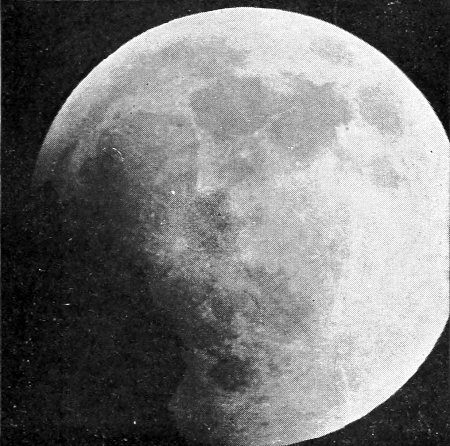
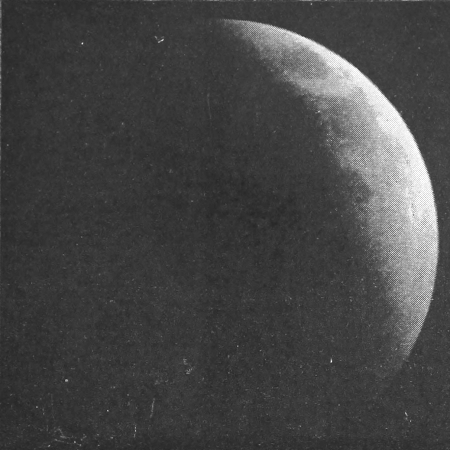
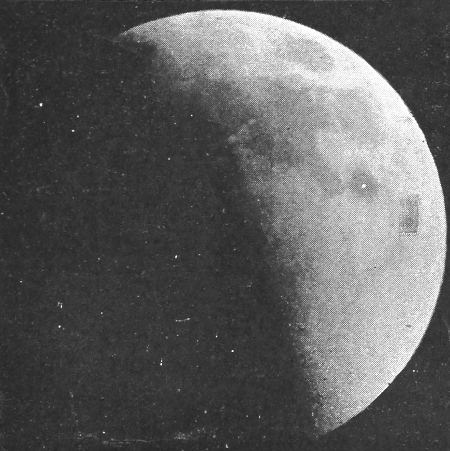
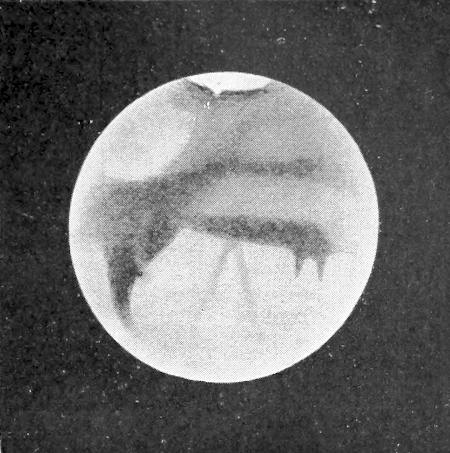
Once upon a time—thus runs a certain tale—there
was a man who wanted to see what could
be found at the other end of the world.
So he left his home behind him, and started
off to explore. He had a toilsome journey. He
wandered over wide plains; he climbed steep
mountains; he forded dangerous rivers; he
crossed stormy seas. Through weeks and
months, and even years, he kept straight on,
steadily on, patiently on, never turning to right
or to left. And at last, what do you think he
found?
Was it a world of giants? Or a land of fairies?
Or a dark ocean, without any further
shore? Or a vast range of hills, reaching skyward?
Or a profound depth, going downward?
He certainly must have found something, because
he came to the end of his journey and
travelled no more. He had no need to travel
any more. His task was done: the puzzle was
found out; and he had arrived at “the other end
of the world.”
Only it was no “end” at all, but just the
very same spot from which he had started. For
he had actually found his way back to his own
old home again.
Don’t you think he must have been rather
astonished? It was not at all what he had expected.
Suppose that a spider, living in the middle of
a very big plain, were to make up his mind to
walk to the outside edge of that plain, and see
what might chance to be there. And suppose
that, having climbed little hillocks, and crossed
little brooks, trying always to keep steadily in
the same forward direction, he were to find himself
all at once back on the very same spot from
which he had first set forth!
He would no doubt be a good deal surprised;
and if he had sense to think the matter over he
would see plainly that he had not managed, after
all, to keep going straight forward, but that he
must somehow have turned round without knowing
it and gone back to his starting point.
The man in the story made no such mistake,
however. He did not turn round. He went
always on, and on, in exactly the same direction.
Yet in the end he found himself at home!
There is the curious part of the matter.
If the world were a flat plain, like the top of a
large round table, the man could not have done
this. It would be out of the question. He might
have turned round and walked back; he could
not have walked steadily onward and onward,
farther and farther away from his home, only to
find himself suddenly there again. The thing
would be impossible.
Whether any living man ever took such a
journey round the world is more than doubtful.
But I can assure you of this: that if any man
ever did take such a journey it would end just
as that man’s journey is said to have ended.
By keeping straight forward, always in one direction,
and by going on long enough, he would
in time get back to his own house again.
How could he? That is the question. If a
spider were to walk on for ever, straight across a
flat plain, he would never get back to his starting-point.
But the world on which we live is not a flat
plain. For a long while men believed that it
was; and they made a mistake.
Let us think again of a spider—one of those
tiny red spiders often found in a garden—and
let us suppose this wee red spider to be standing
on a huge round globe, as large as a house. Suppose
that the spider, having very short sight,
fancied himself to be on a flat table and resolved
to take a walk to the further end, to see what he
might find there.
You and I, looking on, would know there was
no end to the globe: but the spider could not
guess this. He would walk on and on, in a
straight line, believing himself always to be on a
flat surface. And if he contrived to keep a perfectly
straight line all round the globe—not an
easy thing to do—then, whichever direction he
began to go in, the end would be the same: if
he kept on long enough he would go round the
whole huge ball, and would arrive again at the
spot where first he had stood.
If he did not manage to keep quite a direct
line, but zigzagged a little to right or left, he
would not reach the same spot; though even
then he would get back to the same side of the
globe as before. He would find no “end” to it, because
a globe, properly speaking, has no “ends.”
And this Earth, on which we live, is not flat,
like a board or table, but round, like a globe or
orange. It is really very like an orange; for
an orange is not a perfect globe, but is a little
flattened on its sides, or, as we commonly say,
“at the ends.” Our Earth also is rather flat in
shape at the north and south poles. A round
globe, like an orange, or like the Earth, has really
no “ends” at all: though we often use the word
when speaking of the two poles.
If you were to take such a journey, starting
from your home, and keeping a perfectly straight
line onwards always in one direction, you too
would in time come back to the spot from which
you started.
But a journey of this kind would be very
hard to manage: far more so than it sounds.
Every little hillock, every little streamlet, every
house and every tree, to say nothing of rivers
and towns, mountains and oceans, would turn
you out of your path. By the time you got
round the world, although you would return to
the same side of the globe from which you first
set out, you might be a long way off from the
exact spot.
In case you do not know where the two
“poles” are, you should ask some one to show
you on a school globe. The north pole and the
south pole are both very cold parts of our Earth.
Ice and snow are there all the year round.
Half way between the north and the south
poles is the equator—a line drawn exactly round
the whole Earth: and all round the Earth, on
or near the equator, are the very hottest countries.
About half way between the north pole
and the equator, and between the south pole
and the equator, are the “temperate” parts of
the Earth—not so very cold, or so very hot.
If a man is travelling from near the north
pole towards the equator, or from near the south
pole towards the equator, he gets into warmer
and warmer places.
But if he is travelling from the equator towards
the north pole, or from the equator towards
the south pole, he gets into colder and
colder places.
The right name for a globe-shaped body,
like an orange or like the Earth, is a “sphere.”
Neither an orange nor the Earth is a perfect
sphere, because both have flattened ends; still,
the ends are only a little flattened, and we always
speak of the Earth as a “sphere.”
A “hemisphere” means a “half-sphere.” If
our whole Earth were cut into two equal-sized
pieces each of those pieces would be a “hemisphere.”
We always think of the equator as dividing
our Earth into two halves. The half towards
the north is called “the northern hemisphere;”
and the half towards the south is called “the
southern hemisphere.”
Since our Earth is said to be a round globe,
like a ball, why do we not see over the edge?
A fly, standing on an orange, would have, it is
true, a rounded surface just under his feet; but
he could take a good view downward over the
edge. It would look like an edge to him, though
there is no edge really to a ball.
If our world were as small as an orange, and
we by comparison were each as large as a fly,
then we should be able to do the same.
But the Earth is huge in size: and we are
very tiny—yes, exceedingly tiny, side by side
with the great Earth! And the surface on
which we stand curves away so very gently, so
very gradually, that it looks like a flat surface
to us—just as the large globe would have
seemed flat to the wee red spider, only very
much more so. For the difference in size between
the Earth and a man is far greater than
the difference between the globe and the spider.
You may get some idea of how things are,
by standing on the sea-shore, and gazing out to
sea. Far away the sky and earth seem to meet
in a long line, which we call “the horizon.”
That line is always around you, on all sides,
wherever you are, though often you cannot see
it, because of hills or buildings or trees coming
between.
Beyond that line the rounded surface of the
Earth drops away, so that you can see it no more.
It is, in fact, what looked like an edge, to the fly
standing on the orange. To us it looks much
more as if the ground slanted upwards to meet
the sky. But there is no real upward slant.
After a certain number of miles, the surface of
the ground or the ocean dips downward, out of
sight, and all else beyond that line is out of sight
also.
Put your eyes close down upon a large schoolroom
globe. You will see at once how the solid
ball hides from you part of the room. You can
see the ceiling, and perhaps the window and
the fireplace, but beyond the globe all is hidden.
Your horizon, as you stand thus, is just
where you seem to see a sort of edge to the
globe, beyond which its rounded surface dips
away, out of view.
Looking upward into the sky we are able to
see enormous distances—hundreds of miles,
thousands of miles, millions of miles, billions of
miles away! Light travels to earth from far, far
distant stars: and we can perceive those feeble
gleams because nothing comes between to hide
them.
On the Earth it is very different. Here we
can commonly see only a few miles off. Not
because our eyes are not strong enough: but
because the Earth’s rounded surface soon dips
away, and all beyond that dip is cut off from us
by the solid body of the Earth.
On a flat plain, or close to the surface of the
sea, our view is very narrow. If we climb a hill
we get a wider landscape, because we can see
farther over the “dip,” and from a mountain-top
the view is very greatly increased.
Sunset.
Still, no matter how high we go, the Earth’s
surface always stretches away to north and
south, to east and west. It always seems to rise
and meet the sky, making our horizon-line.
If we could get very, very far off indeed, into
the sky, we should then see our Earth floating,
like an enormous ball—a huge round solid
globe. But this we are never able to do. We
know our Earth to be a round ball: but we cannot
stand apart and see her to be such.
Did you ever notice a ship “hull-down” on
the horizon?—that is, with its masts standing
up above the horizon, and its body hidden?
This again was caused by the shape of the
earth: the hull of the ship having dipped down
below the horizon, while the masts still stood
up within sight.
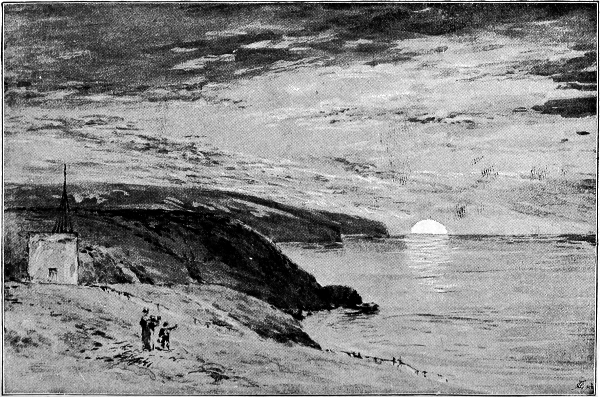
When we see the Sun in the sky, he is always
a round body. But when he sinks at
night below the horizon part of the round surface
is hidden first, and then the whole. Hidden
in the same way: by the Earth’s rounded
surface coming between him and our eyes.
At the moment when the Sun is all but gone,
only one glimmer being visible, you might say
of him too, as of the ship, that he is “hull-down.”
QUESTIONS.
1. What is a Sphere?
A body in the shape of a rounded ball or
globe.
2. What shape is our Earth?
The Earth is a sphere in shape: but not a
perfect sphere, because flattened at the north
and south poles.
3. What is a hemisphere?
A hemisphere is a half-sphere.
4. Describe the two hemispheres of the Earth, commonly
so called?
The northern hemisphere is the whole of the
Earth north of the equator; and the southern
hemisphere is the whole of the Earth south of
the equator.
5. What is the Equator?
A line supposed to be drawn round the
whole earth, exactly half-way between the north
and south poles.
6. What is the horizon?
The horizon is that line in the distance
where the sky and earth seem to meet.
7. What hides all below the horizon?
The solid body of our Earth.
8. How far can a man see on the Earth?
A few miles, usually. On a hill he has a
much wider view.
9. How far can a man see in the sky?
He can see stars millions and billions of
miles away.
10. What is meant by a ship “hull-down?”
A ship “hull-down” is partly above and
partly below the horizon.
11. What becomes of the Sun when he sets?
He goes down below the horizon.
12. Is the Sun then too far off for us to see him?
No: he is only hidden from us after sunset
by the solid body of the Earth coming between
him and our eyes.
13. Does the Earth’s surface really rise to meet the sky?
No: it really drops away, so that beyond a
certain line we can no longer see it.
CHAPTER II.
WHY MEN DO NOT FALL OFF.
We come now to a curious thought.
The world is a round ball; and people live
on all parts of it. Therefore, a man on the opposite
side from us stands with his feet turned
upwards towards our feet and his head pointing
in the other direction—“hanging downwards, in
short,” you might say.
This seems extremely odd.
Suppose you hold a big ball, and place a pea
on the top of it. The pea will stay where you
put it, if you keep your hand steady. But if you
place the pea at the side or bottom of the ball it
will instantly drop away. Try for yourself, and
you will see.
To be sure, a fly or a spider might stand with
equal ease on the top or the bottom of the ball.
The feet of a fly and a spider are made for clinging
and walking in such a position. Man is not
formed to stand or walk upside down, like a fly
on the ceiling.
Now, why don’t the people on the other side
of the world, in Australia for instance, drop off
the earth, and fall away into the sky?
Of course there is a sky under our feet, just
as much as over our heads. The entire world is
surrounded on all sides by sky; not only over
our heads, but down under our feet, beyond the
solid Earth on which we stand, and in all directions.
If you were to travel round the world, and
were to reach Australia—then, as you stood on
the ground, your feet would point upwards to
the feet of people in the United States; just as
two flies, standing on two opposite sides of a
ball, have their feet pointed, those of one fly
towards those of the other. It cannot help being
so, because of the shape of our Earth.
How do you think you would feel there? Do
you think you would be in danger of dropping
off the Earth into the blue sky?
Not in the least. No more danger of such an
accident in Australia than in America. Nothing
indeed would astonish you more! Instead of
being disposed to fall from the Earth, you would
find it every inch as hard there as here to get
away from the Earth. Your own weight would
hold you fast to the ground in Australia just
the same as in America.
Try to jump up into the air, with all your
strength. Try your very utmost; get as far
away as you can from the ground, and stay up
in the air as long as possible.
Not much good; is it? Do what you will, you
do not find that you can rise more than a foot or
two, and you instantly drop back again. The
most powerful leaper can manage at most only
a few feet. A man is quite unable to stay up in
the air at all, unless something holds him there:
far less is he able to drop or float away into the sky.
And the reason why he cannot is that he is
too heavy. He is too heavy in America: and he
is too heavy in Australia. In both cases he is
heavy towards the ground: and he cannot get
away from the ground without something to
bear him up. It is just as impossible that people
in Australia should drop off the world into the
sky as that people in America should do so.
But—you will perhaps say—the sky is above
us here; and in Australia it would be under us.
Oh, no; it would not! The sky is all round
the whole Earth, on every side alike. In all
parts of the world people have the sky over their
heads and firm ground beneath their feet.
The Australian sky is under the feet of those
who live in North America: that is true. But
then it is no less true that the North American
sky is under the feet of those who live in Australia.
To you the Earth is underneath: the
sky is overhead. To an Australian also the
Earth is underneath and the sky is overhead.
All round the world it is the same. Down means
always towards the ground. Up means always
towards the sky.
If you hold up a stone in the air, and let it
go, what happens? The stone drops at once to
the ground.
If you fling a ball into the air, what happens?
The ball goes a little upwards, carried by the
force of your fling: but soon it curves over and
comes to the ground.
If you tilt up a jug full of water, what happens?
The water pours down upon the floor.
If a man steps over a precipice-edge, what
happens? He falls to the bottom, and is most
likely killed.
But these things are not more true of the
United States than of Australia. All round the
world, in every part, it is the same. Water always
flows downward. Loose bodies always
drop downward, unless kept up by something.
We have been asking why it is that people
never drop off from the Earth into the sky. Of
course nobody ever asks that question about the
part of the Earth on which he happens to be.
Whether he is in England, or in America, or in
Australia, he knows very well that he is in no
danger of “dropping off.” The very idea as to
himself would seem absurd. To “drop off”
would really be to rise upward into the sky: and
he feels that he is much too heavy for that. It
is only when he thinks about the other side of
the world, and about people walking there with
their heads hanging downward——
But they do not walk with their heads hanging
downward. Their heads, like ours, point
upward to the sky; and their feet, like ours, rest
firmly on solid ground; and they too, like us,
are heavy towards the Earth. It is as impossible
for a man in Australia as for a man in England
or America to “drop off” the Earth—in
other words, to rise upwards towards the sky.
His own weight holds him down.
What do we mean by “weight?” What
makes a man “heavy?”
He is made heavy by the Earth’s pulling
or attracting him; and this gives him weight.
And how does the Earth pull?
There I cannot tell you much. We know
that the Earth does pull: but how she pulls is
another question. We name that pulling “Attraction,”
and sometimes we call it by a longer
word, “Gravitation.” But not the very wisest
man living can explain to us exactly what attraction
is. He can only tell us what it does.
Did you ever see a magnet? It is generally
shaped rather like a horse-shoe: and the two
ends have an odd drawing power. A number of
tiny iron shavings, held near enough, will jump
up to meet the magnet as if they were alive.
This is because the magnet pulls them towards
itself. Sometimes a toy-box of metal ducks or
fishes is sold, with a magnet; and they will follow
the magnet to and fro, in a basin of water.
Now our Earth seems to be a sort of huge
magnet, with power to pull towards herself, not
only iron or steel, but every single thing and
creature upon her surface. Not only on one side
of the Earth, but around the whole globe, on
every part, there is the same steady downward
drag, always toward the centre of the Earth.
The mountains are pulled earthward: so are
houses and trees, rocks and soils, seas and rivers,
animals and men. There is not a single
thing on or near the surface of our Earth which
is not thus drawn earthward.
If it were not for this attraction nothing
would have any weight. When you leap upward
and instantly drop back it is because the
Earth drags you down. Without such dragging
you would not be heavy at all.
Think what that would mean. You might
jump over the highest mountains with ease:
or you might spring away into the sky, and
never return: only, of course, there is no air, far
away in the sky, and you could not breathe without
air.
But if the Earth did not attract we should
have no air here either, because it would long
ago have all wandered away. Earth’s strong attraction
holds the air prisoner, as well as all other
things upon her surface.
Now do you begin to see how it is that people
do not fall away into the sky, from any part of
Earth? They are held firmly down by Earth’s
perpetual drag, which gives them weight. Whether
they are in England or in Australia, in Asia
or in America, makes no difference. The pull is
always downward, always earthward. The difficulty
always is to get away from earth, upward,
toward the sky.
So when we think of the world as a whole we
have to remember that in the surrounding sky
there is no true “up” or “down” in one direction
more than another. “Up” is towards the
sky for each man, from that part of Earth on
which he stands: and as our Earth is ever turning
round and round our “up” is constantly
changing its direction.
Perhaps you will think that I am rather slow
in getting to my subject of “The Starry Skies.”
Two whole chapters first about this old Earth
of ours!
But indeed I have not been slow: for on the
very first page we started right off with a Bright
World in the Sky.
By this time you know that our world is actually
in the sky, just as much as the sun and
moon are in the sky. We are in the moon’s sky,
and in the sun’s sky, and in the sky of all other
planets and all other stars. For our Earth floats
in the same boundless sky-depths as all of them,
those sky-depths which are usually known by the
name of Space.
So now, when “Space” is spoken of, you will
understand. You will know that it means the
Sky, in which float all the heavenly bodies.
“Only”—you will perhaps say—“the Moon
and the Sun are bright; and so are the Stars.
But our dull old world is not bright at all.”
That is a great mistake, I assure you. Our
world is very bright indeed. She shines with an
exquisite radiance. Not indeed with such a dazzling
glory as the Sun, but quite as brightly as the
Moon.
Have you ever noticed how the ocean shines,
and flashes forth light, when the Sun beats down
full upon it? Or, again, have you not been struck
with the shining of white clouds in sunlight?
More or less the whole surface of our Earth
catches and gives forth again the brightness that
comes to her from the Sun.
If we could travel away from the Earth to a
good distance—say, as far as to the Moon—we
should see the round Earth like an enormous,
brilliant Moon in the sky, only far larger and
more beautiful than our Moon ever looks to us.
Some parts would be darker, some more shining;
but as a whole the Earth would be a splendid
sight.
Not bright? Yes, indeed; we are living on a
very bright world indeed, though we cannot always
see her radiance.
QUESTIONS.
1. What is Space?
By Space we mean Sky—the whole great
Sky, in which are all the heavenly bodies.
2. Is our Earth in the Sky?
Just as truly as the Sun and Moon are in the
Sky. They are in our sky, we are in their sky.
3. Does our Earth float in Air?
No; she floats in the Sky: and the air is a
part of the Earth.
4. Do people on the other side of the globe walk head
downwards?
No; they walk as we do, on firm ground,
with the Sky over their heads.
5. What is meant by “up” and “down” to us on Earth?
On every part of the Earth up is always toward
the Sky, and down is always toward the
Earth.
6. Give some examples of the way in which all things move
earthward.
Water always pours downward. A stone
flung, or a ball dropped, always reaches the
ground.
7. Why do things descend thus?
Because of their own weight or heaviness.
8. What causes weight?
The pull of the earth.
9. Give two other names for that “pull.”
Attraction and Gravitation.
10. Tell me a few things that are pulled earthward.
Men, animals, trees, houses, rocks, cities, hills,
mountains, lakes, rivers, oceans, air, clouds, etc.
11. What keeps people on the other side of the Earth
from dropping off into the sky?
They cannot possibly drop off; because the
sky there is upward, the same as here.
12. What would “dropping off” really be?
It would be rising upward into the sky.
13. Why should a man not rise upward?
He cannot, because he is too heavy.
14. He is heavy towards what?
He is heavy towards the Earth, because of
the Earth’s attraction.
15. Is he as heavy in Australia as in the United States?
Exactly the same.
16. In what direction is he pulled there?
Towards the Earth. All round our whole
world the pull is towards the centre of the Earth.
17. Can our Earth be called “a bright world?”
Quite as much so as other planets. If we
were far enough off she would be seen by us to
shine with reflected sunlight, like the Moon.
CHAPTER III.
BY DAY AND BY NIGHT.
Let us take a good look up into the sky,
and see what is to be found there.
First, by day. Beginning in the early morning,
just before sunrise, we have perhaps a clear
sky, grayish rather than blue, and towards the
east a brightening glow shows that the Sun
is about to appear. That glow grows stronger
and stronger, and soon a tiny glimmer creeps up
over the rounded surface of our earth. Then
the broad golden face follows, till the sun is
visible, and full daylight has arrived.
But the Sun does not stand still there, low
down on the horizon. He goes on rising higher
and higher, “climbing the heavens” steadily,
one hour after another. At mid-day—twelve
o’clock—he has reached his very highest point.
Then he begins to descend, moving downward
towards the west till he reaches the western
horizon and vanishes from our sight.
The Sun always rises in the East; never in
the West. He always sets in the West; never
in the East.
By this I mean that he always rises to theeast of our world and sets to the west of our
world. He rises on the eastern side of the
Earth and sets on the western side. You must
not suppose that he always rises due east and
sets due west of all countries in the world at once.
On two days only he does so—that is at the
Spring Equinox, on March 21st, and at the
Autumn Equinox, on Sept. 21st. “Equinox”
means “Equal Nights.” At those two dates
days and nights are of the same length, twelve
hours each, throughout the whole world; and
everywhere the Sun rises exactly in the east, and
sets exactly in the west.
Everywhere except at the north and south
poles. There the Sun is seen to circle round
the sky in twenty-four hours, just above the horizon,
neither rising nor setting.
A man standing on the equator at one of the
equinoxes sees the Sun rise just in the east;
climb high in the sky just over his head; and
set just in the west.
People living in the northern parts of Europe
and of America do not see precisely the same
thing. With them the Sun does not circle round
the sky, just over the horizon, as at the poles.
And though he rises in the east and sets in the
west, as at the equator, he does not reach the
highest point in the sky, but only a point somewhat
lower down, towards the south.
The very highest point in the sky, exactly
over one’s head, is called “the zenith.” In northern
countries the Sun never gets to the zenith.
No; not even on the very hottest summer day.
He is always towards the south.
There are two other dates, which you ought
to learn, besides the Spring Equinox and the Autumn
Equinox. These are—the Summer Solstice,
on June 21; and the Winter Solstice, on December
21.
On the 21st of June the Sun is not exactly
overhead at the Equator, as at the Equinoxes.
He has come farther north; not nearly so far
north as England or Canada, but as far north as
he ever does come.
By that time days and nights are not at all
equal through the world. In the north of Europe
and America we have long days and short nights;
while our friends in Australia have long nights
and short days.
Although the Sun is never actually overhead
with people in the northern parts of Europe and
America, but is always somewhat to the south,
even at his highest point, still he climbs very
much higher in June than in March or September,
and so he is much longer above the horizon.
Things are quite the other way on the 21st of
December. Then the Sun is overhead, not farther
north than the Equator, but farther south.
Then it is summer in the southern hemisphere
and winter in the northern. Then we who live
in England or in the northern parts of North
America have long nights and short days, while
our friends in Australia are having long days
and short nights.
Then, too, in the north, the highest point at
mid-day which the Sun can reach is low down in
the south; and his rays come to us in a slanting
manner, with far less power to warm than when
they are poured down from nearly overhead.
That is why we are so cold in the dark months
of the year.
At the equinoxes the Sun rises to the east
and sets to the west of almost the whole Earth.
In our northern summer the Sun rises to the
north-east, travels round by the south, and sets
in the north-west.
In our northern winter, the Sun rises to the
south-east, climbs up a little way, and sets in the
south-west.
These changes come about slowly. Every
twenty-four hours there is a difference. Each
day of spring the Sun rises and sets a little more
to the north, and climbs higher in the sky. Each
day of autumn he rises and sets a little more to
the south, and climbs less high in the sky.
But all the while, though he may rise to the
north-east or south-east of New York or London
or some other particular spot, he rises to the east
of the world; though he may set to the north-west
or south-west of any particular spot, he sets
to the west of the world.
You will find a grand description in the 19th
Psalm of this daily journey of “the Sun, which is
as a bridegroom coming out of his chamber, and
rejoiceth as a strong man to run a race. His
going forth is from the end of heaven, and his
circuit unto the ends of it; and there is nothing
hid from the heat thereof.”
The full meaning of that heat and strength
can hardly be known in northern lands. Their
hottest summer day’s heat is as nothing, compared
with the scorching blaze and glare of the
Sun in countries nearer to the equator—for instance,
in that country where the Psalm was
written.
Through all the ages of our world’s history,
from the very beginning, the radiant Sun has
risen and set, day after day. Morning after
morning he has come up from beyond the horizon
on one side; evening after evening he has
vanished below the horizon on the other side.
Year after year, and century after century, still
“like a strong man” he runs his daily race, and
warms and lights each side of the world in turn.
Now about the Sky at night. What happens
when the Sun is gone?
The bright blue of the sky grows fainter and
more dull, and stars begin to show themselves.
First, one little twinkle is seen; then another
little twinkle; then a third; till, if it be a clear
evening, the whole sky is dotted with gleaming
points. Some are more bright, some are less
bright. Here one flashes like a diamond, with
different colors; there another is so dim as
hardly to be seen at all.
It may be that we have caught sight of the
Moon before the Sun has set—should she happen
to be in a right place in the sky, not too near to
the Sun. While he is up, if we get a glimpse of
her at all, she looks like a mere pale patch of
whiteness. But when the Sun is gone, and darkness
deepens, she changes fast; and soon she is
lighted up with a soft silvery glow, sending her
beams to the Earth.
Now, you all know—everybody knows—that
the Sun rises each morning, crosses the sky, and
sets each evening.
But perhaps not every boy and girl knows
quite so clearly that the Moon and the Stars behave
very much in the same manner. They too,
either in the day or in the night, rise and cross
the sky and set; and at night we may see them
do it.
We cannot always watch the rising and
setting of the Moon: for when she rises in the
day-time her soft beams are often lost in the glare
of sunlight. Still she is always there, in the sky:
always rising and setting to some part of our
Earth. When we say, as we often do, “Is there
a moon to-night?” we mean, “Is the moon
where we can see her to-night?” There is always
a Moon, and there is always the same Moon.
As to the Stars, their movements are puzzling,
no doubt. No two stars rise at the same
point or take just the same path over the sky, or
set on the same spot. Some rise exactly east,
and set exactly west. Some rise in the south-east
and set in the south-west. Some rise in the
north-east, and set in the north-west.
No star is ever seen, however, to rise anywhere
towards the west, and to travel backwards
towards the east. All the stars in company move
as a whole from the eastern side of the world towards
the western side of the world. That is to say, they
seem to move thus.
Some stars to the north do not rise or set at
all, as seen from the northern parts of Europe
and North America. They only travel round and
round, in a circle about the Pole-star, which is
almost exactly over our north pole. Yet their
movements too are from east to west.
If we lived in the southern hemisphere we
should see the same thing going on nightly, only
with a different set of stars.
Then the far-south stars would circle round
and round over the south pole; and those lying
over the north pole would be hidden by the
Earth lying between. But still the whole movement
would be always from east to west; never
from west to east.
Each tiny star, bright or dim, takes its daily
journey, like the sun, once in twenty-four hours.
No matter whether it has to go right round the
whole Earth or whether it only has to creep in
a small circle round the Pole-star—still the
journey is always the same in length: always
close upon twenty-four hours. At the end of
twenty-four hours it is back at its starting point,
and begins over again. Just as the Sun does.
If you look out at night sometimes, and
watch carefully, you will see for yourself something
of this constant nightly journeying of the
stars.
QUESTIONS.
1. Where does the Sun rise and set?
The Sun rises in the East and sets in the
West.
2. Always in the East and West exactly?
Always to the east of our world and to the
west of our world. Not due east and due west
of each particular country always.
3. When is the Spring Equinox?
On the twenty-first of March.
4. When is the Autumn Equinox?
On the twenty-first of September.
5. What does the word Equinox mean?
Equal nights. At the Equinox, days and
nights are of the same length over almost the
whole world.
6. When is the Summer Solstice?
On the twenty-first of June.
7. When is the Winter Solstice?
On the twenty-first of December.
8. In what direction does the Sun rise and set at the Equinoxes?
At each of the equinoxes the sun rises due
east, and sets due west, over all the world, except
at the poles.
9. At the Summer Solstice where does the Sun rise and
set?
To people in England, or in Canada, or in
the northern States, he rises in the north-east
and sets in the north-west.
10. And in the Winter Solstice?
To those same places he rises then in the
south-east and sets in the south-west.
11. What do we call the highest point in the heavens, exactly
over one’s head?
The zenith.
12. Does the Sun ever reach the zenith in England, or in
the northern parts of North America?
Never. He rises much higher in summer
than in winter at midday, but he is always to
the south of the highest point.
13. When or where may the Sun be seen precisely overhead?
On the equator, at the two equinoxes.
14. At what hour of the day may the Sun be seen exactly
overhead?
Only at Mid-day.
15. Do any other heavenly bodies rise and set?
Yes; the Moon and the Stars; in fact, nearly
all the heavenly bodies.
16. Can we see the Moon rise and set?
Sometimes; not always.
17. Tell me one reason why we sometimes do not see the
Moon.
Sometimes she rises and gets at about the
same time as the Sun; and then she is hidden
by his brightness.
18. How do the Stars rise and set?
Like the Sun and Moon, they rise in the east
of the world and set in the west of the world.
19. Do all the Stars take the same journey?
Some rise due east, some north-east, some
south-east; and they set either due west, or
north-west, or south-west.
20. Does every Star that we can see rise and set?
No; many stars to the far north never rise
nor set to us in England or the northern States,
but circle round and round the pole-star.
21. How long a time does this journey take—either round
the world or round the pole-star?
Nearly twenty-four hours for each star.
CHAPTER IV.
HOW THE WORLD SPINS.
In our last chapter we saw how the Sun rises
and sets in the day, and how the Moon and Stars
rise and set in the night.
True, they also rise and set, by day as well as
by night. The Moon often does so: and all day
long there are Stars coming up in the east, and
stars crossing the sky, and stars going down in
the west. But we cannot see them. Until the
great Sun has withdrawn his radiance the little
star-gleams are hidden from us, and even the
Moon can seldom be caught sight of.
In the daytime, when you look up into the
blue sky, and see a blaze of sunlight, you should
sometimes remember that the stars are there.
All day long, as well as all night long, the stars
are there, shining just as usual. All day long,
as well as all night long, they are moving steadily
across our sky: rising, marching onward, and
setting. We cannot see them; but that is because
our eyes are weak, not because the stars
themselves do not shine.
So by day and by night the heavenly bodies
seem to be ever on the move. No matter what
part of the world you may be in—whether England
or America, whether India or Australia—still
you will find them moving. By day you
will see the Sun rising in the east, journeying
towards the west, and setting. By night you
will see the Moon, and most of the stars, rising
in the east, journeying towards the west and
setting.
This goes on continually. It is always the
same. Year after year, there is no change.
The Sun rises in one spot, crosses the sky,
sets; and then a few hours afterwards rises
again in very nearly the same spot as before, to
cross the sky by very nearly the same path, and
to set in almost exactly the same part of the western
horizon. Each day there is a tiny, very tiny,
difference; but by the end of twelve months the
Sun gets back to exactly the same spot in rising
and setting as in the previous year. And most
of the stars follow the Sun’s example.
Why should not one fix upon a bright star
overhead, and hurry along on the ground, just
as fast as the star goes, so as to keep it overhead
longer—to keep it in sight?
There is no reason why one should not do
this, if only one could get along fast enough.
It would have to be very rapid travelling. If
you wished to keep that star in sight, overhead,
for twenty-four hours, you would have to do—what
do you think? You would have to rush
round the whole world in twenty-four hours!
If you could possibly manage to do that, you
might possibly choose any bright star overhead
that you liked, and keep it in view all night; in
fact for two nights, with no day between; for
you would journey with the night.
Or if you chose to follow the Sun by day,
keeping him overhead in your rapid rush over
continents, and mountains, and oceans, you
might have a double day of twenty-four hours,
with sunshine all the while and no darkness.
But think what such a rush would mean!
Think how big the world is! People sometimes
do travel all round the whole earth, and the
journey takes them many months. Even if they
stopped to look at nothing by the way, and went
as fast as possible, and cared nothing about
being tired—even then, at the very least, it
would take them many weeks.
To get round the world, on the Equator, or
from England, or from the United States, or
from Australia, in twenty-four hours, is a thing
which no living man could ever do! The Sun
and the stars go much too fast for us.
They are seen to whirl round the whole earth,
swiftly and calmly and easily, with no manner
of fuss or difficulty, once in every twenty-four
hours!
Ah! but do they? That is the question. Do
they really all whirl round and round, at this
rate?
When you take a journey in a train, and look
out of the window, what do you see?
Everything seems to be moving. The more
distant hills travel slowly; fields and villages
speed at a good rate; houses and hedges near at
hand rush by; and the telegraph poles flash past
as if running away. But one house does not go
one way and another house in the opposite way.
All of them journey in the same direction.
Do they really journey? Are the fields and
hills, the villages and trees and telegraph poles,
all spinning swiftly along, while you in your
train sit quite still, not moving at all?
It must be one of the two things: either they
are on the move, and you are quiet; or else they
are quiet, and you are yourself rushing along, so
that they only seem to move.
You would not have much difficulty in deciding.
Even if you did not feel the carriage in
which you sit to be shaking and jarring with its
own rush, still you would count it easier to believe
that the train was going forward than to
think that all the hills and fields and trees and
houses were speeding the opposite way.
It is almost the same thing with our earth.
We see the Sun, and the Moon, and all the stars,
hurrying past, and we have to believe one of
two things: either they are all moving, and we
are still; or else we are moving and that makes
them only seem to move.
For a long while people were not quite so
sensible about the heavenly bodies in the sky as
you would be about the houses and fields seen
out of a train. It seemed to them easier to believe
that all the stars went round and round the
earth, than to believe that the solid earth herself
moved.
There was this excuse, that the earth does
not jar and rattle like a train, and also that the
distances of the stars cannot be easily seen at a
glance, like the distances of hills and valleys.
We have learned differently now. We know
that our earth does indeed move; and that the
daily journey of the Sun, the nightly journey of
the moon and planets and stars, is not a real
journey. It is only a seeming journey. They
seem to move, because our earth truly moves,
just as the hedges and trees seem to move when
looked upon out of a train which really moves.
Day and night the earth moves. Day and
night, year after year, she spins, like an enormous
top, upon her axis.
By the “axis” of the earth I mean a straight
line through her centre, from the north pole to
the south pole.
If you have a school-globe you will see that
it turns round and round upon a kind of large
pin, which reaches from one pole to the other.
That is its “axis,” and that is how the Earth
spins.
Or you may stick a long bonnet-pin through
an orange, from one flattened end to the other,
and spin the orange upon that pin, which is then
the axis of the orange.
A spinning-top also has an axis. There is no
pin stuck through the top; but as it whirls
round, humming, and remaining in one spot,
there is a line from top to bottom of it which
does not seem to move. The whole top whirls
round this line, which again is the axis of the
top.
Our Earth has no huge pin passed through
her body; but, like the top, as she spins there is
a line straight through her, from the north to
the south pole, which keeps still, while round it
whirls the whole big body of the Earth. And
that is the Earth’s axis.
If a man stands close to the north pole, or
close to the south pole, at either end of the axis,
he moves very little. But if he is far away from
the poles, on or near the equator, the ground on
which he stands rushes along at a great rate,
carrying him with it.
He does not feel the movement. He is not
shaken or jolted. The Earth whirls very smoothly.
As she spins she carries with her, on her
surface, all the mountains and seas, the hills and
valleys, the trees and towns and villages, yes,
and the very air which we breathe. Nothing is
left behind.
So the man cannot know how fast he is going
by any feeling of his own. He can only know
it by looking up into the sky. There he sees the
Sun, the Moon, the Planets, the Stars, all hurrying
past. Why? Because he is hurrying past—not
because they are.
They all go in the same direction, from east
to west. We have seen this plainly. It is not a
journeying of some stars one way, and some
stars another way. It is one great sweep of the
whole heavens from the east of the world toward
the west of the world.
And the reason of this is that our Earth spins
or whirls from the west to the east.
That is what makes the Sun and the Stars
all seem to rise in the east and set in the west.
In the morning, when you get up early, and
look towards the east, you are gazing at that part
of the sky towards which you are travelling. The
Sun is not coming to meet you, but you are going
to meet him. This solid world on which
you stand is whirling like a big teetotum, carrying
you round in his direction.
So presently you see him seem to creep up
over the horizon. And by-and-by, at mid-day,
the moving surface of the Earth has carried you
on almost underneath him. And later in the
evening, as you are still whirled on toward the
east, you leave the Sun behind you, in the west.
But still he goes on rising to other parts of
the world, as country after country spins round
into his light.
At night it is the same thing over again.
Each star that rises only seems to rise, because we
on the Earth’s surface are whirled round towards
that part of the sky in which the star always
shines. Then we pass on, and leave that star
behind, as we left the Sun; and we say that it
has set.
But the Sun and the Star have not moved.
It is we who have moved; not they.
So when we think of the Earth as a whole
we have to picture her, not only as a large solid
globe floating in the sky, but as a spinning
globe, ever turning round and round like a top
or a teetotum.
It is this whirling movement of the Earth
which gives us Day and Night.
For, as our Earth floats and spins, one side of
her is always turned toward the Sun, and is in
daylight; the other side is turned away from the
Sun, and is in darkness. Each land and ocean
in turn comes towards the Sun in the east and
passes onward, leaving the Sun in the west.
And around, on all sides, is the great Sky,
which sometimes we name “Space,” and which
sometimes we call “The Heavens.” In that Sky
float all the Worlds and all the Stars, as well as
our Earth and our Moon and Sun. And in that
sky is God himself.
He made the Sky, the Sun and the Moon and
the Earth, the Planets and the Stars; and He is
everywhere, around and amidst and in them all.
Wherever in the boundless reaches of Space we
may wander in thought, we shall never find a
spot where God himself is not.
QUESTIONS.
1. Where are Stars in the day-time?
In the sky: only we cannot see them.
2. Could a man travel round the world from America or
England as fast as a Star travels?
No: he would have to go round the whole
world in twenty-four hours.
3. Do the Stars really journey round the world?
They only seem to do so.
4. But the Sun rises and sets, does he not?
He seems to do so. It is really our Earth
that moves.
5. In what way does the Earth move?
Once in twenty-four hours she whirls round
on her axis from west to east.
6. What is the Earth’s axis?
An imaginary line through her centre, from
the north pole to the south pole.
7. How does our Earth’s spinning make the heavenly
bodies seem to move?
A little in the same way that, when we journey
in a fast train, houses and trees and fields
seem to go the other way.
8. Did people always know that the Earth whirled round?
No; they used to think it was a real journeying
of the Sun and Stars in our sky.
9. Where does the surface of the Earth move fastest?
On the equator. The ground there rushes
at a great speed.
10. Where does it move most slowly?
At the poles.
11. Does a man standing on the equator feel how fast he
moves?
No; because the Earth moves smoothly;
and everything on the ground and in the air is
carried along by the Earth.
12. How can he know that the Earth moves?
By looking up into the sky—like a man in a
train looking out of the window.
13. How does the Earth’s spinning make the Sun seem
to rise?
The Sun remains fixed—but a man on the
Earth is carried round towards the east, and so
the Sun seems to come towards him from the
east.
14. And how does it make the Sun seem to set?
The man is still carried on towards the east,
and by-and-by he leaves the Sun behind him in
the west.
CHAPTER V.
THE MOON BY NIGHT.
How far off would you guess the Moon to be
from our Earth?
A mile or two, perhaps you will say. Or
twenty miles! Or forty miles! Or one hundred
miles!
Even on Earth it is often puzzling to tell
distances. If one is looking across a smooth
surface, with nothing to break it, one cannot
easily judge. I remember going in a sailing-boat,
as a child, and after a good while saying,
“Why, what a little way we have come!
The shore looks only a mile or two off!” And
I was told that it was at least ten miles off.
You see, there was nothing between to break
the smooth water-surface, and so to show how
far we had sailed.
If it is perplexing down here on Earth it
is much more so up in the Sky. There, nothing
lies between to break the great distance; and
the stars seem so much alike, except that some
are a little brighter and some a little dimmer.
One might very easily suppose that the Moon
and the Sun and all the Stars were at much the
same distances from the Earth.
Yet nothing could be a greater mistake.
Some are very near, and some are enormously
far away.
That is to say, some are very near compared
with others. But even the very nearest is a
great deal farther off than fifty or a hundred
miles.
Of all bright bodies in the sky, seen day
after day and night after night from our Earth,
not one ever comes so close as the round silvery
Moon.
The Moon is our own especial companion.
She always journeys with us, and never goes
away.
Before we learn the distance of the Moon
we have to think a little about her size. You
have not yet learned about the size of our Earth,
so we will take the two friends together.
There are two ways of measuring a ball or
globe. We may say how big it is through the
middle, from one side to the other. Or we may
say how big it is round the outside. The outside
measure is always about three times as
much as the through-measure.
A large grape may be one inch through, and
three inches round outside. A small orange
may be two inches through, and six inches
round outside. A large apple might be three
inches through, and nine inches round outside.
A small cocoa-nut might be four inches through
and twelve inches round outside. A school-globe
might be one foot through and three feet
round outside; or two feet through, and six
feet round outside. A balloon might be twenty
feet through and sixty feet round outside. Or
it might be thirty feet through, and ninety feet
round outside.
The through measure is called the Diameter
of a ball, and the outside measure is called its
Circumference. A globe may be of any size; and
it can be measured according to its size in inches,
or feet, or yards, or miles.
Our Earth is a little less than eight thousand
miles through, from side to side, or from north pole
to south pole. Its outside measure, right round
the equator, is nearly twenty-five thousand miles.
This will not give you any clear idea. It only
sounds very large.
Think first of a mile. One mile is a good way
for a little child to walk; but not much for a big
boy. Some people count five or six miles a very
long walk, while others think nothing of ten or
twelve miles. Not many men can do as much as
thirty or forty miles in a day.
But even fifty miles are only half of one
hundred. And it takes ten hundreds to make
one thousand. And the through-measure of our
Earth is eight thousands of miles.
If that man, whose story you heard in the
first chapter, ever had really done as the story
says, and walked round the whole world, he
would have gone about twenty-five thousand
miles!
How long would that have taken him? Certainly
very much longer than twenty-four hours.
He could not possibly have got along at the rate
of one thousand miles and more each hour. The
fastest express train does not manage over sixty
or seventy miles in an hour.
If he had journeyed all the while, Sundays
and week-days alike, twenty miles each day, then
he would have got round the world in three years
and a half. And if he had only done ten miles a
day he would have been nearly seven years getting
round.
Of course no man could really cross the oceans
on foot; but this will help you to a little notion
of what the size of our Earth is.
A very big globe, is she not? yet not truly
large, compared with other larger worlds in the
sky.
Our Moon is not one of those larger worlds,
however.
While the through-measure of the Earth is
eight thousand miles that of the Moon is only a
little more than two thousand miles. And while
the Earth is nearly twenty-five thousand miles
round outside, the Moon is only about six thousand
miles.
So if we could put a knitting-needle straight
through the Moon, with the ends just showing,
one on each side, it would need to be only a
quarter as long as a needle to go through the
Earth. And a ribbon to fold round the Moon
should be scarcely a quarter as long as a ribbon
which could be folded just round the Earth.
This makes a good deal of difference in the
sizes of the two globes; perhaps more than you
would suppose.
I want you now to bring down the Moon, in
your mind, to the size of a very small ball; only
one inch through or three inches round outside.
Picture her to yourself as getting smaller—and
smaller—and smaller, till she is only the size of a
very big grape.
Then think of the Earth also, as getting
smaller and smaller, just in the same way. Only
the Earth must not get so small as the little
Moon, in your mind. It must still be four times
as long in its through-measure—four inches instead
of one inch. And while a little piece of
tape, only three inches long, would go just round
the tiny Moon, a tape to go round the little Earth
would have to be twelve inches long.
Then, if the Moon is about the size of a big
grape, or a small walnut, the Earth will be the
size of a very large apple, or of a small cocoa-nut.
It would be a good plan to get a walnut and
cocoa-nut of the right sizes, or, if you like, to find
two balls, and to place them side by side. The
little one must be one inch through, the bigger
one must be four inches through. Looking upon
them, you will see in a moment how great is the
difference between the Earth and the Moon.
I shall often speak of these sizes, so it would
be as well to fix them now in your mind, and
have them there, ready for use.
Now as to the distance of the Moon from the
Earth:
It is about two hundred and forty thousand
miles!
A rope twenty-five thousand miles long would
reach once round the whole Earth, if laid down
on the equator.
But a rope to reach all the way from our
Earth to the Moon would have to be more than
nine times as long as the equator-rope.
You have tried to picture the Earth in your
mind as brought down to the size of a small
cocoa-nut, and the Moon as brought down to a
walnut. In doing this we make one little half-inch
do duty for a thousand miles; so that one inch
stands for two thousand miles, and four inches
means eight thousand miles.
The Moon is two thousand miles through;
therefore a ball or walnut, to picture the Moon,
must be one inch through. The Earth is eight
thousand miles through; therefore a very big
apple or small cocoa-nut, to picture the Earth,
must be four inches through.
In the same way we will bring down the distance
of the Moon from the Earth. We will let
each thousand miles of all that space in the sky
shrink into a tiny half-inch. Then, instead of
two hundred and forty thousand miles, we shall
only have to think of one hundred and twenty
inches, which make ten feet.
So the smaller ball, or walnut, must be put
ten feet off from the larger ball, or cocoa-nut.
That will give you a picture, not only of the size
of the earth, compared with the size of the Moon,
but also of the distance between the two.
Besides putting the two balls ten feet apart
you have to think of them as two little shining
worlds.
That is not quite so easy, is it? Why should
they shine?
We know that bodies in the sky do shine;
but bodies on the Earth more commonly do not.
By “bodies” I mean “things.” A marble does
not shine, nor a grape, nor a walnut, nor an
apple, nor an orange, nor a school-globe, nor a
balloon.
At least they do not shine of themselves.
Any of them can be made to shine a little, if not
much, by being placed in bright sunshine.
Suppose that the two balls—the little imitation-Earth
and the little imitation-Moon—were
made of glass, or of some smooth metal, such as
tin or silver. And suppose you were to hang
them up, by wires, out-of-doors, in pitch darkness.
Would they shine?
Certainly not. How could they?
But suppose there was another ball, also out
in the darkness; a much larger ball, shining
with great brilliance, like an electric light.
Would the glass or metal balls show any
brightness then at all?
Yes; for the shining of the large brilliant
ball would light them up, at least on one side,
and would make them bright.
Light is always thrown back from a smooth
surface. If you have a looking-glass in a dark
room it does not shine; but if you hold it in full
sunlight it flashes radiantly. Yet the looking-glass
has no brightness of its own. It only takes
and gives out again of the Sun’s light.
That is just how our Earth shines, and how
the Moon shines. In themselves both are dull
and dark worlds; but, like the looking-glass,
they receive radiance from the Sun and give it
out again.
Before we go on I want you to be quite
clear in your mind as to what is really meant
by this bringing down of large sizes to small
sizes. In coming pages you will often hear of it
again.
Suppose you have two very large toy-carts,
big and heavy. One of them is four feet long
and two feet wide, the other of them is three
feet long and one foot and a half wide. And
suppose that you are trying to explain, to somebody
who has not seen them, how much bigger
one cart is than the other cart.
You may do it by talking, and by showing
with your hands about how high they each
stand.
Or you may do it in quite a different manner,
and much more exactly, by making a kind of
little model of each cart—in paper, or cardboard,
or wax.
The models would not of course be of the
same size as the big carts, but they would have
to keep what is called the same proportion of
sizes. The bigger must still be the bigger; and
the smaller must still be the smaller.
You could let one inch stand for one foot.
Then the tiny model of the bigger cart—the cart
which is four feet long and two feet broad—would
only be four inches long and two inches
broad. And the tiny model of the lesser cart—the
cart which is three feet long and one foot
and a half broad—would be only three inches
long and one inch and a half broad.
Anybody looking on those two tiny model
carts could not possibly tell how big the real
carts are. But he could tell one thing. He
could know how much bigger one cart is than the
other.
This is what I hope to show you, by bringing
down the sizes of worlds and moons—not how
large they really are, but how much larger or
how much smaller one is than another.
Also, by this means we learn to understand
distances better.
If you are looking at a map of the world, or
of a part of the world, the miles in that map have
to be brought down into a very tiny space. A
map of a country, made as large as the country
itself, would take up a great deal too much room.
So half-an-inch is made to do duty for perhaps
fifty real miles, or a hundred real miles, or even
a thousand real miles. In quite a small map, a
continent or an ocean which is really two thousand
miles across might be only one inch across.
And yet, looking at that map, small though
it is, you are able to see how near one country
is to your own, and how very much farther off
another country is.
This is the way in which we are going to
think about different worlds—those which are
nearer and those which are farther. We have to
make a sort of little map or model of them in
our minds; letting one inch always picture two
thousand real miles.
QUESTIONS.
1. What is meant by the diameter of a ball?
Its “through measure” from one side to the
other, straight through the centre.
2. What is the circumference of a ball?
Its measure round the outside.
3. Which is larger, the through measure or the measure
round outside?
The outside measure is about three times as
large as the through measure.
4. Give an example or two.
A ball one inch through is about three inches
round outside. A ball four inches through is
about twelve inches round outside.
5. What is the Earth’s diameter?
The Earth is nearly 8,000 miles through.
6. And the Earth’s circumference?
The Earth is nearly 25,000 miles round at the
equator.
7. What is the Moon’s diameter?
The Moon is about 2,000 miles through.
8. And the Moon’s circumference?
The Moon is about 6,000 miles round outside.
9. How far is the Moon from the Earth?
About 240,000 miles.
10. How long should a rope be to lie round the Earth on
the equator?
About 25,000 miles.
11. How many such ropes would reach all the way from
here to the Moon?
About nine such ropes joined together.
12. If we should let one inch stand for 2,000 miles, how
large would the Moon be?
A ball one inch through.
13. How large would the Earth be?
A ball four inches through.
14. In that case, how far would the Moon be from the
Earth?
About ten feet off.
15. How do the Earth and the Moon shine?
By giving out again, or throwing back, the
sunlight which falls upon them.
CHAPTER VI.
THE MOON’S CHANGES.
The Moon in our sky does not always seem
to be of the same shape.
Sometimes she is quite round, like a plump
laughing child-face, with eyes and nose and
mouth marked in grey shadows. Sometimes a
part of the round face seems to be shaven off on
one side. Sometimes she is a half-round. Sometimes
she is a bright crescent, wider or narrower.
Sometimes she is only a slender sickle
of light.
Now, how is this? What causes so many
changes in the Moon?
You know in what way our Earth shines—as
shine she does, if only we were far enough off
to see it. You know that she is bright on that
side alone which faces the Sun. And you know
too that, as she spins daily on her axis, each
country in turn comes into the Sun’s rays, is
lighted up for awhile, then passes away into the
night-time of darkness which is on the side of
the Earth turned away from the Sun.
And you also know that as the Earth shines
so the Moon shines.
The Moon has no radiance of her own. She
can only, like a looking-glass, reflect the Sun’s
radiance. In other words, she receives his light
and throws it off again.
As the Earth spins, so the Moon spins, but
very much more slowly. It takes our big Earth
only twenty-four hours to whirl once round upon
her axis. It takes the Moon about twenty-eight
days to spin once round upon her axis.
Only that half of the Moon upon which the
Sun shines is bright. Half of her is turned towards
the Sun, and this half is bright. Half of
her is turned away from the Sun, and this half
is dark.
And we from Earth can see, usually, only the
bright side of the Moon, or just so much of the
bright side as happens to be towards us.
Sometimes the whole of the bright side is
turned towards us. Sometimes only a part of it,
and sometimes none of it is turned towards us.
Now and then we catch a little glimpse of the
dark body of the Moon when it is not shining
in the sunlight. We see a round dark ball held
in the arms of the silver crescent. That is because
our own Earth shines so brightly upon the
dark side of the Moon as to light it up and show
it to us. But more often we only perceive the
sunlighted side, and the darker part is quite
hidden.
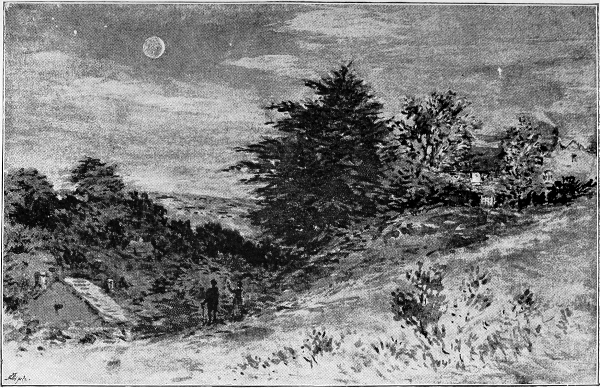
The New Moon.
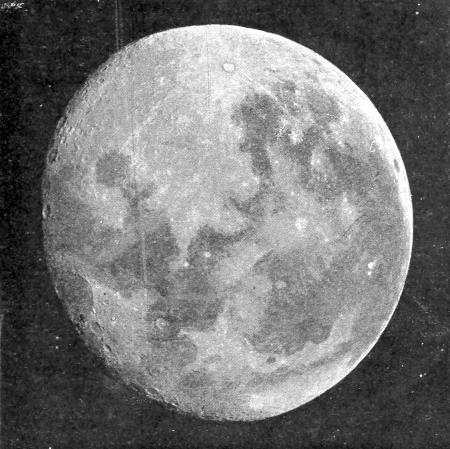
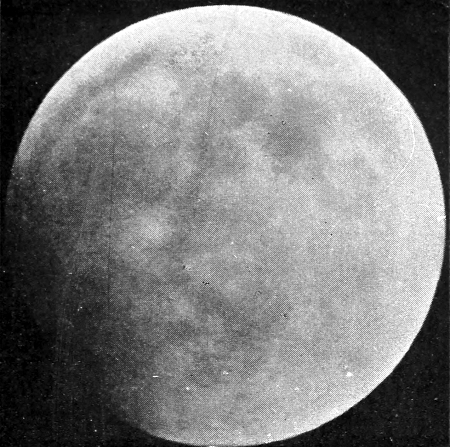
You have noticed the Full Moon, of course,
because the Moon then is at her best and brightest.
Once a month we always have a Full Moon.
It is only on one night that the Moon is really
quite full; but for two or three days before and
after she is very nearly so.
At Full Moon the Earth is between the Sun and
the Moon. On one side of our Earth is the Sun;
on the other side is the Moon. The Sun shines
full upon that side of the Moon which is turned
towards us; and so we see the whole of her
round bright face. We know that her farther
side is in darkness, because it is turned away
from the Sun: in almost pitch-darkness, for it
has not even our Earth to light it up, being
turned away from us also. It has only Stars on
the farther side.
I am speaking of when the Sun has set, and
is below our horizon, so that we cannot see him,
although his rays travel straight to the Moon.
The Sun having set means only that the
solid body of our Earth is between him and us.
It does not interfere with his shining upon the
Moon.
If our Earth at Full Moon were exactly between
the Sun and the Moon, that would interfere
with his shining upon her. More commonly,
however, our Earth is not just in the
line between, but only very nearly so. Thus
we get the best possible view of the Moon’s
round face.
The Moon does not stay on one side of the
Earth. She is always travelling round from
one side to the other side of us. At another
part of her monthly journey things are quite
different.
A fortnight after Full Moon we have New
Moon.
At Full Moon the Earth is between Sun and
Moon; but at New Moon the Moon has come
right round to the opposite side, and is between
the Sun and the Earth. Not usually in the exact
line between, so as to hide the Sun from us, but
very nearly so.
Then still the Moon has a bright round face;
only we on Earth cannot see it. For her bright
side is, as always, towards the Sun; and her dark
side is towards us.
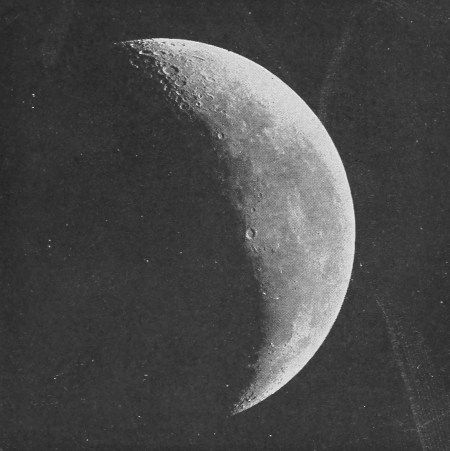
Just at first we cannot see the New Moon at
all, for it is entirely dark. As she journeys on
to one side we get a glimpse of a thin line of
light shaped like a sickle; and this widens
every day. It is while we see the sickle of light
that we sometimes catch a glimpse of the dark
side of the Moon, dimly lighted up by Earth-shine.
The Moon. Second quarter. 10½ days old.
When the Moon gets half-way back to where
she was at Full Moon we are able to see half of
her bright face, and we call that the “First
Quarter.” The other half of the bright face is
still turned away from us, and half of the dark
side is still towards us. We do not see the whole
round face till she gains once more the place of
Full Moon—after which, between Full Moon
and New Moon, follows the Third Quarter,
which is much the same as the First Quarter.
You know that the rising and the setting of
the Moon in our sky, by night or by day, are not
real movements. They are only seeming movements,
caused by our own Earth’s daily spinning
on her axis.
But these “Phases” as they are called—these
changes in the shape and brightness of
the Moon—are brought about by her own movements,
as she travels round the Earth. She
does not actually alter her shape: but she does
actually alter her place in the sky, so that we
get different views of her from week to week.
The four weeks of the Moon’s phases are
called a “Lunar Month.”
You can make clear to your mind how the
changes come about, by acting them out with a
lamp and a big ball.
There must be no other light in the room.
Stand first with your back to the lamp and
the ball in your hand, held out at arm’s length:
so that your head is nearly between the lamp andthe ball. Not quite between, so as to shade the
ball. Hold the ball just a little higher than
your head: and the lamplight will fall upon
that side of it which is towards your face.
Then you have Full Moon. The lamp is the
Sun: your head is our Earth: the ball is the
Moon. You see how the lamp lights up the half
of the ball which is towards yourself.
Next turn round with your face to the lamp,
and hold the ball at arm’s length between your
head and the lamp, only a little higher or lower—not
quite in the line between so as to hide the
lamp from you. The lamp-light now falls on
the other side of the ball; and the dull unlighted
side is towards your face.
This is New Moon. Once again the lamp is
the Sun, your head is the Earth, and the ball is
the Moon. You see how the lamp lights that
half of the ball which is turned away from you.
The real New Moon in the sky is invisible.
Here you can see the dark side of the ball because
the lamplight creeps round it. Still even
here you will find a difference between the
bright and the shaded parts.
Then, if you hold the ball at arm’s length
half-way round on one side of your head, you
will see how matters are at the Quarters. The
lamp still shines full on one side of the ball, but
only half of the brighter side is towards you,
and half of the darker side. In the real Moon
the shaded quarter would be hidden, and only
the bright quarter would be visible.
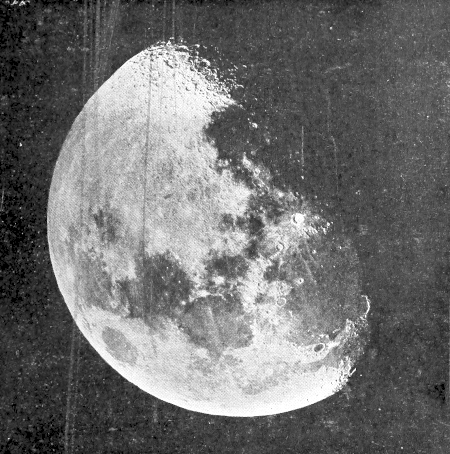
The Moon. Third quarter. 16¾ days old.
This “quarter” we call “a Half Moon.” It
is a quarter of the whole Moon, taking the Moon
all round; but it is a half of the bright side,
which makes our Full Moon.
All that we really know about the Moon’s
surface is what we see on one side of her. The
other side is never turned towards us. No man
on this Earth has ever seen it.
A man living on that side of the Moon which
we can see might look at all parts of the Earth
in turn. As the Earth spins on her axis she
turns each side towards the Moon, one after another,
in only twenty-four hours. But, although
the moon spins, we see only and always one
side of her.
If somebody should make his home on the
farther side of the Moon, and should never
come round to the nearer side, he would not
have a glimpse of the Earth. He would see the
Sun, because the Sun shines on each part of the
Moon in turn: but no Earth would be on his
sky. One side of the Moon has a magnificent
Moon in the Earth, more than a dozen times as
large as our Moon. But the opposite side of the
Moon has only starlight when the sun sets.
The reason for this is that the Moon takes
just exactly the same length of time to spin
once round on her axis that she takes to travel
once round the world: twenty-eight days for the
one and twenty-eight days for the other.
Suppose now that you choose to walk round
and round a table with a lamp in the middle.
You may do it in three different ways.
First: you may spin fast on your feet, like a
teetotum, as you go. Each spin of your body
may perhaps take a second; and passing slowly
round the table may last half-a-minute. As you
thus move, each side of your head in turn is towards
the lamp with every spin.
Secondly, you may pass slowly round the
table in the same manner; not spinning at all
but keeping your face fixed on one direction—let
us say, towards the fireplace end of the room.
Then again, as you move, each part of your head
in turn will be towards the lamp.
Thirdly: you may pass round the table turning
very gradually indeed upon your feet as you
go, turning so slowly that a single spin will last
exactly as long as one journey round the table.
If you start with your face towards the lamp
you will continue to face it all the while, and the
back of your head will all the while be away
from the lamp, in shadow. In fact, the lamp
will never once have a glimpse of the back of
your head.
The Moon. Last quarter. 23⅓ days old.
The last of these three is the manner in
which the Moon spins on her axis and travels
round our Earth.
Such a slow spin brings about a curious state
of things. We on the Earth have day and night
in every twenty-four hours; but the Moon’s day
and night come only once in every twenty-eight
days. The day there is a whole fortnight in
length of our Earth-time: and the night is another
whole fortnight.
Fourteen days of blazing sunshine: then
fourteen days of pitchy darkness—except for
the brightness of the Stars, and except also, on
one side, for the beautiful radiance of the Earth.
QUESTIONS.
1. What is meant by the Moon’s Phases?
The different shapes of the Moon as we see
her in the sky.
2. What kind of shapes?
As Full Moon; as Half Moon; as Crescent
Moon.
3. Which part of the Moon shines?
That side which is turned towards the Sun.
4. Do we ever see her dark side?
Sometimes, not far from New Moon, we have
a glimpse of it, lighted up by Earth-shine very
dimly.
5. Does the Moon spin on her axis?
Yes; but very slowly, only once in twenty-eight
days.
6. How long does it take the Moon to get once round the
Earth?
Twenty-eight days; the same length of time
as her spin.
7. How long is the Moon’s day?
About one fortnight of Earth-time.
8. How long is the Moon’s night?
About another fortnight.
9. Does the Sun shine on all parts of the Moon?
On all parts in turn, as the Moon slowly spins
round.
10. Do we see all parts of the Moon?
We see only one side, because, as the Moon
spins, she journeys round the Earth just so fast
as to keep one face always in our direction.
11. What is meant by Full Moon?
At Full Moon the Earth is between Sun and
Moon, and we have our best view of the full
round face of the Moon.
12. Is the Earth exactly between?
Not quite, or she would cut off the sunlight
from the Moon.
13. What is New Moon?
At New Moon the Moon is between Earth and
Sun, so that her bright side is away from us and
we cannot see her at all.
14. Tell me about the First and Third Quarters.
The Moon is then at the side of the Earth,
half-way between New and Full. Half only of
her bright side is towards us and we see her as
“Half Moon.”
15. What is a Lunar Month?
A month of four weeks—the time of the Moon’s
changes.
CHAPTER VII.
THE MOON THROUGH A TELESCOPE.
You know how the Moon looks, seen only
with our own eyes—a bright round ball, some
would say a bright round plate, with odd gray
markings which might mean anything. This is
about all that can be learned without the help
of a telescope. But with the help of a telescope
much more can be found out as to our little sister-world.
For a very long while there were no telescopes.
Galileo, a famous man, who lived nearly
three hundred years ago, was the first who ever
made a telescope. Since his time men have
learned to make far bigger and better ones; but
it was he who discovered how to make one at all.
The Moon, as you know, is really about 240,000
miles away. A good telescope, such as one
may often see, lessens that distance to only one
thousand or perhaps to five hundred miles. One
enormous telescope in California brings the Moon
to less than one hundred miles off—some even
say to not much more than fifty miles.
You must not suppose this to mean that the
telescope pulls the Moon herself nearer. A tube
on earth cannot reach forth and drag towards us
a far-off world in the sky.
Did you ever hear of the Irishman who was
allowed to look through a telescope at a church
in the distance, and who declared afterwards that
the church had been brought so near he could
hear the organ play!
But this is just what a telescope is not able to
do. It does not bring a church nearer. It does
not bring the Moon nearer. It only makes our
eyes able to see as if the church or the Moon
were nearer. That is all.
It gathers up a great deal more moonlight
than our eyes could collect, and so it gives us a
larger and clearer view of the Moon from which
the light comes.
Yet even at the very best, when the moon is
brought, as one may say, within perhaps a hundred
miles of the Earth, even then one can only
see large things on her surface, not small things.
A man who climbs a high mountain gets a wide
view all round from the top. He may see perhaps
a hundred miles in one direction. But at
that distance, and at a good deal less than that
distance, he cannot make out much. A mountain
or a high hill is pretty clear, perhaps, or the glimmer
of a big lake, and a large town would be just
visible as a tiny patch or spot. A single house
could not be seen at all; far less a horse or a man.
However, though we could not possibly see
such small things as these upon the Moon if
they were there, we are very sure that no houses
are there, and no horses, and no men.
And the reason why we are so sure is that
the Moon has no air.
A man cannot live without air, because he
cannot breathe. Try holding your breath for
a little while and you will find how soon you
must begin breathing again. If there were no
air in your room you would soon die of suffocation.
Animals cannot live without air. Even
fishes need air in the water to keep them alive.
And it seems that there is neither air nor water
in the Moon.
No air: or almost none; if any at all, it is so
very thin that no living creature on earth could
breathe it. No water; no seas or oceans; no
rivers and streams. No clouds; for clouds are
made of water and float in air. No grass, or
plants, or trees; for they too must have air and
water. No towns or villages; for they are built
by man, and no men can be on the Moon, or
women or children. What a dreary place the
Moon must be!
It looks dreary seen through a big telescope.
It looks dreary also in a photograph. Many
photographs are now taken of the Moon.
Such a wild lonely scene we find! Flat desolate
plains, and mountains with sharp black shadows
and clefts and streaks, and a great number
of craters in all directions.
You have heard of volcanoes on the Earth.
A volcano is a mountain, shaped usually something
like a sugar-loaf, with a cup-like hollow
near the top. This hollow is called a crater:
and now and then fire pours from it, with melted
burning rocks, or boiling mud, or hot cinders.
In parts of the world there are old used-up
volcanoes, which once were very active indeed
but which now have no outbreaks. We call
these dead volcanoes.
The Moon seems to be half covered with the
craters of volcanoes. That side which we always
see is pitted over with round holes, big and little—looking
in parts almost like a face badly
marked with small-pox.
If all these holes really are craters they must
belong to dead volcanoes; because not a sign is
ever observed of any fiery outburst on the Moon.
That could easily be seen through a large telescope.
These craters are of all sizes: and many of
them have been measured from the earth.
The largest volcano-crater known on the
earth is perhaps not more than eight or ten
miles across. On the moon there are numbers
and numbers of little craters about that size, too
many to count. But there are also many huge
craters, far bigger than anything of the kind
ever seen here.
Some of the Moon mountains are very high,
a good deal higher than Mont Blanc in Switzerland;
and they often lie in vast rocky heights
around some enormous crater. Such craters are
to be seen fifty miles across from edge to edge,
and some a hundred miles across, and even more.
These monster craters make our little Earth
craters seem very small; do they not?
In a photograph of the Moon’s surface, taken
when she is at her First or Last Quarter, the
steep mountains and great craters often stand
out very clearly. Of course they do not look
large to us at this distance, but quite small.
If there were air on the moon her sharp outline
and the mountain edges would be much
softer than they are now.
The Moon must be a very, very cold world.
True, she is no farther off from the Sun than
we are, so his bright rays have the same strength
there as here. But she has no thick coverlet
of air wrapped round her, to act as a blanket
and to keep in the heat which the Sun gives.
That is what our air does for us: and that is
what the Moon lacks.
Through the long fortnight of darkness, on
the side of the Moon which is turned away from
the Sun, the cold must be perfectly awful. But
even during the long fortnight of day-time following,
when that part of the Moon which has
been in darkness gets round into sunlight,
things are not much better.
The Sun indeed beats down upon the Moon
with frightful power, and with a desperate glare
such as we never know on the Earth. For the
same air which keeps prisoner the warmth of
the sunbeams for our use also softens their
glare. But in spite of all this it is likely that
the Moon’s surface never gets warm—that in
the noon of her long day the ground is far more
than ice-cold.
On a high mountain-top of the Earth, where
the air is thin, although the glare of the Sun
becomes fierce yet the ice and snow are not
melted. A little thawing of the outermost snow
takes place, but often no more than this. When
the sun shines through air which is too thin to
capture and store up his heat, then he is quite
overmatched by the grip of King Frost.
If this is so on the Earth how much more
is it likely to be so on the Moon. At the top
of the highest Earth mountain there is still a
good deal of air, enough for a man to breathe.
But on the Moon there is no air at all worth
speaking of; not enough to keep alive any creature
of which we know.
So, though the Sun does his best, though he
floods the Moon with his warmth, all the heat is
poured out again just as fast as he pours it in.
For want of a sheltering air-coverlet the ground
there may remain, and doubtless does remain,
ice-cold through all the long Moon-day.
We do not on the Earth see the Stars in daylight.
The same thick air which keeps us warm
also spreads the sunlight about, and softens
black shadows into gray, and turns the sky into
a blue depth, and shuts off from our sight the
feeble glimmer of stars, and carries to and fro
the clouds and mists.
But on the Moon there is no air to form a
veil of light; no air to cause a blue sky; no air
to spread the sunlight about; no air to make
inky shadows gray; no air to carry clouds or
mists; no air to hide the stars.
There, in the day-time, in a cloudless deep-black
sky shines a dazzling Sun. Not only a
Sun, but also a magnificent Earth, hanging like
an enormous Moon always in one spot. And
not only Sun and Earth, but also countless brilliant
Stars, steadfast and untwinkling.
This is a view which a man might have if he
could stand on the nearer side of the Moon.
The Sun which he would see would be our
Sun. The stars would be the same stars upon
which we gaze. The Earth in his sky would be
this world upon which we live. He would see
a glorious sight; of that we may be sure. But
though our thick moist air does hide the stars
by day, and make them twinkle and grow dim
by night, think how one would miss the blue
sky, and all the pretty changeful clouds which
come and go!
Think, too, how dismal a scene it would be
around a man standing there! Nothing but dead
craters, and bare rocks, and plains without any
grass or water, and mountains without any trees.
Nothing green, nothing blue, nothing soft or
fair, no breaking waves, no trickling streams, no
passing showers, no colors, no sounds!
Do you think you would like such a world to
live in, even if you could live there without any
air to breathe? I am very sure that you would
soon wish to be back again on our beautiful Earth.
If you were there, you would find one more
thing different from what it is here: you would
become all at once a great deal lighter in your
body.
Just as the Earth pulls everything towards
herself so does the Moon also. The mountains
and rocks on the moon are dragged moonwards,
just as mountains and rocks on the Earth are
dragged earthwards. But the pulling there is
much less than here, because the Moon is so
much smaller than the Earth.
On the surface of the Moon, downwards is always
towards the centre of the Moon and upwards
is always towards the sky. All round the Moon
it is the same; just as it is on the Earth.
The Moon in our sky is upwards to us who live
on the Earth. But the Earth in the Moon’s sky
would be upwards to anybody living on the Moon.
QUESTIONS.
1. Who made the first telescope?
Galileo.
2. How long ago?
Nearly three hundred years ago.
3. How near does the biggest telescope seem to bring the
Moon?
Perhaps to less than one hundred miles.
4. Could a man live on the Moon?
No; because there is neither air nor water.
5. No air at all?
There may be a very, very little; but much
too little for men or animals to breathe.
6. What can be seen of the Moon through a telescope?
Mountains and plains; and a great number
of hollows or craters.
7. How high are the mountains?
Some are higher than Mont Blanc.
8. What are the craters?
They are thought to be most likely the craters
of dead volcanoes.
9. What shape are they?
Generally more or less round.
10. Are they large or small?
Some are small, only a few miles across.
Others are very big.
11. How big are the larger ones?
Some are even a hundred miles across.
12. Is the surface of the Moon hot, or cold?
It is believed to be very cold.
13. In the night, or in the day?
In the day as well as in the night; because
there is no air to keep in the Sun’s heat, as on
the Earth.
14. What other difference would the want of air make?
The sky must be black instead of blue, and
the stars must be visible in daylight, and the
shadows of the mountains must be very black,
not gray, like shadows on the Earth.
15. Are things heavy on the Moon?
Yes; but not so heavy as on the Earth.
Though the Moon pulls, she pulls less strongly
than the Earth, because she is so much smaller.
CHAPTER VIII.
THE SUN BY DAY.
If you look at the Sun in our sky before he
sets, and then, a little later, at the Moon when she
has risen, it might seem that the two are very
much of the same size and very much at the
same distance.
To be sure, the Sun is the brightest; a great
deal the brightest. He has such a dazzling face
that you cannot look at him steadily. But certainly
he does not look larger than the Moon.
What do you think the size of the Sun really
and truly is?
Once upon a time people supposed him to be
about as big as he looked. And afterwards they
fancied that perhaps he might be even as large
as a little country called Greece, a much smaller
country than England.
But the Sun is bigger than England, bigger
than America, bigger than all the oceans of the
Earth heaped together; bigger than the Moon,
bigger than the whole Earth, bigger than Earth
and Moon rolled into one—oh, we are a long way
off yet from the truth!
The Sun is a round globe in shape, like the
Earth and the Moon. But he is ever so much
larger.
Our Moon, as you know, is about two thousand
miles through from side to side. Our
Earth is nearly eight thousand miles through.
But that enormous globe, the Sun, is—how
much do you guess?—is about eight hundred and
fifty thousand miles through!
Can you picture to yourself what this means?
Rather hard, is it not!
The Earth seems so big to us who live upon
its surface, and yet she is so small beside the
great Sun!
Suppose you had a huge hollow ball the size
of the Sun. And suppose you wished to run
through that hollow ball a very, very long
knitting-needle—eight hundred and fifty thousand
miles long—so as just to go from side to
side of the huge ball. And suppose upon that
big knitting-needle you wished to string a great
many Earths or Moons, exactly like our Earth
or our Moon, as large beads might be strung
close together upon a wire.
How many worlds, the size of our Earth, do
you think you would need to reach all through
the Sun from side to side? And how many
worlds the size of our Moon?
You would want more than one hundred
Earths. And if, instead of Earths, you chose to
string Moons on the big needle, you would need
more than four hundred Moons.
These would not fill up the enormous hollow
ball. They would only reach through in one
straight line from side to side, showing the
diameter of the Sun.
Now try again to think of the Moon as a tiny
ball, softly bright on one side, only one inch
through; and of the Earth as another ball, shining
on one side, four inches through. Think of
them, if you like, as a large grape and a small
cocoa-nut made of silver.
Then take the same measure for the Sun,
letting one little inch do duty always for two
thousand miles. The Sun must dwindle and
dwindle in size till every two thousand miles in
him has become a single inch.
We shall then have a huge ball, or balloon,
four hundred and twenty-six inches, or some
thirty-five feet, through, from side to side.
Thirty-five feet is a great deal more than
four inches. One foot is twelve inches long.
You have seen many a tall man close upon
six feet in height. This balloon, to picture the
Sun, must be so large that six tall men might
be put inside it, one upon the head of another.
The whole string of six tall men would about
make the through measure of the globe.
So we have a Moon the size of a large grape,
an Earth the size of a small cocoa-nut, and a Sun
the size of a balloon big enough to contain six
men in a long row, one upon another. The two
little balls would shine softly, on one side only;
but the large balloon should be exceedingly
brilliant and dazzling all round.
If the Moon is so tiny and the Sun is so huge,
how is it that they seem to be the same size in
our sky?
Because of the very great difference in their
distance from us. The Moon is near; the Sun
is far away.
Suppose you are looking at a man near at
hand and at a house miles away; which seems
to you the bigger? Of course the man, because
he is so close. Yet really the house is much the
larger of the two.
The Moon is only about two hundred and
forty thousand miles off; but the Sun is about
ninety-two millions of miles away.
Think what a difference! Two hundred and
forty thousands are only a small part of a single
million; for a million is a thousand thousands.
If you have one thousand beads in a heap, you
would need one thousand of those heaps to make
a million beads. And when you get to the idea
of what is meant by a million, you have to
remember that the Sun’s distance is ninety-two
times that number of miles.
After all, we cannot comprehend these figures;
they are too bewildering. We may talk
of thousands and millions of miles, but we do
not see them in our minds.
The chief thing to do is to gain some notion
of one distance side by side with another: and
here the three balls all help us again.
Picture to yourself the tiny Moon-ball, as big
as a large grape, and the Earth-ball, as big as a
small cocoa-nut; and in your mind put the two
ten feet apart. There you have the sizes and the
distance of the Earth and the Moon brought
down from thousands of miles to inches.
Then picture to yourself the Sun, as big as a
balloon—the length of six tall men through its
middle—and in your mind put that balloon three
quarters of a mile away from the small Earth and
Moon. Somebody will tell you of a house or a
place about three-quarters of a mile away from
your house, if you ask.
Now do you see how great the difference is
between the distance of the Sun from us and the
distance of the Moon?
Close upon four thousand feet off, instead of
only ten feet off! Almost thirteen hundred
yards, instead of a little over three yards!
Ninety-two millions of miles, instead of two
hundred and forty thousand miles!
The kind or quantity of difference between
the two is the same, whether we reckon it in
inches or feet, in yards or miles, in hundreds, or
thousands, or millions of miles.
The Moon and Sun are quite unlike in their
way of shining.
Our little Moon has no brightness of her
own. She only shines when and where the Sun
shines upon her.
But the radiance of the Sun is his own; it is
a part of himself. He shines because it is in
him to shine; it is his nature to shine. He is
brilliant all round, not on one side only. If
the Sun were destroyed the Moon would shine
no longer. But if the Moon and the Earth
and all the Planets came to an end it would
make no difference in the brightness of the
Sun.
The Sun’s shining is like the shining of the
Stars, not like that of the Earth and the Moon:
for the Sun himself is a Star; one Star among
millions of Stars. He only looks so much larger
and brighter than other Stars because he is so
much nearer than they are.
Our Earth and Moon are not stars; they are
planets, or worlds, travelling round the Sun, and
belonging to him. They are not hot bodies,
glowing with their own light; but cool and dark
bodies, bright only when the Sun shines on
them. Moonlight, and also Earthlight—which
we, living on the Earth, cannot see—are both
really reflected Sunlight.
There are other planets also, besides the
Earth and the Moon, belonging to the Sun:
such as Venus, and Mars, and Jupiter. None of
these planets are Stars. They are all Worlds.
QUESTIONS.
1. What shape is the Sun?
Like the Earth and the Moon, a globe or
sphere in shape.
2. What is the Sun’s diameter?
The Sun is about 850,000 miles through.
3. Why do the Sun and Moon seem about the same size
in our sky?
Because the Moon is very near, and the Sun
very distant.
4. How far off is the Sun?
About 92 millions of miles.
5. What would be the sizes of these three globes, if we let
one inch stand for 2,000 miles?
The Moon would be a ball one inch in diameter;
the Earth a ball four inches in diameter;
the Sun a ball thirty-five feet in diameter.
6. What would be their distances, brought down thus?
The Moon would be about ten feet off from
the Earth, and the Sun would be about three-quarters
of a mile from them both.
7. How many thousands of miles make a million miles?
A thousand thousands.
8. How does the Moon shine?
By reflecting Sunlight.
9. How does the Sun shine?
By his own brightness.
10. Which part of Moon and Sun are bright?
The Moon, like the Earth, is bright only on
that side which faces the Sun; but the Sun is
brilliant all round.
11. Is the Sun a World?
No, the Sun is a Star.
12. Are the Planets Stars?
No; the Planets, like Earth and Moon, are
Worlds.
CHAPTER IX.
STORMS ON THE SUN.
The Sun does not seem to change his shape
as the Moon does.
Looking upon him from our Earth, we see
always a round shining body. Except when
part of him is hidden because it has sunk below
the horizon we never have a “half-Sun,” or a
“quarter-Sun.”
Sometimes he is high and sometimes low in
the sky; but this is brought about by the Earth’s
movements, not by any alteration in himself.
Sometimes clouds drift between and hide him
from us; yet behind the clouds he shines still.
Sometimes mists arise and dim his radiance; but
beyond the mist his glory is the same. When
clouds move on and mists fade, the dazzling
globe of light is found unchanged.
There are no shadows on the Sun, like those
dull markings which we all know so well upon
the Moon.
No shadows, only spots. Yes, the Sun actually
has little black spots upon his face, not so
very unlike the tiny patches with which ladies
used to adorn themselves.
A word of warning here! It is not safe to
gaze straight at the Sun, trying to find these
spots. When he is low down in the horizon, just
before setting, he is not so dazzling, but at other
times one ought to be very careful. If you want
to look steadily at the Sun you should always
use a piece of smoked or tinted glass to soften
the glare. Without this you might hurt your
eyes, or even in time make yourself blind. When
looking through a telescope the danger and the
need for care are doubly great.
Dark spots on the Sun are very often to be
seen; sometimes only through a telescope, but
now and then one is large enough to be seen
with no such help—by the eye alone.
It was by means of these spots that the Sun
was first found to spin upon its axis, just as our
Earth does.
A black spot would be noticed upon one side
of the Sun’s face. It would be seen slowly to
cross over, and to disappear on the other side.
Nearly a fortnight would be needed for the
journey across, and for another fortnight, or
nearly so, the spot would be hidden behind the
Sun. After which it would turn up again, on the
same side as at first, and in the very same place.
Then once more it would travel across and disappear,
and in another fortnight it would come
round over to its starting-point.
If only a single spot had behaved in this
way it might have meant little. But when
numbers of spots did the very same thing, time
after time, it became clear that the great body
of the sun was whirling round, carrying the
spots with it.
The Sun, like the Earth, has a north pole,
and a south pole, and an equator.
We give the name “north pole” to one end
of the axis or line on which he spins, and the
name “south pole” to the other end of that
axis. And we give the name “equator” to a
line exactly round the middle of the Sun, half-way
between his two poles.
Most of the spots which we see are somewhere
near the Sun’s equator, not very near to
his north pole or to his south pole.
They come and go and change their shapes,
and get bigger or smaller—sometimes slowly,
sometimes very fast. A spot may appear and
grow and vanish again in one day, or it may
stay on for days and weeks, and even months,
hardly altering at all, only journeying round
and round the Sun.
These things show us that the great Sun
spins round upon his axis: and that for each
spin he takes about twenty-five or twenty-six
days.
But the whirling round of the Sun means no
Day and Night by turns to him, for the whole
of the Sun is always light—bright with his own
radiance.
Once upon a time it used to be thought that
the Sun spots were perhaps raised things—dark
objects standing high, like mountains. And I
will tell you why this idea was given up.
Take an empty cup, and hold it before your
eyes, with the open part turned full towards you.
The cup must be held as if lying on its side—not
with the mouth upwards, as it would stand
on a table. You can see, thus, the full circle of
the opening, and the whole empty inside.
Next, move it a little way to the right from
before your face, turning it slightly away, and
you will then see no longer the whole inside,
but only a part: and the round opening will
have an oval look.
Turn it still further, and you will see a very
narrow oval opening, and hardly any of the inside.
Now this is just how the spots seem to behave
as they cross the Sun.
When first seen, coming round on one side,
they are in shape, more or less, of narrow ovals,
and very little of the inside can be seen. As
they travel on with the spinning Sun, and get
near the middle of the Sun’s face, the oval openings
widen and grow round, while more of the
dark depths can be seen. Then, passing to the
farther edge, they again grow narrow, as at
first.
So we feel sure that the spots are hollows or
caves, not mountains.
I do not mean such hollows and caves as are
found on the earth, but more like the holes that
may be seen in a mass of stormy clouds. They
seem to be huge rents in glowing Sun-clouds.
Usually they have a black centre, with a gray
border round the blackness. Now and then, as
in the picture of a sun-spot given in this book,
the gray part is wanting.
Sun-spots are sometimes larger, sometimes
smaller; but none that we see at this distance
can be really small. Fifty or sixty thousand
miles across is a very common size. Once in a
while a spot is more than a hundred thousand
miles from edge to edge.
So, though we talk of little black spots on the
Sun’s face, they are not really little, but exceedingly
big. And if we were near they would
not look black, but fiery.
The Moon’s craters seemed big when we
first thought of them—fifty or one hundred
miles across; very huge beside our tiny Earth
craters. These crater-like hollows, however, in
the Sun’s cloudy surface are fifty or one hundred
thousand miles across! The whole Moon
dropped into such a hole as this would be a
mere little ball in a corner.
The Sun is enormously heavier than our
Earth, because enormously bigger. Yet in actual
make the Sun is light. Instead of being
all through as solid as our little Earth, he only
weighs as much as if made of something not
much heavier than water.
We do not know whether any part of the Sun
is really solid and firm. Perhaps not even the
innermost parts of that vast globe, certainly not
any of the outermost parts. For the heat must
be so awful as to turn everything there into
gases. Not cool gases, but raging fiery gases,
rushing furiously to and fro.
Over the whole brilliant body of the Sun is
spread a mighty ocean—not of cool water, like
our seas, but of crimson fiery gas-waves. And
out of this ocean spring crimson mountains of
fiery gas. And beyond these jagged mountains—little,
as seen from the Earth, but really
of great height—lies a beautiful and wide-spreading
wreath of pearly light, called “The
Corona,” or, “The Crown.”
The bright face of the Sun and its tiny black
spots can be easily seen from the Earth. But
the crimson sea, showing as a red border round
the edge, and the fiery mountains, and the crown
of light, are very seldom to be seen.
When an eclipse of the Sun happens, then
for a few seconds they are clearly visible to people
with telescopes.
Besides the black spots and the red mountains,
bright white spots are sometimes noticed.
Also another curious sight is often seen, in a
telescope. Countless little long narrow objects,
something like willow leaves or grains of rice,
seem to lie scattered closely over the sun. They
are either side by side or crossing one another.
Look at the picture of the sun-spot, and you will
see the “willow leaves” there. Perhaps they
are shining sun-clouds.
Awful storms are common on the Sun, and
terrific outbreaks are often taking place. Wild
rushes of blazing gases can be seen, even from
this great distance. The black spots are most
likely caused by vast whirlwinds tearing open
the Sun’s bright envelope of clouds; and the
white spots may be another kind of tornado.
Doubtless the crimson fire-mountains are also
some sort of storm. They come and go, change
and disappear, in a longer or a shorter time.
Fifty thousand miles of height is common for
one of them, and a hundred thousand miles is
not unusual, and often they are still more.
Our very highest mountain on the Earth is
only about seven miles high. Think what a difference!
But you must not picture to yourself solid
mountains of rock on the Sun. All rock there is
not melted only, but turned to gases, by the tremendous
heat. These crimson heights are of
gases, glowing and brilliant.
It is pretty safe to say of the Sun, as of the
Moon, that people such as we are could not possibly
live there. If the Moon is too cold, the Sun
is infinitely too hot. If the Moon has no air, the
Sun has certainly none of the right kind for men
and animals to breathe. Besides, how could they
exist on a globe of fiery gases?
We know pretty well what the burning power
of the Sun is, even here, on a hot summer’s day,
as he shines out of a cloudless sky. But this is
ninety-two millions of miles off!
Imagine what the desperate heat and glare
must be at a distance of only a few thousand
miles; not to speak of close to the Sun!
If our Earth were to journey to a place in the
sky as far away from the Sun as our Moon is
now from us, one of those fiery mountain-tongues
of crimson gas might leap out and wrap itself
round the whole Earth. But long before she
could get so near she would have become a tomb
of death—scorched, and dried up, and withered.
The seas would all have turned into hot steam,
and not a blade of grass would be left.
Yet, although, if we could venture near, we
should be destroyed, on the other hand we owe
much to the Sun. Did you ever think what a
dark and cold and lifeless globe our Earth would
be without him?
All our light, except a few star-glimmers,
comes from the Sun. Even moonlight is really
reflected sunlight.
Almost all our heat comes from him. Once
upon a time the Earth was hot and glowing, and
some heat still remains deep underground even
now. But this heat could do little for us if the
Sun were absent. You know how icy-cold the
ground becomes in winter.
Still, you may say, we have fires to warm us,
and lamps and candles to give us light.
But how could we have either without the
Sun? His rays cause the trees to grow from
which we obtain our wood. His warmth in the
long past made those forests grow which were
afterwards buried under ground and became coal.
When we burn coal and wood they give out again
the heat which once they borrowed from the Sun.
Without the Sun there could be no oil for
lamps, no tallow or wax for candles. Nothing
would live, nothing would grow. Our Earth
would be a dead world like the Moon, fixed and
changeless.
True, the Sun shines upon the Moon as upon
us; and there he can do little, because air and
water are wanting. With air and water for his
useful servants he can do much. But air and
water without the Sun could do nothing at
all—in fact they would be air and water no
longer.
So we can trace gratefully to the Sun all the
heat, the glow, the light, the life, the growth,
that we find on Earth. And one step farther
brings us to the thought of OUR FATHER IN
HEAVEN, who created the Sun, and who appointed
it to be our storehouse of Heat and
Light.
QUESTIONS.
1. Has the Sun phases like the moon?
No, he always appears round in shape.
2. Has the Sun gray markings?
No, but he has dark spots.
3. Are the spots large, or small?
They seem small to us at this distance, but
they are really large.
4. What size are they?
Fifty thousand miles across, or a hundred
thousand miles across, are not uncommon.
5. How was the Sun first found to spin round?
By the movement of spots across his face,
from one side to the other.
6. What is the length of the Sun’s spin?
He spins on his axis once in about 25 or 26
days.
7. Where are spots more often seen?
Not far from the Sun’s equator.
8. Do the spots remain long?
A spot sometimes comes and goes in one
day. Other spots stay for weeks, and even
months.
9. What are the spots believed to be?
Holes torn by storms in the Sun’s covering
of bright clouds.
10. Is any other kind of storm seen on the Sun?
Sometimes white spots are seen.
11. Is the Sun heavy in make, or light?
Not much heavier than water.
12. What can be seen in an eclipse which is not seen
usually?
A crimson ocean of gases, mountains of fiery
gases, and the “Corona,” or Crown of light.
13. How high are the gas-mountains?
Sometimes fifty thousand or a hundred thousand
miles high.
14. Are they always the same?
>
No; they come and go and change, like the
black spots.
15. Is it likely that men could live on the Sun?
It seems quite impossible, the sun being in a
state of raging heat.
16. Do we owe much to the Sun?
All our light and heat. Without the Sun
our world would be a dead world.
CHAPTER X.
HOW THE WORLD JOURNEYS.
You see now how it is that on the Earth we
have day and night. The whole Earth spins
round and round, and so each part of her in
turn comes into sunlight.
This is not the only way in which our Earth
moves. She also journeys round and round the
Sun, revolving always on her axis every day as
she goes.
A year on the Earth is about three hundred
and sixty-five days long, or twelve months.
Our “year” means just that time in which the
Earth travels once round the Sun. And in that
year, as she journeys, she turns right round
upon her axis three hundred and sixty-five
times.
So there are two separate movements of the
Earth. A boy may, if he likes, stand still, and
spin round like a top. Or he may walk round
the table without spinning. Or he may do the
two things together: he may walk round the
table, and as he goes he may keep spinning like
a top. That is how the Earth goes round the
Sun.
As she moves she is always at much the
same distance from the Sun—about 92 millions
of miles off. In one part of her pathway she is
a little farther, and in another part a little
nearer; but there is never very much difference.
Sometimes she is on one side of the Sun,
sometimes on another side. Always, day after
day, and year after year, she keeps steadily
journeying round and round the Sun.
This is how we get our seasons upon Earth.
Spring is followed by summer, summer by autumn,
autumn by winter, winter by spring
again. It is on and on, the same thing, year
after year.
In an earlier chapter you heard about the Equinoxes
and the Solstices. There is an Equinox
in the spring, a Solstice in the summer, an Equinox
in the autumn, and a Solstice in the winter.
At each of these times the Earth is in a different
part of her pathway round the Sun. Also she
is differently placed.
It is of course quite clear to you by this time
that our Earth is a round solid globe in the sky.
Also that the axis of the Earth is a straight line
from her north to her south pole, right through
the middle of her.
Now I want you to understand that, as the
Earth goes round the Sun, her axis leans over alittle in one direction, and always in the same
direction.
Have you a good-sized soft ball to picture
the Earth? Stick a big bonnet-pin right
through the middle of it; that pin is the Earth’s
axis. The pin’s head shows the north pole, and
the pin’s point shows the south pole.
Properly, of course, if this little Earth is
about four inches through in size, it ought to
travel round and round a huge shining balloon,
three-quarters of a mile off, to show how the
Earth goes round the Sun.
But this, I am afraid, you will hardly be able
to manage. So you must let distances alone,
and just have a candle or a lamp on a table, and
learn with that how we get our summer and
winter.
First, now, hold the ball on one side of the
candle. Let its north pole—the pin’s head—point
in a sloping way over the candle-flame;
not exactly towards the candle, and not up
straight towards the ceiling, but in a slant.
This means Summer for the northern half of
your little world, and Winter for the southern
half. You must notice carefully how the north
pole is towards the candle and the south pole is
away from it. So, at the same time, we in the
north have our Summer Solstice and people in
the south have their Winter Solstice.
Next, carry round your ball to the other side
of the candle, just opposite to where you have
been; but do not turn it in your hand as you go.
The slant or lean of the pin must be the same;
and the pin’s head must point still just where it
pointed before. You will see now that the south
pole is towards the candle, and the north pole is
away from it.
This means Summer for the southern half of
your little world, and Winter for the northern
half. So we in the north have our Winter Solstice
while friends in the south have their Summer
Solstice.
Between Summer and Winter lie the Spring
and the Autumn Equinoxes.
For either of these you must carry your ball
to one side of the candle, half-way between the
summer place and the winter place. Your pin
must still slant exactly as it did before, with no
change in the direction of its head.
You will then find neither north pole nor
south pole towards the candle. The pin lies
sideways to it, and the candle-light falls on both
poles alike. So here, as the Earth spins, days
and nights are of just the same length; and this
is one of the Equinoxes.
Over the greater part of the Earth days and
nights are always altering in length between
the Spring Equinox and the Autumn Equinox.
Days are getting longer and nights shorter; or
nights are getting longer and days shorter.
In the very far north, and in the very far
south, near the poles, things are different.
There, when the pole is turned towards the
Sun, one full day lasts for months, with no sunset.
And there, when the pole is turned away
from the Sun, one full night lasts for months,
with no sunrise.
Some chapters back we were thinking about
our Earth as she floats in the sky, with stars all
around her everywhere. You heard how the
stars seem to travel every night across the sky,
and how this seeming journey of theirs is
brought about by our own Earth’s daily spinning
on her axis.
The stars which we see in our sky are not
exactly the same all the year round. Some are
the same, but some are different. Fresh star-groups
come into view in the evening at one
time of the year, and vanish again at another
time.
This is because we can only see those stars
which lie in a direction away from the Sun. It is
impossible for us to see those which lie beyond
the Sun; for they are above the horizon when
he is above it, and their faint glimmers are quite
hidden by his radiance.
As we go round the Sun, we see him month
by month in a fresh part of the sky, and behind
him lie fresh star-groups. So our journey
makes the Sun seem to move among the stars,
and the Sun’s seeming pathway we call the
Ecliptic.
As the Earth travels, her north pole always
points exactly in one direction—always towards
the Pole-star.
If a man were standing at the north pole and
looking upwards, he would see the Pole-star
always, at any hour of the night, in just the
very same spot.
When we think of our Earth as a globe floating
in the sky, we must try to remember that in
the Sky there is no real “up” or “down.” This
you have heard before.
Our “up” is always towards the sky, and
away from the ground. But as the Earth turns
round and round our “up” is every hour in a
fresh direction.
For the blue heaven is all around us, and
from every part of the Earth we look up into the
depths of the sky.
We speak of some stars being in the “northern
sky,” and of other stars being in the “southern
sky.” For our own use we have given the
name “northern sky” to one part of the heavens,
and the name “southern sky” to another
part.
Only “north” does not mean up, and south
does not mean “down.” The only true “up”
for us is from any part of the Earth where we
may be towards the sky over our heads, and the
only true “down” is towards the middle of our
Earth, under our feet.
QUESTIONS.
1. What is a Year?
The time that our Earth takes to journey
round the Sun.
2. How long is the Earth’s Year?
Twelve months, or about 365 days.
3. How many times does the Earth turn round on her
axis in one Year?
Three hundred and sixty-five times.
4. What is meant by the Seasons?
Spring, Summer, Autumn and Winter.
5. How are the Seasons caused?
The Earth travels round the Sun with her
axis slanting.
6. How does it slant?
Always in one direction, with her north pole
pointing to the Pole-star.
7. What brings summer to us in the north?
When the Earth is on one side of the Sun
her north pole is towards the Sun, and the
northern half of the Earth gets most of his heat
and light.
8. What brings winter to us?
When the Earth gets round to the other side
of the Sun her north pole is turned away from
him, and so we in the north have less heat and
light.
9. Do they have summer and winter in the south of the
world?
The southern half of the world has summer
when we have winter in the north, and winter
when we have summer in the north.
10. How is this?
When the north pole is towards the Sun the
south pole is turned away, and when the north
pole is away from the Sun the south pole is
towards him.
11. When are the Equinoxes?
In Spring and Autumn, half-way between
Summer and Winter.
12. In which part of the world is the Equinox?
All over the world at once.
13. Which pole is then turned towards the Sun?
Neither pole. The Earth’s axis is then sideways
to the Sun, and his light falls on north and
south pole alike.
14. What is the Ecliptic?
The path which the Sun seems to take in the
sky through one year.
15. Where would a man at the north pole see the Pole-star?
Always exactly overhead.
CHAPTER XI.
OTHER WORLDS.
Now for the Planets, or Worlds, which journey
as our Earth journeys, round and round
the Sun, each in its own particular pathway.
And—to begin with—a few words as to what
keeps them in their pathways.
Two things working together do this. There
is an inward pull, and there is also an outward
pull.
The inward pull is the pull of Attraction,
known also as Gravitation. You have heard a
little about Attraction before. You know how
the Earth pulls, with a steady downward drag,
everything upon her surface. And in just the
very same manner the Sun pulls towards himself
all the worlds, little or big, which float
around him in the sky.
When you try to jump up from the Earth
you drop back. It is impossible for you to get
right away, merely by jumping, because of the
Earth’s strong pull.
And if our Earth tries to get away from the
Sun, she cannot do so either; because of the
Sun’s strong pull. In fact she is always trying
and never succeeds.
She is always trying to get away because
she is always on the rush; always hastening at
a great speed, and struggling to go straight forward
in her rush, while the pull of the Sun
keeps drawing her out of a straight line and
making her travel in a bent path round the Sun.
If it were not for the Earth’s rapid onward
movement she would soon fall down upon the
Sun; and if it were not for the Sun’s pull she
would soon wander away from him. These two
things—the inward pull of the Sun’s attraction
and the outward pull of our Earth’s own quick
rush—keep her at her present distance from the
Sun.
It is the same with the other Planets. They
too journey round the Sun in oval pathways.
Those worlds which are nearer to him are
pulled more strongly; and they have to fly
along at a great speed, to escape from falling
down upon his fiery surface. Those which are
farther off are pulled more feebly; and they
move at a much slower pace.
When “attraction” is spoken of, remember
that it is always a pull on both sides. The
Earth attracts the Sun, as well as the Sun attracting
the Earth; and all the Planets attract
one another. But the pull of the Sun is so powerful
that other pullings seem small by comparison.
Our world is only one little planet in the
great Kingdom of the Sun. That kingdom is
commonly called “The Solar System.”
A “system” means something which is arranged,
or which is made up of different parts
put together in an orderly manner. The word
“solar” is from the Latin for “Sun.” So, by
the Solar System we mean that great System or
Arrangement of Worlds which is governed by
the Sun.
No two worlds are at the same distance from
the Sun; but all the larger planets travel on
very much the same plane—that is, on the same
level, or the same flat, in the sky.
Also, they all go the same way. They journey
round the Sun from west to east; not from
east to west.
Astronomers have sometimes fancied that
they could catch a glimpse of one small world
very near to the Sun, which they named Vulcan.
But it is very doubtful whether there
really is any such planet at all. If there is, he
is almost lost in the glare of the Sun.
The nearest to the Sun of which we know
positively is named Mercury.
He is much smaller than our world, though
larger than our Moon; and he whirls along at a
dizzy speed.
Outside the pathway of Mercury, like a large
hoop round a little one, only at a good distance
off, lies the oval-shaped pathway of Venus.
Though we often speak carelessly of this
lovely world as “The Evening Star,” Venus is
no star, but a planet like the Earth, shining
only in the Sun’s light. And, although perhaps
not really brighter in herself than all
other worlds, Venus is by far the brightest in
our sky.
Mercury’s pathway lies too close to the Sun
to give us often very good views of him. Besides,
Mercury is not only much smaller than
Venus, but much farther away from us.
That is to say, Mercury at his nearest is farther
off from us than Venus at her nearest.
When Mercury happens to be between the Sun
and us, while Venus happens to be far away on
the other side of the Sun, just then, of course,
Mercury for a little while is the closer to us of
the two.
If you have three hoops of different sizes
you will be able to see quite easily how this
comes about.
Lay the hoops on the floor, one within another,
and place a ball in the middle for the Sun.
Then lay one marble, for the Earth, close to the
outermost and largest hoop, and another marble
for Mercury, close to the innermost and smallest
hoop, on the same side as the Earth-marble.
Then put a marble, for Venus, close to the middle-sized
hoop, still on the same side.
So the three worlds are all together on the
same side, as near as they ever can come one to
another. And you will see that Mercury can
never get so close to the Earth as Venus can.
But now, leaving the Earth and Mercury
alone, move the Venus-marble half-way round
its hoop, to just the opposite side of the Sun.
You will then understand how sometimes, for a
little while, Venus may be actually much farther
off than Mercury from our Earth.
These worlds all travel on different pathways
at different speeds, and the pathways are not of
the same length. So the worlds never keep
long side by side. For a little while they may
journey in company; then one gets ahead and
the other drops behind. By-and-by they are on
opposite sides of the Sun; and then in time
they draw near one to another again.
Both Mercury and Venus have phases, or
seeming changes of shape, like our Moon. They
shine only on one side, that side which is towards
the Sun; and sometimes we see only part
of the bright side, not the whole of it. But the
changes are too small at such a distance to be
seen without a telescope.
Venus is very nearly the same size as our
Earth. She lies farther from the Sun than Mercury,
and nearer the Earth. This means that
she has more light and more heat than we have,
but less light and less heat than Mercury has.
From Venus the Sun looks very much larger
and more brilliant than we see him, yet much
smaller and less brilliant than as seen from
Mercury.
Also, the Sun pulls Venus more strongly than
he pulls the Earth, but less strongly than he
pulls Mercury. Venus does not journey so fast
as Mercury, but she goes farther than our Earth
goes.
You see how perfectly these things are all
planned, so as just to fit in one with another.
We may well talk of our Sun’s kingdom in the
sky as a System, when we find its wonderful arrangements
and note the order and beauty of
the whole.
The two inner worlds, Mercury and Venus,
are called “Inferior Planets,” because they lie
between the Earth and the Sun. All other worlds,
having pathways outside our Earth’s pathway,
are called “Superior Planets.”
The next oval hoop which surrounds the pathway
of Venus is that of The Earth.
Outside the pathway of our Earth lies that of
Mars: another world, a good deal smaller than
the Earth or Venus, but larger than Mercury.
Both Mercury and Venus can only be seen in
the sky near to the Sun, either a short time before
he rises in the morning, or not long after he
sets in the evening—either towards the east in
the morning, or towards the west in the evening.
But Mars and all the other outer planets may be
seen in various parts of the sky at different times.
Of these four small Worlds our Earth is the
largest, being nearly 8,000 miles straight through
from side to side.
Venus is the next in size, being nearly as
large as Earth.
Mars is the next, being about 4,000 miles
through.
Mercury is the smallest, being less than 3,000
miles through.
And our Moon, as you know, is smaller still,
being only 2,000 miles through.
Suppose we look upon these worlds, as we
have done earlier, in a lessened size; letting one
inch stand for 2,000 miles.
Then to picture our Moon we should want a
very large grape, or a small walnut, one inch
through.
Our Earth would be a very big apple, or a
small cocoa-nut, four inches through.
Venus would be another big apple, almost as
large as the Earth.
Mars might be a small orange, two inches
through.
Mercury might be a crab-apple, only one inch
and a half straight through.
If you can manage to find five balls of the
right sizes, and put them all in a row, you will
get a very fair idea of the sizes of these worlds,
as compared one with another.
Try also to fix the names firmly in your
memory, by saying them often over and over—“Mercury,
Venus, Earth, Mars.”
Remember that “Earth” is the name of our
world, just as “Venus” is the name of another
world. All the planets are “worlds,” but only
one of them is “Earth.”
After Mars comes a wide space in the heavens,
which for a long while was thought to be quite
empty of worlds. But it is not empty. Instead
of one big planet a great many tiny ones are
there, journeying round the Sun in company.
Nearly three hundred and fifty are known to us,
and fresh ones are still often found.
When first discovered, about one hundred
years ago, these small worlds were named Asteroids,
or Little Stars. Now they are known
as Planetoids, or Little Planets. This is the
right name for them, since they are not stars
but planets, or worlds.
Only they are very, very tiny worlds. The
biggest of them all is under 400 miles through;
and most of them are much less. So if the Moon
is pictured by a large grape, a pea would be far
too big for most of the Planetoids.
This belt of Planetoids comes after a broad
gap of space, between it and Mars; and it is followed
by another wide gap.
Then we get to the pathway of Jupiter.
Here indeed is a contrast. The Planetoids
are the smallest worlds in the whole Polar System,
and Jupiter is the largest. He is very, very
far away; yet, as he shines in our sky, he is often
the most splendid object we can see there,
second only to Venus.
Venus is very much smaller than Jupiter; but
Venus is also very much nearer than Jupiter.
Not one of all the other planets is as big
as Jupiter. While our Earth is only eight
thousand miles through, Jupiter is eighty-five
thousand miles through. This makes a wonderful
difference. Jupiter is very small beside
the Sun, but he is very huge beside our little
Earth.
Jupiter’s speed is far slower than that of the
inner planets. At his vast distance the pull of
the Sun is much weaker, and so he does not go
so fast.
If Jupiter whirled round the Sun as fast as
Mars does the Sun could not hold him in, and
he would wander away and be lost. But if Mercury
were to journey at Jupiter’s pace he could
not keep away from the Sun, and he would, most
likely, soon be destroyed.
Jupiter does not travel alone. He has a family
of moons; not one only, like our Earth, but five
moons, the nearest of which has been quite lately
found. These moons all journey with Jupiter
round the Sun; and they also go round Jupiter
as our Moon goes round the Earth.
Beyond Jupiter, at a great distance, is another
giant world, Saturn. Not quite so big as
Jupiter, but not very far behind him in size.
Saturn too has a family, not of five moons
only but of eight moons. He also has three very
wonderful rings, which shine in the sunlight.
Neither rings nor moons can be seen without a
very good telescope.
Outside the pathway of Saturn lies that of
Uranus, another huge world, though a good
deal smaller than Saturn.
Outside the pathway of Uranus travels the
dim and distant Neptune—so far as we know,
the outermost world of the whole Solar System.
Neptune is rather larger than Uranus.
So there are first the four smaller or Lesser
Planets—Mercury, Venus, Earth, Mars; then the
Planetoids; and then the four big Outer Planets—Jupiter,
Saturn, Uranus, Neptune.
Now look again at your little balls which
picture the sizes of the smaller planets. The
biggest of them is our Earth—a ball or a cocoa-nut
four inches through.
But when we turn to Jupiter, still letting one
inch stand for 2,000 miles, we shall want a ball
or globe no less than three feet and a half through,
from side to side.
And for Saturn we must find a globe three
feet through.
And for Uranus a globe less than one foot and
a half through.
And for Neptune a globe quite one foot and
a half through.
Then, to finish up, we shall want a big balloon,
for the Sun, thirty-five feet through.
QUESTIONS.
1. What is the Solar System?
The Sun’s Kingdom of Worlds in the Sky.
2. What is a System?
An orderly arrangement.
3. What is a Planet?
A planet is a world which shines by borrowed
light.
4. What is an Orbit?
A planet’s pathway.
5. How do the pathways of the planets lie round the Sun?
One outside another, and all of them very
nearly on the same level.
6. Which are the four Lesser Planets—nearest to the
Sun?
Mercury, Venus, Earth, Mars.
7. What comes next?
The belt of tiny Planetoids.
8. Which are the four Outer Planets?
Jupiter, Saturn, Uranus, Neptune.
9. Which is the largest planet of all?
Jupiter.
10. If our Earth were only four inches through how big
should Jupiter be?
Three feet and a half through.
11. How many moons has Jupiter?
Five moons.
12. How many moons has Saturn?
Eight moons, and three rings.
13. Which planet is nearest to the Sun?
Mercury.
14. Is this quite sure?
An inner planet, Vulcan, may be there; but
this is very uncertain.
15. Which is the farthest off planet known to us?
Neptune.
16. How many Planetoids do we know of?
Nearly 350; and new ones are often found.
19. Which planets travel fastest?
Those nearest to the Sun.
20. Why do they travel faster?
Because the pull of the Sun is so much
stronger.
21. In what direction do the planets travel?
All of them from west to east.
22. Which way do they spin?
All of them from west to east.
CHAPTER XII.
WHAT IS MEANT BY AN ECLIPSE.
Before telling you more about the other
worlds in the Sun’s kingdom I should like you
to understand what is meant by an Eclipse.
The word “Eclipse” really means “a failure”—as
when something fails to shine because
its light is somehow hidden or shadowed.
First, we will think about an Eclipse of the
Sun.
For this we will forget all other worlds, and
fix our minds only on the Earth, the Moon, and
the Sun.
The Sun is in the centre, or, as a child
would say, “in the middle.” The Earth journeys
round him. The Moon also journeys
round the Sun; and, as she goes, she curves
backwards and forwards, so as to be on each
side of the Earth in turn.
Sometimes she is outside the Earth, away
from the Sun; and then we see her as Full
Moon. Sometimes she is between the Earth
and the Sun—only a little higher or lower, and
not exactly between:—and then she is New Moon,
with her bright face turned from us, so that we
cannot see her.
Suppose the Moon, instead of being at “New
Moon” a little higher or lower, were to pass just
exactly between the Sun and us; what would
happen?
We should see her as a dark round body,
creeping over the face of the Sun, and hiding
him from us.
And this is precisely what we do see, from
time to time. Once in a while the Moon does
come into the line between; and then we have
an Eclipse of the Sun: we see the moon’s dark
body covering or partly covering his face.
You must not think that the Moon is at such
times any darker than usual. She always has a
dark side and a bright side. At New Moon the
dark side is towards us, and so we cannot see it
at all—unless she happens to be just between the
Sun and us.
But you must not suppose for a moment
that she really touches the face of the Sun.
The Moon is no nearer to the Sun than usual.
She is only between him and us.
If you are in a room with a lamp on the
table, and somebody holds a big ball just between
your eyes and the lamp, what happens?
The lamp is eclipsed. It does not leave off
shining, but to you it is eclipsed, or hidden.
You see the dark ball, not the bright globe of
the lamp beyond it.
That is how we have an eclipse of the Sun.
Now and then, at New Moon, our Moon glides
exactly between, just as the ball came between
your eyes and the lamp. And then the light of
the Sun is cut off from part of the Earth.
An eclipse of the Sun is always known about
beforehand. The Moon’s pathway and the
Earth’s pathway are so well understood by
astronomers that they can tell when she will
pass a little higher, or a little lower, and when
she will go just between, so as to eclipse the
Sun.
Then, when the moment comes, we look
earnestly at the Sun, perhaps with telescopes,
perhaps only with pieces of smoked glass to
protect our eyes; and we see—
A dark round body touching the bright side
of the Sun, then slowly crossing his face and
blotting out his radiance.
Not that the Sun is dimmed, or that for a
moment he leaves off shining. Other worlds
see him still, as brilliant as ever. But to us, for
a short space, his light is hidden by the solid
Moon floating between.
For a few seconds, and no more, we have almost
darkness. Then, on the side of the Sun
where the moon seemed first to touch him, a
line of light is seen. This widens fast, as the
dark round moon draws away to the opposite
edge and then vanishes, and the whole Sun
shines out as usual.
Even when an eclipse can be seen it is often
only a Partial eclipse, not Total. Only part of
the Sun is hidden, not all of him. The Moon
creeps over one edge, or perhaps over half of
the Sun’s face, but she does not cover him quite.
Now and then we have what is called an
Annular eclipse. The round dark body of the
Moon is seen upon the face of the Sun, and a
bright rim of the Sun is all round the Moon.
It seems odd that at one time the Moon
should quite hide the Sun, and that at another
time the Moon should be too small to hide him.
The reason is that the Moon is sometimes a
little nearer to us, sometimes a little farther
away; and the Sun too is the same—sometimes
a little nearer, sometimes a little farther.
If an eclipse happens just when the Moon is
at her farthest from us, and so seems her smallest,
while the Sun is at his nearest to us, and so
seems his biggest, then she is not large enough
to cover his whole face. But if the Sun is at
his farthest, and the Moon at her nearest, she
can hide him entirely.
When a Total Eclipse is foretold, astronomers
are eager to make the most of it. Telescopes
are pointed at him, and photographs are
taken. Much can be seen during a total eclipse
which is hidden from us at other times, because
the dazzling brilliance of the Sun’s body is for a
few seconds cut off from our eyes.
The ocean of fire round the Sun is seen at
his edge, outside the dark body of the Moon, by
those who look through telescopes; also the
sharp mountains of fiery gases, and the soft
broad crown of light spreading away on all
sides.
But the very utmost has to be made of each
moment. Hardly has the Moon’s body covered
the whole face of the Sun before she begins to
move away from the side which first she seemed
to touch; and as a bright line of light appears
there, these wonderful sights vanish.
Remember, an Eclipse of the Sun never happens
except at the time of New Moon. It is
only then that the Moon can possibly be just
between the Sun and our Earth.
Another kind of Eclipse, however, may happen
at Full Moon; and that is an eclipse of the
Moon herself.
An Eclipse of the Moon is partly like and
partly unlike an Eclipse of the Sun.
In an Eclipse of the Sun we have the solid
body of the Moon gliding in between, and hiding
his light from us though all the time the
Sun shines on just the same, behind the
Moon.
At 9:32.
At 9:37.
Eclipse of the Moon. January 28, 1888.
In an eclipse of the Moon we, on the Earth,
have no solid body between us and the Moon.
Her brightness is not simply hidden, it is for
the moment quenched by a shadow. For the
shadow of our Earth falls upon her.
The Moon is bright only when the sunshine
makes her bright. When the solid body of the
Earth, gliding in between, cuts off the sunlight
from her, then the Moon shines no longer. So
long as she is plunged in the Earth’s shadow
she is all dark.
You have seen with a lamp and a big ball
how the Sun can be eclipsed by the Moon.
Now, instead of letting some one hold the
ball between your head and the lamp, you must
get some one to hold the ball farther off while
you move with your head between the lamp and the
ball. Place your head exactly between, so that
its shadow covers the ball.
Then you have a picture of a Moon-Eclipse.
So once in a while, when the Earth goes exactly
between Sun and Moon, the Moon for a
very short time is not a bright world at all.
She is quite a dull one. But the very moment
she catches a glimpse of the Sun’s radiant face
she begins to shine again.
There is, you see, a great likeness, as well as
some difference, between an Eclipse of the Sun
and an Eclipse of the Moon.
In an Eclipse of the Moon the Earth glides
between Sun and Moon, and the Moon passes
into the Earth’s shadow. In an Eclipse of the
Sun, the Moon glides between Sun and Earth,
and a part of our Earth passes into the Moon’s
shadow. The Earth’s shadow is large, and the
Moon’s shadow is small; yet so far the two kinds
of Eclipse are really alike.
If you and I were standing on the Sun we
should see the Earth eclipse the Moon, and the
Moon eclipse part of the Earth, by turns, and in
the same way. The Earth would slip in front
of the Moon, hiding the Moon from us; or the
Moon would slip in front of the Earth, hiding
part of the Earth from us.
But looking upon the two sights from the
Earth, and not from the Sun, they seem to us a
little different in kind.
Other Eclipses take place in the kingdom of
the Sun besides these two.
There are many other moons besides our
Moon. You should always remember that
Moon is the name of our particular moon, just
as Earth is the name of our particular world.
Other little worlds travelling with big ones are
spoken of as “moons;” but more rightly they
ought to be called “satellites.” Each one has
its own separate name; whereas our “satellite”
has no other name except “The Moon.”
At 10.
At 10:15.
Eclipse of the Moon. January 28, 1888.
Mars has two tiny moons, and Mars often
eclipses his moons. Jupiter has five moons, and
they often pass into his vast shadow. The eight
moons of Saturn, the four moons of Uranus, the
moon of Neptune, are all in turn eclipsed. Also,
in turn, they all pass between the Sun and the
Planet to which they belong, casting a small
shadow on the Planet, and making an Eclipse of
the Sun for that part where the shadow falls.
One or two other things often seen are much
like Eclipses, though known by other names.
For instance, as the Moon journeys at night
across the sky—seems to journey, I mean—she
blots out star after star on her way.
Does she really blot each star out, as you
might snuff out a candle?
No, indeed. She only comes between our
eyes and the star. The Moon is still as near as
usual, and the star beyond is as far off as usual.
But, for a little while, the Moon, being exactly
in the line between, hides the star from us.
We do not speak of this as an eclipse, but
really it is an Eclipse of the stars by the Moon.
They are hidden by the solid body of the
Moon, just exactly as the Sun is hidden during a
Total Eclipse. The chief difference is that we
look upon the bright side of the Moon, instead of
the dark side.
Again, you will sometimes hear of a Conjunction
of two planets, or of a planet and a
very bright star.
A “Conjunction” means “a joining together.”
Jupiter is seen, in the sky, to come very close
indeed to Saturn. We are told that it is “a
Conjunction” of Jupiter and Saturn.
Still you must not for a moment think that
Jupiter is any closer than usual to Saturn. They
are divided, as always, by a great gulf of millions
upon millions of miles. The two only happen
to be for a while in nearly the same line of sight,
as looked upon from the Earth. Saturn is very
much farther off, but he is almost behind Jupiter.
Instead of Jupiter and Saturn seeming to
draw near together, it may be Jupiter and Venus;
or perhaps Jupiter and Mars; or Saturn and the
bright star Sirius.
But in each case it is only a seeming nearness.
They are not really near together. It is
only a matter of the one being seen beyond the
other—very greatly beyond it—in almost the
same line of sight.
Suppose you stood on the sea-shore and saw
a ship one or two miles off sail just between you
and another ship ten or twenty miles off. If the
near one hid the farther one it would be like an
Eclipse. If the near one only appeared to be
side by side with, the farther one it would be like
a Conjunction.
There is still one more sight, which is also
like an Eclipse in its nature. Sometimes one of
the planets whose pathway lies nearer to the
Sun than the Earth’s pathway glides exactly
between the Sun and ourselves.
This is just what the Moon does at an Eclipse
of the Sun. But the planet is too far away from
us to hide the Sun. We can only see a tiny dark
body creeping across the Sun’s face; and we call
this a “Transit,” or a “passing over.”
You will hear more about “Transits” in the
next chapter.
QUESTIONS.
1. What is an Eclipse?
A hiding of light.
2. Tell me what causes an Eclipse of the Sun.
The round body of the Moon comes exactly
between the Earth and the Sun, and hides the
Sun from us.
3. Tell me what causes an Eclipse of the Moon.
The round body of the Earth comes exactly
between Sun and Moon; and the Earth’s shadow
falling on the Moon makes her dark.
4. How far are the two alike?
In an Eclipse of the Sun, the Moon is between
Sun and Earth. In an Eclipse of the
Moon, the Earth is between Sun and Moon.
5. Do they seem just alike to us?
Not as seen from Earth. In an Eclipse of
the Sun we see the Moon’s solid body against
the Sun. In an Eclipse of the Moon we see
Earth’s shadow crossing the Moon’s face.
6. Does the Moon get nearer to the Sun than usual in an
Eclipse of the Sun?
No nearer at all. She only passes between
the Sun and Earth.
7. Are there any other eclipses?
Other planets with moons have eclipses in
the same way.
8. Tell me another name for “moons.”
Satellites.
9. What is a Conjunction of Planets?
When two planets happen to be seen near
together in the sky we call that a Conjunction.
10. Are they really near together?
No nearer than usual. They only happen to
lie in almost the same line of sight.
11. What is a Transit of a Planet?
Very much like an eclipse. One of the
planets, nearer to the Sun than our Earth, gets
exactly between the Sun and Earth.
12. Is the Sun’s face hidden?
No; because the planet is too far away. We
only see a small body crossing his face.
13. At what time is an Eclipse of the Sun?
Never at any other time than New Moon.
14. When do we have an Eclipse of the Moon?
Never at any other time than Full Moon.
15. What is a Total Eclipse of Sun or Moon?
When the whole face of the Sun or Moon is
hidden.
16. What is a Partial Eclipse?
When only part of the face of Sun or Moon is
hidden.
17. What is an Annular Eclipse of the Sun?
When a bright rim of the Sun is seen all
round the dark body of the Moon.
CHAPTER XIII.
MERCURY AND VENUS.
Now let us take a flight through the Sun’s
great kingdom, paying a visit to one bright
world after another on our way. We will start
from near the Sun himself, stopping first to look
at the two innermost of the Four Lesser Planets.
We might name them The Sun’s Body-Guard.
Mercury has a pathway round the Sun
much more oval in its shape than our Earth’s
pathway. And the Sun is a good deal to one
side of the exact middle of that oval. So Mercury,
at one time of his year, is many millions
of miles closer to the Sun than at another time.
You must remember that a Planet’s Year
means just the length of time that the Planet
takes to go once round the Sun. Our Earth’s
yearly journey takes 365 days; but other worlds
have years either longer or shorter. No two
are exactly alike.
The length of Mercury’s year is about 88 of
our days, or three months of Earth-time. So
four years of Mercury go to one of our years. If
a little boy on Mercury had lived just as long
as ten of our years, he would be forty years old!
When closest to the Sun, Mercury cannot
easily be seen by us, he is so lost in the Sun’s
radiance. And although perhaps the brightest
of the worlds, because so much the nearest, he
often seems dim to us.
At his farthest off point from the Sun we
have our best view of him, because he then
stays longer above the horizon after the sunlight
sinks away.
We never see Mercury high up in the sky,
for when Mercury is high the Sun is up also;
and when the Sun can be seen Mercury cannot
be seen without a telescope.
The distance of Mercury from the Sun is
commonly said to be about thirty-six millions
of miles. That may be called his “middle-distance.”
He draws sometimes as near to the
Sun as twenty-eight millions of miles, and goes
as far off as forty-three millions of miles—a very
great difference.
Even at his farthest Mercury has to endure
an awful blaze of heat and glare; and at his
nearest the most scorching mid-day ever known
on the hottest parts of the Earth would be icy
by comparison.
Mercury does not always go at the same pace
through the sky. When near he travels faster,
because the Sun’s pull is stronger. When farther
off he slackens his speed.
At his quickest he whirls onward at the rate
of about thirty-five miles each second! Think
of that! A railway train does pretty well if it
gets over about thirty-five miles of ground each
hour, and sixty or seventy miles an hour we
count very fast travelling. But Mercury’s speed
is more than two thousand miles an hour. This
quite puts our express trains to the blush.
It is impossible for us to see much of a planet
so bathed in sunlight glory.
We do not know whether the axis of Mercury
does or does not slant, like the Earth’s axis.
Nor are we at all sure how long it takes Mercury
to spin upon his axis.
Wonderful as it sounds, Mercury has been
weighed by man—and not only Mercury, but
the Moon, and the Sun, and the other planets,
and even some of the Stars. I cannot try, in a
book such as this, to explain how the heavenly
bodies are weighed from our little Earth. I can
only tell you that it is really and truly done.
Mercury is a far heavier body than our
Earth; not actually more heavy as a whole,
because so much smaller, but heavier in make.
Do you see what this means? Iron is heavier
than tin in its make. A large quantity of tin
may weigh more than a small lump of iron; yet
in actual make the iron is heavier. If Mercury
were as big as our Earth, Mercury would be
very much the heavier of the two. Our Earth
is less heavy in make than Mercury, but she
comes next after Mercury. Other worlds are
still lighter.
Mercury shines less brightly than Venus, as
seen from the Earth. We have to allow for
the greater distance of Mercury; but even then
Venus seems to be more brilliant than one
would expect, while Mercury is less brilliant.
Although the Sun pours his beams upon all
things alike, those beams are not always received
alike. Some worlds make more of the
light which they have than do others, and they
give out more shining in return. We see that
even on the Earth. If a sheet of polished silver
and a sheet of unpolished lead are held side by
side in the sunlight, what a difference we find!
The silver flashes brilliantly, while the lead
shows only a dull sort of brightness.
Of these two worlds, so near to the Sun,
Mercury, the nearer, is said to shine only like
lead, while Venus, the farther, shines like silver.
Once in a while the tiny body of Mercury is
seen to creep, as a little black dot, across the
face of the Sun: though this is only visible in a
telescope. Then we have a “Transit of Mercury.”
In the last chapter you were told what
is meant by a Transit.
If Mercury were as near to us as our Moon
is, he would hide the Sun from us in his transit
just as the Moon does in an eclipse—only
more fully, because Mercury is bigger than our
Moon.
In a Transit, as in an Eclipse, there is no
real drawing together of Sun and Planet. Be
very clear in your mind about this. Mercury
glides between our Earth and the Sun, but he is
just as far as usual from the Earth on one side
and from the Sun on the other side.
If you are gazing at a church-tower a great
many miles away, and a bird near at hand flies
between, hiding for a moment that tower from
you, the bird may be said to “eclipse” the
tower. But he does not go nearer to the church.
He only moves into the straight line between
you and the tower.
And if, instead of this, a bird some distance
off flies between—then you have a “transit.”
The more distant bird cannot hide the church-tower,
but you see his little body pass across it,
as a dark spot.
A transit of Mercury is not common. For
though Mercury often passes between the Earth
and the Sun he is not often exactly between.
His oval pathway is not quite on the same level
as the Earth’s pathway. So he is usually a little
too high or a little too low for us to see him
against the Sun.
Leaving Mercury behind we come next to
the pathway of the planet Venus.
Mercury was a good deal smaller than our
Earth; but Venus is almost the same size. Instead
of being, like Mercury, only some thirty-six
millions of miles away from the Sun, Venus
is about sixty-five millions of miles off. She
journeys round him at a rate of some twenty-two
miles each second, and her year lasts about
seven months and a half of Earth-time. In
make she is not quite so solid and heavy as our
Earth.
Venus in her journey round the Sun, as our
Moon travels round the Earth, is now believed
to turn on her axis so very slowly that the same
side is always towards the Sun, and the other
side is always turned away. If this really is so,
one half of Venus has an endless day, and the
other half an endless night.
The same state of things may possibly be
also true of Mercury.
Both these worlds are believed to have air
around them, and Venus seems to be enwrapped
in thick clouds. This helps to explain the great
brilliancy of Venus. Nothing lights up so well
in sunshine as masses of cloud, though of course
we on Earth more generally see the dark undersides
of clouds.
So far as we know, Venus is a lonely world.
She seems to have no little moon-friend to journey
with her in the sky.
She has, however, a far more splendid Sun
than ours—the very same Sun only much nearer,
and bigger and more dazzling. She also has in
her sky a very exquisite little shining Earth, far
lovelier than Venus at her best ever appears to
us. And I will tell you why.
Venus comes at times nearer to our Earth
than any other world in all the sky, except our
Moon. If the Moon is our little Sister-World
Venus is our Next-Door Neighbor.
When the Earth happens to be on one side
of the Sun and Venus on the other side the
two then are widely parted. When both are on
the same side of the Sun at once they are quite
near—divided by only about twenty-six millions
of miles.
Of course twenty-six millions of miles sound
a good deal to you and me. We think so much
of even one thousand miles on the Earth, and
one million is a thousand thousand. But in talking
of sky-distances twenty-six millions of miles
are merely a matter of next-door neighbors!
Unfortunately, when Venus is at her nearest
to us we cannot see her. She is then, like our
Moon at New-Moon, between us and the Sun,
so that her dark side is toward us, and her bright
side is away from us.
This is a great pity, because she would be a
lovely sight then, so near and brilliant. Our
best sight of her is when she is away to one
side, and then it is really only “Half-Venus”
that we see. Even that half is the brightest of
all heavenly bodies to us, after the Sun and
Moon; but you can fancy how much more
beautiful the whole would be.
We do see the whole of her when she gets
right beyond the Sun; but then she is so very,
very far away that she becomes much more
small and dim.
However, when Venus is New-Venus to us—like
the Moon being New-Moon—our Earth is
Full-Earth to Venus. Then indeed our Earth
must be a splendid sight, if only there were anybody
on Venus to admire her!
When Venus comes between us and the Sun
she is more commonly not exactly between.
Now and then, however, instead of being a little
higher or lower, she is just precisely between,
and so we have a Transit of Venus. It is much
the same as a Transit of Mercury. Only the
round black dot is bigger, and can be seen more
easily; sometimes even without a telescope.
Two transits of Venus come near together,
within a few years. Then for more than a hundred
years there is no transit; after which two
more come again.
Venus can never see a transit or passing of
our Earth over the Sun, because the pathway of
the Earth lies outside the pathway of Venus.
So our Earth can never pass between Venus and
the Sun.
But Venus can see a transit of Mercury;
and we on Earth can see transits of Mercury
and Venus. And Mars doubtless can see transits
of Mercury, Venus and Earth, though the Earth
can never see a transit of Mars.
It is always an outer planet which sees an
inner planet seem to pass across the Sun’s face.
In all these cases, if the worlds were very
near together—as near as our Moon is to the
Earth—the Transits would be Eclipses.
QUESTIONS.
1. How far is Mercury from the Sun?
Sometimes nearer, sometimes farther; but,
roughly, about 36 millions of miles.
2. How fast does Mercury journey?
At his fastest, about 35 miles each second.
3. How long is Mercury’s year?
About 88 days, or three months, of Earth-time.
4. Can we see much of Mercury?
No; because it is too near to the Sun.
5. Is Mercury heavy or light in make?
Much heavier in make than our Earth is.
6. Which is brighter, Mercury or Venus?
Mercury gets most sunlight, but Venus reflects
sunlight best.
7. What is a Transit of Mercury or Venus?
The planet passes exactly between Earth and
Sun, and is seen against the Sun, crossing his
face.
8. What distance is Venus from the Sun?
About 66 millions of miles.
9. How fast does Venus journey?
About 22 miles each second.
10. Why is Venus slower than Mercury?
Because Venus is farther off than Mercury
from the Sun, and so the pull of the Sun is less.
11. How long is the year of Venus?
About seven months and a half of Earth-time.
12. Is any other planet in our sky brighter than Venus?
No planet or star—only the Sun and the
Moon.
13. How near to us does Venus come?
At her nearest she is about 26 millions of
miles off.
14. Is she very bright then?
Her bright side is turned away from us then,
and we cannot see her at all.
15. When is our best view of Venus?
When we see her as really Half-Venus.
CHAPTER XIV.
THE PLANET MARS.
Next outside the pathway of Venus comes
the pathway of another planet, named Earth—this
same globe on which we live. From it, as
from a little boat on the great ocean, we look
out upon other floating worlds, and upon the
countless stars.
We can see the worlds and stars, but we cannot
get to them. All of us are prisoners upon
this little Earth-boat, during our earthly lives.
As a Planet our Earth is one of the smaller
worlds. She is nearly 8,000 miles through, and
about 25,000 miles round. She has a north pole
and a south pole, and an equator. She has many
continents and oceans, part of her surface being
Land, and a larger part being Water.
The Earth spins on her axis once in twenty-four
hours; and she travels round the Sun once
in twelve months, going at a rate of about nineteen
miles each second.
This is not so fast as Venus, and not nearly
so fast as Mercury; yet it is seventy times faster
than the speed of a cannon-ball.
Think of our whole big Earth, with all of us
on board, rushing wildly through the sky more
than seventy times as fast as a cannon-ball
rushes through the air. Only it is not “wildly;”
the movements of the worlds, though very rapid,
are calm and quiet.
Our Earth, like Mercury, goes sometimes a
little faster and sometimes a little more slowly.
When nearer to the Sun she travels faster, and
when farther off from him she travels more
slowly. But the differences in her speed are
much less than in Mercury’s, because her pathway
is not so oval in shape, and so she is always
more nearly at one distance from the Sun.
Outside Earth’s pathway is that of Mars, the
last of the Four Lesser Worlds.
His untwinkling red gleam is easily seen.
Not always in the east or west, like that of Mercury
and Venus; but, like all the outer planets,
in different parts of the sky at different times.
Mars is much smaller than our Earth. He is
only some 4,000 miles straight through. A big
knitting-needle which might run just through
him would have to be twice as long as one for
the Moon, but only half as long as one for the
Earth.
It takes Mars about twenty-four hours and a
half to spin once on his axis; so days and nights
are much the same in length there as with us.
His axis, too, seems to lean over very much as
our Earth’s axis does, and that would give Mars
seasons a good deal like ours.
Only, as the year of Mars is almost as long
as two Earthly years, his seasons would last
much longer. Spring and summer, autumn and
winter, would be each about five or six Earthly
months in length.
The distance of Mars from the Sun is about
140 millions of miles.
So Venus is somewhere about twice as far off
from the Sun as Mercury. The Earth is about
three times as far as Mercury. Mars is more
than four times as far as Mercury.
Mars is a very interesting little world. Not
so brilliant or lovely as Venus, but really more
easy for us to study and examine. Venus seems
to be so covered with masses of white clouds
that we can see very little of the planet itself;
but Mars is not covered with clouds.
Mars never comes so near to us as Venus
does. Only, unfortunately, Venus at her nearest
cannot be seen at all, because her bright side is
turned away from the Earth and towards the
Sun. While Mars at his nearest, being outside
the Earth, can be looked upon nicely, for the
Sun then shines full upon that side of Mars
which is towards us.
When we talk of “studying and examining”
a world which never by any chance comes closer
than 35 millions of miles away, we have to be
careful. It does not do to guess at things, or to
be in a hurry to settle what cannot be truly
known.
Even with the Moon we found that the biggest
of telescopes cannot make her look very
much less than one hundred miles away. But
Mars is a great deal farther off than the Moon.
Just think of the difference! The 240 thousands
of Moon-distance are changed into 35 millions
of miles for the distance of Mars. And
the most powerful telescope cannot bring down
those 35 millions of miles to less than about 35
thousands of miles.
So when people talk about Mars, and about
what may be seen on Mars, remember this—that
at the very best we can only see Mars as we should
see a world 35 thousands of miles away!
On the Earth even a hundred miles seems a
long distance. From the top of a mountain one
can see to a hundred miles no doubt, in clear
weather; but very little can be made out at such
a distance. Yet a hundred miles would be only
a small piece of one country. It takes ten hundreds
to make a thousand, and a thousand miles
off seems to us very far indeed.
Nobody on the Earth can ever be farther
from us than about 8,000 or about 12,006 miles
off, that is, through the middle of the Earth 8,000
miles, or reckoning round the outside rather
over 12,000. You know how distant Australia
seems from us.
But Mars at his nearest, and looked at through
the largest of telescopes, is still only seen as a
world three times farther away than the very farthest
off country upon this whole Earth from
you or me.
Of course it is very wonderful that a planet
thirty-five millions of miles away can be actually
seen through a telescope as if it were only
thirty-five thousands of miles away. Still, at the
best, thirty-five thousands of miles is a pretty
good distance.
Although we cannot find out half or a quarter
of what we want to know about Mars, still
we do know a good deal. The big telescopes
tell us much, and another instrument, called a
“spectroscope,” tells us yet more. But in this
small book I cannot even try to explain to you
what a “spectroscope” is.[1]
We know that Mars has some sort of air, perhaps
rather like our Earth air, only more thin.
We know that water floats in that air, as water
floats unseen in our air.
As for climates, one might expect Mars to be
terribly cold at such a distance from the Sun.
He cannot have half the quantity of light or
heat that we have. Yet, somehow, there seem
to be signs that Mars is not a very much colder
world than our Earth is.
At the north pole and the south pole of Mars
tiny white caps, or patches, are seen; and these
are most likely made of ice and snow. We on
the Earth have always ice and snow at our two
poles; and people on another world, a long way
off, might perhaps see our polar ice and snow as
white caps, or patches.
Sometimes clouds are seen to flit across Mars,
white clouds, like the white clouds which cover
Venus. This only means that they are white
outside, on the upper surface, where the Sun
shines. They may be gray below, like so many
of our gray Earth clouds, though we also often
see clouds white and shining in sunlight. And
when a man gets up a high mountain above the
clouds, and looks down upon them, he sees their
upper surface, white as snow and beautifully
bright.
Mars commonly looks red, when seen without
a telescope. If seen through a telescope, greenish
and purplish patches are found. It is very
likely that the one color shows land and the
other water. Since Mars has water-vapor in the
air, and probably snow and ice at the poles, he is
pretty sure to have oceans also. But the continents
and oceans of Mars are differently shaped
from ours. There seems to be more of land and
less of sea.
Mars. August 22 and 29, 1892.
Thus in a good many ways Mars is not so
very unlike our Earth, his next-door neighbor.
Day and night seem to be much the same in
both worlds, also summer and winter. We
think, too, that we find there air and water, snow
and ice, lands and seas, changes of weather and
differences of climate, more or less like those of
the Earth.
But if you ask me whether animals and men
and women and children live on Mars, I can
only say that nobody knows. It may not be impossible,
so far as we are able to judge. We feel
pretty sure that no living creatures such as we
ever see on the Earth could exist on the Moon
or the Sun. And with Mercury, if not also with
Venus, we are hardly less sure, when we think
of the intense glare and awful heat in which
those two worlds travel.
With Mars there is some difference. Knowing
the little we do know, it certainly seems a
thing by no means out of the question that living
creatures might find a home on Mars—creatures
not utterly unlike those upon the Earth.
But we cannot for a moment say that they do.
One difference between Mars and the Earth
which would make life there very unlike life on
the Earth is its small size.
On Mars, as on the Earth, there is the “pull”
of attraction. “Downward” all round the planet
is towards the centre of Mars, and “upward” all
round is towards the sky of Mars; and everything
in Mars is heavy towards the centre of the
planet.
But the pull there is much less than here, because
Mars is so small; and the less pull means
less weight. A lump of iron which weighs ten
pounds on the Earth would weigh less than five
pounds on Mars. If a man went to Mars he
would be as light there as a boy on the Earth;
and if a boy went there he would weigh as little
as a baby on the Earth.
The two moons which travel with Mars are
very tiny, perhaps only about eight or ten miles
through.
Between the planet Mars and the planet Jupiter
lies an enormous gap of millions of miles
empty of all large worlds, even of worlds as big
as our Moon.
Somewhere about the middle of that vast
gap, about half-way between Mars and Jupiter, is
the belt of Planetoids.
Less than four hundred of them are as yet
actually known to us; but perhaps thousands of
them may be there. Each of these tiny planets
has its own pathway round the Sun, and their
pathways do not keep nearly to the level of
the Earth’s pathway, like those of the bigger
worlds.
Vesta, the largest of them all, is perhaps over
three hundred miles through, and three others
come rather near Vesta in size. The greater
number are under one hundred miles through;
some being mere balls, about the size of Mars’
moons.
QUESTIONS.
1. Which is the next planet outside Venus?
The Earth on which we live.
2. How far is the Earth from the Sun?
About 92 millions of miles.
3. How fast does our Earth travel?
About 19 miles each second.
4. How long is the Earth’s year?
About 365 days, or 12 months.
5. Which is the next planet outside the Earth?
Mars.
6. What is the diameter of Mars?
About 4,000 miles, or half that of our Earth.
7. How far is Mars from the Sun?
About 140 millions of miles.
8. How long is Mars’ year?
Nearly twice as long as our year.
9. Does Mars spin on his axis?
He is believed to do so, in twenty-four hours
and a half.
10. How near does Mars come to us?
Never closer than 35 millions of miles off.
11. But how much nearer does the most powerful telescope
seem to bring Mars?
Perhaps to about 35 thousands of miles off.
12. Are air and water found on Mars?
Some kind of air, and water also, and ice
and snow.
13. Are there oceans on Mars?
There are patches of color which may be
continents and oceans.
14. Where are ice and snow perhaps seen on Mars?
White caps are seen at the two poles.
15. Is Mars inhabited?
Nobody can tell. It does not seem to be
quite impossible, so far as we understand what
Mars is like.
16. Which planet comes next after Mars?
Hundreds of Planetoids come next.
17. Are they close to Mars?
No; there is a great space between Mars’
pathway and Jupiter’s pathway; and the Ring
of Planetoids lies somewhere about the middle
of that great space.
18. What is the name of the biggest Planetoid?
Vesta.
CHAPTER XV.
THE PLANET JUPITER.
Now we pass on to Jupiter, chief in size of
all the worlds in the kingdom of the Sun.
The four inner planets are all small together.
The four outer planets are all large together,
Jupiter and Saturn being the twin giants of the
Solar System.
You now know that the distance of Mercury
from the Sun is about 35 millions of miles, and
that the distance of Mars is about four times
that of Mercury. But the distance of Jupiter
from the Sun is nearly fourteen times that of
Mercury. Think what an enormous gap this
means between the pathway of Mars and the
pathway of Jupiter.
And, distant as Jupiter is from the Sun, he
is quite as far from his next neighbor on the
other side, Saturn. So Jupiter lies just about
half-way between the Sun and Saturn.
Yet Saturn is nearer to Jupiter than to his
other neighbor, Uranus. The gap between the
pathway of Saturn and the pathway of Uranus
is twice as broad as the gap between Jupiter and
Saturn.
Outside Uranus stretches another vast empty
space: and then we get to the last known planet,
far-away Neptune!
Jupiter whirls with such speed upon his axis,
that it takes him less than ten hours to spin
once round. A day of only five hours, and a
night of only five hours! How should we like
that?
But with the short day he has a very long
year. Jupiter gets once round the Sun in
twelve of our earthly years. So a man who on
Earth is nearly forty years old would on Jupiter
be just over three years old: and an old Earthly
gentleman of seventy would there be under the
age of six. Our little boys and girls would
hardly like only one birthday in twelve
years.
We have seen how, with greater distance
from the Sun, each planet goes more and more
slowly, as the Sun’s pulling becomes weaker.
Jupiter rolls through the skies at a rate of only
about eight miles each second.
A beautiful world is Jupiter, looked upon
from the Earth: the brightest in our sky after
Venus. No other planet, except Venus, and no
Star in the heavens can outshine Jupiter. This
is because of two things—his great size and his
nearness to us. Not nearness compared with
that of the smaller worlds, but nearness compared
with that of Saturn and Uranus and
Neptune.
Saturn, though almost as big as Jupiter, is
very much farther off. And while Jupiter can
hardly be so bright actually as Mars, because
very much farther from the Sun, yet his huge
size makes him greatly outshine Mars, which is
so much nearer to us than he is.
Seen through a pretty good telescope, Jupiter
grows into a broad, soft, moon-like world,
very flat at the north and south poles, with colored
bands round him, on and near his equator.
Four small bright moons are also to be noticed.
Sometimes all four can be seen at once; sometimes
one or two are hidden behind him, or the
shadow of one creeps like a black dot over his
face. The fifth little moon, found lately, can
seldom be seen.
Through a bigger telescope, Jupiter shows
exquisite colors—rich reds, and browns, and
greens, and purples. But these markings do
not mean continents and oceans, as they perhaps
mean on Mars. They are believed to belong
to a very stormy Cloudland.
Jupiter seems to be wrapped in thick masses
of clouds; and these clouds are ever on the
move, always changing their shapes. It may be
that we now and then get a tiny glimpse through
them of the more solid world within, but this we
cannot be sure of. It may be that the clouds
never part so far as to let us see through. It may
be that there is nothing solid within at all.
Anyhow, the solid part is very much smaller
than the size of the Jupiter we see. For, like
other planets, Jupiter has been weighed, and he
is found to be very light in make. He is not
nearly so heavy as one would expect with a globe
of that size.
The inner part may or may not be solid;
some say it is most likely not. At any rate, it is
enfolded by an enormous thickness of heated
and tempestuous clouds.
When you look up into the sky from the
Earth you see the clouds moving and changing
their shapes slowly. But if you could go quite
near you would find their changes to be really
very quick.
And just so—only very much more so—at
the vast distance of Jupiter we see movements
which to us seem tiny and slow, yet which we
believe to mean there, on the spot, the wildest
rushings of heated clouds hither and thither.
No storms on the Earth can be spoken of in
the same breath with the terrific storms on Jupiter.
And the question is—what brings this about?
Our earthly tempests are caused by the heat of
the Sun, but the Sun is so very far from Jupiter
and yet the storms there are much more violent
than any here.
Do you remember being told that once upon
a time, long, long ago, our Earth, now so cold
and quiet a globe, was most likely a dazzling
little Sun, and that she slowly cooled down from
a Sun to a world?
When she was a Sun she was fiercely hot
and glowing gases played over her; and instead
of solid ground and liquid seas there were only
raging vapors, bright with their own heat. The
Earth was larger then than now, for gases take
up much more room than water and rocks and
earth.
Between those days and these our Earth must
have passed through a half-way stage.
Suppose you have a lump of ice, and you wish
to turn it into hot steam—how can you do it? Of
course you must heat the ice, and then it will
melt—not into steam, but into water. And when
you have the water you can heat that again till
it boils and goes off in steam—or, as we say, “it
boils away.”
Again, if you had steam and wished to turn
it into ice, it would have to go through being
water between the steam-state and the ice-state.
So the water is a kind of half-way stage between
ice and steam—between great cold and
great heat.
No doubt, our Earth, as she cooled, passed
through a “half-way stage” too. She did not all
at once become firm and cool. First she was a
bright Sun, made of glowing gases. Then she
was a half-sun, half-world: no longer shining,
yet very hot indeed; no longer made of gases,
but by no means solid. Then lastly she cooled
down, as we now see her.
These are, we suppose, three chief parts in the
story or life of a heavenly body. Our Sun is in
the early part—made of gases, exceedingly hot
and bright. Our Earth is in the later part, cold
and firm, and not shining!
But Jupiter seems to be still in the middle
part, in the half-way stage. He is very, very hot,
yet not so hot as to give forth light of his own,
for he shines by the Sun’s light. He is not any
longer a great mass of gases, yet he seems to be
very far from being solid and firm. The clouds
which cover Jupiter, though not like the fiercely-glowing
Sun-clouds, are yet very unlike our cool
Earthly mists, and perhaps they may be at least
as hot as the steam which pours from a boiling
kettle.
So the furious hurricanes on Jupiter are
brought about, partly, at all events, by Jupiter’s
own heat, and not by the Sun’s power
alone.
On the whole, we can hardly look upon Jupiter
as a nice and fit place for either animals or men
to live in. That does not mean that he can never
become nice and fit. Our Earth was a very,
very long time being made ready to serve as a
home for men. Perhaps Jupiter is being made
ready also for some such use. As he is so large
he cannot cool down nearly so fast as our Earth.
Jupiter’s moons all shine as our moon shines,
by borrowed sunlight.
The smallest of his four chief moons—which
can easily be seen from the Earth—is about the
same size as our Moon, and the biggest is larger
than Mercury.
QUESTIONS.
1. Which is the largest of the planets?
Jupiter.
2. How far is Jupiter from the Sun?
Nearly fourteen times as far as Mercury is.
3. How much farther still is Saturn?
Saturn is as far from Jupiter as Jupiter is from
the Sun. So the distance of Saturn is twice the
distance of Jupiter.
4. How far is Uranus?
Uranus is twice as far from Saturn as Saturn
is from Jupiter.
5. Does Jupiter spin on his axis?
Yes, in less than ten of our hours.
6. How long is Jupiter’s year?
About twelve of our years in length.
7. How fast does Jupiter travel?
About eight miles each second.
8. Does Jupiter shine in our sky as brightly as Venus?
No, but he is the next brightest planet in our
sky after Venus.
9. How many moons has Jupiter?
Five moons, four of which can be seen easily.
The fifth was only discovered a little while ago.
10. Has Jupiter any markings?
He has bands and beautiful coloring when
seen in a telescope.
11. Is Jupiter light or heavy?
Very light in make; so light that he is thought
to be far from solid, and to be wrapped in very
thick masses of clouds.
12. Is Jupiter a cooled world like the Earth?
Jupiter seems to be only a half-cooled world.
13. Is he hot enough to shine?
Jupiter is too cool to shine with his own light;
but he seems to be in a very heated and stormy
state.
14. How do Jupiter’s moons shine?
Like Jupiter himself, by reflected sunlight.
CHAPTER XVI.
SATURN, URANUS AND NEPTUNE.
Saturn is only a little smaller than Jupiter,
and very light indeed in weight. Not at all like
our firm and solid Earth. He actually weighs
less than water; which means that if we could
make a huge globe, all of water, the same size
as Saturn, this water-globe would be heavier
than Saturn.
This does not look as if Saturn were a very
cold or solid globe, does it? A solid globe would
surely weigh a great deal more than water.
Saturn whirls round on his axis once in ten
hours, like Jupiter. But his year is much longer
than Jupiter’s year: partly because he is twice
as far away from the Sun, which means a very
much longer journey, and partly because at that
distance he goes much more slowly. So one
year of Saturn is as long as nearly thirty of our
years. A man who on the Earth is seventy
would on Saturn be only a little over two years
old.
In shape Saturn is very flat at the north and
south poles, the same as Jupiter. Also on Saturn
can be seen dimly-colored bands and markings.
But these are much less clear than on
Jupiter.
Jupiter.
Saturn.
However Saturn has something which Jupiter
has not: Saturn has his Rings.
Until telescopes were made these rings could
not be seen; and when first noticed they were a
great puzzle.
They lie round the vast globe of Saturn, one
outside another, stretching far away up into Saturn’s
sky. If you were on Saturn, standing just
underneath the rings, the most you could see
would be a narrow rim, or line, far over your
head. But if you walked some distance off, in
the right direction, you would have a lovely view
of the rings, as wide bands, one above another,
shining in the sunlight.
For the rings of Saturn, like the eight moons
of Saturn, have no brightness of their own. They
shine when the Sun shines on them.
And the Sun, as seen from Saturn, is very
far off, and very small, compared with the big
round orb which we see in our sky. Those rings
and moons must shine but dimly, compared with
the shining of our bright Moon.
Yet, since we can see them and find them
lovely, even across all this great width of distance,
they must surely be beautiful seen from
Saturn.
But to talk of anybody walking about on Saturn,
to gaze at the rings, is really only nonsense.
For Saturn, like Jupiter, seems to be only a
half-cooled world—in fact, even less cooled, less
solid, than Jupiter. Nobody could very well
walk across great masses of heated and seething
clouds in a perpetual turmoil of storms.
I think we may safely say that Saturn at present
would not offer a very comfortable home, at
all events, for any such living creatures as we
know upon the Earth.
Uranus, the next planet outside Saturn, was
seen first, rather more than a hundred years
ago, by a famous English astronomer named
Herschel.
It takes Uranus 84 Earthly years to travel
once round the Sun, at a rate of about four miles
each second. So a man of 84 on Earth would be
only just one year old on Uranus.
Four moons journey with Uranus; and some
glimpses have been caught of very faint band-markings
on the planet, like those of Jupiter
and Saturn. Little can be seen or known of
worlds so far away: but it is most likely that
Uranus and Neptune are both more or less in
the half-hot state of the two big twin planets.
Both Uranus and Neptune are light in make,
weighing about the same as water.
Neptune, the very farthest off world of all
known to us, journeys round the Sun at a distance
of about 2,800 millions of miles, or eighty
times as far off as Mercury. It is not very easy
to see in our minds what this means. We must
climb up to the thought, step by step.
Think first of a rope one hundred miles long.
Perhaps you have gone in the train from New
York to Philadelphia. A rope one hundred
miles in length would reach all the way and
ten miles farther.
Next, think of ten such ropes joined together,
making a single rope one thousand miles
long.
Then think of twenty-five of those ropes
joined into one rope, 25,000 miles long.
This rope would just about go round the
Earth, lying on the equator like a girdle.
It would take ten such Earth-girdles to reach
straight from the Earth to the Moon.
But we have to get the thought of one million
miles. Well, you would need about forty
Earth-girdles—forty ropes, each one being 25,000
miles long—to make a rope one million
miles in length.
And when we get so far it is still only one
million. Mercury is thirty-five millions of miles
away from the Sun.
So, for the distance of Mercury, you would
need—first, forty Earth-girdles joined into a
one-million mile rope, and then thirty-five of
those million-mile ropes, to stretch all the great
way from the Sun to his nearest planet, Mercury.
When you have in mind that enormously
long rope, reaching from the Sun to Mercury,
the rest is easier.
Two such ropes would about reach from the
Sun to Venus. Three such ropes would about
reach from the Sun to our Earth. Four such
ropes would about reach from the Sun to Mars.
But to reach from the Sun to Jupiter no less
than fourteen such ropes would be needed.
And to reach all the way to the distant Neptune,
from the Sun, eighty such ropes would be
needed!
There indeed we find ourselves in a region
of dimness and fearful cold. We can hardly
fancy any human beings like ourselves living
at so enormous a distance from the storehouse
of light and heat.
Our bright and glorious Sun, seen from Neptune,
looks no larger than the planet Venus
looks to us here. You and I on Earth have
nine hundred times as much light, and nine hundred
times as much heat, from the Sun, as a man
on Neptune would have. Of course, if Neptune
is only partly cooled, there may be plenty of
heat from the planet itself.
However, you must not think that the Sun
even there looks only like Venus or Jupiter in
our sky. Though small in size, he shines dazzlingly
still. But after what we enjoy on Earth
Neptune would indeed to us be a world of darkness.
Travelling at the rate of three miles in a
second, Neptune gets once round the Sun in
165 of our years.
This planet was not discovered by accident,
but through careful searching. Some day you
will read with interest the story of how and
why it was hunted for in the sky—and found.[2]
Speaking of the distance of one planet from
another we mean usually their nearest distances,
when they are both on one side of the Sun
together. When they are on opposite sides of
the Sun they are very much farther apart.
The moons belonging to these planets are
really like planets, or worlds, travelling with the
bigger worlds. Some of them are not so very
little, either. Mars’ moons are most tiny; but
one of Jupiter’s moons, as you heard, is larger
than Mercury. Mercury, however, being the
nearest planet to the Sun, is a much more important
world than a far-off moon of Jupiter
can be.
Each moon, whether of Jupiter, of Saturn,
or of any other planet, travels, like our Moon,
in a pathway of its own round the Sun. And
as it goes it curves backwards and forwards, so
as to face in turn each side of the large world
with which it journeys.
The pull of a great body like Jupiter is very
strong; and the moons in consequence travel
very fast round Jupiter—the nearest going most
rapidly, the farthest off most slowly. It is the
same again with Saturn’s eight moons.
QUESTIONS.
1. What is the size of Saturn?
Almost as large as Jupiter.
2. Does Saturn spin on his axis?
Yes, in about ten hours, like Jupiter.
3. How long is Saturn’s year?
Nearly thirty of our years.
4. Is Saturn like Jupiter in make?
Saturn is very light, even lighter than Jupiter;
not so heavy as water. Saturn, too, has
faint bands of color.
5. What is Saturn’s state believed to be?
Half-cooled, and very stormy, with great
masses of cloud.
6. How many moons has Saturn?
Eight moons, and also three rings.
7. How do the rings shine?
Like the moons, on one side, by reflected
sunlight.
8. When was Uranus discovered?
About one hundred years ago.
9. By whom?
By Herschel.
10. How long is the year of Uranus?
Eighty-four of our years.
11. How many moons has Uranus?
Four moons are known.
12. What size are these two outer planets, Uranus and
Neptune?
Much larger than Venus or the Earth, much
smaller than Jupiter or Saturn.
13. How far is Neptune from the Sun?
Eighty times the distance of Mercury, or
twenty-eight hundred millions of miles.
14. How fast does Neptune travel?
Some three miles each second.
15. What is the length of Neptune’s year?
About one hundred and sixty-five of our
years.
16. How many moons has Neptune?
Only one has been seen.
17. Are Uranus and Neptune light or heavy in make?
About as light in make as water.
CHAPTER XVII.
LONG-TAILED COMETS.
A good deal has been said about empty gaps
in the sky between and around the pathways
of the worlds. But those gaps are at least not
always quite empty.
Comets, with long bright tails, flash through
the darkness by hundreds, perhaps thousands.
Meteors travel in vast swarms, by millions of
millions. Each comet gives forth a radiant shining,
and each little meteor is bright in the sunlight.
I am going to tell you about Comets first,
and then about Meteors.
The word “comet” means “a hairy star.”
But comets are not stars really, though they
have often been mistaken for stars, especially
when first seen without any tail.
There may be any number of comets as far
away as the stars, millions of them in each direction.
But those we cannot possibly see. We
only see such comets as belong to our Sun and
travel about in his kingdom, or else those which
come to pay him a visit from far away.
No comet that is outside the Solar System
can be visible to us on the Earth. The distance
becomes too great. For the light of a comet is
not like the light of a star, and it cannot reach
through billions of miles, as the light of a star
can.
Once in a while a splendid comet makes its
appearance, with a tail reaching half across our
sky. But this is not at all common. Most of
those seen are small and faint, and the greater
number can only be seen at all in telescopes.
Almost every year some fresh ones are found
in the sky, and hardly a day passes in which at
least one may not be noticed, in some part of
the heavens, with a good telescope.
Each comet, like each world, has its own
pathway in the sky round the Sun. But a comet-pathway
is much more oval in shape than a
planet-pathway. Sometimes it is a very long
and very narrow oval indeed, with the Sun
almost close to one end of the long oval.
To get round such a pathway as this takes a
good while. At one part the comet gets quite
near to the Sun, and then rushes at a tremendous
speed. After which he wanders far away
from the Sun, and creeps along more and more
slowly.
There are comets belonging to the Solar System
which draw closer to the Sun than Mercury
and go farther away than Neptune.
Comet-pathways do not keep to the level of
the chief planet-pathways. They slope about in
all manner of ways, like the paths of the little
Planetoids.
Very many comets belong to the Sun’s kingdom.
They journey round and round the Sun,
and appear again and again from time to time.
Some take only a few years for their journey,
while others come back only once in the life of
a man; and others again may be hundreds of
years absent.
And some comets never return. They do
not belong to our Sun, but only pay him a single
visit. These are strangers to our kingdom of
worlds, travelling from the kingdom of some
other far-off sun, perhaps one of the twinkling
stars in our sky.
A stranger comet comes, like other comets,
slowly from the distance, quickening his speed
day by day as he gets nearer to the Sun. Then
he rushes at a mad rate round the Sun and flies
off in a new direction, to quite another part of
the heavens.
What wonderful stories these bright visitors
might tell us, if they could speak, of the skies
from which they arrive!
A comet is made of three parts: the nucleus,
or the thickest portion of the head; the coma,
or the bright fog round the nucleus; and the
train or tail.
Sometimes there is no nucleus, and sometimes
there is no tail; but there is always a
coma—a soft hazy cloud of light, perhaps small
enough to look like a dim star at first.
But a comet watched from the Earth can
never be so far off as the stars. Even the very
largest comets are seldom to be seen farther
away than Jupiter.
There are comets of all sizes, from the huge
to the tiny. Perhaps one would find as much
difference between comets in the sky as between
a whale and a minnow in water.
Under a certain size they are hidden from
us; but tinier comets than we can see may float
in the sky by myriads.
Of those which we can see, the thickest
and heaviest part of the whole—the “nucleus”—may
be only about fifty or a hundred miles
through, or it may be some thousands of miles.
The coma, or bright fog surrounding this thickest
part of the comet, is generally as much as
ten thousand miles across; and sometimes it is
a hundred thousand miles. As for the bright
train, it is, when fully formed, seldom less than
ten millions of miles long, and sometimes it is
a hundred millions of miles. Such a tail as this
would reach the whole way from our Earth to
the Sun.
Yet a comet is not heavy. Its make is most
wonderfully light; far more so than the very
lightest world in the Sun’s kingdom. Saturn is
not so solid or so heavy as water; but a comet
really almost seems to be less solid and heavy
than a mist.
Very faint stars can be seen shining through
thousands of miles of comet-thickness; while it
does not take much of an earth-mist to hide the
light of even the brightest star.
Not long ago people were much frightened at
comets. If a big one appeared in the sky it was
thought to be a sign of something dreadful about
to happen. Nobody then had any idea what immense
numbers of comets are always in the sky.
It was feared that, if a comet should run
against our Earth, the whole world would be
destroyed. Nobody knew how very light and
delicate in its make a comet is.
If such a thing ever did happen, which is
most unlikely, one cannot say that no harm
would be done; but certainly our Earth would
not be destroyed.
These comets seem to shine partly in the
sunlight, and partly by their own brightness.
You must not think that a comet always has
a tail. More often, when one is first seen in the
distance, it is only as a little hazy patch, or like
a dim star, with no train of light at all.
But as it comes hastening out of cold and
darkness into the warmth and glare of the Sun
great changes take place in its shape.
The nucleus very often gets a little smaller;
and why this should be I cannot tell you. But
the coma gets larger, and takes to throwing out
bright jets. Then the tail begins to grow; and
day by day it becomes larger and larger.
A comet drawing nearer to the Sun travels
head-foremost, with the tail following after the
head. This is only what one would expect.
But as the comet swings round the Sun with
a mighty rush its tail is sent round also in a
great outward sweep, pointing all the time away
from the Sun.
Lastly, as the comet on the other side of its
pathway goes away from the Sun, its tail travels
first, end-foremost, and the head follows after
the tail.
So the head of a comet always points towards
the Sun, and the tail of a comet always points
away from the Sun.
We know little as to the true nature of comets.
They are, however, believed to be made
partly of shining gases, and partly perhaps of
small masses or lumps of more solid substance—in
short, of little meteors.
Biela’s Comet was once a comet belonging
to the Sun’s kingdom; but its story is rather
curious. In 1846 it broke into two separate comets.
These two kept company for a while, and
then parted. One went ahead, and one dropped
behind. After this both vanished, and in their
stead our Earth in her journeying came across
a shower of meteors. So perhaps the meteors
are the remains of those two comets—the broken
up bits, if one may so speak.
The Great Comet of 1882 was often to be seen
in full daylight. When passing away, after its
rapid whirl round the Sun, it could be perceived
in telescopes at a distance greater than that of
Jupiter—a very unusual thing.
In the picture of a Sun-Eclipse you will
notice a tiny comet quite near the Sun. This
little comet had been hidden by the Sun’s glare
and nobody knew it to be there at all. But
when the moon glided between, hiding the
Sun’s great brightness, and a photograph was
taken—then the tiny comet had its picture
taken also, side by side with the dark body of
the Moon and the light edge of the Sun, with
the fiery sea and sharp mountains.
QUESTIONS.
1. What does the word “comet” mean?
It means “a hairy star.”
2. What is a comet like?
A star-like body, with a hazy kind of fog
round it, and a long tail.
3. Do comets always have tails?
No; the tail generally appears when the
comet comes near to the Sun.
4. Tell me the three parts of a comet.
The Nucleus, or thickest part; the Coma, or
hazy part round the Nucleus; and the long Tail
or Train.
5. Which of these is always found in a comet?
Only the coma. The nucleus and tail may
be wanting.
6. What shape is a comet’s pathway?
A long oval: sometimes very long and narrow
indeed, with the Sun close to one end of it.
7. How long is a comet’s year?
All lengths, from three or four of our years
up to hundreds of our years.
8. Do all comets belong to the Solar System?
No; only a certain number seem to do so.
9. Where do others come from?
They seem to come from far-distant stars,
paying one visit to our Sun, and then going off,
never to return.
10. How does a comet carry its tail?
Always pointing away from the Sun.
11. Which goes first, head or tail?
When a comet is coming towards the Sun
its head journeys first. But when a comet is
going away from the Sun, its tail journeys first.
12. What is a comet made of?
It is believed to be made partly of gases,
and perhaps partly of meteors.
13. Is a comet heavy, or light?
Very light indeed, compared with its great
size.
CHAPTER XVIII.
LITTLE METEORS.
Meteors are the very smallest bodies of
which we know, that float and rush about in
the sky.
Besides being the smallest they are also the
most abundant. Their numbers are not only
past counting, but past our power to imagine.
We cannot see them as they speed hither
and thither through the skies, travelling either
alone or in tens of millions.
Each one indeed gives forth its tiny light,
borrowed from the Sun. But those dim gleams
are far too weak to reach us here on Earth. The
only time when they can be seen by us is when
they come by accident into our air.
Then indeed we do see them—not by the
gentle shining which they catch from the Sun,
but by one brilliant flash of light as they are
destroyed.
It is the rush through our thick air which
destroys the meteors. The air always tries to
hold back anything moving fast through it.
A meteor far away in the sky is a hard and
cold little body—very cold indeed, out in the
terrible cold of Space. It has no light of its
own to give forth.
And in the sky a meteor goes very fast,
rushing round the Sun. When it first gets into
our air it keeps up that great speed. The air
tries to hold it back; and the rubbing of the air
against it heats the outside of the little meteor
so intensely that it glows with bright light.
It becomes in fact “white-hot.” The outside
melts and pours away in a stream of shining
dust, which to us looks like a tail of light. The
dust soon cools, and drops gently down upon
the ground.
Before the meteor has rushed twenty or
thirty miles it is generally done for. All of it
has gone off in bright dust, and nothing is left
of the tiny heavenly body except that dust.
This is what you see when you look at a
“shooting star” after dark. Of course you have
seen shooting stars very often. If not, you
should begin to look out for them as soon as
possible.
A shooting star is no star at all, really. It is
only a little meteor, or meteorite, which has
travelled for ages in the skies, and which has
at last happened to come too near to our Earth.
The strong pull of the Earth’s attraction has
dragged it into the air, and so it has perished.
Hundreds and thousands of meteors are ever
dropping earthward. If it were not for our soft
protecting air we should be under a regular
cannonade from the sky; but happily most of
the cannon-balls are used up long before they
can reach the ground.
On the Moon, where there is no protecting
air, one would have to undergo a fearful battering.
Now and again a meteor is large enough not
to be all destroyed in its rush downwards. A
good part is melted, and runs away as a little
tail of brightness, but both speed and heat grow
less before the whole is gone.
So then part falls to the ground as a solid
stone, or as a lump of iron and other metals.
We call the fallen lump an “aerolite” or a “meteorite,”
or a “meteoric stone.” But it is commonly
just a meteor which has come to us out
of the sky.
Some very large aerolites have been known
to burst in the air with a great noise, and to
scatter hot stones over the land below. This
sort of thing happens very seldom.
There are wonderful Rings of Meteors journeying
round the Sun—enormous companies of
millions upon millions of little dark cold bodies,
lighted up by the Sun’s rays.
Every August and November our Earth in
her journeying touches one such Ring. In those
months a great many more “shooting stars”
may be seen in the sky than at other times of
the year. So, when you want to see shooting
stars, remember that the best times are August
and November. If then you watch the sky
steadily after dark for half an hour you will
hardly fail to see at least two or three.
About once in every thirty-three years our
Earth plunges into the very thick of one of these
Meteor-Rings. And then indeed we may have
a splendid sight!
Tens of thousands of meteors can be seen
flashing through the air, each with its little train
of light behind. Fast as they appear and vanish
tens of thousands more follow; and for hours
this goes on.
Yet even then the number of meteors which
can be seen is as nothing compared with the
vast hosts which cannot be seen because they do
not come into our air.
Sometimes comets and meteor-rings are found
together, journeying in company. That is to
say, the comet journeys with the meteors, in the
same ring or pathway round the Sun. This
really seems to show that the one may belong
to the other.
I have told you already that comets, or at
least comets’ heads, are believed to be made
partly of little meteors. If things are so, one
would not be surprised to find a very close tie
between comets and rings of meteors.
You will remember Biela’s Comet, spoken of
in the last chapter, which some people think has
actually broken up into separate meteors.
It is thought very likely that the wonderful
Rings of Saturn are entirely made of meteors.
Not of bright dying meteors, as we see them in
our air, but of countless millions of tiny hard
bodies, all whirling together round and round
the huge planet, and giving forth such light as
they can borrow from the Sun.
Sometimes on the Earth a faint light is seen,
of a sugar-loaf shape, in the eastern sky, before
dawn, or in the western sky after sunset. It is
called the Zodiacal Light, and it plainly has to
do with the Sun. It is always seen very near to
the Sun, never anywhere else.
We know little about this curious light, but
it too may be caused by the shining of enormous
numbers of meteors, all whirling round the Sun.
No doubt countless multitudes are ever dropping
down upon his fiery surface.
Each little meteor that journeys round the
Sun shined, like the worlds, on one side only—that
side which is towards the Sun.
QUESTIONS.
1. What are Meteors?
The smallest heavenly bodies known to us.
2. How many meteors are there?
Immense multitudes in the sky, beyond our
power even to imagine.
3. How do meteors shine when journeying in the sky?
They shine by borrowed sunlight.
4. Does a meteor shine all round?
No; only on that side which is towards the
Sun.
5. Do we see meteors by means of that borrowed sunlight?
No; we only see them when they rush into
our air.
6. What makes them visible to us then?
They are so much heated by the rubbing of
the air as to shine brightly for a moment with
their own light.
7. What becomes of such meteors?
The outside is melted and streams behind as
shining dust.
8. Does any part of them reach the ground?
Generally they are destroyed in their rush
through the air, and only the dust drops downwards.
9. Are they always quite destroyed?
Sometimes a part escapes, if the meteor is
rather large, and then a solid lump of rock or
metal comes to the ground.
10. What is such a lump called?
A Meteorite, or an Aerolite, or a Meteoric
Stone.
11. What is it really?
Part of a meteor from the sky.
12. What do we call a meteor seen only by its last flash?
Either a “meteor” or “a shooting star.”
13. When are shooting-stars most common?
In August and November.
14. Why?
Because our Earth then touches meteor rings,
and so a great many come into our air.
15. When does our Earth plunge deep into a meteor-ring?
About once in every thirty-three years.
16. What is seen then?
A most wonderful display of tens of thousands
of meteors.
CHAPTER XIX.
THE SUN’S KINGDOM.
By this time you have a pretty fair idea of
what is meant by “The Solar System.”
First you had to think about our Earth’s
pathway in the sky, and then about other pathways,
nearer and farther, like vast oval hoops
lying within and without the Earth’s pathways.
Lying, all of them, very nearly on the same
level.
But the Planetoids’ paths do not keep at all
nearly to that level, rings of Meteors slope
about in different ways, and Comets come and
go, with no known rule, from any part of the
heavens.
When we talk of a “level” in the sky—a
“plane” is the better word—you must not think
of a solid flat surface any more than you have to
picture real pathways for the planets. No signposts
mark the pathways, and the level or plane
cannot be seen, except by the way in which the
worlds journey.
How far the Solar System reaches, and where
it stops, I cannot tell you.
The Sun’s power goes out beyond his own
kingdom: for the distant Stars feel his pull.
Only that gentle pull is very much weaker than
the strong hold which he has over all his own
worlds.
Neptune is the most distant world known to
us; and Neptune, as you have heard, is some
2,800 millions of miles away from the Sun.
He is all that way off on one side of the Sun
and when he gets round to the other side he is
just as far off in the other direction. So the
breadth of Neptune’s whole pathway, from side
to side, is not much less than six thousand millions
of miles.
All the other worlds or planets are within
that enormous circle, nearer to the Sun.
But there are comets belonging to the Sun
which journey farther off than Neptune and
yet come back from time to time, being held
captive by the Sun.
Whether our Solar System as a whole is six
or ten or twenty thousands of millions of miles
across, matters very little. In any case, it is
enormous. And yet, though so enormous, the
whole Solar System is but one little spot in the
great Universe of Stars which God has created.
The one Star in our System is the Sun himself.
All other Stars are far away, outside his
kingdom and away from it.
Once upon a time, indeed, the worlds may all
have been stars; and the larger planets seem to
be still only half-way out of their starry state.
Still they are all either cooled or partly-cooled
worlds; not stars.
A Star is a Sun: and a Sun is a Star. A
world, whether cold or hot, if it does not shine
by its own light cannot be called a star. We
see abundance of stars in the sky, but they are
so distant that our Sun, compared with them, is
very near us indeed.
A wide, wide gulf of cold and darkness, of
emptiness and desolation, spreads far on every
side around our Sun’s kingdom.
That is to say, a wide gulf of what would
be cold to our earthly bodies, of what would be
darkness to our human eyes, of what looks like
emptiness and desolation to our little knowledge.
But after all, we cannot see much, we do not
really know much!
The distance of our Sun has been found out,
and the distances of a few Stars have been
roughly measured. But what may lie between
us and them, who can tell?
We are here on our little Earth, down at the
bottom of a deep Ocean of Air, tied and bound
and unable to get away. What man has seen
and learned from the bottom of his air-ocean
is indeed very wonderful; but more wonderful
by far are the things which he does not know.
In earlier chapters we have talked about the
worlds in smaller sizes, letting one inch stand
always for 2,000 miles.
Now, keeping to exactly that same plan, let
us try to picture the Solar System on a little
scale, with not only sizes but distances thus
brought down.
The actual distances you know by this time,
perhaps, pretty well. You know that Mercury
is about 35 millions of miles from the Sun, the
Earth about 92 millions, and so on. But it is not
easy to see what these figures really mean, millions
and billions sound so much alike.
So now we will fancy the whole big System
shrinking and getting smaller till in every part
of it each 2,000 miles has become one tiny inch.
Our small moon, being 2,000 miles through, is
thus a minute ball one inch through.
Bring before your mind the thought of a
large shining balloon, for the Sun, about 35 feet
through. This would be in the centre.
Mercury, a crab-apple one inch and a half
through, will float round the Sun at a distance of
one quarter of a mile.
Venus, a very large apple, nearly four inches
through, will float round it at a distance from
the Sun of about half a mile.
Earth, another very big apple, rather bigger
than Venus, has her pathway all round at a distance
of three quarters of a mile. Ten feet off
from the Earth floats her tiny Moon.
Mars, another very small apple, two inches
through, is more than one mile off from the Sun,
with two tiny moons.
Jupiter, a large globe three feet and a half
through, travels with his five moons at a distance
of about three miles and three quarters—the
Planetoids lying between him and Mars.
Saturn, a globe three feet through, goes round
with his moons and rings at a distance of about
seven miles.
Uranus, a ball less than one foot and a half
through, floats with his four moons in a pathway
over fourteen miles off from the Sun.
Neptune, the outer planet, a rather bigger
ball than Uranus, with one moon, travels at a
distance of over twenty-one miles.
So, on this little scale, the whole pathway of
Neptune would be somewhere about forty-two
miles across.
All the other worlds would have their journeys
inside that circle. Only comets would go
farther off than Neptune’s pathway.
Where now must we put the very nearest
star known to us in all the sky?
On this scale we must put it about TWO HUNDRED
THOUSAND MILES AWAY!
And every single inch in those two hundred
thousand miles would stand for 2,000 miles of
real star-distance.
Now do you begin to see what an enormous
gap divides us from the stars?
If we could bring down the whole of the great
Solar System to so small a size that it could lie
between New York and West Point then the very
nearest star known to us would be nearly as far
away as the Moon is from the Earth. The nearest
star would be 200,000 miles off. Our Moon
now is 240,000 miles off.
And this great gap is around the Sun’s kingdom
on all sides, stretching away in every direction.
We have not found one single star nearer
than that, though countless multitudes of stars
are very, very much farther away.
Can you picture to yourself a little Solar System
lying between New York, and West Point—the
whole of it there, unless perhaps a few
comets might stray a short way beyond; all
the worlds, all the moons, all the meteors,
nearly all the comets, doing their yearly journeys
round and round in this space of forty-two
miles?
And then, around that small kingdom of
worlds, a great blank empty space, north and
south, east and west, above and below, in every
direction, nearly as far as the Moon in our sky
before a single star could be reached!
How very, very distant they are you begin
now to see; do you not?
At first the Moon seemed a long way off, compared
with any country in our world; till we began
to think of the Sun. And then, compared
with the Sun, the Moon seemed near.
And the Sun seemed a very long way off,
compared with the Moon; till we began to think
of Neptune. And then, compared with Neptune,
the Sun seemed near.
And Neptune seemed a very, very long way
off, compared with the Sun; till we began to
think of the nearest Star. And then, compared
with that Star, Neptune seemed near.
And even the very closest of the Stars, which,
compared with Neptune, seems so desperately
far away, would, as compared with yet more
distant Stars, seem almost near!
QUESTIONS.
1. How far does the Solar System reach?
Nobody can say; but at all events beyond
Neptune’s pathway.
2. Has the Sun any power beyond his own kingdom?
He has power to attract other stars.
3. Does he pull other stars as strongly as he pulls his
worlds?
No: much more gently, because of their great
distance.
4. How many stars are in our Solar System?
Only one star, the Sun.
5. What lies round our System, between us and all the
stars?
A wide empty space of cold and darkness.
6. Do we really know that it is empty?
We can only say that it seems empty to us.
We know very little about the matter.
7. If we let one inch stand for 2,000 miles, how large will
the whole Solar System be?
Less than 50 miles across. It would lie between
New York and West Point.
8. Does this mean the whole of it?
The whole of which we know. Some comets
may wander a little farther.
9. On that small scale, how near would Mercury be to the
Sun?
About a quarter of a mile off.
10. And Venus?
About half a mile off.
11. And the Earth?
About three quarters of a mile off.
12. And Mars?
Over one mile off.
13. And Jupiter?
About three miles and three quarters off.
14. And Saturn?
About seven miles off.
15. And Uranus?
Over fourteen miles off.
16. And Neptune?
More than twenty-one miles off.
17. And the nearest Star?
About two hundred thousand miles off.
CHAPTER XX.
A STARRY UNIVERSE.
I wonder how many of the Stars you know
by sight, so as to be able to point them out one
by one, and say, “That is Sirius,” or “That is
Arcturus,” or “That is Capella,” or “That is the
Pole-star.”
We are not now thinking of Planets, but of
Stars; not of Worlds, but of Suns; not of our
little Solar System, but of the great Stellar System,
or Universe of Stars.
Our Sun and all his worlds belong to that
Starry Universe. And no doubt countless other
worlds, as well as countless other suns, belong to
it also.
In long-past days the name of “fixed stars”
was given to the greater number of shining
points in the sky. They are called “fixed” to
make a difference between them and the planets,
which are seen to be not fixed.
Of course all the stars, like all the planets,
seem to travel each night across the sky. We
have explained this already, and you know quite
well now that their nightly journey from east to
west is only a seeming journey—only caused by
our Earth’s spinning from west to east.
But even thus the stars are “fixed” as they
go; for all move in the same direction and at
the same speed. One star does not travel here
and another there, in opposite ways. All travel
the same way. Each group of stars keeps always
its own shape. Each star has its own particular
place among other stars. It is as if the whole
sky moved round in one piece.
The planets behave quite differently. A
planet is seen to change its place from day to
day, from month to month, among the stars.
Now it is in this group, and now it is in that
group. Now it goes forward, and now it seems
to travel backward; or again it appears to stop,
and then starts off anew.
These movements of the planets are a mixture
of real movements and of seeming movements.
They are partly brought about by our
Earth’s own journeying.
With the stars no such changes are seen.
They remain always the same, always fixed in
the same groups. These groups are commonly
called “Constellations.”
The Little Bear’s tail-tip never wanders away
from the Little Bear’s body. The four chief
body-stars of the Great Bear never part company.
Orion’s sword never breaks up, and his
belt is always made of three stars in a row, and
his feet keep ever at the same distance from his
head. Therefore the stars are called “fixed.”
And yet they are not fixed.
So far as we can tell, every single Star in the
sky, like every Planet, has its own movement.
Stars as well as worlds are on the rush. Although
we cannot actually see all to be moving, we may
safely say that all do move.
It seems to us, indeed, as impossible for the
stars to be at rest as it is for the planets to be at
rest.
You remember why the planets have to be
always hastening along their pathways round
the Sun. If one of the worlds came to a stop it
would at once begin to fall towards the Sun,
drawn by the Sun’s great pull; and perhaps it
might end by dropping into the crimson fiery
sea.
And it is much the same with the stars.
Just as the Sun and planets all pull or attract
one another, so the stars all pull or attract one
another. Each star draws all his neighbor-stars
and is drawn by them.
If there were nothing to meet this perpetual
pull of every star for every other star, then all
the stars in the universe would surely in time
rush together and become one enormous heap
of Suns.
But there is something to meet and overcome
this pull. The stars, too, are in motion. Each
radiant Sun, by his own swift rush through the
sky, so overcomes the pull of other stars that he
can keep apart from them as he journeys.
Some go only a few miles each second, like
the planets Jupiter and Saturn. Some go as fast
as Mars or the Earth. Some rival the flight of
Mercury. Others far surpass any of the worlds
in speed. There are stars hastening through the
sky at a rate of over one hundred, and over two
hundred, and even over three hundred miles
each second.
Yet, despite all these journeyings, the stars
remain fixed. Century after century we see
them overhead in changeless groups.
How can it be so? If each star is taking its
own onward journey along its own separate
pathway at a rate of at least tens of thousands
of miles every day, surely we ought to see them
moving. Surely a star ought to get nearer to
its neighbor on one side, and farther from its
neighbor on the other side. How can it be
otherwise if all the stars move, and if no two
move at just the same speed?
That is exactly what the stars are doing.
Each star gets daily nearer or farther away from
each of its neighbor stars.
And yet they seem to us to remain fixed.
The star-groups are still the same in shape as
when our forefathers looked upon them.
No: we cannot see such changes commonly.
And I will tell you why we cannot. It is because
our lives are not long enough.
Think once more about the movement of
clouds as seen from the ground. A small cloud,
low down, will appear to hurry across the sky at
a great pace. But you may look for perhaps
half-an-hour at far-away clouds, very high up,
and notice no change in them.
This does not mean that the clouds high up
do not stir. They may be actually moving
quite as fast as the little cloud down below.
Only, they are so far distant that the movement
seems very slow—too slow to be seen at all, it
may be, in one short half-hour.
The stars are enormously more distant than
the very highest cloud ever seen. However
fast they really move those movements are very
small, very tiny, as watched from the Earth;
so small and tiny that the lives of many men,
one after another, are, all together, too short
a time for the seeing of star-journeyings from
the Earth. Only a very few can be found out
thus, by most careful watching.
Among the hosts of travelling stars is our
own Sun.
We have spoken so far of the Sun as if he
were fixed in one place, always at rest in the
midst of his worlds.
And so far as he has to do with the planets
he is at rest. That is to say, he is always in
one place for them. He is always about the
same distance from Mercury, from the Earth,
from Jupiter, and from Neptune. He is always
just in the middle of the Solar System.
Yet he is not really at rest. He too travels
as the other stars travel. He too is on the
move—going somewhere in the skies; where,
I cannot tell you.
And as he speeds onward he carries with
him all his company of worlds and moons, of
comets and meteors. They are no trouble at all
to him. He carries them in the strong grasp of
his attraction as easily as you in walking might
bear along with you a muff or a hand-bag.
If you were asked how many stars can be
seen any clear night in the sky, you would very
likely say—“Oh, thousands and thousands!”
You might even reply, “Millions!”
But nobody ever yet saw a million stars without
the help of a telescope. Commonly we see
at most only two or three thousand stars; and
not often so many at once.
For convenience the stars are arranged in
Classes, first, second, third, and so on, like the
classes in a school.
These Classes are spoken of as Magnitudes,
which means “Sizes.” But the stars really are
put into Classes according to their brightnesses:
not according to their sizes.
We know very little as yet about the true
sizes of the stars. They all look to us, in even
the biggest telescopes, as mere bright points,
showing no size at all. Some of the brighter
stars may be much smaller than others which
seem to us more dim.
The shining of a star in our sky depends
upon two things. It depends partly on the size
and brightness of the star. It depends partly on
the nearness of that star to the Earth.
All we are able to do is to arrange them in
classes according to their brightness as seen from
the Earth.
Those which shine the most are called Stars
of the First Magnitude; those which come next
in brightness are called Stars of the Second
Magnitude; and so on.
In the whole sky all around the Earth there
are only about twenty Stars of the First Magnitude.
Those twenty stars are mere bright
points in the sky; none of them so bright as
Venus and Jupiter look to us.
Yet they are all Suns; radiant globes of heat
and light more or less like our own great Sun;
not like a mere planet.
QUESTIONS.
1. What is meant by the Stellar System?
The Universe of Stars to which our Sun belongs.
2. How are Planets known from Stars?
The Stars remain fixed in groups, while
Planets are always changing their places among
the Stars.
3. What is meant by “Fixed Stars?”
The Stars are so called because of their fixity
in certain groups.
4. Tell me the name commonly given to groups of Stars.
They are called Constellations.
5. Name two or three Constellations mentioned in this
chapter.
The Little Bear; the Great Bear; Orion.
6. Are the Stars really fixed?
No; they are believed to be all moving.
7. If the Stars are moving why do we not see it?
Because of their immense distance from us.
Our lives are not long enough for us to see most
of the Stars change their places in our sky.
8. Is the Sun at rest?
Our Sun journeys like other stars through
the sky.
9. Does he ever leave his planets behind?
No; he carries them all with him.
10. How does he do so?
By means of his powerful attraction.
11. What is the meaning of “Magnitude?”
The word “Magnitude” means “Size.”
12. What is meant by Star-Magnitudes?
The Stars are divided into different classes,
called Magnitudes—such as Stars of the First
Magnitude, Stars of the Second Magnitude.
13. Are all Stars of the First Magnitude larger than all
other Stars?
No; it is a question of brightness, and not of
size.
14. What do we really mean by Stars of the First Magnitude?
We mean those stars in our sky which shine
more brightly, as seen from the Earth, than any
other stars.
15. Does not brighter shining show greater size?
It may sometimes show greater size, or it
may only show greater nearness to the Earth.
16. How many Stars of the First Magnitude are there?
About twenty altogether, round the whole
sky.
CHAPTER XXI.
STAR-GROUPS.
The names of different Star-Groups are very
old indeed. On a map or globe of the heavens
you may see them pictured, with the figure of
an animal or a man from which the name of the
Constellation is taken.
These figures were no doubt a help, in very
early times, when people wished to learn the
different stars; though the star-groups can hardly
be said to bear any real likeness to the figures.
As we journey round the Sun, month by
month, we see him against different Star-groups
in the heavens—against one constellation after
another.
Actually, of course, we do not see the Sun
against the stars, since all stars beyond the Sun
are hidden by his brightness. But we see at
night those stars which lie in the opposite direction,
and we know each month, without seeing,
which group lies exactly behind the Sun.
Suppose you are in a room with a lighted
lamp on a table in the middle. And suppose
you walk slowly round the table.
As you go you will see the lamp against different
parts of the room in turn. First, perhaps,
against a window, then against a wall,
then against a fireplace, then against a door,
then against another wall, then against a sideboard
or chiffonier, and so on.
The lamp itself does not stir; but you, by
moving onward, change its background and give
it a sort of “seeming pathway” round the room.
If it were very far away, instead of very close, it
might really appear to you to be moving.
This is how we see the Sun seem to travel
among the different star-groups. He does not
go any nearer to the stars than usual; he only
comes between them and us. In fact he does not
really go or come; but as we move on we make
him lie between us and one star-group after another.
Twelve constellations are behind this seeming
pathway of the Sun, and they are called
“The Signs of the Zodiac.” It would be a good
plan to learn them by heart some day. Here
are the names of the twelve star-groups in English
and in Latin:
The Ram
Aries.
The Bull
Taurus.
The Twins
Gemini.
The Crab
Cancer.
The Lion
Leo.
The Virgin
Virgo.
The Scales
Libra.
The Scorpion
Scorpio.
The Archer
Sagittarius.
The Goat
Capricornus.
The Water-carrier
Aquarius.
The Fishes
Pisces.
In all these twelve groups we find only five
stars of the first magnitude.
Besides those particular star-groups which lie
behind the Sun as we journey there are many
other constellations in all parts of the sky.
Certain stars in the southern half of the
heavens can be seen by people living on the
northern half of our Earth. And certain stars
in the northern half of the heavens can be seen
by people living on the southern half of our
Earth.
But the very far north stars, lying over, or
very nearly over, our north pole, are never seen
at all in the far south of the Earth. And the
very south stars, lying over, or very nearly over,
our south pole, are never seen at all in the far
north of the Earth.
People living, for instance, in South Australia
cannot get a glimpse of the Pole-star or the
Great Bear; and people living in England or in
New England cannot get a glimpse of the
Southern Cross.
Remember that, either way, whether from
the north pole or from the south pole of the
Earth, a man always looks up into the sky. The
heavens are always upward. The sky above the
south pole is no more downward than the sky
above the north pole. All the “downward” of
which we know is towards the centre or middle
of our Earth.
Nobody now need sit looking up at the sky
and saying,
“Twinkle, twinkle, little star;
How I wonder what you are!”
for we know what the stars are.
I do not mean for a moment that we know
all about them, or that we have not an immense
amount still to learn. But we do certainly know
what they are. They are Suns.
The twinkling is not a part of the stars themselves.
It is brought about by the way in which
the little rays of star-light travel through our
air. If we could get away from the Earth, right
outside the air, we should then see the stars to
shine steadily, without any twinkling.
Jupiter and Venus and other planets do not
twinkle when we look upon them. You may
usually know a planet from a star by its not
twinkling.
No planet can ever be seen by us, even
through the very biggest of telescopes, at such
an enormous distance as that of the nearest star.
For the planets shine by borrowed light, as our
Moon shines; and you know how dim moonlight
is, compared with sunlight. Only a sun,
shining with the brilliance of its own great heat,
can possibly be seen so very, very far away.
Any number of worlds may be there: cooled
worlds, like our Earth; half-cooled worlds, like
Jupiter and Saturn—such worlds journeying
round distant stars as the planets of the Solar
System journey round our Sun. Only if they
are there we cannot know it; our eyes cannot
make them out.
Suppose you and I could go for a long, long
journey through the skies, straight from our
Earth away to the star Alpha Centauri. That
is the nearest star in all the heavens of which
we yet know.
Alpha Centauri is a very bright star, one of
the First Magnitude. But you cannot see it in
our northern skies. You would have to go much
farther south to get a sight of Alpha Centauri.
Suppose that we were to start on this vast
journey, taking with us the great Lick telescope
of California. And suppose that all the way we
never once looked back in this direction until
we reached the neighborhood of that bright
star—until we got near enough to see Alpha
Centauri as a large radiant Sun.
Then suppose that we turned round and
gazed through the big telescope towards this
little Earth left so far behind.
What do you think we should see?
No Earth at all! No Moon! No Jupiter, no
Venus, no Mars, no planets! No great, warm,
glowing Sun! Only one little faint distant star
sending forth its feeble glimmer!
All else would have vanished utterly. At
the distance of the nearest star, nobody, looking
in this direction, with man’s eyes and with such
telescopes as we have on Earth, could find out
anything at all about the Solar System. All
the worlds and their moons would be hidden.
The very most that anyone could see would be
our Sun, as one tiny star.
Just so we on the Earth gaze at the far-off
stars; and we see them shining as lonely suns
with no worlds travelling round them. Yet they
may not be lonely. Any one of those stars may
have its own great kingdom of worlds. Any
number of planets may be there. Who can tell?
We are not able to know, because the gentle
shining of borrowed or reflected light cannot
possibly reach to such a distance. The most
that we have any right to say is that we are not
able to see any worlds belonging to the stars.
QUESTIONS.
1. What is meant by the Signs of the Zodiac?
The twelve constellations against which in
turn the Sun is seen in the course of a year.
2. How is the Sun seen against these constellations?
In consequence of our Earth’s yearly journey
round the Sun.
3. Do we actually see the stars beyond the Sun?
No; for all stars in the same direction as the
Sun are hidden by his brightness.
4. Tell me the names of the twelve constellations.
5. How many very bright stars are in those constellations?
Five stars of the first magnitude.
6. Can all stars in the sky be seen from all parts of the
Earth?
No. Some stars to the far north are never
seen in the far south; and some stars to the
far south are never seen in the far north.
7. Tell me of a constellation never seen from Australia.
The Great Bear.
8. Tell me of a star-group never seen from New England.
The Southern Cross.
9. What are Stars?
Stars are Suns.
10. Why do Stars twinkle?
Only because of the way in which their light
travels through our air.
11. Tell me of one way by which we may know planets
from stars?
A star generally twinkles; and a planet generally
does not twinkle.
12. Do any planets belong to the distant stars?
Any of the stars may have worlds belonging
to them, but we cannot see such worlds.
13. Why cannot we see them?
Because the distance is too great.
14. Why should we see a star if we cannot see a planet
at that distance?
A star shines by its own light. A planet
shines only by reflected light, therefore much
more dimly.
15. If we could journey to the nearest known star, how
much should we see of the Solar System?
No planets nor moon at all: nothing but the
Sun as one dim star.
CHAPTER XXII.
GIANT-SUNS AND CLUSTERS.
All stars do not shine alike. They are different
in brightness, different in size, different
in speed.
There are brilliant suns and dim suns, great
suns and little suns, fast suns and slow suns, in the
universe of stars, just as there are brilliant worlds
and dim worlds, great worlds and little worlds,
fast worlds and slow worlds, in our Solar System.
But the brightest star is not always truly
the biggest star; just as the brightest planet in
our sky is by no means always the largest world.
You know how bright Venus is—a good
deal brighter than Jupiter. Yet Venus is far,
far smaller than Jupiter. Venus is brighter because
she is so much the nearer of the two, not
at all because of greater size.
The very brightest star in our whole sky is
Sirius. Yet you must not suppose that Sirius
is larger in himself than any other star. He is
brighter partly because he is so much nearer
than most other stars.
I do not mean to say that Sirius is what
one would call a very near star, if such a word
can be used about any single star in the sky.
Alpha Centauri, though the nearest of which
we know, is not really near; and Sirius is perhaps
nearly twice as far off as Alpha. That,
however, is not much, compared with the enormous
distances of many stars.
Sirius is no doubt a splendid Sun, most likely
larger and brighter than our Sun. But our Sun
is not so very particularly large as a star among
stars. He is only large as a Sun among little
worlds. Sirius may very well be bigger than
our Sun and yet be by no means one of the biggest
stars in the sky.
No one has yet been able to measure the
actual size of Sirius, because he always looks to
us like one point of light. But we know about
how far off he is, and we know that our Sun at
that same distance would not be so bright a star
as Sirius is. This looks as though Sirius were
the larger Sun of the two, only without any very
startling difference.
Matters are otherwise when we turn to Arcturus.
Sirius is in the southern half of the heavens,
and Arcturus is perhaps the very brightest star
in all the northern half of the heavens, though
a good way behind Sirius in radiance.
Arcturus seems to be a truly wonderful Sun.
He is eleven millions of times farther away from
us than our Sun is. Imagine what this means!
If you had a rope 92 millions of miles long,
reaching from our Earth to the Sun, you would
need eleven millions of such ropes, joined end to
end, to reach from the Earth to Arcturus!
If our Sun were moved to where Arcturus is
we should see him only as a very dim star indeed.
But Arcturus is one of the most brilliant
stars in our sky.
This seems to show that he must be an enormous
Sun: a very giant among giants; so huge
that our great Sun would perhaps be but as a
little ball by his side.
Capella, one of our most beautiful northern
stars, is believed to be another giant Sun. Our
Sun, at the distance of Capella, would be only
just visible without a telescope, while Capella is
almost, if not quite, as bright as Arcturus. Since
the radiance of Capella is certainly not caused by
nearness it is most likely caused by great size.
So, although Sirius may be to us “the monarch
of the starry skies,” he is monarch only in
appearance. He is brightest because he is one
of the nearer stars, not because he is really one
of the very largest. Arcturus, Capella, and others
also, are believed far to surpass him in size.
In this little book I must not even try to tell
you many of the wonders of the starry heavens.
If you wish to learn more you will by-and-by
read in other books about the many-colored
suns which are seen in telescopes, and the pairs
of suns which journey through the skies in company.[3]
You will read also about the curious changeable
stars, which get bright and dim by turns;
and about the extraordinary New Stars, which
sometimes appear and last for a while, and then
vanish again.[4]
I am only going to tell you now a very little
about Star-Clusters and Nebulæ.
A Star-Cluster is just what its name says it
is—a Cluster of Stars very near together. Near,
as seen by us at this distance; not always really
near.
A great many star-clusters are known, and
some can be seen without a telescope, while
others are mere specks even in a fairly good
telescope.
In some clusters only about one or two hundred
stars are seen. In others we find a countless
multitude of stars—thousands of suns seemingly
packed together in a mass.
The packed look comes from great distance.
If we were near enough we should see the suns
of such a cluster to be well apart—perhaps even
very widely separated. You know how the trees
of a forest, which close at hand stand apart, seem
in the distance to shrink close together. That is
how the stars do.
The Nebula in Andromeda.
One very important cluster you may easily
see any clear winter evening—the cluster of the
Pleiades. Most people can make out five or six
dim stars; and through a mere opera-glass a
hundred may be counted.
The word “nebula” means “a cloud.” Nebulæ
is the plural, meaning clouds.
But the Nebulæ are not fleeting and watery
clouds, like our Earth-clouds. They are pale
patches of light in the sky, fixed as the stars
themselves—in one spot century after century.
Only two or three of the nebulæ can be seen
without a telescope. The brightest of them all
is a faint patch in the star-group Andromeda;
and the next brightest is “The Great Nebulæ”
in the constellation Orion.
Photographs are now taken of the nebula,
and we thus see more of their true shapes than
could ever be found out by simply gazing at
them with our own eyes, which so soon get
tired.
It used once to be thought that a Nebula
was only a very, very far off star-cluster—too far
for the largest telescope ever to make us able to
see the little separate star-points.
But it has now been found that many of the
nebulæ are not clusters of stars at all; they are
made of shining gases.
Gases out there in the distant sky, it is supposed,
do not burn away, like gas here on the
Earth, because in the sky, far off, there is no air,
and nothing can burn away without air. Only
when the great masses of gas are very hot they
shine with their own heat; and instead of burning
away they go on shining, year after year.
That is how we see them.
Some nebulæ are made partly of gases and
partly of stars. And some star-clusters have a
good deal of shining gas round about the
stars.
For a long while nobody knew that there was
any bright gas round the stars of the Pleiades
cluster. But lately, in some photographs taken
of the Pleiades, a curious soft haze has come
out round several of the stars, as you may see
for yourself in a photograph which tells a truer
tale than our eyes can tell.
Do you remember hearing that a star is, most
likely, a young world not yet cooled? Well, it
may be that a nebula is a young sun, or cluster
of suns, not yet shaped.
These things we cannot know with certainty.
We can only say what is believed to be most
likely the right explanation.
The Great Nebula in Orion.
Perhaps you have sometimes noticed across
the sky at night a band of pale light, wider
here, narrower there.
In a clear evening, after dark, it may always
be seen, and it is called The Milky Way.
Stars lie scattered over and around the Milky
Way. But beyond and behind all the brighter
stars is spread that soft pale band, which in
itself is made up of stars—multitudes upon
multitudes of distant suns. They are either so
very distant or so very small, or perhaps both
together, that we cannot see them as separate
stars. We only see the general shining of
them all.
Through a telescope great numbers of stars
can be seen in the Milky Way, yet still the band
of hazy light always lies beyond.
The Milky Way belongs to the same vast
Universe of Stars to which our Sun belongs.
Indeed, our Sun, with all his planets, is actually
in the Milky Way.
When you are looking up into the sky, trying
to learn about the countless suns of the
great Universe, never forget one thing—that
“our Father in Heaven” has made them all,
and is King over them all.
If we see a lovely picture, or a beautiful
building, we naturally want to know more about
the man who painted the picture or planned the
building.
Then surely, while searching into the grand
distances and glory of the skies, we ought to
lift our thoughts in reverent adoration to our
Father in Heaven, and to the Son of God, by
whom “were all things created that are in
heaven and that are in earth.” For “without
Him was not anything made that was made!”
QUESTIONS.
1. Are stars all of the same size?
No; some are large and some are small.
2. Are the brightest stars always the largest in size?
Not at all. A star may be brighter than another
only because it is much nearer.
3. Which is the brightest star in our heavens?
Sirius, the Dog-star.
4. Is Sirius as bright as Venus?
No; but Venus is a planet, not a star.
5. Is Sirius one of the very largest stars?
Sirius is perhaps bigger than our Sun, but
not one of the biggest stars.
6. Why, then, is Sirius the brightest?
Sirius is one of the nearer stars; not actually
near, but far nearer than many others.
7. Is our Sun one of the biggest stars?
No; only a moderate-sized star.
8. Tell the names of two giant suns.
Arcturus and Capella.
9. Why do we believe Arcturus and Capella to be larger
than Sirius?
Because they are both very bright stars; and
yet they are very much farther away than
Sirius.
10. What are Star-Clusters?
Clusters of hundreds or thousands of suns, so
distant as to seem to us quite close together.
11. What are Nebulæ?
Hazy clouds like patches in the sky.
12. What are Nebulæ made of?
Some are only great masses of shining gas.
Sometimes they are made of stars and gases
together.
13. Which are the two brightest Nebulæ?
The Nebula in Andromeda and the Nebula
in Orion.
14. Tell me the name of a well-known Star-Cluster easily
seen?
The Pleiades.
15. What do we learn from a photograph of the Pleiades?
That some of the stars of this cluster have
nebula-gas round them.
CHAPTER XXIII.
HOW TO STUDY THE SKY.
Now I want you to get just a tiny idea of
how to begin to find out for yourself a few Planets
and Stars in the sky. In one way, the Planets
are the easier of the two to find, in another
way they are the more difficult.
They are easier because they are brighter;
at least a few of them are. Also, they do not
twinkle. That at once distinguishes them from
the Stars.
On the other hand they are a little more
difficult, because they are always changing their
places in the sky. If you learn to know some
particular star by sight you will always find
that star in the same place among other stars.
It may be more to the east or to the west, according
to the time of night and of the year;
but it will always be in the very same part of
the very same star-group. But a planet never
keeps long to any particular group of stars.
However, after the Sun and Moon, the easiest
heavenly bodies of all to find are, no doubt,
Venus and Jupiter.
Venus is at one time of the year a Morning
Planet, and at another time of the year an
Evening Planet.
You always see Venus either not very long
before sunrise or not very long after sunset.
Venus is so near to the Sun that you cannot
possibly find her in any part of the sky very
far away from the Sun.
So if, in the evening, you see a bright planet
away towards the east, you may be sure you are
not looking at Venus. Since the Sun has lately
set in the west Venus will not be anywhere
towards the east.
But if you see a very bright untwinkling
planet in the west you may be pretty sure that
you have found Venus. “Such a lovely star,”
people often call her. Venus is no star, however.
It is the same with Mercury as with Venus,
only more so; because Mercury is still closer
to the Sun. So Mercury rises a shorter time
before the Sun than Venus, or sets a shorter
time after the Sun. This makes Mercury not
so easy to see as Venus; and Mercury is never
so brilliant as Venus, at his best.
Sometimes, when you have found Venus as
a shining planet towards the west, you will see
another bright and beautiful planet, only a little
less radiant, in quite another part of the sky;
and then you have most likely found Jupiter.
If you look through a good opera-glass you
may perhaps get a glimpse of Jupiter’s little
moons.
Mars is often not at all difficult to find, because
of his red color. He too, like Venus and
Jupiter, does not twinkle. He is not, however,
nearly so bright as Jupiter.
When you begin to learn the Star-Groups it
is wisest to start with those near the north pole.
Ask somebody first to point out to you the
Great Bear, with his seven chief stars, all fairly
bright: four in the body, and three in the tail.
Two of the body-stars are called The Pointers,
because they point almost straight at the Pole-Star.
The end star of the Little Bear’s tail is the
Pole-Star; and it lies almost exactly over the
north pole. As our Earth spins round and
round, so that other stars in the sky seem to
journey across from east to west, her north pole
points always to the Pole-star, and the Pole-star
remains always overhead at the north pole.
But the body of the Little Bear seems to
travel round and round his own fixed tail-tip.
Seems to do so: for this is part of the great
seeming whirl of the whole sky at night, caused
by our Earth’s real spinning movement.
In shape the Little Bear is very like the
Great Bear, being made of seven stars, four in
the body and three in the tail. Only its stars
are a great deal more dim than the seven chief
stars of the Great Bear. Two stars of the Little
Bear are called “The Guardians of the Pole.”
So now you have to fix in your mind the little
faint Pole-Star as a starting point in your study
of the heavens.
Round about the Pole-Star are four important
constellations which you ought to learn
early.
One of the four you know already; and that
is the Great Bear—sometimes named “The
Plough,” and “Charles’ Wain.” Perhaps the
seven stars are in shape at least as much like
to a plough, or to a wagon or a dipper, as they
are to a bear.
Away to quite the other side of the Pole-Star,
and about opposite to the Great Bear, is a
constellation named Cassiopeia. Here we find
five bright stars shaped somewhat like an easy-chair
seen sideways. There are no first-magnitude
stars in either the Great Bear or Cassiopeia.
The two other important constellations are
on the two other sides of the Pole-Star; making
with the Great Bear and Cassiopeia a sort of
rough square of four Star-Groups, having the
Pole-Star in their centre.
One of the two is the Constellation Lyra;
and in Lyra shines the beautiful first-magnitude
star, Vega.
Opposite to Lyra, on the other side of the
Pole-Star, is the Constellation Auriga; and here
we come across another first-magnitude star, the
giant-sun, Capella.
A certain well-known constellation, Draco, or
The Dragon, winds among these stars-groups,
passing between the Great Bear and the Little
Bear, and so lying very near the Pole-Star.
From the above-named four principal star-groups
you may work your way southward in all
directions, learning one constellation after another.
I can now only point out a very few
more.
At no great distance from the Great Bear and
from Lyra is a constellation called Boötes; and
in this group is found the bright first-magnitude
star, Arcturus; that giant-sun of which you
have heard before.
At no great distance from Auriga—that
is, right away in the opposite direction from
Boötes—you may note in winter months the
gentle shining of the Pleiades—a star-cluster
in the constellation Taurus.
During the winter, as you know, certain
star-groups come into view which in summer
we cannot see. No doubt you will remember
that Taurus is one of those star-groups against
which the Sun is seen, seemingly, to pass in the
course of the year. But when you can see the
Pleiades you will be sure that the Sun is not
then between us and Taurus. If he were, Taurus
would be above the horizon at the same time
as the Sun. And in that case, of course, we
could not see Taurus at all, or the Pleiades.
In this same star-group Taurus, is a bright
first-magnitude star named Aldebaran.
When you have found the Pleiades you are
not far from the grandest star-group in the sky,
the magnificent constellation of Orion.
In Orion there are two first-magnitude stars,
named Rigel and Betelgeuse, and many other
bright stars also.
The two feet-stars of Orion point in almost
a straight line to the very brightest star in the
whole sky, Sirius; often called “The Dog-Star,”
because it is in the constellation Canis Major,
or The Great Dog.
Arcturus and Capella and Vega are brightest
of all stars in the northern half of the sky; for
Sirius is in the southern half. But not one of
them shines as Sirius shines.
Two very brilliant southern stars, Canopus
and Alpha Centauri, are never seen from far
northern countries. Both of them are brighter
than any other first-magnitude star except Sirius.
They quite outshine Arcturus.
Alpha Centauri, as you have heard earlier,
is the very nearest star to the Earth the distance
of which we know.
But Canopus is one of the more distant stars.
Since it is so very distant, and so very bright,
we believe it to be another giant-sun.
There are many more constellations besides
these with which one ought to be acquainted.
It is a good plan to look out the different star-groups
in a map of the heavens, and then, on a
clear night, to find them in the Sky.
QUESTIONS.
1. Which is the easiest heavenly body to find in the Sky,
after the Sun and Moon?
The Planet Venus.
2. Where must you look for Venus?
Always rather near the Sun.
3. At what time of day?
Sometimes in the evening, sometimes in the
morning.
4. And in what direction?
The same direction as the Sun. If in the
morning, Venus will be seen towards the east,
before sunrise. If in the evening, towards the
west after sunset.
5. Why is Venus the easiest to find?
Because she is brightest of all; brighter than
all stars and all other planets.
6. Where is Mercury to be found?
Always near the Sun, like Venus; but Mercury
is nearer still, and so is above the horizon
a shorter time before or after the Sun.
7. Which is the next brightest world in the sky after
Venus?
The planet Jupiter.
8. Where is Jupiter to be found?
In different parts of the sky at different times.
He may be known by his brightness, second only
to that of Venus.
9. What is Mars like?
Reddish in color; and of course Mars, like
other planets, does not twinkle.
10. Which Star remains always in one spot, as seen from
Earth?
The Pole-Star, over our North Pole.
11. What constellation does the Pole-star belong to?
The constellation of the Little Bear.
12. Tell me four chief constellations grouped round the
Pole-star.
The Great Bear, and Cassiopeia; Lyra and
Auriga.
13. Are any first magnitude stars in these four groups?
The bright star Vega, in Lyra; and the bright
star Capella, in Auriga.
14. Tell me of another constellation near the Pole-star.
Draco, or the Dragon.
15. Where is the bright star Arcturus?
Arcturus is in the constellation Boötes.
16. Where is the Pleiades cluster?
The Pleiades cluster is in the constellation
Taurus.
17. Is there any first-magnitude star in Taurus?
Yes, the bright star Aldebaran.
18. Tell me of a grand star-group near the Pleiades.
The constellation Orion.
19. How many stars of the first magnitude are in Orion?
Two; Rigel and Betelgeuse.
20. Where is the brightest of stars, Sirius?
In the constellation Canis Major, or The
Great Dog.
21. How can you find Sirius when you know Orion?
The two feet-stars of Orion point towards
Sirius.
22. Tell me of two very brilliant southern stars.
Canopus and Alpha Centauri.
SCIENTIFIC BOOKS
BY AGNES GIBERNE.
SUN, MOON, AND STARS.
A book of astronomy for beginners. 334 pages.
12mo. Revised. Illustrated. $1 25.
AMONG THE STARS; or Wonderful
Things in the Sky.
321 pages. 12mo. Illustrated. $1 25.
THE WORLD’S FOUNDATIONS; or
Geology for Beginners.
334 pages. 12mo. Illustrated. $1 25.
FATHER ALDUR.
A water story. 376 pages. 12mo. Illus. $1 25.
THE OCEAN OF AIR.
398 pages. 12mo. Illustrated. $1 25.
AMERICAN TRACT SOCIETY.
NEW BOOKS
PUBLISHED BY THE
American Tract Society,
10 EAST 23D STREET, NEW YORK.
⁂ Any of these books sent by mail postpaid on receipt of price.
MR. GROSVENOR’S DAUGHTER.
A story of city life. By Julia MacNair Wright.
12mo. $1 50.
“So good a Sunday-school book has not appeared in many a
long year. Mrs. Wright has written many interesting stories,
every one with a useful purpose, but never one more interesting,
never one with purpose half so practical as this. The book
should be in every Sunday-school library.”—N. Y. EVANGELIST.
ON A SNOW-BOUND TRAIN.
By Julia MacNair Wright. 12mo. $1 25.
A train on the Pacific Railway is snowed in and makes but
little progress for nearly a week. The passengers get restless
and uneasy. Various attempts at interesting them are tried, but
none succeed so well as story-telling. The narrative of the delays
and disappointments is a very interesting one from which many
practical lessons may be learned, and the stories themselves have
all a point and a purpose that render them highly attractive.
THE SUNDAY HOUR LIBRARY.
This is a new selection of Sunday-school books.
A fine set of 50 volumes in a neat chestnut case.
$25 net.
THE PILGRIM’S PROGRESS from this World
to that which is to come.
By John Bunyan. With a memoir of the author
and 127 choice engravings. 324 pages. 4to. Gilt
edges, $2. Cloth, $1 50.
“We do not know of any edition of Pilgrim’s Progress, the
mechanical outfit of which is so well calculated to widen the
already world-wide popularity of this semi-inspired similitude.
Would that such literature could be placed in the hands of the
rising generation to the exclusion of the trash flooding the book
markets. Here is a story more entertaining than any novel,
and pictures more attractive than the street posters of any theatre,
for the young, once bring them together.”
METHODIST PROTESTANT.
THE ANDERSONS, Brother and Sister.
By Agnes Giberne. Ten full-page illustrations.
12mo. 347 pp. $1 25.
“A touching story.... The moral teaching of the book is
of the purest kind.”—NEW YORK OBSERVER.
ROY’S OPPORTUNITY, and what came of it.
By Annie L. Hannah. 12mo. $1 25.
“A charming story. The religious teaching of the book is
of the sweetest and the purest character.”
THE STORY OF JOHN G. PATON; or, Thirty
Years Among South Sea Cannibals.
By Rev. James Paton, B. A. With 45 full-page
illustrations. Fifth thousand. 12mo. 397 pp. $1 50.
“Truth is far stranger than fiction, and the boy who wishes
something exciting and full of adventures ought to read Mr.
Paton’s autobiography. The many wonderful escapes Paton
experienced are almost incredible. We recommend the book to
all young people.”
FREMONT JOURNAL.
“One of the most intensely fascinating books of recent
times.”
U. P. C. U. HERALD.
The same book in German. With 26 illustrations.
12mo. $1.
WHAT GIRLS CAN DO.
“Not to be ministered unto, but to minister.” By
H. K. Potwin. 4 illustrations. 463 pp. 12mo. $1 50.
“This interesting and fascinating book held us from the first
chapter to the close. It is a good book for the home, the Sunday-school,
or the wayside reader.”
METHODIST PROTESTANT.
CRADLE THOUGHTS.
A very sweet little booklet by Mrs. George A.
Paull. It will comfort many a bereaved mother.
10 cts.
FROM OLIVET TO PATMOS: The First Christian
Century in Picture and Story.
By Mrs. L. S. Houghton. Quarto. Profusely
illustrated. $1 50.
This is a continuation of Mrs. Houghton’s popular series of
Bible books, of which “The Bible in Picture and Story” and
“The Life of Christ in Picture and Story” have already been
published. It gives the story of the apostles and the interesting
history of the Christian Church in the first century, introducing
an account of the Epistles in the order of the history.
It forms a very entertaining narrative for either old or
young, which is rendered still more attractive by numerous and
excellent illustrations.
By the same author, and uniform.
THE BIBLE IN PICTURE AND STORY.
Quarto. 269 illustrations, many of them full-page.
240 pp. Cloth, $1 25; gilt extra, $1 75.
The same book in German, with the same illustrations
and the same price.
“This volume is adapted to catch the attention and win the
interest of every child. There is a picture on every page of the
two hundred and forty which make up the handsome quarto.”
CHRISTIAN INTELLIGENCER.
LIFE OF CHRIST IN PICTURE AND STORY.
Quarto. 296 pp. 190 illustrations. $1 50; gilt
edges, $2.
The same book in German, with the same illustrations
and the same price.
THE CHEQUE BOOK OF THE BANK OF FAITH:
Being Precious Promises arranged for daily
use with brief experimental comments.
By C. H. Spurgeon. 12mo. $1 50.
“His writings consist of condensed wisdom and spicy sayings
which will always be relished by young and old. He is
never dull and commonplace in a book like this. His sharp sayings
are full of pith. Many of them are epigrams containing mines
of truth. His association as pastor and friend with many thousands
during his long and wonderful ministry gave him rare facilities
for writing such a helpful book as this.”—CHRIST. AT WORK.
THE ESSEX LAD who became England’s
Greatest Preacher.
The Life of Charles Haddon Spurgeon. By J.
Manton Smith. Profusely illustrated. 12mo. 75 cts.
“It was a happy thought which led Mr. Smith, the Evangelist
and close friend and former student of Mr. Spurgeon’s, to
prepare this narrative of the life of Mr. Spurgeon. We have read
six or seven lives of Mr. Spurgeon, but find none more entertaining
or profitable than this. Mr. Smith has done his work well.”
THE STANDARD OF CHICAGO.
Other books by Mr. Spurgeon.
Morning by Morning; or Daily Readings for the Family or Closet.
414 pp. 12mo. $1.
Evening by Evening; or, Readings for Eventide. 408 pp. 12mo. $1.
John Ploughman’s Pictures. With 38 illus. 183 pp. 12mo. 75 cts.
John Ploughman’s Talk. From new electro-plates. With 24 illustrations.
185 pp. 12mo. 75 cts.
John Ploughman’s Talk and Pictures. Illustrated. In one
volume. 12mo. 359 pp. $1.
Around the Wicket Gate. 16mo. 104 pp. Illustrated. 75 cts.
Sermons in Candles. 12mo. Illustrated. $1.
Commenting and Commentaries. 12mo. 312 pp. $1.
Lectures to my Students. 2 volumes. 12mo. 580 pp. $2.
The Saint and His Saviour. 432 pp. 12mo. $1.
AMERICAN TRACT SOCIETY, NEW YORK.
Transcriber’s Notes:
Variations in spelling and hyphenation are retained.