THE SKY CLOUDED OVER, BUT PETER FOUND THE
STAR PEOPLE HIDING IN THE ALMANAC—PAUL
FOUND HIS HEAD WAS THE WORLD—AND THE
“SOCIETY” FOUND OUT ABOUT THE SWASTIKA AND
THE ZODIAC, AND HOW YOU TELL WHEN A DIPPER IS
A PLOUGH AND WHEN IT’S A WAGON
Next evening Peter and Paul carried the blackboard
to the roof after supper, but soon returned in
disappointment. The sky had all clouded over! The
evening’s session of the “Society of Star-Gazers”
was spoiled. Its members stood in a circle about
Uncle Henry and looked hopefully at him. Never
yet had he failed to make good in an emergency.
“Well, it can’t be helped,” said Uncle Henry
cheerfully. “We’ll just have to bring Starland down
here into our playroom for this evening. Suppose
you get me—let’s see—about a dozen sheets of paper
from a big scratch pad, some of Betty’s colored
crayons—they had better be the dark-colored ones—and
a good-sized sheet of stiff cardboard or Bristol
board. Yes, and some pins and an Almanac. Betty’ll
get the colored pencils, Paul the cardboard, and
Peter the sheets of paper and the pins. I’ll borrow
the Almanac from Katy. She has one in the
kitchen.”
The children scattered for the materials and Uncle
Henry took the shade off the electric lamp that stood
on the playroom table.
When everybody was back in the playroom with
the things needed the Society gathered around
Uncle Henry and asked,
“Where do we go from here, Uncle Hen?”
“Out into Starland,” said Uncle Henry, spreading
out his arms wide. “This room is the universe. This
lamp with the shade off is the sun. Imagine that the
pictures on the walls are groups of stars, the constellations,
the star-people we have been finding in
the sky right along. Imagine that there are pictures
on the ceiling, too, and on the floor. Lots of them, all
over the six sides of this square room.
“Now Paul, you have a nice round head and have
just had a hair-cut. Your head can be the earth.
Just walk around the table once or twice until we
get used to thinking about your head as the world.
It seems rather small at first. That’s right. Now
you’re going around the sun the way the earth does,
from right to left, just opposite to the way the clock-hands
go. You go once around the sun every year.”
“The earth of course spins on its axis, too, just
like a top, while it is circling round the sun. It turns
round completely every twenty-four hours, from
West to East. Paul, see if you can spin like a top
while you are going round the lamp. Spin from right
to left, just opposite to the way the clock-hands go.”
Paul did his best to spin and walk at the same
time, and Uncle Henry showed Peter and Betty that
the side of Paul’s head that was toward the lamp was
always bright, while the other side was always in
shadow. As Paul turned on his axis from right to
left his face became lighted, then the right side of his
head, then its back, then the left side, and so on,
round and round.
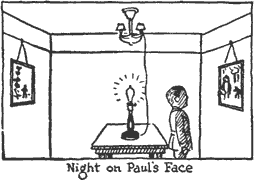
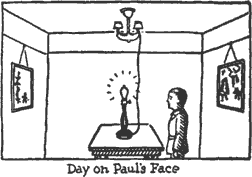
Part of the time Paul was facing a picture on one
wall and the next minute his back was toward that
picture and he was looking at another picture on the
opposite wall, across the lamp.
These two drawings show how Paul faced the two
pictures one after the other.
“Now tell me,” commanded Uncle Henry, “which
picture you see the plainest—is it the one you see
when your back is to the lamp—or is it the one you
see when you face the lamp, and look across it toward
the picture on the wall beyond?”
“The lamp is so bright without a shade that it
blinds me when I try to see the picture beyond it,”
said Paul.
“Oh, I see! I see!” said Betty, beginning to hop
up and down. “Can I tell, Uncle Henry?”
“Surely,” laughed Uncle Henry, “what do you
see?”
“When Paul faces the picture with his back to the
lamp,” said Betty, “it’s night on his face, and day
on the back of his head! Is that right?”
“Yes, go on,” encouraged Uncle Henry.
“And so he can see that picture better, ’cause the
lamplight isn’t in his eyes. But when he faces the
lamp and looks across it, then it’s day in his face,
and night on the back of his head, and he can’t see
the picture beyond the lamp very well, ’cause the
sun-lamp shines in his eyes.”
“So that’s why we can only see the stars at night!”
said Peter.
“Yes, that’s why the moon and the stars come out
only when it gets dark,” said Uncle Henry. “You
see the earth turns round and carries us to its dark
side, the side that is away from the sun. We say
‘The sun has set.’ Then when the sun glare is
gone from our eyes we can see the sky-pictures, just
as Paul sees one picture better with his back to the
lamp than he does the other when he has to look
through the lamp-light toward it.”
“And the stars are in the sky all day long, whether
we see them or not?” asked Paul.
“Certainly,” said Uncle Henry. “If you could
look up at the sky from the bottom of a very deep
well, or a tall chimney, so that the sun-light was
kept out of your eyes, you could see the stars shining
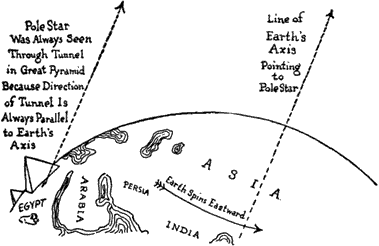
in the daytime. There is a long deep tunnel in the
great pyramid of Egypt that goes up and out from
the centre of its base toward its north side at just the
right angle so that the ancient Egyptians could
always see the pole star through it—no matter
whether it was night or daytime. You see the
pole star never rises or sets, because it is always
right over the end of the axis that the earth
spins on.”
This picture shows how the tunnel in the great
pyramid always pointed to the north star because
the tunnel is always parallel to the axis the earth
spins on.
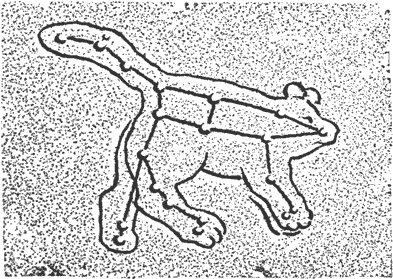
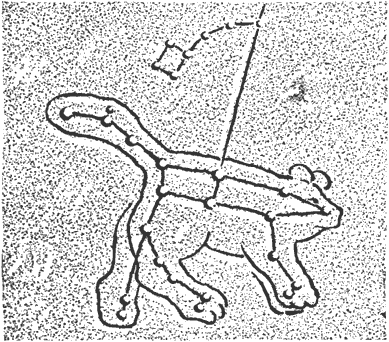
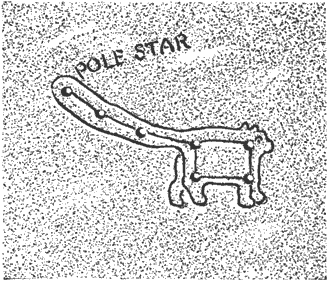
When the pyramid was built, the star in the tip
of the little bear’s tail was not the pole star, as it is
now. At that time the star that was nearest the pole
was one of those in the dragon. Since the pole of the
earth goes round in a complete circle among the
stars every 25,000 years, the star in Draco will some
time be the pole-star again—in, say 20,000 more
years!
Peter had picked up the Almanac that Uncle
Henry had borrowed from Katy and suddenly
cried,
“Oh, Uncle Henry, the Almanac has a lot of the
Star People in it. It calls them ‘The Signs of the
Zodiac.’ What’s the Zodiac, Uncle Hen?”
“We are going to find out right away, Pete,” said
Uncle Henry, “but first we must draw pictures of the
twelve star folks that are the Zodiac signs. That
means three drawings apiece. Pull up your chairs to
the table and we’ll draw on the sheets of scratch
paper with Betty’s colored pencils. Paul, you do the
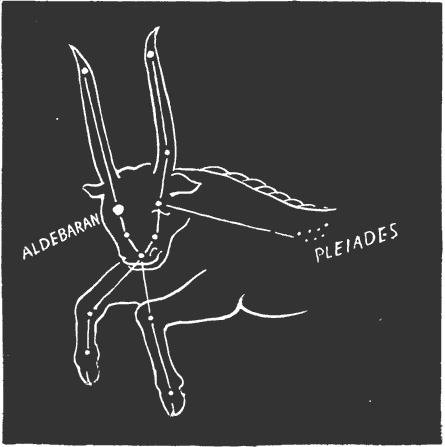
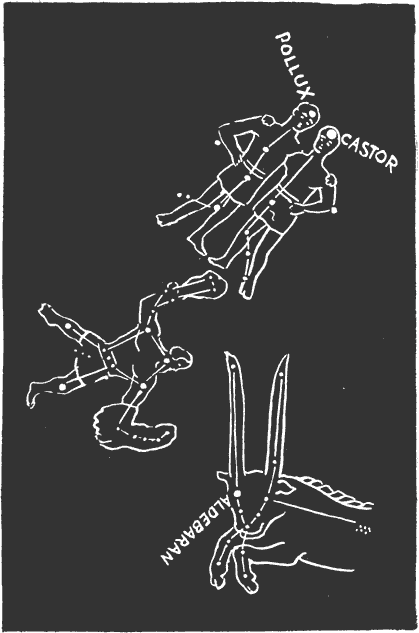
Virgo, Leo, and Cancer the Crab; Peter will draw
Gemini the Twins, Taurus the Bull, and Aries the
Ram; Betty will do the Fishes, called Pisces in Latin,
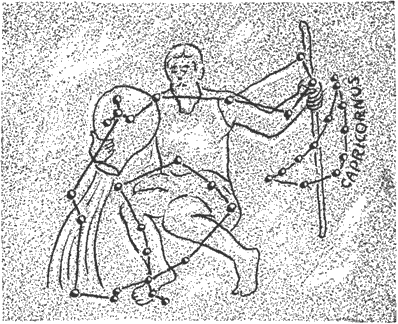
Aquarius the Water Carrier, and Capricornus the
Goat; while I will draw Sagittarius the Archer,
Scorpio, and Libra the Balance. All old friends of
ours.”
“We’ll put the Almanac here in the middle of the
table where we can all see it while we copy the
‘signs,’ one on each sheet of paper.”
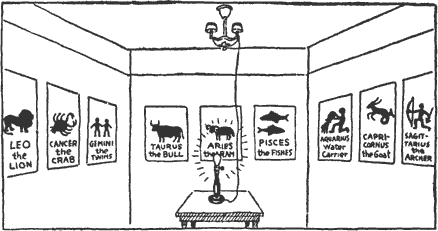
Everybody was very busy indeed for about half
an hour. At the end of that time the twelve rough
drawings were done and pinned up at equal distances
apart around the walls of the playroom, three on
each of the four walls. They were arranged around
the room in the same order in which Uncle Henry
had assigned them. The room then looked like this,
though of course you see only three walls in a picture.
You must imagine how the fourth wall looked.
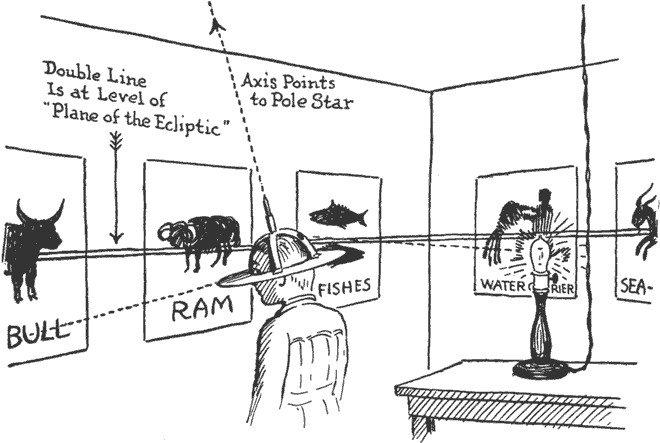
“Now Paul, suppose you walk around the table
again, spinning on your own axis as you go, and we’ll
try to find out what the Zodiac is. You notice that
the pictures are all pinned on the walls at the same
height from the floor, which is just the height of the
electric lamp bulb, and just the height of Paul’s
head too, no matter where he is in his walk around
the lamp. The twelve constellations, or signs of the
Zodiac are in the real sky also on the same level with
the earth and the sun, no matter where the earth is
in its journey round the sun. Astronomers say it this
way: they say that the earth revolves around the sun
‘in the plane of the ecliptic.’ That simply means that
if the sun was in the centre of an enormous horizontal
pane of glass, the earth and all the signs of the
Zodiac would also always be touching the pane of
glass, which would then represent the ‘plane of the
ecliptic.’ Put an l in ‘pane’ and you have ‘plane.’”
“Is each sign for a month?” asked Peter. “I see
there are twelve of them.”
“That’s correct,” said Uncle Henry, “and you
want to notice that as Paul walks round the lamp
and looks across it at the signs on the wall beyond
it, the lamp seems to Paul to move from one picture
to the next.”
This picture is drawn as if the ceiling of the room
was taken off and you could look down on Paul
walking around the lamp.
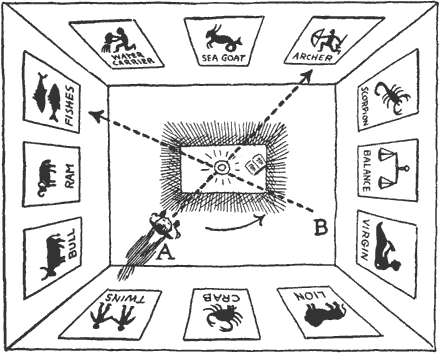
When it is January first, Paul, representing the
earth, is in the position marked A, nearest to the
picture of Gemini behind him, while the lamp,
representing the sun, appears to him to be entering
the sign of the Zodiac called Sagittarius, directly
opposite across the room. Later, on April first,
after three months, Paul, or the earth, has traveled
a quarter of the way around the sun, has passed
the pictures of Cancer and Leo on the wall behind
him, and stands nearest Virgo in the position
marked B. The lamp has also seemed to
move through a quarter circle, has passed through
the signs of Capricornus and Aquarius, and appears
to Paul to be just entering the sign of Pisces, or the
Fishes. In the same way the earth moves through a
sign of the Zodiac every month and the sun, while
really motionless, appears to also travel through a
sign every month. Of course we cannot see the sign
or constellation, where the sun appears to be, at the
same time we see the sun, for his brightness makes
the stars invisible, but if we could see the constellations
by day, the sun would appear to travel from
one sign of the Zodiac to the next every month.
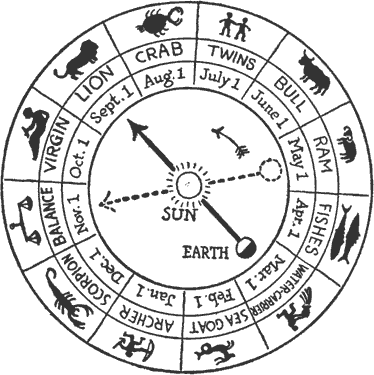
Here is a clock of the year which shows the earth
at one end of the hand, the sun in the middle, and
at the other end of the hand an arrow, which points
to the sign of the Zodiac where the sun appears to be,
and to the date when it seems to be there to an
observer on the earth. Draw the hand with the
earth-end in several different positions and you will
see that the sun, if viewed from the earth, would
appear to be in the sign of the Zodiac exactly opposite.
When the children all understood the way the
Zodiac divides the yearly path of the earth into
twelve equal parts, Betty said, “I want to know why
the geography globe at school always looks just as
if it was going to tip over.”
Uncle Henry laughed. “If you think the geography
globe looks unsteady because its axis of iron rod
is on a slant, what will you think about the earth
when I tell you that it spins around in just the same
slanting position, with only an imaginary line for
axis?”
“Does it really?” asked Betty.
“Yes,” said Uncle Henry, “and it spins so steadily
in that slanting position that the north end of its
imaginary axis always points toward the same place,
a point very close to the north star, or Polaris as it
is called.”
“Polaris is named for the North Pole, I suppose,”
said Peter.
“That’s right,” Uncle Henry replied. “Let’s get
some scissors and we’ll use our big sheet of cardboard
to make a cap for Paul’s head that will show
you just how the slant of the earth’s axis makes it
hotter in summer and colder in winter.”
“Ooh!” exclaimed Paul, “I always thought it was
hot in summer because the earth got nearer to the
sun then.”
“Lots of people think that, too,” said Uncle Henry,
“but it isn’t so. The earth is really farther from the
sun in summer.”
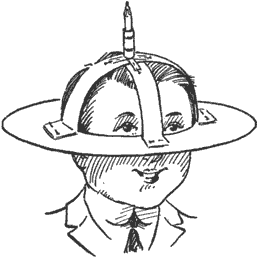
Betty ran for the scissors, and Uncle Henry cut
out a big circle from the stiff cardboard. Then he
cut out an opening in the centre of it that fitted
Paul’s head just as a stiff straw hat would that was
a size too big for him. The circle of cardboard
dropped down until it rested on Paul’s ears and on
the bridge of his nose. This cardboard brim represented
the “plane of the earth’s equator,” just as the
pane of glass represented the “plane of the ecliptic.”
Since the “plane of the equator” is always
at right angles to the slanting axis of the earth, the
“plane of the equator” is always at a slant to the
“plane of the ecliptic.”
If you will run a long hat-pin through an orange,
and sink the orange exactly to its middle in a glass
bowl filled with water, holding the hat-pin at a slant,
you will see that the equator of the orange is at a
slant with the surface of the water. Half of the
orange’s equator curves up above the water, while
half of it curves down under the water’s surface.
If you fasten a cardboard ring around the orange
at the equator the cardboard will then be at an
angle with the surface of the water, which represents
the “plane of the ecliptic.”
Uncle Henry cut two long strips from what was
left of the cardboard and crossed the strips over the
top of Paul’s head, fastening the four ends of them
to the round cardboard brim close to his head.
After this Uncle Henry rolled a sheet of the scratch
paper round a pencil, put rubber bands tightly
around it, cut the end to bend up and make a foot
and pinned the foot to the cardboard strips at the
place where they crossed. When Paul had it all on he
looked very funny
with the pencil sticking
straight up from
the top of his head,
and his eyes just
peeping over the
cardboard brim on
each side of the
strip down the middle
of his nose.
“Now come on,
Mr. Earth,” said
Uncle Henry, “It’s time for you to spin round the
lamp-sun for another year or two.”
So Paul held his head on a slant and kept it so that
the pencil always pointed in the same direction as
he went round the lamp. These four little pictures
show how he looked at the four sides of the sun where
the earth is in Winter, Spring, Summer, and Autumn.
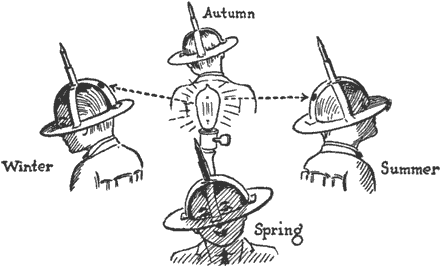
“Now,” said Uncle Henry, “you see that if we
make a black dot on one of the cardboard strips
about halfway between the cardboard brim, or the
earth’s equator, and the pencil, or the North Pole, it
will be about as far north as we are in the United
States. And when Paul is in his Summer position,
with the pencil slanting toward the ‘sun,’ you see
that the sun’s rays beat down much straighter on the
black dot than they do when he is on the other side
of the lamp, with the pole slanting away from the
‘sun.’ That is why the Winter sun appears to be
lower in the sky at noon than the Summer sun, and
also why the Summer sun shines hotter on the earth
than it does in Winter. Notice, too, that the rays
from the lamp light up Paul’s head for quite a little
way beyond the foot of the ‘pole’ when it slants
toward the ‘sun,’ while when it slants away from the
‘sun’ the rays fail to reach the ‘pole’ at all. This
means that in summer the sun shines a longer time
upon the part of the earth that slants toward it. If
you could look down from the ceiling at Paul’s head
in his Summer position and in his Winter one you
would see why.”
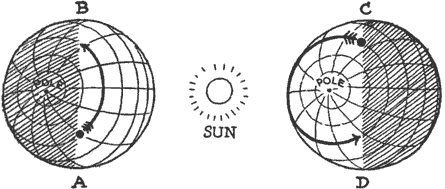
Uncle Henry quickly drew these two pictures of
the top of a globe to show the children why the days
are long in Summer and short in Winter at any point
in the United States.
| The Winter Day |
|
The Summer Day |
|
lasts while the black dot on the
earth travels from A to B—less
than half-way round. |
|
lasts while the black dot on the
earth travels from C to D—more
than half-way round. |
“It’s just like the hot water bottle mother kept in
my bed that time I had a chill after swimming,”
said Paul. “The hotter it was before she put it in
the bed the slower it cooled off.”
“That’s the idea,” said Uncle Henry, “the longer
the sun shines on any place on the earth the hotter
it gets, and when the nights are as short as they are
in Summer the place hasn’t long to cool off before
it is round in the sun’s hot rays again. Now do you
see why Summer is hotter than Winter?”
The children did.
“There’s one thing I don’t understand, though,”
said Peter. “Why are there different stars in the
sky in Winter than there are in Summer?”
“That’s easy to answer,” said Uncle Henry.
“Look at Paul again—first when it’s ‘night’ on his
face on the ‘Summer’ side of the lamp, and then
when it is ‘night’ on his face on the ‘Winter’ side of
the lamp.
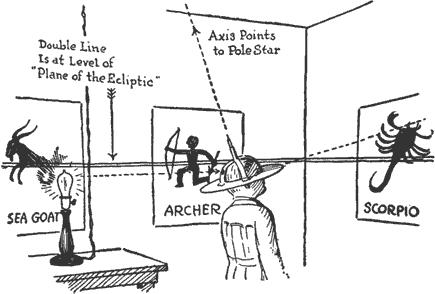
“At ‘night’ in Summer Paul looks at the pictures
on one end of the room. The cardboard brim, or
‘plane of the equator,’ is slanted up, above the
‘plane of the ecliptic.’”
This picture shows how Paul looked.
“But in Winter, at ‘night,’ Paul looks at quite
different pictures, at the other end of the room. The
cardboard brim is slanted down, below the level of
the ‘plane of the ecliptic.’ This is why the path of
the Winter Signs crosses the sky higher up than
the path of the Summer Signs. In both Winter and
Summer you must imagine the cardboard brim to
be as transparent as glass, for the ‘plane of the
equator’ is in reality only imaginary.”
This next picture shows how Paul looked at the
constellations at “night” in Winter.
“Of course the north star and the stars for a
considerable distance round the pole never set, and
can be seen all night at any time of the year. It is
only the ones that rise and set that go and come from
our sight with the seasons. In reality they never
leave us, for if it wasn’t for the sunlight getting in
our eyes by day, we could see the Summer night
star-pictures in the Winter daytime, and the Winter
night star people in the Summer daytime. We are
just looking at opposite ends of our big room in the
universe on Winter nights and Summer nights, that’s
all,” said Uncle Henry.
Uncle Henry took some folded papers from his
pocket and spread them out on the table.
“Here are four maps of the sky,” he said, “which
show the way it looks at different seasons at 9 o’clock
in the evening—on January 1st, April 1st, July 1st,
and October 1st. You will see that the groups of
stars around the pole are always in view, while the
rest of the star people change with the seasons, but
even the groups around the pole change their positions
with the seasons.
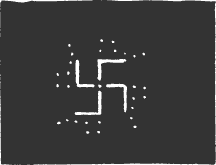
“You have all seen the Swastika. It has been
known and used as an ornament for hundreds of years,
all over the world—by the American Indians, the
Chinese, the East Indians, and many others. I’ll show
you where I think all these widely separated people got
the Swastika, and how it stands for the four seasons.”
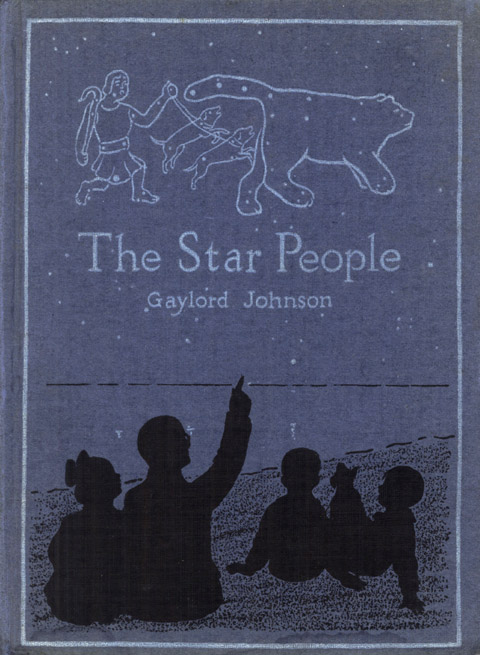
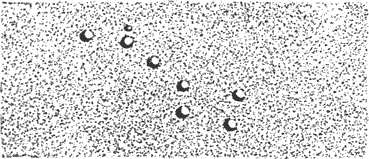
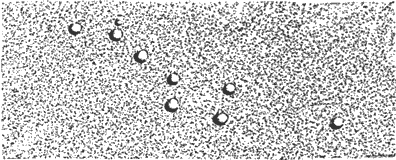
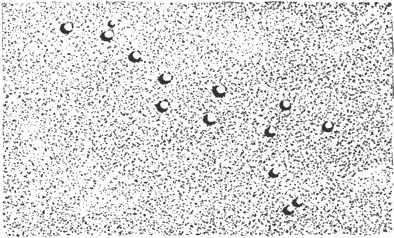
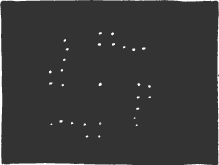
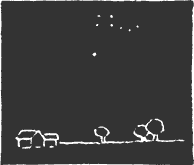
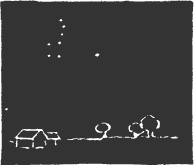
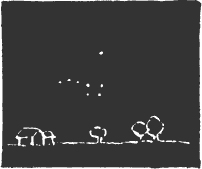
Uncle Henry drew four little pictures showing
the four positions in which the big dipper stands in
the four different seasons, with its “pointer stars”
always indicating the pole star.
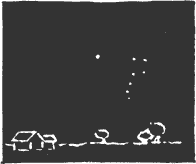 At the right of the pole
star in Winter.
At the right of the pole
star in Winter.
|
 Above the pole star in
Spring.
Above the pole star in
Spring.
|
 At the left of the pole
star in Summer.
At the left of the pole
star in Summer.
|
 Below the pole star in
Autumn.
Below the pole star in
Autumn.
|
Then he drew all four positions on one sheet of
paper, like this:
And when heavy lines were drawn along the
handles of the dippers and across the pole star from
bowl to bowl the Swastika suddenly appeared like
this:
The Society of Star-Gazers was very enthusiastic
about the origin of the Swastika, and found the
dipper in its different positions on all of the four maps
that Uncle Henry had put on the table.
You can see the position of the dipper and all the
other stars at January 1st, April 1st, July 1st, and
December 1st, at 9 o’clock in the evening, by looking
at the four maps inside the covers of this book.
After the children had looked at all the four
maps as long as they wanted to, Uncle Henry
suddenly remembered to look at his watch and
exclaimed,
“My goodness! I guess it’s about time the
Society adjourned for to-night. Ten o’clock! I’ll
get scolded for keeping you up so late.”
“I want to ask just one thing more,” pleaded
Betty.
“All right, what is it?” said Uncle Henry.
“Who found all the sky people?”
“Well,” said Uncle Henry, “now that’s a long
story. They were all found and named so long ago
that nobody knows who did it. The inventors of the
star people naturally thought they saw pictures in
the sky of the things they were familar with in
everyday life—the bear, the bull, the serpent, the
archer, and so on. If they had had any steam
engines then somebody would have drawn lines from
star to star until they had a picture of one in the sky.
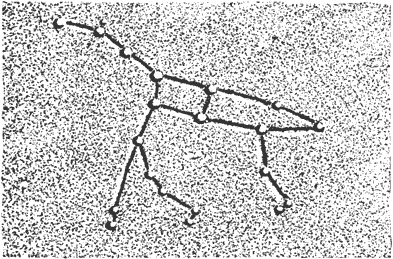
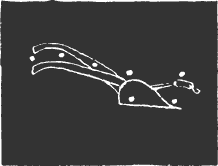
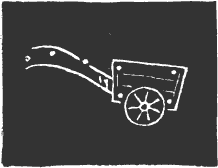
In England the Great Bear or Dipper is usually
called the ‘Plough’ and you can see why
“It is also called ‘Charles’ Wain’ or wagon.
“We only know that the constellations are very,
very old, and that an ancient people living in the
valley of the Euphrates river probably named most
of them. The Babylonian Tablets, the oldest records
known, show that the Zodiac constellations were
known over 3000 years before the birth of Christ,
which is now nearly 5000 years ago.”
“Can’t we have just one more poem before we go
to bed?” said Paul.
“Yes,” said Uncle Henry, “but not one of mine.
I’ll give you a little bit of a long poem that was
written by a man named Aratos about 280 years
before the wise men followed the star that told them
where to find the new-born Christ. It has been
running through my mind all the evening. This is it:
“And all the signs through which Night whirls her car,
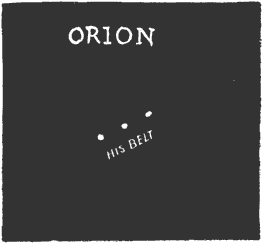
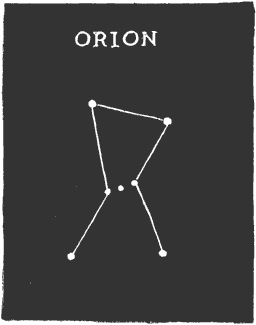
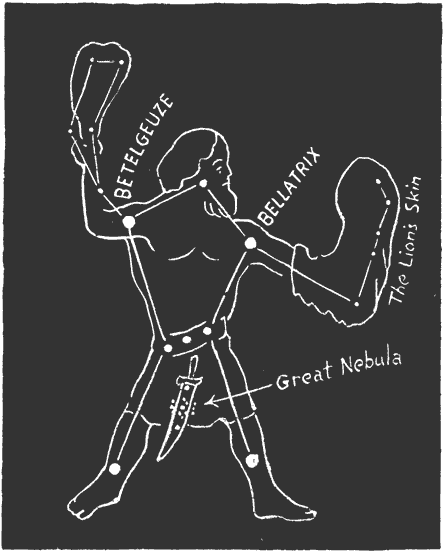
From belted Orion back to Orion and his dauntless Hound,
And all Poseidon’s, all high Zeus’s stars,
Bear on their beams true messages to man.”