INTRODUCTORY — BOOK I — CHAPTER I FAIR, YOUNG, CAPABLE HANDS — CHAPTER II A MASS OF SELFISHNESS — CHAPTER III RUSTLING LEAVES OF MEMORY — CHAPTER IV BACK AT A NEW DOOR OF LIFE — CHAPTER V QUENCHLESS STARS ELOQUENT — CHAPTER VI EYES, BLUE AS HIS STAR — CHAPTER VII NEW ROADS UNFOLDING — CHAPTER VIII WARM HEART, SUPERFLUOUS WISDOM — CHAPTER IX HEALING HERBS, WARNING TEXTS — CHAPTER X COMPACT AND ACCEPTANCE — CHAPTER XI LAYING THE GHOSTS — CHAPTER XII A KINDLY EPICURE — BOOK II — CHAPTER I MIDSUMMER SUNRISE — CHAPTER II EUPHROSINE , STAR-OF-COMFORT — CHAPTER III A QUEEN OF CURDS AND CREAM — CHAPTER IV OPEN-EYED CONSPIRACY — CHAPTER V EVIL PROMPTER, JEALOUSY — CHAPTER VI THE PERFECT ROSE, DROOPING — CHAPTER VII NODS AND WREATHÉD SMILES — CHAPTER VIII A GREY GOWN AND RED ROSES — CHAPTER IX A RIDER INTO BATH — BOOK III — CHAPTER I THE LITTLE MASTER OF BINDON — CHAPTER II TOTTERING LIFE AND FORTUNE — CHAPTER III STRAWS ON THE WIND — CHAPTER IV A SHOCK AND A REVELATION — CHAPTER V SILENT NIGHT THE REFUGE — CHAPTER VI THE LUST OF RENUNCIATION — CHAPTER VII SHADOWS OF THE HEART OF YOUTH — CHAPTER VIII THE HERB EUPHROSINE — CHAPTER IX AN OMINOUS JINGLE — CHAPTER X A VAGUE DESPERATE SCHEME — CHAPTER XI A PARLOUR OF PERFUME — CHAPTER XII TO SLEEP—PERCHANCE TO DREAM! — CHAPTER XIII THOU CANST NOT SAY I DID IT — CHAPTER XIV JEALOUS WATCHERS OF THE NIGHT — CHAPTER XV A SIMPLER’S EUTHANASIA — CHAPTER XVI THE TIME IS OUT OF JOINT — CHAPTER XVII TREACHERIES OF SILENCE — CHAPTER XVIII GONE LIKE A DREAM — CHAPTER XIX GREY DEPARTURE — BOOK IV — CHAPTER I AH ME, THE MIGHT-HAVE-BEEN! — CHAPTER II A MESSENGER OF GLAD TIDINGS — CHAPTER III NOT WORDS, BUT HANDS MEETING — CHAPTER IV A DREAM OF WOODS AND OF LOVE
ix
Concerning Bindon-Cheveral.
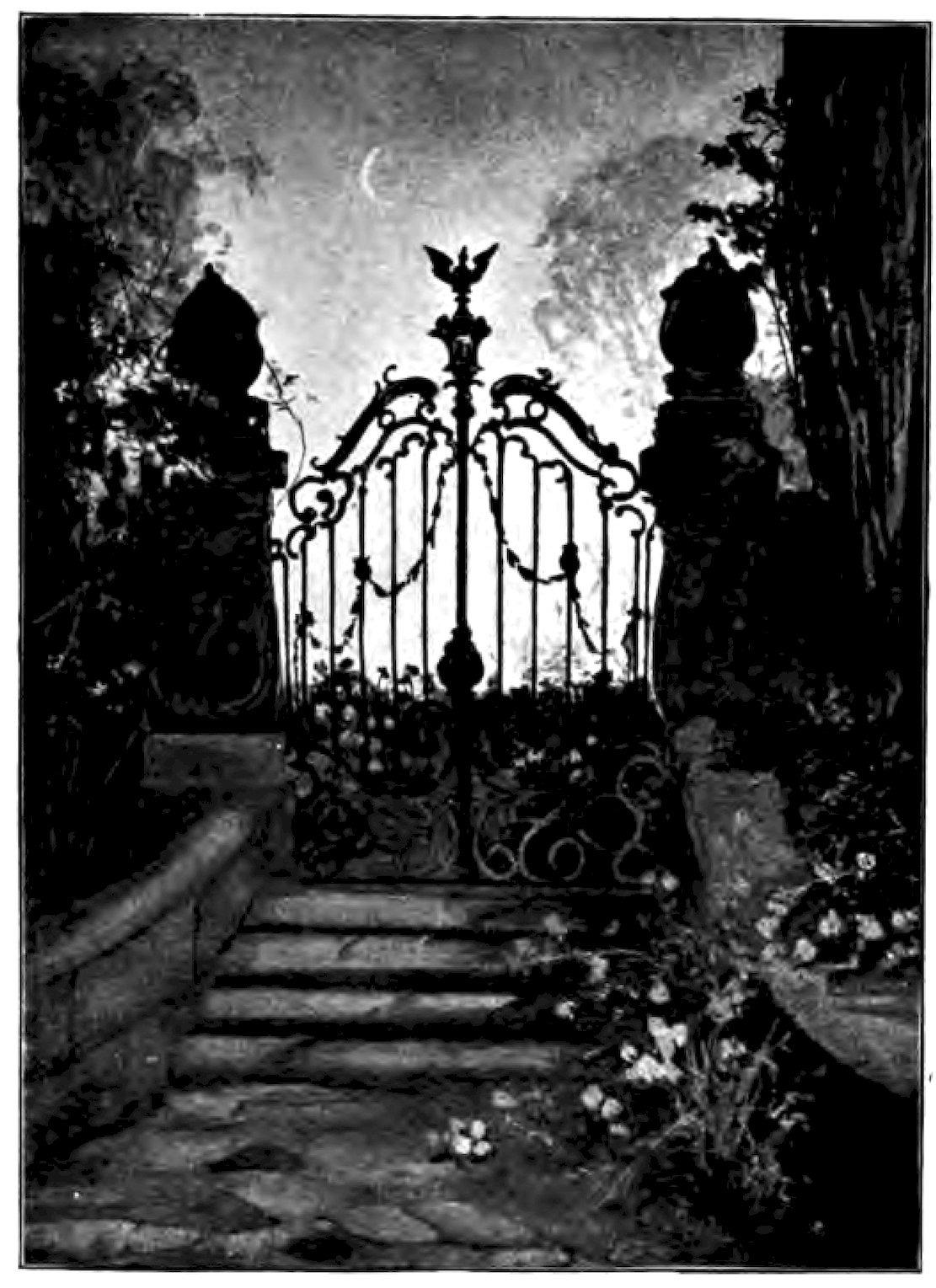
An ancient gateway, looking as though it were closed
for ever; with its carved stone pillar bramble-grown, its
scrolled ironwork yielded to silence and immobility, to
crumbling rust—and through the bars the wild imprisoned
garden....
The haunting of the locked door, of the condemned
apartment in a house of life and prosperity, how unfailingly
it appeals to the romantic fibre! Yet, more suggestive
still, in the heart of a rich and trim estate, is the forbidden
garden jealously walled, sternly abandoned, weed-invaded,
falling (and seemingly conscious of its own
doom) into a rank desolation. The hidden room is enigmatic
enough, but how stirring to the fancy this peep of
condemned ground, descried through bars of such graceful
design as could only have been once conceived for the
portals of a garden of delight!—Thus stands, in the midst
of the nurtured pleasaunces of Bindon-Cheveral, the curvetting
iron gate leading to the close known on the estate
as the Garden of Herbs—a place of mystery always, as
reported by tradition; and, by the legend touching certain
events in the life of one of its owners, a place of somewhat
sinister repute. Even in the eyes of the casual
visitor it has all the air of
Some complaining dim retreat
For fear and melancholy meet.
xAnd in truth (being fain to pursue the quotation
further)
I blame them not
Whose fancy in this lonely spot
Was moved.
Ancient haunts of men have numberless tongues for
those who know how to hear them speak; therein lies
the whole secret of the fascination that they cast, even
upon the uninitiated. Those, on the other hand, whose
minds are attuned to the sweetness of “unheard melodies”
turn to such places of long descent with the
joy of the lover towards his bridal chamber, for the
wedding of fantasy with truth. Divers, indeed, and
many, might be the tales which the walls of Bindon-Cheveral
could tell, from what remains of its old battlements
to the present mansion.
Its front, which the passer-by upon the turnpike-road
may in leafless winter-time descry at the end of the long
avenue of elms, has the peaceful and rich stateliness
of the Jacobean country seat—but there is scarce a stone
of its grey masonry, with its wide mullioned windows,
its terrace balustrades and garden stairways, that has not
once been piled to the arrogant height from which the
Bindon Castle of stark Edward’s times looked down upon
the country-side. The towers and walls are gone; but
the keep still stands, sleeping now and shrouded under
centuries of ivy—a kindly massive prop to the younger
house, its descendant. The ornamental waters were once
defensive moats: red they have turned with other than
the sunset glow, and secretly they have rippled to different
causes than the casting of a careless stone or the
leap of the great fat carp after a bait. Where the pleasure-grounds
are now stretched in formal Italian pride
spread, centuries back, the outer bailey of the once
famous, now forgotten, stronghold.
Stirring would be the Romance of old Bindon I could
recount, as old Bindon revealed it to me—many the tales
xiof love, of deeds, of hatred, of ambition. I could tell
brave things of the builder of the Castle, and how he held
the keep in defiance of Longshanks’ royal displeasure;
or of the Walter, Lord of Bindon, Knight of the Garter,
High Treasurer to the last Lancaster, and of his fortunes
between the Two Roses; or yet of his grandson, beheaded
after Hexham; and, under Richard Crookback, of the
transfer of the good lands of Bindon to the “Jockey of
Norfolk” who perished on Bosworth Field.—And these
would be tales of clash of steel and waving banner as
well as of wily diplomacy. Great figures would stalk
across my page; it would be shot with scarlet and gold,
royal colours; and high fortunes, those of England herself,
would be mingled with the lesser doings of knight
and baron.
I could set forth the truth touching some of those inner
tragedies, now legendary, that the warlike walls once
witnessed after the first Tudor had restored the estate of
Bindon to the last descendant of its rightful owner, a
Cheveral, whereby the line of Bindon-Cheveral joined on
the older branch.—There was the Agnes Cheveral of the
ballad singers—“so false and fair”—who left the tradition
of poison in the wine cup as a fate to be dreaded by
the Lords of Bindon.—And there was the Sir Richard
who kept his childless wife a life-long prisoner in the
topmost chamber of that keep now so placidly dreaming
under its creepers!
Or I could reel you a bustling Restoration narrative of
the doing of the Edmund Cheveral known in the family
as Edmund the Spendthrift, who had roamed England,
hunted and fasting, with Charles; had stagnated with
him, had junketed and roystered in Holland. He it was
who brought over the shrewish little French wife and
her great fortune, and also foreign notions of display,
to old English Bindon. He it was who pulled down the
gloomy loopholed walls, built the present House, laid
out the park and the renowned gardens; who introduced
the carp into the pacific moat after the fashion of French
xiichâteaux; and who, bitten with fanciful scientific aspiration—a
friend of Rupert and a member of the Royal
Society—laid out in a sunken and wall-sheltered part of
the old fortified ground an inner pleasaunce of exotic
plants and shrubs, after the manner of Dutch Physick-Gardens.
Or would you have the story of the new heir—a silent,
dark man—and of his mystic Welsh wife and of the
new wealth and strain of blood that came with her
into the race? Or again, no doubt for those who
care to hear the call of horn and hounds, to see the
port pass over the mahogany; who find your three-bottle
man the best company and the jokes of the stable and of
the gun-room the only ones worth cracking with the
walnut, there were a pleasant rollicking chapter or two
to be chronicled anent the generation of fox-hunting, hard-living
Squires who kept Bindon prosperous, made its
cellars celebrated and its hospitality a byword.
And yet, my fancy lingers upon the spot where it was
first awakened; dwells on the story of the deserted Physick-Garden,
with its closed exquisitely-wrought gate, its
mystery and its melancholy; with its wildness wherein
lies no hint of sordidness, but rather a fascinating, elusive
beauty. It is of this that I fain would write.
Standing barred out, in this still autumn twilight, as
the first stars flash out faintly on the deepening vault;
gazing upon its overgrown paths, where the leaves of so
many summers make rich mould; inhaling its strange
fragrances, the scent of the wholesome decay of nature
mixed with odd spices that come from far lands; hearing
the wild birds cry as they fly free in its imprisoned space—it
seems to me as if the spirit of my romance dwelt in
these, and I could evoke it.
A tale of well-nigh a century ago; when George III.
lay dying.—It was a strangely silent Bindon then; and
the whole house seemed to lie under much such a spell
xiiias now holds its Herb-Garden. Yet those same garden paths,
if wild, were not deserted; and the gate,
though locked to the world at large, still rolled upon its
hinges for one or two who had the key.
In those days of slow journeys and quick adventure,
had you been a traveller on the turnpike-road between
Devizes and Bath, you could not, looking over the park
wall from your high seat, but have been struck by the
brooding, solitary look that lay all upon this great House,
with its shuttered windows and upon these wide lands, so
rich, yet so lonely.
The driver of the coach would, no doubt, have pointed
with his whip; his tongue would have been ready to wag—was
not Bindon one of the wonders of his road?
“Aye, you might well say it looked strange! There
were odd stories about the place, and odd folk living
there, if all folk said were true. The owner, Sir David
Cheveral (as good blood as any in the county, and once as
likely a young man as one could wish to see), had turned
crazy with staring at the stars and took no bit nor sup
but plain bread and water. That was what some said;
and others that he was bewitched by an old kinsman of
his that lived with him—an old, old man, bearded like a
Jew, who could not die, and who practised spell-work on
the village folk. That was what others said. Anyhow,
they two lived in there quite alone; one on his tower, the
other underground. And that was true. And the flowers
bloomed in the garden, and the fruit ripened on the walls;
there were horses in the stables and cattle in the byres
(the like of which could not be bettered in Wiltshire);
the whole place was flowing with milk and honey, as they
say, and the only ones to use it all were the servants! Oh,
there the servants grew fat and did well, while the master
looked up to the skies and grew lean.”
And presently, to the sound of your driver’s jovial laugh
the coach would bowl clear of the long grey walls, emerge
from under the overhanging branches; and then the well-known
stretch of superb scenery suddenly revealed at the
xivbend of the road would perhaps so engross your attention
that your transient traveller’s interest in the eccentric,
world-forsaking master of Bindon-Cheveral would no
doubt have evaporated.
But pray you who travel with me to-day give me longer
patience. I have to tell the story of Bindon’s awakening.
Thy soul was like a star and dwelt apart.
Wordsworth (Sonnets).
3
Alone and forgotten, absolutely free,
His happy time he spends, the works of God to see
In those wonderful herbs which here in plenty grow,
Whose sundry strange effects he only seeks to know,
And choicely sorts his simples got abroad,
And dreams of the All-Heal that is still on the road....
—Drayton (Polyolbion).
On that evening of the autumnal equinox Master
Simon Rickart—the simpler or the student as
he liked to call himself, the alchemist as many
held him to be—alone, save for the company of his cat,
in his laboratory at the foot of the keep, was luxuriating
as usual in his work of research.
The black cat sat by the wood fire and watched the
man.
As Master Simon moved to and fro, the topaz eyes
followed him. When he spoke (which he constantly did
to himself, under his voice and disjointedly, after the
wont of some solitary old people) they became narrowed
into slits of cunning intelligence. But when the observations
were personally addressed to his Catship, Belphegor
blinked in comfortable acknowledgment. “As wise as
Master Simon himself,” the country folk vowed: and
indeed, wherever the fame of the alchemist had spread
through the country-side, so had that of the alchemist’s
cat.
4There were two fires in the laboratory. One of timber,
that roared and crackled its life away and sank into an
ever increasing heap of fair white ash. In the vault-like
room this fire burned year in year out on a hearth hewn
many feet into the deep wall; and from many points of
view Belphegor found it vastly more satisfactory than the
other fire, which generally engrossed the best of his
master’s attention. That was a stealthy red glow, nurtured
on a wide stove built into another wall recess,
sheltered behind a glass screen under a tall hood:—a
fire productive of the strangest smells, at times evil,
but as often sweet and aromatic: a fire also productive
on occasions of coloured vapours and dancing
flamelets of suspicious nature. There, as the cat knew,
happened now and again unexpected ebullitions, disastrous
alike to the nerves and to the fur. In his kitten
days, Belphegor, led ostensibly by overpowering affection
but really by the constitutional curiosity of his genus,
had been wont to accompany his chosen master behind
the screen. He knew better now. And there was a bald
spot near the end of his tail, where no amount of licking
on his part, no cunning unguent of Master Simon’s himself
could to this day induce a hair to grow again.
The old man had closed the door of the stove; rearranged,
crown-like, a set of glass vessels of engaging
shapes: alembics and matrasses, filled with decoctions of
green and amber, gorgeous colours shot with the red reflection
of the fire; tucked a baby-small porcelain crucible
in its fireclay cradle and banked the glowing cinders
around it. The touch of the wrinkled hands was neat,
almost caressing. After a last look around, he emerged,
blowing a breath of content:
“Everything in good trim, so far, for to-night’s work,
my cat.”
And Belphegor blinked both eyes.
Faint vapours, herb-scented, voluptuous, rose and
circled to the groined roof. The log fire on the hearth
5had fallen to red stillness. In the silence, delicate sounds
of bubbling and simmering, little songs in different keys,
gurgles as of fairy laughter, became audible.
“Hark to it!” said the simpler, and bent his ear with
a smile of satisfaction. He spoke in a monotonous undertone,
not unlike the muttering of the sleep-walker—“Hark
to it! There is a concert for you—new tunes
to-night, Belphegor. Strange, delightful! There is not
a little plant but has its own voice, its own soul-song.
Hark, how they yield them up! Good little souls! Bad
little souls, some of them, he, he! Enough in that retort
yonder to make helpless idiots, or dead flesh of a hundred
lusty men. Dead flesh of eleven such fine cats as
yourself and one kitten, he, he! Yet—for properly directed,
friend Belphegor, vice may become virtue—enough
here to keep the fever from the homestead for three
generations....”
The old man moved noiselessly in his slippers across
the stone floor, flung a couple of fresh logs on the sinking
hearth, then stretched out his frail hands to the blaze
and laughed gently. The flame light played fantastically
on his shrunken figure:—a being, it would seem, so ætherealised
that it scarcely looked as if blood could still
be circulating beneath that skin, like yellow ivory,
tensely stretched over the vast, denuded forehead and
the bold, high-featured face. Mind alone, one would
have thought, must animate that emaciated body; mind
alone light up those steel-blue eyes with such keenness
that, by contrast with the age-stricken countenance, they
shone with almost unearthly vitality.
The cat stretched himself, yawned; then advanced,
humping his back and bristling, to rub himself against
his master’s legs. The fire roared again in the chimney,
a score of greedy tongues licking up the last drops of
sap that oozed forth, hissing, from the beech logs.
“Aha,” said Master Simon, bending down somewhat
painfully to give a scratch to the animal’s neck, “that’s
the fire-song you prefer. I fear, I fear, Belphegor, you
6will never rise beyond the grossest everyday materialism!”
Purring Belphegor endorsed the opinion by curling up
luxuriously on his head and stretching out his hind paws
to the flame. The little scene was an allegory of peace
and comfort. The old man, straightening himself, remained
awhile musing:
“Well, it is good music—a song of the people. All
of the stout woods of Bindon, of the deep English earth,
of the salt English airs. No subtle virtue in it: a roaring
good tune, a homely smell and a heap of ash behind—but
all clean, my cat, clean!”
He gathered the folds of his dressing-gown around
him; a garment that had once been wondrous fine and set
in fashion (in the days of his elegant youth) by no less
a person than his present Majesty, King George IV.,
but now so stained, so singed and scorched and generally
faded, that its original hues were but things of memory.
“And now we shall have a quiet hour before supper.
What a good thing, my cat, that neither you nor I are
attractive to company! The original man was created
to be alone. But the fool could not appreciate his bliss,
and so he was given a companion—a woman, Belphegor,
a woman!—and Paradise was lost.”
Again Master Simon chuckled. It was a sound of
ineffable content, weirdly escaping through the nostrils
above compressed lips. He took up a lighted candle,
stepped carefully over the cat and, selecting between his
fingers a key from a bunch at his girdle, approached a
wooden press that cut off an angle of the room.
This was built of heavily carved black oak, secured
with sturdy iron hinges; had high double doors and small
peeping keyholes, suggestive of much cunning. It was
a press to receive and keep secrets. And yet, when the
panels were thrown open, nothing of more formidable
nature was displayed than rows upon rows of inner
drawers and shelves, the latter covered some with philosophical
instruments, others displaying piles of neatly
7ticketed boxes, ranks of phials, and sealed tubes of
various liquids or crystals that flashed in the light with
prismatic scintillation.
Holding the candle above his head the old man
selected:
“The box of Moorish powder from Tangiers—the
bottle of Java Water—the paste of Cannabis Arabiensis—the
Hippomane Mancenilla gum of Yucatan.”
He placed the materials on a glass tray and carried
them over to the working table.
“Excellent Captain Trevor! The simple fellow has
never done thanking me for curing him of his West
Coast fever with a course of Herba Betonica; he, he! the
common, ignored, humble Wood Betony. Thanking me—he,
he! Never did a pinch of powder bring better
interest...! Oh, my cat, I’m a mass of selfishness!
And here I have at last the Java Water and the
Yucatan gum!”
The cat roused himself, walked sedately but circuitously
across the room, leaped up and took his position
with feet and tail well tucked in on the bare space left,
by right of custom, where the warmth of the lamp should
comfort his back.
On Master Simon’s table lay a row of small covered
watch-glasses, thin as films, each containing a small heap
of some greenish crystalline powder. A pair of chemical
scales held out slender arms within the walls of its glass
case. The neat array looked inviting.
With a noise as of rustling parchment the simpler
rubbed his hands; he was in high good humour. The
tall clock at the end of the room wheezed out the ghost
of nine beats, and the strangled sounds seemed but to
point the depth of the environing silence. For the thick
walls kept out all the voices of nature, and at all times
enwrapt the underground room with a solemn stillness
that gave prominence to its whispers of secret doings.
“Nine o’clock!” muttered the self-communer. “Another
hour’s peace before even Barnaby break in upon us
8with his supper tray. Hey, but this is a good hour!
This is luxury. I feel positively abandoned! Not a
soul in this whole wing of Bindon, save you and me—unless
we reckon our good star-dreamer above—good
youth with his head in the clouds. Heigh ho, men are
mostly fools, and all women! Therefore wisely did I
choose my only familiar—thou prince of reliable confidants.”
The man stretched out his hand and caressed the
beast’s round head. Belphegor tilted his chin to lead
the scratching finger to its favourite spot.
“Hey, but man must speak—it is part of his incomplete
nature—were it only to put order in his ideas, to
marshall them without tripping hurry. And you neither
argue nor contradict, nor give a fool’s acquiescence.
You listen and are silent. Wise cat! Now, men are
mostly fools ... and all women!”
Master Simon lifted the phial of Java Water, a fluid
of opalescent pink, between his eye and the light. He
removed the stopper and sniffed at it. Then compared
the fragrance with that of the Moorish powders, and
became absorbed in thought. At one moment he seemed,
absently, on the point of comparing the tastes in the
same manner, but paused.
“No, sir, not to-night,” he murmured. “We must
keep our brain clear, our hand steady. But it will be an
experiment of quite unusual interest—quite unusual....
I am convinced the essential components are
the same.—Belphegor! Keep your nozzle off that gallipot!
Do you not dream enough as it is?”
He pushed the turn-back cuffs still further from his
attenuated wrists, and with infinite precaution addressed
himself to the manipulation of his watch-glasses, silver
pincers and scales: the final stage of weighing and apportioning
the result of an analytical experiment of already
long standing was at hand.
His great white eyebrows contracted. Now, bending
close, he held his breath to watch the swing of the delicate
9balance; now with fevered fingers he jotted notes
and figures. At times a snapping hand, a clacking
tongue, proclaimed dissatisfaction; but presently, widening
his eyes and moistening his lips, he started upon a
fresh clue with renewed gusto.
The clock had ticked and jerked its way through the
better part of the hour when the weird muttering became
once more audible:
“Curious, curious! Yet it works to my theory. Now
if these last figures agree it will be proof. Pshaw, the
scales are tired. How they fidget! Belphegor, my friend,
down with you, the smallest vibration would ruin my
week’s work. Down! Now let us see. As seventy-three
is to a hundred and twenty-five ... as seventy-three
is to a hundred and twenty-five.... A
plague on it!” exclaimed Master Simon pettishly, without
looking up. “There’s that Barnaby, of course in the
nick of wrong time!”
The door at the dim end of the room had been opened
softly. A puff of wood smoke had been blown down
the chimney. A tiny draught skimmed across the table;
the steady lamplight flickered and cast dancing shadows;
and Master Simon’s tense fingers trembled with irritation.
“All to begin again. Curse you, Barnaby! You’re
deaf, I can curse you, thank Providence!”
Without turning round he made a hasty, forbidding
gesture of one hand. The door was shut as gently as
it had been opened.
Master Simon gave a deep sigh, and still fixedly eyeing
the scales, stretched his cramped hands along the
table for a moment’s rest.
“Now, now? Ha—Ho—What? Sixty-nine to eighty-two?
Impossible! Tchah! Those scales have the palsy—nay,
Simon Rickart, it is your impotent hand. Old
age, old age, my friend ... or stormy youth,
alas!” His muttering whisper rose to louder cadence.
10“Had you but known then, in your young folly, the
chains you were forging, for your aged wisdom! But
sixty to-day, and this senile trembling! Not a shake of
that hand, Simon, but is paying for the toss of the cup;
not a mist in that brain but is the smoke of wanton, bygone
fires. Well vast is the pity of it! Had you but the
hand now of that dreamer up above! Had you but the
virtue of his temperate life! And the fool is staring at
his feeble twinklers ... worshipping the unattainable,
while all rich Nature, here at hand, awaits the explorer.
Oh, to feel able to trace Earth mysteries to the
marrow of Man; to hold the six days’ wonder in one
single action of the mind ... and to be foiled at
every turn by the trembling of a finger!”
He leaned back in his chair, long lines of discouragement
furrowing his face.
Behind him, in the silence, barely more audible than
the simmering sounds of the fires and the lembics, there
was a stir of another presence, quiet, but living. But
Master Simon, absorbed in his own world of thought,
perceived nothing.
With closed eyes, he made another effort to conquer
the rebellious weakness of the flesh and bring it into
proper subjection to the merciless vigour of the mind.
At that moment the one important thing on earth to the
old student was the success of his analysis. And had the
Trump of Doom begun to sound in his ears, his single
desire would still have been to endeavour to conclude it
before the final crash.
Light footfalls in the room—not caused by Belphegor’s
stealthy paws, certainly not by Barnaby’s masculine foot—a
sound as of the rustle of a woman’s garments, a
sound unprecedented for years in these consecrated precincts,
failed to reach his faculties. Once more he drew
his chair forward, leant his elbows on the table, and,
stooping his head so that eyes and hands were nearly
on the same level, set himself to the exasperatingly delicate
11task of minute weighing. And the while he muttered
on with a droll effect of giving directions to himself:
“The right rider, half a line to the right. That should
do it this time! Too much—bring it back! Faugh, out
of all gear! Too much back now. Fie, fie, confusion
upon my spinal cord—nerves, muscles, and the whole old
fumbling fabric!”
Here, two hands, with unerring swoop like that of an
alighting dove, came out of the dimness on each side of
the bent figure, and with cool, determined touch
gently withdrew the old man’s hot and shaking fingers
from their futile task.
Master Simon’s ancient bones shook with a convulsive
start; a look of intense amazement passed into his straining
eye, then the faintest shade of a smile on his lips.
But, characteristically, he never turned his head or otherwise
moved: the business at hand was of too high import.
He sat rigid, silently watching.
The interfering hands now became busy for a space
with soft unhurried purpose. Beautiful hands they were,
white as ivory outside and strawberry pink within, taper-fingered
and almond-nailed; not too small, and capable
in the least of their movements. Compared to those other
hands that now lay, still trembling in pathetic supineness,
where they had been placed, they were as young shoots,
full of vital sap, to the barren and withered branch. A
woman’s warm presence enfolded the student. A young
bosom brushed by his bloodless cheek. A light breath
fanned his temples. A scent as of lavender bushes in
the sun, of bean fields in blossom, of meadowsweet among
the new-mown hay; something indescribably fresh, an
out-of-door breath as of English summer, spread around
him, curiously different from the essences of his phials
and stills. But Master Simon had no senses, no thought
but for the work those busy hands were now performing.
“The right rider, to the right, just half a line?” said
12a voice, repeating his last words in a tranquil tone. “A
line—those little streaks on the arms are lines?”
Master Simon assented briefly: “Yes.”
The fingers moved.
“Enough, enough!” ordered he. “Now back gently
till the needle swings evenly.”
The pulse of the scales, hitherto leaping like that of a
frightened heart, first steadied itself into regularity and
then slowed down into stillness. The long needle pointed
at last to nought. The white hands hovered a second.
“Not another touch!” faintly screamed the old man.
He craned forward, his body again tense; gazed and
muttered, wrote and rapidly calculated.
“Yes, yes, yes! Seventy-three to a hundred and
twenty-five—I was right—Eureka! The principles of
the two are the same. Right! Right!”
Now Simon Rickart, rubbing his hands, turned round
delightedly.
13
... Such eyes were in her head;
And so much grace and power, breathing down
From over her arch’d brows, with every turn
Lived thro’ her to the tips of her long hands....
—Tennyson (The Princess).
“Well, Father?”
Master Simon started. His eyes shot
a look of searching inquiry at the young
woman who now came round to the side of the high
table, and bent down to bring her fresh face to a level
with his.
“Ellinor? Not Ellinor, not my daughter...!”
he said.
“Ellinor. The only daughter you ever had. The only
child, as far as I know!”
The tranquil voice had a pleasant, matter-of-fact note.
The last words were pointed merely by a sudden deep
dimple at the corner of the lips that spoke them. But
it was trouble, amounting to agitation, that here took
possession of the father. He pushed his chair back from
the table, rubbed his hands through his scant silver locks,
tugged at his beard.
“You’ve come on ... on a visit, I suppose?”
he said presently, with hesitation.
“I have come to stay some time—a long time, if I
may.”
“But—Marvel, but your husband?”
“Dead.”
The dimple disappeared, but the voice was quite unaltered.
She had not shifted her position.
14“Dead?” echoed Master Simon. His eyes travelled
wonderingly from her black stuff gown—a widow’s gown
indeed—to the head with its unwidow-like crown of hair;
to the face so youthful, so curiously serene, so unmournful.
Her hands were lightly clasped under the pointed white
chin. Here the father’s eyes rested; and from the chaos
of his disturbed mind the last element of his surprise
struggled to the surface and formulated itself into another
question:
“Where is your wedding ring?”
“I took it off.”
Ellinor Marvel straightened her figure.
“Father,” she said, “we have always seen very little
of each other, but I know you spend your life as a
searcher after truth. Since we are now, as I hope, to live
together, you will be glad to take notice from the first
that I have at least one virtue: I am a truthful woman.
It will save a good deal of explanation if I tell you now
that, when the coach crossed the bridge this evening and
I threw into the waters of the Avon the gold ring I had
worn for ten miserable years, I said: ‘Thank God!’”
Simon Rickart took a stumbling turn up and down
the room: his daughter stood watching him, motionless.
Then he halted before her and broke into a protest, by
turns incoherent, testy, and plaintive.
“Come to stay—stay a long time! But, this is folly!
We’ve no women here, child, except the servants. David
wants no women about him. I don’t want any women
about me! There’s not been a petticoat in this room
since you were last here yourself. And that, that’s ten
years ago. You will be very uncomfortable. You have no
kind of an idea of what sort of existence you are proposing
to yourself. I am a mass of selfishness. I should
make your life a burden to you. Be reasonable, my dear!
I am a very old man. Pooh, pooh, I won’t allow it! You
must go elsewhere. Hey, what?”
“I cannot go elsewhere, I have no money.”
15“No money! But Marvel! But the fortune I gave
you? Tut, tut, what folly is this now?”
“Gone, gone—and more! He would have died in the
Fleet had we not escaped abroad. The guineas I have
now in my purse are the last I own in the world. All
my other worldly goods are in the couple of trunks now
in the passage.” She stopped, and remained awhile silent,
then in a lower voice and slowly: “Look at me, father,”
she added, “can I live alone?”
He looked as he was bidden. He, the man who had not
always been a recluse, the whilom man of the world who
in older years had taken study as a hobby, the man of
bygone pleasures, appraised her ripe woman’s beauty with
rapid discrimination. Then into the father’s eyes there
sprang a gleam of something like pride—pride of such a
daughter—a light of remembrance, a struggling tenderness.
The next moment the worn lids fell and the old
man stood ashamed:
“I beg your pardon, my dear,” he said, gravely, and
sank into his chair.
She came round and looked down at him a moment
smiling.
“You never heard me walk all about the room,” she
said, “I have a light tread. And I’ll always wear stuff
dresses here.” Then, more coaxingly: “I don’t think
you’ll find me much in the way, father. I’ve got good
eyes, I am remarkably intelligent”—she paused a second
and, thrusting out her hands under his brooding gaze,
added with a soft laugh: “And you know I’ve steady
hands!”
He stared at the pretty white things. Faintly he murmured:
“But I’m a mass of selfishness!”
“Then I’ll be the more useful to you!” she cried gaily
and laid first her cool, young cheek, then her warm, young
lips upon his forehead.
The sap was not yet dead in the old branch, after all.
Master Simon’s body had not become the mere thinking
16machine he fain would have made it. There was blood
enough still in his old veins to answer to the call of its
own. Memories, tender, remorseful, all human, were
still lurking in forgotten corners of a brain consecrated,
he fancied, wholly to Science; memories which now
awoke and clamoured. Slowly he stretched out his hand
and touched his daughter’s cheek.
“Poor child!”
Ellinor Marvel now drew back quietly. Master Simon
passed a finger across his eyes and muttered that their
light was getting dim.
“The lamp wants trimming,” she said, and proceeded
to do it with that calm diligence of hers that made her
activity seem almost like repose. But she knew well
enough that neither sight nor lamp was failing; and she
felt her home-coming sanctioned.
At this point something black and stealthy began to
circle irregularly round her skirts, tipping them with
hardly tangible brush, while a vague whirring as of a
spinning-wheel arose in the air. She stepped back: the
thing followed her and seemed to swell larger and larger,
while the whirrs became as it were multiplied and punctuated
by an occasional catch like the click of clockwork.
“Why, look father!”
There was a gay note in her voice. Master Simon
looked, and amazement was writ upon his learned countenance.
“Belphegor likes you!” he exclaimed, pulling at his
beard. “Singular, most singular! I have never known
the creature tolerate anyone’s touch but my own or
Barnaby’s.”
Hardly were the words spoken when, with a magnificent
bound, Belphegor rose from the floor and alighted
upon her shoulder—at the exact place he had selected
between the white column of the throat and the spring
of the arm—and instantly folded himself in comfort, his
great tail sweeping her back to and fro, his head caressing
her cheek with the touch of a butterfly’s wing, his enigmatic
17eyes fixed the while upon his master. Ellinor
laughed aloud, and presently the sound of Master Simon’s
nasal chuckle came into chorus. He rubbed his hands;
he was extraordinarily pleased, though quite unaware of
it himself.
Ellinor sat on the arm of his winged elbow-chair—his
“Considering Chair,” as he was wont to describe it—and
looked around smiling.
“Still at the same studies, father? How sweet it
smells in this room! It looks smaller than I remember
it. I once thought it was as big as a cathedral. But I
myself felt smaller then. How long ago it seems! And
what is that discovery that I came just in time for?”
Master Rickart engaged willingly enough in the track
of that pleasant thought.
“Why, my dear, simply that an old surmise of mine
was right. Ha, ha, I was right.... The active
principle of Geranium Cyanthos with the root of which,
as Fabricius relates—Fabricius, the great Dutch traveller
and plant-hunter—the Kaffir warlocks are said to cure
dysentery.... It is positively identical with a
similar crystalline substance which I have for many years
obtained from Hedera Warneriensis—the species of ivy
that grows about the ruins of Bindhurst Abbey, of which
mention is made by Prynne....”
Thus he rambled on with the selfish garrulity of the
old man in the grip of his hobby; presently, however, he
fell back to addressing himself rather than his listener,
and gradually subsided into reflectiveness. And once
more silence drew upon the room.
18
... The garden-scent
Brings back some brief-winged bright sensation
Of love that came and love that went.
—Dobson (A Garden Idyll).
Long drawn minutes, ticked off by the slow beat
of the laboratory clock, dropped into the abysm
of the past.
Master Simon, sunk in his chair, his head bent on his
breast, had fallen into a deep muse. His eyes, fixed upon
the face of his daughter—fair and thrown into fairer
relief by Belphegor’s black muzzle nestling close to it—had
gradually gathered to themselves that blank, unseeing
look which betrays a mind set upon inner
things.
Ellinor sat still, her shapely hands folded on her lap.
She was glad of the rest, for this was the end of a
weary journey. She was glad, also, of the silence, which
gave room to her clamourous thought.
Home again! The only home she had ever known.
For those last ten years seemed only like one hideous, interminable
voyage in which she, the unwilling traveller,
had been hurried from port to port without one hour
of rest.
To this house of peace, encircled by a triple ring of
silence—the great walls, the still waters of the moat, and
the vast, stately park with its mute army of trees—she
had first been brought at so early an age that any recollections
of other hearth or roof were as vague as those of a
dream-world. But vivid were the memories now crowding
back of her former life here—memories of rosy,
19healthy childhood.—Aunt Sophia’s kind, foolish face and
her indulgent, unwise rule. Baby Ellinor rolling again
on the velvet sward and pulling off the tulip blossoms by
the head; child Ellinor ranging and roaming in stable and
farm, running wild in the gardens.... Nearly all
her joys were somehow mingled with gardens; with the
rosary in the pleasure-grounds, which she roamed every
day of the summer; with the old kitchen garden, where
she devoured the baby-peas and the green gooseberries;
with the Herb-Garden—the mysterious, the strictly forbidden,
the alluring Herb-Garden, her father’s living
museum of strange plants!
Between high walls it lay: a long, narrow strip, running
down to the moat on one side and abutting to the
blind masonry of the keep on the other. Here her father—an
ever more remote figure, and for some reason unintelligible
to her child’s mind, ever more detached from
the common existence of the house, took his sole taste
of air and sunshine. How often, peeping in through the
locked iron gates, she had watched him, with curiosity
and awe, as he passed and re-passed amid the rank luxuriance
of the herbs and bushes, so absorbed in cogitation
that his eyes, when they fell upon the little face behind
the bars, never seemed to see it.—The Herb-Garden!
Naturally, this one spot (where, it seemed, grew the fruit
of the knowledge of good and evil) had a vastly greater
attraction for the small daughter of Eve than the paradise
of which she had the freedom. Aunt Sophia had
warned her that the leaf of any one of those strange herbs
might be death! Yet visit the Herbary she often
did, all parental threats and injunctions notwithstanding,
by a secret entrance through the ruins of the
keep.
Strange that her thoughts should from the very hour
of her return home hark back so much to the Herb-Garden!
No doubt there was suggestion in all the sweet
smells floating now around her. She thought she recognised
Camphire and Frangipanni; but there were others
20too, known yet nameless; and they brought her back to
the fragrant spot, the delights of which had so long been
forgotten.
Her memories were nearly all of solitary childhood.
Sir David, the young master of Bindon, the orphan cousin
to whom Simon Rickart was in those days humourously
supposed to play the part of guardian, entered but little
into them, and then only as a grave Eton boy, disdainful
of her torn frocks, of her soiled hands, her shrill joyousness.
He and his sister Maud kept fastidiously aloof....
Maud of the black ringlets and the fine frocks,
who from the first had made her little cousin realise the
gulf that must exist between the child of the poor
guardian and the daughter of the House.
But later came a change.
She was Miss Ellinor—a tall maiden, suddenly alive to
the desirableness of ordered locks and pretty gowns; and
young Sir David began to assume importance within her
horizon. How these fleeting memories, evoked by the
essence of Master Simon’s distilling, were sailing in the
silence of the room round Ellinor’s head!
It was during his University years. The young master
brought into his house every vacation an extraordinary
stir of eager life. There came batches of favoured companions,
varying according to the mood of the moment:—youthful
philosophers who had got so far beyond the
most advanced thought of the age as to have lost all footing;
or exquisite young dandies, with lisps and miraculously
fitting kerseymere pantaloons and ruffles of lace
before which Miss Sophia opened wide mouth and eyes;
or again, serious, aristocratic striplings of earnest political
views.
During these invasions Aunt Sophia suddenly developed
a spirit of prudence quite unknown to her usual
practice, and Miss Ellinor, much to her disappointment,
was kept studiously in the background. Upon this head
cousin David entered suddenly into the narrow circle
of her emotions. Chafing against the unwonted
21restraint, Ellinor one day defied orders, and boldly
presented herself at the breakfast-table while her cousin
and two young men of dazzling beauty, all in hunting
pink and buckskins, were partaking of chops and coffee
under the chaste ægis of Miss Sophia Rickart’s ringlets.
How well Ellinor could recall the startling effect of
her entrance. She had walked in with that boldness
which girlish timidity can assume under the spur of a
strong will. Miss Sophia had gaped. Three pairs of
eyes were fixed upon the intruder. David’s serious gaze,
always so enigmatic to her. Then the Master of Lochore’s
red-brown orbs.—They were something of the
colour of his auburn hair. She had come under their
range before, and had hated them and him upon a sudden
instinct, all the more perhaps for the singular attachment
which David was known to have found for him.—The
third espial upon her was one of soft, yet piercing
blackness: she was pulled-up in her would-be nonchalant
advance as by an invisible barrier. David, long and lean
in his red and white, had risen and come across to her
with great deliberation. He had taken her hand.
“Cousin Ellinor,” he had said, in a voice of most gentle
courtesy, “you have been misinformed: Aunt Sophia
did not request your presence.”
He had bowed, led her out across the threshold, bowed
again, and closed the door. There had been a shout from
within, expostulation and laughter. And she, without,
had stamped her sandalled foot and waited to hear no
more. With tears of bitter mortification streaming down
her cheeks she had rushed to her beloved old haunt in
the Herb-Garden, carrying with her an odious vision of
her cousin’s face as it bent over her; of his grave eyes,
so strangely light in contrast with the dark cheek; of the
satirical twist of his lips and the mock ceremony of his
manner.
But she had taken with her also another vision; and
that was then so consoling that, as she marched to and
fro among the fragrant bushes that were growing yellow
22and crisp under autumn skies, she was fain to let
her mind dwell lingeringly upon it. It was the black
broad stare of surprised admiration in young Marvel’s
eyes.
Many a time, in the subsequent days, did the walls of
the forbidden gardens enfold her in their secrecy—but
not alone. He of the black eyes had heard of the secret
entrance and was by her side many a time—Aye, and
many a time, in the years that followed, had Ellinor told
herself, in the bitterness of her heart, how far better it
would have been for her then to have sucked the poison
of the most evil plant that had clung appealingly round
her as she brushed by, listening to young Marvel’s wooing.
Those were days of courtship: an epidemic of sentiment
seemed to have spread through Bindon. Handsome,
ease-loving, bachelor parson Tutterville developed
a sudden energy in the courtship which had stagnated
for years between him and Aunt Sophia, on whose round
cheeks long-forgotten roses bloomed again.
And David too! From one day to the other Sir David
Cheveral had received, it seemed, fair and square in his
virgin heart, virgin for all the brilliant and fast life he
seemed to lead, the most piercing dart in Love’s whole
quiver. He was one of those with whom such wounds
are ill to heal. Poor David!
In the prevailing atmosphere he of the black eyes had
got his own way easily enough. Marriage bells were the
music of the hour. Parson Tutterville led the way to
the altar with Miss Sophia’s ringlets drooping upon his
arm. Ellinor promptly followed, with lids that were not
easily drooped cast down under the blaze of the drowning
black stare. Ellinor the child, confident little moth throwing
her soul against the first alluring flame, to its torture
and undoing!
Well, all that was past! She had revived. She was
back at the door of life, stronger and wiser. But David?
David was also alone. After scaling to the pinnacle of
23the most exalted, devouring passion, he had had to go
down into the valley again, alone, carrying the sting in
his heart. Alone, always, she had heard. Poor David!
“No!—Happy David,” said Ellinor aloud.
24
Joy’s recollection is no longer joy
While sorrow’s memory is sorrow still!
—Byron (Doge of Venice).
“Eh?” said the old man.
He fixed his gaze once more upon his
daughter, and stared at her for a moment as
if her comely presence were but some freakish play of
his own senses.
“Father?”
The knotted wrinkles became softened into an unwilling
smile.
“I spoke aloud, didn’t I?” said she. “It must be
an inherited trick! I was thinking of David. He never
thought more of marriage?”
“Marriage!”
“Will he never marry, father?”
“David, marry! Oh, pooh! David, wise man, has
consecrated his youth to his pursuit. Pity, though, he
did not choose a more satisfactory one!”
Mrs. Marvel lifted Belphegor from her shoulders to
the floor and drew her chair closer.
“You mean his star-gazing? He sits in his tower all
night, peering at the skies, ‘and dreams all day, like
an owl.’ That’s what Willum said when I questioned
him just now. Do you also call his a foolish pursuit?”
“He’s a visionary, a dreamer,” answered the other
testily. “A splendid mind, the vigour of a young brain ... and to waste it on the stars, on distant worlds
with which no telescope can ever bring him into any useful
25contact, from which no nights of study, were he to
live as long as Methuselah, will ever enable him to gain
one single grain heavy enough to weigh down that scale
there, that scale which as you saw, will not even bear a
breath unmoved! And all this world, child, all this
world!” In his enthusiasm the old man had risen and
now was pacing the room. “This teeming, inexhaustible
world of ours, full of marvellous, most subtle secrets yet
submissive to our investigation, from the mass that blocks
out our horizon to the tiniest atom that, even beneath this
glass,”—he was now by his work-table and his fingers
caressed the microscope—“is scarce visible to the eye, all
obedient to the same laws and amenable to our ken! With
all these treasures at his hand, awaiting him, he throws
away his life on the unattainable, on the stars, on moonshine!”
The faded dressing-gown flapped about the speaker’s
lean legs as he walked; his white hair swung lightly over
his bent shoulders.
Ellinor looked after him with eyes of amusement.
“The short of it,” said she, “is that he prefers his
telescope to your microscope.”
“Fancy to fact, girl! Dreams to reality! Speculation
to uses! Ah, what should we not have done, we two,
had he been willing to work down here instead of up
there!”
With a growl Master Simon returned to his sweet-smelling
furnace and began mechanically to feed the fires
with charcoal. She heard him mutter, as if to himself:
“Work with me? Why, I hardly ever even see him!
David’s a ghost, rather than a man—a ghost that rises
with the evening shades and disappears at dawn; that
never speaks unless you charge him!”
Ellinor remained silent a while, pondering. Presently
she said, in the voice of one who sees in what to others
seems incomprehensible a very simple proposition:
“He lives, it would appear, uplifted in thoughts beyond
the sordid things of earth. He knows no disillusion,
26for the unattainable star will never crumble to ashes in
his hand. He will never see of what ugly clay the distant
and glorious planet may, after all, be made! I say:
happy David ... not to have married his first
love.”
“Tush! Don’t you believe that David ever thinks of
love.”
He made an impatient motion with the bellows and cast
over his shoulder a look of severity, of surprise that a
person who had shown herself capable of managing the
rider on his scale should endeavour to engage him in the
discussion of such trivialities in this appallingly short
life.
Their glances met. It was his own spirit that looked
back to him, brightly defiant, out of eyes as brilliant and
as searching as his own, and as blue.
“These things, these unconsidered trifles of hearts
and hopes and sorrows, they’re quite beneath notice, are
they not, father? You know no more of the woman
that drove poor David to the top of his tower—the David
I remember was not a recluse—than you did of the
dashing, handsome youth to whom you handed over your
only child ... that she might live happy ever
after!”
The widow laughed. But it was with a twist of her
ripe, red mouth and a harsh sound like the note of an
indignant bird.
The old man, remained arrested for a space, stooping
over the stove with the bellows poised in his hand, as if
the meaning of her words were slowly filtering to his
brain. Then, letting his implement fall with a little
clatter, he shuffled back towards his daughter and stood
again gazing at her, his lips moving noiselessly, his eye
dim and troubled. Master Simon’s mind, trained to such
alertness in dealing with a certain set of ideas, groped
like that of a child in the endeavour to lay hold of the
new living problem.
At length he put out a trembling finger and timidly
27laid it for a second on her hand. She looked up at him
with an altered expression, infinitely soft and womanly.
“I am afraid,” said he quickly, as if ashamed of the
breakdown of his own philosophy, “I am afraid you
have suffered, my girl.”
“I never complained while it lasted,” she answered.
“I shall not complain now that it is over.”
He gathered the skirts of his gown more closely about
him and regarded her from under his shaggy eyebrows
with an expression of deadly earnestness in singular
contrast with his appearance.
“You spent long nights in tears, child, longing for
the sound of his step?”
“How do you know?” she answered, flashing at him.
“Your mother did,” he sighed.
There fell a heavy pause, during which Belphegor sang
with the simmering phials a quaint duet as fine as a
gossamer thread.
“Until the morning dawned, when I dreaded the sound
of that step,” said the widow at last.
Master Simon frowned more deeply. New wrinkles
gathered on his countenance.
“A worthless fellow! A wastrel, a gambler, a reprobate!
And you doing your wife’s part of screening and
mending, nursing and paying. Aye, aye, I know it all.
It was your mother’s fate.”
“And did my mother get cursed for her pains, and
struck?”
The old man started as if the word had indeed been a
blow.
“Ah, no,” he cried sharply. “Ah, no, not that, never
that!”
Ellinor came close and laid her hands on his shoulders.
“Bad enough, God knows,” he repeated, shaking his
head. “Heedless and selfish—but that, never!”
She looked at him, long and tenderly. When she
spoke her tones and words were as full of deliberate comfort
as her touch.
28“Father,” she said, “compare yourself no more to
that man. Your mind and his—what his was—are as the
poles asunder. My mother’s life and mine, as Heaven
and Hell. I did my duty to the end: whilst he lived, I
lived by his side. He is dead—let him be forgotten!
Life, surely, is not all bitterness and ashes,” she added a
little wistfully. Then, with a return of brightness: “I
have come back to you. I don’t know what I should have
done if I had not had you. But here I am. This is
the opening hour of my new life!”
The clock, in its dumb way, struck the hour of ten.
“Surely, father,” said Ellinor suddenly, “one of your
little pots is rocking!”
There was a spirt of aromatic steam, in the midst of
which white head and golden head bent together over
the furnace; and young eyes and old eyes, so strangely
alike, were fixed upon the boiling mysteries of the pharmacopic
experiment. An adroit question here, a steadying
touch there of those admirable hands and Master
Simon, forgetting all else, began to direct and once more
to explain—explain with an eager flow of words very
different indeed from his disjointed solitary talk.
Chemistry or alchemy—how were the whimsical old
student’s laboratory pursuits to be described? Chemist
he was undoubtedly, by exactness of knowledge; but
alchemist, too, by the visionary character of his scientific
enthusiasm, though he himself derided the suggestion.
“Powder of projection? Nonsense, nonsense!” he
would have cried. “Not in the scheme of our world.
Much use to mankind if gold became cheaper than lead!...
Elixir of Life? Again preposterous! Given
birth, death is Nature’s law.... But pain and
premature decay—ah, there opens quite another road!—that
is the physician’s province to conquer. And if one
seeks but well enough for the panacea, the universal
anodyne, the true nepenthes, eh, eh, who knows? Such
a thing is undoubtedly to be found. Doubtless! Have
29we not already partially lifted up the veil? Opium
(grandest of brain soothers!) and Jesuit’s Bark and the
Ether of Frobœnius, and Sir Humphry’s laughing gas!
Yet those are but partial victors; the All-Conqueror has
yet to be discovered.”
Such a discovery Master Simon (who was first of all
a botanist) had settled in his mind was to be made in
the veins of some plant or other; and, therefore, with all
the ardour of the student of mature years racing against
Time, he now devoted all his energies to this special
branch of investigation. Hence, perhaps the forgotten
title of “simpler” was the most appropriate to this follower
of Boerhaave and Hales. In the absorbing delight
of his hobby he was given to experiment recklessly upon
himself as well as upon others, after the method of that
other fervent student of old, Conrad Gessner; and whatever
the result, noxious or beneficent, he generally found
in it confirmation of some theory.
“If the juices of certain herbs can produce melancholia,
or the fury of madness, or idiocy, why should we not
find in others the soothing of oblivion, or the stimulus to
exalted thought, or the spur of genius? Why not,” he
would say, “But life’s so short, life’s so short....”
The door was opened noiselessly. Barnaby, the famulus,
clutching the tray, stood staring, open mouthed, in
upon them.
“Hang that boy!” said Master Simon testily and, pretending
not to notice the interruption, proceeded with his
disquisition on the admirable things he meant to extract
from Camphire or Henne-weed.
“Is that all they give you for supper, father?”
She had walked up to the tray which had been deposited
on a corner of the table.
“A jug of ale!” she exclaimed with disfavour. “Small-ale—and sour at that, I’ll be bound!” She poured a
few drops into the tumbler, sipped and grimaced. “Pah!
Bread—heavy and yesterday’s. Cheese! Last year’s, I
30should say—and simply because the mice wouldn’t have
any more of it!” Indignation rose within her as she
compared this treatment of her father with memories of
Bindon’s hospitality in bygone days. “And an apple!”
she added, with scathing precision.
“Most wholesome,” suggested the simpler, deprecating
interference.
“Wholesome!” she snorted. “Upon the theory of
the dangers of over-eating, I suppose! And what a
jug—what a tumbler!”
“Barnaby is rather clumsy,” apologised his master.
“Apt to break a good deal. So I, it was I, begged Mrs.
Nutmeg to provide us with stout ware.”
“What old Margery!—old Margery Nutmeg still
here!” A shadow fell upon Ellinor’s face—the next
moment it was gone. “Ugh! How I always hated that
woman! I had forgotten all about her. It is a way I
have: I forget the unpleasant! Well!” with a laugh,
“now I understand. But I’ll warrant her well-cushioned
frame is not supported upon the diet of wholesomeness
meted out to you! Heavens! but what is this dreadful
little mess in the brown bowl?”
“Belphegor’s supper,” answered his master with rebuking
gravity.
“They treat him no better than they do you, father!”
She paused, took the edge of the tablecloth between
her taper finger and thumb and thrust out a disdainful
lip.
“What a cloth! Not even quite clean!”
“Mrs. Nutmeg has limited us. Barnaby has an unfortunate
propensity for upsetting things,” humbly interposed
the philosopher.
“Then Barnaby, whoever he is, ought to be soundly
trounced,” asserted Mrs. Marvel.
She wheeled round on the boy, who still stared at her
with round eyes—but her father laid an averting hand
upon her arm.
31“Hush,” he said, inconsequently lowering his voice,
“the poor lad is deaf and dumb.”
“Deaf and dumb, your servant?”
Fresh amazement sprang to her face, succeeded by a
lightening tenderness.
“He suits me, child,” cried the old man, hurriedly.
“Pray do not attribute to me any foolish philanthropy,
I’m a——”
She interrupted him with a gay note:
“A mass of selfishness, of course—Who could doubt
it, who knew you an hour? Well, I am a mass of selfishness,
too. Oh, I am your own daughter, as you’ll discover
for yourself very soon! And such frugality as
Master Simon is made to practise will never suit Mistress
Ellinor. Can your appetite for these, these wholesome
things, bide half an hour, father?”
Without awaiting the answer, she placed Belphegor’s
portion on the floor, handy to his convenience, then
whisked up the tray, bestowed a nod and a radiant smile
upon Barnaby (that made him her slave from henceforth)
and briskly left the room. Barnaby automatically
followed.
Master Simon rubbed his bald head and tugged at his
beard. Belphegor was stamping on the hearth rug with
a monstrous hump and bristling tail, preparatory to addressing
himself to his supper.
“So here we are, with a female about us after all, my
cat! But she seems an exceptionally reasonable person—quite
a remarkable woman.”
His eye fell on the notes of his experiment, and a
crinkling smile spread upon his countenance. “There
is something about the touch of a woman’s hand,” he
murmured, and promptly became absorbed again.
“I have not been very long, have I?” said Ellinor,
when in due course she returned, followed by Barnaby
with a tray.
32The student lifted his hand warningly without withdrawing
his eyes from his array of figures.
“Never fear,” said she, “your table shall be sacred.”
She fetched a large round stool and motioned to Barnaby
to deposit his burden thereon. It was a tray of
mightily increased dimensions, graced with damask (a
little yellow, perhaps, from the long hoarding, but fine
and pure), laden with cut crystal, with purple and gold
china. The light of a pair of silver candlesticks gleamed
on the red of wine, on the flowery whiteness of bread,
on the engaging pink of wafer slices of ham and the
firm primrose roll of a proper housewife’s butter.
“Shall we not sup?” said Mistress Marvel.
She poured into the diamond-cut glass a liquor of exquisite
fragrance and colour, and placed it in her father’s
hand. And, as he raised it to his lips almost unconsciously,
a faint glow, like the spectre of the ruby in his
glass, crept upon the pallor of his cheek.
“What is this?” he exclaimed, in interested tones,
holding out the beaker to the light.
“Not small-ale!” laughed she. “Not small beer whatever
it be! I have seen,” she added musingly, whilst her
father contemplated her with astonishment, “I have
seen strange things at Bindon since I arrived this evening,
and could scarce obtain admittance in the unlit courtyard,
(old watchman Willum recognised me, that was at least
something). At the front door, dark, cold, forbidding,
not one servant in attendance! I had to enter the house
like a thief, by the back ways. It seems like a house
under a spell! Ah, very different from the Bindon of
old! But I have seen nothing stranger than the servants’
hall, whither Barnaby took me in silence—a good lad,
your Barnaby,” and she cast a friendly glance over her
shoulder at the still figure behind her. “I don’t know,”
she resumed, taking up the fork, “whether they treat
David as they treat you, his cousin, but they look well
after themselves!”
33She laughed, but a colour of anger had mounted again
to her brow.
“Margery is away, it seems; so old Giles tells me. He
was bringing up the wine for supper. Are you listening,
father? Wine for the servants’ supper! And lighting
these candlesticks! And if they consider cheese and ale
good enough for you, do not think they misunderstand
the meaning of good cheer. So we made the raid—and
here you have some of their fare. Drink sir!”
34
O, who shall tell what deep inspirèd things
Thou speakest me, when, tranquil as the skies,
O Night, I stand in shadow of thy wings,
And with thy robe of suns fulfil mine eyes!
—E. Sweetman (The Star-Gazer).
It is no unusual thing for a man whom human love
has betrayed and left bare; whose life some violent
human passion has robbed of all savour, to turn
for consolation to the things of heaven. This is what, in
course of time, had befallen Sir David Cheveral, when
his youthful dream of happiness had fled before a bitter
awakening. But the heaven to which he had turned was
not that “Realm beyond the Stars” pictured by the faith
of ages, but that actual region above and about our globe,
as mysterious a world, perhaps, and as little heeded by
the bulk of mankind; that immensity peopled by other
suns and earths, ruled by a harmony so vast and grandiose
that the thought of centuries is but beginning to grasp
it; that universe of space and time, as unfathomable to
our finite groping senses and as appealing to imagination
and reason both as any realm of eternity pictured by
the poets of any creed!
The worlds outside the earth, then, seemed for years
to have given to his desolate spirit, gradually and absorbingly,
all that the world of earth has in different
ways to give to man.
The dome of heaven was David Cheveral’s mistress.
To his phantasy, a mistress ever variable and ever loved;
whether chastely remote, ridden by the fine silver crescent,
emblem of virginity; or passionate, low-brooding, full-mooned
35and crimson, pregnant with autumn promise; or
yet high and cold, in winter magnificence, sparkling with
the jewels that are beyond dreams of splendour; or yet
again veiled and indifferent; or stormy, cloud-wracked
with the anger of the gods; condescending now with exquisite
intimacy, anon passing as irrevocably as Diana
from her shepherd. Who that had once loved such a
mistress could ever turn back to one of earth again?
So thought the star-dreamer of Bindon.
And this esthetic passion was at the same time his art
and his life-work. It filled not only heart, but mind.
Endless was the lesson to be learned, opening the road
endlessly to others; untiring the labour to be expended;
his own the genius to divine, to grasp, to translate; and
his also every gratification, every reward! So thought
the star-dreamer. He had drifted into a life of study
and contemplation as solitary men drift into eccentricity;
and if in its all absorbing tendency there lurked madness
of a sort, there was a harmonious method in it;
and to him, at least (precious boon!), it spelt peace of
soul.
Every day’s work of such a study meant a fresh conquest
of the mind, noble and peaceful. Mighty conceptions
unfolded themselves to an ever-soaring intellect and
thrust back more and more the pigmy doings of this
small earth into their proper insignificance. Meanwhile
his sight was rejoiced with beauty ever renewed. The
music of the spheres played its great harmonies to his
fastidious ear; the rhythm of a universal poetry, too
exquisite to find expression in mere words, settled upon
a mind ever attuned to vastness, till the drab miseries
of humanity seemed well-nigh fallen away, and the petty
fret of everyday life, the chafing, the disillusion, the
smart of pride, the cry of the senses, were as forgotten
things.—His soul was filled with visions.
Now on this evening, while Master Simon in his laboratory
underground was being called by unexpected claims
36from his own line of abstraction, something equally
startling had occurred to Sir David Cheveral in his observatory.
He was pacing his airy platform on the top of the keep,
under an exquisite and pensive sky of most benign charity.
Never had he felt himself more uplifted to the empyrean,
more detached from a sordid world, than at the beginning
of this watch. Deep beyond deep spread the blue vasts
above him. As the lover knows the soul of his beloved,
so his vision, unaided, pierced into the heart of mysteries
that even through the telescope would be veiled to the
neophyte.
Upon her moonless brow this autumnal night wore a
coronal of stars that might have shamed her later glories.
The Heavenly Twins and Giant Orion beginning the
southward ascent in splendid company; Aldebaran, fiery-red
eye of the Bull; the tremulous pearly sheen of the
Pleiades; the grand, upright cross of Cygnus, planted
in the very stream of the Milky Way, and, slowly sinking
towards the West, the gracious circlet of the Northern
Crown—when had Night’s greater jewels shone with
more entrancing lustre upon the diaper of her endless
lesser gems!
David Cheveral turned from one field of beauty to another;
anon reckoning his treasures with a jealous eye,
anon letting the vast beauty mirror itself in his soul as
in a placid pool.
But rapture is ever tracked by fatigue: it seems to be
an envious, miserly law of our finite nature that every
spell of exaltation must be paid for by despondency.
Melancholy is but the weariness either of mind or of
body: often of both. The airs were variable and cold,
and food had not passed his lips for many hours; yet
he had no conscious hankering for the warm hearthstones
beneath him; no conscious desire for the touch of
a fellow hand or the sound of a human voice. But, by
slow degrees there crept upon him an unwonted and
profound sadness.
37A familiar catch-phrase of Master Simon’s:—“And
life’s so short! and life’s so short!”—had begun to haunt
his thoughts, to whisper in his ear, lulled though it was
by the voice of solitude. A sense of his own limitations
before this illimitable began to oppress him. So much
beauty and but one sense with which to possess it: but
weak mortal eyes and an imperfect vision, inferior even
to that of many an animal! To feel within oneself the
intellect, the power to conceive the creations of a God,
and to know that one’s ignorance was still as vast as the
field of knowledge offered ... the pity of it! With
every gracious night such as this to glean a little more of
the rich harvest—and life so short that, were one to live a
cycle beyond the allotted span, the truth garnered in the
end would be but as motes glinting here and there in
floods of light!
Such revolts give way to lassitude. The useless
“Why?” is inevitably succeeded by the “Cui bono?”
The astronomer who was too much of a poet—the
star-dreamer, as men called him—drew a deep sigh. He
had been tempted from his self-allotted task of calculation
as a lover may be tempted to dally in adoration of
his beloved. He now turned to go back to his table,
but as he did so was once more arrested in spite of
himself by the fascination of the great dome.
As it is the desire of man to possess what he finds
most beautiful, so is it the instinct of the poet, of the
painter, of the musician, to express and give again to
the world the captured ideal.—The pain of impotency
clutched at the dreamer’s heart.
But of a sudden he started; his sad eyes became alert
and fixed.—An event that happens but at rarest times
in the history of human observation had taken place under
his very gaze.
A new gem had been added to the splendours of the
heavens!
His languid pulses beat quicker. He passed his hand
across his brow; no, it was not the overworked student’s
38hallucination! Did he not know every aspect of the
constellation, of the evening, of the hour? Sooner
might a woman miscount her jewels, a collector his treasures,
than he misread the face of his idol! It was no
fancy. There, above the Northern Crown, a new star—a
fire of surpassing radiance had flashed out of his sky
even at the moment of his looking.
He had seen it suddenly blossoming, as if it were into
his own garden, like a magic flower from some hidden
bud. An unknown light had pulsed into existence where
darkness hitherto had reigned.
A new star had been born! His soul caught up the
fire of its brilliance. It was as if his transient faithlessness
had been beautifully rebuked; his faintness of heart
driven forth by a glance of his beloved’s eyes. Nay, it
was as if, in some fashion, his mystic espousal had brought
forth life. To him had been given what is not given to
man once in a cycle—to receive the first flash of a world!
Inexpressibly stirred, filled with enthusiasm, he hurried
to his instruments and with eager hand turned the great
lenses upon the apparition.
Out of the chasm of those inconceivable spaces—from
the first contemplation of which, it is said, the neophyte
recoils with something like terror—broke, swirling, the
splendour of a star where certainly no star had ever been
seen before. His star! Breaking from the darkness, it
sailed across the field of his vision, radiant, sapphire,
gorgeously, exquisitely blue!
To every man who lives more in the spirit than in the
flesh there come moments when the afflatus of the gods
seems to descend upon him; moments of intuition, inspiration
or hallucination, when he sees things not revealed
to the ordinary mortal. What, in his sudden exalted
mood, David Cheveral saw that night was never
vouchsafed to him again. It was beyond anything he
could ever put into words; almost, in saner moments, he
shrank from putting it into thought.
39When at length he descended from his altitudes and
touched earth again, though still as in a trance, he entered
a record of the discovery on his chart. Every
student of the heavens knows that a new star is oftener
than not temporary and may fade away as mysteriously
as it has blazed forth. His next care, although it was
against his habits to invite the company of his fellow
creature, was instinctively to seek another witness to the
event.
However man may cut himself adrift from his kin,
the impulses of his nature remain ever the same in critical
moments. A joy is not complete until it is shared; a
triumph is savourless until it is acclaimed.
He was still dazed from the strain of watching, from
the gloom of the black tower stairs and of the long unlit
passages when he reached the basement rooms that were
Master Simon’s province at Bindon.
Pushing open the heavy oaken door, he stood a moment
looking in.
There was cheerful candle-gleam where he was wont
to find dimness; a gay sound of laughter and words
where silence used to reign; and instead of Master
Simon’s bent grey head, there rose before his sight, haloed
with light, so white and pure as almost to seem luminous
itself, a young forehead set in a radiance of crisp, fiery-gold
hair. His eyes encountered the beam of two unknown
eyes, exquisitely blue. Blue as his star!
And he thought he still saw visions; thought that his
star had as suddenly and sweetly taken living shape here
below as above in the unattainable skies.
40
——Dwelt on my heaven a face
Most starry-fair, but kindled from within
As ’twere with dawn!
—Tennyson (The Lover’s Tale).
On the new-comer’s entrance Ellinor looked up.
The smile was arrested on her lips and her
eyes grew grave with wonder: there was something
curiously unsubstantial, something almost fantastic
in the man that stood thus, framed in the gaping darkness
of the doorway.
That pale head, refined to ætherealisation, with its
masses of dense, black hair; that straight figure, unusually
tall and seeming taller still by reason of its exceeding
leanness, romantically draped in the folds of a sable-lined
cloak; above all, those eyes, under penthouse brows,
singularly light and luminous in spite of their deep-setting,
gazing straight at her, through her and beyond
her—the eyes of the dreamer, or rather of the seer! In her
surprise she failed for the moment to connect with this
apparition the forgotten identity of the “cousin David”
she had known in her girl days; the smooth-cheeked lad—dandy,
fox-hunter, poet, politician—but in every phase,
image of assertive and satisfied youth.
Master Simon broke the spell of the singular moment.
“Ah, David,” quoth he, “dazed—moonstruck as usual?
Awake, good dreamer, awake! There have been fine
happenings here below while you were frittering God’s
good time, blinking at your stars!”
He rose from his seat and shuffled round the table with
quite unusual alertness. A glass of the vintage served
41to him by his daughter had brought a transient fire into
the sluggish veins. As he tapped David on the arm, the
latter turned his abstracted gaze upon him with a new
bewilderment: the bloodless simpler, with a pink glow
upon his cheek, with skull-cap rakishly askew on his
bald head, with a roguish gleam in his usually keenly-cold
eye—unwonted spectacle!
“We’ve done great things to-night,” repeated the old
gentleman excitedly. “That experiment, David, successfully
carried through at last! It is exactly as I
surmised—you remember? The Geranium of the Hottentot,
Fabricius’ plant and our Ivy here—contain the same
principle! Ah, that was worth finding out, if you like!”
His bony fingers beat a triumphant tattoo on David’s
motionless arm.
“What do you say to that?” insisted Master Simon.
The astronomer was still silent. The light in his eyes
had faded; but they brightened again when he brought
them back upon Ellinor. This time, however, they were
less distant, less dreamily amazed, more humanly
curious.
“And I have drunk wine,” pursued Master Simon.
An unctuous chuckle ran through his ancient pipe.
“Ichor from the veins of a noble plant, Vitis Vinifera,
David, compounded of dew and earth juices, sublimated
by sunshine.... Beautiful cryptic processes!” He
paused, closed his eyes over the inward vision, and then
added with solemn simplicity: “It is chemically richer,
that’s obvious, I may say it is altogether superior as a
cerebral stimulant to table-ale. That was her opinion.”
He jerked his thumb in the direction of Ellinor. “And
I endorse it.... I endorse it. She——”
“She?” interrupted Sir David. His voice was deep
and grave, and Ellinor then remembered vaguely that
even as a child she had liked the sound of it. A new
flood of old memories rushed back upon her; she rose to
her feet and came forward quickly, stretching out both
her hands:
42“Cousin David, don’t you know me?”
“To be sure,” cried her father gaily, “I have been extremely
remiss. This is Ellinor, our little Ellinor. Shake
hands with Ellinor. She’s come to stay here. So she says.”
He stopped upon the phrase and pulled at his beard,
flinging a quick, doubtful look at the master of the house.
“I told her we, neither of us, are good company for
women that—in fact, it is impossible for thinking men,
such as we are, to have a high opinion of her sex, but”—he
waved his arm with a magisterial gesture—“I have
already discovered, and you know my diagnoses are
habitually correct, that my daughter is an unusually
intelligent, sensible person, and that we might no doubt
both benefit by her company.”
“If cousin David will allow me to stay,” said Ellinor
gently.
She was standing quite motionless in the same attitude,
her hands outstretched, bending a little forward, her face
slightly uplifted—for tall as she was she had to look
up to meet her cousin’s eyes. Repose was so essentially
one of her characteristics, that there was nothing suggestive
either of awkwardness or of affectation in this arrested
poise of impulsive gesture.
The heavy cloak fell from David as he unfolded his
arms and, hardly conscious of what he was doing, slowly
took both her hands. Her fingers closed upon his in a
grasp that felt warm and firm.
“That’s right,” said Master Simon. “Why, you were
big brother and little sister in the old days. Kiss her
David.”
The magic Burgundy was still working wonders; for
the moment this old fantastic being had gone back thirty
years in geniality, in humanity. “Kiss her, David,” he
repeated.
The dark and pale face of Sir David, severe yet gentle,
bent over Ellinor.
Half-laughing, half-startled, yet with a feminine unwillingness
to be the one to attach importance to a cousinly
43greeting, she turned her cheek towards him. But the
kiss of the recluse, was—she never knew whether by design
or accident—laid slowly upon her half-opened,
smiling lips.
Had anyone told Ellinor Marvel who, during four
years had cried at love and during six years more had
railed at it, that her heart would ever be stirred in the
old, sweet mad way because of the touch of a man’s
lips, she would, in superb security, have scorned the
suggestion. Yet now, when she turned away, it was to
hide a crimsoning face and a quickening breath.
Nay, such a flutter, as of wild birds’ wings, was in
her breast, that she vaguely feared it could not escape
the notice even of Master Simon’s happy abstractedness.
When she again looked at his kinsman, she found that
he had been pressed into a chair beside hers; and that
her father, with guileless hospitality, was forcing upon
his host a glass of his own choice vintage.
But, as she looked, she thought she could note a flush,
kindred to her own, slowly fading from David’s forehead,
and, in the hand he extended passively for the glass,
ever so slight a trembling. The next moment she was
full of doubt: his reserve seemed complete, his presence
almost austere. And she blushed again, for her own
blushes.
As if to a silent toast, Sir David drained the goblet;
then turning his eyes upon her:
“You are welcome, Ellinor,” he said.
The young widow started at the words, and her discomposure
increased. There occurred to her for the
first time a sense of the strange position in which she had
placed herself; of her impertinence in thus coolly announcing
her intention of taking up her residence at
Bindon, without even the formality of asking its owner’s
leave. But after listening a while to the disjointed conversation
that now had become engaged between her
father and David, the quaintness and sweetness of the
44relationship between the two men—the unconscious manner
in which such whole-hearted hospitality was bestowed
and received without any sense of obligation on
one side, or of generosity on the other, struck her deeply,
and brought at once a smile to her lips and a mist to
her eyes.
“To every law there are special exceptions,” remarked
Master Simon, sententiously. “David may be quite convinced
that I should not have entertained the idea of
permitting any ordinary young person of the opposite
sex to take up her abode under our studious roof. But
a few moments have convinced me, as I said before, that
Ellinor may be classed among the abnormal—the abnormal
which, as you know, David, can be typically
represented as well by the double-hearted rose as by the
double-headed calf.” He paused to enjoy the conceit,
then insisted: “Represented, I say, by the beautiful no
less than by the monstrous.”
“By the beautiful indeed,” echoed the astronomer.
Ellinor glanced at him quickly. But his gaze, though
fixed upon her eyes, was so abstracted, that she could not
take the words to herself.
Altogether her cousin’s personality baffled her. He
had not been one minute beside her, before, in her
woman’s way, she had noted every detail of his appearance;
noted, approved, and wondered.
This recluse, indeed, seemed to bestow the most fastidious
care on his person. At a glance she had marked
the long, slender hands, white and shapely, the singularly
fine linen, the fit and texture of the sombre clothes of a
past mode that clung to his spare, but well-knit limbs.
The contrast between this choiceness, which would not
have misfitted a dandy of the Town, and his dreamer’s
countenance offered a problem which was undoubtedly
fascinating.
There was also something of pride of blood in her approval
of his high-bred air; and, at the same time, a sufficient
consciousness of the remoteness of their kinship
45to make the memory of his lips upon hers a troubling
one. Added to this, there was a baffling impression in
the atmosphere of apartness from the world which enwrapped
him. His eyes—what did they see as they
looked at her so long, so straight? Not the living Ellinor:
no man could so look on a woman, as man on woman,
without passion or effrontery! Not once had he smiled.
With all his courtesy—a courtesy that sat on him as becomingly
as his garments—hardly had he noticed her
ministration to plate or glass. The carelessness, also,
with which he accepted her arrival, without an inquiry
as to its cause, without the smallest show of interest in
her past and present circumstances, stirred her imagination,
whilst it vexed her vanity.
“I believe,” she thought, “he has even forgotten I
have ever been married. Nay I vow,” thought she, a
little amused, a good deal piqued, “it is a matter of
serene indifference to cousin David whether I be maid,
wife, or widow!”
“Ellinor, my girl,” said the old man, pushing his plate
from him, “this sort of thing is well enough for once
in a way, and more particularly as my work, thanks to
your timely assistance, is concluded for the night. But
I must not be tempted to such an abandonment to the
appetites another evening!”
“Very well, father,” answered she demurely, while a
dimple crept out, as she surveyed his unfinished slice of
ham and the fragments of his bread.
“As to the wine,” pursued he, “it is another matter.
I will not deny that wine, producing this pleasant exhilaration
(were it not accompanied by the not disagreeable
langour which I now feel, and which is the result
of my own self-indulgence) might stimulate the brain to
greater lucidity than does the usual liquor provided by
Mrs. Nutmeg. It is quite possible,” he went on, leaning
back in his chair while the lamplight played on the
shrunken line of his figure, on the silver beard, and the
diaphanous countenance. “It is quite possible that even
46as the plant requires sun-rays to produce its designed
colour, so the veins of man may require this distillation
of sun-heat and sun-light to liberate to the utmost his
potential forces. David, we may both be the better of
this drinkable sunshine!”
As he spoke, he meditatively sipped and gazed at the
glass which his daughter had unobtrusively refilled.
The astronomer had been crumbling the white bread
and eating and drinking much in the same frugal and half
unconscious manner as the simpler; it seemed as if spirits
so attuned to secluded paths of thought could scarce condescend
to notice the material needs.
But upon Master Simon’s last remark, Sir David put
down his beaker.
“Drinkable sunshine!” he cried, the light of the enthusiast
leaped into his eye. He rose from the table as
he spoke. “Ah, cousin Simon, I have this night drunk
into my soul its fill of creating light.”
“Pooh! With your cold stars,” scoffed the simpler,
once more eyeing the gorgeous colour of the wine against
the light.
“The sun that raises from the soil and vivifies your
plants, that gives the soul to the wine you are drinking,
is one of the lesser stars,” said the astronomer gravely.
“The countless stars you deem so cold are suns—I have
to-night watched the birth of a new distant world of
fire.”
“Ah,” commented the other, calmly scientific. “A
phenomenon, like Ellinor here, rare, but possible.”
“I came down to tell you, to bring you back with
me to see it,” David continued, and Ellinor could detect
the exaltation of his thoughts in manner and voice.
“Come, master of the microscope and of the test-tube,
come and see the new star. Come and witness such a
wonder as those microscopes, those crucibles will never
show you.”
“My good young friend,” exclaimed the aged student,
“while you, through your astrolabes, watch the revolving,
47the fading and growing of systems which you can neither
control nor make use of, I, through those second eyes and
those regulated fires, not only learn for the great benefit
of science at large, the workings of the atoms that absolutely
rule, nay, compose all life here below, but I can
direct and guide them in one direction, neutralise or
stimulate them in another, make them in short bring good
or evil to humanity. I delight my own brain, but I also
benefit the vast, suffering body of my kind.”
“The body, the body!” repeated the other, at once
sweetly and contemptuously but still with the fire in
his eye.
On his side Master Simon chuckled and rubbed his
hands over his irrefutable arguments.
Then Sir David said again, almost as if he had not
before proffered the request:
“Come, cousin, I want you to look at my new star.”
“Not I,” laughed Master Simon, tossing down the
last drop of his second glass with the quaintest air of
“abandonment,” wrapping his faded gown about him
and folding himself in it as in a mantle of luxurious
egotism. “Not I? Shall I spoil all these excellent impressions
and bring my poor old bones back to a sense
of age and infirmity by dragging them up your cold
stairs to the top of your tower, there to stand in your
draughty box and let all the winds of heaven find out my
weak points—for the pleasure of gaping at a speck of
light than which this lamp here is not less handsome,
while immeasurably more useful? No, Sir David!”
Ellinor laid her hand upon her cousin’s arm.
“May I come?”
She spoke upon the true feminine impulse which cannot
bear to see the avoidable disappointment inflicted;
a feeling which men, and wisely, cultivate not at all in
their commerce with each other.
David, again back in spirit with the heavens, turned
upon her much the same look he had given her upon his
first entrance. Then, as he stood a second, to all outward
48appearance impassive and detached, a curious feeling
as of the realisation of some beautiful dream took
possession of his senses. The fragrant breath of the distilled
and sublimated herbs, “yielding up their little souls,
good little souls!” in aromatic dissolution, filled his
nostrils as with an extraordinary meaning. The sound
of his kinswoman’s voice, the touch of her hand, the
subtle, out-of-door freshness of her presence in this warm
room—all these things struck chords that had long been
silent in his being. And the glance of her eyes! It was
as blue as his star!
He took her fingers with a certain grace of gesture,
born it might be of the forgotten minuets of his adolescent
days, and prepared to lead her forth. But at the
door he paused.
“As your father says, it is cold upon my tower.”
So speaking, he placed upon her shoulders his own
cloak of furs. And, as he drew the folds together under
her chin, their eyes met again. She looked very young
and very fair. For the first time that evening he smiled.
“Big brother and little sister!” he said.
Now, for some reason which at the moment Ellinor
would stoutly have refused to define even to herself,
the words were in no way such as it pleased her to hear
from his lips. But the smile that lit up the darkness and
austerity of his countenance like a ray of light, and altered
its whole character into something indescribably gentle,
went straight to her heart and lingered there as a memory
sweet and rare.
Master Simon watched the door close upon them with
an expression at once humourous and philosophically disapproving.
Belphegor, sharpening his claws on the
hearthrug, glanced up at his master with a soundless
mew, as after all these distractions and disturbances the
well-known quiet muttering fell again upon the air.
“I took her for the rara avis,” said the old man to
himself, “but, I fear me, what I thought at first was the
black swan may prove but a little grey goose after all!
49handmaid to that poor loony, with his circles and degrees
as to assist me—me! And after displaying such an intelligent
interest, too ...! Alas, my cat, ’tis
but a woman!”
50
The stars at midnight shall be dear
To her; and she shall lean her ear
In many a secret place ...
And beauty born of murmuring sound
Shall pass into her face.
—Wordsworth (Lyrical Poems).
The first hour which Ellinor spent with David, uplifted
from the gloomy earth into the bosom
of the night—they were so unutterably alone,
amid the sleeping world with the great, watchful company
of the stars!—was one, she knew, that would alter
the whole course of her life; the pearly colour of which
would thenceforth tint her every emotion.
Not indeed that one word, one touch, one look even
of his could lead her to believe she had made on the man
anything approaching the impression that she herself had
felt. On the contrary, the apartness which had been
noticeable even under the genial circumstances of the
meal shared together in the light and warmth of Master
Simon’s room became intensified when they entered the
solitude, the mystic atmosphere of his high, silent retreat.
And yet she knew that she would not by one hair’s
breadth have him different! In the whirlpool of the fast
existence into which, like a straw, her young life had
been tossed, there was not one man—even during that
early period when “pinks” and “bucks,” undeniable
gentlemen, were her husband’s faithful companions—but
would have regarded the situation as an opportunity that,
“as you live,” should be gallantly taken advantage of.
But he—through the long passages of the house, up the
51narrow, winding stairs of the tower, he conducted her,
for all his absent-mindedness, as a courtier might conduct
his queen! When they reached the platform of the
keep, upon the threshold of the observatory she tripped
up against some unnoticed step, and would have fallen
had he not caught her in his arms. For an instant her
bosom must have lain against his heart, the strands of
her hair against his lips; and she honoured him for the
simplicity with which he supported her and gave her his
hand to lead her in.
A strange apartment, the like of which she had never
dreamed, this chosen haunt of her strange kinsman!
Wrapt in the sables that encompassed her so warmly,
her eye wandered, from the dome with its triangular slit
through which a slice of sky looked ineffably remote,
to the fantastic instruments (or so they seemed to her)
just visible in the diffuse light, with gleams here and
there of brass or silver, or milky polish of ivory.
She watched him move about, now a shadow in the
shadow, now with a white flicker from the lamp upon
the pale beauty of his face. She listened in the deep
night’s silence, now to the inexorable dry beat of the
astronomer’s clock, now to the grave music of his voice,
as he spoke words which, for all her comprehension of
their meaning, might have been in an unknown tongue,
and yet delighted her ear.
“There is the mural circle, and yonder my altazimuth.
But what I wanted to show you is to be best seen in
this, the equatorial.”
Under his manipulation the machine moved with a magic
softness of action—the domed roof turning with roll
of wheels to let in upon them a new aspect of space. She
reclined, as he bade her, on a couch. He adjusted the
pointing of the mighty lens, and then she made her
initiating plunge into the wonders of the skies.
First there came as it were upon her the great, black
chasm before which the soul is seized with trembling, the
infinitude of which the mind refuses to grasp—then a
52point of light or two—little fingers it seemed pointing
to the gulphs—then more and more, a medley of brilliancy,
of colours, torch-red, flaming orange, diamond
white, sailing slowly across the black field; then,
dropping straight into her brain, like the fall of a glorious
gem into a pool, carrying its own light as it comes—the
blue glory of Sir David’s new-born star.
Ellinor told herself, with a mingling of regret and
pride, that since her soul had received the message of
his star she understood David’s vocation. And, however
much she might wish in the coming days to draw him
back to the homely things of earth, she could never be
of those now who mocked or pitied.
A little later they stood upon the open platform together,
and he pointed out to her the exact place of the
marvel that had just been revealed to her. Again he
spoke words of little meaning to her, yet fraught it
seemed in their strangeness with deeper significance than
those of a familiar language; but as she listened it was
upon his transfigured countenance that all her wonder
hung.
“See you, there, by Alphecca. Nay, you are looking
at Vega of the Lyre-Vega the beautiful she is called:
no wonder she draws your eyes! But lower them, Ellinor,
and look a shade to the right. Turn to Corona,
the Northern Crown.”
With the abstraction of the enthusiast, he was quite
unconscious that to her uninitiated ear the names could
convey no sense, that to her uninitiated eye the aspect
of the sky could show nothing abnormal.
“See, there, just to the right of Alphecca—oh, you
see, surely, the most beautiful—my star, virgin to man,
to the sight of this earth until to-night!”
Still as he looked upward, she looked at him.
The wind was blustering. The breath of the northwest
had swept the heavens clear before bringing up its
53own phalanx of cloud and rain. The complaint of the
great woods, far below their feet, rose about them; the
thousand small voices of moving leaf and branch swelling
like the murmur of a crowd into one pervading sound.
Ellinor felt as if these voices of the earth were claiming
her while the astronomer’s ears were deaf.
Whilst they had remained within the observatory she
had shared for a moment some of his own exaltation,
heard the mysteries speaking to him, felt as if each star
that struck her vision was in direct and personal communication
with herself. But, once in the open air, as
she leant over the parapet, this sense fell away from her.
The heavens were chillingly remote, and remote was the
spirit of their high priest and worshipper. Indeed he was
gradually becoming oblivious of her presence.
After a prolonged silence she slipped out of his cloak
and quietly placed it upon his own shoulders. He gathered
the folds around him, crossed his arms with the
gesture of the man who suffices to himself—all unconsciously,
without even turning his eyes from their far-off
contemplation.
And so she stole away from him—and sought her
father once more. But finding him peacefully asleep in
his high armchair, by a well-heaped fire and with the
dumb famulus in attendance, she made her way through
the deserted, silent house towards her own quarters, a
little saddened in her heart, and yet happy.
A home-coming strange indeed, but strangely sweet.
With the quiet authority that so far had obtained for
her all she wanted this evening, she had, on her arrival,
bidden the only servant she could find prepare the chambers
that had been hers in the old days. To these little
gable-rooms, high perched in that wing of the house that
connected it with the ancient keep, she now at last retired.
Candle in hand, she stood still a moment, holding the light
above her head, and dreamily surveyed the place that
54had known the joyous hopes of her childhood. There
was an odd feeling in her throat akin to a rising sob
of tenderness.
Then she walked slowly round. It was like stepping
back into the past; like awakening from a fever sleep
of pain and toil.
Home—the reality! The rest was gone—over—of no
more consequence than a nightmare! And yet, interwoven
with this quiet sense of comfort and shelter, was
an eager little thread of hope in the new, unknown life
opening before her.
From her windows she could look up to the faint light
of the observatory at the top of the black mass of the
tower; and below it, she knew, the sheer depth of wall
ran down into the dim spaces of the Herb-Garden. She
gazed forth at the heavens. Never before this hour had
she seen in its depths anything but the skies of night or
the skies of day; now they were peopled with marvels.
Never could they seem empty or commonplace again.
She watched for a moment, musingly, the rounded
dome on the distant platform where to-night she had beheld
so much in so short a time; where even now he was,
no doubt still working at his lofty schemes. Then she
tried to peer down through the darkness into her favourite
haunt of old, the Herb-Garden—the garden of healing
and poisons, where she had so disastrously plighted her
young troth.
Shivering a little, for she was wearied with the long
journey and the emotions of the day, and it was late, she
drew back, closed the casements and sat down by the fire.
The place was all strange, yet familiar. The little narrow,
carved oak bed, the billowing feather quilt covered with
Indian chintz by Miss Sophia’s own hands, nothing had
changed in this virginal room after so many years but
the occupant herself. There was the armchair with the
faded cushions, and there her own writing table with the
pigeon-holes; aye, and the secret drawer where her
55lover’s scrawling protestations had been deposited with
trembling fingers....
The hand that wrote them—it had since been raised to
strike her! And the precious missives themselves? All
that was dust and ashes now; dust and ashes its memory
to Ellinor. Yet it was not all a dream after all; and
yonder stood the little cabinet, lest she forgot! It had
a secret look, she thought, of slyness and mockery.
She pulled her seat nearer the hearth. A wood fire
was sinking into red embers between the iron dogs.
Leaning her elbows on her knees, she gazed at it, and
mused, until the red faded to grey and the grey blanched
into cold lifelessness.
It was not of the child, of the girl, of the unhappy
wife that she now thought, but of the new roads that
opened before the free woman—roads more alluring,
more fantastic in their promise than even the ways in
which her early fancy had loved to roam.
It was a change indeed from the sordid grey and drab
atmosphere of her recent experiences, to be dwelling once
more in this ancient mansion, the majestic interest of
which she had before been too young to realise; to find
herself adopted, with a simplicity that savoured more of
the fairy tale than of these workaday times, accepted as
their future companion by those two unworldly beings,
the star-gazing lord of Bindon and his quaint guardian
of old, the distiller of simples.
Yet it was not the thought of her father’s odd figure
and his venerable head and his droll sallies that occupied
her mind with such absorbing interest as to make her
forget the hour, the cold, and her fatigue; in truth it was
the memory of the tall, fur-clad figure, of the white hand,
and the luminous eyes, and the single moment of that
smile. Again she felt upon her lips the touch that had
made her heart leap, and again at the mere thought
flushed and shook.
56
Of simples in these groves that grow
He’ll learn the perfect skill;
The nature of each herb to know
Which cures and which can kill.
—Dryden.
When the fame of her housekeeperly prowesses
had gained for comely Miss Sophia Rickart
the unexpected offer of parson Tutterville’s
hand and heart—the divine had taken this wise step after
many years of bachelorhood and varied, but always intolerable
slavery to “sluts, minxes, and hags”—like the
dauntless woman she was, she resolved to prove herself
worthy of the promotion.
Although her horizon had hitherto been bounded by
duck-pond to the north and dairy to the south, still-room
to the east and linen-cupboard to the west, she argued
that one so admittedly passed mistress in the arts of
providing for her neighbour’s body need have little fear
about dealing with the comparatively simple requirements
of his soul! It was, therefore, after but a short
course of study that she claimed to have graduated from
the status of scholar to that of qualified expounder. Indeed,
she was as pungently and comfortably stuffed with
undigested texts and parables as her plumpest roast ducks
with sage and onions.
Before long she began to consider herself, entitled by
special grace of state, to interpret in partibus the will
of the Almighty to less privileged individuals; and, in
course of time, the enthusiastic spouse succeeded in taking
57the more trivial parish cares almost as completely off the
parson’s hands as those of his household. What if, her
flow of ideas being in excess of memory and understanding,
the language of the Bindon prophetess were on occasions
the cause of much secret amusement to the scholarly
gentleman—one sip of her exquisite coffee was sufficient
to re-establish the balance of things!
“Sophia’s texts will do the villagers quite as much
good as mine,” he used to say, philosophically, and allow
himself an extra spell with his Horace or his Spectator,
whilst his wife sallied forth upon the path of war and
mission.
With a large garden hat tied somewhat askew under
the most amenable of her chins, with exuberant ringlets
bobbing excitedly round her face, Madam Tutterville, as
old-fashioned Bindon invariably called the parson’s lady—burst
in upon Ellinor’s breakfast the morning after the
latter’s arrival.
It was a day of alternate moods, now with loud wind
voice and storm-tears lamenting, like Shylock, the loss
of its treasures; now, like prodigal Jessica, tossing the
gold shekels into space, making mock in sunshine of age
and sorrow, recklessly hurrying on the inevitable ruin.
That Madam Tutterville had on her way been pelted
with rain and buffeted with wind, her curls testified.
But Ellinor, as she rose from behind her table by the
open window, had the glory of a fresh sunburst on her
hair and in her eyes.
She had left her bed early, full of brisk plans which
concerned the greater comfort of her father’s life and
were also to reach as far as her cousin’s tower. But
even as she fastened the crisp ’kerchief round a throat
that shamed the cambric with its living white, she had
been handed a note from Master Rickart himself.
This was pencilled on a slip of paper, one half of
which had obviously been devoted to some fugitive calculations,
and which ran therefore in a curious strain:
58My Dear Girl,—Do not Ash: salts (50) : (20.1722...)
attempt I beg of you, to disturb traces of sulphur but not
me this morning. I shall be gaugeable Calcium as before in
engaged on important work re- the ratio 7.171 5.32
quiring the undivided attention 7027.001
which solitude alone can secure. Mem. try in Val. foetida.
Ellinor read and was dashed, read again and laughed
aloud.—Gracious powers what a pair of eccentrics had
her relatives grown into!
But she was in high spirits, and hope rose in her heart.
She was free from her chains; she was back from her
exile, home in England, home in the dearest spot of that
dear island! Her first outlook upon the world had been
into the closes of the Garden of Herbs; and it had been
to her as if the familiar face of a friend had looked back
at her unchanged, yet full of promise. The beauty of
the freshly-washed woods (still in their autumn coats
of many colours: from russet to lemon-yellow, from the
vermilion of the turning ash-leaf to the grey-white of
the fir needle), she drew it all into her long-starved soul,
even as she breathed in the wild purity of the air.
Therefore, as she had sat down to breakfast alone in
the gay Chinese parlour where once Miss Sophia had
reigned, the refrain of the song in her heart was an
undismayed, nay, joyous: “Wait, my masters, wait!”
And therefore, also, as Madam Tutterville walked on
to the scene of her past dominion she found a merry,
hungry niece; and she was scandalised, for she had come
armed with texts wherewith to console the widow.
“‘Him whom he loveth, he blasteth’!” she cried enthusiastically
from the threshold, “‘aye, even to the third
and fourth generation’—my afflicted Ellinor...!”
She stopped, stared, her manner changed with comical
suddenness.
“Mercy on us, child, I must have been misinformed!”
“Misinformed, dear aunt!”
“They told me your husband was dead!”
Ellinor came forward, kissed the lady on either wholesome
59cheek, divested her of her wet shawl and exclaimed
at its condition.
“Tush, child, that is nought. ‘The sun shineth on
the evil and the rain raineth on the just.’ Matthew, my
dear.”—Madam Tutterville was on sufficiently good terms
with her authorities to justify a pleasant familiarity.
“They told me,” she repeated, “your husband was dead.
I shall chide cook Rachael for unfounded gossip. What
saith Solomon: ‘The tongue of the wise woman is far
above rubies.’”
Ellinor laughed, then became grave.
“Oliver is dead,” she said.
“Dead!”
The rector’s lady fell into a chair, tossed her hat-strings
over her shoulders, and fixed her light, prominent eyes
upon her niece.
“Your weeds?” she gasped.
“I do not intend to wear any mourning but this black
gown.”
“Ellinor!”
“Please, aunt, not another word upon the subject!”
For yet another outraged, scandalised moment, the
spiritual autocrat of Bindon glared. But the very placidity
of Ellinor’s determination was more baffling than
any other attitude could have been to one who, after all
ruled more by opportunity than capacity.
“‘All flesh is hay,’” she remarked at length, in plaintive
tones. “We shall speak further of this anon. Now
tell me what are your intentions for the future?”
Ellinor’s eyes and dimples betrayed mischievous amusement.
“Do you not think, aunt,” she asked, “that Bindon
would be the better for some one who could look after
it? The place seems to be going to rack and ruin!”
“Alas, my niece, since to a higher sphere I was called
forth from this house, ‘the roaring lion who walketh
about has entered in with seven lions worse than himself.’”
60Ellinor crossed the floor and suddenly surprised her
aunt’s dignity by falling on her knees beside her and
hugging her. And, hiding her sunny head on the capacious
shoulder, she made vain efforts to conceal the
inextinguishable laughter that shook her.
“Why, aunt, why, dear aunt! Oh! Oh! Oh! What
has happened since we parted? You’ve grown so—so
learned, so eloquent!”
Despite the strength of Madam Tutterville’s brain, her
heart was never proof against attack. The clinging,
young arms awoke memories and tender instincts. And
while the comments upon her new attainments called a
smile upon her countenance (which made it resemble that
of a huge, complacent baby) she responded to the embrace
with the utmost warmth.
“Eh, Ellinor, poor little girl!”
“Oh, Aunt Sophia, it’s good to be home again!”
Once more they hugged; then Ellinor sat back on her
heels and Madam Tutterville resumed, as best she could,
the mantle of the prophetess.
“You see, my dear, it having pleased the Lord to call
me into a place or state of spiritual supererogation, it
hath become necessary for me to frame the tongue according
to its vocation.”
Ellinor nodded, compressing her dimples.
“My brother Simon and your cousin David—God
knows I have done my best for them! But it is casting
pearls before—you know the scriptural allusion, my dear—to
endeavour to raise them to any sense of duty. The
place is indeed going to wrack and ruin. They are no
better than Amalakites and Ephesians. Between David’s
star-worshipping on the one side, like the Muezzin on
his Marinet, and your father’s black arts and other incomprehensible
doings in his cave of Adullam, my heart
is nearly broken. And yet, my dear child, I have not
failed, as Paul enjoins, with the word in reason and out
of reason. I fear for you, child in this Topheepot!”
“Do not fear for me,” cried Ellinor; her voice was
61caught up by little titters. “Perhaps,” she added insinuatingly,
“if you advise me things may alter for the
better.”
“Advice shall not fail you.”
“I shall coax cousin David to let me manage for
him.”
Ellinor was still sitting on her heels. She now looked
up innocently at Madam Tutterville. And Madam Tutterville
looked down at her with a suddenly appraising
eye and was struck by a brilliant inspiration over which,
in her determination to keep to herself, she buttoned up
her mouth with much mystery.
Ellinor had grown—there could be no doubt of that—into
a remarkably handsome woman. There was so much
gold in her hair, there were so many twists and little
misty tendrils, that one could hardly find it in one’s heart
to regret that it should so closely verge on the red. It
grew in three peaks and wantoned upon a luminously
white forehead.
“She has the Cheveral eyebrows,” thought the parson’s
wife, absently tracing her own with a plump, approving
finger.
Of the charm of the little straight nose, of the pointed
chin, of the curves of the wide, eager mouth, there could
be no two opinions. Nothing but admiration likewise
for the lines of throat and shoulder and all the rest of
the lithe figure on the eve of perfection. It was the
beauty of the rose the day before it ought to be gathered.
Madam Tutterville gave a small laugh, fraught with
secret meaning.
“Amen, child,” said she irrelevantly at last. “Yes, I
will have some corporal refreshment; you may give me
a cup of tea. But you will have your hands full, I can
tell you, with that Nutmeg—Oh, what a house of squanderings
and malversations has Bindon become since my
days!”
“I saw something of the state of affairs last night,”
said Ellinor, as she lifted the kettle from the hob on
62to the fire to boil again and emptied the contents of the
squat teapot into the basin.
Madam Tutterville watched her with approval.
“Another girl would have given me cold slop,” she
commented internally. “That husband of hers must have
been a brute!”
“Lord, Lord! I never see brother Simon and cousin
David, but what I think of Jacob’s dream of the lean
kine devoured by the fat ones.” Madam Tutterville,
contentedly sipping her tea, had settled herself for a
comfortable gossip. “But, there, so long as David is
clothed in purple and fine linen (I speak fictitiously,
child, as regards colour, for I do not think, indeed, I
ever saw David in purple) the servants may rob him as
they please. A strange man—never sees a soul, and
yet clothes himself like a prince. That old sinner Giles
goes to London twice a year and brings back trunks full,
all in the fashion of ten years ago. He’ll never use a
napkin twice, Ellinor—he don’t care if he never eats
but a bit of bread or drinks but water, but it must be
from the most polished crystal, the finest porcelain.”
Ellinor listened without manifesting either amusement
or impatience. When her aunt paused she herself remained
silent for a while; then, in a low voice, she
asked:
“And what then occurred to change his whole life
in this manner?”
Madam Tutterville’s eyes became rounder than ever.
She shook her head with an air of the deepest gravity
and importance.
“Do not ask me, my dear—do not ask me, for I may
not reveal it,” she said. And the next instant the truth
leapt from her guileless lips: “There are only three
people here that know the whole secret, and they never
would tell me, no matter how I tried. David himself,
your father and my Horatio.”
The lady’s countenance assumed a pensive cast, as she
reflected upon this want of conjugal confidence.
63“His marriage was to have been soon after ours,”
observed Ellinor musingly.
“Aye, child, so it was. But the girl David loved and
that Lochore man—well, well, I can only surmise. But
in the end there was devil’s work, fighting and duelling!
David was brought home wounded, mad, and like to die;
and for days and nights, my dear, Simon and Horatio
nursed him between them and would not let any one near
him while his ravings lasted—not even me, think of that!
Of course, my love,” she added comfortably, “it is not
that my Horatio has not the highest opinion of my discretion;
but he had to humour David, and he would die
rather than break his word even to a——” She paused,
and significantly tapped her forehead. “Well, well, the
poor lad got better at last, and then——Oh, if it were
not true no one could have believed it! Maud, his sister
(I never could endure her, with her bold black eyes and
her proud ways), nothing would serve her but she must
marry the very man who all but murdered her own
brother! She became Lady Lochore—that was all she
cared for! Pride was always eating into her! ‘Proud
and haughty scorner is her name, and her proud heart
stirreth up strife.’—Proverbs, dear.”
“And David?”
“David, when he heard the news, fell into the fever
again; worse than ever. Many was the night Horatio
never came home at all, expecting each morning to be
the last! It was a terrible time, but, thank the Lord,
he got well, if well it can be called. And then this
kind of thing began. He withdrew himself completely,
no one was ever admitted. Bindon became a waste and
a desert. He cannot forgive, child, and he cannot forget—and
that is the long and the short of it! Horatio has
secured an honest bailiff for the estate, ’twas all he could
avail—but, inside, that rogue Margery Nutmeg reigns
supreme! And, upon my soul, if something’s not done,
brother Simon and cousin David will be both fit for bedlam
before the end of the chapter!”
64Here the flow of Madam Tutterville’s eloquence was
suddenly checked. She sniffed, she snorted; there was
a rattle of buckram skirts as of the clank of armour resumed.
With finger sternly extended she pointed in the
direction of the window—all the gossip in her again
sunk in the apostle.
Ellinor’s eyes followed the direction of the finger.
The casement gave upon a green-hedged path that led
from one of the moat-bridges to the courtyards behind
the keep. By this path the villagers were admitted to
Bindon House.
The head of a lame man bobbed fantastically across Ellinor’s
line of vision. This apparition was succeeded immediately
by that of a fiery shock of hair over which
met, in upstanding donkey’s ears, the ends of a red handkerchief
folded round an almost equally red expanse
of swollen cheek. The silhouette of a girl holding her
apron to one eye next flitted past.
“In the name of Heaven,” exclaimed Ellinor, “is the
whole of Bindon sick this morning? And what brings
them to the house?”
“The evil one is still busy among them,” quoth the
parson’s wife oracularly, “and I grieve to say it is your
father who is his minister!”
There was something so irresistibly comic in the angry
disorder noticeable on the face, heretofore so kindly
placid, of Madam Tutterville, that her niece was again
overcome by laughter.
“Do not laugh!” said the lady severely; “‘The mirth
of fools is as the cackle of thorns’—Ecclesiastes—We
may all have to laugh one day at the wrong side of our
mouths. I live in fear of a great calamity. There have
been mistakes already!” she added, lowering her voice
to a mysterious whisper, “as Horatio and I know.”
Ellinor had grown grave again.
“Even doctors are not infallible,” said she reproachfully.
“Is poor father the minister of evil because he
may have made a mistake?”
65“Ah, child, that’s just it! Brother Simon is not a
doctor, he is—I don’t know what he is. He tries his
herbs and plants upon the village folk. They flock to
him and swallow his drugs because he bribes them, my
love, by playing on their heathen superstitions about
spells and fairies and bogles and what not. They believe
themselves cured because they believe him to be in
league with the powers of darkness—a warlock, Ellinor!
Bred in the bone, alas! Horatio may joke about it, but
so long as I have life I will combat that back-sliding
influence. God knows, it is ill and hard work. I am as
the voice of one crying in the wilderness to the locusts
and wild honey, but I’ll not lift my finger from the
plough now!”
She rose. “Come child,” she commanded; and followed
by Ellinor, led the way downstairs and through
long passages to a small dairy room, the window of
which gave upon the outer entrance to Master Simon’s
laboratory.
Here, with tragic gesture, she halted, and bade her
niece look forth.
66
Here finds he on the oak rheum-purging Polypode;
And in some open place that to the sun doth lie
He Fumitory gets, and Eyebright for the eye;
The Yarrow wherewithal he stays the wound-made gore,
The healing Tutsan then, and Plantaine for a sore.
—Drayton (Polyolbion).
The lagging sun of autumn had travelled but a
small part of its ascent, and the green inner
courtyard of what was known as “the keep
wing” of Bindon, so stilly enclosed by its three tall walls
and the towering screen of the keep itself, was yet in
shadow—not the cheerless, universal grey of a clouded
sky, but the friendly, coloured shadiness that is the sunshine’s
own doing.
Against the grey stone walls the spreading branches
of the blush-rose trees that had yielded of yore so much
sweetness to Ellinor’s childish grasp, clung, yellowing
and now but thinly clad, yet not all dismantled, with here
and there a wan flower or a brave rosebud to bear witness,
like the gems of poor gentility, to past riches.
The scene, the special savour of wet grass, the fragrant
breath of the dairy were of old familiar to Ellinor; but
not so the bench placed upon the flags alongside the wall,
with its row of dismal figures; not so the businesslike-looking
table, whereat, behind a score of gallipots and
phials, a basin of water and a basket full of leaves, stood
Master Simon in his flowing gown. He was gravely investigating
through his spectacles the finger which a boy
whimperingly upheld for his inspection. The while,
Barnaby, uncouthly busy, flitted to and fro between his
67master’s chair and the steps that led down to the laboratory.
Ellinor leant out of the window to gaze in surprise.
Here, then, was the work which her father could only
pursue in solitude! She now understood the nature of
this branch of his studies: the student was testing upon
the corpus vile of the willing population the virtues of his
simples! “Fortunately,” thought Ellinor, “such remedies
can proverbially do but little harm and often do much
good.” And she watched his doings with amused
interest.
But Madam Tutterville could not look upon them in
the same tolerant spirit. When she had numbered the
congregation, she stood a moment with empurpled cheeks
and rounded lips, inhaling a mighty breath of reprobation,
preparatory to launching forth the “word in reason and
out of reason” as soon as she saw her chance.
“Now, Thomas Lane,” said the unconscious Master
Simon impressively, as he wrapped round the finger a
rag smeared with green ointment, “if you do as I bid
you the fairies won’t pinch your poor thumb any more;
let me see it next Tuesday. Who is next?”
The buxom damsel, whom Ellinor had noted and who
still held the corner of her apron to her eye, advanced
and curtseyed.
“Deborah!” cried Madam Tutterville, recognising
with horror one of her model village maids.
Master Simon shot a swift glance upwards from under
his bushy brows; too well did he recognise the tones of
his sister’s voice. Ellinor had not deemed him capable
of looking so angry; and, unwilling to be associated with
any hostile interference, she moved away quietly from
her aunt’s side, left the room and proceeded to the courtyard
itself. She was drawn thither also by another
reason. There is the woman who shrinks from the sight
of sores and wounds; and there is the woman whose sensitiveness
takes the form of longing to lave and bind.
She was of the latter.
68When she reached the table the action had briskly
begun between Madam Tutterville and her brother. The
artillery on the lady’s side was characterised rather by
rapidity of delivery than by accuracy of aim. The old
man’s replies were few and short, but every shot
told.
Deborah, distracted between awe of the wizard’s cunning
and deference to a reproving yet liberal mistress,
stood whimpering between the two fires of words, her
apron making excursions from the sick to the sound eye.
Some of the patients grinned, others looked alarmed.
“Are ye not afraid of the Judgment?” Madam Tutterville
was saying, ever more fancifully biblical as her
wrath rose higher. “So it’s your eye that’s sore, Deborah!
I’m not surprised. Remember how Elijah the
sorcerer was struck blind by Peter!”
Deborah wailed:
“Please, ma’am, it wasn’t Peter, it was the cat’s tail!”
“The cat’s tail, Deborah! There is no truth in thy
bones!”
“Tut, tut!” here interposed Master Simon. “Who
bid you go to the cat’s tail?—Sophia, life is short. You
are wasting an hour of valuable existence. Go away!”
“’Tis the punishment of the deceitful man,” intoned
Madam Tutterville from her window as from a pulpit,
and emphatically pounded the sill. “‘By their figs ye
shall know them!’ This cat’s tail work is the fruit of
the tree of your black art, Simon Rickart, of your unholy
necrology!”
The simpler’s voice cut in like a knife:
“Who bid you rub your sore eye with a cat’s tail?”
“Please, sir, please, ma’am, Peter hadn’t anything to
say to it, indeed he hadn’t. But, please, ma’am, it was
parson’s brindled cat, and Mrs. Rachael—that’s the cook
at Madam’s, sir—she do tell me nothing be better for
a sore eye than the wiping of it with a brindled cat’s tail.
And please, ma’am, I held him while she did rub my
sore eye.”
69“Mrs. Rachael!”
This was none less than Sophia’s own estimable cook,
who read her Bible as earnestly as Madam herself, and
was the stoutest church woman (and the best cook) in
the country; the model, in fact, of Madam Tutterville’s
making.
Master Simon was deftly laving the inflamed eye. And
into the silence allowed for this startling minute by his
sister’s discomfiture he dropped a few sarcastic words:
“You are fond of texts, Sophia.—Here is one for
you: ‘First cast the beam out of thine own eye.’ You
have an admirable way of applying them, pray apply
this: ‘Cast the sorcery out of thine own kitchen.’ Cats’
tails, indeed! Now, remember, child! (has anyone got a
soft handkerchief) I am the only proper authorised magician
in this county. If you want magic, come to me
and leave Mrs. Rachael and her brindled receipts severely
alone. You understand what I mean; I am Bindon’s
sorcerer as much as parson is Bindon’s parson.”
Here he seized the silk handkerchief which Ellinor
silently offered and began to fold it neatly on the table.
Next, from his basket he selected certain bright-green
leaves of smooth and cool texture. One of these he
clapped over the flaming orb, and tied the silk handkerchief
neatly across it.
“And with that upon your eye, my dear, you may
defy,” he remarked, maliciously, “even the witch and
her cat.—Let me see it next Friday.”
The poor lady at the window was by no means willing
to admit defeat; but, nonplussed for the moment, she
babbled more incoherently than usual in the endeavour
to return the attack.
“The Devil can quote scripts from texture!”
“But give him his due, Sophia, give him his due: he
can quote at least with accuracy! Ha, ha!—Now, Amos
Mossmason, come forward! I thought you’d come to me
at last! I have ready for thee a brew of the most superlative
quality! You’re pretty bad, I see, but we shall
70have you dancing at the harvest-home. Here are seven
little packets, one for every day in the week in a cup of
water. The little plant, Amos, from which I have extracted
this precious stuff, was known to Hippocrates as
Chara Saxifraga (think of that!), and those wise and
learned men, the Monks of Sermano—”
At this Madam Tutterville again lifted up her voice,
and with such piercing insistence that it became impossible
to ignore her.
“Now, indeed, has Satan revealed himself! Amos
Mossmason, beware! Have nought to do with these
Popish spells—it is thus the Scarlet Woman disseminates
poison!”
At the word poison the patient hurriedly dropped the
packets back on the table, and stared in dismay from
the lady of the church to the gentleman of science.
Ellinor, keeping well in the shadow of the window-ledge,
out of the range of her aunt’s vision, was startled
in the midst of her amusement by an unexpected thunder
in her father’s voice:
“Sophia,” he commanded, “go back to your home,
open your Bible and seek among the Proverbs for the
following text, to wit: ‘The legs of the lame are not
equal, so is a parable in the mouth of fools.’ ...
Thereupon meditate! You are a good creature, but weak
in the brain, and you do not know your place among
the people. Go!”
Madam Tutterville gave a small cry like that of a
clucking hen suddenly seized by the throat. She staggered
from the window and retired. To confound her by a
text was indeed to seethe the kid in its mother’s milk.
“Amos,” said Master Simon, “don’t you be a fool
too; take your powders and begone likewise, and let
me hear of you next week. Now who will hold the
bandage while I dress Ebenezer Tozer’s sore ear?”
“I will,” said Ellinor.
“So you are there?” said the father, without astonishment.
71“Why, you seem always to be at hand when
wanted!”
And Ellinor smiled, well content.
Madam Tutterville sat on a stool in the dairy, fanning
herself with her kerchief. She was in a sort of mental
swoon, unable as yet to realise the fact that she and the
church had been worsted before their own flock.
Presently, with deliberate step, emphasised by a
rhythmic jingle of keys, the housekeeper of Bindon appeared
in the doorway and looked in upon her in affected
astonishment.
Mrs. Margery Nutmeg had a meek and suave countenance
under a spotless high-cap unimpeachably goffered
and tied under her chin. Her cheeks looked surprisingly
fresh and smooth for her sixty-five years; her hair,
banded across her placid forehead, was surprisingly black.
Her eye moved slowly. She was neither tall nor short,
neither fat nor thin. Her hands were folded at her waist.
Anything more decent, more respectful, more completely
attuned to her proper position, it would be impossible
to imagine. Yet before this redoubtable woman, Bindon
House and village shook; and in spite of valiant denunciations
at a distance Madam Tutterville herself was
rather disposed to conciliate than to rebuke her when
they met.
There was indeed no one at the present moment whom
she so little desired as witness to her discomposure.
Quite deserted by her usual volubility, she had no word
by which to retrieve the situation. It was almost an
imploring eye that she rolled over the fluttering kerchief.
She knew Margery Nutmeg.
“Ain’t you well, ma’am?” asked that dame, with
dulcet tones of sympathy.
Madam Tutterville tried to smile, gave it up, panted
and shook her head.
“Don’t you, ma’am,” implored Margery, after a moment’s
72unrelenting gaze, “don’t you, now, so agitate
yourself. It’s not good for you, Miss Sophia, I beg
pardon, I mean ma’am. It’s not indeed! And you so
stout and short-necked! Eh, we’re all sorry for you: the
way you’ve been treated, and before the villagers too!
But, there, Master Rickart is a very learned gentleman!
You ought to be more careful of yourself, ma’am, knowing
what a loss you’d be to us all! It do go to my
heart to hear your breath going that hard! Let me get
you a glass of buttermilk—’tis a grand thing for thinning
the blood.”
Madam Tutterville pushed away the officious hand and
moved past the steady figure with an indignant ejaculation:
“Margery, you’re an impudent woman!”
She had not even the relief of a text upon her tongue.
Her florid cheek had grown pale as she tottered out again
through the now empty courtyard. Yes, it was a painfully
broad shadow that went by her side. She longed
for the comfort of her Horatio’s philosophic presence;
for the respectful atmosphere of her own well-ordered
household. But she dared not hurry: for there was no
doubt of it, her breathing was short.
73
——Upon nearer view,
A spirit, yet a woman too!
And steps of virgin liberty—
Her household motions light and free
A countenance in which did meet
Sweet records, and promises as sweet.
—Wordsworth (Lyrical Poems).
“Dear, dear,” said Master Simon, “what can
have become of my ‘Woodville’?”
Ellinor looked up from the little packet of
powdered herbs that for the last hour, in the stillness of
the laboratory, she had been weighing and dividing.—Great
had been her delight to find her help accepted without
fresh demur, for she was bent on making herself indispensable.
“My ‘Woodville,’ child!” repeated Master Simon.
“Ah, true, true, it has been taken back to the library.
David is a good lad, but I could wish him less absolutely
particular about his books. Books are made for use, not
to show a pretty binding on a shelf! But stars and books—’tis
all he cares for!”
Ellinor rose and slipped from the room. Well, she
remembered the old “Woodville,” in its grey-tooled
vellum with the thick bands and clasps. She knew its
very resting-place, between “Master Parkinson,” in black
gilt calf, and “Gerard’s Herbal,” in oaken boards.
Once outside she stretched her limbs after the cramping
work and began humming the refrain of a little song
that came back to her, she knew not how or why, as she
plunged into the loneliness of the rambling corridors:
74’Twas you, sir, ’twas you, sir!
I tell you nothing new, sir—
’Twas you kissed the pretty girl!
At a bend of the passage she stopped: she thought she
heard a stealthy footfall behind, and her heart beat faster
for the moment with a sense of long-forgotten child-terrors.
Then the woman reasserted herself. Yet, as
she took up the burden of her catch again and walked on
steadily, Mrs. Marvel tossed her head in just the same
defiant manner as had been the wont of the child Ellinor,
who would have died rather than own to fear.
Dim was the library, but with a warm and golden
dimness that was as far removed from gloom as the
warm twilight of a golden day.
The scent of the burning wood upon the hearth mingled
with the spice of the old leather—Persian, Russian, Morocco,
Calf—with the pungency of the old parchment
and of the old print upon ancient paper. The air was
filled as with the breath of ages.
There is not one of our senses which so masterfully
controls the well-springs of memory as that rather contemned
and (in this our western hemisphere) uncultivated
sense of smell. With a rush as of leaping waters, the
founts of the past now fully opened upon Ellinor—bitter
and sweet together, as the waters of memory always are.
Here had she taken refuge many a time, in the days when
nothing stirred in the library but the fire licking the logs,
and (as she loved to fancy) the kind, honest spirits of
the dead.
Every imaginative child has its bugbear, self-created,
or imposed on its helplessness by the coward cruelty of
some older person. Her childish dreams had been
haunted by that perfectly respectable-looking and urbane
bogey, Margery Nutmeg. Under the housekeeper’s sleek
exterior she had instinctively felt an extraordinary power
of malice, and had always recoiled from her most coaxing
75approach with a repulsion that nothing could conquer.
Just now, as she came along the passage, she had vaguely
thought, just as in the old days, that Margery might be
secretly following her.
She laughed at herself as she closed the door; but the
sound of the catching lock struck comfort in her heart,
and so did the enclosed feeling of sanctuary, of protection.
“Oh, dear old room!” she said aloud. “Dear old
books, dear friendly hearth! God grant this may indeed
be home at last!”
She looked round, from the oriel window, purple-hung
with its deep recess; from its shelves, seat, and screen,
set apart like the side chapel of a cathedral for private
devotion, to the high-carved ceiling where, in faded
colours, the coat-of-arms of past Cheverals displayed
honours that could never fade. She kissed her hand to
the full length Reynolds of that Sir Everard Cheveral,
whose daughter had been her own mother, empanelled
above the stone mantelpiece. It was sweet to feel one
of such a house.
Again she spoke, half to herself, half to the mellow,
genial presentment of her ancestor:
“You would have said that no daughter of Bindon
should seek refuge elsewhere but in the house of her
fathers.”
“Please, ma’am,” said a low voice at her elbow.
Ellinor started. A woman whom life had taught to
keep her nerves under control, it is doubtful whether
anything but the old terrors of her childhood would have
had the power to send the blood thus back to her heart.
Mrs. Nutmeg was at her elbow—Mrs. Nutmeg hardly
changed, with the same obsequious smile and deadly eye,
dropping another curtsey of greeting as their glances met,
and speaking in the familiar, purring manner:
“Mrs. Marvel, ma’am, begging you’ll forgive the
liberty in offering you my respectful welcome! I made
so bold as to follow you and trust you will excuse the
intrusion.”
76“How do you do?” said Ellinor.
This, of all possible greetings, was the one she least desired.
She hated herself for her weakness; but as she
held out her hand, she shrank inwardly from the remembered
touch.
“How do you do, ma’am?” responded the other, with
perfunctory humility. “I trust I see you well.”
“Thank you,” said Mrs. Marvel over her shoulder,
more shortly than her wont, and turned to the shelf to
look for her father’s book.
But the obnoxious presence was not so easily dismissed.
It followed her to the shelves; it stood behind her; it
breathed in her ear. After a minute of irritated endurance,
during which her mind absolutely refused to work,
Ellinor whisked round impatiently.
“Well?”
“Asking your pardon, ma’am. But, as you are aware,
I was unable to attend to you last night, having only
returned this morning from Devizes. I must beg your
forgiveness for anything you might have to complain of,
not having been made aware that you were coming.”
“Oh, everything was quite comfortable,” began Ellinor.
Then suddenly remembering her raid over-night,
she hesitated and fell silent.
“Yes, ma’am,” pursued the housekeeper, who, among
other uncanny characteristics, possessed that of answering
thoughts rather than words. “Yes, I was sorry indeed
to hear that you had to get things for yourself. I
am sure if Sir David knew, it would go near to make
Mr. Giles lose his place, that a guest should be treated
so—him that has the cellar key on trust, so to speak.”
“I shall explain to your master,” said Ellinor, after a
perceptible pause.
“Thank you, ma’am. Mr. Giles and me would be
obliged. No doubt my master will give me instructions.
But I should be grateful—having to provide, and gentlemen
liking different fare. (I ought to know their tastes
by this time, ma’am.) But ladies being otherwise, and
77not proposing to lay before you what satisfies us humble
servants—I should be grateful to you, ma’am, to let me
know how many days your visit at the House is likely
to be.”
Again there was silence. Ellinor stood looking down,
struggling against the feeling of helplessness that seemed
to be closing in upon her. Once more the undignified
side of her position reasserted itself. But she fought
against the thought. Why, between high-minded people
of the same blood should this sordid question of give and
take come to awaken false pride? Nay, could she not
actually serve David by her presence? The hand and
eye of a mistress were sorely needed here. Truly, she
had heard enough from Madam Tutterville, seen enough
herself on the previous night, to realise that Bindon House
had become but as a vast cheese in the heart of which the
rats preyed unrebuked.
“I cannot tell you yet,” said she steadily, though the
ripe colour still mounted in her cheeks.
Margery blinked softly like a cat, and, like a cat with
claws folded in, she stood. Her voice had a comfortably
shocked note as she replied:
“Thank you, ma’am.”
“That will do,” cried Ellinor.
“Yes, ma’am, thank you. No doubt. But until my
master gives me my instructions——”
She stopped; in the listening silence of the room a
slight noise had caught her ear. She looked slowly round
and Ellinor followed the direction of her eye. From
the window recess Sir David himself had emerged, pen
in hand, and now came towards them.
Mrs. Nutmeg passed the corner of her apron over her
lips and dropped her curtsey. Ellinor stood, her head
thrown back like a young deer, watching her cousin’s advance
with a look of confidence, though beneath her
folded kerchief her heart beat quick.
He took her hand, bent, and kissed it. Then retaining
it in his, turned upon the housekeeper. Ellinor, with
78the clasp of his fingers going straight to her heart, was
unable to shift her gaze from his face.
“You wish for instructions, Margery,” said he, “take
them now. You shall obey this lady as you would myself.
While she remains here you shall treat her as my
honoured guest. Long may it be! And further, if she
so pleases, Mr. Rickart’s daughter shall be looked upon
as mistress at Bindon. And what she does or orders to
be done shall be well done for me.”
Margery dipped humble acquiescence to each command.
Ellinor had not thought those dreamy eyes of David’s
could give so cold and yet angry a flash. His brows were
hardly knitted, and his voice, though raised to extra
clearness, was singularly under control; yet she had a
sudden revelation, not only of present anger in the man,
but of an extraordinary capacity for strong emotion.
And she thought that if ever an evil fate should bring
her beneath his wrath, it would be more than she could
bear.
“Go, now,” said Sir David, still addressing his servant,
“but remember, and let the household remember, that
though I prefer to watch the stars rather than your
doings, I am not really blind to what goes on.”
“I am truly glad, sir, to be authorised to give the
servants any message from you,” said Mrs. Nutmeg.
She reached the door, paused and threw one of her
expressionless glances for no longer than a second or
two towards Ellinor; raising her eyes, however, no higher
than the knees. Then the door closed softly upon the
retreating figure.
David’s slightly slackened grasp was tightened for a
moment round his cousin’s fingers, then it relinquished
them.
“Forgive me, Ellinor,” said he, “a bad master makes
a bad host.”
“David,” said she, looking him bravely in the eyes,
“I have hardly a guinea in the world.”
79“Oh,” he cried quickly, “you humiliate me——”
She interrupted him in her turn, and as quickly:
“Oh, no, indeed do not think that because of what
she said I should seek such protestation from you. But
David, though I came here because it was the only refuge
open to me, I could not stay unless I had a task to do.
I saw last night—before I had been in dear old Bindon
an hour—that sadly you want one honest servant here.
Let me be that servant to your house; let me be at least
now what Aunt Sophia was. I can do the work.”
She had flushed and paled as she spoke, but gained
confidence towards the end; and she looked what she
felt herself to be, a strong, capable woman.
His eye dwelt upon her, not as last night in exaltation
that amounted to hallucination, but as one whose
deep and restless sadness finds an unsought peace.
“Will you, indeed?” he said at last. “Will you indeed
take under your gracious care my poor, neglected
house?”
Their eyes met again. It was a silent compact. After
a little pause:
“Do you not think I am very brave to be ready to face
Margery?” she asked, with a mischievous dimple.
At this his rare smile flashed out—that smile before
which she felt, as she had already over-night, that, in
her heart, she abdicated.
“Oh, I know Margery well,” he said, “but her husband
was my father’s faithful man, and to keep her was
a promise to his dying ears. She knows it and trades on
it. I am not—do not believe it,” he added, “quite the
lunatic cousin Simon would make me out. At least, I
have my lucid moments. This is one. I have profited
by it.”
“So have I,” said Ellinor with a lovely smile of gratitude
that robbed the words of any flippancy.
They turned together, tall woman behind tall man,
the crest of her copper curls on a level with his eyes.
Thus they traversed together the great length of the
80room. Once she paused, mechanically to draw a bunch
of dead roses from a dried-up vase—roses placed there,
God knows how many summers ago! He marked the
action by a glance. Almost unconsciously she lifted the
powdering flowers to her lips, inhaling their faint, ghostly
fragrance.
As they passed the window recess where, unknown to
the new-comers, he had been sitting at his work, he
stopped in his turn to lay a paper-weight on the loose
sheets that were scattered on the table. A great map,
from Hevelius’s Atlas of the Stars, lay outspread, and
displayed its phantom-like constellation figures. Ellinor
bent down to look.
“See,” said he gravely, placing his finger on the regal
crown that the genial old astronomer had lovingly designed
for Corona Borealis—“see, it is there that the
new star has come into being; a fresh gem to the Crown
of the North, fairer even, with its sapphire glance, than
Margarita the pearl——”
She looked up, inquiringly:
“Your star?”
“My star,” he answered.
Her words pleased him, and he marked the earnest
brilliancy of her blue eyes. His answering look, though
unconsciously, was tender as a caress; and she felt it
most sweetly. The crumbling rose-leaves scattered themselves
in powder upon his papers. She brushed them impatiently
away with a superstitious feeling that the past
was already too much with her, too much with him.
And as she leaned over the table, the live, real, blushing
rose that she had gathered in the courtyard that morning
loosened itself from her bosom and fell softly on the
outmost sheet of the manuscript notes. Here David’s
hand had sketched boldly the wreath-like constellation
that had borne him an unexpected blossom.
Ellinor saw her flower lie upon it with pleasure.
“Could Hevelius have seen his crown so enriched—but
it is given to few to chronicle a name in the Heavens!
81A star may appear and then wane, but not this one, not
this one!” He spoke half to himself.
“When was the last great star born?” she asked.
“Before this old Hevelius’ day,” said David. He
drew another map from under the tossed book and flung
it open for her, never heeding that it rested on the petals
of her rose. “But see here, 1660—on a day of rejoicing
for England—the King had returned to his own—what
seemed to many to be a new star appeared, brightly
burning. Flamsteed named it, out of the joy of the
people, Cor Caroli—the Heart of Charles.”
“The heart of Charles,” she repeated. “It is pretty.
What will you call yours?”
“I dare not name it yet,” he said.
“Dare not?” she echoed astonished.
“Lest it should belie me—fade and leave me the
poorer,” he answered.
There came a silence. The clock punctuated the fitful
rushing sound of the wind round the house, ticked off
a minute of life for Ellinor as full of thought and as
pregnant of possibility, as sweet and as rich in promise
as any she had ever passed in her already eventful life.
She had the impression of some extraordinary happiness
that might be hers; that yet was so elusive, so high,
so shy a thing, that it would melt away in the grasp of
human hands. She had, too, a little unreasonable foreboding,
because her rose lay crushed under his astronomy.
With a sigh at last, chiding herself for folly and dreams
unworthy of her new life—she who had offered herself,
and been accepted as his servant, no more—she moved
away from the table.
The action roused him. He went with her. On the
way to the door he made another halt, and indicated by a
slight gesture the urbane countenance of that common
ancestor whom Ellinor had addressed and who now,
lighted up by a capricious ray, seemed to look down
upon them with a living eye of favour. She stood confused
as she remembered how boldly, as if by right of
82kinship, she had claimed aloud in that silent room the
hospitality of Bindon.
“I only represent him here,” said he, divining her
thought.
“Ah, cousin David,” said she, “say what you will, my
father and I will always be deeply in your debt.”
He turned and looked at her gravely.
“Surely,” he answered, after a pause, “a man’s inheritance
is not solely his own. It is but a trust. It
is to be used and passed on. Those that come after
me,” added he musingly, “will not be the poorer, but the
richer for my unwonted mode of life. Yet, meanwhile,
Ellinor, you can help me to put to better purpose the
wealth yearly expended in this house. For there are
abuses in a household which only a woman’s hand can
reach.”
“They shall be reached then,” said she.
83
Her eyes
Had such a star of morning in their blue
That all neglected places ...
Broke into music.
—Tennyson (Aylmer’s Field).
Out of the warm library into the deserted, echoing
round-vaulted hall, on the walls of which broad
sheets of tapestry hung, dimly splendid, between
fluted pilasters of marble. It seemed to Ellinor,
when the swing door had fallen behind her with its
soft thud, as if they had left the nave of some church;
left a home-like refuge filled with living presences, benign
spirits and warm incense; to enter the coldness of
a crypt that spoke but of the tomb.
She shivered, and the gay smile faded on her lips.
Their footsteps fell forlorn upon the stone floor. David
now seemed to drift apart from her, to move unsubstantial
in these forsaken haunts of grandeur. But it
was her nature to re-act against such impressions. Her
alert eye noted the moth in the tapestry, the rust on the
armour, the dust lying thick on the white marble heads
and limbs of statues that kept spectre company in the
semi-darkness.
“Oh,” she cried suddenly, “what red fires we shall
have on these cold hearths! How the village maids shall
rub and scrub! How God’s good sunshine shall come
pouring in through those dull windows! How rosy this
Venus shall shine under the glow of the stained glass!”
He turned to her, as if called by the sound of the
84young voice back from the habitual grey dream that his
own silent home had come to be for him.
“See, cousin David, poor Diana too! She has not
felt on her breast a breath of sweet woodland air, I verily
believe, since—since I left the place myself these ten
years. She shall spring,” added Ellinor, after a moment’s
abstraction, “from a grove of palms. And when
the wind blows free, the shadow of the leaves shall fall
to and fro upon her and cheat her forest heart. At
least”—catching herself up as she noted his eye fixed
upon her with a strange look—“at least, Sir David, if
you will so permit.”
He still looked at her musingly. In reality he was
going over the mere sound of her words in his mind, as
a man might recall the sweetness of a strain of music.
“You shall have a free hand,” he said. “And, once
more, what you do shall be well done.”
An odd sense of emotion took hold of her, she knew
not why. More to conceal it than from any set intent,
she moved forward and turned the handle of the door
that, on the other side of the hall, led to the suite of
drawing-rooms. He followed close and they looked in
together. The vast abandoned apartment was full of
a musty darkness.
“Heavens!” she cried, “do they never open a
window?”
Narrow slits of light darting in from the divisions in
the shutters cut through the heavy air and revealed, when
their eyes had grown accustomed to this deeper gloom,
the shapeless, huddled rows of linen-covered furniture.
“Ghosts—ghosts!” said David under his breath.
With quick hands she unbarred a shutter and, her
impetuous strength making little of rusty resistance, flung
open the casement before he had had time to divine her
intention. He halted on his way to help her, arrested
by the gush of blinding light and the blast of wild wind,
that seemed to leap at his throat.
85“Oh,” she exclaimed, standing in the full ray and
breathing in—so it seemed to him—both the elements.
“Oh, the warm light, the sweet air!”
A line of Shakespeare awoke in some corner of his
memory: “A thing of fire and air.” ... How
vividly it seemed to fit her then!
Without, the changeful day had turned to wind and
sun. She stood in the very shaft of the light, in the
flood of the breeze; he stood watching her from within,
in the gloom and the stagnation. Her black gown
fluttered and turned flame at the edges; alternately clung
to, and waved away from her straight limbs, now revealing,
now throwing into shadow the curves of a foot that,
in its sandal, pressed the ground as lithely as ever a
Diana’s arrested on the spring. The fresh airs engulfed
themselves under her kerchief into her white bosom. It
was as if he could watch them playing around her throat,
even as if he could see them fluttering and flattering her
hair.... Her hair! The sun’s sparkles had got
into it! Now it rose, nimbus-like; now it danced, a spray
of fire, back from her forehead; now again, under the
flying touches, it fell back and rippled like a cornfield
in the breeze.
This radiant creature! The more Sir David looked,
the further apart he felt his fate from hers. She seemed
to belong all to the dancing wind and the glad sun-light.
From such an one as he, from his melancholy, his
gloom, his fading life, she seemed as much cut off
as ever the unattainable stars from his wondering night
watch.
Thus they stood for the space of a minute. Then Ellinor
turned. Light and freshness now filled the great
room. The keen breath of the woods gaily drove into
corners and chased away the mouldy vapours, the vague,
shut-up breath of the old brocades, of the crumbling potpourris,
of the sandal-wood and Indian rose; even as the
light of Heaven drove the shadows back under the
86cabinets and behind the pillars, and awoke to life the gold
moulding and the fleur-de-lis on the white walls, the delicate
wreaths and tracery on the trellised ceilings.
“See, cousin David, the ghosts are gone!”
But the man had withdrawn to the shadow. There was
now no answering light in his eye. He had now no
phrase, tardy in coming, yet quick in the sympathy of
her thought, such as had before delighted her. What
had come to him? She gave a little laugh; the vigour,
the freedom from without had got so keenly into her
veins that she was as though intoxicated.
“I vow,” she cried, “you are like a ghost yourself!
Why, you look like a dim knight from the tapestry yonder
in the hall, wandering ...”
She broke off. The words were barely out of her
mouth before she had read upon his countenance that
they had struck some chord which it should have been
all her care to leave silent. It was not so much that his
pale face had grown paler or his deep eye more brooding,
it was more as if something that had been for a
while restored to life had once more settled into death;
as if an open door had been closed upon her.
“A ghost, indeed,” he said at last, after a silence,
during which she thought the sunshine faded and the
wind ceased to sing. “A ghost among ghosts!”
“David!” she cried and quickly came close to him in
the shadow. The light passed from her face as the sun
sparkled away from her hair: a pale woman in a black
dress, she was now nothing more!
Imagination, that plant which wreathes with flowers
the open life of man, grows to mere clinging, unwholesome
luxuriance of stem and leaf in dark, secluded existences.
Sir David’s fanciful mind, disordered by too
long solitude, had become incapable of viewing in just
perspective the small events and transient pictures of
that every day world to which he had so persistently
made himself a stranger.
87The sudden difference in Ellinor’s appearance, following
as it did upon a deeply melancholy impression, struck
him as an evil portent.—This, then, was what would
happen to her youth and brightness, were fate to link
her life with one so unfortunate as he!
She stretched out her hand to touch him. The riddle
of his attitude baffled her.
“David!” she repeated, pleadingly. He drew gently
back from her touch.
“Cousin,” he said, and she heard a vibration as of some
dark trouble in his voice, “keep to what sunshine this
old house will admit. But in God’s name do not seek
to explore its shadows.”
“But do you not see,” she cried, pointing to the open
window, “that all shadows give way before my hand?”
He made no answer, unless a long look, inscrutable to
her, but yet that seemed to search into her very soul,
could be deemed an answer.
“Come,” she went on resolutely. “Let us go through
this dim house of yours together, and see what can be
done. Ghosts!” she repeated, “the ghosts of Bindon
are rust and dust and emptiness and silence and neglect.
God’s light, dear cousin, and the wood airs, the birds’
songs, soap and water, stout hearts and true, and good
company—give me but these and I’ll warrant you I’ll
lay your ghosts.”
Into his earnest gaze came a sort of tender indulgence,
as for the prattle of a child.
“Come then,” said he, simply.
But she felt that now it was to humour her, and not
because she had reached the seat of his melancholy.
However, with heart and spirit as determined as her
step, she drew him with her through the long, desolate
rooms, leaving everywhere light and freshness where she
had found darkness and oppression. Then through the
ball-room, where the silence and the weighted atmosphere,
the shrouded splendour and the faded brilliancy made
doubly sad a space designed all for mirth and music.
88This feeling struck her in spite of her resolution; and
when, before passing out into the hall again, David paused
to look back and said, as if to himself: “Sometimes darkness
is best; at least it hides the void,” she had this time
no answer for him.
Slowly they ascended the great oaken stairs that
creaked beneath their tread as if too long unused to
human steps. Slowly they paced the length of the picture
gallery, just illumined enough through drawn blinds
to show the little clouds of dust set astir by their feet
and to draw the pale faces of pictured ancestors from
the gloom of their canvas backgrounds. The shadowed
eyes, divined rather than seen in the delusive light,
seemed to follow Ellinor with wistful questioning: “What
will this child of ours do for our sorrowful house?”
Slowly and silently they progressed through the long
suites of empty guest-chambers, where four-posters stood
like catafalques and unsuspected mirrors threw back at
them sudden phantom-like images of their own passing
countenances. At length Ellinor paused irresolute; then
she arrested David as he once more mechanically advanced
to unbar a shutter.
“Nay,” she said, “the rest shall sleep a few days more.
I have seen enough of the enchanted castle.” She tried
to laugh. “Not, mind you, that I doubt being able to
break its spell!” she added. But her laugh rang muffled,
even to herself, in an air that seemed too heavy to
hold it. She caught David by the sleeve, and dragged
him into the comparative cheerfulness of a corridor lit
at either end by a blessed gleam of blue sky.
They had reached once more the keep wing of the
house. There was stone beneath their feet, stone above
their heads, stone walls, ochre-washed on either side.
“Ah,” cried she, a sudden wave of memory breaking
over her, called up by the vision through the deep hewn
windows. “How well I recollect! I used to play here.
This is the old nursery.”
She flung open a narrow door; the long, low-ceiled
89room within was flooded with whitest light, for its
barred windows boasted no shutters. The shadows of
the tall trees outside danced like waters on the walls.
Cobwebs hung in festoons even in the yawning grate.
Two little beds stood covered with a patchwork quilt; a
headless rocking-horse was in one corner, a tiny wooden
chair in another. An empty nursery! As sad to look
on as an empty nest! Ellinor’s eyes brightened with
tears; a hot tide of passion, sprung of an inexplicable
mixture of feeling, rushed from her heart to her lips.
She turned almost fiercely on David, who had remained
in the doorway.
“Oh, why have you wasted your life?” she cried.
“Why have you turned your back on all the good things
God gives man? Why is your home desolate, your
hearth vacant, your heart solitary? David, David, this
house should never have been empty thus; there should
be children round your knee! What have you done with
your life?”
The tears brimmed over and ran down her cheeks.
Then her strange passion fell away from her, and she
stood ashamed. He had started first and put up his
hand as if to thrust back her words. There was a long
silence. When he broke it, it was as one who speaks
upon the second thought, with the cold control that follows
an unadmitted emotion.
“For me such things will never be.”
“Why, why?” The cry seemed forced from her.
He waved his hand with the gesture of the most complete
renunciation.
“Never,” he repeated.
The word, she felt, was final. She gazed at him almost
angrily; then tears, caused now by mortification and confusion,
rose irresistibly again. To conceal them she
turned to the window, pulled open the queer little casement
and, leaning on her elbows, looked out in silence.
Below her lay the Herb-Garden, with its variegated
autumn burden of berries, red or purple or sinister
90orange; its groups of fantastically shaped leaves, turning
to tints not usually known in this sober clime; here a
patch, violet, nearly black; and there a streak of tropical
scarlet; elsewhere again mauve, verdigris-green—colours,
indeed, that village folk said, “no Christian plants ought
to produce.” The scents of them, as pungent yet different
in decay as ever in their blossom time, rose to
her nostrils mixed sweet and bitter, over-dulcet, poisonous
or aromatic-wholesome.
The sight and the smell were full of subtle reminiscence.
She felt her throbbing heart calm down, her hot
cheeks grow cool. In some mysterious way, now as in
her childhood, the Herb-Garden seemed to draw her and
to speak to her; to promise and withhold some fairy
secret, she knew not whether for joy or sorrow, but yet
incomparably sweet. As she gazed forth she noticed
the quaint figure of her father come into view from
behind a clump of bushes. He was attended by Barnaby,
who, under the direction of his master’s gesture, culled
leaves and flowers. Circling round the pair, Belphegor,
the black cat, could be seen gravely watching the proceedings.
There was something peaceful and world-detached
in the silent scene, and it brought back some of
that sense of rest and home-return which she had found
so blessed the previous night.
All at once she felt close to her the shadowing presence
of her cousin, and the next moment his touch upon her
shoulder sent her blood leaping.
“For five years,” said David, “your father has been
looking for a certain plant. He says, Ellinor, that it is
the ‘True-Grace,’ the Euphrosinum of the ancients, called
by the primitive simplers at home, ‘Star-of-Comfort.’
And its properties, as he believes, are to bring gladness
to the sore heart and the drooping spirit. But all traces
of it have been lost. If it still blooms, it blooms somewhere
unknown. Never an autumn passes but your
father plants fresh seeds, seeds that reach him from all
91parts of the world ... with fresh hope.” He
stopped significantly.
She turned to him with wide eyes; he looked back at
her. Both his glance and voice were full of kindness.
“That would be a precious plant, would it not?” he
went on. “‘True-Grace’ ... ‘Star-of-Comfort.’
Is there such a thing in this world? To your father its
discovery is what the quest of the Powder of Projection,
of the Elixir of Life was to the alchemist of old;
of Eldorado to the merchant-adventurer, of Truth to the
philosopher—does it exist? Will he ever find it?” Then
he added: “Who knows ... perhaps you will
have brought him luck.”
And when he had said this his dark face was lit by
his rare smile.
“What is it that could comfort you?” she cried, clasping
her hands.
His very gentleness brought her some comprehension
of a sadness illimitable as when the mists rise dimly
above vast seas and fall again. His face set into gravity
once more, his gaze wandered from her face out through
the little window to the far-off amethyst hills on the
horizon.
“To be able to forget ... perhaps,” he answered,
as if in a dream.
92
——The easy man
Who sits at his own door; and, like the pear
That overhangs his head from the green wall,
Feeds in the sunshine ...
—Wordsworth (Reflective Poems).
The fruit in the rectory garden, the pears from
the rector’s own tree, had all been culled;
Madam Tutterville had seen to that. And
where she ruled, if there was always abundance of the
choicest description, there was no waste.
The rector liked fruit to his breakfast. He belonged
to a generation who made breakfast an important meal;
an occasion for the feast of wit as well as of palate; for
the consorting of choice souls, the first freshness upon
them and the dew still sparkling upon the laurel that binds
the poet’s brow. The breakfast hour is one when the
mellow beam of good repose shines still in the eye, mitigating
the sarcasm of the man of humour, enhancing the
charm of the man of elegant parts, ripening the wits of
the learned. That hour (not unduly early, mind you)
when the morning has already gained warmth but not
lost crispness; when with pleasure and profit a party
of cultured gentlemen can meet, bloom as of peach on
well-shaven cheek—rasés à velour, as the French barber
of those days quaintly had it—silk stocking precisely
drawn over re-invigorated muscle; and, thus meeting,
exchange the good things of the mutual mind with critical
sobriety, while discussing in similar manner the good
things of bodily refreshment.
They were good days when social convention countenanced
such hours of elegant leisure! Good times were
93they that still cherished the delicately dallying scholar,
the epicure in life and in learning; that admired the man
who knew how to sip and relish, and to whom essential
quality was of overpoweringly vaster importance than
quantity. A good age, when hurry was looked upon almost
as an ungentlemanly vice and the anxious mind of
business was held incompatible with culture!
Of such was the reverend Horatio Tutterville, D.D.,
late Fellow of Oriel College, Oxford, Rector of Bindon.
And to him the breakfast hour was still sacred: an hour
of serene enjoyment to which he daily looked forward
as the great prize of life, and which prepared him for a
day of duties performed with admirable deliberation.
True, the fates had so marshalled his existence that
but few were the congenial friends who could now
and again come and share these pleasant moments under
the flickering shades of the pear-tree, or in the cosy
parsonage dining-room; sit at those tables—both round!
—which it was at once Madam Sophia’s pride and privilege
to supply with an exquisite and varied fare.
But little recked he of that; choice spirits there were
still with whom he could consort at any time; spirits
as rare as any who in Oxford Common-Room, in Town,
or in Cathedral precincts ever had communed with him.
Aye, and rarer! Spirits, moreover, ready at all hours
of the night or day, and always in gracious mood, to
yield their hoarded wisdom or sweetness to the lingering
appreciation of his palate.
The choice of his morning’s companion always was
with Dr. Tutterville one of solicitude and discrimination.
A Virgil, or some other subtle singer of like brilliance,
on mornings when the sun was very hot and the sky
of Italian blue between the high garden walls; when
the bees were extra busy over the fragrant thyme beds,
and when some fresh cream cheese and honey and whitest
flour of wheat were most tempting on the fair cloth.
“Rare Ben Jonson,” perhaps, on a stormy autumn day,
when the wood fire roared up the chimney and a fine
94old hearty English breakfast of the game pie or boar-head
order could be fitly topped up by a short, but
nobly creaming beaker of Audit ale.
Like so many men who have read sedulously in their
student days the reverend Horatio, now in his dignified
leisure, read little, but with nicest discrimination; and
in that little found an inexhaustible fund of unalloyed
contentment. He would also quote felicitously from his
daily reading as a man might from the conversation of
a valued friend.
It is indeed not every one who ever learns the art of
book-enjoyment. Your true reader must be no devourer
of books. To him the thought committed to the immortality
of print, crystallised to its shapeliest form,
polished to its best lustre, is one which demands and
repays lingering communion. If books are worth reading
at all, they should be allowed to speak their full meaning;
they should be hearkened to with deference. And
it was always in pages that compelled such honourable
attention that Dr. Tutterville sought that intellectual companionship
which made his country seclusion not only
tolerable, but blissfully serene.
Madam Tutterville, whether from convenience to herself,
or (we had rather believe), from shrewd conception
of the proprieties and wifely respect for the moods of
her lord, never shared the forenoon repast. Indeed, she
had generally accomplished much business in household
or village before the learned divine emerged from that
sanctuary where the mysteries of his careful toilet and
of his early meditation were conducted in privacy and
decorum.
But it was on rare occasions indeed that she could
not snatch five minutes out of her multifarious occupations
for the pure pleasure of watching her Horatio’s
complacency as he sipped her coffee and his book.
Happy man, whose own capacity for enjoyment could
so gratify another’s!
95On this particular morning—a week after the exciting
day of Ellinor Marvel’s return—Madam Tutterville, having
duly examined the weather-glass, scanned the sky
and personally tested the warmth of the air, deemed that
for perhaps the last time that year she might safely
set her rector’s breakfast in the garden.
For it was one of those days which a reluctant summer
drops into the lap of autumn; a day of still airs and
high vaulted skies, faintly but exquisitely blue; when,
red and yellow, the leaves cling trembling to the bough
from which there is not a puff of wind to detach them—and
if they fall, fall gently as with a little sigh.
On such a day the frost, that over-night has laid light,
white fingers everywhere, would be unguessed at but
for the delicate tart purity of the air, which the sunshine,
however it may warm it, cannot eliminate. A day
in which you might be cheated into thoughts of spring,
were it not for the pathos of the rustling leaf, the solitary
monthly rose, the boughs that let in so much more
heaven between them, and the lonely eaves where swallow
broods are rioting no longer.
Madam Tutterville, as we have said, knew her parson’s
tastes to a shade.
The round green table and rustic chair were therefore
set between that edge of sunshine and shadow that spelt
comfort. In her devoted soul the autumnal poetry was
translated into housewife practicality: into broiled partridge
still fizzling under the silver cover, a comb of
heather-honey, a purple bunch of grapes invitingly
stretched on their own changing leaves.
An hour later the good soul came forth again into the
garden to enjoy her reward. A covered basket on her
arm, that same plump, white member tightly folded with
its comrade over the crisp muslin kerchief and the capacious
bosom; the Swiss straw-hat, tied with a black
ribband under the chin, shading, but not concealing the
lace cap of fine Mechlin, the curls, and the rosy smiling
96countenance.... No unpleasing spectacle for any
reasonable husband’s eye! So thought the parson. As
her shadow fell across the patch of sunshine in front of
him, he looked up and smiled from the pages of his
book.
The companion of the morning was the Olympian who
has immortalised in beauty almost every theme and mood
of the human mind. It had struck the divine, whilst
inquiringly surveying his shelves, that the noble figure
of Prospero would be evoked with singular fitness on
this placid October morn. The volume—propped against
the glistening decanter of water—was one Baskerville’s
edition of Shakespeare and opened at Act IV. of the
Tempest.
The rector, brought back from the green sward of
the wizard’s cell to his actual surroundings, smilingly
looked his inquiry as his spouse stood in patience before
him.
“Ah, my delicate Ariel!” said he, with the most benevolent
sarcasm.
Nor, as Madam Tutterville gazed down upon him, was
she behind him in conjugal complacency. Nay, as her
eyes wandered over the handsome countenance with the
classic firm roundness of outline, which might have
graced a Roman medal, her heart swelled within her
with a tender pride.
“What a man is my Horatio!” she thought, not
without emphasis on the word “my.” For well she
knew how much her care had contributed to that same
rich outline.
Everything about this excellent man was ample. Ample
the wave of hair that rose in a crest from an expansive
brow and still sported a cloud of scented powder after
the fashion of his younger years. Ample the curve of
his high nose; ample the chin and nobly proportioned.
Ample the chest that gently swelled from under the
snowy ruffles to that fine display of broadcloth waistcoat
97where dangled the golden seals and the watch that
methodically marked the flight of the rector’s golden
moments. But the rector’s legs had so far resisted
the encroachment of general amplitude. There the
only curve, one in which he took an innocent pride,
was a fine line that, under the meshes of well-drawn
silk hose, led from knee to heel with clean and elegant
finality.
No wonder that Madam Tutterville’s breast should
heave with the glory of possession.
Her smile broadened, as she glanced from the well-picked
partridge bones to the plump fingers that now
toyed with the grapes. She noted also the reticent smile
that hovered on the divine’s lips, as if in sympathetic
answer to her own. Yet, though she beamed to see her
lord so content, the true inwardness of this same content
escaped her—naturally enough. What could Madam
Sophia know of that thousandth new elusive beauty he
had even now discovered in Prospero’s green and yellow
island? How could she guess that it had broken upon
his mental palate with a flavour cognate to that of the
luscious grapes she had provided? What could she
know of the spice of genial sarcasm that likened one of
her own vast proportions to the ministering sprite of
the amiable wizard—and yet saw a delightful modern
fitness in the comparison? Far indeed was she from
realising the endless amusement her conversation afforded
to a mind as accurate on one side as it was humourous
on the other.
Sermo index animi. If speech be the mirror of the
mind, Doctor Tutterville’s mind revealed itself as elegant,
balanced, and polished. Nothing more orderly, more
concise, more jealously chosen than his word and enunciation.
Nothing, in short, could have been in more
absolute contrast to the hurling ambitious volubility of
his consort.
“Well, Doctor Tutterville,” said madam, “did the bird
like you well!”
98“The bird? Excellent well, Sophia. But first, or
last, your fine Egyptian cookery shall have the fame!”
“Ah,” said the lady, beaming, “Proverbs!—Yes. I
must say that for Solomon, he knew how to value a
wife.”
“No one was ever better qualified, my dear,” said the
parson kindly.
It was characteristic of the lady that, however unknown
the source of her husband’s illustrations, however unintelligible
his allusions, sooner would she have perished
than own it even to herself. And as he, in his original
enjoyment of her happy shots, was careful never to
correct her, the conversation of the admirable couple
proceeded with unchecked briskness on one side and ungrudging
appreciation on the other.
Doctor Tutterville drew his chair back from the table,
crossed his legs and prepared to enjoy himself, nothing
being better for the digestion than quiet laughter.
Madam deposited her basket, and selecting a snowy
churchwarden pipe from the box that reposed upon the
bench by the side of the pear-tree, proceeded to fill it
with Bristol tobacco out of a brass pot. Very lightly
did she stuff the bowl: for the Rector took his tobacco
as he took his other pleasures—a few light whiffs, the
best of the herb! “Once the freshness and fragrance
gone,” he was wont to say, “you might as well drink
wine after you had ceased to possess its flavour.”
“Well, my love?” said he, as he took the brittle stem
between his fore and second finger.
“Well, Horatio,” said she, comfortably subsiding on
the bench. “I have been to Bindon, and, oh, my dear
Doctor, what a change has come over the place!”
“I remarked the improvement,” said the parson, “both
in sweetness and in light upon my visit three days ago.
That daughter of brother Rickart’s seems a capable
young woman.”
“Bring up a child,” quoth Madam Sophia, complacently.
“I flatter myself she does credit to my early
99training. You have not forgotten, Doctor, that ’twas
I who (as the scripture bids us) directed that young idea
how to shoot. I vow,” cried she, “I could not be setting
about things better myself. But, oh, Horatio, how are
the mighty humbled!... I refer to Margery Nutmeg.”
“Mrs. Nutmeg’s manners are always so much too
humble for my liking,” said the divine, “that I presume
you allude thus rhetorically to her circumstances.”
“Certainly, my dear Doctor—ex cathedrum, as you
would say.”
“I never should, my dear. But let it pass.”
“You know what a thorn in the spirits these goings
on of hers have been to me and you will therefore lift
up your voice and rejoice, I feel sure, when I tell you
that my dear niece has now all the keys in her possession.
Margery has found her mistress again.”
The divine laid down his pipe and the benign
amusement of his expression gave way to a look of
gravity.
“No doubt,” he said, after a pause, “you good ladies
know what you are doing. But personally, I should prefer
not to retain Mrs. Nutmeg on the premises if it was
my business to thwart her.”
But madam, strong in a sense of victory over the
dreaded enemy, scouted the suggestion.
“That excellent girl, Ellinor, was actually having the
meat weighed and apportioned,” she announced triumphantly,
“at the very moment of my arrival this
morning. So Mistress Margery’s retail business hath
come to an end. A sheep killed every week, Horatio,
and pork in the servants’ hall! The woman was an
absolute Salomite! How often did I not remind her of
Paul’s warning! ‘Serve ye your masters with flesh in
fear and trembling.’”
The gentle merriment that Madam Tutterville was
happily wont to take as a token of approval in her lord,
here shook his goodly form.
100“But my voice was as that of the pelican in the wilderness.
Well, all her sweet smiles and curtseys this morning
would not take me in. She knows her day is over—though
she hides her rage.”
“Malevolus animus abditos dentes habet,” murmured
the parson.
“Indeed, my dear Doctor,” plunged the lady, “you
never said a truer word. But what could she expect?”
“And have you forgiven your brother for so incontinently
presuming to quote the scriptures against you
the other day?”
“Why, Doctor, you know I never bear malice. And,
dear sir, if you had but seen him, I vow you’d scarcely
know him. He hath a new dressing-gown and that dear,
excellent girl has actually prevailed on him to trim his
beard!”
“I hope,” said the parson, “the young lady will leave
something of my old friend. From the days of Samson I
mistrust woman when she begins to wield her scissors
upon man. And have Simon’s other peculiarities departed
from him with his patriarchal beard and ancient
garments?”
“Indeed, my dear Doctor, he was quite a lamb. I
have promised him a volume of your sermons, that which
refers to the keeping of the first, second, and third commandments,
that he may see for himself how reprehensible
are his dealings with magic and such things. ‘Take a
lesson’ (I cried to him) ‘of my Horatio’!”
She was proceeding with ever increasing, ever more
tripping volubility and unction—“Model your life ever
upon the Decameron, and you will never be far wrong!”
But here a Homeric burst of merriment interrupted the
flow of her eloquence.
The reverend Horatio lay back in his chair, while the
quiet garden close rang to the unwonted sound of sonorous
laughter. When at length, with catching breath
and streaming eyes, he found strength wherewith to
speak:
101“Perdition, catch my soul, most excellent wretch, but
I do love thee!” quoted he, and was promptly off again
with such whole-hearted and jovial appreciation that, feeling
she must indeed have pointed her moral with telling
appositeness, his lady’s countenance became suffused with
crimson and was also irradiated by her peculiarly infantile
smile of conscious delight. She pursed her lips
to prevent herself from spoiling the situation by another
word.
“And what did brother Simon reply?” asked the
rector, as soon as he became able to articulate.
“Oh,” said she proudly, “you will be gratified, Horatio:
he looked very grave and seemed much impressed;
said he could not promise, but that he would think it over;
he would watch and see how you got on.”
Loud rang the parson’s laugh again.
“Meanwhile,” shrieked Madam Sophia, triumphantly,
“he said he would prefer to study the question in the
original Italian—whatever he may have meant by that.
I cannot but feel there is promise.”
“Extraordinary, extraordinary!” said Horatio Tutterville.
“And David?” he asked presently. “Are
you going to enrol him as a follower of Boccacio?”
“My dear Doctor,” smiled the lady, “I flatter myself
that I can follow you in the vernal tongue as well as
anyone—but when it comes to Hebrew, I plead the
privileges of my sex! This much I understand, however:
you refer to David. Well, he also is putting off the old
man. Doctor,” she clasped her hands and drew her large
countenance wreathed in smiles of mystery, close to his
ear to whisper: “This will end in marriage bells! Mark
my words.”
“Thus the prophetess!” replied the rector, with the
scoff of the true man for the match-making feminine.
“Alas, my poor Sophia, there’s no marrying stuff in
David!”
He wiped his eyes, and rose.
102“Well,” he said, “after the bee has sipped he must
to work.”
“You will find,” said she, “a fire in your study, your
books as you left them last night and a bunch of our
last roses where you love to see them.”
Sedately the reverend Horatio moved towards the
peaceful precincts, where awaited him the pages of his
next Advent sermons—and perhaps also the manuscripts
of those delicate commentaries on Tibullus, long promised
to his Oxford publisher.
103
The night
Hath been to me a more familiar face
Than that of man; and in her starry shade
Of dim and solitary loveliness
I learned the language of another world.
—Tennyson.
105
... the blue
Bared its eternal bosom, and the dew
Of summer nights collected still to make
The morning precious: Beauty was awake.
—Keats (Sleep and Poetry).
A dawn in June: the dawn of a night that has
held no real blackness, but merged from a sky
of sapphire to one of grey pearl—sapphire so
starlit, that ever deeper deeps and ever bluer transparencies
seemed to unveil themselves to the watchers eye;
grey pearl pulsing into opal, shot with milky pinks, faint
greens, ambers and primroses.
Into the dewy morning world came Ellinor; down
through the long stone passages that still held night and
silence; out into this awakening, this freshness, this lightsomeness.
The wonders of the summer dawn, day after day, bring
to the old Earth, as it were, a new creation. She awakes
and finds the forgotten paradise from which man, of
his own sluggard choice, shuts himself out with gates
of darkness and leaden bolts of sleep.
Ellinor, her fair face emerging from the folds of her
dark, grey-hooded cloak, came pearl-like as the young
day itself from the folds of the night. Her slender foot
left its print on the dew-moist path. She passed between
the stately flower-beds through the great formal pleasure-grounds
where, under the sunrise radiance, the masses
of geranium blooms were taking to themselves silvery
colours unknown to the later day; between the ranks of
106cypress and box, whose grotesque and fantastic shapes
were duskily cut out against the transparent sky one
moment and the next seemed fringed with green flame
as the level rays leaped at them; up the shrubbery walks,
where the white syringa was breaking into odorous stars,
scattering its scented dew upon her as she brushed the
outstretched branches; under the black and solemn shades
of the yew-trees, until she reached the gate that gave
access to the Herb-Garden.
She walked slowly, drinking in the loveliness of the
hour. The bees were humming loudly over the spicy
beds. The whole garden was full of sweet growing
hum and stir; of the flash of wet bird wings. Its strange
blossoms swaying in the capricious little breeze seemed
to hold private councils, then nod familiarly at her, welcoming
and beckoning on.
Ellinor stood, her hand still on the gate, her brow
towards the radiant east; the hood had slipped from her
head and a sun-shaft pierced her hair. She never crossed
the threshold of this garden without a curious sense of
something impending. And now, as she paused to breathe
its ever new fragrances, the happy humour in which
she had started on her quest for herbs (to be gathered
at the hour of sunrise, according to Master Gerard’s own
prescription) gave place to the old childish sense of
mysterious awe and attraction.
And as she stood, musing, the sound of a rapid step
was heard on this garden space, so far consecrate to herself
and to the wild things; a darker shadow detached itself
from the heavy shade of the yew-tree. She turned
round quickly to face it. Sir David was beside her.
“The purity of the morning,” he thought, “and the
dawn still in her eyes!”
“David!” she cried, astonished; and a happy rose
leapt into her cheek.
“I saw you,” he said, “from my tower.”
She glanced up to the frowning grey stone mass that
was beginning to cast sharply its long shadow on the
107sunlit garden—then she looked back at his face, pallid
and a little drawn. And if he had seen the dawn in
her eyes she saw in his shadow of the night watch.
“Ah,” she cried and menaced him with her white
finger. “No sleep again, David! And your promise?”
“The stars lured me,” he answered, smiling faintly.
Ellinor, however, did not smile. The rose flush faded
slowly from her face. The stars lured him! Would
it then always be so? She gave a little sigh. Then,
without speaking, she drew a key from her reticule and
slipped it into the lock; it required the effort of both
her strong hands to turn it, but she would do it herself.
“Nay, cousin, it is a fancy of mine. I alone am
trusted with the keys of the sanctuary. It is I that shall
open to you the gate of our Herb-Garden.”
It fell back, groaning on its hinges; and she stood
inside, smiling again.
“Come in, David.”
“Do you know,” he said, still standing on the threshold,
humouring her mood according to his wont, “that
I have actually never trodden this rood of ground before.”
She clapped her hands with joy.
“Then it is indeed I who will have brought you here,”
she cried. “That is right. Oh, cousin, don’t you know,
this is the enchanted garden, my garden! Ah, you did
not know that, lord of Bindon! You deemed it was
yours perhaps, though you never bethought yourself even
of visiting it. But it was given to me by a fairy, years
and years ago. And it is full of spells and dreams and
magic! I will tell you something: That night, when I
came back last autumn ... the first thing I did
when I went to my room was to open my window that
gives on the garden—you see that window there—and
I leant out over the whispering ivy leaves to greet my
garden. And in the dark of the night I heard it speak
to me. And it said: I am still yours—David, come in!”
With one of his unconsciously courtly gestures to mark
that it was indeed on her invitation that he came upon
108her ground, he entered slowly, looking at her with a
little wonder. For this fantastic Ellinor was as new
to him as this day’s dawn. She guessed his thoughts.
“I vow,” she said and seemed to shake off her fancy
as she might have brushed from before her face a floating
gossamer—“I vow that I am becoming infected with
some musing sickness! But between you, my cousin
star-gazer, and my good alchemist father, it were odd
if there were no such humour in the air. Hold my
basket, dear David, I will be practical again.”
109
She still took note that, when the living smile
Died from his lips, across him came a cloud
Of melancholy severe; from which again,
Whenever in her hovering to and fro,
The lily-maid had striven to make him cheer,
There brake a sudden beaming tenderness.
—Tennyson (Elaine).
“And do you not wish to know,” asked Ellinor,
“what has brought me with the dawn to
these gardens?”
He had been watching silently by her side—watching
her, as here she snipped a bundle of leaves and there a
sheaf of blossoms, and mechanically extending the basket
that she might lay them therein. Now, after a fashion
of his, to which she had grown well accustomed, he let
fall a glance upon her as one bringing himself back
from a distance.
She repeated her question, with a little pretence of
impatience.
“I do not think that I wondered to see you,” he answered
slowly.—Fastidious as he was in his garb and
every exterior detail that concerned him, it was all as
nothing, Ellinor had learned to know, compared to his
mental fastidiousness. A silent man he was, but when
he spoke no words could serve him but such as could
clothe the truth to the most exquisite nicety. Could anyone
have been more ill equipped for the battle of life?
“I was standing on the tower,” he went on, “watching
the withdrawal of the stars and the rise of another
day. It is not often that I look to the earth. When the
110stars go, then, you see, the world is blank to me. But
this morning, I know not why, when the skies grew
faint I did look upon the earth and found it very fair.
And so I stood and watched and saw the colours grow.
Then you came forth into the midst of them; and somehow
I thought it was as if you were part of the beauty
of it all—part of the dawn; as if you were something
that the earth and I myself had unconsciously been waiting
for to complete the whole. Thus you see, Ellinor,
it did not enter into my mind to ask why you had come.
I sought you,” he smiled as he spoke, “also, indeed, I
know not why.”
As Ellinor listened her white eyelids had fallen over
her eyes, lower and lower, till the long lashes, black at
the base, upturned and tipped with gold at their ends,
cast shadows on her cheek. Her breast heaved with the
quickening of her breath. But at the last word she
looked up at him, and her eyes were sad.
“Ah, cousin, will you ever know?”
It was almost a cry; it had a ring of hidden bitterness
in it. Then, after a slight pause, she resumed her
snipping and became once more, as she had announced,
practical.
“Well, now you shall be told why I am here. And
first, please understand that I combine with my duties of
housekeeper to the lord of Bindon, those of ’prentice or
familiar to the alchemist—simpler—sorcerer; in short,
to Master Simon, my father. Now, as you know,” she
pursued, assuming a mock orating tone, “my said father
spends now all his days and most of his night in extracting
divers salts, distilling essences, elixirs, what not—remedies
for which the village folk flock to him with
enthusiasm, and which being, praise Heaven, harmless
enough, are applied to their ills with varying success but
entire satisfaction to themselves. These remedies are
mostly grown in this garden.”
She began to move down the path which led from bed
111to bed and which no foot but that of the simpler himself,
of the dumb boy Barnaby, or her own having hitherto
trod, was so narrow and encroached upon by the wild
luxuriance of the herbs and shrubs that she was fain
to walk in front of him and to speak over her shoulder.
And even then, beneath their feet, many a broken and
crushed simple gave forth its spicy ghost.
Her face presented itself to him in different aspects
every moment. Now he caught but a rim of pearly cheek;
now a clear cut profile; now nearly the whole delicate
oval narrowed as she turned it towards him over her
shoulder, the white chin more pointed. Meanwhile she
spoke on gaily, with only here and there a pause to consider,
to select and cull.
“I need not tell you, who have known my father so
many more years than I myself, that while he makes use
of the good old simple writers, Master Gerard, Master
Robert Turner, Master Parkinson and the rest, he scoffs
at what he calls their superstition. But I, having relieved
him from the task of gathering, find it my pleasure
to follow the quaint old directions in their least particular.
And when Master Gerard, for instance, says, ‘This herb
loseth its power unless it be gathered under the rays of
the moon in her first quarter’ why then, cousin David,”
she laughed, “under the rays of the moon in her first
quarter I gather it. Who knows if I do not please
thereby some honest ghost? Who knows if there be not
in very truth some hidden virtue in the hour? You will
have divined that the hour of sunrise is, on the same
authority, the only fit season for the culling of certain
other precious plants. And so I am here to cull betony
and ditander in the dew. (Betony, you must know, sir,
is of all simples, except vervaine, the most excellent, so
that it is an old say: ‘If you be ill, sell your coat and
buy betony.’)”
Here she pushed her way through a bed where thyme
had grown breast high. She came back again presently,
112flushed and be-pearled, merry with the breath of the
spices clinging to her garments, and with as much betony
as one hand could hold together. This she added to
the basket’s burden.
On ran her tongue the while:
“Ah,” catching herself up abruptly and retracing her
way by a step, “the ditander is also blossoming, I see.
Father will be glad to see it. It is sovereign against the
wounds of arrows ‘shot from guns, and also for the
healing of poisoned hurts.’ You would never guess,”
she added, “that the juice of this modest little plant
is so powerful that, Master Gerard avers, ‘the mere smell
of it will drive away venomous beasts and doth astonish
them!’” Her laugh rang out, clear as crystal. “You
are not convinced, cousin. I would I could see more
speculation in that eye! What if I were to tell you
that the thing grows under the influence of Mars—would
it awaken more interest?”
His grave lip was faintly lifted to a smile.
“It might account at least for its virtue against
wounds of arrows,” said he.
“Nay, there’s sarcasm in that tone,” she said, shaking
her head. “More respect, I beg of you, Sir David,
for this little borage. Does it not look quaint and simple
with its baby-blue flowers and its white downy stem?
Ah, I warrant me you have had borage in your wine ere
this—but you never knew why or how it came there!
Oh, sir, it is no less—on authority, mark me—than one
of the four great cordial flowers most deserving of
esteem for cheering the spirits. The other three are
the violet, the rose, and alkanet. And what the alkanet
is I should much like to know!”
... “You know so much,” he said, “that I
have no thought to spare for what you do not know.”
“Sarcastic again—take care, cousin! Do not mock at
Jupiter’s own cordial. And I tell you more, sir: conjoined
with hellebore—black hellebore—that dark and
gloomy plant will, as one Robert Burton has it:
113‘Purge the veins
Of Melancholy and cheer the Heart
Of those black fumes that make it smart;
And clear the brain of misty fogs
Which dull our senses, our souls’ clogs....
“It’s a favourite quotation of my father’s. Would
you drink of it, if I brewed it for you?”
There fell a sudden silence—a something dividing their
pleasant warmth of sympathy as of a chill breeze blowing
between them. And she knew a thoughtless word
had struck upon his hidden sore. She stood, as if
convicted, with eyes averted from his face. Then he
spoke:
“Every man in his youth brews the cup of his own
life and spends his age in drinking of it, willy nilly.
Sometimes, I think, it is blind fate that has gathered
the ingredients to his hand. Sometimes I see they are
but the choice of his own perversity. But once brewed,
he must drink, be they bitter or sweet.”
“Cousin—” she began timidly. Then, after her woman’s
way, courage came to her on a sudden turn of passion:
“I’ll not believe it!” she cried, flashing upon him.
“Throw the poison away, David. There is glad wine
yet in this beautiful world.”
His face relaxed as he looked upon her; the gloomy
cloud passed from it. But the melancholy remained.
“Do you remember,” said he, “for I too can quote—what
Lady Macbeth says: ‘All the perfumes of Araby
cannot sweeten this little hand!’ My bright cousin,
believe me, there is a bitterness which no sweetness that
ever was distilled, nay, I fear, not even such as you
could distil, can ever mitigate. Have you not learned,”
he added, and a certain inner agitation made his lips
twitch and the pupils of his eyes dilate and found a distant
echo in his voice as of some roaring waters deeply
hidden—“have you not learned, over your father’s crucibles
and phials, that the sweetest essence does but lose
its nature and become bitter too for ever, when mingled
114with but a few drops of the acrid draught. Ellinor, I
have warned you already.”
She felt as if some cold hand had been laid on her
heart:—here spoke again the voice of the sick soul determined
to renounce. And here was the one man in
her whole world, to whom she would so fain give extravagantly.
There are natures to which love means taking
only; others to which it means giving all. How she would
have given! The ache of the tide thrust back upon her
heart rose to her very throat. She went white, even to
her brave lips. But still they smiled, as women’s lips
will smile in such straits.
“You mind me,” she said, “that I was after all forgetting
to gather the hellebore. ’Tis a dark drug-plant,
cousin and loves the shade; and, if the old simplers speak
truth, it must be gathered before a ray of sun shall of a
morning have opened its green petals. I see that I must
hurry. Already the shadow of your grey tower is shortening
across the beds.”
She took her basket from his arm, gave him a little
nod as of dismissal and passed quickly from him. He
let her go without a word or a gesture, standing still,
wrapt in himself, with eyes downcast. Those deep waters
in his soul, that for so many long years had lain black
and stagnant—what was it that had so stirred them of
late days, that they should rise in waves like the salt and
bitter sea and dash against his laboriously built dykes
of peace and renunciation?
Ellinor was long on her knees beside the hellebore, not
indeed that she was busy picking it, for her hands lay
idly before her. With eyes fixed unseeingly upon its
dark, poisonous looking tufts, she was tasting the savour
of a slow gathering tear. Suddenly she felt her cousin’s
presence again close upon her and began feverishly to
tear at the plant, every energy of her mind bent upon
concealing her weakness. In another moment, with a
sweetness that was almost overpowering, she knew that
115he was kneeling beside her, his shoulder to her shoulder,
his hands over hers.
“Dear Ellinor,” he said softly in her ear, “I do not
like to see you touch this poisonous plant, let me——”
And then, breaking off, when she turned her face, so
close to his, as if irresistibly drawn to seek his glance:
“Forgive me!” he cried, with more emotion than she
had ever heard his measured tones express before. “By
what right am I always thus casting upon your happy
heart the shadow of my gloom!”
Her fingers closed passionately round his.
“David,” she said, almost in a whisper, “don’t forget
I too have known suffering. David you were wrong
just now. The sweet and the bitter work together make
wholesome beverage. And see, for that do I gather hellebore
that it may blend with the borage. Did I not tell
you so? And—ah, forgive, but I must say it, sometimes
the bitterness and the sorrow are not real, only
fancied.... And then it may be that real adversity
must come to make us see it. And even then, if
we do see it, sweet are the uses of adversity!”
“Why, then, I could believe,” he answered her, and
his deep voice still thrilled with that note of emotion
that was so inexpressibly musical to her ear, “that if a
man were to be comforted by such as you, he might
find a sweetness even in adversity—that is,” he added
on a yet deeper note, “did he dare let himself be comforted.”
She sighed and dropped her hands from his; took up
her basket and rose to her feet. He also rose hastily, as
if ashamed of his emotion, and once more wrapped
reserve around him like a mantle. Presently he said, in
that slightly jesting manner that never lost touch with
melancholy:
“Your father has long been looking for the lost ‘Star-of-Comfort.’
Your father is an amiable materialist and
believes that a right-chosen drug can minister to a mind
diseased. I fear me it will prove to him as frail a quest
116as that of the Fern Seed of invisibility and the Lotos
of forgetfulness—and such like dreams of unattainable
good!”
“You are wrong, wrong again!” Although the moisture
she scorned to brush away was still in her eyes,
the smile was on her lip once more; and the dimple by
it—a triumphant dimple.
“How so?” he asked.
“Why, sir, you once were a truer prophet than now
you wot of. Did you not foretell to me, on the first day
of my return, that I might help him to find it? The
lost plant was, according to Master Ralph Prynne (of
fragrant memory) well-known at one time in the south
of France where, says he, upon diligent search it may
even now be discovered among ruins and rocks!” Here
she resumed her mock didactic manner. “‘It is my
belief,’ says he, ‘that the gay and singularly careless
temper of these peoples is due in great part to the ancient
custom of brewing it into the wine they did drink of—whereby
their sons and daughters did inherit the happy
tendencies engendered in themselves—and splenetic melancholy
which sits so black on many of our country is
never known among them.’”
“A wondrous drug!” said David.
“So I thought,” she retorted; and, with a mocking
glance at him, went on: “And knowing how many indeed
stand in need of it here, I who had recently come
myself from the south of France, resolved to get him
the seed or root, if such were to be obtained. Master
Prynne gives a very detailed description and I have a
good memory. There was one, a wise woman I knew of,
who was learned in simples. In fine, sir, turn and
behold!”
She twisted him round, led him a pace or two forward,
and pointed.
On a shallow bed, sloping to due south, screened from
the north and prepared with a kind of rockery clothed
with mingled sand and heather soil, a hardy-looking
117dwarf plant was growing in thick patches. And sundry
small but vigorous off-shoots, darting here and there
gave promise that they would soon cover the bed and
overhang its rocky borders. The full sunshine blazed
down upon it, and the minute bright and bold blossoms
that gemmed it already in places looked like stars of
bluish flame among the lustrous dark green leaves.
“Behold!” repeated Ellinor, with a dramatic gesture.
There was a stimulating aromatic fragrance in the air.
The morning sun which had just emerged from the edge
of the keep bore down upon them with an effulgence as
yet merely grateful. A band of puzzled bees was hovering
musically above the last attractive new-comer in
the herbary. David looked from the flourishing bed to
the straight, strong figure, the brave countenance of his
cousin.
“And so you have succeeded,” he said with a look
of smiling wonder. “Succeeded where Master Simon
has sought in vain so many years! Everything you
touch seems to prosper.”
Some realisation of that spirit of gay perseverance which
had been so beneficently active in his neglected house all
these months, beneath whose influence flowers of order
and brightness seemed to have sprung up, magic and
fragrant as the lost “Star-of-Comfort” itself, kindled
a new light in the eye he now kept fixed upon her. It
was a realisation, a sense of admiration, distinct from
the ever-present, albeit hardly-conscious attraction. He
looked back at the flame-starred creeping shrub.
“So there blooms Master Simon’s True-Grace, this
Euphrosinum, his Star-of-Comfort, after all these years,”
he went on musingly.
And the sense of her presence was intermingled with
the penetrating fragrance of the strange flower, the
music of bees and bird call, the fanning of the breeze, and
the warmth of the sun.
“In Persian,” she resumed, “they call it Rustian-al-Misrour—the
‘Plant-of-Heart’s-Joy’ is the meaning of
118it, so Prynne tells us. It was brought to Europe by
the Crusaders, but lost in the destruction of monastery
gardens in England, and fell into disuse elsewhere—and
thus came to be regarded as a myth. But things
are not myths because we lose them,” she added wistfully.
“Who knows, sometimes the joy we deem lost
is under our hand.” She picked off a branchlet and
absently nibbled it. And her light breath, already sweet
as of clover or lavender, came wafted across spiced with
this new fragrance.
“Well,” said he then slowly, “according to the bygone
simplers, there it lies. Ellinor, when you brew me
a cordial of the Star-of-Comfort, I shall drink it.”
“I may mind you of that promise one day,” said she.
Then, upon the little pause that ensued, she looked at
the shortening shadows and the skies and said, in her
womanly, careful manner, that it was time for her to
be in the dairy. At the garden gate, however, he
paused.
“And under the influence of what star,” he asked,
“is the wondrous plant supposed to bloom?”
She could not guess from his manner whether he spoke
in jest or in earnest, but she answered him mischievously,
as she turned the key in the lock: “Master Prynne was
silent on this point; and nowhere could I find news of it.
But we are quite safe, cousin David, for I planted the
first cutting myself under your new star.”
He started ever so slightly.
“Did you indeed?” he murmured dreamily.
“But I don’t know its name yet. Tell me, you must
have given your new star a name by now—for I think
it grows brighter night by night.”
In silence he let his deep gaze rest for a moment upon
her, then answered:
“To me it is still nameless, though meaning things
beyond words.”
He paused, and went on, still compassing her with
his absorbed look. “You and the star came to me together—shall
119I not call it also,” with a gesture at the
flowering bed, “Euphrosine—Star-of-Comfort?”
These words, accompanied by the glance that seemed
to give them so earnest a significance, troubled Ellinor
strangely. She could find no response. She drew the
key from the lock and was moving forward with downcast
eyes when he laid his touch lightly upon her arm.
“Thank you,” said he, “for admitting me into your
enchanted garden! Some morning when the dawn birds
are calling, or some evening before the stars come out,
may I knock at this gate again?”
“Nay, David,” cried she, with swift uplifted eyes,
holding out to him the key on the impulse of her leaping
heart, “this gate must never be locked for you! My
father has another—take this one!”
His fingers closed upon her hand and then he took
the brown key and looked at it.
“For you and me alone,” he said.
She knew then that this hour they had spent together
in the dew-besprinkled closes was to him as sacred and
as sweet as it would ever be to her. But now he had
folded his lips together and went beside her in silence.
120
And Enid brought sweet cakes to make them cheer,
· · · · ·
And stood behind and waited ...
And seeing her so sweet and serviceable,
Geraint had longing in him evermore
To stoop and kiss the tender little thumb
That crost the trencher as she laid it down.
—Tennyson (Idylls).
At the end of the lane, Ellinor took the path which
branched off to the courtyards; and, as she made
no movement of farewell or dismissal, the master
of the place, with great simplicity, followed her. These
courtyards were located in the most ancient part of Bindon,
where in mediæval days had been the inner bailey.
What remained of the lowered towers and curtains had
been utilised for the peaceful purposes of spences, bakehouses
and dairies.
As in the case of all buildings, the life of which has
gradually dwindled, these precincts had gathered to
themselves a mellow and placid picturesqueness. Long
tranquil years had clothed them with luxuriance. It
was as if the green tide of surrounding nature had taken
delight in reconquering the whilom bare array of stone
and mortar. Rampant ivies and wild creeping plants
had long ago stormed the half-razed ramparts from the
outside, and unchecked in their assault now pounced into
the yards over the roofs. On the inside the blush roses
were foaming up the grey walls; the square of grass in
this shaded spot was deeply green.
In the early light and the silence it was a scene of
singular placidity and fitted well with David’s unwontedly
121pleasant mood; mood of tired body and vaguely happy
mind. A few pigeons from the high-reared cot came
fluttering down and walked about, curtseying expectantly.
Presently two milk-maids, in print frocks, sun bonnets
and clogs, clattered down some stairs and went in quickly
through the dairy door, agitated at perceiving the task-mistress
up before them. Their entrance broke the
musing spell of the two unavowed lovers. As they drew
near the open door of the house, the cool breath of the
dairy—a sort of cowslip breath, of much cleanliness,
mingled with the faintly acrid sweetness of the milk—came
to their nostrils. A row of shining pails were
ranged upon the low stone bench just outside the door.
A lad and maid hurried past, each carrying two more
foaming buckets.
Ellinor now became the decided, almost stern, mistress
of household matters. She counted the milk pails and
gave an order to each maid, who curtseyed and stood
at attention, but could not keep a roving, awestruck eye
from the unwonted spectacle of their master.
“Rosemary, three pails for the dairy, as usual. Two
for the house: up with them, Kate! Sally, back to your
skimming as soon as you have filled the steward’s can
and carried in the pail for the parish dole out of the
sunshine. Stay a moment,” her tone and manner altered,
“leave one of those here—Cousin David, have you broken
your fast? Of course not! Then you and I, shall we
not do so now together? Nay, I shall be disappointed
if you refuse. You have made me queen of these realms—the
‘queen of curds and cream,’ as Doctor Tutterville
calls me—and all must obey me here!”
There was a stone porch jutting forth over the side
door that led into the passage. Within this refuge, on
either side, was set a stone bench under an unglazed
ogee window. Honeysuckle had intermingled its growth
with that of the climbing roses, and made there
a parlour of perfume. Hither Ellinor conducted the
lord of Bindon, and here he allowed himself to be installed,
122obeying her as one who walks in dreams and
is glad to dream on.
The maids had parted in noisy flight, each on her different
errand, starched gowns crackling, clogs clacking,
pails clinking as they went. Ellinor threw down her
cloak and her basket and disappeared, light as the lapwing,
rejoicing with all a woman’s joy to minister to
the beloved. She returned with a little wooden table,
which, smiling, she set before him and was gone again.
This time it was out into the yard and into the dairy,
and her head flashed in a sun-shaft. When she reappeared,
she was walking more slowly, and between her
hands was a yellow glazed bowl brimming with new-drawn
milk.
“For you, Sir David,” she said.
It was foaming and fragrant of clover blossom as he
lifted it to his lips.
“And now,” she went on, “you shall taste of my
baking. I had a batch set last night and the rolls ought
to be crisp to a touch.”
The following minute brought her back, flushed and
triumphant, bearing on a tray a smoking brown loaflet,
a ray of amber honey and a rustic basket full of strawberries.
She paused a second reflectively, and cried:
“A pat of fresh-churned butter!”
And again his eyes watched her cross the shaft of
sunshine and come back, and they were the eyes of a
man gazing on a dear and lovely picture.
“Now, David, is this not a breakfast fit for a king?”
He looked at the table and then at her; and then put
down the loaf his long fingers had been absently crushing.
“And you?” he asked and rose. “You—the queen?”
“I? Oh, I think I forgot myself. Oh, don’t get
up, David. Don’t, please! You cannot imagine how
much refreshed I shall feel when you have eaten. There,
then, I will sit beside you. But as there is no pleasure
in waiting upon oneself, I must call up a court menial.
123Katy! A bowl of milk for me. Rosemary, another roll
from the oven!”
This was to remain a memory of gold in Ellinor’s life.
Poets may sing as they will of the joys of mutual love
confessed. But there is an hour more exquisite yet in
man and woman’s life: the hour of love still untold.
The hour of trembling hopes and uncertainties; of
ecstasies hidden away in the inmost sanctuary of the
being; of dreams so much more beautiful than reality;
of thoughts that no words can clothe and music that no
instrument can render. Hour of doubt which is to certainty
as the dawn is to the day, as mystery is to revelation:
as much more enthralling, as much more exquisite.
Even as the soul is constrained by the body, so must
the ideal thought lose of its fragrance when limited to
the spoken word. But the very condition of life’s tenure
urges us to hasten ever onwards towards the success of
attainment. We may not sit and taste the full sweetness
of the present because our foreseeing nature and old Time
are spurring us on, on! This present of ours is fleeting
enough, God knows. Yet the miserable restlessness
within us robs us of the minute even while it is ours.
Thus the most perfect things in our lives will ever be
a memory. But when the golden hours have all tolled
for us, when the flowers are all withered, at least we
can look back and say: “That was my sunrise hour. ... That was my perfect rose!”
They spoke little to each other, but Ellinor saw the
lines of melancholy fade out of his face and become
replaced by soft restfulness. Tired he looked, the watcher
of the night, in the broad radiance of the day, but happy.
It was as if the fatigue itself brought a sense of
peace, lulling him to dreaminess and depriving him
of the energy to fight against the sweetness of the
moment.
124Suddenly, with the light tread of a cat, the squat
figure of Mrs. Nutmeg, in her decent widow’s black and
her snowy mutch, came upon them from the house. She
paused with a start of such extreme surprise that it was
in itself an impertinence, and the more galling because
it could not be resented. Ignoring the scarlet-cheeked
Ellinor, the housekeeper dropped her curtsey and offered
ostentatious excuses to Sir David.
“I humbly ask your pardon, sir. Indeed, sir, I had
no idea, or I would not have made so bold as to intrude.
I hope, sir, you’ll forgive me for disturbing you at such
a moment!”
Her eye roved as she spoke over the disordered table,
aside to Ellinor’s cloak and the basket of withering herbs;
then back to Ellinor herself, where it deliberately measured
every detail—the dusty shoe, the green stains on
the gown, the flushed brow, the disordered hair.
Her unconscious master waved his hand a little impatiently
with his formal “Good morrow,” that was more
a dismissal than a greeting. Mrs. Nutmeg returned Sir
David’s brief salutation with another unctuous curtsey.
Withdrawing her glance from Ellinor, she fixed it upon
his face, with a vain attempt to throw an expression of
tender solicitude into the opaque white and the meaningless
black of her eye.
“Excuse the liberty, sir,” she began again, “but do
you feel quite yourself this morning? It do go to my
heart to see how drawn and ill you be looking! I fear
these last months, sir, you haven’t been as usual. Not
at all. More has remarked it than myself.”
Ellinor rose.
“It’s getting late, Margery,” she said, “and the cream
is not skimmed yet. Ring the bell for the girls.”
“Yes, ma’am,” Margery curtseyed, her eyes still clinging
unwaveringly to her master’s face. This was now
turned upon her with a sudden frown.
“Do you not hear?” said Sir David.
125They robbed him freely in his absence, this household
of his, but none could forget in his presence that he
was master.
“Yes, sir, yes ma’am. I ask your pardon,” said Mrs.
Nutmeg.
And this time there was flurry in her step as she moved
away, her list slippers padding on the flags. She cast
not another glance behind her; yet Ellinor felt chilled,
she knew not why. Upon the dial that had marked her
warm-tinted hour a grey shadow had fallen. She took up
her basket of herbs. Most of the perishable things were
already withering, but the dry vivacious stems of the Star-of-Comfort
flaunted their glossy leaves and their tiny
brilliant blossom undimmed. She noticed this, and was
superstitiously glad.
“I must go, cousin,” she said, “but later, if you will,
I shall come and help on with the new chart.”
She nodded and left him. As she moved across the
courtyard towards her father’s den, the maids, hustling
each other as they clacked into the dairy, looked after
her with inimical stare. Then one whispered to the other,
and the other nudged back, while the third surreptitiously
shook her mottled fist. And as Ellinor walked on with
steady step she knew it all. She knew that “the Queen
of curds and cream” sat on an insecure throne; and
that, were the power that had placed her there to be withdrawn
from her, many eager hands would be stretched
out to pull her into the mire.
But upon the first step leading down to the laboratory,
she turned and cast a glance back: in the deep shadow
of the porch David was still standing. Out of the dark
face the light eyes were watching her; when she turned,
he smiled and waved his hand. And her spirits rose
again as she ran down the stairs, to begin her long round
of various work. She had stuck a sprig of the Euphrosinum
in her kerchief; and during the whole day,
whether over crucible or household book, in linen closet
126or still-room, each time the scent of it was wafted
to her nostrils there came and went upon her lips a little
secret smile, as if the fragrant thing on her bosom were
but the symbol of some inner fragrance rising in little
fitful storms from her heart.
127
Let me loose thy tongue with wine:
No, I love not what is new:
She is of the ancient house,
And I think we know the hue
Of that cap upon her brows!
—Tennyson (Vision of Sin).
Old Giles, in the plate-room! Old Giles, butler of
Bindon and confidential servant to Sir David,
sunk in his wooden armchair and his head inclined
till his double chin rested on his greasy stock, surveying
with distasteful eye the mug of small-ale on the
table before him.
A stout old man with a reddening nose may be no unpleasant
picture if superabundance of flesh and misplacement
of carmine bear witness to jollity and good cheer;
but oh lamentable spectacle if melancholy droop that ruby
nose; if fat cheeks hang disconsolate! Then for every
added ounce of avoirdupois is added a pound of misery.
Your melancholy thin man is fitted by nature to bear his
burden, but the sad fat man seems to deliquesce, to collapse—so
much in his case is affliction against the obvious
design of nature!
From the inner pantry door Margery stood a moment
and contemplated her fellow servant awhile, with an air
of deeper commiseration than her usually set visage was
wont to express. Then she carefully closed the door and
advanced to the table. In her rolled up apron she was
clasping something with both hands.
128“Eh,” she said, in a long drawn note, “it do go to my
heart, Mister Giles, to see you so cast down!”
The butler rolled his lack-lustre eye from the mug
of beer to the housekeeper’s countenance; then his underlip
began to tremble.
“Ah,” he answered, “that stuff is killing me, Mrs.
Nutmeg. The cold of it on my stomach! It’ll creep up
to my heart some of these nights, it will! And that will
be the end of poor old faithful Giles!”
A tear twinkled on his vast cheek. He stretched out
his hand for the glass, gulped a mouthful of it and replaced
it on the table, drawing down the corners of his
mouth into a grimace not unlike that which in an infant
heralds a burst of wailing.
“Cold, cruel, poisonous stuff, that lies as heavy as heavy!
Half a caskful, ma’am will not stimulate a man as much
as half a wineglassful of port-wine or sherry-wine. It’s
murder—that’s what it is!”
“Murder it is,” assented Margery. She took the glass
and threw its contents into the grate: sympathy personified.
Then she began to move about the room with an
air of so much mystery that Giles’ attention was faintly
roused in something external to himself and to the odiousness
of small-ale.
Mrs. Nutmeg went to the pantry door, listened a moment
with stooped head, then released her right hand
from the enfolded object and turned the key in the lock.
Stepping to the high-set window, she next squinted east
and west, as if to make sure that no watchers were about;
then returned to the table, slowly unrolled her apron
and displayed to the butler’s astonished gaze a black
bottle, cobwebbed, dust-crusted, red-sealed—a bottle of
venerable appearance and, to the initiated, of Olympian
promise. With infinite precaution she tilted it into a
vertical position and placed it on the table, displaying in
so doing the dusty streak of whitewash which had
marked the upper side of its repose these twenty years.
129Into old Giles’ expressionless stare leaped a light of
rapturous recognition.
“The Comet port, by gum! The port from the fifth
bin!”
He raised himself in his chair and, as if sight were not
enough for conviction, began with trembling hands to
caress the bottle, and smacking his lips as if the taste
were already upon them. Margery surveyed him
with her head slightly on one side.
“How—how did you get it?” he babbled, now sniffing
at the seal, his red nose laid fondly first on one side then
on the other.
“Never you mind,” said she, “I’m not the one to stand
by and see old service drove to death by stinginess nor
yet by interference. There’s more where it came from.”
“The last bottle we drank together,” interrupted he,
“was the first to break in upon the sixth dozen. Six
dozen, minus one, seventy-one bottles. That makes——”
“Seventy bottles still,” said she. “Enough to warm
your heart again for many a long day.” She stooped,
and whipped out a corkscrew from one of her capacious
pockets.
“Give me that bottle, Mister Giles.”
She lifted it from his grasp. He raised his hands, protesting,
quivering.
“For Heaven’s sake, don’t shake it, ma’am! Don’t
shake it! It’s thirty year old, if it’s a day. Oh, Lord,
Mrs. Nutmeg, give it to me, ma’am!”
She cast one swift, contemptuous glance upon him.
“I think my wrist is steadier than yours,” she remarked
drily, while with the neatest precision she inserted
the point of the corkscrew into the middle of the seal.
“’Tis the yale,” he palpitated.
“Oh, aye,” said she, “the ale, of course.” She smiled
in her sleek way while she turned the corkscrew. “Here,”
she added, “is what will steady them for a while at
any rate.”
130The cork came forth with a chirp that once more
brought the fire to the toper’s eye.
“Ho, ho!” he cried, every crease in his face that had
before spelt despondency now wreathing rapture.
“Wait a bit,” she bade him, still keeping her strong
hand on the bottle neck. She dived into the left pocket
and brought forth a short cut-glass beaker. “You’re
not going,” said she, “to drink Sir David’s Comet port
out of a mug!”
She poured it out, gently tilting the venerable bottle.
He could hardly wait till the gorgeous liquid garnet had
brimmed to the edge, before grasping the glass. But
palsied as his hands were not a drop did they spill. A
mouthful first, to let the taste of it lie on his palate;
another to roll round his tongue; then unctuously, as
slowly as was compatible with the act of swallowing, the
ichor of the grape destined to warm a high-born heart
and to illumine the workings of a noble mind, was sent
to kindle the base fires of Sir David’s thieving old servant.
“Ah!”
He took a deep-drawn breath of utter satisfaction,
reached for the bottle, boldly poured himself forth another
glass and drank again. Motionless, the woman
watched.
“As good a bottle,” said he garrulously, “as ever came
out of the bin! ’Twas of the laying of the good Sir
Everard—Sir David’s grandfather, you mark, Mrs. Nutmeg.
You wasn’t in these parts then. Ah, a judge of
wine he was. I tell ye I could pick every drop he had
bottled blindfold this minute, at the first taste. He and
Master Rickart, Lord, what wild times they had together!
Ah, he was a blade in those days, was old Rickart.
Now——’Tis well there’s someone left at Bindon that
knows the valley of precious liquor, for it’s been disgusting,
I assure you, ma’am. There’s master had nothing
but the light clary—French stuff—and not known the
differ these five years! Well, well, ’twould have broken
Sir Everard’s heart, but”—piously, “there’s one left as
131remembers him and his tastes. May I offer you a thimbleful,
Mrs. Nutmeg? ’Tis as good as a cordial!”
He was once more the man of importance: the steward
dispensing his master’s goods with a fine air of hospitality.
“No, Mister Giles, I thank you kindly,” said the lady.
Then she measured him again with one of her deep looks,
marked the hand which he was stretching out for the
port and suddenly whipped the desired object from its
reach. Her calculated moment had come.—The butler’s
limbs had lost their palsied trembling and there was some
kind of speculation in his eye.
“No, Mister Giles,” she said, as he gaped at her. “I
came here for a little chat, if you please. You’re feeling
more yourself again?”
The memory of his injuries, forgotten for the brief
span of ecstasy, returned in full force. His lip drooped.
“Aye, ma’am, a little, a little. But I am sadly weak.”
He pushed his glass tentatively forward, but she ignored
the hint.
“I thought you was a-dying by inches before my eyes,”
she announced deliberately.
The red face opposite to her grew mottled grey and
purple. Mr. Giles began to whimper:
“So I was, ma’am. So I be!”
Margery sat down and, clasping the bottle with both
her determined hands, leaned her head on one side of it.
“Another month of small-ale,” she said, “would bring
you to your grave, Mister Giles. Aye, you may groan.
How many bottles be left of this old port? Seventy ye
said. And there be as good besides.”
“The East India sherry,” said he, the light of his one
remaining interest flickering up again in the aged sockets.
“Oh, it’s a beauty, that wine is! As dry, ma’am, and
as mellow!” He smacked his tongue. “And there’s the
Madeiry, got at the Dook of Sussex’s sale. ‘Royal wine,’
says Sir Everard to me. And Royal wine it is! But you
know the taste of it yourself. Then there are the Burgundy
bins. Women folk,” said Mr. Giles, “have that
132inferiority, they can’t appreciate red wine. But there’s
Burgundy down in my cellars that I’d rather go to bed
on a bottle of as even of the Comet port.”
Margery broke in with a short laugh.
“Yes, yes,” said she; “I’ll warrant there is good stuff
in your cellars. But who’s got the key of them now,
if I may make so bold?”
Once again the toper was brought up to the sense of
present limitations as by the tug of a merciless bit
cunningly handled. With open mouth and starting eyes
he paused, and the dark, senile blood rushed up to his
face. Then he struck the table with his hand:
“That vixen of old Rickart’s, blast her!”
“And he—the daft old gentleman,” Margery’s voice
dropped soft, as oil trickling down to fire, “eating the
bread of charity, one may say, without so much as doing
a stroke of work to save the shame of it!”
“Blast him!” cried Giles, with another thump.
“Oh, yes, when I brought you that bottle, I told you
there was more where it came from. But the question
is, who’s to have it, Mr. Giles! Is it all to be for that
clever young lady and her crazy old father—that’s come
like cuckoos to settle at Bindon, and bamfoozle that poor
innocent gentleman, Sir David, and oust us as has served
him so faithful and so long?”
“No, no, no!” cried old Giles, “blast ’em, blast ’em!”
Margery put her finger to her lip with a long drawn
“Hush!” and glanced warningly round the room, though
indeed, stronghold as it was, there was little fear of the
sound escaping to the outer world. She then poured
out a measured half glass and pushed it towards the
butler, corked the bottle, placed it on the top of the safe;
and betaking herself once again to her inexhaustible
pockets, drew forth one after another and set in their
turn upon the table a small unopened bottle of ink, a
goose quill pen, of which she tested the nib, and a large
sheet of paper, which she unfolded and smoothed.
“Now, Mr. Giles,” said she sharply.
133He was absently sucking his empty glass and started
to look upon her preparations uncomprehendingly.
“You write a fine hand,” said she, picking the stopper
out of the inkpot with the point of the corkscrew.
“Ah,” said he, “my cellar book was a sight to see!
It’s lain useless these six months. But so long,” he said,
proudly but sadly, “as I kept the keys no one can say
but as I kept the book.”
So he had indeed, with a quaint fidelity; and amazing
reading it would have proved to the casual inspector,
who would have founded wild opinions of Sir David’s
and his cousin’s prowesses in the matter of toping.
“Do you want the keys back?” asked Margery, in a
quiet whisper, “or is this to be the last bottle of port
you’ll ever taste?”
He stared at her, his moist lip working. She seemed
to find the answer sufficient, for she motioned him into
his seat.
“Then you sit down and write,” said she, “and I promise
you Bindon shall get his rights again, and our good
master’s quiet, comfortable house be rid of her that
brings no good to it.”
Giles sat down submissively, dipped the quill into the
ink, manipulated it with the flourish of the proud penman;
then, squaring his wrists flat on the sheet, prepared
to start.
“I’d never have troubled you,” explained Margery,
apologetically, “had I had your grand education, Mr.
Giles.”
“Who be I to write to?” said Giles, with the stern
air of the male mind controlling the female one, as it
would wander from the point.
Again Margery whispered, not for fear of listeners,
but to give the allurement of mystery to her purpose:
“To the Lady Lochore,” said she.
The pen dropped from Giles’ fingers, making a great
blot at the top of the sheet, which Margery, with clacking
tongue, deftly mopped up with a corner of her apron.
134Consternation and awe wrote themselves on the butler’s
face. Faithless old ingrate as he was, robbing with remorseless
system the hand that fed him, something of
family spirit, some sense of clanship, still existed in his
muddled mind. Enough of their master’s secrets had filtered
to the household for everyone to know that his only
sister had wedded the man who, under the pretending
cloak of friendship, had done him mortal injury; and that
from the moment she had thus given herself to his enemy,
the lord of Bindon had cut her off from his life. But
there were things beside, which old Giles alone knew;
which he had kept to himself, even after his long devotion
to the Bindon cellars had wreaked havoc upon the intelligence
of his conscience.
It was but ten years back when a mounted messenger
had brought the tidings to Sir David of the birth of an
heir to the house of Lochore: heir also, as matters now
stood, to the childless house of Bindon. Giles had conducted
this messenger to Sir David’s presence. Giles had
stood by and watched his master’s pale face grow death
livid as he listened to the envoy’s tale, had seen him recoil
from even the touch of his kinsman’s letter. It was Giles
who had received the curt instructions: “Take the messenger
away, give him food, rest and drink, and let him
ride and bear back to Lord Lochore that letter he has
sent me.” And now old Giles looked up into Margery’s
inscrutable face, and cried with echoes of forgotten loyalty
in his husky voice:
“Write to Miss Maud?—to my Lady, I mean. Nay,
nay, Mrs. Nutmeg, I’ll not do that!”
“Ah,” said Mrs. Nutmeg.
She had been standing over his shoulder, showing more
eagerness than her wont, and licking her lips over the
words she was about to dictate to him, while a light shone
in her eyes that was never kindled so long as she was
under observation. At the check of his words the old
sleek change came over her. The curtain of impassiveness
fell over her countenance. The gleam went out in
135her eyes. She came quietly round, sat down, opposite
him and, folding her hands, let them rest on the table
before her.
“Ah,” said she, “it do go again the grain, don’t it,
Mr. Giles? And if it was not for Sir David——”
Giles meanwhile, having pushed the writing materials
on one side, had risen and helped himself freely again
to the Comet port, drinking courage to his own half-repented
resolution, a babble of disjointed phrases escaping
from him in the intervals of his gulps. “No, he could
not go against Sir David—poor old man, not many years
to live—served his father’s father. Eh, and Sir Edmund
had put him into these arms; and he but a babe—the
greatest toper in the house, says Sir Edmund...”
Here there was a chuckle and a tear, and a fresh glass
poured out.
Margery never blinked towards the bottle. Unfolding
her hands, she presently began to smooth out the writing
paper, and by-and-bye began to speak. At first it was
a merely soothing trickle of talk. No one knew Mr.
Giles’ high-mindedness and nobility of character better
than she did; though, indeed, she herself was but a new-comer
at Bindon, compared to him—the third of his generation
in the service of the house, and himself the
servant of three Cheveral masters. By-and-bye, from
this primrose path of flattery she turned aside into
less smooth ground. Something she said of the
real duties of old service, of the mistaken duty
of blind submission. There was a dark hint of Sir
David’s helplessness, a prey to designing intruders—“and
him as easy to cheat as a child!” A tear here welled to
Mistress Margery’s eyelid; there was no doubt she spoke
as one whose knowledge was first hand.
Mister Giles knew best, of course; but, in her humble
opinion, it was an old servitor’s bounden duty to let their
master’s nearest relative know. Here Margery became
very dark again; things are so much more terrible when
merely hinted at. The butler’s hand halted with the
136sixth glass on the way to his lips; he put it down again
untasted.
“Who’s to look after Master, I should like to know?”
asked Margery boldly, “when you and I and all the old
faithful folk is turned out of Bindon, and that deep young
lady and Master Rickart reign alone, with their poisons
and their powders?”
“By gum!” cried Giles, with a shout, thumping the
table, so that the precious wine this time slopped over its
barrier. “By gum! hand me that paper, and say your
say, ma’am, and I’ll write it!”
The man was just tipsy enough already to be easily
worked up, and unable to analyse the means by which his
passion was roused; not too tipsy to be a perfectly capable
instrument in the housekeeper’s hands.
The following was the letter that Giles, the butler of
Bindon, wrote to “the Lady Lochore,” at her house in
London:
My Lady.—Trusting you will excuse the liberty and in the
hopes this finds your Ladyship well, as is the humble wish of the
writer. My Lady, I have not been the servant of your Ladyship’s
brother, my most honoured master, Sir David Cheveral
of Bindon, without knowing the sad facts of family divisions between
yourself and Sir David. But, my Lady, wishing to do
my duty by my master, as has always been my humble endeavour,
I should consider myself deaf to the Voice of Conscience,
did I not take the pen this day to let you know the
state of affairs at Bindon at this present time.
Master Rickart’s daughter, Mistress Marvel, has come back to
Bindon, to live, and my Lady, she and her father is now master
and mistress here. Sir David being such as my Lady knows he
is, different from other people, is no match for such.
My Lady, what the end of it will be no one can tell. None
of us like to think of it. What is said in the village and all over
the country already, is what I must excuse myself from writing,
not being fit for your Ladyship’s eyes. But as your Ladyship’s
father’s old and trusted servant, I am doing no less than my
bounden duty, in warning your Ladyship.
137Here Margery had halted, and flouted several eager
suggestions on the part of the faithful butler, who was
anxious to mention poisons and phials and black practises,
who, moreover, had wished to introduce after every sentence
a detailed account of the unmerited cruelty practised
upon himself in forcing him to give up the keys of the
family cellar, and express his intimate persuasion of the
restlessness thereby caused to the good Sir Everard’s
bones in their honoured grave. But Margery was firm;
and now, after due reflection, sternly commanded Mr.
Giles’ respects and signature. When this flourishing signature
at length adorned the page, Margery laid a flat
finger below it.
“Write: Post-Scriptum,” ordered she. “I humbly
trust your Ladyship’s little son is well. There was great
joy among us when we heard of his honoured birth. We
was, up to now, all used to think of him as the heir to
Bindon.”
Here she hesitated again; but finally, true to her instinct
that suggestion is more potent than explanation, demanded
the folding of the letter, its addressing and sealing.
The latter duty she undertook herself, with the help
of the inexhaustible bag. And as she laid her thumb on
the hot wax, she smiled, well content, and allowed Giles
to finish the bottle and drown any possible misgivings.
As she left the room to watch for the post-boy, and
herself place the fruit of her morning labour in the bag,
Giles, with tipsy gravity and mechanical neatness, was
posting his too long disused cellar book up to date:
June 24th., 1823.
Comet Port. Bin V. Bottle: One.
138
Great bliss was with them and great happiness
Grew, like a lusty flower, in June’s caress.
—Keats (Pot of Basil).
July over the meadows, sweeter in death than in life,
where the long grass lay in swathes and the bared
earth split and crumbled under the fierce sun. July
in the great woods, with leaves at their deepest
green, nobly still against the noble still azure, throwing
blocks of green shade in the mossy aisles and wondrous
grey designs of leaf and branch on the hardened ground.
July in the drowsy hum of the laden bee; in the birds’
silence and the insects’ orchestra—those undertones of
sounds—everywhere; July in the sweet hearted rose, in
the plenitude of summer fulfilment. July over garden
and cornfield and purple moor....
So it had been all day, a long, gorgeous day, busy and
yet lazy, full to the brim of nature’s slow, ripe work. And
now the evening had come; the fires of the sunset had
cooled and a deep-bosomed sky had begun to brood over
the teeming earth, lit only by the sickle of a young moon
that had hung, ghost-like, in the airs the whole afternoon.
The fields of heaven were yet nearly as bare of stars
as the meadows of their murdered flowers; but here and
there, with a sudden little leap like a kindling lamp, some
distant sun—white Vega or ruddy Arcturus—began to
send its gold or silver messages across the firmament
where the summer sun of our world held lingering monarchy.
Ellinor had spent a long hot day in the parsonage, helping
139that pearl of housewives, Madam Tutterville, with the
potting of cherry jam. She had come home across the
fields with lagging step, drawing in the luxury of the
evening silence, the cool fragrance of the woods, the
beauties of the advancing night. She bore, as an offering,
a handsome basketful of rectory peaches, over which
her soul was grateful: a proper dish to set before him
in whose service she took her joy.
On re-entering the house, according to her usual wont,
she at first sought her father, but found the laboratory
empty of any presence save that of the herb-spirits singing
in the throat of the retort. She made no doubt then
but that the simpler had sought the star-gazer’s high
seat.
One result of her presence at Bindon had been the
gradual drawing together of the two men, with herself
as a centring link. David was more prone to come down
from his tower and her father to come up from his vault.
And she took a sweet and secret pleasure in the quite
unconscious sense of grievance they would both display
when her duty or her mood took her for any length of
time away from either of them.
As she reached the foot of the tower stairs a hand was
placed upon her arm. She turned with that irrepressible
inner revulsion which always heralded to her Margery’s
presence.
“Asking your pardon, ma’am,” came the usual silky
formula, “may I inquire if you are going up to see my
master?”
“To be sure,” answered Ellinor quietly, though she
blushed in the dark. “Do you not see that I am going
up to the tower?”
“Yes, ma’am,” said Mrs. Nutmeg, humbly. “I made
so bold as to trouble you, ma’am, not wishing to intrude
upon my master myself. The postman left a letter,
ma’am.”
Mrs. Nutmeg drew the object in question from under
her black silk apron. Very white it shone in the gloom:—a
140large, oblong folded sheet, with a black blotch in the
centre where sprawled an enormous seal.
“This letter, ma’am,” she repeated, “came this evening.
Would you be good enough to hand it yourself to my
master?”
Ellinor had a superstitious feeling that Margery Nutmeg
was one day, somehow, destined to bring misfortune
upon her; and it was this perhaps which always left her
discomfited after even the most trivial interview with
the housekeeper. But determinedly shaking off the sensation,
she slipped the letter in her basket and began the
ascent of the rugged stairs. No matter how tired she
might be, her foot was always light when it led her to
the tower, because her impatient heart went on before.
Leaving the basket in the observatory, she retained the
letter in her hand, instinctively avoiding any scrutiny of
its superscription, although seen here in the lamplight the
thought did strike her that it looked like a woman’s writing.
Sir David’s correspondence, as she knew, was so
scanty that the sealed missive might indeed mean an
event in their lives; and now the present was too full of
delicate happiness for her to welcome anything that might
portend change.
She stood for a moment on the threshold of the platform,
looking out on the two figures silhouetted against
the sky. Her father, as usual in his gown, seated on the
stone ledge of the parapet, was speaking. David, leaning
against the wall with folded arms, was looking down at
him. Master Simon’s chuckle, followed by the rare low
note of the star-gazer’s laughter, fell upon her ear.
“I do assure you,” the old man was saying, “it was
the very surliest fellow in the whole of Bindon village.
A complete misanthropist, a perfect curmudgeon! The
poor woman would come to me in tears, with sometime a
black eye, sometime a swollen lip—I have known her
actually cut about the occiput. ‘My poor creature,’ I
would say to her, ‘plaster your wound I can, but alter
141your husband’s humours is at present beyond my
power.’”
“Not having yet re-discovered the ‘Star-of-Comfort,’”
interrupted David.
The sound of that voice, gently sarcastic and indulgently
mocking, had become so dear to Ellinor that she
lingered yet for the mere chance of indulging her ear
again unobserved.
“Not having then re-discovered the Euphrosinum,” corrected
Master Simon, with emphasis on the word “then.”
“But that excellent young woman, my daughter, has
been of service to me there.”
“She has been of service everywhere.”
This tribute brought joy to the listener. Forced by
the turn the conversation was taking to disclose her presence,
she emerged upon the platform, but took a seat
beside her father’s in silence, the letter for the moment
quite forgotten in her pocket.
“Ah, there is Ellinor!”
Sir David had seen her coming first and was the first
to greet her. She thought, she hoped, there was gladness
in the exclamation.
“Eh, eh!” said Master Simon. “Back from the
prophetess’s jam-pots?” He fondled the hand she had
laid on his knee. “Did the virtuous woman open her
mouth with wisdom, while you, my girl, girded your
loins with strength? We were talking of you, my girl.
Ah, David, did I not do well for both you and me, when
I craved house-room at Bindon for this Exception-to-her-Sex?”
David did not answer. But in the gloom she felt his
eye upon her, and her heart throbbed. Master Simon,
after a little pause, resumed the thread of his discourse.
“Ha, I am a mass of selfishness, a mass of selfishness!
And the plant of True Grace is found; the Euphrosinum
is found, Sir David Cheveral. Found, planted, culled and
tested.” The utmost triumph was in his accents. “Aye,
142my dear young man, you will be rejoiced to hear that
the effects of this most precious of simples have in no
wise been overrated by the writers of old. They have
far exceeded my most sanguine expectation. Why, sir, I
said to myself: this fellow, this John Cantrip with his
evil spleen, he has been marked by destiny for the first
experiment. I prepared a decoction, making it duly
palatable (for if you will remember your natural history,
even bears like honey), I bade the poor, much-tried wife—he
had just deprived her of both her front teeth—place
a spoonful daily in his morning draught. That was a
week ago. She came here this morning ... you
will hardly credit it——”
The speaker paused, became absorbed in a delightful
memory and began to laugh softly to himself. And the
infection again gained the listener.
“Well, sir, has the bear turned to lamb? And is the
dame content with the metamorphosis?”
“You will hardly credit it,” repeated the simpler,
rubbing his hands, “the silly woman was beside herself
with the most intemperate passion. There was no sort
of abuse she did not heap upon me. She swears I have
bewitched her husband and that she will have the law
of me. He, he! You must know, David, the fellow is a
carpenter; and, although his tempers were objectionable,
he was a good worker. Indeed, I gather that the exasperated
condition of his system found relief in the constant
hammering of nails, punching of holes, sawing and
planing of hard substance. But now——” Again delighted
chuckle and mental review took the place of
speech.
“Well?” asked Sir David. His tone was broken with
an undercurrent of laughter. Ellinor smiled in her dark
corner. She compared this David, interested and amused
in human matters, pleasant of intercourse himself and
appreciative of another’s company, to the man of taciturn
moods and melancholy, who fed on his own morbid
thought and fled from his fellow men—to the David of
143but a few months ago. She knew it was her woman’s
presence that had, as if unconsciously, wrought the
change.
“Well?” said Sir David again.
“My dear fellow,” cried Master Simon, breaking into
a louder cackle. “John Cantrip, as you say, has changed
from a bear into a lamb; at least from a sullen, dangerous
animal into an exceedingly pleasant, light-hearted one.
He sings, he whistles, he laughs—all that cerebral congestion,
that nervous irritation, has been soothed away
under the balmy influence of this valuable plant. The
excellent creature is able to take delight in his life, in
the beautiful objects of Nature around him. He admires
the blue sky, he rejoices in the seasonable heat, he embraces
his spouse—he will hang over his infant’s cradle
and express a tender, paternal desire to rock him to
slumber. Every happy instinct has been wakened, every
morose one lulled. Would I could induce the government
of this land to enforce in each parish the cultivation
of Euphrosinum. My good sir, we should have no more
need of prisons, or stocks, or gallows!”
“And yet you say,” quoth David, “that Mrs. Cantrip
is dissatisfied.”
“Most excellent David, from early days of the earth
downwards, the woman was ever the most unreasonable
of all God’s creatures. She wants the impossible, she
wants the perfection of things, which is not of this world.
Instead of rejoicing, this foolish person complains.”
“Complains?”
“Oh, well, it seems the carpenter is now disinclined for
work. I endeavoured to explain to her that the morbid
reason for his love of hammering no longer exists. The
good fellow is placid and content and an agreeable companion.
But the absurd female is tearing her hair!
‘What,’ said I, ‘he has not struck you once since Saturday
week, and you do not rejoice?’ ‘Rejoice!’ she
screams. ‘And he’s not struck a nail either.’ ‘If this
happy effect continues,’ I assured her, ‘you will be able
144to keep the remainder of your teeth.’ ‘I’ll have nothing
to put between them if it does,’ she responds. In vain
I represented to her, mulier—in short, that I, having done
my part, it was now hers to utilise these new dispositions
for her own ends. She must beguile him back to his
everyday duties with tender smiles and womanly wiles—the
female’s place in nature being to play this part towards
the ruder male. But it was absolutely impossible
to get her so much as to listen to me! She vowed that
she had lost all patience—which was indeed very patent—that
she had even clouted him (as she expressed it),
without producing any other result than a smile at her.
‘Grins,’ says she, ‘like a zany!’ and with the want of
logic of her sex, utterly fails to perceive what a triumphant
attestation she is making to the efficacy of my plant.”
“It is extremely droll,” said David.
“Of course it will at once strike you,” pursued the old
student, “that the obvious course was to induce the dissatisfied
lady to partake of the soothing lotion herself.
But, would you believe it? She became more violently
abusive than ever at the bare suggestion!”
“Indeed,” said Ellinor, interrupting, “not only did she
decline to make any acquaintance herself with the remedy,
but she brought back the jar, with all that was left of our
infusion, and vowed that she was well punished for dealing
with the Devil and his daughter. You know, cousin
David, I fear that I am rapidly gaining something of a
reputation for black art! I do not mind, of course. Only,”
she faltered a little, “a child ran from me in the village
this morning. I was sorry for that.”
David’s face grew scornful. Popularity was so poor a
thing in his eyes, that popular hate was not, he deemed,
worth even a passing thought. But Ellinor, who could
not look upon the world from a tower and whose self-allotted
tasks lay, of necessity, much among the humble
many, had not this lofty indifference. She knew she had
already more enemies than friends. And she knew also to
what she owed the sowing of this hostility—not to her
145association with her father, whose eccentric experiments
in pharmacy on the whole worked to the benefit, and gave
an extraordinary zest to the lives, of the village community—not
to Madam Tutterville’s texts; for, indeed,
that good lady was so subjugated by her niece’s housekeeperly
qualifications that she elected for the nonce to
be blind to the daughter’s abetting of the father’s pursuits.
Well did Ellinor know to whom it was she owed
her growing ill-repute.
Yet the cloud in her sky, no bigger at first than a
woman’s hand, was growing, she felt, and was sufficient
already to cast a shadow. And now, as she sat in such
perfect content this summer night between her father
and her cousin, her duty and her love, and felt herself a
centre of peace and harmony, the mere passing remembrance
of Margery sufficed to make her heart contract.
With the thought of Margery, the recollection of her
commission leaped up in her mind. She laid the letter
on her knee, gazing down at its whiteness a moment or
two before she could overcome her extraordinary repugnance
to deliver it.
Meanwhile Master Simon was flowing happily on again,
quite oblivious of the fact that neither David, whose gaze
had once more turned starward, nor his daughter, absorbed
in inner reflection, were paying the least heed
to his discourse.
“Naturally, poor Cantrip will relapse. And he will
hammer wife and nails once more, and as energetically as
ever. But this is immaterial. The principle, my good
young people, you are both intelligent enough to see
at once, is firmly established. In another year the face
of Bindon will have changed. Beldam will scold no
more nor maiden mope. You yourself, David—we should
have no more of these heavy sighs, if——”
Here Ellinor broke in, rising and holding out the letter.
“Cousin David, I quite forgot—the post brought this
for you and I promised to give it.”
“A letter,” said Sir David. He took it from her hand
146and placed it on the stone parapet. “It is too dark to
read it now.” She fancied his voice was troubled, and
immediately there grew upon her an inexplicable jealous
desire that the letter should be opened in her presence,
that she might gain some hint of its contents.
“I will bring out a light,” she said and flew upon her
errand, returning presently with a little silver lantern
from the observatory. She placed it on the ledge; and
from the three glass sides its light threw cross shaped
beams, one uselessly into the dark space, one upon the
rough stone and the letter, one upon her own bending
face, pale and eager, with aureole of disordered hair.
From the darkness Sir David looked at her face first:
and it was as if the revealing light had shot into the mists
of his own heart.
The passion of love comes to men from so many different
paths that to each individual it may be said to
come in a new guise. To no one does it come as an
invited guest. It may be the chance meeting, the love
at first sight—“she never loved at all who loved not at
first sight.” But Shakespeare knew better than to advance
this as an axiom. ’Tis but the insolent phrase on
the lover’s mouth who deems his own passion the only
true one, the model for the world. Some, on the other
hand, find with amazement that long, long already, in
some sweet and familiar shape, love has been with them
and they knew it not. They have entertained an angel
unawares; and suddenly, it may be on a trivial occasion,
the veil has been lifted and the heavenly countenance revealed.
Others, like the poor man in the fable, take
the treacherous thing to the warmth of their bosom in all
trustfulness and only by the sting of it as it uncoils
know that they have been struck to the heart. Others,
again, as unfortunate, bolt their inhospitable doors upon
the wayfarer and perhaps, as they sit by a lonely hearth,
never know that it was love that knocked and went its
way, to pass the desolate house no more.
147To Sir David Cheveral, whose hot and hopeful youth
had been betrayed by life, this sudden apprehension of
love in his set manhood came, not in sweetness nor yet
in pain, but in a bewildering upheaval of all things
ordered—as an earthquake flinging up new heights and
baring unknown depths in the staid familiar landscape;
as a flash of light—“the light that never was on sea or
land,” after which nothing ever could look the same
again.
It may, in one sense, be true that the man of pleasure
is an easier prey to his feelings than he who in asceticism
spends his days feeding the spirit at the expense of the
flesh; but it is true only because the former man is weak,
not because his passion is strong. By so much as the
deep river that has been driven to course between its own
silent banks is more mighty than the shallow waters that
expand themselves in a hundred noisy channels, by so
much is the passion of the recluse a thing more irresistible,
more terrible to reckon with than the bubble obsession of
the self indulgent.
But he who outrages Nature by excess in other direction,
by Nature herself is punished. The recluse of Bindon
was now to grapple with the avenging strength of
his denied manhood. By the leaping of his blood and
the tremor of his being, by the joy of his heart, which his
instinctive sudden resistance turned into as fierce an
anguish, by the heat that rushed to his brow, he knew
at last that love was upon him; and he knew that, were
he to resist love in obedience to so many unspoken vows,
victory would be more bitter than death.
As he looked with a haggard eye at the lovely transfigured
face, it was suddenly lost in the shadows again;
only a hand flashed forth into the light and this hand
held a letter, persisting. He passed his fingers over his
eyes and brushed the damp masses of hair from his forehead.
“Will you not read your letter, cousin David?” asked
Ellinor.
148Mechanically he took the paper held out towards him.
She lifted the lantern, that its light might serve him: it
trembled a little in her grasp. And now his glance
dropped upon the seal. He stared, started, turned the
letter over and stared again. Then his warm emotion
fell from him.
“You,” said he, “you to bring me this!”
She bent forward, the pale oval of her face coming
within the radius of the light again.
“I have no wish to read this letter,” he went on.
There was a deep, a contained emotion in his air. All
was fuel to Ellinor’s suddenly risen unreasoning flame of
jealousy. That he should take the letter into his solitude,
maybe, that she should not know, never know—it was
not to be borne!
“Read, read!” she cried, unconsciously imperative by
right of her passion.
Their gaze met. His was gloomy and startled, then
suddenly became ardent. She saw such a flame leap
into his eyes that her own fell before them; then her
bold heart sank.
“I would not have opened it. But it shall be as you
wish,” he answered. And as David broke the seal,
Master Simon’s curious, wrinkled face peered over his
shoulder.
“Ha,” said the old man, wonderingly, “The Lochore
arms.”
Sir David turned the letter in his hand.
“From your sister?” asked the simpler, with amazed
emphasis.
“Once I called her so,” answered the astronomer, with
an effort that told of his inner repugnance.
As one wakes from a fevered dream Ellinor awoke
from her brief madness. Her father’s placid tones, the
everyday obvious explanation fell upon her heart like
drops of cold water. But the reaction was scarcely one
of relief. How was it possible that she, Ellinor Marvel,
the woman of many experiences, of the cool brain and the
149strong heart, should have yielded to this degrading folly,
this futile jealousy? What had she done! She shivered
as a rapid sequence of thought forced its logic upon her
unwilling mind. She had feared that the touch of some
woman out of his past should reach David now, at the
very moment when a lover’s heart was opening to her in
his bosom. Behold! she had herself delivered him over
to the one woman of all others she had most reason to
dread—the woman who, out of her own outrage upon
him had acquired the most influence over his life. It
seemed to Ellinor as if she herself who had so laboured
to call him to the present and lure him with hopes of
a brighter future, had now handed him back to the slavery
of the past.
The seal cracked under his fingers.
“Ah, no,” she cried, now springing forward on the
new impulse. “No, no, David, do not read it! Send it
back, like the others!”
He flung on her a single glance.
“It is too late,” he said, “the seal is broken.”
“Ah, me,” cried Ellinor. “And we were so happy!”
She remembered Margery’s sleek face as it had peered
at her in the shadows of the passage: “Will you be
good enough to hand this letter yourself to my master?”
Margery had known that from her hand he would take
it. Margery had a devil’s instinct of the folly of men
and women.
150
Such is the fond illusion of my heart,
Such pictures would I at that time have made;
And seen the soul of truth in every part,
A steadfast peace that might not be betrayed.
So once it would have been—’tis so no more:
I have submitted to a new control,
A power is gone which nothing can restore....
—Wordsworth (Elegiacs).
Sir David sat down upon the parapet, shifted the
lantern and began to read. Ellinor watched him,
the tumultuous beating of her heart gradually
sinking down to a dull languor. Master Simon was pacing
the platform, now conning over some chemical formula
to himself, now pausing to gaze upon the stars with
a good humoured sneer upon the futility of astronomy in
general and the absurdity of Sir David’s in particular.
A bat came and flapped with noiseless wings round the
lantern and was lost again in the darkness of the surrounding
deeps. It seemed to Ellinor a heavy space of
time, and still David sat with a contracted brow, motionless,
staring at the open sheet in his hand. At length he
raised his head. His eyes sought, not herself, but the
comrade of his long years of solitude.
“Cousin Simon!”
The old man turned in his walk, a fantastic figure in
his flapping skirts as he shuffled forward out of the gloom.
Evidently he had perceived a note of urgency in Sir
David’s tone, for he came quickly.
“Yes, lad!”
151Ellinor had not yet heard that inflection of solicitude
in her father’s voice, but she recognised that it belonged
also to that past they all dreaded; and for the first
time she realised something of the ties that bound these
unlikely companions to each other.
“Cousin Simon,” said David with stiff lips, “she asks
me to receive her here!”
“Who? Maud?—What! the heathen vixen! Don’t
answer her, don’t answer her!”
Sir David looked up. There was the stamp of pain
upon his features; and yet, as she told herself, it was
not so much pain as the loathing of one forced to contemplate
something of utter abhorrence. Both men, she
saw, were quite oblivious of her presence: the past was
now stronger about them than the present. As Sir
David made no answer beyond that dumb look, Master
Simon grew yet more vehement.
“Pshaw! man, you’re not going to give way now after
all these years! The thing’s irreparable between you.
Why, David, what are you thinking of? How could
you bear it? Think for a moment what her presence
here would mean!”
Then Sir David spoke:
“It is not,” he said, “a question now, of my wishes.
So long as I felt justified in considering myself alone, I
had no hesitation. But to-night I have to face this:
What is my duty?”
“Eh? How, now!” Master Simon stuttered, and
could find no word. “Pooh! fudge!” He thrust out
a testy hand for the letter.
“Read!” said the master of Bindon, “and then you
will understand.”
Master Simon seized the document and, stooping to the
light began to read the words aloud to himself, according
to his custom. Ellinor drew near and listened. Nothing
could have now kept her from yielding to her intense
desire to know.
“‘Dear Brother,’” read the old gentleman (“Dear
152Brother!—A dear sister she’s proved to you!”) “‘It
is very likely you may never read these lines’ (if that isn’t
a woman all over! ... where am I?) ‘according
to your heartless custom’—(Ha!” said Master Simon,
shooting a swift ironical look at Sir David from under
his ever-hanging eyebrows, “since when has Lady Lochore
become qualified to pronounce upon heartlessness?
Pooh!”)
Sir David made no reply. His eyes were fixed on
some inward visions. The simpler gave a snort, and
resumed his reading:
“‘Oh, David, let me see my home once more!’ (No,
Madam!) ‘Let me come to you alone with my child.
I am ill——’ (Devil doubt her—they’re all ill when they
don’t get their way!) ‘I am ill, dying, and sometimes I
think that it is because you have not forgiven me. In
the name of our father, in the name of our mother,’
(’pon my word, she’s a clever one!) ‘I have a right to
demand this! I must see my home before I die.’”
Sir David’s compressed lips suddenly worked. He rose
and walked across to the other side of the platform,
where against the lambent sky, his form once more became
a mere silhouette. Master Simon proceeded quietly
to finish the letter.
“There’s a postscript,” he said, and read out: “‘You
cannot refuse me the hospitality of Bindon for a few
weeks, remember that I, too, am a child of the house.’”
“‘Remember that I, too, am a child of the house!’”
Ellinor repeated the words drearily to herself. That
was the key she herself had found to unlock the door of
Sir David’s hospitality.
“Upon my soul,” said Master Simon, “I shall never
fall foul of the female intellect again!”
He looked at Ellinor, and laughed drily.
“Oh,” she cried, shocked at this inopportune mirth,
“she must not come here—we must prevent it!”
“Prevent it!” he cried irritably. “Do so, if you can,
153my girl. By the Lord Harry!” the forgotten expletive
of his jaunty youth leaped oddly forth over his white
beard, “she’s done the trick! Touch David upon his
honour, his family obligations! Ha! she knows it too.
A pest on you!” he went on, his anger rising suddenly,
“with your silly female inquisitiveness. ‘Read it, read
it!’ quoth she. Without you, Mrs. Marvel, he’d have
sent the precious missive back—unopened, like all the
others! Ha, that’s an astute one! ‘If you read these
lines,’ she writes. Well she knew that if he once did read
them she would win her game!”
Beneath an impatient stamp one slipper fell off.
Thrusting his foot back into it, he began to hobble in
the direction of Sir David, muttering and growling as he
went, not unlike his own Belphegor when his cat-dignity
had been grievously offended. Disjointed scraps of his
remarks reached Ellinor, as she stood, disconsolate and
cold at heart, facing the probable results of her impulse:—“A
pretty thing ... disturbing the peace of the
house ... a mass of selfishness ... a pack
of silly women!”
“Well,” said Sir David, turning round as his cousin
drew near.
“Why do you say ‘well’?” snapped the simpler.
“You know you’ve made up your mind already, and need
none of my advice.”
A bitter smile flickered over Sir David’s face.
“Can you say after reading that letter that there is
any other course open to me?”
“Stuff and nonsense! A half-dozen excellent courses.
You can leave the letter unanswered. You can write to
the lady that these home affections come a little late in
the day. You can write, if you like, and forgive her by
post. You can take coach to London and forgive
her there, and.... But, in Heaven’s name, stem
the stream of petticoats from invading our peace
here!”
154“What,” exclaimed the younger man, a blackness as
of thunder gathering on his brow. “Do you, do you,
cousin Simon, bid me enter Lochore’s house!”
Disconcerted, Master Simon lost his ill humour, though
to conceal the fact he still tried to bluster.
“Pooh! You’re not of this century. You’re mediæval,
quixotic! David, man, high feelings are not worn nowadays.
They have been put by, with knighthood’s armour.
Don’t forgive her then, lad. I am sure I see no reason
why you should.”
“Forgiveness!” echoed Sir David.
Ellinor had crept close to them once more. That bitter
ring in David’s voice smote her heart.
“Forgiveness!” he repeated. “Does he who remembers
ever forgive? My sister is ill and craves to return
to her old home. Well, I recognise her right to its hospitality
and also to my courtesy as the dispenser of it.
More I cannot give her.”
“She’ll not ask for more!” interrupted the unconvinced
simpler. “Eh, eh! It is my fault, David: I might
have known how it would be. I brought in the first petticoat
and there the mischief began.”
“Oh, father!”
The tears sprang to Ellinor’s eyes. Sir David turned
round and seemed to become again aware of her presence.
“No, no,” he said, “that is ungrateful.” He took
her hand. “She brought us sunshine,” he said.
But she missed from his pressure the tremulous touch
of passion; she missed from his eyes that flame she had
shrunk from and that now her heart would always
hunger for. Pure kindness, mild sadness—what could
her enkindled soul make now of such gifts as these?
With an inarticulate sound she drew her fingers from his
clasp; and, turning, fled downstairs again and back to
her room.
A taper was burning on her writing table, and in its
small meek circle of light a bowl of monthly roses displayed
155their innocent pink beauty. The latticed casement
was thrown open. In the square of sky a single silver
star pointed the illimitable distance. From the Herb-Garden
below rose gushes of aromatic airs, as, from some
secret cloister by night the voices of the dedicated rise
and fall. Vaguely, in her seething misery, she seemed to
recognise the special essence of the new plant giving to
the cool night the sweetness accumulated during the long,
hot hours of the day.
She sat down on the narrow bed, folded her hands on
her lap and stared dully forth at the square of sky and the
single star. Presently, almost without her own consciousness,
her bosom began to heave with long sighs and tears
to course down her cheeks. Where was now the strength,
the indifference to passing events which she boasted her
long battle with life had given her? Gone, gone at the
first touch of passion! Throughout a sordid marriage
she had remained virgin of heart, she had kept the virgin’s
peace—and now?
Alternations of pride and despair broke over her like
waves, salt and bitter as her own tears. How happy they
had been! And the unknown fiend, jealousy, had urged
her to break the still current of that sweet, restful half-unwitting
happiness of their life all three together—a current
flowing, she had told herself with conviction, to a
full tide of unimaginable bliss.
My God, how he had looked at her only that night!
And it was in that pearl of moments that she had thrust
his past back upon him and bade him, with her precious,
new-found power, read the letter that should never have
been opened. The perfect rose had been within her grasp.
It was her own hand that had flung it in the dust.
Master Simon, still shaking his head and muttering
disapproval, went slowly back to his laboratory.
“The cunning jade!” he was grumbling, “she’s no
more ill than I am. Or if she be, a pretty business we
156shall have with her—a fine lady with vapours, and megrims,
and tantrums! I’ve not forgotten the ways of
them...!”
But here an illuminating idea flashed upon his brain.
He stopped at the corner of a passage, cocking his head
like an old grey jackdaw. “Eh, but a fine lady in her
tantrums.... What a test for the virtues of my
paragon herb!”
All very well to rejoice at its efficacy upon the homely
rustic. Master Simon had experimented upon the homely
rustic too many years not to have developed a fine contempt
for his vile corpus; he was too true an enthusiast
not to long for something like a proper nervous system
upon which to work.
An air of returning good humour now settled upon
his face; and by the time he was seated at his table, he
had begun to wish his unwelcome cousin really a prey
to the most advanced melancholia, and was conning over
what phrases he could remember of her letter—delighted
when they seemed to point to that conclusion.
“And even if she be not pining away for sorrow, as
she would like poor David to believe, if I remember the
lady aright, she has as disordered a temper of her own
as John Cantrip himself.”
157
... Half light, half shade,
She stood, a sight to make an old man young.
—Tennyson (Gardener’s Daughter).
Within Bindon house the next ten days were as
uneventful as those that had preceded this
night of emotional trouble; days similar in
routine, in outward tranquillity. But how unlike in
colour, in atmosphere! It was as if thunder-clouds had
chased all the summer peace; as if brooding skies had
taken the place of radiance and laughing blue; as if
close mists enshrouded the earth, robbing the woods of
living light and shade, dulling the tints of flower and
turf, contracting the horizon. The former days had been
days of many-hued hope; these now were days of drab
suspense. And ever and anon, in the listening stillness,
there came upon Ellinor’s inner senses, as from behind
hiding hills, the far-off mutter of a gathering storm.
But in the outer world the summer still kept its glory,
the sky its undisturbed azure, the flowers their jewel hues.
Never had Bindon looked fairer, more nobly itself.
Preparations went on apace for the reception of the
visitor. Ellinor personally saw to every detail—she
piqued herself that no one could reproach her with not
carrying out to the finest line of conscientiousness her
duties as housekeeper of Sir David’s home. A little paler,
a little colder, more silently and with just a note of sternness,
she moved about her tasks. Nothing was made easy
for her: the household, scenting a possible change, became
more openly inclined to mutiny.
158Master Simon, also, seemed to become more exacting
in his demands upon her time. Sir David, on the other
hand, had withdrawn almost as completely as had been
his wont before her arrival. And her woman’s pride and
tact alike kept her from those raids upon his tower
privacy, which but a little time ago had caused him so
much pleasure, it seemed, and herself such infinite sweetness.
It was hard, too, to have to meet Margery’s paroxysm
of astonishment; Margery’s ostentatious outburst of joy
at the thought of “her dear young lady coming back
to her rightful place at last”; Margery’s insolence of
triumph as regarded “the interloper,” astutely conveyed
in such humble garments that to notice it would have
been but a crowning humiliation.
“Eh, to think, ma’am,” the ex-housekeeper would say
in her innocent voice, “that it should have been that very
letter I handed you myself, never dreaming, that’s brought
this blessed reconciliation about! It do seem like the
finger of the Lord. Ah, ma’am, but you must be glad
in your heart, to feel yourself the instrument of peace.
Who knows, if the master would have taken it from any
hand but yours, he that used to return them as regular
and just as fast as they came!”
And then came parson and Madam Tutterville: he, as
beseemed the God-chosen and state-appointed minister of
the gospel of charity, most duly (and unconvincingly)
approving the proposed reconciliation; and, as man of the
world, most humanly and convincingly dubious of its results:
she, openly bewailing, with all her store of texts
and feminine logic, so inconvenient a hitch in her secret
plans.
Ellinor had to receive them both. For the lower door
of Sir David’s turret stairs was bolted, and Master Simon
on his side had stoutly refused any manner of interview
with anyone so sturdily healthy as the rector, or so disdainful
of his remedies as the rector’s lady.
“Under every law,” said Doctor Tutterville, “the
159Jewish, the Pagan, the Philosophic and the Christian in
its many variations, it has been enjoined upon our human
weakness that it is advisable to forgive: Æquum est
peccatis veniam poscentem reddere rursus.
So the rector, acknowledging his share of frailty—a
share so pleasant to himself and so inoffensive to others
that it was no wonder he showed little desire to repudiate
it.
“One may forgive,” said Madam Tutterville sententiously.
“Heaven knows I should be the last to deny
that!”—this with the air of making a valuable concession
to the decrees of Providence—“But there is another
law: that chastisement shall follow misdoing. Was
not David punished through Jonathan’s hair?”
The parson’s waistcoat rippled over his gentle laughter.
He was seated in one of the deep-winged library armchairs,
and while he spoke his eyes roamed with ever
renewed satisfaction over the appointments of the room—the
silver bowl of roses, fresh filled, the artistic neatness
of writing table, the high polish of oak and gilt
leather. His fine appreciation for the fitness of things was
tickled; his glance finally rested with complacency upon
the figure of the young woman herself—the capable young
woman who had wrought so many pleasing changes. And
as he looked he smiled: Ellinor was the culminating
point of agreeable contemplation amid exceedingly agreeable
surroundings.
She toned in so well with the scene! The sober golds
and russets of the walls repeated their highest note in
her burnished hair. Her outline, as she sat, exactly corresponded
to the rector’s theory of what the female line
of beauty should be. He liked the close, fine texture of
her skin and the hues upon her cheeks, which fluctuated
from geranium-white to glorious rose. The proud curl
of her lip appealed to him; so did the sudden dimple. He
liked the direct gaze of her honest blue eyes, and he
was not unaware of the thickness and length of eyelashes
that seemed to have little points of fire on their tips.
160That scholarly gentleman’s admiration was of so lofty,
so philosophic a nature, that even his Sophia could have
found no fault with it. But as he yielded himself to it,
the conviction was ever more strongly borne in upon
him that his wife, in her impetuosity, had reached to a
juster conclusion concerning Ellinor than he in his own
ripe wisdom. He had treated her repeated remark that
“Here was just the wife for David, here the proper mistress
of Bindon,” with his usual good-natured contempt.
But to-day he saw Ellinor with new eyes. Yes, this was
a gem worthy of Bindon setting. This would be a noble
wife for any man; an ideal one for David—for fastidious
David, to whom the old epicure felt especially drawn,
although he recognised that one may make of fastidiousness
a fine art and not push the cult to the point of David’s
eccentricity.
Here, then, was a woman fair enough to bring the Star-Dreamer,
the soaring idealist back to earth; wholesomely
human enough to keep him there in sanity and content,
once Love had clipped his wing.
Meanwhile Madam Tutterville was bringing a long dissertation
to an end. In it, by the help of the scriptures,
old and new, she had proved that while it was indubitably
David’s duty to forgive his sister up to a certain point,
it was likewise indubitably incumbent upon him to continue
to keep her in wholesome remembrance of her
offences by excluding her from Bindon, until——. Here
the lady became exceedingly mysterious and addressed
herself with nods and becks solely to her husband, ignoring
Ellinor’s presence, much after the fashion of nurses
over the heads of their charges.
“At least until that happy consummation of affairs,
Horatio, which you and I have so much discussed.”
“My dear Ellinor,” she pursued, turning blandly to her
niece, who with a suddenly scarlet face was trying in
vain to look as if she had not understood, “be guided
161by my advice, by my advice. It is extremely desirable,
I might say imperative, that things should remain at
present at Bindon House in what your good uncle would
term the state of quo, a Greek word, my dear, signifying
that it is best to leave well alone.”
“What is it you would have me do?”
“Well, my dear, seeing that everything has been going
on so nicely these months, and that Bindon has become
no longer like a family lunatic asylum, but quite a respectable,
clean house, and that Nutmeg thing reduced
to proper order, and David almost human, coming down
to meals just as if he were in his right mind (though
I’ve given up your father, my dear), I’m afraid that
in his case that clear cohesion of intellect which is so
necessary (is it not, Horatio?) is irrevocably affected.”
She tapped her forehead and shook her head, murmured
something about the instance of John Cantrip, hesitated
for a moment, as if on the point of gliding off in
another direction, but saved herself with a heroic jerk.
“I would be glad,” she went on, “to have had speech
of David myself; but since you tell me that is impossible,
Ellinor, I must be content with laying my injunctions
upon you. And indeed (is it not so, Horatio?) you are
perhaps the most fitted for this delicate task. The voice
of the turtle, my dear, is more likely to reach his heart
than the dictates of wisdom.”
“The voice of the turtle, aunt?”
“Yes, my dear,” said Madam Tutterville, putting her
head on one side with a languishing air. “In the beautiful
imagery of Solomon the turtle—the bird, my love,
not the shell-fish—is always brought forward as the
emblem of female devotion.”
“I don’t see how that can refer to me!”
Ellinor sprang to her feet as she spoke: the rector’s
gurgle of amusement was the last straw to her patience.
Angry humiliation dyed her face, her blue eyes shot
flames.
“Oh, don’t explain, I can’t bear it! But please, dear
162aunt, please, don’t call me a turtle again! It’s the last
thing I am, or want to be!”
She broke, in spite of herself, into laughter; laughter
with a lump in her throat.
Parson Tutterville had been highly entertained. Mrs.
Marvel was quite as agreeable to watch in wrath as in
repose. But he was a man of feeling.
“I think, Sophia,” he said, in the tone she never resisted,
“we will pursue the subject no further. However
we may regret any interruption to the present satisfactory
state of affairs, regret for David a visit that is
likely to prove distressing, we cannot but agree with
Mrs. Marvel that it is not her place to interfere.”
He rose as he spoke. The morning visit was at an
end.
Even an encounter with Mrs. Nutmeg could not have
left Ellinor in a more irritated condition.
“What do they all think of me?” she asked herself,
and pride forbade her to shed a single one of the hot
tears that rose to her lids.
“What have I done?” was the question that next
forced itself upon a mind that was singularly truthful.
She had placed herself indeed in a position open to comment
and misinterpretation. And then and there she had
given herself up so wholly, so unrestrainedly to love that
she had actually come to measure the strength of her
attraction for her unconsenting lover against the strength,
or the weakness, of his will.
As she faced the thought, a sense of shame overcame
her. Had she not known how helpless both her father
and David would be without her, especially at this juncture,
she would have been sorely tempted to be gone as
she had come. It was not in her nature to contemplate
anything ungenerous, even for the gratification of that
strongest of passions in woman, self respect. But in her
present mood, even the rector’s well-meant, kindly words
recurred to sting—“It was not her place to interfere!”
163Well, she would keep her place, as David’s servant, and
not presume again beyond her duty!
Yes, and she would take that other place, too—the
woman’s place, the queen’s place, not to be won without
being wooed. If David wanted her now he must seek
her!
164
And then we met in wrath and wrong.
We met, but only meant to part.
Full cold my greeting was and dry;
She faintly smiled ...
—Tennyson (The Letters).
Fain would Ellinor have avoided being present at
the reception of the guests. But Sir David
willed it otherwise.
Bearing an armful of roses, she met him on the morning
of the arrival at the foot of the great stairs. She
had scarcely seen him since the night on the tower; and
hurt to her heart’s core, as only a woman can be, by
his seeming avoidance of her, she faced him with a front
as cold, a manner as courteously reserved as his own.
For it was a different David from any she had hitherto
known that now emerged from many days’ seclusion and
soul struggle.
“What, ’tis you, cousin Ellinor!” He took her hand
and ceremoniously kissed it.
There was a tone of artificiality about his words. This
perfunctory touch of his lips on her hand, this formal
bow, all these things belonged to that past of the lord of
Bindon, when society knew and petted him; and in that
past Ellinor felt with fresh acuteness that she had no part.
She drew her hand away.
“I hope,” she said, “the arrangements may be to your
liking.”
He glanced at her as if puzzled; then his eye travelled
over her figure—an exquisite model of neatness she always
was, but in this, her working gown, no more
165fashionably clad than dairy Moll or Sue. He took up a
fold of her sleeve between his first and second finger.
“My sister used to be a very fine lady,” said he gently.
“And I am none,” cried Ellinor, flushing. Then,
gathering the roses into her arms and moving away:
“But it matters the less,” she added over her shoulder,
“as Lady Lochore and I are not likely to come much
across each other.”
But David, this new David, a painful enigma to her,
touched her detainingly on the shoulder; and in his touch
was authority.
“On the contrary,” said he, “I beg you will see much
of my sister. Dispenser as you are of my hospitality, you
must needs see much of her.”
The flush had faded. Proud and pale she looked at
him long, but his face was as a sealed page to her. What
was this turn of fortune’s wheel bringing, glory or abasement?
“I must keep my place,” insisted Ellinor.
“That will be your place,” he answered. “Pray be
ready to receive my guests with me.”
She raised her eyes, startled, indeterminate.
“I and my frocks are poor company for great ladies,”
she said with a scornful dimple.
At that he smiled as one smiles upon a child.
“You have a certain grey gown,” he said. And, after
a little pause, he added: “Some of those roses.”
The fragrance of them had come over to him as they
moved with her breath. Once more she hesitated for a
second, then dropping her eyelids, she said, with mock
humility:
“It shall be as you order,” and went up the stairs
with head erect and steady step, feeling that his gaze
was following her.
She could hardly have explained to herself why this
attitude of David’s, this sudden proof of his strength in
forcing himself to become like other people, should cause
her so much resentment and so much pain. But she felt
166that this man of the world was infinitely far removed
from the absent star-gazer, from the neglected recluse
who had so needed her ministrations. The rôles seemed
reversed. It was no longer she who was the protector,
the power directing events, no longer she who ruled by
right of wisdom and sweet common sense. David had
become independent of her. Hardest thing of all, to be
no longer indispensable to him! And yet even in this
unexpected cup of bitterness there was a redeeming
sweet: he had remembered her grey gown, he had noticed
that the roses became her.
My Lady Lochore arrived towards that falling hour of
the day when the shadows are growing long and soft, when
the slanting light is amber: it might be called the coloured
hour, for the sun begins to veil its splendour, so that
eyes, undazzled, may rejoice. The swallows were dipping
across the sward of golden-emerald and Bindon stood
proudly golden-grey in the light, silver-grey in the
shadows and against the blue.
This daughter of the house came back to it with a fine
clatter of horses and a blasting of post horns; followed
by a retinue of valets and maids; acclaimed along the
village street by shouting children, while aged gaffers
and gammers bobbed on their cottage door-steps and
showered interested blessings. (Margery had prepared
that ground in good time.) She was welcomed in stately
fashion by the chief servants and the master of the house
himself on the threshold of her old home.
Ellinor, half hidden behind the statue of Diana and its
spreading green, watched the scene, waiting for her own
moment.
How different had been, she thought to herself, the
return of poor Ellinor Marvel, that other daughter of
Bindon, upon the cold September night, solitary, travel-worn,
penniless, knocking in vain at the door her forefathers
had built, creeping round back ways like a beggar,
167with the bats circling by her in the darkness and the
watchdog growling at her from his kennel; unbidden,
entering her old house, unwelcomed.—Unwelcomed?
Was cousin Maud welcomed?
In her rustling thin silk spencer and her fluttering
muslin, with hectic, handsome face, looking anxiously out
from under the wide befeathered bonnet, Lady Lochore
advanced her thin sandalled foot on the step of the coach
and rested her hand upon David’s extended arm.
This was their meeting after years of estrangement!
For a second she wavered, made a movement as if
she would fling herself into her brother’s arms; the
ribbons on her bosom fluttered—was it with a heaving
sob? She glanced up at David’s severe countenance and
suddenly stiffened herself. He bent and brushed the
gloved wrist with his lips.
“Sister, Bindon greets you!”
She tossed her head, and her plumes shook. It seemed
to the watching Ellinor as if she would have twitched her
hand from his fingers; but he led her on. And the two
last Cheverals walked up the steps together.
The servants, Margery at their head, breathed respectful
whispers of welcome. The lady nodded haughtily and
vaguely. She stood in the hall and David dropped her
hand. His eye was cold, there was a faint sneer on
his lips.
Welcomed? Ah, no! Ellinor would not have exchanged
her dark night of home-coming for her cousin’s
golden ceremonious day. Ellinor had cared little at
heart—absorbed in her young freedom and her new confidence
in life—how she should be received, but the lord
of Bindon had looked into her eyes and bade her “welcome,”
and laid his lips, lips that could not lie, upon
hers.
When Ellinor emerged from behind her foliage screen,
Lady Lochore was struggling in Madam Tutterville’s
stout embrace. Sir David had summoned all his family
168upon the scene; and—yes, actually it was her father (in
a wonderful blue anachronism of a coat) who was talking
so eagerly to the smiling rector that he seemed quite
oblivious of the purpose of his own presence.
Aunt Sophia had prepared a fitting address for one
whom she had been long wont to regard (however regretfully)
as Jezebel. But, as usual, her sternness had
melted under the impulse of her warm heart.
“My goodness, child,” she exclaimed, “you look ill
indeed!” and folded her arms about her wasted figure.
Lady Lochore disengaged herself unceremoniously.
“Is that you, Aunt Sophy? Lord, you have grown
stout! Ill? Of course I am! And your jolting roads
are not likely to mend matters. Has the second coach
come up? Where’s Josephine? Where is my boy?”
“The second coach is just rounding the avenue corner,”
said Margery at her elbow, “please my lady.”
Lady Lochore wheeled round. Her movements were
all restless and impatient, like those of a creature fevered.
“Goodness, woman, how you made me jump!”
She put up her long handled eyeglasses and fixed the
simpler and the parson with a momentary interest. Her
white teeth shone in a smile soon gone. Hardly would
she answer the rector’s elegantly turned compliment;
but she vouchsafed a more flattering attention to Master
Simon, as he bowed with an antiquated, severe courtesy
that was quite his own.
“That’s cousin Simon! I remember him and all his
little watch-glasses, tubes, and things. I hope you’ve
got the little watch-glasses still, cousin. I used to like
you. You made Bindon rather interesting, I remember.”
She yawned, as if to the recollection of past dulness; an
open unchecked yawn, such as your fine lady alone can
comfortably achieve in company. “I hope you’ll make
some little nostrum for me, something nice smelling to
dab on a freckle, or kill a wrinkle with—I think I have
a wrinkle coming under my left eye.”
She suddenly arrested the dropping impudent langour
169of her speech, clenched a fine gloved hand over the stick
of her eyeglass and stared fixedly: Ellinor had come out
and stood in a shaft of light, as she had an unconscious
trick of doing, seeking the warmth instinctively as any
frank young animal might.
A radiant thing she looked, grey-clad, with the gorgeous
crimson of a summer rose at her belt, her crisp
rebellious hair on fire, her chin and neck gold outlined.
“Who is this?” said Lady Lochore, in a new voice,
as sharp as a needle. It was David who answered:
“Our cousin, Ellinor Marvel!”
“How do you do,” said Ellinor composedly.
There was no attempt on either side at even a hand
touch. Lady Lochore nodded.
“Ellinor is my good providence here,” continued Sir
David. “I should not have ventured to receive you in
this bachelor establishment had it not been for her presence.
But now everything, I am confident, will be as it
should be during the month that you honour this house
with your presence.” He enunciated each word with
determined deliberateness; it was like the pronouncing
of a sentence. Once again Ellinor felt the implacable
passion of the man under the set, controlled manner.
“If you should desire anything, pray address yourself
to cousin Ellinor,” he added.
Lady Lochore put down her eyeglasses and looked for
a second with natural angry eyes from one to the other.
She bit her lip and it seemed as if beneath the rouge
her cheek turned ghastly.
She had come prepared to fight and prepared to hate.
Yet this sudden rage springing up within her was not
due to reason but to instinct. It was the ferocious antipathy
of the fading woman for the fresh beauty; of
the woman who has failed in love for her who seems
born to command love as she goes. Lady Lochore could
not look upon her cousin’s fairness without that inner
revulsion of anger which not only works havoc with
the mind but distils acrid poison into the blood.
170The clatter of the second coach was heard without.
“Give me the child, give me the boy!” cried Lady
Lochore. She made a rush, with fluttering silks, to the
doors. “No one shall show my boy to his uncle but
myself!”
“Mamma’s own!”
Could that be Lady Lochore’s voice? She came staggering
back upon them, clasping a lusty, kicking child
in her frail arms; the whole countenance of the woman
was changed—“A heartless, callow creature,” so Madam
Tutterville had called her, and so Ellinor had learned
to regard her. But even the legendary monster has its
vulnerable spot: there could be no mistaking Maud
Lochore’s passionate maternity. Ellinor drew a step
nearer, attracted in spite of herself; she could almost
have wished to see David’s face unbend. But its previous
severity only gave way to something like mockery, as he
looked at mother and child.
“David!” cried his sister, “David, this is my boy!”
There was a wild appeal in her voice, almost breaking
upon tears. “Edmund I have called him, after our
father, David. Edmund, my treasure, speak to your
uncle!”
“I will, if you put me down!” The three-year-old boy
struggled to free himself from his mother’s embrace.
His velvet cap fell off and a cherub face under deep red
curls was revealed. Ellinor remembered how the Master
of Lochore’s red head had flashed through these very
halls in the old days, and she hardly dared glance at
David.
“I’ll stand down on my own legs, please!” said the
child. “And now I’ll speak.”
He shook out his ruffled petticoat and looked up, and
his great, velvet brown eyes wandered from face to face.
The genial ruddiness, the benevolent smile of the good,
childless parson appealed to him first.
“Good morning, mine uncle, I hope you’ll learn to
love——”
171Lady Lochore plunged upon him.
“No, Edmund, no! not there! See boy, this is your
uncle.”
She clutched at David’s sleeve, while Madam Tutterville’s
tears of easy emotion ran into her melting smile;
and quite unscriptural exclamations, such as “duck,” and
“little pet,” and “lambkin” fell from her delighted
lips.
“Speak to uncle David, darling! David, won’t you say
a word to my child?”
Ellinor could almost have echoed the wail—it cut into
her womanly heart to see David repel the little one. But
he bent and looked down searchingly into the little face.
At that moment the child, again struggling against the
maternal control, drew his baby brows together and set
his baby features into a scowl of temper. Sir David
looked; and in the defiant eyes, in the little set mouth,
in the very frown, saw the image of his traitor friend.
His own brows gathered into as black a knot as if he
had been confronting Lochore himself. He drew himself
up and folded his arms:
“Cease prompting the child, Maud,” said he, “let his
lips speak truth, at least as long as they may!”
He turned and left them. The little Master of Lochore
was ill-accustomed to meet an angry eye or to hear a
disapproving voice. And, as his mother rose to her feet,
shooting fury through her wet eyes upon the discomfited
circle, he, too, glanced round for comfort and rapidly
making his choice, flung himself upon Ellinor and hid
his face in her skirts, screaming.
The clinging hands, the hot, tear-stained cheeks, the
baby lips, opened yet responsive to her kisses—Ellinor
never forgot the touch of these things. Almost it was,
when Lady Lochore wrenched him from her arms, as if
something of her own had been plucked from her.
“I want the pretty lady, I will have the pretty lady!”
roared the heir, as Josephine, the nurse, and Margery
carried him between them to his nursery.
172As Lady Lochore, following in their wake, swept by
Ellinor, she gathered her draperies and shot a single
phrase from between her teeth. It was so low, however,
that Ellinor only caught one word. The blood leaped
to her brow as under the flick of a lash. But even alone,
in her bed at night, she would not, could not admit to
herself that it had had the hideous significance which
the look, the gesture seemed to throw into it.
“So it is war!” said Lady Lochore, standing in the
middle of her gorgeous room, the flame of anger devouring
her tears. “Well, so much the better!”
She stood before the mirror, her chin sunk on her
breast, biting at the laces of her kerchief, while her great
eyes stared unseeingly at the reflection of her own sullen,
wasted beauty. War! On the whole it suited her better
than a hypocritical peace. Hers was not a nature that
could long wear a mask. She was one who could better
fight for what she loved than fawn. And now she had
got her foot into her old home at last; aye, and her
boy’s! After so many years of struggle and failure it
was a triumph that must augur well for the future.
Never had she realised so fully how prosperous, how
noble an estate was Bindon, how altogether desirable;
how different from the barren acres of Roy and the
savage discomfort of its neglected castle. To this plenty,
this refinement, this richness, these traditions, her splendid
boy was heir by right of blood. And she would
have him remain so! She laughed aloud, suddenly, scornfully,
and tossed her head with a ghost of the wild grace
that had made Maud Cheveral the toast of a London
season; a grace that still drew in the wake of the capricious,
fading Lady Lochore a score of idle admirers.
It would be odd indeed if the sly country widow, pink
and white as she was, should be a match for her, now
that they could meet on level ground.
173There came a knock at the door.
“If you please, my lady,” said Margery, “humbly
asking your pardon for intruding, I hope your ladyship
remembers me. I’m one of the old servants, and glad
to welcome your ladyship back again to your rightful
place. And the little heir, as we call him, God bless
him for a beauty——”
“Come in, woman,” cried Lady Lochore, “come in
and shut the door!”
174
It is not quiet, is not ease,
But something deeper far than these:
The separation that is here is of the grave.
—Wordsworth (Elegiac Poems).
If a woman, being in love, gain thereby a certain
intuition into the character of the man she loves,
the thousand contradictory emotions of that unrestful
state, its despairs, angers, jealousies, its unreasonable
susceptibilities, all combine to obscure her judgment; so
that, at the same time she knows him better than anyone
else can, and yet can be harsher, more unjust to
him than the rest of the world.
Thus Ellinor understood exactly what was now causing
the metamorphosis of David. She alone guessed the
struggle of his week’s seclusion, from which he had
emerged armoured, as it were, to face the slings and
arrows of the new turn of fate. She alone knew the
inward shrinking, the sick distaste which were covered
by this polished breast-plate of sarcastic reserve; knew
that this deadly courtesy was the only weapon to his
hand, and that he would not lay it aside for a second in
the enemy’s presence. At that moment when she had
seen him read in the child’s face the image of its father,
she had read in his own eyes the irrevocable truth of
those slow words of his under the night sky: “He who
remembers never forgives.”
She felt, too, that his very regard for her made it incumbent
on him to treat her now as ceremoniously as his
other guest; that to have openly singled her out for
175notice, or privately to have indulged himself with her
company, would have been alike tactless and ungenerous.
But in spite of all reason could tell her, she felt hurt,
she was chilled, she gave him back coldness for coldness
and mocking formality for his grave courtesy.
Now and again his eyes would rest upon her, questioning.
But shut out from his night watch on the tower;
shut out by day from their former intimacy by his every
speech and gesture, Ellinor’s feminine sensibility always
overcame her clear head and her generous heart.
A few days dragged by thus; slow, stiff, intolerable
days. At last Lady Lochore threw off the mask insolently.
Towards the end of their late breakfast, after
an hour of yawns and sighs and pettish tossing of the
good things upon her plate, she suddenly requested of
her brother, in tones that made of the request a command,
permission to invite some guests.
“Bindon shrieks for company,” said she, “and, thanks
as I understand, to Mrs. Marvel, it is fairly fit to receive
company. And, I know you like frankness, brother, I
will admit I am used to some company.”
She flung a fleering look from Ellinor’s erect head to
the alchemist’s bent, rounded crown. (Master Simon was
deeply interested in Lady Lochore’s case, and as he entertained
certain experimental schemes in his own mind,
sought her company at every opportunity: hence his
unwonted appearance at meals.) Sir David slowly turned
an eye of ironic inquiry upon his sister; but his lips were
too polite to criticise.
“Anything that can add to your entertainment during
your short stay here,” said he, “must, of course, commend
itself to us.”
Had Ellinor been less straitened by her own passionate
pride, she might have stooped to pick up solace
from that little plural word.
“Then I shall write,” said Lady Lochore, with her
usual toss of the head. “If you’ll kindly send a rider
into Bath—there are a few of my friends yet there, I
176learn by my morning’s courier—I’ll have the letters ready
for the mail.”
Sir David went on slowly peeling a peach. For a
while he seemed absorbed in the delicate task. Then,
laying down the fruit, but without looking up from his
plate, he said:
“I presume, before you write those letters that you
intend to submit the names of my prospective guests to
me.”
Lady Lochore flushed. She knew to what he referred;
knew that there was one guest to which the doors of
Bindon would never be opened in its present master’s
lifetime. She was angry with herself for having made
the blunder of allowing him to imagine for a moment
that she was plotting so absurd a move. She hesitated,
and then, with characteristic cynicism:
“What!” she cried, “do you think I want that devil
here? No more than you do yourself.”
“Hey, hey!” cried Master Simon, startled from some
abstruse cogitation.
Still Sir David looked rigidly down at his plate.
“God knows,” pursued the reckless woman, “it’s little
enough I see of him now—but that is already too
much!”
She paused, and yet there was no answer. Then with
her scornful laugh:
“There’s old Mrs. Geary, the Honourable Caroline—you
remember her, David?—the Dishonourable Caroline,
as they call her in the Assembly Rooms; whether she
cheats or not is no business of mine, but she is the only
woman I care to play piquet with. There’s Colonel Harcourt
and Luke Herrick—they make up the four, and I
don’t think you’ll find anything wrong with their pedigree.
Herrick’s too young for you to know. Priscilla Geary
is in love with him—he’s a parti, as rich as he is handsome—and
I’ll want a bait to lure the old lady from
the green cloth at Bath. And if we have Herrick we
must have Tom Villars too, else Herrick will have no
177one to jest at. And besides, the creature is useful to
me.”
Sir David interrupted her with a sudden movement.
He pushed his chair away from the table and, looking
up from the untouched fruit, fixed for a second a glance
of such weary contempt upon his sister that even her bold
eyes fell.
“A Jew, a libertine, an admitted cheat—oh yes, I remember
Mr. Villars, Colonel Harcourt, and Mrs. Geary.
The younger generation, of whose acquaintance I have
not yet the honour, will no doubt prove worthy of such
elders!” He paused again, to continue in his uninflected
voice: “Since these are the sort of guests you most wish
to see at Bindon, you have my permission to invite them.”
He rose as he spoke, giving the signal for the breaking
up of the uncomfortable circle. As Lady Lochore
whisked past Master Simon, in his antiquated blue garment,
she paused. She had a sort of liking for the old
man, odd enough when contrasted with the deadly enmity
she had vowed his daughter.
“Could you not discover,” she whispered, “a leaf or
a berry that might take some effect upon the disease of
priggishness? That new plant of yours. Did you not
say ... didn’t you call it the Star-of-Comfort? I
am sure it would be a comfort.”
The effect of the whisper told upon a chest that occasionally
found the ordinary drawing of breath too much
for it. She broke off to cough, and coughed till her
frail form seemed like to be riven. Master Simon watched
her gravely.
“I could give you something for that cough, child,”
said he. Then his withered cheek began to kindle,
“Something to soothe the cough first, and then, perhaps,
I—I—that restless temperament of yours, that dissatisfied
and capricious disposition—the Star-of-Comfort, indeed——”
She shook her hand in his face.
“Not I,” she gasped. “No more quackery for me!
178Lord, I’m as tough as a worm, Simon.” She laughed
and coughed and struggled for breath. “I believe if you
were to cut me up into little bits, I’d wriggle together
again, but I’ll not answer for poison.”
She flung him a malicious look and flaunted forth,
ostentatiously oblivious of Ellinor—her habitual practise
when not openly insulting.
When Sir David and Master Simon were alone together
the old man went solemnly up to his cousin, and
laid his hand upon his breast.
“David,” said he, “that sister of yours won’t live another
year unless she gives up the adverse climate of
Scotland, the impure air of the town and the racket of
fashionable life.”
“Tell her so, then,” said Sir David.
Master Simon drew back and blinkingly surveyed the
set face with an expression of doubt, surprise and unwilling
respect.
“The woman’s ill,” he ventured at last.
“Shall I bid her rest? Shall I cancel those letters of
invitation?” asked Sir David ironically.
179
Come down ... from yonder mountain heights.
And come, for Love is of the valley, come,
For Love is of the valley, come thou down!
Tennyson (The Princess.)
181
She played about with slight and sprightly talk,
And vivid smiles, and faintly venom’d points
Of slander, glancing here and grazing there.
—Tennyson (Merlin and Vivien).
In the terraced gardens, under the spreading shadows
of the cedar trees, was gathered a motley group.
Beyond that patch of shade the sun blazed down
on stone steps and balusters, on green turf and scarlet
geranium, with a fervour the eye could scarce endure.
The air was full of hot scents. On a day such as this,
Bindon of old was wont to seem asleep: lulled by the
rhythmic, rocking dream-note of the wild pigeons, deep
in its encircling woods. On a day such as this, the wise
rooks would put off conclave and it would be but some
irrepressible younger member of the ancient community
that would take a wild flight away from leafy shade and,
wheeling over the tree tops, drop between the blue and
the green a drowsy caw. But things were changed this
July at Bindon: these very rooks held noisy counsel in
mid air and discussed what flock of strange bright birds
it was that had alighted in their quiet corner of the world,
to startle its greens and greys, to out-flaunt its flower-beds
with outlandish parrot plumage, to break the humming
summer silence with unknown clamours.
“The Deyvil take my soul!” said Thomas Villars reflectively.
He was sitting on the grass at Lady Lochore’s feet;
his long legs in the last cut of trousers strapped over
182positively the latest boots. The slimness of his waist,
the juvenility of his manner, the black curls that hung
luxuriantly over his clean-shaven face, all this conspired
to give Mr. Villars quite an illusive air of youth, even
from a very short distance. Only a close examination
revealed the lines on the rouged cheek and the wrinkled
fall of chin that the highest and finest stock could not
quite conceal. The latest pedigree gave the year of his
birth as some lost fifty years ago—it also described the
lady who had presided at that event as belonging to the
illustrious Castillian house of Lara. But ill-natured
friends persisted, averred that this lady had belonged to
no more foreign regions than the Minories, and thus they
accounted for Tom’s black ringlets, for his bold arch of
nose, for his slightly thick consonants and his unconquerable
fondness for personal jewellery.
Mr. Villars was, however, almost universally accepted
by society: his knowledge of the share market was only
second to his astounding acquaintance with everyone’s
exact financial situation.
“Deyvil take my soul!” he insisted. Tom Villars was
fond of an oath as of a fine genteel habit.
“I defy even the Devil to do that,” said Lady Lochore,
stopping the languidly pettish flap of her fan to shoot an
angry look at him over its edge.
“Why so, fairest Queen of the Roses?”
“Tom Villars sold his soul to the Devil long ago,”
put in Colonel Harcourt. “It is no longer an asset.”
Frankly fifty, with a handsome ruddy face under a
sweep of grey hair that almost gave the impression of the
forgotten becomingness of the powdered peruke, Colonel
Harcourt, of the Grenadiers, erect, broad-chested, pleasantly
swaggering, good humoured and yet haughty, proclaimed
the guardsman to the first glance, even in his easy
country garb.
“Sold his soul to the Devil?” echoed Luke Herrick,
lifting his handsome young face from the daisies he was
piling in pretty Priscilla Geary’s pink silk lap. “Sold
183his soul, did he? Uncommon bargain for Beelzebub and
Co.! I thought the firm did better business.”
“You are quite wrong,” said Lady Lochore, looking
down with disfavour upon the countenance of her victim,
who feigned excessive enjoyment of the ambient wit and
humour. “The Devil cannot take Tom Villars’ soul, nor
could Tom Villars sell it to the Devil, for the very good
reason that Tom Villars never had a soul to be disposed
of.”
A shout of laughter went round the glowing idle
group.
“Cruel, cruel, lady mine!” murmured the oriental
Villars, striving to throw a fire of pleading devotion into
his close-set shallow eyes as he looked up at Lady Lochore
and at the same time to turn a dignified deaf ear upon
his less important tormentors. “In how have I offended
that you thus make a pincushion of my heart?”
Mr. Villars knew right well that with Lady Lochore,
as with the other fair of his acquaintance, his favour fell
with the barometer of certain little negotiations. But it
was a characteristic—no doubt maternally inherited—that
soft as he was upon the pleasure side of nature, when it
came to business, he was invulnerable.
At this point Mr. Herrick burst into song. He had a
pretty tenor voice:
Come, bring your sampler, and with art
Draw in’t a wounded heart
And dropping here and there!
Not that I think that any dart
Can make yours bleed a tear
Or pierce it anywhere——
This youth was proud of tracing a collateral relationship
with the genial Cavalier singer, whom he was fond
of quoting in season and out of season. He was a poet
himself, or fancied so; cultivated loose locks, open collars
and flying ties—something also of poetic license in other
matters besides verse. But as his spirits were as inexhaustible
184as his purse—and he was at heart a guileless boy—there
were not many who would hold him in rigour.
Lady Lochore looked at him with approval, as he lay
stretched at her feet, just then pleasantly occupied in
sticking his decapitated daisies into Miss Priscilla’s uncovered
curls—a process to which that damsel submitted
without so much as a blink of her demure eyelid.
“Heart!” echoed Lady Lochore. She had received
that morning a postal application for overdue interest,
and Tom Villars had been so detachedly sympathetic that
there were no tortures she would not now cheerfully have
inflicted upon him. “Heart!” she cried again, “why
don’t you know what is going to happen, when the poor
old machine that is Tom Villars comes to a standstill at
last——”
“There will be a great concourse of physicians,” broke
in Colonel Harcourt, whose wit was not equal to his
humour, “and when they’ve taken off his wig and his
stays and cut him open——”
“Out will fall,” interrupted Herrick, “the portrait of
his dear cousin Rebecca—whom he loved in the days of
George II.
‘Be she likewise one of those
That an acre hath of nose——’”
“The physician will find a dreadful little withered fungus,”
pursued Lady Lochore, unheeding.
“Which,” lisped Priscilla, suddenly raising the most
innocent eyes in all the world, “which they will send to
Master Rickart to find a grand name for, as the deadliest
kind of poison that ever set doctors wondering. And
sure, ’tisn’t poison at all! Master Rickart will say, but
just a poor kind of snuff that wouldn’t even make a cat
sneeze.”
Mr. Villars had met Miss Priscilla Geary upon the
great oak stair this morning; and, examining her through
his single eyeglass, had vowed she was a rosebud, and
pinched her chin—all in a very condescending manner.
185“I think you’re all talking very great nonsense,” remarked
the Dishonourable Caroline.
Mrs. Geary was comfortably ensconced in a deep garden
chair. Now raising her large pale face and protuberant
pale eye from a note-book upon which she had been
making calculations, she seemed to become aware for the
first time of the irresponsible clatter around her.
“Mr. Villars,” she proceeded, in soft gurgling notes
not unlike those of the ringdove’s, “I have been just
going over last night’s calculations and I think there’s a
little error—on your side, dear Mr. Villars.”
Mr. Villars scrambled to his feet, more discomfited by
this polite observation than by the broad insolence of the
others’ banter.
“My dear Madam, I really think, ah—pray allow me—we
went thoroughly into the matter last night.”
The little pupils in Mrs. Geary’s goggling eyes narrowed
to pins’ points.
“I do not think anyone can ever accuse me of inaccuracy,”
she cooed with emphasis. “Come and look for
yourself, Mr. Villars. You owe me still three pounds
nine and eightpence—and three farthings.”
“Bianca let
Me pay the debt
I owe thee, for a kiss!”
sang the irrepressible Herrick—stretching his arms dramatically
to Priscilla, and advancing his impudent comely
face as if to substantiate the words—upon which she
slapped him with little angry fingers outspread; and Lady
Lochore first frowned, then laughed; then suddenly
sighed.
“Peep-bo, mamma!” cried a high baby voice.
Every line of Lady Lochore’s face became softened, at
the same time intensified with that wonderful change
that her child’s presence always brought to her. But her
heavy frown instantly came back as she beheld Ellinor,
hatless, bearing a glass of milk upon a tray, while, from
186behind the crisp folds of her skirt, the heir-presumptive
of Lochore (and Bindon) peeped roguishly at his mother.
Herrick sprang to his feet. Colonel Harcourt turned
his brown face to measure the new-comer with his frank
eye and then rose also.
“Hebe,” said he, looking down with admiration at the
fresh, sun-kissed cheek and the sun-illumined head,
“Hebe, with the nectar of the God!”
He took the tray from her hand.
“Give me my milk,” said Lady Lochore. “Edmund,
come here! Come here, darling. Are you thirsty? You
shall drink out of mother’s glass. Come here, sir, this
minute! Really, Mrs. Marvel, you should not take him
from his nurse like this!”
With a shrill cry the child rushed back to Ellinor and
clutched her skirt again, announcing in his wilful way
that he would have no nasty milk, and that he loved the
pretty lady. Ellinor had some little ado to restore him
to his mother. Then, seeing him firmly captured at last
by the end of his tartan sash, she stood a moment facing
Lady Lochore’s vindictive eyes with scornful placidity.
“My father hopes you will drink the milk, cousin
Maud,” said she, “and if you would add to it the little
packet of powder that lies beside it on the tray, he bids
me say that it would be most beneficial to your cough.”
For all response Lady Lochore drank off the glass;
then handed back the tray to Ellinor as if she had been a
servant, the little powder conspicuously untouched.
Ellinor looked from one to the other of the two men;
then with a fine careless gesture passed her burden to
Herrick, and, without another word, walked away up
the terrace steps.
Herrick glanced after her, glanced at the tray in his
hand, and breaking into a quick laugh, promptly thrust
it into Colonel Harcourt’s hands and scurried off in
pursuit. Colonel Harcourt good-humouredly echoed the
laugh, as he finally deposited the object on the grass, then
stood in his turn, gazing philosophically after the two
187retreating figures that were now progressing side by side,
while Lady Lochore and her son out-wrangled Mrs. Geary
and Mr. Villars.
“’Pon my soul,” said Colonel Harcourt, “vera incessu
patuit Dea. That woman walks as well as any I’ve ever
seen!”
Lady Lochore caught the words, and they added to the
irritation with which she was endeavouring to stifle her
son’s protestation that he hated mamma.
“I’ll have you know who’s master, sir!” she cried, pinning
down the struggling arms with sudden anger.
“I’m master. I am the little Master of Lochore—and
Margery says I’m to be the little master here!”
The mother suddenly relaxed her grasp of him and sat
stonily gazing at him while he rubbed his chubby arm and
stared back at her with pouting lips. The next moment
she went down on her knees beside him, and took him up
in her arms, smothering him with kisses.
“Darling, so he shall be, darling, darling!”
A panting nurse here rushed upon the scene.
“Wretch!” exclaimed my lady, “you are not worth
your salt! How dare you let the child escape you. Yes,
take him, take him!—the weight of him!”
She caught Harcourt’s eye fixed reflectively upon her.
“Come and walk with me,” she commanded.
“I was two by honours, you remember,” cooed Mrs.
Geary.
“I am positive, the Deyvil take my soul, Madam! But
’tis my score you are marking instead of your own!”
Deserted Priscilla sat making reflective bunches of
daisies. She had not once looked up since Herrick so unceremoniously
left her.
The sky was still as blue, the grass as green, the flowers
as bright, the whole summer’s day as lovely; but fret
and discord had crept in among them.
188
... Loathsome sight,
How from the rosy lips of life and love
Flashed the bare grinning skeleton of death!
White was her cheek; sharp breaths of anger puff’d
Her nostrils....
—Tennyson (Merlin and Vivien).
With head erect, Lady Lochore walked on between
the borders of lilies. The path was so
narrow and the lilies had grown to such height
and luxuriance that they struck heavily against her; and
each time, like swinging censers, sent gushes of perfume
up towards the hot blue sky.
Colonel Harcourt went perforce a step behind her, just
avoiding to tread on her garments as they trailed, dragging
the little pebbles on the hot grey soil. Now and
again he mopped his brow. He liked neither the sun
on his back nor the strong breath of the flowers, nor this
aimless promenade. But, in his dealings with women, he
had kept an invariable rule of almost exaggerated
deference in little things, and he had found that he could
go further in great ones than most men who disdained
such nicety.
Suddenly Lady Lochore stopped and began to cough.
Then she wheeled round and looked at Harcourt with
irate eyes over the folds of her handkerchief she was
pressing to her lips.
Anthony Harcourt possessed a breast as hard as
granite, withal an easy superficial gentlemanly benevolence
which did very well for the world in lieu of deeper
feeling; and a great deal better for himself. He was quite
189shocked at the sound of that cough; still more so when
Lady Lochore flung out the handkerchief towards him
with the inimitable gesture of the living tragedy and
showed it to him stained with blood.
“Look at that, Tony,” said she, “and tell me how long
do you think it will be before I bark myself to death?”
Her cheek was scarlet and her eyes shone with unnatural
brilliance in their wasted sockets. She swayed a little
as she stood, like the lilies about her; and indeed she herself
looked like some passionate southern flower wasting
life and essence even as one looked at her.
“Come out of this heat,” said Harcourt. He took her
left arm and placed it within his; led her to a stone bench
in the shade. She sat down with an impatient sigh,
passed the back of the hand he had held impatiently over
her wet forehead and closed her eyes. In her right hand,
crushed upon her lap, the stained cambric lay hidden.
“Is not this better,” said her companion, as if he were
speaking to a child, “out of that sunshine and the sickly
smell of those flowers? Here we get the breeze from the
woods and the scent of the hay. A sort of little heaven
after a successful imitation of the infernal regions.”
“If you mean Hell, why don’t you say Hell?” said
Lady Lochore. She laughed in that bitterness of soul
that can find no expression but in irony. “Bah!” she
went on, half to herself. “It’s no use trying not to believe
in Hell, my friend; you have to, when you’ve got it
in you! Look here,” she suddenly blazed her unhappy
eyes upon him. “Look here, Tony—honour, now! How
long do you give me?”
All the man’s superficial benevolence looked sadly at
her from his handsome face.
“I am no doctor.”
“Faugh! Subterfuge!”
“Why, then, at the rate going, not three months,” said
he. “But, with rational care, I’ve no doubt, as long as
most.”
“Not three months!” She clenched her right hand
190convulsively and glanced down at the white folds escaping
from her fingers as if they contained her death warrant.
“Thank, you, Tony. You’re a beast at heart, like the rest
of us, but you’re a gentleman. I am going at a rapid rate,
am I not? Oh, God! I shouldn’t care—what’s beyond
can’t be worse than what’s here. But it’s the child!”
The man made no answer. He had the tact of all situations.
Here silence spoke the sympathy that was deeper
than words. There was a pause, Lady Lochore drew her
breath in gasps.
“It’s a pretty state of affairs here,” she said, at last,
with her hard laugh.
“You mean——?”
“I mean my sanctimonious brother and his prudish
lady!”
“Surely——?” He raised his eyebrows in expressive
query.
“Not she!” cried Lady Lochore in passionate disgust.
“I would think the better of her if she did. No, she’s
none of those who deem the world well lost for love.
Oh, she’ll calculate! She’ll give nothing for nothing!
She’s laid her plans.” Lady Lochore began reckoning
on three angry fingers uplifted. “There’s the equivocal
position—one; my brother’s diseased notions of honour—two;
her own bread-and-butter comeliness—three. She’ll
hook him, Tony. She’ll hook him, and my boy will go a
beggar! Lochore has pretty well ruined us as it is.”
“I should not regard Sir David as a marrying man,
myself,” said the colonel soothingly.
“No,” said she, “the last man in the world to marry,
but the first to be married on some preposterous claim!
Look here, Tony, we are old friends. I have not walked
you off here to waste your time. You know that my fortunes
are in even more rapid decline than myself. There’s
the child; he is the heir to this place. Before God, what
is it to me, but the child and his rights! I’ll fight for them
till I die. Not much of a boast, you say, but when a
woman’s pushed to it, as I am”—her voice failed her.
191There was something awful in the contrast between the
energy of her passion and the frailness of her body and in
the way they reacted one upon another.
“Poor soul!” said Colonel Harcourt to himself—and
his kind eyes were almost suffused.
“Tony, Tony!” she panted in a whisper of frantic intensity,
“you can help. Oh, don’t look like that! I know
I’m boring you, but I’ll not bore anyone for long. Think
what it means to me! Fool! As if any man could understand!
Don’t be afraid, I won’t ask anything hard of you.
Only to make love to the rosy dairymaid, to the prim
housekeeper, to the pretty widow. Why, man, you can’t
keep your wicked eyes off her as it is!”
He leaned back against the bench, crossed one shapely
leg over the other, closed his eyes and laughed gently to
himself. Lady Lochore, bending forward, measured him
with a swift glance, and her lips parted in a sneer.
“You’re but a lazy fellow. You like your peach growing
at your elbow. You’ve been afraid of hurting my
feelings ... you have been so long regarded as
my possession! Oh, Tony, that’s all over now. Listen—if
you don’t know the ways of woman, who does? The
case is very plain: that creature is planning to compromise
David. I know how you can make love when you
choose, and I know my fool of a brother. I’ll have her
compromised first! And then——”
She pressed her hands to her heart, then to her throat;
for a moment or two the poor body had struck work.
Only her eyes pleaded, threatened.
“And then? Before the Lord, you ladies!”
For all his bonhommie de viveur, Colonel Harcourt, of
the First Guards, was known about Town to be a good
deal of “a tiger,” as the cant of the day had it; and he
held a justified reputation as an expert with the “saw-handle
and hair-trigger.” Conscious of this, he went on:
“Truly, Maud, it may well be said there’s never a man
sent below but a woman showed the way! But is there
not something a little crude in your plan?”
192“Crude! Have I time to be mealy-mouthed? I’m not
asking you anything very hard, God knows! Merely to
follow your own bent, Tony Harcourt; you have had your
way with me, but that is over now, and you know it. I
want you to devote yourself to that piece of country bloom
instead. In three months you know what I shall
be!...”
“My dear Maud.... And then?” He was
amused no longer: Lady Lochore was undeniably crude.
“A regular conspiracy!” he went on. But, after a moment’s
musing, a gleam came into his eye. “What of it!”
he cried, “all’s fair in love and war—a soldier’s motto,
and it has been mine! And as for you, why, your spirits
would keep twenty alive!”
She laughed scornfully.
“It sounds better to say so, anyhow,” she retorted. “I
don’t want any mewing over me. So it’s a bargain, Tony?
For old sake’s sake you’ll go against all your principles
and make love to a pretty woman? And we’ll have this
new Pamela out of the citadel. We’ll have this scheming
dairy-wench shown up in her true colours! My precious
brother, as you know, or you don’t know, has got some
rather freakish notions about women. He’s had a slap in
the face once already, and it turned him silly. Disgust
him of this second love affair, he’ll never have a third
and I shall die in peace. You have marked the affectionate,
fraternal way in which he treats me! I had to force
my way back into this house. He’ll never forgive me for
marrying Lochore—and as for Lochore himself, to the
trump of doom David will never forgive him for....
Bah! for doing him the best turn one man ever did another!”
“And what was that?” asked the colonel, with a slight
yawn.
“What you and I are going to do now,” said my Lady.
She smoothed her ruffled hair, folded her stained kerchief
and slipped it into her bag; rose, and looked down smiling
once more at the man, her fine nostrils fluttering with
193her quick breath in a way that gave a singular expression
of mocking cruelty to her face. “Lochore saved Sir David
from marrying beneath him.”
“And how did he accomplish that?” asked the colonel,
rising too.
There was now a faint flutter of curiosity in his breast
The reasons for Sir David’s eccentricity had once been
much discussed. Lady Lochore took two steps down the
path, then looked back over her shoulder.
“In the simplest way in the world,” she answered.
“He gave a greedy child an apple, while my simpleton of
a brother was solemnly forging a wedding ring.”
“Why”—the colonel stared, then laughed—“my
Lady,” said he “these are strange counsels! Why—absurd!
How could I think the plump, pretty Phyllis
would as much as blink at an old fogey like me. And, as
for me——”
Again Lady Lochore turned her head and looked long
and fully at the speaker.
“Oh, Tony!” she said slowly at last. “Tony, Tony!”
Colonel Harcourt tried in vain to present a set face
of innocence; the self-conscious smile of the gratified roué
quivered on his lips. He broke into a sudden loud laugh
and wagged his head at her. She dropped her eyelids
for a second to shut out the sight.
“And she bit into the apple?” asked the colonel, presently.
“With all her teeth, my dear friend. Heavens! isn’t
the world’s history but one long monotonous repetition?
With us Eves, everything depends upon the way the
fruit is offered. And that is why, I suppose, it is seldom
Adam and his legitimate orchard that tempts us. Reflect
on that, Tony.”
With this fleer, and a careless forbidding motion of
her hand, she left him standing and looking after
her.
There was a mixture of admiration and distrust in his
eyes.
194“By George, what a woman!” said he. “Gad, I’m
glad I am not her Adam, anyhow!”
Then his glance grew veiled, as it fixed itself upon an
inward thought, and a slow complacent smile crept upon
his face.
195
... I feel my genial spirits droop,
My hopes all flat....
—Milton (Samson Agonistes).
“I never heard you, my dear Doctor, preach better!”
said Madam Tutterville.
But the worthy lady’s countenance was overcast
as she spoke; and the hands which were smoothing and
folding the surplice that the parson had just laid aside
were shaking. The reverend Horatio turned upon his
spouse with a philosophic smile. The lady did not use to
seek him thus in the sacristy after service unless something
in the Sunday congregation seemed to call for her immediate
comment. On this particular morning he well knew
where the thorn pricked; for he himself, mounting to the
pulpit with the consciousness of an extra-polished discourse
awaiting that choice Oxford delivery which had so
rare a chance of being appreciated, had not seen without
a pang of vexation that the Bindon House pew was
empty save for its usual occupant—Mrs. Marvel. Having
promptly overcome his small weakness and proceeded
with his sermon with all the eloquence he would have bestowed
on the expected cultivated, or at least fashionable,
audience, he was now all the more ready to banter his
wife upon her distress.
“What is the matter, dear Sophia?”
“An ungrateful and reprobate generation! He that
will not hear the church, let him be to thee as the heathen
and the publican!” cried Madam, suddenly rolling the
surplice into a tight bundle and indignantly gesticulating
with it.
196“How now! has Joe Mossmason been snoring under
your very nose, or has Barbara——”
“Tush, tush, Doctor! You know right well what I
mean. Was not that empty pew a scandal and a disgrace?
Bindon House full of guests and not one to come and
bend the knee to their Lord!”
“And admire my rolling periods, is it not so, my faithful
spouse?” quoth the parson good-naturedly.
“I took special care to remind them of the hour of
service last night; not, indeed, that I ever expected anything
of Maud; although she might well be thinking that
in every cough she gives she can find the hand-writing on
the wall. Amen, amen, I come like a thief in the night!”
The parson’s eyelids contracted slightly, but he made
no reply. Seating himself in the wooden armchair, he began
with some labour to encircle his unimpeachable legs
with the light summer gaiters that their unprotected, silk-stocking
state demanded for out-door walking.
“My dear Horatio, what are you doing? Allow me!”
She was down on her knees in a second; and while, with
her amazing activity of body, she wielded the button-hook,
her tongue never ceased to wag under the stress of
her equally amazing activity of mind.
“But that card-playing woman—that Jezebel—one
would have thought she’d have had the decency to open a
prayer-book on the day when the commandments of the
Lord forbid her to shuffle a pack; she’s old enough to
know better!”
“I’m not so sure,” said the reverend Horatio, complacently
stretching out the other leg, “that she interprets
the Sabbath ordinance in that spirit.”
“Horatio!” ejaculated the outraged churchwoman,
“you do not mean to insinuate that such simony could
take place within our diocese as card-playing on the Sunday?”
“I think, from what I have seen from the Honourable
Mrs. Geary, that she is likely to show more interest in
the card-tables than in the tables of Moses.”
197He laughed gently.
“Talking of Moses,” cried Madam Tutterville, feverishly
buttoning, “there’s that Mr. Villars—one would
have thought he would come, if only to show himself a
Christian.”
But she was careful, even in her righteous exasperation,
not to nip her parson’s tender flesh.
“Thank you, Sophia!”
He rose and reached for his broad-brimmed hat; then
suddenly perceiving from his wife’s empurpled cheek and
trembling lip that the slight had gone deeper than he
thought, he patted her on the shoulder and said in an
altered manner:
“Come, come, Sophia, let us remember that fortunately
we are not responsible for the shortcomings of Lady
Lochore’s guests. Indeed, from what I saw last night,
it is a matter of far deeper moment to consider the effect
of their presence upon those two who are dear to us at
Bindon.”
“You mean, Doctor?”
“I did not like David’s looks, my dear. I fear the
strain and the disgust, and the effort to repress himself,
are too much for him. And besides”—he paused a moment—“I don’t know that I altogether liked Ellinor’s
looks either.”
“My dear Horatio! I thought I had never seen her so
gay and so handsome.”
“Too gay, Sophia, and too handsome. So Mr. Herrick
and Colonel Harcourt not to speak of that pitiable
person, Mr. Villars, seem to find her. She appears to me
to take their admiration with rather more ease than is
perhaps altogether wise in a young woman in her position.
I do not say,” he went on, bearing down the lady’s horrified
exclamation—“I do not go so far as yourself in
surmising that David had formed any serious attachment
in that quarter; but then, you see, it might have ripened
into one. There is no doubt there was a singular air of
peace and happiness about Bindon before this most undesirable
198influx. But last night David’s eyes——” He
broke off, readied for his cane and moved towards the
porch.
“My dear sir,” panted Madam Tutterville after him,
“you have plunged me in very deep anxiety! We seem
indeed, as Paul says, to be going from Scyllis to Charybda!
Pray proceed with your sentence—David’s eyes?”
But the parson had already repented.
“Nay, it is after all but a small matter. All I mean
is that this noise, this wrangling, this frivolity, this trivial
mirth, which is, after all, but the crackling of thorns, is
peculiarly distasteful to such a man as David, and I was
only sorry that your niece should seem to countenance it.”
“I will speak to her,” announced Madam Tutterville.
“I will instantly seek her.”
“Nay,” said her lord, “my dear Sophia, here we have
no right to interfere. Ellinor has sufficient experience of
the world to be left to her own devices. I understand that
Colonel Harcourt and Mr. Herrick are neither of them a
mean parti, and, unless I am seriously mistaken, the
younger man at least is genuinely enamoured. By what
right can we permit our own secret wishes, our own rather
wild match-making plans, to step in here?”
“Oh, dear!” sighed Sophia. “And we were so comfortable!”
The two stood arm-in-arm at the lych-gate and absently
watched the last of their parishioners straggling homeward
in groups through the avenue trees. Suddenly
Madam Tutterville touched her husband’s arm and pointed
with a dramatic gesture in the direction of the House.
Two tall slight figures were moving side by side across
the sunlit green. Even as the rector looked a third, emerging
from the shadows of the beeches, joined them with
sweeping gestures of greeting.
“They have been, I declare, lying in wait for Ellinor ... and there she goes off between them, Sunday morning and all!”
199Deeply shocked and annoyed was Madam Tutterville.
“I think,” said the parson, “that I will take an hour’s
rest in the garden. I would, my dear Sophia, you had as
soothing an acquaintance, on such an occasion as Ovid.”
200
Into these sacred shades (quoth she)
How dar’st thou be so bold
To enter, consecrate to me,
Or touch this hallowed mould?
—Michael Drayton (Quest of Cynthia).
Ellinor sat on the stone bench in the Herb-Garden,
gazing disconsolately at the flourishing bed of
Euphrosinum—at the Star-of-Comfort—and reviewing
the events of the past days with a heavy and discomforted
heart.
It is but seldom now that she could find a few minutes
of solitude, so many were the claims upon her time. For,
besides the household duties and Master Simon’s unconscious
tyranny, she was subjected to a kind of persecution
of admiration on the part of Bindon’s male guests. There
were times, indeed, when Colonel Harcourt’s shadowing
attendance became so embarrassing that she was glad to
turn to the protection which the boyish worship of Luke
Herrick afforded.
With the former she felt instinctively that under an
almost exaggerated gentleness and deference there lurked
a gathering danger; whereas the youthful poet, however
exuberant in his devotion, was not only a harmless, but a
sympathetic companion.
While she was far from realising the peril in which she
stood where her dearest hopes were concerned, she felt the
difficulty of her position increase at every turn. Forced by
David’s wish into the society of his visitors, she was there
completely ostracised by the ladies after an art only
known to the feminine community. Thus she was thrown
201upon the mercies of the gentlemen, and they were extended
to her with but too ready charity. It would not
have been in human nature not to talk and laugh with
Luke Herrick when Miss Priscilla was going by, her
little nose in the air. It was impossible not to accept
with a smiling grace the chair, the footstool, the greeting
offered to her with a mixture of paternal and courtierlike
solicitude, amid the icy silence and the drawing away
of skirts whenever she entered upon the circle.
Now and again, perhaps, her laugh may have been a
little too loud, her smile a shade too sweet; but she would
not have been a woman had the insulting attitude of the
other women not led her to some reprisals. Moreover
there was a deep sore place in her soul which cried out
that he who should by rights be her protector held himself
too scornfully aloof; nay, that he actually included her
now and again in the cold glance which he swept round
the table upon his unwelcome guests. To the end of the
chapter a woman will always seize the obvious weapon
wherewith to fight the indifference of the man she loves,
and nine times out of ten it is herself she wounds therewith.
The basket that was to hold the health of the village
was still empty by her side. Absently she fingered a sprig
of wormwood—meet emblem, she thought, of her present
mood. Indeed, Ellinor’s thoughts were not often so bitter.
Not often was her brave spirit so dashed.
There came a light rapid step behind her, a burst of
laughter; and, as she turned, the triumphant face of Herrick
met her glance at so slight a distance from her own
that she drew back in double indignation.
“Why have you followed me?” she exclaimed indignantly.
“You know that no one is allowed here!”
“How can I choose but love and follow her
Whose shadow smells like mild pomander?
How can I choose but——”
The gay voice broke off suddenly, and a flush—fellow
202to that of Ellinor, yet one of engaging embarrassment,
overspread the singer’s face.
“Well, sir?” she asked.
How stern, how stiff, how unapproachable, this woman
whom nature had made of such soft lovely stuff! Luke
Herrick stooped, lifted a corner of her muslin apron, and
carried it humbly to his lips.
“How could I choose but kiss her! Whence does come
The storax, spikenard, myrrh and labdanum?”
he went on, dropping his recitative note for what was
almost a whisper. From his suppliant posture he looked
up with eyes in which the man pleaded, yet where the
boy’s irrepressible, irresponsible mischievousness still
lurked. It was impossible not to feel that anger was an
absurd weapon against so frivolous a foe. Moreover
she liked him. There was something infectious in his
mercurial humour, something attractive in the honest boy
nature that lay open for all to read. There was something
of a relief, also, to be obliged to jest and to laugh.
To be near him was like meeting a breeze from some lost,
careless youth.
Why, after all, should she not try and forget her own
troubles? What was the Herb-Garden to him, to David,
that, with a fond faithfulness she should insist on keeping
it consecrate to the memory of one dawn! He who had
begged for the key of it—what use had he made of the
gift? How many a golden morning, how many a pearly
day-break, how many an amethyst evening, had she
haunted the scented enclosure—always alone!
“I’ll not say a single little word,” he urged. “I’ll be
as mute as a sundial, if you’ll only let me bask in your
radiance! I’ll just hold your basket and your scissors,
and I’ll chew every single herb and tell you whether its
taste be sweet, sour or bitter, if you’ll only give me a
leaf between your white fingers. And then if I die——”
He thumped his ruffled shirt and languished.
“How did you get in?” she asked.
203But though her tone was still rebuking, he laughed
back into her blue eyes. He made a gesture: she saw the
traces of moss, of lichen and crumbling mortar upon his
kerseymere, the rent in his lace ruffle, the tiny broken
twig that had caught his crisp curl.
“Ah,” she cried, “you have found my old secret scaling
place.... Did you land in the balm bed?” she
asked, laughing.
Colonel Harcourt, in search of Ellinor, looked in
through the locked gate and knocked once or twice, then
called gently. But, though he could hear bursts of
laughter and the intermingling sounds of voices in gay
conversation, he could see nothing but the strange herb-beds
and bushes, intersected by narrow paths, overhung
by swarmlets of humming bees and other honey-seeking
insects; and no one seemed to hear him.
As he stood, smiling to himself in good humoured cynicism,
the tall figure of his host, with bare head, came
slowly out of the laurel walk that led to the open plot
before the gate. Sir David seemed absorbed in thought.
And it was not until he was within a pace or two of the
other man that he suddenly looked up.
“Good morning!” said the colonel genially. “A
lovely day, is it not? Queer place, that old garden of
weeds—our friend, Master Simon’s herbary, as I understand.
The gate is locked, I find.”
As he spoke, Colonel Harcourt scanned the set, pallid
face with a keen curiosity. It required all a sick woman’s
disordered fancy (he told himself) to imagine that this
cold-blooded student, this walking symbol of abstractedness
should be in danger of being led away into romantic
folly. The soldier’s full smiling lips parted still more
broadly, as he went on to reflect that, whatever designs
the pretty widow might have upon her cousin’s fortune,
her warm splendid personality was scarce likely to be attracted
by “this long, thin, icy, fish of a fellow!”
Sir David had inclined his head gravely on the other’s
204greeting. When the hearty voice had rattled off its
speech, he answered that he regretted that it was the rule
to admit no visitors to the Herb-Garden. And then drew
a key from his pocket and slipped it into the lock, so
completely ignoring his guest’s persistent proximity, that
the colonel, as a man of breeding would have felt it incumbent
upon him to retire, had he not special reasons for
standing his ground.
“Indeed!” said he. “Forbidden ground?”
“Yes, the plants are many of them deadly poison. It
is a necessary precaution.”
“No doubt—quite right. Very prudent. But—what
about the charming Mrs. Ellinor Marvel, the beauteous
widow, the bewitching and amiable cousin, whom you are
fortunate to have as companion in this romantic house?”
David dropped his hand from the key, turned and fixed
his grave eyes on the speaker. Their expression was
merely one of waiting for the next remark. The colonel
hardly felt quite as assured of his ground as before, but
he resumed in the same tone of banter:
“I saw her going there just now. Is it quite safe to
let so precious a being into such dangerous precincts?”
The remark ended with that laugh upon the hearty note
of which so much of his popularity rested. Most people
found it impossible not to respond to this breezy way of
Colonel Harcourt’s. But there was not a flicker of change
upon Sir David’s countenance.
Yet, when he spoke, after coldly pausing till the other’s
mirth should have utterly ceased, and remarked that his
cousin, Mrs. Marvel, was associated with her father’s
scientific investigations and therefore was the only person,
besides the speaker himself, whom he allowed to make
use of the garden, the colonel felt that his insinuation had
been understood and rebuked by a courtesy severer than
anger. His resentment suddenly rose. The easy contempt
with which he had hitherto regarded the uncongenial
personality of his host, flamed on the instant into
active dislike; and he was glad to have a weapon in his
205hand which might find a joint in this irritatingly impenetrable
armour.
“Indeed!” cried he, ruffled out of his usual commanding
urbanity.—Trying to smile he found himself sneering.
“Indeed? Aha, very good, I declare! It is worth
while living on a tower to be able to retain those confiding
views of life! It has never struck you, I suppose—the
stars are doubtless never in the least irregular in their
courses, but young and charming widows have little ways
of their own—it has never struck you that this forbidden
wilderness might be an ideal spot for rendezvous?”
Sir David shot at the speaker a look very unlike that
far-off indifferent glance which was all he had hitherto
vouchsafed him. This sudden, steel-bright, concentrated
gaze was like the baring of a blade. Dim stories of the
recluse’s romantic and violent youth began to stir in Harcourt’s
memory. He straightened his own sturdy figure
and the instinctive hot defiance of the fighter at the first
hint of an opposing spirit ran tingling to his stiffening
muscles.
So, for a quick-breathing moment, they fixed each
other. Then, through the drowsy humming summer stillness
rang from within the Herb-Garden the note of Herrick’s
singing voice:
“Go, lovely rose and, interwove
With other flowers, bind my love.
Tell her too, she must not be,
Longer flowing, longer free——”
The melody broke off. There was a burst of laughter;
and then Ellinor’s voice, with an unusual sound of young
merriment in it, sprang up into hearing as a crystal fountain
springs into sight:
“Foolish boy, there are no roses here!”
Sir David started. His eyes remained fixed, but they no
longer saw. In yet another moment he had turned away
and was gone, leaving Colonel Harcourt staring after
him.
206“’Pon my life,” said the roué to himself, “the woman
was right—My God, he’s mad for her!”
Upon a second and more composed thought, he began
to chuckle and feel his own personality resume its lost importance.
“The situation is becoming interesting,” he thought.
His eye fell on the key, forgotten in the lock and he broke
into a short laugh. He then unlocked the gate, slipped
the key into his pocket and walked into the garden.
“I had no idea,” he said, addressing the balm beds, as
he passed them, “that I could be such a useful friend to
my Lady.”
207
My life has crept so long on a broken wing
Thro’ cells of madness, haunts of horror and fear,
That I come to be grateful at last for a little thing:
My mood is changed, for it fell at a time of year
When the face of night is fair on the dewy downs
... and the Charioteer
And starry Gemini hang like glorious crowns
Over Orion’s grave low down in the west.
—Tennyson.
Ellinor had had, perforce, so busy an afternoon
(to make up for time lost in the morning) that,
marshalled by Lady Lochore, all the guests were
already at table when she came in that night.
She stood a moment framed in the doorway, a brilliant
apparition. Despite its many candelabras and the soft
light that still poured into it through open windows, the
great room—oak-panelled and oak-ceiled—was of its
essence richly dark. Nearly black were those panels,
polished by centuries to inimitable gloss and reflecting the
flames of the candles like so many little yellow crocuses.—Such
walls are the best background for fair women and
fine clothes; for roses and silver and gold.
This evening Ellinor had been moved—though she
hardly knew why—to discard her severely simple gowns
for a relic of the early days of her married life, a garment
of a fashion already passed. In the embroidered fabric
she was clothed as a flower is clothed by its sheath. A
narrow white satin train with a heavy border of little
golden roses fell from her shoulders in folds that accentuated
her height. The classic cut, that laid bare a sweep
of neck and arm that not another woman in the county
208could boast, became her as simplicity does royalty. The
mingling of the white and gold was repeated by her skin
and hair. As she cast a last look at herself, in the mirror
before leaving her room, a smile of innocent delight had
parted her lips. She had seen herself beautiful—how
beautiful she was, she herself indeed did not know. She
had thought of David and had been glad. The ever more
open admiration with which both Herrick and Colonel
Harcourt had surrounded her throughout the day had
stimulated her in some strange, but very feminine and
quite pure, manner, to make better use of these gifts of
hers to pleasure the eyes of the man she loved.
Now Lady Lochore was the first to see her on her entrance.
She put up her eyeglasses and stared, and then
dropped them with a pale convulsion which turned the
next moment to a vindictive smile.
Colonel Harcourt followed the direction of her eyes and
positively started with a frank stare of delight. He
wheeled boldly round to feast his eyes at ease; the action
and the attitude were almost equivalent to applause. Then
it seemed to Ellinor that every head was turned, that
every eye was upon her; and her innocent assurance suddenly
failed her. Timidly she shot a glance towards the
head of the table. Alas! everyone was looking at her,
except him whose gaze alone meant anything. All her
childish pleasure fell from her.
She advanced composedly enough, however, and took
the only vacant seat, which was between the colonel and
young Herrick, vaguely responding to their advance. After
a while a sort of invincible attraction made her look
up. She met David’s eyes—met the chill of death where
she had expected the warmth of life!
What had happened? Her heart seemed to wither
away, the smile was paralysed on her lips; the flowers, the
lights, the flashes of silver and colour, the babel of talk
about her—it all became nightmare, an unreal world of
mocking shadows, in which one thing only was horribly
and intensely alive, the pain of her sudden misery. After
209a moment, however, some kind of self-possession returned.
The pressing exigency that weighs upon us all, of preserving
our bearing in company, no matter whether soul or
body be at torture, forced her to answer the running fire
of remarks that seemed to be levelled at her with diabolical
persistency.
Even the kind, friendly presence of the rectory pair
seemed destined that night to add to her difficulty; for
while uncle Horatio was quoting Greek at her across the
table, Madam Tutterville was assuring her neighbors that
if Mrs. Marvel was unpunctual for once she was nevertheless
the faithful virgin with lamp in excellent condition,
who knew how to trim her wicks; and was, in fact, the
strong woman of Proverbs who got up early.
“One rose in the fair garden was missing, and I missed
her!” said the rector, poetically, while he turned an affectionate
glance upon his niece.
“Dear uncle Horatio,” said she, “I had rather be
greeted by you than acclaimed by a court.”
“Horrible, horrible cruel to poor adoring courtiers!”
murmured Colonel Harcourt in her ear.
At any moment, that confidential lowering of the voice,
that bold intimacy of the gaze would have excited
Ellinor’s swiftest rebuke; but now she only laughed nervously
as she endeavoured to rally in reply to Herrick’s
equally low-pitched, but quite guileless show of interest.
“What is the matter with you?” he was whispering;
“you went as white as a sheet just now. Has anyone
annoyed you? Do tell me!”
“I, white—what nonsense!” she cried; and her voice
rang a little louder and harder than usual in her effort,
while the rush of blood that had succeeded her momentary
faintness left an unusual scarlet on both cheeks. “Why,
I am burning! And so would you be if you had spent the
day between the alembic stove and the kitchen!”
“Perhaps,” said Miss Priscilla, lifting her innocent
eyes to shoot baby-anger across at the neglectful Herrick,
“perhaps,” she said, in her small soft voice, “it also was
210sitting so long in the sun in the Herb-Garden, that’s given
you that colour. There’s Mister Luke has got the match
of it himself.”
Lady Lochore gave a loud laugh.
“Mrs. Marvel has so many irons in the fire!” she suggested.
Ellinor looked round the table. She seemed to remain
the centre of notice: on the part of the women (with the
exception of aunt Sophia) an inimical, almost vindictive
notice; while, where the men were concerned, she could
not turn her gaze without meeting glances of undisguised
hot admiration. Instinctively, as if for help, she again
sought David’s gaze, and again was thrown back into indescribable
terror and bewilderment by his countenance.
Only once through all the phases of gloom, discouragement,
renunciation that his soul had passed through in
her company, had she seen his features wear that deathlike
mask—it was when he had battled with himself before
reading his sister’s letter. And now this repudiation, nay,
this contempt of things, was directed—she felt it with a
nightmare sense of inevitableness—towards herself.
Herself!
Oh, the torture of that long elaborate repast, the nauseating
weariness of the ceaseless round of dishes, the
inane ceremonies of wine-taking, the glass clinking, the
jokes, the laughter, the compliments, the struggle to
parry the spiteful or the too ardent innuendo, to laugh
with the rest at Aunt Sophia’s happy inaccuracy, to respond
to her proud congratulations over the success of
each remove! Ellinor’s life had not been an easy one;
but no harder hour had it ever meted out to her than this.
Parson Tutterville had suddenly become grave and
silent. His kind, shrewd gaze had wandered several
times from the gloom of David’s countenance to the flush
upon Ellinor’s cheek. Then, with fixed eyes, fell into a
reflection so profound that—most unusual occurrence in
the amiable epicure’s existence—the superb wine before
him waited in vain to whisper its fragrant secret, and
211the most artistic succulence was left untasted upon his
plate.
When the party at length broke up, he himself, in a
coign of vantage, caught Ellinor’s arm as she passed him.
“My dear child,” he said under his voice, “something
must have happened! I have not seen David look like
this since the old evil days—the Black Dog is sitting on
his shoulder with a vengeance! What is it?”
Ellinor’s lip quivered. She shook her head, words
failed her. A shade of severity crept into the rector’s
face.
“Have you quarrelled?”
Again the mute reply.
“Have you nothing to tell me? Ah, child, take care;
David is not like other men! His mind is a complicated
piece of machinery—and the common tools, Ellinor, will
only work havoc here!”
Ellinor’s sore heart was stabbed again. She understood
the veiled rebuke; and the injustice of it so hurt
her that to hide her tears, she broke from the kind hand
and rushed from the room in the wake of the disdainful
petticoats that had just swept by her.
Parson Tutterville looked after her with puzzled air;
then, sighing, returned to the table. Here David was dispensing
the hospitality of Bindon’s matchless cellar, discoursing
to his guests in a mood of irony so bitter yet so
intangible as to fill the rector with fresh alarm.
The reverend Horatio took his seat at the right of
the master; and, without a spark of interest, watched the
pale hand busy among the decanters fill his beaker. He
would, indeed, have preferred not to put his lips to it, had
the exigencies of the social moment but permitted it, so
utterly had that smile of David’s turned its flavour for
him.
“By George!” exclaimed the colonel, flinging himself
luxuriously back in his chair and speaking with the enthusiasm
of an experienced sensualist, “by George, a
glorious tipple! Enough to turn the whitest-livered cur
212into a hero! Come, come, gentlemen, we must not let
such grape juice run down our throats unconsecrate, as
if we were beasts. Let us dedicate every drop of it.—A
toast, a toast!”
He had reached that agreeable state which should be
the aim of the expert diner at this crucial moment of the
repast. He had eaten well and had drunk wisely; and
was now on the fine border line where the utmost enjoyment
of the sober man merges into the first elevation
of spirit of the slightly intoxicated.
“I propose our amiable host,” he went on, just as
Herrick, springing to his feet and raising his glass exclaimed:
“There can be here but one worthy toast—the fair
ones of Bindon.”
“Our Queens, our Goddesses, our Nymphs, our
Angels!” interrupted Villars, with his usual inspiration.
“Our fair ones!” echoed David, rising also; “indeed
nothing could be more just than that we should devote
the blood wrung from the grape that makes, as Colonel
Harcourt truly says, heroes of mankind, to woman, that
other spring of all our noble actions. Is it not so, my
gallant Colonel?”
“Hear him, hear!” cried innocent Herrick, beating the
table with an excited hand.
David’s glacial eye fell for a moment on the hot boy-face,
and there flickered in it a kind of faint pity. So,
one might fantastically fancy, would a spirit recently rent
from the body by an agonising death, look from its own
corpse upon those who had yet to die.
“Let us drink,” said David, and raised his glass, “to
Woman! Without her what should we know of ourselves,
of our friends, of the treasures of the human heart
and the nobility of the human mind, of honour, of purity,
of faithfulness!”
Dr. Tutterville looked up at the speaker, resting his
hand on the table in the attitude of one prepared to spring
forward in an emergency. As David’s voice rang out
213ever more incisive he was reminded of the breaking of
sheets of ice under the stress of dark waters below.
“A moment, please,” here intervened Colonel Harcourt’s
mellow note. “Friend Herrick’s excellent suggestion,
and our host’s most eloquent adoption of it, can
yet (craving your pardon, gentlemen) be amended. Let
us not dilute the enjoyment of this excellent moment—let
us concentrate it, as good Master Simon would say.
Gentlemen, this glass not to women, but to the one
woman! Come, parson, up with you! Fie—what would
Madam Tutterville say? And he has but given half his
heart who fears to proclaim its mistress. Hoy! Gone
away! And out on you if you shy at the fence! I drink
to Mistress Marvel—to the marvel of Marvels, aha!”
He tossed down his glass, looking coolly at David, while
Herrick, leaning forward with the furious eyes of the
young lover stung, glared across the table and balanced
his own glass in his hand with an intent which another
second had seen carried out, had not the parson’s fingers
quietly closed upon his; had not the parson’s voice murmured
in his ear:
“Remember, my young friend, that the imprudent
champion is a lady’s greatest enemy.”
This while Villars, on his side, sputtering into silly
laughter, protested that fair play was a jewel and that
if Harcourt had stolen a march upon him, he Villars
might yet be in “at the death!”
David stood still, glass in hand, dangerously still, while
his eyes first wandered round the table, from face to
face, and then beyond out to the midsummer twilight sky
that shone through the parted folds of the curtains.
And then the parson, who was watching him, saw a
marvellous change come over the bitter passion of his
face. It was as if the mask had fallen away. The
rigid composure, the tense lines relaxed, the sombre eye
was lit with a new light; and ethereal peace touched the
troubled forehead.
Wondering, the divine turned to the window also;
214followed the direction of David’s abstracted gaze and saw
how, in the placid primrose space, the first evening star
had lit her tender little lamp.
There was a moment’s curious silence in the great
room. Then, from David’s hand the glass fell, breaking
on the mahogany; and the ruby wine was spilled in a
great splash and ran stealthily, looking like blood. And
the host, the lord of Bindon, with head erect and eyes
fixed upon visions that none could even guess at, turned
and left them all—without a word.
Re-acting against the unusual sensation that had almost
paralysed them, Bindon’s guests raised a shout of
protest, and Harcourt sprang angrily towards the closing
door. But the parson again interposed.
“I pray you,” he said, with a dignity that imposed
obedience, “I pray you let Sir David depart. He has
gone back to his tower, and there no one must disturb
him. He leaves you to your own more congenial company.”
Colonel Harcourt broke into a boisterous laugh as he
sank back into his chair, and reached for the bottle.
“Pity for the good wine spilt—that’s all,” he cried.
“But ’twas wasted anyhow upon such a dreamy lunatic!”
Unceremoniously he filled himself another brimmer,
and reflecting a moment—
“Now to my Lady Lochore!” said he at length slowly,
“and to the wish of her heart!”
Doctor Tutterville looked at him askance. Then, after
a moment, he too rose, and with an old-fashioned bow all
round, left the room.
215
O purblind race of miserable men,
How many among us at this very hour
Do forge a life-long trouble for ourselves
By taking true for false or false for true!
—Tennyson (Geraint and Enid).
Ellinor went straight from the dining-room to
seek her father in his peaceful retreat. Courage
failed her to face the company any longer that
night; she had, moreover, a longing to be with one who
at least would not misunderstand her.
But, on the very threshold, her heart sank. It hardly
needed Barnaby’s warning clutch at her gown from where
he sat like a statue of watchfulness, just inside the door,
his shake of the head and mysterious finger on lip to show
her that her coming was inopportune. The very atmosphere
of the room forbade interruption. The air seemed
full of floating thoughts, of whispering voices and
stealthy vapours; of these singular aromas that to
her were like the letters of a strange language which she
had hardly yet learned to spell. Up to the vaulted roof
the whole space was humming with mysterious activity;
a thousand energies were in being around some secret
work. And there, master-brain and centre power, her
father, seated at his table, like a mimic creator evolving
a world of his own out of the forces of his chaos!
She came forward a step or two. His underlip was
moving rapidly; and broken, unintelligible words dropped
from time to time among the whispering vapour-voices
all about him, like stones into a singing fountain. Now
216he lifted his blue eyes, stared straight at her—and saw
her not!
Once or twice before she had known him in this state of
mental isolation; she was aware that his brain was wound
up to an extraordinary pitch, and that to interfere with
its operations or endeavour now to bring its thoughts into
another current would be at once useless to herself and
cruel to him.
Alas! He had been at his mysterious drugs again—those
unknown powers that were beginning to fill her
with secret terrors. She had more than once implored him
to deal no more with them; but she might as well have
implored a Napoleon to desist from planning conquest as
the old chemist from experimenting upon himself or
others.
She turned, and looked questioningly at Barnaby, who,
by some strange dog-like intuition, never failed to remain
within sight of his master at such moments. And the lad’s
expressive pantomime convinced her that her surmises
were right. With a new anxiety added to her burden,
she withdrew.
As she stood a moment outside the door, in deep despondency,
she heard footfalls coming rapidly down the
long passage which led from the tower-wing to the main
body of the house. Her heart leaped: her heart would
always echo to the sound of that step, as an untouched
lute will answer to the call of its own harmony. It was
David!
His brow uplifted, his gaze fixed, he came swiftly out
of the shadow into the little circle of light; passed her so
closely as nearly to brush her with his sleeve and crossed
into the darkness again. And she heard the beat of his
foot on the tower stairs in the distance, mount, mount,
and die away. As little as her father, had he been aware
of her presence!
She pressed her hands against her breast; and the taste
of the tears she would not shed lay bitter on her tongue,
the grip of the sob she would not utter left strangling
217pain in her throat. Poor all-human thing, with all her
human passions, human longings, human weakness,
what was she to do between these two visionaries!
Then, in the natural revolt of youth repressed, she
came to a sudden resolution. Her father was old; and,
besides, he had drugged himself to-night till nothing lived
in him but the mind. But David was young, young like
herself! What was to hinder from following him again
to his altitude; from calling upon him, by all the blood of
her beating heart to the blood of his own, to come back
from that spirit-world where she could not stand beside
him—back to her level, where only a little while ago he
had found a green and flowering resting-place? Then she
would let him look into her soul. Then, with a tender
hand, she would take that mask from his face. Then the
hideous incomprehensible shadow that had come between
them would fly before the light of truth, and (even to
herself she could hardly formulate the sweetness of that
hope into words) before the revelation of Love!
She caught up her heavy satin train and her gossamer
muslins and ran, as if flying from her own hesitation, up
the great stone stairs without a pause to listen to the beating
of her heart, across the threshold of that room where,
upon that first evening of tender memory, she had tripped
and been caught against his breast.
He was not in the observatory. She sought the platform.
She had known that she would find him there:
and there indeed he stood, even as pictured in her mind,
with folded arms and looking up at the sky. She looked
up also, and was jealously glad, in her woman’s heart,
that, so radiant was the summer moon to-night, those
shining rivals of hers were but few and faint to the eye.
She laid her hand upon his arm; he turned, without a
word, stared a second:
“Ellinor!”
She had meant to call him back to earth, but not like
this! Here was again the incomprehensible look that had
rested upon her at dinner, but with an added fierceness of
218anger so foreign to all she had known of him that she felt
as if it slashed her.
“Oh, what has happened? David, what have I done?”
She clasped and wrung her hands. On her heat of
pleading his answer fell like ice.
“Done?” he echoed, with that pale smile that seemed
to mock at itself; “done, my fair cousin? Nothing in
truth that anyone—I least of all—could find fault with.
It would be as wise to chide the winds for shifting from
north to south as to hold a woman responsible for her own
nature.”
His light tones was in startling contrast with the flame
of his eye. All unaware of any incident of the day that
could have afforded ground for this change, she found
as yet no clue in his words to guide her.
“David, David—what is it?” she cried again.
In the anguish of her desire to break down the barrier
between them, to get close to his soul again, she stepped
towards him, hardly noticing that he drew back from
her until he was brought up by the parapet of the platform.
When he could retreat no further, he threw out
his hand with a forbidding gesture.
She stood obedient but bewildered, as a child that is
threatened though it knows not why. The winds of the
summer night played with the tendrils of her hair and
softly blew the fair white fabric of her gown closer
against her, while the tide of moon rays, pouring over her
bare shoulders and arms, glorifying the smooth skin with
a radiant gleam as of mother-of-pearl, flashed back in
scintillations from the burnished embroideries of her
robes; so that, with the heaving of her breast and the
tremor which shook her whole frame, she seemed to be
enveloped with running silver fires.
Something—a passion, a mad desire—flickered into the
man’s face, as if, for an instant, a hidden fire had leapt
up. The next instant this was succeeded by the former
cruel gaze of contempt and anger, the more intense because
so icily controlled. Once more measuring her
219from head to foot, he murmured, with an extraordinary
bitterness of accent:
“Are all women either fools or wantons?”
One moment indeed she swayed as if she would have
fallen; but instantly she recovered herself, and, with a
movement, full of pride and dignity, stooped to gather
the folds of her heavy train into her hands and fling them
across those shoulders and arms she had so innocently
left bare to walk in beauty before him. That the man
she loved could have looked, could have spoken such
insult, oh, no hand could ever draw the blade from out
her heart! There would it remain and rust till she died.
Her cheeks—nothing but death indeed would ever cool
them again, she thought. And no waters, no snow, no
fire would cleanse her white garments from the mud he
had just cast at them.
She turned upon him, her arms folded under the
swathes of satin.
They were no longer master of the place and voluntary
servant; no longer rich lord of the land and recipient
of his bounty; no longer the protector and the protected—no
longer even the secretly beloved and the loving—they
were man and woman upon the equality in which
Nature had placed them in their young life. Man and
woman, alone in the night, under the great open sky,
the wide star-pointed heaven, high-uplifted above the
land, far apart from any living creature, unrestrained
by any convention, any extraneous touch; face to face,
so utterly man and woman alone on this high peak of
passion, that it almost seemed as if their bodily envelope
must fall away also and leave naked soul to naked soul.
And yet, such lonely things has God made us in spirit,
He who nevertheless said: “It is not good for man to be
alone,” that when two souls meet in conflict and there is
no tender hand touch, no meeting of lip to lip to draw the
two together without words (we are always so betrayed
by the treachery of word!) the difference in each soul is
so essential that it seems as if nothing could ever bring
220them into union again. And there are battles in life
which the soul traverses as utterly single as that final battle
of all which each one of us is doomed to fight alone.
“David!” cried Ellinor, “explain!”
It was a command, enforced by eye and tone. So had
Ellinor never looked before upon David; so had her voice
never rung in his ear.
“Explain!” he echoed. “Of what value can the
opinions of this poor fool among men, this recluse, this
dreamer be to you, what consequences can you attach
to them? Go back to the gay circle to which your nature
belongs! There is your centre. Have I not seen it this
month? Did I not see it to-day—to-night? What have
we really in common, you and I?”
A glimmer of comprehension began to dawn upon Ellinor’s
mind. But, sweetly stirring as it might have been
at another moment to know David jealous, his mistrust
came too closely upon his offence to avail. It was but
added fuel to her wrath.
“How unjust!” she cried. “How ungenerous, how
untrue!”
His haggard eye rested upon her with a sudden doubt
of himself. Yet it was but as the pause before the widening
rent in the breach—the pressure of the pent-up feelings
on their unnatural height was too much now for
the already weakened defences. The torrents were loose!
He began, in hoarse, rapid, whispering voice:
“Oh, how you must laugh—you women that make us
dance like puppets as you hold the strings!”
Then, suddenly, as with a crash and almost a cry,
came the first leap of the flood.
“Why do you seek me? Could you not be content to
have brought into my peace—God knows how hardly
won!—this disturbance, this trouble, this disillusion?
Have you not shown me once again that no woman, however
kind, can be true; however fair but must be false;
however straight-limbed, but must be tortuous of mind;
however sweet to draw a man to her but must be black
221at heart! Is not that enough? I had gone back to my
stars, back to all they mean to me; they had called me
from among that ignoble crew where you—oh, incredible!
seem to have found yourself so well! I had gone back
to them, to their serenity, to their high communion....
Why did you call me down? Take your false troubling
beauty from this my own peace ground!”
“But David! But, dear cousin, what insanity is this?”
“No,” he cried, with outflung hands beating back the
sudden tender relaxation in her voice, the loosening movement
of her folded arms under their mantle. “No,”
he repeated loudly and harshly. “Once deceived where
I most loved! Again deceived where I most trusted!
Deceived again where nature, common blood, and family
honour, should have most bound to faithfulness—it is
enough! I have done with life. I will never again risk
my hard-won peace of mind—life’s most precious possession—upon
the frail stake of another’s loyalty. I have
no friend, I have no sister. Ellinor, I will love no
woman!”
His loud voice suddenly sank; and towards the last
sentences, with a falling of her high spirit of anger, she
saw him resume the old unnatural look, the old passionless
tone of detachment and renunciation. The phrase
with which he concluded rang in her ears more like a
knell of all her secret hopes than the conventional offence.
“Oh,” said she, and the clear sweet note was shot
through with a tremor of pain, “neither friend nor kin
nor love? It is a hard sentence, David! Is it not as
bad to mistrust truth as to break troth?”
But though her words were gentle she felt herself more
aloof as she spoke than at any moment of their interview.
Their two souls were drawing away from each
other in the storm as the same wind and the same waves
may part consorting vessels.
She moved, as to leave him, when he arrested her.
“You know the story of my life,” said he. “Stay,
Ellinor, the night is mild.”
222He put out his hand; but hesitated, and did not touch
her. The frenzy of passion had left him, with that sudden
change of mood that marks the fevered brain. She
sat down on the parapet without a word. The night
was mild, as he had said; yet, even under her improvised
mantle she was cold—cold to the soul.
Now he had sealed the vial of her love. And, unless his
hand knew the cunning of it and could break it open
again, sealed it must remain till death. Had he but looked
upon her first as now, but spoken as now, how different
she might have made it! But even with his eyes upon her
once more kind, and his voice in her ear once more gentle;
with his hand trembling upon the stone of the bench,
but a tiny span from hers; with the atmosphere of his
presence enfolding her, she felt that they were still drifting
apart further and further across the waste of waters.
“What have I said to you to-night?” he asked, and
drew his hand across his brow. “Forgive me, you have
always been very good to me. I owe you a great deal.”
She smiled with a welling bitterness.
“If you speak of owing,” she said, “I owe you the
very bread I eat.” “And never felt it till to-night,” she
added in her heart, but could not speak those words
aloud because, in spite of everything, she loved him with
that woman’s love that is kept tender by the mother instinct.—She
could not hurt him who had hurt her so
much.
His troubled gaze on her widened and then became
abstracted.
“I have become a creature of the night,” said he, almost
as if to himself. “For, by the light of day I cast
such shadows as I go, that nothing, I think, could prosper
near me. Always I have paid such toll for every good
that it had been better I had never known it. The old
curse is still upon me. Even for the comfort of your
smile, Ellinor, I have had to pay.”
She drew a breath as if she would speak, but closed
223her lips proudly again. She could not plead for his happiness,
for now that meant pleading for herself.
“Let me tell you,” said he once more, “what life has
done to me.”
“I am listening,” she replied coldly, after a pause.
“Thank you—you are always patient with me. It is
the last time that I shall ever bring a human being into
my confidence, but I think you have a right to know,
Ellinor, why I have been so moved to-day; to know how
it is that events have once more shown me my own unfitness
to mix with my fellow-creatures.”
He paused a second, then went on, resentment once
more threatening in his voice like distant thunder.
“I cannot do with the meanness, the small duplicities,
the little treacheries. Oh, God, duplicity is never small,
and to me there is no little treachery. Ellinor, let but
the tiniest rift be sprung in the crystal, and its note can
never ring pure again. Oh, Ellinor, had you forgotten
that?”
He stared at her with a new passion of reproach. But
she sat, marble-still, with downcast lids: a cold white
thing in the moonlight. And that passion of his that
might just then have broken into tenderness, like a wave
upon a gentle beach, recoiled upon itself as it met the
barrier of her high hard pride.
He rose, thrust his nervous hands through his hair,
pulling the heavy locks back from his brow. Then he
began to speak very rapidly; sometimes turning towards
her, as if his emotion must find an object; sometimes in
lower tones, as if communing with himself; sometimes
again throwing his words, as it were, into space. And
thus he made his indictment against the mysterious powers
that had ruled his fate.
224
Be mine a philosopher’s life in the quiet woodland ways,
Where, if I cannot be gay, let a passionless peace be my lot.
Far off from the clamour of liars, ...
And most of all would I flee from the cruel madness of love,
The poison of honey-flowers, and all the measureless ills!
—Tennyson (Maud).
The moon, fulfilling its lower summer circuit,
had moved already a considerable span upon
the wondrous measure that, to the watcher,
seems imperceptibly slow, and yet, like the passing of the
hour, asserts itself with such irrevocable swiftness. The
night had deepened from pale sapphire to dark amethyst.
Below, all around, the great woods at Bindon, silver-crested
southwards, whispered; and the light airs that
stirred them gathered sweets from the rose-gardens and
spices from the Herbary before reaching the two on
their tower. These airs, Ellinor thought, must pass on
their way again, heavy with the sighs of her heart!
“On such a night,” what might not have been this
meeting! With life all before them yet, what perversity
was it to spend this silvery hour in the story of old and
ugly wrongs; when God had made a heaven so fair, an
earth so scented and a woman’s heart so true, to see all
with distorted vision and consort with the remembrance
of injury until the voice of no better comrade could make
itself heard!
He told her with how high a heart he had set forth
on life; and indeed she well remembered his gallant
figure in the pride of youth, his lofty idealism and his
fine intolerant scorn. She remembered, too, the witty
225mocking countenance, the cold green eye, the dark,
auburn head of the Master of Lochore.—Lochore! Ellinor
had instinctively dreaded and hated him. But with
David he had taken the lead in everything; the relentless
strength of the elder man’s nature had transformed him
into a kind of hero for the younger, at a time when
student-brains are peopled with ideals of the highest
pitch in all things, be it love or sport, war or friendship.
David’s reflective temperament was fascinated by a spirit
of essential joyousness and fierceness.—In but a few
words David touched on his past romantic affection for
this Cosmo Lochore. It was with a sneer, as if the ghost
of his own green youth had risen up before him and
he could have withered it for his contemptible folly.
“Then,” he went on, “came the long-promised month
on the moors, at the edge of the Lochore Forest. Cosmo,
in his kilt, at early dawn ... to see his crest of hair
and his eagle feather flame in the first shaft of light! I
don’t suppose that any feelings can ever be quite so pure,
so strong, so ideal, as this sort of boy adoration for the
man. Ideal!” repeated David, and struck with his
buckled shoe against a fernlet that had found a home for
itself between two stones of the tower flooring and cast
a little shadow in the moonlight.
Ellinor saw how he set his foot upon it, and thought
the action symbolic.
“Ideal!” cried he, gibing at himself. “That is my
curse, you see, that I cannot even now, accept life as it is!
Fie! How ugly is all reality to me! What is in the
doom of corruption that we carry in the flesh compared
to the doom of corruption in the spirit? No! Rather
this stone at my feet and the stars above my head!” He
lifted, as he spoke, his face towards the sky; but it caught
now no reflection of serenity, only light upon its own
trouble. “I was an idealiser in friendship—how much
more when it came to love!”
Impassively as she held herself, she could not control
a slight start, a quick look at him. He was gazing beyond
226her, as if out there, in the night, the phantom of his first
lost love had arisen before him. And when he went on
speaking after a pause, it was as if he were addressing
not Ellinor, but her—the Unknown—who had brought
short joy and lasting sorrow into his life. Oh! Ellinor
had been a fool not to have known how deep it had gone
with him, since, after all these long years his every word,
every action, bore witness to it! And yet, as she now
looked at his face, she told herself she had not known it.
“A little creature—a kind of sprite, as light as a little
brown bird, as lissom, as hardy as a heather blossom!”
Thus, from the unknown past, Ellinor’s rival rose before
her: to be light, to be little, to be swift and lissom and
brown—that was the way into his heart!... In
every inch of her own splendid frame the listening woman
felt great and massive, marble-white and still.
He paused. His mind was miles and years away. She
caught her breath with a sigh that sounded so loud in
her own ears that she tried to cover it with a laugh.
Quickly the man wheeled round upon her.
“There is humour in my tale, is there not?” cried he,
and his look and tone cut like the lash of a whip. “But
give me your patience—the cream of the humour has yet
to come!”
“Oh, David,” cried she in anger. “If I am not light
of body, neither am I light of mind!”
If one like Colonel Harcourt, who understood the ways
of women, had heard this cry, how knowing would have
been his smile! What could David see of the heart laid
bare? He looked upon her face and marked it scornful.
The anger in her voice had struck him, but the wail of
it had passed him by.
“Do I accuse you women?” he exclaimed. “Why
should I! Have you not been made to match us men?
The night that Lochore and I lost our way upon the moor
and found refuge under the roof where she dwelt was
the beginning of my instruction in life! Ah, God! The
227old story—I fell in love as I had fallen in friendship. It
had been sweet to me to look up and feel myself protected
by one like Lochore, stronger and better, as I
thought, than myself. I thought it was ineffably sweet
to find something so much weaker, so much smaller than
I; something I could protect, something that looked up
to me; brown eyes that seemed as true as they were deep—and
scarlet lips that could kiss with such innocently
ardent kisses....”
A fresh wave of anger swept through Ellinor’s veins.
There came to her an almost overpowering impulse to
spring to her feet, throw away her cloak and stand forth
in her scorn, in her pride of life, in her wholesome humanity.
Those unknown lips, those scarlet lips ... disowned
now as they were, had still power to sting her. But she
sat immovable, and let jealousy and love work their torture.
“You must think me mad,” cried David, with another
abrupt change, “to inflict the old story upon you, the
trite old story all the world knows. You know, Ellinor,
you know.” He now addressed her with a personal, almost
violent, directness. The matter seemed once more
to lie between him and her alone. “I loved her, and she
said she loved me. I was to make her my wife—my
wife! Lochore mocked first, then stormed. We had our
first quarrel; he swore he would prevent this madness.
I was strong against him with a new strength—the
strength of love against friendship.... Friendship!
I forgave him, because I thought I must forgive
such friendship! I left her. She wrote tender
letters. I was to claim her in a few weeks. Suddenly
I got a longing for her that could not be denied: a
poet’s longing—the poet that lies in the heart of every
lad of twenty! And then, do you need to be told how
there was murder done upon that poet, murder upon
the dreamer! upon his trust and his faith, upon his every
hold on life? Had it been but on his wretched flesh!
But that they let live!”
228He now bent over her, a bitter laugh upon his lips.
“There was a certain walk, Ellinor, sacred to our love.
All those weeks I had dreamed of it, of the primrose sky
and the meeting of our lips—in my ideal way!” He
laughed aloud. “I ran to it straight. I had not gone
two steps when I heard there on that consecrated spot, a
laugh. The sound of her laughter so much more joyous
than ever she had laughed for me—the sound of her
voice, high and bright. And mingling with it, in familiar
jests and tenderness the sound of a man’s voice——”
He stopped, and fixed her; then, once more drawing back,
laughed again: “I had thought it was consecrated
ground, you see!”
His ironic fury, as yet contained, was so intently
pointed at herself that it could not but be revealing.
The reproach of betrayal, then, was not to the little brown
thing of the moor, but to her—to the great white woman!
Could it be possible? What insanity! And yet what
sweetness! He had known, then, of that infraction in their
own Herb-Garden this morning! Jealousy! There is
no jealousy without love ... oh, then, she could
forgive him all!
She rose, drawing a deep, joyous breath, and answered
the indictment as she had taken it to herself.
“And what of it, David?” said she. Trembling upon
her lips was almost that surrender which it is a woman’s
pride never to offer. “What of it?” And she would
have added—“A woman cannot always be guardian of
the outer world, however consecrated she may hold certain
gardens. But so long as her heart remains inviolate,
so long as that remains consecrate, what does anything
else matter?” But he had quickly caught up her spoken
word with a fresh outburst of frenzy.
“What of it?” he echoed. “You may well ask the
question. Is it not a thing that happens every day? You
are right, the man who would live in the world must
close his ears to what is not meant for them; as he must
shut his eyes, no matter how flagrant the treachery, that
229is spread out before him. And then, no doubt, he may
find the world a vastly pleasant place. That is the proper
doctrine. Oh, and ’tis the natural one, for we are all made
cowards? I myself, when I heard, I ran from the sound.
I threw myself upon the moor that evening. I thrust
my fingers into my ears. I reasoned with myself against
what I knew was the truth—that is what people call
reason. And I said what you have said: What of it!”
There was a moment’s silence. Then his voice rang
out once more:
“But I could not!” He struck his breast. “I could
not. There is something here even now in this dead
heart of mine that must live in me as long as the spirit
is in me. The truth, the truth! I cannot lie to myself, I
cannot believe in another’s lies—I had heard, I must see.
I rose from the ground, it was drenched with dew. It
was night. Something led me, angel or demon. There
was fire-light leaping up against the window. I looked
in—I saw. Oh, you woman, turn away your false, compassionate
eyes, for one thing I have sworn that I will
never look on a woman’s treachery again!”
“David,” cried Ellinor again, “remember that I am
of your blood!”
“Aye, of my blood. The mockery of fate is complete:
betrayed by friendship, betrayed by love, betrayed by my
own blood——!”
“David!”
“Yes—Maud, my sister, that is my own blood, is it
not? Maud laughed, oh, she laughed! She came and
sat by the side of my bed, the wound that Lochore’s bullet
had made was yet green in my lung—for the memory of
our old friendship he could not even do me the mercy to
shoot straight—and she, my own sister ... my
blood! She was to marry the man whose hand was red
and whose soul was black, the man who had openly
flaunted about Town, as the latest Corinthian, the girl
that was to have been his friend’s bride, and boasted that
he had done me what he called the best service one man
230could do another. ‘Why, fool, you owe him eternal
gratitude,’ said Maud. It was a huge joke!”
Terrified, Ellinor stood looking at him. If her pride
had allowed her to reason with him earlier, perhaps it
might have availed. Now she felt that any words of hers
would be worse than useless. As well try to reason away
ague or delirium.
“My friend, my love, my kin, you see!” he cried.
“History repeats itself. You, you,” he came close to
her with a frenzied gesture as if to overwhelm her with
reproach, “you, my kin, you who came into my solitude
as my friend, you whom some blind madness has kept
whispering to me was to be my love, you would combine
in your single person the three traitors that stabbed my
youth!”
She never knew if she had screamed, or if it was only
the cry of her heart that suddenly rang in her ears. But
she seized and clung to his descending hand as it would
have waved her from him for ever.
“Ah, no, David, no!” she repeated, the denegation in
a voice as frenzied as his own. And suddenly her ice of
pride melted and the tears came streaming from her eyes.
At the sight the man seemed to come back in some way
to his senses. The cold hand she held became more
human warm.
“Tears?” he said in an altered voice. “Have I caused
you tears? Ah, don’t cry, Ellinor! I must not blame
you; it is only that the world is not made for me, nor I
for the world. Forgive me and forget. You are what
you are. I am what I am.” He drew his hand from hers,
turned his glance away. “To-night, as you sat, so resplendent,
so pleased with the flattery and the admiration
of these ... these creatures; so decked out, so
different, the scales fell away from my eyes. I saw the
new course of self-deception I had entered upon; and it
was very bitter. I have had no sleep this month. The
past has been brought back upon me. I knew that it
would be so—and dreaded it. Forgive me, Ellinor!”
231He took her hand and led her, as he spoke, back into
the observatory and towards the stairs. She felt she
was being dismissed from her high place in his life.
When they reached the tower stair he said again:
“Forgive me, forget.”
And as he spoke he dropped her hand. And she ran
from him into the shelter of the darkness.
She wept through the night. But, heavy as was the
darkness about her soul, in it shone one star at least.
Jealous! He was jealous ... and without love
there is no jealousy.
232
Had’st thou but shook thy head or made a pause
When I spake darkly ...
Or turned an eye of doubt upon my face
As bid me tell my tale in express words....
—Shakespeare (King John).
Before her mirror the next morning Lady Lochore
sat wrapt in sullen thoughts, thoughts of impotent
anger, of failure, punctuated now and again by
glances at her own ravaged countenance.
She had dwelt in Bindon well-nigh her allotted month,
and she had accomplished nothing—unless an increase of
David’s eccentricity and a marked accentuation of his
antipathy towards herself could be reckoned a gain! The
sands were running low. But it was not the span of the
time that remained hers at Bindon (for she had no intention
of leaving of her own accord and hardly believed
the dreamer would find the energy to expel her, if, indeed,
he were even aware of the consummation of time)—it
was the span of her own life.
The sands were running very low. Meanwhile she
had not conciliated David, nor had she ousted Ellinor.
She had not even compromised her. Herrick was sighing
pour le bon motif (young fool!) and in vain. Harcourt
roué and duellist, “he who ought to have rid me,” thought
she, raging, “of one or the other in a week,” had made
no more progress than might old Villars himself.
“Lochore did his business better!” she said half-aloud,
and broke into a solitary laugh of inexpressible bitterness.
233There came a tap at the door and Margery entered.
Lady Lochore wheeled round, but it was idle to try and
read any tidings upon the housekeeper’s impassive face.
“Well,” cried she, imperiously waving away the usual
morning inquiries. “Well, speak, woman! Have you
something to tell me at last?”
“Indeed, my lady, very little. Everything is much as
usual. I am sorry to see your ladyship looking so ill.
There do seem to be sickness about the house this morning,
to be sure! Master Rickart indeed took to drugging
himself last night—though that’s nothing new—and
Barnaby sat up with him and lies in a dead sleep on the
mat this minute outside the laboratory door just like a
dog.”
“Pshaw! Go on.”
“Sir David, he was not himself yesterday, so Mr. Giles
tells me; and a bad night he had too. Eh! He paced that
platform, my lady, right through from midnight to dawn.
Not a wink of sleep did I have either with hearing
through the window the sound of his steps and knowing
him so tormented, poor gentleman! That was after Mrs.
Marvel had left him!”
Lady Lochore struck the table with her beringed hand
and started to her feet.
“Mrs. Marvel!”
Margery began to pleat a corner of her apron.
“Yes, my lady. She was up with him there on the
tower till nigh midnight.”
“On the tower!”
“Oh, yes, my lady. Not that that’s anything new
either. She used to be half the night with him sometimes.
But that was before your ladyship came. She
stopped going this last month. But last night—eh, my
lady, they did talk! I could hear the sound of their voices—she
has great power with Sir David—has Mrs. Marvel.”
Lady Lochore sat down again. Her fingers closed on
the muslin of the dressing-table. Helplessly and hopelessly
234her haggard eyes looked forth into a black prospective.
Oh, she had failed—failed!
“’Tis indeed a sad day for Bindon,” said Margery
after a pause, as if in answer to Lady Lochore. “No
wonder your ladyship is anxious. There are times when
I do think we’ll have some dreadful catastrophe here. If
it’s nothing worse there’ll be an accident with them drugs,
as sure as fate. Master Rickart will be poisoning some
of the poor folk again, or himself, maybe, or, indeed,
it might be Mrs. Marvel, she that’s always in with him.”
Lady Lochore started ever so slightly and turned round
sharply. Never had Margery looked more benevolent,
more virtuous.
“Yes, that’s what I do be saying to myself,” pursued
the housekeeper. “Somebody will be found dead, and
nobody to fix the blame on, with the way things are going
on.” (The pupils of Lady Lochore’s eyes narrowed like a
hawk’s.) “And when I see Mrs. Marvel going about,
so young and fresh and strong, and sure of herself:—‘Maybe
it will be you,’ thinks I.”
“Oh, get away with you!” cried Lady Lochore, and
buried her head on her hands with a frenzied gesture.
“Shall we go and look through the bars into the little
paradise of poisons?”
When Colonel Harcourt had suddenly made this suggestion
to his friends, as they lay, in somewhat discontented
mood, under the shade of the spreading cedar tree
this oppressive summer day, he had cast a meaning glance
towards Lady Lochore and she had risen with alacrity.
“Excellent!” she cried, when at the forbidden gate
Harcourt produced the key with a flourish.
She knew of David’s difference with the colonel on the
previous day; and though it had sunk into insignificance
before the news of Ellinor’s return to the tower, she was
now as the drowning creature that clutches at straws-Colonel
235Harcourt was a noted shot. And she clapped her
hands when the gate rolled back on its hinges. She had
no need to be told that the dangerous Mrs. Marvel was
busy among the herbs within.
Herrick, moodily striding beside the Dishonourable
Caroline, gave but the most perfunctory ear to a discourse
upon the inductions to be drawn from a partner’s
first play of trumps—with especial reference to certain
crimes of his own committed the previous night. He
started as he saw Harcourt’s action.
“No—no!” he exclaimed. “I understand that this
would be an indiscretion.”
“You will perhaps allow me,” said Harcourt blandly,
“to make use of a key delivered over by no less a person
than our host himself.”
“Mr. Herrick thinks it more discreet to climb over the
wall!” suggested Priscilla. She had a happy faculty
for being spiteful with a rosebud look of innocence.
“What, Luke!” cried Lady Lochore, seizing the young
man by the arm and dragging him towards the entrance,
“so cast down! Was the fair widow then hard of approach
to-day? Pluck up heart, lad. What! You a
poet, you a little nephew of the original Herrick, and not
know that when a woman assumes the defensive she is
just considering the question of surrender? Why, what
a lady this is! Eh, Priscilla, poor you and poor me must
hide our diminished heads!”
She broke into a jeering laugh as the girl crimsoned and
tossed her chin; her great hollow eyes danced, brighter
even that those of the lover in his renewed confidence;
her cheeks flamed a deeper scarlet than those of the mortified
girl herself. She sketched a favorite gavotte step
or two, as she gave her hand with a flourish to Colonel
Harcourt that he might lead her across the forbidden
threshold.
Ellinor, seated on the stone bench, with her empty
basket before her, staring with unseeing eyes at the little
236bluish stars that spread all over the bed where flourished
the herb Euphrosine, was suddenly disturbed from her
melancholy musing.
These loud voices, this trivial laughter! By what freak
of irresponsible folly were these few roods of ground
(which now she had as much interest to keep inviolate,
as ever Vestal virgin to keep her flame alive) to be again
invaded? The intruders were actually in the garden: and
no spot of it was hidden from David’s tower! She had
just been chiding herself for her thoughtlessness of the
previous day in permitting for a moment Herrick’s uninvited
presence; for her light-mindedness in having found
transient amusement in his company. Had she now failed
again in faithfulness, was it possible that she could have
omitted to lock the gate behind her? She hurriedly felt
for her key; it hung on the ribbon of her apron. Then
she rose upon an impulse: David had made her guardian
here, she would keep the trust.
With head held high and with determined step, she
went to meet them. She lifted her voice boldly as she
came within speaking distance.
“Lady Lochore, if you found the gate open, this garden
is none the less forbidden to visitors, by your brother’s
wish. I must beg you all to leave it!”
Lady Lochore, her white teeth gleaming between her
parted lips, her deep eyes insolently fixed upon her cousin’s
face, listened without a word. Then:
“Calmez-vous, ma chère,” said she, “the gate was
opened for us.”
“Chide me!” Colonel Harcourt thrust his handsome
presence to the front. “It would be sweet to be chidden
by those rosy lips. The next best thing, I declare, to
being——” He paused, let his eye finish the phrase with
bold suggestion, and then concluded humourously, with
an almost farcical hesitation and change of tone: “praised
by them!”
There was a new freedom in his manner and Ellinor
was prompt to feel it. She remembered as with a dim
237sense of nightmare those burning glances, unnoticed then,
which had fixed her last night. What had she done to
forfeit the respect even of this hitherto courteous and
kindly gentleman? She stepped back as he approached
and looked at him icily.
“Whether you opened the gate or found it opened, I
must repeat, Colonel Harcourt, that your presence here
is a breach of courtesy—to your host and to me.”
Smiling, Colonel Harcourt opened his mouth to speak.
But Lady Lochore intervened.
“How well you know my brother’s mind, Mrs. Marvel!”
she jeered. “But you see, even men change their
minds sometimes. Colonel Harcourt, show the lady with
whose key you opened the gate.”
“Sir David’s own key,” confirmed the colonel blandly,
as he held it aloft. “We are not quite the trespassers
you think.”
“David gave it to you?” Her eyes were dark with
trouble as she said the words, less as a question than as
if she were setting forth her own grief. Harcourt did
not answer for a moment. Then, slipping the key into
his pocket with a laugh:
“Gave?” he cried. “Gave is hardly the word. He
abandoned it to me. People change their minds, as my
lady says. Sir David may once have wished to keep
this curious spot sacred to himself——”
“And to Mistress Marvel, but now you may all eat
the forbidden fruit!” cried Lady Lochore, with a glance
first at the three men and then at Ellinor. “Sir David
has at last found that it is not worth keeping to himself.”
Herrick, quick to perceive that Ellinor was being baited
yet unable to gather the clue to the purpose which seemed
to underlie her tormentor’s words, now came forward.
“But surely,” he urged, blushing ingenuously, “it is
enough for us if Mrs. Marvel does not wish our presence.”
Almost before Lady Lochore’s hard laugh had time to
ring out, Ellinor answered:
“Oh, no,” she said. The exceeding bitterness of her
238humiliation drew down the lips that tried to smile.
“Pray, what can it be to me? I was only guardian. I
am relieved of my trust.”
She made a sort of little curtsey, half-ironic. And then
moved away from them.
But she was not destined to carry her bursting heart
to solitude this morning.—Master Simon, his white hair
fluttering, the tassel of his velvet cap swinging, the skirts
of his dressing-gown flapping as he advanced with a high
jerky step quite unlike his usual slow shuffling gait,
emerged from the shade of the yew-tree, even as she
stood on the threshold of the gate.
One glance at his wildly-lighted eye and the flush on
his cheek bones, sufficed to convince Ellinor of the cause
of this extraordinary infraction of his rule of life. He
was still under the influence of the last night’s drug; or,
worse still perhaps, of some new one. He waved his arm
at her and at the group beyond.
“Admit me among you, ladies!” he cried, in a high
thin tone. “I will tell you all great news! Daughter,
child, this hour strikes a new era in the world’s history!
The herb Euphrosine has given me back my youth!”
And, to complete the fantastic scene, Belphegor, every
hair bristling, tail erect, eyes aflame with green phosphorescence,
sprang from the bushes and performed a wild
saraband around his master, uttering uncouth little cries.
Master Simon broke into shrill laughter.
“Ask Belphegor if we have not found the secret of
youth restored!”
239
Within the infant rind of this weak flower
Poison hath residence, and medicine power.
—Shakespeare (Romeo and Juliet).
The old man good-humouredly, but firmly, resisted
his daughter’s anxious endeavours to lead him
back to his room. He entered the garden, established
himself on the bench, and, waving a branch
of the beloved herb to emphasise his words, embarked
upon a profuse discourse upon its properties. The
others gathered round him in curiosity and amusement.
Ellinor could not leave him a prey to the freakish
humours of the company at such a moment. His brain
seemed to work with an extraordinary clarity and vigour,
his worn frame seemed to have regained an energy and
elasticity it could not have known these twenty years.
And the contrast between his aspect of æthereal age and
the youthful exuberance of joy now written on his features
struck her as alarming in the extreme.
Her anxiety was not lessened when Master Simon now
wound up his first oration by proclaiming that, after
various long hours of work, he had at last extracted so
pure an essence of the Euphrosine that one drop had sufficed
to produce this result upon himself.
“Then, surely, father,” she cried, “you have prepared
a dangerous drug! Out of its beneficence you must have
drawn a deadly poison——”
Lady Lochore had seated herself on the bench on the
other side of the old student. She evinced a great interest
240in his remarks; encouraged him by exclamation, laughter
and question to further garrulity. At Ellinor’s words
she lifted her head with a sudden quick movement, like
that of a stag on the alert. And into her eyes flashed a
look so eager, and so evil, that she herself, in consciousness
of it, instantly dropped the lids over them. She felt
Harcourt’s glance upon her.
“Poison,” said she, feigning to yawn. “Oh, fie! then
I’ll have none of your remedy.”
Priscilla, idly turning the pages of the “Gerard”
which Ellinor had left out of her hand on the sundial,
stood silent, shooting glances by turns at Harcourt and
Herrick. The former, standing with folded arms behind
Ellinor, the latter, lying stretched on the hot soil at her
feet, seemed too thoroughly content with their posts to
be lured from them. But at Ellinor’s exclamation, the
little circle had been stirred.
“Poison?” echoed Master Simon in his turn. “Tush!
Ellinor, I am ashamed of you! By this time you should
know better. Is not every medicine, nay, every distilled
spirit, poison in certain degrees? And how about Opium?
How about Digitalis, Aconite and Laurel, Mercury and
Antimony? Pooh! What need of names?”
“Even in love a poison lies!” murmured Herrick, and
looked up languishingly at Ellinor’s unseeing face.
“No doubt,” said Harcourt, in a most indifferent voice,
“so wise a philosopher as Master Simon always locks
up his poisons!”
“Child,” pursued the old man, “I tell you, this herb
which was lost to the world, but which you yourself found
again, planted and nurtured, is destined to be the greatest
boon mankind has yet known! The older students had
some hints of its powers, some glimmering of its uses.
But it wanted the resources of modern methods of modern
chemistry to develop them. I have now reduced its
essence to the most convenient form. A drop, one drop a
day—ah, ladies and gentlemen, farewell to all your miseries!”
241“Is it not wonderful!” cried Lady Lochore. She
clasped her hands and looked keenly at the old man; and
he, anxious to improve the occasion upon so earnest a
believer and so interesting a case for experiment, now
gave her his undivided attention.
Ellinor, with a sigh of impatience, rose, and, taking
up her basket, proceeded to her neglected work of plant
gathering, here and there consulting a pencilled list that
was pinned to the handle. Herrick was promptly at her
side.
“What are you going to make of those?” he asked,
plucking in his turn a leaf from every plant that her scissors
had visited.
“A febrifuge for an old woman in the village. It is
promised for to-night.”
“And if I do—I have half a mind to come into your
den and let you give it to me yourself—what effect could
one drop have on me?” Lady Lochore was saying. And
the old man answered:
“It would arrest the disease that is ravaging your
strength and at the same time stimulate your nerves; so
that, waste ceasing, all the energies of your body would
unite in building up strength and health again.”
“How truly delightful!”
“Your restlessness would vanish. This morbid mental
condition, which is so apparent, would become replaced
by a calm, cheerful, contented frame of mind—like
mine!”
“My dear Sir! How my friends would bless you!”
“In the course of a few months——”
“Months? La! I can’t wait months. I’ll have five
drops a day.”
“God forbid! That would defeat its own end. To
stimulate is one thing, but to over-excite——”
“Would five drops over-excite me?”
“Indubitably. If one has already so potently invigorating
242an effect, five drops would produce a most undesirable
condition of mental super-excitement—most undesirable!”
“Then ten drops?”
“Colonel Harcourt,” cried Priscilla pettishly, “pray
come to my rescue: there’s a wasp on my book!”
The colonel obeyed the summons, but without any extraordinary
alacrity; Lady Lochore’s conversation with
Master Simon was unexpectedly interesting.
“Ten drops?” Master Simon was explaining. “Madness
probably. More than ten, paralysis, no doubt.
Twenty? Oh, twenty would be stillness for evermore—Death!”
Having duly murdered the wasp, Colonel Harcourt was
chagrined to find that the new student of pharmacopœia
seemed to have already had enough of her lesson. She
had risen to her feet and was standing deeply reflective.
Her great eyes were roaming from side to side, yet unseeing.
Her lips were moving noiselessly. He went up
to her. An unusual gravity was upon his smooth countenance.
He bent to her ear:
“What are you saying to yourself?” he whispered.
She started, flashed round half in anger, half in mockery;
then their glances met and her face grew hard.
“I was merely conning over to myself,” answered she,
“our dear old necromancer’s last pregnant utterance; it
sounds like a popular rhyme:
One drop gladness,
Ten drops madness,
Twice ten a living death
After that no more breath.
Have I not put it into a useful jingle for you?” she
cried, interpellating the old man.
But Master Simon, deeply absorbed in watching
Belphegor, as the beast stretched and yawned and rolled
restlessly in the sun, never turned his head. Colonel
243Harcourt laid a finger on her wrist, and drew her away
from the others.
“What are you planning now?” he asked, in the same
repressed undertone as before.
“Planning?” she echoed, and crossed his searching
gaze with one of stormy defiance. “Oh, my dear confidant,
do you not know all my inmost secrets? Dieu, how
you stare! Two drops gladness, ten drops madness. Let
me give you some of the stimulant—say three drops—’twould
stir your sluggish wits. Do, I pray you, accompany
me to the laboratory, and with these fair hands
I will measure you a dose from the magic phial. Oh,
how Master Simon will love me if I bring him a new
patient! Believe me, it will do you a vast service, my
dear sir, you have grown dull and slow of late—very
slow.”
Out of her laughing face her eyes looked fiercely. He
walked away from her; paused, with his back upon them
all, to ponder. Then he frowned, and after that shrugged
his shoulders.
“What a fool you are, Antony Harcourt,” said he to
himself, “to have let yourself be mixed up with this
woman’s business! I vow you’ll pack!”
Lady Lochore had returned to the bench and was again
sitting beside Master Simon, and once more brooding.
Tragedy was writ in large letters all over her wasted,
death-stricken figure. Above all things the colonel hated
tragedy. Violent emotions were so ill-bred, tiresome.
What could not be accomplished with a gentlemanly ease,
that, by the Lord, was not for him! A love intrigue, well
and good. And if there were tears at the end of it, so
long as they were not shed upon his waistcoat—and none
knew better how to avoid that—here was your man. But
when it came to—“By Gad!” thought Colonel Harcourt,
with fresh emphasis, “the place is getting too hot for
me.”
And back again he came to his resolution; this time
fixed.
244“I will take my leave of all this to-night. But, faith!
I’ll part friends with the pretty widow.”
After her spasmodic fashion Lady Lochore now suddenly
resumed her wild humours. She smiled as she
saw how the two cavaliers were now again in close attendance
upon Ellinor; smiled at the deserted Priscilla;
and finally, at the sight of two figures approaching from
the direction of the entrance, broke into open laughter.
David in the strange comradeship of Villars!
David, jealous and wrathful, coming to rescue his invaded
garden, suspicious of Ellinor’s faithlessness—a
possible quarrel! For the mere mischief of it, it was
enough to make Lady Lochore laugh. And laugh she did.
245
Now let it work: mischief thou art afoot!
Take thou what course thou wilt.
—Shakespeare (Julius Cæsar).
“Ah, David,” cried Master Simon, in excited
greeting, “you come very well to complete
our pleasant party—you come well! ’Tis the
red-letter day in the calendar of my life. See that flourishing
growth?” He waved his spray in the direction of
the parent bed. “It is bearing fruit, lad! Seed of
health, for the future generation! My long life has borne
its fruit at last! Euphrosine ... Gladsome Wort ... Etoile-de-Bon-Secours ... Star-of-Comfort
indeed! Behold a more useful constellation than
any of yours, aha! I can cry Eureka! I can sing Nunc
dimittis. ’Tis the Elixir of Genius!”
Sir David threw a wondering glance at his old friend,
but was arrested before he could speak in reply. Miss
Priscilla put out her hand in shy greeting. (Sir David
and she had never exchanged but a bow before; but it
was quite evident that retiring people could not get on
in this world.) David, taking off his wide-brimmed hat,
bowed mechanically over the little hand, and Priscilla
looked quickly up as he bent over her. But as she looked,
she shrunk back. She could not have believed that any
one should be so pale and yet be alive and walk abroad
and smile. She flew to Herrick’s side and caught his
arm upon the impulse of the moment.
“Why, Miss Pris?” said the young poet. If his eyes
were not lover-like, they were kind; his cheek was ruddy-brown,
246his lip was red. Priscilla clung to the sturdy arm
she had captured.
“It’s never you, my brother?” cried Lady Lochore.
“What brings you among us frivolous humans at this
unwonted hour? Have you come to turn us out of
paradise with a flaming sword?”
Ellinor, who had been anxiously gazing at David,
thrust herself forward in a manner quite unlike her
usual reserve.
“David,” she cried, “you are ill!” She laid her
hand a second upon his. “Father,” she went on, turning
round appealingly, “do you not see? Cousin David is
ill.” And as Master Simon took no heed, but rambled on
in fresh rhapsodies, she and David remained a moment as
if alone.
“They had your key, David,” she said, speaking
rapidly, “and forced their way in. I have never opened
the gate of our garden to a human being since you and I
were here together.”
He turned to her, and seemed to bring, from a great
distance, his mind to bear upon her words. Then his
eyes softened, became almost tender as they rested upon
her face. After a little pause, during which he was quite
oblivious of the curious looks cast from all sides upon
him, he answered in a low voice:
“Thank you. I think I understand now.”
Then he turned—bracing himself in mind and body—and
swept the company with the gaze of the master and
the host.
“I forgot my key in the gate, it seems, and you all
took advantage of the circumstance—Oh, pray, not a
word, Colonel Harcourt! Indeed, Mr. Herrick, do not
misunderstand me. I should be infringing the most
elementary tenets of hospitality did I wish to deny such
honoured guests when it seems they had set their hearts
on so trifling a pleasure. Pray remain in the garden,
pray use it as much as you wish—to-day. I have no
doubt,” he went on with a sarcastic smile, “that you
247will all be heartily sick of it before nightfall. Meanwhile,
since to-morrow sees the end of your visit to my
house, I am the more glad to gratify you in this instance.”
There was a slight pause. Harcourt exchanged a look
with Herrick and shrugged his shoulders; then he turned
his glance towards Lady Lochore. Her face was livid,
but for the hectic patch on either cheek.
“A congé, as neatly given as ever I heard!” whispered
Herrick to Priscilla, while his cheek reddened.
“Very courteous, very courteous indeed!” cried Villars
in his cracked voice, making two or three quick
bows in Sir David’s direction.
“My sister,” said David, taking up his unfinished
thread of speech, in the same decided tone, “was good
enough to promise me a month out of her gay existence.
I should be indeed ungrateful if I did not appreciate the
manner in which she has brought so much life and animation
into our seclusion, and I must be deeply indebted
to her for the well-chosen company she has collected for
this purpose under my roof.” Here he made a grave
inclination in which his astonished guests were all included.
“But all good things come to an end; and to-morrow
will see Bindon deserted of its lively guests, see
us resuming the former quiet tenor of our lives with what
heart we may.”
He smiled again as he concluded.
Herrick, in boyish huff, walked abruptly off with Priscilla
still on his arm. Villars followed in their wake,
anxious to discuss so extraordinary a situation. Lady
Lochore wheeled round and caught Harcourt by the arm.
“Tony, will you submit to such treatment?” she
whispered fiercely.
For a moment Harcourt looked at her, with a curious
green gleam in his eye:—the affable roué was also
“something of a tiger,” as David’s sister had not forgotten.
But the next instant he shrugged his shoulders
and detached himself from her grasp with some show
of annoyance. Ellinor stood beside her cousin, face uplifted,
248pride of him, joy for herself exulting within her.
But David suddenly put his hands to his forehead:
“If I do not get some sleep at last,” he murmured
with a distraught air, “I shall go mad!”
“Father,” she cried sharply once more alarmed. “Look
to David, he is ill!”
Master Simon woke up this time like the hound to the
sound of the horn, and came forward with quite a new
expression of acuteness and gravity on his face.
“And, by my faith!” exclaimed Lady Lochore, in
fury, “this passes endurance! With your leave, Mrs.
Marvel, if David is unwell, he has his sister to see to
him.”
She pushed past Master Simon, who, however, put
her back with a decided hand.
“One minute, Madam, this good lad will be seen to
by him who has done so these many years—and in much
graver circumstances, as you may remember.”
Abashed, yet still raging, she stood back.
“A trifle of fever,” said the simpler, shooting scrutiny
at his patient’s face from under his drawn bushy eyebrows.
“Hot and cold, flame and shiver? Eh, eh. I
can read you like a book. Never has my insight been
clearer. We’ll make you a draught, we’ll have you a
new man. Ellinor shall brew you an anodyne. Eh, what?
Come now, you’ll have to drink it. What’s that?”
David was speaking, but not to Master Simon.
“I will drink it if she gives it to me,” he said dreamily.
It was to Ellinor he turned.
“And perhaps a drop—eh, child?—just one drop of
the Elixir!” continued the old man, ruminating and
chuckling again.
“Not one,” said Ellinor to herself. “Vervaine and
violet, and perhaps one poppy head.” “David,” she pursued
aloud, “no hand but mine shall mix this cup.”
And, with a swift foot she departed.
“The Elixir?” exclaimed Lady Lochore, taking up
Master Simon’s word; and seizing a fold of his gown
249pulled at it like a spoiled child to force his attention.
“Don’t forget you have promised me first some of that
marvellous remedy. Look at me! Don’t you think I
want a new lease of life? The present one is pretty well
run out anyhow.”
She tried to smile, but her lips only twitched convulsively.
There was desperation in her eye. Master
Simon, instantly bestowing upon her the concentrated,
almost loving, attention which a willing patient never
failed to arouse in him, noted these symptoms, those of a
soul well nigh as mortally sick as the body; noted them
with joyous confidence. The greater the need the greater
the triumph. What a subject for the grand panacea!
“Ah, you’ll give me a little bottle. You’ll give me
some, now, into my hands—now—dear cousin!”
“I will myself measure you what is required, myself
watch!” replied Simon. “Then, after I——”
She broke in upon his complacent speech.
“Don’t you know that we are turned out to-morrow!”
she screamed. “Have you not heard David dismissing
his dying sister from her father’s door!”
But Sir David, slowly moving in Ellinor’s wake, never
even turned his head at this wild cry. Lady Lochore
caught herself back with surprising strength of will.
“Supposing you were to take me to your mysterious
room now—old Rickart?” she wheedled. “Since we
have so little time, the sooner the better to begin this
magic treatment. I’ve never been in that room of yours,
you know, since I was a brat—I do want my little
bottle!” she reiterated.
The simpler was flattered by her words to the choicest
fibre of his soul. The mental intoxication had got hold
of him once more. She was right, a thousand times right!
She knew better than that lunatic brother of hers. The
first maxim of all intelligent existence was to take the
good that came, and without delay. Delay, delay! More
lives lost, more discoveries lost, empires lost, souls lost by
hesitation than by any other crime.
250She hooked her arm in his gaily.
“To your cavern we will go!”
Half ways towards the house, Colonel Harcourt suddenly
drew alongside with Sir David. They were
separated from the rest of the company by the turn of
the path. The guest spoke twice before he could awaken
his host’s attention to his proximity. But the second
interpellation was so peremptory that David started from
his fevered abstraction and came to a halt, with an angry
look and very much alive to the occasion.
“Well, Colonel Harcourt?”
The colonel was, on the instant, his urbane self once
more.
“Forgive my interrupting you in the midst of your
lofty cogitations; but, as it is my purpose to leave your
hospitable house to-day, and not to-morrow, I will even
say farewell to my genial entertainer, and proffer my
thanks for a hearty welcome and a no less hearty speeding.”
“Farewell, then, sir,” said David coldly. “Yet one
word more, before we part,” he added, with sternness:
“If hosts have duties toward their guests, Colonel Harcourt—you
have reminded me of it—do not yourself
forget again that guests have a duty toward their hosts.
That key, of which you unwarrantably——”
“A lesson, sir? By Heaven!——”
“May you take it so, Colonel Harcourt.”
The colonel’s face became purple, but Sir David was
angry too: and the white heat is even more deadly than
the red. The guardsman, actor in endless honourable encounters,
had learned to know his match when he met
him; and, as the beast passion within him cooled to
merely human pitch, he was seized with a kind of grudging
admiration. Here he could no longer sneer and contend.
Nay, here, as a gentleman, he must show himself
worthy of his antagonist.
251Bowing his still crimson face with as good a grace
as he could assume:
“Then, no farewell yet, Sir David; to our next meeting,”
he said.
The lord of Bindon raised his hat and passed on whilst
his guest remained standing.
252
O magic sleep! O comfortable bird
That broodest o’er the troubled sea of the mind,
Till it is hushed and smooth!...
—Keats (Endymion).
The atmosphere of Master Simon’s laboratory was
much the same, winter or summer. No extreme
of heat or cold could penetrate this crypt, deep
set as it was in the foundations of the keep; and, though
against the long narrow windows, cut into the wall on
the level of the moat, one could see the slender spikes
of reed and rushy grass perpetually trembling in the
airs, there was but little direct sunshine. Sometimes,
however, downward thrusts, like spears, when Sol was
high; or again when he was about to sink a level shaft,
rose-red in winter, amber glowing in summer, would
come driving in through the vaulted spaces, high above
Master Simon’s head and show to the eye that cared to
notice, how dim and vapour-heavy was all the room
below.
The two fires then came not amiss. Despite the flame
on the open hearth and the glow of the little furnace,
Lady Lochore, as she entered, shivered after the hot
sunshine.
“How dark it is with you!” she cried. “And what
strange odours! Ha! It smells of poison here!”
“To treat the unknown as unwholesome is the animal
instinct,” said the chemist, didactically, with a glance of
contempt. “How differently does it affect the intellectual
being! Fortunately it is in man’s power to extract good
or bad from everything. Listen! Every one of those
253little apparatus simmering over yonder is yielding up
juices for healing. Did I choose, child—there might indeed
be death in those retorts; just as there is death
in fire and water, in air and in sun. These things are
our servants, and we use them. Poison! How you
women prate of poison! Timorous souls!”
“I, prate of poison?” exclaimed Lady Lochore. “I,
timorous! Where is my phial, sir? Oh, I’ll show you
if I am afraid!”
She advanced upon him swiftly through the half light
to which her eyes had not yet become accustomed, and
instantly belied her own words by a violent start and
scream. Out of the recess where murmured the furnace
fires, Barnaby illumined by the lurid glow, with elf locks
hanging and face and hands blackened, suddenly
emerged in his peculiar noiseless fashion; on his shoulder
was Belphegor still all a-bristle and with phosphorescent
eyes.
“Do you keep devils here, too?” she screeched.
The dumb boy made an inarticulate sound and stared
at the lady. Who shall say the thoughts that revolved in
that brain relentlessly shut off from communion with
the rest of the world? In those beings who are deprived
of certain senses the remaining wits seem often to become
proportionately acute! Nobody could walk so
softly, touch so gently as Barnaby; and nobody could
see so swiftly, so deeply. He started back in his turn
and glowered. This was the first time he had looked
into the visitor’s face; her hectic cheek, her roving eyes,
her eager teeth glimmering between ever parted lips—they
liked him not. Or, perhaps, who can say, it was the
soul behind those eyes that liked him not.
Master Simon chuckled.
“Poisons and devils!... my good Herbs! My
faithful Barnaby! A deaf and dumb lad, my dear, nothing
more! But we shall have these nerves of yours in
vastly different trim, even before the day is out. Come
here to the table and sit you down. Nay, now, if you
254laugh like that, how can we discuss in reason, how can
I trust you with this precious stuff?”
Lady Lochore made a violent effort to repress the
nervous tremor that still shook her.
“When I’ve had my first dose,” she said, artfully,
“I shall be so much better that you will trust me with
anything.”
This betokened so excellent a spirit that Master Simon
could not be expected to show further disapproval. How
could he, indeed, feeling in his own veins a new ichor of
life, in his own brain an increased lucidity, in his temper
so grand a mood of confidence and decision? He had
seated the lady in his own chair and was seeking in the
press for the new essence, when Barnaby arrested his
attention by a timid hand. The lad pointed significantly
to the cat which he was now nursing against his breast.
Master Simon glanced at the animal’s staring coat, its
protruding eye, noted the quick breathing and touched
the hot ear. Belphegor growled fiercely.
The old man’s countenance became clouded for a moment;
a shade as of misgiving crept into his eye.
“Come, come cousin,” rose the complaining note of his
new patient’s voice; and Master Simon waved Barnaby
away with peremptory gesture.
The boy slunk back with his burden and the simpler
lifted the precious phial from its shelf.
“Here,” said he, bearing it over to the table with infinite
care, and admiring its orange colour against the
light, “here is the Elixir.”
When Ellinor came down the steps into the laboratory,
she found her father still holding forth in the highest
good humour, and Lady Lochore listening with bent
head in an attitude of profound attention. At the sound
of her step he broke off with an excited laugh.
“Aha, Ellinor, the cure has begun! She’s better, she’s
better already. Look at her. Ah, you doubted, you,
255my daughter, you who worked with me side by side!
Out on you, you of little faith! This is to be my best
case. In a month’s time you will see what you will see.”
Lady Lochore had risen from her chair and, fixing
Ellinor with unfathomable looks, in the same measure as
she drew nearer drew slowly back herself.
“By the lord, to see her come, in her hateful youth
and strength, in her pride—and I, I to have failed!”
These were the words of the interior voice. With a
convulsive movement she lifted her hand, pressed the
little phial where it lay against the wasted bosom. And
the pain of that pressure was, of a sudden, fierce joy.
Failed? Not yet! Her glorious boy was not to go a
beggar whilst such creatures as that rode!
Like a tingling fire the exultation of that single drop
of magic cordial began to course through her. She had
hated Ellinor before she knew her, with the instinctive
hatred of the destined enemy. The instant she had set
eyes upon the fresh face, the placid brow, the serious
quiet eyes, this instinctive hatred had surged into a living
passion that was like a wild beast ever ready to spring.
And if now she were to slip the leash and let the leopard
go, who could punish her, dying woman as she was?
What evil would it bring upon her, were it ever known?
Aye, who would ever be the wiser (as Margery said) in
this house of craziness where people dabbled with unknown
poisons at their own fantasy?
Thus the muttering voice within. Then it was hushed
upon the silence of a resolution.
“Lady Lochore,” said Ellinor, “I must warn you, that
drug is not safe!”
“Be silent!” exclaimed Master Simon, angrily.
Lady Lochore did not answer, for she was seized with
laughter.
“Dear father,” insisted Ellinor. She had come round
to the old man and had laid her hand caressingly upon
his shoulder, “I have nothing but mistrust for your new
Elixir. You have taught me too much for me not to
256realise its danger. If you were not now under its influence
yourself, I know you would see it too. Even a
mere infusion of the leaves has so strange an effect, that
I have ceased—forgive me, dear—to let the villagers
have it.”
The simpler threw off her touch in high displeasure.
“A woman all over!” he muttered. “Fool indeed that
I was to think there could be an exception to the ineptitude
of the sex! A pretty helpmate for a man of science!
But I went myself to the village to-day. Aye!” the
fanatic light once more shone under the white eyebrows.
“There were many who needed it. Wait, Ellinor, wait!
My discovery shall speak for itself—shall refute——”
“Good God!” cried Mrs. Marvel, aghast, and turned
instinctively to Lady Lochore, “what will be the outcome
of this?”
Lady Lochore laughed again.
“Mrs. Marvel,” she gibed, “has developed all of a
sudden a mighty dread of scientific investigation. Out
upon such paltry spirit! She should take a lesson by
my valour, should she not, most wise and excellent
alchemist? And if a little mistake does occur now and
again, ’tis but the more instructive, all in the interest of
mankind. Now, Mistress Marvel, would not that console
you?”
Still clasping her hand over the phial in her breast,
Lady Lochore now moved towards the door—slowly, for
the little voice within was beginning to speak again, and
she had to listen as she went. There was a new jingle
rustling in her brain:
“Ten drops madness
Twenty stillness,
And after that ... blackness!
It should be easy!... Yes, it should be easy ...
in a dish of tea! What a round throat the hussy has!”
“Well, father,” said Ellinor’s clear voice, “I must see
to David’s sleeping draught.”
257Lady Lochore in the doorway started and turned round.
All at once a light shone into her brain as if some invisible
hand had turned the lens of a lantern upon it:
David’s sleeping draught—David.... Of course!
How clear the whole thing lay before her! She had
been about to be clumsy, stupid, inartistic. But now....
Oh, truly this one drop of the old man’s Elixir
had been a drop of genius.... “The secret of
genius,” had the old man said! Ellinor—what of Ellinor!
Merely a thing in the way; a stone to trip up the step
of her son’s fate. Throw it aside, and who shall say how
soon another might not cast the beloved lad to earth?
Aye, and when she would not be there to help. David—it
was David!... Who could reckon on the doings
of such a madman as David now this wooing mood
had been started?
Presently, with slow steps, she came down the room
once more.
Ellinor, bending over her fragrant infusion, felt a
shadowing presence and looked round, to find Lady
Lochore at her shoulder. It was in the dim and vapoury
corner behind the screen lit only by the glow of the charcoal.
An impression of gleaming eyes and of teeth from
which the lips were drawn back for one moment troubled
her vaguely; but the next she was full of pity. “Poor
creature! How ill she is, and how restless!” she
thought.
“Is that the stuff?” inquired Lady Lochore, laughing
aimlessly like a mischievous child. And Mrs. Marvel
answered her gently, as if it had been indeed a child who
questioned:
“Yes, does it not smell sweet? An old recipe, ‘The
Good Woman’s Brew’; Vervaine, Red Lavender and
Violet, Thyme, Camphire, and a sprig of Basil.”
She now placed the vessel on a low shelf close at hand,
and began deftly lifting out the sodden herbs with a glass
rod. Little jets of aromatic steam rose and circled about
her. Lady Lochore followed her, and once again bent
258over her shoulder. Barnaby seated, cross-legged, in the
darkest corner near the furnace and nursing humpy
Belphegor, stared at the two women with all the might
of his wistful eyes.
“What are you doing?” asked Lady Lochore.
“Surely you see: clearing these grosser leaves away
before finally straining.”
“Oh, let me!”
Ellinor laid down the rod and looked at the speaker
with mingled surprise and anxiety. “I hope in Heaven,”
she was thinking, “that my father has given her no more
than the one drop.”
“Do let me,” insisted Lady Lochore and laid a burning
finger on the other’s cool hand.
“Oh, certainly if it pleases you. Meanwhile I will
get the cup,” said Ellinor and turned away.
She had hardly had time to take down the chosen
goblet from a cupboard, when there came a strange and
sudden uproar from behind the screen.—A growl like
that of a wild beast from Barnaby, a snarl from Belphegor,
a wild shriek from Lady Lochore.
“Help, help!”
Ellinor sprang to the rescue. But her father had already
forestalled her. When she reached the spot he
was in the act of plucking the dumb boy’s great hands
from Lady Lochore’s throat. Lady Lochore was talking
volubly, in a high hysterical voice, between laughing and
crying:
“He’s mad, I think! These afflicted creatures are
never safe! He wants to murder me. I was just stirring
David’s potion, as she told me, and he sprang on me like
an ape. Ah, God! I am nearly strangled! Fortunately,”
she added, with a shrieking laugh, “David’s
precious potion is safe!”
She had been clasping both hands over her breast, and
now rapidly passing one hand over the other, drew the
folds of her kerchief closer about her throat; for glancing
259down, she had seen a small yellow stain upon the lace, and
quickly covered it.
“But what can have happened?” exclaimed Ellinor,
“Barnaby is the gentlest creature....”
Gentle, however, seemed hardly a word to apply to the
lad at the moment. Struggling in Master Simon’s grasp,
mouthing, gesticulating, uttering ghastly sounds, Barnaby
seemed indeed to justify Lady Lochore’s epithet—mad.
“He must be shut up!” cried Master Simon, and,
with unwonted harshness, shook the boy as he led him
away by the collar.
Now Barnaby crouched down and whimpered. The
old man paused:
“It’s possible he may have been at my drugs,” said he,
looking at his servant curiously. “So—it will be interesting
to watch. I will make the rogue show me by
and by which it is he has been after. Strange! That
would be the first time!”
“For God’s sake, lock him up, lock him up!” screamed
Lady Lochore, suddenly breaking into fury. “One’s
life’s not safe in this lunatic asylum, between your potions
and your idiots. Lock him up, I say, or I’ll not dare
trust myself alone another minute. I ought to be thankful,
surely,” she turned sneering upon Ellinor, “that
David’s hospitality ends for us to-morrow.”
“Come, come,” said Master Simon, as if the afflicted
creature could hear him. So deep engrained was the
habit of submissiveness, that it needed but the pressure
of the old man’s finger to lead the culprit to the little
room off the laboratory. Master Simon pointed with his
finger and Barnaby crawled in, much as a dog retires
to his kennel against his will, pausing to cast imploring
glances back. But as the chemist closed the door and
turned the key, there came a fresh outburst from within,
followed by a muffled sound of sobs and cries.
Master Simon stood a moment with reflective eye, muttering
260to himself: he had an unwilling notion that the
famous Euphrosinum Elixir might have something to
say to these unpleasant symptoms.
Sir David came into the laboratory. He was seeking
Ellinor; he looked neither to the right nor to the left,
nor seemed aware of any other presence.
“Dear Ellinor,” said he, taking both her hands in his,
“I feel more and more weary—and sleep would be most
blessed. Give me the promised cup.”
“Dear David,” said Ellinor, starting from him, “it
is ready.”
Lady Lochore watched them a moment, darkly intent.
Then she came striding down the length of the room with
great steps, her silken skirts swishing from side to side.
She halted before the simpler:
“Good evening and good-bye, cousin!”
“Stay a moment,” said he perturbedly. “That
phial——”
“What of it?” she cried, and her eyes shot defiance.
“I have been thinking, my child—not that I have any
doubt of it, for it is a grand drug—but I have been thinking
it might be better, perhaps, if I prepared a more diluted
solution. Give me back that bottle.”
“Not for the world!” said she harshly, and fingered
the empty bottle in her bosom. “What, can you not
trust me? Oh, it’s precious, precious!” Her voice rang
again with wild note. “It has given me back my life.”
She turned to gaze once more, with chin bent down and
half-closed eyes, at the figures of Ellinor and David at
the distant end of the room. “Look, look! She pours
his draught into the cup. From her hand he takes it!
‘Dear Ellinor, sleep would be most blessed to-night.’
He drinks! He will sleep——” So the interior voice,
shrill in the silence of her soul. Then aloud:
“Good evening, cousin Simon, and good-bye!” she
repeated.
261She again took up her interrupted way. As she drew
nearer to the door:
“And good-bye to you, David, sleep well!” she called
from the threshold upon a strange high pitch.
Master Simon looked after her, shook his head, drew
a deep breath of doubt through his nostrils and ran his
hand distractedly through his beard. He was very tired,
and felt a certain confusion in his head, succeeding the
exhilaration of an hour ago. Belphegor was humped in
a corner. Nothing seemed to be going quite according
to calculations. David passed him with a quick step. “I
am going to sleep,” said he, in a curious still voice, as
he went by.
Sleep! It was a pleasing suggestion.
“Ellinor,” said the old man plaintively, “if there is
any of that calming decoction left, I think I might do
well to partake of it myself to-night.”
“There is a whole cup still,” said Ellinor, and turned
back to the shelf.
262
My heart a charmed slumber keeps
And a languid fire creeps
Through my veins to all my frame,
Dissolvingly and slowly: soon
From thy rose-red lips my name
Floweth. And then, as in a swoon,
With dinning sounds my ears are rife.
My tremulous tongue faltereth.
I lose my colour, I lose my breath,
I drink the cup of a costly death
Brimmed with delirious draughts of warmest life!
—Tennyson (Eleänore).
Ellinor brought so weary a body, so weary a
mind to bed that night, that almost as soon as
her head touched the pillow she fell into a deep
dreamless sleep.
But before long a dim consciousness of trouble
began to stir within her mind, a feeling of sorrow and
oppression to bring sighs from her breast. There was
in her ears a sound as of lamentation and tears. At first
this was vaguely interwoven with her own sub-acute consciousness
of distress; but presently, and suddenly it
seemed, it became so insistent that she started and sat
straight up in bed, eyes and ears alert, staring and listening.
It was her custom to keep both her windows uncurtained
at night, so that, waking, she might exchange a
look with his stars, and sleeping, let them look at her.
One window was always wide open. Like a flower, she
craved for all the light and air that heaven and earth
could give.
263She sat and stared and listened. Not from her own
heart, as she at first thought, did these sounds of trouble
ring in her dream: attuned to trouble as it was, her heart
had but echoed another’s misery. Something—what was
it? Nothing human, surely—was appealing, calling with
moans and whines, like that of some piteous trapped animal
that clamours to the unhearing skies. Aye, and that
square of closed moonlit window, where there should be
but the silhouette of an ivy spray or two, was blocked
out by some monstrous shape. Again she thought it was
nothing human, though the casement shook and there
were sounds of taps as if from desperate hands. Her
pulses beat thick and hard in her temples and she had a
moment’s paralysing terror. But she was at least a fearless
woman. The next instant she sprang out of bed, and
wrapping herself in the cloak that lay to her hand, she
seized the rushlight and advanced boldly. Before raising
an alarm she would see for herself what the thing was.
She had not reached within a yard of the window, when
with an exclamation of mingled relief and astonishment,
she laid the light aside and sprang forward and flung
open the casement.
“Barnaby!” she cried, and drew the boy by main force
into the room.
He fell like a dead weight at her feet, exhausted, unable
to sustain himself, his hands feebly closing upon the
hem of her garment as if thereby clinging to safety.
On the wall of the Herb-Garden the young poetaster
Herrick had sought a sentimental seat from which he
could feast his love-lorn gaze on the windows of Mrs.
Marvel’s chamber; and, watching the tiny flickering light
within rise and sink against the naked panes, feast his
heart on God knows what innocently passionate dreams.
It was an ideal night for such dreamings; and the
Italian-soft airs that blew upon young Romeo’s cheek
could scarcely have been more tender than this English
264Lammas-night breath that gently fanned young Luke’s
ardour. A night of nights to sit lost in luxurious despair,
to rock a fancied sorrow and a fanciful love with poetic
metre and rhyme; to weave the sacred thought of the
lady’s bower with the melancholy of the moonlit hour,
the sob of unrequited love with the plaint of the night-bird
in the grove.
To this idyllic love-dream what an awakening!
Shattering these ideals how brutal, how horrid a reality!
There came running steps in the shaded garden paths,
a black, furtive figure across a white-lit garden space; and
then—Herrick looked and rubbed his eyes like a child and
looked again before he could believe—a man’s figure, to
his distressed vision tall and largely proportioned, climbing,
yes, ye gods! climbing up, up, the ivy ropes, up
to that window where his own fancy hardly dared to-night
to reach, albeit with such reverend haltings, with
such swoonings almost from its own temerity.
The night picture swam before his eyes. He gripped
the stones on either side of him. When the mists cleared,
he must look again. He looked and saw a white figure,
all white even as he had held her to be—all white above
the world—was it a minute, was it a lifetime ago? The
white figure opened its arms, drew into its embrace the
dark visitor. All the whiteness seemed to become lost
in the blackness. Black, too, it grew before the eyes of
the youthful poet—black the whole world and black his
heart!
He let himself drop from his perch down into the
herb-beds. And there he lay, crushing vervaine and
balsam and sweet thyme into aromatic death. There he
lay a long, long time.
Mistress Margery Nutmeg had tied her goffered nightcap
under her decent chin and laid her respectable head
upon a chaste pillow with all her usual expectation of
265that rest which is the reward of an excellent conscience.
But (as she afterwards averred) the first strange thing
in a night which was to prove one of the strangest at
Bindon-Cheveral was that she could not sleep. She felt,
she said, as if the Angel of Death was beating his wings
about the House; and whenever she closed her eyes she
saw rows of little phials before her; and, considering she
was so much accustomed to poor dear Master Rickart’s
odd ways, it was the most curious thing of all that she
could not get the thought of Poison out of her head. At
last she could almost have believed she was beginning to
doze when there came sounds without her window as of
a tapping, a scratching, a scraping, a rustling.
She listened; there was no mistake. Out of bed she
got. Out of the window she looked!
In Lady Lochore’s boudoir, despite the midnight hour,
the candles were still burning in goodly array, illuminating
round the green board four tired faces, the play of
eight hands, the flutter of cards and the flash of dice.
Two of these faces showed greedy interest: the wax-like
pale-orbed countenance, to wit, of the Dishonourable
Caroline and the oriental visage of Villars. But the third,
Lady Lochore’s, fever-spotted and haunted, beheld the
capricious fortunes of chance ebb or flow with equal indifference.
What cared she whether gold grew in a
little pile beside her, or whether she had to jot down sums
no banker would credit now to the name of Lochore? As
little for the game, as little for loss or profit, as small
Priscilla herself, whose black-rimmed eyes pleaded for
bed, who took no pains to conceal her yawns and played
her cards as if she were already in a dream.
Yet Lady Lochore was eager to keep company about
her to-night. She was the first to insist on the fresh
round; the first to press the willing elderly gamblers to
another cast. It seemed as if she wanted to throw her
heart into the excitement; to hear the rattle of the dice
266and her own loud laugh; to force herself to interest in
her opponents’ wrangles; to pin her attention to the
adding of points and the deduction of loss and gain—as
if she welcomed anything that might drown the small
insistent whisper at her ear. Anything to drive away
the vision of the great four-post bed waiting for her in
the night’s solitude.
Crouching at Ellinor’s feet, Barnaby was trying to tell
her, to tell her something, to get her aid for something,
with all the agonised effort of the human soul struggling
to find expression through limitations worse than those of
the brute animal. Deaf and dumb, and so vital a message
to be conveyed!
With patience as pitiful as the creature was pitiable,
Ellinor bent and tried in vain to understand.
How he had come to seek her in so perilous a fashion
she had, however, no difficulty in divining. It was but
too likely that Master Simon in his present condition
had been oblivious of his prisoner, insensible of his cries
and knocks. But, with his ape-like activity, the lad
could escape easily enough through the window; and she
was herself the only person from whom he could confidently
seek help. All that she could understand readily
enough. But why should he require this help?
As a first thought she endeavoured to discover if he
were hungry; he vehemently shook his head. He almost
struck from her hand the glass of water she, misled by
his repeated gesture of one in the act of drinking,
then held to his lips. He was obviously in sore need of
restorative, but the mental distress overshadowed the
physical. Now his plucking fingers began to urge her
to the door: he pointed, dragged himself a little way
on his hands and knees, like a dog, came back and again
pulled her towards it.
Ellinor might have been more alarmed had she not remembered
his attack on Lady Lochore, and been persuaded
267that the poor fellow was still suffering from the
effects of her father’s mania for experiment.
She resolved at length to humour the boy as far as
she could, and at the same time, from her own little
pharmacy downstairs, to obtain some harmless sedative
and then coax him into bed again. Drawing her cloak
more closely over her white garb, she took up the rushlight
in one hand and extended the other to Barnaby,
who in joy staggered to his feet and precipitated himself
forward.
As they entered the ante-room there came from the
stone passage without a sound of unfaltering steps, approaching
with singular rapidity. They hardly seemed
to halt a second upon the threshold of the outer door
before its lock was turned and it opened before them.
Ellinor glanced at Barnaby in surprise, and marked a
sudden terror in his face that infected her in spite of
herself. But the next instant, as she looked round to
see Sir David standing before her, sprung as it were out
of the blackness, the feeling gave way to a glow of courage.
Ellinor’s heart always rose to the fence. Barnaby,
however, remained very differently impressed; the human
soul in him seemed to wither away in fear. Like an
animal before some abnormal manifestation of nature, he
crept back, cowering, with eyes fixed on the new-comer’s
face, to the further corner of the inner room.
So impossible a situation was it that her cousin should
seek her in her own apartment at midnight, that it hardly
needed the look on his face to convince her that something
was strangely wrong.
Faint as was the gleam of colour thrown by the rushlight
she held aloft, his countenance appeared to her all
transfigured; so much so that she had an unreasoning
impression that his white face itself diffused radiance in
the gloom. His heavy hair was tossed away from his
forehead as if wild fingers had played with it. Fragments
of moss, a withered leaf here and there, clung to
his garments; but it did not need this evidence to tell
268Ellinor that he was straight from the woods—the breath
of the trees and of the deep night emanated from him,
fresh and pungent, indescribable.
“David!” she cried, retreating step by step from
his advance. “I thought, I hoped you had been asleep!”
“Asleep!” he answered. He tossed his hair from
his brow. “Nay, Ellinor I have but just awakened
from a long, long sleep: from a sleep like the sleep of
death.”
Notwithstanding his pallor, he looked strong and
young; the tired lines and the unconscious frown of sorrow
were smoothed away. Slowly she had stepped back
into the inner room and he had followed eagerly. She
had little thought at the moment for transgressed conventions.
Every energy of her being was absorbed in
the desire so to deal with him as to give no shock to
a brain acting under some inexplicable influence. She
instinctively felt that he must be treated even as the
sleep-walker who has above all things to be guarded
against sudden waking.
Assuming a look of perfect calmness, she lit her candles
and made him welcome with a smile as if her white bedchamber
had been a drawing-room, and she, in her
cloaked nightdress, had worn garments of state.
“Sit down, dear cousin, and we can talk a little—but
not long, for we both must sleep.”
His eye clung to her, as she moved about, with an unfaltering
gaze of delight. So had she seen him look at
his stars! In her turmoil of doubt and anxiety there was
an under movement, as of a long conceived joy that had
strength to stir at last. Even if he were distraught, he
loved her! But the impression that things were ill with
him soon devoured every other.
“I, sit down!” he cried. “I, sleep! Nay, Ellinor,
do you not understand! I have been in bondage all this
time, and now this blessed cup you gave me has set
my soul free. First it ran like fire through my veins. It
drove me out into the woods, I ran among the singing
269trees. I cannot tell how it was with me, but I felt strength
growing within my soul. There was struggle, there was
pain, but this giant strength grew up. I fought. One
by one I broke the rusting chains that so long have bound
me—I threw the links away! Memories, doubt, hate,
despondency, I cast them all by! I stood in the glade,
looked up to the stars. I was free—free, Ellinor, free
to act, free to speak. To love you, to love you...!
Then the trees took voice: ‘Go to her!’ they said, and
waved their arms towards you. They ran with me.
Straight as the arrow from the bow, I started, leaping
over the mountains. And now, Ellinor, love, I have
come!”
He drew near to her as he spoke, and in his hands,
cold as ice, he held both hers. She would not have drawn
away if she could. About herself with David she had
not a second’s doubt; by a look, she knew, she could
have thrown him to her feet.
His words flowed on like ceaseless music. Was woman
ever wooed by lips so eloquent and so beautiful, with
touch so passionate and yet so reverent! The pity of it:
it was only a dream!
“I knew you were waiting for me in your white garments,
with your light burning. I knew you would open
your inner door for me. Oh, faithful heart!”
Now he raised both her hands and brushed them with
his lips one after the other but so lightly that she hardly
knew the caress. Then she felt his arms hover about her
like wings: the shadow of a lover’s embrace. He bent
his face close to hers. His voice, through passionate
inflexions, sank to an undertone of tenderness.
“You have stood beside me on my platform at night.
You did not know it always, but you were always there!
You have stood beside me in the dawn, and in the dawn
I sought you in the garden. Ah, that morning I would
have broken my chains and awakened to freedom if I
could! Always, since that first night, my heart has
been singing to you, though my lips were silent. But
270you heard, did you not, the song of my heart? I heard
the song of yours, Ellinor, through all the evil things
that beat around me, demons of the past that put troubles
and discords between two songs that should ever rise
together. Do not say anything—do not tell me anything
of those dark hours!” he went on, arresting her as she
was about to speak. The serenity of his own countenance
became disturbed for a moment, its radiance overclouded.
He fixed her, with piercing question:
“Can I trust you?”
And, her true eyes on his, she made answer:
“To the death!”
He drew a long deep breath; and, with both hands,
made a gesture as if thrusting back victoriously some
spectre enemy. Smiling, and with exultation clanging
in his voice:
“See, see,” he cried, “how they fade, how they melt
away! Freedom is ours!”
Now he flung his arm around her and strained her to
his breast. To be held to his heart and feel the passion
of his embrace—it ought to have brought to her that
sweet ecstasy of trouble, which to a pure woman is sacred
to her only love. But to Ellinor this moment was perhaps
the cruellest of her life. Must love remain to her
ever but a dream, that only in dream, or in delirium,
she should be wooed! Her dominant thought, however,
was still for David. She saw him, like the sleep-walker
of the legend, advancing along a perilous bridge beneath
which lay the chasm of madness or death.
“Oh, God,” she cried in her soul, “let not mine be
the hand to thrust him down!”
Then, as if in answer to her prayer, there came upon
her through the open window, like a promise of peace,
the vision of the night’s sky. Just against the black edge
of the tower, emerging even as she looked, appeared pure
and bright and steady the effulgent light of the new star.
“See, David,” she said, and turned his face from its
ardent seeking of her own, “there are the stars, there
271is your Star, looking in upon us! Shall we not go and
look at her from the tower. Surely she is even more
radiant than usual!”
For a second his passion resisted the gentle touch; then
all at once she felt his frenzied grasp relax. She drew
a long breath! She slipped from his relaxing hold as the
mother slips her arm from under her sleeping child. A
change came over his face; a wistful expression of
struggle and doubt as between reason and madness. But
the next instant the wild light flamed up again.
“The star!” he whispered, then loudly repeated: “My
star!” and stretched out his arms to it, with the airy
unmeasured gesture of the delirious.
Her heart stood still. Like a fire or a fever, his exaltation
had but leaped up the higher for the momentary
check.
“Ellinor, my star! The world’s desire, my love—I
come to you!”
He made a spring towards the window, and paused.
With arms still wide outstretched, he looked like some
god poised before taking wing for endless space. She
flung herself against him, and forced him back from the
window.
“David—Beloved...!” And, almost with relief,
she felt the second danger of his passion close round
her again.
“My star!” he repeated exultingly. His voice rang
out now with high unnatural note, now sank to rapid
whispering. “Sweet miracle—the star that shines in
my sky and walks in beauty beside me! You remember,
you remember, Ellinor,” he whispered, “we had met already,
that first night, spirit to spirit, my soul to yours,
O Star, before we met in the flesh!” He laughed in
joy, and she felt the scalding tears rush up to her eyes.
“Ah, poor David!”
“Oh, I knew you at once! There you shone out of the
dim old room, as you had shone out of my black spaces.
Your brow of radiance, your hair of fire! And your eyes—oh,
272blue, blue! Ellinor, you remember! I kissed you—my
star! I held you and I kissed you.” The whisper
now sank so low that she could hardly follow his words.
A tremor had come into the arms that encompassed her.
She felt as if a weakness, a dimness, were gathered upon
him. “That night we opened the door and stood upon
the threshold of the golden chamber. Why did we not
go in? I do not know. Shall we not go in now?
Ellinor, bride, give me again your lips, those lips that
have haunted me waking and sleeping. Ellinor!”
The last articulate words broke way almost upon a
moan. He was breathing with panting effort. Suddenly
he swayed, and she upheld him. Then he failed altogether,
and she guided his fall—strong as she was, it was
all she could do—till he lay stretched his length on the
floor at her feet. Then she knelt beside him.
His eyes looked up at her, pleading through the mists
that were thickening over them. His lips, without sound,
formed the prayer for her kiss. She knew not what
despair was coming upon her. The apprehensions, vague
yet so evil, that had yet been gathering thick about her
all this strange acute hour, seemed now massed into one
terrible tangible shape: in a second she must look upon
its awful face. Well, what she could still give her beloved
in life—that she would give from her breaking
woman’s heart.
And bending down, she laid her lips upon his.
She thought it was the kiss of death. He smiled
faintly, his eyelids fell. Like a child, he turned his head
upon his arm and drew a long deep sigh as of the peace
of repose after unutterable restlessness. She crouched
down close to watch for the moment of the passing of
all she loved.
Once before she had seen another strong man’s life
go from him as she knelt by his side; had known the
very instant between the last heaving of his breast and
its eternal stillness. And she thought now, that when
that minute should again strike for her and she should
273wait for the sound of the breath that was never to come,
her own life would be driven out under the pressure of
that slow agony!
So prepared was she for horror that she could hardly
credit her own senses when presently it was borne in
upon her that his respiration was becoming gradually
deeper and more assured, that his pallid face was assuming
a more natural look. She slid her trembling
fingers upon his hand; it was warm and humanly relaxed.
He was alive! He was asleep! The Spectre of Terror
had fled from before her without unveiling its countenance.
She had thought their kiss was the kiss of death,
and behold, it was as the kiss of Life!
Yet the tide of relief, passionate as it was, could not
carry away with it all doubt and fear. He was deaf to
her call, insensible to the pressure of her fingers. Even
as she knew that no man in ordinary circumstances could
fall thus suddenly from waking into slumber, she knew
that this was the unconsciousness of the drugged.
274
O! my fear interprets. What! is he dead?
—Shakespeare (Othello).
Across a lively interchange of words between Mrs.
Geary and Mr. Villars, across Lady Lochore’s
shrill laughter and malicious intervention, there
fell a silence. It was as if a shadow had suddenly eaten
up the light. Lady Lochore became rigid, and the dice-box
dropped from her hand.—All looked towards the
door. There stood a broad and placid figure, white-capped
and white-aproned, with folded hands; a figure
surely the very sight of which should have brought comfort
and confidence. But Lady Lochore stared at it with
terror on her face.
“Please, my lady, could I speak with you a minute?”
Sir David’s sister rose slowly and moved like an automaton
across the room. She lifted her hand to her contracted
throat.
“I am sorry to tell you, my lady, there is something
seriously amiss.”
Lady Lochore spread out her arms as if groping for
support. Her dry tongue clicked.
“I knew there was no use going to Sir David,” continued
the unctuous whisper.
Sir David! The blackness suddenly passed away from
before Lady Lochore’s eyes.
“Sir David, woman!” She clutched the housekeeper’s
wrist and pinched it sharply.
“Yes, my lady.” Margery looked mildly surprised.
“Him being always lost in stars, so to speak, and locked
up in his tower.”
275“Then he’s not ill?” Lady Lochore flung the servant’s
hand away from her. She drew a deep breath, then
gave a little rasping laugh. What news she had hoped
for? Relief and disappointment ran through her like
cross currents.
“Ill, my lady? Sir David? Thank God, no! Not
as I know, my lady.”
Margery did not often show emotion beyond a
well fixed point. But she was surprised; she really
was.
“Please, my lady,” began the whisper again, and Lady
Lochore bent for a moment a scornful ear. Then her
laughter rang out again, louder this time.
“Excellent Nutmeg! What a story! You have been
having toasted cheese for supper, sure!—Listen, good
people: some one has been trying to break into Margery’s
sacred chamber. Oh, fie, Mrs. Nutmeg!”
Her pale lips seemed withered with her forced merriment
as she turned upon the trio still sitting round the
green cloth. The gamblers halted in their renewed
wrangle to give her an impatient attention. Little Priscilla,
arrested in a yawn, twisted a small weary face over
her shoulder to stare.
“Not my chamber,” said Mrs. Nutmeg, raising her
voice slightly, but otherwise quite unmoved.
“Not yours.”
“No, my lady—the chamber over mine.”
“Mrs. Marvel’s!”
And once more Maud Lochore’s hysterical mirth broke
forth. The next instant it was suddenly hushed, and
stillness fell again upon them. Priscilla rose from the
table and came forward three steps impetuously, then
halted, crimsoning to the roots of her hair, clasping and
unclasping her hands. The Dishonourable Caroline
looked at her daughter for a second with a pale, hard eye,
then said in a repressive tone curiously at variance with
the meaning of her words:
“Thieves and housebreakers; we shall all be murdered
276in our beds! Let the men be called! Let search
be made! Come, Priscilla.” She slowly waddled round
to the girl’s side. “You shall remain in my room till
the miscreants are captured. No doubt some of the
gentlemen would stay within call.”
“The gentlemen—where are they?” asked Lady
Lochore. Then bending her brow darkly on Margery:
“But why did you not call the men?” she asked.
Margery pleated her apron.
“Please, your ladyship,” she answered, in that sort
of whisper that is more effectively heard than the natural
voice, “it was no thief, whoever it was. He knocked
at Mrs. Marvel’s window and the window was opened
to him.”
Lady Lochore gave a cry, a cry charged with a curious
triumph as well as a stabbing remorse. Was her enemy
delivered into her hands after all! Then that secret
minute in the laboratory, that dire deed of impulse and
opportunity, it had all been useless! For a brief black
space she fought the thought in her heart. Well, who
could tell, after all? Old Rickart was mad, mad as a
hatter; and his theories, his famous discoveries might
well prove but moonshine spun from his own crazy brain,
while she, poor fool, was wearing out her short remnant
of life with leaps and bounds, with senseless terrors, with
weak repentances for a deed that perhaps had never
been done! And if it were done? Up sprang her indomitable
spirit. If it were done, it was well done! And,
done or no, the hour of personal vengeance was vouchsafed
her at the moment she had ceased to hope for it,
least expected it. She would not be Maud Lochore,
with the strength of death upon her, did she not use
it to the full.
Old Villars rose from his seat, his face working with
varied emotions: anger, greedy curiosity, low vindictive
pleasure. The Dishonourable Caroline packed her
daughter’s arm firmly under her own.
“It is time for bed,” she asserted.
277But Priscilla wrenched herself from her mother’s
grasp and stamped her foot.
“Where is Mr. Herrick?” she exclaimed, and burst
into tears.
Meanwhile Lady Lochore was speaking in broken
sentences of ejaculation and command: “Shame, disgrace
upon the House of Bindon! How dared the creature
bring her wanton ways under our roof? But it was
well, order should be put to it all.”
“Take these candles, Margery,” she ordered, “and
lead the way. My good friends, I crave your support. I
am a daughter of this house. I have to defend its
honour and expose those who would bring shame upon it.
You see, you have all seen: I stand alone. My poor
brother—” But her voice broke. Again the awful sickening
qualm that she had been fighting against all the
evening seized upon her. Of him she could not nerve herself
to speak. Savagely rallying her strength, she took up
her candle. “I must have some disinterested witnesses,”
she went on. “Come and see me pluck the mask from a
smooth hypocrite’s face. What’s the child sobbing for?
Why doesn’t she go to bed as she is bid? Is she so very
anxious to see Mrs. Marvel’s Romeo?”
With a cruel little laugh she passed on, disdaining Villars’
eagerly proffered arm.
“Thank you, but you had better follow behind, most
faithful cavalier. How strange that both the other gentlemen
should be missing! But we shall soon know
which has the best excuse.”
Ellinor knelt brooding over her beloved, now cold to
the heart again with the doubt how this might end, now
reassured by the depth of his repose. There was nothing
stertorous in the long easy breathing. A natural moisture
had gathered on the sleeper’s brow. The fluttering
irregularity of the pulse was settling down under her
fingers into fuller, slower measure. That the “Good
278Woman’s” sleeping draught which she had herself prepared
for David could produce so potent an effect was,
she knew, impossible. But, however produced, it seemed,
so far, beneficial.
It was for a space of time, almost happiness to see him
sleep and in such peace, with the shadow of the smile her
kiss had called up still upon his lips; to feel herself so
necessary to him; to be alone with him and her secret
in the night.
Not yet had she time to examine the wild conjectures
flitting through her mind; not yet time to face the problem
of saving her good name and his gentleman’s honour
from the consequences of this most innocent love meeting.
She wanted to taste this exquisite relief, to rest her soul
upon the brown-gold wings of hope before taking up her
burden again.
Suddenly an insolent knock on the panel of her door
startled her from her contemplation. She had but the
time to spring to her feet; and upon the flash of a single
thought, to unfasten her cloak and fling it hastily over
David’s body, before the knock was repeated louder and
the door thrown open.
Lady Lochore stood on the threshold.
Behind her was a peering group. Ellinor, in the first
moment of strained fancy, saw a thousand lights, a thousand
staring eyes, a sea of faces. The next instant the
tide of blood began slowly to ebb from her brain. She
felt herself strong, cold, indifferent. She knew she stood
in night-garb before them all, she knew that the covered
figure lay in full line of sight, in full light. She did not
care. All her energies were concentrated in one fierce resolve:
she would save the honour of this helpless man,
no matter at what cost. So long as she had life and could
stand before him, no one should lift that cloak to see
who lay beneath it.
She took her post and faced the intruders:—Lady Lochore,
with harpy countenance, craning forward, greedy
of vengeance; Mr. Villars, with goatish face, looking over
279her shoulder, greedy of scandal; Margery with stony
eyes, holding the candelabra up aloft to shed more light
upon her enemy’s shame; Mrs. Geary, staring with pallid
orbs.... Ellinor clenched her arms over her heaving
breast.
But they who had expected so different a scene, and
thought to find a panting young Romeo behind a curtain
or a suave experienced Don Juan ready with explanations,
a languorous Juliet or a distraught Elvira, halted almost
with fear before the strange spectacle:—the prone figure,
quite still, covered away, more sinister in its suggestion
than even the sight of death; the menacing woman nobly
robed from the spring of her full throat to the arch of
her bare foot in heavy white folds, who, in her strength
and purity, might have been a model for the vestal virgin
guarding her sacred fire.
Lady Lochore’s indictment froze unspoken upon her
lips; her face became set as in a mask of terror; the
hand flung out in gesture of vindictive reprobation, finger
ready pointed in scorn, shook as with palsy. Her eye
quailed from the stern beauty of Ellinor’s face and
dropped to the dark mask on the floor; there, clear
of the folds, lay a slender hand, helpless and relaxed,
with the gleam of a well-known signet-ring
upon the third finger. Her mouth dropped open,
her terrified eyes almost started from their sockets.
She flung a bewildered look around, and met full the
accusing glare of Barnaby’s gaze fixed upon her from
the shadow of the window curtain. Barnaby, monstrous
figure, as if her crime itself had taken shape, to call for
retribution!
“Lady Lochore, what do you seek here? Have you
not done evil enough already in this house!”
Ellinor’s voice pierced with direct accusation to Lady
Lochore’s soul. For a second the guilty woman fairly
struggled for breath. Margery saved her from self-betrayal:
“Her ladyship has surely seen enough!”
280Their eyes met. These words, too, were capable of a
terrible undermeaning. But the housekeeper contrived
to convey through her expressionless gaze a sense of support.
If this woman knew the secret, she knew it as an
accomplice; there was help in the thought.
“You are right,” cried Lady Lochore shrilly, “we have
seen enough! Forgive me, my friends, for having
brought you to such a spectacle. Back, back, shut the
door. I forbid—I forbid anyone to make a step forward.
Leave the creature to her shame. Oh, it is horrible!”
She beat them back with her hands as she felt Villars’
eager pressure on one side and the slow, steady advance
of Mrs. Geary on the other. She knew that their fingers
itched to raise the veil of that cloak. If they had raised
it, she must have gone mad!
Margery firmly closed the door.
“Really, my dear Lady Lochore,” complained Villars,
“I think the matter should be further investigated. I
can understand your delicate repugnance, but positively
that figure on the floor—Deyvil take me—it looked like
a corpse!”
“Fool, do you not see it was a ruse, a trick? Ah, it
has made me sick—it is too disgusting——”
She wiped the sweat from her brow, and then in truth
shuddered as from a deadly nausea.
Mrs. Geary, breathing hard and fanning herself with
her handkerchief, had fixed her gaze on the speaker’s
face. Her ideas moved very slowly, but they were
sure.
“My dear, your whole behaviour is incomprehensible,”
she said. “Mr. Villars is quite right. The matter should
be investigated. Who, and in what condition, is the man
under that woman’s cloak? It is our duty to elucidate
the matter. Where is Mr. Herrick?”
“And for that matter, where is Colonel Harcourt?”
sneered Mr. Villars.
“You shall not dare!” screamed Lady Lochore. She
arrested a retrograde movement on either side with violently
281extended arms. “Out—back to your rooms, all of
you! Are you devils, that you should want to gloat—”
Margery laid her left hand warningly on her elbow,
and Lady Lochore broke off abruptly. What had she
said? She had no idea herself. She could have flung
herself on her face and shrieked aloud. The fearful deed
was done! There could now be no more doubt. The
brand of Cain was on her brow! Her death-sweat would
not wash it off! It was burnt into the very bone!
She had thrust her guests into the passage with as little
ceremony as Lady Macbeth dismissing the feasters.
When the door of Ellinor’s outer room was closed between
them and that something with Sir David’s signet-ring,
the clutch at her heart relaxed a little and she could
draw her breath with more ease. A sort of apathy began
to creep over her. Margery was speaking and she could
listen:
“Her ladyship being so delicate, it is quite natural
she should be upset. It is her ladyship’s way to act on
impulse. But to find such doings under her ladyship’s
own roof, so to speak, and the person a close relation of
the family! Mistress Marvel is a very clever lady, and
whether the gentleman were drunk or asleep—” she
looked up a second swiftly at Lady Lochore, and resumed
the soothing trickle of speech, “her ladyship is quite
right. So long as she knows how she stands with regard
to Mrs. Marvel, there had better be no open scandal,
such as leads,” said Margery piously, “to gentlemen’s
duels and the like.”
There now came a patter of feet, a flutter of soft garments,
a sobbing, uplifted voice—
“What was it? Which of them was it?”
“Priscilla!” Mrs. Geary caught her daughter’s wrist
and the girl gave a cry of pain. “Disobedient child,
back to your room!”
Priscilla whimpered and writhed; but the lady maintained
her firm grasp and, with dignity accepting a candle
282from Margery’s candelabra, turned and marched the
truant down the passage that led to her apartments.
Bowing and smirking, Mr. Villars, whose further advice
and proffers of help were ruthlessly cut short by an
impatient wave of Lady Lochore’s hand, had no resource
but to betake himself with his triple light in the direction
of his own quarters. He had no idea of letting matters
rest there, but feigned nevertheless immediate submission.
They parted in the round gallery where three corridors
met—two belonging to the modern house, the third leading
to the tower-wing which had been the territory of
their raid. Mrs. Nutmeg looked awhile after the bobbing
lights; then, with a pensive smile upon her lips,
laid down the candelabra, and after some effort, for it
was not usually moved, closed the heavy oaken door
which shut off the tower-wing from the newer parts
of the Bindon House; locked it, and in silence placed
the key in her apron pocket. Lady Lochore stared at
her uncomprehendingly.
“It is as well, my lady, to know that no one can get in
or out of the keep end—except through the window!
The lower door I locked myself and Sir David of course
has his key. But it is to be hoped that none of the disturbance
reach him on his tower, poor gentleman!”
The horror returned to Lady Lochore’s eyes; how
much did this secret, impassive woman really know of
to-night’s deeds?
“Margery!” she cried.
“Yes, my lady, it is a grand night for the stars,” said
Margery. And as the other groaned: “Will your ladyship
come to bed?” she went on; “I humbly hope you
have not let Master Rickart give you any of his queer
drugs; you don’t look yourself. He has a kind of stuff,
I have heard tell, that upsets people’s brains, fills them
with queer fancies, like nightmare, so to speak. And
there’s been madness in the village already. Master
Rickart will have a deal to explain, I’m thinking. There,
my lady, you’re shivering. Come to bed!”
283Lady Lochore suffered herself to be led to her room;
to be unclothed and assisted into the great four-post bed.
Margery’s presence, her touch, was agony to her, and
yet, when she left the room, Lady Lochore could have
shrieked after her. But she closed her lips, closed her
eyes.
At last she was shut in alone with her own conscience.
She had never before been afraid, this woman who had
been ready to take death as recklessly as she had taken
life. After a while, she crawled out of bed and into the
adjoining room. Above the throbbing of her pulses and
her own gasping respiration she could hear the light
breathing from the cot. Noiselessly she parted the curtains
and let an opalescent ray of moon in upon the little
sleeper.
Surely, surely, when she looked upon him for whom
she had done it—her boy, whom a fool and a wanton
would have conspired to keep out of his rights!—this
horrible agony would leave her. She would be proud of
her own courage, proud to have been strong enough to
act. Crime! What was crime? The crime had been to
try and defraud her child! “Ten drops madness!” How
many drops could that phial have contained? Madness!
Well, he had method enough in his madness to remember
the way to his mistress’s arms!... “After that
darkness”—the long, long Darkness! Her teeth chattered.
What then? It was but retribution if his long
sleep came upon him thus! Ah, they had caught the
scheming widow red-handed. Red-handed was the word—oh,
the hussy’s conscience was not so clear either!
Why had she covered him up from their sight? Let her
answer for it, she and her poisoning old father! But
what was this fantastic water? Surely it was his hideous
drug, little as she had had of it, that drove out this
clammy sweat upon her, made her heart sink—sink with
this awful sickness, filled her brain with those black fleeting
shadows that even the child’s warm presence could
not conjure away.
284She closed her eyes, for it was almost as if the unconscious
baby-visage added to her terror. But a glare swam
before her inner vision, and out of it and in the midst of
it, in some horrible fashion, Barnaby’s face with accusing
eyes looked forth. What had brought Barnaby
in Mrs. Marvel’s room—Barnaby who knew? She put
her hands to her throat as if she still felt the clutch of
his fingers upon it. The next instant, with a spasm of
relief, she had almost called aloud with guilty Macbeth—“Thou
canst not say I did it!” Let the deaf and dumb
boy point and mouth and gibber, what he had seen he
never could bear witness to.... Deaf and dumb—oh
rare!
She stood beside the cot and gazed with a desperate
tenderness upon it. There now slept the lord of Bindon!
His fortune was secured, and by her deed. She bent her
head to kiss the little chubby hand. But before her lips
had reached it she shuddered back:—between her and her
child’s hand rose the vision of another hand, pale, limp,
with a signet-ring.
285
Fie on’t! Oh fie! ’Tis an unweeded garden
That’s gone to seed: things rank and gross in nature
Possess it merely....
... Frailty thy name is woman!
—Shakespeare (Hamlet).
It was late at night when Colonel Harcourt dismounted,
stiff and tired, in front of the Cheveral
Arms. He had successfully sought at Bath a pair
of friends who were to call upon Sir David on the morrow;
but he had, somewhat morosely, declined their
proffered hospitality. For some ill-defined reason he had
been drawn back to Bindon.
The sleepy landlord had but a poor supper to serve:
per contra an excellent bottle of wine. One, indeed, that
so curiously resembled the Clos-Royal of which the colonel
had approved at Bindon House that, as he tasted it,
he found himself sardonically regretting that he had not
pressed a more handsome gratuity into old Giles’s
palm.
Indeed, he soon called for another bottle. Yet he was
in no better a humour after the cracking of the second
seal. The thoughts seething in his brain remained as
dark and heavy as the liquor in his glass, but were far
from being as generous.
His physical equilibrium was disturbed. It had always
been a part of Antony Harcourt’s power with men, as
with women, that no matter how seriously they might
take him, he should take himself and them with gentlest
ease. But to-night he was a prey to two passions that
would not let their presence be denied. A passion of
286resentment against his whilom host; a longing to feel
his own hand striking that cold, pale cheek, or yet to see
a thin stain of blood upon that affectedly old-fashioned
waistcoat spreading and running down, whilst he should
smile and wonder that it should actually show red.
The other passion! He was in love with the widow
Marvel—as damnably in love as the raw boy, Herrick,
himself, with the added torture of the roué who has
never yet known denial, of the materialist who can console
himself with no poetic fancies and can dull his senses
with no falutin of sensibility.
A month ago, if anyone had told him that his elegant
person should house two such wild beasts, he would not
have thought the suggestion even worth the trouble of a
smile. Now, as he lay back on his wooden chair, eyeing
the ruby in his glass with a deep, vindictive eye, Colonel
Harcourt felt his savage guests tear at him, and was in
as dangerous a mood as ever undid a fool or made a criminal.
All at once the heat of the room, of the wine, of his
own fierce mood, stifled him. He rose, lit himself a cigar,
and sallied out, bare-headed and uncloaked, into the
sweet, still night.
The inn stood a little apart from the village—a gunshot
distance from the gates of Bindon Park. Colonel
Harcourt paced a few steps down the moonlit white road
and paused, drawing reflective puffs, feeling almost without
noticing how grateful was the cool air upon his head,
hearing without listening the mysterious whisper of the
trees on the other side of the park walls. He moved his
cigar from his lips and hesitated.
Then, on an impulse that was as sudden as it was purposeless,
he turned off from the hard road, silver in the
moonlight, and struck over the stile into the darkness of
the narrow, tree-shaded path that led to the church on
the grounds. From this, giving the Rectory a wide berth,
he branched off, and, aimlessly enough, directed his steps
towards the House. Twelve strokes of the night floated
gravely from the little square church tower. A dog bayed
287in the village and was answered in deeper note from Bindon
stable-yards. On went Antony Harcourt fitfully,
slowly, now pausing, now beating time with steady footfall
to an evil little pipe of song that the dark secret
world and his own heart seemed to take up, one after
the other, like a catch.
A dry stick snapped sharply under his feet, the light
of a lantern flashed upon his face, a hand fell heavily
on his shoulder. It was one of the keepers, who instantly
apologised profoundly to Bindon’s personable guest and
sped him on his way with a reverential “Good-night,
sir,” succeeded by a stare and a shrug. The ways of
gentle-folk were strange.
Burgundy is a wine that long remains hot in the blood.
Colonel Harcourt’s pulses were throbbing. A curious
excitement pervaded his being. Like the sails of a mill
under a fitful breeze, anon his brain whirled with plans,
anon seemed to stagnate, unable to formulate a thought.
He found himself at last standing at the entrance of the
ruins, at the back of the Herb-Garden. Before him the
tower-wing of the house cut the shimmering star-shine
with pointed gable, with massed chimney stack, with the
huge black square of the keep, all fantastically picked
out by stripes of moonlight. The curious exotic spices of
the Herb-Garden rose against his nostrils.
He flung upwards a look of scorn:—was the brain-sick
star-gazer even now at his telescope? Upon the
sweep of his downward glance an illumined window
caught and arrested his attention. He made a rapid calculation
from the gables—Mistress Marvel’s window!
Lady Lochore still kept them at late hours it seemed,
in this whilom sleepy house! The fair widow was doubtless
but just disrobing for the night. As he gazed somewhat
sentimentally—what tricks will Clos-Royal and the
witchery of a Lammas-night play even with a middle-aged
gentleman of vast experience and acute sense of
humour!—suddenly he started and stared, open mouthed
upon a curse.
288Something black and tall and slight, a man’s figure, had
appeared against the bright open window, cutting it
across with outstretched arms and, almost at the same
moment, something dimly pale and of soft outline, a
woman’s figure, flung itself between his eyes and the
unexpected vision. He caught a glimpse of white bare
arms. Then all vanished again as if it had not been,
and there was naught but the lighted window, open to
the night, confiding, innocent, tranquil.
Colonel Harcourt gnashed his teeth and cursed long
and deep within himself. For all his libertine theories
and Lady Lochore’s denunciations he had never doubted
for a moment but that Mrs. Marvel’s favours were a
prize as yet untouched. And now—behold! One more
audacious than himself had slily reached up and plucked
the golden fruit!
“By the Lord, I’ll run that Lovelace to earth!” This
was the first articulate thing out of his fury.
He began scrambling through the ruins in his frantic
desire to reach a closer point of view. A dangerous way,
in truth, but one that would perchance prove more dangerous
by daylight, since the perils that are unknown do
not exist and the god of chance proverbially favours the
reckless. Colonel Harcourt risked his life a score of
times and knew it not. Hot in his determination, he
scarcely felt the hurt when he fell; and, when he spurned
the crumbling, slipping stone beside him, the sound of
its drop into unknown vaults evoked no image of what
he himself had escaped. As little had he heeded the song
of the bullet in his ear or the roar of the mine beside
him when he had led his lads up the French lines at
Barrosa, a dozen years before. Torn, panting, bruised,
he landed at length safely on a poison-plot of the Herb-Garden.
Even as he looked up again the light at the
gable-end window went out.
With that light went out his own heat of disappointed
passion. Homme à bonnes fortunes as he was, he was
not the man to care to come second anywhere. Mrs.
289Marvel’s chief charm after all had been her unattainableness.
The colonel, as he stood in the moonlight,
was all at once a sober man. It seemed to him now that,
culminating with that second bottle, he had gradually
been getting drunk this whole fantastic fortnight.
“What, in all the devils’ names, did it really matter
that a weak-minded recluse should slight him and his
fellow guests, that he should have taken upon himself
this absurd challenge, from which there was now no
retreat? What was there in the country widow? And
why should he have seen red because of the timely discovery
that she was wanton and not virtuous? And
how the devil was he to get out of this infernal garden?”
A pretty situation wherein to bring his forty-eight
years’ experience and his thirteen stone of flesh! As he
ruefully felt over his bruised body and damaged garments,
his fingers struck against a hard outline in his
waistcoat pocket. The key! He gave a soft chuckle. It
was a poor end to a summer night’s venture, but an undoubted
relief to be able to extricate oneself in commonplace
fashion by walking out through an open gate.
Wrapping his philosophical humour round him as the
best cloak to cover his sense of moral dilapidation, he
was cautiously picking his way, when he became aware
of a hasty footstep behind him. As he turned round, the
moonlight showed him a tall, slender black figure, a
haggard, white face!
“Luke Herrick!”
“Colonel Harcourt!”
The older man was the first to speak. He was not
astonished—only (he told himself) highly amused. There
was a tone in his voice, however, which belonged less to
amusement than to some biting desire to use the keenest-edged
weapon wits could provide.
“How fortunate that I should have the key of the
gate and be able to let you out, Mr. Herrick!”
He began to fumble for the lock in the darkness of
that shaded spot, and laughed as he felt the young man
290press forward suddenly behind him and then draw back
a step with a hissing breath. The gate creaked on its
hinges. Colonel Harcourt, with a gesture the mocking
courtesy of which was lost in the night, invited the other
to proceed.
“After you, sir. Why do you hesitate? It is quite
fit that dashing youth should take precedence of middle-age
on certain occasions.”
Herrick clenched his fist; then with a desperate effort
regained control of his most sore and injured self and
stalked out of the garden, spurning that earth his feet
would tread for the last time.
“You walk late, my young friend,” resumed Harcourt,
as he joined him.
“So do you, sir!” cried Herrick thickly.
The colonel laughed with quite a mellow sound. In
proportion as Herrick’s discomfiture became manifest his
own geniality returned.
“Our ways lie together as far as the moat-bridge,”
remarked he.
Herrick made no reply. What though she had fallen,
and fallen to such an one, she was still a woman; and
through him, who had worshipped her, shame should not
come upon her. Let Harcourt mock and jeer in his triumph,
he would be patient ... till a fitter moment.
“By George! our little Romeo is discreet,” thought
the colonel. “But I’ll loosen your tongue yet, you
dog!—A charming night!” quoth he aloud. “Delightful
last remembrance to carry away with one, is it
not?”
Herrick paused for an appreciable instant; then steadily
took up his way again, still in silence.
“I presume you leave to-morrow?” pursued the elder
man. “Our good host——”
“You, I presume,” interrupted Herrick, “intend to
remain, at least in the neighbourhood!”
They were in the thickest shade of the shrubbery, but
each knew the other’s eye upon him. Their attitude,
291morally, was like that of men fencing in the dark, feeling
blade on blade yet never venturing a full thrust.
“You are right. I do not leave just yet. In truth,
I have a transaction to complete before I altogether withdraw
from this delightful spot. But you——”
“I, sir?” echoed Luke, breathing quickly through his
nostrils.
“Oh, you——” Harcourt laughed good-humouredly,
almost paternally. “I was going, I declare, to commit
the folly, unpardonable in my years, of offering a young
man advice. I was going to say, my good lad, that from
the poetic point of view, your visit here must have been
so inspiring, so, what shall I say? so eminently successful,
that it would be a thousand pities for you to prolong
it. Disillusion,” he added, with a light sigh, “swiftly
follows upon joy.”
Herrick chewed a thousand savage retorts, but let not
one escape beyond his clenched teeth.
“You have doubtless a vast experience, sir,” he responded
at last; and the colonel was forced to admit
in his own mind that his adversary was stronger than
he had deemed him.
In this mood they reached the moat-bridge, and the
full-spaced moonlight. Then both paused, and, for the
first time, saw each other clearly. The imaginary rivals
stood a moment and took stock of each other’s tell-tale
appearance.
“By the Lord,” thought Colonel Harcourt, running
his eye sardonically over the dark stains on Herrick’s
handsome evening suit, his tossed and dishevelled hair,
“it is all correct and complete! He’s had to come down
by the window! The deuce!... I who thought the
situation would have suited me!” He had another quiet
laugh which enraged the youth almost beyond endurance.
For one voluptuous moment Herrick saw himself
laying this triumphant elderly Lothario at his feet. For
every stain, for every rent in that riding suit, for every
stone scratch on those heavy boots—brute beast, who
292could enter thus into his lady’s presence!—he should
feel the cuffing of an honest fist! Nor were Colonel
Harcourt’s next words likely to conduce to the young
man’s self-control.
“Most poetical Herrick,” he said, “you have lost your
hat, and you are in sad need of a brush!”
“For the matter of that, sir, where is your hat? And
as for requiring a brush——”
Then he clenched his fist, this time for a most deliberate
purpose. The situation was undoubtedly strained. Suddenly
a piping voice drew their attention to quite a new
quarter.—Upon the other side of the moat-bridge stood
the quaint be-frilled, be-ringletted, tightly be-pantalooned
figure of Mr. Villars. And even as they gazed this
worthy hobbled across and came close to them, his face
under the moonlight visibly quivering with excitement.
“My dear Harcourt! ... Luke, my poor lad!”
They turned upon him like angry dogs disturbed in
the preliminaries of a private quarrel. The colonel’s
somewhat precarious and thin-spread geniality was not
proof against this witness of his inexplicable plight.
“My good friends,” pursued Villars, the mystification
on his countenance giving way to a gloating delight as
he looked from one to the other, “what has happened?
This has been indeed a night of adventures! We thought
you had gone to Bath, Colonel. Luke, lad, the ladies
have missed you—at least some of them, he—he—he!”
The skin of his dry hands crackled as he rubbed them.
“This is extraordinary. This is something quite romantic,
he—he!”
“Mr. Villars,” interrupted Harcourt suddenly, “is it
not time you were in your beauty sleep, and your hair
in curl papers?”
He turned his broad back upon the inquisitive gentleman
and fixed Herrick for a couple of seconds with a
hard straight look.
“Colonel Harcourt,” cried the boy hotly in answer, “I
am at your service.”
293“Mr. Herrick,” returned the other, “you are an understanding
youth. I regret to be unable to respond just
now as I should wish. But in a few days perhaps—I
have a good memory.”
His tone was now as hard as his eye. He nodded
towards the speechless poet with a little wave of the
hand that was full of significance. Then without further
noticing Mr. Villars, he turned on his heel and walked
away towards the trees where he was instantly swallowed
in the black shadows.
As Herrick stood glaring after him into space, his
wrist was seized and a wrinkled eager face was thrust
offensively close to his.
“My dear boy, I know all about it—all about it. The
Deyvil! But that was a brilliant idea of yours to fox
under that cloak. Her suggestion, eh? Naughty boy.
Lucky dog, he—he! But what about the colonel, eh?
What? You don’t mean to say the pretty widow has
two——”
In the great silence of this hour before the dawn the
sound of a master slap rang out sharp as a pistol shot;
and the echo of it came back like a jeer from the terrace
walls.
“A raving lunatic,” said Villars to himself with wry
lips, as he nursed his cheek and blankly watched Herrick
stride towards the house. “Certainly not worth taking
the least notice of!”
Nevertheless, if that young man’s paper ever fell into
his hands!
But Herrick was taking to his rooms a heart heavy
enough to have satisfied even the financier’s vindictiveness.
294
Tired, he sleeps, and life’s poor play is o’er.
—Pope (Essay on Man).
Ellinor, after hastily donning a few garments,
stole on light foot in her visitors’ wake and
reached the cross-door at the instant when,
on the other side, the key was being turned by Margery.
There she waited in the darkness until voices and footsteps
had died away beyond, when, feeling for the old
disused bolt on the inside, she drew it into its socket.
Then she ran back to her own room. She had arduous
work to perform before Margery should have time to
return round by all the basement passages to the keep wing
and resume her office of spy. She had, by some
means or other, to convey David back to his tower so
that none should ever know the truth of this night’s
events—none but he and she.
How with her unaided strength she was to achieve
this she did not stop to consider: it must be done. As
she re-entered the room it was a joyful relief to find
Barnaby kneeling on the floor beside Sir David.—Barnaby!
In the agitation of the night she had forgotten his
presence. Barnaby—the ideal silent helper.
The dumb lad looked up, nodded, then pillowed his
cheek on his hand, closed his eyes, drew a few deep
breaths in pantomime of sleep and nodded again. She
knelt down for a moment beside him and laid her hand
lightly on David’s brow and over his heart. It was in
truth a deep, and it seemed a healing, sleep. Then she
rose to her purpose. And in a shorter space of time than
295she had dared to hope, Barnaby with her help had safely
laid Sir David on the couch in the observatory. A pillow
was placed under his head, his furred cloak over his feet;
and still he slept like a tired-out soldier.
After a quick look round, Ellinor closed the rolling
dome and shut out the sky, drew the heavy curtains
before the door, and, satisfied that all was as well as she
could make it, was hurrying forth again when Barnaby
arrested her.
He had been passive enough under her imperative demand
for help, but now, to her surprise, the old look of
distress and pleading had returned upon his face. Again
he plucked her by the sleeve and gesticulated, then
stopped short, pointed to the sleeper, and once more
made that gesture of conveying something to his lips
which he had repeated so often after his attack on Lady
Lochore that afternoon.
Ellinor stood still, palsied by the lightning stroke that
flashed into her brain: she had divided the cup between
David and her father! Now she knew who it was
Barnaby was seeking help for with such persistence.
The space of time between the moments when she fled
from David’s side and reached the threshold of the laboratory
was ever a blank in Ellinor’s memory. She had
no consciousness even of Barnaby’s piteous joy at being
at last understood, of the long passages, the steep, winding
stairs, down and ever down. She never knew that
she had crossed Margery coming up with lighted candle,
and staring at them in blank amazement. She only knew
that, when she stood upon the threshold of the room that
had received her with so dear a welcome, there in his
chair, under the light of the lamp, sat Master Simon, his
grey head fallen forward on his breast. He seemed profoundly
and peacefully asleep—just as she had left David.
But even before she had laid her hand on his forehead to
find it stone cold, she knew in her heart that her father
was dead.
296Squatting on the old man’s knee, Belphegor gazed at
her inquiringly with yellow eyes.
Out of warm slumber, tinted like his books with rich
and sober hues of fawn and russet, with here and there
a glint of faded gold, Parson Tutterville was roused in
the chill encircling dawn by a cry beneath his windows—a
wild and urgent cry that drew him from his down
before he was well awake:
“Uncle Horatio, for God’s sake!”
And as he thrust his night-capped head out of the casement,
he asked himself if he had not suddenly wandered
into a terrible dream, for the voice went on:
“My father is dead, and David, for aught I know, is
dying!”
297
“Thou Ghost,” I said, “and is thy name To-day?—
Yesterday’s son, with such an abject brow!—
And can To-morrow be more pale than thou?”
While yet I spoke, the silence answered: Yea,
Henceforth our issue is all grieved and grey....
—Rossetti (The House of Life).
The morning after Master Simon’s death was
filled for Parson Tutterville with sadder and
more responsible duties than any in his experience.
Before a stormy scarlet sun had well cleared the
eastern line of the hill he was standing with Mr. Webb
(the country practitioner) by the body of his life-long
friend, and listening to the professional verdict on the
obvious fact.
The medical man, a not particularly sagacious specimen
of his order, who had for many years treated Master
Rickart’s pursuits with the contempt of prejudice, discovered
no specific symptoms of any known toxic, declared
the death to be perfectly natural and announced
his intention of so certifying it. This decision was, in
the circumstances, too desirable not to be accepted with
alacrity.
Leaving Ellinor at the head of the truckle-bed whereon
lay the shrunken figure with the waxen, silver-bearded
face—the one so pitiably small under the white sheet, the
other so startlingly great with the peace of the striving
thinker who has attained Truth at last—the Doctor of
Divinity led the Doctor of Medicine away, and hurried
him from the side of the dead to that of the living patient.
298As he mounted the weary stairs, his mind was uncomfortably
haunted by the remembrance of Ellinor’s haggard
and wistful eyes, of her unnatural composure. She
had not shed a tear, though the rector’s own eyes had
overflowed at the sound of Barnaby’s sobs. With dry
lips she had told him a brief, bald story:
“My father was making experiments all day with his
new extract. I divided the sleeping draught between
him and David. Barnaby called me in the night. I
found my father dead. When I tried to rouse David, I
could not. He lies in a deep sleep in the observatory.”
His insistent questions could draw no further detail
from her. It was almost like a lesson learnt off by heart;
each time she replied in exactly the same words.
Mr. Webb, who had been almost brutally superficial
upon the cause of his old antagonist’s death, became extremely
learned and involved over Sir David’s case. But
the parson, accustomed by his calling to the sight of the
sick, was happily able to see for himself that David’s
sleep, though abnormally profound, was restful; he
promptly took it upon himself to interfere when the doctor
offered to proceed to blistering and blood-letting as
a rousing treatment.
Somewhat unceremoniously he insisted on his withdrawal;
and, returning himself to the observatory, stood
gazing at his friend for some time before determining on
the step of sending a post-boy into Bath for a more noted
physician. As the divine was thus pondering, David suddenly
opened his eyes, saw and recognised him, without
surprise; smiled and fell asleep again. And Dr. Tutterville
felt greatly reassured. Whatever the cup may have
contained that Ellinor had divided between the star-dreamer
and the simpler, here it was evident that nature
was working her own cure and that no other physician
was needed.
Upon this the parson carefully piloted Dr. Webb out of
the tower-wing and delivered him to Giles to be ministered
unto as the hour required. Then he sent a note to
299his good lady, bidding her come and take up her post by
David’s couch until he could himself relieve her watch.
His heart was much eased.
He was on his way to bring his consoling report to
Ellinor, when, at a corner of the passage, he heard his
name called in a hoarse whisper, and, looking round, beheld
Lady Lochore, ghastly-faced, in her flaming brocade
dressing-gown.
“How is it with——” she cried. Something seemed to
click in her throat, she could not pronounce the name.
But Dr. Tutterville thought that her twitching hand
pointed towards the laboratory door. He shook his head.
“Alas, I fear there is nothing to be done!”
Her lips framed the word:
“Dead!”
Then she swayed and he had to uphold her.
“Come, come!” said he soothingly, yet shuddering all
over his comfortable flesh to feel what skeleton attenuation
lay between his hands. “My dear child, do not
give way to this. There is nothing, there can be really
nothing alarming about the passing away of one who has
attained the allotted span. Poor Simon!”
She reared herself with extraordinary energy to fix
eyes full of fierce questioning upon him. He went on:
“Thank God, I can quite reassure you about David—”
“David!”
She echoed the name with what was almost a shriek;
then caught the end of her hanging sleeve and thrust it
to her mouth, as if to keep any further sound from escaping.
“Did you not know?” asked the rector. “We were
in much anxiety, but whatever noxious drug was——”
he stopped unwilling to raise the question.
He saw a terror come into those strange fixed eyes.
Quite bewildered himself, he proceeded again, trying to
reassure the woman:
“David’s in no danger, thank Heaven!”
Dropping her hand, Lady Lochore turned upon the astonished
300rector a countenance of such fury that he
stepped back hastily as from a madwoman.
“Thank Heaven!” she repeated with a laugh, that
made his blood run cold. The next instant she turned
and fled from him, once more stopping her mouth with
her sleeve; in spite of which the sound of her hysterical
mirth continued to echo back to him down the vaulted
passage after she had turned the corner. The rector
remained lost in thought.
“She is very ill—dying!” he told himself. “Lord,
thy hand is heavy on this house!”
Even in the secrecy of his soul he was loth to search
into the weird feeling now encompassing him, that there
was more than illness in Lady Lochore’s face.
The parson hoped that, under the reaction of the good
news he brought her, Ellinor might obtain the relief of
tears. But in this he was disappointed.
“Thank you,” she said, in a whisper; and sat down
again upon the bench from which, upon his entrance,
she had risen rigidly and as if bracing herself for a final
blow. Her clenched hands relaxed; while the left lay
passive on her knee, she began with the right absently to
pat and fondle the folds of sheet that lay over her
father’s cold breast.
Dr. Tutterville looked at her in puzzled silence. The
action was full of a woman’s tenderness, yet he intuitively
felt that the thoughts behind the faintly drawn
brow, under the marble composure, were not occupied
with a daughter’s sorrow. He felt he had been denied
a confidence of vital importance. Strange things
had taken place in the house, of which he had yet no
explanation. Gently he laid the warm comfort of his
clasp upon the woman’s hand and stayed its futile caress.
“Dear child, what is it? Can I not help?”
She started, and flung a swift look at his wise and
grave face. There came a sort of fear also in her eyes.
Fear into the true eyes of Ellinor! Then she fell back
into her abstraction.
301“Thank you,” she repeated in a slow dreamy tone. “I
can wait.”
He was pondering over the inexplicable word, when
a new call drew him to other cares. “Two gentlemen,”
a servant informed him, “had driven over from Bath
and were demanding to see Sir David. They had not
seemed satisfied on being told that Sir David was not
well enough to receive visitors.” Visitors for Sir David!
So unwonted an event these ten years that even the rector
was moved to curiosity as he hastened to wait on the
callers.
Pacing the library were found an elderly man of military
bearing and haughty countenance, in befrogged coat
and smart Hessians, and a slight, fair youth—in the extreme
of the fashion, with an eyeglass on a black ribband,
miraculous kerseymeres, a velvet waistcoat embroidered
with gold and silver roses, and a fob with more seals and
watches than any one person could require. The elder
stranger turned to the younger with a sarcastic smile as
the door opened; and then, with a slight bow, addressed
the new-comer.
“Sir David Cheveral, I presume,” he began, and
stopped short.
His eyes rested in amaze upon the clerical silk hose;
ran swiftly up to the long clerical waistcoat, over its
gentle undulation across the unmistakable neckband, to
stop at last with angry insolent stare upon the clerical
countenance, handsome, dignified and self-possessed despite
a fasting morning and unshaven chin. Then he
flung another quizzical look at the younger man and
shrugged his shoulders; whereat the latter gave vent to
a shrill titter and vowed with a lisp that in all his life,
by gad, he had never come across anything so rich!
“To whom have I the honour—?” asked Dr. Tutterville.
“Before we waste our breath, sir, and take you away
from the thoughts of your next sermon, one word.”
Thus the military gentleman, with the tone of one in
302superior form of courtesy mockingly addressing an inferior
species. “Do you represent here Sir David
Cheveral?” he asked.
“Sir David,” said the parson, with that serene ignoring
of impertinence which is its best rebuke, “is
unable this morning, either to receive visitors himself or
to instruct a delegate.”
For a third time the visitors exchanged looks.
“A curious indisposition, evidently,” remarked the
elder, slapping his Hessians with his cane. “Cursed
curious!”
“Deuced opportune, by gad!” added the younger.
“No, sir,” said Dr. Tutterville, turning so suddenly
and severely upon the youth that he started back a couple
of paces. “No, young man, not opportune. There is
death in this house, and the master of it is wanted for
more important matters than either you or your friend
can possibly have to communicate—I wish you good
morning.” And he wheeled upon his heel with an elastic
bounce.
Before he had reached the door, however, the strident
voice of the well-booted visitor arrested him:
“Tis, of course, your trade, sir, to preach the peace.
But the mere gentleman is prejudiced in favour of honour
being considered first. However, if Sir David Cheveral,
who cannot but have been prepared for our visit,
has deputed you in the interest of holy peace, perhaps
you will kindly bestow upon us now sufficient of your
reverend time to enable us to gather what form of apology
Sir David——”
The reverend Horatio again turned round, this time
slowly, and showed to this trivial sneering pair a Jove-like
countenance, which the wrath of natural humanity
and the reprobation of the church combined to empurple.
He allowed the weight of his silent rebuke to press
upon them sufficiently long for their grins to give place
to looks of anger. Then he spoke. And although under
the silk meshes of his stockings the very muscles were
303quivering with the intensity of his feelings, never in hall
or pulpit had the parson delivered himself to better effect.
Yet his discourse was extremely brief:
“Gentlemen—forgive me if, not having the advantage
of your acquaintance, I am forced to address you thus
indeterminedly—as regards the honour of Sir David
Cheveral, my kinsman:
Falsus Honor juvat et mendax infamia terret
Quem nisi mendosum et mendacem?
You may possibly fail to follow me. I will translate
liberally: The dog—aye, and the puppy—may bark at
the moon, it will not affect her brightness.... As
regards an apology, I will take upon myself to allow you
to convey this one to your principal, whoever he may be,
convinced from what I know of Sir David that he will
not repudiate the form of it:—If, as I gather, he is
called upon to give a lesson in honourable dealing to
some friend of yours, he regrets having to postpone that
duty for a short while. The delay, allow me to assure
you, will but the better enable him to fulfil his part when
the time comes. You will find paper and all that is necessary
upon yonder table. You can write your communication
to Sir David, and I will undertake to see that it is
delivered at a fitting moment.”
“’Pon my soul,” said the elder ambassador, turning
to his satellite as the door closed upon the clergyman’s
dignified exit—“that’s a game old cock!”
“Dog! by Jove—aye, and puppy!” growled the
younger man.
On the other side of the oak the rector had halted,
rubbing his unusually bristly chin, and uncomfortably
mindful of certain remarks from the still small voice
within concerning next Sunday’s sermon that was to be
upon the beatitude: “Blessed are the peacemakers.”
“I will change my text,” thought the rector. “It
were a sorry thing for a scholar and a clergyman if there
were no issues from such accidental straits! ‘Ye shall
304smite them hip and thigh!’ Yes, that will do. That will
meet the case.”
The excellent gentleman had scarcely settled this delicate
point with his conscience when he was intercepted
by Mrs. Geary. The lady was in a high state of indignation,
first at a death having actually been allowed to
take place in a house where she was guest, secondly and
especially at Lady Lochore having locked herself up in
her own apartments and rudely denied her admittance.
She now demanded instant means of departure for herself
and her daughter; for her man and her maid. This
the rector, with joy, promised to provide forthwith; and
even suggested that the remaining gentlemen of the
party might make use of the same conveyance with both
pleasure and profit to all concerned. But even as he was
congratulating himself upon an easy riddance of at least
one difficulty, he was plunged into a far deeper state of
perturbation by a most unexpected word:
“Mr. Herrick has already gone,” sniffed Priscilla, who
stood at her mother’s elbow. Her face was swollen with
crying; she spoke in a small vindictive voice which drew
the parson’s attention to her in mild surprise.
Mrs. Geary tossed her head:
“I am glad to hear it,” she remarked icily, “and I am
surprised you should have suggested his accompanying
us.”
“My dear madam,” protested the rector, who found
the look of meaning in the lady’s protuberant eye exceedingly
discomforting. “My dear madam?”
“After last night’s scandal,” said she in her deepest
bass.
“Last night’s scandal!” he echoed.
“Hush!” she cried, “I will not have the innocence of
my child further contaminated——”
“Contaminated, madam!”
“Contaminated, sir! Ask Mrs. Marvel, Dr. Tutterville!
Ask your niece!”
She brushed past, hustling Priscilla before her.
305“A most unpleasant female,” thought the parson, endeavouring
to dismiss Mrs. Geary from his mind. But
she had left a disturbing impression, which was presently
to be heightened. In response to a message, courteous,
but firm, informing him at what hour the chaise would
await him, Mr. Villars next presented himself before the
rector and interrupted him in the midst of some of his sad
business details.
“Sir?” said the parson, at the same time arresting
by a gesture the withdrawing of the bailiff with whom he
was then in consultation. “In what can I be of service?”
“My dear Dr. Tutterville, I came to offer my services
to you.”
“You are vastly obliging, Mr. Villars. The best service
friends can render a house of mourning is to leave
it to itself.”
“Sad business—sad business this! Deyvilish!”
“Good-bye, sir, I trust you may have a pleasant journey.
Good-bye.”
“One word, dear and reverend sir. How is—how is
Mrs. Marvel?”
“Bearing up fairly well, I thank you.”
“I am rejoiced. Rejoiced. After so many emotions!
Ah, I was going to suggest that it might perhaps be of
some advantage, some advantage, perhaps, to Mrs. Marvel,
were I to defer my departure for a day or two. I
would gladly do so if——”
“I cannot conceive,” interrupted Dr. Tutterville, “any
circumstance that would make this probable.”
Mr. Villars hemmed meaningly, looked at the bailiff’s
stolid countenance, and winked importantly at the rector.
But as the latter remained unresponsive, Mr. Villars proceeded
with a point of acrimony in his tone:
“No doubt Mrs. Marvel has already given satisfactory
explanation of last night’s——”
“Sir,” interposed Dr. Tutterville, opening the study
door, “you force me to remark that my time is
valuable.”
306“Your wife’s niece, sir, I understand.”
“Mr. Villars, the chaise will be ready in half an
hour.”
“Dr. Tutterville, you are making a mistake. I might
have been of some use. Of use, sir, as a witness, in this
unfortunate scandal——”
“Mr. Villars, I am a clergyman, and this is a house
of mourning. But——”
Mr. Villars slipped suddenly like an eel through the
half-open door; for there was something ominously unclerical
both in the parson’s eye and in the twitching of his
right hand. But as Horatio Tutterville sat down to his
table and beckoned once more to the bailiff, the word
scandal weighed heavily on his heart.
Half an hour later, the comforting vision of Madam
Tutterville’s round countenance rose upon his cold distress
like a ruddy sunrise over a winter scene. But,
though she brought him upon a fair tray, crowned with a
most fragrant aroma, restoratives for the inner man as
well as excellent tidings of her patient in his tower, she
had a further budget of news which was to add considerably
to the burden of his day.
“My dear doctor,” she said with effusion, and for once
unscripturally, “I came the instant I received your note.
David is sleeping like a lamb. You need have no anxiety
there. I shall instantly return to him. But there is no
use in the world in your making yourself ill too. You
were off without bite or sup this morning, and not one
has thought of making you so much as a cup of tea! The
world is a vastly selfish place, and I am surprised at Ellinor.
Drink this coffee, my dear doctor. I have prepared
some likewise for David—’tis a sovereign restorative.
Nay, and you must eat too.”
The rector smiled faintly. The prospect was in sooth
not ungrateful. And now that his attention was drawn to
it, the unusual vacuity within became painfully obvious.
“Excellent Sophia!” he murmured.
307Her coffee was always incomparable. It may be a moot
point whether, in moments of man’s trouble, the woman
who ministers to the creature-comforts is not the truer
helpmate than the transcendental consoler.
Madam Tutterville watched her lord partake in silence.
That in itself was a notable thing. She showed little of
her usual satisfaction in his appetite; and that was
ominous. Her whole person was clouded over with an
anxiety which could not be attributed to her brother’s
death; a trial indeed she had promptly dismissed with
two tears and one text. As soon as the rector appeared
sufficiently fortified, Madam Tutterville drew a deep
breath; no more odious task could be assigned to her
than that of having to bring trouble to her Horatio.
“It is my duty to tell you, doctor, that there have
been several calls for you this morning. I went through
the village to ascertain for myself and I found indeed
some cases of serious illness. The widow Green died
suddenly last night. Joe (the hedger) has gone raving
mad; it took four men to bind him with ropes and lock
him in a barn. I heard his screams myself. Mossmason
seems struck with a kind of palsy. Penelope Jones and
old——”
“In God’s name,” cried the reverend Horatio, springing
to his feet, “stop, woman, or I shall go crazy
myself! What can have happened? How have we all
sinned against Heaven to be thus stricken upon the same
day!”
Madam Tutterville pursed her mouth for an awful
whisper:
“They say,” she breathed, “that poor Simon went all
round the place yesterday with some of his dreadful little
bottles.”
The rector clapped his hands on his knees:
“Then have we indeed been mad to let him have his
way so long!” For an instant the learned man looked
helplessly at his wife: “What is to be done?”
“A doctor,” she murmured.
308“A doctor—Sophia, you’re a woman in a thousand.
Not that noodle we’ve had here just now, but the best
opinion from Bath. I shall despatch a post-boy. My
poor simple flock!”
He had reached the door when she caught him by the
skirts of his coat.
“They are raging against poor Simon in the village,
and against Ellinor. It might well end in a riot. Had
you not better warn constables and the headborough?”
He turned upon his heel in fresh dismay. Then resuming
courage:
“Nay, nay, I must see what I can do myself first!”
But Madam Tutterville looked unconvinced.
“I believe they would tear Ellinor in pieces, were she
to go out among them to-day. I have had to warn her.
Horatio—Horatio, have you seen Ellinor?”
Dr. Tutterville nodded. For some undefined reasons
he would have given worlds not to be obliged to discuss
Ellinor just now. He tried to slip his portly person
through the door, but the hand of his spouse was still
restraining.
“Do you think she could have been given any of that
dreadful stuff too? She is so strange in her manner.
And the servants are saying such extraordinary things—not
that I would allow them to do so before me—but I
could not help hearing.”
With one mute look of reproach the rector wrenched
himself away.
“Lord, Lord,” he was saying to himself in a grim
spirit of prophecy, as he hurried towards the stables:
“There will be but too much time I fear by and by, for
the drawing to light of poor Ellinor’s affairs whatever
they may be.”
Love is the crown of life: a life without love is a life
wasted. Not necessarily must the love that crowns be
that of lovers: love of saint for God, of soldier for
captain, of comrade for comrade, of student for master,
of partisan for King; or, again, love for the abstract
309object, of artist for art; of patriot for country, of philanthropist
for the cause, of seekers for science—one such
great love in a life is sufficient to fill it to the brim, to
absorb all its energy. But how few are capable of the
passion that shall crown them heroes or saints, leaders of
thought or of men! Though every man and every woman
avidly claim to possess in the full the power of natural
love, the real lover is a genius. And genius, of its essence,
is rare. To nearly all it is given to strum the tune, to
how few is it given to bring forth the full harmony!
Ellinor had one of those rare natures especially designed
for the heights and the deeps of love. It had been
for many years her curse that some indefinable charm,
quite apart from her beauty and strength, should, wherever
she went, make her the desire of men’s eyes. But
she herself had passed as untouched by the flame,
through her too early marriage and the ordeals to which
she had been recklessly exposed, as true gold through
the test-furnace.
Now, like a wave that has been gathering from the
fulness of the ocean’s bosom, the great waters had broken
over her and were sweeping her on.
As she sat by her father’s body she tried to force the
image of her loss upon her mind—in vain. One single
idea absorbed her; the whole energy of her being was
with David. Anon she recalled every instant of his fantastic
wooing of the previous night. Anon she would
be seized with an agony of terror about his present condition.
Again she would float away in a vague warm
dream of the moment when he should awaken....
Awaken and remember! People addressed her, and she
answered mechanically; but, even while answering, forgot
the speaker’s presence.
When Madam Tutterville came to conduct her to her
room that night, Ellinor was aware that she had walked
through a group of whispering and pointing servants;
and she was indifferent. She felt that the good lady herself
was looking at her with strange, anxious gaze; and
310she merely smiled vaguely back. Her soul was in the
tower.
Madam Tutterville wore a grave countenance.
“Have you nothing to say to me, Ellinor?” she asked
at length.
Ellinor hesitated a second; she wanted to beg for a
share in the watch by David’s side; wanted to hear repeated
once more the last reassuring news. But the
deeper the passion the more closely the woman draws the
veil about her; she could not even speak his name.
“Nothing, dear aunt,” she answered.
Madam Tutterville shook her head in troubled fashion,
sighed and withdrew.
311
——Slander, meanest spawn of Hell,
And woman’s slander is the worst...!
—Tennyson (The Letters).
On the following morning Margery drew the curtains
of Lady Lochore’s bed and looked down
upon her.
It was ten o’clock, and not even the barred shutters,
not even the heavy hangings, could keep shafts of sunshine
from piercing through. Lady Lochore wanted to
shut out the light and the day and the world: whatever
the news might be that the morning was to bring, whether
of life or of death, they were fearful to her. And now,
though she knew well enough whose eyes were fixed upon
her, she feigned sleep. Margery, on her side, perfectly
aware of the pretence, drew a stool with ostentatious precautions
to the bedside, sat down and waited. But the
feeling of being watched became quickly intolerable. Lady
Lochore rolled petulantly over on her pillows.
“What in God’s name do you want? Great heavens,
one would imagine that you at least would know better
than to disturb me!”
“My lady,” cooed Margery, “Sir David is awake.”
Lady Lochore sat bolt upright and, under the thin
cambric and lace that fell in such empty folds over her
bosom, the sudden leaping of her heart was visible.
“Awake!”
“Yes, my lady—awake and up. I thought it my duty
to let your ladyship know.”
“You have seen him! You——?”
A horrible hope danced like a flame in her eyes; but
312even to Margery she dared not speak the question that
would make it patent.
“Quite himself, yes, my lady,” went on the steady
tones, answering as usual the unspoken thought. There
was a lengthy silence. Then Margery began again:
“Whatever drug Mrs. Marvel gave Sir David, it has
done him good, my lady. I’ve not known Sir David look
so well, nor speak so dear and sensible since before his—his
great illness.”
Mrs. Nutmeg had respectfully shifted her gaze from
her ladyship’s countenance to a knot of ribbons at
her ladyship’s breast. But, nevertheless, Maud Lochore
felt that her criminal soul was being mercilessly laid
bare.
“Leave me alone,” she said faintly, leaning back on
her pillow and turning her head away.
“I think your ladyship had better get up,” said Margery
Nutmeg, and stood her ground.
By the time Maud Lochore, robed and tired, had sailed
from her apartments, with head set high and determined
step, to seek her brother, the housekeeper was able to
retreat to her own room with the feeling that the morning’s
eloquence of insinuation had not been altogether
wasted. What though Fortune still seemed to favour
Mrs. Marvel, the path of that would-be mistress of Bindon
might yet, after all, be made rough enough to trip
her.
Sir David turned his head as the door of the library
opened, and Lady Lochore was involuntarily brought to
a halt in her indignant entry. Those clear eyes! The
steady, peaceful gaze was that of a man looking upon
health returned after long sickness. Margery was right.
She was right! Sir David was himself again; and the
coiling, twisting serpents within her seemed to nip at
her heart in their thwarted fury. Hers had been the
313hand to fill this magic cup! She could have laughed
aloud for the irony at it. Then there came a second
thought, lashing her with an unknown terror! Was
God himself against her, that the poison which had uselessly
brought death and madness to so many besides
old Simon, should here have turned to a healing remedy?
Sir David and the rector had been engaged in earnest
converse for the last hour. The matter of the challenge
had first demanded their attention. Sir David had, with
a contemptuous smile, perused the letter left on his table,
had listened to Dr. Tutterville’s account of the interview
without comment and briefly dismissed the subject with
the announcement of his intention to send a messenger to
Bath that day. His whole treatment of the affair was
such as vastly pleased the old-fashioned spirit of the
parson—a duly shaven parson, this morning, who could
not keep the beam of satisfaction from his glance every
time it rested upon his companion.
And yet it was a rare complication of troubles they
had to face. Three deaths in the village, besides that of
the poor old alchemist himself; a case of madness, and
one or two of minor brain disturbance. And a general
threatening resentment throughout the parish. Good
cause indeed had the spiritual and the secular masters of
Bindon for consultation together; little cause had they
to welcome interruption. But both gentlemen rose with
due courtesy; and while the parson placed a chair, Sir
David took his sister’s hand and led her to it, inquiring
upon her health.
She looked up at him without speaking, an exceedingly
bitter smile on her lips. Yes, there was no doubt about
it: her brother stood before her, master of himself, master
of his fate once more.
In the silence, the two men exchanged a glance as
upon some pre-decided arrangement. Then the rector
spoke:
“These sad events have necessarily postponed your
departure; but, believe me, my dear Maud, you will do
314well, and it is also David’s opinion, to delay it no longer
than this afternoon.”
Lady Lochore clutched the arms of her chair.
“We anticipate some excitement among the villagers,”
pursued the parson. “Then there is the ceremony to-morrow.
You are unfortunately in no state of health
to risk painful emotions. And, in fact, David would not
be doing his duty did he not insist upon your being safely
out of the way.”
Lady Lochore rose stiffly.
“And Mrs. Marvel?”
The rector fell back a pace; the hissing word had
struck him like a stone. But Sir David stepped forward,
a light flame mounting to his brow.
“Does David consider it his duty to have Mistress
Marvel also removed from this dangerous house?” she
inquired, and her voice broke on a shrill laugh.
“Maud,” said her brother, almost under his breath,
“have a care!”
But Lady Lochore had let herself go; the serpents
were hissing, ready to strike. Glib words of venom fell
from her lips:
“His duty! Touching solicitude all at once for my
humble self! ’Tis vastly flattering, my God! What a
model host, so preoccupied about his guests! Excellent
Rector, is this your work? A conversion you may well
be proud of: but is it not a little abrupt for security?”
A hard cough here cut the thread of her tirade. And the
acrid taste of blood, loathsome reminder of doom, brought
her suddenly from irony to open rage: “Yes, turn your
sister out of the house! Turn your flesh and blood from
your doors! But house the wanton, cherish the abandoned
wretch that dares to call herself our kin, that
brought under Bindon’s roof practices that would disgrace
Cremorne! Keep Mrs. Marvel, Sir David Cheveral,
put her tarnished honour in our mother’s place and you—and
you—you sanctimonious old man, give the blessing
of the church upon that degrading union! Oh, Mistress
315Marvel is a young, comely woman, and David is
indeed converted! This time, I am glad to see, he has
been more practical than with his other—lady!”
“Silence!”
It was not that the word rang very loud, or that Sir
David’s mien was threatening; but, as she herself had
grasped the truth a little while ago, that he was master.
It seemed to her now as if she must wither before him.
Her voice, her laugh sank into the silence bidden. Then
Sir David turned:
“She is mad!” he said, addressing the rector, and
made a gesture with his hand as if dismissing a subject
painful in the abstract, but unimportant to himself.
His sister’s glance followed his movement to alight
upon Dr. Tutterville. Then the cowering snakes reared
their crests again. If he had to be slain for it, the parson
could not have kept a look of perturbation, almost of
guilt from his countenance; and the woman was quick
to see it. She pointed her finger at him:
“Ask the reverend gentleman if I am so mad. Ask
him if some account of the virtues of his niece has not
already reached his consecrated ears! Oh, brother
David, the mere stretching of a cloak is not quite sufficient
to hide scandal.”
Scandal!—that evil word again! The more burningly
it stung the parson, the more gallantly he resisted the
doubt.
“Maud,” said he firmly; “hearing is one thing, believing,
thank Heaven, is another. Those who would
assail Ellinor Marvel’s honour, I should be inclined to
rebuke much more severely than David has done. Madness?
No, Lady Lochore, but deliberate falsehood, the
fruit of Envy, Malice and all uncharitableness.”
“Ellinor Marvel’s honour!” said Sir David. He repeated
the words steadily, then threw up his head and
slightly uplifted his eyes and looked away as if fixing
some entrancing vision.
316Health of body and health of mind had, it seemed,
been restored to him by the cup of strange mixing. The
morbid doubt, the fever, the long oppression—all were
gone. He had faith where he loved. The expression of
his face drove the furious woman nigh to the madness
he had proclaimed.
“Ellinor Marvel’s honour!” she repeated in her turn,
“the honour of a woman, who receives her lover in her
room at midnight!”
The rector gave a short groan; it might have been
horror or indignation. Sir David merely turned to stare
at his sister; then he smiled in contemptuous pity.
“Oh, David, David!” cried Lady Lochore, shaking
in an agony of laughter and rage, “whom do you think
to take in with these hypocritical airs, this ostrich concealment?
It is, of course, your interest to hush things
up. Naturally! But—”
He would not permit her to finish:
“Naturally it is my interest,” he said, hotly, “to defend
a woman whom I know to be as innocent of what
you accuse her as I am myself; in whose honour I believe
as in my own.”
In the diplomacy of life, how often does the course of
fate turn to unexpected channels upon the mere speaking
of one word. At the strenuous instant of the conflict of
purpose, how far-reaching may be the consequence of one
phrase, perhaps pronounced too soon, or left unsaid too
long!
Had David not thus cut short the speech on his sister’s
lips, her very next word would have rendered the object
of her hatred the best service that at such a strange
juncture could have been devised; and she would at the
same time have dashed for ever the success of her last
desperate scheme. The revealing accusation that still hung
on her tongue was barely arrested in time. With her
familiar gesture, she had to clap her hand to her
mouth.
“Why, great God! He knows nothing! he remembers
317nothing! First madness, then long, long sleep! Old
man, I thank thee for that fantastic drug!”
Over her gagging hand Lady Lochore’s eyes danced
with a flame so fierce and unholy that the bewildered and
unhappy parson shuddered. He felt instinctively as if
the meshes of the web which seemed to have been skilfully
flung round Ellinor were tightening in remorseless
hands. The very deliberation, the sudden calmness which
presently came over Lady Lochore filled him with a yet
deeper foreboding. She dropped her hand, stood a moment,
tall and straight and dignified, as if wrapt in
thought, her countenance composed: a noble looking
woman, in spite of the ravages of disease, now that the
unlovely mask of fury had fallen from her. Then she
turned to Sir David, who had deliberately seated himself
at his papers as if for him the discussion were ended,
and said:
“Since neither brother nor kinsman believe my word
worthy of credit, I am forced to bring other testimony—much
as I should wish to spare myself and this house
the humiliation.”
She stretched her hand to the bell-rope, and the parson
upon an impulse of weakness for which he immediately
chided himself, stretched out his own to arrest her. But
David, without looking up from his writing, said gently:
“Let her call up whom she will.” And Lady Lochore
demanded Mrs. Nutmeg’s appearance.
“My friends,” she added, after a spell of brooding
silence, once more addressing her brother, “have been
so summarily turned out of this house that their immediate
evidence is unobtainable. A letter to Bath, however,
would produce their attendance or their answer by
writing if——”
But at this point Margery knocked at the door. Slowly
Sir David looked up:
“I may as well tell you at once,” said he, “that were
you to fetch witnesses from the four corners of the globe,
318there is but one person’s word which I would be willing
to take in this matter—and hers I do not intend to ask
for.”
The rector gazed in astonishment upon the determined
speaker. This confidence, he thought, showed almost
like a new phase of eccentricity; it was as exaggerated
in its way as the previous universal distrust of humanity
and more likely to be followed by a reaction. Sir David
had but shortly before informed him that since the moment
when he had received the sleeping draught from
Ellinor’s hand, he had not met her. His attitude seemed
the more inexplicable. But Dr. Tutterville was now
all anxious to clear up this strange matter; for, since
Lady Lochore’s excited entrance upon the scene, he had
become convinced that Ellinor was the victim of some
cunning conspiracy, and was increasingly ashamed of his
own previous misgivings.
“Nay, David,” he cried, interposing sudden authority,
“that is not fair to Mrs. Marvel. She must have the
opportunity of self-vindication; she must be urged to
speak that word which we indeed do not need, but without
which, slanderous tongues will continue to wag. See,
yonder she goes,” he added, pointing through the window.
David then, without a word, rose and went to the
open casement; he beckoned and called:
“Ellinor! Can you come to me?”
Margery Nutmeg took a few humble steps aside and
remained in a shadowy corner.
319
... My sweet dream
Fell into nothing.
Ah, my sighs, my tears,
My clenched hands;—for, lo! the poppies hung
Dew-dabbled on their stalk, the ousel sung
A heavy ditty, and the sullen day
Had chidden herald Hesperus away
With leaden looks.
—Keats (Endymion).
Ellinor entered the room.
“The heartless wretch!” thought Lady Lochore,
with the marvellous inconsequence of
hatred, “her old father lying dead and she in all these
colours!”
But the next glance showed her that the only colours
Ellinor wore were those that cannot be doffed at will—gold
of hair, rose of cheek, blue of eye and dazzling
white of throat. The flower had opened wide to the sun
of great love! The presence of death itself cannot rob
the living thing of the beauty of its destined hour.
Ellinor’s arms, moreover, were full of branching leaves
and strange blossoms. She had had the womanly thought
to lay upon her father’s body a wreath made of the plants
he had loved. Purple and mauve, crimson and orange,
with foliage of many greens, it was a sheaf of rich hues
she held against her black dress; and she seemed to
bring with her into the room all the breath of the Herb-Garden
and all its imprisoned sunshine.
She had walked straight in, seeking and seeing no
one but David. He was still standing and, as she halted
he moved nearer to her. For a while they were silent,
320gazing on each other. And her beauty seemed to grow
into brighter and brighter radiance.—Every woman is a
goddess once at least in her life. But Ellinor stood upon
her Olympian height but for a short moment.
“Mrs. Marvel!”
At the first sound of Lady Lochore’s voice, at the
sight of Margery’s face, she fell from her pinnacle, suddenly
and piteously. Why were these, her enemies, here,
and why had she been convened into their presence? Why
did the rector sit there like a judge and wear that uneasy
countenance? Her brain whirled. It could fasten on no
settled thought. But in the great crisis of life what
woman trusts to thought when she can feel! Ellinor
felt:—this bodes evil! Yet David had looked at her
with beautiful eyes of faith and gladness. Her fate was
in his hands, what then had she to fear? She turned
her glance again upon him. In spite of her boding heart
she trusted.
“Mrs. Marvel,” said Lady Lochore. “I have considered
it my duty to speak to my brother on the subject of
the painful episode of the other night.”
Ellinor crimsoned to the roots of her hair, to the tips
of her fingers. She dropped her eyes. Yet in the midst
of all the agony of woman’s modesty outraged before the
man she loved, there remained a deep sweetness of anticipation
in her heart. She waited, motionless, for the
touch of his hand, the sound of his voice that should
proclaim her his bride. She waited. The silence enveloped
her like a pall. Lady Lochore laughed and the
blood rushed back to Ellinor’s heart.
“David!”
There was everything in that cry, everything in the
look she cast upon him, to appeal to a man’s chivalry, to
his honour, to his love: the pride of the innocent woman,
the reproach of the wronged woman, the trust of the
loving woman. And David spoke:
“You need say nothing, Ellinor, need not condescend
to answer.”
321Alas, what vindication was this!
“Does Mrs. Marvel deny then,” resumed Lady Lochore,
“that she was discovered two nights ago——”
David lifted his hand and his voice in a superb unison
of anger:
“Be silent. It is I who deny it! And let that suffice!”
Then he went on rapidly, with more self-control yet still
vibrating with indignation: “I know this to be a base
lie, an iniquitous conspiracy. Your motives, my poor
sister, are but too obvious! Your treatment of our kinswoman
who has brought comfort and gladness to my
house, has been odious from the first moment of your
uninvited presence here. This is the climax! Now hear
my last word:—not only is Mrs. Marvel, as I know her,
incapable of desecrating the hospitality she honours me
by accepting, but she is incapable of harbouring an unworthy
thought.”
David’s countenance was lit by every generous impulse.
Yet each vindicating word fell upon Ellinor’s ear
like the sounds of her death sentence—death to both
honour and happiness! A chasm was opening before her
feet, the depths of which she could not yet fathom. One
thing alone was dawning upon her moment by moment,
with more inexorable light—David did not know! All
this had been but a dream to him. And even as a dream
he remembered nothing. He did not remember! Unconsciously
she repeated to herself, even as Lady Lochore
awhile before: Madness and then sleep! He knew
nothing of his own vows of love to her, he knew nothing
of his own words of passion! He did not know; and
her lips were sealed!
At first Lady Lochore wondered whether David were
playing a deep and subtle game; whether the two were
in collusion. But a glance from his transfigured countenance
to Ellinor’s stricken look, the sight of the rector’s
evident perturbation, her own knowledge of the crystal
truth of her brother’s character, promptly dispelled the
doubt. The game was hers!
322“All well and good,” said she. “Your cavalier attitude,
most romantic David, is fit to grace the pages of
the latest Scotch novel! But allow me to point out that
it will not pass current in the every day world. Besides
the fact that these eyes of mine and those of my friends
beheld a scene in Mrs. Marvel’s room the like of which
our honourable house never sheltered before, Margery
Nutmeg can tell you how she heard an adventurous
climber mount to Mrs. Marvel’s window. How Joyce,
your head-keeper, met Colonel Harcourt, skulking through
the park at midnight—”
Dr. Tutterville started. David made no movement, but
something in his very stillness showed that the words
had struck him.
“Mr. Villars, again, could have informed you, how he
came upon Mr. Herrick and Colonel Harcourt brawling
on the bridge an hour later, both in torn garments and
as highly incensed one against the other, as only
rivals——”
“Needless, all this,” said Ellinor, in a low clear voice.
She had flung back her head and stood, white as death,
but composed, holding herself as proudly as a queen.
“I deny nothing. It would be useless to deny, did I
wish it, what Lady Lochore and her friends and Mrs.
Nutmeg have seen for themselves.” She paused, then
resumed, gaining firmness in voice and manner: “I give
you the truth, in so far as I am myself concerned. Judge
of me as you will. Barnaby escaped from his room after
my father had locked him up, climbed up to my window,
where I let him in—”
“Barnaby,” exclaimed the parson with a loud burst of
relieved laughter. “’Pon my word, a pretty storm in a
tea-cup, Maud Lochore!”
Lady Lochore grew grey, save for the bloody fingerprint
of death upon either cheek.
“And was it Barnaby,” she hissed, “whom you covered
with your cloak, to hide him from our eyes?”
323Ellinor flung a glance of a sad, yet lovely self-abnegation
upon David before she answered:
“No, it was not Barnaby.”
For all its melancholy ring of renunciation the word
could not have fallen from her lips in a tone of more
exquisite sweetness had it been an avowal of love in the
ear of the only one who had a right to demand it. The
love that makes the willing martyr, as well as the pride
that can face ignominy, had enabled her to surmount the
failing of her heart over this bitterness. Was she not
bound to silence by a thousand shackles of loyalty, of
woman’s reticence, of elementary delicacy, of love for
him? The sacrifice was for him. He must never know
that it was his madness that had wronged her in the
world’s eyes. Her hand could not deal this blow to his
fastidious honour. Moreover, had it not been all a dream?
How did she know that, waking, he could love her as
he had loved her in his dream? Nay, his very defence of
her, his calmness and freedom from jealousy seemed to
her aching heart to argue a mere friendliness incompatible
with passion. Thus for herself, too, her pride
could endure to stand with tarnished fame before him,
but could not stoop to demand the reparation she knew
he would so quickly have offered. She went on, steadily
ignoring alike the rector’s shocked distress, Lady Lochore’s
triumph and Margery’s insolent silence.
“After Barnaby had taken refuge with me—some one,
a man, entered my room. He did not know what he was
doing. And because of that I shall never tell his name.”
Lady Lochore quailed before the high soul and generous
heart of the woman she was ruining; and quailing,
abashed, shamed in her own tempest-tossed desperate
nature, hated her but the more.
The poor rector clacked his tongue aloud in dismay,
chiding himself for his over-zeal. He had meant to
straighten matters, and, lo, they were more inextricably
knotted than ever! Here was a mystery to which he had
324not the beginning of a clue. No man of his mind and
heart could look upon Ellinor and deem her a wanton as
she now stood; and yet both her self-accusation and her
reticence proclaimed how deeply she must love the unknown
man she could thus shield with her own honour.
Was this the end of all their fond secret hopes for Bindon!
Now David gazed at Ellinor almost as if the old dream-palsy
had returned upon him. As in a dream, too, he
seemed to see again some past picture which had foretold
this hour. Thus on the first day of her return to
Bindon had he seen her pass from sunshine and colour
and brilliancy into darkness; seen the goddess turn to a
pale woman in a black dress. Was this what his house
had brought upon her!
His eyes dilated with pity, his whole being seemed to
become broken by pity, given over to pity, till, for the
moment, there was no room for any other feeling. Pity
of the man for the woman, of the strong for the weak.
He sank back into his seat and shaded his eyes with his
hand. He could not look upon that high golden head
abased.
But Ellinor had lost little of her proud bearing. Love
is royalty, and royalty can walk to the scaffold as if to
the throne.
“I cannot think,” she said with a pale smile, “that
Lady Lochore can have any further need of my testimony.”
“Stay, stay!” cried Dr. Tutterville. “There is more
in this than meets the eye. Ellinor, you have let yourself
be caught in some cunning trap!”
“Uncle Horatio,” answered she, “you are right. Yes,
things are not as you think.”
And upon this enigmatic phrase she left them.
Lady Lochore went straight up to her child. She told
herself she was extraordinarily happy. She had been
325providentially saved from fratricide and yet had encompassed
her end:—Ellinor’s position at Bindon had at last
been rendered untenable. And her boy’s inheritance
was safe! She hugged him, teased him, rollicked with
him till he shrieked with joy. But for all that her heart
was well-nigh as heavy within her as it had been upon
her awakening; if she had not her brother’s death on her
conscience, it could not acquit her of all share in Master
Simon’s sudden end. David and he had shared the same
cup—that was servant’s talk all through the house. And
how much did Margery know? That inscrutable woman
was now at her elbow; and the sleek and meaning words
that fell from her lips, the very feeling of her shadowy
presence irritated the guilty woman almost beyond
bounds. Yet she could not, dared not, dismiss this
Margery.
David lifted a grave face from his shielding hands,
looked at Dr. Tutterville and then, arrested by a gesture
the words brimming on the elder man’s lips:
“Hush! Do not let us discuss this now.”
The parson, wondering, saw him sort his papers and
lay them aside, then ring the bell, and again send for
Margery. Sir David looked at her for a brief moment
as she stood before him apparently wrapt in her usual
smug composure, but, by the twitching of her hands and
the furtive working of her lips, betraying some hidden
agitation.
“Margery Nutmeg,” said her master then, “in an hour
you leave my house and my service.” A sudden livid fury
came over the woman’s face. But David’s gesture, his
determined speech bore down the inarticulate protest
that broke from her. “It is useless to attempt to make
me alter my decision. I know how you have considered
me bound by promise to your husband, and how you have
traded upon it. That promise, in so far as I consider it
binding, I shall keep till you die. You shall receive
326fit and sufficient maintenance from me. But in my house
or upon my estate you shall dwell no more.” He dismissed
her with a wave of the hand, merely adding: “If
you present yourself at the bailiffs office in an hour,
you will receive your money. Go!”
And Margery went, without another word.
“Ah, David,” said the reverend Horatio admiringly,
“had you but done this earlier!” And in his heart
was the thought, based upon too unsubstantial ground
to put it into words: “Then things would surely not
stand now at this pass!”
Sir David made no reply. He did not even seem
to hear. He was seated at his writing table, inditing a
letter of reply to Colonel Harcourt’s friend. As he wrote,
the crimson of a deep, slow-burning resentment mounted
to his face.
Lady Lochore’s enforced departure fitted in well enough
in her mind with the new turn of events. Now that
Master Simon was dead, Ellinor’s residence at Bindon
became an impossibility so soon as she herself had gone.
To be sure Madam Tutterville might give her niece harbourage;
but Lady Lochore was quite satisfied that if
she had failed to convince the rector of Mrs. Marvel’s
frailty the rector’s wife had been more easy to deal with.
Therefore she hurried on her preparations with a sick
desire to escape from surroundings charged with such
ugly memories. Even as the four horses drew the travelling
chaise up to the door she stood ready in the hall,
feverishly hustling her servants.
Sir David was there too, attentive to speed his sister’s
parting, but certes, with even less warmth than he had
welcomed her arrival. She spoke her bitterly sarcastic
word of thanks. He answered by the cold wish that her
health might have been benefited, according to her hopes,
by her visit to her home of old. This time even the
kiss upon the hand was omitted. But as he was leading
327her across the threshold, her mood changed hysterically:
“David,” said she, in a panting whisper, “oh, no, you
cannot let me go like this! Some day you’ll thank me for
having saved you ... for you are saved a second time.”
She could not keep the taunt out of her mouth. “After
all, I am your only sister, and this is the last time we
shall ever meet. I am dying!”
“My only sister died to me ten years ago,” said David.
His tone was quite unmoved; and he added, almost in the
same breath: “There is a high wind rising, you had
better wrap your cloak over your mouth.”
She struck away in fury the hand that held hers, ran
down the steps alone, and sprang into the carriage, where,
seizing the child, she held him up at the window in a sort
of vengeful mute defiance that, louder than any shriek,
spoke her secret meaning: “Fool, you shall not keep this
hated flesh and blood from ruling in your place some
day!”
As the wheels began to crunch round in the gravel,
she suddenly became aware of a dull grey face and black
eyes looking upon her out of the shade of the opposite
seat. It was not her maid! A shudder ran through her
frame. She stared without speaking.
But Margery’s voice was silky as ever:
“Asking your pardon, my lady, I made so bold. Mamselle
Josephine is in the other coach. Sir David has dismissed
me. But I knew your ladyship would offer me a
home and welcome, seeing that it is my devotion to your
ladyship that’s lost me my bread and my station in my
old age. I made so bold,” repeated Mrs. Nutmeg, and
the veiled threat was all the more awful to the listener
because of the unemotional tone, “knowing your ladyship’s
heart as I know it.”
“Mamma,” cried the spoilt child, “let me go! I don’t
like your cold hands!”
And thus, with Nemesis by her side, Lady Lochore
left Bindon-Cheveral for the last time, and drove through
328the gathering storm on her speedy way to die Valley of
the Shadows.
Ellinor took her last look at her father’s face and laid
the wreath of herbs at his feet and a sprig of his
Euphrosinum, fatal plant! upon his breast.
Madam Tutterville, in wifely solicitude for her Horatio’s
unphilosophic depression, had insisted on his returning
with her to the rectory. Without her, Ellinor
could not remain at Bindon. But even had it not been
so, to abide as David’s guest would have been the one
thing to render her trouble unbearable. And there was
nothing in the last cruel details that precede the returning
of earth to earth to make her desire to linger in
the death-chamber. She, therefore, accepted her aunt
Sophia’s offer of hospitality. Had she not been all absorbed
in her own troubles the lady’s altered manner, and
the rebuffingly Christian spirit in which the invitation
was offered, might have struck her painfully. But she
was past noticing such things.
The falling dusk of that miserable day found her at
the door of the tower-wing, Barnaby at her side loaded
with her modest baggage, Belphegor ruffled and protesting
under her arm. She was dry-eyed: there is an
arid misery the desolation of which no well-spring can
relieve. In this silent company she sallied out.
A dumb boy, and a cat! After these months of full
life, after her gorgeous dream of happiness—this was all
that was left her. The road that had opened before her,
alluring, fantastic almost in its promise, had led to this
desolation.
The Star-Dreamer sat by the open coffin in the laboratory,
his head bent, his hands clasped upon his knees,
holding between them the sprig of the Euphrosinum
which he had absently taken from the heap of wild
329flowers that lay on his old friend’s breast. He was absorbed
in thought.
A great silence was in the room erstwhile so filled with
a thousand minute sounds of restless energy. Extinct
the hearth; extinct the furnace which for over twenty
years had glowed night and day; mute all the little voices,
cold the matras and crucibles, all as silent and as cold, as
extinguished as the once eager brain of their master.
But the watcher’s mind was seething with keen thoughts,
busy sorrows. He had lost her—she was gone! She
who had come like a lovely vision to this house when
it was held as under a spell of twilight dreaming; who
had reanimated it with her own life; who had brought, as
she had promised, sunshine into its dusk, fresh air into
its stagnation, sweetness where the must had lain; she
was gone from his sweet hopes, gone in sorrow and
shame! Her bright head dimmed as even now was his
star under the clouds that were gathering thick and
thicker with the brooding storm.
And he, the Star-Dreamer? He had been called back
from his unnatural life of solitude, step by step had been
brought down from his height, had been taught once
more to see the fairness of earth, had been made to feel
the desire of the eyes, to hear the cry of his forgotten
manhood: all to the end of this vault, this chamber of
death, this knowledge of loss. Yet, no! She had once
said to him in an unforgettable hour: “Sometimes a
harboured sorrow is only fancied, not real; and it may be
that real adversity must come to make us see it.” And
now he felt that she had been right. His reawakened
virility was strong within him. True, he had for a second
time, and in middle life, been struck to the heart;
yet, strange working of Fate! the new sorrow seemed
not only to drive away the last remnant of the old, but
actually to strengthen and arm him again for the fight
of life. Although from his long sleep he had carried
forth no conscious memory of a dream, that hour spent
in Ellinor’s room when, in the body’s weakness, his spirit
330had come so close to hers, had left an ineffaceable stamp
upon his mind. He had asked her, in trouble: “Can
I trust you?” She had answered him: “To the death,”
and he had believed. And now, though he had seen her
stand self-accused before him, he believed still.
The crisis often heralds the cure. He was cured of
his strange palsy of mind, of his infirmity of purpose,
of his sick melancholy. He was a fighting man again
in a world where everything must be fought for, above
all things happiness. Cured—aye, but too late! She,
the joy he might but a few weeks before have taken for
his own, she had passed from his gates.
Cured, made strong again.... How? By what?
In that soothing draught, of whose nature he had known
nothing, but which her own hand had prepared, had
she steeped a branch of that wondrous plant which held
so many unknown properties? Had that given him a
new life and sanity while it had brought death or madness
to others? Ah, no! The transformation was her
own doing. She had found him weak and ignorant of
the one beauty of life, and left him strong, awakened.
Awakened, but desolate.
331
Here then she comes.—I’ll have a bout with thee:
Devil, or devil’s dam!...
Blood will I draw on thee—thou art a witch!
And straightway give thy soul to him thou serv’st!
—Shakespeare (Henry VI.)
The next morning, at an hour unwontedly early
for such a ceremony, they laid Master Simon’s
remains to rest in the family vault. The discontent
in the village, aroused by the series of mishaps
attendant on the simpler’s last experiments and fostered
of late by Margery’s subtle calumnies, had been fanned
to fury by her last round of farewell visits. The death
of the warlock himself had little effect in assuaging the
new-risen hatred which now was aimed at his living
daughter.
It was a morning of weeping skies; a fine rain-shroud
enveloped the land; Bindon looked desolate enough to
be mourning a mightier scion than this poor eccentric
old child. The creepers clung to the tower and the ruins,
like sodden garments. The blurred panes looked like
tear-dimmed eyes. The dripping flag of Bindon-Cheveral
hung at half-mast, so limp and darkened with wet that
it might have been a funeral scarf.
The ceremonial was performed before a congregation
pitiable in its tenuity. Beyond the sexton, the clerk, old
Giles and sobbing Barnaby, not another human being
escorted the dead student to his last home, save the narrow
circle of his own kinsfolk. Not one of the many he
had helped in life, or of the many he had healed, could remember
332his debt of gratitude, so little did the many
lives he had saved weigh against those few he had
lost.
Good Doctor Tutterville officiated with something less
than his usual dignity. He was painfully distracted.
There were two or three raw graves yawning, without,
in the little wet churchyard, that felt to his kind heart as
if they had been dug into it. He was anxious too; his
ear was strained for the dreaded sound of angry voices
breaking in upon the sanctity of his dead. The words
of the solemn service escaped his lips in haste, and he
breathed a sigh of relief when at last the great stone
was rolled back into its place and, the keys being returned
to his own possession, he knew his old friend’s remains
were safe from desecration.
When he emerged from the vestry with David beside
him, both instinctively looked round for Ellinor. But
she was gone, and Madam Tutterville, her round face
for once the image of dissatisfaction, could or would give
them no information on the subject. Her high nostril
and short answer quite sufficiently indicated that she
regarded Ellinor’s departure and their curiosity concerning
it as equally unbecoming.
“No doubt you will find her at the rectory, if you
wish,” she remarked with a snort.
But here old Giles, who had betaken his way back to
the House—the thought of his restored keys and the comfort
of a glowing glass on such a morning luring him to
a sort of shuffling trot—returned hastily to the church,
emotion of a very different kind lending speed to his
clogged limbs:
“They were up at the house,” he explained, panting,
“a score of them, and even more on the way! They were
in the Herb-Garden; they had sworn to leave standing
neither stick nor leaf! They had broken into Master
Simon’s laboratory, laying about them like mad! They
meant to leave no bottle or powders of the sorcerer to
poison any more of them!”
333Sir David and the rector looked at each other as the
same thought flashed into each brain: Ellinor!
Then they started off running. It was a fearful possibility
that the daughter might have returned to either
of her father’s haunts; and the thought of the danger
to which she was exposed amid an angry, ignorant rabble
was hardly to be framed in words.
But Ellinor had had but little time to bestow on the
sensibility of grief.
An interview which her aunt had inflicted upon her
the previous night had taught her that the last day’s
events had left her poorer even than she had reckoned.
Her hope had been to find a few days’ harbourage in the
rectory and the counsel of friends, before sailing further
on the bitter waters of life. She had hoped—God knows
what a woman will hope, so long as she is in the neighbourhood
of her beloved! But Madam Tutterville’s very
first words had called her pride in arms.
The lady had gathered good store of awful texts and
apposite instances wherewith to lace her discourse; and
before a tithe of them had been delivered, Ellinor, scarlet-faced
and writhing, had felt herself sullied in all her
chastest instincts by the mere fact of listening.
Madam Tutterville looked upon this case as well within
her competence: she had not consulted with her lord.
But her self-sufficiency overreached her purpose. It was
little likely that her pragmatic methods should have extracted
the humble and full confession from her niece
which seemed to be demanded by every authority, old or
new, even had the young widow’s steadfastness been less
complete than it was.
Above the turmoil of Ellinor’s emotions one thing soon
became clear: not an hour longer than possible could
she remain under this roof. The bread of Madam Tutterville
would stick in her throat. The cold charity of
strangers would be sweet compared with the bounty of
one that could think so meanly of her own kin. Ellinor
334was indignant, Madam Tutterville severe; so true it is
that where most the human of all feelings is concerned,
the best and most tender-hearted woman seems suddenly
merciless. They parted in anger.
Early then, on this most gloomy day, had Ellinor taken
all her measures. Her available funds were small, but
she had saved enough from those limited stores which
her father had handed over to her to provide for the
immediate future. She had, besides, the capital of splendid
health, of indomitable will and energy; so that, for her
modest material needs Ellinor Marvel, though now a poor
woman once more, had no anxiety. But, oh, for the needs
of her heart—that passionate awakened heart that had
learned to want so much! It was worse than death to
have to tear herself from Bindon.
Nevertheless, unfalteringly, with the secrecy of one
who will not be prevented, she considered and carried
out her plans. A place was privately retained on the
Bath and Devizes coach which passed every morning
before the gates of Bindon. Her few garments were
gathered and packed. A letter to the rector was left to
be delivered after her departure. It briefly stated that
she felt it impossible to remain at Bindon, and promised
to communicate with him later on.
Unnoticed, she slipped away through the shadows of
the little church; and after consigning her small effects
to Barnaby (and picking up, on a sudden tender thought
of her father, the anxious Belphegor) she struck across
the wet grass towards the park entrance, followed by the
dismal tolling of the Bindon church bell.
The hood of her cloak pulled over her face, its folds
wrapped round her, she sped through the misting rain,
so plunged in thought as scarcely to notice, until within
a few paces, the knot of village folk advancing up the
avenue.
Then she halted, unpleasantly struck by something
strange and threatening in their demeanour. They were
coming along at a great rate, like people belated, talking
335eagerly among themselves, and with fierce gesture. There
were some eight or ten of them: an elderly man with a
long draggled streamer of black crape tied to a bludgeon,
a couple of lanky lads fighting over the possession of a
pitchfork, and the rest women, one of whom dragged
a child by the hand.
Upon the instant that Ellinor and Barnaby halted they
were recognised, and a shout went up that made her
blood run cold. The next moment she was surrounded,
and the words of execration hurled at her fell with almost
as stunning effect as the blows they seemed to
presage.
“Witch! Poisoner! Murderer of poor people! She’s
trying to run away! It was she planted the poison bush:
burn her with a faggot of it! She’s in league with the
Devil, and that’s the Devil’s imp. The witch and her
boy! Seize her, duck her!”
Angry hands were outstretched, and Ellinor, with energies
suddenly restored by the realisation of danger,
stepped back against one of the mighty beeches, holding
out the wide cloak to shield Barnaby. A new howl broke
out at the sight of her burden.
“The witch and her cat! Burn her! Burn them!”
“Give me back my wife!” cried the man with the
bludgeon.
“And where’s good Mrs. Nutmeg?” shrieked an old
hag.
“See, Jamesie,” exclaimed the woman with the child,
“spit upon her! It is she who bewitched your poor
daddy!”
The child hurled a stone which fell short of its aim.
This was the signal for the passage from anger to frenzy;
and it would have fared ill with Master Simon’s three
innocent associates, had not it been for an unexpected aid.
Barnaby’s face was already streaming with blood, and
Ellinor had received on her arm a vicious blow—which
Jamesie’s mother, armed with a flint, had levelled at Belphegor—when
the sound of an authoritative shout produced
336a sudden halt. The sight of the keeper, advancing
at full run from his gate-lodge and significantly handling
his gun, immediately altered the complexion of affairs.
Yet he had not come a moment too soon, nor was there
one to be lost; for already a few stragglers, drunk with
the triumph of destruction, were running down the avenue
towards them from the Herb-Garden.
“Stand back!” cried the keeper. “Stand back, John
Mossmason, or I’ll plug you! And you, Joe Barnwall,
if you don’t drop that pitchfork you’ll never dig a turnip
again, or my name is not keeper!”
The broad cord-clad back was now between Ellinor
and her foes. Keeping his barrels levelled at the rioters,
he whispered to her over his shoulder:
“Run, ma’am, run and get into the lodge!”
At that instant the note of the post-horn rang out
upon the air; the Bath and Devizes coach was passing
through the village.
The younger of the two discontented gentlemen who
occupied damp outside seats on the coach that day and
had been looking forth in dudgeon upon a world of
dudgeon, never ceased in after years to recall the tale
of that ride as one fit for walnuts and wine.
“It was raining cats and dogs, and by ill-luck (as I
thought then), I and an elderly old buck had to put up
with outsides: it was packed inside. Well, sir, I was
cursing pretty freely by the time we were drawing Devizes.
And when the coachman said he had to pick up
a passenger at the gates of Bindon-Cheveral, I was getting
a curse out of that, for an irregularity—when, gad,
the words died on my tongue!
“A woman, sir, the loveliest woman these eyes were
ever laid upon (my good lady is not here, I can say it in
your ear), running, running for her life, bare-headed in
the rain! By George, that was hair worth gazing at! She
held a cat in her arms, like a baby, her cloak, half-torn
337from her back, flying behind. She was making for our
coach. After her, an overgrown gawk of a lad, with a
bloody sconce, lugging her bundles anyhow, the most
frightened hare of a fellow it has ever been my lot to see—turned
out afterwards, to be a kind of natural, deaf
and dumb. But she, gad! she was brave for both! A
grand creature, ’pon my word! Inside the park there
was a prodigious deal of shouting and scuffling, and two
or three big devils with pitchforks yelling something about
a witch.
“‘Pray, gentlemen,’ says she, looking up at us, her
eyes as blue as forget-me-nots, her face as white as this
napkin, but as calm as you or I, ‘help me up,’ says she,
‘or they will kill me.’ And would you believe, it, she
hands the cat up first before she’d let any one extend a
hand to her? And the boy, he must come too! ‘I can’t
leave him behind,’ says she, ‘they would tear him to
pieces.’ And, zounds, sir, if it had not been for a keeper
fellow with a gun who ran up and locked the wicket gate
in their very faces, some of those lads meant murder or
I never saw it written on a human face. Then it was:
‘On with you John!’ Off went the horn. Off went
we, the inside females screeching like mad, and the
devils at the gate bellowing like wild beasts after their
prey....
“‘Well, this is a rum go!’ says the coachman, as he
tucks the cat between his boots. ‘I always thought this
here place of the Cheverals was asleep; dang me if it
hasn’t wakened up with a vengeance!’
“A witch, sir, they’d called her. Not so far wrong
there! Between you and me and the bottle I’ve never
been able to forget her. A strange creature—all the
women I’ve known would have gone off in a screaming
fit or a swoon. Not she. The first thing she does is to
whip open one of her little bundles and out with her handkerchief,
and wipe and bind the boy’s broken head as
he squatted beside her; and then she turns to me on the
other side and hands me a scarf, and says she: ‘Would
338I be so kind as to tie it round her arm, as tight as might
be.’ And then I saw an ugly gash in the pretty white
flesh. ‘A hit with a stone,’ she says. And not another
word could I get, nor the other old boy (who was green
with jealousy at her speaking with me), nor John the
coachman, though he called her ‘my dear,’ and was as
round as round with her, a fatherly sort of man that any
young female might confide in.
“She just pulled her hood over her face and lay back
folding her arms, the sound one over the hurt one, and
sat staring at the gray wet walls of Cheveral park as
we skirted them. Her face looked like a white rose in
the black shadow, and by and by, I saw the great tears
begin to gather and roll down her cheeks one by one. I
tell you, sir, my heart’s not a particularly soft one, but
it made it ache.
“Well, we set her down and her cat and her boy at
York House. She paid the boy’s fare and thanked us.
I thought she was going in at the York—but she went up
without another word by Bartlett street. And I never
saw her again, nor heard more of her story.—Pass the
bottle.”
339
Haunted by the starry head
Of her whose gentle will has changed my faith
And made my life a perfumed altar flame.
Tennyson (Maud)
341
I cry to vacant chairs and widowed walls,
My house is left unto me desolate.
—Tennyson (Aylmer’s Field).
Bindon woods were growing yellow. After an
early and glorious summer, rain had set in with
much wind and storm, and though it was but the
first of September, the country had already begun to don
its autumn livery.
Sir David, returning from a devious pilgrimage, rode
slowly up the avenue. There was the scent of fallen
leaves in the air and the ground beneath the tread of his
horse’s feet was sodden and spongy. It was a sad and
cloudy afternoon, with just now a brief respite between
two gusts of wind and rain, a streak of blue in the watery
sky above the soaking land. He had come fast and far;
his horse was mud-bespattered, his riding-boots discoloured
to the knees. Both rider and steed seemed dejected:
so comes a man home from fruitless quest.
At the bend of the way, where the rectory walls skirted
the avenue, Dr. Tutterville suddenly stood forth. From
afar, and with anxious eyes, the parson and the squire
scrutinised each other’s bearing, and it hardly needed the
melancholy greeting:
“No news!”
“No news!” to confirm the impression of failure.
The reverend Horatio had, during the last four weeks
of anxiety and fruitless search, lost some of his comfortable
rotundity, some of his placid ease of manner. The
iron grey of his hair had lightened a little more towards
342silver. He laid his hand upon the rider’s muddy knee
and paced beside him towards the house. After a little
silence a melancholy converse began.
“Wherever the poor child may be,” said the parson,
“at any rate you are satisfied that she has not fallen into
the hands either of that evil-living man, Colonel Harcourt,
or of that light-spirited youth, Mr. Luke Herrick.
That at least should be a consolation.”
Yet he sighed as he spoke and looked questioningly at
the other. But David’s face became still more darkened.
“As I wrote to you,” he replied, after a little pause
and with a sort of repugnance, “I had Colonel Harcourt’s
movements closely traced from the moment of his
leaving the ‘Cheveral Arms’ to the moment of our
meeting in Richmond Park, and afterwards. Ellinor
and he——” He broke off then, with a sudden irritation:
“Great God,” he cried, “it was infamous to suspect her
of favour to that man.”
Dr. Tutterville shook his head.
“The best and the purest,” said he, “are often and
naturally the most easily deluded, David. I suspect her
of nothing more than——”
But seeing Sir David wince he did not conclude his
phrase. There fell another silence, emphasised by the
sucking sound of the horse’s hoofs on the moist pathway
and the dripping of the leaves over their heads. Then the
rector began again plaintively:
“The fair creature had grown into my old heart!
Without her Bindon is desolate! At any rate you are
satisfied,” he repeated in a tone of the most uncomfortable
indecision, “and also as regards Mr. Herrick.”
Anger began to creep to the rider’s brow once more.
But he mastered himself and answered calmly enough:
“My dear doctor, I have written all this to you; do
not bring me over the weary ground again. Harcourt is
now in bed, being nursed for his second wound. I mentioned,
did I not, that he had scarce recovered from the
ball I left in his shoulder—ah, doctor, I used to have a
343steadier hand—before he had a second encounter, this
time with Mr. Herrick.”
“I confess,” said the parson, with a melancholy shake
of the head, “that it is precisely this second meeting
which reawakened all my doubts. You know I had never
been disposed to consider Colonel Harcourt seriously in
the matter, deeming it so much more probable that Ellinor
should have been attracted by the younger gentleman.
And I had most earnestly trusted that, the latter
being (or I am no judge of character) an honest-hearted
youth, affairs were by no means past remedy.”
“You are right,” answered David, “Mr. Herrick is an
honourable man. I saw him the day before his meeting
with Harcourt. What passed between us is sacred to
both. Suffice it: I am satisfied.”
The parson sighed and again shook his head.
“Satisfied!” he echoed. “Would I could feel satisfied
about the welfare of that poor child; nay, about any one
detail of the whole incredible business! At first I could
have sworn.... You see, since her flight all my
theories are upset. There is only one thing clear, and
that is the emptiness of our lives without her!”
Thereupon the younger man’s passion burst forth. He
struck the saddle bow with his clenched hand:
“In Heaven’s name, spare me any more of this! My
God, man, do you not think I feel it at least as much as
you? If she had grown into your heart, how had it been
with mine?”
“Forgive me,” interposed the other in alarm at his
companion’s vehemence. (Was this the old brain-sick
David back again, was the old story of Bindon House to
begin once more?) “Forgive me,” he repeated. “I had
no idea....”
“No idea!” The rider looked down upon his companion
with a bitter smile. “And did I not hear you
boast, but a moment ago, that you could read the human
countenance? No idea that I loved Ellinor! Why, man,
have I not loved her since the first instant these eyes
344beheld her, ah, me, nearly a year ago! with the lamplight
shining on her golden head! And her blue eyes—her
blue eyes!”
With the inexplicable shyness of the man for his fellow-human,
the parson almost recoiled from the vision
of passion unexpectedly laid bare before him. But like
those mountain-chasms filled with mist to the wayfarer’s
eye, save when a rare and sudden gust of wind allows
their depth to be fathomed for a moment, the deeps of
Sir David’s heart were swiftly veiled again. He resumed
the thread of his thought, in a composed manner,
though somewhat dreamily, as if speaking to himself
rather than to a listener:
“I came down that first night from my tower, I remember,
eyes and mind dazed by the glory of that new
star which I was so inordinately elated at having been
the first to see, and I thought,” with a little laugh at
once tender and exceedingly melancholy, “that another
miracle—I was in the mood for miracles—had been
wrought for me, and that the star in the firmament had
taken living shape on earth!”
“In the name of goodness, what prevented you from
telling her so then!” exclaimed the parson with sudden
testiness. “Aye, David, and sparing us all this sorrow?
You could have won her easily enough.”
“Because I was mad, I suppose. Oh, my dear old
friend, never protest! I am sane again now, sane
enough at least to know how mad I have been—call it
by what euphemistic name you like. I might have won
her, but did not know myself, could not trust myself.
I believed I had done with human love, you know. I
had consecrated myself to worlds beyond this one.
She came to call me down from my unnatural life.
She spoke to me, with sweet human voice, of lovely
human things; she laid her tender hand on mine.
It was my madness that I dulled my ears, that I
made no answer to her touch. And yet there was happiness,
ah, God, what happiness, in it all! Then came
345that last strange night! What happened to me I cannot
recall. But ever since then I have been so sane, that,
before God, I could almost wish the old folly back now
that I have lost all. The curse of common sense is on
me: I can no longer lose myself in visions on my tower.
There stands Bindon, my house, my desolate house, an
empty shell, full of echoes. Before me lies a desolate,
empty life, full of memories. Everything, everything
speaks of her, calls for her! Nothing can ever be sweet
to me for the want of her. Once she said to me: ‘David,
David, why is your heart empty, why are there no children
round your knee!’ And I made answer: ‘Never
can such things be for me.’ And then she wept over me....
You are right, sir, I might have won her. Sometimes,
reason notwithstanding, under the pulse of vague,
elusive memories I cannot fix, I think that in spite of all
she loved me.”
The parson started again and flung an apprehensive
glance at the speaker. The latter noted it; and the cold
desolation of his voice changed for a light tone of irony
that was somehow quite as melancholy:
“But never fear, dear sir, this is no return of madness.
Who can fathom a woman’s heart? All lies
shrouded in mystery and, as you say, we know but one
thing:—that we have lost her!”
“Strange is it not?” began David once more, “that I
should remember so clearly every word she ever said to
me, though my poor brain was so sick at the time! But
indeed it seems to me as if, until the moment when first
a mantle of gorgeous dream enwrapt me round and then
a blank, a blessed blank fell on me and in it I lost as in
a great sea all the miserable wreckage of my wasted life—it
seems to me, I say, as if my illness was that I remembered
too much, too constantly, too vividly, for mental
health. And now I remember still, yet not as of old with
torture of shame and fury, but as if memories of her were
all that life has left of sweetness.” He reined in his
346horse, and, gazing straight before him as at the rift of
blue between the heavy clouds, went on still dreamily:
“Strange, does it not seem to you? Strange even to
myself! And I who could not trust her, when her every
look and smile was for me, now I trust her, although,
standing before us all, she would not defend her
woman’s fame by one word.”
They had reached the bridge that led across the moat
to the yards. Here David, having hailed a stableman
from a distance, dismounted and delivered over his horse.
“Give me your arm, doctor,” said he, “I am stiff from
the saddle and cold from my thoughts. I dread the going
in; let us prolong our way sufficiently to put my dull
blood in movement again. Yes, my kind old friend,” he
went on, in answer to a shrewd look, “it is even so; I
dread the moment of crossing my threshold where there
is nought to greet us but whispers of the might-have-been.”
“Man was never meant to live alone,” said Tutterville
sententiously. “How often have I not told you
so?”
Leaning on the parson’s arm, David impelled him
towards the narrow path that led to the fateful Herb-Garden.
The wind had risen again; a rainstorm was
impending. Overhead the branches were shaken as by
an angry capricious hand; shreds of green foliage, and
now and then an isolated prematurely yellow leaf, fluttered
athwart them as they went.
Sir David halted with a start as they came into the open
space under the yew-tree. Where the ancient gateway
had, with delicate curvet and strength of iron, guarded
the forbidden close, was now a gap, ugly as a wound,
beyond which the stretch of devastated garden lay raw
to the gaze. Against the broken-down wall the useless
unhinged doors lay propped.
“I have had nothing done to this place since you left,”
said the rector, breaking the heavy pause. “I thought
that perhaps your wish would coincide with mine; that
347you would give orders to have these precincts cleared and
levelled, and thrown in with the rest of the grounds, so
that even its unhappy memory might die out among us.
Over those new graves in the churchyard the sod is
growing green again; and in the hearts of our poor ignorant
village folk, resignation to the will of Providence,
and repentance and shame for their cowardly turbulence,
has taken the place of all angry feelings. I may
tell you now, David, how grateful they all are for your
not pursuing them with punishment.”
“Pah!” interrupted Sir David with impatient contempt.
“What were the wretches to me—since I had heard
she had escaped! What care I but to find her again!”
The parson halted disconcerted. Sir David had abruptly
left his side to walk rapidly up to the gates and
examine them. Then he turned. His look and demeanour
had something of the singularity of former days.
And from his distance:
“Rase these walls!” he cried. “Sweep these memories!...
Have I not just said to you that memory
is all that I have left! This wall shall be built up, these
gates hung again; and no hand but mine shall touch what
remains of those beds that she tended and planted. No
feet but mine shall tread the paths her feet have pressed.
Here shall all lie as secret and desolate as my life without
her.—Let us go!”
Worthy Dr. Tutterville walked on in silence. His
warm heart was too sincerely grieved for his eccentric
companion to resent his present attitude; at the same
time he was conscious of a humanly-irritated regret that
the present form of eccentricity should not have manifested
itself a little earlier. Presently Sir David took
up the thread of the conversation where the rector had
left it.
“So your good parishioners are grateful for my indulgence,”
he said, with something approaching a sneer.
“Let them thank the Providence to whom, as you tell
me, they are beginning to be resigned, that He protected
348the object of their hatred from them! Had I not received
the keeper’s word that she was safe and sound, I would
have left no stone unturned to make every scoundrel of
them know the full penalties of the law touching assault
and housebreaking. They complained of poison ...
they would have learned something of gallows! But their
offence to me was not worth the trouble their punishment
would entail. She escaped—let them be!”
“These are hard words,” said the parson disturbed,
and he was about to add all the excuses he had already
found for his flock in the trouble they had themselves
endured and in the evil influence of Margery among
them, when David interrupted again:
“I am a hard man, it seems! Well, I need be, to endure
life.”
And Dr. Tutterville wisely held his peace.
The two friends proceeded towards Bindon House in
silence. The reverend Horatio was now pondering over
certain phrases of David’s which seemed ever and again,
like the lightning that on a dark night flashes out upon
the bewildered wayfarer, one instant to show him the
road, only to leave him the next hopelessly groping in
the mire.
“If she had grown into your heart, how had it been
with mine!... Why, man, I have loved her since
the first instant! First I was wrapt in gorgeous dreams,
and then there came the blank. Then came the blank—then
came the blank.” The phrase recurred, with meaning
insistence like the burden of a catch. Presently he
gave a kind of start. If he dared but connect these
flashes! If he but dared hazard his unsteady steps upon
the astonishing road they seemed to reveal! But he kept
his peace.
In spirit David was back in the Herb-Garden, not the
poor, dishonoured, bruised place upon which he had just
turned his back, but the garden of that wondrous dawn
where he and Ellinor had wandered into such a lovely
land. He yearned for the moment when the guardian
349gates should be erect once more and the key of them
within his hand.—Therein, as a man locks up the casket
that holds the faded flowers, the crushed letters, all that
fate has left him of his love, would he hold close for
evermore the tenderest memory of his life.
350
Oh, my love, my breath of life, where art thou!
—Keats (Endymion).
Sir David turned into the library and flung himself
into a chair with a sigh that was almost a
groan. And Dr. Tutterville could have echoed it
as he looked round:—the ghosts that Ellinor had chased
had all returned with the dust on the window-pane, with
the dead flowers in the bowl, with the stagnant atmosphere
of a fireless unaired room. The very books seemed
to have lost their souls, to have become but matter, telling
of nought but the futility of all things. Dimness and
desolation brooded again over the house.
The parson tried to pump up some consoling phrase,
stopped midway, coughed, went to the window and began
to tap aimlessly on the pane. A selfish, elderly longing
seemed to draw him back towards his own cosy fireside,
where no haunting regret had ever quite extinguished
the light of sunny Greek or philosophic Latin;
where melancholy assumed no sterner guise than the
placid analytic countenance of old Burton. He glanced
again at the long figure in the chair, now bent in utter
weariness, and the inner voice asked anxiously in a whisper:
“How long will the new-found sanity last in such
conditions as these?”
Into this brooding came a sudden clamour from without.
It was the voice of Madam Tutterville calling upon
her spouse with every note of impatience and exultation;
and a moment later the lady herself appeared in the doorway,
panting but radiant.
“Horatio, my dear doctor! Good gracious, man, what
351are you doing here? I have sought you everywhere as
the spouse of the canticle sought the goat. Oh, my goodness,
let me sit down and find breath! I have news!”
News! On her entrance, David had drawn himself
slowly together with lustreless eye and turned vaguely
to greet the new-comer, but her last words brought him
to her side with a spring that overtook even his exclamation.
“News!” he echoed. And the two men looked at each
other. What could news mean to them but one thing?
Madam Tutterville tottered to a chair, untied her hat-strings, let her hands drop upon her comfortable knees,
and turned her eyes from one eager face to the other.
Her own full-moon countenance was irradiated with a
harvest-like glow. The infantile smile of her best moods
was upon her lips.
But woman will remain woman no matter how clothed
with superfluous flesh. Sophia positively coquetted with
the moment, dallied with her own consciousness of power
as complacently as any slim chit of eighteen. She vowed
she was tired to death; pettishly requested Horatio not to
hang over her: she was hot, she was stifling. She then,
in a tone of promising importance, announced that she
was back from Bath (for her autumn shopping), and
then broke off to stare at David as if she had but just
become aware of his presence, and to comment upon his
unexpected return with exasperating interest.
“And what news have you brought?” quoth she, with
emphasis.
Bitter disappointment set its mark on David’s face.
“Have you found traces of Ellinor?” pursued the
lady.
David drew back, shaking his head; but the parson
found a different meaning in his wife’s bantering tone.
He caught her plump hand.
“Ah, excellent Sophia!” said he. “I might have
known you would come to the rescue, as ever! You have
heard of the child!”
352Madam Tutterville was no longer able to control the
tide of her triumph:
“Heard of her? Traced—found her—seen her! But
this hour come from her! Have held her in these arms!”
Her voice rose with ever increasing flourish till it
broke upon the over-high note.
The next instant she was clasped in her lord’s embrace;
and, as she sobbed with joy upon his shoulder, it may be
that even the worthy gentleman’s own eyes grew wet.
David stood quite still, in that intensity of stillness which
cloaks an intensity of emotion. When the worthy couple
had recovered from their effusiveness, Madam Tutterville,
now with full gusto, began to narrate her story:
“You see, dear Horatio, I could not but feel that you
regarded me to blame for poor Ellinor’s flight. And perhaps
you are right, doctor, for I fear, in my anxiety, I did
indeed fail to observe the scriptural rule that silence is a
most excellent thing in woman: A melancholy breach of
my usual rule of life——”
“Yes, dear,” said the parson blandly, “and so it was
in Bath, Sophia——”
“Pray, my dear doctor, allow me time to speak. I
do not mind admitting to you that the expedition to Bath
was undertaken less with a view to the store-room
(though you did require the Spanish olives), than——”
she paused. “There has been a coldness in your eye this
past month, Horatio. Oh, yes, my dear doctor, there
is no use in denying! And, well, well, I grant you, it
was a very sad thing, whatever we might have to reproach
her with, to think of that poor young thing cast upon
the world. You have always laughed at my presentiments;
but, as the prophet says, there are more things
in Heaven and earth, Horatio——”
“For God’s sake,” interrupted David suddenly, “this
is torture! Where did you see Ellinor? How is she?”
Madam Tutterville started, less at the words than at
the tone. She stared a second blankly at the speaker,
then meekly replied:
353“I found her at Bath. She actually was no further
than Bath! In a little lodging. She has been ill, poor
dear, but now is strong again. Oh, poor child, she has
suffered!”
David turned away. But the parson interposed
eagerly:
“And was she alone? Has she told you all?”
Whereat Madam Tutterville was not a little irate.
“Alone, sir—what are you thinking of! I pray you
remember, she is my own niece.” She checked herself.
“Alone, yes, indeed save for the two dumb things,
Belphegor and Barnaby. And as for telling me....
What do you take me for? Do you suppose I should be
plaguing her with questions at such a moment? And
it’s my belief,” asserted Aunt Sophia energetically, “that
she’ll never tell anyone anything. When I as much as
hinted again that she might confide in my bosom, she
closed her lips and neither man nor mortal could have
drawn a word from her; no, not if they had put her on
the rack!”
“Singular,” mused the parson. But there was a latent
illumination in his eye.
After a while, which was a long while to the impatience
of her two hearers, Madam Tutterville had told all
she had to tell:
She had traced Ellinor, “in a luminous fashion,” she
averred; first by the sight of the unmistakable Belphegor
washing his face on the window ledge of a quiet little
grey house in a quiet little back street up which Providence
(as she piously expressed it), in the shape of a
stupid chairman, had inadvertently led her. So struck
was she at the remarkable resemblance to her old cat-acquaintance,
she noted in the four-legged philosopher
seated among certain dead geraniums, that she had, upon
an impulse, arrested her progress. And here (as she took
some trouble to point to her spouse) her intelligence had
given that effective aid to the designs of Providence,
without which the Heavenly Hints would have been
354thrown away. No sooner had she called a halt than
Barnaby himself appeared on the doorstep with a basket
on his arm. And after that it was but a short way from
the chair to the poor room: and Ellinor was gathered to
her arms!
But, to all their questioning, in which indeed it seemed
the rector for the most part voiced Sir David’s eagerness,
beyond the capital fact of the discovery of the truant,
Madam Tutterville could give them but little information
concerning Ellinor herself; none as to her plans. She had
been ill. She was well again. She looked pale, but not
sickly; was very silent; refused to come back to the rectory;
was in no want, and had prospect of employment.
What work and where, she avoided telling. The utmost
Madam Tutterville had been able to extract from her
was the solemn promise not to leave Bath without further
communicating with her; and this was on the understanding
that Madam Tutterville would then take Barnaby
into the rectory—since it was now safe to do so.
“And did she ever speak of David?” asked the reverend
Horatio, his eye just blinking across to the latter’s
white face.
“Oh, she asked me how he was ... just at the
end. I was actually on the doorstep when she caught me
by the arm: ‘How is David, aunt?’” quoth she.
Madam Tuttervile’s tone expressed the mystification
which something singular in her niece’s manner seemed
to have evoked.
“I told her he was away in London. Believing, of
course, that you were still there, David. And I told her
how well you are. What wonderful accounts we had to
give of you. Quite, quite your old self, before—Ah!”
She broke off a little disconcerted at the allusions to
which her tongue was drifting.
“And Ellinor said?” inquired the parson gently, this
time keeping his gaze away from his friend’s face.
“Ellinor!” The lady’s visage became wrinkled into
fresh lines of perplexity. “Poor dear child! I fear she
355is very weak and nervous still. ‘I am so glad, so glad!’
she said, that was all.... But, do you know, I
verily believe that, as she closed the door on me, I heard
her sob. I had it in my heart to go back but, dear Horatio,
she had pushed the bolt!”
Madam Tutterville turned from her contemplation of
the doctor’s determinedly impassive features to stare at
David. And whatever she then saw, it seemed all at once
to procure her the liveliest, yet the most agreeable, surprise.
On the verge of an outcry, she checked herself,
nodded, pursed her lips, rolled an eye of weighty meaning
at her lord, and rising, remarked with an air of
abnormal detachment, that it was getting late and she
had had a vast of fatigue.
The parson, with a gesture of acquiescence, turned to
David.
“Good evening, then,” said he.
And with a little burst of feeling which sat very well
on his dignity, he turned back to look admiringly at his
wife.
“How beautiful over the hills,” he exclaimed, “are
the feet of the messenger of glad tidings!”
Madam Tutterville glanced down at her sandals and
smiled with whole-hearted delight and pride. But the
rector, instead of following up his leave-taking, halted
on his way to the door, lost in profound reflection. She
respected the mood for an appreciable moment, then
called on him, first tenderly, then with a shade of impatience.
“My dear love,” said he, when roused at last, “I pray
you, wait for me in the parlour. There are now, I remember,
a few words I must say to David. I will not
keep you above a minute, my beloved Sophia.”
As the door closed the parson stood a little while in
silence beside David’s motionless figure, regarding him
gravely. Then said he:
“David! What is Bindon without Ellinor?”
David slowly turned his eyes.
356“Why do you say that to me? Do I not know? Have
I not felt it? Did you not yourself see what the moment
of crossing my desolate threshold was to me! Did you
not come with me into this empty room and hear its emptiness
howl for her like the emptiness of my heart? Oh,
for the sound of the rustle of her dress—of the least of
her footfalls on the stairs!” He broke off, and suddenly
lost his concentrated composure in a cry: “I’d give my
soul to have her back!”
At this the parson was not shocked. Indeed he smiled
more genially than if his companion had expressed the
most pious resignation.
“Fortunately,” said he, “the price need not be so
great!”
For a moment, in the glimmering dusk, David stared.
Then catching his meaning, gave an inarticulate exclamation
and sprang towards the door, where laughing now,
the elder man laid hands on him.
“What! Is it boot and saddle, and spur and away? A
Lochinvar! A very Lochinvar! Nay, nay, we are boys
no longer, David. That is the right spirit, man, but we
must act more circumspectly. Remember, it is a
wounded bird, mysteriously wounded, and must be approached
gently and touched tenderly. Nay, never look
like that! Lord, what weak children this love doth make
of men! See, David, leave me but one day to work for
you. Trust the older head. Age has its privileges: the
old man can step in where the lover must stand aloof.
As for you, get you to your stars: the clouds are driving
off, ’tis like to be a clear night. Get you to your stars
and dream!”
And as the Star-Dreamer made a gesture of indignant
denegation the other broke again into a chuckling
laugh.
“To your tower!” he insisted. “I never bade you
dream only of heavenly things—go dream, in your endless
spaces, of the sweetest thing on earth!”
357“Horatio,” began Madam Tutterville with great solemnity.
They had reached the shade of the avenue and
the lady, while leaning affectionately on the rector’s arm,
had maintained up to this an unwonted silence—“Horatio,”
said she, “you will no doubt scarcely credit it, but,
without vanity, I may say that this has been a day of
special revelation between myself and the Lord. I have
observed. I have noted. There are certain signs. A
woman’s eye, my dear sir, is quick in these matters. In
fact, Horatio, I really believe David is in love with
Ellinor.”
“My dear Sophia, you do not say so!”
“Indeed, doctor, but I do. Ah, you smile, you shake
your head! Well, well, it would be strange, I grant, and
something contradictious of fate that this should come
to pass at last, which we have both so much desired,
when one may say it would only seem now but an added
complication. But (pray let me finish, Horatio), who
are we that we should doubt the power of Providence?
‘He can make the wilderness blossom like the rose.’”
“A beautiful text, Sophia, and quoted with commendable
accuracy! Nevertheless,” returned the parson, “I
would most earnestly advise you not to confide these very
extraordinary suppositions of yours to any other human
being. I have so high an opinion of your acumen, Madam
Tutterville, and you have so brilliantly acquitted yourself
to-day, that it would be a thousand pities to spoil so
bright a record by these wild—these altogether feminine
imaginings.”
The poor lady acquiesced with a chastened air. When
her Horatio adopted this decisive tone her submission was
unqualified.
She did not speak again till they had reached the
mellow mossy wall of the rectory orchard. Then she
hazarded, in a small voice, that she dared say Dr. Tutterville
would only laugh at her again, but she could not rest
easy in her conscience without telling him that the more
she had thought of the matter lately, and especially since
358her recent interview with Ellinor, the more the conviction
had grown in her mind that the poor, pretty dear
had been the victim of some base conspiracy. “That
Margery!... not to speak of Lady Lochore——”
The rector halted, seized his wife by both hands, and
exclaimed in a tone of genial admiration that brought
back with a leap all her self-esteem:
“Sophia, there speaks your wise head! And,” he
added, pressing the hands he held: “there speaks my
Sophia’s kind heart.”
And arm-in-arm once more, and both smiling, they
crossed the peaceful threshold of their home.
359
... Indeed I love thee: come
Yield thyself up: my hopes and thine are one:
Accomplish thou my manhood and thyself;
Lay thy sweet hands in mine and trust to me.
—Tennyson (The Princess).
The rector passed half the night in that solitude
which was ever respected by his wife as devoted
to elegant study. But his energies were occupied
by subjects neither classic nor biblic, nor yet philosophic.
It was the diplomatic composition of one short
letter that kept him employed into the deep hours.
The purpose of this missive was so close to his heart,
the matter was so delicate; so necessary was it to display
some guile, that the erudite gentleman had seldom set
his wits a more difficult task.
The finished draft was of a masterpiece of its kind,
though one could hardly say that the impression it conveyed
to the reader adhered closely to actual fact. But, as
it certainly conveyed the impression desired by the reverend
Horatio, he read it over with great complacency
before folding and sealing it. And when he retired at
last to his couch, his conscience was more placid than altogether
became a divine of the Anglican church, who
had just been guilty of dealing in Jesuitical casuistry.
About six o’clock the next evening, as the rector sipped
his after-dinner cup of bohea, he made casually the following
announcement to his spouse:
“My love, I despatched a messenger to Bath by the
coach this morning.”
Madam Tutterville put down her spoon and looked up
eagerly.
360“Indeed, doctor?”
“Yes, Sophia. I discovered that there was positively
not another pinch of macabaw in my tabatière.”
The lady examined him sharply. Then before his impassive
countenance her own fell considerably.
“It is a pity,” she remarked with some dryness, “that
you did not make that discovery before I started yesterday.”
“It is, perhaps,” said the rector.
There was a slight pause; then the gentleman rose.
“A lovely evening,” said he. “I think, Sophia, I will
stroll down the park and meet the coach on its return.”
“My dear doctor, after dinner rest awhile.”
“I am pining, Sophia, for that rapee—or did I say
macabaw? There’s not a pinch, not a pinch.”
As he passed out into the little garden, he said to himself:
“I am growing positively Machiavelian!” And
thereat the abandoned rector breathed in the soft air,
luxuriously.
It was a lovely evening, as he had said. September
had been drifting on, in peace and suavity; and, this day,
summer seemed to pause and watch the coming of
inevitable autumn as a beautiful woman pauses and looks
down the hill of life with a sweet resignation that lends
her a new pathetic charm, unknown to the pride of her
June or even to the exquisite promise of her April. The
light was golden-yellow over the grass, where the shadows
of the elms lay long. Now and then an early-withered
leaf crackled under the parson’s foot. The
rooks were cawing for their last muster of the day; the
kine were lowing towards far-off byres. There was a
tramp of feet along the road without the walls and the
distant sound of voices. The whole air was full of the
music of evening home-comings. A sense of peace descended
on the good man’s soul, he bared his grey-crowned
head and looked up at the placid sky, and felt a
kind of faith in happiness.
361It was to him as if the striving, the heat and the burden
of the day had passed from their lives, and God’s best
gift, rest, was about to be bestowed at last.
Even as he was drawing near the gates, Ellinor was
alighting from the coach, pale, tired, anxious-eyed, followed
by a dusty Barnaby, who carried under his arm a
cross Belphegor. They hurried through the wicket into
the green arms of the park. Obedient to his mistress’s
gesture, the dumb boy with his burden struck immediately
across the grass towards the rectory, while she
paused to draw a deep breath and taste for a spell the
sad delight of being once more in that beloved enclosure,
which had been, and was still, all the world to her.
Presently she was startled to find the reverend Horatio
at her side.
“Thrice welcome!” cried he, and there was unwonted
emotion in his rich kind voice. She was folded in a
paternal embrace. But, with both hands upon his shoulders,
she drew back, to scan his countenance; and her
eyes shot mingled joy and reproach upon him for that
he looked so hale and placid. The while his gaze pitied
the narrower oval of her flower face, the paled cheek
that had been so warm-tinted, the shadowed eyes that
had been so bright.
“My dear, my dear,” he said, “you look very ill!”
“And you, Uncle Horatio, singularly well!” She
drew still further from him as she spoke. And suddenly
a rush of indignant blood dyed her pallor. “Why
have you brought me here?” she cried. “If—oh, sir, this
is not right or kind!” With agitated gesture she sought
a letter in her reticule. “Indeed, sir, you must have deceived
me!”
But the rector smiled on unperturbed. There was no
guilt, but rather an expression of self-approval, writ upon
his every line. Ellinor unfolded a letter:
“My child, will you come and help nurse back to health a sick
and weary man? I would not summon you, but that I know your
362kind heart, and that you give us love for love. I think the sight
of you will go far towards making a cure. I shall expect you to-morrow.—Your
old Uncle Horatio.”
“P. S.—You will think that the sickness is sudden—not so
sudden, perhaps! I will not say that it may not be dangerous, if
your help is withheld.”
In resentful tones Mrs. Marvel read out this artful
billet. The rector showed no sign of confusion.
“Oh, uncle!” said she, when she had finished.
“Well, child,” he returned, and tucked her rebellious
arm under his own, “well, here has Bindon got you
again, and here shall Bindon hold you!”
She went a little way by his side in silence. Bindon
grass was tender to her feet and Bindon airs balmy to
her face. Bindon woods, gathering close about her,
seemed to fold her round with a sense of security and
faithful guardianship—David’s Bindon, full of him,
though empty just now, as she thought, of his dear presence.
God, was it not all too sweet? Was not her mad
heart too insensately throbbing with that poisoned sweetness
of it—and to what end? She wrenched her hand
from the close pressure of his elbow:
“Why have you played me this cruel trick? Why
have you lured me here on a pretence?” she asked
again, resentfully.
Before the passion of her distress, parson Tutterville
dropped the amiable banter of speech and manner and
became grave.
“My dear child,” he answered, taking both her hands
in his— “there was no pretence. There is a sick man
here who needs you very much, sorely indeed!”
His meaning flashed into her soul almost before the
words had left his lips. She formed the word: “David!”
And he felt her tremble violently.
“I understood David was away,” she said. “He is
ill?”
He was shocked at himself for the anxiety he had
363unwittingly caused; and, moved to the very core by
this depth of feeling he had hitherto barely guessed
at:
“Forgive me, child,” he said gently. “David returned
yesterday. He is not sick in body—no,” hastily reading
yet whiter terror on her face, “nor yet in mind, thank
God! But he is sick at heart.”
“Sick at heart!”
“Aye, for want of you!”
Once more Ellinor crimsoned, but this time it was the
“lovely banner of love” that flaunted on her poor white
face.
“Did David send for me?”
The cry smote the good man now with its sound of
irrepressible joy. Short as their interview had been, he
felt ever more strongly how clumsy were even his well-meaning
fingers upon this delicate thing—a woman’s
heart. “One man only,” he said to himself, “has the
right to play on that lute—that is the man she loves.”
And aloud:
“No, David does not know,” he replied.
“Then why am I here-what will he think?”
She looked wildly round, almost as if she would have
started running back all those miles to her hiding-place.
The rector laid a restraining hand upon her shoulder.
She turned on him fiercely.
“You should not have brought me here!”
“My child, you should never have left us!”
When there was that tone in Horatio Tutterville’s voice
and that look in his kind eye, his rarely exercised authority
made itself irresistibly felt. Ellinor’s reproachful
anger was turned to a filial pleading:
“Dear uncle, how could I remain, how can I remain?...
after ... after——” Her lips trembled:
they could not frame the words of the odious charge
which still lay against her fair fame.
“And have we been so wanting towards you, Ellinor,
364all this time, that you feel there is not one of us to whom
you could give your confidence?”
She gave a little cry as if the reproach had stabbed
her.
“Ah, no! Tis not like that! Oh, Uncle Horatio, it
is because I cannot speak. If you knew, you would be
the first to see that I cannot speak.”
Then all the shrewd surmises that had been floating in
Dr. Tutterville’s brains ever since David’s own confession
assumed the complexion of certainty. No need for him
to pry further. He knew. At least he knew quite
enough. His first triumph at his own sagacity was succeeded
by a gush of admiration for the steadfast self-abnegation
of the woman.
“Keep your secret, child,” he said tenderly. “We are
all, mark me, all, quite ready to trust you.”
But Ellinor no longer heard him. She was looking
past him, towards the house. Her eyes had become fixed—then
dilated. She shivered again slightly, and then
she stood quite still. David, with long, quick strides,
was coming across the chequered shade and light of the
avenue.
Horatio Tutterville caught his breath slightly and
stepped back against the bole of a vast-girthed elm so
as to sink his noticeable personality almost out of sight.
The crisis had come sooner than he expected. He had
planned it to be under Bindon’s roof—well, it was fated
to be under the arches of Bindon’s trees! Now were the
matters passing out of his muddling hands. Now was
the crucial moment of the two lives on which he hung
all his own hopes, the lives of those who were to him
son and daughter, to whom he looked to be the crown
of his old age. Good man, his ambition was selfless
enough: all he asked of these two was to be happy!
From behind the springing twigs he watched, with a
beating heart.
When her lover was within a few paces of her, Ellinor,
moved by some uncontrollable impulse, went forward to
365meet him. She took a hasty step or two and then stood,
hands outstretched. And David saw her, with a shaft
of yellow light striking her white forehead and flaming
in her enaureoled hair, poised in lovely waiting for his
welcome—even as, now nearly a year ago, he had first
seen her and deemed that his beauteous star-vision had
taken human shape.
There were no words—their hands met. There was no
surprise in his eyes: only a great joy.
“Something drove me hither,” he said presently, “and
it was you! The whole day I could not rest, and you
were coming home, coming back to me! Oh, Ellinor,
never leave us again! We are dead without you, Bindon
and I!”
She looked up at him with brimming eyes, eyes as
blue as his star.
“Never again,” she returned, “if you and Bindon
want me!”
Then David bent and laid his lips upon hers. And
hand-in-hand, gravely they walked together through the
trees.
The parson looked after them, a broad smile upon his
lips. Then he wiped his forehead and then he wiped his
eyes. Then he came out from his discreet place and
blew deep a puffing breath of relief. How he had plotted
and planned; how cautiously and tortuously he had
worked for this; how many convincing speeches he had
rehearsed; how many intricate scenes, tearful or passionate,
through which his tact alone was to pilot the sensitive
lovers.... And behold! It was so simple! Oh,
simple. Not a word of explanation, no start, no cry, no
inquiry, no tears!—They met and clasped hands and
kissed. And yet how natural it all was! The inevitable
coming together of two who could not live without each
other.
“I will allow them a couple of hours of paradise,” said
the rector importantly to himself, as, quite forgotten, he
turned in the opposite direction, “before calling them to
366earth again. I will even bring the news to Sophia and
bid her prepare the guest-chamber.”
“A special licence,” thought the reverend gentleman,
professionally, as he reached his garden gate. “Only a
special licence, I believe, will meet the requirements of
the case.” His hand on the latch he began to laugh
softly: “I have certainly been on the verge of wiliness.
It is fortunate that Sophia will have a vast deal to occupy
her mind before the nuptials, for I am not going to
spoil these wondrous results by one word. Poor Sophia,
I fear there are certain explanations which are destined
to be for ever withheld from thee!”
He could afford to feel superior over the thought of
her unsatisfied curiosity, his superior acumen having
put him out of reach of any such mortifying situation.
The reverend Horatio knew Ellinor’s secret, and was content
that she should keep it. He would not even allow
himself to speculate upon whether she would reveal it to
David; and if so, in what manner. That was part of
the sacredness of their future life. It belonged to the
sanctuary which every lover keeps for the beloved, and
into which, not even with uncovered feet or bowed head,
might the most reverent stranger dare to enter.
367
Has our whole earth gone nearer to the glow
Of your soft splendours, that you look so bright?
I have climbed nearer out of lonely Hell.
Beat, happy stars, timing with things below,
Beat with my heart more blest than heart can tell.
—Tennyson (Maud).
Five days went like a dream over Ellinor’s head.
And when she woke up upon the sixth and saw
the daylight grow upon the panelled wall of her
room at the rectory, and knew it was the day that would
see her David’s wife, she still felt as if she were in a
dream. But it was a dream of great peace. All conflict,
all violent emotion, all sense even of having to
decide for herself, had gone from her. She was being
guided and willingly went, without a single anxious
thought for the future.
As in a dream she allowed Madam Tutterville, who
fluttered between smiles and tears, to robe her in her
wedding garment. “Wear your grey gown,” David had
once said to her. And so she was clothed this day in the
colour he had liked.
Dream-like still was the simple ceremony in Bindon’s
mossy little church, where a very solemn and reverent
rector gave their union the blessing of God from the
depth of his fatherly heart.
Coming down the aisle she noted with a vague smile
what a monstrous white tie, what a cauliflower of a
button-hole, adorned the figure of old Giles; how sheepishly
some village notabilities were peeping at the new
lady of Bindon as she paused to lay her wedding flowers
368on the stone that had but so lately been shifted for the
laying to rest of Bindon’s sorcerer; how deeply these
same good people curtsied—deepest those who had been
most anxious to bring faggots for a witch’s pyre; how
loud a cheer gave Joe Barnwall, whose pitchfork thrust
had nearly ended all weal and woe for her but a month
ago; with what strenuous childish importance the chubby
hand that had flung stones at her, now helped to strew
flowers before her bridal foot!
Then a golden day at the rectory—long and yet
strangely short. There was a wonderful wedding feast
of four—which the rector vastly commended. They had
the first pears from the rector’s pear-tree. And the
rector and his lady quoted, after their special fashion, to
their heart’s content. The rector gave a toast and made
a little speech, with as much gusto, as felicitous a turn
of phrase and as elegant a delivery as if he had been
presiding at the most select gathering Oxford dignity
could produce.
At sunset, however, the moment fixed by herself for
walking forth with her husband to her home, Ellinor suddenly
awoke—awoke to the fact that she was married to
her beloved, that she was his and he was hers, for ever;
that they were starting on their new life together—and
yet that there still was something between them!
Her secret was still untold; that secret once so heavy,
now so glad; that secret which once she had guarded with
so anxious watch upon herself, which now the minutes
were all too slow till she could set it free!
He had not asked for it: he never would. Better than
all, he was content to believe in her. He, whom a diseased
mistrust of his fellow-creatures had driven from the
world for the best part of his life, could show to her,
now in circumstances so extraordinary, this beautiful
blind confidence. Oh, how she loved him for it! How
rich, since he loved her thus, should be his reward! How
happy was she in this planning of the supreme moment
of his joy! So, with the touch of the rector’s fatherly
369hand upon her brow, and aunt Sophia’s last tear-bedewed
kiss upon her cheek; with her familiar old grey cloak
wrapped round her wedding finery, and the little bunch
from the Herb-Garden (Barnaby’s quaint offering)
sweet upon her breast, she passed forth from the little
autumnal orchard into the vast green spaces of the park.
Close against David she pressed, leaning upon him, walking
in thought-laden silence. In silence too he went, respecting
her mood; but each time he turned his face
upon her under the yellow light, she marked its radiance;
and in the quivering trouble of her joy all the web of
her pretty schemes seemed shaken apart, so that she
was fain to begin to weave afresh.
It was a lemon and orange sunset reflected round the
sky—the sunset that presages storm—and the wind was
already high and tore with swelling organ-chant through
the trees of the avenue; a great mild west wind, booming
up from the woods, hurling past them with a beat as of
wide soft wings and rushing on with its song of triumph.
“Let us go by the wood,” said Ellinor. He turned to
her quickly, the glory of the sinking day in his eyes.
“To you too, then,” he said, “this is a good hour!
Listen to our wedding choral that the wind now sings in
the arches of these trees.”
They turned across the turf towards where elm and
ash, oak and scented pine made a night of their own already,
though at the top of many a swaying bough the
thrush and the blackbird still piped to the gleaming west;
though the rooks were still circling and the first star
shone no brighter than a small white daisy in a strip of
eastward sky, faintly green like a fairy field. In the
woody depths they drew yet closer together. Here,
though the wind-voices were never hushed at all, but kept
up their chant continuously overhead, the lower spaces
seemed so still, that the lovers almost thought to go in
silence beneath a canopy of sound. They heard the
faintest leaf whisper as they passed it, and the tiniest
twig snap beneath their tread. Suddenly David halted.
370“Strange,” said he, passing his hand across his brow.
“How often there has come upon me of late a memory
as of a dream—a dream of woods and of you. A dream
of woods and of love! And yet you were not with me.
Nay, now it comes back; you were not with me, but I
was going to you; and the trees were all speaking of
you and bidding me haste to you. A mad dream, but
sweet!”
He would have clasped her to him but she, who had
listened with her heart beating so happy-fast that it would
scarce let her draw breath, held him away with soft hands:
“Oh, David,” she panted, “think back on that dream
again!”
“It is gone,” he answered, smiling, “the reality is so
much sweeter!”
She stood still holding him from her and yet to her,
with a delicate touch. His words had suddenly cleared
before her a golden path: the heart that loves has its
own flashes of genius.—Yes, it should be so, she resolved.
She drew a long breath. Without another word she
passed her arm within his again and led him on. He
allowed himself to be guided whither she would in glad
obedience; all she did this hour was well done for him.
It was full night when they left the dim aisles of trees
and the high sighing choirs, and emerged into the windswept
fields. Ellinor looked up at the sky:
“It will be a night of stars,” she said. “Thank God!”
“Ah, love,” he answered her, “my heaven is on earth
to-night!”
She nodded her head, with a flickering enigmatic
smile; and in another spell of silence she brought him,
through the shrubbery tangle, to that spot where, across
the ivied ruined walls and the spaces of the Herb-Garden,
the light from her gable-window had been wont to shine
out through the summer nights.
“David,” she whispered—he could feel how she trembled
beside him as she spoke, could almost hear the
371flutter of her heart through her voice—“will you do
all I bid you to-night?”
“Surely,” he made answer with infinite gentleness.
“Then, David, will you wait till from here you can see
my light, the light in the window of my old room! And
then, David, when the light shines, will you come to
me there?”
Close though they stood together in the gloom, neither
could see the other’s face but as a dim whiteness. Yet,
at these words, Ellinor felt how the serenity that her husband’s
countenance had worn all the evening was broken
up and swept away by a storm of passion—a passion as
wide in its strength and yet as tender as the wild west
gale that now in its rush embraced them and passed on,
hymning.
He bowed his head, because he could not trust himself
in words, and because the other answer he would
have given her, the answer of straining arms and eager
silent lips, she once again eluded.
The next instant he was alone with the choir of the
elements, the great gathering company of the stars, and
his own tumultuous thoughts.
Ellinor was back in the little room that had held her
as child and widow; that now received her, a bride trembling
on the verge of joy.
No one had expected the lady of Bindon to go back
to this humble nest. There was a great belighted and
beflowered apartment awaiting her in state, somewhere
in the house; whereas here, shutters were barred and all
was in darkness, spiced of lavender and dried roses.
She laid down the lamp she had culled from a wall on
her secret way, and set about her preparations with the
haste that will not stay to think.
Off with the grey satin robes that she had trailed
across the dew-sprent grass and the brown wood paths;
372down with the curls and twists and the high-jewelled
combs wherewith Madam Tutterville had so lovingly
adorned her bridal head.... All her glorious
hair in one loose unbound coil; thus——! Now,
from the recesses of yonder press the white loose long-folded
wrapper which, in her mourning flight, she had
deemed unsuitable for the small trunk of the working
woman. And now, over all, the great grey cloak once
more!
This done, she lifted the lamp again and held it while
she stood a second before the mirror. Yes! so must she
have looked, upon that night of false joy—that night of
delusions and terrors. But truly, not with that fire of
expectancy in her eye, those chasing blushes and pallors
on her cheeks, that flock of rosy smiles that no effort of
will could keep away for long!
Now was the moment come to unbar the shutters and
set the casement wide, to let in the breath of the late
honeysuckle, the exotic fragrances of poor Master Simon’s
ravaged garden—to let out, across the wide spaces, the
summoning beams of her lamp!
She held it aloft a moment, then lit a rushlight: for
in not one detail must she omit anything of that Lammas-night’s
dream-scene to be re-enacted, this time with
awakened senses, to the assuring of their great comfort.
And then, between the inner and the outer rooms she
stood, bare-footed, waiting, listening—the one anguished
moment of that happy day!
And yet not long had she to wait. With incredible
speed came the sounds for which her heart yearned so
fiercely; light, unfaltering steps, approaching along the
echoing stone passage; the door of the outer room opening,
it seemed, at the same instant ... and David
stood before her, out of the darkness! David, with
shining eyes, the heavy hair tossed back from his forehead,
with the pungent breath of the night woods hanging
about his garments.
“Come in, David,” said she and strove to make her
373tones as placid in her tremulous expectancy as, on that
other night, they had been in her desperate courage.
She stepped back into the inner room as she spoke, and
he followed. Ah, here the parallel ceased! Followed
her, not with the dilated gaze of the sleep-walker, unknowing,
unconscious; but as the strong man crosses the
threshold of his beloved’s chamber, in passionate reverent
realisation.
From her taper she lit all the candles, and then turned
to him with a smile that quivered upon thrust-down
tears.
“Sit down, dear cousin, and we can talk a little; but
not for long”—here the smile, emboldened, became tender,
faintly mischievous— “but not long, for we both
must sleep!”
A second he had watched her unexpected ways with
amazement: but at her words, arrested on his impulse
towards her, he stood and again clasped his forehead.
His eye ran over her figure from loosened hair to bare
feet.
“The dream again!” he said in a whisper. A sort of
bewilderment, a trouble gathered upon his splendour of
happiness.
Ellinor broke in quickly: she must not keep her beloved
in perplexity. Every word of what she wanted to say
was imprinted on her memory; no need here to hesitate.
She leaned towards him, a lovely Sibyl, finger on lip, and
poured her mysterious message into his soul.
“Remember,” said she, “remember, David, the blessed
cup I gave you and how it set you free. It ran like fire
through your veins, it drove you out into the wood, under
the singing trees. Those trees took voices: ‘Go to her,’
they sang, and waved their arms. They ran with you,
and you came, leaping over the mountains. Love, you
have come, and you are free, free to love me!”
“Ellinor!” he cried, and caught her hands in his.
Ever nearer she bent to him, ever more tenderly. Oh,
374surely never man heard words so sweet, so sweetly spoken
on his bridal night!
“You knew I was waiting for you, in my white garments,
with my light burning. You knew that, because
of my faithful heart.”
When she said this, even as before on that Lammas-tide,
he kissed both her hands. But he had no word for
her. Yet she saw how the radiance of her dawn strove
with the clouds of his doubt and darkness.
“Always, since first we met,” she went on, “have our
hearts been singing to each other. I have stood beside you
on your tower ... perhaps you did not know it
always,” the tears brimmed to her lashes, but the dimple
by her smile was arch as she paraphrased his unforgettable
words to suit her woman’s lips: “In the dawn you sought
me in the garden....”
She was halting now, stammering a little. He had
dropped her hand.
“What trial is this!” he cried. “What test do you
put me to? Your words bring me back to the past and
sweet, though they are, there is trouble mingled with
them. Ellinor, why drive me back to dreams when I am
at last awake! Ellinor, Ellinor, the past is gone but the
present I will hold!”
He caught her in his arms, strong arms of love. This
in sooth was no dream-wooer!
“But, David,” she said, “it is because of the present
that I want you to go back to the past. Oh, David, for
love of me, go back to that night when you took the
cup from my hand and you had a long, long sleep! Did
you not dream?”
The tide of crimson that rushed into her face at these
words was reflected in flame upon his. He would soon
know now. The gossamer veil which still divided him
from the truth was being rift. Yet a last diffidence kept
down the cry of understanding on his lips. And still
they were seeking hers in passionate silence. But that
kiss which he would fain have had; that kiss which might
375have been the kiss of revelation, Ellinor held in reserve
to be the seal of their acknowledged joy. She turned
her head to glance out of the window.
The great moment of her life had struck at last. The
very harmony of the heavens seemed to be working for
its record. The stars, in their passionless courses, had
had strange influence over the life of that poor child of
earth; and now it was as if they that had mocked her
were making gracious atonement. Serene and aloof, the
stately measure that had held at midnight the new-gemmed
Northern Crown over the lovers’ mad meeting
on that past Lammas-tide, was now unfolding at the
ninth hour the self-same aspect of glory over their bridal
joy. Against the line of David’s tower, just emerging
out of blackness, the light of the new star, even as she
looked, glided forth upon them.
“See, love,” she called, and gently turned his face towards
the casement: “See, our Star—”
And, as he looked, he saw. Deep into his soul dropped
the tender beam; and with it a revelation that seemed
to fire where it struck. He gave a loud cry: “The dream,
the dream!” then fell at her feet. “So strong, so chaste,
so silent!... Oh, my wife!”
The tears streamed down her face as she stooped to
raise him to her lips.
“The dream-life is over, David. We stand upon the
threshold of the golden chamber. Shall we not enter?”
- Silently corrected obvious typographical errors and variations in spelling.
- Retained archaic, non-standard, and uncertain spellings as printed.