This section of the Reference List comprises all
issues printed and perforated by Messrs. Perkins,
Bacon & Co., London; that is, from the first issue
of 1861 until the end of 1881, when the last
stamps printed by this firm made their appearance.
For about half this time unwatermarked paper was
used, and afterwards each stamp was watermarked with
a star. We shall consider these two papers, as well as their
minor varieties, in later notes, but we must here give a
detailed description of the perforations, three simple and
one compound, found in the stamps included in Section I.
During all this time only two perforating machines were
employed, except in 1862, when for one particular stamp,
namely, the yellow-green Six Pence, another machine was
used. With this exception all the stamps printed by
Messrs. Perkins, Bacon & Co. were perforated by one or the
other of the two first-mentioned machines, and it is of these
two that we now propose to treat, leaving the description
of the perforation of the 1862 Six Pence to the note on
Issue 2, as it is altogether an exceptional stamp, and need
not be taken into account just at present.
The two machines we have now to consider were both
single-line, or guillotine ones; that is, they made but one
line of perforation at a single stroke. These two machines,
as well as the perforations made by them, we have elected
to call “A” and “B,” so that in the Reference List the
perforations of the stamps are called “A” or “B,” or
“B × A,” instead of being, as is usual in philatelic writings,
labelled with a number denoting the number of holes found
in a space of 2 centimetres. Further on we shall endeavour
to make plain and justify our reasons for so doing.
The method now in use for describing the perforations
of stamps succeeded a previous clumsy and inaccurate system
of counting the actual number of notches along the top or
bottom of a stamp, as well as those down one side, so
that the perforation of each stamp was denoted by two
numbers. These numbers depended as much on the size
of the stamp as on the spacing of the holes, and we suppose
the system proved to be unworkable, as we do not think
it was ever adopted in a catalogue, although it was
certainly the first manner in which philatelic writers
ever specified differences of perforation. It was soon
abandoned for the well-known method in general use at
the present day.
This latter system, invented by Dr. Legrand, was evidently
intended by its original contriver to apply to lines of perforation
of which the holes were so regularly spaced that
all intervals of 2 centimetres in the same line contained the
same number of holes, all these holes being exactly the same
distance apart. Irregularity in the spacing of the holes does
not seem to have been contemplated, but, as the vast
majority of machines make holes spaced at regular intervals,
this system of taking a gauge of 2 centimetres, applying it
to a line of perforations, and counting the holes contained
in that space in order to get a number by which that particular
perforation may always be identified, works admirably
in practice in by far the greater number of cases. St. Vincent
is one of those cases in which it entirely fails to satisfy our
requirements (that is, in as far as the stamps of Section I. are
concerned), and its misuse has led to the recording of such
a bewildering number of different perforations, simple and
compound, that no one has ever yet been bold enough to
give a properly arranged list of them, or to attempt to
explain how so many varieties arose. A description of the
two perforations will explain all this.
That made by the A machine is well known in many
other British Colonies—Antigua, Bahamas, Barbados, Ceylon,
Grenada, Natal, Queensland, St. Helena, Trinidad, Turks
Islands, Western Australia—that is, in most of the Colonies
whose stamps were printed from plates prepared by Messrs.
Perkins, Bacon & Co., and is one of the best known
perforations in the world of Philately. Although its
eccentricities are trifling compared with those of its fellow,
the B machine, since it was in use in St. Vincent before
that one, we take the description of its perforation first.
The gauge in 2 centimetres varies from 14 to 15, this
variation arising from a slight, but frequent, irregularity in
the spacing of the pins or plungers of the machine. It
may be possible by moving a gauge backwards and forwards
along a line of perforations to hit off a space of 2 centimetres
containing rather more than 15 or fewer than 14
holes, but we have not been able to do so ourselves. With
the best of goodwill the limits we have attained are 14 in
one direction and 15 in the other, and we rather suspect that
the frequent records seen of a gauge of 15½, and sometimes
even of 16, in St. Vincent, have all been obtained from
the Six Pence of 1862, as that is the perforation with which
this stamp (for which the A machine was never used) is
most frequently found. The difference of gauge between
14 and 15 can often be found by moving a perforation-gauge
a few holes only to the right or left, so it is evident
that we can get both extremes on one single side of one
particular stamp, and also haply all the measurements which
lie between these limits. The variation between 14 and 15
is of course very slight, and since intermediate gauges are
those generally found, had we in St. Vincent to deal only
with the A machine, we might, with no great degree
of inaccuracy, and for the sake of general simplicity, call
the perforation of the A machine “14½,” or “14 to 15”;
but since it was used so much in conjunction with a far
more irregular machine—that is, the one we have called “B”—it
is better to treat them both in the same manner, and
call the first one “A,” rather than label it with a gauge
which, strictly speaking, does not belong to it.
This perforation A, either alone or compounded with B,
was in use from the first issue of stamps in 1861 until 1878;
after that the B machine was used exclusively up to 1882,
when Messrs. Perkins, Bacon & Co. ceased to supply stamps
to the Colony.
We must here call attention to a change which took place
about 1871 in the character of the perforation made by the
A machine. Up to that time the paper was very seldom
even slightly pierced by the pins, or any of it removed—i.e.,
the perforation is what is called blind. A writer in the
Stamp Collector’s Magazine of December, 1866, speaking of
St. Vincent stamps, thus describes it: “… the stamps …
are perforated (if that term be quite accurate) by an
instrument fixed in the machine, which leaves a series of
indentations … which does not remove a particle of paper
except in a very occasional spot, hardly one in a thousand.
On severing the stamps by tearing, a rough indented edge
is left…” This is quite correct, and we cannot better the
description of the work of the A machine given by this
old-time philatelist of nearly thirty years since, who collected
and studied stamps in a day when perforation-gauges
were not. It is only after 1871 that we generally (but
not always) find the pins piercing through the sheet and
leaving small holes, the paper being thrust aside and turned
back by the passage of the pins through it, but little or
any of it being removed. We wish to call particular
attention to this point; that is, that the holes are small,
and that the portion of paper displaced is not clean-cut or
punched out. If this be not attended to, these particular
examples of the later work of the A machine may be confused
with the clean-cut perforations of 1862, which we
have yet to consider.
It is to the vagaries of the B machine that we are
principally indebted for the extraordinary number of perforations,
simple and compound, that have been ascribed to
the stamps of St. Vincent, as well as to those of the few
other Colonies for which this machine was used. These
Colonies are Antigua, Bahamas, Barbados, and Turks Islands.
We know of no other instances in which the B machine was
used, and in all these it was employed to a very limited
extent as compared with its use in St. Vincent. Possibly this
limitation was owing to the very unsatisfactory nature of
its performance, and to the difficulty of separating the
stamps without tearing them.
In examining unsevered blocks perforated by the B
machine, the first thing we notice is that the holes cut by it
are circular, and of nearly uniform size, and that the pieces
of paper are punched out and altogether removed, leaving
holes varying from a little less than 1 mm. to a full 1 mm.
in diameter, and of which the edges are clean-cut. These
holes vary in their spacing to a very great extent, some
being separated from edge to edge by a space of 1¼ mm.,
while between others there is only a thread of paper left.
This is not owing to variation in the size of the holes, since
measuring from centre to centre we find some holes to be
as much as 2¼ mm., and others as little as 1 mm. apart.
Besides these extremes all sorts of different measurements
are to be found, generally in close proximity to each other,
so that it is impossible to get more than a few consecutive
holes that measure the same from centre to centre.
Under these circumstances, how is it possible to assign in
the usual manner any particular gauge to a perforation so
erratic? And is it worth while, by the laborious examination
of single stamps, to attempt to make a list that we know
from the nature of the case must necessarily be interminable?
We ourselves are quite content to look on all stamps perforated
by the B machine as being of one and the same
perforation, and we have so treated them in the Reference
List, extending the same system to the perforations of the
A machine. At the same time we do not think that any
philatelists ought to lay down the law to others perhaps
more ardent than themselves in the pursuit of varieties,
as to what ought or ought not to be collected, and it is
quite open to any such collectors, whenever they find a
stamp in these lists said to be “perforated B,” or “perforated
A,” to gather together, by what we call the injudicious use
of the perforation-gauge, as many examples of the aberrations
of the machines as they please, or as their time and purses
will permit. We think they will find it in some cases, say in
that of the Five Shillings, to be a laborious, an expensive,
and above all an unsatisfactory, task.
In order to ascertain the mean gauge of the B machine,
the only possible way would be to get a line of perforations
representing the whole length of the machine, and measure
it. The longest line of perforations we have been able to
experiment on is one of 124 mm.; this contains 72 holes,
giving a mean gauge of about 11⅔ in the 2 centimetres. In
some places in this line nearly 13 holes can be counted in the
space of 2 centimetres, in others not more than 11, and all
intermediate gauges as well are present in the same line.
Indeed one has only to move the perforation-gauge one or
perhaps two holes to the right or left to obtain a striking
change of gauge. We have seen that the same sort of thing
occurs in the perforation done by the A machine, but in a
much lesser degree, the variation being only between 14 and
15—here it is from 11 to nearly 13, and is visible at a glance
without the aid of the perforation-gauge. The above mean
gauge of 11⅔ is very near to the 11½ usually ascribed in
catalogues to stamps perforated by the B machine, but even
if that be correct as a mean gauge for the whole line, it is
very misleading so to call the perforation, as a collector
whose solitary specimen might gauge, say 13 x 12½, would
naturally suppose that it was a variety differing essentially
from those said to gauge 11½. This, as we have seen, it
would not be.
As in the case of the A machine, after the B machine
had been in use some considerable time (about 1876), its
perforations show a change of character, the holes being
seldom punched right through; the discs of paper remain
in their places, so that when the stamps are severed the
edges are very ragged. Otherwise there is no change whatever,
the holes, or the marks where they should be, being
still circular, and spaced in the same irregular manner.
Besides the two simple perforations A and B, we find
one compound when the two machines are used in
conjunction for the same sheet. Whenever this compound
appears it is invariably the same in all cases; that is, the
horizontal lines of perforation are made by the B machine,
and the vertical lines by the A machine; or, adopting the
philatelic notation now generally accepted, it is “B×A.”
Omitting the Six Pence of 1862, this reduces the possible
number of varieties in the perforations of the stamps of
Section I. to three in all; and in order to show at a glance
how these occur in the different issues, we have arranged
them in a table, which will be found under the head of
Appendix B.
It will be observed that no one stamp is known with
all three varieties of perforation, except the One Penny,
bright rose-red, on the unwatermarked paper, and it is
not at all certain that all these varieties existed together
in any one of the seven different printings that were made
of this stamp. Another point we may also note is, that
whenever a stamp is to be found with the compound
perforation, it also invariably exists with one of the two
simple ones, but, with the above exception, never with
both.
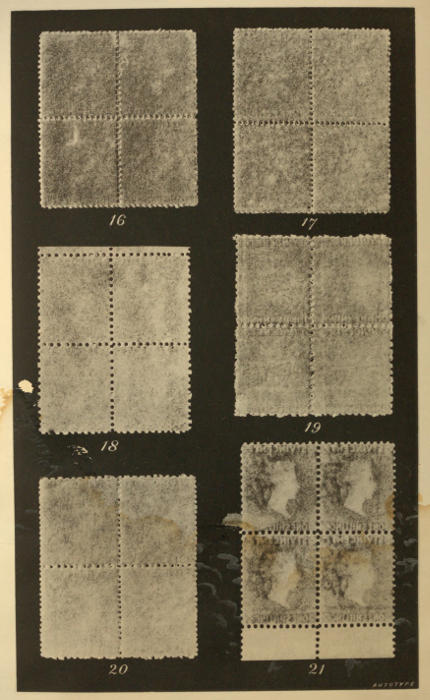
Our second plate of illustrations consists of six groups
of four unsevered stamps each. These are intended to
illustrate the various perforations of the A and B machines,
and as these are more easily studied on the reverse side
than on the face of the stamps, it is the backs of the groups
we have had reproduced. Nos. 16 and 17 show the work
of the A machine at two different periods of its career.
No. 16 is a group of four of the One Penny of 1861, when
the perforations made by the A machine were blind; and
No. 17 is a similar group of the One Penny of 1871, when
the pins generally pierced the paper.
These particular groups were selected by us for illustration
as showing a very marked contrast between the character
of the perforation of 1861 and that of 1871; but as
regards the latter, it is not easy to find such long lines
of perforations in which all the holes are pierced through,
as in the example we show in No. 17. In these two
particular instances, if the central lines of perforation be
gauged, the vertical line in No. 16 will be found to be
14 at the bottom and 14½ at the top. Its horizontal line
is 15 on the left and 14½ on the right. In No. 17 the
vertical line is 14½ at the bottom, higher up it is 15, and
at the top it is again 14½. The horizontal line of No. 17
gauges 15 throughout its length. It will be noticed that
in no one of these four lines do the two extremes of 14
and 15 both appear; but it must not be inferred from this
that such is never the case, and we have now before us a
group of four of the Six Pence of 1871, in which both
gauges of 14 and 15 are present in the same line, and
actually overlap each other. This group would not, however,
have been so suitable to illustrate the general character
of the A perforation in 1871 as the one we selected, since
the holes in it are only pierced through in parts of the lines.
Illustrations Nos. 18 and 19 show the work of the B
machine. No. 18 is a group of four of the Four Pence of
1866, and No. 19 a group of four of the One Penny of 1880.
These groups speak for themselves, both as regards the
irregularity in the spacing of the holes, and the different
character of the perforation at the two mentioned dates.
In No. 18, in the central vertical line, the space separating
the second and third holes, counting from the bottom, may
be contrasted with that between the eleventh and twelfth
in the same line, as this affords a good example of the
irregularity of the machine, and a little search will yield
many more such examples, both in No. 18 and in No. 19.
No. 20 is a group of four of the Six Pence of 1877, and
shows the compound perforation B×A. In this case the
later work of both machines appears. We should have liked
to have been able to illustrate the compound perforation
as it appears in 1866, when the machines made lines of holes
as in illustrations No. 16 and No. 18. The only stamp
available for this purpose would have been the One Shilling
of 1866, but we have been unable to procure a group of
four of these for illustration.
No. 21, which shows the De La Rue perforation 12, has
been given so as to allow of its comparison with the early
work of the B machine, as shown in No. 18, as it approximates
to it in gauge, is like it in character, and even faintly
imitates its irregularities. We shall revert to this perforation
in our notes to the Issues of Section II.
May 1861.
- 1d., bright rose-red, many shades from pale to deep.
- 6d., blue-green, slight shades from medium to dark.
These two values constitute the first issue for St. Vincent.
They were printed by Messrs. Perkins, Bacon & Co., and sent
out to the Colony on March 27th, 1861, the consignment
consisting of 934 sheets of the One Penny, and 167 sheets
of the Six Pence.[5] Both values were printed from plates
engraved in taille-douce, each plate consisting of 60 stamps,
arranged in six horizontal rows of ten. The paper used was
without watermark, either for the stamps themselves or in
the margins, and at least two very distinct sets can be made,
one on thick and the other on much thinner paper. The
texture is rough, and the colour greyish, sometimes slightly
toned by the yellowish gum. There can be no reasonable
doubt that the perforation of the first consignment was A,
for although we have no direct evidence to that effect, any
supposition other than this would involve us in such contradictions
that our belief on this point amounts to what is
practically a certainty.
We have inserted the imperforate varieties in the list, as,
although we have not seen a satisfactory used copy of either
value, both stamps have always been described in catalogues
from the earliest to the present time. They are, for instance,
so given in the catalogue of Mons. Alfred Potiquet, published
in Paris in December, 1861, and also in the first edition of
Mons. J. B. Moens’ Manuel du collectionneur de Timbres-poste,
which appeared early in 1862. We think, therefore, that
there can be little doubt that both stamps were issued in the
imperforate state. The only postmarked specimen that has
come under our notice is one of the One Penny, which is in
the “Tapling Collection.” This stamp has fair margins on
three sides, but is cut close on the right side, so that it cannot
be considered of quite unimpeachable authenticity. Messrs.
Perkins, Bacon & Co.’s books state that each lot of stamps
sent out to the Island was perforated and gummed, and this
applies to the first as well as to all the other consignments,
so that the specimens chronicled by early writers must
have come from sheets which were sent out imperforate
in error. Looking at the date these varieties were first
catalogued, they probably came from sheets out of the
lot despatched on March 27th, 1861. Some of the later
consignments seem also to have contained imperforate sheets,
as we have seen an entire one of the Six Pence, which came
out of the lot forwarded on June 15th, 1868. Of late years
quite a number of the imperforate stamps have turned up,
but we do not believe that any of these ever saw the
Colony, and in our opinion they stand upon very different
ground to the early chronicled varieties.
Altogether there is such an atmosphere of uncertainty
surrounding these imperforate varieties that, had it not been
for the references to them in the above-mentioned catalogues,
we should have been inclined to have excluded them from the
lists, and classed them either as proofs or trials for colour.
The variety of the Six Pence, imperforate vertically, is
noted from a horizontal pair recently in the collection of
Mr. F. de Coppet of New York, and which was sold at the
sale of his stamps on December 12th, 1894. The pair was
perforated all round, but imperforate between the two stamps.
1862.
- 6d., yellow-green, very slight shades, all deep.
This very interesting issue consists of one value only—a
yellow-green Six Pence—which not only differs in colour
from any other stamp of the same denomination on unwatermarked
paper, but has a perforation quite peculiar to
itself among the stamps of St. Vincent.
Hitherto when it has figured at all in any catalogue it has
been mentioned only as a shade of the green stamp of the
first issue, and as far as we are aware no hint has ever yet
been given that not only is its colour quite distinct from
that of any other Six Pence, but its perforation, being
unknown in any other stamp of the Colony, clearly points
out that it belongs to one particular printing, and that it is
important enough to rank by itself as a separate issue.
That it has remained altogether unchronicled up to now
is not exactly the case. In the Stamp Collector’s Magazine
of August 1863 it is stated “Saint Vincent. The green of
the Six Penny is of a different shade to what it used to be.”
This is the only chronicle of it which may be called contemporaneous;
but in the same periodical of August 1866, in an
article entitled “Postage Stamp Paper and Watermarks,”
the writer says, “St. Vincent. The pair of values belonging
to this Island, of which the green is found in two distinct hues,
seem unwatermarked.”
On referring to Messrs. Perkins, Bacon & Co.’s list of
printings we find that at the date, August, 1863, when it was
chronicled in the Stamp Collector’s Magazine, besides the first
consignment of March 27th, 1861, two other printings of
the Six Pence value had been made and sent out to the
Island. It is quite clear to us, from the marked difference
in colour and perforation between this stamp and any other
Six Pence, that it constituted a printing by itself, and
therefore in order to assign it a date we have to choose
between July 22nd, 1862, when 167 sheets, consisting of
10,020 stamps, were printed; and May 28th, 1863, when
the number of stamps was 40,080 in 668 sheets. Now
there can be no hesitation in saying that the probabilities
are enormously in favour of the smaller of these two
printings being the yellow-green Six Pence, seeing the
scarcity of this stamp even in a used state, the unused
stamp ranking as one of the rarest of the St. Vincents. It
is quite probable that it had been some time in use before
it was noticed by the writer in the Stamp Collector’s
Magazine; but, on the other hand, although it was sent
out to the Island in July, 1862, it may not have been
issued for some little time after that. On the whole we do
not think we can be far wrong in dating its issue 1862,
rather than in the early part of 1863.
Even if the distinctive colour of this stamp did not
make its identification very easy, its peculiar perforation
would do so. It is the solitary instance in Section I. in
which neither the A nor the B machine was used, but
a third machine, which we call “C.” This is hardly the
proper place for us to enter into a dissertation on the
various perforating machines that were employed by Messrs.
Perkins, Bacon & Co., and used by them for perforating
the stamps of the Colonies for which they held contracts;
but, at all events, the C perforation is to be found, not only
in this one St. Vincent stamp, but also more or less
frequently in those of Bahamas, Barbados, Ceylon, Natal,
Queensland, St. Helena, St. Lucia, Trinidad, and Western
Australia.
Like the A and B machines, the C machine was a
guillotine one, and like them its irregularities prevent us
from naming it by any particular gauge. It is generally a
rather regular 15½, but also frequently 15, and in some
instances we have found it to measure only 14½. It is
probable that this machine is also responsible for a perforation
of 16, said to have been seen in St. Vincent stamps. It
can never be mistaken for the perforation A, for not only
is its most frequent gauge a higher one than that to which
the A machine usually attains, but its pins, or plungers,
make clean-cut circular holes, smaller in size, but otherwise
just like the early perforations of the B machine, although,
from insufficient care and attention being paid to the
working of the machine, it is rather difficult to find
specimens that show the holes clean cut on all four sides.
This stamp, like those of the preceding issue, is found
on both the thin and the thick paper.
We give two illustrations of this stamp, Nos. 13 and 14,
which are taken from the only two unused specimens we
have ever seen, or heard of. No. 13 gauges 15½ on all four
sides; this is the gauge which is most frequently found in
stamps perforated by the C machine. No. 14 is perforated
15 at the bottom and right side; the top and left side are too
ragged to be measured with accuracy, but they appear to be
the usual 15½. The gauge of 14½ (and that of 16, if it
exists) must have been present in a very limited portion of
the line of pins, as it is very rarely met with.
Between 1863 and 1866.
- 1d., bright rose-red; many shades, from pale to deep.
- 6d., blue-green; very slight shades, all dark.
The two stamps constituting this issue differ in no respect
from those of Issue I., except in the perforation, which is
now B, or B×A, instead of A. It is not possible to say at
what precise date the B perforation first came into use.
One thing which is certain is, that it, as well as the
compound B×A, was known to philatelists as existing in
these two values before December, 1866, at which date both
perforations A and B as well as the compound B × A,
were described by a writer in the Stamp Collector’s
Magazine.
It follows from this that the B perforation must have
been used for one or more of the printings made before
this date.
Now if we turn to the table of the consignments
sent out to the island, we see that there had been in
all five printings of both values. The first of these,
that of March 27th, 1861, was the first issue, and, as we
have said, it was perforated A. The second, that of
July 22nd, 1862, was, as far as the Six Pence is concerned,
incontestably perforated C, and there therefore only remains
the printing of the One Penny of that date, and the three
printings of both values of May 28th, 1863, March 1st, 1865,
and March 14th, 1866. We think it more than probable
that when the B machine was first used both values were
perforated by it; and we therefore pass over the second
printing of the One Penny, and give 1863 to 1866 as the
date which most likely belongs to Issue 3. We are thus
able to antedate this issue at least three years, all previous
catalogues having given 1869 as the earliest date at which
the B perforation made its appearance.
It must not be inferred that after the B machine came
into use the A machine was discarded, or even that any
printing of either value was altogether perforated by the
same machine. The perforation A is much too common in
both values for it to be supposed for a moment that the
first issue only was so perforated. There were in all seven
printings of the One Penny, red, and five of the Six Pence,
blue-green, on unwatermarked paper, perforated by one or
other of these two machines; and as there is little or
nothing to choose in point of rarity between the two
perforations A and B in either value, it is to be presumed
that once the B machine had come into use both machines
were used indiscriminately for both values, as long as they
continued to be printed.
We are fortified in our opinion that more than one kind
of perforation was used for the same printing, by the
impossibility of believing that one whole printing of the
One Penny, red, was perforated B × A. This variety is
so scarce, that the number of specimens known to us can
literally be counted on the fingers of one hand. About
three years ago we unearthed two specimens from a dealer’s
stock. These were mounted on a card, and endorsed as
“very scarce” in the handwriting of the late Mr. E. L.
Pemberton. Two other specimens are known to us, and
all these four are used. It is not possible to believe that
18,000 of these ever existed, and that is the least number
of the One Penny ever printed at one time.
The Six Pence with the compound perforation is not
known to us, but we think it is a variety that may possibly
exist. The writer in the Stamp Collector’s Magazine, in referring
to this compound, unfortunately does not specify the
denomination of the stamp in which he had “occasionally”
noticed it.
As stated in our note to Issue 1, it is quite possible that
some of the consignments belonging to this issue, at any
rate of the Six Pence, contained a sheet or sheets that
missed being perforated.
August 1866.
- 4d., deep bright blue.
- 1s., dark slate-grey; slight shades.
- 1s., greyish-purple.
The plates for these two values were prepared by Messrs.
Perkins, Bacon & Co., early in July, 1866. They contained
30 stamps, arranged in three horizontal rows of 10, so were
just half the size of those used for printing the One Penny
and Six Pence values.
On July 28th a consignment of stamps printed from them
was sent out to the Colony. This consisted of 500 sheets
of each of the values; that is, 15,000 stamps of each
denomination.
The stamps must have been immediately put in issue, as
they were in use in August. They were chronicled in
October, both by the Timbre-Poste and the Stamp Collector’s
Magazine. The notice in the latter is as follows: “Within
the last month or six weeks the number of St. Vincent
stamps has been doubled by the emission of a Four Penny,
blue, and Shilling, purple-black.” In the Timbre-Poste the
colour of the Shilling is called “pourpre,” but in the same
publication of April, 1867, M. Moens calls the colour “ardoise.”
There is a further notice touching these stamps in the
Stamp Collector’s Magazine of December, 1866, which is worth
quoting in extenso, as it is a valuable contribution to our
knowledge as regards both the colours and perforations of
the stamps: “The newly-issued Four Pence and One Shilling
have come over with the late mails in entire sheets. The
colour of the former is a clear Prussian-blue, while the
latter varies, one sheet we have examined being a purple,
while the other is a deep slate without the tinge of red in
it, which makes a purple. The normal colour is evidently
one which requires great nicety in manipulation, a slight
difference in mixing forming the two shades, which are very
distinct. Like the Penny and Six Pence already known
these stamps are on thin woven paper, without watermark,
and perforated. The Four Pence is perforated by a machine
which removes a little circular piece of the paper, like that
in use for the English stamps, but the holes very much
wider apart. The sheets of the Shilling stamps are also
perforated by a machine, and show the following remarkable
peculiarity in the perforation: the horizontal lines which
sever the stamps from the rows above and beneath them
are, as in the Four Pence, perforated by a succession of
small circular holes cut or punched out, but the vertical
lines dividing the stamps from their fellows side by side in
the row are perforated (if that term be quite accurate) by
an instrument fixed in the machine, which leaves a series of
indentations much closer than the holes before alluded to,
and which does not remove a particle of paper, except in a
very occasional spot, hardly one in a thousand. On severing
the stamps by tearing, a rough indented edge is left on each
side; a ragged edge caused by the holes being too far apart
is left above and below. A similar difference has been
remarked by us in the former issues, specimens of each of
which, completely perforated by either method, may be
found, as also occasionally a copy showing both systems
on the same stamp.”
We have already in previous notes given extracts from
the above to show that the difference between the A and B
perforations was thoroughly understood by the writer, and
also that the B perforation and the compound B×A both
existed in the One Penny and the Six Pence previous to
December 1866. We learn from the same source that the
two colours of the One Shilling—what we have called
“dark slate-grey” and “greyish-purple”—appeared in the
same consignment; and, moreover, that part of this consignment
of the One Shilling was perforated A, and part
of it B×A, both of which statements are confirmed by
Messrs. Perkins, Bacon & Co.’s list. We have found the
greyish-purple very rare as compared with the other colour.
The One Shilling perforated B×A is certainly much
more common than the one with the A perforation, and the
greater part of the consignment probably consisted of the
compound. No other printings of either of the two values
were ever again made in these colours on the unwatermarked
paper. The Four Pence is a clear deep blue, and there are
practically no shades; but as it has a strong tendency to
oxidation, it is to be found in all sorts of deteriorated colours
up to nearly black. Out of the 15,000 printed, a great
number must have found their way into dealers’ stocks, as it
is quite as common unused as used. It continued in use for
some years after it had been superseded by a Four Pence of
a different colour. The Philatelist of February, 1873, that
is three years after the issue of the Four Pence, yellow,
says, “The colour of the Four Penny would seem to have
reverted to its original hue, our specimens just received by
the last mail being a full blue, but unwatermarked as far
as we can distinguish.” Were it not for the information we
have been fortunate enough to obtain from Messrs. Perkins,
Bacon & Co., this might lead us to believe that another
printing of the Four Pence, blue, had been made about the
end of 1872; but we know that this was not the case, as
only one printing of it was ever made, and the stamps
alluded to must have been some of the old stock that were
being used up. The One Shilling is given in the London
Philatelic Society’s Catalogue as perforated 11½ on all four
sides. We have not met with this variety, and do not
believe in its existence. If the specimen from which the
description was taken is one in the “Tapling Collection,”
as seems probable, the particular stamp proves, after
examination, to be merely an oxidised copy of the One
Shilling, indigo, of the following issue.
April 1869.
On February 27th, 1869, Messrs. Perkins, Bacon & Co.
sent out a consignment of 300 sheets (9,000 stamps) of the
One Shilling. Their records note no difference between the
colour of this stamp and that of the One Shilling of the last
issue—they call them both “purple,” although the difference
between them is really very great. We think the colour of
the new stamp, which is very deep, is best described as
“indigo.” The Stamp Collector’s Magazine, which chronicled
it in July, 1869, calls it “dark muddy-blue”; the Timbre-Poste
of a month earlier, “bleu-sale”; but the colour really
does not matter much, as there is no other stamp with
which it can be confounded. If any shades of it exist they
are certainly very slight, and probably due more to oxidation
than to any other cause. It only exists with the B
perforation.
We do not know exactly the month of its issue, but since
it was sent out late in February, and first chronicled in
June, it most likely came into use some time in April.
It is a much rarer stamp than the One Shilling of Issue 4,
especially unused, but this is what we might expect to find
when we consider that only 9,000 of it were printed, as
against 15,000 of the first One Shilling.
September 1869.
- 4d., deep bright yellow, slight shades.
- 1s., bright brown, slight shades.
On August 13th, 1869, a consignment of stamps of two
values—Four Pence and One Shilling—was sent out to the
Colony by the printers, the colour of the Four Pence being
altered from blue to yellow, and that of the One Shilling
from indigo to brown. The consignment consisted of 300
sheets—9000 stamps—of each value.
The One Shilling was the first of these to be chronicled
in the philatelic periodicals. It was noticed in Le Timbrophile
of September 30th, 1869, and in the Philatelist and the
Timbre-Poste of November, but the Stamp Collector’s Magazine
did not announce its appearance until the December number
of that year. It is therefore certain that the issue of the
One Shilling, brown, took place in September, and most
probably the Four Pence, yellow, was issued at the same
time, although the latter was not chronicled until November
30th, when it was noticed by Le Timbrophile, the other
three above-mentioned periodicals not chronicling it until
January, 1870.
The Philatelist, speaking of the change of colour, says
of the new Four Pence, yellow: “It is now in full
service, and proves to be of a very deep rich yellow.
The emissions of this Island, for some time two only, now
amount to a respectable figure, there being the slate, indigo,
and brown Shilling; a dark and light green Sixpenny; the
blue and the new yellow Fourpenny; and the Penny in
slightly varying shades of red. In addition are varieties of
perforation, one being pin-pricked, one fully perforated, and
some anomalously presenting both methods in the same
stamp. Such emissions as these must shut up all Pendragonites,
and puzzle the patronizers of Lallier’s and other
exclusive albums.” Here is additional evidence, were such
required, of the attention paid in those days by certain
writers and collectors to those minutiæ of stamp collecting,
which in the aggregate make up what is now understood by
the term “Philately.”
Like all the preceding issues these two stamps are on
unwatermarked paper, varying from thick to thin, and are
perforated B, with gum from yellowish to almost white.
The colours of each are nearly uniform, slight shades
only being found, the darker shades of the brown
Shilling being generally due to oxidation. Only this one
printing was ever made in these colours, and as this was
limited to 9,000 stamps of each value, it need not be a
matter of surprise that they are both fairly rare in the
unused state.
The One Shilling is described in Stanley Gibbons’ Monthly
Journal for December, 1891, as found perforated 11 by 15½.
We have examined the particular specimen by the kindness
of the owner, and the stamp turns out to be an unmistakable
oxidized copy of the vermilion-red Shilling of Issue 11.
This was the last issue of stamps for St. Vincent to be
printed on the unwatermarked paper.
June 1871.
- 1d., black, shades to grey-black.
- 6d., dull blue-green, rather pale in shade.
- 6d., dark blue-green, slight shades.
With this issue a radical change of paper took place, and
the new paper, which was watermarked with a star, continued
to be exclusively used as long as Messrs. Perkins,
Bacon & Co. supplied stamps to the Colony. It varies very
much in thickness; the thinnest variety is about the same
thickness as the thinnest of the unwatermarked paper, but
the thickest sometimes approaches card. This is especially
noticeable in certain issues, in which the thick paper predominates,
and we will refer to this subject in subsequent
notes.
The star of the watermark is a six-pointed one,
measuring 13 mm. from point to point across the star, and
the watermarks in the sheet are so spaced that when the
plate has been printed in register each star falls exactly on
the centre of a stamp. The lateral distance between the
stars from centre to centre is 20⅓ mm., and the vertical
24 mm.; these measurements of course correspond with
those of a St. Vincent stamp, plus one margin each way. All
the stars in the sheet are disposed with two opposite rays in
a vertical line—that is when the stamps are printed in the
normal position with regard to the paper. Personally we
have not much sympathy with the collection or cataloguing
of inverted or reversed watermarks, which we think tends
to the undue lengthening out and complicating of lists, to
no useful purpose whatever, but we may as well mention
that the star watermark is to be found sideways on all the
St. Vincent stamps printed on this paper. Of course when
in this position two opposite rays are in a horizontal instead
of in a vertical line. This peculiarity of position in the
watermark is not confined to St. Vincent stamps only,
among those of the Colonies for which Messrs. Perkins,
Bacon & Co. used the same paper, as in 1874 it was noticed
by philatelists in the stamps of Antigua. A correspondence
about the watermarks of these stamps took place early in
that year in the pages of the Stamp Collector’s Magazine, and
at about the same time the subject was discussed at a
meeting of the Philatelic Society, London. Those who
are curious in these matters will find all the particulars
given in the Stamp Collector’s Magazine, vol. xii., where it
appears from the letters printed that an idea prevailed that,
as concerned the stamps of Antigua, the paper with the star
sideways denoted a later issue. The explanation given by
the then President of the London Society was that the
change in the position of the watermark was due to “the
stars being turned when cleaning the plates, or when they
became worn.” This was rather far-fetched, not to say
grotesque, nor did it succeed in satisfying all the correspondents
of the Stamp Collector’s Magazine. The true
solution of the question is, that as the paper was sufficiently
large to admit of the plate being printed on it in either
position, the printer was quite indifferent as to how the
paper was placed, and were it not that this particular
watermark is a symmetrical figure we should doubtless occasionally
find it inverted, as well as sideways. A variety of
the One Penny, with one point of the star up, was indeed
chronicled with “inverted” watermark in the Stamp Collector’s
Magazine, vol. xii., p. 95, by the same writer who noticed the
two different positions of the stars we have just alluded to.
The design of the watermark was, however, such that it
made no difference which end of the sheet was put first
into the press, and it passes our comprehension to know
how an inverted watermark could therefore be distinguished.
Although all the stars in St. Vincent stamps are of the
same size, owing to the “bits” being hand-made they vary
a little in shape, and we have seen faulty ones having one
or more rays with the points broken or twisted out of their
proper direction. Besides this there are two rather distinct
varieties in the shape of the star. These exist side by side
in the same sheet. In the star more usually found all the
six rays are of similar size; in the other variety the two
opposite rays in the vertical line are narrower at the base
than the other four, so that they are thinner throughout
their length, and end in a more acute angle. This last
variety of star is in shape almost exactly like the larger
stars found in the paper used by the same firm for printing
the stamps of South Australia and certain other Colonies.
In the thicker varieties of paper it is sometimes very
difficult to see the watermark. This is especially the case
when the specimens are unused and have the gum intact.
The change in the colour of the One Penny from red to black
marked that stamp at once, so that we find its advent
recorded in the Stamp Collector’s Magazine of September
1871, and in the Philatelist and Timbre-Poste of the following
month, the last-named periodical being the only one to
mention the watermark or perforation, which last was given
as 14½. We learn from the list of Messrs. Perkins,
Bacon & Co. that the consignment was sent out on March
28th, 1871, and consisted of 300 sheets (18,000 stamps) of
One Penny, black, and a like number of Six Pence, green;
and, since the One Penny was chronicled in September, we
may assume that the issue took place some time in June.
There can be little doubt that the Six Pence was issued
with the One Penny, although it was unnoticed at the
time by philatelists, probably because the colour was
unchanged, and the watermark, owing to the thickness of
the paper, not readily seen. It was not until September,
1872, that it was chronicled by M. Moens in the Timbre-Poste,
which is the only record of it we can find in any
of the philatelic periodicals.
The One Penny, black, is found with two varieties of
perforation—A and B × A. It continued in use from the
date of its issue, in 1871, until the colour was changed in
1880. Nine printings of it were made, and the last consignment
was sent out on August 28th, 1878, making in
all the large total of 6000 sheets, or 360,000 stamps. The
great majority of these must have been perforated A,
since the compound B × A is very much less common,
and is even rather scarce unused. We do not know in
which particular printing this last variety of perforation
occurred. We have the authority of the Timbre-Poste that
some at least of the first consignment were perforated A,
and the sample stamp attached to the entry in the books of
Messrs. Perkins, Bacon & Co., referring to the despatch of
the last consignment in 1878, is also perforated A. In the
absence of further information we have, however, catalogued
both the two varieties of perforation as belonging
to Issue 7.
The Six Pence, green, of which only three printings
were made, is always perforated A. It is generally in a
blue-green colour, identical with that of the Six Pence,
blue-green, of previous issues on unwatermarked paper.
It is sometimes, but rarely, met with of a dull green hue,
rather pale in shade, and nearer a yellow-green than is
the ordinary colour. We have only found one unused
specimen of this stamp, nor have we seen many used
ones, so we are still a little doubtful whether it is an
original colour or not.
There is a rather mystifying chronicle of another green
Six Pence in the Timbre-Poste of January, 1876, which was
copied by the Philatelist, and which we think it as well
to refer to here. M. Moens appears to have overlooked
the fact that he had already, in 1872, mentioned the Six
Pence, green, with Star watermark—“Le 6p. vert arrive
avec étoile en filagramme et piqué 15”; and in January
1876 records it again as “6p. vert foncé piqué 15.” At
this time no printing of the Six Pence had taken place
since March 1875, so what M. Moens saw could not have
been a new variety, and was probably only a specimen,
rather darker than usual, of the same stamp he had
already chronicled in 1872.
A horizontal pair of the One Penny, black, with no
perforation between the stamps, was sold at the sale of
Mr. M. P. Castle’s collection of British and Colonial
stamps, on May 2nd, 1889, the pair being described
erroneously in the catalogue as imperforate horizontally.
M. Moens, in his Catalogue Prix Courant, gives the same
stamp as existing imperforate, but not having been able
to verify it we have omitted it from our list.
June 1872.
- 1s., bright rose-red, shades.
- 1s., deep rose-red, slight shades.
- 1s., dull red, shades, sometimes with a tinge of yellow in it.
We now come to a series of issues of the One Shilling,
which present a good deal of difficulty to collectors, because
of the number of colours and shades they contain, all rather
closely resembling each other. They are not easy to describe
in print, so as to be properly understood, owing chiefly to
the great divergence of opinion on the subject of the names
of colours, when these are closely allied.
On April 13th, 1872, Messrs. Perkins, Bacon & Co.
despatched 9000 stamps in 300 sheets of the One Shilling
value printed in a colour they call in their books “pink,”
but this is a description we put out of court at once,
especially as the sample stamp in the firm’s books is a
rose-red one.
In addition to the sample stamp, Messrs. Perkins, Bacon
& Co. possess an imperforate proof sheet of the stamp in the
same colour, but upon unwatermarked paper. This sheet is
inscribed on the margin “Patterns for colour. Postage
Pink, small quantity of Drop carmine-lake about ½ oz.
for 300 sheets.” The technical name of the colour appears
consequently to be “carmine-lake.”
The first chronicle of the issue was in the American
Journal of Philately of August, 1872, which was quoted by
the Timbre-Poste of September. The Philatelical Journal of
September says that they have accidentally omitted to
chronicle it in August. We give June as the probable date
of issue.
As regards the colour of the stamp, the Philatelist of
October, when chronicling its issue, says that “the colour is
precisely that of the rose penny,” but in the following month
it adds to this statement that other specimens have been
seen, “all deeper in hue than the penny ones of the same
colour.” This, as far as it goes, agrees exactly with our own
experience, which is that there are specimens in shades
of bright rose-red, all of which may be found in the bright
rose-red One Penny of Issues 1 and 3, but that there are
others in a deeper rose-red of a slightly different colour,
never seen in the One Penny, and due to something more
than mere depth of shade. Besides these two colours we
find a third, which we have called “dull red,” differing from
both of them, and in which a faint tinge of yellow is sometimes
to be seen, as if it were turning somewhat towards
vermilion. There was only one printing made of this One
Shilling, rose-red or dull red, but we have already seen in
the case of the One Shilling of Issue 4 that more than one
colour may exist in the same printing, from causes connected
with the mixing of the ink. The paper of this issue is
sometimes found more or less toned by the action of the
gum, which seems always to be yellow, and never white;
this affects the appearance of some specimens, and adds
considerably to the difficulty of limiting the number of
colours even to three.
By far the greater number of the stamps of this issue
are perforated B. We have seen very few indeed perforated
B × A, and all these have been bright rose-red in colour.
The only periodical which in chronicling the stamp gave the
perforation was the Philatelical Journal, which says that it
is “perf. circ. 14½ to 15½” which we would call A; but
in 1872 compound perforations were ignored, and the usual
plan was to measure only the long side of a stamp, so this
record of the perforation probably corresponds to our B × A,
as the stamp does not exist perforated A alone, so far as we
have been able to discover. The sample stamp kept by the
printers is perforated B.
This One Shilling is a very scarce stamp in the unused
state.
Early in 1874.
We learn from the books of Messrs. Perkins, Bacon & Co.
that on July 28th, 1873, they sent out to the colony a consignment
of 300 sheets—9000 stamps—of a One Shilling
which they call “pink,” as they did the rose-red One
Shilling of the 1872 printing. Fortunately the sample
stamp attached to their book is there to show us what
it was they sent out, and we find it to be a violet-rose
stamp perforated, as are most of this issue, B × A. In
few other cases in St. Vincent have the records of the
firm been of more use to us, as the stamp remained unchronicled
by the periodicals until quite the end of 1874,
and their various descriptions of its colour are extremely
misleading.
At the same time, it seems almost impossible that had
it been issued at once on its arrival in the island, its
existence should have been unsuspected by all philatelic
writers for a period of more than a year, as it was not
until September, 1874, that the first chronicle of it was
made in the Timbre-Poste, where M. Moens calls its
colour “rose-sale”; and we are therefore inclined to
believe that its issue was delayed for at least some
months, perhaps until the early part of 1874.
Its colour is a pale violet-rose, always of uniform shade,
but, as the stamp has a strong tendency to oxidation, some
very dark specimens may be found in which the colour
has greatly deteriorated.
Like the One Shilling of the preceding issue, it is found
perforated B and B × A. It is scarce unused, and we have
seen very few specimens perforated B, all of which have
been used ones.
1875.
- 1s., dark claret, very slight shades.
This One Shilling was printed and sent out to the Colony
on March 27th, 1875. The consignment consisted of the
same number of stamps as those of the last two issues.
It is not clear in what month its actual issue took place.
It was not chronicled until the Timbre-Poste noticed it
in January 1876, where the colour is called “lie-de-vin
foncé.” In their books the printers still adhered to the
term “pink,” but although no sample stamp of this
printing was preserved, we can be quite certain that it
consisted of 300 sheets of One Shilling, dark claret, as
both the other two printings of “pink” Shillings have
been accounted for.
In colour it is a rich dark claret, with very slight shades,
and even most of these are due to the deep toning of the
paper, as the gum used is always the darkest to be found
in St. Vincent stamps, and the paper is invariably more
or less deeply stained. The perforation is always B.
Although no more of this issue were printed than of
the One Shilling, rose-red, or the One Shilling, pale violet-rose,
it is rather more common unused than either of those
two stamps.
February 1877.
- 6d., pale yellow-green.
- 1s., bright vermilion-red.
The two values in changed colours were sent out to St.
Vincent by the printers on December 30th, 1876, the
consignment consisting of 300 sheets of each value; that
is, 18,000 stamps of the Six Pence value and 9,000 of the
One Shilling. They were both chronicled by the Timbre-Poste
of April, 1877, and must have been issued some time
in February. The Six Pence remained current until the
middle of 1880, and the One Shilling as long as Messrs.
Perkins, Bacon & Co. supplied stamps to St. Vincent.
Besides the printing of the two values in December, 1876,
one other printing of the Six Pence and two of the One
Shilling were made. The second printing of each value was
sent out on August 28th, 1878, and the third printing of the
One Shilling on May 13th, 1880. All these printings
consisted of 300 sheets each, so that the total printed of
the Six Pence of this issue amounted to 36,000, and that of
the One Shilling to 27,000 stamps. In the printers’ books
sample stamps are attached to all the entries referring to
these printings, with the exception of the second lot of
the One Shilling. The samples of the first printing are
perforated B × A in both values; in that of 1878, the
second printing of the Six Pence is perforated A, and
the One Shilling of the 1880 printing is perforated B.
We have seen from the case of the One Shilling of Issue
4 that more than one variety of perforation (and even of
colour) may exist in the same printing, nor is it to be
expected that in such cases samples of each variety
would be preserved by the printers, since differences of
perforation are more appreciated in philatelic than in
printing circles. There is, however, a circumstance connected
with the perforation of the vermilion Shilling
which leads us to believe that the stamps of all these
printings were perforated only as shown in the sample
stamps of each consignment. We know that in 1881 the
third printing of the vermilion Shilling was utilized for
making a provisional stamp of Four Pence, and that all
these provisionals are perforated B only. We therefore
think it probable that all of the One Shilling value
perforated B × A belong to the first printing, and all
perforated B to the second and third, more especially as the
stamp perforated B is much the commoner of the two
varieties. We have extended this theory to the Six Pence
as well, and in the Reference List we give in brackets after
each variety the probable date of issue of the different
perforations.
One thing that is remarkable about the colours of both
these stamps is that there are no appreciable shades of either,
the colours being maintained unchanged in all the printings
of each value, although in the books of Messrs. Perkins,
Bacon & Co. the colour of the first two printings of the One
Shilling is called “scarlet,” and that of the third “bright
red.”
In the unused state the Six Pence is very much rarer
perforated A than with the compound, but the converse
is the case with the One Shilling, in which B × A is by far
the rarer perforation. The paper of the stamps of this issue
varies a great deal in thickness, but this is more pronounced
in the Six Pence than in the One Shilling, as the former
value is met with on what can only be described as thin
card.
Both values, as well as the One Penny and Six Pence of
Issue 7, and other stamps current during the later years
the stamps of Issue 11 were in use, are not uncommonly
found with a curious obliteration of an upright oval,
pointed at the top and bottom, and divided across the
centre by a double line. The upper part contains the letters
“G.B.,” and the lower “40 c.” The cancellation made its
appearance upon these three stamps about the end of 1878,
or early in 1879, and was first thought to be a surcharge.
The credit of its explanation is due to the editor of the
Foreign Stamp Collectors’ Journal, who made enquiries at the
Post-office, and who stated in the numbers of that journal
for December, 1879, and July, 1880, that “in addition to the
ordinary mail steamers from the West Indies, letters are
conveyed to England by the French Packets running
intermediately. These letters are stamped as above; the
G.B. signifying ‘Grande Bretagne,’ and the 40 C., the
amount payable to the French Post-office for their services.”
“The stamp ceased to be employed for its original purpose
some time ago, but is now used instead of the ordinary
cancellation stamp, which is worn out.” Its use as an
obliterating stamp must have been continued at least up to
some time in 1882, as we have frequently seen it on the
Halfpenny orange of Issue 18, a stamp which was not issued
until December, 1881.
July 1877.
A consignment of 200 sheets—6,000 stamps—of the Four
Pence value, printed in very dark deep blue, was sent out
to St. Vincent on May 29th, 1877. In the absence of any
evidence to the contrary, we have no reason to doubt the
stamp was immediately put in issue, and that it was first
used in July of the same year, but had it not been for the
record in the books of the printers, we should have had a
good deal of difficulty in assigning a date to it. Most of the
principal catalogues, including the London Society’s list and
the current edition of M. Moens’ Catalogue Prix-Courant,
give 1876 as the date of issue, but the stamp is not
catalogued in the 1877 edition of the last mentioned work.
The solitary chronicle of it we can find in philatelic
literature is in the Timbre-Poste of May, 1878, where we
find it recorded in the following terms: “Réapparition du
4 pence, en bleu foncé, mais avec étoile en filagramme.”
We think it far more likely that the fact of the stamp
being on watermarked paper should have escaped the notice
of M. Moens, than that its issue should have been delayed
for nearly a year after its arrival in the Colony. The one
printing of the Four Pence yellow had been a small one; it
consisted of only 9,000 stamps, as compared with 15,000 of
the Four Pence blue, on unwatermarked paper, issued in
1866. We do not know for what reasons the postal authorities
had changed the colour of this value from blue to
yellow, but they could not have been very important ones,
as the blue Four Pence of Issue 4 was, as we have seen,
undoubtedly still allowed to be used in 1873—that is, about
four years after the introduction of the Four Pence, yellow,
so it is evident that the use of the two stamps was concurrent
for some time at least. It is stated in the London
Society’s West Indian Catalogue that the Four Pence value
became “disused,” but this cannot have been the case, as we
have the evidence of postmarked specimens of the yellow
Four Pence that it was in use in July, 1876, and we know
that a fresh supply of the value was sent out in 1877.
There is therefore every reason to believe that although the
Four Pence, deep blue, of the issue now under consideration
had probably been seen by M. Moens when first issued, he
mistook it for the old blue Four Pence that was still being
occasionally used, and it was not until 1878 that he discovered
the difference in the paper, and chronicled the watermarked
stamp in the Timbre-Poste. There is every excuse to
be made for this temporary omission, as the great majority
of the issue is printed on the very thick variety of paper
which approaches thin card, and it is a matter of great
difficulty to detect the watermark in this paper, even when
it is known to be there.
There was only one very small printing, 6,000 stamps,
made of this Four Pence, and so it is naturally very much
rarer than either of the two stamps of the same denomination
previously issued. In addition to this, its rarity unused is
even out of all proportion to the smallness of the printing,
and we may be certain that since it was unchronicled in the
philatelic publications of the day it was not put into stock
by the dealers, and that the unused specimens we occasionally
find have been preserved by accident rather than by
design.
It is always perforated B, and the colour, which would
alone distinguish it from the Four Pence of Issue 4, shews
no shades, except those due to oxidation, to which it has a
certain tendency.
May 1880.
- 1d., in red on half 6d., dark blue-green of Issue 7.
This is the first of a very interesting and important series
of four provisional stamps that were made in St. Vincent,
in 1880 and 1881, to supply a temporary want of certain
values. From information received from Mr. Frank W.
Griffith, late Acting Colonial Postmaster, and already
published in the West Indian Catalogue of the London
Society, we know the date of issue of the provisional One
Penny was May, 1880, and that the number of stamps issued
amounted to 1,800. Reference to Messrs. Perkins, Bacon
and Co.’s list of consignments shows that the last printing
of the black One Penny had been sent out in August, 1878,
and it is evident that another supply of the value had
already been ordered, but not received when this provisional
was made, as the new One Penny, printed in grey-green, was
only despatched from London on May 13th, 1880.
The stamp used for surcharging was the dark blue-green
Six Pence of Issue 7, perforated A, a remainder being in
hand, probably from the last printing of March, 1875.
In those days surcharged stamps, especially in British
Colonies, were not so common as unfortunately they have
subsequently become, and were much appreciated by philatelists,
as may be seen by the tone of the writer who
chronicled the provisional One Penny in the Philatelic
Record of July, 1880. “A very curious provisional stamp,
forming a fit pendant to the makeshift 1d. employed in
Barbadoes in 1878, has been used recently, but may by this
time have become obsolete. The postal authorities of St.
Vincent have treated their 6d. value in the same way as the
Barbadians did their 5s. stamp—perforating it down the
centre, and surcharging each side with 1d. in red, the
numeral being 8 mm. in length.” The writer then goes on
to say that the central line of perforation is clean cut, and
gauges 12, which is quite correct, and records a fact worth
bearing in mind when examining doubtful specimens, as the
forgers have found the perforation much more difficult to
imitate than the surcharge. Unfortunately our illustration
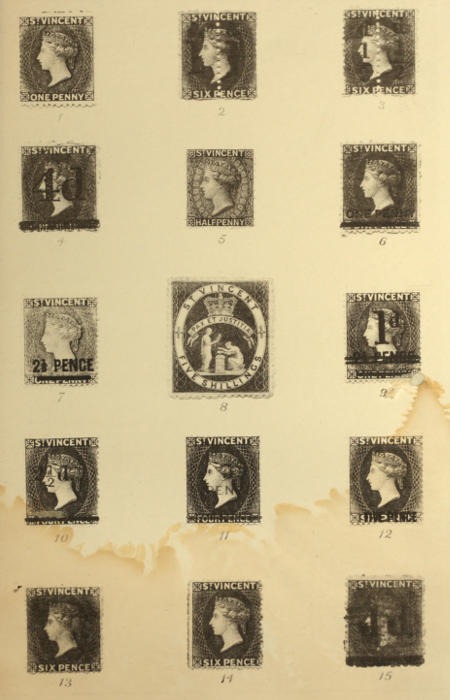
of this stamp, No. 2, is not as clear as we could have wished,
owing to the red and green colours not lending themselves
readily to photography—so we give the measurements of the
surcharge, which are as follows: Height of figure, 8¾ mm.;
width of figure, 1½ mm.; length of foot of figure, 3½ mm.;
height of “d,” 3 mm.; extreme width of “d,” 2 mm.; space
between “d” and figure, 1½ mm.; space between figures on
right and left halves of the same stamp, 8½ mm. The figure
“1” has a straight serif. These details will help to protect
collectors against at least the more ordinary forgeries, but
the gauge of the perforation and its regular clean-cut
circular holes are really the crucial tests, as some of the
surcharges are heavily printed, and are difficult to measure
with accuracy. A description of the forgeries known to us
would be of little use. They all fail in the perforation, most
of them in the dimensions of the surcharge, and one rather
dangerous one we recently discovered has the figures on the
two halves of the stamps wrongly spaced. The one most
likely to be met with is the least dangerous, as it has a large
cross stroke to the top of the figure, instead of a serif,
besides being wrong in many other particulars. This
forgery is evidently copied from the illustration in a well-known
catalogue, and not from the stamp itself.
This provisional One Penny has always been a rare stamp,
especially unused, or in pairs; none of the issue seems to
have found its way into dealers’ stocks, but to have been
all used up for legitimate postal purposes, so that a great
part of it must have been destroyed, and only a small
proportion of the original 1,800 saved for philatelic purposes.
June 1880.
- 1d., pale grey-green.
- 6d., bright yellow-green.
- 5s., deep rose-red.
On May 13th, 1880, Messrs. Perkins, Bacon & Co. sent
out 1000 sheets (60,000 stamps) of the One Penny, printed
in pale grey-green, 300 sheets (18,000 stamps) of the Six
Pence, printed in bright yellow-green, and 100 sheets (2,000
stamps) of a new value—Five Shillings, printed in deep
rose-red. In this consignment was included the third and
last printing of the One Shilling bright vermilion-red. All
the three first mentioned values were perforated B only,
this we know because no other variety of perforation exists
in any of these stamps, the issue of which was in all three
cases confined to this one printing. We think this is a very
good reason for believing that the printing of the One
Shilling that was made at the same time was like them
perforated B only, and that at this date the use of the
A machine had been discontinued for ever, as far as the
stamps of St. Vincent are concerned.
The printings of both the One Penny and the Six
Pence were small ones. The former value must have been
used up quickly, as a new supply was ordered in the next
year; we may, therefore, expect this stamp to become much
scarcer than any of the same value that preceded it, and of
which such a large quantity were printed.
The Six Pence was the last of that value to be printed
by Messrs. Perkins, Bacon & Co., and it remained current
for more than three years, until October, 1883, when it
was succeeded by a stamp printed by Messrs. De La Rue
& Co. About a fifth part of the printing was used in 1881
for making provisional stamps of the One Penny and Halfpenny
values.
It is rather a scarce stamp, even in a used state, and is
decidedly rare unused, it being one of the St. Vincent
stamps the dealers appear to have neglected.
The Five Shillings value is a striking stamp, both in
its size and design, which is very artistic, and it is altogether
a fine example of the line-engraved work of its makers,
Messrs. Perkins, Bacon & Co. The central portion of the
design portrays the Arms of the Government of St. Vincent,
and represents “Justice pouring out a libation to Peace,”
which illustrates the motto of the Colony, Pax et Justitia—“Peace
and Justice”—given on the scroll above the
Arms. The plate contained twenty stamps, arranged in
four horizontal rows of five, and the same star paper was
used for printing the issue as for the other stamps of
smaller dimensions; the consequence of this being that
each stamp is watermarked with at least more than one star.
There seems to have been very little demand for the stamp
for postal purposes in the Island, and genuinely postmarked
specimens are now of great rarity. Used Five Shillings
stamps have always been eagerly sought for by philatelists,
who for many years declined to have anything to do with
unused specimens, as they looked upon the stamps as fiscals
only. This belief seems to have arisen from the way they
were chronicled in the Philatelic Record of August, 1880,
which said—“The 5s. fiscal stamp has lately been used for
postal purposes.” The Timbre-Poste, in announcing the stamp,
quoted from the Philatelic Record, and so the error came to
be perpetuated, until the true character of the stamp was
explained in the London Society’s West Indian Catalogue,
published in 1891. In that work will be found an official
notification, dated 15th September, 1882, in which it is
called “the existing five shilling postage stamp,” and in
which it is directed to be “over-stamped Fifty Pounds—Revenue,”
and “used as a Revenue stamp of that value.”
Its use as a Revenue stamp was not confined to this
high denomination, as it exists with “Revenue” only on it,
and fiscals with this surcharge are fairly common. We are
of opinion that the great majority of the 2,000 stamps
printed were so treated, and that only a very small number
were ever used for postage, or escaped the fiscal surcharge.
This readily accounts for the great rarity the stamp has
acquired of recent years, and this rarity cannot, we think,
but increase still further in the future.
The official notification quoted above contains a clause
which “directs that the present six penny postage stamps
may be cut diagonally in half—each half to be over-stamped
3d. Revenue, and be used as a revenue stamp of that value.”
It was further used, with the surcharge “Revenue,” as a
fiscal Sixpence. This fiscal use of the Six Pence, bright
yellow-green, of Issue 14, is an additional reason for its
now being so rare in an unused state.
September 1881.
- ½d. in red on half 6d., bright yellow green, of Issue 14.
The necessity for a Halfpenny value arose from the Colony
of St. Vincent having joined the Postal Union on September
1st, 1881, and, pending the arrival of the stamps ordered
from England, this provisional was made in the Island by
dividing the Six Pence of the last issue by a vertical line of
perforation through the centre, and surcharging each half
stamp “½d.” in red, the additional perforation being the
same as that of the provisional One Penny of Issue 13.
It was thus chronicled in the Philatelic Record of October,
1881: “St. Vincent, proud apparently of her provisional
One Penny, which has eluded the grasp of so many collectors,
has provided herself with a Halfpenny makeshift, which is
as like it as possible. The current Sixpenny stamp has been
perforated down the centre, and each half surcharged ½d. in
red. We have only, as yet, seen a single specimen, but
there may be almost as many varieties as there are stamps
to the sheet.” This surmise of the writer, fortunately for
collectors, turned out to be incorrect, as there are practically
no varieties on the sheet, except one in which the serif
of the figure “1” of the fraction is straight, instead of
being curved as in the other figures on the sheet. Beyond
this there are no varieties of the surcharge, save in very
slight differences in the position of the fraction line, due
to the surcharge being type set. Our illustration No. 3
shows the variety with the “1” with straight serif on the
right half of the Six Pence. It will also be observed
that this surcharge is on a slightly higher level than its
neighbour on the left half of the same stamp. It may also
be noted that the surcharges were not always printed fairly
in register with the sheet, so that each one fell exactly
in the centre of a half stamp, as we have seen a used
specimen of a right half stamp, which shows portions of a
second surcharge down the line of perforation on the right
side of the stamp.
A variety of this stamp, with the fraction line of the
surcharge omitted, is reported to us from the United States,
but not having been able to verify for ourselves whether the
surcharge is genuine or not, we have omitted it from our
Reference List.
There were twelve sheets (1,440 stamps) of these provisionals
printed, but not many were issued for use, and we
believe they were withdrawn from issue before the arrival of
the new Halfpenny value in December. It is an excessively
rare stamp used, and at the date of its issue and for some
considerable time afterwards it was unattainable unused.
We believe this was owing to an official order to the effect
that neither stamp collectors nor dealers were to be supplied
with it. Whether this order was eventually rescinded, or
fell into abeyance in the course of time, we do not know;
but one thing is certain—that philatelic persistence
triumphed in the end, and that the unused remainder of the
issue found its way at last into the hands of philatelists,
so that now it is not at all a rare stamp in the unused state.
For this reason, and because the unused Six Pence itself is
so difficult to find, the forgers have not been so busy with it
as with its predecessor, the provisional One Penny; but
forgeries of it do exist, and for the satisfaction of our readers,
we give the dimensions of the surcharge. The extreme
length from the top of the letter “d” to the bottom of the
numeral “2” is 16½ mm.; the height of the letter “d” is
4 mm.; the space between the “d” and the figure “1” is
2 mm.; the height of the figure 1 is 4 mm.; the space
between the figures “1” and “2” is 2½ mm.; the height
of the figure “2” is 4 mm.; and finally, the width of the
letter “d,” without measuring the foot, is 2¼ mm. These
measurements all vary a little according as the surcharge
is lightly or heavily impressed.
November 1881.
- 4d. in black on 1s., bright vermilion-red, of Issue 11.
Four Pence being one of the Postal Union rates, the
stamps of that value remaining in hand from the issue of
July, 1877, were soon used up, and in November, 1881, the
new lot of the Four Pence value not having yet come out
from England, 21 sheets (630 stamps) of the vermilion-red
shilling perforated B were surcharged in the Island with a
large “4d.” in black, and issued as provisionals. The original
values were obliterated by black bars, 2 mm. wide, printed
across the sheet. The Philatelic Record of December, 1881,
says: “St. Vincent.—Since this Colony joined the Postal
Union there has, of course, been a demand for Four Penny
stamps. Those used hitherto have been blue, like the issue
of 1866, and not yellow, like those of 1869. They were not
remainders of the 1866 issue, but stamps reprinted in a
brighter shade of blue, and perforated in the rough way
which has lately distinguished the stamps of St. Vincent.
By the mail delivered here on the 13th inst. we have
received letters franked by a provisional Four Penny
adhesive, formed by surcharging the current scarlet Shilling
4d., and obliterating the original value by means of a
bar.”
We now see how deep was the mystery enshrouding the
Four Pence on star paper of Issue 12, when the editor of
the leading English philatelic periodical had been ignorant
of its existence up to this time, and even then failed to
perceive any difference, except in the perforation, between
it and the Four Pence of 1866.
The provisional Four Pence has always been a very rare
stamp; and it is probably much scarcer than it is generally
credited to be, as it has been a favourite with the forgers of
all nations, who have in some instances been able to produce
articles that pass current as genuine even in circles believing
themselves to be well-informed. We refrain, for several
reasons, from giving the measurements of the surcharge.
First, because, owing to the “4d.” being generally deeply
indented in the paper, it is not at all easy to measure it
with accuracy; and also because, as regards dimensions,
there is a very dangerous forgery frequently met with,
which is not to be detected by any amount of measurement,
however carefully done, and which can only be distinguished
by careful comparison. Particular attention must be paid
to the shape of the different angles of the figure “4,” and
especially to the contour of the top of that figure, and to the
way in which the slanting stroke joins the horizontal and
the vertical ones. The forgery alluded to fails in these
particulars, but it is like the genuine in this—that it is
heavily printed, although not quite so deeply indented as
the genuine is sometimes found.
Our illustration, No. 15, represents a well-known forgery
of British manufacture, which has been kindly lent to us
for the purpose by a gentleman to whom it was presented
by the artist himself as a specimen of his skill. This is a
much easier forgery to detect than the one we have just
been speaking about, as it is generally accompanied by a
forged postmark, and is altogether too smoothly printed.
Its measurements are also incorrect, the foot of the figure
“4” being fully ½ mm. too long. There are a good many
specimens of this latter forgery in circulation.
Another point to which we direct attention is, that in the
genuine stamps the black bar across the sheet begins on the
left exactly flush with the left of the figure “4” of the left
hand stamp of the row, and ends exactly under the right
edge of the tail of the letter “d” of the right hand stamp.
It follows from this, that when the surcharges have been
printed in register with the sheet, the three stamps of the
left hand vertical column and the corresponding three on
the right have the words of value only partly obliterated,
the bar under the “4d.” only reaching part of the way
across the label containing the original value.
December 1881.
- “One Penny” in black on 6d., bright yellow-green, of Issue 14.
This provisional, which was also surcharged in the Island,
was probably issued on the 1st of the month. It was
chronicled in the Philatelic Record of January, 1882, and the
editor of that periodical notes a specimen postmarked
“2nd December 1881.”
The issue consisted of 27 sheets (1,620 stamps) of the
Six Pence, bright yellow-green, of Issue 14, surcharged
“One Penny” in block capitals. The length of the surcharge
is 18 mm., and the height of the letters 2 mm. The
original values are obliterated by black bars on the sheet,
placed exactly the same as those described in our note to
Issue 16, but only 1 mm. in width instead of 2 mm.
It is not nearly such a scarce stamp as the provisional
Four Pence, or the One Penny of Issue 13; but it is rarer
than the Halfpenny of Issue 15, except when this last is in
the used state.
A number of the provisional One Penny of this issue
came over unused to English dealers after the stamp had
been withdrawn from use, just as in the case of the provisional
Halfpenny. Used specimens were at first very
scarce, but to remedy this deficiency a certain number of
these unused stamps were reshipped to an agent in St.
Vincent, and came back through the post in instalments
during the course of 1883 and 1884, whenever their owner
had a demand for used specimens. This explains the late
dates seen on some of these stamps. At the present time
there is nothing to choose in point of rarity between used
and unused specimens.
There are a good many foreign-made forgeries of this
surcharged One Penny, but all we have seen have been very
poor attempts, and none of them have ever been made on
the right stamp, the one usually selected for forging being
the pale yellow-green Six Pence of Issue 11.
We think this is the proper place to note a curious stamp
that has just reached our publishers from the United
States. It is the left half of a bright yellow-green Six
Pence of Issue 14, which stamp has been divided in half by
a vertical line of perforation gauging 12. This half stamp
is surcharged “D/1” in red, and is postmarked, apparently
over the surcharge. The extreme height of the surcharge is
8½ mm.; the height of the figure “1” is 5 mm., and its
width ¾ mm.; the height of the letter “D” is 2¾ mm., and
its width 2¼ mm. The figure “1” has a long serif, slanting
downwards, and a foot like that of a Roman figure “I.”
We do not like to hazard an opinion as to what this
stamp may be, but we think it right to place its existence on
record, as the perforation which has divided the stamp has
been, in our opinion, done by the same official machine that
performed the same operation, not only on the postal
provisionals of 1880 and 1881, but also on the fiscals that
were made in 1882 by dividing diagonally this same Six
Pence of Issue 14, and surcharging each half “3d. Revenue.”
It was expressly forbidden in St. Vincent to make use of
postage stamps for fiscal purposes, unless they had been
overprinted “Revenue”; this stamp, if genuine, cannot
therefore have been intended for anything but postage. It
may have been experimentally prepared in December 1881,
when a provisional One Penny was required, and rejected in
favour of the one actually issued; but farther than this we
cannot go. We are sorry that this interesting stranger has
reached us too late for illustration.
December 1881.
- ½d., orange-yellow, shades from pale to deep.
- 1d., drab, slight shades.
- 4d., bright ultramarine.
The consignment of these three stamps, which was sent
out on November 16th, 1881, consisted of 1000 sheets
(60,000 stamps) of the Halfpenny, 1000 sheets (60,000
stamps) of the One Penny, and 500 sheets (15,000 stamps) of
the Four Pence. All three values were issued in December,
and the three provisionals which had temporarily supplied
their places were at once withdrawn from use, if indeed
this had not already taken place in the case of the
provisional Halfpenny.
The plate for the Halfpenny value, like those of the One
Penny and Six Pence, consisted of 60 stamps arranged in 6
horizontal rows of 10. Like the other current values, it was
printed on the star-watermarked paper.
The lateral distance between the stamps is 19 mm. from
centre to centre, and the vertical 21½ mm. These dimensions
being smaller by 1⅓ mm. one way, and 2½ mm. the other,
than those of the spaces between the stars in the paper,
it follows that these last are distributed among the stamps
in less than the proportion of one star to each, so it is very
seldom that we find the watermark properly centred on any
single specimen.
The colour of this Halfpenny varies a good deal in depth
of shade, and, like that of most St. Vincent stamps, it has a
strong tendency to oxidation. This colour was called
“primrose” by the printers. Although only one printing
was ever made of it, this was a large one, and it is a very
common stamp either unused or used.
We have called the colour of the One Penny “drab,” but
it is not a very easy one to define, although our term is
more likely to be understood by our readers than that of the
printers, which is “chemical black.” For some reason or
other it is a very much scarcer stamp unused than the
Halfpenny, in spite of there having been printed an equal
number of both. We suppose that this must be through the
dealers having omitted to put it in stock in any great
quantity, and from a number of the sheets having been
overprinted “Revenue” for fiscal purposes.
Possibly for the same reasons the Four Pence is also a rare
stamp unused, and even used specimens are getting scarce.
Only 15,000 of these were printed, and they must have been
quickly used up, as a new issue of the value was required
within a year.
The three stamps of this issue are only known perforated
B; they were the last to be printed for the Colony by
Messrs. Perkins, Bacon & Co.
In a letter in Stanley Gibbons Monthly Journal for
December, 1891, the One Penny drab, with star watermark,
is said to exist perforated 14, but the reputed owner has
since informed us that this is a mistake.
With the end of 1881 the printing of the stamps of St.
Vincent by Messrs. Perkins, Bacon & Co. ceased, and on
February 25th, 1882, that firm delivered up the various
plates of stamps to the Crown Agents of the Colony in
London. These plates were afterwards handed over by
them to Messrs. De La Rue & Co., and this firm has since
printed all the further supplies of stamps ordered by the
Colony, using Messrs. Perkins, Bacon & Co.’s plates for that
purpose.
We give the dates of the various issues comprised in
Section II. as accurately as it is in our power to do, but, as
we do not enjoy for the stamps of this section the same
advantages as we did for those printed by Messrs. Perkins,
Bacon & Co., we are now obliged for our information to fall
back entirely upon the philatelic periodicals, the authorities
we have chiefly relied upon being the Philatelic Record and
the Timbre-Poste.
With the change of contractors alterations took place
in the paper, colours, and perforation of the stamps—printers’
accessories that naturally differ with each individual
firm. At the time Messrs. De La Rue & Co.
took over the contract they had, in the case of stamps of
the size of the majority of those of St. Vincent, ceased
using their well-known paper watermarked with a crown
and “C.C.,” and had substituted in its place a paper with
watermarks of a crown over the letters “C.A.”—these
initials standing for “Crown Agents.” This paper is milled
or surfaced, medium in thickness, and varies but slightly
in both of these two respects. It was specially made for
the electrotype plates used by Messrs. De La Rue & Co.
in the surface-printing process they employ for most of the
current British Colonial stamps. The entire sheet measures
21¼ inches in height by 11 inches in width, or 54 centimetres
by 28 centimetres, approximately. In order to
correspond with the stamps on these electrotype plates, the
watermarks in the sheet are grouped in four panes of sixty,
and those in each pane are arranged in ten horizontal rows
of six, with a line in watermark enclosing each pane. The
two upper panes are separated from the two lower ones by a
space of an inch, and this interval is watermarked with the
words “Crown Agents,” in a straight line in double-lined
block capitals 12 mm. in height. The two panes on the
right are separated from the two on the left by a narrow
unwatermarked space of 6 mm. There is no marginal
watermark at either the top or bottom of the sheet,
but at each side the words “Crown Agents for the Colonies”
are watermarked in a straight line of double-lined block
capitals 7 mm. in height, the words on the left reading
upwards, and those on the right reading downwards.
From these particulars it will be seen how ill-adapted
this paper is for plates of the size of those of the St. Vincent
stamps. The consequence is that the watermarks, “Crown
C.A.,” are irregularly distributed over the sheets of all the
different values, never being in proper register with the
stamps, but more so in the cases of the Halfpenny and the
Five Shillings, on account of the sizes of these two values
being so very different from that of the De La Rue stamps
for which the watermarks are spaced.
We have seen that the plates of the Halfpenny, One Penny,
and Sixpence contained sixty stamps, in six horizontal rows
of ten, and that of the Five Shillings twenty stamps, in
four horizontal rows of five. The “Crown C.A.” paper was,
therefore, quite large enough to be divided horizontally, so
as to take three impressions of any of these plates. The
result of this division of the sheet is that the impression of
the plate that happens to be printed on the middle portion
has one row of stamps, either partly or wholly, watermarked
with as much of the inscription, “Crown Agents,” as the
length of the plate will permit; and specimens of all the
above values, as well as of the two issues of the One Penny
surcharged “2½ Pence,” and the Six Pence surcharged
“Five Pence,” by Messrs. De La Rue & Co. are found
so watermarked. The plates of the Four Pence and One
Shilling, which only contained thirty stamps in three
horizontal rows of ten, admitted of the paper being so cut
that the words “Crown Agents” are only found watermarked
in the margins of the sheets of these two values.
The sheets printed from Messrs. Perkins, Bacon & Co.’s
plates were even less adapted to the perforating machines
used by Messrs. De La Rue & Co. for stamps of their own
design printed on “Crown C.A.” paper, than, as we have
seen, were the Perkins-Bacon plates to that paper. These
machines, to which we give the name of “comb,” perforate
the top and two sides of every stamp in an entire horizontal
row at each descent of the pins. The second descent of the
pins, therefore, perforates the bottom of the stamps in the first
row and at the same time the top and two sides of the stamps
of the second row. This process is continued through the
sheet until the bottom of it is reached, when the last descent
of the pins perforates the bottom of the lowest row of stamps,
and at the same time continues the vertical lines of perforation
into the bottom margin of the sheet. If the sheet has
been put to the machine in an inverted position, it is the top
margin we find perforated vertically. The machines are,
however, so constructed that in the centre of the long line
of pins two of the vertical lines of the “comb” are placed
much closer together than the rest, in order to perforate
each side of the narrow central space separating the panes
of stamps—vide our description of the paper watermarked
“Crown C.A.” This arrangement of the pins makes the
machine utterly useless for perforating a row of more than
six stamps placed close together. In consequence of this,
the stamps of St. Vincent, and those of other Colonies for
which Messrs. De La Rue & Co. use the old plates of
Messrs. Perkins, Bacon & Co., have to be perforated by a
different make of machine to that they usually employ for
colonial stamps.
For the stamps of St. Vincent three varieties of perforating
machines have been used by Messrs. De La Rue &
Co. First, a comb-machine of the gauge of 14, similar to
the one they employ for perforating the current One Penny
&c. of Great Britain, in which the horizontal line of pins is
long enough, without the interposition of two vertical lines
placed close together, to perforate a row of ten or more
stamps; second, a single-line or guillotine-machine with 12
holes in a space of 2 centimetres; and third, a similarly
constructed machine to the second, but with a gauge of 14.
In order to distinguish between the perforations of the
guillotine-machine gauging 14 and those of the comb-machine
which also gauges 14, it is necessary to have either a block
of at least four stamps, or a vertical strip with the top and
bottom margins of the sheet attached. By examining the
points where the lines of perforation intersect each other, or
noticing whether both margins of the sheet have been
perforated through or not, it is possible to decide the nature
of the machine. If, at the point where a vertical and a
horizontal line of perforation intersect, there is one hole
common to both lines, this hole being of the usual size, or if
either the top or bottom margin of the sheet is imperforate,
then the perforation must have been done by the comb-machine.
On the other hand, if the lines of perforation
cross each other so that there is no one hole common to
both lines, or if there appears to be such a one that it has
evidently been made larger by the passage of a second pin,
or if the top and bottom margins of the sheet are both
perforated through, then we may be equally certain that
the perforation has been performed by the guillotine-machine.
The comb-machine perforating 14 is far more regular in
the spacing of the pins than the guillotine-machine of the
same gauge. If a long line of perforation of the latter be
examined, it will be found that here and there the holes are
not in line, and also that there is a slightly wider
distance between certain of them, although the gauge of
the perforation does not perceptibly vary from 14.
The guillotine-machine gauging 12 is more irregular still
in the spacing of the pins, as an examination of our
illustration No. 21 will show. For instance, the tenth
hole from the bottom is further from the ninth than it is
from the eleventh, and the second and third holes from the
top, and also others, will be seen to be more or less out of line.
The gauge also varies; for if two centimetres be taken up
the central line, commencing with the fifteenth hole from
the bottom, that space will be found to contain eleven holes,
plus the distance between the eleventh and twelfth, which is
equivalent to a gauge of 11¾.
For some reason Messrs. De La Rue & Co. do not appear
to have made much use of the comb-machine for the stamps
of St. Vincent; it may be because their machines were in
constant requirement for British stamps. The One Penny,
and “2½ Pence” on 1d., rosy-lake, two of the first three
values printed by them, were perforated by this comb-machine;
but with the exception of one or two other
stamps that we shall specify in our notes to the various
issues, the remainder, including all the stamps now current
in the Island, have been perforated by one or other of the
guillotine-machines.
We have not thought proper in our Reference List to
make any distinction between the two machines gauging 14,
nor have we catalogued stamps showing part of the words
“Crown Agents” in the watermark, as we feel that had
we done so we should have been adding a fresh terror to
stamp collecting, already over-burdened by the weight of
“varieties.”
The gum on all the stamps of Section II. is usually white,
but sometimes varies to a pale yellow.
The colours of the stamps are for the most part brighter
than those used by Messrs. Perkins, Bacon & Co., and the
combination of the line-engraved plates with the colours,
paper, and perforations of Messrs. De La Rue & Co. produce
certainly some of the finest stamps that have ever been
printed.
January 1883.
- 1d., drab.
- 4d., bright blue.
These two stamps, the first to be printed for the Colony
by Messrs. De La Rue & Co., were chronicled in the
Philatelic Record of February, 1883, so we may safely put
down the date of issue as January. The colours of both
values were unchanged, and, allowing for the difference of
appearance in Messrs. De La Rue & Co.’s stamps, caused by
the whiteness and surfacing of the paper, there is hardly any
change to be noticed even in their shades. The One Penny
is perforated 14, the machine used having been the “comb.”
The Four Pence is also perforated 14, but not having been
able to examine a block, or even a pair of these stamps, we
are unable to say which of the two machines was used. In
all probability it was the guillotine-machine.
February 1883.
- “2½ Pence,” in black, on 1d., rosy-lake.
Although a surcharged, this is by no means a provisional
stamp, since it was made to obviate the necessity of making
a plate for the new value of Two Pence Halfpenny required
for the Postal Union rate, and, with a change of colour of
the One Penny value on which the surcharge is printed, it
has remained current ever since its issue in February, 1883.
It was chronicled in the Philatelic Record of March, 1883,
and is dated February in the last edition of M. Moens’
Catalogue. The surcharge is printed in black, in block
figures and capitals 3 mm. in height, and the extreme length
of the whole surcharge is 16 mm. A bar, 1 mm. in width,
and 14 mm. in length, is printed at a distance of 1 mm.
below the “2½ Pence,” and the surcharges are so printed on
the sheet that these black bars fall more or less exactly on
the lower labels of the stamps, and obliterate the original
values. Like the stamps of the last issue, the sheets were
perforated 14 by the comb-machine.
We have been shewn some specimens of the One Penny
rosy-lake, which their owners fondly imagined were stamps
that had escaped the surcharge “2½ Pence.” This is not so,
as the One Penny stamp was afterwards issued in exactly
the same colour as the surcharged variety we are now
considering: vide Issue 25.
October 1883.
- 4d., dull blue.
- 6d., bright green.
- 1s., orange-vermilion.
In the Philatelic Record of November, 1883, the editor
chronicles the two higher values of this issue, on the
authority of Dr. Viner, but they were not noticed in the
Timbre-Poste until January, 1884. We have every belief
that the Four Pence, dull blue, was issued with the two
other values, but we can find no contemporary record of it.
It is called “bleu terne” and dated 1883 in the First Supplement
(published July 1884), to the 6th Edition of M. Moens’
Catalogue. This settles the question as to its colour at least,
for although M. Moens’ in the current edition of his
Catalogue has dropped the term “bleu terne,” and substituted
for it two colours, “outremer” and “bleu foncé,” we cannot
help thinking that in this instance he has followed the lead
of the London Society’s West Indian Catalogue, which
employs precisely these terms in describing the colour of
the blue Four Pence perforated 12, ignoring the dull blue
stamp altogether. The stamps so described in the London
Society’s list certainly belong to a later printing, and we
believe them to have been non-existent in July, 1884, when
M. Moens issued the First Supplement to the 6th Edition of
his Catalogue. The colour of the Four Pence of this issue is
a dull dirty blue, inclined to grey-blue, and cannot possibly
be mistaken for any of the shades of the Four Pence of the
next issue. It is a very rare stamp, particularly unused.
All the stamps of this issue are perforated 12 by the
guillotine-machine described in our note to Section II.
September 1884.
- ½d., dark green.
- 4d., ultramarine, with light and dark shades.
In the Philatelic Record of March, 1884, will be found an
account of a spurious provisional Halfpenny, for which the
Deutsche Philatelisten Zeitung seems to have been responsible.
The stamp is described as the Six Pence, green, divided
vertically, and each half surcharged in black “Halfpenny.”
In the June number of the Philatelic Record the editor says:
“The result of enquiries made of the Postmaster of St.
Vincent is that no such stamp has been issued. There are
still large supplies of the small ½d., orange, on hand, which
is attested by the fact that the watermark of this stamp
has not yet been altered to C.A. and Crown.” The new
Halfpenny printed in green, and perforated 12, was afterwards
chronicled in the October number of the same journal.
We believe it was at this time that the third and last
printing of a blue Four Pence was made by Messrs. De La
Rue & Co., and that this is the ultramarine, or dark blue
stamp, that is dated by the London Society as having been
issued at the end of 1883. Both the stamps of this issue
are perforated 12, and this is the last instance in which a
machine of this gauge was used for St. Vincent stamps.
The variety of the Halfpenny printed in orange-yellow, but
otherwise identical in all other respects with the green Halfpenny
of this issue, has been known to us for some two
years. A specimen of it was found by our publishers in a
collection they had purchased, and at least two others are
known, one of which has recently (January, 1895) been
advertised for sale. All these are unused, and are printed
on “Crown C.A.” paper, gummed, and perforated 12. We
have catalogued this stamp as a variety “prepared for use,
but never issued,” and, although it would be indiscreet to
repeat here all the gossip we have heard on the subject, this
fairly represents the case, as far as the evidence that has
reached us can be trusted. One thing is at least certain, and
that is, none of these yellow Halfpennies ever reached the
Island officially.
March 1885.
- “1d.” in black, on “2½d.” on 1d., rosy-lake.
This provisional stamp was made in the Island by surcharging
“1d.” in black on the Two Pence Halfpenny of
Issue 20, the surcharged value of that stamp being
obliterated by two black bars printed across the sheet. The
numeral “1” is 8½ mm. in height, and 1½ mm. in width; it
has usually a straight serif, and a foot 3½ mm. long; the
letter “d” is 4 mm. in height, and its extreme width is 3
mm. The bars that obliterate the original surcharge “2½
Pence” are each ½ mm. wide, and there is a space of ¾ mm.
between them; between the upper of these two bars and
the foot of the figure “1” there is a space of 3¼ mm. The
top of the “d” is about level with that of the figure “1,”
but the position of the letter varies, and it is sometimes a
little higher or a little lower than the numeral. Between
the “1” and the “d” there is a space of 1½ mm. The only
variety of the surcharge that we have found is a stamp
which has the serif of the numeral “1” sloping upwards.
There appear to be no other varieties of surcharge on the
sheet, unless we reckon as such the slightly varying positions
of the letter “d” or a type of the figure “1” which has the
right hand projection of the foot broken off.
This provisional One Penny was chronicled in the
Philatelic Record of April, 1885, and there can be no doubt
it was issued in March. Its perforation is of course the
same as that of the Two Pence Halfpenny of Issue 20.
April 1885.
- ½d., dark green, shades.
- 1d., carmine.
- 4d., red-brown.
The One Penny and Four Pence of this issue were
chronicled in the Philatelic Record of May, 1885, and these
two at least were issued in April. There is no such certainty
with regard to the Halfpenny, dark green, perforated 14, as
this is another St. Vincent stamp that altogether escaped
being noticed in the periodicals. The earliest record of it
we can find is in Mr. Gilbert E. Lockyer’s Colonial Stamps,
published in April, 1887. In this work it is grouped with
other values as having been issued in “1885-86.” This is a
little vague, but we do not suppose that Mr. Lockyer had
any more precise information about the date of issue than
we ourselves have now. Taking into consideration that the
Halfpenny, dark green, perforated 12, of Issue 22, September,
1884, is rather a rare stamp either unused or used, we are
inclined to assign to it as short a life as possible, and we
believe that the Halfpenny perforated 14 must have been
sent out by Messrs. De La Rue & Co. in April, 1885, rather
than in June, 1886, with the new printings of the One Penny
and Four Pence.
The colour of the Halfpenny is dark green, varying in
shade, and it does not differ in this respect from the Halfpenny
of Issue 22. The impression is sometimes rather
blurred, or woolly, and when this is the case the letters of
the inscription appear narrower, and have badly defined edges.
We have called the colour of the One Penny, “carmine,”
and that of the Four Pence “red-brown.” In the Philatelic
Record of May, 1885, they were called “bright-rose” and
“reddish-chocolate,” but in July, 1886, the editor of that
periodical, says, “… we think it better to explain that the
colour of the One Penny of 1885, when compared with the
more recent issue, must be rather termed ‘vermilion-red’
than ‘bright-rose.’”
The Four Pence is rather scarce even used, and unused it
is decidedly rare.
All the stamps of this issue are perforated 14 by the
guillotine-machine, and the Halfpenny is one of the values
that still remain in issue in the Island.
June 1886.
- 1d., pink, shades.
- 1d., rosy-lake.
- 4d., purple-brown.
- 4d., lake-brown, shades from deep to pale.
The change in colour of the two values of this issue
was first chronicled in the Philatelic Record of July, 1886,
where they were spoken of as “recent arrivals,” and their
colours described as follows: “The present colour of the One
Penny is a decided pink, and it is printed in water-colour;
while the Four Pence is a very dark puce-brown.” For the
One Penny we have adopted the term “pink,” but prefer
“purple-brown” to “puce-brown” for the Four Pence.
Besides the usual pink shades of the One Penny we have
found that stamp in a colour identical with some of the
specimens of the rosy-lake One Penny, which, surcharged
“2½ Pence,” appeared in 1883. We have given this stamp
a separate number in the Reference List, as, had we been
content to include it as a shade of “pink,” it might in time
have come to be considered as an error of Issue 20, without
surcharge, which it certainly is not. There must have been
a great number of printings of the One Penny made since
1886, as the stamp is still current. They are now coming
over, in 1895, in shades undistinguishable from the carmine
stamp of Issue 24.
If there are any shades of the purple-brown Four Pence
they are very slight. It is by no means so scarce a stamp
as the red-brown Four Pence of the last issue, but it is not
nearly as common as any of the shades of the lake-brown
Four Pence, and we think there could only have been one
printing of it. The Four Pence, lake-brown, is certainly the
result of later printings, but we cannot say for certain when
the first of these was made; the earliest date we have found
on one is October 2nd, 1886.
All the stamps of this issue are perforated 14 by the
guillotine-machine.
October 1888.
- 6d., dark lilac.
- 5s., lake.
The Six Pence, dark lilac, was first chronicled by the
Timbre-Poste of November, 1888, although by some oversight
M. Moens in the current edition of his Catalogue has dated it
December, with the Five Shillings lake. These two stamps
were probably sent out together, and issued in October, 1888.
The Six Pence is a dark lilac, more inclined towards blue
than red. We are certain that this, and not the red-lilac,
was the first printing, as the specimen in the “Tapling
Collection,” which came over at the time, is dark lilac.
We have recently seen two unused specimens of the Five
Shillings, watermarked Crown C.A., which in colour are
almost identical with the Five Shillings of Messrs. Perkins,
Bacon & Co.’s printing (Issue 14). An examination of the
stamps showed that they had no gum, and that the paper
was very white and without surface, clearly showing that
the stamps had been tampered with. We have no hesitation
in condemning these varieties, as being only the ordinary
lake stamps with the colour changed.
All the stamps of this issue are perforated 14; the Four
Pence and Five Shillings are done with the guillotine-machine,
but the Six Pence is one of the later instances
in which the comb-machine was used.
The Five Shillings, lake, is still current.
August 1889.
- “2½ Pence” in black on 1d., milky-blue, shades.
The issue of this stamp must have taken place in August,
1889, as it was chronicled in the September number of
the Philatelic Record of that year. The editor seems to have
been rather confused in his ideas about St. Vincent stamps, as
in April, in noting the change of colour of the Six Pence from
green to lilac, which had taken place six months previously,
he surmised that the Six Pence of the former colour had
been used up for making provisionals, and he now speaks
of the “2½ Pence” on One Penny, lake, as having been
issued in 1882, whereas it was not issued until 1883.
The surcharge “2½ Pence” does not call for any remarks,
as it is identical with that of the same value of Issue 20.
The stamp remained current until August, 1890, when the
supply seems to have become exhausted, owing possibly
to large purchases for philatelic purposes, and it became
necessary to make a provisional, pending the arrival of a
fresh supply from the printers in England.
It was perforated 14, and is the last stamp in St. Vincent
for which Messrs. De La Rue & Co. used the comb-machine.
Its colour is a pale milky-blue, not unlike that of one of the
Six Pence values of St. Helena, and a few slight shades are
to be found.
August 1890.
- “2½d.,” in black, on 4d., lake-brown.
As we have said in our note to the foregoing issue, this
provisional was made locally, during a temporary dearth
of the De La Rue surcharged Two Pence Halfpenny, by
surcharging “2½d.” in black on the Four Pence, lake-brown,
of Issue 26, the original values being obliterated by black
bars printed across the sheet. These bars are 1 mm. in
width, and do not extend right across the sheet, but only
reach to within 2 mm. of the frames of the right and left
hand stamps in the rows. The total length of the surcharge,
including the period after “d.,” is 10½ mm. The height of
the large figure “2” is 4 mm.; its width is 2½ mm., and
it has a curved foot. The small figure “1” is rather more
than 2 mm. in height, and the small figure “2” is the same.
The “d” is 4 mm. in height by 2 mm. in width, and is
followed by rather a large full stop placed within 1 mm.
of it. The surcharges are printed from type, and a good
many minor varieties are to be found, of which the principal
is one in which the fraction line is omitted. Other
varieties consist of the large figure “2” with a break in
the body just above the foot; small figure “2” with a break
in the curve of the head; small figure “1” with differently
shaped serifs; and fraction lines of varying lengths in
different positions; but none of these varieties are of any
great importance.
We take the date of issue from the list of provisional
stamps furnished by Mr. Frank W. Griffith, late acting
Colonial Postmaster of the island, published in the London
Society’s West Indian Catalogue.
November 1890 to 1891.
- “2½ Pence,” in black, on 1d., bright blue; shades.
- 6d., pale red-lilac.
- 6d., deep red-lilac.
- 1s., vermilion-red.
In this issue we have grouped together the stamps printed
subsequent to the issue of the provisional “2½d.” on Four
Pence, lake-brown, up to the end of 1891, but for none of
which can we give more precise dates. All these stamps
are perforated 14 by the guillotine-machine.
The Two Pence Halfpenny differs from the previous
printing of the same value in the colour of the stamp, which
is now in varying shades of bright blue, instead of in milky-blue
as before. When in sheets, or blocks, it can also be
distinguished from its predecessor by the perforation having
been done by the guillotine-machine, whereas the Two
Pence Halfpenny of Issue 27 was perforated by the comb-machine.
Its issue was chronicled in the Timbre-Poste of
January 1891, in the following terms: “Le 2½ pence, surcharge
noire sur le 1 penny, est imprimé en blue vif. Ce
timbre vient de nous parvenir ainsi en remplacement de
celui, même valeur, dont la surcharge avait été appliquée sur
le 4 p. lie de vin.” From dated specimens we have seen, we
infer that the issue took place in November, 1890, or even
before that date.
We are altogether in the dark as to when the first printing
of the red-lilac Six Pence took place. Although this stamp
in both its shades of pale and deep red-lilac differs materially
from the dark lilac stamp of Issue 26, we can find no chronicle
of it anywhere; but we do not think we are far out in
dating it at the early part of 1891. In describing the Six
Pence of Issue 26, we said that the lilac colour of that stamp
inclined more towards blue than red. In both shades of the
Six Pence we are now considering the red predominates over
the blue, so that the colour almost approaches lake. It is
necessary to be quite clear on this point, as there seems to
have been only one printing of the dark lilac Six Pence,
and it is bound, sooner or later, to become a much rarer
stamp than the red-lilac one, which has already had a currency
of four years.
There is much the same difficulty with regard to the date
of issue of the One Shilling, vermilion-red. This stamp
differs both in colour and perforation from the orange-vermilion
Shilling of Issue 21, which was perforated 12, but
it was unnoticed by philatelists until Mr. Gilbert Lockyer
called attention to its existence, in a letter in Stanley Gibbons’
Monthly Journal of December, 1891. In this letter Mr.
Lockyer states that Mr. E. Hawkins possesses a specimen,
but there can be little doubt that the stamp had been at
least some months in issue before this mention of it.
All the stamps of this issue are still current.
November 1892.
- “5 Pence,” in carmine, on 4d., lake-brown.
The earliest chronicle of this provisional is in Stanley
Gibbons’ Monthly Journal for November, 1892, which is the
actual date of issue. The stamp was made locally, pending
the arrival of a supply from the printers, by surcharging the
Four Pence, lake-brown, with “5—Pence,” in thin block
capitals, in two lines, and obliterating the original values by
bars printed across the sheet. The colour of the surcharge
is carmine, inclined to lake. The editor of the Philatelic
Record evidently looked with great suspicion on the necessity
for this provisional, as when chronicling it he made this
remark: “It is said that the issue only lasted an hour, after
which the price outside rose to shillings in place of pence.”
The dimensions of the surcharge are as follows: The figure
“5” is 4 mm. in height, and 2¾ mm. in width; the word
“Pence” measures 12 mm. × 2¼ mm. The width of the bar is
1 mm., and this bar extends right across the sheet, and terminates
exactly at the outer frame of the right and left-hand
stamps of each row. The space between the bar and the
word “Pence” is 5½ mm., and that between the same word
and the figure “5” is 1¾ mm. At a distance of 20 mm. above
the bar there is a row of small ornaments, two to each
stamp, so grouped in pairs that they fall exactly on the
stars in the two top corners of each stamp—that is, when
the surcharges are in exact register with the sheet. It is
not easy to say what these ornaments are, or why they
have been introduced. They measure about 2 mm. each
way, and are very faintly printed. As far as we can
make out they are printer’s type ornaments of a somewhat
uncommon pattern, and the illustration here given
is from an enlarged drawing of one of them.

The whole surcharge—values, bars, and ornaments—is evidently
done from a cliché, and there are no varieties on the sheet.
In the one now before us, the third stamp from the left on
the bottom row has the first “E” of “Pence” double printed,
with a space of about ½ mm. between the two impressions.
We cannot say whether this is a variety existing on every
sheet, or whether it is peculiar to this one only.
March 1893.
- 4d., canary-yellow.
- “Five Pence,” in black, on 6d., dull carmine.
- “Five Pence” ” ” carmine-brown.
These values were issued in March, 1893, and are perforated
14 by the guillotine machine. The Four Pence is
the old design, but with the colour once more changed to
canary-yellow. For the Five Pence Messrs. De La Rue &
Co. printed the current Six Pence in a new colour, and
surcharged each stamp, over the original value, with the
words “FIVE PENCE” in a straight line of block capitals,
measuring 13½ mm. × 2¾ mm. There are two very distinct
colours of this stamp—dull carmine and carmine-brown.
They were both in existence in November, 1893, at which
date they were chronicled in Stanley Gibbons’ Monthly
Journal.
The stamps of this issue are still current.