I took down, recently, from the shelves of a great public library, the
four volumes of Agassiz’s “Contributions to the Natural History of the
United States.” I doubt if anybody but the charwoman, with her duster,
had touched those volumes for twenty-five years. They are a monumental
work, the fruit of vast and heroic labors, with colored plates on
stone, showing the turtles of the United States, and their
life-history. The work was published more than half a century ago, but
it looked old beyond its years—massive, heavy, weathered, as if dug
from the rocks; and I soon turned with a sigh from the weary learning
of its plates and diagrams to look at the preface.
Then, reading down through the catalogue of human names and of thanks
for help received, I came to a sentence beginning:—
“In New England I have myself collected largely; but I have also
received valuable contributions from the late Rev. Zadoc Thompson of
Burlington; ... from Mr. D. Henry Thoreau of Concord; ... and from Mr.
J. W. P. Jenks of Middleboro.” And then it hastens on with the thanks
in order to get to the turtles, as if turtles were the one and only
thing of real importance in all the world.
Turtles are important—interesting; so is the late Rev. Zadoc Thompson
of Burlington. Indeed any reverend gentleman who would catch turtles
for Agassiz must have been interesting. If Agassiz had only put a
chapter into his turtle book about him! and as for the Mr. Jenks of
Middleboro (at the end of the quotation) I know that he was
interesting; for years later, he was an old college professor of mine.
He told me some of the particulars of his turtle contributions,
particulars which Agassiz should have found a place for in his big
book. The preface says merely that this gentleman sent turtles to
Cambridge by the thousands—brief and scanty recognition. For that is
not the only thing this gentleman did. On one occasion he sent, not
turtles, but turtle eggs to Cambridge—brought them, I should say;
and all there is to show for it, so far as I could discover, is a
small drawing of a bit of one of the eggs!
Of course, Agassiz wanted to make that drawing, and had to have a
fresh turtle egg to draw it from. He had to have it, and he got it.
A great man, when he wants a certain turtle egg, at a certain time,
always gets it, for he gets some one else to get it for him. I am glad
he got it. But what makes me sad and impatient is that he did not
think it worth while to tell us about the getting of it.
It would seem, naturally, that there could be nothing unusual or
interesting about the getting of turtle eggs when you want them.
Nothing at all, if you should chance to want the eggs as you chance to
find them. So with anything else. But if you want turtle eggs when
you want them, and are bound to have them, then you must—get Mr.
Jenks, or somebody else to get them for you.
Agassiz wanted those turtle eggs when he wanted them—not a minute
over three hours from the minute they were laid. Yet even that does
not seem exacting, hardly more difficult than the getting of hens’
eggs only three hours old. Just so, provided the professor could have
had his private turtle-coop in Harvard College Yard; and provided he
could have made his turtles lay. But turtles will not respond, like
hens, to meat-scraps and the warm mash. The professor’s problem was
not to get from a mud turtle’s nest in the back yard to his work-table
in the laboratory; but to get from the laboratory in Cambridge to some
pond when the turtles were laying, and back to the laboratory within
the limited time. And this might have called for nice and
discriminating work—as it did.
Agassiz had been engaged for a long time upon his “Contributions.” He
had brought the great work nearly to a finish. It was, indeed,
finished but for one small yet very important bit of observation: he
had carried the turtle egg through every stage of its development with
the single exception of one—the very earliest. That beginning stage
had brought the “Contributions” to a halt. To get eggs that were fresh
enough to show the incubation at this period had been impossible.
There were several ways that Agassiz might have proceeded: he might
have got a leave of absence for the spring term, taken his laboratory
to some pond inhabited by turtles, and there camped until he should
catch the reptile digging out her nest. But there were difficulties in
all of that—as those who are college professors and naturalists know.
As this was quite out of the question, he did the easiest thing—asked
Mr. Jenks of Middleboro to get him the eggs. Mr. Jenks got them.
Agassiz knew all about his getting of them; and I say the strange and
irritating thing is, that Agassiz did not think it worth while to tell
us about it, at least in the preface to his monumental work.
It was many years later that Mr. Jenks, then a gray-haired college
professor, told me how he got those eggs to Agassiz.
“I was principal of an academy, during my younger years,” he began,
“and was busy one day with my classes, when a large man suddenly
filled the doorway of the room, smiled to the four corners of the
room, and called out with a big, quick voice that he was Professor
Agassiz.
“Of course he was. I knew it, even before he had had time to shout it
to me across the room.
“Would I get him some turtle eggs? he called. Yes, I would. And would
I get them to Cambridge within three hours from the time they were
laid? Yes, I would. And I did. And it was worth the doing. But I did
it only once.
“When I promised Agassiz those eggs, I knew where I was going to get
them. I had got turtle eggs there before—at a particular patch of
sandy shore along a pond, a few miles distant from the academy.
“Three hours was the limit. From the railroad station to Boston was
thirty-five miles; from the pond to the station was perhaps three or
four miles; from Boston to Cambridge we called about three miles.
Forty miles in round numbers! We figured it all out before he
returned, and got the trip down to two hours,—record time:—driving
from the pond to the station; from the station by express train to
Boston; from Boston by cab to Cambridge. This left an easy hour for
accidents and delays.
“Cab and car and carriage we reckoned into our time-table; but what we
didn’t figure on was the turtle.” And he paused abruptly.
“Young man,” he went on, his shaggy brows and spectacles hardly hiding
the twinkle in the eyes that were bent severely upon me, “young man,
when you go after turtle eggs, take into account the turtle. No! No!
that’s bad advice. Youth never reckons on the turtle—and youth seldom
ought to. Only old age does that; and old age would never have got
those turtle eggs to Agassiz.
“It was in the early spring that Agassiz came to the academy, long
before there was any likelihood of the turtles’ laying. But I was
eager for the quest, and so fearful of failure that I started out to
watch at the pond, fully two weeks ahead of the time that the turtles
might be expected to lay. I remember the date clearly: it was May
14th.
“A little before dawn—along near three o’clock—I would drive over to
the pond, hitch my horse near by, settle myself quietly among some
thick cedars close to the sandy shore, and there I would wait, my
kettle of sand ready, my eye covering the whole sleeping pond. Here
among the cedars I would eat my breakfast, and then get back in good
season to open the academy for the morning session.
“And so the watch began.
“I soon came to know individually the dozen or more turtles that kept
to my side of the pond. Shortly after the cold mist would lift and
melt away, they would stick up their heads through the quiet water;
and as the sun slanted down over the ragged rim of tree-tops, the slow
things would float into the warm lighted spots, or crawl out and doze
comfortably on the hummocks and snags.
“What fragrant mornings those were! How fresh and new and unbreathed!
The pond odors, the woods odors, the odors of the ploughed fields—of
water-lily, and wild grape, and the dew-laid soil! I can taste them
yet, and hear them yet—the still, large sounds of the waking day—the
pickerel breaking the quiet with his swirl; the kingfisher dropping
anchor; the stir of feet and wings among the trees. And then the
thought of the great book being held up for me! Those were rare
mornings!
“But there began to be a good many of them, for the turtles showed no
desire to lay. They sprawled in the sun, and never one came out upon
the sand as if she intended to help on the great professor’s book. The
story of her eggs was of small concern to her; her contribution to the
Natural History of the United States could wait.
“And it did wait. I began my watch on the 14th of May; June 1st found
me still among the cedars, still waiting, as I had waited every
morning, Sundays and rainy days alike. June 1st was a perfect morning,
but every turtle slid out upon her log, as if egg-laying might be a
matter strictly of next year.
“I began to grow uneasy,—not impatient yet, for a naturalist learns
his lesson of patience early, and for all his years; but I began to
fear lest, by some subtile sense, my presence might somehow be known
to the creatures; that they might have gone to some other place to
lay, while I was away at the schoolroom.
“I watched on to the end of the first week, on to the end of the
second week in June, seeing the mists rise and vanish every morning,
and along with them vanish, more and more, the poetry of my early
morning vigil. Poetry and rheumatism cannot long dwell together in the
same clump of cedars, and I had begun to feel the rheumatism. A month
of morning mists wrapping me around had at last soaked through to my
bones. But Agassiz was waiting, and the world was waiting, for those
turtle eggs and I would wait. It was all I could do, for there is no
use bringing a china nest-egg to a turtle; she is not open to any such
delicate suggestion.
“Then came a mid-June Sunday morning, with dawn breaking a little
after three: a warm, wide-awake dawn, with the level mist lifted from
the level surface of the pond a full hour higher than I had seen it
any morning before.
“This was the day. I knew it. I have heard persons say that they can
hear the grass grow; that they know by some extra sense when danger is
nigh. For a month I had been watching, had been brooding over this
pond, and now I knew. I felt a stirring of the pulse of things that
the cold-hearted turtles could no more escape than could the clods and
I.
“Leaving my horse unhitched, as if he, too, understood, I slipped
eagerly into my covert for a look at the pond. As I did so, a large
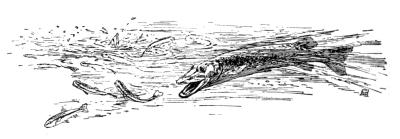
pickerel ploughed a furrow out through the spatter-docks, and in his
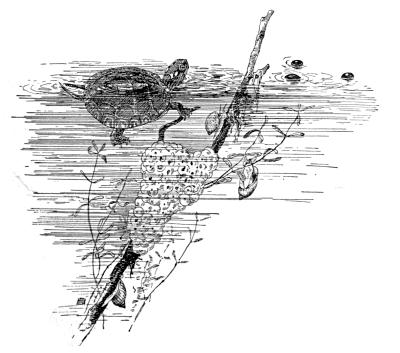
wake rose the head of a large painted turtle. Swinging slowly round,
the creature headed straight for the shore, and, without a pause,
scrambled out on the sand.
“She was nothing unusual for a turtle, but her manner was unusual and
the gait at which she moved; for there was method in it and fixed
purpose. On she came, shuffling over the sand toward the higher open
fields, with a hurried, determined see-saw that was taking her
somewhere in particular, and that was bound to get her there on time.
“I held my breath. Had she been a dinosaurian making Mesozoic
footprints, I could not have been more fearful. For footprints in the
Mesozoic mud, or in the sands of time, were as nothing to me when
compared with fresh turtle eggs in the sands of this pond.
“But over the strip of sand, without a stop, she paddled, and up a
narrow cow-path into the high grass along a fence. Then up the narrow
cow-path, on all fours, just like another turtle, I paddled, and into
the high wet grass along the fence.
“I kept well within sound of her, for she moved recklessly, leaving a
wide trail of flattened grass behind. I wanted to stand up,—and I
don’t believe I could have turned her back with a rail,—but I was
afraid if she saw me that she might return indefinitely to the pond;
so on I went, flat to the ground, squeezing through the lower rails of
the fence, as if the field beyond were a melon-patch. It was nothing
of the kind, only a wild, uncomfortable pasture, full of dewberry
vines, and very discouraging. They were excessively wet vines and
briery. I pulled my coat-sleeves as far over my fists as I could get
them, and with the tin pail of sand swinging from between my teeth to
avoid noise, I stumped fiercely, but silently, on after the turtle.
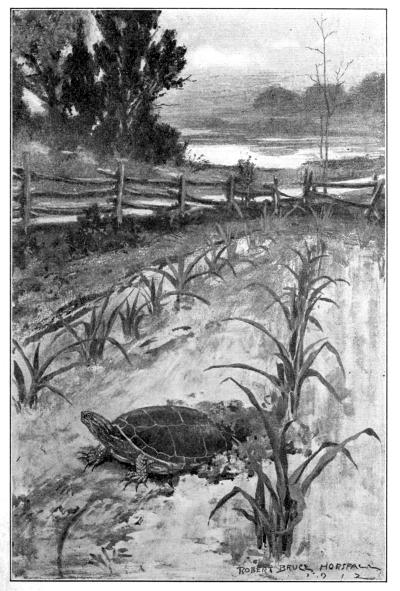
“TAIL FIRST, BEGAN TO BURY HERSELF”
“She was laying her course, I thought, straight down the length of
this dreadful pasture, when, not far from the fence, she suddenly hove
to, warped herself short about, and came back, barely clearing me. I
warped about, too, and in her wake bore down across the corner of the
pasture, across the powdery public road, and on to a fence along a
field of young corn.
“I was somewhat wet by this time, but not so wet as I had been before
wallowing through the deep, dry dust of the road. Hurrying up behind a
large tree by the fence, I peered down the corn-rows and saw the
turtle stop, and begin to paw about in the loose, soft soil. She was
going to lay!
“I held on to the tree and watched, as she tried this place, and that
place, and the other place. But the place, evidently, was hard to
find. What could a female turtle do with a whole field of possible
nests to choose from? Then at last she found it, and, whirling about,
she backed quickly at it and, tail first, began to bury herself before
my staring eyes.
“Those were not the supreme moments of my life; perhaps those moments
came later that day; but those certainly were among the slowest, most
dreadfully mixed of moments that I ever experienced. They were hours
long. There she was, her shell just showing, like some old hulk in the
sand alongshore. And how long would she stay there? and how should I
know if she had laid an egg?
“I could still wait. And so I waited, when, over the freshly awakened
fields, floated four mellow strokes from the distant town clock.
“Four o’clock! Why there was no train until seven! No train for three
hours! The eggs would spoil! Then with a rush it came over me that
this was Sunday morning, and there was no regular seven o’clock
train,—none till after nine.
“I think I should have fainted had not the turtle just then begun
crawling off. I was weak and dizzy; but there, there in the sand, were
the eggs! and Agassiz! and the great book! Why, I cleared the
fence—and the forty miles that lay between me and Cambridge—at a
single jump! He should have them, trains or no. Those eggs should go
to Agassiz by seven o’clock, if I had to gallop every mile of the way.
Forty miles! Any horse could cover it in three hours, if he had to;
and, upsetting the astonished turtle, I scooped out her long white
eggs.
“On a bed of sand in the bottom of the pail I laid them, with what
care my trembling fingers allowed; filled in between them with more
sand; so with layer after layer to the rim; and covering all smoothly
with more sand, I ran back for my horse.
“That horse knew, as well as I, that the turtles had laid, and that he
was to get those eggs to Agassiz. He turned out of that field into the
road on two wheels, a thing he had not done for twenty years, doubling
me up before the dashboard, the pail of eggs miraculously lodged
between my knees.
“I let him out. If only he could keep this pace all the way to
Cambridge!—or even halfway there, I would have time to finish the
trip on foot. I shouted him on, holding to the dasher with one hand,
holding the pail of eggs with the other, not daring to get off my
knees, though the bang on them, as we pounded down the wood-road, was
terrific. But nothing must happen to the eggs; they must not be
jarred, or even turned over in the sand before they came to Agassiz.
“In order to get out on the pike it was necessary to drive back away
from Boston toward the town. We had nearly covered the distance, and
were rounding a turn from the woods into the open fields, when, ahead
of me, at the station it seemed, I heard the quick, sharp whistle of a
locomotive.
“What did it mean? Then followed the puff, puff, puff, of a starting
train. But what train? Which way going? And jumping to my feet for a
longer view, I pulled into a side road that paralleled the track, and
headed hard for the station.
“We reeled along. The station was still out of sight, but from behind
the bushes that shut it from view, rose the smoke of a moving engine.
It was perhaps a mile away, but we were approaching, head on, and,
topping a little hill, I swept down upon a freight train, the black
smoke pouring from the stack, as the mighty creature pulled itself
together for its swift run down the rails.
“My horse was on the gallop, following the track, and going straight
toward the coming train. The sight of it almost maddened me—the bare
thought of it, on the road to Boston! On I went; on it came, a half—a
quarter of a mile between us, when suddenly my road shot out along an
unfenced field with only a level stretch of sod between me and the
engine.
“With a pull that lifted the horse from his feet, I swung him into the
field and sent him straight as an arrow for the track. That train
should carry me and my eggs to Boston!
“The engineer pulled the whistle. He saw me stand up in the rig, saw
my hat blow off, saw me wave my arms, saw the tin pail swing in my
teeth, and he jerked out a succession of sharp Halts! But it was he
who should halt, not I; and on we went, the horse with a flounder
landing the carriage on top of the track.
“The train was already grinding to a stop; but before it was near a
standstill, I had backed off the track, jumped out, and, running down
the rails with the astonished engineers gaping at me, had swung aboard
the cab.
“They offered no resistance; they hadn’t had time. Nor did they have
the disposition, for I looked strange, not to say dangerous. Hatless,
dew-soaked, smeared with yellow mud, and holding, as if it were a baby
or a bomb, a little tin pail of sand!
“‘Crazy,’ the fireman muttered, looking to the engineer for his cue.
“I had been crazy, perhaps, but I was not crazy now.
“‘Throw her wide open,’ I commanded. ‘Wide open! These are fresh
turtle eggs for Professor Agassiz of Cambridge. He must have them
before breakfast.’
“Then they knew I was crazy, and, evidently thinking it best to humor
me, threw the throttle wide open, and away we went.
“I kissed my hand to the horse, grazing unconcernedly in the open
field, and gave a smile to my crew. That was all I could give them,
and hold myself and the eggs together. But the smile was enough. And
they smiled through their smut at me, though one of them held fast to
his shovel, while the other kept his hand upon a big ugly wrench.
Neither of them spoke to me, but above the roar of the swaying engine
I caught enough of their broken talk to understand that they were
driving under a full head of steam, with the intention of handing me
over to the Boston police, as perhaps the safest way of disposing of
me.
“I was only afraid that they would try it at the next station. But
that station whizzed past without a bit of slack, and the next, and
the next; when it came over me that this was the through freight,
which should have passed in the night, and was making up lost time.
“Only the fear of the shovel and the wrench kept me from shaking hands
with both men at this discovery. But I beamed at them; and they at me.
I was enjoying it. The unwonted jar beneath my feet was wrinkling my
diaphragm with spasms of delight. And the fireman beamed at the
engineer, with a look that said, ‘See the lunatic grin; he likes it!’
“He did like it. How the iron wheels sang to me as they took the
rails! How the rushing wind in my ears sang to me! From my stand on
the fireman’s side of the cab I could catch a glimpse of the track
just ahead of the engine, where the ties seemed to leap into the
throat of the mile-devouring monster. The joy of it! of seeing space
swallowed by the mile!
“I shifted the eggs from hand to hand and thought of my horse, of
Agassiz, of the great book, of my great luck,—luck,—luck,—until the
multitudinous tongues of the thundering train were all chiming ‘luck!
luck! luck!’ They knew! they understood! This beast of fire and
tireless wheels was doing its best to get the eggs to Agassiz!
“We swung out past the Blue Hills, and yonder flashed the morning sun
from the towering dome of the State House. I might have leaped from
the cab and run the rest of the way on foot, had I not caught the eye
of the engineer watching me narrowly. I was not in Boston yet, nor in
Cambridge either. I was an escaped lunatic, who had held up a train,
and forced it to carry me from Middleboro to Boston.
“Perhaps I had overdone the lunacy business. Suppose these two men
should take it into their heads to turn me over to the police, whether
I would or no? I could never explain the case in time to get the eggs
to Agassiz. I looked at my watch. There were still a few minutes left
in which I might explain to these men, who, all at once, had become my
captors. But how explain? Nothing could avail against my actions, my
appearance, and my little pail of sand.
“I had not thought of my appearance before. Here I was, face and
clothes caked with yellow mud, my hair wild and matted, my hat gone,
and in my full-grown hands a tiny tin pail of sand, as if I had been
digging all night with a tiny tin shovel on the shore! And thus to
appear in the decent streets of Boston of a Sunday morning!
“I began to feel like a lunatic. The situation was serious, or
might be, and rather desperately funny at its best. I must in some way
have shown my new fears, for both men watched me more sharply.
“Suddenly, as we were nearing the outer freight-yard, the train slowed
down and came to a stop. I was ready to jump, but still I had no
chance. They had nothing to do, apparently, but to guard me. I looked
at my watch again. What time we had made! It was only six o’clock,—a
whole hour left in which to get to Cambridge!
“But I didn’t like this delay. Five minutes—ten—went by.
“‘Gentlemen,’ I began, but was cut short by an express train coming
past. We were moving again, on—into a siding—on to the main
track—on with a bump and a crash and a succession of crashes, running
the length of the train—on, on at a turtle’s pace, but on,—when the
fireman, quickly jumping for the bell-rope, left the way to the step
free, and—
“I never touched the step, but landed in the soft sand at the side of
the track, and made a line for the freight-yard fence.
“There was no hue or cry. I glanced over my shoulder to see if they
were after me. Evidently their hands were full, or they didn’t know I
had gone.
“But I had gone; and was ready to drop over the high board-fence, when
it occurred to me that I might drop into a policeman’s arms. Hanging
my pail in a splint on top of a post, I peered cautiously over—a
very wise thing to do before you jump a high board-fence. There,
crossing the open square toward the station, was a big, burly fellow
with a club—looking for me!
“I flattened for a moment, when some one in the freight-yard yelled at
me. I preferred the policeman, and, grabbing my pail, I slid softly
over to the street. The policeman moved on past the corner of the
station out of sight. The square was free, and yonder stood a cab.
“Time was flying now. Here was the last lap. The cabman saw me coming,
and squared away. I waved a dollar-bill at him, but he only stared the
more. A dollar can cover a good deal, but I was too much for one
dollar. I pulled out another, thrust them both at him, and dodged into
the cab, calling, ‘Cambridge!’
“He would have taken me straight to the police-station, had I not
said, ‘Harvard College. Professor Agassiz’s house! I’ve got eggs for
Agassiz,’ pushing another dollar up at him through the hole.
“It was nearly half past six.
“‘Let him go!’ I ordered. ‘Here’s another dollar if you make Agassiz’s
house in twenty minutes. Let him out; never mind the police!’
“He evidently knew the police, or there were none around at that time
on a Sunday morning. We went down the sleeping streets, as I had gone
down the wood-roads from the pond two hours before, but with the
rattle and crash now of a fire brigade. Whirling a corner into
Cambridge Street, we took the bridge at a gallop, the driver shouting
out something in Hibernian to a pair of waving arms and a belt and
brass buttons.
“Across the bridge with a rattle and jolt that put the eggs in
jeopardy, and on over the cobble-stones, we went. Half standing, to
lessen the jar, I held the pail in one hand and held myself in the
other, not daring to let go even to look at my watch.
“But I was afraid to look at the watch. I was afraid to see how near
to seven o’clock it might be. The sweat was dropping down my nose, so
close was I running to the limit of my time.
“Suddenly there was a lurch, and I dived forward, ramming my head into
the front of the cab, coming up with a rebound that landed me across
the small of my back on the seat, and sent half of my pail of eggs
helter-skelter over the floor.
“We had stopped. Here was Agassiz’s house; and without taking time to
pick up the eggs that were scattered, I jumped out with my pail and
pounded at the door.
“No one was astir in the house. But I would stir some one. And I did.
Right in the midst of the racket the door opened. It was the maid.
“‘Agassiz,’ I gasped, ‘I want Professor Agassiz, quick!’ And I pushed
by her into the hall.
“‘Go ’way, sir. I’ll call the police. Professor Agassiz is in bed. Go
’way, sir!’
“‘Call him—Agassiz—instantly, or I’ll call him myself.’
“But I didn’t; for just then a door overhead was flung open, a great
white-robed figure appeared on the dim landing above, and a quick loud
voice called excitedly,—
“‘Let him in! Let him in. I know him. He has my turtle eggs!’
“And the apparition, slipperless, and clad in anything but an academic
gown, came sailing down the stairs.
“The maid fled. The great man, his arms extended, laid hold of me with
both hands, and dragging me and my precious pail into his study, with
a swift, clean stroke laid open one of the eggs, as the watch in my
trembling hands ticked its way to seven—as if nothing unusual were
happening to the history of the world.”