The object of the game of golf is to complete the round of eighteen
holes in as few strokes as possible, starting for each hole from a place
called the teeing ground, and hitting the ball with various clubs till
the green is reached. Upon the green is a flag denoting the spot where a
round hole with a diameter of four and a quarter inches and a depth of
four inches, is cut. Into this hole the player must get the ball in as
few strokes as may be. The distances between the teeing grounds and the
greens vary at every hole. The game when played by two persons is known
as a single, when by four persons, as a foursome.
The scores in medal play are kept upon cards provided for that purpose,
each player noting the other's score, which is then marked down at the
conclusion of each hole, the totals being added together at the end of
the round, when the card must be signed by the scorer and placed in the
score card box. Failing to sign a card entails disqualification. In
match playing, the scores are reckoned by the terms, "the like," "the
odd," "the two more," "one off two," etc., and the hole is won by the
player who has holed in the fewest strokes. Being the person to lead off
at the tee, is styled having the honour, and is a privilege accorded to
either the player who has the least handicap, or to the winner of the
latest match, or again to the winner of the last hole. In foursomes the
strokes are played alternately by the partners, through the green and
from the tee.
The ground played over is known by the name of the links, or the course,
and covers an area generally from two, to three and a half miles for a
full-sized or man's course, and very often much under this distance for
what is known as the ladies' links, whilst the distances between the
holes vary from fifty yards to 480 yards or more. The game is pursued
over obstacles of all sorts, known as hazards and bunkers, till the
green is reached. This is a beautifully kept piece of grassy lawn, some
twenty yards in extent, either undulating, sloping, or sometimes quite
level, in which the holes are cut. The term stance is applied to the
position of the player's feet, when addressing herself to the ball. The
term grip denotes either that part of the handle of the club covered
with leather, which is held in the hands, or the grasping of the club
itself, and the term lie, applies to the situation of the ball, good or
bad. The further technical terms may be found in the Glossary (p. 382)
or in any instruction book on the game, the most highly recommended of
the latter being The Badminton Library on Golf, by Mr. Horace
Hutchinson, The Game of Golf, by W. Park, jun., or Sir W. C. Sampson's
The Art of Golf. But to the early history of our game.
The exact date of the founding of the Royal and Ancient game of Golf is
still a somewhat disputed point. But we read that in Holland and also in
Belgium, about the year 1353, a very popular pastime was then in vogue,
styled Chole, and as far as can be ascertained from old documents,
pictures, and the familiar and curious Dutch tiles of that period, the
mode of play and the weapons used, although rather crude in many
respects, were not at all unlike those of the present day. Some writers
go so far as to tell us that this game rather resembled hockey, and that
the ball used was about the size of an ordinary cricket ball. Others
who have searched even more deeply amongst the archives of the royal and
ancient game, relate that the aim and object used to be to strike the
ball against stone posts, which appears to have corresponded with the
later practice of holing out. Anyway we have it on good authority that
the game was much played during the sixteenth century in Scotland.
In 1608 the Blackheath Club was formed in England, and in 1735 that of
the Edinburgh Burgess Society in the north, although the game had been
extensively played for some time before this. Closely following the
institution of the Edinburgh Burgess Society Club, came those of The
Honourable Company of Edinburgh Golfers in 1744, St. Andrew's in 1754,
and Mussulburgh in 1774, followed again in the south by Old Manchester
in 1818, and Westward Ho! in 1864, till at the present time there are
links all over Europe, in America, India, Australia, New Zealand, and
even in Egypt. Not content with this, we even have the Royal game on the
West coast of Africa, in that spot of treachery and massacre, Benin. But
of course, to Scotland the gratitude of the world will ever be due for
having really been the home of the game, besides which for grandeur in
natural hazards, and finest of fine turf, the north will ever bear the
palm.
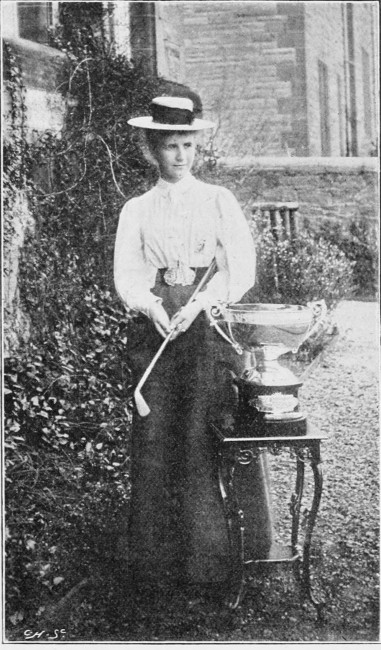 J. Ross. North Berwick.
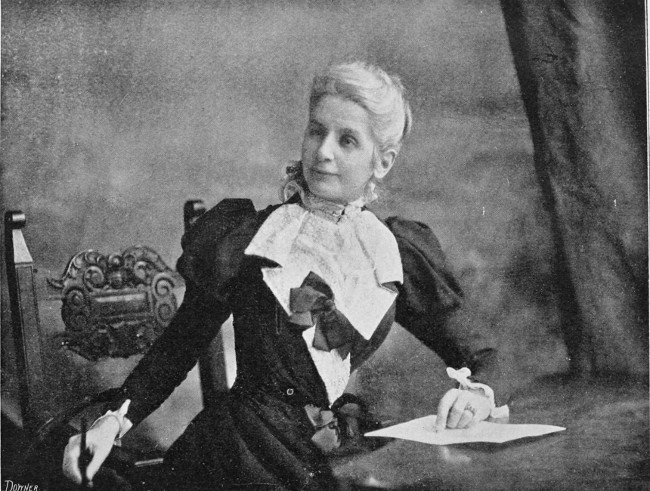
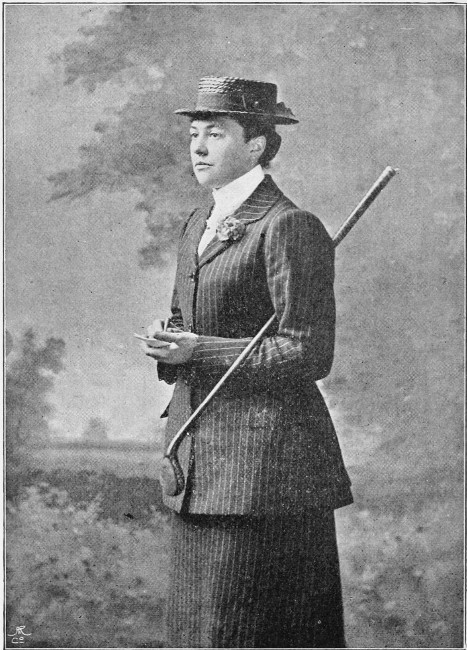
MISS E. C. ORR.
(Winner of the Championship, 1897.)
Golf, as far as women are concerned, is indeed both royal and ancient,
for we know that Mary, Queen of Scots, was a great adept and devotee
thereof, but till this century women's doings appear not to have been
much chronicled, although they used to play, and our Scotch sisters have
always been more or less brought up to it. Latterly both the English and
Irish have taken wonderfully to what was at one time styled "That old
man's game," and in so doing have found it not at all a bad pastime,
till now-a-days the lady-golfers make quite a formidable army on the
occasion of the yearly championship, or the other big open meetings.
To arrange for such events, and to give more uniformity in general
matters, the "Ladies' Golf Union" was formed a few years ago. To this
body all troublesome questions are referred by the associated clubs, for
which it acts as legislator in chief. It arranges too the details for
the yearly championship, and has lately started a system for universal
handicapping which is progressing very well. But I shall have occasion
to speak of this useful institution later.
When ladies' courses were first started, they were chiefly conspicuous
for their shortness, and general lack of hazards, it being calculated
that the ordinary wooden putter would be sufficient to see the player
safely over any obstacles encountered during the round. But woman's
ambition was not satisfied, she sighed and fretted for more elbow-room,
longer holes, more difficulties, and last but not least on inland
courses, real sand at the bottom of the bunkers. Till then it had not
entered into the head of man to conceive that any woman was equal to, or
would care for, daily tramps over rough and broken ground, bogs, dykes,
and sand, or that even if she did care, she could ever become proficient
at so sacred a pastime. Was it possible either that a woman's strength
would prove equal to propelling the ball a sufficiently long distance,
to make her in any way a rival to one of the sterner sex? But
nevertheless, even with all these doubts, the men's club were ready to
assist in giving what was asked for, by helping to institute links at
St. Andrew's and Westward Ho! in 1868, Musselburgh and Wimbledon in
1872, Carnoustie in 1873, Pau in 1874, Troon in 1882, Bath in 1883,
Yarmouth in 1885, etc.
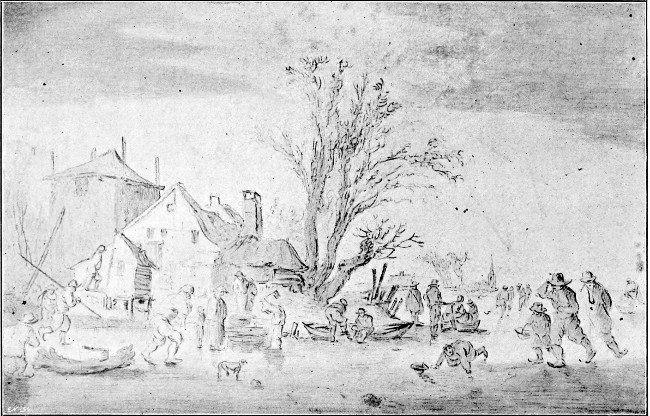
Of golf as a game for the health, it must be said that it is suited to
all seasons of the year, and also to the hundred and one changes of
climate which occur in the twelve short months. Through snow we pursue
the game on the frozen and ice covered links, with balls painted red,
again in March gales, we toil round regardless of the flapping skirts
and blow-away hats, but in May days when the weather is lovely, when the
courses and their greens are at their best, then it is that we lay
ourselves out for pure enjoyment, and reap the well-deserved fruits of a
winter of steady practice. So through summer and autumn the game still
retains its fascinations, at least for those who have mastered its inner
mysteries, but for the uninitiated it must indeed be more than a trifle
dull, beside savouring rather of madness to walk miles and miles only to
hit along a little white guttie ball, with instruments of weird and
curious shape.
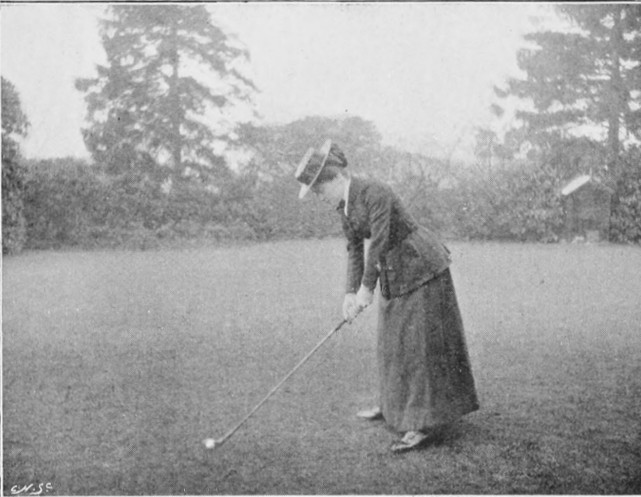 Figure 1.
POSITION FOR DRIVING.
Although ladies' courses are now vastly superior to what they were a
short while back, there is still room for great improvements in the
matter of scope for brassey and cleek play through the green. The usual
courses consist of a series of holes, generally nine holes—eighteen
being the exception—closely resembling each other, interspersed with
hazards of sorts, but in point of length and play nearly all these holes
are reached by a fair drive, followed by a short iron or approach shot
on the green. This is occasionally varied by a cleek shot from tee to
green, which constitutes the whole and monotonous ring of change that is
to be found, to say nothing of the total banishment of the brassey, one
of the most useful clubs in existence. Excepting, therefore, when women
play over men's courses, or at least over a part of them, they rarely
find themselves called upon to play cleeks, or full iron shots either. A
notable exception to this is the West Lancashire ladies' course, at Hall
Road, near Liverpool. There we find not only eighteen holes most
craftily laid out amidst hazards of all description, which call into
requisition a variety of useful clubs, but the distances between the
greens have been so varied that any monotony is quite impossible. For
whilst at one hole it may require three full shots to reach the green,
very likely the next will be but a cleek shot, and so on. One of the
irresistable influences of the game to a beginner, is undoubtedly that
vexation of spirit caused by some strange mixture of obstinacy and
helplessness, which smarts and rankles bitterly after a morning spent in
trying, to stand in the correct position with your club grasped firmly
in your hands, and after the preliminary waggle, to swing up and down
and hit the ball into space. It looks so easy, ridiculously easy, and as
if it was quite impossible not to hit that little white globe, perched
on its sand tee, but in reality, till the eye and the hand have been
trained to do so, it is one of the most difficult tasks in life, and a
process tending to many abusive speeches! The experience naturally
produces a spirit of dogged determination not to be beaten, wherein lie
the first seeds of interest, and the desire for improvement. The younger
it is possible to begin the game, the better, for at an early age the
muscles are tractable and supple, and the slightest stiffness which
gives a noticable jerkiness to the strokes, is very difficult to
overcome. The strokes should on the contrary be performed, and the arms
and wrists should work, with the smooth evenness of windmill sails. But
speaking of evenness and smoothness of movement, more especially in the
case of a person in the act of driving, brings to mind the late
championship at Gullane, where, for the first time, it became possible
to compare, side by side, the styles of the Scotch and English players.
Between some there was but little difference, excepting that the Scotch
swing was rather short and quick, whilst that of the English was
somewhat longer and slower, but in whatever style our Scotch sisters
played, their whole action was so even and pendulum-like, so entirely
free from any jerk or strain, that it clearly demonstrated their
familiarity with clubs from the days of early childhood.
Of course such familiarity is more than half the battle, making as it
does in after life a vast difference to the skill and style, although in
this as in all else, there are many and notable exceptions amongst those
who have only come across the game when nearing the days of discretion.
The greatest example of this, is our triple champion, Lady Margaret
Hamilton-Russell, née Scott, whose style has been pronounced perfect by
many competent judges.
Great self-control and good nerve, with a large amount of endurance, are
the requisites of golf, for without wishing to say one word to its
detriment, it cannot be denied that it is a game somewhat conducive to
selfishness, and with a distinctly rousing effect upon the temper. To
those who are adepts at other out of door sports and pastimes, golf
presents one great difficulty, namely, that most of the clubs have to be
gripped firmly by the left hand only, the right hand being used quite
lightly in comparison, simply as a general support and guide to
direction.
Having once decided to become a player, the best course by far is to
arrange for daily lessons from some competent and painstaking
professional, for by this means we start from the very beginning by
being placed in the right positions, and moreover, are taught to use the
right club in the right place, which knowledge will prove of invaluable
assistance in future matches and competitions. No beginner should
however forget to obtain a book of the St. Andrews' rules and to study
it well, for one of the first essentials in a game is to know the rules
thoroughly. By thus starting with lessons from a qualified instructor,
you do away with the risk of having to unlearn most of what has been
already grasped, as is so often the case where your mentor has been some
kind and amiable friend. Once having mastered the rudiments and
mysteries of the game, steady daily practice should be indulged in, if
you would hope in time to figure in the front rank of players.
The driver, iron, mashie and putter are the chief clubs to master
thoroughly, for at any time these will suffice on all courses to play a
good round with, whereas if only one club is taken out at a time to
master, the eye and hand are apt to become wearied by continuous
repetition, whilst the varied strokes necessitated by three or four
clubs, prove both instructive as well as absorbing.
In the choice of clubs arises great difficulty. Patents unlimited are to
be had, each claiming special advantages. For instance, W. Park's
putting cleek, or wry-necked putter as it is often called, and Brougham
or Yeoman's aluminium drivers, so utterly indestructible when playing
off roads or other hard lies. Then there are Taylor's or Teen's mashies,
the former rather short in the head and broad on the face, particularly
useful for the high-pitched approach shots, the latter shaped more like
a spoon, having at the back and in the exact centre, a crescent-shaped
and convex piece of extra steel, so as to concentrate the full force and
weight at the point of impact. But the good old-fashioned clubs can hold
many candles to various latter-day inventions. A very useful driver head
of ordinary beech-wood has within the last three or four years come
from the able hands of J. Ray, of Randalstown, Co. Antrim, called a
"Bap." This is in appearance exactly like a large and rather flat penny
bun attached to the shaft, but its driving powers are tremendous owing
to the amount of wood behind the spot from whence the ball is hit, which
naturally induces a long carry and run, especially in a wind, when it
seems to send a capital long, low straight shot.
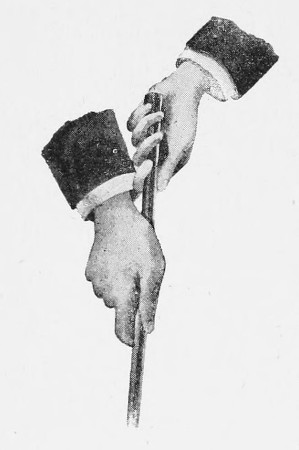
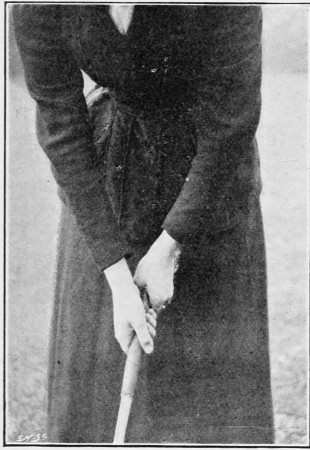 Figure 2.
GRIP OF HANDS FOR DRIVING.
It is best to choose the first clubs with the assistance of a
professional, or that of an experienced amateur, who will know at once
what weights are most suited to your powers of wrist and arm. Having
done this, and by a study of the rules prepared yourself for
instruction, you will naturally wish to make your first attempt. On
arriving at the first teeing ground and after mounting your ball on its
sand tee, take up your position with the driver, so that the club head
may be within easy reach of the ball, and without the least straining or
stretching forward to reach it.
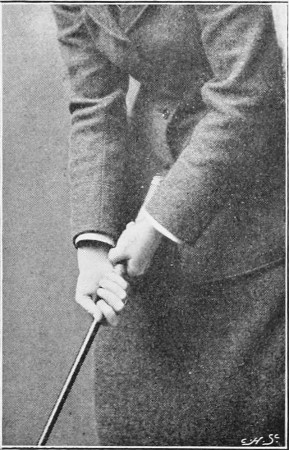 Figure 3.
WRONG GRIP.
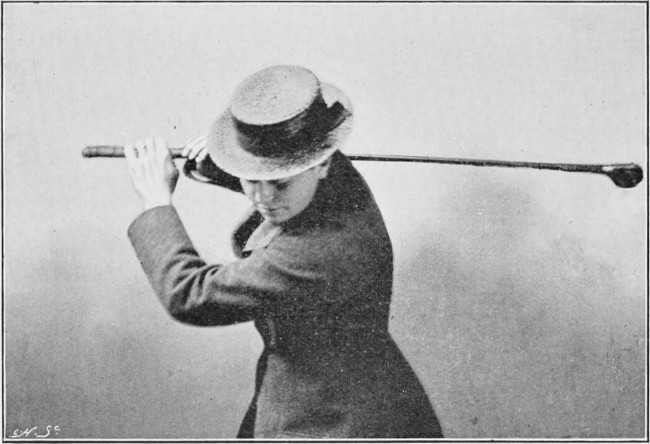 Figure 4.
CLUB HEAD WRONG. HANDS WRONG. RESULT OF A GRIP, AS SHOWN IN FIG. 3.
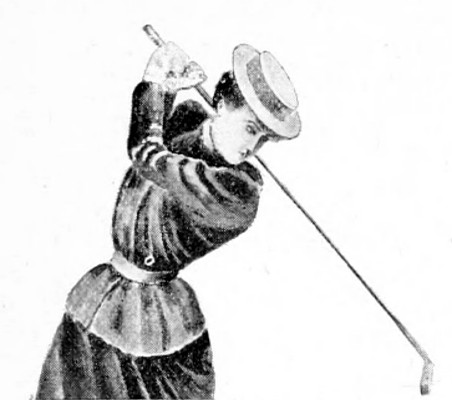 Figure 5.
"TOE" OF DRIVER POINTING DOWNWARDS. HANDS RIGHT.
The left foot should be slightly in advance of the right, rather turned
in if anything, and both feet some sixteen inches or thereabouts apart,
the ball, club, and hands being as nearly as possible in direct line
with your waist buckle, perhaps slightly inclined to the left. The hands
then require to grip the club as shown in Figures 1 and 2, the left hand
should hold with a grip of iron, the right much more easily, but still
with a tenacious grasp, turned well over so that the back of the hand is
to the front. Care should be taken that the thumb is not as shown in
Figure 3, for such a grip would cause the head of the club, when at
the top of the swing, to be turned broadway as in Figure 4, instead of
pointing toe downwards as in Figure 5. When off your drive entirely, and
when instead of being able to swing your ball nicely and cleanly away,
you can only keep hitting down on the top of it, called smothering, take
a swing with the club, pausing at the top (that is to say when the club
has reached its usual high curve over the right shoulder, and just
before its descent is commenced) to note the angle of the head. This
will generally be found as in figure 4, whilst the position of the hands
will be as in figure 3. Then alter your grip to as near that of figure 2
as possible, when the angle of the club-head at the top of the swing,
will become as in figure 5. But to continue, being in the correct
position for addressing the ball both as regards distance and grip,
after a short preliminary waggle which will give the needed impetus,
raise the club away to the right, not too quickly, with a scythe-like
sweep, till well over the right shoulder, at the same time lifting the
left heel and turning the body slightly on the toes of the left foot.
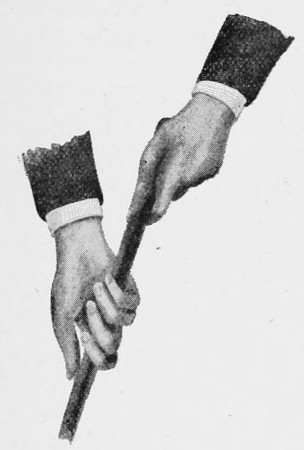
Figure 6. The action of the swing should be entirely done from the
shoulder, and not with a twist of the whole body as is often seen.
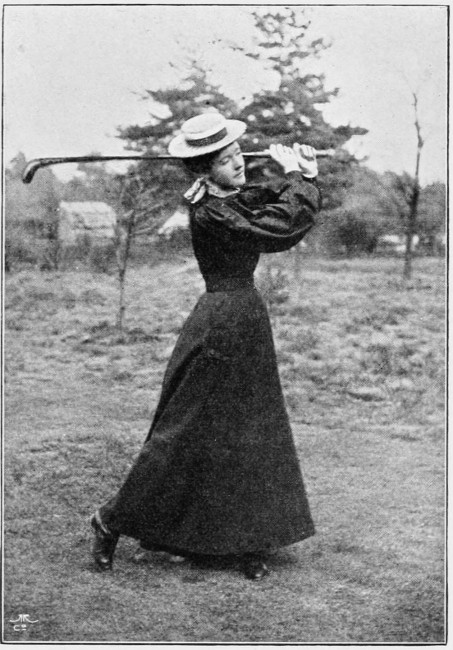
Descending again and driving away the ball, then continue the swing till
it finishes up quite naturally over the left shoulder, called "the
follow through," Figure 7, thus describing an entire circle round the
body, the whole of which must be as evenly performed, without the
least signs of force or disjointedness, as though it was the revolution
of a wheel. Many players stand to drive with the ball in a line with, or
even outside, their left foot, but having the ball nearer the centre of
the body, as described above, is the more usual position, and one to be
recommended.
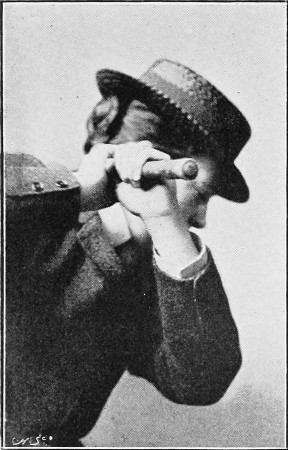 Figure 6.
GRIP WHEN AT THE TOP OF SWING.
 Garland. Woking..
Figure 7.
FINISH OF SWING.
(Mrs. M. C. Willock.)
Brassey shots through the green are played in a similar manner to
drives, the only exception being, that instead of a ball teed on the
sand, it has to be taken off the flat, therefore it becomes necessary to
swing the club head into the ball with a smart click, nicking in between
it and the ground, so as to cause the ball to rise away in its flight
quickly and cleanly, avoiding any taking of turf, or sclaffing as it is
styled, and thereby losing half the propelling force. When to reach the
green two or three full shots are required after the drive, the brassey
is generally taken, or for a medium length shot the cleek, the latter
being used with a full swing, till some eighty or a hundred yards from
the hole, when the lofting iron is called into requisition.
With this latter club, as with the cleek, the grip of both hands must be
very firm, for at the moment of striking the ball with the face of the
club, there is the danger of the sole at that very second taking the
turf, when, unless the club is firmly gripped in both hands, it must
naturally turn somewhat, with the result that the shot will be
hopelessly foozled.
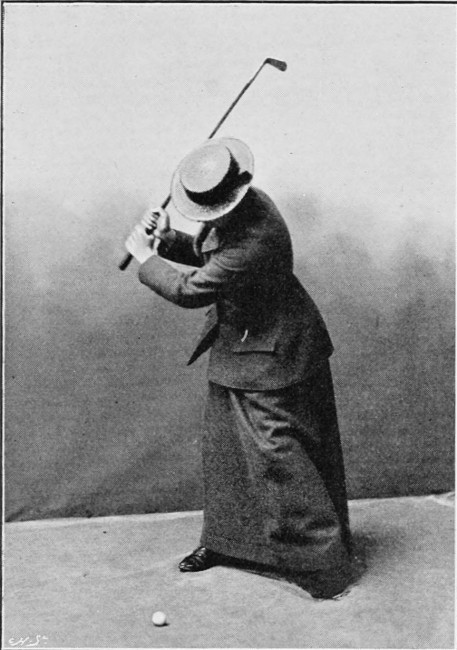 Figure 8.
SWINGING UPWARDS FOR A THREE-QUARTER IRON SHOT.
The position of the feet in iron shots differs from that of driving. For
one thing the right foot should be slightly in advance of the left,
whilst the ball is more opposite the former, and in the second place the
knees must be a little bent, the whole body assuming more of a crouching
stance than when driving. The swing, too, with an iron, is somewhat
different, for even in the full shot it is never of such a length as
that taken with a wooden club. It is more of an up-and-down stroke. In
the three-quarter shot, the arms and not the shoulders are responsible
for the swing, the club going as far back as the length of the arm
comfortably permits (figure 8), whereas, in the half shot, the fore arm
and wrist work only, the arm from the shoulder to the elbow being then
nearly close into the side. The approach shot with the mashie is played
when the green is some fifty yards or more distant, the player desiring
either to run the ball up to the hole along the ground, provided the
intervening space is pretty clear of hazards, or to pitch it up, with
that short "choppy" wrist shot, so that the ball falls without run,
nearly dead. Many players place the right thumb down the shaft of the
club in this stroke, claiming that it is easier thus to gauge the
distance and be more accurate as to direction. But whichever way it is
played, remember that it is the wrists and not the arms that work the
club. This shot is played with the face of the club very much laid back
(figure 9), and a peculiar species of cut from right to left
administered to the ball at the moment of impact. A stroke that can with
difficulty be taught, being more the outcome of instinct after
experience, than of instruction. The hard part of approaching lies in
making the ball fall sufficiently dead, and not to strike it so, that
after pitching, it will run nearly as far off the green on the opposite
side.
The mashie is one of the most useful clubs, for besides being your
"right hand" in approach shots, it is simply indispensable when playing
out of a bad lie, or whenever the ball is snugly reposing in some sand
bunker. To extricate oneself from such a lie, it is necessary first and
foremost that both feet should be firmly planted on the ground, for
every atom of strength must be brought to bear on the right spot, at the
right moment. About two inches behind the ball is the place to let your
club-head delve into the sand, and it is upon this spot that the eye
must be fixed, and not upon the ball, as is otherwise the case. The
force of hitting the club-head into the sand, causes it to shoot up,
bearing the ball high into the air, and over the confronting obstacle.
Whilst speaking of bunkers and difficulties, it is as well to have in
mind the St. Andrew's rule, No. 14, which runs as follows: "When a ball
lies in or touches a hazard, the club shall not touch the ground, nor
shall anything be touched or moved before the player strikes at the
ball, except that the player may place his feet firmly on the ground for
the purpose of addressing the ball, under the penalty of the loss of the
hole, but if in the backward or downward swing, any grass, bent, whin,
or other growing substance, on the side of a bunker, a wall, a paling,
or other immoveable obstacle be touched, no penalty shall be incurred."
In medal competitions the penalty for breach of this rule is
disqualification.
If there should be any doubt as to what is considered a hazard, rule No.
15 is very explicit. "A hazard shall be any bunker of whatever
nature—water, sand, loose earth, mole hills, paths, roads, or railways,
whins, bushes, rushes, rabbit scrapes, fences, ditches, or anything
which is not the ordinary green of the course—except sand blown on to
the grass by wind, or sprinkled on grass for the preservation of the
links—or snow, or ice, or bare patches on the course."
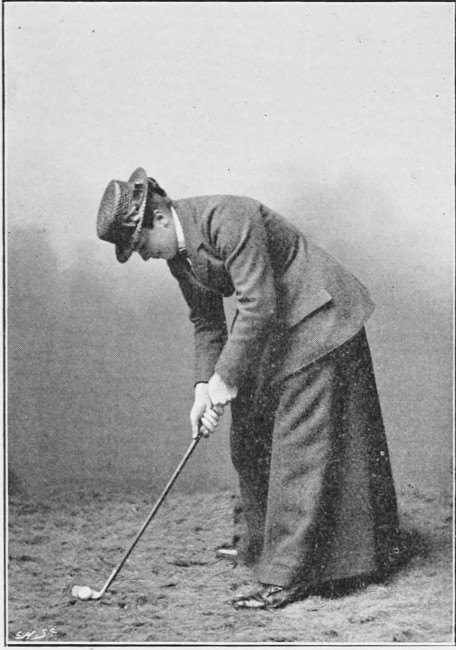 Figure 9.
SHORT APPROACH SHOT WITH THUMB DOWN THE SHAFT.
In match play, rule 29 states: "A ball must be played wherever it
lies, or the hole be given up—except as otherwise provided for in the
rules." Whereas in medal play, rule 8 reads: "A ball may under a
penalty of two strokes be lifted out of a difficulty of any description,
and be teed behind the same." The niblick, in bunkers where the sand is
at all heavy, is rather a better club to use than the mashie, being so
short, thick, and powerful in the head, therefore capable of delivering
a stronger blow into the sand. A most useful club for bad lies through
the green, is the driving mashie, made much after the order of a cleek,
only being shorter in the face and very solid in the sole, it is able to
hit a long, powerful shot under the most trying conditions in the way of
bad lies.
Having spoken of the many clubs used from the tee till the green is
reached, the putter alone remains for a few words. Till quite recently
this was made of wood only, rather in shape like an elongated
driver-head. In fact these very old clubs, such as were used by
celebrities like Jamie Allan, young Tommy Morris, Mr. George Glennie,
and others, are now worth fabulous sums of money. But of late years,
steel and gun metal have come much more into vogue. Park's patent putter
with the twisted socket or neck, is a universal favourite, the fact of
looking straight down the shaft on to the ball appearing to make the
line of transition somewhat more easy for the eye to take in. The mode
of holding the putter is similar to that of the iron, only that the
thumbs are both placed downwards and the fingers are called more into
play, as shown in Figure 10. The general grip is a trifle looser,
although the right hand requires to be firm. Mr. Horace Hutchinson, in
the Badminton Book on Golf, says as follows: "The principal secret of
good putting, as of good driving, is that the club should travel as long
as possible on the line—or a production of it—on which the ball is to
travel.
"Putting is a stroke made almost exclusively with the wrists. The wrists
do not hit the club on to the ball and then check it, but the club is
swung by a movement of the wrists... any checking of the club as it
meets the ball being fatal to consistent good putting.... The hands
should be allowed to fall into a natural position.... The putter should
be held rather short, and preferably with a light grip, and should be
worked backward and forward by the wrists, mainly perhaps the left
wrist.... The left elbow may, if preferred, be a little crooked to the
front: the club head will in this method be swinging somewhat after the
fashion of a pendulum, and if a golfer gets the hanging arrangements of
this pendulum correct, it can not very well swing out of the true line."
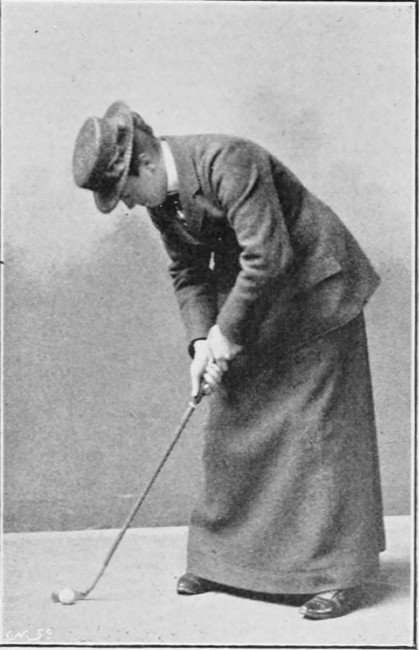 Figure 10.
PUTTING OFF THE RIGHT FOOT.
The above describes the stroke exactly. The stance for putting is as
shown in Figure 10, at least that is about the usual position, but many
people putt with the ball about mid-way between the right foot and the
left, in a straight line with the centre of the body (Figure 11). The
crooked left elbow is certainly a great help in keeping the ball on the
right road to the hole, while the right elbow should be resting against
the hip. Iron shots too can be kept from diverging with the vagaries of
the wind during a gale, if the left elbow is well crooked towards the
front, so as to follow through in that position over the line of flight
of the ball. A very similar position to that of playing forward at
cricket.
In golf there is a good deal of etiquette to be observed, but again all
hints will be found in the book of St. Andrew's rules, or in that very
useful compendium The Golfer's Referee, which was compiled lately by
the Editor of The Golfer, in Edinburgh. It may be as well to mention
that No. 2 of these rules is one to be observed, if not for courtesy's
sake, at least for the sake of danger, a blow from a golf ball being no
light matter. Therefore out of pure humanity it is only right to let the
party in front play their second shots, or get off the green, so that
they may be out of range of those behind. Besides match and medal play,
another species of competition has of late years been started, namely,
"Bogey." This is simply a score fixed for each of the eighteen holes,
the same as the par of the green, the player having to hole out in one
less than the given par, it she would win the hole, or in the like for a
half. At each hole, any strokes taken beyond the number of the fixed
par, count as a loss to the player and as a win to "Bogey." The mode of
marking this on the competition cards being + for a win and O for a
half, and - for a loss.
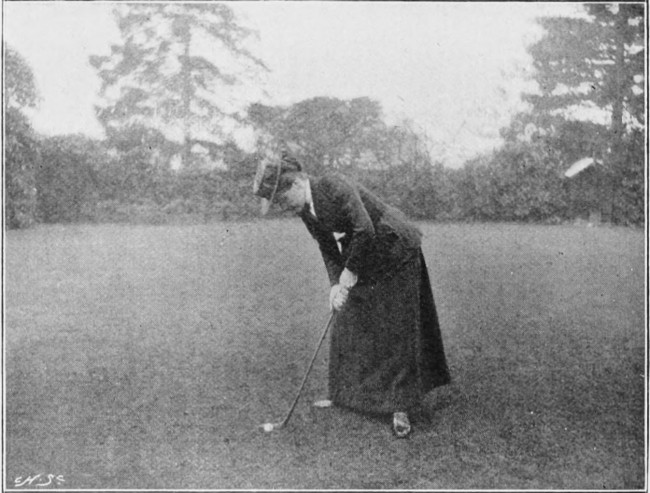 Figure 11.
PUTTING WITH BALL BETWEEN THE FEET.
One of the greatest features of golf is that although you may only
perhaps be a third-class player, and your opponent a first-class, or as
it is termed, scratch player, yet by the system of handicapping you will
both play on equal terms. In match play the difference between handicaps
is allowed as follows: in singles, three-fourths of the difference
between handicap allowances, in foursomes, three-eighths of the
difference of the aggregate handicap allowance on either side, a half
stroke of over counting as one, but smaller fractions not being
reckoned. Thus if the difference between your own and your opponent's
handicap in a single is 12, you will have to allow her nine strokes, or
a half, viz.: a stroke every other hole, whereas if in a foursome the
difference of handicap between yourself and partner and your opponent
and her partner was likewise 12, you would then only give an allowance
of five strokes. As a rule, clubs have their own special table of holes,
at which the strokes are to be taken in matches.
Nerves undoubtedly play a great part in golf, for the person who can go
on quietly and steadily when her opponent is two up at the turn has an
immense advantage. For as nothing is certain in life, still less is it
so in golf! A topped drive, or a short putt, and the whole luck of the
game may alter. Therefore the player who has perfect control over her
nerves has a decided advantage over one who becomes flustered, and she
will very often come in with a rush and flourish of trumpets at the
last. When playing a tight match never risk going for the hole if a
halved one will answer as well, for there is always the chance in going
for it from some way off of placing the ball out of holeing distance for
the next shot, and so losing the hole altogether.
Much the same in medal play: never risk a very long carry or dangerous
shot if instead, by playing short and then over the difficulty, you can
insure more safety. Medal play is essentially a matter of stolid
steadiness, while match play bristles with excitements from start to
finish, but it is by no means the case that the best match player will
be the best in a medal round, the almost mechanical steadiness of play
required in the latter being often found too irksome and tedious.
Of the faults that a golfer may drift into, slicing, hooking, and
topping are the most common, and these are often too the most difficult
to cure. Slicing is caused by drawing the club across the ball and
towards yourself. This will cause the ball to dive off to the right, and
is either the result of an error in the stance, or the grip of one or
both hands, or possibly because the club is being swung away too
quickly, causing more of a straight up and down stroke than is the case
in the proper and rounded swing. If hooking is the fault, then the ball
will fly off to the left. The reason of this may be either that you are
standing with the ball too much opposite to the left foot, or that you
are hitting it with the club's face turned in, the latter being the
result of faulty gripping. Topping as the name denotes is simply not
getting well down to the ball, and means the ruin of both its shape and
paint! Yet another fault is that of heeling, or hitting the ball off the
neck of the club, this can generally be cured by standing a little
farther away from the ball and letting the arms go out well free of the
body.
One of the most difficult shots you can be called upon to play is when
the ball is in a "cuppy" lie, viz., in a small hole or hollow. The club
then has to be swung into it without taking any of the surrounding
edges, which seems so impossible to accomplish, and yet to get the ball
away any distance, but the more quietly and without pressing you succeed
in doing this, the more chance you will have of a good result. A ball
lying above you, say on the side of a hill, is awkward, as the club
shaft when used in such a position seems so lengthy and unwieldy, but
taking the stroke quietly and again not pressing for an extra long shot
is the best way out of the difficulty. If on the other hand the ball
lies on a slope below you, shorten your grip of the club, for the body
will naturally fall a little forward in the downward swing, owing to the
stance being on the slant. Sometimes the ball may be found lying with a
disused and grass-grown mole-hill, or some such lump immediately in
front. In such a case it would be equally impossible to sweep away the
ball with a full swing, or with a three-quarter one. The club must
therefore be raised just as far backwards as in a half shot, when it
should be smartly brought down, thus hitting the ball and jerking into
the turf, causing it—the ball—to rise over the obstacle. This will cut
a large divot out of the ground, which must be replaced and stamped
down, ever remembering the text, "It is the duty of every golfer to
replace, or to cause to be replaced any turf cut in the act of making a
stroke." Of course care must be used not to break the shaft of the club,
owing to the force with which the head will cut down into the turf.
To keep yourself in good form it is not necessary after the game has
been thoroughly mastered to practise every day. Three or four times a
week will keep both the eye and the hand well up to their work, without
getting either tired or stale. Whenever the chance presents itself of
playing a round with a scratch player, or someone who is really more
skilled than yourself, do so. Such experience will not only serve as a
lesson, but will stimulate the spirit of ambition in no small degree.
Besides, it will be most excellent training and a decided gain in the
way of steadiness, and will also teach you not to get flustered when
confronted by difficulties. Merely to watch your opponent's
self-possession, as she extricates the ball from the heaviest sand,
without the least sign of force or irritability, will be a lesson worthy
of taking to heart. To have made good progress in the game, and to be
able to hold one's own with some of the longer handicap members, perhaps
even to be able to give them a point or two besides a beating, has the
effect of making most people rather proud and pleased with themselves.
Then it is that a sound beating from some good player will do your game
pounds of good and show you how much you still have to learn. If one
were to play golf for ever, yet would the feeling remain that there are
many things to be mastered.
One of the most trying times for the nerves, and in fact for your play
all round is when at some big open meeting, or perhaps even in the
championship, you find yourself drawn to play with or against a
celebrity. Some of the on-lookers may, and probably will, elect to
follow you round just to see your famous partner perform, as well as to
criticise both players. Naturally, this will cause you some
embarrassment, but beside your own feeling on the matter, you have to
consider those of your partner, and the risk that if you play badly you
may very likely put her off too. For in golf the laws of imitation are
very subtle, and nothing is more common than to play down to another
person's standard. However trying it may be, therefore, to have every
shot watched, whether it is a long raking drive, a foozled iron, or some
twelve inch putt that lips the hole instead of going down, do your best
to be steady, even if brilliancy be out of the question, for consistency
can never be very hardly criticised, even when seriously put in the
shade by a superior display of knowledge. Attending open meetings, and
taking part in club matches, will do more for your nerves and be the
means of your gaining greater experience than a hundred rounds on the
quiet home course, with just those players around you to whose
criticisms the ear has become so used, that they cease to make the
slightest impression. At such big gatherings you can see for yourself
the endless varieties of style, grip, stance, and a dozen other details
which will go more towards teaching you how you should or should not do
this, or do that, than many lessons and many chapters on the subject.
To play a tight match in a championship, is generally a doubtful
pleasure. The severe strain of knowing that every stroke should be
soundly good, or at all events useful, the amount of care that must be
taken over the shortest putt, the dogged determination that you will
beat your opponent, or if you do not quite succeed in this, that you
will only be beaten by the most narrow margin, and last but not least,
the total obliviousness to the crowd that may be following the match;
all this self-possession cannot be learned in a day or even in a few
months. To attain to such a level is a matter of test and training.
Before any of these big events, it is as well to go and reside for a
time in or near the spot where the meeting is to be held, as you will
thus gain a thorough knowledge of the course, lies, bunkers and greens,
not forgetting that most useful appendage, the caddie. To secure a sharp
boy, who knows every nook and cranny of the links, will often mean half
a stroke a hole to the credit of your match or score.
The most suitable and workmanlike clothes for the game are a simple coat
and skirt of Harris tweed or other strong material, thick boots with a
few nails in the soles to prevent slipping, and a straw sailor hat by
way of head covering. Fly-away and feather-bedecked hats, together with
garden-party dresses, look, and are, terribly out of place on a course,
which in this country, owing to the variable moods of the clerk of the
weather, may not always be without mud! Many players wear red coats with
their club facings and buttons, and these always look smart. Among them,
and one which is quite the neatest of all club uniforms, is that of the
Wimbledon Ladies' Club—a coat, with black collar and cuffs, outlined
with a piping of white, the buttons being of black, with the club
initials in white on them. All clubs that have the privilege of calling
themselves Royal are entitled to facings of Royal blue. The Littlestone
ladies wear rather a smart coat with white facings, round which are the
narrowest of narrow pipings in tri-coloured silk cord, of the club
colours, white, green and salmon pink. Green facings are very popular,
and are used by the St. Anne's Ladies, the Mid-Surrey and many others.
Perhaps the only club with a membership of several hundred, which has no
distinctive coat is Princes, at Mitcham, but the charming mixture of
chocolate and light blue, in the form of hat ribbons and ties worn by
the members, makes rather a welcome change.
Going away to other links to play matches for one's club is by no means
the least of the minor pleasures of being a golfer, for it carries one
to many "lands unknown." The fascinations, too, of a new course are
great and wonderful, especially during the first round when you are
quite ignorant of the pitfalls that await the unwary. There is something
so exhilarating in driving over carries of unknown breadth, and in
taking one's iron to reach a blind, or hidden green, with several sandy
obstacles between you and it.
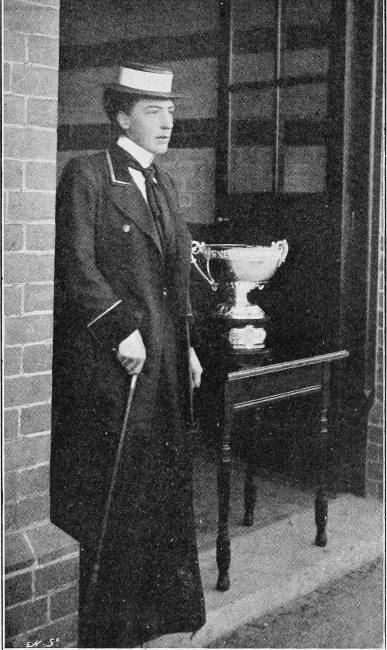 MISS PASCOE.
(Winner of the Championship, 1896.)
Of the five courses which have now been used for the Ladies Golf Union's
Annual Championship Meeting, that of Gullane, in 1897, was by far the
best and most difficult, Portrush being next in order. But before
entering into further details it may be as well to give just a brief
outline of the said "Ladies' Golf Union" and its origin. Early in 1893,
the idea of such an institution was started, Dr. Laidlow Purves, Miss
Issette Pearson and several Wimbledon members being the moving spirits
in the scheme, ably backed up by such clubs as Ashdown Forest, Barnes,
Eastbourne, East Sheen, Great Harrowden, Great Yarmouth, Lytham and St.
Anne's, Minchinhampton, North Berwick, North Warwickshire, Portrush,
Belfast, St. Andrew's, Southdown and Brighton, and Wimbledon. A large
and influential meeting was held in London during the month of April,
and it was then decided that an annual championship should be held, the
winner of which was to receive a gold medal and be styled Lady Champion
for the year, whilst a magnificent silver trophy was to pass into the
possession of her club for the same period. Strangely enough the Lytham
and St. Anne's Club had already thought of, and in fact advertised, a
splendid £50 silver challenge cup, to be competed for annually over
their links, the winner of which was to be styled champion.
This handsome offer had been made before the golfing world was even
aware that the subject of a Ladies' Union had been mooted. After some
discussion the matter was amicably settled, by the delegate from the St.
Anne's Club and the council, deciding to hold the first Championship
over that course. The subscribers towards the magnificent cup include
the clubs of St. Andrews, St. Anne's, Ashdown Forest, Blackheath,
Cotswold, Royal Belfast, Royal Eastbourne, Southdown and Brighton,
Minchinhampton, and Wimbledon. The 13th of June and three consecutive
days were chosen for the event, and the following circular was issued to
all the ladies' clubs throughout the United Kingdom:
"The Ladies' Golf Union have decided that the Ladies' Golf Championship
Competition, 1893, open to all lady golfers, members of any golf club,
will take place at St. Anne's-on-the-Sea, Lancashire, on Tuesday 13th,
Wednesday 14th, Thursday 15th June, when the trophy, value fifty
guineas, and four medals will be competed for under the following
conditions:
1. Competitors shall enter for the competition through the secretaries
of their respective clubs.
2. The competition shall be played by holes in accordance with the rules
of the Lytham and St. Anne's Golf Club.
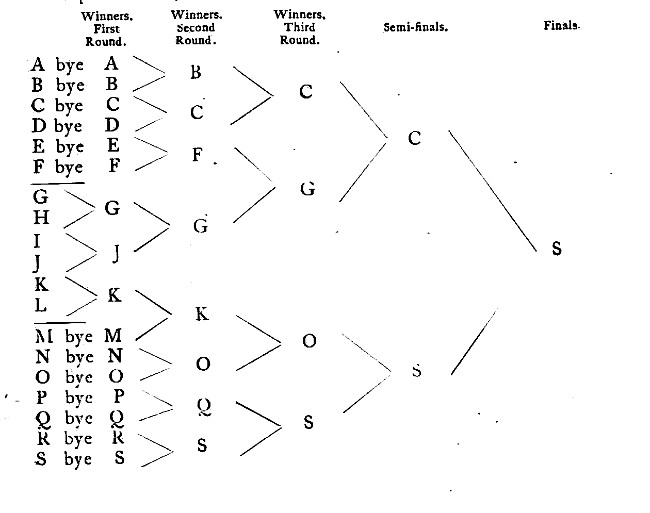
3. The draw shall take place on Friday, 9th June, and shall be conducted
as follows:
Depending on the number of entries, such number of byes
shall be first drawn as shall after the completion of the
first round leave four, eight, sixteen, thirty-two, or
sixty-four players, and one draw shall decide the order of
play throughout the competition; those who have drawn byes
being placed at the head of the list of winners of the
first round, and taking their place in the second round, in
the order in which their names then stand.
4. Each game shall consist of a round of eighteen holes.
5. In the event of a tie in any round, competitors shall continue to
play on until one or other shall have gained a hole, when the match
shall be considered won.
6. The winner of the competition shall be the champion lady golfer for
the year, and the trophy shall be held for that year in the club from
which the winner shall have entered.
7. The winner shall receive a gold medal, the second a silver medal, and
the third and and fourth bronze medals.
8. All entries must be subject to the approval of the Lytham and St.
Anne's Golf Club.
9. All disputes shall be settled by the Council of the Lytham and St.
Anne's Golf Club.
10. Entries close Thursday, 8th June, 1893."
Truly perfect weather favoured the meeting, and some thirty-eight
competitors entered, including two members from the Pau club. The
drought that year had been exceptional, but the "green committee,"
headed by Mr. T. H. Miller, had kept the greens verdant, thanks to
constant care and unlimited watering. The course being one of nine
holes, two rounds had to be played. The chief hazards were "cops," or
high turf banks, sand bunkers, and one or two ditches.
At that time, when ladies' golf had not reached its present standard of
excellence, the links appeared sufficiently difficult for a championship
test, but now, when entries number a hundred or so, and players think
nothing of a carry of 140 yards, which will clear the great obstacles
easily, it becomes necessary to have a shortened man's course for such
events. Although at Gullane, in 1897, the full men's links were used,
the round of which is two miles and three quarters, with a few yards
over, at Littlestone, in 1894, the course was not quite two miles and a
half long, whilst Portrush, in 1895, measured only a few yards more than
two miles and a quarter; the Hoylake course, used in 1896, was within a
hundred and ten yards of two miles and three quarters. Great Yarmouth,
which is to be the scene of the present year's—1898—struggle, is some
three miles in extent, but will doubtless be a trifle shortened, if it
be in any way possible.
Harking back to St. Anne's and the first championship, it was a matter
of surprise and pleasure to witness the splendid play of Lady Margaret
Scott, and the ease with which she used her clubs, whether in a good,
bad or indifferent lie. It came in the light of a revelation to the
non-golfing many, who were not used to such a beautiful exhibition, and
were not aware to what pitch of perfection a lady-golfer might rise.
Whilst to the golfing few it was a fine lesson, on the subject of how
the game should and could be played, if it was only properly engrafted
into the player from the beginning, and if proper pains were taken not
to leave the minutest detail unconquered. The only two who approached
Lady Margaret Scott in her easy swing, and the manner in which she
extricated herself from difficulties, were Miss Issette Pearson, the
energetic and hard-working Honorary Secretary of the Golf Union, and
Mrs. Wilson-Hoare, of Westward Ho! The final issue of the great battle
resulted in Lady Margaret becoming champion, a title she held for three
consecutive years, and Miss Pearson being the runner-up. This first
championship was not without its fruits amongst those who witnessed it.
On all sides the tide of ambition ran high to emulate even in a small
degree the splendid example that had been given, which was the talk of
the golfing world. So much so, that by the spring of 1894, there was a
much improved band ready to struggle with each other for the coveted
title at Littlestone, Kent, an off-shoot of that charming and quaint
cinque port town, New Romney, which the continual wash of shingle, and
silt of the sands, has left a mile and a half high and dry inland.
In comparison with St. Anne's, Littlestone was three times more
difficult. Not only was the latter an eighteen hole course, but it
fairly bristled in sand bunkers, canals, rabbit holes, and endless traps
for the incautious. However, everyone had profited by the previous
experience, and the play of most of the competitors called forth
expressions of approval on all sides. The number of entries was
sixty-four, including players from seventeen different clubs. Ireland
was unrepresented this year, although at St. Anne's the previous season
there had been four entries from the Sister Isle. Lady Margaret Scott,
and Miss Pearson, again stood first and second, after a very fine match,
which was watched attentively by a large crowd from all the neighbouring
golfing centres. Following the championship in the Autumn came the
largely-attended and first open meeting of the Ranelagh Club, at Barn
Elms. This was a huge success, thanks to the untiring energies of the
Committee, and Miss Pearson, so much so that another gathering was
organised for the following April—1895—and since then this fixture has
been kindly allowed to become an annual event.
Early in the May of 1895 the enthusiastic army of golfers was under
weigh for the quiet little Irish town of Portrush, the scene of both the
Irish and the English Championships that year, the former preceding the
latter by a few days. The bustle and excitement in the streets of the
little town was great, and outside cars came tearing round the
perilously sharp corners, laden with red-coated golfers either off to
watch the semi-finals of the Irish ladies, or else to sample the truly
grand course on their own account. Every train too brought in fresh
relays of competitors, till the huge Northern Counties Hotel had not a
corner untenanted.
The trophy of the Irish Ladies' Golf Union, which is a remarkably
handsome worked silver bowl, had, after a good fight, together with much
steady play, including some glorious long putts, been won by Miss Cox,
Miss Maclaine being the runner up. An open meeting was held the day
before the Golf Union Championship, where the scratch prize was easily
won, with the fine score of 89, by Miss Sybil Wigham, the first Scotch
representative to attend one of these events. Miss Wigham's style was
grand, being both easy and sure, and she proved herself equal to sending
terrific long balls from any lie. It was much hoped that she and Lady
Margaret might meet in one of the heats, but being unused to play before
so large a crowd, Miss Wigham's nerve rather gave way in her match with
Miss Dod, and she suffered defeat by two up and one to play. Two of the
finest matches of this championship were those between Lady Margaret
Scott and Miss Phillips, in the opening heat, and between Lady Margaret
and Mrs. Ryder-Richardson in the semi-final, wherein the latter player
was four up at the eleventh hole to the champion, who after this
gradually assumed the lead, and won in the end by two up.
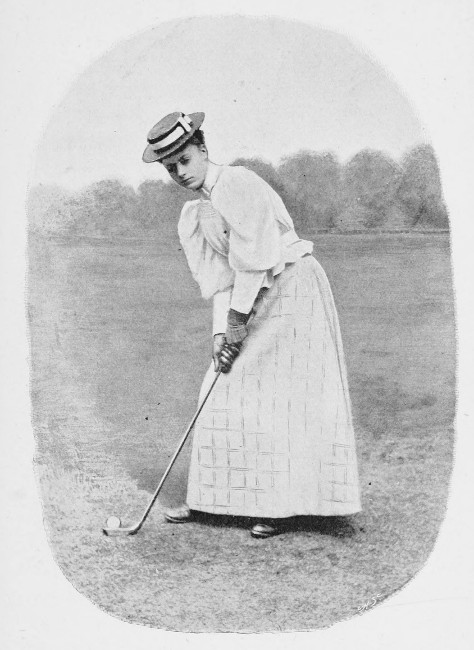 LADY MARGARET HAMILTON-RUSSELL.
(Winner of the Championship, 1893, 1894, and 1895)
Perhaps the marvellous coolness and self-possession of Lady Margaret
were never seen to better advantage than in this match. The course at
Portrush seemed to abound in bunkers at every conceivable and
inconceivable corner. The greens were in excellent condition, and the
whole links sporting as anyone could wish to play over. If anything the
soil was a trifle too sandy, for it was dangerous to take the least
scrap of turf with one's brassey or iron, for fear of a foozle. The end
of the meeting found Lady Margaret for the third time champion, with
Miss Lythgoe, of the St. Anne's Club, as Silver medallist.
The 1896 championship meeting, at Hoylake, was remarkable for the number
of very close matches, many of which were only decided on the
eighteenth, nineteenth, or twentieth greens. Miss Pascoe ultimately
became the winner after many hard tussles, with Miss Lena Thompson, of
Wimbledon, as runner up, Lady Margaret Scott not being among the
eighty-two entrants. It was noticeable what an improvement in all parts
of the game had taken place within the last three years, many of those
who had witnessed the St. Anne's Championship being present, and
stating this as their opinion. In the length of the tee shots and
brassies, in getting out of difficulties, and in putting, the
improvement was everywhere visible. The first visit of the Union to the
home of Golf, viz., Scotland, took place in the middle of May, 1897,
when Gullane, on the East Lothian coast, was the place of Meeting.
Gullane is famed not only for the excellence of its links and the very
superior quality of its turf at the present time, but in early years it
was a great Pictish burial place, and the ruins of an ancient church,
dating from about 1170, still stands in the middle of the village. In
after years it was known as the birthplace of the celebrated racehorse,
Blair Athol, as well as of several minor lights of the racing world.
Gullane indeed is a spot of many varied interests.
The links are most sporting, and it is altogether a splendid course for
a big event like the championship. The only regret murmured—and that
but faintly—was that some would have liked more hazards to carry from
the tee, as is the case at North Berwick. However, this want was well
atoned for by the manner in which the greens were guarded, a style of
defence that would do credit to a first-class engineer, and which taxed
the powers of approaching not a little. Especially was this the case at
the twelfth, fourteenth, fifteenth, sixteenth, and seventeenth holes,
where grief unlimited awaited the topped or foozled ball. Starting with
the record entry of one hundred and two competitors, the whole meeting,
if one excepts the weather, was an unqualified success. For the first
time, the Scotch and English women-players met to do battle for the same
trophy, but it was to be regretted that in so many instances the draw
had coupled two very strong scratch players together, or in the same way
put English players to do battle with each other, when it would have
been both so much more exciting and interesting to have found them
pitted North against South. In the first round two of the best matches
were those between Miss Pascoe—the holder of the cup—and Miss Issette
Pearson, and between Miss N. Graham—the Irish Champion—and Miss
Nevill, the holder of the Midland Counties Championship. Miss Pearson,
who gave one of the finest exhibitions of golf that she has ever shown,
won after a hard fight by four up and three to play. Miss Pascoe too
made some magnificent shots, but she certainly did not display the same
deadly accuracy which characterised her game so much at Hoylake, in the
previous year (1896). However such thorough knowledge of the game was
shown on both sides, that some of the old Scotchmen in the crowd were
heard to exclaim, "Hoot, mon! This is fair golf, and worth coming to
see."
The match between Miss Nevill and Miss N. Graham was even closer, the
latter losing only at the last hole. In the next round the matches of
Miss Maud Aitchison v. Miss G. Graham, Miss A. L. Orr v. Miss Frith,
and Miss A. Maxwell v. Miss M. R. Nimmo, attracted the most attention,
and in each case were won by the first-named player. Round number three
contained many more tight matches, especially those between Miss
Titterton and Miss Maud Aitchison, which was carried to the
twenty-second hole, Miss Titterton winning ultimately. Whilst Mrs.
Edward Smith beat Miss N. Haig, the Yorkshire champion, only at the
twenty-first hole, Miss Bertha Thomson beat Miss Lugton at the
nineteenth green, and Miss Dod only succumbed to Miss Blyth on the last
green. The fourth round was not marked by any special feature, although
all the matches were well contested. But the fifth heat had some grand
fights, notably those of Miss Titterton and Miss Madeline Campbell,
which only finished on the eighteenth green, and Miss Kennedy and Miss
Nevill, which was another display of real golf soundly well played, Miss
Nevill losing by two holes only. The sixth and semi-final round was
indeed exciting, Miss Kennedy playing a magnificent match against Miss
Orr. The play on both sides was bold, free, and accurate, Miss Kennedy's
shots from the tee and through the green were brilliant, especially so
at the sixteenth hole from whence she reached the green in two, a
distance of 314 yards from the tee. It was in putting alone that she
lost to her formidable and well-known North Berwick opponent. Miss E. C.
Orr, who was playing a most beautiful and steady game, downed Miss
Titterton by two up after a fine match. The final between the two Miss
Orr's was a good exhibition of steady golf, but Miss E. C. Orr
out-played her sister somewhat easily, her shots all through being
beautifully judged, especially the full iron shots or half iron
approaches, which never failed to be within a putt of the hole. Indeed
it was in these shots that she obtained such an immense pull over her
opponents throughout the whole of the meeting, and one might with
advantage take a lesson from her in this most useful and necessary
department of the game, for it is undoubtedly in approaching and putting
that so many of us fail. There is nothing very hard in hitting a good
long drive or brassey shot, but when it comes to pitching the ball
perfectly accurately on to the green, so that it may be within a
putt's length of the hole, or at the outside within two such strokes,
then it is that we seem to be "all over the place." Perhaps once or
twice during the round, we may lay an approach or two fairly dead, but
to do this consistently for eighteen holes we cannot, and it was here
that Miss E. C. Orr and several other Scotch ladies, scored heavily.
The competitions that are held at many open meetings for "approach
shots," generally result in anybody but the scratch players being the
winners, and show that this branch of the game is neglected by many good
players. Somehow far less pains are taken about this kind of shot, than
for the drive. Notice before the drive, how the player will fuss about
the height of her tee, the position of her feet, the waggle and swing
of the club, then notice the same player on nearing the hole, when she
takes up her iron or mashie. Just a glance at the hole, then a quick hit
and the ball lights somewhere on the green, perhaps with such a run
that it is nearly as far off on the other side as it was on this side,
before the stroke was played. No pains as to position, stance and angle
of the club-head are taken; an iron shot in the direction of the green
being the stroke played, instead of an approach shot at the hole,
which just makes all the difference. Putting, too, is much more natural
to some people than to others, but it is surely within the power of
everyone to improve themselves in this useful science.
It is after closely watching such a display of the game as we saw at the
Championship meeting at Gullane, that one feels how much we might
improve in our game by simply taking a little ordinary and common care.
The lengths of the holes at Gullane were about as follows: 1st, 300
yards; 2nd, 251; 3rd, 211; 4th, 353; 5th, 313; 6th, 252; 7th, 347; 8th,
304; 9th, 249; 10th, 353; 11th, 153; 12th, 355; 13th, 189; 14th, 160;
15th, 244; 16th, 314; 17th, 309; 18th, 306. Lengths that required every
variety of shot, together with uphill and downhill lies innumerable,
but as was mentioned a page or two back, the feature of the course lay
in the grandly-guarded greens, where the consistent approacher had all
the best of the game, and time besides to cogitate on the niblic shots
of her less consistent opponent.
Besides arranging the annual championship, and settling any questions or
difficulties relating to golf, the Ladies' Golf Union undertook to
organize a matter that had for years shown itself in need of revision.
The Union started the "handicapping scheme" among its associated clubs,
in order that in crowded open meetings, the committee chosen to arrange
the handicaps, should have some basis to work upon. It is a delicate
matter to settle the points that one player shall concede to another,
and till then this had been more or less guess-work, excepting for such
little guidance as the local handicaps provided. The scheme is now in
full working order, with a special sub-committee to guard over its
interests, of which Miss Pearson is in command. This committee consists
of four other ladies, to each of whom is portioned out six or eight
clubs, and whose duty it is to work out by averaging the scores
returned, what handicap each member of these several clubs shall
receive, in accordance with the fixed par of the green, also to lower
the various allowances when the players return scores under those from
which they are already handicapped. Once a month the whole of the medal,
or other stroke competition returns are made up, and published in the
golfing papers. To stimulate interest in this scheme the Golf Union
offers a silver medal to every club, to be won by the member returning
the best aggregate of four nett scores under their handicaps during the
year, as well as a gold medal to be competed for annually by the winners
of the silver medals.
The rules for the guidance of those who compete, which will be found on
the notice board in every associated club's golf room, run briefly as
follows:
"1. Any member of a club belonging to the Union, and desirous of having
a handicap for this competition, must have returned two medal scores,
neither of which shall have exceeded the par of the green, as fixed by
the Union by more than twenty-five strokes. A member having a handicap
in one club shall receive the same handicap at all clubs to which she
may belong, when playing for the Union medals, such handicap to be the
lowest she shall receive at any one club.
2. Each Honorary Secretary will receive monthly a form with Members'
Union Handicap, on which she shall enter the medal scores and return the
sheet directly to one of the members of the sub-committee.
3. The par of the green is fixed from details sent by each club to the
Ladies' Golf Union Hon. Secretary, and all competitions for the medals
must be played on the full medal course, but if circumstances such as
ground under repair, etc., prevent this, a note must be made, and the
difference explained when sending in the scores to the sub-committee."
But a most able article on this subject from the pen of Miss Pearson
will be found in volume four of the Ladies' Golf Union Annual. A neat
little shilling publication, which not only contains a splendid map of
the Gullane Golf course, but much useful information as to the
associated clubs and their members throughout England.
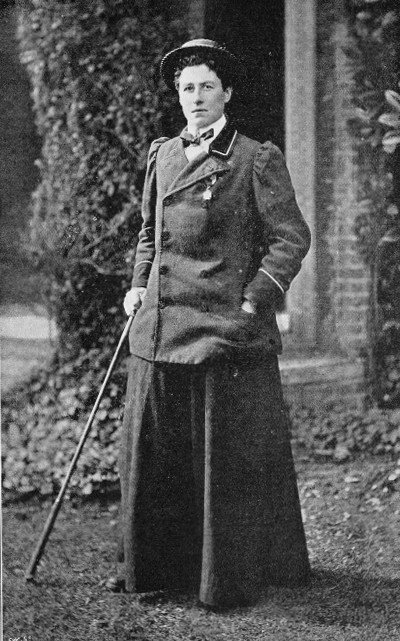 Reinhold Thiele and Co. Chancery Lane.
MISS ISSETTE PEARSON.
(Hon. Secretary Ladies' Golf Union.)
Golf has done much for many branches of trade, giving them a stimulus in
out of the way corners. The revival of trade, indeed, that marks the
opening of golf links, falls little short of a species of colonizing,
resuscitating as it does decayed towns and villages, in which the game
has fanned the almost extinct embers of industry into a glowing flame.
While the men find work on the course, the boys have employment as
caddies, or the sharper ones get a berth in the club maker's shop,
whilst the players who come and go every day in the year, cause the
hearts of the local butchers, bakers, and grocers to rejoice. In Kent
alone, such old places as Sandwich, Deal, New Romney and Rye, some of
them famous in the by-gone days of the Cinque Ports splendour, owe a
great deal in these bad times to the royal and ancient game. The
membership of their respective golf clubs, number about as follows:
Sandwich, 650; Deal, between 300 and 500; Littlestone, 500; and Rye,
270; and some of these players at least, must visit one or other of the
courses, and spend a certain amount of money in the place. New hotels
and houses become necessities in the neighbourhood, and the old inns,
too, have to look to their laurels that they keep up to date, and are
well stocked with food, for the golfer's appetite is not renowned by
reason of its smallness.
In the "upkeep" of the links there are many and heavy expenses to be
taken into account by the authorities, but clubs can generally amply
recoup not only by subscriptions and entrance fees, but by that certain
source of revenue, the green fees of visitors, provided of course the
links are fairly sporting and well kept. Taken all round, the number of
green keepers and men employed on the various courses throughout the
country, would alone make a respectable-sized army. Then the industries
in club and ball-making should be considered, and the thousands and
thousands of dozens of the latter that are sold annually. In a recent
number of Golf it was stated that some five hundred tons of
gutta-percha are, within twelve months, converted into balls alone! To
quote the paragraph on the subject: "The material is sold at four
shillings and sixpence or five shillings per pound, but adding the cost
entailed in producing good well-seasoned balls from the raw material, we
find that there is an outlay approximately of £500,000 a year with
manufacture and sale of golf balls. A fact like this tells not only a
vivid story of the growth and popularity of the game, but of the
commercial importance of the golf-ball trade."
Of course balls are at their best from six to nine months after being
finished, but for a year or more they do not deteriorate to any great
extent. The weight usually played with, is 27 or 27-1/2 drams. Of
different kinds there are no end, some people pinning their faith to
"Melforts," others to "Woodley Flyers," and so on, but very satisfactory
makes are the "Black A.1.," the "Silvertown," or the "Eureka." Recently
the "Agrippa" balls have been highly spoken of, and it is undeniable
that even a gale of wind does not very perceptibly upset their flight,
it they are struck true.
Having now touched on most of the subjects to do with the technical part
of the game, it may be of interest to add a few more words on links and
players generally, but before doing so, let it be said again, that golf
is not a game that can be grasped or learned in a week, or yet in a
year, but it requires steady perseverance for a very long period. If at
any time you are off the game thoroughly, it is much better to go to a
good professional, who will quickly put you on the right road again. In
so doing you will avoid any chance of picking up bad habits, in your
efforts to make the ball speed on its journey as it should.
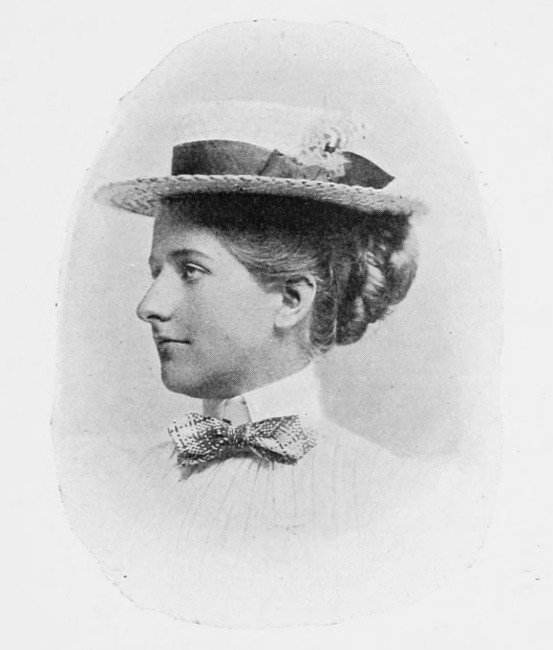 Brown, Barkes, and Bell. Liverpool.
MISS EMMA KENNEDY.
(Bronze Medallist, 1897.)
Of Ladies' courses, that of the West Lancashire will take a great deal
of beating, for reasons that have been already stated. A course of
eighteen holes, heaps of elbow room, and with a large and splendidly
planned club house, in which a daily bill of fare is always to be
found—the last, by the way, not met with every day in a ladies' club
house—there is little left to desire. To Mrs. Alsop and her able
committee the visitors at the last open meeting, which was held just
before the Hoylake ladies' championship in 1896, were greatly indebted.
Not a hitch occurred in the starting of any of the seventy-eight
competitors. It was on this course too that the Southern ladies, when on
their Northern tour, in September of 1895, sustained their first and
only defeat. The West Lancashire Club can boast of one of the strongest
match teams that it is possible to place in the field, seeing that it
contains the names of Miss Kennedy—holder of the record with a score of
77—Mrs. Ryder-Richardson, Miss Young, Miss Carr—a bronze medallist of
the first championship—Miss Welch, Mrs. Fowler, and other scratch
players. The next eighteen hole course is just south of London, at
Mitcham, viz., that of the Princes Ladies', one of the most delightful
spots near London possible to find one's self detrained for a day's
golf. The holes on these links vary in length from a full mashie shot to
a distance that will require two or three strokes to reach the green.
The chief hazards are dykes, gorse bushes, rushes, railways and turf
bunkers, the trenches of which appear to be amply filled with sand. The
putting greens are very good, especially the last seven holes, the other
eleven being still rather in their infancy, as they were only opened in
May, 1897. The eighteen hole record of 83, is held by Miss Phillips. A
very attractive object of competition at this club, is the monthly
medal, a unique little gold charm mounted as a brooch. Twice a year, in
May and November, the club holds most successful open meetings. Indeed
for the last Spring event, that of 1897, the record entry of 106 was
received, and at the forthcoming Spring meeting, a challenge cup is
advertised to be competed for annually by representatives of all
counties in Great Britain and Ireland, one year's residential
qualification being necessary. For this event any number of players are
permitted to enter for each county, and the cup is to be held for a year
by the county returning the four best medal rounds for thirty-six
holes. Miss Langley is the untiring secretary and prime mover in all
matters connected with the welfare of the club. In fact it is mainly due
to her unrelaxed exertions, that the new piece of ground for the eleven
holes was obtained, and worked into the excellent state that it now is.
Still another course of eighteen holes is that of the County Down Club
in Ireland, where play is over part of the famous Newcastle links, some
three miles round. The "Bogey" and scratch score of these links is 100,
and this has only been approached by Miss Maclaine, who has completed
the course in 102. The hazards are principally of the lofty sand hill
order. 465 yards is the length of the longest hole, 448, 367, 325, to 93
yards, being about the lengths of the others. The greens are
magnificent, and the turf is of the proverbial billiard cloth
smoothness. Miss N. Graham, the champion of Ireland, hails from this
club, which may justly be proud of such an able representative. A little
further north, is the course of the Royal Portrush Ladies', another
sporting eighteen holes. This club is presided over by Mrs. J. M.
McCalmont, and contains among its members Miss Cox, the ex-Irish
champion.
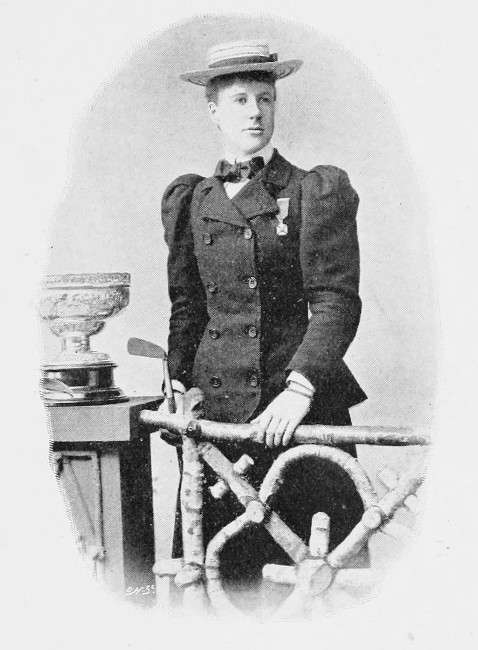 Hembry. Belfast.
MISS N. GRAHAM.
(Irish Champion, 1896 and 1897.)
Crossing over to Scotland, we find only putting courses at St. Andrews
and at Carnoustie. But at Troon, Musselburgh, North Berwick, Edinburgh,
Aberdeen, Machrihanish (eighteen holes), Prestwich, St. Nicholas,
Dumfries, Elie and Earlsferry, Bridge of Weir, and Ranfurly, etc., etc.,
there are some fine links with perfect greens and most trying hazards.
Returning once more to the South country, we have a splendid long
eighteen-hole course at Woking, where one gets every variety of hazard
and lie imaginable. The Wimbledon Ladies' course too is most trying,
thanks (!) to the conservators of the common, who have caused tarred
circles to be daubed outside all the gorse bushes, so that when the
player finds herself within one of these charmed rings, she is bound to
drop and lose a stroke. Flints too are rather prevalent, causing havoc
to one's iron clubs. The eighteen, and nine-hole records of the green
are both held by Miss Pearson, the former with 68, the latter in 31, the
holes varying in length between 100 to 190 yards.
For links that are of a lawn-like smoothness, excepting for the bunkers,
Eltham has no rival, and some pretty iron shots are to be had there. At
Eastbourne the holes differ in length from two hundred and twenty, to
one hundred and fifteen yards, and the hazards consist of turf bunkers
and hurdles. The record, held by Miss M. E. Phillips, is 69. One of the
nicest short inland courses on the South coast is that of the Brighton
and Hove Ladies' at the Dyke, the record for which is 73. Gorse bushes
are the principal hazards, but it is a course where good play is always
soundly rewarded. Being on down turf, the greens are always excellent,
though perhaps a trifle small. Not many miles away from the latter
course is that of Ashdown Forest, a very tricky green abounding in
heather. In fact, when on the long course, what with the fir trees
scattered here and there, the burns and the heather stretching for miles
on every side, you can imagine yourself anywhere but in the heart of
Sussex. Seaford is another very short ladies' course, which is yet
splendid practice for iron and mashie shots. Miss Gilroy holds the
record with 62. The long course there is very taking, especially for
anyone who drives a long raking ball both off the tee and through the
green. A very successful open meeting was by kind permission of the
gentlemen's committee held over the latter course in September, 1897,
there being forty-two entries.
Of all courses though, where accurate iron and mashie shots tell, the
Hoylake Ladies' links at the Dale, take any amount of beating. With
holes varying in length from 60 to 166 yards, it is the most delightful
practice course for short shots that can be well imagined. Mrs. Ryder
Richardson holds the record with 63. The Hastings and the Bexhill ladies
both play over part of the gentlemen's courses, there being plenty of
scope for brassey and cleek shots through the green. Chorley Wood,
Richmond, Barham Downs, Folkestone, Lelant, Cheltenham, Chester,
Malvern, and Rhyl are all courses of some length, and in playing over
which most of one's clubs are called into use.
Of links abroad, there are some eleven clubs in Australia, eleven in New
Zealand, including four ladies' clubs, five in the Straits Settlements,
twenty-four in India, twenty-one in Canada, four in the West Indies, one
hundred and fourteen in the United States, where the game may be fairly
said to have "caught on," and fifteen clubs in South Africa, besides
links at Malta, in Egypt, Cyprus, Algeria, Arabia, Ceylon, China,
Tasmania, Mauritius, Canary Islands, and nearer home in Belgium,
Holland, Germany, Sweden, Switzerland, Italy, and last but not least
France, where we find fourteen clubs, most of them largely patronized by
the leading players from Scotland, England and Ireland during the winter
months. Of all the colonies, New Zealand and Australia are said to be
the keenest over golf, so far as ladies are concerned, and in both these
countries they have even instituted an annual Ladies' Championship, thus
following the lead of the mother country. As to the American ladies,
they are intensely keen over the game and spare no pains to become
proficient in it, their annual woman's championship being a very large
gathering. This tournament is played upon the lines of the men's amateur
championship, but only the eight lowest scores qualify in the medal
round, and the final round, as in this country, is only eighteen holes,
the thirty-six hole test being considered too tedious for a woman.
Between thirty and forty players usually enter; Miss Hayt, Mrs. Turnure,
Mrs. Shippen, Miss F. C. Griscon, and Miss Sands appear to be some who
play from scratch, and before long we shall hope to welcome some of
these cousins from over the "Herring Pond" to one of our annual
championships.
Recently, in America, a golf school has been started, in a large and
well-lighted drill hall, where the game can be taught by the hour. The
windows in the hall are protected by netting, and on the floor is a
large square of rubber, from off which drives, brasseys, and iron shots
can be practised. Many other clever devices for learning the game and
gaining accuracy are also in force in this school.
Local championships are now established in some of our counties, those
of Yorkshire and the Midlands being the biggest events. A real golf
treat on the south coast is a day at Sandwich or Deal, preferably the
former, the St. Andrews of the south, where the carries are indeed as
big as one could wish for, especially at the third hole, or "Unknown
Sahara," as the huge sandy desert of a bunker confronting the tee is
called. Again at the sixth hole, or "The Maiden," as its world-renowned
name is, a gigantic bunker some forty feet high, which grows on its
steep side a prolific crop of rough bent rushy grass, gives full scope
to your powers be they what they may. "Hades," too, is a hole that
requires a very well hit ball to carry the surrounding troubles, and
numbers nine, fourteen, and seventeen are all holes where long drivers
get a tremendous advantage. At the same time, one finds at Sandwich a
line marked out by blue guide flags, in the following of which the
rather shorter driver will not be so severely punished. The total length
of the course is some six thousand odd yards, the longest hole being
about four hundred and eighty yards, and the shortest about one hundred
and eighty yards. The Gentleman's Amateur Championship was held over
this course in 1896, when Mr. Tait won, after some splendid fights with
Mr. C. Hutchings, Mr. J. E. Laidley, Mr. J. Ball, junior, Mr. Horace
Hutchinson, and finally with Mr. H. Hilton. Amongst the lady-players
there are many dozen who might well claim notice, but space being
limited it is only possible to refer to a few of the best known, Lady
Margaret Hamilton-Russell, Miss Pascoe, Miss E. C. Orr, and Miss Issette
Pearson have already been mentioned. But to give the honour to Scotland,
at Prestwich Miss Sybil Whigham reigns supreme, with her splendid long
raking drives and iron shots. This player takes a full easy swing, using
her shoulders well, and turning but very slightly upon the left toe in
driving. In the matter of getting out of bunkers, she is especially
adept. From Dumfries hails Miss A. Maxwell, another grand player, but
one who has the half swing only, with a peculiar action of the left foot
at the moment of driving. Mrs. Murray, of the Torwoodlee club, was one
of the best "all-round" players in the recent Gullane Championship, her
approaching and putting being nothing short of grand. Miss Blanche
Anderson and Miss Madeline Campbell of North Berwick, are both shining
lights in that club which is so rich in golfing talent, Miss Campbell's
handling of her clubs being specially taking. But turning more
Southwards, at Windermere, Miss Bownass, with her fine drives and
approach shots, can hold her own on that very undulating course. Twice
she has accomplished the rather difficult eighteen holes in eighty-nine
strokes. In Lancashire, we find Mrs. Ryder Richardson, whose play is too
well known to need a description. Besides taking endless prizes in the
North, including the Isle of Man, Mrs. Richardson performed a marvellous
feat at Ranelagh, in April of 1897, by doing that somewhat tricky course
in seventy-nine strokes, the record for a woman. In North Wales, Miss
Kennedy keeps up the golf reputation, but her recent doings at Gullane
have already been discussed. In Worcestershire, Miss Nevill and Miss E.
Nevill carry all before them. Both splendid drivers, they play a very
bold game all through, besides which bunkers and other difficulties hold
few terrors for them. At Cheltenham, on the Cleeve Hill Common, Mrs.
Aylmer and Miss Johnson are formidable opponents. At Westward Ho! we
find Mrs. Wilson-Hoare, whose game is as well known as it is admired.
She has a fine workmanlike swing, both in driving and brassey shots, and
very few can touch her in extricating herself from a difficult lie. On
links not far from London, we find such players as Miss Phillips, Miss
K. Walker, Mrs. Worssam, Mrs. Willock, Miss Lena Thomson[9] and many
others, who are looked upon in the light of towers of strength in club
matches, or team competitions.
But here a word on Esprit-de-corps, that most essential qualification
of all games, without which no sport can be worthily pursued. In these
days of endless clubs, each containing many of the same members, the
want is felt of some species of rule, or at least an understanding, on
the subject of the same member—whose name may be on the books of
several clubs—playing for or against such clubs promiscuously. If there
be real esprit-de-corps, there can be but little doubt which club
really claims one's sympathy and interest, when the inter-club match
season is in full swing.
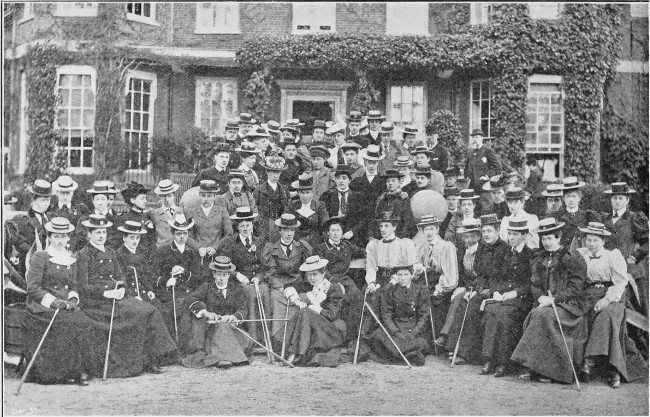 Reinhold Thiele and Co. Chancery Lane.
RANELAGH GROUP, APRIL, 1897.
Yet another matter, is a word on the penalty stroke, namely, on dropping
the ball, as put forth in rule 39:
"In all cases where a ball is to be dropped, the party doing so shall
front the hole to which he is playing, standing behind the hazard and
dropping the ball behind him from his head."
So many women throw the ball over the head, or else stand partly round
and drop it with a kind of jerk over the shoulder, turning the head at
the same time, so as to watch the place where it is desired the ball
should alight. Instead of doing this, you should step back a few paces
in the exact line in which the ball entered the hazard, then stand
erect, raise the hand over the head and drop the ball simply behind you.
Of the Stymie, let it be said, that as it always has been a freak of the
game, so let it continue to be. A stymie, is when the opponent's ball is
on the line of your own putt. But though much is talked of its
abolition, yet as it has always been a case of "fortune's fickle smile
upon the player," why not let it remain so?
Having gone somewhat lightly through the various parts of the game of
golf, it may not be amiss to close with a few remarks taken from an
early volume of the Golf Annual, and occurring in an article written
by Mr. John Thomson, which sets forth the advantages of the game in no
mean manner. "Good games should benefit both mind and body, and no game
can stand this test better than golf. To the mind it shows the need of
caution, courage, coolness, and many other good qualities. Above all it
teaches one to keep the temper under due control in all circumstances
and situations. Our royal game brings out the strength and weakness of
character both in yourself and others, and gives an excellent chance to
study human nature. Some folks think they can know a man from his face,
his mode of hand-shaking, or other such things, but if you wish to look
a fellow through and through, play two or three stiff matches of golf
with him. As to the healthy nature of the game, it is surely needless to
say a word."
Here the writer quotes a favourable passage from Burton's Anatomy of
Melancholy, closing his remarks with the words, "All round we may thus
say our game promotes that greatest of all blessings, sound mind and
sound body."
A. W. M. Starkie-Bence.
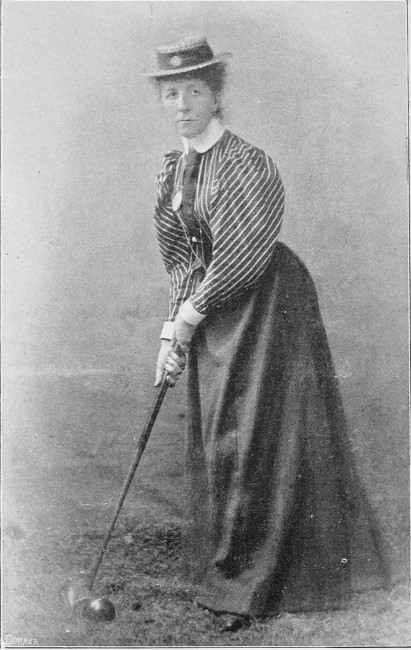 Lombardi and Co. 13, Pall Mall East.
MRS. SPONG.
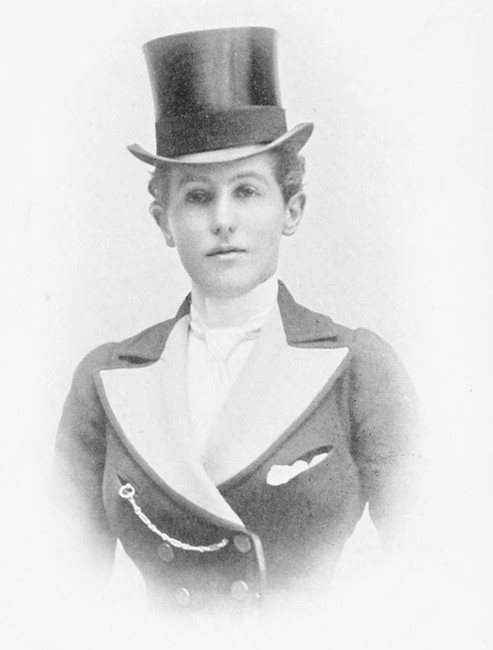 THE MARCHIONESS OF WORCESTER.