How can I with my poor pen do
justice to all the delights of yachting
as practised on the Solent? We need
a nautical Whyte Melville to describe
the joys of yacht-racing, and the real good sport
which is its chief characteristic.
What an exciting game it is, how enthralling,
how interesting, and more important still, how
wholesome. What a benefit for city men to get
right away to the sea, and enjoy such a complete
change and relaxation as this racing affords. And
how much they do appreciate it is shown by the
number of little boats owned by stockbrokers
and others who can only get down occasionally,
but, nevertheless, keep their boats out the whole
season through, so as not to lose the chance of a
sail when their opportunity comes. Not on the
principle that race-horses are kept, either, as
every one knows there is no chance of a racing
boat doing more than pay her own way at best,
for the prizes are barely adequate to meet the
expenses.
Yacht-racing makes quite a new interest in
life. The clever mathematician can find a large
field for his energies in the designing line, and
the keen sailor a never-wearying delight in developing
to the utmost the powers of the boat
confided to him.
How much better than the London drawing-room's
close atmosphere is the fresh sea air, and
the delightful freedom of bounding over the
waves in a well-equipped craft, with the additional
pinch of excitement afforded by racing.
Let me assure you no fear of sea-sickness need
deter any. Many of us would not be proof
against a long Channel swell in a large steamer,
but the motion of our little boats over the diminished
waves inside the Wight, is not likely to
upset any but the most pronounced bad sailor.
Besides, the excitement of racing drives away
all qualms of that sort, sea-sickness being, I
believe, in most cases the result of boredom and
nervous anticipation as much as anything else.
No one could hate "yachting" as generally
accepted more than I do. Anything so boring as a
long sea voyage in a great lumbering schooner, I
cannot imagine. The fact of "being taken," in
nine cases out of ten, "where one would not,"
without having a hand in the matter, with a
large crew of slow men to do all the work and
take all the fun off one's hands, is to me nothing
but an aggravation. The deliberate "cut and
dried" way in which everything is done, the
foresail being lowered and the peak eased when
about two miles from the moorings, and such
cautious measures, fidget me to death. There is
this about racing, that one can never enjoy cruising
in the same way after one has experienced its
far superior joys. I must say, however, it is
rather nice after the scrimmage of a long day's
racing, to get on board a solid old cruiser and
bundle peacefully home. But woe betide you if
the wind is ahead, for you won't get home that
night. No, you must be of a very leisurely disposition,
and a great lover of Nature, for you to
appreciate stereotyped cruising. This kind of
thing is about as different from our Solent yachting,
as the Derby is from a Margate donkey ride.
Of course I can understand the pleasure of
cruising if the owner is also master of his vessel,
but such a state of things is the exception, the
owners mostly passing their time in standing
about deck, or having large meals below, utterly
oblivious of their course, their compass, or anything
else. This must be a very stagnant amusement
at the best, impossible to an energetic
disposition, and only suited to an invalid, or man
in his declining years. To people who lack any
sporting instincts, racing, I suppose, seems ridiculous,
but if they love the sea let them learn all
about it, and navigate their own vessels like men,
instead of being mere passengers on board their
own craft, while their skipper is getting all the
fun. Some women have taken their own line in
this matter, and having mastered the science of
navigation, are most enthusiastic on the subject,
realising how it enhances a hundred-fold the
pleasures of a sea voyage.
The news of a large schooner being on the
stocks now-a-days comes as a surprise, as this type
of vessel has almost entirely gone out of fashion
in this country. That is to say, though there are
still several to be seen about, the old ones being
used because they are too good to throw away,
so to speak, no new ones have been built for
years. The advantages of steam are so great for
cruising and travel, that they outweigh the more
pleasant sensation of sailing, which is the schooner's
only claim to superiority. The difference in the
expense is not very great after all, as you require
double the crew in a sailing craft, and at least
double the time to accomplish your distance. So
if you want to get—say to Gibraltar—the chances
are, that the extra time for which you are paying
your crew, would easily cover your coal bill
on the steamer. The auxiliary in nine cases out
of ten proves a simple farce. Many, I know,
have never once set their sails. It requires all
the crew of an "out-and-out" sailing boat, and
also the great unwieldly spars, which make it a
bad sea boat when not under canvas. I would
only recommend an auxiliary to a real wanderer,
a born "man of the sea" like Lord Brassey, for
whom of course there is nothing like it. The
variety afforded in sailing and steaming on a
lengthened sea trip, must be attractive and resting,
and when both courses are open, you would
not need to carry so much coal as in a steamer, or
endure the wearisome hours becalmed in a heavy
swell, which are such a drawback to sailing.
The discomfort people will endure in the name
of yachting, has always been a marvel to me.
The less they know about the life on board, the
more you will find they patiently put up with.
They seem to think because they are on a yacht,
cleanliness, cuisine, even elbow-room itself, should
be entirely abjured. The miseries that rational,
civilised human beings will suffer in this respect,
is a constant source of wonder, to those who
know how unnecessary they are. Not that these
sufferers do not like yachting, for they are even
persuaded to put their foot on board a yacht a
second time after such experiences. It is only
novices in the game, however, that you will find
suffering these deprivations, for, believe me, there
is no need for them. Do not overcrowd your
vessel, or cut her accommodation up into about
a dozen little cabins, into which you would not
put a dog on land. You really require double
the room for living afloat that you do ashore, as
even your exercise has to be taken on board.
There is nothing to prevent your having most
home comforts, a boiling hot sea-water bath every
morning, for example, and your meals served as
well as they are in your own house. Neither
need you have a bed only two feet wide, so that
it is impossible to turn over without parting
with the bedclothes. It is no longer necessary
to go about on all fours, even in a 20-tonner, any
size below which I would not recommend for a
night's lodging.
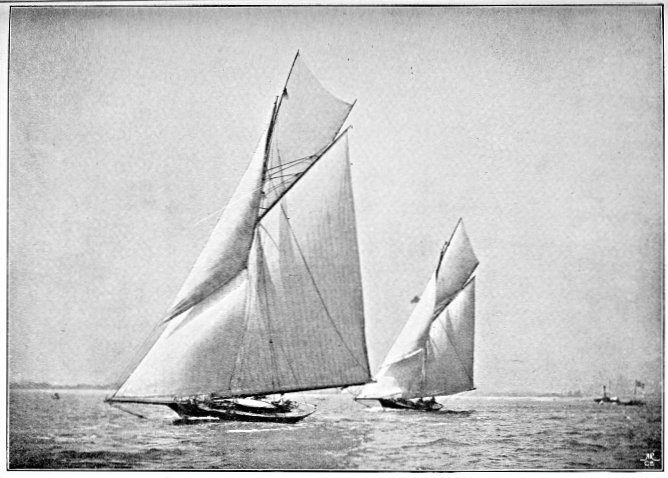
DAPHNE AND LIL.
West and Son. Southsea.
It is the custom of builders to furnish a small
saloon with gigantic sideboards, or lockers, as
they are called. These are ugly, clumsy, superfluous
impediments, which are only made into
receptacles for every sort of rubbish, and take up
an immense amount of room. There is no need
to have your store cupboard in the drawing-room,
as by a little ingenuity ample room can be devised
in the pantry, and in a safe on deck. Another
plan is to have a passage down the side from
forward right away aft, which obviates the perpetual
disturbance of the stewards passing through
your sitting-room. There is then only one door,
which necessarily makes a much cosier room.
Unless you are an assured good sailor, do not be
beguiled into occupying the "after cabin," which
is likewise called the "ladies' cabin." How it
earned this appellation I am at a loss to explain,
as I was always brought up to suppose ladies
came first, and if they are relegated to the after
cabin they very decidedly come off second-best.
There is twice the motion aft that there is in the
middle of the vessel, and in a steamer you feel
twice the vibration, beside being right over the
screw.
How one gets spoilt! I remember sailing
about as proud as Punch in an old Itchen ferry
boat, with ragged sails and tarred topsides. The
distances we used to cover, and the weather we
went through in this old Zephyr are a wonder to
look back upon. The whole day, from nine in
the morning till nine at night, used to be spent
on board, and the experience never palled, as far
as I remember. Large lunches were always provided,
in case of our getting becalmed, or stuck
on the mud, both very frequent occurrences. We
were always out to tea, and to boil the kettle in
a choppy sea was the great excitement. There
was only a kind of dog-hole place forward, where
this important function took place. It was a
severe test for the best "sailor" to balance a hot
lamp, head over ears in methylated spirits, the
hot fumes of which inundated the small cabin,
while she patiently waited till the water boiled.
It was even worse at night, when a smelly
paraffin lamp which would have made the atmosphere
almost unbearable ashore, had to be endured,
and in a small and lively boat was certainly trying.
When we were "caught out" on our way
home from some long expedition, the unfortunate
women of the party used to be thrust into this
salubrious resort, ostensibly for their own comfort,
really and truly, to get them out of the way.
That was a place, when there were half a dozen
women in there, a paraffin lamp, and the door
shut! If one of us ventured so much as to open
a chink of door, it was instantly shut again, with
such exclamations from our male tyrants as—"Whatever
you want to come out for, into all
this wet and cold, when you can be warm and
cosy in there, I can't think," upon which the
brow-beaten female crawled back disconsolate
into her lair, muttering rebelliously. And yet
we were nothing daunted. Out we would be
again with the dawn, to go through all the same
thing without a dissenting thought.
We had not even the luxury of a paid hand
in those days, my brother, and my sisters and
myself doing all the work, which was a splendid
education in more ways than one. I reluctantly
confess I am spoilt for this sort of thing now,
though I shall always look back upon the time
with pleasure, and I very much doubt if it was
not one of the most enjoyable experiences in my
life. It was all so new, so different from inland
amusements, and I then learnt that a sea life has
a charm all its own.
In 1888 we hired a 40-ton old-fashioned yawl
called the Fox, with which we went in for the
regular stereotyped cruising, as generally accepted.
It was not a success, and I cannot say I enjoyed
it. My back was always aching from stooping,
and there was a permanent bruise on my head from
constant impact with the beams. Besides, we
were always being thwarted in our most urgent
desires by the weather—as the skipper said—really
by the incompetence of the vessel to cope with the
elements. It was never worth while for instance
starting with a head wind, as the time the yawl
would take in accomplishing any distance, would
have worn even Job's patience to a shadow.
Of course we share the sailor's love of fishing,
and two large trawlers have been built at Brixham,
by my brother and brother-in-law, for the
special purpose. The Goddess was a huge great
yawl, most comfortable below, and a grand sea
boat. We did plenty of trawling in her, miles
outside the Eddystone, and made some grand
hauls. She had an enormous great trawl-beam,
and steam to get it with. Night was the best
time for fishing, and we were not spared if we
happened to be enjoying our beauty sleep, when
the momentous four hours were up. The row of
course would have awaked the dead, and so we
scrimmaged into our clothes and rushed on deck
ready to claw the great net on board. A waterproof
overall and indiarubber boots were essential
for this performance, and old gauntlet gloves
were a precaution against stinging fish, advisable
for the uninitiated. What a grand sight it was.
Picture a bright moonlight night, when you
were alone on the great rolling ocean, nothing in
sight except perhaps the fitful gleam of the Eddystone
in the far distance. The great vessel with
shortened sail, dipping and curtseying to the
proud billows which toyed with her bulky form,
as though it was nothing more than a feather.
Then amidst great shouting and racket, the huge
trawl-beam was brought slowly alongside, and
the heavy net was clawed on board full of treasures
from "the hallowed precincts of the deep."
What a flippering was there, from whiting, soles,
red mullet, etc., etc. What wonderful curiosities
do live in Davey Jones' locker. All kinds of
leggy, finny, and jelly mollusca, none of them
very appetising in appearance, and most of them
imbued with some formidable means of defence,
such as a sting or a prickle. Once we got two
enormous dog-fish, measuring five foot long, they
were a great nuisance, as they cut the net all to
pieces and were no good to man or beast.
One of the best hauls we ever made was in the
Wayfarer, my brother's trawler, between Torquay
and Dartmouth, when we had the whole deck
full of fish, mostly whiting and soles, and the
trouble was to get rid of them, even though we
supplied every one in Dartmouth, and that in
the time of the regatta.
Brixham and Bosham fishermen are much
pleasanter to deal with than the self-styled
"Yachtsmen," and they give much less trouble,
do more work and require less wage. The custom
of making a friend of the "Captain" is a
huge mistake, as these individuals are usually
the most wholesale extortioners that exist. The
exorbitant wages they demand for filling a luxurious
billet would stagger a longshoreman, and
the petty pilferings, nominally perquisites, in
which they indulge are what really make yachting
so expensive. The familiar manner of some
of these brass-bound autocrats is simply atrocious.
They seem to consider themselves complete masters
of the situation, and treat the owner and his
friends as so much superfluous cargo to be ordered
about at their desire. This, without any exaggeration,
is the state of things on numerous yachts
I could name, more especially those with lady-owners.
To turn now to clothes, that all important
point to members of my sex. I can only venture
to suggest the merest hints, as really it is not a
subject on which I am an authority, that is to
say, if one is supposed to practise what one
preaches. Brown in any form is to be avoided
on the water, it is unspeakably ugly, and a number
of people dressed in brown on a boat would
destroy its appearance, be it never so smart.
Nothing looks so well as white and red, or dark
blue, but not black. Blue gauze veils are useful,
but not ornamental, though a broad-brimmed
sailor hat embraces both these virtues.
I have been twice to the Mediterranean, once
in a sailing boat, the Goddess, and once in a steam
yacht, the Normania. So I will close my cruising
yarns with a description of what we experienced
at the hands of a Greek pilot. We were between
the Piræus and Corfu one evening when it came
on suddenly very dark and dirty. Being a very
determined party of women on board, we made a
stand for taking shelter behind one of the islands.
We all "held a board" on the chart, but could
see no harbour of refuge equal to sheltering our
sumptuous craft. The little Greek pilot however
proved equal to the occasion. Pointing out a
small indentation in the coast, he urged us to
confide in him, and he would guarantee us a
peaceful night. Accordingly we slowed down
the engines, and made for a faint red light. The
chart, by the bye, said this light should be green,
but that was neither here nor there. There was a
rocky promontory sticking out with a lighthouse
on the end, where was the aforesaid red light
that should have been green. This our valiant
pilot steered straight for. It was blowing a
sirocco, with thick rain and a heavy sea, nevertheless
we all stood on the bridge to watch the
hazardous venture. On we went, straight for
the rocks where the rollers were breaking. It
was becoming decidedly interesting, and as the
chart evidently did not consider the place worth
its serious attention, we could no longer look to
that for guidance. Very soon the darkness and
hurly-burly of the storm lifted for a second, and
displayed a most disorganizing prospect. We
were almost on the beach on the starboard side,
and could have thrown a biscuit into the lighthouse
window on the port, and there was land
right ahead. We were in a little pocket, a neck
of rocks which ran parallel to the coast, taking
the fury of the waves, and affording a good
shelter. But a tighter place for a five hundred
ton vessel could not be imagined. When we
looked out of our ports in the morning, we were
still more astonished, for without exaggeration
we could have held easy converse with the
people ashore all round the vessel, while our bow
positively overshadowed the small quay. It was
a place into which one would have hesitated to
take a 50-tonner with twin screws in broad daylight,
and for a 500-tonner to get in safely in a
howling hurricane, and when it was pitch dark,
was indeed a feat of ingenuity.
Of course it entailed backing out, but as the
yacht fortunately was a very handy vessel, this
was safely accomplished. Such little incidents,
which lend a piquancy to cruising dispel the
monotony, and while they keep up the interest
in the manipulation of your vessel, also serve to
entertain your friends on getting home.
Yacht-racing is in every respect a sport suited
to our sex. No unseemly gymnastics, no over-straining
or over-tiring, no cruelty can be laid to
its charge, in fact nothing to offend the most
exacting upholder of the feminine. Yet Yacht-racing
is open to abuse, though even here in a
lesser degree, perhaps, than other amusements.
Where it stands alone, is that in it a woman can
compete on equal terms with man.
Yacht-racing needs much study, and should not
be attempted till the ordinary art of sailing is
thoroughly understood. It is the most delightful
education in the world, the most interesting and
healthful. It becomes so engrossing you will not
rest till you understand the whole thing, and
know the why and wherefore of all the different
moves. It is not advisable to order a boat of your
own till you have served an apprenticeship as
"hand." Very few people are now contented to
go as "hand" or "crew," every one preferring to
"paddle his own canoe." Nevertheless it is delightful
to go in a well managed boat where you
have full confidence in the skipper, and a beginner
should certainly not be above it. She will then
see how much there is in "handling," and realize
how many races are won solely by clever management
and attention to small details. At any
rate do not attempt to have a boat of your own
for the first time until you have secured an
experienced racing skipper. When you have
done this be guided by him entirely to start with,
only you will do well to be still more particular
than he is in adhering to the Yacht Racing Association
Rules, which of course you should know
by heart. If you are racing do what the skipper
tells you instantly, and do not wait to ask the
reason first, do that afterwards.
The great secret of racing is to keep your wits
about you, do everything "smartly," never hesitate
or waver between two opinions at a critical
moment, for that will merely lose you the race.
The need of prompt decision is one of the most
exciting features of racing, now it has been
brought to such perfection. One faux pas and
you are done if the wind stops true, but on the
other hand it seldom answers to give up, as you
need never despair of the wind veering round
and coming to the rescue, even if you have made
a blunder. To be really good in a boat you
should have done some single-handed work, but
this is not to be recommended until you are well
grounded in the rudiments of sailing, or you will
very shortly be "well grounded" on something
harder still.
The single-handed matches in one-raters which
were witnessed in 1895 and 1896 were excellent
trials of skill, as was shown by the results. It is
impossible to exaggerate the difficulty of sailing
those boats single-handed in rough weather, for
it is a task worthy of a Sandow and a Carter
rolled into one, and the greatest kudos is therefore
due to those sportsmen who brought their boats
safely across the winning line. There were some
"lame ducks" too, through no fault of their own,
and many I regret to say made but a poor show
of their prowess. There is plenty of variety,
however, in racing without going to any extremes,
or attempting impossibilities like those single-handed
matches. A half-rater would be quite as
much as one man could manage properly in
rough weather.
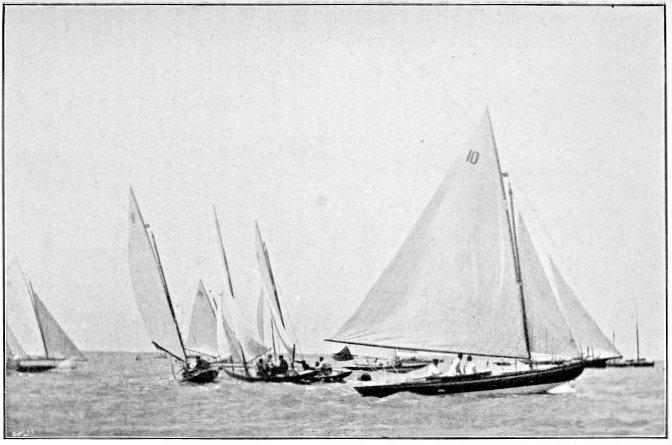
Becken. Cowes.
ONE-RATERS AT COWES.
Every year affords fresh interests, as the type
of boat alters, for there is skill required to get
them into trim and learn their ways. Each individual
boat, too, wants different handling, and it
will often be a surprise to an adept in one boat, to
find himself quite adrift in another. Steering has
been steadily becoming more difficult hitherto,
but now I fancy there will be a return to the
fixed rudders we began with, which are much
easier to handle than the balanced ones of later
years. The business will not then be as fidgety,
or require such close attention, as with balanced
rudders your boat which may be ever so light on
her helm, will be constantly veering about and
getting off her course, if you do not keep an
undeviating watch on your steering. Of course
it all makes it more interesting, because more
difficult, but in a way it is not an advantage for
the helmsman to be entirely engrossed with his
steering, unless he can conscientiously rely on his
"crew" to do the rest.
To enjoy racing to the full you should have it
all in your own hands with no one to say you
"nay," otherwise that spirit of independence—so
rarely enjoyed by our sex—is lost. The sensation
of being master of your own vessel, with the
helm in your hand and a willing crew to do your
commands, unquestionably, these are elements
which should be experienced to be enjoyed. As
a man is dependent on his eye for shooting, his
hands for driving, his pocket for betting, so does
he depend on his wits for sailing. To be a good
skipper you must above all things have a clear
head and plenty in it, for there is much to learn
and to keep up. Yacht racing has now attained
to a pitch of perfection verging on science, and
to succeed in it you must have observation, self-control,
perseverance, good ready judgment and
self-reliance, besides many other qualities too
numerous to mention, such as patience and cheerfulness.
There is nothing to compare to yacht-racing
in my opinion for a woman's sport, calling
into play as it does all these qualities, besides
giving the wholesome enjoyment of an ocean
life.
I began my racing career practically in 1886,
though I had had some experience with a little
boat called Fairy, which my father had bought
from Picket of Southampton. This boat had
been built for letting out to pleasure-parties, and
was nearly as broad as she was long. Some years
before this he—my father—had built the 60-tonner
Vanguard, and as he was a great connoisseur
on boats he made a good hit in buying the little
pleasure-boat, Fairy. She and the Bird o' Freedom
were the pioneers of that now famous body
the Solent classes. With some slight alterations
to the keel, and with the addition of a large jib
to the sail plan, little Fairy proved herself capable
of beating the Bird o' Freedom, which was then
the greatest flyer of the day. This caused some
surprise to the faculty—who were few in those
days—and some of them decided to try and beat
her the following season. Consequently 1886
saw the Minima and Tootsie added to the list, and
some jealous competitions ensued.
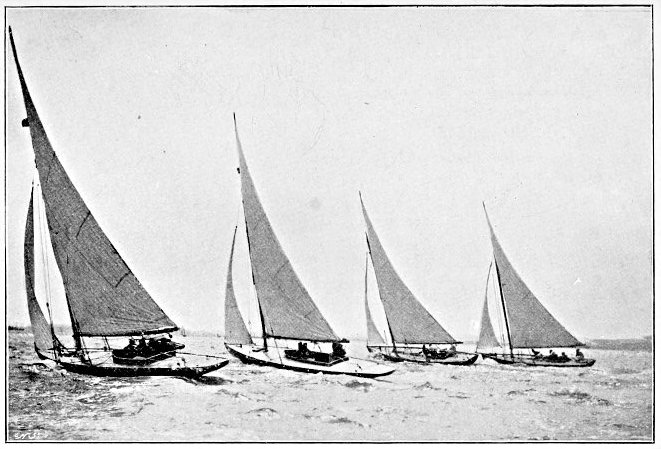
West and Son. Southsea.
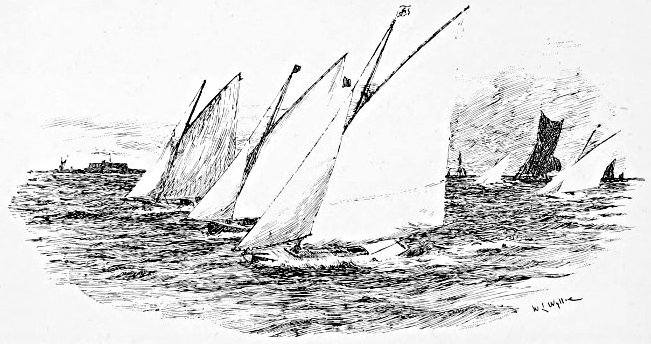
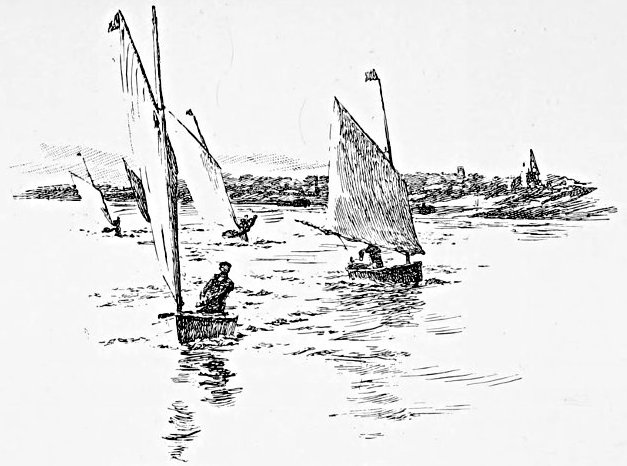
READY FOR THE START.
(MYNAH, HOOPOO, STORK, AND MOLLY.)
The Royal Southampton and Portsmouth Corinthian
Yacht Clubs came to the rescue and gave
fortnightly matches for the small craft, as well as
for the 25 and 30 footers. Then the fun grew
fast and furious, for the small boat racing having
been given the necessary fillip, the designers put
their best foot foremost and the sport was fairly
started. A motley crew it was that assembled
off the Town Quay every Saturday fortnight.
Most of the boats were of the nice little cruiser
type, slow as a country dinner party, nevertheless
so enshrouded in canvas as to present a most
sporting appearance. Any deficiency in design
was balanced by unlimited additions in canvas,
no expense being spared in sailcloth to make up
the necessary speed. And how zealous was the
competition! Life and death might have hung
on the issue, judging by the ardour and agility
displayed in the management of the boats.
"Every dog has his day," and this was the
heyday of the Dauntless Amateur. An eager,
perspiring, undefeated creature was he! Minus
hat and socks, having shed all superfluities in clothing,
he gallantly plied his task before the mast.
Any effort to persuade him further aft, or into
the "well," were unavailing. He loved to stand
boldly up forward, the wind running riot through
his hair, the poor boat shoving along all out of
trim, owing to his misplaced weight, while he
gallantly stood at attention, eager to signify that
he was "ready for anything." However we shall
see our hatless, sockless friend no more, his place
being now filled by the peerless Itchen ferryman
at thirty shillings a week.
The richest man now has the best boat, and if
he does not get it the first time he goes on building
till he succeeds. The same with the crew,
the man with well-lined pockets gets all the best
men by paying the best wages. But still even the
designers are not wholly responsible for what
their craft will turn out, as was proved by Sibbick
building the unsuccessful White Rose for the Duke
of York. Other cases I could also mention where
money was no object, and boat after boat untiringly
turned out for the same owner, yet without
success. Then some lucky man may get a boat
from the same designer which will clear the
board for two or three seasons, her capacities
having been all unknown to the designer himself.
How we managed in those days of unlimited
canvas with only two hands remains a mystery.
What with the enormous topsail and all the extra
gear it entailed, the long spinnaker, boom, etc.,
and the largest mainsail that could be crammed
on, the wonder is that we ever gybed round a
mark at all, without capsizing the whole lot overboard.
The gear of course was very much
stouter and the boats slower on their helms than
they are now, or it could not have been done.
We have the same crew on a one-rater now that
we used to have on the 25-footer Lil, which is
most astonishing to think of when we compare
the two boats. True they are practically the same
length, but with what a difference in build. The
Lil was a regular ship with her enormous spars
and canvas, and her well timbered heavy hull and
large cabin, whereas these little one-raters are
mere cockle shells without half the amount of
gear, nor are they nearly so hard on it. Nevertheless,
anyone will tell you it is impossible now-a-days
to manage a one-rater properly with less
than two hands, and that with only two sails instead
of four.
The first race I think ever sailed by women
was between us—my sisters and myself—in the
Fairy, and the Miss Coxes in their sister ship
Colinette, I believe the Miss Hammersleys also
formed part of the rival crew. I have but a
vague recollection of the whole thing, being too
young at the time really to grasp the situation in
its full value, or for it to make any great impression
on my mind, as I was always being taken
racing in some boat or other. In 1885, we were
again rivals in Verena and Lil, one of the Miss
Coxes always going in the former, and one of us
in the Lil. These were great wholesome boats
with enormous sails, and we managed to do a lot
of cruising between the races, which in those
days only took place once a week. The Lil had
quite a nice deep cabin which was the pride of
our lives, pictures being hung in every available
space, and little curtains and cushions to match.
Little Fairy meanwhile was "not quite dead yet,"
and in 1888 "came up smiling" to fight the
battle and the breeze in a resuscitated form.
That year she proved herself no mean opponent,
and succeeded in making the same figure of merit
as Thalassa, the champion of the previous year.
This success was due to a fin keel, an experiment
of my father's which has since been through
almost every imaginable variation, and still holds
sway in a modified form among the smaller
classes.
In 1887, Miss Cox built the Madcap at Payne's,
and divided the honour with Thalassa, also a
two-and-a-half-rater by Payne. The latter belonged
to Colonel Bucknill, whose daughters are
now so well known on the Solent. Miss Bucknill
is indeed much sought after as a helmswoman, and
with good cause, as she has learnt the work thoroughly
and is as proficient at the helm as she is
on the jib sheet. Her father has raced steadily
every season since 1886, and she has almost
always accompanied him and shared in the work
most gallantly. I cannot be quite sure if we
sailed Fairy or Lil that year, 1887, but I think
both went to the line, my brother also designed
a five-rater with but little success, being young
he had to buy his experience of course, and learnt
the advisability of going to Arthur Payne in
future.
The year 1889 was a memorable one for us,
as we were fortunate enough to possess the
champion two-and-a-half-rater by Payne. Hummingbird
was a charming boat in every respect,
comparatively roomy, a good sea boat, and a
wonderful performer to windward. She gained
twenty-five firsts and four seconds, out of thirty-eight
starts, and succeeded in routing three creations
of the famous G. L. Watson. It was one
of these, the Thief, which my sister, Mrs. Schenley,
had the misfortune to possess. A most
uncomfortable little craft it was. Only about
five foot beam, with decks like sieves, and we
were all crammed into little holes or cockpit
places with only our head and shoulders out, for
all the world like chickens coming out of an egg.
That was really my introduction to racing. I
had to work hard, as it was not the boat to take
people in who did nothing. We were fortunate
in securing Charlie Devis, who is now considered
almost if not quite the best skipper on the Solent.
He was then little more than a boy, so we were
all young and enthusiastic together, and despite
the many drawbacks I think we all enjoyed that
season thoroughly. At any rate we were nothing
daunted, and only waited till the next year to
renew our efforts in a five-rater of the same
type.
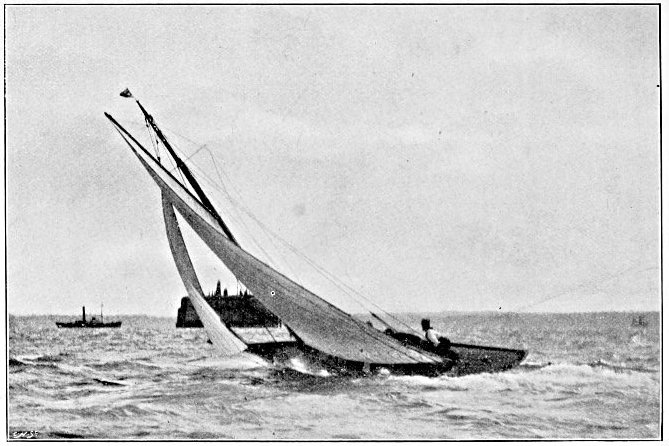
West and Son. Southsea.
THIEF.
This was also Lord Dunraven's début on the
Solent, and he was not much better off than we
were, having a sister ship to ours, by name Cosette.
Therefore, with the Queen Mab, G.G., Lady
Nan (Mrs. Rudstan Reid), Thalassa and Madcap
(Miss Cox), we had to be content to compete for
second honours, the Hummer always carrying off
the first.
I might here put in a word in season, on the
evils resulting from keeping rival boats in the
family. The battles are bound to be re-fought
over the domestic board again in the evening,
and of the two the wordy war is by far the most
bitter and lasting. The envy and jealousy of the
defeated cannot fail to show itself, and even the
conqueror owes the other a grudge, for having
so much as dared to get in his way at the start!
We learnt the lesson in 1887, and have kept
studiously clear of each other's hunting grounds
ever since, even counselling our friends not to
put our fidelity to so severe a test as to join the
same class. It was this year that Mr. Philip
Perceval made his début with the Lollypop, a boat
he bought from Mr. St. Julien Arabin. Since
that time Mr. Perceval has been an enthusiastic
member of yacht-racing circles, and is now almost
as well known on the Solent as Calshot Castle.
Most lucky in his boats, whatever he touches
must turn to gold, and besides this phenomenal
luck, he has unrivalled skill at the helm and in
the general manipulation of the craft. So his
racing record must be indeed a remarkable one.
Perhaps some day he will be persuaded to publish
it, in all its branches.
At the end of this season, a ladies' match was
sailed in the sister ships Cosette and Queen Mab.
Miss Bucknill was at the helm of the former,
and Miss Harvey had the Queen Mab. It is
much to be regretted that Miss Harvey did not
persevere in her racing career, as she showed
much ability and came of a nautical family. Her
father, Mr. E. Harvey, was well known as one of
the original members of the squadron. The race
was very interesting and well managed, but far
be it from me to say which proved herself the
better steerer. Lord Dunraven and Mr. Perceval
who now had the racing fever, had both
built five-raters at Payne's and divided the honours
in that class. Mrs. Schenley determined to make
another experiment with Mr. Watson's design
in the five-raters. The Valentine, however, was
a worse failure than the Thief had been, Glycera
and Alwida being always first and second. The
stern chase became rather wearisome, and we did
not keep at it so steadily as we should have, only
starting twenty-six times to the others forty. We
managed to pick up five first and four second
prizes, chiefly in light weather. The Babe, Mr.
Payne's design, was champion of the two-and-a-half-raters,
and poor old Hummer, which had
served us in such good stead the year before, was
clearly worsted. She was beginning the season
in her old style, when the dreaded advent of the
Babe put an end to her prosperous career, and
she had a hard struggle till the end of the season
to keep up her old traditions. I sailed many
times on Hummer and Cock-a-whoop, my brother's
two-and-a-half-rater, and on the former I said
less, but thought the more, as my father's seamanship
was undisputed, and his tactics a wonder to
behold. That year the inventive genius of Mr.
Clayton, champion designer of the old length
classers, produced the Dolphin, also a two-and-a-half-rater.
She was looked at with decided disapproval
and some disgust by the rival faculty,
as her over-hang was considered a crafty mode of
cheating the rule. So it was, and continues to
be to this day in a still larger degree, but after
all it is the designer's object to get as much as
he can out of the rule, without paying for it in
time allowance. Miss Cox and her sister, now
Mrs. Rudston Reid, both built two-and-a-half-raters,
which they sailed most conscientiously
but without much success. Miss Cox's Mliss
did the better of the two, the Troublesome not
being a morsel of use except in light air. However,
it was a very strong class, and of course
every one could not expect to win. Mrs. Schenley
was at last persuaded, in 1891, to give Payne
an order, and he proved himself fully equal to
the trust confided in him, by producing that
most delightful of boats the Windfall. Seaworthiness,
dryness, roominess, and lightness of helm
were some of her qualifications, besides her exceptional
speed. War to the knife ensued between
us and Mr. Perceval, who had likewise
got a new five-rater from Payne. We came out
of the fray each with thirty-four flags, Windfall's
string however being the better by six firsts, indicated
her superiority by six conquests out of
the forty deadly conflicts. These struggles have
never been renewed, the ordeal having been too
great for both sides.
The small pickings left over and above, namely
nine first prizes and twelve second, were shared
by Alwida and Iernia respectively. The latter
boat, one of Fife's failures, was owned by that
genial Irishman, Mr. Langrishe, who had previously
sold the famous Samæna to join the ranks
of the owners of the smaller classes, to which he
has remained faithful ever since. He placed his
confidence from the first in young Mr. Charles
Nicholson, who ultimately proved more than
equal to the trust reposed in him, and he
designed the Dacia in 1892. Miss Cox was
again at a discount with a most unattractive
two-and-a-half-rater, she called Fiera. This was
one of the hard-mouthed type, and wanted a
fresh wind and a strong man at the helm. She
gave a good account of herself however on such
occasions, and ran up a better record than Mliss.
Miss Harvey was the possessor of a very pretty
two-and-a-half-rater called Undine, built from a
design by Mr. Clayton. This last was still more
of an advance towards the type of the present
day, and no doubt would have made a good performance
then if she had been raced. She only
showed up once or twice, however, and so of
course never had a chance of getting into trim or
anything else. Possibly Miss Harvey was put
off by a collision she had with the Windfall
during the Cowes week. It was very unfortunate,
but not her fault as I can testify. Nevertheless
it was none the better for that, and I remember
pointing out the best place on the Windfall for
her to ram with the least danger. Undine's bowsprit
accordingly went clean through Windfall,
just forward of the mast, and then the two boats
got locked together and the spars began falling
about our ears. There was a strong wind and a
still stronger tide, and we were rapidly driven
under the bows of a large steamer Gladwyn. The
Undine had the inside berth between Windfall
and Gladwyn, and as Windfall got across the tide
she fairly ground poor little Undine's frail hull
till the timbers groaned again. Meanwhile the
gallant crew of the Gladwyn insisted on dragging
us ladies up over the bows, and this was the most
alarming part of all, as it was such a height.
The owner of the Gladwyn, who was in the
Squadron at the time, was much surprised a
little later to see a strange lot of rather dilapidated
females, being rowed ashore in his gig.
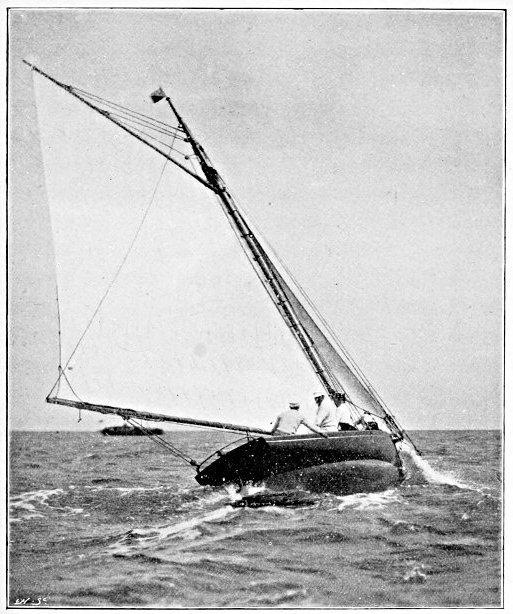
West and Son. Southsea.
NADADOR.
I must not forget to mention that lively little
club at Bembridge, situated on a remote corner
of the Wight, near to which is the double
attraction of a superior golf-links. The Bembridge
Sailing Club, or "B and S" Club, as it is
irreverently called, was started in 1889 by
Colonel Moreton and Major du Boulay. Some
of the rules were nothing if not eccentric, and I
am told the favourite hour for match sailing was
about midnight. The women were duly considered
in this club, and most ably did they
acquit themselves in the one design class.
Miss Sutton was tempted out to the more
easterly regattas, when she had a half-rater
called Wee-Winn, of which more later on. Miss
Moreton, Miss Hallows, and Mrs. Dudley Ward
and her daughters, were among the other Bembridge
sailoresses, though of course many more
came down in August to this cheerful little
resort.
The next year, 1892, both our family boats
were beaten by a new talent, young Mr. C.
Nicholson. It was a great thing bringing a new
brain to bear on the matter, as for the previous
five years Arthur Payne had held the whole
sway, and prior to that Mr. Clayton. These
boats went quite fast enough to make a good
race of it amongst themselves, and though they
assuredly were hard to beat yet they were beaten
by the Dacia in the five-rater, and the Gareth in
the two-and-a-half-rater class. The latter was
the property of Mr. Henderson, who was indeed
fortunate, as he was a complete novice, to own
the champion of three seasons. Lord Dudley
bought Dacia from Mr. Langrishe in the middle
of the season for a fabulous price, nevertheless
the latter was generally to be seen at the helm.
Lord Dunraven's Cyane, from Mr. Payne's design,
was at the old game of shovelling the first prizes
into her locker, until Dacia came out and put a
stop to it. The pace of this flyer soon spread dismay
in the class, which was not very well filled
even at first, and soon no one could be got to start
against her, until she went down to Torbay to
show a boastful Scotch antagonist the way round
the course. The rivalry between North and
South is always exceedingly bitter, but latterly
the Scotchmen have not thought it infra dig. to
come to the South for their best designs in the
small classes. It would be more patriotic, to say
the least of it, if the best Clyde amateurs were
to challenge us in their home manufactures,
otherwise their triumphs are but reflected glories
after all.
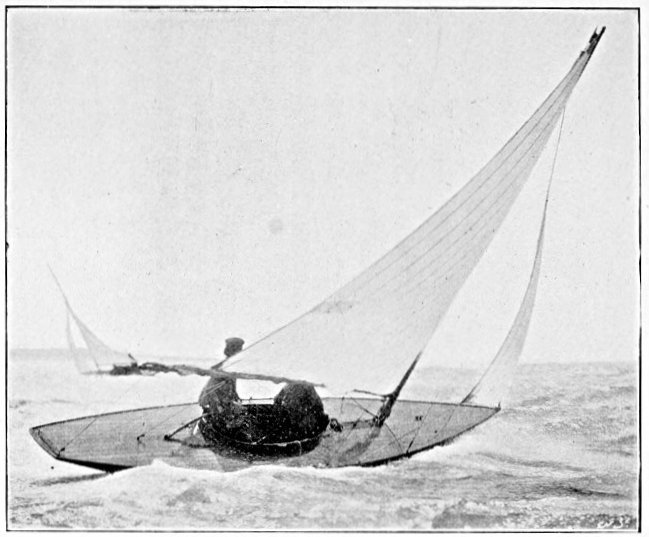
West and Son. Southsea.
MORWENA, STEERED BY MISS SUTTON.
A little stranger from over the water appeared
this year (1892), to the order of Miss Winnie
Sutton. Wee Winn, however, did not belie her
somewhat ambitious appellation, as is often the
case. On the contrary, she amply fulfilled it,
and the tiny Yankee did her country great credit,
and that in what we flattered ourselves to be a very
formidable class. She had nine competitors from
four different designers, and yet fairly walked
round the lot. Her performances were the signal
for further Yankee inroads, and 1893 saw two
American boats, namely Meneen and Morwena,
added to the list. So now there was an American
in all three classes from two-and-a-half downwards,
and to our shame be it said each one headed
her class. It was not till the year 1897 either,
that Meneen may fairly be said to have been outclassed,
her construction also was a masterpiece of
lightness and durability. Her record was forty
prizes in forty-nine starts, and this with seven
rivals, one of Mr. Nicholson's design and one of
Mr. Payne's included. Mrs. Hardie Jackson
constantly accompanied her husband in Meneen,
and was as at home on the water as she is known
to be in the saddle. This was not a propitious
year for South coast designers, as Fife held the
laurels in the five and likewise in the twenty
class. The twenties were a new institution promoted
by Lord Dunraven, and they flourished for
four years as Solent classes, but last season (1897)
no new ones came to the line except towards the
end of July.
In 1893 the race programmes were almost too
well stocked, the scrimmage on the line to get
the start being a sight to behold, especially in the
one-rater class. There were considerably over a
dozen of these, and almost as many half raters,
all determined to get the start of the others over
the line, and that sometimes a very narrow one
as in the Hamble river. The Morwena, champion
of her class, was owned by one of the sisters of
Miss Winnie Sutton, and though her success did
not cause such a stir as Wee Winn's, she made
almost as good a record. Miss Cox's luck again
failed her in Kismet, a two-and-a-half rater built
by Payne. I believe she also was a very hard boat
to steer, in fact worse than Fiera. My brother
sailed the majority of races that year in Gareth,
whose performance was a good one but not so
good as the Meneen's. Gareth started five times
more than Meneen and won two more prizes, but
Meneen's figure of merit came out the highest.
These two consequently pretty well monopolised
the prizes, but a few being left for the other six,
of which Kismet picked up two firsts and six
seconds.
Mr. Jessop was the owner of the Molly, twenty
rater, and Coquette, half rater. He consequently
often required a helmswoman for the latter, which
office he kindly offered me. Little Coquette was
an extremely fast boat of Mr. Nicholson's design,
and made one of the longest string of flags ever
recorded. Wee Winn, fortunately for us, only
started eleven times that season. In the same
year (1893) the majority of boats and the largest
prize winners were of a good wholesome type,
but the three following seasons they went steadily
down hill in this respect. Elf was considered an
unsightly monster then, but there have been many
like her since, not a whit uglier or less exaggerated,
which have proved themselves also the fastest
movers. Flat Fish was a case in point. She was
most aptly named; indeed, I think the Flounder
would have been a still more appropriate designation.
She was put together with most wonderful
despatch by Fay and Co., from Mr. Soper's
design, for my sister, Mrs. Schenley. The first
two races she came to pieces, owing to the hurry
over her construction, and had to go back for
repairs. To hear the flump of her bow on to the
water, it was marvellous that anything could hold
out; she was just the shape of a spoon forward,
and when driven against a head sea she naturally
made the splinters fly. Her nose was quite four
inches higher in the air by the end of the season,
in fact she presented the most cheeky appearance.
A most powerful boat in a breeze, in all senses
of the word except perhaps the individual frame,
she also required a Goliath to steer her. My
sister's and my united forces were unequal to the
task, and it used to amuse us to watch for the
signal of distress held out towards the end of a
race by the boastful amateurs, whom we requisitioned
to steer on hard windy days. They were
never keen to repeat the experiment, and if they
did, they were glad enough for us to take turns.
Our chief antagonist was Fleur-de-Lys, built by
Fife and owned by Major Montgomery, one of
the few lucky yachtsmen who have not followed
up their successes, although a dweller on the scene
of action. Lady Sophia Montgomery occasionally
accompanied her husband, and took a keen
interest in the fray and kept a jealous eye on the
records of the rival craft. Theirs was undoubtedly
the better "all round" boat, as Flat Fish was
no more good than a barge in light weather, although
she was conscientiously sailed in all the
races for which she was entered. In 1894 two
new aspirants for yachting fame joined the ranks,
namely, the Hon. Mrs. Oliphant and Miss Lord.
I can hardly say which has proved herself the
keenest sailor. Mrs. Oliphant was most fortunate
in securing an excellent two-and-a-half rater
from Sibbick, called Zivolo, which made a very
good record, taking twenty-nine flags in thirty-six
starts. Although the boat was her own property,
she very wisely got others to steer at first,
though she always accompanied the ship. Now
she no longer needs assistance, and though not
possessing a boat of her own this year, she has had
several mounts on other peoples. The Rosemary,
a formidable customer to steer was in her hands
the latter part of this season, and though a slow
boat Mrs. Oliphant often led the fleet in her, and
won two or three prizes. Miss Lord has had a
succession of one-raters since her début in 1895.
She favoured Soper's design at first, but latterly
has adopted Sibbick's. All her boats have been
large prize winners.
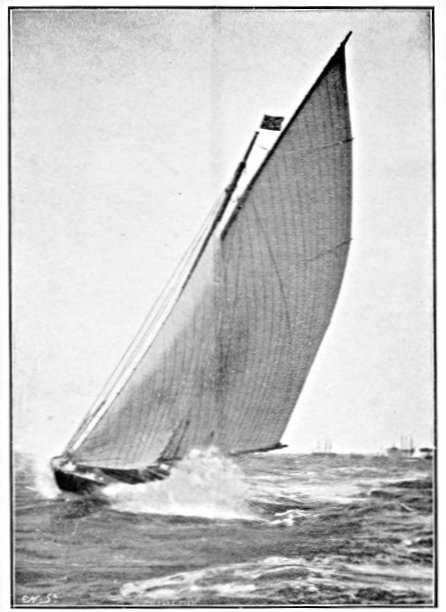
West and Son. Southsea.
FLAT FISH.
In 1895, yacht-racing was distinctly the fashionable
sport. Lord Dunraven was no doubt in a
great measure responsible for this, he having persuaded
several friends to join the twenty-rater
class. Lord Lonsdale owned one of these, Lord
Dudley another, Prince Batthyany Stratmann, a
pretty boat painted blue, and the unfortunate
Baron von Zedtwitz, who was subsequently
drowned off his twenty-rater, the Isolde.
Even Royalty patronized the Solent classes.
The Duke of York had a one-rater built at Sibbick's
in less than a week, in which he took a
great interest though he did not venture himself
to join in the sport. The White Rose was, however,
in good hands, being most ably sailed by his
equerry, the Hon. Derek Keppel. She was not
a success, however, and when Mr. Keppel, who
was called away at the end of August, confided her
to me, I made but a poor show with her, gaining
only one first in tour starts. Miss Cox was well
to the fore in the same class, also having got her
craft from Sibbick. She made a string of
twenty-five flags, eleven of which were firsts.
My brother had bought an unsuccessful one-rater,
he re-named Fusee, the year before. He and I
sailed this little boat in several races, I steering
and he doing the work. It was fun, and the
boat was well suited to this game as she was only
good for light water, directly it blew up at all
she was passed in spite of all we could do. So
when my brother went abroad at the end of June
I got a boy to help, and sailed in the light wind
races throughout the season. I thoroughly enjoyed
myself and got ten prizes out of twenty
starts, though poor little Fusee was invariably
beaten on a reach except in the lightest air, and
had to make up all her time on the "beats."
That August was a busy month, for on looking
back I find I raced every day, Sunday not excepted,
as we used to have duels in Fusee and
White Rose with amateur crews. The class to
which these belonged (one-raters) was then and
has remained the most popular of all classes on
the Solent. Once at Yarmouth, fourteen of us
started together over the line. It was grand fun
and I was very proud of leading at the end of
the first round in little Fusee, but unfortunately
the wind dropped completely in the second
round, and only a few of us managed to complete
the course at all. I think Mr. Paget's
Soper got in first, and Miss Cox's Mavis second.
1896 was also a great one-rater year, and Miss
Cox had the honour of leading the whole fleet in
almost every race she sailed. She had returned
to her old ally, Arthur Payne, who designed her
the Speedwell. No praise is too high for this
little champion, for she still holds pride of place
and has proved herself as seaworthy as she is fast.
I never steered such a wonderful boat, to windward
she positively edged along in the teeth of
the wind and made all the others look foolish, as
she outpointed them to such a ridiculous extent.
I often sailed the old Meneen that year, and she
also was dependent on her windward powers for
her success, as being much shorter than the
others she could not be expected to reach with
them. This was well shown at some races at
Seaview in August, when we headed the Florence
(Sibbick's crack owned by the Marquise de
Serramezzana) every time to windward, whereas
she would pass us again on the reach. The
Florence got two firsts and one second, and we
secured two seconds and one first out of the three
races. Mrs. Schenley had bought the Corolla, a
success of the previous season. We did very
well with her until about the end of July, when
Tatters became too much for us, some slight
alteration having given her the advantage over
us. Florence then came out, and we left those
two to fight it out to the bitter end. These
boats, both of which were of Sibbick's design,
were extremely fast, though they were not
remarkably close-winded. Lord Albemarle built
Valeria I. at Payne's, and I sailed in her many
times but failed to score, there were certainly
numerous and formidable rivals and Valeria came
rather late to the fray. It must be an unlucky
name I think, as Valeria II. has not proved any
better, though she is a beautiful boat and great
things were expected of her, being Payne's
design. Tatters, with Miss Lord at the helm,
won first prize in the Ladies' race (promoted by
the Gentlewoman) on August 4th, Mrs. Oliphant
who had a good mount in the Florence was
second, Miss Bucknill being third in Meneen, I
fourth in Valeria, my sister last in Mem Sahib.
There was a fresh wind, and as the harbour was
full of yachts, and the course was all amongst
them, considerable skill was required in the
handling. There were happily no casualties.
Another ladies' race in one-raters, with a diminished
crew of one amateur, was got up one
evening at Cowes by Lord Harrington. There
was a fine scrimmage getting on board, most of
the women or their boats being late, the starting-gun—a
12-bore—was fired off in one of the
bathing machines, regardless of the entreaties of
the competitors for time. I was dragged on
board the wrong boat at the last minute, my
"mount" being late, and off we went after
Speedwell, but she was already a speck in the distance,
and we found we should never catch her
again. My sister and I had a deadly encounter
in Tartar and Bodagh, and after jostling each other
round and round and tacking and filling in a remarkable
manner only known to ourselves, I came
out the best of it and she gained third honours.
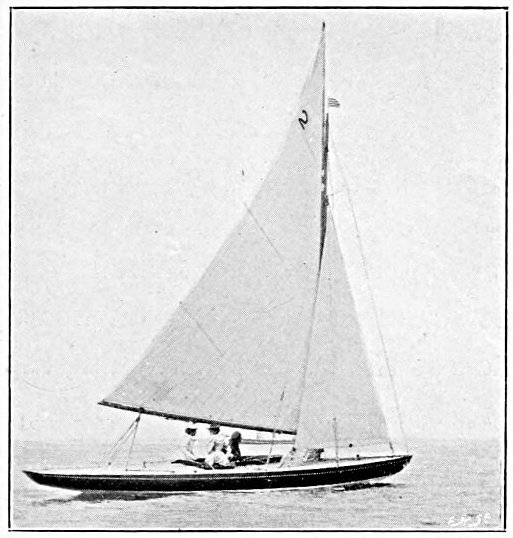
Becken. Cowes.
COROLLA, STEERED BY MISS HUGHES.
In 1897, Mrs. Schenley joined the one-design
class—with Cresta—- started the year before by
Major Colville and Colonel Bucknill. These
boats proved very popular and much good racing
has resulted. They are ugly but wholesome,
not very fast but answer their purpose well. We
did not race very assiduously that season as we
were often otherwise engaged. Cresta won us
about fourteen prizes, in thirty starts I think.
Many women sailed in this class, Mrs. Parry and
Mrs. Tower constantly accompanying their husbands,
also Mrs. Towers Clark and Mrs. Alwyne
Greville were occasionally to be seen on the
C'lerk and Eileen. These latter, however, never
ventured to take the helm, though they were
much attached to the sport and nothing daunted
by weather. The boats owned by women this
year were the Fairy, Miss Lord, Cresta, Mrs.
Schenley, and Speedwell, Miss Cox, while Mrs.
Oliphant was Queen Regent on the Rosemary.
My sister, Miss Hughes, constantly sailed the
Meneen and Speedwell, but she will never make
such a record as she did with the Viva, half-rater,
lent her by Mr. Wood, which was one of
the largest prize-winners and most successful of
her class ever floated.
Half-raters are too small for my taste, and I
think a two-and-a-half, as the boats are built now,
is the best size for a woman. Possibly the day
may come back when the five-raters will be as
easy on their helms as they were in 1891. My
sister tells me she steered Forella, five-rater, in quite
a fresh wind this season and had no difficulty in
managing her, so perhaps I am not too sanguine
in anticipating more sport for us in this class.
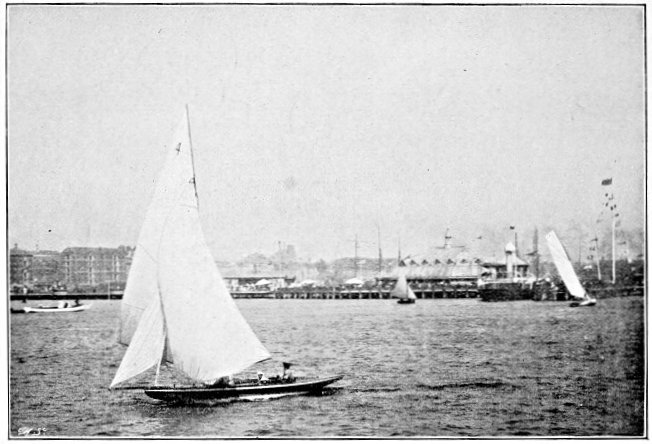
F. G. Stuart. Southampton.
FAIRY, STEERED BY MISS LORD.
My ideal mode of yachting would be to have
a new two-and-a-half-rater whenever the old one
was worsted, with a five-rater perhaps now and
then to vary the monotony. A fifty-ton steamer,
or one perhaps a little smaller, to act as convoy
is essential, and it should be fast and have a good
saloon, and a couple of rooms to change in if
needed. Cowes is the most convenient pied-à-terre
from a racing point of view, being very
central with regard to the more frequent regattas.
Racing is not a cheap amusement, but then,
nothing nice ever is. To put it roughly, the
two-and-a-half-rater would cost £300 to build,
and £100 to "run." The steamer £2,500 to
build, and £300 to "run," and the little house at
Cowes, one or two hundred for the season. Of
lesser items connected with racing there are
several, the numerous club subscriptions for one
thing being no small matter. The expenses of
yacht-racing have been steadily on the increase,
and I hope now they have attained their maximum.
We have had sixteen racing boats in
the family during the last twelve years, our last
effort being made in the poor man's class, the one
designers, which fact speaks for itself. Many
others are in the same hole as ourselves, and are
glad enough to find a means of racing without
so much expense. The one-design class was
specially instituted to meet this demand, as the
boat only costs £200 to begin with, and all the
costs, wages, etc., are limited and prescribed by
the rules. They are fine little craft too, stiff and
dry and light-helmed, in fact very suitable boats
for a woman to start her racing in. About fifty
prizes are given by Solent clubs for this class,
though, of course, they are not so well catered
for elsewhere.
A trip to the Westward at the end of the Ryde
week is a pleasant change, the regattas at Torquay
and Dartmouth being quite unique spectacles.
I know of nowhere in England where
ceremony is so lightly disregarded, or where conviviality
is so essentially the order of the day.
The late Prince Henry of Battenberg did
honour to these festivities in 1894, and won
himself golden opinions by his geniality, and
genuine enjoyment of the fun. He asked my
brother to sail his twenty-rater, Asphodel, during
this time, and proved himself not only a lenient
master, but a kind friend and a keen sportsman.
My chronicle is now at an end. I am conscious
of having made many omissions, and though
my love of yachting makes even writing on it a
welcome task, still I feel the futility of my endeavours
to portray adequately the pleasures of
the sport, which it has been my life interest to
enjoy.
Barbara S. Hughes.
The following list of Racing Clubs of the Solent may
be of use to those interested in the sport:
|
Ent. Fee. |
Sub. |
| Royal Southampton Y.C. |
2 gns. |
3 gns. |
| Royal Portsmouth Y.C. |
0 " |
3 " |
| Royal Albert Y.C. |
4 " |
4 " |
| Royal Victoria Y.C. (Ryde) |
5 " |
6 " |
| Royal Southern Y.C. (Southampton) |
4 " |
4 " |
| Castle Y.C. (Calshot) |
3 " |
3 " |
| Bembridge Sailing Club |
3 " |
1 " |
| Island Sailing Club (Cowes) |
1 " |
1 " |
| Minima Y.C. (Hamble) |
10/6 |
10/6 |
| Hythe Y.C. (Hythe) |
2 gns. |
2 gns. |
| Seaview Sailing Club (Seaview) |
1 " |
1 " |
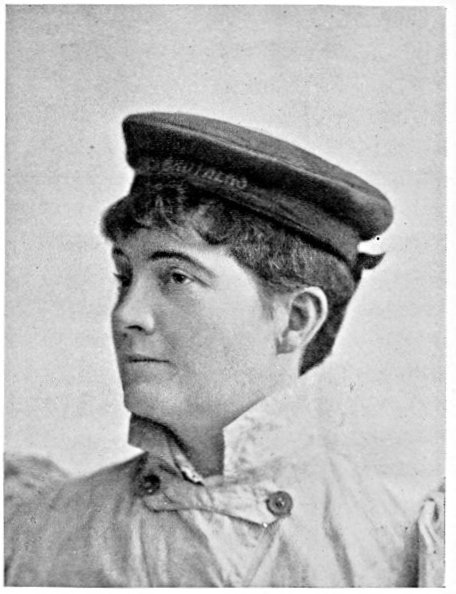
Lombardi and Co. 13, Pall Mall East.
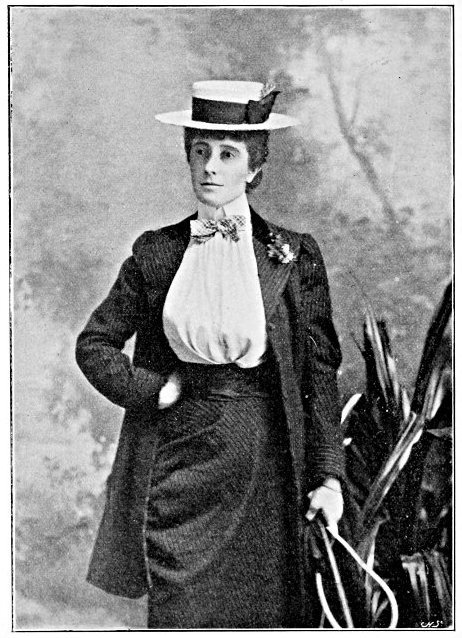
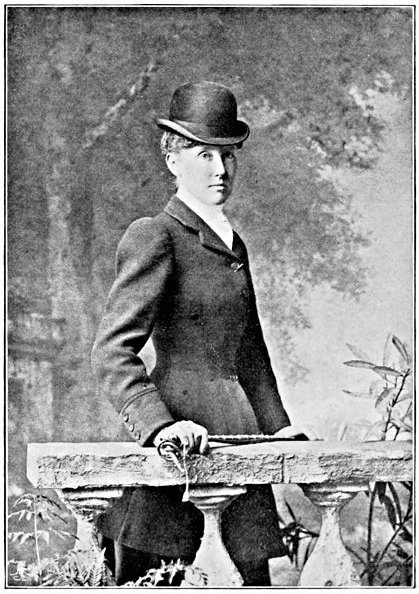
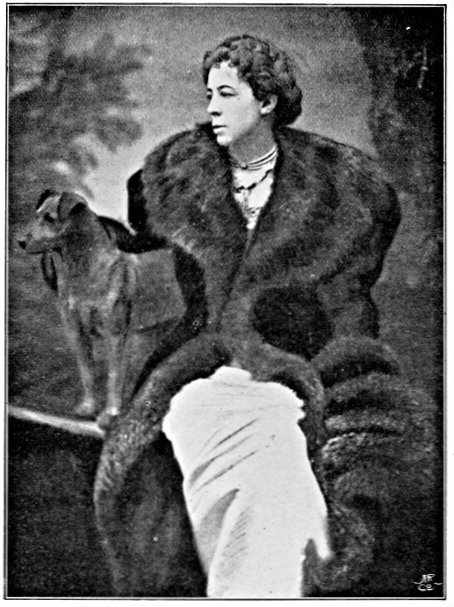
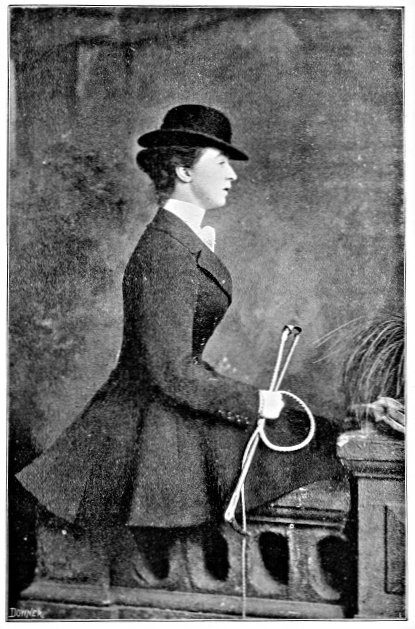
MRS. W. L. WYLLIE.












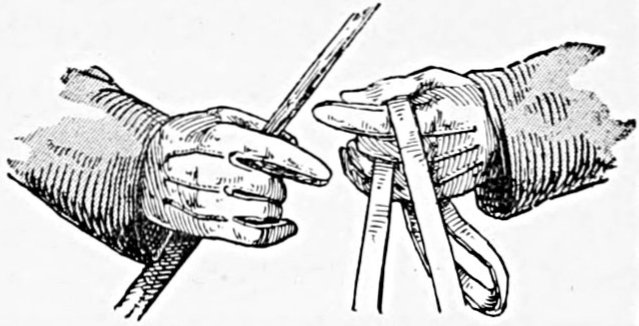
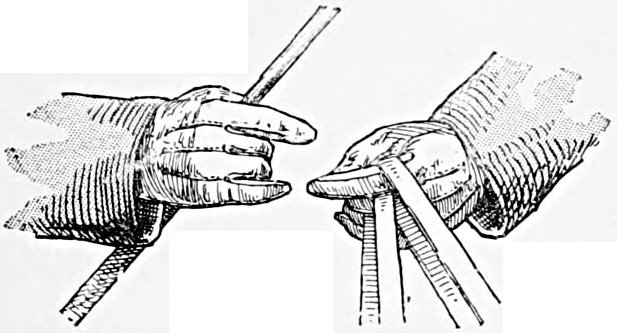
 on
the wall, and beginning at the bottom of this go
upwards towards the right, swinging the lash upwards,
and then allowing it to come back to the
stick. The whip should be held with the first
finger pointing up the stick, and the lash under
the second finger. An expensive whip is by no
means necessary. Schomberg, in the Brompton
Road, has some useful ones at 14s. 6d. In choosing
a whip it is best to get a springy one, with
several knots on the stick near the quill so as to
keep the thong on the stick when folded. It
should balance well when held near the collar.
on
the wall, and beginning at the bottom of this go
upwards towards the right, swinging the lash upwards,
and then allowing it to come back to the
stick. The whip should be held with the first
finger pointing up the stick, and the lash under
the second finger. An expensive whip is by no
means necessary. Schomberg, in the Brompton
Road, has some useful ones at 14s. 6d. In choosing
a whip it is best to get a springy one, with
several knots on the stick near the quill so as to
keep the thong on the stick when folded. It
should balance well when held near the collar.