An angrier boy than Bayard Bell was, when he
leaped his horse over the fence and rode away
from the thicket, which had so nearly been the
scene of a desperate conflict between his followers
and the members of the Sportsman’s Club, was
never seen anywhere. He told himself over and
over again that Walter Gaylord had insulted him
(although how he had done so, it would have puzzled
a sensible boy to determine), and declared that he
had done it for the last time, and that he had put
up with his meanness just as long as he could.
Although Perk had said, almost in so many words,
that he was willing and even eager to fight, and
Bab, Eugene and Featherweight had shown by
their actions that they were ready to stand by their
friend to the last, Bayard did not waste a thought
upon them, but laid all the blame upon Walter, who
had conducted himself like a young gentleman
during the whole interview, and kept himself in
the back-ground as much as possible. The reason
for this was, that Bayard had long ago learned to
hate Walter most cordially; and the cause of this
hatred was the latter’s popularity among the
students at the Academy. Bayard, like many a
boy of our acquaintance, desired to be first in
everything. He wanted the students to look up to
him and treat him with respect, and yet he was not
willing to make any exertions to bring about this
state of affairs. Besides being stingy and unaccommodating,
he showed his tyrannical disposition at
every opportunity, and then wondered why he had
so few friends. Walter, on the other hand, was
modest and unassuming, never tried to push himself
forward, was always polite to his companions,
and would put himself to any amount of trouble to
do a favor for one of them. The result was that,
with the exception of a few congenial spirits whom
Bayard had gathered about him, the boys all liked
him, and showed it by every means in their power.
The more Bayard thought of it the angrier he
became.
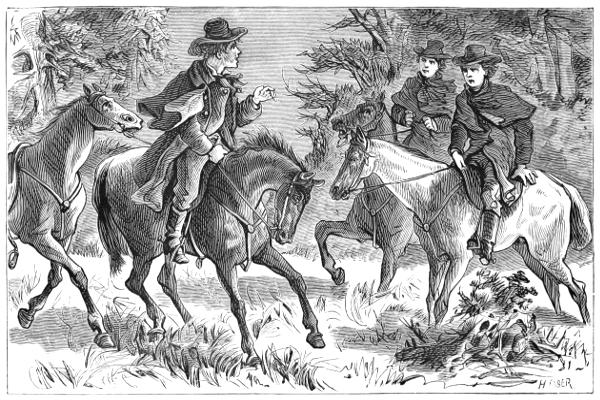
“They’re conceited upstarts, the whole lot of
them,” said he, turning around in his saddle to face
his companions, who were galloping along behind
him. “It’s lucky for them that Mr. Gaylord and
those niggers came up just as they did, for I was
going to punch some of them.”
“Perhaps it is fortunate for us that the fight
didn’t come off,” said Leonard Wilson, who, if he
had no other qualities, was at least honest. “Did
you hear what Perkins said about knocking our
heads together?”
“O, he wouldn’t have done it,” said Will Bell,
with a sneer; “he couldn’t. He’s a regular milk-sop,
and so are they all.”
“Well, if they are, I don’t know it,” said Wilson.
“No, nor nobody else,” chimed in Henry Chase.
“That Phil Perkins is a perfect lion, and Walter
Gaylord isn’t a bit behind him. What a lovely
muscle Walter showed on the day we pulled that
boat-race! Why, it was as large as the boxing-master’s.
And what long wind he has! And can’t
he pick up his feet, though, when he is running the
bases?”
Bayard looked sharply at Chase, and made no
reply. He had commenced by abusing and threatening
the Sportsman’s Club, and expected to be
assisted in it by his men; but here was Chase praising
his rival up to the skies, and Wilson nodding
his head approvingly, as much as to say that he
fully agreed with his companion, and that every
word he uttered was the truth. Bayard was very
much disgusted at this, and showed it by facing
about in his saddle, and maintaining a sullen silence
for the next quarter of an hour. The deep scowl
on his forehead indicated that he was thinking
busily, and his thoughts dwelt quite as much upon
two of the boys who were galloping along the
muddy lane behind him, as they did upon the members
of the Sportsman’s Club. At last he seemed
to have decided upon something, for he straightened
up, and began to look about him.
“Fellows,” said he, “we are but a short distance
from the bayou, and I propose that we ride over
there, water our horses, and eat our lunch. I’m
hungry.”
“So am I,” replied Will; “but I’d rather go
home. I can’t see any fun in sitting down in the
mud, and eating cold bread and meat, when there
are a comfortable room and a warm dinner awaiting
us only three miles away.”
Bayard paid no more attention to his cousin’s
words than if they had not been spoken at all, but
turned his horse out of the lane into the bushes,
and rode toward the bayou. His companions hesitated
a little, and then followed after him; and in
a few minutes more they were sitting on the banks
of the stream discussing their sandwiches, and
gazing into the water, as if they saw something
there that interested them very much. No one
spoke, for Bayard was in the sulks, and that threw
a gloom over them all.
If Bayard was hungry his actions did not show
it, for he ate but a very few mouthfuls of his sandwich,
and finally, with an exclamation of impatience,
threw it into the water. The movement
attracted the attention of his cousins, and that
seemed to be just what Bayard wanted, for he began
to make some mysterious signs to them, at the same
time nodding his head toward the bushes, indicating
a desire to say a word to them in private.
Will and Seth must have understood him, for
they winked significantly, and went on eating their
sandwiches, while Bayard, after yawning and
stretching his arms, arose to his feet and walked
up the bayou out of sight. As soon as he thought
he could do so without exciting suspicion, Will followed
him; and shortly afterward Seth also disappeared.
Wilson and Chase gazed after him curiously,
and as soon as the sound of his footsteps had
died away, turned and looked at one another.
“What’s up?” asked the latter.
“That’s a question I can’t answer,” replied
Wilson. “They’re going to hold a consultation
about something.”
“Or somebody,” observed Chase. “I believe
you and I will be the subjects of their deliberations—in
fact I know it. Didn’t you see how angry
Bayard looked over what we said about Walter and
his crowd? I know him too well to believe that he
will allow that to pass unnoticed. He’s up to some
trick now, and if we creep through the bushes very
carefully we can find out what it is. We’d be
playing eavesdropper though, and that would be
mean, wouldn’t it?”
“I don’t see that it would. When one knows
that a fellow like Bayard Bell, who is bad enough
for anything, is laying plans against him, he has a
perfect right to resort to any measures to find out
what those plans are. Come on; I’ll go if you
will.”
Chase, needing no second invitation, arose to his
feet and stole up the bayou in the direction Bayard
and his friends had gone, closely followed by Wilson.
They moved very cautiously, and presently
arrived within hearing of the voices of the three
conspirators, for such they believed them to be. A
few seconds afterward they came within sight of
them, and found them seated in a little thicket
which grew on the bank of the bayou, engaged in
an earnest conversation. So deeply interested were
they in what they were saying that they thought of
nothing else, and the two eavesdroppers approached
within twenty yards of them, and took up a position
from which they could observe their movements
and hear every word that was said. Bayard was
talking rapidly, and the others were listening with
an expression of intense astonishment on their
faces; and Chase and Wilson had not been long in
their concealment before they began to be astonished
too.
“Everything I tell you is the truth,” said Bayard,
emphatically. “There is scarcely a person in the
settlement who does not know that there is such an
organization in existence; but I do not suppose
there is any one outside of the band who knows
who the members are except myself. I know three
of them, and I found them out by accident. They
are the ones who must do this work for us.”
“Must!” repeated Seth.
“Yes, they must, whether they are willing or
not.”
“Have you spoken to them about it?”
“No, I have not had a chance.”
“Why, you said you had got matters all
arranged!” said Will.
“I told you that in less than two days Walter
Gaylord would find himself miles and miles at sea,
with a fair prospect of never seeing Louisiana
again,” replied Bayard. “It’s lucky I didn’t tell
you any more, for you, Seth, came near blabbing
it on two different occasions. You never could
keep anything to yourself.”
“I didn’t intend to tell them what we are going
to do to them,” retorted Seth, with some spirit.
“I only wanted to give them to understand that
we have laid our plans to punish them in some
way.”
“And so put them on their guard!” snarled
Bayard. “That’s a pretty way to do business,
isn’t it? Now, unless you promise faithfully to
keep everything I tell you a profound secret, I
won’t say another word.”
“I promise,” said Seth, readily.
“So do I,” chimed in Will.
“Well, then, I will tell you how I came to find
out about these smugglers,” continued Bayard,
settling back on his elbow. “It happened last
summer, shortly after that boat-race. I felt so
mean over our defeat that I wanted to keep away
from everybody, and you know that I left the
Academy and came home. One day I took my
gun and strolled out into the swamp. At noon I
found myself about ten miles from home, and on
the bank of a little stream which emptied into the
bay. I stopped there to rest, and after eating my
lunch, stretched myself out on the leaves and was
fast going off into a doze, when I was aroused by
the sound of oars; and, upon looking up, saw a large
yawl just entering the bayou. There were three
men in it, and they were Coulte and his two sons.”
“Coulte!” exclaimed Will, in amazement. “The
old hunter?”
“And his two sons!” echoed Seth. “Are they
smugglers?”
“Let me tell my story without interruption, if
you please,” said Bayard, impatiently. “You will
know as much about it as I do when I am done.
I wondered what they could be doing there,” he
continued, “and raised myself to a sitting posture,
intending to speak to them when they came up,
and would have done so, had I not noticed that
they were very stealthy in their movements, and
that they did not pull the boat into the bayou
until they had looked up and down the bay, to
make sure that there was no one watching them.
“Now, when one man sees another sneaking
about, and showing by every action that he is
anxious to escape observation, it is natural that he
should want to see what he is going to do. I did
not suppose that Coulte was up to any mischief,
for, like everybody else in the settlement, I believed
him to be an honest old fellow; but I knew that he
did not want to be seen, and that was enough for
me. As quick as thought I slipped behind a tree,
whose high, spreading roots afforded me an excellent
concealment, and lying flat upon the ground,
looked over into the bayou, and watched the three
men in the yawl as closely as ever a panther
watched his prey. They seemed to be satisfied at
last that there was no one in sight, for they pulled
quickly into the bayou and stopped on the opposite
shore, directly in front of me. The bank, at that
particular place, was about twenty feet in height,
and was partially concealed by thick bushes, which
grew up out of the water. When the boat stopped
Coulte raised his oar and thrust it into the bushes,
where it came in contact with something that gave
out a hollow sound. He struck three blows, and
after waiting a moment struck three more; and
presently I heard something that sounded like an
answering knock on the other side of the bushes.
Coulte replied with two knocks, and I distinctly
heard a latch raised and a door opened—although
where the door was I do not know—and a voice
inquired:
“‘How’s the wind to-day?”
“‘South-south-west,’ replied Coulte, in his broken
English.
“‘How was it last night?’
“‘North-north-east.’
“‘Where from?’ asked the voice.
“‘Havana, Galveston, and New Orleans.’
“‘Whither bound?’
“‘Here, and there, and everywhere.’”
“What did they mean by talking that way?”
asked Seth, who had listened eagerly to his cousin’s
story, but with an expression on his face which said
plainly that he did not believe a word of it. “I
can’t make any sense out of it.”
“Neither could I—neither could anybody,” replied
Bayard, “not even if he were a member of
the organization, because there is no sense in it.
But there was use in it, for the man on the other
side of the bushes knew that Coulte was one of the
smugglers by the way he answered the questions;
at least I thought he was satisfied of it, for he
pulled aside the bushes and showed himself. He
shook hands with the men in the yawl, and began
a conversation with them. I heard every word
that was said, but the only information I gained
was, that Coulte’s two sons were employed as foremast
hands on board the vessel in which the smuggling
is carried on. When the conversation was
ended, Coulte passed out some bales and boxes he
had brought in his yawl, and then got out his oars
and pulled down the bayou.”
“What do you suppose was on the other side of
those bushes?” asked Will, after a long pause.
“I am sure I don’t know, unless it was a cave
where the smugglers stowed away their goods.”
“What’s the reason you have never told this
before?” inquired Seth. “Why didn’t you go
straight to your father with the news, and have
him put the authorities on the lookout? Don’t you
know that there is a heavy reward offered for any
information that will lead to the breaking up of
this band?”
“I do,” replied Bayard, leaning toward his
cousins and sinking his voice almost to a whisper,
“but I don’t want the band broken up. I may
join it myself sometime.”
“You!” cried his auditors, starting back in surprise.
“Yes, I; that is if they will take me; and if
they won’t, I will blow the whole thing. Here’s
where I have the advantage of them, and that’s the
way I am going to induce Coulte to help us carry
out our plans against Walter Gaylord. We’ll ride
over and call on the old fellow this very afternoon,
and tell him that we want him and his boys to make
a prisoner of Walter at the very first opportunity,
take him on board their vessel, carry him to the
West Indies, and lose him there so effectually that
he will never find his way home again.”
As Bayard said this he settled back on his elbow
and looked at his cousins, and Seth and Will, too
astonished to speak, settled back on their elbows
and looked at him. They had always known that
Bayard was cruel and vindictive, but they had
never dreamed that he could conceive of a plan
like this. How coolly he talked about it, and how
confident he seemed of success!
“I flatter myself that this is a grand idea, and
one that nobody else in the world would ever have
thought of,” continued Bayard.
“You’re right there,” replied Will. “I don’t
suppose you have thought of the obstacles in your
way?”
“You can’t mention one that I have not thought
of and provided for. Try it.”
“Well, in the first place, suppose that Coulte
declines to assist you in carrying out your plans?
He likes Walter.”
“He likes his liberty better. If he refuses I will
just say ‘law’ to him, and that will bring him to
terms.”
“That’s so,” said Will, hesitatingly, as if he did
not like to yield the point. “In the next place,
suppose that Coulte agrees to comply with your
demands and captures Walter, and the rest of the
crew (I do not believe that Coulte’s two sons comprise
the entire company of the smuggling vessel),
refuse to take him to the West Indies; what
then?”
“No one except Coulte and his sons need know
anything about it. They can smuggle Walter on
board at night, as if he were a bale of contraband
goods, and keep him concealed until the vessel
reaches its destination.”
“And then he will be set at liberty, and the first
thing you know he will come back here a hero, and
you and Coulte will find yourselves in hot water,”
exclaimed Will. “That will be the upshot of the
whole matter. I don’t like those boys any better
than you do, and should be glad to see them
brought up with a round turn; but this thing won’t
work.”
“Don’t I tell you that one part of my plan is to
lose him so that he will never find his way back
here?” asked Bayard, angrily. “You are very
dull, both of you.”
“I am not,” said Seth; “I understand it all,
and begin to think that it will prove a complete
success. I never could have studied up a scheme
like that. It almost takes my breath away to think
of it.”
“I know it will be successful,” said Bayard, confidently;
“and if you will ride over to Coulte’s with
me, I will convince you of it in less than a quarter
of an hour after we get there.”
“What shall we do with Chase and Wilson?”
asked Seth. “Are you going to take them into
your confidence?”
“Of course not. We must get rid of them immediately;
for if they remain with us they will want
to accompany us to Coulte’s, and that is something
we can’t allow. We’ll raise a quarrel with them.
We’ll ask them what they meant by praising Walter
and his crowd a little while ago, and as they are
very independent and spunky, they will be sure to
give us some impudence. When they do that, we’ll
tell them that we have seen quite enough of them,
and that they can just pack up their traps and go
home.”
“It’s almost too bad to go back on them in that
way,” said Seth. “They’ve stuck to us like
bricks.”
“And if you send them off it will break up our
society and boat-club,” said Will.
“No matter for that. The society and boat-club
must not stand in the way of this plan. I am
going to carry it out if I lose every friend I’ve got
by it. You can stick to me or not, just as you
please.”
As Bayard said this he arose to his feet, indicating
a desire to bring the interview to a close,
and Chase and Wilson retreated backward until
they were out of sight of the conspirators, and then
took to their heels. They made the best of their
way to the place where they had left their horses,
and when Bayard and his cousins came in sight
they were sitting on the bank of the bayou, looking
steadily into the water. Something in their faces
must have aroused Bayard’s suspicions, for he
glanced from one to the other and demanded:
“What’s the matter with you fellows?”
“Nothing,” replied Chase, sullenly.
“I know better,” cried Bayard.
“So do I!” exclaimed Seth. “Something’s the
matter with you, or you would not have stood up
for Walter and his crowd as you did a while ago.
We think hard of you for that, and want to know
what you meant by it. It would serve you just
right if we should put you where we’re going to
put——”
When Seth’s tongue was once in motion he
seemed to lose all control over it. He was on the
very point of divulging the secret which he had so
faithfully promised to keep inviolate; but an angry
glance from Bayard, and a timely pinch from his
brother, cut short his words.
“We haven’t said or done anything that we are
ashamed of,” declared Chase. “If you don’t like
us or our ways, all you have to do is to tell us so.”
“Well, we don’t. There!” said Will.
“All right. Let’s start for Bellville, Wilson.
Good-by, fellows. When you want to make up a
crew next summer to pull against the Sportsman’s
Club, call on somebody besides us; will you?”
Chase and Wilson sprang into their saddles and
rode away, directing their course toward Mr. Bell’s
house, intending to get their saddle-bags, which
contained the few articles of clothing which they
had brought with them from home, and return to
the village without the loss of a single hour; while
Bayard and his cousins, after dancing a hornpipe
to show the delight they felt at the success of their
stratagem, set out for the dwelling of the Frenchman,
which was five miles distant. At the end of
half an hour’s rapid gallop they arrived within sight
of it—a double log-house, flanked by corn-cribs and
negro quarters, and standing in the middle of a
clearing of about two hundred acres. Here old
Coulte and his sons lived isolated from everybody;
and before they engaged in the more lucrative business
of smuggling, they had spent their summers in
superintending the cultivation of a few acres of
cotton and corn, and their winters in hunting.
As Bayard and his friends approached the house
a man, who was sitting in the doorway smoking a
cob-pipe, arose to welcome them. It was old Coulte
himself—a little dried-up, excitable Frenchman,
whose form was half bent with age, but who was
nevertheless as sprightly as a boy of sixteen.
Bayard, who was leading the way, reined up his
horse with a jerk, and having come there on business
opened it at once.
“Hallo, Coulte!” he exclaimed: “you’re just
the man I want to see. How’s the wind to-day?”
The Frenchman started, and removing his pipe
from his mouth replied slowly and almost reluctantly,
as if the words were forcing themselves out
in spite of all his efforts to prevent it: “Sou’sou’-west.”
Then, as if he were alarmed at what
he had done, he stamped his foot on the ground,
exclaiming: “Vat you know about ze wind, Meester
Bayard?”
“O, that’s all right,” replied Bayard, carelessly;
“I know all about it. If it is south-south-west to-day,
it was north-north-east last night. Coulte,
may I say a word to you in private?”
The Frenchman, who appeared to be utterly confounded,
stared very hard at the boys for a moment,
took his pipe out of his mouth and gave a loud
whistle, then put it in again, and picking up his
hat followed Bayard, who dismounted and led the
way toward a corn-crib that stood at a little distance
from the house. When he seated himself on
the ground and motioned Coulte to a place beside
him, the latter gave another whistle louder than
before; and having by this means worked off a
little of his astonishment, he leaned forward and
placed his hand on the boy’s shoulder. “Meester
Bayard,” said he in a low, excited voice, “be you
one of ze—ze—”
The word seemed to stick in his throat, but Bayard
spoke it without the least difficulty. “One of
the smugglers?” he inquired. “No; but I know
something about them. I say, Coulte, don’t you
think you are engaging in rather a risky business?
Suppose it should be found out, what would become
of you?”
The Frenchman took his pipe out of his mouth
long enough to give another whistle, and then went
on with his smoking.
“If I were disposed to be mean,” continued
Bayard, looking down at the ground and speaking
in a low voice, as if he were talking more to himself
than for the benefit of his companion, “I
could make plenty of trouble for you by whispering
about the settlement that your sons belong to the
crew of that smuggling vessel, and that you have
been seen with contraband goods in your possession.
Let me see; the penalty is—I forget just what it
is, but I know it is something terrible.”
“Whew!” whistled Coulte, his face turning pale
with alarm.
“Of course I have not the slightest intention of
doing anything of the kind,” continued Bayard;
“for you and I are old friends. But I say that if I
should do it, it would be bad for you, wouldn’t it?
By the way—sit down here; I have a favor to ask
of you, and I am sure that you will not refuse me.”
Although the old Frenchman was one of the
bravest hunters in the parish, and would not have
hesitated a moment to attack the largest bear or
panther single-handed, he was thoroughly cowed
now. Bayard knew what he was talking about
when he said he was sure that Coulte would not
refuse him the favor he was about to ask of him,
for the old man was so badly frightened that he
would have given up his ears if he had been commanded
to do so. He seated himself on the ground
beside the boy, and listened attentively while the
latter unfolded his plans, only interrupting him
occasionally with long-drawn whistles, which were
very low at first and very loud at last, increasing
in volume proportionately with the old man’s astonishment.
After Bayard finished his story, a
few minutes’ conversation followed, and finally the
boy arose and walked toward his companions, leaving
Coulte standing as if he were rooted to the
ground.
“What success?” whispered Will, as Bayard
swung himself into the saddle.
“The very best,” was the exultant reply. “Walter
Gaylord’s goose is cooked now—done brown.
In the first place, Coulte says that all the smuggling
is carried on in one small vessel named the Stella,
which sails from the coast once every ten days.
She is now hidden in the bay a few miles from here
(I know right where she is, and have promised to
visit her early to-morrow morning), and will leave
for Cuba day after to-morrow. The only men on
board are Coulte’s two sons, who stayed to watch
the vessel while the rest of the crew went to New
Orleans to spend their money. They will return
some time to-morrow, and consequently the work
must be done to-night. Coulte says that he will go
down at once and talk to his boys, and that Walter
Gaylord shall be secured before morning. You’re
sorry for it, are you not?” he demanded, turning
fiercely upon his cousins, who seemed to be disappointed
rather than elated.
“No,” replied Will, “I am not sorry, exactly,
but I feel kind of—you know.”
“I don’t know anything about it,” answered
Bayard. “I never have such feelings.”
“I feel afraid,” said Seth, honestly. “Suppose
something should happen?”
“O, now, what’s going to happen? The only
thing I am afraid of is that Walter will keep himself
close to-night, or that if he does come out,
Coulte’s boys will miss him. If they meet him at
all, it will probably be while he is on horseback—the
Club are always in the saddle—and I described
him so minutely that they cannot possibly mistake
him. Coulte’s sons are not very well acquainted
with Walter, you know, and I told him to tell them
that if they saw a boy about my size and age riding
a white horse, and wearing a heavy dark-blue cloak
with a red lining, to catch him at all hazards and
hold fast to him, for he is the fellow they want.
Wasn’t the old fellow taken down completely when
I told him that I knew he was a smuggler? He
could scarcely speak.”
The boys faced-about in the saddle, and gazed
back at the house. The Frenchman was still standing
where they had left him, smoking furiously;
and as they turned to look at him he took his pipe
out of his mouth, and a long-drawn whistle came
faintly to their ears. It was plain that he had not
yet recovered from his astonishment.