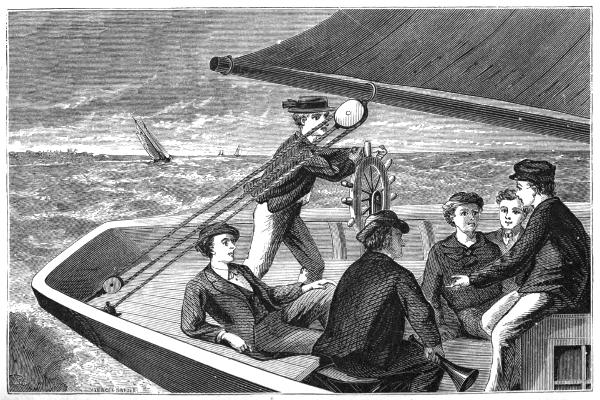
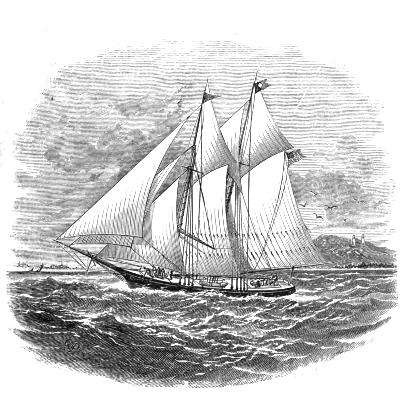
“Well,” continued Walter, after he and his
companions had walked out of earshot of
Mr. Bell; “what do you think of that.”
“Let somebody else tell,” said Bab. “It bangs
me completely.”
“Now I’ll tell you something,” observed Perk:
“He is trying to humbug us—I could see it in his
eye. If there is a fellow among us who didn’t see
Henry Chase standing in the mouth of the cave,
when we rounded the point, and hear him shout to
us that that schooner there is a smuggler, and that
Fred Craven is a prisoner on board of her, let him
say so.”
Perk paused, and the Banner’s crew looked
at one another, but no one spoke. They had all
seen Chase, and had heard and understood his
words.
“That is proof enough that Chase is on the
island,” said Walter, “for it is impossible that five
of us should have been so deceived. Now, if we
heard and saw him, what’s the reason Mr. Bell
didn’t? That pirogue must be hidden about here
somewhere. If you fellows will look around for it,
I will go back to the yacht, see how our deserters
are getting on, and bring a lantern and an axe.
Then we’ll go up and give ‘The Kitchen’ a thorough
overhauling.”
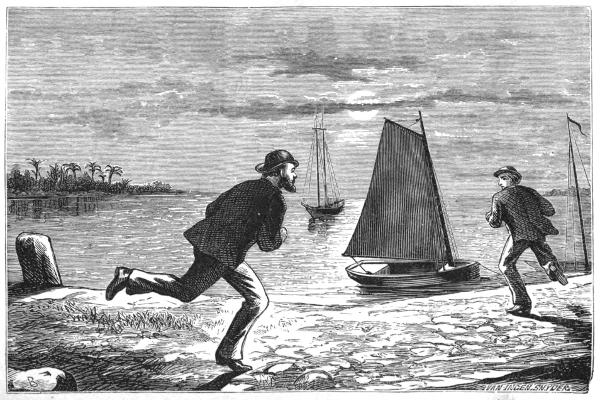
Walter hurried off, and his crew began beating
about through the bushes, looking for the pirogue.
They searched every inch of the ground they passed
over, peeping into hollow logs, and up into the
branches of the trees, and examining places in
which one of the paddles of the canoe could scarcely
have been stowed away, but without success. There
was one place however, where they did not look, and
that was in the fire, beside which Mr. Bell lay.
Had they thought of that, they might have found
something.
When Walter returned with the axe and the
lighted lantern, the crew reported the result of their
search, and the young captain, disappointed and more
perplexed than ever, led the way toward “The
Kitchen.” While they were going up the gully, they
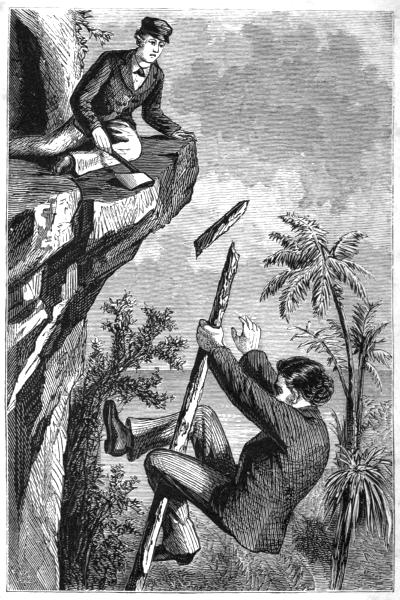
stopped to cut a pole, with which to ascend to the
cave, and looked everywhere for signs of anybody
having passed along the path that night; but it was
dark among the bushes, and the light of the lantern
revealed not a single foot-print. Arriving at the
bluff, they placed the pole against the ledge, and
climbing up one after the other, entered the cave,
leaving Eugene at the mouth to keep an eye on the
yacht, and on the movements of the smugglers below.
But their search here was also fruitless.
There was the wood which the last visitors from the
village had provided to cook their meals, the dried
leaves that had served them for a bed, and the remains
of their camp-fire; but that was all. The
axe that had done Chase such good service, his
blankets, bacon, and everything else he had brought
there, as well as the boy himself, had disappeared.
Eugene, who was deeply interested in the movements
of his companions, did not perform the part
of watchman very well. On two or three occasions
he left his post and entered the cave to assist in the
search; and once when he did this, Mr. Bell, who
still kept his recumbent position by the fire, made
a sign with his hand, whereupon two men glided
from the bushes that lined the beach, and clambering
quickly over the side of the smuggling vessel,
crept across the deck and dived into the hold.
Eugene returned to the mouth of the cave just as
they went down the ladder, but did not see them.
“Now then,” said Walter, when the cave had
been thoroughly searched, “some of you fellows
who are good at unravelling mysteries, explain this.
What has become of Chase? Did he leave the cave
of his own free will, and if so, how did he get out?
We found no pole by which he could have descended,
and consequently he must have hung by his hands
from the ledge and dropped to the ground. But
he would not have done that for fear of a sprained
ankle. He surely did not allow any one to come
up here and take him out, for with a handful of
these rocks he could have held the cave against a
dozen men. Besides, he would have shouted for
help, and we should have heard him.”
None of the crew had a word to say in regard to
Chase’s mysterious disappearance. They sighed
deeply, shook their heads, and looked down at the
ground, thus indicating quite as plainly as they
could have done by words, that the matter was altogether
too deep for their comprehension. More
bewildered than ever, they followed one another
down the pole, and retraced their steps toward the
beach.
“What shall we do to pass away the time until
the tug and cutter arrive?” asked Perk. “I wish
that schooner could find a tongue long enough to
tell us what she’s got stowed away in her hold.”
“If she could, and told you the truth, she would
assure you that Fred Craven is there,” said Wilson,
confidently. “Of that I am satisfied. He’s on
some vessel, for Chase told me so while we were at
Coulte’s cabin. If this schooner is an honest merchantman,
why did she come in here? There’s
nothing the matter with her that I can see. She
didn’t come in to get out of the wind, for she can
certainly stand any sea that the Banner can outride.
Coulte and his sons belong to the smugglers,
because I heard Bayard say so. Chase told me
that he was to be carried to the island in a pirogue,
and we met her as she came down the bayou. Now,
put these few things together, and to my mind they
explain the character of this vessel and the reason
why she is here.”
“Go on,” said Eugene. “Put a few other things
together, and see if you can explain where Chase
went in such a hurry.”
“That is beyond me quite. But the matter will
be cleared up in a very few minutes,” added Wilson,
gleefully, “for here comes the cutter.”
As he spoke, the revenue vessel came swiftly
around the point; and so overjoyed were the boys to
see her, that they swung their hats around their
heads and greeted her with cheers that awoke a
thousand echoes among the bluffs. Being better
handled than the Banner was when she came in,
she glided between the two vessels lying in the cove,
and running her bowsprit among the bushes on the
bank, came to a stand still without even a jar.
Her captain had evidently made preparations to
perform any work he might find to do without the
loss of a moment; for no sooner had the cutter
swung round broadside to the bank, than a company
of men with small-arms tumbled over the side, followed
by the second lieutenant, and finally by the
commander himself.
“Here we are again, captain,” said the latter, as
Walter came up, “and all ready for business.
Bring on your smugglers.”
“There they are, sir,” answered Walter, pointing
to the crew of the schooner, who had once more
congregated about the fire, “and there’s their
vessel.”
“That!” exclaimed the second lieutenant, opening
his eyes in surprise. “You’re mistaken, captain.
That is the Stella—a trader from Bellville,
bound for Havana, with an assorted cargo—hams,
bacon, flour, and the like. I boarded her to-night
and examined her papers myself. She no doubt
put in here on account of stress of weather.”
“Stress of weather!” repeated Walter, contemptuously.
“That little yacht has come from Bellville
since midnight, and never shipped a bucket of
water; and the schooner is four times as large as
she is. Stress of weather, indeed!”
“Well, she is all right, any how.”
“I am sure, captain, that if you will take the
trouble to look into things a little, you will find that
she is not all right—begging the lieutenant’s pardon
for differing with him so decidedly,” said Walter.
“Some strange things have happened since we came
here.”
“Well, captain, I will satisfy you on that point,
seeing that you are so positive,” replied the commander
of the revenue vessel. “Mr. Harper,”
he added, turning to the lieutenant, “send your
men on board the cutter and come with me.”
A landsman would have seen no significance in
this order, but Walter and his crew did, and they
were not at all pleased to hear it. The sending of
the men back on board the vessel was good evidence
that the revenue captain did not believe a word they
said, and that he was going to “look into things,”
merely to satisfy what he thought to be a boyish
curiosity. It is not likely that he would have done
even this much, had he not been aware that the
young sailors had influential friends on shore who
might have him called to account for any neglect
of duty. Walter’s disgust and indignation increased
as they approached the fire. The men composing
the crew of the smuggling vessel stepped aside to
allow them to pass, and Mr. Bell advanced with
outstretched hand, to greet the revenue captain.
“Why, how is this?” exclaimed the latter, accepting
the proffered hand and shaking it heartily.
“I did not expect to find you here, Mr. Bell. Ah!
Captain Conway, good morning to you,” he added,
addressing the red-whiskered master of the schooner.
“Captain Gaylord, there is no necessity of carrying
this thing any farther. The presence of these
two gentlemen, with both of whom I am well acquainted,
is as good evidence as I want that the
schooner is not a smuggler.”
“A smuggler!” repeated the master of the Stella.
“Why, what is the matter?” asked Mr. Bell,
opening his eyes in surprise, and looking first at
Walter, and then at the revenue captain, while the
crew of the schooner crowded up to hear what was
going on.
“Why the truth is, that this young gentleman
has got some queer ideas into his head concerning
your vessel. He thinks she is the smuggler of
which I have been so long in search.”
“And I have the best of reasons for thinking
so,” said Walter; not in the least terrified or
abashed by the angry glances that were directed
toward him from all sides. “In the first place,
does she not correspond with the description you
have in your possession?”
“I confess that she does,” replied the revenue
captain, running his eye over the schooner from
cross-trees to water-line.
“She answers the description much better than
the yacht, does she not?”
“Yes. But then she has papers, which my lieutenant
has examined, and I know these two gentlemen.
You had no papers, and I was not acquainted with
a single man on board your vessel.”
“A smuggler!” repeated the red-whiskered captain,
angrily; “I don’t believe there’s such a thing
in the Gulf.”
“I am inclined to agree with you,” answered
the revenue commander. “I have looked everywhere,
without finding one.”
“I own the cargo with which this vessel is
loaded,” said Mr. Bell, producing his pocket-book,
and handing some papers to the revenue captain,
who returned them without looking at them, “and
there are the receipts of the merchants from whom
I purchased it. I am a passenger on her because I
believe that, by going to Cuba, I can dispose of the
cargo to much better advantage than I could sell it
through agents. That is why I am here.”
“And the schooner is heavily loaded, and I
couldn’t make the run without straining her,” said
the master of the Stella. “Having got into the
cove I must wait until the wind dies away before I
can go out. That’s why I am here.”
The commander of the cutter listened with an air
which said very plainly, that this was all unnecessary—that
he had made up his mind and it could not
be changed—and then turned to Walter as if to ask
what he had to say in reply.
“What these men have said may be true and it
may not,” declared the young captain, boldly.
“The way to ascertain is to search the schooner.
There are some articles on board of her that are
not down in her bills of lading.”
“And if there are it is no business of mine,”
returned the commander of the cutter.
“It isn’t!” exclaimed Walter in great amazement.
“Then I’d like to know just how far a
revenue officer’s business extends. Haven’t you
authority to search any vessel you suspect?”
“Certainly I have; but I don’t suspect this
schooner. And, even if I did, I would not search
her now, because she is outward bound. If she has
contraband articles on board, the Cuban revenue
officers may look to it, for I will not. All I have to
do is to prevent, as far as lies in my power, articles
from being smuggled into the United States; I don’t
care a snap what goes out.”
“But you ought to care. There is a boy on
board that schooner, held as a prisoner.”
“Why is he held as a prisoner?”
“Because he knows something about the smugglers,
and they are afraid to allow him his liberty.”
“Humph!” exclaimed Mr. Bell.
“Every word of that is false,” cried the master
of the Stella, who seemed to be almost beside
himself with fury. “It is a villainous attempt to
injure me and my vessel.”
“Keep your temper, captain,” said the commander
of the cutter. “I want to see if this young man
knows what he is talking about. Where are those
two smugglers who brought that boy over here in a
canoe?”
“I don’t know, sir. We have searched the island
and can find no trace of them.”
“That is a pretty good sign that they are not
here. Where is the boat they came in?”
“I don’t know that either. It is also missing.”
“Where is the boy they brought with them?”
“When the Banner rounded the point he was
standing in the mouth of that cave,” replied Walter,
pointing to the Kitchen, “and shouted to us to get
away from here while we could—that this schooner
is a smuggler and that Fred Craven is a prisoner
on board of her.”
“Well, where is the boy now?”
“I can’t tell you, sir.”
“Isn’t he on the island?”
“We can find no signs of him.”
“Then he hasn’t been here to-night.”
“He certainly has,” replied Walter, “for we saw
him and heard him too.”
“Who did?”
“Every one of the crew of the Banner.”
“Did anybody else? Did you, Mr. Bell? Or
you, Captain Conway? Or any of your men?”
The persons appealed to answered with a most
decided negative. They had seen no boy in the
cave, heard no voice, and knew nothing about a
prisoner or a pirogue. There was one thing they
did know, however, and that was that no dugout
that was ever built could traverse forty miles of the
Gulf in such a sea as that which was running last
night.
“Well, young man,” said the revenue officer,
addressing the captain of the yacht somewhat sternly,
“I am sure I don’t know what to think of you.”
“You are at liberty to think what you please,
sir,” replied Walter, with spirit. “I have told
you the truth, if you don’t believe it search that
schooner.”
“You have failed to give me any reason why I
should do so. Your story is perfectly ridiculous.
You say that a couple of desperate smugglers captured
an acquaintance of yours and put him in a
canoe; that you met them in a bayou on the main
shore and had a fight with them; that they eluded
you and came out into the Gulf in a gale that no
small boat in the world could stand, and brought
their prisoner to this island. When I expressed a
reasonable doubt of the story, you offered, if I would
come here with you, to substantiate every word of
it. Now I am here, and you can not produce a
scrap of evidence to prove that you are not trying
to make game of me. The men, the boy, and the
boat they came in, are not to be found. I wouldn’t
advise you to repeat a trick of this kind or you
may learn to your cost that it is a serious matter
to trifle with a United States officer when in the
discharge of his duty. Mr. Bell, as the wind has
now subsided so that I can go out, I wish you good-by
and a pleasant voyage.”
“One moment, captain,” said Walter, as the
revenue commander was about to move off; “perhaps
you will think I am trifling with you, if I tell
you that I have some deserters from your vessel on
board my yacht.”
“Have you? I am glad to hear it. I have missed
them, and I know who they are. I thought they
had gone ashore at Bellville, and it was by stopping
to look for them that I lost so much time. Haul
your yacht alongside the cutter and put them
aboard.”
“I am going to set them at liberty right where
the yacht lies,” replied Walter, indignant at the
manner in which the revenue captain had treated
him, and at the insolent tone of voice in which the
order was issued; “and you can stand by to take
charge of them or not, just as you please.”
“How many of them are there?”
“Two.”
“Only two? Then the others must have gone
ashore at Bellville, after all,” added the captain,
turning to his second lieutenant. “I wish they had
taken your vessel out of your hands and run away
with it. You need bringing down a peg or two,
worse than any boy I ever saw.”
Walter, without stopping to reply, turned on his
heel, and walked around the cove to the place
where the Banner lay, followed by his crew, who
gave vent to their astonishment and indignation in
no measured terms. The deserters were released
at once. When informed that their vessel was close
at hand, and that their captain was expecting them,
they ascended to the deck, looking very much disappointed
and crestfallen, and stood in the waist
until the cutter came alongside and took them off.
They were both powerful men, and the boy-tars
were glad indeed that they had been discovered before
they gained a footing on deck. If Walter had
been in his right mind he would have examined the
hold after those two men left it; but he was so bewildered
by the strange events that had transpired
since he came into the cove, that he could think of
nothing else.
While the crew of the yacht were liberating the
deserters, the smuggling vessel filled away for the
Gulf—her captain springing upon the rail long
enough to shake his fist at Walter—and as soon as
she was fairly out of the cove, the cutter followed,
and shaped her course toward Bellville.
The boys watched the movements of the two vessels
in silence, and when they had passed behind
the point out of sight, turned with one accord to
Walter, who was thoughtfully pacing his quarter-deck,
with his hands behind his back.
“Eugene,” said the young captain, at length,
“did you keep an eye on the smuggler all the time
that we were in The Kitchen?”
“O, yes,” replied Eugene, confidently. “I saw
everything that happened on her deck.” And he
thought he did, but he forgot that he had two or
three times left his post.
“You didn’t see Chase taken on board the
schooner, did you?”
“I certainly did not. If I had, I should have
said something about it.”
“Then there is only one explanation to this
mystery: Chase was somehow spirited out of the
cave and hidden on the island. We will make one
more attempt to find him. Three of us will go
ashore and thoroughly search these woods and cliffs,
and the others stay and watch the yacht.”
Walter, Perk, and Bab, after arming themselves
with handspikes, sprang ashore and bent their steps
toward The Kitchen to begin their search for the
missing Chase. As before, no signs of him were
found in the cave, although every nook and crevice
large enough to conceal a squirrel, was peeped into.
Next the gully received a thorough examination,
and finally they came to the bushes on the side of
the bluff. A suspicious-looking pile of leaves under
a rock attracted Bab’s attention, and he thrust his
handspike into it. The weapon came in contact
with something which struggled feebly, and uttered
a smothered, groaning sound, which made Bab start
back in astonishment.
“What have you there?” asked Walter, from the
foot of the bluff.
“I don’t know, unless it is a varmint of some
kind that has taken up his winter quarters here.
Come up, and let’s punch him out.”
Perk and Walter clambered up the bluff to the
ledge, and while one raised his handspike in readiness
to deal the “varmint” a death-blow the instant
he showed himself, the others cautiously pushed
aside the leaves, and presently disclosed to view—not
a wild animal, but a pair of heavy boots, the
heels of which were armed with small silver spurs.
One look at them was enough. With a common
impulse the three boys dropped their handspikes,
and pulling away the leaves with frantic haste, soon
dragged into sight the missing boy, securely bound
and gagged, and nearly suffocated. To give him
the free use of his hands and feet, and remove the
stick that was tied between his teeth, was but the
work of a moment. When this had been done,
Chase slowly raised himself to a sitting posture,
gasping for breath, and looking altogether pretty
well used up.
“You don’t know how grateful I am to you, fellows,”
said he, at last, speaking in a hoarse whisper.
“I’ve had a hard time of it during the half hour
I have been stowed away in that hole, and I never
expected to see daylight again.”
“Now I’ll tell you what’s a fact,” said Perk.
“You never would have got out of there alive if
Walter hadn’t been thoughtful enough to search the
island before going home. Now let me ask you
something: Where did you go in such a hurry,
after shouting to us from the mouth of The Kitchen?”
“I can’t talk much, fellows, till I get something
to moisten my tongue,” was the almost indistinct
reply. “If you will help me to the spring, I will
tell you all about it. Where are the smugglers?”
“Don’t know. We haven’t seen any,” said
Walter.
“You haven’t?” whispered Chase, in great
amazement. “Didn’t you see those men who were
standing on the beach when you came in?”
“Yes; but they are not smugglers. They’ve
got clearance papers, and the captain of the cutter
says he knows they are all right. Besides, one of
them was Mr. Bell.”
“No difference; I know they are smugglers by
their own confession, and that Mr. Bell is the leader
of them. O, it’s a fact, fellows; I know what I
am talking about. Where are they now?”
“Gone.”
“Gone! Where?”
“To Havana, most likely. That’s the port their
vessel cleared for.”
“And did you rescue Fred Craven? I know
you didn’t by your looks. Well, you’ll have to
find that schooner again if you want to see him, for
he’s on board of her, and—wait till I rest awhile,
fellows, and get a drink of water.”
Seeing that it was with the greatest difficulty
that Chase could speak, Perk and Walter lifted him
to his feet, and assisted him to walk down the gully,
while Bab followed after, carrying the handspikes
on his shoulder. Arriving at the spring, Chase lay
down beside it and took a large and hearty drink,
now and then pausing to testify to the satisfaction
he felt by shaking his head, and uttering long-drawn
sighs. After quenching his thirst, and
taking a few turns up and down the path to stretch
his arms and legs, he felt better.