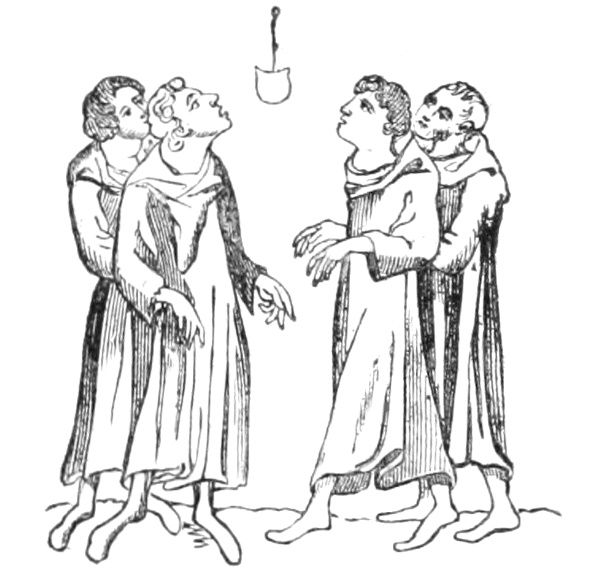
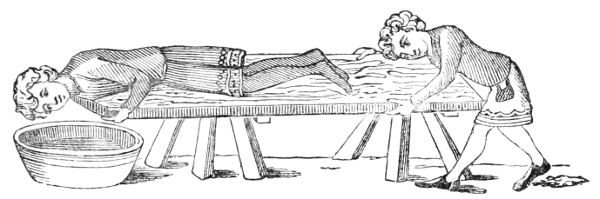
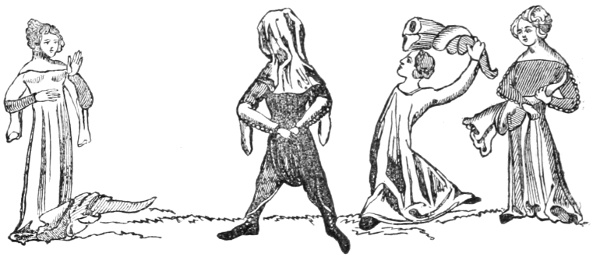
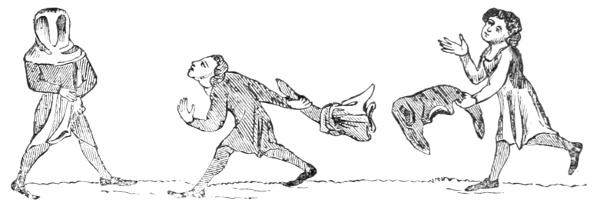
A GENERAL ARRANGEMENT OF THE POPULAR SPORTS,
PASTIMES, AND MILITARY GAMES, TOGETHER WITH
THE VARIOUS SPECTACLES OF MIRTH OR SPLENDOUR,
EXHIBITED PUBLICLY OR PRIVATELY, FOR THE SAKE
OF AMUSEMENT, AT DIFFERENT PERIODS, IN ENGLAND.
CONTENTS.
I. Object of the Work, to describe the Pastimes and
trace their Origin.—II. The
Romans in Britain.—III. The Saxons.—IV. The Normans.—V. Tournaments
and Justs.—VI. Other Sports of the Nobility, and the Citizens and Yeomen.—VII.
Knightly Accomplishments.—VIII. Esquireship.—IX. Military Sports
patronized by the Ladies.—X. Decline of such Exercises—XI. and of Chivalry.—XII.
Military Exercises under Henry the Seventh—XIII. and under Henry
the Eighth.—XIV. Princely Exercises under James the First.—XV. Revival of
Learning.—XVI. Recreations of the Sixteenth Century.—XVII. Old Sports of
the Citizens of London.—XVIII. Modern Pastimes of the Londoners.—XIX.
Cotswold and Cornish Games.—XX. Splendour of the ancient Kings and Nobility.—XXI.
Royal and noble Entertainments.—XXII. Civic Shows.—XXIII.
Setting out of Pageants.—XXIV. Processions of Queen Mary and King Philip
of Spain in London.—XXV. Chester Pageants.—XXVI. Public Shows of the
Sixteenth Century.—XXVII. Queen Elizabeth at Kenelworth Castle.—XXVIII.
Love of Public Sights illustrated from Shakspeare.—XXIX. Rope-dancing, tutored
Animals, and Puppet-shows.—XXX. Minstrelsy, Bell-ringing, &c.—XXXI.
Baiting of Animals.—XXXII. Pastimes formerly on Sundays.—XXXIII.
Royal Interference with them.—XXXIV. Zeal against Wakes and May-Games.—XXXV.
Dice and Cards.—XXXVI. Regulation of Gaming for Money by
Richard Cœur de Lion &c.—XXXVII. Statutes against Cards, Ball-play, &c.—XXXVIII.
Prohibitions of Skittle-play.—XXXIX. Archery succeeded by
Bowling.—XL. Modern Gambling.—XLI. Ladies' Pastimes, Needle-work.—XLII.
Dancing and Chess-play.—XLIII. Ladies' Recreations in the Thirteenth
Century.—XLIV. The Author's Labours.—Character of the Engravings.
In order to form a just estimation of the character of any
particular people, it is absolutely necessary to investigate the
Sports and Pastimes most generally prevalent among them.
War, policy, and other contingent circumstances, may effectually
place men, at different times, in different points of view,
but, when we follow them into their retirements, where no
disguise is necessary, we are most likely to see them in their
true state, and may best judge of their natural dispositions.
Unfortunately, all the information that remains respecting the
ancient inhabitants of this island is derived from foreign writers
partially acquainted with them as a people, and totally ignorant
of their domestic customs and amusements: the silence, therefore,
of the contemporary historians on these important subjects
leaves us without the power of tracing them with the least
degree of certainty; and as it is my intention, in the following
pages, to confine myself as much as possible to positive intelligence,
I shall studiously endeavour to avoid all controversial
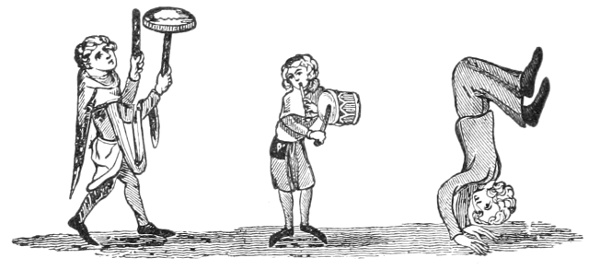
and conjectural arguments. I mean also to treat upon such
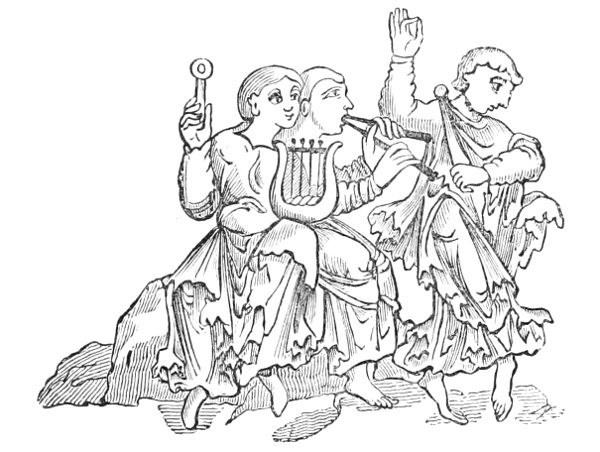
pastimes only as have been practised in this country; but as
many of them originated on the continent, frequent digressions,
by way of illustrations, must necessarily occur: these, however,
I shall make it my business to render as concise as the
nature of the subject will permit them to be.
We learn, from the imperfect hints of ancient history, that, when
the Romans first invaded Britain, her inhabitants were a bold,
active, and warlike people, tenacious of their native liberty, and
capable of bearing great fatigue; to which they were probably
inured by an early education, and constant pursuit of such
amusements as best suited the profession of a soldier; including
hunting, running, leaping, swimming, and other exertions requiring
strength and agility of body. Perhaps the skill which
the natives of Devonshire and Cornwall retain to the present
day, in hurling and wrestling, may properly be considered as
a vestige of British activity. After the Romans had conquered
Britain, they impressed such of the young men as were able
to bear arms for foreign service, and enervated the spirit of the
people by the importation of their own luxurious manners and
habits; so that the latter part of the British history exhibits
to our view a slothful and effeminate race of men, totally divested
of that martial disposition, and love of freedom, which so
strongly marked the character of their progenitors; and their
amusements, no doubt, partook of the same weakness and
puerility.
The arrival of the Saxons forms a new epoch in the annals
of this country. These military mercenaries came professedly
to assist the Britons against their incessant tormentors the Picts
and the Caledonians; but no sooner had they established their
footing in the land, than they invited more of their countrymen
to join them, and turning their arms against their wretched
employers, became their most dangerous and most inexorable
enemies, and in process of time obtained full possession of the
largest and best part of the island; whence arose a total change
in the form of government, laws, manners, customs, and habits
of the people.
The sportive exercises and pastimes practised by the Saxons
appear to have been such as were common among the ancient
northern nations; and most of them consisted of robust exercises.
In an old Chronicle of Norway,
[1]
we find it recorded of
Olaf Tryggeson, a king of that country, that he was stronger
and more nimble than any man in his dominions. He could
climb up the rock Smalserhorn, and fix his shield upon the
top of it; he could walk round the outside of a boat upon the
oars, while the men were rowing; he could play with three
darts, alternately throwing them in the air, and always kept
two of them up, while he held the third in one of his hands;
he was ambidexter, and could cast two darts at once; he excelled
all the men of his time in shooting with the bow; and
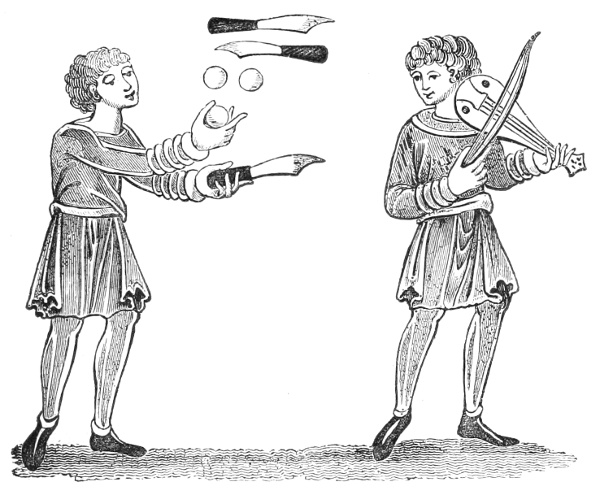
he had no equal in swimming. In one achievement this monarch
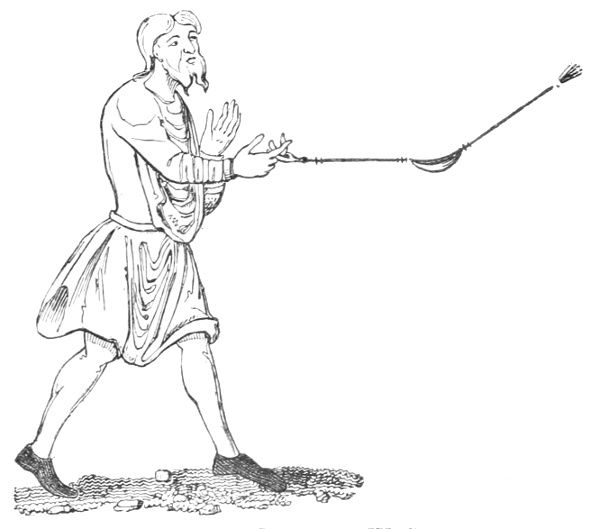
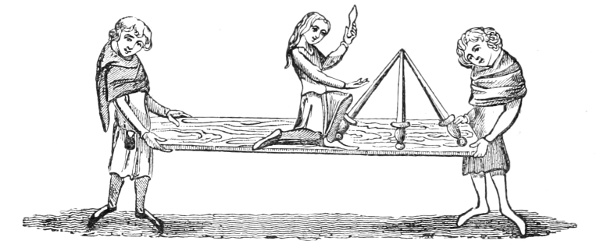
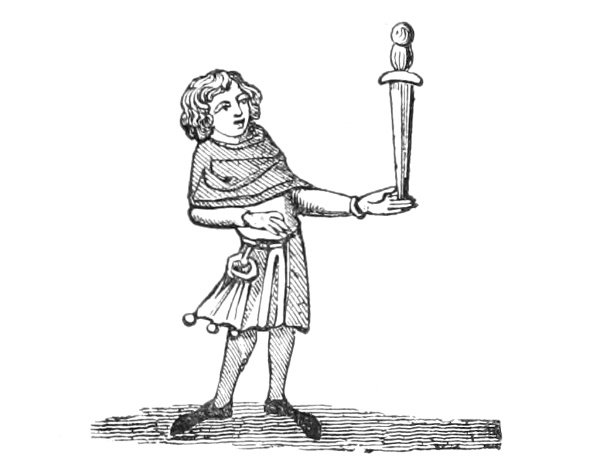
was outdone by the Anglo-Saxon ᵹlıᵹman, represented by the
engraving No. 50,
[2]
who adds an equal number of balls to those
knives or daggers. The Norman minstrel Tallefer, before the
commencement of the battle at Hastings, cast his lance into the
air three times, and caught it by the head in such a surprising
manner, that the English thought it was done by the power of
enchantment. Another northern hero, whose name was Kolson,
boasts of nine accomplishments in which he was well skilled:
"I know," says he, "how to play at chess; I can engrave
Runic letters; I am expert at my book; I know how to handle
the tools of the smith;
[3]
I can traverse the snow on skates of
wood; I excel in shooting with the bow; I use the oar with
facility; I can sing to the harp; and I compose verses."
[4]
The
reader will, I doubt not, anticipate me in my observation, that
the acquirements of Kolson indicate a much more liberal education
than those of the Norwegian monarch: it must, however,
be observed, that Kolson lived in an age posterior to him; and
also, that he made a pilgrimage to the Holy Land, which may
probably account in great measure for his literary qualifications.
Yet, we are well assured that learning did not form any prominent
feature in the education of a young nobleman during the
Saxon government: it is notorious, that Alfred the Great was
twelve years of age before he learned to read; and that he owed
his knowledge of letters to accident, rather than to the intention of
his tutors. A book adorned with paintings in the hands of his
mother, attracted his notice, and he expressed his desire to have
it: she promised to comply with his request on condition that
he learned to read it, which it seems he did; and this trifling
incident laid the groundwork of his future scholarship.
[5]
Indeed, it is not by any means surprising, under the Saxon
government, when the times were generally very turbulent, and
the existence of peace exceedingly precarious, and when the
personal exertions of the opulent were so often necessary for
the preservation of their lives and property, that such exercises
as inured the body to fatigue, and biassed the mind to military
pursuits, should have constituted the chief part of a young
nobleman's education: accordingly, we find that hunting,
hawking, leaping, running, wrestling, casting of darts, and
other pastimes which necessarily required great exertions of
bodily strength, were taught them in their adolescence. These
amusements engrossed the whole of their attention, every one
striving to excel his fellow; for hardiness, strength, and valour,
out-balanced, in the public estimation, the accomplishments of
the mind; and therefore literature, which flourishes best in
tranquillity and retirement, was considered as a pursuit unworthy
the notice of a soldier, and only requisite in the gloomy recesses
of the cloister.
Among the vices of the Anglo-Saxons may be reckoned their
propensity to gaming, and especially with the dice, which they
derived from their ancestors; for Tacitus
[6]
assures us that the
ancient Germans would not only hazard all their wealth, but
even stake their liberty, upon the turn of the dice; "and he
who loses," says the author, "submits to servitude, though
younger and stronger than his antagonist, and patiently permits
himself to be bound, and sold in the market; and this madness
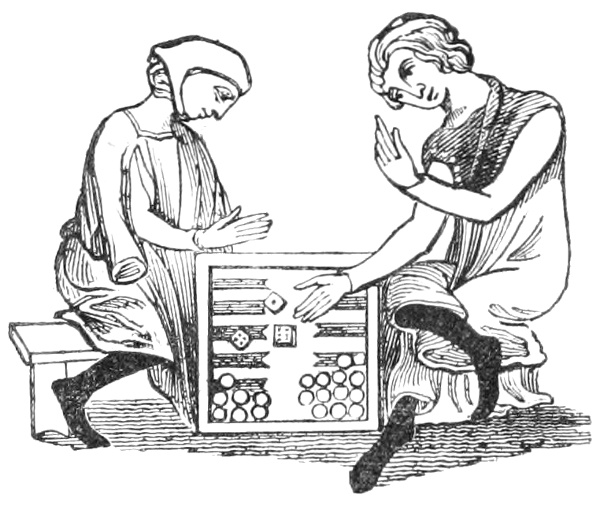
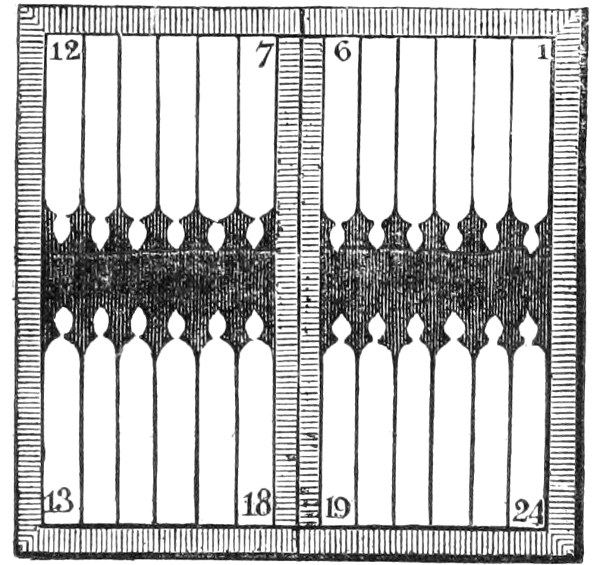
they dignify by the name of honour." Chess was also a favourite
game with the Saxons; and likewise backgammon, said to
have been invented about the tenth century. It appears moreover,
that a large portion of the night was appropriated to the
pursuit of these sedentary amusements. In the reign of Canute
the Dane, this practice was sanctioned by the example of royalty,
and followed by the nobility. Bishop Ætheric, having obtained
admission to Canute about midnight upon some urgent business,
found the king engaged with his courtiers at play, some at
dice, and some at chess.
[7]
The clergy, however, were prohibited
from playing at games of chance, by the ecclesiastical canons
established in the reign of Edgar.
[8]
The popular sports and pastimes, prevalent at the close of
the Saxon era, do not appear to have been subjected to any
material change by the coming of the Normans: it is true, indeed,
that the elder William and his immediate successors restricted
the privileges of the chase, and imposed great penalties
on those who presumed to destroy the game in the royal forests,
without a proper licence.
[9]
By these restrictions the general
practice of hunting was much confined, but by no means prohibited
in certain districts, and especially to persons of opulence
who possessed extensive territories of their own.
Among the pastimes introduced by the Norman nobility,
none engaged the general attention more than the tournaments
and the justs. The tournament, in its original institution, was
a martial conflict, in which the combatants engaged without any
animosity, merely to exhibit their strength and dexterity; but,
at the same time, engaged in great numbers to represent a
battle. The just was when two knights, and no more, were
opposed to each other at one time. These amusements, in the
middle ages, which may properly enough be denominated the
ages of chivalry, were in high repute among the nobility of
Europe, and produced in reality much of the pomp and gallantry
that we find recorded with poetical exaggeration in the
legends of knight-errantry. I met with a passage in a satirical
poem among the Harleian MSS. of the thirteenth century,
[10]
which strongly marks the prevalence of this taste in the times
alluded to. It may be thus rendered in English:
If wealth, sir knight, perchance be thine,
In tournaments you're bound to shine
Refuse—and all the world will swear
You are not worth a rotten pear.
[11]
While the principles of chivalry continued in fashion, the
education of a nobleman was confined to those principles, and
every regulation necessary to produce an accomplished knight
was put into practice. In order fully to investigate these particulars,
we may refer to the romances of the middle ages; and,
generally speaking, dependence may be placed upon their information.
The authors of these fictitious histories never looked
beyond the customs of their own country; and whenever the
subject called for a representation of remote magnificence, they
depicted such scenes of splendour as were familiar to them:
hence it is, that Alexander the Great, in his legendary life, receives
the education of a Norman baron, and becomes expert
in hawking, hunting, and other amusements coincident with
the time in which the writer lived. Our early poets have fallen
into the same kind of anachronism; and Chaucer himself, in
the Knight's Tale, speaking of the rich array and furniture of
the palace of Theseus, forgets that he was a Grecian prince of
great antiquity, and describes the large hall belonging to an
English nobleman, with the guests seated at table, probably as
he had frequently seen them, entertained with singing, dancing,
and other acts of minstrelsy, their hawks being placed upon
perches over their heads, and their hounds lying round about upon
the pavement below. The two last lines of the poem just referred
to are peculiarly applicable to the manners of the time in which
the poet lived, when no man of consequence travelled abroad
without his hawk and his hounds. In the early delineations,
the nobility are frequently represented seated at table, with their
hawks upon their heads. Chaucer says,
Ne what hawkes sytten on perchen above,
Ne what houndes lyggen on the flour adoun.
The picture is perfect, when referred to his own time; but
bears not the least analogy to Athenian grandeur. In the romance
called The Knight of the Swan, it is said of Ydain duchess
Roulyon, that she caused her three sons to be brought up in
"all maner of good operacyons, vertues, and maners; and when
in their adolescence they were somwhat comen to the age of
strengthe, they," their tutors, "began to practyse them in
shootinge with their bow and arbelstre,
[12]
to playe with the sword
and buckeler, to runne, to just,
[13]
to playe with a poll-axe, and
to wrestle; and they began to bear harneys,
[14]
to runne horses,
and to approve them, as desyringe to be good and faythful
knightes to susteyne the faith of God." We are not, however
to conceive, that martial exercises in general were confined to
the education of young noblemen: the sons of citizens and
yeomen had also their sports resembling military combats. Those
practised at an early period by the young Londoners seem to
have been derived from the Romans; they consisted of various
attacks and evolutions performed on horseback, the youth being
armed with shields and pointless lances, resembling the ludus
Trojæ, or Troy game, described by Virgil.
[15]
These amusements,
according to Fitz Stephen, who lived in the reign of Henry II.,
were appropriated to the season of Lent; but at other times they
exercised themselves with archery, fighting with clubs and
bucklers, and running at the quintain; and in the winter, when
the frost set in, they would go upon the ice, and run against
each other with poles, in imitation of lances, in a just; and
frequently one or both were beaten down, "not always without
hurt; for some break their arms, and some their legs; but
youth," says my author, "emulous of glory, seeks these exercises
preparatory against the time that war shall demand their
presence." The like kind of pastimes, no doubt, were practised
by the young men in other parts of the kingdom.
The mere management of arms, though essentially requisite,
was not sufficient of itself to form an accomplished knight in
the times of chivalry; it was necessary for him to be endowed
with beauty, as well as with strength and agility of body; he
ought to be skilled in music, to dance gracefully, to run with
swiftness, to excel in wrestling, to ride well, and to perform
every other exercise befitting his situation. To these were to be
added urbanity of manners, strict adherence to the truth, and
invincible courage. Hunting and hawking skilfully were also
acquirements that he was obliged to possess, and which were
usually taught him as soon as he was able to endure the fatigue
that they required. Hence it is said of sir Tristram, a fictitious
character held forth as the mirror of chivalry in the romance
entitled The Death of Arthur, that "he learned to be an
harper, passing all other, that there was none such called in
any countrey: and so in harping and on instruments of musike
he applied himself in his youth for to learne, and after as he
growed in might and strength he laboured ever in hunting and
hawking, so that we read of no gentlemen who more, or so,
used himself therein; and he began good measures of blowing
blasts of venery,
[16]
and chase, and of all manner of vermains;
[17]
and all these terms have we yet of hunting and hawking; and
therefore the book of venery, and of hawking and hunting, is
called the Boke of Sir Tristram." In a succeeding part of the
same romance, king Arthur thus addresses the knight: "For
all manner of hunting thou bearest the prize; and of all measures
of blowing thou art the beginner, and of all the termes
of hunting and hawking thou art the beginner."
[18]
We are also
informed, that sir Tristram had previously learned the language
of France, knew all the principles of courtly behaviour, and was
skilful in the various requisites of knighthood. Another ancient
romance says of its hero, "He every day was provyd in dauncyng
and in songs that the ladies coulde think were convenable for a
nobleman to conne;
[19]
but in every thinge he passed all them that
were there. The king, for to assaie him, made justes and turnies;
and no man did so well as he, in runnyng, playing at the pame,
[20]
shotyng, and castyng of the barre, ne found he his maister."
[21]
The laws of chivalry required that every knight should pass
through two offices: the first was a page; and, at the age of
fourteen, he was admitted an esquire. The office of the esquire
consisted of several departments; the esquire for the body,
the esquire of the chamber, the esquire of the stable, and the
carving esquire; the latter stood in the hall at dinner, carved
the different dishes, and distributed them to the guests. Several
of the inferior officers had also their respective esquires.
[22]
Ipomydon, a king's son and heir, in the romance that bears
his name, written probably at the commencement of the fourteenth
century, is regularly taught the duties of an esquire,
previous to his receiving the honours of knighthood; and for
this purpose his father committed him to the care of a "learned
and courteous knight called Sir 'Tholomew." Our author
speaks on this subject in the following manner:
'Tholomew a clerke he toke,
That taught the child uppon the boke
Both to synge and to rede;
And after he taught hym other dede.
Afterward, to serve in halle
Both to grete and to smalle;
Before the kynge mete to kerve;
Hye and low fayre to serve.
Both of howndes and hawkis game,
After, he taught hym all; and same,
In sea, in feld, and eke in ryvere;
In woode to chase the wild dere,
And in feld to ryde a stede;
That all men had joy of hys dede.
[23]
Here we find reading mentioned; which, however, does not
appear to have been of any great importance in the middle ages,
and is left out in the Geste of King Horne, another metrical
romance,
[24]
which seems to be rather more ancient than the former.
Young Horne is placed under the tuition of Athelbrus, the king's
steward, who is commanded to teach him the mysteries of hawking
and hunting, to play upon the harp,
Ant toggen o' the harpe
With his nayles sharpe,
to carve at the royal table, and to present the cup to the king
when he sat at meat, with every other service fitting for him to
know. The monarch concludes his injunctions with a repetition
of the charge to instruct him in singing and music:
Tech him of harp and of song.
And the manner in which the king's carver performed the
duties of his office is well described in the poem denominated
the Squyer of Lowe Degree:
[25]
There he araied him in scarlet red,
And set a chaplet upon his hedde;
A belte about his sydes two,
With brode barres to and fro;
A horne about his necke he caste;
And forth he went at the laste,
To do his office in the halle
Among the lordes both greate and small.
He toke a white yeard in his hand;
Before the kynge than gan he stande;
And sone he set hym on his knee,
And served the kynge ryght royally
With deynty meates that were dere.—
—And, when the squyer had done so,
He served them all
[26] to and fro.
Eche man hym loved in honeste,
Hye and lowe in their degre;
So dyd the kyng—&c.
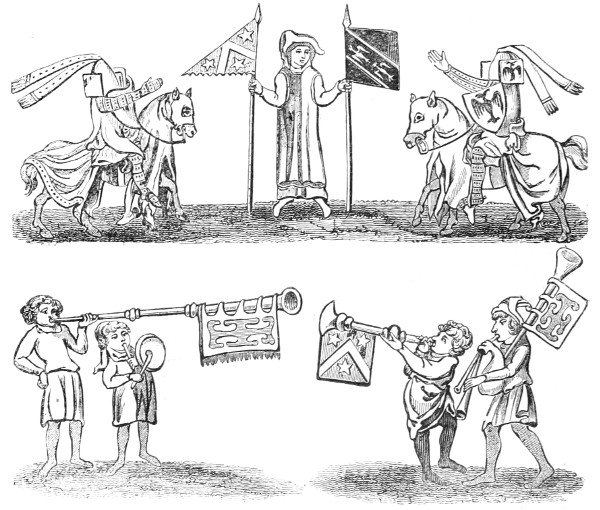
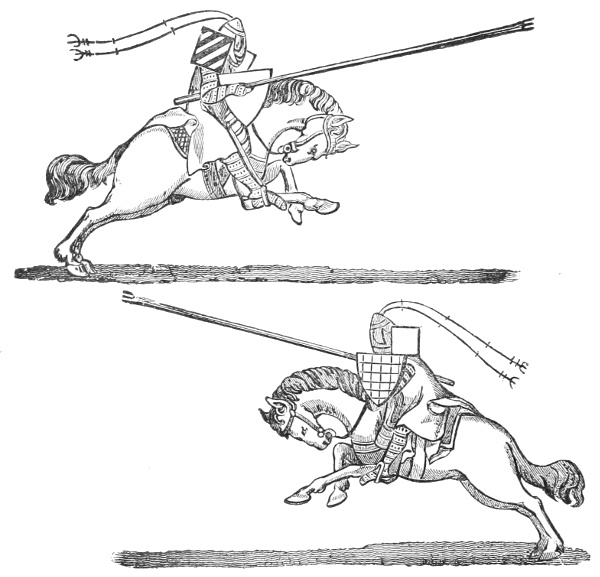
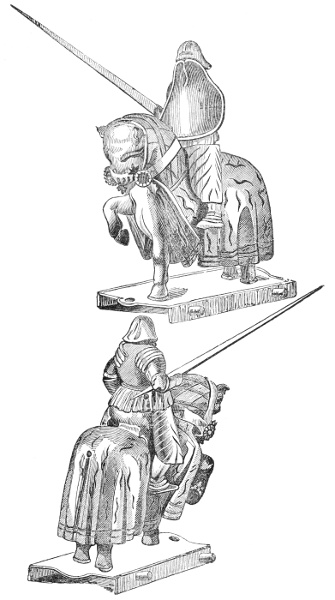
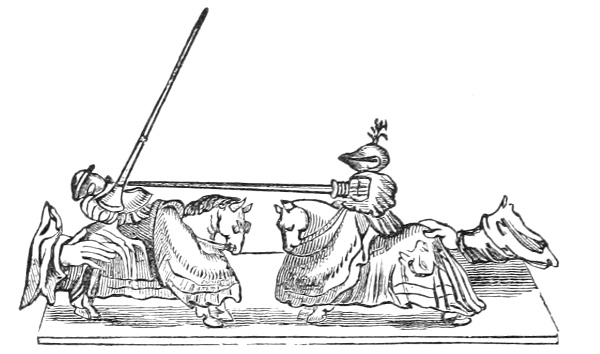
Tournaments and justs were usually exhibited at coronations
royal marriages, and other occasions of solemnity where pomp
and pageantry were thought to be requisite. Our historians
abound with details of these celebrated pastimes. The reader
is referred to Froissart, Hall, Holinshed, Stow, Grafton, &c.
who are all of them very diffuse upon this subject; and in the
second volume of the Manners and Customs of the English
are several curious representations of these military combats
both on horseback and on foot.
One great reason, and perhaps the most cogent of any, why
the nobility of the middle ages, nay, and even princes and
kings, delighted so much in the practice of tilting with each
other, is, that on such occasions they made their appearance
with prodigious splendour, and had the opportunity of displaying
their accomplishments to the greatest advantage. The
ladies also were proud of seeing their professed champions
engaged in these arduous conflicts; and, perhaps, a glove or
riband from the hand of a favourite female might have inspired
the receiver with as zealous a wish for conquest, as the abstracted
love of glory; though in general, I presume, both these ideas
were united; for a knight divested of gallantry would have
been considered as a recreant, and unworthy of his profession.
When the military enthusiasm which so strongly characterised
the middle ages had subsided, and chivalry was on the decline,
a prodigious change took place in the nurture and manners of
the nobility. Violent exercises requiring the exertions of muscular
strength grew out of fashion with persons of rank, and
of course were consigned to the amusement of the vulgar; and
the education of the former became proportionably more soft
and delicate. This example of the nobility was soon followed
by persons of less consequence; and the neglect of military
exercises prevailed so generally, that the interference of the
legislature was thought necessary, to prevent its influence from
being universally diffused, and to correct the bias of the common
mind; for, the vulgar readily acquiesced with the relaxation
of meritorious exertions, and fell into the vices of the
times, resorting to such games and recreations as promoted
idleness and dissipation, by which they lost their money, and,
what is worse, their reputation, entailing poverty and distress
on themselves and their families.
The romantic notions of chivalry appear to have lost their
vigour towards the conclusion of the fifteenth century, especially
in this country, where a continued series of intestine commotions
employed the exertions of every man of property, and real
battles afforded but little leisure to exercise the mockery of
war. It is true, indeed, that tilts and tournaments, with other
splendid exhibitions of military skill, were occasionally exercised,
and with great brilliancy, so far as pomp and finery could
contribute to make them attractive, till the end of the succeeding
century. These splendid pastimes were encouraged by the
sanction of royalty, and this sanction was perfectly political;
on the one hand, it gratified the vanity of the nobility, and,
on the other, it amused the populace, who, being delighted
with such shows of grandeur, were thereby diverted from reflecting
too deeply upon the grievances they sustained. It is,
however, certain that the justs and tournaments of the latter
ages, with all their pomp, possessed but little of the primitive
spirit of chivalry.
Henry VII. patronized the gentlemen and officers of his
court in the practice of military exercises. The following extract
may serve as a specimen of the manner in which they were
appointed to be performed: "Whereas it ever hath bene of old
antiquitie used in this realme of most noble fame, for all lustye
gentlemen to passe the delectable season of summer after divers
manner and sondry fashions of disports, as in hunting the red
and fallowe deer with houndes, greyhoundes, and with the
bowe; also in hawking with hawkes of the tower; and other
pastimes of the field. And bycause it is well knowen, that
in the months of Maie and June, all such disports be not convenient;
wherefore, in eschewing of idleness, the ground of all
vice," and to promote such exercises as "shall be honourable,
and also healthfull and profitable to the body," we "beseech
your most noble highness to permit two gentlemen, assosyatying
to them two other gentlemen to be their aides," by "your gracious
licence, to furnish certain articles concerning the feates
of armes hereafter ensuinge:"—"In the first place; On the
twenty-second daye of Maie, there shall be a grene tree sett up
in the lawnde of Grenwich parke; whereupon shall hange, by
a grene lace, a vergescu
[27]
blanke; upon which white shield it
shal be lawful for any gentleman that will answer the following
chalenge to subscribe his name.—Secondly; The said two
gentlemen, with their two aides, shal be redye on the twenty-thirde
daie of Maie, being Thursdaye, and on Mondaye thence
next ensewinge, and so everye Thursday and Monday untill
the twentieth daye of June, armed for the foote, to answear
all gentlemen commers, at the feate called the Barriers, with
the casting-speare, and the targett, and with the bastard-sword,
[28]
after the manner following, that is to saie, from sixe of the clocke
in the forenoone till sixe of the clocke in the afternoone during the
time.—Thirdly; And the said two gentlemen, with their two aiders,
or one of them, shall be there redye at the said place, the daye and
dayes before rehearsed, to deliver any of the gentlemen answeares
of one caste with the speare hedded with the morne,
[29]
and seven
strokes with the sword, point and edge rebated, without close, or
griping one another with handes, upon paine of punishment as the
judges for the time being shall thinke requisite.—Fourthly; And
it shall not be lawfull to the challengers, nor to the answearers,
with the bastard sword to give or offer any foyne
[30]
to his match,
upon paine of like punishment.—Fifthly; The challengers shall
bringe into the fielde, the said daies and tymes, all manner of
weapons concerning the said feates, that is to saye, casting
speares hedded with mornes, and bastard swords with the edge
and point rebated; and the answerers to have the first choise."
[31]
Henry VIII. not only countenanced the practice of military
pastimes by permitting them to be exercised without restraint,
but also endeavoured to make them fashionable by his own example.
Hall assures us, that, even after his accession to the
throne, he continued daily to amuse himself in archery, casting
of the bar, wrestling, or dancing, and frequently in tilting,
tournaying, fighting at the barriers with swords, and battle-axes,
and such like martial recreations, in most of which there
were few that could excel him. His leisure time he spent in
playing at the recorders, flute, and virginals, in setting of songs,
singing and making of ballads.
[32]
He was also exceedingly fond
of hunting, hawking, and other sports of the field; and indeed his
example so far prevailed, that hunting, hawking, riding the great
horse, charging dexterously with the lance at the tilt, leaping, and
running, were necessary accomplishments for a man of fashion.
[33]
The pursuits and amusements of a nobleman are placed in a different
point of view by an author of the succeeding century;
[34]
who,
describing the person and manners of Charles lord Mountjoy,
regent of Ireland, in 1599, says, "He delighted in study, in gardens,
in riding on a pad to take the aire, in playing at shovelboard,
at cardes, and in reading of play-bookes for recreation, and
especially in fishing and fish-ponds, seldome useing any other
exercises, and useing these rightly as pastimes, only for a short
and convenient time, and with great variety of change from one
to the other." The game of shovelboard, though now considered
as exceedingly vulgar, and practised by the lower classes of
the people, was formerly in great repute among the nobility and
gentry; and few of their mansions were without a shovelboard,
which was a fashionable piece of furniture. The great hall
was usually the place for its reception.
We are by no means in the dark respecting the education of
the nobility in the reign of James I.; we have, from that monarch's
own hand, a set of rules for the nurture and conduct of
an heir apparent to the throne, addressed to his eldest son
Henry, prince of Wales. From the third book of this remarkable
publication, entitled ΒΑΣΙΛΙΚΟΝ ΔΩΡΟΝ, or, a Kinge's
Christian Dutie towards God," I shall select such parts as respect
the recreations said to be proper for the pursuit of a
nobleman, without presuming to make any alteration in the
diction of the royal author.
"Certainly," he says, "bodily exercises and games are very
commendable, as well for bannishing of idleness, the mother
of all vice; as for making the body able and durable for travell,
which is very necessarie for a king. But from this court I debarre
all rough and violent exercises; as the foote-ball, meeter
for lameing, than making able, the users thereof; as likewise
such tumbling trickes as only serve for comœdians and balladines
to win their bread with: but the exercises that I would have
you to use, although but moderately, not making a craft of them,
are, running, leaping, wrestling, fencing, dancing, and playing
at the caitch, or tennise, archerie, palle-malle, and such like
other fair and pleasant field-games. And the honourablest and
most recommendable games that yee can use on horseback;
for, it becometh a prince best of any man to be a faire and good
horseman: use, therefore, to ride and danton great and courageous
horses;—and especially use such games on horseback
as may teach you to handle your armes thereon, such as the
tilt, the ring, and low-riding for handling of your sword.
"I cannot omit heere the hunting, namely, with running
houndes, which is the most honourable and noblest sort thereof;
for it is a theivish forme of hunting to shoote with gunnes and
bowes; and greyhound hunting
[35]
is not so martial a game.
"As for hawkinge, I condemn it not; but I must praise it
more sparingly, because it neither resembleth the warres so neere
as hunting doeth in making a man hardie and skilfully ridden
in all grounds, and is more uncertain and subjec. to mischances;
and, which is worst of all, is there through an extreme stirrer
up of the passions.
"As for sitting, or house pastimes—since they may at times
supply the roome which, being emptie, would be patent to pernicious
idleness—I will not therefore agree with the curiositie
of some learned men of our age in forbidding cardes, dice, and
such like games of hazard:
[36]
when it is foule and stormie weather,
then I say, may ye lawfully play at the cardes or tables;
for, as to diceing, I think it becommeth best deboshed souldiers
to play at on the heads of their drums, being only ruled by
hazard, and subject to knavish cogging; and as for the chesse,
I think it over-fond, because it is over-wise and philosophicke
a folly."
His majesty concludes this subject with the following good
advice to his son: "Beware in making your sporters your
councellors, and delight not to keepe ordinarily in your companie
comœdians or balladines."
The discontinuation of bodily exercises afforded a proportionable
quantity of leisure time for the cultivation of the mind;
so that the manners of mankind were softened by degrees, and
learning, which had been so long neglected, became fashionable,
and was esteemed an indispensable mark of a polite education.
Yet some of the nobility maintained for a long time the old prejudices
in favour of the ancient mode of nurture, and preferred
exercise of the body to mental endowments; such was the opinion
of a person of high rank, who said to Richard Pace, secretary
to king Henry VIII., "It is enough for the sons of noblemen
to wind their horn and carry their hawke fair, and leave study
and learning to the children of meaner people."
[37]
Many of the
pastimes that had been countenanced by the nobility, and
sanctioned by their example, in the middle ages, grew into
disrepute in modern times, and were condemned as vulgar and
unbecoming the notice of a gentleman. "Throwing the hammer
and wrestling," says Peacham, in his Complete Gentleman,
published in 1622, "I hold them exercises not so well beseeming
nobility, but rather the soldiers in the camp and the prince's
guard." On the contrary, sir William Forest, in his Poesye
of Princelye Practice, a MS. in the Royal Library,
[38]
written in the
year 1548, laying down the rules for the education of an heir
apparent to the crown, or prince of the blood royal, writes thus:
So must a prince, at some convenient brayde,
In featis of maistries bestowe some diligence:
Too ryde, runne, leape, or caste by violence
Stone, barre, or plummett, or suche other thinge,
It not refusethe any prince or kynge.
However, I doubt not both these authors spoke agreeably to
the taste of the times in which they lived. Barclay, a more
early poetic writer, in his Eclogues, first published in 1508,
has made a shepherd boast of his skill in archery; to which he
adds,
I can dance the raye; I can both pipe and sing,
If I were mery; I can both hurle and sling;
I runne, I wrestle, I can well throwe the barre,
No shepherd throweth the axeltree so farre;
If I were mery, I could well leape and spring;
I were a man mete to serve a prince or king.
Burton, in his Anatomy of Melancholy, published in 1660,
gives us a general view of the sports most prevalent in the
seventeenth century. "Cards, dice, hawkes, and hounds,"
says he, "are rocks upon which men lose themselves, when
they are imprudently handled, and beyond their fortunes."
And again, "Hunting and hawking are honest recreations,
and fit for some great men, but not for every base inferior
person, who, while they maintain their faulkoner, and dogs,
and hunting nags, their wealth runs away with their hounds,
and their fortunes fly away with their hawks." In another
place he speaks thus: "Ringing, bowling, shooting, playing
with keel-pins, tronks, coits, pitching of bars, hurling, wrestling,
leaping, running, fencing, mustering, swimming, playing
with wasters, foils, foot-balls, balowns, running at the quintain,
and the like, are common recreations of country folks: riding
of great horses, running at rings, tilts and tournaments, horse-races,
and wild-goose chases, which are disports of greater
men, and good in themselves, though many gentlemen by such
means gallop quite out of their fortunes." Speaking of the
Londoners, he says, "They take pleasure to see some pageant
or sight go by, as at a coronation, wedding, and such like
solemn niceties; to see an ambassador or a prince received and
entertained with masks, shows, and fireworks. The country
hath also his recreations, as May-games, feasts, fairs, and
wakes." The following pastimes he considers as common both
in town and country, namely, "bull-baitings and bear-baitings,
in which our countrymen and citizens greatly delight, and frequently
use; dancers on ropes, jugglers, comedies, tragedies,
artillery gardens, and cock-fighting." He then goes on: "Ordinary
recreations we have in winter, as cards, tables, dice,
shovelboard, chess-play, the philosopher's game, small trunks,
shuttle-cock, billiards, music, masks, singing, dancing, ule-games,
frolicks, jests, riddles, catches, cross purposes, questions
and commands, merry tales of errant knights, queens, lovers,
lords, ladies, giants, dwarfs, thieves, cheaters, witches, fairies,
goblins, and friars." To this catalogue he adds: "Dancing,
singing, masking, mumming, and stage-plays, are reasonable
recreations, if in season; as are May-games, wakes,
and Whitson-ales, if not at unseasonable hours, are justly permitted.
Let them," that is, the common people, "freely feast,
sing, dance, have puppet-plays, hobby-horses, tabers, crowds,
[39]
and bagpipes:" let them "play at ball and barley-brakes;"
and afterwards, "Plays, masks, jesters, gladiators, tumblers,
and jugglers, are to be winked at, lest the people should do
worse than attend them."
A character in the Cornish Comedy, written by George Powell,
and acted at Dorset Garden in 1696, says, "What is a gentleman
without his recreations? With these we endeavour to pass
away that time which otherwise would lie heavily upon our
hands. Hawks, hounds, setting-dogs, and cocks, with their
appurtenances, are the true marks of a country gentleman."
This character is supposed to be a young heir just come to his
estate. "My cocks," says he, "are true cocks of the game—I
make a match of cock-fighting, and then an hundred or two
pounds are soon won, for I never fight a battle under."
In addition to the May-games, morris-dancings, pageants
and processions, which were commonly exhibited throughout
the kingdom in all great towns and cities, the Londoners had
peculiar and extensive privileges of hunting, hawking, and
fishing:
[40]
they had also large portions of ground allotted to
them in the vicinity of the city for the practice of such pastimes
as were not prohibited by the government, and for those especially
that were best calculated to render them strong and
healthy. We are told by Fitz Stephen, in the twelfth century,
that on the holidays during the summer season, the young men
of London exercised themselves in the fields with "leaping,
shooting with the bow, wrestling, casting the stone, playing
with the ball, and fighting with their shields." The last species
of pastime, I believe, is the same that Stow, in his Survey of
London, calls "practising with their wasters and bucklers;"
which in his day was exercised by the apprentices before the
doors of their masters. The city damsels had also their recreations
on the celebration of these festivals, according to the testimony
of both the authors just mentioned. The first tells us
that they played upon citherns,
[41]
and danced to the music; and
as this amusement probably did not take place before the close
of the day, they were, it seems, occasionally permitted to continue
it by moonlight. We learn from the other, who wrote
at the distance of more than four centuries, that it was then
customary for the maidens, after evening prayers, to dance in
the presence of their masters and mistresses, while one of their
companions played the measure upon a timbrel; and, in order
to stimulate them to pursue this exercise with alacrity, the best
dancers were rewarded with garlands, the prizes being exposed
to public view, "hanged athwart the street," says Stow, during
the whole of the performance. This recital calls to my mind a
passage in Spenser's Epithalamium, wherein it appears that
the dance was sometimes accompanied with singing. It runs
thus:
——The damsels they delight,
When they their timbrels smite,
And thereunto dance and carol sweet.
A general view of the pastimes practised by the Londoners
soon after the commencement of the last century occurs in
Strype's edition of Stow's Survey of London, published in 1720.
[42]
"The modern sports of the citizens," says the editor, "besides
drinking, are cock-fighting, bowling upon greens, playing at
tables, or backgammon, cards, dice, and billiards; also musical
entertainments, dancing, masks, balls, stage-plays, and club-meetings,
in the evening; they sometimes ride out on horseback,
and hunt with the lord-mayor's pack of dogs when the common
hunt goes out. The lower classes divert themselves at foot-ball,
wrestling, cudgels, nine-pins, shovelboard, cricket, stow-ball,
ringing of bells, quoits, pitching the bar, bull and bear baitings,
throwing at cocks, and, what is worst of all, lying at alehouses."
To these are added, by an author of later date, Maitland, in his
History of London, published in 1739, "Sailing, rowing, swimming
and fishing, in the river Thames, horse and foot races,
leaping, archery, bowling in allies, and skittles, tennice, chess,
and draughts; and in the winter scating, sliding, and shooting."
Duck-hunting was also a favourite amusement, but generally
practised in the summer. The pastimes here enumerated were
by no means confined to the city of London, or its environs: the
larger part of them were in general practice throughout the
kingdom.
Before I quit this division of my subject, I shall mention the
annual celebration of games upon Cotswold Hills, in Gloucestershire,
to which prodigious multitudes constantly resorted.
Robert Dover, an attorney, of Barton on the Heath, in the
county of Warwick, was forty years the chief director of these
pastimes. They consisted of wrestling, cudgel-playing, leaping,
pitching the bar, throwing the sledge, tossing the pike, with
various other feats of strength and activity; many of the country
gentlemen hunted or coursed the hare; and the women danced.
A castle of boards was erected on this occasion, from which
guns were frequently discharged. "Captain Dover received
permission from James I. to hold these sports; and he appeared
at their celebration in the very clothes which that monarch had
formerly worn, but with much more dignity in his air and
aspect."
[43]
I do not mean to say that the Cotswold games were
invented, or even first established, by captain Dover; on the
contrary, they seem to be of much higher origin, and are evidently
alluded to in the following lines by John Heywood the epigrammatist:
[44]
He fometh like a bore, the beaste should seeme bolde,
For he is as fierce as a lyon of Cotsolde.
Something of the same sort, I presume, was the Carnival, kept
every year, about the middle of July, upon Halgaver-moor, near
Bodmin in Cornwall; "resorted to by thousands of people,"
says Heath, in his description of Cornwall, published in 1750.
"The sports and pastimes here held were so well liked by
Charles II. when he touched here in his way to Sicily, that he
became a brother of the jovial society. The custom of keeping
this carnival is said to be as old as the Saxons."
Paul Hentzner, a foreign writer, who visited this country at
the close of the sixteenth century, says of the English, in his
Itinerary, written in 1598, that they are "serious like the Germans,
lovers of show, liking to be followed wherever they go
by whole troops of servants, who wear their master's arms in
silver."
[45]
This was no new propensity: the English nobility at
all times affected great parade, seldom appearing abroad without
large trains of servitors and retainers; and the lower classes
of the people delighted in gaudy shows, pageants, and processions.
If we go back to the times of the Saxons, we shall find that,
soon after their establishment in Britain, their monarchs assumed
great state. Bede tells us that "Edwin, king of Northumberland,
lived in much splendour, never travelling without a numerous
retinue; and when he walked in the streets of his own capital,
even in the times of peace, he had a standard borne before
him. This standard was of the kind called by the Romans tufa,
and by the English tuuf: it was made with feathers of various
colours, in the form of a globe, and fastened upon a pole."
[46]
It is unnecessary to multiply citations; for which reason, I
shall only add another. Canute the Dane, who is said to have
been the richest and most magnificent prince of his time in
Europe, rarely appeared in public without being followed by a
train of three thousand horsemen, well mounted and completely
armed. These attendants, who were called house carles, formed
a corps of body guards, or household troops, and were appointed
for the honour and safety of that prince's person.
[47]
The
examples of royalty were followed by the nobility and persons
of opulence.
In the middle ages, the love of show was carried to an extravagant
length; and as a man of fashion was nothing less than
a man of letters, those studies that were best calculated to improve
the mind were held in little estimation.
The courts of princes and the castles of the great barons
were daily crowded with numerous retainers, who were always
welcome to their masters' tables. The noblemen had their
privy counsellors, treasurers, marshals, constables, stewards,
secretaries, chaplains, heralds, pursuivants, pages, henchmen
or guards, trumpeters, and all the other officers of the royal
court.
[48]
To these may be added whole companies of minstrels,
mimics, jugglers, tumblers, rope-dancers, and players; and
especially on days of public festivity, when, in every one of
the apartments opened for the reception of the guests, were
exhibited variety of entertainments, according to the taste of
the times, but in which propriety had very little share; the
whole forming a scene of pompous confusion, where feasting,
drinking, music, dancing, tumbling, singing, and buffoonery,
were jumbled together, and mirth excited too often at the expense
of common decency.
[49]
If we turn to the third Book of
Fame, a poem written by our own countryman Chaucer, we
shall find a perfect picture of these tumultuous court entertainments,
drawn, I doubt not, from reality, and perhaps without
any exaggeration. It may be thus expressed in modern language:
Minstrels of every kind were stationed in the receptacles
for the guests; among them were jesters, that related tales of
mirth and of sorrow; excellent players upon the harp, with
others of inferior merit
[50]
seated on various seats below them,
who mimicked their performances like apes to excite laughter;
behind them, at a great distance, was a prodigious number of
other minstrels, making a great sound with cornets, shaulms,
flutes, horns,
[51]
pipes of various kinds, and some of them made
with green corn,
[52]
such as are used by shepherds' boys; there
were also Dutch pipers to assist those who chose to dance either
"love-dances, springs, or rayes,"
[53]
or any other new-devised
measures. Apart from these were stationed the trumpeters and
players on the clarion; and other seats were occupied by different
musicians playing variety of mirthful tunes. There were
also present large companies of jugglers, magicians, and tregetours,
who exhibited surprising tricks by the assistance of natural
magic.
Vast sums of money were expended in support of these absurd
and childish spectacles, by which the estates of the nobility
were consumed, and the public treasuries often exhausted. But
we shall have occasion to speak more fully on this subject hereafter.
[54]
The pageantry and shows exhibited in great towns and cities
on occasions of joy and solemnity were equally deficient in
taste and genius. At London, where they were most frequently
required, that is to say, at the reception of foreign monarchs,
at the processions of our own through the city of London to
Westminster previous to their coronation, or at their return from
abroad, and on various other occasions; besides such as occurred
at stated times, as the lord-mayor's show, the setting of the
midsummer watch, and the like, a considerable number of
different artificers were kept, at the city's expense, to furnish
the machinery for the pageants, and to decorate them. Stow
tells us that, in his memory, great part of Leaden Hall was
appropriated to the purpose of painting and depositing the
pageants for the use of the city.
The want of elegance and propriety, so glaringly evident in
these temporary exhibitions, was supplied, or attempted to be
supplied, by a tawdry resemblance of splendour. The fronts
of the houses in the streets through which the processions
passed were covered with rich adornments of tapestry, arras,
and cloth of gold; the chief magistrates and most opulent
citizens usually appeared on horseback in sumptuous habits
and joined the cavalcade; while the ringing of bells, the
sound of music from various quarters, and the shouts of the
populace, nearly stunned the ears of the spectators. At certain
distances, in places appointed for the purpose, the pageants
were erected, which were temporary buildings representing
castles, palaces, gardens, rocks, or forests, as the occasion required,
where nymphs, fawns, satyrs, gods, goddesses, angels,
and devils, appeared in company with giants, savages, dragons,
saints, knights, buffoons, and dwarfs, surrounded by minstrels
and choristers; the heathen mythology, the legends of chivalry,
and Christian divinity, were ridiculously jumbled together,
without meaning; and the exhibition usually concluded with
dull pedantic harangues, exceedingly tedious, and replete with
the grossest adulation. The giants especially were favourite
performers in the pageants; they also figured away with great
applause in the pages of romance; and, together with dragons
and necromancers, were created by the authors for the sole
purpose of displaying the prowess of their heroes, whose business
it was to destroy them.
Some faint traces of the processional parts of these exhibitions
were retained at London in the lord mayor's show about twenty
or thirty years ago;
[55]
but the pageants and orations have been
long discontinued, and the show itself is so much contracted,
that it is in reality altogether unworthy of such an appellation.
In an old play, the Historie of Promos and Cassandra, part
the second, by George Whetstone, printed in 1578,
[56]
a carpenter,
and others, employed in preparing the pageants for a royal
procession, are introduced. In one part of the city the artificer
is ordered "to set up the frames, and to space out the rooms,
that the Nine Worthies may be so instauled as best to please the
eye." The "Worthies" are thus named in an heraldical MS. in
the Harleian Library:
[57]
"Duke Jossua; Hector of Troy;
kyng David; emperour Alexander; Judas Machabyes; emperour
Julyus Cæsar; kyng Arthur; emperour Charlemagne; and
syr Guy of Warwycke;" but the place of the latter was frequently,
and I believe originally, supplied by Godefroy, earl
of Bologne: it appears, however, that any of them might be
changed at pleasure: Henry VIII. was made a "Worthy" to
please his daughter Mary, as we shall find a little farther on.
In another part of the same play the carpenter is commanded
to "errect a stage, that the wayghtes
[58]
in sight may stand;"
one of the city gates was to be occupied by the fowre Virtues,
together with "a consort of music;" and one of the pageants
is thus whimsically described:
They have Hercules of monsters conquering;
Huge great giants, in a forrest, fighting
With lions, bears, wolves, apes, foxes, and grayes,
Baiards and brockes——
——Oh, these be wondrous frayes!
The stage direction then requires the entry of "Two men apparelled
lyke greene men at the mayor's feast, with clubbs of
fyreworks;" whose office, we are told, was to keep a clear passage
in the street, "that the kyng and his trayne might pass with
ease."—In another dramatic performance of later date, Green's
Tu Quoque, or the City Gallant, by John Cooke, published in
1614, a city apprentice says, "By this light, I doe not thinke
but to be lord mayor of London before I die; and have three
pageants carried before me, besides a ship and an unicorn." The
following passage occurs in Selden's Table Talk, under the
article Judge, "We see the pageants in Cheapside, the lions
and the elephants; but we do not see the men that carry them
we see the judges look big like lions; but we do not see who
moves them."
In the foregoing quotations, we have not the least necessity
to make an allowance for poetical licence: the historians of the
time will justify the poets, and perfectly clear them from any
charge of exaggeration; and especially Hall, Grafton, and
Holinshed, who are exceedingly diffuse on this and such like
popular subjects. The latter has recorded a very curious piece
of pantomimical trickery exhibited at the time that the princess
Mary went in procession through the city of London, the day
before her coronation:—At the upper end of Grace-church-Street
there was a pageant made by the Florentines; it was
very high; and "on the top thereof there stood foure pictures;
and in the midst of them, and the highest, there stood an angell,
all in greene, with a trumpet in his hand; and when the trumpetter
who stood secretlie within the pageant, did sound his·
trumpet, the angell did put his trumpet to his mouth, as though
it had been the same that had sounded." A similar deception
but on a more extensive scale, was practised at the gate of
Kenelworth Castle for the reception of queen Elizabeth.
[59]
Holinshed, speaking of the spectacles exhibited at London,
when Philip king of Spain, with Mary his consort, made their
public entry in the city, calls them, in the margin of his
Chronicle, "the vaine pageants of London;" and he uses the
same epithet twice in the description immediately subsequent;
"Now," says he, "as the king came to London, and as he
entered at the drawbridge, [on London Bridge,] there was a
vaine great spectacle, with two images representing two giants,
the one named Corineus, and the other Gog-magog, holding
betweene them certeine Latin verses, which, for the vaine ostentation
of flatterye, I overpasse."
[60]
He then adds: "From the
bridge they passed to the conduit in Gratious-street, which was
finely painted; and, among other things," there exhibited,
"were the Nine Worthies; of these king Henry VIII. was one.
He was painted in harnesse,
[61]
having in one hand a sword, and
in the other hand a booke, whereupon was written Verbum Dei.
[62]
He was also delivering, as it were, the same booke to his sonne
king Edward VI. who was painted in a corner by him." This
device, it seems, gave great offence; and the painter, at the
queen's command, was summoned before the bishop of Winchester,
then lord chancellor, where he met with a very severe
reprimand, and was ordered to erase the inscription; to which
he readily assented, and was glad to have escaped at so easy
a rate from the peril that threatened him; but in his hurry to
remove the offensive words, he rubbed out "the whole booke,
and part of the hand that held it."
[63]
The Nine Worthies appear to have been favourite characters,
and were often exhibited in the pageants; those mentioned in
the preceding passage were probably nothing more than images
of wood or pasteboard. These august personages were not,
however, always degraded in this manner, but, on the contrary,
they were frequently personified by human beings uncouthly
habited, and sometimes mounted on horseback. They
also occasionally harangued the spectators as they passed in the
procession.
The same species of shows, but probably not upon so extensive
a scale, were exhibited in other cities and large towns throughout
the kingdom. I have now before me an ordinance for the mayor,
aldermen, and common councilmen of the city of Chester, to
provide yearly for the setting of the watch, on the eve of the
festival of Saint John the Baptist, a pageant, which is expressly
said to be "according to ancient custome," consisting of four
giants, one unicorn, one dromedary, one luce,
[64]
one camel, one
ass, one dragon, six hobby-horses, and sixteen naked boys.
This ordinance among the Harleian MSS.
[65]
is dated 1564. In
another MS. in the same library, it is said, "A. D. 1599, Henry
Hardware, esq. the mayor, was a godly and zealous man;" he
caused "the gyauntes in the midsomer show to be broken,"
and "not to goe; the devil in his feathers," alluding perhaps to
some fantastic representation not mentioned in the former ordinance,
"he put awaye, and the cuppes and cannes, and the
dragon and the naked boys." In a more modern hand it is
added, "And he caused a man in complete armour to go in
their stead. He also caused the bull-ring to be taken up," &c.
But in the year 1601, John Ratclyffe, beer-brewer, being mayor,
"sett out the giaunts and midsommer show, as of oulde it was
wont to be kept."
[66]
In the time of the Commonwealth this
spectacle was discontinued, and the giants, with the beasts,
were destroyed. At the restoration of Charles II. it was agreed
by the citizens to replace the pageant as usual, on the eve of
the festival of St. John the Baptist, in 1661; and as the following
computation of the charges for the different parts of the show
are exceedingly curious, I shall lay them before the reader
without any farther apology. We are told that "all things
were to be made new, by reason the ould modells were all
broken." The computist then proceeds: "For finding all the
materials, with the workmanship of the four great giants, all
to be made new, as neere as may be lyke as they were before,
at five pounds a giant the least that can be, and four men to
carry them at two shillings and six pence each." The materials
for the composition of these monsters are afterwards specified
to be "hoops of various magnitudes, and other productions of
the cooper, deal boards, nails, pasteboard, scaleboard, paper
of various sorts, with buckram, size cloth, and old sheets for
their bodies, sleeves, and shirts, which were to be coloured."
One pair of the "olde sheets" were provided to cover the
"father and mother giants." Another article specifies "three
yards of buckram for the mother's and daughter's hoods;" which
seems to prove that three of these stupendous pasteboard personages
were the representatives of females. There were "also
tinsille, tinfoil, gold and silver leaf, and colours of different
kinds, with glue and paste in abundance." Respecting the last
article, a very ridiculous entry occurs in the bill of charges, it
runs thus: "For arsnick to put into the paste to save the giants
from being eaten by the rats, one shilling and fourpence." But
to go on with the estimate. "For the new making the city
mount, called the maior's mount, as auntiently it was, and for
hireing of bays for the same, and a man to carry it, three
pounds six shillings and eight pence." The bays mentioned in
this and the succeeding article was hung round the bottom of
the frame, and extended to the ground, or near it, to conceal
the bearers. "For making anew the merchant mount, as it
aunciently was, with a ship to turn round, the hiring of the
bays, and five men to carry it, four pounds." The ship and
new dressing it, is charged at five shillings; it was probably
made with pasteboard, which seems to have been a principal
article in the manufacturing of both the moveable mountains;
it was turned by means of a swivel attached to an iron handle
underneath the frame. In the bill of charges for "the merchant's
mount," is an entry of twenty pence paid to a joyner
for cutting the pasteboard into several images. "For making
anew the elephant and castell, and a Cupid," with his bow
and arrows, "suitable to it," the castle was covered with tinfoil,
and the Cupid with skins, so as to appear to be naked,
"and also for two men to carry them, one pound sixteen shillings
and eightpence. For making anew the four beastes
called the unicorne, the antelop, the flower-de-luce, and the
camell, one pound sixteen shillings and fourpence apiece, and
for eight men to carry them, sixteen shillings. For four hobby-horses,
six shillings and eightpence apiece; and for four boys
to carry them, four shillings. For hance-staves, garlands, and
balls, for the attendants upon the mayor and sheriffs, one pound
nineteen shillings. For makinge anew the dragon, and for six
naked boys to beat at it, one pound sixteen shillings. For six
morris-dancers, with a pipe and tabret, twenty shillings."
The sports exhibited on occasions of solemnity did not terminate
with the pageants and processions: the evening was
generally concluded with festivity and diversions of various
kinds to please the populace. These amusements are well described
in a few lines by an early dramatic poet, whose name is
not known; his performance is entitled A pleasant and stately
Morall of the Three Lordes of London, black letter, no date:
[67]—
————Let nothing that's magnifical,
Or that may tend to London's graceful state,
Be unperformed, as showes and solemne feasts,
Watches in armour, triumphes, cresset lights.
Bonefires, belles, and peales of ordinaunce
And pleasure. See that plaies be published,
Mai-games and maskes, with mirthe and minstrelsie.
Pageants and school-feastes, beares and puppet-plaies.
The "cresset light" was a large lanthorn placed upon a long
pole, and carried upon men's shoulders. There is extant a copy
of a letter from Henry VII. to the mayor and aldermen of London,
commanding them to make bonfires, and to show other
marks of rejoicing in the city, when the contract was ratified
for the marriage of his daughter Mary with the prince of
Castile.
[68]
These motley displays of pomp and absurdity, proper only
for the amusement of children, or to excite the admiration of
the populace, were, however, highly relished by the nobility,
and repeatedly exhibited by them, on extraordinary occasions.
One would think, indeed, that the repetitions would have been
intolerable; on the contrary, for want of more rational entertainments,
they maintained for ages their popularity, and do
not appear to have lost the smallest portion of their attraction
by the frequency of representation. Shows of this kind were
never more fashionable than in the sixteenth century, when they
were generally encouraged by persons of the highest rank, and
exhibited with very little essential variation; and especially
during the reign of Henry VIII.
[69]
His daughter Elizabeth appears
to have been equally pleased with this species of pageantry;
and therefore it was constantly provided for her amusement, by
the nobility whom she visited from time to time, in her progresses
or excursions to various parts of the kingdom.
[70]
I shall
simply give the outlines of a succession of entertainments contrived
to divert her when she visited the earl of Leicester at
Kenelworth castle, and this shall serve as a specimen for the
rest.
Her majesty came thither on Saturday the ninth of July,
1575;
[71]
she was met near the castle by a fictitious Sibyl, who
promised peace and prosperity to the country during her reign.
Over the first gate of the castle there stood six gigantic figures
with trumpets, real trumpeters being stationed behind them,
who sounded as the queen approached. This pageant was childish
enough, but not more so than the reason for its being placed
there. "By this dumb show," says my author, "it was meant
that in the daies of king Arthur, men were of that stature; so
that the castle of Kenelworth should seem still to be kept by
king Arthur's heirs and their servants." Laneham says these
figures were eight feet high. Upon her majesty entering the
gateway, the porter, in the character of Hercules, made an
oration, and presented to her the keys. Being come into the
base court, a lady "came all over the pool, being so conveyed,
that it seemed she had gone upon the water; she was attended
by two water nymphs, and calling herself the Lady of the
Lake, she addressed her majesty with a speech prepared for the
purpose." The queen then proceeded to the inner court, and
passed the bridge, which was railled on both sides, and the
tops of the posts were adorned with "sundry presents and
gifts," as of wine, corn, fruits, fishes, fowls, instruments of
music, and weapons of war. Laneham calls the adorned posts
"well-proportioned pillars turned:" he tells us there were
fourteen of them, seven on each side of the bridge; on the
first pair were birds of various kinds alive in cages, said to be
the presents of the god Silvanus; on the next pair were different
sorts of fruits in silver bowls, the gift of the goddess Pomona;
on the third pair were different kinds of grain in silver bowls,
the gift of Ceres; on the fourth, in silvered pots, were red and
white wine with clusters of grapes in a silver bowl, the gift of
Bacchus; on the fifth were fishes of various kinds in trays, the
donation of Neptune; on the sixth were weapons of war, the
gift of Mars; and on the seventh, various musical instruments,
the presents of Apollo. The meaning of these emblematical
decorations was explained in a Latin speech delivered by the
author of it. Then an excellent band of music began to play
as her majesty entered the inner court, where she alighted from
her horse, and went up stairs to the apartments prepared for her.
On Sunday evening she was entertained with a grand display
of fireworks, as well in the air as upon the water.
On Monday, after a great hunting, she was met on her return
by Gascoigne the poet, so disguised as to represent a
savage man, who paid her many high-flown compliments in a
kind of dialogue between himself and an echo.
On Tuesday she was diverted with music, dancing, and an
interlude upon the water.
On Wednesday was another grand hunting.
On Thursday she was amused with a grand bear-beating, to
which were added tumbling and fireworks. Bear-beating and
bull-baiting were fashionable at this period, and considered as
proper pastimes for the amusement of ladies of the highest rank.
Elizabeth, though a woman, possessed a masculine mind, and
preferred, or affected to prefer, the exercises of the chace and
other recreations pursued by men, rather than those usually appropriated
to her sex.
On Friday, the weather being unfavourable, there were no
open shows.
On Saturday there was dancing within the castle, and a
country brideale, with running at the quintain in the castle
yard, and a pantomimical show called "the Old Coventry Play
of Hock Thursday," performed by persons who came from
Coventry for that purpose. In the evening a regular play was
acted, succeeded by a banquet and a masque.
On the Sunday there was no public spectacle.
On the Monday there was a hunting in the afternoon, and,
on the queen's return, she was entertained with another show
upon the water, in which appeared a person in the character
of Arion, riding upon a dolphin twenty-four feet in length; and
he sung an admirable song, accompanied with music performed
by six musicians concealed in the belly of the fish. Her majesty,
it appears, was much pleased with this exhibition. The person
who entertained her majesty in the character of Arion is
said to have been Harry Goldingham, of whom the following
anecdote is related: "There was a spectacle presented to queen
Elizabeth upon the water, and among others, Harry Goldingham
was to represent Arion upon the back of a dolphin; but finding
his voice to be very hoarse and unpleasant when he came to
perform his part, he tears off his disguise, and swears that he
was none of Arion, not he, but even honest Harry Goldingham;
which blunt discoverie pleased the queen better than if it had
gone thorough in the right way. Yet he could order his voice
to an instrument exceedingly well."
[72]
This story has been applied
to the performance above mentioned, but I trust mistakenly;
it certainly must have happened on some other occasion, for
such a circumstance would not have escaped the observation of
the facetious Laneham; besides it appears in this instance that
the part of Arion was performed without defect, and the song
well executed.
On Tuesday the Coventry play was repeated, because the
queen had not seen the whole of it on Saturday.
On Wednesday, the twentieth of the same month, she departed
from Kenelworth. Various other pastimes were prepared
upon this occasion; but, for want of time and opportunity, they
could not be performed.
The English are particularised for their partiality to strange
sights; uncommon beasts, birds, or fishes, are sure to attract
their notice, and especially such of them as are of the monstrous
kind; and this propensity of our countrymen is neatly satirised
by Shakspeare in the Tempest; where Stephano, seeing Calaban
lying upon the stage, and being uncertain whether he was a
fish, a beast, or one of the inhabitants of the island, speaks in
the following manner: "Were I in England now, as once I was,
and had this fish painted, not a holiday fool there but would
give me a piece of silver. There would this monster make a
man: any strange beast there makes a man. When they will
not give a doit to relieve a lame beggar, they will lay out ten
to see a dead Indian."
[73]
Indeed, we may observe that a cow
with two heads, a pig with six legs, or any other unnatural
production, with proper management, are pretty certain fortunes
to the possessors.
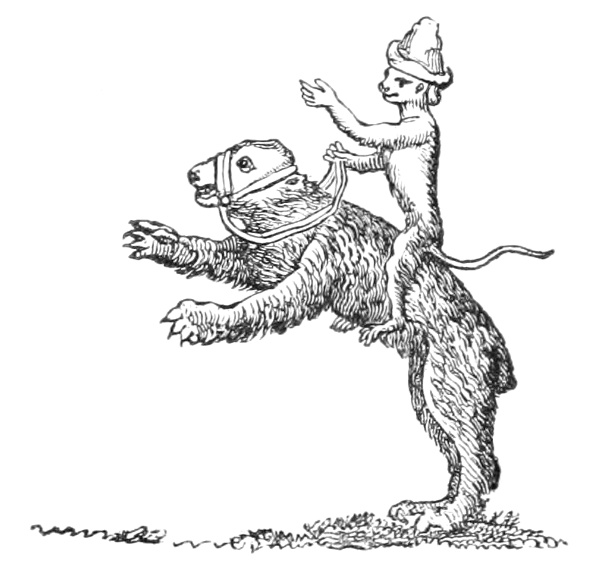
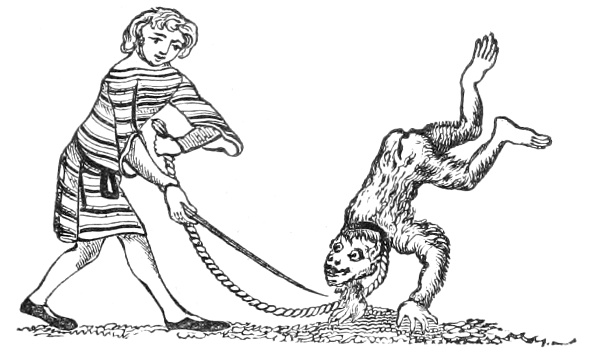
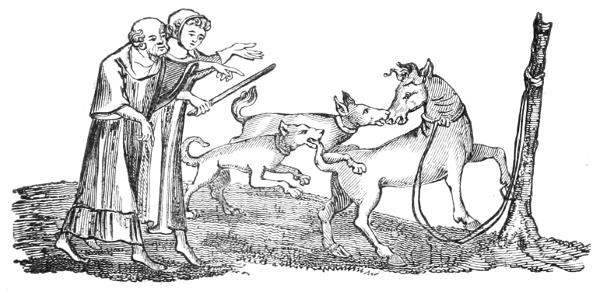
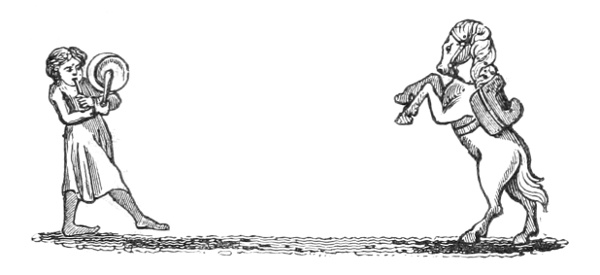
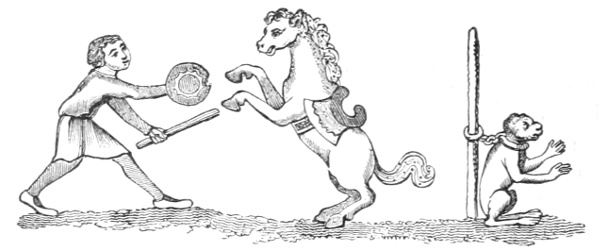
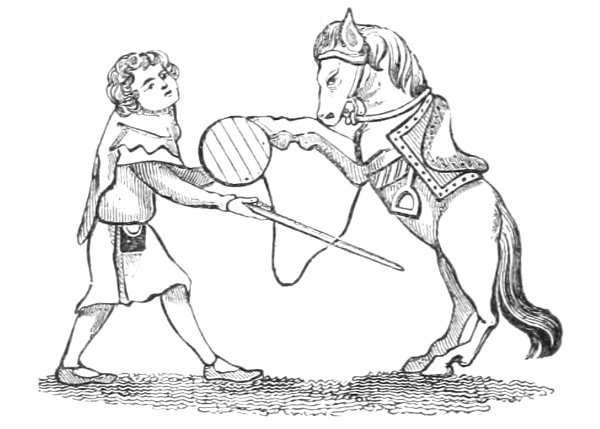
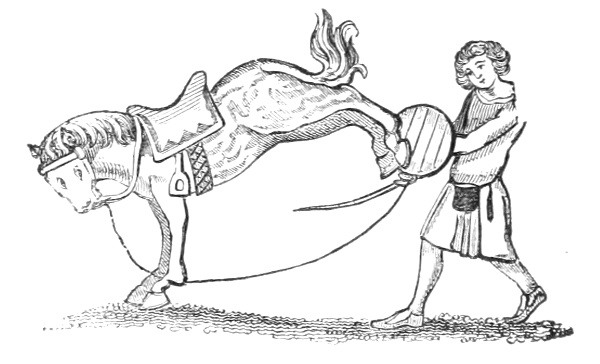
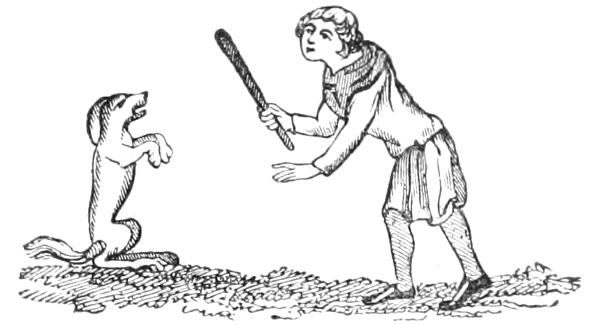
They also take great delight in seeing men and animals perform
such feats as appear to be entirely contrary to their nature;
as, men and monkeys dancing upon ropes, or walking upon
wires; dogs dancing minuets, pigs arranging letters so as to
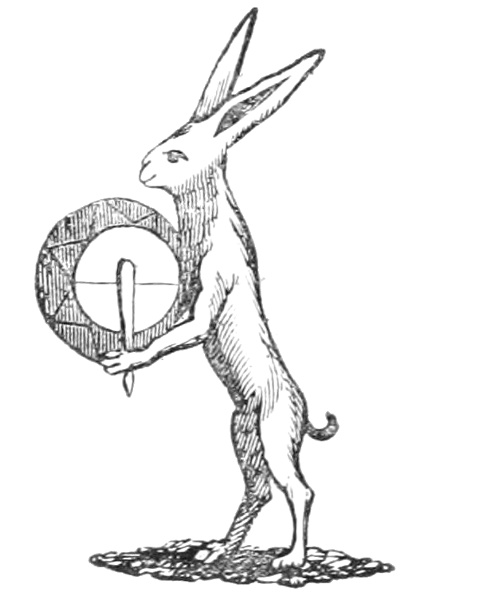
form words at their master's command; hares beating drums, or
birds firing off cannons. These exhibitions, for all of them
have in reality been brought to public view, are ridiculed by
the Spectator, in a paper dated the 3d of April, 1711. The
author pretends that he received the following letter from a
sho-man who resided near Charing-Cross:
"Honoured Sir,—Having heard that this nation is a great
encourager of ingenuity, I have brought with me a rope-dancer
that was caught in one of the woods belonging to the great
Mogul, he is by birth a monkey, but swings upon a rope,
takes a pipe of tobacco, and drinks a glass of ale, like any
reasonable creature.
[74]
He gives great satisfaction to the quality;
and if they will make a subscription for him, I will send for
a brother of his out of Holland, that is a very good tumbler;
and also for another of the same family whom I design for my
merry-andrew, as being an excellent mimic, and the greatest
droll in the country where he now is. I hope to have this entertainment
in readiness for the next winter; and doubt not but
it will please more than the opera or the puppet-show. I will
not say that a monkey is a better man than some of the opera
heroes; but certainly he is a better representative of a man
than any artificial composition of wood and wire."
The latter part of this sarcasm relates to a feigned dispute
for seniority between Powel, a puppet-showman, who exhibited
his wooden heroes under the little piazza in Covent-garden, and
the managers of the Italian opera; which is mentioned in a preceding
paper
[75]
to this effect: "The opera at the Haymarket,
and that under the little piazza of Covent-garden, are at present
the two leading diversions of the town; Powel professing in
his advertisements to set up Whittington and his Cat against
Rinaldo and Armida."—After some observations, which are not
immediately to the present purpose, the author proceeds: "I
observe that Powel and the undertakers of the opera had both
of them the same thought, and I think much about the same
time, of introducing animals on their several stages. though
indeed with different success. The sparrows and chaffinches
at the Haymarket fly as yet very irregularly over the stage,
and instead of perching on the trees, and performing their
parts, these young actors either get into the galleries, or put
out the candles; whereas Powel has so well disciplined his
pig, that in the first scene he and Punch dance a minuet together.
I am informed that Powel resolves to excel his adversaries in
their own way, and introduce larks into his opera of Susanna,
or Innocence betrayed; which will be exhibited next week
with a pair of new elders."
From the same source of information, in a subsequent paper,
[76]
we may find a catalogue of the most popular spectacles exhibited
in London at the commencement of the last century.
Our author has introduced a projector, who produces a scheme
for an opera entitled The Expedition of Alexander the Great;
and proposes to bring in "all the remarkable shows about the
town among the scenes and decorations of his piece;" which is
described in the following manner: "This Expedition of Alexander
opens with his consulting the Oracle at Delphos; in which
the Dumb Conjurer, who has been visited by so many persons
of quality of late years, is to be introduced as telling his fortune;
at the same time Clench of Barnet
[77]
is represented in
another corner of the temple, as ringing the bells of Delphos
for joy of his arrival. The Tent of Darius is to be peopled
by the ingenious Mrs. Salmon, where Alexander is to fall in love
with a piece of waxwork that represents the beautiful Statira.
When Alexander comes to that country in which, Quintus
Curtius tells us, the dogs were so exceedingly fierce, that
they would not loose their hold, though they were cut to pieces
limb by limb, and that they would hang upon their prey by
their teeth when they had nothing but a mouth left, there is to be
a scene of Hockley in the Hole, in which are to be represented
all the diversions of that place, the Bull-Baiting only excepted,
which cannot possibly be exhibited in the theatre by reason of
the lowness of the roof. The several Woods in Asia, which
Alexander must be supposed to pass through, will give the
audience a sight of Monkies dancing upon ropes, with many
other pleasantries of that ludicrous species. At the same time,
if there chance to be any strange animals in town, whether
birds or beasts, they may be either let loose among the woods,
or driven across the stage by some of the country people of Asia.
In the last Great Battle, Pinkethman is to personate king Porus
upon an Elephant, and is to be encountered by Powel, representing
Alexander the Great upon a Dromedary, which, nevertheless,
he is desired to call by the name of Bucephalus. On
the close of this great Decisive Battle, when the two Kings
are thoroughly reconciled, to show the mutual friendship and
good correspondence that reigns between them, they both of them
go together to a puppet-show, in which the ingenious Mr.
Powel junior may have an opportunity of displaying his whole
art of machinery for the diversion of the two monarchs." It is
further added, that, "after the reconciliation of these two kings,
they might invite one another to dinner, and either of them entertain
his guest with the German artist, Mr. Pinkethman's
Heathen Gods, or any of the like Diversions which shall then
chance to be in vogue."
The projector acknowledged the thought was not originally
his own, but that he had taken the hint from "several Performances
he had seen upon our stage; in one of which there
was a Raree Show, in another a Ladder-Dance, and in others a
posture or a moving picture with many curiosities of the like
nature."
[78]
The people of this country in all ages delighted in secular
music, songs, and theatrical performances;
[79]
which is abundantly
evident from the great rewards they gave to the bards, the
scalds, the gleemen, and the minstrels, who were successively
the favourites of the opulent, and the idols of the vulgar. The
continual encouragement given to these professors of music,
poetry, and pantomime, in process of time swelled their numbers
beyond all reasonable proportion, inflamed their pride, increased
their avarice, and corrupted their manners; so that at
length they lost the favour they had so long enjoyed among the
higher classes of society; and, the donations of the populace
not being sufficient for their support, they fell away from affluence
to poverty, and wandered about the country in a contemptible
condition, dependent upon the casual rewards they
might occasionally pick up at church-ales, wakes, and fairs.
[80]
Hentzner, who wrote at the conclusion of the sixteenth century,
says, "the English excel in dancing and music, for they
are active and lively." A little further on he adds, "they are
vastly fond of great noises that fill the ear, such as the firing of
cannon, beating of drums, and the ringing of bells; so that it is
common for a number of them that have got a glass in their hands
to get up into some belfry and ring the bells for hours together for
the sake of exercise."
[81]
Polydore Vergil mentions another remarkable
singularity belonging to the English, who celebrated
the festival of Christmas with plays, masques, and magnificent
spectacles, together with games at dice and dancing, which,
he tells us, was as ancient as the year 1170, and not customary
with other nations;
[82]
and with respect to the Christmas
prince, or lord of the misrule, he was, as the same author informs
us, a personage almost peculiar to this country.
[83]
It were well if these singularities were the only vulnerable
parts of the national character of our ancestors; but it must
be confessed that there are other pastimes which equally attracted
their attention, and manifested a great degree of barbarism,
which will admit of no just defence. Sir Richard Steele,
reprobating the inhumanity of throwing at cocks, makes these
pertinent observations: "Some French writers have represented
this diversion of the common people much to our disadvantage,
and imputed it to a natural fierceness and cruelty of temper, as
they do some other entertainments peculiar to our nation; I
mean those elegant diversions of bull-baiting, and prize-fighting,
with the like ingenious recreations of the bear-garden. I wish
I knew how to answer this reproach which is cast upon us,
and excuse the death of so many innocent cocks, bulls, dogs,
and bears, as have been set together by the ears, or died an
untimely death, only to make us sport."
[84]
The ladies of the present day will probably be surprised to
hear, that all, or the greater part of these barbarous recreations,
were much frequented by the fair sex, and countenanced by
those among them of the highest rank and most finished education,
being brought by degrees, no doubt, to sacrifice their
feelings to the prevalency of a vicious and vulgar fashion, which
even the sanction of royalty, joined with that of ancient custom,
cannot reconcile with decency or propriety.
I know not of any objection that can have more weight in the
condemnation of these national barbarisms, than the time usually
appropriated for the exhibition of them; which, it seems, was
the after part of the Sabbath-day. The same portion of time
also was allotted for the performance of plays, called, in the
writing's of the sixteenth and seventeenth centuries, "vaine playes
and interludes;"
[85]
to which are added, "dice and card-playing,
dancing, and other idle pastimes." Stephen Gosson, a very
zealous, if not a very correct writer, declaiming vehemently
against plays and players, says of the latter, "because they are
permitted to play every Sunday, they make four or five Sundayes
at leaste every weeke."
[86]
Nor is he less severe upon those who
frequented such amusements: "To celebrate the Sabbath," says
he, "they go to the theatres, and there keepe a general market
of bawdrie; by which means," as he afterwards expresses himself,
"they make the theatre a place of assignation, and meet
for worse purposes than merely seeing the play."
[87]
A contemporary
writer, endeavouring to prove the impropriety of an
established form of prayer for the church service, among other
arguments, uses the following: "He," meaning the ministers
"posteth it over as fast as he can galloppe; for, eyther he hath
two places to serve; or else there are some games to be playde
in the afternoon, as lying for the whetstone, heathenishe dauncing
for the ring, a beare or a bull to be baited, or else a jackanapes
to ride on horsebacke, or an interlude to be plaide; and, if no
place else can be gotten, this interlude must be playde in the
church. We speak not of ringing after matins is done."
[88]
To
what has been said, I shall add the following verses, which
made their appearance rather earlier than either of the foregoing
publications; and they describe, with much accuracy I doubt
not, the manner of spending the Sunday afternoons according
to the usage of that time: but it is proper previously to observe,
that such amusements on holidays were by no means peculiar
to the young gallants of this country, but equally practised
upon the continent.
Now, when their dinner once is done, and that they well have fed,
To play they go; to casting of the stone, to runne, or shoote;
To tosse the light and windy ball aloft with hand or foote;
Some others trie their skill in gonnes; some wrastell all the day;
And some to schooles of fence do goe, to gaze upon the play;
Another sort there is, that doe not love abroad to roame,
But, for to passe their time at cardes, or tables, still at home.
[89]
Citations to this purpose might be made from infinity of
pamphlets, written professedly against the profanation of the
Sabbath: it was certainly an evil that called loudly for redress;
and the pens of various writers, moral and religious, as well of
the clergy as the laity, have been employed for that purpose.
There are some few treatises on this subject that do honour to
their authors; but far the larger part of them are of a different
description, consisting of vehement and abusive declamations
wherein the zeal of the writers is too frequently permitted to
run at random, without the least restraint from reason and moderation,
and, what is still worse, without that strict adherence
to the truth which the seriousness of the subject necessarily required.
It must be granted, however, that the continued remonstrances
from the grave and religious parts of the community
were not without effect. In the twenty-second year of the reign
of Elizabeth, the magistrates of the city of London obtained
from the queen an edict, "that all heathenish playes and interludes
should be banished upon Sabbath days;"
[90]
but this restriction,
I apprehend, was confined to the jurisdiction of the
lord mayor; for, it is certain that such amusements were publicly
exhibited in other districts, and especially at the Paris
Garden in Southwark, a place where these sort of sports were
usually exhibited; and where three years afterwards a prodigious
concourse of people being assembled together on a Sunday
afternoon, to "see plays and a bear-baiting, the whole theatre
gave way and fell to the ground; by which accident many of
the spectators were killed, and more hurt."
[91]
This lamentable
misfortune was considered as a judgment from God, and
occasioned a general prohibition of all public pastimes on
the Sabbath-day. The wise successor of Elizabeth, on the other
hand, thought that the restrictions on the public sports were
too generally and too strictly applied, and especially in the
country places; he therefore published on the 24th of May,
1618, the following declaration: "Whereas we did justly, in
our progresse through Lancashire, rebuke some puritanes and
precise people, in prohibiting and unlawfully punishing of our
good people for using their lawfull recreations and honest exercises
on Sundayes and other holy dayes, after the afternoone
sermon or service: It is our will, that after the end of divine
service, our good people be not disturbed, letted, or discouraged,
from any lawful recreation, such as dauncing, either for men
or women; archery for men, leaping, vaulting, or any other
such harmless recreation; nor for having of May-games, Whitson-ales,
and morris-daunces, and the setting up of May-poles,
and other sports therewith used; so as the same be had in due
and convenient time, without impediment or neglect of divine
service. But withall, we doe here account still as prohibitted,
all unlawfull games to be used upon Sundayes onely, as beare
and bull-baitings, interludes, and, at all times in the meaner sort
of people by law prohibited, bowling." This proclamation was
renewed by Charles I. in the eighth year of his reign; which
occasioned many serious complaints from the puritanical party;
but, three years afterwards, a pamphlet was published which
defended the principles of the declaration;
[92]
wherein the author,
who was a high church-man, endeavours to fine away the objections
of its opponents. In one part
[93]
he says, "those recreations
are the meetest to be used, which give the best refreshment
to the bodie, and leave the least impression in the minde. In
this respect, shooting, leaping, pitching the barre, stool-ball,
and the like, are rather to be chosen than diceing or carding."
This publication was immediately answered by the other party,
who certainly had the best end of the argument, and were not
sparing in their severity, but wounded the ordinance itself
through the sides of its defender. The more precise writers
objected not only to the profanation of the Sabbath, but to
the celebration of most of the established festivals and holidays,
as we find from the following verses:
Their feastes, and all their holydayes they keep throughout the yeare,
Are full of vile idolatry, and heathen like appeare.
I shew not here their daunces yet with filthy gestures mad,
Nor other wanton sports that on the holydayes are had.
In some place solemne sights and showes, and pageants faire are play'd
With sundry sorts of maskers brave, in straunge attire arrai'd.
[94]
But nothing seems to have excited their indignation more than
the church-ales, wakes, and May-games. An author I have before
me inveighs greatly against the erecting and decorating
of the May-poles;
[95]
among others, he uses the following arguments:
"Most of these May-poles are stollen; yet they give
out that the poles are given to them; when, upon thorow examination,
'twill be found that most of them are stollen. There
were two May-poles set up in my parish; the one was stollen,
and the other was given by a profest papist. That which was
stollen was said to be given; when it was proved to their faces
that it was stollen, and they made to acknowledge their offence:
this pole was rated at five shillings. If all the poles, one with
another, were so rated which were stollen this May, what a considerable
summ it would amount to!" So much for his reasoning.
He then attempts to be witty; and arraigns the goddess
Flora at the bar: "Flora, hold up thy hand; thou art here
indited by the name of Flora, of the city of Rome, in the county
of Babylon, for that thou, contrary to the peace of our sovereign
lord, his crown and dignity, hast brought in a pack of practical
fanaticks; viz. ignorants, atheists, papists, drunkards,
swearers, swash-bucklers, maid-marrions, morrice-dancers,
maskers, mummers, May-pole stealers, health-drinkers, gamesters,
lewd men, light women, contemners of magistrates, affronters
of ministers, rebellious to masters, disobedient to parents,
mispenders of time, and abusers of the creature, &c." This
silly invective is concluded with a poem as dull and insipid as
the prose; in which the May-pole is supposed to be addressing
itself to one who is passing by it. The last lines run thus:
Now, traveller, learn more grace to shew
And see that thou thy betters know:
Thou hear'st what I say for myself,
I am no ape, I am no elf;
I am no base one's parasite;
I am the great world's favourite;
And, sith thou must now past me fro,
Let this my blessing with thee go:
There's not a knave in all the town,
Nor swearing courtier, nor base clown,
Nor dancing lob, nor mincing quean,
Nor popish clerk, be't priest or dean,
Nor knight debausht, nor gentleman
That follows drabs, or cup or cann,
That will give thee a friendly look
If thou a May-pole can'st not brook.
These zealous reformists have extended their censures to the
church-men as well as to the laity; they accuse them with strengthening,
by their example, the general depravation of manners
and decay of religion: how far the charge was just, I cannot take
upon me to answer. It is obvious enough that ignorant persons
will not be induced to prize those qualifications very highly,
which they who have the reputation of wisdom and learning
neglect to appreciate as they ought to do.
The Saxons and the Danes, as we have observed already,
[96]
were
much addicted to gaming; and the same destructive propensity
was equally prevalent among the Normans. The evil consequences
arising from the indulgence of this pernicious pleasure
have in all ages called loudly for reprehension, and demanded
at last the more powerful interference of the legislature. The
vice of gambling, however, is by no means peculiar to the
people of this country: its influence is universally diffused
among mankind; and in most nations the same strong measures
that have been adopted here are found to be absolutely necessary
to prevent its extension beyond the limits of subordination.
Dice, and those games of chance dependent upon them, have
been most generally decried; and cards, in latter times, are
added to them as proper companions. Cards, when compared
with dice, are indeed of modern invention, and originally, I
doubt not, were productive only of innocent amusement; they
were, however, soon converted into instruments of gambling
equally dangerous as the dice themselves, and more enticing
from the variety of changements they admit of, and the pleasing
mixture of chance with skill, which often gives the tyro an
advantage over the more experienced player; that is, supposing
fair play on both sides; but woeful experience has convinced
many that this is not always the case.
Towards the close of the twelfth century, we meet with a
very curious edict relative to gaming, and which shows how generally
it even prevailed among the lower classes of the people
at that period. This edict was established for the regulation
of the Christian army under the command of Richard I. of
England, and Philip of France, during the crusade in 1190:
It prohibits any person in the army beneath the degree of a
knight from playing at any sort of game for money: knights
and clergymen might play for money, but no one of them was
permitted to lose more than twenty shillings in one whole day
and night, under the penalty of one hundred shillings, to be
paid to the archbishops in the army; the two monarchs had
the privilege of playing for what they pleased; but their attendants
were restricted to the sum of twenty shillings; and, if
they exceeded, they were to be whipped naked through the
army for three days.
[97]
The decrees established by the council held at Worcester, in
the twenty-fourth year of Henry III. prohibited the clergy
from playing at dice, or at chess:
[98]
but neither the one nor the
other of these games are mentioned in the succeeding penal
statutes, before the twelfth year of Richard II., when diceing
is particularised, and expressly forbidden; though perhaps
they were both of them included under the general title of
games of chance, and dishonest games, mentioned in the proclamation
of Edward III. which, with other pastimes therein
specified, were generally practised to the great detriment of
military exercises, and of archery in particular.
In the eleventh year of Henry VII. cards are first mentioned
among the games prohibited by the law;
[99]
and at that time they
seem to have been very generally used; for, the edict expressly
forbids the practice of card-playing to apprentices, excepting
the duration of the Christmas holidays, and then only in their
masters' houses.
[100]
We learn from Stow, that these holidays extended
"from All-Hallows evening to the day after Candlemas-day,
when," says the historian, "there was, among other sports,
playing at cards for counters, nailes, and points in every house,
more for pastime than for gain."
[101]
The recreations prohibited
by proclamation in the reign of Edward III., exclusive of the
games of chance, are thus specified; throwing of stones,
[102]
wood, or iron; playing at hand-ball, foot-ball, club-ball, and
cambucam, which I take to have been a species of goff, and
probably received its name from the crooked bat with which it
was played. These games, as before observed, were not forbidden
from any particular evil tendency in themselves, but because
they engrossed too much of the leisure and attention of
the populace, and diverted their minds from the pursuits of a
more martial nature. I should not forget to add, that "bull-baiting
and cock-fighting" are included with "other dishonest
games as trivial and useless." In
[103]
the reign of Edward IV. we
find coits, closh or claish, kayles or nine-pins, half-bowl, hand-in
and hand-out, with quick-borde, classed among the unlawful
amusements;
[104]
which list was considerably augmented in the
succeeding reigns, and especially in the eighteenth year of
Henry VIII., when bowling, loggating, playing at tennice,
dice, cards and tables, or backgammon, were included.
[105]
In the preamble to the Parliamentary Statutes as early as the
sixth year of Edward III., there is a clause prohibiting of boys
or others from playing at barres, or snatch-hood,
[106]
or any other
improper games, in the king's palace at Westminster during
the sitting of the parliament; neither might they, by striking,
or otherwise, prevent any one from passing peaceably about his
business.
In modern times, the penal laws have been multiplied, and
much invigorated, in order to restrain the spirit of gambling;
and in some measure they have had a salutary effect; but the
evil is so fascinating and so general, that in all probability it
will never be totally eradicated from the minds of the people.
The frequent repetition and enforcement of the statutes in
former times, proves that they were then, as they are now, inadequate
to the suppression of gaming for a long continuance;
and, when one pastime was prohibited, another was presently
invented to supply its place. I remember, about twenty years
back,
[107]
the magistrates caused all the skittle-frames in or about
the city of London to be taken up, and prohibited the playing
at dutch-pins, nine-pins, or in long bowling allies, when in
many places the game of nine-holes was revived as a substitute,
with the new name of Bubble the Justice, because the populace
had taken it into their heads to imagine, that the power of the
magistrates extended only to the prevention of such pastimes as
were specified by name in the public acts, and not to any new
species of diversion.
The general decay of those manly and spirited exercises,
which formerly were practised in the vicinity of the metropolis
has not arisen from any want of inclination in the people, but
from the want of places proper for the purpose: such as in
times past had been allotted to them are now covered with
buildings, or shut up by enclosures, so that, if it were not for
skittles, dutch-pins, four-corners, and the like pastimes, they
would have no amusements for the exercise of the body; and
these amusements are only to be met with in places belonging
to common drinking-houses, for which reason their play is seldom
productive of much benefit, but more frequently becomes
the prelude to drunkenness and debauchery. This evil has
been increasing for a long series of years; and honest Stow
laments the retrenchments of the grounds appropriated for
martial pastimes which had begun to take place in his day.
"Why," says he, "should I speak of the ancient exercises of
the long bow, by the citizens of this city, now almost clean
left off and forsaken? I overpass it; for, by the means of
closeing in of common grounds, our archers, for want of room
to shoot abroad, creep into bowling-alleys and ordinarie diceing-houses
neer home, where they have room enough to hazard
their money at unlawful games."
[108]
He also tells us, that "Northumberland
house, in the parish of St. Katherine Coleman,
belonging to Henry Percy, Earl of Northumberland, in the
thirty-third year of Henry the Sixth; but of late, being deserted
by that noble family, the gardens were converted into
bowling-alleys, and the other parts of the estate into diceing
houses. But bowling-alleys and houses for the exercise of
diceing and other unlawful games are at this time so greatly
increased in the other parts of the city and its suburbs, that
this parent spot," or, as he afterwards calls it, "the ancient
and only patron of misrule, is forsaken of its gamesters."
[109]
And
here we may add the following remark from an author somewhat
more ancient than Stow:
[110]
"common bowling-alleyes are
privy mothes that eat up the credit of many idle citizens, whose
gaynes at home are not able to weigh downe theyr losses
abroad; whose shoppes are so farre from maintaining their play,
that theyr wives and children cry out for bread, and go to bedde
supperlesse ofte in the yeere." In another place, his reflections
are more general, and he exclaims, "Oh, what a wonderful
change is this! our wreastling at armes is turned to wallowing
in ladies' laps, our courage to cowardice, our running to royot,
our bowes into bowls, and our darts into dishes."
The evils complained of by these writers were then in their
infancy; they have in the present day attained to a gigantic
stature; and we may add to them E. O. tables, as also other
tables for gambling distinguished by the appellation of Rouge
et Noir, Pharo-banks, and many more fashionable novelties,
equally as detrimental to morality, and as equally destructive
to the fortunes of those who pursue them, as any of the recreations
of the former times. Even horse-racing, which anciently
was considered as a liberal sport, and proper for the amusement
of a gentleman, has been of late years degraded into a dangerous
species of gambling, by no means the less deserving of censure,
because it is fashionable and countenanced by persons of the
highest rank and fortune. The good old Scotch poet little dreamed
of such an innovation, when he lamented that horse-racing was
falling into disrepute through the prevalency of games of chance.
His words are these:
Halking, hunting, and swift horse running
Are changit all in wrangus, wynning;
There is no play but cartes and dyce, &c.
[111]
It now remains to say a few words in a general way respecting
the diversions of the English ladies. In the early ages, our fair
countrywomen employed a large portion of their time in needle-work
and embroidery; and their acquirements in these elegant
accomplishments most probably afforded them little leisure for
the pursuits of trifling and useless amusements; but, though
we are not acquainted with the nature of their recreations, there
is no reason to suppose that they were unbecoming in themselves,
or indulged beyond the bounds of reason or decorum. I have
already, on a former occasion, particularly noticed the skilfulness
of the Saxon and Norman ladies in handling the needle,
embroidering, and working in tapestry; and that their performances
were not only held in very high estimation at home, but
were equally prized upon the continent, where none were produced
that could be placed in competition with them.
[112]
Dancing was certainly an ancient and favourite pastime with
the women of this country: the maidens even in a state of servitude
claimed, as it were by established privilege, the license
to indulge themselves in this exercise on holidays and public
festivals; when it was usually performed in the presence of their
masters and mistresses.
[113]
In the middle ages, dice, chess, and afterwards tables, and
cards, with other sedentary games of chance and skill, were
reckoned among the female amusements; and the ladies also
frequently joined with the men in such pastimes, as we find it
expressly declared in the metrical romance of Ipomydon. The
passage alluded to runs thus:
When they had dyned, as I you saye,
Lordes and ladyes yede to playe;
Some to tables, and some to chesse,
With other gamys more or lesse.
[114]
In another poem, by Gower,
[115]
a lover asks his mistress, when
she is tired of "dancing and caroling," if she was willing to
"play at chesse, or on the dyes to cast a chaunce." Forrest,
speaking in praise of Catharine of Arragon, first wife of
Henry VIII., says, that when she was young,
With stoole and with needyl she was not to seeke,
And other practiseings for ladyes meete;
To pastyme at tables, tick tacke or gleeke,
Cardis and dyce—&c.
[116]
The English ladies did not always confine themselves to
domestic pastimes, they sometimes participated with the other
sex in diversions of a more masculine nature; and engaged
with them in the sports of the field. These violent exercises
seem to have been rather unfashionable among them in the
seventeenth century; for Burton, in his Anatomy of Melancholy,
speaks of their pastimes as much better suited to the modesty
and softness of the sex. "The women," says he, "instead of
laborious studies, have curious needle-works, cutworks, spinning,
bone-lace making, with other pretty devices to adorn
houses, cushions, carpets, stool-seats," &c.
[117]
Not but some of
these masculine females have occasionally made their appearance:
and at the commencement of the last century, it should
seem that they were more commonly seen than in Burton's time,
which gave occasion for the following satirical paper in one of
the Spectators,
[118]
written by Addison: "I have," says he, "very
frequently the opportunity of seeing a rural Andromache, who
came up to town last winter, and is one of the greatest fox-hunters
in the country; she talks of hounds and horses, and
makes nothing of leaping over a six-bar gate. If a man tells
her a waggish story, she gives him a push with her hand in
jest, and calls him an impudent dog; and, if her servant neglects
his business, threatens to kick him out of the house. I
have heard her in her wrath call a substantial tradesman a lousie
cur; and I remember one day when she could not think of the
name of a person, she described him, in a large company of
men and ladies, by the fellow with the broad shoulders."
Having laid before my readers a general view of the sports
and pastimes of our ancestors, I shall proceed to arrange them
under their proper heads, and allot to each of them a separate
elucidation. The task in truth is extremely difficult; and many
omissions, as well as many errors, must of necessity occur in
the prosecution of it; but none, I hope, of any great magnitude,
nor more than candour will overlook, especially when it is recollected,
that in a variety of instances, I have been constrained to
proceed without any guide, and explore, as it were, the recesses
of a trackless wilderness. I must also entreat the reader to excuse
the frequent quotations which he will meet with, which in
general I have given verbatim; and this I have done for his
satisfaction, as well as my own, judging it much fairer to stand
upon the authority of others than to arrogate to myself the
least degree of penetration to which I have no claim.
It is necessary to add, that the engravings, which constitute an
essential part of this work, are not the produce of modern invention,
neither do they contain a single figure that has not its
proper authority. Most of the originals are exceedingly ancient,
and all the copies are faithfully made without the least unnecessary
deviation. As specimens of the art of design they have
nothing to recommend them to the modern eye, but as portraitures
of the manners and usages of our ancestors, in times
remote, they are exceedingly valuable, because they not only
elucidate many obsolete customs, but lead to the explanation of
several obscurities in the history of former ages.
January, 1801.