.—Any horse appropriated to every kind
of purpose, (and upon which no great estimation or
value is placed,) it has been the custom for time
immemorial to distinguish by the appellation of
HACK. Custom, however, has permitted a slight
deviation from a practice of long standing, and
A HACK is now generally understood to imply the
idea of a hired horse; that is, a horse the property
of a HACKNEY-MAN,
JOB or
POSTMASTER, who lets
out horses by the day, week, or month, and who is
obliged to take out an annual licence for permission
so to do, paying FIVE SHILLINGS
for the same: doing
which without A LICENCE,
renders him liable to a
penalty of TEN POUNDS.
Hack horses, whether for riding or drawing,
used in travelling post, are individually liable to a
duty of one penny halfpenny per mile, for as many
miles as such horse shall be engaged to travel
within a day, or any less time; but where the distance
cannot then be ascertained, one shilling and
ninepence shall be paid for each horse so hired.
This duty is demanded by the person letting the
horse or horses to hire, who, upon receiving such
payment, shall deliver to the person so hiring, one
or more STAMP-OFFICE TICKETS, under a penalty of
TEN POUNDS.
,—in the general acceptation of the
word with the SPORTING WORLD, is a horse superior
to all others upon the score of
UTILITY; being
rendered subservient to every office of exertion,
speed, and perseverance, or, in other words, to all
the drudgery and labour of his situation, from which
his cotemporaries, the RACER,
the HUNTER, and the
CHARGER, by the imaginary superiority of their
qualifications, and pampered appearance, are always
exempt. It is the peculiar province of the
HACKNEY to carry his master
twelve or fifteen miles in
an hour to covert, (where the HUNTER
is in waiting,)
and sometimes to bring back the GROOM with still
greater expedition, whose engagements may probably
have occasioned him to be much more in
haste than his MASTER. It is in the department of
the HACKNEY to encounter and overcome emergencies
and difficulties of every description: his constitution
should be excellent, and his spirit invincible;
he must be enabled to go five-and-twenty or
thirty miles at a stage, without drawing bit, and
without the least respect to the depth of the roads,
or the dreary state of the weather; and if he is not
equal to any weight, in these trifling exertions, he
will be held in no estimation as a HACKNEY of
FASHION.
{361}
.—Those so called are the
proprietors of COACHES,
CHAISES, and
HORSES, for
the accommodation of the public, and of whom
may be obtained vehicles of such description for
any length of time required. They are subject to
a LICENCE ANNUALLY,
and various duties upon the
different carriages, all which are clearly explained
in concise abstracts (called "TAX TABLES") from
the Acts of Parliament upon this particular subject.
,—with which the frame of the horse is so
completely covered, and more familiarly termed
COAT, is, in general, indicative of the good or ill
state of the horse; not only in respect to health,
but to his CONDITION, for whatever work he may
be designed. If the subject is sleek in his coat,
with a glossy shining surface, soft and pliable in the
skin; not tight upon the ribs, as if firmly adhering
to the side; no enlargements upon the lower joints
of the legs, nor any profuse and faint perspiration
upon moderate work, the BLOOD may be pronounced
in a HEALTHY STATE, and the horse in
fair and GOOD CONDITION.
If, on the contrary, the coat is rough, hollow,
staring different ways, of a variegated hue, with a
tinge of dust or scaly scurf beneath the surface, the
perspirative matter has been thrown upon the circulation
by a collapsion of the porous system, the
blood is become sizey, and disposed to morbidity,
in proportion to the preternatural weight by which
it is overloaded, and the obstructions it has to encounter
in its passage through the finer vessels, occasioned
by the languor of the circulation.
It is no uncommon thing for HORSES in tolerable
GOOD CONDITION to go
all to pieces, particularly in
the autumn months, without the least cause to be
assigned, the least reason to be suggested, by either
MASTER or
GROOM. Certain it is, that to two successive
acts of indiscretion, (or error in judgment,)
this very prevalent defeat may be attributed, without
the least fear of being at all wrong in the conclusion.
Grooms and
COACHMEN, in general, totally
unmindful of the great heat of their stables
during the night, throw open the doors immediately
upon coming in the morning, (regardless of even
frost or snow,) and frequently so continue during
the whole ceremony of "mucking out" and carrying
away the dung, if not with the addition of
stripping and dressing the horses into the bargain.
That the measure of indiscretion may be complete,
the ceremony not unfrequently terminates in
a three or four gallon pail of hard cold water from
the PUMP in the
yard or mews; immediately after
which, a judicious observer will perceive
- "Each particular hair to stand on end,
- "Like quills upon the fretful porcupine."
{363}
This prevailing practice has frequently laid the
foundation of various ills, not one of which were
ever attributed to the right cause. Such an accumulation
of chilling frigidity immediately succeeding
the extreme heat of the night, has often produced
diseases without end, at least those which
ended only with life. Colds,
COUGHS,
FEVER,
(original or symptomatic,)
INFLAMMATION of the
LUNGS,
BAD EYES,
BROKEN WIND,
SWELLED LEGS,
CRACKED HEELS,
DROPSY in the chest, with a long
list of et ceteras, or even death itself, may be occasioned
by circumstances which in themselves appear
so trifling, yet they sometimes prove of considerable
magnitude, and would attract the necessary
attention of any humane man looking after
his own horses; but in the present age of duplicity
and deception, are very little likely to affect the
sensibility or integrity of those looking after the
horses of others.
Where a loss of hair has been sustained by some
injury, as in broken knees, wounds after being
healed, blistering or firing, the growth may be promoted
(particularly in slight cases) by reducing
three drachms of CAMPHIRE
to fine powder, then
letting it be well incorporated with two ounces of
SPERMA CÆTI OINTMENT upon a marble slab, and a
small portion of it well rubbed into the part affected
at least once, but it will be better if persevered in
twice a day.
{364}
—is that well-known convenience by
which a horse is fastened to the MANGER when confined
in a STABLE. Halters are of two kinds; the
one prepared of twisted hemp, the other made of
LEATHER, having head-stall, throat-straps and
buckles, nose-band, &c. and are called double-reined
hunting-collars. These are the safest in every
respect, and, although the most expensive at first,
are proportionally durable, and consequently
cheapest in the course of time. Hempen halters
are sometimes injurious, in forming swellings, or
lacerations, upon the upper part of the head, behind
the ears, by the friction of the hard-twisted
hemp upon a part naturally tender and easily
susceptible. They are, however, now but very
little used, except in the stables of inferior inns,
and of indigent rustics.
.—This is an accident to
which horses are constantly liable, and it very frequently
happens; but, in general, from the inadvertency
of leaving the rein of the halter of too
great a length on either one side or the other: for
when the horse is lying down, and has occasion
(from itching, or some other cause) to rub his
neck or head with the hind foot, it is no uncommon
thing to have it get entangled in the halter-rein;
which encircling the cavity of the heel, renders it
impossible for the animal to extricate himself, unless
the halter breaks in his favor; and during these
struggles, the heel is sometimes so terribly excoriated,
as to become not only a WOUND of much
trouble, anxiety, and loss of labour, but often leaves
a very vexatious blemish, never to be removed.
It is, therefore, a truly necessary part of stable
circumspection, to have an occasional eye to a
circumstance in itself so seemingly insignificant,
when it is recollected, that its omission may be productive
of much mortification.
—may be considered a limping, or
slight impediment to FREE and
EASY ACTION, implying
some kind of perceptible defect or disquietude,
not amounting to absolute LAMENESS. Whenever
this irregularity in motion is first observed, and that
the legs do not move in corresponding uniformity,
or, in other words, as if they were not fellows, an
accurate examination should be immediately made
to ascertain the CAUSE,
that it may be speedily relieved;
upon a very fair presumption, that what
might produce only a limping or halting in the first
instance, might probably become a confirmed
LAMENESS by a perseverance in use,
without adverting
to the proper means of alleviation upon the
original discovery of something amiss.
,—is the joint in
the center of the hind leg behind; and although so
wonderfully united for STRENGTH and
ACTION, is
nevertheless the seat of serious injuries, as BLOOD
and BONE SPAVINS,
CURBS, &c. the major part of
which originate much more in improper treatment,
by short turns, sudden jerks, or twists, upon the
road, or in the stable, than by any accidents or fair
mode of usage whatever.
;—the name of A HORSE
whose performances have ranked him in an equal
degree of retrospective celebrity with Eclipse,
Highflyer, Diomed, and the most famous runners
of the past or present day. He was bred by Mr. Hutchinson,
of Skipton, near York, and foaled
in 1792; was got by King Fergus; dam by Highflyer;
grand-dam by Matchem.—1795. May 5,
when three years old, he won a stakes of fifteen
guineas each, over Hambleton, (five subscribers,)
beating Sober Robin, Tarquin, and another. At
York, May 20th, he won a sweepstakes of twenty
guineas each, four subscribers. He was then purchased,
with all his engagements, by Sir C. Turner,
Bart. in whose possession he won, on the
27th of August, at York, a sweepstakes of 100
guineas each, (six subscribers,) beating Benjamin,
Minus, and Maximus. Two days after he won a
sweepstakes of fifty guineas each, four subscribers.
At Doncaster, the 22d of September, he won the
St. Leger stakes of twenty-five guineas each, twelve
subscribers. The next day he won the GOLD CUP
of 100 guineas value, four miles, beating Governor,
Capsicum, and Bradamant.
{367}
1796. At the York August meeting he won a
subscription purse of 227l. 10s. beating Spread
Eagle, Sober Robin, and another. The next day
he won the ladies' plate, beating Lord Darlington's
St. George. At this period of his uninterrupted
success, he was purchased by Sir Henry Tempest Vane, Bart.
and at Doncaster, September 28,
won the GOLD CUP of 100 guineas value, beating
Sober Robin, Ambrosio, and three others. In the
Newmarket Houghton meeting, November 2, he
beat Mr. Tatton's Patriot (who was got by Rockingham)
over the Beacon Course for 1000 guineas.
1797. Monday in the Newmarket Craven meeting,
he won the Craven stakes of ten guineas each,
beating Sober Robin, Bennington, Paynator, Hermione,
Parisot, Cymbeline, and five others. The
same day he received 250 guineas forfeit from
Spread Eagle. On Thursday, in the same week,
he beat Lord Clermont's Aimator, Beacon Course,
300 guineas. At York, August 23, he won one
third of the great subscription of 25 guineas each,
(25 subscribers,) to which was added a 50l. plate
given by the city. The next day he won another
third of the same subscription, with an additional
50l. plate by the City, beating Beningbrough, Trimbush,
and Brilliant. At Doncaster, the 27th of
September, he won the stakes of ten guineas each,
(ten subscribers,) with twenty guineas added by the
Corporation; and on the 29th received 100 guineas
forfeit from Mr. Sitwell's Moorcock.
In 1798 he was slightly lame, and never started.
1799. Monday, in the Craven meeting at
Newmarket, he beat Mr. Cookson's famous horse
Diamond, over the Beacon, for 3000 guineas, with
the odds of five to four in his favour, on account
of his superiority in size and strength; it being jocularly
observed by the rider of Diamond at starting,
that it seemed "a little like a race between
a mare and her colt." This match was the greatest
in popularity ever known from one extremity of
the kingdom to the other, and was decided before
one of the fullest meetings ever seen at Newmarket.
It was won by no more than three parts of a length,
to effect which the winner had felt the utmost force
of the spur; and, it was generally believed, if they
had then one hundred yards farther to have ran,
Diamond would have been the winner; in proof of
the justice of which opinion, Mr. Cookson challenged
a repetition of the match, which was declined.
At Doncaster the same year, he won the renewed
stakes of ten guineas each, (fourteen subscribers,
with twenty guineas added by the Corporation,)
beating eight of the best horses in the north of
England. In 1800 he won the great subscription
at York, with 50l. given by the City, which was
the last time he started. He once ran out of the
Course, soon after starting, when running three
miles over York, 1797, for a sweepstakes of 100
guineas each against Deserter and Spread Eagle;
and paid one forfeit to Sterling (from being amiss
in 1792) at Newmarket; but NEVER WAS BEAT.
He is now a stallion in high repute near Leeds, in
Yorkshire, at TEN GUINEAS, and half a guinea the
groom.
—is the term for a mode of measurement
by which the height of A HORSE is ascertained.
A HAND (so called originally from its breadth) is
four inches; three hands is consequently one foot;
and A HORSE OF FIFTEEN HANDS
is exactly five feet
high; and so above or below in proportion; as
thirteen hands three inches; fourteen hands and a
half; or fifteen hands three inches and a quarter;
as the measure may be. This, at the entrance of
horses for GIVE and
take plates, is regulated to a
most scrupulous nicety by means of a standard,
so curiously constructed, as to ascertain the exact
height to the eighth of an inch, where horses are
MATCHED to carry
WEIGHT for inches.
Bridle-hand: the left hand is so termed, in
contra-distinction to the right, which is called the
WHIP-HAND; and the most experienced jockies in
racing, always take the whip-hand, if possible; it
being considered a point in their favour; that is,
because they have not only an advantage in the
turns of the course, but their adversaries circumscribe
a larger circle of many lengths in a FOUR MILES
race, exclusive of their having an unrestrained
use of THE WHIP, should it come to a
severe push at the run in.
There are many sporting phrases in which the
word HAND becomes particularly emphatic. To
say a horse is LIGHT in
HAND, implies his being
playful, lively, champing his bit, firm upon his
haunches, and not dwelling upon the ground with
his fore feet. A horse is HEAVY in
HAND, when,
bearing his weight upon the bit, and lifting his fore
legs with reluctance, he goes boring on, with no
other sensation to the rider, than an eternal fear of
his pitching upon his head. A vicious horse,
breaking away with his rider, seems a dreadful
sight to a spectator, but can never be attended with
misfortune, if the rider is a good HORSEMAN, and
has him "well in hand," which is, in fact, the
power of "gathering him together," or stopping
his career at pleasure.
Although the left is technically termed the
BRIDLE-HAND,
yet a good horseman, or experienced
sportsman, will use either right or left with the most
perfect ease and dexterity; to effect which with the
greater freedom, young horsemen should constantly
practise an exchange of the reins from one hand to
the other in their daily excursions. The hand
should be delicately alive to every motion of the
horse; for it is the judicious management of one,
that is to constitute entirely the good or bad mouth
of the other. A horse is supposed to gallop awkwardly
(if not unnaturally) when he strikes into
that pace with his left leg foremost; to prevent
which, bear the rein to the left, with the bridle-hand,
and the horse invariably sets off with the
right leg.
Hand-gallop is that easy kind of pacing
adapted to the aged and infirm, who wish to
obtain every possible degree of motion, most consonant
to bodily ease; it is the degree of equestrian
action synonimous with, and more universally
known by, the denomination of CANTER;
which is, in fact, the slowest, or most contracted gallop, and
can only be enjoyed by those who possess horses of
good temper, and well broke for the purpose.
A COLT said to be "taken in hand," implies his
being brought from his wild state of nature, to be
handled, quieted, led about, and stabled, previous
to his being broke in for the SADDLE or
HARNESS.
A horse's FORE-HAND includes
the fore quarters,
from the withers upwards to the tip of the ears;
the principal beauty and attraction of which depend
entirely upon the length and curvilinear form of
the neck, which increases or diminishes his marketable
value, in proportion as it is well or ill
formed.
—is a sporting term, applicable to
either MATCH,
PLATE, or
SWEEPSTAKES, in the following
way:
A, B, and C, put an equal sum into a hat. C,
who is the handicapper, makes a match for A and
B, who, when they have perused it, put their hands
into their pockets, and draw them out closed;
then they open them together, and if both have
money in their hands, the match is confirmed; if
neither have money, it is no match: in either of
these cases, the handicapper C draws all the money
out of the hat: but if one has money in his hand,
and the other none, it is then no
MATCH; and he
that has the money in his hand, is entitled to the
whole deposit in the hat.
A HANDICAP PLATE
is the gift of an individual,
or raised by SUBSCRIPTION,
for which horses are
generally declared the day before running, at a
certain hour, by written information privately delivered
to the Clerk of the Course,
whose province
it is to make out the list, and hand it to the
Steward of the Race;
when the weight each
horse must carry is irrevocably fixed, (by whoever
the steward may appoint), and appears in the printed
lists of the following morning. Horses thus entered,
and declining the weight appointed for them
to carry, are of course permitted to be withdrawn,
without any forfeit or loss.
—is sometimes used to express the
HANDING of a COCK during his battle in the pit. It
is, however, considered merely provincial, and peculiar
only to some particular parts of the country;
the hander of the cocks being now more generally
known by the denomination of a SETTER-TO.—See
Cockpit Royal.
,—a term applied by COCKERS to
the judicious handling of a COCK,
when brought up
from his walk, to ascertain whether he is in proper
condition to be placed in the PENS,
and prepared
to fight in either the MAIN BATTLES,
or the byes.
This is done by a particular mode of taking the
girt of the body by grasp, to discover the shape and
substance, the bone, the probable strength, as well
as the firmness or flaccidity of the flesh; upon the
aggregate of which so much depends, that in proportion
to these qualifications, he is ACCEPTED or
rejected accordingly.
—is a sporting term, applicable
solely to DEER, and used only in
STAG HUNTING;
when going to covert, and drawing for an out-lying
deer; upon finding, it is customary to say, We
UNHARBOUR a stag, (or hind.)
As with HARRIERS,
We find or start a HARE;
or with fox hounds,
We unkennel a FOX.
.—This small, harmless, inoffensive animal
affords a greater diversity of sport in the field,
and a greater degree of luxurious entertainment
upon the table, than any species of GAME in this,
or, probably, in any other country. The form,
shape, and make of the HARE is too universally
known to require description; but the most curious
naturalists describe, and affect to believe, there are
four kinds of hares in different parts of the kingdom.
The fact is not so; the species is strictly
the same; but they are known to differ in size,
speed, substance, and somewhat in colour, according
to the soil, climate, fertility, or sterility, of
the country where they are bred.
Hares in hilly and mountainous countries are
smaller, but more fleet than any other; those who
are the natives of low, wet, marshy ground, or
moors, are larger, but less firm and delicious in
flesh, as well as less nimble in action. Hares bred
in open countries, diversified with woods, parks,
and arable lands, are in size between both, and
afford the best coursing before
GREYHOUNDS, as
well as the longest chases before
HOUNDS. Every
part of the hare is admirably formed for the promotion
of speed; which, in conjunction with other
natural advantages, greatly enables her to evade
the pursuits and stratagems of her numerous enemies.
The sense of SMELLING,
as well as of HEARING,
the hare possesses in a more exquisite degree than
any other animal; the latter of which may be justly
attributed to the great length, and singular formation,
of the ears, so well adapted to receive the
slightest vibration of sound, which even the earth
is so well known to convey. Its sense of smelling
is so incredibly nice, that the hare can wind an
enemy (either man or beast) at a considerable distance,
particularly in the stillness of the night; this
is evidently occasioned by the elastic formation of
the nostrils, and the depth of the division between
both, from whence has arisen the appellation of a
hare-lip, with which defect some of the human
species are afflicted, in consequence of fright to the
mother during the early months of pregnancy. The
ears seem to be the regulators of almost every
action; for during the chase one is always erect,
the other horizontal; unless in suddenly coming
upon an unexpected object, when they are for a
moment both erect; but, upon turning and renewing
her speed, they invariably resume their former
position.
{376}
The EYES of the
HARE, from the peculiar prominence
of their formation, enable her to distinguish
objects in almost every direction, without altering
the position of either her head or her body; and it
is remarkable, that their sight in a straight forward
line seems less perfect than in any other. The natural
timidity of the hare is excessive; she exists in
perpetual fear, and is tremblingly alive to every
breeze that can possibly produce alarm. Formed
entirely for RUNNING,
she either possesses no power,
or makes no attempt to walk, but in her slowest
motion proceeds by JUMPS.
The food of the hare
varies with the season, and consists chiefly of young
clover, green wheat, short sweet grass in parks or
upon lawns; and in the winter, parsley, turnip
greens, and other succulent plants. During severe
frosts, or deep snow, they make no small havock
amongst young fruit-trees and fragrant shrubs, by
nibbling the bark, thereby retarding their growth,
if not (as is frequently the case) promoting their
destruction. It is asserted by Mr. Daniel, in his
publication called "Rural Sports," that the
plantations of a GENTLEMAN
in the county of Suffolk,
had suffered so much in this way, that, in
defence of his improvements, he felt himself under
the necessity of destroying his HARES,
when no less
than five hundred and forty brace fell victims on the
occasion.
{377}
The almost perpetual and incredible destruction
of HARES, by
HUNTING,
COURSING,
SHOOTING, and
the nocturnal net and wire of the poacher, (as well
as the infinite increase to supply that destruction,)
having occasioned suggestions, that they possess the
property of SUPERFŒTATION,
it becomes immediately
applicable to introduce a remark or two under
that head. We are told by Mr. Daniel, that "Sir
Thomas Brown, in his Treatise on Vulgar Errors,
asserts this circumstance from his own observation:
and Buffon describes it as one of this animal's peculiar
properties, introducing an idea of hermaphrodite
hares; as well as that the males sometimes
bring forth young; that they are alternately
MALES
and FEMALES,
occasionally performing the functions
of either sex." Nothing can be more contemptible
and ridiculous than such conjectures; they are the
very essence of mental fertility; and it must suffice
to admit, that Sir Thomas Brown and
Buffon
were not inquisitive sportsmen, or not scientifically
acquainted with the parts necessary to generation.
For want of information so very easily to be obtained,
some one of these speculative writers promulgated
an erroneous assertion, every day liable
to the most palpable confutation; "that in the
formation of the genital parts of the
MALE HARE,
the testicles do not appear on the outside of the
body, but are contained in the same cover with the
intestines." It should seem these authors write more
to SURPRIZE than to
INSTRUCT, or that they knew
little of the subject they wrote upon; as nineteen
sportsmen out of every twenty, who have handled
hares in the field, or taken them up before the
hounds, can demonstrate the contrary; as the testicles,
when the hare is full grown, are not only
prominently perceptible externally, but of considerable
size for so small an animal.
The natural fecundity of HARES almost exceeds
belief; they continue to breed for nine months out
of the twelve; and leverets (young hares) are frequently
found and chopped by the hounds in January,
when the winter has been mild. The doe
hare goes a month after conception, and at her first
produce seldom brings forth more than two, afterwards
three, and sometimes four. Whenever the
number exceeds two, it is a received (and generally
believed just) opinion, that each of the young has
a white star in the forehead, which, however, is
gradually obliterated as they approach maturity.
The dam is supposed to suckle them about one-and-twenty
days; but takes care to separate them before
that time, and deposits them individually in such
forms as she has previously prepared for their reception,
at a considerable distance from each other;
but so situate, that she can afford maternal protection
to the whole. Their prolific powers, and
perpetual increase, will create no surprise, when
we are respectably informed, that a brace of hares,
(the doe pregnant when shut up) were inclosed in a
large walled garden, and proper aliment supplied
for their sustenance; when at the expiration of
TWELVE MONTHS the garden was searched,
and the produce was fifty-seven hares, including the original
brace turned down: this fact alone demonstrating
the certainty, that the females begin to breed when,
or before, they are six months old.
The length of a hare's natural life is limited to
six or seven years, and they reach their full growth
in eight or nine months. The male is by much the
smallest, seldom exceeding in weight five or six
pounds; but the females, particularly in some very
rich and fertile counties, weigh from seven to
eight: some few instances have been known of
their weighing nine pounds, after being paunched.
The hare is supposed to be in gentle motion all
night during the summer months, and a great part
of it in the dreary nights of winter; during the
length of which their works are of such immense
perplexity, (in heads, doubles, and circles,) that
little expectation is entertained of finding a hare by
the trail, unless the field is taken early in the
morning, soon after she is gone to seat; which is
seldom, if ever, before the dawn of day; and in
the summer months, very frequently not till long
after day-light.
{380}
The HARE till full grown is called
A LEVERET,
and at any age is very difficult to be found sitting;
so nearly does the downy fleak (when close contracted)
approach the colour of the ground. In
this position the old and experienced SPORTSMAN
will declare the gender of the hare before it is
started. The head of the male is short and round,
the whiskers longer, the slit in the nose wider, the
shoulders more ruddy, and the ears shorter and
broader, than those of the female; the head of
which is long and narrow; the ears long, and sharp
at the tip; the fur of the back of a dingey hue,
inclining to black, and of superior size to the male.
When a hare is observed in its FORM, it may be
easily ascertained, by the ears only, whether it is a
BUCK or DOE;
and this is a useful kind of knowledge,
particularly at the latter part of the season,
when no man, but a hardened poacher, or pot-hunting
sportsman, would turn out a female hare
before either HOUND or
GREYHOUND, where there
is a chance of destroying a leash, or two brace, by
the wanton destruction of one.
If the hare found sitting is A BUCK,
the ears will
be seen drawn close in a parallel line with each
other, directly over the shoulders, pointing straight
down the back; but if A DOE,
the ears are distended
on each side of the neck, having a space between
them in the centre. In the chase, a Jack hare, (as
the male is sportingly termed,) after the first ring or
two, particularly in the spring months, flies his
country, goes straight forwards, and affords a good
run, but generally falls a victim to his own fortitude
at its termination. The female hangs closer
to her native spot, depending more upon her
instinctive efforts, in heading, doubling, soiling,
and squatting, than speed for her preservation.
Hares bred upon the downs, or in hilly countries,
are always the stoutest, and best enabled to
escape from GREYHOUNDS; of which they are so
conscious, that they always make for the nearest
rising ground, so soon as started. When so severely
distrest that they plainly perceive there is
no other means of escape, they will take to a brick
or wooden drain for security, or even run to earth,
if one should luckily present itself in the emergency.
They are thought to foresee a CHANGE in
the WEATHER,
and to regulate their sitting accordingly.
After harvest they are found in stubbles,
banks of hedges, woods, and thickets; during the
fall of the leaf, they seat themselves more in open
fields; and when the severity of winter begins to
decline, warm, dry, hilly fallows are hardly ever
without them. As one species of GAME, they are
held in high estimation; and, notwithstanding the
utmost efforts, by every degree of interdiction,
with all the pains and penalties that successive parliaments
could devise, from Richard the Second
to the present day, for their preservation, and appropriation
to the use of the superior classes, yet
no laws ever proved more fallacious or deceptive;
for the infinity of POACHERS, with which every
rural district abounds, and the alacrity with which
STAGE COACHMEN and
COUNTRY HIGLERS supply
their friends, will never let any inquirer be in want
of A HARE,
who has his five shillings in hand as a
means of retribution. This
INSUFFICIENCY of the
LAW to check nocturnal depredation,
and progressive
infamy, is most sincerely to be regretted; but
experience has long held forth ample conviction,
that regret cannot produce redress.
—is a well-known sport, of
very ancient and enthusiastic enjoyment, reported,
by the most celebrated ANTIQUARIES, to have been
established more than two thousand years before the
Christian æra. Various opinions have been occasionally
promulgated, and perseveringly supported,
(by cynical rigidity, and religious severity,)
upon the "cruelty of the chase;" which, however,
is now never likely to be shaken in either theory or
practice, as to almost every
PACK OF HOUNDS in the
kingdom there are clerical devotees, who are by
no means unworthy MEMBERS of the
CHURCH.
Hare-hunting, though universal in every part
of England, Ireland, Scotland, and Wales, is in
the highest estimation in those open and champaign
counties where, from want of covert, a STAG or
FOX is never seen. Here the hares are stouter,
more accustomed to long nightly exercise, more
frequently disturbed, more inured to severe courses
before GREYHOUNDS, and hard runs before hounds;
consequently, calculated to afford much better
sport than can be expected in either an inclosed or
woodland country. There are three distinct kinds
of hounds, with which this particular chase is pursued,
according to the soil and natural face of the
district where it is enjoyed. The large slow
SOUTHERN HOUND is adapted to the low swampy,
marshy lands, so conspicuous in many parts of
Lancashire; as well as those in Norfolk, and various
others bordering upon the sea. The small,
busy, indefatigable BEAGLE seems appropriated by
nature to those steep, hilly and mountainous parts,
where it is impossible for the best horse and boldest
rider to keep constantly with the hounds. The
hounds now called HARRIERS, and originally produced
by a cross between the SOUTHERN HOUND
and the DWARF FOX, are the only hounds to succeed
in those open countries, where, for want of covert,
the hare goes five or six miles an end without a turn;
as is frequently the case in many parts of Oxfordshire,
Northamptonshire, Wiltshire, Hampshire,
and other counties; constituting chases very superior
to many FOX HOUNDS, hunting beechen coverts and
woodland districts.
{384}
Hare-hunting, when put in competition with
the pursuit of STAG or
fox, is much more gratifying
to the ruminative and reflecting mind, than either
of the other two; as it affords a more ample field
for minute observation upon the instinctive sagacity
of the GAME,
and the patient, persevering fortitude
of the HOUND,
in the various heads, turns, and
doubles, of the chase. Hence it is that hare-hunting
is principally followed, and most enjoyed, by
sportsmen in the decline of life; but with the
younger branches it is held in very slender estimation,
as they in general appreciate the excellence of
sport more by the difficulty in pursuing it, than by
its duration. Hare-hunting, in a woody or inclosed
country, is such a perpetual routine of repetition
within a small sphere, affording no more than a
continual succession of the same thing, that with a
zealous rider, and a high-mettled horse, it soon
palls upon the appetite of both. Young men, from
emulative motives, (naturally appertaining to their
time of life,) feel a pressing propensity to encounter
obstacles, and surmount difficulties, where the
effect of vigour and manly courage can be displayed,
and consequently prefer the kind of chase
where personal fortitude, and bodily exertion,
are brought more to the proof; and where, by covering
a larger scope of country, and with a much
greater proportional rapidity, a more pleasing and
extensive variety is obtained.
{385}
Another cause of mortification constantly presents
itself to young sportsmen with HARRIERS, or
BEAGLES, in the field: a valuable horse,
or a bold rider, are equally unnecessary in
HARE-HUNTING,
and this is eternally brought to an incontrovertible
proof; for after a burst of five minutes, in which a
perfect hunter has an opportunity of displaying his
speed, and, after clearing some dangerous leaps, a
sudden turn or double of the
HARE, brings him by the
side of a rustic upon a poney of five pounds value,
who is nine times out of ten as forward as himself.
The infinite time lost in finding, where hares are not
in great plenty; the frequency of faults; the persecuting
tediousness of cold hunting; and the injury
done to HORSES in drizzling dreary days,
during hours of slow action, are great drawbacks to the
pleasure this species of hunting would otherwise
afford.
Moderate sportsmen will never avail themselves
of immoderate means to occasion a contraction
of their own sport, by a wanton or unnecessary
destruction of hares; too great a body of
hounds should never be brought into the field, or
any unfair modes adopted during the chase: pricking
a hare in the paths, or upon the highways, as
well as placing emissaries upon the soil, are paltry,
mean, and disgraceful artifices, that no genuine,
well-bred, HONEST SPORTSMAN,
will ever permit;
but candidly acknowledge, if the HOUNDS cannot
kill her, she ought to ESCAPE.
In respect to numbers,
less than TWELVE,
or more than EIGHTEEN
couple ought never to be brought from the kennel
to the chase; nor, indeed, seldom are, unless with
those who think much less of SPORT,
than of personal pride and ostentation.
Mr. Beckford, who is a perfect master of this
subject, has so completely investigated, and minutely
explained, every particular appertaining to
the chase of both HARE and
FOX, that as it is absolutely
impossible to suggest an idea, or communicate
a thought, but what must carry with it the appearance
of plagiarism; it will be more candid,
(evidently more honest) to introduce occasional
passages in his own words, as language more expressive,
by which they will be infinitely better understood.
He says, "By inclination he was never
a hare-hunter; but followed the diversion more for
air and exercise than amusement; and if he could
have persuaded himself to ride on the turnpike
road to the three mile stone, and back again, he
never should have thought himself in need of a
pack of harriers."
He then apologizes to "his brother HARE-HUNTERS
for holding the sport so cheap, not wishing
to offend; alluding more relatively to his own
particular situation in a country where hare-hunting
is so bad, that it is more extraordinary he should
have persevered in it so long, than he should have
forsaken it then." Adding, "how much he respects
hunting in whatever shape it appears; that it is a
manly and a wholesome exercise, and seems by nature
designed to be the amusement of a Briton."
He is of opinion that more than twenty couple of
hounds should never be brought into the field;
supposing it difficult for a greater number to run
well together; and a pack of harriers can never be
complete who do not. He thinks the fewer hounds
you have, the less you soil the ground, which sometimes
proves a hindrance to the chase.
Custom has greatly varied in the practice of
HARE-HUNTING
during the last thirty years: at that
time the hounds left the kennel at day-light, took
trail upon being thrown off, and soon went up to
their GAME;
which having the pleasure to find by
their own instinctive sagacity, they pursued with
the more determined alacrity: a brace or leash of
hares were then killed, and the sport of the day
concluded, by the hour it is now the fashion for the
company to take the field. As the trail of a hare
lays both partially and imperfectly when it gets late
in the day, so the difficulty of finding is increased,
in proportion to the lateness of the hour at which
the hounds are thrown off; hence it is that
HARE-FINDERS,
so little known at that time, are now become
so truly instrumental to the sport of the day.
{388}
Although their services are welcome to the eager
and expectant sportsman, yet it is on all hands admitted,
they are prejudicial to the discipline of
hounds; for having such assistance, they become
habitually idle, and individually wild: expecting
the game to be readily found for them, they become
totally indifferent to the task of finding it
themselves. Hounds of this description know the
hare-finder as well as they know the HUNTSMAN,
and will not only, upon sight, set off to meet him,
but have eternally their heads thrown up in the air,
in expectation of a view HOLLOA!
With all well-managed packs, they are quietly
brought up to the place of meeting; and when
thrown off, a general silence should prevail, that
every hound may be permitted to do his own work.
Hounds well bred, and well broke to their business,
seldom want assistance. Officious intrusions frequently
do more harm than good: nothing requires
greater judgment, or nicer observation in speaking
to a hound, than to know the critical time when a
word is wanting. Young men, like young hounds,
are frequently accustomed to babble when newly entered,
and, by their frivolous questions or conversation,
attract the attention of the hounds, and insure
the silent curse of the HUNTSMAN,
as well as the contemptuous indifference of every experienced
sportsman in the field.
{389}
Whenever a hare is turned out of her form, or
jumps up before the hounds, a general shout of
clamorous exultation too frequently prevails, by
which the hare's intentional course is perverted,
and she is often headed, or turned into the body of
the HOUNDS to a certain death;
when, on the contrary,
was she permitted to go off with less alarm,
and to break view, without being so closely pressed
at starting, there is no doubt but much better runs
would be more generally obtained. Individual
emulation, or individual obstinacy, invariably occasions
horsemen in hare-hunting to be too near
the hounds, who, being naturally urged by the
rattling of the horses, and the exulting zeal of the
riders, often very much over-run the scent, and
have no alternative but to turn and divide amidst
the legs of the horses, so soon as they have lost it;
and to this circumstance may be justly attributed
many of the long and tedious faults which so frequently
occur, and render this kind of chase the
less attracting.
Gentlemen who keep HARRIERS vary much in
their modes of hunting them; but the true sportsman
never deviates from the strict impartiality of
the chase. If a hare is found sitting, and the hounds
too near at hand, they are immediately drawn off,
to prevent her being chopped in her form: the hare
is then silently walked up by the individual who
previously found her, and she is permitted to go
off at her own pace, and her own way. The hounds
are then drawn over the spot from whence she
started, where taking the scent, they go off in a
style of uniformity, constituting what may be fairly
termed the consistency of the chase. Others there
are who never can, or never will, resist the temptation
of giving the hounds a view, and never fail to
tell you, both HARE and
HOUNDS run the better
for it. In addition to this humane method of beginning
the chase, every advantage is taken of the
poor affrighted animal's distress, amidst all its little
instinctive efforts for the preservation of life. The
hounds, instead of being permitted to run the soil,
and kill the hare by dint of their own persevering
labour, are constantly capped from chase to view;
and the object of the sport most wantonly and uncharitably
destroyed; for nothing less than a miracle
can effect its escape.
Those of nicer sensations enjoy the sport, but
enjoy it much more mercifully; and would rather
see their own hounds occasionally beaten, than, by
any unfair or unsportsman-like introduction, kill
their hare. These never permit a profusion of vociferous
assistance from the huntsman, who is enjoined
to an almost silent execution of his own
duty, that the hounds may not be prevented (by
his noise) from a strict and attentive performance of
theirs. If they throw up, upon a dry or greasy
fallow, a footpath, a highway, or a turnpike-road,
a thousand busy bustling endeavours are to be self-made
for a recovery of the scent, before any one
effort is permitted to assist in lifting them along;
and even then, not till every patient and persevering
struggle has failed of success. The sportsman
of this description admits of no device, stratagem,
or foul play whatever; the
HOUNDS must hunt
the hare; they must go over every inch of ground
she has gone before them; they must hit off their
own checks, recover their faults; and, by cold
hunting, pick it along, where, in passing through a
flock of sheep, the ground has been foiled, and
the chase proportionally retarded. Early and extensive
casts are unjust, unless upon some unexpected
or unavoidable emergency; as the repeated
interventions of sheep, or intersections of roads, or
fallows in a dry season; when it would be impossible
to make the least progress in getting the hounds
along without assistance.
When hounds come to a check, not a horse
should move, not a voice should be heard: every
hound is eagerly employed, exerting all his powers
for a recovery of the scent, in which, if not officiously
obstructed, they will most probably soon
succeed. At such times there is generally, and unluckily,
some popinjay in the field, who, unfortunately
for himself, never speaks but upon the most
improper occasion; rendering, at such moment,
the judicious observation of Mr. Beckford truly
neat and applicable, that "when in the field, he
never desires to hear any other tongue than a
HOUND." Whenever assistance to hounds
is become unavoidably necessary, and the chase cannot
be carried on without, sound judgment, and long
experience, are necessary to speedy success. Casts
cannot be made by any fixed, certain, or invariable
rules, but must, at different times, be differently
dependent upon the chase, the soil, the weather,
and the kind of country you are hunting in. It
may, in one instance, be prudent to try forward
first; in another, to try back; as it may be judicious,
or necessary, to make a small circular cast
at one time, and a much larger at another; and although
to one of the field, circumstances may appear,
in either instance, to have been nearly the
same, yet they have not been so in the "mind's
eye" of the HUNTSMAN,
(or the person hunting the
hounds,) upon whose superior knowledge, or circumspection,
the good or ill effect of the experiment
must depend.
None, but weak or inexperienced sportsmen,
ever presume to obtrude their opinions when hounds
are at fault; those who do it, soon find the interference
is ill-timed, and that it only excites a contemptuous
indifference. Strangers cannot be too
cautious and circumspect in the field, if they wish
to avoid just reproofs, and not to encounter rebuffs:
some there are, whose hard fate it is to become
conspicuously ridiculous upon every occasion
that can occur, and to such, unfortunately for them,
occasions are seldom wanting. During the chase,
they are riding into, over, or before, the
HOUNDS;
and at every check, asking some vexatious, trifling
question of the HUNTSMAN;
or entering into a frivolous
conversation with what seems to them the
most vulnerable subject of the company. Officious
individuals of this description, whose error too frequently
originates in a certain degree of personal
pride, and unbounded confidence, should learn to
know, that "the post of honour is a private
station;" as well as that an old pollard in a painting,
might be admirably calculated to form a respectable
object in the back-ground, but never intended
by the artist to become a principal figure in
the front of the picture.
—are of two sorts, one of which
will be found described under the head "Gate-nets;"
the other are called PURSE-NETS, and are
exactly in the form of cabbage-nets, but of larger
and stronger construction. These occasionally afford
collateral aid to the former; for being fixed at
the different meuses (either in hedges, or to paling)
where HARES are expected to pass, and the ground
being scoured by a mute lurcher, as there described,
the destruction is certain. These nets are the nocturnal
engines of old and experienced POACHERS,
doing more mischief where hares are plenty, in one
night, than the wire manufacturers can accomplish
in a week.
—is a sporting exclamation,
well known in the practice of the field, and
affords to every distant hearer, authentic information,
that the hounds are a-head, and going on with
the chase. It sometimes happens, that, in very
large and thick coverts, no man or horse existing
can be in with the hounds; at which times (particularly
in stormy weather) recourse must be had to
every means for general accommodation. The
best sportsmen are often thrown out for miles, and
not unfrequently for the day, by various turns of
the CHASE in
COVERT, and then breaking up the
wind on a contrary side, leaving every listening expectant
in an awkward predicament, if not relieved
by the friendly communication of "HOIC FORWARD!"
from one to another, enabling the whole
to continue the sport.
—were instruments so curiously
constructed, to imitate the whining whimper of
A HARE,
that, being formerly found a very destructive
nocturnal engine in attracting the attention of
hares, and bringing them within the certain possession
of the POACHER,
their use was prohibited (by
particular specification) in every Act of Parliament
for the preservation of game, from the reign
of Richard the Second, to the present time; although
it is natural to conclude, there is not now
such an article to be seen, or found in the kingdom.
—are the species of hound appropriated
solely to the pursuit of the HARE, and from
thence derived their present appellation. The
breeding experiments so long made, and the various
crosses so repeatedly tried, by the best judges
in the kingdom, seem at length to have centered
between the old southern and the dwarf fox hound.
Mr. Beckford, whose "Thoughts" no sensible
man, or judicious sportsman, will presume to dispute,
was entirely of this opinion, and proved it
by his practice; for he says, "his hounds were a
cross of both these kinds, in which it was his endeavour
to get as much bone and strength, in as
small a compass as possible. It was a difficult undertaking.
He bred many years, and an infinity of
hounds, before he could get what he wanted, and
had at last the pleasure to see them very handsome;
small, yet very bony: they ran remarkably well
together; ran fast enough; had all the alacrity that
could be desired, and would hunt the coldest scent.
When they were thus perfect, he did as many
others do—he parted with them."
Notwithstanding the criterion of excellence thus
laid down, the same sort of hound (as a harrier)
is by no means applicable to every soil: the
southern hound will be always in possession of
THE SWAMPS,
as will the beagles of the mountainous
and hilly countries. Those who delight in seeing
hounds bred and drafted to a certain degree of uniformity,
in size, bone, strength, and speed, strictly
corresponding with the opinion of Mr. Beckford,
will not find it time lost, to take the field with the
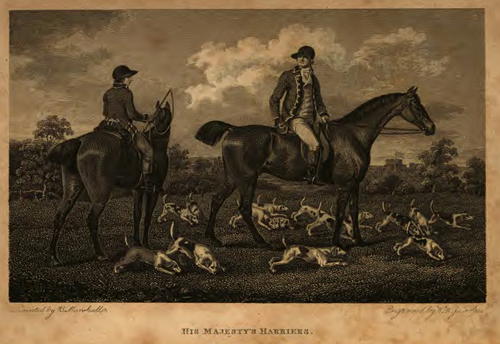
harriers of his Majesty, kept at Windsor: they
are, as they ought to be, the best pack, and the
best hunted, this day in the kingdom. See the
Frontispiece; where every MAN,
HORSE, and
HOUND, is individually a portrait.
—is the sporting term synonimous with
Stag, (which SEE,)
and was, in all forest laws and
records, constantly in use to signify the same. At
present, however, it is considered almost obsolete,
and never so expressed in sporting report, or conversation.
.—A stag hunted by KING or
QUEEN,
obtaining his perfect liberty by beating the
hounds, was formerly called a hart royal; and proclamation
was immediately made, in the towns and
villages of the neighbourhood where he was lost,
that he should not be molested, or his life attempted
by any farther pursuit; but that he should continue
in a state of unrestrained freedom, with power to
return to the FOREST or
CHACE from whence he was
taken at his OWN FREE WILL.
This ceremony is,
however, discontinued, and bids fair to be buried
in a perpetual oblivion; as two instances have recently
occurred worthy recital: one in the neighbourhood
of High Wycombe, where the
STAG was
killed before the hounds, by a rustic, during the
heat of the chase, in which the King at the time
was personally engaged. And another at Mapledurham,
near Reading, where the deer was wantonly
shot, as he lay in a willow bank near the
Thames, two days after he had beaten the hounds;
yet it is publicly known, that no steps were taken
to prosecute the offenders, which probably originated
in his Majesty's clemency.
—of a horse, have been
hitherto (but not with strict propriety) used in a
similar sense: nice observers might say one begins
where the other ends, or that one immediately
succeeds the other. The haunch is that part of the
hind quarter extending from the point of the hip-bone,
down the thigh to the hock; but as it is
a part well known, and but little subject to partial
disease or accident, it lays claim to no particular
description. The term of "putting a horse upon
his haunches," implies the making him constantly
fix the principal weight of the frame upon his hind
quarters, by which practice he bears less upon the
bit, and becomes habitually light in hand. Horses
hard in mouth, and heavy in hand, frequently undergo
the ceremony of being put upon their
haunches in the trammels of a RIDING SCHOOL,
where, by too severe and inconsiderate exertions,
sudden twists, distortions, and strains, are sustained
in the HOCKS, which terminate in
CURBS and
SPAVINS
never to be obliterated.
—implies the hind
quarter of a FALLOW DEER, (either buck or doe,)
cut in a particular form for the table. The hind
quarter of a STAG, or
HIND, also passes under the
same denomination; but it is more applicable to
form a distinction, and call the former a haunch of
venison; the latter, a haunch of red deer.
.—The haw is that cartilaginous part of a
horse's eye, plainly perceptible at the inner corner
next the forehead, which internally constitutes a
circular groove for the easier acceleration of the eye
in its orbit. When confined within its natural and
proper sphere, it is but just in sight, when taking a
front view of the horse; but when it has acquired a
preternatural degree of enlargement, it protrudes
over part of the orb, partially obstructs the sight,
particularly in that direction, and constitutes no
small disfiguration of the horse. Ingenuity heretofore
suggested the possibility of extirpation with the
knife, which operation has been frequently performed,
but with too little success to justify a continuance
of the practice. It having been found,
that when the haw was taken away by a regular process,
and by the hand of the most expert OPERATOR,
yet the eye, for want of its former support, was
observed to become contracted in the socket, and
a total deprivation of sight to follow, evidently demonstrating
"the REMEDY worse than the
DISEASE;"
as well as to convince us, it is sometimes more
prudent
- "—— to bear those ills we have,
- Than fly to others that we know not of."
,—as birds of prey, are divided into
two sorts, called long and short winged hawks: of
the former there are ten, and of the latter eight;
but their names, and particular description, is so
remote from the language and manners of the present
time, and their use so nearly obsolete, that the
least animadversion would prove entirely superfluous.
—was some centuries since a sport
of much fashion and celebrity; the HAWKS being as
regularly broke and trained to the pursuit and
taking of game, as are the best SETTERS and
POINTERS of the present day. It is, however, so
completely grown into disuse, and buried in oblivion,
that there does not appear the least glimmering
of its ever attaining a chance of SPORTING resurrection.
{400}
—is the well-known article of grass, cut in
its most luxuriant and nutritious state during the
months of June and July;
when the succulent
parts, tending most to putrefaction, being extracted
by the powerful rays of the sun, it acquires (if the
season should prove dry, and favourable for the
operation) a degree of fragrancy nearly equal to a
collection of aromatic herbs. Hay, in this state,
is a most attracting sort of ALIMENT to horses of
every description, and is so truly grateful to the
appetite, that it is often accepted when corn is
refused. Of hay there are different kinds; as
MEADOW hay,
CLOVER hay, and
SAINFOIN. The
first is called natural grass, as the spontaneous produce
of what is termed pasture land: the two latter
are deemed artificial, as being cultivated upon
arable land, and affording crops of only BIENNIAL
and TRIENNIAL duration; when the fertility of
which is so far exhausted, as to render a crop of
the ensuing year an unprofitable prospect, the land
is ploughed up, to undergo its regular routine of
cultivation, when crops of this description are renewed,
by sowing the seed previously preserved for
the purpose.
Fine, rich, short, fragrant meadow hay, has by
much the preference with the SPORTING world; as
well as with all those who employ horses in light
work, and expeditious action: it varies much in its
property; not more in respect to the manner in
which it is made, than to the soil it is produced
from. Those who are anxious for the HEALTH and
CONDITION of their horses,
are always as judiciously
circumspect in the choice of their hay as their corn;
experimentally knowing, as much depends upon
the excellence of one as the other. Hay produced
from rushy land, or mossy moors, is always of inferior
quality, and impoverishes the blood of the
horses who eat it, in proportion to its own sterility.
Those who inconsiderately purchase cheap hay upon
the score of economy, will have to repent their
want of liberality. Whether it is coarse, and
barren of nutritious property, or ill-made, musty,
and repugnant to appetite, the effect sooner or
later will be much the same; and those who imprudently
make the experiment, will soon find, that
horses ill-kept, and less fed than nature requires,
for the support of the frame, and the supply of the
various secretions by the different emunctories,
will soon display, in their external appearance, a
tendency to disease.
Clover hay is produced in most counties in the
kingdom; it is generally sown with BARLEY,
sometimes with OATS, and least of all with
WHEAT: it
constitutes, upon dry ground, a profitable and convenient
pasture in the autumn, and affords its general
crop the following season. If luxuriant, it is
mown twice in the same summer; but the second
crop is not considered equal in value to the first.
This hay is said, by those who ought to be the best
enabled to judge and decide, superior to every
other as to its nutritious property: this may be admitted
in a certain degree, so far as its increasing
the crassamentum of the blood, and proportionally
promoting its viscidity; rendering horses who are
constantly fed upon it (for instance, farmers horses)
fuller in flesh, duller in action, and thicker in the
wind, than those who are supported upon food of
a lighter description. Although well calculated for
slow and heavy draft horses, it is by no means
adapted to those of expeditious action; for the
blood thus thickened, becoming more languid or
tardy in its circulation, would, when propelled
through the vessels with great and sudden velocity,
in hunting, or journies of speed upon the road,
inevitably lay the foundation of different inflammatory
disorders.
Sainfoin is rather an article of necessity than
choice, and very little known in some parts of
England, where nature has been more liberal in
her diversity of vegetation: it is principally cultivated
in the upland counties, where neither a meadow,
stream, or rivulet, is to be seen for a great
number of miles in succession. Many very extensive
farms in the lower counties west of the metropolis,
feel the want of pasture land, not having a
single acre of meadow or natural grass in possession.
Necessity, the mother of invention, has, however,
so amply furnished a variety of substitutes, that
their horses, and stock of every kind, seem equal,
upon the average, to what is produced in any other
part of the kingdom.
—are a particular kind of nets for taking
RABBITS and
HARES, the use of which are proscribed
in almost every Act to be found in the penal statutes
for the PRESERVATION of
GAME. They are
made from sixty to one hundred and twenty feet
long, and six feet deep; constituting the most destructive
engine of any ever yet invented to strip a
country, by the mode in which they are used. They
are only in the possession of POACHERS of the first
magnitude, (in the neighbourhoods of PARKS,
HARE WARRENS,
and PRESERVES,) by whose desperate and
determined nocturnal exertions the
WHOLESALE
trade of the metropolis is invariably supplied.
—is a manorial parochial officer,
appointed to preserve the privileges, and protect the
rights, immunities, and cattle, of those who are entitled
to commonage of certain lands, wastes, &c. He
derives from his appointment, authority to drive his
district at stated periods, well known in its vicinity;
to impound strays, and to prevent nuisances
of diseased cattle; or any other impropriety of
cattle breaking bounds, and destroying fences, of
which it comes within the intent of his office to take
cognizance. To all which there are certain local
fees appertaining, according to the custom of the
country, for the support of an office very wisely instituted
to prevent trifling law-suits and paltry litigations.
—is, beyond a doubt, the most
fashionable and fascinating GAME ever yet invented
for the expeditious and instantaneous transfer of
immense sums from one hand to another. It is a
GAME of
CHANCE; and, when fairly played, is the
FAIREST upon which a stake can possibly be made,
from one guinea to a
THOUSAND, or to any amount
whatever; the winning or losing of which is decided
with so much rapidity, that the adventurer can
never be more than a few moments in suspense,
although he may be many years in REPENTANCE.
Hazard is the game of nocturnal celebrity, by
which the best estates have been impoverished, and
immense property destroyed: it is played with a
box and pair of dice, and is of considerable antiquity,
as noticed by Shakespeare in Richard the
Third, whom he has made to say,
- "Slave, I have set my life upon a CAST,
- "And I will stand the HAZARD of the
DIE."
The person holding the
BOX is called the Caster,
who having been set as much money by the surrounding
company (or any individual) as he proposes
to throw for, and the STAKE or
STAKES being
deposited within a centrical circle upon the table,
he then throws the dice from the BOX,
and whatever
number appears upon the surface is termed "the
MAIN;" and so vociferated loudly by a person
called the Groom Porter, who stands above the
rest, and whose business it is to call the main and
chance, furnish fresh dice when demanded, and to
receive the money for a box-hand when due. So
soon as the main is declared, which, in fact, is the
number by which the Caster's opponents must
abide for themselves, the Caster throws a second
time, and this number is called the chance, being
his own chance against the main previously thrown;
and so named, because it is the number of the
MAIN of the
PLAYERS against the
chance of the individual
who is the Caster, and makes stakes against
the whole, or any part of the rest.
The main and chance being proclaimed by the
Groom Porter, odds are generally laid between
the throws (upon the termination of the event) according
to the numbers opposed to each other, and
according to the scale by which all bets upon the
game are regulated, and strictly observed. The
Caster may, or may not, engage in any of these
bets, which he very frequently does, as a hedge
(or fence) to his own stakes, when the odds are six
to four, or TWO to
ONE, in his favour: at any rate,
he continues to throw the dice in succession, till
either the main or chance appears: if the main is
first thrown, those who "set the Caster" draw
their money; the Caster is then said to have
"thrown out," and passes the box to his next
neighbour: on the contrary, should he have thrown
his own chance first, he is then the winner, and of
course not only draws all the money he staked and
betted, but continues to HOLD the
BOX, and throw
a "new main" for any sum he wishes to be set, in
which a Caster is never known to be disappointed.
When a Caster has thrown in (that is, has
won) three times in succession, it is termed "a
BOX HAND," and he then pays
half a guinea to the
Groom Porter, for the privilege of playing, the
use of box and dice, negus, &c. provided for the
accommodation of the company. The box continues
in the Caster's possession so long as he continues
to throw in, (paying an additional half guinea
every third time of winning;) but the first time he
loses, he resigns the box to the player sitting next
to him, unless he requests, and is permitted to renew
his own play, which is then called taking "a
back hand." There are more minute distinctions,
as well as a fixed table of the odds during the play;
but they are too long for insertion; and could not
be so clearly comprehended by theory, as understood
by practice.
.—The correct formation of a horse's
head is so indispensibly necessary to the striking
symmetry and corresponding uniformity of the
whole, that its make should never be inadvertently
overlooked in a hasty purchase. The head, the
crest, the curve of the neck, and the entire of the
forehand, are what may be termed the predominant
features, or distinguishing traits, which alone seen,
hold forth, in general, a tolerably just idea of what
may be expected to follow. In the present state of
equestrian improvement, the beauty of a horse's
head is too well known to require a literary description:
nor would the word itself have been introduced,
but to remind every class of sportsmen, that those
who purchase a horse too thick in the jole, or a head
too large for the BODY,
must never expect to be
complimented upon the beauty of the acquisition.
.—Horses, it is supposed and
admitted, may be subject to pains in the head;
and that such pains may proceed from causes it is
impossible to explore. As, therefore, every attempt
at definition must rest upon conjecture, it
is evidently better not to advance opinions founded
upon uncertainty, by which many may be misled,
none either INSTRUCTED or
ENTERTAINED. For
symptoms, see Ears.
—is the part of a caveson,
bridle, or hunting-rein halter, which passes round,
and on each side the head of the horse, and to which
the reins of either are affixed, for use in the field
or on the road, and for safety in the stable.
—are a species of GROUSE,
(passing under the denomination of BLACK GAME,)
of which there are different sorts, individually expressed
in the various acts of successive Parliaments
for the preservation of the game; as "GROUSE,
HEATH-COCK,
MOOR-GAME, or any such fowl." To
prevent the general destruction that must evidently
follow, if game of this description was pursued and
taken at all seasons of the year without restraint,
the Legislature has wisely provided a remedy by
the following prohibition, exclusive of the penalties
annexed to other Acts for killing without the
necessary qualifications.
By the 13th George Third, c. lv. s. 2, No person
shall kill, destroy, carry, sell, buy,
or have in
his possession, any HEATH-FOWL,
commonly called
black game, between the tenth day of December and
the twentieth day of August; nor any
GROUSE, commonly
called red game, between the tenth day of
December and the twelfth day of August; nor any
BUSTARD between the first day of
March and the
first day of September, in any year, upon pain of
forfeiting, for the FIRST OFFENCE,
a sum not exceeding
TWENTY, nor less than ten pounds;
and for
the SECOND, and every subsequent
offence, a sum
not exceeding THIRTY, nor less than
twenty pounds:
One moiety thereof to go to the INFORMER,
the
other to the poor of the parish.
.—A STAG
deprived of his testicles
by CASTRATION, is then called a
HEAVIER, which
operation is occasionally performed, that a supply
may not be wanting for the CHASE during the time
of rutting; in which the STAG
is perpetually ranging
from one HIND to another, for three weeks or
longer; not allowing himself the comforts of
FOOD,
SLEEP, or
REST. Towards the termination he becomes
lean, languid, and dejected; when, having
executed the task prescribed by Nature, he withdraws
himself from society, to seek repose and
food. At this period he is so ill-adapted for
SPORT
with the HOUNDS,
that the operation of castrating
was adopted as an alternative to the temporary suspension
of the ROYAL CHASE.
It is worthy of remark, that if a stag undergoes
the operation when his horns are SHED,
they never
grow again; on the contrary, if it is performed
while the horns are in perfection, they will never
exfoliate; and it is equally remarkable, that being
deprived of only one testicle, the horn will not regenerate
on that side, but will continue to grow, and
annually shed on the other, where the single testicle
has not been taken away. Heaviers are of great
strength, and stand a long time before hounds; for
which reason the hunting establishment of his Majesty
in Windsor Forest is never without a regular
succession.
.—A horse is said to be
heavy in hand, when, from want of spirit, he goes
sluggishly on, bearing his whole weight upon the
BIT; as if the hand of the rider
alone prevented his
pitching upon his head; and this to a good horseman
is one of the most unpleasing defects a
HORSE
can possess. Horses of this description should be
rode in a Weymouth bridle, (see Bit,) and constantly
made to feel the CURB rein; when at the
same moment, that useful monitor the spur should
be brought into brisk and sudden contact with the
body; a perseverance in which practice will be
found the only mode to remedy the inconvenience.
See Hand.
.—The heels of a horse, critically speaking,
imply only that part of the hoof which is the
very reverse of the toe; seated behind, and forming
the back of the foot, across the widest end of the
frog, extending from one point of the heel to the
other. Custom has, however, so far extended
both the idea and the expression, that in the present
general acceptation of the word, it is admitted to
include the feet as high as the fetlock-joint; so that
the heels are subject to accidents, inconveniencies,
defects, and blemishes, as CRACKS,
SCRATCHES,
OVERREACHES,
GREASE, &c. The heels of a horse,
to be good, should be high, (that is, of a proper
length from the hair above to the ground below,)
firm, and substantial, open on each side the frog,
and never should be cut down too low by the destructive
instrument of the SHOEING-SMITH; an
error in both judgment and practice, to which may
be justly attributed the frequent failure in the back
sinews; for where the heels are unnaturally reduced,
and the tendons in part deprived of their
support, they have evidently to encounter a preternatural
distension, by which the elasticity is partially
destroyed, and some of the fibrous coats consequently
ruptured.
—is a defect, or inconvenience,
to which HORSES are constantly subject;
but they are produced much more by the officious
obtrusions of ART,
than any deficiency in the original
formation of NATURE.
Horses with narrow
heels are generally those who have had very little
attention paid to the state of the feet, by either
MASTER or man,
during the operation of SHOEING;
and where the journeyman smith too often, from
absolute idleness, affixes a shoe too narrow to the
FOOT, and then, to increase the injury,
reduces the
FOOT to the dimensions of the shoe.
This grievance is much easier prevented than remedied;
for when once a destruction of parts has
been inconsiderately occasioned, a REGENERATION
may not be easily obtained. The cruel and invincible
practice of applying the hot shoe to the
FOOT
(by way of fitting it) during the act of shoeing,
contributes in no small degree to the contraction of
the heel; and when this injury is once sustained,
great care and constant attention become necessary
to solicit a renovation. Whether it has been occasioned
by the fatal operation of the cutting-knife,
the fashionable back-stroke friction of the rasp, or
the fiery effect of the hot shoe when conveyed from
the FORGE to the
foot, the direct road to relief is
precisely the same: nightly stopping with any applicable
composition calculated to mollify the bottom
of the hoof, and to promote its expansion,
with a plentiful impregnation of sperma-cæti oil
daily, are the only sure and certain means by
which the heels can be restored to their original
and proper formation.
—is the person who affixes the deadly
weapon called A SPUR
(made of either steel or silver)
to the heel of a GAME COCK, when taken from the
pen previous to his being carried to the
COCK-PIT to
fight his battle. A hard-hitting cock, who is perpetually
fighting with effect, and gives his adversary
no time to stand still, or look about him, is
likewise called A HEELER.
{413}
,—are terms appertaining
solely to the MANEGE and
RIDING-SCHOOL, little
known elsewhere, and totally unconnected with the
sports of the field. Professors technically describe
seven helps necessary to complete the lesson given
to a horse; as the VOICE,
WHIP,
BIT,
CALVES of
the LEGS, the
STIRRUPS, the
SPUR, and the
GROUND.
,—commonly called King Herod, was
the first horse of his time as A RACER,
and afterwards
as A STALLION. He was bred by the then
Duke of Cumberland,
and got by Tartar out of
Cypron, who was got by Blaze; he was foaled in
1758, and, after beating every horse that could be
brought against him at four, five, and six years
old, he became a stallion of the first celebrity, and
transmitted a greater progeny to posterity, than any
other horse in the whole annals of sporting, unless
Eclipse and Highflyer (his son) are admitted upon
the score of equality.
—is an impoverished state of the
frame and system to which horses are frequently reduced,
and partakes much more of neglect in food
and stable discipline, than of constitutional defect,
or acquired disease. A horse said to be HIDEBOUND
has the appearance of being emaciated; the coat is
of a dingy variegated hue, staring different ways,
with a scurfy dust underneath; the skin is of an unpliable
rigidity, seeming to adhere closely to the
internal parts, denoting a deficiency of the fluids,
an obstruction of the porous system, and a languor
in the circulation.
The whole, or any part of these, may originate
in various causes; as a short allowance of good and
healthy food, or a profusion of bad. Nothing will
produce it sooner than hard work with bad keep,
and a constant exposure to all weathers, in the severity
of the winter season. Musty oats, mouldy
hay, and winter straw-yards, are generally the
harbingers of this appearance, which in all cases is
very easily removed: good stable discipline, in
wisping and dressing, regular daily exercise, a few
mashes nightly of ground malt and bran, equal
parts, followed by a cordial ball every morning, or
an antimonial alterative powder nightly in the
mash, will soon be found to answer every expectation,
and restore the subject to good condition.
—was the name of a late celebrated
HORSE, that, taken "for all in all," (as a
RACER and a
STALLION,) far exceeded any other
ever known in this kingdom. He was foaled in
1774; was got by Herod out of Rachel, who was
got by Blank; her dam by Regulus, &c. He was
purchased of the breeder, when a colt rising two
years old, by the late Lord Bolingbroke, and
was then thought to be getting too large and unpromising
for any capital performances upon the
turf. It was, however, observed by the training
groom, that he displayed astonishing powers in
some of his first trials; and it was upon his suggestion
Highflyer was immediately named in the
most capital sweepstakes and subscriptions then
open; winning all which with the greatest ease, he
was at the very zenith of his celebrity as
A RACER,
when Lord Bolingbroke,
disgusted with the villainous
deceptions and variegated vicissitudes of
THE TURF,
as well as declining daily in his health,
Highflyer was purchased of his Lordship by
Mr. Tattersal,
who fixed him as a stallion at a farm of
his own near Ely, in Cambridgeshire, where his success
soon stamped the spot with the name of Highflyer Hall,
which it will most probably ever retain.
Here he covered for some years at
THIRTY GUINEAS;
and from the almost incredible number of mares he
was permitted to cover, it was concluded he produced
to his owner no less than from fifteen hundred
to two thousand pounds a year, for many years
in succession. His progeny of winners only exceeded
THREE HUNDRED in number, who received,
in subscriptions, plates and sweepstakes, above a
THOUSAND PRIZES. Amongst the most celebrated
of his get were Escape, (who once sold for 1500
guineas,) Euphrosyne, Bashful, Maid of all Work,
Plutitia, Sir Pepper, Sir Peter Teazle, Skylark,
Skyrocket, Skyscraper, Spadille, Rockingham, Toby,
Thalia, Walnut, Old Tat, Vermin, Skypeeper,
Grouse, Oberon, Screveton, Diamond, Sparkler,
Guildford, Moorcock, and Stickler: of whom several
are now stallions in the highest reputation at
ten and fifteen guineas each.
—is the female of the species called RED DEER,
the male of which is termed A STAG: the
offspring of both is, during its first year, called A CALF;
and these only are the deer hunted by the
King's stag-hounds.
.—The DEFECT so termed is an injury
frequently sustained in the HIP JOINT, but not
always with the same degree of severity. It is a
ligamentary twist, or distortion, by which the
junction of the bones is materially affected, but not
amounting to absolute DISLOCATION; although it
may proceed from a variety of causes, in sudden
shocks from the different prominences of, or cavities
in, an uneven and irregular pavement; BLOWS,
STRAINS, or
WRENCHES, (in drawing heavy loads,)
as well as by SLIDING, or
FALLING; yet there is
little doubt but it occurs much oftner from carelessness,
inattention, and brutality, either by a violent
blow from the post of the stable door, in being
hastily led in or out, than by any other means
whatever. Let what will be the cause, a cure is seldom
completely effected; for as the injury is not
only deeply, but critically seated, so if the horse,
after any medical means have been used, is turned
out to obtain strength, a repetition of work generally
produces a relapse of the injury originally sustained.
.—The joint of the leg
behind, corresponding with the knee before, is so
called. Its office, in sustaining the principal
weight, and various turns of the body, renders it
liable to injuries, which, when they happen, are
not unfrequently both severe and permanent.
Bone spavins,
BLOOD SPAVINS, and
CURBS, are of
this description.
—is a term of trifling import, yet, as it
appertains to the important act of propagation between
the HORSE and the
MARE, its emphatic signification
cannot be omitted. When a mare has
taken the horse, that is, when copulation is completed,
a doubt generally arises, whether the MARE
will hold; that is, whether she sufficiently retains
the male semen to constitute CONCEPTION. The
mare being brought to the horse on the ninth day,
from the first time of covering, if she again receives
the horse, that alone is held a sufficient
proof she did not hold before: she is, nevertheless,
brought again to the horse at the end of another
nine days, and when she has refused twice to take
the horse, she is then said to be STINTED,
and no
doubt entertained of her being in FOAL.
{418}
.—The hoof of a horse is that hard and
horny substance at the lower extremity of the legs,
coming into contact with the ground, and upon
which are placed shoes, made of iron, for the preservation
of the feet. The hoof, to be perfect and
uniform, should nearly circumscribe five eighths
of a circle, with a transverse line from one point
of the heel to the other, as if a segment of three
eighths was taken away; in addition to which
form, it should be solid in substance, smooth to the
hand, and free from the contracted rings, or
wrinkles, similar to those upon the horns of cattle,
by which the age is ascertained.
Hoofs are very different in both property and
appearance, and a great deal of this depends upon
the manner in which they are treated. The well-known
and well-founded adage, that "Doctors differ,"
was never more verified than in the subject
before us; previous to the necessary remarks
upon which, it will be proper to point out the
distinct or opposite texture and property of such
hoofs, before we advert to the most applicable
mode of treatment for each. The hoofs of some
horses are so naturally dry, and so defective in animal
moisture, that they gradually contract, become
apparently compressed, and narrow at the
heel, as well as acquire a degree of brittleness
hardly to be believed; in which state splinters are
frequently scaling off from the EDGES
of the HOOF,
at many places where the nails are unavoidably inserted
to secure the position of the SHOE,
for the preservation of the FOOT.
These are the species of hoof much more
susceptible of injury than any other, particularly
of SANDCRACKS; defects which,
when they happen,
very much reduce the value of the horse if offered
for sale; not more in respect to the
BLEMISH, than
the perpetual apprehension and expectation of his
becoming irrecoverably LAME.
Hoofs of this description
should be plentifully impregnated with
sperma-cæti oil every night all round the foot; and
the bottom should be stopped with a composition
of stiff cow-dung, and the skimming of the pot in
which fat meat has been boiled, previously preserved,
and well incorporated for that purpose. It
has been asserted by those who speculate, and propagate
the report of fancy for FACT,
that "unctuous or greasy applications are prejudicial to the feet,"
of which indefinite, vague and imperfect expression,
the weak and wavering happily avail themselves,
and boldly declare, under sanction of the
equivocal mutation in meaning, that every thing
greasy is injurious to the HOOFS.
It is a degree of justice that so egregious an absurdity
should be exposed. Without descending
to a minute and scientific analyzation of the hoof
in its animated state, to ascertain how far it is, or
is not, a POROUS substance,
it becomes only necessary
to demonstrate its possessing the property of
ABSORPTION from external application.
That this
may be the more clearly comprehended, let it be
remembered, if a single drop of SPERMA-CÆTI OIL
is left upon a quire of white paper, it will, by its
penetrative property, pass through each leaf of the
quire, till every particle of its moisture is exhausted,
where it terminates in a space little larger
than the point of a needle: from whence it is fair
to infer, this article, in a state of perfect liquefaction,
will insinuate itself into, or go through,
any possible substance where a liquid can be supposed
to pass: this admitted, upon clear and indisputable
proof, it becomes necessary to proceed
to its effect upon the dry, hard, contracted, brittle
hoof of the HORSE.
If the foot is held up from the litter with the
hand, and with the stable-brush well impregnated
with oil, so as to be left tolerably wet upon
the surface, persevering patience (by holding
the foot from the ground a few minutes) will
prove, that the oil with which the hoof was so
plentifully basted, has nearly DISAPPEARED,
although no drop has fallen to the ground. What
will the rigid disputant, or cynical Sceptic, oppose
to this fact, when asked what is become of the
OIL
so recently laid on? From the fertile resources of
"EXHALATION,"
"EVAPORATION," or even "running
off," he can derive no assistance to support
him in the erroneous opinion he has formed; and
perhaps an obstinacy, from time and custom become
habitual, will not permit him (till his judgment
is more matured by experience) to admit,
that it is lost to the eye, and taken up by
ABSORPTION.
This, however, is the fact, and to the incredulous,
who are open to conviction, and willing
to make the experiment, it will appear, that
this treatment of the hoof, and the
STOPPING previously
mentioned, (if nightly persevered in,) will,
in less than THREE SHOEINGS,
completely restore
and improve the most brittle and battered hoofs in
the kingdom. So much cannot be said of unctuous
or greasy substances; for, from their confidence,
not possessing the property of penetration, they
can add none to the EXPANSION
of the HOOF; from
the dry and preternaturally contracted state of
which the defect generally arises; and by the additional
growth and distension of the hoof alone can
be relieved.
.—See Compression and
Heels Narrow.
—is the name of the most beautiful,
the most useful, and the most valuable, animal,
this or any other nation has to boast: the majestic
extent of his formation, the graceful ease of every
motion, the immensity of his strength, the smooth
and glossy surface of his skin, the pliability of his
temper, and, above every other consideration, his
rapidity of action, and general utility, render him
highly worthy the care, attention, and pecuniary
estimation he is now held in from one extremity
of the earth to the other. He is the most spirited
and most powerful of all creatures; yet the most
generous, docile, grateful and obedient to the purposes
of man as an individual, as well as to all the
agricultural and
COMMERCIAL advantages of society
at large. He may be justly termed the great
main-spring of PLEASURE to one class,
and of PROFIT
to the other; without whose aid, the eternal
routine of both must come to immediate termination,
constituting a CHAOS very far beyond the
most fertile imagination to conceive or describe.
The natural history, the form, and general
utility, of the horse, is become so perfectly familiar
to every eye, that the less will be required
upon those points in explanation. The various
pleasurable purposes, and useful talks, to which
horses are appropriated in this country, has long
since demonstrated the consistency of cultivating,
by select and judicious propagation, each particular
kind of stock, so as to render it individually
applicable to the use for which it is intended. The
numbers annually produced, and annually destroyed,
within the circle of our own isle (even in
time of peace) exceed common conception, and of
which no computation can be tolerably formed.
The long list constantly bred for, and engaged
upon, the TURF; the
SPORTS of the
FIELD; the national
establishment of MILITARY CAVALRY; the
carriage horses of the opulent, rattling through
every street of every city and large town in the
kingdom; the thousands employed in
AGRICULTURE,
as well as all the DRAFT work of the
METROPOLIS;
in addition to the infinity annexed to
MAIL and
STAGE COACHES,
as well as to the POST WORK,
and those useful drudges denominated
ROADSTERS, in the possession of every class of
people, constitute an aggregate that in contemplation
excites the utmost admiration.
The constantly increasing OPULENCE, or the
constantly increasing LUXURY,
has rendered the demand
for horses so very superior to the example of
any previous period, that no comparative statement
of former and present value can hardly be
ascertained. The fashionable rage for expeditious
travelling, and of being conveyed at the rate of
EIGHT or
NINE miles an hour from one part of the
kingdom to another, is the absolute furor of the
times, and supported at an immense expence by
those whose peculiar personal pride prompts them
to display the advantages resulting from opulence,
and the privileges from ostentation; to the incessant
misery and premature destruction of thousands,
whose services would be insured for years by a
more moderate and HUMANE mode of treatment.
The incredible increase of light carriages of every
description, has opened such a field for the use
of horses of airy form, and easy action, that they
are now in eternal request, at more than double,
and in many purchases TREBLE, what they were
to be obtained for no more than twenty years
since.
The different kinds of horses bred for various
purposes, pass under the denomination of
RUNNING HORSES,
HUNTERS,
CARRIAGE HORSES,
CART HORSES,
ROADSTERS,
and HACKS. The first are
propagated in the racing studs of the most opulent
characters, and appropriated entirely to the decision
of sporting engagements upon the TURF;
many of which, after having displayed their
powers in this way, then become HUNTERS of the
first class, and are frequently sold at three and
four hundred guineas each. Carriage horses,
with which the gay and fashionable are now
whirled through the western streets of the metropolis
with the most incredible velocity, were formerly
considered the good, safe, substantial English hunter,
and might forty years since have been
purchased for thirty or five-and-thirty pounds,
which was at that time about the current value:
they are not now, however, from the constantly
accumulating demand, and incessant destruction, to
be procured in a state of youth and purity, at less
than nearly three times that sum. Cart horses of
great size, strength, and adequate powers, are principally
furnished by the midland and northern
counties, for the coal and corn trade, as well as
the commercial purposes of the city and suburbs,
where they command an incredible price: small
and inferior sorts are bred in, and dispersed
through, almost every other county in the kingdom.
Roadsters and
HACKS may be supposed to
include that great infinity of all sizes, descriptions,
and qualifications, with which every road, every
common, and every pasture, seem so plentifully to
abound.
If superior judgment and circumspection were
ever truly necessary in the selection and purchase
of a HORSE, they are become doubly so, when the
object of pursuit is proportionally difficult of attainment.
To direct the eye, to form the judgment,
and to check the natural impetuosity of the
young and inexperienced purchaser, some few remarks
are indispensibly necessary to shield him
from the rock of fascination, upon which so many
have repentantly foundered. The mind of man
should never be more itself, never more adequate
to the task of cool deliberation and patient observation,
than in the simple examination of a horse
for sale. Deception in
dealing is so truly systematic,
and so truly honorable in the present age,
that the mind cannot be too closely fortified for
all events: whether the subject is to be sold by
AUCTION,
or by private contract, the property of
a GENTLEMAN,
or the offer of a dealer, the ground
of self defence should be precisely the same.
It is the fixed and invariable rule with every
DEALER, to affect,
at first, a perfect indifference respecting
the horse he wishes most to get rid of;
and he always makes a point of never giving the
unequivocal price of any horse till he has been seen
out of the stable; during which time of shewing out,
he, as well as his emissaries and attendants, are occasionally
engaged in watching most attentively
every trait of the intentional purchaser's countenance,
anxious for a single sign of approbation, by
which to regulate the magnitude of his demand;
asking five, ten, fifteen, or twenty guineas more
than he originally intended, in proportion as he
finds the enquirer fascinated with his object of
perfection, and disposed to purchase. Before the
horse is brought out, it is in vain to entreat the
ceremony of "figging" may be dispensed with;
it is declared a custom of honor amongst the fraternity,
and must be complied with.
This prelude performed, and his stern thrown
upon his back like the tail of a squirrel, he is literally
driven into action; the WHIP
(with which he is privately alarmed in his stall twenty times a
day) cannot be permitted to lay dormant even
upon the present occasion, particularly when its
flaggellating flourish can be displayed to so great
an advantage; the irritating severity of the lash,
so retentively dreaded, he furiously flies from, and
affords an attracting specimen of speed you may
look for in vain upon any future occasion. After
this curious exhibition of his
ACTION, the horse still
trembling with a dread of the deadly instrument
waving in his sight, it will be proper to make a
minute and careful examination of his shape,
make, PROBABLE PERFECTION,
or possible blemishes
and defects, if the horse is permitted by the
DEALER
to stand quiet, a favor which is not always to be
obtained.
This done, place yourself directly opposite to
the horse's head at two yards distance, in which
position, casting your eyes upon his ears, and
dropping them gradually from one point to
another, you command, at a single view, the effect
of his countenance, the good or bad state of
his EYES, the breadth of his breast,
the fate of his
KNEES, the appearance of
SPLENTS, as well as the
growth and uniformity of the FEET. Changing
your place to a side view, at similar distance, you
have there the curve of the CREST,
the circumference
of the BONE, the depth of the
CHEST, the
length of the BACK,
the strength of the LOINS, the
setting on of the TAIL,
and the fashionable finish of
the hind quarter; without which, individually perfect,
he cannot be in possession of the symmetry
that is known to constitute a handsome and well-bred
horse.
Looking at him behind, it is instantly perceived,
whether he stands well upon his legs, and is formed
wide, firm and muscular across the GASKINS, or
narrow and contracted, bearing what is termed a
"bandy-hocked" or "cat-hammed" appearance. The
same moment affords opportunity to observe, if
BLOOD SPAVINS are perceptible within side,
BONE SPAVINS
without, or CURBS on the back of the
HOCK; as well as
SPLENTS upon any one of the
legs, and whether he cuts either behind or before.
If blood or bone spavin is observed, it is necessary
to recollect (however attracting the object may be
in other respects) they sooner or later produce
LAMENESS to a certainty;
and although they are
not deemed absolutely incurable, they open a field
to the disquietude and anxiety of BLISTERING,
firing, &c. with the additional and consolatory
ultimatum of a farrier's bill. Splents are by no
means so critical, or dangerous, if seated forward
upon the shank-bone, and not likely to interfere
with, or vibrate in the action of the tendon, passing
under the denomination of the "back sinews;"
in which case, a good and otherways valuable
horse need not be declined for so slight a cause,
where no injury is like to be sustained.
{429}
Having proceeded thus far in the examination
with strict attention, it becomes equally necessary
to descend minutely to the FEET, in search of
CRACKS,
CORNS,
THRUSHES,
COMPRESSION of the
HOOF,
NARROW HEELS, or fleshy protuberances of
the inner, and consequent projection of the outer
sole. The state of the WIND
is next the object of
enquiry, which is done by making the customary
and critical experiment of pinching the GULLET or
windpipe with considerable force, nearly close to,
and just behind the jaw-bone: should the horse,
upon such pressure, force out a sound substantial
cough, (which is sometimes repeated,) the safety
of the wind is ascertained: on the contrary, should
nothing be produced but a faint hollow wheezing,
with a palpable heaving of the flanks, the state of
the wind may be justly suspected. Should any
doubt arise upon the decision, (which sometimes
happens with the best and most experienced
judges,) let the horse be put into brisk action, and
powerful exertion, when the roaring at a distance,
the laboured respiration, and the preternatural
heaving of the flank, after a brisk gallop of two
thirds of a MILE,
will determine the state of the
wind, without the least chance of being mistaken.
The EYES,
that were only superficially noticed
as matter of course in the front view, when the
horse was first brought out of the stable, now become
the necessary objects of minute, patient, and
judicious investigation. If they are clear, full and
prominent in the orb, reflecting your own figure
from the pupil, without any protrusion of the haw
from the inner corner, any inflammatory enlargement
of the lids, or any acrid weeping from
either, there is then every well-founded reason to
believe they are not only safe, but
GOOD. On the
contrary, should there appear a seeming sinking of
the orbs, with a perceptible indentation, and a
wrinkled contraction above the eyelids, they are
very unfavorable symptoms, indicating impending
ill, and should not be encountered, but with an
expectation of certain loss. A small pig eye should
be examined with great caution; they are better
avoided, if possible, as their future state is not only
to be considered exceedingly doubtful, but they
are always objected to, and productive of vexatious
rebuffs, when a horse is again to be sold. A
cloudy muddiness beneath the outer covering of
the eye, or a milky thickening upon the surface,
denotes present defect, and probability of future
blindness; in all which cases, prudence should prevent
such subject from becoming an object of attraction.
The AGE, if asked of a dealer,
is declared "rising
six" or "rising seven;" for it must be held in
remembrance, that their horses are never acknowledged
younger than "FIVE," or
older than "SIX OFF";
and what is still more extraordinary, in addition
to this convenience, they possess the sole
PATENT for regeneration,
having it always in their
power to make a ten years old horse
SIX, with the
very desirable advantage to a purchaser, that he
shall never be more (by the mouth) so long as he
lives. This extra effort of ART,
or renewal of age,
passes under the denomination of
"BISHOPING,"
(which see,) where a description of the operation
will be found. The AGE of a
HORSE by the mouth is
not dissimilar to abstract points in politics with coffee-house
politicians, largely talked of, but little understood;
which circumstance alone has laid open
a perpetual field for this eternal and remorseless
imposition: to remedy which, as much as the nature
of the case will admit, and that a matter of so
much utility may with very little attention be perfectly
understood, a PLATE is annexed,
and accompanied
with such explanatory matter, as will
render it easy to every comprehension. See
Colt.
Having gone through, with precision, all that
can possibly present itself upon the score of examination,
in respect to age, shape, make, figure, and
action, we arrive at the very ultimatum of enquiry,
respecting the WARRANTY of his being perfectly
SOUND. What that warranty is, and how far it is
to extend, requires a more correct and limited line
of certainty than seems at present to be understood.
BLEMISHES and
DEFECTS are supposed by
some not to constitute unsoundness, provided the
ACTION of the
horse is not impeded by their appearance;
whilst, on the contrary, it is as firmly urged
by the impartial and disinterested, that no horse
ought to be sold as, or
WARRANTED "perfectly
sound," but in a state of natural and unsullied perfection.
This criterion is the more necessary to be
ascertained, and laid down by some principle of
law, because the numerous litigations in every successive
TERM demonstrate, that various opinions
prevail, according to the INTEREST,
CAPRICE, or
PECUNIARY convenience, of individuals concerned;
to carry, support and confirm which, even the
prostitution of TRUTH and
HONOR must become
subservient. And this "glorious uncertainty of
the law" is so clearly comprehended by the Gentlemen
of the Long Robe, that when a HORSE CAUSE
is coming on in any of the Courts, an observation
immediately follows, that "whoever SWEARS the
hardest will obtain it."
To prevent suits of such description, (which
sometimes happen between gentlemen of equal
honor, and strict integrity,) it is much to be wished,
some direct and unequivocal mode of distinction
could be legally ascertained, how far a general
"warranty of soundness" is to extend, and where
the line of perfection or imperfection is to be
drawn; as for instance, to establish, by LAW or
CUSTOM, some fixed and invariable rules, by which
the soundness of a horse might so far be insured
between BUYER and
SELLER, as to render unnecessary
such LAW-SUITS as are invariably supported by
a subornation of perjury on one side or the other.
Nothing, perhaps, could conduce more to a cause
so desirable, or tend more to constitute a criterion
of equity between all parties, if once established,
and mutually understood; that no horse should be
deemed SOUND,
and sold with such WARRANTY,
but in a state of PERFECTION,
entirely free from
lameness, blemish, and defect, not only at the time
of transfer, but never known to have been otherways:
admitting which mode of dealing to form
the basis of equity between one man and another,
an additional observation naturally presents itself,
as a collateral consideration clearly implied, though
not particularly expressed; that a horse sold bona
fide sound, and admitted on both sides to be so at
the time of purchase, should have no right to be
returned under any plea whatever; for it is universally
known, that any horse so sold, must be as
liable to fall lame, become diseased, or even to die,
in one hour after DELIVERY,
as in any other hour of
life. Then where can be the equitable consistency
of returning a horse positively SOUND
when sold,
upon the plea of lameness or disease, when the
time of attack has been merely a matter of chance
between one and the other?
{434}
No juvenile or inexperienced purchaser should
be too eager and hasty in his pursuits, or too easily
fascinated with a seeming object of
GENERAL ATTRACTION.
It is exceedingly easy to purchase "in
haste, and repent at leisure:" none should be instantly
allured by sudden show, and short inspection;
too much trial cannot be obtained, nor
too much patience persevered in during the examination.
The sportsman of prudence, and personal
experience, never even speaks upon the price,
without previously RIDING
the subject in question;
this he does in a remote and quiet situation, then
in a busy one. In the former, mount, dismount,
and mount again; survey and critically examine
him in a state of nature, when calm, and at a distance
from those he knows to be his persecutors as
well in as out of the stable: it is for want of these
precautions, that there are so many dupes to artifice,
who purchase the dullest jades, without adverting
for a moment to the furious effect of
WHIP,
SPUR,
and ginger; the dealer's best friends.
As it is by no means a proof of judgment to purchase
hastily, so, having once purchased, it should
be an invariable maxim never to part too rashly.
Innumerable are the instances where horses have
been disposed of in the moments of caprice, and
precipitately sold for fifteen, twenty, or thirty
pounds, that have afterwards produced an hundred
or an hundred and fifty guineas. When a horse of
promising appearance, and pleasing action, is rode
upon trial, great allowance should be made for the
state of his mouth: he may not only have been accustomed
to a different bit or BRIDLE, but may
probably have been some time ridden by a previous
OWNER of very different
temper and disposition.
One man rides with a tight, another with a slack
rein: one is a petulant, refractory, impatient rider,
who not unfrequently makes his horse so by his
own indiscretion; when, on the contrary, a mild,
serene, and philosophic rider (who ruminates upon
the imperfections of the animal he bestrides, as
well as his own) often enjoys the inexpressible satisfaction
of making a convert to his own good usage
and sensibility; constituting, by such patient perseverance,
that very horse a desirable object of acquisition,
even to those who had, upon too slight a
foundation, or too short a trial, discarded him as
unworthy any service at all.
Experience affords ample demonstration, that
the tempers of HORSES
are as much diversified as
the tempers of those who RIDE or
DRIVE them; and
it will not be inapplicable for the young to be told,
or the OLD to recollect,
that a great number of
horses are made restive and vicious by ill usage, and
then unmercifully whipped, spurred, and beaten for
being so; in corroboration of which fact, there are
numbers constantly disposed of "to the best
bidder," as invincibly restive, at the hammer of a
REPOSITORY, that would in a few weeks,
by gentle and humane treatment, have been reformed to the
best tempers, and most pliable dispositions. Those
who have been most attentively accurate in observation
and experience, well know, that personal
severity to horses for restiveness or starting, very
frequently makes them worse, but is seldom found
to make them better: it is, therefore, certainly more
rational, more humane, and evidently more gratifying,
to effect subservience by tenderness and
manly perseverance (divested of pusillanimity and
fear) than by means of unnatural severity, often
tending to render "the remedy worse than the
disease."
Horses, when at liberty, and in a state of freedom,
although they are exposed to the different
degrees of heat and cold, (encountering the utmost
severity of the ELEMENTS
in opposite seasons,) are
well known to be in more constant health, and less
subject to morbidity, than when destined to the
scanty confines of a STABLE,
and brought into USE;
the causes of which are too numerous, and too extensive,
to come within the limits of a work of this
kind. It is, however, to be presumed, very many
of the SEVERE,
DANGEROUS, and, finally, destructive
disorders to which they are so constantly subject,
and so perpetually liable, are produced much more
by a want of care and attention in those who
OWN
or superintend them, than to any pre-disposing tendency
in the animal to disease. In farther elucidation
of which, see "Groom."
The disorders to which horses are perpetually
incident, may be reduced to a few distinct heads,
as the acute, chronic, dangerous, infectious, and
accidental; the major part of those partaking of a
joint description, and technical complication. For
instance, staggers, flatulent or inflammatory cholic,
fevers, pleurisy, inflammation of the lungs, and
strangury, may be ranked amongst the acute and
dangerous. Glanders and
FARCY are admitted to
be infectious, and in advanced stages, incurable.
The GREASE,
SURFEIT,
MANGE,
ASTHMA, &c. may
be termed chronic. Accidents and incidents include
colds, coughs, swelled legs, cracked heels, wind-galls,
strains, warbles, sitfasts, and a long train of
trifles, by far the greater part of which originate
in carelessness, inhumanity, and indiscretion. A
description of all will be found under their distinct
heads; and the means of alleviation and cure must
be derived from the most popular practitioners, or
the works of those who have written professedly
upon the subject of Veterinary Medicine and
Disease.
Horses having for so many centuries continued
to increase the ease, comfort, pleasure, and happiness,
of all descriptions of people, they have at
length, by the fertile invention of national financiers,
been found equally capable of becoming materially
instrumental to the support of Government,
in a degree beyond what the utmost effusions of
fancy could have formed, as will be seen by the
very judicious scale of gradational taxation, accurately
copied and annexed. And as there was no
other distinct head, where the DUTIES
upon CARRIAGES
could with propriety be introduced, they
are here included also, as no inapplicable addition
to requisite information, in which so many are individually
concerned.
| Duties on Horses for riding, or drawing Carriages. |
| No. |
At per horse. |
Total per Year |
|
£. |
s. |
d. |
£. |
s. |
d. |
| 1 |
2 |
0 |
0 |
2 |
0 |
0 |
| 2 |
3 |
6 |
0 |
6 |
12 |
0 |
| 3 |
3 |
12 |
0 |
10 |
16 |
0 |
| 4 |
3 |
15 |
0 |
15 |
0 |
0 |
| 5 |
3 |
16 |
0 |
19 |
0 |
0 |
| 6 |
4 |
0 |
0 |
24 |
0 |
0 |
| 7 |
4 |
1 |
0 |
28 |
7 |
0 |
| 8 |
4 |
1 |
0 |
32 |
8 |
0 |
| 9 |
4 |
1 |
6 |
36 |
13 |
6 |
| 10 |
4 |
2 |
0 |
41 |
0 |
0 |
| 11 |
4 |
2 |
0 |
45 |
2 |
0 |
| 12 |
4 |
2 |
0 |
49 |
4 |
0 |
| 13 |
4 |
2 |
6 |
53 |
12 |
6 |
| 14 |
4 |
2 |
6 |
57 |
15 |
0 |
| 15 |
4 |
2 |
6 |
61 |
17 |
0 |
| 16 |
4 |
2 |
6 |
66 |
0 |
0 |
| 17 |
4 |
3 |
0 |
70 |
11 |
0 |
| 18 |
4 |
3 |
6 |
75 |
3 |
0 |
| 19 |
4 |
4 |
0 |
79 |
16 |
0 |
| 20 |
4 |
5 |
0 |
85 |
0 |
0 |
| And so on for any Number. |
| Duties on other Horses, and on Mules. |
| No. |
At per horse |
Total per Year |
|
£. |
s. |
d. |
£. |
s. |
d. |
| 1 |
0 |
12 |
6 |
0 |
12 |
6 |
| 2 |
|
|
|
1 |
5 |
0 |
| 3 |
|
|
|
1 |
17 |
6 |
| 4 |
|
|
|
2 |
10 |
0 |
| 5 |
|
|
|
3 |
2 |
6 |
| 6 |
|
|
|
3 |
15 |
0 |
| 7 |
|
|
|
4 |
7 |
6 |
| 8 |
|
|
|
5 |
0 |
0 |
| 9 |
|
|
|
5 |
12 |
6 |
| 10 |
|
|
|
6 |
5 |
0 |
| 11 |
|
|
|
6 |
17 |
6 |
| 12 |
|
|
|
7 |
10 |
0 |
| 13 |
|
|
|
8 |
2 |
6 |
| 14 |
|
|
|
8 |
15 |
0 |
| 15 |
|
|
|
9 |
7 |
6 |
| 16 |
|
|
|
10 |
0 |
0 |
| 17 |
|
|
|
10 |
12 |
6 |
| 18 |
|
|
|
11 |
5 |
0 |
| 19 |
|
|
|
11 |
17 |
6 |
| 20 |
|
|
|
12 |
10 |
0 |
| And so on for any Number. |
{439}
| Duties on Carriages with four Wheels, for private Use. |
| No. |
At per Carriage. |
Total per Year. |
|
£. |
s. |
d. |
£. |
s. |
d. |
| 1 |
10 |
0 |
0 |
10 |
0 |
0 |
| 2 |
11 |
0 |
0 |
22 |
0 |
0 |
| 3 |
12 |
0 |
0 |
36 |
0 |
0 |
| 4 |
12 |
10 |
0 |
50 |
0 |
0 |
| 5 |
13 |
0 |
0 |
65 |
0 |
0 |
| 6 |
13 |
10 |
0 |
81 |
0 |
0 |
| 7 |
14 |
0 |
0 |
98 |
0 |
0 |
| 8 |
14 |
10 |
0 |
116 |
0 |
0 |
| 9 |
15 |
0 |
0 |
135 |
0 |
0 |
| And so on for any Number. |
| Duties upon Stage Coaches, and
Post Chaises, with four Wheels,
at 8l. 8s. 0d. each. |
| No. |
|
|
|
|
£. |
s. |
d. |
| 1 |
8 |
8 |
0 |
| 2 |
16 |
16 |
0 |
| 3 |
25 |
4 |
0 |
| 4 |
33 |
12 |
0 |
| 5 |
42 |
0 |
0 |
| 6 |
50 |
8 |
0 |
| 7 |
58 |
16 |
0 |
| 8 |
67 |
4 |
0 |
| 9 |
75 |
12 |
0 |
|
£. |
s. |
d. |
|
| Drawn by one Horse |
5 |
5 |
0 |
each |
| Drawn by Two or more |
7 |
7 |
0 |
|
| Taxed Carts |
1 |
4 |
0 |
|
—are persons who derive
their subsistence, and obtain a livelihood, by buying
and selling of horses only; and these were become
so numerous in both town and country, that,
either to restrain the number, or to render the occupation
proportionally serviceable to the exigencies
of the State, the following duties have been
imposed. Every Person exercising the trade or
business of a HORSE-DEALER,
must pay ANNUALLY,
if within London, Westminster, the Parishes of
St. Mary-le-Bone, and St. Pancras, in Middlesex,
the weekly Bills of Mortality, or the Borough of
Southwark, 10l. In any other Part of Great
Britain, 5l.
Horse dealers shall cause the words
"Licenced to deal in Horses,"
to be painted or written in
large and legible Characters, either on a Sign hung
out, or on some visible Place in the Front of their
House, Gateway, or Stables; and if he shall sell
any Horse without fixing such Token, he shall
forfeit 10l. to be recovered by Action; Half to
the King, and Half to the Informer. 36th George
Third, c. xvii.
—is the act of riding with
ease, grace, and fortitude. It may be taken in
two points of view; as those who, self-taught, become
proficients equally with those who derive
instruction from the SCHOOLS,
of which there are
many of established celebrity. Doubts, however,
have arisen, and opposite opinions have been supported,
whether the sportsman who has acquired
the art from nature, habit, and practice, is not,
in general, a more easy, graceful, expert, and
courageous horseman, than the major part of those
who have been in the trammels (and riding the
great horse) of the most able and eminent professors.
As there are but few of these schools, except
in the metropolis, and excellent horsemen to
be seen in every part of the kingdom, that circumstance
alone seems to justify the presumption, that
there is much more of NATURE than
of art in the
acquisition. However unnecessary the instructions
of a RIDING MASTER
may be in forming the qualifications
and graces of a FOXHUNTER, they become
indispensibly requisite to the completion of a
MILITARY EDUCATION,
in which personal dignity, and
adequate authority, must be properly and systematically
maintained.
Previous to every other consideration in the art
of horsemanship, it is necessary to be well acquainted
with every minute circumstance, and regular
routine, of stable discipline; to know the
name and use of every utensil; to comprehend the
application of every distinct part of the apparatus
with which a horse is caparisoned, and to understand
perfectly the property of each kind of bridle,
and the effect they are individually calculated to
produce. These are conjunctively of such material
import to safety, and such palpable proofs of judicious
arrangement and solid judgment, that they
may, in the aggregate, be considered the very
foundation upon which the reputation of a
HORSEMAN
is to be formed. Preparatory to mounting, particularly
for a journey, or the chase, the experienced
SPORTSMAN,
feeling for the frailties and inadvertencies
of human nature, never trusts too much to
the hands and eyes of others, when not deprived of
the use of his OWN;
but prudently condescends to
examine, by the glance of an eye, how far the
horse, and appendages, are adequate to the purpose
in which he is then going to engage.
This being done, he comes gently up to his
horse, opposite the shoulder, on the near (that is
the left) side: when facing the wither, he takes the
reins of the bridle with a tuft of the mane firmly in
his left hand, and of about the same length they are
held in when mounted. The horse standing still,
(which he should always be accustomed to do when
mounting,) and not before, the right-hand is employed
in supporting the stirrup on that side, for
the reception of the left foot; when which is safely
inserted, the right-hand is removed from the stirrup
to the hinder part of the saddle, where it forms a
support or lever to assist in raising the right leg
from the ground, and to pass it gradually and
steadily over the body of the horse, where it falls
readily into contact with the stirrup on that side.
When first the reins are taken in hand, due observance
should be made of the medium they are
to be held in; that is, not tight enough to make
the horse uneasy, and to run back, or slack enough
to afford him an opportunity to set off before his
rider is firmly SEATED.
When mounted, the body should be easily and
pliably erect, inclining rather backwards than forwards;
the weight entirely resting upon the posteriors,
proportionally relieved by the continuation
of the thighs, and an equal moderate pressure of
both the legs upon the sides of the horse. To preserve
which position free from constraint and stiffness,
the proper length of the
STIRRUPS is a matter
most material to be attended to; for unless they are
in length adapted to the stature of the
RIDER, it will
be impracticable for him to keep a firm and graceful
seat, particularly with violent, vicious, or restive
horses, upon many emergencies. The general
error, particularly with inexperienced horsemen,
who have never been accustomed to ride in the
early part of life, is having their stirrups ridiculously
short, by which they injudiciously conceive
they insure their own personal safety; though the
opposite is the fact, and with a spirited horse they
are always in greater danger; for the knees being
lifted above the skirt of the saddle, the thighs are
rendered useless, the legs are deprived of their necessary
assistance, the rider is left without a seat or
fulcrum to sustain his position, and rocking first on
one side, then swinging on the other, he is left entirely
at the mercy of his horse. That this may be
the better reconciled to every comprehension, the
stirrups, for ease and safety, should be exactly
in this state; that the rider sitting upon his horse
(either still or in action) should be able to disengage
his foot from the stirrup at a single motion,
and by keeping his foot in a direct horizontal position,
would have the command and power of recovering
or catching the stirrup almost instantaneously,
with the slightest effort for that purpose.
These remarks, properly attended to, the body
will be found easy, firm, and commanding; divested
of all those rockings, jerkings, and twistings,
sometimes over the horse's head, at others over his
tail, displaying the FEATS
of an involuntary attitudinarian,
seldom seen but in Hyde Park, or the environs
of the Metropolis. The left-hand is termed
the bridle-hand, and the left elbow must come
nearly into gentle contact with the body, which it
has always for its support in any sudden jump,
start, or stumble, of the horse; in want of which
regular bearing (if required) the hand could not be
always equally steady, and would of course frequently,
but unintentionally, prove a check to the
horse. It is impossible to lay down fixed and invariable
rules for the precise distance of the left-hand
from the breast, or its heighth from the saddle;
horses differ so much in their MOUTHS, that
the bridle-hand must be used higher or lower, and
the reins longer or shorter in proportion. The
right-hand (termed, in racing, the whip-hand)
should be held in a kind of corresponding uniformity
with the left, acting also occasionally in the
use of the reins, and the management of the mouth;
and this is the more necessary, as every complete
HORSEMAN, or perfect
SPORTSMAN, can manage the
reins (of even a run-away horse) as well with one
hand as the other.
The hand should always be firm, but delicately
pliable, feelingly alive to every motion of the
mouth; for, by giving and taking properly, the
horse has better opportunity to display his spirit,
and demonstrate the pleasure he receives, in being
encouraged to champ upon the bit. As the necessary
qualifications which constitute the excellence
of horsemanship can never be derived from theory,
and are only to be acquired by PRACTICE,
it becomes concisely applicable to make such remarks,
and inculcate such general instructions, as may be
usefully retained in the memory of those, who, not
feeling themselves too confident in their own ability,
are content to avail themselves of information
resulting from an experience of which they
are not yet in possession. After all the trouble and
expence of breaking horses, by the best and most
expert professors in that way, yet there are numbers
possess, by nature, and retain by habit and
temper, faults and vices, not only unpleasant and
inconvenient, but even unsafe and dangerous, to
those who ride them. An impetuous, ill-tempered
rider, who is always expecting his horse to
do more than nature ever intended, will soon make
the animal as petulant and refractory as himself:
few passionate riders become good and humane
horsemen; great patience, serenity, and some philosophy,
is required to meet the variegated and
unexpected vicissitudes unavoidably to be encountered
in the field, as well as upon the road.
A hot, high-spirited horse, and a fiery, petulant
rider, constitute a paradoxical, heterogeneous connection;
for as they support a perpetual war between
them, and neither feels disposed to submit,
so they continue to irritate and render each other
worse than they were before. A horse, from natural
sagacity, soon discovers the mildness and placidity
of his rider, proportioning his own obedience
and docility accordingly; of which greater
proof need not be adduced, than his absolutely
following the master or servant from whom he receives
good usage, as well as his being left at
different doors totally unconfined, in the midst of
populous streets, and thronged with carriages,
from whence he will not attempt to stir, till removed
by the voice or hand to which he belongs.
Horsemen of tenderness and reflection are ever attentive
to the animal who contributes so much to
their own health, happiness, or emolument; and
omit no one opportunity, that presents itself, of
promoting their ease and comfort in return. If
the horse, from natural shyness and timidity, or
probably from ill usage in the possession of a
former master, is alarmed at the sight or motion of
stick or whip, a rider of this description quiets his
fears, by letting it gradually decline behind his
own thigh near the flank of the horse: the fool, or
the madman, brandishes it before his eyes, in confirmation
of his own ignorance or insanity.
Horses who are addicted to starting,
do it from fear, and not from opposition; the recollection of
which should instantly excite a consideration of
pity and tenderness in the rider; but it is much to
be regretted, so great is the depravity of the human
mind, that nine times out of ten, this very
fear (the palpable effect of constitutional timidity)
is productive of the most severe and unmerited
punishment. It is no uncommon thing to see a
much greater brute than the animal he bestrides,
most unmercifully beating, whipping, and spurring,
a poor creature, for possessing a sensation in
common with ourselves. If every one of the human
species were to be beat, bruised, and crippled,
for being justly alarmed at the appearance of danger,
or the sight of unnatural and unexpected objects
of surprize, our hospitals could never prove
sufficiently capacious to receive half the patients
that would be daily presented for admission. If
caution, and the apprehension of danger, is thus instinctively
interwoven with the very frame of MAN,
is it not natural that the HORSE
(who has likewise
the power of seeing, hearing, and feeling) may be
equally alarmed at, and afraid of, impending destruction?
Will any, but the most incredulous
STOIC, presume to argue, or to doubt,
that the
horse has not the same susceptibility of pain, and
the same dread of dissolution, as ourselves? Has
he not the same degree of precaution and circumspection
in avoiding calamity when it depends upon
himself? Has he not the same fear of being crushed
to atoms by the weight of any superior power suspended
above himself? Has he not the same fear
of being drowned? Is he not equally alarmed if
even gently led to the brink of an awful precipice,
and does he not instantly retreat with horror? Is he
not terrified, even to a deprivation of motion, at
the sight of fire? Why then can it create surprize,
that he should be afraid of, and alarmed at, a
high-loaded broad-wheel waggon upon a narrow
road, whose ponderous summit seems to threaten
his probable and speedy annihilation?
If then it is thus clearly demonstrated, and must
be candidly admitted, that the true cause of a
horse's STARTING is fear,
what magical effect is
violence on the part of the rider to produce? Nothing
can more forcibly evince the passion, folly,
ignorance, and inhumanity, of the lower classes,
than the prevalence of this practice. That horses
may be made to pass objects of dislike and dread
by such means is not to be disputed; it is only
presumed that lenity, patience, and mild persuasion,
are the most preferable, and by far the most
gentleman-like of the two. It is the business of
the rider to conquer, and become master of his
horse; but violent passion, and coercive measures,
need not be resorted to, till the more lenient attempts
have failed. Notwithstanding the idea here
inculcated, of not violently and suddenly pressing a
horse up to a carriage, waggon, or any other object
at which he has started, it is necessary he should
be made to know he must pass it, which he may be
made to do by a modulated tone of the voice, a
moderate and judicious use of the rein, and a
proper pressure of one or both legs, as well, or
better, than by any forcible means whatever.
The use of the LEGS
is a very important consideration,
not only in the due correction of a
HORSE that starts, but in the
AIRS taught in the
MANEGE;
where the horse is supported and helped
by the hands and legs in every action required,
from whence he is technically said to perform his
airs by AIDS from the rider.
When a horse, in starting, begins to fly on one side, for the purpose
of turning from the object he wishes to avoid,
the instantaneous, strong and sudden pressure of
the leg on that side counteracts his spring, and,
with the joint exertion of the rein and wrist, immediately
brings him straight; at which moment,
the same use being made of both legs, as was just
before made with one, he has no alternative, but
to submit to the determined correction, and soon
passes the object of dread or dislike, and proceeds
in the way he is required. As the legs are of great
utility in the PROPER
management of a horse, so
they are the very reverse, if improperly brought
into action. Nothing sooner denotes the inability
of a rider, than to see the legs swinging like a
pendulum, and alternately beating against the sides
of the horse: if he is a spirited horse, and well
broke, he conceives himself intentionally excited
to brisker action; if, on the contrary, he is a dull
and sluggish goer, it only adds to his habitual callosity.
Humanity having been already mentioned as
one of the leading qualifications necessary to constitute
the character of a perfect HORSEMAN, or true
SPORTSMAN, (which are nearly synonimous),
it invariably prompts each to insure, upon all occasions,
the necessary comforts for his HORSE,
before he
bestows a single thought upon his own. It has
been wisely observed, that the man who rides fast
without a motive, never affords himself time for
reflection; and that he who is always in a
GALLOP,
is either a fool or a madman. These remarks probably
originated in an observation resulting from
experience, and tolerably correct in the application;
that those who ride hardest, are generally the
most indifferent about the CARE
of their HORSES.
Those who act prudently, and with a proper attention
to their own interest, will occasionally condescend
to take a survey of the stable management
within, as well as the enjoyment of pleasure without;
upon the old and well-founded maxim, that
"the master's eye makes the work light;" with the
additional advantage of most probably keeping
disease at a distance. The same degree of discretion
which regulates the conduct of the young and
inexperienced SPORTSMAN in one respect,
will regulate it in another: having the health and safety
of his horse at heart, he will never hurry him for
the first hour in the morning, till time and gentle
action has enabled him to unload his carcase; he
will never make unreasonably long stages upon
the ROAD; ride races, or take
unnecessary leaps in
the FIELD:
at the conclusion of the JOURNEY or
CHASE, he will see,
that whatever he may think
necessary to be done, is so, without implicitly relying
upon imaginary punctuality, in ordering it
to be done by OTHERS.
These suggestions, however,
apply more to INNS
upon the road, and the
LIVERY STABLES in the
METROPOLIS, than to the
private stables, and regular establishments, of
gentlemen having servants of reputation, upon
whose fidelity they can fix a firm reliance.
—is a plate of iron mechanically
constructed for the preservation of the foot,
and formed of different sizes and thickness, according
to the substance, weight, and work, of
the horse for whom it is made. See Shoeing and
Smith.
—has been a favorite sport
with the superior classes for many centuries, but
never arrived at any degree of local celebrity till
the reign of Charles the
Second; who, entering
into the spirit of the TURF,
and becoming personally
present with the full splendor of his court,
then laid the foundation of the meetings at Newmarket,
which are now become so justly eminent,
and where RACING has long since
attained the full zenith of perfection. This sport during so many
years, had undergone a variety of changes and depressions,
according to the temper of the times,
the dispositions of the people, and the fluctuation
of events; amidst all which, it seems to have been
the peculiar province of the great Duke of
Cumberland
(uncle of his present Majesty) to have
become the principal instrument of renovation;
having, by incessant exertion, and personal example,
raised the spirit of the TURF to a degree of
eminence and emulation, the brilliant rays of
which will most probably never be totally obscured,
till "time itself shall be no more." This,
however, was not effected without an immensity
of expence, and an incredible succession of
LOSSES,
to the sharks, Greeks, and black-legs of that time,
by whom his Royal Highness was eternally surrounded,
and incessantly pillaged; but having, in
the greatness of his mind, the military maxim of
"persevere and conquer," he was not to be deterred
from the object of pursuit, till, having just
become possessor of the best STOCK,
best BLOOD,
and most numerous STUD in the kingdom,
beating his opponents "at all points," he suddenly "passed
that bourne from whence no traveller returns;" an
irreparable loss to the TURF,
and universally lamented by the kingdom at large.
This unexpected and severe stroke occasioned a
temporary stagnation; and the general gloom, with
which all the interested were for some time affected,
seemed to threaten a serious suspension, if
not a total annihilation; but the STUD
being announced for SALE
at the GREAT LODGE
in Windsor Park,
it afforded scope for the most fertile speculations,
and those who had lost (by the Duke's
death) the most striking and opulent object of their
depredations, now found it prudent to form themselves
into a family combination and compact, by
whose indefatigable industry the sporting part of the
public were most shamefully robbed for five-and-twenty
years, at all the races of note for fifty
miles round London; when finding, in their own
phrase, that "the GAME was
quite up," their persons
were known, and their practices exploded, they
disposed of the FAMILY STUD,
withdrawing themselves
as PRINCIPALS,
and acting only as accessories
upon private information from the subordinates,
upon which the experience of years has proved a
handsome subsistence is to be obtained.
These discoveries in almost every direction,
roused gentlemen of FORTUNE,
HONOR, and
INTEGRITY,
from the apathy to which they had been
inadvertently lulled; and seeing the absolute necessity
of a separation from a set of marked unprincipled
miscreants, proper means of exclusion
were adopted, the RULES of the
Jockey Club
(which see) were revised and improved; every
proper mode being taken to prevent the introduction
and election of those, whose characters and
property were not known to accord with the principles
of the original institution. Here followed
another temporary gloom; the deaths of several of
the most zealous amateurs and supporters of the
turf, in almost immediate succession, caused such a
general sterility, that Newmarket
was literally in
mourning; training-grooms and stable-lads were
daily becoming gentlemen at large (or rather wanderers)
for want of employment. As casual circumstances
frequently effect CONTRASTS, or operate
by EXTREMES, so,
during the last twelve or fourteen
years, RACING
has experienced another resurrection;
but DEATH, that unrelenting "leveller of
all distinctions," has recently deprived us of some
of its most experienced devotees, whose
STUDS of
course are successively coming to the hammer, and
indicate at present no certain prospect of increasing
popularity. As this subject will be repeatedly
treated on, under those heads to which it particularly
appertains, it becomes only necessary to introduce
the fixed RULES and
REGULATIONS, as invariably
observed at Newmarket, (which is the
standard for the kingdom in general,) by all those
who support a character for punctuality and integrity
upon the turf.
It is enacted by different Acts of
Parliament,
That no person whatsoever shall enter, start, or
run any HORSE,
MARE, or
GELDING, for any
PLATE,
PRIZE,
SUM of
MONEY, or other thing, unless such
horse, mare, or gelding, shall be truly and bona
fide the property of, and belonging to, such person
so entering, starting, or running the same: nor
shall any person enter and start more than one
horse, mare, or gelding, for one and the same
plate, prize, or sum of money, under the forfeiture
of the horse, horses, or value thereof.
Any person that shall enter, start, or run a horse,
mare, or gelding, for less value than fifty pounds,
forfeits the sum of TWO HUNDRED POUNDS.
Every person that shall print, publish, advertise or proclaim
any money, or other thing, to be run for,
of less value than fifty pounds, forfeits the sum of
ONE HUNDRED POUNDS. Every race for any plate,
prize, or sum of money, to be begun and ended
in one day. Horses may run on Newmarket
Heath, in the counties of Cambridge and
Suffolk,
and Black Hambleton, in the county of
York, for less value than fifty pounds, without
incurring any penalty.
All and every sum and sums of money paid for
entering of any horse, mare, or gelding, to start
for any plate, prize, sum of money, or other
thing, shall go and be paid to the second best
horse, mare, or gelding, which shall start or run
for such plate, prize, or sum of money, as aforesaid.
Provided, that nothing therein contained
shall extend, or be construed to extend, to prevent
the starting or running any horse, mare, or
gelding, for any plate, prize, sum of money, or
other thing or things issuing out of, or paid for,
by the rents, issues, and profits, of any lands, tenements,
or hereditaments; or of or by the interest
of any sum or sums of money chargeable with the
same, or appropriated to that purpose.
Every horse, mare, or gelding, entered to start
or run for any plate, prize, sum of money, or other
thing whatsoever, shall pay the sum of two pounds
two shillings. And be it further enacted, That the
owner of every horse, mare, or gelding, entered
to start or run for any plate, prize, sum of money,
or other thing, shall, previous to the entering or
starting such horse, mare, or gelding, pay the sum
of TWO POUNDS TWO SHILLINGS,
as the duty for one
year, into the hands of the Clerk of the
Course,
Book-keeper, or other person authorized to make
the entry of such horse, mare, or gelding; and if
any owner shall, previous to the starting, neglect or
refuse to pay the said sum of two pounds two shillings,
for such entrance, to the Clerk of the Course,
Book-keeper, or other person authorized to make
the entry as aforesaid, the owner or owners of
every such horse, mare, or gelding, shall forfeit
and pay the sum of TWENTY POUNDS.
- Horses take their ages from May Day.
- 1760 yards are a mile.
- 240 yards are a distance.
- Four inches are a hand.
- Fourteen pounds are a stone.
When HORSES are matched at
CATCH WEIGHTS,
each party may appoint any person to ride, without
weighing either before or after the race.
Give and
take Plates are for horses of fourteen
hands high, to carry a stated weight, above or
below which more or less is to be carried, allowing
seven pounds for every inch.
A Whim Plate is weight for age, and weight for
inches.
{458}
A Post Match is made by inferring the age of
the horses in the articles; and the parties possess
the privilege of bringing any horse of that age to
the post, without making any previous declaration
whatever, of name, colour, or qualifications.
A Handicap Match.
See Handicap.
Riders must ride their horses (after running) to
the SCALES to weigh;
and he that dismounts without
so doing, or wants weight when weighed, is
deemed a distanced horse.
The HORSE, whose
HEAD first reaches the ending
POST wins the
HEAT.
If a RIDER falls from his horse,
and the horse is
rode in by a person who is sufficient weight, he will
take place the same as if it had not happened, provided
he goes back to the place where the other fell.
Horse's plates (or shoes) not allowed in the
weight.
Horses not entitled to start, without producing
a proper certificate of their age, if required, at
the time specified in the articles, except where
AGED horses are included;
and in that case, a junior
horse may enter without a certificate, provided he
carries the same weight as the aged.
{459}
All BETS are for the best of the plate,
where nothing is said to the contrary.
For the BEST of the
PLATE, where there are
three heats run, the horse is deemed
SECOND best
who wins ONE.
For the BEST of the
HEATS, the horse is second
that beats the others twice out of three times,
though he does not win a heat.
In all BETS, either bettor may demand
STAKES to
be made; and on refusal, declare the bet void. A
confirmed BET
cannot be off but by mutual consent.
If one of the PARTIES
is absent on the DAY of
RUNNING,
a public declaration may be made of the
BET upon the Course,
accompanied with a demand,
whether any person present will make
STAKES for
the absent party, which proportion not being acceded
to, the bet may be declared void.
Bets agreed to be paid or received in town, or
at any other particular place, cannot be declared
off on the Course.
If a MATCH
is made for any particular day, in
any meeting at Newmarket, and the parties agree
to change the day, all bets must STAND;
but if run
in a different meeting, the bets made before the alteration
are void.
The person who lays the ODDS,
has a right to
chuse his HORSE or the field.
When a person has chosen his horse, the field is
what starts against him; but there is no field, if the
horse so named has no opponent.
Bets made for
POUNDS, are always paid in
GUINEAS.
If ODDS are laid,
without mentioning the horse
before it is over, it must be determined as the bets
were at the time of making it.
Bets made in running, are not determined till
the PLATE is
WON, if that heat is not mentioned at
the time of betting.
Where a PLATE is won by two heats,
the preference of the horses is determined by the places
they are in at the termination of the second heat.
Horses running on the wrong side of a
POST,
and not turning back to completely recover their
ground, are distanced.
{461}
Horses drawn between any of the heats, before
the plate is WON, are distanced.
Horses are deemed distanced, if their
RIDERS
cross and jostle, when the ARTICLES
do not permit it.
If a horse WINS the first heat,
and all others
draw, they are not distanced, if he starts no more;
but if he starts again by himself, the drawn horses
are distanced.
When BETS are made after a heat
upon a subsequent
event, if the horse so betted upon does not
start, the BETS so made are void.
When three horses have EACH
won a HEAT, they
only must start for a fourth, and the preference between
them will be determined by it, there having
before been no difference between them.
No horse can be distanced in a fourth heat.
When the words "play or pay" are included in
a BET, it is thus decided:
the horse which does not
appear, and be ready to start, at the time appointed,
is the loser; and the other is the
WINNER,
although he goes over the Course by himself.
{462}
In running heats, if it cannot be decided which
is first, the heat is then called a
DEAD HEAT, and
they may all start again; unless it should happen
in the last heat, and then it must be between the
two horses which, if either had
WON, the race
would have been decided; but if between two,
that by either winning the race would not have
been determined, then it is no heat, and the others
may all start again.
Bets made upon horses
WINNING any number of
PLATES within the year,
remain in force till the
FIRST DAY of May.
Money given to have a bet laid,
not returned, if not run.
To propose a BET,
and say "done" first to it,
the person who replies "done" to it, makes it a
confirmed bet.
Matches and
BETS are void on the decease of
either party before they are determined.
{463}
THE
EXACT DISTANCES
OF THE
DIFFERENT COURSES at NEWMARKET
ARE AS FOLLOW.
|
Miles. |
Furlongs. |
Yards. |
| The Beacon Course is |
4 |
1 |
138 |
| Last three miles of ditto |
3 |
0 |
45 |
| From the Ditch-in |
2 |
0 |
97 |
| The last mile and a distance of B. C. |
1 |
1 |
156 |
| Ancaster Mile |
1 |
0 |
18 |
| Fox's Course |
1 |
6 |
55 |
| From the turn of the lands, in |
0 |
5 |
184 |
| Clermont Course (from the Ditch) to the Duke's Stand |
1 |
5 |
217 |
| Across the Flat |
1 |
2 |
44 |
| Rowley Mile |
1 |
0 |
1 |
| Ditch Mile |
0 |
7 |
178 |
| Abingdon Mile |
0 |
7 |
211 |
| Two middle miles of B. C. |
1 |
7 |
125 |
| Two Years Old Course |
0 |
5 |
136 |
| Yearling Course |
0 |
2 |
147 |
| Round Course |
3 |
6 |
93 |
| Duke's Course |
4 |
0 |
184 |
| Bunbury's Mile |
0 |
7 |
208 |
| Dutton's Course |
3 |
0 |
0 |
The New Roundabout Course on the Flat is
nearly a mile and three quarters.
{464}
The great and leading qualification of a horse
bred for the TURF, is the purity of his blood,
which can only be insured by the verity of his
PEDIGREE, and this, to be authentic, must be signed
by the BREEDER, and is in purchase and sale always
transferred with the horse. The most distinguishing
trait of judgment in racing, is first to ascertain
the exact speed of the horse, and then to discover
of what precise weight he is master; that he may
not be retarded in one, by being overloaded with
the other. Attentive experience with the PROFESSORS
and AMATEURS for a series of years, has long
since fully demonstrated, upon practical proof, (for
the trials have been repeatedly made even to the
key of the stable-door,) that the celerity is, in certain
degrees, to be increased or impeded by the
weight the horse has to carry. It will, therefore,
be readily conceived, if two horses are tolerably
equal in speed, strength, blood, and bone, as well
as of the same year, the horse which carries the
least weight by only three pounds, must, in the
course of FOUR MILES, display the advantage he
has over his antagonist; particularly as the longer
the race, the more will the horse be affected by the
weight he carries; and those who are the best and
most experienced judges, hesitate not to affirm,
that the addition of seven pounds weight carried by
one, where both are thought of equal speed, will,
if the ground is run honestly over, make the difference
of a DISTANCE (two hundred and forty yards)
in the four miles only.
{465}
The racing weights most in use for half a century
past, have been according to age and qualifications,
from about seven stone seven, to nine
stone twelve, or ten stone; except in matches with
two years old, and yearlings at light or feather
weights, and the King's hundreds, for which
(till some trifling alterations lately adopted) they
carried at six years old TWELVE STONE.
There are,
however, some NEW CLUBS,
lately instituted by
NOBLEMEN and
GENTLEMEN of the first distinction,
who hold their meetings at Bibury and
Kingscote, in Gloucestershire, where the weights
are advanced beyond former example to twelve or
thirteen stone, upon a well-founded principle of
exciting emulation in BREEDERS
to pay some attention
to BONE as well as to
BLOOD; a most judicious
and salutary improvement, considering the infinity
of weeds that are annually drafted and destined to
the hammer of a repository, as objects of neither
value, utility, or attraction.
Raby Castle, March 1, 1803.
I hereby certify that my Bay Colt, Hap Hazard,
got by Sir Peter Teazle, Dam by Eclipse,
was bred by me, and that he was no more than
Four Years old last Grass.
{466}
Sir H. T. Vane's B. Horse Hambletonian, got
by King Fergus, Dam by Highflyer, now Six
Years, carrying 8st. 3lb. is matched against Mr.
Cookson's B. Horse Diamond, by Highflyer, (out
of the Dam of Sparkler,) now Five Years old,
carrying 8st. over the Beacon Course at Newmarket,
on Monday in the next Craven Meeting,
for 3000 Guineas, Half forfeit; with a Power reserved
to alter the Day and Hour, or either, by
consent.
This match was run on Monday, March 25,
1799, and won by Hambletonian, (five to four in
his favour at starting.)—See Diamond or
Hambletonian.
FOR SPRING MEETING, 1803.
The Produce of Sir T. Gascoigne's Golden
Locks, covered by King Fergus, against the Produce
of Mr. Fox's Dam of Calomel, covered by
Beningbrough, for 200 Guineas each, Half forfeit.
Colts to carry 8st. Fillies 7st. 11lb. Last
Mile and a Half. No Produce no Forfeit.
{467}
Produce Matches, and Produce Sweepstakes, are
generally made and entered into during the time
such Mares are in Foal.
OF 200 GUINEAS EACH.
Colts to carry 8st. 7lb. Fillies 8st. 4lb.
|
|
covered by |
| Mr. Clifton's Expectation |
⎫ |
|
| Mr. Clifton's Eustatia |
⎬ |
Abba Thulle. |
| Mr. Clifton's Sister to Gabriel |
⎭ |
|
| Mr. Dawson's Sincerity |
⎫ |
|
| Mr. Dawson's Highflyer Mare, |
⎪ |
|
| out of Sincerity |
⎬ |
Coriander. |
| Mr. Dawson's Blind Highflyer |
⎪ |
|
| Mare |
⎭ |
|
Each to bring the Produce of one to run over
Knavesmire when Four Years old.
We whose Names are hereunto subscribed, do
agree to run for a Sweepstakes of 50 Guineas
each, over Port Meadow, on the last Day of
Oxford Races next ensuing; the Horses to carry
the Gold Cup Weights, viz. Four Years old, 7st.
7lb. Five Years old, 8st. 7lb. Six Years old,
9st. and aged, 9st. 4lb. one Four Mile Heat. The
Winner of the Gold Cup to carry 7lb. extra. The
Subscribers to name their Horses to the Clerk of
the Course on or before the first Day of March
next; and the Subscription to close on that Day.
The Stakes to be paid into the Hands of the Clerk
of the Course before starting, or the Subscription
to be doubled. Five Subscribers, or no Race.
A Sweepstakes of 10 Guineas each, for Hunters
(carrying 12st. one Four Mile Heat, to be rode
by Gentlemen) that have never started for Plate,
Match, or Sweepstakes,
and to be bona fide the
Property of Subscribers, and which have been regularly
hunted the preceding Season as Hunters,
and not merely to have obtained the Name; and
that, have never had a Sweat with an Intention to
run before the first of May next ensuing. Certificates
of their having hunted regularly to be produced
(if required) from the Owner or Owners of
the Hounds with which they have hunted; and to
be named to the Clerk of the Course on or before
the first of April next; and the Stakes to be
deposited at the same Time, or the Horse not permitted
to start.—Six Subscribers, or no Race.
See Jockey Club,
King's Plate, Training,
and Turf.
—was a term formerly used to
signify an enlargement of the cap of a horse's
hock, whether it was only a thickening of the integument,
generally termed a callosity, or an ossification
just below it. The phrase, however, is
now considered entirely obsolete; and the distinction
in those defects much better understood by the
appellation of BLOOD SPAVIN,
BONE SPAVIN, or
CURB, as the case may happen to be.
—are the well-known objects of
SPORTING ATTRACTION
from one extremity of the
kingdom to another; possessing within themselves
a fascinating power, or exhilarating property, to
which all liberal minds, of congenial sensibility, become
imperceptibly and irresistibly subdued; forming
that kind of inexplicable temptation, that indescribable
vibration of pleasure upon human irritability,
that none but those of the most stoical
apathy, the greatest mental fortitude, or personal
self-denial, can summon sufficient resolution to
avoid.
{470}
The great variety of hounds with which the
country formerly abounded, seem now, by the
judicious crosses of succeeding generations, to have
been principally reduced to a much more contracted
point of view, and center entirely in the
denomination of STAG hounds,
FOX hounds,
HARRIERS,
and BEAGLES; each of the four being a
degree less in size than the other, with such variations
in strength, speed, colour, and tongue, as
may have been adopted by the judgment or fancy
of the BREEDER.
We have been taught, by a
maxim of long standing, to believe, "there is no
rule without an exception." An author of much
celebrity, however, in respect to the breeding of
hounds, pays due respect to rule, but does not
advert to exception. It is his opinion, "that
there are necessary points in the shape of a hound,
which ought always to be attended to; for if he
be not of a perfect symmetry, he will neither run
fast, nor bear much work: he has much to undergo,
and should have strength proportioned to
it. Let his legs be straight as arrows; his feet
round, and not too large; his shoulders back; his
breast rather wide than narrow; his chest deep;
his back broad; his head small; his neck thin; his
tail thick and brushy; if he carry it well, so much
the better."
Without animadverting upon the SIZE
of any particular kind of hound, as applicable to any particular
sort of chase, or to any particular kind
of country, but with a view to the aggregate in
a general sense, there are, as in all other matters
of FANCY,
FASHION, or
CAPRICE, a variety of opinions.
Some there are who profess themselves
strenuous advocates for what they term the "busy
bustlers," or small hounds, upon a plea, that they
are always at work, lose no time, climb hills fast
enough for any horse, and get through coverts
quicker than any other. Sportsmen of a bolder description
are equally strenuous, and perhaps with a
greater shew of reason, in the support of large
hounds, justly affirming, they will make their way
in any country, get better through the dirt than a
small one; and that their pursuit can be but little
obstructed by whatever fence may present itself in
the course of the chase.
Mr. Beckford,
whose opinion, and perfect practical
knowledge of the subject, has been implicitly
bowed to, and acquiesced in, by the best and
most experienced judges in the kingdom, has
given a decided preference to "hounds of a
MIDDLE SIZE;" saying,
"he believes all animals
of that description are the strongest and best able
to bear fatigue;" in corroboration of which he
quotes from Somerville, as would have been
also done in this place, in confirmation of the same
opinion.
{472}
- ———— "But here a mean
- Observe, nor the large hound prefer, of size
- Gigantic; he in the thick-woven covert
- Painfully tugs, or in the thorny brake,
- Torn and embarrass'd, bleeds: but if too small,
- The pigmy brood in every furrow swims;
- Moil'd in clogging clay, panting they lag
- Behind inglorious; or else shivering creep,
- Benumb'd and faint, beneath the shelt'ring thorn.
- For hounds of middle size, active and strong,
- Will better answer all thy various ends,
- And crown thy pleasing labours with success."
Next to the consideration of SIZE
and SYMMETRY
(whatever that may be) should follow a corresponding
uniformity of the whole. A pack, to
be handsome, should vary little or none in height,
and have a pleasing affinity to each other in colour:
to be good, they should run well together;
and the unison of their musical tongues should
constitute a perfect harmony, without a single note
of discord. It is well known, that it is not always
the lot of the most complete and best selected
packs to kill in proportion to their seeming
excellence; some are very much superior in qualifications
to what they may promise to a stranger at
first view; for though of various sizes, and picked
up in different counties, (as well as from the hammer,)
without the least appearance of consanguinity,
or one distinguishing trait of attraction,
yet they seldom miss their game. Mr. Beckford
mentions a pack of this description who killed
twenty-nine foxes without intermission; that when
they were running, there was a long string of them,
and every fault was hit off by an old
SOUTHERN HOUND.
When sufficient time has been employed
in forming a pack of hounds, they can never be
considered in a state of excellence or superiority,
unless they go as if they were in harness; that is,
when they are running breast high, they should run
nearly all a breast; or, in other words, when clear
of covert, and crossing a country, the body might
nearly be covered with a sheet.
Nothing is a greater disgrace to the
MASTER, the
HUNTSMAN, or the pack,
than to see a parcel of
straggling tail hounds, labouring in vain; except
a leading hound loaded with a leaden necklace, to
restrain his speed, and depress the instinctive impulse
of his nature to a level with those who are
not his equals. This is a truly unsportsman-like
stretch of authority, bordering upon cruelty; and
would be much more "honored in the breach than
the observance." Hounds of either description
had better be parted with, than to encounter constantly
a mortification so easily to be removed;
and both will be the less likely to happen, the more
moderate the number taken to the field. The
taking out too many hounds is a frequent error in
judgment, always productive of trouble, and
sometimes to a most vexatious diminution of
sport, to the incessant employment of the whipper-in,
whose horse is the greatest sufferer upon the
occasion.
Hounds differ much in their properties, according
to the crosses in blood, and this is plainly
perceptible to a nice observer, as well in their endeavours
to find, as in the pursuit of their game;
for those retaining most of the southern hound in
their blood, are always the most constitutionally
tardy in action. The north country beagle, (now
called harrier,) with a cross of the
DWARF FOX HOUND,
has produced a direct contrast to the
former, and are generally in use in those open
countries where horses can lay by the side of them.
The delight of the old southern hound is to dwell
upon the scent; the extatic eagerness of the latter
is to press it before him. When the former come
to a fault, and can carry the scent no farther, they
stick their noses to the ground as close together as
a swarm of bees, making few or no efforts of
their own, unless lifted along by the helping hand
and encouraging voice of the HUNTSMAN.
The exertions of the latter are instantaneous and indefatigable;
they make their cast in different directions,
without a moment's pause, and every individual
pants with emulation to become the happy
instrument of recovery: once hit off, the general
struggle for pre-eminence constitutes a scene by far
too luxurious for the inadequate representation of
literary description.
{475}
Opposite as these chases are, they are not without
their distinct and different votaries: the tempers
of some men, and the age or infirmities of
others, render their minds as gloomy as the atmosphere
of the winter's day in which they
HUNT;
to these the solemn knell of the
SOUTHERN HOUND
is so musically mechanical, that it seems to vibrate
in unison with the somniferous melancholy of their
own sensations. But with those in the health and
pride of manhood, who enjoy the obstacles, and
surmount the difficulties, of
CROSSING a
COUNTRY,
in direct contrast to the ruminative pleasure of
whipping a thistle, or riding a few rings round a
barn, fleet hounds will always have the preference.
Hounds of this description, it must be candidly
confessed, are, however, drawn too fine in their
formation, and so critically refined to speed, that
the game, whatever it may be, can stand but a
little time before them: unless, from stormy
weather, or some other accidental cause, much
cold hunting should intervene. And this, in the
present rage for improvement, is so much the case
with HARRIERS in general, that,
in the early part of
the season, half the hares found are run up to in
the first view; and even after Christmas, when
they are supposed to get strong; average chases do
not exceed from twenty minutes to half an hour;
and by the unprecedented speed of hounds, as they
are now bred, the fox chase is contracted in proportion.
{476}
Although the breeding, entering, feeding, airing,
and general management of hounds, is an entire
system, dependent upon personal practice,
from a strict and attentive attachment to which
alone, excellence can be derived; yet, such rules
and salutary regulations as stand high in sporting
estimation, may be introduced for the information
of those, who, in the infancy of initiation, are
anxious to improve their judgment, by blending
the theory of the closet with the practice of the
field. The spring months are the best in which
puppies can be produced; they have then the
whole summer to expand and grow in. Some circumspection
is necessary in the business of propagation,
to prevent an unnecessary destruction; attention
should be paid to shape, size, colour, disposition,
and qualification, of both the dog and bitch
intended to breed from; if the perfection of sire
or dam are wished, or expected, to be retained,
and displayed, in the offspring. The sporting
world are enjoined by the best authority, "on no
account to breed from one that is not stout, that is
not tender nosed, or that is either a babbler or a
skirter: it is the judicious cross that makes the
pack complete. The faults and imperfections in
one breed, may be rectified in another; and if this
be properly attended to, no reason can be suggested,
why the breeding of hounds may not improve,
till improvement can go no further."
{477}
Amidst general remarks, it may be remembered,
that none but healthy and strong hounds should be
bred from: old dogs should never be put to old
bitches; and good whelps should never be put
to bad walks: stinted in their earliest growth, (by
a want of proper nutriment,) the frame becomes
impoverished, the loins weak, and they are the
less able to encounter that terrible foe, the distemper,
whenever it may make its attack. This generally
happens from the sixth to the ninth or tenth
month, and proves incredibly destructive, which
probably may be chiefly owing to the little that is
done upon those occasions, by the way of either
prevention or cure. Various are the opinions respecting
the number of hounds it may be necessary
to keep in kennel during the hunting season; and
these must be regulated by the kind of country
they have to hunt, as one may tire or lame hounds
more than another: slippery, marley clay will do
the one; the rolling flints of Surrey,
Oxfordshire,
or Hampshire, never fail to do the other.
Those who are prudent, will never take more than
from twenty to five-and-twenty couple to the field;
to exceed which, would not only be rather unfair,
but probably do more harm than
GOOD. The
number necessary to be taken, is not so material a
matter of consideration, as their conjunctive qualifications
when there; thirty-five couple of settled,
steady, seasoned hounds, will, therefore, admit of
hunting three (occasionally four) days a week.
{478}
It is a well-founded opinion, that every kennel
should have a proper annual supply of young
hounds; if this is neglected for two or three seasons,
the pack will soon be overloaded with old hounds,
and suddenly fall into decay. Industrious, hard-working
hounds, seldom continue in full vigour
and speed longer than five or six seasons; though
there are not wanting instances of deserving favourites
having continued the crack hounds of the
pack for eight or nine years in succession. A little
of this difference may probably proceed from two
causes, a variation in constitution, and a contrast
in the discipline of the KENNEL;
from which Mr. Beckford
candidly confesses he never was long
absent, without perceiving a difference in their
looks at his return. It is also his opinion, that
from eight to twelve couple of young hounds, bred
annually, would sufficiently supply an establishment
not exceeding forty couple; but it is always
best to have a reserve of a few couple more than
wanted, in case of accidents; since, from the time
the draft is made, to the time of hunting, is a long
period, and their existence at that age and season
very precarious: besides, when they are safe from
the distemper, they are not always so from each
other; and a summer seldom passes without some
losses of that kind. At the same time he hints the
absurdity of entering more than are necessary to
keep up the pack, as a greater number would only
create useless trouble, and more vexation.
{479}
No one subject, perhaps, has so nearly exhausted
the fertility of human invention, as the infinity of
names bestowed upon HOUNDS and
HORSES; which
have been so numerous and diversified, that a single
name can hardly be adopted, which has not been
before brought into use. In proof of which, the
writer just mentioned has given a list of more than
eight hundred appellations, or terms by which
hounds may be known: but as the name of each
hound should as nearly as possible correspond with
the sport, (as well as the most apparent qualification
of the individual,) such only are introduced here
as are the most musical, and from which a variety
for even TWO or
THREE PACKS may be selected.
{483}
Hounds are constantly liable to those distressing
disorders the DISTEMPER and
CANINE MADNESS, as
well as to that vexatious and troublesome disease
called the MANGE.
As well with hounds as with
horses, prevention, in all cases, is preferable to
CURE: unfortunately,
there is as yet no mode discovered
by which either of the former can be prevented.
The distemper, if attended to upon its first
appearance, may with as much certainty be counteracted,
in the severity of its symptoms, by medical
interposition, as the variolus matter is divested
of its malignant miasma by the alleviating preparatives
previous to inoculation. The only specifics
by which a purpose so desirable can be effected,
are the preparations of MERCURY
blended with small
proportions of EMETIC TARTAR,
as the judicious
practitioner may find applicable to the predominant
appearances of the case. It has been observed, and
with great reason, that as the universality of the distemper
has evidently increased during the last twenty
or thirty years, so the more destructive calamity of
MADNESS amongst the species
has evidently declined.
As it is certain the distemper may be arrested, in
the severity of its progress, by timely intervention,
so the first symptoms of its appearance cannot be
too perfectly explained. It is preceded by a husky
dryness in the throat; as if a small bone, or some
similar obstruction, was fixed there, from which
the animal, by an incessant kind of straining and
half cough, seems constantly endeavouring to relieve itself.
This is soon followed by a slimy discharge
from the nostrils; and an adhesive gummy
matter exudes from the eyes: food of every kind is
refused; the eyes become sunk and glassy: the carcase,
behind the ribs, is invariably contracted, and
a stricture is to be observed upon the abdominal
muscles, as if bound with a cord. As the disorder
becomes more inveterate in its progress, other
symptoms ensue; every day demonstrates additional
debility and emaciation; eternal strainings to vomit,
and those severe and violent, producing nothing
more than a mere viscid phlegm or slimy mucus
from the glands: a frequent tenesmus, or straining
to evacuate by stool, without effect, is also attendant:
to this succeeds a distressing weakness of
the loins, occasioning a twisting and distortion of
the hinder extremities, as if a disjunction of the
vertebræ had taken place. If the disorder is not
counteracted at or before its CRISIS,
spasms and twitchings become perceptible about the head and
neck; the discharge from the nose and eyes assume
a dry and barky appearance, forming a kind of
matted eschar upon the surface; the eyes become
more and more sunk, till nearly closed: a ropy
slime oozes from each side the jaws, which seem
nearly fixed; a drooping dizziness, and frequent
disposition to turning round, is commonly seen
during this stage; and fits soon follow, which, more
or less, continue till, during some one of these paroxysms,
DEATH closes the
SCENE.
{485}
In the earlier stages of the distemper, the well-known
powder of Doctor James has been brought
into use with success. It may, however, be necessary
to premise, that no good effect is to be expected
from small and ineffectual doses; they must
be large to be efficacious: no relief can be obtained,
but by taking off the general stricture, removing
the obstructions, promoting the various secretions,
and constituting revulsion. When it is so evidently
ascertained, that all dogs labouring under the distemper,
have both the stomach and intestinal canal
disordered, and in a state of extreme irritation, it
is natural to advert a little to the filth, dirt, gravel,
sand, dry grass, straw, and various other extraneous
particles, young DOGS and
PUPPIES ravenously
swallow with the chance food they happen to pick
up: and it is equally worthy attention, that the
prelude to visible amendment is generally the discharge
of an indurated MASS or
PELLET from the
ANUS, which,
when broken to pieces is found to
consist of the before-mentioned articles; and, beyond
a doubt, by retarding some secretions, and
obstructing others, contributes in no small degree to
increase the inveteracy of disease. For explanatory
remarks upon CANINE MADNESS and
HYDROPHOBIA,
see Dogs.
The MANGE, when it has once found its way
into a kennel, is a most troublesome, loathsome,
and infectious disorder: if it has not been introduced
by the latter, it must have originated in an
acrimonious and vitiated state of the
BLOOD, arising
from too long a perseverance in some impoverished
or putrified kind of food; a want of proper
AIR or
EXERCISE;
or a culpable deficiency in cleanliness;
without all which, health and strength need not
long be expected. The mange is a disorder too
well known not only in HOUNDS,
but every other
kind of DOG,
to require description; and for the
cure of which, AUTHORS,
COMPILERS, and
EDITORS,
of every class, have furnished means in abundance,
sulphur vivum, oil of turpentine, gunpowder, ginger,
train oil, foot, and a tedious
COMBINATION of
COMBUSTIBLES,
(with various alternatives, in cases
of failure,) are recommended to extirpate what
may be completely eradicated without half the nastiness
or trouble. All that externals can do, may
be expected from three plentiful bastings of a very
cheap and easily-procured composition, consisting
of sulphur vivum, four ounces; white hellebore
powder, two ounces; black pepper, very finely
powdered, one ounce; sal armoniac, (finely powdered
likewise,) half an ounce; oil of tartar, one
ounce; and common olive oil, one pint; with
which the diseased subject should have every affected
part fully and forcibly impregnated with the
hand at three different times, three days apart
during which process, at the same equal distances
of time, three MERCURIAL PURGING BALLS
of a proper strength (proportioned to the age, size, and
strength, of the dog) should be administered, if a
sure and speedy cure is to be expected.
The disorder called the RED MANGE
does not appear to be nearly allied to what is so well known by
the common appellation of MANGE,
but to be a
species of disease within itself, seated in the skin,
and not always infectious amongst dogs laying together,
but almost invariably communicated by a
BITCH to her
LITTER of
WHELPS, particularly if she
had it upon her during the time she was in pup.
This disorder is most malignant in its effect; the
incessant and severe itching, which, from all observation,
seems accompanied by a burning heat, and
this too increased by the perpetual biting and
scratching of the tortured animal, gives such parts
of the frame as are severely affected, the appearance
of having been scalded by some boiling liquor,
with a consequent loss of hair. It is this distinct
kind of MANGE
that so constantly baffles DOG-DOCTORS
and dog-mongers of every description, and reduces
them to their ne plus ultra, where the fertility
of invention can go no further. It is, perhaps,
the most deceptive disorder to which any part of the
animal world can become unluckily subject; for
when it has (seemingly and repeatedly) submitted
to, and been subdued by, some of the combination
of combustibles before described, it has as suddenly,
as repeatedly, and as unexpectedly, made its reappearance
with all its former virulence. Great
care, nice attention, and long experience, can discover
but one infallible mode of perfect eradication.
Let half an ounce of CORROSIVE SUBLIMATE
be reduced in a glass mortar to an impalpable powder;
to this, by a very small quantity at a time, add two
ounces (half a gill) of spirits of wine; and, lastly,
one pint of rain or river water, and, with a sponge
dipt in the solution, let every part palpably affected
be well washed, every third day, till thrice performed;
then leave three clear days, and repeat
the former ceremony of thrice as before; letting
three MERCURIAL PURGING BALLS
be given at the
equal distances stated in the common mange, and
no doubt of cure need be entertained, if the mode
prescribed is properly and judiciously attended to.
However opinions may vary upon the manner of
FEEDING hounds,
as well in respect to time, as the
occasional changes in, and property of, the
FOOD
best adapted to the purpose of nutritious
SUPPORT,
no opposition whatever can arise to the general inculcation
of CLEANLINESS,
as indispensibly conducive
to the preservation of HEALTH,
and consequent
exclusion of DISEASE.
In the acceptation of the
word cleanliness, may be included the true intent
and meaning of both internal and external circumspection
and attention, as well in PHYSIC, and in
FOOD,
as in the neat and judicious arrangement of
the KENNEL;
where the conjunctive force of which
is wanting, what a train of disease, misery, and
wretchedness, frequently ensues! To avoid all
which, at the times and seasons found most proper
for their introduction,
ANTIMONIAL ALTERATIVES,
and MERCURIAL PURGATIVES,
should be brought
into use. Upon this practice Mr. Beckford has
given his opinion in the following words.
"I am not fond of bleeding hounds, unless they
want it; though it has long been a custom to physic
them twice a year; after they leave off hunting,
and before they begin. It is given in hot weather,
and at an idle time. It cools their bodies, and,
without doubt, is of service to them. If a hound
be in want of physic, I prefer giving it in balls.
[3]
It is more easy to give in this manner the quantity
he may want, and you are more certain that he
takes it. In many kennels, they also bleed them
twice a year, and some people think that it prevents
madness. The anointing of hounds, or dressing
them, as huntsmen call it, makes them fine in their
coats: it may be done twice a year, or oftener, if
found necessary."
The necessity of introducing something medicinal
for the preservation of health, and prevention of
disease, is thus admitted upon the best of all foundations,
practical experience; but as medical precision
cannot be expected from those who have not
made the profession their study, so Mr. Beckford
seems to have applied "physic" in a general sense
to every kind of MEDICINE,
as well to ALTERATIVES
as to PURGATIVES;
though the term, when used
technically, is conceived to imply the latter only.
According to this construction, it is to be presumed,
Mr. Beckford administered the balls as "physic,"
when, in fact, they can only be termed antimonial
alteratives, calculated to obtund acrimony, and
alter the property of the blood. Mercurial purgatives
perfectly cleanse the intestinal canal, and correct
morbidity at the same time. External applications,
called "dressings," are more particularly
directed to bodily eruptions, and cutaneous diseases
of the skin: in all these, SULPHUR
is a principal ingredient, and looked upon as a specific: in fact,
its efficacy is too well known to admit of a doubt
upon the occasion.
Hounds, as well as
HORSES, are rendered subservient
instruments to the support of Government,
and exigencies of the State. Persons keeping them
pay a tax of THIRTY POUNDS per annum.
.—The houzing of a horse is a part
of military paraphernalia appertaining to officers of
cavalry in general, and the privates of the King's
horse guards in particular; consisting of scarlet
trappings ornamented with gold lace, fringe, and
some part of the insignia of the crown. They are
fastened to the hinder part of the saddle, and suspended
from the loins, so as to cover the flanks,
and a part of the hind-quarters on each side.
General
and FIELD OFFICERS have their houzings
principally manufactured of lions, tigers, or leopard's
skins, giving additional magnificence to the
stately grandeur of the MILITARY CHARGER.
.—All chronic disorders in the
horse, arising from an impure state of the blood,
are with the inferior classes in general denominated
"HUMOURS;"
as a concise mode of avoiding scientific
investigation, or medical ambiguity, and bringing
the case immediately home, as they think, to
every comprehension. With people of the description
alluded to (whether SMITHS,
FARRIERS,
COACHMEN,
or GROOMS)
the word humours is conceived so
wonderfully comprehensive, that it is by them supposed
to convey an infinite idea of every thing, at
the very moment it is known, by their superiors and
employers, to imply no definite or certain meaning
at all. If a horse has swelled legs, they are the
effect of "humours." If an inflammation of and
defluxion from the eyes, they are equally produced
by "humours." Should cracked heels appear (the
evident effect of idleness, and want of attention)
they too are brought on by "humours." Even
thrushes, occasioned in general by equal neglect and
want of cleanliness, are also frequently attributed
to "humours;" and to sum up the intrinsic value
of this professional GEM,
even lameness, in a variety
of cases, whether behind or before, above or below,
is most sapiently, if not
SCIENTIFICALLY, attributed
to that ne plus ultra of definition, denominated
humours.
Thus far upon what HUMOURS are
supposed to be;
now to what they are. It may readily be conceived
by those not professionally informed on the subject,
that the BLOOD
(which is the very mainspring of
existence) must have preserved such kind of equality,
consistency, or uniformity, in its component
parts, as to constitute a precise standard, necessary
to the enjoyment and preservation of
HEALTH.
This incontrovertible position being admitted beyond
all possible ground of controversy, what does
it evidently demonstrate? Why, that as much as
the BLOOD is enriched
above, or impoverished below,
that STANDARD,
in its property, so in proportion
must it approach the kind of disease appertaining to
the one extreme or the other. To those whose intellectual
rays are open to conviction, not a single
line more would be required in explanation; but
that the most incredulous, the most obstinate, and
the most illiterate, may have equal opportunity
of information, let the two different states of the
blood, (as just explained,) with their effects, be
adverted to. When it has, by a superabundance
of food and ease, a neglect of exercise, and a want
of the necessary evacuations, acquired a degree of
consistence (or thickness) above the criterion already
described, it then becomes too heavy and
sluggish for its purpose of regular
CIRCULATION,
and is proportionally inadequate to the task of propelling
the perspirative matter to the surface, which
being thus compulsively returned upon the blood,
adds to its siziness, and promotes its viscidity,
jointly tending to such partial stagnation, as soon
displays itself in some one of the many disorders to
which horses are incident, in the hands of those
where prevention is not attended to.
Having taken a survey of the state of the
BLOOD,
by which swelled legs, grease, foulness,
inflammatory tumours, formations of matter in various
parts, and one species of farcy, may be produced,
it will be necessary to take a short view of
it in its contrasted state, when, by a continued series
of hard work, with bad keep, a constant supply
of unhealthy provender, in musty oats, mouldy
hay, or any other article distending the body, without
adequate nutriment to the frame, as well as the
want of a proper supply, in proportion to the necessary
SECRETIONS and
EVACUATIONS, will either,
or all, tend to diminish the
CRASSAMENTUM, or adhesive
property of the blood, and in a greater or
less degree (according to the cause) reduce it to a
serous or weak and watery state, below the standard
of mediocrity so clearly explained; when acquiring
acrimony in proportion as it has been reduced, the
effect seldom rests upon emaciation only, but soon
displays itself in some cutaneous eruption, so constantly
dependent upon, and appertaining to, an
impoverished state of the blood.
This distinction has been introduced, not more to
throw some satisfactory light upon the ambiguity
of the expression, which it seems so few understand,
than to prove the necessity for paying such attention
to the general state of a
HORSE'S HEALTH and
appearance, as may at least be the means of preventing
disease, anxiety, trouble, expence, and probably
the eventual loss of a useful, or even a valuable,
animal, which too often happens for want of a little
humane circumspection; when it is then experimentally
found REPENTANCE comes too late. As
the fertile idea of
HUMOURS frequently originates in
error, so the error is continued in the medical mode
of counteraction; for let the derangement in the
animal economy have happened from whichever of
the causes described, the system adopted is much
the same in all cases, and with all classes, rendering
sometimes the remedy worse than the disease.
Those, however, who wish to blend instruction
with entertainment, deriving advantage from both,
will do well to recollect, that whatever
DISORDERS
(alias humours) originate in plethora, fulness of the
frame, and viscidity of the blood, must be subdued
by repeated BLEEDINGS,
moderate PURGING, regular
exercise, a great deal of stable discipline, (wisping,
leg-rubbing, &c.) and, if necessary, a concluding
course of MILD DIURETICS.
Disorders arising from
a weak and impoverished state of the blood last described,
must be counteracted by an extra addition
of nutritive aliment, as mashes of ground malt and
bran nightly, as well as the usual supplies of corn
by day: an invigorating cordial ball daily should
assist the intent; and a course ofANTIMONIAL ALTERATIVES
be lastly introduced, to give a new complexion
to the property of the blood.
.—The articles so called are some of
the internal trimmings obtained in breaking up a
DEER,
which are always a perquisite of the keeper.
.—A hunter, in its strictest implied
signification with the SPORTING WORLD,
is a horse
or mare of superior description and qualifications,
appropriated to no other purpose whatever than the
enjoyment of the chase. As it is the highest ambition
of every SPORTSMAN
to be in possession of a
HUNTER, numbers are so called,
who are by no
means entitled to that distinction. Various opinions
are entertained respecting the more minute properties
of a horse destined to the particular purposes of
the field, and this diversity can only be justified by
an allusion to the kind of hounds with whom he is
intended to hunt. Horses of an inferior description,
cross bred, and without a point of perfection, or
the property of speed, may be called
HUNTERS with
harriers; but prove mere roadsters, when brought
into the field with either STAG or
FOX. One third
of a century since, moderate horses were called
hunters; and those about HALF BRED
went tolerably well up to most hounds; but during the last twenty
years, so great has been the rage for improving
their speed, that in the present day, any horse may
follow the hounds; but
BLOOD HORSES only can go
by the side of them.
The horses now denominated HUNTERS,
are mostly three parts and full bred; for the great number
of blood horses not turning out WINNERS,
as well as those not trained for the turf, come of
course to the hunting stables, and keep up a constant
supply. Under the head HORSE,
three distinct kinds are mentioned generally, and the purposes to
which they are assigned; but no particular description
is made of a HUNTER,
whose qualifications are
properly reserved for this place. A hunter for
constant use with fleet hounds, should be well bred
on both sides; not less in age than five years old
off; from fifteen hands and an inch, to fifteen
three and sixteen hands, but not to exceed it: large
and heavy horses, in deep or hilly countries, frequently
tire themselves. To be handsome, he
should be strong in the frame and formation, short
in the joints, firm in his fetlocks, quick in the eye,
and agile in action. He should have a light airy
head, wide nostrils, prominent lively eye, slight
curve in the crest, long in the neck, wide in the
breast, deep in the chest, high in the withers,
straight in the spine, short in the back, round in
the barrel, full in the flank, (the last rib coming
well up to the point of the hip-bone,) his loins
wide, and rather circular than flat; the summit of
the hind-quarters, between the fillets and the tail,
should nearly form one section of an oval; the tail
should be high, and well set on, in nearly a direct
line from the back, and not in a drooping degree
below the rump: there should be perceptible
strength, uniformity and substance in the thighs,
and a prominent muscular swell in the exterior of
the gaskins; a great length from the hip-bone to
the hock, short from thence to the fetlock, which
should be nearly round, and well united; the pasterns
rather short than long; fore-legs straight,
and upright; hoofs, black, and of a strong firm texture;
great courage, good temper, and pliability
of disposition.
These are the rules by which thousands will admit
a HUNTER should be chosen;
and they will also
as readily admit, the very great difficulty with
which horses of such description are to be obtained.
However, as such an accumulation of perfections
is so rarely to be found in the same object, the most
emulous and judicious will be the more anxious to
come as near to such criterion as circumstances will
permit; but as it is not to be expected the young,
any more than the inexperienced, can retain the
minutiæ of a description to which they have been
so little accustomed, as well as recollecting the
force EXAMPLE
is said to have beyond precept, the
PORTRAIT of a
HUNTER is introduced, who, for all
the qualifications already described, was repeatedly
in the field (with his Majesty's stag hounds)
honoured with the royal approbation. He was got
by Eclipse, dam by Blank, and possessed every requisite
in the field to render himself an object of
universal attraction: after HUNTING
two seasons, and COVERING one,
he was purchased, and taken to
America as A STALLION.
Having explicitly laid down the rules by which
a horse should be selected for the purpose particularly
expressed, some farther hints become necessary
for his general management, if a wish is entertained
to preserve him in a state of purity; for
it is well known, there cannot be a greater stigma
annexed to the character of a professed sportsman,
than his having a GOOD horse in
bad condition. The
next great qualification to
SPEED and
TEMPER in a
hunter, is the property of leaping, both standing
and flying; without those (in an enclosed country)
his leading perfections are very much reduced in
the estimation of the field: on the contrary, if he
is in the full and unrestrained possession of these additional,
and, indeed, indispensible requisites to
complete and confirm his character, a purchaser
may always be commanded at any price. One
great error is generally prevalent in teaching horses
to LEAP, by the young,
petulant, and hasty, when
first they are brought to the
BAR, particularly in
and round the Metropolis, where an assistant is frequently
seen with a whip to expedite what cannot
be proceeded upon with too much kindness and
circumspection. Young horses driven to a bar with
a whip, and once alarmed, are sometimes prevented
from becoming good standing leapers during their
existence. Instances are very rare of well-bred
horses being bad FLYING LEAPERS,
particularly with
hounds; few, if any, have ever been seen willing
to stay behind when the pack were before them;
they of course require no other instructions, than
what the experience of the field affords them. When
horses are intended for the field, they should be
brought and accustomed to the bar, previous to
their being put upon their mettle, and flurried with
hounds; when there, the bar should never be less
than three feet from the ground; if lower, it only
induces the horse to attempt it with one foot, as if
to walk or scramble over it; and this is a bad habit
to acquire: he should never be permitted to make
an effort, till taught to rest entirely upon his
haunches, and to raise slowly and gradually both
his feet before at the same moment.
{500}
Nothing can be more contemptibly ridiculous,
than the absurd practice of clothing the
BAR with
bushes of furze; and this is generally introduced,
under the plausible pretence of making the horse
clear his leap; although it is a fact, that almost
every horse is terrified in approaching it; and when
compelled to take it, or is rather driven over, it is
in a JUMP of
fear and agitation; not in a cool,
temperate, and steady leap of safety, fit to qualify
a HUNTER for the
FIELD. A horse can only be
made a good standing leaper, by affording him ample
time to measure his leap before he attempts it;
that is, to observe its height, and take the space
necessary for the bend of his knees, the contraction
of his legs, and his own altitude to cover the leap
with certainty; and this a well-taught horse, of tolerable
temper, will generally do, if permitted to
adopt his own plan, and use his own exertions:
but if unnaturally hurried by the petulance, impatience,
or inhumanity, of those about him,
failure, injury, and disgrace, frequently ensue.
The proper covering for a leaping-bar should
either be fern, or clean wheat straw, well secured
by a strong packthread, bound transversely and
longitudinally in a kind of net-work, (bracing
equally every way,) which is not only exceedingly
durable, but being composed of articles to which
the horse is so accustomed, he naturally approaches
it, if gently used, and patiently encouraged, without
the least fear or agitation.
{501}
The proper stable discipline, and general management,
of hunters, are so perfectly understood
in the present state of equestrian emulation, and
universal improvement, that a few experimental
maxims only are required, as mementos to shield
the young, inconsiderate, and unwary, from unthinkingly
encountering various foundations of
vexation, trouble, expence, and disappointment.
Those of immense fortunes, and adequate establishments,
are not so liable to this aggregate of ills, as
those whose more humble and confined possessions
restrain them within a much smaller sphere of gratification.
To the latter, therefore, it is, such
hints of utility are more particularly addressed and
submitted, who not having the good fortune to be
surrounded with a profusion of subordinates, by
whom such offices are generally executed, feel the
necessity, and enjoy the happy opportunity, of
sometimes personally superintending their own concerns.
The great exertions in respect to speed, labour,
and durability, of which the well-bred hunter
is so evidently capable, are almost beyond belief;
and eminently entitle him to every adequate tenderness,
care, and attention, that can be possibly bestowed
in return. When it is within the compass
of the reflecting mind, that an animal of this description
is frequently most laboriously engaged for the
whole of a dreary winter's day, encountering and
surmounting difficulties in succession almost beyond
description, (till in many instances nature is nearly
exhausted,) no doubt can arise, but the frame must
sometimes stand in need of extra assistance upon
such occasions.
Of this greater proof need not be adduced, than
the deaths of horses which have recently happened,
(particularly with the King's stag hounds,) some in
the field, and many within a few days after different
chases of singular severity; one instance of which
is so truly remarkable, that it lays claim to record
in the annals of sporting, to prevent its being buried
in oblivion. The DEER was turned out at
Ascot Heath, and,
after making Bagshot Park, crossed
the whole of the heath country, to Sandhurst,
through Finchamstead Woods, Barkham, Arborfield,
Swallowfield, and the intervening country,
to Tilehurst, below Reading in Berkshire, where
he was taken unhurt after a chase of
FOUR HOURS
and TWENTY MINUTES;
horsemen being thrown out
in every part of the country through which they
passed: one horse dropt dead in the
FIELD; another,
after the chase, before he could reach a stable;
and seven more within the WEEK:
of such speed, and almost unprecedented severity, was this run,
that tired horses in great danger were unavoidably
left at the different inns in the neighbourhood. A
tolerable idea of the powers of an English hunter
may, from this description, be formed by those
who are not sportsmen, and have consequently a
very imperfect conception of the task he has to perform;
of which incredulity Mons. Sainbel, professor
of the Veterinary College, gave sufficient
proof, treating the subject with the utmost indifference,
very little short of contempt; declaring,
"it was all chimerical, and that no horse could be
found to continue a chase of that kind four hours in
succession."
That such exertions may be continued till nature
itself is totally exhausted, must be admitted beyond
a doubt; but that they in general happen to horses
by much too slow for the CHASE,
and to those in
improper condition, is as clearly ascertained. The
result of which facts clearly demonstrate the truth of
observations previously made, and forcibly inculcate
the indispensible necessity of selecting horses
properly formed for the purpose; and as forcibly
urge the propriety (indeed the safety) of getting
them into condition for the field. When taken up
from his summer's run at grass (which every perfect
hunter is entitled to) he should go through his regular
course of physic; the strength and number of
doses to be regulated by the accumulated flesh, and
general appearance of the horse: if in a fair, good,
clean state, not loaded in substance, and perfectly
clean in the skin, more than TWO
doses may be superfluous;
if labouring under a weight of flesh,
flabby, and fluctuating under pressure, less than
THREE will prove insufficient;
which should be preceded
by BLEEDING in either,
according to the state
of the horse. During the operation of physic, the
subject should undergo moderate exercise, and
great friction in the stable; both which tend to remove
and circulate the stagnant fluids, that they
may be carried off by the evacuations. Great, regular
and patient leg-rubbing is not only absolutely
necessary at all times, but more particularly during
physic; it braces the solids, and preserves them in
a proper state of elasticity; for want of which, they
frequently acquire a degree of flaccidity; the legs
swell, and, if brought into work too soon, continue
in that state, more or less, during the season.
After the chase (during the dressing in the stable)
observation should be made whether injury of any
kind has been sustained during the day; either by
the heat and friction or pressure of the saddle, the
loss of a shoe, stubs, treads, over-reaches, bruises,
or lameness of any kind; for any of these once
discovered, the necessary remedy should be immediately
applied; as it not unfrequently happens,
that what in the first instance would only prove a
slight or trivial grievance, continues to increase in
proportion to the delay in discovery. Horses evidently
distrest and fatigued with the labour of the
day, displaying lassitude, bodily debility, and loss
of appetite, should be nicely attended to; a cordial
ball becomes more applicable and useful at this
time than any other; frequent supplies of water,
with the chill off, in moderate quantities, should
never be neglected; every horse is invariably thirsty
after a hard day; and many will take repeated supplies
of water, and plenty of hay, when they will
eat no corn; in which case, a good warm mash, of
GROUND MALT and
BRAN, is an excellent invigorating
substitute, and in many of the best managed
establishments is never omitted (particularly
with tender, delicate, or violent tempered horses)
after a long or rainy day, as a preventive to
COLD,
as well as to DISEASE.
Hunters, after long and severe chases, should
not be brought too soon into similar exertions;
numbers are crippled, broke down, and irrecoverably
ruined, for want of a little precautionary
patience: brought into the field too early, with a
stiff rigidity in the limbs, and without the wonted
pliability in the joints, the spirits, as well as the
frame, become affected by a consciousness of the
deficiency; and the RIDER,
upon making the discovery,
moves in little less misery than the
HORSE,
who, feeling his temporary imperfection, seems in
fear of falling at every stroke. A horse is best recovered
from the visible effect of over fatigue, by a
great deal of patient walking, exercise upon the
turf, and equally patient friction in the stable: no
horse perceptibly affected in FRAME
or SPIRITS, by
long days or severe chases, should be brought into
exercise GALLOPS,
till every degree of stiffness is
previously worn away, and obliterated in gentle
motion, of which they are the first to make discovery,
by a renovation of strength and action. It is
in many hunting stables an invariable practice,
upon the appearance of LAMENESS,
to bleed and follow up that with a dose of physic, exclusive of
whatever local applications it may be thought necessary
to make to the part affected; and this, it
must be acknowledged, is very frequently attended
with the most salutary effects: naturally, however,
leading the mind of scientific investigation to believe,
much of the advantage may be derived from
the rest obtained during the course, as from the
operation of the medicine.
,—in its general sense, implies the
pleasure of the SPORT at
LARGE, without specifying
any particular kind of CHASE;
of which there are
three, and equally well known under the different
distinctions of STAG-HUNTING,
FOX-HUNTING, and
HARE-HUNTING. A minor kind of sport,
called OTTER HUNTING,
might formerly have been said to
constitute a fourth; but it is at present so little
known, (and much less practised,) that, like
HAWKING,
it seems nearly buried in oblivion, and promises
very little prospect of sporting resurrection.
Hunting is the pursuit of any species of
GAME
(or vermin) with a collected body of
HOUNDS,
sportingly termed a PACK;
who, bred for, and broke
to, the chase, FIND and
HUNT the particular sort to
which they are appropriated by scent, drag, or trail,
till it escapes by the ARTS,
WILES, and
SAGACITY,
with which it is gifted by NATURE;
or, being exhausted,
falls a victim to the persevering patience,
indefatigable exertions, and instinctive impulse, of
the HOUNDS. This sport,
in its different degrees,
is of very great antiquity, and has been enjoyed,
through successive centuries, with gradational improvements;
but at no former period has it ever
approached its present zenith of unparalleled perfection.
Some few reigns past, the enjoyment was
considered so truly extatic, that it was engrossed
entirely by the NOBLES
and superior orders, to the
entire exclusion of the people at large, who were
then so much in a state of vassalage, as to be held
unworthy the participation of so rich a gratification,
under the most rigid proscription that legislative and
feudal LAWS could frame,
or unqualified TYRANNY
adopt. Not so in the happy melioration of the
present age, when every blessing, every privilege,
and every comfort of life, is equally enjoyed from
the HIGHEST to the lowest,
according to the possessions
of every individual; under such necessary and
indispensible restrictions, as it may have been
found, by the Legislature, prudent to adopt, for
the preservation of ORDER,
and promotion of
PUBLIC GOOD.
Nothing can more clearly demonstrate the
attracting power, and exhilarating effects, of the
CHASE, than the enthusiastic rapture
with which it is enjoyed, and the constantly increasing number
of its implicit devotees. Cynical opponents will
always continue to be generated, inveterately averse
to every pleasure, however sublime or select, that
is not immediately congenial to their own sensations;
and will with avidity declare perpetual war
against any gratification, or enjoyment, in which
they are not eventually interested, or personally
concerned. The bewildered POLITICIAN,
who erroneously
suspends the balance of power in his own
disordered imagination; the PEDANTIC
book-worm,
who derives self-consequence from his closet; the
MISER,
who wraps himself up in the solitary consolation
of his canvas comforts; and those
PRIGS of
puppyism (by Shakespeare better denominated
"poppinjays") who exist only in their own personal
ambition, and the reflection from the silvered glass,
naturally decry pleasures, in which, from the innate
sterility, and instinctive apathy, of their own
souls, they feel no disposition to engage. Lovers
of the CHASE,
who, for time immemorial, have
been better known and distinguished by the appellation
of SPORTSMEN,
are almost proverbial for
their mutual offices of civility and friendship; no
class of men enter more into the openness and
glowing warmth of unsuspecting society, the genial
inspiration of PHILANTHROPY,
and the infinite inexpressible
extent of unsullied HOSPITALITY.
{509}
Hunting, in respect to the enjoyment, as well
as the description of each particular kind of
CHASE,
will be found under their distinct heads of
"Hare-Hunting,"
"Fox-Hunting," and
"Stag-Hunting;"
leaving nothing for introduction here,
but such general remarks, and salutary inculcations,
as appertain solely to the systematic concerns
of the field. The prudent sportsman is invariably
the guardian of his own safety; for, however he
may rely upon the attachment and punctuality of
an old or faithful servant, he never declines the
service of his own faculties, so long as he can derive
advantage from their evident utility. He
therefore never mounts his horse, however great his
haste, however late his hour, without taking a slight
(but sufficient) survey of his apparatus: he feels it
a duty to himself to observe, and be convinced,
that his SADDLE
is not fixed in an improper place,
but literally in the centre, equally free from the
withers as from the hip-bones; that his
GIRTHS are
not only judiciously tightened, but that the buckles
extend on each side above the PAD,
as well as that
the STIRRUP-LEATHERS
are in too good a state to
hazard a chance of their breaking; whenever which
happens, in the very heat of the
CHASE, great danger
(if not an accident) certainly ensues.
Thus safely seated, in the full confidence of his
own prudent precaution, he never suffers himself,
by the persuasions of the weak or inconsiderate, to
be diverted from his invariable purpose of proceeding
SLOWLY to the place of meeting,
or throwing off the HOUNDS;
he well knows, not only the
manly propriety, but the sporting necessity, of
letting a horse unload the carcase before he is
brought into brisk action or strong exertion. Upon
joining company in the field, he enters into little
or no conversation beyond the friendly salutations
of the morning; experimentally knowing, the frivolities
sported upon such occasions, by the young,
the confident, and the inexperienced, are only calculated
to excite the silent curses of the
HUNTSMAN,
and the contempt of the company, by attracting the
attention of the HOUNDS.
The judicious sportsman,
whether the hounds are drawing or
RUNNING, is
never seen in a place to incur disgrace, by heading
the GAME, or obstructing
the HOUNDS; it is a business
in which he is a proficient, and he is never at
a loss in the execution. From an instinctive attachment
to the sport, and an implicit observance
of custom, he is totally insensible to the less attentive
part of the company, but "tremblingly alive"
to every tongue of a HOUND.
Not a whimper, a
challenge, or hit, but vibrates upon his anxious
ear; and his whole soul seems absorbed in the
eager hope of transmitting the enlivening signal
of A VIEW to his distant friends,
in equal expectation.
{511}
The CHASE thus commenced,
he lays as well in with the hounds as the speed of his horse, and the
contingencies of the country, will permit; he stands
upon no paltry ceremony with, or servile subservience
to, local superiors; this alone is the happy
spot where all are equal, where personal pride can
assume no consequence, dignity can claim no precedence,
and an immensity of property is of no
avail. Ever attentive to the sport, he ruminates
upon no other object than the object of pursuit:
his mind is eternally intent upon the GAME,
or the leading hound; the latter of which he makes it a
point never to lose sight of, unless by
COVERT obscured
from his view; when, with the advantage of
the WIND,
(which he is sure to avail himself of,)
and that unerring directory the EAR,
he is seldom far from the hounds, or ever thrown out. In every
chase there are plenty of slow goers behind, who,
prompted by ENVY,
are never wanting in the vociferous
exclamation of, "Hold hard!" without
knowing why; and from no other motive, than not
being themselves at the head of the hounds. To
these clamours he pays not the least attention, if
having viewed either the GAME,
or the leading hound, and observed the chase going on without
interruption; experimentally convinced, those who
are the most forward, must best know the state of
the SCENT by the check,
or breast-high running of the hounds.
{512}
As there is so frequently a jealous clamour about
being too forward, the zealous sportsman will never
condescend to be too far behind. He knows his
place, and he keeps it. He is never seen in the
body and bustle of the crowd, riding in a direct line
with, and pressing upon, the HEELS
of the HOUNDS,
but parallel with the last two or three couple of the
PACK;
where his horse is not only enabled to keep
his ground with ease, but the rider enjoys the advantage
of observing most minutely every winding
of the chase, as well as the various struggles, and
enchanting emulative efforts, of the
LEADING HOUNDS.
In this situation he is sure of seeing
where they throw up, and knows to a certainty how
far they have carried the SCENT;
consequently those
only who are FORWARD,
and know the state of the
chase, are properly QUALIFIED
to give the signal of
"Hold hard!" to those behind; and not, as is too
commonly the case, for those behind to transmit
the petulant exclamation to those before. The
moment hounds are at fault, he invariably keeps a
proper distance, that they may not be obstructed in
making their casts, or get interspersed amongst the
legs of the HORSES.
Upon a hit being made, he attends
to the hound who made it, and, upon a recovery
of the SCENT,
goes instantaneously on with
the chase; for a loss of ground at so critical a
moment, he well knows it is sometimes difficult to
regain.
{513}
Notwithstanding his enthusiastic attachment to
the sport, the safety of his
HORSE preponderates
over every other consideration; and this inflexible
determination is supported by a few invariable
rules, which are never broken in upon under any
plea, persuasion, or perversion, whatever. No
temptation can induce him to deviate from a plan
so prudently adopted, and persevered in with such
laudable resolution. He is never seen to enter
into the spirit of racing during the
CHASE, thereby
distressing his horse, and wasting the strength that
may be found necessary before the conclusion of a
long day: he scorns the idea of taking high or large
leaps when they are truly unnecessary, merely to
attract attention, or display his own
VALOUR, well
knowing, "the better part of valour is discretion."
He regulates the speed of his horse by the nature
of the country he is engaged to go over, and
is never known to ride hardest in the deepest ground.
Experience, and attentive observation, having long
before convinced him, that whatever distance may
have been unavoidably lost under temporary obstacles,
may with less difficulty be recovered when the
horse's WIND
(as well as his strength) is preserved,
till he can go more at his ease. Whatever may
have been the fate of the day, and whatever the
length of the CHASE,
it is no sooner concluded,
than the same steady and cool deliberation with
which he started in the morning accompanies him
home: no rash or juvenile example induces him to
reduce the estimation of his HUNTER
to the standard
of a post-horse; superior to the instability, and impatient
impetuosity, of the majority, he neither
TROTS with one,
or GALLOPS with the other; but,
regardless of the distance, humanely walks his
horse to the place of his destination, where he sees,
or knows, he undergoes the attentive comforts so
fully described under the last head.
—is a cap made of leather,
and covered with black velvet, fitting close to the
head behind, and having a semicircular peak before,
for the protection of the face in case of falls, as
well as in passing through strong coverts during the
chase. In the sporting world it is termed
A DASHER,
and is supposed to confirm a generally received opinion,
that the wearer never swerves from any difficulty
that may occur, or refuses any LEAP
in the field, but takes them all in stroke.
.—The whip so called, is
of different lengths in the handle or stock; having
at one end a long thong and lash, to assist occasionally
in managing the hounds; and at the other,
a HOOK, HAMMER, or CLAW, for the purpose of
holding or opening gates.
.—The huntsman is a person
whose entire business it is to superintend every department
of a hunting establishment, as well as to
hunt the hounds. As it is an office of considerable
trust and responsibility, so it requires no inconsiderable
share of those qualifications which constitute
some part of the approach to human perfection. It
is indispensibly necessary he should be possessed of
a comprehensive mind, a clear head, and humane
heart; of affable and easy manners; not prone to
peevish petulance, or rude brutality. He should
be of consistent sobriety, ready observation, quick
conception, great personal fortitude, patience, and
activity; have a good constitution, an excellent
ear, and a sonorous voice. As, however, it may
not be inapplicable to have the necessary qualifications
more forcibly depicted from the very
words of the best experimental authority extant,
the opinion of Mr. Beckford
is literally introduced, who says,
"I will endeavour to describe what a good
huntsman should be. He should be young, strong,
active, bold, and enterprising; fond of the diversion,
and indefatigable in the pursuit of it: he
should be sensible and good-tempered: he ought
also to be sober, exact, civil, and cleanly: he
should be a good groom, and an excellent horseman:
his voice should be strong and clear; and he
should have an eye so quick, as to perceive which
of his hounds carries the scent when all are running;
and should have so excellent an ear, as always to
distinguish the foremost hounds when he does not
see them. He should be quiet, patient, and without
conceit. Such are the excellencies which constitute
a good huntsman. He should not, however,
be too fond of displaying them, till necessity calls
them forth. He should let his hounds alone,
whilst they can hunt; and he should have genius to
assist them, when they cannot."
Although the qualifications of a
HUNTSMAN, upon
the great scale of universality, should be precisely
the same, yet there is an infinite contrast in the various
points of execution. No distinct difference
of light and shade upon the
CANVAS, no effect of
the ELEMENTS upon the human frame,
can be productive of more opposite sensations, than the requisites
necessary to form a proper distinction between
the modes of hunting HARE or
FOX; for the very
means calculated for the successful promotion of the
one, would in a few minutes prove the evident destruction
of the other: from which it is natural to
infer, that a huntsman eminently qualified to hunt
either, would never be likely to acquire
CELEBRITY
for hunting both; for as the accustomed spirit,
speed, and dashing impetuosity, of the
FOX-HUNTER
would soon lose a HARE,
so the philosophic patience, and constitutional tardiness, of the
HARE-HUNTER
would never kill a FOX.
Of this, corroborative proof may be adduced in
a subsequent passage from the before-mentioned
AUTHOR,
where he observes, "It may be necessary
to unsay, now that I am turned hare-hunter again,
many things I have been saying as a fox-hunter;
as I hardly know any two things of the same genus
(if I may be allowed the expression) that differ so
entirely. What I said, in a former letter, about
the huntsman and whipper-in, is in the number.
As to the huntsman, he should not be young; I
should most certainly prefer one, as the French
call it, d'une certain age, as he is to be quiet and
patient: for patience he should be a very grizzle;
and the more quiet he is, the better. He should
have infinite perseverance; for a hare should never
be given up whilst it is possible to hunt her: she is
sure to stop, and therefore may always be recovered.
Were it usual to attend to the breed of
our huntsmen, as well as to that of our hounds, I
know no family that would furnish a better cross
than that of the silent gentleman mentioned by the
Spectator: a female of his line, crossed with a
knowing huntsman, would probably produce a perfect
hare-hunter."
The scent of the STAG,
the FOX,
and the HARE, is
so exceedingly different in the duration of each,
that it requires a method as proportionally different
in the pursuit of either; all which is practically
known to huntsmen, who have no alternative, but
to render their endeavours applicable to the kind of
chase they are destined to pursue. The scent of
the FOX is well known
to be the most powerful, as
well as the most volatile, of any; the scent of the
STAG is equally
grateful to hounds, but is known to
evaporate sooner than the scent of the
HARE. In
the two first, clamorous exultation upon view, is
more customary, and more to be justified, than in
the latter. Stag or
FOX breaks away with the most
undaunted fortitude, seeking safety in a rapidity of
flight to even a distant and unknown country; in
both which the hounds cannot be too fleet; nor can
they be laid on too close to the
GAME; both deer and
fox run the better for it. Not so with the latter;
where a general silence should prevail, and the
industrious endeavours of the pack should never be
obstructed by the busy tongues of officious obtruders;
and upon this well-founded position, if
they receive no assistance, they encounter no interruption.
Harriers (as well as their huntsman)
should never be permitted to hunt
FOX: the strong
scent which he leaves, the difference of his running,
the indescribable eagerness and noise of the pursuit,
all contribute to spoil a harrier, and render no service
to the huntsman when they return to
HARE
again. It is a very prevalent error of the present
time, to have bred and crossed harriers to too much
speed: the hare is but a mere inoffensive, timid animal,
and fully entitled to all the little artifices she
can avail herself of to shield her from destruction.
{519}
When found, she cannot be permitted to go off
too silently before the hounds; her own extreme
timidity frequently occasions her heading, and the
pack are as repeatedly liable to over-run the scent.
The huntsman, by not pressing too close upon the
hounds himself, will keep the company at a proper
distance also; and when they are thus left to a proper
and free use of their own faculties, they are
but little likely to over-run it much. The author
whose judgment and celebrity has been so frequently
mentioned, has something so applicable,
and so truly just, in every page upon this subject,
that it is impossible to resist the temptation of
quoting a few occasional passages, where the intentional
meaning is so emphatically and sportingly
exprest. He not only accords with every systematic
principle of the chase, but so constantly strengthens
his opinion with the embellishment of applicable
anecdote, that it is impossible to peruse his
"Thoughts" without both amusement and instruction.
He holds it a rule, "that hounds,
through the whole chase, should be left almost entirely
to themselves, and not be much hallooed:
when the hare doubles, they should hunt through
those doubles; nor is a hare hunted fairly when
hunted otherwise. They should follow her every
step she takes, as well over greasy fallows, as
through flocks of sheep; nor should they ever be
cast, but when nothing can be done without it."
{520}
Making every possible allowance for the diversities
of the different chases already alluded to, there are
leading rules characteristically annexed to the
OFFICIAL DEPARTMENT
of the HUNTSMAN, from which
hardly any possible circumstance can justify a deviation.
In addition to the invariable and indispensible
duties of the KENNEL,
a strict and regular discipline
in the stables (so far as his own and the horses
of the whippers-in are concerned) should fall under
the eye of his inspection; by well knowing the
state of which, he best can tell of what work they
are capable. And this is the more necessary, because
it is impossible for him to relax from his duty
in the field: he is the
GENERAL OFFICER, having the
supreme command, and whom all must obey. Persevere
and conquer, should be his motto in the
chase. Veni, vidi, vici, at his return. This,
however, becomes more applicable to the spirit of
the huntsman whose good fortune it is to preside
over a fox-hunting establishment, where every
energetic nerve of emulative sensibility is so constantly
roused into action. How different from the
languid enjoyment, and frigid apathy, of what is
so admirably adapted to the opposite extremes of
youth and age! upon which no two opinions can
arise: the best authorities admit the good find of a
FOX to be preferable to a
bad run with the HARE.
From the moment of throwing off, as well as
during every progress of the chase, it is the peculiar
province of the HUNTSMAN
to be at the HEAD of the
HOUNDS; once convinced of the
abilities of his subordinates, he has nothing to do with what is
going on behind. The place he should endeavour
to keep, when circumstances and unavoidable obstacles
do not occur to prevent it, is parallel with
the leading BODY of the
HOUNDS; in which commanding
situation he has unobstructed opportunity
to observe what hounds carry the scent; and if it
fails, to know to a certainty how far they brought
it: as well as ample scope for the exertion of his
proper authority, to prevent the horsemen pressing
too eagerly upon the HOUNDS
(at a moment so truly
critical) by the emphatic injunction of "Hold
hard!" a signal that never can come with so much
propriety from any other voice as his own, nor
will it be so implicitly obeyed. A huntsman is naturally
anxious to obtain blood, not only to support
the reputation but the excellence of his hounds:
he should, however, avoid killing his game unfairly,
by lifting his hounds too much, or taking them from
CHASE to view,
which is a most cruel, unfeeling,
and unsportsman-like practice. If the hounds
cannot kill by fair and equitable efforts, the object
of pursuit is justly entitled to its escape.
As in hare-hunting it is impossible to press on the
hounds too little, so in fox-hunting it is impossible
to press them on too much, at least while the scent
is good; that failing, much must be left to their
own industrious endeavours; those not soon succeeding,
the proper casts should be made with
judgment, and that without delay. Five minutes
lost in hesitation, frequently loses every promised
pleasure of the day. It is proverbially asserted,
that in a multitude of counsellors there is safety;
this is the very moment that proves an exception to
the rule; for, amidst the variety of obtruded opinions,
a huntsman should think before he ACTS;
and once determined, abide by his own stability,
regardless of the frivolities with which he is so frequently
surrounded. If courage is thought a necessary
qualification in a huntsman, philosophic patience,
upon many occasions, is much more so;
for, whilst he sees a number of experienced sportsmen
in the field ready to assist his own judicious
exertions, he has the mortification to observe double
the number moving in a retrograde direction,
doing every thing but the thing they should do;
riding directly where they should not; probably
heading the game into
COVERT, at the very moment
they ought to be standing still "as silent as the
grave." A proper degree of modesty, blended
with a little good sense and reflection, would soon
prevent those confident inconsiderates from such
glaring and absurd acts of indiscretion. It is a
maxim resulting from observation in the chase,
that those who do not seem anxious, and take
pains, to do good, are, as it were, habitually unfortunate
in doing the very reverse, and becoming
(perhaps undesignedly) the almost perpetual instruments
of mischief; and to this tribe of misnamed
sportsmen, a huntsman has in general the most unqualified
aversion; convinced that those who mean
to render him service, and prolong the sport, know
in what particular place they ought to be upon every
emergency; and if they are repeatedly elsewhere,
to where they should be, he soon knows how to
estimate their judgment in the field, and ability in
the chase.
The instant a huntsman observes his hounds come
to a check, is the moment when his assistance is
most wanting; then is the time to enjoin an equal
check and silence of the company; every eye and
every ear may be anxiously and inquisitively employed,
but not the sound of a tongue is necessary
upon the occasion. Those who are inclined to
babble in a moment of so much doubtful expectation,
lay claim to, and generally obtain, a most
contemptuous sneer from the
HUNTSMAN, and not unfrequently
what is called a blessing into the bargain.
He should at no time be too ready to avail himself
of a HALLOO
when hounds are at fault; they are
very often deceptive, and occasion disappointment;
exclusive of which, after they have been
taken from the spot to which they know they
brought the scent, they become less strenuous
in their endeavours, when they do not recover
it elsewhere, even where they were encouraged
to expect it. Boys keeping birds, as well as rustics,
from sympathetic enjoyment, frequently lead the
huntsman from his point. Mr. Beckford is therefore
of opinion, that when a doubt arises, it is
better for a whipper-in, or one of the company,
to ride forward, and inquire; it is only the loss of
a little time; whereas if you gallop away to a
halloo, and are obliged to return, the hounds become
very indifferent, and it is a chance if they
make another effort to recover the scent afterwards.
Not the least attention should be paid by a
HUNTSMAN
to any halloo unless the hounds are at
fault; a huntsman taking his hounds from the
chase (when running with a good scent) to a halloo,
without much more than a common cause, ought to
be dismissed as a fool or a madman. Hounds are
sometimes hallooed too much, and too frequently
permitted to obey it; the consequence is, they are
no sooner at fault than they expect it: huntsmen
hurt their hounds by availing themselves of such
advantage, it makes them indifferent; they are always
upon the listen, become more and more slack,
particularly in COVERT. So long as hounds can
carry on the scent, it must be admitted a very poor
and paradoxical practice to take them off; but
when, with all their fair and indefatigable exertions,
it cannot be recovered, it then becomes a
duty to render them every assistance. Cases sometimes
occur in opposition to every effort (particularly
in covert) where the leading hounds, in running,
get a head of the huntsman, and much before
the principal body of the pack; in such situation,
he must strenuously surmount intervening difficulties,
with all possible resolution, and get to them as
fast as he can, with what he can collect of the
PACK,
and leave the remainder to be hallooed forward,
and brought along by the whipper-in.
Huntsmen who have too much dash themselves,
dash with so much rapidity in drawing from one
covert to another, that they frequently leave
hounds behind; and the whipper-in (where there is
but one, and there ought always to be two) being no
less eager than the huntsman to be forward, renders
what was an error in the first instance, a confirmed
fault in the next. It would be more sportsman-like
to get the hounds collected, and bring them
away all together; it might sometimes prevent the
return of a whipper-in for even a single skirter,
more particularly at the conclusion of the day,
when hounds are hallooed off for home. Left behind,
they become liable to loss as well as accident:
when once addicted to skirting, it becomes a growing
vice, and is seldom discontinued; they acquire
confidence in hunting by themselves, which they
never relinquish, and would rather dwell upon
their own tongue, than give proper credit to another:
in which persevering obstinacy they continue,
till the pack, drawn off, and evening coming
on, they are left to make their weary way through
a dreary country; or, exposed to the inclemency
of a winter's night, take up their lodging upon the
ground, with the additional chance of being attacked
and worried by every dog they see in exploring
their way the following morning.
—is situate in the
centrical part of the hind-quarter, midway between
the hip-bone and the gaskin, and is more known
now by the appellation of ROUND-BONE, than the
former, which is almost obsolete, unless in particular
country districts. Notwithstanding the singular
strength of its formation, and peculiar junction
with the lower extremity of the hip-bone, it is
liable to injury from sudden turns or twists in too
confined a space, and should be the more particularly
guarded against; as being deep seated, no relief
can be obtained, but by long and patient daily
FOMENTATION, followed by stimulative strengthening
EMBROCATION.
END OF THE FIRST VOLUME.