“And so I told him I’d go back to work to-morrow,”
ended Hansel somewhat sheepishly.
Mr. Ames smiled.
“And all those noble resolutions of yours,
Dana?” he asked with mock reproachfulness.
“I can’t help it,” muttered Hansel. “I—I
just had to give in. If you’d seen Bert’s face
you’d have done the same.”
“I dare say I should,” answered the other
seriously. “I don’t blame you, Dana; and perhaps
it’s just as well, anyhow. From what
you’ve told me of Dr. Lambert’s remarks the
other night, I gather that he has something on
his mind; I wouldn’t be surprised if——”
“What, sir?” asked Phin.
“Er—nothing; it was just an idea of mine.
We’ll wait and see. Well, two weeks from now
we’ll be a very jubilant or a very depressed lot
here at Beechcroft.”
“Who do you think will win, sir?” asked
Phin.
“With Dana and Cameron both in the game
I think we should. But Fairview has got a
pretty heavy lot of men, and they’re fast, too, I
understand. But I’m going over there Saturday
to see them play, and when I get back
I’ll know more about them. Of course, they
won’t show any more than they have to, and I
dare say they’ll play a lot of subs, but just the
same there’ll be plenty to see. Look here, Dorr,
why don’t you come along with me? You
haven’t got anything special to do, have you, on
Saturday? It won’t cost you anything, because
I’ve got mileage.”
“I’d like to,” answered Phin wistfully, “but
I guess I ought to stay here and study. I’ve
got a good deal to make up.”
“Well, I need company, and I tell you what
we’ll do. You come along and take your books,
and I’ll hear you in German on the way over.
And I’ll hear your French that night, if you like.
What do you say?”
“It’s very kind of you, sir, and if they don’t
need me here that afternoon, I’ll be glad to go.”
“They won’t need you. I’ll tell Folsom to
get along without you. The game with Parksboro
won’t amount to much. We’re going
to play second string men almost altogether,
and send the first out in the country for a
walk.”
“Then we won’t see the game?” asked
Hansel.
“You can see the first half; then I want the
lot of you, the ones that don’t play, to mosey over
to Brookfield and back, if it’s a decent day. By
the way, Phin, you can set your mind at rest
about your studies; the doctor tells me you are
to be allowed every facility for making up lost
recitations. But I forget; you know about that,
don’t you?”
“Yes, sir, Hansel said John—I mean Dr.
Lambert—was very kind, sir.”
Mr. Ames grinned.
“Funny how the fellows like to call us by
diminutive forms of our first names here, isn’t
it?” he asked. “Last year—you remember,
Dorr, I guess?—Putnam, who graduated last
spring, blurted out my pet name in class room.
I had called him down for not knowing his lesson.
‘Mr. Bobby,’ he said earnestly, ‘I studied
two hours on that last night, sir!’”
The boys laughed.
“It’s only the ones the fellows like,” said
Phin, “that get pet names.”
“Thank you,” laughed Mr. Ames. “I feel
better.”
“It’s so, sir,” protested Phin earnestly.
“You never heard any of us call Mr. Foote
‘Sammy,’ sir.”
“Come, come, Dorr, that’s treason,” said the
instructor, shaking his head smilingly. “You’re
a bit hard, you chaps, on Mr. Foote.” Phin
made no answer.
“By the way,” asked Mr. Ames, “I meant
to ask after your—after Mrs. Freer. How is
she getting along?”
“Very nicely, sir, thank you. It isn’t a secret
any longer; about her being my mother, I
mean. It was her idea, sir; she got it into her
head that the fellows would think it funny if
they knew she earned money by dressmaking.”
“She was mistaken,” answered Mr. Ames
quietly. “I don’t think we have many snobs
here, do you, Dana?”
“No, sir,” Hansel replied. “Although
some of the fellows who come from a few of the
prominent schools seem inclined to look down a
bit on the fellows who don’t.”
“Yes, that’s so, I guess. Well, you’re showing
them that their schools haven’t a mortgage on
football, eh?”
“That’s what he is,” answered Phin heartily.
The next afternoon witnessed Hansel’s return
to his old place on the first team. He was
doubtful as to the attitude the other members
would show toward him, but as it turned out
his doubts were unnecessary. Most of them
seemed glad to see him back again, and big Royle
absolutely slapped him on the back, a token
of friendliness which, because of its vigorousness,
was quite as disconcerting as it was unexpected.
Chastened by Saturday’s defeat by Warren, the
team buckled down to work in a manner that was
highly encouraging, and pushed the second all
over the field.
The next day Hansel stole an hour between
recitations, and walked to the village and paid a
visit to the little book store where the students
bought their stationery. As the proprietor
wrapped up the half dozen blue books and the
two scratch pads which had been purchased, he
remarked casually:
“Well, maybe the next time you call you’ll
find us in our new quarters.”
“Oh,” said Hansel, “are you going to
move?”
“Yes, they’re going to tear this place down
and put up a big four-story block here. My
lease is up next week, and I’m going up the
street to the store just this side of Perry’s drug
store. I expect I’ll get back here when the new
building’s done. Well, it’s time it was torn
down,” he added disgustedly. “The place is
almost ready to fall to pieces. I haven’t been
able to get them to make any repairs for over a
year.”
Hansel paid for his purchases and went out.
On the sidewalk, from sheer curiosity, he paused
and examined the building that was to disappear.
It was a small affair, two stories and a half high.
The ground floor was taken up by the book store,
and by the entrance to a stairway leading to the
upper floors, the first of which was occupied by
a tailor. From his windows Hansel’s gaze
roamed higher to the single casement under the
peak of the roof, and a spot of color caught his
eyes. He moved to the curb and looked up
again. Yes, it was undoubtedly a light blue
Beechcroft flag which he saw. Evidently, then,
one of the students had quarters up there.
Well, whoever he was, he’d have to move out and
find a new room very shortly. Hansel started
up the street, paused and turned back, struck by
a thought. After a moment of indecision he
returned to the store.
“Who lives on the top floor here?” he asked.
“Top floor?” answered the bookseller. “A
Mrs. Wagner. She’s a German woman, a
widow. She works in Barker’s laundry. She
has three rooms upstairs, and gets them for almost
nothing. Lets the front one to students
and makes a pretty good thing out of it, I
guess.”
“Who are the students?” Hansel asked.
“Do you know their names?”
“Let me see. One of them is named Sankey
or Sanger, or something like that. I don’t know
his friend’s name.”
“Sanger, I guess,” said Hansel. “I know
there is such a chap. They’ll have to move out,
too, I suppose.”
“Yes, we’ve all got to go inside of a fortnight.
For my part, I’ll be glad to get out of
here.”
“You don’t happen to have heard what this
Mrs. Wagner is going to do?”
“No, but I guess she’ll be able to find another
place, all right. I guess she isn’t very particular.”
“Thank you,” said Hansel. He went back
to the street and meditated. Then he passed in
at the entrance to the upper stories and mounted
the stairs. The first flight was well lighted, but
when he came to the second he had to grope his
way up, for the place was as dark as Egypt.
From the upper corridor four doors opened, one
of them, as was evident, to a closet filled with
trash, and the others to the three rooms. The
only light came from a small and very dusty
skylight let into a leaky roof. Hansel went to
the door of the room on the front of the building
and knocked. There was no answer. As he had
presumed, the occupants were at school. On the
door were tacked two cards bearing their names.
What with the poor writing and the lack of light,
it was all Hansel could do to decipher them.
But he succeeded at last, and learned that the
names of the occupants were John Wild Sanger
and Evan Fairman Shill. He had learned all
that it was possible to learn at present, and so he
made his way cautiously down the stairs and hurried
back to the academy.
After football practice that afternoon Hansel
walked back to the campus with Harry Folsom.
There had been something of a slump in
the team, and Harry was looking rather gloomy
for him; it took a good deal to ruffle his cheerfulness.
After they had discussed the cause of the
slump, and had attributed it to a variety of
things, and Hansel had predicted a return to
form the next day, the latter brought the conversation
around to the subject upon which his
thoughts had been engaged ever since the forenoon.
“Say, Harry,” he asked, “do you know a
fellow named Sanger, who lives in the town?”
“Johnny Sanger? Sure, I do. He lives
over Dole’s store; rooms with a fellow named
Sill.”
“Shill; but that’s the chap. Well, what sort
of a fellow is he?”
“Sanger? Oh, he’s a sort of a frost. He’s
in the second class, I think, and I also think
that he was there last year, too. Somebody told
me that his folks have lots of money, and give
Johnny all he wants, and he doesn’t spend any of
it from the time he comes until he goes home in
the spring. But I don’t know much about him
personally. In fact, he may be a very decent
sort, after all; you can’t believe all you hear.”
“And who is Shill?”
“Don’t know him except by sight. He’s
a tall and thin youth with an earnest countenance;
wears glasses, I think.”
“Are his folks rich, too?”
“Search me, my boy. Say, what the dickens
are you after, anyhow? Take me for a city
directory, do you? Or a copy of the school
catalogue?”
“S-sh, don’t excite yourself,” laughed Hansel.
“I’ll tell you all about it. In fact, I want
your help. Can I have a few minutes of your
valuable time? Or are you going to study?”
“Don’t be silly,” answered Harry, leading
the way up to his room. “Who ever studies
with exams two months and more away? Take
the Morris chair and make yourself ‘ter hum.’
Now, then, unburden your mind. But let me tell
you before you start that I’m dead broke. If
you are thinking of hiring any more nurses, old
son, you mustn’t ask me. And that reminds
me that I haven’t collected all that money yet;
there are three fellows still owing me. What
you ought to do, Hansel, is to start a hospital.”
“It isn’t a nurse this time,” answered the
other, “but it’s Mrs. Freer again.”
“The dickens it is! What are you going to
do now? Buy her a new silk dress or send her
to Europe?”
“Well, you quit being funny and I’ll tell
you.”
“Oh, I’m not funny; I can’t be; I try awfully
hard, but I can’t make it.”
“Well, stop trying then. And listen here,
Harry. You know how Phin and his mother
are fixed; they have mighty little money; she’s
been trying to make some sort of a living by
doing sewing and dressmaking, but Phin says
she hasn’t found much to do. I suppose that’s
only natural in a town like this. I guess most
of the women do their own dressmaking, eh?”
“Can’t say for sure,” answered Harry with
a broad smile, “but judging by some of the
dresses you see, I dare say you’re right.”
“Well, anyway, they’re having a hard pull
of it. You know how Phin works; he gets up
before it’s light and he works until long after it’s
dark, and I don’t suppose he makes very much,
either. It’s a shame!”
“Sure it is! But we can’t support them,
Hansel. I like Phin as much as you do, and
I’ve got a lot of respect for that mother of his;
she’s a dandy sort of a mother to have; but—well,
what the dickens can we do?”
“Help them,” answered Hansel promptly.
“Well—but how?” asked Harry dubiously.
“You know they’ve got a room at their house
that they want to rent. I’ve seen it, and it’s a
dandy. If they had rented that when school
began they’d have been all right, Phin says.
It’s only three dollars a week, but I suppose
that three dollars means a whole lot to them.”
“I suppose so. What then, O Solomon?”
“Well, I propose to find some one to take it
for the rest of the year.”
“Oh! It sounds simple, but can you do
it?”
“I think so, if you help me.”
“Here’s where I come in, eh? What do you
want me to do? Walk through the town with a
placard on my back? Go around with a dinner
bell yelling ‘Oyez! Oyez! Oyez! There is a
fine room for rent at Mrs. Freer’s, and the price
be moderate?’”
“No, I want you to hush up and let me do
the talking for a minute,” Hansel laughed.
Harry looked hurt.
“Let you do the talking!” he muttered.
“You don’t seem to realize the fact that you’ve
been talking a steady stream ever since you
entered my humble apartment.”
“I was in Dole’s this morning,” said Hansel,
“and he told me that he had to move out inside
of a fortnight, because the owner is going to pull
that old building down and put up a big four-story
affair.”
“Phew!” whistled Harry. “Won’t that be
swell? Think of Bevan Hills with a four-story
block! Maybe there’ll be a real store there when
they get it finished!”
“Well, do you see what I’m driving at?”
asked Hansel.
“Driving—no, I’m blessed if I do!”
“Didn’t you just tell me awhile ago that this
fellow Sanger lives over Dole’s store?”
“Yes, but——”
“Well, do you think he’s going to stay there
after they pull the place down?”
“Of course not, you idiot, but what’s that got
to do with Mrs. Freer’s room that she wants
to—” Harry paused. “Look here, you don’t
mean that you’re thinking of trying to rent Mrs.
Freer’s room to Sanger and Sill, or Shill, or
whatever his silly name is?”
“Why not?”
“But supposing he doesn’t want to go
there?”
“I intend to make him.”
“Oh, yes, indeed! Go ahead and rave, poor
youth! Only, after a while, kindly make an
effort and talk sense!”
“Well, why shouldn’t those fellows take that
room? It’s a good one, and it isn’t nearly as far
from school as the one they’re in now. Besides,
it’s cheap.”
“It’s three dollars, and I’ll bet they haven’t
been paying more than two where they are.”
“But if Sanger’s folks are well off, there’s
no reason why he shouldn’t be willing to pay
three, is there?”
“No, only maybe he’d rather not,” Harry
answered dryly. “If what I’ve heard of
Johnny Sanger is true, he’d much rather save
that dollar than spend it. So it seems likely that
what he will do when he gets turned out of his
present quarters is to hunt around the town until
he finds something nice and cheap.”
“All right, but suppose he can’t find anything?”
“What’s the good of supposing that?
Aren’t there lots of rooms to be had?”
“I don’t believe so; at least, not at this time
of year. You know there aren’t many more
rooms in the fall than will accommodate the fellows
who want to live in town. I heard Spring
talking about it when I first came here. He said
that if the school kept on growing, they’d either
have to build a new dormitory or put up some
more boarding houses in the village. He was
going to write an editorial about it in The
Record, but I guess he never did.”
“Spring’s always going to ‘touch things up
editorially,’” laughed Harry, “but he generally
changes his mind. He’s got such a busy mind,
Spring has!”
“Well, anyhow, I guess what he said was
about so. And I’ll bet there aren’t half a dozen
rooms in town for rent now; and what there are
are pretty bum.”
“Well, why didn’t Phin rent his, then?”
“I don’t know. Maybe because the fellows
didn’t know about it. Last year the house was
closed up, you know. Besides, lots and lots of
fellows rent their rooms in the spring for the
next year.”
“All right. Then you think that Sanger
will have to take Mrs. Freer’s room because it
will be the only decent one left, eh?”
“Yes.”
“Then where do you come in? And what
have I got to do?”
“We’ve got to make sure that it is the best
one left.”
“You’ll have to talk in words of one syllable,”
sighed Harry hopelessly, “and illustrate
copiously with diagrams. Tell me frankly what
the dickens it is you propose to do. Anything
short of highway robbery that doesn’t require a
larger capital than two dollars, you may count
me in on.”
“Thanks. I propose to see that when Sanger
starts to find a new room he won’t be able to
find anything nearly as good as Mrs. Freer’s for
any such price. I propose to find out to-morrow
just what rooms are for rent. Then I’ll see
Sanger—and you’ll go with me—and we’ll tell
him about Mrs. Freer’s place and get him to
look at the room. If he takes it, why, that’s all
right. If he doesn’t, we’ll go and get options on
the decent rooms, so that when he tries to rent
them he won’t be able to.”
Harry whistled long and expressively.
Then he burst into a laugh.
“I thought I was a pretty nifty schemer,
Hansel,” he said, “but you’ve got me beaten a
city block. Do you think, though, that the
boarding-house folks will give us options, as you
call it, on their rooms?”
“Yes, because they don’t expect to rent them
now after school has commenced. They’ll be
glad to give us refusals of any old rooms they
have left. And it won’t be necessary to ask
many, I guess, because there can’t be many
rooms for rent at two or three dollars that Sanger
would take.”
“Well, it sounds all right the way you tell
it,” said Harry, “but maybe it won’t work out
just according to specifications. But we’ll try
it. I’d like mighty well to see Phin and his
mother comfortable. If Phin doesn’t make his
scholarship in January, I guess he will be up
against it for fair.”
“Yes, but I think he will make it all right.
They’re letting him make up what he missed
while he was out, you know. Now, how can we
get hold of Sanger to-morrow?”
“Why to-morrow?” asked Harry. “Let’s
go and see him this evening and take him to see
the room.”
“Have you got time?” asked Hansel doubtfully.
“Time? I have more time than money!
I’ll come over for you at eight, and we’ll beard
Johnny in his den. By the way, have you
spoken to Bert about this?”
“No,” answered Hansel.
“Well, I would. He knows Johnny Sanger
better than I do. You tell him about it, and get
him to go along with us this evening. The more
the merrier. And if we can’t reason with the
silly dub, we’ll intimidate him by a show of
force.”
“All right,” laughed Hansel. “I’ll look for
you at eight.”
“Or thereabouts. The fact is, there’s a little
matter of some fourteen pages of Latin that I
think I’ll just glance over after supper.”
“To hear you talk,” said Hansel with a smile,
“a fellow would think that you never did a bit
of studying! And you always have your lessons
better than anyone else, Bert says. You’re a
fraud!”
Harry grinned as he opened his door with a
flourish and ushered the visitor out.
“Not so loud!” he whispered. “It’s a secret,
and I don’t want it known. I’m simply
wearing my brain out with study, and I’m afraid
that if the faculty hear of it they’ll make me
stop! Eight o’clock, my boy, or words to that
effect. Let us say between eight.”
“Between eight and what?” asked Hansel.
“No, just between eight,” replied Harry
politely, as he closed the door.
Bert was in an extremely contented frame of
mind that evening after supper, the result of an
article in the paper which predicted defeat for
the Fairview football eleven when it met Beechcroft.
He read the article to Hansel, and the
latter pretended to feel greatly encouraged,
although as a matter of fact he placed very little
reliance on the writer’s powers of prophecy. As
soon as he could switch Bert away from the subject
of football, which was about the only thing
that his roommate thought about in those days,
he told about the plan to rent Mrs. Freer’s
vacant room to Sanger and Shill. The idea
appealed to Bert at once.
“Say, that’s a scheme, isn’t it?” he exclaimed
admiringly. “And won’t Johnny be mad when
we tell him about it afterwards!”
“Well, I hadn’t thought of telling him,”
laughed the other. “Maybe we’d better keep the
joke to ourselves.”
“Oh, he won’t mind after he’s got settled at
Phin’s,” said Bert carelessly.
“Just the same, I guess we’ll keep it to ourselves,”
Hansel insisted. “What we want to
know is whether you’ll go and see Sanger with us
this evening. Will you?”
“Oh, but I’ve got to study!” said Bert
blankly.
“But it won’t take more than an hour.”
“An hour! Thunder! Why, I’ve got a
whole bunch of work to do; and Latin’s the
hardest ever!”
“Well, have a go at it now. Harry won’t be
here for three-quarters of an hour.”
“Can’t,” replied Bert. “I’ve got a couple
of plays I want to work out. I’ve got to do
those first. I’ll go with you to-morrow night,
though.”
“You’ll go with us to-night,” answered
Hansel firmly. He switched away the paper
from under Bert’s pencil and substituted his
Latin book. “There! Now find your place
and get busy. Here’s your dictionary.”
Bert looked puzzled, and for a moment
seemed half inclined to resent being dictated to.
But he evidently thought better of it, for after
a moment he laughed, looked regretfully at his
diagrams, and bent over the book with a sigh.
“All right,” he said. “But I won’t go
along unless I’ve got this plaguey stuff by the
time Harry comes.”
“Oh, you’ll have it by then,” answered Hansel,
as he found his own books and seated himself
at the opposite side of the table. “A fellow can
learn a lot when he’s in the mood for it.”
“Humph!” muttered Bert.
At a quarter past eight Harry beat on the
door, Hansel shouted “Come in!” and Bert
looked up surprisedly from his labor.
“Hello, Harry,” he said. “You’re just in
time. Tell me what this beastly Latin means,
will you?”
“When we get back,” answered Harry.
“You’re coming with us to Johnny Sanger’s,
aren’t you?”
Bert stretched his arms above his head and
looked undecided.
“I don’t know,” he said. Then his eyes fell
on the diagrams beside him. “Say, I started
on those plays before supper and one’s about
done. Look here, Harry. How’s this for a ripping
fake? Close formation; see? Ball goes to
left half and quarter——”
“Great!” said Harry. “You can tell me
about it when we get back. Find his cap, Hansel.
He’s in a hurry.”
Bert got up good-naturedly and laid the
diagrams between the pages of his book to mark
the place.
“You fellows make me tired,” he said.
“When I want to study, you won’t let me.
Why the mischief don’t you let Phin rent his own
room?”
“Phin’s too busy,” answered Hansel. “He’s
in a hole, anyhow, with a week’s work to make
up. Besides, this is going to be a sort of a
surprise.”
“Who for?” laughed Bert. “Johnny
Sanger?”
“No,” said Harry, “for the landladies
whose rooms we get the refusals of!”
“It’s a bit hard on them, isn’t it?” asked Bert
virtuously, as he took his cap which Hansel tossed
him. “They’ll think you mean to take their
old rooms.”
“Merely a bit of innocent deception,” responded
Harry airily. “They won’t be any
worse off than they were before.”
“Besides,” said Hansel, “if you’ll persuade
this Sanger chap to rent Mrs. Freer’s room we
won’t have to play tricks on the landladies. And
then your conscience won’t trouble you, Bert.”
“All right; come along. I was cut out for
a room-renting agency, anyhow. Besides, Sanger
is an awful duffer, anyway, and ought to
have worse than this happen to him.”
“Worse than this!” exclaimed Harry.
“You’d think we were going to haze him to hear
you talk! Instead of that we’re doing him a real
kindness; finding him a nice comfortable room
and charging nothing for our services!”
“Guess we’d be doing a heap better,” muttered
Bert as they went downstairs, “if we
minded our own business!”
There was a half moon in the sky and it was
very easy to follow the path across the terrace
and the green. They made good time and were
soon in the village. When they reached the
building they sought, they found all its windows
dark.
“That’s funny,” said Hansel, peering up.
“Where do you suppose they are?”
“Visiting,” answered Bert. “Come on; I’m
going back. I’ve got work to do. The next
time I start out on a wild-goose chase with you
fellows——”
“Hold on!” said Harry. “There’s a light
up there, I think. They’ve got a heavy curtain
at the window. Let’s go up, anyhow, and make
sure.”
So they climbed the two flights of narrow
stairs, dimly illumined by a bracket lamp on the
first landing, and found that Harry was right.
Above the door of the room at the front of the
building the transom was a dim yellow oblong.
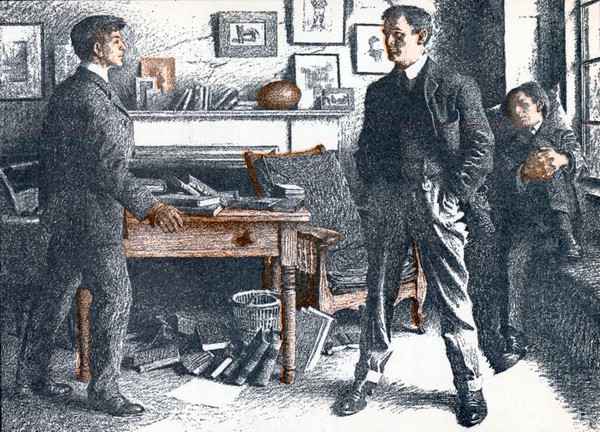
Bert knocked and a voice bade them enter.