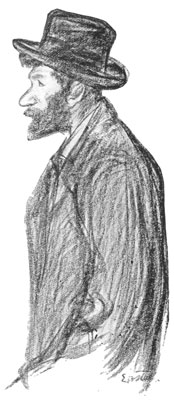
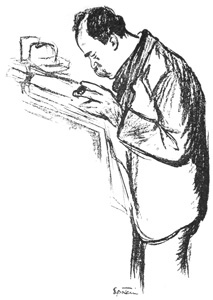
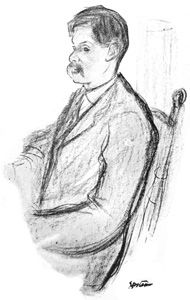
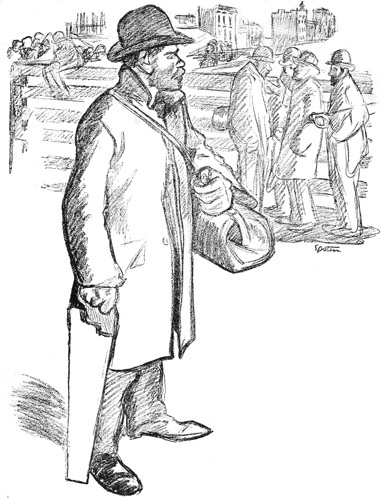
Obvious typographical errors have been corrected.
Inconsistent spelling and hyphenation in the original
document have been preserved.
THE SPIRIT of
THE GHETTO
STUDIES OF THE JEWISH
QUARTER IN NEW YORK
By HUTCHINS HAPGOOD
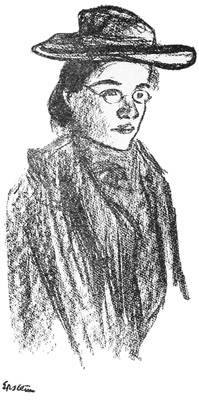
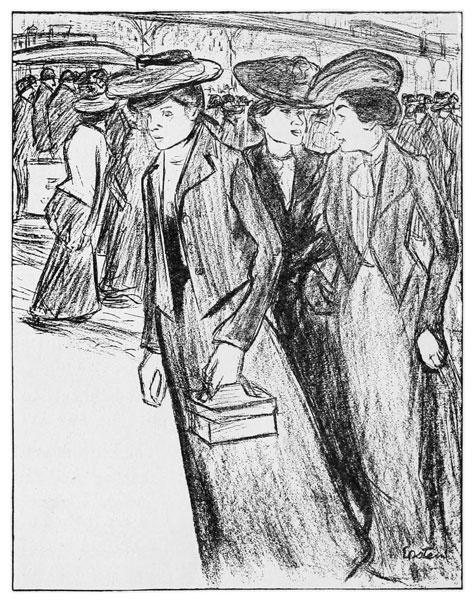
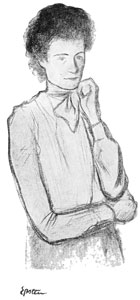
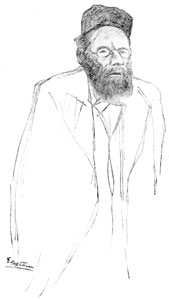
With Drawings from Life by JACOB EPSTEIN
NEW YORK AND LONDON
FUNK & WAGNALLS COMPANY NINETEEN HUNDRED AND TWO
Copyright, 1902 by Funk & Wagnalls Company
Printed in the United States of America
Published November, 1902
NOTE
A number of these chapters have appeared as
separate articles in "The Atlantic Monthly,"
"The Critic," "The Bookman," "The World's
Work," "The Boston Transcript," and "The
Evening Post" and "The Commercial Advertiser"
of New York. To the editors of
these publications thanks for permission to
republish are gratefully tendered by The Author.
PREFACE
The Jewish quarter of New York is generally
supposed to be a place of poverty, dirt, ignorance
and immorality—the seat of the sweat-shop,
the tenement house, where "red-lights"
sparkle at night, where the people are queer
and repulsive. Well-to-do persons visit the
"Ghetto" merely from motives of curiosity or
philanthropy; writers treat of it "sociologically,"
as of a place in crying need of improvement.
That the Ghetto has an unpleasant aspect is
as true as it is trite. But the unpleasant aspect
is not the subject of the following sketches. I
was led to spend much time in certain poor resorts
of Yiddish New York not through motives
either philanthropic or sociological, but simply
by virtue of the charm I felt in men and things
there. East Canal Street and the Bowery have
interested me more than Broadway and Fifth
Avenue. Why, the reader may learn from the
present volume—which is an attempt made by a
"Gentile" to report sympathetically on the
character, lives and pursuits of certain east-side
Jews with whom he has been in relations of
considerable intimacy. The Author.
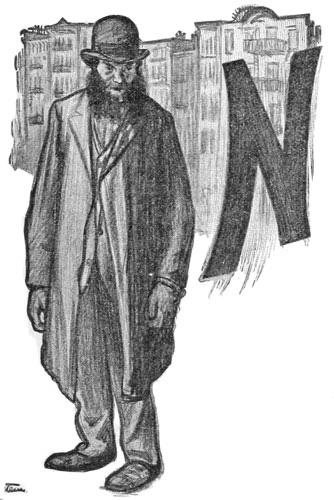
Chapter One The Old and the New — THE OLD MAN — THE BOY — THE "INTELLECTUALS"
No part of New York
has a more intense
and varied life than
the colony of Russian
and Galician Jews
who live on the east
side and who form the
largest Jewish city in
the world. The old
and the new come
here into close contact and throw
each other into high relief. The traditions
and customs of the orthodox
Jew are maintained almost in their
purity, and opposed to these are
forms and ideas of modern life of
the most extreme kind. The Jews
are at once tenacious of their character and
susceptible to their Gentile environment, when
that environment is of a high order of civilization.
Accordingly, in enlightened America
they undergo rapid transformation tho retaining
much that is distinctive; while in Russia, surrounded
by an ignorant peasantry, they remain
by themselves, do not so commonly learn the
Gentile language, and prefer their own forms of
culture. There their life centres about religion.
Prayer and the study of "the Law" constitute
practically the whole life of the religious Jew.
When the Jew comes to America he remains,
if he is old, essentially the same as he was in
Russia. His deeply rooted habits and the
"worry of daily bread" make him but little sensitive
to the conditions of his new home. His
imagination lives in the old country and he gets
his consolation in the old religion. He picks up
only about a hundred English words and phrases,
which he pronounces in his own way. Some of
his most common acquisitions are "vinda" (window),
"zieling" (ceiling), "never mind," "alle
right," "that'll do," "politzman" (policeman);
"ein schön kind, ein reg'lar pitze!" (a pretty child,
a regular picture). Of this modest vocabulary
he is very proud, for it takes him out of the category
of the "greenhorn," a term of contempt to
which the satirical Jew is very sensitive. The
man who has been only three weeks in this
country hates few things so much as to be called
a "greenhorn." Under this fear he learns the
small vocabulary to which in many years he adds
very little. His dress receives rather greater
modification than his language. In the old
country he never appeared in a short coat; that
would be enough to stamp him as a "freethinker."
But when he comes to New York and
his coat is worn out he is unable to find any
garment long enough. The best he can do is to
buy a "cut-away" or a "Prince Albert," which
he often calls a "Prince Isaac." As soon as he
imbibes the fear of being called a "greenhorn"
he assumes the "Prince Isaac" with less regret.
Many of the old women, without diminution of
piety, discard their wigs, which are strictly required
by the orthodox in Russia, and go even
to the synagogue with nothing on their heads
but their natural locks.
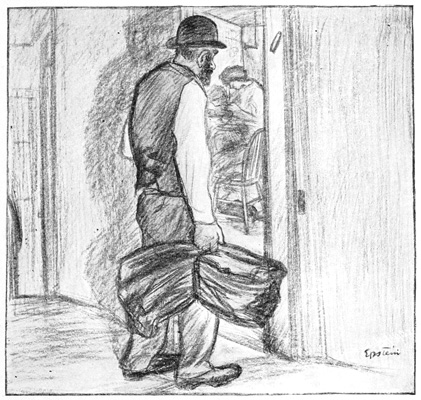
The old Jew on arriving in New York usually
becomes a sweat-shop tailor or push-cart peddler.
There are few more pathetic sights than
an old man with a long beard, a little black cap
on his head and a venerable face—a man who
had been perhaps a Hebraic or Talmudic scholar
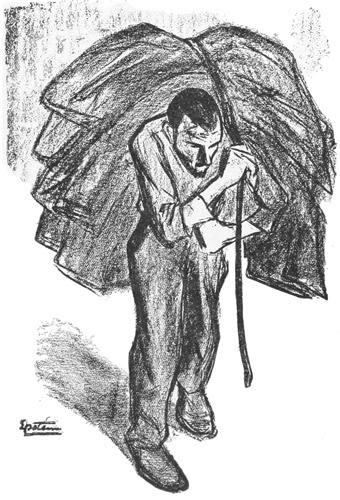
in the old country, carrying or pressing piles of
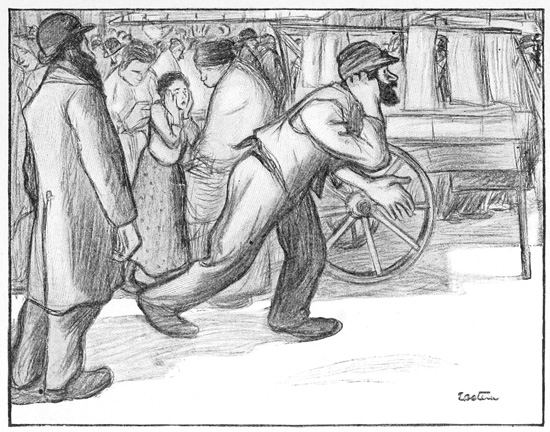
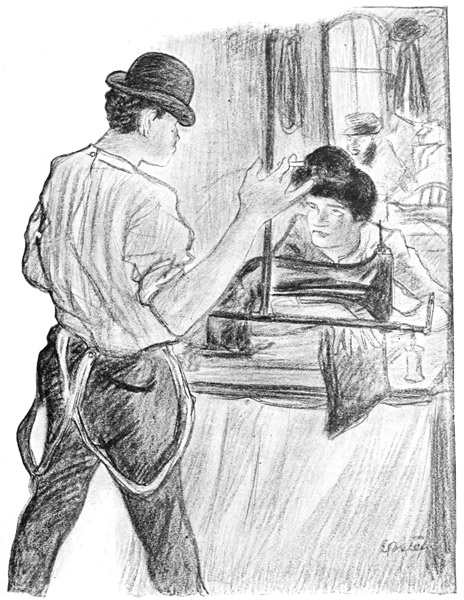
coats in the melancholy sweat-shop; or standing
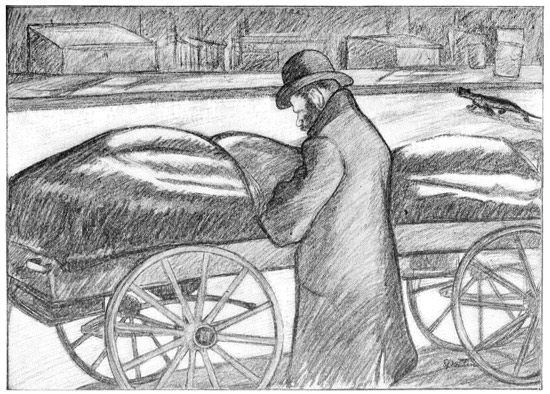
for sixteen hours a day by his push-cart in one
of the dozen crowded streets of the Ghetto,
where the great markets are, selling among
many other things apples, garden stuff, fish and
second-hand shirts.
This man also becomes a member of one of
the many hundred lodges which exist on the east
side. These societies curiously express at once
the old Jewish customs and the conditions of
the new world. They are mutual insurance
companies formed to support sick members.
When a brother is ill the President appoints a
committee to visit
him. Mutual insurance
societies and
committees are
American enough,
and visiting the sick
is prescribed by the
Talmud. This is a
striking instance of
the adaptation of the
"old" to the "new."
The committee not
only condoles with
the decrepit member,
but gives him a sum of money.
Another way in which the life
of the old Jew is affected by his
New York environment, perhaps the most important
way as far as intellectual and educative
influences are concerned, is through the Yiddish
newspapers, which exist nowhere except
in this country. They keep him in touch with
the world's happenings in a way quite impossible
in Europe. At the Yiddish theatres, too,
he sees American customs portrayed, although
grotesquely, and the old orthodox things often
satirized to a degree; the "greenhorn" laughed
to scorn and the rabbi held up to derision.
Nevertheless these influences leave the man
pretty much as he was when he landed here. He
remains the patriarchal Jew devoted to the law
and to prayer. He never does anything that is not
prescribed, and worships most of the time that
he is not at work. He has only one point of view,
that of the Talmud; and his aesthetic as well as
his religious criteria are determined by it. "This
is a beautiful letter you have written me"; wrote
an old man to his son, "it smells of Isaiah." He
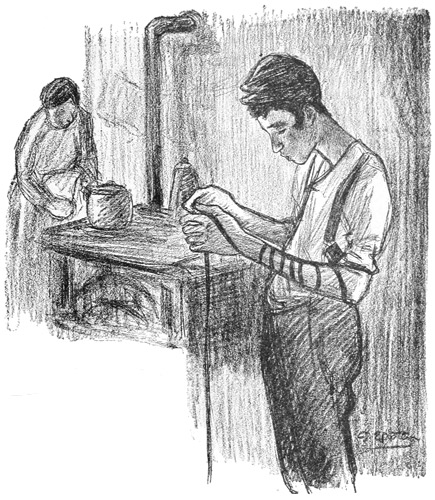
makes of his house a synagogue, and prays three
times a day; when he prays his head is covered,
he wears the black and white praying-shawl, and
the cubes of the phylactery are attached to his
forehead and left arm. To the cubes are fastened
two straps of goat-skin, black and white; those
on the forehead hang down, and those attached
to the other cube are wound seven times about
the left arm. Inside each cube is a white parchment
on which is written the Hebrew word for
God, which must never be spoken by a Jew.
The strength of this prohibition is so great that
even the Jews who have lost their faith are unwilling
to pronounce the word.
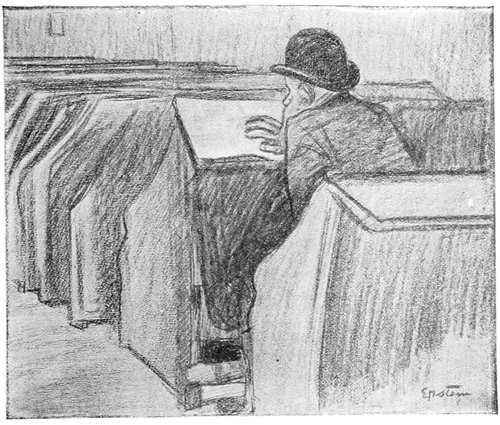
At the Synagogue
Besides the home prayers there are daily visits
to the synagogue, fasts and holidays to observe.
When there is a death in the family he does not
go to the synagogue, but prays at home. The
ten men necessary for the funeral ceremony, who
are partly supplied by the Bereavement Committee
of the Lodge, sit seven days in their stocking-feet
on foot-stools and read Job all the time. On
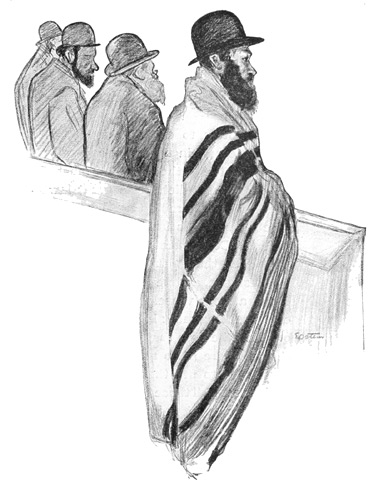
the Day of Atonement the old Jew stands much
of the day in the synagogue, wrapped in a white
gown, and seems to be one of a meeting of the
dead. The Day of Rejoicing of the Law and the
Day of Purim are the only two days in the year
when an orthodox Jew may be intoxicated. It
is virtuous on these days to drink too much, but
the sobriety of the Jew is so great that he sometimes
cheats his friends and himself by shamming
drunkenness. On the first and second evenings
of the Passover the father dresses in a big white
robe, the family gather about him, and the
youngest male child asks the father the reason
why the day is celebrated;
whereupon the
old man relates the
whole history, and they
all talk it over and eat,
and drink wine, but in
no vessel which has
been used before during
the year, for everything
must be fresh and
clean on this day. The
night before the Passover
the remaining
leavened bread is gathered
together, just enough for breakfast, for only
unleavened bread can be eaten during the next
eight days. The head of the family goes around
with a candle, gathers up the crumbs with a quill
or a spoon and burns them. A custom which has
almost died out in New York is for the congregation
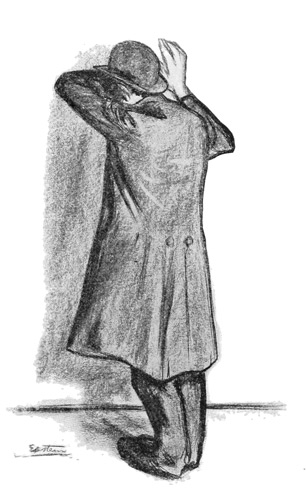
to go out of the synagogue on the night
of the full moon, and chant a prayer in the
moonlight.
In addition to daily religious observances in
his home and in the synagogues, to fasts and
holidays, the orthodox Jew must give much
thought to his diet. One great law is the line
drawn between milk things and meat things.
The Bible forbids boiling a kid in the milk of its
mother. Consequently the hair-splitting Talmud
prescribes the most far-fetched discrimination.
For instance, a plate in which meat is cooked is
called a meat vessel, the knife with which it is
cut is called a meat knife, the spoon with which
one eats the soup that was cooked in a meat pot,
though there is no meat in the soup, is a meat
spoon, and to use that spoon for a milk thing is
prohibited. All these regulations, of course, seem
privileges to the orthodox Jew. The sweat-shops
are full of religious fanatics, who, in addition
to their ceremonies at home, form Talmudic
clubs and gather in tenement-house rooms,
which they convert into synagogues.
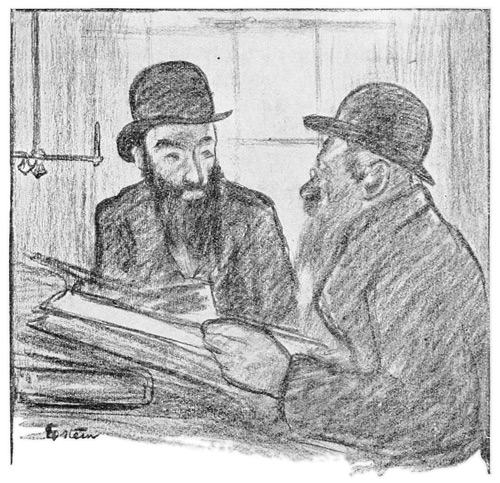
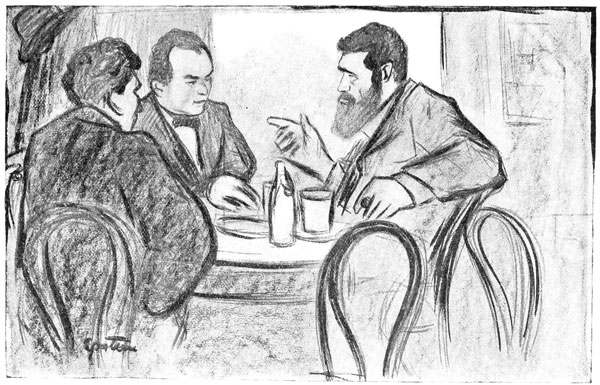
In several of the cafés of the quarter these old
fellows gather. With their long beards, long
black coats, and serious demeanor, they sit about
little tables and drink honey-cider, eat lima
beans and jealously exclude from their society
the socialists and freethinkers of the colony who,
not unwillingly, have cafés of their own. They
all look poor, and many of them are, in fact, peddlers,
shop-keepers or tailors; but some, not
distinguishable in appearance from the proletarians,
have "made their pile." Some are Hebrew
scholars, some of the older class of Yiddish
journalists. There
are no young people
there, for the young
bring irreverence and
the American spirit, and
these cafés are strictly
orthodox.
In spite, therefore, of
his American environment,
the old Jew of the
Ghetto remains patriarchal,
highly trained
and educated in a
narrow sectarian direction,
but entirely ignorant
of modern culture;
medieval, in
effect, submerged
in old tradition and
outworn forms.
The shrewd-faced boy with the melancholy
eyes that one sees everywhere in the streets of
New York's Ghetto, occupies a peculiar position
in our society. If we could penetrate into his
soul, we should see a mixture of almost unprecedented
hope and excitement on the one hand,
and of doubt, confusion, and self-distrust on the
other hand. Led in many contrary directions,
the fact that he does not grow to be an intellectual
anarchist is due to his serious racial characteristics.
Three groups of influences are at work on him—the
orthodox Jewish, the American, and the
Socialist; and he experiences them in this order.
He has either been born in America of Russian,
Austrian, or Roumanian Jewish parents, or has
immigrated with them when a very young child.
The first of the three forces at work on his
character is religious and moral; the second is
practical, diversified, non-religious; and the third
is reactionary from the other two and hostile to
them.
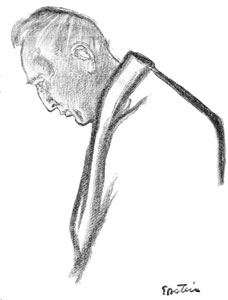
THE MORNING PRAYER
Whether born in this country or in Russia, the
son of orthodox parents passes his earliest years
in a family atmosphere where the whole duty of
man is to observe the religious law. He learns
to say his prayers every morning
and evening, either at home
or at the synagogue. At the
age of five, he is taken to the
Hebrew private school, the
"chaider," where, in Russia,
he spends most of his time from early morning
till late at night. The ceremony accompanying
his first appearance in "chaider" is significant
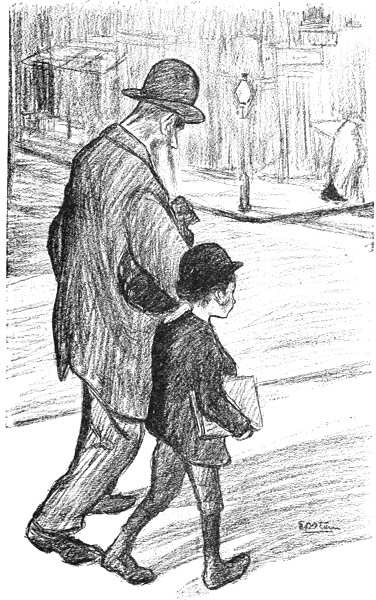
of his whole orthodox life. Wrapped in a
"talith," or praying shawl, he is carried by his
father to the school and received there by the
"melamed," or teacher, who holds out before
him the Hebrew alphabet on a large chart.
Before beginning to learn the first letter of the
alphabet, he is given a taste of honey, and when
he declares it to be sweet, he is told that the
study of the Holy Law, upon which he is about
to enter, is sweeter than honey. Shortly afterwards
a coin falls from the ceiling, and the
boy is told that an angel dropped it from heaven
as a reward for learning the first lesson.
In the Russian "chaider" the boy proceeds
with a further study of the alphabet, then of the
prayer-book, the Pentateuch, other portions of
the Bible, and finally begins with the complicated
Talmud. Confirmed at thirteen years of age, he
enters the Hebrew academy and continues the
study of the Talmud, to which, if he is successful,
he will devote himself all his life. For his parents
desire him to be a rabbi, or Talmudical scholar,
and to give himself entirely to a learned interpretation
of the sweet law.
GOING TO THE SYNAGOGUE
The boy's life at home, in Russia, conforms
with the religious education received at the
"chaider." On Friday afternoon, when the
Sabbath begins, and on Saturday morning, when
it continues, he is free from school, and on Friday
does errands for his mother or helps in the preparation
for the Sabbath. In the afternoon he
commonly bathes, dresses freshly in Sabbath
raiment, and goes to "chaider" in the evening.
Returning from school, he finds his mother and
sisters dressed in their best, ready to "greet the
Sabbath." The lights are glowing in the candlesticks,
the father enters with "Good Shabbas"
on his lips, and is received by the grandparents,
who occupy the seats of honor. They bless him
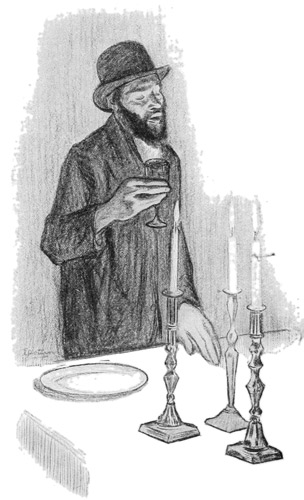
and the children in turn. The father then chants
the hymn of praise and salutation; a cup of wine
or cider is passed from one to the other; every
one washes his hands; all arrange themselves
at table in the order of age, the youngest sitting
at the father's right hand. After the meal they
sing a song dedicated to the Sabbath, and say
grace. The same ceremony is repeated on Saturday
morning, and afterwards the children are
examined in what they have learned of the Holy
Law during the week. The numerous religious
holidays are observed in the same way, with
special ceremonies of their own in addition. The
important thing to notice is, that the boy's whole
training and education bear directly on ethics
and religion, in the study of which he is encouraged
to spend his whole life.
In a simple Jewish community in Russia,
where the "chaider" is the only school, where
the government is hostile, and the Jews are
therefore thrown back upon their own customs,
the boy loves his religion, he loves and honors
his parents, his highest ambition is to be a great
scholar—to know the Bible in all its glorious
meaning, to know the Talmudical comments
upon it, and to serve God. Above every one
else he respects the aged, the Hebrew scholar,
the rabbi, the teacher. Piety and wisdom count
more than riches, talent and power. The "law"
outweighs all else in value. Abraham and Moses,
David and Solomon, the prophet Elijah, are the
kind of great men to whom his imagination soars.
But in America, even before he begins to go to
our public schools, the little Jewish boy finds
himself in contact with a new world which stands
in violent contrast with the orthodox environment
of his first few years. Insensibly—at the
beginning—from his playmates in the streets,
from his older brother or sister, he picks up a
little English, a little American slang, hears
older boys boast of prize-fighter Bernstein, and
learns vaguely to feel that there is a strange and
fascinating life on the street. At this tender age
he may even begin to black boots, gamble in
pennies, and be filled with a "wild surmise"
about American dollars.
With his entrance into the public school the
little fellow runs plump against a system of education
and a set of influences which are at total
variance with those traditional to his race and
with his home life. The religious element is entirely
lacking. The educational system of the
public schools is heterogeneous and worldly.
The boy becomes acquainted in the school reader
with fragments of writings on all subjects, with
a little mathematics, a little history. His instruction,
in the interests of a liberal non-sectarianism,
is entirely secular. English becomes
his most familiar language. He achieves a growing
comprehension and sympathy with the independent,
free, rather sceptical spirit of the
American boy; he rapidly imbibes ideas about
social equality and contempt for authority, and
tends to prefer Sherlock Holmes to Abraham as
a hero.
The orthodox Jewish influences, still at work
upon him, are rapidly weakened. He grows to
look upon the ceremonial life at home as rather
ridiculous. His old parents, who speak no English,
he regards as "greenhorns." English becomes
his habitual tongue, even at home, and
Yiddish he begins to forget. He still goes to
"chaider," but under conditions exceedingly different
from those obtaining in Russia, where
there are no public schools, and where the boy
is consequently shut up within the confines of
Hebraic education. In America, the "chaider"
assumes a position entirely subordinate. Compelled
by law to go to the American public
school, the boy can attend "chaider" only before
the public school opens in the morning or after
it closes in the afternoon. At such times the
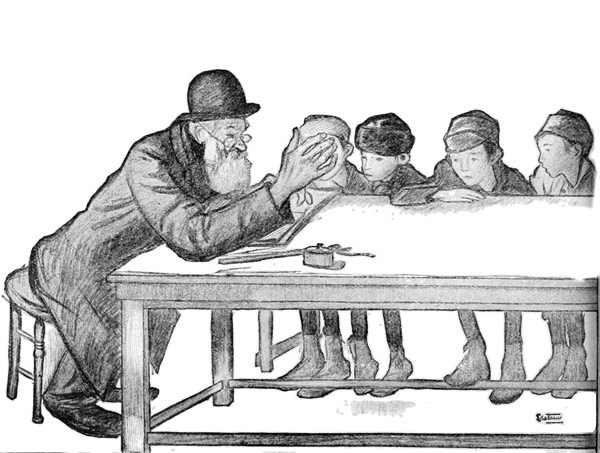
Hebrew teacher, who dresses in a long black
coat, outlandish tall hat, and commonly speaks
no English, visits the boy at home, or the boy
goes to a neighboring "chaider."
Contempt for the "chaider's" teaching comes
the more easily because the boy rarely understands
his Hebrew lessons to the full. His
real language is English, the teacher's is commonly
the Yiddish jargon, and the language to
be learned is Hebrew. The problem before him
is consequently the strangely difficult one of
learning Hebrew, a tongue unknown to him,
through a translation into Yiddish, a language
of growing unfamiliarity, which, on account of
its poor dialectic character, is an inadequate vehicle
of thought.
The orthodox parents begin to see that the
boy, in order to "get along" in the New World,
must receive a Gentile training. Instead of
hoping to make a rabbi of him, they reluctantly
consent to his becoming an American business
man, or, still better, an American doctor or lawyer.
The Hebrew teacher, less convinced of
the usefulness and importance of his work, is
in this country more simply commercial and
less disinterested than abroad; a man generally,
too, of less scholarship as well as of less
devotion.
THE "CHAIDER"
The growing sense of superiority on the part
of the boy to the Hebraic part of his environment
extends itself soon to the home. He learns to
feel that his parents, too, are "greenhorns." In
the struggle between the two sets of influences
that of the home becomes less and less effective.
He runs away from the supper table to join his
gang on the Bowery, where he is quick to pick
up the very latest slang; where his talent for
caricature is developed often at the expense of
his parents, his race, and all "foreigners"; for
he is an American, he is "the people," and like
his glorious countrymen in general, he is quick
to ridicule the stranger. He laughs at the foreign
Jew with as much heartiness as at the
"dago"; for he feels that he himself is almost
as remote from the one as from the other.
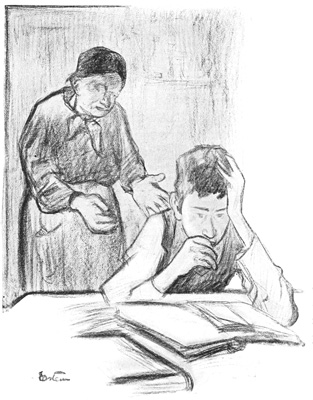
"Why don't you say your evening prayer, my
son?" asks his mother in Yiddish.
"Ah, what yer givin' us!" replies, in English,
the little American-Israelite as he makes a bee-line
for the street.
The boys not only talk together of picnics, of
the crimes of which they read in the English
newspapers, of prize-fights, of budding business
propositions, but they gradually quit going to
synagogue, give up "chaider" promptly when
they are thirteen years old, avoid the Yiddish
theatres, seek the up-town places of amusement,
dress in the latest American fashion, and have a
keen eye for the right thing in neckties. They
even refuse sometimes to be present at supper
on Friday evenings. Then, indeed, the sway of
the old people is broken.
"Amerikane Kinder, Amerikane Kinder!"
wails the old father, shaking his head. The
trend of things is indeed too strong for the old
man of the eternal Talmud and ceremony.
An important circumstance in helping to determine
the boy's attitude toward his father is
the tendency to reverse the ordinary and normal
educational and economical relations existing
between father and son. In Russia the father
gives the son an education and supports him
until his marriage, and often afterward, until the
young man is able to take care of his wife and
children. The father is, therefore, the head of
the house in reality. But in the New World the
boy contributes very early to the family's support.
The father is in this country less able to make
an economic place for himself than is the son.
The little fellow sells papers, blacks boots, and
becomes a street merchant on a small scale. As
he speaks English, and his parents do not, he is
commonly the interpreter in business transactions,
and tends generally to take things into his
own hands. There is a tendency, therefore, for
the father to respect the son.
There is many a huge building on Broadway
which is the external sign (with the Hebrew
name of the tenant emblazoned on some extended
surface) of the energy and independence of some
ignorant little Russian Jew, the son of a push-cart
peddler or sweat-shop worker, who began
his business career on the sidewalks, selling
newspapers, blacking boots, dealing in candles,
shoe-strings, fruit, etc., and continued it by peddling
in New Jersey or on Long Island until he
could open a small basement store on Hester
Street, then a more extensive establishment on
Canal Street—ending perhaps as a rich merchant
on Broadway. The little fellow who starts out
on this laborious climb is a model of industry
and temperance. His only recreation, outside
of business, which for him is a pleasure in itself,
is to indulge in some simple pastime which generally
is calculated to teach him something. On
Friday or Saturday afternoon he is likely, for
instance, to take a long walk to the park, where
he is seen keenly inspecting the animals and
perhaps boasting of his knowledge about them.
He is an acquisitive little fellow, and seldom enjoys
himself unless he feels that he is adding to
his figurative or literal stock.
The cloak and umbrella business in New York
is rapidly becoming monopolized by the Jews
who began in the Ghetto; and they are also
very large clothing merchants. Higher, however,
than a considerable merchant in the world
of business, the little Ghetto boy, born in a patriarchal
Jewish home, has not yet attained. The
Jews who as bankers, brokers, and speculators
on Wall Street control millions never have been
Ghetto Jews. They came from Germany,
where conditions are very different from those
in Russia, Galicia, and Roumania, and where,
through the comparatively liberal education of
a secular character which they were able to
obtain, they were already beginning to have a
national life outside of the Jewish traditions.
Then, too, these Jews who are now prominent
in Wall Street have been in this country much
longer than their Russian brethren. They are
frequently the sons of Germans who in the last
generation attained commercial rank. If they
were born abroad, they came many years before
the Russian immigration began and before the
American Ghetto existed, and have consequently
become thoroughly identified with
American life. Some of them began, indeed, as
peddlers on a very small scale; travelled, as was
more the habit with them then than now, all
over the country; and rose by small degrees to
the position of great financial operators. But
they became so only by growing to feel very intimately
the spirit of American enterprise which
enables a man to carry on the boldest operation
in a calm spirit.
To this boldness the son of the orthodox
parents of our Ghetto has not yet attained. Coming
from the cramped "quarter," with still a
tinge of the patriarchal Jew in his blood, not yet
thoroughly at home in the atmosphere of the
American "plunger," he is a little hesitant,
though very keen, in business affairs. The conservatism
instilled in him by the pious old
"greenhorn," his father, is a limitation to his
American "nerve." He likes to deal in ponderable
goods, to be able to touch and handle his
wares, to have them before his eyes. In the
next generation, when in business matters also
he will be an instinctive American, he will become
as big a financial
speculator as any
of them, but at present
he is pretty well
content with his
growing business on
Broadway and his fine
residence up-town.
FRIDAY NIGHT PRAYER
Altho as compared
with the American or
German-Jew financier
who does not turn a
hair at the gain or loss
of a million, and who
in personal manner
maintains a phlegmatic,
Napoleonic
calm which is almost
the most impressive
thing in the world to an ordinary man, the
young fellow of the Ghetto seems a hesitant little
"dickerer," yet, of course, he is a rising business
man, and, as compared to the world from
which he has emerged, a very tremendous entity
indeed. It is not strange, therefore, that this progressive
merchant, while yet a child, acquires a
self-sufficiency, an independence, and sometimes
an arrogance which not unnaturally, at least in
form, is extended even toward his parents.
If this boy were able entirely to forget his origin,
to cast off the ethical and religious influences
which are his birthright, there would be
no serious struggle in his soul, and he would not
represent a peculiar element in our society. He
would be like any other practical, ambitious,
rather worldly American boy. The struggle is
strong because the boy's nature, at once religious
and susceptible, is strongly appealed to by
both the old and new. At the same time that
he is keenly sensitive to the charm of his American
environment, with its practical and national
opportunities, he has still a deep love for his
race and the old things. He is aware, and
rather ashamed, of the limitations of his parents.
He feels that the trend and weight of things are
against them, that they are in a minority; but
yet in a real way the old people remain his conscience,
the visible representatives of a moral
and religious tradition by which the boy may
regulate his inner life.
The attitude of such a boy toward his father
and mother is sympathetically described by Dr.
Blaustein, principal of the Educational Alliance:
"Not knowing that I speak Yiddish, the boy
often acts as interpreter between me and his
exclusively Yiddish-speaking father and mother.
He always shows a great fear that I should be
ashamed of his parents and tries to show them
in the best light. When he translates, he expresses,
in his manner, great affection and tenderness
toward these people whom he feels he is
protecting; he not merely turns their Yiddish
into good English, but modifies the substance of
what they say in order to make them appear
presentable, less outlandish and queer. He also
manifests cleverness in translating for his parents
what I say in English. When he finds that
I can speak Yiddish and therefore can converse
heart to heart with the old people, he is delighted.
His face beams, and he expresses in
every way that deep pleasure which a person
takes in the satisfaction of honored protégés."
The third considerable influence in the life of
the Ghetto boy is that of the socialists. I am inclined
to think that this is the least important
and the least desirable of the three in its effect
on his character.
Socialism as it is agitated in the Jewish
quarter consists in a wholesale rejection, often
founded on a misunderstanding, of both American
and Hebraic ideals. The socialists harp
monotonously on the relations between capital
and labor, the injustice of classes, and assume
literature to comprise one school alone, the Russian,
at the bottom of which there is a strongly
anarchistic and reactionary impulse. The son
of a socialist laborer lives in a home where the
main doctrines are two: that the old religion is
rubbish and that American institutions were invented
to exploit the workingman. The natural
effects on such a boy are two: a tendency to look
with distrust at the genuinely American life about
him, and to reject the old implicit piety.
The ideal situation for this young Jew would
be that where he could become an integral part
of American life without losing the seriousness
of nature developed by Hebraic tradition and
education. At present he feels a conflict between
these two influences: his youthful ardor
and ambition lead him to prefer the progressive,
if chaotic and uncentred, American life; but his
conscience does not allow him entire peace in a
situation which involves a chasm between him
and his parents and their ideals. If he could
find along the line of his more exciting interests—the
American—something that would fill the
deeper need of his nature, his problem would
receive a happy solution.
At present, however, the powers that make for
the desired synthesis of the old and the new are
fragmentary and unimportant. They consist
largely in more or less charitable institutions
such as the University Settlement, the Educational
Alliance, and those free Hebrew schools
which are carried on with definite reference to
the boy as an American citizen. The latter differ
from the "chaiders" in several respects. The
important difference is that these schools are
better organized, have better teachers, and have
as a conscious end the supplementing of the
boy's common school education. The attempt
is to add to the boy's secular training an ethical
and religious training through the intelligent
study of the Bible. It is thought that an acquaintance
with the old literature of the Jews is
calculated to deepen and spiritualize the boy's
nature.
The Educational Alliance is a still better organized
and more intelligent institution, having
much more the same purpose in view as the best
Hebrew schools. Its avowed purpose is to combine
the American and Hebrew elements, reconcile
fathers and sons by making the former more
American and the latter more Hebraic, and in
that way improve the home life of the quarter.
With the character of the University Settlement
nearly everybody is familiar. It falls in line
with Anglo-Saxon charitable institutions, forms
classes, improves the condition of the poor, and
acts as an ethical agent. But, tho such institutions
as the above may do a great deal of good,
they are yet too fragmentary and external, are
too little a vital growth from the conditions, to
supply the demand for a serious life which at the
same time shall be American.
But the Ghetto boy is making use of his heterogeneous
opportunities with the greatest energy
and ambition. The public schools are filled with
little Jews; the night schools of the east side are
practically used by no other race. City College,
New York University, and Columbia University
are graduating Russian Jews in numbers rapidly
increasing. Many lawyers, indeed, children of
patriarchal Jews, have very large practices already,
and some of them belong to solid firms on
Wall Street; although as to business and financial
matters they have not yet attained to the
most spectacular height. Then there are innumerable
boys' debating clubs, ethical clubs, and
literary clubs in the east side; altogether there
is an excitement in ideas and an enthusiastic
energy for acquiring knowledge which has interesting
analogy to the hopefulness and acquisitive
desire of the early Renaissance. It is a mistake
to think that the young Hebrew turns naturally
to trade. He turns his energy to whatever offers
the best opportunities for broader life and success.
Other things besides business are open to
him in this country, and he is improving his
chance for the higher education as devotedly as
he has improved his opportunities for success in
business.
It is easy to see that the Ghetto boy's growing
Americanism will be easily triumphant at once
over the old traditions and the new socialism.
Whether or not he will be able to retain his
moral earnestness and native idealism will depend
not so much upon him as upon the development
of American life as a whole. What we
need at the present time more than anything else
is a spiritual unity such as, perhaps, will only be
the distant result of our present special activities.
We need something similar to the spirit underlying
the national and religious unity of the
orthodox Jewish culture.
Altho the young men of the Ghetto who
represent at once the most intelligent and the
most progressively American are, for the most
part, floundering about without being able to
find the social growths upon which they can rest
as true Americans while retaining their spiritual
and religious earnestness, there are yet a small
number of them who have already attained a
synthesis not lacking in the ideal. I know a
young artist, a boy born in the Ghetto, who began
his conscious American life with contempt for
the old things, but who with growing culture has
learned to perceive the beauty of the traditions
and faith of his race. He puts into his paintings
of the types of Hester Street an imaginative,
almost religious, idealism, and his artistic
sympathy seems to extend particularly to the old
people. He, for one, has become reconciled to
the spirit of his father without ceasing to be an
American. And he is not alone. There are
other young Jews, of American university education,
of strong ethical and spiritual character,
who are devoting themselves to the work of
forming, among the boys of the Ghetto, an ideal
at once American and consistent with the spirit
at the heart of the Hebraic tradition.
Between the old people, with their religion,
their traditions, the life pointing to the past, and
the boy with his young life eagerly absorbent of
the new tendencies, is a third class which may
be called the "Intellectuals" of the Ghetto. This
is the most picturesque and interesting, altho
not the most permanently significant, of all. The
members of this class are interesting for what
they are rather than for what they have been or
for what they may become. They are the anarchists,
the socialists, the editors, the writers;
some of the scholars, poets, playwrights and
actors of the quarter. They are the "enlightened"
ones who are at once neither orthodox
Jews nor Americans. Coming from Russia, they
are reactionary in their political opinions, and in
matters of taste and literary ideals are Europeans
rather than Americans. When they die
they will leave nothing behind them; but while
they live they include the most educated, forcible,
and talented personalities of the quarter. Most
of them are socialists, and, as I pointed out in
the last section, socialism is not a permanently
nutritive element in the life of the Ghetto, for as
yet the Ghetto has not learned to know the conditions
necessary to American life, and can not,
therefore, effectively react against them.
It is this class which contains, however, the
many men of "ideas" who bring about in certain
circles a veritable intellectual fermentation; and
are therefore most interesting from what might
be called a literary point of view, as well as of
great importance in the education of the people.
Gifted Russian Jews hold forth passionately to
crowds of working men; devoted writers exploit
in the Yiddish newspapers the principles of
their creed and take violent part in the labor
agitation of the east side; or produce realistic
sketches of the life in the quarter, underlying
which can be felt the same kind of revolt which is
apparent in the analogous literature of Russia.
The intellectual excitement in the air causes
many "splits" among the socialists. They
gather in hostile camps, run rival organs, each
prominent man has his "patriots," or faithful
adherents who support him right or wrong.
Intense personal abuse and the most violent
denunciation of opposing principles are the rule.
Mellowness, complacency, geniality, and calmness
are qualities practically unknown to the
intellectual Russian Jews, who, driven from the
old country, now possess the first opportunity to
express themselves. On the other hand they
are free of the stupid Philistinism of content and
are not primarily interested in the dollar. Their
poets sing pathetically of the sweat-shops, of
universal brotherhood, of the abstract rights of
man. Their enthusiastic young men gather
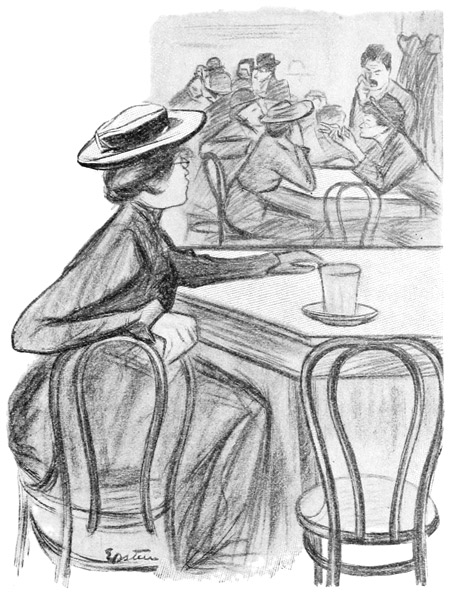
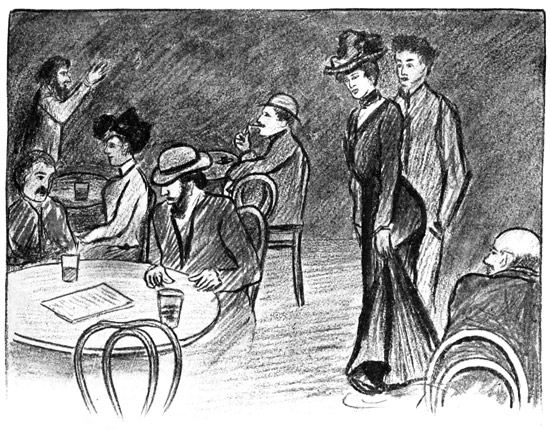
every evening in cafés of the quarter and become
habitually intoxicated with the excitement of
ideas. In their restless and feverish eyes shines
the intense idealism of the combined Jew and
Russian—the moral earnestness of the Hebrew
united with the passionate, rebellious mental
activity of the modern Muscovite. In these cafés
they meet after the theatre or an evening lecture
and talk into the morning hours. The ideal,
indeed, is alive within them. The defect of their
intellectual ideas is that they are not founded on
historical knowledge, or on knowledge of the
conditions with which they have to cope. In
their excitement and extremeness they resemble
the spirit of the French "intellectuals" of 1789
rather than that more conservative feeling which
has always directed the development of Anglo-Saxon
communities.
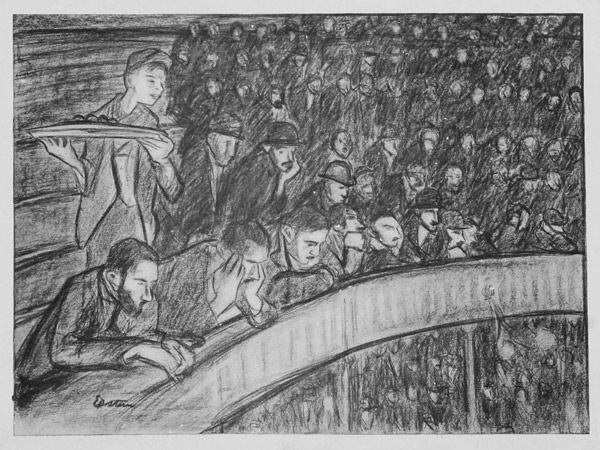
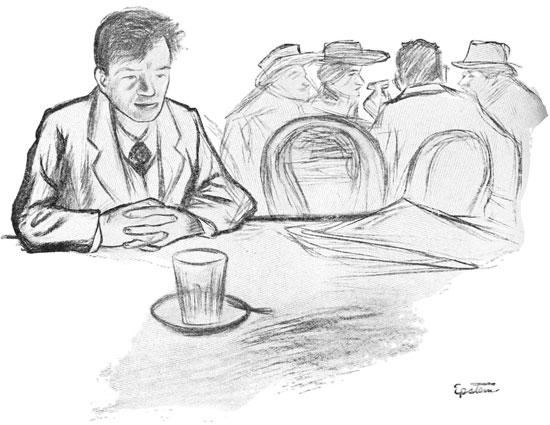
IN THESE CAFÉS THEY MEET AFTER THE THEATRE
OR AN EVENING LECTURE
Among the "intellectuals" may be classed a
certain number of poets, dramatists, musicians,
and writers, who are neither socialists nor anarchists,
constituting what might roughly be called
the literary "Bohemia" of the quarter; men who
pursue their art for the love of it simply, or who
are thereto impelled by the necessity of making
a precarious living; men really without ideas in
the definite, belligerent sense, often uneducated,
but often of considerable native talent. There
are also many men of brains who form a large
professional class—doctors, lawyers, and dentists—and
who yet are too old when they come to
America to be thoroughly identified with the life.
They are, however, a useful part of the Jewish
community, and, like others of the "intellectual"
class, are often men of great devotion, who have
left comparative honor and comfort in the old
country in order to live and work with the persecuted
or otherwise less fortunate brethren.
The greater number of the following chapters
deal with the men of this "intellectual" class,
their personalities, their literary work and the
light it throws upon the life of the people in the
New York Ghetto.
Chapter Two Prophets without Honor — SUBMERGED SCHOLARS — THE POOR RABBIS
A ragged man, who looks like a peddler or a
beggar, picking his way through the crowded
misery of Hester Street, or ascending the stairs
of one of the dingy tenement-houses full of
sweat-shops that line that busy mart of the poor
Ghetto Jew, may be a great Hebrew scholar. He
may be able to speak and write the ancient
tongue with the facility of a modern language—as
fluently as the ordinary Jew makes use of the
"jargon," the Yiddish of the people; he may be
a manifold author with a deep and pious love for
the beautiful poetry in his literature; and in
character an enthusiast, a dreamer, or a good
and reverend old man. But no matter what his
attainments and his quality he is unknown and
unhonored, for he has pinned his faith to a
declining cause, writes his passionate accents in
a tongue more and more unknown even to the
cultivated Jew; and consequently amid the
crowding and material interests of the new world
he is submerged—poor in physical estate and his
moral capital unrecognized by the people among
whom he lives.
HE IS UNKNOWN AND UNHONORED
Not only unrecognized by the ignorant and the
busy and their teachers the rabbis, who in New
York are frequently nearly as ignorant as the
people, he is also (as his learning is limited
largely to the literature of his race) looked down
upon by the influential and intellectual element
of the Ghetto—an element socialistic, in literary
sympathy Russian rather than Hebraic, intolerant
of everything not violently modern, wedded to
"movements" and scornful of the past. The
"maskil," therefore, or "man of wisdom"—the
Hebrew scholar—is called "old fogy," or "dilettante,"
by the up-to-date socialists.
Of such men there are several in the humble
corners of the New York Ghetto. One peddles
for a living, another has a small printing-office in
a basement on Canal Street, a third occasionally
tutors in some one of many languages and sells
a patent medicine, and a fourth is the principal
of the Talmud-Thora, a Hebrew school in the
Harlem Ghetto, where he teaches the children
to read, write, and pray in the Hebrew language.
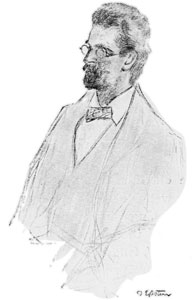
Moses Reicherson is the name of the principal.
"Man of wisdom" of the purest kind, probably
the finest Hebrew grammarian in New York, and
one of the finest in the world, his income from
his position at the head of the school is $5 a
week. He is seventy-three years old, wears a
thick gray beard, a little cap on his head, and a
long black coat. His wife is old and bent. They
are alone in their miserable little apartment on
East One Hundred and Sixth Street. Their son
died a year or two ago, and to cover the funeral
expenses Mr. Reicherson tried in vain to sell his
"Encyclopædia Britannica." But, nevertheless,
the old scholar, who had been bending over his
closely written manuscript, received the visitor
with almost cheerful politeness, and told the
story of his work and of his ambitions. Of his
difficulties and privations he said little, but they
shone through his words and in the character of
the room in which he lived.
Born in Vilna, sometimes called the Jerusalem
of Lithuania or the Athens of modern Judæa
because of the number of enlightened Jews who
have been born there, many of whom now live
in the Russian Jewish quarter of New York, he
has retained the faith of his orthodox parents, a
faith, however, springing from the pure origin of
Judaism rather than holding to the hair-splitting
distinctions later embodied in the Talmud. He
was a teacher of Hebrew in his native town for
many years, where he stayed until he came to
New York some years ago to be near his son.
His two great intellectual interests, subordinated
indeed to the love of the old literature and
religion, have been Hebrew grammar and the
moral fables of several languages. On the
former he has written an important work, and of
the latter has translated much of Lessing's and
Gellert's work into pure Hebrew. He has also
translated into his favorite tongue the Russian
fable-writer Krilow; has written fables of his
own, and a Hebrew commentary on the Bible
in twenty-four volumes. He loves the fables
"because they teach the people and are real
criticism; they are profound and combine fancy
and thought." Many of these are still in manuscript,
which is characteristic of much of the
work of these scholars, for they have no money,
and publishers do not run after Hebrew books.
Also unpublished, written in lovingly minute
characters, he has a Hebrew prayer-book in
many volumes. He has written hundreds of
articles for the Hebrew weeklies and monthlies,
which are fairly numerous in this country, but
which seldom can afford to pay their contributors.
At present he writes exclusively for a Hebrew
weekly published in Chicago, Regeneration, the
object of which is to promote "the knowledge
of the ancient Hebrew language and literature,
and to regenerate the spirit of the nation." For
this he receives no pay, the editor being almost
as poor as himself. But he writes willingly for
the love of the cause, "for universal good"; for
Reicherson, in common with the other neglected
scholars, is deeply interested in revivifying what
is now among American Jews a dead language.
He believes that in this way only can the Jewish
people be taught the good and the true.
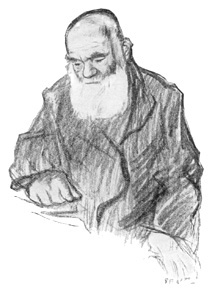
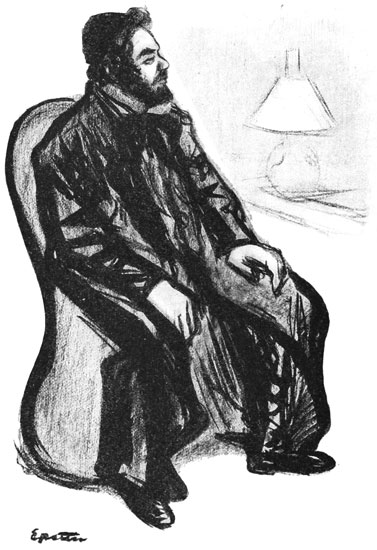
MOSES REICHERSON
"When the national language and literature
live," he said, "the nation lives;
when dead, so is the nation.
The holy tongue in which the
Bible was written must not
die. If it should, much
of the truth of the Bible,
many of its spiritual secrets,
much of its beautiful
poetry, would be
lost. I have gone deep
into the Bible, that
greatest book, all my
life, and I know many of
its secrets." He beamed with pride as he said
these words, and his sense of the beauty of the
Hebrew spirit and the Hebrew literature led him
to speak wonderingly of Anti-Semitism. This
cause seemed to him to be founded on ignorance
of the Bible. "If the Anti-Semites would only
study the Bible, would go deep into the knowledge
of Hebrew and the teaching of Christ, then
everything would be sweet and well. If they
would spend a little of that money in supporting
the Hebrew language and literature and explaining
the sacred books which they now use
against our race, they would see that they are
Anti-Christians rather than Anti-Semites."
The scholar here bethought himself of an old
fable he had translated into Hebrew. Cold and
Warmth make a wager that the traveller will
unwrap his cloak sooner to one than to the
other. The fierce wind tries its best, but at
every cold blast the traveller only wraps his
cloak the closer. But when the sun throws its
rays the wayfarer gratefully opens his breast to
the warming beams. "Love solves all things,"
said the old man, "and hate closes up the channels
to knowledge and virtue." Believing the Pope
to be a good man with a knowledge of the
Bible, he wanted to write him about the Anti-Semites,
but desisted on the reflection that the
Pope was very old and overburdened, and that
the letter would probably fall into the hands of
the cardinals.
All this was sweetly said, for about him there
was nothing of the attitude of complaint. His
wife once or twice during the interview touched
upon their personal condition, but her husband
severely kept his mind on the universal truths, and
only when questioned admitted that he would
like a little more money, in order to publish his
books and to enable him to think with more
concentration about the Hebrew language and
literature. There was no bitterness in his reference
to the neglect of Hebrew scholarship in the
Ghetto. His interest was impersonal and detached,
and his regret at the decadence of the
language seemed noble and disinterested; and,
unlike some of the other scholars, the touch of
warm humanity was in everything he said.
Indeed, he is rather the learned teacher of the
people with deep religious and ethical sense than
the scholar who cares only for learning. "In the
name of God, adieu!" he said, with quiet intensity
when the visitor withdrew.
Contrasting sharply in many respects with
this beautiful old teacher is the man who peddles
from tenement-house to tenement-house in the
down-town Ghetto, to support himself and his
three young children. S. B. Schwartzberg, unlike
most of the "submerged" scholars, is still a
young man, only thirty-seven years old, but he
is already discouraged, bitter, and discontented.
He feels himself the apostle of a lost cause—the
regeneration in New York of the old Hebrew
language and literature. His great enterprise
in life has failed. He has now given it up, and
the natural vividness and intensity of his nature
get satisfaction in the strenuous abuse of the
Jews of the Ghetto.
He was born in Warsaw, Poland, the son of a
distinguished rabbi. In common with many
Russian and Polish Jews, he early obtained a
living knowledge of the Hebrew language, and
a great love of the literature, which he knows
thoroughly, altho, unlike Reicherson and a
scholar who is to be mentioned, Rosenberg, he
has not contributed to the literature in a scientific
sense. He is slightly bald, with burning black
eyes, an enthusiastic and excited manner, and
talks with almost painful earnestness.
Three years ago Schwartzberg came to this
country with a great idea in his head. "In this
free country," he thought to himself, "where
there are so many Russian and Polish Jews, it
is a pity that our tongue is dying, is falling into
decay, and that the literature and traditions that
hold our race together are being undermined by
materialism and ethical skepticism." He had a
little money, and he decided he would establish
a journal in the interests of the Hebrew language
and literature. No laws would prevent him here
from speaking his mind in his beloved tongue.
He would bring into vivid being again the national
spirit of his people, make them love with the old
fervor their ancient traditions and language. It
was the race's spirit of humanity and feeling for
the ethical beauty, not the special creed of
Judaism, for which he and the other scholars
care little, that filled him with the enthusiasm of
an apostle. In his monthly magazine, the Western
Light, he put his best efforts, his best thoughts
about ethical truths and literature. The poet
Dolitzki contributed in purest Hebrew verse, as
did many other Ghetto lights. But it received
no support, few bought it, and it lasted only a
year. Then he gave it up, bankrupt in money
and hope. That was several years ago, and
since then he has peddled for a living.
The failure has left in Schwartzberg's soul a
passionate hatred of what he calls the materialism
of the Jews in America. Only in Europe, he
thinks, does the love of the spiritual remain with
them. Of the rabbis of the Ghetto he spoke with
bitterness. "They," he said, "are the natural
teachers of the people. They could do much for
the Hebrew literature and language. Why don't
they? Because they know no Hebrew and have
no culture. In Russia the Jews demand that
their rabbis should be learned and spiritual, but
here they are ignorant and materialistic." So
Mr. Schwartzberg wrote a pamphlet which is
now famous in the Ghetto. "I wrote it with my
heart's blood," he said, his eyes snapping. "In
it I painted the spiritual condition of the Jews in
New York in the gloomiest of colors."
"It is terrible," he proceeded vehemently.
"Not one Hebrew magazine can exist in this
country. They all fail, and yet there are many
beautiful Hebrew writers to-day. When Dolitzki
was twenty years old in Russia he was looked
up to as a great poet. But what do the Jews
care about him here? For he writes in Hebrew!
Why, Hebrew scholars are regarded by the Jews
as tramps, as useless beings. Driven from Russia
because we are Jews, we are despised in New
York because we are Hebrew scholars! The
rabbis, too, despise the learned Hebrew, and
they have a fearful influence on the ignorant
people. If they can dress well and speak English
it is all they want. It is a shame how low-minded
these teachers of the people are. I was born of
a rabbi, and brought up by him, but in Russia
they are for literature and the spirit, while in
America it is just the other way."
The discouraged apostle of Hebrew literature
now sees no immediate hope for the cause.
What seems to him the most beautiful lyric poetry
in the world he thinks doomed to the imperfect
understanding of generations for whom the
language does not live. The only ultimate hope
is in the New Jerusalem. Consequently the fiery
scholar, altho not a Zionist, thinks well of
the movement as tending to bring the Jews
again into a nation which shall revive the old
tongue and traditions. Mr. Schwartzberg referred
to some of the other submerged scholars
of the Ghetto. His eyes burned with indignation
when he spoke of Moses Reicherson. He could
hardly control himself at the thought that the
greatest Hebrew grammarian living, "an old
man, too, a reverend old man," should be brought
to such a pass. In the same strain of outrage
he referred to another old man, a scholar who
would be as poor as Reicherson and himself
were it not for his wife, who is a dressmaker.
It is she who keeps him out of the category of
"submerged" scholars.
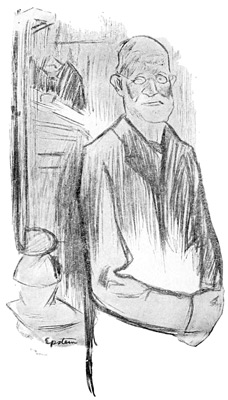
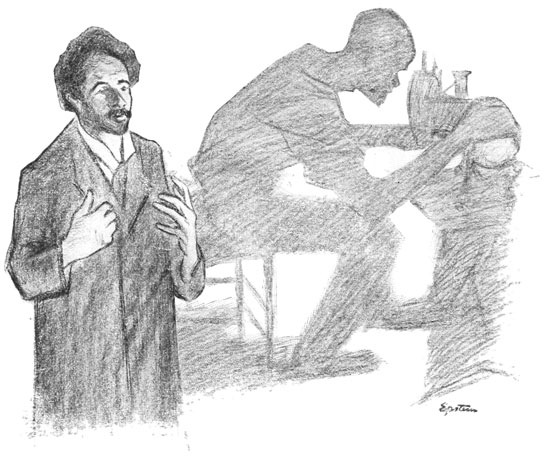
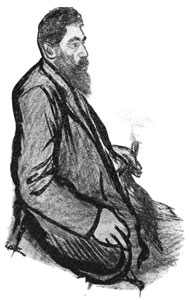
REV. H. ROSENBERG
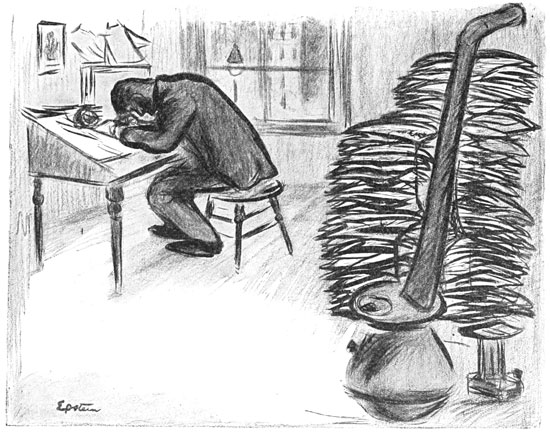
But the Rev. H. Rosenberg, of whose condition
Schwartzberg also bitterly complained, is indeed
submerged. He runs a printing-office in a Canal
Street basement, where he sits in the damp all
day long waiting for an opportunity to publish
his magnum opus, a cyclopedia of Biblical literature,
containing an historical and geographical
description of the persons, places, and objects
mentioned in the Bible. All the Ghetto scholars
speak of this work with bated breath, as a
tremendously learned affair. Only two volumes
of it have been published. To give the remainder
to the world, Mr. Rosenberg is waiting for his
children, who are nearly self-supporting, to
contribute their mite. He is a man of sixty-two,
with the high, bald forehead of a scholar. For
twenty years he was a rabbi in Russia, and
has preached in thirteen synagogues. He has
been nine years in New York, and, in addition to
the great cyclopedia, has written, but not published,
a cyclopedia of Talmudical literature.
A "History of the Jews," in the Russian language,
and a Russian novel, "The Jew of
Trient," are among his published works. He is
one of the most learned of all of these men who
have a living, as well as an exact, knowledge of
what is generally regarded as a dead language
and literature.
Altho he is waiting to
publish the great cyclopedia,
he is patient and
cold. He has not the
sweet enthusiasm of
Reicherson, and not the
vehement and partisan
passion of Schwartzberg.
He has the coldness of old
age, without its spiritual
glow, and scholarship is
the only idea that moves
him. Against the rabbis
he has no complaint to
make; with them, he
said, he had nothing to
do. He thinks that
Schwartzberg is extreme
and unfair, and that there are good
and bad rabbis in New York. He is reserved
and undemonstrative, and speaks only in reply.
When the rather puzzled visitor asked him if
there was anything in which he was interested,
he replied, "Yes, in my cyclopedia." The only
point at which he betrayed feeling was when he
quoted proudly the words of a reviewer of the
cyclopedia, who had wondered where Dr. Rosenberg
had obtained all his learning. He stated
indifferently that the Hebrew language and
literature is dead and cannot be revived. "I
know," he said, "that Hebrew literature does
not pay, but I cannot stop." With no indignation,
he remarked that the Jews in New York
have no ideals. It was a fact objectively to be
deplored, but for which he personally had no emotion,
all of that being reserved for his cyclopedia.
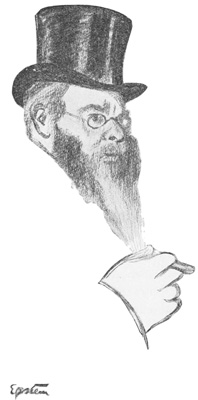
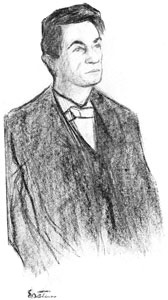
"SUBMERGED SCHOLARS"
These three men are perfect types of the
"submerged Hebrew scholar" of the New York
Ghetto. Reicherson is the typical religious
teacher; Schwartzberg, the enthusiast, who loves
the language like a mistress, and Rosenberg, the
cool "man of wisdom," who only cares for the
perfection of knowledge. Altho there are several
others on the east side who approach the type,
they fall more or less short of it. Either they
are not really scholars in the old tongue, altho
reading and even writing it, or through business
or otherwise they have raised themselves above
the pathetic point. Thus Dr. Benedict Ben-Zion,
one of the poorest of all, being reduced to
occasional tutoring, and the sale of a patent
medicine for a living, is not specifically a scholar.
He writes and reads Hebrew, to be sure, but is
also a playwright in the "jargon;" has been a
Christian missionary to his own people in Egypt,
Constantinople, and Rumania, a doctor for many
years, a teacher in several languages, one who
has turned his hand to everything, and whose
heart and mind are not so purely Hebraic as
those of the men I have mentioned. He even is
seen, more or less, with Ghetto literati who are
essentially hostile to what the true Hebrew
scholar holds by—a body of Russian Jewish
socialists of education, who in their Grand and
Canal Street cafés express every night in impassioned
language their contempt for whatever is
old and historical.
Then, there are J. D. Eisenstein, the youngest
and one of the most learned, but perhaps the
least "submerged" of them all; Gerson Rosenschweig,
a wit, who has collected the epigrams
of the Hebrew literature, added many of his
own, and written in Hebrew a humorous
treatise on America—a very up-to-date Jew,
who, like Schwartzberg, tried to run a Hebrew
weekly, but when he failed, was not discouraged,
and turned to business and politics instead;
and Joseph Low Sossnitz, a very learned
scholar, of dry and sarcastic tendency, who
only recently has risen above the submerged
point. Among the latter's most notable published
books are a philosophical attack on materialism,
a treatise on the sun, and a work on
the philosophy of religion.
It is the wrench between the past and the
present which has placed these few scholars in
their present pathetic condition. Most of them
are old, and when they die the "maskil" as a
type will have vanished from New York. In the
meantime, tho they starve, they must devote
themselves to the old language, the old ideas
and traditions of culture. Their poet, the austere
Dolitzki, famous in Russia at the time of the
revival of Hebrew twenty years ago, is the only
man in New York who symbolizes in living verse
the spirit in which these old men live, the spirit
of love for the race as most purely expressed in
the Hebrew literature. This disinterested love
for the remote, this pathetic passion to keep the
dead alive, is what lends to the lives of these
"submerged" scholars a nobler quality than
what is generally associated with the east side.
The rabbis, as well as the scholars, of the east
side of New York have their grievances. They,
too, are "submerged," like so much in humanity
that is at once intelligent, poor, and out-of-date.
As a lot, they are old, reverend men, with long
gray beards, long black coats and little black
caps on their heads. They are mainly very poor,
live in the barest of the tenement houses and
pursue a calling which no longer involves much
honor or standing. In the old country, in Russia—for
most of the poor ones are Russian—the
rabbi is a great person. He is made rabbi by the
state and is rabbi all his life, and the only rabbi
in the town, for all the Jews in every city form
one congregation, of which there is but one rabbi
and one cantor. He is a man always full of
learning and piety, and is respected and supported
comfortably by the congregation, a tax
being laid on meat, salt, and other foodstuffs for
his special benefit.
But in New York it is very different. Here
there are hundreds of congregations, one in
almost every street, for the Jews come from
many different cities and towns in the old country,
and the New York representatives of every little
place in Russia must have their congregation
here. Consequently, the congregations are for
the most part small, poor and unimportant. Few
can pay the rabbi more than $3 or $4 a week,
and often, instead of having a regular salary, he
is reduced to occasional fees for his services at
weddings, births and holy festivals generally.
Some very poor congregations get along without
a rabbi at all, hiring one for special occasions,
but these are congregations which are falling off
somewhat from their orthodox strictness.
The result of this state of affairs is a pretty
general falling off in the character of the rabbis.
In Russia they are learned men—know the
Talmud and all the commentaries upon it by
heart—and have degrees from the rabbinical
colleges, but here they are often without degrees,
frequently know comparatively little about the
Talmud, and are sometimes actuated by worldly
motives. A few Jews coming to New
York from some small Russian town,
will often select for a rabbi the man
among them who knows a little more
of the Talmud than the others,
whether he has ever studied for the
calling or not. Then, again, some
mere adventurers get into the position—men
good for nothing, looking
for a position. They clap a high hat
on their heads, impose on a poor congregation
with their up-to-dateness
and become rabbis without learning
or piety. These "fake" rabbis—"rabbis
for business only"—are
often satirized in the Yiddish
plays given at the Bowery
theatres. On the stage they
are ridiculous figures, ape American manners in
bad accents, and have a keen eye for gain.
The genuine, pious rabbis in the New York
Ghetto feel, consequently, that they have their
grievances. They, the accomplished interpreters
of the Jewish law, are well-nigh submerged
by the frauds that flood the city. But this is not
the only sorrow of the "real" rabbi of the Ghetto.
The rabbis uptown, the rich rabbis, pay little
attention to the sufferings, moral and physical,
of their downtown brethren. For the most part
the uptown rabbi is of the German, the downtown
rabbi of the Russian branch of the Jewish
race, and these two divisions of the Hebrews
hate one another like poison. Last winter when
Zangwill's dramatized Children of the Ghetto was
produced in New York the organs of the swell uptown
German-Jew protested that it was a pity to
represent faithfully in art the sordidness as well
as the beauty of the poor Russian Ghetto Jew.
It seemed particularly baneful that the religious
customs of the Jews should be thus detailed upon
the stage. The uptown Jew felt a little ashamed
that the proletarians of his people should be made
the subject of literature. The downtown Jews,
the Russian Jews, however, received play and
stories with delight, as expressing truthfully their
life and character, of which they are not ashamed.
Another cause of irritation between the downtown
and uptown rabbis is a difference of religion.
The uptown rabbi, representing congregations
larger in this country and more American in
comfort and tendency, generally is of the "reformed"
complexion, a hateful thought to the
orthodox downtown rabbi, who is loath to admit
that the term rabbi fits these swell German
preachers. He maintains that, since the uptown
rabbi is, as a rule, not only "reformed" in faith,
but in preaching as well, he is in reality no rabbi,
for, properly speaking, a rabbi is simply an
interpreter of the law, one with whom the Talmudical
wisdom rests, and who alone can give it
out; not one who exhorts, but who, on application,
can untie knotty points of the law. The
uptown rabbis they call "preachers," with some
disdain.
So that the poor, downtrodden rabbis—those
among them who look upon themselves as the
only genuine—have many annoyances to bear.
Despised and neglected by their rich brethren,
without honor or support in their own poor
communities, and surrounded by a rabble of
unworthy rivals, the "real" interpreter of the
"law" in New York is something of an object
of pity.
Just who the most genuine downtown rabbis
are is, no doubt, a matter of dispute. I will not
attempt to determine, but will quote in substance
a statement of Rabbi Weiss as to genuine
rabbis, which will include a curious section of
the history of the Ghetto. He is a jolly old
man, and smokes his pipe in a tenement-house
room containing 200 books of the Talmud and
allied writings.
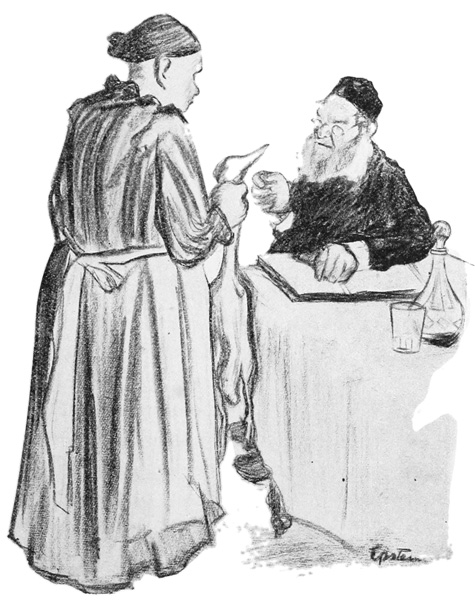
"A genuine rabbi," he said, "knows the law,
and sits most of the time in his room, ready to
impart it. If an old woman comes in with a
goose that has been killed, the rabbi can tell
her, after she has explained how the animal met
its death, whether or not it is koshur, whether it
may be eaten or not. And on any other point of
diet or general moral or physical hygiene the
rabbi is ready to explain the law of the Hebrews
from the time of Adam until to-day. It is he who
settles many of the quarrels of the neighborhood.
The poor sweat-shop Jew comes to complain of
his "boss," the old woman to tell him her dreams
and get his interpretation of them, the young
girl to weigh with him questions of amorous
etiquette. Our children do not need to go to the
Yiddish theatres to learn about "greenhorn"
types. They see all sorts of Ghetto Jews in the
house of the rabbi, their father.
"I myself was the first genuine rabbi on the
east side of New York. I am now sixty-two
years old, and came here sixteen years ago—came
for pleasure, but my wife followed me, and
so I had to stay."
Here the old rabbi smiled cheerfully. "When
I came to New York," he proceeded, "I found
the Jews here in a very bad way—eating meat
that was "thrapho," not allowed, because killed
improperly; literally, killed by a brute. The
slaughter-houses at that time had no rabbi to
see that the meat was properly killed, was koshur—all
right.
"You can imagine my horror. The slaughter-houses
had been employing an orthodox Jew,
who, however, was not a rabbi, to see that the
meat was properly killed, and he had been doing
things all wrong, and the chosen people had
been living abominably. I immediately explained
the proper way of killing meat, and since then
I have regulated several slaughter-houses and
make my living in that way. I am also rabbi
of a congregation, but it is so small that it
doesn't pay. The slaughter-houses are more
profitable."
THE RABBI CAN TELL WHETHER OR NOT
IT IS KOSHUR
These "submerged" rabbis are not always quite
fair to one another. Some east side authorities
maintain that the "orthodox Jew" of whom
Rabbi Weiss spoke thus contemptuously, was
one of the finest rabbis who ever came to New
York, one of the most erudite of Talmudic
scholars. Many congregations united to call
him to America in 1887, so great was his renown
in Russia. But when he reached New York the
general fate of the intelligent adult immigrant
overtook him. Even the "orthodox" in New
York looked upon him as a "greenhorn" and
deemed his sermons out-of-date. He was inclined,
too, to insist upon a stricter observance
of the law than suited their lax American ideas.
So he, too, famous in Russia, rapidly became
one of the "submerged."
One of the most learned, dignified and impressive
rabbis of the east side is Rabbi Vidrovitch.
He was a rabbi for forty years in Russia, and for
nine years in New York. Like all true rabbis he
does not preach, but merely sits in his home and
expounds the "law." He employs the Socratic
method of instruction, and is very keen in his
indirect mode of argument. Keenness, indeed,
seems to be the general result of the hair-splitting
Rabbinical education. The uptown rabbis,
"preachers," as the down-town rabbi contemptuously
calls them, send many letters to Rabbi
Vidrovitch seeking his help in the untying of
knotty points of the "law." It was from him
that Israel Zangwill, when the Children of the
Ghetto was produced on the New York stage,
obtained a minute description of the orthodox
marriage ceremonies. Zangwill caused to be
taken several flash-light photographs of the old
rabbi, surrounded by his books and dressed in
his official garments.
There are many congregations in the New
York Ghetto which have no rabbis and many
rabbis who have no congregations. Two rabbis
who have no congregations are Rabbi Beinush
and Rabbi, or rather, Cantor, Weiss. Rabbi
Weiss would say of Beinush that he is a man
who knows the Talmud, but has no diploma.
Rabbi Beinush is an extremely poor rabbi with
neither congregation nor slaughter-houses, who
sits in his poor room and occasionally sells his
wisdom to a fishwife who wants to know if some
piece of meat is koshur or not. He is down on
the rich up-town rabbis, who care nothing for
the law, as he puts it, and who leave the poor
down-town rabbi to starve.
Cantor Weiss is also without a job. The duty
of the cantor is to sing the prayer in the congregation,
but Cantor Weiss sings only on holidays,
for he is not paid enough, he says, to work regularly,
the cantor sharing in this country a fate
similar to that of the rabbi. The famous comedian
of the Ghetto, Mogolesco, was, as a boy,
one of the most noted cantors in Russia. As an
actor in the New York Ghetto he makes twenty
times as much money as the most accomplished
cantor here. Cantor Weiss is very bitter
against the up-town cantors: "They shorten
the prayer," he said. "They are not orthodox.
It is too hot in the synagogue for the comfortable
up-town cantors to pray."
Comfortable Philistinism, progress and enlightment
up town; and poverty, orthodoxy and
patriotic and religious sentiment, with a touch
of the material also, down town. Such seems
to be the difference between the German and
the Russian Jew in this country, and in particular
between the German and Russian Jewish
rabbi.
Chapter Three The Old and the New Woman — THE ORTHODOX JEWESS — THE MODERN TYPE — PLACE OF WOMAN IN GHETTO LITERATURE
The women present in many respects a marked
contrast to their American sisters. Substance as
opposed to form, simplicity of mood as opposed
to capriciousness, seem to be in broad lines their
relative qualities. They have comparatively few
états d'ame; but those few are revealed with
directness and passion. They lack the subtle
charm of the American woman, who is full of
feminine devices, complicated flirtatiousness;
who in her dress and personal appearance seeks
the plastic epigram, and in her talk and relation
to the world an indirect suggestive delicacy.
They are poor in physical estate; many work or
have worked; even the comparatively educated
among them, in the sweat-shops, are undernourished
and lack the physical well-being and consequent
temperamental buoyancy which are
comforting qualities of the well-bred American
woman. Unhappy in circumstances, they are
predominatingly serious in nature, and, if they
lack alertness to the social nuance, have yet a
compelling appeal which consists in headlong
devotion to a duty, a principle or a person. As
their men do not treat them with the scrupulous
deference given their American sisters, they do
not so delightfully abound in their own sense, do
not so complexedly work out their own natures,
and lack variety and grace. On the other hand,
they are more apt to abound in the sense of
something outside of themselves, and carry to
their love affairs the same devoted warmth that
they put into principle.
The first of the two well-marked classes of
women in the Ghetto is that of the ignorant orthodox
Russian Jewess. She has no language
but Yiddish, no learning but the Talmudic law, no
practical authority but that of her husband and
her rabbi. She is even more of a Hausfrau than
the German wife. She can own no property, and
the precepts of the Talmud as applied to her
conduct are largely limited to the relations with
her husband. Her life is absorbed in observing
the religious law and in taking care of her
numerous children. She is drab and plain in
appearance, with a thick waist, a wig, and as far
as is possible for a woman a contempt for ornament.
She is, however, with the noticeable
assimilative sensitiveness of the Jew, beginning
to pick up some of the ways of the American
woman. If she is young when she comes to
America, she soon lays aside her wig, and
sometimes assumes the rakish American hat,
prides herself on her bad English, and grows
slack in the observance of Jewish holidays and
the dietary regulations of the Talmud. Altho
it is against the law of this religion to go to the
theatre, large audiences, mainly drawn from the
ignorant workers of the sweat-shops and the
fishwives and pedlers of the push-cart markets,
flock to the Bowery houses. It is this class
which forms the large background of the community,
the masses from which more cultivated
types are developing.
HER LIFE IS ABSORBED IN OBSERVING THE
RELIGIOUS LAW
Many a literary sketch in the newspapers of
the quarter portrays these ignorant, simple,
devout, housewifely creatures in comic or pathetic,
more often, after the satiric manner of
the Jewish writers, in serio-comic vein. The
authors, altho they are much more educated, yet
write of these women, even when they write in
comic fashion, with fundamental sympathy.
They picture them working devotedly in the
shop or at home for their husbands and families,
they represent the sorrow and simple jealousy of
the wife whose husband's imagination, perhaps,
is carried away by the piquant manner and dress
of a Jewess who is beginning to ape American
ways; they tell of the comic adventures in
America of the newly-arrived Jewess: how she
goes to the theatre, perhaps, and enacts the
part of Partridge at the play. More fundamentally,
they relate how the poor woman is deeply
shocked, at her arrival, by the change which a
few years have made in the character of her
husband, who had come to America before her
in order to make a fortune. She finds his beard
shaved off, and his manners in regard to religious
holidays very slack. She is sometimes so
deeply affected that she does not recover. More
often she grows to feel the reason and eloquence
of the change and becomes partly accustomed
to the situation; but all through her life she
continues to be dismayed by the precocity, irreligion
and Americanism of her children. Many
sketches and many scenes in the Ghetto plays
present her as a pathetic "greenhorn" who,
while she is loved by her children, is yet rather
patronized and pitied by them.
In "Gott, Mensch und Teufel," a Yiddish
adaptation of the Faust idea, one of these simple
religious souls is dramatically portrayed.
The restless Jewish Faust, his soul corrupted
by the love of money, puts aside his faithful wife
in order to marry another woman who has
pleased his eye. He uses as an excuse the fact
that his marriage is childless, and as such rendered
void in accordance with the precepts of
the religious law. His poor old wife submits
almost with reverence to the double authority
of husband and Talmud, and with humble demeanor
and tears streaming from her eyes begs
the privilege of taking care of the children of
her successor.
In "The Slaughter" there is a scene which
picturesquely portrays the love of the poor Jew
and the poor Jewess for their children. The
wife is married to a brute, whom she hates, and
between the members of the two families there
is no relation but that of ugly sordidness. But
when it is known that a child is to be born they
are all filled with the greatest joy. The husband
is ecstatic and they have a great feast, drink,
sing and dance, and the young wife is lyrically
happy for the first time since her marriage.
Many little newspaper sketches portray the
simple sweat-shop Jewess of the ordinary affectionate
type, who is exclusively minded so far as
her husband's growing interest in the showy
American Jewess is concerned. Cahan's novel,
"Yekel," is the Ghetto masterpiece in the portrayal
of these two types of women—the wronged
"greenhorn" who has just come from Russia,
and she who, with a rakish hat and bad English,
is becoming an American girl with strange
power to alienate the husband's affections.
The other, the educated class of Ghetto women,
is, of course, in a great minority; and this
division includes the women even the most
slightly affected by modern ideas as well as
those who from an intellectual point of view are
highly cultivated. Among the least educated
are a large number of women who would be
entirely ignorant were it not for the ideas which
they have received through the Socialistic propaganda
of the quarter. Like the men who are
otherwise ignorant, they are trained to a certain
familiarity with economic ideas, read and think
a good deal about labor and capital, and take an
active part in speaking, in "house to house"
distribution of socialistic literature and in strike
agitation. Many of these women, so long as
they are unmarried, lead lives thoroughly devoted
to "the cause," and afterwards become
good wives and fruitful mothers, and urge on
their husbands and sons to active work in the
"movement." They have in personal character
many virtues called masculine, are simple and
straightforward and intensely serious, and do
not "bank" in any way on the fact that they
are women! Such a woman would feel insulted
if her escort were to pick up her handkerchief or
in any way suggest a politeness growing out of
the difference in sex. It is from this class of
women, from those who are merely tinged, so to
speak, with ideas, and who consequently are apt
to throw the whole strength of their primitive
natures into the narrow intellectual channels
that are open to them, that a number of Ghetto
heroines come who are willing to lay down their
lives for an idea, or to live for one. It was only
recently that the thinking Socialists were stirred
by the suicide of a young girl for which several
causes were given. Some say it was for love, but
what seems a partial cause at least for the tragedy
was the girl's devotion to anarchistic ideas.
She had worked for some time in the quarter
and was filled with enthusiastic Tolstoian
convictions about freedom and non-resistance
to evil, and all the other idealistic doctrines for
which these Anarchists are remarkable.
Some of the people of the quarter
believe that it was temporary despair
of any satisfactory outcome to her work
that brought about her death. But
since the splits in the Socialistic party
and the rise among them of many insincere
agitators, the enthusiasm for
the cause has diminished, and particularly
among the women, who
demand perfect integrity or nothing;
tho there is still a large class
of poor sweat-shop women who
carry on active propaganda
work, make speeches, distribute
literature, and go from
house to house in a social effort to make converts.
INTENSELY SERIOUS
As we ascend in the scale of education in the
Ghetto we find women who derive their culture
and ideas from a double source—from Socialism
and from advanced Russian ideals of literature
and life. They have lost faith completely in
the orthodox religion, have substituted no other,
know Russian better than Yiddish, read Tolstoi,
Turgenef and Chekhov, and often put into
practice the most radical theories of the "new
woman," particularly those which say that woman
should be economically independent of
man. There are successful female dentists,
physicians, writers, and even lawyers by the
score in East Broadway who have attained
financial independence through industry and
intelligence. They are ambitious to a degree
and often direct the careers of their husbands or
force their lovers to become doctors or lawyers—the
great social desiderata in the match-making
of the Ghetto. There is more than one
case on record where a girl has compelled her
recalcitrant lover to learn law, medicine or dentistry,
or submit to being jilted by her. An
actor devoted to the stage is now on the point
of leaving it to become a dentist at the command
of his ambitious wife. "I always do what
she tells me," he said pathetically.
The career of a certain woman now practising
dentistry in the Ghetto is one of the most interesting
cases, and is also quite typical. She was
born of poor Jewish parents in a town near St.
Petersburg, and began early to read the socialist
propaganda and the Russian literature which
contains so much implicit revolutionary doctrine.
When she was seventeen years old she wrote
a novel in Yiddish, called "Mrs. Goldna, the
Usurer," in which she covertly advocated the
anarchistic teachings. The title and the sub-theme
of the book was directed against the
usurer class among the Jews, and were mainly
intended to hide from the Government her real
purpose. The book was afterwards published in
New York, and had a fairly wide circulation. A
year or two later her imagination was irresistibly
enthralled by the remarkable wave of "new
woman" enthusiasm which swept over Russia
in the early eighties, and resulted in so many
suicides of young girls whom poverty or injustice
to the Jew thwarted in their scientific and intellectual
ambition. She went alone to St. Petersburg
with sixty five cents in her pocket, in order
to obtain a professional education, which, after
years of practical starvation, she succeeded in
securing. With several degrees she came to
America twelve years ago and fought out an
independent professional position
for herself. She believes
that all women should have the
means by which they may support
themselves, and that marriage
under these conditions
would be happier than at present.
Her husband is a doctor,
and her idea is that they are
happier than if she were a woman
of the old type, "merely a wife
and mother," as she put it. She
maintains that no emotional interest
is lost under the new
régime, while many practical advantages
are gained. Since she
has been in America she has
furthered the Socialist cause by
literary sketches published in the Yiddish newspapers,
altho she has been too busy to take any
direct part in the movement.
A RUSSIAN
GIRL-STUDENT
The description of this type of woman seems
rather cold and forbidding in the telling; but
such an impression is misleading. There is no
commoner reproach made by the women of the
Ghetto against their American sister than that
she is unemotional and "practical." They
come to America, like the men, because they
cannot stand the political conditions in Russia,
which they describe as "fierce," but they never
cease loving the land of their birth; and the
reason they give is that the ideal still lives in
Muscovite civilization, while in America it is
trampled out by the cult of the dollar. They
think Americans are dry and cold, unpoetic, uninterested
in great principles, and essentially
frivolous, incapable of devotion to persons or to
"movements," reading books only for amusement,
and caring nothing for real literature.
One day an American dined with four Russian
Jews of distinction. Two were Nihilists who
had been in the "big movement" in Russia and
were merely visiting New York. The other two
were a married couple of uncommon education.
The Nihilists were gentle, cultivated men, with
feeling for literature, and deeply admired, because
of their connection with the great movement,
by the two New Yorkers. The talk
turned on Byron, for whom the Russians had a
warm enthusiasm. The Americans made rather
light of Byron and incurred thereby the great
scorn of the Russians, who felt deeply the
"tendency" character of the poet without being
able to understand his æsthetic and imaginative
limitations. After the Nihilists had left, the misguided
American used the words "interesting"
and "amusing" in connection with them; whereupon
the Russian lady was almost indignant,
and dilated on the frivolity of a race that could
not take serious people seriously, but wanted
always to be entertained; that cared only for
what was "pretty" and "charming" and "sensible"
and "practical," and cared nothing for
poetry and beauty and essential humanity.
The woman referred to, as well as many others
of the most educated class in the quarter, some
of them the wives of socialists, doctors, lawyers or
literary men, are strongly interesting because
of their warm temperaments, and genuine, if
limited, ideas about art, but most of them are
lacking in grace, and sense of humor, and of proportion.
They are stiff and unyielding, have little
free play of imagination, little alertness of ideas,
and their sense of literature is limited largely to
realism. Japanese art, for instance, as any art
which depends on the exquisiteness of its form,
is lost on these stern realists. They no more
understand the latest subtle literary consciousness
than they do the interest and eloquence of
a creature who makes of herself a perfect social
product such as the clever French woman of
history.
WORKING GIRLS RETURNING HOME
But the charm of sincere feeling they have;
and, in an intellectual race, that feeling shapes
itself into definite criticism of society. Emotionally
strong and attached by Russian tradition to
a rebellious doctrine, they are deeply unconventional
in theory and sometimes in practice; altho
the national morality of the Jewish race very
definitely limits the extent to which they realize
some of their ideas. The passionate feeling at
the bottom of most of their "tendency" beliefs is
that woman should stand on the same social
basis as man, and should be weighed in the
same scales. This ruling creed is held by all
classes of the educated women of the Ghetto,
from the poor sweat shop worker, who has
recently felt the influence of Socialism, to the
thoroughly trained "new woman" with her developed
literary taste; and all its variations find
expression in the literature of the quarter.
Ibsen's "Doll's House" has been translated
and produced at a Yiddish theatre; and an
original play called "Minna" registers a protest
by the Jewish woman against that law of marriage
which binds her to an inferior man. Married
to an ignorant laborer, Minna falls in love (for
his advanced ideas) with the boarder—every poor
family, to pay the rent, must saddle themselves
with a boarder, often at the expense of domestic
happiness—and finally kills herself, when the
laws of society press her too hard. Another
drama called "East Broadway" presents the
case of a Russian Jewess devoted to Russia, to
idealism and Nihilism, and to a man who shared
her faith until they came to New York, when he
became a business man pure and simple, and
lost his ideals and his love for her. In a popular
play called "The Beggar of Odessa," lines
openly advocating the freest love between the
sexes accompany other extreme anarchistic
views put into the loosest and most popular
form. "Broken Chains" is a drama which criticises
the relative freedom of action given to the
man in matters of love. The heroine reads
Ibsen at night while her husband amuses himself
in the quarter. A young bookkeeper is there
who serves to make concrete her growing theories.
But her sense of duty to her child restrains
her from the final step, and she dies in despair.
Suicides in sketches and plays abound, and as
often as not result simply from intellectual despondency.
"Vain Sacrifice" is the fierce outcry
of a woman against the poverty which makes her
marry a man she loathes for the sake of her
father. In the newspaper sketches there are
many pictures of sordid homes and conditions
from the midst of which fierce protests by wives
and mothers are implicitly given.
A RUSSIAN TYPE
An appealing characteristic of the "new
woman" of the Ghetto is the consideration
which she manifests towards the orthodox
"greenhorn" who may be her aunt, her mother,
her mother-in-law or her grandmother. The
sense of infinite form prescribed by the Talmud
is dead to her, but extraordinary love for the
family bond is not, and, moved by that, she observes
the complicated formulæ on all the holidays
in order to please the dear old "greenhorn"
who lives with her; eats unleavened bread,
weeps on Atonement Day in the synagogue, and
goes through the whole long list. Her conduct
in this respect is in striking contrast to the
off-hand treatment of parents by their American
daughters, and to that of the Orthodox Jewish
woman in relation to the theatre. The law forbids
the theatre, but even the slightly disillusioned
ladies of the quarter will go on the
Sabbath; and it is said that they sometimes
hypocritically relieve their consciences by hissing
the actor who, even in his rôle, dares to smoke
on that day. This is on a par with the hypocrisy
which leads many Orthodox Jewish families to
have a Gentile as their servant, so that they
can drink the tea, and warm themselves by
the fire, made by him, without technically
violating "the law."
Love in the Ghetto is, no doubt, very
much the same as it is elsewhere; and
this in spite of the fact that among the
Orthodox marriage is arranged by the
parents, a custom which is condemned
in "The Slaughter," for
instance, where the terrible
results of a loveless union are
portrayed. The system of
matrimonial agents in the
quarter does not seem to have
any important bearing on the
question of love. In this respect
the free thinking of the
people grows apace, and love-marriages
in the quarter are
on the increase. In matters
of taste and inclination between the sexes,
however, there are some qualities quite startling
to the American. The most popular actor
with the girls of the Ghetto is a very fat, heavy,
pompous hero who would provoke only a smile
from the trim American girl; and the more
popular actresses are also very stout ladies.
From an American point of view the prettiest
actresses of the Ghetto are admired by the
minority of Jews who have been taken by the
rakish hat, the slim form, and the indefinite
charm to which the Ghetto is being educated.
It is alleged that at an up-town theatre, where a
large proportion of the audience is Jewish, the
leading lady must always be of very generous
build; and this in spite of the fact that the well-to-do
Jews up-town have been in America a long
time, and have had ample opportunity to become
smitten with the charms of the slender American
girl.
Chapter Four Four Poets — A WEDDING BARD — A CHAMPION OF RACE — A SINGER OF LABOR — A DREAMER OF BROTHERHOOD
In East Canal Street, in the heart of the east
side, are many of the little Russian Jewish cafés,
already mentioned, where excellent coffee and
tea are sold, where everything is clean and
good, and where the conversation is often of the
best. The talk is good, for there assemble, in
the late afternoon and evening, the chosen
crowd of "intellectuals." The best that is
Russian to-day is intensely serious. What is
distinctively Jewish has always been serious.
The man hunted from his country is apt to have
a serious tone in thought and feeling.
It is this combination—Russian, Jewish, and
exile—that is represented at these little Canal
Street cafés. The sombre and earnest qualities
of the race, emphasized by the special conditions,
receive here expression in the mouths of
actors, socialists, musicians, journalists, and
poets. Here they get together and talk by the
hour, over their coffee and cake, about politics
and society, poetry and ethics, literature and
life. The café-keepers themselves are thoughtful
and often join in the discussion,—a discussion
never light but sometimes lighted up by bitter
wit and gloomy irony.
There are many poets among them, four of
whom stand out as men of great talent. One of
the four, Morris Rosenfeld, is already well known
to the English-speaking world through a translation
of some of his poems. Two of the other
three are equally well known, but only to the
Jewish people. One is famous throughout Jewish
Russia.
The oldest of the four poets is Eliakim Zunser.
It is he that is known to millions of people in
Russia and to the whole New York Ghetto. He
is the poet of the common people, the beloved of
all, the poet of the housewife, of the Jew who is
so ignorant that he does not even know his own
family name. To still more ignorant people, if
such are possible, he is known by what, after all,
is his distinctive title, Eliakim the Badchen, or
the Wedding Bard. He writes in Yiddish, the
universal language of the Jew, dubbed "jargon"
by the Hebrew aristocrat.
Zunser is now a printer in Rutger's Square, and
has largely given up his duties as Badchen, but at
one time he was so famous in that capacity that
he went to a wedding once or twice every day,
and made in that way a large income. His part
at the ceremony was to address the bride and
bridegroom in verse so solemn that it would
bring tears to their eyes, and then entertain the
guests with burlesque lines. He composed the
music as well as the verses, and did both extempore.
When he left his home to attend the
wedding there was no idea in his head as to
what he would say. He left that to the result of
a hurried talk before the ceremony with the
wedding guests and the relatives of the couple.
Zunser's wedding verses died as soon as they
were born, but there are sixty-five collections of
his poems, hundreds of which are
sung every day to young and old
throughout Russia. Many others
have never been published, for
Zunser is a poet who composes
as he breathes, whose every feeling
and idea quivers into poetic
expression, and who preserves
only an accidental part of what
he does.
ELIAKIM ZUNSER
He is a man of about seventy
years of age, with kind little eyes,
a gray beard, and spare, short
figure. As he sits in his printing
office in the far east side he wears a small black
cap on his head. Adjoining the office is another
room, in which he lives with his wife and several
children. The stove, the dining-table, the beds,
are all in the same room, which is bare and chill.
But the poet is hospitable, and to the guests he
offered cake and a bottle of sarsaparilla. Far
more delightful, however, the old man read some
of his poems aloud. As he read in a chanting
tone he swayed gently backwards and forwards,
unconscious of his visitors, absorbed in the
rhythm and feeling of the song. There was
great sweetness and tenderness in his eyes,
facility and spontaneity in the metre, and simple
pathos and philosophy in the meaning of what
he said. He was apparently not conscious of
the possession of unusual power. Famous as
he is, there was no sense of it in his bearing.
He is absolutely of the people, childlike and
simple. So far removed is he from the pride of
his distinction that he has largely given up
poetry now.
"I don't write much any more," he said in his
careless Yiddish; "I have not much time."
His poetry seemed to him only a detail of his
life. Along with the simplicity of old age he
has the maturity and aloofness of it. The feeling
for his position as an individual, if he ever
had it, has gone, and left the mind and heart
interested only in God, race, and impersonal
beauty.
So as he chanted his poems he seemed to
gather up into himself the dignity and pathos of
his serious and suffering race, but as one who
had gone beyond the suffering and lived only
with the eternities. His wife and children bent
over him as he recited, and their bodies kept
time with his rhythm. One of the two visitors
was a Jew, whose childhood had been spent in
Russia, and when Zunser read a dirge which he
had composed in Russia twenty-five years ago
at the death by cholera of his first wife and children—a
dirge which is now chanted daily in
thousands of Jewish homes in Russia—the
visitor joined in, altho he had not heard it for
many years. Tears came to his eyes as memories
of his childhood were brought up by Zunser's
famous lines; his body swayed to and fro in
sympathy with that of Zunser and those of the
poet's second wife and her children; and to the
Anglo-Saxon present this little group of Jewish
exiles moved by rhythm, pathos, and the memory
of a far-away land conveyed a strange emotion.
Zunser's dirge is in a vein of reflective melancholy.
"The Mail Wagon" is its title. The
mail wagon brings joy and sorrow, hope and
despair, and it was this awful mechanism that
brought Zunser's grief home to him. "But
earth, too, is a machine, a machine that crushes
the bones of the philosopher into dust, digests
them, that crushes and digests all things. From
it all comes. Into it all goes. Why may I not
therefore be chewing at this moment the marrow
of my children?"
Another song the old man read aloud was
composed in his early childhood, and is representative
in subject and mood of much of his
later work. "The Song of the Bird" it is
called, and it typifies the Jewish race. The
bird's wing is broken, and the bird reflects in
tender melancholy over his misfortunes. "Take
me away from Roumania" has the same melancholy,
but also a humorous pathos in the title,
for the poet meant he would like to be taken
away from Russia, but was afraid to say so for
political reasons. But the sadness of Zunser's
poetry is lightened by its spontaneity and by the
felicity of verse and music, and the naïve idea in
each poem is never too solemnly insisted upon
for popular poetry.
The dirge, which touched upon an episode of
his life, led the poet to tell in his simple way the
other events of a life history at once typical and
peculiar.
He was born in Vilna, the capital of ancient
Lithuania, and became apprentice to a weaver of
gold lace at the age of six. His general education
was consequently slight, tho he picked up a
little of the Talmud and sang Isaiah and Jeremiah
while at work. At the end of six years,
when he was supposed to know his trade, his
master was to give him twenty roubles as total
wage. But the master refused to pay, and young
Zunser took to the road with no money. He
went to Bysk in the Ostsee province, and there
worked at his trade during the day and at night
studied the Talmud under the local rabbi. He
also began to read books in pure Hebrew for the
love of the noble poetry in that tongue. Before
long he received word from home that his little
brother had died. He went back and helped his
mother cry, as he expressed it. Away he went
again from home to a place called Bobroysk,
where he obtained a position to teach Hebrew
in the family of an innkeeper, who promised to
pay him twenty-five roubles at the end of six
months. When the time came his employer
said he would pay at the end of the year. Ingenuous
Zunser agreed, but the innkeeper, just
before the end of the year, went to a government
official and reported that there was a boy at his
house who was fit to be a soldier. Young Zunser
was pressed into the service. He was then
thirteen. It was in the barracks that he composed
his first three songs. In these songs he
poured out his heart, told all his woe, but did
not print them, "for," he said, "it was my own
case."
On being released from the service, Zunser
went to Vilna and continued his trade as a gold-lace
maker. He also wrote many poems and
songs. They were not printed at first, but circulated
in written copies. Zunser is said to be
the first man to write songs in Yiddish, and
soon he became famous. "It was 'the lacemaker
boy' everywhere," as the poet expressed
it. Now that he could make money by his songs
he gave up his trade and devoted himself to art.
In 1861 he returned to his native town a great
man. There he first saw his work in print.
Then came a period when he wrote a great
deal and performed every day his function as wedding
bard. For ten years things prospered with
him, but in 1871 his wife and four children died
of cholera. Zunser composed the famous dirge,
left Vilna, which appeared to him unlucky, and
went to Minsk. Here he continued to get a living
with his pen, and married again. Ten years ago
he came to New York with his family and kept
up his occupation as wedding bard for some time.
The character of Zunser's poetry is what
might be expected from his popularity, slight
education, and humble position in the Jewish
world. His melancholy is common to all Jewish
poets. There is a constant reference to his
race, too, a love for it, and a sort of humble
pride. More than any of the four poets whom
we are to mention, with the possible exception
of Morris Rosenfeld, Zunser has a fresh lyric
quality which has gone far to endear him to the
people. Yet in spite of his sweet bird-like speed
of expression, Zunser's is a poetry of ideas, altho
the ideas are simple, fragmentary, and fanciful,
and are seldom sustained beyond what is admissible
to the lyric touch. The pale cast of
thought, less marked in Zunser's work than in
that of the other three poets, is also a common
characteristic of Jewish poetry. Melancholy,
patriotic, and thoughtful, what is lacking in
Zunser is what all modern Jewish poetry lacks
and what forms a sweet part of Anglo-Saxon
literature—the distinctively sensuous element.
A Keats is a Hebrew impossibility. The poetry
of simple presentation, of the qualities of mere
physical nature, is strikingly absent in the imaginative
work of this serious and moral people.
The intellectual element is always noticeable,
even in simple Zunser, the poet of the people.
A striking contrast to the popular wedding
bard is Menahem Dolitzki, called the Hebrew
poet because he has the distinction of writing in
the old Hebrew language.
His learning is limited to the old literature
of his race. He is not a generally well educated
man, not knowing or caring anything about
modern life or ideas. The poet of the holy
tongue, he is what the Jews call maskil, fellow of
wisdom. The aloof dignity of his position fills
him with a mild contempt for the "jargon," the
Yiddish of Rosenfeld and Zunser, and makes
him distrustful of what the fourth poet, Wald,
represents—the modern socialistic spirit.
Singularly enough, he is called by the socialists
of the Ghetto the poet of the dilettanti. An Anglo-Saxon
American employs the term to mean
those persons superficially interested in much,
deeply interested in nothing; but these socialistic
spirits stigmatize as dilettante whatever is
not immersed in the spirit of the modern world.
The man of form, the lover of the old, the cool
man with scholastic tinge has no place in the
sympathetic imagination of the Ghetto intellectuals.
They leave him to the learned among old
fogies. And it is true that
Dolitzki's appeal is a limited
one, both as a man and as a
poet. He is a handsome man
of about forty-five years, with
a fine profile, an unenthusiastic
manner, a native reserve very
evident in his way of reading
his poetry. He has nothing of
the buoyant spontaneity, the
impersonal feeling of Zunser.
The poet of the people was a
part of his verse as he read.
He threw himself into it, identified
himself with his musical
and fanciful creation. But Dolitzki, who has been
recently a travelling agent for a Yiddish newspaper
on the east side, and has a little home
suggesting greater cleanliness and comfort than
that of Zunser, held his manuscript at arm's
length and read his verses with no apparent sign
of emotion. About his poetry and life he talked
with comparative reserve, in the former evidently
caring most for the form and the language, and
in the latter for the ideas which determined his
intellectual life rather than for picturesque details
and events.
MENAHEM DOLITZKI
Dolitzki's life and work are identified with the
revival of Hebrew literature of fifty years ago,
and, more narrowly, of twenty years ago. He
is one of the great poets of that revival, and
wherever it is felt in the Jewish world, there
Dolitzki is known and admired. He was born
in Byelostock, but spent his early manhood in
Moscow, whence he was expelled. That event
partly determined the character of his first writings—patriotic
poems of culture, reasoned outcries
against the religious prejudice of the orthodox
Jews, the Jews who take their stand on
the Talmud, led by the hair-splitting rabbi, upholders
of the narrow Jewish theology. Just as
the revival of learning in Europe brought doubt
of orthodoxy along with it, so the revival of the
pure Hebrew literature brought doubt of the
religion of the established rabbi, founded on a
minute interpretation of the Talmud. The Hebrew
scholars who went back to the sources of
Jewish literature for their inspiration were worse
than infidels to the orthodox. And Dolitzki was
the poet of these "infidels."
When, however, the Jews were expelled from
Moscow, Dolitzki's interest broadened to love
of his race. It is not so much interest in human
nature that these noble and austere poems
manifest, as an epic love for the race as a whole,
a lofty and abstract emotion. The intellectual
and moral element characteristic of Jewish
poetry is particularly marked in Dolitzki's work.
His first poems, those of culture inspired by
hatred of Talmudic prejudice, and his later
ones, filled with the abstract love of his race, are
poems of idealism expressed largely in complicated
symbolical language, lacking, as compared
with Zunser's poetry, spontaneity, wholly wanting
in sensuous imagery, but written in musical
and finished verse.
A poem illustrating Dolitzki's first period tells
how a cherub bore the poet, symbolizing the
Jewish people, aloft where he could see pure
and beautiful things, but soon the earth appeared,
in the shape of a round loaf of bread
symbolizing need and poverty and prejudice; and
to this the aspiring Jew must return and from
this he could not escape. One of the poems
in which Dolitzki's love of his race is expressed
describes a man and a maiden (the Jewish race)
who, driven by love of one another and fear of
oppression, are sitting upon a lofty rock. Below
them on the plain they see their family murdered
by the invaders. Then they voluntarily die, declaring
that they will yet live forever in the race.
Dolitzki's remote idealism represents a nobler
kind of thing than what is generally associated
with the east side. A dignified and epic poet,
he is filled with moral rather than enthusiastic
love of the old language and the old race.
Morris Rosenfeld, poet and former tailor,
strikes in his personality and writings the weary
minor. Full of tears are the man and his song.
Zunser, Dolitzki, and Wald, altho in their verse
runs the eternal melancholy of poetry and of the
Jews, have yet physical buoyancy and a robust
spirit. But Rosenfeld, small, dark, and fragile
in body, with fine eyes and drooping eyelashes,
and a plaintive, childlike voice, is weary and sick—a
simple poet, a sensitive child, a bearer of
burdens, an east side tailor. Zunser and Dolitzki
have shown themselves able to cope with
their hard conditions, but the sad little Rosenfeld,
unpractical and incapable in all but his
songs, has had the hardest time of all. His life
has been typical of that of many a delicate poet—a
life of privation, of struggle borne by weak
shoulders, and a spirit and temperament not
fitted to meet the world.
MORRIS ROSENFELD
Much younger than Zunser or Dolitzki, Morris
Rosenfeld was born thirty-eight years ago
in a small village in the province of Subalk, in
Russian Poland, at the end of the last Polish
revolution. The very night he was born the
world began to oppress him, for insurgents
threw rocks through the window. His grandfather
was rich, but his father lost the money in
business, and Morris received very little education—only
the Talmud and a little German,
which he got at a school in Warsaw. He
married when he was sixteen, "because my
father told me to," as the poet expressed it.
He ran away from Poland to avoid being pressed
into the army. "I would like to serve my country,"
he said, "if there had been any freedom for
the Jew." Then he went to Holland and learned
the trade of diamond-cutting; then to London,
where he took up tailoring.
Hearing that the tailors had won a strike in
America, he came to New York, thinking he
would need to work here only ten hours a day.
"But what I heard," he said, "was a lie. I
found the sweat-shops in New York just as bad
as they were in London."
In those places he worked for many years,
worked away his health and strength, but at the
same time composed many a sweetly sad song.
"I worked in the sweat-shop in the daytime," he
said to me, "and at night I worked at my poems.
I could not help writing them. My heart was
full of bitterness. If my poems are sad and
plaintive, it is because I expressed my own feelings,
and because my surroundings were sad."
Next to Zunser, Rosenfeld is the most popular
of the four Jewish poets. Zunser is most popular
in Russia, Rosenfeld in this country. Both
write in the universal Yiddish or "jargon," both
are simple and spontaneous, musical and untutored.
But, unlike Zunser, Rosenfeld is a
thorough representative, one might say victim,
of the modern spirit. Zunser sings to an older
and more buoyant Jewish world, to the Russian
Hebrew village and the country at large.
Rosenfeld in weary accents sings to the maimed
spirit of the Jewish slums. It is a fresh, naïve
note, the pathetic cry of the bright spirit crushed
in the poisonous air of the Ghetto. The first
song that Rosenfeld printed in English is this:
"I lift mine eyes against the sky,
The clouds are weeping, so am I;
I lift mine eyes again on high,
The sun is smiling, so am I.
Why do I smile? Why do I weep?
I do not know; it lies too deep.
"I hear the winds of autumn sigh,
They break my heart, they make me cry;
I hear the birds of lovely spring,
My hopes revive, I help them sing.
Why do I sing? Why do I cry?
It lies so deep, I know not why."
Abraham Wald, whose nom de plume is Lessin,
is only twenty-eight years old, the youngest and
least known of the four poets, yet in some respects
the most interesting. He is the only one
who is on a level with the intellectual alertness
of the day. His education is broad and in some
directions thorough. He is the only one of the
four poets whom we are discussing who knows
Russian, which language he often writes. He is
an imaginative critic, a violent socialist, and an
excitable lover of nature.
One of his friends called the poet on one occasion
an intellectual débauché. It was in a Canal
Street café, where Wald was talking in an excited
tone to several other intellectuals. He is
a short, stocky man, with a suggestion of physical
power. His eyes are brilliant, and there
seems to be going on in him a sort of intellectual
consumption. He is restlessly intense in manner,
speaks in images, and is always passionately
convinced of the truth of what he sees so clearly
but seldom expresses in cold logic. His fevered
idealism meets you in his frank, quick gaze and
impulsive and rapid speech.
ABRAHAM WALD
Lacking in repose, balance, and sobriety of
thought, Wald is well described by his friend's
phrase. Equally well he may be called the
Jewish bohemian. He is not dissipated in the
ordinary sense. Coffee and tea are the drinks he
finds in his little cafés. But in these places he
practically lives, disputing, arguing, expounding,
with whomsoever he may find. He has no
fixed home, but sleeps wherever inevitable
weariness finds him. He prefers to sleep not at
all. Like all his talented tribe he is poor, and
makes an occasional dollar by writing a poem or
an article for an east side newspaper. When
he has collected three or four dollars he quits
the newspaper office and seeks again his beloved
café, violently to impart his quick-coming
thoughts and impulses. Only after his money is
gone—and it lasts him many days—does he return
to his work on the paper, the editor of
which must be an uncommonly good-natured
fellow.
Impelled by political reasons, Wald left Russia
three years ago, but before that time, which was
in his twenty-fifth year, he had passed through
eight mental and moral crises. Perhaps the
number was a poetical exaggeration, for when I
asked the poet to enumerate he gave only five.
As a boy he revolted from the hair-splitting
Talmudic orthodoxy, and was cursed in consequence;
then he lost his Jewish faith altogether;
then his whole Cultur-Anschauung changed, on
account of the influence of Russian literature.
He became an atheist and then a socialist and
perhaps a pantheist: at least he has written
poems in which breathes the personified spirit
of nature. Without the peace of nature, however,
is the man and his work. He dislikes
America because it lacks the ebullient activity
of moral, imaginative life. Wald likes Russia
better than America because Russia, to use the
poet's words, is idealism, hope, and America is
realization.
"Before I came to America," he said, "I
thought it would not be as interesting as Russia,
and when I got here I saw that I was right.
America seemed all worked out to me, as if
mighty things had already been done, but it
seemed lifeless at the core. Russia, on the
other hand, with no external form of national
prosperity, is all activity at heart, restless longing.
Russia is nothing to see, but alive and
bubbling at the core. The American wants a
legal wife, something there and sure, but the
Russian wants a wife behind a mountain, through
which he cannot penetrate, but can only dream
and strive for her."
These four poets have what is distinctive of
Jewish poetry—the pulse of desire and hope, in
which there is strain and reproach, constant
effort. The Russian Jew's lack of appreciation
of completed beauty or of merely sensuous nature
is strikingly illustrated by the fact that
there has never been a great expression of
plastic art in his history. Painting, sculpture,
and architecture are nothing to the Jew in
comparison with the literature and music of
ideas. In nearly all the Jews of talent I have
met there is the same intellectual consumption,
the excitement of beauty, but no enjoyment of
pure beauty of form. The race is still too unhappy,
too unsatisfied, has too much to gain, to
express a complacent sense of the beauty of
what is.
Wald's is the poetry of socialism and of nature,
and one form is as turbulent as the other.
He writes, for instance, of the prisoner in
Siberia, his verses filled with passionate rebellion.
Then he tells how he dreamed beside the
gleaming river, and of the fancies that passed
through his brain—not merely pretty fancies, but
passionately moral images in which rebellion,
longing, wonder, are by turns expressed; never
peaceful enjoyment of nature, never simply the
humble eye that sees and questions not, but
always the moral storm and stress.
Wald and Rosenfeld represent at once things
similar and unlike. Both are associated with the
modern spirit of socialism, both are identified
with the heart of big cities, both are very civilized,
yet in temperament and quality no two poets
could be more widely separated. Rosenfeld is the
finer spirit, the more narrow, too. He is eminently
the Ghetto Jew. But Wald, as one sees him
talking in the café, his whole body alive with
emotion, with his youthful, open face, his constant
energy, and the modernity and freshness
of his ideas, seems the Russian rather than the
Jew, and suggests the vivid spirit of Tolstoi.
In comparison with Wald and Rosenfeld the
older men, Dolitzki and Zunser, seem remote.
Dolitzki has the remoteness of culture and
Zunser that of old age and relative peace of
spirit. But compared among themselves the
poets of the four are Zunser and Rosenfeld, the
spontaneous lyric singers. Wald, however, is
making his way rapidly into the sympathetic intelligence
of the socialists—a growing class—but
has not as yet the same wide appeal as the two
poets who sing only in the tongue of the people.
Chapter Five The Stage — THEATRES, ACTORS AND AUDIENCE — REALISM, THE SPIRIT OF THE GHETTO THEATRE — THE HISTORY OF THE YIDDISH STAGE
In the three Yiddish theatres on the Bowery
is expressed the world of the Ghetto—that New
York City of Russian Jews, large, complex, with
a full life and civilization. In the midst of the
frivolous Bowery, devoted to tinsel variety
shows, "dive" music-halls, fake museums, trivial
amusement booths of all sorts, cheap lodging-houses,
ten-cent shops and Irish-American
tough saloons, the theatres of the chosen people
alone present the serious as well as the trivial interests
of an entire community. Into these three
buildings crowd the Jews of all the Ghetto classes—the
sweat-shop woman with her baby, the day-laborer,
the small Hester Street shopkeeper,
the Russian-Jewish anarchist and socialist, the
Ghetto rabbi and scholar, the poet, the journalist.
The poor and ignorant are in the great
majority, but the learned, the intellectual and
the progressive are also represented, and here,
as elsewhere, exert a more than numerically
proportionate influence on the character of the
theatrical productions, which, nevertheless, remain
essentially popular. The socialists and
the literati create the demand that forces into
the mass of vaudeville, light opera, historical
and melodramatic plays a more serious art element,
a simple transcript from life or the theatric
presentation of a Ghetto problem. But this more
serious element is so saturated with the simple
manners, humor and pathos of the life of the
poor Jew, that it is seldom above the heartfelt
understanding of the crowd.
The audiences vary in character from night to
night rather more than in an up-town theatre.
On the evenings of the first four week-days the
theatre is let to a guild or club, many hundred
of which exist among the working people of the
east side. Many are labor organizations representing
the different trades, many are purely
social, and others are in the nature of secret
societies. Some of these clubs are formed on
the basis of a common home in Russia. The
people, for instance, who came from Vilna, a
city in the old country, have organized a Vilna
Club in the Ghetto. Then, too, the anarchists
have a society; there are many socialistic orders;
the newspapers of the Ghetto have their
constituency, which sometimes hires the theatre.
Two or three hundred dollars is paid to the
theatre by the guild, which then sells the tickets
among the faithful for a good price. Every
member of the society is forced to buy, whether
he wants to see the play or not, and the money
made over and above the expenses of hiring the
theatre is for the benefit of the guild. These
performances are therefore called "benefits."
The widespread existence of such a custom is a
striking indication of the growing sense of corporate
interests among the laboring classes of
the Jewish east side. It is an expression of the
socialistic spirit which is marked everywhere in
the Ghetto.
On Friday, Saturday and Sunday nights the
theatre is not let, for these are the Jewish holidays,
and the house is always completely sold
out, altho prices range from twenty-five cents to
a dollar. Friday night is, properly speaking, the
gala occasion of the week. That is the legitimate
Jewish holiday, the night before the Sabbath.
Orthodox Jews, as well as others, may
then amuse themselves. Saturday, altho the
day of worship, is also of holiday character in
the Ghetto. This is due to the Christian influences,
to which the Jews are more and more
sensitive. Through economic necessity Jewish
workingmen are compelled to work on Saturday,
and, like other workingmen, look upon Saturday
night as a holiday, in spite of the frown of the
orthodox. Into Sunday, too, they extend their
freedom, and so in the Ghetto there are now
three popularly recognized nights on which to
go with all the world to the theatre.
On those nights the theatre presents a peculiarly
picturesque sight. Poor workingmen and
women with their babies of all ages fill the
theatre. Great enthusiasm is manifested, sincere
laughter and tears accompany the sincere
acting on the stage. Pedlers of soda-water,
candy, of fantastic gewgaws of many kinds, mix
freely with the audience between the acts.
Conversation during the play is received with
strenuous hisses, but the falling of the curtain is
the signal for groups of friends to get together
and gossip about the play or the affairs of the
week. Introductions are not necessary, and the
Yiddish community can then be seen and approached
with great freedom. On the stage
curtain are advertisements of the wares of Hester
Street or portraits of the "star" actors. On
the programmes and circulars distributed in the
audience are sometimes amusing announcements
of coming attractions or lyric praise of the
"stars." Poetry is not infrequent, an example
of which, literally translated, is:
Labor, ye stars, as ye will,
Ye cannot equal the artist;
In the garden of art ye shall not flourish;
Ye can never achieve his fame.
Can you play Hamlet like him?
The Wild King, or the Huguenots?
Are you gifted with feeling
So much as to imitate him like a shadow?
Your fame rests on the pen;
On the show-cards your flight is high;
But on the stage every one can see
How your greatness turns to ashes,
Tomashevsky! Artist great!
No praise is good enough for you;
Every one remains your ardent friend.
Of all the stars you remain the king.
You seek no tricks, no false quibbles;
One sees Truth itself playing.
Your appearance is godly to us;
Every movement is full of grace;
Pleasing is your every gesture;
Sugar-sweet your every turn;
You remain the King of the Stage;
Everything falls to your feet.
On the playboards outside the theatre, containing
usually the portrait of a star, are also
lyric and enthusiastic announcements. Thus,
on the return of the great Adler, who had been
ill, it was announced on the boards that "the
splendid eagle has spread his wings again."
The Yiddish actors, as may be inferred from
the verses quoted, take themselves with peculiar
seriousness, justified by the enthusiasm, almost
worship, with which they are regarded by the
people. Many a poor Jew, man or girl, who
makes no more than $10 a week in the sweat-shop,
will spend $5 of it on the theatre, which is
practically the only amusement of the Ghetto
Jew. He has not the loafing and sporting instincts
of the poor Christian, and spends his
money for the theatre rather than for drink. It
is not only to see the play that the poor Jew
goes to the theatre. It is to see his friends and
the actors. With these latter he, and more
frequently she, try in every way to make acquaintance,
but commonly are compelled to
adore at a distance. They love the songs that
are heard on the stage, and for these the demand
is so great that a certain bookshop on the
east side makes a specialty of publishing them.
The actor responds to this popular enthusiasm
with sovereign contempt. He struts about in
the cafés on Canal and Grand Streets, conscious
of his greatness. He refers to the crowd as
"Moses" with superior condescension or humorous
vituperation. Like thieves, the actors
have a jargon of their own, which is esoteric
and jealously guarded. Their pride gave rise a
year or two ago to an amusing strike at the
People's Theatre. The actors of the three
Yiddish companies in New York are normally
paid on the share rather than the salary system.
In the case of the company now at the
People's Theatre, this system proved very profitable.
The star actors, Jacob Adler and Boris
Thomashevsky, and their wives, who are actresses—Mrs.
Adler being the heavy realistic
tragedienne and Mrs. Thomashevsky the star
soubrette—have probably received on an average
during that time as much as $125 a week for
each couple. But they, with Mr. Edelstein, the
business man, are lessees of the theatre, run the
risk and pay the expenses, which are not small.
The rent of the theatre is $20,000 a year, and
the weekly expenses, besides, amount to about
$1,100. The subordinate actors, who risk nothing,
since they do not share the expenses,
have made amounts during this favorable period
ranging from $14 a week on the average for the
poorest actors to $75 for those just beneath the
"stars." But, in spite of what is exceedingly
good pay in the Bowery, the actors of this
theatre formed a union, and struck for wages
instead of shares. This however, was only an
incidental feature. The real cause was that the
management of the theatre, with the energetic
Thomashevsky at the head, insisted that the
actors should be prompt at rehearsals, and if
they were not, indulged in unseemly epithets.
The actors' pride was aroused, and the union
was formed to insure their ease and dignity and
to protect them from harsh words. The management
imported actors from Chicago. Several
of the actors here stood by their employers,
notably Miss Weinblatt, a popular young ingénue,
who, on account of her great memory is
called the "Yiddish Encyclopedia," and Miss
Gudinski, an actress of commanding presence.
Miss Weinblatt forced her father, once an actor,
now a farmer, into the service of the management.
But the actors easily triumphed. Misses Gudinski
and Weinblatt were forced to join the union,
Mr. Weinblatt returned to his farm, the "scabs"
were packed off to Philadelphia, and the wages
system introduced. A delegation was sent to
Philadelphia to throw cabbages at the new actors,
who appeared in the Yiddish performances
in that city. The triumphant actors now receive
on the average probably $10 to $15 a week less
than under the old system. Mr. Conrad, who
began the disaffection, receives a salary of $29 a
week, fully $10 less than he received for months
before the strike. But the dignity of the Yiddish
actor is now placed beyond assault. As
one of them recently said: "We shall no longer
be spat upon nor called 'dog.'"
The Yiddish actor is so supreme that until
recently a regular system of hazing playwrights
was in vogue. Joseph Latteiner and Professor
M. Horowitz were long recognized as the only
legitimate Ghetto playwrights. When a new
writer came to the theatre with a manuscript,
various were the pranks the actors would play.
They would induce him to try, one after another,
all the costumes in the house, in order to help
him conceive the characters; or they would
make him spout the play from the middle of the
stage, they themselves retiring to the gallery to
"see how it sounded." In the midst of his exertions
they would slip away, and he would find
himself shouting to the empty boards. Or, in
the midst of a mock rehearsal, some actor would
shout, "He is coming, the great Professor
Horowitz, and he will eat you"; and they would
rush from the theatre with the panic-stricken
playwright following close at their heels.
The supremacy of the Yiddish actor has, however,
its humorous limitations. The orthodox
Jews who go to the theatre on Friday night, the
beginning of Sabbath, are commonly somewhat
ashamed of themselves and try to quiet their
consciences by a vociferous condemnation of the
actions on the stage. The actor, who through
the exigencies of his rôle, is compelled to appear
on Friday night with a cigar in his mouth, is
frequently greeted with hisses and strenuous
cries of "Shame, shame,
smoke on the Sabbath!"
from the proletarian hypocrites
in the gallery.
MR. MOSHKOVITZ
The plays at these theatres
vary in a general way
with the varying audiences
of which I have spoken
above. The thinking socialists
naturally select a
less violent play than the
comparatively illogical anarchists.
Societies of relatively
conservative Jews
desire a historical play in
which the religious Hebrew
in relation to the persecuting
Christian is put in pathetic and melodramatic
situations. There are a very large number
of "culture" pieces produced, which, roughly
speaking, are plays in which the difference between
the Jew of one generation and the next is
dramatically portrayed. The pathos or tragedy
involved in differences of faith and "point of
view" between the old rabbi and his more
enlightened children is expressed in many historical
plays of the general character of Uriel
Acosta, tho in less lasting form. Such plays,
however, are called "historical plunder" by that
very up-to-date element of the intellectual Ghetto
which is dominated by the Russian spirit of
realism. It is the demand of these fierce realists
that of late years has produced a supply of
theatrical productions attempting to present a
faithful picture of the actual conditions of life.
Permeating all these kinds of plays is the
amusement instinct pure and simple. For the
benefit of the crowd of ignorant people grotesque
humor, popular songs, vaudeville tricks,
are inserted everywhere.
Of these plays the realistic are of the most
value,[1] for they often give the actual Ghetto life
with surprising strength and fidelity. The past
three years have been their great seasons, and
have developed a large crop of new playwrights,
mainly journalists who write miscellaneous articles
for the east side newspapers. Jacob Gordin,
of whom we shall have frequent occasion to
speak, has been writing plays for several years,
and was the first realistic playwright; he remains
the strongest and most prominent in this kind of
play. Professor Horowitz, who is now the lessee
of the Windsor Theatre, situated on the Bowery,
between Grand and Canal Streets, represents,
along with Joseph Latteiner, the conservative
and traditional aspects of the stage. He is an
interesting man, fifty-six years of age, and has
been connected with the Yiddish stage practically
since its origin. His father was a teacher
in a Hebrew school, and he himself is a man of
uncommon learning. He has made a great
study of the stage, has written one hundred and
sixty-seven plays, and claims to be an authority
on dramaturgie. Latteiner is equally productive,
but few of their plays are anything more than
Yiddish adaptations of old operas and melodramas
in other languages. Long runs are
impossible on the Yiddish stage and consequently
the playwrights produce many plays and
are not very scrupulous in their methods. The
absence of dramatic criticism and the ignorance
of the audience enable them to "crib" with impunity.
As one of the actors said, Latteiner
and Horowitz and their class took their first
plays from some foreign source and since then
have been repeating themselves. The actor
said that when he is cast in a Latteiner play he
does not need to learn his part. He needs only
to understand the general situation; the character
and the words he already knows from
having appeared in many other Latteiner plays.
YIDDISH PLAYWRIGHTS DISCUSSING THE DRAMA
The professor, nevertheless, naturally regards
himself and Latteiner as the "real" Yiddish
playwrights. For many years after the first
bands of actors reached the New York Ghetto
these two men held undisputed sway. Latteiner
leaned to "romantic," Horowitz to "culture,"
plays, and both used material which was mainly
historical. The professor regards that as the
bright period of the Ghetto stage. Since then
there has been, in his opinion, a decadence
which began with the translation of the classics
into Yiddish. Hamlet, Othello, King Lear, and plays
of Schiller, were put upon the stage and are still
being performed. Sometimes they are almost
literally translated, sometimes adapted until
they are realistic representations of Jewish life.
Gordin's Yiddish King Lear, for instance, represents
Shakespeare's idea only in the most
general way, and weaves about it a sordid story
of Jewish character and life. Of Hamlet there
are two versions, one adapted, in which Shakespeare's
idea is reduced to a ludicrous shadow,
the interest lying entirely in the presentation of
Jewish customs.
The first act of the Yiddish version represents
the wedding feast of Hamlet's mother and uncle.
In the Yiddish play the uncle is a rabbi in a small
village in Russia. He did not poison Hamlet's
father but broke the latter's heart by wooing
and winning his queen. Hamlet is off somewhere
getting educated as a rabbi. While he is
gone his father dies. Six weeks afterwards the
son returns in the midst of the wedding feast,
and turns the feast into a funeral. Scenes of
rant follow between mother and son, Ophelia
and Hamlet, interspersed with jokes and sneers
at the sect of rabbis who think they communicate
with the angels. The wicked rabbi conspires
against Hamlet, trying to make him out a
nihilist. The plot is discovered and the wicked
rabbi is sent to Siberia. The last act is the graveyard
scene. It is snowing violently. The grave
is near a huge windmill. Ophelia is brought in
on the bier. Hamlet mourns by her side and is
married, according to the Jewish custom, to the
dead woman. Then he dies of a broken heart.
The other version is almost a literal translation.
To these translations of the classics, Professor
Horowitz objects on the ground that the ignorant
Yiddish public cannot understand them,
because what learning they have is limited to
distinctively Yiddish subjects and traditions.
Another important step in what the professor
calls the degeneration of the stage was the
introduction a few years ago of the American
"pistol" play—meaning the fierce melodrama
which has been for so long a characteristic of
the English plays produced on the Bowery.
But what has contributed more than anything
else to what the good man calls the present
deplorable condition of the theatre was the
advent of realism. "It was then," said the
professor one day with calm indignation, "that
the genuine Yiddish play was persecuted.
Young writers came from Russia and swamped
the Ghetto with scurrilous attacks on me and
Latteiner. No number of the newspaper appeared
that did not contain a scathing criticism.
They did not object to the actors, who in reality
were very bad, but it was the play they aimed
at. These writers knew nothing about dramaturgie,
but their heads were filled with senseless
realism. Anything historical and distinctively
Yiddish they thought bad. For a long time
Latteiner and I were able to keep their realistic
plays off the boards, but for the last few years
there has been an open field for everybody. The
result is that horrors under the mask of realism
have been put upon the stage. This year is the
worst of all—characters butchered on the stage,
the coarsest language, the most revolting situations,
without ideas, with no real material. It
cannot last, however. Latteiner and I continue
with our real Yiddish plays, and we shall yet
regain entire possession of the field."
At least this much may fairly be conceded to
Professor Horowitz—that the realistic writers
in what is in reality an excellent attempt often
go to excess, and are often unskilful as far as
stage construction is concerned. In the reaction
from plays with "pleasant" endings, they tend
to prefer equally unreal "unpleasant" endings,
"onion" plays, as the opponents of the realists
call them. They, however, have written a number
of plays which are distinctively of the New
York Ghetto, and which attempt an unsentimental
presentation of truth. A rather extended
description of these plays is given in the next
section. Professor Horowitz's plays, on the contrary,
are largely based upon the sentimental
representation of inexact Jewish history. They
herald the glory and wrongs of the Hebrew people,
and are badly constructed melodramas of
conventional character. Another class of plays
written by Professor Horowitz, and which have
occasionally great but temporary prosperity, are
what he calls Zeitstucke. Some American newspaper
sensation is rapidly dramatized and put
hot on the boards, such as Marie Barberi, Dr. Buchanan
and Dr. Harris.
The three theatres—the People's, the Windsor
and the Thalia, which is on the Bowery
opposite the Windsor—are in a general way
very similar in the character of the plays produced,
in the standard of acting and in the character
of the audience. There are, however, some
minor differences. The People's is the "swellest"
and probably the least characteristic of the
three. It panders to the "uptown" element of
the Ghetto, to the downtown tradesman who is
beginning to climb a little. The baleful influence
in art of the nouveaux riches has at this house its
Ghetto expression. There is a tendency there
to imitate the showy qualities of the Broadway
theatres—melodrama, farce, scenery, etc. No babies
are admitted, and the house is exceedingly
clean in comparison with the theatres farther
down the Bowery. Three years ago this company
were at the Windsor Theatre, and made
so much money that they hired the People's, that
old home of Irish-American melodrama, and this
atmosphere seems slightly to have affected the
Yiddish productions. Magnificent performances
quite out of the line of the best Ghetto drama
have been attempted, notably Yiddish dramatizations
of successful up-town productions.
Hauptman's Versunkene Glocke, Sapho, Quo Vadis,
and other popular Broadway plays in flimsy
adaptations were tried with little success, as the
Yiddish audiences hardly felt themselves at
home in these unfamiliar scenes and settings.
The best trained of the three companies is at
present that of the Thalia Theatre. Here many
excellent realistic plays are given. Of late
years, the great playwright of the colony, Jacob
Gordin, has written mainly for this theatre.
There, too, is the best of the younger actresses,
Mrs. Bertha Kalisch. She is the prettiest
woman on the Ghetto stage and was at one
time the leading lady of the Imperial Theatre at
Bucharest. She takes the leading woman parts
in plays like Fedora, Magda and The Jewish Zaza.
The principal actor at this theatre is David
Kessler, who is one of the best of the Ghetto
actors in realistic parts, and one of the worst
when cast, as he often is, as the romantic lover.
The actor of most prominence among the younger
men is Mr. Moshkovitch, who hopes to be a
"star" and one of the management. When the
union was formed he was in a quandary. Should
he join or should he not? He feared it might be
a bad precedent, which the actors would use
against him when he became a star. And yet
he did not want to get them down on him. So
before he joined he entered solemn protests at
all the cafés on Canal Street. The strike, he
maintained, was unnecessary. The actors were
well paid and well treated. Discipline should be
maintained. But he would join because of his
universal sympathy with actors and with the
poor—as a matter of sentiment merely, against
his better judgment.
DAVID KESSLER
The company at the Windsor is the weakest,
so far as acting is concerned, of the three. Very
few "realistic" plays are given there, for Professor
Horowitz is the lessee, and he prefers the
historical Jewish opera and "culture" plays.
Besides, the company is not strong enough to
undertake successfully many new productions,
altho it includes some good actors. Here Mrs.
Prager vies as a prima-donna with Mrs. Karb of
the People's and Mrs. Kalisch of the Thalia.
Professor Horowitz thinks she is far better than
the other two. As he puts it, there are two and
a half prima-donnas in the Ghetto—at the Windsor
Theatre there is a complete one, leaving
one and a half between the People's and the
Thalia. Jacob Adler of the People's, the professor
thinks, is no actor, only a remarkable caricaturist.
As Adler is the most noteworthy representative
of the realistic actors of the Ghetto,
the professor's opinion shows what the traditional
Yiddish playwright thinks of realism. The
strong realistic playwright, Jacob Gordin, the
professor admits, has a "biting" dialogue, and
"unconsciously writes good cultural plays which
he calls realistic, but his realistic plays, properly
speaking, are bad caricatures of life."
The managers and actors of the three theatres
criticise one another indeed with charming directness,
and they all have their followers in the
Ghetto and their special cafés on Grand or Canal
Streets, where their particular prejudices are sympathetically
expressed. The actors and lessees
of the People's are proud of their fine theatre,
proud that no babies are brought there. There
is a great dispute between the supporters of this
theatre and those of the Thalia as to which is
the stronger company and which produces the
most realistic plays. The manager of the Thalia
maintains that the People's is sensational, and
that his theatre alone represents true realism;
while the supporter of the People's points scornfully
to the large number of operas produced at
the Thalia. They both unite in condemning
the Windsor, Professor Horowitz's theatre, as
producing no new plays and as hopelessly behind
the times, "full of historical plunder." An
episode in The Ragpicker of Paris, played at the
Windsor when the present People's company
were there, amusingly illustrates the jealousy
which exists between the companies. An old
beggar is picking over a heap of moth-eaten,
coverless books, some of which he keeps and
some rejects. He comes across two versions of
a play, The Two Vagrants, one of which was used
at the Thalia and the other at the Windsor.
The version used at the Windsor receives the
beggar's commendation, and the other is thrown
in a contemptuous manner into a dust-heap.
The distinctive thing about the intellectual and
artistic life of the Russian Jews of the New
York Ghetto, the spirit of realism, is noticeable
even on the popular stage. The most interesting
plays are those in which the realistic spirit predominates,
and the best among the actors and
playwrights are the realists. The realistic element,
too, is the latest one in the history of the
Yiddish stage. The Jewish theatres in other
parts of the world, which, compared with the
three in New York, are unorganized, present only
anachronistic and fantastic historical and Biblical
plays, or comic opera with vaudeville specialties
attached. These things, as we have said in the
last section, are, to be sure, given in the Yiddish
theatres on the Bowery too, but there are also
plays which in part at least portray the customs
and problems of the Ghetto community, and are
of comparatively recent origin.
JACOB ADLER
There are two men connected with the Ghetto
stage who particularly express the distinctive
realism of the intellectual
east side—Jacob
Adler, one of
the two best actors,
and Jacob Gordin, the playwright.
Adler, a man of great
energy, tried for many years
to make a theatre succeed on
the Bowery which should
give only what he called good
plays. Gordin's dramas, with
a few exceptions, were the
only plays on contemporary
life which Adler thought
worthy of presentation. The
attempt to give exclusively
realistic art, which is the only art on the Bowery,
failed. There, in spite of the widespread feeling
for realism, the mass of the people desire to be
amused and are bored by anything with the form
of art. So now Adler is connected with the
People's Theatre, which gives all sorts of shows,
from Gordin's plays to ludicrous history, frivolous
comic opera, and conventional melodrama. But
Adler acts for the most part only in the better
sort. He is an actor of unusual power and vividness.
Indeed, in his case, as in that of some
other Bowery actors, it is only the Yiddish dialect
which stands between him and the distinction
of a wide reputation.
In almost every play given on the Bowery all
the elements are represented. Vaudeville, history,
realism, comic opera, are generally mixed
together. Even in the plays of Gordin there are
clownish and operatic intrusions, inserted as a
conscious condition of success. On the other
hand, even in the distinctively formless plays, in
comic opera and melodrama, there are striking
illustrations of the popular feeling for realism,—bits
of dialogue, happy strokes of characterization
of well-known Ghetto types, sordid scenes
faithful to the life of the people.
It is the acting which gives even to the plays
having no intrinsic relation to reality a frequent
quality of naturalness. The Yiddish players,
even the poorer among them, act with remarkable
sincerity. Entirely lacking in self-consciousness,
they attain almost from the outset to a
direct and forcible expressiveness. They, like
the audience, rejoice in what they deem the truth.
In the general lack of really good plays they yet
succeed in introducing the note of realism. To be
true to nature is their strongest passion, and even
in a conventional melodrama their sincerity, or
their characterization in the comic episodes,
often redeems the play from utter barrenness.
And the little touches of truth to the life of the
people are thoroughly appreciated by the audience,
much more generally so than in the case of
the better plays to be described later, where
there is more or less strictness of form and intellectual
intention, difficult for the untutored crowd
to understand. In the "easy" plays, it is the realistic
touches which tell most. The spectators
laugh at the exact reproduction by the actor of
a tattered type which they know well. A scene
of perfect sordidness will arouse the sympathetic
laughter or tears of the people. "It is so
natural," they say to one another, "so true."
The word "natural" indeed is the favorite term
of praise in the Ghetto. What hits home to
them, to their sense of humor or of sad fact, is
sure to move, altho sometimes in a manner surprising
to a visitor. To what seems to him very
sordid and sad they will frequently respond with
laughter.
One of the most beloved actors in the Ghetto
is Zelig Mogalesco, now at the People's Theatre,
a comedian of natural talent and of the most felicitous
instinct for characterization. Unlike the
strenuous Adler, he has no ideas about realism
or anything else. He acts in any kind of play,
and could not tell the difference between truth
and burlesque caricature. And yet he is remarkable
for his naturalness, and popular because of
it. Adler with his ideas is sometimes too serious
for the people, but Mogalesco's naïve fidelity to
reality always meets with the sympathy of a
simple audience loving the homely and unpretentious
truth. About Adler, strong actor that he
is, and also about the talented Gordin, there is
something of the doctrinaire.
But, altho the best actors of the three Yiddish
theatres in the Ghetto are realists by instinct
and training, the thoroughly frivolous element in
the plays has its prominent interpreters. Joseph
Latteiner is the most popular playwright in the
Bowery, and Boris Thomashevsky perhaps the
most popular actor. Latteiner has written over
a hundred plays, no one of which has form or
ideas. He calls them Volksstücke (plays of the
people), and naïvely admits that he writes directly
to the demand. They are mainly mixed melodrama,
broad burlesque, and comic opera. His
heroes are all intended for Boris Thomashevsky,
a young man, fat, with curling black hair, languorous
eyes, and a rather effeminate voice, who is
thought very beautiful by the girls of the Ghetto.
Thomashevsky has a face with no mimic capacity,
and a temperament absolutely impervious
to mood or feeling. But he picturesquely stands
in the middle of the stage and declaims phlegmatically
the rôle of the hero, and satisfies the
"romantic" demand of the audience. Nothing
could show more clearly how much more genuine
the feeling of the Ghetto is for fidelity to life than
for romantic fancy. How small a part of the
grace and charm of life the Yiddish audiences
enjoy may be judged by the fact that the romantic
appeal of a Thomashevsky is eminently satisfying
to them. Girls and men from the sweat-shops,
a large part of such an audience, are
moved by a very crude attempt at beauty. On
the other hand they are so familiar with sordid
fact, that the theatrical representation of it must
be relatively excellent. Therefore the art of the
Ghetto, theatrical and other, is deeply and painfully
realistic.
JACOB GORDIN
When we turn to Jacob Gordin's plays, to
other plays of similar character and to the
audiences to which they specifically appeal,
we have realism worked out consciously in
art, the desire to express life as it
is, and at the same time the frequent
expression of revolt against
the reality of things, and particularly
against the actual system of
society. Consequently the "problem"
play has its representation
in the Ghetto. It presents
the hideous conditions of life in the Ghetto—the
poverty, the sordid constant reference to
money, the immediate sensuality, the jocular
callousness—and underlying the mere statement
of the facts an intellectual and passionate revolt.
The thinking element of the Ghetto is largely
Socialistic, and the Socialists flock to the theatre
the nights when the Gordin type of play is produced.
They discuss the meaning and justice
of the play between the acts, and after the performance
repair to the Canal Street cafés to
continue their serious discourse. The unthinking
Nihilists are also represented, but not so
frequently at the best plays as at productions in
which are found crude and screaming condemnation
of existing conditions. The Anarchistic
propaganda hired the Windsor Theatre for the
establishment of a fund to start the Freie Arbeiter
Stimme, an anarchistic newspaper. The
Beggar of Odessa was the play selected,—an
adaptation of the Ragpicker of Paris, a play by
Felix Piot, the Anarchistic agitator of the French
Commune in 1871. The features of the play
particularly interesting to the audience were
those emphasizing the clashing of social classes.
The old ragpicker, a model man, clever, brilliant,
and good, is a philosopher too, and says
many things warmly welcomed by the audience.
As he picks up his rags he sings about how
even the clothing of the great comes but to
dust. His adopted daughter is poor, and consequently
noble and sweet. The villains are all
rich; all the very poor characters are good.
Another play, Vogele, is partly a satire of the
rich Jew by the poor Jew. "The rich Jews,"
sang the comedian, "toil not, neither do they
spin. They work not, they suffer not, why
then do they live on this earth?" This unthinking
revolt is the opposite pole to the unthinking
vaudeville and melodrama. In many
of the plays referred to roughly as of the Gordin-Adler
type—altho they were not all written by
Gordin nor played by Adler—we find a realism
more true in feeling and cast in stronger dramatic
form. In some of these plays there is no
problem element; in few is that element so
prominent as essentially to interfere with the
character of the play as a presentation of life.
One of the plays most characteristic, as at
once presenting the life of the Ghetto and suggesting
its problems, is Minna, or the Yiddish
Nora. Altho the general idea of Ibsen's Doll's
House is taken, the atmosphere and life are
original. The first scene represents the house
of a poor Jewish laborer on the east side. His
wife and daughter are dressing to go to see
A Doll's House with the boarder,—a young man
whom they have been forced to take into the
house because of their poverty. He is full of
ideas and philosophy, and the two women fall in
love with him, and give him all the good things
to eat. When the laborer returns from his hard
day's work, he finds that there is nothing to eat,
and that his wife and daughter are going to the
play with the boarder. The women despise the
poor man, who is fit only to work, eat, and
sleep. The wife philosophizes on the atrocity
of marrying a man without intellectual interests,
and finally drinks carbolic acid. This Ibsen idea
is set in a picture rich with realistic detail: the
dialect, the poverty, the types of character, the
humor of Yiddish New York. Jacob Adler
plays the husband, and displays a vivid imagination
for details calculated to bring out the man's
beseeching bestiality: his filthy manners, his
physical ailments, his greed, the quickness of
his anger and of resulting pacification. Like
most of the realistic plays of the Ghetto, Minna
is a genuine play of manners. It has a general
idea, and presents also the setting and characters
of reality.
The Slaughter, written by Gordin, and with the
main masculine character taken by David Kessler,
an actor of occasionally great realistic
strength, is the story of the symbolic murder of
a fragile young girl by her parents, who force
her to marry a rich man who has all the vices and
whom she hates. The picture of the poor house,
of the old mother and father and half-witted stepson
with whom the girl is unconsciously in love,
in its faithfulness to life is typical of scenes in
many of these plays. It is rich in character and
milieu drawing. There is another scene of miserable
life in the second act. The girl is married
and living with the rich brute. In the same
house is his mistress, curt and cold, and two
children by a former wife. The old parents
come to see the wife; she meets them with the
joy of starved affection. But the husband enters
and changes the scene to one of hate and violence.
The old mother tells him, however, of
the heir that is to come. Then there is a superb
scene of naïve joy in the midst of all the
sordid gloom. There is rapturous delight of the
old people, turbulent triumph of the husband, and
satisfaction of the young wife. They make a
holiday of it. Wine is brought. They all love
one another for the time. The scene is representative
of the way the poor Jews welcome
their offspring. But indescribable violence and
abuse follow, and the wife finally kills her
husband, in a scene where realism riots into
burlesque, as it frequently does on the Yiddish
stage.
But for absolute, intense realism Gordin's
Wild Man, unrelieved by a problem idea, is unrivaled.
An idiot boy falls in love with his stepmother
without knowing what love is. He is
abused by his father and brother, beaten on
account of his ineptitudes. His sister and another
brother take his side, and the two camps
revile each other in unmistakable language. The
father marries again; his new wife is a heartless,
faithless woman, and she and the daughter quarrel.
After repeated scenes of brutality to the idiot,
the daughter is driven out to make her own living.
Adler's portraiture of the idiot is a great bit of
technical acting. The poor fellow is filled with
the mysterious wonderings of an incapable
mind. His shadow terrifies and interests him.
He philosophizes about life and death. He is
puzzled and worried by everything; the slightest
sound preys on him. Physically alert, his senses
serve only to trouble and terrify the mind which
cannot interpret what they present. The burlesque
which Mr. Adler puts into the part was
inserted to please the crowd, but increases the
horror of it, as when Lear went mad; for the
Elizabethan audiences laughed, and had their
souls wrung at the same time. The idiot ludicrously
describes his growing love. In pantomime
he tells a long story. It is evident, even without
words, that he is constructing a complicated
symbolism to express what he does not know.
He falls into epilepsy and joins stiffly in the
riotous dance. The play ends so fearfully that
it shades into mere burlesque.
This horrible element in so many of these plays
marks the point where realism passes into fantastic
sensationalism. The facts of life in the
Ghetto are in themselves unpleasant, and consequently
it is natural that a dramatic exaggeration
of them results in something poignantly
disagreeable. The intense seriousness of the
Russian Jew, which accounts for what is excellent
in these plays, explains also the rasping
falseness of the extreme situations. It is a curious
fact that idiots, often introduced in the Yiddish
plays, amuse the Jewish audience as much
as they used to the Elizabethan mob.
One of the most skillful of Gordin's Yiddish
adaptations is The Oath, founded on Hauptman's
Fuhrmann Henschel. In the first act a dying peasant
is exhibited on the stage. In Hauptman's
play it is a woman; in Gordin's it is a man. He is
racked with coughing. A servant clatters over
the floor with her heavy boots. Another servant
feeds the sick man from a coarse bowl and the
steward works at the household accounts. The
dying man's wife, and their little boy, enter
and it is apparent that something has been
going on between her and the steward. They
and the servants dine realistically and coarsely
and neglect the dying man. When they leave,
the dying man teaches his son how to say
"Kaddish" for his soul when he is dead. When
he dies he makes his wife swear that she will
never marry again. In the second act she is
about to marry the steward, and the Jewish
customs are here used, as is often the case
with the Yiddish playwright, to intensify the
dramatic effect of a scene. It is just a year from
the time of her husband's death, and the candles
are burning, therefore, on the table. According
to the orthodox belief the soul of the dead is
present when the candles burn. The little
boy, feeling that his mother is about to marry
again, blows out the candles. The mother,
horror-stricken, rushes to him and asks him
why he did it. "I did not want my father to see
that you are going to marry again," says the
little fellow. It was an affecting scene and left
few dry eyes in the audience.
At the beginning of the third act the wife and
servant are living together, married. He comes
on the stage, sleepy, brutal, calling loudly for a
drink, abuses the little boy and quarrels with his
wife; he is a crude, dishonorable, coarse brute.
He drives away a faithful servant and returns to
his swinish slumber. An old couple, the woman
being the sister of the dead man, who are
always torturing the wife with having broken
her vow, hint to her that her new husband is
too attentive to the maid-servant. She is angry
and incredulous, and calls the maid to her, but
when she sees her in the doorway, before a word
is spoken, she realizes it is true, and sends her
away. The husband enters and she passionately
taxes him. He admits it, but justifies himself:
he is young, a high-liver, etc., why shouldn't he?
Just then the child is brought in, drowned in the
river nearby.
In the beginning of the fourth and last act the
husband again appears as a riotous, jovial fellow.
He has played a joke and turned a driver out
of his cart, and he nearly splits his sides with
merriment. Drunk, he admirably sings a song
and dances. His wife enters. She hears her vow
repeated by the winds, by the trees, everywhere.
Her dead child haunts her. Her husband has
stolen and misspent their money. She talks with
the faithful servant about the maid's baby. She
wanders about at night, unable to sleep. Her
brute husband calls to her from the house, saying
he is afraid to sleep alone. Another talk ensues
between them. He asks her why she is old so
soon. She burns the house and herself, the
neighbors rush in, and the play is over.
Some of the more striking of the realistic plays
on the Ghetto stage have been partly described,
but realism in the details of character and setting
appears in all of them, even in comic opera and
melodrama. In many the element of revolt, even
if it is not the basis of the play, is expressed in
occasional dialogues. Burlesque runs through
them all, but burlesque, after all, is a comment
on the facts of life. And all these points are emphasized
and driven home by sincere and forcible
acting.
Crude in form as these plays are, and unpleasant
as they often are in subject and in the life
portrayed, they are yet refreshing to persons
who have been bored by the empty farce and
inane cheerfulness of the uptown theatres.
The Yiddish stage, founded in Roumania in
1876 by Abraham Goldfaden, has reached its
highest development in the city of New York,
where there are seventy or eighty professional
actors; not far from a dozen playwrights, of
whom three have written collectively more than
three hundred plays; dramas on almost every
subject, produced on the inspiration of various
schools of dramatic art; and an enormous Russian
Jewish colony, which fills the theatres and
creates so strong a demand that the stage responds
with a distinctive, complete, and interesting
popular art.
The best actor now in the Ghetto, with one
exception, was in the original company. That
exception, with the help of a realistic playwright,
introduced an important element in the development
of the stage. With the lives of these three
men the history of the Yiddish stage is intimately
connected. The first actor was a singer
in the synagogue of Bucharest, the first playwright
a composer of Yiddish songs. The foundation
of the Yiddish stage might therefore be
said to lie in the Bucharest synagogue and the
popular music-hall performance.
Zelig Mogalesco, the best comedian in the
New York Ghetto, has seen, altho not quite
forty years of age, the birth of the Yiddish stage,
and may survive its death. He was born in
Koloraush, a town in the province of Bessarabia,
near Roumania. His father was a poor shop-keeper,
and Mogalesco never went to school.
But he was endowed by nature with a remarkable
voice and ear, and composed music with
easy felicity. The population of the town was
orthodox Jewish, and consequently no theatre
was allowed. It was therefore in the synagogue
that the musical appetite of the Jews found satisfaction.
It was the habit of the poor people to
hire as inexpensive a cantor as possible, and this
cantor might very well be ignorant of everything
except singing. Yet these cantors were so popular
that the famous ones travelled from town to
town, in much the same way that the visiting
German actor—Gast—does to-day, and sometimes
charged admission fees.
When Mogalesco was nine years old, Nissy
of the town of Bells, the most famous cantor in
the south of Russia, visited Mogalesco's town.
The boy's friends urged him to visit the great
man and display his voice. Little Mogalesco,
with his mezzo-soprano, went to the inn, and
Nissy was astounded. "My dear boy," he said,
"go home and fetch your parents." With them
the cantor signed a contract by which Zelig was
bound to him as a kind of musical apprentice for
three years. The boy was to receive his board
and clothing, five rubles, the first year, ten the
second, and fifteen the third—fifteen dollars for
the three years.
Soon Mogalesco became widely known among
the cantors of South Russia. In six months he
could read music so well that they called him
"Little Zelig, the music-eater." At the end of
the first year the leading cantor of Bucharest,
Israel Kupfer, who, by the way, has been cantor
in a New York synagogue of the east side, went
to Russia to secure the services of Mogalesco.
To avoid the penalties of a broken contract,
Kupfer hurried with little Zelig to Roumania,
and the boy remained in Bucharest for several
years. At the age of fourteen he conducted a
choir of twenty men under Kupfer. He also became
director of the chorus in the Gentile opera.
While there he began "to burn," as he expressed
it, with a desire to go on the stage, but the Gentiles
would not admit the talented Jew.
It was when Mogalesco was about twenty
years old that the Yiddish stage was born. In
1876 or 1877, Abraham Goldfaden went to Bucharest.
This man had formerly been a successful
merchant in Russia, but had failed. He was
a poet, and to make a living he called that art
into play. In Russia he had written many Yiddish
songs, set them to music, and sung them in
private. In the society in which he lived he
deemed that beneath his dignity, but when he
lost his money he went to Bucharest and there
on the stage sang his own poems, the music for
which he took from many sources. He became
a kind of music-hall performer, but did not
long remain satisfied with this modest art. His
dissatisfaction led him to create what later developed
into the present Yiddish theatre. The
Talmud prohibited the stage, but at the time
when Goldfaden was casting about for something
to do worthy of his genius, the gymnasia
were thrown open to the Jews, and the result
was a more tolerant spirit. Therefore, Goldfaden
decided to found a Yiddish theatre.
He went to Kupfer, the cantor, and Kupfer recommended
Mogalesco as an actor for the new
company. Goldfaden saw the young man act,
and the comedy genius of Mogalesco helped in
the initial idea of a Yiddish play. Mogalesco
at first refused to enter into the scheme. A Yiddish
drama seemed too narrow to him, for he
aspired to the Christian stage. But when Goldfaden
offered to adopt him and teach him the
Gentile languages Mogalesco agreed and became
the first Yiddish actor. Other singers in Kupfer's
choir also joined Goldfaden's company.
Thus the foundation of the Yiddish stage lay
in the Bucharest synagogue. The beginnings,
of course, were small. Several other actors were
secured, among them Moses Silbermann, who is
still acting on the New York Ghetto stage. No
girls could at that time be obtained for the stage,
for it is against the Talmudic law for a man even
to hear a girl sing, and men consequently played
female rôles, as in Elizabethan times in England.
The first play that Goldfaden wrote was
The Grandmother and her Grandchild; the second
was The Shwendrick and Mogalesco played
the grandmother in one and a little spoiled boy
in the other. His success in both was enormous,
and he still enacts on the Bowery the part of the
little boy. The first performances of Goldfaden's
play were given in Bucharest, at the time of the
Russian-Turkish war, and the city was filled
with Russian contractors and workmen. They
overcrowded the theatre, and applauded Mogalesco
to the echo. From that time the success
of the Yiddish stage was assured. Goldfaden
tried to get a permit to act in Russia, without
success at first; but he played in Odessa without
a license, in a secret way, and in the end a
permit was secured. Other Yiddish companies
sprang up. Girls were admitted to the chorus,
and women began to play female rôles. The
first woman on the Yiddish stage was a girl who
is now Mrs. Karb, and who may be seen in the Yiddish
company at present in the People's Theatre
on the Bowery. She is the best liked of all the
Ghetto's actresses, has been a sweet singer,
and is now an actress of considerable distinction.
In Bucharest, before she went on the stage, she
was a tailor-girl, and used to sing in the shop.
She appeared in 1878 in The Evil Eye, and
made an immediate hit. That was the third
Yiddish play, and, in the absence of Goldfaden, it
was written by the prompter, Joseph Latteiner,
who, with the possible exception of Professor
Horowitz, who began to write about the same
time, was for many years the most popular playwright
in the New York Ghetto.
In 1884 the Yiddish theatre was forbidden in
Russia. It was supposed by the Government to
be a hotbed of political plots, but some of the
Yiddish actors think that the jealousy of Gentile
actors was responsible for this idea. Two years
before there had been a transmigration of Russian
and Roumanian Jews to America on a large
scale. Therefore the players banished from
Russia had a refuge and an audience in New
York. In 1884 the first Yiddish company came
to this country. It was not Goldfaden's or Mogalesco's
company, but one formed after them.
In it were actors who still act in New York—Moses
Heine, Moses Silbermann, Mrs. Karb, and
Latteiner the playwright.
The first Yiddish theatre was called the Oriental.
It was a music-hall on the Bowery, transformed
for the purpose. A year later Mogalesco,
Kessler, Professor Horowitz, and their company
came to New York and opened the Roumania
Theatre. From that time they changed theatres
frequently. It is worthy of note that with one
exception the actors identified with the beginnings
of the Yiddish stage are still the best.
That exception is Jacob Adler, who, not counting
Mogalesco, is the best actor in the Ghetto.
They are both character actors, but Mogalesco
is essentially a comedian, while Adler plays
rôles ranging from burlesque to tragedy. Mogalesco
is a natural genius, with a spontaneity
superior to that of Adler, but he has no general
education nor intellectual life. But the forcible
Adler, a man of great energy, a fighter, is filled
with one great idea, which is almost a passion
with him, and which has marked a development
in the Yiddish theatre. To be natural, to be
real, to express the actual life of the people, with
serious intent, is what Jacob Adler stands for.
Up to the time when he appeared on the scene
in New York there had been no serious plays
acted on the Yiddish stage. Comic opera, lurid
melodrama, adaptations and translations, historical
plays representing the traditions of the Jews,
were exclusively the thing. Through the acting,
indeed, which on the Yiddish stage is constantly
animated by the desire for sincerity and naturalness,
the real life of the people was constantly
suggested in some part of the play. When Mogalesco
took a comic part, he would interpolate
phrases and actions, suggesting that life, which
he instinctively and spontaneously knew, and it
was so with the other actors also. But this element
was accidental and fragmentary previous
to the coming of Jacob Adler.
Until then Latteiner and Professor Horowitz,
the authors of the first historical plays of the
Yiddish stage, and still the most popular playwrights
in the Ghetto, held almost undisputed
sway.
Joseph Latteiner, of whom brief mention has
already been made, represents thoroughly the
strong commercial spirit of the Yiddish stage.
He writes with but one thought, to please the
mass of the people, writes "easy plays," to quote
his own words. His plays, therefore, are the
very spirit of formlessness—burlesque, popularly
vulgar jokes, flat heroism combined about the
flimsiest dramatic structure. He is the type of
the business man of the Ghetto. Altho successful,
he lives in an unpleasant tenement, and
seems much poorer than he really is. He has an
unemphatic, conciliatory manner of talking, and
everything he says is discouragingly practical.
He is a Roumanian Jew, forty-six years of age.
His parents intended him for a rabbi, but he was
too poor to reach the goal, altho he learned
several languages. These afterwards stood him
in good stead, for he often translates and adapts
plays for the Bowery stage. Unable to be a
rabbi, Latteiner cast about for a means of making
his living. As a boy he was not interested in the
stage, but one day he saw a German play in one
act and thought he could adapt it with music to
the Yiddish stage. It was successful, and Latteiner,
as he put it, "discovered himself." He
has since written over a hundred plays, and is
engaged by the company at the Thalia Theatre
as the regular playwright. He calls himself
Volksdichter, and maintains that his plays improve
with the taste of the people, but this statement
is open to considerable doubt.
In speaking of the popular playwright, and the
purely commercial character and consequent
formlessness of the plays before the appearance
of Adler, important mention should be made of
Boris Thomashevsky, already briefly referred to
as the idol of the Jewish matinée girls. He is
the most popular actor on the Yiddish stage,
and for him Latteiner particularly writes. Thomashevsky
is a large fat man, with expressionless
features and curly black hair, which he
arranges in leonine forms. He generally appears
as the hero, and is a successful tho a
rather listless barnstormer. The more intelligent
of his audience are inclined to smile at
Mr. Thomashevsky's talent in romantic parts, of
the reality of which, however, he, with a large
section of the community, is very firmly convinced.
In fairness, however, it should be said
that when Mr. Thomashevsky occasionally leaves
the rôle of hero for an unsentimental character,
particularly one which expresses supercilious
superiority, he is excellent. As time goes on he
will probably take less and less the romantic lead
and grow more and more satisfactory. He is
the youngest of the prominent actors of the
Bowery. Before the coming of Heine's company
in 1884, he was a pretty little boy in the Ghetto,
who used to play female rôles in amateur theatricals.
But when the professionals came he
was eclipsed, and went out of sight for some
time. He grew to be a handsome man, however;
his voice changed, and, with the help of a
very different man, Jacob Adler, Thomashevsky
found an important place on the Yiddish stage.
He and Adler are now the leading actors of the
People's Theatre, but they never appear together,
Thomashevsky being the main interpreter
of the plays which appeal distinctively to the
rabble, and Adler of those which form the really
original Yiddish drama of a serious nature.
Jacob Adler was born in Odessa, Russia, in
1855, of middle-class parents. He went to the
public school, but was very slow to learn, and
was treated roughly by his teachers, whose favorite
weapon was a ruler of thorns. School,
therefore, as he says, "made a bad impression"
on him, and he left it for business, but got along
equally badly there, not being able to brook the
brutally expressed authority of his masters. But
while he passed rapidly from one firm to another,
through the kindness of a wealthy uncle he was
able to cut a swell figure in Odessa, and became
a dandy and something of a lady-killer. He was
then only eighteen, but the serious ideas which
at a later time he strenuously sought to bring
into prominence in New York already began to
assert themselves. Then there was no Yiddish
theatre, but of the Gentile Russian theatre in
Odessa he was very fond. The serious realistic
Russian play was what particularly took his fancy.
The Russian tragedians Kozelski and Miloslowski
especially helped to form his taste, and
he soon became a critic well known in the galleries.
It was the habit of Russian audiences to
express their ideas and impressions on the spot.
The galleries were divided into parties, with opposing
artistic principles. One party hissed
while the other applauded, and then and there
they held debates, between the acts and even
during the performance. Adler soon became one
of the fiercest leaders of such a party that Odessa
had ever known. He stood for realism, for the
direct expression of the life of the people. All
else he hissed down, and did it so effectively that
the actors tried to conciliate him. One season
two actresses of talent, but of different schools,
were playing in Odessa—Glebowa, whom Adler
supported because of her naturalness, and Kozlowski,
whose style was affected and artificial
from Adler's point of view. After the strife between
the rival parties had waged for some time
very fiercely, one night Kozlowski sent for Adler,
and asked him what she could do to get the
great critic to join her party. Adler replied that
so long as Glebowa played with such wonderful
naturalness he should remain faithful to her
colors, and advised Kozlowski, who was a kind
of Russian Bernhardt, to change her style.
Adler's lack of education always weighed on
his spirit, and his high ideals of the stage seemed
to shut that art away from him. Yet his friends
who heard him recite the speeches of his favorites,
which he easily remembered, told him he had
talent. "I wanted to believe them," Adler said,
"but I always thought that the actor ought to
know everything in order to interpret humanity."
But just about that time, when Adler was
twenty-three years old, he heard that a theatre
had been started in Roumania by a Russian Jew
named Goldfaden, and that the actors spoke
Yiddish.
"I was astonished," he said. "How could
they act a play in a language without literature,
in the jargon of our race, and who could be the
actors?"
Soon Adler heard that the Jewish singers of
hymns who sometimes visited Odessa, and who
moved him so, because "they sang so pitifully,"
were the actors of the first Yiddish company,
and his astonishment grew. In 1879 Goldfaden
went to Odessa with his company, and his
theatre was crowded with Gentiles as well as
Jews; and Adler saw with his eyes what he had
hardly believed possible—a Jewish company in a
Yiddish play. The plays, however, seemed to
Adler very poor—mainly light opera with vaudeville
accompaniment—and the acting was also
poor; but Israel Rosenberg, whom Adler describes
as a long-faced Jew with protruding
teeth, enormous eyes, and a mouth as wide as a
saucer, amused Adler with the wit which he interpolated
as he acted. Rosenberg, "more
ignorant than I," says Adler, "was yet very successful."
The two became intimate, and Rosenberg
and Fräulein Oberländer urged Adler to go
on the stage; Rosenberg because Adler at that
time was comparatively rich, and the Fräulein
because she loved (and afterwards married) the
vigorous young man from Odessa. And Adler
felt his education to be superior to that of these
successful actors, and decided to make the experiment.
To choose the stage, however, was
to choose poverty, as he had begun to succeed in
business, but he did not hesitate and, leaving his
friends and family, he went on a tour with the
company.
In the first performance he was so frightened
that he did not hear his own words. He lost all
his critical faculty, and played merely instinctively.
It was a long time before he acted better
than the average, which was at that time very
low; but, finally, in a small town named Elizabetgrad,
Adler learned his lesson. A critic
visited the theatre every night, and wrote long
articles upon it, but Adler never found his name
mentioned therein. He used to get up in the
morning very early, before any one else, to buy
the newspaper, but was always chagrined to find
that the great man had overlooked him. At first
he thought that the critic must have a personal
spite against him, then that he was not noticed
because he had only small rôles. At last he was
cast for a very long and emotional rôle. He
thought that this part would surely fetch the
critic, and the next morning eagerly bought a
paper, but there was no criticism of the play at
all. Rosenberg went to the critic and asked
the reason.
"Adler spoiled the whole thing," was the reply.
"His acting was unnatural and loud. I advise
him to leave the stage."
"Then," said Adler, "I began to think. I cut
my hair, which I had allowed to grow long after
the fashion of actors, and was at first much discouraged.
But thereafter I studied every rôle
with great care, and read the classic plays, and
never played a part until I understood it. Before
that it was play with me; but after that it was
serious work."
For a number of years Adler continued to act
in the cities of Russia, and became the head of a
company. In 1883, when Russia was closed to
the Jewish stage, Adler took his company to
London, where he nearly starved. There was
no Ghetto there, and the company gave occasional
performances at various Yiddish clubs
scattered through the city. Adler lost all his
money, and got into debt. His wife and child
died, and at one time in despair he thought of
leaving the stage. But it was too late to go
back to Odessa, for he had once for all cut himself
off from his family and friends. He was
falsely informed by a Jew who had been to
America that to succeed there he would have
to sing, dance, and speak German. So he
stayed some time longer in London. The Rothschilds,
Dr. Felix Adler, and others, took an interest
in him, and told him that as the Jewish
theatre could have no future, since Yiddish must
ultimately be forgotten, he had better give it up.
It was in 1887 that Adler came to New York,
where he found two Yiddish companies already
well started. To avoid conflict with them, he
went to Chicago, where, however, a Yiddish
theatre could get no foothold. Some rich Chicago
people tried to induce Adler to learn English
and go on the American stage; but Adler,
always distrustful of his education and ability to
learn, declined their offers, now much to his
regret. He returned to New York, where Mogalesco
and Kessler urged him to stay, but the
Ghetto actors in general were hostile to him, and
he went back to London. The next year, however,
he was visited by four of the managers of
the New York Ghetto companies (among them
Mogalesco), vying with one another to secure
Adler, whose reputation in the Jewish community
was rapidly growing. He went back to
New York in 1889, where he appeared first at
the Germania Theatre. He was advertised in
advance as a Salvini, a Barrett, a Booth, as all
stars combined. When he found how extravagantly
he had been announced he was angry,
and wanted to go back to London, feeling that
it was impossible to live up to what his foolish
managers had led the people to expect. He
consented to stay, but refused to appear in
Uriel Acosta for which he was billed, preferring
to begin in comedy, in order not to appear
to compete with the reputation of Salvini. The
play, which was called The Ragpicker, can still
be seen in the Ghetto. In it Adler tried to
score as a character actor. But the people, expecting
a tragedy, took The Ragpicker seriously,
and did not laugh at all. The play fell flat,
and the managers rushed before the curtain
and told the audience that Adler was a poor
actor, and that they had been deceived in him.
Through the influence of the management, the
whole company treated him with coldness and
contempt, except the wife of one of the directors.
She is now Mrs. Adler, and is one of the capable
serious actresses at present at the People's
Theatre. Finally, the lease of the theatre
passed into Adler's hands, and he dismissed the
whole company and formed a new one. Soon
after began the struggle which brought about
the latest development of the Yiddish stage.
For some time Adler was successful, but he
grew more and more dissatisfied with his repertory.
He could find no plays which seriously
portrayed the life of the people or contained any
serious ideas. Only the translated plays were
good from his point of view; he wished something
original, and looked about for a playwright.
One night in a restaurant he was introduced to
Jacob Gordin, who afterwards wrote the greater
part of the only serious original Yiddish plays
which exist.
Gordin at that time had written no plays, but
he was a man of varied literary activity, of a
rarely good education, a thorough Russian
schooling, and of uncommon intelligence and
strength of character. He is Russian in appearance,
a large broad-headed man with thick black
hair and beard. As he told me in his little home
in Brooklyn, the history of his life, he omitted
all picturesque details, and emphasized only his
intellectual development. He was born in the
same town as Gogol, Ubigovrod in southern
Russia, of rich parents. As a boy he frequented
the theatre, and like Adler, became a local critic
and hissed down what he did not approve. Like
Adler, too, he was often carried off to the police
station and fined. He married early, became a
school-teacher and then a journalist (in Russian),
writing every sort of article, except political, and
often sketches and short stories for newspapers
and periodicals in Odessa, where he finally controlled
a newspaper—the Odessakianovosti. He
was a great admirer of Tolstoi, and desiring to
live on a farm to put into practice the Count's
ideas, he came to America in 1891, and nearly
starved. He became an editor of a Russian
newspaper in New York and contributed to
other journals. In his own paper he wrote violent
articles against the Russian Government, as
well as literary sketches. In Russia, Gordin had
never been in a Yiddish theatre, and when he
met Adler in the New York restaurant he knew
little of the conventional Yiddish play. So he
wrote his first play in a fresh spirit, with only
the character of the people and his own ideals
to work from. Siberia, produced in 1892, was a
success with the critics and actors, and may
fairly be called the first original Yiddish play of
the better type.
The play struck a new note. It fell into line
with the Russian spirit of realism now so marked
in intellectual circles in the Ghetto. Life and
types are what Gordin tried for, and Jacob Adler
had found his playwright. Since then Gordin
has written about fifty plays, some of which have
been successful, and many have been
marked by literary and dramatic power.
Some of the better ones are Siberia,
the Jewish King Lear, The Wild Man, The
Jewish Priest, Solomon Kaus, The
Slaughter, and the Jewish Queen
Lear. Jacob Adler has been until
recently his chief interpreter, altho
Mogalesco, Kessler, and Thomashevsky
take his plays.
MADAM LIPTZEN
For several years an actress,
Mrs. Liptzen, was the main interpreter
of Gordin's plays. She is
one of the most individual, if not
one of the most skillful, actresses
on the stage of New York's Ghetto,
and is sometimes spoken of in
the quarter as the Yiddish Duse.
She is the only actress of the east
side who is thus compared, by a
sub-title, with a famous Gentile
artist, altho in many directions
there is a great tendency in the
Ghetto to adopt foreign names and
ideas. As a matter of fact, her art is
exceedingly limited, but she has the unusual distinction
of appearing only in the best plays,
steadfastly refusing to take part in performances
which she deems to be dramatically unworthy.
She consequently appears very seldom, usually
only in connection with the production of a new
play by Jacob Gordin, who at present writes
many of his plays with the "Yiddish Duse" in
mind.
Mrs. Liptzen was born in Zitomir, South Russia,
and was interested exclusively in the stage
from her childhood. The founder of the Yiddish
stage, Abraham Goldfaden, and Jacob Adler,
played in her town for a few nights when she
was about eighteen years old. Her parents
were orthodox Jews, and to go to the theatre
she was forced to resort to subterfuge. She became
acquainted with Goldfaden and Adler, and
ran away from home in order to accompany them
as an actress. At first she sang and acted in
such popular operatic plays as Der Schmendrik,
and continued for three years in Russia, until the
Yiddish theatre was forbidden there. Then she
went with a new company to Berlin, where the
whole aggregation nearly starved. They were
reduced to selling all their stage properties, the
proceeds of which were made away with by a
dishonest agent. During the time their performances
in Berlin continued Mrs. Liptzen received,
it is said, the sum of ten pfennige (two
and one-half cents) a day, on which she lived.
She paid five pfennige for lodging and five pfennige
for bread and coffee; and there is left in her
now a correspondingly amazing impression of
the cheapness with which she could live in Germany
in those days.
Jacob Adler was at that time in London with
a company, eking out a miserable existence.
He wrote to Mrs. Liptzen's husband, an invalid
in Odessa, to send his wife to London to play in
his company. About 1886 Mrs. Liptzen went to
London and played in Esther von Engedi (the Yiddish
Othello), Leah the Forsaken, Rachel, The Jews,
etc. In London she stayed three years, when,
the theatre burning down, she went with Adler
to Chicago. They tried to find a place in New
York, but the Yiddish company, with Kessler
and Mogalesco at its head, already in New
York, froze them out, and they tried to get a
foothold in Chicago. A little later Mrs. Liptzen
left Chicago for New York, called by the Yiddish
company there to play leading parts. She began
in New York with Leah the Forsaken, and received
only $10 for the first three performances.
It is said that she now receives from $100 to
$200 for every performance, a fact indicating not
only her growth in popularity but also the great
financial success of the Yiddish theatres in New
York.
Twelve years ago Mrs. Liptzen retired for a
time from the stage, the reason being that there
were no new plays in which she desired to appear,
since the demand was entirely supplied by
the romantic and historical operatic playwrights,
Prof. Horowitz and Mr. Latteiner.
It was not until Jacob Gordin came into
prominence as a realistic playwright, that Mrs.
Liptzen came out of her dignified retirement.
Jacob Adler was the first to play Gordin's
pieces; but he played many others, too, trying
in a practical way gradually to make the cause
of realism triumphant. Mrs. Liptzen, however,
made no compromise, and kept quiet until she
was able to get the plays she wanted, which
soon were written by Gordin.
Mrs. Liptzen's first success with a Gordin
play was in Medea, for which Gordin received, it
is said, the enormous sum of $85—having sold
plays previous to that time for the well-fixed
price of $35. Medea's Youth, written by Gordin
for Mrs. Liptzen, was a failure, altho the author
thought so well of it as a literary production
that he had it translated into English. The
next of Mrs. Liptzen's successes was the
Jewish
Queen Lear, for which Gordin received $200—an
enormous sum for a Yiddish playwright in those
days. The Slaughter was produced two years ago,
and last year Mrs. Liptzen appeared in Gordin's
The Oath, a Yiddish production of Fuhrmann Henschel.
Of late Mr. Gordin's plays have been produced
by a younger actress of more varied talent
than Mrs. Liptzen—Mrs. Bertha Kalisch, on the
whole a much worthier interpreter than the
older woman.
It is Adler, however, who has been the belligerent
promoter of the original and serious Yiddish
drama. In 1893 he tried to introduce Gordin's
plays and the new spirit of realism and
literature into his company at the Windsor
Theatre. But the old style is still strong in popular
affection, and Adler's company rebelled.
Whereupon Adler went to Russia to form a new
company which would be more amenable to his
ideas. He came back with the new troupe, and
ordered a new play from Gordin, who produced
The Jewish King Lear. At the first reading
of the play the company protested, but Adler
begged for a trial, telling them that they did not
know what a good play was. The play proved
a great and deserved success, and is now frequently
repeated. It contains several scenes of
great power, and portrays with faithful art the
life of the Russian Jew. In 1894 Adler tried the
experiment of leasing a small theatre, the Roumania,
in which nothing but plays which expressed
his ideas should be presented. A number
of Gordin's plays were given, but the theatre
had much the same fate that would befall a
theatre up town which should play only the
ideally best. It failed completely. After that both
Adler and Gordin were compelled to compromise.
Adler is now associated with a company which
presents every kind of play known to the Ghetto,
and Gordin has had to introduce horseplay and
occasional vaudeville and comic opera into his
plays. Even the best of the Yiddish plays contain
these excrescences.
But both Adler and Gordin, while remaining
practical men, with an eye to the box-office receipts,
are working to eliminate more and more
what is distasteful to them and impertinent to
art. A year ago last autumn Gordin succeeded
in having his latest play, The Slaughter, performed
without any vaudeville accompaniment.
He deemed it a triumph, particularly as it was
successful, and felt a debt of gratitude to Mrs.
Liptzen, who produced the play without insisting
on unworthy interpolations.
Gordin now hopes that the days of compromise
for him are past, and Adler expects to secure,
some day, a theatre in which he can successfully
produce only the serious plays of Jewish life.
But both these men are pessimistic about the
future of dramatic art in the Ghetto. They feel
not only the weight of the commercial spirit, but
also the imminent death of their stage. For the
Jews of the Ghetto as they become Americanized
are liable to lose their instinctive Yiddish,
and then there will be no more drama in that
tongue. The only Yiddish stage, worthy of the
name, in the world will probably soon be no more.
Jacob Adler consequently regrets that his "jargon"
confines him to the Bowery stage, and
Jacob Gordin longs to have his plays translated
and produced on the English stage.
Mogalesco, the actor, who has, perhaps, the
greatest talent of them all, whose dramatic art
was born with the Yiddish stage, and who is
equally happy in a comedietta by Latteiner or a
character-play by Gordin, is, like the true actor,
without ideas, but always felicitous in interpretation,
and enthusiastically loved by the Jewish
play-goers. He and Adler, if they had been fortunate
enough to have received a training consistently
good, and had acted in a language of
wider appeal, would easily have taken their
places among those artistically honored by the
world. Even as it is they have, with Gordin,
with Kessler, with Mrs. Liptzen, Mrs. Kalisch
and the rest, the distinction of being prominent
figures in the short career of the Yiddish stage,
which, founded by Goldfaden in 1876, in Roumania,
has received to-day, in New York, its
highest and almost exclusive development.
Chapter Six The Newspapers — THE CONSERVATIVE JOURNALS — THE SOCIALIST PAPERS — THE ANARCHIST PAPERS — SOME PICTURESQUE CONTRIBUTORS
Yiddish newspapers have, as compared with
their contemporaries in the English language,
the strong interest of great freedom of expression.
They are controlled rather by passion
than by capital. It is their joy to pounce on
controlling wealth, and to take the side of the
laborer against the employer. A large proportion
of the articles are signed, a custom in striking
contrast with that of the American newspaper;
the prevalence of the unsigned article in
the latter is held by the Yiddish journals to
illustrate the employer's tendency to arrogate
everything to himself, and to make the paper a
mere organ of his own policy and opinions. The
remark of one of the Jewish editors, that the
"Yiddish newspaper's freedom of expression is
limited by the Penal Code alone," has its relative
truth. It is, of course, equally true that the new
freedom of the Jews, who in Russia had no journal
in the common Yiddish, runs in these New York
papers into an emotional extreme, a license
which is apt to distort the news and to give over
the editorial pages to virulent party disputes.
Nevertheless, the Yiddish press, particularly
the Socialistic branch of it, is an educative element
of great value in the Ghetto. It has helped
essentially to extend the intellectual horizon of
the Jew beyond the boundaries of the Talmud,
and has largely displaced the rabbi in the position
of teacher of the people. Not only do these
papers constitute a forum of discussion, but they
publish frequent translations of the Russian,
French, and German modern classics, and for
the first time lay the news of the world before
the poor Jewish people. An event of moment
to the Jews, such as a riot in Russia, comes to
New York in private letters, and is printed in
the papers here often before the version "prepared"
by the Russian Government appears in
the Russian newspapers. Thus a Jew on the
east side received a letter from his father in Russia
asking why the reserves there had been called
out, and the son's reply gave him the first information
about the war in China.
The make-up of the Yiddish newspaper is in a
general way similar to that of its American contemporary.
The former is much smaller, however,
containing only about as much reading
matter as would fill six or eight columns of a
"down-town" newspaper. The sporting department
is entirely lacking, the Jew being
utterly indifferent to exercise of any kind. They
are all afternoon newspapers, and draw largely
for the news upon the morning editions of the
American papers. The staff is very limited, consisting
of a few editors and, usually, only one
reporter for the local news of the quarter. They
give more space proportionately than any American
paper to pure literature—chiefly translations,
tho there are some stories founded on the
life of the east side—and to scientific articles of
popular character. The interesting feature of
these newspapers, however, consists in their
rivalries and their differences in principle. This
can be presented most simply in a short sketch
of their history.
Yiddish journalism in New York began about
thirty years ago, and continued in unimportant
and unrepresentative newspapers until about
twelve years ago, when the Tageblatt, the first
daily newspaper, and the Arbeiterzeitung, an important
Socialistic weekly, now defunct, but
from which developed the present Socialist dailies,
came into existence. The Tageblatt, which
has maintained its general character from the
beginning, is the most conservative, as well as
the oldest, of the daily newspapers of the Ghetto.
It is national and orthodox, and fights tooth
and nail for whatever is distinctively Jewish in
customs, literature, language, and religion. It
hates the reform sects in religion and the Socialistic
tendencies in politics and economics. It is
called a "capitalist" paper by its opponents, and
is so in the sense that it is more dependent upon
its advertisements than the Socialistic papers,
which are partly supported by frequent entertainments
and balls, to which all their friends go.
And yet how little capitalistic is even this paper
is shown by the fact that while it takes a non-committal
attitude towards strikes in the Ghetto
it supports those which occur outside.
Sympathetic with workingmen and not antagonistic
to the employers of the Ghetto, the Tageblatt
conventionally unites all the Jewish interests
it consistently can, and has admittedly the largest
circulation of any daily paper in the Ghetto.
The Socialists call it "bourgeois" as well as
"capitalistic" (which is the most horrid of all
words in the quarter). Some call it chauvinistic
because of its strong Nationalist tendency, and
fanatic because it upholds the religion of the
Jews; the Jew who wants first of all to be an
American and up-to-date hates the Tageblatt as
tending to strengthen the distinction between Jew
and Gentile. This paper goes so far in its conservatism
that, according to its enemies, it condemns
all rabbis who mention the name of Christ
in their sermons, and holds to a strict interpretation
of Talmudic law in regard to habits of life.
"It is only the old-fashioned greenhorns," said
the editor of one of the other papers, "coming
from the old country, who will stand for it."
The Socialist weekly, the Arbeiterzeitung, marked
the beginning of the most vital journalism of the
east side, and stood in striking contrast to the
Tageblatt. In the circumstances attending its development
into the two existing rival Socialistic
papers, the Vorwärts and the Abendblatt,[2] a picture
of the progressive and passionate character of the
Russian-Jewish Socialists of the Ghetto is presented,
and some of the most important and picturesque
personages. The most educated and
intelligent among the Jews of the east side
speak Russian, and are reactionary in politics
and religion. Coming from Russia, as they do,
they have a fierce hatred of government and capitalism,
and a more or less Tolstoian love for the
peasant and the workingman. The purpose of
the organizers of the Arbeiterzeitung Publishing
Association was to educate the people, promulgate
the doctrines of Socialism, and be altogether
the organ of the workman against the employer.
From the outset, beginning in 1890, the Arbeiterzeitung
was a popular and influential paper.
All the older journals had affected a Germanized
Yiddish, which the people did not understand;
but the new paper, aiming at the modern
heart of the Ghetto, carried on its propaganda in
the common jargon of the Jew, the pure Yiddish;
and, growing enormously in circulation,
forced the language down the throats of the conservative
journals. In this popular tongue, the
Arbeiterzeitung carried on for five years a most
energetic campaign for a broad Socialism, admitting
all allied movements in favor of common
ownership, directing and encouraging strikes,
printing popular scientific articles, realistic
stories, dramatic criticisms, and expressing and
leading generally the best intelligence of the
Yiddish community. With the constituency of
which this journal was the organ, Socialism had
almost the force and passion of a religious movement.
An example of the paper's power was in
connection with the Bakers' Union. That organization
imposed a label on all bread made in
the Ghetto, and insisted that all the bakers should
handle only bread of that brand. The Arbeiterzeitung
supported the Union so effectively that no
other bread could possibly be obtained in the
quarter. At the first Yahresfest of the journal,
Cooper Union overflowed with enthusiastic
workingmen, and long lines of the excluded
stretched out down the Bowery to Houston
Street.
IN THE OFFICE OF THE "VÖRWARTS"
The man whose name is most intimately connected
with the Arbeiterzeitung is its former editor,
Abraham Cahan, now known outside of the
Ghetto as a writer in English of novels and short
stories of Jewish life. He is of the best type of
the ethical agitator; a convincing and impassioned
speaker; he has held hundreds of workingmen
by his clear and strongly expressed
ideas, whether written in his paper or spoken at
nightly meetings in some poor hall on the east
side, where the men gathered after the labors of
the day. Twice he went abroad to speak at
international labor conferences. At the same
time that he supported the definite cause of the
Social Democracy, he put the same energy and
passion into the education of the people in scientific
and literary directions. He spoke and
wrote for directness, simplicity, and humanity.
In art, therefore, the realistic school of Russian
writers, of whom in our generation there have
been so many great men, received his fighting
allegiance. For five years Cahan put all his intelligence
and devotion into this work, and the
power of the Arbeiterzeitung was partly his power.
To-day, in the Ghetto, where fierce jealousies
are rampant, Cahan is admitted to be the man,
among many men of energy, intelligence, and devotion,
who has wielded most influence in the
community.
A literary and dramatic event happened in
1892 which showed the power of Cahan and his
Socialist associates in influencing the taste of
the Ghetto. It was the production of Gordin's
drama Siberia. Up to that time, nothing but conventional
opera, melodrama, and historical plays
had been given on the Bowery, but the day
after the performance of Siberia the Arbeiterzeitung
contained a long review of the play by Cahan,
welcoming it enthusiastically as an event breaking
the way for realistic art in the colony. Since
then this type of play has taken a prominent
place in the repertory at the Yiddish theatres.
For five years the Arbeiterzeitung continued its
influence, but then came a split among the Socialists,
which resulted in two daily papers—the
Abendblatt and the Vorwärts.
BUYING A NEWSPAPER
Cahan, Miller and others of the men who had
started the Arbeiterzeitung gradually lost control
through the share system which had been inaugurated.
They desired to maintain a liberal
policy towards all labor movements, and to allow
the literary and Socialistic societies to be represented
in the paper, but the other faction wanted
the newspaper to be exclusively an organ of Socialism
in its narrow sense. The result was that,
soon after the publication of the Arbeiterzeitung as
the Daily Abendblatt, Cahan resigned the editorship
and turned disgusted to English newspapers
and to realistic fiction, in which he was
absorbed until recently. A few months ago he
resumed the editorship of the Vorwärts after an
absence of several years from participation in
Yiddish journalism. Louis Miller, a witty and
energetic Socialist and writer, who had from the
first been active in the management of the
weekly, was one of the most prominent of the
men who continued the fight against the narrower
Socialistic element—a fight which resulted
in the establishment in 1897 of the other Socialist
daily now existing, the Vorwärts.
These two papers were, until recently, when
the Abendblatt died, bitter rivals. The Abendblatt
was devoted to the interests of the Socialist Labor
Party while the Vorwärts supports in a general
way the Social Democracy; altho it is not
so distinctively a party paper as was the Abendblatt.
The adherents of the latter paper looked
upon the Vorwärts as unreliable and the Vorwärts
people thought the Abendblatt intolerant. The
Abendblatt prided itself on its uncompromising
character, and the Vorwärts is content to adapt
itself to what it deems the present needs of the
Jewish community. Thus the Vorwärts is willing
to join hands with reform movements in general,
with trades unions, etc., while the Abendblatt
stiffly demanded that allied organizations should
enter the socialist camp. The triumph of the
Vorwärts was therefore a triumph of the more
liberal spirits.
Two other daily publications are more distinctively
mere newspapers than the two Socialistic
organs, and make no consistent attempt
to influence public opinion, at least in the definite
direction of a "movement." The Abend-Post
seems to have no very distinctive policy or
character; it is neither Socialistic nor conservative
Jewish; the distinction it aims at is to be a
newspaper simply, to reflect events and not to
determine opinion. In the editor's words, the
Abend-Post "is not chauvinistic, like the Tageblatt;
the Jew does not resound in it. It aims to Americanize
the Ghetto, and diminish or ignore the
chasm between Jew and Gentile." The editor
of one of the Socialist papers calls this sort of
thing by another name. "The Abend-Post," he
said, "is an imitation of American yellow journalism."
A fifth daily, the Herald, is even less
distinctive than the Abend-Post. It has no party
and is not as sensational as the other. It might,
perhaps, be called the Jewish "mugwump."
Recently a sixth daily, The Jewish World, has
been organized under favorable auspices. Its
avowed policy is to bridge the chasm which exists
between sons and fathers in the Ghetto; to
make the sons more Hebraic and the fathers
more American; the sons more conservative and
the fathers more progressive. Connected with
its management is H. Masliansky, one of the
most impassioned orators of the Ghetto.
The question of the circulation figures of these
five dailies is a difficult one. About the only
thing that seems certain is that the Tageblatt
leads in this respect. Even the editors of the
other papers admit that, altho they differ as to
the absolute figures. The editor of the Tageblatt
places his paper's circulation at 40,000, the
Abend-Post at 14,000, the Herald next, and the two
Socialistic papers last, which ending is a felicitous
consummation for the editor of the most conservative
newspaper in the Ghetto. The editor of
the Abend-Post says the Tageblatt leads with a
daily issue of about 30,000, the Abend-Post coming
next with 23,700, the Herald and the Socialist
papers stringing out in the rear. The editors of
the Socialist sheets naturally give a somewhat
different order. Mr. Miller of the Vorwärts puts
the actual circulation of the Tageblatt at about
17,000; his own paper, the Vorwärts, next, with
about 14,000 daily except on Saturday, the Jewish
Sunday, when the number ranges between
20,000 and 25,000, owing to the fact that the conservative
newspapers (i. e., those that are not
Socialistic) do not appear on that day. The circulation
of the rival Socialistic paper, the Abendblatt,
he puts at about 8,000. In these figures
there is no attempt at entire accuracy.
There are several Yiddish weekly and monthly
journals published in New York. The Tageblatt,
Abend-Post and Herald have weekly editions, but
by far the most interesting of the papers which
are not dailies are the two Anarchistic sheets,
the Freie Arbeiter-stimme, a weekly, and the Freie
Gesellschaft, a monthly.
A "GHETTO" NEWSPAPER OFFICE
Contrary to the general impression of the
character of these people, in which bombs play a
large part, the Anarchists of the Ghetto are a
gentle and idealistic body of men. The abnormal
activity of the Russian Jews in this
country is expressed by the Socialists rather
than the Anarchists. The latter are largely
theorists and aim rather at the education of the
people by a journalistic exploitation of their general
principles than by a warlike attitude towards
specific events of the time. Their attitude
is not so partisan as that of the Socialists.
They quarrel less among themselves, and are
characterized by dreamy eyes and an unpractical
scheme of things. They believe in non-resistance
and the power of abstract right, and are
trying to work out a peaceful revolution, maintaining
that the violence often accompanying the
movement in Europe is due to the fact that
many Anarchists are passionate individuals who
in their indignation do not live up to their essentially
gentle principles. The Socialists aim at a
more strictly centralized government, even than
any one existing, since they desire the whole
machinery of production and distribution to be in
the hands of the community; the Anarchists desire
no government whatever, believing that law
works against the native dignity of the individual,
and trusting to man's natural goodness to
maintain order under free conditions. A man's
own conscience only can punish him sufficiently,
they think. The Socialists go in vividly for politics,
while the Anarchists have nothing to do
with them. The point on which these two parties
agree is the common hatred of private property.
S. JANOWSKY
The weekly Anarchistic paper, the Freie Arbeiter-stimme,
prints about 7,000 copies. Out of
this circulation, with the assistance of balls,
entertainments, and benefits at the
theatres, the paper is able to exist.
It pays a salary to only one man,
the editor, S. Janowsky, who receives
the sum of $13 a week. He
is a little dark-haired man, with
beautiful eyes, and soft, persuasive
voice. He thinks that government
is so corrupt that the Anarchists
need do little to achieve their ends;
that silent forces are at work which
will bring about the great day of Anarchistic
communism. In his newspaper
he tries to educate the common
people in the principles of anarchy.
The aim is popular, and the more intelligent
exploitation of the cause is
left to the monthly. The Freigesellschaft, with the
same principles as the Freie Arbeiter-stimme, has a
higher literary and philosophical character. The
editors and contributors are men of culture and
education, and work without any pay. It is still
gentler and more pacific in its character than the
weekly, of whose comparatively contemporaneous
and agitatory method it disapproves calmly;
believing, as the editors of the monthly do, that
a weekly paper cannot exist without giving the
people something other than the ideally best.
With reference to the ideally best, a number of
serious, contemplative men gather in a basement
opposite the Hebrew Institute, the headquarters
of the monthly, and there talk about
the subjects often discussed within its pages,
such as Slavery and Freedom, Darwinism and
Communism, Man and Government, the Purpose
of Education, etc.,—any broad economic subject
admitting of abstract treatment.
KATZ
The talk of these Anarchists is distinguished
by a high idealism, and the unpractical and devoted
attitude. One of the foremost among
them (they say they have no leaders, as that
would be against individual liberty) is Katz, literary
editor of the Vorwärts, a contributor to the
Anarchistic monthly, a former editor of the Anarchistic
weekly, and a recently successful playwright
in the Ghetto. His play, the Yiddish
Don Quixote, was produced at the Thalia Theatre
on the Bowery. Not since Gordin's Siberia has a
play aroused such intelligent interest. The hero
is a Quixotic Jew, full of kindness, devotion, and
love for his race and for humankind.
There are many other picturesque and
interesting men connected with these Yiddish
journals, either as editors
or contributors.
Morris Rosenfeld, the
sweat-shop poet, writes
articles and occasionally
poems for the Socialistic papers;
Abraham Wald, the vigorous and
stormy young poet, contributes literary
and Socialistic articles three times
a week to Vorwärts; the editor of one of
the conservative papers, distinguished for
his logic and his clever business management,
is interesting because of the facility
with which he adapts his principles to the
commercial needs of the moment. At one
time he was a Socialist, then became a
Christian, then a Jew again simply, and now is a
conservative Jew. Another editor remarked that
he was a man of sense and logic. One of the
Jews who writes for the Ghetto papers is A.
Frumkin, who has the rare distinction of having
been born and educated in Jerusalem. There
he lived until he was eighteen, when he went to
Constantinople and studied Turkish law; afterwards
he journeyed to Paris, where he married,
and then to New York, where he writes many
articles in Yiddish about Jerusalem and Palestine,
which are published largely in the Vorwärts.
He is a young man of about thirty, with a fresh,
rosy look and a buoyant manner. He is an
Anarchist, and his energetic bearing is in strong
contrast to the pale cast of thought that marks
his fellows, the intellectuals among the Anarchists
of New York. Other occasional or constant
writers are the Hebrew poet Dolitzki,
who is characterized in another chapter; and
the poets Morris Winchevsky and Abraham
Sharkansky.
A. FRUMKIN
These two men are in a class quite different
from that of the four poets to whom a separate
paper has been devoted. They are, as opposed
to Rosenfeld, Zunser, Dolitzki and Wald, interesting
rather for form than for substance.
They are men with some lyric gift and a talent
for verse, but are strong neither in thought nor
feeling. Winchevsky is a Socialist, a man who
has edited more than one Yiddish publication
with success, of uncommon learning and cultivation.
In literary attempt he is more nearly like
the ordinary American or English writer than
the Jewish. Most of the Ghetto poets portray
the dark and sordid aspect of their lives. Most
of them do it with unhappy strength, certainly
one of them, Rosenfeld, does it with genius.
But Winchevsky attempts to give a bright picture
of things. He tries to be entertaining, and
heartfelt, sentimental and sweet. Truth is not
so much what he attains as a little vein of sentimental
verse which is sometimes touched with a
true lyric quality.
Sharkansky can not be put in any intellectual
category. He is a man of considerable poetic
talent, but he seems to have little feeling and
fewer ideas. There is no "movement" or tendency
for which he cares. In character he is a
business man, with a detached talent unrelated
to the remainder of his personality.
Philip Kranz and A. Feigenbaum, editors and
writers of political editorials, are two
of the most prominent men connected
with the history of Yiddish
journalism. They are men of energy
and force and represent a large class
of Jews interested in social science
and political economy. A. Tannenbaum
occupies a
peculiar and interesting
position as a writer
for the newspapers.
He writes very long
novels, the plots of
which are drawn from
books in French, German
or Russian. About
these plots he weaves incidents and characters
from American history, and inserts popular ideas
of science and philosophy. His aim is to educate
the Ghetto by dishing up science and philosophy
in a palatable form. D. Hermalin's distinctive
character is that of a translator of foreign books
into Yiddish. Swift, Tolstoi, de Maupassant,
have been in part translated by him into the
Ghetto's dialect. He, like some of the other men
best known for more unpretentious work, is an
author of very poor plays. David Pinsky, a writer
for the Abendblatt, is very interesting not only as a
writer of short sketches of literary value, in which
capacity he is mentioned in another chapter, but
also as a dramatic critic and as one of the more
wide-awake and distinctively modern of the
young men of Yiddish New York. He is so keen
with the times that he looks even on realism with
distrust. Even the great philosopher, the second
Spinoza, a man highly respected in a professional
way by eminent scientists of the day, Silverstein,
is an occasional contributor to these interesting
newspapers.
Chapter Seven The Sketch-Writers — SOME REALISTS — A CULTIVATED LITERARY MAN — AMERICAN LIFE THROUGH RUSSIAN EYES — A SATIRIST OF TENEMENT SOCIETY
The Russian Jews of the east side of New
York are, in proportion as they are educated,
as I have said, realists in literary faith. Is it natural?
Is it true to life? they are inclined to ask
of every piece of writing that comes under their
eyes. As their lives are circumscribed and
more or less unfortunate, their ideas of what
constitutes the truth are limited and gloomy.
Their criteria of art are formed on the basis of
the narrow but intense work of modern Russian
fiction. They look up to Tolstoi and Chekhov,
and reject all principles founded upon more romantic
and more genial models. The simplicity
of their critical ideals lends, however, to their
intellectual lives a certainty which is striking
enough when compared with the varied, wavering,
ungrounded literary norms and judgments
of the ordinary intelligent Anglo-Saxon. The
lack of authoritative literary criticism in America
is partly due to the multiplicity of our classic
models. With a simpler literature in mind the
Russian is more constantly
able to apply a decisive test.
A TYPE
OF
LABORING
MAN
The Russian Jew of culture
when he comes to New York
carries with him Russian ideals
of literature. The best Yiddish
work produced in America
is Russian in principle.
Many of the writers who publish
literary sketches in the
newspapers of the Ghetto have
written originally in the Russian
language, and know the Russian Jewish life
better than the life of the Yiddish east side; and
even now they write mainly about conditions in
Russia. Moreover, those who know their New
York and its special Jewish life thoroughly and
mirror it in their work are in method, tho not in
material, Russian; are close, faithful, unhappy
realists.
Whatever its form, however, a considerable
body of fiction is published more or less regularly
in the daily and weekly periodicals of the
quarter which represents faithfully the life of the
poor Russian Jew in the great American city.
A "Gentile" who knew nothing of the New York
Ghetto, but could read the Yiddish language,
might get a good picture of something more than
the superficial aspects of the quarter through
the sketches of half a dozen of the more talented
men who write for the Socialist newspapers.
The conditions under which the children of
Israel live in New York, their manners, problems
and ideals, appear, if not with completeness, at
least with suggestiveness, in these short articles,
usually in fiction form, the best of them direct,
simple and unpretentious, true to life in general
and to the life of the Russian Jew in America in
particular. The sad aspect of life predominates,
but not through conventional sentimentality on
the part of the writers, who are not aware that
they are objects of possible pity. They merely
tell without comment the facts they know. For
the most part, those facts are gloomy and sordid,
often lightened, however, by the sense of
the ridiculous, which seldom entirely deserts the
Jew; and as likely as not rendered attractive by
feeling and by beauty of characterization.
S. LIBIN
S. Libin holds the place among prose writers
that Morris Rosenfeld does among poets.
Like Rosenfeld, he has been a sweat-shop
worker, and, like him, writes about the sordid
conditions of the life. The shop, the push-cart
pedler and the tenement-house mark
the range of his subjects; but into these unsightly
things he puts constant feeling and an
unfailing pathos and humor. As in the case of
Rosenfeld, there are tears in everything he
writes; but, unlike Rosenfeld, he also smiles.
He is a dark, thin, little man, as ragged as
a tramp, with plaintive eyes and a deprecatory
smile when he speaks. He is uncommonly
poor, and at present sells newspapers for a
living and writes an occasional sketch, for which
he is paid at the rate of $1.50 or $2.00 a column
by the Yiddish newspapers. He is able to produce
these little articles only on impulse; and,
consequently, altho he is one of the more prolific
of the sketch-writers of the quarter, writes for
relief rather than for income. Some
of his contemporaries, with greater
constancy to commercial ideals, have
partly given up unremunerative literature
for the position of newspaper
hacks; but Libin, remembering his
sweat-shop days, does not like a
"boss," and is under the constant
necessity of relieving his feelings by
his work.
Libin lives with his wife and child
in a tenement-house in Harlem,
where he has continually before his
eyes the home conditions which form the subject
of so many of his sketches. This little
man, who looks like the commonest kind of a
sweat-shop "sheeny," has the simplest and sincerest
interest in domestic things. With great
pride he pointed out to the visitor his one-year-old
baby, who lay asleep on a miserable
sofa, and talked of it and of his wife, who has
also been a worker in the shops, with greater
pleasure even than of his sketches, which, however,
he writes with joy and solace. He wept
when he spoke of his child that died, and he has
written poems in prose about it which weep, too.
In the story of his life which he told, a common,
ignorant Jew was revealed, a thorough product
of the sweat-shop—a man distinguished from
the proletarian crowd only by a capacity for
feeling and by a genuine talent. He was born
in Russia twenty-nine years ago, and came to
New York when he was twenty-two years old.
For four years he worked as a cap-maker in
shops which were then more wretched than
they are now, from sixteen to seventeen hours a
day. While at his task he would steal a few
minutes to devote to his sketches, which he sent
to the Arbeiter-Zeitung. Cahan recognized in
Libin's misspelled, illiterate, almost illegible
manuscript a quality which worthily ranked it
with good realistic literature. Since then Libin
has written extensively for the Zukunft, a monthly
now defunct; the Truth, published at one time
by the poet Winchevsky in Boston, and for the
New York daily Vorwärts, to which he still contributes.
HE IS TIRED, DISTRESSED AND IRRITATED
One of his sketches, the "New Law," about a
column and a half long, expresses one aspect of
the life led by a sweat-shop family. A tailor,
going to the shop one morning, as usual, finds
the boss and the other workers in a state of
excitement. They have just heard about the
new law limiting the day in the shop to ten
hours and forbidding the men to do any work at
home. This to them is a serious proposition,
for, as they are paid by the piece, they need
many hours to make enough to pay their expenses.
The tailor goes home earlier than usual
that night, about ten o'clock, with the customary
bundle of clothes for his wife and children to
work over. He is tired, distressed and irritated
at the thought of the law. He finds his wife and
ten-year-old daughter half asleep, as usual, but
yet sewing busily. They, too, are pale and
tired, and near them on the lounge is a sleeping
baby; on the floor another. The little girl tries
to hide her drowsiness from her father, and
works more busily than ever.
"Why are you back so early?" asks his wife.
"Pretty soon," he replies morosely, "I'll be
back still earlier."
"Is work slack again?" she asks, her cheek
growing paler.
"It's another trouble, not that," he says. "It's
a new law, a bitter law." To his little daughter
he adds: "Sleep, child, you will soon have time
to sleep all day."
His ignorant wife does not understand.
"A new law? What is that? What does it
mean?" she asks.
"It means that I can work only ten hours a
day."
Then they calculate how much money he can
make in ten hours. Now he works nineteen
hours, and they have nothing to spare. Under
the new law he will be idle seven or eight hours
a day. What will they do? She thinks the
boss must be responsible for the terrible arrangement,
for does not all trouble come from
the boss? He is irritated by her simplicity, and
she begins to weep. The little girl is overjoyed
at the thought that she will no longer have to
work, but tries to conceal her pleasure. The
laborer, moved by his wife's tears, endeavors to
comfort her.
"Ah," he says, "it's only a law! Two years
ago there was one like it, but the work went on
just the same." But she continues to weep
until their evening meal is ready, when the children
are aroused from their sleep to obey "the
supper law," Libin concludes in a spirit of tragi-comedy.
HE WAS BEWITCHED BY MATHEMATICS
"She Got Her Prize" is the title of a sketch
in which unexhilarating comedy predominates.
A laborer borrows some clothes to go to a
party. In his absence his wife sells a number of
rags to the old-clothes man, who innocently
takes off her husband's only suit, carelessly put
near the bundle he was to carry away. The
husband does not notice the loss until the next
day, when he has nothing to wear, cannot go to
the shop, and so loses his job. "Betty" is the
story of a girl who falls sick just before the
day set for her wedding, and is taken to the
hospital. The sketch pictures her in bed, reading
a farewell letter from her lover who has
deserted her. "Misery" is a prose poem, written
by Libin when his child died. It has no
plot, is merely the outcry of a simple, wounded
heart, telling of pain, longing and wonder at the
sad mystery of the world. A pleasing rhythm
runs through the Yiddish, and as the author
read it aloud it seemed, indeed, like a "human
document." "A Child of the Ghetto," one of
the longest and most detailed of all, is full of the
sad, tho gently satiric, quality of Libin's art. The
author meets a
pedler on Ludlow
Street, who recognizes
him as
the man who
once saved his
life by attracting
to himself the
snow-balls of a
number of urchins
who had
been plaguing
the pedler one
cold winter
day. They
have a chat,
and the
author
asks the
ragged
push-cart
man how he is getting on in the world. The
pedler replies that all of his class have their troubles—the
fruit quickly spoils, and the "bees" (policemen)
come around regularly for some of the
"honey." But he has a sorrow all to himself.
His oldest son is a mathematician, and no good.
When in the Jewish school in Russia the little
fellow had learned to figure, and had been figuring
ever since. His father had found, much to
his disappointment, that in America also the
boy would have to spend some time in school.
The "monkey business" of learning had ruined
the child. He was bewitched by mathematics
and studied all day long. Sent successively to a
sweat-shop, a grocery, to tend a push-cart, he
proved thoroughly incapable of learning any
trade; was absent-minded and constantly calculating,
and always lost his job. And his old
father bemoaned the misfortune all day long as
he sold his bananas on Ludlow Street.
Younger than Libin, less mature and less
devoted to his art, with a very limited amount of
work done; simpler and more naïve, if possible,
than the older man, is Levin, a typesetter in the
office of Vorwärts. His sketches are swifter and
shorter than those of Libin, more effective and
dramatic in form, with greater conventional relief
of surprises and antitheses, but they have not so
much feeling and do not manifest so high a degree
of realistic art. In contrast with Libin, who
aims only for the quiet picture of ordinary life,
Levin seeks the poignant moment in the flow of
daily events. With more of a commercial attitude
toward his work, Levin is, consequently, in
more comfortable circumstances. Like Libin, he
has worked in the shops, is uneducated and has
married a tailor girl. Like Libin, again, he takes
his subjects from the sweat-shop, the tenement
house and the street. He is a handsome, ingenuous
young fellow of twenty-two years. Only
eight of these have been spent in America, yet
in this short time he has worked himself into the
life of Hester and Suffolk streets to such an extent
that his short sketches give most faithful
glimpses of various little points of human nature
as it shapes itself on the east side.
HE LEAVES HER WITH THE CART AND RUNS TO THE TENEMENT-HOUSE
"Where Is She?" is a striking and typical
incident in the career of a push-cart pedler.
The itinerant seller of fruit is doing some hard
thinking one day in Hester Street. He is worried
about something, and does not display the
activity necessary for a successful merchant of
his class. A vivid picture of the street is given—the
passers-by, the tenement-houses, the heat.
He knows that his business is suffering, but his
thoughts dwell, in spite of himself, with his wife,
who is about to be confined, perhaps that very
day. Yesterday she had done the washing, but
on this day, for the first time, remained in bed.
But he must go to the street, as usual. Otherwise,
his bananas would spoil. He worries, too,
about the condition of his children, left without
the care of their mother. A woman crosses the
street to inspect his bananas. Perhaps a buyer,
he thinks, and concentrates his attention. She
selects the best bananas, those that will keep
the longest, and asks the price. "Two for a
cent," he says. "Too much," she replied. "I
will give you two cents for five." That is less
than they cost him, and he refuses, and she goes
away, and then he is sorry he had not sold. Just
then his little daughter runs hatless, breathless
up to him. "Mamma," she says, and weeps.
She can say no more. He leaves her with the
cart and runs to the tenement-house, finds his
little boy playing on the floor, but his wife gone.
He rushes distractedly out, looks up the stairs,
and sees clothes hanging on a line on the roof,
where he goes and finds his wife. She had left
the bed in order to dry the wash of the day
before, and was unable to return. He carries
her back to bed and returns to his push-cart.
"Put Off Again" is the story of a man and a
girl who try to save enough money from their
work in the sweat-shop to marry. They need
only a couple of hundred dollars for clothes and
furniture, and have saved almost that sum when
a letter comes from the girl's mother in Russia:
her husband is dead after a long illness, and she
needs money. The girl sends her $70, and the
wedding is put off. The next time it is the girl's
brother who arrives in New York and borrows
$50 to make a start in business. When they
are again ready for the wedding, and the day
set, the young fellow quarrels with the sweat-shop
boss, and is discharged. That is the
evening before the day set for the wedding, and
the young man calls on the girl and tells her.
"We must put it off again, Jake," she says, "till
you get another job." They cling to each other
and are silent and sad.
A sketch so simple that it seems almost childish
is called "The Bride Weeps." It is a hot
evening, and the people in the quarter are all
out on their stoops. There are swarms of children
about, and a bride and groom are embracing
each other and watching the crowd. "Poor
people," says the bride reflectively, "ought not
to have children." "What do you know about
it?" asks the groom, rather piqued. Their pleasure
is dampened, and she goes to bed and wets
her pillow with tears.
"Fooled," one of the most interesting of Levin's
sketches, is the tale of an umbrella pedler.
It is very hot in the Ghetto, and everybody is
uncomfortable, but the umbrella pedler is more
uncomfortable than any one else. He hates the
bright sun that interferes with his business. It
has not rained for weeks, and his stock in trade
is all tied up in the house. He has no money,
and wishes he were back in Russia, where it
sometimes rains. He goes back to his apartment
and sits brooding with his wife. "When
are you going to buy us some candy, papa?"
ask the children. Suddenly his wife sees a cloud
in the sky, and they all rush joyfully to the
window. The sun disappears, and the clouds
continue to gather. The wife goes out to buy
some food, the children say, "Papa is going to
the street now, and will bring us some candy";
and the pedler unpacks his stock of umbrellas
and puts on his rubber boots. But the clouds
roll away, and the hated sun comes out again,
and the pedler takes off his boots and puts his
pack away. "Ain't you going to the street,
papa?" ask the children sorrowfully. "No,"
replies the pedler, "God has played a joke on
me."
Libin and Levin, altho they differ in the way
described, are yet to be classed together in
essentials. They are both simple, uneducated
men who write unpretentious sketches about a
life they intimately know. They picture the
conditions almost naïvely without comment and
without subtlety. Libin, in a way to draw
tears, Levin with the buoyant optimism of
healthy youth, notice the quiet things in the
every-day life of the Yiddish quarter that are
touching and effective.
Contrasting definitely with the sketches of
Libin and Levin are those of Jacob Gordin, who,
altho he is best known in the Ghetto as a playwright,
has yet written voluminously for the
newspapers. Unlike the other two, Gordin is a
well-educated man, knowing thoroughly several
languages and literatures, including Greek, Russian
and German. His greater resources of
culture and his sharper natural wit have made of
him by far the most practised writer of the lot.
With many literary examples before him, he
knows the tricks of the trade, is skilful and
effective, has a wide range of subjects and is full
of "ideas" in the semi-philosophical sense.
The innocent Libin and Levin are children in
comparison, and yet their sketches show greater
fidelity to the facts than do those of the talented
Gordin, who is too apt to employ the ordinary
literary devices wherever he can find them, caring
primarily for the effect rather than for the
truth, and almost always heightening the color
to an unnatural and pretentious pitch. In the
drama Gordin's tendency toward the sensational
is more in place. He has the sense of character
and theatrical circumstance, and works along
the broad lines demanded by the stage; but
these qualities when transferred to stories from
the life result in what is sometimes called in the
Ghetto "onion literature." So definitely theatrical,
indeed, are many of his sketches that they
are sometimes read aloud by the actors to
crowded Jewish audiences. Another point that
takes from Gordin's interest to us as a sketch-writer
is that his best stories have Russia rather
than New York as a background; that his
sketches from New York life are comparatively
unconvincing. He has a great contempt for
America, which he satirizes in some of his
sketches, particularly the political aspect, and
intends some day to return to Russia, where he
had a considerable career as a short-story writer
in the Russian language. He is forty-nine years
old, and, compared with the other men, is in
comfortable circumstances, as he now makes a
good income from his plays, which grow in
popularity in the quarter. Before coming to
America he taught school and wrote for several
newspapers in Russia, where he was known as
"Ivan der Beissende," on account of the sharp
character of his feuilletons. He came to this
country in 1891, and shortly after, his first play,
Siberia, was produced and made a great hit
among the "intellectuals" and Socialists of the
quarter. He began immediately to write for the
Socialist newspapers, and also established a
short-lived weekly periodical in the Russian
language, which he wrote almost entirely himself.
"A Nipped Romance" is a story of two children
who are collecting coals on a railway track.
The boy of thirteen and the girl of eleven talk
about their respective families, laying bare the
sordidness, misery and vice in which their young
lives are encompassed. They know more than
children ought to know, and insensibly develop
a sentimental interest in each other, when a
train comes along and kills them. "Without
a Pass," sometimes recited in the theatre by
the actor Moshkovitch, pictures with gruesome
detail a girl working in the sweat-shop.
The brutal doorkeeper refuses to let her go out
for relief without a pass, and she dies of weakness,
hunger and cold. "A Tear," one of the
best, is the tale of an old Jewish woman who
has come to New York to visit her son. He is
married to a Gentile, and the old lady is so much
abused by her daughter-in-law that she goes
back to Russia. The sketch represents her
alone at the pier, about to embark. She sees
the friends of the other passengers crowding the
landing, but no one is there to say good-by to
her; and as the ship moves away a tear rolls
down her cheek to the deck. "Who Laughs?"
satirizes the Americans who laugh at Russian
Jews because of their beards, dress and accent.
Another sketch denounces the "new woman"—she
who apes American manners, lays aside her
Jewish wig, becomes flippant and interested in
"movements." Still another is a highly colored
contrast between woman's love and that of less-devoted
man. A story illustrating how the
author's desire to make an effect sometimes
results in the ludicrous is the would-be pathetic
wail of a calf which is about to be slaughtered.
In connection with Gordin, two other writers of
talent who work on the Yiddish newspapers may
be briefly mentioned, altho one of them has written
as yet nothing and the other comparatively
little that is based on the life of New York.
They are, as is Gordin in his best sketches,
Russian not only in form, but also in material.
David Pinsky, who did general translating and
critical work on the Abendblatt until a few months
ago, when that newspaper died, has been in New
York only a little more than a year, and has written
very little about the local quarter. He has
not even as yet approached near enough to the
New York life to realize that there are any special
conditions to portray. He is the author, however,
of good sketches in German and is somewhat
different in the character of his inspiration
from the other men. They are close adherents
of the tradition of Russian realism, while he is
under the influence of the more recent European
faith that disclaims all "schools" in literature.
His stories, altho they remain faithful to the sad
life portrayed, yet show greater sentimentality
and some desire to bring forward the attractive
side.
The other of these two writers, B. Gorin, knew
his Russian-Jewish life so intimately before he
came to New York, seven years ago, that he
has continued to draw from that source the
material of his best stories; altho he has written
a good deal about Yiddish New York. His
sketches have the ordinary Russian merit of
fidelity in detail and unpretentiousness of style.
Compared with the other writers in New York,
he is more elaborate in his workmanship. More
mature than Libin, he is free from Gordin's
artistic insincerity. He has been the editor of
several Yiddish papers in the quarter, and has
contributed to nearly all of them.
Of Gorin's stories which touch the Russian-Jewish
conditions in New York, "Yom Kippur"
is one of the most notable. It is the tale of a pious
Jewish woman who joins her husband in America
after he has been there several years. The details
of the way in which she left the old country, how
she had to pass herself off on the steamer as the
wife of another man, her difficulties with the
inspecting officers, etc., give the impression of a
life strange to the Gentile world. On arriving in
America, she finds her husband and his friends
fallen away from the old faith. He had shaved
off his beard, had grown to be slack about the
"kosher" preparation of food and the observance
of the religious holidays, no longer was
careful about the morning ablutions, worked on
the Sabbath and compelled her to take off the
wig which every orthodox Jewish woman must
wear. She soon fell under the new influence
and felt herself drifting generally into the ungodly
ways of the New World. On the day of
the great "White Feast" she found herself eating
when she should have fasted. On Yom Kippur,
the Day of Atonement, the sense of her sins
overpowered her quite.
"Yom Kippur! Now the children of Israel
are all massed together in every corner of the
globe. They are congregated in synagogues
and prayer-houses, their eyes swollen with crying,
their voices hoarse from wailing and supplicating,
their broken hearts full of repentance.
They all stand now in their funeral togas, like a
throng of newly arisen dead."
She grows delirious and imagines that her
father and mother come to her successively and
reproach her for her degeneracy. In a series of
frightful dreams, all bearing on her repentance,
the atmosphere of the story is rendered so intense
that her death, which follows, seems
entirely natural.
The theme of one of Gorin's longer stories on
Jewish-American life is of a young Jew who had
married in the old country and had come to New
York alone to make his fortune. If he had remained
in Russia, he would have lived happily
with his wife, but in America he acquired new
ideas of life and new ideals of women; and,
therefore, felt alienated from her when she joined
him in the New World. Many children came to
them, his wages as a tailor diminished and his
wife grew constantly less congenial. He remained
with her, however, from a sense of duty
for eleven years, when, after insuring his life, he
committed suicide.
Leon Kobrin stands midway between Libin
and Levin, on the one hand, and Gordin on
the other. He carries his Russian traditions
more intimately with him than do Libin and
Levin, but more nearly approaches to a saturated
exposition in fiction form of the life of Yiddish
New York than does Gordin. Unlike the
latter, he has the pretence rather than the reality
of learning, and the reality rather than the
pretence of realistic art. Yet he never quite
attains to the untutored fidelity of Libin. Many
of his sketches are satirical, some are rather
burlesque descriptions of Ghetto types, and
some suggest the sad "problem" element which
runs through Russian literature. He was born
in Russia in 1872 of poor parents, orthodox
Jews, who sent him to the Hebrew school, of
which the boy was never very fond, but preferred
to read Russian at night surreptitiously. He
found some good friends, who, as he put it,
"helped me to the light through Ghetto darkness."
Incidentally, it may be pointed out that
the intellectual element of the Ghetto—the realists
and Socialists—think that progress is
possible only in the line of Russian culture, and
that to remain steadfast to Jewish traditions is
to remain immersed in darkness. So Kobrin
struggled from a very early age to master the
Russian language, and even wrote sketches in
that tongue. He, like Gordin, refers to the fact
of his being a writer in Yiddish apologetically as
something forced upon him by circumstances.
Unlike Gorin, however, he believes in the literary
capacity of the language, with which he was
first impressed when he came to America in 1892
and found stories by Chekhov translated by
Abraham Cahan and others into Yiddish and
published in the Arbeiterzeitung. It was a long
time, however, before Kobrin definitely identified
himself with the literary calling. He first went
through a course somewhat similar to that of
the boy mathematician in the sketch by Libin,
described above. He tried the sweat-shop, but
he was a bungler with the machines; then he
turned his hand with equal awkwardness to the
occupation of making cigars; failed as distinctly
as a baker, and finally, in 1894, was forced into
literature, and began writing for the Arbeiterzeitung.
One of Kobrin's sketches deals with a vulgar
tailor of the east side, who is painted in the
ugliest of colors and is as disagreeable an individual
as the hottest anti-Semite could imagine.
The man, who is the "boss" of a sweat-shop,
meets the author in a suburban train, scrapes
his acquaintance, fawns upon him, offers him a
cigar and tells about how well he is doing in
New York. In Russia, where he had made
clothes for rich people, no young girl would
have spoken to him because of his low social
position; but in the new country young women
of good family abroad seek employment in his
shop, and are often dependent on him not only
for a living, but in more indescribable ways.
Mr. Kobrin and his wife refer to this sketch as
the "pig story." A subtler tale is the picture of
a domestic scene. Jake has returned from his
work and sits reading a Yiddish newspaper.
His wife, a passionate brunette, is working
about the room, and every now and then glances
at the apathetic Jake with a sigh. She remembers
how it was a year ago, when Jake hung
over her, devoted, attentive; and now he goes
out almost every evening to the "circle" and
returns late. She tries to engage him in conversation,
but he answers in monosyllables and
finally says he is going out, whereupon she
weeps and makes a scene. "He is not the same
Jake," she cries bitterly. After some words intended
to comfort her, but really rubbing in the
wound, her husband goes to the "circle," and
the wife burns the old love-letters one by one;
they are from another man, she feels, and are a
torture to her now. As she burns the letters
the tears fall and sizzle on the hot stove. It is
a simple scene, but moving: what Mr. Kobrin
calls "a small slice out of life." An amusing
couple of sketches, in which satire approaches
burlesque, represent the infelicities of an old
woman from Russia who had recently arrived in
New York. One day, shocked at her children's
neglect of a religious holiday and at their general
unholiness, she goes to visit an old neighbor, at
whose house she is sure to have everything
"kosher" and right. She has been accustomed
to find the way to her friend by means of a
wooden Indian, called by her a "Turk," which
stood before a tobacco shop. The Indian has
been removed, however, and she, consequently,
loses her way. Seeing a Jew with big whiskers,
who must, therefore, she thinks, be orthodox,
she asks him where the "Turk" is, and repeats
the question in vain to many others, among
them to a policeman, whom she addresses in
Polish, for she thinks that all Gentiles speak
that language, just as all Jews speak Yiddish.
On another occasion the old lady goes
to the theatre, where her experiences are a
Yiddish counterpart to those of Partridge at
the play.
Some of the best sketches from the life form
portions of the plays which are produced at the
Yiddish theatres on the Bowery. In the dramas
of Gordin there are many scenes which far more
faithfully than his newspaper sketches mirror
the sordid life and unhappy problems of the poor
Russian Jew in America; and the ability of the
actors to enforce the theme and language by
realistic dress, manner and intonation makes
these scenes frequently a genuine revelation to
the Gentile of a new world of social conditions.
Kobrin and Libin, too, have written plays, very
few and undramatic as compared with those of
Gordin, but abounding in the "sketch" element,
in scenes which give the setting and the milieu of
a large and important section of humanity.
Some of the plays of Gordin have been considered
in a previous chapter, and those of
Kobrin and Libin merely add more material to
the same quality which runs through their
newspaper sketches. Libin is the author of two
plays, The Belated Wedding and A Vain Sacrifice, for
which he was paid $50 apiece. They are each a
series of pictures from the miserable Jewish life
in the New York Ghetto. The latter play is the
story of a girl who marries a man she hates in
order to get money for her consumptive father.
The theme of The Belated Wedding is too sordid to
relate. Both plays are unrelieved gloom and
lack any compensating dramatic quality. In
Kobrin's plays—The East Side Ghetto, East Broadway
and the Broken Chains—the problem element
is more decided and the dramatic structure is
more pronounced than in those of Libin. In
East Broadway a young man and girl have been
devoted to each other and to the cause of Nihilism
in Russia, but in New York the husband
catches the spirit of the American "business
man" and demands from his father-in-law the
money promised as a dot. The eloquence of the
new point of view is opposed to that of the old
in a manner not entirely undramatic.
The fact that there are a number of writers
for the Yiddish newspapers of New York who
are animated with a desire to give genuine
glimpses of the real life of the people is particularly
interesting, perhaps, because of the light
which it throws on the character of their Jewish
readers and the breadth of culture which it
implies. Certainly, there are many Russian
Jews on the east side who like to read anything
which seems to them to be "natural," a word
which is often on their lips. It would be misleading,
however, to reach conclusions very
optimistic in regard to the Ghetto Jews as a
whole; for the demand which makes these
sketches possible is practically limited to the
Socialists, and grows less as that political and
intellectual movement falls off, under American
influences, in vitality. To-day there are fewer
good sketches published in the Yiddish newspapers
than formerly, when the Arbeiterzeitung
was a power for social and literary improvement.
Quarrels among the Socialists, resulting
in many weakening splits, and the growth of a
more constant commercial attitude on the part
of the newspapers than formerly are partly responsible
for the change. The few men of talent
who, under the stimulus of an editorial demand
for sincere art, wrote in the early days with a
full heart and entire conviction have now partly
lost interest. Levin has given up writing altogether
for the more remunerative work of a
typesetter, Gorin has become largely a translator
and literary hack on the regular newspaper
staff, and Gordin and Kobrin have turned their
attention to the writing of plays, for which
there is a vital, if crude, demand. Libin alone,
the most interesting and in a genuine way the
most talented of them all, remains the poorest
in worldly goods and the most devoted to
his art.
Chapter Eight A Novelist
Altho Abraham Cahan began his literary career
as a Yiddish writer for the Ghetto newspapers
his important work has been written and
published in English. His work as a Yiddish
writer was of an almost exclusively educational
character. This at once establishes an important
distinction between him and the Yiddish
sketch-writers considered in the foregoing chapter.
A still more vital distinction is that arising
from the relative quality of his work, which as
opposed to that of the Yiddish writers, is more
of the order of the story or of the novel than of
the sketch. Cahan's work is more developed
and more mature as art than that of the other
men, who remain essentially sketch-writers.
Even in their longer stories what is good is the
occasional flash of life, the occasional picture,
and this does not imply characters and theme
developed sufficiently to put them in the category
of the novel. Rather than for the art they
reveal they are interesting for the sincere way in
which they present a life intimately known. In
fact the literary talent of the Ghetto consists
almost exclusively in the short sketch. To this
general rule Abraham Cahan comes the nearest
to forming an exception. Even in his work the
sketch element predominates; but in one long
story at least something more is successfully
achieved; in his short stories there is often
much circumstance and development; and he
has now finished the first draft of a long novel.
His stories have appeared from time to time in
the leading English magazines, and there are
two volumes with which the discriminating
American and English public is familiar, Yekl
and The Imported Bridegroom and Other Stories. As
well as his work Cahan's life too is of unusual
interest. He had a picturesque career as a
Socialist and an editor in the Ghetto.
Abraham Cahan was born in Vilna, the capital
of Lithuania, Russia, in 1860. He went as a boy
to the Jewish "chaider," but took an early and
overpowering interest in the Russian language
and ideas. He graduated from the Teacher's
Institute at Vilna, and was appointed government
teacher in the town of Velizh, Province of Vitebsk.
Here he became interested, altho not
active, in the anarchistic doctrines which filled
the intellectual atmosphere of the day; and, feeling
that his liberty and activity were endangered
by a longer sojourn in Russia, he came to America
in 1882, when a time of severe poverty and
struggle ensued.
From the first he, like most Russian Jews of
intelligence, was identified with the Socialist
movement in the New York Ghetto; he threw
himself into it with extraordinary activity
and soon became a leader in the quarter. He
was an eloquent and impassioned speaker, went
twice abroad as the American-Jewish delegate
to Socialist congresses, and was the most influential
man connected with the weekly Arbeiterzeitung,
of which he became editor in 1893. This
paper, as has been explained in a former chapter,
for several years carried on an aggressive
warfare in the cause of labor and Socialism, and
attempted also to educate the people to an
appreciation of the best realistic Russian writers,
such as Tolstoi, Turgenieff and Chekhov.
It was under Cahan's editorship of this weekly,
and also of the monthly Zukunft, a journal of
literature and social science, that some of the
realistic sketch-writers of the quarter discovered
their talent; and for a time both literature and
Socialism were as vigorous as they were young
in the colony.
Literature, however, was at that time to
Cahan only the handmaiden of education. His
career as an east side writer was that primarily
of the teacher. He wished not merely to educate
the ignorant masses of the people in the
doctrines of Socialism, but to teach them the
rudiments of science and literature. For that
reason he wrote in the popular "jargon," popularized
science, wrote Socialistic articles, exhorted
generally. Occasionally he published
humorous sketches, intended, however, always
to point a moral or convey some needed information.
In literature, as such, he was not at
that time interested as an author. It was only
several years later, when he took up his English
pen, that he attempted to put into practice the
ideas about what constitutes real literature to
which he had been trying to educate the Ghetto.
The fierce individualism which in spite of
Socialistic doctrine is a characteristic of the
intellectual element in the Ghetto soon brought
about its weakening effects. The inevitable occurred.
Quarrels grew among the Socialists, the
party was split, each faction organized a Socialist
newspaper, and the movement consequently lost
in significance and general popularity. In 1896
Cahan resigned his editorship, and retired disgusted
from the work.
From that time on his interest in Socialism
waned, altho he still ranges himself under that
banner; and his other absorbing interest, realistic
literature, grew apace, until it now absorbs
everything else. As is the case with many
imaginative and emotional men he is predominantly
of one intellectual passion. When he was
an active Socialist he wanted to be nothing else.
He gave up his law studies, and devoted himself
to an unremunerative public work. When the
fierce but small personal quarrels began which
brought about the present confused condition of
Socialism in the Ghetto, Cahan's always strong
admiration for the Russian writers of genius and
their literary school led him to experiment in
the English language, which gave a field much
larger than the "jargon." Always a reformer,
always filled with some idea which he wished to
propagate through the length and breadth of the
land, Cahan took up the cause of realism in
English fiction with the same passion and energy
with which he had gone in for Socialism.
He became a partisan in literature just as he
had been a partisan in active life. He admired
among Americans W. D. Howells, who seemed to
him to write in the proper spirit, but he felt that
Americans as a class were hopelessly "romantic,"
"unreal," and undeveloped in their literary
tastes and standards. He set himself to writing
stories and books in English which should at
least be genuine artistic transcripts from life,
and he succeeded admirably in keeping out of
his work any obvious doctrinaire element—which
points to great artistic self-restraint when one
considers how full of his doctrine the man is.
Love of truth, indeed, is the quality which
seems to a stranger in the Ghetto the great
virtue of that section of the city. Truth, pleasant
or unpleasant, is what the best of them desire.
It is true that, in the reaction from the usual
"affable" literature of the American book-market,
these realists rather prefer the unpleasant.
That, however, is a sign of energy and youth.
A vigorous youthful literature is always more
apt to breathe the spirit of tragedy than a literature
more mature and less fresh. And after all,
the great passion of the intellectual quarter results
in the consciously held and warmly felt
principle that literature should be a transcript
from life. Cahan represents this feeling in its
purest aspect; and is therefore highly interesting
not only as a man but as a type. This
passion for truth is deeply infused into his literary
work.
The aspects of the Ghetto's life which would
naturally hold the interest of the artistic observer
are predominatingly its characteristic
features—those qualities of character and conditions
of social life which are different from the
corresponding ones in the old country. Cahan
came to America a mature man with the life of
one community already a familiar thing to him.
It was inevitable therefore that his literary work
in New York should have consisted largely in
fiction emphasizing the changed character and
habits of the Russian Jew in New York; describing
the conditions of immigration and depicting
the clash between the old and the new
Ghetto and the way the former insensibly
changes into the latter. In this respect Cahan
presents a great contrast to the simple Libin,
who merely tells in heartfelt passionate way the
life of the poor sweat-shop Jew in the city, without
consciously taking into account the relative
nature of the phenomena. His is absolute work
as far as it goes, as straight and true as an
arrow, and implies no knowledge of other conditions.
Cahan presents an equally striking contrast
to the work of men like Gordin and Gorin,
the best part of which deals with Russian rather
than New York life.
If Cahan's work were merely the transcribing
in fiction form of a great number of suggestive
and curious "points" about the life of the poor
Russian Jew in New York, it would not of course
have any great interest to even the cultivated
Anglo-Saxon reader, who, tho he might find the
stories curious and amusing for a time, would
recognize nothing in them sufficiently familiar to
be of deep importance to him. If, in other
words, the stories had lacked the universal element
always present in true literature they
would have been of very little value to anyone
except the student of queer corners. When
however the universal element of art is present,
when the special conditions are rendered sympathetic
by the touch of common human nature,
the result is pleasing in spite of the foreign
element; it is even pleasing because of that
element; for then the pleasure of easily understanding
what is unfamiliar is added to the charm
of recognizing the old objects of the heart and
the imagination.
Cahan's stories may be divided into two general
classes: those presenting primarily the special
conditions of the Ghetto to which the story
and characters are subordinate; and those in
which the special conditions and the story fuse
together and mutually help and explain one
another. These two—the "information" element
and the "human nature" element—struggle
for the mastery throughout his work. In
the most successful part of the stories the
"human nature" element masters, without suppressing,
that of special information.
The substance of Cahan's stories, what they
have deliberately to tell us about the New York
Ghetto, is, considering the limited volume of his
work, rich and varied. It includes the description
of much that is common to the Jews of
Russia and the Jews of New York—the picture
of the orthodox Jew, the pious rabbi, the
marriage customs, the religious holidays, etc.
But the orthodox foreign element is treated
more as a background on which are painted
in contrasting lights the moral and physical
forms resulting from the particular colonial
conditions. The falling away of the children in
filial respect and in religious faith, the consequent
despair of the parents, who are influenced only
in superficial ways by their new environment;
the alienation of "progressive" husbands from
"old-fashioned" wives; the institution of "the
boarder," a source of frequent domestic trouble;
the tendency of the "new" daughters of Israel to
select husbands for themselves in spite of ancient
authority and the "Vermittler," and their ambition
to marry doctors and lawyers instead of
Talmudical scholars; the professional letter-writers
through whom ignorant people in the old
country and their ignorant relatives here correspond;
the falling-off in respect for the Hebrew
scholar and the rabbi, the tendency to read in
the Astor library and do other dreadful things
implying interest in American life, to eat treife
food, talk American slang, and hate being called
a "greenhorn," i. e., an old-fashioned Jew; how
a "Mister" in Russia becomes a "Shister"
(shoemaker) in New York, and a "Shister" in
Russia becomes a "Mister" in New York; how
women lay aside their wigs and men shave their
beards and ride in horse-cars on Saturday: all
these things and more are told in more or less
detail in Cahan's English stories. Anyone who
followed the long series of Barge Office sketches
which during the last few years Cahan has
published anonymously in the Commercial Advertiser,
would be familiar in a general way with the
different types of Jews who come to this country,
with the reasons for their immigration and the
conditions which confront them when they arrive.
Many of these hastily conceived and written
newspaper reports have plenty of life—are
quick, rather formless, flashes of humor and
pathos, and contain a great deal of implicit literature.
But the salient quality of this division of
Cahan's work is the amount of strange and
picturesque information which it conveys.
Many of his more carefully executed stories
which have appeared from time to time in the
magazines are loaded down with a like quantity
of information, and while all of them have marked
vitality, many are less intrinsically interesting,
from the point of view of human nature, than
even the Barge Office sketches. A marked
instance of a story in which the information
element overpoweringly predominates is "The
Daughter of Reb Avrom Leib," published in the
Cosmopolitan Magazine for May, 1900. The tale
opens with a picture of Aaron Zalkin, who is
lonely. It is Friday evening, and for the first time
since he left his native town he enters a synagogue.
Then we have a succession of minutely
described customs and objects which are interesting
in themselves and convey no end of "local
color." We learn that orthodox Jewish women
have wigs, we read of the Holy Ark, the golden
shield of David, the illuminated omud, the reading
platform in the centre, the faces of the worshippers
as they hum the Song of Songs, and
then the cantor and the cantor's daughter. We
follow the cantor in his ceremonies and prayers.
Zalkin is thrilled by the ceremony and thrilled
by the girl. But only a word is given to him
before the story goes back to picturing the
scene, Reb Avrom Leib's song and the actions
of the congregation. In the second division of
the story Zalkin goes again the next Friday
night to the synagogue, and the result is that
he wants to marry the girl. So he sends a
"marriage agent" to the cantor, the girl's
father. Then he goes to "view the bride," and
incidentally we learn that the cantor has two
sons who are "American boys," and "will not
turn their tongues to a Hebrew word." When
the old man finds that Zalkin is a Talmudic
scholar he is startled and delighted and wants
him for a son-in-law. They try to outquote
one another, shouting and gesticulating "in
true Talmudic fashion." There is a short scene
between the two young people, the wedding-day
is deferred till the "Nine Days" are over,
for "who would marry while one was mourning
the Fall of the Temple?" And it is suggested
that Sophie is not quite content. Then there
is a scene where Zalkin chants the Prophets,
where the betrothal articles, "a mixture of Chaldaic
and Hebrew," are read and a plate is thrown
on the floor to make a severance of the ceremony
"as unlikely as would be the reunion
of the broken plate." Then there are more
quotations from the cantor, a detailed picture of
the services of the Day of Atonement, of the
Rejoicing of the Law, blessing the Dedication
Lights, The Days of Awe, and the Rejoicing of
the Law again. The old man's character is
made very vivid, and the dramatic situation—that
of a Jewish girl who, after the death of her
father, marries in compliance with his desire—is
picturesquely handled. But the theme is very
slight. Most of the detail is devoted to making
a picture, not of the changing emotions in the
characters and the development of the human
story, but of the religious customs of the Jews.
The emphasis is put on information rather than
on the theme, and consequently the story does
not hold the interest strongly.
Many of Cahan's other short stories suffer because
of the learned intention of the author. We
derive a great deal of information and we generally
get the "picture," but it often requires an
effort to keep the attention fixed on what is unfamiliar
and at the same time so apart from the
substance of the story that it is merely subordinate
detail.
In these very stories, however, there is much
that is vigorous and fresh in the treatment and
characterization; and a vein of lyric poetry is
frequent, as in the delightful Ghetto Wedding, the
story of how a poor young Jewish couple spend
their last cent on an elaborate wedding-feast,
expecting to be repaid by the presents, and thus
enabled to furnish their apartment. The gifts
don't turn up, only a few guests are present, and
the young people, after the ceremony, go home
with nothing but their enthusiastic love. The
naïveté and simplicity of the lovers, the implicit
sympathy with them, and a kind of gentle
satire, make this little story a gem for the poet.
The Imported Bridegroom is a remarkable character
sketch and contains several very strong
and interesting descriptions. Asriel Stroon is
the central figure and lives before the mind of
the reader. He is an old Jew who has made a
business success in New York, and retired, when
he has a religious awakening and at the same
time a great longing for his old Russian home
Pravly. He goes back to Pravly on a visit, and
the description of his sensations the day he
returns to his home is one of the best examples
of the essential vitality of Cahan's work. This
long story contains also a most amusing scene
where Asriel outbids a famous rich man of the
town for a section in the synagogue and triumphs
over him, too, in the question of a son-in-law.
There is in Pravly a "prodigy" of holiness
and Talmudic learning, Shaya, whom Reb Lippe
wants for his daughter, but Asriel wants him
too, and being enormously rich, carries him off
in triumph to his daughter in America. But
Flora at first spurns him. He is a "greenhorn,"
a scholar, not a smart American doctor such as
she has dreamed of. Soon, however, Shaya,
who is a great student, learns English and
mathematics, and promises Flora to become a
doctor. The first thing he knows he is a freethinker
and an American, and Flora now loves
him. They keep the terrible secret from the old
man, but he ultimately sees Shaya going into
the Astor Library and eating food in a treife
restaurant. His resentment is pathetic and
intense, but the children marry, and the old man
goes to Jerusalem with his faithful servant.
The book, however, in which there is a perfect
adaptation of "atmosphere" and information to
the dramatic story is Yekl. In this strong, fresh
work, full of buoyant life, the Ghetto characters
and environment form an integral part.
Yekl indeed ought to be well known to the
English reading public. It is a book written
and conceived in the English language, is essentially
idiomatic and consequently presents no
linguistic difficulties. It gives a great deal of
information about what seems to me by far the
most interesting section of foreign New York.
But what ought to count more than anything
else is that it is a genuine piece of literature;
picturing characters that live in art, in an environment
that is made real, and by means of a
story that is vital and significant and that never
flags in interest. In its quality of freshness and
buoyancy it recalls the work of Turgenieff.
None of Cahan's later work, tho most of it has
vital elements, stands in the same class with
this fundamentally sweet piece of literature. It
takes a worthy place with the best Russian
fiction, with that school of writers who make life
actual by the sincere handling of detail in which
the simple everyday emotions of unspoiled human
nature are portrayed. The English classic
novel, greatly superior in the rounded and contemplative
view of life, has yet nothing since
Fielding comparable to Russian fiction in vivid
presentation of the details of life. This whole
school of literature can, I believe, be compared
in quality more fittingly with Elizabethan drama
than anything which has intervened in English
literature; not of course with those maturer
dramas in which there is a great philosophical
treatment of human life, but in the lyric freshness
and imaginative vitality which were common
to the whole lot of Elizabethan writers.
Yekl is alive from beginning to end. The
virtuosity in description which in Cahan's work
sometimes takes the place of literature, is here
quite subordinate. Yekl is a sweat-shop Jew
in New York who has left a wife and child in
Russia in order to make a little home for them
and himself in the new world. In the early part
of the book he is becoming an "American" Jew,
making a little money and taking a great fancy
to the smart Jewish girl who wears a "rakish"
hat, no wig, talks "United States," and has a
profound contempt for the benighted pious
"greenhorns" who have just arrived. A sweat-shop
girl named Mamie moves his fancy deeply,
so that when the faithful wife Gitl and the little
boy Yossele arrive at the Barge Office there is
evidently trouble at hand. At that place Yekl
meets them in a vividly told scene—ill-concealed
disquiet on his part and naïve alarm at the situation
on hers. Gitl's wig and her subdued, old-fashioned
demeanor tell terribly on Yekl's
nerves, and she is shocked by everything that
happens to her in America. Their domestic
unhappiness develops through a number of characteristic
and simple incidents until it results in
a divorce. But by that time Gitl is becoming
"American" and it is obvious that she is to be
taken care of by a young man in the quarter
more appreciative than Yekl. The latter finds
himself bound to Mamie, the pert "American"
girl, and as the book closes is in a fair way to
regret the necessity of giving up his newly acquired
freedom. This simple, strong theme is
treated consistently in a vital presentative way.
The idea is developed by natural and constant
incident, psychological or physical, rather than
by talk. Every detail of the book grows naturally
out of the situation.
A SWEAT-SHOP GIRL MOVES HIS FANCY DEEPLY
"Unpleasant" is a word which many an
American would give to Yekl on account of its
subject. Strong compensating qualities are necessary
to induce a publisher or editor to print
anything which they think is in subject disagreeable
to the big body of American readers, most
of whom are women. Without attempting to
criticise the "voice of the people," it may be
pointed out that there are at least two ways in
which a book may be "unpleasant." It may be
so in the formal theme, the characters, the result—things
may come out unhappily, vice triumphant,
and the section of life portrayed may
be a sordid one. This is the kind of unpleasantness
which publishers particularly object to; and
in this sense Yekl may fairly be called "unpleasant."
Turgenieff's Torrents of Spring is also in
this sense "unpleasant," for it tells how a young
man's sincere and poetic first love is turned to
failure and misery by the illegitimate temporary
attraction of a fascinating woman of the world.
But Turgenieff's novel is nevertheless full of
buoyant vitality, full of freshness and charm, of
youth and grace, full of life-giving qualities; because
of it we all may live more abundantly.
The same may be said of many another book.
When there is sweetness, strength and early
vigor in a book the reader is refreshed notwithstanding
the theme. And it is noticeable that
youth is not afraid of "subjects."
Another way in which a book may be "unpleasant"
is in the quality of deadness. Many
books with pleasant and moral themes and
endings are unpoetic and unpleasantly mature.
Even a book great in subject, with much philosophy
in it, may show a lack of sensitiveness to
the vital qualities, to the effects of spring, to
the joy in mere physical life, which are so
marked and so genuinely invigorating in the
best Russian fiction. The extreme of this kind
of unpleasantness is shown in the case of some
modern Frenchmen and Italians; not primarily
in the theme, but in the lack of poetry and vigor,
of hope; in a sodden maturity, often indeed
combined with great qualities of intellect and
workmanship, but dead to the little things of
life, dead to the feeling of spring in the blood, to
naïve readiness for experience. An American
who is the antithesis of this kind of thing is
Walt Whitman. His quality put into prose is
what we have in the best Russian novels. In
the latter acceptation of the word unpleasant,
too, it cannot be applied to Yekl; for Yekl is
youthful and vital. There is buoyant spring in
the lines and robust joy in truth whatever it
may be.
GITL
Apropos of Cahan's love of truth, and that word
"unpleasant," a discussion which took place a
few years ago on the appearance of Zangwill's
play, The Children of the Ghetto, is illuminative.
That poetic drama represented the life of the
poor Ghetto Jew with sympathy and truth; but
for that very reason it was severely criticised by
some uptown Israelites. Many of these, no
doubt, had religious objections to a display on
the stage of those customs and observances of
their race which touched upon the "holy law."
But some of the rich German Jews, practically
identified with American life, and desiring for
practical and social purposes to make little of
their racial distinction, deprecated literature
which portrayed the life of those Jews who still
have distinctively national traits and customs.
Then, too, there is a tendency among the well-to-do
American Jews to look down upon their
Ghetto brethren, to regard the old customs as
benighted and to treat them with a certain contempt;
altho they spend a great deal of charitable
money in the quarter. Feeling a little
ashamed of the poor Russian east side Jew, they
object to a serious literary portrayal of him.
They want no attention called to what they
deem the less attractive aspects of their race.
An uptown Jewish lady, on the appearance in a
newspaper of a story about east side Jewish
life, wrote a protesting letter to the editor. She
told the writer of the sketch, when he was sent
to see her, that she could not see why he didn't
write about uptown Jews instead of sordid east
side Jews. The scribe replied that he wrote of
the Ghetto Jew because he found him interesting,
while he couldn't see anything attractive or
picturesque about the comfortable Israelite uptown.
Abraham Cahan's stories have been subjected
to criticism inspired by the same spirit. Feeling
the charm of his people he has attempted to
picture them as they are, in shadow and light;
and has consequently been accused of betraying
his race to the Gentiles.
The attitude of the east side Jews towards
writers like Zangwill and Cahan is in refreshing
contrast. The Yiddish newspapers were enthusiastic
about Children of the Ghetto, in which they
felt the Jews were truthfully and therefore sympathetically
portrayed. In the literary sketches
and plays now produced in considerable numbers
in the "jargon," a great pride of race is manifest.
The writers have not lost their self-respect,
still abound in their own sense and are
consequently vitally interesting. They are full
of ideals and enthusiasm and do not object to
what is "unpleasant" so strenuously as do their
uptown brethren.
Chapter Nine The Young Art and its Exponents
On Hester Street, east of the Bowery, the poor
Jew is revealed in many a characteristic way. It
is the home of the sweat-shop, of the crowded
tenement-house. Old pedlers, as ragged as the
poorest beggars, stand on street corners. In
long uninterrupted lines are the carts—containing
fruit, cake, dry goods, fish, everything that
the proletarian Jew requires. Behind these
tower the crowded tenement-houses, with fire-escapes
for balconies. Through the middle of
the street constantly moves a mass of people.
No vehicle can go rapidly there, for the thoroughfare
is literally alive. In the least crowded
part of the day, however, tattered little girls
may sometimes be seen dancing with natural
grace to the music of a hand-organ, the Italian
owner of which for some strange reason has
embedded himself in the very heart of poverty.
Between the lumbering wagons which infest the
street at the less busy part of the day these little
children wonderfully sway and glide and constitute
the only gladsome feature of the scene.
Just as Canal Street, with its cafés where the
poets, Socialists, scholars and journalists meet,
is the mind of the Ghetto, so Hester Street
represents its heart. This picturesque street
has recently become the study of several young
Jewish artists.
The last few years have brought the earliest
indications of what may develop into a characteristic
Ghetto art. In the course of their long
civilization the Jews have never developed a
national plastic art. Devoted to the things of
the spirit, in an important period of their history
in conflict with the sensuous art of the Greeks,
they have never put into external forms the
heart of their life. There have been occasional
painters and sculptors among them, but these
have worked in line with the Gentiles, and have
in no way contributed to a typical or national
art. With the slackening of the Hebraic religion,
however, which prohibits images in the
temple—that fertile source of inspiration in
Christian art—the conditions have been more
favorable, and the beginning of a distinctive
Ghetto art has already made its appearance in
New York.
On the corner of Hester and Forsyth streets
is a tumble-down rickety building. The stairs
that ascend to the garret are pestiferous and
dingy. In what is more like a shed than a
room, with the wooden ribs of the slanting roof
curtailing the space, is the studio of an east side
artist. A miserable iron bedstead occupies the
narrow strip of floor beneath the descending
ceiling. There is one window, which commands
a good view of the pushcart market in Hester
Street. Near the window is a diminutive oil-stove,
on which the artist prepares his tea and
eggs. On a peg on the door hang an old mackintosh
and an extra coat—his only additional
wardrobe. About the narrow walls on the three
available sides are easels, and sketches and
paintings of Ghetto types.
Jacob Epstein, the name of the artist, has a
melancholy wistful face. He was born in the
Ghetto twenty years ago, of poor Jews, who
were at first tailors and afterwards small tradespeople,
and who had emigrated from Poland.
He went to the public schools until he was
thirteen years old. Since then he has worked
at various jobs. Until recently he was an instructor
in the boys' out-door gymnasium near
the corner of Hester and Essex streets. For
one summer, in order to get a vacation, he
became a farm laborer. His art education as
well as his education in general is slight, consisting
of two terms at the Art Students' League.
But for so young a man his intellectual, as well
as his artistic activity has been considerable.
He belongs to a number of debating societies,
and is now hesitating in his mind whether to
become a Socialist or an Anarchist, altho he is
tending towards a humane socialism.
Two things, however, he seems definitely to
have settled—that he will devote himself to his
art, and that that art shall be the plastic picturing
of the life of his people in the Ghetto. He
seems to rejoice at having lost his various pot-boiling
positions.
"I was not a gymnast," he said cheerfully,
explaining why he left the last one, "and now
they have a gymnast."
Now he lives alone on his beloved Hester
Street and the studio, where he sleeps and eats.
For that modest room he pays $4 a month, and
as he cooks his own meals, $12 a month is quite
sufficient to satisfy all his needs. This amount
he can usually manage to make through the
sale of his sketches; but when he does not he
"goes to bed," as he puts it, and lies low until
one of his various little art enterprises brings
him in a small check. Withal, he is very happy,
altho serious, like his race in general; and full of
idealism and ambition. On one occasion the
idea occurred to him and to his friend, Bernard
Gussow, that men ought to live closer to nature
than they can in the Ghetto. It was in the
winter time that they were filled with this conviction,
but they nevertheless packed off and
hired a farmhouse at Greenwood Lake, and
stayed there the whole winter. When their
money gave out they cut ice in the river to pay
the rent.
"We enjoyed it very much," said Epstein,
"but there were no artistic results. The country,
much as I love it, is not stimulating. Clouds
and trees are not satisfying. It is only in the
Ghetto, where there is human nature, that I
have ideas for sketches."
With a kind of regret the artist spoke of the
beauty of Winslow Homer's landscape. He
called it "epic," and was filled with sorrow that
such an art could not be in the Ghetto.
"There is no nature in the sweat-shop," he
said, "and yet it is there and in the crowded
street that my love and my imagination call me.
It is only the minds and souls of my people that
fill me with a desire to work."
It is this ambition which makes Jacob Epstein
and the other young artists to be mentioned of
uncommon representative interest. Epstein is
filled with a melancholy love of his race, and his
constant desire is to paint his people just as
they are: to show them in their suffering picturesqueness.
So he goes into the sweat-shop
and sketches, induces the old pedlers of Hester
Street to pose in his studio, and draws from his
window the push-carts and the old women in
the street. It is thus a characteristic Ghetto
art, an art dealing with the peculiar types of
that Jewish community, that Epstein's interest
leads to; a national plastic art, as it were, on a
small scale.
In the studio and at an exhibition at the Hebrew
Institute Epstein had two years ago a
number of sketches and a few paintings—the
latter very crude as far as the technique of color
is concerned, and the sketches in charcoal rough
and showing comparatively slight mastery of
the craft. But, particularly in the sketches,
there is character in every one, and at once a
sympathetic and a realistic imagination. He
tells the truth about the Ghetto as he sees it,
but into the dark reality of the external life he
puts frequently a melancholy beauty of spirit.
Portraits of old pedlers, roughly successful as
Ghetto types, in order to retain whom as models
the artist was frequently forced to sing a song,
for the pedlers have a Jewish horror of the
image, and it is difficult to get them to
pose; one of them with an irregular,
blunted nose and eyes sad and plaintive,
but very gentle; an old Jew in the synagogue,
praying "Holy," "Holy"; many
sweat-shop scenes, gaunt figures half-dressed,
with enormously long arms and
bony figures; mothers working in the
shops with babies in their arms; one
woman, tired, watching for a moment her
lean husband working the machine—that
machine of which Morris Rosenfeld sings
so powerfully in "The Sweat-Shop"; a
woman with her head leaning heavily on
her hands; Hester Street market scenes,
with dreary tenement-houses—a kind of
prison wall—as background; one pedler with a
sensitive face—a man the artist had to catch at
odd times, surreptitiously, for, religious to an extreme,
the old fellow would hastily trundle off
whenever he saw Epstein.
A LITTLE GIRL OF
HESTER STREET
A characteristic of this young artist's work is
the seriousness with which he tries to get the
type as it is; the manifest love involved in the
way it takes his imagination. With his whole
soul he hates caricature of his race. Most of
the magazine illustrations of Ghetto characters
he finds distorted and untrue, many of them,
however, done with a finish of technique that he
envies. A big and ugly nose is not the enthusiastic
artist's idea of what constitutes a downtown
Jew. The Jew, to him, is recognized
rather by the peculiar melancholy of the eyes.
In the nose he sees nothing particularly typical
of the race. It is a forcible illustration of how,
while really remaining faithful to the external
type, his love for the race leads him to emphasize
the spiritual and humane expressiveness of the
faces about him; and so paves the way to an art
imaginative as well as typical, not lacking even
in a certain ideal beauty.
Bernard Gussow, Epstein's friend and fellow-worker
in the attempt to found a distinctive
Ghetto art, is in a still earlier stage of development.
His essays in the plastic reproduction of
Hester Street types are not yet as humanly
interesting as those of the younger man, who,
however, has been working longer and more
assiduously. It is only for the past year or two
that Gussow has definitely espoused this cause.
Unlike Epstein he was not born in New York.
The town of Slutzk, in the government of
Ulinsk, Russia, is his birthplace, where he
stayed until he was eleven years old. His father
is a teacher of Hebrew, and young Gussow consequently
received a much better education than
Epstein; and also became much more familiar
with the religious life of the Orthodox Jews.
For that reason Epstein urges his friend to take
the New York Orthodox synagogue and the domestic
life of the religious Jew as his distinctive
field in the great work in hand. For
this, too, Gussow hopes, but in the present condition
of his technique he limits himself to Hester
Street scenes.
In New York Gussow continued to build up an
education uncommonly good in the Ghetto. He
went through the High School, entered the City
College, which he left for the Art School, and
spent one season at the League and two at the
Academy of Design. He has for many years
given lessons in English; to which occupation
he, unlike his more emotional friend, prudently
holds on. But Gussow, also, is deeply if not
emotionally interested in the life of the Ghetto,
and in a broader if less intense form than is
Epstein. With the contemporary Yiddish literature
and journalism of New York he is well
acquainted. His mind is more conservative and
judicial than that of Epstein; but his sketches
lack, at present at least, the touch of strong
sympathy and imagination which is marked in
the art of the younger man.
THE PUSH-CARTS OF HESTER STREET AND THEIR GUARD AT NIGHT
Gussow lives with his father's family, where
he keeps his sketches—but to work, he goes to
a room on the corner of Hester and Essex
streets occupied by a poor Jewish family. Here
the artist sits by the window and watches the
poor and picturesque scenes in the big push-cart
market directly beneath him. The subjects of
his sketches are roughly the same as those of
Epstein, altho he draws rather more from the
street and Epstein from the sweat-shop. Groups
standing about the push-carts, examining goods
and bargaining; an old woman with a cheese in
her hand, and an enormous nose (which Epstein
reproachfully calls a caricature); several sketches
representing men or women holding eggs to the
sun, as a test preliminary to buying; carpenters
waiting on the corner near the market for a job;
an old Jew critically examining apples; a roughly
indicated, rather attractive Jewish girl; a woman
standing by a push-cart counting her money; a
confused Hester Street crowd, walled in by the
lofty tenement-houses; a wall-painter with an
interesting face, who peddles horse-radish when
not occupied with painting; a pedler out of work,
just from the hospital, his beard straggling in
again, with the characteristic sad eyes of his
race; this rather small list comprises the greater
part of Gussow's work, and most of it is of a
distinctly sketchy nature.
"You see," said Epstein sympathetically,
"Bernard has until recently been working for
the tenement-house committee, and has only
just got away from his job." Both of these
young men seem to think it a piece of good luck
when they are discharged by their employers.
These artists both recognize that the distinctive
Ghetto art is in its earliest stage; and that
whatever has yet been done in that direction is
technically very imperfect. But they call attention
even to the crayon art stores of the Ghetto as
crudely pointing in the right direction. In those
chromos, which contain absolutely no artistic
quality, is represented, nevertheless, the religious
and domestic life of the Jews and their physical
types. And whatever art there is at present is
supported by the popularity with the people of
this crayon work. On the basis of that the
artist proper may work out the type into more
truly interpretative forms.
For this young art, the object of which is to
give a realistic picture of the life of the Ghetto, it
is easy to conceive an unduly sentimental interest.
It is not unnatural in this time of great
attention to east side charitable work to give
greater value than it deserves to an art which
represents the sordidness and the pathos of that
part of the city. Against this attitude, which
they also call sentimental, Epstein and Gussow
earnestly protest, and maintain that unless the
Ghetto art becomes some day technically excellent
it will have no legitimate value. They want
it judged on the same basis that any other art is
judged; and they are filled with the faith, or at
least the enthusiastic Epstein is, that the time
will come when the artists of the Ghetto will paint
typical Jewish life, and paint it technically well.
It is true, of course, that the ultimate value of
this little art movement in the Ghetto will depend
upon how well the attempt to paint the
life is eventually carried out. But, nevertheless,
even if nothing comes of it, it is important as
suggesting an interesting departure from what
is the prevailing limitation of American art. In
Epstein's work something of the typical life of a
community is expressed; of what American
painter from among the Gentiles can this be
said? Where is the typical, the nationally
characteristic, in our art? Our best painters
experiment with all kinds of subjects; they put
talent, sometimes genius, into their work, but at
the basis of it there is no simple presentation of
well-recognized and deeply felt national or even
sectional life; merely essays in art, of more or
less skill, showing no warm interest in any one
kind of life.
There are many other artists, besides these
two, in the Ghetto, some of whom also occasionally
paint a distinctive Ghetto type. But for the
most part, trained as they have been in the uptown
art schools, they experiment with all sorts
of subjects in the approved American style.
They paint girls in white and girls in blue, etc.,
as Epstein expressed it scornfully; and put no
general Ghetto quality into their work. They
do not seem deeply interested in anything except
painting. Many of them are technically better
educated than Epstein and Gussow; tho it is
probably safe to say that no one of them has the
sympathetic imagination of Epstein. It is to
this eclectic, experimental tendency of the artists
in the Ghetto in general that Epstein and
Gussow present a contrast—in their love of their
people and their desire to paint them as they are.
A typical representative of this less centred
art is Samuel Kalisch, twenty-six years old, who
came to this country from Austria twelve years
ago. Older than the two young enthusiasts,
Kalisch has had more experience and has developed
a more efficient technique. He works in
oils to a greater extent than the others and has
a number of comparatively finished pictures; but
his studio resembles that of any rather undistinguished
uptown artist in point of diversity
of subject and artistic impulse. There is an
Oriental scene of conventional character; a portrait
of himself taken from the mirror; a number
of examples of still-life, apples, flowers, a
"cute" scene of children playing on the beach;
a landscape, etc. Of distinctive Ghetto things
there are two old men, one just from the synagogue,
with pensive eyes, a long beard and a
Derby hat; the other, ninety-four years old, who
sits in the synagogue, with a long white beard, a
black cap on his head, a cane in one hand and
the Talmud in the other. These two portraits
show considerable technical skill, but are faithful
rather than interpretative, and indicate that the
artist's sympathy is not absorbed in the life of
the Ghetto. They are merely subjects, like any
other, which might come to his hand.
Now in full sympathy with what may be called
the "movement" is Nathaniel Loewenberg, a
little, black-haired, sad-eyed, sensitive and appealing
Russian Jew of twenty-one years of age.
It is only recently, however, that he has turned
from landscape to city types, of which he has a
few sketches, very incomplete with one exception,
that also unfinished but unusually promising;
it is in oil and represents a Jew fish pedler
of attractive countenance and shabby clothes
trying to sell a fine fish to three Ghetto women;
these latter cleverly distinguished, one who will
probably buy, another who apparently would
like to if she could reduce the price, and the
third indifferent.
Loewenberg was born in Moscow, of parents
who were then and are now in business. He is
enthusiastic at present over two things: Russian
literature and the life of the Jews. On his table
are two books—one a history of the Hebrews,
the other Tolstoi's "Awakening," in Russian.
His newest interest is the Ghetto; "for," he
said, "the Ghetto is full of character. There
the people's life is more exposed than anywhere
else, and the artist can easily penetrate into it."
The type Loewenberg hopes to delineate is of
different character from that of Hester Street,
where Gussow and Epstein work. His field is
mainly at the corner of Rivington and Attorney
streets, where the Jews are Hungarians and
Poles and have a distinctive type. That is the
location of another push-cart market, and altho
the human types are different from those of
Hester Street, the peddling occupations are
identical. Loewenberg's fancy runs largely to
the young Jewish girl of this quarter, and she is
represented in several half done sketches.
The New York Ghetto is constantly changing.
It shifts from one part of town to another, and
the time is not so very far distant when it will
cease to exist altogether. The sweat-shop will
happily disappear with advancing civilization in
New York. The tenement-houses will change
in character, the children will learn English and
partly forget their Yiddish language and peculiar
customs. In spite of the fact that the Jews have
been at all times and in all countries tenacious
of their domestic peculiarities and their religion,
the special character of the Ghetto will pass
away in favorably conditioned America. The
picturesqueness it now possesses will disappear.
Perhaps, however, by that time an art will have
been developed which will preserve for future
generations the character of the present life;
which may thus have historical value, and artistic
beauty in addition. Epstein and Gussow,
devoted to this result as they are, are yet quite
eager to see present conditions pass away. To
them the art they have selected seems of trifling
importance in comparison with a general improvement
of the people they seem genuinely to
love. They would be glad to have the present
picturesqueness of the Ghetto give place to conditions
more analogous to those of happier
sections of New York.
But in the meantime these few young artists,
two or three particularly interested in Ghetto
types, five or six others, perhaps more, who
occasionally contribute a sketch of the Ghetto,
are in a fair way to get together a considerable
body of pictures which shall have the distinction
of portraying the Jewish community of the east
side with fair adequacy. Certainly the interest
of that Hester Street life, and of the tenement-houses
that line it, is deep enough to inspire
some serious man of plastic genius. And then
it is not improbable that some great sombre
pictures will be painted. The conditions for
such a significant art are ripe, and it may find its
master in one or another of the young men who
are passionately "doing" Hester Street.
Chapter Ten Odd Characters — AN OUT-OF-DATE STORY-WRITER — A CYNICAL INVENTOR — AN IMPASSIONED CRITIC — THE POET OF ZIONISM — AN INTELLECTUAL DEBAUCHEE
No matter how "queer" are the numerous
persons whom one can meet in the cafés of the
quarter they are mainly redeemed by a genuinely
intellectual vein. It is reserved for this final
chapter to tell of some men who do not well fit
into the preceding categories, but whose lives or
works are, in one way or another, quite worthy
of record.
Shaikevitch is the author of interminable, unsigned
novels, which are published in daily
installments in the east side newspapers. He is
so prolific that he makes a good living. There
was a time, however, when he gladly signed his
name to what he wrote. That time is over, and
the reason for it is best brought out by a sketch
of his history.
He was born in Minsk, Russia, of orthodox
Jewish parents. He began to write when he
was twenty years old, at first in pure Hebrew,
scientific and historical articles. He also wrote
a Hebrew novel, called the Victim of the Inquisition,
to which the Russian censor objected on the
ground that it dealt with religious subjects.
Compelled to make his own living, young
Shaikevitch, whose nom de plume has always
been "Schomer," began to write popular novels
in the common jargon, in Yiddish. At that time
the Jews in Russia were, even more than now,
shut up in their own communities, knew nothing
of European culture, had an education, if any,
exclusively Hebraic and mediæval and were
outlandish to an extreme. The educated read
only Hebrew, and the uneducated did not read
at all. Up to that time, or until shortly before
it, the Jew thought that nothing but holy teaching
could be printed in Hebrew type. A man
named Dick, however, a kind of forerunner of
Shaikevitch, had begun to write secular stories
in Yiddish. They were popular in form, intended
for the ignorant populace who never read at all.
Shaikevitch followed in Dick's lines, and made a
great success.
He has written over 160 stories, and for many
years he was the great popular Yiddish writer
in Russia. The people would read nothing but
"Schomer's" works. The ignorant masses
eagerly devoured the latest novel of Schomer's.
It goes without saying that, under the circumstances,
these books could be of very slight
literary value. They were long, sentimental
effusions, tales of bad Christians and good Jews,
with a monotonous repetition of stock characters
and situations; and with a melodramatic and
sensational element. They probably corresponded
pretty closely to our "nickel" novels,
published in some of our cheapest periodicals,
and intended for the most ignorant element of
our population. Some of their titles are A
Shameful Error, An Unexpected Happiness, The Princess
in the Wood, Convicted, Rebecca.
"Schomer" was so successful that he had
many imitators, who never, however, succeeded
so well. The publishers sometimes tried to
deceive the ignorant people into thinking that a
new novel of Schomer's had appeared. On the
cover of the book they put the title and the new
author's name in very small letters, and then in
very large letters: "In the style of Schomer."
But it did not work. The people remained
faithful to the books of the man whom they had
first read.
When Shaikevitch, or "Schomer" himself,
describes the purpose and characters of his
work he talks as follows:
"My works are partly pictures of the life of
the Jews in the Russian villages of fifty years
ago, and partly novels about the old history of
the Jews. Fifty years ago the Jews were more
fanatical than they are now. They did nothing
but study the Talmud, pray and fast, wear long
beards and wigs and look like monkeys. I
satirized all this in my novels. I tried to teach
the ignorant Jews that they were ridiculous, that
they ought to take hold of modern, practical life
and give up all that was merely formal and
absurd in the old customs. I taught them that
a pious man might be a hypocrite, and that it is
better to do good than to pray. My works had
a great effect in modernizing and educating the
ignorant Jews. In my stories I pictured how
the Jewish boy might go out from his little
village into the wide, Gentile world, and make
something of himself. In the last twenty-five
years, the Jews, owing to my books, have lost a
great deal of their fanaticism. At that time
they had nothing but my books to read, and so
my satire had a great effect."
Shaikevitch is not entirely alone in this good
opinion of his work. Dr. Blaustein, superintendent
of the Educational Alliance, said that
he owed his position as an educated and modern
man to reading novels when he was a boy. Dr.
Blaustein lived in a small Russian village, and
one day he read a story of "Schomer's" which
represented a Jewish boy going out into the
world and criticizing his Hebraic surroundings.
That was the beginning of Dr. Blaustein's
"awakening." Other intelligent Russian Jews
probably had this same experience, altho now
as mature men they would all, no doubt, grant
only a very small, if any, artistic quality to the
famous Yiddish writer.
A few years after Shaikevitch's great popularity
two men began to write in Yiddish stories
which really had value for the intelligent and
educated—Abramovitch and, particularly, his
pupil Rabinovitch. It was this work which, in
some sort of form, did intelligently for the more
educated Jews what Shaikevitch had done for
the lowest stratum. Rabinovitch published a
book in which he brought Shaikevitch to trial.
He literally "tore him up the back" as far as
literature is concerned—pointed out the tasteless,
cheap, sensational character of his work,
and held him up generally to ridicule.
N. M. SHAIKEVITCH
As the Jews became better educated this
critical feeling about Shaikevitch's work grew
more general. It is significant of the progress
towards modern things made by the Jews that
even the very ignorant no longer admire Shaikevitch's
work as much as formerly. He is "out
of date," so much so that he now does not sign
the stories he publishes in the Yiddish newspapers,
which, nevertheless, are still popular
among the most ignorant.
The intellectual Socialists of the Jewish quarter
in New York also had their fling at the popular
writer, and helped to put him into obscurity.
Now it is a common thing in the Ghetto to
hear a Socialist say that Shaikevitch wielded a
more disintegrating and unfavorable influence
on the Jews than any other writer. But, nevertheless,
the calm old man, who has a wife and
several grown children, who are making their
way in the new world, still sits quietly at his
desk, drinking Russian tea and doing his daily
"stunt" of several thousand words for the Yiddish
newspapers.
The reason given by Mr. Shaikevitch for coming
to America is that he began to be interested
in play writing, when the Yiddish stage was
prohibited in Russia. The actors left Russia
then and came to America, and some of them
later wrote Shaikevitch, who was one of the
earliest Yiddish playwrights, to join them in
New York. He did so, and has written twelve
plays, which have been produced in this city.
Some of the better known of them are: The
Jewish Count, Hamann the Second, Rebecca and Dreyfus.
Shaikevitch is interesting mainly as representing
in his work an early stage of the
popular Yiddish consciousness.
The "intellectuals" who gather in the Russian
cafés delight in expressing the ideas for which
they were persecuted abroad. Enthusiasm for
progress and love of ideas is the characteristic
tone of these gatherings and an entire lack of
practical sense.
Very striking, therefore, was the attitude of a
Russian-Jewish inventor, who took his lunch
the other day at one of the most literary of these
cafés. Near him were a trio of enthusiasts, gesticulating
over their tea, but he sat aloof, alone.
He listened with a cold, superior smile. He
neither smoked nor drank, but sat, with his thin,
shrewd face, chillily thinking.
It is common report in the community of the
intellectual Ghetto that Mr. Okun made a great
invention connected with the electric arc lamp.
It resulted in lengthening the time before the
carbon is burnt out from four or five hours to
150 hours or thereabouts. He might have been
a millionaire to-day, both he and his acquaintances
maintain, but, with the usual unpractical
nature of the Russian Jew, he was cheated by
unscrupulous lawyers. He was a shirt maker,
and for six years saved from his $10 a week to
buy the apparatus necessary for the task. At
last it was completed, but he was robbed of the
fortune, of the fame, of the prestige to which his
great idea entitled him. As it is, he gets only
$1,250 a year for the great deed, spends much of
his time silently in the cafés, and dreams of
other inventions when not engaged with criticizing
his kind.
An American, who sometimes visited the place
for "color" and for the unpractical enthusiasm
which he missed among his own people, sat
down by the inventor, whose face interested
him, and entered into conversation. He spoke
of a Yiddish playwright whom he admired.
"I do not know much about him," said the
inventor. "I am not a genius, like the others."
He sneered, but it was so nearly imperceptible
that it did not seem ill-natured.
"But I am told," said the American, "that
you are a great inventor. And that is a kind of
genius."
"Yes, perhaps," he replied, carelessly. "It
takes talent, too, to do what I have done. But
I am not a genius, like these people."
Again he smiled, sarcastically.
"I find," said the American, "a great many
interesting people in these cafés."
"Yes, they are what you call characters, I
suppose," he said, dispassionately; "but I find
them interesting only for one reason—no, no, I
won't tell you what that reason is."
"You don't seem to be as enthusiastic about
the people as I am," said the American, "but
whenever I come into a café down here I find
serious men who will talk seriously. They are
different from the Americans who amuse themselves
in bars, at horse races and farces."
The inventor smiled coldly.
"I do not call serious, what you call serious,"
he said. "It is not necessary to talk seriously
to be serious. Serious men do things. The Russians
don't do things. If they were gay and did
things, they would be more serious than they are.
But they are solemn and don't do anything."
"I don't agree with you," said the American,
warmly. "Doesn't Blank, who writes so many
excellent novels, do anything? Don't the actors,
who act so truthfully, without self-consciousness,
do anything? Don't the journalists, who spread
excellent ideas, do anything?"
The inventor nodded judicially and remarked
that there were some exceptions.
"But," he added, "you are deceived by the
surface. There are many men in our colony
who seem to be stronger intellectually than they
really are. In Russia a few men, really cultivated
and intellectual, give the tone, and everybody
follows them. In America, however, the
public gives the tone, and the playwright, the
literary man, simply expresses the public. So
that really intellectual Americans do not express
as good ideas as less intellectual Russians. The
Russians all imitate the best. The Americans
imitate what the mass of the people want. But
an intellectual American is more intellectual
than these geniuses around here whom you like.
Of course, they have some good things in them,
as everybody has."
"What is it that you find to like in this Russian
colony?" asked the American.
"I find," replied the inventor, "that when they
come over here they lose what is best in the
Russian character and acquire what is worst in
the American character."
"And what do you deem best in the Russian
character?"
"Well, in Russia they are warm hearted and
friendly. They are envious even there, but not
nearly so envious as they are here."
"And what do you find that is worst in the
American character?"
"Oh, you know; they do everything for money.
But yet there is more greatness in the American
character. They are mechanical. They are
practical. They don't get cheated by unscrupulous
lawyers.
"Are you married?" asked the American,
sympathetically.
"No, thank God!" he replied, with more
energy than he had yet shown.
"But you have no friends?"
"No."
"Some men," commented the American, "find
a friend in a wife."
"That depends on a man's character. It increases
the loneliness of some men," replied the
inventor, smiling in spite of what he was saying.
"You seem to me to be rather pessimistic,"
remarked the American.
"No, I am not pessimistic. I understand that
a pessimist thinks life is worse than it is, but I
see things just as they are; that is all. When I
came to New York I was enthusiastic, too; I
was an optimist. I saw life as it is not. But
the mists have passed from before my eyes, and
I see things just as they are."
He loves literature with an absorbing love,
and is pained constantly by what he deems the
chaos of art in the United States. The Americans
seem to him to be trivial and immature in
their art, lacking in serious purpose.
"It is a vast and fruitful land," he will say,
"but there is no order and little sincerity as far
as art is concerned. Your writers try to amuse
the readers, to entertain them merely, rather
than to give them serious and vital truth. Why
is it that a race which is clever and progressive
in all mechanical and industrial matters, which
in such things has no overpowering respect for
the past, is weighed down in art by a regard
for all the literary ghosts of bygone times?
Look at the books put forth in any one year in
the United States! What a senseless hodgepodge
it is! Variety of all kinds, historical
novels, short stories, social plays, costume
plays, bindings, illustrations, editions de luxe, new
editions of books written in all ages alongside of
the latest productions of the day. The Americans
have great tact in most things. They are
the cleverest people in the world, and yet they
are very backward in literature.
"Indeed the whole Anglo-Saxon race, great
economically and practically as it is, is curiously
at sea and chaotic in all that pertains to literary
art. There are men of genius, great artists
among them, but they are artists only in part,
fragmentarily, artists without being aware of
it, with no consistent and clear understanding of
what art is. Your great men are hindered by
their environment. America and England are
the most difficult countries in the world for real
art to get a hearing, for all the people insist on
being amused by their authors. They treat
them as they do their actors, merely as public
servants whose duty it is to amuse the public
when it is tired. But art is a serious thing,
instinct with sincerity, and should never be
lightly approached either by the artist or the
reader.
"Another indication of what I mean is the
way you all talk about style over here, as if the
style had anything to do with art. Some of the
great Russian realists have no style, but they
are great artists. There was a time when to
write well was an exception, and people who did
it were supposed to be great. Now so many
write well that it constitutes no longer any particular
distinction. Real art consists in the presentation
of ideas in images, and in the power of
seeing in images, and of reproducing imaginatively;
what is thus seen is wholly independent
of style. And, more, words often stand in the
way of art. A man writes a pretty style. There
may be no idea or image beneath it, but you
Anglo-Saxons say: 'Ha! Here is a man with a
style, a great artist!' But he is no artist. He
is a mere decorator, trivial and empty. He
doesn't seize earnestly upon life and tell the
truth about it. Now and then, indeed, I see
indications of real art in your writers—great
images, great characters, great truth, but all
merely in suggestion. You don't know when
you do anything good, and most of you don't
like it when you see it. You prefer an exciting
plot to a great delineation of character. Sometimes
you throw off, often in newspapers, something
that indicates great talent, real art, but
you cover it up with an indistinguishable mass
of rubbish. You don't know what you are after.
You have no method. Every writer goes his
single way, confused, at cross purposes. There
is no school of literature. Consequently, there
is great loss of energy, great waste of material;
great richness, but what carelessness, what
deplorable carelessness, about the deepest and
noblest and most serious things in life! I love
you; I love you all; you are clever, good fellows,
but you are children, talented, to be sure, but
wayward and vagrant children, in the fields of
art. Sincerity, realism, purpose and unity are
what as a race you need, if you wish ever to
have a consistent and genuine art.
"The Russian, the Frenchman, the German,
knows what he wants. He is after the truth.
He is serious about life. He doesn't try to
dodge the facts for the sake of a little false
cheerfulness and optimistic inanity."
Thus talks the Russian prophet. He is a
robust, earnest man, who is trying to make head
and tail out of contemporary English literature.
He finds no great mainspring of impulse or principle
behind it, but an infinite pandering to an
infinitely diversified public taste. He thinks it is
a kind of vaudeville of art, full of compromises,
vulgar in its lack of principle. It makes him sad
in much the same way that skepticism and profanity
sadden a deeply religious person. Wisdom
and truth he wants, and doesn't find them.
What he finds is haste, greed, incompleteness
and waste, and his soul abhors anything which
takes away from the deepest nature of the soul.
He is really a religious man, profound and sincere,
sad at the wasteful, foolish lightness in art
of the Anglo-Saxon world. Like his great
countryman, Tolstoy, he writes stories, and,
again like Tolstoy, as he grows older the more
he sees in art and life which he would like to
reform and deepen. Economy of the heart, soul
and brain, the direction of them to a constant
end—the feeling of the necessity of this is now
an altruistic passion with this man. Like all
reformers, he is sad, but, again like all reformers,
he is robust and calm, self-sufficient.
Naptali Herz Imber is known to all Jews of
any education as the man who has written in
the old Hebrew language the poems that best
express the hope of Zion and that best serve as
an inspiring battle cry in the struggle for a new
Jerusalem. Zangwill has translated into English
the Hebrew "Wacht Am Rhein," the most
popular of Imber's poems, which is called The
Watch on the Jordan. It is in four stanzas, the
first of which is:
Like the crash of the thunder
Which splitteth asunder
The flame of the cloud,
On our ears ever falling,
A voice is heard calling
From Zion aloud;
"Let your spirits' desires
For the land of your sires
Eternally burn
From the foe to deliver
Our own holy river,
To Jordan return."
Where the soft flowing stream
Murmurs low as in dream,
There set we our watch.
Our watchword, "The sword,
Of our land and our Lord,"
By the Jordan then set we our watch.
Mr. Imber is a peculiar character and is said
to be the original of the poet Pinchas in Zangwill's
Children of the Ghetto.
At a Russian-Jewish café on Canal Street he
may often be found. Not long ago I met him
there and discovered that the dignified Hebrew
poet had as a man many of the more humorous
and less impressive peculiarities of the character
in Mr. Zangwill's book. It is difficult to take
him seriously. He was sitting opposite an old
"magid," or wandering preacher, whose specialty
is to attack America, and he consented to
tell about his work and to confide some of his
ideas.
"I am the origin of the Zionistic movement,"
he said. "It is not generally known, but I am.
Many years ago I went to Jerusalem, saw the
misery of the people, felt the spirit of the place
and determined to bring my scattered people
again together. For twelve years I struggled
to put the Zionistic movement on foot, and now
that I have started it I will let others carry it on
and get the glory. For long I was not recognized,
but when my Hebrew poems were published
our whole race were made enthusiastic
for Zion.
"If you wish to know what the spirit and
purpose of my Hebrew poems is I will tell you.
For two thousand years Hebrew poetry has
been nothing but lamentations—nothing but
literature expressing the spirit of Jeremiah.
There have been no love songs, no wine songs,
no songs of joy, nothing pagan. There have
been no poets, only critics in rhyme. Now what
I did in my Hebrew verses was to do away with
lamentations. We have had enough of lamentations.
I introduced the spirit of love and
wine, the pagan spirit. My theme, indeed, is
Zion. I am an individualist. It is the only 'ist'
I believe in, and I want my nation to be individual,
too. I want them to be joyously themselves,
and so I am a Zionist. Therefore I did
away with critical poetry and with lamentations
and led my people on to an individual and a
joyous life."
Altho Mr. Imber's best work is in Hebrew
poetry, he is yet a very voluminous writer on
science, economics, medicine, mysticism, history
and many other subjects.
"I have written on everything," said the poet,
"everything. I know almost nothing about the
subjects on which I write. I don't believe in
reading. I believe in knowing myself. In that
way we learn to know others. Psychology is
the only science. All others are fakes, and I
can fake as well as anybody. Why read, or why
seek amusement in the theatres or elsewhere,
when one can sit in a café and talk to a man like
that?"
He pointed in the old "magid" opposite him.
"Whenever I want to amuse myself," he said,
"I talk to a man like that, and I cannot amuse
myself without learning more about psychology."
With the exception of his poems most of the
poet's work was written in the English language.
"I began to write English late in life," he
said. "Israel Zangwill helped me to begin. He
said he would correct what I wrote, but I wrote
so much that Mr. Zangwill stopped reading it
and told me to go ahead on my own hook. So I
did. I have written infinitely in English, some
of which has been published—Music of the Psalms;
Education and the Talmud, which was issued by
the United States government in the report of
the commissioner of education; many articles on
mysticism and other subjects in the magazine
Ariel; The Mystery of the Golden Calf, The Music of the
Ghetto, and many other works on the cabalistic
mysticism. I have also written, Who Was Crucified?
wherein I prove that it was not Jesus. If
I kept on all day I could not tell you the names
of all I have written. I have published many
articles in the Jewish-American papers satirizing
the rabbis, who consequently hate me. Much of
my work, indeed, is satirical. The world needs
cleaning up a little, particularly the rabbis. Put
the reformed and orthodox rabbis together and
some good might come of them. I am not
afraid of these people, whom I call silk-chimney
rabbis, because they wear tall hats instead of
knowing the Talmud. It was my own invention—'silk-chimney
rabbis.'"
Mr. Imber is evidently very fond of this
phrase, for he repeated it many times. Indeed,
he does not seem to be a very pious Jew. He
himself admits it, for he said:
"I do not think they will say 'Kaddish' for
my soul when I am dead. And yet I am not a
skeptic, exactly. I have a principle, Zionism.
And beyond Zionism I have another great interest.
I have now perfected Zionism, so I am
free to pass on to Mysticism, in which I am
deeply at work. The mystics are all bluffers. I
am a mystic, but my mysticism is simple and
plain. My aim is to present a perfectly simple
view of occultism. It is difficult to persuade
Americans to become mystics. They care nothing
for Hegel and Kant. Their philosophy I
call Barnumism."
NAPTALI HERZ IMBER
Mr. Imber has largely given up writing
Hebrew now, but lately he wrote a Hebrew
poem comprising 200 closely printed pages. He
did it, he said, to spite a man who said the poet
had forgotten Hebrew because of his penchant for
English.
Not long ago Mr. Imber wrote a Last Confession
in Hebrew. He was very sick in a St. Louis
hospital with blood poisoning, and thought he
was going to die. They wanted him to confess
his sins. So he did it, in Hebrew verse, which
he translated to me, evidently on the spur of the
moment, thus:
When my day will come
To wander in distress,
Call the priest to my room,
My sins to confess.
The sins which I have committed
With deliberation,
They will by the Lord be omitted,
Who promised us salvation.
The evils I have done,
Not conscious of the action,
Have passed away and gone
Without satisfaction.
I see near me the green table:
The gamblers play aloud,
And I am sick and unable
To mix up with the crowd.
There are still beautiful roses,
With aroma blessed;
There are still handsome maidens,
Whose lips I have not pressed.
This has me affected,
I am full of remorse,
That of late I have neglected
The girl and the roses.
Written on what the poet thought was his
deathbed, this satirical poem is almost as heroic
as The Watch on the Jordan.
Mr. Imber has also written many original
poems in English, which, however, he fears will
not live. Many of them are satirical poems
about American life and politics. When in Denver
before the Spanish war he wrote some verses
beginning:
Our flag will soon be planted
In a land where we do not want it.
It was, the poet said, through the simple, clear
character of his mystical attainments that he was
able to predict the results of the war with Spain.
Mr. Imber looks upon America as the "land of
the bluff" and as such admires it. But he disapproves
of our reform movements. He thinks
the recent attempt to reform the east side was
due to the desire of the rich to divert attention
from their own vices. He doesn't approve of
reform any way.
"We have been trying to reform human nature,"
he said, "for 2,000 years, and have not
done it yet. The only way to make a man good
is to remove his stomach, for so long as he is
hungry he will steal, and so long as he has
other desires he will commit other wicked actions.
Moses and Jesus were smart men and
knew that evil could not be rooted out, and so
they tolerated it."
Mr. Imber has recently made his last will and
testament. It is in Hebrew prose and runs thus
in English:
"To the rabbis I leave what I don't know; it
will help them to a longer life. To my enemies
I leave my rheumatism. Between the Republican
and Democratic parties I divide the boodle
which they have not yet touched. To the Jewish
editors I leave my broken pen, so that they
can write slowly and avoid mistakes. My books—those
intended for beginners—I leave to the
eight professors, so that they can learn to read.
As an executor there shall be appointed a man
who knows Barnum's philosophy through and
through. Written on my deathbed. Witness,
Mr. Pluto of the Underground and his Famulus,
the doctor. As an afterthought I leave to my
publishers the last bill unpaid by me. They can
frame it and keep it as an amulet to ward away
that class of authors."
"Is it sarcastic?" asked Mr. Imber, chuckling
delightedly.
Some time ago Mr. Imber sent the news of
his own death to the various Hebrew and Yiddish
publications. Many long obituaries—"very
fine ones," said the poet—appeared.
"In that way," said Mr. Imber, "I learned
who were my enemies. It had one evil consequence,
however. When I afterward asked the
editor to publish one of my articles he said:
"'You are officially dead, and as such cannot
rush into print.'
"That reply really gave me a grievous moment,"
said the poet, with a shrewd, Voltairian
smile.
Four men sat excitedly talking in the little
café on Grand Street where the Socialists and
Anarchists of the Russian quarter were wont
to meet late at night and stay until the small
hours. An American, who might by chance
have happened there, would have wondered
what important event had occurred to rasp these
men's voices, to cause them to gesticulate so
wildly, to give their dark, intelligent faces so
fateful, so ominous an expression. In reality,
however, nothing out of the ordinary had happened.
It was the usual course of human affairs
which kept these men in a constant glow of
unhappy emotion; an emotion which they deeply
preferred to trivial optimism and the content
founded on Philistine well-being. They were
always excited about life, for life as it is constituted
seemed to them very unjust.
It was nearly midnight, and the men in the
café, altho they had drunk nothing stronger than
Russian tea, talked on, seemingly intoxicated
with ideas. One was the editor of a Yiddish
newspaper in the quarter and a contributor to
the Anarchistic monthly. He was a man of
about forty years of age, lighter in complexion
than his companions, but yet dark. Like them
he was dressed carelessly and poorly. In his
melancholy eyes shone a gentle idealism. He
spoke in a voice lower and softer than those of
his fellows. He was deeply liked by them, for
he was capable of sweet and beautiful ideas
about the perfect humanity, some of which he
had put into a play which had a short life on the
Bowery, but lived in the hearts of these warm
intellectuals. Non-resistance to evil was the
favorite principle of this gentle Anarchist,
whose name was Blanofsky.
His companions were younger and more
heated and violent in speech, tho their attenuated
bodies and thoughtful and sensitive faces
did not suggest reliance on physical force. On
the Bowery the Irish tough fights after a word,
but an all day dispute between two Jews on
Canal or Hester Street is unaccompanied by the
clenching of a fist. A dark, thin young man,
whose closely shaven face seemed somehow to
fit his spirit, given over entirely to the "movement,"
sat at Blanofsky's right hand. At almost
any hour of the day or night Hermann Samarovitch
could be found at the Anarchist headquarters
on Essex Street, poring over the books of
the propaganda and engaging in talk with other
bright spirits of the "movement." Now, as he
talked or listened in the café on Grand Street,
his pale, smooth face seemed dead to all the
ordinary interests of youth. The spirit of life
was represented in him only by the passion for
the cause, which burned in his black eyes. He
had no other function than to worship at the
shrine. How he lived, therefore, was a mystery.
Of the other two men, one, Jacob Hessler, a
labor leader in the Ghetto, an eloquent speaker,
of more commanding presence, but less sensitive
and impressive at short range than either Blanofsky
or Samarovitch, was silent, for the most
part. He talked only to crowds, partly because
it was exciting, but mainly because his limited
intelligence put him at a disadvantage in intimate
talk with men of concentrated intellectual
character. The fourth man in the café, Abraham
Gudinsky, was a simple admirer of Blanofsky.
He was born in Jerusalem, had studied law in
Constantinople, had lived in Paris as a bohemian,
and, after a few years passed in the commonplace,
dissipated gayety of youth, had come to
New York, where his sympathetic and idealistic
character had come under the influence of the
quiet charm of Blanofsky. He had small, live,
eyes and a high forehead, and his body perpetually
moved nervously.
"I do not believe," said Blanofsky, in Russian,
"that anything can be accomplished by
force. Our cause is too sacred to tarnish it with
blood, and it is too strong in logic and justice
not to conquer peaceably in the end; and that,
too, without leaving behind it the ill-breeding
weeds of a violent course. I have nothing but
pity for the misguided wretch who took the life
of King Humbert, thinking he was acting for the
cause. It is the acts of such madmen as he that
make us appear to the public as merely irrational
monsters."
"Nevertheless," said Samarovitch, his dark
eyes glowing, "it is natural that the crimes of
society against the individual should irritate us
sometimes into violent acts. I am not sure but
that it is good that it should be so. Those
devoted men, in the great movement in Russia,
at the time the Czar was killed, were as clearheaded
as they were devoted; and they felt that
the governmental evil pressing in Russia could
be relieved only by a kind of terrorism. And
they were right," he concluded, with gloomy
emphasis.
A YOUNG MAN AND A YOUNG WOMAN JUST ENTERED THE CAFÉ
Blanofsky shook his head, and was about to
speak of Tolstoy, whom he regarded as the great
interpreter of genuine anarchy, when he was
interrupted by the approach of a young man and
a young woman who had just entered the café.
Sabina, as she was familiarly known to the faithful,
dark and slender, with very large, emotional
eyes and a mobile mouth, had just come from
her lecture to a crowd of workingmen, to whom
she had spoken eloquently of their right to lead a
life with greater light and beauty in it. The
emotions expressed by her eloquence, and stirred
by it, still lay in her deep eyes as she entered
the café. Her companion, who had walked with
her from the lecture, was a young poet, whose
words followed one another with turbulent energy.
His head was set uncommonly close to
his compact, stout shoulders, seeming to have a
firmer rest than usual on the trunk, and thus
better to support the strain of his thick-coming
fancies. His habitual attitude was to hold his
closed fist even with his shoulder, and punctuate
with it the transitions of his thought. Even in
winter the perspiration rolled down his face as
he spoke, for thought with him was intense to
the point of pain. He was the perfect type of
the intellectual debauchee of the Russian-Jewish
colony. He drank nothing but tea and coffee,
but within him burned his ideas. He made his
living by writing an occasional poem or article
for a Yiddish paper, and when he had gathered
together a few dollars he repaired again to the
cafés, seeking companions to whom he could
confide his exuberant thoughts, which were
always expressed in poetic images. He slept
whenever and wherever he was tired, but he slept
seldom, and unwillingly. Unrest was his quest
and unhappiness his dearest consolation. The
type of his mind was as Russian as his name,
which was Levitzky. The girl looked and listened
to him, fascinated. They sat down at the
table with the others, and while the waiter was
bringing their tea and lemon, Levitzky continued
his discourse:
"No, I do not like America. The people here
are satisfied. Things seem frozen here—finished.
Great deeds have been done, great things have
been created. Wall Street and Broadway fill
me with wonder. The outside is great, showing
energy that has been. But at the core, all is
dead. The imagination and the heart are extinguished.
Content and comfort eat up the
nation. New York seems to me an active city of
the dead, where there is much movement, but no
soul. Russia, which I love, is just the opposite.
There nothing is done, nothing finished. One
sees nothing, but feels warmth and vitality at
the heart. In love it is the same way. The
American wants a legal wife and a comfortable
home, but the Russian wants a mistress behind
a mountain to whom he can not penetrate but
towards whom he can strive, for whom he can
long and dream. It is better to hope than to
attain."
Sabina looked at him, her bosom heaving.
His last words seemed to trouble her, but she
sat in silence and appeared to listen to the conversation,
which turned on a recent strike in the
Ghetto. Finally she got up to go home, refusing
Levitzky's offer to accompany her. Leaving the
Anarchists still engaged in talk, she went into
the street, which, altho it was after one o'clock,
was still far from deserted.
Instead of going to her poor room in the
tenement-house on Hester Street she walked
slowly along Grand Street, towards the Bowery,
deep in reflection. She was thinking of Levitzky
and of her life. Ten years before, as a child of
twelve, she had come to New York from Russia,
with her father, a tailor, who had worked
for several years in the sweat-shops. He had
died two years before, and since then Sabina
had worked in the sweat-shops in the day time
and in the evening had devoted herself to
the cause. At first she had gone to the Socialistic
and Anarchistic meetings merely because
they were attended by the only society in the
east side which at all satisfied her growing
intellectual activity. These rough workingmen
sometimes seemed to her inspired, and her ardor
and youth were soon deeply interested in the
cause of Socialism, partly because of the pity
inspired by the sordid poverty about her, but
mainly because of the strong attraction any
earnest movement has for a young and emotionally
intellectual person. As was quite inevitable,
she went from an unreserved love for the group
of ideas called Socialistic to the quite contrary
ones of Anarchy. And this change was not
founded on intellectual conviction, but was due
to the simple fact that the Anarchistic cause was
more extreme and gave greater apparent opportunity
for self-sacrifice; and for the reason, too,
that the most interesting man she had met,
Levitzky, was at that time an Anarchist. These
two made, very often, passionate speeches on
the same evening to a crowd of attentive
laborers, and after the meeting walked the street
together or sat over their tea in the café discussing
high ideals, not only Anarchy, but all noble
subjects that detach the soul from the sordid
business of life.
Of course, Sabina loved Levitzky. His robust
intellect and exuberant, poetical nature, a nature
constant to passion, but inconstant to persons,
made her beloved ideas seem real, gave a concrete
seal to the creations of her imagination.
Neither Levitzky nor Sabina were conscious
of the strong feeling that he was arousing in the
girl's soul. He poured his mind out to her.
His rich nature unfolded in her sympathetic
presence. She loved him for the mental crises
he had passed; and he loved merely the mental
images his words aroused in him when she was
present.
It was not until the evening of the scene in the
café that she had fully understood that she was
eternally in love with Levitzky. On the walk
from the lecture to the Grand Street café they
had for the first time spoken of love between
man and woman, and Levitzky had launched
forth into an eloquent tirade against satisfied
desire, a speech which was concluded in the
café, with the remark about how a Russian loves
an inaccessible mistress, a beautiful creature
separated from her lover by a mountain, while
the despised American wants a legal wife whom
he can enjoy and be sure of.
The sentiment fitted in beautifully with
Sabina's habitually enthusiastic habit of mind.
But to-night she was ashamed of herself because
his words filled her with fear and pain. Irrational
emotion drove her theories from her head, and
struck her dumb with grief for what she looked
upon as a betrayed ideal. She, who had devoted
herself to the "movement"; she, who had chosen
an intellectual career, a life devoted to the cause
of humanity; she, who had been proud of her
independence and had confidently looked forward
to a life of celibacy; this superior person was in
love, and loved as passionately and as personally
as any commonplace woman. She devoutly believed
in the worth of Levitzky's ideas against
human love between the sexes, and the fact that
her nerves and imagination went against her
head overwhelmed her with remorse. She was
unfaithful not only to her own ideals, but to the
ideals of the man she loved. She knew that
Levitzky felt no love for her. If he had, she
would not have loved him. She longed to tear
this feeling, which she felt to be unworthy of her
and in the nature of an insult to him, from her
heart; but she knew she could not.
After leaving Levitzky and the Anarchists in
the café, Sabina walked slowly towards the
Bowery, suffering with love and humiliation,
thinking of Levitzky and of the past, the devoted
past which now seemed deeply wronged. Her
despair can perhaps be understood by the fanatical
nun whose years of devotion to her vows are
rendered vain by a sudden impulse of the heart
which is yielded to; or by the ambitious man of
affairs who betrays a governmental trust because
of the repeated frenzy of an emotion which wears
out his resistance and leads him to the woman
who has charmed and deceived him.
As Sabina passed through the street her attention
was mechanically caught by the notice
in a shop window, which was still dimly lighted,
of an important labor meeting, to take place in a
couple of days, at which a famous German Anarchist
was to speak—a man who was coming from
Europe to join the "Movement" in New York,
whose books she had read and loved. Such
notices always arrested her eager attention, and
even now habit led her to stop by the window and
dully read the entire poster. The thought of
the coming event, which would once have been
of palpitating interest to her, increased her remorse
and despair. Of such great activity as
this she had rendered herself incapable. To go
to any such meeting now would be hypocrisy,
she felt. The cause she wanted to love and
serve and still did love she could yet never again
be wholehearted about. She bore with her a
burden. She seemed to herself to be a sinful
creature, and the devoted life she had led seemed
poisoned by this terrible passion which controlled
her. She felt she never again could look Levitzky
in the face; for a terrible impulse in her
was about to drag her from the pedestal where
he had helped to place her; and to drag with her
the man she loved from the impersonal height at
which he stood.
Her passionate nature rebelled at the thought
of any compromise with the ideal. She could
not endure life otherwise than as her imagination
dictated—and here was a passion which threatened
the existence of all she approved. What in
a colder nature would have been a mere intellectual
phase was with her an unbearably emotional
upheaval; and on the spot she made a
resolution conceived in despair but carried out
with logical coolness. As the rebellious thought
surged over her and filled her being with hot
emotion she became aware that the shop was
that of an apothecary on East Broadway,
whither she had unconsciously wandered. With
set lips she entered, aroused the sleeping clerk, a
Socialist whom she knew, and bought that which
soon allayed her problem without solving it.
Early the next morning the clerk found her lying
near the doorway, with an expression of impulsive
energy on her dark face.
About three days later Blanofsky and his three
friends were sitting in the café on Grand Street,
drinking their eternal Russian tea and talking
about Levitzky.
"I never saw a man so broken," said Blanofsky
in his soft voice, "as Levitzky was by the death
of that girl. For a week I feared for his life, he
was so desperate. It seems he met Lefeitkin's
clerk, who told him. He disappeared from the
quarter for several days, and no one knew where
he went. Four days ago he came to my room
looking like a madman. His hair was full of
mud and his clothes torn and filthy. His eyes
burned in his pale face, and his speech, more
voluminous than ever, was broken and incoherent.
He stayed all day, refused to eat, but
talked all the time of Sabina, of her mind, of her
rare personality, of her devotion to the cause.
He was interrupted by fits of sobbing. I did not
know that this man of intellect was capable of
so great personal feeling."
"Levitzky is weak," said Herman Samarovitch,
"and inconstant. He has vivid ideas, and
imagination, but he never really cared for the
cause. He was a Socialist before he was an
Anarchist. Before that he was an atheist, which
followed a period of religious mysticism. At one
time he was a conventional capitalist in principle,
with the English government as his model.
He is easily moved by an idea or an emotion, but
he easily passes to another. He will soon forget
this girl's death, to which he should have been
superior. He has no steadfastness, and is not
one of us."
At this point, Levitzky entered the café. With
him was the new arrival, the German Anarchist.
To him Levitzky was talking with great animation.
His words rolled over one another with
enthusiasm.
"Do you know," he said eagerly, his face
beaming, to Blanofsky and his companions, "that
our distinguished friend here has consented to
debate to-morrow night with our Socialist friend,
Jacob Matz, that mistaken but able man, on the
nature of individual right as interpreted by the
Anarchist on one side and the Socialist on the
other. I have written a poem on liberty which I
intend to read at the meeting. Do you wish to
hear it?"
He drew a manuscript from his pocket and
read enthusiastically a poem in which a turbulent
love for man and nature, for social equality and
foaming cataracts was expressed in rich imagery.
His face glowed and he seemed transported.
He had forgotten Sabina.
Charles Dana Gibson says: "It is like a
trip to Paris."
THE REAL LATIN
QUARTER OF PARIS
By F. Berkeley Smith
Racy sketches of the innermost life and characters
of the famous Bohemia of Paris—its grisettes, students,
models, balls, studios, cafes, etc.
John W. Alexander: "It is the real thing."
Frederick Remington: "You have left nothing undone."
Ernest Thompson Seton: "A true picture of the Latin
Quarter as I knew it."
Frederick Dielman, President National Academy of
Design: "Makes the Latin Quarter very real and still
invests it with interest and charm."
Evening Telegraph, Philadelphia: "A captivating
book."
Boston Times: "A genuine treat."
The Argonaut, San Francisco: "A charming volume.
Mr. Smith does not fail to get at the intimate secrets,
the subtle charm of the real Latin Quarter made
famous by Henry Murger and Du Maurier."
The Mail and Express, New York: "When you have
read this book you know the 'Real Latin Quarter' as
well as you will ever come to know it without living
there yourself."
Boston Herald: "It pictures the Latin Quarter in its
true light."
Water-Color Frontispiece by F. Hopkinson Smith. About 100
original drawings and camera snap shots by the Author, and
two caricatures in color by the celebrated French caricaturist
Sancha. Ornamental Covers. 12mo, Cloth, Price, $1.20, net.
Postage, 13 Cents.
FUNK & WAGNALLS COMPANY, Publishers, New York & London
LOVE AND THE
SOUL HUNTERS
By John Oliver Hobbes
Author of "The Gods, Some Morals, and Lord Wickenham,"
"The Herb Moon," "Schools for Saints,"
"Robert Grange," etc., etc.
In this new novel Mrs. Craigie (John Oliver
Hobbes) has made, according to her own
statement, the great effort of her life. It is the
most brilliant creation of an author whose talent and
versatility have surprised readers and critics in both
Europe and America for several years. It treats of
unique examples of human nature as they are, and
not merely as they ought to be. Swayed by complex
motives, they are always attractive, but often
do what is least expected of them. The story is
graphically told, and is full of action. Each personage
is distinctively drawn to the life.
"There is much that is worth remembering in her writings."—Mail
and Express, New York.
"More than any other woman who is now writing, Mrs.
Craigie is, in the true manly sense, a woman of letters. She
is not a woman with a few personal emotions to express: she
is what a woman so rarely is—an artist."—The Star, London.
"Few English writers have so lapidarian a style of writing as
Mrs. Craigie, and few such a capacity for writing epigrams."—The
Toronto Globe.
12mo, Cloth.$1.50
FUNK & WAGNALLS COMPANY, Publishers
NEW YORK & LONDON
A ROMANCE OF A STRANGE COUNTRY
THE
INSANE ROOT
By Mrs. Campbell Praed
Author of "Nadine"; "The Scourge Stick"; "As a Watch
in the Night," etc.
This story has the same motif as Stevenson's Dr. Jekyll
and Mr. Hyde, and a weird treatment resembling that
of Bulwer's "Strange Story." It will compare favorably
in strength and literary quality with either of these great
productions. Isadas Pacha, Ambassador at the Court of St.
James's from Abdullulah Zobeir, Emperor of Abaria, dying at
last after a long life of mixed good and evil, leaves to his physician,
Dr. Marillier, "the insane root," a mandragora root,
enclosed in a small box. Marillier, a suitor of Rachel, the
beautiful ward of the Pacha, envies Ruel Bey, his favored
rival. Learning from the papers left by the Pacha that the
mandrake root has marvelous powers, Marillier succeeds in
assuming the body of Ruel who has been accidentally killed.
On this change of identities the fascinating story turns. After
marrying Rachel the problem of consummating the marriage
can not be solved by Marillier, the wraith of the real Ruel
preventing. A bolt of lightning solves the problem. There
is a mystery about Rachel, who turns out to be the Emperor's
own daughter. The scenery is partly that of the Algerian
mountains, very graphically and beautifully described. The
supernatural elements are handled in a way to make them seem
actually credible. The storm climax reminds the reader of
Hawthorne's best work in the Marble Fawn.
12mo, Cloth.380 Pages.$1.50
FUNK & WAGNALLS COMPANY, Publishers
NEW YORK & LONDON
THE
NEEDLE'S EYE
By Florence Morse Kingsley
Author of "The Transfiguration of Miss Philura," "Titus,"
"Prisoners of the Sea," "Stephen," etc.
"The Needle's Eye" is a remarkable story of modern
American life,—not of one phase, but of many phases,
widely different and in startling contrast. The scenes
alternate between country and city. The pure, free air of the
hills, and the foul, stifling atmosphere of the slums; the sweet
breath of the clover fields, and the stench of crowded tenements
are equally familiar to the hero in this novel. The other
characters are found in vine-covered cottages, in humble farmhouses,
in city palaces, and in the poorest tenements of the
slums. Immanuel, the hero, begins life as a foundling, and the
chapters telling of his unhappy infancy and happy boyhood are
written with a tenderness, a pathos, and an intimacy of knowledge
and description that touch the deepest sympathies of the
reader. Later, Immanuel finds himself the heir of a vast fortune.
His struggle to use the wealth in relieving the miseries
of the slums demonstrates the truth of the declaration of Jesus:
"It is easier for a camel to go through a needle's eye than for
a rich man to enter into the kingdom of God."
Many of the situations in the novel are exceedingly dramatic.
Others sparkle with genuine humor. This is a story to make
people laugh, and cry, and think.
Illustrations by F. E. Mears.12mo, Cloth.$1.50
FUNK A WAGNALLS COMPANY, Publishers
NEW YORK & LONDON
St. Louis Globe-Democrat: "It is a simple, gentle,
quietly-humorous narrative, with several love
affairs in it."
UNDER MY
OWN ROOF
By Adelaide L. Rouse
Author of "The Deane Girls," "Westover House," etc.
A story of a "nesting impulse" and what came of it.
A newspaper woman determines to build a home for
herself in a Jersey suburb. The story of its planning is
delightfully told, simply and with a literary-humorous flavor
that will appeal to lovers of books and of the fireside.
Before the house-building details are allowed to tire the
reader, a love story is begun, and catches the interest. It
concerns the home-builder, an old flame, and an old friend, the
third of whom has become a next-door neighbor. With this
romance are entwined a number of heart affairs as well as warm
friendships.
The style is bright, and the humor genial and pervasive.
The "literary worker" and the "suburbanite" particularly
will enjoy the book. Women of culture everywhere should
appreciate its delicate style.
Illustrations by Harrie A. Stoner. 12mo, Cloth.
Price, $1.20, net; postage, 13 cents.
FUNK & WAGNALLS COMPANY, Publishers, New York & London
JESUS THE JEW AND OTHER ADDRESSES
By Harris Weinstock
Introduction by Prof. David Starr Jordan
Ten straightforward talks by a broad-minded student
of the Jewish Race, explaining alike to Jew and
Christian the fundamental and highest conceptions
of liberal Judaism and its relationship in Christianity.
HIGH PRAISE FROM THE NON-JEWISH PRESS
Herald and Presbyter, St. Louis, Mo.: "The author is a
man of force and of large liberality, and goes far beyond what
the ordinary orthodox Jew would be willing to concede."
The Outlook, New York: "It will justify a wide attention
from both Jews and Christians, and in many respects will be of
peculiar helpfulness to some who have no conscious religious
faith."
News-Letter, San Francisco: "A very interesting volume,
well written, broad in its tendencies, and one that will be helpful
to any one who reads it, regardless of race or creed."
COMMENDED BY LEADING JEWISH PAPERS
The Jewish Spectator, New Orleans: "Its tendency is to
remove prejudices from the minds of non-Jews and to strengthen
the faith of the Jew. Every Israelite in the land should obtain
two copies, read one for his own benefit and comfort, and give
the other to a Christian friend who entertains yet a few prejudices
and is desirous of divesting himself of them."
Jewish Ledger, New Orleans, La.: "It deserves a conspicuous
place in the homes of intelligent people.... Always
couched in respectful and courteous language, and refreshing in
logical consideration of the question."
12mo, Cloth, 229 pp.$1.00, net; by Mail, $1.07
FUNK & WAGNALLS COMPANY, Publishers
NEW YORK & LONDON