Larger versions of most illustrations may be seen by right-clicking them
and selecting an option to view them separately, or by double-tapping and/or
stretching them.
COPYRIGHT, 1923, BY
THE NATIONAL SCULPTURE SOCIETY
PREFACE
Any survey of the Spirit of American
Sculpture must naturally take into account
the Body of American Sculptors.
On the other hand, the outline here offered
does not attempt the preposterous
task of putting everyone in his
place, and thereby producing an unmannerly
and unreliable Who’s Who
in Sculpture. Many sculptors whose
work is dear to me are scarcely named
in the following pages. Why? Because,
very frequently, the individual
achievement has been too fine to be
slurred over and shunted off with the
faint praise of mere listing, while at
the same time it cannot well be appreciated
at deserved length, given the
limitations laid upon the present writer,—limitations
temporal, spatial, personal.
Again, it often happens in art, as
in nature and in politics, that certain
forces for good are better left unmentioned;
headlines would disturb their
harmonious functioning.
The brief annals of our sculpture
may be divided either according to our
wars, or according to our times of
peace. The critic who chooses the
former way will point out that our
Revolution called into being a national
consciousness which was strengthened
by the War of 1812, and which immediately
thereafter sought expression in
Federal or State buildings, and in their
adornment by the arts. Side by side
with national yearnings for art sprang
up half-thwarted individual longings
either to produce art, or to enjoy art,
or to possess art. Not until the close
of the Civil War, with its legacy of
greater national unity and advancing
prosperity, did we find out that our education
in art was too meagre to let
us express in any fitting way the emotions
aroused by that conflict and its
costly sacrifices. In the marketplace,
we were naïve and unformed enough
to accept with more or less satisfaction
and in infinite repetition the stone
soldier of commercial origin. In the
home, we thoroughly enjoyed the anecdotes,
patriotic or parochial, told by
our Rogers groups. But before the
Spanish War was over, our enlightenment
as to the artistic value of these
productions was rather general. With
respect to the Rogers groups, we
passed to the other extreme; in our
headlong attempt to register culture,
we forgot that these works had performed a
genuine service. Later, the
wave of romantic rococo noted in the
“red-blooded” literature of the day
had its parallel in some of our noisier
war monuments, creatures surging
from a limbo that was neither art nor
commerce. Since the World War,
and even before the World War, there
has been, through our museums and
other sources, an honest effort toward
coöperation between art and manufacture.
An up-hill task but a necessary
one, in any sound national development!
The day of the stone soldier
is over, but whether we are laying up
for ourselves a store of future regret
in other forms of memorial sculpture
remains to be seen.
Thus to mark off by our wars the
various chapters of our sculptural history
and to develop each chapter in sequence
would be in the grand style;
perhaps in a grander style than is
suited to the dimensions of this sketch.
It has therefore seemed better to indicate
certain natural divisions of the
subject by means of those enterprises
of peace, our expositions. The Centennial
of 1876, by its cruel comparisons,
stirred our sculpture from the
lethargy supposed to have overtaken
it in the studios of American expatriates
in Rome and in Florence. Until
1876, we had been dreaming, stumbling,
aspiring; making false moves in
plastic art. A few early triumphs
shine forth from the prevailing mediocrity;
but it must be owned that
Cooper, Hawthorne, and Emerson, in
the world of letters, have no vigorous
contemporaries in the world of sculpture.
During the ’eighties, however,
a group of really strong and characteristic
pieces of American sculpture
emerges by slow degrees. Ward had
already produced his noble equestrian
statue of Thomas. He now placed his
bronze Washington in front of the
Sub-Treasury in New York, and his
Pilgrim in Central Park. In 1881,
Saint-Gaudens put out his incomparable
Farragut; his Puritan appeared
two years after Ward’s Pilgrim.
Daniel Chester French, with notable
work behind him, came into his own
with the exquisite group of Gallaudet
and the little deaf-mute; in the early
’nineties he showed his Milmore Memorial,
(the Angel of Death and the
Sculptor) a work of extraordinary appeal
to both artists and laymen.
While these men were creating sculpture
to be proud of, younger men
were conning with all their might the
vigorous lessons proffered in the
French schools, or on French soil, by
Falguière, Mercié, Dubois, Chapu,
Saint-Marceaux, Rodin,—a mighty
host. At the Columbian Exposition,
our country had abundant good work
to show in sculpture from the hands of
returning youth. Between 1876 and
1893 were packed most of the essential
lessons our sculpture has learned,
either at home or abroad. No subsequent
exposition has disclosed so great
an advance as that noted in 1893.
There has indeed been a further development
of basic principles, as well
as a recent genial stylistic efflorescence
in manner, favored by many of our
younger sculptors under the influence
of sincere post-graduate study of
archaic models. And there have naturally
been occasional obscure ultra-modernistic
experiments not without
service in the zigzag of progress; such
works are neither to be despised nor
unduly exalted because they proclaim
themselves revolutionary. An advance
as rapid as that made in sculpture during
the seventeen years between the
Centennial and the Columbian is not
to be expected in the near future. Such
an advance could occur only as a
strong reaction from a feebleness not
now evident, or from a retrogression
not now casting its shadow. Many
thoughtful painters have pointed out
that sculpture by its very essence is
far less subject than painting to the
more unfortunate inroads of ultra-modernism.
We sometimes worry ourselves unnecessarily
because our arts and letters
are not what is called “distinctively
American.” But being distinctively
American is not in itself a merit. The
distinctively American voice, for example,
has not yet been hailed as the
international model. Give our sculpture
time for still further expression,
and it will become as distinctively
American as need be. A just and
happy exchange of culture between
peoples should not be stigmatized as
mere imitation. Oddly enough, the
first timid flowering of our American
painting and sculpture took place
among the Quaker Philadelphians and
even among the Puritan Bostonians.
It did not follow the footsteps of the
earlier settlers of French or Spanish
blood. Culture has its curves and
curious weavings forward and back.
Already in our ideals of art education
a change has been noted. Many who
have studied this subject for a lifetime
now believe, as they could not
with wisdom have believed a generation
ago, that it is better for the student
to get his technical training in the
schools of his own country, and to
learn the beauty of foreign art and the
value of foreign culture through eager
vacation study abroad, rather than
through prolonged residence abroad.
The vacation schools of music and
painting at Fontainebleau are watched
with deep interest. Thus far, their
results speak well for this new point
of view in art study.
The occasion for which this modest
book was made is the opening of the
National Sculpture Society’s exhibition
in the year 1923, under the auspices
and in the neighborhood of a
distinguished group of learned societies.
Such an occasion invites rejoicing,
rather than lamentation.
Hence in these loosely gathered chapters
little is said of commercialism, of
mechanistic tendencies, of unhappy
professional rivalries, of mistaken
ultra-modernism, or of other burdens
or bugaboos that hamper the spirit
of American sculpture. I have tried
to bear in mind a saying of Kenyon
Cox, an accomplished critic, yet honest
at all times beyond conventional expectation.
Mr. Cox was asked whether
in his opinion as a critic, a certain article
on a well-known painter, a younger
contemporary, was not too favorable
in its judgments. Taking time to consider,
Mr. Cox answered, “No, to my
mind, that critique is not too favorable!
It brings forward much of the best
that is to be found in one of our best
painters, and it doesn’t harp on his
defects. As I take it, the thing was
written for intelligent readers. They
are able to read between the lines.
From what is said of the qualities,
they will know the defects.”
NOTE
In the preparation of the present
work, the author has found herself,
through the natural insistence of
her own and her husband’s feelings,
placed in a somewhat delicate position.
It remains, therefore, for those editing
the volume to preface it with some expression
of admiration, however inadequate.
To sculptors, it is needless to point
out the importance of the work of
Herbert Adams. It is therefore to
the lay reader that some word must be
said of the man who hesitates to have
recorded the admirable production of
a fruitful and influential career. The
wisdom, restraint, and true sense of
the just and fitting, which for years
have rendered all relation with his
calm and balanced intellect the delight
of friends and the aid of fellow
workers, are mirrored in an art
which so easily reflects these qualities.
To those connected with the preparation
of this exhibition it is a great
pleasure to render serious tribute to
the man who among sculptors has
brought such faithful homage to the
Art of Sculpture, and whose influence
must be cherished as one of the permanent
forces for Truth in the Art of
our land.
CHAPTER I MRS. PATIENCE WRIGHT SPEAKS THE PROLOGUE — I — II — III — IV — V
What a pity that Thackeray, surveying
our pre-Revolutionary American
world in the interest of his Esmond
and his Virginians, had not chanced
to espy the valiant figure of our first
American sculptor, Mrs. Patience
Lovell Wright of New Jersey,—Quaker,
wax-image-maker, traveler,
keen Republican observer of the moods
of British royalty and the movements
of British troops! Had his mind’s
eye but once seen her in her eagerly-frequented
rooms on Pall Mall, with
the notables of the town literally under
her thumb, in wax, and over her shoulder,
in the flesh, we might have had
from his pen a portrait worthy to live
beside that of Beatrix, or of Madam
Esmond, or of the Fotheringay herself.
Similarly, if Lytton Strachey,
building his Books and Characters, had
followed out a line or two of Horace
Walpole’s concerning the “artistess,”
he might have given us a Mrs. Wright
fully as engaging as his Madame du
Deffand, perhaps almost as “inexplicable,
grand, preposterous” as his Lady
Hester. Such joys were not to be ours.
Some of the traits that Thackeray and
Strachey might have dwelt on for our
delight have been well sketched by.
Abigail Adams, incorruptible eye-witness
and letter-writer.
Mrs. Adams, though taken aback by
the “hearty buss” with which the
sculptress greeted ladies and gentlemen
alike, observed that “there was an
old clergyman sitting reading a paper
in the middle of the room, and though
I went prepared to see strong representations
of real life, I was effectually
deceived in this figure for ten minutes,
and was finally told that it was only
wax.” And Elkanah Watson, meeting
Mrs. Wright in Paris, where she
was living in her dual capacity as artist
and patriot, notes that “the wild
flights of her powerful mind stamped
originality on all her acts and language.”
He tells us that the British
king and queen often visited her in
her London rooms, where they would
induce her to work on her heads regardless
of their presence, and where,
at times, as if forgetting mundane
deferences in the swirl of her inspiration,
she would address them offhand
as George and Charlotte.
The intrepid if somewhat incongruous
figure of this Quaker artist abroad
will serve very well as herald or prologue
to the drama of American sculpture.
Nor can I think that either Mr.
Greenough or Mr. Powers, Mr. Ward
or Mr. Saint-Gaudens, Mr. French
or the very youngest sculptor newly
laureled by our American Academy in
Rome would object to that assignment
of rôle. Surely in any play, it is allowed
that the herald may seem somewhat
more fantastic and legendary
than the kings and counselors that
come after. Mrs. Wright and her wax-works
are important to us, but not because
anyone now accounts her the
“Promethean modeller” her enthusiastic
contemporaries charged her with
being. She is important because her
vogue reveals the artless taste of her
time, its awe in the presence of perfect
imitations of nature. Not that such
awe is unknown to-day in the world
of art. Indeed, our herald brings vigorously
upon the scene one of the
major problems that still perplex the
American sculptor in his work. I
mean the problem of likenesses, those
“strong representations of real life,”
as Abigail Adams would say.
A strong representation of real life
was exactly what Thomas Jefferson
wanted for the State Capitol of Virginia
when he induced the great French
sculptor Houdon to “leave the statues
of Kings unfinished,” and to cross the
Atlantic to take casts, measurements,
and artistic cognizance of the person
of George Washington, in order to
create that marble portrait statue still
holding its own in the good top light
of the Rotunda at Richmond. To
cross the Atlantic, what an adventure
for a home-keeping Frenchman in the
eighteenth century! Yet in the year
1785, there must have been uneasiness
at home as well as abroad for Monsieur
Houdon, so soon to become le citoyen
Houdon. In the midst of our early
Republican simplicities, there had been
talk of an equestrian statue also.
Justified in the hope of obtaining the
commission equestrian as well as the
commission pedestrian, Houdon accordingly
spends a fortnight at Mount
Vernon, taking casts, and “forming the
General’s bust in plaister.” Later,
however, the project of the equestrian
statue is dropped, to Houdon’s natural
regret.
STATUE OF WASHINGTON
BY JEAN ANTOINE HOUDON
“We shall regulate the article of expense
as œconomically as we can with
justice to the wishes of the world,”
writes Jefferson to Governor Harrison,
concerning the standing statue.
“We are agreed in one circumstance,
that the size shall be precisely that of
life.” Jefferson gives patriotic reasons
for that decision as to size; he
adds with excellent artistic judgment,
“We are sensible that the eye alone
considered will not be quite as well
satisfied.” A generation later, writing
from Monticello in regard to the
statue of Washington that the legislature
of North Carolina desires to
order, he declares that this work should
be somewhat larger than life. A strict
realism no longer delights him. With
true Jeffersonian divination of popular
currents, he leans now toward the
pseudo-classic ideal already dominant
in European studios. As to the costume
chosen, he finds that “every person
of taste in Europe would be for
the Roman.... Our boots and
regimentals have a very puny effect.”
In short, “Old Canova of Rome” is
the artist North Carolina should employ.
It is pleasant to note that just
as Houdon, having “solemnly and
feelingly protested against the inadequacy
of the price, evidently undertook
the work from motives of reputation
alone,” so too Canova is “animated
with ardent zeal to prove himself
worthy of so great a subject.”
Thus happily are begun those steadfastly
continued artistic relations between
the United States and the two
European countries in which art prospers
as the light and livelihood of the
people.
Washington himself, when the Houdon
portrait statue is projected, plays
an admirably discreet part in the art
criticism of the moment. He writes to
Jefferson, on August 1, 1786:
“In answer to your obliging enquiries
respecting the dress, attitude, etc.,
which I would wish to have given to
the statue in question, I have only to
observe that, not having sufficient
knowledge in the art of sculpture to
oppose my judgment to the taste of
Connoisseurs, I do not desire to dictate
in the matter.”
How unlike the home life of William
Hohenzollern! And how often the
thoughtful sculptor of to-day has
wished that Washington’s simple dignity
in admitting an insufficiency of
“knowledge in the art of sculpture”
might be pondered and taken to heart
by those of us who are not qualified
“to dictate in the matter”! In this
our free country of the self-elected
critic, the temple of art is at all hours
invaded by those who cheerily announce
that “they do not know much,”
but who nevertheless follow the example
of William II rather than of
our first President.
All the Jefferson correspondence
respecting these two statues of Washington
is of vital interest to the student
of our art history. Our young
Republic, in its early strivings toward
art, was fortunate in having an adviser
as well-advised as the master of Monticello.
It was Thomas Jefferson who
guided inquiring state legislatures,
now toward Houdon, the powerful
French realist, and again toward Canova,
the distinguished Italian idealist.
Through Jefferson’s hands, our American
sculpture first received those rich
streams of influence, realism and idealism,
both so necessary in any living
national art. For realism and idealism,
however often misnamed or over-praised
or discredited, each after the
other, will continue to shape the artist’s
interpretation of his vision of
life. Today, when in our literature
books as fundamentally unlike as
Maria Chapdelaine and Babbitt run
their race side by side as popular favorites,
we cannot doubt the hold of
either classicism or naturalism on our
lives and times. Gilbert Murray, in his
notes on the Hippolytus, writes that its
matchless closing scene “proves the ultimate
falseness of the distinction between
classical and romantic. The
highest poetry has the beauty of both.”
Returning to the Quaker lady who
speaks our prologue, and conning once
more the tale of her works in all their
brisk naïveté, the sympathetic student
will easily evoke the difficult conditions
under which sculpture first reared its
head in our country. Sculpture,
though an art manifestly answering
one of the earliest religious needs of
primitive man, (and indeed the very
first of all the arts to fall under the
ban of the censor) is an art much hindered
and abridged during large pioneer
movements. Thus the Mayflower,
that greatly accommodating vessel,
may have brought over Elder Brewster’s
chest or some fair Priscilla’s
spinning-wheel, but we may be sure
that never a statue came out of her
hold. Neither architecture nor painting
suffered quite as much as sculpture
in that historic sea-change of the
early seventeenth century. As the turtle
carries his house on his back, so
the architect, in a sense, may carry
his home in his pocket. The drawings
and inherited traditions of cabinet-makers,
carpenters, and architects
supplied our colonists with excellent
models for furniture, for mansions,
for churches, for state-houses. Such
models were not slavishly followed.
They were adapted, often with great
originality and skill, sometimes with
creative genius.
The colonists’ sense of form gratified
itself in these directions, since the
time was not ripe for sculpture. Diligent
in fostering both foreign importations
and local industry, the more
prosperous of our forefathers had
good houses, good furniture, good silver,
good clothes, and even good paintings
long before they had any good
sculpture. Statues, unlike chocolate-pots
and meeting-houses, cannot, even
when all materials are given, be magically
called into existence from a sheaf
of plans and specifications placed in the
hands of competent artisans. A considerable
body of sculpture in permanent
form implies a background of
orderly civilization, well developed on
its industrial side. The marble quarry
and the bronze foundry do not spring
up over-night in mushroom growth.
They are the foster-children of slow
time. We are called an inventive,
craftsmanlike people, but it was not
until the year 1847 that the first casting
of a bronze statue was accomplished
in our country. The statue was
of the Boston astronomer, Dr. Bowditch,
and by the English sculptor, Ball
Hughes. The original bronze cast was
not a wholly successful piece of
work; it was long ago replaced by a
bronze from a French foundry. But
those familiar with the difficulties of
the situation will recall Dr. Johnson’s
observation about the dog walking on
his hind legs. “It is not done well,
but you are surprised to find it done
at all.”
However, we need not harp too
long and too mournfully on the physical
impediments in our sculptural
start. Enormous as these were, they
were less mighty than the spiritual
obstacles set up by time and place.
First of all, it is to be remembered
that the European world of the seventeenth
and eighteenth centuries was
moving on in a mild, manifest, not necessarily
permanent decline in creative
power as shown through the graphic
arts. The waves of that decline
reached even our own stern coast. It
is safe to say that had the American
colonists’ hour coincided with an hour
of large renascence in art throughout
Europe, our forefathers, whether Cavalier
or Roundhead, would earlier have
found room for art as a need and a
natural expression of the freer life
they sought. As for the distinctively
Puritan view, that view too often
(though perhaps not as often as we
now think) denied and persecuted
beauty in the fierce Puritan concentration
upon holiness. It is true that
art, in its blither and more genial
guise, slips away from the society of
the sour-visaged. But it is also true
that a great tragic expression in art
sometimes bursts uncontrollably from
peoples or persons with minds exacerbated
by long fortitudes. We learn
this from the Belgian sculptor Meunier
brooding over his brothers of the
Black Country, from the Serbian sculptor
Mestrovic immortalizing in stone
his country’s stern legends, from the
poet Dante treading his Inferno. But
the Florentine and the Serbian and the
Belgian produced their art under their
native skies. They were not torn up
by the roots to live in a strange land.
Yes, the main impediment in early
American art was spiritual rather
than material. When we see to-day
in some lonely, half-forgotten New
England village a spacious, nobly-designed,
admirably-built meeting-house,
capping the very crest of a high
rock-ribbed hill of exceeding difficulty,
(the church at Acworth will serve as an
example) we uncover our heads before
the efforts of our fathers to
erect a house of prayer. The spirit
moved them. Nothing less would have
sufficed in what they did and suffered.
The obstacles in their path were many
and great, but being material, were
surmounted. In our early strivings
toward sculpture, the obstacles were
both spiritual and material, and generally
speaking, the obstacles won the
day. We had no noteworthy early native
sculpture, largely because we lacked
the passion to create it. That
passion was not dead, but it lay dormant
during the long wintry season that
preceded the spring of our national
consciousness.
In the mean time, men and women
died, and had their humble carved
slate headstones; ships put out to sea,
glorying in their robust wooden figure-heads
of American make. Benjamin
West’s legendary adventure with his
cat’s-fur brushes and his Amerind
colors and his baby sister’s likeness
no doubt had its sculptural counterpart
in the creative endeavor of many
an unknown fire-side whittler. These
obscure dramas of artistic effort
counted; though meagre and lowly,
they were not in vain; they made for
craftsmanship, art’s helper. Referring
to more important matters, we do not
forget William Rush’s full-length
statue of Washington, hewn from
wood, or his soldierly self-portrait,
carved from a pine log; or the early
efforts, in portraiture, of Dixey, in
New Jersey, of Augur in Connecticut;
of John Frazee, that young stone-cutter
to whom we owe the first marble
portrait bust chiseled in the United
States, as late as the year 1824. We
remember also the Browere life-masks,
created by a secret process, and useful
still as historic data.
Interesting and emphatic as are the
personalities of all these early workers,
that of William Rush is by far the
most significant. In literal truth, Patience
Wright was merely our first
sculptress, whose work must bear the
implications of frailty lent by that
name. But William Rush was our
first sculptor. In his youth he was a
soldier of the Revolution, and in later
life he was long a member of the Council
of Philadelphia; his career as artist
and as citizen won respect for the early
art life of our country. Born in Philadelphia
in 1756, he was twenty-nine
when Houdon sojourned in that town.
Having been apprenticed when very
young, Rush was already well-known
as a carver of ships’ figure-heads, work
in which he continued to be successful
throughout his long and busy life. His
theory and practice in wood-carving
conformed to Michelangelo’s Gothic
creed, somewhat outworn among sculptors,
but of late restored to respect.
William Rush earnestly believed that
the carver should see his vision in the
block, and realize its image by hewing
away the superfluous shell. He was
modern enough at times to stand by
while directing a workman to chop here
and cut there and slice somewhere else,
so that he himself could save his own
energy for keeping his vision clear.
Of his Spirit of the Schuylkill, originally
in wood but since translated into
bronze and still standing over its basin
in Fairmount Park, the chronicles of
its day declared that “no greater piece
of art was to be found in all the
world.” The present age will hardly
consider this draped figure the equal,
say, of the Maidens of the Erechtheum.
Yet the work, with its companion
pieces, the Schuylkill in Chains and the
Schuylkill Released, has its own vigorous
archaic classicism which modern
students may well ponder. Rush was
one of the planners and founders of
the Pennsylvania Academy of Fine
Arts. After this was finally established
in 1805, our first American art
organization, he was one of its directors
until his death. As a many-sided
man of action and of counsel, of intelligence
and of culture, he sums up
the best to be found in the varied
characters of our pioneer artists, personages
worthy of our deepest respect.
We shall be too quick despairers if
we brood over the fact that most of
their works show Yankee ingenuity
rather than Promethean fire. The inventive
spirit is part of our pioneer
heritage; it reappears rather often in
our art history. Robert Fulton, as
Mr. Isham reminds us in his story
of American painting, was a promising
pupil in Benjamin West’s London
studio. “From there he went to Paris,
where he remained seven years, painting
easel pictures, and also the first
panorama seen there, whose memory
is still preserved in the name of the
Passage des Panoramas.” Morse is
yet another classic example of American
genius serving both art and science.
One of the later pupils of West, he
had not only painted vigorous and important
pictures but had also played
a striking part in the founding of our
National Academy of Design before
he finally “wreaked his genius” on his
invention of the telegraph. Hiram
Powers, sculptor of the Greek Slave,
in youth acquired merit from the
clock-work devices by which he enhanced
the moving charms of the wax
figures he modeled for a museum in
Cincinnati. Today, in our journalistic
canvassings of popular opinion
as to contemporary American greatness,
we find that in the public mind,
Edison’s name leads all the rest. The
prickly palm of greatness is awarded
not to a teacher, to a publicist, to a
writer, to a political leader, or to an
artist in any guise whatever, but to an
inventor. Inventive genius thus claims
our highest admiration; inventive genius
may indeed be our highest national
characteristic. If so, it is worth while
(and not in the least “devastating”)
to consider whether the same inventiveness
that animates the early art-forms
of William Rush’s followers
does not also contribute something to
the very sophisticated creations of our
gifted and fortunately well-trained
young sculptors with the dernier cri
from Crete in their minds and at their
finger-tips.
The story of American sculpture
cannot be told under a parable of a
chain with equally strong links throughout.
One thinks rather of a slender
thread, which may be fastened to a
cord, which will draw up a strong rope,
which will in turn attach itself to a
powerful cable. If early Yankee ingenuity
is that slender thread, let us
thank God for it, and hope for better
things.
With the dawn of our national consciousness
just after the dark hours
of the Revolution, a natural human
love for the likeness, strengthened by
a generous surrender to hero-worship,
is already arousing in us a longing for
an art that will express our patriotic
emotions. If achievement alone be
considered, there is surely a great
gulf fixed between Patience Wright
and Jean Antoine Houdon. But the
same sincere passion fires Quakeress
and citoyen; their common aim is a
strong representation of real life,
transfigured by the flame of the spirit
burning in the lamp of clay. It is
recorded that an overpowering sense
of Washington’s greatness sometimes
actually impeded those artists who aspired
to reveal him, body and soul, to
posterity. Posterity then is fortunate
because our fathers received from
Houdon’s genius not only the Washington
statue, but also seven noble portrait
busts, those of Franklin, Paul
Jones, Washington, Lafayette, Jefferson,
Fulton, and Joel Barlow, to mention
them in the order of their creation,
from 1778 to 1803. These virile
interpretations of character were
not lost in the ins and outs of our
Atlantic coast-line. Even to this day,
some one or other of them often reappears
in public view, to excite interest,
admiration, and controversy.
But in the early nineteenth century,
as is shown by Jefferson’s counsel to
the North Carolina legislature, Conova,
rather than Houdon, has become
the name to conjure with. Even in
portraiture, realism has given way to
pseudo-classicism, long before Greenough
arrives on the stage with his
Washington as the Olympian Zeus, a
colossal half-draped marble figure designed
for a shrine within the Capitol.
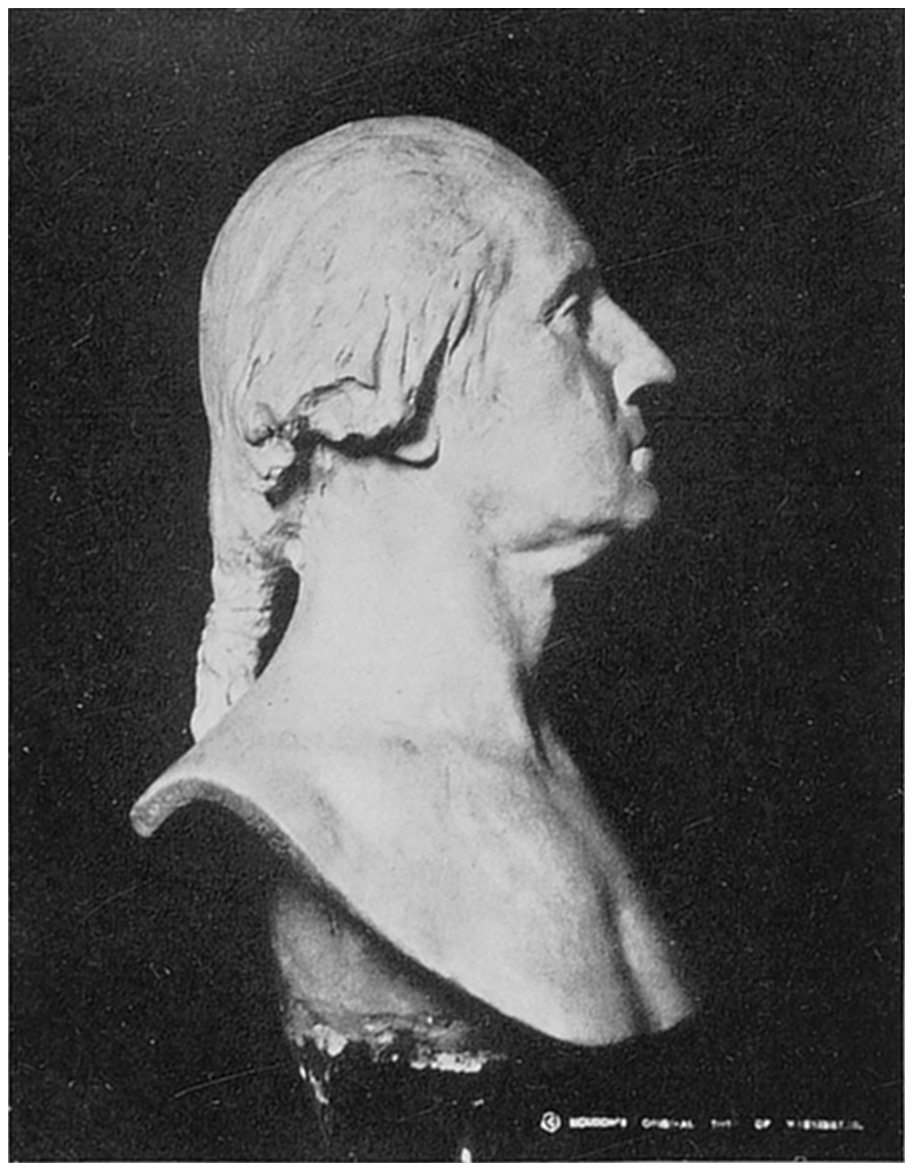
BUST OF WASHINGTON, AT MOUNT VERNON
BY JEAN ANTOINE HOUDON
CHAPTER II OUR BLITHE BEGINNING DAYS — I — II — III — IV
Alive and kicking; better than we
now realize, the old phrase fits our
young American art of the early nineteenth
century. In Boston, Mr. Bulfinch
is packing his triangles and T-squares
for a journey to Washington,
where he is to remain twelve years as
Latrobe’s successor as architect of the
Capitol. In New York, morning-star
young art-students are passionately
performing their historic ritual of
fighting the janitor and founding new
movements; even Colonel Trumbull
is defied; hence, in 1825, our National
Academy of Design. In Philadelphia,
harmony presides over the Pennsylvania
Academy of Fine Arts. But in
Washington, what commotion! Restorations
are to be made after the fires
of the British; there are new excavations,
new aspirations. There’s sculptor’s
work here for many a year.
Bronze doors must be created, in the
supposed manner of Ghiberti; pediments
must be populated; and what is
a dome without its colossal figure of
Freedom? Greenough and Crawford
and Randolph Rogers are the sculptors
of the hour. And always Hiram
Powers, somewhat apart from the
Washington bustle.
Modern imagination fails to see
those early craftsmen as they really
were. Because they are dead to us
now, we fall into the error of thinking
that they always were dead, anyway;
the stilly sort of sculpture they often
made sustains us in that illusion. But
when we look into their lives, and
hear their sayings, we learn, almost
with a shock, that these men felt deeply,
even while they expressed themselves
feebly in their art.
Living amidst heaped riches of opportunity,
the art-student of to-day
can scarcely imagine the bleak poverty
of artistic resource that Greenough
and Crawford and Powers left behind
them when they sailed away to Rome
or to Florence. Nowadays, art-schools
flourish here: casts of good sculpture
abound; photographs of masterpieces
may be had at a small price. Museums
freely show examples of the arts of
all nations, and intelligently arrange
these displays to serve the immediate
needs of students; in short, they do
a great work so well that they have already
become a target for so-called
criticism from self-styled intellectuals
exposing their wits in the columns of
would-be radical journals. Things
were very different in Greenough’s
time. There were indeed a few collections
of casts, probably with soiled
noses; there were portfolios of steel
engravings, that sometimes bore false
witness against beauty.
Knowing the leanness of those early
years, we can but wonder at the large
vision of our fathers in considering
our capital city; and we can but thank
our lucky Stars and Stripes for the
bond of sympathy between our young
Republic and France, a sympathy
partly responsible for the happy choice
of General Washington’s aid, Major
Pierre L’Enfant, as our first city
planner. The spirit of L’Enfant’s
work has survived the shocks of time
and senates; that plan of the year
1792 (since extended in accordance
with the principles of design it embodied)
is still regarded as “at once
the finest and most comprehensive plan
ever devised for a capital city.” Those
lean years were not by any means the
day of small things; it is to this hour a
blessing for sculpture and for architecture
that Washington and Jefferson
and L’Enfant laid large foundations
for the seat of Government. A century
ago, the continued building and
re-building of the Capitol expressed a
profound national feeling; the souls
of our sculptors, as far as we had
sculptors, were thrilled with desire to
add plastic beauty to its gates and
gables. At least one of those great
dreams was destined to end as food
for journalistic jibes. Greenough’s colossal
marble Washington as the Olympian
Zeus, a grandiose conception
pored over for seven years in Italy,
proved to be too large and heavy for
the indoor placing intended for it, and
it was doomed to be set up outside the
Capitol for the public to sharpen its
wits upon. Unfavorably shown, it is
unjustly viewed. One recalls with
pleasure Saint-Gaudens’s gentle judgments
of our pioneer sculptors and
their handiwork. “Those men were
greater than we know,” he would say.
He refused to join in any of our
modern merriment at the expense of
the Olympian Zeus. Esprit de corps
compelled him to recognize in Greenough
some large trace of the artist as
well as the craftsman.
Consider for a moment the attractive
young Irish-American sculptor
Crawford standing rapt before his
splendidly blank Senate pediment, with
his theme of the Past and Present of
the Republic in his eye. Those were
our blithe beginning days when a sculptor
might confront his pediment with
a heart unburdened by the remembrance
of other men’s failures in pediments,
and with a mind undisciplined
by any previous knowledge of the
needs of pediments. He did not dread
those bitter acuities of space at right
and left, those angles which to modern
discrimination often seem so grossly
overstuffed when filled, so tragically
vacant when left “to let.” He had
never heard of the “orchestration of
shadows,” or of “musical repetitions,”
or of “blonde modeling,” or of “keeping
the masses white,” or of “the creative
spiral,” or of “mastery through
the golden diagonal.” He had never
been adjured, like the young student
Saint-Gaudens, to “beware the boule
de suif”; on the other hand, he had
never been advised, with students coming
after Saint-Gaudens, to seek richness
of modeling by means of “fatty
ends.” Sculptural color he would
probably have regarded as having
something to do with paint. He of
course had his own patter, blown
abroad by the writers of a too prosaic
poetry and a too poetic prose. The
real writers, too, used to lend a hand in
presenting art to the public. When the
genius of Edward Everett sprang to
the rescue of Greenough’s Washington,
and when Hawthorne sent out
winged words about little Miss Hosmer’s
Zenobia, sculpture was receiving
from scholarship a needed sort of first
aid.
To return to the Capitol pediment,
Crawford’s intention and attitude
were quite uncomplicated. He had
but to snatch the largest theme in
sight, and to do his best with shaping
its figures one by one inside his triangle
of grandeur. The marvel is
that he came so near to success. The
thing has a kind of distinction from
the man’s singleness of aim. Since
then, scores of our sculptors from
coast to coast have solved the pediment
problem with varying success. Many
of them bring a highly personal and
interesting solution. Ward, Bartlett,
French, O’Connor, Bitter, Weinman,
the Piccirillis,—these names but begin
the list. The world calls us a wasteful
nation, a nation that unbuilds as
it builds. In the face of this, it is
pleasant to know that only a few
months ago, Mr. Bartlett’s handsome
Peace Protecting Genius has been set
up in the House pediment, to match
Crawford’s Past and Present of the
Republic at the Senate wing. Nearly
a century has elapsed since the Capitol
first busied itself with pedimental decorations.
Our sculpture has had time
to learn in these years.
Greenough came first in our line of
scholarly sculptors, that class to which
W. W. Story later lent great lustre.
A Latin inscription of five lines,
beginning “Simulacrum istud” and
ending “Horatius Greenough faciebat”
marks the huge Washington statue.
Well, if I rightly understand
this sculptor, I like his “faciebat.” It
seems more conscientious and less
cocksure than the “fecit” with which
our sculptors sometimes grace their
signatures, and it is certainly not so
gruff as the laconic “sc.” Between its
eight letters one reads the coming and
going of those seven diligent Italian
years; and we shall deceive ourselves
if we count those years wholly lost
for our American art. If only Greenough
could have enjoyed some of the
surplusage of admiration given to his
contemporary Powers for his Greek
Slave with her well-smoothed body,
her manacled Medicean hand, and the
accurately fringed mantle at her feet!
Though expressly advertised as a nude
figure, she is dressed from top to toe
in a most unfleshly hard-soft technique
which our time calls incompetent, but
which 1847 styled “the spiritualization
of the marble.” The personality of
the artist counted very largely in those
days; while Greenough was scholarly
and Crawford attractive, and while
Randolph Rogers with his bronze
doors and his Nydia was what would
now be called a good “go-getter,” Hiram
Powers was easily the main spellbinder
of the early group.
With the exception of Rodin’s Balzac
of fifty years later, no statue of
the nineteenth century has ever been
so famous as the Greek Slave. It is
one of the paradoxes of art that this
strangely ill-assorted pair go down the
corridors of that great age together,
united solely by the bond of greatest
fame. It is worth while to examine the
two, placed side by side in the museum
of our minds. Both are so well known
through prints and photographs that
many persons who have never really
seen either one face to face, now fancy
that they have studied both at close
range. Both are sculptural anecdotes;
one is told with a leisurely abundance
of detail, the other with a swift dash
for the climax. The Vermonter’s statue
is surely meant to be a conscientious
rendering “from the Nudo,” as
our grandparents phrased it, but the
Frenchman, in his passion to translate
into sculpture a force of literature,
has gone far beyond what was to him
a daily commonplace, the study of
flesh. As for the mere apparel of the
subject, one man has scheduled it to
the last stitch, while the other has piled
it up vehemently into a shapeless monolith
from which emerges the triumphant
head. Each sculptor doubtless
threw his whole soul into revealing
the spirit of the matter in hand. Which
of the two has succeeded? If the parallel
becomes deadly here, Mr. Powers
has brought it on himself by his extraordinary
fame in three countries.
Everything conspired for the celebrity
of the Slave,—her creation in Italy,
her fortunate début in England, her
travels to America, and, best of all,
that body of clergymen deputed to pass
upon her moral status. One can but
wonder whether every last one of these
took the matter seriously, or whether
some one of them winked at some other
during the deliberations. The sculptor
made a modest number of copies
of his masterpiece. But other sculptors
reproduced their marble visions
by the baker’s dozen, by the score.
In fact, only yesterday a venerable
eye-witness of those times reported
that a certain American sculptor disposed
of no less than two hundred
marble copies of a life-sized ideal figure.
Appalling iteration! One asks
where all the marble came from, and
whither it all went. And that sculptor
apparently had no idea that in this
business of the two hundred copies he
was showing himself two hundred
times as much salesman as artist.
Fashions alter, in ethics as in art. To-day,
such a practitioner would hardly
be persona grata in the National Sculpture
Society.
Meanwhile a young modern sculptor
at my elbow very civilly inquires, “But
why the devil didn’t those old boys
do their home stuff?” The obvious
answer would be, that if the home is
where the heart is, then in a very real
sense they did do their home stuff.
They were not at home among the
Vermont mountains, or by the Great
Lakes. They felt that their birthright
in art called them away from their
first birthplace to their second. Very
soon, too, the all-absorbing topic of
slavery will be presented by our sculptors,
in a different way and under a
more timely aspect. Long before
Thomas Ball places his Emancipation
groups in Washington and in Boston,
Ward has produced his Freedman,
and John Rogers the Slave Auction
that in 1860 heralds his long series
of popular groups. Choosing subjects
both classic and realistic, Miss Hosmer,
Miss Ream and other women sculptors
have a considerable vogue. From
that earlier period remain beautiful
classic works by Rinehart, founder of
the Rinehart scholarship which much
later send abroad Hermon MacNeil,
one of the most distinguished of our
modern sculptors, and now President
of our National Sculpture Society.
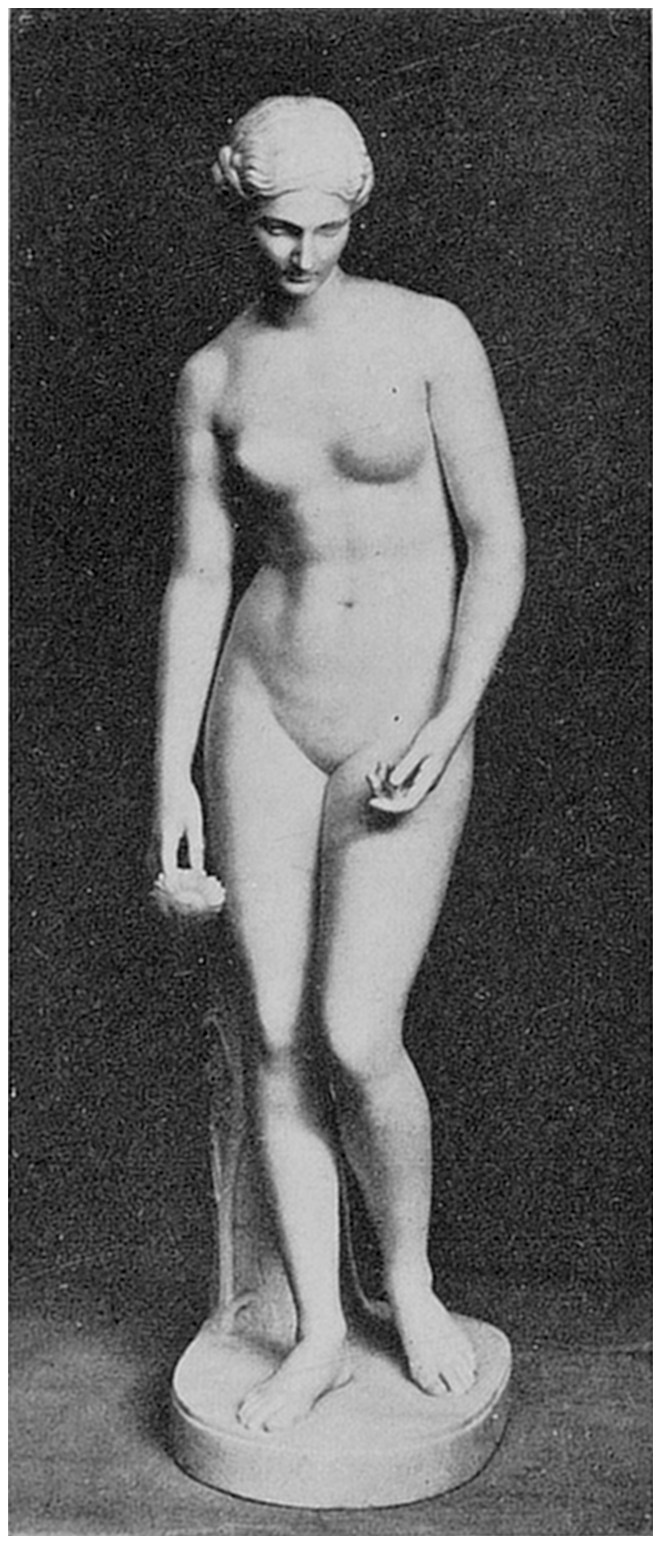
Rinehart’s Clytie, coming but a few
years after the Greek Slave, shows
a marked advance over her more
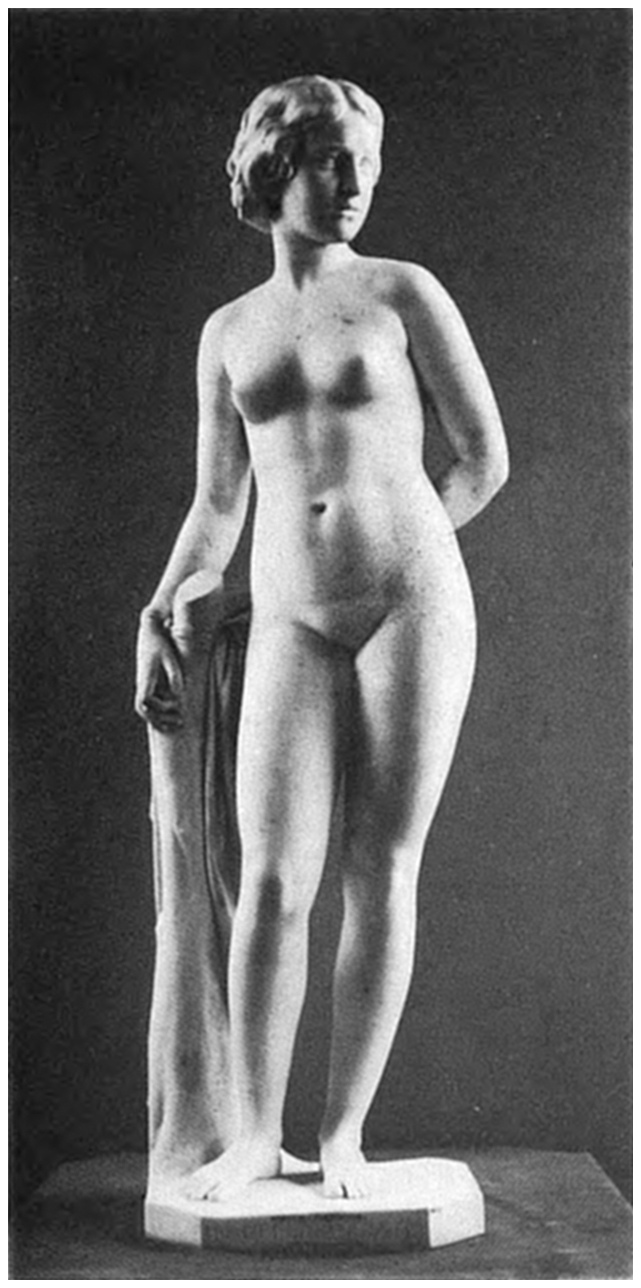
famous sister. And Erastus Palmer’s
winning White Captive, although not
new in theme, has a great freshness,
a delicate realism of treatment. To
quote from my article on the exhibition
of contemporary sculpture at
the Metropolitan Museum, “No less
interesting to the student of sculpture
is the kaleidoscopic juxtaposition
of Palmer and Manship, two artists
of two different generations.
Only the width of a room parts the
White Captive from the Girl with
Gazelles, from which we note that in
aim these men are not so different
as we once had dreamed.... As to
manner, much might be said besides
these two obvious truths; first, that
the newest manner is often the oldest,
or at least the longest forgotten at the
time of its resuscitation, it being a
thing which for some obscure human
reason or other ‘men want dug up
again’; and next, that the best manner
is that which scarcely shows as a
manner at all, but is taken for granted
as accompaniment of something more
important, the matter and the spirit.”
It would appear that the young men
of to-day are doing much the same
thing as “those old boys” my sculptor
friend speaks of: they are seeking
modern inspiration from ancient models,
but they are doing it with more
knowledge, more grace, more humor,
more assurance, more style. Style?
Perhaps the right word is stylization.
CLYTIE
BY WILLIAM H. RINEHART
WHITE CAPTIVE
BY ERASTUS D. PALMER
CHAPTER III OF THREE LEADERS, AND OF MORAL EARNESTNESS IN ART — I — II — III — IV JOHN QUINCY ADAMS WARD — V AUGUSTUS SAINT-GAUDENS — VI DANIEL CHESTER FRENCH — VII
Moral earnestness? I use both words
gladly, and without apology. Why
should any one fear that two words
so packed with meaning should breed
ennui?
A curious fact about our contemporary
criticism of art and literature is
this: that a criticism which constantly
declares itself to be courageous in all
ways, and which really has proved itself
to be courageous in many ways,
often scurries away affrighted the moment
it grazes the word moral. But
why? Does it fear the lash of epithets
such as Pharisee, Philistine, Victorian?
The sting has long ago gone out of
those hard names.
Over and over again, the critic will
aim some well-considered attack upon
a certain specified baseness that he perceives
and abhors in literature or in
art; and then, before he finishes his
good work, (and you can see from his
look that he believes it to be good
work) he suddenly decamps, with the
observation, “But this is not in the
least a question of morals; it is a question
of artistic taste.” Sometimes his
reader cannot help thinking, by contrast,
of that quick word of the old
Greek dramatist, protesting against
some of the lewd myths of his religion,
“Say not there be adulterers in heaven,
Nor prisoner gods and jailers:—long ago
My heart hath named it vile and shall not alter!”
If someone nowadays should speak
like that, might it not clear the air? I
mean, some valued critic of our arts
and letters. As it is, we of today leave
such work to the censor. And our
democracy, avid for class distinctions,
accounts the censor considerably lower
than the angels. The censor, poor
soul, might as well slink at once into
the society of the executioner, that
most dejected, most rejected figure in
history. When the censor says, in
his own way, “My heart hath named
it vile,” nobody pays much attention.
But the world might look up if some
urbane and trusted critic would write
with the moral earnestness of Euripides,
dodging nothing. Kenyon Cox
used to do so.
What I am driving at is this: Without
moral earnestness, (very probably
the French would call it seriousness)
art cannot prosper in a strange country,
under unnative sky. There would
be no foundation for laying the cornerstones
of art, let alone for building its
high-erected arches. It is a solemn
thought, is it not, that American sculptors
are today placing their creations
on soil that never before was moulded
into forms of vivid art such as the Old
World knew in the dawn of human
culture? For with due regard to our
ancient Aztec civilization from Zuñi
to Cuzco, our pre-historic New World
has nothing to show in any way comparable
with those free forms sketched
twenty thousand years ago on the
walls of the paleolithic caverns in
Southwestern Europe, in the very regions
where the nineteenth century
masters of sculpture were born. To
this day, American artists have all the
responsibility that comes with the beginnings
and transplantings of culture.
They are ancestors.
Euripides was creator rather than
critic. It may be that the moral earnestness
we need must come to us in a
thousand unseen ways through the reconciling
hands of creation, rather
than in one way through the tongue or
pen of the critic.
I shall not say that this quality of
moral earnestness is found everywhere
in American sculpture. But I know
that it is found in many places, and in
nearly all the high places. Moral
earnestness is the very foundation of
the only sort of artistic conscience
that amounts to much as a contribution
toward the higher life in art. It
was a strongly developed artistic conscience
that often impelled Shrady,
like Saint-Gaudens before him, to
break the letter of some lesser clause
of his contract, in order to keep faith
with the spirit of the whole. Consider
the moral earnestness of George Grey
Barnard, one of the few modern masters
of the imagination as it speaks in
stone. You will find that in Barnard
this earnestness is part and parcel of
the artist he now is; just as it was once
part and parcel of Barnard the young
student, devoting intense study to the
exacting yet large processes of the
marble cutter; and by marble cutter I
mean not the practitioner, the doomed
copyist, but the sort of marble cutter
that might call Michelangelo kinsman,
and be at ease on the Acropolis with
Pheidias and his men. And even if,
like myself, you cannot make Barnard’s
bronze presentment of Lincoln
square with your own thrice dear and
clear image of this great man, this
great symbol of American statesmanship,
you will grant that only a high
integrity of purpose in the matter
could have kept the sculptor steadfast
in the truth as he saw it. This fundamental
earnestness of Barnard’s adds
a distinction to his most casual or even
whimsical words concerning art. When
he talks to you about “the cheekbones
that make the pathos of a face,” a
dozen examples of what he means fill
your memory.
It is a very happy thing for our
sculpture that the three men who have
most definitely guided its destinies
through the past forty years,—Ward,
Saint-Gaudens, French,—are hailed as
men of moral force. And it is a special
cause for congratulation that Mr.
French, the youngest-born of the three,
still remains with us, still vigorous in
achievement. One expects moral
earnestness from Mr. French, a New
Englander of gracious ancestry, born
and bred in the very happiest circumstances
of New England life, and
growing up gaily in the light-and-shade
of Concord philosophy. One
expects it from Mr. Ward, with his
open-air Ohio boyhood of mingled
zests and rigors, and his later conscientious
acceptance of the public duties
laid upon any artist who happens also
to be an organizer, a “man’s man.”
And whether one expects it or not,
one finds it in rich measure in Saint-Gaudens.
This child of France, born
in Ireland, carries within him all the
days of his life the light of an American
conscience. Without a compelling
moral earnestness, he could never have
brought to completion, in face of unimaginable
difficulties, some of the
masterpieces on which his fame rests.
Every artist knows of the fourteen
years during which the Shaw monument
remained in his studio, never
long absent from his thought. Many
are familiar with the repeated trials
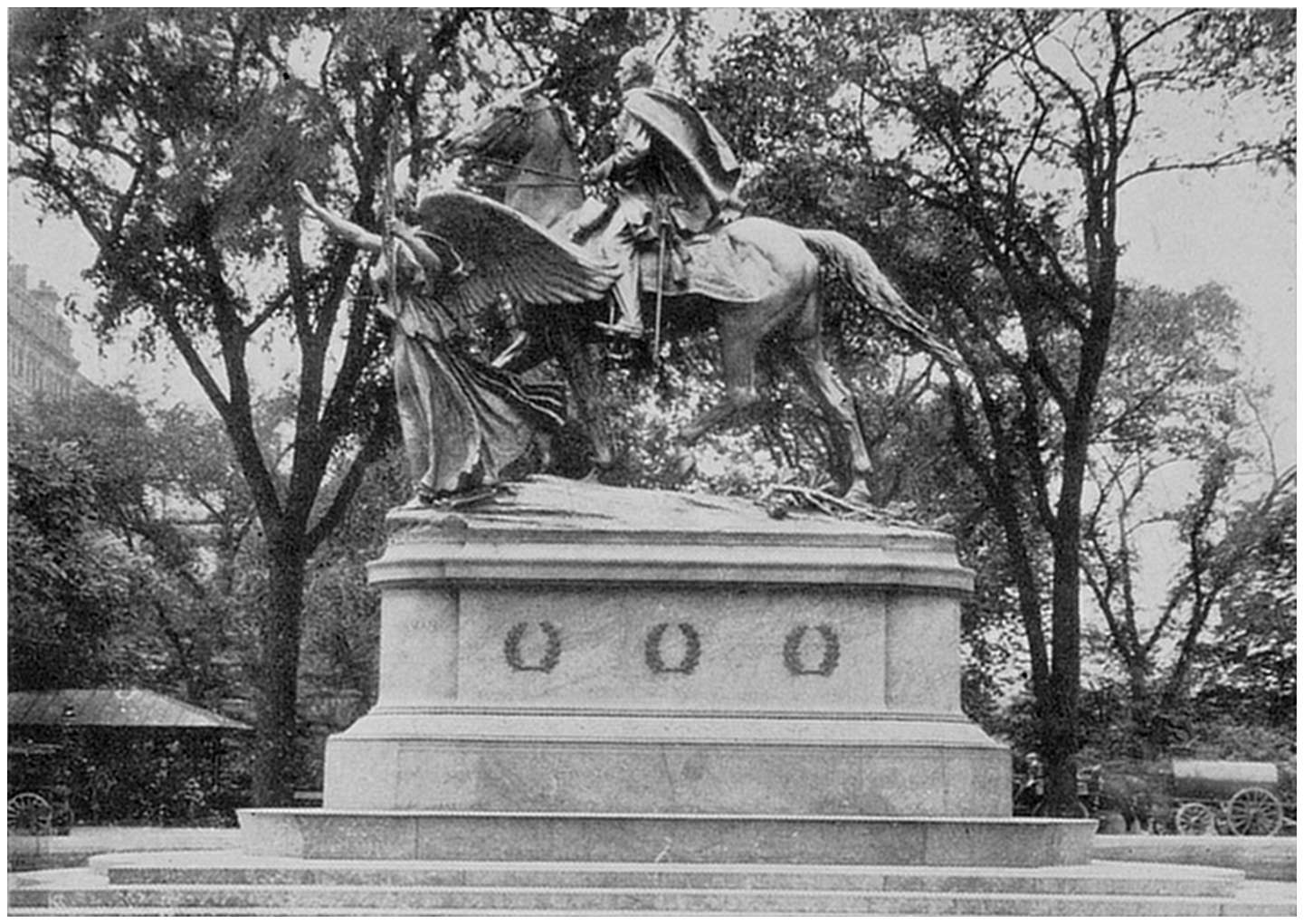
through which his vision of General
Sherman and the Angel of Victory-Peace
finally emerged triumphant. A
man once told his dentist of Saint-Gaudens,
of the Shaw monument, of
the fourteen years. “Well,” said the
dentist, twirling his little mahogany
stand of bright tools, in complacent
recollection of some of his own swifter
victories, “he couldn’t have been a very
smart artist, to take all that time.”
No, indeed, Saint-Gaudens was not a
very smart artist. The very smart
artist, one concludes, can flourish for
his day without a deep foundation of
moral earnestness. Saint-Gaudens was
simply the very great artist. With
Mr. Ward and Mr. French, he made
integrity and the artistic conscience
the only natural choice for scores of
young sculptors now influencing our
lives. What these three leaders have
thus contributed of moral beauty, of
needed moral earnestness to our society,
will never be measured. It is
too far-reaching and too deep-seated.
Most observers consider that a certain
superficiality mars American life. Although
we need not join those defeatists
who believe that this defect in
itself spells our ruin, we shall certainly
admit that the defect exists. All honor,
then, to the moral earnestness that
today, largely because of these three
leaders, is so much a part of the spirit
of American sculpture.
The sculptor’s work means far more
than staying in a studio and luring
visions into clay or stone or bronze.
His business isn’t altogether a wrestling
with angels. There’s a certain
amount of coping with committees;
and his visions are often none the
worse for the honest revisions that
other men may suggest. The sculptor’s
masterpiece must be able to resist
the spiritual wear-and-tear of the
marketplace of the world’s opinion. It
is no masterpiece unless it can in the
end do that. And if, as it stands, the
work is a silent influence against
superficiality and emptiness, something
is gained for American life. Glad
sculpture as well as grave sculpture
can exert that influence.
No one is as disdainful of the early
Victorians as the late Victorians used
to be. In the strength of the ’eighties
and ’nineties our studios often resounded
with mutterings against the
feebleness of the ’fifties. Perhaps
some envy of certain primitive successes
was mingled with this righteous
wrath. But after all, our Powerses
and Rogerses were not in the least the
mere early worms their successors
once said they were. A juster perspective
invites the reflection that American
sculpture in its development needed
the influence of the Greek Slave and
her thousand daughters as it has
needed that of the Rock Creek figure,
of the Lincoln Memorial, and of the
fire-new work beautifully presented
by our youngest group of sculptors.
Those marble shapes now dwelling
vaguely somewhere in the dark corridors
of relegation had once a thrilling
part to play. They were our ideals,
to be seen, prized and possessed in the
name of art. So, the old songs of
blame have long been out of date.
But they did good service in the days
when John Quincy Adams Ward, a
natural leader of men, turned a heroic
back on Europe as a place for the
American artist to live in. Go there
to study, but not to stay, was his word.
Vision, veracity, virility are the three
V’s that stamped his life and work.
Like his friend Howells, he was Ohio-born;
both men had boyhood aspirations
that carried them away from
their Middle-Border pioneer activities
into the more genial milieu to be found
among our Eastern salt-water cities.
Living from 1830 to 1910, and working
sixty years in his art, Ward has
rightly been called the Colossus that
bestrides the two separate worlds of
our former and latter periods in sculpture.
Though he founded no school,
his influence has been far-reaching.
His Beecher statue, flanked by its two
lyrical groups, his Garfield monument
with its attendant epic groups of War
and Peace, his noble equestrian figure
of General Thomas are among a host
of sterling works that prove him the
“all round” sculptor. In his youth,
he played a well-known and highly
practical part in the making of Brown’s
equestrian statue of Washington, one
of the best-praised and worst-placed
monuments in the city of New York.
Since the praise is deserved, the placing
discredits us far more than it does
the heroic artists who carried the work
to completion. All sculptors who succeed
in their equestrian statues are
heroic; even if they are not heroes
when they begin such enterprises they
achieve heroism before they finish
them. And if that is true to-day, with
our more highly organized methods
both of the sculptor’s art and of the
bronze-founder’s science, what must it
have been in 1856, when Brown’s
Washington, our second equestrian
statue, first saw the light? In later
life, Ward sometimes spoke in whimsical
recollection of industrious apprentice
days that he, a luckier type
of Jonah, spent within the belly of
the horse cast in bronze by French
workmen assisting Brown.
Ward had in his nature and in his
art the great elements of the precursor.
He represents not only the pioneer
in American sculpture, but in no small
measure and sometimes in a singular
way, the prophet. Witness the dog
with scalloped mane in his admirable
group of the Indian Hunter, a work
that much impressed the youthful
Saint-Gaudens, fresh from years of
study among European masters and
masterpieces. Here we have a fore-taste
of that delightful treatment of
animal form found in the bronzes of
the young men from the American
Academy in Rome. To be sure, Ward’s
dog does not seem to spring forward
full-armed in a beautifully conventionalized
linear panoply of bone and
muscle resurrected from some newly
revealed Klazomenian sarcophagus; he
is not quite so Cretanly curled as some
of the appealing animal figures of to-day,
but ’tis enough, ’t will serve. And
the whole group, as seen happily
placed in Central Park, reveals the
naturalism in which Ward envelops
his own peculiar kind of classicism.
For a nobler instance of Ward’s forward-looking
quality, choose the
bronze Washington standing on the
steps of the Sub-Treasury in New
York, in the very heart of all our
heart-breaking yet inspiring financial
traffic. That statue is not merely a
portrait of Washington, but a symbolic
expression of early American
greatness in leadership.
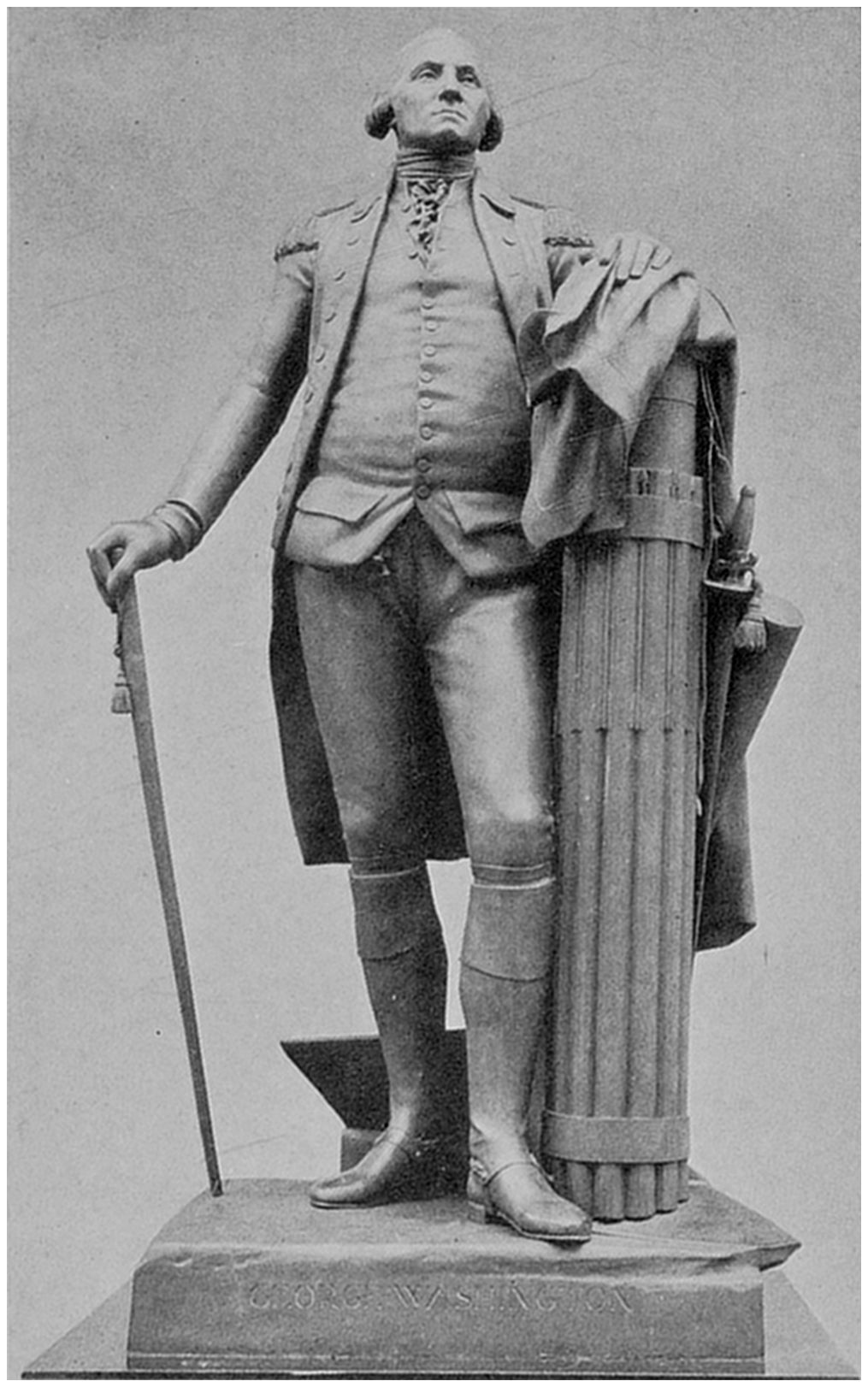
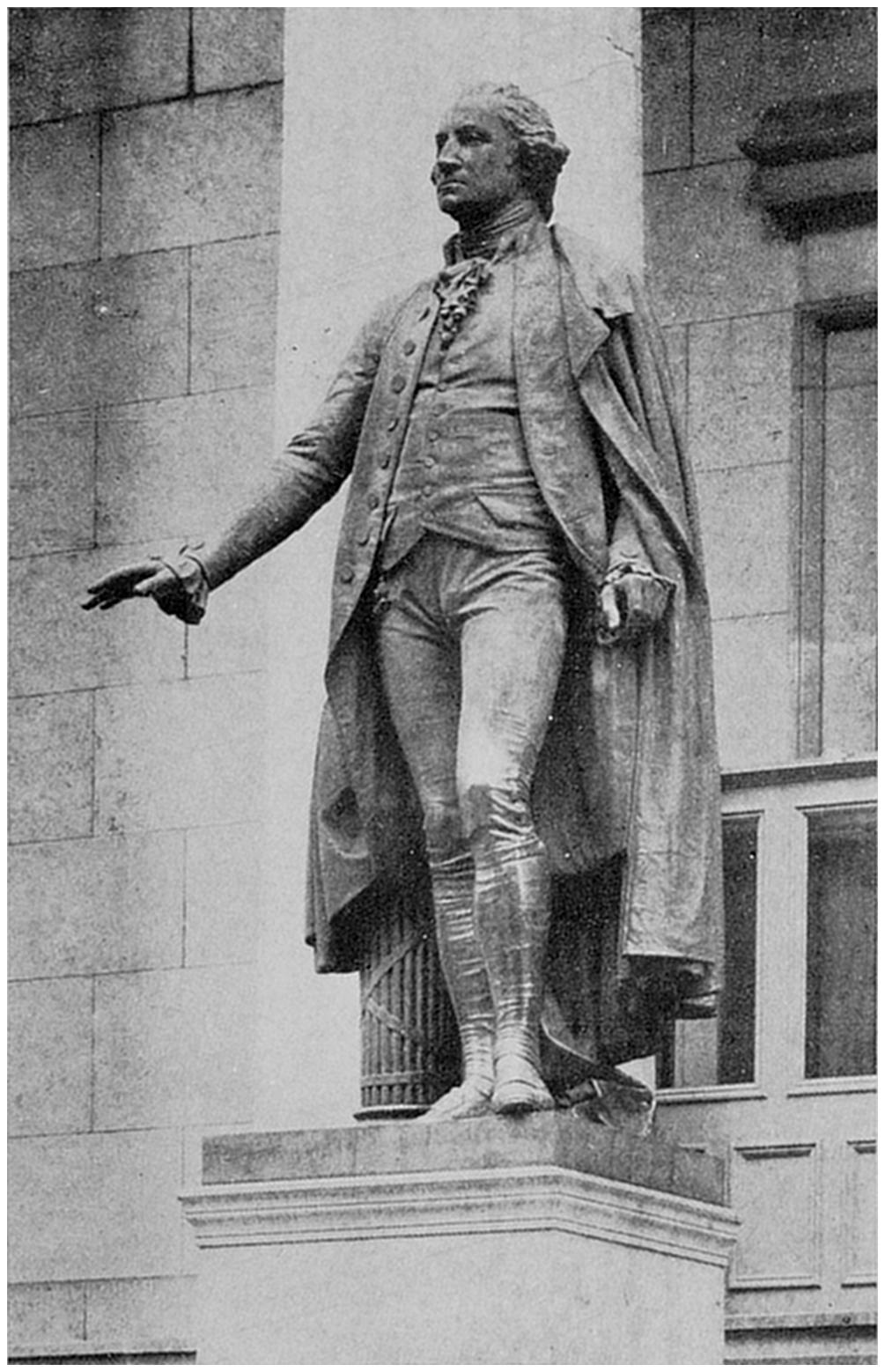
STATUE OF WASHINGTON
BY JOHN QUINCY ADAMS WARD
A comparison between the Ward
Washington and the Houdon Washington
is permitted here; Houdon’s position
as a commanding figure among the
sculptors of all time is too securely
based on his incomparable busts and
on his Voltaire at the Comédie-Française
to be in the least disturbed by
any of our observations. Remembering
that Ward’s task was naturally less
difficult than Houdon’s, we shall do
no injustice to our earliest foreign
master in sculpture when we remark
that Ward’s Washington, rather than
Houdon’s, bears away the palm for
the larger monumental qualities of design.
The great Frenchman’s work
is cumbered from the waist down with
naturalistic emblems from field and
forum. Neither ploughshare nor fasces
nor cane nor sword nor cloak are
omitted. Their insistence is of course
redeemed in general by Houdon’s general
mastery, and in particular by his
particular prowess in rendering the
head; it is Houdon’s glory that in
some inexplicable way his hand makes
every face it touches come alive.
Ward’s statue, appearing almost a century
later, owes something to Houdon;
every portrait statue of Washington,
if worth much, will owe something to
Houdon. But what we would especially
note is, that in this virile presentment
of Washington, Ward has
chosen the better part of both realism
and classicism; The work has something
of the serenity of synthesis and
elimination of detail that we love in
the Parthenon masterpieces, yet it has
enough of modern individualism and
modern insistence upon expression and
emotion to satisfy the longings of the
everyday American spectator.
Our reference to the super-symbolism
in Houdon’s Washington (a flaw
partly explained, it may be, by the inexorable
demands of our forefathers
as well as of practical marble-cutting)
leads us to the observation that to-day,
taken by and large, French monumental
art suffers enormously from emblematic
excrescences. What scales
of justice and of mermaids, what pinions
of angels and eagles and doves,
what garlands and garters and gaiters,
what palettes and portfolios, what
seines and scrolls and T-squares have
been gathered together in the French
marketplaces as candidates for immortality!
And what complication of
silhouette, what lack of massing in
light and shade, have resulted thereby!
This paradox of the over-explained
wrongs the clear French mind, the intuitive
French eye. How is it in our
own country? But I studiously avoid
breathing any word here of any lesson
for our own sculptors. It is enough
to point out that a healthy, if high-strung,
revolt against all this easy offhand
grab-bag naturalistic symbolism
will not only bring in its train the
sculpture of serious protest; it will also
pick up on its fringes plenty of
those tongue-in-cheek specimens of
so-called sculpture familiar in our century.
From Rodin’s candle-lit and
blanketed Balzac of the previous generation
down to the latest Greenwich
Village absurdity, in which human portraiture
once more achieves its apotheosis
on the surface of an egg, such
revolt is visible. It is of course a revolt
against many things besides an
overdone symbolism; but the symbolism
may well serve as a symbol for the
rest. All honor then to the austerity
of Ward’s Washington.
As Ward in his youth worked for an
older man, so he himself in his later
years had the good fortune to meet
the newer ideals in his art through
collaboration with younger sculptors.
Mr. Bartlett’s sympathetic assistance is
apparent in the Stock Exchange pediment,
and in the equestrian statue of
General Hancock, for Fairmount Park.
This last was the work that engaged
Ward’s thought to the very day of his
death. But nowhere shall we study
Ward better than in the statue of
Washington. Here we see this sculptor
as he himself would wish to be
seen; a sculptor of mankind at its most
heroic, for mankind at its daily average.
“Our work,” he often said, “must
touch the ordinary human heart.” His
rugged, straightforward genius was not
suited for revealing the more exquisite
aspects of beauty, the more whimsical
secrets of the soul. Never fear; later
sculptors, both men and women, will
fully attend to those things. In the
words of Ward’s historic observation
to the Farragut statue committee,
“Give the younger man the chance!”
Born eighteen years after Ward,
and dying while Ward still had three
years of strenuous work before him,
Augustus Saint-Gaudens lives in our
annals as the most illustrious figure in
American art. Both the Old World
and the New see it so.
Brought to this country at the age
of six months, the Dublin-born child
of a French father and an Irish mother,
he soon became more American
than the Americans themselves. We
see him first as the typical New York
sidewalk boy, learning not much in
school, but far more from eager contacts
in the city boy’s world of home,
parents, streets, policemen, processions;
the atmosphere of the Civil War stirs
his young blood, and will long afterward
quicken his sculpture of our
Civil War heroes. At fourteen he is
by day a cameo-cutter’s apprentice,
by night a rapt student of drawing at
Cooper Institute. At nineteen, with
a hundred dollars and his father’s
blessing, he sails abroad for his first
three years of foreign study and travel;
in Paris and Rome he learns and
earns; he has a stout heart, a lean
purse, and an undying passion for his
art. His return to New York with a
few small commissions picked up, as
the custom then was, from American
travellers sojourning in Rome; his
second stay abroad; his early struggles
to obtain a footing; his marriage and
subsequent three years in Paris while
creating the Farragut; his ardent
friendship with Stanford White, John
La Farge, and other strong personalities
of the day;—surely all this seems
quite the usual story. But Saint-Gaudens
had always his own innermost
unusualness that somehow placed him
above his fellows; and the victorious
completion of the Farragut in 1881
was but the first of a long line of signal
triumphs. And even his almost
forgotten triumphs (for example, the
great improvement in our coinage initiated
by his endeavor) are signal triumphs.
There was no branch of his
art in which he did not excel; it was
an art designed in general for the
flowingness of bronze rather than for
reproduction within the confines of
the marble block.
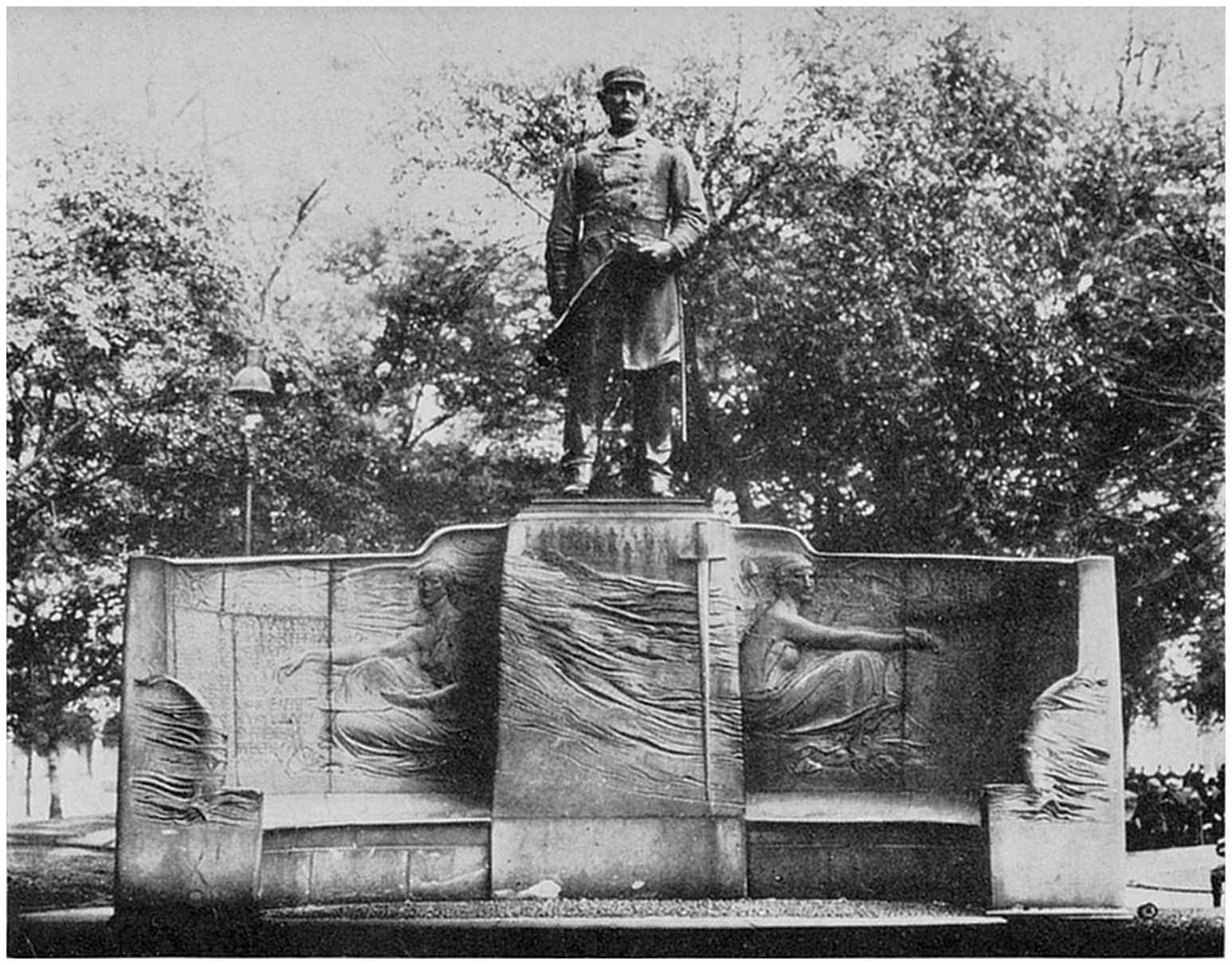
STATUE OF ADMIRAL FARRAGUT
BY AUGUSTUS SAINT-GAUDENS
Too often versatility connotes a superficiality
of mind, an easily satisfied
outlook. Not so with Saint-Gaudens.
He was if anything over-critical of
his work; for instance, he never forgot
that the snare of the picturesque was
in his path, as it is in the path of every
sculptor trying to infuse a genial
human warmth into the sculptural order.
His knowledge in the lesser art
of cameo-cutting, a knowledge which
in some sculptors would have been
swept aside as detrimental to a spacious
style, helped rather than hindered
him in his advance toward his ultimate
mastery over relief of all kinds,—the
coin, the intimate portrait medallion,
the heroic monumental relief.
He may be truly said to have invented
that charming form of bas-relief likeness
shown in the portraits of the
Schiff children, the Butler children,
Bastien-Lepage, Violet Sargent, and
many others. Nothing quite like
these works had ever before been produced,
either in the French medalists’
fertile art of the nineteenth century
or in that still richer period of the
Italian Renaissance medal, heralded
by Pisano. And yet, since little in the
field of art is utterly original, we are
reminded here of that old saying
about the power of the man meeting
the power of the moment. In beautiful
angel-figures such as the Amor-Caritas
in high relief, Saint-Gaudens
realized and expressed the spiritual
meanings of other artists of his time,
both sculptors and painters; this we
see when we study French’s noble
Angel of Death, and the Burne-Jones
figures on their golden stair.
Critics are divided, not as to the
greatness of Saint-Gaudens, but as
to the work which best stores up within
itself the true elements of his greatness.
Those who have seen tears start
from the eyelids of gray veterans
standing before the Shaw Memorial
will perhaps say the Shaw, while those
who perceive with delight all that the
sculptor has attained in the Sherman
equestrian group, with its thrilling
harmony of spiritual and realistic presentation,
will perhaps say the Sherman.
Londoners and Chicagoans will
rest content in their great possession
of the standing Lincoln. Others again
will find their truest vision of this artist’s
power in the enfolded mystery
of the Rock Creek figure, sometimes
called Nirvana, but better named the
Peace of God. And if (as I think)
this is indeed his consummate, his
culminating work, how strange that it
is, in a sense, a somewhat unexpected,
uncharacteristic work! In its profound
other-worldliness, it seems as
withdrawn from the Sherman and the
Puritan and the Farragut as from those
happy portrait-reliefs of living beings
in their loveliness or strength. How
often artists have mused on the beauty
of the head of this figure! Every
trace of artistic knowingness is eliminated
here; nothing so vain and petty
as any suggestion of accomplished technique
intrudes. The beholder’s attention
is directed solely toward whatever
inner meaning he finds in those
shadowed lineaments.
Saint-Gaudens had the power of
attracting to his service young men
and women of true artistic ability.
MacMonnies, Flanagan, Fraser, Weinman,
Martiny, Proctor, Hering, Miss
Grimes, Miss Ward,—all of these have
won distinction in their own personal
work in sculpture; some among them
are now past masters. But a higher
power than that of winning the enthusiastic
loyalty of youth belonged to
Saint-Gaudens. He had also the gift
of drawing from each worker something
finer and more precious than
anything that this worker had ever
before possessed. He compelled his
assistants to build better than they
knew. It is part of this sculptor’s
glory that no one can ever mistake the
subsequent work of his “arrived”
pupils, even the most famous of these,
for the work of Saint-Gaudens. In
anonymous service to him, they best
perfected themselves as individual artists.
How I wish I might make myself
clear when touching this vexed subject
of apprenticeship! The romantic part
of the world dwelling far from the
realities of studio life loves to picture
a pathetic situation of gifted youth
silently wasting its genius in saving
the day for the commonplace performances
of a middle-aged employer. But
this poetic view squares with cinema
ideals rather than with the facts. At
a recent exhibition of weird works
by the immature young sculptor X,
(such shows at times add to the gayety
of New York) I heard an ardent lady
worshipper of something she called
“the new spirit of expressionism,” denounce
the greed and vanity of the
middle-aged sculptor Y, basely employing
the bright unrecognized wings of
X, to give fire and movement to the
pedestrian Y inventions. Ah, if that
lady only knew the truth about X and
Y! But it was closing-time, and I
made no attempt to tell her the truth;
it would have seemed rather gray and
commonplace compared with her own
glamorous moving-picturization of
studio life. All her thought was of
heroism and oppression, not of work
and wages. Yet I might at least have
given her this one helpful fact; that
almost without exception, the successful
sculptors of to-day look back with
gratitude toward the multitudinous activities
of their young apprenticeships;
sometimes they even feel a secret
amazement that their former masters
should have put up with them so long.
Last summer, revisiting Concord
after many years, I crossed “the rude
bridge that arched the flood,” and
found Mr. French’s Minute Man, embattled
still, though embowered in
quietness, and made safe from the
ruder motor traffic of the day. It
seemed incredible that a youth of
twenty-three, with no models except
the Apollo Belvidere and himself,
and with no instruction beyond that
derived from a month in Ward’s
studio and from Dr. Rimmer’s anatomy
lectures, could have produced
a statue so competent and so sculptural
as this. Then I remembered that in
1919 the most proudly acclaimed work
of American art for the year was Mr.
French’s marble figure of Memory;
and it was interesting to note that the
Minute Man, however immediately
convincing in general appeal, appeared
in a sense as the work of an artist older
than the sculptor of the Memory. For
the Minute Man has here and there a
lean gravity of modeling that we rightly
or wrongly associate with passing
maturity, while the forms of the Memory
are rich and commanding, yet enveloped
with that serenity for which
we have no better word than classic.
And what is the true meaning of classic,
except as it describes that which
is fresh and vivid to-day, yet has the
underlying force of permanence, the
very tide of immortality flowing in its
veins? Many of our artists acquire
the classic spirit, many have it thrust
upon them, some reject it utterly. But
Mr. French is the classic spirit personified
among us; born so, not made
so; and what he creates is illumined
by his understanding of the dignity
of the human soul, and by his belief
that beauty and truth are acceptable
to the human mind. This gracious
seated figure of Memory, gazing
calmly into the glass that reflects, not
her own person but the shapes of the
past, is admirably composed from every
point of view and within the natural
limits of the marble. A critic has
written of it as “showing at its best
Mr. French’s idealism, and being at
the same time a masterly study of the
nude, true to the nobler forms of
nature, yet with a skillful avoidance
of what is commonly known as realism.”
That phrase “true to the nobler
forms of nature” well describes this
sculptor’s great ideal figures. Mr.
French is to-day the dean of American
sculpture, the honorary President of
the National Sculpture Society; a presence
with all the gracious authority
conferred by deanship, and with nothing
whatever of the dry ancientry at
times associated with that honor.
There is something of the unexpected
in the course of every great artist.
With Ward it is one thing, with Saint-Gaudens
another. With Daniel Chester
French, born in Exeter, New
Hampshire, in 1850, the unexpected
thing is that in his art education he
seems somehow to have skipped the
slow Preamble and the voluminous
Whereas, and to have reached almost
at a bound the precincts of the Resolved.
Concord has never lacked favorite
sons, and young Daniel among
the lions of that town of his later boyhood
felt only their appreciation and
encouragement. But with one year in
Florence, spent largely under the genial
influence of Thomas Ball, sculptor
of the first equestrian monument
placed in New England, his so-called
study-period ends. A pediment for
the St. Louis Custom House awaits
him in 1877; within the next few
years he executes similar architectural
sculpture for Philadelphia and Boston.
In 1879 he models from life his beautiful
portrait bust of Emerson.
MEMORY
BY DANIEL CHESTER FRENCH
Surely we cannot say that his art
education was finished before these
things were attempted. It progressed
with them, and with those other creations,
more idealistic in type, in which
his imagination had fuller play. When
in 1888 he went to Paris to make the
model for his marble statue of General
Cass of Michigan, he went as a master,
yet as a seeker; one well prepared to
gain without groping all that was worth
while in the influence of the time and
place. Five years later, at the Columbian
Exposition, his genius makes an
extraordinary appeal to his fellow-countrymen
in two imposing works,
the Republic and the consoling Angel
of Death. These of course differ widely
in their inspiration and in the emotion
they arouse, but they are equally
eloquent. The Gallaudet group, placed
in Washington in 1889, had already
spoken its message to the human
heart. An inner radiance of the spirit
shines from that very solidly and
beautifully composed group of the
great teacher and the little deaf-mute;
nowhere else in sculpture have we
found so adequate and touching an
expression of the fatherliness that
should animate those who teach, and
of the trust of those who must needs
learn or be lost. Who would have
guessed that sculpture could have
found out this way of saying Faith,
Hope, and Charity? And beneath all
that captivates the general public, how
much there is in the Angel, the Republic,
and the Gallaudet that remains of
special interest to artists, because of
the individual mastery of a special
problem! In collaboration with Mr.
Potter, the accomplished master of
animal sculpture, Mr. French has created
some of our most notable equestrian
statues; the General Grant and
the General Meade for Philadelphia,
the General Washington, presented to
France by an association of American
women, the General Hooker for Boston.
Other works of high import are the
majestic Alma Mater at Columbia University,
the bronze doors in delicately
shadowed relief for the Boston Public
Library, the colossal seated bronze
figure of Lincoln enshrined within the
Lincoln Memorial at Washington.
Once again let it be said, a man’s
work shows his mind. What Mr.
French’s art has given to our country
is something greatly needed here to-day,
that quality which for lack of a
better name we call urbanity. There
ought to be a higher word for this
gift, but Matthew Arnold had to put
up with the term, and so must I. The
harried dweller in our American urbs
is often far from urbane, more’s the
pity. But the urbanity we need now,
in our arts, our letters, our life, is
something that goes deeper than courtesy;
it is something that is allied to the
spirit of Amor-Caritas seen not only
in the Saint-Gaudens angel of that
name, but also in Mr. French’s Alma
Mater, and in his Angel of Death.
Even in the gesture of the Republic’s
arms, and in the very folds of her garments,
there is a reminder of that large
charitable humanist urbanity all nations
need when trying to know themselves
and each other. Mr. French
is the humanist among our American
sculptors. But he is empathically not
of that type of humanist darkly described
by Professor Kallen as living
“beside life, not in it.” His position
among our sculptors is more than
honorary; it is that of the generous
co-worker and helper, especially sympathetic
toward youth and its aspirations.
What Mr. French does seems
effortless, but beneath that apparent
ease is a profound knowledge of all
the armature, both mechanical and intellectual,
that holds the sculptor’s art
in true poise and balance. Work from
his hands may be the monumental or
the exquisite; it is imagined simply
and naturally, as if this artist knew
no other way than the beautiful way.
How deeply our democracy needs the
best he has to give!
Our twentieth century admits that
the latter years of the nineteenth century
were spacious years in our sculpture,
and that there are as yet no
leaders who overtop these three. With
these will always be associated, in the
minds of those who know things as
they are, that distinguished artist Olin
Warner, whose death cut short a career
splendidly ready for its zenith.
For some unknown reason, his work
has missed something of its due praise
among us; time will perhaps readjust
this. The delightful caryatids of his
fountain at Portland, Oregon, are indeed
greatly prized; his portrait statues
are truly sculptural in their ensemble,
and fine in their characterization;
and with the passing of years, his
spirited yet beautifully classic portrait
busts of Alden Weir, of Cottier, and
of Maud Morgan gain rather than lose
in the esteem of the student.
A much later leader, also lost before
winning the heights to which he aspired,
was Karl Bitter, that sensitive,
swift-minded, deft-handed sculptor
whose ardent intellectual curiosity kept
him still the seeker for newer and more
vital ways of sculptural expression.
His tragic death was not unlike Warner’s;
Warner was thrown from his
bicycle in Central Park, Bitter was
struck down by an automobile in front
of the Opera House. Both men were
of those êtres d’ élite that Art needs
as her interpreters. But what a contrast
in their lives, their characters,
their sculptural interpretations! Warner
was of the highest type of New
Englander of Puritan descent, a courageous
worshipper of beauty, and at
his best in revealing beauty in classic
guise; he has been called the Pilgrim
homesick for Hellas; Bitter was of
the highest type of the foreign-born,
a Viennese eagerly assuming the duties
of American citizenship. A gallant
figure, already before his coming
among us he was imbued with various
Old World ideals in art, many of
which he afterward rejected as flamboyant,
frivolous. No sculptor of our
time has made a swifter and steadier
advance in sculptural power throughout
a busy and varied career. Warner
and Bitter; the deep-minded and the
quick-minded; the spirit of American
sculpture needed both these men, and
felt their loss.
CHAPTER IV OF EXPOSITIONS AND COLLABORATIONS — I — II — III — IV
An unpublished satiric drawing of
the ’eighties shows a family of American
tourists in the Louvre. They contemplate
the Melian Venus. With one
exception, they are dumb with awe.
The exception is Aunt Maria, the masterful
old lady in the foreground.
Aunt Maria has seen men and cities,
but she doesn’t know as there’s much
that can beat South Bend. So
“Aunt Maria gazes with distrust
Upon the goddess in her bloom perennial.
‘Talk about art,—you should have seen the bust,
The butter bust we had at our Centennial.’”
The Sleeping Iolanthe in butter!
In 1876, her name melted in the
American mouth. Though barred
from the Fine Arts section, she was
believed by many to express the spirit
of American art. Shamed by her
popularity, certain sensitive American
artists did not quite recover a jubilant
tone until, long years afterward, a
full-sized Melian Venus in chocolate
contributed to the gayety of the greatest
of French expositions. After that,
the butter bust incident weighed less
heavily on thoughtful minds.
Just before our Centennial exposition,
the scholarly John Fiske, admitting
that “the classical picture and
the undraped statue” have “a high place
in our esteem,” ruefully adds that “it
will probably be some time before
genuine art ceases to be an exotic
among us, and becomes a plant of unhindered
native growth.” The Centennial
showed us the truth of just
that. The Centennial was a glory, and
a profound disturbance. To our sculpture,
this disturbance was its great
gain. For the first time, the American
sculptor saw his work side by side
with that of Europeans. He was dismayed.
He had had his doubts, his
forebodings. He now perceived for
a certainty that in spite of half a century
spent in the pursuit of all the best
that Italian pseudo-classicism could offer,
our apprentice days in sculpture,
far from being well over, were scarcely
begun. Perhaps a fresh start was
needed. At a time when Munich, as
well as Paris, was calling to the young
painter, Paris, rather than Rome or
Florence, beckoned to the sculptor.
New forces were abroad in art, and
American sculpture of the next generation
profited eagerly from the vigorous
new French school.
The lesson taught by the Columbian
exposition of 1893 was just as important
as that learned from the Centennial,
though far less sobering. A
holiday spirit, not without dignity,
spoke from those pleasure-domes and
lagoons and abounding sculptural
forms of the White City. The progress
made by our art during seventeen
years packed with artistic adventure
and endeavor was blown abroad in
triumph. On the whole, we were justified
in our joy. As the Centennial by
its dismaying jolt had enlarged the
outlook of our artists, so the Columbian,
by its varied harmonies, liberated
the imagination of the public, of
the art-lover. To a marked extent, it
created anew the art-lover, a personage
already made possible by the prosperity
following the conclusion of the Civil
War. In the World’s Fair of 1893,
the apparently inexhaustible advantages
of a sympathetic collaboration between
architect, painter, sculptor, and
landscape architect were for the first
time sketched out large for the American
vision. Our many succeeding expositions
have of course emphasized
and amplified the suggestions so gallantly
given and so eagerly noted in
1893. Not that our whole broad land
is to-day the dwelling-place of beauty.
Far from it. Great reaches of time
and great strivings of the spirit must
match our great stretches of space before
art is everywhere at home here.
And collaboration at its best is jointly
and severally a striving of the spirit.
In 1825, when Charles Bulfinch,
then architect of the Capitol, receives
an inquiry “respecting the ornaments
wanted for the pediment of the Capitol,”
and writes in answer that “the
object of advertising was to obtain
designs in various styles, from which
to select one,” an ardent collaboration
between sculptor and architect was
clearly not the order of the day. The
hard fate of Greenough’s Olympian
Washington, dragged in 1843 from
inner shrine to outdoor platform, shows
that in almost twenty years conditions
had not changed. For a long
time after that, a work of sculpture
was seldom considered, during its creation,
with special reference to its
destined surroundings. Artist and
public satisfied themselves with the
bland half-truth that a good thing
looks well anywhere. There were of
course vague gestures of collaboration
when the first statues were placed in
Central Park; and in the good fellowship
existing between students of the
different arts in the few schools we
had here as well as in the foreign
schools there was a basis for later harmonious
co-operation. But the Saint-Gaudens
Farragut, unveiled in 1881,
and showing in detail and ensemble the
results of an extraordinarily happy
and sympathetic collaboration, roused
the minds of all artists. And twelve
years afterward, the intelligent public
was fully ready to appreciate the happy
collaborations it saw on every hand
at the Fair.
Expositions bring in their train certain
evils. Is superficiality one of
these? In theory, sculptural work for
exposition buildings and approaches
and vistas must often stress too much
the gala-day aspect of life; it must
sound the hurrah at any cost; the note
is gayety and triumph; let no other
chord intrude. So much for theory.
As a matter of fact, the making of
red-letter-day sculpture injures only
those sculptors who are already too
much enamoured of the “façade and
froth” side of human achievement.
Nothing could be more serious in
matter or in manner than was Mr.
French’s stately Republic, a dominant
note of the plan of the Columbian Exposition.
And no work was more
thoroughly appreciated. Some of the
very gayest of our exposition sculptures
owe their vitality to the very
serious studies and the very solid mastery
of the artists who have produced
them. There was wide-spread regret
because the MacMonnies Fountain,
that thing of joy for the exposition
of 1893, could not sprinkle its
dews permanently for our refreshment.
And in our later expositions,
there have always been temporary
works achieved with bravura by the
artist, enjoyed without reservation by
the public, and (often with a real sadness
of farewell) consigned to oblivion
by the powers. The story of the
Fair of 1893, the exemplar, one might
say, for subsequent celebrations, has
been exceedingly well told by Mr.
Charles Moore, in his recently published
Life of Daniel Burnham. Nowhere
else will one find so true and inspiring
a picture of our American
architects, painters, sculptors, and
landscape gardeners working together
in exalted collaboration. Those men
set a great standard and a great stride
for artists of the present century. To
quote from Mr. Moore’s book a paragraph
concerning the sculptors:
“Marshalled by Augustus Saint-Gaudens,
the sculptors for the first
time in America took their rightful
place in co-operation with the architects.
And what a troop they were.
There was Daniel French, embodying
the spirit of permanence and clear-sightedness
in the serene figure of the
Republic that graciously presided over
the Court of Honor; and again, in
conjunction with Edward Potter, manifesting
sustained ability in the quadriga
surmounting the Peristyle; Frederick
MacMonnies, giving vent to the
exuberance of America in the joyous
fountain that lent gayety to the great
central motive of the Fair; Olin Warner,
whose early death lost to the
country an artist on the way to the
heights; Paul Bartlett, then a promise
which opportunity has fulfilled; Edwin
Kemeys, with his animal sculpture
that came to attract all the money Theodore
Roosevelt could spare for art;
and Louis Saint-Gaudens, wanting
only the intellectual element to put him
in the same class with his brother;
and Karl Bitter, capable and conscientious,
whose accidental death brought
grief to a host of admirers; and Lorado
Taft, who has put the ethereal,
haunting spirit of the Great Lakes into
his Chicago fountain; Larkin Mead,
sculptor of the old school; Phimister
Proctor, lover of American animals;
besides Bela Pratt, Rohl-Smith, Bush-Brown,
Rideout, Boyle, Waagen,
Bauer, Martiny, Blenkenship, and the
satisfactory Partridge.”
Later Fairs have but exemplified
what was well suggested by the White
City. The Exposition at San Francisco,
most recent of all, and taking
place in bright evanescence while Europe
was already in the bitter throes
of the World War, brought forward,
under the vigorous direction of Mr.
Calder, sculptor of the Pioneer Mother
and of the Triumph of Energy, much
that was stimulating and fresh in our
sculpture, even though none of these
American exhibits labelled themselves
as Dynamic Decompositions, and few
attempted the earnest sort of modernism
found in French works such as
Bernard’s Maiden with Water Jar.
The fountain in particular was delightfully
renewed in Mr. Aitken’s Fountain
of the Earth, Mrs. Burroughs’s
Fountain of Youth, Mr. Taft’s Fragment
from the Fountain of Time, Mrs.
Whitney’s Fountain with Pristine Motives
from Aztec Civilization, Mr. Putnam’s
Fountain with Mermaids, and
Miss Longman’s Fountain of Ceres.
Individual pieces such as William Sergeant
Kendall’s half-length portrait of
a peasant girl, carved in wood and
realistically colored, attracted attention
for successful originality.
By and large, our expositions have
done three good things for sculpture.
They have managed to dislodge, even
from the most painstaking of workers,
a fearless immediacy of expression in
their art. They have introduced to the
public, in a large way on the terrace
and in an intimate way within the
gallery, the most interesting sculptors
of the time. Above all, they have fostered
and amazingly developed the
give-and-take of collaboration in the
arts. This last is their best gift to the
spirit of American sculpture; it is the
gift of the broader mind.
Our American Academy in Rome,
with its stirring legend, “Not merely
fellowships, but fellowship,” is the direct
outcome of the World’s Fair of
1893. Burnham, McKim, Mead, La
Farge, Millet, Saint-Gaudens, and
other artists who by collaboration made
that Fair a thing of beauty resolved
then and there that younger men should
have such advantages as these that
they themselves had gained by working
together. Through their efforts, the
project took shape. Though a National
institution, our American Academy
in Rome is endowed and maintained
by private citizens. Its beneficiaries
are young sculptors, painters, architects,
classical scholars, landscape architects,
and musicians who have already
shown themselves signally fitted
for their chosen work, and who, for
the sake of our country’s art, ought
to have the benefit of the three years
of intensive and inter-related study
in Rome. To-day, our Academy in
Rome is regarded as the most important
modern influence in American
sculpture. “My reason for thinking
it admirable,” writes Saint-Gaudens,
“is my belief that the strenuous competition
required to gain access to the
Villa Medici, as well as the three years
of study in that wonderful spot, tend
to a more earnest and thorough training
than could elsewhere be gained
under the present conditions of life in
our times.”
CHAPTER V THE STATUE AND THE BUST AND THE IDEAL FIGURE — I — II — III — IV — V — VI
As originally planned, the title of
the following chapter was The Statue
and the Bust, and the Wart Well Lost.
For I have often felt (and who has
not?) that the Cromwellian forthrighteousness
in the matter of that
wart has been over-estimated. However,
on second thought, it would
seem wiser to suggest the possibility
of occasional ideal presentation rather
than to decry the virtues of exact
realism in commemorative portraiture.
Hence the more dignified heading seen
above. And how does that old case
of idealism vs. realism stand at present
in the field of the portrait statue? Before
answering this question, let us
consider for a moment the modern
sculptor’s preparation for his life-work.
Following hard upon the three leaders
who remain central figures in our
hundred years of sculpture came the
outriders of that large and ever increasing
group whose creative genius,
fostered by the training enthusiastically
received in the French school,
now stands four-square among us. The
men and women of this group are the
present-day nucleus of sculptural activity
here. Most of them keep a firm
footing in two centuries; they still profit
by the light of the later nineteenth
century French masters, and they
themselves pass on their own clear
new light to twentieth century learners.
When the names of Falguière and
Mercié, Dubois and Chapu, Saint-Marceaux
and Frémiet and Rodin are
spoken, these men and women are
thrilled, just as Heine’s Grenadier
was thrilled by an imagined footstep;
and these men and women know why
Schumann’s song soars up into the
Marseillaise. They know that their
French masters once gave them something
priceless, yet left them free to
use the gift according to their own bent
and will. The principles taught in the
atelier seemed to them necessary and
suggestive, not despotic.
To-day, both the New World and
the Old are altered. Good art schools
are now found in most of our large
cities; as far as mere technical training
is concerned, opportunities for art-study
are at present brighter here
than in Europe. But nothing can ever
replace the inspiration given by the
sight of European masterpieces of
painting, sculpture, and architecture on
European soil. Therefore we no
longer say with Ward, “Go abroad to
study, but not to stay.” We say instead,
“Remain at home for your
study, but go abroad during vacation
periods for travel and for inspiration.”
A generation ago, the eager young student
body of returning painters and
sculptors would not have believed that
this change of base in an artist’s education
could occur within their lifetime.
Until rather lately, the youthful
sculptor returning to America to practise
his profession would hope first of
all to make a portrait bust or two, eking
out his income by teaching classes
in modeling, or by assisting some more
experienced sculptor in developing important
commissions. Then if he were
lucky, a fountain figure for some one’s
garden or a portrait statue for his
native town would loom up on his
horizon, and he would be fairly started
on his way to glory.
The portrait statue; imperishable
bronze trousers; the frock-coat immortalized.
Art thou there, truepenny?
Most of those persons who are now
confirmed haters of sculpture probably
became so through having in tender
childhood looked too long on the
bronze portrait statue when it was
dark, when it gave its color all
wrong to the countenance of some
beloved hero. Even among sculptors
there are many who admit a
secret distaste for the portrait statue,
except when it proceeds from
the art of the rare absolute master.
Hearing the grumblings of sculptors
as to the difficulties of this
form, one is tempted to ask with Mr.
Caudle, “If painful, why so often do
it?” The answer is, “The portrait
statue is what committees want, and
will pay for. The portrait statue is my
children’s bread; the ideal figure will
not keep them in shoes.”
So then, the situation must be examined
on all sides. And is there not
a certain high courage in that sculptor
who takes his age as it is, and, like
Saint-Gaudens and Ward, manfully
makes the truthful best out of Peter
Cooper’s whiskers, and Horace Greeley’s
long-legged boots? “But,” retorts
the sculptor, “the whiskers we can endure
and celebrate; the boots are not
too much to bear. These things are not
decorative, but they have character,
they tell their times. It is the frock-coat
and the trousers that paralyze
our imagination.”
Perhaps it will never be known
how much the modern male costume,
convenient indeed, but uncomely,—tyrannously
uniform in its formlessness,
and rejecting any individuality
as an indecency,—has contributed to
the rather wide indifference of the
public toward the usual dark effigy of
estimable manhood set up in the
marketplace. Well, no conflict, no
drama! If there were no inherent
difficulties in the problem of the portrait
statue, there would be no exultation
for the sculptor in his successful
solution. True, our days lack beauty;
man’s apparel is not a sculptural delight.
But unless the artist can do
something to mend matters, there is
little use in mournfully reminding the
world that there was no Wragg by the
Ilissus. It is interesting to mark how
our American sculptors have come out
from their clash with the commonplace,
and whether they emerge as victors
or vanquished.
Looking at the general assembly of
portrait statues here, we see at once
that these works are freer and happier
when their subjects, to alter Washington’s
historic words, permit “some little
deviation in disfavor of modern costume.”
Mr. Quinn, in his statue of
Edwin Booth, and Mr. Weinman, in
his spirited Macomb, have profited
sculpturally by such permissions. Most
of the bronze statues in the Rotunda
of the Library of Congress have an
added chance at immortality because
personages like Solon in his himation
and the Droeshout Shakespeare in his
doublet and hose, Michelangelo with
his angry leather apron and Columbus
with his sea-coat and world-map, and
Joseph Henry in his gown are freed
from the tyranny of modern tailoring.
They evade the question; they have
every opportunity to look as good as
they are. But the statue of a plain
blunt modern man rarely looks as
good as it is; clothes bewray it; and so
we shall find all our modern artists
using one subterfuge or another to relieve
the bleak dulness of modern
manly dress seen at full length in the
round.
STATUE OF MAJ. GEN. MACOMB
BY ADOLPH A. WEINMAN
Saint-Gaudens seats his Peter Cooper
king-like within a Renaissance portico,
and places a curule chair behind his
standing Lincoln. Though Lincoln is
a greatly revered subject in American
sculpture,—a subject of exceedingly
rugged force,—few sculptors are satisfied
to present Lincoln, plain in his
usual garb; they give the hero a
background, or a cloak, or an exedra,
or a top hat on a bench, so keenly do
they feel the lack of amplifying circumstances.
Yet certainly Lincoln’s
bronze clothing offers more of interest
than that of today’s captains of destiny,
soldiers excepted. And how
distinctively American is the note
sounded in all our portrait statues of
Lincoln! Saint-Gaudens, French, MacNeil,
Weinman, Barnard, Borglum,
and O’Connor have made some of the
best of these. One sees that a good
statue of Lincoln must be “distinctively
American”; let all “viewers with
alarm” be comforted by observing that
Frenchification or Italianization slips
away from a Lincoln statue like water
from a duck’s back.
The major heroes of sculpture may
well receive the tribute of shrine or
exedra or canopy, but what of the
more numerous lesser heroes? In
avoiding a commonplace rendering, the
imaginative sculptor has other avenues
of escape beside those offered by the
architect, sometimes gloomily called by
unbelievers in collaboration the sculptor’s
evil genius. A first aid is the impressionist
manner, used by O’Connor
in his Worcester Soldier, and in his
masterly statue of General Lawton at
Indianapolis. In these works the
modeling is fluid, the planes vibrate in
light; we feel the happy absence of a
sample-card arrangement of buttons;
no one could for a moment say, Here
are two more triumphs of bronze
tailoring. Already in some of our new
War memorials, our sculptors are
making use, but not always the best
use, of broad simplifications of mass
and surface. They are showing us
young heroes of the Argonne not cap-a-pie
in their uniforms, (no one asks
that) but with torn tunics, if any, and
with riven flesh. Rodin and the grand
old Bourgeois de Calais are indirectly
responsible for some of these compositions.
But will these bronze pictures
of human agony long satisfy the human
heart? Have such memorials the
permanence of spirit we implore, or
are they big bronze studies that are
really almost as far from the heroic
greatness of the Bourgeois de Calais
as from the unpretending littleness of
a Rogers group, say the Wounded
Scout in the Swamp?
The answer depends entirely upon
the artist. We have no right to dictate
his manner, but we demand that
beneath the manner there shall be
sound construction as well as feeling:
we ask also a knowledge of ensemble,
of silhouette. The impressionist style
is a fine instrument in the right hands.
But in the hands of mediocrity, this
style of sculptural language performs
the third and most regrettable function
of all language, that of concealing the
lack of thought. The result is what
Mr. Grafly might well call “union-suit
sculpture.” Between the Devil of a
prosaic literalness of rendering, and
the deep sea of a sloppy and would-be
poetical impressionism, the genius of
the sculptor is our only salvation. Impressionism
ill-handled will not save
from the commonplace either a group
or a figure. While the problem of the
portrait statue remains as difficult as
it now is, one is glad to see that of late
committees are turning toward other
ways of perpetuating the memory of
greatness. Here in New York, the
Pulitzer Memorial in the Plaza has
taken the form of a fountain, surmounted
by a figure of Abundance, the
last work from the hands of Karl
Bitter; and the Straus Memorial is a
fountain, in which the chief motive is
a reclining figure of Contemplation, at
the head of a large pool. Other cities
also have their successful memorial
avoidances of the “iron photograph,”
as the darkened bronze effigy has been
called. A distinguished example is
Daniel French’s Du Pont fountain in
Washington, made to replace a portrait
statue. Mrs. Whitney’s Titanic
Memorial, a memorial for many rather
than for one, is admirable in its sincere
originality of inspiration.
At least one thing could be done
which is now left undone by most of
the City Fathers in our land. Under
the direction of Municipal Art Commissions,
bronze statues could be
cleaned; not polished until they are a
glittering congeries of high lights, an
effect heartily detested by sculptors,
but cleaned reasonably, with a decent
regard for the opinions of those who
made them. Is it not a singular superstition
that a statue once placed should
never be touched by the hand of cleanliness,
but should suffer in silence
whatever indignities the soot and the
birds and the climate heap upon it?
Again, in a country in which gold is
said to be no rare possession, this
metal, properly toned, could often
without prohibitive expense be used
to dignify our statues, and prevent
dark oxidization. And this would be
done, if we of today cared as much
about art as we do, let us say, about
advertising. Future civilization will
probably have a place for a new profession,
that of the well-trained custodian
of statues. The first attempts
in this work will not in the nature of
things be as destructive as were the
labors of the old-time picture-restorer,
so-called, a personage long reviled for
his ignorant or dishonest acts, but now
becoming extinct. And what a boon
it would be if this statue-custodian of
the future, with a body of intelligent
criticism behind him, could be depended
upon for judicious removals
as well as for faithful guardianship!
This liberating thought is brought to
the attention of all Municipal Art
Commissions.
Among appealing portraits in the
Louvre is Ghirlandaio’s Priest and
Boy. Whatever might be hideous in
its realism is at once atoned for by
something singularly lovely. The
priest has the ugliest nose in the
world; Cyrano is a Hermes to him;
but the child looks up to him in intimate
childlike trust. The most unflinching
realism and the tenderest
idealism meet in that portrait. And
our American portraits in sculpture,
taken one by one, run that gamut.
From the day of William Rush’s rude
self-portrait down to the present hour
of an occasional polychrome marble
bust of exquisite workmanship, our
sculpture has advanced in the art of
the portrait bust. The creator of the
Greek Slave was happier, whether he
knew it or not, in rugged masculine
portrait heads such as his Jackson and
his Calhoun, than in his famed ideal
figures; those male likenesses have a
living quality that is lacking in his
series of idealized busts of classic
heroines such as Proserpine and
Psyche, all much the same in feature,
and all appropriately corseted in a
kind of marble corolla, springing up
from a leafy marble base. The ending
of a bust, that is to say its base or
support, is always a question with the
sculptor, unless, like Houdon, he
chooses one type of base for all, or
unless, as Rodin in his marble portraits
of women, he counts upon the
richly associative charm of the unachieved.
Since the time of Verocchio’s bust
of a woman with flowers in her hands,
many sculptors, for the sake of added
interest, a more vivid characterization,
or a more striking composition, have
attempted to show the hands as well as
the face of the person portrayed. In
this difficult undertaking, no modern
sculptor has succeeded better than Mr.
Niehaus, well-known for his imposing
monuments. His portrait bust of John
Quincy Adams Ward is not only a
work of distinguished realism, worthy
of the artist it represents; it is also a
perfect solution of an almost insolvable
problem in arrangement.
PORTRAIT BUST OF J. Q. A. WARD
BY CHARLES H. NIEHAUS
Among the greatest virile portraits
of our age are those of the “all
around” American sculptor, Charles
Grafly; for style and workmanship and
seizing of character any half-dozen of
his busts would proudly hold their own
if placed beside Rodin’s male portraits
in the Metropolitan Museum. Furthermore,
they have the old-fashioned advantage
of looking like the persons
they represent, an advantage not always
attained in the Rodin portrayals.
Perhaps a fairer tribute to Mr. Grafly’s
power would be to say that his busts
need not fear comparison with the
Saint-Gaudens Sherman, that most
spirited portrait of a war-chief. One
of our memorable sculptured portraits
is Mrs. Burroughs’s bust of John La
Farge, modeled at about the period of
Mr. Lockwood’s painted portrait.
Both artists have attained truth. Mr.
Lockwood’s broadly enveloping technique
shows La Farge as the cosmopolitan,
the artist who is also the
gracious citizen of the world; Mrs.
Burroughs’s point of view emphasizes
La Farge the individualist, the thinker
habitually pursuing his own spiritual
adventures in many realms, oriental
and occidental. The painting tells
wherein La Farge resembles his fellow-men,
while the sculpture with equal
force brings out his valuable points of
difference. Twenty years ago, Jonathan
Scott Hartley’s sturdy renderings
of masculine character delighted his
colleagues; and even today, his bust
of John Gilbert as Sir Peter Teazle
loses nothing of its rich whimsical
earnestness when considered beside
modern work of the highest order,
such as Robert Aitken’s portrait of
Augustus Thomas, or one of Fraser’s
presentments of our great American
citizens.
Naturally remote in intent and result
from these virile modelings are
the lovingly rendered portraits of women
and children familiar in our sculpture.
A well-known example is Manship’s
realistically carved marble image
of his baby daughter placed within a
captivating shrine of blue and gold.
Portraits in the round, carried out in
a polychrome ensemble of beautifully
cut marble combined with other materials,
such as wood, gold, and semi-precious
stones, offer a fascinating
field for the American sculptor willing
to devote to such experiments the time
and thought they demand. The pure
white marble bust looks ill at ease in
the warm precincts of the modern
home; it is a thing of the past. We
can but wonder that our elders bore it
so long, even when it was in a measure
suppressed by placing it looking streetward,
between the parted lace curtains.
MARBLE PORTRAIT OF BABY
BY PAUL MANSHIP
For the male portrait, modern taste
generally prefers bronze to marble;
and just as the dead whiteness of
marble may be relieved by color, so
the severe darkness of bronze in statue
or bust may be altered by the use of
a harmonious patina. Many of our
sculptors have given long and patient
study to this subject of “patine”;
others again trust all to the bronze
founder. But sculpture still has much
to learn from chemistry; and there are
still a few artists who keep enough of
the weaker side of craftsmanship to
believe in the advisability of secret
processes. Is it not true that art is the
last field where such secrecies should
exist? Do we not look upon art as
the liberator of great things, not as the
locker-up of little things like craftsmen’s
receipts? For receipts that are
not exposed to the air get mouldy with
hugger-mugger and abracadabra; this
is as true today as in good Cennino
Cennini’s time of “mordant with garlic,”
and “tempera with the yolk of
the egg of a city hen.”
A survey of the spirit of American
sculpture should include, as a cause
for joy, a glimpse at the single ideal
figures in which many of our modern
sculptors express themselves, more
or less untrammeled by the demands
of the world. The subjects for such
figures are rarely new, yet they must
be treated with perennial freshness.
Take Diana: Saint-Gaudens, Warner,
MacMonnies, Miss Scudder, McCartan
and I know not how many others
have done Diana in her phases, and
each new portrayal should prove a new
joy. Take Maidenhood: Rudolph
Evans has chosen this ancient theme
for his Golden Hour, one of the most
delightful pieces in all American sculpture;
Barnard has rendered it in
marble; Sherry Fry’s classic bronze
Maidenhood, in the guise of Hygeia,
and Mrs. Burroughs’s On the Threshold
are sculptural expressions of the
same subject. Take the Ephebos: John
Donoghue’s Young Sophocles, dated
1885, a masterpiece coming just half
way, in point of time, between the arrival
of the Greek Slave in America
and the unveiling of MacMonnies’s
Civic Virtue, is a gloriously conceived
figure of youth in the abstract, rather
than a full-length likeness of the Greek
poet leading the chorus after Salamis.
Surely in sculptural mastery, Donoghue
is much nearer to MacMonnies
than to Powers. Picking our way past
the Slave and her kin, and coming at
last upon a classic like this Young
Sophocles, we may safely abandon the
prefix pseudo. What a relief! It is
as if one could at last leave off over-shoes,
and walk abroad dry-shod, in
fair weather. This example from the
’eighties points out once more the
progress made between the Fairs of
1876 and 1893. Does it also, in its old-school
seriousness of consecration to
art, and in its reverence for “the
nobler forms of nature” shame a little
the easy slapdash of the battalions of
sketchy figures now clamoring for
space in print and in the galleries?
Probably not. Other times, other
ideals. “She certainly saved herself
trouble,” was the comment of a sculptor,
looking at a modernist figure
whose drapery was made by strings.
THE GOLDEN HOUR
BY RUDOLPH EVANS
CHAPTER VI OUR EQUESTRIAN STATUES — II — III — IV — V — VI — VII
Our forefathers’ first fond national
desire in sculpture was for an equestrian
statue of Washington, by
Houdon; a wish never to be fulfilled.
The Congressional impulse of 1783
was sobered on counting up the cost.
It came to nothing until two generations
had passed; and it came to very
little even then. Today, our country
is sometimes called the paradise of the
equestrian statue. If any such paradise
exists among us, it has been
created since 1853, when Clark Mills,
“never having seen General Jackson
or an equestrian statue,” at last succeeded,
after heart-breaking difficulties,
in casting in bronze the first
equestrian statue ever made here.
With what passionate dithyrambs Benvenuto
Cellini would have told the
world of such a feat, had it been his!
How breathlessly he would have described
the breaking of cranes and the
bursting of furnaces and the six tragic
failures in the body of the horse before
the old cannon captured by
Andrew Jackson were finally translated
into the supposed immortality of
the equestrian group in bronze! General
Jackson and his horse are still
balancing themselves at leisure in front
of the White House; it is perhaps
needless to report their aspect as a
thing more strange than beautiful.
No one thinks this work a triumph of
art, but every serious student knows
it as a much needed initial victory
over the hard conditions of bronze
casting. You may call the group
bizarre and unsophisticated in effect,
as well as wholly mechanistic by first
intention; but you cannot take from it
the honor of being first in our long
procession of equestrian statues, some
of them forms of the very highest distinction.
And you will not fail to observe
the amazing improvement in
style that has somehow taken place by
the time our second equestrian appears;
Brown’s Washington, though
coming but three years after the Mills
Jackson, remains among our fine examples
in sculpture. Not so number
three, the Mills Washington, belated
and inadequate response to the Congressional
resolve in 1783; least said,
soonest mended. Better fortune came
with number four, the Ball Washington,
long the pride of Boston.
Today, our equestrian statues are
the work of accomplished sculptors.
Such commissions are not bestowed on
weaklings or beginners, on irresponsibles
or mere experimenters. In addition
to genius, the highest equestrian art
demands of the sculptor certain pedestrian
virtues; such as foresight and
perseverance and common sense and
ability to cope with the unsuspected
deviltries of men, beasts, and things.
As said in another chapter, every
sculptor who triumphs over his equestrian
problem is heroic. This is true
whether he works single-handed or in
collaboration with some other sculptor,
some one with a special gift for animal
form. And it remains true, even
though in our day, no sculptor can well
hope or desire, like Houdon, to be
“considered under the double aspect
of Statuary and Founder.” Earnest
men like Cellini and Houdon, Clark
Mills and Brown have long since, by
working on their knees in sweat and
grime, paved the way for the modern
organization of bronze founding to be
carried on as a craft in purlieus outside
the sculptor’s studio. Many tribulations
are thereby removed from the
sculptor, but enough have been added
for his proper chastening. Those who
know our American equestrian statues,
those who have seen the pluck and
energy with which their makers have
achieved their goal, will certainly set
down valor as one of the gifts belonging
to the spirit of American sculpture.
Clark Mills, Brown, Ball, Ward,
Saint-Gaudens, French, Potter, Partridge,
Remington, Bush-Brown, Elwell,
Proctor, Rhind, Lukeman, Bitter,
Niehaus, Ruckstull, Bartlett, MacMonnies,
Dallin, the two Borglums,
Fraser, Aitken, Miss Hyatt, Mrs.
Farnham, Roth, Packer, Shrady;—if
without benefit of catalogue memory
at once speaks all these names, no
doubt there are others also. And in
what infinite variety of imagination
and of rendering their works stand before
us! The whole procession of
mounted heroes produces no sense of
monotony. Originality, that quality
overprized when prized at all as an end
in itself, appears in sufficient measure.
Yet, beginning with Saint-Gaudens,
most of these well-trained artists
would undoubtedly admit their debt of
gratitude to Barye and Frémiet and
Dubois, the French masters, and beyond
these, to Donatello and to Verocchio
and Leopardi, through whom
the Renaissance gave to the world
those two vivid masterpieces, the Gattamelata
and the Colleoni. If that
almost mythical third masterpiece, da
Vinci’s Sforza, had been saved to
round out a trinity of high accomplishment,
how great would have been our
debt to Italy! As it is, the void left
is something every sculptor is free to
fill, if his powers permit; there are still
worlds to conquer.
A strangely moving story of some
such high ambition is told in the career
of Henry Merwin Shrady, who died
last year, at the very time when his
colossal equestrian monument to General
Grant was unveiled in Washington.
Shrady’s swift uncharted course,
like that of a few artists, variations
from the type, conformed in no way to
the routine deemed necessary for most
men in his profession. A graduate
from Columbia, he had successfully
engaged in business for some years
before he began to model animals.
He became a sculptor overnight. His
immediate success in the art of sculpture
is but partly explained by referring
to his cultivated intellect, and by
saying that as the son of a noted surgeon
he easily assimilated the truths of
anatomy. Nor does his success need
explanation as much as recognition.
His success is his artist’s secret, perhaps
never to be revealed, perhaps always
to remain among the imponderable
things the soul will not disclose to
science. Surely he crowded into his
brief career all the rapt effort of the
youthful student, and all the more
composed but no less strenuous endeavor
of the assured artist. From
first to last, his offerings are good.
But the grandiose conception of his
final work, the Grant monument, an
epic crowded and massed with equestrian
and leonine figures passionately
portrayed in a kind of exalted realism,
called for continued heroic years of
labor. Those years were at times harassed
by misunderstandings with the
changing officials whose presumably
difficult duty it was to supervise the
work in the public interest. Indeed,
Shrady’s equestrian concept was in
this instance a thing too grandiose to
be accepted, on sight unseen, by pedestrian
minds. Though his art triumphed
at last, and all his promises were performed,
his life ended as the veil was
lifted from its crowning work.
I often think that the equestrian
statue has a larger and more immediate
power of communication than other
sculptural forms. This is not merely
because of its weight and volume and
general air of expensiveness. Those
things belong in ever so many climes
to ever so many huge prosaic monuments
seen with the profoundest indifference
of the human soul. But the
man (or the Maid) on horseback is
readily enough taken to heart as a
person with tidings, say as someone
bringing the good news from Ghent,
or some other definite place. He or
she at once becomes a figure in a
drama, that old word that means something
doing; an atmosphere of romance
is at once created for the passer-by to
share in, if he likes.
Perhaps the equestrian hero is Mr.
Lukeman’s Circuit Rider, a preacher
of the Word, going very reverently
and wisely about his Father’s business,
or else, this being a great year for
bronze circuit riding, he is Mr. Proctor’s
studious Circuit Rider, to be set
up on the Capitol grounds at Salem,
Oregon. Perhaps he is Mr. Bartlett’s
Lafayette, coming from a court of distinction,
with a message of high national
import, so that all the glory of
just that must be diplomatically suggested
in a large way in his own person,
while his horse must show a proud
lip, and seem to be of the kind men
give kingdoms for. Perhaps he is
Ward’s General Thomas, sitting his
thoroughbred, the first thoroughbred
revealed in true mettle in our sculpture;
the General surveys a momentous
battlefield, “holding his own,” as
Garfield amazedly saw, “with utter defeat
on each side of him, and such wild
disorder in his rear,” and so winning
the name he bore the rest of his life,
the Rock of Chickamauga. Or perhaps
again the hero is a heroine,—the Maid
of Orleans as Miss Hyatt has portrayed
her, uplifted by her visions and
riding on to glory.
In any event, it is quite clear that
the equestrian statue is a storied thing.
And this is very hard on the solemn
critic, who, thirsting for pure abstractions,
declares in his mistaken
way that art must not tell a story, and
who for the moment highbrowbeats
everybody into saying message or
meaning or content instead of story.
Meanwhile, so far apart are the ways
of criticism and creation, the maker of
equestrian statues continues to spin
his romances and epics in bronze. The
fact that his fine theme appeals to the
people not only gladdens him; it puts
him under a still more pressing obligation
to show what an artist can do with
such a theme, how greatly he can enhance
and exalt it. He understands
well enough that it is easier to begin
such enterprises with gusto than to
finish them with glory. Most of our
masters of the equestrian form were
lovers and knowers of the horse before
they were his sculptors; and that,
though not imperative for genius, is
valuable.
Aside from good workmanship, our
American equestrians show an individuality
of conception, now stately, now
familiarly historic, now soberly truthful,
and almost always interesting. No
one but MacMonnies has just the MacMonnies
Gaelic, Gallic gallantry of attack,
everywhere sustained by the
MacMonnies absolute mastery of sculptural
resource; no one but Bartlett
can impart quite that cosmopolitan
touch of suavity and courtliness which
tempers the eagerness of his young
Lafayette; no one but Bitter ever
worked up such a shout and hurrah
over rearing stallions for expositions,
and yet was able, a little later, to give
New York a work of such studied
seriousness as his equestrian of General
Sigel; and no one but Edward
Potter has ever told in sculpture, during
a lifetime of acquaintance with
thunder-clothed necks, so much of the
honest truth about horses. That clear
atmosphere of practical Christianity
which envelops those two Circuit
Riders does not in the least resemble
the religious ecstasy breathing from
Miss Hyatt’s Jeanne d’Arc. Different
again is the exalted devotion that
speaks in every line of Saint-Gaudens’s
Shaw, from the slant of the rifles, like
falling rain, up to the brooding visage
of the young commander and the
presence that guides him and his men.
Looking at the mere composition here,
one thinks often of the Surrender at
Breda; but the oblique lines of our
Army rifles are surely far more tragic
than the upright Breda lances. Each
of these last-named sculptors has had a
certain theme and a certain emotion to
present, and each has marshalled his resources
in his own characteristic way.
HORSE TAMERS
BY F. W. MACMONNIES
Again, the tragedy that will always
be latent for the Southerner in the
Saint-Gaudens Sherman, with its dominating
figure of the warrior seasoned
to his great task, yet a task to be tempered
by the advancing spirit of Nike-Eirene,
is not in the least like the kind
of tragedy that enfolds Fraser’s End
of the Trail. Here the pupil does not
follow the master in subject, or in
treatment, or in those mere motions
of the sculptor’s tool, too often transmitted
unchanged from teacher to
learner. Mr. Fraser’s moving parable
of a losing people is told in his own
way, and in the grand style of sculpture,
just as the parables of the Evangelists
are told in each Evangelist’s
way, and in the grand style of language,
as English-speaking readers are
privileged to know it. Long before
assisting Saint-Gaudens in the Sherman
equestrian, Mr. Fraser, from his
boyhood in Montana, knew the horse
of the untamed West. His group is
sculpture from his own experience.
And Solon Borglum’s way with his
far-Western themes is not at all like
Mr. Fraser’s way. Solon Borglum,
least academic of all those sculptors
who still feel reverence for anatomical
truths, envelops his men and beasts in
a kind of fateful weather that stirs the
human heart to sympathy with them
in their struggles, whether happy or
unhappy; he veils his subjects in the
hope of making them more clear to
you. Different again is Mr. Dallin’s
version of that great historic theme,
the mounted Indian. This sculptor’s
genius, seen at its best in the commanding
Appeal to the Great Spirit,
placed in front of the Boston Museum
of Fine Arts, interprets the ritual of
a passing race. The position of this
austere group at the approach to an
austere building appropriately suggests
to the spectator the pathos of contrast
between two cultures, the lower and
the higher, the vanishing and the enduring.
Does not that Indian mutely
remind us of great treasure which is
ours, but in which he may not share?
Whether our equestrian statues, as
the groups last spoken of, reveal a
side of American life destined to pass
from our view, or whether, on the
other hand, they are of the historic
portrait order, as are our most of the
Old World equestrians, it is clear that
the personal vision prevails. The note
of romance is present; perhaps we
scarcely realize how much the so-called
dumb beast contributes to that. Mr.
Proctor’s mastery of animal form,
whether in equine or other shape, is
certain, plain, delightful. Leaving our
horses for a moment, where shall we
find a “Tyger” as terrible and as
“burning bright” as the Proctor
Golden Tiger for Princeton, a creature
none the less awe-inspiring though
seen in sphinx-like repose? Decidedly,
the man has the gift for animals; I
shall never forget how under Mr.
Proctor’s playful influence, one of the
dullest and mangiest kittens I ever
saw suddenly leaped up into a miracle
of feline grace.
EQUESTRIAN STATUE OF GENERAL SHERMAN
BY AUGUSTUS SAINT-GAUDENS
A genius for animals is found rather
often among us, as befits a people
whose fathers so lately subdued the
forest-born; it is a gift as richly special
and as deeply innate as the gift, let us
say, for religious sculpture, or for any
other lofty form. Through this gift,
Miss Hyatt and Miss Gardin, Mr.
Harvey, Mr. Roth, Mr. Potter, Mr.
Laessle, Mr. Sanford, Mr. Rumsey
and many others have shown us beautiful
or terrible or humorous things.
The presence of the horse, the cheval,
easily gives the authentic accent of
chivalry to the equestrian portrait
statue, as contrasted with its pedestrian
relative; while in a work imagined in
the manner of the Saint-Gaudens
Sherman, the beast, the man, and the
embodied spirit unite in an epical ensemble
that appeals to the thoughtful
mind. One thinks of that similar
trinity of Earth, Man, and Heaven,
said to animate in humbler guise every
flower arrangement poetically shaped
by Japanese fingers. An artistic impulse
so widely felt, though not yet
commonly revealed, holds out its
promise for future creations in art.
At present, the fact that Reinhold
Begas in Germany and Augustus Saint-Gaudens
in America have lately used
this motive in equestrian art is perhaps
unduly prohibitive for other sculptors.
True, neither artist knew what the
other was doing; Saint-Gaudens was
somewhat taken aback on learning of
the Begas design.
CHAPTER VII THE ART OF RELIEF, HIGH AND LOW — I — II — III — IV
How summarize an art that shows us
sculptured form, not in the faithful
four-square roundness of fact, but in
a subtly chosen and poetic projection
of fact? For the manifestations of
the spirit of relief are legion. A relief
of a certain figure may have scarcely
the thickness of a flower petal, or again
it may have an even greater salience
than life itself. All depends upon its
purpose. When I am told that Mr.
Aitken and Mr. MacNeil are making
some studies, in relief, I do not know
whether Mr. Aitken is at work on another
large equestrian subject like that
of his George Rogers Clark monument,
or whether he is devising one of
his little medallic Pegasi such as his
Watrous medal; and I do not know
whether Mr. MacNeil is to give us a
new coin, such as his quarter-dollar of
a recent series, or a new memorial as
imposing as his military monument at
Albany with its serried stone warriors
in relief. Surely it is a Protean art
that can produce the Brenner cent,
the Weinman dime, the Fraser Victory
medal; that can make the Saint-Gaudens
portrait of Stevenson a suitable
adornment for the church of St.
Giles in Edinburgh; that can decorate
the façade of St. Bartholomew’s
in New York with bronze portals
crowded with figures of the apostles
and crowned with marble tympana of
the saints; that may even serve the
dynamic purpose of Rude’s great
Chant du Départ on the Paris arch
and the static majesty of Calder’s
Washington and MacNeil’s Washington
paired on the New York arch.
When we remember all the little coins
and medals in the world, and all the
architectural ornament, structural or
otherwise, on the buildings of the
world, and all the religious reliefs of
Bible story such as those that Mino
and the Della Robbias have left us,
and all the patriotic and allegoric tales
hoisted aloft into pediments and
springing up on arches, it is clear that
relief sculptures vastly outnumber the
other sort. How often sculptors must
have hailed relief as an escape from
rendering facts in the round, to be seen
all around! For commemorative portraiture
in the public square, the future
will probably make a wider use
of high relief (or even of low relief,
properly framed) to take the place of
the portrait statue, often the result of
a purely automatic choice. And the
purely automatic choice is not a choice
at all; it is a habit.
I am told on high authority that
there are many persons who think that
a bas-relief in sculpture is a form resulting
from an exactly proportioned
flattening of the same subject in the
round. It is also dismaying to find
that there are those who would invent
a machine whereby on some principle
of proportionate recession from the
eye a bas-relief could be produced
from a form in full-blown dimensions.
Is not the art of sculpture already
sufficiently mechanized? And surely
a good look at a fine relief should dispel
mechanistic illusions. For in relief,
if nowhere else, live sculpture
laughs at the despotism of mathematics.
Even the tyro in relief portraiture
soon finds that he cannot give the
human ear the projection from background
that a proportional representation
would demand; he sees that to do
this would exalt that whimsical volute
beyond its merits, and divert attention
from other and perhaps more delightful,
more characteristic features of a
face. If his portrait is in profile, as
is not unlikely, he discovers that this
profile is in itself a very telling thing,
and that he can make it interesting or
lively by softening a contour here, by
hardening it there, by letting it alone
somewhere else, by sinking or by raising
parts of his background; before
long he has discovered, as Egyptians
and Italians and Frenchmen and
Americans before him have discovered,
a thousand devices of art, not algebra,
that give his relief a look of life and
truth. In short, his work will never
seem so false and so far from sympathetic
as when its chief quality is
that it is topographically true in its
proportionate flattening. Of course
I feel ashamed to say such things
baldly, when so many of our American
bas-reliefs have said them poetically.
My excuse is that my words may drive
some unbeliever to look at the works.
For, as the Metropolitan Museum’s
curator of prints lately said in an address,
“Art in this country doesn’t
need to be talked about; it needs to be
seen.”
WELCH MONUMENT
BY HERBERT ADAMS
Someone promptly asks what are the
rules of relief. But are rules of much
use here? Rules of relief are seldom
mentioned by the sculptor; never until
after they have been patently transgressed.
He has of course his standards;
he allows to his reliefs some of
the privileges of painting, such as perspective
and distance, but he does not
presume too far with these borrowings,
lest his work lose its sculptural
style. A relief is largely a matter of
innate artistic feeling, as well as of
trained taste. And quite as much as a
work in the round, it tells the personality
of its maker. A Saint-Gaudens
relief, whether the monumental bronze
Shaw, or the marble portrait, slightly
under life-size, of Mrs. Stanford
White, or the little reduction, “about
as large as the hand of a child of
twelve years,” made from the bas-relief
of the baby Homer, reveals the
artist’s temperament, shows his principles
and prejudices in art.
Many of this master’s pupils have
made memorable reliefs in various
styles from medallic to monumental.
The medals and portrait-reliefs of Martiny,
Flanagan, Fraser, and Weinman
are well-known. Less familiar to the
general public because kept in private
collections are the admirable bronze
or marble portrait-reliefs by Frances
Grimes. After the mechanical roughing-out
of the pointing-machine is
over, Miss Grimes herself finishes all
her marbles, whether created in the
round or in relief. She does this
oftener in her studio than in the Sunday
picture papers; and because her
designs for marble are from their first
rude beginnings in the clay imagined
with a full realization of their final
possibilities in marble, they naturally
have an integrity not always attained
in the work of sculptors unfamiliar
with the chisel.
Most artists would probably agree
with Saint-Gaudens that “the great
coins are the Greek, ... just as
the great medals are those of the fifteenth
century by Pisanello and Sperandio.”
VICTORY MEDAL
BY JAMES EARL FRASER
But he who designs the modern
American coin, however enthusiastic
he may be in his admiration of the
Greek high relief masterpieces of
monetary beauty, must take serious
and constant thought of the curiously
un-Greek conditions confronting him.
His coin must work harder than the
Greek coin; it must “stack” properly; it
must be struck in numbers undreamed
of in Hellas. Our difficult modern
ideal calls alike for quantity and for
quality. Comparatively limited as was
the circulation of our recent Victory
medal, four million copies were considered
necessary. One of the good
precedents introduced by Roosevelt, in
consultation with Saint-Gaudens, was
that of entrusting the designing of our
coins to our most talented sculptors;
the resulting improvement in our coinage,
on the æsthetic side, has been one
of our twentieth-century triumphs.
And the “great medals” Saint-Gaudens
loved are still influencing the medallic
art of the Western world.
The candor and warm simplicity of
Pisanello and Sperandio were perhaps
lost sight of during those years while
the earlier French master-medalists of
the nineteenth century, David d’Angers,
Oudiné, and Ponscarme, were
paving the difficult way for a later and
more sympathetic flowering of the
medallic art in the hands of Roty,
Chaplain, and Charpentier. But the
delightful quality of the Renaissance
medal was never more deeply appreciated
in France than at the time when
a goodly number of our American
sculptors were studying there, and
shared in that appreciation; and now
that the modern reducing-machine allows
the artist fully to develop his design
for a medal in a fairly large size
before bringing it within the final small
circumference, it is certainly well for
him to bear in mind the admirable results
obtained by the less sophisticated
quattrocento methods. Never before
has the medalist had at hand as many
excellent mechanical aids as at present.
Never before has he faced a greater
need of remembering the value of
clarity in his vision, of simplicity and
sincerity in his touch.
Some of our purists maintain that
every medal should be modeled from
first to last in its ultimate size, however
trying and meticulous this task may be.
But does not such strictness denote a
rather rabid hostility to mechanical
contrivances? There are medals whose
intricate yet logical design could
hardly be carried out by the human
hand, no matter how skilful, within
the narrow limits thus prescribed. Of
this type is the plaquette designed by
Saint-Gaudens as a token of gratitude
to all who took part in the Masque of
the Golden Bowl, offered to him on a
famous anniversary.
“Within its harmonious oblong are
shown the columns and the blazing
altar and the Greek seat that figured
in the scene, framed by the proscenium
arch of great New England pines, and
by the stage-curtains crowned with
masks invented by the joyous fancy of
Maxfield Parrish; below is the triumphal
chariot; and, as a symbol of the
love that prompted the pageant, there
stands by the altar the winged figure
of Amor, who has borrowed the lyre
of Apollo. The names of the seventy
figurants are beautifully inscribed,
making a decoration for certain spaces
in the background; this feature, naturally
prized by those who received the
medal, was made possible by modeling
the original on a large scale. Here is
no hodge-podge of unrelated symbols,
but a beautiful and lovingly considered
arrangement of deeply significant
things. We associate with it the same
sculptor’s Columbus medal-obverse,
and many reductions, in plaquette
form, from his portrait reliefs. While
delighting in the conceptions of antiquity
and of the Renaissance, Saint-Gaudens,
more than any other master
of his day, made a faithful study of all
the conditions of the modern portrait
relief.”
PLAQUETTE
BY AUGUSTUS SAINT-GAUDENS
The fact that this sculptor not only
prized the bas-relief form, but also
achieved a beautiful originality in it
has of course turned many Americans
to the same path of expression. It is
one of the delightful ways in which
modeling can take an occasional half-holiday
from the facts of form.
CHAPTER VIII OF GARDEN SCULPTURE AND ORNAMENT A — I — II — III
Visitors were standing by the fountain
in the garden of a sculptor; and
some one was asking him what in his
opinion was the most beautiful material
to model in. The questioner probably
had in mind clay, wax, stone,
metal and other solid substances; but
the sculptor answered quickly: “Water.
There is nothing in the whole world
so marvelous to manipulate as water.”
A gleam of creative rapture lit his
face. “Shall I show you my ‘Veil of
Mist?’ or would you rather see my
‘Jeweled Elm-Tree?’”
A This chapter is largely a reprint, permitted
through the courtesy of the American
Magazine of Art.
There are few sculptors who have
not been fascinated at one time or another
by the designing of fountains,
with their primary interest of sculpture
and their secondary mystery and
magic of water; whether of still water,
with its mirrored pictures of blue sky,
dark trees, many-colored flowers and
sun-flecked walls; or of gently dropping
water, suggestive of leisure and
repose; or of leaping, flashing, dancing
water, hypnotic even without copper
or silver balls tossed up and down;
or of water brought from afar in
grandiose cascades or canals, as in the
garden art of the Villa d’Este, the
Villa Lante, Versailles, and Saint
Cloud; or even of water turned at
great cost to wondrous baroque inventions
for drenching the unwary bystander,
as in the Villa Aldobrandini.
Fortunately, at the present hour, the
practical joke in fountains is out of
date; and there is a growing use of
fountains as memorials, either stately
or intimate, either in public squares or
in private gardens.
Setting aside the innumerable pots,
urns, sarcophagi and other “containers”
for trees, shrubs and flowering
plants, the larger part of our garden
sculpture centres about water and its
works. Besides the more or less imposing
figure fountain, with its bronze
boys, dolphins, fauns, nymphs, Nereids,
Tritons, turtles and other hardy
perennials of the aquatic imagination,
there are tanks, reservoirs, bathing
pools, all no less practical if touched
with some suggestion of the sculptor’s
art; there is the basin of the well-known
pozzo type, flowering out into
putti, corpulent or lean, bending under
their swags of foliage and fruit; there
is the little wall-fountain, borrowed
from the lavabo of Renaissance
churches, and dear to the careful gardener,
replenishing from it the green-painted,
fine-snouted watering-pot kept
sacred to his tiny seedlings. Then
there is the water-spout, ready with its
witty word of grotesque, and the rainwater
pipe-head, in which English lead-work
of the sixteenth and seventeenth
centuries displayed a vigorous and interesting
art. There is even the bird-bath,
that modern invention of the
nature-lover, since today, though we
profit by many of the garden ideas of
the Renaissance, we do not imitate
those Siennese gallants who tied
blinded thrushes to the dwarf ilex and
cypress, to decoy winged creatures for
convenient garden shooting. The
twentieth-century bird-bath lures birds
to life rather than to death, as is shown
in a decorative bronze by Annette
Saint-Gaudens, who has represented
upon it characters in Percy MacKaye’s
bird-masque, Sanctuary. The masquing
spirit is afoot these days with
new opportunities for sculpture; the
outdoor stage, now no very uncommon
feature in private gardens and groves,
shows a retaining wall and other
boundaries ready for suitable sculptural
accent by means of statues,
Hermæ, vases, mascarons or garlands.
BACCHANTE
BY F. W. MacMONNIES
As not every day is fit for verse, so
not every artist is gifted with the
happy hand for designing garden
forms. It is a temperamental matter;
generally the note should be that of
joy, or at least of serenity. Mr. MacMonnies’s
Bacchante and his Boy with
Heron long ago set the perfect pace of
gayety for American gardens. And
today, what gladder creature this side
of Arcady can you find than the MacMonnies
Duck Baby? Unless it is
Edith Barretto Parsons’s laughing
Child with Turtle, or else one of Miss
Scudder’s engaging imps of Frogland.
Some of our most accomplished sculptors
have delighted us with their garden
art. How exquisite is the graciousness
of John Gregory’s kneeling
Philomela, a statue lately designed for
the bird-garden of Mrs. Payne Whitney!
No figure in recent years has
seemed more original and alluring than
this “blithe spirit” considering the
wonder of her pinions.
FOUNTAIN FIGURE
BY JANET SCUDDER
The garden sculptor should have
above all a true dramatic instinct for
the rôle his work is to play in the garden
ensemble—a fine relation-sense
which will by no means clip the wings
of his design. You can not make
pleasure-sculpture out of accurate letter-of-the-law
nature-copying alone.
In a fountain figure, for example, with
its silhouette seen under varying conditions,
today drenched with sun and
tomorrow dripping with water, all according
to wind and weather, surely
the artist has much to consider aside
from inch-by-inch anatomical modeling.
Sculptors know this, but sometimes
forget it, when once launched
out on the simple joy of “copying a
morceau.”
Here we touch a great difficulty in
our art education. In spite of all the
chattered tomfoolishness of the hour,
the fact remains that for most artists,
the school training is the beginning of
wisdom. It is not a goal, but a starting-point;
it gives firm ground for future
creative flights. Yet no house
can be well built of foundation-stuff
alone. The school provides a foundation,
and something of a ground-floor
besides, but the artist himself must
build his own upper stories. He must
create his own personal syntheses in
art, with the help of the repeated analyses
practised by him in school. And
now comes his perilous moment; to
survive, he needs time and opportunity.
The most advanced type of artistic
training, that offered by our
American Academy in Rome, does not
begin and end with Houdon’s “Copiez
toujours,” but allows for contemplation,
for self-communion, for the personal
synthesis, and for the exchange
of thought between sculptor, painter
and architect, so that each may understand
the other’s aims. American art
today needs all the mellowing and
broadening influences that both the
contemplative and the communicative
spirit can bestow. Mr. Manship’s figures
and groups, with their rich inventions
of rainbow-winged fancy, are
here to prove that the Academy is not
an ogre, whose chief delight is to crush
personal genius. But human frailty
does not easily part with its incurably
romantic ideas of a fabulous monster;
the public demands a scape-goat; it
would rather than not believe in the
Evil Eye; and the mood of the moment,
with the injudicious, is to charge
all untoward influences in art to some
Gryphon of an Academy, of which little
is known, and everything suspected.
Meanwhile, Mr. Manship from
Rome and Mr. McCartan in New
York have both proved in their work
that they not only know how to model
the nude and compose a statue, but,
what is far more rare, that they can
“handle ornament.” Now ornament is
often regarded as beneath the notice
of the new-fledged sculptor, while as
a matter of sad fact, it is more likely
to be quite beyond his powers; and
this is partly because he lacks invention,
and partly because he is without
knowledge of the rhythms of design;
not hearing the music, his mind cannot
march. Garden sculpture as well as
severe monumental form calls constantly
for the light touch or the strong
arm of ornament. Noting our American
lack in this direction, the Society of
Beaux Arts Architects, in coöperation
with the National Sculpture Society,
has been at pains to install in New
York ateliers in which the ornament-modeler,
as distinct from the sculptor,
may seriously study his art. And
when an artist like Mr. McCartan designs
and models the exquisite ornament
seen upon his Barnett Prize
Fountain, a new hope is breathed into
the efforts of those who would improve
our American standards in artistic
craftsmanship, and break down the
stupid barrier between artist and artisan.
Somewhere in the unknown lies
a vast continent of design-forms not
yet touched by any Columbus—a
wealth of fauna and flora not of the
Acropolis or the Roman Forum or the
Gothic cathedral, but akin to Greek
and Gothic in beauty and power; and
the world is waiting for these new
good things.
Given our garden fountain, with or
without its ornament, what more natural
than a coign of vantage from
which to enjoy it? The exedra, as introduced
to us long ago by McKim,
White and other architects, has been
eagerly adopted by garden lovers. A
beloved spot at Aspet, the Saint-Gaudens
estate, holds in the far distance
a blue sky, a blue mountain and a
lordly crest of purple pines; in the
middle distance is a magic stretch of
simple grass, while near at hand, and
flanked by a rosy tracery of oleander
blossoms, a golden god Pan pipes to
the seven golden fishes spouting water
into a green-veined white marble basin,
rectangular in form. Facing this, and
shaded by pines, hemlocks and silver
birches, is a great white exedra, planned
not on the usual curve but on the
three sides of an oblong, and showing
in relief, on the end of each wing,
an ivy-crowned faun, by Louis Saint-Gaudens.
Two giant terra-cotta vases,
made in this country from Italian originals,
stand at the entrance to the pergola
that garlands the “old studio”; in
an upper garden, a bronze Narcissus
leads the eye toward the house, with its
white balustrade accented by gracious
heads of the Seasons.
Some years ago, I saw in the garden
of a sculptor an exedra with outlines
pleasing to the eye, and comfortable
to the anatomy. The material
was concrete, that first aid to the
garden-mad and their domestic sculpture.
Inquiry brought out the fact
that the contour had been established
by the sculptor’s actual sitting down,
in propria persona, in a roughly shaped
mass of fresh concrete. To use the
human frame as a heroic modeling-tool,
or templet, struck me at that time
as a delightfully unique idea in sculpture;
today, with so many artists keen
for the queer, it would doubtless seem
a mere commonplace; one might even
be glad that the human templet was not
used upside down, in the pursuit of
novelty. But to speak justly, our garden
sculpture has not succumbed to
the idea that queerness is higher than
beauty, and a shock to the spectator a
richer artistic achievement than his delight.
Garden art in our country is no
longer in its infancy, and not yet in
its decadence. Accepting the broad
principles of Italian garden design,
(such as the treatment of the garden
as a place to live in, the harmonizing
of the house with the garden, and
the adaptation of both to climate and
landscape) it does not today admit the
baroque puerilities of the hydraulic
practical joke, or the grotto of mechanical
toys and monsters. Fortunately,
much of our landscape gardening is in
the hands of true artists, who employ
the best resources of other days, and
the genius of modern sculptors.
Among the oldest inhabitants of gardens
are the Hermæ, or boundary
gods, once used, it is said, to define
limits of land, but now freed from that
dull task, to be set up (singly, or in
pairs, or in rows) wherever found desirable,
as to accent a terrace, or to
flank a flight of steps. The variety of
type is infinite; male and female, these
terminal deities are the chorus in the
grand opera of garden sculpture, the
only rule laid upon them being that
they must play the foursquare post below
the waist, and look pleasant above.
Marble is their best dress, but they
may with good effect wear terra-cotta
in the paler tones; a material well
adapted also for the legion of great
decorative pots, round or square, that
“help so” in gardens either intimate or
imposing. Many garden owners collect
“antiques,” delightful enough even
though some of them, like women and
music, are perhaps better left undated.
Renaissance sarcophagi are put to the
cheerful uses of pink geraniums; capitals
and fonts and well-heads bubble
over with all sorts of blooming things.
In the sun-dial, little regarded by the
Latin temperament, but dear as the
lawn itself to the Britannic imagination,
the American sculptor has a subject
that cannot be accused of alien
origin. Associated chiefly with English
landscape art, it nevertheless may
“mark only happy hours” in more
formal surroundings. Harriet Frishmuth
and Brenda Putnam are our
most lately laureled dialists; both have
been successful in adapting the well-modeled
human figure to this form of
garden sculpture.
Alas, that in every human effort
shown out-of-doors, the climate has always
the last word! Good old Horace,
grumbling impressively about the hard
winters of Tibur, would find his sandaled
toes shrewdly nipped in a Cornish
garden on the Ides of December,
with Mercury’s winged heel quite capable
of hitting well below the zero
mark. In Italy, the tooth of time is
not a bad sort of modeling-tool; it has
carved a veil of illusion for triviality,
and has given a new grace to things
already beautiful. But in our northern
latitudes, the tooth of time does not
model; it ravages and corrodes, often
with incredible swiftness, and due
winter precautions must enshroud our
garden sculpture. The question of
material is ever with us. Bronze endures,
but turns dark; marble is fair,
but frail. In the dooryard of many an
American artist, home-grown miracles
have been wrought from cement. I
recall charming tennis benches, with
ornamented ends; a wall-fountain with
reliefs of satyrs; some great vases enriched
with the owner’s coat-of-arms,
and cast in a three-piece mold; and
numerous basins, posts, balustrades
and steps. But trowel-sculpture has
its limitations, and the question of durability
has not yet been fully answered
by the years. Perhaps, at some future
day, science will co-operate with art,
and produce for the garden sculptor a
material as easily modeled as terra-cotta,
as exquisite as marble, as impressive
as granite, and as durable as
bronze. Until then, we must manage
as best we can with the materials the
ancients had, though under climatic
conditions more favorable than ours;
and we may at least note with thankfulness
that in garden art as in all
things annihilation has its uses.
CHAPTER IX OF SMALL BRONZES AND GREAT CRAFTS — I — II — III
Akin to the faculty for creating garden
sculpture is the gift for designing
those “small bronzes” in which American
connoisseurs are now taking a
happy interest. The general public
also is being made familiar with the
best of these pieces; a result reached
through the initiative of the National
Sculpture Society and the enthusiasm
of our American Federation of Arts in
sending out traveling exhibitions of
small bronzes to various cities. The
small bronze may be either a potentially
perfect reduction from some full-sized
masterpiece, as in the well-known
Saint-Gaudens reliefs reduced from
larger originals; or it may on the other
hand be designed from the start in the
ultimate size. Both types are excellent.
American sculpture today counts
scores of artists with a sure and delightful
touch for the latter type.
Some of our women sculptors have
created little masterpieces in this intimate
and friendly form.
Bessie Potter Vonnoh is an acknowledged
leader here; one might
say that she is the originator of an
American genre, in which small size
does not for a moment imply either a
trifling imagination or a petty rendering.
I well remember Mr. Howells’s
enthusiasm for Bessie Potter’s figurines
when they were first shown at
a New York exhibition. Their authentic
American note captivated him.
“These,” he declared, “are real creations
in sculpture.” The same may be
said of Miss Eberle’s vivid groups and
figures from street and fireside and
doorstep; they have the charm and integrity
of folk-lore tales told in a
plastic medium. Animal form, as in
the days of Barye and Frémiet, easily
disports itself in this field. Miss
Hyatt, Mr. Roth, Mr. Laessle and
others press all the imaginable joys of
La Fontaine’s fables within the contours
of their bronze goats and bears,
tigers, turkeys, and elephants. Like
the fables themselves, these bronzes
are classics, as in the stricter sense, the
delightful groups of Manship and
Jennewein are classics.
Generally speaking, we do not like
a look of toil and endeavor in our
small bronzes; we want something
spontaneous, whether graceful or humorous.
Well and good. Yet here
again is a real danger; anyone who has
had the sobering privilege, year by
year, of reviewing the rank and file of
little plastic works presented for exhibition
knows very well that many of
these pieces utterly lack the solid qualities
of construction, workmanship and
an understanding of nature’s detail.
One of the brighter possibilities of
the small bronze designed in its ultimate
size is that it may well be cast by the
cire perdue process. That name is not
altogether a happy one, because in
truth less of the sculptor’s personal
touch is “lost” by this method than by
the sand process of bronze casting.
By the lost wax method, it’s the sculptor’s
own fault if there’s anything
wrong with the wax figure as it leaves
his hands. A mold made of a composition
suitable for enduring the subsequent
impact of molten metal is then
built up directly on the wax figure,
which has of course its insoluble core.
This stout mold or shell, closely enveloping
every knob and crevice of its
wax kernel, is subjected to heat; the
wax is thus melted out; and, if all is
well, an absolutely perfect space is
left behind it, between core and shell,
ready to receive the red-hot bronze.
The cire perdue process theoretically
avoids all unseemly seams, all ill-joined
joints. At its best, it approaches
perfection; and such work
is as well done in our country as anywhere
on earth.
CENTAUR AND DRYAD
BY PAUL MANSHIP
The small bronze has then its two
separate manifestations. It may present
itself either as a reduction from
some much larger work worthy of
wide recognition and ownership, or as
a spontaneous first-hand offering of a
sculptural thought well-suited for expression
within modest confines. In
either shape, its cost is not prohibitive
for many of our private citizens as
well as for our museums. The cause
of art and the delights of possession
are advanced side by side.
Whether we look at a little book-end
bear in bronze, or at a heroic equestrian
statue in bronze and stone, or at
a colossal monument in granite or
marble, the importance of fine craftsmanship
is evident. The artist is the
last person in the world who can afford
to underrate the craftsman.
Not long ago in reading an essay
on literary criticism, I was confronted
with this impressive query: What has
the navel done for modern life? Of
course modern literature in its desire
to be impressive asks many curious
questions of the reader, but this one
about the navel seemed unduly wide of
the mark. I was disturbed until I
suddenly perceived that the printer had
used an a for an o; the luckless author
had meant to ask about the novel,
not the navel. But the artist in words
suffers less often at the hands of his
helping craftsman than does the artist
in paint or clay. The sculptor in particular
runs grave risks. Even the
forces of nature conspire against him;
the fair-faced marble hypocritically
hides her blemishes until weeks of
carving lay them bare. Even chemistry
betrays him; the bronze that should
be perfect everywhere has perhaps a
spongy place or a “tin spot” or a treacherous
seam just where it does the greatest
possible damage to his statue.
One of the advantages of the ancient
apprentice system was that the beginner
in art could learn all the tricks, and
not only the tricks but the very serious
difficulties of the various trades that
help to bring the artist’s work to completion.
Our American sculpture,
which after all began timidly enough
as a kind of craftsmanship, has at certain
periods of its immaturity forgotten
the importance and dignity of the
crafts on which it depends for a fair
presentation. Bronze casting has indeed
advanced greatly through the fact
that modern sculpture has become
largely an expression in clay, to be
made permanent in bronze; sculptors
have demanded good casting, and they
have obtained it. In general, the
sculptors of the world are no longer
masters who release from stone, either
hard or soft, the image circumscribed
within. To reach their results, they
do not as a rule start from the assumption
of Michelangelo, as Symonds
translates it:
The best of artists hath no thought to show
Which the rough stone in its superfluous shell
Doth not include:
They look on their work as a building-up
in clay, rather than as a cutting-down
in stone. Well, why not? If
the word plastic keeps its old meaning
of something shaped, and glyptic its
meaning of something carved, surely
the sculptor may without reproach
choose his approach; always provided
that this approach is the one best suited
to the matter in hand.
But even here, changes are already
visible. On both sides of the Atlantic
a few sculptors are harking back to
the fine old Gothic tradition which animated
Michelangelo, that spirit who
was at once a late fruit of the Gothic
and a great flowering of the Renaissance.
Perhaps we owe to Rodin this
modern return from plastic to glyptic?
At any rate, the movement is but
lightly sketched, except as seen in some
of the enormous monuments of Middle
Europe, and in particular in the
powerful works of the Serbian Mestrovic,
as well as in those of recent insurgent
followers of Rodin. An odd
fact is, that some of these last, in seeking
the titanic, have attained the Teutonic,
especially when their theory of
deformation has betrayed them. And,
of course, any new style, vital or not,
will breed new errors.
Criticism has had of late a tendency
to scold sculptors for not seeing things
as Michelangelo did, or as the artist
of “Le Beau Sourire de Reims” did.
It is perhaps surprising that the eloquent
mediæval craftsmanship suitable
for Caen stone or limestone, and beautiful
in its place, has not attracted a
larger interest and a wider experiment
among us. However, Miss Hoffman
has just completed an important and
unusual War Memorial in Caen stone.
Mr. MacMonnies’s great Washington
monument at Princeton is of limestone,
most thoughtfully carved, and
not at all in the impetuous new manner;
it may prove to be a forerunner
of other ambitious enterprises in this
material. But ours is an unkind climate.
The sculptured forms of Italy
and France have not had to endure the
extreme changes of heat and cold well-known
here. We have interesting varieties
of marble and granite, and have
made but a beginning in the exploration
of their possibilities as adapted to
our weather. A very beautiful tradition
in marble-cutting has been built
up in our country by the Piccirilli family,
six brothers among whom are distinguished
sculptors and distinguished
craftsmen. Their output, which includes
both their own original works and their
faithful renderings in stone of the
works of other sculptors, is known
throughout the country, and has inspired
good craftsmanship.
Thus in the major crafts of bronze
casting and of marble-cutting, American
sculpture is fairly fortunate today.
In the one, we have come a long way
from that first attempt in 1847; in the
other, we have craftsmen who for
large work to be seen at a distance can
sufficiently well translate into stone the
sculptor’s finished models. We have
also for our salvation a few sculptors,
who, like Chester Beach, are peculiarly
gifted in wresting from the marble,
and with their own hands, their own
visions. But Mr. Beach is different
again from most of his contemporaries,
in that he is successful in his command
over all the final materials in
which a sculptor’s work may be presented,
whether terra-cotta, stone, or
bronze. With a modern and highly
interesting vision of beauty, and with
an absolute understanding of the principles
of sculpture, this artist respects
both the art and the craft of sculpture.
Sometimes it would seem that the finer
the artist, the finer his appreciation of
craftsmanship.
Of course if one were to judge by
the pictures in the Sunday supplements,
all sculptors carve their marbles
themselves; they seem to do little else.
That is not true, alas. Certainly a
busy sculptor may well save himself
for other matters besides roughing-out
a block of marble. But a serious
sculptor will generally wish to give
the finishing strokes, few or many, a
matter of weeks or of months, to any
marble work that leaves his hands. In
modern stone-cutting, the pneumatic
tool is indeed a miracle-worker; and
for that very reason, it bears constant
watching from the sculptor whose
work it translates. Mr. John Kirchmayer,
an artist in the field of wood-carving,
has described in a recent article
the mischief wrought for this art
by too great a dependence on the machine,
a dependence that atrophies the
native genius of the craftsman. His
counsel is the same that all arts and
crafts must follow: Use the machine
but do not abuse it. When the cheapening
of production means the debasing
of the product, it is time for art
and the machine to part company.
CHAPTER X THE NATIONAL SCULPTURE SOCIETY
Other gifts besides those commonly
acknowledged as the artist’s peculiar
possession are needful if the advancement
of art and the status of the artist
are to be fitly assured. These
other gifts belonged to the painter
Morse when in defending the interests
of art-study he played his important
part in founding our National Academy
of Design in 1825. They belonged
to the artists who, in espousing
the cause of the young Saint-Gaudens
half a century later, broke away from
the Academy to form the Society of
American Artists. They belonged also
to those later spirits who, perceiving
the weakness of that disunion, managed
somehow to gather the Society back
into the bosom of the Academy, to the
chastening of both factions. And they
belong in good measure to Mr. F. W.
Ruckstull, an American sculptor of
widely recognized ability, who in 1893,
with the help of Mr. Charles de Kay
and others, was foremost in assembling
the body since known as the National
Sculpture Society. Mr. Ruckstull and
the other charter members had no personal
tocsin of revolt to sound; they
simply saw, as intelligent artists and
citizens, that their art and their country
needed such an organization, “to
spread the knowledge of good sculpture.”
To begin with, sculpture is not
easy to exhibit. Far more than any
living painter has ever acknowledged,
it suffers acutely from unfriendly lighting.
The old proverb that good sculpture
looks well anywhere ought to be
amended to add, it looks its best only
in its chosen light and space. Sculpture’s
appetite for space, at times modest,
is at times illimitable. The Academy,
always hard-pressed for space
in its annual exhibitions, cannot afford
to give up large well-lit areas for
sculptures of heroic size. The Architectural
League is hospitable toward
sculpture, but, the aims of this body
being many and diverse, it certainly
cannot favor the sculptors above all
other comers. Once in a while, if not
oftener, our sculpture should be shown
under the happiest conditions. Again,
sculpture, even more than painting,
has active contacts with the worlds of
government, whether municipal, state
or federal; it should be able to present
itself with the authority naturally
vested in an honored group of experts.
And sculptors, quite as much as painters
and architects, must stand together
lest personal interest wrong the general
good, and lest individuals fall into
misunderstandings either among themselves,
or with the public, to whose intelligent
opinion they, like other citizens,
must commonly submit.
The Society, founded in 1893, and
incorporated in 1896, has had from
the first an extraordinarily vivifying
influence in matters of sculpture. It
has labored for the public good, in
harmony with various private committees,
with Municipal Art Commissions,
and with the Federal Commission of
Fine Arts. Its first president, John
Quincy Adams Ward, believed enthusiastically
in its work and destiny. His
first annual report emphasizes the fact
that its “reputation will be established
by its deeds, not by empty promises.”
In the Society’s second year, Ward
was called upon, in association with
Warner and Saint-Gaudens, to give
counsel as to the sculptural decorations
for the Library of Congress, the
architecture of this building being at
that time in the hands of Edward P.
Casey. Mr. Casey showed a fine zeal
in getting the best possible sculpture
for the Library; besides the usual
structural ornament, his scheme called
for fountains, three pairs of bronze
doors, and for a circle of twelve imposing
bronze statues by almost as
many sculptors. The results were in
general very happy, and at once established
a high standard. And this is
important, because the fine public building
enhanced by sculpture is of service
in the progress of art, as we see from
the Brooklyn Museum, the New York
Public Library, the Cleveland Court
House.
Among the “deeds” foreshadowed by
Mr. Ward were certain memorable
exhibitions of sculpture, enterprises
of genuine value to the community.
These exhibitions were wisely and enthusiastically
arranged in collaboration
with landscape architects and florists;
beautiful works fitly shown proved a
surprise and a joy to both public and
connoisseurs. The public was reminded
that sculpture is a living art, with
roots and branches; that it is not dedicated
entirely to pediments, portrait
statues, and other monumental grandeurs;
and that sculptured forms may
charm the eye of the home-maker and
the garden-lover, in intimate possession.
In 1899 Charles R. Lamb, a charter
member, born with a vision of the City
Beautiful and working always toward
the realization of that great dream,
conceived the thought of the Dewey
Arch as a dignified free-will offering
from our sculptors,—an offering that
would take a central and beautiful part
in New York’s public tribute to the
hero of Manila. That idea somehow
captured the fancy of Mr. Lamb’s fellow-artists.
Immediately and unreservedly,
they gave themselves to the
sculptural decorations of this arch and
its approaches; Mr. Ward, full of years
and honors, set the pace by his vigorous
design for the crowning group of Naval
Victory. It was rightly said that
the names of those sculptors who dedicated
themselves to this Arch constituted
a roll of honor. The result of
their labors was impressive beyond
expectation. The Dewey Arch, though
a temporary structure, lives in our remembrance;
it is vivid in our annals
as an example of whole-hearted artistic
co-operation; it gave a precedent
for our later historic transformation of
Fifth Avenue into the Avenue of the
Allies, an enterprise to which our
sculptors once more devoted their gifts.
These rousing masculine gestures of
civic pride have a value. At the very
least, they keep the world from falling
into the belief that Fifth Avenue
is no more than a bright shop where
beautifully painted flower-face girls
choose endless bubbles of adornment,
only to speed away self-regarding yet
unsatisfied on their tiptoe silvery shoes.
It is true that of late there has
been grumbling as to the choice of any
arch as a monumental form fitted to
express the tribute of our citizens to
patriotism. This disapproval is sometimes
warranted, sometimes merely superficial.
The arch, as we shall doubtless
see within the next generation, has
its own place in our time; collaboration
between sculptor and architect has
never been better understood than at
present. To reject an arch because
it obstructs traffic, because it is out of
scale, because it does not fit its surroundings,
because it is needlessly magnificent,
because it does not express
the emotion it pretends to express,—all
this is very wise, and important
when true. But is it not stupid to reject
the arch just because the Romans
liked it? However, discussion as to
the value of the arch in our coming
War memorials is beside the mark in
looking back on the Dewey Arch as a
fine example of artistic co-operation.
A valuable activity has been the
sending out of small sculptures on
tour throughout the country. Commenting
on the universal public need
of something with increased beauty to
replace the story-telling Rogers groups
of other days, a president of the Society
wrote in 1913: “The time was
ripe when some four years ago the
National Sculpture Society carefully
selected and sent out as a traveling exhibition
nearly two hundred small
bronzes which made a circuit of the
museums in some eight or ten of the
important cities. The responsive interest
was as immediate as it was unexpected,
and thousands of people gave
expression to their pleasure in seeing
what had hardly been known to exist.
In Chicago alone, over thirty thousand
persons visited this first exhibition....
This year, under similar
auspices, and the management of
the Pittsburgh Art Society, another
collection of entirely different bronzes
is passing from one museum to another,
and meeting the same warm reception
from the public.”
Established in New York, the Society
has proved by work of this kind
that it is truly National in its aims.
Earnest inquiries and knotty problems
are sent to it from all quarters of the
United States. At one time it will be
asked to “prepare the program for the
competition for the $100,000 American
Baseball Monument.” Again, it will
be found considering the question,
“What will it cost to produce 30,000
medals within three weeks?” Only a
great moral earnestness joined to a
knowledge of art and some acumen in
judging human nature can properly
answer some of the queries submitted.
The Society’s professional membership
includes nearly all persons in the
United States who practise the art of
sculpture with dignity and merit; it
is safe to say that any renowned
sculptor remaining aloof from the organization
is an individualist, doubtless
with a congenital distaste for organized
effort. The Society’s lay membership
is an unusually large and distinguished
group, made up in the main
of disinterested lovers of art. In addition
to the proverbial reward of virtue,
the lay members receive from time
to time some tangible souvenir, such
as a small bronze designed by a sculptor
member, or a monograph. These
tokens occur often enough to attest
good will, but not so often as to lose
the charm of the unexpected.
The list of professional members
reveals a surprisingly large number of
names of women. It will be remembered
that Mr. Ward, that figure of
virility personified, cordially invited
women sculptors to become members
of the Society, and to join in the deliberations
of the council-table. Chesterton,
in his story of Victorian literature,
has emphasized the importance of
women writers in the development of
the English novel. In our country,
the importance of women engaged in
sculpture as a gainful occupation has
steadily increased during the past half-century.
“Enter the race,” said Mr.
Ward, “asking no odds!” Commissions
for statues were once given to
women, it must be confessed, out of
what Dr. Johnson might call “Pure
ignorance, Madam.” How otherwise
can we explain the spectacle of our
chivalrous Congressmen entrusting to
a girl of fifteen the making of a statue
of Lincoln? It is indeed said that
“all the great sculptors of the period
submitted models, but that the committee,
after careful study, decided that
the model of the little Ream girl surpassed
all others.” The child surely
had genius; she had the further advantage
of quiet half-hours of study of
Lincoln from life.
But to-day,—well, it isn’t supposed
to be done! Thanks to the National
Sculpture Society, such competitions
are at present generally conducted with
even-handed justice. Nowadays, women
who receive really important
sculptural commissions are expected to
deserve them out of the fullness of
experience. In 1911, I was unwise
enough to write, apropos of the monumental
equestrian statue, that this field
was for man’s working, and that it
would not in the near future offer any
very large place aux dames. But it
chanced that the fifth centenary of
Jeanne d’Arc fell due soon after, and
Miss Hyatt, paying no attention to my
grotesque observation, began work
on her equestrian statue of the Maid.
Rarely has any such statue been studied
with as fine a vision of the relative
claims of art and archæology. In
1915, Miss Hyatt’s work was unveiled
on Riverside Drive. It is one of the
best-loved monuments in the city of
New York; and from the day of its
unveiling, I have forsworn prophecy.
Otherwise, I might be tempted to add
that at present, given the tradition of
apprenticeship still keeping its last
stronghold in some of the studios, and
given the ease with which assistance
may be obtained for the ruder manual
labor, there is no reason why women
may not be trained to solve with success
the usual sculptural problems.
“Because they are conscientious, and
because they have imagination,” were
the reasons given by a sculptor who
employed women assistants.
The National Sculpture Society’s
ideals, to be valuable and enduring,
must concern themselves with the ethical
as well as the artistic side of various
questions brought before the body.
On the ethical side, it has, not without
inherent difficulties, established its
Code governing Competitions, the
Code itself being governed by the Society’s
avowed principle of fostering
art with integrity. Year by year, the
good work of this Code is shown by
the larger clarity of purpose and of
statement, and the larger conscientiousness
in endeavor now expected
alike from committees, competitors,
and juries of award.
Some of the thoughtful idealists of
the Society have long wished that it
could undertake as part of its work
an enterprise that might prove of untold
value in the arts. “If instead of
wrangling so long and so devotedly
over our Code,” said one of these
idealists, “we could have given the time
to establishing a workshop for scientific
experiments with our various materials,
what immense practical good
might have been accomplished! But
it would take money, more money than
our Society has ever had at its disposal.”
The field for such experiment is
boundless. Science properly applied
could help the sculptor at every step.
Think what it would mean to the
sculptor if he had a plastic material
which by the magic of chemistry could
be at once converted into an imperishable
material, exactly as it leaves his
hands; or if the metallurgist would
find him an alloy of metals which
would take on, or even hold, a beautiful
patine when exposed to our atmosphere;
or if the chemist could explain
some of the strange antics and prevent
the misbehavior of that go-between,
common plaster, which plays such a
vital part in a sculptor’s work from
the clay model to the final marble or
bronze. Plaster is indispensable, in
spite of its shortcomings; could not
this lifeless, chalky stuff be transformed
into a substance both durable and
interesting? And marble, that sovereign
among materials, is there no way
by which its fine white crystals could
be made to take on other tones than
those nature has given? The questions
are legion. With the amazing advance
of practical chemistry within
the last few years, many of them might
be definitely settled by scientific experiment.
It is to be hoped that in the
near future the National Sculpture Society
will acquire its needed research
workshop, and put out publications of
the results obtained, so that science
may assist art as generously as in an
allegory of mural decoration.
We have spoken of idealists. No
member of the Society has proved
himself a more practical idealist than
Mr. Lorado Taft, long an enthusiastic
teacher of the modeling classes at the
Chicago Art Institute, and to-day a
force for art not only in the Middle
West, but throughout the country. Mr.
Taft is the sculptor of the Black Hawk
monument, the grandiose fountain of
Time, and other works well-known indeed,
but not because he himself in
his thousands of lectures and in his
two important books on sculpture has
ever taken the opportunity to advertise
his own talent. The fact is ironic,
even grotesque; by voice and pen Mr.
Taft has for years disclosed the merits
of all sculpture save his own. Lesser
artists than himself have been genially
interpreted in his vivid and conscientious
expositions. His public service
for sculpture, a service now widely
welcomed, was begun in the Middle
West, a part of our country which because
of its early settlement by Americans,
Germans, and Scandinavians of
enlightened stock, was early interested
in artistic endeavor, and which today
has some of our strongest art schools
and museums. Nowhere else could
his work have been begun so usefully.
As sculptor, traveler, lecturer, writer,
Mr. Taft gives himself with unfailing
zest to that first avowed object of the
Society, “to spread the knowledge of
good sculpture.”
During the World War, and
throughout the subsequent period of
striving to wrest world betterment out
of world bewilderment, the Society
has remained active in its chosen work.
The Spring of 1918 saw the opening
by the Metropolitan Museum of a permanent
exhibition of contemporary
American sculpture; and to quote from
a Bulletin of that time, Mr. French,
the honorary president of the Society,
“to whose gallant initiative and untiring
endeavor the success of the undertaking
is largely due, is as truly an
American patriot as if he were a very
young man with a very new rifle, now
gazing eagerly toward the coast of
France.” Robert Aitken and Sherry
Fry, sculptors already distinguished in
their profession before serving abroad
with our Army, have doubtless
through their military experience
gained something of value to them as
artists and as citizens. By the death
of Harry Thrasher, killed near Rheims,
the Society has lost one of its promising
members; one who, having richly
profited by his advanced studies at the
American Academy in Rome, seemed
at the outbreak of the War to stand on
the threshold of high achievement in
art. Those who knew him well have
said that in his work as a sculptor, varied
though this was, his genius was seen
at its best in spacious and heroic conceptions,
and that had he been spared,
the heroic would have been as fully
expressed in his art as it has been expressed
in his life and its final sacrifice.
The recent untimely death of
Solon Borglum, an artist in whom a
winning personality was joined to integrity
of purpose and originality of
outlook, was doubtless hastened by
hardships met during his devoted service
in France. Such men well illustrate
the hope of the National Sculpture
Society as to the quality of its
membership; as sculptors and as citizens,
they gave themselves to their art
and to their country.
In the stimulating opportunity for
exhibition offered to American sculptors
through the courtesy of the group
of learned Societies housed in stately
fashion in upper Broadway, the National
Sculpture Society desires once
more to show, in a creditable manner
and to a discerning public, the beauty
and serviceableness of the art its members
practise. Broadway at 156th
Street is unlike any other Broadway
in the world. The air is finer and
clearer there than elsewhere, yet not
too fine and good for human nature’s
daily breathing. Very hospitable are
the terraces and galleries of the Hispanic
Society, the Numismatic Society,
the American Academy of Arts
and Letters, the American Geographical
Society, the Heye Foundation.
The National Sculpture Society counts
on a dignified setting such as it has
never before enjoyed, together with
a sympathetic collaboration such as it
has always appreciated, to achieve a
worthy revelation of sculptured form.
CHAPTER XI INFLUENCES, GOING AND COMING — I — II — III — Transcriber’s Notes
“Quid quisque vitet, nunquam homini satis
cautum est in horas.”
Sometimes we talk as if the present
state of things were a sort of terminus;
as if by many roads we had at last
reached Rome. Would it not be wiser
to look upon the Olympian Washington
and the Adams Memorial and the
lately-discussed Civic Virtue as so
many figures marking stations of a
journey by no means finished? We
have had competent leaders in the immediate
past of our sculpture; is there
anything in our American way of life
and our American view of art that
will prevent our having competent
leaders in the future? We are too
close to that question to answer it,
beyond saying that we are full of hope.
And art is one of those matters concerning
which despair is criminal. Certainly
the chaos resulting from the
World War is not as yet sufficiently
transformed for the wisest to know
from what Ark, high and dry on what
Ararat, will issue the new hopes of all
mankind. We can only cry out with
Galsworthy, not yet are there enough
lovers of beauty among us.
Our introductory chapter noted with
some emphasis the fact that through
Jefferson’s hands the realism of France
and the idealism of Italy came to the
aid of our new-born plastic art. Houdon
happened to be a greater sculptor
than Canova; it was our good fortune
that we had Houdon at all. And Jefferson
drew the curtain for a steadily
unfolding act in the drama. Since his
day, France and Italy have always
been our chief allies in our sculpture.
Because of this, and because of the
Roman origin of most of the British
culture our early settlers brought with
them, bred in the bone, it follows that
the main current of American sculpture,
in thought, in feeling, and even
in workmanship, has been fed from the
boundless streams of Mediterranean
civilization. Now and again, a Celtic
influence, a German influence, a Scandinavian
influence has made itself felt,
for better or for worse.
Each new influence as it comes we
shall prize for what it is, after the
gloss or shock of novelty is worn off.
Each may have an importance we can
but guess at. Saint-Gaudens was deeply
conscious that he had received his
legacy of artistic sensitiveness quite
as much from his Irish mother as from
his French father, born in Southern
France not far from those sculptured
mountains on which many a French
poet and artist opened infant eyes.
Perhaps Celtic glamor was all that
made his vision of man somewhat different
from that of many of his comrades
at the petite école,—just different
enough to give his later work a chance
at immortality, while the images they
shaped had to go back dumb to the
clay-pit again. It is a great gift, the
Celtic eye, though making small boast
of seeing things steadily and seeing
them whole; ah, nothing so prosaic as
that! Celtic melancholy and Celtic
mirth raise up a kind of shimmering
rainbow-dust through which an image
is seen in glorious parts; and Celtic
exasperation loves stir more than steadiness.
But the plodders need the seers;
and ever since the time of Crawford
and his Past and Present of the Republic,
our sculpture has been graced and
enlivened by many a Mac and O;
never more so than to-day. The Wren
epitaph fits them even during their
lifetime:—Circumspice.
So in our country as in Britain,
the Scottish and the Irish and the
Welsh strains in the blood key up
the English-speaking peoples in their
arts of vision and expression. Yet
when all such things are said, (and
much more might be said, with unmannerly
talk of “creeping Saxons” and
the like) the fact remains that the future
art of the United States is even
less easy to foreknow than that of the
British Isles; and this because of what
we call our “melting-pot” population,
with all its benefits and drawbacks,
its clamorous and conflicting ideals in
art and in morality. The great American
alembic is still seething. Newer
forces than any that have come from
Britain and France and Italy are now
stirring here. What of these? Mr.
Sloane, in his address on the sculptor
Ward, reminded us of the slow evolution
of sculpture, of the long journey
between the Memnon and the Hermes,
of the swifter travel between Greek
art and our own, and of our recent
return, not only to the classic, but to
the oriental. That inquiring look toward
the Orient, a corner of the earth
always revered in occidental art, was
never so general as at present. Some
time ago, the studies of our sculptors
at the American Academy at Rome led
them to the eastern borders of that
richly intricate rim of the Mediterranean
basin; a rim from which we are
still plucking jewels of hitherto unimagined
splendor, such as those of
Tut-ankh-Amen’s tomb. But before
pressing still farther eastward, let us
glance a moment at the familiar influences
of recent formative years.
We differentiate too rudely if we
say offhand that American sculpture
has learned its art from France, its
craft from Italy. The truth cannot
be told so simply as that. For instance,
the Piccirillis, American artists and
craftsmen of Italian ancestry, are but
a few out of many talented American
sculptors of Italian birth. Again, we
went to France for lessons in casting
bronze, as well as in making our weekly
“bonhomme” at the école. Yet for
the whole Western world of sculpture
during the past forty years, the strongest
general influence has been that of
the French school, and the strongest
single influence that of a Frenchman
aloof from the school, Auguste Rodin.
No thinking sensitive person who uses
clay to shape his visions and earn his
living has failed to feel Rodin’s influence;
it is already so deeply imbedded
in consciousness that many of those
who most imitate this master are least
aware of so doing. It would be a
mistake to suppose, because the shouting
is over, that this powerful influence
has wholly waned.
We have spoken of the uses of collaboration.
But there are souls that
would perish rather than collaborate.
Some of these belong in the ranks of
genius, others are distinctly due elsewhere.
Of the former class was Rodin,
never willing or able to subject
himself to any architectural tradition.
Even while writing of Rodin’s consistent
refusal of collaboration, I hear the
ironic voice of M. Anatole France, a
veteran in one art speaking of a
veteran in another: “Et surtout, avouons-le,
il collabore trop avec la catastrophe.”
And he adds, with that
sparkle of malice veterans allow themselves
but not others to use when
speaking of veterans, “Il abuse du
droit de casser ce qui, dans une œuvre,
est mal venu.” According to M.
France, Rodin collaborates, and even
too much; not with architecture, as a
more conventional soul might, but with
architecture’s logical opposite, catastrophe.
It is more fruitful to dwell on
the gifts of genius than on its limitations;
yet the limitations also must
be noted, whenever blind worship
confuses defects with qualities. It was
a limitation (and so the Société des
Gens de Lettres found it) that Rodin
could not bring himself to any architectural
conception of his Balzac:—Balzac,
more architecturally minded
than even the English novelist Hardy;
Balzac, who will not let you once look
at Père Goriot until you have a clear
understanding of the plan and elevation
of the sordid pension where the
poor man lives; Balzac, who jealously
hides Eugénie Grandet from you until
you have mastered every arch and
cornice of the gloomy mansion that
shelters her; Balzac, who insists that
you must know period and style and
galleries and window-glass of la maison
Claes before you can peer at Madame
Claes. Balzac built his novels
that way because to his mind man’s
architecture is part of his life, his
fate, his rôle in the Comédie Humaine.
So what Rodin did lacked basic fitness.
In that portrait statue, the Rodin of
it was more precious to him than the
Balzac of it; he could make no compromise.
Now an advancing civilization will
make its honorable compromises; and
it seems to me that Saint-Gaudens’s
way of letting the significant winds
and waves play about the architectural
pedestal or deck that Farragut bestrides
is more civilized than Rodin’s far
simpler way of letting the magnificent
head of his Balzac emerge from monstrous
shapelessness to splendor. The
Balzac looks splendidly begun, the
Farragut splendidly brought to completion.
There is indeed a charm in
things greatly begun. Such things
suggest the untamed glory of the human
spirit, and give skyey space for the
beholder’s imagination to dip its wings
in. The poorest of us in looking at
them can at least conjecture, if not
create. And a very present refuge for
the sculptor is that lump of marble
which says nothing but suggests much
in Rodin’s portraits of women, and
in many of his ideal groups with certain
surfaces of soft flesh exquisitely
carved in their emergence from the
hard stone. Those melodious modulations
of light and shade in flesh are
Rodin’s secret; here his genius is forever
happy. That woman’s marble
back, for instance; one thinks that if
one should touch it, the skin would
yield and pale and redden again. Rodin
himself, in his talk of his own work
and of the classic masterpieces he
loved, constantly uses the word “esprit”
rather than “chair,” and from
his point of view there is no inconsistency
in that. Gratefully we acknowledge
that this master has showed the
wonders of both flesh and spirit. It
was well for American sculpture to
applaud both triumphs. What next?
Next, there were certain mannerisms
better left unlearned by our students;
for example, that use of large extremities,
a choice announcing a healthy abhorrence
of prettiness. We have seen
in our land many a Bertha Broadfoot
and many a Helen of the Large Hand
created by those who had not Rodin’s
excuse for this avoidance of conventional
proportion; they were not revealing
the scarce-finished new beings of
Paradise, or the muscular striding
bulk of a John the Baptist in the wilderness.
There is yet another mannerism
filched by admiring disciples;
perhaps it is something less superficial
than a mannerism. We need not take
M. France too seriously when he says
of M. Rodin, “Il me sémble ignorer
la science des ensembles.” It is a saying
fitter to live in the flow of talk
than to be embalmed in print; yet it
draws blood, too, with its prickly edge
of truth. Rodin’s ensembles are his
own, not those of sane tradition; his
imitators’ ensembles are often pitifully
less good than those of either Rodin
or the school. That is serious! At the
present moment, many American War
monuments are in the making; too
many, perhaps, are casting away collaboration
and tradition. Their creators
seem unaware that they are under an influence;
they think they are showing
originality, preaching the gospel of simplicity,
and in a really messianic way,
calling architecture to repentance.
But, nowhere is the architectural
conception of work more necessary
than in a new country. Without that
conception, these United States would
be besprinkled with productions richer
in the one virtue of individuality than
in the many virtues of order, unity,
harmony, an underlying sense of natural
evolution and continuity. Our
civilization is not yet jaded, and does
not yet need prickings toward variety.
For American sculpture, the lesson of
Rodin’s genius, as distinct from the
lesson of the school, is that of the titanic
conception and the exquisite
morceau, but not that of harmonious
collaboration. Meanwhile, it is cheering
to see that the singular doctrine
of deformation distilled in France by
vigorous modern followers of Rodin
is at present neglected here; when we
turn modernist, as sometimes happens,
we choose the path of abstractions,
seeking perhaps Epstein’s “form that
is not the form of anything,” rather
than form amplifying itself into ugliness,
in defiance of classic balance and
measure. In fact, a recent piece of
the new poetry, written about a recent
piece of the new sculpture tells us that
“the immaculate
conception
of the inaudible bird
occurs
in gorgeous reticence.”
Gorgeous reticence is perhaps preferable
to gorgeous loquacity.
For a long time, and without conspicuous
success, Mr. Howells tried
to show his friends the beauty of Russian
realism. Apparently much of the
American appreciation that did not go
out to Turgenev was being saved for
Chekhov, and for those later realists
whose writings chime with the discords
and disillusions of the “expressionism”
now making itself felt in various arts.
Both here and in England, the Russian
influence is visible in literature.
But sculpture is slower than literature
to accept the exotic; sculpture’s magisterial
weight and bulk, and its supposed
permanence, help to make it
more self-contained and less mercurial
in its reactions. And indeed all the
Russian influence our sculpture has
hitherto met has been of the Gallic
variety; Troubetskoy’s brilliant pleinairiste
modeling is as French as Marie
Bashkirtseff’s painting. Meanwhile,
Russian peasant drama is having its
brightly colored successes here, in our
richest of American cities, especially
among those of our intelligentsia who
can afford the price of admission, or
who as critics make their living by appraising
novelties in art. Since American
criticism is often created by
youth and for youth, its various impregnable
positions shift with a rapidity
that has a certain advantage for a
listening public; no one who is guided
by a youthful Mentor needs to remain
long in any one error. But Heaven
forbid that youth, and most of all
opinion-shaping youth, should abandon
a generosity of outlook toward
foreign products of the mind!
To speak seriously, it will be interesting
to know just how the increasing
Slavic element in our population
will influence our country’s arts in general,
and our self-contained art of
sculpture in particular. When a
teacher of art remarks, in some dubiety,
“So many of our students have
names that end in ‘sky’,” the only gallant
retort is, “It is our business to be
sure that they make no worse end
than that.” Not the least of art’s
problems here in America is that universal
American problem of the unassimilated
alien. Optimists and pessimists
can unite in one opinion; that our
latest immigrants, no less than those of
the Mayflower, have certain native
qualities that need alteration for the
benefit of the human race. The Puritan
has altered for the better. Later
comers must do likewise. Some of
these have a far harder task than the
Puritans, with less ability to perform
it; but they have infinitely more help.
Mr. John Corbin, in one of his penetrating
studies of dramatic art, has
pointed out “two stages of American
provincialism.” One stage rejects all
foreign culture; the other embraces
anything foreign, provided that it is
abundantly subversive of domestic
ideals and labors and attainments.
Both stages are hostile to truth and to
progress, and to the only freedom
there is, freedom of the spirit. The
first type wilfully stunts growth; the
second invites destruction of growth
already accomplished by costly effort.
Surely American sculpture, which has
borrowed eagerly abroad and developed
soundly at home, should not fall
into either of these degenerate modes
of thinking.
“Quid quisque vitet,” says Horace,
with his canny Roman philosophy,—“What
hourly to avoid is known by
none.” What hourly to accept is our
modern question. Since a man’s foes
may be of his own household, what
if our own home-grown materialism
were after all the worst enemy of our
art? It will do little good to fly feverish
alien contacts if at the same time
things of the spirit are allowed to languish
at our own ancestral firesides.
Sometimes the firesides themselves
seem less frequent, as ancestors diminish
in the world’s esteem. True,
our tawdry and vehement self-advertising
has its magnificent dreams, and
our childlike faith in the dollar its
occasional glorious hour of justification;
we cannot help seeing that some
of our transatlantic co-workers in art
and letters come among us remembering
those things. And it is a healing
principle of civilization that we shall
borrow our light from one land, and
divide our loaf with another; even
though loaves are wasted thereby.
Every lover of our country will wish
its culture to remain at once hospitable
and self-respecting; both characteristics
may dwell harmoniously together.
In spite of superficial indications
such as those offered by the names in a
city telephone directory, the core and
nucleus of general culture in the United
States remains English-speaking;
more, it remains true to ideals of human
conduct and human responsibility
that have been fruitfully developed
and cherished by the English-speaking
peoples. Whatever lightly-accepted
beliefs there may be in regard to this
matter, I am persuaded that the broad
basis of American culture is and will
be our Puritanism. Not the narrow,
mote-seeking Puritanism of past story,
but an enlightened, liberating Puritanism,
with perceptions and pardons for
others, and with questionings as to
its own supposed superiorities; a Puritanism
that has gained in grace and
goodness through native development
and happy alien contacts. How often
we have mumbled an ancient shibboleth
to the effect that art and morality
have nothing in common! On the
contrary, they have the one supreme
aspiration of human beings in common;
the benefit of the race. It is
the little artist who proclaims himself
different from other men, and so not
subject to their laws; the great artist
strives to bring his personality and his
work into harmony with the best that
he knows of human effort. Magnanimous
men and women unconsciously
reveal their longing that their work
may live after them for the happiness
of mankind. Ward on his death-bed,
finally assured that all is well with the
great equestrian that had engaged his
last thoughts, whispers to his wife,
“Now I can go in peace.” Saint-Gaudens
in the later pages of his Memoirs
writes of the knowledge of the beautiful:
“I know it is a question whether
such a knowledge increases the general
happiness and morality of a community.
I firmly believe it does, as I believe
that any effort to do a thing as
well as it can be done, regardless of
mercenary motives, tends to the elevation
of the human mind.”
VICTORY
BY AUGUSTUS SAINT-GAUDENS
THE GILLISS PRESS
Punctuation, hyphenation, and spelling were made
consistent when a predominant preference was found
in the original book; otherwise they were not changed.
Simple typographical errors were corrected; unbalanced
quotation marks were remedied when the change was
obvious, and otherwise left unbalanced.
Illustrations in this eBook have been positioned
between paragraphs and outside quotations. In versions
of this eBook that support hyperlinks, the page
references in the List of Illustrations lead to the
corresponding illustrations.
Text uses “today” and “to-day” with equal frequency;
both forms retained here.