CHAPTER I. THE SPIDER WEB. — I. — II. — III. — IV.
There is magic in salt water which transmogrifies
all things it touches. The aeroplane with
its cubist outline undergoes a sea change on
reaching the coast and becomes a flying-boat, a
thing of beauty, a Viking dragon ship, a shape
born of the sea and air with pleasant and easy
lines, and in the sun, the dull war-paint stripped
from the natural mahogany, a flashing golden
craft of enchantment.
During the war nothing was published about
the flying-boats, partly because they worked
with the Silent Navy, and partly because they
were produced in the service. They were created
to harry and destroy the German submarines,
and were a manifestation of the genius of the
English-speaking peoples for all things connected
with the sea.
There is a tang of salt in the adventures of
the men who boomed out in them over the narrow
waters, for they had to do with submarines and
ships, and all that that implies. In their job o'
work of bombing U-boats, attacking Zeppelins,
fighting enemy seaplanes, and carrying out reconnaissance
and convoy duties, there is as much
romance as in any particular effort in the war.
In the future, grown great in size, the boats will
form the winged Navy, and will carry mails and
passengers over the water-routes of all the world.
Boat seaplanes, or flying-boats as they are
called by the men who use them, are a true type
of aircraft designed for dealing with the chances
and hazards of flying over the sea. They have
a stout wooden boat hull, planked with mahogany
and cedar, to which the wings, with the engines
between the planes, are attached. They carried
a service crew of four: Captain, navigator, wireless
operator, and engineer. Float seaplanes,
which the boats superseded, were practically land
machines with two wooden floats instead of wheels,
and struck you as being aeroplanes on a visit to
the seaside which had put on huge goloshes in
order to keep dry. On seeing one pass overhead
it was usual to say: "There she goes with her big
boots on."
Float seaplanes were not very seaworthy, breaking
up quickly in rough water; and many a brave
lad, down at sea in them with engine trouble, has
been drowned. They are very much to-day what
they were in 1914.
From the very beginning of things there was
much faith shown by the sea-going pilots of the
Royal Naval Air Service in the seaplane as a
weapon to do down the U-boat. But the technical
people of the service neglected float seaplanes; and
flying-boats, of which they did not approve, took
a long time to develop. Instead of perfecting
seaplanes the slide-rule merchants developed scout
land machines with the idea of using them off the
decks of ships, and a strong force of aeroplane
pilots was collected and provided with fast and
handy aeroplanes. The Navy was not ready to
use this force, only being converted to its value
in 1918, and it was sent to assist the Royal Flying
Corps, when the latter was in difficulties in
France owing to the lack of pilots and efficient
machines. Unfortunately this effort turned a
great deal of the energy of the R.N.A.S. away
from seaplanes and anti-submarine work.
There would probably not have been any big
British flying-boats but for the vision, persistence,
and energy, in the face of disbelief and
discouragement, of Colonel J. C. Porte, C.M.G.,
who designed and built at Felixstowe Air Station
the experimental machine of each type of British
flying-boat successfully used in the service. His
boats were very large, the types used in the war
weighing from four and a half to six and a half
tons, and carried sufficient petrol for work far
out from land and big enough bombs to damage
or destroy a submarine other than by a direct
hit. The pilots were out in the bow of the boat,
with the engines behind them, and so had a clear
view downward and forward. The boats were
very seaworthy, and no lives were lost in operations
from England owing to unseaworthiness.
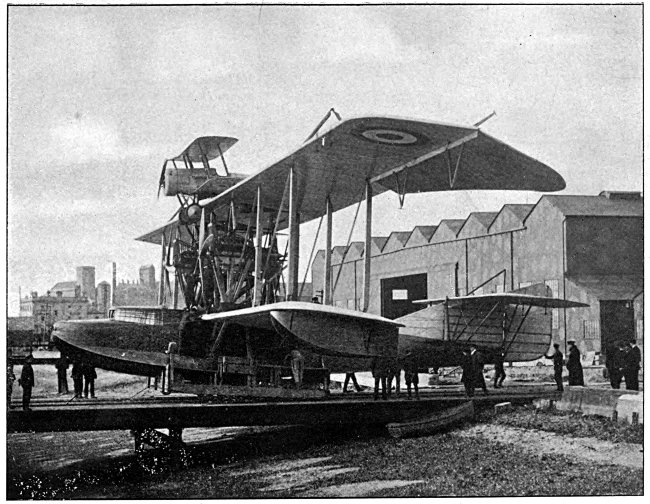
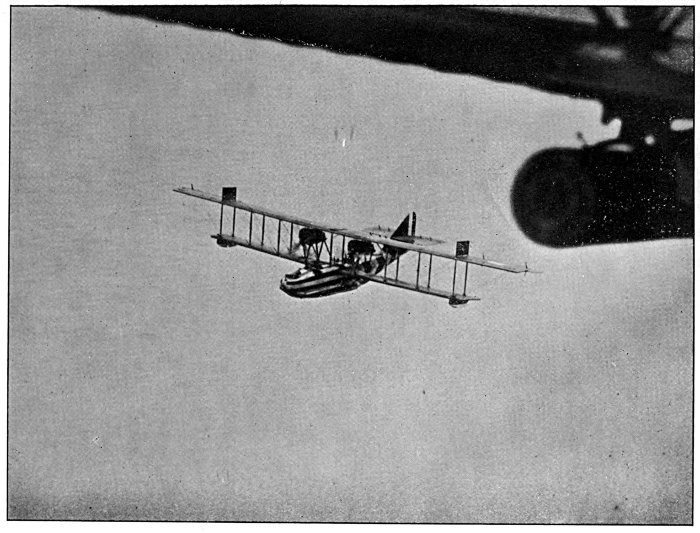
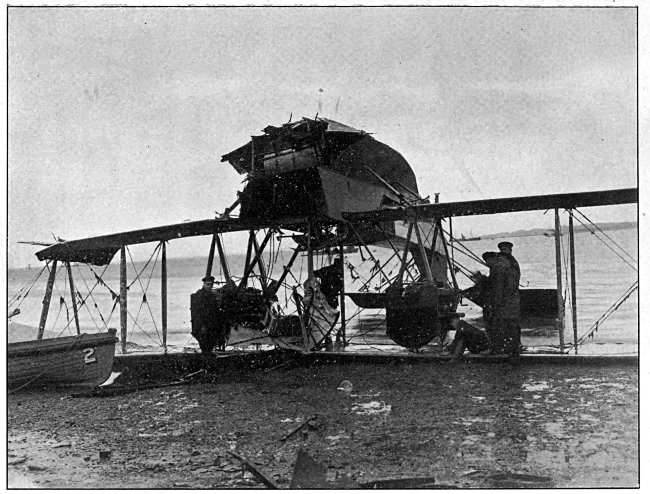
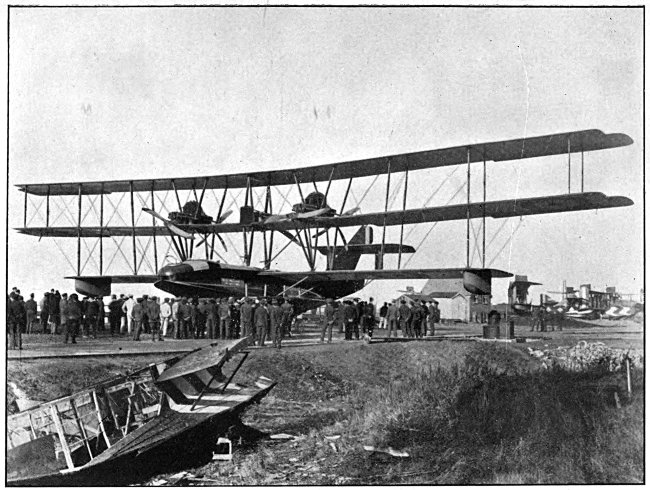
Porte Baby with Bristol Bullet on top plane.
In designing and perfecting flying-boats there
were more difficulties than in producing float
seaplanes, for the technical problems were great,
while engines of sufficient horse-power were not
to be had in the early part of the war, and
indifference and scepticism had to be overcome.
It was not until the spring of 1917 that suitable
flying-boats were in being. But this was in time
for them to meet the big German submarine
effort, when the great yards at Weser, Danzig,
Hamburg, Vagesack, Kiel, and Bremen, working
day and night, with production driven to its
highest pitch by standardisation, were pouring
out into the North Sea an incredible number of
U-boats.
During this year—a year when it looked as
though the Under-sea boats would strangle our
merchant shipping and the danger was greater
to England than her people realised—forty flying-boats
were put into commission, and sighted
sixty-eight enemy submarines and bombed forty-four
of them.
A submarine is a steel boat shaped something
like a cigar. When on the surface it is driven
by two petrol engines. Under the surface it is
driven by two electric motors, the electricity being
obtained from storage batteries. At the bow and
stern are horizontal rudders known as hydroplanes.
Under ordinary circumstances, when the
submarine is about to dive, water is let into tanks
until the boat is just floating on the surface with
only the conning-tower showing. The petrol
engines are stopped and the electric motors are
started. Then the hydroplanes are turned down
and they force the submarine under the water.
The submarine uses its power of travelling under
the water to stalk its prey and to hide from its
enemies.
When the intensive German submarine campaign
began, the methods of hunting U-boats
from surface ships had not been perfected. The
hydrophone was crude, the technique of using
depth charges was not perfected, and the mines
and nets were not adequate. Also, the Dover
barrage was not then in being. So Fritz, as
the service called the Hun submarine, went south—about
from his bases to his hunting-grounds.
Picture the sinister grey steel tubes dropping
away from the dock in the German harbour as
the Commander in the conning-tower gave the
order to cast off, the swirl of water at the stern
as the twin propellers took up their job, and
the gay flutter of signal flags hoisted to the
collapsible mast as they passed out of the harbour—a
harbour which they would not see, if all went
well with them, for from fifteen to twenty-five
days, and which, if things went well for the
Allies, they would never see again. Once outside
the harbour, the Commander would order
the engines whacked up to the economical cruising
speed of eight to nine knots, a speed at
which he could do about two hundred miles a
day, and would then turn south, and so proceed
on the surface through the North Sea to the
Straits of Dover.
Passing through the Straits, either at night
on the surface or in the daytime under the
water, the Commander would pass down the
south coast of England and cruise on the surface
in the chops of the English Channel or off the
approaches to Ireland. Here he would meet
our merchant ships coming in with food, raw
material, munitions, and passengers, and either
sink them by gun-fire or by torpedo. The attack
would be made without warning. Sometimes
survivors, who had got away in boats from
the doomed vessel, would be shelled. And once
the survivors were taken on the deck of a submarine,
their life-belts removed, and then the
submarine submerged, leaving the unfortunates
to drown.
On their run through the North Sea the submarines
passed between the Hook of Holland
and Harwich Harbour, the distance between the
two places being one hundred miles.
Harwich Harbour is a sheltered stretch of
water on the East Coast made by the rivers
Stour and Orwell emptying into the southern
portion of the North Sea. It was the centre
of intense anti-Hun activity. It was here that
Rear-Admiral Tyrwhitt had his "hot-stuff"
destroyer flotilla, that the hydrophone for detecting
enemy submarines under the surface of
the sea was evolved, that our own submarines
which operated in the Bight of Heligoland had
their base, and where the flying-boat station of
Felixstowe was situated. And it was at Felixstowe
that the service experimental flying-boats
were designed and built, and a flying-boat
squadron operated. During 1917 this squadron,
which used an average of only eight boats a
month, sighted forty-seven enemy submarines
and bombed twenty-five, besides destroying
enemy seaplanes and bringing down a Zeppelin
in flames.
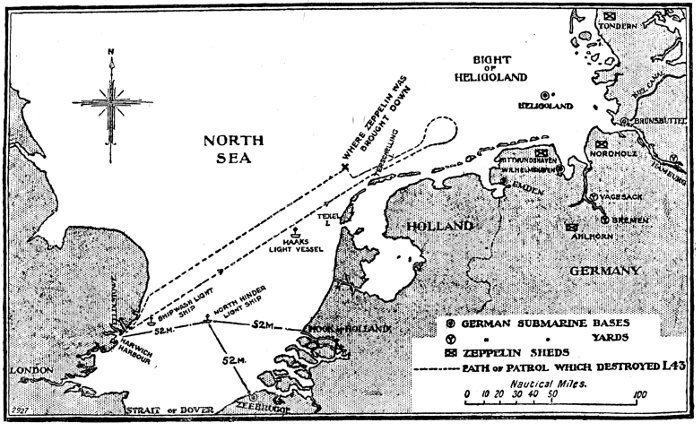
Chart showing the Southern Portion of the North Sea and the Bight of Heligoland.
It was my good fortune to be posted to Felixstowe
Air Station in March 1917 and to be put
in charge of the flying-boat operations. So this
is a yarn about the beginnings and work of a
single flying-boat station, but it is characteristic
of the work carried out at the seaplane stations
strung along the South and East Coasts of Great
Britain, from the Scilly Islands, off Land's End,
to the Orkneys and Shetlands, off the north of
Scotland. If the names and deeds of the pilots
at Felixstowe are alone recorded, it is not that
equally gallant and skilful men were not harrying
the Hun elsewhere, but that their adventures
would fill many volumes.
In the curious quirks of fortune and chance
which moved people across oceans and continents
to play their part in the war, and finally fetched
them up, in some cases, in the jobs which they
most desired to fill, there are all the elements
of romance. Just before the war broke out I
was occupying a room at the "Aviator's Home,"
a boarding-house in the small American inland
town of Hammondsport, N.Y. This town was
situated on a long narrow lake, with a forked
end, a lake surrounded by steeply rising vine-clad
hills to which clung the white wooden houses
of the vine-growers, and in which were dug the
huge cellars for storing the excellent champagne
of the district.
It was here that Mr Glen Curtiss built his
flying-boats before the war, having recruited
his labour at first from the ranks of the local
blacksmiths, carpenters, and young men with a
mechanical turn of mind. And it was here that
I first tasted the smoke of a Fatima cigarette,
a particularly biting smoke affected by Yankee
airmen, and went out in a flying-boat for the
first time in July 1914. This boat, to memory
quaint and medieval, had a single engine alleged
to develop sixty horse-power; it belonged to the
dim dark ages when compared to the latest boat
I have flown, the eighteen hundred horse-power
Felixstowe Fury.
Finishing the course of instruction a few days
after the declaration of war, and receiving no
satisfaction by cabling to the Admiralty and
War Office offering my services as a pilot, which
rather annoyed me at the time, but which I now
know was probably due to their being somewhat
preoccupied with other little matters, I returned
to my home in Toronto, Canada, and joined the
first Canadian contingent as a private in a
machine-gun battery.
Arriving in England in the steerage of a troopship
in October 1914, I satisfied at Lockyears in
Plymouth a great hunger and thirst, bred of
army fare and a dry canteen, with a most delectable
mixed grill, the half of a blackberry
and apple tart smothered in Devonshire cream,
and a bottle of the best. By the end of the
dinner I had decided to emigrate to England.
Some few days later I found myself imbedded
in the mud of Salisbury Plain at Bustard Camp,
a victim of inclement weather (which penetrated
without difficulty the moth-eaten five-ounce
canvas of the tent under which I sheltered) and
the plaything of loud-voiced and energetic
sergeants, who seemed to think that I liked
nothing better on a rainy Sunday than to wheel,
from the dump to the incinerator a half mile
away, the week's collections of garbage. After
two weeks of this I decided that I would not
live in England.
Believing firmly in the future of aeroplanes
and seaplanes in warfare, I made another attempt
to transfer to one of the Air Services, the Royal
Naval Air Service by preference; for having
knocked about a good deal in small boats on the
Great Lakes, I thought that the navigation and
seamanship I had picked up might prove useful
in seaplane work.
On a personal application to the Admiralty I
was informed that Colonials were not required,
as they made indifferent officers, that the service
had all the fliers they would ever need, and,
besides all this, that I was too old. And then
it was suggested that I should sign on as a
mechanic. I went to Farnborough, the headquarters
of the Royal Flying Corps, and saw Sir
Hugh Trenchard, then I believe a major, and was
informed that I could be put on the waiting list,
but found I would have to wait six months before
seeing an aeroplane, owing to the wicked shortage
of machines.
Being full of enthusiasm and impatience, and
thinking that the war would be sharp and quick
and soon decided one way or the other, I had
another try at the Admiralty. But this time, on
the advice of a friend who had lived some time
in England, I attacked them in a different way.
At my first interview I had appeared with my
flying credentials and in the uniform of a private—a
uniform, as being the King's, of which I was
tremendously proud, although the tunic was about
two sizes too small for me and the breeches four
sizes too large. The second time I wore a suit
of civilians cut by a good tailor and carried letters
of introduction from sundry important people.
I was this time offered a commission as a machine-gun
Sub-Lieutenant, R.N.V.R., in the armoured
cars attached to the Royal Naval Air Service,
and believing that this was a step in the right
direction, and fully determined to fly at the first
opportunity, I was duly gazetted in December
1914.
I was told to report to H.M.S. Excellent for
training. At the railway station at Portsmouth
I asked a taxi-cab driver if he knew where H.M.S.
Excellent was lying, and he replied that he did,
and that he would drive me right on board. I
thought that she must be a very big ship, but
said nothing. Finally I found myself being
driven over a bridge, and was informed a moment
later that I was on board H.M.S. Excellent, or,
in other words, at Whale Island. This training
centre is the forcing-house of naval discipline,
and everything is done at the double—an exceedingly
fast double when the eye of the First
Lieutenant falls upon an instructor. She is a
curious ship. The Captain, when he comes on
board by launch from the mainland, is driven up
from the landing stage to his office in a little
green railway carriage drawn by a little green
engine.
For some time I trained in England, and finally
sailed for the Dardanelles in March 1915. After
forty days in Gallipoli in command of a travelling
circus of machine-guns—and machine-guns
were worth more than gold and precious stones
in the first days on the Peninsula, being attached
in turn to the Australians in Shrapnel Valley,
sundry units at Cape Helles, and finally to the
29th Division in Gully Ravine, where I worked
with the 13th Sikhs until they were practically
wiped out on June 4—I again found myself in
England in July 1915, my arm in a sling and
feeling very thin as the result of sand colic, a
horrid complaint which seized me the moment I
set foot on Turkish soil at Gaba Tepe.
Following a holiday at Sunning-on-Thames, a
two-week caravan trip through the New Forrest
behind an old horse named Ben—a horse with
whiskers on its ankles and a three-knot gait—and
sundry visits to the Admiralty, I was transferred
from Lieutenant R.N.V.R. to Acting Flight
Lieutenant R.N.A.S. and posted to Hendon Air
Station. Here I acted as First Lieutenant to
Flight Commander Busteed until July 1916,
having a good rest in order to get fit again, with
only a few jobs to do, such as digging drains,
building roads, altering machines, lecturing to
the school on machine-guns and bombs, building
huts for the men out of packing-cases, doing
acceptance and test flights when I had regained
some of my energy, and in my spare time learning
what I could of the theory and practice of
flight from my commanding officer, who very
kindly took no end of trouble in assisting me.
Then I was given the command when he left for
Eastchurch.
Our Mess was livened up about this time by
the frequent visits of a senior officer who, arriving
about dinner-time, would discuss flying far into
the night, turn out at daybreak to fly any machine
available no matter what the weather was like,
and then, after breakfast, hasten off to the Admiralty.
It was a tremendous relief to meet a senior
officer who was keen to know everything about
flying at first hand, who could deal on paper with
flying problems of which he had practical experience,
and took the trouble to understand the
point of view of the pilots.
Once when a very senior officer, in a very bad
temper, was inspecting the station, he was taken
into the first shed. "Quiet, very quiet," he said.
"You don't seem to be doing much work for the
number of men you have got." A trusty Sub.
was despatched to the second shed with instructions
to have the party of tinsmiths in the annex
hammer like mad on a row of empty tanks.
When the inspection party entered this shed the
senior officer said, shouting to make himself heard
above the noise—"Better; much better."
During the fall of 1916 many rumours were
about concerning the developments of flying-boats
at Felixstowe Air Station, along with a few
facts from Lieutenant Partridge, R.N.V.R., who
had been ground officer at Hendon, until after
taking a course in a gunnery school he went to
Felixstowe as armament officer. Also the work
at Hendon was petering out, the soldiers of the
R.F.C. had cast a monocled and covetous eye on
the aerodrome, the submarine situation was
becoming acute, and the doctor had forbidden
me to fly at any altitude. I therefore put in to
be transferred to a seaplane station, and was
posted in March 1917 to Felixstowe.
Felixstowe town in ordinary times is a summer
resort, but owing to the threat of air raids it
was practically forsaken by its usual floating
population and was heavily garrisoned by the
military, the water front being protected by
barbed wire and innumerable trenches. The
people of the town in times of peace lived on
the summer visitors; during the war they lived
on the soldiers and airmen.
When I first rolled up to Felixstowe Air Station
I was tremendously impressed by its size. It was
enclosed on the three land sides by a high iron
fence. As I passed the sentry-box and entered
by the main gate, the guardhouse occupied by
the ancient marines was on my right, flanked by
the kennel of Joe, a ferocious watch-dog who had
a strong antipathy to anybody in civilian attire.
Beside guarding the gate, Joe provided a steady
income to the marines, for his puppies fetched
good prices. On my left were the ship's office
and garage. I entered the former and reported
my arrival to the First Lieutenant.
The First Lieutenant of the station was Lieut.-Commander
O. H. K. Macguire, R.N., known as
James the One or Number One, who understood
discipline, and reigned over an exceedingly fine
mess. He ran the station under naval routine,
the time being tapped off on a bell, the ship's
company being divided into watches, anybody
leaving the station "going ashore," and the men
for leave, when marching out of the gate, were
the "liberty boat." The Navy people, of course,
said that the R.N.A.S. was not run on Navy lines,
but it was run as close to them as everybody knew
how, and as the exigencies of the new weapon
permitted. The naval routine and discipline fitted
the work of a seaplane station admirably, for the
work approximated to that of a ship, where drill
is of secondary importance, and speed, skill, and
accuracy in carrying out a job of work is of the
first importance.
As James the One had a shrewd tongue he
was rather feared by the junior officers, especially
the Canadians, who hated with a profound hatred
the ever-recurring twenty-four-hour job of Duty
Officer, during which they could get no sleep in
the long watches of the night owing to the continuous
ringing of the telephone bell. But he
instilled discipline into their unruly hearts, which
assisted them to carry out their work when subsequently
elevated in rank.
Sheds and Slipways at Felixstowe.
He had taken over the station at a time when,
owing to rapid growth, the new men were not
being digested, and discipline was rather ragged
at the edges; but by this time he had the men
well in hand. And woe betide the defaulter,
standing to attention outside the ship's office in
full view of Number One as he sat in an easy-chair
on the verandah of the mess, if the unfortunate
so much as moved a little finger. The
tiger roar which greeted such a disobedience to
the order not to move, made every man with a
guilty conscience on the station tremble.
On the other hand, he would brook no interference
with the rights and privileges of the men,
and looked after their interests as regards pay
and promotion. Divisions, when the whole ship's
company were mustered on the quarter-deck in
the morning and at noon, was a marvel of smartness,
especially when it is remembered that the
men were "tradesmen." The effect was heightened
by the attendance of the pipe band, of which
Number One was rightly proud.
Leaving the office of the First Lieutenant I
stepped out on the quarter-deck. On the mast,
on the far side of this gravelled expanse, rippling
and snapping in the breeze, flew the white ensign.
Crossing the quarter-deck and steering close to
the bright and shining ship's bell, which I passed
on my left, I found a path leading to the harbour.
The left side of the path was the starting-point
of an interminable row of huts for the men.
Carrying on, after stumbling over a railway siding,
and passing between two of the huge seaplane
sheds, of which there were three—sheds 300 feet
long by 200 feet wide—I eventually arrived at
the concrete area on the water front.
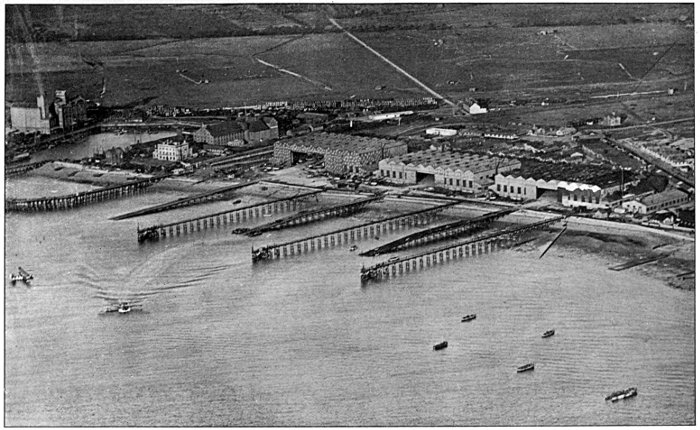
Before each of the big sheds was a slipway.
These were wide wooden gangways running out
from the concrete into the harbour and sloping
down into the water, and were used for launching
the flying-boats.
Here I could look across the harbour and see
Harwich and Shotley, the tangle of light cruisers
and destroyers lying at anchor in the river, and
the outlines of the floating dock in which destroyers,
battered by the seas or damaged in contact
with the enemy, were lifted out of the water and
their hurts attended to. As I stood sniffing in
the harbour smells, one of our E-class submarines
came slinking in between the guardships at the
boom, fresh from patrol in the Bight, and wearing
that sinister air of stealth and secrecy
which marks even the friendliest of submarines.
Walking down the concrete to my left I finally
came to the pre-war buildings of the Old Station.
These buildings were used by Commander Porte
for his experimental work. In the early part of
1914 Commander Porte was in America, at the
Curtiss Company works at Hammondsport, where
he supervised the designing and testing of the
first American type of flying-boat. This boat
was constructed with the intention, if it was
satisfactory, of attempting to fly the Atlantic.
It was a very big machine for that time, although
to a modern pilot, familiar with the luxuriously
fitted up six-ton boats with two Rolls-Royce
engines giving a total of 720 horse-power, she
would seem a funny old, cranky, under-engined
tub.
On the afternoon of the day war was declared
Commander Porte sailed for England, and a
little later took over Felixstowe. Sundry copies
of the original boat arrived from the United
States in 1915. These were comic machines,
weighing well under two tons; with two comic
engines giving, when they functioned, 180 horse-power;
and comic control, being nose heavy with
engines on and tail heavy in a glide. And the
stout lads who tried impossible feats in them
had usually to be towed back by annoyed
destroyers.
As the Navy people could not understand
anything being made which could not be dropped
with safety from a hundred feet, or seaworthy
enough to ride out a gale, or as reliable as the
coming of the Day of Judgment for the Hun,
much criticism and chaff, some good-natured but
some not, were worked off by the sailors during
this period on both boats and pilots. But improvements
went steadily on.
In the fall of 1916 improved and very much
bigger flying-boats, built in the United States
to specifications supplied by Commander Porte,
began to arrive.
By this time Commander Porte had got out
several experimental flying-boats. He carried
out his plans with a scratch collection of draughtsmen,
few with any real knowledge of engineering;
with boat-builders and carpenters he had
trained himself; and he only obtained the necessary
materials by masterly wangling. He frequently
started a new boat and then asked the
authorities for the grudged permission. But in
all things connected with the building of flying-boats
his insight amounted to genius, and the
different types of boats kept getting themselves
born. His latest boat, known unofficially as the
Porte Super Baby, or officially as the Felixstowe
Fury, a huge triplane with a wing span of 127
feet, a total lifting surface of 3100 square feet,
a bottom of three layers of cedar and mahogany
half an inch thick, and five engines giving 1800
horse-power, I flew successfully—it weighed a total
of fifteen tons. On this test I carried twenty-four
passengers, seven hours' fuel, and five
thousand pounds of sand as a make-weight.
Some idea of its huge size can be had when it
is realised that its tail unit alone is as large as
a modern single-seater scout.
At Hendon I had assisted in dragging the
first twin-engined Handley-Page, at midnight
and with the greatest secrecy, through the streets
leading from the works at Cricklewood to the
aerodrome. The procession was headed by an
army of men removing obstructing lamp-posts
and cutting off overhanging branches, followed by
a motor-lorry with two acetylene flares, and then
sixty men hauling the machine along by ropes.
At the time I thought she was a very big
machine. But in the sheds at Felixstowe I found
boats of equal size and horse-power and greater
speed, and boats that were even larger.
There was the boat called the Porte Baby, a
bigger machine than any built and flown in this
country until 1918, and this boat was produced
in 1915 and flown in 1916. Although it did
little useful active service work, it set other
designers to thinking, and was the father and
mother of all big British aeroplanes and seaplanes.
When fully loaded it weighed about eight and a
half tons, but no scales big enough to weigh it
were obtainable in the service.
It was so large that a Bristol Bullet land scout
was fitted on the top plane, which, while the
boat was in the air, was successfully launched
and flown back to an aerodrome by Flight
Lieutenant Day, of the seaplane carrier Vindex.
This gallant officer unfortunately was killed later
in France.
Well on in 1917 sundry young pilots took the
Porte Baby out for a joy-ride, and presently
found themselves off the Belgian coast being
attacked by a Hun land-machine and two fighter
seaplanes. Two out of the three engines were
shot about and the big boat had to come down
on the water. The Huns circled around firing
at it until their ammunition was exhausted, and
then returned joyously to Zeebrugge to report
the total destruction of a giant flying-boat.
But while the tracer bullets were playing about,
the crew were lying down in the bottom of the
boat watching the splinters fly. When the Huns
departed the crew repaired the engines, started
them up, and all night long taxied on the water
across the North Sea. The much-chastened
pilots beached the boat, in the small hours of
the morning, on the coast of England, near
Orfordness. A sentry, believing, as he explained
later, that at last an invasion of England by
Zeppelin was being attempted, fired on them,
but was eventually pacified. The crew arrived
at the station very tired, very black, one of
their number with a bullet hole in him, but
cheerful.
When the Porte Baby was finally dismantled,
her hull was placed in the grounds of a woman's
hostel, a door was cut in the side, electric light
laid on, and four Wren motor-drivers found sufficient
room inside to sling their hammocks, stow
clothing, and room even for mirrors and powder
puffs.
After sculling about in the sheds for some time,
I finally climbed to the look-out on top of Number
One Shed.
Here I surveyed for the first time the mottled,
misty, treacherous North Sea. In a southeasterly
direction and some ninety miles away
was the Belgian coast, with the German submarine
and seaplane bases at Zeebrugge and
Ostend. Some hundred and eighty miles away,
in a north-easterly direction, was Terschelling
Island, and just around the corner of this island
was the Bight of Heligoland. On a shoal, half-way
on a line between Felixstowe and the Hook
of Holland, fifty-two sea miles from either place
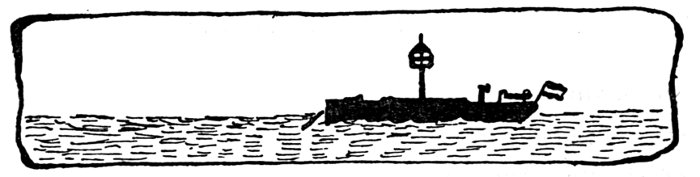
and the same distance from Zeebrugge, was the
red rusty North Hinder light-vessel belonging
to the Dutch, with a large lantern on its one
stout steel mast, and its name painted in huge
white letters along its sides. This light-vessel
was to play a large part in the bombing of
submarines.
After some days at Felixstowe, feeling rather
like a lost dog, as no work had been given me
to do, and always expecting some demonstration to
be made against the German submarines, I was
much disappointed to find that nothing seemed to
be done.
Indeed, I got exceedingly mouldy, so mouldy
that I broke out in verses for 'The Wing,' the
station magazine. They were a lament for the
old land hack I had left behind at Hendon—a
scandalous biplane, which had been rebuilt so
often that nobody could tell the breed. Her
fabric was so ancient that on the last time I
had flown her the covering on the top side of
the centre section had blown off. The verses
ran:—
To my Old Bus.
To Number One she's ullage and he's ordered her deletion, For the grease and dirt are ingrained, and she isn't smart as paint, And the flat-foot X-Y-Chaser helped by calling her a horror— Although she's sweet to handle, which some experts' buses ain't.
I've tumbled split-all endwise in her from a bank of vapour, And surprised a little rainbow lying sleeping in a cloud; I did my first loop in her, and I've crashed her and rebuilt her, And robbed her spares from other planes, which strictly ain't allowed.
At evening, just at sunset, I have climbed into her cockpit, And gone roaring up an air lane till I've caught the sun again, And feeling most important at my private view of glory, Have watched him set splendacious with his pink and golden train.
Her crash form's all in order, and they'll strip, saw, break, and burn her, And I'm sorry more than I can say to know she has to go; For blue, depressed, fed-up, or sore, I'd but to climb aboard her To leave my pack of mouldy troubles far away below.
The patrol work of the station was rather at a
low ebb at this time through various causes. With
the machines available much good work had been
done in the previous years, but the first five big
twin engine-boats to be erected and tested, together
with many good pilots and engineers, had
just boomed off for the Scilly Islands, leaving
a rather large hole in the station resources.
Weather conditions also were not very good.
There was no organisation in existence for carrying
out intensive anti-submarine patrol, and there
appeared to be no signs of that passionate energy
by which alone, in all branches of anti-submarine
work, the knavish tricks of the U-boat were
frustrated.
A great deal of the energy of the station was
taken up in experimental work and the erection of
flying-boats, of which forty in all were assembled,
fitted out, and tested during the year.
The engines of the only two boats available for
patrol, Nos. 8661 and 8663, were run and tested
every morning before daybreak, but after volunteering
many times to get up and run the engines,
I found that the boats never went out. There was
a feeling among the majority of the pilots at this
time that there was little use in patrols from
Felixstowe, as from the beginning of the war only
two enemy submarines had been sighted by pilots
on patrol from the station. This lack of success
was not due to patrols not having been done,
although intensive work had never been carried
out owing to the lack of suitable machines, but
was due to the few submarines that had been
navigating about.
But now the enemy submarines were freely and
copiously navigating the narrow seas, and the
Zeppelins were nonchalantly parading in daylight
outside the Bight of Heligoland.
Commander Porte, owing to various causes, was
absent from Felixstowe for long periods throughout
this year, although fortunately his advice and
experience were available for operations. Number
One, who was in charge in the absence of Commander
Porte, was not a flying officer, but he
appreciated the situation, saw the Senior Naval
Officer, Harwich, under whose command the operations
came, and obtained a tremendous concession
from him. This was, that Felixstowe was given
permission to carry out anti-submarine patrol
on its own, providing that he approved of the
general scheme and was kept informed of the
movements of machines.
Our S.N.O. was unlike some other Senior Naval
Officers under whose command for operations there
were float seaplanes and boats. For some of them
did not know the technical and weather limitations,
and therefore frequently ordered impossibilities,
and when failure resulted, damned the machines
and personnel of the Royal Naval Air Service;
on the other hand they would not allow possible
operations to be carried out which they had not
originated themselves.
In sketching out the campaign from Felixstowe
against the U-boats, it was decided that the only
sure method of protecting shipping was to damage
or destroy submarines, and that all other methods
were merely palliative. It was considered that
ships proceeding in the shipping lane, which was
close to the coast of England and protected by
shallow mine-fields and surface patrol craft, were
well looked after, and that enemy submarines, if
operating in these busy waters, would be so on
the alert and keep such a good look-out that
the flying-boats would not be given a chance;
for submarines cannot be seen from the air when
once below the surface of the North Sea. It
was therefore decided to expend all available
flying time where submarines were to be found
on the surface, and that the efficiency of the
patrols would not be decided by the number of
flying hours put in, but by the number of submarines
sighted and bombed.
The Hun submarines streaming down through
the southern portion of the North Sea were of
the U-B, U-C, and U types—the smallest 90 feet
in length and the largest 225 feet long. They
were mine-layers and commerce destroyers, and
their commanders travelled on the surface
through the Felixstowe area, because the distance
they could go under water was only about
seventy-five miles, and they could only run
submerged at eight knots for two hours before
exhausting their electric batteries. And low
speeds—say of two knots, which the submarine
could keep up for forty-eight hours when submerged—were
of no value to an impatient Fritz
anxious to get to his hunting-ground. And
this was important, as the hundred-mile stretch
of water between England and Holland is very
shallow, and consequently muddy, and presents
a brown and dirty green mottled surface opaque
to the eye of the observer in the air.
The exact position of the German submarines
was obtained from time to time; for when their
commanders reported to Germany by wireless—which
they usually did when homeward bound
after making up through the Straits of Dover
safely, although sometimes they reported when
south-bound—the signal betrayed their position.
The wireless messages were picked up by two
direction-finding wireless stations in England,
each station obtaining a bearing of the U-boat
that was sending. When the two bearings obtained
in this way were plotted out on the
chart they crossed, and where they crossed there
the U-boat had been. This was known as a
wireless fix.
Felixstowe Patrol Area with Spider Web Patrol, showing submarines sighted and bombed,
and the wireless fixes for four months.
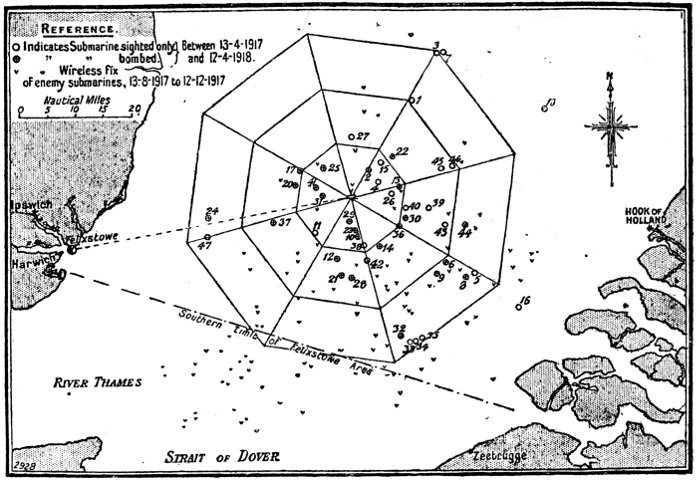
The wireless fixes of the submarines showed
that they were passing in the vicinity of the
North Hinder light-vessel; so a method of
carrying out the search was devised, and this
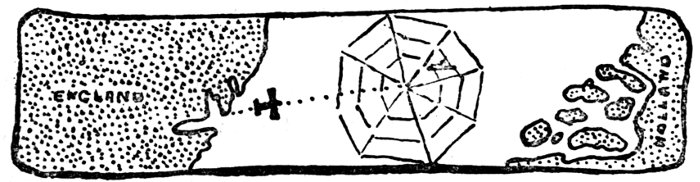
was called the Spider Web.
This tremendous spider web was sixty miles
in diameter. It allowed for the searching of
four thousand square miles of sea, and was right
across the path of the submarines. A submarine
ten miles outside of it was in danger of being
spotted, so at cruising speed it took ten hours
for a U-boat to cross it. Under ordinary conditions
a boat could search two sectors—that is,
a quarter of the whole web—in five hours or
less. The tables were turned on Fritz the
hunter; for here he was the hunted, the quarry,
the fly that had to pass through some part of
the web. The flying-boat was the spider.
The Spider Web Patrol was based on the
North Hinder light-vessel, which was used as
a centre point, and allowed for a thorough
searching of the sea in a forty-mile radius. It
was an octagonal figure with eight radial arms
thirty sea-miles in length, and with three sets
of circumferential lines joining the arms ten,
twenty, and thirty miles out from the centre.
Eight sectors were thus provided for patrol, and
all kinds of combinations could be worked out.
As the circumferential lines were ten miles apart,
each section of a sector was searched twice on
any patrol when there was good visibility.
A chart was kept showing the positions, dates,
and times of day that submarines were fixed by
wireless, and it was from this chart that the
sectors which would pay for searching were
determined.
The pilots were to boom out from Felixstowe
to the North Hinder, a distance of fifty-two
sea-miles, fly out a radial arm as instructed,
and then proceed along the patrol lines in the
sectors to be searched, sweeping from the outside
to the centre, returning to the North
Hinder and so to the base.
Navigation over the sea, where one square
mile of water looks exactly like every other
square mile, is more difficult than finding the
way over land. The only fixed objects by which
a pilot can check his calculated position are
light-vessels and buoys, but in war-time these
are shifted about, and there are large areas
without any such marks.
The difficulty of navigation is due to the fact
that unless there is absolutely no wind, the
compass, after the corrections for variation and
deviation are made, only shows the direction in
which the head of the flying-boat is pointing
and not the direction in which it is travelling,
and the air-speed indicator only gives the speed
of the machine in relation to the air.
For an aircraft is completely immersed in the
air, so that besides its movement in relation to
the air caused by its own mechanism, it moves
with the air over the surface of the earth, the
speed and path of the machine being the result
of the two movements.
If the pilot of a flying-boat had to go to a
light-ship sixty miles due east from his station
when a twenty-knot wind was blowing from the
north, and he flew at sixty knots due east by
his compass, at the end of an hour he would
not fetch up at his object, but twenty miles to
the south of it. If, instead of flying on 90
degrees, which is east, he flew on 71 degrees on
his compass, he would fetch up at the light-ship
in sixty-three minutes, having travelled due east
over the surface of the sea. To a man in a ship
he would appear to be flying sideways.
Similarly, if a pilot flew into a sixty-knot wind
with his air-speed indicator showing sixty knots,
he would not be moving over the surface of the
sea, and to the man in the ship he would appear
to be standing still.
The Chaplain of the station, the Rev. W. G.
Litchfield, produced for us a simple table with
which the pilot, knowing approximately the force
and direction of the wind, could quickly work
out the compass correction for drift and the
time correction for the air-speed indicator.
The patrols were to be carried out at the
height of a thousand feet, because at this
height silhouettes of the submarines and surface
craft could best be seen, the run of the wind
on the water could be spotted and its direction
and force determined, and it was easy to drop
down to eight hundred or six hundred feet to
bomb a Fritz.
Being now ready to start, and being given the
sounding title of Commanding Officer War Flight,
I had No. 2 shed, the two boats 8661 and 8663,
and an insufficient number of men turned over
to me.
There was no intelligence hut, no flying office,
no telephone in the shed, no pigeons; and
Billiken Hobbs, who was the only pilot at this
time turned over to the flight, had never seen
an enemy submarine. And I was in like case
myself; besides which, I had never flown one
of the big twin-engined boats.
On the afternoon of April 12 all arrangements
had been made.
CHAPTER II. LIKE A FAIRY TALE. — I. — II. — III. — IV.
The first eighteen days of the life of the War
Flight was like a fairy tale, for the pilots, booming
out on the Spider Web in the wet triangle
formed by the Shipwash light-vessel, the Haaks
light-ship, and the Schouen Bank light-buoy,
sighted eight enemy submarines and bombed
three, one of the patrols ran into four Hun destroyers
and was heavily shelled, and one boat
was lost at sea, although all members of the crew
were saved.
On the morning of April 13 we carried out
the first patrol of the series, patrols which were
to make the southern portion of the North Sea
unhealthy for Fritz to travel through on his unlawful
occasions.
I had hot-stuffed a big brass ship's bell from
the Old Station, put up a neat white gibbet to
carry it in No. 2 shed, polished it, hung it up, and
fitted to its clapper a neatly grafted bell lanyard
finished off with a Turk's-head knot. At ten o'clock
on this day, a day with an overcast sky and a
twenty-knot westerly wind blowing, I sounded off
five sharp taps on the bell, the signal for patrol.
The chiefs of the engineer, carpenter, and working
parties reported for instructions, and the working
party fell in ready to move machines.
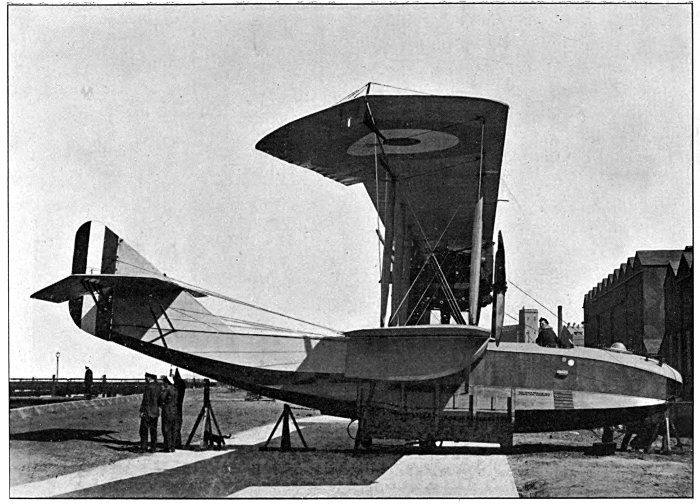
Trim, clean, grey, and rigged true, and just
tipping the scales at four and a half tons, No. 8661
stood on her wheeled land trolley just inside the
shed. She was a fine machine, measuring ninety-six
feet from wing tip to wing tip, and had such
a long and honourable life, doing three hundred
hours of patrol work, and three hundred and
sixty-eight hours flying in all, that she was affectionately
known to all the pilots as Old '61. Her
42-foot wooden hull, covered with canvas above
the water-line, was flat-bottomed and had a hydroplane
step, which lifted her on top of the water
when she was getting off, and so enabled her to
obtain a speed at which the wings had sufficient
lift to pick her up into the air.
She carried six and a half hours' fuel at a cruising
speed of sixty knots, her top speed being
eighty. A knot is a speed of one nautical mile
an hour, and a nautical mile is 800 feet longer
than a statute or land mile, so that full out she
could do ninety-two land miles an hour.
The working party of twenty men gathered
around Old '61 and rolled her out of the shed to
the concrete area. Here they chocked her up
under the bow and tail with trestles in order to
prevent her standing on her nose when the engines
were tested. Two engineers climbed up to each
engine and started them. After they had been
run slowly for about fifteen minutes in order to
warm up the oil, they were opened out until they
were giving their full revolutions, the tremendous
power shaking the whole structure of the boat.
In the meantime the armourers' party had fitted
on the four Lewis machine-guns and had tucked
up into place under the wing roots, two on each
side of the hull, the four one hundred pound
bombs. The bombs were fitted with a delay
action fuse which detonated them about two
seconds after they hit the water or a submarine.
If they hit the water they would detonate when
from sixty to eighty feet below the surface.
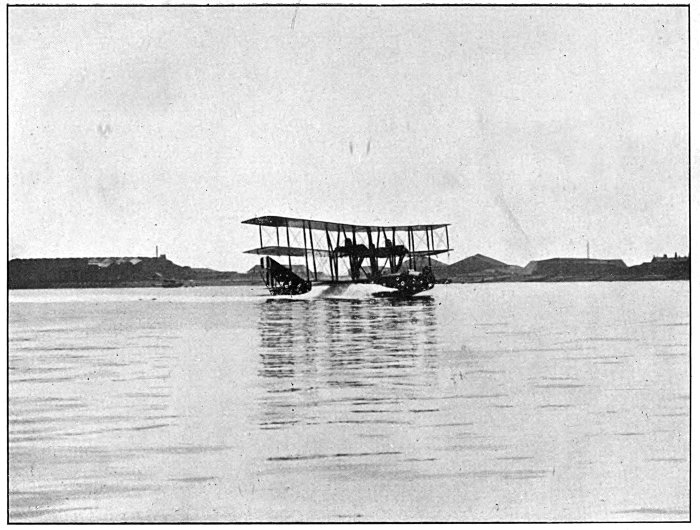
5-ton Flying-boat.
Bombs detonated near a submarine might merely
shake her, fuse cut-outs and extinguish electric
lights, which was very bad for the moral of the
Hun crew and lowered their efficiency. Or they
might cause a leak, say by buckling a hatch, which
the pumps could not keep under; or puncture the
external oil-tanks, which would cause a large loss
of oil fuel; or the periscope bases might be shaken
or damaged; or the hydroplanes might be forced
hard up or hard down, making them difficult to
work and causing the boat to get out of control.
All of which things would make the commander
of the submarine return to port and so save merchant
shipping. Or such serious damage might
be caused that the submarine would immediately
sink. Direct hits usually destroyed a submarine.
In the early part of the war a U-boat was sunk
by the direct hit of a sixteen-pound bomb.
When the boat was ready we climbed on board.
Billiken Hobbs was the First Pilot, I was the
Second Pilot, and there were the wireless operator
and the engineer.
Master of seven hundred roaring horse-power,
responsible for all things connected with the
operation of the boat, and having to make instant
and correct decisions as to the nationality of
submarines seen at strange angles and oddly
foreshortened, the first pilot of a flying boat had
to be a very fine fellow indeed. He was the
captain, and took the boat off the harbour and
brought her in again, flew her on the hunting-ground
and in an air fight, and saw that the
remainder of the crew knew and did their duty.
From the repairing of the boats and the handling
of them on shore, to the dropping of a bomb
on a submarine, it was not a sport but a business,
a business that had to be learned, and the making
of a good first pilot was a longer task than the
making of a land machine pilot. Good first pilots
were few, and when found were usually worked
until they cracked under the strain. For the
stress due to steering careful compass courses for
hours is considerable, the effort of keeping a constant
and efficient look-out is very tiring, and the
early boats were either tail heavy or nose heavy,
which threw a strain on the heart of the pilot.
Canadians seemed to be best fitted for flying-boat
work, and probably as high a proportion as three-fourths
of the good boat pilots came from that
dominion.
Billiken took his seat in a little padded arm-chair
on the right-hand side of the control cockpit,
a cockpit which ran across the full width of
the boat some distance back from the nose. He
was covered in by a transparent wheel-house so
that he did not have to wear goggles, an important
point in submarine hunting, as goggles
interfere with efficient observation.
Before him on the instrument board was the
compass, the air-speed indicator, the altimeter
which showed the height above the sea, a bubble
cross level which indicated if the boat was correctly
balanced laterally, the inclinometer which
gave the fore-and-aft angle at which the boat was
flying, the oil-pressure gauges, and the engine
revolution counters. Close to his hand were the
engine switches and the throttle control levers.
Immediately in front of him was an eighteen-inch
wheel, like the wheel of a motor-car, but carried
vertically upright on a wooden yoke, with which
he controlled the boat when in the air. He
worked the steering rudder with his feet.
As Second Pilot I stood beside Billiken. If a
submarine was sighted I ducked forward into the
cockpit in the very nose of the boat, where I had
my machine-gun, bomb sight, and the levers which
released the bombs. In a little handbook, got out
by a very wily first pilot for the benefit of second
pilots, a few of the hints as to their duties are as
follows:—
"Commence your watch-keeping at once and
report to your first pilot buoys, lightships, wrecks,
or other objects which may enable him to establish
his position. Don't take it for granted that
he has seen anything that you have seen until you
have pointed it out.
"Observe above, below, around, in front, and
behind.
"You must be prepared to give your position to
your first pilot or wireless operator without hesitation
at any moment throughout the patrol. Make
a small pencil circle on your track on the chart
every fifteen miles or so and at every alteration in
course, writing the time against this mark.
"When dropping bombs remember they will
only function if fused.
"If a crash is inevitable, and you can save
anything, four things should take precedence—pigeons,
emergency rations, Very's lights, and the
Red Cross outfit.
"Learn how to tie a bowline. This is the
simplest, quickest, and most reliable knot for
making fast your machine to a towline. Learn
other knots too.
"Study the methods of handling machines on
the slipway, both going out and coming in. You
may be in charge of this operation some day, and
the responsibility will be yours.
"In short, make this the Moral:
"Know the boat and all that therein and
thereon is, thoroughly, and its capabilities and
efficiencies, if you wish to become not only a good
pilot, but capable of command. This information
is acquired from time spent in the sheds and not
from time spent reclining on wardroom settees."
The wireless operator had climbed into his place
and sat facing forward on the right-hand side of
the boat immediately behind Billiken. He had
his wireless cabinet, containing his instruments,
before him, and could send and receive for a distance
of from eighty to a hundred miles. He coded
and de-coded all signals. The code-book had
weighted covers, so that if the boat were captured
by the enemy it would sink immediately when
thrown overboard. He had an Aldis signalling-lamp
for communicating with ships and other
flying-boats. He also looked after the Red Cross
box, which contained a tourniquet, first-aid kit, the
sandwiches for immediate needs, the emergency
rations for five days, and the carrier-pigeons.
The engineer was in his cockpit in the middle of
the boat, surrounded by the petrol-tanks, a maze
of piping, and innumerable gadgets. His duties
were to keep an eye on the engines, see that the
water in the radiators did not boil, and take care
of the petrol system.
Two wind-driven pumps forced the petrol up
from the main tanks to a small tank in the top
plane. The engines were fed from the top tank
by gravity, and the surplus petrol pumped up ran
back to the main tanks. The engineer regulated
the flow so that the petrol was drawn from and
overflowed back into the main tanks in such a
way that the fore-and-aft balance of the boat was
maintained. If anything went wrong with an
engine he had to climb out on the wing and, if
possible, make a repair.
Once a flying-boat attacked a submarine from a
low altitude and was met by machine-gun fire.
A bullet drilled a hole in a radiator, and the water
began to run out. Also the first two bombs
dropped missed the submarine. The engineer
quickly climbed out on the wing and put a plug in
the hole, and held it there, while the pilot took
the boat over the submarine again, and destroyed
it with the second two bombs. The engineer held
the plug in place until the boat landed in the home
harbour.
All four members of the crew were now in their
places. The working party attached a stout line
to the rear of the trolley, knocked away the chocks,
and rolled the boat out on the slipway to where it
began to slope down into the water. Here six
waders, in waterproof breeches coming up to their
armpits, and weighted boots to give them a secure
foothold when the tide was running, took charge,
and steered the boat down into the water, the
working party easing her down by tailing on
the line.
A wader has not got a soft job. At some stations
where there is a strong tide running waders have
been washed off the slipways and drowned.
As the flying-boat entered the water the trolley,
being heavy, remained on the slipway, and the
boat floated off. The thrust of the engines urged
her forward, and she taxied clear. Hobbs taxied
out into the harbour, turned up into the wind, and
opened the engines full out.
Driven by seven hundred tearing horse-power,
the boat ran along the water with ever-increasing
speed, a big white wave bursting into spray beneath
her bow. As the speed increased, the boat was
lifted on top of the water by her hydroplane step
until she was skimming lightly over the surface.
The air speed-indicator was registering thirty-five
knots. Then Hobbs pulled back the control wheel,
and the boat leaped into the air, the air speed
jumping to sixty knots. Climbing in a straight
line until he was at a thousand feet, he turned the
bow of the boat out to sea.
As much doubt had been expressed about the
practicability of flying the Spider Web Patrol,
owing to the great number of changes in course
and the absence of lightships and buoys, it was
decided to do the patrol without any windage
allowance. We made the North Hinder light-vessel
dead on, and then started on the Web.
Finally, as the wind was westerly, we fetched up
on the Dutch coast, the low white sandhills of
which I now saw for the first time. Coming back
against a head-wind, it took so long that I thought
at first that somebody had moved England, and
being very tired, I lay down in the bottom of the
boat and had a sleep.
I was awakened when we were in sight of the
Shipwash light-vessel—a vessel with a single black
ball as a day mark carried at the mast head. She
was eighteen sea miles from Felixstowe, four miles
off the route from the North Hinder, and many a
pilot, bathed in perspiration with the stress of
handling his boat in bad weather, or coming in out
of the North Sea against a head wind with nearly
empty tanks, has been cheered by the sight of
the short dumpy boat champing at its anchor
chains.
We saw no submarines on this patrol, but it
proved that there was no difficulty in flying the
Spider Web under ordinary conditions.
After the first patrol had been carried out four
more pilots volunteered for the War Flight, and
two patrols were carried out on April 15th. It was
on the fourth patrol, on the 16th, that Billiken
Hobbs, booming along in the Web at the thousand
foot level in Old '61, sighted the first enemy submarine.
The commander of this U-boat was gaily navigating
along on the surface, fully blown, at a
position twenty miles north-east of the North
Hinder. He was feeling quite at ease, for the
visibility was good and the surface of the sea was
clear; he was too far out to be molested by
trawlers, and if destroyers hove in sight he could
dive to a depth of 45 feet in ninety seconds.
The hull of his boat was painted grey and the
decks black, making it very difficult to see.
Had he been expecting trouble he would have
been running awash—that is, with the conning-tower
alone showing above water, and with one
electric motor and one Diesel-engine going. He
could then have done a "crash" dive in about thirty
seconds, going under with hydroplanes hard down,
full weigh on, and taking in water ballast.
But he did not know about the flying-boats or
the Spider Web.
He was standing in the conning-tower beside
the look-out man. He may have been thinking of
his sweetheart at home, or the faces of the men
and women he had drowned, but he certainly was
not keeping a good look-out. For he suddenly saw
a black shape like a great crow in the distance, and
immediately afterwards a long grey boat, fitted
with wings, passed immediately over him.
When the crew of the flying-boat first sighted
the submarine the second pilot fired two recognition
signals, and as no answer was made Billiken
decided it was a Fritz. He took the flying-boat
across it at the height of eight hundred feet, but
the second pilot in the front cockpit, not having
been trained in bomb dropping, failed to release
the bombs. Swinging the boat round in a split-all
bank he again passed over, but again the
second pilot failed to pull the release levers,
pulling instead at the bowden wires, which came
away from their fastenings.
Recovering from his astonishment, the Commander
of the submarine realised that the flying-boat
was there with no very friendly intentions,
and tapped the look-out man beside him on the
shoulder, at which signal the latter dropped
through the hatchway in the conning-tower down
into the boat. The Commander then pressed a
button which rang the alarm bells below, and the
men at the hydroplane wheels and ballast cocks
caused the boat to dive.
As she began to submerge he shut down the
hatch of the conning-tower and the submarine
slowly vanished from the sight of the infuriated
Billiken.
The second pilot, poor lad, was killed in a
small float seaplane a short time afterwards, by
ramming a flying-boat with which he was practising
fighting, and so had no second chance at a
submarine.
When the submarine was sighted the wireless
operator had got off a quick signal to the station,
so when the first faint intermittent roar of the
twin engines of Old '61 could be heard, and she
was seen as a small black speck over the wreck
of the Dutch steamer Juliana, mined early in
the war, the whole ship's company seemed to
have found work to do on the slipways and
concrete area. Ten men were preventing each
other from coiling down a hawser, twenty men
were noisily rolling empty petrol barrels about,
and innumerable men were shifting trolleys or
merely standing still and trying to look busy.
The sheds and the workshops were deserted.
As Billiken boomed in over the harbour and
shut off his engines to glide down, somebody on
the slipway cried: "He's dropped his bombs."
And everybody cheered. And then a man with
binoculars shouted: "He hasn't dropped them,"
and thrust the glasses into the hand of the man
next to him so that he could verify it.
When the motor-boat had taken Old '61 in
tow and tied her up to a buoy, the crew were
brought ashore. The two pilots were almost
mobbed by the officers, and the wireless operator
and engineer were surrounded by great groups
of men to whom they told the tale. It was not
very long, however, before a flying-boat could
come into the harbour after bombing a submarine
without anybody looking up from his work.
There was considerable excitement in the mess
that night. Great enthusiasm had seized everybody.
They realised that there were submarines
outside and that they could be seen and bombed,
and there was a tremendous surge of pilots asking
to join the War Flight. In all, another eight
pilots were taken on.
And then the gilt was put on the gingerbread,
for on the eighth patrol Monk Aplin presented
a Fritz with four one hundred pound bombs.
Fritz saw the flying-boat coming and ducked,
but the swirl where he had gone down was still
showing on the surface when the four heavy
underwater explosions occurred right across his
probable path.
The success of the War Flight was now
assured.
Eager young pilots waited on the padre to
gather wisdom concerning aerial navigation, and
went about muttering strange things about "variation,
deviation, triangle of forces, and courses
made good." Uncle Partridge, the armament
officer, was running a continuous performance for
their benefit entitled: "Bomb the Boche Boys,
or Frightfulness for Fritz." Spring-heel Jack
Lyons, the wireless merchant, whose shore aerial
was a makeshift affair attached to a stick on top
of a shed, panicked for a proper wireless outfit.
And C.C. Carlisle, the Old Man of the Sea, approving
of the activity, put some ginger into the
working party and the crews of the motor-boats.
The Old Man of the Sea, or Jumbo, as he was
called, because of his appearance and methods on
the football field, was an institution on the station.
He was in charge of the working party which did all
the pulley-hauley work, and of the piratical crews
of the motor-boats who looked after the flying-boats
when they were on the water of the harbour.
He had all sorts of fascinating model sheerlegs and
derricks for training his men, and on occasion
headed the salvage crew or the wrecking gang.
He was a merchant service officer who had
spent thirteen years at sea, part of the time
fetching oil from Patagonia, and it was rumoured
that he had also fetched from that salubrious
spot his picturesque language. Some week-end
trippers to Felixstowe, standing outside the
barbed wire enclosing the beach, after watching
and hearing, with eyes popping out and ears
flapping, the unconscious Jumbo handling a working
party bringing in the Porte Baby, wrote an
anonymous letter to the Commanding Officer
complaining of the earache, and adding, "it was
Sunday too." This effusion was signed "A Disgusted
Visitor." It was quite evident that the
writer had never been with our armies in
Flanders.
When the War Flight was first started Jumbo
had palmed off on me, being new in the mess, all
the halt, lame, and blind for a working party,
for he had a habit of secreting away all the best
men for nefarious jobs of his own. But after the
first submarine was bombed his heart was completely
softened, and with a great wrench, and
protesting that his own work would never get
done, he turned over to me one man who knew
his job.
It was on the eleventh patrol carried out on
the 23rd that I bombed my first submarine.
On a pleasant morning, with a clear sky, a
slight haze, and a 15-knot wind blowing from
the north-east—ideal weather conditions for submarine
hunting—Holmes and myself were shoved
down the slipway in Old '61 and took to the air
at six o'clock. Thrusting out into the North Sea
on a course for the North Hinder, I steadied at
the thousand foot level and throttled back until
we were doing an easy sixty knots.
Looking back inside the boat I saw the wireless
operator doing a pantomime of unwinding a reel,
and I nodded to him, at which he began to let
down the aerial through the tube in the bottom
of the boat. This was a copper wire three
hundred feet long with a weight attached to
the end.
If the boat was on the water this trailing aerial
could of course not be used, so a telescopic wooden
mast was carried. The top of this mast when it
was set up was about thirty feet above the surface
of the water, and the aerial was led from the bow,
tail, and ends of the upper plane to the tip.
With this aerial the operator could send and
receive for a distance of about thirty miles. Before
these masts were carried a boat came down at
sea through engine trouble near a light-ship. The
first pilot made the flying-boat fast to the stern
of the light-vessel and the wireless operator led
the aerial to its mast. In this way the shore
station was called up and a ship was sent out
to tow in the disabled boat.
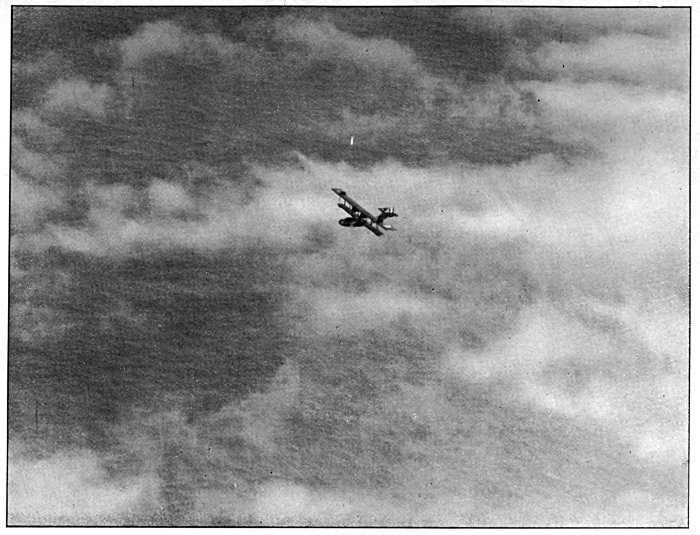
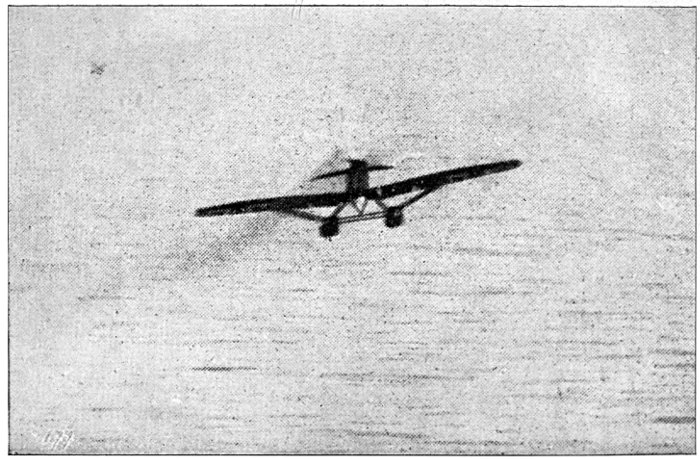
Boat on Patrol. 230-lb. bomb showing on machine from which photograph was taken.
After passing over the well-known buoys at
the approaches to the harbour, we crossed a fleet
of trawlers in the emergency war channel busily
engaged in the pleasing task of sweeping up
enemy mines laid the evening before by an optimistic
Fritz from Zeebrugge. Fifteen minutes
later we had the Shipwash four miles on our port
beam, and were over the shipping channel which
ran parallel with the coast. Here, as far as the
eye could see in either direction, was a thick
stream of cargo boats, of all shapes and sizes,
ploughing along on their various occasions, a
striking example of the might of the British
Mercantile Marine.
My ears were now deadened to the noise of the
engines, and I would not hear them again unless
something went wrong and the note changed.
I had got the feel of the controls and was flying
automatically, and was unconscious of being in
the air. It was merely like rushing over a very
calm sea in a fast motor-boat, except for the
absence of shocks and the wide horizon.
Leaving the shipping channel behind we pushed
on into the open sea. Presently Holmes slapped
me on the shoulder and pointed over the starboard
bow. Some seven miles away were four
white waves rushing across the surface of the
water, apparently without any means of propagation.
Taking my hands from the control-wheel
I made the signal "wash-out," on recognising the
bow-waves of four destroyers in line ahead pushing
through the water at top speed, although
the low, slim, grey ships were invisible, and of
course no Huns would be playing about in such
dangerous parts.
The wireless operator came forward—for the
crew of a flying-boat can move about easily and
change places if necessary—lifted the flap in the
side of my flying-cap, and shouted in my ear
"Hun submarine working. Heading towards
her." All the four of us were now keeping a
keen look-out, my own method being to swing
my head from side to side with a slow steady
motion, thoroughly searching the half-circle of
the horizon, keeping my eyes focussed for a distance
of four miles, as this was the average
distance for sighting submarines, although they
have been sighted from a distance of fifteen
miles.
And then I saw a black speck on the water
dead ahead. Involuntarily I shoved down the
nose of the boat and opened out the engines.
And then I saw that it was the North Hinder.
As we passed over her the Dutch flag at her stern
was politely dipped in salute. Changing course
here we boomed off towards the Schouen Bank
buoy on the first arm of the Spider Web.
Suddenly, with a nerve shock, a pleasant tingling
which cannot be described, I saw a submarine
dead ahead, about five miles away, fully blown,
and running directly towards us. Slamming on
the engines, and pushing the controls forward
so as to lose height and gain the maximum speed
quickly, I hurled the 4½-ton machine through the
air towards the submarine at a mile and a half a
minute.
As our own submarines operated in this area
I did not know whether it was a Fritz, but fervently
hoped it was.
I noticed that it was running at about six
knots, in which case it was probably a Hun travelling
on one engine and charging the batteries
with the dynamo on the other. The submarine
statement received from the Naval authorities
the evening before had not mentioned one of our
own submarines as working in this vicinity, but
then submarines were a law unto themselves as
regards time and navigation, and had a habit of
appearing in the most unexpected places.
With the opening of the engines, the signal for
action stations, the engineer thrust himself up
in the rear cockpit and seized the stern guns in
case hostile seaplanes had been sighted, the wireless
operator quickly wound in his trailing aerial
to prevent it being carried away if the boat came
down near the water, and Holmes, who had seen
the submarine, ducked into the front cockpit.
He snapped back the lever which removed the
safety device from the bombs and set the bomb-sight
for height, speed, and wind.
When a bomb is released it travels forward
on the same line as the machine, and, at first,
at the same speed, but its speed forward gradually
diminishes owing to the resistance of the
air. At the same time it travels downwards
owing to the force of gravity at an ever increasing
rate of speed. It thus reaches the surface
of the sea just after the machine has passed
vertically over the spot. Therefore a bomb is
released some time before the machine is vertically
over the target, and this time is determined
by the speed of the machine over the sea, the
height at which it is flying, and the size, shape,
and weight of the bomb. All these factors are
worked out on the bomb-sight, and the bomb-dropper
has only to pull the release-lever when
two projections on the sight and the target are
in line.
Holmes, in the front cockpit, looking over the
sight and with his hand on the release-lever,
waited.
The broad white wake behind the submarine
began to diminish in length and width. The deck
disappeared beneath a tumble of broken water.
The conning-tower alone showed. And then the
submarine dived.
It had all the air of performing a clever
sleight-of-hand trick, and vanished with such lazy
insolence that, arriving over the place where it
had gone down one minute too late, our hearts
were filled with astonishment and anger.
There was nothing to be done. "See you
later," we said, and carried on, for we knew that
the Spider Web would bring us back again to
the same place, and we reasoned that the Commander
of the submarine would say, "Here she
comes, and there she goes," and would come to
the surface shortly. There was no use waiting
around the vicinity, for before Fritz came up he
would search the air with a "sky-scraping" periscope,
a periscope with the lenses so arranged
that the whole arc of the heavens could be
viewed.
Pushing on we sighted the Schouen Bank buoy
in the distance through binoculars, and turned
north up the Dutch coast. On the next two
legs of the patrol, more or less parallel with the
shore, we broke out the package of sandwiches
and broached the thermos flask, taking this
opportunity of having a drop of early lunch.
Then after steering various courses as requisite,
we again approached the position where the submarine
had been first sighted.
She was sighted again three miles on the port
bow, fully blown, her engines stopped, and the
crew on deck enjoying a breath of fresh air. But
now we were near enough to recognise her as of
the U-B class, from the one gun mounted close
before the conning-tower, the deck sloping down
aft to the stern where it was awash, and the
net-cutter mounted above the stem.
As we burst on towards the U-boat full out
at a height of six hundred feet we could see
puffs of smoke coming from the conning-tower.
The crew were firing at us with a pom-pom.
And then I lost sight of the submarine.
But Holmes in the front cockpit, with his view
unobstructed by the hull of the boat, could still
see the submarine and guided me by hand signal.
Keeping my eyes in the boat, watching the
cross level to keep on an even keel, the air-speed
indicator to keep to a steady speed, and the
eloquent hand—for under these circumstances the
hand almost seems to talk—to make small adjustments
in the course, I waited. For, to do good
bomb-dropping the boat must pass on a line
vertically over the submarine, on an even keel,
and at a constant speed.
As the sights came on Holmes pulled the release-lever,
which dropped all the bombs in quick
succession, threw up his arm to show that he had
done so, and then, leaning far over the side, saw
the four bombs travelling forward and downward
and burst on a line diagonally across the
submarine.
When the dunt of the first explosion shook the
flying-boat I heaved her over on one wing-tip, so
that I could look down and back, and saw a line
of foam completely across the submarine, so closely
had the bombs fallen together. And then, getting
into a side slip, I had to attend to my flying
duties. The engineer saw the submarine heel
over to port and disappear with men still on the
conning-tower.
At ten o'clock I landed Old '61 on the harbour,
and not knowing whether the submarine had been
sunk or only damaged, I immediately sent out
another boat. An hour later, piloted by Billiken,
I again pushed out on patrol, but returned without
having seen any signs of the U-boat, having put
in during the day nine hours and fifteen minutes
in the air.
The quality of the dental platinum, requisitioned
from the dentists to make points for the magnetos,
brought the first boat down at sea on the eleventh
patrol. This platinum, specially prepared for
dental work, was not up to the job, and Jimmy
Bath and Tiny Galpin had to come to the water
forty-five miles out from land. They were found
by a destroyer and towed in.
John O. Galpin—known as Tiny, because of
his comfortable proportions—was, as he said
himself, followed by a hoodoo. He held at this
time the record for the greatest number of
engine failures out at sea in float seaplanes,
and was quite hardened to spending the night
adrift.
At this time, if he got up early in the morning
on a fine day to go out on patrol, while he was
having breakfast it would rain. If it did not
rain, the engines would refuse to start. If the
engines started, he would be delayed in getting
away by finding there was no petrol in the
tanks. If he got away, he would get to the
point in his patrol farthest from shore and have
engine failure. If he was picked up by a destroyer,
there would be a collision and his
machine would be sunk. And if none of these
things happened to him, and he arrived home
safely by air, all the submarines had been
navigating in other waters.
He describes the state of affairs in 'The
Wing' as follows:—
Cheerioh!
The Seaplane is my Hoodoo, I shall not fly another, It maketh me to come down on rough waters, It spoileth my reputation. Though I fly from the harbour It returneth by towing. Its Magneto discomforts me. Its tank runneth over. Its rods and its engines fail me. Yea, even by mechanics is my name held in laughter. Though I strive to overcome them Its weaknesses prevail. In the hour of my need its engines mock me And bring me down with great bumpings, And there is no health in it. Verily, verily, if I continue to fly these things I shall end by drowning; For my friends they desert me And call me a Jonah. My luck smelleth to Heaven And I am disheartened, Therefore shall I turn my hand elsewhere And become a Tram Driver. For again I say unto you, that of all Pilots I am the most unlucky, Yea, d——d unlucky.
So distressed was he over his bad luck, and
so sad was it to see one built for mirth so melancholy,
that a small silk bag was made, a pebble
from the beach put in it, and he was presented
with this mascot, which he was told had come
from Egypt. So great is the power of suggestion,
that from that moment the hoodoo
vanished. So gay did he become that on Guest
Nights, after making one speech he would make
another, and would make half a dozen more
unless forcibly restrained.
Four Hun destroyers, after bursting out into
the North Sea from Zeebrugge on the 30th of
April, were on their way back when they were
overhauled by Lofty Martin and Holmes in
Old '61, about ten miles south-east of the
North Hinder.
The North Sea was shrouded in mist, so at
first the pilots saw only two broad white wakes.
Then they made out through the haze two large
destroyers steering on the same course as the
flying-boat, and running at a speed of about
twenty knots. They did not know at this time
that they were Huns. Rapidly coming up with
the destroyers from the stern, they were half a
mile away when they were challenged with a
green light, a single ball of fire shot up into
the air, lighting up the mist with a sickly
glare. The wireless operator in the boat replied
with the proper recognition lights for the day.
The lather of foam beneath the bows of the
destroyers increased, and the white tumbling
wakes tailed out, as the engines of the destroyers
were whacked up and the slim long
ships thundered along at thirty knots. But the
flying-boat was booming through the air at a
good eighty, travelling two and a half miles to
their one, and overhauled them as though they
had been nailed to the water.
Immediately spurts of fire, followed by little
black balls which opened out into nasty brown
clouds, appeared in front of the flying-boat, and
the pilots found themselves in the centre of a
barrage of bursting shells.
Banking sharply to the right, Martin saw two
more destroyers about a mile away, firing at
him, ranged by the first two destroyers. He
drew out of range and tried to get into wireless
communication with Felixstowe, but failing, he
returned to make an oral report.
Billiken and myself started out immediately
to look for the destroyers. We saw no destroyers,
but came upon a submarine of the
U-C type twenty-five miles south-east of the
North Hinder. She was just going under when
we arrived. As she dived she made a sharp
turn to port, and, as the bombs had been dropped
a little short, she turned right under them. She
could still be seen when the bombs detonated,
apparently all around her.
So pleased were we with this little show that
we steered a south-east course instead of a
north-east course, fetching up at Margate instead
of Felixstowe, and had to toddle up the
coast to Harwich, where we arrived just in
nice time for luncheon.
There was a great shortage of bombs about
this time, for the number of bombs that had
been dropped had depleted our store. There
were only enough bombs left to arm one boat,
so that each time a boat came in from patrol
the bombs were taken off and put on the next
boat going out. Uncle Pat, the armament officer,
went about praying that a submarine would not
be sighted.
It has been said that the Admiralty up to
this time had rated bombs supplied to seaplane
stations as "non-expendable stores," and that
the officer in charge of the Main Bomb Stores,
when notified of the shortage, had replied:
"Impossible! Felixstowe? Why, I supplied you
with sixteen bombs two years ago."
When I first arrived on the station, Uncle
Pat confided in me that he had just ordered a
1½-horse-power electric motor to run his lathe,
for which his soul thirsted. From time to time,
as the months went by, he would draw me into
a corner and tell me of his latest move—for he
was a past-master in the art of intrigue—whereby
the motor was to arrive from London
by the very next train. And then one day there
was great excitement: he had word that the
motor was actually on the rail. Finally, some
considerable time later, a square box arrived at
the Stores, and upon the lid being removed a
beautiful new grey 1½-horse-power electric motor,
with pulley-wheel complete, was revealed.
But by this time Pat had left the station.
And now we lost the first boat at sea. Poor
8659, just handed over to the War Flight, was
destined never to grow up and follow in the slip
stream of Old '61. She was lost on her first
patrol.
Monk Aplin and Rees had pushed off at six
o'clock in the morning to look in the Spider
Web, and should have been back in harbour at
eleven o'clock. But they did not return.
Wireless signals sent out to them were not
answered.
The strain of sending out long patrols and
waiting for the pilots to come back is almost
greater than flying on them. I stood on the
slipway with an ear cocked to catch the first
faint beat of the engines.
I ran over in my mind all the possibilities.
Petrol: yes, the tanks had been filled.
Engines: perhaps it would have been better to
have changed the spark plugs in the port engine
as the revolutions had not been quite good
enough. Controls: they had just been overhauled,
but the aileron control-wire, with the two
broken strands at the fairlead, had not been renewed
owing to press of work. Hull: leaking
slightly, but nothing to worry about even if the
boat came down at sea. Wind: the patrol was
not too long for the wind blowing. And so on,
and so on.
I followed the boat round the Web in my mind
and wondered where she had come down and why,
or whether she had run into a crowd of winged
Huns.
I telephoned to the pigeon loft and warned
them. A speedy messenger was standing-by in
the wireless hut, for at this time there was no
telephone. The look-out man on top of No. 1
Shed had answered my questions in the same
way many times. The seaplane and wireless
stations up and down the coast had been warned.
And then I took a piece of paper and worked out
a little calculation like this—
32)
215
(6
192
6 hours 40 minutes.
23
The engines used thirty-two gallons of petrol
an hour and the boat carried two hundred and
fifteen gallons in her tanks. She could stay in
the air for six hours and forty minutes, and as
she had left at six o'clock she would have to come
down at half-past twelve through lack of fuel.
At twelve o'clock a little knot of anxious pilots
were gathered on the slipway. I ordered two
boats to be got ready and turned to the chart to
work out probabilities and possibilities for the
coming search. At half-past twelve, as the requests
for information up and down the coast had
drawn blank, two boats were boomed out to the
Spider Web, and the Senior Naval Officer, Harwich,
was asked to notify all destroyers.
When The Monk was out on the Web eighty
miles from Felixstowe one of his engines began
to give trouble. He turned for home, which he
should have reached in an hour and a half, but
at the end of this time he could see no land.
As a matter of fact he was off his course and was
flying more or less parallel with the coast, but
out of sight of it. He shoved along, his failing
engine gradually getting worse and worse, and
his petrol tanks becoming exhausted.
His main petrol tanks finally gave out and he
flew on his gravity tank, which contained sufficient
petrol for forty minutes. He had just made
up his mind that he would have to land through
lack of fuel when he sighted a group of trawlers
near the Haisboro' light-ship, and, on his last teaspoonful
of petrol, reached them. They were
working over a shoal. A thirty-knot wind was
blowing, and a heavy breaking sea, with steep
crests, was running. As the boat touched the
water it was thrown into the air and came down
again on one wing. The seas tore off a wing-tip
and a wing-tip float, and as the boat yawed,
burst across her in a smother of white foam.
A trawler came alongside, and the pilots
shouted to the skipper and asked for assistance.
But the skipper, to their astonishment, bawled
through a megaphone—
"I won't rescue any d——d Huns."
And then the pilots remembered that two
trawlers had been sunk a few days before by a
submarine. They shouted to the skipper that
they were English, but he replied—
"If you're English, give us a sight of the
Union Jack."
Flying-boats do not carry a flag, but the skipper
would not be convinced. The fins of the boat had
been damaged and the water was pouring in.
The bilge pump could not keep the leaks under.
When the boat was in a sinking condition The
Monk thought of throwing across his naval cap,
and when the skipper had fished it out of the
water and examined it, he put a dingey out and
took off the crew. An attempt was made to
salve the boat, but without success, and she was
a total loss.
Aplin, known as The Monk, because of the way
his hair grew, or rather, did not grow, received a
severe blow, when landing, on the identical spot
from which he took his nickname, and never flew
on patrol again, turning over to school work, at
which he made a great success.
And so ended April and the first eighteen days
of the War Flight.
CHAPTER III. THE PHANTOM FLIGHT. — I. — II. — III. — IV.
To appreciate the work of the flying service, it
must be remembered that the pilot in the machine
is only the spearhead of the weapon, and behind
the spearhead must be a stout and reliable haft, so
that the business end can be driven home with
full effect.
The helve of the haft consists of the carpenters
who true-up, inspect, and repair the machines;
the engineers who clean, test, and keep the
engines in order; the armourers who adjust the
bombs and machine-guns; and the working party
who push about the boats and fill the tanks with
petrol.
These men constantly worked against time at
night, for long periods at a stretch, frequently
rocking on their feet with fatigue, engaged on
work which had to be done honestly and without
mistake, for on it depended the lives of the crew,
the safety of valuable material, and the success of
the operations.
In the popular mind all work done by the flying
service seems to be credited to the pilot, and the
work of the men behind him gets overlooked—work
which is hard and exacting, and with little
honour and reward. Owing to the shortage of
machines, and the booming out of patrols in the
summer months from three in the morning till ten
o'clock at night, the men were driven at high
pressure.
On the afternoon of the last day of April the
Engineer Chief reported that the engines of one of
the boats had to come out and be replaced. It was
a job that usually had taken four or five days.
The bomb-gears had to be stripped, the wings
unshipped, the petrol piping and water connections
cast adrift, and the engines whipped out.
And then the whole process had to be reversed.
But the tom-tom was beaten, a War Council of
the four Chiefs held, and in the grey misty twilight
before dawn next morning the boat was
rolled out on the concrete to have her new engines
tested, the men who had shoved the work through
in the fierce stabbing of the blazing yard-arm
groups, standing about her, pallid, drooping, and
haggard.
Two hours later she took the air.
'Twas May-day, and the happy pilots, Perham
and Tiny, went off in her to look in the Spider
Web. They were out past the North Hinder
intently sweeping the horizon for signs of Fritz,
when the engineer passed forward to them a signal
pad, on which was scrawled—
"Sir, a float seaplane on our tail."
Perham popped up through the front cockpit
like a Jack-in-the-box, and looked back. He saw
a large and nasty-looking twin-engined machine
right behind, and the smoke of tracer bullets
lacing the air. On his frantic signals, Tiny shoved
forward the controls, and dived for the water at
a rate of knots. Just above the surface he made
a sharp right-hand turn.
The Hun dived after them, all guns going,
but failed to get a burst home. He flashed past
when the boat changed direction. Having lost
the advantage of surprise, the Hun pilot carried
straight on, and quickly disappeared at high speed
towards Zeebrugge, both propellers rotating briskly.
This Boche, when he got back to his base, must
have told tall tales of the encounter; he was
finally interned in Holland, where he was met by
Perham, who unfortunately also became a guest of
the same neutral country some time later. The
flying-boats were painted a light grey, and the
enemy pilot was spreading the pleasing report
that it was no use attacking them, as they were
made of armoured steel. He knew this, he said,
because he had attacked one at close quarters, and
had seen his bullets bouncing off. As a matter of
fact, a careful examination of the boat failed to
bring to light any traces of bullet holes.
Retribution fell upon us on this day for the loss
of 8659, for it was found that she should have been
sent to the seaplane station at Killingholme, and
sundry unjust people, accusing us of performing
the act of hot-stuffing, demanded one of the War
Flight's precious boats in lieu thereof. Two
"alien" pilots arrived and picked out our newest
and best, a boat which had just been painted, provided
with wireless, and fitted with all possible
conveniences and comforts, and in spite of our
shrieks of protest shoved her down into the water
and flew her away.
Seven enemy submarines were sighted and five
bombed during the month of May; the first attempts
to convoy the Beef Trip were made, not
very successfully; and the first anti-Zeppelin
patrols were carried out.
The Beef Trip, as it was called by the pilots at
Felixstowe, or the Dutch Traffic, as it was known
officially, was a convoy of merchant ships which
ran two or three times a month between England
and the Hook of Holland, and was alleged by the
aforesaid pilots to carry Dutch beef to England
and English beer to the Dutch.
In the dark hours of the chosen morning
fifteen or sixteen cargo-boats would gather in
X.I. channel near the Shipwash, and would be
picked up there by destroyers and light cruisers
from Harwich. The merchant ships would get
into formation and start across the North Sea.
The keen destroyers, sharp as needles, would zigzag
and throw circles around them, like a group
of rat-terriers chasing a cat around a knot of old
ladies. They did this in order to intimidate any
submarine commander out pot-hunting. While
the swift light cruisers, stately and imperturbable,
would boil along well out on the dangerous flank,
apparently ignoring the fuss and fury of the show
going on near them, but keeping a good look-out
in case a striking force of Hun destroyers made a
snatch at the convoy.
At the Hook of Holland another fleet of cargo-boats
would be waiting in neutral waters to be
escorted back, and the whole circus would start off
again for England.
The pilots of the flying-boats patrolled the ever-changing
route the night before, in case a hungry
Fritz, bent on sinking the beef and beer, was
lying in wait, and the following day would provide
an aerial escort for the convoy, looking out for
submarines, enemy seaplanes, which might desire
to lay explosive eggs on the ships, or Hun surface
craft.
When attacking single ships Fritz endeavoured
to close to a range of from three hundred to six
hundred yards before firing a torpedo. But when
attacking a convoy they fired at ranges between
five hundred and a thousand yards, and sometimes
longer, in which case they did not pick out an
individual ship, but merely fired into the brown.
They waited in front of a convoy until the ships
were sighted, and then submerged, therefore the
pilots in the flying-boats flew in great loops from
from five to ten miles in front of the surface
craft.
Destroyers on Beef Trip.
As the Beef Trip plodded along at eleven knots,
taking eleven hours to cross, the flying-boat pilots
were sent out in relays, meeting the surface craft
at various places on the route as requisite, and
remaining with them until relieved. The relays
were so arranged that each set of flying-boats was
out for five hours and a half.
This work called for extreme nicety in navigation,
in order that the boats should make contact
with the moving ships at the correct time and
position. At first the results were rather ragged,
but eventually it became an evolution. The pilots
were later informed, in a letter of appreciation,
that before they took a hand in the game the
crews of the destroyers and light cruisers were
kept at action stations throughout the entire trip,
but that, now the flying-boats accompanied them,
half of the men were allowed to stand off.
Zeppelins from the sheds of Wittmundshaven,
Nordholz, and Tondern ran regular daylight
patrols outside the Bight and as far south as
Terschelling Bank. They did their navigation
by wireless, so their positions and courses were
fixed by the English direction-finding wireless
stations, in the same way as the German submarines
were fixed. The euphonism for this
method in the service was to say: "We are told
by the Little Woman in Borkum that Anna is
at so and so." Anna being the first Zeppelin,
Bertha the second, Clara the third, and so on.
But they were wily birds and hard to catch, their
crews keeping a sharp look-out around and all
about. The boats had to cross the North Sea
to get at them, and they could outclimb a flying-boat
heavily laden with petrol for the return
journey. They could only be attacked successfully
by surprise, and at first the boats had no
success.
These Zeppelins kept a suspicious eye on what
our light naval forces were doing, and occasionally
dropped bombs on the Harwich submarines doing
surface patrol on the Dogger Bank. But fortunately
gas-bags roll too much for good dropping
to be done from them, and their bombs had little
effect. Sometimes they would wireless for seaplanes
to come out and bomb our submarines, but
as, almost up to the end of the war, the Huns
used bombs which touched off and burst on the
surface of the water, they had little success.
I blew over to Parkeston one day to yarn with
a submarine commander about this. He put me
into a big soft arm-chair in the wardroom of the
mother-ship, placed a potent cocktail in my fist,
provided me with a cigarette, and then we communed
sweetly together.
"Remember the Fritz your fellows sighted
twice last month on the Brown Ridge?" he
asked. "Sent out an E-boat to stalk him.
Caught him blown on the surface. Put a tin
fish into him. Thanks."
He did not use many words but said a great
deal. I asked him if submarine often stalked
submarine.
"Talked to a fellow up from down south. On
diving patrol. Saw Fritz on surface. Torpedo
blew Hun commander out of conning-tower.
Sole survivor. Seemed much worried. Finally
opened heart. Warned our man to clear out as
four more U-boats were working in immediate
area. Said he could not bear to be sunk twice
in one day."
"Please go on," I asked.
"Boat from here stalked Fritz. Fritz heard
him—dived. Both went blind under water dead
slow. Our chap felt Fritz scrape past under him.
Opened everything. Made himself as heavy as
possible. Drove Fritz down to bottom. Soft
mud. Sat on him for twelve hours. Tide silted
them in. Our boat nearly caught. Just managed
to pull himself out."
I asked about bombs.
"Don't think much of bombs. Bombed by
Zepps several times. Crockery smashed. Great
enthusiasm, small results. Boats are hard to kill
dead."
"Sometimes," I agreed. "But how about that
U-C off Ireland?"
"Which?" he asked. "U-C's are mine-layers.
Double hull. Only one hatch to conning-tower.
Vulnerable point."
"The one whose commander popped up right
beside a trawler, found himself looking into the
skipper's whiskers, didn't like 'em, panicked, and
pressed the diving button. The trawler was
armed only with a rifle for sinking mines found
on the surface."
"Right," he cut in. "I remember. Skipper
shot commander. Body jammed hatch open.
Boat dived. Fished up two weeks later in fifteen
fathoms. Valuable information."
"And all done," I chuckled, "with an ounce of
nickle-coated lead and a pennyworth of cordite.
We carry bombs weighing one hundred pounds,
we are shortly getting bombs weighing two hundred
and thirty pounds, and will soon carry bombs
weighing five hundred."
He was very polite but not impressed, until I
added: "And we burst 'em with a delay-action
fuse eighty feet down. The bombs dropped on
you by the Huns burst on the surface."
He asked me how we took aim. I told him
about the bomb-sight, and that at eight hundred
feet the bomb-dropper should make one hit out
of three on a visible target. And I added that
the flying-boats did eighty-two knots to the
Zeppelin's fifty-five, so that a submarine had less
chance to get down.
"That's all different," he said. "Hope the
Germans don't do the same. Life's getting
harder and harder."
Later on he told me this yarn.
"Life's hard. Nobody loves us. Ships fire
first, inquire afterwards. Off Terschelling at
daybreak. Suddenly saw Harwich flotilla.
Didn't know they were out. Infuriated destroyers
coming straight for me. Dived. Hit
sandbank. Conning-tower showing above surface.
Broadside on to flotilla leader. Right on
top of me. Reversed one engine, went ahead
on other. Swung round. Destroyer shaved
past. Wash lifted me off. Slid into deep water.
Depth charges dropped. Electric lamps and
crockery broken. Much annoyed. Said so when
I returned."
I had another yarn with him in 1918. He said:
"On Dogger Bank. Saw Zeppelin. Later
saw seaplane. Dived. Hundred and fifty feet.
Bomb exploded eighty feet above me. Shook
boat badly. Moved north eighty miles. Same
thing happened. What's to be done?"
Down on the sea boats are not easy to handle
with precision. But I once did a little bit of seamanship
of which I am rather proud. It is a
trick I would never try to repeat.
Lofty Martin and myself were out together in
two boats on the 5th, when we sighted a Fritz
twenty miles south-east of the North Hinder.
Lofty was nearer and went bald-headed at him.
The commander of the submarine saw him coming
and dived, but Lofty let go his four bombs just as
Fritz went under. And then I saw that his boat
was in difficulties. He got into a dangerous bank
and into a steep dive, but gradually righted and
landed on the water.
Flopping around above him, my wireless
operator, leaning far over the side, tried to
attract his attention with the Aldis signal-lamp,
but without success. The bow of the boat
seemed to be down and the tail up. There was
a brisk east wind blowing with a fair sea running,
and I thought he might have damaged
the bottom of his boat in getting down. So I
cut my engines and ducked in beside him.
Taxi-ing across his bow, I asked what was
the trouble. An aluminium casting, holding the
pulley-wheel through which an aileron control-wire
was led, bad broken. It could not be
repaired. The crew had all gathered in the
bow to examine the break. And at that moment
his port engine failed.
We were fifty miles from harbour.
Early in the war two boat pilots down at
sea had been captured by a Fritz, so before we
did anything further we taxied ten miles into a
mine-field in case the U-boat had not been
damaged and came up to investigate. Then
Lofty shut down his one good engine, put out
a sea-anchor, and hove to.
A sea-anchor is a large canvas bag shaped
like a cone. Its mouth is held open by a stout
wooden ring. In the apex of the cone is a small
hole. When the sea-anchor is put overboard
at the end of a line, it offers resistance to the
drag of the boat drifting in the wind and so
decreases the rate at which it moves. It also
prevents the boat from yawing—that is, it keeps
the bow of the boat to the sea and wind.
Lofty asked for tools; so I taxied behind him
and came up alongside, laying my port wing behind
his starboard wing. The boats were rolling
and tossing, and it looked as though the wings
would be torn off. With a loud crackling of
spruce my port propeller shattered his starboard
aileron. But a line was passed, and I quickly
drifted astern of him and hung on there. Along
this line were sent tools, a spare sea-anchor, and
food.
It was now five o'clock, and we had been
down on the water two hours. The wind had
increased to thirty knots, and a considerable
sea was running. Advising Lofty to repair his
engine and taxi straight down-wind, I cast the
line off and blew well clear of him. Then I
dropped my bombs safe to lighten the boat, had
the engines started, and got off the water after
five tremendous bumps. My wireless aerial had
been carried away on landing. With a makeshift
affair, rigged up with a spool of copper
wire from the engineer's tool-kit, the wireless
operator could get no answer.
Once in the air I flew directly down-wind, and
almost immediately fetched up at the Edinburgh
light-ship in the Thames estuary, doing the
twenty-five mile journey in fourteen minutes.
Here a destroyer was acting as traffic policeman,
so I landed near her. In reply to an Aldis
lamp-signal the commander sent a boat and I
went on board, leaving the flying-boat riding
to her sea-anchor. I gave the position of the
disabled boat and the information that Lofty
would taxi straight down-wind.
Back on board the flying-boat again I had the
engines started. The sea over the shoal was high
and steep. After a short run in the wake of a
passing paddle mine-sweeper I hit a big wave,
before I had got flying speed, and was thrown
into the air. When about fifty feet up I started
to nose-dive towards the water. I felt that I was
going to crash, and crash badly.
Keeping the engines full out and the control-wheel
back in my stomach, I shot down towards
the water. The steep angle was increasing my
speed and the engines were pulling like mad. I
just touched the crest of a wave, there was a
flicker of white water, and I shot off again into
the air. This time I had sufficient flying speed,
and boomed away for home. I landed at Felixstowe
at seven o'clock. The engines stopped
through lack of petrol as I taxied in to the
slipway.
Lofty, out in the middle of the mine-field,
repaired the engine and taxied down-wind. He
had frequently to stop his engines and fill up
the radiators with salt water, as they were
leaking. But he kept on. At half-past ten
o'clock he was taken in tow at the edge of the
mine-field by a waiting patrol boat, and arrived
at Felixstowe at one o'clock in the morning.
The remainder of the month was hectic.
Hodgson and Bath bombed one submarine and
sighted another on May 10th. Ramsden and
myself bombed another, and Hallinan and Magor
met three enemy seaplanes, on the 19th. And
next day Morish and Boswell did in a submarine
from a height of 200 feet, but, arriving
back in harbour after dark, crashed their boat.
Gordon and Hodgson bombed a submarine on
the 22nd, and next day Newton and Webster
had a brush with three enemy seaplanes, shots
being exchanged but no damage done.
A boat working up the Dutch coast had one
engine fail at the Maas light-ship, and flew
homeward for an hour and a half on one
engine, finally having to land at sea twenty
miles north-west of the North Hinder. It was
found and towed in by a destroyer. The Navy
people, meeting the boats at all hours off the
Dutch coast, and realising that we were doing
a job of work outside, were now almost affable.
School work was also in full swing, for a boat
had been turned over to the War Flight for
this purpose, and the first pilots in their spare
time crashed around instructing the second pilots
in the gentle art of taking off and landing a
big boat—an exercise which proved equally hard
on the nerves of the instructors and on the
bottom of the machine, as there was only a
single control-wheel fitted and the first pilot had
to give up all control to the pupil.
During this intensive work it was quickly found
that the majority of the pilots could only stand
an average of one long patrol in three days as
a steady routine, and that if they went out
oftener their work suffered. It was also found
essential that they should be given regular leave
at short intervals.
I was beginning to feel the strain a bit
myself. At this time I was my own intelligence,
engineer, carpenter, and slipway officer,
looking after all overhauls and repairs, deciding
the suitability of the weather, as we had no
meteorological hut, and putting into the water
and taking out again all machines, excepting
when I was myself going out on patrol. I determined
the force and direction of the wind by
the look of the waves in the harbour, the
actions of a flag, or the way the smoke blew
off a chimney. There was no telephone in
No. 2 shed, and I had already worn out a pair
of thick-soled boots galloping to and fro between
the slipway and the ship's office.
May was brought to a close by a gallant
rescue at sea, which is well worth telling in
detail.
Hissed on by the ruthless wind, sea waves
possess a malevolent cunning whereby they
search out any weak spot in a structure made
by man, and so finger, suck, hammer, and tear
at the members which are flawed in design,
material, or workmanship, that eventually the
whole fabric is shattered.
The innocent wavelets dancing in the sun,
pretty and sparkling, and the huge black
rollers, whose crests under the weight of a gale,
before they can curl over and break, explode
into spindrift, are propagated by the wind
blowing obliquely on the surface of the water.
When waves are first formed they are short
and steep, but if the wind continues to blow in
the same direction across a considerable stretch
of sea, their length and height increases, and their
crests, on which the wind has the greatest effect,
tend to drive faster than the main body of the
waves and so break forward in a smother of white
foam.
In deep water waves have no motion of translation—that
is, the particles, of water do not move
horizontally, but merely up and down vertically.
It is only the waves of force, born of the energy
of the wind, that move across the sea. In shallow
water the troughs of the waves are retarded,
with the result that they become steep, the crests
break, and the water rushes forward with great
violence.
Water in mass played upon by the wind is
not the tractable element it appears when running
through our pipes, contained in shaving-mugs, or
filling baths. Thus, while a land-machine pilot,
down safely with engine failure, has all his worries
behind him, the pilot of a seaplane or flying-boat,
down at sea, has all his troubles to come, unless
the weather be fine, help near at hand, or his
craft very seaworthy.
Everything seemed to be set fair for a fine day
on the 24th of May when Flight Sub-Lieutenant
Morris and his wireless observer went down to
the slipway at Westgate, a seaplane station on
the East Coast south of Felixstowe.
At the top of the slipway, on its wheeled beach
trolley, stood their machine, a float-seaplane with
a single engine. It had wings which folded back
along the fuselage, when it was living on shore,
in order to economise shed space. A party of
men were swinging the wings into place and locking
them in flying position. The two large flat-bottomed
floats were made of brightly varnished
wood. The bombs were slung on the fore-and-aft
centre line beneath the fuselage, above and between
the floats. There was a third small float
under the tip of the tail, and behind this float
was a water rudder, a rudder operated with the
air rudder, but which was used for steering the
seaplane when it was down on the water. It
looked very ship-shape; a small stock anchor,
with line neatly coiled, which was shackled to
one of the floats, giving the right sea-going
touch.
When the machine was ready the wireless
operator stepped up on the port float, climbed
up a little wire ladder, and settled himself into
his cockpit, where he had his wireless apparatus,
bomb-sight, and machine-gun on a ring. By
standing up he could fire forward over the top
plane. Morris climbed up after him into the
control cockpit. He was in front of the wireless
observer, for the crew of two in a float-seaplane
sit tandem.
Morris, looking over the side, saw that everybody
was clear. He switched on the magnetos
and opened a cock in an air-bottle. A stream of
compressed air hissed into the cylinders of the
engine and turned it over, the pistons sucked in
the petrol mixture, a spark fired it, and the high-speed
engine began to run smoothly. He warmed
up the oil, tested the engine full out, and then
gave the signal for the chocks to be knocked
away. The working party ran the seaplane down
into the water. It floated clear of the trolley.
When the engine was opened out the tail of
the seaplane came up to the horizontal. It leaped
forward, planing along the top of the water on
the two floats. As the pilot pulled back the
controls it skipped along with only the rear edges
of the floats touching, taking little jumps off the
surface as it encountered the tiny waves. And
then it was in the air.
After spending some hours over the North Sea,
Morris started for home. He was feeling very
hungry, and began thinking about his dinner with
pleasure. In half an hour he would have his
legs tucked under the table in the mess. Suddenly
he heard the noise of his engine and knew
that something was wrong, for a pilot is not
conscious of the roar of his engine when it is running
properly. It began to miss. The revolutions
dropped. And within a minute it stopped and
the machine had been landed on the water.
They were down thirty miles out to sea in one
of our deep mine-fields. It was a very big mine-field.
It started from an east and west line a
short distance south of the North Hinder and
continued to a line running east just above the
North Foreland. Of course there were no ships
in sight and no chance of any appearing.
The sun was shining, and little waves playfully
slapped the huge hollow floats. But what wind
there was, was off the shore, and blew the seaplane
farther into the mine-field. The two men
examined the engine and found it was impossible
to make a repair.
As the day wore on the wind increased, as the
wind increased so did the size of the waves. The
seaplane lay head to wind, its long tail acting
as a vane. All through the afternoon it went
squattering backwards farther and farther from
shore.
When the waves grew big Morris dropped the
bombs safe and opened a cock in the tanks, which
allowed the petrol to run into the sea. This
lightened the labouring seaplane. But about four
o'clock in the afternoon the sea was running so
high and the wind was so strong that the machine
was overbalanced backwards and the waves
reached up and began to pound the tail-float.
The necessity for a tail-float is the weak spot in
the design of a float-seaplane, and the sea was
attacking the flaw in the design.
Morris climbed out on the nose of one float and
the wireless observer climbed out on the other,
in the hope that their weight would balance the
machine and keep the tail clear of the water.
But the waves increasing in length and height,
an hour later the tail-float was crashed and
wrenched away, the long tail sank down into
the water, and the machine gradually turned
over backwards.
The sea having succeeded by attacking the
weak spot, and whipped on by the wind, now
leaped on the helpless machine and tore it to
pieces. The pilot found himself clinging to an
undamaged float, and climbing across it saw the
wireless observer in the sea beside him. Seizing
an outflung arm, after a long struggle he pulled
his companion across the float.
The float was a long narrow wooden box. It
was very strongly made of three-ply wood. It
was smooth on three sides, but on the fourth side,
which was the top, were two indentations to
take the fittings by which the struts that fastened
the float to the machine were held. These indentations,
with the remnants of the fittings
still attached, gave the two men a handhold.
The float fortunately was quite water-tight,
not having been damaged in the wreck. But it
was very unstable on the water and rolled about
a great deal, threatening to turn over and throw
the two men back into the sea. For this reason
they could not climb up on top of it, but lay
across, half in and half out of the water.
Owing to the great buoyancy of the float it
rode high, like a cork, and so passed over the tops
of the waves. But every few minutes a wave
steeper than the rest, or which broke at the
wrong moment, would drive over the two men
and smother them under a weight of white water.
All through the night they clung to the float,
defeating the efforts of the hungry seas, which
came up and up in an interminable succession
and tried to sweep them from their place of
refuge. Just before daybreak a dark shape
passed them, which they thought was a trawler,
but the wind carried away their voices and the
ship passed on and vanished.
With the break of day the force of the wind
abated and the sea went down. Morris, feeling
in his pockets, found a small glass bottle containing
a few milk tablets. This was the only
food they possessed, and with great prudence he
at once decided to dole out the precious tablets
in order to make them last as long as possible.
The first day dragged slowly to its close.
On the second day, the 26th, the wind died
away and a thick North Sea fog shut down,
cold, clammy, depressing. Its clinging folds
wrapped them about, both body and mind, for
it destroyed their chances of being seen and
rescued should any ships pass. They had no
idea where they were. The fog lightened to a
light mist on the 27th, the sun shone through,
and they began to suffer from thirst.
They were now able to lie on top of the float
owing to the calm sea. To ease their thirst
they took off their boots and went for a swim.
Getting back on the float, they found that their
feet were so swollen that they could not put on
their boots again.
Each minute seemed an hour, each hour a day,
and the daylight seemed worse than the dark.
On the afternoon of the 28th the mist lifted
and the sun licked up the moisture in their bodies,
increasing their thirst to torment. Their swollen
feet were painful. In the wreck they had sustained
abrasions and lacerations on their wrists
and hands. The salt water had bitten into these
wounds and they were inflamed.
Hope suddenly shot through the heart of the
wireless observer.
Low down on the horizon he saw a flight of
float seaplanes approaching.
They grew rapidly larger and larger, and nearer
and nearer, until they were right overhead. He
pointed them out with great excitement to his
companion, but the latter could not see them.
They were a phantom flight. The observer
told the pilot how the machines were circling
around, the pilots waving their hands and promising
to send help. Then they would fly away,
but kept on returning at intervals throughout
the day. But no help came. It was heartbreaking.
And then the night set in.
Early on the morning of the 29th—that is, after
the castaways had spent five nights on the float—the
sun burst through the mist, which rolled away,
letting them see a clear horizon all around them
for the first time. But there were no ships in
sight. Also the heat added to their raging thirst.
They were very weak. At noon the fog began
to settle down again, destroying their last chance
of being seen.
The two unfortunates began to take sips of sea
water.
This was the beginning of the end.
Felixstowe was shrouded in mist on this day
until eleven o'clock, when it began to lift. It
did not look very promising, but I ordered two
flying-boats to be run out and the pilots were
warned off to have an early luncheon.
Leslie Gordon and George Hodgson, the
Heavenly Twins, both from Montreal, Canada,
were told off for one of the boats. They had
been boys together, had come to England together,
had learned to fly together, had been
on the Nore Flight together, and when they came
over to the War Flight they asked to be allowed
to fly in the same boat. Either was willing to
be second pilot to the other.
They flew together for some time, but owing
to the scarcity of good boat pilots—and both men
were extremely fine fliers of the first rank—they
were made to separate. At first they resented
any attempt to give them each a boat, but finally
saw the necessity, although they had their names
bracketed as Duty Pilots and for leave, and
usually managed to fly their boats in company.
Hodgson had been a champion swimmer. He
was a stout fellow, in more ways than one, and
built for big boat work. Gordon was a long-faced,
serious lad, not over strong physically, but
with tremendous determination and force, and
was a careful flying-boat husband. Both men
were great grumblers, but also great workers.
The boats were put into the water at seventeen
minutes after twelve o'clock and went off to do
the Spider Web. As they shoved out into the
North Sea the fog shut down, and one boat, when
forty miles from land, turned back. On receipt
of the wireless signal announcing this, Gordon
and Hodgson held a consultation. At first they
were going to turn back too, and swept around
in a large circle, but finally decided to push on.
When twenty-three miles past the North
Hinder the fog became so thick that they could
not see the water and they decided to return,
climbing to a height of twelve hundred feet,
where they were above the fog. After making
the North Hinder again they started in for
Felixstowe, and were twelve miles on the homeward
stretch when they sighted, through a break
in the fog, something on the water.
Spiralling down to six hundred feet they saw
two men on an upturned float.
Winding in the aerial they came down to fifty
feet and flew directly over the wreckage, and observed,
from their attitudes, that the two men
on it were in urgent need of assistance. They
also observed that a strong wind had begun to
blow and a heavy sea was running. Climbing to
a thousand feet they let out the aerial and sent
in a signal to the station giving their position,
in case anything should happen to them. Then,
in spite of the heavy sea, Gordon landed close
beside the float.
With the waves bursting in spray over the
bows of the boat she was taxied up to the wreckage,
but the first attempt to take the two men
off was a failure, as the engines being shut off
at the very last moment, the strong wind blew
the boat away from the float rapidly. The
engines were started and a second attempt made.
Porte Super Baby taxi-ing on the water.
This time Gordon taxied right up on top of the
float. Two of the crew stood on the fins, one on
each side of the bow, the waves washing up to
their waists. But Morris and his wireless observer
were seized, pulled up on the drift wires
which ran from the nose of the boat back to the
wings, and were drawn on board through the
front cockpit in an utterly exhausted condition.
Gordon then attempted to take off. His 700-horse
power thrust the boat across the waves,
hammering and pounding, but with the extra
weight on board the boat was too heavy. He
tried again. This time the waves smashed the
tail-plane and tore off the wing-tip float on the
starboard side. Also, owing to the pounding,
the hull of the boat was leaking badly. The
idea of flying back was abandoned.
The wind was blowing from England. The
shore was forty miles away. The fog was thick.
Two things could be done. Turn down-wind and
run for Holland, making sure of a comparatively
easy passage, or fighting home against the sea
and wind to England—a hard and difficult task.
Gordon shoved the nose of the boat into the
sea and wind and began to taxi in on the water.
The seas swept over the bow. The water seeped
in through the leaks. The bilge pump, kept
going constantly, one man's job, could not keep
the rising water under. As the wind-driven
petrol pumps would only work when the machine
was in the air, one man had to keep the petrol
hand-pump going to feed the engines.
Seas bursting over the lower planes were
whirled up into the propellers and thrown back
over the engines. They were white with the
salt; but they kept running.
The tail was nearly full of water from a big
leak, but a bulkhead held it out of the main
body of the boat, although she was getting
heavier and heavier, and was crashing through
the seas instead of riding over the top of them.
The sledge-hammer blows shook the whole
structure.
Without its float the starboard wing-tip buried
itself deep in the water each time the boat rolled,
pulling itself out again with a shuddering wrench,
which each time threatened to pull off the wing.
The two rescued men lay on the slatted deck
of the boat and were given sips of brandy from
time to time, and finally a little cocoa from the
thermos flask.
So, gamely, the boat won on towards England.
Four hours after landing outside Gordon passed
out of the fog belt and saw the Shipwash light-vessel,
rolling and pitching, three miles north of
him. It was a welcome sight. He was only a
mile off his course.
He had travelled on the surface a distance of
twenty-two sea miles—a not inconsiderable feat
of seamanship and navigation in a fog, with the
wind that was blowing, the sea that was running,
and the condition of the boat.
Here they were in the shipping channel. They
saw vessels. Very's lights were fired as distress
signals, and a cargo-boat, the Orient of Leith,
bound for Yarmouth, saw them, came alongside,
passed a line and took them in tow. Half an hour
later they were under the shelter of the land and
two armed drifters came alongside. The tow was
transferred to H.M.S. Maratina, and Morris
and the wireless observer were taken on board
H.M.S. White Lilac, in order to get them ashore
quickly for medical attention.
Gordon stood by his boat, which was now
standing up on her tail, and she was brought
safely into harbour, was repaired, and carried
out many more patrols, being used, after she
had done thirty-nine patrols in all, for school
work.
Within two months Morris and his wireless
observer, unbroken by their experiences, were
again flying.
CHAPTER IV. STICKY ENDS OF L 43, U-C 1, AND U-B 20. — I. — II. — III. — IV.
James the One was awakened before daybreak
on June 14 by the ringing of his telephone bell.
The Duty Captain at the Admiralty informed
him that the Little Woman at Borkum said
Anna was at the Dogger Bank going south.
Consider the ringing of the bell the pebble
dropped in the sleeping pool, and observe how
the ripples widened, and ever widened, until they
broke on the coast of Germany.
Number One rang up the Duty Officer, who
slept, or rather did not sleep, with a telephone
for bedfellow, for James the One always developed
a thirst for information concerning station
routine between eleven o'clock at night and three
o'clock in the morning.
The Duty Officer came into my cabin and
turned me out. I pulled on my woolly flying-boots,
slipped into my shaggy fur coat, and
jammed my naval cap on my head. This early
patrol costume was a perpetual offence in the
nostrils of Number One, and it must have looked
odd to the stolid and sleepy ratings when I
danced with impatience on the slipway, but it
had the advantage of being warm and quick to
get into.
I knocked at the door of Number One's cabin
and entered, to find him sitting up in bed examining
a squared chart of the North Sea. A
squared chart is used when signalling secret
information concerning our own ships and aircraft
or those of the enemy. I was informed
of the interesting peregrinations of Anna, and
that twenty minutes before she was at X.Y.B.
centre.
Passing out through the mess I took a look at
the recording barometer, which was high and
steady, and went out on the quarter-deck to look
at the weather. The stars were shining, a light
east wind was barely perceptible, and a thin mist
shrouded the buildings of the station and the ships
in the harbour. But it looked as though the mist
would lift, so I crossed the quarter-deck to the
ship's office, where I turned out the Quartermaster,
whom I found asleep, wrapped up in a
blanket, balanced in a perilous position on the
edges of three chairs.
The Quartermaster, electric torch in hand,
doubled over to the officers' quarters, shook the
Duty Steward, put a match to the ready-laid
galley fire, and called the Duty Pilots. He then
turned out the working party, the engineers, and
the armourers, and warned the wireless operator
and the flying engineer.
By this time I was down in the dark seaplane
shed, in which only a single police light was burning,
stumbling about among the monstrous shapes
of the sleeping flying-boats. The marine sentry,
recognising me by my language, turned on the
roof electrics and flooded the shed with light.
The working party filtered in stretching and
yawning, and rolled back the sixty-foot doors.
They gathered round '77, which stood just inside
the doorway on her wheeled trolley. She was
fitted with specially large petrol tanks for the
job in hand. At the word they pushed her out
sideways, jacked her up, removed the sideway
wheels, turned her nose towards the water, and
handed her over to the engineers, who started
the engines.
The armourers fitted on the machine-guns and
provided them with special ammunition. The
man told off for the purpose put on board a packet
of sandwiches, a bottle of water, the five days'
emergency ration in case the boat came down at
sea, the Red Cross Box and the pigeons.
The oil in the engines being now warm, the
engineers opened out one engine at a time, the
fierce slipstream from the propellers shaking the
whole tail of the boat and whirling up clouds of
dust from the concrete. A two-foot flame stood
out from each exhaust pipe, and particles of
incandescent carbon, burning red, were blown
backwards for many yards. In daylight you
cannot see the flame or carbon.
It was now just beginning to get light. An
eight-knot easterly wind was blowing, but a
thick mist lay in the harbour, a mist too thick
to take off in. So the engines were shut off and
I went up to the mess. Here I found Billiken
and Dickey devouring eggs and bacon, and joined
them.
Billiken, a lad from Sault St Marie, Canada,
was one of the best boat pilots ever in the
service.
There are only two kinds of boat pilots—the
good and the bad. In the spring of 1917 the
good boat pilots could be counted on the fingers
and thumbs of two hands, and throughout the
year there were probably never more than twenty
first-class men operating at the same time.
A good boat pilot is one who can handle his
boat under any conditions, a mist flier, a stout
and determined fellow; one who can navigate and
trusts his own calculations; a tireless observer,
who knows where and what to look for; a possessor
of sea sense and seamanship; a man of
physical stamina or nervous staying power; a
man of quick and correct thought and action,
but, at the same time, one who could endure
monotony and wait for his opportunity.
And Billiken, short, stocky, and with plenty of
energy, possessed most of these characteristics,
and others equally as valuable. He was modest,
keen, and never given to swell-headedness or
boasting, the latter being unpleasant diseases
which are apt to attack young boat pilots, for
there is an exhilaration in handling machines of
great horse power and in the flattery of, to use
the term of an old naval surgeon, the long-haired
things. Or to quote a flying versifier—
"For I have known the freedom of the air, Nor crawled on earth like some coarse, dull, fat slug."
And again—
"Such subtle poisons as sweet women brew Have stuffed my veins with fire and my brain With fantasy, making this cooling earth Seem paradise."
Dickey was a little button of a chap, but what
he lacked in size he made up in bloodthirstiness.
He was one of the best second pilots it is possible
for any first pilot to desire. He was a good shot,
a capable navigator, a fine observer, and always
keen on going forward and loth to turn back.
He always gave his first pilot the comfortable
feeling of being absolutely trusted, and this is
why I liked flying with him.
When his boat came down through engine
trouble during a fight against heavy odds off
Terschelling in 1918, he shot down a Hun machine
that was attacking him while he was on the
water. He then beached the boat, burned it,
and was interned. While walking in a quiet
street of a Dutch town just at dusk a huge German
elbowed him into the roadway. He seized
the coat-tails of the Hun and demanded an
apology. The Hun swore in German—not a
pretty exhibition.
Dickey was small, but he carried a big stick,
and when the stick came in contact with the skull
of the German the latter fell senseless. Informing
the police that a man had been found unconscious
in the roadway, the little fire-eater obtained an
ambulance and tenderly removed his fallen foe
to hospital.
Such was Dickey.
The quarry these two pilots were crossing the
North Sea to hunt was a Zeppelin, an airship over
six hundred feet long. It carried a crew of captain,
second in command, a warrant officer who did the
navigation, a warrant officer engineer, two engineer
ratings for each of the five engines, a petrol man,
and six other hands, of which two worked the
elevators, two steered, one attended to the wireless
and signalling, and one repaired the fabric.
All these men had received a highly specialised
training at Nordholz, the course lasting not less
than six months. Also the deck-ratings and the
engine-room mechanics were trained in aerial
gunnery, and when at action stations the men not
on watch were employed as machine-gunners.
Throughout this month there had been great
Zeppelin activity over the North Sea, for early in
the year the German military craft had been
handed over to the German navy, and the best
airships of the two services had been concentrated
near the German coast at Nordholz, Wittmundshaven,
Ahlhorn, and Tondern. Until May 1916
the Zeppelins had carried out their patrols at a
height of a thousand feet, looking for our mine-fields
and scouting for our naval forces, but in this
month L-7 was destroyed by gun-fire from a naval
unit, and they were now, excepting on rare occasions,
carrying out their work at a great altitude.
At four o'clock the mist began to lift; we went
down to the shed, the engines were started, the
crew climbed on board, and at five o'clock Billiken
took the flying-boat off the harbour.
When he turned '77 out to sea and steadied on
the course, Billiken saw below him through the
mist, within the encircling arm of the harbour, the
tall sheds of the station, the light cruisers and
destroyers at anchor, the submarines nestling close
to their mother ships, and the mine-sweepers disentangling
themselves from their own particular
crowded dock preparatory to beginning the day's
work.
'77 in the mist.
He then glanced back down inside the hull of
the boat, and saw Dickey busy with note-book and
wind-tables working out the allowances, the wireless
operator fingering his box of tricks as he tuned
in with his shore station, and the engineer going
over his petrol-pumps. This was the eighth time
he had been out on a similar errand, but so far he
had not been successful.
As he passed out of the approaches to Harwich
the mist shut in; so he brought the boat down to
five hundred feet, and fifteen minutes later he
passed the Shipwash. This was the last thing he
was to see until he sighted the Dutch Islands,
and from this time on navigation was done by
compass, dead-reckoning, and inspiration.
To a land-machine pilot a compass is an instrument
in which he has no trust. It may show him
the way over the lines and the way back, or it
may not. It may apparently go mad, and swing
round and round, or the north point may steady
on anywhere but north.
But the flying-boat pilot has to rely on his
compass. He uses a big one, and puts it in a
place where it will not be affected by iron or
steel; or if it is, and he cannot correct the
error, he marks the errors on a card and sets it
up where it can be seen. He understands variation,
which is the difference between the true
and magnetic bearing, and which varies all over
the world, and at any one place, from year to
year. And he can steer a course within two
degrees.
When Billiken was over a big mine-field well
out in the No Man's Land of the North Sea, the
mist thickened, and, just to make it more difficult,
the sun, large and red of face as if with the
exertion of climbing above the horizon, was on a
level with his eyes, and made it hard for him to
see his instruments.
After they had plugged along for two hours
and fifteen minutes, frequently coming down to
two hundred feet to pass under a particularly
heavy bank of mist, Dickey, through a rift, saw
the flat shores of the island of Vlieland.
Here course was altered, and at half-past
seven they were off the island of Ameland.
Now, sweeping in a twenty-mile circle, they
headed back down the coast homeward bound.
The mist was lifting in patches. At half-past
eight they were off Vlieland again.
Dickey suddenly saw a Zeppelin.
It was five miles on the starboard beam, at a
height of only fifteen hundred feet.
Billiken swung the bow of '77 towards the airship.
He opened out his engines. He climbed
straight for the Zeppelin.
Dickey was at the bow gun, the wireless operator
was at the midships gun, and the engineer
was at the stern guns. The Zeppelin was barely
moving. Her propellers were merely ticking over.
They were now at two thousand feet, a thousand
yards away from the airship, and above her. Now
the look-out on the Zeppelin saw the flying-boat.
The propellers vanished as the engines
were speeded up. She moved forward. She
swung away on a new course. Two men raced
to the gun on the tail and the gun amidships
on top.
Billiken dived on the Zeppelin's tail at a screaming
hundred and forty miles an hour. He passed
diagonally across her from starboard to port.
When one hundred feet above and two hundred
feet away Dickey got in two bursts from his
machine-gun.
He used only fifteen cartridges.
As he cleared the Zeppelin, Billiken made a
sharp right-hand turn, and found himself slightly
below and heading straight for the enemy. He
read her number, L 43. Her immense size staggered
him.
Then he saw that she was on fire.
Little spurts of flame stabbed out where the
explosive bullets had torn the fabric, and the
incendiary bullets had set alight the escaping
hydrogen.
Pulling back his controls, he lifted the boat
over the airship, and just in time. With a tremendous
burst of flame—a flame so hot that all
on board the flying-boat felt the heat—the millions
of cubic feet of hydrogen were set off. She broke
in half. Each part, burning furiously, fell towards
the water.
The top gunner rolled into the flames and
vanished.
Three men fell out of the gondolas. Turning
over and over they struck the water in advance
of the wreckage.
The remnants of the Zeppelin fell into the sea,
and a heavy pillar of black smoke reared itself
to the sky.
The crew of the flying-boat fell on each other's
necks. Everybody crowded into the control cockpit.
During the demonstration Billiken got the
heavy boat into extraordinary positions.
Just in nice time for luncheon, at fifteen minutes
after eleven o'clock, having completed a flight
of nearly four hundred miles, Billiken brought '77
into the harbour, Dickey firing Very's lights and
the handkerchiefs of the crew fluttering from the
barrels of the machine-guns.
That night the staff-room was full to overflowing
when Dixie brought in the brass tray covered
with cocktails.
The staff-room at this time was a small narrow
place, so narrow that when anybody sat down
everybody else fell over his feet. It was just big
enough to hold, with a little packing, the heads
of departments who were permanently attached
to the station, and it had become their room by
an unwritten law. But now all hands were
crowded in.
Everybody was standing, there was no room to
do anything else, and a fine of half a crown fell
on anybody who sat on the arm of a chair, a
rule enforced to preserve the integrity of the
furniture.
The noise was prodigious. All were talking,
nobody listening. A lad from up North had just
finished telling me a yarn.
"The Orks are the limit," he said. "A Fritz
ran ashore at half tide on a small island just outside
Kirkwall in the Orkneys. The crew got busy
and took all their ammunition and heavy gear
ashore to lighten her and got her off next tide.
It's a desolate place, the butt-end of nowhere,
but an Ork saw them. He was sent for by
the S.N.O.
"'Did you know they were Germans?' he was
asked.
"'I thought they werena talking English,' the
Ork replied cautiously.
"'Why did you not warn the coastguard at the
telephone?'
"'They might ha' shot at me.'
"'Did you know you would have got a big
reward?'
"'Reward! Hoo much?'
"'A hundred pound.'
"'A hunder poonds! If I'd knawn that I'd
have rin like h——!'
"I saw him the other day," concluded the pilot,
"and he hasn't yet recovered from his loss."
Number One, who had just entered, was saying
to Billiken: "Well, young Hobbs, I suppose you
are proud of yourself...." Dickey was over
in the corner telling Pat, Jumbo, and the Padre
all the horrible details. Pat was interjecting at
intervals: "And the gun did not jam." The
Padre was saying under his breath: "Poor souls.
Poor souls."
Leslie, Tiny, Spring-heel Jack and the rest
were talking at a rate of knots, discussing whether
Zepps would give us any further chances, or if
they would now fly high. As a matter of fact
they did fly high from that time on, airships
which could not get above ten thousand feet
being withdrawn from the operations in the
North Sea.
Every few minutes a signalman would wedge
himself into the room bringing a signal of
congratulation.
Then the Chief Steward entered and announced
to Number One: "Dinner is served, sir."
The mess was a long room running the full
width of the building. The rafters and roof were
painted a light grey, and the walls green, a shade
of green which could only be conceived by a naval
rating and mixed in a ship's paint-room. A long
table ran the full length of the mess, crossed at
each end by a short table, and the Chief Steward
had contrived a specially fine display of flowers
and decorated the table with large mats having
navy-blue borders, the centres embroidered with
gold eagles, the noble bird which is the emblem
of the flying service.
Number One rapped on the table with a little
mahogany mallet made from the wood of a flying-boat.
A sharp silence. And then the padre said
grace, "Thank God."
The dinner was good, our cook had been a chef
at the Ritz before getting into uniform. Out on
the verandah the ship's band played airs, ancient
and modern. The members of the band were the
only men in the ship's company that Number
One did not begrudge letting off attendance at
divisions.
The port and sherry decanters circulated. Two
sharp raps on the table, and the King's health was
drunk sitting, navy fashion.
A telegram of congratulations from Admiral
Jellicoe was read, followed by a long list from
friends of the station; and then somebody sang
out, "At 'em, Tiny," and the portly one in another
second was on his feet saying—
"Mr President, I beg to propose the health of
Sub-Lieut. Hobbs and Sub-Lieut. Dickey...."
Immediately after the King's health six sad
officers left the table and went to their cabins.
They were the Duty Pilots who had to turn out
an hour before daybreak next morning to go on
patrol.
Spring-heel Jack told me during dinner that
throughout the entire day the German wireless
stations had been calling frantically to L 43.
We were very proud of our new flying office in
No. 2 Shed.
It was just inside the big sliding doors opening
out on the slipway. It had glass windows on
three sides which kept out the dust and some of
the noise. It contained a sound-proof cabinet
complete with telephone, a desk at which writing
could be done, and with drawers in which to keep
papers, and a blackboard on the wall for notices.
The inside was painted white to reflect all the
light possible, and the outside grey to prevent
it looking dirty. It was exceedingly smart.
Also a pigeoner's caboosh was put up.
The pigeoner was a busy man—he seemed to do
everything but look after the pigeons. There
were several of him, for he had to be on duty
before patrols went out in the morning and after
they came back at night.
If you mislaid your life-belt you asked the
pigeoner. He kept them. They were air-bags
worn like a waistcoat, and were blown up by
pressing a handle which punctured a cap in a
small compressed-air bottle. Everybody out on
patrol wore one. It was good joss.
He kept the leather jackets and trousers for the
ratings, for the War Flight was short of kit and
it had to be passed on from man to man.
The engineers drew from him their flying-tool
kits, small wooden boxes fitted with all tools that
could be used at sea, packed into the smallest
space and totalling the least possible weight.
Besides all this he looked after the emergency
rations, the ordinary rations, the Red Cross boxes,
the spare sea-anchors, the jerseys for the ratings
supplied by the R.N.A.S. Comforts Fund, the
cameras; and in his spare time he acted as messenger,
being summoned to the Flight Office by one tap
of the ship's bell. A lazy Duty Officer had fitted
up a string, whereby, sitting at the desk inside
the office, he could ring the bell outside.
He also looked after the pigeons. Large wicker
baskets were brought down each morning from the
military loft in Felixstowe town. While on the
station the birds were watered but not fed.
When a boat was going out the pigeoner put two
of them in a basket with two compartments and
two lids and placed them on board, well up from
the bottom, as petrol fumes made them stupid.
Each pigeon had a tiny aluminium receptacle
clipped to its leg to hold the message, and a ring
with its number, so that it could be identified if
it came back without a signal. The naval Huns
usually released the pigeons without messages
when they captured one of our seaplanes, sometimes
turning the holder upside down.
Pigeons cannot fly in mist or when it is dark,
and have to be specially trained to fly over the
sea, two squeakers, as the young birds are called,
being taken out in each boat for training. And
sometimes they refused to fly in daytime, perching
when released on some part of the machine.
When they did return punishment quickly
followed. Birds which refused to do their duty
had their commissions cancelled and were killed
and eaten.
But they did great service.
An aeroplane and a flying-boat crossed from
Yarmouth to Terschelling. The aeroplane tried
to attack a Zeppelin and received a bullet in the
radiator, whereupon it had to land in the sea.
The flying-boat rescued the crew, but was damaged
in doing so and could not get into the air again.
Two pigeons were released. One perished. The
other, a great-hearted bird, battled home against
a head wind and fell dead with exhaustion on
the slipway. The message it carried saved the
lives of the seven men who had been out in the
disabled boat for four days.
During May, beside bringing down the L 43,
the War Flight sighted eight enemy submarines
and bombed three.
Morrish and Young, driven off their course by
heavy rain-squalls and low clouds on the 9th,
passed over an enemy submarine on the Schouen
Bank, but as they did not know where they were
at the time and could not identify it, they passed
on, making the English coast near Dover. Two
days later Gordon and Thompson presented one
of our new two hundred and thirty pound bombs
to a Fritz.
On the same day Dickey and myself, when
peacefully booming out to the North Hinder, ran
into six winged Huns. Much to the disgust of
Dickey, who wanted to eat 'em alive, I dodged
the enemy in the mist and carried out the
patrol.
But now our activities were curtailed and the
War Flight came in for a tremendous strafing.
A Senior Naval Officer from another area on
a visit to the station asked to be taken out on
patrol. He was boomed out on the Spider Web
by Tiny, surprised a submarine on the surface,
and dumped on it four one hundred pound bombs
before it could submerge.
The Naval Officer arrived back in the harbour
safely and departed to his own place, well
pleased.
But that night the telephone bell rang and
we were informed that one of the Harwich submarines,
which was due, had not returned. Tiny's
hoodoo was apparently on the job again. He
was sent for and carpeted, and straffed for taking
out a Naval Officer from another area, and while
doing so, bombing and sinking one of our own
submarines.
The War Flight was straffed and forbidden to
search the Spider Web, and was given instead
the task of flying up and down the shipping
channel within smelling distance of the land.
The pilots were tremendously bored.
And then five days later the E boat came
limping in between the guardships at the boom.
She was damaged, but not damaged by bombs.
She had not been anywhere near where the
bombs had been dropped, but had found trouble
while poking her inquisitive nose into some of
Germany's secret affairs.
But for some days the flying-boats flopped up
and down the shipping channel, seeing nothing
and accomplished nothing, until June the 28th.
Their release was celebrated by Mackenzie and
Dickey bombing a Fritz from four hundred feet
ten miles west of the North Hinder.
Bombs bursting over Submarine.
The U-C 1 pushed out from Zeebrugge harbour
on July 23.
She was dirty as to paint, rust streaks disfigured
her sides, and she was not a pretty object
to look at in the bright sunshine.
But she was not really a wicked submarine,
as she did not sink passenger liners or hospital
ships with torpedoes or gun fire, but only laid
mines, which is a legitimate act of war.
She was a hundred and eleven feet long, and
was the sole survivor, but one, of fifteen similar
boats. She carried twelve mines in four vertical
tubes forward of her conning-tower.
Her Commander passed the North Hinder and
pushed on towards England, running on the
surface across our deep mine-field. When in
sight of the shipping channel he dived and
worked his way right into the approaches to
Harwich. He was a bit early, for it was still
daylight, and he liked to lay his mines at high
water, as this gave him a greater depth for
diving.
He loafed along at two knots, thirty feet
under the surface, with his periscope twelve
inches above water, keeping a sharp look-out for
trouble. Presently he saw a fleet of mine-sweepers
working in the distance, and creeping
cautiously closer, observed that they were sweeping
in an area between four bright-green buoys,
marking off the corners of a large parallelogram.
Consulting the chart supplied by his intelligence
department, he saw that the trawlers were sweeping
in the emergency war channel.
The mine-sweepers were working in pairs,
travelling abreast and some distance apart.
Each trawler towed a kite at the end of a wire
cable. The heavy wooden kite was V-shaped
and sank under the surface to the required depth
when towed. Between the two kites was a wire
rope. It had chains attached to it, so that it
dragged on the bottom, and rollers, so that it
would not foul. In the bight of the wire was
a serrated portion. The idea was to catch the
mooring cable of any mine on the wire and saw
it in two on the serrations. The mine would
then rise to the surface and could be destroyed
by rifle fire.
The Commander of U-C 1 told his second in
command that these preparations clearly meant
that the Harwich Light Forces were going to
take a burst out to sea, and that he intended to
lay a line of mines across their path.
At dusk the trawlers packed up and boiled off
for home at top speed. The German Commander
watching them said: "It is easy to see that they
are burning Government coal."
Just before high tide the U-C 1 entered the
parallelogram inside the four green buoys, still
under water. She was a third of the way across
when a sharp order was given, a lever was pulled,
and a mine left one of the tubes.
The complete mine consisted of two parts, the
war-head and the sinker.
As it left the submarine it slowly sank to the
bottom and rested on its sinker, for in the war-head
was an air chamber which kept it right
end up.
A slow spring, automatically released when
the mine left the tube, began to move a lever,
and at the end of five minutes it pulled back a
catch and released the war-head from the sinker.
The air chamber in the war-head caused it to
rise. As it rose it unwound the mooring cable
from a reel in the sinker. It rose to within eight
feet of the surface and then stopped. A hydrostatic
valve had operated a catch which stopped
the reel unwinding. The valve could be set to
hold the war-head at any depth under the surface
required.
The pull of the war-head on the mooring cable
closed an electric switch, and the mine was ready
for business.
In accordance with The Hague Convention a
switch was fitted to the mine, which would open,
rendering it harmless, if the war-head broke away
from the cable; but it had been carefully put out
of action before the mine had been put in its
tube.
The Commander of the U-C 1 crossed the parallelogram
and laid all his mines at close intervals.
His work finished, he slipped off toward the open
sea, thinking with satisfaction of his row of mines
with their ugly warty heads swaying to the tide
below the surface of the water.
He pictured the Harwich flotilla coming out
in line ahead, a light cruiser leading, her four
hundred and thirty-six feet of slim grey length
driven through the water by her forty-thousand
horse power. He thought of her 3-inch protective
plating, but this he knew only went two and
a half feet below her water-line. He gloated
over her armament—two 6-inch guns, six 4-inch
guns, and one 4-inch high angle anti-aircraft gun—all
useless when pitted against his mines.
He saw her in his mind's eye touch a mine.
It rolled along her side. The soft metal protruding
horns were bent. The glass tubes inside
them were broken. The liquid in the tubes fell
into cups in which were two solid elements of
an electric battery. A current was generated.
The exploder was detonated, and the charge
of high explosive went off with a chattering
crash.
But all that would happen to-morrow. He
was well pleased with himself as he slipped
along.
How could he know that the emergency war-channel
had been shifted, that the four green
buoys had been laid there for his special benefit,
that the mine-sweeping was a bluff, and that
his successor to the job of minelayer-in-extraordinary
to the Harwich Light Forces would in
his turn discover the green buoys, blunder into
the mines intended for the light cruiser, and so
depart this life.
Next morning he brought his boat to the
surface this side of the North Hinder, and
started for home. There was a light mist, no
wind, and everything appeared ormolu.
But behind him at Felixstowe Commander
Porte, who was back on the station for a short
time, had determined to lead out a patrol of
five flying-boats—a greater number than had
ever been out together. It strained the resources
of the War Flight, but five machines were finally
shoved down the slipway into the water. Commander
Porte was leading in F 2 C, his latest
experimental boat, piloted by Queenie Cooper, the
test pilot.
The five boats fluttered around in the water,
each getting into its correct position in the formation,
and then, at the signal from the leading
machine, all had their engines opened out at the
same time.
They boiled down the harbour, leaving five
white streaks behind them, got into the air
and pushed off for the Spider Web. Many times
later on flights of an equal number of boats
were got away easily, but this was the first
time, and a sigh of relief and admiration went
up from all hands on the slipway. It was a
fine sight.
The formation passed the Shipwash, passed the
North Hinder, and then, at ten minutes to eleven
o'clock, the Commander of U-C 1 tried to dive.
He was too late.
Ginger Newton and Trumble dropped two two
hundred and thirty-five bombs on him from five
hundred feet. Commander Porte and Queenie
dropped two similar bombs. Cuckney and Clayton
dropped one bomb. And the other two boats
stood by ready.
But the career of U-C 1 was ended.
There was oil on the surface and a little white
spot on the water, where a long string of silver
bubbles, coming up and up, were breaking
gently.
The water was twenty-four fathoms deep.
A fathom is six feet.
One of the boat pilots, curious to see what
the bubbles looked like at close quarters, landed,
but was unable to find the spot. Once in the
air again he could see the bubbles easily.
But the whole of July was a good month.
The pilots flew on eighty-nine patrols, and did
sixteen thousand four hundred and thirty sea
miles. Twenty-five patrols were carried out,
drawing blank, and then Puff Mackenzie and
Dickey met up with a Zeppelin.
It was just after sighting twelve German destroyers,
navigating along in close formation, that
they saw the airship. Her crew saw the flying-boat
coming at the same time. She altered
course and went up through the clouds like an
express elevator.
Holding on the same course as the Zeppelin,
and climbing through the clouds for twenty
minutes, Mackenzie burst up into the sunshine
above and found the enemy still ahead of and
slightly above him. There was great activity
in the gondolas of the airship; and presently
sand-ballast began to pour out, and she got to
a height of eleven thousand feet when the flying-boat
was at nine thousand. She had gained a
bit of distance while climbing.
But now the coast had been crossed.
All sorts of odds and ends were thrown out
of the gondolas, and the airship finally got to
thirteen thousand five hundred feet. The flying-boat
was at eleven thousand, just behind her;
but it could climb no higher, being heavily
laden with petrol for the return journey.
They were now thirty miles inland, and over
two hundred miles from home, so the chase was
broken off. As the boat turned round the disappointed
engineer fired a few bursts from his stern
guns, but the tracer bullets were seen to fall short.
Passing out over the coast the hostile destroyers
were sighted again, and shortly afterwards
Mackenzie had to land because of petrol
pump trouble. The package of sandwiches was
found and the thermos flask opened, and while
the crew had a snack the petrol pumps were
repaired. Twenty minutes later the boat was in
the air again.
At half-past two Harwich harbour was reached,
the crew having been in the air for six hours and
twenty minutes.
Dickey, the small and bloodthirsty, would not
be comforted for some time for not getting the
Zeppelin, although it was pointed out to him
that for one so small he had given the Germans
a big fright.
Beyond shoving out a Beef Trip and the ordinary
patrols, things were quiet until the 21st,
when Perham and Cuckney in one boat, and
Hodgson and Ramsden in the second, met up
with a Fritz on the surface five miles south of
the North Hinder.
She was lying in wait to sink the beef and beer,
for a Beef Trip was on for next day.
Two bombs were dropped by the first boat.
The submarine dived. It came to the surface
seventeen minutes later. The second boat was
getting into position, when it again submerged
and was no more seen.
It is probable that this submarine was damaged,
as she came to the surface so quickly after being
bombed.
On the following day seven patrols were
boomed into the air for the Beef Trip, the
greatest number up to this time put out in one
day. Owing to the number of machines being
overhauled two of the boats had to be sent out
twice, each doing five hundred and forty miles.
It was quick work.
Between trips the boats were taken out of the
water, cleaned and filled with two hundred and
forty gallons of petrol. The four machine-guns
were stripped, cleaned, and assembled. All control
wires and the structure were examined. And
the engines were checked and tested.
When coming in from the first patrol on one
of these boats there was a splintering crash. I
thought we had been hit by a shell from a pom-pom.
But a tray of ammunition had blown off
the front Lewis gun and gone into the port
propeller. The brass-tipped mahogany blades
were turning at twelve hundred revolutions a
minute, for the propellers are geared down, and
do not turn as fast as the engines. The tray
shattered one blade, the splinters shooting
through the top of the boat, but the crew were
uninjured, except for a few scratches. The engine
had to be shut off, and I flew the boat home
thirty miles on one engine.
Flying-boats can fly on one engine if the total
weight is not too great. It is a question of
weight for horse-power available. To enable the
pilot to keep the boat flying in a straight line
without undue strain, a heavy rubber cord is
fitted on the rudder wires, which can be tightened
as requisite.
During the Beef Trip Hodgson and Ramsden
sighted a U-boat, which dived. It torpedoed a
small Dutch steamer seven miles north of the
North Hinder, which was seen in trouble by
Hallinan and Brown. They saw two boats put
out, the crew tumble into them, and the ship sink.
Shoving off to the Beef Trip, for she was not
part of the convoy, they flashed the position by
Aldis lamp, and the two boats were picked up
by a destroyer.
Next day Bath and Keesey, and Tiny and
Moody, made a presentation of four bombs to a
Fritz in the Spider Web, and two days later
Perham and Barker, on the way in from the
North Hinder, surprised a U-boat near the Outer
Gabbard buoys, and followed the good example.
The end of July coincided with the end of
U-B 20.
She was on her way south—about to the approaches
to Ireland, where her Commander intended
to destroy merchant ships.
For this purpose he carried a 4·1-inch gun and
five torpedo tubes, four in the bow and one in the
stern. He had ten torpedoes.
His boat had a double hull, and was a hundred
and eighty feet long. She could do thirteen knots
on the surface. Therefore he was able to overhaul
ordinary merchantmen and sink them by gun-fire.
He liked to do this, because he could carry more
shells than torpedoes.
The U-B 20 was designed to dive very quickly.
But this time she did not dive quickly enough.
Puff and Ball in one boat, and Young and
Barker in another, met up with her ten miles this
side of the North Hinder. Apparently the
Commander never saw the flying-boats coming,
as he made no attempt to change course or
submerge.
Puff passed over him at eight hundred feet, and
Ball dropped one bomb.
It was a long slim bomb, with an armour-piercing
nose, and weighed two hundred and thirty
pounds.
Ball leaned out of the cockpit and watched it
all the way down. Unconsciously he held his
breath, and time seemed to stop. And then he
saw it crash into the stern of the submarine.
On the explosion the stern went down and the
bow rose out of the water. It smacked down a
moment later with a wide-flung splash.
Close behind the leading boat came Young.
Barker dropped two one hundred pound bombs.
They detonated just in front of the submarine.
He saw that the bow hydroplanes were damaged.
The U-B 20 was now out of control.
She did figure eights.
She dived and came up again.
And then, after seven minutes of such evolutions,
her twin propellers stopped, and she began
to sink by the stern.
The pilots were now circling above their quarry
at a height of four hundred feet. Puff and Ball
obtained a second direct hit just in front of the
conning-tower, and Young and Barker straddled
her with two bombs.
She was much down by the stern.
Suddenly she stood on end, remained poised
there for a perceptible fraction of time, and then
slid down backwards and disappeared in a
smother of white water.
The pilots were back in harbour in time to
dress for dinner.
But U-B 20, her wicked hopes frustrated, lay
at the bottom of the North Sea in twenty-two
fathoms.
She had been killed dead.
August was a cold miserable month. Mist and
fog shrouded the southern portion of the North
Sea, and when there was no mist and fog, heavy
clouds hung like palls low over the surface, or
there were heavy rain-squalls and high winds.
Only two submarines were sighted, neither
being bombed.
But it was a welcome stand-easy for the pilots
and ratings who had been working double tides
for four months.
Lifting 230-lb. bomb into place.
CHAPTER V. THE FATAL FOUNTAIN AND END OF U-C 6. — I. — II. — III. — IV.
I was sunk a thousand fathoms deep in sleep.
Came a loud rap at my cabin door, the stab of
electric light in my eyes, and a voice saying,
"Signal, sir."
The messenger, seeing I was more or less awake,
crossed the cabin and passed me a signal pad.
Propping one eye open, I read—
"0348 Trout, XUB top."
"Thanks," I said, and the messenger vanished.
The signal was a wireless fix of a Fritz. Sitting
up in bed, I reached for the squared chart,
and examined it. The message, interpreted, meant
that at forty-eight minutes after three o'clock that
morning, September 3, a German submarine had
been on the surface off the Goodwins.
The commander of the U-boat had reported to
Germany by wireless. He was probably taking
no chances in that vicinity, and would not have
up his aerial masts, but would be using as aerials
the two jumping wires which ran from end to end
of his boat, passing over his conning-tower and
forming a protection against nets, hawsers, and
mines. He could therefore dive immediately.
However, it was not my pigeon; he was not in
the Felixstowe area. So I switched off the light,
turned over, and was immediately asleep.
An hour later I was sitting up in bed again
reading a second signal—
"0403 Trout, ANV centre."
"Wait," I said to the messenger.
The repetition of the word "Trout" meant it
was the same Fritz again working wireless. I
checked the positions and times of the two fixes on
the chart. The commander of the submarine had
come north about ten miles, and would soon enter
the Spider Web. This was a different matter.
"Quartermaster," I said to the waiting messenger.
Jumping out of bed, I pulled on my uniform
over my pyjamas, and met the Quartermaster as
he entered the door of the mess. We stood together
and looked across the quarter-deck. It was
going to be a misty day. We walked down to
the concrete, and looked across the harbour.
Harwich, on the far side, a mile away, was invisible,
but the big light-buoy, half-way across,
could be seen.
"Can do," I said. "We'll take a chance. Turn
out the hands; I'll call the pilots."
The weather had been so unpromising the night
before that no early morning Duty Pilots had been
warned off, so I hammered up Dickey for myself
and Cuckney and Clayton for the second boat.
Cuckney was a stout fellow, who had been doing
the two-trip-a-night stunt in carrying bombs from
Dunkirk to Zeebrugge.
He was over the Mole one night at a low height
in a Snider, a small float-seaplane, when his engine
stopped. He pushed and pulled everything he
could think of, but the engine would not start
again, and he landed in Zeebrugge harbour.
Searchlights blinded him, and the Huns let off
everything that would bear. The enemy then
saw that his engine had stopped. Fire ceased,
and two launches raced out from the dock to
capture him.
They were right on top of him when he found
the trouble: he had opened the magneto-switch
with his elbow. He started his engine, and ran
along the water in front of the launches. And
then he zoomed into the air, followed by howls
of disappointment and a hurricane of high explosives.
After working some time at Dunkirk, he felt
a bit weary, and somebody, who mistakenly
thought that flying-boat patrols were a rest-cure,
sent him down to Felixstowe.
Quickly despatching breakfast, we got into our
two boats, and pushed off for the Spider Web,
Cuckney taking up station on my port-beam, a
quarter of a mile away. The water was invisible,
and as he was travelling at the same speed and in
the same direction, he looked to me as though he
were standing still, suspended in the air by an
invisible wire. It was an odd optical illusion.
The farther out we got the thicker got the mist.
We could only see any distance by looking up the
molten pathway made by the reflected image of
the sun on the little waves.
After sculling about for two hours, I balanced
the boat on the controls, and quickly climbed out
of the first pilot's seat. Dickey was ready, and
popped in. I now devoted my whole energies to
observing. Turning my back on the sun, I tried
to pierce the blank wall of fleecy white.
I saw something sparkle.
It looked like a tiny fountain glittering in the
sunlight.
Through the binoculars it showed up as a thin
thread of water standing up all by itself in the
middle of the grey, calm, misty sea.
Taking a quick bearing on the compass, I
bumped Dickey out of the control-seat, and swung
the head of the boat towards the fountain. I
opened out the engines and shoved the nose down.
Looking back, I saw that Cuckney had turned in
behind me.
One minute passed, two minutes, four minutes.
We had roared over six miles of sea, and still I
could see the little fountain ahead.
Then I saw the submarine. She was a mile away—a
big grey Fritz of the U-class, long flush deck
rising toward the bows, conning-tower between
bow and stern, two guns, one before and one aft of
the conning-tower, and a straight stem. She
was shoving through the water at top speed,
about thirteen knots, and above her bow was the
little fountain.
It was caused by a thread of water running
up her straight stem and leaping into the air
about five feet.
It glittered in the sun.
Two men were on the conning-tower, but they
did not see or hear us coming. We were attacking
up wind and down sun. We read part of
her number, U 4?, but the second numeral was
blurred.
Forty seconds after seeing the U-boat Dickey
pulled the release lever and dropped one bomb.
He threw up his arm. I banked over and looked
down. The bomb had detonated on the starboard
side half-way between the conning-tower
and the stern.
The submarine heeled slowly over to port.
She stopped in her own length and began to
sink.
Cuckney close behind me passed over. I saw a
bomb burst on the starboard side right in front of
the conning-tower. Her decks were now awash.
An explosion occurred in her bow and several
smaller explosions between the stem and the
conning-tower.
By this time I was again in position, and
Dickey dropped a second bomb. The bomb detonated
about thirty feet away from her. Only
the very top of her conning-tower was showing.
And then she vanished.
The little fountain had been fatal.
Later on in the same day, in the vicinity where
the submarine had been met, Gordon and Faux
in one boat, and Hallinan and Hodson in another,
were surprised from the rear by four enemy seaplanes.
The Huns failed to get home with the
first attack and sheered off, and as they proved
faster than the boats they could not be brought
to action.
About this time, on an absolutely clear day,
with no wind, and in a boat with a well-tested
compass, conditions under which navigation should
be certain and easy, I was extremely surprised
and annoyed to arrive over the position where I
thought the North Hinder should be and not
see her.
I buzzed round in a circle, saw that my compass
card was apparently all right, took a look
at my notes of navigation, compared my watch
with the watches of the crew, and then felt quite
helpless.
On straightening up the machine, and deciding
to carry on the patrol, I saw a black speck on
the water about fourteen miles away. Through
the binoculars I thought it looked like the North
Hinder, but it appeared more bulky than usual
and smoke seemed to be coming from it.
Deciding that I had made some silly error in
time or course I started off for the light-ship, and
found when I got near it that two tugs were
lugging it along at about six knots towards the
Dutch coast. It was being taken in to be repainted
and overhauled. The following day a
new North Hinder, with the paint of the name
very white and the red sides unstained by rust,
was lying at the moorings on the shoal. The new
vessel could be told from the old one by a small
black ball on the mast above the lantern, a
decoration which the original light-vessel did not
possess.
On the morning of September 13th the Commander
of a Harwich submarine was coming in
from a four days' surface patrol outside the mine-fields
in the Bight of Heligoland. He was one
of the little lot of submarines who kept the
continuous watch, day and night, for the coming
out of the German High Sea Fleet. But he had
been relieved, and had come down homeward
bound past Terschelling, across the Brown Ridge,
and when near the North Hinder, finding he
was a bit early, he went to the bottom to
rest.
He had been down but a short time when he
heard through the E-boat's ears, which are hydrophones,
the propeller noises of another submarine.
It was on the surface and passed directly over
him.
He was just about to give the order to blow
the tanks and come up and stalk the Fritz, when
two heavy underwater explosions shook his boat.
He remained on the bottom. He listened for a
long time. But with the explosions the propeller
noises had ceased abruptly and did not start
again. Finally he came up to periscope depth,
took a good look around, saw nothing, and broke
water.
He said: "I started in for Harwich on the
surface. I hung out all my signal flags, let some
of the crew stand on deck, and looked as friendly
as possible."
While the E-boat was down at the bottom of
the sea and the Fritz was up above churning up
the muddy water with her twin propellers, a
Beef Trip was threshing along on the surface,
and up in the air, in the sunlight, were the flying-boats.
The pilots of the two flying-boats, on their way
out to the Beef Trip, saw the Fritz on the surface
and whooped over to investigate.
But the pilots of the first boat to pass over
him, knowing our own submarine was expected
to be in the vicinity at this time, and not
identifying the submarine as a German, passed
over without bombing him. They did not know
that the Commander of the E-boat was lying
snug on the bottom.
The Commander of the U-boat, who was out
after the Beef Trip, when he saw the first boat
pass over, gave orders to dive and waited for the
bombs which did not come.
Billiken and Dickey, in the second boat, got
into position when only the light-grey conning-tower,
with a tumble of white water behind it,
was showing. But they recognised him as a Fritz
and let him have two bombs. They circled over
the spot for some time, and finally saw oil coming
up, which spread, and spread, and spread.
Things now moved rather fast. On September
15 Young and Barker bombed a submarine.
Poor Young, almost at the very end of the war,
was shot at the controls of his boat in a fight
against heavy odds off Borkum. He landed the
boat safely in spite of the terrible wound, and
died before the boat had stopped running on
the water. The rest of the crew were made
prisoners, setting the boat on fire before being
taken off.
On the same day Perham and Gooch had a
brush with three enemy seaplanes, and Hallinan
and Hodson in one boat, and Gordon and Faux
in another, dropped four bombs on a Fritz on
the 25th.
While on a Beef Trip with Watson on F 2 C,
an experimental boat, I sighted an enemy submarine
about eight miles away and hastened
towards it at eighty knots.
The boat was fitted with a marvellous arrangement
of brass taps, pipes, a compressed air bottle,
and a long release lever. This was a gadget
for dropping bombs by compressed air, which,
according to its proud inventor, was to supersede
the good old way of dropping them by pulling
a bowden wire.
When over the submarine the lever was pulled,
but the compressed air escaped with a derisive
hiss and the bombs refused to leave the racks.
The submarine submerged and a destroyer summoned
to the place dropped depth charges, but
there is a feeling that Fritz went off safely
about his business.
The area was now being made so hot for Fritz
that the Germans began to be convoyed up
through it by destroyers.
U-C 6 pushed out from Zeebrugge before
daybreak.
It was on September 28, a thick day, a very
thick day.
With her were three other U-boats, three destroyers,
and two float seaplanes.
The Commander of U-C 6 kept station in
advance of the other three submarines as they
passed through the swept channels into the North
Sea. He was fully blown. The whole flotilla
rippled along at eight knots.
The U-C 6 was an old boat, the last survivor
of fifteen similar mine-layers. But it was his
first command, and he was very proud of her.
She had just been overhauled. Her paintwork
was bright and the brass inside shone. True,
she only had one periscope, but they had mounted
a 22-pounder for him in front of the conning-tower,
an ornament which no other of her class
had carried. It was an old gun and not very
accurate, and the recoil, when he tested it, had
threatened to sheer the holding-down bolts or
pull up the deck. But, as he said, it was better
than nothing.
He led the flotilla up the coast of Belgium until
he came to the Schouen Bank buoy, with its
red lattice-work top hamper surmounted by a
ball. Here he turned west towards England,
along the northern edge of one of our mine-fields.
At half-past eight o'clock he touched the southern
arm of the Spider Web.
Suddenly, in the mist, only a mile away, he
saw, six hundred feet in the air, a black body
with wings.
At the sharp word of command his gun crew
raced along the narrow deck to the 22-pounder.
The breach was snapped open, a shell shoved
home, the gun elevated, and then its discharge
shook the whole structure of the submarine, which
had not been designed to take the recoil.
The shell burst just in front of the flying-boat.
As the gun flashed the Hun Commander saw a
long narrow object detach itself from beneath a
wing of the boat.
It began to fall.
It wabbled slightly at first, but steadied.
It was coming straight towards him on a
slanting path. Its black nose was pointing
downwards and it looked to be travelling sideways.
In a shattering roar his universe disintegrated.
Partially stunned, shaking, and bleeding from
a long gash across his scalp, he stumbled to his
feet.
Passing his hand through his hair he felt that
it was wet. He looked at it stupidly and saw
that it was red. He could not understand.
He looked at the stern of his boat. The superstructure
was torn away, and the steel deck, rent
open like a sardine tin, gaped like a great lacerated
mouth, the twisted metal turning up at the edges.
His gun crew had vanished, where he knew not,
but a pallid hand appeared above the surface of
the water beside him, flapped feebly, made a few
ripples, and disappeared.
Pulling himself together, and acting by instinct,
he dropped down into the wrecked boat. At the
foot of the conning-tower ladder he splashed into
water. All electric lights were out. The interior
was in darkness, except for the light from the
conning-tower hatchway and the tear in the deck.
He swayed unsteadily on his feet on the slippery
deck, which sloped sharply down aft.
His crew below had been killed or stunned by
the force of the explosion within the cramped and
confined steel walls. A sodden mass, shapeless
and horrible, washing against his feet, had been
his second in command. The once orderly interior,
a maze of intricate machinery, cunningly
and carefully arranged by the sane intellect of an
engineer, was distorted and twisted into an insane
jumble. The bottom of the boat had been blown
out at the stern, and he realised dimly that it was
only the air in the tanks that was keeping her
afloat. The chlorine gas, generated by the sea
water mixing with the sulphuric acid in the
storage batteries, bit into his lungs. The stern
was sinking.
He felt sick. He had a great desire to get
out of it all. He seized the lower rungs of the
iron ladder.
A second heavy explosion shook the boat. Her
stern went down suddenly. There was no light.
He was thrown into the water.
The submarine sank.
Between the bow of the boat and the water
was an air space. He flopped feebly on the
surface in the inky blackness.
It was the end.
He let himself sink.
Only two minutes had elapsed from the time
the flying-boat had been first sighted.
Up above in the mist were Billiken and Dickey
in the flying-boat. They had pushed off that
morning from Felixstowe in company with another
boat, but the pilots in the second boat had found
the mist too thick and had returned.
Suddenly, dead ahead, they had seen the U-C 6.
As they roared towards her they saw her gun
crew gather round the 22-pounder, and as Dickey
pulled the release lever a shell burst just in front
of their bow. The bomb hit the stern of the
submarine.
Shells were now bursting all around them.
This, to the pilots, was a mystery, for the gunners
on U-C 6 were no longer at the 22-pounder.
Then through the mist, and about a mile away,
gun flashes were seen, and the crew of the flying-boat
made out three submarines in line abreast
firing at them. Behind the submarines were three
destroyers, and behind the destroyers were two
float seaplanes.
The pilots saw that U-C 6 was in serious trouble.
She was down by the stern, the water was up to
her conning-tower, and her bow was sticking up
in the air. But they knew that submarines are
hard to kill dead, often getting back to port after
damage which makes the feat appear miraculous,
and they were taking no chances.
Disregarding the shell fire, the flying-boat was
taken again across the submarine, and the second
bomb was dropped from a low height. It detonated
immediately in front of the bow. With the
explosion the whole structure of the submarine
vibrated, she slid down backward under the
water, and left on the surface, to show where
she had gone down, a large quantity of blackish
oil, foreign matter, and a silver cluster of breaking
air bubbles, a cluster ever renewed from
below.
Immediately on receipt at Felixstowe of the
signal about the enemy destroyers and the sinking
of U-C 6, flying-boats were shoved down the
slipways and boomed out over the North Sea.
Cuckney and Clayton sighted a hostile seaplane
close to the water, but it sheered off and was lost
in the mist. Young and Keesey found another
enemy seaplane and chased it until it led them
to two enemy destroyers. It was now very thick
indeed, the mist changing rapidly into a fog, and
while climbing to get well above the enemy in order
to bomb them, the pilots lost their way and failed
to find the surface ships again.
The following day, which was still misty, Gordon
and Faux, while ten miles south-east of the North
Hinder, saw a ripple on the surface, a streak of
white water, and then the conning-tower of a
U-boat breaking surface. It navigated along
awash at about five knots. The pilots were at
thirteen hundred feet.
Gordon dived, to eight hundred feet, but Fritz
had seen him coming and submerged twenty
seconds before the two bombs exploded about the
place he should have been.
It was thought that this submarine was at least
damaged, for when the black circles left by the
explosion of the bombs had cleared away, oil came
to the surface, and by the time the pilots left the
vicinity it was covering a fair-sized area.
October was almost the last good month of
submarine hunting to be had. Four enemy
submarines were sighted, but their commanders
were keeping a good look-out while in the Spider
Web, and only one was bombed, by Hodgson and
Wilson.
The 23rd of October was rather a dirty day,
with a falling barometer, and that unpleasant
taste to the north-west wind which usually means
trouble of some sort for somebody.
The Harwich Light Forces were off the Dutch
coast looking for the elusive Hun, and sundry
patrols had therefore been shoved out from Felixstowe.
Two of these boats, Tiny in charge of
one and Perham and Gooch in the other, boomed
off at ten o'clock to look in the Spider Web.
On starting out Tiny's wireless operator let the
aerial wire run off the reel unchecked, so that
when it fetched up with a round turn at the end,
the weight snapped off the copper wire just inside
the boat. This made it impossible for him to send
or receive wireless signals.
About twelve o'clock, at a position about ten
miles south of the North Hinder, Tiny missed
Perham's boat. Turning back on his course he
searched for the missing boat, but failing to see
it, concluded that the pilots had pushed off for
harbour with engine trouble. But not being
certain, he released a pigeon with a message,
giving details, and continued the search.
After the boats went out the wind kept steadily
rising. Wireless signals sent out warning the
two boats were not answered. Messages were
sent up and down the coast asking for news.
Then a pigeon dropped down on the ledge outside
its loft, walked through the swinging wires which
rang a bell, and so into a little cage. The pigeoner,
warned by the bell, went into the loft, removed
the crumpled slip of flimsy paper from the carrier,
and sent it down to the station.
Two boats were shoved out on the slipway and
their engines warmed. Then Tiny came into the
harbour and reported that he had been unable to
find the missing boat.
In spite of the rapidly rising wind, which had
now got to thirty knots, the quickly decreasing
daylight, and the barometer that was falling
with ominous persistence, Gordon and Faux, and
Hodgson and Wilson, volunteered to go out and
look for Perham. They pushed off in two boats
from the slipway. The harbour was a froth of
whitecaps, and the boats took off in a smother
of spray.
Half an hour later a great-hearted pigeon
came battling in against the quartering breeze
carrying a message from Perham. Smoothing
out the crumpled paper on the desk in the
flying office we read the signal.
"Port engine crank-shaft fractured. Good
landing. Approximate position ten miles south
of North Hinder."
I rang up the naval authorities at Harwich,
informed them of the state of affairs, and asked
for assistance. I was told that the Harwich
flotilla had run into a mine-field off the Dutch
coast. The flagship of Rear-Admiral Tyrwhitt
had struck a mine with her stern and the
explosion had detonated a depth charge carried
on her counter. She was returning to port at
about two knots, with the sea that was running
outside, and all available destroyers were
required to guard the disabled light cruiser.
However, help would be sent.
At dusk the two flying-boats returned. The
pilots had made the North Hinder, had gone
ten miles south and had searched a large area,
but had failed to locate Perham.
And then a signal came in that the two
destroyers sent to the position had been unable
to find the flying-boat.
With the shutting down of night the wind
increased in violence. In the open, when you
stood up to it, it was like a solid wall.
The disabled cruiser outside was in a
precarious condition, and many of her attendant
destroyers had to leave her and return to
Harwich, making heavy weather of it.
The wind got up to forty knots, fifty knots,
and finally to sixty knots in gusts. The wooden
mess groaned and protested beneath the heavy
hand of the storm.
To a chorus of chattering windows, fierce
spurts of smoke from the stove due to violent
back drafts down the chimney, a chart was
spread out on the Staff-room table and the
probable course of the drifting flying-boat was
laid out. All this, with the reservation in our
own minds, if the boat would live through the
gale. But it was at least something to do, and
three boats stood ready to push off next morning,
if required.
A chart is a representation of a portion of
the surface of the earth intended to be useful
to a seaman, and it therefore deals in detail
with the portions of the earth covered with water.
It gives the positions of lights and buoys, details
of the sea bottom, and heights, magnetic
variations, and soundings.
We drew a line on the chart from the
positions, ten miles south of the North Hinder,
where Perham had come down, towards the
Dutch coast. This represented the direction the
boat would drift owing to the wind.
The flying-boat, with two sea-anchors out,
checking the drift, and also with weigh knocked
off owing to the tossing of the waves, would
probably not drift faster than three knots.
Therefore the wind line was dotted off at three
mile intervals.
Beside the movement due to the wind the
flying-boat would move with the tide, so the set
due to the tide was dotted on the chart at right
angles to each three-mile mark.
When these dots were joined a wavy line was
the result, a line first setting away from the
main line of drift, then coming back to it,
crossing it, and then setting away in the other
direction. When the line got near the Dutch
coast it could not be calculated owing to the
curious currents, rips and eddies, set up by the
low-lying nature of the land.
It was seen at once that the three boats
would not be required next day. For Perham
would drift past the Schouen Bank light-buoy
about two o'clock in the morning and would be
off the Dutch coast at Schouen by daybreak.
If the boat lived.
An extra heavy gust shook the building, and
a great fall of soot down the chimney almost
beat out the fire.
There was a general feeling of thankfulness
and relief when the Duty Steward entered
and asked if any one wished to give an order
before the bar closed.
When, with a grinding crash, the crank-shaft
of his port engine fractured, Perham snapped off
the switches and glided down to the water.
It was just twelve o'clock noon.
He saw Tiny in the air in front of him,
roaring along with his well-found engines
turning off a steady sixty knots. The clouds
were rather low and the air at a thousand
feet was hazy. Gooch fired Very's lights, but
the crew of Tiny's boat did not see them, and
boomed on.
The wind was blowing about twenty knots
from England, and a bigger sea was running
than the wind seemed to warrant—always a
bad sign.
The crew got out two sea-anchors to check
the drift and keep the bow of the flying-boat
from yawing off the wind. They fitted the
covering over the forward cockpit to keep out
water thrown over the bows. The bombs were
dropped safe in order to lighten the boat. The
engine was carefully examined.
The wicker pigeon basket was passed forward
and the message-book taken from the pocket at
the side. Two messages were written and rolled
up. The wireless operator opened one of the
two lids, took out a pigeon, inserted a message
in the holder, shoved home the cap, and threw
the pigeon into the air, head to wind. The
crew watched the bird rise, circle twice, and
start off for home. When it was out of sight
the second pigeon, with the duplicate message,
was released.
As the daylight hours passed the weight of
the wind increased. The waves got higher, and
finally their crests began to break. Riding to
her sea-anchors the boat sat high and free. But
as darkness set in the waves began to throw the
water over the bow into the pilot's cockpit.
The petrol in the tanks, splashing about, gave
off a heavy vapour which filled the boat, and
this, with the pitching, added sea-sickness to
the discomforts of the crew; for petrol vapour
will make the stoutest-hearted seaman wish he
had never sold his little farm.
Later on, blowing backwards through the darkness,
as the force of the gale increased and the
waves got higher, the flying-boat began to roll
from side to side. The wing-tip floats on the
lower planes buried themselves in the sea—first
on one side and then on the other. When they
did this a great weight of water poured over the
planes, wrenching, twisting, and tearing with
all the leverage afforded by the length of the
wing.
Perham thought of making an attempt to cut
off the fabric on the lower planes in order to
prevent the water from getting a grip.
Instead of this the crew took turns at standing,
two at a time, on the lower wings, one outboard
from each engine, and as a float went under the
man on the opposite wing would scramble out on
the plane as fast as possible, his weight tending
to right the flying-boat. It was a hazardous
expedient.
About two o'clock in the morning the crew saw
the Schouen Bank light-buoy.
Here in the very shoal water, and with the
clear sweep of ninety miles behind them, the
waves were perilously steep, and the trough
being retarded by the bottom the crests were
breaking forward in a thunder of foam.
The sea-anchors carried away.
The boat, rolling and pitching, yawed first one
way and then the other. Each time she got off
the wind white water was driven across her
from bow to stern. The crew were blinded and
drenched. The wracking strained the boat, and
she began to leak. The wood on the bottom of
the flying-boat was not over a quarter of an
inch thick. One man had to work the bilge-pump
continuously, and the three other men in
the crew bailed.
Finally they were over the shoal. The seas
here, though big, were not so bad, as their force
was somewhat expended in the shallow water.
With the coming of the dawn the worn-out
crew saw that they were off the coast of Holland.
There were long white sandhills and green
hummocks, and a lighthouse with a circular
stone tower and a black gallery, and Perham
knew that they had made a landfall at the
Hook of Schouen. They were now being carried
parallel with the coast by a strong current,
so they made an attempt to start up the one
good engine so as to taxi in to shore. After
great difficulty they succeeded. Then they
saw a Dutch gunboat, rolling heavily in the
sea, approaching them. They shut down the
engine.
The code-book, with its weighted covers, was
thrown overboard.
The chart, weighted with machine-gun cartridges,
was sent after it.
The wireless installation was pulled out and
tossed over the side, and the machine-guns and
ammunition followed.
Perham retained one machine-gun.
The gunboat hove to to windward and gave
the flying-boat a lee. It dropped a boat, which
pulled down to them. The engineer and wireless
man scrambled on board, followed by Gooch.
They shouted to Perham to follow.
Perham was busy with the machine-gun breaking
a hole in the bottom of his flying-boat. So
far no neutral or enemy Power had had a boat
to examine at leisure. When finished, he joined
the rest of the crew.
But once aboard the cutter, not satisfied with
the way his boat was sinking, he seized a boat-hook
and broke a hole in the tail, for the tail
contained a water-tight compartment.
The gunboat's crew made an attempt to salve
the flying-boat, but were unsuccessful, as she
sank. An attempt to grapple for her five
days later also failed—only the engines being
recovered.
The cable announcing the safety of Perham
and his crew was received at Felixstowe before
seven o'clock, on the same morning.
November had sixteen flying days, and one
submarine was bombed by Tiny and Moody on
the 3rd.
And now there comes a little yarn which
might be entitled: The Pirates, the Birdman,
and the Grateful Fisherman, and could be told
thus:—
A poor but honest Dutch fisherman had cast
his nets and made a great haul of fish. His
smack was filled to overflowing. He was exceedingly
joyful, for he had a wife and three at
home, and was expecting another. But, as he
was thinking with pleasure of the pieces of silver
which the finny spoil of the sea would put in
his pocket, the sun was obscured, the wind blew,
and the sea rose in mountainous waves.
When the wind abated and the waves subsided
the smack was far from land, and neither the
fisherman nor any of his men knew in what part
of the sea they were.
While consulting with each as to what had
best be done, the water near them boiled, a
mysterious white wave broke along the surface,
and a loathly grey monster of the deep heaved
itself out of the sea and lay beside them. On
its back were pirates—bloodthirsty men, outlaws,
a cut-throat crew—the deeds which they and
their fellows had committed having made the
whole world shudder.
The poor fisherman and his men shook with
terror.
The Chief of the Pirates, in a terrible voice,
demanded that the fisherman come to him, so
with great reluctance and many misgivings he
put a small boat over the side, rowed slowly across,
and was taken up on the back of the horrible sea-monster.
To him the Chief of the Pirates said in great
anger, "We had a secret channel, of which none
knew, through the dangers beneath the waters set
for us by our enemies. Across the entrance to
the channel I have found strong nets and cunning
machines placed to destroy me. And you, miserable
man, are floating over the very spot. Prepare
yourself for destruction."
The poor fisherman protested his innocence of
all knowledge of the trap, pleaded his wife and
three, and the other that was expected, but it
availed nothing. With a sorrowful heart he got
into his little boat, and rowed towards his smack,
thinking best how to tell his men of the fate in
store for them.
But before he had completed the short journey
he heard a roar in the air, and looking up he saw
a huge grey bird approaching with two great eggs
under its wings.
Fear now fell upon the pirates, and they incontinently
caused their monster to dive, disappearing
instantly beneath the waves. The great bird
circled over the fisherman twice, the men on its
back signalling to him, and then flew away.
While yet the fisherman and his men were congratulating
each other on their narrow escape, swift
ships, driven by fire, appeared. A strong rope was
thrown to the fisherman, which he made fast to the
bow of his smack, and he was pulled along the water
at an incredible speed to the Island of England.
Here he was brought before a man in authority,
who had laid the trap for the pirates—a man clad
in rich blue and gold, and with a gold hat on his
head. After answering questions for many hours,
the fisherman was allowed to send his fish to the
market, in the fabulously rich city of London, and
received more pieces of silver than he had hoped for.
Indeed, if the one expected proved to be two,
he could now easily afford it.
The grateful fisherman asked to be allowed to
thank the Birdman who had rescued him, and one,
Billiken, was sent for. The fisherman hailed him
as his saviour, enveloped him in a long, odorous,
fish-scaly embrace, and attempted to reward him
by pouring out at his feet all the silver he had
obtained for his fish.
But the Birdman in a noble voice replied, "For
what little I did I want no reward, but please do
not embrace me again; the emotion I experience
is more than I can bear."
That afternoon the fisherman and his men set
out for home, all the sails of their smack set and
drawing in a fair wind, and English silver jingling
in their pockets.
Two days before Christmas, Tiny and Moody
barged into two Fritzes, apparently in a great
hurry to get home before the 25th. One of them
was presented with two big bombs as a Christmas-box.
About this time, while tearing through the sea
at full speed in the dark, the Harwich Light Forces
bumped into a newly-laid mine-field off the Dutch
coast. Four destroyers were damaged and a cargo-boat
sunk. As it was not known if the destruction
was due to mines or a nest of submarines, an
urgent request was made to the War Flight to
send a flying-boat across to photograph the wreck
of the cargo-boat, which showed above water at
low tide.
The weather was impossible.
But every little while a request would come
through by telephone asking for an explanation as
to why the desired photographs were not forthcoming.
With each repetition of the request the
telephone became more and more impatient.
On December 27 Clayton and Purdy pushed
off to try and get the photographs. It was a bad
day. A twenty-five knot wind was blowing. They
returned very shortly and reported—
"Wind very strong, and visibility six miles from
coast, nil. Had to turn back before even reaching
Shipwash, as heavy clouds reaching to the water
barred progress in every direction."
But this did not satisfy the telephone.
Clayton and myself pushed out at noon. It was
a wretched flying day. The clouds were low,
snow-squalls swept down before the north-east
wind, and the air was bumpy. The heavy boat
wallowed in the rough air. With the exertion of
handling her I broke out in a perspiration. Although
it was bitterly cold, I pulled off my short
flying-coat and gauntlets.
We drove at seventy knots through low clouds
and snow-flurries for an hour. But against the
head wind we had only won forty-two sea miles
from Felixstowe. Here, barring our path, was a
nasty-looking bank of snow-clouds reaching to the
water. We turned north to skirt them and look
for an opening. Heavy gusts shook the boat: she
rolled from side to side, answering her controls
slowly; it was impossible to steer a decent compass
course.
Dutch Sailing-vessel photographed from a Flying-boat.
Within five minutes of changing course the
engineer came forward and shouted in my ear that
the inboard petrol pipe on the port engine was
leaking badly. Then he climbed out on the wing
and attempted to bind it with tape. The attempt
was not successful.
I turned the nose of the boat for home. She
started down wind at a rate of knots. In ten
minutes we were eighteen miles on the homeward
stretch. And the petrol pipe split from end to
end. It was too bumpy to fly on one engine, so I
shut both off and made a landing. The boat had
a new design hull, and got into the heavy sea with
ease. She rode light and free.
Three destroyers were slipping along at slow
speed, about a mile away, rolling heavily in the
beam sea. One of them turned out of line and
headed for us. Her Commander flashed a signal
asking if we wanted a tow. We did. The wind
was blowing about thirty knots, and increasing.
The Commander crossed our bows, and a heaving-line
snaked out. But with the wind and tide
we were drifting very fast, and the line fell short.
As the destroyer came around I put over a sea-anchor.
This time the destroyer stopped across
our bows. The heaving-line reached us. But we
were in the lee, and our drift was checked. The
destroyer, broadside on to the wind, came down
on us before the sea-anchor could be cast
adrift.
A wave threw us against the steel side. Once,
twice, and with a crackling of mahogany the bow
of the flying-boat was crushed in down to the
water-line. One of the wings went on board the
destroyer, and threatened to dump overboard the
mines she was carrying on her stern. The crew
of the destroyer, now all activity, fended us
off with boat-hooks, hands, feet, and anything
available. I cast off the sea-anchor. The destroyer
went ahead. We drifted clear. The
three other members of the crew were out on
the tail keeping the bow out of the water.
I pulled in the heaving-line. To it was attached
a grass line which I made fast to the
towing pennant. We fitted a leather flying-coat
over the hole in the bow. The destroyer went
slowly ahead, and we followed after. The tow
parted in an hour. Again the destroyer came
alongside, again the bow was damaged, and again,
after a time, the grass line parted.
It was now dark. A wire hawser was sent
across, and we made it fast. The wire sank down
in the water, and when the destroyer went ahead
the bow of the flying-boat was pulled down. The
flying-coat held for an instant, burst inwards, the
sea rushed in, cascaded over the front bulkhead,
and flooded the hull from bow to stern. The top
of the boat was just above the surface of the water.
Luckily I was standing with the Very's pistol
in my hand. I discharged it, and the destroyer
stopped.
I reached down in the boat for the pigeons.
Poor birds, they were drowned. The boat pitched
forward suddenly, and the wireless operator and
myself were thrown into the water. We climbed
up again. But before I could do so I had to kick
off a fine new pair of thigh-length flying-boots,
woolly inside, which sank, and were lost.
A cutter was dropped from the destroyer to
take us all off, and the Commander made a determined
effort to salve the boat or the engines, but
it ended in failure, the boat finally sinking.
This was the last patrol to be carried out in
1917.
In the eight and a half months of the life of
the War Flight it had received fourteen flying-boats
in all, five of which were still in good condition.
With this small amount of material the
pilots had carried out five hundred and fifty-four
patrols, flown a distance of seventy-seven thousand
and five hundred sea miles, brought a
Zeppelin down in flames, sighted forty-four
enemy submarines, and bombed twenty-five
of them.
CHAPTER VI. WINGED HUNS AND THE TALE OF THE I.O. — I. — II. — III. — IV.
Down in the Straits of Dover there was now in
being a barrage which put the fear into the
hearts of the crews of the German submarines.
All night long, across the narrow channel between
the white chalk cliffs of Dover and Calais,
a line of armed trawlers lit up the waves with
brilliant flares, and prevented the U-boats from
slipping through on the surface.
Beneath the water were nasty devices which,
when encountered by an Undersea-boat trying
to creep through submerged, brought its crew to
a sticky end, and reduced the cunning mechanism
of the submarine to scrap.
Between the coasts of England and France two
cables were laid on the bottom, parallel to each
other, and some distance apart. These cables had
hydrophones on them at frequent intervals. A
hydrophone is a water telephone. If a noise is
made in the water, say by the twin propellers
of a submarine revolving, the sound is picked up
by the diaphragm in the hydrophone, which is
similar to the diaphragm in a telephone, only, of
course, bigger.
An enemy submarine going up or down through
the Straits under water would cross one and then
the other of these cables. His propeller noises
would be picked up by the nearest hydrophones,
and the listeners in the silent cabinets on the
English coast could tell in which direction he
was travelling, and his approximate position.
The skippers of the trawlers, those born hunters
of Fritz, would be warned by wireless, and would
hasten to the place and shoot a row of nets—that
is, lay them while under weigh across the path
of the submarine. On these nets were hung
mines, and the mines were connected to the
trawlers by electric cables. The nets were made
of wire, and had a large mesh, were very light,
and each had a buoy which floated on the surface.
The Commander of a submarine running blind
would barge into a net, drag it along, and the
mines would be pulled in against the sides of his
boat. The surface buoy would bob all the same
as a fisherman's float. The skipper of the trawler,
watchfully waiting, would press a heavy finger on
the correct button.
The mother-ship in the German harbour would
wait in vain for the return of her criminal son.
This was only one of the many methods of
counter-frightfulness adopted, and so efficient were
these Naval devilments that Fritz began to go
north-about through the Fair Island Channel between
the Orkneys and Shetlands, navigating south
down the west coast of Scotland by sounding on
the hundred fathom line, and the occupation of
Felixstowe, so far as the intensive hunting of
submarines was concerned, was gone.
But there were still a few Fritzes about, the
Beef Trip had to be protected, and a demand
arose for reconnaissance patrols in the Bight.
Also the Hun had developed a fast monoplane
fighter seaplane, with all its guns on the top
line, and specially designed for fighting the flying-boats
near the water.
These monoplanes, which were nasty fellows,
carrying little fuel and fighting on their own front
doorstep, were based on Zeebrugge in Belgium and
the Island of Borkum in the Bight of Heligoland.
In the fighting which now ensued the flying-boats,
although designed for weight carrying and distance
and not for fighting, held their own. A
complete record of all encounters show honours
even; besides which the flying-boats carried out
their job o' work.
With the new year American pilots began to
arrive for the War Flight. The first was Ensign
Vorys, U.S.N., and Ensigns Fallen, Potter,
Sturtevant, Hawkins, and Scheffelin quickly followed.
They were splendid chaps, keen on flying,
and could not be kept out of the air. They had
all the fresh enthusiasm for the war which everybody
that came in in 1914 and 1915 had possessed,
and regarded patrolling, which the old hands
looked on as a hard and exacting business, as a
novel and entertaining sport. One of their
number, who arrived a little later, looped the
loop in a six-ton flying-boat; a feat which had
not been performed before, and has not been tried
since.
There was the deepest sorrow in the mess when
Ensign Sturtevant and Ensign Potter were shot
down. They were charming messmates, splendid
pilots, and very gallant gentlemen.
Hun Monoplane diving in to shove home an attack.
The new year opened badly.
On the 2nd, in a thirty-knot wind, Gordon took
off the harbour in a new type boat. As he rose
from the water a petrol pipe failed, and not having
height to turn he landed her outside down wind.
She touched the water at a rate of knots, her
bottom split open, and she sank in shallow water.
Before she sank Gordon and his crew were taken
off by a motor-boat.
The Old Man of the Sea organised a salvage
party.
Jumbo boiled about in the sheds setting alight
his trusty henchmen, and collected an amazing
assortment of wire cables, ropes, balks of timber,
flares, anchors, and what else I know not. The
station tug Grampus, the steam hissing from her
safety-valve through the zeal of her fireman (for
the usual unexciting job of the crew was to bring
bread and beef from Shotley, and this was an
adventure), took the O.M.O.T.S.'s pet, the flat-bottomed
salvage barge, in tow. They took it
out and anchored it to windward of the wreck,
but nothing further could be done until low water,
which was at nine o'clock.
In the darkness of the night, in the shadow of
the sheds, Jumbo collected his piratical crew and
packed them into the Grampus. I asked to be
taken along, and we all shoved out through the
guardships into the open sea. We could not get
near the barge owing to the shallow water, and
Jumbo forsook us, climbing with five of his
satellites into a small dingey, which, perilously
overloaded, bobbed away over the heavy sea into
the darkness.
A long wait. The tug was rolling and tossing
in the steep waves. A drizzling rain was falling.
There were no shore lights, and the night was
pitch-black. And then there was a glare of light
in the distance, Jumbo had lit one of the acetylene
flares on the stern of the salvage barge. The
glare increased, and presently a light came bobbing
over the water towards the tug,—it was a lantern
in the bow of the dingey. I climbed across and
was ferried to the scene of activity.
It was a weird sight.
Five hissing acetylene flares surrounded the
wreck with a fierce glow. Intense darkness all
around, and in the brilliant pool of light a section
of tossing waves, the flying-boat with her lower
wings showing on the surface of the water, and
the oilskin-clad men working on her.
The wind was dying down, and as the tide fell the
force of the waves was broken by the shoals over
which they had already passed and by the barge.
Jumbo took a short wire rope, with a wire
hawser attached midway between the two ends,
and had it worked down from the bow beneath
the flying-boat. The ends were made fast to the
engine bearer-struts, the men tying the knots
under water, as the tide was now rising. Other
men had made and fitted a wire sling for each
engine, and to these two lines were made fast and
taken to the barge. The slack in the wire hawser
and the two lines was hauled in, and as the
incoming tide raised the barge the flying-boat
was lifted clear of the bottom.
As soon as the water was deep enough Jumbo
had the anchor heaved up and two motor-boats
took the barge in tow. The flying-boat,
supported on the surface by its lower wings
moving through the water, followed after. It
was towed by the two lines attached to the
engines, the wire bridle under the bow preventing
it nose-diving.
The Old Man of the Sea processioned into
the harbour in triumph. First the Grampus,
then the two motor-boats, then the barge, and
finally the flying-boat. He beached her at the
Old Station at nearly high tide. A line was
taken ashore and attached to a motor lorry.
As the tide came in the boat was pulled farther
and farther up the beach by the motor lorry,
until it could be brought in no farther.
A gang of carpenters were turned out of
their hammocks and placed shores under the
wings to keep the boat on an even keel, and
when the tide fell they patched the holes in
the hull with three-ply wood and canvas.
At the next high tide the boat was floated
off, towed to a slipway, put on a trolley and
rolled up to a shed for repair. She was ready
again in March, and carried out many more patrols.
During January 1918 there were only nine
flying days, and although there were sixteen
patrols carried out, no submarines were sighted.
About this time many disquieting rumours
were circulating concerning the joining of the
Royal Naval Air Service and the Royal Flying
Corps into a new service—disquieting because
the sea-going men of the R.N.A.S. felt that
they were nearer in spirit and work to the
sailors than to the soldiers. Also the R.N.A.S.
was a small show, the total personnel being
about forty thousand, and it was felt that
under new and unsympathetic management the
work would suffer, work the value of which
was just being recognised by a stern parent,
the Navy.
Fighting now commenced to be more or less
common, the interference from the German fliers
getting more intense as time went on.
The prime mover of the Huns seemed to be
Commander Christianson, a full-out merchant
and apparently a sportsman, who was credited
by the Felixstowe pilots with developing the
fast little monoplane seaplane. He was stationed
first at Zeebrugge, and when the harbour was
wrecked by the Navy and mopped-up by the
Army, after being thoroughly bombed by the
Royal Naval Air Service, he went to Borkum.
He had been in the merchant service, but his
wife had objected to his occupation as being too
dangerous, and he had taken up seaplane flying
before the war. He now led the pilots of the
Marine Krestenflegen Abteilung Flandern, and
he and his pilots were as hard as their name is
to pronounce correctly.
The Germans did not develop flying-boats,
because the work their pilots had to do was
different from the work of the British pilots.
One big four-engined boat was built, a horrid-looking
monoplane, with fuselage sticking out
behind, but it was crashed at Warnemünde on
its trial flight, killing eight men.
The British wanted to bomb the submarines
and carry out reconnaissance off the German
coast—the Germans wanted to stop them.
Therefore the British built big machines for
long distance and weight carrying, and the
Huns built small handy machines for fighting.
The boat type is most convenient for bomb-carrying
and long reconnaissance; the float type
for a light two-seated fighter.
The flying-boats, owing to their weight and
two engines, were slow to manœuvre. They
were fitted with four gun positions, one in the
bow and three in the tail. The gun mounting
in the bow commanded almost all the forward
hemisphere and a fair part of the rear over the
top plane. But the three gun mountings in the
boat behind the planes did not together have
sufficient field of fire to protect the boat from
an attack from the rear. In fact a boat did
not have the fighting value of a machine with a
single gunner who could fire in all directions—that
is, the value of a single-seated scout.
There are a good many yarns about the
fighting.
There is the yarn of the three flying-boats
looking for submarines out near the North
Hinder.
The pilots were surprised by seven Huns who
dived out of the clouds and sat upon their tails.
The leading boat was set on fire.
The pilot dived for the water. But before he
got there his crew, seizing the fire-extinguishers
which the boats always carried, put out the fire,
and he climbed up again.
But the formation was broken and a dog-fight
commenced.
One boat was brought down, but on the
way to the water the engineer shot down a
monoplane in flames.
A second boat was brought down, but at the
same time the combined fire of its guns crashed
an enemy two-seater.
And then, as the enemy having had enough
drew off, the third boat, its tanks and engines
riddled with bullets, had to land.
So all three boats were down forty miles from
shore.
The pilots of the first boat, the engines of
which were completely disabled, were taken off
by a destroyer and their boat taken in tow.
The pilots of the other two boats plugged the
bullet-holes in the bottoms and repaired their
engines sufficiently well to taxi to England,
where they arrived next morning.
There is also the story of the pilots who went
out early one morning for an airing in an
obsolete boat.
Five Huns met them off the Galloper Shoal
and interrupted their promenade. They were
shot down, crashed in the water, and turned
bottom side up.
But all the crew got out safely and sat on the
bottom of the boat. It was floating in a pool of
pure petrol spilt out of its huge tanks, and the
air was scarcely fit to breathe owing to petrol
fumes. Said the wireless operator to the first
pilot—
"Sir, may I smoke?"
The crew were later rescued by two flying
boats sent out to look for them.
But only the beginnings of the fighting are
recorded, as most of the fighting took place
after the 12th of April—the date on which this
yarn ends.
The first success in the fighting fell to Clayton
and Adamson in Old '61 on February 5.
They were out in the Spider Web with another
boat looking for submarines when they found
trouble. Five enemy seaplanes dived out of a
cloud in formation and settled on their tail.
The accompanying boat was some distance ahead,
and the surprise was complete.
The engineer and wireless operator dived into
the stern and got the rear guns in action. Clayton
waggled the tail from side to side in order to give
each man a clear field of fire alternately.
One of the enemy dived in to shove home an
attack, and Robinson, the engineer, put a long
burst from his machine-gun into his engine. The
Hun side-slipped, struck the water at speed,
the floats collapsed, and the seaplane disintegrated
into a twisted mass of wreckage.
The remaining four enemy seaplanes drew off,
and the boats carried on.
But on February 15 the Huns got their own
back.
Faux and Bailey in one boat, and Purdy and
Sturtevant in another, were twenty-five miles
past the old position of the North Hinder—for
this light-vessel, so familiar to the pilots at
Felixstowe, had been removed by the Dutch
authorities.
The pilots were some distance apart booming
along looking for submarines, when seven winged
Huns fell upon them. Purdy made a right-hand
turn and steered in a south-westerly
direction. Faux opened out his engines and
started to turn after him; but his port engine
failed, and he swung away to the left, thus
opening the distance between himself and
Purdy.
Faux found the air mixture control lever had
moved forward with the throttle and had shut
down one engine; but in the few seconds he
took to put this right, three of the enemy were
on top of him and four were on Purdy's tail.
Purdy was crashed in flames.
Faux now had five enemy seaplanes attacking
him. He turned for England and roared over
the sea, followed by the enemy. Each time they
dived in they were met by a burst from the rear
guns. Finally they kept well astern and sniped
from long range. A bullet wrecked the two wind-driven
petrol pumps, and the wireless operator
had to leave one of the rear guns and pump up
petrol by hand.
For thirty minutes the chase continued, and
then Faux ran in to a bank of mist. When well
in this he turned sharply to the right, the Huns
overran him, lost him, and he returned safely to
harbour.
This was the first boat shot down by the
enemy, and there was sorrow in the Mess over
the loss of the crew, both pilots being exceedingly
fine fellows, and the ratings held in high
esteem by their messmates.
Outside of the fighting February was a quiet
month, there being only eleven flying days in all.
First the skirmish and then the fight.
March the 12th was a fine day, and three boats
in formation were thirty miles off the Dutch coast.
There was nothing in sight; the sea, the horizon,
the sky, were clear. And then there were five
Huns. It is as sudden as all that.
The enemy pilots, owing to the greater hand-ability
of their light-float seaplanes, could attack
how and when they pleased. The pilots of the
boats kept close formation in order to protect each
other. The Huns attacked from the rear. The
air was full of tracer-smoke. Such a heavy crossfire
was developed from the stern guns that the
enemy did not shove home an attack.
Twice the pilots of the flying-boats altered
course, and twice the Huns tried to break the
formation as they did so, for with the two
alterations of course the boats were headed for
England. The pilots of the boats had dropped
their bombs in order to lighten themselves for
manœuvring in case they were separated.
As the eight machines roared over the sea the
pilots of the boats saw a small enemy submarine
directly ahead. It was a dirty brownish colour,
with net-cutters at the bow and jumping cables
from bow to stern. Four men were on the conning-tower.
When the boats passed over the U-boat the
bow-gunners fired at it, the stern-gunners were
shooting at the Huns, and the Huns were shooting
at the flying-boats. Near the Outer Gabbard
buoy the enemy turned to the left and buzzed off.
Three more boats were run down the slipway.
One failed to get off, but the other two boomed
out to look for the Hun.
Tiny and Fallon were in the leading boat, and
Webster and Rhys Davis were in the second. It
was a misty day.
Sixty miles out from land the pilots saw in front
of them five little specks upon the water. As
they came up with them they saw they were five
Hun seaplanes waiting to attack our patrols, sitting
on the water in order to conserve petrol.
Tiny and Webster drew close together until
they were wing-tip to wing-tip. They dived at
the hostile formation at a roaring hundred knots.
The pilots of the five seaplanes started their
engines, scuttered along the water, leaving five
white streaks behind them, and took to the air
in a good V formation.
But Tiny and Webster had the superior position:
they were above and behind the enemy,
and height to a flying-man is what the weather-gauge
is to a seaman in a sailing-ship. They
saw a ball of green fire shot out by the pilot of
the leading Hun machine. At the signal each
of the Huns turned sharply to the left and
were in line ahead, flying at right angles to
their previous course.
Sacrificing some of their height to increase their
speed, the boat-pilots fell on the enemy line, their
bow guns going. But now the Huns flew in a
big circle, in order to protect each other's tails,
with the two boat pilots in the centre.
But this formation was a mistake. For only
the gunners in the two enemy two-seaters could
each bring one gun to bear on the boats, while
the gunners in each boat could bring a broadside
of three guns to bear on the Huns.
Nicol, the wireless operator of Old '61, put a
burst from his machine-gun into one of the two-seaters.
It remained on its course for a moment,
the bow rose, and it zoomed into the air until
it was vertically upright. At the top of its
climb it seemed to hang for a moment stationary,
the propeller futilely revolving. Then its tail
slid into the water four hundred feet below. As
it drove into the water tail first the wings were
torn off and floated on the surface, but the fuselage
containing the engine, and with the pilot and
observer, kept right on and vanished.
Now the remaining four Huns dived for the
water, got into line ahead, and started for the
Belgian coast.
But this manœuvre again left the flying-boats
with the advantage of height, and they crashed
down on the enemy, broke his line, the four Huns
scattering in all directions. Tiny and Webster
now picked out individual machines, separated,
and went after them.
Webster was in Old '61. She was full of bullet-holes,
and the front main spar on the lower port
wing was shattered. But he drove down on top
of a single-seater, his gunners got several bursts
home, and the Hun side-slipped down into the
water on one wing, making a reasonably good
landing. The fight swept on leaving him
behind.
Tiny attacked the second two-seater. A bullet
from the gun of the Hun observer found a billet in
the neck of the wireless operator, Grey. He collapsed
in a welter of blood. The engineer, leaving
his gun for a moment, seized the Red Cross
outfit, broke the water-tight box open with a kick,
and administered first aid.
In the meantime Tiny passed immediately over
the two-seater. The machines were so close that
the bow gunner found himself face to face with
the Hun observer. He saw him working furiously
to clear a jam in his gun. He fired a burst,
and the Hun collapsed over the side of the
fuselage. The two-seater side-slipped and nose-dived
towards the water, but the pilot regained
control before he touched, and made off at right
angles close to the water and one wing very much
down.
Webster was on top of the two remaining Huns,
who had now closed in to each other, and Tiny
joined him. But the boat pilots could not close
with the enemy to decisive range. All the
remaining ammunition was passed forward to the
front gunners, who sniped at long range, the
Huns gradually opening out their lead.
When all their ammunition was expended, Tiny
and Webster turned for home. The fight had
lasted for thirty-eight minutes. Over a hundred
bullet-holes were counted in Old '61.
Chief Steward Blaygrove announced dinner.
It had been a busy day, everybody was weary,
and we began to file into the mess with a feeling
of pleasure.
The telephone bell rang.
Our new Intelligence Officer, a man of infinite
energy, answered the call.
He had arrived the previous day, and as he had
never been on a flying-boat station before, he
examined everything with microscopic care. He
installed a new system of operation orders, put in
a new method for keeping records and signals, and
arranged for the building of a new and spacious
intelligence hut. He had gone to bed about
midnight after confiding in me that after France
he was going to have an easy time.
But on this morning he had been up at two
o'clock and had been working furiously all day,
without a chance of luncheon or tea. He now
followed me into the mess and said—
"There are four Hun destroyers off the North
Hinder position; the S.N.O. wants three boats
sent out."
Giving one hungry glance at the table, he
hastened away to the intelligence hut to prepare
the operation orders.
As the three flying-boats were rolled out on the
slipway and their crews climbed on board, four
lean destroyers glided down the harbour in line
ahead and passed out between the guardships,
bound on the same errand.
The three boats were shoved down the slipway,
the pilots took to the air at eight o'clock
and rapidly disappeared from our sight seaward in
the gathering dusk. The boom of the engines
tailed out and ceased. All was silence.
With the little group of pilots on the slipway I
returned to the mess to finish my interrupted
dinner.
But the I.O., who had not even had a plate of
soup but was very conscientious, was now encamped
in the Flying Office, where he seemed to be
sending a tremendous number of signals. He
also had a long yarn with the Fire Commander
in charge of the harbour searchlights and batteries,
warning him to look out for the returning
flying-boats.
Shortly after nine o'clock he received a telephone
message from a coastguard stationed some
ten miles up the coast, that one boat was returning.
He joined me on the slipway and we stood
together in the velvety darkness listening. But
all we could hear was the tide gurgling around
the piers beneath us. Presently we heard a faint
zoom-zoom far in the distance, and then the unmistakable
full-throated roar of the twin engines.
The pilot passed over us at six hundred feet,
shedding red signal lights, but all that we could see
of him were the four pointed flames standing back
from the exhaust-pipes. There was to be a full
moon, but it did not rise until later. The song
of the engines ceased as the pilot shut them off
and glided down. And then he was on the
water and being towed into the slipway by a
motor-boat.
Her crew came ashore and reported that they
had been out to the position required and had
seen nothing. The I.O. retired to the silence
cabinet and got busy. He was carefully writing
down and numbering each signal he sent or
received in order to enter them in a big book
he had started to keep.
A thick mist began to creep in from the sea.
It swallowed up Harwich, the guardships, the
destroyers at anchor, the trawlers lying on our
landing water, the buoys, and the slipways.
At ten o'clock we heard the second boat returning.
The Fire Commander switched on his
searchlights to show up the water to the pilot,
but the beams were diffused in the mist and the
harbour was filled with a yellow luminous haze.
Through this haze we saw the flying-boat
travelling at a tremendous pace. And we heard
a loud smack. The pilot had hit the invisible
water at speed. Up and up through the shining
mist we saw thrown the black silhouette of the
boat. It seemed to pause for an instant. We
held our breath. Then the bow fell, and she nose-dived
into the water with a sickening crash of
breaking wood. She weighed six tons.
Immediately all the ships in the harbour added
their searchlights to the glare. We saw the boat
standing in an amazing fashion on her nose, her
tail vertically upright, and resting on the leading
edges of the wings.
Two motor-boats detached themselves from the
slipway and raced to the wreck. Their crews
found that the bow of the boat had broken off
complete at the wings. The crew had been spilled
out of her like peas out of a pod. The wireless
operator and engineer were picked up uninjured,
and then Faux, who had a slight scratch on his
forehead. Finally they found Bill Bailey, the
second pilot, paddling around in the water, his
chart-board under one arm, unhurt, but very
much distressed because he had dropped the
weighted code-book, for the loss of which he
would have to fill in innumerable forms.
Going out in a motor-boat I attached a rope
to the tail of the wreck, pulled her over backwards,
towed her in, and beached her at the Old
Station. The harbour was again in darkness, all
the searchlights had been switched off.
The boat that stood on its nose.
As this excitement died down a wireless signal
was picked up from the third boat. It was incomplete,
and said something about "gun flashes"
and "Belgian coast." It was of course picked up
by other wireless stations. It lit up the whole
east and south coast. Signals poured in from the
Harwich flotilla, the Dover patrol, Group Headquarters,
the Admiralty, and the Air Ministry.
Everybody in England seemed spoiling to get in
on the fight. The I.O. stood at the telephone
taking down signals, until the silence cabinet
looked as though it had contained a snowstorm.
I panicked over to the wireless hut. Here, in
the sound-proof cabinet, behind the double glass
door, sat two operators, receivers clipped on their
ears, listening intently. One of them closed a
switch, a motor behind me buzzed, there was a
series of sharp cracks, and the room was lit up
by a steely electric glare. It was the spark jumping
across the rotary gap, one of the operators
had crashed a wireless signal out into the night.
The buzz of the motor ceased. I looked through
the glass doors—the two operators, with intent
faces, were again listening.
Spring-heeled Jack opened the door, said a
word to the operators, and then went to the telephone.
He was put through to the harassed I.O.,
and said—
"I am sending out the call sign of the boat
every five minutes, but so far she has not answered,
and I cannot make anything more out
of her first signal than I gave you. It was very
faint, and there was a good deal of interference."
I went back to the flying office.
At eleven o'clock the I.O. received a hostile
aircraft warning. All lights on the station were
extinguished, and the hands turned out to stand
by their dug-outs, which had been constructed
after the Gothas had raided the station twice in
daylight. The I.O. seemed glued to the telephone
taking in signals. The first one ran—
"Hostile aircraft attacking light-ship in Thames
estuary."
And then they came in fast. The I.O. was
working by the light of an electric torch. These
signals said that ships all over the estuary were
reporting enemy aircraft, that some of the coast
batteries were in action, that more batteries were
in action, that the first warning was out in the
Metropolitan police area, that night-flying
machines were up from a dozen aerodromes,
and finally, that the "take cover" warning was
out in London.
I went out into the mist on the slipway. I
heard the thudding of guns, and saw star-shells
bursting high in the air in the direction of the
mouth of the Thames. Nothing had been heard
of the third boat, and I was very much worried.
The I.O. back at the telephone was still fighting
with a blizzard of signals.
About one o'clock things quieted down, and the
all-clear signal came in. The I.O. told me he was
going up to the mess for a much-needed cup of
cocoa. But as he was about to put his hand on
the knob of the flying office door the telephone
bell rang, and his work began again. Another air-raid
warning came in, battery after battery was
reported in action, and London again took to the
cellars. The fuss continued until nearly two
o'clock, when another all-clear signal came in.
The I.O. was looking a bit pinched about the face,
and white under the gills.
I again went out on the slipway and listened
for the missing boat, and was joined by the I.O.
Presently, in the distance, we heard the faint note
of a twin-engined machine. It developed into the
roar of a pair of Rolls, which passed over us in the
mist. We fired Very's lights from the end of the
slipway, and the Fire Commander switched on
two searchlights to light up the guardship at the
boom. Suddenly the roar of the engines ceased,
and all was silent. We heard nothing more.
Shoving off one motor-boat to search the harbour,
I sent a second outside, and followed it in
a third, with a good stock of Very's lights. After
barging around in the mist for half an hour, shedding
a copious display of red, white, and green
fire-balls, I fell in with the missing boat, passed
the pilots a line, and towed them in. The pilots,
MacLauren and Dickey, reported to the I.O., and
we went up to the mess for sandwiches and cocoa.
We left a weary I.O. at the telephone trying
to straighten out the tangled skein of events.
MacLauren, as soon as he left the harbour, lost
sight of the other two boats in the gathering dusk.
Just outside the harbour, and before they had
got out through the mine-fields, he overhauled
our four destroyers which had got away before
him. Looking down, he saw them all in a lather
over doing thirty knots. He left them behind
as though they were nailed to the water.
When he made the North Hinder position he
flew around in great circles but came across no
Hun destroyers. It was a fine night for flying,
not a bump in the air, so he turned south-west.
In half an hour he saw a light winking ahead
on the water and picked up the Schouen Bank
buoy.
Here he turned south down the Belgian coast
and soon saw gun-flashes in the distance. It
was the never-ceasing artillery duel on the
Flanders front. But his optimistic wireless
operator thought it was a naval action in full
swing, and got off part of a wireless signal before
he could be stopped. When a wash-out signal
was being sent the transmitter broke down.
But during the discussion MacLauren had got
over Zeebrugge, and the boat was surrounded by
flaming onions. The whole misty atmosphere
was filled with a green glare. Dickey dived into
the front cockpit to drop the bombs, but before
doing so looked back at the pilot.
MacLauren saw the smile wiped off Dickey's
face, his jaw drop, and his frantic signal to turn
out to sea.
Not knowing what horror had shattered the
composure of the usually imperturbable Dickey,
MacLauren banked the heavy boat round in a
split-all turn and drove out over the water. As
he did so he looked back over his shoulder to
see the terror behind, but all he saw was the
placid face of the full moon, just risen, and looking
very red through the mist.
Dickey in the front cockpit, intent on dropping
the bombs, had turned suddenly and got a
partial glimpse of its red face through the engine
bearer-struts. He thought it was some new and
awful devilment of the Hun, and automatically
made the signal to turn out to sea.
MacLauren now headed for home. The mist
was thick and the farther he flew the thicker it
got. While skimming close over the surface of
the water he found a light-ship and circled around
it. The wireless operator took his Aldis lamp and
flashed to the crew, asking for the position. But
he received no answer.
So MacLauren barged around in the Thames
estuary, happening upon a good deal of shipping,
and finally found himself over the coast. Here
big guns began to go off. Star-shells and high
explosives were bursting at about fourteen
thousand feet. He was only up about six
hundred, kiting along in the mist, the concussions
from the discharge of the guns shaking the
boat. He fled up along the coast over battery
after battery. Then he turned out to sea.
Dickey wrote on a pad: "There must be the
devil of a big air-raid on." And MacLauren
nodded.
When things got more or less quiet MacLauren
ventured in again, saw a place which looked like
Harwich harbour, and landed. But it wasn't.
However, he shut off the engines. Then he heard
night-flying machines passing overhead, and
knowing that if he met up with any of the eager
young pilots bent on bloodshed they would shoot
first and inquire afterwards, he lay snug on the
water. The sandwiches and the thermos flask
were got out and the chart was carefully
examined.
As soon as the hick-boo was over MacLauren
had the engines started and took off. Once in the
air he saw that the batteries had started up again.
But he now knew where he was and flew straight
up the coast to Felixstowe, landing outside, as he
did not want to knock over a ship or two in the
mist.
It was now four o'clock.
As we were rising from the table to go to our
cabins the door of the mess opened. There stood
the I.O. drooping with fatigue, but with a neatly
filed and indexed bundle of signals six inches
thick in his hand. He went up to MacLauren and
said—
"There were no Gothas. Do you realise, young
man, that this night you have put everybody in
London into their cellars twice?"
At early breakfast next morning the I.O. received
an urgent order from the Powers That Be
to report elsewhere immediately for important
duties, and an hour later as he was departing
he said to me—
"I am sorry to go. I had no idea that a flying-boat
station was such a busy place."
CHAPTER VII. INTO THE BIGHT AND END OF L 53. — I. — II. — III. — IV.
With lustful pride the Huns called the North
Sea the German Ocean, and if there was any part
of this dirty sheet of water which justified the
name, it was that portion known as the Bight of
Heligoland.
Here before the war were the growing harbours
and shipyards with which she was challenging the
British supremacy of the sea; and during the
war her yards which turned out submarines, her
seaplane and Zeppelin bases, and the refuges of
her High Seas Fleet.
Climbing into a flying-boat and crossing a
hundred miles of sea, brings you to the Hook of
Holland. Turning north you pass Scheveningen,
which is near The Hague, where peace conferences
met to mitigate the horrors of war, or do away
with it entirely, and supplied the Hun with a
ready-made list of forbidden atrocities—atrocities
which he immediately made haste to perpetrate.
Passing up the coast you come to the Dutch
islands of Texel, Vlieland, Terschelling, and Ameland.
Once around the corner of Terschelling
Island, and you are in the Bight.
If you draw a line true north-east from this
island it will touch Denmark just below the Horn
Reefs, near the boundary-line between Schlesvig
and Jutland, and all the water to the east of this
line is the Bight, the particular property, more or
less, during the war, of the Hun seaplanes, the
Zeppelins, and the German Navy.
Going along the coast from Terschelling into the
Bight you find the island of Borkum, in the mouth
of the Ems river. The Hun seaplane pilots stationed
here carried out reconnaissance and bombing
patrols out to the Dogger Banks and down to the
Dutch coast. A short distance up the Ems is
Emden, one of the bases from which the pirate
Fritz sallied forth to do his dirty work.
Continuing, you pass the island of Norderney
with its seaplane station, and reach the Jade
river, with Wilhelmshaven, an important seaplane
and submarine base. In the angle of the
coast are the Zeppelin sheds of Wittmundshaven.
Farther on is the Weser river, with Vagesack
and Bremen, which spawned out the Undersea-boats,
and the Zeppelin base of Ahlhorn.
Turning north you find the Zeppelin sheds of
Nordholz, and reach Cuxhaven, the place made
famous by the celebrated raid of the R.N.A.S.
early in the war. Here in the Elbe is Brunsbuttel,
a submarine base, on the North Sea end of
the Kiel Canal, and farther up the river is Hamburg,
where once upon a time German shipowners
dreamed dreams of possessing the maritime supremacy
of the world.
Some thirty miles outside the coast, and protecting
the mouth of the Elbe, you come across
the fortified island of Heligoland, with its fine
artificial harbour for war vessels, its submarine
base, and its seaplane station. The guns of Heligoland
were of great range, and threw a tremendous
weight of metal, and could prevent our
surface ships from approaching within a radius of
twenty miles.
I was informed by a Royal Naval Air Service
officer, who had a good deal to do with the successful
attack on Zeebrugge and Ostend, that he
had a plan to destroy the garrison of Heligoland
by means of poison gas and an attack under
smoke-screens, but that those in authority considered
the scheme too barbarous, as everybody on
the island would have perished.
Going north from Heligoland you come to Sylt
Island, with its seaplane base, and inside on the
mainland the Zeppelin sheds of Tondern, destroyed
by naval aeroplanes flown from the deck of H.M.S.
Furious. Just north of Sylt you pass out of the
Bight near the Horn Reefs.
So the Bight was the hotbed of all German
naval schemes, and they ploughed it with the keels
of their ships, and sowed it with mines, and the
British Navy could not follow the Hun fleet inside
or prevent their submarines coming out. The
British Navy, as soon as they could collect sufficient
mines, and there was a great shortage of mines in
the first years of the war, mined the Germans in
their turn, until the Hun surface ships and submarines
had finally to make their way out behind
a row of mine-sweepers.
Flying-boat pilots from England could get into
the Bight, but it was a long way away, and they
could not get in far enough or stay long enough to
do very useful work. So Colonel Porte, at Felixstowe,
devised the towing-lighters. These lighters
were little flat-bottomed steel barges, with hydroplane
bottoms, on which the flying-boats could
crawl up. They could be towed, with the boats in
place, by a destroyer at thirty knots.
The idea was to put flying-boats on the lighters,
tow them across to the Bight behind destroyers,
and slip them into the water. The boats, not
having first to cross the North Sea, would have
enough petrol to carry out long reconnaissance and
return to England.
Early in 1918 the Navy was preparing the
pleasant little surprise for the Huns at Zeebrugge
and Ostend. While the assault was in progress
it was essential that the ships engaged in the
attack should not be fallen upon by the enemy
from the rear. Therefore their north flank was
to be protected by the Harwich Light Forces
cruising off Holland.
But besides this, the Navy people wanted to
know what chance there was of the German Fleet
coming out. Under ordinary circumstances the
Huns would have to go a long way round, because
of our mine-fields; but they might have got wind
of the show, and be sweeping a short-cut passage
through them, to be used by a strong striking force.
Our surface ships could not of course go in for
the information, the submarines had done all that
they could, airships were out of the question
because of Hun seaplanes, so the flying-boats
were told to do the job.
Thus it came about that the first two lighter
trips were carried out in the Bight.
At noon on March 2 we were ordered to
prepare to go into the Bight.
I chose the three best machines out of the War
Flight string of nine boats, and the men groomed
them to a finish.
Everything that was put on board was carefully
weighed and the total weight checked to a nicety,
so as to make certain that the pilots could get off
in the open sea.
Norman A. Magor, a Canadian from Montreal,
was chosen to lead the flight. He was a fine
pilot. He had taken a boat from Felixstowe to
Dunkirk, when the float seaplane pilots there had
packed up because of the deadliness of the Hun
fliers. While there he destroyed the German
submarine U-C 72 just off Zeebrugge. Later on
while on patrol from Felixstowe, in a fight against
overwhelming odds, his boat was shot down in
flames. He was a gallant gentleman.
Lighter with Flying-boat being towed in heavy sea.
In the evening, as the light was fading, the
three boats were rolled out on the concrete, an
electric heater, to keep the oil warm, was clipped
on beneath each engine, and thick padded covers
fitted, to keep the heat in, so that the engines
would start easily. They were shoved down the
slipway and turned over to the Old Man of the
Sea.
Jumbo was in his element. His motor-boats
seized the flying-boats as they touched the water
and towed them to the sterns of their appointed
lighters, which were lying at buoys at the ends
of the slipways. The five men in the crew of
each lighter had flooded the water-tanks in the
sterns, and the boats were quickly floated into
their cradles, hauled up by a winch into position
and secured. With a hiss the compressed air was
turned into the tanks, the water was blown out,
and the lighters rose into towing trim.
Now the pilots carrying their flying gear
assembled on the slipway. I checked the crews
over and asked if everybody was ready. On this
a great cry arose from Jumbo—he had forgotten
his provisions, and in answer to the cry we saw
men staggering down the concrete under the
weight of huge boxes. The Old Man of the Sea
never went on an expedition without a good
supply of food.
We were ready.
The night was still, not a breath of air was
stirring, and a light haze hung over the oily-smooth
surface of the harbour.
Heralded by the mournful wail of a syren three
destroyers loomed up beside the lighters. They
had slipped across the harbour without their
sharp sheerwaters raising a ripple. Jumbo leaped
into activity. The noisy exhausts of three motor-boats
shattered the silence, we all found ourselves
bumped on board, and in two minutes the lighters
were off their buoys and at the sterns of their
respective destroyers.
I was going out in the leading destroyer to
watch the evolution, and Jumbo was going out
on the leading lighter.
As we fetched up at our destroyer she switched
on a yard-arm group, lighting up the flying-boat
and her own stern with the waiting men. Jumbo
sprang on board the lighter and received the wire
hawser, making it fast to the towing bollards. A
waterproof electric cable was passed to carry the
current for the electric heaters.
The lighter, swinging with the tide, tried to
put one of the wings of the flying-boat on board
the destroyer, but the wing was successfully fended
off by an active bluejacket, with a pudding-bag
on the end of a boat-hook, a weapon which had
been prepared for just such an emergency. The
pudding-bag was a piece of cloth stuffed with soft
odds and ends, fastened to the business end of the
boat-hook to prevent any injury to the planes.
In the meantime the motor-boat ran alongside
the destroyer with the flying crew, and we climbed
on board. As we landed on the deck her syren
gave a short blast, the yard-arm group was extinguished,
and she went ahead. I looked astern and
could just see the other two destroyers with their
lighters following. From the time of leaving the
slipway five minutes had not elapsed.
As we passed out between the guardships into
the expectant darkness of the North Sea the tow
was lengthened, and I went up on the bridge.
Behind us on the lighter were Jumbo and his
four men, settling down for the night in the
cramped forecastle, in which were two bunks,
an electric heater tapped off the main cable, and
a big box of provisions.
Once outside our mine-fields we were picked
up by the covering force of light cruisers and
destroyers, and we started across for the Texel
at eighteen knots. Fascinated by the brooding
mystery of the darkness and the rush through
the black water at a pace which seemed greater
than the speed of a flying-boat, I spent most of
the night on the bridge, being comforted at intervals
with cocoa, excellent cocoa which can only
be had on board ship. But before daybreak I
snatched two hours' sleep in Number One's
bunk.
I had apparently just closed my eyes when I
was turned out by a message that I was wanted
on the bridge. As I climbed the iron ladder the
unearthly light of the false dawn was filtering
through the darkness. Far away on the port bow
I saw the light cruisers, grey ships barely discernible
on a grey sea.
A signal had come through to stand by.
There was a round wind of ten knots blowing,
ruffling the surface of the water. It promised to
be a fine morning for flying.
We came upon some fishing smacks and then
the Haaks light-ship, black and gaunt against the
light in the east, and strange and unfamiliar when
seen for the first time from the level of the water.
Here the whole flotilla turned south for ten miles,
and at six o'clock the signal for zero time was
received.
Jumbo, on the lighter, had the covers stripped
from the engines and the heaters removed. At
the same time the tow was shortened and Magor
and Potter and the two ratings were transferred.
They started the engines of the flying-boat, tested
them full out, and then throttled them down until
they were just ticking over. Webster and Fallon
in the second boat, and Clayton and Barker in
the third boat, had also tested their engines.
When the correct time had elapsed the engines
of the flying-boats were stopped, the destroyers
slowed down to three knots, and the boats were
slid off the lighters backwards into the water.
The destroyers made a right-hand turn and drew
away from them.
The warships formed a four-mile circle, travelling
at speed in case an Undersea-boat was lurking
about. In the centre, bobbing up and down on
the water, were the three boats, looking incredibly
small. Presently I saw white water breaking
beneath their bows, they ran along the water,
bucketing a bit in the swells created by the ships,
and took to the air.
Getting into formation they headed in a north-easterly
direction and gradually diminished in size
until they were no more than specks in the sky.
Then I lost sight of them.
When he had got off Terschelling, Magor swung
his formation east and went into the Bight.
They photographed all mine-sweepers and surface
craft they met and jotted their position on the
chart. At Borkum they ran into two two-seater
Hun seaplanes.
Magor crashed down on the tail of the first
seaplane and Potter filled it with lead from his
machine-gun. It burst into flames, nose-dived
into the water, and a pennant of black smoke,
ever increasing in volume, tailed off down wind.
Clayton fell upon the second seaplane, his
gunner failed to get a burst home, and the fleeing
Hun was chased to Borkum, where he landed
behind the island close to a gunboat.
But the Hun observer in the seaplane Magor
brought down had riddled the flying-boat with
bullets. Great gashes were torn in the petrol
tanks, fortunately above the level of the liquid,
and a water-pipe on the port engine was
pierced.
Magor shut down that engine and flew on the
other.
The other two boats joined him and the formation
proceeded on the appointed courses, taking
photographs and making notes.
In the meantime Anderson, Magor's engineer,
stripped off his leather flying-coat and climbed
out on the wing to the damaged engine. He
was passing through the air at sixty knots. It
whipped his clothing against his arms and legs,
making them difficult to move; it tried to wrench
his tools and materials from his hands, and would
have blown him overboard had he relaxed his
vigilance. For one hour, an hour completely filled
with sixty long minutes, he fought with the air
and completed the repair.
Magor, when he could start up his second
engine, was two hundred miles from Felixstowe,
and had completed his reconnaissance, so he turned
the formation for home, crossed the North Sea,
and landed in the harbour at half-past twelve
o'clock.
Nineteen days later the second lighter trip was
sent into the Bight.
Tiny Galpin and Rhys Davis were leading,
Webster and Tees were in the second boat, and
Barker and Galvayne were in the third. The
latter pilot was killed later when the pilots of
four boats attacked fifteen Huns off Terschelling,
and put them to flight.
Tiny led his flight into the Bight, and also
encountered two enemy seaplanes. But these
pilots were not having any. They dropped their
bombs and made off inland at high speed.
He met a flotilla of mine-sweepers who fired
shells at him. So he and the other two pilots
swooped down and swept the decks with machine-gun
fire. When the mine-sweeper first opened
fire the wireless operator seized his Aldis lamp
and began signalling furiously to one of the ships.
Tiny, reaching out, pulled him away from the side
and demanded an explanation. The operator
wrote on his pad—
"Sir, he was making e's to me."
He had not realised they were enemy craft,
and thought that the quick flash of the gun was
the light of a signal-lamp with which somebody
was making a series of e's to him, the calling-up
signal.
After sweeping around in the Bight as requisite,
Tiny headed his formation for home. But now
Webster's engines developed trouble, and he had
to land three times to make repairs before the
coast of England was sighted.
As a result of these two reconnaissances it was
decided that the Huns were not making any
serious effort to sweep a short-cut channel through
our mine-fields, so they were not aware of the
show to be staged at Zeebrugge and Ostend. The
pilots engaged in the operation received a letter
of appreciation from the Lords of the Admiralty.
Illustrating the work of the lighters, although
the incident did not take place until late in 1918,
there is the yarn about Zeppelin L 53.
Many subsequent lighter trips were attended
by this Zeppelin. Its crew watched the evolution
from a great height. The pilots of the
flying-boats when slipped from their lighters
were unable to get at the airship, as they were
heavily laden with petrol. Her skipper, Commander
Proells, kept well out of range of the
anti-aircraft guns of the cruisers, and he thought
himself safe enough.
But the L 53 annoyed Colonel Samson, D.S.O.,
who at this time was Officer Commanding No. 4
Group, R.A.F., and he had a thirty-foot deck
made to fit on one of the towing lighters, and
on this, held in place with a quick release gear,
he put a Camel aeroplane, a single-seated fighter
land-machine with great speed and climb.
On the first experiment, and while being towed
by a destroyer at thirty knots, Colonel Samson
tried to take the Camel off the lighter. But the
deck was not at the right angle and the machine
stalled off, nose-dived into the water, the lighter
passing over the pilot and aeroplane. Both were
fished out. Undeterred by this mishap he had
the deck altered, and on the second trial it proved
satisfactory, the aeroplane getting away in good
style.
It was decided to have a go at the Zeppelin on
the next lighter trip, and Cully, a Canadian, one
of the old R.N.A.S. pilots, was chosen for the job
and was told to stand by.
On August 11 a little show was to be staged
in the Bight.
The Harwich light cruisers were to carry six
coastal motor-boats to a position off Terschelling
Island. Here they would be dropped into the
water and sent well into the Bight over the mine-fields
to torpedo any mine-sweepers and other
surface craft, and collect if possible information
which would make glad the heart of the Admiralty
Intelligence Department.
About this department an American who had
occasion to deal with them said—
"That gang is one that delivers the goods every
time. I don't believe the boys in the U.S.A. can
teach them anything. They look outside like
an out-of-date, low-pressure, single-cylinder show,
but inside, believe me, customer, they're a nickel-plated,
triple-expansion, consume-their-own-smoke
outfit, working above the licensed pressure and
with a nigger on the safety-valve."
The show was to be all the same as putting in
ferrets. The coastal motor-boats were small
hydroplanes filled full of big engines and could do
forty knots full out. They carried a torpedo on
their stern and a machine-gun mounted in the
cockpit. Three flying-boats on lighters were to
accompany the cruisers. They were to get off
and keep in touch with the C.M.B.'s to direct
them to enemy craft and lead them safely back to
the ships, as owing to their liveliness on a rough
sea their compasses were not of much value.
The Camel was to go along on the lighter as a
surprise packet for Old Man Zeppelin. Three
more flying-boats were to leave Yarmouth and
pick up the cruisers at Terschelling.
At daybreak on the morning appointed the
whole circus was on the job.
At six o'clock the towing hawsers of the lighters
were shortened and the crews of the flying-boats
and Cully were put on board their respective
machines. The three flying-boats were slipped,
but their pilots could not get them off the water
owing to a long swell, the absence of wind, and a
heavy overload of petrol and armament. They
were taken up on the lighters again.
But the light cruisers dropped the C.M.B.'s.
They immediately dug out towards the Bight
at top speed, flinging the tops of the rollers into
spray far on each side of them, so that it looked
as though they were supported on white and
gleaming wings.
The three flying-boats from Yarmouth boomed
up, and on receiving the order started on after
the C.M.B.'s.
Cully's Camel on way to Terschelling.
The flotilla then cruised off Terschelling until
fifteen minutes after eight o'clock, when the flagship
signalled to the destroyer towing the Camel
lighter that the L 53 had been sighted.
Immediately Cully saw the Zeppelin glistening
in the sunlight.
It was about thirty miles away, at a height of
ten thousand feet.
It looked about as big as his little finger.
He climbed into the cockpit of his machine.
The propeller was swung. He tested the rotary
engine.
When the towing destroyer had got up to
thirty knots, he ran his engine full out, slipped
the quick release, ran along the lighter deck only
five feet, and took to the air.
At forty-one minutes after eight o'clock he
started to climb towards Commander Proells'
airship at a speed of fifty-two miles an hour.
In the meantime the crews of the Yarmouth
flying-boats had sighted the Zeppelin. Owing
to some misunderstanding they returned to the
light cruisers to report, and received an order to
return to their base.
When the flying-boats were just out of sight
on the homeward journey, fifteen Hun monoplanes
appeared in the sky. They had been summoned
from Borkum by the Zeppelin with wireless.
They swept over the flotilla, dropping bombs on
the ships, which replied by filling the surrounding
atmosphere with bursting shells. It was a
lively five minutes. With all the bombs that were
dropped no hit was registered on a ship, but a
shell found a monoplane and brought it down.
At this, and having unloaded all their bombs, the
fourteen Huns withdrew.
On their way back to Borkum the monoplanes
met the C.M.B.'s. The motor-boats separated
and ran along at forty knots, twisting, turning,
doubling. But the Huns were all over them,
firing into the thin shells of the structures
streams of machine-gun bullets. The crews of
the boats replied with their machine-guns. But
it was a fight against heavy odds.
The engine of one boat was knocked out by
a bullet. It stopped. The Hun monoplanes
swooped down like gulls on a fish. The pilots
tore the boat to pieces with bullets and it began
to sink. But another C.M.B. hurled itself
alongside and took off all the crew, wounded
and unwounded.
Three C.M.B.'s in all were sunk, their crews
being taken off under the greatest difficulties
and dangers by the crews of the three surviving
boats, and after a long contest the crews of
these boats won their way to Holland, where
they were interned.
During this time Cully in the Camel had been
climbing steadily, all unaware of the fighting
going on below him. He climbed the first
thirteen thousand feet in twenty minutes. He
had edged in towards the Dutch coast and was
now between the coast and the Zeppelin and
hidden from her crew by the sun.
Commander Proells had also been climbing, and
he was still above Cully. His airship was of
the type known as the height-climbing 50's, the
last word in construction, six hundred and forty
feet long, with five engines, and containing two
million cubic feet of inflammable gas.
The L 53 had all this time been broadside on
to Cully. He now saw her turn end on. He
thought that he had been sighted by her crew,
and that her Commander had turned out to sea
away from him. He swung the nose of the
Camel directly towards her and continued to
climb. But he saw that the great airship was
growing bigger and bigger. He realised at last
that she was heading straight for him.
The two aircraft were closing with tremendous
rapidity.
Cully was at eighteen thousand feet.
Commander Proells was at nineteen thousand
feet.
He felt the controls of the Camel get sloppy
and knew he could get it to climb no higher.
If Commander Proells could get up another
couple of hundred feet he could not attack him
with any chance of success.
But the crew of the great Zeppelin apparently
did not see the tiny midge in the sun, for
they held on their course at the same height.
At forty-one minutes after nine o'clock, one
hour after Cully had left the lighter in the
Camel, the two machines met head on, the
airship only two hundred feet above the
aeroplane.
Cully pulled back his controls and stalled his
machine until the Camel was almost standing on
its tail.
As the bow of the Zeppelin came into his
sight he started both Lewis guns. The port
gun jammed after fifteen rounds. But the other
gun ran through its tray of ninety-seven rounds.
Cully looking through his telescopic sight, saw
the flaming incendiary bullets darting into the
dark belly of the airship.
He also saw a side of one of the four
gondolas, a propeller flapping slowly around, and
was three-quarters of the way down the body
of the airship when his second gun stopped
owing to the lack of ammunition.
So intent was he on the job that he did
not know whether he was being fired at or
not, but rather thought he was not.
With the stopping of his second gun he dived
away to the right, looking back over his
shoulder. The Zeppelin was going strong. It
appeared to be undamaged. He had failed.
And then he saw three little bursts of flames.
They were on the envelope about sixty feet
apart, and as he watched the flames increased
in size with terrible rapidity.
Satisfied, he turned back to his instruments
and got the Camel, which had been panicking
all over the shop, in hand.
When he looked again L 53 was slowly falling,
burning furiously at the bow.
The nose bent down and broke off.
A black bundle in flames shot past him. It
was one of the crew who had jumped out of a
gondola. He had a parachute and was the only
survivor, being picked up by a Dutch vessel.
The aluminium skeleton of the bow of the
Zeppelin was now fully exposed. But the fabric
of the tail was still smoking and burning. She
was standing vertically upright, nose down, and
was falling rapidly below him with ever-increasing
momentum.
Then he could see her no more because of the
smoke.
As L 53 fell she left behind her a column
of light blue smoke. He noticed that it
was blown into the shape of a huge question
mark.
Having finished the Zeppelin, Cully suddenly
awoke to the need of looking out for himself.
He flew straight to the Dutch coast, went
south until he arrived at the Texel, and then
went out to the rendezvous at Terschelling
Bank. Here, at six thousand feet, there were
patchy clouds between him and the water, and
he could see no destroyers.
His pressure petrol tank ran out.
He switched over to the emergency gravity
tank. It contained only enough petrol for twenty
minutes, not nearly enough for him to get back
safely to the Dutch coast.
Looking down, he saw a providential Dutch fishing
boat, and decided to land beside it. As he
dived down he saw two destroyers come out from
under the edge of a cloud. And then he saw the
whole flotilla.
Looping and rolling over the fleet to relieve his
pent-up feelings, he picked up his destroyer with
the lighter, fired a light as a signal, and landed
in front of her. He was picked up, the Camel
was hoisted on the lighter, and the flotilla started
back for Harwich.
Here end the yarns about the beginnings and
first year of the War Flight. On the 12th of
April I began to turn over the little show to my
successor, and took up work under the Technical
Department, a shore job.
The high lights in the picture alone have been
painted in, the grilling hours of monotonous and
apparently unproductive patrol put in by the
pilots over that grim and unfriendly graveyard
of ships, the North Sea, have been left out.
Results only have been more or less fully presented,
the loyal and often heartbreaking work
of the ratings in the sheds has not even been
sketched. But the hard and the soft, the
comedy and the tragedy, are now in the past,
and it is out of such stuff, seemingly raw and
grey at the time, that Romance is made.
The German submarines, defeated and surrendered,
have come streaming in through the
guardships, up past the slipways, their crews on
deck, and the white ensign flying above them,
and are lying rusting and rotting, huddled together,
in "Submarine Trot" off Parkeston, in
Harwich harbour.
New and better flying-boats than we used have
been built. And Old '61, her day done, has been
dismantled and broken up. But glance down the
bare bones of her career.
1917.
March.
Launched.
April.
First patrol on Spider Web.
First enemy submarine sighted.
Bombed submarine.
Sighted submarine.
April.
Sighted submarine.
Bombed submarine.
Encountered four enemy destroyers.
May.
Submarine bombed by consort.
June.
Met six winged Huns.
October.
Carried out first lighter trials.
December.
Exchanged shots with four Huns.
1918.
January.
Hull worn out, new one fitted.
February.
Met eight Huns off Zeebrugge.
Engaged five Huns, one shot down.
March.
Engaged five Huns, two shot down.
First lighter trip into Bight.
April.
Handed over for experimental work.
October.
Dismantled.
Hours of patrol work
300
Total flying time
368
Also the men of the War Flight are mostly
back in civilian life.
They were nearly all 1914 and 1915 men, competent
"tradesmen," cheerfully working overtime
at their trades for a small wage, while men outside,
absolutely free from discipline, were making
big money for similar work. Not that the men
were working for the money in it. They worked
to down the Hun. But the point is mentioned
because the high cost of living hit many of these
service men very hard.
The officers are now scattered to the four
corners of the earth, such as are still alive, in
South Africa, Ceylon, Canada, South America,
and the United States. There are few of them
remaining in the new service. As required by the
nature of the work, they were nearly all a bit
older than the usual run of aeroplane pilots,
and a peace time service made no appeal.
For "them as likes figures" the work they did
in twelve months may be boiled down to—
April 13, 1917, to April 12, 1918:
8
average number of boats a month:
190
flying days.
605
patrols carried out.
105,397
nautical miles flown.
47
enemy submarines sighted.
25
enemy submarines bombed.
1
Zeppelin destroyed.
Also, at this time, the Service we belonged to
and loved came to an untimely end, and although
the War Flight carried on until the Armistice,
and did great work under the Royal Air Force,
the rose by another name did not smell as sweet.
On the last day of March there was a dinner
given by the Mess to Rear-Admiral Cayley, C.B.
He was a staunch friend of the Station, and had
been in charge of operations from Harwich. But
even he was leaving to take up new duties.
At this dinner many admirable speeches were
made, both in style and substance, encouraging
the Royal Naval Air Service pilots to play the
game, and whole-heartedly turn over their allegiance
to the new service that was being born at
midnight—a service which many of the active
service men felt might open the door for intrigue
and unrest, and quick and unfortunate changes
in command and policy, at a time when all hands
should be busy mopping up the Hun.
But the Royal Naval Air Service was passing
away.
It was the older of the two British flying services,
having its beginnings in 1910. It had
never been noted for its red-tape methods, its
ingenuity in creating forms to be filled in, or
the number of ground personnel required to
administer it. But the debt which the nation
owes to it for the development of engines and
efficient aircraft, no less than for its operations
on land and sea over the whole world, has hardly
been appreciated. For at one time, without the
pilots developed under its traditions and the
machines and engines developed by its foresight,
things would have gone hard with our arms in
France.
It was a small service that had done great
things. But its work was not appreciated, as it
followed the traditions of its parent, and adopted,
not without a struggle it is true, the virtue of
silence. And now its people were asked to give
up the legends about the mighty pilots who had
created the service, the traditions which had accumulated
so rapidly in war time, the uniform
and routine which so well fitted their work, the
comradeship which had permeated the personnel
owing to its limited number, and the name which
numberless brave men had laid down their lives
to make honourable.
And bitterest pill of all, the Navy, our natural
parent, was willing we should be put under the
guardianship of an unknown and alien stepmother.
At this dinner the toast to the King was drunk
in the mess sitting for the last time.
Blow this khaki! I feel hardly human.
CHAPTER VIII. THE FUTURE: RUNNING THE U.S. MAIL.
Lotus-eating down among the South Sea Islands,
knocking about in a little old topsail schooner,
trading a bit for occupation and not for profit,
yet getting out with a pleasant balance on the
right side, I had drowsily drifted down the river
of life ten years nearer to the Great Uncharted
Sea.
When I sloughed off my uniform at the end of
the Great War, worn out in body, weary in mind,
and sick with the so-called civilisation which had
produced such a Frankenstein monster, I had
promised myself a two-year holiday far from cities,
telephones, and newspapers, and the two years
had quietly and unobtrusively grown into ten.
Now, having travelled nearly around the world
by devious and dawdling routes, and that morning
having sauntered down the gang-plank of a rusty
and battered old tramp steamer, I was standing
in a street in Plymouth, rather dazed and bewildered
by the noise and crowd of the busy seaport
town.
Without a moment's warning, with an appalling
suddenness, I staggered beneath a tremendous
blow between my shoulder-blades, and a voice
roared in my ear—"Pix, by all that's holy!"
Half turning, I saw a short stocky man, in a
blue uniform, who was now trying to dislocate
the bones in my right hand, and more or less
succeeding.
"You don't know me," he shouted, laughing.
"But you're the same old, thin, dried-up specimen
you always were. I'd have known you anywhere.
I'm Pank."
And it was Pank. Much broader, and therefore,
by an optical illusion, much shorter; older
and filled out; wearing a beard instead of being
clean shaven; but Pank all the same. Pank, the
active microbe, who in his lurid career at Felixstowe
had bent many a Hun, and could always
be relied upon to shake into activity even the most
lethargic jelly-fish.
In an amazingly short space of time my empty
glass was on the table before me, he had sucked
out an outline sketch of my last ten years as
though he were a large-bore semi-rotary bilge
pump, found that I was thinking of returning to
Canada, and had departed after saying—
"You're coming with me in the Swift. New
boat. Open your eyes. I'm running the U.S.
Mail. It's two o'clock now; be at the White
Line landing-stage at four o'clock. Hand-baggage
only. One berth returned; lucky, wasn't it.
Expect to be properly gouged for it. See you
later."
Galvanised into activity by his breezy energy,
I made more haste than I had for years, and was
at the landing-stage at four o'clock. Here I found
a motor-boat waiting, her sides covered with soft
fenders, and when my scant hand-luggage was
put on board we pushed off. As we rounded the
dock I saw her in all her splendour, lying at a
buoy in the harbour, the Swift, a great triplane
flying-boat.
But such a boat. She was pure white—hull,
struts, and wings. Her six propellers seemed to
be of some bright metal, for their curved surfaces
caught the sun and winked points of fire at me.
She loomed very large as we approached her, the
top plane towering above us as we passed under
her lower wing, but until the motor-boat came
alongside her light steel hull I did not realise how
big she was, so well was she proportioned. She
was clean as a whistle, without a single excrescence,
beautifully stream-lined. The simplicity of the
whole design was a revelation.
The man in the motor-boat told me that the
soft fenders of his craft were to prevent his
scratching the "anti-skin friction paint." I asked
him what it was for. He was very vague, but
thought it made her slip easily through the air,—everything
was covered with it, "wings and
everything."
Climbing up a short companion-ladder and passing
through a gangway, I was met by a steward
who was apparently expecting me, as on giving
my name he collected my hand-luggage without
a word. He led me down a short alleyway. It
opened into a long narrow dining-saloon, about
twelve feet wide and forty feet long, set out with
small tables and easy-chairs. There were a
number of passengers fussing about and blocking
the narrow space. As he led me aft I noticed
that on each side of the saloon were five cabin
doors.
At the end of the saloon we passed through a
door in the middle into a rather narrow passage,
which dipped down quickly to give head room
under the main spar and three fat steel cylinders,
which came through the wall on one side and
passed out on the other. The floor of the passage
rose again to the level of the smoking-room deck.
On each side of the smoking-room were five cabins.
The steward opened one of the doors.
"'Ere you are, sir," he said.
It was a small place, not larger than eight feet
long by six feet wide, and containing two fixed
bunks, one above the other. All the fittings were
of spartan simplicity and extremely light. It was
lit from the ceiling. The steward showed me how
to work the ventilators, because the glass ports
were fixed and did not open.
"When in the hair we're 'ermetically sealed, so
to speak," he explained.
On coming out of my cabin I was met by the
Purser. "The Skipper telephoned and told me to
look out for you," he said. I asked him what
time we started. "We'll take the air about six
o'clock," he replied, "unless the mails are delayed
by the train wreck, a bad pile up on the main
line." And he offered the observation that he considered
railway travelling dangerous, now that all
the mail trains had been speeded up because of
the competition of aeroplanes. "The road beds
and rails are too light to stand the racket,"
he explained.
In reply to questions, he continued—
"Our scheduled time is seventeen hours, but
we usually do the three thousand miles in
fifteen, and will land in New York at three in
the morning. No, it's not nine hours; you see
we go west with the sun.
"We always make the run at night. You can
post a letter as late as four o'clock in London
and have it on a desk in an office in New York
at eight o'clock next morning. Coming back?
We leave at eleven o'clock in the morning, and
the mails are delivered in London by ten
o'clock.
"Then there's little room on board, and
nothing to do, and while passengers are sleeping
they don't take up much space or move
about. We have forty on board; you were
lucky to get a passage. All men this time.
We occasionally have ladies, but not often; they
prefer the surface liner, because they can dance
and have a good time."
And then he told me what my passage would
cost. The amount rather shook me. I asked
if many people travelled by air when they had
to pay such rates.
"List always full up," he replied. "Speed of
transport means longer life, and they don't mind
paying for life. Most of the passengers are men
in big business, famous surgeons, or international
lawyers, and they actually make money by it.
They like to finish a day's work in London, have
a day and a half in New York, and be back to
carry on the following day. They have got to
sleep wherever they are, and might as well sleep
on board. They tell me they sleep like the
dead. I suppose the idea of doing anything at
such speed lets down their nerves. There's one
stock speculator crosses with us every two
weeks; he says it's the only decent night's rest
he gets.
"By the way, your passage-money includes
dinner; the line sets out to do you tremendously
well. There's only room for half the passengers
in the dining-saloon at one time; but dinner is
on for three hours, and you can dine early or
late. You will only get a cup of tea and a
piece of toast in the morning, and have breakfast
on shore."
He explained he would have to leave me.
"The Skipper told me you are an old flying-boat
man," he said, "and, if he was not on
board, to introduce you to the Chief Engineer."
I followed the Purser forward through the
smoking-room, and, by means of a side door, to
the engine-room. I was introduced to the Chief.
As was to be expected, he was a Scotchman—Angus
Munroe.
To him I opened my heart. I explained I
was a poor Rip Van Winkle who had not seen
a flying-boat or chewed on a figure for ten
years, that I was bursting with curiosity, and
in the sacred name of Pity to tell me the horse-power,
weight, dimensions, and speed of his
wonderful boat.
His long face cracked in a smile.
"Ay," he said. "The Skipper told me you
learned him to fly in a bit boat weighing six
tons."
He waved his hand at three long fat tubes
running athwart ship overhead, from side to
side of the boat, on a level with the lower
wings.
"Turbines," he explained. "Thirty thousand
horse. Steam. But vara likely ten years ago
you peddled aboot with internal combustion fakements—chattering,
clattering, and onreliable. But
yon's power for you—silent, reliable, sweet, and
done oop in a penny packet. Vara likely in
your heathen islands ye never heard tell of
Janes Fluid. We make steam wi' it instead of
water. I could do wi' holding the patent. Condensing?
That was the deeficulty. Great volumes
of steam coming off at great velocity. But
Janes Fluid and Toogoods condenser do the
beesiness."
"One moment," I broke in. "Back in 1919
the destroyers of the 'flotilla leader' class had
thirty-thousand horse turbines."
"Ay," said Munroe, "I've rattled roond in them."
"If I remember rightly, they were three
hundred and fifty feet long and did thirty-five
knots," I continued. "They carried two hundred
and eighty tons of oil fuel. That was enough
for eleven hours at full speed, or three hundred
and eighty-five miles. That is, they used
twenty-three tons of fuel an hour."
"Mon, your memory's fine," assented the Chief.
"Ye'll well remember they could dae fifteen knots
for aboot a hunder and sixty hours on the same
fuel, using maybe less than twa tons an hour.
"But yon's better engines. The laddie that
designed them did a wairkmanlike job. For an
Englishman they're no sae dusty. But we're
getting out a set on the Clyde that'll make
him sit up.
"Fifteen tons of oil fuel an hour they eat
developing full power. She steps along at three
hunder knots. Forby we tank seventy tons,
it's enough for four hours and a bit, and that'll
be fourteen hundred miles. But the Skipper
dinna drive her at that, thank the Lord, for
the bed-plates are a bit light for my immediate
liking. Twa hunder's our cruising speed. That
takes only three tons an hour and gies us
maybe four thousand six hunder miles."
He opened a door in a bulkhead and showed
me a small room. It was very bare. There
was a small bucket-seat, a row of levers and a
board covered with indicators.
"Yon's whaur the fireman sits," explained the
Chief. "He holds the steam at six hunder poonds
preesure and superheated to four hunder and
seventy degrees. That's aw there is tae it."
He poured into my entranced ears the way the
steam was made. The fuel tanks were below the
second deck. The oil was pumped up to hot
pipes and vaporised, and was then blown under
pressure from a row of nozzles upon the generator
tubes. The Janes Fluid flashed into steam somewhere
in the tube, nobody knew just where. It
boiled at 20 degrees below water and the super-heating
gave it a tremendous expansion.
"Boilers?" continued Munroe, in answer to a
question. "We dinna have boilers to blow up and
smash things to smithereens. The steam is made
just as fast as we need it. It's as flexible as an
auld glove. If a tube blaws out there's only a
bit hiss and the body at the levers cuts it out.
It shows on an indicator. Twa-three years ago
they put in a thermostat to automatically control
the pressure and temperature, but the elements
in the gadgets were always warping and ganging
wrang, and hand control is certain.
"But it's no' like the auld times, when a trained
engineer was an engineer. There's nae wairk tae
be done. It's a drawing-room life. If anything
gaes wrang, it's—'Mister Munroe, the shore engineers
are coming aboord.'"
He unscrewed an engine-room hatch. It was
beautifully fitted, so that not a crack would show
on the hull when it was closed. We stood together,
with our heads out, and could look fore
and aft along the hull and out on the snowy
expanse of the lower plane. Immediately behind
the trailing edge of the lower wing were two
stream-lined funnels, protruding above the hull
about a foot.
"She's twa hunder and forty feet from nose to
tip of tail," Munroe told me. "She's licensed to
weigh twa hunder tons when fully loaded.
That's eleven and a half poonds a horse-power.
Wing surface? Fifty-one thousand square feet.
That's maybe loaded to eight pounds a square
foot.
"Four hunder and fifty feet she measures from
wing-tip to wing-tip. You'll notice there's no
wires exposed. And you'll notice maybe that
each wing-spar gets smaller as it goes out. That's
the advantage of being big. Your small machine
has a wing-spar big enough to take the greatest
load all the way out. Vara wasteful. But we're
deesigned with tapering wing-spars, steel girders
they are, and so save weight and head resistance.
Cost more? Yara likely, but consider the speed.
"Weight? Ye'll have played aboot with hunder-ton
steel ten years ago, but we wairk with five-hunder-ton
steel. Five times as light as aluminium
for the same strength, it is.
WHITE LINE F·B "Swift" and F·B "Swallow" 200 Tons. Six Propellers - 30.000 h.p. length 240 Feet. PLAN of ACCOMMODATION.
"You're looking at the props. There's six of
them, driven by shaft and gears, a smart job—the
laddie that cut them was nae fule. No engines
out in the draught to make head reesistance.
Murad steel they're made of, wood never stood
up to the rain. Low speed, high efficiency, variable
pitch, they are; absorbing five thousand
horse-power each. I remember reading in an old
report where a big expert said one propeller
could only absorb twa thousand horse, but he was
wrang.
"Getting off? I whack up the turbines with
the blades of the propellers neutral, and then shift
them to the correct pitch, and she accelerates on
the water from nothing to seventy knots in less
than forty seconds. She takes to the air inside
of three-quarters of a mile."
Here we were interrupted by the tinkle of a
bell, and the Chief told me the Skipper was on
board in his cabin. If I went forward through
the saloon I would find the door on the right-hand
side, below the control cockpit.
I found Pank in his cabin, a roomy and comfortable
place.
"Mail will be on board in ten minutes," he
said, "and we'll push off at six sharp. Come up
to the control cockpit with me and see us take
off. We'll yarn about everything at dinner."
I followed Pank up a few shallow steps into
the control cockpit. I was all agog for marvels,
and was rather disappointed. It was a small
place completely covered in with glass, following
the stream-line shape of the hull. There was a
padded basket-seat for the pilot and a control-wheel
and yoke, very similar to what I remembered
in the old boats. The whole affair looked
inadequate to handle the huge machine.
"Remember Queenie's servo-motor?" Pank
asked, noting the direction of my looks. "All
the actual work of moving the control surfaces
is done by an adaptation of his patent. The pilot
has no strain on him at all, and yet has the feel
of the machine."
Looking over the side, I saw a fast motor-launch
racing towards us across the harbour, piled high
with mail-bags, and in another moment the mail was
being hoisted on board. A Quartermaster entered
and settled himself down in the padded seat.
"When we start," Pank warned me, "lean up
against the back bulkhead. We accelerate twice
as quickly as a tube-train, and you may lose
your balance." And then to the Quartermaster:
"Switch on all control telephones." The Quartermaster
shut down a switch, and Pank said in his
ordinary voice: "Purser, are all the passengers
seated?"
"All correct, sir," said the voice of the Purser
at my elbow, and looking round I saw that it
came from a large disk in the bulkhead.
"Engines?"
"Engines started, sir," said the voice of Angus
Munroe.
Looking back at the planes I saw that the
propellers had vanished. There was a soft whirr,
a soughing like a wind in trees, and a very slight
tremor through the structure of the boat.
Pank looked at the row of indicators on the
wall. All had a white disk down except in the
spaces numbered two and three. "Seal doors
two and three," he ordered. The two white disks
dropped in the indicators.
"Bow-man, stand by to let go."
"Aye, aye, sir."
"Engines. Stand by for four seconds half blade
on port propellers."
"Standing by, sir."
"Bow-man, let go."
"All gone, sir."
The tide carried us clear of the buoy.
"Engines."
The bow of the Swift swung round to starboard.
She was heading for an open stretch of water.
"Quartermaster, ready. Engines, full."
I was pushed back against the bulkhead as
though by a heavy hand as the boat leaped forward.
The air speed indicator jumped to sixty
knots, a hundred, a hundred and fifty, two hundred.
There was no noise such as I had been
accustomed to in a flying-boat. For an instant
there had been the crash of a breaking bow wave,
but now there was only a rubbing, rustling noise
along the hull, and an increased soughing of the
wind in the tree-tops. I learned afterwards that
this noise was made by the oil vapour being forced
through the nozzles in the generators.
"Level at six hundred," ordered Pank.
"Level, sir."
"Engines, two hundred knots."
"Twa hunder, sir."
On a square ground-glass sheet in front of the
Quartermaster appeared figures picked out in
light.
"That's the wireless navigator," explained
Pank. "He's on shore, but he keeps in touch
with us all the way across. He gives us our
latitude and longitude, the course to steer and
the air speed to fly at. Simple, isn't it?"
All this time I had a dissolving view, a wild
impressionistic sketch, of a sea snatched up in
front of us and hurled behind. In six minutes,
having travelled south, we were off Start Point,
and the numbers on the wireless navigator, giving
the course to steer, changed.
With a magnificent sweep of several miles and
banking over slightly, the Quartermaster brought
the Swift round on the new course and steadied.
I noticed that he steered by a large gyro compass.
"No spill-all turns for us," laughed Pank. "No
spins, or loops, or rolls."
At the height of six hundred feet our tremendous
speed was apparent. The sea appeared to be
working on a roller, pulled up over the horizon
and passed back under us. Surface ships were in
front, and then behind. In nine minutes we had
the Eddystone abeam and in another ten minutes
we passed the Lizard.
Every eighteen seconds, as steady as clockwork,
a minute was added to the longitude on the wireless
navigator, showing we had gone westward one
mile. Every ninety seconds a minute was taken
off the latitude, showing we had made a mile of
southing.
Pank glanced at the figures.
"There's a beam wind of about twenty knots
from the north," he said. "We are headed a bit
north of our course to allow for the drift. It
doesn't alter our speed though. The wireless
navigator ashore has all the weather reports and
adjusts our speed accordingly. With a following
wind he usually slows us down to save oil, and
speeds us up when we run into a head wind later
on. Sometimes he shoves us through a region
of high head wind at top speed. What we lose
on the swings we pick up on the roundabout, and
manage to get in on time."
"She's a bit nose heavy, sir," said the Quartermaster.
"Fireman, shift oil in forward tanks one and
two," ordered Pank.
"When in the air," he explained, "we hold
our fore-and-aft balance by an auxiliary elevator
worked by a gyro through a servo-motor. But
if the control surface has too much work to do it
uses up power, so we shift oil fuel until we are
in good trim."
I expressed amazement at the small amount of
noise.
"Remember that small station that was working
on silencing aeroplanes in 1918. It was
washed out when the armistice was declared, but
it had already laid the foundations for getting
results."
Mr Wemp, the First Mate, came into the control
cockpit, and Pank suggested I should look
over the boat with him. He took me through
her from bow to stern.
She had two decks.
The first deck ran from the bow to the leading
edge of the wings, and from the trailing edge
forty-five feet back. In the very bow, covered in
with glass shaped to the stream-line of the hull,
was an observation cabin for passengers, containing
six easy-chairs. Passing aft, there was the
wireless room and captain's cabin on the starboard
side, and the officers' cabin on the port side.
In the wireless cabin were two lads, one on duty
and the other taking a busman's holiday. The
latter showed me round. It all looked simple
enough; the valves, amplifiers, coils, and gear
were boxed in, and only the switches and plugs
showed. The aerials were carried inside the
wings. I had expected a great display of all the
mysterious paraphernalia of the wireless wizard,
but was disappointed.
I was shown the machine which sent out five
dots every thirty seconds, so that the wireless
navigator on shore could plot out the position of
the boat. "The old Morse system of signals has
been washed out," the lad explained, "and if
you wish to speak to anybody in England or
America, we can plug you through on the wireless
telephone."
Passing aft through the dining-saloon, with the
ten double cabins, I found the galley. Here a chef
was already active at an electric range with aluminium
utensils. The most delectable odours were
floating about.
Then came the engine-room, and aft of this the
smoke-room, and ten double cabins, with an alleyway
running athwartship. We passed down a
companion-ladder to the lower deck. This was a
short deck, part in front of the engine-room and
part behind. It had just sufficient accommodation
for the crew.
"How many hands does this bus carry?" I
asked.
15-ton Porte Super Baby, 1800 horse-power.
"Eighteen in all, counting the five officers," the
First Mate replied.
Then he took me down below and showed me the
great oil-tanks, which were crowded as near to the
centre of gravity as possible, under the engine-room.
I took a look at the lattice-work steel keel
which ran from the bow to the stern. It looked
very light for the job it had to do.
From here I went forward to Pank's cabin, and
when the First Mate had taken over in the control
cockpit, Pank came down and asked, "Will you
dine outside with the millionaires and suchlike, or
shall we dine here?"
"Here," I replied, for I wanted him to talk.
After dinner, at his ease in an arm-chair, and
prompted now and then by questions, he held
forth.
"Remember in 1919," he began, "talking about
a thirty thousand horse-power flying-boat. She
could have been built then, even with the material
and small engines available, but of course she would
not have had the speed and carrying capacity the
Swift has.
"In 1913, the Curtiss boat of sixty horse-power;
in 1918, the Felixstowe Fury of eighteen hundred
horse-power; in 1919, the first crossing of the
Atlantic by a Curtiss-built American flying-boat;
in 1923, the first ten thousand horse-power steam
turbine-boat; and now the thirty thousand horse-power
boat.
"Remember the land-machine ramp at the end
of the Great War; how they pranced on their
hind legs and frothed about breaking the rails and
shipping companies; and the blokes that put their
good cash into companies that promised to carry
mails and passengers by air over land and sea.
What happened to 'em? Got into flat spins and
crashed, mostly.
"Went into an optimistic company as a joystick
merchant; saw the whole show from the
inside. Tried to run mails in England. Weather
conditions and the competitions of the railways
did us down.
"Speed and reliability are the essence of mail-carrying.
It's the time taken from the office boy
licking the stamp until the presentation paper-knife
slits open the envelope at the other end that
counts, and the letter has always got to get there.
The only letter-writers in a tremendous hurry,
excepting the mad people who are frantically in
love, are in the main centres of population, and
they are connected by fast train services. Also,
the wireless telephone rather put a bend in the
show—talk to anybody anywhere at any time.
Erecting the 15-ton Felixstowe Fury.
"We had to have our aerodromes well out from
the centre of the cities—land too hard to get
inside. Had to whiz the mail out from the post
office to the bus, and tranship again at the other
end. Took a lot of time. But the jolly old mail-trains
started from a point near the post office,
and the letters were sorted while the train was
travelling. Mist or fog, gales and snow, blew our
time-tables sky-high. You should have seen us
tearing our hair in bad weather. Of course bad
weather sometimes interfered with the train service
a bit, but not to the same extent. There was
nothing in it so far as time was concerned, and
they had us beaten four ways on reliability.
"We speeded up the faithful old sky-waggons.
But that meant bigger grounds to flop down into,
so we had to go farther out from the cities. That
made the time taken to get mails out to us a bit
longer. We saved something at the receiving end
by dropping the mails bang on top of the post
office building. But the trains were speeded up
too; they delivered special mails by motor-cycle
straight from the railway station. We had nothing
on them.
"But with the increase of speed we had more
crashes in fog and mist. Rain was troublesome
too. Summer wasn't so bad, but winter put us
down and out. Mails have got to be carried every
day in the year. Important mails were delayed
and sometimes destroyed. That fed up the men
who wrote 'em. We tried putting up a kite-balloon
above the mist, and gliding down from
that. Not good enough. The aerodromes were
too small, and the dashing aviators fetched up into
houses, ditches, and trees. And, of course, a forced
landing on the way under bad weather conditions
was nearly always fatal. Insurance went higher
than the machines.
"We weren't reliable enough. No commercial
firm could stand the expense. The Government
gave no assistance. The Treasury was squeezing
every penny until Britannia squealed. We tried
for two years, and then my little lot went phut.
"Yes, the mail-carriers had more success in less
well-developed countries. Better weather conditions,
longer runs, slower trains. But the money
in it was nothing to write home about.
"Then passenger carrying.
"You remember the rather slow and clumsy
four-engine aeroplanes they made such a fuss
about? Well, they proved to be about the limit
in size for a land-machine. Bigger ones were tried,
but they were no go. Landing wheel loads, landing
speeds, surfaces of aerodromes, big sheds, cost
of crashes. The big slow aeroplanes could get
into an aerodrome that the ordinary fast scout
merchant could get down into, but when they
speeded them up, so that they could get from one
place to another in a thirty-knot wind in a reasonable
time, they took the most of a county to
land in.
"Then there was the weather. They had the
same troubles as the mail-carriers and a few more.
Pilots were paid to take risks, but passengers
objected to being strewn over the countryside in a
mixed lot of metal and matchwood. Fly on half-power
plant? Not when fully loaded. Passengers
didn't like to go above three thousand feet,
it made some of them ill. Couldn't sleep after
being up high. With heavy low clouds the aeroplanes
had to go under them or over them.
Below them, often at five hundred feet, it was too
dangerous over land, chimneys, and houses on
hills; and they couldn't get down any place like
we can at sea.
"The only run that would have paid was from
London to Paris, joy-riders mostly, where you
had to change from rail to boat and back to rail
again. But the Channel Tunnel and the cut-throat
competition between aeroplane companies
left nothing in the bag.
"Yes, like the mail-carriers, they did a bit
better in places with decent climates, but the
shareholders could never afford to travel by air
on the dividends paid.
"Everybody all at once got wise to the fact
that it was the long hauls over the water routes
that were going to pay. Competitors, comparatively
slow steamers, fifteen to twenty-five knots.
One or two flying-boat companies had been working
on the job and were not making such a bad
fist at it. But the land-machine people had a
cut at it. Couldn't get it into their heads that
big flying-boats were just as efficient as big land-machines,
and a bit faster, as they hadn't to carry
landing wheels and under-carriage.
"What happened? They drowned a good
many people, lost a lot of mails and machines, and
gave it up after about two years of bitter experience.
You see they were handicapped by having
to land on aerodromes in mist and fog, and couldn't
get up to the same speed as flying-boats.
"The airship people?
"They are not doing badly, but they're essentially
fair-weather craft. I don't mean mist and
fog, for they can hover with engines shut down,
but wind.
"The two million cubic foot gas-bags produced in
1919—by the way, the Germans had 'em that size
at the end of 1917—had only a top speed of sixty-seven
knots when new. Head resistance and skin
friction. Their cruising speed was something like
forty-five knots. They found there was only about
eighty days in the year they could cross the
Atlantic with safety, and they had to go south—about
through the anti-cyclonic weather. Their
average time was three days, not much better
than a five-day surface boat. But they did
carry on.
"They stuck to the job and built ten million
cubic foot gas-bags—top speed eighty-three knots.
They were really too slow for Transatlantic
work. They were very very costly, and as they
carried big loads the companies had a hard time
getting enough mails and passengers to pay for
operating them. Safe enough, much safer than
travelling by surface ships, but too dependent on
the wind. Speed is what counts.
"In the meantime the big armament firms and
steamship companies were sitting on the fence,
watching the other fellows spending money and
buying experience. They experimented a bit and
gathered a lot of valuable data. One of the
steamship companies had flying decks put on their
liners, and when within three hundred miles of
harbour launched mail-carrying aeroplanes. It
cut down the time tremendously.
"Flying-boats?
"Not much was done with them. The Air
Ministry was starved for money, and big boats
were too costly for small firms to play with.
Fortunately some bright blokes in the Navy had
experiments carried out in their own yards.
Somehow, even in the hardest of hard times after
the Great War, the Navy managed to get money.
I suppose they knew that trouble was coming.
"Remember the drawings of the fifty-ton flying-boat
we looked at in 1919? Well, that was built,
and proved more or less of a success. It was
found that a boat of that size could be built of
steel, so the steel merchants were got busy and
finally succeeded in making two-hundred-ton steel,
and eventually got to five-hundred. It was a
costly business.
"There was really nothing screamingly successful
until the ten thousand horse-power turbine
came along. Janes Fluid made them possible for
aircraft. Ordinary steam made from water is full
of air, and that makes condensing difficult: air-pumps
and so on. Ammonia was tried a long
time ago and other true fluids, but the mechanical
difficulties were too great. Then Janes struck on
a true fluid that answered the purpose.
"And then came war.
"You don't want to hear about it? Well, we
had a Labour Government, and the Army and
the Air Force became less than nothing, and the
Navy was rather down at the heel, and the
Empire was on the verge of breaking up. So a
pushing Island People made a snatch at Australia
and the islands in the Pacific. The League of
Nations? That for practical purposes was the
British Empire and America, and the enemy
tackled both. Fortunately our Navy had about
twenty ten-thousand horse-power flying-boats. I
joined up at once and saw the only fleet action.
"Remember the comic Russian with the aerial
torpedo they were experimenting with in 1917?
Right idea, but wrong principle. Wouldn't work.
The gunnery sharks took the idea, pulled it about,
worried it, and produced the flying bomb. I
believe Sperry tried it in 1915. They produced
ton bombs with wings. Each boat carried two.
"We ran into the enemy in force. While the
warships were piling on the heavy stuff we
unloaded from ten thousand feet. The bombs
glided a mile and a half for every thousand
feet we were up. They were balanced by a
gyroscope and steered by wireless. We nose-dived
them into the lightly protected decks and
made rather a wreck of the enemy. What was
left of him was bottled up in his ports.
"Then we went after them. We'd let go
from twenty miles out and the bombs would
sail over boom and harbour defences. The
surface ships had no chance. When we were
finished you could have bought the Navies of
the world for a song.
"The enemy was a stiff-necked and brave
people, so we had to smash up a few of his
coast towns before he surrendered. Aeroplanes?
They hadn't got our speed, and if they had
got at us we could have settled them with
our one-inch quick-firers before they could
have got close enough to get home. Antiaircraft
guns? We always unloaded too far
away for them to touch us. You see, we didn't
have to pass over the target.
"And that was what put flying-boats on
their feet. The whole of the British Navy is
now in the air. It's a fine sight to see a
destroyer flotilla.
"The bigger the boats got, the faster they
were. Scale effect. Stream-line 'em better and
save weight in the hull. No trouble getting off
or on, there's lots of water. Fog? No more
dangerous to us than it is to surface ships.
The Wireless Navigator tells us where we are
to within a mile. And if the fog is very thick
in a harbour, or the clouds are right down to
the water, we land outside and taxi in, just
as we used to do.
"Remember Queenie's night-landing gadget?
It put a boat down on the water automatically.
You let a lever hang down over the side, shut
off your engines, glided down, and when the
tip of the lever touched the water it pulled back
the controls and the boat landed smoothly. We
use an adaptation of the gadget to-day.
"Cost? You may be surprised to know that
our two boats running the U.S. Mail just pay
their way and no more—even with the Government
subsidy. Our company runs smaller boats,
ten thousand horse-power, down through the
Mediterranean, to Australia, and in various
places all over the world. They pay, but the
big ones don't make money yet. They will in time.
"And now let us yarn about the old days."
So we yarned about Felixstowe, and the six-ton
boats, and the pilots, until he had to go
to the control cockpit to relieve the First Mate.
"Like to come up before you turn in?" he
asked.
We went up together. It was pitch dark
outside. The control cockpit was lit only by
the light in the binnacle and the Wireless
Navigator.
"What happens about looking out from your
glass-house when it rains or snows?" I asked.
"At our speed rain and snow won't stick to
the stream-lined glass," he replied. And then to
the Quartermaster, a new man, for the first one
had been relieved: "Put me through to the
Swallow."
When the Quartermaster shut down a switch,
he said, "Hullo, Morrison. Going strong.
What's your position?"
A rich jovial voice at my elbow answered:
"Good evening, Pank. Have you come for the
ashes?" This was evidently some obscure joke,
for the two Skippers laughed heartily together.
And Pank asked: "How's the Missis and kids?"
Then Morrison gave his position.
"That's our sister ship, east-bound," Pank said
to me. "Keep a sharp look-out over our port
bow and you'll see her lights. She'll pass in a
moment."
I looked out into the darkness and caught a
momentary glimpse of a bright white light and
a red one. They were gone in a flash.
"That's her," said Pank.
I went below to my cabin and turned in.
The next thing I remembered was a steward
standing at my elbow with a cup of tea.
"Where are we now?" I asked.
"We'll land in twenty minutes," he replied.
I scrambled into my clothes and went up
into the control cockpit, where I found Pank.
The daylight was just beginning to creep over
the water.
"On time to the minute," said the Skipper.
"There's the Statue of Liberty," I cried.
And then Pank: "Quartermaster, stand by.
Engines, stand by. Engines, cut off."
We glided down towards the grey water
silently and flattened out. I felt the great
wings cushioning as we ran along above the
surface. We touched. The sharp keel began to
drag the speed down. There was the roar of a
breaking bow wave. And then she settled in
and stopped.
"Bow-man, smart with the line," ordered
Pank, as a motor-launch ran across our bows.
We were in tow. "Unseal doors two, four,
five, and six," he continued. The disks in the
indicator were lifted.
Looking across the harbour I saw a mail-boat
boiling towards us and an oiler standing by
to pass us a filling hose when we were made
fast to the buoy. Another motor-boat was on
its way out to collect the passengers.
"I thought that crossing the Atlantic in a
flying-boat was going to be an adventure," I
said.
"Not at all," replied Pank. "It's a business."
PRINTED BY WILLIAM BLACKWOOD AND SONS.
TRANSCRIBER'S NOTE
Simple spelling, grammar, and typographical errors were silently corrected.
Anachronistic and non-standard spellings were retained as printed.