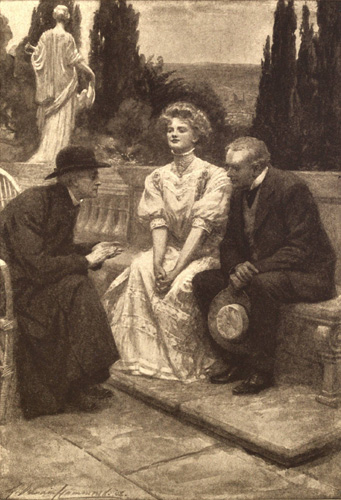
“Now, Jack, here is a chance to put your knowledge
of the classics to some practical use.”
Helen Armstrong paused for a moment before
a Latin inscription cut in the upper stones of the
boundary wall, and leaned gratefully upon her companion’s
arm after the steep ascent. “What does it
mean?”
Her husband smiled. “That is an easy test. The
ancient legend conveys the cheering intelligence that
‘from this spot Florence and Fiesole, mother and daughter,
are equi-distant.’”
The girl released her hold upon the man’s arm and,
pushing back a few stray locks which the wind had
loosened, turned to regard the panorama behind her.
It was a charmingly picturesque and characteristic
Italian roadway which they had chosen for their day’s
excursion. On either side stood plastered stone walls,
which bore curious marks and circles, made—who shall
say when or by whom?—remaining there as an atavistic
suggestion of Etruscan symbolism. The whiteness of
the walls was relieved by tall cypresses and ilexes which
rose high above them, while below the branches, and reclining
upon the stone top, a profusion of wild roses
shed their petals and their fragrance for the benefit of
the passers-by. In the distance, through the trees,
showed the shimmering green of olive-groves and vineyards—covering
the hillsides, yet yielding occasionally
to a gay-blossoming garden; and, as if to complete by
contrast, the streaked peaks of Carrara gave a faint suggestion
of their marble richness. In front, Fiesole rose
sheer and picturesque, while villas, scattered here and
there, some large and stately, some small, some antiquated
and others modernized, gave evidence that the
ancient Via della Piazzola still expressed its own individuality
as in the days when the bishops of old trod its
paths in visiting their see at the top of the hill, and
Boccaccio and Sacchetti, with their kindred spirits, made
its echoes ring with merry revelling. But, inevitably
turning again, the modern pilgrims saw far below them,
and most impressive of all, the languorous City of
Flowers, peacefully dreaming on either side of the silver
Arno.
All this was a familiar sight to John Armstrong, whose
five years’ residence in Florence, just before entering
Harvard, made him feel entirely at home in its outskirts.
He preferred, therefore, to fix his eyes upon the face
of the girl beside him. She was tall and fair, with figure
well proportioned, yet the characteristic which left the
deepest impress was her peculiar sweetness of expression.
Among her Vincent Club friends she was universally considered
beautiful, and a girl’s verdict of another girl’s
beauty is rarely exaggerated. Her deep, merry, gray
eyes showed whence came the vivacity which ever made
her the centre of an animated group, while the sympathy
and understanding which shone from them explained
her popularity.
The announcement of her engagement to Jack Armstrong
was the greatest surprise of a sensational Boston
season, not because of any unfitness in the match,—for
the Armstrong lineage was quite as distinguished as the
Cartwrights’,—but because Helen had so persistently
discouraged all admiration beyond the point of friendship
and comradeship, that those who should have known
pronounced her immune.
But that was because her friends had read her character
even less correctly than they had Armstrong’s.
They would have told you that she was distinctly a girl
of the twentieth century; he discovered that while tempered
by its progressiveness, she had not been marred by
its extremes. They would have said that her character
had not yet found opportunity for expression, since her
every wish had always been gratified; he would have explained
that the fact that she had learned to wish wisely
was in itself sufficient expression of the character which
lay beneath.
He watched her in the midst of the social life to which
they both belonged, entering naturally, as he did, into
its conventionalities as a matter of course, and he rejoiced
to find in her, beyond the enjoyment of those
every-day pleasures which end where they begin, a response
to the deeper thoughts which controlled his own
best expression. He could see that these new subjects
frightened her a little by their immensity, as he tried to
explain them; he sympathized with her momentary despair
when she found herself beyond her depth; but he
was convinced that the understanding and the interest
were both there, as in an undeveloped negative.
This same power of analysis which enabled him to
discover what all could not surmise had separated Armstrong,
in Helen’s mind, from other men, nearer her own
age, whom she had known. She could hardly have put
in words what the difference was, but she felt that it
existed, and this paved the way for his ultimate success.
His personal attributes, inevitably tempered by the early
Italian influence, marked him as one considerably above
the commonplace. At college he had won the respect of
his professors by his strength of mind and tenacity of application,
and the affection of his fellow-students by his
skill in athletics and his general good-fellowship. Now,
eight years out of college, he had already made his place
at the Boston bar, and was regarded as a successful man
in his profession. But beyond all this, unknown even to
himself, Armstrong was an extremist. The seed had
been sown during that residence in Florence years before,
when unconsciously he had assimilated the enthusiasm
of an erudite librarian for the learning and achievements
of the master spirits of the past. Latin and Greek at
college had thus meant much more to him than dead
languages; in them he found living personalities
which inspired in him the liveliest ambition for emulation.
These were some of the subjects to which he introduced
Helen. Little by little he told her of the fascination
they possessed for him, of the treasures hidden beneath
their austere exterior. But the girl was perhaps
more interested by the charm of his presentation than by
the possibilities she saw in the subjects themselves. She
felt that she could understand him, and admitted her
respect for the objects of his enthusiasm, but she was
convinced that these were beyond her comprehension,
and frankly rebelled at the necessity of going back into
dead centuries for them.
“I love the present, and all that it contains,” she
replied to him one day when something suggested the
subject during one of the many walks they took together;
“I love the sky, the air, the sunshine, and the
flowers. Why should I go back to the past, made up of
memories only, when I may enjoy all this beautiful world
around me? And you, Jack—I should not have you if
I had lived in the past!”
As her friends had said, she possessed strong ideas
about marriage, and expressed them without reserve.
Until Armstrong’s irresistible wooing, she had decided,
as a result both of observation and of conclusion, that
admiration and attention from many were far to be preferred
to the devotion of any single one, and that matrimony
was neither essential nor desirable except under
ideal conditions.
“There are so many things which seem more interesting
to me than a husband,” Helen asserted. “I’m
afraid that I agree too much with that wise old cynic
who said that ‘love is the wine of life, and marriage
the dram-drinking.’ I insist on remaining a teetotaler.”
Thus Armstrong felt himself entitled to enjoy a certain
degree of pride and satisfaction in that he had succeeded
in convincing her at last that the ideal conditions
she demanded had been met.
Even on board the steamer, at the start of their wedding
journey, as the familiar sky-line of New York became
less and less distinct, Armstrong read in his wife’s
eyes, still gazing back at the vanishing city, the thoughts
which inevitably forced themselves upon her—a last
remnant of her former doubt. When she turned and
saw him looking at her, she smiled guiltily.
“We are leaving the old life behind us,” she said.
“With all the philosophy you have tried to teach me,
I have not fully realized until now what a change it
means.”
“Do you regret it?” he asked her, half rebellious that
even a passing shadow should mar the completeness of
their happiness.
Helen quickly became herself again, and threw back
her head with a merry laugh at the seriousness of his
interrogation. “Regret it! How foolish even to ask
such a question! But you cannot wonder that the importance
of the event should force itself upon me, now
that we are actually married, even if it never did before.
It makes so much more of a change in a woman’s life
than in a man’s.”
Helen sighed, and then looked mischievously into his
face. “With you superior beings,” she continued, “it
simply signifies a new latch-key, a new head to your
household, and the added companionship of a woman
whom you have selected as absolutely essential to your
happiness. You keep your old friends, give up for a
time a few of your bad habits, and transfer a part of
your affections from your clubs to your home. To the
woman, it means a complete readjustment. New duties
and responsibilities come to her all at once. From her
earliest memory she has been taught to depend upon the
counsel and guidance of her parents, but suddenly she
finds herself freed from this long-accustomed habit, with
a man standing beside her, only a few years her senior,
who is convinced that he can serve in this capacity far
better than any one else ever did. Even with a husband
as superior as yourself, Mr. John Armstrong, is it not
natural that one should recognize the passing of the old
life, while welcoming the coming of the new?”
After landing, they had lingered for a fortnight in
Paris, but, beneath the keen enjoyment of the attractions
there, Armstrong had felt an impatience, unacknowledged
even to himself, to reach Florence, which contained
for him so much of interest, and whither his memory—let
him give it sway—ever recalled him. He felt that
his dei familiares were patiently waiting for him there,
indulgent in spite of his long absence, yet insistent that
their rights again be recognized. Having dropped his
engrossing law-practice, he yearned to take advantage
of this opportunity, now near at hand, to devote himself
to the girl he had won, and at the same time to gratify
this long-cherished wish to study more deeply into the
work of those early humanists who had foreshadowed and
brought about that mighty thought revolution, the wonderful
breaking-away from the deadly pall of ignorance
into the light and joyousness and richness of intellectual
life known as the Renaissance. Helen would no longer
fail to understand them when she saw them face to face.
He would lead her gently, even as Cerini the librarian
had led him; and together they would draw from the
old life those principles which made it what it was, incorporating
them into their new existence, which would
thus be the richer and better worth the living. So now
that he had actually reached his goal, it was natural that
his contentment at finding himself in Florence with his
wife was intensified by the joy of being again amid the
scenes and personages which his imagination had taken
out from the indefiniteness of antiquity, and invested with
a living actuality.
The sharp contrast of his two great devotions came
to John Armstrong as he stood at the cross-roads on
the edge of San Domenico. The one had exerted so
powerful an influence on what he was to-day—the other
must influence his future to an extent even greater. The
one, in spite of the personality with which he had clothed
it, was as musty and antiquated as the ancient tomes
he loved to study; the other, as she stood there, her
cheeks aglow after the brisk walk, her face animated
with enthusiastic delight, seemed the personification of
present reality. What a force the two must make when
once joined together, contributing, each to the other,
those qualities which would else be lacking!
“I must take you yet a little higher,” Armstrong
urged at length; “these walls still cut off much of the
glorious view.”
In a few moments more they had partly ascended the
Via della Fiesolana, which at this hour was wholly deserted.
With a sigh, half from satisfaction and half
from momentary fatigue, Helen turned to her companion.
She caught the admiration which his face so clearly reflected,
but, womanlike, preferred to feign ignorance of
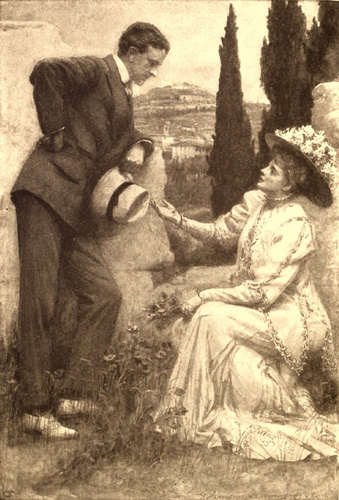
its origin. Glancing about her, she discovered a rock,
half hidden by the tall grass and wild poppies, which
offered an attractive resting-place. Seating herself, she
plucked several of the brilliant blossoms, and began to
weave the stems together. At last she broke the silence.
“Why are you so quiet, Jack?”
“For three reasons,” he replied, promptly. “This
walk has made me romantic, poetic, and hungry.”
Helen laughed heartily. “I am glad you added the
third reason, for by that I know that you are mortal.
This wonderful air and the marvellous view affect me
exactly as a fairy-story used to, years ago. When I
turned I fully expected to find a fairy prince beside
me. You confess that you are romantic, which is becoming
in a five-weeks’-old husband, but why poetic?”
“‘Poetry is but spoken painting,’” quoted Armstrong,
smiling; “and I should be pleased indeed were
I able to put on canvas the picture I now see before me.”
“Since you cannot do that, suppose you write a sonnet.”
Armstrong met her arch smile firmly. The girlish
abandon under the influence of new surroundings awoke
in him a side of his nature which he had not previously
realized he possessed. Stooping, he gently held her face
between his hands and looked deep into her responsive
eyes before replying:
“‘Say from what vein did Love procure the gold
To make those sunny tresses? From what thorn
Stole he the rose, and whence the dew of morn,
Bidding them breathe and live in Beauty’s mould?
What depth of ocean gave the pearls that told
Those gentle accents sweet, tho’ rarely born?
Whence came so many graces to adorn
That brow more fair than summer skies unfold?
Oh! say what angels lead, what spheres control
The song divine which wastes my life away?
(Who can with trifles now my senses move?)
What sun gave birth unto the lofty soul
Of those enchanting eyes, whose glances stray
To burn and freeze my heart—the sport of Love?’”
Helen made no reply for several moments after Armstrong
ceased speaking. Then she held out her hand to
him and looked up into his face.
“I never knew before that you were a real poet,” she
said, quietly.
“I wish I were—and such a poet! My precious
Petrarch, for whom you profess so little fondness, is
responsible for that most splendid tribute ever paid to
woman.”
Helen was incredulous.
“That sanctimonious old gentleman with the laurel
leaves on his head and the very self-confident expression
on his face?”
Armstrong nodded.
“Who spent all his life making love to another man’s
wife from a safe distance?”
“Yes; this is one of his love-letters.”
“Then if I accept those lines you just repeated with
so much feeling, I must be Laura?”
“But not another man’s wife.”
“I should have been if you had acted like that, Jack.
Let me see how you look with a laurel wreath made of
poppies.”
She drew his head down and tied the flowers about his
forehead. Then, pushing him away from her, she clapped
her hands with delight.
“There! if the noble Petrarch had looked like that,
Madonna Laura could surely never have resisted
him.”
“Had Madonna Laura resembled Madonna Helen,
the worthy Petrarch would have had her in his arms
before she had the chance,” laughed Armstrong, improving
his opportunity as he spoke.
“Very gallant, Jack, but very improper.” Helen
pursed her lips and looked up at him mischievously.
“But let us forget your musty old antiquities and talk
of the present. Do you realize that this is the end of
our honeymoon?”
“No,” he replied, holding her more closely and laughing
down at her; “it has only just begun.”
“Of course,” assented Helen, disengaging herself,
“but to-morrow we are to exchange the very romantic
titles of ‘bride’ and ‘bridegroom’ for the much more
commonplace ‘host’ and ‘hostess.’”
“Oh! I am relieved that you are not going to divorce
me at once.” Armstrong was amused at her seriousness.
“But it was your idea to invite them to join us, was it
not?”
“I know it was—and now I must make a confession
to you. I thought that in five weeks we both would be
glad enough to have some little break in our love-making.
But I did not realize how rapidly five weeks could
pass. Still”—Helen sighed—“what is the use of having
a villa in Florence unless you can invite your friends
to see it?”
“Then you have not become tired of your husband as
soon as you thought you would?”
“Nor you of your wife?” Helen retorted, quickly.
“Mamma suggested it first. She said that so long a
wedding trip as we had planned was sure to end with
one or both of us becoming hopelessly bored unless
we introduced other characters into our Garden of
Eden.”
“Did she say ‘Garden of Eden’? That family party
included a serpent, if rumor be correct.”
The girl laughed.
“But there could not be one in ours, because I would
never give you the chance to say, ‘The woman did
it.’”
“Your mother forgets that we are exceptions.”
“She says there may be some difference in men, but
that all husbands are alike.”
“Trite and to the point, as always with mamma.”
Armstrong paused and smiled. “Well, I think even she
will be satisfied with the success of her suggestion. How
many do our guests number at present?”
Helen dropped the flower she was idly swinging and
began to count upon her fingers.
“Let me see. There is Inez Thayer—I am glad
that she could visit us, so that at last you can know
her. It is strange enough that you should not have
met her until the wedding. You cannot help liking each
other, for she is interested in all those serious things you
love so well. The girls used to make sport of our devotion
at school because our dispositions are so unlike:
she is thoughtful, while I am impulsive; she is carried
away with anything which is deep and learned, while I,
as you well know, have nothing more important in life
than you and my music.”
Helen paused for a moment thoughtfully. “Sometimes
I wish I could really interest myself in those ancient
deities you worship.”
“You could if you only knew them as I do,” he urged,
quietly. “The present is the evolution of the past, but
it has been evolved so fast that many of the old-time
treasures have been forgotten in the mad pace of every-day
life.”
“But we can’t remember everything,” Helen replied;
“there are not hours enough in the day. I can’t even
find time to read our modern writers as much as I wish I
could, and I think one ought to do that before going
back to the ancients.”
“All modern literature is based upon what has gone
before,” insisted Armstrong.
“Wait a moment.” Helen’s face again became
thoughtful. “I have it!” she cried, triumphantly.
“‘The gardens of Sicily are empty now, but the bees
still fetch honey from the golden jars of Theocritus.’
That is what you mean, is it not? I remember that
from something of Lowell’s I read at school.”
“Splendid!” he laughed, with delight. “Who dares
to say that you are not in sympathy with the past?” He
bent his head down close to hers. “Would you not prefer
to hold those ‘golden jars’ in your very hands, sweetheart,
rather than merely read about them?”
“But, Jack, ‘the gardens of Sicily are empty now.’
Think how lonesome we should be.” Helen threw back
her head and drew in a long breath of the exhilarating
air.
Armstrong was still insistent. “I wish I could make
you see it as I do,” he said. “The present of to-day is
bound to be the past of to-morrow. What I want to
do is to assimilate all that the past can give me, so that
I may do my part, however small, toward giving it out
again, made stronger and more effective because of its
modern application, thus helping this present to become
worthy of being considered by those who come after us.”
Helen looked up at him with undisguised admiration.
“Oh, Jack, that sounds so wonderful, and I wish I could
enter into it with you, but I simply cannot do it. Inez
will be just the one. At school, as I told you, she went
in for the classics and all that, while I—well, I was
sent there to be ‘finished.’ Don’t look so disappointed,
Jack. Truly I would if I could.”
“I shall not give you up yet,” he answered, smiling
at Helen’s intensity, notwithstanding his genuine regret.
“Tell me something more about Miss Thayer, since you
insist upon her becoming your substitute.”
“Inez is a darling, in spite of her superiority,” Helen
replied, gayly, “and I simply could not have been married
without her for a bridesmaid. She would have sailed
two weeks earlier except for our wedding. As it was,
she came over with her cousins, and has been travelling
with them until time to join us here at the villa.”
“De Peyster is still devoted, I judge?”
“Poor Ferdinand! His persistency has quite won my
sympathy. He simply will not take ‘no’ for an answer,
but travels back and forth between Boston and Philadelphia
like any commercial traveller. Going over, he
has a bunch of American Beauties under one arm and a
box of bonbons under the other; returning, nothing but
another refusal to add to those Inez has already given
him.”
“He is not a bad sort of chap at all, when you get
past his peculiarities,” Armstrong added.
“Ferdy is a splendid fellow, in his own way,” assented
Helen, warmly, “and any girl might do a great deal
worse than marry him; but he is not Inez’ style at all.
I believe her trip to Europe is really to get away from
him. I know he thinks that is the reason, and is simply
inconsolable.”
“De Peyster would be a good match,” remarked Armstrong,
thoughtfully. “He has plenty of money and
plenty of leisure, and he ought to be able to make his
wife fairly comfortable.”
“But that is not what Inez wants. She has great
ideas about affinities, and Ferdy does not answer to the
description.”
“Then there is your uncle Peabody,” Armstrong
prompted, helpfully.
“Yes, there is dear Uncle Peabody. You will enjoy
him immensely.”
“Does he live up to his reputation of a man with an
‘ism’?”
“Oh, Jack! Some one has been maligning him to
you. That is because he is the only original member of
our family, and really the most useful.”
“Indeed! If that is your estimate of him, it shall
also be mine. I was prepared for a well-developed specimen
of the genus crank.”
“Wait till you see him.” Helen laughed at her husband’s
mental picture. “He is a crank, in a way, but
he is a mighty cheerful one to have around.”
“He believes in making an air-plant of one’s self, in
order to help him forget his other troubles, does he not?”
“Who has been making fun of dear Uncle Peabody?
I must have him tell you about his work himself. It
is true that he believes most people overeat, and it
is true that he is devoting his life and his fortune to
finding out what the basis of proper nutrition really is;
but as for starving—wait till you see him!”
“You have relieved me considerably,” Armstrong replied,
gravely. “From what I had heard of your uncle
I had expected nothing less than to be made an example
of for the sake of science—and you have already discovered
that I am really partial to my meals.”
“You can be just as partial to them as ever, Jack.
But, seriously, I know you will find him most interesting,
and I shall be surprised if his theories do not give you
something new to think about.”
“His theories will not do for me,” said Armstrong,
assuming a position of mock importance, “for I have
always been taught that a touch of indigestion is absolutely
essential to genius.”
“Splendid!” cried Helen. “That will be just the
argument to start the conversation at our first dinner
and keep it from being commonplace. I have been trying
to think how we could get Uncle Peabody interested.
It is only that first dinner which I dread, and you have
helped me out nobly.”
“That makes two,” suggested Jack.
“Yes, two. Then there are the Sinclair girls, who
have been studying here in Florence for nearly a year.
They will come up from their pension. That makes four—and
the others, you know, are Phil Emory and Dick
Eustis, who arrive in Florence from Rome to-night. I
don’t need to tell you anything about them.”
“There is a whole lot you might tell me about Emory
if you chose.”
Armstrong looked slyly into his wife’s face.
“Shame on you, Jack!” Helen cried, flushing; “the
idea of being jealous on your wedding trip!”
“I am not jealous now.” He emphasized the last
word.
“Well, I am glad you are over it.”
“It looks like a very jolly party,” he hastened to add,
seeing that Helen’s annoyance was genuine, “and I can
see where we become old married folk to-morrow. You
and Uncle Peabody will act as chaperons, I presume,
Phil and Dick will look after the Sinclair girls, while I
am to devote myself to Inez Thayer. Is that the programme?”
“Exactly. I am so anxious that Inez should appreciate
what a talented husband I have. She has heard
great stories about your learning and erudition, so now
you must live up to the picture.”
“Then suppose we start for home if you are quite
rested. It is plainly incumbent on me to make sure that
my knowledge of the classics proves equal to the test.”
The Armstrongs had installed themselves in the
Villa Godilombra, near Settignano. The date for
the wedding was no sooner settled than Jack cabled
to secure what had always seemed to him to be the most
glorious location around Florence. Years before, his
favorite tramp had been out of the ancient city through
the Porta alla Croce to La Mensola, whence he delighted
to ascend the hill of Settignano. Every villa possessed a
peculiar fascination for him. The “Poggio Gherardo”—the
“Primo Palagio del Refugio” of the Decameron—made
Boccaccio real to him. The Villa Buonarroti,
whither Michelangelo was sent as a baby, after the Italian
custom, to be nursed in a family of scarpellini, always
attracted him, and times without number he had
stood admiringly before the wall in one of the rooms,
gazing at the figure of the satyr which the infant
prodigy drew with a burning stick taken from the
fire. In those days he had been seized with a secret
yearning to become an artist, and often he had tried to
reproduce the satyr from memory, but always the ugly
visage assumed a mocking, sneering aspect which caused
him to relinquish his cherished ambition in despair.
But the Villa Godilombra appealed to Armstrong for
a different reason. It stood high up on the hill, affording
a wonderful view of the village of Settignano and
the wide-spreading valley of the Arno. The villa itself,
with its overhanging eaves, coigned angles, and
narrow windows, set on heavy consoles, was essentially
Tuscan, and impressive far out of proportion to its size.
It would have seemed too massive but for an arcade at
either end, the one connecting the house itself with
its chapel, the other leading from the first floor through
a spiral stairway in one pier of the arcade to what
originally, in the days of the Gamberelli, had been an
old fish-pond and herb-garden. In front of the villa
a row of antiquated stone vases shared the honors with
equally dilapidated stone dogs along a grassy terrace
held up by a low wall, while beyond this and the house
was the vineyard.
Armstrong had studied the plans of the house and
grounds from a distance, because, after his disappointing
experience with Michelangelo’s satyr, he had firmly
determined to become an architect and to build Italian
houses in America. He had walked up and down the
long bowling-green behind the villa, carefully noting the
number of statues set upon the high retaining wall
and figuring the height of the hedges. One day old
Giuseppe, the sun-baked gardener who had watched the
boy first with suspicion and then with interest, invited
him to enter, and his joy had been complete. Giuseppe
showed him the fish-pond and the grotto, lying in the
shadow of the ancient cypresses, made up of varicolored
shells and stones, with shepherds and nymphs occupying
niches around a trickling fountain. He led him to the
balustrade at the end of the bowling-green, and pointed
out the panorama which terminated in the hills beyond
the southern bank of the river.
Parallel with the back of the villa was another wall
which supported a terrace of cypress and ilex trees.
Behind this was the salvatico, without which no self-respecting
Italian villa could maintain its dignity, with
stone seats beneath the heavy foliage offering a grateful
relief from the glare of the sun. And here and there were
white statues of classic goddesses, to relieve the loneliness
had it existed. An iron gate, let into the wall opposite
the main doorway of the villa, led into a small garden,
this leading in turn into another grotto, which, with its
fountain and statues, formed an extension of the vista.
On either side a balustraded flight of steps led up to
an artificial height—the Italians’ beloved terrazza—flanked
by rows of orange and lemon trees, growing
luxuriantly in their red earthen pots; while against the
wide balustrades rested the heavily scented clusters of
the camellia and the rose-tinted oleander.
Twelve years is a short space of time in Italy, where
age is reckoned by the millennial, so it seemed perfectly
natural, when Armstrong arrived in Florence, to find
Giuseppe still at his old post and included in the lease
as a part of the Villa Godilombra. The old man expressed
no surprise, no delight—yet at heart he was
well pleased. The previous tenants of the villa had
been the unimaginative family of a German-American
brewer, and their preference for beer over the wonderful
vino rosso which he himself had pressed out from the
luscious grapes in the vineyard filled his heart with sorrow.
He confided to Annetta, the red-lipped maid Armstrong
had engaged for Helen, that he “was glad to
serve an ‘Americano molto importante’ rather than a
porco.” And Giuseppe took great satisfaction in placing
upon that last word all the emphasis needed to express
six months’ accumulated disgust.
From the moment the Armstrongs arrived, Giuseppe’s
admiration for Helen knew no bounds. To him she was
the personification of all that was perfection. Not that
he expressed it, even to Annetta—he would have forgotten
mass on Good Friday sooner than so forget his place.
It was rather that devotion which is born and not made—occasionally,
but not often, found in those who enter so
intimately into the life of those they serve, yet who
must always feel themselves apart from it. Hardly a
day had passed since the Armstrongs had assumed possession
of the villa that Helen had not found the choicest
fragole at her plate, each juicy berry carefully selected
and resting upon a bed of its own leaves at the bottom
of the little basket. Her room was ever redolent with
the odor of the flowers he smuggled in, always unobserved;
and his instructions to the more frivolous Annetta
as to her duties toward the nobile donna were such as to
cause that young woman to throw her head haughtily on
one side, with the observation that she was probably as
well acquainted with the requirements of a lady’s maid as
any gardener was apt to be, even though he were old
enough to be her grandfather.
This particular tiff had taken place while Armstrong
and his wife were making their excursion to Fiesole.
On their return they had found Giuseppe in a morose
mood, which quickly vanished when Helen told him, in
her broken Italian, that she expected guests upon the
morrow, and depended upon him to see that every room
was properly decorated, as he alone could do it. The
old man could hardly wait to arrange the chairs upon
the veranda, so eager was he to seek revenge upon his
youthful tormentor.
“Did she ask you to arrange the flowers, young peacock-feather?”
asked Giuseppe of Annetta when he found
her in the kitchen. “Did she trust you even to bring
the message to old Giuseppe? No. With her own lips
the Eccellenza praised the one servant on whom she
can rely.”
“She knows you are good for nothing else,” Annetta
retorted, with a scornful laugh and a toss of her pretty
head; “and she wishes to get you out of the way while
we attend to the really important matters. See,” she
cried, as the tinkling of the maids’ bell punctuated her
remarks, “the nobile donna will now give me commands.”
Giuseppe could not so far forget his dignity as to reply
to such an outrageous slander, so he contented
himself with casting upon Annetta his most withering
glances as she hastily brushed past him, holding back her
skirts lest they be defiled by touching the old man. He
watched her angrily until she vanished through the door,
then, with the choicest maledictions at his command,
he shuffled into the garden—into his own domain, where
the present generation of ill-bred servants, as he explained
to himself, could vex him not.
Mrs. John Armstrong’s first dinner at the Villa Godilombra
was an unqualified success. Uncle Peabody had
arrived early that morning; his optimism had set its seal
of approval upon the evident happiness of the bridal
couple, and he had already established himself as chief
reflector of the concentrated joy which he saw about him.
Inez Thayer was received into Helen’s welcoming arms
soon after luncheon, and was at once installed in the best
guest-chamber for an extended visit. Two dusty vetture
brought the Sinclair girls, Emory and Eustis, in time for
dinner, each driver striving to deliver his passengers first
in anticipation of an extra pourboire. The company was
therefore complete, and each member quite in the spirit
of the occasion.
The great candelabra cast their light upon the animated
party seated about the table in such a manner
that the old paintings hanging upon the walls of the
high room were but dimly visible. The long windows
were open, and the light breeze just cooled the air
enough to mellow the temperature, without so much as
causing the candle-flames to flicker. Giuseppe’s choicest
flowers, deftly arranged upon the table by Helen’s skilful
hands, contrasted pleasantly with the antique silver
and china which had once been the pride of the original
owner of the villa; and the menu itself, wisely intrusted
by Helen to the old Italian cook, was rife with constant
surprises for the American palate. Even the wines were
new—if not in name, at least in flavor, for Italian vintages
leave behind them their native richness and aroma
when transplanted. Never was any vino rosso so delicious
as that which Giuseppe made, even though unappreciated
by his former master; never such lacrima
Christi as that which Armstrong secured in a little wine-shop
near the Bargello; never such Asti spumante as
that which sparkled in the glasses, eager to share its own
bubbling happiness in return for the privilege of touching
the fair lips of the beautiful donne Americane.
“We had a friend of yours on board ship, Miss
Thayer,” said Emory, speaking to his left-hand neighbor
as they seated themselves.
“A friend of mine?” queried Inez. “I can’t think
who it could be.”
“Ferdy De Peyster,” replied Emory.
Inez cast a quick glance at Helen. “Really?” she
asked. “I thought he was going to spend the summer
at Bar Harbor.”
“Changed his mind at the last moment,” he said.
“Could not resist the charms of Italy. Do you know,
Helen”—Emory addressed himself to his hostess—“De
Peyster has developed a mania for art.”
Helen laughed. “No,” she replied, “that is news
indeed. It is a side of Ferdy’s nature which even his
best friends had not suspected. Is he coming to Florence?”
“Can’t say; but he is evidently planning to leave
Rome. We left him at the Vatican, in the Pinacoteca,
standing before Raphael’s ‘Transfiguration.’”
“With a Baedeker in his hand?” queried Jack.
“No, studying Cook’s Continental Time-table.”
“What a detective you would make, Mr. Emory,”
suggested Mary Sinclair as the laughter subsided.
“I have a better story about De Peyster than that.”
Eustis waited to be urged.
“Give it to us, Dick,” said Jack, helpfully.
“It was at Gibraltar,” began Eustis. “We were
in the same party going over the fortifications. De
Peyster, you know, enlisted at the time of the Spanish
war. Some family friend in the Senate obtained for
him a berth as second lieutenant, and his company got
as far as Key West. He rather prides himself on his
military knowledge, and he confided to me that he had
his uniform with him in case he was invited to attend any
Court functions. Well, all the way around De Peyster
explained everything to us. The Tommy Atkins who
was our guide was as serious as a mummy, but confirmed
everything Ferdy said. When you reach the gallery at
the top, you remember, the guide points out the parade-ground
below, and it happened that there was a battalion
going through its evolutions.”
“‘Ah!’ said De Peyster, ‘this is very interesting.’”
Then he described each movement, giving it the technical
military name. At last he turned to our guide and
said, patronizingly: ‘I’m a bit disappointed, sergeant,
after all I have heard of the precision of the English
army. I have often seen American soldiers go through
those same movements—just as well as that.’
“The sergeant saluted respectfully and gravely.
‘Quite likely, sir,’ he said, ‘quite likely. These are
raw recruits—arrived yesterday, sir!’”
“De Peyster was a sport, though,” added Emory.
“When he saw that the joke was on him he handed
Tommy a shining sovereign and said: ‘Here, sergeant,
have this on me, and drink a health to our two armies—may
comparisons never be needed.’”
Helen clapped her hands. “Good for Ferdy! He
is all right if people would only leave him alone.”
“Too bad he has so much money!” Eustis was reflective.
“If De Peyster had to get out and hustle a
bit you would find he had a whole lot of stuff in him.”
“Of course he has,” Uncle Peabody agreed.
“Do you know Mr. De Peyster?” Inez asked, surprised.
“No,” replied Uncle Peabody, “I don’t need to after
hearing Mr. Eustis’s summary. On general principles,
every one has ‘a whole lot of stuff in him.’ The trouble
is that people don’t give it a chance to come out.”
“Your confidence is evidently based upon your general
optimism?” Armstrong remembered that Helen
had mentioned this as a cardinal characteristic.
“Yes, but proved by a thousand and one experiments.
Our present subject, who now becomes No. 1002, is apparently
handicapped by the misfortune of inherited
leisure. It is rarely that a man of possession reaches
his fullest development without the spur of necessity.
More frequently we see one extreme or the other—too
much possession or too much necessity.”
“That is all very well as a theory, but does it really
prove anything as regards De Peyster?” questioned
Armstrong. “Personally I think optimism is a dangerous
thing. This confidence that everything is coming
out right is what makes criminals out of bank
cashiers.”
“There is a vast difference between real and false
optimism,” replied Uncle Peabody. “I knew a man
once who called himself a cheerful pessimist, because
every time he planted a seed it grew down instead of
up. He came to expect this, so it did not worry him
any. He was a real optimist, even though he did not
know it.”
“What would be your prescription for a case like Mr.
De Peyster’s?” queried Bertha Sinclair.
“A good wife, possessed of ambition, sympathy, and
tact,” Uncle Peabody replied, promptly. “This, my
dear Miss Sinclair, is your opportunity to assist me
in proving my argument. Will you be my accomplice?”
“I? Why, I don’t even know Mr. De Peyster,”
Bertha protested. “You must find some one else.”
“Very well,” sighed Mr. Cartwright. “You see how
difficult it is for science to assert its laws.”
Helen caught sight of Inez’ cheeks and hastened to
her friend’s relief.
“Uncle Peabody, do you know that you are responsible
for the first difference of opinion which has arisen
between my husband and me?”
“My gracious, no! Can it be possible?”
“It is a fact. I stated to him only yesterday that
perfect digestion was the only basis on which health
and happiness can possibly rest. You taught me that,
but Jack asserts that a touch of indigestion is absolutely
essential to genius.”
“How does he know? Has he a touch of indigestion?”
“Not a touch,” laughed Armstrong, “and that
proves my statement. I really believe I might have
been a genius if my digestion had not always been so
disgustingly strong.”
“Don’t despair, my dear boy.”
Uncle Peabody looked at Jack over his spectacles.
“Genius is a germ, and sometimes develops late in life.
If your theory is correct, a few more gastronomic orgies
such as this will make you eligible.”
“But is there not something in what I say?” Armstrong
persisted, seriously. “Is it not true that good
health is against intellectual progression? Is not good
health the supremacy of the physical over the mental?
The healthy man is an animal—he eats and sleeps too
much. Pain and suffering have not developed the nervous
side, which is so closely connected with the intellectual.
When the physical side becomes weakened, then
the brain begins to act.”
Uncle Peabody listened attentively and then removed
his spectacles. “My dear Jack Armstrong,” he said, at
last, “I can see some fun ahead for both of us, and
Helen has placed me still further in her debt by her
choice of a husband. Your argument is not a new one.
It was invented a great many years ago in France by
some clever person who wished to have an excuse for
late nights, absinthe, and cigarettes. Do you mean
seriously to advance a theory which, if logically carried
through to the end, would credit hospitals and homes
for the hopelessly depraved with being the highest intellectual
establishments in the world?”
“But look at the examples which can be cited,”
Armstrong continued, undisturbed. “Zola produced
nothing of importance after he adopted the simple life,
and Swinburne’s poetry lost all its fire as soon as he
‘reformed.’”
“Can you prove in either case that the question
of nutrition or digestion entered into the matter at
all?”
“Oh, it may have been a coincidence, of course; but
many other cases might be added.”
Uncle Peabody was silent for a moment. “Let me
give you a simple problem,” he said, at length. “Helen
tells me that you have an automobile now on its way to
Florence?”
Armstrong assented.
“When it arrives I presume you will engage a chauffeur?”
“What has an automobile to do with nutrition, Mr.
Cartwright?” demanded Mary Sinclair. “Surely an
automobile has no digestion.”
“My application is near at hand. When you engage
that chauffeur I presume you will insist that he knows
the mechanism of the machine, understands the application
of the motive power and other details which enter
into safe and successful handling of the car?”
“Naturally,” replied Jack. “I am not introducing
my machine here for the purpose either of murder or
suicide.”
“Exactly. That is just what I wanted you to say.
Now, every human stomach is an engine which requires
at least as intelligent handling as that of an automobile.
Upon its successful working depends the mechanical
action of the body. We may disregard the additional
dependence of the brain. Petroleum in the automobile
is replaced by what we call food in the human engine.
Too much of either, unintelligently applied, produces
the same unfortunate result. Now I ask you, John Armstrong,
would you engage as chauffeur for your automobile
a man who knew no more about the mechanism of
its engine, or how to feed and handle it properly, than
you yourself know about your own body engine?”
“No,” Armstrong admitted, frankly, “I would not.”
“But which is more serious—a damage resulting
from his ignorance or from your own?”
“Look here, Mr. Cartwright,” said Jack, laughingly,
“you promised that there was fun ahead for us both.
At present it seems to be mostly for you and our
friends.”
“Who started the discussion?”
“Helen; but I admit my error in being drawn into it.
I had not expected to be convicted upon my own evidence.”
Helen rose. “I must rescue my husband from the
calamity I have brought upon him. Come, let us have
our coffee in the garden.”
If one could have looked within Uncle Peabody’s room
after the other guests had snuffed out their candles,
he would have discovered its inmate seated beside the
flickering light with an open letter in his hand. He
had read it over many times since its receipt nearly
three months earlier, announcing in Helen’s characteristic
way her engagement and approaching marriage.
No one else had ever come so closely into his life, and he
felt a certain responsibility to satisfy himself that the
girl had made no mistake in the important step which
she had taken. Now that he had actually met her husband,
he again perused the lines which had introduced
his new nephew to him.
“It has actually happened at last,” the letter began,
“and your favorite wager of ‘a thousand to one on the
unexpected’ has really won. In other words, I, Helen
Cartwright, condemned (by myself) to live and die an
old maid as penalty for being so critical of the genus
homo, now confess myself completely, hopelessly in love,
and so happy in my new estate that I wonder why I ever
hesitated.
“It is all so curious. The things which interested me
before now seem so commonplace compared to the events
to come in connection with this broader existence which
is opening up before me. How infinitely more gratifying
it is to feel myself living for and a part of another’s
life, how comforting to know that some other personality,
whom I can love and respect, feels himself to be
living for and a part of my life. It adds to the seriousness
of it all, but how it increases the satisfaction!
“I wish I could describe John Armstrong to you, but
now that I am about to make the attempt I realize how
difficult a task I have undertaken. He is eight years
older than I, but sometimes he seems to be years younger,
while again I feel almost like a child beside him. No,
Uncle Peabody, it is not a similar case to that little Mrs.
Johnson whom you quoted when you were last home as
saying that a woman feels as old as the way her husband
treats her. I know this will pop into your mind, so I
will promptly head you off. The fact is that Jack is
a very remarkable man. He is handsome, with great
strength of character showing in every feature, he is
tall and athletic,—but it is his wonderful mental ability
which will most impress you. Think of a man playing
on the Harvard ’Varsity eleven, rowing on the crew, and
yet graduating with a summa cum laude!
“Jack is a superb dancer, thus disproving the common
belief that a man can’t be clever at both ends; and
at the Assemblies, even before we were engaged, I used
to anticipate those numbers which he had taken more
than all the others. Besides this, his conversation was
always so original,—touching frequently upon topics
which were new to me. His particular fad is what he
calls ‘humanism’ and his particular loves the great
writers of the past,—his ‘divinities,’ as he calls them.
You probably understand just what all this means, but,
alas! most of it is beyond my comprehension! What he
tells me interests me, of course,—it even fascinates me.
I can follow him up to a certain point; then we reach
my limitations, and I am forced to admit my lack of
understanding. That is when I feel so like an infant
beside him. He is as patient as can be, and insists that
when once I am in Florence, where the air itself is heavy
with the learning of the past, I shall be able to comprehend
it all, and it will mean the same to me that it does
to him. I wish I felt as confident!
“We are to be married in April, and Jack has taken
the Villa Godilombra in Settignano for the season. We
expect to arrive there early in May, and we want you
to come to us for just as long a visit as you can arrange.
You won’t disappoint me, will you, dear Uncle Peabody?
We all have been broken-hearted that you have so long
delayed your return, and one of the events in our plans
for Florence to which I am looking forward with the
greatest eagerness is this visit with you. Write and tell
me how your work progresses, but don’t say ‘I told you
so.’ This would show that you really expected it all the
time, and your favorite argument would lose its force.
Just say that you will come to us at Settignano.”
The letter itself showed that Helen had changed much
during the months which had elapsed since he had last
seen her. There was a more serious undertone and a
broader outlook,—due undoubtedly to Armstrong’s influence.
Uncle Peabody wondered whether Helen could
have been attracted to this man by her admiration for
his mental strength rather than by any real sentiment,
perhaps mistaking the one for the other. This was the
point he wished to settle in his own mind, and this was
why he had studied them both, from the moment of his
arrival, much more carefully than either one of them
realized.
Armstrong was a remarkable man, as Helen had said.
Even in the few hours he had known him, Uncle Peabody
found much to admire. It was true that his manner
toward Helen showed indulgence, almost as to a
child rather than to a wife; but his devotion was entirely
obvious, and this relation was to be expected after reading
Helen’s letter. Still, Mr. Cartwright told himself,
the existence of this relation necessitated a certain readjustment
before a perfection of united interests could be
attained. Armstrong was bound to be the dominating
force, and Helen must inevitably respond to this new influence,
strange as it now seemed to her. His knowledge
of her sympathetic and intuitive grasp of his own pet
theories gave him confidence to believe that this response
would be equally prompt and comprehensive.
Henry Peabody Cartwright was distinctly a citizen of
the world. Boston had been his birthplace, Boston had
been the base of his eminently successful business operations,
and his name still figured in the list of the city’s
“largest taxpayers.” Beyond this, the city of his early
activity had, during the past twenty years, seen him
only as a visitor at periodic intervals. He had emerged
from his commercial environment at the age of forty,
with a firm determination to gratify his ideals.
Fortunately for him, and for mankind as well, his
ideals were not fully crystallized when he set out to
gratify them. Boston was entirely satisfactory to him
as an abiding-place, but he felt a leaven at work within
him which demanded a larger arena than even the outlying
territory of Greater Boston covered. He started,
therefore, in the late eighties for a trip around the
world, with the definite purpose, as he himself announced,
of “giving things a chance to happen to him.”
“I have no schedule and no plans,” he said to those
who questioned him. “I shall ‘hitch my wagon to a
star,’ but always with my grip near at hand, so that I
may change stars upon a moment’s notice.”
There were no immediate family ties to interfere with
the carrying-out of what seemed to his friends to be
rather quixotic ideas. There may have been some youthful
romance, but, if so, no one ever succeeded in learning
anything of it from him.
“It is all perfectly simple,” he once good-naturedly
replied to a persistent relative. “The girls I was willing
to marry would not have me, and those who would
have me I was not willing to marry. I used to think
that I would become more attractive as I grew older,
but I have given up that idea now. Once I tried to rub
a freckle off with sand-paper and pumice-stone and
found blood under the skin; but the freckle—the same
old freckle—is there to this day.”
His devotion to women in the composite was consistent
and sincere; the fondness which existed between himself
and his brother’s family was such that his departure
had left a distinct void, and his visits home were events
circled with red ink in the family calendar. He enjoyed
these visits no less than they; but with never more than a
day or two of warning he would announce his intention
of leaving for Egypt or India or some spot more or less
remote in his quest for the unexpected. To the reproaches
which were levelled at him, he replied, with a
smile which defied controversy:
“I am just as sorry not to be with you all as you can
possibly be to have me away; but I have educated myself
to the separation, and have thus overcome the necessity
for personal propinquity.”
On that first trip around the world Uncle Peabody
found one of his ideals, although he did not realize its
vast importance until several years later. Japan appealed
to him, and the longer he remained there the more
impressed he became with certain of the national characteristics.
First of all, he marvelled at the evenness of
temper which the people displayed, at their endurance,
their patience. He watched the carefulness with which
they weighed the importance of each problem before
accepting its responsibility, and their utter abandon in
carrying it through when once undertaken. This was
twenty years before the Russo-Japanese war, and he
had come among them with the existing Occidental
estimate of their paganism and barbarity. It may have
been a species of incredulity leading to curiosity which
induced him to remain among them, but as a result of
his sojourn he discovered that they were philosophers
rather than fatalists, geniuses rather than barbarians.
He questioned his new hosts, when he came to know
them better, and was told quite seriously and quite
naturally that they never became angry, because anger
produced poison in the system and retarded digestion;
that upon digestion depended health; that upon
health depended happiness, and upon happiness depended
personal efficiency and life itself. They explained
that forethought was one of the cardinal factors of their
creed, but added that its antithesis, fear-thought, was
equally important as an element to be eliminated. They
called his attention to the fact that they did not live
upon what they ate, but upon what they digested, and
that by masticating their food more thoroughly than he
did they secured from the smaller quantity the same
amount of nourishment without needlessly overloading
their systems with undigested food which could not possibly
be assimilated.
This last theory did not altogether appeal to Peabody
Cartwright at first. His friends at the Somerset
Club still held memories of his epicurean proclivities,
and they were not weary even yet of recalling the time
when he had won a goodly wager by naming, blindfolded,
five different vintages of Burgundy and Bordeaux.
But the more he thought it over the more convinced he
became that the something to which he had promised
to give a chance had really happened to him. He pondered,
he experimented—but he still continued to eat
larger quantities of food than the Japanese.
A year later he was in Italy, and in Venice Mr.
Cartwright suddenly discovered that he had found the
geographical centre of the civilized world. With Venice
as the starting-point, one could reach London or Constantinople,
St. Petersburg or New York, with equal exertion.
Venice, therefore, became his adopted home, although
it could claim no more of his presence than any
one of a dozen other cities in the four quarters of the
globe. During the twenty years, he had succeeded in
making himself a part of each one—had become a veritable
citizen of the world, but by no means a man without
a country.
Italy served to drive home the truths which Japan
had first shown him. Three years after his experience
there, a dingy, second-hand book-store in Florence
had placed him in possession of Luigi Cornaro’s Discorsi
della Vita Sobria. He read it with amazement.
Here in his hand, written by a Venetian nobleman more
than three hundred years before, at the age of eighty-three,
was the text-book of the theories of life which he
had accepted from the Japanese as new and untried
except among this alien people! It gave him a start,
and he journeyed to Turin, Berne, Berlin, Brussels,
Paris, London, St. Petersburg, and even back to Boston,
seeking to interest the famous physiologists in his discovery,
which he believed was destined to exterminate
disease and to transform those practising the medical
profession into hygienic engineers.
Mr. Cartwright’s name and personality preserved him
from a sanitarium, but his theories as to self-control,
forethought, and fear-thought received ample opportunity
for personal experiment. He was as tenacious
as if his future depended upon the outcome. A good-natured
indulgence here, and an incredulous sympathy
there, gave him his first opportunities for demonstration.
He not only drew upon his fortune, but freely
contributed himself as a subject for experiment. It
had been slow, but he had learned patience from the
Japanese. Disbelief gradually changed into doubt,
doubt into question, question into half-belief, and half-belief
into conviction. Quietly, surely, his own faith
was assimilated by those high in the physiological ranks,
and almost against their will, and before they realized
the importance of their concessions, he had forced them
to prove him right by their own analyses.
The last five years had been a steady triumph. He
had found his ideals, but he had not attained them. He
knew what his life-work was, and had the gratification
of counting among his friends and collaborators the
highest authorities the world recognized. The habits
of generations could not be changed in a moment—some
of them could never be changed; but the ball had been
started and was gaining in size with each revolution.
It no longer needed his gentle, persuasive push; it had
its own momentum now, and he found it only necessary
to guide its advance and to watch its growth.
Uncle Peabody’s thoughts reverted to his work as he
folded Helen’s letter and placed it again in his pocket,
where he had so long carried it. He regretted having
his labors interrupted just now, but he found himself
keenly interested to watch Helen’s approaching evolution.
His wagon was firmly hitched to this new star,
and he had no notion of changing stars. So, with a
murmured “Bless you, my children. May you live forever,
and may I come to your funeral,” he sought the
repose which the others had already found.
Mary and Bertha Sinclair were just completing a
year’s study in Florence, upon which they were
depending to perfect their musical education; but
both girls were sufficiently homesick after their two years’
absence from Boston to be more than eager to exchange
their pension for a week’s visit with Helen, who brought
to them a fresh budget of home news,—for which their
eagerness increased as the date for their return to America
drew nearer. Emory and Eustis, too, added familiar
faces, so the days following the first dinner at the villa
proved to be full of interest and enjoyment to all concerned.
The guests became familiar with each portion of the
house and grounds, the mysteries of Italian house-keeping
were contrasted with the limitations of boarding,
and numerous topics of common import succeeded
each other without surcease.
During the morning following the arrival of the
guests, Armstrong touched tentatively upon the subject
of visiting the library.
“We went there when we first came to Florence,”
Mary Sinclair replied; “and we saw everything there
was.”
Armstrong smiled indulgently, thinking of the little
they had really seen.
“You know we are not very literary,” explained
Bertha, catching the expression upon his face.
“They are really more hopeless cases even than I,”
Helen added, sympathetically.
“Why don’t you try Phil and me?” inquired Emory.
“We went through the Vatican library, so we are experts.
At least they said it was a library. The only
books we saw there were a few in show-cases—the rest
they kept out of sight.”
“You would not recognize a real book if you saw it,
Emory,” Armstrong replied, with resignation. “There
is no hurry. Perhaps Miss Thayer will go with me
some day soon.”
“Indeed I will,” Inez responded, with enthusiasm.
“There is nothing I wish so much to do.”
“Good.” His appreciation was sincere. “I shall
take real delight in introducing to you my old-time
friends, with whom I often differ but, never quarrel.”
“Are they so real to you as that?” Inez asked, impressed
by his tone.
“They are indeed,” Armstrong replied, seriously.
“I visit and talk with them just as I would with you
all. But they have an aggravating advantage over
me, for, no matter how laboriously I argue with
them, their original statement stands unmoved there
upon the written page, as if enjoying my feeble effort
to disturb its serenity, and defying me to do my
worst.”
“I would much prefer to give them an absent treatment,”
asserted Eustis.
“Inez is clearly the psychological subject,” Helen
added. “At school she was forever putting us girls to
shame by her mortifying familiarity with the classics.
It is only fair that she should now be paid in her own
coin.”
“I accept both the invitation and the challenge,” replied
Inez, bowing to her hostess, and, walking over to
the low wall on which Helen had seated herself, she
threw her arm affectionately about her neck. “But
you must not embarrass me with such praise, or your
husband will suffer a keen disappointment. To study
Latin and Greek out of school-books is one thing; to
meet face to face the personalities one has regarded as
divinities—even reading their very handwriting—is another.
It makes one wonder if she ever did know anything
about them before.”
“That is exactly the spirit in which to approach the
shrine, Miss Thayer!” cried Armstrong, enthusiastically.
“Let us frame a new beatitude: ‘Blessed is she who appreciates
the glories of antiquity, for she shall inherit
the riches of the past.’”
The contrast of the two girls in the rich Italian morning
light was so striking that Uncle Peabody paused
in his approach after a successful attack upon the
rose-bushes, touched Armstrong upon the shoulder, and
nodded admiringly in their direction. They were separated
a little from the others, and were busily engaged
in a conversation of their own, in which no man hath a
part, quite oblivious to the attention they attracted.
Inez was standing, and, even though seated, Helen’s
superb head reached quite to her companion’s shoulder,
and the fair hair and complexion were clearly
defined against the darker hue of the face and head
bent down to meet her own. Her eyes, looking out
into the distance even as she spoke, reflected the calm,
satisfied contentment of the moment, while in the brown
depths of the other’s one could read an ungratified ambition,
an uncertainty not yet explained. Inez Thayer’s
face was attractive, Helen’s was beautiful—that beauty
which one feels belongs naturally to the person possessing
it without the necessity of analysis.
Armstrong was evidently pleased with this comparison,
as he had been with all previous ones. Italy, it seemed
to him, formed just the background to set off to best
advantage his wife’s personal attractions. Uncle Peabody
smiled contentedly at the undisguised satisfaction
which was so clearly indicated in the younger man’s
face.
“If there had been any girls in Boston who looked
like that when I was of sparking age,” he whispered to
Armstrong, “I should certainly have married and settled
down, as I ought to have done.”
“And allowed the world to perish of indigestion?”
queried Armstrong, smiling.
“Scoffer! you do not deserve your good-fortune.
Come, these roses are becoming all thorns. Young
ladies, may I intrude upon your tête-à-tête long enough
to present you with the trophies of my after-breakfast
hunt?”
“A thousand apologies, Uncle,” cried Helen, taking
the roses in her arms and burying her face in their
fragrant petals. “Oh! how beautiful! And how idiotic
ever to leave this Garden of Paradise and immure yourselves
within that musty old library. Do you not repent?”
“I place the decision wholly in Miss Thayer’s hands,”
said Armstrong; but he glanced at Inez with evident expectancy.
“Then I decide to go,” replied the girl. “I am
quite impatient to meet the friends in whose good company
Mr. Armstrong revelled before his present reincarnation.”
“When?” asked Armstrong, quickly.
“Now!”
“Splendid! I will order the carriage at once.”
“There is rapid transit for you!” exclaimed Eustis.
“Jack believes in striking while the iron is hot.”
“What a narrow escape we have had,” murmured
Mary Sinclair, with a sigh of relief.
“Very well,” said Helen, resignedly. “It may be
just as well to have it over. Jack has been looking forward
to this ever since he turned his face toward Florence,
and he will be quite miserable until he has actually
gratified his anticipation.—But don’t be away long, will
you, Jack?”
“Miss Thayer will very likely find the staid company
which we plan to keep quite as stupid as the rest
of you anticipate,” replied Armstrong, “so we may be
home sooner than you expect.”
Inez had already disappeared in-doors to put on her
hat, and Armstrong started out to call a carriage.
Helen intercepted him as he crossed the veranda.
“You won’t mind if I don’t go with you to-day, will
you, Jack? If it were just to see the treasures at the
library I would urge them all to go; but I know what
is in your mind, dear. Truly, I will go with you some
time, and you shall try your experiment upon me; but
I am not in the mood for it just now. I ought not to
leave the others, anyway.”
“It is all right, of course,” he answered. “I wish
you did feel like going, but your substitute seems to be
enthusiastic enough to make up for your antipathy.”
“Don’t call it that,” Helen answered, half-reproachfully;
“it is simply that I am ashamed to have my ignorance
exposed,—and it will give you such a splendid
chance really to know Inez. Now run along and have a
good time, and tell me all about it when you come home.”
The little one-horse victoria soon left the villa behind,
and was well along on the narrow descending road
before either of its occupants broke the silence. As
if by mutual consent, each was thinking what neither
would have spoken aloud. Helen had not seen the expression
of disappointment which passed over her husband’s
face as she spoke. He would have given much
if it might have been his wife beside him. He had
studied the girl carefully, and had found in her an intuitive
sympathy with the very subjects concerning
which she disclaimed all knowledge. At first he had
thought that she exaggerated her limitations because
of his deeper study, but he soon discovered her absolute
sincerity. It was a lack of confidence in herself,
he inwardly explained, and when once in Florence he
would give her that confidence which was the only element
lacking to her complete understanding. But as
yet he had been unable to get her inside the library, or
even within range of the necessary atmosphere.
Inez Thayer’s thoughts were upon the same subject,
but from a different standpoint. Her last words to
Helen, when Uncle Peabody had interrupted their conversation,
framed a mild reproach. “If I had won a
man like Jack Armstrong,” Inez whispered to her, “I
would not allow any one, not even you, to take my place
on an excursion such as this, upon which he has so set
his whole heart.”
“You are a sweet little harmonizer, Inez,” Helen had
answered, smilingly, “but you are a silly child none the
less. Jack and I understand each other perfectly. He
knows my limitations, and, if I went, I should only
spoil his full enjoyment. You will understand it and
revel in it, and he will be supremely happy. If you were
not so much better fitted naturally for this sort of thing,
of course I should go rather than disappoint him, but,
truly, the arrangement is much better as it is.”
Inez had no opportunity to continue the conversation,
but Helen had not convinced her. Hers was an intense
nature, and she had much more of the romantic in her
soul than her best friends gave her credit for. Her one
serious love-affair had proved only an annoyance and
mortification. Ferdinand De Peyster was in many ways
a desirable parti, as mammas with marriageable daughters
were quite aware. He was possessed of a handsome
competency, was not inconvenienced by business responsibilities,
and his devotion to Inez Thayer was only whetted
to a greater degree of constancy by the opposition
it received from its particular object. He was not lacking
in education, having spent four years in the freshman
class at Harvard; he was not unattractive, in his
own individual way, and his one great desire, not even
second to his striving for blue ribbons with his fine stable
of blooded horses, was to have her accept the position of
head of his household.
But Inez was repelled by the very subserviency of his
devotion. Her love rested heavily upon respect, and
this could be won only by a man who commanded it.
John Armstrong fulfilled her ideal, and she wondered
why Fate had not fashioned the man whom she had
attracted in a similar mould.
Armstrong looked up from his reverie half guiltily,
and for a moment his eyes met those of his companion
squarely. Inez could not match the frank glance—it
seemed to her as if he must have read her thoughts;
but the heartiness of his words relieved her apprehension.
“What a bore you must think me, Miss Thayer! I
have not spoken a word since we left the house.”
“I must assume my share of responsibility for the
silence,” Inez replied, regaining her composure. “The
seriousness of our quest must have had a sobering effect
upon us both.”
“But you won’t find these old fellows so serious as
you think,” Armstrong hastened to say. “They were
humanists and products of the movement which marked
the breaking away from the ascetic severity preceding
them. But, after all, they were the first to realize that
life could be even better worth living if it contained
beauty and happiness.”
“You see how little I know about them, in spite of
Helen’s attempt to place me on a pedestal.”
“Why, if it had not been for their work,” he continued,
enthusiastically, “the classics might still have
remained as dead to us as they were to those who lived
in the thirteenth century. Instead of studying Virgil
and Homer, we should have been brought up on theological
literature and the ‘Holy Fathers.’”
“I feel just as I did at my coming-out party,” Inez
replied—“that same feeling of awe and uncertainty.
I am eager to go with you, yet I dread it somehow. It
is not a presentiment exactly,—it is—”
“I know just what you mean,” Armstrong interrupted,
sympathetically; “and, if you feel like that now,
just wait until you see old Cerini, the librarian. It is
he who is responsible for my passion for this sort of
thing. Why, I remember, when I was here years ago
and used to run in to see him at the Laurenziana, I
never regarded him as a mortal at all; and I don’t believe
my reverence and veneration for the old man have
abated a whit in the twelve years gone by.”
The light vehicle had passed through the Porta alla
Croce, and was swaying from side to side like a ship
at sea, rattling over the stones of the narrow city
streets at such a rate that conversation was no longer
a pleasure.
“Just why Florentine cabmen are content to drive
at a snail’s pace on a good road and feel impelled to
rush at breakneck speed over bad ones is a phase of
Italian character explained neither by Baedeker nor by
Hare,” remarked Armstrong, leaning nearer to Inez to
make himself heard.
With a loud snap of his whip and a guttural “Whee-oop,”
the cocchiere rounded the statue of John of the
Black Bands, just missed the ancient book-stand immortalized
by Browning in the Ring and the Book,
and came to a sudden stop before the unpretentious entrance
to the Biblioteca Laurenziana.
“You have been here before, of course?” he asked his
companion as they passed through the wicket-gate into
the ancient cloisters of San Lorenzo.
“Once, with Baedeker to tell me to go on, and with
the tall Italian custodian to stop me when I reached the
red velvet rope stretched across the room, which I suppose
marks the Dante division between Purgatory and
Paradise.”
“This time you shall not only enter Paradise, but
you shall behold the Beatific Vision,” laughed Armstrong.
Passing by the main entrance of the library at the
head of the stone stairs, Armstrong led the way
along the upper cloister to a small door, where he pressed
a little electric button—an accessory not included
in Michelangelo’s original plans for the building. A
moment later they heard the sound of descending footsteps,
and presently a bearded face looked out at them
through the small grated window. The inspection was
evidently satisfactory, for the heavy iron bar on the
inside was released and the door opened.
“Good-morning, Maritelli,” said Armstrong in Italian.
“Is the direttore disengaged?”
“He is in his study, signore, awaiting your arrival.”
Maritelli dropped the iron bar back into place with
a loud clang and then led the way up the short flight
of stone steps to the librarian’s study. Armstrong detained
Inez a moment at the top.
“I brought you in this way because I want you to
see Cerini in his frame. It is a picture worthy the
brush of an old master.”
Maritelli knocked gently on the door and placed his
ear against it to hear the response. Then he opened
it quietly and bowed as Armstrong and his companion
entered.
“Buon’ giorno, padre.” Armstrong gravely saluted
the old man as he looked up. “I have brought to you
another seeker after the gold in your treasure-house.”
Cerini’s face showed genuine delight as he rose and
extended both hands to Inez. “Your wife!” he exclaimed;
“I am glad indeed to greet her.”
Armstrong flushed. “No, padre, not my wife, but
her dearest friend, Miss Thayer.”
The old man let one arm fall to his side with visible
disappointment, which he vainly sought to conceal.
“I am sorry,” he said, simply, taking Inez’ hand
in his own. “I have known this dear friend for many
years, and have loved him for the love he gave to my
work. I had hoped to greet his wife here, and to find
that the literæ humaniores were to her the elixir of life
that they are to me—and to him.”
“When I tell her of my visit she will be eager to come
to you as I have,” said Inez, strangely touched by the
keenness of his disappointment. “To-day she could not
leave her guests.”
“Will you first show Miss Thayer the illuminations
and the rarest of the incunabula?” asked Armstrong,
eager to change the subject; “and then will you let
us come back here to talk with you?”
“With pleasure, my son, with pleasure. What shall
I show her first?”
“That little ‘Book of Hours’ illuminated by Francesco
d’Antonio, padre.”
Cerini pulled up the great bunch of keys suspended
from the end of his girdle and unlocked one of the
drawers in the ancient wooden desk in front of him.
“I always wonder how you dare keep so priceless a
treasure in that desk, and why it is not put on exhibition
where visitors may see it,” Armstrong queried.
Cerini laughed quietly. “There are many other
treasures, my son, equally precious, as you know well,
scattered about in these desks and drawers, where I alone
can find them.”
“How dare you take the risk?”
Cerini’s face showed a gentle craftiness. “We are in
Italy, my son. If any one could find these gems, any one
could be librarian”—and the old man chuckled quietly
to himself.
Inez’ eyes were fastened upon a little purple velvet
case inlaid with jewels. Cerini opened it carefully, exposing
a small volume similarly bound and similarly
adorned. Armstrong eagerly watched the interest in
the girl’s face as the full splendor of the masterpiece impressed
itself upon her—the marvellous delicacy of design,
the gorgeousness of color, the magnificence of the
decoration and the miniatures. Inez drew in her breath
excitedly and bent nearer to the magnifying-glass which
it was necessary to use in tracing the intricacy of the
work.
“Wonderful!” she cried, and then was silent.
“It belonged to Lorenzo the Magnificent, and represents
the finest of the quattrocento work, my daughter,”
explained the old man, pleased as was Armstrong by her
unfeigned admiration. “The patrons of the book in
the fifteenth century considered gems of thought as the
most precious of all jewels. The page containing them
must be written upon the finest and the rarest parchment.
They could not inlay costly stones, so they employed
the most famous artists to place upon the page
in beaten gold and gorgeous colors a representation of
the jewels and miniatures as perfect as art at its highest
could produce. Can you wonder, my daughter, that
men brought up in the school of neo-Platonism should
look upon the invention of printing as an evil and an
innovation to be opposed?”
Inez would not permit Cerini to close the volume until
she had feasted her eyes upon every page.
“Have you not prepared me for an anti-climax?”
she asked, with a sigh, as Armstrong suggested a visit
to the room of illuminations. “Surely there is nothing
else here to surpass what I have just seen.”
The librarian answered. “Nothing to surpass it,
truly, but other volumes equally interesting.”
The old man led them into a larger room filled with
wooden cases whose glass tops were covered with faded
green curtains. Costly tapestries lined the walls, but
Inez’ attention was quickly taken from them as Cerini
pulled aside the curtains and disclosed the resplendent
wealth beneath. Heavy choir-books, classic manuscripts,
books of hours, breviaries embellished by Lorenzo Monaco,
master of Fra Angelico, by Benozzo Gozzoli, whose
frescos still make the Riccardi famous, and other artists
whose names have long since been forgotten, but
whose work remains as an everlasting monument to a
departed art. Magnificent examples of every school,
from the early Byzantine to the decadent style of the
sixteenth century, combined to teach the present the omnipotence
of the past.
From case to case they passed, their guide indicating
the variations and the significance of the different
schools, out into the great library itself, in which, with
its noble yet simple proportions as laid down by Michelangelo,
Inez found a relief after the gorgeousness and
grandeur of the last hour. Armstrong pointed out to
her the plutei upon which the great books rested, and to
which they now remained chained as in the olden days,
four centuries back, when they began their eternal vigil.
Life outside the old walls had changed mightily since
Cosimo de’ Medici, the first grand-duke, laid their
foundations. Cosimo, “pater patriæ,” the real founder
of the collection, Pietro and Giovanni de’ Medici had
come and gone; Lorenzo il Magnifico had lived and
died, bequeathing to them his illustrious name; Charles
VIII. of France had destroyed the power of the house
of the Medici, the Medici had again regained their own,
the house of Lorraine had succeeded them, the separate
states had been merged into a great kingdom—and still
the volumes held their places at the end of their chains,
as if to prove the immutability of learning as compared
with the changeability of princes.
At Armstrong’s suggestion, Cerini led them back into
his study, where the old man again took his place at
his desk, as his visitors seated themselves where they
could best watch him and listen to his words. It was,
indeed, as Armstrong had expressed it, a picture for an
old master. Cerini was clad in the black silk soutane of
his learned order, with the biretta upon his head. He
was spare, and the skin upon his face and hands was as
dried and colored as the ancient parchment of the books
with which he lived. The dim light coming through
the stained-glass window enhanced the weirdness of his
aspect, and as one looked he seemed the personification
of the ancient written manuscript vivified and speaking
the words which one would have expected to read
upon the page.
“My daughter,” he was saying to Inez, “you, too,
are a humanist, as my young friend and I are, or you
could not manifest so true an understanding as you do.
For humanism, my daughter, is not only the love of antiquity:
it is the worship of it—a worship carried so
far that it is not limited to adoration alone, but which
forces one to reproduce. By the same token the humanist
is the man who not only knows intimately the ancients
and is inspired by them: it is he who is so fascinated
by their magic spell that he copies them, imitates
them, rehearses their lessons, adopts their models and
their methods, their examples and their gods, their spirit
and their tongue.”
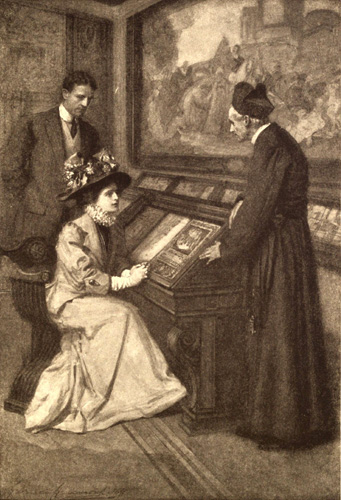 SLOWLY THE SPELL BEGAN TO WORK UPON INEZ’
BRAIN. SHE WAS NO LONGER IN THE PRESENT—SHE
WAS A WOMAN OF ITALY OF FOUR CENTURIES BACK
SLOWLY THE SPELL BEGAN TO WORK UPON INEZ’
BRAIN. SHE WAS NO LONGER IN THE PRESENT—SHE
WAS A WOMAN OF ITALY OF FOUR CENTURIES BACK
Then Cerini passed on in his conversation to the old-time
writers themselves. The little study was poorly
ventilated, and the air was heavy. The ancient tomes
exuded their peculiar odor, and the low, sing-song voice
of the speaker seemed far removed from the life they
had just left outside. Slowly the spell began to work
upon Inez’ brain. She was no longer in the present—she
was a woman of Italy of four centuries back.
Petrarch, with his laurel-crowned head, rose up before
her and recited verses written for Laura; Politian gave
to her of his wisdom; Machiavelli discussed Florentine
politics with her. It was not the voice of Cerini the
librarian which she heard—it was the veritable voice
from the dead and buried past. She furtively glanced
at Armstrong and saw in his face a light which she
knew Helen had never seen there, and in her heart she
felt a guilty joyousness at the advantage she had gained.
It was Leonardo sitting at the old desk now—Leonardo
the master of art, of sculpture, the forerunner, the man-god
against the god-man. She pressed her hand to her
head; it was dripping moisture. Would he never stop?
It was becoming fearsome, unbearable. Her eyes were
fixed upon the aged priestly clad figure before her;
she could not move them. What power held her, what
magic controlled even her thoughts? She tried to speak
to Armstrong, to tell him that she was ill, but her mouth
seemed parched and she could not speak. She looked
at Cerini’s chair again. The old man was no longer
there. Machiavelli had taken his place and was uttering
diatribes against the state. She must cry out—she could
not. She started to her feet—then she fell back, and
all became a blank. When she revived, a few moments
later, it was in the sunny enclosure of the cloister garden,
whither Armstrong had anxiously carried her, and
where the fresh air served to relieve the tension and to
counteract the influence which had so overpowered her.
By mutual consent, Miss Thayer and Armstrong
decided not to mention the rather dramatic finale
to their first excursion to the library. Inez experienced
the deepest mortification, while Jack blamed himself
severely that he had not watched his companion
more carefully. If he had done this, he repeated to himself,
he might easily have anticipated and avoided the
unpleasant climax to an otherwise thoroughly enjoyable
morning. Miss Thayer, however, would not listen to his
apologies: he had accepted her as a comrade, and she
had proved herself unequal to the test. Armstrong
tried to reassure her, but his efforts were not eminently
successful.
The whole affair, in spite of their disclaimers, made a
considerable impression upon them both. Armstrong
knew that it had not been weakness alone; for even his
brief acquaintance with her told him that strength was
a salient point in her character. She was impressionable—he
realized that—but surely not to the extent of
losing all control over herself. Was it—and Armstrong
feared lest Inez should read his mind as the thought
came to him—was it that same irresistible influence of
those ancient spirits, coming out from the past to her
as they had so many times to him, recognizing her as a
reincarnation of themselves, and claiming her, even for
that, brief moment of unconsciousness, as a part of what
had gone before?
Inez pleaded a headache upon reaching the villa,
and asked that her lunch be sent to her room; but
it was long after Annetta had left the tray upon
the table that she was able to taste, even sparingly,
the tempting delicacies which were placed before her.
What can be more searching than a woman’s self-examination?
She had told Armstrong that she blamed
herself for her weakness; so she did, but it was not
wholly the weakness of losing consciousness. Who was
this man, and what this influence which had so suddenly
entered into her life and assumed such immediate control
over her? She felt that she could resist either separately,
but together they produced a power which she
questioned her ability to oppose. And the strange part
of it all was that no one was forcing it upon her. She
knew perfectly well that she need never go to the library
again unless she chose; but she knew equally well what
her choice must inevitably be, if the opportunity were
offered her.
Even as she recalled her experience, a thrill half of
delight, half of apprehension, passed over her. What
did it all mean? Armstrong compelled her respect, but
it was ridiculous even to wonder whether or not the
sentiments he inspired were of a more serious nature.
The subjects in which he was interested appealed to her
highest self and fascinated her, but beyond this what
possible force could they possess to render her so immediately
subservient to their demands? What was
there about it all which made it seem so inexpressively
delicious? And what of him, of this man above whose
head the ancients had already placed the halo of their
approval, who stood to her as the personification of ideal
manhood?
These were some of the questions Inez Thayer asked
herself that afternoon, wrestling within and striving
honestly to decide her course; but even as she did so
she found her thoughts again centering themselves upon
Armstrong as she closed her eyes and allowed herself
to be carried back to the experiences of the morning.
She had no reasonable excuse to leave Florence, which
instinctively she felt to be the safest thing to do; and,
besides this, her spirit revolted at the thought that she
could not meet the problem face to face and master it.
She must do it, she would do it; and, having finally arrived
at this determination, she came down, just before
dinner, and joined her friends in the garden, where
they were enjoying the soft close of the perfect Italian
day.
“There you are!” Helen welcomed her with outstretched
arms. “Is your headache better?”
“Yes, thank you,” Inez replied, forcing a smile;
“the air was very close in the library, and then, too, I
found so much to make me thoughtful.”
“Then you were not disappointed?” Emory asked.
“Disappointed? It was wonderful. You don’t know
how much you all missed.”
“You look as if Jack had shown you some spooks,”
remarked Eustis; “you are as white as one yourself.”
The color quickly returned to Inez’ face. “I am
always like that when I have one of these wretched headaches,”
she explained. “But, truly, I never had such
a remarkable experience. I can quite understand Mr.
Armstrong’s devotion. I never knew before how fascinating
such learning really is.”
“Did he actually conjure up those old fellows and put
them through their paces for you?” Emory asked.
Miss Thayer was in no mood for bantering. “It is
not possible for you to understand without experiencing
it yourself,” she said, quietly.
“Or even afterward, I suspect,” Bertha Sinclair
added, slyly.
“I am so glad that you enjoyed it,” said Helen. “I
couldn’t get much out of Jack, and I was afraid that
you had passed a stupid morning and that the headache
was the natural result.”
“I shall never forget it—never!” Inez murmured.
Helen regarded her attentively for a moment. “I
had no idea it would make so strong an impression on
you,” she said at length. “Now that it is over, you and
Jack will both feel better satisfied.”
“You must see Cerini, Helen, and let him show you
those wonderful books and explain everything, just as
he did to us.”
“So I will, sometime,” Helen smiled. “Perhaps he
could bring out my dormant possibilities.”
“It is time we dressed for dinner,” remarked Mary
Sinclair, rising. “You and Inez are already en grande
tenue, but the rest of us are shockingly unconventional.”
As the Sinclair girls hurried into the house, closely
followed by the men, Helen leaned against the balustrade
at the end of the bowling-green and watched the deepening
color which touched alike the spires of Santa
Croce and the turret of the Palazzo Vecchio, gleamed
on the dome of the Cathedral and Giotto’s tower, and
spread like wine over the placid surface of the Arno.
Beyond the river rose the basilica of San Miniato, its
ancient pediment sharply outlined against the sky.
Helen’s thoughts wandered even farther away than her
eyes. Inez watched her for several moments before slipping
her arm about her waist.
“Oh, Inez!” Helen was startled for an instant.
“Did you ever see such a wonderful spot as this?”
she continued, recovering herself. “Some new beauty
discloses itself uninvited hour by hour. Every time I
come into the garden I find some lovely flower I never
saw before, or meet some sweet odor which makes me
shut my eyes and just draw it in with delight. Each
time I look toward Florence the view is different, and
each new view more beautiful than the last. Oh, Inez
darling, is it an enchanted palace that Jack has brought
me to, or is it just because I am so blissfully, supremely,
foolishly happy?” Helen embraced her friend enthusiastically.
“Let us call it the enchanted palace, dear,” Inez
answered as Helen released her, “and you the modern
Circe, with power to make all about you as beautiful
and as happy as the ancient Circe to cast malign influences.”
Helen laughed. “Why not take it further and say
that the transformation of the ancient Circe is the final
triumph of Uncle Peabody’s labors? Had his theories
been in force among the friends of Ulysses, the fair
lady could never have turned them into swine. But
tell me, did you not find Jack a very different person
from what you had expected after seeing him here at
home?”
“I did, indeed,” assented Inez, soberly.
“Is he not simply splendid?” Helen’s face beamed
with pride. “It was just as much of a surprise to me.
Of course, I have always known that he was interested
in all these things, but it has only been since we were
married that I have realized how much he actually
knows.—I wish I thought there was even the slightest
chance of his being able to lead me up to his heights,
he is so eager for it. I shall give him an opportunity
to try his experiment, of course, but the
trouble is that in spite of the interest and fascination
which I do feel, his hobby always seems to me to be
hemmed in with needless limitations. For my part, I
don’t see why we can’t take the best these master spirits
of the past can give us, just as Jack says, but without
ourselves becoming a part of the past.—You see how
absolutely hopeless I am. I wonder how in the world he
ever came to be attracted to me.”
“You are the only one who wonders.”
“Oh, I know that my hair is not red, and that I
don’t squint, and all that, but Jack is so fascinated by
everything scholarly that I don’t see why he didn’t
select an intellectual wife. Why, I don’t even wear
glasses!”
Inez smiled at the picture Helen drew. “The rest
of us girls understand why he made just the selection
he did, Helen.”
“I never wanted to be intellectual before. Until now
I have always considered the caricatures of the Boston
Browning woman as typical of the highly educated
species; but you are showing me that a girl can be human
and intellectual at the same time.”
“I wish I could show you that you make too much
of a mountain out of this intellectual bugbear,” Inez
replied, candidly. “Your husband is a very unusual
man. His interest in the humanities is beyond anything
one can appreciate without seeing him as I saw him this
morning. He longs to take you with him into this life,
and if I were in your place I should let him be the one
to discover my lack of understanding, if I really did
lack it, instead of insisting upon it as a foregone conclusion.
For myself, I don’t take much stock in it. I
remember too well how quick a certain Miss Cartwright
was at school to grasp new ideas, and I have not noticed
any serious retrogression since.”
Helen pondered carefully over her friend’s criticism
before replying. “I suppose it does seem like obstinacy,”
she said, finally—“to him as well as to you;
yet to myself it appears perfectly consistent. The one
thing which gives me an idea of the extent of his devotion
is my music. You know how I adore it, how
much a part of my life it has always been—yet it means
nothing to Jack, and he therefore takes no particular
interest in it. He went to the Symphonies and the
Opera with me while we were engaged, and to concerts
and recitals, but I knew all the time that it was just to
please me. I made up my mind that when we were married
I would keep up my interest in this ‘devotion’ of
mine only as much as I could without having it interfere
with those things which he cared for or which we
could enjoy together. But the fact that music means
less to him than it means to me does not make me love
him any the less.”
“But you don’t enter into this particular interest of
his, even to please him, as he did to please you.”
“Because I appreciate from the experience I have
just mentioned how little real satisfaction it would give
either one of us. Looking back, I feel that I was positively
selfish to let him go to those concerts with me, and
I shall never inflict them on him again. I am sure that
he knows how I feel, and I think he ought to be grateful
for my consideration.”
Inez pressed Helen’s hand. “You ought to know
best, dear,” she answered. “You both possess such
wonderful possibilities that it would be a shame not to
combine them. It seems to me that you might come to
an appreciation of each other’s interests by becoming
familiar with them.—I wonder if you realize what a man
your husband is?”
Helen leaned over and kissed her impulsively. “I
realize more than I ever intend to let him know, dear
child. He would become unbearably conceited were he
even to guess how much he has already become to me.
I really did not want to marry him—or to marry any
one—but he swept away every objection, just as he
always does, and now I find myself wondering how
in the world I ever existed without him. Oh, Inez”—Helen’s
face became tense in her earnestness—“we girls
think we know a whole lot about marriage. We anticipate
it—we dread it; but, when one actually enters
into her new estate, she knows how infinitely more it is
to be anticipated, if happy, than her fondest dream.
But if unhappy—then her dread must have been infinitesimal
compared with the reality.”
“‘Marriage is either a complete union or a complete
isolation,’” quoted Inez.
“As I tell you, Jack and I understand each other
perfectly,” Helen continued, confidently, “and that
means so much to a girl. One of the first things I told
him, after we became engaged, was that if our affection
stood for anything it must stand for everything. If
at any time while we were engaged, or even after we
were married, he felt that he had made a mistake in
thinking me the one woman in the world for him, he was
to come to me frankly and say so, and together we would
plan how best to meet the situation. Suppose, for instance,
that Jack met some one whom he really loved better
than me. It would be an awful experience, but how
much less of a tragedy to recognize the fact than to live
on, a hollow, miserable existence, such as we see in so
many instances around us.”
“And he has not confessed to you yet?”
“Not yet,” Helen laughed, “and we shall have been
married six weeks to-morrow. That is a pretty good
start, is it not?”
“But how about yourself—have you the same privilege?”
“Of course; but that is not important, for I shall
never see any one fit to ride in the same automobile with
Jack.”
“What did you say about my automobile? Has it
arrived?”
Armstrong’s face was filled with eager expectation as
he came up behind Helen, followed by Uncle Peabody.
He drew her affectionately toward him.
“You wretch!” cried Helen, “you have been eavesdropping.”
“Not an eavesdrop,” protested Jack, “and I can
prove it by a witness. When I came down-stairs I
looked for my beloved spouse upon the terrace and
found her not. The gentle Annetta confided to me that
you and the Signorina Thayer were in the garden; I
set out upon my quest and found you here discussing
my automobile or some one else’s. Again I ask you,
have you news of its arrival?”
“No, Jack—no news as yet; and you make out so
good a case that I must absolve you. Since you insist
on knowing, we were discussing the very prosaic subject
of matrimony.”
“Why discourage Miss Thayer from making the attempt
simply because of your own sad case?” Armstrong
queried, releasing his wife and seating himself
beside her on the edge of the balustrade. “Marriage
is a lottery—so saith the philosopher. We all know
the preponderance of blanks and small prizes, yet each
one feels certain that he will be the lucky one. Once in
a while a chap pulls out the capital prize, and that encourages
the others, though it ought to discourage them,
because it lessens the chances just so much. But what
I object to is the growling afterward, when each should
realize that he is getting exactly what he ought to have
expected.”
“But it is not fair that both you and Helen should
have drawn the lucky numbers,” Inez declared. “It
makes it so hopeless for the rest of us.”
“There, Sir Fisher,” cried Helen, “you have gained
the compliment for which you strove. Art satisfied?”
“No one has drawn me yet,” suggested Uncle Peabody,
“and I am a capital prize—I admit it.”
“It is a shame to throw cold water on Miss Thayer’s
beautiful sentiment,” continued Armstrong. “Such
thoughts are so rare that they should be encouraged;
but the facts of the case are that the capital prizes
in the men’s lottery were discontinued long ago. No—among
the girls they are still to be won at rare intervals,
but the only way to distinguish the men is by looking up
their rating in Bradstreet’s, or their mother’s family
name in the Social Register. Other than this, one man
is as bad as another, if not worse.”
Inez looked at Armstrong for a moment with a puzzled
expression, but failed to find any suggestion that
he was speaking lightly. And yet—what a change in
attitude from the morning! She hesitated to turn the
subject upon what seemed to her to be forbidden ground,
yet she could not resist opposing his expressions, even
though they might be uttered flippantly. Her voice contained
a reproach.
“You spoke differently of men this morning.”
Armstrong turned to her quickly. “This morning?”
he repeated. “Oh, but I was referring to the humanists,
and to ancient ones at that. I am talking now of
men in general, rather than of those rare exceptions,
ancient or modern, who have succeeded in separating
themselves from their commonplace contemporaries. Of
course, my respect for the old-timers is supreme, because
their great accomplishments were in the face of
so much greater obstacles. Since then the world has
had five hundred years in which to degenerate.”
“Don’t pay any attention to him, Inez,” Helen interrupted,
complacently. “He is simply trying to start
an argument, and he does not believe a word he says.
He really looks upon men as infinitely superior beings
in the past, present, and future, and this self-abnegation
on the part of himself and his sex is only a passing conceit.”
“I refuse to be side-tracked,” Armstrong insisted. “I
grant that the conversation started more in jest than
in earnest, but I maintain my position, none the less.
Modern civilization has brought to us a wonderful
material development, but intellectual advance, instead
of keeping abreast of the material, has positively retrograded.”
“You really make me feel ashamed to be living in
such an abominable age,” suggested Uncle Peabody.
Inez was serious. “I am quite incompetent to carry
on this discussion with you, Mr. Armstrong,” she said,
disregarding the others, “and I admire, as you know,
the marvellous accomplishments of these ‘old-timers,’
as you call them, wondering at their power to overcome
the obstacles which we know existed. Yet I like to
believe that the ages which have passed have marked
an advance on all sides rather than a retrogression.”
“So should I like to,” assented Armstrong, “if I
could; but look at the facts. William James has just
succeeded in making philosophy popular, but Plato and
Aristotle gave it to us before the birth of Christ. We
enthuse over Shakespeare and Dante and Milton, but
Homer and Virgil gave us the grandest of poetry two
thousand years ago. The quattrocento, that period
which so fires me with enthusiasm, gave us Raphael
as an artist, together with Leonardo and Michelangelo
as the foremost examples of humanists. Whom have we
had since to equal them?”
“All this is beyond argument,” Inez admitted. “But
is this the fault of the men or of the times? Conditions
are so changed that the same kind of work can never
be done again. The telephone, the telegraph, railroad
trains, fast steamships, the daily papers—everything
distracts the modern worker from devoting himself
wholly and absolutely to his single purpose; but with
this distraction is it not also true that the modern worker
gives to the world what the world really needs most under
the present conditions? In other words, would not
these same great men, if set down in the twentieth century,
produce work very similar to what modern great
men have given and are giving us?”
“I should be sorry enough to think so,” affirmed
Jack. “What a pity it would be!”
Uncle Peabody’s mood had changed from amusement
to interest. “If I really thought you were sincere in
the attitude you take,” he said, addressing Armstrong,
“I could prescribe no better cure for your complaint
than to force you to subject yourself, for one single
week, to those same conditions which you seem to admire
so much.”
“If you refer to conveniences, Mr. Cartwright,” interrupted
Armstrong, “I will admit without argument
that you are right. These are wholly the result of material
development.”
“Let us confine ourselves to intellectual achievements
if you choose,” continued Uncle Peabody. “Without
an intellect, could one harness steam and electricity and
make them obedient to the human will? Is not a wireless
message an echo from the brain? What is the telephone
if not a product of thought?”
“You and Miss Thayer are arguing my case far better
than I can do it myself,” replied Armstrong, undisturbed.
“The triumphs of Watt and Edison and
Marconi and Bell are all intellectual, even though utilitarian.
Each of these men has proved himself humanistic,
in that he has given to the world the best that is
in him, and not simply modified or readapted some previous
achievement. If they were not limited by living
in an age of specialization they might even have been
humanists. Right here in Italy you see the same thing
to-day. The Italians are beyond any other race intellectually
fit to rule the world now as they once did, and
it is simply because they have been unable to withstand
materialism that they have not reclaimed their own.”
“Just what do you mean by ‘humanism,’ Jack?”
Helen asked, abruptly.
“The final definition of modern humanism will not
be written for several years,” Armstrong answered.
“The world is not yet ready for it, and I am afraid
Cerini’s creed of ancient humanism would strike you as
being rather heavy.”
“Let me see if I could comprehend it.” Helen looked
across to Inez, and the eyes of the two girls met with
mutual understanding. “Can you repeat it?”
“I know it word for word,” her husband replied,
eagerly, delighted to have Helen manifest an interest.
“It was the first lesson the old man taught me, years
ago. ‘The humanist,’ Cerini says, ‘is the man who
not only knows intimately the ancients and is inspired
by them: it is he who is so fascinated by their magic
spell that he copies them, imitates them, rehearses their
lessons, adopts their models and their methods, their examples
and their gods, their spirit and their tongue.’”
Helen was visibly disappointed. “I thought I had
an idea,” she said, slowly, “but I was wrong. Inez
used the word ‘humanities’ a few moments ago, and I
once heard President Eliot say that this was simply another
name for a liberal education—teaching men to
drink in the inspiration of all the ages and to seek to
make their age the best.”
“You are not wrong, Helen,” continued Armstrong,
“unless you understand President Eliot to mean that the
ages which have come since these great men lived have
been able to add particularly to what has gone before.
All that is included in what Cerini says.”
“Then the present, which I love so well, means nothing?”
“It means a great deal.” Armstrong laughed at the
injured tone of Helen’s voice. “The great material
achievements of the present, which you just heard cited
by Miss Thayer and Uncle Peabody, are of vast importance,
but the age does not stand out as a period of intellectual
progression. The achievements themselves,
and the new conditions which they introduce, make that
impossible.”
“Can we not admire the past and enjoy what it has
given us without becoming a part of it ourselves?” persisted
Helen.
“Not if we remain true to our ideals. I spoke just
now of Leonardo and Michelangelo as being the foremost
examples of humanists. By that I mean that they
represent the highest point of intellectual manhood. Da
Vinci was a great writer, a great painter, a great scientist,
a great engineer, a great mechanician, while
Buonarroti was famous not only as a sculptor, but
also as a painter, an architect, and a poet. And these
men had to develop their own precedent, while all
who have striven for more than mediocrity since then
have propped themselves up on the work of these and
other great masters. Can you wonder that my own
great ambition, quite impossible of accomplishment, is
to emulate these men—not in the same pursuits, but in
some way, in any way, which enables me to give to the
world the best that is in me. Should I gratify myself
in this, that which I accomplished would be done simply
in the fulfilment of my effort, and I should gain my
recompense in the knowledge that it was my best. This
is my understanding of Cerini’s creed.”
“All this is most interesting,” admitted Helen. “It
is indeed splendid to know the ancients intimately, and
to receive their inspiration. It is fine to imitate them
and to rehearse their lessons, but I don’t see why we
should bind ourselves down to the old-time limitations
by using their methods when, to my mind, our own
methods are so much better suited to modern conditions?”
“Your position is fully justified, Helen, if you really
believe these methods to be limitations,” replied Armstrong,
seriously. “For my part, I do not feel this. I
accept the Cerini creed without qualification. I grant
you that many things of the past are limitations, but
there are certain cardinal principles which must remain
the same so long as the world lasts and which are not
subject to what you call ‘modern conditions.’”
“To be wholly consistent, Jack,” pursued Uncle Peabody,
“should you not adopt their tongue—as called
for in the creed?”
“Not necessarily, as the ‘creed’ is, of course, idealistic;
but the only reason I do not do so is because of
the limitations which are placed upon us—this time by
modern civilization. Cerini and I converse for hours
together in the Latin tongue, but it is very seldom that
I find the opportunity to do this. Why is it that Latin
is used in medicine, in botany, in science, to give names
to various specimens or species? Simply because French,
German, Italian, English may be forgotten languages
a few centuries hence, but Latin—the so-called dead
language—will be as enduring then as now.”
“I can never hope to become as much of an enthusiast
as you, Mr. Armstrong,” Inez said, finally, as the
others gave up the argument in despair; “and I suppose
you will never forgive me if I say that I fear it
would be very uncomfortable for me if I did. You
must simply let me browse around the edges as a neophyte
while you and the master quaff the nectar and
ambrosia of the gods.”
“And I cannot even do that,” added Helen, rising
from the balustrade. “I cannot give up my dear present
even to agree with my learned husband. You don’t
want me to say that I am sorry I am living among all
these imperfect conditions when I really find them very
satisfactory and enjoyable? It is wrong of you so to
break down my modern idols. There are our guests,”
she continued, as a laughing group appeared on the
veranda. “As penance I decree that you shall take
each of us by the hand and lead us back to the villa—the
Humanist flanked by the Pagan and the Christian.
Arise, thou ancient one, and lead us on!”
The visits which Armstrong and Miss Thayer
made to the library became of daily occurrence.
Encouraged by his companion’s interest, and the
eagerness with which she assimilated the enthusiasm
which he and Cerini were only too willing to share with
her, Armstrong promptly embraced a scheme for definite
work suggested to him by the librarian. Inez at first
proved only a sympathetic spectator, but by the third or
fourth day she found herself a distinct part of the
working force. She demurred half-heartedly, but when
it became evident that she could really make herself of
service she entered into it with characteristic intensity
which increased from day to day.
Soon after the departure of the guests the automobile
arrived, and transformed Armstrong from a
Humanist into an Egoist and then into a Mechanist.
For the moment the material concern took precedence
over the intellectual.
“Of course I expect to have the chauffeur do the
work once we are under way,” he half apologized to
Uncle Peabody, who with a good-natured interest watched
him taking the precious machine to pieces; “but before
I trust it to any one I must understand it thoroughly
myself.”
“Quite right, quite right,” Uncle Peabody assented,
cheerfully. “I believe in that theory entirely. I have
noticed when my friends have found themselves stalled
on the road that it never annoys them half so much
if they can explain the reason why. Besides, from a
secondary consideration, I suppose it adds something to
the safety to know the machine yourself.”
As the car had arrived in advance of the chauffeur,
Armstrong had plenty of time to study the mechanism.
It came to pieces with consummate ease. Its new
owner had never claimed much knowledge along these
lines, but the simplicity of this particular machine increased
his respect for his judgment as a purchaser and
his natural though hitherto undeveloped ability as a mechanic.
“These Frenchmen,” he confided enthusiastically to
Uncle Peabody, “have the rest of the world beaten to
a stand-still in building automobiles. My hat is off to
them.”
“Would you not be even more comfortable if you removed
your shirt as well?” suggested Uncle Peabody,
mischievously, as he glanced sympathetically at Armstrong’s
face, from which the perspiration rolled down
onto his collar in response to his unusual exertions and
the heat of the full Italian sun.
“It is nearly to pieces now,” Armstrong replied, complacently.
“I will wait until it is cooler before I set it
up again.”
True to his word, Armstrong began work on the
restoration early next morning, but the heat of the day
found him still at his labors and in no cheerful frame of
mind. Uncle Peabody’s philosophical suggestions had
proved unacceptable some hours before. Helen’s remark
that she did not believe the three extra pieces Jack held
despairingly in his hand had come from that particular
machine at all brought forth such a withering expression
of pitying contempt that she flew back to the house in
alarm. Even the servants found that the opposite side
of the villa demanded their especial care. A truce was
declared for the colazione, but Armstrong devoured his
repast in silence, showing no interest in the animated
conversation, and with scant apologies left the table long
in advance of the others to resume his task.
At five o’clock a dusty vettura drove noisily into the
driveway, and from his point of vantage, lying on his
back underneath the automobile, Armstrong saw Mr.
Ferdinand De Peyster alight. With a curse muttered,
not from any antipathy to his visitor, but simply on
general principles, he laboriously extricated himself from
his position with a view to the extension of hospitality.
De Peyster saw the movement and hastily approached.
Ferdinand De Peyster was a distinct individuality,
which in a degree explained the criticism which some
of his friends passed upon him. His foreign descent,
though now tempered by two generations of American
influence, was probably responsible for the fact that he
was “different from other men.” Always faultlessly
dressed, his taste followed the continental styles rather
than those which other men about him were in the habit
of adopting, so while Americans in Florence were clad in
flannels, négligé shirts, and white buckskins, De Peyster
appeared at the Villa Godilombra immaculate in the
conventional lounging-coat, tucked shirt and lavender
gloves, with white spats over his patent-leather shoes.
There was more of a contrast between visitor and guest
at that moment than Armstrong realized as he emerged
in his old clothes, thoroughly soaked through with perspiration,
and with his hands and face grimy with oil
and dirt.
De Peyster drew back instinctively as the full vision
of Jack’s figure presented itself. “Comprenez vous
français?”
Armstrong stopped in his advance as he heard the
question and noted the superior tone in which it was
delivered. Then the humor of the situation appealed
to him.
“Yes, sir,” he replied, respectfully, “or English, if
you prefer.”
De Peyster’s face brightened. “Ah! Mr. Armstrong
brought you over with him?” he remarked, becoming almost
sociable.
“Yes, sir,” Jack replied, truthfully. “Is there anything
I can do for you, sir?”
“I am Mr. De Peyster,” said Ferdinand, with condescension—“a
friend of your master’s in America. Is
he at home this afternoon?”
“Yes, sir—”
Before Armstrong could continue De Peyster approached
nearer to him and lowered his voice. “I say—is
there a Miss Thayer from America visiting here
just now?”
A quick movement on De Peyster’s part deposited a
franc in Jack’s grimy palm. Holding his hand in front
of him, his astonished look alternated between the piece
of silver and his friend’s face until he found himself
unable to keep up the farce.
“De Peyster, you are a fraud!” Armstrong laughed
boisterously at the look of dismay in Ferdinand’s face
as a realization came to him. “Do you mean to tell
me that the joys of a honeymoon and life in Italy have
wrought so many changes that you don’t recognize
me?”
“But can you blame me?” De Peyster joined in the
merriment. “Run and get some one to tell you how you
look.”
The sound of this unexpected hilarity reached the
terrace, and Uncle Peabody, flanked by both of the girls,
came rushing out fearful lest Jack’s problem had resulted
in temporary mental derangement. A glance at
the picture before them, however, explained the situation
better than words, and Helen hurried forward to greet
her visitor while Inez followed behind.
“Ferdy De Peyster—in the flesh!” cried Helen.
“What does this mean, and when did you reach Florence?”
Armstrong gave him no opportunity to reply. “He
prefers to speak French, Helen, and he is just throwing
his money around.”
Then turning to De Peyster and exhibiting his pourboire,
he repeated, “Comprenez vous français?” while
both men went off again into a paroxysm of laughter.
“What is the joke?” Helen asked, looking from one
to the other completely mystified.
“It is a good one—and on me,” replied De Peyster.
“I took him for the chauffeur, you know.”
Helen looked at her husband. “Is it safe for me to
laugh now, Jack?” she asked. “I am glad something
has happened to put you in good-humor. Can you be
induced to leave your work for the rest of the day and
make yourself presentable to join us in the garden?”
Armstrong cast a despairing glance at the machine.
“Of course,” he said. “I shall be fresher in the morning,
anyway, and I am sure I can fix it up then.”
“Nothing like knowing all about it yourself, Jack,”
Uncle Peabody remarked, innocently. “These French
machines are so simple!”
“You take the girls back to the garden,” Armstrong
replied, emphatically, “and kindly devote your attention
to your own theories, or I will put you at work on the
blamed thing yourself to-morrow.”
De Peyster greeted Inez effusively, paying but little
attention to Helen and Uncle Peabody as they strolled
back to the garden, while Jack disappeared in-doors.
“Oh, I say!” he exclaimed as they reached the balustrade.
“How did Armstrong happen to find a place
like this? Is it not simply splendid, Inez?”
Inez Thayer resented something—she did not quite
know what. She had been expecting De Peyster’s arrival
daily, yet now that he had come she was still unprepared.
She could find no fault with his attentions
except that they had been too assiduous. Perhaps it was
that, try as she could, she had been quite unable to convince
him that his devotion was useless. He accepted
each rebuff philosophically and bided his time.
Annetta skilfully arranged the chairs and laid the
little table, placed, as Helen had taught her, in a spot
commanding the exquisite view of the valley and San
Miniato beyond. Luscious fragole, cooling gelati, seducing
little Italian paste, as only Helen’s cook could
make them, and a refreshing Asti cup replaced the tea
which the girls had decided would be less acceptable on
this particular day; and by the time all was in readiness
Armstrong joined them clothed in his proper mind and
raiment.
The conversation turned upon the voyage across.
“We had an awfully jolly crowd on board,” said De
Peyster. “There were Emory and Eustis, who you say
have just left you, and then there were three charming
married women who insisted on my playing bridge with
them every afternoon.”
“They did not have to insist very hard, did they,
Ferdy?” interrupted Helen—“with your reputation for
gallantry.”
Ferdinand smiled complacently. “Making up a
fourth at bridge comes under the definition of ‘first
aid to the wounded,’” he replied, “but I did not object
at all to being the doctor. Their conversation was
so clever, you know.”
“Clever conversation always helps good bridge,”
Armstrong interrupted, dryly; but De Peyster was already
deep in his story.
“One afternoon they had a discussion as to how large
an allowance for personal expenses would make each one
perfectly happy,—funny subject, wasn’t it? Well, one
of them said ten thousand a year would take care of her
troubles nicely; the second one was more modest and
thought five thousand would do,—but what do you think
my partner said? She was a demure little lady from
Chicago and had only been married a year and a half.”
“Don’t keep us in suspense, Ferdy,” said Helen, as
De Peyster yielded to the humor of his recollections.
“Truly, it was awfully funny,” he continued. “She
looked rather frightened when the conversation began,
and when they urged her to set a price she said, ‘I
would be perfectly satisfied if I could afford to spend
just what I am spending.’”
“She had a conscience—that is the only difference between
her and the other women,” Armstrong commented.
“Perhaps,” added Helen; “but I’ll guarantee that in
another year she will be getting a divorce from her husband
on the ground of incompatibility of income.”
“Then in the evenings,” De Peyster went on, “the
men got together in the smoke-room, but I think we
drank too much. I always felt uncomfortable when I
got up next morning.”
“Another encouragement for my magnum opus!” exclaimed
Uncle Peabody. “I am going to invent a wine
possessing such qualities that the more one drinks of it
the better he will feel next morning.”
“If you succeed you will have clubdom at your feet,”
Armstrong replied, while De Peyster feelingly nodded
assent.
“Would you mind if I invited Inez to drive with me
to-morrow, Helen?” ventured Ferdinand, abruptly, looking
anxiously at Miss Thayer. “I know you honeymooners
won’t mind being left alone if I can persuade
her.”
“By all means, Ferdy—unless Inez has some other
plans. Jack has been making her ride his hobby ever
since she arrived, and I have no doubt she will be glad
enough to escape us for a little breathing-spell.”
“If you put it that way I shall certainly decline”—Inez
failed to show any great enthusiasm—“but otherwise
I shall be very glad to go.”
“Jack intends to put his automobile together to-morrow,”
Uncle Peabody remarked, “so it will be just as
well not to have any one outside the family within hearing
distance.”
Armstrong tried to wither Uncle Peabody with a
glance, but ran up against a smiling face so beaming
with good-nature that even real anger would have been
dispelled.
“For Helen’s sake—” Jack began, but Uncle Peabody
interrupted.
“For Helen’s sake you will hasten the arrival of your
chauffeur, if such a thing be possible.”
The following day was an eventful one. First of all,
as if in response to Uncle Peabody’s exhortation, the
chauffeur appeared. Mr. Cartwright departed for the
city soon after breakfast, to be gone all day, and by
the time the heat of the afternoon had subsided De
Peyster drove up in state to enforce the promise Inez
had given him the afternoon before. After watching
them drive away, Helen slipped her hand through her
husband’s arm and gently drew him with her into the
garden. They walked in silence, Helen’s head resting
against his shoulder, until they reached her favorite
vantage-spot, when she paused and looked smilingly into
his face.
“Jack dear,” she said, quietly, “do you realize that
this is almost the first time we have really been by ourselves
since we took that walk to Fiesole?”
“But at least you have had an opportunity to show
your villa to your friends!”
“Don’t joke, Jack—I am not in the mood for it this
afternoon. I don’t know why, but I have been feeling
very serious these last few days. Tell me, dear—are you
perfectly happy?”
Armstrong looked surprised. “Why, yes—perfectly
happy. What a curious notion!”
“I know it is, but humor me just this once. Are
you as fond of me now as you were that day at Fiesole?”
“You silly child!” Jack drew her to him and kissed
her. “Whatever has possessed you to-day?”
“I don’t know, but you see I measure everything by
that day at Fiesole. I believe it was the happiest day
I ever spent. Since then, somehow, I have felt that we
were not so near together. Of course, you have been
away a good deal at the library and looking up things
with Inez, which was just what I wanted you to do;
and then we have had a good many here to entertain,
which was also what I wanted; but I can’t help feeling
that you have not found here at home just what you
should have found to make you perfectly happy. Tell
me, dear, have I been to blame?”
Armstrong paused as if weighing something heavily
in his mind. “Perhaps I have no right to go on with
this work,” he remarked, at length, “but the only way
to stop it would be to leave Florence.”
“You know I don’t mean that, Jack.”
“I know you don’t. I am speaking simply for myself.”
He was again silent, and Helen hesitated to break in
upon his reverie. He seemed for the moment to be far
away from her, and she felt an intangible barrier between
them.
“I could not make any one understand.” Armstrong
was speaking more to himself than to her. “Ever since
I left Florence years ago I have felt something pulling
me back, and ever since I have been here I have been
under influences which I can explain no more than I can
resist. It must be this, if anything, that you feel.”
“I think I understand,” Helen hastened to reassure
him. “Sometimes when I have been playing something
on the piano I have the strangest sensation come over
me. I seem to lose my own individuality and to be
merged into another’s. I feel impelled to play on, and
an unspeakable dread comes over me lest some one should
try to stop me. Is it not something like that which you
feel?”
“Yes,” replied Armstrong, “only a thousand times
stronger than any one could put in words.”
“I know exactly what you mean—and there is nothing
for which you need blame yourself. You warned
me before we left Boston that you had left here a second
personality. I know that you confidently expected your
own enthusiasm to excite my interest when once in the
atmosphere. I wish that it had, dear, but I fear I am
hopelessly modern.”
Armstrong looked at his wife intently, yet he gave
no evidence that he had heard her words.
“I have started on a great task at the library, Helen.
The spirit of work is on me, and I feel that I have a
chance to prove myself one of that glorious company.
I may find myself unequal to the opportunity, but if we
stay here in Florence I cannot keep away from it. If
my absence from you makes you unhappy I must separate
myself from these associations.”
“No, indeed,” cried Helen. “I would not have you
stop your work for worlds. Even though I am unable
to appreciate it, you know how interested I am in anything
which adds to your happiness—and I am so proud
of you, dear! That was one reason why I was glad that
Inez could spend a little time with us. She, at least, can
help you.”
“She can indeed,” replied Armstrong, frankly, “and
she has already. I have never seen a girl with such
natural intellectual gifts. Her arguments are so logical,
her reasoning so clear, that I find even her disagreements
most entertaining. What a pity she is not a man!”
“I knew you would like her,” answered Helen.
“Sometimes I think you ought to have married a girl
like her instead of me, but”—Helen looked at him
smilingly and drew closer to him—“but I am awfully
glad that you didn’t, Jack!”
“What nonsense, Helen!” cried Armstrong, coming to
himself and drawing her to him. “Who is fishing now?
I would ask no better chum than your charming, brown-eyed
friend, but I am quite content that I possess as
wife this sweet girl here in my arms who is trying to
find a cloud in this cloudless sky.”
“Oh no, Jack.” Helen straightened up reproachfully.
“But I like to hear you say these things—just
as you did that day at Fiesole! And even if I should
find a cloud it would be sure to have a silver lining,
wouldn’t it, dear?”
Armstrong smiled. “Yes, sweetheart, and, as Uncle
Peabody says, ‘all you would have to do would be to
turn it around lining side out.’”
Inez Thayer found herself overwhelmed by a varied
mingling of conflicting emotions as she settled
herself in the victoria, and listened without remark to
the enthusiastic and joyous monologue to which her companion
gave free rein. She felt herself absolutely helpless,
borne along resistlessly like a rudderless ship by a
force which she could neither control nor fully comprehend.
She still longed for a valid excuse to leave Florence,
yet in her heart she questioned whether she would
now be strong enough to embrace the opportunity even
if it came. She had dreaded the certain appearance of
De Peyster, yet she had been eager to enter into the
inevitable final discussion so that the episode might be
closed forever. She said to herself that she hated Armstrong
for the mastery which he unconsciously possessed
over her, yet every thought of him thrilled her with a
delight which nothing in her life had before given her.
The color came to her cheeks even now, and De Peyster,
watching her intently, thought it was in response to his
own remark and felt encouraged.
The drive took them, as a matter of course, to the
Cascine, where fashionable Florence parades up and
down the delightful avenues formed by the pines and
the ilexes. On this particular afternoon the heat encouraged
them to take refuge on the shadier side toward
the mountains, reserving the drive along the Arno until
the brilliant coloring of the setting sun should show
them both Bellosguardo and the city itself in their fullest
glory. De Peyster was intoxicated by the enjoyment
of his environment, and seemed quite content to accept
his companion’s passive submission to his mood. At
length his exuberance of spirits became mildly contagious,
and Inez threw off her apprehensions and forgot
the dangers and perplexities which she felt surrounded
her.
But her feeling of security was short-lived. De Peyster
no sooner became conscious of her change of manner
than he seized it as a long-awaited opportunity. Beginning
where he had left off at the last attack, he rehearsed
the history of his affection from the day he had
first met her until the present moment. For the first time
Inez experienced a sympathy toward him rather than a
sorrow for herself. He was, even with his limitations, so
deadly in earnest, his devotion was so unquestionable, his
very persistency was so unlike his other characteristics,
seeming a part of a stronger personality, that it forced
her admiration. And yet how far below the standard
she had set!
“You have not believed me, Ferdinand, when I have
told you over and over again that what you ask is absolutely
impossible.” Inez spoke kindly but very firmly.
“I truly wish it might be otherwise, but it is
kinder that I make you understand it now instead of
having this unhappiness for us both continue indefinitely.
I know you mean every word, but I say to you now
finally and irrevocably—it can never be.”
De Peyster looked into her face searchingly. “You
never said it like that before, Inez.”
“Yes, I have—not once, but many times, and in almost
the same words.”
“But it is not the words that count, Inez. I don’t
care how many times you say it in the way you always
have said it before. I expected to hear it again. But
this tone, Inez, this manner is quite different; and for
the first time I have a feeling that perhaps you do mean
it after all.”
“I do mean it, and I have meant it every time I have
said it.”
Inez was relentless, but she felt that this was the one
time when matters could be finally settled, and the carriage
had already begun the climb to Settignano.
De Peyster still gazed at her with uncertainty. Then
a sudden light came to him and showed in his face,
mingling with the evident pain which the thought
brought him.
“I have it,” he said, bending toward her to watch her
expression more intently; “I have it. You are in love
with some one else!”
Inez felt her face burn with the suddenness of the
accusation. She hesitated, and in that moment’s hesitation
De Peyster had his answer. Still he was not satisfied.
He must hear the words spoken.
“You told me last time that there was no one else,”
he said, reproachfully, “and I know you spoke the
truth. Now there must be some one, and if there is I
am entitled to know it. So long as my love for you
cannot harm you, no power on earth can take it away
from me; but if there is another who has a better right
than I, that is a different matter. Tell me, Inez—I insist—do
you love some one else?”
There was no retreat. Any denial of words would be
useless, and it was the only way to end things after all.
She lifted her eyes to his and spoke calmly, though the
color had fled from her cheeks and her face was deathly
pale. “Yes, Ferdinand, you are entitled to know it. I do
love some one else, and I love him better than my life!”
“I knew it!” De Peyster exclaimed, dejectedly.
There was a long pause, during which he struggled
bravely with himself.
“Tell me who it is,” he said, at length. “Of course,
this makes it different.”
Inez could not help admiring the unexpected strength.
“No, Ferdinand, I cannot. This is my secret, and
you must not question further.”
“But it must be some one here, for you told me just
before you sailed that there was no one.”
“Perhaps here—perhaps elsewhere. You must leave
it there, Ferdinand. If you care for me, as you say you
do, I ask you to leave it there.”
De Peyster bowed submissively and shared her evident
desire for silence during the few moments which remained
of their drive.
Helen and Jack met them at the villa, and were greatly
disappointed that Ferdinand declined their pressing
invitation to stay for supper in the garden. A promise
that he would take tea with them on the following afternoon
was all they could secure from him, and when
Inez rushed up-stairs promptly upon his departure Jack
looked at Helen meaningly.
“She must have turned him down good and hard this
time, eh?”
“Poor Ferdy!” Helen replied, sympathetically. “I
had no idea he could get so cut up over anything.”
The automobile, even in the two days it had been a
member of the Armstrong family, completely demoralized
the entire establishment. Jack was beside himself with
excitement and joy, his early experiments both with
chauffeur and car being eminently satisfactory. He contented
himself with short runs down to the city and
back the first day after his man had succeeded in putting
the car into its normal condition, but his impatience
to start out again immediately after each return, even
though luncheon was most unceremoniously shortened,
produced almost as much dismay in the household as his
bad temper while trying to reconstruct the machine.
“I want you all to have a ride in it at the earliest
possible moment,” he explained; “but before I risk
any one’s neck but my own I must satisfy myself that
the car is all right and that the chauffeur knows his
business.”
The only event which diverted Armstrong was the return
to the villa of Inez and De Peyster, for their evident
discomforture caused him real concern. On general
principles he was interested in the outcome of the
obvious errand which had brought De Peyster to Florence,
and beyond this he had already come to look upon
Miss Thayer as a most agreeable companion and assistant
whose happiness and equilibrium he regretted to
see disturbed.
After De Peyster’s unceremonious departure and
Inez’ abrupt disappearance, he and Helen strolled out
into the garden, where the table was already laid for
supper.
“There is no use waiting for Inez,” said Helen.
“Poor child! It is a shame to have her unhappy when
we are so contented. But where is Uncle Peabody?”
“I met him on the Lung’ Arno and offered to take
him home, but he said he was bound for Olschki’s. Trying
to find out if Luigi Cornaro wrote anything he had
not discovered, he said.”
“Perhaps he will come before we have finished. You
sit there, Jack, where you can watch the sunset behind
San Miniato, and I will sit next to you so that I can
watch it, too.”
Helen drew the light chair nearer, and smilingly looked
up at him. “There,” she said. “Is this not cozy—just
you and I?”
Armstrong smiled back into her radiant eyes with
equal contentment. “This is absolute perfection, but
you don’t imagine we can eat like this, do you?”
“I don’t feel a bit hungry,” she replied, cheerfully,
making no attempt to move. “Uncle Peabody says we
ought not to eat when we don’t feel like it, and I don’t
feel like it now.”
“But what does Uncle Peabody say about not eating
when you have been knocking about in an automobile all
day and have the appetite of a horse?”
“Oh, you men!” cried Helen, straightening up with
a pout. “I don’t believe there is a bit of sentiment in
a man’s make-up, anyhow. Eat—eat—eat—” and she
piled his plate high with generous portions from every
dish within reach.
Uncle Peabody’s step upon the path gave warning of
his approach.
“So I am in time after all,” he said. “I was afraid
I should be obliged to eat my evening repast in solitary
loneliness. But is this the way you follow my precepts?”
he continued, as his eye fell upon Armstrong’s plate.
“Can’t you take it on the instalment plan—or are you
anticipating forming a partnership with a stomach-pump?”
“It is my fault, uncle,” replied Helen, contritely.
“I can’t make Jack romantic, so I tried to stuff him to
keep him good-natured. That is always the next best
thing with a man.”
“Oh ho!” Uncle Peabody looked shocked as he drew
a chair up to the little table. “So I have come right
into a family quarrel, have I? Naughty, naughty, both
of you!”
“I wish I could quarrel with him,” said Helen, “but
he is too agreeable, even in his aggravating moods.”
“What have you to say to that pretty speech, John
Armstrong?” asked Uncle Peabody.
“What can I say?” answered Jack, between mouth-fuls,
“except that, speaking for myself, I am always
much more romantic when I am not hungry. If Herself
will indulge me for five minutes longer I will promise
to be as sentimental as the most fastidious could desire.”
“I do not care for manufactured sentiment,” replied
Helen; “and it is too late now anyway, for my own
appetite has returned and my anger is appeased.”
“Miss Thayer evidently has not returned yet?” ventured
Uncle Peabody, interrogatively, as the supper progressed.
“Yes, she is up-stairs in tears, and Ferdy has gone
away to throw himself into the Arno,” Helen replied.
“Dear me, dear me!” murmured Uncle Peabody.
“What a pity! I am not sure that I would have returned
had I known that I should find so much trouble.”
“Now that you have had this much, I think I will
let you in for the rest,” suggested Armstrong. “I will
take you out to the garage after you have finished.”
“More trouble there?”
“Yes—punctured a tire on the way up the hill.”
“And you never said a word about it!” cried Helen.
“No wonder you did not feel romantic!”
“Good! Peace is once more established, which is
worth more than a new tire. Come, my appetite is satisfied—suppose
we all go out to the garage.”
Annetta interrupted their progress at the door.
“A gentleman to see the signora,” she announced—“the
same gentleman who took the Signorina Thayer to
ride this afternoon—and would the signora see him
alone?”
“Poor Ferdy,” Helen sighed, aloud. “He wants me
to intercede for him. You go on, Jack, and perhaps I
may join you later. Show Mr. De Peyster out here,
Annetta.”
Ferdinand hardly waited to be ushered through the
hallway. He was visibly suffering as he approached
Helen with outstretched hand.
“I am so sorry, Ferdy,” was all she could say before
he interrupted her.
“Forgive me, Helen, for coming to you before I have
regained control of myself; but I have made a sudden
decision, and unless I carry it out at once I won’t be able
to do it.”
“A sudden decision, Ferdy?”
“Yes, I am leaving Florence on the night train for
Paris; but I could not go without seeing you again and
leaving with you a message for—Inez.”
“The night train to-night? Surely you are not going
away without seeing Inez again?”
Helen’s sympathy was strong in the face of his almost
uncontrollable emotion.
“Yes, to-night, Helen; and I shall never see her again
unless she sends for me.”
“But what has happened to make things so hopeless
now? She has refused you before, Ferdy, and I have
always admired your pluck that you refused to give her
up.”
“But it is different now—there is a reason why I must
give her up. There was none before, except that she
did not think she cared for me. I was certain I could
make her do that—in time. But now—”
“What is it now?” Her interest was sincere.
“You must know, Helen. Why do you pretend that
you don’t?”
“Why, what do you mean? I am not pretending. I
know of nothing.”
De Peyster was incredulous. “It’s all right, Helen.
We men would do the same thing, I suppose, to protect
another chap’s secret; but it is pretty rough on me,
just the same.”
Helen’s mystification was complete. “Look here,
Ferdy,” she said; “this has gone too far. Inez has
evidently confided to you something which she has never
told me. I have not had a word with her since she returned,
and I know nothing of what has happened except
what I have surmised.”
“Do you mean to tell me that Inez has been here all
this time as your guest without your knowing that she
has fallen in love with some one over here?”
“Inez in love! Ferdy, you are crazy! Who is it,
and where did she meet him?”
“I don’t know—she would not tell me, but it is some
one she has met over here.”
“I don’t believe a word of it. She must have said it
to make you understand that she could not marry
you.”
Ferdinand shook his head. “No. A girl could fool
me on some things, I suppose; but when she speaks as
Inez spoke she means every word she says. ‘I do love
some one else,’ she said, ‘and I love him better than my
life.’ Do you think Inez would say that if she did not
mean it, Helen?”
Helen leaned against the arm of the settle. “I don’t
understand it, Ferdy—I don’t understand it.”
“But I do, and I am not strong enough to see her
again or to stay here in Florence. I will not trouble her
again unless she sends for me—anything sent in care
of Coutts will always reach me. Or after she is married,
and I am myself again, I would like to see her and congratulate—him.
Forgive me, Helen, I am all unstrung
to-night. Good-bye.”
De Peyster was gone before Helen realized it. She
sank upon the settle and rested her face on her hand.
Inez in love, and with some one she had met in
Italy! Who was it—when was it? She had come directly
to the villa upon her arrival. She had said
that she had met no one who interested her on the
steamer. In Florence she had met no one otherwise than
casually. All her time had been spent either with her
or with Jack. Helen lifted her head suddenly. “With
Jack,” she repeated to herself. She rose quickly and
looked off into the distance. The last bright rays were
disappearing behind San Miniato. “I love him better
than my life,” Inez had said to Ferdinand. Helen
grasped the railing of the balustrade for support.
“With Jack!” she repeated again. “Oh no, no, no—not
that!” she cried aloud—“not that!”
“How is the work at the library progressing?”
Helen asked her husband at breakfast a few
mornings later.
“Famously,” Armstrong replied, pleased that she had
referred to the subject.
“Is it nearly finished?”
“Finished?” Jack laughed indulgently. “You evidently
don’t realize what a big thing I have undertaken.
I find myself appalled by its possibilities.”
“Indeed.” Uncle Peabody looked up surprised.
“Does this mean that you are likely to lengthen your
stay in Florence beyond your original plans?”
“No, I think not,” Armstrong replied. “We have
been here less than a month now, and I ought to be able
to put my material into shape during the two months
which remain—especially with the splendid assistance
Miss Thayer is giving me. I can add the finishing
touches after we return home, if necessary.”
“Will it take as long as that?” asked Helen, her color
mounting.
“Surely you are not counting upon me for any such
length of time!” exclaimed Inez, almost in the same
breath. “My cousins are expecting me to join them in
Berlin any day now.”
“You would not desert your post of duty?”
“I must follow the direction toward which it points.”
“Just what is this ‘big thing’ you have undertaken?”
interrupted Uncle Peabody. “You forget that I have
not yet been taken into your confidence.”
Armstrong turned to his questioner seriously. “I
have really stumbled upon something which has not been
done before and which ought to have been undertaken
long ago. You see, Cerini has there at the library hundreds
of letters which belong to the Buonarroti archives.
Many of them were written by Michelangelo, and many
more were written to him. The correspondence is between
him and men in all walks of life—popes, kings,
princes, tradesmen, and even some from the workmen in
the Carrara quarries.”
“And you and Miss Thayer are translating these letters?”
Uncle Peabody anticipated.
“Yes; but that is not the work which most interests
me, except indirectly. Any number of volumes have
been published upon the life and manners and customs
of every age before and since that in which Michelangelo
lived, yet practically nothing concerning this particular
period. The artistic importance of the epoch has been
written up with minute detail, but the intimate life of
the people and its significance seems to have been
wholly overlooked—probably because it was overshadowed.
Very few of these letters have ever been printed,
and they ought to form the basis of a great work upon
this subject. Cerini has turned them over to me to see
what I can do with them. At first I started with the
idea of going through everything myself, but that would
be a hopeless task unless we plan to live in Florence indefinitely.
Now, Miss Thayer reads over the letters and
takes out the important data, leaving me free to work
on the book itself. We are really making splendid
progress, and I shall be bitterly disappointed if Miss
Thayer has to go away and leave me to finish it alone.”
“I am sure Inez will stay as long as she can, Jack,”
Helen said, quietly. “She knows how welcome she has
been, but we must not urge her beyond what she thinks
is best.”
She broke off suddenly; then, with an assumed nonchalance,
said: “I wonder if I could not help in some
way and thus get the work completed just that much
sooner. Of course, I don’t understand Italian, but perhaps
I could do some copying or something. Don’t you
think three would accomplish more than two, Jack, even
if one of them was a weak sister?”
Helen looked over to her husband with obvious expectancy,
but she could not fail to notice the momentary
hush.
“I know how ridiculous my proposition sounds,” she
continued, bravely, “but I would really like to try.”
“Why, of course,” Armstrong replied, hastily.
“Miss Thayer’s suggestion to leave and your willingness
at last to come to my rescue have combined to give me
two unexpected shocks—one unpleasant, the other delightful.
Let me see. Miss Thayer and I have been
developing a kind of team work, so this means a little readjustment.”
“Never mind, if it is not perfectly convenient.”
Helen made an effort to appear indifferent.
“Of course it is convenient,” Jack hastened to add,
ashamed of his hesitation. “You know how much I have
wanted you to do this, and I am perfectly delighted. I
am sure it can be arranged and that you can help us a
great deal.”
“I wish you knew Italian, Helen, so that you could
take my place,” added Inez. “Then Mr. Armstrong
would not accuse me of deserting my post of duty.”
“Not at all,” protested Armstrong, impulsively.
“Even then I could not get along without your assistance.
We can easily find something for Helen to do
which will help the work along and encourage her in
her budding enthusiasm. This is splendid! Helen interested
at last in my dusty old divinities! Perhaps we
can even infect Uncle Peabody.”
“Perhaps,” assented Uncle Peabody; “but for the
present I shall devote myself to my own researches—even
though your masterpiece is forced to suffer thereby.
But I will ride down with you as far as the Duomo.”
No one in the automobile, unless it was the chauffeur,
could help feeling a certain tenseness in the situation as
the car conveyed the party to its destination. Helen’s
action was the result of a sudden decision, quite at variance
with all the conclusions at which she had arrived
during the wakeful hours of the preceding nights. Armstrong
had so long since given up all thought of having
his wife co-operate with him in this particular expression
of himself, and the work upon which he and Miss Thayer
were engaged had settled down into so regular a routine,
that he was really disturbed by Helen’s change of base,
although he had been entirely unwilling to admit it.
Inez inwardly resented the intrusion, at the same time
blaming herself severely for her attitude; and Uncle
Peabody, who saw in the whole affair only a clever ruse
on Helen’s part instigated by a tardily aroused jealousy,
was in danger, for the first time, of not knowing just
what to do.
As a result of all these conflicting emotions, the efforts
at conversation during the ride would have seemed ludicrous
had the situation been less serious. Armstrong
kept up a continuous and irrelevant conversation into
which each of the others joined weakly with equal irrelevance.
Each was trying to talk and think at the
same time. The car reached the Piazza del Duomo almost
abruptly, as it seemed, and Uncle Peabody alighted with
considerable alacrity, waving a good-bye which was mechanically
acknowledged as the machine slowly moved
into the narrow Borgo San Lorenzo. At the library,
Armstrong led the way through the cloister and up the
stone stairs to the little door where Maritelli was this
time waiting to give them entrance.
“I will take you to meet Cerini,” said Armstrong.
“While I,” interrupted Inez, “will seek out our table
and get all in readiness for our triple labors.”
A gentle voice called “Avanti,” in answer to Jack’s
tap upon the door of Cerini’s study, and the old man
rose hastily as he saw a new figure by Armstrong’s
side.
“My wife, padre.” Jack smiled at the admiration in
Cerini’s face as he took Helen’s hand and raised it to
his lips. “She could not longer resist the magnet which
draws us to you and to your treasures.”
“Your wife,” repeated the old man, looking from
Helen to Armstrong. “I have looked forward to this
day when I might meet her here. But where is your
sister-worker? Surely she has not given up the splendid
task which she has so well begun?”
Helen flushed consciously at Cerini’s praise of Inez.
“No, father; Miss Thayer is already at her work, and
Mr. Armstrong is equally eager to return to it. May
I not stay a little while with you?”
“Have you time to show her some of the things here
which we know and love so well?” asked Armstrong.
“Most certainly.”
He turned to Helen. “If you will accept my guidance
we can let these humanists resume their labors
while we enjoy the accomplishments of those who have
gone before.”
Armstrong left them, and Cerini conducted Helen
through the library, explaining to her the various objects
of interest. It was quite apparent to Helen that the
old man was studying her minutely, and she felt ill at
ease in spite of his unfailing courtesy.
“You have known my husband for a long while, have
you not?” Helen asked as they passed from one case to
another.
“Yes, indeed—even before he came to know himself.”
“Then you must know him very well.”
Helen smiled, but the old man was serious.
“Better than you know him, even though you are
his wife. But see this choir-book. It was illuminated
by Lorenzo Monaco, teacher of Fra Angelico. Can anything
be more wonderful than these miniatures, in the
beauty of their line and color?”
Helen assented with a show of interest, but she was
not thinking of the blazoned page before her. The old
man’s words were burning in her heart. Passing through
a smaller room to reach Cerini’s study, they came suddenly
to a corner lighted only by a small window where
Armstrong and Inez were at work. So intent were they
that the approach of Helen and the librarian had not
been noticed. Cerini held up his hand warningly.
“Quiet!” he commanded, softly. “Let us not disturb
them. I have never seen two individualities cast in
so identical a mould. One sometimes sees it in two men,
but rarely in a man and a woman.”
Helen felt her breath come faster as she watched them
for a moment longer. Inez was pointing out something
in the text of the original letter which lay before them.
Armstrong’s head was bent, studying it intently. Then
Inez spoke, and her companion answered loud enough
for Helen to hear.
“Splendid! And to think that we are the first ones
to put these facts together!”
The expression of sheer joy upon her husband’s face
held Helen spellbound, and Cerini was obliged to repeat
his suggestion that they return to his study by another
route.
“It is just as you have seen it, day after day,” said
the librarian as he closed the door quietly, and Helen
seated herself in the Savonarola chair beside his desk.
“When I heard from him that he was to be married I
hoped that his wife might be able to enter into this joy
of his life; but, since that could not be, it is well that
he has found a friend so sympathetic.”
Helen told herself that the old man could not intend
deliberately to wound her as he was doing.
“Why are you so sure that his wife cannot enter into
it also?” she asked, quietly.
Cerini looked at her in evident surprise. “Because
what I have seen during these weeks, and what you have
seen to-day, can happen but once in a lifetime. You
are more beautiful than his companion, but you are not
so intellectual.”
It was impossible to take offence at the old man’s
frankness because of his absolute sincerity. He spoke
of her beauty exactly as he spoke of one of the magnificent
bindings he had just shown her, and of Inez’
intellectuality as if it were the content of one of his
priceless tomes.
“I came to the library to-day for the definite purpose
of joining in their work—” Helen began, hesitatingly.
“Surely not!” replied Cerini, emphatically. “You
would not disturb these labors which mean so much in
the development of them both? It would mean stopping
them where they are.”
“Could I not assist them at some point, even to a
slight extent, and participate in this development myself?”
Cerini was mildly indulgent at her lack of understanding.
“My daughter,” he said, kindly, “some one
has written that it is no kindness to a spider, no matter
how gentle the touch, to aid it in the spinning of its
web. Any one can work at translating, truly—almost
any one can write a book—but few can accomplish what
your husband and Miss Thayer are doing now. The
book they are engaged upon in itself is the least of
value. They do not themselves realize, as I do, that
it is the influence of this work upon their own characters
which is making it a success. They were humanists
before they knew the meaning of the word. They come
into the highest expression of themselves here in this
atmosphere. You were born for other things, my daughter—perhaps
far more important things—but not for
this.”
“You cannot understand, father,” Helen replied,
desperately. “I am his wife, and it is my place, rather
than that of any other woman, to share with him any
development which affects his life as deeply as you say
this does. It must be so.”
“Forgive me if I offend you, but this is not a matter
which you or I can settle. It is perhaps natural that
I cannot understand your viewpoint. The nature of
my life and work gives me little knowledge of women;
but this is not a question of sex—it is the kinship of intellects.
You are his wife, and, as you say, it is your
privilege to share with your husband any development,
but it must be along a path which you are able to tread.
I mean this in no unkind way, my daughter. I doubt
not that you, perhaps, in all other ways, are quite capable
of doing so, but this one single portion of his life
it is quite impossible that you should share.”
Helen had no response. Her heart told her that all
Cerini said was literally true. She felt herself to be absolutely
unfitted to understand or to supplement that
particular expression of her husband’s character. But
the matter-of-fact suggestion of the librarian that Inez
should fulfil to him that which she, his wife, lacked, almost
paralyzed her power to think or speak. Cerini seemed instinctively
to read what was passing through her mind.
“You think me unreal, my daughter—you think me
impractical. I may be both. Here, within these old
walls, I am not limited by the world’s conventions, so
perhaps I disregard them more than is right. Those
whom I love signify nothing to me as to their personal
appearance or their families or their personalities except
in so far as these attributes may be expressions of
themselves. Life to me would not be worth the living
if in debating whether or not I ought to do a certain
thing I was obliged to consider also what the world
would think or what some other person might think.
Let me ask you a question: Was your motive in coming
here this morning the result of a desire to put yourself
in touch with the spirit of your husband’s work, or was
it to separate these two persons in the labor they have
undertaken?”
Cerini’s question brought Helen to herself.
“If you are really free from the world’s conventions,”
she responded, quickly, “you will understand my answer.
My husband is everything to me that a wife could ask,
and his happiness is the highest object my life contains.
Miss Thayer is the dearest friend I have, and my affection
for her is second only to the love I bear my husband.
While this side of his nature was not unknown
to me, until we came to Florence—even until to-day—I
have never fully appreciated its intensity. Yet when I
feel that to a certain extent, at least, his welfare depends
upon a gratification of this expression, is it unnatural
that I, his wife, should wish to be the one person to experience
that development with him?”
“You did not feel this strong desire when you first
came to Florence?”
“I did not understand it.”
“Would your present comprehension have come at all
if his companion had been a man rather than a woman?”
Helen flushed. “You are not so free from the world’s
conventions as you think.”
“But you do not answer the question,” the old man
pursued, relentlessly.
“You think, then, that my desire is prompted by
jealousy? Let us speak frankly,” continued Helen as
Cerini held up his hand deprecatingly. “The distinction
in my own mind may be a fine one and difficult for another
to comprehend, but I can say truly that no jealous
thought has entered into any of my considerations. I
could not love my husband and be jealous of him at the
same time. On the other hand, it is probably quite true
that were his companion a man I should not have recognized
so strongly the importance of joining him in this
particular work.”
Cerini rose quietly, and took from the bookcase near
his desk a copy of a modern classic.
“The author has expressed an idea here which I think
explains your position exactly.” He turned the pages
quickly. “See here,” he said, drawing closer to Helen
and pointing to a paragraph marked with a double score
in the margin. “‘No man objects to the admiration his
wife receives from his friends; it is the woman herself
who makes the trouble.’ Now I suppose the reverse of
that proposition is equally true.”
Helen smiled. “You mean that the reason I am not
jealous of my husband in this instance is because he has
given me no occasion?”
“Exactly.”
“That is perfectly true.”
“But you fear that it may not always be true?”
Helen was no match for the old man in argument,
yet she struggled to meet him.
“Perhaps,” she said; “there is always that danger.
Why not avoid it by making this other companionship
unnecessary?”
“But suppose you yourself are not temperamentally
fitted to gratify this particular craving in your husband’s
life?” Cerini watched the effect of his words
upon his companion. She was silent for several moments
before she raised her eyes to his.
“I know that you are right,” she answered, simply.
“I have felt it always, but my husband has insisted that
in my case it was lack of application rather than of
temperament. I came here to-day to try the experiment,
and you have shown me that my own judgment
is correct.”
“It is correct,” agreed Cerini, delighted by Helen’s
unexpected acquiescence. “It was your husband’s heart
rather than his head which led him astray in his advice.
You have just shown me your intelligence by coming
so promptly to this conclusion; now you are going
to manifest your devotion to him by leaving him undisturbed
in this work which he has undertaken. It can
only last during a limited period at best. It is the expression
of but one side of his nature. Before many
weeks have passed you and he will be returning to your
great country into a complexity of conditions where this
experience will become only a memory. These conditions
will call to the surface the expression of his other characteristics
into which you can fully enter. By not interfering
with this character-building now going on,
you, his wife, will later reap rich returns.”
A tap sounded on the door of the study.
“There is your husband now,” said Cerini, taking
Helen’s hand. “Tell me that you forgive me for my
frankness.”
Helen pressed his hand silently as he turned from her
to admit Armstrong.
“Here you are!” cried Jack, as he entered with Inez.
“We became so engrossed that I am ashamed to say I
completely forgot our new convert.”
“Your forgetfulness has given me the opportunity to
become well acquainted with your charming wife,” replied
Cerini. “Is your work completed for the day?”
“Yes, but we shall be at it again to-morrow. You will
come with us of course?” he asked, turning to his wife.
“I am not quite sure, Jack,” Helen replied. “Monsignor
Cerini has suggested to me another way in which
I can help you, which may prove to be equally important.”
She turned to Inez with an unflinching smile. “Our
friend has been explaining to me the nature of what you
and Jack are doing together. You must certainly plan
to stay on for a while longer. I am sure Jack could
never finish it without you.”
The human heart can play no more difficult rôle
than to keep on with its every-day monotonous
pulsations, so far as the world sees, when in reality
every throb is a measured duration of infinite pain. Ten
days had passed since De Peyster had so unconsciously
been the cause of completely changing the even tenor of
Helen’s existence, and during this time she had drifted
helplessly in the deep waters of uncertainty. What was
the wise thing to do? Helen knew Inez too well to deceive
herself into thinking that what was said to Ferdinand
had been simply an expedient to accomplish his
dismissal, and her observations since then had confirmed
her early convictions. Inez was in love with Jack. Jack
was obviously fond of her companionship. Their work
in the library had brought them constantly together,
and at home an increasing proportion of the time had
been devoted to a consideration and discussion of the
various topics which had developed and into which Helen
did not enter. Yet there was nothing in all this which
was not perfectly natural; in fact, it was, as Helen said
to herself, wholly the outcome of what she had originally
suggested.
Helen’s convictions regarding Inez were confirmed, not
by what her friend did, but rather by the efforts she
made to avoid doing certain things. Never for an instant
did Helen question Inez’ loyalty to her, and she
could scarcely refrain from entering into the tremendous
struggle in which she saw her engaged. Each woman’s
heart was passing through fire, and Helen felt a new and
strange bond of sympathy between her friend and herself
because of their mutual suffering. But the struggle
must continue. Helen must come to some decision wiser
than any which had yet suggested itself to her before
disclosing to any one, and to Inez least of all, that she
possessed any knowledge of the situation.
Fortunately, at this crisis, the automobile became the
controlling excitement. During the intervening days
Jack had resisted the temptation, devoting himself assiduously
to his self-appointed task, and satisfying himself
with short excursions after his labors at the library
were over. Now he could resist no longer. The book
was assuming definite proportions, and, as he explained
to himself and the others, the work would be all the better
for a little holiday. So it was that the Armstrongs,
with Miss Thayer and Uncle Peabody, made runs to
Siena, Padua, and to all the smaller towns less frequented
by visitors and consequently of greater interest. Miss
Thayer forgot in the excitement the experience she was
passing through; Uncle Peabody forgot Luigi Cornaro
and the Japanese; Armstrong, for the time being, appeared
indifferent to the hitherto compelling interests at
the library; and Helen, at intervals, forgot her suffering
and the heavy burden which lay upon her heart in her
feeling of helplessness. New sensations, in this twentieth
century, are rare, and the automobile is to be credited
with supplying many. The exhilaration, the abandon,
which comes with the utter annihilation of time and
space, forces even those affairs of life which previously
had been thought important to become miserably commonplace.
The danger itself is not the least of the fascination.
“I would rather be killed once a week in an automobile,”
asserted Uncle Peabody while the fever was on
him, “than die the one ordinary death allotted to man.”
With the temporary cessation of the library work,
there had been no occasion for separate interests. This,
Helen felt, was most fortunate, as it gave her ample
opportunity to arrive at her conclusions. It was all her
own fault, she repeated to herself over and over again.
Had she made an earlier effort to enter into Jack’s interests,
even though it had proved her inability, matters
need never have arrived at so serious a pass. Now
she was convinced that it was too late to become a part
of them; she had done an irreparable injury to Inez,
whom she loved as a sister, and had taken chances on
disrupting her own and her husband’s domestic happiness.
“As Jack said, I have found a cloud in the cloudless
sky,” she thought.—“And poor Inez!”
Thus the burden resolved itself into two parts—solicitude
for Inez and how best to undo the harm Helen
felt she had wrought. Her first attempt had proved a
failure, and she could not see the next step. While the
motoring fever lasted there was nothing to do but to
plan; for the excitement was infectious, and one trip
followed another in rapid succession. Household regularity
became conspicuous by its absence. Meals were
served at all hours and were rushed through with reckless
haste, entirely upsetting Uncle Peabody’s theories.
“You treat your stomach like a trunk,” he protested
to Armstrong one morning, “and you throw the food
into it just about the way an average man does his packing.”
“But you finish your breakfast just as soon as any
of us,” was the retort.
“Yes, but if you observe carefully you will note that
I actually eat about one-quarter as much as you do in
the same given time. And what I have eaten will satisfy
me about four times as long, because I have thoroughly
masticated it and assimilated all the nourishing portions
of the food. When I think of the gymnastic performances
your poor stomach must go through in order to
tear into shreds the chunks of food you have bolted down
I admit my sympathy is fully aroused.”
“Sympathy is always grateful,” Armstrong replied,
unconvinced, “but every moment we lose discussing nutrition
is a moment taken off the finest trip we have tried
yet. The car is in splendid condition, the weather is
ideal, and Pisa awaits us at the other end of our excursion.”
“So it is to be Pisa, is it?” Uncle Peabody arose.
“Do you know, Jack, I like you for the way you plan
these charming rides, and that almost makes up for your
lack of judgment in some other directions. An ordinary
man would spend at least the day before in studying
maps, asking advice, and in making plans generally.
You, on the contrary, wait until breakfast is over, throw
down your napkin, and then with a proper show of impatience
say, ‘Why do you keep me waiting? The car
is ready to take us to the moon.’ All this fits in exactly
with my principles: it is the unexpected which always
brings satisfaction.”
“Uncle’s praise is distinctly a man’s approval,” Helen
protested. “From a woman’s standpoint Jack’s methods
represent the acme of tyranny. No inquiries as to where
we prefer to be spirited, no suggestions that our opinions
are worth consulting, no suspicion that we are other than
clay in the potter’s hands; simply, ‘The machine is
ready. Please hurry.’ Yes, we are coming,” Helen
hurriedly added, seeing Jack’s impatience over the bantering,
“we are coming!”
Giuseppe, Annetta, and the cook were avowed enemies
of the motor-car, not only because of the effect it had
produced upon the household arrangements, but also because
of the intrusion of the French chauffeur which it
had forced upon them. They would die rather than show
the slightest interest in it, yet on one pretext or another
they never allowed the machine to start out without regarding
it with secret admiration and respect. Giuseppe,
on this particular morning, was gathering roses on the
terrace, Annetta was closing a shutter on the veranda,
while the cook’s red face peered around the corner of the
villa. Giuseppe crossed himself as the engine started up,
then jumped and fell squarely into his rose-basket as the
chauffeur maliciously pressed the bulb, and the machine
moved majestically past him, out of the court-yard, and
into the narrow road.
“I don’t blame these people for resenting the invasion
of motor-cars and other evidences of modern progress,”
said Inez as they reached the level; “it is all so out of
keeping with everything around them and with everything
they have been brought up to regard as right and
proper.”
“But ‘these people’ represent only one portion of the
Italians, Miss Thayer,” replied Uncle Peabody. “Italian
civic life contains two great contrasting factors—one
practical, the other ideal. Each in its way is proud
of the past; the first thinks more of the present and the
future, while the second, opposed on principle to innovations,
only accepts, and then under protest, those which
come from Italian sources. This car we are riding in
is of French manufacture. Were it Italian, you would
find that it would have been greeted with smiles instead
of scowls just now. And yet I like their patriotism.”
“But it does seem a sacrilege for the wonderful old
towers and walls here in Florence to be torn down to
make room for prosaic twentieth-century trolley-cars,”
Helen added.
“And Mr. Armstrong says there is talk of a board
road being built for automobiles between Mestre and
Venice. What will dear old Italy be when ‘modern
civilization’ has finished with her?” Inez asked.
“From present tendencies,” remarked Uncle Peabody,
gravely, “I expect to live to see the day when the Venetian
gondola will be propelled by gasolene; when the
Leaning Tower of Pisa will either be straightened by
some enterprising American engineer or made to lean a
bit more, so that automobiles may make the ascent, even
as the Colosseum at Rome is already turned over to Buffalo
Bill or some other descendant of Barnum’s circus
for regular performances, including the pink lemonade
and the peanuts.”
“Don’t!” Inez cried. “It would be far better to go
to the other extreme, which Mr. Armstrong would like
to see.”
The road was level and smooth, now that the rough
streets of the city lay behind them, and there was nothing
to think of until after reaching Empoli. Armstrong
had been running the machine, and he turned his head
just in time to hear Inez’ last remark.
“I can imagine what the conversation is, even though
I have not heard much of it,” he said, “and I am
sure that I agree with Miss Thayer. How about getting
back to our work at the library to-morrow?” he
added.
Inez flushed at the suddenness of the question, and
Helen caught her breath. The time for her decision,
then, was near at hand.
“I am as eager as you are to resume it,” replied Inez,
her face lighting with pleasure.
“Then it is all arranged,” Armstrong said, decisively.
“Helen and Uncle Peabody may have the machine to-morrow,
and we will start in again where we left off.”
The Arno winds around and about in a hundred curves
between Florence and Pisa, leaving the road for some
little distance at times, but ever coming back to it in
flirtatious manner. The fields stretch away between the
river and the road in undulating green. Small hamlets
like San Romano, La Rotta, and Navacchio, and the
more pretentious settlements of Signa, Empoli, and
Pontedera give variety to the ride and add by their old-time
strangeness to the beauties which Nature so bountifully
supplies. But the climax comes at the end of the
journey, after crossing the tracks at the very modern
station and the bridge which spans the Arno. Over the
roofs of the quaint twelfth-century houses rise the Cathedral
and the Leaning Tower and the pillared dome
of the Baptistry.
The motor-car was halted in front of the little doorway
of the Hôtel Nettuno, where the host appeared with
all his affability, offering opportunities for removing the
dust accumulated by the ride, and a choice colazione to
be ready as soon as might be desired. Helen was preoccupied
during the preparations for luncheon, but Inez’
excitement over her first visit to Pisa, and Armstrong’s
eagerness to watch the effect of the early impressions,
saved her changed demeanor from attracting any attention.
“It is hard to realize that this is the city of Ugolino
and the Tower of Hunger after this sumptuous repast,”
remarked Jack, lighting his cigarette with much satisfaction
as coffee was being served.
“Probably the ‘Nettuno’ was not in existence at that
time,” suggested Uncle Peabody.
“Is this not where the wonderful echo is to be heard?”
inquired Inez.
“Yes—at the Baptistry,” Armstrong replied; “and
you are sure to enjoy it—the sacristan makes up such a
funny face when he intones.”
“The echo at Montecatini, I understand, is taking a
long vacation,” observed Uncle Peabody.
“How so?” inquired Inez, innocently.
“The regular echo was ill, and the sacristan failed
to coach the new boy properly. The visitor called,
‘What is the hour?’ and the echo came back, ‘Four
o’clock’!”
Jack and Inez led the way from the hotel, through the
narrow walled streets and under the gateway to the
Piazza del Duomo, where all the splendor of the marvellous
group of buildings burst upon them. Helen pleaded
fatigue and asked to be left in the Duomo while the
others set out to climb the Leaning Tower and to inspect
the Campo Santo; so Uncle Peabody insisted on
staying with her. They sat down on one of the wooden
benches beneath the lamp of Galileo, and Helen rested
her head upon her hand. Uncle Peabody watched her
curiously for a moment. Finally he took her hand quietly
in his. Helen started.
“I would do it if I were you, Helen,” he said, deliberately.
“Do what?” she asked, surprised into confusion.
“Just what you were thinking of doing when I interrupted
you.”
“Do you know what I was thinking, then?”
“No.” Uncle Peabody spoke in a very matter-of-fact
way. “But I am sure it is the right thing to do.”
Helen looked at him steadily, uncertain of just how
far he had surmised her secret thought. There was
nothing in the calm, unruffled expression which gave
her even an inkling as to whether her peculiar sensation
was caused by his intuition or her own self-consciousness.
Then her gaze relaxed, and she laughed half-heartedly.
“You have mislaid your divining-cap this time,”
Helen said at length. “If you had really read my
mind your advice would have been quite different.”
Uncle Peabody was undisturbed. “In that case you
will exercise your woman’s prerogative and change it
within the next twenty-four hours. When that has taken
place you will find that my advice fits it exactly.”
“I wish I had your confidence, Uncle Peabody.”
Helen rose suddenly and held out her hand to her companion.
“Come, let us go into the sunlight, where things
look more cheerful.”
Uncle Peabody watched the figure militant as Helen
preceded him down the broad aisle, past the small altars,
and out into the air. He recalled this same attitude when
Helen had been a child, and he remembered the determination
and the strength of will which went with it at
that time. He had forgotten this characteristic in meeting
his niece grown to womanhood and in the midst of
such apparently congenial surroundings. Now he felt
that he knew the occasion for its reappearance.
Inez and Jack soon joined them, and together they
returned to the hotel. A few moments later the car was
gliding back toward Florence again, in the refreshing
cool of the afternoon, with changed color effects to give
new impressions to the panorama of the morning. They
were almost home when Armstrong turned suddenly to
Helen:
“How absolutely stupid of me!” he said, abruptly.
“I met Phil Emory on the Lung’ Arno yesterday and
asked him to take dinner with us to-night.” Armstrong
looked at his watch. “We shall be just about in time,
anyhow, but I am sorry not to have told you about it.”
When Helen Cartwright had accepted Phil
Emory as escort for the Harvard Class Day
festivities, on the occasion of his graduation,
every one had considered the matter of their engagement
as settled; that is to say, every one except Helen and
Emory. This view of the matter did not occur to Helen,
even as a remote possibility, and Phil Emory had absolute
knowledge to the contrary, since Helen herself had
answered his question very clearly, even though not satisfactorily,
some months before this event took place. But
she liked him immensely none the less, and saw no reason
why she should not throw confetti at him from the circus-like
seats of the Stadium, or eat strawberries and ices
with him and her other friends at the various Class Day
spreads. In fact, she saw every reason for doing so,
inasmuch as she thoroughly enjoyed it; and Emory was
proud enough to act as host under any conditions whatever.
After graduation Emory probably had as good a
chance as any one until Jack Armstrong entered the
field. The younger man had become more and more intense
in his devotion, but when he found himself out-classed
by the force of Armstrong’s attack he accepted
his defeat generously and philosophically. No one contributed
more to the jollity of the wedding breakfast or
extended heartier congratulations to the bride and bridegroom.
Emory’s visit at the Villa Godilombra, when he first
arrived in Italy, was one of the pleasantest experiences
of his whole trip thus far. Never had he seen a more
glorious spot, and never had he seen Helen so radiantly
beautiful. He had remarked to Eustis more than once
during their stay that an Italian background was the
one thing needful to show off Helen’s charms to the
greatest perfection. When he returned to Florence,
therefore, he determined to see her again, making his
belated duty call the excuse; so the fortunate meeting
with Armstrong and the invitation which resulted fitted
in most agreeably with his plans.
The automobile passed Emory in his vettura half-way
up the hill. “Good-bye, old chap! Must hurry, as we
have company coming for dinner!” cried Armstrong,
gayly, as the machine glided past him, giving him only
a vision of waving hands before he became enveloped in
the cloud of dust. When he arrived at the villa he found
Helen and Jack awaiting him as if they had been at home
all the afternoon.
“This is a pleasant surprise, Phil,” said Helen,
cordially. “Until Jack told me you were in Florence
I supposed you and Dick Eustis had at least reached
London by this time.”
“No,” Emory replied, as they walked into the garden;
“I only went as far north as Paris. Eustis continued
on to London, and is there now, I expect, but I ran across
Ferdy De Peyster in Paris. He had a frightfully sick
turn, and I had to take care of him for a while.”
“Ferdy was sick, you say?” Helen was eagerly interested.
“You don’t mean dangerously so?”
“No—not as things turned out; but I will admit I
was a bit anxious about him for a time. He had been
terribly cut up over something, and then caught a beastly
cold on his lungs, and I thought he was in for a severe
case of pneumonia. He was pretty sandy about it, and
in a week he came around all right. I took him over
to Aix, where I left him, and then I decided to sail home
from Naples instead of Southampton.”
“Did he tell you what the trouble was?” Helen was
anxious to know how confidential De Peyster had been.
“Oh, an affaire de cœur he said; but he did not tell
me who the girl was. He spoke of his call on you and
Miss Thayer, here, shortly after we departed, but the
poor chap was not very communicative.”
“Forgive me for deserting you, Emory,” interrupted
Armstrong as he approached them from the house, closely
followed by Annetta bearing a tray. “This is one
part of the dinner which I never leave to any one else.
These Italians know a lot of things better than we do,
but mixing cocktails is not one of their long suits.”
“By Jove! that is a grateful reward to a dusty
throat!” said Emory, replacing the glass on the tray.
“And now to dinner,” announced Helen. “Annetta
bids us enter.”
Uncle Peabody and Miss Thayer joined them at the
table.
“I must tell you, Mr. Cartwright,” said Emory, after
the greetings were over, “that what you said about eating
when I was here before made quite an impression
on me, and I have been trying your methods a little.”
“Good for you!” cried Uncle Peabody.
“I really think I ought to make a confession,” Emory
continued. “I had heard about your work and all that,
but I had an idea that you were more or less of a crank,
and that your theories were the usual ones which go
with a new fad. But when you talked about understanding
and running properly one’s own motive power
it appealed to me as being sensible. Then your idea that
the appetite is given one to tell him what the system
needs sounded reasonable to me; and when you insisted
that this same appetite had a right to be consulted as to
when enough fuel was on board I woke up to a realization
that I had not always been that respectful to myself.”
Uncle Peabody smiled genially. “Have you found
the experiment very disagreeable?”
“By no means,” replied Emory, decidedly. “Of
course, I started in on it more as a joke than anything
else, but I have been surprised to find how much more
I really enjoy my food. Why, there are flavors in a
piece of bread which I never discovered until I chewed
it all to pieces.”
“That is on the same principle exactly that a tea-taster
or a wine-taster discovers the real flavor of the particular
variety he is testing. That is one thing which
gave me my idea. He sips a little and then thoroughly
mixes it with the saliva, and in that way tastes the delicate
aroma which the glutton never knows either in drink
or food.”
“How does the system work with the elaborate Continental
table d’hôte, Mr. Emory?” queried Miss Thayer.
Uncle Peabody answered for him: “You became an
object of suspicion to the head-waiter, and the garçon
thought you were criticising the food.”
“Exactly,” laughed Emory. “But, all joking aside,
Mr. Cartwright, I have become a confirmed disciple.
I never felt so well, and I am eating about half as much
as I used to.”
“This seems to be developing into an experience meeting,”
Armstrong remarked. “Why don’t you write out
a testimonial for the gentleman?”
“I would gladly do so, but from what I hear he stands
in no need of any such document.”
Emory turned to Uncle Peabody. “It is a case of
being ‘advertised by our grateful friends,’ is it not, Mr.
Cartwright?”
“How long will you be in Florence, Phil?” asked
Helen. “Are you just passing through again, or is
this where you make your visit to the City of Flowers?”
“I have no definite plans. My steamer doesn’t sail
for a month, and I am moving along as the wind blows
me. Are the Sinclair girls still here?”
“No; they sailed for home last week.”
“Why don’t you stay in Florence for a while and
help Helen exercise the automobile?” suggested Armstrong.
“Miss Thayer and I are working every day at
the library, and it will prevent her becoming lonesome.”
Helen looked inquiringly at her husband. This suggestion
from him, and to Phil Emory of all men! The
times had indeed altered! She saw that Emory was
observing her, and felt the necessity of relieving the
tension.
“You must not put it on that score, Jack,” she said,
quietly. “I am not at all lonely, but I should be very
glad to have Phil join us to-morrow. What do you say,
Phil?”
“I should like nothing better. But tell me about this
work, Armstrong. Are you really boning down to arduous
labor on your honeymoon?”
“It is a bit out of the ordinary, is it not?” admitted
Jack, uncertain whether or not Emory’s question contained
a reproach. “I would not dare do it with any
one except Helen, but she understands the necessity. I
don’t know when I shall get another chance.”
“Jack is accomplishing wonders in his work,” explained
Helen, anxious to have Emory feel her entire sympathy;
“you must have him tell you about it. In the
mean time, while he is improving himself mentally, Uncle
Peabody and I are entering somewhat into the social
frivolities of Florence. To-morrow we are going to a
reception to be given to the Count of Turin and the
Florentine Dante Society at the Villa Londi. Jack
scorns these functions, but you will be quite in your
element. We will take you with us.”
“It is not that I ‘scorn’ these things, as you say,
Helen,” protested Armstrong. “You give any one an
entirely wrong idea. They are all right enough in their
own way, but I can get these at home. This chance at
the library, however, is one in a lifetime, and I feel that
I must improve it.”
“Of course,” replied Helen, “that is what I meant to
say.”
Emory glanced from one to the other quietly. “I
shall be most happy to go if you are quite sure I won’t
interfere with the plans you have already made. You
know I am not on speaking terms with Italian.”
“You won’t have to be,” Uncle Peabody assured him.
“These Italians speak English so well that you will be
ashamed of your ignorance. You will have no difficulty
in making yourself understood.”
Helen was rebellious at heart that Jack should have
suggested Emory to relieve her loneliness. It was enough
that he was willing to be away from her so much without
taking it for granted and referring to it in such a
matter-of-fact way. Inez as well came in for her share
of the resentment, her very silence during the discussion
serving to aggravate Helen’s discomfiture. Helen deliberately
turned the conversation.
“I can’t help thinking of poor Ferdy, Phil. Have
you heard from him since you left him at Aix?”
“No, but I should have heard if all had not been going
well.”
“What is the matter with De Peyster?” asked Armstrong.
“Oh, you did not hear what Phil told me about him
before dinner, Jack. He has been very ill, and Phil took
him over to Aix for a cure.”
It was the first time De Peyster’s name had been mentioned
since his abrupt departure, and Inez flushed deeply
as she listened.
“What was the trouble, Emory?” asked Armstrong,
innocently.
“He came pretty near having pneumonia,” replied
Emory. “He was hard hit with a girl somewhere over
here, and was thrown down, I suspect. Then he grew
careless and was a pretty sick chap when I ran across
him in Paris.”
Armstrong had no idea of the result of his question.
He glanced hastily at Inez and gulped down half a glass
of wine, nearly choking himself in the process.
“There you go!” exclaimed Uncle Peabody, quite understanding
the situation and wishing to relieve the embarrassment.
“You will drown yourself one of these
fine days if you don’t listen to my teachings and profit
by Mr. Emory’s example.”
But Emory was quite unconscious of the delicate
ground upon which he trod. The days and nights
he had spent with De Peyster were still strongly impressed
upon his mind.
“I thought you might know something about this,
Helen,” he continued, “for Ferdy mentioned your name
and Miss Thayer’s several times while he was delirious.
I could not make out anything he said, he was so incoherent.
Later, when he began to improve, I asked him
about it, but he evidently did not care to talk. But how
stupid I have been!” He broke off suddenly and turned
to Miss Thayer. “Here I have been sitting beside you
all this time and never once offered my congratulations!”
Inez drew back from the proffered hand. The color
left her face as suddenly as it had come. “What do
you mean?” she stammered.
“Why, De Peyster told me you were engaged,” Emory
said, quite taken aback. “Have I said something I
ought not to? He said you told him so.”
“Mr. De Peyster had no right to say that!” Inez
cried, fiercely, almost breaking into tears.
Emory was most contrite. “Ten thousand pardons,”
he apologized. “You must forgive me, Miss Thayer.
Ferdy never suggested that it was a secret at all—and
now I have given the whole thing away!”
Emory wished himself half-way across the Atlantic.
“I am very much annoyed,” replied Inez, still struggling
to contain herself—“not with you, but with Mr.
De Peyster.”
“But she is not engaged,” Armstrong insisted, with
decision.
“I think Inez had better be left to settle that point
herself, Jack,” Helen interrupted, pointedly.
“Then why does she not settle it?”
“I will settle it.” Inez sat up very straight in her
chair, her tense features making her face look drawn in
its ashy paleness.
“Jack has no right to force you into any such position,
Inez,” Helen protested, indignantly; “he is forgetting
himself.”
“De Peyster is responsible for the whole thing.”
Emory struggled to step in between the clash of arms.
“I recall the very words. ‘Phil, old chap,’ he said, ‘you
remember Miss Thayer? She is engaged. She told me
she had found some one whom she loved better than her
life.’ Can you blame me for making such a consummate
ass of myself?”
Armstrong’s intense interest had taken him too deeply
into the affair for him to heed Helen’s protests.
“You never said anything of the kind, did you, Miss
Thayer?”
“I am not engaged,” replied Inez, very firmly, “and
I cannot understand why Mr. De Peyster should have
put me in this uncomfortable position.”
“Of course not,” assented Armstrong, with evident
satisfaction. “De Peyster is a fool. I will tell him so
the next time I see him.”
“I think we had better change the subject,” said
Helen, rising, her face flushed with indignation. “The
methods of the Inquisition have no place at a modern
dinner-table.”
Inez Thayer had congratulated herself upon her
success in keeping her secret. Since her searching
self-examination and the harrowing experience during
De Peyster’s brief visit she had spent many hours inwardly
debating the proper steps to take in order to
solve her problem. She was certain that no one knew
the real state of affairs, and with this certainty the only
danger lay in its effect upon herself. But she knew all
too well that this danger was indeed a real one. Day
by day her admiration for Armstrong increased, and
with that admiration her affection waxed stronger and
stronger. Those hours together at the library—when
they were quite alone, when his face, in their joint absorption
in their work, almost touched hers, when his
hand rested unconsciously for a moment upon her own—were
to her moments in the Elysian Fields, and she
quaffed deeply of the intoxicating draught. What harm,
she argued to herself, since her companion was oblivious
to her hidden sentiments—what disloyalty to her friend,
since the pain must all be hers? And the pain was hers
already—why not revel in its ecstasy while it lasted?
With her conscience partially eased by her labored
conclusions, Inez threw herself into a complete enjoyment
of her work. Helen’s attitude toward her had not
in any way altered, and she was still apparently entirely
agreeable to the arrangement. Her suggestion to join
them in their labors was the only evidence which Inez
had seen that perhaps her friend was becoming restless,
even though not ready to raise any objections; but when
Helen herself gave up the idea, after her single visit to
the library, Inez was convinced that she had misunderstood
her motive. Nothing remained, therefore, but to
accept her previous argument that she was simply following
the inexorable guidance of Fate, with herself
the only possible victim. It was uncomfortable, it was
wearing, but she could not, she repeated over and over
again, remove herself from the exquisite suffering of her
surroundings until she was absolutely obliged to do so.
The episode at the dinner-table completely shattered
the structure she had built, and its sudden demolition
stunned her. This she vaguely realized as she and
Helen left the men at the table and walked to the veranda
for their coffee. Their departure was in itself an
evidence of new and strained conditions, as both Helen
and Jack regarded the coffee-and-cigar period as the
best part of every dinner and a part to be enjoyed together.
Helen had not yet acquired the Continental
cigarette habit, but, as she had once expressed it, “Men
are so good-natured right after dinner, when they are
stuffed, and so happy when they are making silly little
clouds of smoke!”
Inez hesitatingly passed her arm around her friend’s
waist, and when Helen drew her closely to her she rested
her head against her shoulder, relaxing like a tired
child.
“Who would have expected this outcome of such a
happy day?” Inez queried, sadly, as the two girls seated
themselves upon the wicker divan.
“Jack was a brute!” exclaimed Helen, almost savagely.
“It is all my own fault, Helen; but I could not tell
them so in there.”
Helen appeared astonished. “How do you mean?
Are you really engaged, after all?”
“No, no, Helen; but you see when Ferdy urged me
so hard for an answer I had to tell him something.”
Inez glanced up at Helen to see how she took her explanation.
“So you told him you were engaged?”
“Not exactly that, but—”
“That you loved some one better than your life?”
Inez shrank a little as she answered. “Something
like that,” she admitted.
“And it was not true?”
Inez laughed nervously. “What an absurd question,
Helen! You know I have seen almost no one since I came
here.”
“Except Jack,” said Helen, impulsively.
Inez sprang to her feet. “What do you mean, Helen?
You don’t accuse me of being in love with your husband,
do you?”
Helen pulled her down beside her again. “Don’t be
tragic, dear,” she said, quietly. “I admit that the suggestion
is unkind, after the display Jack made of himself
at the table. I am provoked with him myself.”
“Helen,”—Inez spoke abruptly, after a moment’s silence—“I
think I ought to leave Florence.”
“Don’t be absurd, Inez. You are worked up over
this miserable affair, but you will forget all about it in
the morning—when you get back to your work at the library.”
“No; this time I really mean what I say. I ought to
have gone when my visit was up a fortnight ago; but
you were so sweet in urging me to stay, and the work
had developed with such increasing interest, that I have
just stayed on and on.”
“I am sorry if you regret having stayed, dear. It
certainly seemed to be for the best.”
“But see what it has brought on you, Helen.”
“I am not proud of my husband’s behavior, I admit;
but you have even greater cause to feel annoyed than I.”
Inez seemed to be drifting hopelessly in her attempt
to find the right thing to say.
“I have felt that I ought to go for a long time.”
“A long time?” Helen echoed. “Has Jack behaved
as badly as this before?”
“Not that; it is the library work which makes me feel
so.”
“I don’t wonder you are getting tired of it.”
“Tired of it! Oh, Helen, I wish you could get as
much joy out of anything as I do out of this work.
Tired of it!” Inez laughed aloud at the absurdity of
the suggestion. Then she grew serious again. “I know
I ought to leave it, yet I cannot force myself to make
the break.”
“I don’t think I understand,” said Helen, quietly,
watching intently the struggle through which the girl
was passing.
“I know you don’t, and I don’t believe I could make
any one understand it,” replied Inez, helplessly.
“You talk about it in this mysterious way just as
Jack does,” continued Helen. “There must be some
sort of spell about it, for you both are changed beings
since your first visit to the library.”
“Then you have noticed it?” Inez looked up anxiously.
“Of course I have noticed it,” admitted Helen, frankly.
“How could I help it when you yourself feel it so
strongly?”
“Do you blame me for it?”
“Why should I blame you, Inez? Is there any reason
why I should blame any one?”
“No, except that the work takes your husband away
from you so much.”
“But I can’t hold you responsible for that, can I?
It is the work which draws you both, is it not—not each
the other?”
Inez moved uneasily and withdrew her hand from
Helen’s lap. “Of course it is the work,” she answered,
quietly; “but, frankly, would you not rather have it
discontinued?”
“No,” replied Helen, without hesitation; “but I sincerely
wish Jack might be less completely absorbed by
it. I have no intention of opposing it, and I am willing
to sacrifice much for its success, yet I see no reason why
it should so wholly deprive me of my husband.”
“It has opened up an entirely new world for me.”
Inez seemed suddenly obsessed by a reminiscent thought.
Her troubled expression changed into one of rapt ecstasy.
Helen watched the transformation, deeply impressed by
the strange new light which she saw in the girl’s eyes.
“I must be more impressionable than I supposed,” she
continued, “for it all seems so real. I can see Michelangelo’s
face as I read his letters; I can see his lips move,
his expression change—I can even hear his voice. I have
watched him fashion the great David out of the discarded
marble; I have heard his discussions with Pope
Julius and Pope Leo; I have witnessed his struggle with
Leonardo at the Palazzo Vecchio. The events come so
fast, and the letters give such minute information upon
so many topics, that I actually feel myself in the midst
of it all. I know Vittoria Colonna as well as Michelangelo
ever did, and I know far better than he why she
refused to marry him. All these great characters, and
others, live and move and converse with us these mornings
at the library.” Inez paused to get her breath.
She was talking very fast. “I know it sounds uncanny,”
she went on, “but there is something in the very
atmosphere which makes me forget who or what I am.
Cerini comes and stands beside us, rubbing his hands together
and smiling, and yet we hardly notice him. He
is a part of it all. What he says seems no more real
than the conversations and the communions we have with
the others who died centuries ago. I realize how inexplicable
all this must sound to you, because I find myself
absolutely unable to explain it to myself. It must be a
spell, as you say, but I have no strength to break it.”
“It must be something,” Helen admitted, gravely,
“to affect both you and Jack the same way. I wonder
what it is?”
Inez paid no heed to the interrogation. “You should
see your husband, Helen, when he is at his work. You
don’t really know him as you see him here.”
Helen felt herself impressed even more strongly than
she had been during her visit to the library. Inez spoke
with the same intensity and conviction which at that
time had overwhelmed her previously conceived plans.
“Cerini said the same thing—” she began.
“Cerini is right,” Inez interrupted. “Your husband
is a god among them all. He is not a mere student,
searching for facts, but one of those great spirits themselves,
looking into their lives and their characters with
a power and an intimacy which only a contemporary and
an equal could do. Cerini says that his book will be a
masterpiece—that it will place him among the great savants
of his time. No such work has been produced in
years; and you will be so proud of him, Helen—so
proud that he belongs to you! Is it not worth the sacrifice?”
As her friend paused Helen bowed her head in silence.
“So proud that he belongs to you,” Inez had just said.
Did he belong to her—had he ever belonged to her? The
new light in Inez’ eyes, the intensity of her words, both
convinced and controlled her. What was she, even
though his wife, to stand in the way of such a championship?
What were the conventions of commonplace domestic
life in the presence of this all-compelling genius?
She felt her resentment against Jack become unimportant.
With such absorption it was but natural that he
should not act like other men.
The sound of voices in the hall brought both girls to
themselves.
“Dare we come out?” asked Uncle Peabody, cautiously,
pausing at the door. “These back-sliders are very
repentant, and I will vouch for their good behavior.”
“There is only one of us who requires forgiveness,”
added Armstrong, frankly, advancing to the divan. “I
owe you both an apology; first of all to my wife, for not
heeding her good advice, and then to my ‘sister-worker,’
as Cerini calls her, for adding to her discomfiture.”
“If Inez will forgive you, I will cheerfully add my
absolution,” replied Helen, forcing a smile.
“I was really afraid that I was going to lose my right-hand
man,” continued Armstrong by way of explanation,
“and my work must then have come to an abrupt
conclusion.”
“You give me altogether too much credit,” replied
Inez. “The work is already so much a part of yourself
that you could not drop it if you lost a dozen ‘sister-workers.’”
“It must never come to that, Jack,” added Helen,
seriously. “Inez will surely stay until the book is completed,
and I shall do what little I can to help it to a
glorious success.”
“You are a sweet, sympathizing little wife.” Armstrong
placed his hand affectionately upon her shoulder.
“Your interest in it will be all that I need to make it so.”
Emory and Uncle Peabody instinctively glanced at
each other, and for a moment their eyes met. It was but
an instant, yet in that brief exchange each knew where
the other stood.