igh on the bridge of the Pacific Mail
Steamer Siberia we stood as we passed
through the Boca Chica—the narrow
channel—into the historic waters of Manila
Bay. On one side was the mountainous island
of Corregidor, rising steeply out of the sea and
masking in its tropic growth many batteries and
guns, on the other was the splendid mountain,
Mariveles, and in the distance fine ranges rising
from the sparkling ocean. Far away on the
horizon, across the huge bay, lay Manila, the
capital of the Philippine Islands.
Three weeks before we had left Hawaii, two
days later we had steamed by Midway Island.
Then we passed a few days in Japan, and
coasted along the superb island of Formosa,
rightly named "the beautiful"—where great
mountains dipped down into the still sea—and
now we were entering the Philippines, the real
objective point of the official party—there were
eight of us—in which we were so fortunate as to
be included. We were at last going to see the
interesting results of Spanish rule for three
centuries, upon which were being grafted all the
energy and scientific and social knowledge of the
twentieth-century American.
Although both Hawaii and the Philippines are
under American rule, they are like different
worlds. The Land of the Palm and Pine is a
much bigger problem for the United States than
Hawaii. The latter is nearer home, a smaller
group of islands, and is quite Americanized. It
is the commercial hub of the Pacific, an important
coaling station, an outlying protection for
the California coast. The natives are of Polynesian
extraction and American education;
they are quite unlike the Filipinos in character,
who are Malaysian and have had centuries of
Spanish influence. The Filipinos clamour for
independence, the Moros and the wild tribes
must be carefully handled, while the Hawaiian
is contented with his lot. Besides the necessity
of maintaining an army in the Philippines so
far from home, one hundred and one other difficulties
are to be considered. With these facts
in mind, we looked forward to interesting experiences
in the Islands, and we were not disappointed.
As we approached Manila, some small scout
boats, all flag bedecked, came out and joined
us, and fell in behind in procession, then larger
boats, one bringing the excellent Constabulary
Band, which played gaily. Another, which had
officials on board, exchanged greetings with us
across the water, and others with unofficial people
added their welcome. Quarantine was made
easy, and all difficulties with customs officials
were spared us. When we reached the dock it
was massed with the people who had landed
from the boats and with crowds from the town.
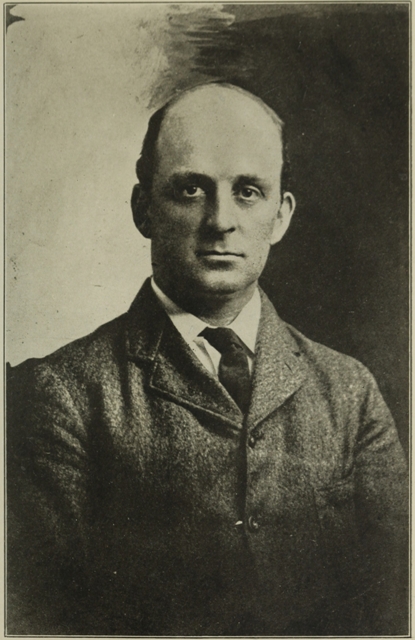 GOVERNOR GENERAL CAMERON FORBES.
At once Governor General Cameron Forbes
came on board to greet the Secretary of War,
and then followed a reception, the guests ranging
from the apostolic delegate in his robes,
the consular officials and insular officers, and
the army and navy in spotless gold-braided uniforms,
to the leading citizens, very intelligent
looking and well mannered, and members of the
Assembly. The dock was lined with troops,
who paid the military honours.
After the reception on shipboard the Secretary
and Mrs. Dickinson and the official members
of the party were whirled off in autos, with
a squadron of cavalry clattering along as escort.
Another motor was waiting for us, and we soon
joined the procession as it moved to the palace.
We were much interested in the sights in the
streets. There were numbers of carromatos,
little covered two-wheeled carriages, drawn by
stocky Filipino ponies. The streets in this part
of the town are wide, and the houses have overhanging
balconies, in Spanish style. In honour
of the Secretary, the buildings were draped
with flags. Near the wharf the land had lately
been filled in, and great docks were in construction.
There was a new boulevard near the old
Luneta, and an avenue named after President
Taft, besides a big hotel and a hospital that had
then just been finished. The harbour was filled
with vessels, electric cars were running, and
autos were to be seen, so at first it all looked
quite up to date, until you met a carabao slowly
swaying down the street, hitched to a two-wheeled
cart, with a brown boy in red trousers,
piña shirt and a big straw hat sitting on his
back—"carry boy," as Secretary Dickinson
named the animal. The "carry boys" do not
like white people, and sometimes charge them,
stamping and goring them with their horns, but
a small Filipino boy seems to have perfect control
of them, and if they are allowed occasionally
to wade in a puddle, which cools them
off, they do not "go loco," or crazy.
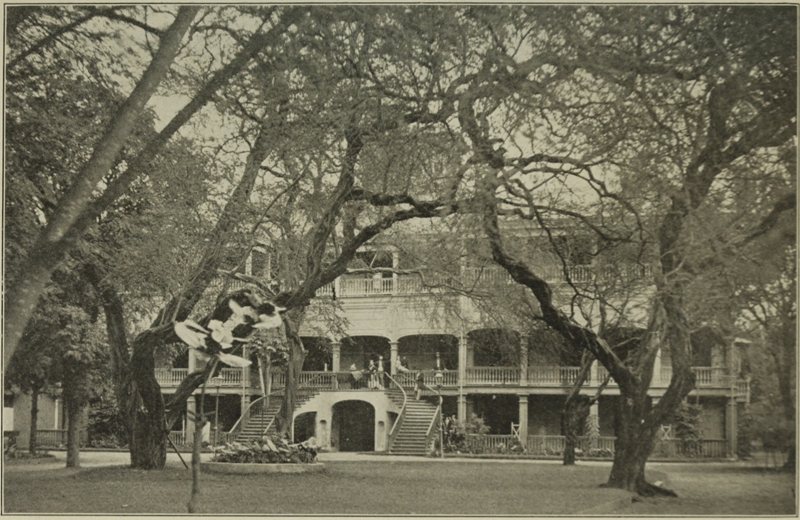
It was in the palace of Malacañan, or Government
House, as it is sometimes called, that Secretary
and Mrs. Dickinson and ourselves stayed
with the Governor General. This is a large,
rambling structure in a garden by the Pasig
River. Under the porte-cochère we entered a
stone hall, off which were offices, then went up a
long flight of stairs to a big hall looking into a
court. This hall was hung with oil paintings of
Spanish governors, quite well done by native
artists, and in the center stood a huge one-piece
table of superb nara wood, covered with gleaming
head-axes and spears, bolos, krisses, campilans,
and lantankas, used by the wild tribes
and Moros.
Our rooms were large and empty, as was the
entire palace—indeed, so are all the houses on
account of the heat. The polished floors, too,
are made of huge planks, sometimes of such
valuable tropical woods as rosewood and mahogany,
and are left bare. It took a little time
to accustom ourselves to the hard beds with rattan
bottoms, covered only by two sheets. They
were carved and four-posted, and draped with
mosquito netting. Two little brown lizards
squeaked at us in a friendly manner, and crept
down the walls, out of curiosity, no doubt, little
ants kept busily crawling across the room in a
line, and the mosquitoes that hid in my clothes
in the rack during the daytime buzzed about at
night. The heat was great, notwithstanding
the electric fan, but the sliding screens that
formed the sides of the room gave us some relief.
These shutters are like Japanese shoji,
made of small panes of an opalescent shell to
soften the intensity of tropic sunlight, with
green slit bamboo shades pulled halfway down.
When I used to write or read I sat on my
rattan bed under the mosquito netting; there I
could look out of the parted sides of the house
to the red hibiscus border of the garden stretching
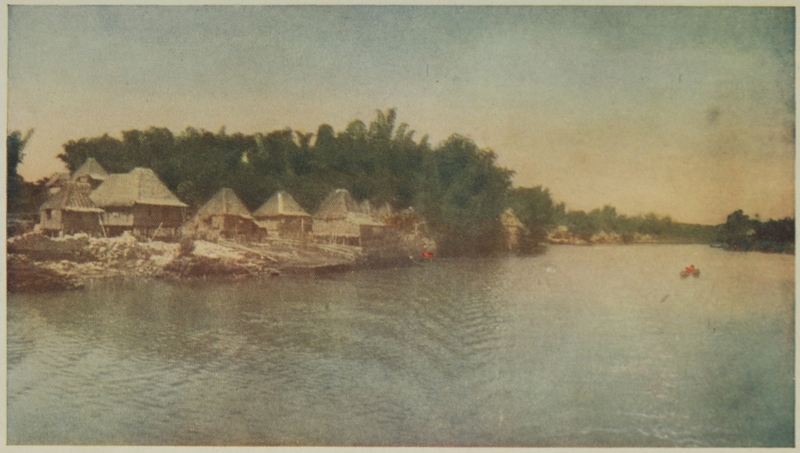
along the narrow Pasig. Boatmen, in conical
straw hats, perched at the ends of their
bancas, paddled the hollowed-out logs rapidly
through the water, or floated idly by, smoking
their cigarettes; these boats were loaded to the
gunwale with green grasses, and had canopies
of matted straw. Launches, too, came chugging
past, towing the big high poops covered
with straw-screened cascos. Over beyond the
river was a flat all in a green tangle, with the
thatched nipa houses on their stilts. For the
palace stands outside the more thickly settled
parts of the city, which in turn surround the
walled town.
The Pasig River
Manila to-day is a curious mixture of native
nipa shacks and old Spanish churches and forts
with the up-to-date American buildings and
improvements. There are the different quarters,
as in all cities of the Orient—Chinese, native and
so on—and each has its own distinctive sights.
The street smells, which are never lacking in
a city, reminded us of India.
The walled city has picturesque gates breaking
through the old gray battlements—the massive
wall was begun in 1590—and ancient sentry
houses at the corners, while behind rise the
white balconies of old convents and monasteries,
and buildings now used for government purposes,
and towers of churches. The old moats
have been filled up for sanitary reasons and are
being made into wide sweeps of lawn and flower
gardens, and the famous Malecon, the drive beneath
the city walls, which was once upon the
sea front, has been removed too far inland
by the filling of the harbour to retain its old
charm.
"Intramuros" (within the walls) more than
half the land belongs to the Church, and church
buildings abound. These are really inferior,
compared with those we saw in Mexico, but some
of them are very old. The Augustinian Church,
finished in 1605, has enormously thick walls and
a stone crypt of marvelous strength.
In the center of the town is Plaza McKinley,
but the main business street is the narrow
Escolta, made to look still narrower by the overhanging
second stories of the buildings.
We visited the botanical gardens, a shaded
park with winding paths beneath acacias and
mango trees. We drove, too, through the narrow
streets of the suburb of San Miguel, where
we looked into tangled gardens of tropical
plants, behind which were houses with broad
verandas and wide-opening sides, covered by a
wonderful screen of a sort of mauve morning
glory, which blooms, however, all day long.
The native houses are built of bamboo with
braided grass walls and thatched roofs, and are
raised on stilts because of the rainy season.
We went to order some embroidery one day of
a Tagalog woman. Climbing a ladder into a
small house, we saw the whole family sitting on
the floor, working over a long frame. In some
of these shacks they have a small room for
visitors, with chairs and a table, and cheap
prints of the Virgin on the walls. Under the
house are kept usually a pig and a pony. One
woman was very successful—she not only had
waist patterns to show and to sell, but had a
standing order from Marshall Field, in Chicago.
We also visited a still more prosperous embroidery
house, built of stucco, with a courtyard.
These people were Spanish mestizos.
A visit to the cigarette factory to which we
were taken by Mr. Legarda showed us one of
the characteristic industries of the city and gave
us an idea of the deftness and quickness of
those who are employed in this work. The little
women who pack the cigarettes can pick up
a number of them and tell in a twinkle by the
feeling just how many they hold, and the cigar
wrappers work with greatest rapidity and sureness
and make a perfect product. It was all
very clean and fresh, with hundreds of employees
in the large, airy rooms. A band
played as we went through the building, and we
had a generous luncheon and received innumerable
presents from the managers.
Opportunity was given us for sundry little
exploring trips into the suburbs of Manila.[11]
We rode on horseback, in company with Secretary
Dickinson, Governor Forbes and General
Edwards, among little native shacks, through
overgrown lanes beyond the city, and along the
beach, where we saw fishermen's huts and men
mending their nets, to the Polo Club. The
Governor, who was most generous in giving
money of his own to benefit the Islands, not only
built the clubhouse and laid out the field at his
own expense, but even imported Arabian horses
and good Western ponies. This club is a fine
thing to keep army officers in good condition and
give them exercise and amusement, as well as to
bring good horses into the Islands. The clubhouse,
of plaited grasses, bamboo and wood, is
on the edge of the beach, from which one can
see the beautiful sunsets across the bay and
catch the faint line of the mountains in the distance.
It all seemed very far-away and tropical
and enchanting.
The English-speaking residents of Manila
have various other clubs, among which the
Army and Navy, the English, and the University
are perhaps the most important. The Officers'
Club, at Fort McKinley (seven miles from
Manila) has a superb situation, commanding a
fine view of the mountains.
As we landed in Manila early Sunday morning,
we were in time for service in the Episcopal
cathedral, which had just been built. This is
a handsome building in the Spanish style, large
and airy, with an effective altar. It was erected
by an American friend of Bishop Brent, the
Episcopal bishop, who has done fine work in the
Islands. According to a story that is related of
this good man, he made a journey at one time
into the interior of Luzon, where he found the
natives sadly in need of instruction in ways of
personal cleanliness. As soon as he reached the
mail service again, he wrote to America for a
ton of soap, which was duly shipped to him and
used for the purification of the aborigines.
I was glad to visit also Bishop Brent's orphan
school, consisting principally of American-mestizo
children. The native women, when deserted
by their white lovers, generally marry
natives, who often ill-treat these half-white
children, and sometimes sell them as slaves.
Miss Sibley, of Detroit, was in charge of this
school, which was in a big, comfortable house
near the native shacks on the edge of the town,
and had twelve pupils at that time.
A convent of Spanish nuns on a small island
in the river, interested me greatly. It was then
under the supervision of the government, for it
was at that time not only a convent but also a
poorhouse, a school for orphans, an asylum for
insane men and women, and a reformatory for
bad boys. The embroidery done at the convent
was better than that made by the natives in
their houses, as the thread used was finer. The
nuns charged more than the natives, but they
would also cut and sew, thus finishing the garments.
Articles embroidered by native women
were never made up by them, but had to be
taken to a Chinese tailor.
The linen must first be bought, however, so I
tried to do a little shopping in the city, but
found it very unsatisfactory. The shops are
poor, and, as one traveler has said, you can get
nothing you want in them, but plenty of things
you don't want, for which you can pay a very
high price.
One day I was taken to a cockpit, where
a cockfight was to come off. This is one of
the characteristic amusements of the Filipinos,
which they have engaged in since the year 1500.
It is so popular that it would be difficult to
put a stop to it all at once, but it has been restricted
by the government to Sundays and
legal holidays, which is something of a victory.
(They are also passionately fond of horse racing,
in regard to which other restrictions have
been made.) Outside, beggars, old and blind,
were crawling over the ground; natives strolled
around, petting their birds, which they carried
under their arms; and vendors with dirty trays
of sweetmeats wandered about. We bought our
tickets and passed into the rickety amphitheater.
Cocks were crowing, and such a howling as
went on, the audience all looking toward us as
we entered. It seemed as if they were angry
with us for stepping into the arena, and yet
there was no other way to reach the seats. Our
guides pointed to a shaky ladder that led into
a gallery, but we preferred to sit far back in
the chairs about the pit. There were natives,
Chinese, and mestizos present. We soon discovered
that they were not angry with us, but
we had entered at a moment when the betting
was going on, and the cocks in the ring were so
popular that there was great excitement.
Each cock was allowed to peck the neck of
the other and get a taste of blood, while they
were still held under their owners' arms. The
fighting cocks did not look quite like ours.
They were armed for the fray with sharp
"slashers" attached to their spurs. When the
betting had subsided the cocks were left to themselves
in the ring, and they generally went for
each other at once. What a hopping and scuttling!
Feathers flew, the crowd cheered, and
the cocks went at each other again and again
until they were hurt or killed. The referee
then decided upon the victor. Sometimes the
cocks did not seem to interest the crowd, and
then their owners would take them out of the
ring before fighting; at times the cocks refused
to fight. It was not so exciting as I had expected,
and when we considered that the birds
were to be eaten anyway, it did not seem so
cruel and terrible as I thought it would.
Speaking of cocks being eaten, the principal
foods of the Filipinos are fowls and eggs, as
well as rice, fish and carabao meat, but as the
"carry-boys" are good workers they are not
often eaten. Pigs are kept by the Filipinos,
and are put on a raised platform for about six
weeks before killing, so as to keep them clean
and fatten them with good food. Salads, crawfish
and trout, as well as cocoanut milk, red wine
and wild coffee, are among the things they live
on. Army people in the Islands often have, in
addition, wild deer and wild boar which are shot
by the American officers, besides excellent game
birds, such as the minor bustard, jungle fowl,
wild chicken, quail, snipe and duck.
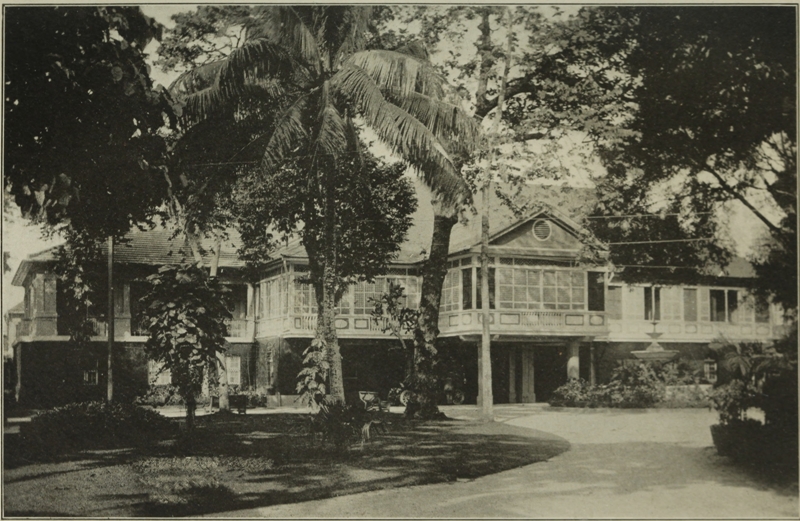 MALACAÑAN PALACE.
I was asked to receive with the Secretary and
Mrs. Dickinson and General and Mrs. Edwards,
at the Governor General's reception at Malacañan,
where we stood in line and shook hands
with some seventeen hundred persons. It was a
remarkable scene. The palace, which opens up
handsomely, and the terrace overhanging the
river, were outlined by a myriad electric lights,
while launches came and went with guests, and
the Philippine Constabulary Band played in the
interior court. The papal delegate was there
in his canonicals, with his accompanying monsignors,
and barefooted friars in cowls. There
were foreign consuls in their uniforms, and
many Filipina women, with pretty manners and
dainty ways, some in their native dress, which
is so quaint and gaily coloured. Insurrecto
generals came, too, who looked like young boys,
and members of the high courts, very wise and
dignified.
After most of the guests had arrived, there
was a rigodon of honour, in which all took part.
The rigodon is the dance of the Filipinos, and of
so much importance to them that it was considered
essential that the Secretary and his
party should be able to join in it. Accordingly,
we had all practised it on the ship before reaching
Manila. It is said that ex-President Taft
won much of his way into the hearts of these
island people by his skill and evident delight
in this dance, which is something like a graceful
and dignified quadrille, with much movement
and turning.
To show that traveling in an official party is
not "all play and no work," I may just note the
program carried out by the men on the day following
this reception. Rising at six o'clock and
taking an early breakfast, they went on board
the commanding general's yacht and cruised
across Manila Bay to visit the new defenses on
the island of Corregidor, which rises a sheer
five hundred feet out of the water. For hours
they moved from one place to another in the
heat, inspecting huge guns and mortars and
barracks and storehouses, all hidden away so
as not to be seen from the sea, although great
gashes in the cliffs showed where the trolley
roads and the inclined planes ran. It is really
the key to our possessions in the Far East.
Thousands of men were working like ants all
over the place. It was two o'clock before the
party reached the tip-top, where they had a
stand-up luncheon at the quarters of the commanding
officer. Then they came back to the
yacht, and fairly tumbled down just wherever
they happened to be for a siesta. They were
then taken to Cavite, ten miles away, which is
one of the two naval stations. There they
landed again and visited the picturesque old
Spanish fortifications and the quarters.
A baile, or ball, was given in honour of the
Secretary by the Philippine Assembly, at their
official building, where all the ladies of our
party wore the Filipina dress. This is ordinarily
made of piña cloth, a cheap, gauzy material,
manufactured from pineapple fiber. The
waist, called camisa, is made with winglike
sleeves and a stiff kerchief-like collar, named
panuela. The skirt may be of any material,
quite often a handsome brocade, and among the
Tagalogs a black silk open-work apron finishes
the costume. The white suits and uniforms of
the men and the bright-coloured dresses made
this ball a gay and lively scene. The band
played incessantly, and after the Secretary and
Mrs. Dickinson had stopped receiving at the
head of the stairs, there was a rigodon, which
we all danced in as stately a manner as we
could. But my most vivid recollection of the
ball is of the heat and the pink lemonade, which
poisoned a hundred people and made me deadly
ill all that night.
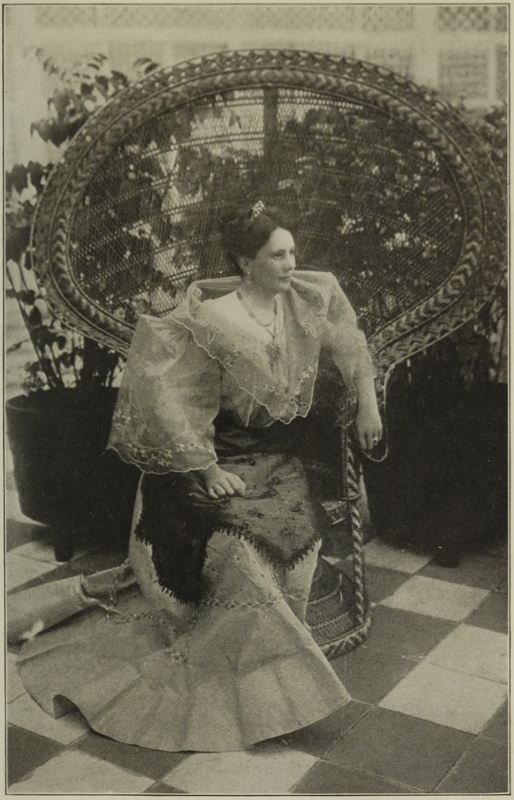 MRS. ANDERSON IN FILIPINA COSTUME.
The Governor General gave a big dinner for
the Secretary of War at the palace one evening.
We assisted also at the opening of the new
theater—which is called the finest in the Far
East—at which Marshall Darrach gave recitations
from Shakespeare. I must not forget the
gala performance at the new theater, too, which
was arranged by the society people of the city.
All the performers were amateurs, so we rather
dreaded the evening, which promised to be interminable,
but everything was so good that the
time passed quickly. The little ladies sang
quite acceptably, and played the violin and the
piano; and a lot of tiny tots, children of the best
people, gave an amusing vaudeville that really
was exceedingly funny and was much applauded.
We could hardly believe that it was
all amateur.
The Government Dormitory for Girls, which
we visited, I found most interesting. There
were one hundred and fifty, eight sleeping in
each room. These girls came from different
provinces all over the Islands. As there are so
many distinct dialects, some of them could
understand one another only in English, and
no other language is allowed to be spoken. One
of the girls made a speech in English welcoming
the Secretary and did it extremely well.
Having learned, among other things, to cook,
they gave us delicious tea and cakes and candies
on a half-open veranda among the vines and
Japanese lanterns. Some were taking the
nurses' course, which seemed to be the most
popular. These pretty girls danced for us in
their stiff, bright-coloured costumes, swaying
and waving their hands, and turning and twirling
in their languid but dignified manner. It
appeared to be a mixture of a Spanish and a
native dance, and was altogether quite charming.
A morning with Mr. Worcester at the Bureau
of Science was most delightful. This bureau is
so much more than a museum of scientific specimens
that I cannot begin to do justice to it in a
single paragraph. It was started at first as a
Bureau of Government Laboratories in charge
of the chemical and biological work of the government,
the departments of zoölogical and
botanical research were subsequently added,
and finally the Bureau of Ethnology and the
Bureau of Mines were incorporated with it.
Not only were all these departments coördinated
under one head, preventing overlapping and
securing economy and efficiency of administration,
but this work was correlated with that of
the Philippine General Hospital and the College
of Medicine and Surgery. When this comprehensive
plan was formed all the scientific
work of the government was carried on in "a
hot little shack," and the scheme was commonly
referred to as "Worcester's Dream," but at
the time of our visit the dream had come true.
The departments were manned by thoroughly
trained men from the States, and the Bureau of
Science was one of the world's greatest scientific
institutions.
The Philippine Bureau of Science "is now
dead." When the Democratic Administration
took charge it was announced that all theoretical
departments, such as ethnology, botany, ornithology,
photography and entomology (!) were
to be "reduced or eliminated." It was afterward
made plain that all work which was considered
practical would be continued, but the mischief
had been done, the men who made the institution
had left, and under present conditions it
is impossible to secure others who are equally
competent in their place. Our only consolation
is to be derived, as Mr. Worcester himself says,
"from contemplating the fact that pendulums
swing."
Though so recently established, the museum
contained in 1910 a wonderful exhibit of the
plants and animals of the Islands. We took a
peep into the butterfly room, where we admired
some rare and lovely ones with a feathery
velvet sheen the colour of the sea. We saw also
the huge brown Atlas moth touched with coral,
like a cashmere shawl, with eyes of mother-of-pearl
on his wings. We noticed that the females
were larger than the males, and even
those of the same variety often differed greatly
in colour. In one case a female was big, and
brown and violet in colour, while her mate was
small, and blue and yellow.
In the next room were beetles, some of which
were like the matrix of turquoise, and others
had shimmering, changeable shades of green
and bronze. There were beetles like small turtles,
and long, horned beetles like miniature
carabaos.
Afterward we visited the birds. Bright-coloured
sun birds, with long beaks, which feed
on the honey of flowers; clever tailor birds, small
and brown, with green heads and gray breasts,
which sew leaves together with vegetable fiber
to make their nests; birds of whose nests the
Chinese make their famous soup, and the blue
kingfishers, of whose brilliant feathers these
same Chinese make jewelry; fire-breasted birds,
too, and five-coloured birds. There were birds
that build their nest four feet or more under
the ground, and hornbills, that wall up their
wives in holes in the trees while they are hatching
their eggs, the males bringing them food and
dropping it through a small opening. There,
too, I saw the fairy bluebird.
Near by, we visited an orchid garden, and
passed under gates and bamboo trellises dripping
with every kind of orchid. The Philippines
are the paradise of these remarkable
plants, and many are the adventures that collectors
of them have had in the interior of these
Islands.
Then we passed into the Jesuit chapel and
museum. We were greeted at the door by several
black-robed priests, who smiled and bowed
and talked all at once. They escorted us first
to the museum, where there were cases of shells—heart-shaped
shells, trumpet shells, scalloped
shells big enough for a bathtub—all kinds of
shells, and the paper nautilus, which is not a
shell but an egg case. Then there were land
shells, polished red and green, Venus' flower
baskets, exquisite glass sponges, corals of all
kinds—fine branches of the red and the white—and
an enormous turtle that weighed fifteen hundred
pounds.
In the cases at the side of the room were animals
of the country—flying monkeys, with sucking
pads on their toes to help them climb the
trees, big, furry bats and flying lizards. A tiny
buffalo, which was discovered only a few years
ago up in the hills, and a small spotted deer
were in the collection. A big monkey-catching
eagle, white and brown, was here, and the paroquet
that carries leaves for her nest in her red
tail, as well as a pigeon with ruffs of green and
blue about her neck, and a bald crown, which
was caused, the natives say, by flying so high
that her head hit the sky.
Numerous entertainments and receptions were
crowded into that too short visit to Manila.
July 25th had been declared a national holiday.
A musical program was given in honour of the
Secretary by five thousand Manila school children.
One afternoon Mrs. Dickinson received
some of the Filipina ladies, who sang and played
on the piano quite well.
Another day the officers and ladies at Fort
McKinley entertained the party at luncheon at
the Officers' Club. Before luncheon there was
a military review in which the troops from all
over the islands participated, followed by some
good shell firing out in the chaparral, as under
war conditions, and a display of wireless work.
A special drill was given by Captain Tom Anderson—the
son of General Anderson—whose
company was one of the best drilled in the army,
and went through the manual and marching with
only one order given, counting to themselves in
silence the whole seventeen hundred counts, all
in perfect unison.[12]
In the Secretary of War's speech that afternoon
he took occasion to say, "General Duvall,
you have not said too much in favour of the
Army. You have not overdrawn the picture,
for a steadier moving column or brighter eyed
men and a more soldierly set of men I have
never seen anywhere."
The reception by General and Mrs. Duvall
was a brilliant affair, chiefly of the army and
navy. The handsome house with its wide verandas
stood in a garden overlooking Manila
Bay.
On the Luneta there was, one evening, the
largest gathering that had assembled on that
historic plaza since the days of the "Empire,"
for the Secretary of War was expected to be
there. The people hoped that he brought with
him a proclamation of immediate independence
to be announced at that time. The Luneta had
once been at the edge of the water, but a great
space had been filled in beyond it, and buildings
were going up—a large hotel, which would
make all the difference in the world to tourist
travel in the Philippines, and a huge Army and
Navy Club—so that it was planned to remove
the Luneta farther out some day, again to the
water's edge. On this particular evening, the
oval park was crowded with picturesque people,
almost all the men in white, the soldiers in their
trig khaki, and the women in their gaily coloured
dresses and panuelas. Rows of carriages circled
round and round, as the two bands played
alternately. After a time we left our automobiles
and walked in the throng. A magnificent
sunset was followed by the gorgeous tints of
the afterglow, and dusk came on and evening
fell while we watched and were watched. Soon
a thousand electric lights, that were carried in
rows around the plaza and over the kiosks of the
bands, sparkled out in the darkness. The
beauty of the scene, the animation of the crowd,
driving or walking in groups, and the refreshing
coolness after the heat of the day, made this
a lasting memory.

ow have the Philippines come to present
such a unique combination of Spanish
and Malay civilization? Let us look into
their past. We find for the early days myths
and legends, preserved by oral tradition. Two
quaint stories told by the primitive mountain
people, which show how they believe the Islands
first came into being and how the first man and
woman entered into this world, are worth transcribing
for their naïve simplicity:
"A long time ago there was no land. There
were only the sea and the sky. A bird was
flying in the sky. It grew tired flying. It
wanted something to rest upon. The bird was
very cunning. It set the sea and sky to quarreling.
The sea threw water up at the sky. The
sky turned very dark and angry. Then the
angry sky showered down upon the sea all the
Islands. That is how the Islands came."
This second tale is even more child-like:
"A great bamboo grew on one of the Islands.
It was very large around, larger than any of the
others. The bird lit on the ground and began
to peck the bamboo. A voice inside said, 'Peck
harder, peck harder.' The bird was frightened
at first, but it wanted to know what was inside.
So it pecked and pecked. Still the voice said,
'Peck harder, peck harder.' At last a great
crack split the bamboo from the bottom to the
top. Out stepped a man and a woman. The
bird was so frightened that it flew away. The
man bowed very low to the woman, for they had
lived in different joints of the bamboo and had
never seen each other before. They were the
first man and woman in the world."
These natives believe there are good and evil
spirits, and they invoke the agency of the latter
to explain the mystery of death. They say the
first death occurred when the evil spirit lightning
became angry with man and hurled a dangerous
bolt to earth.
The first suggestion of real history is found
in the traditions that tell of Malays from the
south who came and settled on these islands.
It is said a race of small black people were
already here—the Negritos—who resembled the
African negroes, and who retired into the hills
before the invaders.
Next we hear of a Mohammedan priest who
came to the southern Philippines and gave the
people his religion. His followers have to this
day been called Moros.
It was more than two centuries before Captain
Cook visited Hawaii, that white men discovered
the Philippines. Magellan, the famous
Portuguese navigator, while sailing in the service
of Spain, landed on Mindanao and Cebu, and
took possession of the group in the name of the
Spanish king. Before starting from Seville on
this voyage around the world, Magellan had already
spent seven years in India and sailed as
far as Sumatra, so he already knew this part of
the world. This time he was in search of the
Spice Islands and of a passage from the Atlantic
to the Pacific Ocean. He had touched
first at Teneriffe and then crossed the Atlantic
to Brazil, making his way along the coast of
South America. There were many hardships
and difficulties to contend with, and mutiny in
the fleet resulted in several deaths. But, as we
all know, he persevered, and on the 15th of October,
1520, discovered the straits which were
named after him.
The Ladrones were reached after fourteen
tedious weeks, and on St. Lazarus' day, in 1521,
the Philippines were sighted and named by him
for the saint. In the early times they were
sometimes referred to by the Spaniards as the
Eastern, and later as the Western, Islands.
They were finally named the Philippines by Ruy
Lopez de Villalobos, after his king, Philip the
Second.
Magellan was quite unlike Captain Cook,
whose visit to Hawaii has been mentioned. He
was a nobleman and full of the religious enthusiasm
that fired the Spaniards of his day.
He was accompanied by several friars, who at
once began missionary work among the natives,
and only a week after his arrival the Cebuan
chief and his warriors were baptized into the
Christian faith. Unfortunately, Magellan took
sides with the Cebuans in their warfare against
a neighbouring tribe, and in the battle he was
killed. After his death, the same chieftain
turned on Magellan's followers, but some
escaped to their ships. Out of two hundred and
fifty men who had set sail three years before,
only eighteen, after suffering incredible hardships
on the long journey by way of India and
the Cape of Good Hope, returned safely to
Spain.
The next explorer who touched at the Islands
was the Englishman, Sir Francis Drake, of
Spanish Armada fame, who sailed in 1570 on a
voyage round the world. We also hear of another
Briton, William Dampier, a noted free-booter,
who, in 1685, tried to cross the Isthmus
of Panama with Captain Sharp. Three times
he sailed round the world, and touched at the
northern as well as the southern Philippine
Islands.
Magellan, Drake and Dampier gave the western
world much knowledge of the Far East, but
did not remain long enough in the Islands to
have any great or lasting influence over the
natives. The work of civilizing them was left
to Legaspi and the Spanish friars, who were
the first real settlers.
In 1565, the Philippines were occupied by an
expedition under Miguel Lopez de Legaspi,
alcalde of the City of Mexico, who was charged
to open a new route to Java and the Southern
Islands. On his return voyage he was to examine
the ports of the Philippines, and, if expedient,
to found a colony there. In any case
he was to establish trade with the Islands. The
viceroy of Mexico charged him that the friars
with the expedition were to be treated with the
utmost consideration, "since you are aware that
the chief thing sought after by His Majesty is
the increase of our holy Catholic faith and the
salvation of the souls of those infidels."
Cebu was occupied, and Manila was taken and
made the seat of government. The occupation
of the Islands was not exactly by force of arms,
for there was no fighting, although they found
the islands well populated and the people more
or less armed. The natives seemed to recognize
and submit to a better government and religion
than they had ever known. The reports
of the Spaniards of the time speak of the success
of small expeditions of perhaps a hundred
men, who took over whole provinces. These
soldiers were accompanied by Spanish priests,
who settled among the people, preaching Christianity
in the native tongues. The friars persuaded
them to give up their continual feuds
and submit to the central authority which the
friars represented.
Legaspi brought with him from Mexico four
hundred Spanish soldiers. Later eight hundred
more arrived, and civilian Spaniards, both
married and single, sailed to the Islands as settlers.
In 1591, according to the records of
Spanish grants, there were 667,612 natives
under Spanish rule, and twenty-seven officials
to enforce the laws and preserve order. It was
reported that in a majority of the grants there
was peace, justice and religious instruction.
There were Augustinian, Dominican and Franciscan
friars as well as secular clergy. These
men were not only priests but also fighters
and organizers, and did fine work for many
years, until long-continued possession of power
gradually made the orders corrupt and grasping.
Upon their first arrival, the Spaniards found
the people established in small villages, or
barangays, where the chief lived surrounded
by his slaves and followers. It was considered
wise to continue this system, ruling the villages
through the local chieftain, whom the Spaniards
called cabeza de barangay. Churches were
erected, convent houses were built about them,
and the natives were urged to gather near by.
It was ordered that "elementary schools should
be established, in which the Indians will be
taught not only Christian doctrine and reading
and writing but also arts and trades, so that
they may become not only good Christians but
also useful citizens."
So at the end of the sixteenth century the
Philippines were at peace. The natives were
allowed to move from one town to another, but
they were required to obtain permission, in
order to prevent them from wandering about
without religious instruction. The tendency of
the Malays is to separate into small groups, and
they have never been dwellers in large
towns. The Spanish priests, therefore, found a constant
effort necessary to keep them concentrated
about the churches "under the bells."
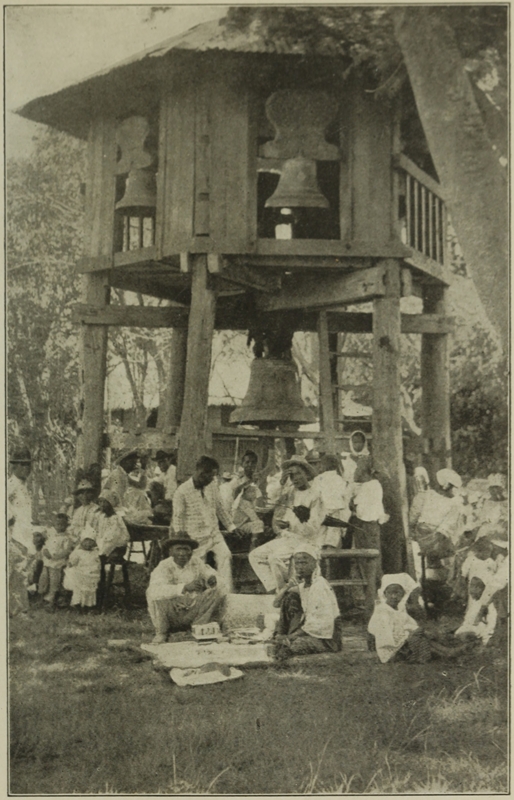 "UNDER THE BELLS."
The fervour of religious reform which started
in Germany was followed by an equal fervour
within the Roman Catholic Church. The period
of Julius II and Leo X was over; the Council of
Trent had met. Ignatius Loyola had seen his
visions and sent forth his company, and Spain
was full of priests eager to serve God with the
same stern energy which the previous generation
had shown in the search for lands and gold
and fabulous gems. No duty was so grave as
that of conformity to the Church, no stigma so
galling as that of heretic. To convert the
heathen was an obligation binding upon all men.
All Spanish colonies were missions; the Philippines
were always rather a mission than a
colony.
Until the revolt of 1896, Spain never found it
necessary to hold the Islands by armed force;
her dominion there was based rather on her
conquest of the minds and souls of men. There
had been a few uprisings, however, and early in
the eighteenth century a Spanish governor and
his son were murdered by a mob. But notwithstanding
occasional difficulties, in the main there
was peace until the civil service of the Philippines
was assimilated with that of Spain. Then
officials became dependent upon their supporters
at home, and were changed with every
change of the ministry. Some Spaniard writing
at the time said that with the opening of the
Suez Canal Spanish office holders descended on
the Islands like locusts.
At the end of the nineteenth century, the
Spanish army had grown to 17,859 of all ranks,
only 3,005 of whom were Spaniards, and there
was a constabulary of over 3,000 officers and
men, who were almost entirely natives. The
rule of Spain was secured by a native army.
There could have been no widespread discontent,
or that army would not have remained true
to its allegiance, especially as its recruits were
obtained by conscription.
The chronicles remind us, however, that the
Spaniards did not have things all their own way.
In the early days, they were at first friendly
with the Chinese, and Mexico carried on a flourishing
trade with China by way of Manila until
the pirate Li Ma Hong raided the Islands. The
Spaniards were on good terms with the Japanese
until the latter massacred the Jesuit friars
in Japan. When the Shogun Iyeyasu expelled
the priests he sent away even those who were
caring for the lepers, and as a final insult, he
sent to Manila three junks loaded with lepers,
with a letter to the governor general of the
Philippines, in which he said that, as the Spanish
friars were so anxious to provide for the
poor and needy, he sent him a cargo of men who
were in truth sore afflicted. Only the ardent
appeals of the friars saved these unfortunates
and their contaminated vessels from being sunk
in Manila Bay. Finally the governor yielded,
and these poor creatures were landed and
housed in the leper hospital of San Lazaro,
which was then established for their reception
and which remains to-day.
The Spanish governors were also hampered
by the lack of effective support from the older
colony of Mexico, which was so much nearer
than the home land that they naturally turned
to it for aid. One of them wrote pathetically
to the King of Spain:
"And for the future ... will your Majesty
ordain that Mexico shall furnish what pertains
to its part. For, if I ask for troops, they send
me twenty men, who die before they arrive here,
and none are born here. And if I ask for ammunition,
they laugh at me and censure me, and
say that I ask impossible things. They retain
there the freight money and the duties; and if
they should send to this state what is yours,
your Majesty would have to spend but little
from your royal patrimony."
The Portuguese were a source of anxiety to
the colonists until Portugal fell into the hands
of Spain. The Dutch, too, who were growing
powerful in the Far East, even took Formosa,
which brought them altogether too near, but
they were driven out of that island by the great
Chinese pirate Koxinga.[13]
From the time of Legaspi to the end of Spanish
rule there were occasional attacks upon the
Chinese residing in the archipelago, who were
never allowed to live in the Islands without exciting
protest and dislike, based partly upon
religious, partly upon commercial grounds.
During the last one hundred years of Spanish
supremacy, the greatest danger to their power
was the presence of the Chinese. Efforts to
exclude them were never effective or long enduring,
and yet it was felt that the men who
came as labourers and traders were the advance
guard of an innumerable host. In business the
Malay has never been the equal of the shrewd
Chinaman, and although the latter might be converted
and take a Spanish name, yet it was always
gravely suspected that a search would find
joss sticks smoldering in front of the tutelary
deity of commerce hidden behind the image of
the Virgin in his chapel.
So the Chinaman, like the Jew in medieval
Europe, carried on his trade in constant danger
of robbery and murder. This antipathy did not,
however, extend to Filipina women, many of
whom married the foreigners. Among the
leaders in the Filipino insurrection against the
United States, Aguinaldo, two of his cabinet,
nine of his generals, and many of his more important
financial agents were of Chinese descent.
In 1762 the English swooped down upon Manila,
but they held the capital only two years,
for, by the Treaty of Paris, the lands they had
taken were returned to Spain. It is said the
English conquest, brief as it was, brought good
results to the Islands.
Before going on to the struggle against the
friars, I wish to quote from my father's letters
describing his experiences in the Philippines
twenty years before American occupation.
"At Sea, December 2, 1878.
"Yesterday I left Manila, where I have been
since the 6th of last month.... Our first days
there were spent in firing salutes and exchanging
visits, and going through all the forms
which are customary when a government vessel
comes into a foreign port. Admiral Patterson
sent me here to settle a stabbing affray on board
the American barque Masonic, and that took up
my attention at first. In the evenings I went to
the opera, and visited the sights of the city.
On account of earthquakes, all the buildings are
but one story high. The customs, fashions, etc.,
are Spanish. Every one was polite and I found
it very pleasant; but, as you might expect, after
a little while I grew restless. I heard that there
was some beautiful scenery in the interior, and
I resolved to go on an investigating trip and see
it. Our vice-consul, Mr. Yongs, and another
gentleman went with me.
"From Manila we went in a boat up a short
river, which had its rise in a large lake, about
twenty-five miles long, that we crossed in a
steamer. I think I never saw such quantities
of two things as were on that lake—namely,
ducks and mosquitoes.
"From the lake we continued our journey in
two-horse vehicles, like the volantes of Havana,
and in these we went from village to village, on
our way to the mountains. We were very well
treated. The Spanish authorities at Manila
provided us with whatever we required. The
villages were clusters of thatched huts around a
church, and the religion seemed to be a curious
mixture of Roman Catholic Christianity and pagan
superstition, as I concluded from the style
of the pictures with which the churches were
adorned. These were chiefly representations
of hell and its torments. Devils, with the traditional
tails and horns, and armed with pitchforks,
were turning over sinners in lakes of
burning brimstone....
"We found the natives very musical; they
sang and played on a variety of instruments,
and they were rather handsome. The women
had, without exception, the longest and most
luxuriant hair I ever saw in all my travels.
You know it is a rare thing among us for a
woman to have hair that sweeps the ground, but
here the exception is the other way; nearly every
woman I saw had hair between five and six
feet in length.
"I was told that back among the mountains
there existed tribes whom the Spaniards have
never been able to conquer, and no one dares to
venture among them, not even the priests. Our
road was constantly ascending, and as we advanced
toward the interior the scenery became
beautiful. Peaks of mountains rose all about
us; plains and valleys stretched out, covered
with tropical vegetation; picturesque villages,
clustering around their churches, were visible
here and there; and in the distance were
glimpses of the sea, sparkling and bright in the
sun.
"I was told of a wonderful ravine among the
mountains that was worth seeing and I decided
to visit it, especially as it was a favourable time;
the river, by which it had to be approached, was
then high, and its fifteen cascades, which
usually had to be climbed past, dragging the
canoe, were reduced to four. I took three natives
with me, and we ascended successfully. I
have called it a ravine, but a gorge would be a
better term, for it is worn directly through the
mountain by a large river, and the rock rises up
on each side, as sheer and straight as if cut by
machinery.
"After I had ascended a certain distance, I
stopped for a time to examine all the wild
magnificence about me. The rocky wall on each side
was so high that when I looked up I could see
the stars shining in that bright noonday, as if it
were night. Huge birds came flapping up the
gorge far above my head; and yet they were far
below the top of the mountain of rock. I do
not know how many feet it rose, but I never saw
any precipice where the impression of height
was so effectually given—it seemed immense.
"Beneath us was the deep, broad stream,
looking very dark in the twilight that such a
shadow made, and I could not help feeling awestruck.
But the opening of the gorge framed
as smiling and cheerful a landscape as could
possibly be devised, to contrast with the inner
gloom. It was a wide, varied and splendid view
of the country beyond, sloping to the distant sea,
and all of it as aglow with light and colour as
sea and land could be, beneath a tropic sun.
"Descending the river on our way out, I had
a characteristic adventure, which will make me
satisfied for a time. We had passed two of the
rapids in safety, but as we approached the third,
the canoe struck on a rock or something in the
current, bow on, and swinging round, half filled
with water. The natives in the end of the canoe
nearest the rock sprang out and clung to the
vines which hung over its sides, but the other
man and I went over the fall in the half-swamped
canoe, and were wholly at the mercy
of the stream, with an unusually good prospect
of getting a good deal more of it.
"The fall once passed through, the current
drove us toward the shore, if that is what you
would call a precipice of rock, running straight
down far below the surface of the water. I succeeded
in grasping the vines and pulling the
canoe after me by my feet. The water was
quite close by the rock, and the other two men,
crawling down to us, hung on with me, and
bailed out the boat till it was safely afloat, and
then we went down the rest of the way without
accident."
Before the middle of the last century, life in
the Philippines must have been, for Spaniards
and natives alike, one long period of siesta.
The sound of the wars and the passing of governments
and kings in Europe must have seemed
to these loiterers in a summer garden like the
drone of distant bees. After that period conditions
changed rapidly. In 1852, the Jesuits returned
to the Philippines; in 1868, the reactionary
Queen Isabella II fled from Spain, because
of the rise of republicanism; in 1869, the
Suez Canal was opened. All these events had
their influence, but the return of the Jesuits was
of dominating importance.
Throughout the nineteenth century the sole
idea of the Tagals was to get rid of the friars,
and for several reasons, which I will explain as
briefly as possible. The Roman Catholic clergy
are divided into regular and secular. Members
of the secular clergy are subordinate to the
bishops and archbishops, through whom the decrees
of the Holy See are promulgated. The
regular clergy, monks and friars, are subordinate
to provincials elected for comparatively
short terms of office by members of their own
order. The Jesuits form a group by themselves
but belong rather to the regular than the secular.
Over three hundred years after the conversion
of the Filipinos, the Spanish monks and
friars considered it still unsafe to admit natives
into the hierarchy of the Catholic Church. The
secular clergy were mostly natives, the regular
clergy were Spaniards. Naturally this condition
of affairs in time produced friction.
To understand the case in regard to the Jesuits,
it is necessary to go back nearly a century.
In 1767, the King of Spain issued a decree expelling
the Jesuits from his possessions. Their
property was confiscated, their schools were
closed, and they were treated as enemies of the
state. They had been among the earliest missionaries
in the Philippines, and were probably
the wealthiest and most influential of all the
clergy there. Their departure left no priests
for the richest parishes in the provinces of
Cavite and Manila, which had been their sphere
of influence. The question at once arose as to
who would succeed them, and as it happened, the
Archbishop of Manila who had to answer it was
a member of the secular clergy, a Spanish priest
to be sure, but of liberal tendencies. Consequently,
he filled the parishes with native
priests, who continued to occupy them until the
return of the Jesuits.
Now the parish priest was the most influential
man in the community. As native priests
used this influence to build up the prestige of
the seculars, the ecclesiastical feuds which arose
became embittered by racial antagonism.
When a royal order was received permitting
the return of the Jesuits it became at once necessary
to find places for them in the ecclesiastical
government. Spain decided that the parishes
of Cavite and Manila should be henceforth
filled by members of the order of Recollets,
who were to transfer their missions in
Mindanao to the Jesuits. The Archbishop protested
against this increase in the power of the
regular clergy, and the Governor General assembled
his council to act upon the protest.
All the members of the council who were born
in Spain voted against the Archbishop. All
those born in the Philippines voted for him.
The regulars gained another victory over the
seculars; the native was publicly informed that
he was not fit to administer the parishes of his
own people, and he saw himself definitely assigned
to the position of lay brother or of
curate. Whatever threads of attachment there
had been between the opposing factions broke
on the day of that decision, and every native
priest from that moment became a center of
disaffection and of the propaganda of hatred
of the friars. This was perhaps the real beginning
of the movement which continued, now
secretly, now openly, until it broke out in actual
revolt in 1872. The Spaniards put down this
uprising of the Tagalogs with such cruelty that
they feared a later retaliation, and sought help
from the friars. This the friars gave them, in
return for added wealth and power, which was
granted, of course, at the expense of the vanquished
natives.
Worcester writes in one of his earlier books,
"During the years 1890-93, while traveling in
the archipelago, I everywhere heard the mutterings
that go before a storm. It was the old
story: compulsory military service; taxes too
heavy to be borne, and imprisonment or deportation
with confiscation of property for those
who could not pay them; no justice except for
those who could afford to buy it; cruel extortion
by the friars in the more secluded districts;
wives and daughters ruined; the marriage ceremony
too costly a luxury for the poor; the
dead refused burial without payment of a substantial
sum in advance; no opportunity for education;
little encouragement for industry and
economy, since to acquire wealth meant to become
a target for officials and friars alike; these
and a hundred other wrongs had goaded the natives
and half-castes until they were stung to
desperation."
The dissensions in the Philippines which
ended in the rebellion of 1896-7 began with disagreements
among the Spaniards themselves.
A progressive party arose before which the clerical
or conservative party slowly but steadily
lost ground, and the legislation of modern Spain
was by degrees introduced into the Islands.
The country was not able to endure the taxation
which would have been necessary to raise the
revenues to carry out this legislation. Hence
laws which were passed against the advice of
the Spanish clergy in the Philippines were left
largely in their hands for execution, not because
they were loved or trusted, but because
they were the only Spanish functionaries who
knew the language and the people and whose
residence in the Islands was a permanent
one. If the friars had used their power wisely
and unselfishly, there would have been no trouble,
but they used it too often simply to keep
the people down and extort money, for which
they gave little return.
By degrees the mestizos took sides. The
Chinese mestizos soon grew restive under this
priestly government, and aided the progressive
Spanish party in Manila. As time passed they
had it borne in upon them that revolution might
pay.
The insurrection of 1896-7 was planned and
carried out under the auspices of a society local
to the Philippines, called the "Katipunan," the
full title of which may be translated as "Supreme
Select Association of the Sons of the
People." According to Spanish writers on the
subject, it was the outgrowth of a series of associations
of Freemasons formed with the expressed
purpose of securing reforms in the government
of the Philippines, but whose unexpressed
and ultimate object was to obtain the
independence of the archipelago. As if to accomplish
this purpose, a systematic attack was
made on the monastic orders in the Philippines,
to undermine their prestige and to destroy their
influence upon the great mass of the population.
The honorary president of the Katipunan was
José Rizal, whose name was used, without his permission,
to attract the masses to the movement.
Rizal was born in 1861 not far from Manila.
He came of intelligent stock. After his early
training at the Jesuit school in Manila and the
Dominican university, Rizal went to Spain,
where he took high honors at the University of
Madrid in medicine and philosophy. Post-graduate
work in France and Germany followed.
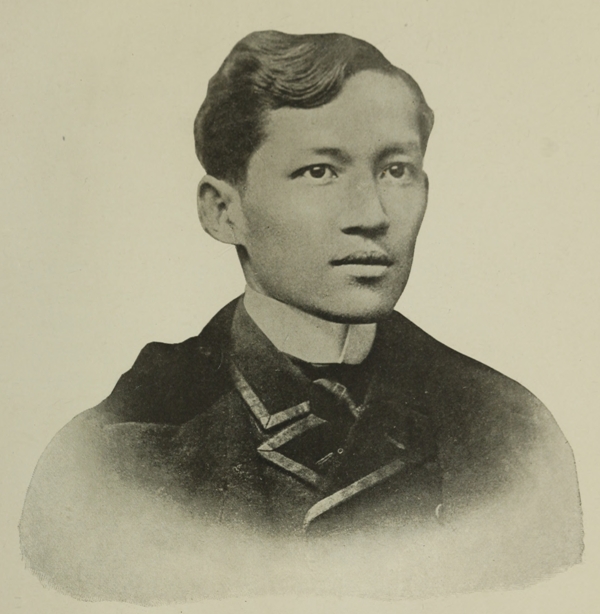 JOSE RIZAL.
He was an ardent patriot, and in order to
awaken his countrymen to the need of reform,
although he was a Roman Catholic, he published
while in Germany his book called "Noli Me
Tangere,"—Touch Me Not—which dealt with
the immoral life of the friars. An English
translation has been issued with the title, "The
Social Cancer." The circulation of the book
in the Islands was forbidden, but it was read by
most of the educated Filipinos. In reading it,
one is again and again struck by the author's
clear comprehension of the needs and the difficulties
of the Filipinos, and the calm, unprejudiced
way in which their problems are discussed.
In 1891, Rizal began the practice of medicine
in Hongkong. Meanwhile, the Spanish authorities,
in their desire to get him into their power,
worked upon his feelings by persecuting his
mother. The trick was successful, and he returned
to Manila, where he was soon arrested,
and banished to the island of Mindanao.
The most powerful leader of the insurrection
was Andres Bonifacio, a passionate and
courageous man of little education. He sent an
agent to Dr. Rizal to aid him in escaping from
his place of exile and to request him to lead the
Katipunan in open revolt. Rizal refused, believing
that the Filipinos were not yet ready for
independence. Bonifacio resolved to proceed
without him.
Bonifacio assured his audience that when he
gave the signal the native troops would join
them. It was of great importance to the success
of his plan that the army, as in 1872, was
engaged in operations against the Moros.
There were available in Manila only some three
hundred Spanish artillery, detachments amounting
to four hundred men, including seamen, and
two thousand native soldiers. The plot was
discovered, but Bonifacio escaped from Manila,
and sent out orders for an uprising in that part
of Luzon which had been organized by the Katipunan.
Manila was attacked, but the rebels
were repulsed. Martial law was proclaimed in
eight provinces of Luzon, followed by wholesale
executions. Many of those arrested on suspicion
"were confined in Fort Santiago, one batch
being crowded into a dungeon for which the
only ventilation was a grated opening at the top,
and one night the sergeant of the guard carelessly
spread his sleeping-mat over this, so
the next morning some fifty-five asphyxiated
corpses were hauled away."
Just before the outbreak, Rizal received permission
to join the army in Cuba as surgeon,
but on the way there was arrested and brought
back to Manila. His fate was now sealed. The
trial by court-martial was a farce. On a December
day in 1896 he was led to execution.
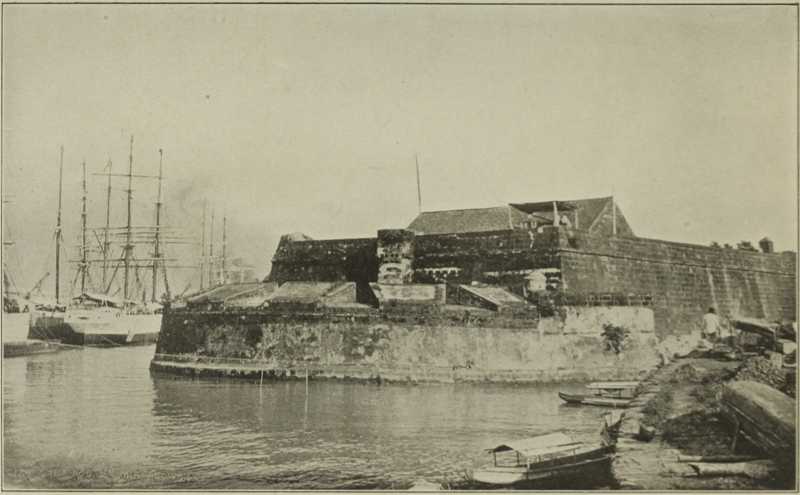 FORT SANTIAGO.
Rizal was undoubtedly the noblest and most
unselfish of the Filipino leaders, and his execution
was not only a crime but a blunder on
the part of the Spanish authorities. From his
prison he issued an address to the Filipinos remarkable
for its moderation and its condemnation
of the "savage rebellion," stating that the
education of the people must precede any truly
beneficial reforms, and urging them to go back
to their homes. The Spanish officials deemed
this not sufficiently "patriotic" to be published,
and sentenced its author to the death of a
traitor by shooting in the back. To-day he is
the national hero of the Filipinos.
The seacoast towns were under the leadership
of Emilio Aguinaldo, a young radical, who was
already a recognized leader among the local
disaffected. The Spaniards had not expected
this outbreak in Cavite. Aguinaldo had personally
assured the governor of the province
of his devotion to Spain, but when fighting began
isolated Spanish officers were killed and
their families carried into captivity. The difficulties,
of the Spaniards were increased by the
fact that the defense of Manila and Cavite until
reinforcements arrived, would be largely in the
hands of native troops, among whom the Katipunan
was known to have been at work. But
the troops of the old native regiments—the men
who for years had followed Spanish officers—were
on the whole faithful, and it was largely
due to them that Manila and Cavite were held.
The leaders in the insurrection were of that
class who called themselves ilustrados, enlightened,
a class whose blood is, in almost
every case, partly Spanish or partly Chinese.
The supremacy of the friars was passing, and
men of this class intended to be the heirs to
their domain. The idea of forming a republic
and even of adopting the titles appropriate to a
republic to designate the functionaries of a Malay
despotism was an afterthought.
Reinforcements arrived from Spain, and by
June 10, 1897, the insurrection was broken, and
Aguinaldo with his remaining adherents had
taken refuge at Biacnabato, some sixty miles
from Manila. He was now without a rival, for
Bonifacio had dared to attempt his life, had
been brought before a court-martial, had been
condemned to death and had disappeared.
Aguinaldo, who now called himself not only
Generalissimo of the Army of Liberation but
President of the Revolutionary Government,
had adopted guerilla warfare, and the Spanish
commands were forced to follow an enemy who
was never dangerous to large bodies, but who
always was to small ones—an enemy who, wearing
no uniform, upon the approach of a large
body became peaceful labourers in the fields
along the road, but were ready to pick up their
rifles or bolos and use them against a small
party or a straggler. Still, whatever they had
fought for at first, the insurgent leaders were
now fighting for their own safety.
The governor general sought in various ways
to gain the support of the country. He called
for Filipino volunteers, and, curiously enough,
they responded with enthusiasm. The rapidity
with which they were recruited was probably
largely due to the activity of the friars. This
added to the hatred of them felt by the class of
natives represented by Aguinaldo.
Between June and December, 1897, the time
was spent in an obscure bargaining, the outcome
of which was the so-called Treaty of Biacnabato,
which Primo de Rivera—the governor
general—has stated was merely a promise to
pay a money bribe to the insurgents if they
would cease a combat in which they had lost
hope of success but which they could still prolong
to the detriment of the resources and the
prestige of Spain.
The result of the bargainings was that Spain
agreed to pay eight hundred thousand Mexican
dollars for the surrender of Aguinaldo and his
principal leaders and the arms and ammunition
in their possession. An amnesty was proclaimed.
Aguinaldo and his leaders were sent
to Hongkong under escort, where they declared
themselves loyal Spanish subjects.
Primo de Rivera returned to Spain. As he received
in return for the money only about two
hundred rifles and a little ammunition, it is not
probable that he made any of the promises of
changes in the government of the archipelago
which the Filipinos have insistently stated since
then were the real objects of the agreement.
Whatever may have been the true motives
which actuated the Spanish governor general
in adopting this method of terminating a successful
campaign, he succeeded in purchasing
only an armistice and not a peace. On January
23, 1898, a Te Deum was sung in the cathedral
of Manila to mark the reëstablishment of
peace in the archipelago.
The insurgent leaders had been bought off and
their followers had surrendered their arms.
As Spanish dominion in the Philippines was
now about to close, let us stop a moment to inquire
what it had brought to the Islands. It
may have been hard and utterly unprogressive,
but it turned the tribes of Luzon and the Visayas
from tribal feuds and slave-raiding expeditions
to agriculture.
To accomplish these results required untiring
energy and a high enthusiasm among the missionaries.
They had lived among savages,
speaking their tongue, until they had almost
forgotten their own. Spain had ceased to be
everything to them; their order was their country.
Spanish officials came and went, but the
ministers of the Church remained, and as they
grew to be the interpreters of the wants of the
people, in many cases their protectors against
spoliation, power fell into their hands. It is
rather interesting to learn that in 1619, in the
reign of Philip III, it was proposed to abandon
the Philippines on account of their useless expense
to Spain, but a delegation of friars from
the Islands implored him not to abandon the
twenty thousand Christians they had converted,
and the order was countermanded.
Spanish dominion left the people Christians,
whereas, if the Islands had not been occupied
by Spain, their people would in all probability
to-day be Mohammedan. The point of view of
the Spanish friars may not be ours, but when
their efforts are judged by the good rather than
the evil results, it can still be said that Spain
gave Christianity and a long term of peace to
the Philippine archipelago. The Filipinos are
the only Christian Asiatics.
But Philippine history was to take an unexpected
turn. The Spanish-American war broke
out, and a new factor appeared upon the scene
in the shape of Commodore Dewey and his fleet.
We all know the story of the battle of Manila
Bay, but we may just recall it briefly.
It was the night of April 30, 1898, that the
American Asiatic squadron, which had received
its orders at Hongkong, arrived off the Philippines.
They took a look first into Subig Bay,
but seeing no enemy, they made their way into
Manila Bay by the Boca Grande entrance.
There were rumours of mines in the channel and
big guns in the forts, but Dewey took the chance,
and the fleet steamed in at night. The ships
formed two columns, the fighting ships all in
one line, and the auxiliary vessels about twelve
hundred yards behind. They moved at the rate
of their slowest vessel.
Black thunder clouds at times obscured even
the crescent moon that partially lighted their
course, but occasional lightning flashes gave the
bold Americans a glimpse of frowning Corregidor
and the sentinel rock of El Fraile. The
ships were dark except for one white light at the
stern of each as a guide to the vessel next in line.
As the Olympia turned toward El Fraile her
light was seen by a Spanish sentry. A sheet of
flame from the smokestack of the McCulloch, a
revenue cutter attached to the fleet, also betrayed
its presence to the enemy at the same moment.
El Fraile and a battery on the south
shore of the bay at once opened fire, which was
returned by the ships to such good purpose that
the battery was silenced in three minutes.
Slowly, steadily, Dewey's ships steamed on, and
at dawn discovered the gray Spanish vessels
lying in front of the naval arsenal at Cavite,
over on the distant shore to the right. Admiral
Montojo's flagship, the Reina Cristina, and the
Castilla, and a number of smaller vessels, formed
a curved line of battle, which was protected in
a measure by the shore batteries. The Spaniards
had one more ship than the Americans, but
the latter had bigger guns.
Silently the American squadron advanced
across the bay, with the Stars and Stripes flying
from every ship. At quarter past five on the
morning of May 1st, the Spanish ships fired
their first shots. When less than six thousand
yards from their line, Dewey gave the famous
order to Captain Gridley, in command of the
Olympia: "You may fire when you're ready,
Gridley."
Two hours later, the Reina Cristina had been
burned, the Castilla was on fire, and all but one
of the other Spanish vessels were abandoned
and sunk. Dewey gave his men time for breakfast
and a little rest, then shelled and silenced
the batteries at Cavite. Soon after noon the
Spaniards surrendered, having lost 381 men
and ten war vessels. Seven Americans were
slightly wounded, but none were killed. So
ended this famous battle.
dmiral Dewey took a great liking to
General Anderson, "Fighting Tom"
(L.'s cousin), the first military officer to
command the American forces in the Philippines.
On one occasion the Admiral fired a
salute well after sundown (contrary to naval
regulations) to compliment him on his promotion
to the rank of major general, and scared
the wits out of some of the good people ashore.
General Anderson has given me a few notes
about his experiences at that time, which are of
special interest.
"When in the latter part of April, 1898, I received
an order relieving me from duty in
Alaska and ordering me to the Philippines, I
was engaged in rescuing a lot of people who had
been buried by an avalanche in the Chilcoot
Pass. I took my regiment at once to San Francisco,
and there received an order placing me
in command of the first military expedition to
the Philippines. This was the first American
army that ever crossed an ocean. We were
given only two days for preparation. We were
not given a wagon, cart, ambulance, or a single
army mule, nor boats with which to land our
men. I received fifty thousand dollars in silver
and was ordered to render what assistance I
could. I had never heard of Aguinaldo at that
time, and all I knew of the Philippines was that
they were famous for hemp, earthquakes, tropical
diseases and rebellion.
"We stopped at Honolulu on the way over,
although the Hawaiian Islands had not been
annexed. The Kanakas received us with enthusiasm
and assured us that the place was a
paradise before the coming of the missionaries
and mosquitoes. From there we went to Guam,
where we found nude natives singing 'Lucy
Long' and 'Old Dan Tucker,' songs they had
learned from American sailors.
"When we reached Cavite the last day of
June, Admiral Dewey asked me to go ashore
and call on Aguinaldo, who, he assured me, was
a native chief of great influence. Our call was
to have been entirely informal, but when we
approached the house of the Dictator we found
a barefooted band in full blare, the bass-drummer
after the rule of the country being the
leader. The stairway leading to Aguinaldo's
apartment was lined on either side by a strange
assortment of Filipino warriors. The Chief
himself was a small man in a very long-tailed
frock coat, and in his hand he held a collapsible
opera hat. I saw him many times afterward
and always thus provided. He asked me at
once if I could recognize his assumption. This
I could not do, so when a few days later I invited
him to attend our first Fourth of July he
declined. He further showed his displeasure
by failing to be present at the first dinner to
which we American officers were invited. There
for the first time we met Filipina ladies. They
were bare as to their shoulders, yet in some
mysterious way their dresses remained well in
place. In dancing there was a continuous shuffling
on the floor because their slippers only half
covered their light fantastics, rendering them
more agile than graceful.
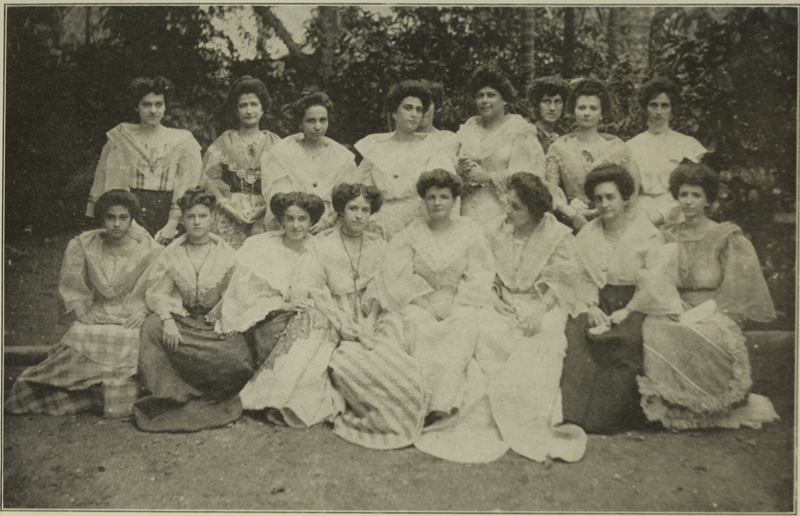 A GROUP OF FILIPINA LADIES.
"In returning from visiting the Tagalog
Chief we saw a headless statue of Columbus. I
asked a native to explain how Christopher had
lost his head. The reply was that they beheaded
him because they did not wish to be discovered.
"Soon after I got to Cavite, I was invited
with the officers of my staff to attend a dinner
given in my honour. At the symposium I was
asked to state the principles upon which the
American government was founded. I answered,
'The consent of the governed, and majority
rule.' Buencamino, the toastmaster, replied,
'We will baptize ourselves to that sentiment,'
upon which he emptied his champagne
glass on his head. The others likewise wasted
their good wine.
"When General Merritt arrived he first came
ashore at a village behind the line we had established
where Aguinaldo was making his
headquarters. Rain was falling in torrents at
the time, but Aguinaldo, who must have known
of the presence of the new Governor General,
failed to ask him to take shelter in his headquarters.
Naturally General Merritt was indignant
and directed that thereafter any necessary
business should be conducted through me.
This placed me in a very disagreeable position.
At first I thought I could conciliate and use the
Filipinos against the Spaniards, but General
Merritt brought an order from President McKinley
directing that we should only recognize
the Filipinos as rebellious subjects of Spain.
Aguinaldo reproached me bitterly for my
change of conduct toward him, but because of
my orders I could not do otherwise, nor could I
explain the cause.
"We soon drifted into open hostility. I
found but one man who appeared to understand
the situation, and he was the much hated Archbishop
Nozaleda. After we took Manila he
invited me to come to see him. He remarked in
the course of our conversation that when we
took the city by storm he expected to see our
soldiers kill the men and children and violate
the women. But instead he praised us for having
maintained perfect order. For reply I
quoted the Latin, 'Parcere subjectis, et debellare
superbos.' Which prompted him to say
in Spanish to a Jesuit priest, 'Why, these people
seem to be civilized.' To which the Jesuit
replied, 'Yes, we have some colleges in their
country.'
"The statement that we seemed to be civilized
calls for an explanation. I found many Filipinos
feared American rule might prove more
severe on them than the Spanish control. In a
school book that I glanced at in a Spanish school
was the enlightening statement that the Americans
were a cruel people who had exterminated
the entire Indian population of North America."
The battle of Manila Bay was fought and won,
as we well remember, on May Day. Through
the kind offices of the British consul the Spanish
admiral came to an understanding with Dewey.
Surgeons were sent ashore to assist in the care
of the wounded Spaniards, and sailors to act as
police. The cable was cut, and the blockade
was carried into effect at once. The foreign
population was allowed to leave for China.
German men-of-war kept arriving in the harbour,
until there were five in all. It was known
that Germany sympathized with Spain, and only
the timely arrival of some friendly English
ships, and the trenchant diplomacy of our admiral,
prevented trouble.
All the rest of that month, and the next, and
still the next, the fleet lay at anchor, threatening
the city with its guns, but making no effort
to take it. The people lived in constant fear of
bombardment from the ships which they could
so plainly see from the Luneta on their evening
promenades. But they could not escape, for
Aguinaldo's forces lay encamped behind them
in the suburbs. In fact, the refugees were seeking
safety within the walls of the city, instead
of fleeing from it, for while they had no love
for the Spaniards, and were fellow countrymen
of the rebel chieftain, they preferred to take
their chances of bombardment rather than risk
his method of "peaceful occupation."
Of course there was no coöperation between
the Americans and the Filipinos, although both
wanted the same thing and each played somewhat
into the other's hand. Admiral Dewey
refused to give Aguinaldo any naval aid, and
the insurrectos on at least two occasions found
it profitable to betray our plans to the common
enemy.
The delay in taking the city was caused by
Dewey's shortage of troops. He could have
taken it at any time, but could not have occupied
it. The Spanish commander made little attempt
at defense. A formal attack on one of the
forts satisfied the demands of honour. When
the city surrendered, on August 13th, the Americans
were in the difficult position of guarding
thirteen thousand Spanish soldiers, of keeping
at bay some fourteen thousand plunder-mad
Filipinos, and of policing a city of two hundred
thousand people—all with some ten thousand
men!
The way in which it was accomplished is in
effective contrast with European methods.
When our troops broke the line of trenches encircling
Manila they pressed quickly forward
through the residence district to the old walled
town, which housed the governmental departments
of the city. Here they halted in long
lines, resting calmly on their arms until the articles
of capitulation were signed. It took but
an hour or so to arrange for the disposition of
our troops among the various barracks and for
the removal of the disarmed Spanish garrison
to the designated places of confinement. Then
command was passed along by mounted officers
for the several regiments to proceed to their
quarters for the night. In columns of four they
marched off with the easy swing and unconcern
of troops on practice march. A thin cordon of
sentinels appeared at easy hailing distance
along the principal streets, and the task was
accomplished.
By noon next day they had a stability as great
as though they had been there for years. Not
a woman was molested, not a man insulted, and
the children on the street were romping with
added zest to show off before their new-found
friends. The banks felt safe to open their
vaults, and the merchants found a healthily rising
market. The ships blockaded and idling at
anchor in the harbour discharged their cargoes,
the customs duties being assessed according to
the Spanish tariff by bright young volunteers,
aided by interpreters. The streets were cleaned
of their accumulated filth, and the courts of law
were opened. All this was done under General
Anderson's command, and it seems to me is
much to his credit.
A daughter of General Anderson's, who was
there at the time with her father, writes: "Days
of intense anxiety followed the opening of hostilities.
The Filipinos were pushed back more
and more, but we feared treachery within the
city. We heard that they were going to poison
our water supply, that they were going to rise
and bolo us all, that every servant had his secret
instructions. Also, that Manila was to be
burned. There proved to be something in this,
for twice fires were started and gained some
headway, and we women were banished to the
transports again."
Aguinaldo had demanded at least joint occupation
of the city, and his full share of the loot
as a reward for services rendered. We can
imagine his disgust at being told that Americans
did not loot, and that they intended to hold
the city themselves. If there had been no other
reason for refusing him, the conduct of his
troops in the suburbs would have furnished a
sufficient one, for they were utterly beyond control,
assaulting and plundering their own
brother Filipinos and neutral foreigners, as well
as Spaniards, and torturing their prisoners.
But this refusal, justifiable as it certainly was,
marked the real beginning of the insurrection
against American rule, though there was no immediate
outbreak.
Aguinaldo was a mestizo school teacher when,
in 1896, he became leader of the insurrection
against Spain. The money with which Spain
hoped to purchase peace was to be paid in three
instalments, the principal condition being that
the Filipino leaders should leave the Islands.
This they did, going to Hongkong, where the
first instalment was promptly deposited in a
bank. The second instalment, to Aguinaldo's
great disgust, was paid over to Filipinos left in
the Islands, and the last one was not paid at all.
This was just as well for him, because his fellow
insurrectionists were already demanding of him
an accounting for the funds in Hongkong, and
had him summoned to court for the purpose.
This proceeding he wisely avoided by leaving
for Europe in disguise.
He got only as far as Singapore, however,
for there—in April of '98—he heard of the probability
of American interference in the Islands
and interviewed our consul. The go-between
for this interview was an unscrupulous interpreter,
whose intrigues were destined to have
far-reaching effects for us. It has been
charged that both our consul at Singapore and
the one at Hongkong committed this nation to
a policy favouring Philippine independence, but
the whole question of American pledges finally
resolves itself into a choice between the word
of an American admiral and a Chinese mestizo.
When Spain had failed to pay over to Aguinaldo
the balance of the peace money, he had
promptly gone to work to organize another revolution
from the safe harbourage of Hongkong.
His flight to Singapore had interrupted this,
but now, with the Americans so conspicuously
there to "help," it was a simple matter to put
his plans in operation.
A month after the battle of Manila Bay Aguinaldo
proclaimed himself "president" (in reality
military dictator) of the "Filipino Republic."
But this republic existed only on paper.
Dewey accurately states the condition of affairs
when he says, "Our fleet had destroyed the only
government there was, and there was no other
government; there was a reign of terror
throughout the Philippines, looting, robbing,
murdering." A form of municipal election was
held, but if a candidate not favoured by the insurgents
was elected, he was at once deposed.
One candidate won his election by threatening
to kill any one who got the office in his place.
Persons "contrary minded" were not allowed
to vote. These happenings hardly suggest a
republican form of government, but they are
typical of conditions at that time.
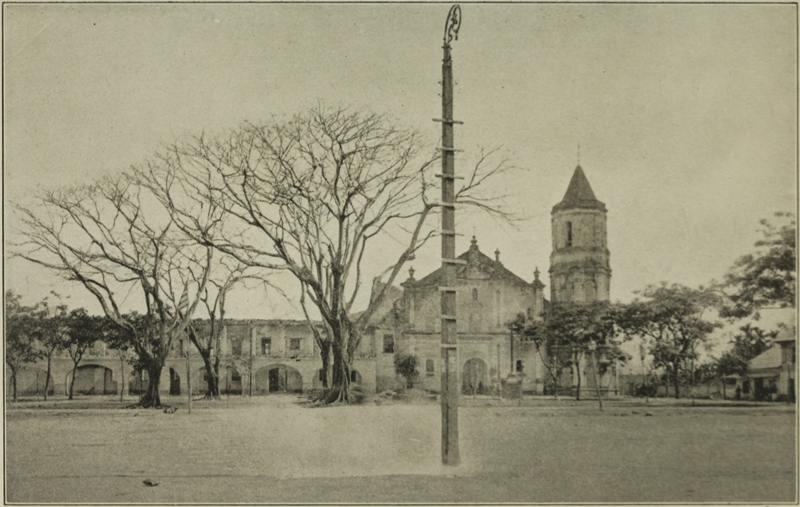 AGUINALDO'S PALACE AT MALOLOS.
Naturally the self-styled president was not
recognized by the American officials, and they
were justified, as is shown by the fact that
before the year was up Aguinaldo himself had
come to realize that he could not maintain order
among his people, and tried to resign from his
office.
Meanwhile his lack of recognition by the
Americans, and his exclusion from the spoils of
war, so far as Manila was concerned, showed
him that his only hope of achieving his ambitions
lay in driving these interlopers from the Islands.
But for the time being, while awaiting a propitious
moment for attack, he occupied himself
and his men by conquering the Spaniards in the
outlying provinces. Since there was no coöperation
among the Spanish forces, he was
quite successful. Having proclaimed the republic
with himself at the head, he felt justified
in maintaining, with the aid of his booty, a
truly regal state in his palace at Malolos, aping
the forms and ceremonies of the Spanish governors
in Manila.
As fast as Church property, or property belonging
to Spaniards, fell into his hands, it was
confiscated and turned over to the State—if
Aguinaldo can be considered the State. His
houses and those of his generals were furnished
from Spanish possessions, all title deeds were
systematically destroyed or hidden, and administrators
were appointed for the property.
At the beginning of the new year (1899), he
turned his attention to the Americans, and
Manila. Because our forces seemed reluctant
to fight, the Filipinos, like the Mexicans to-day,
believed that they must be cowards and afraid
to meet them. A Mexican paper has recently
told its readers what a simple matter it would
be, if war were declared, for their troops to
cross the border and crush such slight opposition
as may be offered to the capture of Washington.
So it is no wonder that the Filipinos
felt confident of success, especially after their
victories over the Spaniards in the outlying
regions.
By January, Admiral Dewey, General Anderson
and General Merritt had left the Philippine
Islands and General Otis was in command. He
announced that the government of the United
States would be extended over the islands of the
archipelago. Next day Aguinaldo retorted with
what was virtually a declaration of war. From
then on he and his advisers hastened their
preparations for the conflict. Members of the
native militia who were living in Manila under
the protection of the American garrison were
warned to stand ready to receive the signal
which should start the sack and pillage of the
city and the massacre of its inhabitants. By
the end of January there were about thirty
thousand Filipinos under arms fronting the
American lines outside the city, all keyed up for
the moment when they should be let loose to
drive the Americans into the sea. This time the
spoils of Manila should not be snatched from
them!
The signal for the advance was to be a conflagration
in Manila. Ten thousand militiamen
were to rise, set fire to the city, free the Spanish
prisoners of war, arm them with arms stored
in the arsenal, and attack the Americans. They
were to be promptly aided in this last detail by
the thirty thousand Filipinos waiting outside,
who, surrounding the city, would drive back the
fourteen thousand American soldiers upon their
burning citadel and upon the two hundred thousand
Filipinos, who would by this time have
joined their countrymen. If everything had
worked out as he had planned, Aguinaldo might
very probably have entered the city.
He chose a night early in February, at a time
when he knew the American reinforcements
which had been ordered could not yet have arrived.
Firing began about nine o'clock in the
evening, near the San Juan bridge, and continued
during the night. Meanwhile, the militia
in the city tried to assemble, but the groups were
promptly fired on and dispersed. In the morning
the ships of Dewey's fleet opened fire from
the flanks of the American line. A little later
our troops sprang forward and swept their antagonists
before their fierce attack. In this encounter
the Filipinos lost about eight hundred,
and the Americans two hundred and fifty.
For a week the insurgents were quite demoralized,
and no wonder, for this was not the
way they had expected the "cowardly" Americans
to act. But when they saw that our men
did not follow up their advantage by pursuit,
their courage revived and they began once more
to believe those things which they wished to believe.
Our troops had to stay where they were
because they had not sufficient transportation
to take them anywhere else, because the enemy
within the city still needed their attention,
and because their reinforcements had not arrived.
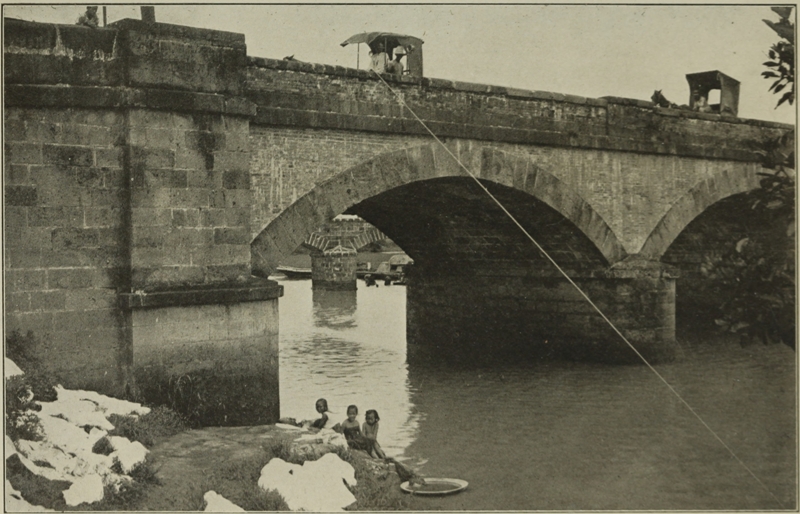 SAN JUAN BRIDGE.
When these came, General Otis divided his
forces. General MacArthur began a movement
from his right against the insurgents, who contested
every village and locality capable of defense,
and burned every train before abandoning
it to American hands. The insurgent
capital, Malolos, was occupied. In April, General
Lawton took Santa Cruz. The American
casualties during these operations were about
ten thousand officers and men, but the sick report
listed fifteen per cent of the expedition,
mostly from heat prostration.
General Lawton, who went out early in 1899,
and was killed in December of the same year at
San Mateo, is believed to have been perhaps the
most able of our commanders.
Uniformly the Filipinos lost, but when their
courage waned their officers would announce
that they had won a big victory somewhere else.
In one day, they reported, we had lost twenty-eight
thousand men, in a region where in the
entire month we had lost but fifty-six. On
another occasion they announced that two thousand
colonels had been killed. They must have
thought our troops were all from Kentucky.
All summer and into the fall this more or less
formal and regular warfare continued. But by
that time Aguinaldo had decided that while a
concentrated field army might appear more
impressive to foreigners and be better for advertising
purposes, it was not effective for his purpose,
and some change must be made. The discontent
among the conservative men who still
had anything to lose was increasing, while the
labourers in the fields, the fishermen, and the
great masses of the people were growing weary
of the war and the exactions of the commanders
of their troops. The spell which Aguinaldo had
cast over Luzon was almost broken. The war
was nearly over, it seemed—in a civilized country
it would have been over.
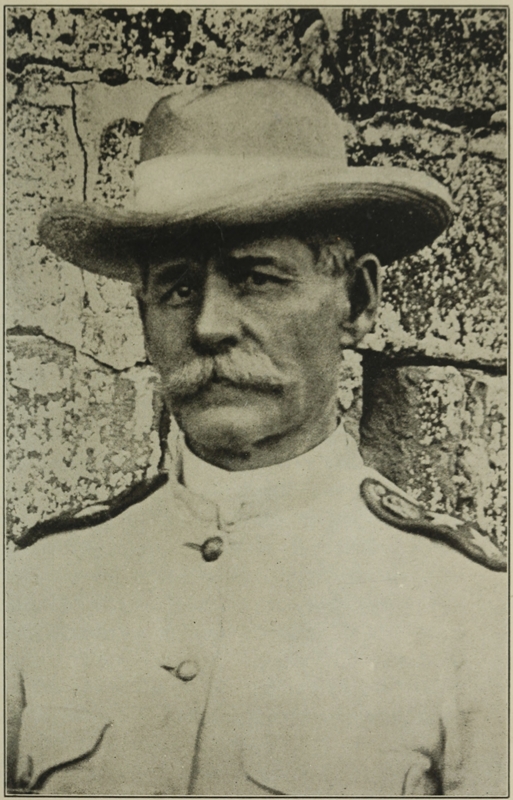 GENERAL LAWTON.
To the Americans it appeared that the insurrection
had been destroyed, and that all they
now had to do was to sweep up the remnants of
the insurgent forces by a system of police administration
not likely to be either difficult or
dangerous. In November, MacArthur had his
force ready to strike anything within reach, but
there seemed to be nothing within reach to
strike. He soon came to the conclusion that
there was no organized resistance left, that the
insurgent army had broken into fragments
which would soon become banditti. The disbandment
of the insurgent field forces, which
the American authorities took to mean the coming
of a general submission to our rule, was followed
by a long period of inactivity. This, of
course, strengthened the impression, but the
time was being used by the Filipinos to prepare
for a new method of warfare and to organize
for resistance by means of a general banding
of the people together in support of the guerillas
in the field.
To obtain this necessary coöperation the
leaders announced the inflexible principle that
every native residing within the limits of the
archipelago owed active individual allegiance
to the insurgent cause. This was enforced by
severe penalties, including burial alive, which
were systematically exacted. There was little
resistance on the part of the victims, who accepted
the new policy with a curious combination
of loyalty, apathy, ignorance and timidity.
In this way there arose a strange system of
dual government, in many cases the town officials
openly serving the Americans while they
were secretly aiding the insurrection, and with
apparently equal solicitude for both. Each
town was the base for the neighbouring guerillas,
and when a band was too hard pressed it
would dissolve and take refuge in its own community.
This was easy enough to accomplish,
with the aid of the people, for it took very little
to transform a Filipino soldier into a good imitation
of a peaceful native.
Several months before the formal declaration
of guerilla warfare in November of 1899,
the Filipino commanders had adopted a policy
of occupying a succession of strong defensive
positions and forcing our army to a never ending
repetition of tactical deployments. This
they did with such skill that they were for a
time successful. The native force would hover
within easy distance of the American camps,
but would avoid close conflict and temporarily
disband. This would not be regarded by them
as a calamity, but simply as a change from one
form of action to another, and even a positive
advantage.
By February of 1900, General Bates had succeeded
in scattering the larger bodies in the
south of Luzon, and while some of the Filipino
leaders and their followers abandoned the
cause, which they saw was hopeless, others returned
to the life of bandits, which in many
cases had probably been their profession before
the war. When their guns were gone they took
up the knife and the torch. They did not cease
to call themselves soldiers of the republic, but
they were not in reality.
By September General MacArthur, who had
succeeded General Otis in command of the
American forces in the Islands, realized that
the opposition to American control came from
the towns, and that the guerilla bands could
not exist without their support. At first he
thought that on account of the efficiency of his
troops, the natives would be actuated both by
conviction and self-interest to support him.
But four months later he saw that further pressure
was needed to secure this. So he ordered
that all persons suspected of contraband traffic
with insurgent organizations should be arrested
and sent to Manila. In January, 1901, he
ordered the deportation to Guam of twenty-six
Filipino leaders, sympathizers, and agents, who
were to remain there until peace had been formally
declared. Two months later, Aguinaldo
was captured by the dare-devil Funston of "the
Suicide Squad."
The effect of this measure was to alarm the
leaders, of course, who now realized that they
could be held responsible for their acts. Orders
were also issued that all men who surrendered
should be disarmed but released at once, while
those captured in the field or arrested in the
towns should be held in custody till the end of
the war. A letter was found, written by a
bandit leader, in March, saying that he was
ordered to "proceed more rapidly" with his
operations, "as Bryan ordered Emilio (Aguinaldo)
to keep the war going vigorously until
April." However true that may have been, it
is certain that the encouragement which the insurgents
received from the country they were
fighting much prolonged hostilities and caused
the loss of many lives on both sides.
It is hard to realize at this distance the
lengths to which the anti-imperialists went,
or were willing to go, in those days. Governor
Pack told me of an experience he had with one
of them—a New Englander of good family and
American antecedents. Pack was on his way
out to the Islands at the time, and on arriving
at Hongkong received the tidings of McKinley's
assassination. He was surprised to see this
man, a fellow-passenger, rush up to a Filipino
with the news and shake his hand, congratulating
him on what had happened. The Governor,
then a young civilian, could not forget the shocking
incident and later, when they shared the
same stateroom on the small boat for Manila,
he discovered papers which proved that his
companion intended to furnish aid and encouragement
to any natives who wished to fight
against American "tyranny." This discovery
gave Pack his appointment as one of the seven
lieutenant governors of the hill tribes. But the
other man was punished only by being refused
entrance to the Islands. It was the stupid and
foolish fashion in America then—as indeed it
still is—to call this particular form of treason
Idealism, and be lenient with it.
Our soldiers found it difficult to take seriously
the bands of half naked men, who, they knew,
had been pillaging the villages of their own
race. It was true that these bands were difficult
to pursue and capture, but an army which
fought only from ambush, whose detachments
fell only upon stragglers and carefully avoided
the main body of its enemy, and which showed
no regard for the sacredness of a flag of truce,
could not inspire much respect. Plunder appeared
to be the sole excuse for its existence,
and the pompous titles assumed by its commanders
were amusing for the leaders of robbers.
The Americans followed the retreating
bandits without hatred and without fear. But
they became weary of the eternal pursuit, and
felt a growing irritation.
The Filipinos, however, felt very differently
about their soldiers, and it is only fair to give
their side too, especially as it may throw some
light on the Mexican situation. Even the richest
and most highly educated men found nothing to
laugh at in these poor bands which were after
all composed of their own people fighting and
suffering for a cause which they could at least
understand, whether or not they sympathized
with it. They did not regard the pillaging, tortures,
and murders to which the Filipinos subjected
their own people as we did. They called
the robbery "collecting contributions for the
support of the war." As for the murders—in
the Orient to kill is an immemorial right of the
rulers of men. What if they did fight disguised
as peaceful country folk? They were a weak
people fighting against a strong. They were
naked and they were hungry, and they were
fighting for a cause. Their arms were often
of little use, and they made powder out of match
heads and cartridge shells out of the zinc roofs
of parish buildings, and even then they had only
ammunition enough to fire a few volleys and
then run. But men so armed had forced the
United States to send out nearly seventy thousand
well equipped soldiers to subdue them.
To the native Filipino, as perhaps to the Mexican
to-day, the ragged and half savage figures
of the guerillas stood for their vision of a united
race.
But it was natural that our troops could not
understand this, and that they should gradually
become embittered against their antagonists.
The officers, by the necessary division of our
forces, found themselves confronted with conditions
utterly alien to their experience. They
had to live in native houses or churches, in the
midst of four or five thousand people whose
language they did not speak, and whose thoughts
were not their thoughts. Most of them were
young men. They came from all over the
United States, and were neither monsters nor
saints, but good examples of their time and
country.
When these officers learned that the dignified
Asiatics who called upon them daily, who drank
with them, who talked with them, and who held
offices under our government, were also spies
of the guerilla leaders, secretly aiding those
who were anxious to win the price set on their
heads, they were hardly pleased. When they
found that every movement of the guerillas was
reported to them just too late to be of any use,
while every movement of their own small forces
was promptly made known to the enemy, and
when they were present at the disinterment of
the twisted bodies of the men who had been
buried alive because they were loyal to us, they
decided that stricter measures were necessary.
This was a state of war. Within wide limits
their will was law. Upon their judgment hung
not merely their lives and those of their men,
but the honour of their country and their regiment.
Perhaps in some cases they met cruelty
with cruelty, but they at least tried to be honest
and just. And the people came to realize this,
and also that they were not afraid, with the result
that whole communities transferred their
allegiance from their own guerilla leaders to a
single young American, not because he understood
them or sympathized with them, but because
he was a man whom they could trust and
respect.
It was July of 1902, four years after our taking
of Manila, before the Islands could be officially
declared pacified. Let us hope that the
lessons which we learned then may not be forgotten
in our dealings with Mexico.[14]
They taught Filipinos the right way to work,
And they taught as if teaching were fun;
They taught them to spell and to build themselves roads,
And the best way to handle a gun.
Were their salaries so big that the task was worth while?
Did they save a centavo of pay?
Have the average men an account with the bank?
Never a cent—not they.
So we haven't a job and we haven't a cent,
And nobody cares a damn;
But we've done our work and we've done it well,
To the glory of Uncle Sam,
And we've seen a lot, and we've lived a lot
In these islands over the sea—
Would we change with our brothers grown rich at home?
Praise be to God—not we.
From "The Swan Song," in the Manila Bulletin.

t is, strangely enough, to the influence of
that arch anti-imperialist, William Jennings
Bryan, that we owe the ratification of
the Treaty of Paris, which not only ended the
war with Spain but expressly provided for the
purchase of the Philippine Islands. The Democrats
were opposed to the treaty and were
powerful enough in the Senate to have held it
up, had not Bryan used his authority to secure
the two-thirds vote needed for its ratification.
It is amusing to note that a year later, after
enabling us to acquire the islands, he used all
his power to prevent our keeping them. He
was at this time in need of a popular plank in
his third presidential platform, and the sorrows
of the Filipinos suited his purpose admirably.
Soon after the Treaty of Paris, and long before
the end of the insurrection, McKinley appointed
a commission of experts to go out to the
Islands and report to him on conditions there.
They found a country whose civilization was, to
put it hopefully, at a standstill. It was too big
a problem to be straightened out by a few ambitious
Filipinos. The Commission returned to
America convinced of the necessity of our occupation.
Congress soon passed a special organic act
for the organization of a civil government in
the Islands, to succeed the military rule then
in force. In 1900, President McKinley appointed
the second Commission, headed by Mr.
Taft, which was instructed to assume control of
the Islands, gradually relieving the army
wherever conditions allowed of their doing so.
This Commission had five members, three of
them lawyers (two of whom had been on the
bench), and two professors. Its functions
were at first legislative and judicial, but in 1901,
when the president of the Commission, Mr. Taft,
became Governor General of the Islands, the
other members were given the portfolios of the
different departments and executive power in
the pacified parts of the Islands. Dean C.
Worcester, a member of the earlier Commission
and already an authority on the Philippines,
became the first Minister of the Interior; Luke
E. Wright, the Vice Governor, had the Department
of Commerce and Police; H. C. Ide, former
Chief Justice of Samoa, had charge of Finance
and Justice, while Professor Moses was put at
the head of Public Instruction. Governor Taft
became really the "Father of the Philippines,"
for when he left the Islands in 1904 to become
Secretary of War he had even higher authority
over them than he had had as governor, while
still later, as President of the United States, he
was able to see that the same high standard of
appointments was maintained.[15]
McKinley charged this Commission that their
work was "not to subjugate, but to emancipate."
We made many mistakes, for we were
new to the business and dealing with a strange
people, but until very lately even the selfishness
which is supposed to be inherent in party politics
has been absent in our dealings with this
people, whom we considered our sacred charge.
No one ever asked an American official in the
Islands what his politics were. Even the governorship
itself was out of the reach of the
spoilsman. Of the five governors who were appointed
by the Republican administrations, only
one besides the first governor belonged to the
dominant party, and he was in office but a few
months.
Since the Taft Commission first organized,
several changes have taken place. Filipino
members have been added, and it has acquired
the character of an upper house, rather than a
legislature. The work of a lower house is done
by the Assembly, made up of eighty-one members
chosen by the people of the Christian tribes.
They have no authority over the Moro and other
non-Christian tribes, which are legislated for
by the Commission directly. To-day the Filipinos
control their municipal and county governments,
but their finances are kept under
supervision.
The problems which the Commissioners had
to solve were many and varied. Trade was at
a standstill. During the last normal year under
Spain the exports from the Islands had
amounted to about sixteen million dollars. By
1912 they had more than trebled. There was
also a currency problem. Coins from everywhere—Mexico,
China, America, India—were
in common circulation, with almost daily fluctuations
in value. The Islands now have their
own money on a gold basis. Then, close on
the heels of the insurrection, came a famine.
Locusts swept over the land and destroyed what
little grain the war had left. The natives in
some parts of the archipelago ate the locusts,
however, and liked them, making the work of
the officials more difficult. Grain shipped from
America decayed in the storehouses before it
could be distributed, and, as if that were not
enough, carabaos died by the thousand from
rinderpest.
But the most difficult of all was the problem
of the friar lands. Thousands of acres of valuable
land had been acquired during Spanish rule
by the different orders of monks, and held by
them with great profit. One of the chief causes
of Aguinaldo's rebellion was the exactions of
these wealthy churchmen, which galled a patient
people into final revolt, and during the ascendancy
of the insurgent government resulted in
the confiscation of Church property and the
flight of the friars. These men took refuge in
Manila, and petitioned the new government for
a settlement of their claims. Their legal rights
were not to be disputed, but to return them to
their property and protect them there would
have brought on us the increased enmity of a
people whose friendship we were trying to win.
The friends of the friars were no friends of the
people. It was decided to have the Philippine
Government buy these lands from the Church,
which was accordingly arranged. Even this
was not a popular solution, but seems to have
been the best that could be done under the circumstances.
One-third of these lands are still
vacant.
Road building was one of the most baffling of
the problems. The people had no appreciation
of the necessity for good roads, and would not
pay for them nor help keep them in repair when
they were built. For years the Commission
toiled at the seemingly hopeless task, and it was
not until Governor Forbes went out there from
Boston that anything definite was accomplished.
His native city should be very proud of his
brilliantly successful administration, the proofs
of which met us at every turn during our stay
in the archipelago, and convinced us of the fatal
mistake it is to allow such a position as Governor
of the Philippines to become the prize of
politicians. To the native mind his name
became inseparably connected with roads.
Caminero means a road man, and Cameron
Forbes is of course known to the Filipino as
"Caminero Forbays." He had been a commissioner
five years when made governor general,
which office he held for four more. When Mr.
Wilson became president, Governor Forbes was
advised not to tender his resignation, for it was
believed the new administration would wish to
keep the Islands clear of the spoil system.
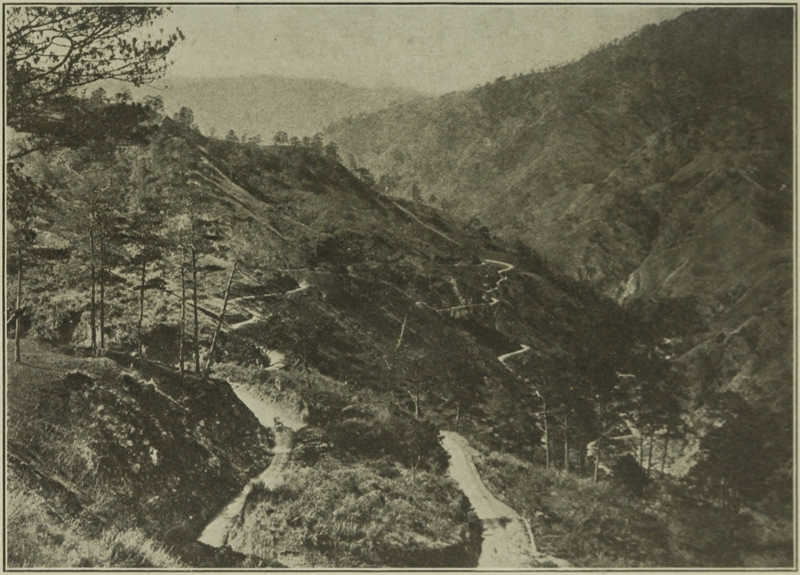 BENGUET ROAD
Suddenly out of a clear sky, the Governor
General received this cablegram from the Insular
Bureau:
"Harrison confirmed August 21st. The
President desires him to sail September 10th.
Will it be convenient to have your resignation
accepted September 1st. Harrison to accept
and take the oath of office September 2nd. The
President desires to meet your
convenience. Should Harrison take linen, silver, glass, china
and automobiles? What else would you suggest?
Wife and children will accompany him.
Please engage for him servants you leave."
Worst of all, it was given out to the papers
before the Governor received it, so that certain
anti-American sheets in Manila had the pleasure
of flaunting the news on their front pages for
him to read. Surely some more considerate
and courteous method of retiring a fine administrator
might have been devised than this
abrupt and rude dismissal, and it would seem
that petty household matters might have been
kept separate.
Secretary Worcester, also a native of New
England, who is the greatest living authority
on the Islands, and whose achievements with
the wild, non-Christian tribes had been marvelous—to
say nothing of his other excellent
work—had also of course to resign. Forbes,
by the way, is not a Republican, but neither is
he a Democrat, and Independents are not politically
useful.
The work of the administration immediately
preceding that of Governor Harrison is worth
at least a partial summary. Besides building
roads, establishing a good health resort at
Baguio, systematizing the work of the government,
reducing the number of bureaus, cutting
down expenses and eliminating duplication of
work, and numerous other public services, Governor
Forbes succeeded in accomplishing the
following:
The reorganization of the merchant marine.
The construction of aids to navigation—buoys,
lighthouses and beacons, wharves and
harbours.
The removal of restrictions from shipping.
The establishment of a policy for the exclusive
use of permanent materials in construction,
practically all the construction in the Islands
being done of reinforced concrete and selected
woods.
The passage of a law providing for proper
development of irrigation, laying aside an annual
sum for that purpose.
The establishment of a cadastral law for
registering law titles. "Under this system it
was possible to get land titles settled, one of the
most difficult and important problems confronting
any government and one bearing directly
on the welfare of the people in various ways.
"A general system was adopted of loaning
to provinces and municipalities to encourage
them in the construction of public works, particularly
those of a revenue-bearing nature;
most especially markets, which improved the
sanitary condition of the food supply and
proved both popular with the people and profitable
for the municipalities; these markets
usually paid for themselves in five years from
the increased revenues.
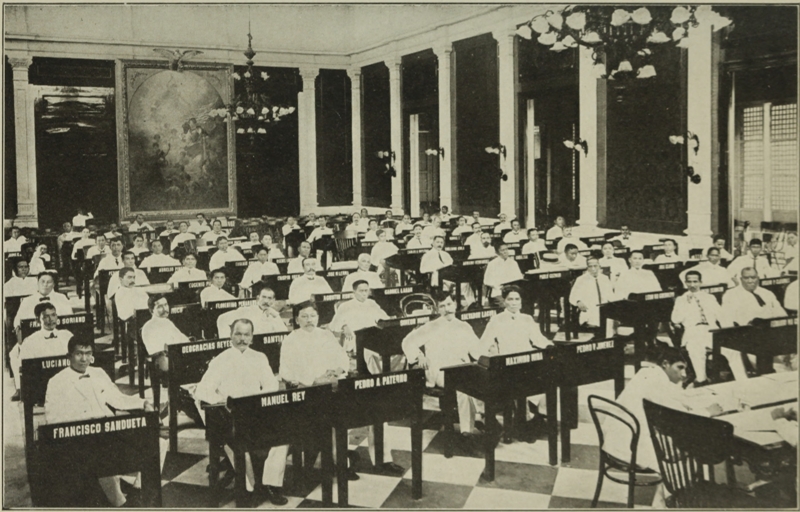 FIRST PHILIPPINE ASSEMBLY.
"The Governor's influence was used throughout
to make the instruction in the schools practical
in its nature; children were taught to make
things that would prove to be salable and which
would give them a living. The dignity of labour
was emphasized. Encouragement was
given to foster the construction of railroads.
"The establishment of a postal savings bank
encouraged the children to invest. Prizes were
given for that child or school which showed the
best record." (Governor Forbes took an especial
interest in the latter.)
The first general election was held in the
Islands on the third of July, 1907, to choose
delegates for the Assembly. Before that the
Philippine Commission had been the sole legislative
body. The delegates were chosen from
the thirty-five Christian provinces. At that
time only a minute percentage of the population,
even among the Filipinos, was qualified to meet
the simple conditions which would enable them
to vote, and to-day the percentage is far from
large. The electorate consists mainly of two
classes, the ilustrados, or educated natives and
mestizos,[16] and the taos, or peasants. The latter
are not only ignorant but indifferent, with no
vision beyond what their eyes can see, and no
interest in who governs them, so long as crops
are good and taxes low. One of the tasks of
our representatives is to educate and awaken
these people to responsible citizenship. It is a
task still far from accomplishment.
It must be admitted that the work of the
Assembly to-day, after eight years of fair trial,
does not encourage Filipinization of the service.
It is fortunate—at times—that the two legislative
bodies have equal power not only to
initiate legislation but to block the passage of
each other's bills. In this way the Commission
has been able to hold up some of the freak legislation
sent up to it by the lower body. The
Manila Times has published a list of the laws
which were wanted by the Filipino assemblymen
recently. They spent the valuable time of
the entire first session talking them over and
the Commission refused to concur. One was
to increase their own salaries, of course. Another
was to erect monuments to all the ilustrados
who had cried "Bajo los Americanos"
most loudly. Others wanted to fly the Philippine
flag above the American on all masts, to
make a legal holiday of the birthday of Rizal's
grandmother, and to free all prisoners, no matter
what their crimes.
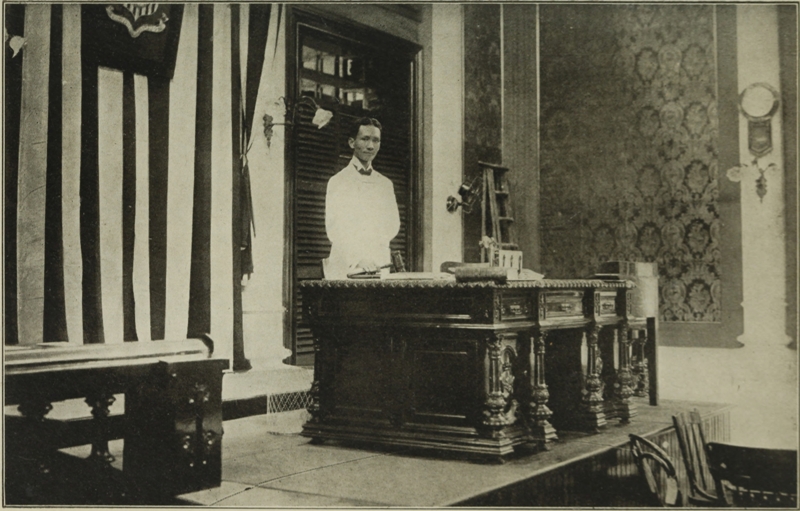 OSMEÑA, THE SPEAKER OF THE FIRST ASSEMBLY.
As may be imagined, a body of men which can
pass such bills is quite capable of blocking the
sane legislation which comes to them for approval,
and unfortunately they have the power
to do this. The way in which the slavery question
was handled illustrates their methods.
Slavery was known to exist in the Islands,
and to take two forms,—actual slavery, where
one person was sold by another, and a sort of
semi-slavery, or peonage, where a man sold his
services for debt.
The peon was given his keep, but the interest
on his debt was added faster than he could earn.
He was really a slave, except that he had sold
himself rather than been sold by another. But
his debts might be bought and sold, so that it
amounted to the same thing in the end. Interest
was sometimes as high as ten per cent a
month, while fifty cents a month was allowed
for his services. Worcester in his book tells
of a man who borrowed $1.25, which he and his
wife and children worked several years in the
effort to repay; but by that time the amount
had become $37.50!
Spain had nominally abolished slavery long
before, but it had continued in force in both the
Christian and non-Christian provinces. The
legislators themselves held peons. The law of
Congress creating the Philippine Government
prohibited slavery, but there are no penalties
attached, so it could not be enforced.
The Filipinos denied that slavery existed in
the Islands. Worcester made a careful investigation,
and an exhaustive report on both slavery
and peonage. All but a few copies of this report
were burned by a Filipino official. It was
a subject which neither the Filipino politician
nor their self-styled friends the anti-imperialists
wished to see discussed in print. The
Manila papers had been absolutely silent on
the subject, and even the anti-slavery legislation
which was finally forced through, after
having been tabled again and again without so
much as the briefest formality of discussion,
passed unnoticed. It was a sore subject, and
the Filipino method of treating a sore subject
is not to heal it, but to refrain from discussing
it.
There is no question but we have given the
Filipinos too much power for their own good.
They now, under the Democratic Administration,
have five members in the Commission, to
America's four. They have to-day much power—only
colonies such as Canada and Australia
have more, while Egypt has been given less in a
generation than the Filipinos have received in
ten years.
The present governor, Francis Burton Harrison,
has been severely criticized. His party
was pledged to a rapid Filipinization which has
proved disastrous, for it was devised by men
wholly ignorant of the situation. The destruction
of the wonderful civil service system so
carefully built up in the early days as an object
lesson to Spanish-bred politicians, is only one
of many changes which have been brought about.
We have certainly lost prestige in the Islands
under the Democratic Administration. Filipinos
no longer remove their hats during the
playing of the Star Spangled Banner on the Luneta,
so Governor Harrison finally tried to discontinue
the playing of the national anthem.
The American community would not stand this,
however, so it was resumed. In many other
ways the Filipinos have become "cocky." This
of course does not apply to the tao, who plods
along regardless of politics.
A friend wrote me recently, "I don't think I
could give you a more accurate idea of what
most Americans and British, and even intelligent
natives, think of this Democratic administration
than to repeat a conversation I overheard
in the Fort McKinley cars one morning
between two coloured American soldiers. They
began by laughing at Harrison's 'give them
what they want' speech, and speaking of the
Filipinos as 'spoiled children.' 'Well,' said
one dusky brave, 'we have one more year of
this rotten administration, then, thank Gawd,
we'll have a white man's government!'"
Professor Thomas Lindsey Blayney writes
in one of the magazines: "I talked with
business men, native and foreign educators,
clergymen, army and navy officers, editors
American and British, and many Filipinos of
undoubted patriotism and intelligence, and
I do not hesitate to assure you that the demoralizing
tendency of the policies of the present
American administration in the Islands is
deserving of the widest publicity." The situation,
he says, "is bidding fair to become a
national disgrace if we allow politics and
sentiment to take the place of reason and justice."
He goes on to say, "There is no phenomenon
of our national life more passing
strange than that which induces many of our
good people to accept the statements of paid
emissaries of the Filipino junto, or some of our
new and inexperienced officials at Manila, rather
than those of our fellow countrymen of long
administrative experience in the Islands....
The loss of men like Governor Forbes, Mr.
Worcester, Dr. Heiser, and others, is looked
upon as a distinct setback in the development of
better and more stable institutions in the entire
Orient in the interest of humanity as a whole."
All of which only bears out what Lord Cromer
told Mr. Forbes—"If your personnel employed
in the administration of dependencies at a distance
becomes subject to change with changing
political parties, you are doomed to failure in
your effort to govern countries overseas."
There has recently been a great financial depression
in the Islands, due partly to hoarding
against threatened independence, and partly to
the difficulty the new Filipino officials of the
Bureau of Internal Revenue find in collecting the
usual amount. A slump in real estate followed
quickly upon the news that we might shortly
leave the Islands. Rinderpest, the cattle plague
which had worked such havoc and which had
finally been conquered after tremendous expenditure
of money and energy, broke out again
immediately upon the substitution of Filipinos
for white men in the service. Some time the
good people at home will learn that giving a
child candy because it cries for candy is not always
the best thing for the child. The Filipinos
are in many ways children, delightful ones, with
charming manners, but needing a firm and even
rule till they come of age and take over their own
affairs. Most Filipinos of intelligence realize
this. In fact, they have of late been rushing in
petitions signed by their best and most influential
citizens urging the retention of the Islands
in their present standing.
What the Filipino wishes for himself depends
upon the man. Only one in ten, among the
civilized tribes, knows anything about the discussion
of independence. The taos would like
independence if they believe it to be what their
politicians have told them—freedom to do as
they please, and exemption from taxes. Otherwise
they are not interested.
When the Jones bill was being discussed a
Moro elevator boy at the War Department in
Washington was asked, "If the Filipinos are
given their independence, how will you feel?"
"I am an American now," he answered, "but
if that happen—I go back, and with the Moros
fight the Filipinos!"
Most people fail to realize that the Islands
are no financial burden to this country. They
are, and have always been, wholly self-supporting.
Their revenues pay their bills, and their
taxes, incidentally, are the lowest in the civilized
world. We keep soldiers there but only the
cost of their transportation is extra.
Our rule in the Philippines has been the
greatest of all paradoxes, a benevolent despotism
working ardently for its own destruction.
This is very unusual, and rather fine.
We ought to be proud of what we have done, and
very anxious to see the work well finished.
Good men have given their lives for it, and few
of those who lived have come out after years of
thankless toil in a tropical land, with as much as
they had when they went into the service. We
owe it to them and to our helpless wards, as well
as to our national honour, to see the thing
through.

he sanitary conditions which existed in
the Islands twenty odd years ago would
seem to us appalling, but perhaps they
were no worse than those of some other tropical
countries at that time. Even the most progressive
colonizers, like the English, had given up
trying radical reforms, contenting themselves
with making passably healthful conditions, especially
for the European part of the towns. The
combination of climate and native inertia
seemed to them one which it was difficult and almost
hopeless to combat. So it remained for
us to prove that the thing could be done—that a
tropical country could be made sanitary and
hygienic for all its inhabitants, whether they
were white or brown or yellow, and whether they
wanted it made so or not. If we had done nothing
else for our restless dependency, that
achievement would be a sufficient crown of glory.
Manila was then, as it still is, the most highly
civilized spot in the Islands. As I have said,
much of the walled city was built of stone and
plaster, but many of the natives in the suburbs
lived in one-room houses made of wood and
raised on stilts. No provision whatever was
made for drainage or for the removal of garbage.
Each house was a law unto itself and
very often an offense unto its neighbours.
A Carabao
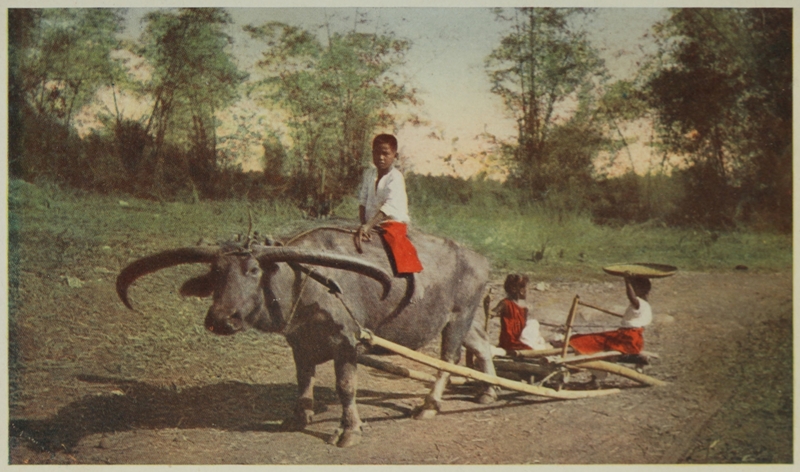
A large part of the city drained, directly or
indirectly, into the Pasig River. Here, also,
the carabao, which is not a fastidious animal,
went for his mud baths, and the women washed
their clothes. This river furnished drinking
water for all who lived near enough to share
the privilege. It was said to have a flavour like
the Ganges, which they sorely missed later on
when a purer supply was substituted.
The medieval wall, which allowed for many
damp, unhealthy corners, interfered with municipal
ventilation. No cleansing winds can sweep
through a city whose every street ends in a high
wall. Outside was a stagnant moat which made
a convenient breeding place for the industrious
mosquito.
The local market used to be a community
dwelling for all the vendors, who lived there,
reveling in their filth. Their children were born
there, also their dogs, pigs, cats, and chickens.
It was so vile smelling that no American dared
go into it. Never being cleaned, it was the center
from which disease was spread to the city.
These markets were the first places to be
cleaned by the Americans. The first step was
always to burn up the entire shed, and then build
an iron and concrete structure, which could be
washed down every night with a hose. Only
the night watchman was allowed to live there.
This is only typical of changes made in every
department, from market to school, from custom
house to palace. To tell a long story very
shortly, gaps have been opened in the city walls
to let in the air, the moat has been filled in with
soil dredged from the bay to make a field for
sports, nearby marshes have been reclaimed and
old wells filled up, while a sewerage system and
a method of collecting refuse have of course been
established. The new water system has cut the
death rate from water-borne diseases in half.
To stop an epidemic whole districts of huts
which could not be fumigated were burned and
others were sprayed with strong disinfectants
by fire engines. Slowly the people are being
taught the rules of hygiene. The new and up-to-date
medical school is turning out very good
doctors, and the school of nursing, most excellent
nurses, who are gentle, cheerful and dainty.
The modern hospitals were at first regarded
with suspicion by the natives, who went with
the greatest reluctance for treatment. But to-day
the difficulty is to keep them out. A toothache
is excuse enough for a week's sojourn with
free board. The native doctor often is a skilful
grafter, and has to be watched, otherwise he may
pass in all his poor relations, more to give them
food and rest than for illness. A friend was
much annoyed while sick in a Manila hospital by
some Filipina girls in pink and lilac hospital
gowns who were romping through the corridors.
Her nurse explained that they were passed in by
the native doctor. One of these physicians had
every bed in his ward filled with patients who
were not ill but just enjoying themselves.
Some of these doctors abuse their authority
in other ways. One of them, it was discovered,
used to go to San Lazaro, the hospital for contagious
diseases, and take friends who were
detained there with leprosy to ride in public
vehicles.
But aside from occasional abuses by natives,
the work which has been done for the public
health in Manila is an example of what has
been accomplished elsewhere. In many of the
provincial towns the introduction of artesian
wells has brought the death rate tumbling down
to half its former size. The work was carried
on under disadvantages at first, for it was the
butt of much ridicule and abuse—the former
from abroad, the latter from the native press.
Medical authorities in other parts of the Far
East laughed at our efforts to create better conditions
for the Filipinos, and told us that
Orientals were incapable of sanitary reforms.
Before long, these same men were seeking to
learn by what magic we had accomplished what
they had hardly dared even attempt, and were
sending delegates to Manila to study our
methods.[17]
When Americans went there they found the
Filipinos a race of semi-invalids. Those who
had managed to survive the various scourges
which were constantly sweeping the Islands
were often infected with hookworm or similar
parasites which sapped their vitality. Many of
them were tubercular, and most of them were
under-fed. The laziness which made several
Filipino workmen equal to one American was
much of it due to actual physical weakness. As
a people, they are showing a marked improvement
in energy and activity. It was from
changes of this sort that the would-be benevolent
anti-imperialists laboured to save them.
Of course, a great deal remains for us to do.
Half the babies still die before they are a year
old. Only a beginning has been made in stamping
out tuberculosis. The people have not yet
been educated out of that fatalism which makes
them prefer acceptance of evil to fighting it.
But as fast as they learn English they come
under our educative influence more and more.
Dr. Richard P. Strong, whom we knew when
we were in the Islands and who is now at the
Harvard Medical School lecturing on tropical
diseases, has done many notable things in various
parts of the world. We all know about his
wonderful work in the northern part of China,
when the pneumonic plague[18] was raging there
a few years ago, and still later his heroism
among the typhus-stricken soldiers of Serbia.
But we do not all know that, among other things,
he has discovered a cure for a dreadful skin
disease called yaws, which has been prevalent
in the Philippines. A doctor in Bontoc cured a
case with a single injection of salvarsan. The
"case" was so delighted that he escaped from
the hospital before a second injection could be
given him, rushed home to his native village,
and returned a day or so later with a dozen or
more of his neighbours who were suffering from
the same trouble.
We were fortunate in traveling through the
Islands with Dr. Heiser, who had entire control
of the health conditions there for many years—in
fact, until the Democratic administration.
To him is largely due the practical disappearance
of smallpox from the Philippines. When
the Americans took over the country there were
sometimes over fifty thousand deaths a year
from this one disease. The change is the direct
result of the ten million vaccinations which were
performed by American officials. An effort
was made to entrust the vaccinating to Filipino
officials, but epidemics kept breaking out, and it
was discovered that their work was being done
chiefly on paper.
In a recent letter a friend writes, "The other
day one of our servants, Crispin, was ill. I
tried to get him to go to the hospital, but he
insisted he was not sick. I did not enjoy having
him wait on the table, for I thought he had
measles. So I took him to the hospital myself
and told him to do what the doctor said. When
I returned home a telephone call summoned us
to the hospital to be vaccinated at once, for Crispin
had the smallpox! They sent him to San
Lazaro, where he had a good time, and came
home smiling, while we spent a miserable ten
days waiting to see what was going to happen
to us. The native saindados came promptly to
disinfect, but all they did was to put a bucket of
something in the center of the room. I soon
saw that they were not going to be thorough, so
after ten minutes, just as they were going away,
I called them back and telephoned to the board
of health, asking if no American sanitary officer
was coming. They said no, that Filipinos had
been put in all the white men's places. So I
went to work myself, burning bedding, clothes
and hangings, and opening every trunk and
closet. It was a revelation to those two little
natives, who thought they had done enough
before."
Apparently the natives had the same aversion
to the preventive method of vaccination that
some of our own countryfolk have, for Dr.
Heiser writes of the early work in the field:
"Formerly ... the lives of the vaccinators
were seriously threatened by persons who refused
to be vaccinated. However, after much
persuasion, a considerable number of the inhabitants
were vaccinated. Shortly afterwards
smallpox was introduced and the death rate
among the unvaccinated became alarming; the
people themselves then noted that in spite of
the fact that the vaccinated persons frequently
came in constant contact with the disease they
did not contract it, while the unvaccinated died
in large numbers. This led to urgent request
being made for vaccination and the vaccinators
who previously found their lives in constant
danger were welcomed."
But perhaps Dr. Heiser's greatest work has
been done in freeing the Islands of the worst-feared
disease of all times and nations—leprosy.
I was walking along the street with him one day
when he noticed the swollen ear lobes of a man
near by. It was one of the first symptoms of
leprosy. He stopped and spoke to the man and
walked with him to the hospital. The disease is
not really so much to be feared as people think,
for it is seldom inherited and is not easily contagious.
We had planned to go to Culion, the beautiful
island where thousands of lepers have been
taken to live or to die, and where they have
every care and comfort that science and unselfish
devotion can give them. Unfortunately
for us, the Secretary of War was obliged to cut
the trip short, owing to official business in
Manila, so we did not go there. We heard so
much about the place that this was a real disappointment.
The island is a day's sail from Manila. It is
well forested, and has hills and fertile valleys
and a fine harbour. The more important buildings
of the town which the authorities knew
would be needed by the thousands of lepers then
at large, were built from the foundations entirely
of concrete, for sanitary reasons and
economy. Besides hundreds of houses, one
finds there to-day a theater, a town hall, a school,
dining halls, hospitals, stores, docks and warehouses.
Water, lighting and sewerage systems
were also constructed, and a separate settlement
was built for the non-leprous employees.
Culion is really a leper's heaven. The people
have perfect freedom, and live normal lives,
farming or fishing when they are able, carrying
on their own government, having their own
police force, playing in the band if they are
musical, giving theatrical performances. They
have social distinctions, too—those better born
take the place denied them in the outer world
because of their affliction. Here they are again
Somebody.
When Americans took possession of the Islands
there were six thousand lepers at large.
Two things evidently had to be done—first, prevent
a further spread of the disease; and second,
cure those who already had it, if this were possible.
Segregation of all known cases, as fast as
accommodations could be provided for them,
was the immediate necessity. The colony at
Culion was opened in 1906 with five hundred
patients. These went reluctantly to their new
abode, but once settled there, found it so much to
their liking that they wrote home enthusiastically,
and after that the authorities had no difficulty
in persuading others to go. Indeed, the
plight of these poor outcasts had been pitiful
enough. They were so neglected that in one of
the larger cities they had been known to go
into the markets and handle the produce, as a
protest against their treatment.
More than eight thousand have been transferred
to Culion in all, and to-day every known
leper in the Philippines is there. New cases are
still occasionally found, but even the worst provinces
are now practically free from the historic
scourge. It was that remarkable man, Dr.
Heiser, who not only organized and carried out
this great undertaking, but who himself saw to
the smallest details. Many times he is known
to have carried the loathsome patients in his
own arms.
The second problem, that of finding a cure,
was not so easily solved. But it has been found,
and our nation had the credit of finding it—"the
first definite cure ever established," Dr.
Heiser says. Two methods were tried out very
carefully, both with some success. The first
was the x-ray, which brought a marked improvement
in most of the cases where it was
used, and an apparent cure in one case. The
other method was the use of chaulmoogra oil.
This remedy had been known and used in the
Far East for some time, but it could rarely be
given long enough to produce much effect, because
it was so unpleasant to swallow. Our
doctors, however, devised ways of injecting it,
after mixing it with resorcin and camphorated
oil, so that there were no ill effects. Already
several cures have resulted.
Ten years ago there were forty thousand
users of opium in the Islands. In five years
that number was reduced ninety-five per cent,
and most of those still addicted to the drug are
Chinese. In the last few years, moreover,
cholera and bubonic plague have been practically
wiped out, but, of course, a few other tropical
diseases still exist.
The Philippine Assembly recently conceived
the brilliant idea of cutting down expenses by
halving the health appropriation. Dr. Heiser
got permission to speak before them, but instead
of talking a few minutes, as they expected, he
spoke for three days. He told them that if
they did not give him the money he needed for
the work, he would be forced to economize by
setting free the criminally insane, who, he promised,
should be given tags stating that they had
been set free by order of the Assembly. Also,
he said, he would have to send back many of
the lepers to their friends. It proved to be the
way to deal with the child-like legislators, who
in the end gave him what he wanted. Since
that, however, he has resigned, and his loss will
be sadly felt. Indeed, there has already been
an outbreak of cholera since he left.
Regenerative work among the Filipinos has
by no means been confined to their bodies, however,
for besides the educational advance that
has been made in their schools, which I have
mentioned elsewhere, their prisons have become
sources of light instead of darkness. It is true
that penology in the Philippines has gone ahead
with great strides.
In Bontoc, for instance, there is a prison
which the commissioner in charge of the province
proudly called his "university." Its inmates
are men of the mountains. In the old
days they would have been sent to Bilibid prison
in Manila, where few of them lived over two
years. A longer term meant practically a death
sentence. This provincial jail is situated in the
high and healthy capital of the province, and is
kept clean and sanitary by the prisoners themselves.
The men are well fed and cared for,
and they are taught trades, and made to work at
them, too, so that they learn industry along with
technical skill.
Bilibid prison is a huge institution. It occupies
several acres of land in the heart of the
city of Manila, its buildings radiating from a
common center, so that the guard in the high
tower at the hub can overlook anything that
occurs. High walls surround the whole, patrolled
by watchful guards and mounted with
gatling guns. It is an extraordinary institution,
inherited from Spanish rule, but, like everything
else, completely changed since then.
The wives of men committed there were considered
widowed in those days, since so few survived
a long term, and were free to marry again.
There has been some confusion of late years,
because most of the prisoners not only come out
alive, but healthier than when they went in. So
prison "widows" who remarried found that
they had not counted on American methods.
Bilibid, though in many ways still rather experimental,
is a great success.
There are extensive shops, and the prisoners
are kept at work all the time. Some make silverware,
carriages, and furniture, while others
do the cooking and washing for the prison,
make their clothes, and run a laundry, not only
for their own use, but for outside custom.
Many are employed in road building and on
fortifications. Each man learns a trade during
his term of imprisonment, and so is better
able to earn an honest livelihood than when he
entered. I have been told that Bilibid "graduates"
are in demand because of their honesty
and industry. No better recommendation for a
prison could be desired.
Besides the shops, there is a school in which
they are taught English. The day we visited
the prison we saw a teacher there who had
been a guest at the Governor's table, but as he
had forged a check he was paying the penalty.
Most of the attendants in the up-to-date prison
hospital were Spaniards who were in for life
sentences and who made very good nurses.
Part of this institution is devoted to consumptives,
of whom there are so many in the Islands,
and they receive treatment according to the best
and latest methods.
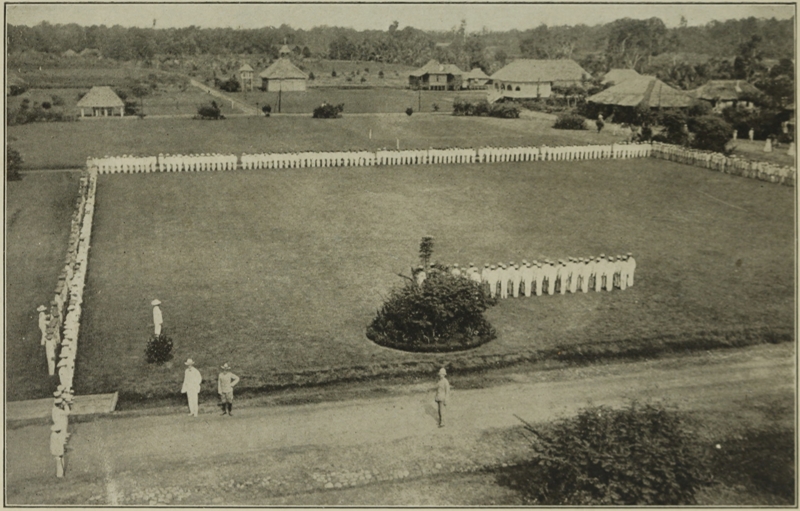 PENAL COLONY ON THE ISLAND OF PALAWAN.
We were much interested in the kitchens, and
the manner in which food was issued to several
thousands in only six minutes. It was all wonderfully
systematized.
Late in the afternoon we went up into the
central tower to watch the "retreat." The
prisoners' band, which had played for us as we
entered the prison gates, now took its place in
the courtyard below and began to play. Out of
the workrooms trooped hundreds of convicts,
who were searched for hidden implements and
then released to take their position in military
formation. The different groups marched to
their quarters and, standing outside, went
through a series of exercises to the music of
the band. They seemed to enjoy this very
much, and later, still to the music, marched gaily
off to get their rations.
A long-term prisoner with two years of good
conduct to his credit is given the privilege of
going to the penal colony on the island of Palawan.
This island is one of the more southern
ones, and is the place where the Spanish sent
their convicts in the old days. But the present
colony, which was established by Governor
Forbes, is very different from the former one.
It was once a malarial jungle, but now is a
healthy, thoroughly up-to-date and successful
reform institution.
Our visit to this place was one of the most
interesting features of our whole trip. Palawan
itself is a curiosity, for it has an underground
river which has been explored for two
miles beneath a mountain. But the penal settlement
is unique.
Leaving the steamer at Puerto Princessa, a
quaint little town with charming old Spanish
gardens, we were met by a launch which took
us up the Iwahig River to the colony. This
launch, which was gaily decked with flags, was
manned by convicts, the engineer himself being
under a sentence of nineteen years for murder.
After an hour's sail up the tropical river, we
reached our destination. At the wharf we were
greeted by Mr. Lamb, superintendent of the colony,
a Dominican priest, and a crowd of prisoners
who were enjoying a holiday.
We were driven to headquarters, near a
pretty plaza with hedges and flowers, surrounded
by several two-story barracks built of
bamboo and nipa, where the prisoners live. As
we walked about the plaza we visited the hospital
and the chapel, as well as the main office and
the superintendent's house.
The penal settlement is located on a reservation
of two hundred and seventy square miles.
At the time of our visit there were in all eleven
hundred convicts—Filipinos for the most part,
with a few Moros—and only three white men to
keep them in order. The prisoners had all
come from Bilibid prison.
In its management, the colony is somewhat
like the George Junior Republic for boys in
America. The prisoners elect their own judges
and make some of their own laws, subject to the
approval of the superintendent. A majority
verdict will convict, but the superintendent has
the right to veto any measures. Men who break
the laws are locked up, but can be released on
bail.
The police force is composed of convicts, of
course. The chief of police when we were there
was a murderer who had earned his pardon but
preferred to remain in the settlement. If a
prisoner tries to escape he is followed, and occasionally
one is shot. The attempt is seldom
made, for it is difficult to get away, and the men
are, moreover, quite content to live there. Once
thirty-five convicts did make a break for liberty,
but beyond the confines of the settlement they
found themselves in the midst of the savage
Mangyans, by whom some were killed. Of the
rest, those who were not captured alive returned
of their own free will and were consigned again
to Bilibid, which is considered a great punishment.
For good behaviour, convicts may earn the
right to have a house of their own, with their
family, one bull or carabao, and a little farm
to cultivate. There were then a hundred and
eighty of these farmers, who raised their crops
on shares, the government receiving half. They
had to report to headquarters by telephone every
other day and undergo a weekly inspection as
well. Every year they were obliged to plant cocoanuts,
which in a few years were expected to
bring in large returns. Already great quantities
of yams were being shipped to Bilibid, and
in a short time enough cattle would be delivered
there to supply, in part at least, the meat demand
of that prison. The colony suggests the
possible solution of the meat question for the
American army in the Philippines, as they were
successfully raising calves from native cows by
Indian bulls.
Although the majority of the prisoners were
engaged in farming, they were often given the
privilege of selecting the kind of work that they
preferred, and were divided accordingly, their
hats and the signs on the sleeves of their prison
clothes showing what grade of convict they belonged
to and what work they did. They were
paid in the money of the colony, which was good
nowhere else.
There were about forty women on the reservation.
The men might marry if they earned
the privilege, or if already married, they might
have their wives and children come to live with
them. There were six marriages the year we
were there. After receiving their pardons, they
could remain on the island if they wished, their
work being credited toward the purchase of
their farms, but they had to continue under the
laws of the colony.
At the main office we saw four prisoners who
were about to be pardoned. Governor Forbes
very kindly asked me to hand them their pardons
and ask any questions I wished. One, a
bandolero, or brigand, was small and wizened.
Another, who looked much like him, when asked
what crime he had committed, laughed and answered,
"Bigamy!" A third, a stolid, thickset
fellow, had the best face of them all, but
showed no emotion whatever when I gave him
his pardon. He also had been a brigand.
The convicts gave an exhibition fire drill for
us at the barracks. The natives are born
climbers, and scramble down the poles with the
agility of monkeys. They also play baseball, of
course. They are remarkably musical and have
a good band.
We had luncheon with Mr. and Mrs. Lamb in
their pretty bamboo and nipa cottage. Mrs.
Lamb was a frail little woman, but strong in
spirit, for she did not seem at all afraid to live
in this land of evil men. She told us that the
three murderers whom she had as servants were
very efficient, and were devoted to her little
four-year-old son.
When our visit ended we were driven in a
wagon to the river, accompanied by a troop of
prisoners who ran alongside shouting good-bys.
At the wharf they lined up while Mr.
Lamb and the priest bowed us politely aboard
the launch.
These intrepid countrymen of ours, who are
healing and uplifting a whole people, seem to
me to be true missionaries. The time may come
when the work which they are doing will set a
standard for us stay-at-homes to follow, that is,
if we send the right kind of men out there. As
the song says,
"Ah, those were the days when the best men won,
The survival of those that were fit—
When the work to be done counted everything,
And politics nary a bit."

he natives of the Philippines are Malays,
as I have said, but they are sometimes
classified as Christian, Pagan and Mohammedan
Malays. The Christian and educated
tribes live near the coast on the lowlands
and are called Filipinos. They have intermarried
greatly with the Spaniards and Chinese.
There are twenty-seven non-Christian tribes in
the Islands—about four hundred thousand in
number in the Mountain Province of Luzon
alone. These hill people are seldom seen, although
during the last few years most of the
tribes have come under government influence
and head-hunting has been more or less given
up. These dwellers in the mountains include
the aborigines who were driven out of the valleys
by the Malays, and also the Malays of the
earlier migration, who refused to embrace the
Mohammedanism of the Moros of the southern
islands or the Christianity of the Spaniards.
We were fortunate in having the opportunity
to see some of the dog-eaters and other hill
people. Our party was divided, and while several
of the men went into the heart of the head-hunting
country, the rest of us took the train to
Baguio, the mountain capital. What a night it
was! The heat was frightful, and swarms of
mosquitoes added to the torture. But at sunrise,
as I sat on the back platform while the
train steamed through rows of cocoanut palms,
past little huts and stations, I was reminded of
this verse:
"Mighty, luminous and calm
Is the country of the palm,
Crowned with sunset and sunrise,
Under blue unbroken skies,
Waving from green zone to zone,
Over wonders of its own;
Trackless, untraversed, unknown,
Changeless through the centuries."
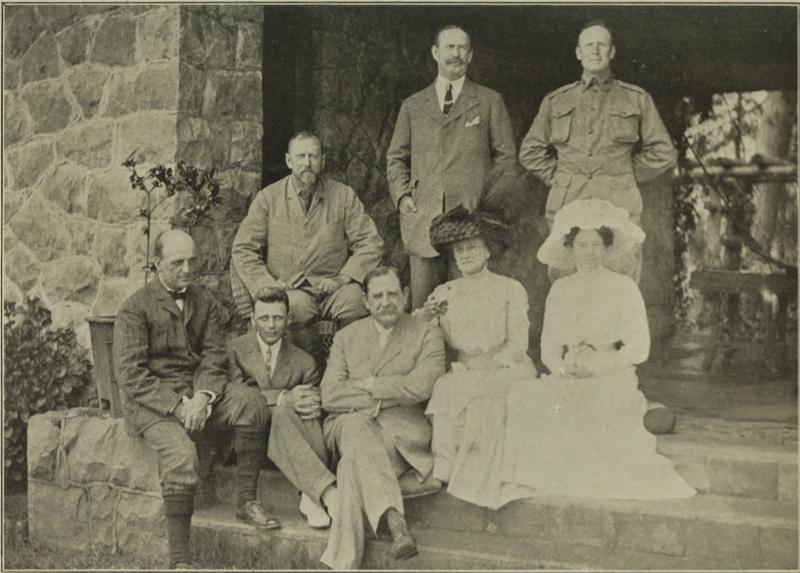 THE PARTY AT BAGUIO.
Leaving the tropics behind, we climbed up,
up among the glorious mountains. At last the
train stopped at a little station, and we took
the motors that were waiting and went on higher
and higher into cloudland, where the tall pines
grew and the mountains rose into the sky.
We had indeed ascended "into Paradise from
Purgatory." As one resident in Manila expressed
it: "The heavenly coolness, the sweet
pine air and the exquisite scenery give you new
life after the years spent in the heat, glare, dust
and smells of the lowlands."
We were passing over the far-famed Benguet
Road, one of the finest highways in the world,
which wound in and out through the gorges of
the mountains, repeatedly crossing the river
that roared beneath. For twenty miles we zigzagged
up the slopes, with widening views of
great hills opening before us, and cascades
bursting out from beneath the mountains, till we
came out on the plateau of Baguio, five thousand
feet above the sea.
This road, which has been a favourite theme
for discussion by politicians, was opened to
traffic in 1905. It is true that the cost of the
roadway was beyond what anybody had anticipated,
on account of the many bridges that
had to be repaired each year after the rainy
season, and also after the destructive typhoons
that sweep over the island—one in 1911 brought
a rainfall of forty-six inches in twenty-four
hours—which hurl avalanches of débris from
the mountain slopes. For this reason a new
road from Bauang to Baguio has been commenced,
not nearly so direct but requiring only
a few bridges, and it is to be hoped will prove
successful and more economical than the other.
Baguio, in the midst of glorious mountain
scenery, where the temperature never goes
above eighty and the nights are deliciously cool,
really is an ideal health resort for a tropical
country. The Philippines have Mr. Worcester
and Mr. Forbes to thank for this blessing.
Government buildings were erected, and the
whole force of the government was moved up
there for the hot season, with the rich return of
the improved health and greater efficiency of the
employees. A hospital for tuberculosis was
built, and a much needed school for American
children, the Jesuit observatory was established,
and Camp John Hay was laid out as a
permanent military post. Many people bought
land and put up little bungalows. A teachers'
camp was started by the Bureau of Education
for American teachers from all over the Islands,
where they had not only rest and recreation but
the mental brushing up of good lectures after
months in lonely stations.
When the Democratic Administration began
its changes in the Philippines, government offices
were ordered to be kept in Manila throughout
the year, consequently only the higher officials
were able to go to Baguio, with a result
patent to every one in the lessened efficiency of
the force. But within the last two or three
years, the Filipinos have come to appreciate
the place, which was a revelation to them. Now
rich and poor manage to go there, and they
have taken possession. The benefits of Baguio
and the Benguet Road are felt even in Manila,
where Americans are beginning to get fresh
garden peas, summer squash, wax beans and
real strawberries(!). A friend writes, "If the
time ever comes when we can have real cow's
milk and cream, then our food will be as good
as anywhere in the States."
We had a glorious week at Topside, Governor
Forbes's attractive bungalow, and speedily became
as enthusiastic in our praises of Baguio as
every one else who has ever been there. I rode
all day long on Black Crook, the most perfect
polo pony in the world, through the mists and
the sunlight and into the rainbow shades of the
setting sun, where the clouds turned the colour
of cockatoos' wings and the tints of the fish from
the China Sea.
"Cloud Maidens that float on forever,
Dew-sprinkled, fleet bodies, and fair,
Let us rise from our Sire's loud river,
Great Ocean, and soar through the air
To the peaks of pine-covered mountains
Where the pines hang as tresses of hair."
I played my first polo game at Baguio on the
club grounds. Squash Pie, Calico Pie and
other delightful names were given to the native
ponies, which are small but very strong.
We went to the government stock farm, where
they are trying experiments in breeding horses.
They had a native pony there that had been well
fed and taken care of for some time, in order to
show the difference between it and the forlorn
animals that one might see anywhere in the
towns. The native Spanish pony has greatly
degenerated. At this farm they had a beautiful
Arabian stallion and a Morgan stallion from
Vermont. It is said that the first generation of
American horses does well in the Philippines,
but after that the climate and the change in food
cause them to deteriorate. Besides, they are
rather too big for mountain cavalry. The Arabian
stallion and the native mare are said to
breed the best kind of horse for this country.
Black Scotch cattle and Australian cattle, which
are raised at the government farm, do well.
Sheep do not pay, for, to begin with, there is no
market for the wool. Goats do well, and goats'
milk is in great demand. The natives use principally
the carabao and the native cattle, which
look like small Jersey cows but are not very
good.
Another day, Mrs. Whitmarsh, from Boston,
gave us a tea in a little house hung with orchids
and Japanese lanterns, and we visited Mr.
Whitmarsh's gold mine. Some of us went on
horseback down into the valley to see the tunnels.
We washed a pan of ore in the brook and
found at the bottom little fine gold specks. The
Benguet Igorots have mined gold for centuries.
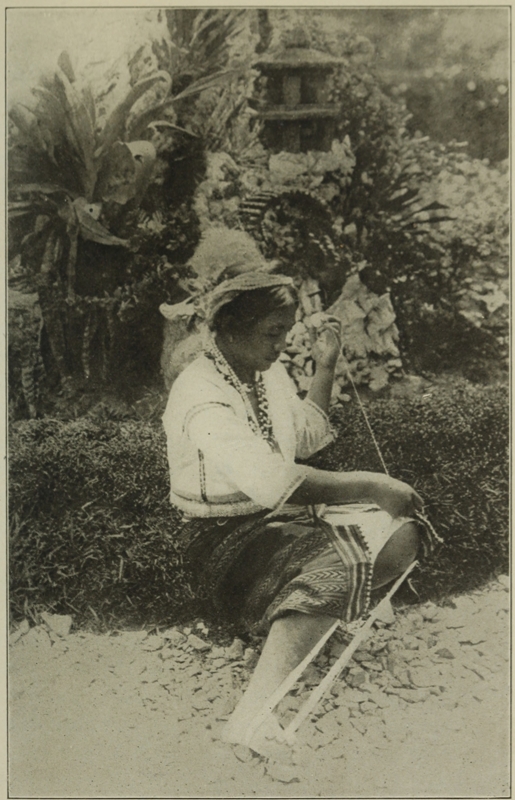 IGOROT SCHOOL GIRL WEAVING.
At Baguio we visited missionary and government
schools and Camp John Hay, where Captain
Hilgard gave us a reception. At the government
school the Igorot boys are taught,
among other things, to make attractive mission
furniture, while the girls learn to weave, and
very pretty things they make. These girls wear
short blue skirts and little jackets, and have
their hair in two long black braids that hang on
either side of their faces. A Turkish towel,
worn as a turban, on which to rest burdens,
seemed to be the fashion in head gear with them.
Loads are also carried by the Igorots on their
backs, hung by straps over the forehead.
It was an Igorot child in this school who
wrote the following article upon Mrs. Dickinson's
visit at Baguio:
"It was yesterday morning very early when
we started from here to the Post Office to meet
a lady named Mrs. Dickinson. So early we all
went down the brook to take our bath. After
we had taken our bath we had breakfast. I was
late so Ina scolded me, but I am glad she did it
so that some day I won't do it again. Then
we were all line up in two by two. When we
got up to the Post Office she was not there so
we waited for her an hour or two. After waiting
for them they arrived suddenly. There
were some ladies who accompanied Mrs. Dickinson.
We were very much pleased to see her
and she was much pleased too. The first time
that she came in the Philippine Islands from
America and she is soprice (surprised). We
sang three songs and the National Anthem and
waving our flags on the road. When we finished
singing they clapped their hands. I gave
her a bouquet of pink flowers. This we did it
for our honour of Mrs. Dickinson not because
she is more kind or lovely lady but because she
is the wife of Mr. Dickinson. This Secretary
of War is the leader of those who have authorities.
He is responsible of them. After that
we came right back. Miss B. came for school.
We cleaned the schoolroom and the yard so that
they will be so tidy when they come to see the
school at three o'clock. We fixed the two
bridges and we trimmed the road little bit for
their automobiles to dance on. But they left
them on the road yonder because they afraid
might the bridges will do them damage. So
they walked from there to here, and when they
went back, they walked from here to there again,
making them a journey."
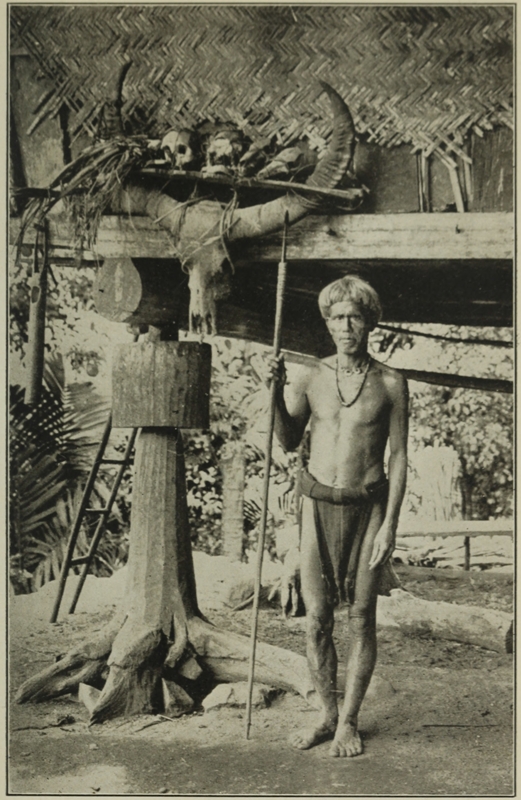 IGOROT OUTSIDE HIS HOUSE.
Doctor White, the missionary at Baguio, and
his sister took me one day to the tombs of the
Igorots. High on the hills looking toward the
sea are great natural rocks with cracks in them,
one of which looked like the Sphinx. Here we
got off our ponies, tied them, and entered on
foot a tangled path leading to a cavern. In the
faint light that sifted through we saw a coffin,
some baskets and some hats, and farther on,
concealed and yet overlooking a fine view, were
more wooden coffins. Some of these had fallen
apart so that we could see the remains of bones
and clothes. When an Igorot dies the body is
usually tied in a sitting position on the top of
a pole in the house and smoked for several days
over a fire built underneath it. Meanwhile, the
family kill and cook all the pigs and carabaos
and ponies, if the man owned any, and then
gather around and have what they call a cañao,
or feast. Afterward the bones and skulls of
the carabaos are hung about the house to show
their neighbours what a rich man he was.
Some of us went one day to Mirador, the typhoon
station, on a high hill overlooking the sea.
It is in charge of a Jesuit priest, who predicts
the approach of typhoons and puts up storm
signals, in this way preventing great loss of life.
We were shown the instruments, which give
warning of earthquakes as well as typhoons,
and given sherry that was fifty years old, delicious
cake, and flowers from his garden, and
we saw his goats climbing up the steep crags.
He told us with a chuckle that he had traded his
dog to an Igorot for a cow.
On Sunday we visited the dog market, but
alas! we saw no dogs, as on account of cholera
in the vicinity, it was forbidden to sell any. A
few days before we had seen several men leading
a number of lean and lanky ones along the
road, and these were all for sale, to be killed
and eaten. Long-haired canines are not popular,
the short-haired kind are preferred.
Vice-Governor Gilbert had a cañao, or feast,
in front of his house one morning. A line of
partly dressed dog-eaters arrived, bowing as
they passed. They proved to be the chiefs or
head men, who had put on what clothes they
possessed for this occasion. They were brown,
bare-legged men with gee strings, as they call
the woven cloth hanging about their waists.
Some had coats on, but nothing underneath, and
only an old hat to complete the costume.
The Benguet Igorots, or dog-eaters, are small
but strong, and remind one of our American
Indians. They are peaceful farmers now, but
in days gone by they fought their neighbours
on the north, and so lances and shields are still
to be found among them. "The first American
civil provincial government established in the
Philippines was in Benguet, and governmental
control has been continuously exercised there
since November 23, 1900. They are gladly
availing themselves of the opportunity now
afforded for the education of their children, but
insist that this education be practical."
In order to show the progress that had been
made in the Philippines, a party of Igorots were
brought to the St. Louis Exposition. Part of
the exhibit was a model schoolroom. Visitors
were amazed at the bright, eager little children,
and at their keen interest in their lessons. But
they were even more amazed one day to see
these same model pupils when a dog suddenly
barked outside. For the school simply went to
pieces, the children making for the nearest door.
The last seen of them, they were in full cry after
the unfortunate dog.
Although we found the dog-eaters interesting,
there are other tribes of far greater interest,
such as the Negritos, the warlike Ilongots
and the Tingians, as well as the people of the
Bashee rocks of the north, who are hardly ever
seen.
The Negritos are diminutive and uncivilized
black people who live to-day in a few mountain
areas. They are the aborigines of the islands
in this part of the world, and are as primitive
as the Australian blacks, having no social or
political organization but that of the family.
They live in hollow trees or under little lean-tos
of grass and brush, and subsist principally by
hunting and fishing, at which they are very expert.
Their weapons are poisoned arrows and
the blow gun. The poison, which is made either
from the leaf of a tree or from decomposed
meat, is placed in the arrow-head of hollow bone.
On striking, it injects the poison into the flesh
as a hypodermic needle would do, quickly resulting
in death.
The only agricultural implement of the Negritos
is a pointed stick hardened in the fire.
To prepare the ground for cultivation, on the
space they wish to clear they girdle the trees,
which will soon die. They are then set on fire
and the ashes distributed over the soil. Later,
holes are made with the pointed sticks, and
camotes, sugar-cane and tobacco are planted.
These people are very timid, and if their
suspicions are aroused in the slightest manner,
they immediately disappear into the forest.
Very little success has attended any effort to
civilize them. Their religion is nature worship
with many local divinities and good and bad
spirits of all sorts.
They ornament their bodies with scar patterns,
made by cutting the skin with sharp
pieces of bamboo and then rubbing dirt into the
wounds. In this respect they are like no other
tribes in the Islands but resemble the most
primitive of the native Africans, who also make
scar patterns. The men often shave the crowns
of their heads in order, they say, "to let the
heat out." The Negritos, like the Bagobos of
the south, sometimes point their front teeth, but
not by filing them as one might suppose. They
are chopped off with a bolo.
Worcester says the Negritos "believe that
each family must take at least one head per
year or suffer misfortune in the form of sickness,
wounds, starvation or death." Heads are
buried in the ground under the "houses" of the
men who take them.
In regard to the Tingians of northern Luzon
I also quote from Worcester, who has given us
the most reliable account of them:
"The women of this tribe ornament their
arms with a series of bracelets and armlets,
which often extend from wrist to shoulder.
They constrict the middle of the forearm during
early girlhood and continue to wear tight
armlets on the constricted portion throughout
life, so that their forearms become somewhat
hourglass-shaped, this being considered a mark
of great beauty in spite of the unsightly swelling
of the wrists which results....
"Their cooking utensils are taken to the river
and scrubbed with sand after every meal. If a
wife offers her husband dirty or soggy rice to
eat, the offense is said to afford ground for divorce....
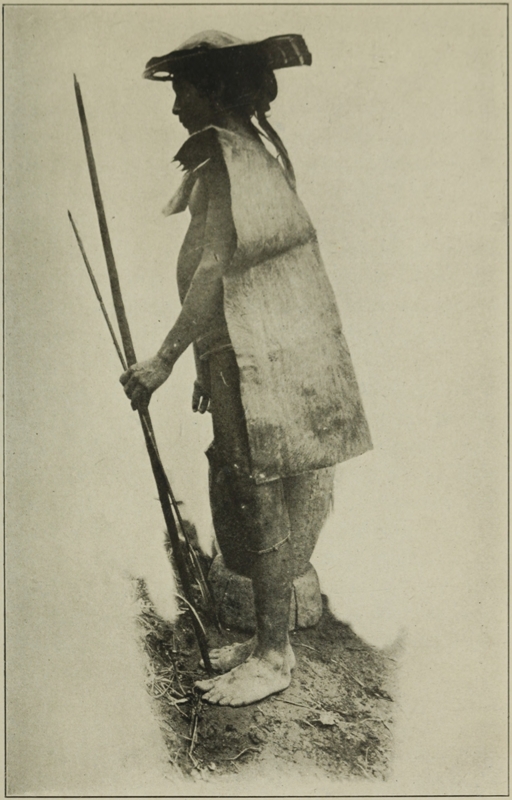 ILONGOT IN RAIN-COAT AND HAT OF DEERSKIN.
"When a man dies, whether his death be natural
or due to violence, the other members of
his family repair by night to some village of
their enemies, cut pieces from their turbans,
and throw them down on the ground. This is
interpreted as an intimation that they will
return and take heads sometime within six
months, and they believe that the dead man
knows no peace until this is done."
The Ilongots, who live in the province of
Nueva Viscaya, are especially wild and great
head-hunters. They are striking figures in
their deerskin rain-coats. No young man can
take to himself a bride until he has brought
back a head to prove his prowess. The favourite
time for these gruesome excursions of the
tribe is when the blossoms of the fire tree show
their red beacons on the mountain sides. As an
especial mark of beauty and valour, because a
good deal of pain has to be endured in the process,
the men cut off the upper front teeth on a
line with the gums.
Woe betide the man who rides a white horse
into the Ilongot country, for above all things
white hair is desired, and unless he stands guard
over it, he will find its mane missing and its tail
cropped to the skin.
Most of the mountain people still retain their
ancient myths and traditions. Even among
these Ilongots there are tales of the long ago
when they came across a "great water" to their
present abode. This, of course, merely explains
the general migration of the Malay
tribes. By the way, this Malay migration is
still in progress, and is exemplified by the
Samal boatmen who come from Borneo and
further south in Malaysia to the southern Philippines.
All the wild people have customs of their own,
which distinguish them, especially the manner
in which they cut their hair and wear their loin
cloths. They have slightly different methods
of fighting, some fighting singly with a kind of
sword, others in pairs with spears and arrows,
while the sword is used only to decapitate the
fallen enemy. Others display considerable ability
in organization and operate large bands,
under especially designated chiefs. All are
very fond of dancing and have different dances
to represent war, love and the chase.
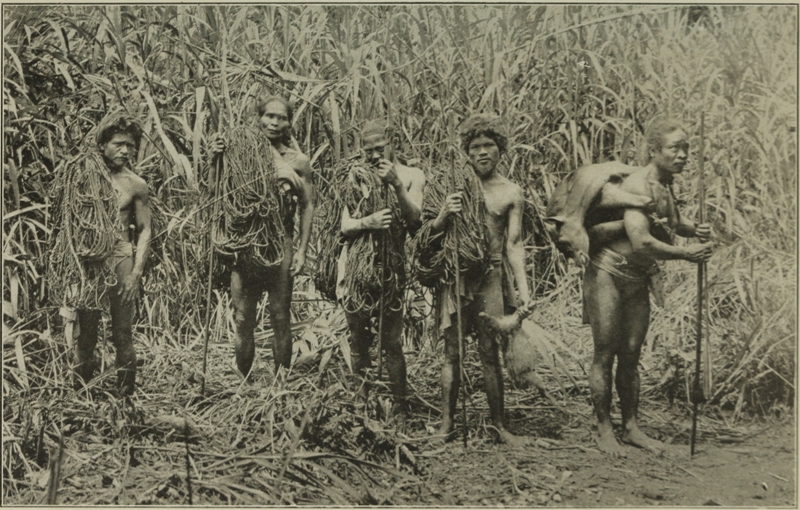 ILONGOTS RETURNING FROM THE CHASE.
They have their own explanations for everything,
and their stories about the creation of the
various birds and animals are quite interesting
and not unlike those found among some tribes
of aborigines in North America. One of them
relates that one day the Creator was making
the different birds. Before him lay bodies,
wings, necks, heads and feet. He would begin
with the body and build it up with appropriate
parts, so that it could apply itself to the purpose
for which it was intended. In every case,
the Creator was particular not to put on the
wings before the bird was complete, for fear
that it would take flight in an imperfect condition.
One day while he was engaged in making
an especially fine specimen of the feathered
world, the evil spirit approached and engaged
the Good Spirit in conversation. Ordinarily
he would have attacked the Evil One and
quickly put him to flight, but as the bird was
nearly finished and already imbued with the
spark of life he wished to complete him. But
the Creator's anger that the Evil One should
overlook his work, became so great that, without
thinking, he put on the wings before the
legs had been fitted. Instantly the bird flew
off. In haste the Creator grabbed the first pair
of legs he could lay his hands on and threw them
at it. They attached themselves exactly where
they struck the bird, near the tail. This is the
reason, so the story goes, that the loon's legs
are so far back that he cannot walk in an upright
position on land. His peculiarly sad cry
is a lament because he must stay in the water
practically all the time and cannot enjoy himself
on land as other good birds do.
Many of the people who live along the foot
of the mountain ranges, although Christianized
sufficiently to contribute to the Roman
Catholic churches, still retain many of their
aboriginal customs, especially those pertaining
to marriage, birth and death.
Beyond the shores of Luzon, stretching northward
for nearly two hundred miles, is an interesting
archipelago of diminutive islands known
as the Bashee Rocks, the Batan and the Babuyan
Islands.[19] The natives still retain many of
the characteristics which were observed by
Dampier in his visit to these islands in the
seventeenth century.
The inhabitants of the Batan group are like
those living on the Japanese island of Botel Tobago,
which is only sixty miles north of our most
northern possession.[20] No missionaries or other
persons had been allowed by the natives to land
on their shores until a few Japanese police arrived
in 1909. They are mentioned in passing
because they are a present-day example of what
the people in the northern islands of the Philippine
group were before the coming of the
white men and the friars. Their dwellings are
very peculiar. Each family has a stone-paved
court surrounded by a low wall of stone.
Within this enclosure they have three houses:
one with its sides sunk down into the ground,
in order to give protection from high winds; one
with ordinary walls for use during normal
weather; and a third built on poles about ten
feet above the ground for use during the hot
season. From these elevated houses a constant
watch is maintained for schools of fish. The
people are expert fishermen and make excellent
nets, and they have beautiful boats with high
bows and sterns.
In Dampier's day the people were friendly
and hospitable, as they are at the present time.
They valued iron more than gold, and gladly exchanged
it for iron. The ancient diggings are
still to be seen, but the "pay dirt" is of such a
low grade that it is not worth while to work it.
The precious metal is washed out by the natives
in cocoanut shells, which take the place of our
prospectors' "gold pan." Many gold ornaments
of attractive design are still to be found
in these islands. Some of those taken from
graves remind one strongly of Chaldean work.
The graves of the ancient inhabitants were
placed high upon the mountains, some near the
smoking craters of the volcanoes, others on the
crests of the non-volcanic hills. It is supposed
that the graves near the smoking craters were
those of persons who had a bad reputation in
the community, while those on the tops of the
ridges contained the bodies of the good, and
that by this method of burial the ideas of
heaven and hell were carried out in a practical
manner. The bodies were placed in ollas,
or earthenware jars, some of which had a
high glaze and were profusely ornamented.
The corpse was inserted into the jar in a sitting
position, and the orifice was sealed by placing
an inverted olla over the mouth of the first.
These jars were then placed on end and a small
pyramid of stones built around them, on the
top of which a little tree was planted. A number
of these graves ranged around the edge of
a smoking sulphur crater are an uncanny sight,
which the natives take good care to avoid.
The women of the Batan Islands, when walking
or working out of doors, wear a distinctive
headdress, consisting of a long grass hood,
which stretches from the forehead to below the
hips. It protects the head and back from
the sun, wind and rain, so that it is worn at all
times and in all seasons. It is one of the most
original and useful of all primitive garments.
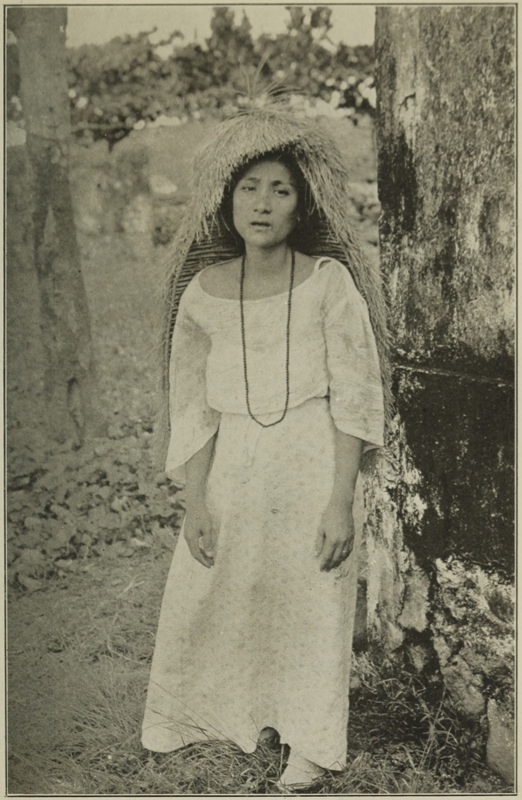 WOMAN OF THE BATAN ISLANDS WITH GRASS HOOD.
During the dry season but little rain falls in
these islands, and as there are few streams or
springs, every means is employed to catch the
least drop. Even the trees in the yards have
pieces of rattan twisted around their trunks and
larger branches, to make the water drop off into
earthen jars.
During the autumn migration of hawks and
eagles from the north, men are stationed on the
thatched roofs of the high dwellings to seize the
birds by the feet as soon as they alight. Great
numbers are caught in this manner every year
and form quite an element of the food supply.
Many of the islands are excellent places for
the production of cattle. Itbayat Island,
unique because its shores are higher than the
interior, has many thousand head of excellent
cattle. The coast is so precipitous that when
they are exported they have to be lowered to
the water's edge by means of a block and tackle,
as at Tangier. They then have to swim out to
the waiting ship, where they are hoisted by their
horns to the deck.
Another of the cattle islands is called Dalupiri.
This beautiful spot was given in its entirety
to Aldecoa and Company of Manila by
the Spanish government. In fact, when the
United States first took possession of the Philippines,
this company claimed sovereignty over
the island, but this, of course, was not recognized
by the United States Government. The
cattle that are pastured here are a cross between
the black Spanish bulls of fighting lineage
and the humped cattle of India. Great care is
taken that the stock be well kept up, and for this
purpose there is a constant weeding out of undesirables.
The method in which this is done
is both interesting and very exciting. The cattle
roam at will and are very wild and hard to
approach; as a result they have to be hunted
with great care. About twenty men are employed
in their capture, all of whom are mounted
on hardy little horses. Four of them are lassoers
and the rest huntsmen. The lassos are
nooses attached to the ends of bamboo poles
about twelve feet long. The rope from the
noose, to the length of about twenty-five feet, is
coiled around the bamboo pole and tied to it
four feet from the lower end. When the lasso
is thrown over an animal's head the pole is
dropped by the rider, the rope unwinds and
drags the pole along the ground, until it catches
on a rock or a bush and stops the mad career of
the animal.
"We started out early one morning," Major
Mitchell writes me, "to cut several young bulls
out of a herd of about five hundred cattle. Led
by the manager of the island, we galloped over
the rough surface of the coral-bound hilltops
and through deep, waving grass until one of the
huntsmen signaled that the herd was in sight.
A careful inspection was made of the herd
with a telescope, and the animals for capture
were selected and carefully pointed out to the
lassoers, who immediately took up their posts
in concealment beside a little plain. The huntsmen
then proceeded under cover to points
around the herd which would enable them to
drive the cattle on to the little plain where the
lassoers could get in their work. After a wait
of about a half hour, the horn of the chief huntsman
pealed forth and was answered by the yells
of his companions; the herd, unable to go in another
direction, dashed for the little plain, followed
by its pursuers. Crouching behind some
low bushes the lassoers waited until the cattle,
now in full stampede, had come within fifty
yards, when in a twinkling they dashed into the
midst of the galloping herd.
"After a terrific race one lasso held true on a
fine young bull, while the rest scampered off into
the ravines and water courses. The dragging
bamboo pole soon brought him to a stop, and
after several charges at his captors, two more
lassos were placed on him, and he was securely
fastened and dragged to a tree, against which
his head was tied. A little saw was produced
from somewhere, and his gallant horns were cut
off short. An old, sedate carabao, who seemed
to be perfectly at home, made his appearance,
the young bull was tied to the carabao's harness
and towed off toward the corral. At first he
tried frantically to gore the carabao, but as his
horns had been removed no harm resulted. The
carabao did not mind it in the least but continued
tranquilly on his way. Three more bulls
were captured on that day; each furnished exceedingly
fast and interesting sport. I have
seen mounted work of a great many kinds, such
as pig sticking, stag hunting, and hunting of
many kinds of game, including our own fox
hunting and polo, but never have I seen any
mounted work which required more dash, nerve,
good judgment and endurance than that displayed
by these herdsmen of the northern islands."
Although these islands are bounded on the
north by the Balintan Channel, through which
some of the shipping passes from America to
the southern part of China, they are seldom
visited. This is because, as I have said before,
there are no ports, not even good anchorages.
During the typhoon season they are exposed to
the full force of these great hurricanes, while
the waters are infested with hidden rocks and
coral ledges. The U. S. cruiser Charleston ran
aground on a coral reef east of the island of
Camaguin in 1900 and sank immediately. During
the Russo-Japanese war the fleet of the Russian
Admiral Rojesvenski passed on either side
of Batan Island. The Japanese had observers
on the summit of Mt. Iraya on this island, who
are supposed to have signaled by heliograph to
Mt. Morrison in Formosa of the coming of the
fleet. The great armada could be seen from
this mountain for more than one hundred miles.

hen the Americans first came to the
Philippines, most of the mountain country
could be reached only on foot over
dangerous trails. Very large tracts were unexplored,
and the head-hunting tribes, who are
found nowhere but in this northern part of Luzon,
pillaged the neighbouring towns. A state
of order has now been established, except in
parts of Kalinga and Apayao.
The Mountain Province, the home of the head-hunters,
includes the sub-provinces of Benguet,
Lepanto, Amburayan, Bontoc, Ifugao, Kalinga
and Apayao. The officers of the provinces are
a governor, a secretary-treasurer, a supervisor
in charge of the road and trail work and the
construction of public buildings, and seven lieutenant
governors. All these officers are appointed
by the governor general. They live on
horseback, undergo great hardships and also
take great risks.
The manners and customs of these head-hunting
tribes differ somewhat. Each one, for instance,
has a different mode of treating the
captured head when it is brought in, but all
celebrate a successful hunt with a cañao, or
festival. The Ifugaos place the head upon a
stake and hold weird ceremonial dances around
it, followed by speech making and the drinking
of bubud, as they call their wine; afterward the
skull of the victim is utilized as a household
ornament. Venison and chicken are served at
such feasts and the large fruit-eating bats, which
are considered delicacies. If one of the tribe
has been so unfortunate as to have his head
taken, they berate the spirit at the funeral, "asking
him why he had been careless enough to get
himself killed."
The most picturesque of the head-hunting
tribes that my husband saw were the Kalingas,
who are different from all other natives of
Luzon. It is said that the Spaniards took
fifteen hundred Moros into this part of the country
more than a hundred years ago, so they may
have founded this tribe. At all events, the
Kalingas are superbly developed, tall and slight,
some of the men having handsome and almost
classical features.
Neither the men nor the women cut the hair,
which, in the case of the men, is banged in
front and tied up with rags behind, some wearing
nets to keep it out of their eyes. Although
the women have abundant hair they
use "switches," into which they stick beautiful
feathers. The men also decorate themselves in
the same way. On the back of the head they
often wear little caps woven of beautifully
stained rattan and covered with agate beads,
and these are used as pockets in which small
articles are carried. Great holes are pierced
in the lobes of their ears, into which are thrust
wooden ear plugs, with tufts of red and yellow
worsted. Almost every Kalinga woman wears
a pair of heavy brass ear ornaments and sometimes
a solid piece of mother-of-pearl cut like
a figure eight.
The Kalingas are particularly warlike, their
very name meaning "enemy" or "stranger,"
and endeavours to bring them under government
control were begun only a few years ago.
There are still some rancherias which the lieutenant
governor has not yet visited, as it seemed
best to wait and bring the people to terms by
peaceful means.
While we were enjoying ourselves at Baguio,
the Secretary of War, Governor Forbes, Secretary
Worcester, General Edwards, and my husband
started north into the mountains to see
some of the strange tribes that were gathering
from far and wide to meet the great Apo, or
chief, as they called Secretary Dickinson. I
give the account of the trip in my husband's
own words:
On Saturday night, July 31st, after the Assembly
baile, we motored to the docks and went
aboard the transport Crook for the trip northward.
We were made very comfortable on
this big transport, with deck cabins, but we
all slept on the open deck by preference and
had a pleasant run till in the morning we were
entering Subig Bay, a splendid vast harbour
between great mountains, the narrow entrance
guarded by Isola Grande. Here we landed and
visited the batteries, and although it was a small
island it was a stewing hot walk about it—especially
as the Secretary sets a great pace—till a
torrential shower came up and drove us to the
commanding officer's house, where we had a
bite of breakfast—and all the breakfasts at the
posts which we have visited have been so good!
General Duvall had come up from Manila on
his yacht Aguila, and on board of her we
crossed the bay to Olongapo, where there is the
present naval station. The great hulk of the
famous floating dock Dewey was looming up
there, just floated again after her mysterious
sinking which, even now, they do not seem to
be able to explain.
The guard was out with the band, and the
honours were paid and the marines paraded,
but soon another severe tropical storm broke,
and drove some of us back to the ship while the
others went on to another breakfast at the
Officers' Club. This storm suggested a typhoon,
but there had been no warning from the Jesuit
observatory at Manila, and so we rejoined the
Crook out by Isola Grande and went to sea without
fear.
This is the rainy and typhoon season but the
warnings of severe storms are so carefully
given that they have lost their terrors now-a-days;
and this year, so far, there hasn't been
a disturbance, much to our comfort, as it has
permitted the carrying out of all our plans.
It is a most unusual thing for such good weather
to continue. The hot season is over, and this
is called the intermediate, but it is the time of
rains on this coast, the seasons differing slightly
on the different coasts and in the different
islands. So all that night we cruised up the
coast through showers of rain and lightning,
passing by Bolinao Light, which we had first
sighted as we approached the Philippines.
Before daylight we stopped off Tagudin, and
through the darkness could be seen the dim
shadow of land and mountains, and a light burning
on the beach as a beacon. With dawn we
saw a wonderful tropical shore develop before
us, of low land fringed with palm, surrounded
by beautiful mountain ranges, a tiny village on
the beach, and a crowd of people gathered together.
Soon a surf-boat put out and brought
aboard the governors of the nearby provinces—Early
and Gallman, brave, ready men, who have
taken these wild people in hand and become
demi-gods among them—and after a bite of
breakfast we were all taken ashore through the
surf, very handily, and the Secretary was welcomed
by a native band and the chief men of
the neighbourhood and crowds of half naked
natives.
The Ilocanos of the northwest coast of Luzon
are a fine, kindly race, but there had also come
down from the interior a lot of small brown
men to pack in our baggage, Bontoc Igorots,
head-hunters and dog-eaters, of whom we were
to see more in their own country. These little
fellows at first seemed like dwarfs; but soon
after, as we saw them better, they proved small
but well formed and well nourished, strong, gentle
little people. They ran forward and seized
our packages and disappeared down the trail in
a wild, willing manner. Off they trotted while
we were packed into carromatos, dragged by
weedy, diminutive native horses, which are
wonderfully powerful for their size. We
went, after greeting the people, off down
the trail, through the outskirts of Tagudin (we
didn't go into the town, which was somewhat to
one side, as there had been some cholera there),
with its nipa houses of plaited grass, perched
up above the ground, many decorated in honour
of the occasion. We rattled along an excellent
road (for we have certainly done wonders in
road-building here), past paddy fields, where
the slow carabao grazed with little children
perched on their backs, past troops of natives,
with their loads, standing alongside.
Governor General Forbes had made the most
wonderful preparations for the trip. It was the
first time that any American officials (only Insular
officials previously) had gone in to these wild
people, and of course the Secretary is the highest
in rank that can visit the Islands since he
is the one through whom the President governs
the Philippines and the President can never
come. The trip was unique and all the arrangements
were extraordinary. For a new trail had
been planned into the mountains but was not
due to be done for eight months, and yet thousands
of these wild men had been called in and
helped to finish the road so much the more
quickly (for we were the first party to pass
over it, and some of the bridges had only been
finished the night before we passed), eagerly
and willingly, when they were told that the
great Apo was coming in to visit them. Forbes
had sent to Hongkong for some rick'shaws and
had had men trained to pull and push them,
but these had not stood the test well and we
didn't have the need or the chance to use them;
he also had had palanquin chairs brought over
from China and men taught in a way to carry
them, and these we did use on some of the steep
descents. But we rode horses, excellent ones,
from Forbes's own stable, almost all the way.
Every three kilometers, companies of Igorots
and Ifugaos were stationed to act as cargadores
and rush along the baggage by relays, and this
they did with shouts and cheers as quickly as
we traveled. Tiffin and breakfasts had been
prepared all along the way. Every eventuality
had been anticipated, and it was really too well
done, for it made our traveling seem so easy
that we had to think hard to realize into what
out-of-the-way places we were going. A few
days before it would have been necessary to
work our way over the perpendicular old trails,
with difficulty finding bearers for our packs,
and we would have been compelled to carry our
own food, a severe trip and a hard undertaking.
We went in absolutely unarmed and
without escort, and yet nearly every native that
we saw, after we reached the hills, carried his
spear and head ax; but there wasn't a suggestion
of danger. People were brought together
on this occasion from different tribes who two
years ago would have killed each other at sight,
and yet to-day were dancing with each other.
We were accompanied by the governors of
the sub-provinces as we passed through them,
and an unarmed orderly and Sergeant Doyle,
who had charge of Governor Forbes's horses,
and generally by a shouting horde of natives.
The Secretary proved a wonder; well mounted,
as he was, he led on at a great pace, till it
seemed a sort of endurance test. I was more
than pleased to find that I stood it as I did, for
we traveled four days out of the five for forty
miles a day, and rode most of it a-horseback.
I came out finally in much better form than when
I went in.
And so, from the beach where we landed, the
carromatos carried us across the low coast
plain, over new bridges on which the inscriptions
stated that they had been finished for the
passage of the Secretary and his party, and
under triumphal arches made of bamboo which
welcomed him; all the natives whom we passed
saluted, and many wished to shake hands
or only touch the hand as we passed, till we
came into the foothills, and over them into a
little village of nipa huts among the bamboo
and tropical trees, where we found our horses
waiting. Here we mounted and started off at
a good pace over the well built road that trailed
around cliff and crag as we worked into the
mountains, a procession, a cavalcade, winding
in and out. We traveled along the valley of a
river, that later became a gorge with steep cliffs
and precipitous sides; all the natives were out
to greet the Secretary; and finally we came to
a tiny village where we had a drink of refreshing
cocoanut water, all the people standing
about or hanging out of the windows of the simple
houses, which looked very clean and neat.
We trailed on along the narrow road, cut into
the rock in many places, really a remarkable
road, and up the gorge with the rushing river
below us. The mountains rose high and opened
up in lovely velvety greens, and shaded away
into the blues of distance. We stopped at a little
native rest house, above a ford in the river,
where we found a luncheon prepared for us, but
it was a hurried luncheon, and on we went climbing
a winding trail that zigzagged up the steep
mountainside, through tropical tangle of bamboo
and fern and great overhanging trees with
trailing parasites—the ghost tree, the hard
woods, and some with a beautiful mauve flower
at the top that even Mr. Worcester couldn't tell
me the name of (he said he had been so busy
inventing names for the birds that he hadn't
had time yet to find names for trees). And below
the views opened up wider and more splendid,
and range on range of mountains rose above
each other, while the precipices grew deeper and
more terrifying.
And suddenly, as we came to a turn in the
trail, there appeared above us a most picturesque
sight against the skyline, some Ifugao
warriors, lithe, beautifully formed men, whose
small size was lost in their symmetry, with
spears in their hands, turbans of blue wrapped
about their heads, and loin cloths of blue with
touches of red and yellow in their streaming
ends that hung like an apron before and like a
tail behind; their handsome brown bodies like
mahogany. They had belts made of round
shells from which hung their bolos. These were
the head men of a company of Ifugaos who had
come this far to greet the party and they stood
so gracefully on the point above us; and around
the turn we found the rest of the band, stunning
looking fellows, standing at attention in line
behind their lances, which were stuck in a row
in the ground. Here we had another tiffin, while
these warriors seized and scampered off with
our luggage.
From this time on, as we traveled, we found
reliefs of these picturesque people, waiting their
turn at carrying, and then all would join in
the procession, and shouting a cheer like American
collegians, their war cry, they would rush
on and frighten us to death with the risk of
going over the steep places. Away off in the
distance, reëchoing through the valleys, we
could hear the cheers and cries, very musical,
of others of our party as they traveled along.
Soon we began to be greeted by the tom-toms
of natives who had come out to honour the Secretary,
and by their singing as we approached,
and then they would dance round in a strange
way as we passed on.
The Ifugaos had come to meet the Secretary
from several days' journey away, mostly
through Bontoc Igorot country, all armed, and
yet there hadn't been a sign of trouble. And
these Ifugaos, who two years ago were wild
head-hunters, have been brought into wonderful
control by their governor, Gallman. There are
some one hundred and twenty thousand of these
picturesque people, among whom head-hunting
is now nearly stamped out; though there are
sporadic cases doubtless. These little savages,
too, appear most gentle and tractable, most willing
and laughing, in the rough tumbling of the
trail; and they have proved very clever, for
they were the builders of the roads over which
we traveled (we were told that they could drill
rock better than Americans, on a few months'
practice, and that they have sat for a few days
and watched Japanese bricklayers set brick,
and then done it as well as the Japanese). But
indeed their sementeras—their paddy fields—their
terracing, which they have practised for
hundreds of years, is the most wonderful in
the world, and there is nothing even in Japan
to compare with their work of this kind. Their
great game of head-hunting has taught them
cleverness, and they are full of snap and
go.
The Ifugao is a great talker and has all the
gestures of an orator. When he begins a speech
he first gives a long call to attract attention,
then climbs a stand fifteen feet high by means
of a ladder. He generally begins his remarks
by stating that he is a very rich man, and goes
on to praise himself and his tribe, and at the
end of his harangue he often himself leads off
in the applause by loudly clapping his hands.
He has become a fine rifleman and is a fearless
fighter. In clout, coat and cap, and a belt of
ammunition, with legs bare, he travels incredible
distances and makes a good constabulary soldier.
The Governor General is anxious to form
them into a militia, but they lose their grip, we
were told, when they are taken down from the
hills to the plain.
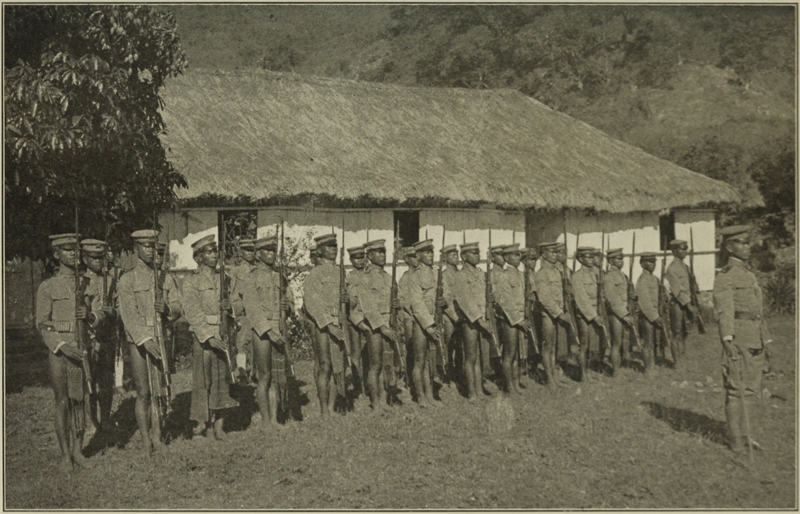 CONSTABULARY SOLDIERS.
And so we went on up to over four thousand
feet, to where the pass broke through the mountain,
and there before us was a vast valley
with a splendid plain beyond, and in the middle
of it, on a prominence, we could see Cervantes,
where we were to stop our first night. It
seemed so near and yet proved many miles
away as we traced our way down the steep
coasts of the valley and the view of the plain
below widened and the ranges of mountains beyond
rose into finer heights. We twisted and
trailed zigzag down the pine-clad slopes, for
the change of vegetation (due to the mountain
range, which divided a different climate on
either side of it) in passing over the ridge had
been remarkable, and though we had seen rare
orchids and begonias as we mounted, we descended
from the same height through pine and
pasture.
When finally we reached the plateau and had
crossed a river bed we were met by the people
of the village of Cervantes—many girls in gay
dress riding astride on their midget ponies, and
men and boys on their rugged little mounts.
These escorted the party under the triumphal
arches into the grass streets of the pretty village,
where the simple public buildings were
decorated, and the local band played, till we
finally were taken to the houses where we were
to spend the night, the Secretary and the Governor
and Clark and myself going to the Lieutenant
Governor's. He was married to a Filipina
wife. And here I must say that we met
several of these Filipina wives of white men, and
they had most perfect manners and self possession
and real grace (and this one was a good
cook). The house was a best class native house
and more comfortable than we had anticipated,
though there were sounds and smells that
rather disturbed us. There was a reception
and baile at the municipal building in the
evening, where we had to go and dance a rigodon,
each partnered off with some dainty little
Filipina lady. And then we did hurry home to
rest, for we had been up since half after four
that morning and were to start next morning
a little after five.
The next day's trail was very fine, for we
started off over a river which we crossed on a
flying bridge, a swinging car on a cable, while
the horses were forded; and then we had splendid
but slow climbing up the gorge of one river
after another, coasting the mountainside, where
we could see the mark of the trail many miles
ahead above us and part of our procession trailing
along in single file or rushing along with
distant shout, as the little willing native cargadores
carried their loads up and up. Above
us rose Mount Data, with its mysterious waterfall
that seems to come right out of its peak,
and clouds circled about us, and below the valleys
streaked away into the distance and the
ranges rose higher and higher, and the play
of light and shadow was beautiful on the greens
and grays and browns and blues of the distances.
We began to see rancherias, the native
villages, perched up on the hills, the thatched
roofs like haystacks, with blue smoke at times
coming through; and paddy fields began to
climb the upper valleys in their terraces, with
the pale green rice, and fringes of the banana
palm of which the hemp is made. In places the
red croton was planted on the terraces for luck,
and in the ravines which we crossed there were
cascading falls and pools.
We rose higher and higher over another
range, and at the tip-top of the trail another
group of Igorots were dancing and playing
their tom-toms as we passed, and rushed alongside
to touch fingers. Soon we passed through
a village built in a stony gorge where a river
ran down. The houses consisted of conical
thatched roofs supported on four wooden piers
with ladders leading up into the roofs where the
people lived. The foundations were terraced
in stone and the paths were stone-terrace, and
it all looked very neat and clean. On our way
back we stopped for tiffin at this same village
and had the women come and show us how they
weave, for it was a place famed for its weaving.
This time our tiffin was farther on, at a
rest-house with a splendid view, and it had been
laid out so prettily with temporary flower beds
and bamboo arches. The Belgian priest from
a town nearby had come to join us at luncheon,
and although he spoke no English I had
a pleasant time with him in French, for he
proved to be a sort of relative of our cousins
the de Buisserets; his name was Padre Sepulchre,
one of a band of Belgians belonging to
no order but educated highly for missionary
priesthood, who have been sent out, since our
occupation, by the Pope, and many of whom
are rich and gentlemen born. This one had
already in two years spent some twenty thousand
dollars gold of his own money in his town.
Another such missionary we met at Bontoc, and
several at other places, and all are said to do
good work.
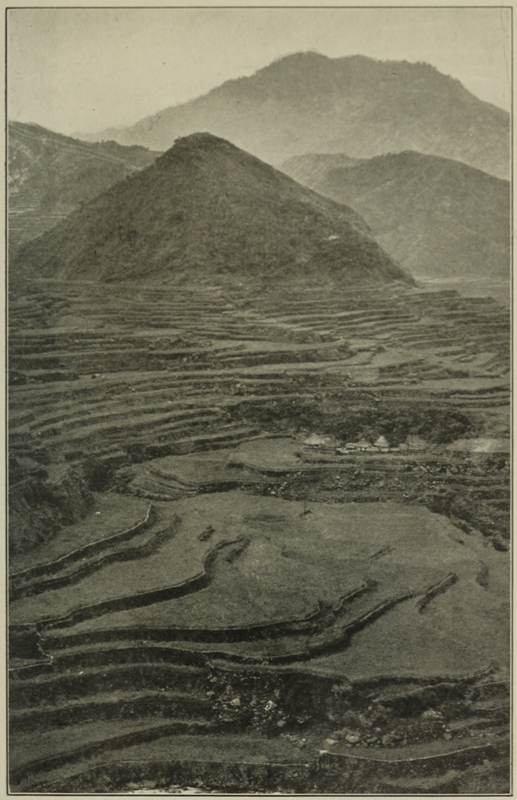 RICE TERRACES.
We started off after tiffin on the long trail
that wound down the gorge of El Chico de
Cagayan River, on our way to Bontoc. Villages
became more numerous and were very
picturesque, on the spurs of mountain above
the river, or embowered in coffee trees, where
the mountain coasts were patched with pineapple
plantations. And the paddy fields grew in
terrace after terrace, most splendid engineering
by these primitive people, rising above each
other up into the clouds, fitting into the contours
of the mountainsides, the terrace walls overgrown
with green, and the pale green paddy
within, and little cascades carrying the water
down from terrace to terrace, most lovely, like
some great hanging gardens; little brown people
were stooping at work in them, all naked, but
with their clothes covered by leaves and balanced
on their heads, to be kept dry; for there
were showers and cloud effects that added to the
beauty of the panorama as we passed. The terraces
add beauty and interest to the eye by their
succession of levels, and as we traveled into the
country they became more frequent and complete.
Curiously enough, the Bontoc Igorots
have forest laws and a forest service of their
own. The mountainsides of their rough country
are sparsely timbered with pine, which has
grown very scarce near some of the larger settlements.
Forests in the vicinity of such settlements
are divided up into small private holdings
claimed by individuals, whose right thereto is
recognized by the other members of the tribe.
In many places it is forbidden to cut trees until
they have reached a large size, although the
lower branches are constantly trimmed off and
used for firewood. Forest fires are kept down
to facilitate reforestation, and young trees are
planted. Such foresight on the part of a primitive
people is certainly unusual.
So we trailed all day, till toward half after
five we turned a point and came to Bontoc,
after a procession of natives had come streaming
out some miles up the gorge to meet the
party. Bontoc is the capital of the Mountain
Province and was the goal of our journey.
The native town is very dirty and is acknowledged
to be one of the worst of the native
villages; in the more savage places the towns are
said to be cleaner. We walked through it,
where the terraced stone walks pass by stone
pits where the pigs wallow, and by thatched
houses which have no exit for the smoke and
so are filthy and in dreadful condition. We
saw the communal shacks in which the unmarried
and widowed members live with their
peculiar rights, and the sties where the old men
resort to talk, and we stood outside the wretched
place where the skulls are kept, and some heads,
all black and smoked, were brought out in a
basket from the secret recesses for us to see.
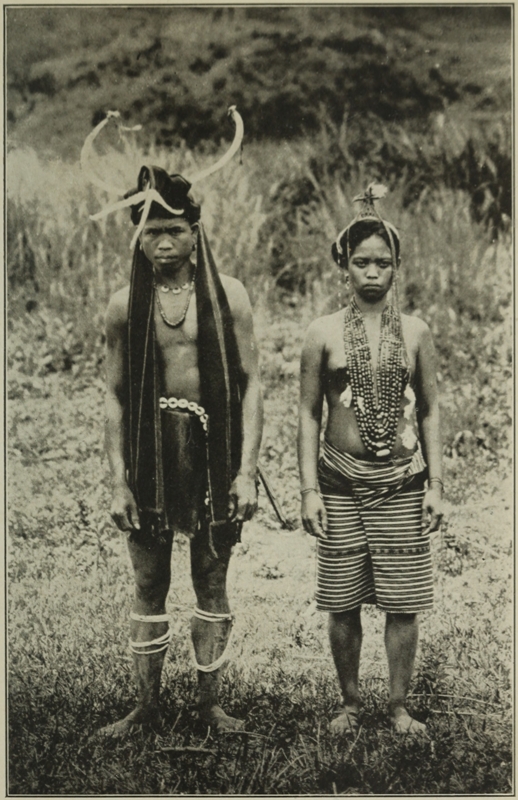 IFUGAO COUPLE.
Some of these Bontoc Igorots are skilful
smiths, and they make excellent earthen pots
and clay pipes. They have interesting athletic
sports of their own and take to those of the
Americans. They are especially fond of beads,
which are wound in their hair or hung about the
neck, and greatly value large white stones,
caring little for agates, so highly prized by the
Kalingas.
Into Bontoc for this great occasion had been
brought warriors and women from the Kalingas
and Ifugaos, with Igorots from about, some
from a distance of several days' travel; and
for the first time these warring tribes, who only
two years before were taking each other's heads,
came peacefully together, and watched each
other with as much interest as they watched us.
The adventures of the American lieutenant
governors read like romances, and here they
were before us with their following: the Kalingas
more dangerous and warlike than the
Ifugaos, and the Ifugaos more picturesque and
interesting than the Igorots, and all together
making a never-to-be-forgotten scene.
There were, too, several small companies of
native constabulary, for these hill men make
splendid soldiers and take great pride in their
arms and uniform, and have proved loyal to the
death. All the different tribes and the constabulary
had turned out to receive the Secretary,
and it was a vociferous and noisy yelling
crowd that streamed about in irregular procession.
We were, some of us, taken to a government
house that was comfortable, and took
our meals at a club which the officials have
built and which is quite pathetically complete,
and that evening we did little before turning
in—the first evening since we had landed in
the Islands when we were able to turn in at a
reasonable hour with the prospect of sleeping
as late as we pleased next day.
Next day was a day of festivities, a cañao,
for from morning till night there was dancing
by these fantastic peoples, whom so few white
men have ever seen. We were waked early
enough, alas! by the ganzas—the tom-toms—and
there were parades of the different tribes
through the town. A small grandstand had
been erected in the plaza, and there we stood
with the Secretary and the few white teachers
and the missionaries from about, while the procession
was reviewed.
The constabulary came first, dressed only in
loin cloths of different colours below the waist,
but with the regulation khaki uniform blouse
and cap above. They are officered by Americans
and a few natives, and are most military,
notwithstanding the strange appearance of their
bare legs. Some companies were very well
drilled, and they gave exhibitions of different
manuals as well as any regular white soldiers
might have done.
The wild Kalingas came past next, most
picturesque, with their feather headdresses of
red and yellow, and spears and head axes, and
their brightly coloured loin cloths, and the
women in scant but gay garments, and not at all
ashamed in their nakedness. And these gave
their characteristic dances, with outstretched
arms, hopping and prancing about in a circle,
all the time looking down into the center of the
circle about which they dance (where the head
of the decapitated is supposed to be). There
were innumerable tom-toms, which they play
with variations, so as to make much rhythm
and movement, and the women joined in the
dancing, more moderately, some with big cigars
in their mouths and looking extremely indifferent.
Then, when they danced in a circle,
some would prance into the center with shield
and ax and pretend attacks upon each other,
and leap about and grow excited; and this sort
of thing they kept up all day (and part of the
night, too) off and on.[21]
The Ifugaos followed and passed by, and
gave their dances, which are the same with a
difference, but each was ended with a mighty
shout, after which one of the head men would
step forward and deliver a rattling speech, and
they greeted the Secretary variously but cordially—for
they like our American rule, indeed,
they have never had any other, for the Spaniards
never attempted to come in and control
them.
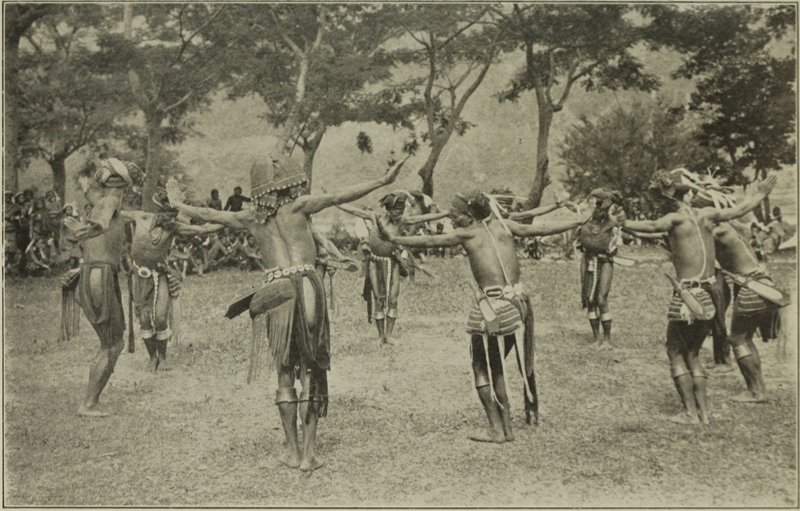 IFUGAO HEAD DANCE.
Then the Bontoc Igorots followed and gave
exhibitions with noisy demonstrations, and two
presidentes, or chiefs, who six months before
were trying to kill each other, danced and
pranced together, while the tom-toms beat and
others hopped and circled round. Most of the
men were tattooed, each tribe in its own peculiar
manner, certain marks indicating that their
bearer had killed his man and taken a head—some
bore marks of many heads; one man dancing
was known to have taken seventeen. Many
of the women, too, were tattooed with a feather-like
pattern.
And so the dances went on. In some the participants
postured fighting and then represented
wounded men; in others all were head men together;
some were rapid in motion, some slow,
but all had real grace, that grace of the wild
man; and all were finely formed and well-nourished
and healthy looking. When the
dancing was over, the groups of savages in their
fantastic dress squatting around the plaza behind
their spears stuck in the ground, with bolo
and head-ax and tom-tom, and the women standing
about, made a wonderful scene.
After the dances and speeches the head men
came up to the Secretary and handed him
weapons as gifts, sometimes their own, with
which they had often fought. Mr. Dickinson,
of course, received the chiefs and the head men
and women afterward, and presented them
with shells and blankets and plumes in return.
The bartering among them was rather amusing,
as they tried to exchange what they had received
and didn't want.
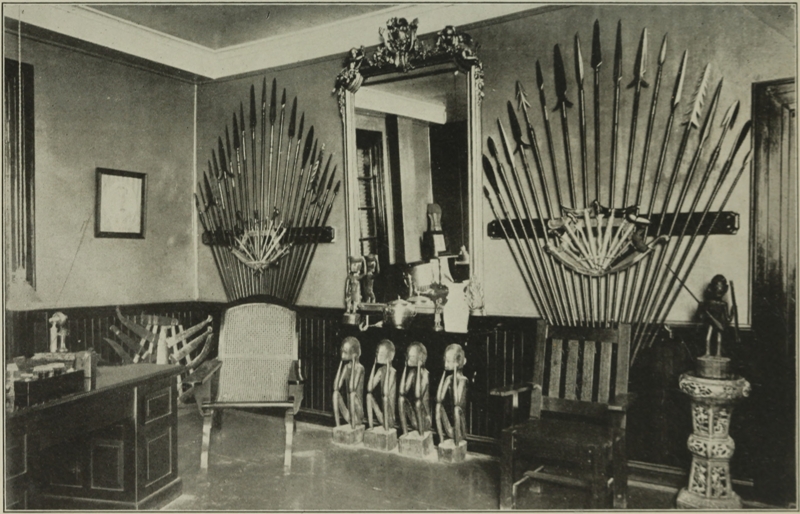 WEAPONS OF THE WILD TRIBES.
At the club in the evening of the second day,
they gave us a remarkable dinner; all the Americans
in the district were present; and the few
Filipinos entertained us at a baile, and so our
day was finished.
We started out at daylight next morning and
hiked back by the same trail; but the views
seemed finer in their repetition than even when
we first passed through them. We had had
most superb weather, although it was the rainy
season, and had enjoyed the grand panoramas
to the full; but the last afternoon it came on
to pour down in torrents, which we enjoyed too
as an experience, for we came safely to Tagudin,
where the people and the band joined in
sending us off, as they had received us, and we
were safely taken out through quite a heavy
surf and put on board the Coast Guard boat
Negros, and had a glass with ice in it again.

ugust thirteenth is a holiday in the
Philippine Islands, for it is "Occupation
Day," the anniversary of the fall of
Manila and its occupation by the American
army. The special event is a "camp fire" in
the evening at the theater, when the Philippine
war veterans gather together and have addresses
and refreshments. After a dinner with
Tom Anderson at the Army and Navy Club,
with its picturesque quarters in an old palace,
intramuros, we attended this performance, sitting
in the Governor's box and listening to
the happy self-laudation of the "veterans," who
all wore the blue shirt and khaki of war times.
It was toward midnight when we finally left
and went out to our vessel, for we were off for
a trip among the southern islands on the cable
steamer Rizal. We sailed by the light of a
full moon, and for a while had a merry bobbery
of it outside, after passing Corregidor. Soon,
though, we turned a point and had the monsoon
following. In the morning we woke to find
ourselves steaming past the fine scenery of
southern Luzon, with the volcano of Taal in the
distance. Several times during the Spanish occupation
this volcano dealt death and destruction,
and as late as 1911 it claimed many victims.
Our first landing place was at Kotta, on
Luzon, where we started ashore in a small
launch. It was a beautiful river of palms, but
our boat got stuck in the mud and we were
delayed. We finally reached the shore and
were put into automobiles. Then it was that
I began to feel as if I had joined a circus
parade. Escorted by bands and soldiers, our
motors moved slowly along the streets. Everywhere
people lined the way, while the windows
of the houses fairly dripped with heads.
We passed many little villages that looked
prosperous, and processions of carts, showing
that the people were active and busy. The road
ran over picturesque bridges, for part of it
was an old Spanish trail rejuvenated. At all
the villages they had made preparations to receive
the Secretary, bands were out, the children
stood by the roadside and waved, and
the women stood in rows to greet us. The
municipal buildings were decorated, the piazzas
hung with festoons and lanterns. They all
wanted to give us comida and let off speeches,
but it was impossible to live through such hospitalities,
so we only halted at each place a few
minutes to shake hands.
The stop for the night was Lucena, the home
of Mr. Quezon, Philippine Commissioner to the
United States Congress. He traveled with us,
and we found him very attractive. The general
opinion was that Quezon, Legarda, and Osmeña
were "playing to the gallery" for political
capital, but at the same time they were supporting
our administration. It is a good deal like
some of our friends in Congress, who make
speeches along lines that they know are absolutely
untenable.
After climbing into a bandstand, where we
stood surrounded by people peering up at us,
flowery speeches began, demanding independence.
They were the first of the kind we had
heard. The Filipinos are good speakers and
keen politicians. Among other remarks, an
orator said: "Many things occur to my mind,
each of which is important, but among them
there is one which constitutes a fundamental
question for the Filipinos and the Americans.
It is a question that interests equally
the people of the United States and the people
of the Philippine Islands. It is a question of
life or death for our people, and it is a question
also of justice, for the people of the United
States. The fundamental question is evidently,
gentlemen, the question of a political finality of
my country....
"We are very grateful for your visit, Mr.
Secretary, and we hope that the joy that we
felt on your arrival may not be clouded, that
it may not be tempered, but rather that it shall
be heightened, by seeing in you a true interpretation
of the desires of the Philippine people,
hoping that on your return to the United States
after your visit to the Philippine Islands, you
will tell the truth as regards the aspirations of
the Philippine people."
In answering, the Secretary talked about
the different subjects of interest, such as the
agricultural bank, land titles, etc. He continued:
"It is very gratifying to me, coming from
America, and representing the Government in
the position in which I stand, to hear such testimonials
as you have given in regard to the
men that America has sent to assist you in advancing
your interests.... America has been
careful to send men in whom confidence can be
reposed according to their previous character;
and I want to say to you further, that America
has given you here just as good government
as she has given to her people at home.[22] In all
established governments fair and just criticism
is welcome and I shall not therefore bear any
spirit that would be resentful of any just criticism.
"I shall be very glad while I am here to meet
those who have the real welfare of the Islands
at heart and the development of this country.
I have many things to do and the time is comparatively
short, but I shall endeavour so to
conduct affairs as to be able to give audience
to all law-abiding people who may desire to
make any representations to me. I shall be at
convenient periods here where I shall be accessible,
and any communications which are addressed
to me personally will receive proper
consideration. Now that states in a general
way the object of my visit and the disposition
that I propose to make of my time while here.
General Edwards, who is with me, as you know,
is the Chief of the Insular Bureau. Certainly
he, more than any other man in America, understands
conditions in the Philippines, and his
whole time, thought and mind are concentrated
upon the problems connected with your welfare,
and he is working all the time to advance your
interests. His familiarity with conditions from
the time of America's occupation, the establishment
of civil government, the settling of the
various commercial questions that have arisen
from time to time, make him the most effective
champion for the Philippine interests in America,
and he has not hesitated in Congress whenever
your interests are at stake, to stand up
and contend for your interests with vehemence
that ought to make him eligible to all option as
a Philippine citizen....
"You have there a brilliant representative
(Mr. Quezon), who is capable of presenting
your views and aspirations, and of enforcing
your wishes with the most cogent arguments of
which your cause is susceptible....
"Now as to immediate independence: we
Americans understand by immediate, right
away—to-day. Do you want us to get up and
leave you now—to depart from your country?
You would find yourselves surrounded by
graver problems than have hitherto confronted
you, if we should do so. I don't positively
assert, but I suggest that you yourselves pause,
and think whether you might not be reaching
forth and grasping a fruit which, like the dead
sea fruit, would turn to ashes upon your lips."[23]
It was at Lucena that my husband and I went
to Captain and Mrs. S.'s house for the night.
We sat on the piazza by moonlight, among beautiful
orchids, listening to the band playing in the
distance, and gossiping. I was interested in the
servant problem, and Mrs. S. had much to tell
me that was new.
"Our native servants would much rather have
a pleasant 'thank you' than a tip," she said;
"if a tip is offered, the chances are that it will
be refused, for the boys feel that they would
do wrong to accept it. They are very keen,
though, about their aguinaldos—presents—at
Christmas. Every native who has done a
hand's turn for me during the year will turn
up Christmas Day to wish me a feliz Pasquas,
and I am expected to give him a present. My
whole day is for my servants and their children,
who seem to multiply at that time. When I
asked my cochero, 'Lucio, how many niños have
you?' he answered, 'Eleven, señora.' 'But how
many under fourteen, Lucio?' 'Eleven, señora!'
He wanted all the presents that he could
get," she laughed.
"But if they don't take tips, do they get good
wages?" I asked.
"Not according to American ideas. A Filipino
boy will work for small pay, and stay a
long time, in a cheerful home atmosphere.
They are good servants, too," she continued,
"if you take the trouble to train them. I
trained a green boy to be a good cook by taking
an American cook book and translating it into
Spanish. They have a great reverence for
books, and that boy thought he was very scientific.
I've had him many years. We loaned
him money to build his hut near us. He was a
year paying it off, but he paid off every cent.
Now he has four children for Christmas gifts.
When I went away on a visit, he asked me to
bring him a gold watch from America. So
many years with us gave him that privilege.
As we were gone some time I think he feared
we might not return, so he wrote us a letter."
Seeing my interest, she got the letter and read
it to me:
"My Dear Sir Capt.:
"In accompany the great respect to you
would express at the bottom. It is a long time
since our separation and I'm hardly to forget
you because I have had recognized you as a best
master of maine. So I remit best regard to you
and Mrs. and how you were getting along both,
and if you wish to known my condition, why,
I'm well as ever.
"Sir Capt. If you will need me to cook for
Mrs. why I'll be with you as soon as I can find
some money.
"Please Sir Capt.
"Will you answer this letter for me?
"Very respectfully
"Yours, Pedro."
"On returning from the United States I took
Pedro back," Mrs. S. went on, "but I found
I needed extra house boys. The first who presented
himself was Antonio, aged seventeen.
He was a very serious, hard-working boy, whose
only other service had been a year on an inter-island
merchant ship. I took him at once, for
servants from boats are usually well trained.
He turned out well, and in a few months asked
if he could send for his little brother to be
second boy to help him. I said he could, so in
due time Crispin smilingly presented himself.
No questions passed as to salary or work. He
was installed on any terms that suited me. A
few weeks later, Antonio asked if he could bring
his cousin in just to learn the work, so that he
could find a place. I consented, and in time
came Sacarius, gentle and self-effacing, and
apparently intent on learning, and always handy
and useful. Again a favour was asked, this
time that the father of Antonio might come as
a visitor for a three weeks' stay. He was very
old, would not eat in my house, only sleep in
the servants' room, so again I consented.
Father must have already been on his way, permission
taken for granted, for his arrival was
almost simultaneous. I found him sitting in
my kitchen in very new and very clean white
clothes, the saintliest old tao, with no teeth,
white hair, and a perpetual smile. He rose
and bowed low to me, but he couldn't speak
Spanish or English, so called his son to him
to salute me for him formally. I returned it
and made him welcome to my house. He bade
them tell me he had journeyed far to tell me
of his gratitude for my goodness to his family
and that he had such confienza in me that he
had instructed his sons never to leave me. The
old fellow enjoyed himself thoroughly, and
spent so much of his son's money that Antonio
shipped him home in a week."
"Are they spoiled by living with Americans?"
"Yes, but it shows most in their clothes.
Antonio dresses almost as well as his master,"
laughed Mrs. S. "But he does not attempt
to work in his best clothes, wearing the regulation
muchacho costume without objection, even
though some of the army officers' muchachos
are allowed to dress like fashion plates, and
clatter round the polished floors in their russet
shoes. A muchacho will spend his whole
month's pay for a single pair of American russet
shoes. They love russet, and the shoe stores
flourish in consequence."
"How about their amusements?" I inquired.
"Whenever they can get off they go to baseball
games and the movies. The little girls
wear American-made store dresses now, and
great bunches of ribbon in their hair, white
shoes, and silk stockings. Some families who
in the early days had hardly a rag on their
backs now own motors. I don't believe you
could force independence on them! The señoritas
trip home from normal school with their
high-heeled American pumps, and paint enough
on their faces to qualify for Broadway. The
poor children have to swelter in knitted socks,
knitted hoods, and knitted sweaters, just because
they come from America. Filipino children are
wonderful, though—they never cry unless they
are ill. They are allowed absurd liberty, but
they don't seem to get spoiled. The Filipina
women love white children intensely; the fair
skins seem to charm them, and they really can't
resist kissing a blond child."
We certainly enjoyed our stay at Lucena.
Mrs. S.'s house was so clean and homelike,
with its pretty dining room and its broad veranda,
and the big shower bath which felt so
refreshing. We went to sleep that night watching
the palm leaves waving in the moonlight.
In the early morning we all got into automobiles
again and ran over fine roads built
since the American occupation. We left the
China Sea and crossed the island to the Pacific,
climbing a wonderful tropical mountain, where,
by the way, we nearly backed off a precipice
because our brakes refused to work, and we
frightened a horse as we whizzed on to Antimonan.
The churches here had towers something
like Chinese pagodas, and the big lamps
inside were covered with Mexican silver. All
these island towns have a presidente and a
board of governors, called consejales, and each
province has a governor.
Manila hemp is one of the principal products
of this prosperous province, and it is chiefly
used to make rope. The plant from which this
hemp is made looks very much like a banana
plant. The stalk is stripped and only the tough
fibers are used. They employ the cocoanut a
good deal to make oil, which is obtained from
the dried meat, called copra. They had a procession
of their products here at Antimonan,
which was very interesting.
The hemp and cigar importations were first
carried on by Salem captains in the fifties. The
great American shipping firm in those days was
Russell, Sturgis, Oliphant and Company. The
Philippines were out of the line of travel, however,
and few people went there except for
trade. In fact, as far as I know, only one book
was written by an American about the islands
before the American occupation.
On the Rizal next morning, when I looked
out of my porthole at dawn, it seemed to me
as if I were gazing at an exquisite Turner
painting. Mount Mayon[24] was standing there
majestically, superb in its cloak of silver mist,
which changed to fiery red. It is the most
beautiful mountain in the world, more perfect
in outline than Fuji. Mrs. Dickinson was so
inspired by its beauty that she wrote a poem,
a stanza of which I give:
"Mount Mayon, in lonely grandeur,
Rises from a sea of flame,
Type of bold, aggressive manhood,
Lifting high a famous name
'Bove the conflict of endeavour
Ranging round its earthly base,
Where heartache and failure ever
Stand hand-clasped face to face."
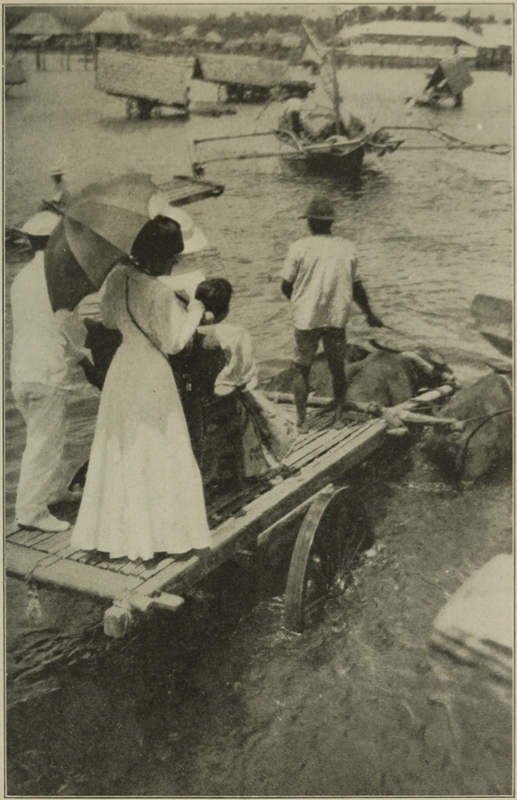 LANDING AT TOBACO.
Our landing at Tobaco was made in the most
novel way. As the water was shallow and the
Rizal could not get into the dock, three carabaos
hitched to a wagon waded out till only their
noses could be seen; we stepped on to the two-wheeled
cart and sat in state on chairs while
we wiggle-waggled through the water to the
shore. There we went to the town hall and
had a banquet with many brown men and a few
little brown women. The governor of the province
spoke, and General Bandholtz responded
in Spanish for the Secretary, who had gone
ahead to close a government coal mine that was
not proving successful. After the banquet we
had an enchanting automobile ride, through
quaint villages at the foot of the great
mountain to Albay, where a review of the
scouts was held by the Secretary in the setting
sun.
When our party dispersed for dinner L. and
I were "farmed out" to the superintendent
of schools, Mr. Calkins. The houses built for
Americans were all of wood with broad piazzas,
much like summer cottages at home, with the
hall in which we dined in the center and the bedrooms
leading off it.
So much has been written about the schools
and the wonders in education in the Philippines
that I shall not try to enlarge on this interesting
theme, other than to add my tribute to the
government and the teachers, and also to the
people who are wise enough to take advantage
of the opportunities offered. Each little Juan
and Maria, with their desire to learn, may soon
put to shame little John and Mary, if the latter
are not careful.
"It has not been a fad with them, as we
feared it would be," one of the teachers told
me; "they have stuck to it. Many grown-ups
in the family make real sacrifices to keep their
juniors in school. My little Filipina dressmaker
is educating all her sister's children and
sending her brother to the law school. At first,
too, we feared there would only be a desire to
learn English and the higher branches, but
with a very little urging they are learning
domestic science and the trades, showing that
they have a mind for practical matters after
all."
I begged her to tell me more about the natives,
since she understood the people so well, and
what she said is worth repeating.
"Even in his grief the Filipino is a cheerful
creature," she began; "curiously enough, too,
a death in the family is an occasion for general
and prolonged festivities. An orchestra is
hired for as many days as the wealth of the
family permits, and a banquet is spread continuously
at which all are welcome, even
former enemies of the deceased. Strangers
from the street can come; I've often wondered
if the beggars imposed on this custom, but there
are very few of them, and they seem to respect
it. The music drones on day after day. Sometimes
only one instrument will be left, the other
players going out to smoke, or eat, or rest; but
they reassemble from time to time and keep it
going. There is always much dancing, for the
natives are great dancers and were not the last
to learn the one-step and hesitation. Even in
their heel-less slippers they are very graceful.
Of course masses are said, for they firmly
believe that these will take their departed to
heaven. With this belief they are so happy,
knowing the dear one is better off in heaven
than here, that Chopin's funeral march is
quickly turned into waltz time, and the fiesta
waxes merry!
"In Spanish times each district had its band,
which always played at the church festivals.
Each church had its patron saint, and there was
always a saint's day fiesta going on in some
district. In the churchyard booths were spread
as at our country fairs. Everything from toys
to all kinds of chance games, of which they are
so fond, was sold. The band played continuously
and the people came in crowds. The
Americans have catered to this spirit in the
yearly carnival which is given every February.
This carnival is more than a fiesta, though, for
it is also an exhibition of their produce and
handiwork. Their hats have always been famous,
as has their needlework, and under American
encouragement the basket-work exhibit has
become one of the finest in the world. Some
hemp baskets, woven in colours, look as if they
were made of lustrous silk. I can't say which I
like best, the finest of our Alaskan Indian, or
Apache, or Filipino baskets. Their shell work
is lovely, too, and their buttons are coming into
the world's market for the first time.
"The Filipinos are also learning at the School
of Arts and Trades to carve their magnificent
woods most skilfully, and are making furniture
which will soon be coming to the States.
In the early days a few Chinamen had the
monopoly of furniture carving and making.
They copied the very ornate pieces brought to
Manila by the Spaniards from Spain and
France in the native mahogany called nara, and
in a harder and very beautiful wood called acle,
or in a still harder one known as camagon, a
native ebony. American women soon began to
search the second-hand stores and pawn shops
for the originals, and had them polished and
restored at Bilibid Prison. The expense, considering,
was small. A single-piece-top dining
table of solid mahogany is often nearly eight
feet in diameter and two or three inches
thick."
Another of the teachers told me something of
her experiences in the early days, when she went
out with her father, who was one of the first
American army officers there.
"When we landed we lived in an old Spanish
palace," she said, "which of course we proceeded
to clean. That was the first thing all
Americans did on landing. We took eleven
army dump-cart loads from the palace of every
kind of dirt conceivable. Then we began washing
windows and mirrors and lamps, which I
am sure had never been touched with water
before. The servants were so amazed that they
were of very little use. They were mostly
Chinese, and had never seen white women work
before. The sight of such energy staggered
them. Just when we got things running
smoothly, father was called home, and our
cleaned house fell to his successor's wife, who
wept and said she had never been put in such
a dirty place.
"It was after this that my real adventures
began. Father McKimmon was opening public
schools, and wanted English taught. So he
went among the army girls and just begged us
to give up a few of our good times and do some
of this work. I didn't see how I could teach
people when I didn't know their language, but
he explained how simple it would be, and we
could learn Spanish at the same time.
"It was fun to work with the Spanish nuns.
They were so interested in us, and their quaint,
old-fashioned methods with the children amused
me constantly. Arms were always folded when
they rose to recite, and it was always 'Servidor
de usted'—at your service—before they could
sit down. The nuns soon became pupils of ours,
too. When the Spanish prisoners liberated by
our men from the Filipinos were brought to
Manila they were quartered in our school for
a hospital. I never saw such starved wrecks.
Many of them—young men—had no teeth left.
"More Americans were arriving on every
transport, and a most delightful society was
forming of army and navy people, government
officials, and naval officers of every nation, in addition
to the original Spanish population and
the small colonies of many countries. There
were parties of all kinds, and as we trained our
cooks into our own ways we ventured on dinner
parties. I shall never forget the first dinner I
went to that was cooked in Spanish style.
There was every kind of wine I ever heard of,
but no water. I wanted some, but it was not
to be had. My host apologized for not having
provided any, but no one dared drink the city
supply. We sat down to table at nine and rose
at twelve, and when the men joined us at one
they were all much amazed that I made the move
to go home.
"I left Manila to visit my brother in the
provinces. Traveling in those days was very
different from what it is now. After leaving
the Manila-Dagupan Railroad there were no
motors to go up the mountain; instead of that,
I rode an ancient American horse till I was
tired and burning with the sun. Then my
brother put me in a bull cart, and I sat on the
floor of that till the sun was preferable to the
bumping. I arrived at four in the afternoon
and was put down in an empty room with my
trunk and a packing box. Being a good army
girl, that packing box had all the elements of
comfort, but first there was cleaning to be done.
My brother was the commanding officer in that
town, his house being at the corner of the Plaza,
and an outpost. So he sent me a police party—that
is, ten native prisoners and an American
sentry; they were armed with brooms and
buckets. I said, 'Sentry, this room is very
dirty. The Captain sent these men here to
clean it for me.' 'Yes, mam,' said the sentry.
'Well,' I told him, 'I want the ceiling cleaned
first, even the corners!' He turned to his gentle
prisoners with 'Here, hombres, you shinny
up that pole and limpia those corners!' He
didn't know much Spanish, but limpia means
clean, and is the one essential word. I soon unpacked
my box and turned it into an organdie-draped
dressing table, after out of it had come
all that made the room livable.
"That night I was sleeping the sleep of the
very tired when I was awakened by a blood-curdling
shout, a gun was thrown to the floor,
and a man's voice yelled for help. I simply
froze—I couldn't move hand or foot. The voice
was in the outpost guard room, just under my
own. Of course, I was sure the whole guard
was overpowered and being boloed. I waited
for them to come to me as I lay there. Then
I heard a man's voice call from an upstairs
window, 'What's the matter down there?'
and the answer, 'Number Four had a nightmare,
sir—thought there was a goat on his
bunk.' Just as I was going to sleep again I
threw out my hand in my restlessness, and to
my horror, clasped it round a cold, shiny boa-constrictor.
Every large house has one in the
garret to keep down the rats. This time I gave
the scream and sprang out of bed. But no
snake was to be found, and I decided it must
have been the bed post. But what a night that
was!"
We reëmbarked at Legaspi and sailed on to
the island of Samar, which is in the typhoon
belt. Catbalogan is a town which has been visited
by very severe typhoons and terrible
plagues, but by very few people. It is a small
place, far away and forgotten, but the island
of Samar is where the massacre of the Ninth Infantry
occurred—the massacre at Balangiga by
the natives in 1902. There were triumphal
arches of bamboo and flowers, and speeches in
the town hall, Governor Forbes speaking in both
English and Spanish. Afterward eight small
boys and girls dressed in red, white and blue
danced for us enchantingly the Charcca and the
Jota, clicking their little heels and snapping
their little fingers in true Spanish style. Delicious
sweetmeats were offered on the veranda,
real native dishes, and we drank cocoanut milk
and ate cocoanut candy, preserves, nuts and
cakes. Two half-Chinese girls who spoke English
took very good care of us.
As we left we looked out over the sea to the
setting sun and watched a lonely fisherman
standing on a rock throwing his net.
Next morning from the Rizal, we saw across
a stretch of calm water the blue ranges of the
mountains of Bohol. Native bancas glided silently
about, and a straw-sailed boat drifted
idly round the point, where the picturesque gray
walls of the oldest Spanish fort in the Philippines
stood guard. Its sentinel houses at the
corners were all moss grown, and pretty pink
flowers were breaking out of the crevices of the
rocks.
We landed at Cebu, which is the oldest town
in the Islands, and passed down a street
lined with ancient houses whose second stories
arcaded the sidewalk. They were all in good
condition, in spite of their age, for they were
built of the wonderful hard woods that last forever.
In fact, Cebu has the look of a new and
prosperous place, for there have been fires
which burnt up many of the ramshackle houses
and gave a chance to widen the streets and replace
the old structures with permanent looking
buildings. The American government has
done wonders in deepening the harbour and
building a sea wall, behind which concrete warehouses
are going up.
There was a scramble to a review near the
barracks, then another scramble to a reception
at the house of the colonel commanding—a very
nice but hot occasion—and then still another
scramble to the dedication of a really excellent
schoolhouse.
A young priest took us to see the famous
idol, the small black infant Christ. We went
to the convent of the Dominicans near the
church, and passed through its pretty, unkempt
court, up a staircase with treads and handrail
richly carved in a wood which was hard as iron,
and black with age. It was handsome work,
such as we had been looking for and hadn't seen
before. In the sacristy, too, and the robing
room, there were screens and paneling with
richly detailed carvings. Passing down the galleries
of the convent, where we could see some
of the friars at work, we entered the special
chapel where this holy image is kept. Several
doors were taken off a rather gaudily gilded
altar, until at last the little figure was revealed.
Its back was toward the room and it had to be
carefully turned—a small, brown, wooden doll,
all dressed in cloth of gold, and bejeweled like
the Bambino of Rome. It is considered a most
sacred and wonderful heaven-sent idol.[25]
As we had heard speeches by Filipinos and
head hunters, I was curious to know what the
Chinese would have to say, and that night there
was an opportunity to find out, for we were
invited to a dinner given by the Chinese merchants.
I quote from the speech made by Mr.
Alfonso Zarata Sy Cip, which was specially
interesting:
"The Chinese have traded with these Islands
since long before Confucius and Mencius,"
said Mr. Sy Cip; "and for centuries we have
been coming here and assimilating with the
Filipinos, and to-day we are deeply interested
in the welfare of the country. The Chinese
have been called a nation of traders, the Jews
of the East, but we are more than traders. We
are labourers, artisans, farmers, manufacturers,
and producers.
"A very large percentage of the growth and
development of the commerce and material interests
of the Islands is due to the efforts of
our countrymen.
"The infusion of Chinese blood has strengthened
and improved the Filipino people.
"Chinese labour is recognized all over the
world as the best cheap labour in existence.
Since American occupation of these Islands you
have excluded our labour from entering.
Why? Not for the reason that it would tend
to lower the standard of living among Filipino
labourers, because the standard of living among
Chinese labourers in the Philippines is higher
than among the Filipino labourers. Hence the
introduction of Chinese labourers would tend
rather to improve conditions in this regard.
You do not exclude him for the reason that
he works for lower wages than the labourers
of the country, because, on the contrary, the
Chinese labourer in the Philippines receives
higher wages than the native labourer, hence the
introduction of Chinese labourers would tend
rather to improve the condition of the native
labourers as far as wages are concerned. You
do not exclude him for the reason that he will
not become assimilated with the natives of the
country, because centuries of experience have
shown that Filipinos and Chinese do assimilate
and readily amalgamate, and the result, as
I have already said, is an improvement of the
Filipino people. If you are excluding Chinese
labourers from the Philippines because of political
reasons then I confess such reasons, if
they exist, have been carefully guarded as secrets
from the public.
"Lack of room is not a reason for excluding
Chinese labourers, nor is lack of need for their
services. In the great island of Mindanao
alone it is doubtful if five per cent of the tillable
land is under cultivation, and in other places
it is the same. A large part of the rice consumed
in these Islands is imported from other
countries, yet we have here the finest tropical
climate in the world and the most productive
soil. Let a sufficient number of Chinese labourers
come into the Philippines and we will guarantee
that in ten years we will be sending rice to
the gates of Pekin and Tokyo."
Toward night we sailed on the Rizal from
Cebu for the land of the Moros. Out in the Sulu
Sea, one felt very near heaven when the sky
turned hazy gray in the afterglow, and the distant
islands mauve, only their peaks flaming like
volcanoes from the hidden sun. Then the big
stars came out, like Japanese lanterns, and
left a comet-like trail upon the dancing waters.
From their holes below the cabin boys, Ah
Sing and Sing Song, would pop out like slim
white mice with their long black pigtails, with
little cot beds tucked under their arms which
they would place in rows upon the deck. Ah
Sing would say, "Cheih ko koe" (that will do),
and Sing Song would answer, "Hsiao hsin" (be
careful). Later, when the moon rose out of the
sea and the Southern Cross appeared on the
horizon, shadowy forms glided silently up the
companionway. But the silence did not last.
Some one would call to Sing Song in pidgin
English:
"Boy! go catchy whiskey, Tansan; top side,
talky man little more fat!" And some one else
would say to Ah Sing,
"You fool boy, you catchy me one bath."
Ah Sing seemed to understand. He would
wag his head and answer, "You good man, no
talky all the time, makey me sick." And he
would disappear.
At sight of a tall, genial man, the people in
their cots would sing out, "Doctor Heiser's a
friend of mine, a friend of mine, a friend of
mine," etc. American judges, and Filipino
congressmen and generals were of the company.
Occasionally a whisper, very often a giggle,
sometimes a clinking of glasses, and good night
kisses, were heard, and then the sand man closed
our eyes.
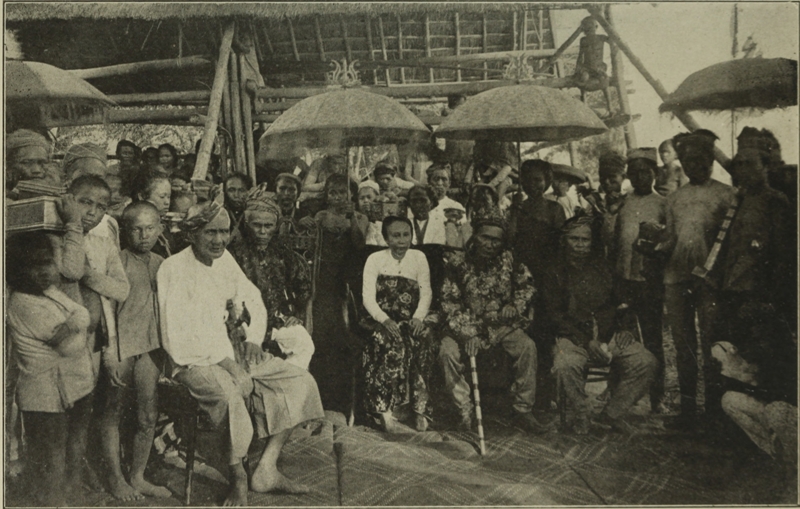 A MORO DATO AND HIS WIFE, WITH A RETINUE OF ATTENDANTS.

n reaching Mindanao, the land of the
Moros, we went ashore at Camp Overton,
where we were met by army officers and
dougherties drawn by teams of six mules.
After a hand-shake at the commanding officer's
home, we were furnished with a big escort of
cavalry and started climbing up, up, among the
hills. Soldiers were hidden in the tall grass
all along the way to make sure that nothing
would happen to "the great White Sultan with
the big Red Flag," as the Moros called the Secretary.
Army men could not go out alone, even
in those days, for they were attacked by bands
and killed, principally to get their weapons,
which the Moros were very keen to possess.
The datos, the head men of the Moro tribes,
were allowed to have guns, but none of the other
natives. A storm came up, however, not long
ago on Lake Lanao, at Camp Keithley, and for
fear that his boat would upset, General Wood
had a great deal of ammunition thrown overboard,
which, it was discovered, was subsequently
fished up by the natives.
The Moros are Mohammedan Malays. They
came in their boats from islands further south,
and in 1380 were converted to Islam by an
Arab wise man, Makadum,[26] who made his way
to Sulu and Mindanao.
One hears then of Raja Baginda, who came
from Sumatra in 1450; his daughter married
Abu Bahr, the law giver, who established the
Mohammedan Church and, after his father-in-law's
death, became sultan and founded a dynasty.
In the old days the Moros were all pirates
and slave traders. Both Spanish and
American authorities have tried to suppress
slavery, but it still exists. It is said a woman
will bring about forty pesos.
A dato's slaves to-day are well treated, and
form part of the family. A slave, moreover,
has a chance to rise in the social scale, for Piang,
whom we met, was once a slave, but became
a powerful chief and a friend of the Americans.
The ruler of all the Moros is the Sultan of
Sulu, whom we did not see because he was in
Europe at the time we were in the Islands.
It is said that a few years ago he would sometimes
appear in the market on the back of a
slave, with an umbrella held over his head.
Here he would stay while the people kissed his
hands and feet. He may have changed his customs
since his trip.
Dampier, who visited the northern islands of
the Philippines, has also left us notes of his
stay on Mindanao, which are still true in the
main. He says:
"The island of Mindanao is divided into
small states, governed by hostile sultans, the
governor of Mindanao being the most powerful.
The city of Mindanao stood on the banks
of the river, about two miles from the sea. It
was about a mile in length, and winded with
the curve of the river. The houses were built
on posts from fourteen to twenty feet high, and
in the rainy season looked as if built on a lake,
the natives going their different ways in
canoes. The houses are of one story, divided
into several rooms, and entered by a ladder
or stair placed outside. The roofing consists
of palm or palmetto leaves.... The floors
of the habitations are of wicker-work or
bamboo.
"A singular custom, but which facilitated
intercourse with the natives and vice versa, was
of exchanging names and forming comradeship
with a native, whose house was thenceforth considered
the home of the stranger."
Alimund Din's name stands out in this meager
Moro history beyond all others, for he was the
first and only Christian ruler in this land.
Even before he became a Christian he was a reformer,
and suppressed piracy. He not only
coined money but had both an army and a navy,
and lived in such splendour as probably has not
existed since those days, among the Moros.
Alimund Din ruled about the middle of the
eighteenth century, in the time of Philip V of
Spain. In return for ammunition to enable the
Spanish to keep down piracy, he allowed the
Jesuit fathers to enter his country. In time,
however, they caused trouble among the Moros,
and civil war broke out, as Bautilan, a relative
of Alimund Din's, preferred the Mohammedan
religion to the new ideas of the Jesuits. Alimund
Din and his followers took flight in boats,
and in time reached Manila, where they interceded
for Spanish protection. The Spaniards
showered him with presents, gave him a royal
entrance into the city, and finally converted him
to Christianity. Later, he was sent back, escorted
by Spanish ships, but Bautilan's fleet attacked
them. As the Spaniards suspected
Alimund Din of becoming a Christian not
entirely for Christianity's sake, they threw him
into prison. The throne was restored to him in
1763 by the English, who occupied this part of
the island for a short time.
 A MORO GRAVE.
The Moros are not supposed to eat meat or
drink wine, although they have been known to
drink whiskey and soda with Americans, as well
as eat pork and beans on occasions. There
are no mosques in this region or holy dancing-girls
(who can do no wrong) but there are
Moro priests or panditas who go from house to
house. They have little education, but some of
them have traveled. It is the custom for a relative
of the deceased to watch and protect a Moro
grave for many months. Such a mourner can
sometimes be seen squatting near by under a
yellow umbrella. The Moros have as many
wives as they can afford, but not more than they
can afford, for it is an insult to speak of a man's
wife as "begging bread."
The Moros are smaller than the East Indian
Mohammedans, but are strong and slight, and
have fine features. They appear especially
cruel and determined because their teeth are
black from buyo. In war time, many of the
women fought beside the men, and it is supposed
to be they who mutilated the Americans
found dead on the field after battle. The people
whom we met on the road with their ponies
loaded with hemp seldom smiled and did not
bow, but they looked us straight in the eye, and
there was no touch of sulkiness about them.
It is very difficult to distinguish the men from
the women, as they dress much alike. But you
see few of the latter on the road, for being Mohammedans,
most of them are kept at home.
They are not veiled like other Moslem women,
except when first married.
The costumes of the Moros differ to such a
degree—and for no reason that I could discover—that
it is difficult to describe them. Many
wear tight trousers, which are something like
those of the Spaniards—so tight that they are
sewn on the men and never come off until worn
out—and are often bright red or yellow in
colour. On the other hand, some wear very
loose, baggy trousers or skirts of different
shades. Indeed, they are the most gaily
dressed people I have ever seen, and their brown
skins set off the vivid yellows and greens and
reds and magentas and purples of which their
trousers and jackets and turbans and handkerchiefs
are made. The jackets have a Chinese
appearance. The turbans might be old Aunt
Dinah's of the South. The sashes, which are
woven in the Moro houses, are of silk, bright
green and dark red being the predominant
colours. They are knotted on one side, generally
a kriss or a bolo being held in the knot,
and are tied about the waist so tightly that the
men look almost laced, and perhaps that accounts
for their womanish appearance.
When the American army first occupied this
region they treated the Moros well and found
them friendly. Take for instance Zamboanga
in the south, an especially interesting region.
When the American soldiers entered, the Spanish
guard left the garrison, and the Spanish
population and the priests followed. The
Americans found outside the town gates a large
barbed wire bird cage, where the Moros had
been compelled to leave their arms before entering
the town at night, to avoid an uprising.
The government of Zamboanga at this time was
reorganized by the American officers. A Filipino
presidente was appointed, a dato to head
the Moros, and a Captain Chinese, as he was
called, to manage his people, who were mostly
merchants and pearl fishers.
Mindanao was under a military-civil government
that worked wonders, for in a few years
many of the Moros were brought under control,
and they became loyal Americans, although they
had always been bitter enemies of the Filipinos
and the Spaniards. They say they have found
the Americans brave, and have not been lied to
by them, and so they seek our protection. Although
the Moro and the head-hunter are so different,
they are alike in one respect—if they care
for an official and have confidence in him they
do not want him changed. It is the man they
are willing to obey rather than the government.
Of course, there are thousands of them, fierce as
ever, back in the mountains, and they are still
fanatic and wild. Even among those who are
under control, the greatest care has to be exercised,
for they have the hatred of the Christian
deep in their hearts, and they may run amuck
at any moment and kill till they are killed; but
this is a part of their faith, they ask no quarter,
and nothing stops them but death.
Besides the danger of their attack by religious
mania they have a great desire for rifles,
as I have said, and they are always "jumping"
the constabulary, attacking small parties
suddenly from ambush and cutting them down
with their knives, or killing sentries; so that
constant care has to be used, and the sentinels
walk at night in twos, almost back to back, so
as to have eyes on all sides. A few weeks before
we arrived there had been several cases of
"jumping."
An American army officer told me the fights
with the Moros generally occurred on the trails
among the hills; as the foliage is so thick, it is
easy for the natives to conceal themselves on
either side, sometimes in ditches, and give the
Americans a surprise. For this reason, a drill
was found necessary for single file fighting.
Every other soldier was taught to respond to
the order of one and two. When an attack
was made, the "ones" shot to the right, the
"twos" to the left. This proved successful.
The same officer said the Moros would often use
decoys to lead the troops astray. Seeing fresh
tracks, they would hasten on in pursuit, and
be led away from their supplies, while their
enemy would be left behind to attack them in
the rear. Walking on the mountain trails was
very hard on the soldiers' shoes, and on one of
these expeditions their boots gave out, so they
were obliged to make soles for their shoes
out of boxes and tie them on with leather
straps.
Up, up we drove; the clatter of the cavalry
could be heard in front and behind, and the
dougherty, how it did rattle! It was a pretty
sight to see the party traveling through the tropical
forests and winding across the green uplands,
with their pennons and the Secretary's
red flag (which made a great impression on the
natives, we heard), and the wagons rumbling
along, with a rearguard behind and the scouts
in the distance. John, the coloured man,
snapped his whip, and the mules trotted along,
and the air became cooler, and we drove over
a plain where real mountain rice was planted.
Occasionally a Moro shack could be seen in the
distance.
At an outpost, where we stopped to change
mules, we saw a beautiful waterfall, perhaps
the loveliest that I had ever seen, called Santa
Maria Cristina. From a greater height than
Niagara it plunged down into a deep valley of
giant trees. It reminded me of a superb waterfall
near Seattle.
At last we reached Camp Keithley, on the
mountain plain, a forlorn lot of unpainted
houses with tin roofs and piazzas, but beautifully
situated, like some station in the Himalayas.
There was splendid mountain scenery
disappearing into the distances, and views of
the ocean far away, and, on the other side, the
great lake of Lanao, an inland sea more than
two thousand feet above the ocean, with imposing
ranges about. This lake, which has always
been the center of Moro life, is surrounded by
native villages, and the military post is important
and much liked by the officers quartered
there.
The Secretary, my husband and I were billeted
on Major Beacom, the commanding officer—Mrs.
Dickinson had not felt quite equal
to the trip. The Major's house was very attractive,
and his little German housekeeper gave
us excellent food and made the orderlies fly
about for our comfort.
We went almost at once to the market place,
which was intensely interesting. The gorgeous
colours and gold buttons of the costumes were
magnificent. Brass bowls for chow were for
sale, and betel-nut boxes inlaid with silver, and
round silver ones with instruments attached
to clean the ears and nose. There are four
compartments in these betel-nut boxes—for
lime, tobacco, the betel nut, and a leaf in which
to wrap the mixture called buyo.
Here we saw the spear and shield dance.
The dancer had a headdress that covered his
forehead and ears, making him look quite
ridiculous, absolutely as though he were on the
comic opera stage. With shield and spear he
danced as swiftly and silently as a cat, creeping
and springing until your blood ran cold,
especially as you knew he had killed many a
man.
In the afternoon, after reviewing the troops
and inspecting the quarters, we crossed a corner
of the lake and landed at a Moro village.
It was raining hard and the mud was deep. We
waded through a street, followed by the people
in their best clothes—one in a black velvet suit,
another in a violet velvet jacket. I saw only
two women in the streets; they were not veiled
nor brilliantly dressed, but had red painted lips
and henna on their nails. The Moro constabulary
here wore red fezzes and khaki, and the
officer in command at the time was of German
birth.
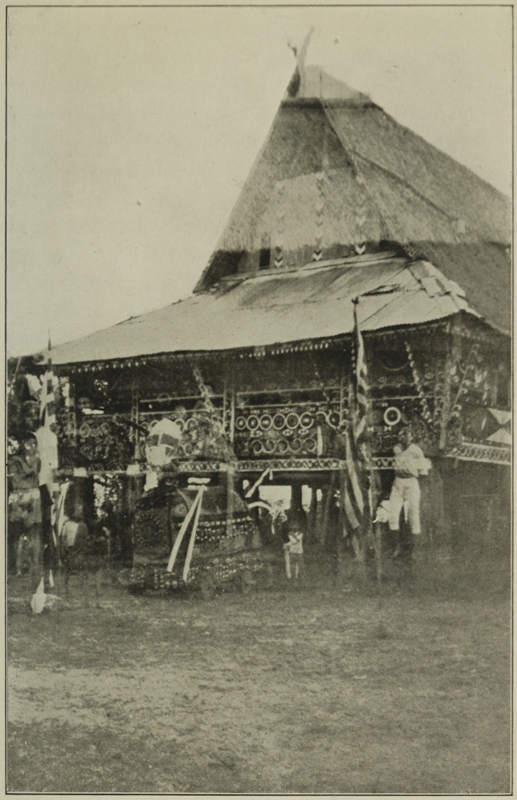 A MORO DATO'S HOUSE.
After we had passed through a bamboo trail,
we came into a little open place with three fine
Moro houses about, set up above the ground on
great posts made of tree trunks. Unlike Filipino
houses, they had façades all carved in a
rough and handsome sort of arabesque, painted
in bright reds and blues, and with pointed roofs
and coloured cloths fluttering out of the open
spaces, they made fine effects. The long cracks
in the walls served as peepholes, where the snapping
black eyes of the many wives of the datos
were peering out at us. In front, in the little
green space, pennons were planted and there
was a huge Chinese-looking sea serpent, or
dragon, on wheels, with a body of gaily coloured
stuffs, and a rearing movable head. This cavorted
about in time to the endless noise of the
tom-toms. A crowd of natives stood round in
their fanciful raiment.
Into one of these houses we were invited.
We mounted the ladder to the one large room
in the front, into which the sliding panel shutters
admitted the air freely, so that it was cool
and shaded. Here sat the wives and the slaves
in a corner, playing on a long wooden instrument
with brass pans, which they struck, producing
high and low sounds, with a little more
tune than the Igorots. The big room was bare,
except for a long shelf on which was some woven
cloth and a fine collection of the native brass
work, for this is the center of the brass-workers.
We moved on through the little town of nipa
houses to visit old Dato Manilibang, whose
house was not as fine as those we had seen before,
but where we were admitted into two
rooms. From the entrance we streaked muddy
feet across the bamboo-slatted floor into his reception
room, where a sort of divan occupied
one side—on which the Secretary was asked to
sit. Behind this cushioned seat were piled the
boxes with the chief's possessions, and here he
sits in state in the daytime and sleeps at night.
The women, who were huddled together on one
side of the room, wore bracelets and rings, and
one was rather pretty.
At dawn we were up and off again. What a
day! We had two hours on a boat crossing a
lovely lake, surrounded by mountains, on the
shore of which some of the wildest Moros live.
Our boat was a big launch, a sort of gunboat,
which, strangely enough, the Spaniards had
brought up here and sunk in the lake when the
war came on, we were told, and which had been
resurrected successfully. It was a steep climb
up the opposite side of the lake, but most of
us scrambled up on horses, till we topped the
ridge and came to Camp Vickers, a station with
fine air and outlook but rather small and pathetic.
The picturesque Moros had gathered here to
greet the Secretary, and their wail of welcome
was something strange and weird. A dato
would come swinging by, followed in single file
by his betel-box carrier, chow bearer and slaves.
Some of the chiefs rode scraggly ponies, on high
saddles, with their big toes in stirrups of cord
almost up under their chins, and with bells on
the harness that rattled gaily. And, of course,
the tom-toms kept up their endless music.
We had two more hours of horseback riding—we
hoped to see a boar hunt, but owing to
some misunderstanding, it did not come off.
Then, after a stand-up luncheon at Major
Brown's, we started down the trail again in a
dougherty.
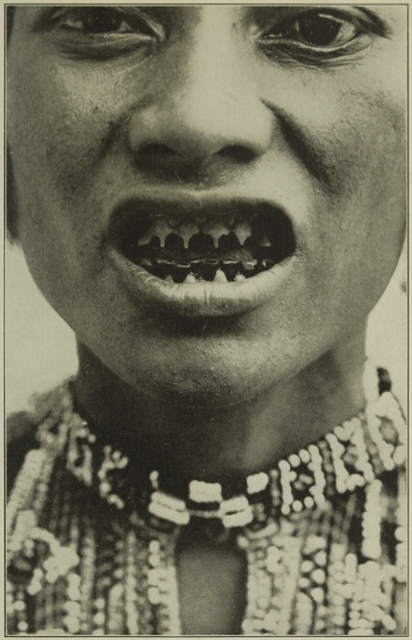 BAGOBO MAN WITH POINTED TEETH.
It was a beautiful drive through this forest
on the island of Mindanao. We first crossed
open grassy uplands, then dipped down through
the great glades of the most tropical forest
I have ever seen, with towering hard woods
and tree ferns, with bamboos and clinging air
plants and orchids, and there was mystery and
wonder about the giant growths. The trees
seemed taller than the elms of New England
or the cedars of Oregon. They dripped with
huge-leaved, clinging vines, which grew higgledy-piggledy,
covering everything. The
grass, too, with waving purple tassels, grew
higher than a man's head, twice as high as the
pigmy brown people who have their houses in
these trees.
The tree-dwellers just referred to are the
Manobos and the Bagobos with pointed teeth—for
Mindanao is not entirely inhabited by
Moros; there are supposed to be no less than
twenty-four tribes on this island alone. They
build in trees, to escape the spear thrusts of
their neighbours through the bamboo floors.
We were to make their acquaintance later.
A drenching rain came on that afternoon,
through which the escort jogged along, while we
clung in our dougherties, nearly shaken to
pieces, and reached Malabang, on the other side
of the island, as much fatigued as if we had been
on horseback all the way. The military post
here was most attractive, with the prettiest of
nipa houses for the officers, and the parade
lined with shading palms, and flower-bordered
walks—a charming station. We were quartered
with Lieutenant Barry and his wife, a
delightful young couple, in their thatched house,
and dined with Major Sargent, the commanding
officer, who has written some good books on military
topics.
The Celebes Sea was calm and lovely when we
left Malabang. We passed along the coast of
Mindanao toward a long lowland that lay between
the high mountains of the island. This
was the plain of the Cotobato, a great river
which overflows its banks annually like the Nile
and has formed a fertile valley that could be
turned to good account. The mouth of the river
is shallow, so that we were transferred to a
stern-wheel boat that was waiting, and began to
work our way up, against the rapid current, past
low, uninteresting banks that were proving
rather monotonous, when suddenly we turned a
point and saw the town of Cotobato.
The Moros and the other tribes were in their
full splendour here. Soon, down this tropical
river, where crocodiles dozed and monkeys chattered
and paroquets shrieked, there came a flotilla
from the Arabian Nights, manned by galley
slaves. On the masts and poles of one of the
barges floated banners, and under the canopy
of green sat a real Princess. Some of the boats
were only dugouts with outriggers, but they
were decorated, too, and all the tribes were
dressed in silks and velvets of the brightest
colours.
There was great excitement and much cheering
as we approached the landing stage, and the
troops stood at attention, while the rest of the
shore was alive with the throng of natives in
all the colours of the rainbow. The Secretary
inspected the troops, and we saw for the first
time the Moro constabulary, wearing turbans
and sashes, but with bare legs; nevertheless,
they looked very dashing. Indeed, the Moros
were so different in character and appearance
from any people we had seen before that they
might as well have come down from the stars.
The Secretary was taken to meet the datos,
as they stood in line beneath the great trees,
with the motley crowds of retainers behind
them, in such a medley of colours as I had
never imagined before. The sunlight filtered
through the trees upon the barbaric costumes,
while the gaily dressed women stood behind
the men and peered over them. The brown
men looked dignified and very self-respecting,
too, although the scene was like the setting of
a comic opera, where the imagination had been
allowed to run riot.
There we saw Dato Piang and Gimbungen,
a very fat dato—what a delightful bug-a-boo
name—also Ynock, whose ear had been cut
off in a fight, we were told; but strange as it
may seem, he said he had clapped it onto his
face again and tied it on, and it had grown
there. So it hung attached somewhere down
on his cheek, and gave him a very peculiar appearance.
When the Moros conquered the Filipinos,
this dato had the captured women
stripped and made to walk before him, and then
took them off to the mountains. When he was
taken prisoner later by the Filipinos, he was
compelled to work in chains in the streets.
Under a canopy the Princess received us, a
native woman whose descent was traced for
many hundreds of years—said to be a pure
Moro, although she looked rather Chinese—and
who was recognized as of the highest social
superiority, but had little political power. She
herself was draped in varied colours, while her
chamberlain wore a brocade coat of crimson and
gold cloth. Behind her stood her maids bearing
the gold betel-nut boxes and chow trays and umbrellas
of her rank.
Our luncheon with the commanding officer,
Major Heiberg, and his wife, was eaten in delightful
little kiosks of nipa and bamboo, which
had been built in a small palm grove. The
dancing girls of the Princess, who had long nails
protected by silver covers, gave us a performance
afterward. Curiously enough, their dance
was very Japanese in character. Then some
Manobos, picturesque in short, skin-tight trousers
and bolero jackets, with bags and boxes
beautifully worked in bright beads, danced a
graceful, monotonous step. The women have
a swaying, snake-like dance with waving arms
and jingling of bracelets and "hiplets," if I
may be allowed to coin the word.
At last, after so many adventures, we found
ourselves again on board the Rizal. An enchanting
spot on this boat was a projection
over the bow, on which one could sit curled up
high above the water. On this perch we felt
like the red-winged sea gulls that circled far
above us. We passed over a sea of polished
jade, which at night shone with phosphorescence
like gleaming silver.
Next morning, August 23d, we approached
Zamboanga. Five American ships, all decorated,
came steaming out to meet us and fell
in behind in order, making a lovely sight on
the bright, smooth seas. As we neared the
town, we suddenly saw a large flotilla of native
boats, with tom-toms beating and thousands of
flags fluttering—such a gay sight! Banners of
all shapes, streaming and flapping and waving,
and such colours and combinations of colours—stripes
of green and purple and orange in designs
of lemon and red and magenta, serpentine
flags and square ones, hung in all sorts of
ways, and brightly coloured canopies under
which sat the sultans, and green umbrellas and
yellow and—bang! off went their small lantankas,
tiny native-made cannon—a most exciting
reception!
We landed under triumphal arches and were
driven in state carriages through lines of school
children, who sang and threw us flowers from
old Spanish gardens. The post was really
beautiful, for it had much left from old Spanish
times, and what had been done over had been
done with taste. The green parade had a terraced
canal passing through it, and avenues of
palm; the officers' quarters, smothered in
flowering plants and fronting out over the glittering
blue sea, were large and airy and finer
than any we had seen before. It is considered
one of the best posts in the Philippines, and
seemed cool and pleasant.
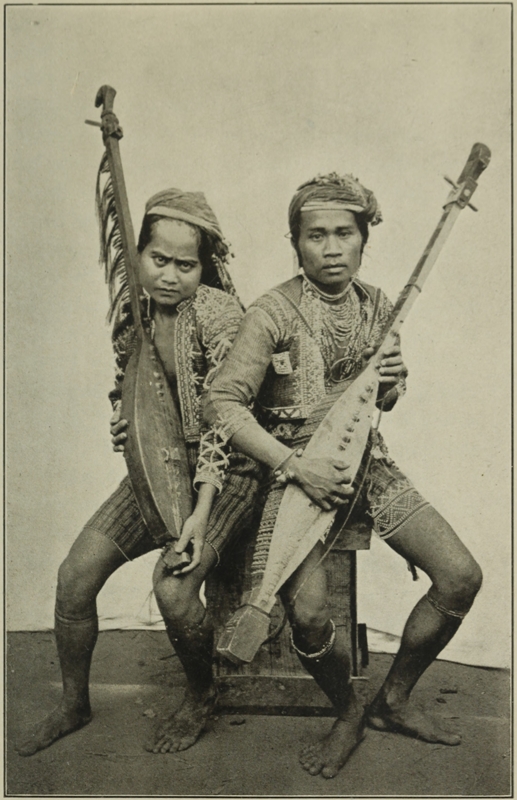 BAGOBOS WITH MUSICAL INSTRUMENTS.
There was the usual procession—first, the
troops of the garrison and the constabulary,
then thousands of visiting Moros, Bagobos and
Manobos, of every colour of skin and clothes,
many of them whooping and leaping, and then
a tiresome following of hundreds of Filipinos,
who had joined in to make a political demonstration.
It is said the Filipinos did not wish
the Moros to take part in the procession.
Exciting times followed at the meeting after
this parade, where both Filipino and Moro
speakers were heard. Said a Filipino, addressing
the Secretary:
"You have just visited our province and have
just learned its conditions; at such places in
it through which you have passed you must
have seen quite a number of Moros, but I believe
that a separation ... could very well be
established, to the end that both people, the
Christian Filipino and the Filipino Moro, might
have the government that corresponds respectively
to each of them, for it is a very regrettable
thing that on account of the presence of
the latter we Christians should be unable to enjoy
the liberties that reason and right would
grant us....
"I think it is my duty to advise you that
the Moros who filed past the grandstand were
brought from remote and distant places with
the exclusive purpose of giving greater éclat
to your reception. Moreover, it must be borne
in mind always, in dealing with the affairs of
this province, that the Moros have no political
influence, possess no property, nor help pay the
expense of the government."
Then Dato Mandi spoke:
"I am here, El Raja Mura Mandi, representing
the Moros. As I look about, I see far
more Moros than the Filipino contingent, and
if that is so, that is the reason it is called the
Moro Province. (Tremendous applause from
the Moros.)
"When first the Americans came here, from
the very beginning, whatever they asked me to
do I did. I was loyal to them ever. Now I
have heard a rumour that we Moros are in the
hands of the Filipinos....
"If the American Government does not want
the Moro Province any more they should give
it back to us. It is a Moro province. It belongs
to us." (Tremendous applause by the
Moros.)
Dato Sacaluran threw down the Moro challenge:
"I am an old man. I do not want any more
trouble. But if it should come to that, that we
shall be given over to the Filipinos, I still would
fight." (Applause.)
But Hadji Nangnui, who spoke of himself as
"a Samal," made the clearest statement of the
Moro position:
"The Secretary of War must look the matter
in the face. We are a different race; we
have a different religion; we are Mohammedans.
And if we should be given over to the
Filipinos, how much more would they treat us
badly, than they treated even the Spanish badly
who were their own mothers and their own fathers
in generations? How did they treat
them? Think about it! Think twice! We far
prefer to be in the hands of the Americans, who
are father and mother to us now, than to be
turned over to another people." (Applause.)
In the evening we dined delightfully at the
Pershings'. After dinner, the Moros danced in
the garden the spear and shield dance, and the
Bagobo women gave the scarf dance. The
Bagobos still offer human sacrifices. Their
caps, if tied in a certain way, show how many
men they have killed. Their dress is made of
cloth which they weave from carefully selected
and dyed fibers of Manila hemp, and it is treated
with wax in such a way as to make it very
smooth and durable. In the glow of the red
light from Chino Charlie's famous lanterns,
their picturesque costumes, gleaming with bead
work, added much to the brilliancy of the scene.
They love music and make some large stringed
instruments. They also play the flute from the
nose, with one nostril stopped up, like the
Hawaiians.
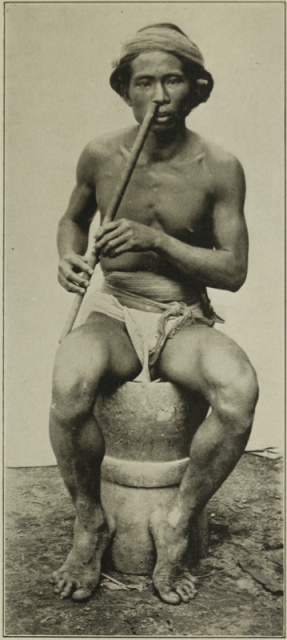 BAGOBO WITH NOSE FLUTE.
The dancing under the palms in the garden,
by the rippling seas, where the moonlight
flooded down radiantly, was quite like a strange
dream.
At this dinner I was told the story given by
Dean Worcester by which the Moros explain
why they do not eat pork:
"Mahamoud had a grandson and a granddaughter....
As he was king of the world,
Christ came to his house to visit him. Mahamoud,
jealous of him, told him to prove his
power by 'divining' what he had in a certain
room, where, in fact, were his grandchildren. Christ
replied that he had no wish to prove his
power, and would not 'divine.' Mahamoud
then vowed that if he did not answer correctly,
he should pay for it with his life. Christ responded,
'You have two animals in there, different
from anything else in the world.' Mahamoud
replied, 'No, you are wrong, and I will
now kill you.' Christ said, 'Look first, and see
for yourself.' Mahamoud opened the door, and
out rushed two hogs, into which Christ had
changed his grandchildren."
Some verses recited at General Pershing's
dinner showed the feeling of army officers about
their life in the Philippines. A stanza runs:
"What is it makes us fret so hard
In this benighted land?
It isn't lack of courage
And it isn't lack of 'sand.'
It isn't fear of Moros
Or Bagobos from the hills—
It's the many great discomforts
And the many, many ills."
It is interesting to read in a recent number
of the Manila Times that Zamboanga, which
seemed so like a picture handed down from
Spanish days, has absorbed a good share of
American progressiveness and is said to stand
in a class by itself among Philippine towns.
Waterworks and a hydro-electric plant are under
construction, the water for which is to be
brought along the mountainside, a part of the
way through tunnels. To dig these, "experienced
Igorot tunnel makers from Benguet were
imported," who are getting along amicably with
the Moros.
At Jolo, or Sulu, we were again greeted by a
Moro fleet and some diving girls and boys.
This seemed the culmination of the picturesque
in our trip. The mountains of the island
are not high but rather cone-shaped, and as
we approached the town we could see behind
it the forested slopes of steep Bud Dajo, where
the great fight took place in 1906 and many
Moros were killed in the crater top of the volcano,
to which they had retreated, and from
which they challenged and threatened the American
forces. It is an island of fierce, piratical
Moros, and even the Americans had not tried
to do much there. It was dangerous to go outside
the little walled town at all, and all the natives
coming in were searched for their weapons,
which were taken away at the gates.
Only a few months before, a fanatic Moro tried
to attack the gate guard, but fortunately was
killed before fatally injuring any one.
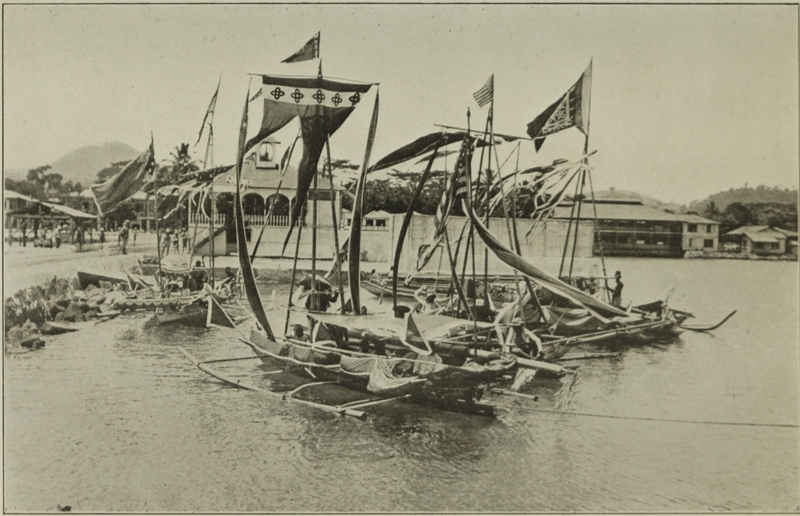 MORO BOATS.
The walled town is a most artistic little Spanish
place, built once upon a time by the exiled
Spanish Governor Asturia, who made it a gem
of a town, with small balustraded plazas and
a hanging-garden sea wall, and a miniature wall
with battlements and gates, and streets set out
with shading trees. The pretty Officers' Club
and quarters overhung the wall. The gates of
the town are closed at night, and all the natives
must leave for their houses outside before the
"retreat," but there is a native market and a
town built out on piles over the water, which we
visited. We drove out to a plain, palm-fringed
and backed by mountains, that overlooked the
sea, where there was a review of the cavalry and
a large company of mounted Moros, who carried
many American flags among their waving
banners. Within the walls, in a grandstand in
the little plaza, where the natives thronged,
there was a meeting between the Secretary and
the chief datos; and the Hadji, who had been
Vizier of the Sultan, made a wise speech, full of
promise of loyalty. Our Governor had won the
good will of the people about him and the Hadji
said that when his people were certain of our
good intentions they would come in willingly
and be loyal—but, for so many years, they had
been misled by previous rulers.
We amused ourselves by going to Chino
Charlie's and buying lanterns, and lunched at
the Officers' Club. Afterward we went out on
the pier inhabited by the Chinese and looked
for pearls—Jolo pearls are famous—but we saw
none of real value. We watched the Chinamen
drying copra, and went through their market,
where water slugs were for sale. Finally, we
sailed across the bay. Our visit to the Moros
was full of colour to the end, for the sun was
setting gorgeously as we put out to sea.

he little coral island of Bancoran lies in
the middle of the Sulu Sea, quite outside
the usual routes of travel. It is inhabited
only by birds, and people seldom or never
go there. But we wanted to obtain, if we could,
some new species of gulls or terns for the
Bureau of Science at Manila, and also to enjoy
the mysterious sea gardens which are
found among the southern reefs. Just after
tiffin the island was sighted, lying quite alone
by itself in milky green water. The ship
stopped and launches were dropped overboard,
and a glass-bottomed boat which had been
brought along for our use.
The afternoon was ideal—the sky blue and
fleeced with snowy clouds piled high, while the
intense sun shining on the water flashed back
a hundred shades of blue and green and mauve.
On one side of the island, which floated like an
emerald among sapphires, outstanding rocks
chafed the seas into foaming surf, while on the
other a long, narrow beach lay shimmering, pale
yellow in the sunlight. The island itself was
covered with a thick jungle of trees, which were
dotted with thousands of resting birds. As we
drew nearer they saw us and were afraid, rising
and soaring and circling in the clear, pure
air, and crying out at us. Flock after flock of
sea fowl flew wonderingly over our small craft,
their white breasts tinted green with the light
reflected from the water.
It was like a Robinson Crusoe island, lost
out there in the lonely sea. But there were
shells of huge turtles, and bones of birds, which
suggested that sometime a feast must have
been held there, so it was not wholly undiscovered
and unexplored. Among the great roots
of the trees the birds had built their nests from
leaves. The eggs in some of them were white
and about the size of hens' eggs. Several varieties
of boobies and terns were found, some
brown with green-blue eyes, others ivory-white.
A few specimens were shot, and one or two
were taken back alive to the Rizal for the museum.
Previous to this visit the ornithologists
had never known to what islands the boobies and
frigate birds came to nest, although the scientists
had long been searching for the place, so
the expedition was well worth while.
But the sea gardens interested me more than
the birds or even the island. If Alice could
have had her choice in entering Wonderland,
she would surely have selected a doorway leading
through a glass-bottomed boat, instead of
dropping down a rabbit's hole. Beneath the
water, which was crystal clear, we could see a
strange country with new flowers and peculiar
creatures. Where it was sandy and shallow
we saw below us fields of green sea grass, on
which the fairies must surely have used lawn-mowers,
it was so neatly kept.
Interspersed among the fields were beds of
feathery, lace-like vegetation unnamed in the
language of our party. Passing one expanse
after another of this submarine pasturage, we
saw depressions in the coral, where tiny fishes
played or unknown water creatures had established
a little world for themselves and were
living in its narrow confines quite unconscious
of what went on in the surrounding vastness.
Drifting on into deeper water, we came to a
ghost-like gray world of curls and feathers,
trembling with life, a forest of pale trees and
swaying brown ones, of high hills and dark valleys,
made by coral reefs. Pretty rock gardens
came into view, where there were cabbages
with blue edges, sea anemones and purple
fans, a huge toadstool, a giant fungus, and
a cactus plant—at least, that is what they
looked like to us. There were rainbow shells,
too, half hidden, and great blue starfish clinging
to the rocks. In and out among the sponges
and the brown coral branches, which were so
much like antlers, swam curious fishes. Such
gorgeous colours—so vivid and in such brilliant
combinations! Some were big green fellows,
with needle noses; others were electric blue and
silver; there were black and yellow ones, too,
and striped fishes that looked like sly prisoners
dodging their keepers.[27]
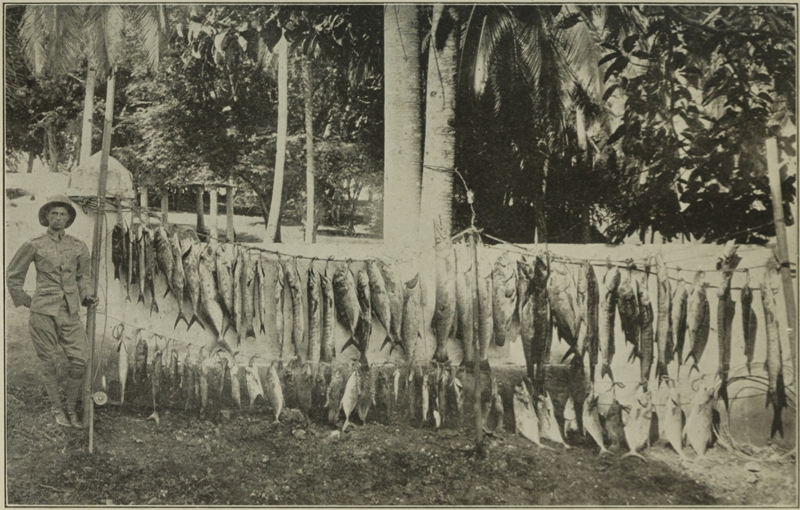 ONE DAY'S CATCH OF FISH.
We passed the greater part of the afternoon
marooned on this far-away island, some of us
going bathing off the shallow, sandy beaches in
the clear water. As evening came on we regretfully
left the fairy island of Bancoran, and
sailed away by the rising moon.
The Penal Colony on Palawan, which I have
described in another chapter, was our next
point of interest. We left there behind schedule
and met a stronger current than we had
expected, sweeping down the coast of Panay,
so that it was no wonder that we were late in
approaching Iloilo. This was especially unfortunate,
for very generous preparations had
been made there for the Secretary's reception
and an interesting series of events arranged,
all of which was upset by the delay.
It was sunset when we finally sighted the
town. As we cruised up the steeply palisaded
coast, with the low-lying foreground of Panay
on the other side, backed by its fine ranges of
mountains, the effects were most beautiful.
The old Spanish fort on its point looked mysterious
in the afterglow, and the skies were
magnificently alight. A fleet of much beflagged
launches and steamers came out to meet the Secretary,
whistling a welcome, and turning, escorted
the Rizal.
Next to Manila, Iloilo is the most important
port in the Islands, and has a better climate
than its rival. The people here are supposed
to be wealthier and more aristocratic than elsewhere.
The Payne bill, which had been in operation
only a short time, had brought such a
return of prosperity to the land, and especially
to the planters of this fertile province, that
they were all very enthusiastic about Americans,
and did all they could to express their
gratitude.
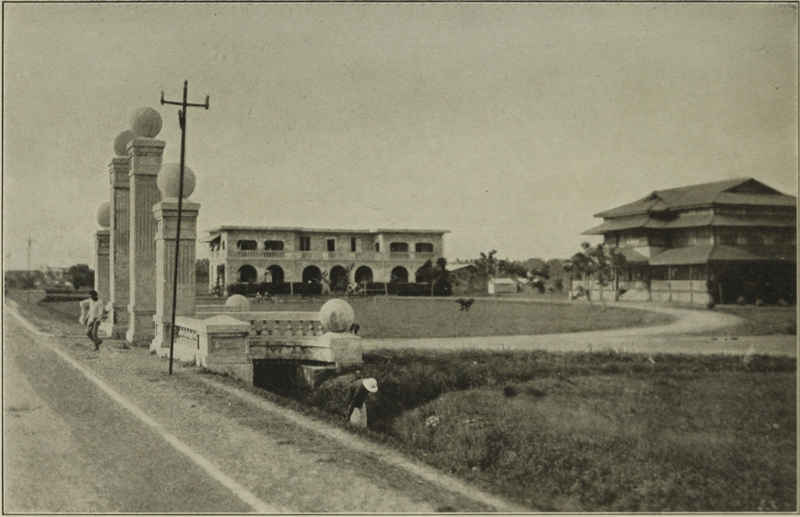 VIEW IN ILOILO, ILOILO, SHOWING HIGH SCHOOL GROUNDS.
We were invited for dinner at half after
seven, but it was an hour later before we sat
down to the long table in the large and rather
empty room, with its handsome Venetian mirrors
at either end, and its sliding shutters wide
open to the night. There were no ladies present
except those of our party. We could never tell
how things would be arranged,—sometimes
there would be Filipina ladies, and sometimes
there would not; sometimes the ladies would all
be placed together at one side of the table, and
again they would be seated next to the men.
While waiting for dinner to be announced, we
sat about in an airy room, with half-dressed
servants peeping in at us, and a phonograph
playing Caruso records.
After dinner we had a long drive out through
the town, which seemed quite business-like and
prosperous. They had rebuilt some of the fine,
large, wide-open houses, most of which had been
destroyed by the insurrectos. (On the nearby
island of Negros, we were told, there were many
fine haciendas with great houses full of carved
work which I was sorry not to see.) Passing
through suburbs of nipa houses standing up on
their stilts in the moonlight, we came to a plaza
gaily illuminated, and to our destination, a mansion
approached by a triumphal arch. In the
best houses the living rooms are on the second
floor, just as in the poorer ones they are raised
above the ground on stilts. So here we went upstairs
to a great room hung with festoons of
flags, where the little women in their bright and
varied dresses passing and repassing made a
gay scene. It was here, indeed, that we saw
some of the prettiest and best dressed women
whom we met on our trip.
Most of the following day was spent cruising
along the coast of Panay, passing between its
fine outlying islands, which reminded us of the
Inland Sea of Japan. In the afternoon we came
to the entrance of the river on which Capiz is
located. The Secretary crossed overland on the
first train to run on the new railway, in order to
drive in the silver spikes that completed the
line.
No dinners had been planned there for those
of us who had come by ship, so we did not start
up river until half after eight. Capiz is only
four miles from the mouth, but they were the
longest miles we had ever experienced, for by
some mistake the pilot did not arrive, so we
went in a Rizal launch without one. We just
struggled along as well as we could in the dark
till the moon came up, which only mystified us
the more with its deceptive shadows. Half a
dozen times we ran deep into mud banks, and
the sailormen were forced to jump overboard
and shove us off. They did not appear to enjoy
doing this, and no wonder, for it was a
crocodile river.
Swarms of fireflies, which gathered on favourite
trees, made a very Christmas-like effect with
their throbbing lights. They were lovely, too,
in the dark shore shadows, and made sparkling
reflections in the black river stream. Watching
them we could almost forget our troubles.
Finally, after much winding round and backing
off, we turned a bend and saw a line of little
twinkling lights strung along the shore and on
floating barges, giving quite a Venetian effect
and showing us the town by their reflection.
Landing, we walked across the grassy square to
the provincial building, with its open courtyards,
where there was to be a ball. We danced
a rigodon as usual, and stopped late with the
Governor General, who liked to show his interest
in these functions, of which the Filipinos
think so much. There were three bands, which
vied with each other for applause.
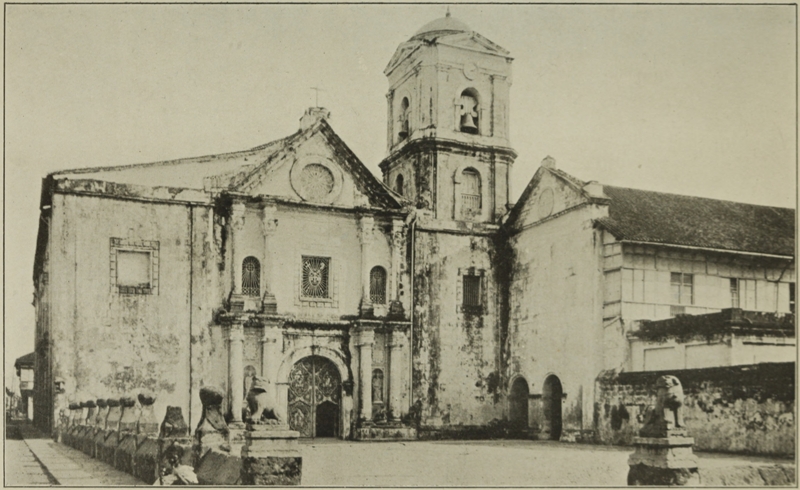 THE OLD AUGUSTINIAN CHURCH, MANILA.
Next morning we got away early on our last
leg for Manila and the end of our never-to-be-forgotten
journey in the Land of Pine and Palm—that
far-away, unfamiliar country where your
head gets full of strange thoughts, your body of
queer feelings, and your heart has great longings.
We crowded everything we could into those
few last days in Manila, for we were loath to
think of leaving anything undone. Besides
packing and shopping, there were teas and dinners,
and the army and navy reception. This
was lovely, for it was held in the courtyard filled
with trees which were hung with dim lanterns.
The good looking officers with their white duck
uniforms and brass buttons added to the attractiveness
of the scene. The men of our party
were even busier than we, for they had several
banquets to which we were not invited. In my
husband's journal I find the chronicle of a typical
day. After describing the events of a busy
morning, he says: "In the afternoon, there was
a reception to meet the constabulary, at four;
the opening of the new hospital, a most complete
and wonderful one, at half after four; the laying
of the corner stone at five for the new hotel,
which is a very ambitious project and will make
all the difference in the world as far as touring
in the Philippines is concerned; in the evening,
a dinner, and after that a reception, and a
dance."
Manila seemed more picturesque, and to have
even more atmosphere, as I came to know it
better. The old walls and churches and plazas
and corners and quarters; the Pasig with its
cascos and bancas plying about; the narrow
streets winding through the suburbs, with old
moss-covered walls, and peeps of tangled gardens
within, and balustraded terraces, and the
bowers of the pink blossoming "chain of love."
It is indeed well-named the Pearl of the Orient.