suppose the Scotsman who has been
born in Edinburgh may have a pardonable
reluctance in praising the town, may
hesitate in appraising it; Stevenson did; Scott
did not. And I suppose if one cannot trace his
ancestry back to Edinburgh, or nearly there,
but must choose some of the other capitals of
the world as his ancestral city, one might begrudge
estate to Edinburgh.
I have none of these hesitations, am hampered
by none of these half and half ways. Being
an American, with half a dozen European
capitals to choose from if I must, and having
been born in an American capital which is
among the loveliest—I think the loveliest—I
dare choose Edinburgh as my dream city. I
dare fling away my other capital claims, and
all modification, ever Scotch moderation, to declare
without an "I think" or "they say," Edinburgh
is the most beautiful, the most romantic,
the singular city of the world.
Those who come out of many generations of
migration grow accustomed to choosing their
quarter of the world; they have come from many
countries and through nomadic ancestors for
a century, or two, or three. And perhaps they,
themselves, have migrated from one state to
another, one city to another. Every American
has had these phases, has suffered the sea
change and the land. Surely then he may adopt
his ancestral capital, as correctly as he adopts
his present political capital.
It shall be Edinburgh. And while Constantinople
and Rio and Yokohama may be splendid
for situation, they have always something of
foreign about them, they can never seem to
touch our own proper romance, to have been
the setting for our play. Edinburgh is as
lovely, and then, the chalice of romance has been
lifted for centuries on the high altar of her
situation.
Edinburgh is a small city, as modern cities
go; but I presume it has many thousands of
population, hundreds of thousands. If it were
Glasgow numbers would be important, fixative.
But Edinburgh has had such a population
through the centuries that to cast its total with
only that of the souls now living within her
precincts were to leave out of the picture those
shadowy and yet brilliant, ever present generations,
who seem all to jostle each other on her
High street, without respect to generations, if
there is very decided respect of simple toward
gentle.
Edinburgh is, curiously, significantly, divided
and scarce united, into Old Town and
New Town. And yet, the Old Town with its
ancient lands so marvelously like modern tenements,
and its poverty which is of no date and
therefore no responsibility of ours, is neither
dead nor deserted, and is still fully one-half
the town. While New Town, looking ever up
to the old, looking across the stretch to Leith,
and to the sea whence came so much threatening
in the old days, and with its memories of
Hume and Scott who are ancient, and of Stevenson,
who, in spite of his immortal youth, does
begin to belong to another generation than ours—New
Town also, to a new American, is something
old. It has all become Edinburgh, two
perfect halves of a whole which is not less perfect
for the imperfect uniting.
There is no city which can be so "observed."
I venture that when you have stood on Castle
Hill—on the High Street with its narrow opening
between the lands framing near and far
pictures—on Calton Hill—when you have been
able to "rest and be thankful" at Corstorphine
Hill—when you have climbed the Salisbury
crags—when you have mounted to Arthur's
Seat and looked down as did King Arthur before
there was an Edinburgh—you will believe
that not any slightest corner but fills the eye
and soul.
There is, of course, no single object in Edinburgh
to compare with objects of traveler's interest
farther south. The castle is not the
Tower, Holyrood is a memory beside Windsor,
St. Giles is no Canterbury, St. Mary's is not St.
Paul's, the Royal Scottish art gallery is meager
indeed, notwithstanding certain rare riches in
comparison with the National. But still one
may believe of any of these superior objects, as
T. Sandys retorted to Shovel when they had
played the game of matching the splendours of
Thrums with those of London and Shovel had
named Saint Paul's, and Tommy's list of native
wonders was exhausted, but never Tommy—"it
would like to be in Thrums!" All these
lesser glories go to make up the singular glory
which is Edinburgh.
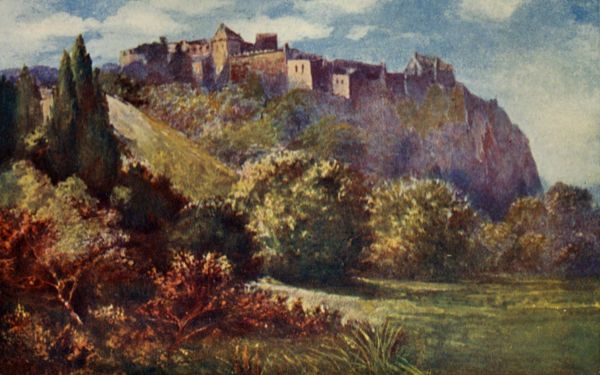 Edinburgh Castle
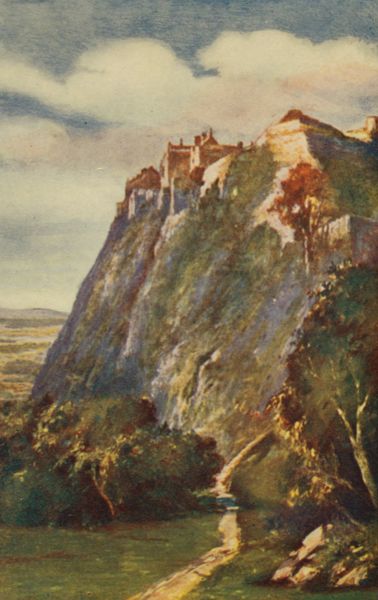
And there is the castle. Nowhere in all the
world is castle more strategically set to guard
the city and to guard the memories of the city
and the beauty.
For the castle is Edinburgh. It stood there,
stalwart in the plain, thousands and thousands
of years ago, this castle hill which invited a
castle as soon as man began to fortify himself.
It has stood here a thousand years as the bulwark
of man against man. Certain it will stand
there a thousand years to come. And after—after
man has destroyed and been destroyed, or
when he determines that like night and the sea
there shall be no more destruction. Castle Hill
is immortal.
Always it has been the resort of kings and
princes. First it was the keep of princesses,
far back in Pictish days before Christian time,
this "Castell of the Maydens." From 987 B. C.
down to 1566, when Mary was lodged here for
safe keeping in order that James might be born
safe and royal, the castle has had royalties in
its keeping. It has kept them rather badly in
truth. While many kings have been born here,
few kings have died in its security; almost all
Scottish kings have died tragically, almost all
Scottish kings have died young, and left their
kingdom to some small prince whose regents
held him in this castle for personal security,
while they governed the realm, always to its
disaster.
There is not one of the Stewart kings, one of
the Jameses, from First to Sixth, who did not
come into the heritage of the kingdom as a baby,
a youth; even the Fourth, who rebelled against
his father and won the kingdom—and wore a
chain around his body secretly for penance.
And these baby kings and stripling princes
have been lodged in the castle for safe keeping,
prologues to the swelling act of the imperial
theme.
History which attempts to be exact begins
the castle in the seventh century, when Edwin
of Deira fortified the place and called it Edwin's
burgh. It was held by Malcolm Canmore,
of whom and of his Saxon queen Margaret,
Dunfermline tells a fuller story; held
against rebels and against English, until Malcolm
fell at Alnwick, and Margaret, dead at
hearing the news, was carried secretly out of
the castle by her devoted and kingly sons.
After Edward I took the castle, for half a
century it was variously held by the English
as a Border fortress. Once Bruce retook it, a
stealthy night assault, up the cliffs of the west,
and The Bruce razed it. Rebuilt by the Third
Edward, it was taken from this king by a clever
ruse planned by the Douglass, Black Knight of
Liddesdale. A shipload of wine and biscuits
came into harbour, and the unsuspecting castellan,
glad to get such precious food in the far
north, purchased it all and granted delivery
at dawn next morning. The first cart load upset
under the portcullis, the gate could not
be closed, the cry "A Douglass," was raised,
and the castle entered into Scottish keeping,
never to be "English" again until the Act of
Union.
Henry IV and Richard II attempted it, but
failed. Richard III entered it as friend. For
three years it was held for Mary by Kirkcaldy,
while the city was disloyal. Charles I held it
longer than he held England, and Cromwell
claimed it in person as part of the Protectorate.
Prince Charles, the Third, could not take it,
contented himself with the less castellated, more
palatial joys, of Holyrood; a preference he
shared with his greatest grandmother.
To-day perhaps its defense might be battered
down, as some one has suggested, "from
the Firth by a Japanese cruiser." But it looks
like a Gibraltar, and it keeps impregnably the
treasures of the past; as necessary a defense,
I take it, as of any material treasure of the
present.
If you are a king you must wait to enter; summons
must be made to the Warder, and it must
be certain you are the king; even Edward VII,
most Stewart of recent kings had to prove himself
not Edward I, not English, but "Union."
If you are a commoner you know no such difficulties.
First you linger on the broad Esplanade
where a regiment in kilts is drilling, perhaps
the Black Watch, the Scots Greys. No doubt
of late it has been tramped by regiments of the
"First Hundred Thousand" and later, in training
for the wars.
As an American you linger here in longer
memory. For when Charles was king—the
phrase sounds recent to one who is eternally
Jacobite—this level space was a part of Nova
Scotia, and the Scotsmen who were made nobles
with estates in New Scotland were enfeoffed on
this very ground. So close were the relations
between old and new, so indifferent were the
men of adventuring times toward space.
Or, you linger here to recall when Cromwell
was burned in effigy, along with "his friend the
Devil."
 MONS MEG.
You pass through the gate, where no wine
casks block the descent of the portcullis, and
the castle is entered. There are three or four
points of particular interest.
Queen Margaret's chapel, the oldest and
smallest religious house in Scotland, a tiny place
indeed, where Margaret was praying when word
was brought of the death of Malcolm in battle,
and she, loyal and royal soul, died the very
night while the enemies from the Highlands,
like an army of Macbeth's, surrounded the
castle. The place is quite authentic, Saxon in
character with Norman touches. I know no
place where a thousand years can be so swept
away, and Saxon Margaret herself seems to
kneel in the perpetual dim twilight before the
chancel.
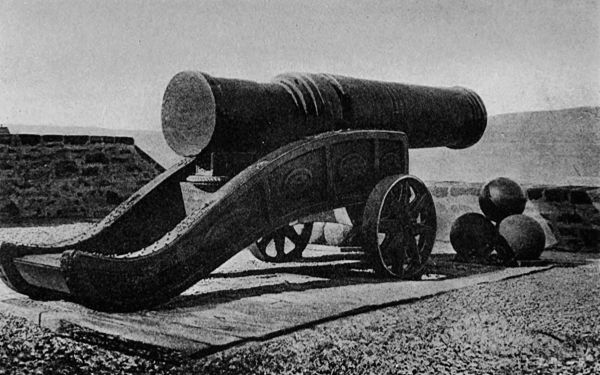
There is Mons Meg, a monstrous gun indeed,
pointing its mouth toward the Forth, as though
it were the guardian of Scotland. A very pretentious
gun, which was forged for James II,
traveled to the sieges of Dumbarton and of Norham,
lifted voice in salute to Mary in France on
her marriage to the Dauphin, was captured by
Cromwell and listed as "the great iron murderer,
Muckle Meg," and "split its throat" in
saluting the Duke of York in 1682, a most
Jacobite act of loyalty. After the Rising of
the Forty Five this gun was taken to London,
as though to take it from Scotland were to take
the defense from Jacobitism. But Sir Walter
Scott, restoring Scotland, and being in much
favour with George IV, secured the return of
Mons Meg. It was as though a prince of the
realm has returned. Now, the great gun, large
enough to shoot men for ammunition, looks,
silently but sinisterly, out over the North Sea.
History comes crowding its events in memory
when one enters Old Parliament Hall. It is
fitly ancestral, a noble hall with an open timbered
roof of great dignity, with a collection
of armour and equipment that particularly re-equips
the past. And in this hall, under this
roof, what splendour, what crime! Most criminal,
the "black dinner" given to the Black
Douglasses to their death. Unless one should
resent the dinner given by Leslie to Cromwell,
when there was no black bull's head
served.
By a secret stair, which commoners and Jacobites
may use to-day, communication was had
with the Royal Lodgings, and often must Queen
Mary have gone up and down those stairs,
carrying the tumult of her heart, the perplexity
of her kingdom; for Mary was both woman and
sovereign.
The Royal Lodgings contain Queen Mary's
Rooms, chiefly; the other rooms are negligible.
It is a tiny bedchamber, too small to house the
eager soul of Mary, but very well spaced for
the niggard soul of James. One merely accepts
historically the presence of Mary here;
there is too much intertwining of "H" and
"M." No Jacobite but divorces Darnley from
Mary, even though he would not effect divorce
with gunpowder. King James I, when he returned
fourteen years after to the place where
he was VI, made a pilgrimage to his own birth-room
on June 19, 1617. I suppose he found the
narrow space like unto the Majesty that doth
hedge a king.
Mary must have beat her heart against these
walls as an eagle beats wings against his cage.
She never loved the place. Who could love it
who must live in it? It was royally hung;
she made it fit for living, with carpets from
Turkey, chairs and tables from France, gold
hangings that were truly gold for the bed, and
many tapestries with which to shut out the
cold—eight pictures of the Judgment of Paris;
four pictures of the Triumph of Virtue!
Here she kept her library, one hundred and
fifty-three precious volumes—where are they
now? "The Queen readeth daily after her dinner,"
wrote Randolph, English envoy, to his
queen, "instructed by a learned man, Mr.
George Buchanan, somewhat of Lyvie."
And I wondered if here she wrote that
Prayer which but the other day I came upon in
the bookshop of James Thin, copied into a book
of a hundred years back, in a handwriting that
has something of Queen Mary's quality in it—
"O Domine Deus!
Speravi in te;
O care mi Iesu!
Nunc libera me:
In dura catena,
In misera poena
Desidero te;
Languendo, gemendo,
Et genuflectendo
Adoro, imploro,
Ut liberes me!"
Her windows looked down across the city
toward Holyrood. Almost she must have heard
John Knox thunder in the pulpit of St. Giles,
and thunder against her. And, directly beneath
far down she saw the Grassmarket.
Sometimes it flashed with gay tournament folk;
for before and during Mary's time all the world
came to measure lances in Edinburgh. Sometimes
it swarmed with folk come to watch an
execution; in the next century it was filled in the
"Killing Time," with Covenanter mob applauding
the execution of Royalists, with Royalist
mob applauding the execution of Covenanters;
Mary's time was not the one "to glorify God in
the Grassmarket."
At the top of the market, near where the West
Bow leads up to the castle, was the house of
Claverhouse, who watched the killings. At the
bottom of the market was the West Port
through which Bonnie Dundee rode away.
"To the Lords of Convention, 'twas Claverhouse spoke,
Ere the king's crown go down there are crowns to be broke,
So each cavalier who loves honour and me,
Let him follow the bonnet of Bonnie Dundee.
Come fill up my cup, come fill up my can,
Come saddle my horses and call up my men,
Fling all your gates open, and let me gae free,
For 'tis up with the bonnets of Bonnie Dundee."
And to-day, but especially on Saturday
nights, if you care to take your life, or your
peace in hand, you can join a strange and rather
awful multitude as it swarms through the Grassmarket,
more and more drunken as midnight
comes on, and not less or more drunken than
the mob which hanged Captain Porteous.
It is a decided relief to look down and find
the White Hart Inn, still an inn, where Dorothy
and William Wordsworth lodged, on Thursday
night, September 15, 1803—"It was not
noisy, and tolerably cheap. Drank tea, and
walked up to the Castle."
The Cowgate was a fashionable suburb in
Mary's time. A canon of St. Andrews wrote
in 1530, "nothing is humble or lowly, everything
magnificent." On a certain golden gray afternoon
I had climbed to Arthur's Seat to see the
city through the veil of mist—
"I saw rain falling and the rainbow drawn
On Lammermuir. Harkening I heard again
In my precipitous city beaten bells
Winnow the keen sea wind."
It was late, gathering dusk and rain, when
I reached the level and thinking to make a short
cut—this was once the short cut to St. Cuthbert's
from Holyrood—I ventured into the Cowgate,
and wondered at my own temerity. Stevenson
reports, "One night I went along the
Cowgate after every one was a-bed but the policeman."
Well, if Scott liked to "put a
cocked hat on a story," Stevenson liked to put
it on his own adventures. The Cowgate, in
dusk rain, is adventure enough.
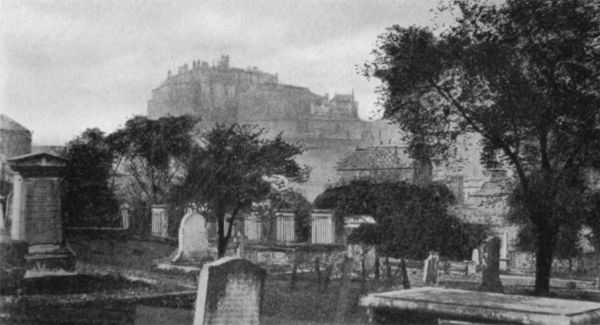
Across the height lies Greyfriar's. The
church is negligible, the view from there superb,
the place historic. One year after Jenny Geddes
threw her stool in St. Giles and started
the Reformation—doesn't it sound like Mrs.
O'Leary's cow?—the Covenant was signed
(Feb. 28, 1638) on top of a tomb still shown,
hundreds pressing to the signing, some signing
with their blood. The Reformation was on, not
to be stopped until all Scotland was harried and
remade.
 GREYFRIARS' CHURCHYARD.
I like best to think that in this churchyard,
on a rainy Sunday, Scott met a charming girl,
fell in love with her, took her home under his
umbrella, and, did not marry her—his own romance!
Because no king shall ever wear the crown
again, nor wave the scepter, nor wield the sword
of state, the Regalia, housed in the Crown
Room, and guarded from commoner and king
by massive iron grating, is more interesting
than any other appanage of royalty in the
world. The crown which was worn by Bruce,
and which sat rather uneasily on the very unsteady
head of Charles II at what time he was
crowned at Scone and was scolded, is of pure
gold and much bejeweled. The scepter, made in
Paris for James V, carries a beryl, come from
Egypt three thousand years ago, or, from a
Druid priest in the mist of time. The sword
was a gift from Pope Julius to James IV; in
those days the Scottish sovereign was surely
the "Most Catholic Majesty."
England has no ancient regalia; hers were
thrown into the melting pot by Cromwell. The
Protector—and Destructor—would fain have
grasped these "Honours," but they were spirited
away, and later concealed in the castle.
Here they remained a hundred and ten years,
sealed in a great oak chest. The rumour increased
that they had gone to England. And
finally Sir Walter Scott secured an order from
George IV to open the chest (Feb. 4, 1818).
It was a tremendous moment to Scott. Could
he restore the Honours as well as the country?
There they lay, crown of The Bruce, scepter of
James V, sword of Pope and King. The castle
guns thundered—how Mons Meg must have
regretted her lost voice!
And still we can hear the voice of Scott, when
a commissioner playfully lifted the crown as if
to place it on the head of a young lady near—"No,
by God, no!" Never again shall this
crown rest on any head. That is assured in a
codicil to the Act of Union. And—it may be
that other crowns shall in like manner gain a
significance when they no longer rest on uneasy
heads.
The view from the King's bastion is royal.
Where is there its superior? And only its rival
from Calton Hill, from Arthur's Seat. The
Gardens lie below, the New Town spreads out,
the city runs down to Leith, the Firth shines
and carries on its bosom the Inchkeith and the
May; the hills of Fife rampart the North; the
Highlands with Ben Lomond for sentinel form
the purple West; and south are the Braid hills
and the heathery Pentlands—the guide has
pointed through a gap in the castle wall to the
hills and to the cottage at Swanston.
"City of mists and rain and blown gray spaces,
Dashed with the wild wet colour and gleam of tears,
Dreaming in Holyrood halls of the passionate faces
Lifted to one Queen's face that has conquered the years.
Are not the halls of thy memory haunted places?
Cometh there not as a moon (where blood-rust sears
Floors a-flutter of old with silks and laces)
Gilding a ghostly Queen thro' the mist of tears?
"Proudly here, with a loftier pinnacled splendour
Throned in his northern Athens, what spells remain
Still on the marble lips of the Wizard, and render
Silent the gazer on glory without a stain!
Here and here, do we whisper with hearts more tender,
Tusitala wandered thro' mist and rain;
Rainbow-eyes and frail and gallant and slender,
Dreaming of pirate isles in a jeweled main.
"Up the Canongate climbeth, cleft a-sunder
Raggedly here, with a glimpse of the distant sea,
Flashed through a crumbling alley, a glimpse of wonder,
Nay, for the City is throned in Eternity!
Hark! from the soaring castle a cannon's thunder
Closeth an hour for the world and an æon for me,
Gazing at last from the martial heights whereunder
Deathless memories roll to an ageless sea."
If the Baedeker with a cautious reservation,
declares Princes Street "Perhaps" the handsomest
in Europe, there is no reservation in the
guide-book report of Taylor, the "Water Poet,"
who wrote of the High Street in the early Sixteen
Hundreds, "the fairest and goodliest
streete that ever my eyes beheld." Surely it
was then the most impressive street in the
world. Who can escape a sharp impression
to-day? It was then the most curious street
in the world, and it has lost none of its power
to evoke wonder.
A causeway between the castle and Holyrood,
a steep ridge lying between the Nor' Loch
(where now are the Princes' Gardens) and the
Sou' Loch (where now are the Meadows, suburban
dwelling) the old height offered the first
refuge to those who would fain live under the
shadow of the castle. As the castle became
more and more the center of the kingdom, dwelling
under its shadow became more and more important,
if not secure. The mightiest lords of
the kingdom built themselves town houses along
the causeway. French influence was always
strong, and particularly in architecture. So
these tall lands rose on either side of the long
street, their high, many-storied fronts on the
High Street, their many more storied backs toward
the Lochs. They were, in truth, part of
the defense of the town; from their tall stories
the enemy, especially the "auld enemy," could
be espied almost as soon as from the castle.
And the closes, the wynds, those dark tortuous
alleys which lead between, and which to-day in
their squalor are the most picturesque corners
of all Europe, were in themselves means of defense
in the old days when cannon were as often
of leather as of iron, and guns were new and
were little more reaching than arrows, and
bludgeons and skene dhus and fists were the
final effective weapon when assault was intended
to the city.
The ridge divides itself into the Lawnmarket,
the High Street, and the Canongate; St. Giles
uniting the first two, and the Netherbow port,
now removed, dividing the last two.
The Lawnmarket in the old days was near-royal,
and within its houses the great nobles
lodged, and royalty was often a guest, or a
secret guest. The High Street was the business
street, centering the life of the city, its
trade, its feuds—"a la maniére d'Edimborg"
ran the continental saying of fights—its religion,
its executions, its burials. The Canongate,
outside the city proper and outside the
Flodden wall and within the precincts of Holyrood,
therefore regarded as under the protection
of Holy Church, became the aristocratic
quarters of the later Stewarts, of the wealthy
nobles of the later day.
I suppose one may spend a lifetime in Edinburgh,
with frequent days in the Old Town, wandering
the High Street, with the eye never
wearying, always discovering the new. And I
suppose it would take a lifetime, born in Old
Town and of Old Town, to really know the quarter.
I am not certain I should care to spend a
lifetime here; but I have never and shall never
spend sufficient of this life here. It is unsavoury
of course; it is slattern, it is squalid,
danger lurks in the wynds and drunkenness
spreads itself in the closes. If the old warning
cry of "Gardey loo!" is no longer heard at ten
o' the night, one still has need of the answering
"Haud yer hand!" or, your nose. Dr. Samuel
Johnson, walking this street on his first night
in Edinburgh, arm in arm with Boswell, declared,
"I can smell you in the dark!" No
sensitive visitor will fail to echo him to-day.
There are drains and sewers, there is modern
sanitation in old Edinburgh. But the habits
of the centuries are not easily overcome; and
the Old Town still smells as though with all the
old aroma of the far years. Still, it is high, it
is wind-swept—and what of Venice, what of the
Latin Quarter, what of Mile End, what of the
East Side?
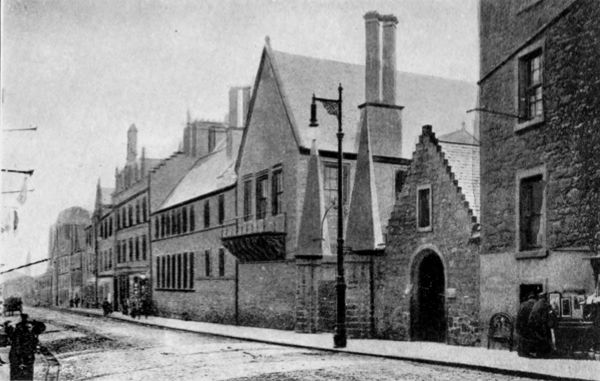 MORAY HOUSE.
But there is still splendour and power, bequeathed
as Taylor said, "from antiquitie to
posteritie," in spite of the decline and the decay.
If the palace of Mary of Lorraine on
Castle Hill is fallen and the doorways are in
the Museum—Mary who was mother to Mary
Queen, and contemporary worthy to Catherine
of Medici—there are still, at the end of the long
street, Moray House and Queensberry House.
Moray is where Cromwell lodged in 1648, and
gave no hint of what was coming in 1649; if he
had, history might have been different; to-day
Moray House is the United Free Church Training
college! Queensberry House is where lived
those Queensberry marquises of fighting and
sporting renown, and where the Marquis lived
who forced through the Act of Union—"There
ended an old song"; and now it is the Refuge
for the Destitute!
There is still beauty shining through the dust
and the cobwebs; here a doorway with bold insignia
and exquisite carving, leading to—nowhere;
here a bit of painting, Norrie's perhaps,
or a remnant of timbered ceiling; and everywhere,
now as then—more now than then, since
sanitary destruction has had its way here and
there—glimpses of the city and the moors and
the mountains.
It is invidious to compare, to choose from
these closes. Each has its history, its old habitations,
its old associations, its particular picturesqueness;
Lady Stair's, Baxter's, Byer's,
Old Stamp Office, White Horse, and many
more.
Through this street what glory that was Scotland
has not passed and what degradation,
what power has not been displayed and what
abasement? To see it now, filled with people
and with marching troops in honour of the visiting
king, is to get back a little of ancient history,
of greater glory. It lends itself to such
majesty, dull and deserted as it is for the most
part.
When the King came to Edinburgh following
on his coronation, making a pilgrimage of his
realm, he came to St. Giles, as has come every
sovereign of Scotland, from Malcolm who may
have worshiped in the Culdee church, to
George in whose honour the chapel of the
Thistle and the Rose was unveiled.
"For noo, unfaithfu' to the Lord
Auld Scotland joins the rebel horde;
Her human hymn-books on the board
She noo displays,
An' Embro Hie Kirk's been restored
In popish ways."
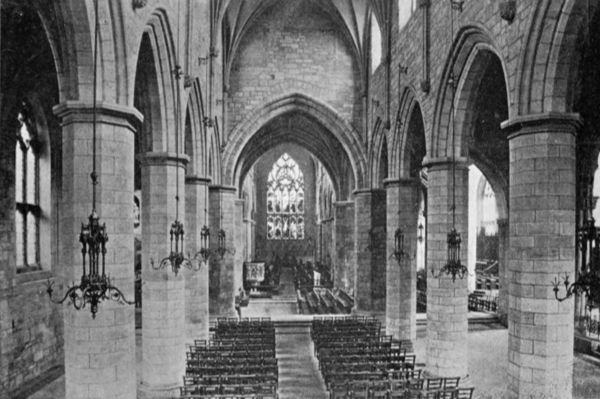 INTERIOR OF ST. GILES.
On a Sunday morning I hurried to St. Giles
to see the trooping of the colours. (Later, listening
to Dr. White, in a recently built reformed
church on Princes Street, I heard a sermon from
the text, "You shall see the king in all his
beauty." But, no mention of King George!
It was even as it was in the old days.)
In truth it was a brave sight to find the High
Street thronged with people, and the regiments
marching down from St. Giles to Holyrood.
The king did not enter town till next day. (I
saw, with some resentment, over the door of a
public house, the motto, "Will ye no come back
again?") But, somehow, so many kings gone
on, the play was rather better staged with the
sovereign not there. I learned then how
gorgeous the old days must have been with their
colour and glitter and flash.
I suppose there was a tall land where in my
day stood and still stands Hogg's hotel, just
above the Tron Kirk; the lands on the south
side the High burned a century ago. But, to
the American gazing down on ancient memories
and present sovereignties, there was a wonderful
courtesy shown by the hotel. I had interrupted
their quiet Sabbath; it can still be quiet
in Edinburgh notwithstanding that a tram car
carried me on my way hither. The dining-room
of this hotel looked out on the High, and
it was breakfast time for these covenanting-looking
guests from the countryside. But I,
an invader, was made welcome and given the
best seat on the balcony; a stranger and they
took me in. Sometime I shall take up residence
in this Latin Quarter, and if not in Lady Stair's
Close, then in Hogg's hotel. The name sounds
sweeter if you have just come up from Ettrick.
Nor did I miss the King. For
"I saw pale kings, and princes too,
Pale warriors, death-pale were they all;
Who cry'd—'La Belle Dame sans merci
Hath thee in thrall!'"
It was the Belle Dame, it was the Queen, I
saw most often on the High Street, riding to
and fro from the time of the "haar" on her return
from France, till that last terrible night
and the ride to Loch Leven.
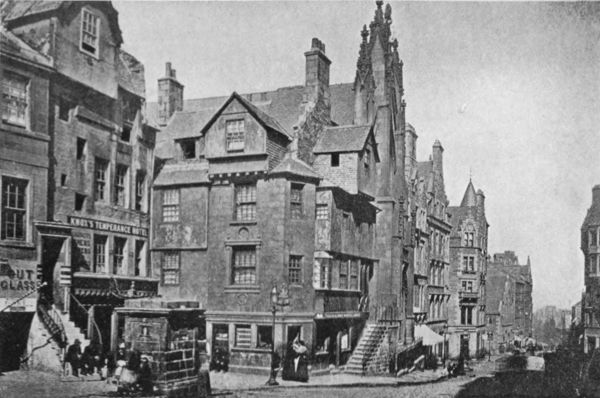 JOHN KNOX'S HOUSE.
After that you may visit the John Knox
house if you will, and read for your edification
its motto. "Lyfe God aboune al and yi nicht-bour
as yi Self," and buy a book or two in its
book shop. I took particular pleasure in buying
a girlish picture of Mary Queen, and a book
of the poems of Robert Fergusson, neither of
which would have pleasured John.
After that you may look at the "I. K." in the
pavement, and realize that Dr. Johnson's wish
for Knox has been fulfilled—"I hope in the
highway."
After that you may look on the heart stamped
in the pavement near St. Giles, where once
stood the Heart of Midlothian, the Old Tolbooth.
There is only one other memory of High
Street and of Scotland that for me equals that
of Mary. It is Montrose. Up the Canongate
comes the rumbling of a tumbril, like the
French Revolution. And out of the high lands
there look the hundreds of Covenanting folk,
triumphant for the moment. And on the balcony
of Moray House, within which the marriage
of Lady Mary Stewart to the Marquis
of Lorne has just been celebrated, there stands
the wedding party, and among them the Earl
of Argyle. Up the street comes the cart. And
within it clad like a bridegroom—"fyne scarlet
coat to his knee, trimmed with silver galoons,
lined with taffeta, roses in his shoon, and stockings
of incarnet silk"—stands the Marquis of
Montrose, the loyalest Scotsman that ever
lived.
After the field of Kylsyth, after the field of
Philipshaugh, and the flight to the North and
the betrayal, he has been brought back to Edinburgh,
to a swift and covenanting sentence,
and to death at the Tron.
His eyes meet proudly those of Argyle who
has deserted his king and who thinks to stand
in with the Covenant and with the future. It
is the eyes of Argyle which drop. And Montrose
goes on.
His head is on the picket of the Netherbow
Port. His four quarters are sent to the four
corners of the kingdom, Glasgow, Perth, Aberdeen,
Inverness.
But the end is not yet. The tables turn, as
they turned so often in those unstable times.
It is Argyle who goes to the scaffold. Charles
is king, the Second Charles. There is an edict.
The body of Montrose is dug up out of the
Boroughmoor. It is buried in Holyrood. The
four quarters are reassembled from Glasgow
and Perth and Aberdeen and Inverness. A
procession fairly royal moves from Holyrood
to St. Giles. At the Netherbow it pauses. The
head is taken down from the pike. The body
of Montrose is whole again. An honourable
burial takes place in the cathedral sanctuary.
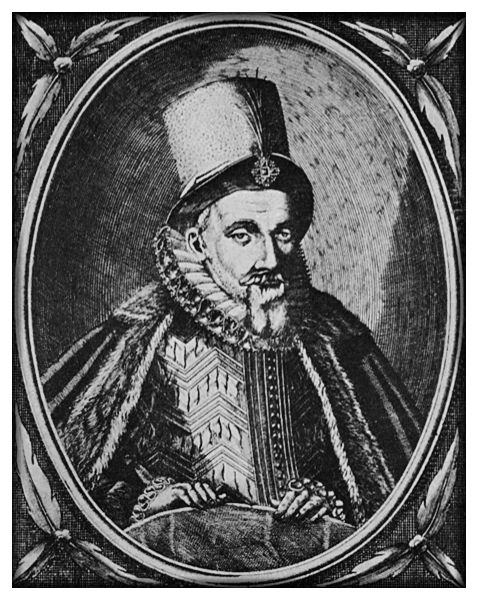
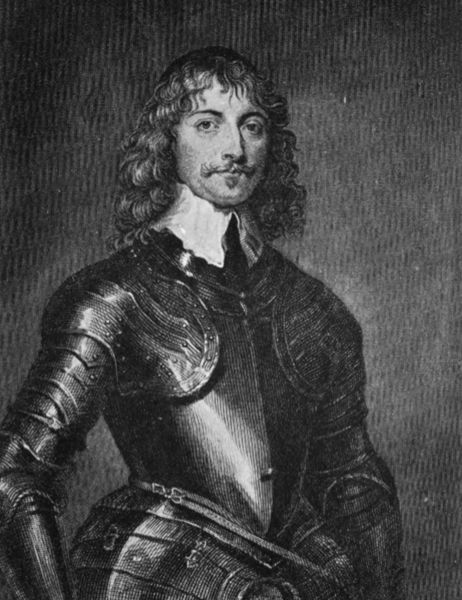 JAMES GRAHAM, MARQUIS OF MONTROSE.
Even though when search was made at the
restoring of the church and the erection of the
effigy the remains could not be found, there has
been that justification by procession and by
faith, that justification of loyalty that we remember
when we remember Montrose—
"He either fears his fate too much,
Or his deserts are small,
That dares not put it to the touch,
To gain or lose it all."
Holyrood, ruined as it is, empty as it is, spurious
as it is, still can house the Stewarts. Nowhere
else are they so completely and splendidly
Stewart. It is the royalest race which ever
played at being sovereign; in sharp contrast
with the heavier, more successful Tudors;
crafty but less crafty than the Medici; amorous
but more loyal than the Bourbons.
Never did kings claim sovereignty through a
more divine right—and only one (whisper sometimes
intimates that he was not Stewart, but
substitute; but he left a Stewart descent) failed
to pay the penalty for such assertion. It was
the splendour which was Stewart while they
lived, the tragedy that was Stewart when they
came to die, which makes them the royal race.
There were born in Holyrood not one of them,
unless it be James V. But almost all of them
were married in Holyrood, held here their festive
days, and, not one of them died in Holyrood.
It is their life, the vivid intense flash of
it, across those times that seem mysterious,
even legendary in remembered times north of
the Border. Life was a holiday to each of the
Stewarts, and he spent it in the palace and in
the pleasance of Holyrood.
The Abbey, with the monastery which was
attached to it, begins far back before the Stewarts.
It was founded by David I, the abbey-builder.
Legend has it that he went a-hunting
on a holy day, and straying from the "noys and
dyn of Bugillis," a white stag came against
him. David thought to defend himself, but a
hand bearing a cross came out of the cloud, and
the stag was exorcised. David kept the cross.
In dream that night within the castle he was
commanded to build an abbey where he had been
saved, and the hunting place being this scant
mile and a quarter from the castle—then a forest
where now it is treeless—David placed this
convenient abbey where it has stood for six centuries,
defying fire and war and reformation,
until the citizens of Edinburgh ravaged it when
the roof fell in in the middle of the eighteenth
century.
There is a curious feeling when one crosses
the Girth stones at the lower end of the Canongate.
It is a century and more since this was
sanctuary. But it is impossible to step across
these stones, into the "Liberty of Holyrood,"
and not wonder if there may not perhaps be
some need in your own soul of sanctuary.
Thousands and thousands of men—"abbey
lairds" as they were pleasantly called—have
stepped across this line before me, through the
centuries. Who am I to be different, unneedful?
May I not need inviolate sanctuary?
May it not be that at my heels dogs some sinister
creditor who will seize me by the skirts
before I reach the boundary beyond which there
is no exacting for debt? A marvelous thing,
this ancient idea of sanctuary. It made an oasis
of safety in a savage world. Surely it was
super-christian. And here, at Holyrood, as the
medieval statute declares, "qukilk privelege has
bene inviolabie observit to all maner of personis
cuman wythin the boundes ... past
memorie of man." What has the modern world
given itself in place of ancient sanctuary? Justice,
I suppose, and a jury trial.
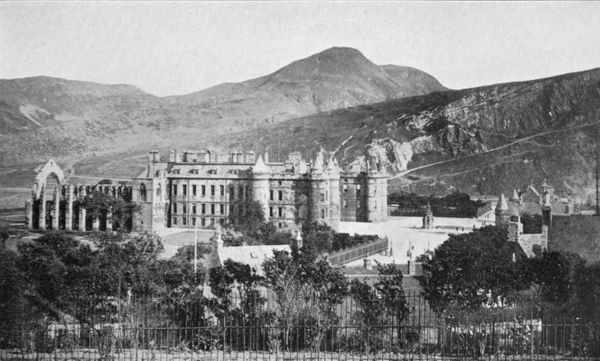 HOLYROOD PALACE.
But, once across the Girth, one becomes, not
a sanctuarian, but a Stewart.
The situation is a little dreary, a little flat.
And the palace, as a palace, is altogether uninteresting
to look on. It is not the building
of David or of the earlier Stewarts. But of
that Merry Monarch who harboured so long in
France, when England was determining whether
it would be royal or republican, and Scotland
was determining whether it would be covenanted
or uncovenanted. The Merry Monarch
was ever an uncovenanted person, not at all
Scottish, although somewhat like the errant
James—whose errancy was of his own choosing.
Charles had acquired a French taste at
the court of his cousin, Louis the Grand. So
the new Holyrood was built in French baronial
style. And no monarch has ever cared to inhabit
it for any length of time. Only King Edward
VII, who would have been a happy successor
to James, but Edward was very studious
in those days of 1859, when he lodged here and
studied under the direction of the Rector of
the Royal High School. Still I can but think
that it was in this Stewart place that Edward
developed his Stewartship.
There is not a stone to speak of the magnificence,
of the strength, of David. The Abbey
was burned and burned again, by Edward and
Richard the Second, and entirely rebuilt when
the Stewarts were beginning to be splendid and
assured. Over the west doorway, high-arched
and deep-recessed, early English in its technique,
Charles I, who was crowned here in 1633,
caused the stone to be placed.
"He shall build ane House for my name and I will stablish
the throne of his kingdom forever."
The tablet still stands above the doorway.
But Charles is lying for his sins in a vault at
St. George's chapel at Windsor far in the south,
having paid his penalty on the scaffold in
Whitehall. And the House is in ruins, "bare
ruined choir," where not even "the late birds
sing." Although Mendelssohn in speaking of
the impression the Abbey made on him, does
say, "I think I found there the beginnings of
my Scotch symphony."
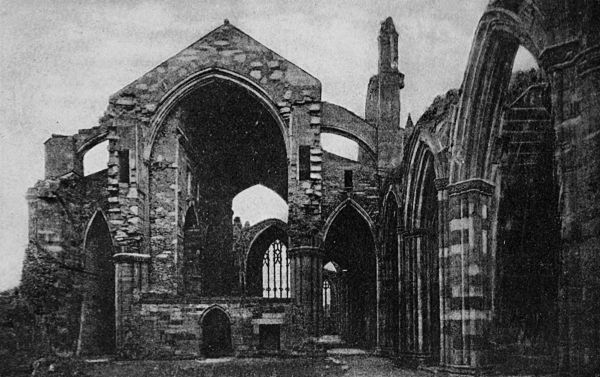
This "magnificent Abbey-Kirk of Halirude"
was no doubt very splendid; although in architectural
beauty it cannot compare with Melrose,
not even the great east window with its rich
quatrefoil tracing. But what scenes have been
staged in that historic drama, that theatrical
piece, we call the history of the Stewarts!
Before the high altar, under that east window,
when James I was kneeling before God in
prayer, there appeared the Lord of the Isles,
come repentant from burning Inverness and
other rebellion, to kneel before the king, his
own sword pointed at his breast.
Before this altar James II was married to
Mary of Gueldres. James III was married to
Margaret of Denmark, who brought the Orkneys
as her dower. James IV was married to
Margaret Tudor, the union of the "Thistle and
the Rose." James V was not married here, he
went to France for his frail bride, Magdalene,
who lived but seven weeks in this inhospitable
land, this hospitable Holyrood. She was buried
in Holyrood chapel, only to be dug up and tossed
about as common clay when the Edinburgh citizens
made football of royal skulls.
The two sons of James VI, Henry who should
have been king and who might have united
royalist and commoner had fate granted it,
and Charles who was to become king, were
both christened here. James VII, brother to
Charles II, restored this Chapel Royal and prepared
it for the Roman ritual. James VIII was
never here, or but as a baby. Charles III—did
the Bonnie Prince in that brief brilliant Edinburgh
moment of his, ever kneel before this
then deserted altar and ask divine favour while
he reasserted the divine right of kings?
Here—or was it secretly, in Stirling?—the
Queen—one says The Queen and all the world
knows—gowned in black velvet, at five o'clock
on a July morning, was married to her young
cousin, Henry Darnley. A marriage that endured
two long terrible tumultuous years.
Here—or was it in the drawing-room?—at
two o'clock on a May morning, the Queen was
married to Bothwell, by Adam Bothwell, Bishop
of Orkney, not with mass as she had been wed
to her boy-cousin, but with preaching as she
wed the Bishop's cousin. And "at this marriage
there was neither pleasure nor pastime
used as use was wont to be used when princes
were married." So says the Diurnal Occurents
of Scotland. A marriage that endured a
brief, perhaps happy, tragedy-gathering month.
And the Queen beautiful was destroyed, by
the Reformation, like an Abbey.
The bones of Darnley were ravaged by the
citizens of Edinburgh out of the ruins of this
chapel. Or were they carried to Westminster
by that unroyal son who was so laggard in caring
for the remains of his queenly mother? I
hope that Darnley does not rest beside her.
For I think those exquisite marble fingers of
the effigy in Henry VII's chapel, looking I fain
believe as those of Mary looked, tapering,
lovely, sinister, would not so fold themselves in
prayer without unfolding through the long centuries.
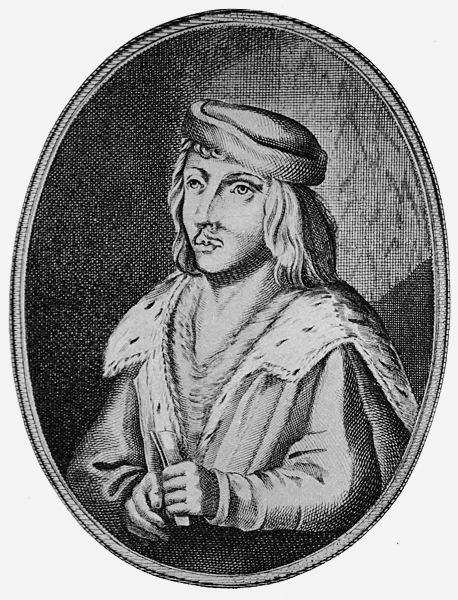
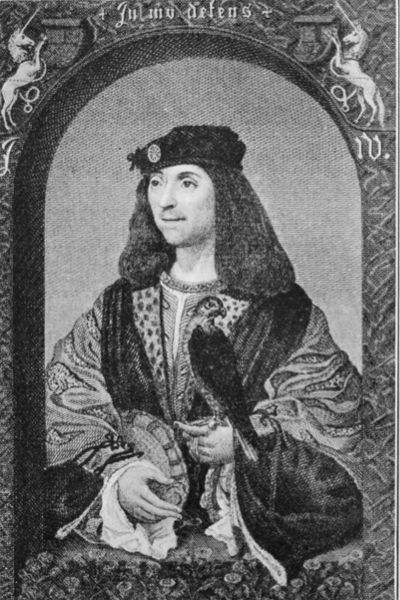 JAMES IV.
In the old palace the most glorious days were
those when James IV was king. As the most
glorious days of Scotland were those which are
almost legendary. The palace still had the
grandeur that was Norman and the grace that
was early English under David. Its front,
towered and pinnacled, suggesting more fortress
security than this dull château, opened
upon a great outer court that lay between the
palace and the walls. Coming down the Canongate
from the castle it must have looked very
splendid to James. And yet he did not care to
remain in it long. All the Stewarts had errant
souls, and they loved to wander their kingdom
through. It presented ample opportunity for
adventure; scarce a Stewart ever left Scotland.
That last Prince, who flashed across Scotland
in one last Stewart sword thrust—"My
friends," he said in Holyrood the night before
Prestonpans, "I have thrown away the scabbard"—was
but treading in the steps of his
royal forebears, the royal fore-errants.
In the days of James IV—we say it as one
should say in the days of Haroun al Raschid,
and indeed Edinburgh was in those early years
of the Fifteen Hundreds the Bagdad of the
world, and her days as well as her nights were
truly Arabian—the world must have looked
much as it does on the pleasant morning when
we make our royal entry into Holyrood.
The Abbey grounds, a regal area then, and
still a regality, were rich with woodland and
orchard, and terraced and flowered into southern
beauty. The red crags of the Salisbury
ridge rose bold above as they do to-day, and
crowning the scene the leonine form of Arthur's
Seat above the green slopes, the lion keeping
guard against the invading lion of England!
I think James must often have climbed to that
height to look forth over his domain, over his
city, to watch the world, as King Arthur—whom
he did not resemble—did legendary centuries
before.
It was a busy time in Edinburgh; men's
hands and wits were working. In Leith, then
as now the port, then as now a separate burgh,
there was much shipping and much building of
ships; King James dreamed of a navy, and he
had an admirable admiral in Sir Anthony
Wood. In the castle there was the forging of
guns, the "seven sisters of Brothwick," under
direction of the king's master gunner, while
Mons Meg looked on, and perhaps saw the near
terrible future when these sisters of hers should
be lost at Flodden.
In the city there was the splendid beginning
of that intellectual life which has ever been
quick in Edinburgh. It was a joyous time; witness
the account from the lord High treasurer—
"On the 11th of February, 1488, we find the
king bestowing nine pounds on gentil John, the
English fule; on the 10th of June we have an
item to English pipers who played to the king
at the castle gate, of eight pounds eight shillings;
on the thirty-first of August Patrick
Johnson and his fellows, that playit a play to
the king, in Lithgow, receives three pounds;
Jacob the lutar, the king of bene, Swanky that
brought balls to the king, twa wemen that sang
to his highness, Witherspoon the foular, that
told tales and brought fowls, Tom Pringill the
trumpeter, twa fithelaris that sang Grey Steill
to the king, the broken-bakkit fiddler of St.
Andrew's, Quhissilgyllourie a female dancer,
Willie Mercer who lap in the stank by the king's
command."
Oh, a royal and democratic and merry time.
It was Flodden that made men old, that tragic
climax to this splendour.
"In the joyous moneth tyme of June," in the
pleasant garden of the town-house of the great
Earl of Angus, looking down on the still waters
of the Nor' Loch, and across the woods and
moors to the glittering blue Firth, there sat the
pale stripling, Gavin Douglass, third son of
Douglass, Archibald Bell-the-Cat, late in orders
at Mony musk, but now come up to St. Giles
as prior in spite of his youth, and more absorbed
in poetry than men.
"More pleased that in a barbarous age
He gave rude Scotland Virgil's page,
Than that beneath his rule he held
The bishopric of fair Dunkeld."
Here I would dispute Scott. After all, Dark
Ages are not always as dark as they look to
those who come after. And if the "Dark
Ages" of Europe were brilliantly luminous in
Moslem capitals, Bagdad and Cordova, so
"rude Scotland" was more polished under
James IV than England under Henry VII, or
France under Louis XII.
As Gavin has recorded in "The Palice of
Honour," he had interview with Venus in her
proper limbo, and she had presented him with
a copy of Virgil, bidding him translate it.
And so, quite boldly, before any Englishman
had ventured, and all through the winter, forgetful—except
when he wrote his prefaces of
scharp soppis of sleit and of the snypand snaw
he had worked over his translation, from the
Latin into the Scottish, and now it was nearly
ready "to go to the printer," or more like, to be
shown to the king. In sixteen months he had
completed thirteen books; for he had added a
book of Maphæus Vegius, without discrimination.
He was certain of the passage facilis descensus
Averni, for Gavin was Scotch, the time was
Stewart. It ran in this wise—
"It is richt facill and eithgate, I tell thee
For to descend, and pass on down to hell,
The black zettis of Pluto, and that dirk way
Stand evir open and patent nicht and day.
But therefore to return again on hicht
And heire above recovir this airis licht
That is difficul werk, thair labour lyis,
Full few thair bene quhom hiech above the skyis,
Thare ardent vertue has raisit and upheit
Or zit quhame equale Jupiter deifyit,
Thay quhilkie bene gendrit of goddes may thy oder attane
All the mydway is wilderness unplane
Or wilsum forest; and the laithlie flude
Cocytus, with his drery bosom unrude
Flows environ round about that place."
But he was not quite certain that he had been
splendid enough, and daring enough, in his application
of the royal lines—
"Hic Cæsar et omnis Iuli
Progenies, magnum caeli ventura sub axem."
So he had sent for his friend, William Dunbar,
Kynges Makar, laureate to the sovereign.
And Dunbar was never loath for a "Flyting,"
a scolding. He had them on every hand, with
every one, and not only those he held with
"gude maister Walter Kennedy," and published
for the amusement of the King and his
Court. It was a more solemn event when the
future Bishop of Dunkeld summoned him.
Though Gavin was fifteen years younger than
William, he was more serious with much study,
and under the shadow of future honours, and
then, too, he was a Douglass.
So Dunbar came, striding up the Canongate
between the tall inquisitive houses—even he
found them "hampered in a honeycaim of their
own making"—a very handsome figure, this
Dunbar, in his red velvet robe richly fringed
with fur, which he had yearly as his reward
from the King, and which I doubt not he preferred
to the solemn Franciscan robe he had
renounced when he entered the King's service.
James was away at Stirling. James was a
poet also. Surely, on internal evidence, it is
the Fourth James and not the Fifth, who wrote
those charming, and improper poems, "The
Gaberlunzieman" and "The Jolly Beggar."
"He took a horn frae his side, and blew baith loud and shrill,
And four and twenty belted knights came skipping o'er the hill.
"And he took out his little knife, loot a' his duddies fa';
And he was the brawest gentleman that was amang them a'."
"And we'll gang nae mair a roving,
So late into the night;
And we'll gang nae mair a roving, boys,
Let the moon shine ne'er so bright."
Dunbar, official Makar, would fain secure the
criticism of young Gavin on this joyous lament
he had writ to the King in absence—
"We that here in Hevenis glory ...
I mean we folk in Paradyis
In Edinburgh with all merriness."
And perhaps the young Gavin and the old
Dunbar in their common fellowship of poetry,
would drink a glass of red wine in memory of
friends passed into death's dateless night—Timor
Mortis conturbat me.
"He has Blind Harry and Sandy Traill
Slaine with his schour of mortall haill....
In Dunfermelyne he had done rovne
With Maister Robert Henrisoun."
And Dunbar, who was so much more human
than Gavin, if older, would quote those immortal
new lines of Henryson—
"Robene sat on gude grene hill
Kepand a flok of fe,
Mirry Makyne said him till,
Robene, thow pity on me."
While Gavin, so much elder than his looks,
and mindful of Scottish as well as of Trojan
history, would quote from Blind Harry in the
name of Wallace—
"I grant, he said, part Inglismen I slew
In my quarrel, me thocht nocht halff enew.
I mowyt na war but for to win our awin (own).
To God and man the rycht full weill is knawin (known)."
Then Dunbar would wrap his rich red robe
about him—I hope he wore it on ordinary days,
or were there any when James the Fourth was
king?—and stride back, through the Canongate
to Holyrood, back to the court, where he would
meet with young David Lindsay, of a different
sort from young Gavin Douglass. And they
would chuckle over "Kitteis Confessioun," a
dialogue between Kitty and the curate, which
Lindsay had just written—and would not Dunbar
be gracious and show it to the King?
Quod he, "Have ye na wrangous geir?"
Quod scho, "I staw ane pek o' beir."
Quod he, "That suld restorit be,
Tharefore delyver it to me."
Quod he, "Leve ye in lecherie?"
Quod scho, "Will Leno mowit me."
Quod he, "His wyfe that sall I tell,
To mak hir acquentance with my-sell."
Quod he, "Ken ye na heresie?"
"I wait nocht quhat that is," quod scho.
Quod he, "Hard he na Inglis bukis?"
Quod scho, "My maister on thame lukis."
Quod he, "The bischop that sall knaw,
For I am sworne that for to schaw."
Quod he, "What said he of the King?"
Quod scho, "Of gude he spak naething."
Quod he; "His Grace of that sall wit,
And he sall lose his lyfe for it."
Perhaps Warbeck was listening, Perkin Warbeck
who pretended to be Duke of York, pretended
to the English crown. So Scotland harboured
him, and Holyrood was hospitable to
him. James married him to Lady Jane Gordon,
and for years, until he wearied of it, maintained
a protectorate over this pinchbeck Pretender.
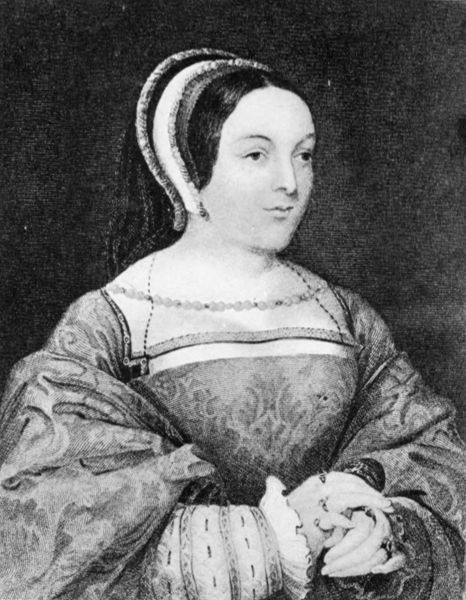 MARGARET TUDOR, QUEEN OF JAMES IV.
I am certain that Dom Pedro de Ayala did
not linger in the court to gossip with Dunbar,
or with the hangers-on. Dom Pedro had come
up from Spain on a strange ambassadorial errand,
to offer to James in marriage a Spanish
princess, knowing well that there might be no
Spanish princess (Maria was betrothed to
Portugal); but no doubt believing that there
ought to be, since James was slow in marrying,
and surely a Spanish princess would best mate
this royalest of the Stewarts. Dom Pedro better
liked the extravagant kingly court at Holyrood
than the niggardly court at Windsor. He
wrote home to Ferdinand and Isabella, "The
kingdom is very old, and very noble, and the
king possessed of great virtues, and no defects
worth mentioning." No defects! Certainly
not. James had the qualities of his defects,
and these were royal. James could speak—not
keep still—in eight languages, and could and
did say "all his prayers." So Dom Pedro reports
to his Most Catholic Majesty.
When he was thirty years old, this King Errant
married, not the hypothetical daughter of
Spain, but the substantial youthful Margaret
Tudor, aged fourteen. The Scottish king would
none of the alliance for years; James preferred
hypothetical brides and errant affairs. But
the English king saw the advantage and pressed it.
He had united the roses, red and white, of England;
he would fain join the thistle to the
rose.
So James, in August, 1503, journeyed out to
Dalkeith, whither Margaret had come. He returned
to "hys bed at Edinborg varey well
countent of so fayr a meetyng." A few days
later, Margaret made her entry into Edinburgh,
James having met her, gallantly dressed in "a
jacket of crimson velvet bordered with cloth of
gold." Leaving his restive charger, "mounting
on the pallefroy of the Qwene, and the said
Qwene behind hym, so rode throw the towne
of Edinburgh." Their route lay through the
Grassmarket up to the Castle Hill, and down
the High Street and the Canongate, to the Abbey.
Here they were received by the Archbishop
of St. Andrews. Next day they were
married by the Archbishop of Glasgow, the
Archbishop of York joining in the solemn and
magnificent celebration.
It is the most splendid moment in Edinburgh
history, within the Abbey and the palace, and
within the city. The Town Cross ran with
wine, the high lands were hung with banners
and scarlet cloth, and morality plays were performed
before the people. In the palace there
was a royal scene. And our friend, William
Dunbar, Kynges Makar, read his allegory of
"The Thrissl and the Roiss," which is still
worth reading, if Chaucer is worth reading.
But, at night, in the royal apartment, the
night before the wedding, perhaps in the fragment
of the old palace which remains, the gallant
king played to the little princess upon the virginal;
and then, on bended knee and with unbonneted
head, he listened while she played and
sang to him. Out of the dark of the time it is
a shining scene; and out of the splendour of
the moment it brings a note of tenderness.
Another decade, another August, and the
Boroughmoor (where now run the links of
Burntland) was covered with the white of a
thousand tents, Scotland was gathered for war,
the "ruddy lion ramped in gold" floated war-like
over all, and James and all Scotland prepared
to march down to Flodden, heeding not
the warning which had sounded at midnight in
ghostly voice at the Town Cross; a warning no
doubt arranged by Margaret, never a Stewart,
always a Tudor. And—all Scotland was turned
into a house of mourning.
Half a century later the history of Scotland
came to a climax, and Mary Stewart came to
Holyrood; that queen who then and ever since
held half the world in thrall, like another Iseult.
The covenanted world has rejected her, as no
doubt it would reject Iseult.
Shrouded in a gray "haar" from off the
North Sea, rising like a Venus out of the mists
of the sea, Mary Stewart, Dowager of France,
Queen of Scotland, Heiress of England, came
unto her own. And, her own received her, and,
received her not.
The castle hanging high in air no longer hung
there. The palace lying low on the plain was
not there, on that August 19, 1561. There was
nothing but what was near at hand; Mary could
not see a hundred feet into her kingdom. In
truth she arrived at port a week before the ship
was expected—and Mary also flashed through
her kingdom; witness the ride across the
Marches to the Hermitage, and the ride
through the North to punish Huntley. Hers
was a restless soul, a restless body.
On her return to the kingdom she was accompanied
by a great retinue, three of her French
uncles of Guise and of Lorraine, her four
Maries, and many ambassadors. It was a suspended
moment in the world, the sixth decade
of the sixteenth century. And nowhere were
affairs in such delicate balance, or so like to
swing out of balance as in Scotland; where religion,
sovereignty, feudalism, morality, were
swaying dizzily. So all the world sent their
keenest ambassadors to observe, to foresee if
possible, to report.
Yet Mary rode through the mists.
"Si grand brouillard," says the Sieur de
Brantome, that gossipy chronicler, and Mary
and her French courtiers and Scotch Maries,
rode through the "haar," from Leith up whatever
was the Leith Walk of that day to Holyrood.
The palace must have rung with French chatter,
of these wondering and inquisitive and critical
folk; for all the cultured world was French
in those days, and Mary and her Maries had
been only five or six when they left stormy
Scotland for the pleasant smiling land of
France.
Not for long was she permitted to believe she
had brought France back with her and there
was no reality in Scotland but as she made it.
Reformation pressed in upon her, even through
the windows of this turret where again she
seems to listen to that prophetic and pious
serenade, Scottish protestant psalms accompanied
by fiddles and sung to a French Catholic
queen. "Vile fiddles and rebecks," complains
Brantome, hesitating to call vile the mob
of five hundred gathered in the Scotch mists;
but they sang "so ill and with such bad accord
that there could be nothing worse. Ah, what
music, and what a lullaby for the night!"
The rooms of Mary are still inclosed, the
walls still stand about them, and a romantic
care withholds the ravages of time from those
tapestries and silken bed hangings, dark crimson
damask, which Mary drew about her on that
night of her return. And here hangs a picture
of Queen Elizabeth, authentic, Tudoresque,
which did not hang here when Mary returned;
but what dark shadow of Elizabeth lurked behind
these hangings! The very guard to whom
you protest the picture understands—"I think
it an insult to her memory."
It is here that Queen Mary still reigns. All
the old palace was burned, carelessly, by Cromwell's
soldiers, at what time men were caring
nothing for palaces, and less for royalty. But,
fate was royal, was Jacobite, and this gray
turret of the northwest corner a building of
James V on a foundation of James IV—perhaps
where he had listened in the evening to
Margaret and her virginal—was saved from the
wrath of the Commonwealth. Within these
very walls Mary played on the virginal, perhaps
on the rebeck, and many sought to know
her stops—"you can fret me, yet you cannot
play upon me."
Here she was loved, as she still is loved.
Here she made love, the mystery!—as always.
Here she flashed those bright eyes on courtiers
and commoners and straightway these fell into
bondage—the Stewarts never drew the line of
division. Here those eyes battled with John
Knox as he met her in Dialogues, as John has
faithfully recorded. And here those bright
eyes filled with a storm of tears at his denunciation;
but Knox felt their power. Here she
met Darnley, in the chapel married him, and
Knox called after dinner to declare that the
Reformation did not approve. Here by the
very stairs of the turret Darnley led the murderers
on Rizzio, from his private apartments
to hers. (I find it fit that Ker of Fawdonside,
one of the murderers, should have married later
the widow of Knox.) Mary was held here a
prisoner; they would "cut her into collops and
cast her over the wall" if she summoned help.
But Mary could order that the blood stains of
the fifty-six wounds of Rizzio should remain
"ane memoriall to quychen her revenge."
They quicken our thought of Mary to-day—if
we accept them. From Holyrood Mary went
to Kirk o' Field on a Sunday night in February
to visit Darnley who lay "full of the small
pox." He had come back from Bothwell castle
on Mary's urging; but he had gone to Bothwell
to escape her revenge for Rizzio. She returned
to Holyrood—"the Queen's grace gang
and with licht torches up the Black Friar's
Wynd"—where the wedding festivities of a
member of her household were in progress.
And, I doubt not, devoted to Mary as I am, that
she was the merriest of the company.
Then the dark.
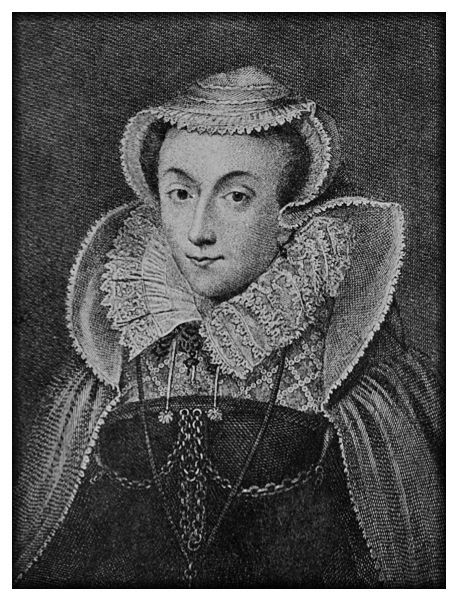
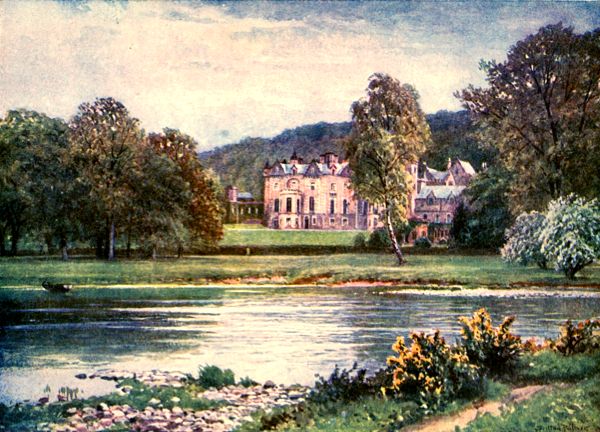
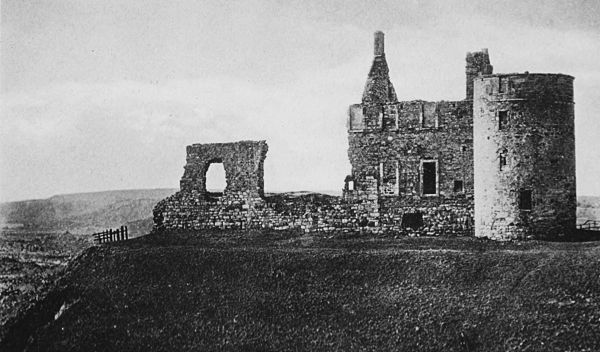
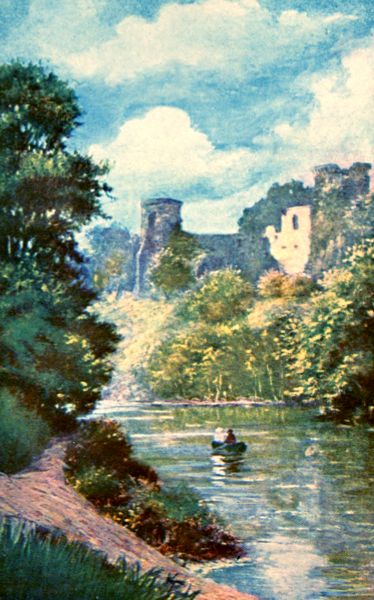 Bothwell Castle
Then, at two in morning, an explosion that
shook all Edinburgh, that astonished the world,
that still reverberates through the world.
Then—the dark.
A marriage, at two in the morning, a flight
to Borthwick, a meeting at Carberry, one more
night in Edinburgh, in a house as mean as that
of Kirk o' Field, a day at Holyrood, and a
forced ride with ruffian nobles, Lindsay and
Ruthven on each hand, to Loch Leven, thirty
miles in the night of June 16, 1567—and Edinburgh
and Holyrood and the Crown of Scotland
know her no more.
"Helen's lips are drifting dust,
Ilion is consumed in rust."
And Mary. And Holyrood.
There is one more Holyrood scene descending
from this. On a Saturday evening, March
26, 1603, the son of Mary, the King of Scotland,
supped with the Queen, perhaps in that small
supper room where Rizzio was supping with a
queen; and they had retired. "The palace
lights were going out, one by one." And Sir
Robert Carey, three days out from London,
clattered into the courtyard, the King was
roused, Sir Robert knelt before him—
"Queen Elizabeth is dead, and Your Majesty
is King of England!"
James I of England, James VI of Scotland,
son of Mary, son of Darnley, son of the ninth
generation from Bruce, The Bruce. The "auld
enemy" is finally defeated; and to borrow again
from Rosaline Masson, "the lights of Holyrood
went out, one by one."
In the long picture gallery of this dull modern
palace, nothing of which either Mary or
James ever saw, there hangs a series of portraits,
one hundred pictures of Scottish kings,
painted under order of Charles II in 1680, by
the Fleming, DeWitt, who agreed to furnish the
pictures in two years for one hundred and
twenty pounds. They begin with Fergus I,
330 B. C. They are the kings who passed before
the prophetic vision of Banquo. Enough to
frighten Macbeth!
One brief brilliant ghost of Stewart glory returns.
In this gallery was held the ball of
Prince Charles Edward, described in "Waverley."
And after this theatric moment, and after the
Prince had defeated the "royalists" at Falkirk,
Hardy's dragoons slashed these pictures
of Scottish kings, since the Prince they could
not reach.
There are certain public places of beauty
where the beauty is so enveloping that the place
seems one's very own, seems possessed. That,
I take it, is the great democratic triumph, in
that it has made beauty a common possession
and places of beauty as free to the people as is
the air.
Chief of these is Princes Street Gardens.
I could, in truth I have, spent there days and
half-days, and twilights that I would willingly
have lengthened to midnights, since the northern
night never quite descends, but a romantic
gray twilight veils everything, and evokes more
than everything. For any lengthened visit in
Edinburgh I dare not inhabit a hotel room on
the Garden side, since all my time would be
spent at the window. For a shorter visit, such
a room lengthens the day, defies the closed gate
of the Gardens.
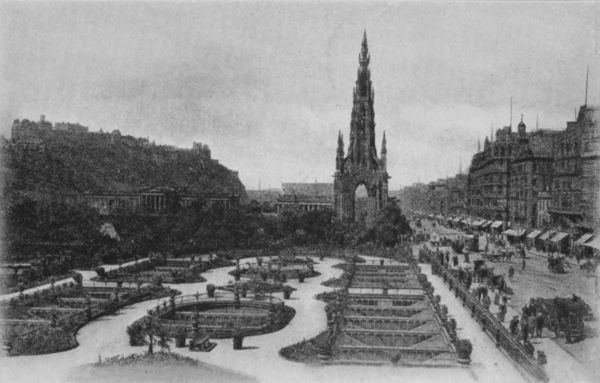 PRINCES STREET.
It was from such a window as this, "From a
Window in Princes Street" that Henley looked
forth—
"Above the crags that fade and gloom
Starts the bare knee of Arthur's Seat;
Ridged high against the evening bloom
The Old Town rises, street on street;
With lamps bejeweled, straight ahead,
Like rampird walls the houses lean,
All spired and domed and turreted,
Sheer to the valley's darkling green;
Ranged in mysterious array,
The Castle menacing and austere,
Looms through the lingering last of day;
And in the silver dusk you hear,
Reverberated from crag and scar,
Bold bugles blowing points of war."
Princes Street is, I believe, not a mile long,
a half-mile the part which is gardened. It is
the loveliest street in the world. It seems infinite
instead of half-mile.
Of course to the loyal American that praise
is received half-way. For he remembers Riverside
Drive with the majesty of the Hudson,
North Shore Drive with the shoreless infinity
of Lake Michigan, Summit Avenue with the
deep gorge of the Upper Mississippi, Quebec
and its Esplanade. But even these "handsome
streets" cannot match Princes for history and
beauty in one, for the old and the new, for the
Old Town and the New Town.
Princes Street, to speak briefly of its geography,
is a broad thoroughfare, with a medley
of buildings on the north side, but uniform in
gray stone, where hotels and shops furnish the
immediate life of the city. There are electric
cars running the full length of the street; and
it is the only street I know which is not spoiled
through the presence of these necessary carriers.
There are cabs, and there are sight-seeing
cars, from which in high advantage, and in half
a day, you can see everything in Edinburgh.
Yes, actually. I who speak to you have done
it, partly for the greed of seeing it steadily and
seeing it whole, and partly for the comment of
these Scotch coach drivers and guards, who are
not merely Scottish but the essence of Scotland.
I shall never forget how an American traveler—of
course they are all Americans in these tally-hos—commenting
on the driver's remark that
the "Old Queen" wanted to build a palace where
Donaldson's Hospital now stands and she was
refused—"but she was the Queen!" Nevertheless,
asserted Mr. Sandy Coachman, "She was
refused." Not so in the old days of Queenship.
The entire life of Edinburgh, of Scotland,
streams through this broad straight street.
On the opposite side lie the Gardens, stretching
their way parallel with the street, a wide,
green-lawned, tree-forested purlieu, terraced
and flowered, with a "sunken garden" near the
Castle-side, through which trains are conveyed.
The smoke, so much lamented, does often rest
with grace and gray loveliness in the hollows
of the place, so that one does not miss the waters
of the Nor' Loch that once flowed here as moat.
Above rises the castle in greater majesty
than from any other point. Down from the
castle runs the ridge of the High Street, and
the high lands with flags of washing hanging
out the windows which answer the flags red and
leoninely rampant, on the buildings of Princes
Street. The crown of St. Giles and the spire
of the Tronkirk hanging above all.
To the west is St. John's, where in the graveyard
Raeburn is buried; and old St. Cuthbert's,
where in the graveyard De Quincey is buried.
There are Raeburns in the Royal gallery which
stands on the island dividing the Gardens, and
there are many Raeburns here and there, in
private rooms of banks and other institutions,
rare Raeburns with that casual, direct, human
look he could give men and women. The galleries
are worth a visit both for their best, and
for their not-best. There are statues of famous
Scotsmen on the terraces, and of course the
Scott monument, beautifully Gothic, and as
sacred as a shrine.
There are goods to be bought in the shops,
pebbles and cairngorms in jewelry and kickshaws
of that ilk; rugs and plaidies, sashes and
ties, and Scott and Stevenson books bound in
the Royal Stewart silk. Unhappy the traveler
who has not provided himself beforehand with
a tartan. Almost every one can if he will. And
there is always the college of heraldry to help
one out. Or the audacity of choosing the tartan
you like best; an affront, I assure you, to
all good Scots. For however unlovely a Scotch
tartan may be in the eyes of the world—nominations
are invidious—in the eyes of the clansman
there is nothing so "right" as his own
particular tartan. He would not exchange it
for a Douglass or a Stewart.
These tartans have exerted a very marked
effect on the Scottish sense of taste. On
Princes Street you may not find such richly
dressed women as on Regent Street, but the
harmony of colouring will please you better.
While no doubt this is due to the fact that for
several hundred years the Scottish taste has
had the benefit of intimate association with the
French, it can also be traced to the longer centuries
during which tartans have brought an
understanding of colour harmonies. Because
there has been this love of colour, there has
come with it vanity. With vanity there has
come that rare ability of the women of the race
to maintain a unity, a harmony, a complete relationship
between skirts and waists. There is
no country in Europe where the "act of union"
at the feminine waistline is so triumphant as
in Scotland, particularly in Edinburgh. The
universal American achievement has been
equaled in Europe only in Scotland.
There are teashops which invite you in, when
the wind sweeps too harshly, or the rain beats
itself into more than a Scotch mist, or even
when the sun shines too hot. There is a garden
tea place on top of a high hotel which confronts
the Castle. Even in this Far North
there is much open air dining, and more especially
open air tea-ing. I am not certain that
Dr. Johnson would have much cared for this
modern tea room, where he might review the
world. It seems that he drank much tea when
he was the guest of Boswell, especially when he
was the guest of Mrs. Boswell, in James Court
the other side the Gardens. "Boswell has
handsome and very spacious rooms, level with
the ground on one side of the house, and the
other four stories high." And Boswell says
of Johnson, "My wife had tea ready for him,
which it is well known he delights to drink at
all times, particularly when sitting up late."
From this roof tea garden one can see James's
Court at the top of the Mound, although the
Boswell lodgings are burned down. And one
can almost see Holyrood, where tea was introduced
by James VII.
After you have shopped and had your tea,
and the past retakes possession, you will return
to the green valley of the Gardens, to forget the
clang of the tram cars, to look up at the great
Castle Hill, green until it meets the buff-coloured
stone and the buff-coloured buildings that
seem to grow out of the stone, if it is a clear
day; while the ramparts seem temporarily to
have blossomed with red geraniums, if red coats
are leaning over the edge.
A clear day in Edinburgh is possible. I have
spent a month of such days, and have longed
for the mists, a touch of them, that the castle
might turn to a purple wonder, and the deep
blue shadows sink over it, and the gray precipice
of the High Street look higher than ever. Gray
is in truth the colour of Edinburgh, "the gray
metropolis of the North." But it is never a
dreary gray, never a heavy gray like London.
There the gray is thick, charged with soot;
one can rub it from his face. In Edinburgh
the gray is luminous, a shifting playing colour,
with deep shadows turning to deep blue, with
rifts or thinnings of the cloud, through which
yellow and brown glimmers make their way.
Above all, Edinburgh is never monotonous.
That is perhaps its charm, a something that
every feminine city knows; Edinburgh is feminine,
and Paris, and Venice, and New Orleans.
And there hangs the castle, sometimes in
midair—
"Hast thou seen that lordly castle, that castle by the sea?
Golden and red above it the clouds float gorgeously."
Sometimes standing stalwart and stern, a
challenge to daring, a challenge to history.
That farther edge of the Castle Hill as it is
silhouetted against the west sky—if you walk
around on Lothian Street you can see the full
face of the Rock—has invited many an adventurer,
both from within and without.
It was down that steep hill that the sons of
Margaret carried their queen mother, when
the hosts of Donalbane were besieging the place,
and a Scotch "haar" rolling in from the sea
and shutting off the castle enabled the little
procession to pass safely with its precious burden,
and swiftly down to the Queen's ferry, and
across to Dunfermline.
Up the face of that Rock when The Bruce did
not hold this stronghold there stole in the night
of a thirteenth century winter—it must have
been much colder, even in Edinburgh, in the
thirteenth century—a picked band of men;
picked by Randolph afterward Earl of Moray,
and led by Frank, who, years before when he
had been a soldier in the castle garrison and
night leave was forbidden, used to make his
way down this cliff to visit a bonnie lassie in
the West Bow. Now, on a wind-swept night,
which can be very windy around that castle
profile—the wind has not abated since the thirteenth
century—Frank led the remembered
way. I wonder if he remembered the lassie.
But his footing was sure. Once, it is true, the
sentinel seemed to have discovered them. But
it was only the boast the sentinel makes to the
night when he makes his last round. The men
huddled against the face of the Rock. Then
they moved onward. The ladders were too
short to reach the rampart. Two were bound
together. The men over, the cry "A Moray!"
rings in the castle. Scotland has won it again.
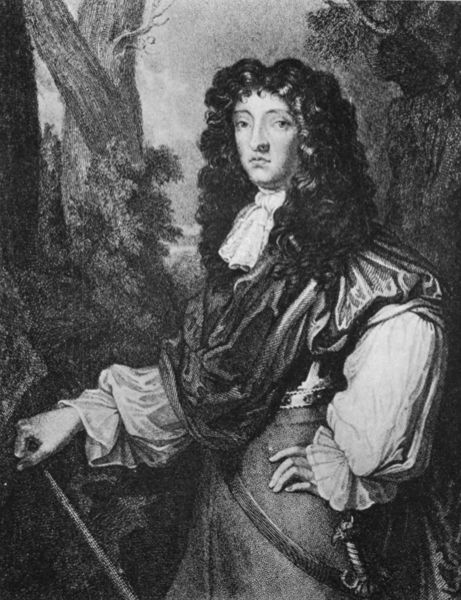 JOHN GRAHAM OF CLAVERHOUSE, VISCOUNT DUNDEE.
Another century, and James III is king.
This least royal of the Stewarts, jealous of his
more royal brother, locked the Duke of Albany
in the castle, and felt secure. But the Duke
had friends. A French clipper came into Leith.
It brought wine to Albany, and the wine cask
contained a rope. Inviting his guardians to
sup with him, he plied them with heated wine,
perhaps drugged wine, then, the dagger. Albany's
servant insisted on going down the rope
first. It was short, he fell the rest of the distance.
Albany hurried back for the sheets from
his bed, made his safe way down. He carried
the servant man all the way to Leith—he had
just "whingered" the guard—found the boat,
and safety, and France.
Up the Rock, in Covenanting days, stole
Claverhouse, the Bonnie Dundee, to a secret
conference with the Duke of Gordon, hoping
to win him away to Stewart loyalty and the
North.
I cannot remember that any of Scott's characters
went this way. He thought it "scant
footing for a cat." But Stevenson knew the
way. Perhaps not actually, but he sent more
than one of his characters up or down the Rock—St.
Ives with a rope that was long enough to
reach.
Perhaps the best view of Edinburgh—only
perhaps, for each view differs, and you have
not seen the whole city unless you have seen it
from the various vantage points—is that from
the Calton Hill. For a very good reason. The
Hill itself is negligible enough, although it is
impossible to understand Edinburgh, to understand
Scotland, unless you have looked on the
architectural remnants on this Hill, and considered
them philosophically. But, as Stevenson
said—"Of all places for a view, the Calton
Hill is perhaps the best; since you can see the
castle, which you lose from the castle, and Arthur's
Seat, which you cannot see from Arthur's
Seat." An excellent reason, which also
places the castle and Arthur's Seat.
Calton Hill does not tower so high over the
city as these other two points; one may still
look up to Arthur's Seat, one may look across
to the castle. Yet, the city lies near. Yet, the
country rolls out to the Firth, and out to the
Pentlands. Perhaps a gray-sea haze dulls the
far edge of the far Kingdom of Fife. Perhaps
a blue haze hangs over the Pentlands. Perhaps
a smoke-cloud makes a nearer sky for the
town itself, this Auld Reekie. Not only perhaps,
but very probably. There are clear days
in Edinburgh. They are to be treasured.
There is no air more stimulating in all the
world. October sometimes slips into the other
months of the year, fills the air with wine, clears
the air of filament. But, not often, not often
for the tourist from beyond seas who makes
Edinburgh in the summer. But still it is possible
from Calton Hill to catch the farthest
glory of the encircling hills, and the near glory
of the ever glorious city.
The Hill itself is a place of monuments, and
a very pretentious place. Also, very absurd.
I suppose it is possible to be of two minds about
the remnant of the Parthenon which stands so
conspicuously on the highest plateau, a construction
dating back to that royal time when
George the Fourth came to this northern capital,
and was—alas!—received as though he
were Bonnie Prince Charlie himself; and was
received—again alas!—by Sir Walter clad in a
Campbell plaid, and as loyal to the Regent,
the florid Florizel, as he had been to Prince
Charles in the "Waverleys." Because of all
these loyalties this never finished monument,
with its twelve columns and architrave spread
above, looks sufficiently pathetic, and sufficiently
absurd. "A very suitable monument to certain
national characteristics," said a later Scots
writer, who perhaps never ceased being a
Jacobite.
There are monuments; one to Dugald Stewart,
and the visitor not philosophical is apt to
ask, Who was Dugald Stewart? There is a
memorial to Burns whose friend Willie that
brewed a peck o' malt lies in the Old Calton
burying ground near by. Hume lies there,
too, and Dr. John Brown, and Stevenson's
dead.
"There on the sunny frontage of a hill,
Hard by the House of Kings, repose the dead,
My dead, the ready and the strong of word.
Their works, the salt-encrusted, still survive;
The sea bombards their founded towers; the night
Thrills pierced with their strong lamps. The artificers
One after one, here in this grated cell,
Where the rain erases and the dust consumes,
Fell upon lasting silence."
There is a monument to Lord Nelson. And
looking as though he belonged there is a bronze
figure of Abraham Lincoln.
All this lies about, with casual sheep cropping
the grass.
But, there lies the city. And there lies the
country.
To the south rises Arthur's Seat, the lion.
The much castellated jail, is beneath you, another
absurd elaborate building, a castle after
castle-days. Farther a-city lies Holyrood, with
the ruined abbey, the Queen Mary wing, and
the scarlet patch of the sentinel moving to and
fro and guarding all this vanished greatness.
Nothing more appeals than this sentinel-watch
of the ghosts of the past.
Turn but a little and the Old Town lies before
you, the castle splendid, still the guardian, the
long ridge of the High Street with its jagged
buildings that from here rise almost to the
purple edge of the hilly Pentland background,
with the spire of the Tolbooth and the crown of
St. Giles breaking against the sky. And down
at the foot of the vantage Hill stretches Princes
Street with the Scott monument rising athwart
the haze of city and sky.
From the north edge of Calton there is a more
empty panorama, but still significant. Now it
is bound in with tenements high and thick, but in
the golden days it was a steep hillside leading
down to a jousting ground. Tradition has it
that Bothwell launched his horse down its almost-precipice,
and so entered the tilting
ground, while ladies' bright eyes rained influence
and gave the prize; but most glowing were
the eyes of Mary.
Beyond, the suburbs fill in the two miles that
stretch to Leith, and to the Firth, glittering
out to the far sea.
At night, if you have no fear of hobgoblins
or of hooligans, Calton Hill is an experience.
It is a still place, the silence the greater because
the city lies so near, and looks so busy with its
twinkling lights. A gulf of gloom lies between.
The night is velvet black, a drop curtain against
which is thrown the star-pricked map of the
city. One can well believe how the young
Stevenson, in those romantic days when he
carried a lantern under his jacket, used to
climb this hill venturesomely, and with the dog
in "Chanticler," exclaim, "I shall never forget
the first night I lapped up the stars." It
is something to lap stars from the black pool
which is Edinburgh by night.
If you have, happily, lived in a high city,
Boston, Seattle, Duluth, Denver, St. Paul, San
Francisco, with water and land combined, you,
too, have lingered upon a heaven-kissed hill on
such a night as this, and Edinburgh seems native.
Scott, of course, must have known Calton
Hill, although Salisbury Crags under Arthur's
Seat, with its more feasible promenade, better
appealed to him when he was writing the
"Waverleys." There is an American who has
written of the Hill, a young inland American
whom the gods loved to an early death. I remember
hearing Arthur Upson talk of days and
nights on the Calton, and his sonnet catches
the note—
"High and alone I stood on Calton Hill
Above the scene that was so dear to him
Whose exile dreams of it made exile dim.
October wooed the folded valleys till
In mist they blurred, even as our eye upfill
Under a too-sweet memory; spires did swim,
And gables, rust-red, on the gray sea's brim—
But on these heights the air was soft and still,
Yet, not all still; an alien breeze will turn
Here, as from bournes in aromatic seas,
As round old shrines a new-freed soul might yearn
With incense of rich earthly reveries.
Vanish the isles: Mist, exile, searching pain,
But the brave soul is freed, is home again."