Since this chapter was written the ill-fated city of Malines has been
swept with shot and shell for many days together, its once happy and
prosperous inhabitants driven far and wide—many of them into foreign
lands—and it is doubtful if a single one of the various ancient
edifices which we visited last June has escaped injury.
Notwithstanding these sad facts it has seemed best to retain the
chapter substantially as it was written, inasmuch as it affords a pen
picture of the old town as it looked on the very eve of its
destruction. Let us hope that when the war is over it will be found
that most, if not all, of its famous old structures can be restored
again. As the scene of some of the most stubborn conflicts of the
great war, it is likely that the city will be more generally visited
by tourists than was the case when its architectural and artistic
treasures were uninjured, save by the gentle hand of time. To those
who thus visit it the following account of the Malines that was may
prove interesting.
Since this chapter was written the ill-fated city of Malines has been
swept with shot and shell for many days together, its once happy and
prosperous inhabitants driven far and wide—many of them into foreign
lands—and it is doubtful if a single one of the various ancient
edifices which we visited last June has escaped injury.
Notwithstanding these sad facts it has seemed best to retain the
chapter substantially as it was written, inasmuch as it affords a pen
picture of the old town as it looked on the very eve of its
destruction. Let us hope that when the war is over it will be found
that most, if not all, of its famous old structures can be restored
again. As the scene of some of the most stubborn conflicts of the
great war, it is likely that the city will be more generally visited
by tourists than was the case when its architectural and artistic
treasures were uninjured, save by the gentle hand of time. To those
who thus visit it the following account of the Malines that was may
prove interesting.
Situated midway between Antwerp and Brussels, on a route formerly
traversed by scores of rapides every day, the ancient city of
Malines—which is the French spelling, the Flemish being Mechelen—was
exceptionally easy to visit, yet during the three days that we spent
wandering along its entrancing old quays and streets and inspecting
its many “monuments” we saw not a single tourist. This was the more
remarkable because Malines is not only one of the very oldest cities
in Northern Europe, but was for centuries among the most famous. For a
considerable period it was the capital of all the Netherlands, and it
is still the religious capital of Belgium—the archbishop of its
cathedral church exercising authority over the bishops of Bruges,
Ghent, Liége, Namur and Tournai.
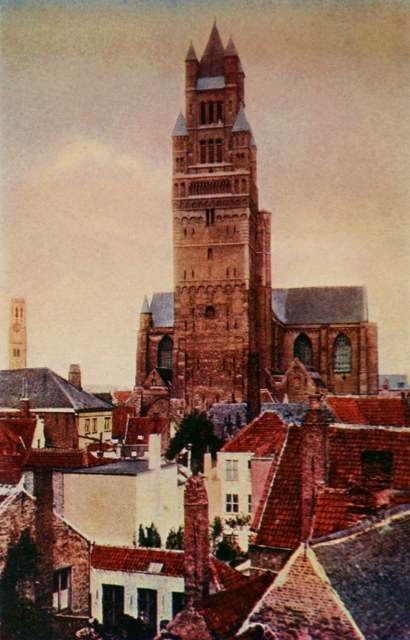
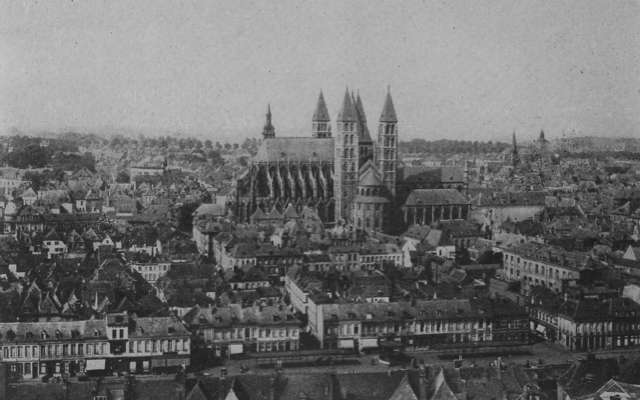
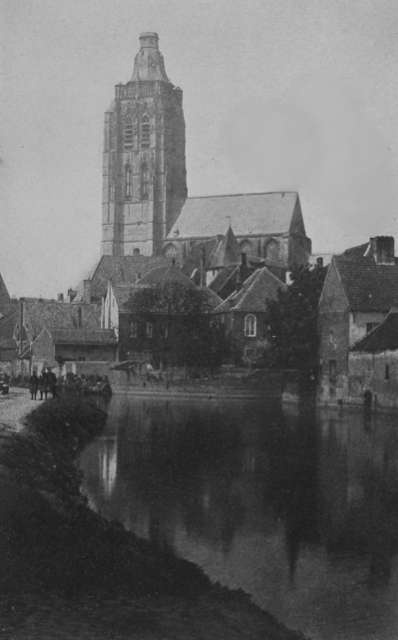
No matter from which side one approaches the city the first object to
be seen is the vast square tower of the Cathedral of St. Rombaut, and
as this huge structure—the eighth wonder of the world, according to
Vauban—dominates the town, so the church itself has dominated the
history of the city on the River Dyle for more than eleven
centuries. According to tradition St. Rombaut, or Rombold, to use the
English spelling, sought to convert the savage tribes inhabiting the
marshes that extended along the river about the middle of the eighth
century, the date of his martyrdom being placed at 775. A Benedictine
abbey was shortly afterwards established near his tomb, which steadily
grew in importance and power until by the twelfth century it had
become one of the most important religious institutions in the region.
During the thirteenth century the prince-bishops of Malines became the
virtual sovereigns of the city, one of them—Gauthier Berthout,
sometimes called the Great—defeating the Duke of Gueldre, who
attempted in 1267 to assert his authority over that of the prelate. At
this period many of the religious institutions of Malines were
established under the patronage of Gauthier Berthout and his
successors.
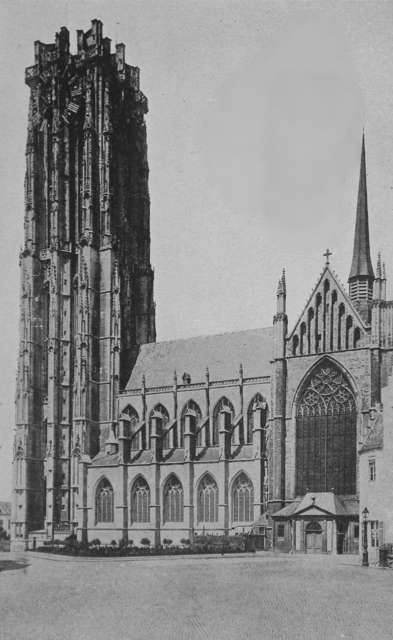
CATHEDRAL OF ST. ROMBAUT. MALINES.
Meanwhile the comparative immunity of the city from the ravages of the
wars that so often raged at that period between the various feudal
lords of the region caused great numbers of artisans to settle there,
particularly weavers, while the cloth merchants’ guild came to be
recognised as entitled to a voice in the civil affairs of the
commune. Ships, according to the chronicles, came up the River Dyle in
such numbers as to make the commercial activity of the town rival that
of Antwerp—a statement that is hard to believe when one gazes at the
tiny River Dyle of to-day. However, the ships in those days were very
small, and the river, like so many others in Belgium, was no doubt
broader then than it is now that the marshes have all been drained.
The weavers and other artisans were a turbulent lot, and it soon
became evident that the bishops lacked the power to hold them in
check.
This led to a series of alienations of the temporal power over the
commune to neighbouring princes whose armies were strong enough to
keep the unruly burghers in restraint. The first of these was effected
in the year 1300 between the prince-bishop, Jean Berthout, and Jean
II, Duke of Brabant. In 1303 the news of the great victory gained over
the nobility by the Flemish communes at Courtrai caused the citizens
to revolt against their new master, the Duke, who besieged the city
and finally reduced it by starvation. Until this time the Dyle had
never been bridged, its waters flowing over a broad marshy bed. This
made the siege the more difficult as the attacking forces were
separated by the river, and it was five months before the sturdy
burghers yielded. To this day an annual procession, called the
peysprocessie, perpetuates the memory of this famous siege.
During the next half century the civil authority over the city became
a veritable shuttlecock of politics and war, shifting back and forth
between the Dukes of Brabant and the Counts of Flanders. It was bought
and sold like a parcel of real estate, but eventually rested with the
Counts of Flanders, who had first acquired it by purchase in 1333, and
were finally left in undisputed possession by a treaty signed in 1357.
Four years later a violent insurrection of the weavers and other
artisans broke out that was only mastered after the city had been in
their possession fifteen days, but with the advent of the Dukes of
Burgundy to the supreme power over all of Flanders, Brabant, Hainaut
and Holland, the unruly workmen were no longer strong enough to resist
these redoubtable princes. Great numbers of them emigrated to other
cities, and the cloth industry, after languishing for a time, finally
disappeared.
Like most Flemish towns, Malines has its principal railway station
located on its very outskirts, and as far as possible from the Grande
Place. A tram car was standing in front of the station on the morning
of our first visit, but it seemed that it did not start for ten
minutes. A score of roomy two-seated carriages invited our patronage,
but we valiantly decided to walk. We soon regretted our decision as
the walk proved to be long and hot, with very little of interest to
see, as the houses in this part of the town are comparatively modern.
At the bridge across the Dyle we paused for a few moments to admire
the fine views that can here be had of the old Church Notre Dame au
delà de la Dyle to the westward and the equally picturesque Notre Dame
d’Hanswyck to the eastward. Just beyond the river is the entrance to
the Botanical Gardens, and as our first visit chanced to be on a
Friday we walked in unmolested and enjoyed the welcome shade and the
beautiful landscape effects of this charming little park. Later on we
learned that Friday is the only week-day on which admission is free, a
fee of ten cents being exacted on other days.
As is the case in most Belgian cities, the street from the station to
the heart of the town, although continuous and straight, changes its
name more than once. At the outset it is the rue Conscience, then the
rue d’Egmont, and from the bridge across the Dyle to the Grande Place
it is named Bruul. Entering the Place from this side we paused to
admire the tremendous tower of the cathedral which here burst upon us
in all its majestic grandeur, although the edifice is situated a
little to the west of the Place itself. In front of us, on the right,
was a singularly dilapidated ruin, which we learned was the old Cloth
Hall. Part of it is used as a police station, part is vacant with its
window openings devoid of sashes or glass staring blankly at the sky,
while part is devoted to housing a small museum of municipal
antiquities. The first Cloth Hall at Malines was destroyed by fire in
1342, and the new one that was begun to replace it was never finished,
owing to the ruin of the cloth industry during the struggles between
the artisans and their overlords, and a belfry which it was proposed
to erect similar to that at Bruges was never begun. The museum
contains a number of pictures by Malines artists, of historical rather
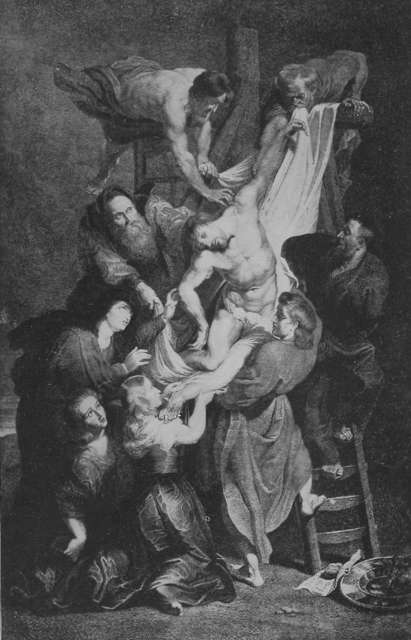
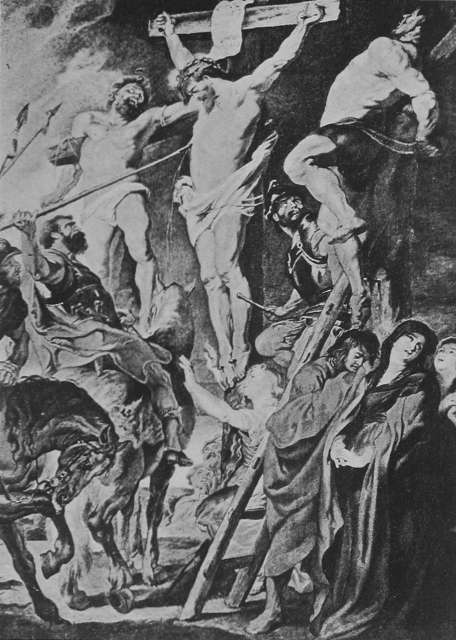
than artistic interest, a “Christ on the Cross,” by Rubens, and a
variety of relics of the city’s famous past. Curiously enough, there
is not a single piece of lace in the collection, nor anything to
represent the great cloth weaving industry—the two branches of
manufacture to which the city owes so much of its former wealth and
fame.
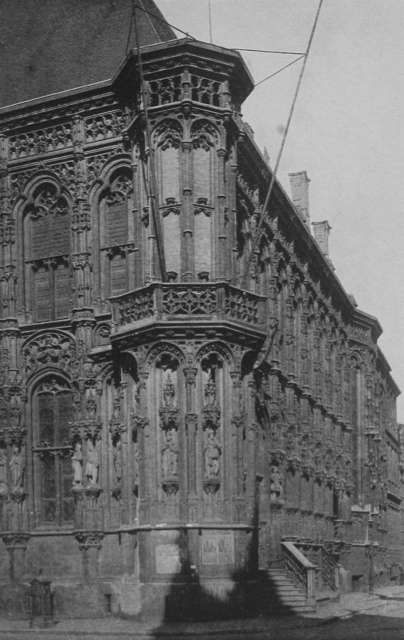
Adjoining the Halle aux Draps to the north is a fine modern
post-office built from designs drawn by the great Malines architect of
the sixteenth century, Rombaut Keldermans, for a new Hotel de Ville,
which was never built. Unfortunately its principal façade overlooks
the narrow rue de Beffer instead of the Grande Place, and its
beautiful details cannot be seen as effectively as could be desired.
In the Vieux Palais, the ancient “Schepenhuis,” or house of the
bailiffs, situated a little south of the Place, we were shown the
original design by Keldermans. It is kept in a sliding panel on the
wall and, although somewhat dim with age, can still be studied in
detail. The modern architects of the post-office have reverently
followed the plans of the great master so that at least this one of
his many brilliant architectural dreams has come true, and now stands
carved in imperishable stone just as his genius conceived it nearly
four centuries ago.
To the ancestor of this architect, Jean Keldermans, is generally
attributed the honour of designing the tower of St. Rombaut, the
architectural glory of Malines and one of the most magnificent
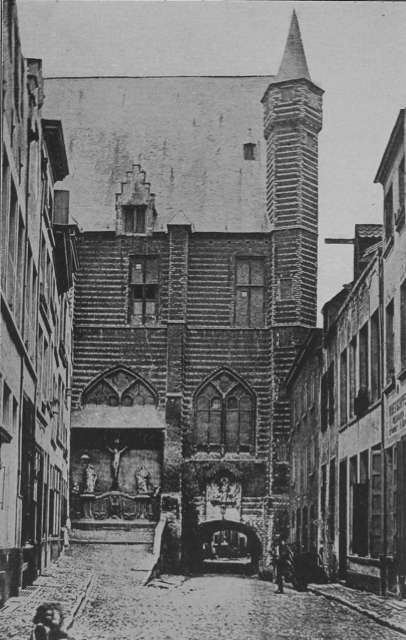
structures of the kind in the world. There are a thousand places
throughout the city where the photographer or painter can obtain
attractive views of this masterpiece, but perhaps the best of all is
from a point some distance down the Ruelle sans Fin (Little Street
without End) where a quaint mediæval house forms an arch across the
narrow street, while behind and far above it rises the majestic tower.
From whatever standpoint one regards the great tower, whether gazing
up at its vast bulk from directly beneath—a point of view that the
camera cannot reproduce—or from any of the little streets that
radiate away from it, its grandeur and beauty are equally impressive.
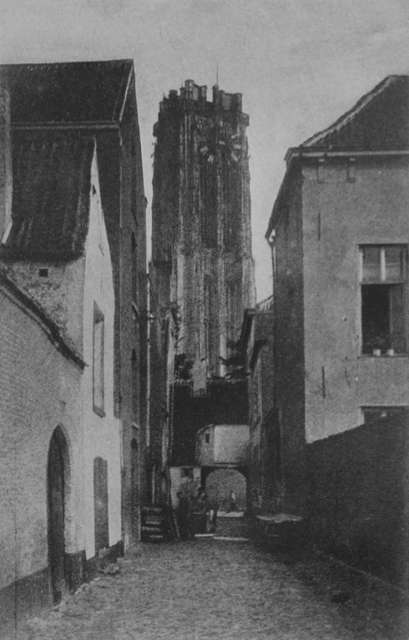
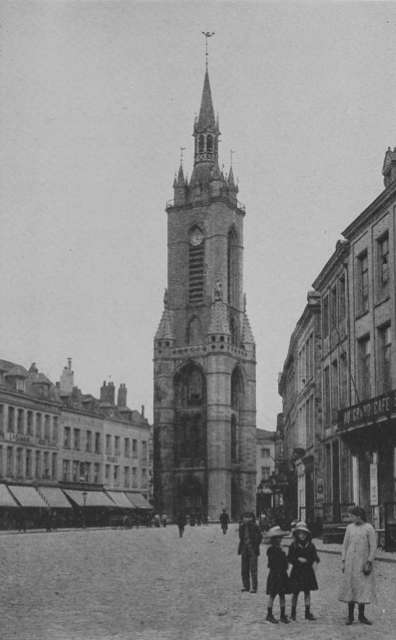
TOWER OF THE CATHEDRAL OF ST. ROMBAUT FROM THE RUELLE SANS FIN.
Begun in 1452, work on the great tower advanced slowly. In 1468,
according to a memorial tablet near the southern side of the tower,
Gauthier Coolman was buried there. It was the custom in the Middle
Ages to thus recognise the magister operis, or creator of the work,
but it is generally acknowledged that Jean Keldermans is entitled to
share in the credit for this achievement. Jean was the first in a
family of famous architects, his brothers André, Mathieu and Antoine
I, following the same profession, and their skill being handed down
to later generations, of whom the most famous were Antoine II, Rombaut
and Laurent. At the beginning of the sixteenth century work on the
great tower was stopped, owing to lack of funds, after attaining a
height of three hundred and eighteen feet. The plans, of which
sketches are still preserved at Brussels, called for carrying the
spire upward to a total height of five hundred and fifty feet, and in
the ambulatory of the cathedral we found a plaster cast showing the
spire as it was proposed to erect it. The stones to complete the work
were already cut and brought to Malines, but were carried away between
1582 and 1584 by the Prince of Orange to build the town of
Willemstadt. Apart from its height, this tower is remarkable for its
great bulk, measuring no less than twenty-five metres in diameter at
the base.
On each side for most of its height the architect designed a series of
lofty Gothic windows. Of these the lowest are filled in with masonry,
except for a tiny window in the centre. In the higher ones stone
blinds fill in the openings, while the topmost pair are wide open to
the sky. The well-known legend about the over-excitable citizen of
Malines who cried “Fire!” one night after seeing the full moon
through these windows gave the people of the town for many years the
nickname of Maanblusschers, or moon extinguishers, and also gave
rise to the slur in the last three words of the following Latin
distich in which an old monkish poet compares the six chief cities of
Belgium:
Nobilibus Bruxella viris, Antwerpia Nummis,
Gandavum laqueis, formosis Bruga puellis,
Lovanium doctis, gaudet Mechlinia stultis.
Brussels is renowned for its noble men, Antwerp for its money,
Ghent for its halters, Bruges for its pretty girls,
Louvain for its scholars, Malines (Mechelen) for its fools.
This seems rather hard on Malines, and also on Ghent, the allusion to
that city referring to numerous occasions when its sovereigns humbled
the burghers by forcing them to plead for mercy with halters around
their necks.
On the outside of the tower, close to its present summit, is a clock
the face of which is claimed to be the largest in the world. As the
same claim is made for the great clock on an industrial establishment
in Jersey City I will simply give the dimensions of the one at Malines
and let those interested make the comparison for themselves: Diameter
of face, 13.5 metres; circumference, 41 metres; length of hour hand,
3.62 metres; height of figures, 1.96 metres. The minute hands were
originally 4.25 metres long, but are missing on all four sides. This
renders the time-piece hardly one to be consulted if one is catching a
train, as the exact minute can only be estimated from the position of
the hour hand. Furthermore, the gilding on the hour hands and on most
of the figures has become so dim that only the strongest eyes can
distinguish the former, and some of the latter can only be made out
from their position. As the city appeared to be exceedingly proud of
the size of this clock it seemed strange that the authorities did not
authorise the expenditure of the small sum necessary to re-gild it.
It is a hard climb to the top of the tower, but one well worth making,
not only for the fine panorama of the city that unfolds itself wider
and wider as one mounts higher, but for the opportunity thus afforded
of seeing the fine carillon, or set of chimes, and the curious
mechanism operating the clappers that strike the hours. Just before
reaching the floor upon which these are placed the guide conducts the
visitor to a trap door from which one can look down into the interior
of the cathedral—a thrilling experience to be enjoyed only by those
who are not inclined to be dizzy. The massive timber work supporting
the huge bells was constructed in 1662, but the oldest of the bells
dates from 1498, or six years after the discovery of America. The two
biggest bells are named Salvator and Charles, of which the larger one
weighs 8,884 kilos, or more than nine tons, and requires twelve men to
ring it. There are four other big bells and forty-five for the entire
carillon, most of which were cast by Pierre Hémony of Amsterdam, the
Stradivarius of bell founders, in 1674. Altogether they form four
octaves, the giants chiming in with the others as the music demands.
The keyboard which operates the little hammers is operated by both
hand and foot power, and the carillonneur who operates it is worthy
of the splendid instrument at his command, being Josef Denyn, the son
of an equally famous carillonneur, and reputed to be the finest in
Europe. M. Denyn not only gives frequent concerts at Malines, but also
at Antwerp and Bruges, as well as in many European cities outside of
Belgium.
We made a special trip to Malines one Monday afternoon in June solely
to listen to one of these concerts, which takes place on that day
between eight and nine in the evening, during the months of June,
August and September. The sleepy old town was thronged with
automobiles, for the renown of these famous concerts has spread far
and wide, and some of the cars, we were told, had come from points as
far away as Ostende, Blankenburghe and Heyst, while scores were from
Antwerp and Brussels. The crowd gathered quietly in the streets
surrounding the great tower and a great silence seemed to pervade the
entire city as the hour of eight approached. Then, faint and far at
first, came the first dulcet tones from this great organ of the sky,
until—as the music swelled and more of the larger bells began to
blend their notes in the harmony—the very air seemed vibrant with
celestial sounds. The selection, as we afterwards learned, was one of
the Volksliederen, or pieces of folk music for the rendition of
which M. Denyn is famous. As we listened we realised as never before
the part the ancient carillon was meant to take in the daily life of
the people. It is, in truth, as a French author has beautifully
expressed it, the orchestra of the poor, giving expression through its
wondrous notes to their joys and their sorrows. On the occasion of
great fêtes its music is light and gay, in attune with the popular
rejoicing; in times of public grief the carillon gives utterance to
notes of lamentation; when a famous citizen is being borne to his last
resting-place through the streets lined with silent mourners the
carillon sends the deep notes of its funeral dirges across the city;
in time of war or sudden danger the great bells roar the wild tocsin
of alarm; in time of peace their softest notes breathe a sweet prayer
of peace and benediction at eventide.
While we were visiting the tower we were shown the tambour cast in
copper by means of which the clock strikes the hours, the half hours
and the quarters. This was cast in 1783, and two years were required
to make the sixteen thousand, two hundred square holes into which drop
the teeth that actuate the striking hammers.
The interior of St. Rombaut, while majestic and imposing, is hardly as
masterly as the tower. On the occasion of our first visit a high mass
was being celebrated and we reverently joined the throng of
worshippers. In addition to the choir there was a body of some two
hundred young men in the centre of the cathedral who participated in
the singing, a curé beating time for them. Their strong manly voices
blended finely with the higher notes of the distant choir boys and
the deep tones of the organ. From the top of the choir long crimson
streamers were suspended, terminating at the back of the high altar
and giving a rich note of colour to the interior, while the light from
the stained glass windows overhead poured downward in many-coloured
rays upon the throng of black-robed priests, with a sprinkling of
higher dignitaries clad in purple. Truly a picture that filled the eye
with the pageantry of religion, even as the rolling notes of the
sonorous chants filled the ear!
After the service was over, and the great cathedral, but now so
crowded, was deserted, we started on our tour of inspection. It would
be a tedious task to chronicle all of the objects of interest. The
carved stalls of the Gothic choir are far less elaborate in
workmanship than those at Amiens. The altar by Faid’herbe, a native of
Malines, is imposing, but not of remarkable merit. The carved pulpit
in the nave, however, is a veritable masterpiece of wood carving by
Michel Van der Voort of Antwerp, and dates from 1723. Below, St.
Norbert is shown flung from his horse by a thunderbolt, above is the
Crucifixion at the left, with the Virgin and St. John standing below
the cross, while at the right is shown a charming representation of
the Fall, with Eve offering the apple to Adam, both figures embowered
in a mass of foliage that twines up the stairway to the pulpit and
lifts its branches far overhead. The masterpiece of the paintings is
an altarpiece by Van Dyck representing the Crucifixion, a notable
representation of the gradations of grief in the faces of the Virgin
and Mary Magdalen. The attendant requires a franc to uncover this
picture. “The Adoration of the Shepherds,” by Erasmus Quellen, in the
opposite arm of the transept, while less famous, is a noble piece of
work.
As would be expected from its great religious importance, Malines has
numerous minor churches that contain much of interest to the visitor.
The largest of these is Notre Dame au delà de la Dyle, situated across
the River Dyle from the oldest part of the city, but dating from the
fifteenth century. Here the tourist usually asks to see “The
Miraculous Draught of Fishes,” by Rubens, a highly coloured triptych
that is only uncovered when one pays a franc to the attendant. As this
master produced some seventeen hundred known works it would cost a
small fortune to see them all at a franc apiece, but this one dates
from the artist’s best period and is fully worth the price charged to
see it. It is vigorous in treatment, and the Fishmongers’ Guild, which
purchased it from the artist in 1618 for sixteen hundred florins,
certainly got very good value for their money. The wings are painted
on both sides. This church also contains the curious Virgin with the
Broken Back. According to the popular legend her sharp leaning to the
right is due to the fact that one day, when the sacristan of the
church failed to wake up in time to ring the angelus the lady
obligingly did it for him, but wrenched her spine in the effort. Her
smug smirk of satisfaction, as if over a duty well performed, no doubt
also dates from the same incident.
Hardly less interesting is the ancient church of Notre Dame
d’Hanswyck, situated on the same side of the Dyle as the other Notre
Dame just described. A chapel was erected on the site of this church
soon after the country was converted from paganism by St. Rombaut, and
a large church was built near the end of the thirteenth century. This,
however, was pillaged by the iconoclasts in 1566, riddled by shot from
the cannon of the Prince of Orange in 1572, and finally completely
demolished eight or nine years later by the Gueux. It was not until
1663 that the present edifice was begun. It was designed by Luke
Faid’herbe, the famous sculptor of Malines and a pupil of Rubens, and
was built under his personal supervision. The church itself is a
veritable museum of the works of this master. The finest and most
famous of these are the two bas-reliefs in the dome, one showing “The
Nativity,” and the other “The Saviour Falling Under the Burden of the
Cross.” The pulpit, by Theodore Verhaegen, is a fine example of
Flemish wood carving. In this church the chief treasure, from the
standpoint of its priests and parishioners, is the miraculous statue
of the Virgin, which dates from 988, or earlier, according to some
authorities. It is made of wood, painted and gilded, and is life size.
Not the least miraculous feat of this interesting relic of the Middle
Ages is its escape from destruction, at the hands of the iconoclasts,
the Gueux, and the French revolutionists. At the period when the
church itself was destroyed the statue was hidden in a secret
subterranean passage for nearly a century; during the French
Revolution it was successively lodged in various houses in the rue
d’Hanswyck—each time being replaced in the church, after the danger
was over, amid great popular rejoicing.
Another church that is a small art gallery is that of St. Jean, not
far from the cathedral. Here is the fine “Adoration of the Magi,” by
Rubens, which many critics consider one of the four best of his
ceremonial works. It was painted in 1617, the year before “The
Miraculous Draught of Fishes,” at Notre Dame de la Dyle, when the
artist was fresh from his studies in Italy, and before his success had
caused him to employ a throng of students to assist in the production
of his works. Furthermore, it was executed for this very church, which
still possesses his receipt for the final payment, written in Flemish,
dated March 24, 1624, and signed by the artist, “Pietro Paulo Rubens.”
The price was eighteen hundred florins, but for good measure the
church obtained three small paintings by the great master to be hung
below the triptych. In 1794 these pictures were taken to Paris and the
“Adoration of the Magi” was not restored to its original position
until after the fall of Napoleon. Two of the small pictures, “The
Adoration of the Shepherds” and “The Resurrection,” are now in the
museum of Marseilles—having never been returned—while the third,
“Christ on the Cross,” after changing hands several times, was at last
purchased by an amateur who recognised its authorship and history and
restored it to the church of St. Jean. The two little pictures on
either side of it, often attributed to Rubens, are by Luc Franchoys
the younger. This church also boasts some marvellous Flemish wood
carvings. Around the two pillars of the transept where it intersects
the nave are some bas-reliefs, six altogether, by Theodore Verhaegen
and his pupils, that if there was nothing else to see would alone
justify a visit to St. Jean, while the pulpit by the same master,
representing “The Good Shepherd Preaching to His People,” is one of
the most noteworthy of the numerous examples of pulpit carving to be
seen in Flanders. Below the organ are two more admirable bas-reliefs
carved in Flemish oak by Pierre Valckx, a pupil of Verhaegen.
Of the many other churches in the old town it would be tedious to
speak. Nowhere in all Flanders did we see so many black-robed priests
walking solemnly about—although they do not lack in any part of the
country. All Belgium, in fact, is full of priests, monks and nuns,
owing to the expulsion of the religious orders from France some years
ago. We frequently engaged them in conversation to ascertain more
about the monuments we were visiting and invariably found them
courteous and well-informed, and not infrequently we were indebted to
them for suggestions or information of much value. At the same time,
it must be said that it seems to a layman as though there are far too
many for so small a country, but their fine spirit of devotion during
the war—when thousands of them shared cheerfully the hardships of the
soldiers—will never be forgotten.
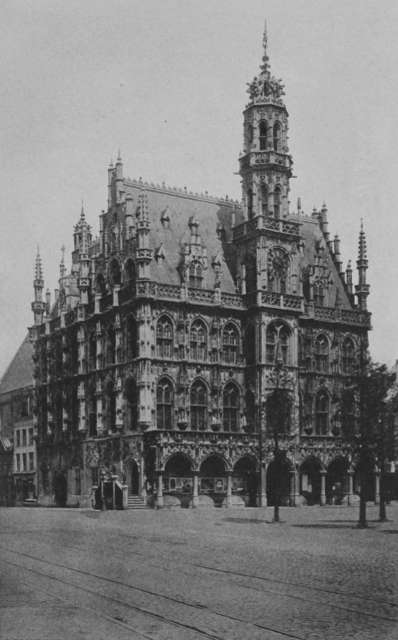
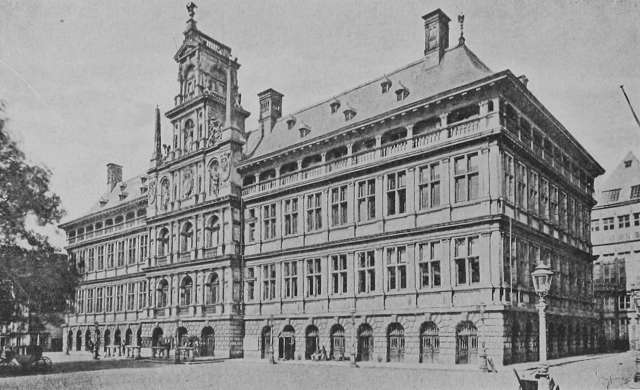
Of the civil edifices in Malines the most important is the Hotel de
Ville. Architecturally it is disappointing, save for the older
portion, which was called Beyaerd, and was purchased by the commune in
1383. The greater part of the edifice was reconstructed during the
eighteenth century. The many rooms in the interior are pleasing but
hardly notable, nor are the paintings and sculptures important save to
the historian. In the Vieux Palais, the room in which the Great
Council of the Netherlands held its sessions from 1474 to 1618, is
still preserved in its original state, while one of the ancient
paintings on the wall shows the Council in session. In this building
also is the curious statuette of the Vuyle Bruydegom called
“Op-Signorken,” whose grinning face and quaint mediæval costume are
reproduced on many postcards. The history of this worthy is best
told in French—and in whispers!
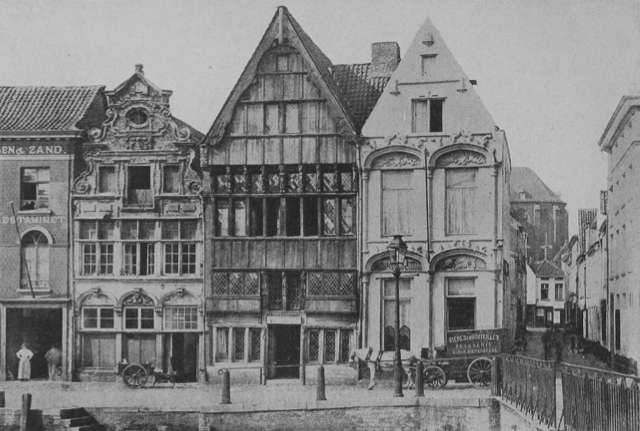
IN HET PARADIJS AND MAISON DES DIABLES: TWO FIFTEENTH CENTURY HOUSES, MALINES.
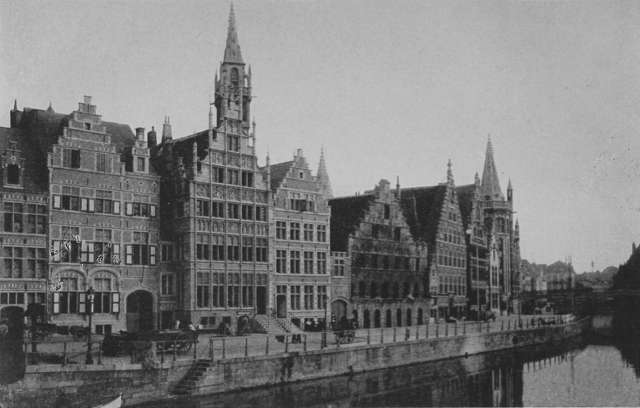
In our tramps around the narrow, crooked streets of the old town, and
along its picturesque quays, we found many fine examples of fifteenth
and sixteenth century architecture. On the Quai au Sel is the House of
the Salmon, the ancient guildhouse of the fishmongers, which dates
from 1530, and on the Quai aux Avoines we visited the little estaminet
entitled In het Paradijs, with its two painted reliefs of the Fall
and Expulsion from Eden, and the Maison des Diables—so called from
the carved devils that decorate its wooden façade of the sixteenth
century. The Grand Pont across the Dyle to these old quays itself
dates from the thirteenth century, as its grimy arches testify.
After the defeat and death of Charles the Bold at Nancy his widow,
Margaret of York, transferred her residence to Malines, and here she
raised and educated the two children of her daughter, Marie of
Burgundy, Philip the Handsome and Margaret of Austria. Their father,
the Emperor Maximilian, was so occupied with affairs of state over his
widely scattered realm that he seldom came to the city, but from 1480
onward the States General of the Netherlands often met here, and in
1491 Philip the Handsome presided at a chapter of the Order of the
Golden Fleece at the cathedral of St. Rombaut. On his premature death,
in 1506, Maximilian again became Regent, as Philip’s eldest son
Charles was barely six years old. The following year Maximilian made
his daughter Margaret of Austria Governess-General of the Netherlands
and guardian of Philip’s children. Margaret at once chose Malines,
where she had herself been educated, as her seat of government and
there she reigned as Regent until her death twenty-three years later.
This period was the golden age in the history of the city on the Dyle,
its brief day of splendour.
In her infancy Margaret had been betrothed to the son of the King of
France, Louis XI—the cunning enemy of her house whose plots had
brought about the ruin of her grandfather, Charles the Bold. She was
only three, and the Prince Dauphin, afterwards Charles the Eighth, was
only twelve. Nine years later a more advantageous alliance caused him
to renounce this betrothal, and Margaret was subsequently married by
proxy to the son of the King of Spain. On her voyage from Flushing to
Spain a storm arose which nearly wrecked her ship, and after it had
somewhat subsided she and her companions amused themselves by each
writing her own epitaph. That composed by Margaret, then a sprightly
girl of eighteen, is well known:
Cy gist Margot la gentil’ Damoiselle,
Qu’ ha deux marys et encor est pucelle.
Eventually, however, she arrived safely at Burgos, but her young
husband, Prince John of Asturias, died suddenly seven months later of
a malignant fever. At the age of nineteen, therefore, Margaret had
already missed being Queen of France and Queen of Spain. After two
years at the Spanish court, where she was very popular, she returned
to Flanders, arriving in 1500, just in time to be one of the
godmothers at the christening of her nephew, Charles, at the church of
St. Jean in Ghent. The following year Margaret married Philibert II,
Duke of Savoy, surnamed the Handsome, who was the same age as herself.
This time her married life proved to be only a little longer than the
other, for her husband died in 1504. Left twice a widow while still in
the bloom of youth, the Duchess devoted herself to poetry and the
erection of a church at Brou in her second husband’s duchy of Savoy.
There, on the walls, woodwork, stained glass windows and tombs she
repeated her last motto:
FORTUNE . INFORTUNE . FORT . UNE
which has generally been interpreted to mean that Fortune and
Misfortune have tried sorely (fort) one lone woman (une).
The palace of Margaret of York stood on the rue de l’Empereur, where
some vestiges of it still remain, but Margaret of Savoy and of Austria
found this edifice inadequate to the requirements of a Regent and
acquired the Hotel de Savoy opposite. This has been restored and is
now used as the Palais de Justice, but—apart from its pretty
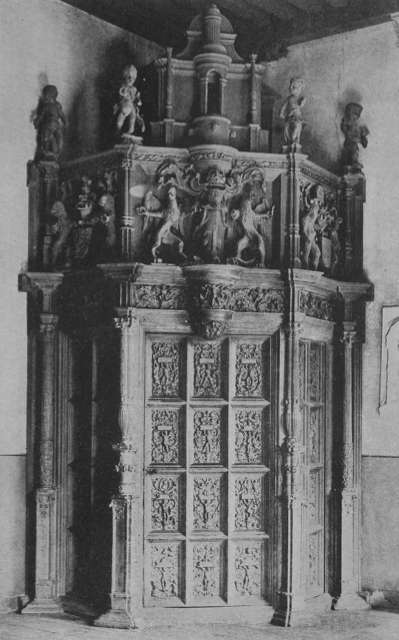
courtyard and one fine fireplace—we found very little to recall the
glories of the period when the great men of all the Netherlands
gathered here. The edifice was largely reconstructed by Rombaut
Keldermans, and it was here that the boyhood of the future Emperor
Charles the Fifth was passed, watched over by his Aunt Margaret. At
the time of her accession as Regent Margaret was twenty-seven years
old—“a fair young woman with golden hair, rounded cheeks, a grave
mouth, and beautiful clear eyes,” according to one observer. Her
father, the Emperor Maximilian, was very fond and proud of her, and
the greatest treasure in the library in the Vieux Palais is a
“graduale,” or hymnbook, which he presented to her in recognition of
her services in educating his grandchildren. On one of the pages in
this book is an illuminated picture showing Maximilian himself seated
on a throne surmounted by the arms of Austria, with Margaret and the
youthful Charles and his sister forming part of the group gathered in
front of him. The other illustrations in this priceless volume, all of
which we were permitted to examine, consist of religious subjects.
The events connected with the regency of Margaret of Austria belong to
the history of Europe. More than once she aided her father in solving
the great problems of government and diplomacy with which he was
confronted, notably in the prominent part she took in the negotiations
resulting in the League of Cambrai, which was directed against
France—the nation to which she always showed an unrelenting hostility
for the slight put upon her in childhood. In 1516 Charles became of
age, and two years later—while the new King of Spain was visiting his
Spanish subjects—Margaret was again proclaimed Regent of the
Netherlands. In 1519 Maximilian died, and five months later Charles
was elected King of the Romans, and was chosen Emperor the following
year, succeeding to the widest dominions ever ruled over by one man in
the history of Europe. In fact it is doubtful if any sovereign since
has exercised so vast a power, as the Kings and Emperors of later
years have had their authority more restricted, while that of Charles
was absolute.
In 1529 Margaret brought about the negotiations that resulted in the
famous Ladies’ Peace between the Pope, the Emperor Charles, and the
Kings of France, England and Bohemia. Margaret represented Spain, and
Louise of Savoy, her sister-in-law and the mother of Francis, the King
of France, represented that monarch. The result of the conferences was
a treaty that was highly advantageous to Spain, and a great diplomatic
victory for Margaret; but as all Europe was tired of war the terms
were accepted and peace proclaimed amid great popular rejoicings, the
fountains at Cambrai flowing wine instead of water. The splendid
mantelpiece in the Hotel de Franc at Bruges was erected to commemorate
this treaty, although it hardly does justice to the prominent part
taken by Margaret in negotiating it. The conclusion of the Treaty of
Cambrai marks the climax of Margaret’s career and also that of the
House of Austria. In addition to the vast empire ruled over by
Charles, his brother Ferdinand was King of Bohemia, and his sisters
Eleanor, Isabel, Marie and Katherine, Queens of France, Denmark,
Hungary and Portugal respectively. All owed their brilliant positions
to the patience and skill of their Aunt Margaret who, as her
correspondence shows, was looking forward to the time when she could
hand over the government of the Netherlands to the Emperor and spend
her remaining days in quiet seclusion.
Under her wise rule the Netherlands had attained the greatest
prosperity ever known. Industry and commerce flourished, peace and
safety reigned throughout her broad dominions. At her court in Malines
Margaret gathered a brilliant group of artists, poets and men of
letters. Mabuse (Jan Gossaert), Bernard Van Orley and Michel Coxcie
were among the famous Flemish artists patronised by the Duchess.
Rombaut Keldermans received many commissions as architect from the
great Lady of Savoy and her Imperial nephew for important edifices not
only at Malines but at Antwerp, Brussels, Ghent and throughout the
Low Countries. In 1451 the Pope, Nicholas V, had proclaimed a Holy Year at
Malines and enormous numbers of pilgrims visited the city in
consequence. Their lavish gifts made possible the rapid erection of
most of the splendid religious edifices with which the city is so
amply provided, and it was during the reign of Margaret that these
structures were completed and decorated. Among the beautiful buildings
executed during this period may be mentioned the Belfry at Bruges, the
tower of St. Rombaut, the Hotel de Ville at Ghent, the spire of the
cathedral at Antwerp, the cathedral of Ste. Gudule at Brussels, and
many minor churches throughout the Low Countries.
Margaret displayed rare taste for works of art, and her palace was a
veritable treasure house of masterpieces, as an inventory prepared at
her direction shows. One of the most famous of these was the portrait
of Jean Arnolfini and his wife by Jean Van Eyck, which—after many
vicissitudes—has now found a permanent resting place in the National
Gallery at London, unless some militant suffragette adds another
chapter to its chequered history. Another treasure has been less
fortunate, namely the portrait of La belle Portugalaise, wife of
Philip the Good, which was painted by Jean Van Eyck under
circumstances already described in another chapter. This famous
picture disappeared during the religious wars and has never been
discovered. The inventory lists a great many other paintings, of which
some are still in existence and some have been lost. The descriptions
are often quaint and charming, and may have been dictated by the
Duchess herself, as for example: “Une petite Nostre-Dame disant ses
heures, faicte de la main de Michel (Coxcie) que Madame appelle sa
mignonne et le petit dieu dort,” and “Ung petit paradis ou sont
touxs les apôtres.” Other artists of note in the collection were
Bernard Van Orley, Hans Memling, Roger Van der Weyden, Dierick Bouts,
Jerome Bosch and Gerard Horembout.
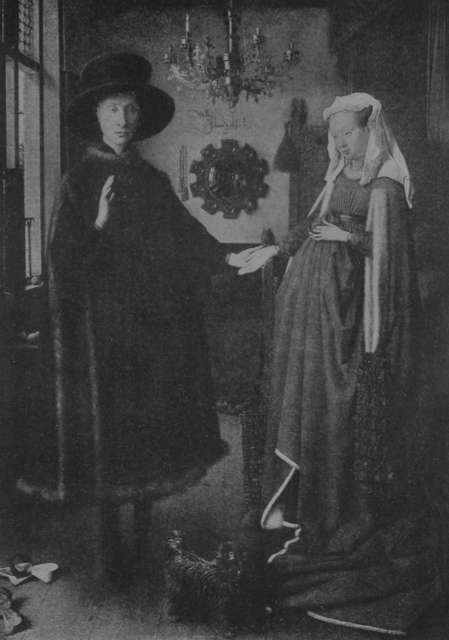
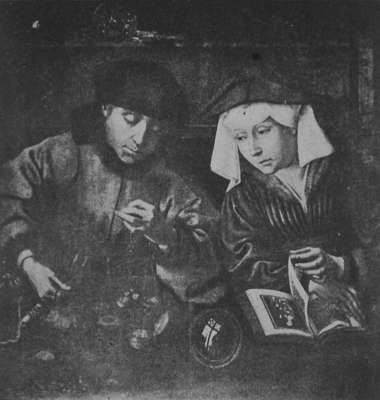
PORTRAIT OF JEAN ARNOLFINI AND HIS WIFE BY JEAN VAN EYCK.
Among the men of letters whom Margaret gathered around her were Jean
Molinet, her librarian and a poet who often celebrated her charms;
Jean Lemaire de Belges, who became her historian; Erasmus, Nicolas
Everard, Adrian of Utrecht, Cornelius Agrippa, Massé, Rénacle de
Florennes, Louis Vivés, and many others. Her library was as choice as
her collection of paintings and included a Book of Hours and several
other illuminated manuscripts now in the Bibliotheque Royale at
Brussels, and many of the mediæval classics. History records few great
personages whose personality, considered from every aspect, is more
pleasing than that of this gracious lady, whose very pets are known to
us through the frequent references made to them by her literary
courtiers. Her career, though shaded by sadness and disappointment,
was a great and noble one, and, while she lived, the land over which
she ruled remained in almost uninterrupted peace and prosperity—the
wars of the Emperor being for the most part waged far away on the
plains of Italy or in France.
On the last day of November, 1530, the Regent Margaret passed away at
her palace at Malines in the fiftieth year of her age and the
twenty-third of her regency. For forty-five days the bells of the
churches throughout the city tolled at morning, noon and night in
expression of the profound grief of the people at their great loss.
The dirges may well have been for the departure of the city’s
greatness as well, for the death of its great patroness proved the
beginning of its decline. The new Regent, Marie of Hungary, removed
her court to Brussels, and although Malines, by way of compensation,
was made the seat of an arch-bishopric it never recovered its former
splendour and sank rapidly into the quiet town that it was when the
great war added a new and tragic chapter to its history.