IT was a fine night in the year 54 B.C., the sky clear, the air calm,
when a boat—a sort of raft of basket work covered with ox hides—was
slowly following the ebb of the Scheldt. A voice was heard from the
boat, a woman’s voice, soft and gentle.
“Yes, Atuix, for thee have I passed the threshold of my father’s
dwelling. I have quitted the deep forests of Gaul, my native country;
for thee have I left all, because of my love for thee, Atuix, and thy
beautiful harp which sleeps silently by thy side.”
Another voice was heard: “Oh, Frega, since the day that thine eyes
looked into mine, my harp has forgotten its sounds and my soul no longer
knows any of the songs whispered by Ogmius, whom I worshiped in the
forests—the god of the bards, he who is always surrounded by men bound
by their ears to chains of gold and amber which issue from his mouth.”
The boat continued to descend with the tide. Suddenly the waves were
troubled and foaming as if some water monster was rising to their
surface. A breathing, a stifled murmuring, was heard, like unto the
autumn wind rushing through the branches of an old, decayed forest; the
bubbling of the waters came nearer, and the breathing grew stronger.
Then by the pale rays of the moon’s light, rising above the silvery
clouds, Atuix and Frega beheld with terror, approaching them and
swelling the waves in his rapid course, a colossal Giant.
The waters of the river reached up to his broad chest, and formed around
him a white and sparkling belt of foam. From his formidable face flowed
a thick beard, and his head was covered with hair like that of a horse,
rough and black. He looked like those isolated peaks which are sometimes
seen on the borders of the ocean, with their frowning crests from which
the long, trailing grass hangs dripping in the waves. The boat suddenly
stopped, and cracked under the hand of the giant. A terrible roaring
burst from his hollow chest, and these words were uttered in a voice of
thunder:—
“Ah! ah! my passengers of the night!—you think that the eyes of Antigon
are closed to allow you to pass in the dark! Where are my three oxen to
satisfy my hunger this evening?”
Frega clung trembling to Atuix who silently drew forth his long blade.
The giant continued, “If you wish to speak to me, then swell out your
feeble voices, my dwarfs.”
“Mercy upon us, if thou art the god of this river,” replied Atuix, “and
if thou art not a god, then let a poor bard of Ogmius pass unmolested.”
“O terrible giant, let us pass in the name of the great Hesus of
Teutates, and of all the gods.”
“Oh, thou dost jest, I think,” said the giant in a ferocious tone. “I
laugh at Hesus, seest thou? and at all thy gods!—and if thou hast seen
them, is their stature no higher than yours, fine race of weaklings, of
whom I could trample a whole army under my feet? Ah! thy gods, I should
long ere this have taken them from their heaven for my evening’s
amusement on the lonely shore, or to make a repast of, if they were
anything more than vain smoke!”
“Who, then, art thou,” said Atuix, “thou who laughest at the gods?”
“Who am I?—Where is Antigon? Ah! thou wouldst dissemble with
Antigon!—Yes, thou forgettest the tribute of oxen thou owest me for
passing on my river—thou didst think, favoured by the darkness, to
deceive me, and now thou wouldst use thy childish tricks! Ah! Ah!” And
the giant covered Atuix with his powerful hand before he could move a
limb.
Frega, who had remained motionless with terror, threw herself on her
knees in the boat. “Mercy, mercy upon Atuix,” she exclaimed. “Oh! mercy!
what harm can our passing this river do to thee, we feeble and without
any evil intention, he loving me and I loving him? Mercy! Ah, heavens!
is there, then, no pity in thy soul?”
The giant interrupted with a terrible sneer: “Oh! my soul, sayst thou!
My soul! Where hast thou learnt that I have a soul? Who has ever seen a
soul? Oh, I tell thee truly that there are neither souls nor gods,
neither mind, nor anything but the body, and hunger!”
As he ended the giant pressed the hand of Atuix between his two iron
fingers, the hand fell into the boat with the glaive it grasped. A
terrible cry was heard accompanied by a ferocious laugh. The giant
picked up the bloody hand and threw it into the river. Then, just as he
was about to seize Frega, who had dropped senseless, Atuix freed from
the frightful claws which pressed him, with the hand which was left him,
picked up the fallen sword and plunged it to the hilt in the giant’s
arm. A howl of pain was repeated by the surrounding echoes.
The moon was just rising brilliant and pure from her bed of clouds, and
her rays played on the waves, which were scarcely ruffled by the light
breeze. The boat no longer detained floated adrift. A violent shock
aroused Frega! She rose painfully on her knees and saw at some distance
from her a horrible sight. The furious giant was crushing the body of
Atuix between his hands. Frega dragged herself to the edge of the boat,
her eyes fixed, her face ashy pale, she with difficulty stretched out
her neck, tried to advance farther, as if under some invisible
attraction; an instant she gazed, leaned forward, her eyes tearless, not
a sigh from her bosom; then she loosened her hold and rolled over into
the river.
A year after this night Cæsar had put an end to Gaulish liberty. The
strength, the courage and the heroic resistance of this great people
whose ancestors had in one of their daring wanderings over Europe
encamped on the ruins of Rome, was now crushed under the fortune and
genius of the conqueror. By the glare of vast conflagrations, Belgium,
the perpetual focus of revolt against oppression, was traversed by three
Roman armies, and bridges thrown over the Scheldt opened the passage to
the country of the Menapians. One day a detached company of the legion
of the vanguard followed the banks of the river, guided, it is said, by
a mysterious being. Twice the sun had sunk to rest without their
returning. German horsemen sent on their track towards the middle of the
night were stopped at the sight of a strange spectacle. Raging flames
agitated by the wind were devouring the foundations of a tower which had
protected a castle of colossal proportions. The ground was lit by the
glare of the fire and strewn with the dead bodies of the Roman soldiers.
In the midst of them, on a mound of the dead, was stretched motionless,
covered with wounds, pierced all over by darts, the enormous body of a
giant. From one of his huge arms, from which the hand was severed, ran
on the ground a rivulet of black blood. Over his head bent a warrior.
After some moments of suspense the eyes of the giant opened. The warrior
instantly raised himself, parting his long, flowing hair from off his
pale and beautiful face. Then his eyes suddenly flashed with
extraordinary brightness—he approached near to the monster’s ear,
shouting out these words:—
“Antigon! Antigon! I must call loudly, is it not true?—so that thine
ear may catch the sound? Well, now listen to me, Antigon! Oh! thou art
not quite dead, thou canst yet understand and remember! A year has
elapsed since—truly, truly, thy wounds are ghastly and bleeding and
sweet to look upon!—Yes, it was on a summer night, two lovers floated
together on the river. Oh! thy den was not as bright as this night—Two
lovers thou knowest!—two lovers who only spoke of love, their hearts
filled with gentle thoughts. Look, look, how well one sees one’s shadow
here in thy blood.—One of the two lovers was a bard. Oh! oh! thy dying
eyes flash! Thou didst kill him, and the other—But where are thy
terrible hands, Antigon? The other, that feeble woman—Thou hearest me?
She lives to avenge him!”
A shudder ran through the giant’s body, a frightful rattle burst from
his chest; his teeth chattered like the clashing of swords, his eyes
rolled once more in their bloody orbits, and then closed forever. He was
dead. Frega knelt on the ground and prayed. Upon that spot rose Antwerp.
Now Antwerp is the Antwerpen of the ancient Flemish language, which
still preserves its original strength and richness in its Saxon
garb—Antwerpen, in which word the chroniclers find Hand and Werpen, to
throw, in remembrance of the giant Antigon and the hands which he threw
into the Scheldt.
When you approach the old Flemish city, built upon the banks of the
Scheldt, in one of the finest situations of Europe, the first object
which attracts the attention of the traveler is the great spire of the
Cathedral. This “Heaven-directed” spire is one of the loftiest and
finest in the world. It is a masterpiece of pyramidal construction,
delighting the vision not more by its vast height than by its exquisite
proportions. It is surmounted by a cross of a size corresponding with
the edifice itself. The Antwerpians are justly proud of their antique
cathedral, which occupies the first rank among the monuments of Europe;
if time and space permitted I would give you a sketch of its beauties,
but many others before me have described its elegant marble statuary,
chapels, confessionals, altars, choirs, and above all the
chef-d’œuvre of the immortal Rubens. Before the grand entrance, which
so plainly shows the imprint of time, observe this blue marble stone,
inlaid with several small pieces of brass, scattered promiscuously and
seeming to form a mysterious design, which irresistibly excites one’s
curiosity. This monument marks the historical and fatal spot where the
event occurred which I am about to relate.
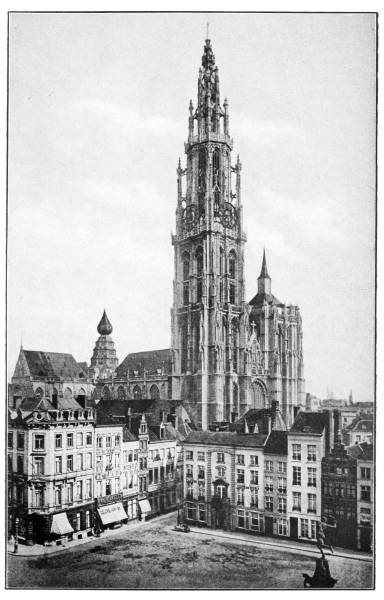
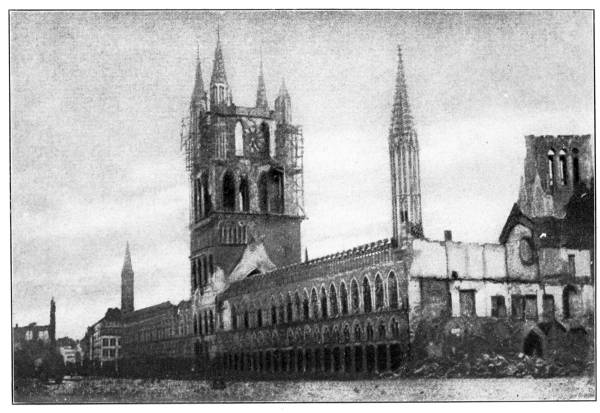
SPIRE OF THE CATHEDRAL, ANTWERP.
The 22d of October, 1520, was a day of fêtes and rejoicing in all the
cities of Flanders, for on that day a Fleming, Charles V, was crowned at
Aix-la-Chapelle. The rich and powerful city of Antwerp, whose merchants
were opulent as princes, displayed all its luxury and splendour to
honour its new Cæsar. The day commenced with prayers in all the churches
and finished with national games of every description upon the public
squares, and processions of artisans preceded by the banners of their
several professions. The streets resounded with songs and repeated cries
of “Vive l’Empereur Charles!” and as the night approached the night
became more dense and noisy, for before the Hôtel de Ville immense casks
were placed, which poured forth floods of wine and beer that helped to
increase the enthusiasm of the citizens of the good city of Antwerp.
But above all sounded the glorious peals of the silver chimes from the
old cathedral, as if it wished to add its voice in a hymn of praise to
the young Emperor whose reign commenced under such auspicious
circumstances.
There were nevertheless in the city many sad hearts, as upon all such
occasions there are many who cannot participate. At the window of one of
the largest but poorest lodging houses of the Kamerstraet, known by the
sign of a large Red Lion, stood a young man whose desponding and
sorrowful air contrasted strongly with the joyful bands that passed
under his window. It was evident that he took no part in the general
rejoicing. The room in which he was, although showing that scrupulous
Flemish neatness, presented an appearance of extreme poverty. A
miserable pine bedstead, curtains of blue linen, four old chairs, and an
old oak table comprised the furniture of the room. The whitewashed walls
were devoid of ornament, except the image of the Virgin, before which
burned a small wax candle. Upon the bed reclined a woman whose pale, wan
face, deep-sunk eyes, livid lips, and forehead covered with premature
wrinkles (she being still young) wore the marks of serious physical and
mental suffering. The silence which reigned in the room was broken by
the invalid.
“Yvon, my son,” said she, “come to me; but what do I see, tears?”
“Alas, Mother, how can I keep them back? I cannot help you; the fever
has so weakened me that I am unable to work. Hardly can I lift a hammer.
I could not bear the heat of the forge. I am as weak as a child.”
“My poor child, the fever has paralyzed your strength as well as mine,
but the will of God be done.”
“Amen,” responded the son. “It is hard nevertheless to struggle against
sickness and poverty. If tomorrow we do not satisfy the demands of the
landlord we shall be turned into the street. If I were the only one to
suffer!”
“My son, I have seen your father and your three brothers die with this
merciless fever, and with them perished all my happiness. But in the
midst of my suffering I have always said, God has given them to us and
taken them from us. Blessed be his name. And in this submission to his
will I have found my only consolation.”
The young man sighed but made no reply. At this moment a tumultuous
noise of steps arose from the street. It was a procession. The
corporations of tanners and joiners were passing.
“Now come the painters with the image of St. Luc, and now, oh! I see the
blacksmiths and lockmakers carrying the banner of St. Eloi.”
Poor Yvon looked sorrowfully upon his former companions, happy in their
strength and health, when suddenly he drew back from the window and
rapidly closed it as if he would shut out a fatal vision.
“What is it?” exclaimed his mother, alarmed at his sudden pallor.
“Marie has just passed with her father and Master Verachter, the rich
jeweler of Ziereckstraet.”
The poor mother tenderly caressed him, without speaking. She seemed to
fear to encourage by the least word this sorrow she knew to be without
hope.
Yvon sat a long time at the bedside, his face hidden in his hands. He
recalled his early days, joyous and without care, his affectionate
father and brothers, the winning voice of his mother, who instructed
them in their early duties, and the young Marie, the constant companion
of his youthful plays, whom one day he hoped to call his wife. He had
nearly served his apprenticeship at the forge with his father when this
fatal epidemic broke out, to which his father and brothers fell victims,
and he himself and his mother barely survived. But the blacksmiths of
the city refused to accord him the right to continue his father’s
business, as he had not fully worked out the required time. That very
morning he had heard a neighbour, who came to visit his mother, say that
the hand of Marie, which had been the secret of all his efforts and
thoughts, had been promised by her father to the rich jeweler of
Ziereckstraet. He had not believed it, but the sight he saw from the
window confirmed all his fears, and he remained in deep reverie for a
long time.
He was startled from it by the sounds of a violent tempest which had
suddenly broken upon the city. The merciless blast from the North Sea
swept over it, spreading destruction in its course. Everywhere was heard
the falling of tiles, the crashing of glass from the broken windows, the
uprooting of trees, and the distant noise from the river, whose swollen
waters were overflowing its banks. Yvon approached the window; darkness
reigned everywhere, the rain fell in torrents, and had extinguished all
the torches and lights of the streets.
During all this long October night the storm raged with unabated fury;
towards morning it subsided, and when day broke it had passed, leaving
all the country inundated. As the disasters of the city were
insignificant compared with those of the country the inhabitants
consoled themselves with the reflection that others had been more
unfortunate than they. It is often thus that we console ourselves. Those
who passed in the vicinity of the cathedral saw with regret that the
great cross which surmounted the spire had been struck by the lightning,
and was so bent that at any instant it might fall. This cross had cost
so much work and care to place it so high! The news spread rapidly, and
soon the Grande Place before the cathedral was crowded.
In those times, when the love of art reigned supreme, each Flemish city
possessed its monument. Ghent boasted its gigantic belfry, surmounted by
its Byzantine dragon brought from the crusades; Louvain, its Gothic
Hôtel de Ville; Bruges, its old parks and public buildings; while
Antwerp glorified itself justly in its cathedral, of which no one dared
to contest the superiority as a work of art and architecture. All the
citizens viewed this sight with consternation, and asked each other
anxiously who would be the individual bold enough to attempt such a
perilous enterprise. The sound of a trumpet was heard and two heralds
on horseback appeared on the Place. Silence being established, one of
them read with a slow and loud voice the following proclamation:—
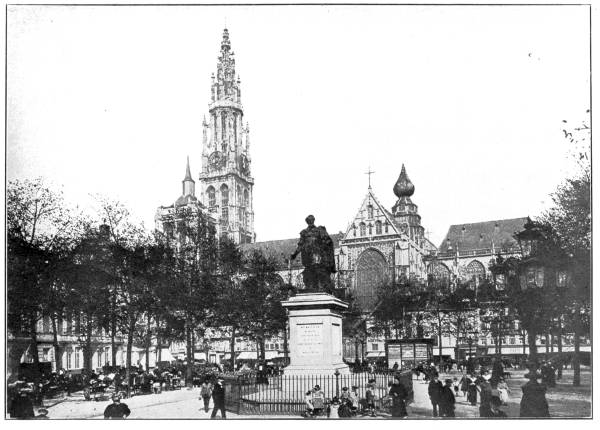
CATHEDRAL, ANTWERP.
“To the good citizens of Antwerp!—We, the Burgomaster and Aldermen of
the city, make known that we have resolved to give five hundred golden
crowns to the person who will reëstablish the iron cross in its ancient
position on the cathedral tower. Five hundred golden crowns! Citizens!
Whoever desires to obtain this munificent reward will present himself
immediately before the Council now assembled at the Hôtel de Ville.”
There was a moment of silence. Each one waited to see who would accept,
but no one advanced. The heralds were about to retire, to read elsewhere
their proclamation, when the crowd suddenly opened and gave passage to a
young man, who precipitated himself resolutely towards the Hôtel de
Ville. Every eye was turned towards him with curiosity. He was of
extreme beauty, although emaciated, but from his eyes shone forth manly
resolution and courage. The crowd anxiously waited the result. A few
minutes only had passed when the heralds reappeared to read a second
proclamation:—
“To the good citizens of Antwerp!—We, the Burgomaster and Aldermen,
make known that Yvon Bruggermans, blacksmith and free citizen, has
engaged before us this 23d day of October, 1520, to reëstablish our iron
cross in its position upon the tower of the cathedral tomorrow with the
aid of God. Consequently, we order all who may be present to refrain
from distracting the attention of the said Yvon Bruggermans, by cries,
charms, or malicious interventions, but on the contrary to give him all
the assistance which he may need for the accomplishment of his work in
the name of God and the Holy Virgin.”
When the time arrived, Yvon, clothed in his holiday suit, approached his
mother’s bed and with an animation which she had not seen in him for
several months, embraced her and asked her blessing.
“Where are you going, my son? You are dressed in your holiday suit, and
the fêtes are over.”
“I go to look for work, dear Mother,” answered he, trying to hide his
agitation. “I feel my strength return, and I can no longer bear the
misery of our situation. Take courage, Mother, I feel the certainty that
a better future is before us.”
“My child, take care to do nothing beyond thy strength. Think that all
the riches of the world will be nothing to me if I lose thee.”
“And you, my Mother, are you not for me the entire world? I would give
my life willingly to insure your happiness. But time passes; bless me,
dear Mother.”
“May the benediction of God be on thee and on thy designs, now and
forever. Amen,” said his mother gravely with her eyes raised to heaven,
and with her right hand upon the head of her kneeling son.
After a last embrace, he left with a firm and resolute step. The most
trying proof was past, and he felt his courage and hope revive. He soon
arrived at the Grande Place, where an immense crowd was assembled. All
eyes were turned upon him with an expression of pity and regret, and
voices murmured in his ear words of encouragement, sympathy and hope.
But Yvon, avoiding as much as possible every species of emotion,
advanced without answering, traversed the crowd, and entered the
cathedral. He approached the altar, which was decorated as if for a
fête, and kneeling, recited with fervour this prayer:
“Lord of Heaven, I risk my life not to gain a miserable sum of money,
but to save my mother; preserve me, then, for the love of her, or if it
must be that I die, permit me to accomplish the work I have undertaken.
Father all-powerful, I place my soul in thy hands.”
He then rose and proceeded with a firm step towards the door of the
spiral steps which lead to the summit of the tower. As he ascended he
saw through the loopholes the crowd increasing, until all the
neighbouring roofs, windows and balconies were filled; everywhere a sea
of heads. He arrived at last at the end of the steps. After having
thrown a glance of admiration over the country, he turned his gaze
toward the city. At his feet he distinguished the sign of the Red Lion.
He thought of his mother, then turned toward the dwelling of Marie. The
remembrance of her animated his courage, for on his success depended the
only chance he had of obtaining her hand, and he prepared himself to
finish the most perilous part of his undertaking. Before him rose this
long, perpendicular spire, the summit of which he must reach without any
other means of ascent than the crevices between the stones. He attached
to a strong rope the brazier and tools which he had brought to work
with, fastened this firmly around his waist, and after crossing himself
devoutly commenced his perilous ascent.
The crowd watched him as he slowly mounted. Deep emotion filled every
breast. Not a sound was heard until he arrived at the summit and stood
immobile at the foot of the cross. Then burst forth a universal cry of
admiration. He lighted his brazier and actively commenced his work,
attaching firmly to the cross one end of the rope, of which the other
encircled his body. The multitude saw the great cross rise slowly and by
degrees under the repeated blows of the hammer, and with every stroke
his strength appeared to increase.
Fifteen minutes had hardly passed when cries of enthusiasm saluted the
cross completely restored. His first thought was an aspiration of
gratitude to heaven, the second was for his mother. Then he thought with
an emotion of indescribable joy of Marie, who would be his, for her
father certainly could not refuse, when he should have the five hundred
golden crowns obtained in such an heroic manner. His happiness was at
its height, and fearing that his emotion might prove fatal, he crossed
himself and prepared to descend, but before doing so he threw a last
glance over the crowd. He saw them separate to give passage to a wedding
cortége, which advanced towards the cathedral. Attracted in spite of
himself, he regarded attentively all the members. He noticed a young
girl dressed in white as a bride leaning on the arm of an old man. He
supported himself at the foot of the cross and leaned as far as possible
to assure himself of the reality of his fears—his eyes distended, his
face livid, and his whole body trembling with emotion. They glanced
upwards to see the young workman who had raised the cross—Yvon gave a
cry of agony, for this bride was Marie, and at her side the old jeweler
Verachter of Ziereckstraet! The shock was too violent for his spirit
exhausted by so many struggles. He fainted—his hands dropped the
support which held him, he remained an instant immovable—then fell. But
the rope which was around him remained fixed to the foot of the cross,
and he was for some minutes suspended in space. The crowd who had seen
his fall with terror believed him saved, but the rope had touched the
lighted brazier, and soon the body of the unfortunate Yvon fell a
disfigured and bleeding mass in the midst of this brilliant wedding
cortege, at the feet of the bride.
The next day a deputation of magistrates of the city went to carry to
his mother the five hundred golden crowns, the price of the blood of her
son. But the chamber was empty. A coffin was placed in the middle of the
room. Death had spared the poor mother this great affliction. Yvon was
buried on the spot where he fell, and the blue stone, with the brass
encrusted in the marble, alone indicates the place where lies the body
of the young blacksmith.
One evening in the year 1552, the bells of the numerous hurches and
chapels of the pious city of Antwerp were heard calling the faithful to
divine service, to pray for the repose of the souls of their deceased
relatives and friends. The heavens were obscured by black and angry
clouds; the wind blew in strong gusts, accompanied by a drizzling rain.
A profound silence reigned in the obscure streets. As the greater part
of the population were in the churches, one could easily have traversed
half the city without meeting a living soul, except, perhaps, some tardy
worshiper, hastening to regain lost time and to arrive at the Salut,
before the Tantum Ergo.
Notwithstanding the importance of the religious solemnities which were
being performed in all the houses of God, and the detestable weather
which drove every one from the streets, a man stood motionless before a
house in the rue des Tailleurs de Pierres, enveloped in a dark cloak. He
remained motionless, feeling neither the wind nor the rain, his eyes
fixed on the windows, trying vainly to distinguish the least ray of
light. He was young, with effeminate features, and his upper lip was
shaded by a light moustache; although he endeavoured to conquer the
emotions which agitated him, it was not difficult to discover by the
contraction of his brows, that bitter thoughts filled him with despair.
The house before which he stood was that of a rich banker named Frügger.
After having stood there some time, he lost hope of seeing in this
dwelling the wished-for object, and with that, the courage to remain
longer exposed to the inclemency of the storm, so he walked slowly away
in the direction of the Scheldt. While he was in the neighbourhood of
the mansion of Frügger he stopped from time to time and regarded it
still with the same ardent anxiety which for more than an hour had
characterized his contemplation. When at last the distance and the
obscurity prevented him from seeing it, the expression of his
countenance became still more sorrowful.
Letting his head droop upon his chest, he sighed, “Katharina, thou
lovest me no more! Thou hast forgotten me! Thou hast abandoned me! It is
foolish for me to doubt it! Oh! now it is finished! I wish no longer to
live! Existence becomes a burden to me.”
At the moment he pronounced these words, expressed with such profound
despair, he arrived at the Canal St. Jean, not far from the river. At
that time, there stood at this place a water mill. Suddenly the noise of
the water pouring over the wheel attracted his attention, and drew him
from his somber reverie. He raised his head, his eyes sparkled, the
expression of his features became nearly radiant, his steps were firmer,
and with a species of cruel joy he directed himself towards the canal.
It could not be doubted that the unfortunate young man wished to put an
end to his sufferings, which he believed would terminate only with his
life. He was already on the banks of the Scheldt. One step farther and
he would have disappeared in the waves, when suddenly the bells of the
city recommenced their funeral knell.
These lugubrious sounds had a singular effect upon his spirit. He
recoiled with fright, his thoughts suddenly changed. He was astonished
to think he had contemplated committing a crime to put an end to his
troubles. He turned away and was soon far from the place where he had so
nearly put into execution his fatal project. A quarter of an hour after,
he was near the church of St. André, calmer, but still despairing.
“Ungrateful,” he said to himself, “to commit a crime that would have
brought affliction upon the last days, and covered with shame the white
hairs of the worthy old man, your father, who loves you so tenderly, and
has only yourself in the world. God knows if he would have survived your
suicide, if sorrow would not have brought him to the grave. And why? For
a woman that you have loved, that you still love more than words can
express! How do you know she merits your love? And has she ever loved
you? Foolish to doubt! She still loves you—Oh, no! she has lost all
interest in you and treats you as if there never existed the least
sympathetic sentiment between you.”
Saying this, he turned, stopped, and appeared to consider anew whether
he should return to the canal. It was the last attempt of the spirit of
evil upon his heart enfeebled by suffering. Happily his good angel
watched over him and gave him strength to resist.
After a moment of hesitation he continued his route, murmuring, “But
no, that cannot be; she cannot have forgotten me, she must love me
yet—Katharina, this angel with looks so pure, voice so sweet,
expression so celestial, thoughts so candid, she could never deceive me.
For her I would give my life. She cannot abandon me thus; but why does
she not let me hear from her? She must realize that her silence and this
uncertainty make me suffer torments.”
Thus reasoning, by turns filled with hope and despair, he gradually
approached the principal entrance of the church. Divine service had long
since commenced. The majestic tones of the organ rang through the
vaulted roof, floating over the heads of the kneeling faithful. He
entered more through curiosity and to distract his grief, than through
piety, or to pray for the souls of the dead, as he felt that in his
distracted state of mind it would be impossible for him to elevate his
thoughts above the earth, and to invoke God with any other intention
than that of seeing his well beloved.
The church of St. André at this period was a remarkable edifice, built
in the Gothic style, and of an imposing appearance. Its origin was as
follows: In 1519 the Augustinian monks possessed on this spot a
magnificent cloister from which the street takes its name. Several of
these friars, being suspected of heresy, and of following the example of
their colleague, the famous monk of Württemberg, were expelled from the
city. The cloister was demolished and sold, with the exception of the
church that the order was building, which was finished with the
authorization of Pope Adrian VI, under the invocation of St. André. The
spectacle which the interior of the church presented at this moment was
not calculated to inspire our hero with less sorrowful thoughts or more
consoling reflections. Everything there spoke of death, eternity and
purgatory. The nave was draped with black; upon all sides, upon the
pillars, on the altar, on the candelabra, were funeral emblems, death’s
heads and cross bones, and skeletons, speaking of punishments and
expiations of the other life. He felt ill at ease in the midst of all
these lugubrious decorations. This colossal edifice, partially lighted
by innumerable wax candles, this compact crowd kneeling on the marble
and buried in prayer, these gigantic columns hidden under the funeral
drapings, and, more than all, the mournful strains of the organ and the
solemn character of the chants, saddened him and filled him with an
indefinable and mysterious fear.
All this only served to recall more vividly his own situation, and he
felt he could no longer endure it. As he advanced towards another door
of the church he noticed in the shade of a pillar a female who, while
appearing to pray with fervour, watched all his movements and
endeavoured to attract his attention. Before her two persons were
kneeling, one a young girl with an angelic countenance, whose elegant
figure was not entirely hidden by the ample folds of her black silk
cloak. He recognized her whose silence had made him suffer so cruelly.
The other, an old man whose features were strongly marked with sternness
and severity, was the father of Katharina. The female who had at first
attracted his attention was the servant, whose eloquent gestures had
caused to disappear, as if by enchantment, the sorrow and discouragement
of the desolate lover, who thought no more of leaving the church.
Drawing his cloak around him, so as to conceal as much as possible his
features, he placed himself behind the persons upon whom all his
thoughts were concentrated, and decided to wait until the close of the
services, hoping he should succeed in learning something of the
inexplicable conduct of the daughter of the banker. The service was
finished, the last modulations of the organ had died away, when the old
man and his daughter prepared to leave the church.
The young man followed as near as possible, without being noticed. Near
the door he felt some one press his arm and at the same instant put in
his hand a letter, which he took without pronouncing a word. He
continued to follow the three persons instinctively. It was only after
seeing them enter their dwelling and close the door that he thought of
returning home.
To those acquainted, however slightly, with the history of Antwerp it
will be superfluous to recall the immense prosperity of the city at the
time of our little drama. To give an idea of its ancient wealth and
magnificence, it will suffice to say that five hundred vessels ascended
and descended the Scheldt daily. The river near the city was literally
covered with ships at anchor, waiting their turn to discharge; they
often extended as far as the village of Hoboken, three miles from the
city, which gave rise to the Flemish saying “Op de Hobooksche hei
liggen” (To remain in the fields of Hoboken). This saying is used to
designate persons who are obliged to wait a long time for the
accomplishment of their desires. Nearly every nation had its
representatives in the fine and celebrated city of Antwerp, and one of
the writers of the time said that the Antwerpians could study the
customs, language and costumes of all the nations of the globe without
leaving their city. We will not attempt to explain the causes of this
gigantic prosperity, which caused Antwerp to be the rival of Genoa and
Venice. Its admirable situation, which still contributes to its
prosperity, was one of the principal reasons. The fairs, like those of
Leipsic and Frankfort, were endowed with many valuable privileges; one
of these guaranteed to its visitors a species of inviolability. They
could not be molested for debt during the continuance of the fair and
while making their return trip to their homes. It is not astonishing
that with the freedom and facility which foreign merchants enjoyed they
preferred Antwerp to other cities, and that it attained such a degree of
splendour.
Among the foreign bankers the most noted was a German named Wolfgang
Frügger. He was descended from the famous Früggers of Augsburg, who had
representatives in France, Spain, Italy and Antwerp. They were the
richest bankers of Europe, the Rothschilds of the epoch. He had
inherited from his father a sum of six million crowns, a fabulous amount
at that time. His house had the reputation of containing more treasures
than the palace of a king. He was called by every one “Frügger the
Rich.” He lived in a very simple, miserly manner.
Frügger had been for a long time connected with another German banker,
immensely rich, named Hochstetter, whose mode of living differed
essentially from that of the father of Katharina. He lived in a princely
manner in a palace which he had built in the street that still bears his
name. It appears that notwithstanding the difference in their manner of
living, they agreed marvelously, and visited each other frequently.
Their names were inseparable upon the Bourse, as all believed that there
existed between the two houses a secret partnership, and why should they
not have believed so? For when the name of one alone was cited in a
transaction it was soon known that the other participated in it. When
the loan of £152,000 sterling was made to Henry VIII, King of England,
ostensibly by Frügger alone, it was soon known that it was an operation
of the two houses. Later, when Hochstetter concluded his loan of
3,000,000 crowns of gold, to the King of Portugal, Frügger, which was a
mystery for no one, took part for at least one-half.
Thus it had been for many years, when suddenly without any apparent
cause the union of the rich Germans was interrupted in the most complete
manner. They ceased to visit and became as strangers. Although no one
knew the reason of this sudden change they did not doubt that Frügger
was the cause, as it was known that Hochstetter had been to visit him
and had not been received. This happened a few days only before the
ceremonies at the church for the repose of the dead. Frügger had not for
several days appeared at the Bourse, which had filled all the merchants
with astonishment.
The same evening of the ceremonies two persons conversed together in one
of the salons of the superb mansion of Hochstetter. One of them was a
man of about sixty years of age, of a venerable aspect, whose features
expressed mildness and benevolence. This was Hochstetter. Not far from
him was seated in a heavy oaken chair the young man whom we have
followed from the river to the church; he appeared a prey to great
despair and tried vainly to repress his tears. The father was reading
the letter which the servant of Katharina had given to the lover of her
mistress, and from time to time he stopped to bestow upon his son a
regard full of tenderness, but the contents of the letter were not of a
nature to calm his sorrows, or to give him courage. It ran as follows:
“It is eight long days that I have not seen you, nor your
worthy father, and I have not even been able to send you any
word. Perhaps you have already accused me of forgetfulness and
ingratitude. If it is thus, ask God to pardon your unjust
suspicions, for never were reproaches less merited. If you knew
my situation you would feel only pity for my unhappy fate, and
you would not impute sentiments to me which are far from my
heart. Since the day your father, my esteemed guardian, came to
demand my hand, my father has changed so much that I can hardly
recognize him. Not contented with forbidding me all
communication with you, he will not even allow me to talk with
any one; even my own maid is a prisoner like myself. Not a word
from you or your father have I had. I have only been told you
asked my hand in marriage. When I asked my father for an
explanation he answered me that it was not yet time but that he
would give me one later. I cannot comprehend it—my father who
has appeared to love me so tenderly and has always gratified
all my wishes—to treat me suddenly with so much severity, so
much cruelty. What can I say? He knows that I love you, and
what adds to my grief is not to be able to tell you my
troubles, and not to see you. He is not ignorant that I suffer
and weep almost continually. I fear you will ascribe my silence
to other sentiments. He has kept me from your father and all my
friends who could speak to me of you. He has also changed so
much that it astonishes me; he is always agitated, filled with
a continual fear which it is impossible for me to understand;
he trembles and turns pale at the slightest noise, speaks of
thieves and robbers as if the city contained them by thousands;
in the evening he dares not retire until he has assured himself
that the doors are well fastened. His long, strange absences,
of which I have formerly spoken to you, become more and more
frequent, and they often last for hours. No one sees him go
out, but he is nowhere to be found. Then suddenly he appears
without any one being able to say how he has entered. He has
forbidden me to go to the morning mass as I have always done,
and it was with great reluctance that he accompanied me to the
church of St. André to pray for the repose of the soul of my
deceased mother, whose loss I have never felt more deeply than
now. As I have the hope of seeing you there, I know not why, I
have written these lines, and confide them to Clara and pray
that she may find means of giving them to you.”
This letter did not appear to astonish Hochstetter much, but his
discontent was none the less visible.
“Decidedly he is losing his senses,” murmured he, throwing it upon the
table. Then, turning towards his son, “Carl,” said he, taking his hand,
“calm yourself, you see that all is not lost as you feared, and you were
wrong to doubt Katharina. The poor child loves you more than ever.”
“But her father,” sighed Carl, “her father. I avow that his conduct....”
“But I think I understand it. I have been connected with him twenty
years and I think I know him well enough to flatter myself that he had
much friendship for us, and that it must cost him something to sacrifice
it for an idea; but still he shows himself uncivil, refuses to have any
more transactions with me, and when I visited him to demand an
explanation he would not receive me. He forbids his daughter, my ward,
all communication with us, and for what?—because I have asked of him
her hand in marriage for my only son, whose fortune is larger than that
of any other in the city! He has seen this attachment in the games of
your infancy and has always approved of it. If I regret one thing it is
not the interruption of our commercial relations, or the loss of his
friendship, but the sudden disappointment of the hopes which this union
had made me form for you. Alas! do not be discouraged, my son; you have
not so much to complain of, it appears to me. The young girl loves you,
you cannot doubt it, and in spite of the severity of her father she
finds means to communicate with you, and then she says that she does not
comprehend her father’s strange conduct, and gives us to understand that
he must labour under some aberration of mind. I am sure that when he is
reëstablished in health we shall find him the same old friend and tender
father, who will be pleased to have you for a son-in-law. For where will
he find one more suitable in every respect? Besides, you will be
immensely rich.”
“If Frügger will not accord me the hand of Katharina of what use will
all the riches of the earth be to me?”
“Lover’s words! Riches are always useful; you will learn that later. He
will consent; but if he persists in his absurd obstinacy will you
consent to marry her without any dowry, or even the fortune which
belongs to her from her mother?”
“Instantly, even if she were the daughter of the most humble artisan.”
“I will make another attempt. I know him well enough to prophesy that my
offers will be accepted. Console yourself; all will be well.” After this
they separated, each to retire to his apartment.
At the rue des Tailleurs de Pierres, in one of the rooms of the house of
Frügger, took place almost at the same moment, a scene which, although
of another character, still related to the same subject as the one which
had just occurred at the house of Hochstetter.
“My child,” said Frügger to his daughter, “you know that since the death
of your mother I have loved no one but yourself in this world, and have
endeavoured to augment my fortune only in order to make you the richest
heiress of all the provinces reunited under the scepter of the Emperor
Charles V. You, for whom I have done so much, for whom I continue to
amass wealth, in order to elevate you so high that misfortune can never
reach you, and whom all the world shall envy; you can do nothing for
me? Why refuse me, who have never refused you the accomplishment of the
slightest desire? Why refuse me the obedience that every child owes to
its parents, even when they have not done for it what I have done for
you?”
“Father,” responded Katharina in a firm tone, “I have never refused to
obey you, and have always endeavoured to prove by my obedience that I
have not ceased to love and respect you, which is my wish and duty.”
“It is probably with this intention,” said the old man bitterly, “that
notwithstanding my express will you still persist in loving the son of
Hochstetter.”
“Oh, Father,” interrupted the young girl, blushing deeply.
“Try not to deny it,” answered he with anger. “You love him, you love
him madly, in spite of me or my strict orders, and the obedience which
you declare you owe me.”
Katharina was too much agitated to answer immediately. She hesitated,
and then said with a trembling voice, which grew firmer as she
proceeded:
“I love him more than I can say, more than I know myself, which renders
me incapable of obeying you, when you require that I shall forget him.
Can you make me commit a crime? Is it not you yourself who have taught
me from my most tender youth to esteem and love Hochstetter as your
friend, and the friend of my deceased mother, and to consider him as my
second father? Is it my fault if in obeying you I have ended by loving
his son, the friend of my infancy, the companion of my youthful days,
the only child of my guardian? No, the fault is yours at first, yours
alone, and in commanding me to change my sentiments you demand an
impossibility and render me the most unhappy of all beings!”
“It is true,” murmured Frügger, striking his forehead. “It is my fault,
it is my fault. I have had too much confidence. I have delivered myself
to them bound hand and foot, like an old fool that I was. But if with an
effort you can satisfy me, render me happy?” questioned he, raising his
voice.
“Render you happy, Father? I do not understand you. Why is your interest
so great?”
“What interest, child,” cried he, with a frightful expression upon his
features, “what interest!—You know you are sure of my affection for
you, but I believe, nevertheless, that sooner than let you persevere in
this love I prefer to see you dead. Oh, yes, dead! Ask of me all you
wish, demand my blood, my life, but I plead with you, renounce this
detested Carl, whom I hate as my enemy,” continued he, seizing her arm
and pressing it with savage energy. “Renounce him, I pray you; say that
you will love him no more, that you will think of him only as an
enemy—as the enemy of your father.”
Katharina burst into tears. “I wish I could promise what you exact of
me, but I feel it impossible to keep a promise to forget him.”
“Oh! say to me that you will never abandon me, never leave me alone in
my solitary dwelling,” pursued the merciless old man, without appearing
to have heard the words of his daughter; “say that you will not marry
while I live. You wish not my death, do you?”
“Your death!”
“Yes, my death! Listen! I lost your mother while you were an infant. It
is needless to say what a terrible blow her loss was to me, but I have
consoled myself with the idea that you remained to me, and with the hope
of finding in you all her virtues. This hope has not been deceived. I
see in you today my regretted Anne, with her beauty, all her precious
qualities, and her incessant cares for my happiness. If in losing you I
lose a second time all that is dear to me I shall not survive it.”
“Father, I pray you.”
“Oh, I know what you wish to say, that your husband would be my friend,
would prove a most tender and respectful son; perhaps even through pity
he would consent to leave you with me; but the idea alone of knowing
that when he wished he could take you from me would embitter my life.
And now,” said he, perceiving with joy that his words had made a
profound impression upon the young girl, “Katharina, I appeal to your
heart. Will you abandon the poor old man who lives only by you and for
you? Can you reduce to despair and fill with bitterness the few days
which yet remain to me? Would you kill me slowly and force me to curse
in my last moments, my only daughter, whose abandonment will have caused
my death?”
“Never, oh, never!” she cried, throwing herself in tears upon his
breast. “Pardon me, my poor father.”
“Thus you will remain? Always! You will never think of marrying while I
live?”
“Never.”
“Oh, I knew it,” cried he, embracing her. “I knew I should recover my
daughter! The conviction that you have assured the happiness of your
father will soften the bitterness of your regrets.”
She fell upon her knees sobbing, a prey to an indescribable emotion. He
placed his hand upon her head, and raising his eyes to heaven said with
an inspired air:
“God, who has promised long and prosperous days in this life, and in the
other eternal felicity, to children who love and obey their parents, may
he bless thee as I bless thee, and render thee tenfold the joy which I
feel at this moment, at thy filial piety.”
Raising the weeping Katharina he rang a bell placed upon a table near
him. Her servant appeared. Katharina embraced him anew, and left the
room, supported by the maid.
Frügger waited until he heard her enter her apartment. Then he closed
the door. A smile of satisfaction played around the corners of his
mouth, and a look of triumph lightened his features. He remained at
first motionless and silent. Little by little the air of contentment
disappeared and gave place to one of anxiety. His face contracted; he
rose and commenced to walk back and forth in the room.
“If she should change her ideas, retract the promise that I have
extorted from her; if she should force me to consent to her marriage,
or worse still, marry without it, what could I do then?—Oppose her
design?—-Impossible!—Here,” said he, taking from an escritoire a
parchment covered with several seals, “here is this abhorred writing
signed by the hand of my wife, which exacts that when my daughter
attains the age of twenty-five years—or sooner, if she wishes to
marry—that I shall give her half of my fortune, and to complete the
misfortune, confides to Hochstetter the guardianship of my child! Ah! my
wife knew well what she did in making this will! She knew me, and was
not ignorant that this gold, these bonds, these treasures, were my life,
and that I would give my soul to preserve them, and would willingly
sacrifice my eternal salvation rather than be separated from them. Part
with them? Malediction! Another to possess and have in his power these
riches, fruits of so many days of anxiety and nights filled with
anguish—of so many unfortunate speculations!—Another to manage this
wealth so laboriously amassed—to have the right to dispose of my money,
to squander it perhaps, for I know these Hochstetters; they live like
princes and entertain all the nobles of the land.—Grand Dieu! Not to be
able to rejoice daily over the sight of these riches; to part with
half. Never! that shall never be! I!—Yes! I will sooner kill the
unfortunate child.”
In exclaiming thus, the expression of his face was so terrible that it
was almost fiendish. The violence of his emotions was so powerful that
he was himself startled by their intensity. After a few moments of
reflection he became more calm.
“I am wrong to agitate myself thus; she will not marry; she has promised
it; and then have I not the testament in my own hands? But Hochstetter
knows it; he possesses proofs of its existence. I fear he has a copy of
it. Oh! he knows very well what he has done! My daughter, the wife of
his son—le misérable! To abuse thus my friendship, my confidence;
that calls for revenge. But no, I have merited it; it is my fault. She
loves the son and respects the father more than she does me. I could cry
with rage.”
Pronouncing these words with ferocity he fell back upon his seat, somber
and discouraged, and remained plunged in thought.
A half hour later, when he judged that all were wrapped in slumber he
rose, took from a secret compartment of his escritoire a little key,
lighted a dark lantern, and left the room. After having assured himself
that there was no fear of meeting any one, he advanced softly and
descended the staircase. Arriving in the spacious corridor, he first
went to the street door to assure himself that it was solidly fastened,
returned, opened another door at the end of the corridor, and descended
the stairs which led into the cellar. The dwelling of the miser was very
large; the cellars extended under the street, forming a species of
labyrinth. His father had constructed them upon a vast scale in order
that they might serve as storehouses in times of trouble. Frügger went
through them with a sure step which proved sufficiently that all the
nooks and corners were familiar to him. After having traversed several
of these subterranean chambers, he stopped suddenly before one of the
last, and listened attentively, to assure himself that the same silence
continued to reign, and that no one would come to interrupt him. As all
remained tranquil he advanced towards one of the angles of the vault.
This angle differed in no respect from the others; the walls were as
damp and as dark, but hardly had Frügger introduced the little key into
an imperceptible opening, which no one but himself could distinguish,
when a solid iron door turned upon its hinges, opened, and permitted him
to pass into another vault of which no one would have suspected the
existence. After having listened anxiously and persuaded himself that no
one watched him, he entered; the massive door shut behind him with a
loud clang that sounded through the subterranean apartments. A second
after the silence of death reigned throughout the dwelling.
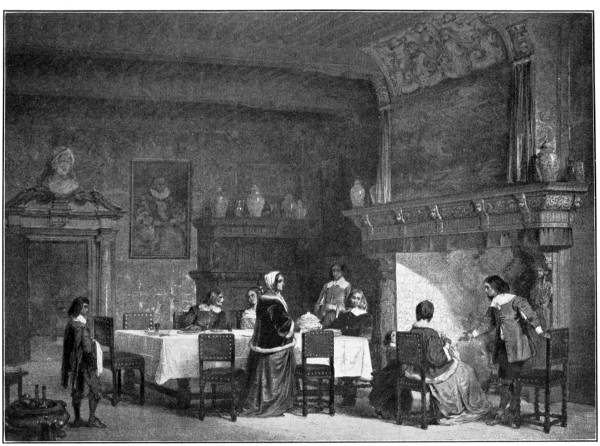
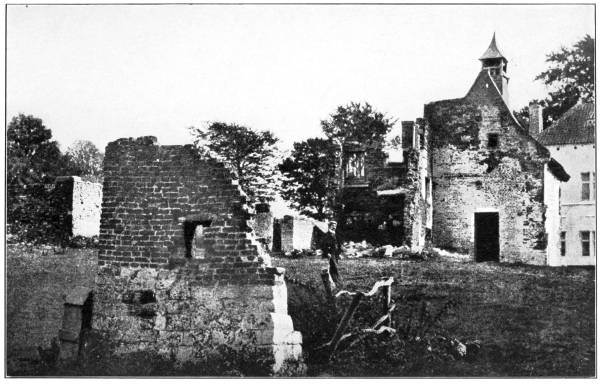
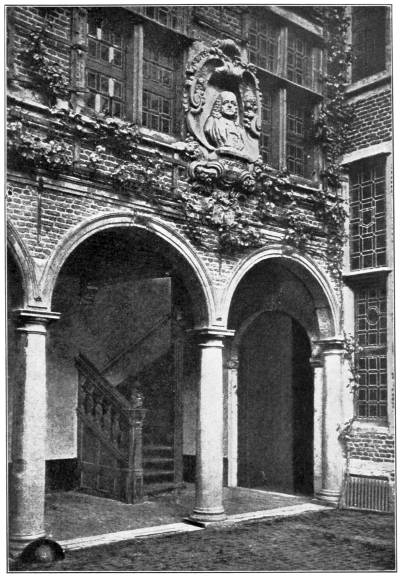
INTERIOR OF AN OLD HOUSE, ANTWERP.
The next day Hochstetter presented himself at the house. He had come for
the last time to ask the hand of Katharina for his son. Knowing his
friend for so many years he had discovered, notwithstanding Frügger’s
efforts to hide it, the inexorable passion which tyrannized over him,
but he would never have believed that the miser would be dominated by
this passion to such an extent as to cause the unhappiness of these two
children. Seeing that this demon of avarice gained upon him every day he
had come to propose the union of Katharina and his son, upon such terms
as would be exceedingly gratifying to the old man. He would take his
daughter without obliging him to part with the slightest portion of his
colossal fortune, not even the heritage left her by her mother. He felt
almost certain that his old friend would hasten to consent as soon as
he made known his intentions.
But Frügger could not be found. The servants, who for a long time had
become accustomed to the prolonged absences of their master, at first
were not anxious. They begged Hochstetter to return later in the day,
which he did, but still no news of Frügger. As his disappearances had
never lasted so long, when the whole day had passed, anxiety was at its
height. On returning the third time, he insisted upon seeing Katharina.
Their anxiety overcame their respect for the severe orders of their
master, and they conducted him to her presence. The young girl was happy
to see her old friend; grief had rendered her incapable of taking the
necessary measures of searching for her father, which Hochstetter
willingly undertook. He performed this task conscientiously, and did all
that was possible to be done, sparing neither trouble nor expense to
discover the retreat of his friend. He sent couriers to Germany,
Holland, Italy, and to all the great commercial cities with which
Frügger had had business connections—but in vain. No one had seen the
rich German. No one could give any information of him.
Another circumstance astonished Hochstetter. He knew that the fortune
of Frügger was one of the most colossal of this period, and even if he
had not known it, his books, kept with the most scrupulous neatness and
exactitude, were there to prove that, far from diminishing, it had
increased considerably; but then, in making the inventory of what he
really possessed, they found only a quarter of what was expected. This
circumstance caused much remark from the Antwerp merchants and the
members of his family who came to Antwerp to convince themselves of the
truth of such an incredible event. It was rumoured at the Bourse that
Frügger the Rich had fled, or committed suicide perhaps, on account of
the enormous losses that he had sustained, and that his fortune had
diminished in an alarming manner. But Hochstetter knew too well the
fortune and the speculations of Frügger to put any faith in these
rumours. The only certainty was that he had disappeared and with him the
greatest part of his riches, and that Katharina had become an orphan
sufficiently rich but much below what she could have one day hoped for.
A little more than a year after the disappearance of Frügger the two
lovers were married in the church of St. André. Long, very long, the
miser’s fate remained an inexplicable mystery, and would have perhaps
so remained forever, if, as frequently happens, accident had not
explained the enigma. After the marriage Carl and Katharina went to live
in the sumptuous mansion of her husband, and the house of Frügger was
more or less abandoned. Hochstetter had been dead many years when their
eldest son was about to be married, and as the house of Frügger formed a
part of his dowry they resolved to repair and alter it, and make it
worthy of receiving the young couple. One day while the workmen were
excavating in the garden they came to announce to Carl that they had
found a few feet under the earth a vault of which no one knew the
existence. It contained bars of gold and silver, coins of all countries,
precious stones, and especially diamonds of incalculable value. On the
floor lay a skeleton. From the pieces of clothing that still covered it
it was recognized as that of “Frügger the Miser.” In searching further
they discovered a heavy iron door, communicating with the other cellars,
and so artistically concealed in the walls that it was impossible to
suspect its existence.
To open it, they were obliged to demolish it completely. A very small
key was found on the other side of the door, still remaining in the
lock. There was the explanation of his frequent absences and of the
final disappearance of the old man. In his eagerness to enjoy the sight
of his treasures, he had forgotten to take out the key upon entering his
sanctuary; the door had closed upon him and he had remained alone with
his gold, and starved in the midst of riches vast enough to have bought
a realm.
They were seated in a rich and shady arbour, over which creeping vines
wandered in every variety of curve, suspending large clusters of
precious fruits, while the atmosphere was laden with the mellow
fragrance of the gorgeous plants which grew in wild, untutored
luxuriance about the shady retreat. The fading light of day yet
lingered, and gave a rosy hue to the face of the maid who sat therein,
as she regarded with mournful tenderness the youth seated at her side.
“Nay, Quentin,” said she, “say not so, it is duty which prompts me to
say it must not be. Had I not affection for my father, do you believe I
would act contrary to my own desires? would I cause you unhappiness?”
“Is this your love?” said the other, with a tone of fretfulness.
“Methinks it cannot be a very ardent flame when it is so easily
extinguished by the perverse and obstinate tyranny of a—”
“Stay your words,” interrupted the girl, as she laid her delicate hand
tenderly on his lips. “You will respect the father if you love the
child.” The noble mind of the youth was struck with the reproof, and
although opposed to his desires her filial reply expressed such purity
and excellence, that he instantly made reparation.
“Forgive me, dearest,” he entreated. “I spoke hastily and unworthily.
But your words have crazed my soul, which builds its happiness on the
possession of you. If it may not be that I shall be your husband, oh!
promise me that no other shall.”
“I would fain do so,” sighed the afflicted girl, “but if my father
commands, can I disobey? I have had no mother’s care since childhood,
but I have scarce felt the loss. My father has thrown off the coldness
of a man and been a very woman in his affection for me. Shall I repay
his kindness with ingratitude? Alas! Quentin, if he tells me to love
another, I cannot do so; but if he bids me wed, Quentin, you would not
censure me?” The expiring rays of the setting sun fell on her features
as she earnestly gazed upon her lover.
“Ah!” cried the youth, with a sudden start, as he struck his hand upon
his brow, “why that blush, that agitation? Deceive me not, Elzia, you
are not supposing a case. This has already happened; I see it all; your
father has selected a bridegroom for you.”
The maid sank her head upon his bosom, and through her struggling tears
she sobbed, “Quentin, thou hast said it.”
Desperate was the conflict in the bosom of the youth as he sat like one
in a trance, his eyes fixed on hers, which, like the sun breaking
through clouds of the passing storm, gleamed from under their dripping
lashes. Soon he saw the rainbow of hope.
“Who is my rival?” he asked with a voice scarcely audible.
“Van Deg,” she answered sorrowfully.
“Do you love him, Elzia?”
“How can you ask?”
“Will you marry him?”
“My father’s happiness is dearer to me than my own. Think you I would
wantonly sacrifice it?”
“But why van Deg?”
“Because he excels in my father’s art.”
“Alas!” cried the despairing lover, “why am I not a painter?”
The bed of Quentin was one of thorns that night, as he threw himself
upon it and yielded to his agony of thought. How vainly, yet how
ardently had he loved, how industriously had he laboured to procure her
affection. Just when he had achieved the victory over her confiding
heart, all that he struggled for was lost—no, not lost—he could bear
the thoughts of her death, he could weep over her grave, he could care
for the flowers above it, but to think that the prize must be torn from
him to be given to another’s embrace, there was madness in it. And then
van Deg, that rough, haughty, distant man! how unworthy he to possess a
jewel of such value, how unfit to care for such a tender plant, how
unsuitable his unsocial spirit for the angel who needed some congenial
soul to insure her happiness.
“Will she not droop and die in that cold atmosphere with him?” he asked
himself, as at length exhausted nature yielded to weariness and he fell
asleep.
The mind, however, yielded not to the fatigue of the body; on the
contrary it seemed to have more abundant vitality. Quentin dreamed he
was in the street. The bells rang, the people shouted, and gay equipages
passed by. It was a day of public rejoicing, for Elzia, the daughter of
Algini, was to wed van Deg, the nation’s favourite, the celebrated
painter. People recounted the scenes he had delineated and lauded the
artist to the skies. Quentin trembled and the cold perspiration gathered
on his forehead as the nuptial cavalcade approached. They halted at the
chapel and the groom conducted the bride all pale and trembling up the
aisle to the altar. As the father was about giving his daughter away,
Quentin rushed up and seized her; she shrieked and fell dead in his
embrace. Her relatives and the priest all gazed in horror! Quentin
raised his eyes, saw the misery in their countenances, and as his face
fell upon the bosom of his lovely burden he expired—and at that moment
awoke.
Still the people were before his eyes, fresh in his recollection as if
he had beheld the awful scenes by the noonday sun. Impelled by an
unaccountable impulse he arose and lighted his lamp, and taking a coal
from the extinguished embers in his chimney, he commenced a picture of
this scene upon the wall. He drew each face, recoiling in surprise at
the perfect resemblance to the individuals. As he finished the outline
he beheld in it a faithful transfer of his dream, wanting nothing but
colour. A thousand thoughts darted through his brain. He flung himself
on his bed, and when he next awoke the rays of the sun had gilded his
apartment. His first object was to seek the mural picture, and he
trembled lest it had all been a dream, but there it stood as if executed
by a magic power.
“If this is the result of an effort with charcoal,” cried he, striking
his breast in a delirium of joy, “what might I not effect with other
means? What might be my reward?”
As daylight sought its slumbers in the bosom of night the lovers met
again. “I’m doing wrong,” murmured Elzia, “in meeting you, since I am an
affianced bride. This night must be our last. It is a sad thing to part
with those we love; yet I act as virtue dictates, and we must meet no
more, as—”
“Say not that we shall meet no more as lovers; say that we shall meet no
more; for, Elzia, could we meet but to love, to upbraid fate which so
cruelly divides us?”
“I must away,” said the girl; “if Quentin’s affection is pure he will
condemn me for lingering.”
“Farewell, then, sweetest. If I lose thee I will wander to some distant
clime and strive to bury my regrets in new cares and new companions.”
He imprinted a kiss upon her willing lips. He watched her retiring form
as it appeared and disappeared amid the foliage at intervals until it
was finally lost to his anxious view; then he turned slowly and sadly
away.
Never did father love his daughter with more fondness than Algini his
child Elzia. Her good was his great aim. He was an enthusiast in the art
of the pencil, and deemed that one of that profession would be most
worthy of his child. The two passions of his soul mingled in such a
manner that they became one. He considered the canvas a lasting monument
to genius, and that he would best secure his daughter’s happiness by
uniting her to one who would be alive to all posterity in his works.
Algini had therefore selected van Deg, as he was the boast of his
country, and the figures of his creation wanted nothing but motion to
make them the exact counterpart of the living originals. Besides, he was
wealthy and would add to the riches of the family. Finally, his
daughter was not old enough now to judge for herself, and though she
had confessed that she was prejudiced against her proposed husband, a
few years of connubial intercourse would overcome that, and she would
ultimately be benefited.
Just as the father was at this point of reflection a letter carrier
entered the apartment and handed him a letter, saying he would wait
without for an answer, that he had been bound by oath not to disclose
who had commissioned him to deliver this communication. Algini was
astonished at these words, and as soon as the man retired broke the seal
and read.
“If the parent consulted the daughter’s happiness would he not
find out from her whether she loves another? I think she does.
May it not be a mistake for van Deg to possess the fair being?
May her marriage to the man of your choice not hurry her to
another world? Her obedience causes her to submit. I lay claim
to her affections, but do not pretend to alter your
determination. You have the reputation of patronizing merit as
it appears in painting. Defer the nuptials to this day twelve
month, and let van Deg on that day place his chef d’œuvre on
the left of the altar. If the one which appears on the right
does not tell of a more skilful master I abide the result. If
it does, then it is fair to leave your daughter the privilege
of choosing her husband.”
The father was delighted with the proposal, and agreed to the trial of
skill in his favourite pursuit. He accordingly returned word of his
acceptance of the terms and notified van Deg thereof.
A year passed away, during which the lovers never met. Elzia had lost
sight of Quentin, and in answer to her inquiries concerning him, all
that she had been able to learn was that shortly after their last
interview he had left the city and had gone no one knew whither.
The wedding day arrived. Elzia kept a smiling face, although her soul
was weighed down by grief.
The chapel was thronged with people anxious to view the ceremony, and as
the bride, richly clad, was led to the altar by her father the latter
announced that her hand was to be bestowed on the artist whose skill was
to be determined by the merit of the pictures which stood veiled on
either side of the altar. At the proclamation van Deg glanced
triumphantly around, and striding to the picture he had painted,
uncurtained it to their view. A burst of applause rose from the
audience as he did so, and well merited was the cry of approval. The
painting was of the chapel and the company assembled for the marriage.
There was the priest all but breathing, while the bride and groom and
their friends appeared as if in the full flush of joy.
Algini was about to speak in rapture of the performance when suddenly
the other curtain was drawn aside and a cry of horror burst from the
multitude as they pressed forward to behold it better. Van Deg gazed in
breathless wonder and Algini uttered a wild shriek of despair—“My
daughter!”
The picture represented Quentin’s dream; each face in it was easy to
recognize, except that of the youth, which was buried in the bosom of
the bride. But before they had fully scanned it, it was thrust aside and
another appeared in its place. This represented a lonely arbour in which
Algini in his old age dangled a beautiful infant which bore a likeness
to Elzia, who sat on an opposite seat with her head resting on the bosom
of a young man, whose arm encircled her waist.
Every one was charmed and delighted beyond measure, and as they beheld
the youth, every tongue cried, “The Blacksmith!”
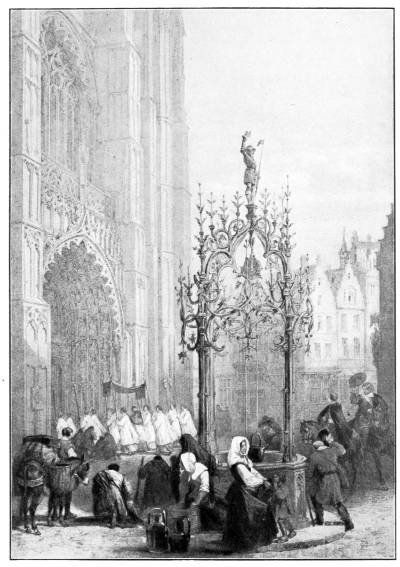
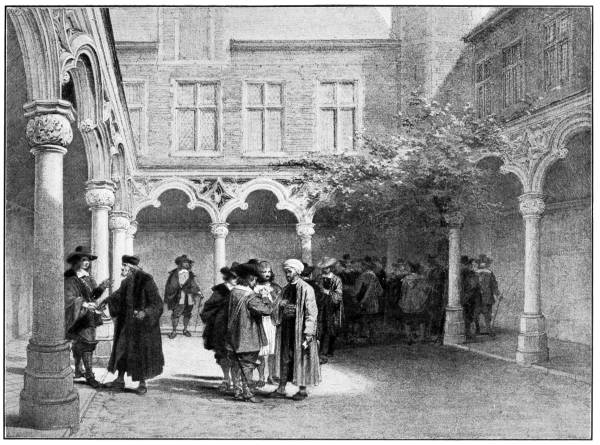
WELL OF QUENTIN MATSYS, ANTWERP.
“Blacksmith no more,” said Quentin, stepping from behind the canvas,
“but the artist who demands his reward.”
It is unnecessary to say more than that genius was rewarded, and to the
happy husband Quentin Matsys, the Blacksmith of Antwerp, the world owes
some of the finest relics of art.
Long, very long before the city of Antwerp had attained the extent which
it now has, the milk-women, who supplied the city with this
indispensable liquid, met every morning in a public square, which was
soon designated by the name of “Marché-au-Lait” (Milk Market). These
women, like all business people at that time, belonged to a corporation
which had its rules, rights and privileges. They were too proud to serve
the “bourgeois” upon the steps of his door, so each servant was obliged
to go to their stands to buy milk.
The pump now situated in the Milk Market is a very pretty monument. It
is surmounted by a carved statuette representing a milk-woman, with the
peculiar brass milk can of the country upon her head. It is the history
of this statuette which we propose to relate.
There still exists on the Milk Market an old house, which is, one would
say, in nearly the same condition that it was three hundred years ago.
Like all the houses of that period (which are so faithfully represented
in the admirable paintings of the celebrated artist, Baron Leys) the
front is of wood, ornamented with carving in the Gothic style, one story
projecting over the other, and surmounted by a triangular gable. One
would think it had not undergone the slightest alteration since the day
it was built. The same small iron knocker hangs upon the old oaken door.
There is not the slightest doubt that the same stone forms the
threshold, it is so worn and polished; it was formerly a square but has
now become nearly a cylinder. The whole aspect of the house is so little
changed, that if the first person who dwelt in it should come back to
earth today he would easily recognize it. The interior as well as the
exterior is unaltered. There are the same straight somber stairs, the
same large fireplaces, and gilded leather upon the principal room. Not a
stone has been replaced, not a piece of wood removed. The repairs which
must have been made in the course of three hundred years, have only
served to retain everything in its original state. But what is still
more singular, the individuals who have successively occupied this
house, and their number must have been considerable, all resembled each
other, in their manners and morals. Was it accident, predestination, or
the unvarying aspect of the house, continually making the same
impression upon its inhabitants, which finally made them nearly
identical beings?
The present inhabitant is a basket maker, as was the first, three
centuries ago, and as have been all those who have occupied the house
between these two periods. They were from the first to the last, people
whose ideas were at least half a century behind the times. If we should
search the history of this antique dwelling, we should probably find
that the biography of one would answer for all. The basket maker who
occupied this house in 1530 was named Klaes Dewis—his wife Gertrude.
They were, as we have said, at least half a century behind, in their
manners, opinions and dress. His neighbours called him the man of the
good old times. Although possessed of a moderate fortune and without
children, he was such a miser that he would, as the Flemish saying is,
“split a match in four pieces,” which is certainly the height of
meanness.
A young peasant girl, fresh and blonde, with large blue eyes, and
picturesque costume, came every morning and placed herself before his
house, to sell the milk which she brought in a fine brass can, polished
like a mirror. The custom of seeing her a few hours every day had
gradually caused an affection between her and this worthy couple;
although in part based upon personal interest, still it was deep. As the
basket maker sometimes said, he had for Lyntje, (which was the name of
the pretty peasant), a paternal love, and as for Gertrude, his wife, she
said she loved her as she would a daughter.
When the weather was bad, if it rained or snowed, Dewis could not
display his baskets, which were usually installed at the door,
consequently Lyntje occupied their place and was sheltered from the
elements. When it was cold, she came from time to time to warm herself
in the kitchen. The milk girl was touched by these delicate attentions,
and showed it by giving good measure to Mother Dewis, who for one
liard had often more milk than her neighbours for two. These agreeable
relations had existed for several years, when suddenly an unforeseen
event terminated them.
One morning in the month of August, 1530, Dewis did not see the young
peasant arrive at her accustomed hour. He waited until the middle of the
day before he put his baskets out, as it threatened to rain. Such a
thing had not happened since the day he first made her acquaintance.
Mother Dewis was so affected that she forgot to buy milk of another.
This gave her husband an opportunity of saying that the use of milk was
only a luxurious habit. But it made no impression upon his better half,
to whom the absence of Lyntje was a cause of great inquietude.
“Can she be sick?” she asked him with anxiety. But then she recalled her
robust constitution, her rosy cheeks, and dismissed that thought as
impossible.
The next day no Lyntje. This was extremely grave, and their anxiety was
at its height. The basket maker was on the point of going out of the
city (which he had not done for perhaps twenty years) to the village
where Lyntje lived. He would have executed this design if his wife had
not observed to him, that he would gravely compromise the soles of his
shoes. This judicious remark caused him to postpone his excursion until
the next day. The next morning a countryman came to inform them of the
death of Lyntje. The poor girl had been taken ill and died the same
night. Before dying, she had remembered her friends in the city, and had
expressed the desire that some one would carry them the fatal news. The
basket maker and his wife, smitten in their dearest affection, wishing
to do something for the repose of her soul, formed the resolution that
they would never again use milk!
Several weeks had passed since the death of the generous milk girl, and
her old friends had not been able to recover the calm of their former
life. They seemed on the contrary to become more melancholy as the days
and weeks wore on after that unfortunate event. Instead of taking the
air upon their doorsteps and conversing with their neighbours, as they
had been in the habit of doing, they never sat there now, and had become
nearly invisible. They went regularly every morning to the cathedral,
where as exemplary Christians, they attended the first mass. Then they
had such a depressed air, the expression of their faces showed a grief
so bitter, that not an inhabitant of the market dared to speak to them.
When, however, one bolder than the others ventured to question them, he
obtained only a few syllables in response. The neighbours, who all felt
a great sympathy for them, would have been glad to console them. They
did not know what to think of such singular conduct, so contrary to all
their habits.
“I cannot believe that grief alone, for a friend like Lyntje, could
affect them to such a point,” said Mynheer Schuermans, the plumber, one
day to his friend, Mynheer Dorekens, the baker upon the corner, who in
the morning came to chat with one or the other of his neighbours while
his last oven of bread was baking.
“It is true that they lost something,” responded he, “because my wife
says so, and she is incapable of telling a falsehood. You know,
neighbour, Mother Dewis had more milk for her liard than we for two.”
“And have you noticed,” said the wife of Schuermans, joining in the
conversation held before her door, “that Dewis completely neglects his
business? Only yesterday he forgot to put out his baskets when he
returned from the cathedral. They have not opened their door during the
day. It is thirty years since we have lived upon the market, and I
cannot remember such a thing to have happened. If it had rained—but
such superb weather. Is their business in a bad state? I do not think
so. He has money.”
“What can it be?” said all three.
At the same instant the basket maker’s door slowly opened, and he came
out with so much gravity, even solemnity, that the neighbours were
struck with astonishment and suddenly ceased their conversation. There
was reason for it. It was the middle of the week, notwithstanding which
he had on his Sunday suit, which at this time never occurred except upon
important occasions. To the friendly nod of his neighbours he responded
by a silent and melancholy salutation, and advanced with slow and
measured steps in the direction of a very fine mansion situated near the
cathedral. They watched him until he had reached the mansion.
“Myn Gott! what does that mean?” gasped the plumber, leaning towards
Dorekens, who was stupefied like himself. “I hope he is not going to
knock at that door. That will be”—but before he had time to finish his
sentence, Dewis already had the knocker in his hand, and let it fall
heavily. The blow made the attentive neighbours shudder, and had the
same effect upon their nervous systems as an electric shock.
“May all the saints come to aid us!” cried Schuermans. “How will this
end?”
“Has Gertrude had an attack of apoplexy?” exclaimed his wife.
“Then,”—But, before she could finish, the door in question had been
opened, and the basket maker had entered.
In order to understand the astonishment of the neighbours, it will
suffice to say that the mansion which Dewis had so audaciously entered
was the residence of the archbishop. As it was generally understood that
a person must be in an excessively critical position before daring to
address this high ecclesiastical functionary, one will easily understand
the impression upon the neighbours of such an important act upon the
part of the basket maker, who was generally known as rather a timid man.
We will leave them for a moment discussing their opinions, to follow
Dewis, but before all, we must make known to the reader the reasons
which had induced the basket maker to take such an important step.
It was hardly three days after the death of Lyntje, when one night they
were awakened by a strange noise, occasioned it seemed to them by some
one who had opened the door of their dwelling. They listened
attentively. Nothing! The clock of the cathedral was just striking.
They counted the strokes. As Dewis was preparing to rise, he heard the
cry of the watchman, “Midnight, and all is well,” which convinced him
that he was deceived. An instant after, however, he thought he heard the
noise of some one slowly ascending the stairs which led to his room. He
sat up in bed, listened with anxiety, and tried to find an explanation
for these sinister and incomprehensible sounds. They became more and
more distinct, and approached nearer the door.
“Who is there?” cried Dewis, with a voice choking with fear.
No answer. A cold perspiration covered his body, his teeth chattered,
his eyes were distended, as he tried to pierce the darkness. Suddenly it
seemed to him that his door opened. He had no strength to cry out, but
waited more dead than alive. An icy wind penetrated the room, agitated
the curtains and swept across the face of Dewis. Sighs and sobs
commenced. What was it? Had it a form, a body? Was it a human being?
Dewis knew not, although he heard only too well the groans and sobs and
believed he distinguished steps, but he saw nothing, heard not a word,
not a syllable. Nevertheless the strange intruder, the spirit or ghost,
continued to moan. It advanced towards the bed, approached so near that
the sobs sounded almost in the ear of the terrified basket maker. Then
slowly it departed. Dewis heard it go out by another door beside his bed
and enter an adjoining room, where it continued to lament.
“Now what was this? An apparition, a specter, or simply the effect of an
hallucination?” he asked himself. Again he heard the same noises as
before. This time they resounded above him in the attic, then ceased,
and at last the house became silent. It will be superfluous to say that
after the departure of his frightful guest, he was in a pitiable state.
He did not dare to rise, and he could not sleep. The rising sun found
him terrified and overcome. As to his wife, she had immediately after
the first noise gone to sleep again. When her husband related to her
what he had heard she appeared incredulous, and did all in her power to
soothe and quiet him. She succeeded in partly convincing him that what
he believed to have heard was the result of tired and excited nerves.
But when the following night at the same hour the groans recommenced, he
had the presence of mind to awaken her. They both listened attentively.
Like the preceding night, the same sighs and sobs were heard, first
softly, then they seemed to enter the chamber, going out at the second
door and finishing in the attic. This time there was no doubting that
the apparition was real. What was to be done? The basket maker was a
member of the society instituted at the cathedral to perform rites for
the repose of souls, which gave him the privilege of joining in the
processions, covered with a mantle of black silk. He had ever been
animated with the laudable desire of delivering souls from purgatory,
and did not for a single instant doubt that this was some poor soul in
trouble, who had come to recommend himself to his powerful intervention.
But whose soul was this, and what body had it animated in this world?
The soul of Lyntje? That could not be. They prayed every day for her,
and had resolved to use no more milk, for the repose of the soul of this
very regretted friend.
We have said before that they attended regularly every morning the first
mass in the cathedral. In consequence of these reflections, they
resolved hereafter to hear two masses a day, the second for the soul in
trouble which had chosen their dwelling to manifest its desire to be
delivered from purgatory. They had a firm belief in the efficacy of
prayer, but unfortunately the masses failed to have any good result.
The apparition returned every night, the sighs and groans increased in
violence. At first, they were not discouraged, but soon lost confidence
in their prayers, and with that, courage. They slept no more and during
the days conversed only of the incredible events of the nights, and to
complete their sorrow, they dared not speak of it to any one for fear of
being called superstitious or visionary. It was not astonishing, then,
that the neighbours noticed a great change in the habits of Dewis. Both
he and Gertrude became more melancholy and grew thin and pale. Their
shop remained shut for days in succession. At last they concluded they
could no longer endure this state of things, and accordingly Dewis told
his wife that he was going to the archbishop to tell him of the affair,
notwithstanding the gossip such a step would give rise to. Far from
opposing, she applauded his design. And this is the reason why the
basket maker had dared dress himself up in his best suit to make this
visit, so well calculated to astonish his neighbours.
Admitted to the presence of this worthy ecclesiastic, he informed him
fully of the grave motives which had forced him to take this step. He
spoke to him of the remedies employed—the sprinkling of holy water,
prayers repeated with fervour, and long masses. He did not hide from
him that all this had been of no avail, which had occasioned in himself
and wife a certain lack of confidence in their pious practices. In
conclusion, he explained the nature of their relations with the deceased
milk girl.
The high dignitary listened with patience to the explanations and griefs
of the basket maker, and when he had finished made him a little sermon
upon his lack of faith in prayers and masses. He promised to come to his
house that evening, to see or at least to hear the specter, to exorcise
it, and to deliver the house from the obnoxious visitor. His words
filled the basket maker with great joy, and if he had not been
forbidden, he would have cried aloud in the street that the archbishop
was to honour him with a visit that evening. Thus on returning before
his neighbours his looks evinced so much joy and pride that Schuermans
and his wife, also Dorekens, were perhaps more puzzled than they were an
hour before at his profound sorrow.
The archbishop came in the evening to the dwelling of Dewis, and
remained very late at night. What did he? What saw he? What was his
opinion of the specter, and in what category of phantoms did he place
it? Did his prayers dissipate it? These are questions which it is
impossible for us to answer, as no one ever knew what transpired. But
tradition says that from that night the house of the basket maker was no
more troubled, and everything resumed its customary appearance. They
contented themselves with their morning mass, as formerly, and held
their usual conversations with their neighbours at the door.
But a few days hardly had passed after the visit of the archbishop when
one morning the Milk Market was in great commotion, all the inhabitants
formed in groups, men and women talking and gesticulating with
vehemence.
“Have you seen it? Have you heard it? What will become of us?” Such were
the interrogations which were heard from all. The answers appeared to
satisfy no one and only served to increase the general agitation. The
milk girls mixed with the groups, neglecting their business to listen
with astonishment to the interesting explanations of Schuermans and his
friends. It must have been something very grave, for the inhabitants of
the neighbouring streets came in crowds to learn the cause of the
disturbance. The sighs and groans which had so long troubled the old
basket maker and his wife had been driven from the dwelling of Dewis.
Immediately after midnight the specter had promenaded back and forth in
the streets, and each time that it passed, had stopped before the door
of its friends, and had filled the air with its lamentations. It
complained now in a more distinct manner, and cried frequently:—
“Half water! Half milk! Small measure! I have lost my soul!”
It was this the plumber heard, and his wife, and the baker and others.
But no one except Dewis could explain these exclamations. He could be
silent no longer. He called Schuermans and a few others, and confided to
them the secret of what had happened to him. They all agreed that it was
the soul of Lyntje alone which troubled the repose of the inhabitants.
If it was not, why had it always showed a marked predilection for the
house of Dewis? They now recollected that they had often had suspicions
of the colour of the liquid which Lyntje sold, and many housekeepers had
complained of the smallness of her measure, which applied so well to the
words of the ghost:—
“Half water! Half milk! Small measure!”
The following night the same cries and lamentations were heard. There
was no more sleep for those that dwelt on the Milk Market. Many of the
inhabitants decided to move immediately rather than continue to reside
in a street visited by specters and phantoms. They foresaw the time when
the market would present the appearance of an abandoned village—when,
happily, the plumber Schuermans had a brilliant idea. He proposed to
place upon the middle of the market a monument representing the material
form of the soul of Lyntje.
“It was,” he said, “a sure remedy against invasions of specters, and had
been proved successful many times.” He went on to explain the virtue of
this remedy. “Specters, it is well known, are souls which some crime or
sin obliges to wander over the earth until they can find some one who
will replace them in this world. A statue serves perfectly well as a
representative, and consequently produces the same effect.”
Dewis then made known to them that the archbishop had counseled him to
erect a statue of the Holy Virgin. After long deliberations it was
resolved that they would place two statues at the expense of the
neighbourhood. Before the end of the week they set up both. The
statuette of Lyntje was placed over a well at the north of the market,
that of the Virgin at the south, near the dwelling of Dewis. It is
useless to add that from that day they have had no more trouble with
specters.
The legend explains the origin of the two images which are still to be
seen at the “Marché au Lait.” Several years ago, when wells were
replaced by pumps, they put the statuette of the Milk Girl upon the top
of the pump. It is a veritable work of art, a jewel. We regret that the
name of the sculptor is unknown to us.